PSEB 8th Class English Grammar The Verb

Punjab State Board PSEB 8th Class English Book Solutions English Grammar The Verb Exercise Questions and Answers, Notes.

PSEB 8th Class English Grammar The Verb

A word that describes action or state of a person, place, thing, or an event is called verb.
वह शब्द जो शब्द किसी व्यक्ति, स्थान, वस्तु अथवा घटना की क्रिया अथवा स्थिति के बारे में कुछ बतलाए उसे Verb (क्रिया) कहते हैं।

Verbs मुख्यतः तीन प्रकार के होते हैं:

  1. Transitive
    Ram took tea.
  2. Intransitive
    Mohan laughs.
  3. Auxiliary

PSEB 8th Class English Grammar The Verb

Primary Auxiliaries

Be
1. Be का प्रयोग Continuous Tense बनाने के लिए किया जाता है:-
He is playing. I was playing.

2. Passive Voice बनाने के लिए
The horse was sold.

3. Infinitive सहित be का प्रयोग किसी आयोजन, प्रबन्ध अथवा समझौते के लिए किया जाता है, जैसे-
I am to go to Delhi tomorrow.

4. आदेश के लिए
You are to see me in the evening.

5. Be का प्रयोग भूतकाल में Perfect Infinitive के रूप में भी किया जाता है। इस प्रयोग में किसी ऐसी व्यवस्था का प्रदर्शन किया जाता है जिसको व्यवहार में नहीं लाया जा सका।
He was to have finished his work last evening but had to leave it on the arrival of the guests.

Have
1. Have का प्रयोग Perfect Tenses के लिए किया जाता है।
He has done his.work.
They have been doing their work.

Do
1. Do का प्रयोग Simple Present तथा Simple Past के नकारात्मक तथा प्रश्नवाचक वाक्य बनाने के लिए किया जाता है।
I do not play.
Do I play?
He does not play.
Does he play?
He did not come.
Did he come?

2. Do का प्रयोग किसी शब्द की दोहराई को रोकने के लिए किया जाता है।
Does she come daily? Yes, she does.
यहां does का अर्थ come शब्द का बोध कराता है अर्थात् Yes, she does. का अर्थ है-हां, वह आती है।

3. Do का प्रयोग किसी बात पर जोर देने के लिए भी किया जाता है।
Please do come.
You do look handsome.

Modal Auxiliaries

1. May and Might

May का प्रयोग होता है-
(a) अनुमति (Permission) देने या लेने के लिए; जैसे,
May I go now?
You may go now.
He may go now.

(b) सम्भावना (Probability) (ऐसी सम्भावना के लिए जिसमें कुछ घटित हो भी सकता है या नहीं भी हो सकता); जैसे,
It may rain today.
It may not rain today.

(c) इच्छा (Wish) को व्यक्त करने के लिए; जैसे,
May you succeed!

(d) May के Past Tense (भूतकाल) के रूप में
He said he might come the next day. (Probability)
He asked if he might borrow my bicycle. (Permission)

(e) अनुमति के लिए (यदि अनुमति वर्तमान में मांगी जा रही हो और इसके मिलने की सम्भावना बहुत ही कमहो); जैसे,
Might I ask a question ?

(f) सम्भावना के लिए (यदि सम्भावना वर्तमान में की जा रही हो और सम्भावना नाममात्र हो); जैसे,
It might not rain tonight.

2. Can and Could

Can का प्रयोग होता है-
(a) अनुमति के लिए (यदि यह अनुमति साधारण बातचीत के दौरान मांगी जाए उस समय can प्राय: may का स्थान लेता है); जैसे,
Can I smoke here?
Yes, you can.
Or
No, you can’t. (यदि अनुमति न देनी हो या यदि ऐसा करने की अनुमति न हो)
(b) सम्भावना के लिए
Pets can be troublesome.
Electricity can be dangerous.

(c) क्षमता या योग्यता के लिए
Can you see the bird in the tree?
I can do this for you.

Could का प्रयोग किया जाता है:
(a) Can के भूतकाल (Past Tense) के रूप में:
He could drive a car at the age of ten.
अतीत में अस्थायी अथवा निजी सफलता के लिए हम could के स्थान पर was or was not able का प्रयोग करते हैं:
He was able to climb the hill without any difficulty.
परन्तु हम could या couldnt का प्रयोग करते हैं:
He couldn’t make much progress in his studies while at school.

(b) विनयपूर्वक प्रार्थना के लिए (यदि यह प्रार्थना वर्तमान में प्रश्नवाचक वाक्य के रूप में की गई हो); जैसे,-
Could I ask you a question ?
Note- भूतकाल की सम्भावना (जो पूर्ण न हुई हो) प्रकट करने के लिए Could का भूतकाल अर्थात् Could have का प्रयोग होता है; जैसे,
You could have caught the train, if you hurried.”

PSEB 8th Class English Grammar The Verb

3. Would

Would का प्रयोग होता है-
(a) Will तथा Shall के भूतकाल (Past Tense) के रूप में; जैसे,
He said he would be moving into his new house next month.
(He said, “I shall be moving……….”)

(b) विनयपूर्वक प्रार्थना (a polite request) के लिए; जैसे,
Would you please close the door?

(c) किसी की इच्छा जानने के लिए (an enquiry about someone’s wish; जैसे,-
Would you like to have a cup of tea ?

(d) ऐसी घटनाएं (Happenings) या कार्य (Actions) जो भूतकाल में बार-बार या कभी-कभी घटित होती या होते थे, जैसे-
Sometimes he would come home drunk and shout at his children.
Note-भूतकाल में सम्भावना व्यक्त करने के लिए would का past tense, would have का प्रयोग किया जाता है; जैसे-,
Had he run fast, he would have caught the train.

4. Should

Should का प्रयोग होता है-
(a) कर्त्तव्य (Duty) अथवा नैतिक उत्तरदायित्व (Moral obligation) प्रकट करने के लिए; जैसे-
We should stand united.

(b) परामर्श (Advice) अथवा निर्देश (Instructions) अथवा दृष्टिकोण (Opinion) व्यक्त करने के लिए; जैसे-
You should see a doctor at once.

5. Must

Must का प्रयोग होता है-
(a) आवश्यकता (Necessity) प्रकट करने के लिए; जैसे,
You must save money for old age.

(b) उत्तरदायित्व (Obligation) प्रकट करने के लिए; जैसे,
You must pay your fees before Tuesday.

(c) तर्कसंगत निष्कर्ष अथवा निश्चितता प्रकट करने के लिए; जैसे,
The fan in the headmaster’s room is on. He must be in.
Note:
1. निषेधवाचक वाक्यों के लिए must not का प्रयोग करना चाहिए; जैसे,
You must not come here again.
2. भूतकाल में निश्चितता अथवा निष्कर्ष प्रकट करने के लिए must का स्थान must have ले लेता है; जैसे,
Mohan must have passed. He had been working quite hard.
3. भूतकाल में आवश्यकता व्यक्त करने के लिए must का Past Tense, had to का प्रयोग करना पड़ता है; जैसे,
The candidates had to appear for an interview after the written test.

6. Need

Need का प्रयोग दो प्रकार का होता है-
(i) नियमित verb के रूप में
We need a lot of money for the wedding.

(ii) Modal के रूप में (ऐसा केवल प्रश्नवाचक तथा नकारात्मक वाक्यों में होता है); जैसे,
Need I come again?
No, you needn’t.
Note- भूतकाल में Need का स्थान need का Past Tense, need have ले लेता है; जैसे,
Need he have taken all that trouble ?

7. Ought

Ought का प्रयोग प्रायः Should जैसी भावना व्यक्त करने के लिए होता है:
(a) परामर्श अथवा सिफारिश व्यक्त करने के लिए-जैसे,
You ought to read this book. It is very exciting.

(b) नैतिक अथवा सामाजिक कर्तव्य के लिए-जैसे,
People ought not to take or offer bribes.

(c) निष्कर्ष के लिए-जैसे,
The train ought to be at the platform. Passengers are coming out of the station with their luggage.

Note-
1. Ought का Past Tense, Ought to have होता है; जैसे- The driver ought to have been more careful. (This has the meaning that the driver
was not careful.)
2. Indirect Speech में Past Tense की क्रिया के बाद ought में कोई परिवर्तन नहीं किया जाता; जैसे, The captain of the school team stated that they ought to win the trophy.

PSEB 8th Class English Grammar The Verb

8. Shall.

Shall का प्रयोग (प्रथम पुरुष-I Person) के साथ होता है:

  1. भविष्य के लिए-I shall go to Delhi tomorrow.
  2. प्रार्थना के लिए-Shall we use this pen?
  3. इच्छा जानने के लिए-Shall I accompany you to your house?
  4. इच्छा व्यक्त करने के लिए-I shall gladly do it.
  5. चेतावनी या धमकी देने के लिए-You shall be fined for coming late. (इस अर्थ में shall का प्रयोग II या III person के साथ किया जाता है।)
  6. आदेश देने के लिए-You shall not come here again.
  7. वचन के लिए-He shall be rewarded for his good work. (इस अर्थ में भी shall का प्रयोग II या III person में होता है।)

9. Will

Will का प्रयोग (II या III Person के साथ) होता है-

  1. भविष्य के लिए-You will get good marks.
  2. प्रार्थना के लिए-Will you help me?
  3. निमन्त्रण के लिए-Will you dine with us tonight?
  4. आदेश के लिए- “You will reach here at 8,” said the Principal.
  5. आदत के लिए-A dog will always remain faithful to his master.
  6. भविष्यवाणी के लिए- You will fail if you do not work hard.

(I Person के साथ Will का प्रयोग)

  1. वाचन देने के लिए-I will see you tomorrow without fail.
  2. संकस्थ के लिए- I will not bow before them.
  3. इरादा व्यक्त करने के लिए- From here we will go to the circus ground direct.

Forms of the Verb

Verb के निम्नलिखित चार रूप होते हैं:

  1. Present form (First form)
  2. Past form (Second form)
  3. Past Participle form (Third form)
  4. Present Participle form (ing form)
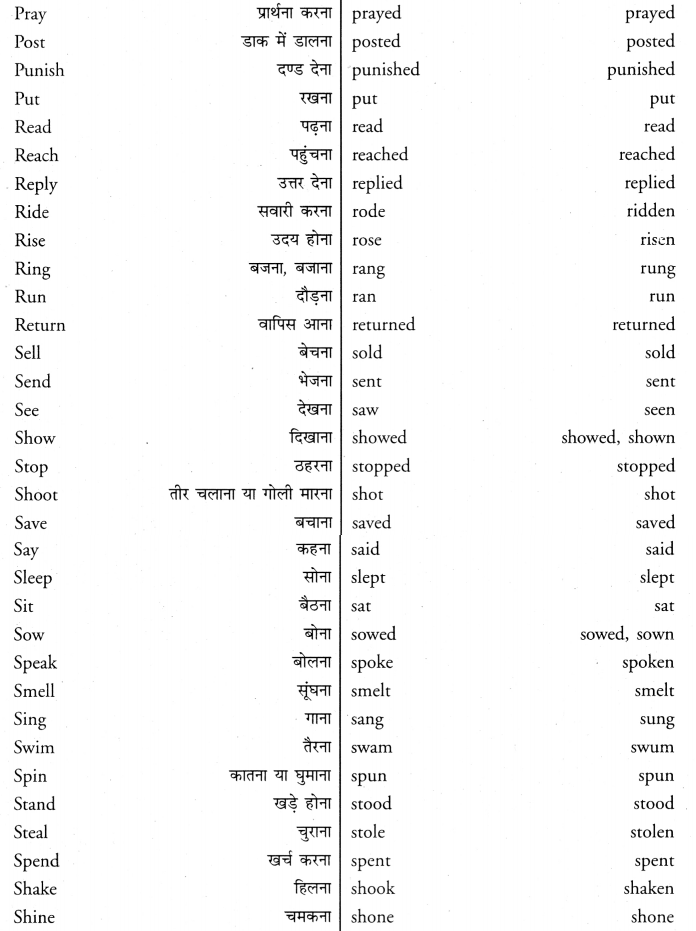
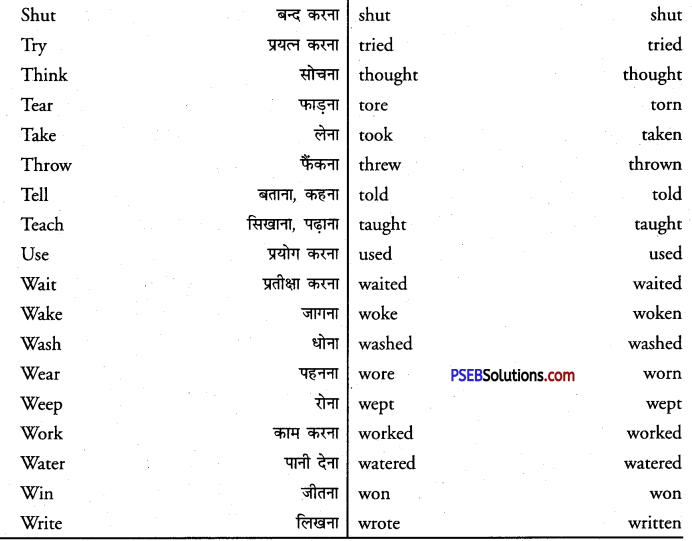
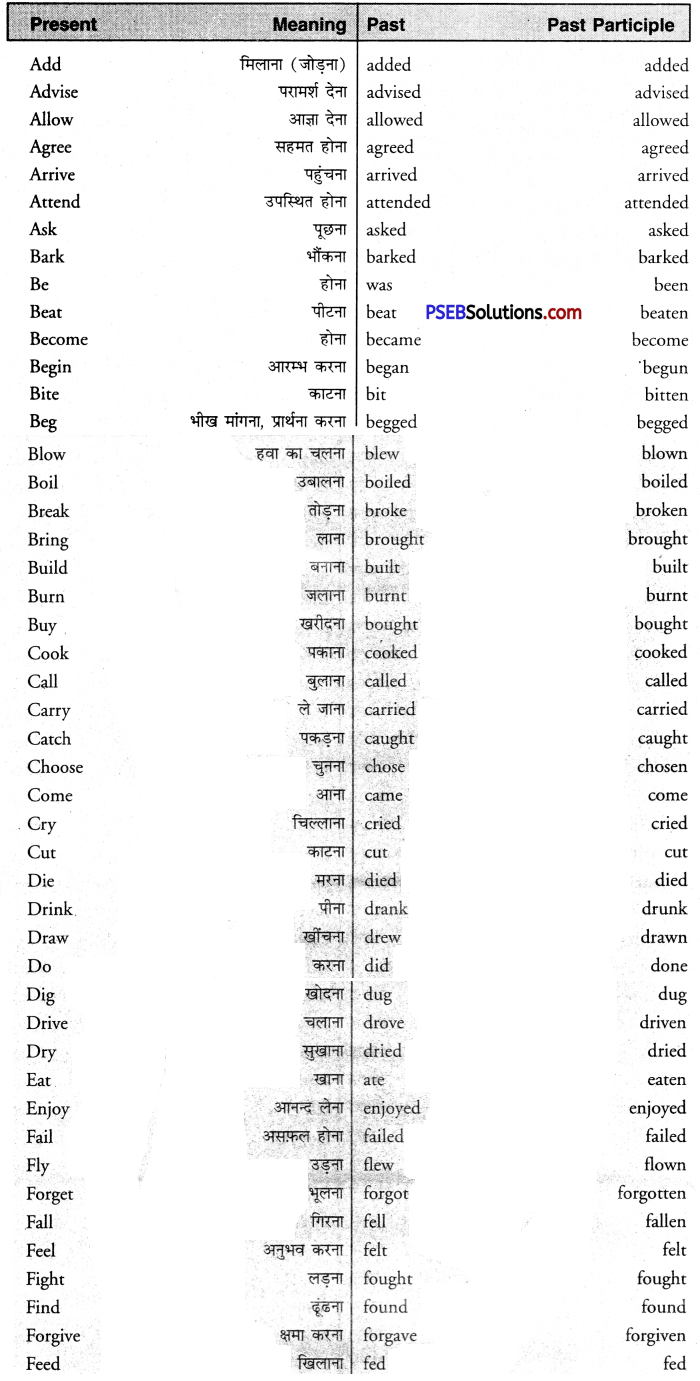
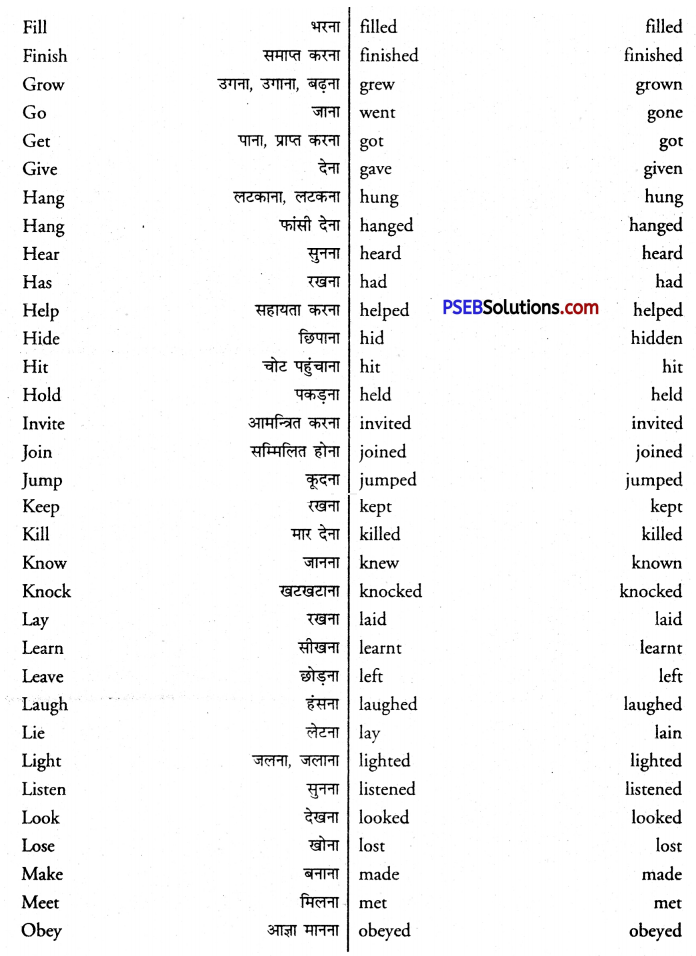
    आगे कुछ महत्त्वपूर्ण verbs की First, Second एवं Third forms दी गई हैं। इन्हें ध्यान से पढ़ें एवं AIG off :

Orms (Conjugation of the Verb

PSEB 8th Class English Grammar The Verb 1 PSEB 8th Class English Grammar The Verb 2 PSEB 8th Class English Grammar The Verb 3 PSEB 8th Class English Grammar The Verb 4

Agreement of The Verb With The Subject

अंग्रेजी भाषा को शुद्ध लिखने के लिए वाक्य में Subject (कर्ता) का Verb (क्रिया) के साथ ठीक ताल-मेल होना अनिवार्य है। कहने का अभिप्राय यह है कि Verb वाक्य के Subject के वचन (Number) तथा पुरुष (Person) के अनुसार होना चाहिए; जैसे,
Ram goes.
Ram and Sham go.
They go.
She goes.
The boys are going
A boy is going.
They were going.
He/She was going.
Subject तथा Verb के उपयुक्त तालमेल के लिए अग्रलिखित नियमों का अध्ययन करें:

PSEB 8th Class English Grammar The Verb

(1) यदि दो या दो से अधिक एकवचन Subjects को and से जोड़ा जाए तो प्रायः उनके साथ बहुवचन Verb का प्रयोग होता है; जैसे,
Mohan and Ram are friends.
Mohan, Sham and Ram play together.
He and his brother have done the work.
Sham and Gopal were there in the meeting.
He and his friend do not work together.

(2) यदि दो एकवचन संज्ञाएं (Nouns) किसी एक व्यक्ति या किसी एक चीज़ का बोध कराती हों तो ऐसी एकवचन संज्ञाओं (Nouns) के साथ एकवचन Verb का प्रयोग होता है; जैसे,-
My brother and helper has arrived.
The leader and speaker is sitting on the stage.
A great Gandhian and leader is dead.

नोट-
(i) यदि एक ही व्यक्ति का बोध कराना हो तो Article का प्रयोग दोनों संज्ञाओं अथवा विशेषणों में से पहली संज्ञा या विशेषण के साथ ही किया जाता है। ऊपर के वाक्य (2) में केवल leader से पहले
The और वाक्य (3) में Gandhian से पहले A का प्रयोग किया गया है।

(ii) यदि वाक्य दो संज्ञाओं से दो अलग व्यक्तियों का बोध कराता हो तो दोनों संज्ञाओं के साथ उचित Article का प्रयोग किया जाता है। ऐसे वाक्य में बहुवचन क्रिया का प्रयोग होता है।
The leader and the speaker are sitting on the stage.

(3) यदि दो Subjects मिलकर किसी एक ही विचार (one idea) को व्यक्त करते हों तो एकवचन क्रिया (Verb in Singular) का प्रयोग होता है; जैसे,-
Fish and meat is the food of the Bengalis.
Slow and steady wins the race.
Twenty kilometres is not a long distance.
The horse and the carriage has arrived.
Early to bed and early to rise makes a man healthy, wealthy and wise.

(4) यदि एकवचन कर्ता (Subject) से पूर्व each अथवा every का प्रयोग किया जाए तो एकवचन क्रिया (Verb in Singular) का प्रयोग होता है; जैसे,-
Every boy and girl was well dressed.
Every man, woman and child was present.
Each day and each hour takes its account.

(5) यदि दो या दो से अधिक एकवचन Subjects को or, nor, either…….. or, neither………..nor से जोड़ा जाए तो एकवचन क्रिया का प्रयोग होता है; जैसे,
Work or play has no difference for me.
Either Mohan or Sohan has broken the slate.
Neither he nor I was present.
Neither food nor water was available there.

(6) जब or तथा nor से जोड़े गए Subjects का वचन भिन्न-भिन्न हो तो बहुवचन क्रिया का प्रयोग किया जाता है तथा बहुवचन Subject को क्रिया के साथ रखा जाता है; जैसे,
Sham or his brothers have broken the slate.
Neither the monitor nor the students were present.
Neither the speaker nor the listeners were serious.
Either the man or his sons have gone wrong.

(7) जब विभिन्न कर्ता (Subjects) or अथवा nor से जुड़े हुए हों, तो क्रिया (Verb) अपने निकटतम् Subject के Person (पुरुष) से मेल खाती है; जैसे,
Either he or I have to go to Delhi.
Neither you nor he is to blame.
Either your father or you are paying for it.

(8) जब Subjects के वचन अथवा पुरुष (Person) में अन्तर हो और वे and से जुड़े हों तो क्रिया (Verb) बहुवचन में प्रयोग होती है; जैसे,
He and I are good friends.
My father and I have jointly done this.
You and he are always together.
You and I are always in time.

(9) समूहवाचक संज्ञा (Collective Noun) के साथ पूरे समूह का भाव व्यक्त करने के लिए एकवचन क्रिया (Verb in Singular) का प्रयोग होता है। परन्तु यदि समूह के व्यक्तियों (individuals) का बोध कराना हो तो बहुवचन क्रिया (Verb in Plural) का प्रयोग होता है; जैसे,
The Committee has chosen its Chairman.
The fleet has set sail.
The Council is one in its opinion for the choice of Chairman.
The Council (councillors) are not one in their opinion for the choice of Chairman.
There is a large number of boys in the class.
A number of players were playing foul.
The police were called out.

(10) कुछ संज्ञाएं देखने में बहुवचन लगती हैं, परन्तु वे अर्थ की दृष्टि से एकवचन होती हैं। ऐसी संज्ञाओं के साथ एकवचन क्रिया (Verb) लगती है; जैसे,
The news is good.
Physics is an easy subject.
The wages of sin is death.
Politics is a dirty game.

(11) कुछ संज्ञाएं देखने में एकवचन लगती हैं परन्तु अर्थ में बहुवचन होती हैं। ऐसी संज्ञाओं के साथ बहुवचन क्रिया (Verb in Plural) का प्रयोग होता है; जैसे,
The gentry were invited to the party.
These poultry are mine.
The cattle are grazing in the field.
People are shouting for nothing.

(12) क्रिया का मेल हमेशा वास्तविक Subject के साथ ही कराना चाहिये। यह जरूरी नहीं है कि क्रिया का निकटतम Subject ही वास्तविक हो। इसलिए वास्तविक Subject को ध्यान में रखना आवश्यक है; जैसे,
Each of the players was rewarded.
Neither of the women was tall.
Each one of plots is for sale.
The quality of these machines is good.
One of the boys was my friend.

PSEB 8th Class English Grammar The Verb

(13) यदि Subject में दो Nouns या Pronouns ‘with’ या ‘as well as’ के साथ जुड़े हों, तो क्रिया उनमें से चहले Noun या Pronoun से मेल खती हहै; जैसे
Ram, with all the members of his family, was present.
He, as well as his friends, is present.
Mohan, and not his friend, has done this.
I, as well as he, have worked hard.

(14) जब किसी क्रिया का Subject कोई Relative Pronoun हो, तो क्रिया Relative Pronoun से ठीक पहले वाले Subject के अनुसार लगती है; जैसे
I, who am your guide, shall stand by you.
You, who are my guide, are expected to stand by me.
He is among the persons who are against me.

Exercises (Solved)

I. Say whether the Verbs in the following sentences are Transitive or Intransitive. If the Verb is Transitive name the Object.
(T = Transitive, I = Intransitive, O = Object)

1. He killed a snake.
2. The fire burns brightly.
3. Birds fly in the air.
4. I drink tea five times a day.
5. A blind man cannot see.
6. He came here last night.
7. She has lost her books.
8. He walked twenty miles.
9. A woman came to buy tea.
10. You should teach him a lesson.
Hints :
1. T, O = a snake
2. In.
3. In.
4. T, O = tea
5. In.
6. In.
7. T, O = her books
8. In.
9. T, O = tea.
10. T,O = him, a lesson.

II. Pick out the Auxiliary Verbs in the following sentences:

1. I am writing a novel.
2. He has done wrong.
3. He did not come in time.
4. He is treated badly.
5. I had heard of this before.
6. I shall leave for Mumbai tomorrow.
7. The boy said that he might have done so.
8. He must have gone home.
9. Did he ask you to write to him ?
10. I can fly an aeroplane.
Hints:
1. am
2. has
3. did
4. is
5. had
6. shall
7. might have
8. must have
9. Did
10. can.

III. Put the correct Verb in the blanks:

(a) 1. The tallest of these boys ……….. next door to me. (live, lives)
2. All the players in my team ……….. done well. (has, have)
3. The cost of all types of pens ………… gone up. (has, have)
4. The toys that were bought by my son ………… really useful. (are, is)
5. He ……….. regularly. (work, works)
Hints:
1. lives
2. have
3. has
4. are
5. works.

(b) 1. Slow and steady ………. the race. (win, wins)
2. Bread and butter ………. what they want. (is, are)
3. Time and tide ………… for none. (wait, waits)
4. Oil and water ……….. mix. (does not, do not)
5. Tobacco and alcohol ………. injurious to health. (is, are)
Hints:
1. wins
2. is
3. wait
4. do not
5. are.

PSEB 8th Class English Grammar The Verb

(c) 1. Neither the captain nor the soldiers ………. been arrested. (has, have)
2. Neither he nor his servants ………… honest. (was, were)
3. Either Rajinder or his parents ……….. responsible for this. (was, were)
4. Neither the Principal nor the lecturers ………………. present at the meeting. (was, were)
5. He or his friends ……….. to blame. (was, were)
Hints:
1. have
2. were
3. were
4. were
5. were.

(e) 1. You, as well as he ……….. innocent. (is, are)
2. Not only the workman but the supervisor also …………………. been dismissed. (has, have)
3. He, as well as you, ………… innocent. (is, are)
4. The workmen, with their leader, ………… been arrested. (have, has)
5. The gallery, with its beautiful pictures, ………… a great attraction. (is, are)
Hints:
1. are
2. have
3. is
4. have
5. is.

(g) 1. None but the brave ………… the fair. (deserve, deserves)
2. Each day and each hour ………… its own importance. (has, have)
3. None of the ships ………… rescued from the storm. (was, were)
4. One of my friends ……….. the owner of this factory. (is, are)
5. Either of these two proposals ……….. acceptable to me. (is, are)
Hints:
1. deserve
2. has
3. was
4. is
5. is.

PSEB 8th Class English Grammar The Verb

(h) 1. The United States ……….. a prosperous country. (is, are)
2. The news of the flood ……….. caused great anxiety. (has, have)
3. The Arabian Nights ………. interesting stories. (contain, contains)
4. Good crockery ………. expensive. (is, are)
5. The West Indies ………. a land of great cricketers. (is, are)
PSEB 8th Class English Vocabulary Prefixes and Suffixes

Punjab State Board PSEB 8th Class English Book Solutions English Vocabulary Prefixes and Suffixes Exercise Questions and Answers, Notes.

PSEB 8th Class English Vocabulary Prefixes and Suffixes

A- Prefixes

Word / Example:
in + active = inactive
in + accurate = inaccurate
in + capable = incapable
in + complete = incomplete
in + correct = incorrect
in + credible = incredible
in + curable = incurable
in + definite = indefinite
in + dependent = independent
in + direct = indirect

PSEB 8th Class English Vocabulary Prefixes and Suffixes

in + efficient = inefficient
in + finite = infinite
in + firm = infirm
in + flexible = inflexible
in.+ formal = informal
in + gratitude = ingratitude
in + hospitable = inhospitable
in + human = inhuman
in + secure = insecure
in + significance = insignificance
in + sincerity = insincerity
in + sufficient = insufficient
in + tangible = intangible
in + temperate = intemperate
in + tolerable = intolerable
in + visible = invisible
im + mature = immature
im + mobile = immobile
im + mobilize = inmodilize
im + moderate = immoderate
im + polite = impolite
im + possible = impossible
im + proper = improper
dis + advantage = inadvantage
dis + agree = disagree
dis + appear = disappear
dis + arm = disarm
dis + honour = dishonour
dis + inherit = disinherit
dis + loyal = irloyal
dis + obedient = ofirobedient
dis + orderly = orderly
dis + place = displace
dis + please = displease.
un + able = unable
un + accustomed = unaccustomed
un + affected = unaffected
un + armed = unarmed
un + avoidable = unavoidable
un + certain = uncertain
un + chartered = unchartered
un + common = uncommon
ir + reparable = irreparable
ir + resolute = irresolute
ir + responsible = irresponsible
ir + resistible = irresistible
ir + reverent = – irreverent
ir + revocable = irrevocable
non + aggression = nonaggression
non + aligned = nonaligned
non + cooperate = noncooperate
non + conformist = nonconformist
non + contentious = noncontentious
non + payment = nonpayment
non + poisonous = nonpoisonous
non + political = nonpolitical
non + resident = nonresident
non + religious = nowreligious
non + sense = nonsense
non + smoker = nonsmoker
non + taxable = nontaxable
non + vegetarian = nonvegetarian
non + violence = nonviolence
de + centralize = decentralize
de + increase = decrease
de + inflate = deflate
de + ascend = descend
il + legal = illegal
il + legible = illegible
il + literate = illiterate
il + literacy = illiteracy

PSEB 8th Class English Vocabulary Prefixes and Suffixes

B- suffixes

Word:
-able
Examples:
favour + able = favourable
objection + able = objectionable
reason + able = reasonable
remark + able = remarkable
value + able = valueable
prefer + able = preferable
knowledge + able = knowledgeable
notice + able = noticeable
like + able = likeable.

Word:
-ance
Examples:
accept + ance = acceptance
allow + ance = allowance
defy + ance = defiance
guide + ance = guidance
import + ance = importance
resist + ance = resistance
appear + ance = appearance
accept + ance = acceptance
perform + ance = performance.

Word:
-ment
Examples:
fulfill + ment = fulfillment
agree + ment = agreement
attach + ment = attachment
fulfil + ment = fulfilment
pay + ment = payment
refresh + ment = refreshment
settle + ment = settlement
advertise + ment = advertisement
entertain + ment = entertainment
misplace + ment = misplacement
replace + ment = replacement
refresh + ment = refreshment
pay + ment = payment

Word:
-fill
Examples:
law + ful = lawful
beauty + fill = beautiful
care + ful = careful
grace + fill = graceful
hope + fid = hopeful
use + ful = useful
success + fill = successful
power + fill = powerful
doubt + ful = doubtful
pain + fill = painful.

PSEB 8th Class English Vocabulary Prefixes and Suffixes

Word:
-er
Examples:
begin + er = beginner
build + er = builder
invade + er = invadeer
make + er = maker
command + er = commander
fast + er = faster
air + er = airer
act + er = acter
bike + er = biker
able + er = abler
old + er = older.

Word:
-less
Examples:
art + less = artless
hope + less = hopeless
noise + less = noiseless
taste + less = tasteless
weight + less = weightless
help + less = helpless
wire + less = wireless
need + less = needless
home + less = homeless
number + less = numberless
mother + less = motherless
driver + less = driverless
system + less = systemless
power + less = powerless
thank + less = thankless
pain + less = painless
fear + less = fearless.

Word:
-y
Examples:
cloud + y = cloudy
fault + y = faulty
sand + y = sandy
sleep + y = sleepy
rain + y = rainy
cream + y = creamy
noise + y = noisy.
bush + y = bushy
juice + y = juicy
snow + y = snowy
rock + y = rocky.

Word:
-en
Examples:
gold + en = golden
silk + en = silken
light + en = lighten
soft + en = soften
bright + en = brighten
straight + en = straighten
earth + en = earthen
wood + en = wooden
wool + en = woolen
dark + en = darken
sharp + en = sharpen

PSEB 8th Class English Vocabulary Prefixes and Suffixes

Word:
-ous
Examples:
grace + ous = grancious
nerve + ous = nervous
courage + ous = courageous
mystery + ous = mysterious
danger + ous = dangerous
teacher + ous = teacherous
continue + ous = continuous
luxury + ous = luxurious
glory + ous = glorious

PSEB 8th Class English Grammar Determiners

Punjab State Board PSEB 8th Class English Book Solutions English Grammar Determiners Exercise Questions and Answers, Notes.

PSEB 8th Class English Grammar Determiners

Determiners वे शब्द है जो संज्ञा (noun) से पूर्व उसके अर्थ को किसी न किसी रूप से स्माष्ट करने या निरिचत करने के लिए प्रयुक्त होते हैं। यहां पर हम Determiners की एक सूची दे रहे हैं-
(i) Demonstratives. this, that, these, those.
(ii) Possessives. my, your, his, her, its, our, their
(iii) Cardinal numbers. one, two, three, etc.
(iv) Ordinal numbers. first, second, third, etc.
(v) Articles. a, an, the.
(vi) Miscellaneous. Some, any, both, certain, enough, few, every, least, less, little, more, most, much, next, other, own, plenty, several, such, many, another, each, no, a few, a large number of, a small number of, a great deal of, a good deal of, a large quantity of, a small quantity of, all, etc.

PSEB 8th Class English Grammar Determiners

(i) Demonstratives (Paderat ya). This, that, these, those the procesu alert a Ridha करते हैं। अत: वे निर्देशक कहलाते हैं और इनसे Determiners की एक श्रेणी बनती है; जैसे:

  • This book was purchased by me.
  • That book was purchased by me.
  • These girls are singing.
  • Those girls are dancing.

Note. This और that एकवचन हैं जबकि these और those बहुवचन हैं।

(ii) Possessives (सम्बन्धवचक सब्द). My, her, your, his its, our, their सम्बन्धवचक सर्वनाम है ओर इनका प्रयोग एकवचन और बहुवचन दोनों प्रकार की संज्ञाओं के साथ किया जाता है; जैसे,
1. (a) I like my book. (Singular)
(b) I kept my books in order. (Plural)

2. (a) He told his story in tears. (Singular)
(b) People tell his stories in tears (Plural)

3. (a) Let me see your note-book. (Singular)
(b) Teacher will check your note-books. (Plural)

Note. सम्बन्धवाचक शब्द अगणनीय संज्ञाओं से पूर्व भी प्रयुक्त किए जा सकते हैं; जैसे-

  • I took my bath. (uncountable)
  • His courage failed him. (uncountable)
  • We cannot doubt their patriotism. (uncountable)

(iii) and (iv) Cardinal and Ordinal Numbers.
Cardinal and Ordinal संख्याएं भी Determiners का एक भाग हैं।

  • Two miles are left to be covered.
  • I am reading the third chapter now.
  • I need fifty rupees for this.

(v) The Articles. a, an तथा the को अंग्रेजी व्याकरण में articles के नाम से पुकारा जाता है। ये वास्तव में Adjective determiners हैं।

Filling the Blanks with Articles

1. Ram is ………. honest man. (an)
2. ………. book you gave me is lost. (The)
3. ………. cow is a useful animal. (The)
4. ………. Himalayas have many ranges. (The)
5. Gardening is ………. useful hobby. (a)
6. I have been waiting for you for ……. hour. (an)
7. I saw ……. Sri Harmandar Sahib. (the)
8. Who is ……… head of your family ? (the)
9. He is ……… boy who stole my pen. (the)
10. Our Principal is ……… intelligent man. (an)
11. ………. stitch in time saves nine. (A)
12. Do not make ………. noise (a)
13. My brother is ………. M.A., you are ………. B.A. (an, a)
14. New Delhi is ……… capital of India. (the)
15. This is ……… interesting story. (an)
16. He has ……… lot of money. (a)
17. He has ………. monthly income of Rs. 7000. (a)
18. ………. stars are a beautiful sight. (The)
19. Give me ……… apple or ………. orange. (an, an)
20. You should always show sympathy to ……… poor. (the)
21. Get me ………. nice cup of tea. (a)
22. This is ………. excellent watch. (an)
23. ………. rose smells sweet. (The)
24. Where is ………. book which I gave you? (the)
25. He is ……….. able student but not ………. ablest. (an, the)
26. Why are you in ………. hurry? (a)
27. I hate ………. dishonest servant. (a)
28. He is ……. idiot. (an)
29. ……… rich are not always happy. (The)
30. …….. moon has risen. (The)
31. There was ………. army of monkeys near …….. temple. (an, the)
32. This is quite …….. new idea. (a)
33. He is ………. hardworking boy. (a)
34. I need ………. pen and ………. inkpot. (a, an)
35. I read ……… Hindustan Times everyday. (the)
36. I have not seen ……… Taj as yet. (the)
37. ………. bad workman quarrels with his tools. (A)
38. ………. apple ………. day keeps ………. doctor away. (An, a, the)
39. …….. Ganga is ……… sacred river. (The, a)

PSEB 8th Class English Grammar Determiners

More Exercises (Solved)

1. Fill up the blanks with the Articles (a, an, the):

1. He can read ………. Vedas.
2. She is ……… intelligent girl.
3. …….. sun shines brightly.
4. Life is not ………. bed of roses.
5. ……… higher you climb ……… colder it gets.
6. In ………. park I saw ………. one-eyed beggar.
7. Mumbai is ………. Manchester of India.
8. ………. Sikhs are a brave nation.
9. ………. owl cannot see during day time.
10. ………. Ganges is ………. sacred river.
11. We started late in ………. afternoon.
12. ………. rose smells sweet.
13. He reads ………. Bible everyday.
14. Kalidas was …….. Shakespeare of India.
15. Einstein was ………. Newton.
16. I read ………. Tribune daily.
17. I am in ……… hurry.
18. Help ……… poor.
19. Both ………. robbers were arrested.
20. Keep to ….. left.
21. ……… housemaid pulls up ……….. blind.
22. What ………. lovely girl !
23. What ……… ripe apple !
24. Not ……… word was said.
25. Help ……… poor, ……… needy and ………. miserable.
Hints:
1. the
2. an
3. The
4. a
5. The, the
6. the, a
7. the
8. The
9. An
10. The, a
11. the
12. The
13. the
14. the
15. the
16. the
17. a
18. the
19. the
20. the
21. The, the
22. a
23. a
24. a
25. the, the, the.

II. Correct the following sentences:

1. Only few. men are honest.
2. The man is mortal.
3. He acted like man.
4. Beas flows in Punjab.
5. You are in wrong but he is in right.
6. He is by far ablest boy.
7. Nobody likes a person with bad temper
8. The iron is useful metal.
9. Not word was said.
10. He has too high a opinion of you.
11. Learn this poem by the heart.
12. Never tell lie.
Hints:
1. Only a few men are honest.
2. Man is mortal.
3. He acted like a man.
4. The Beas flows in the Punjab.
5. You are in the wrong but he is in the right.
6. He is by far the ablest boy.
7. Nobody likes a person with a bad temper.
8. Iron is a useful metal.
9. Not a word was said.
10. He has too high an opinion of you.
11. Learn this poem by heart.
12. Never tell a lie.

PSEB 8th Class English Grammar Determiners

III. Fill in the blanks with suitable determiners:

1. I went to ………. window which commanded a large green garden.
2. I have heard so ……… about your school.
3. Look out of the window for ………. minute.
4. It is really something of ………. joke.
5. There you have …….. essential part of our system.
6. I asked her by way of ………. opening.
7. But I had ………. idea of all this.
8. Come down into ………. garden.
9. Having ………. arm tied up is troublesome.
10. It educates both ………. blind and the helpers.
Hints:
1. the
2. much
3. a
4. a
5. an
6. an
7. an
8. the
9. an
10. the.

IV. Insert the determiners this, that, these, those in the blanks:

1. ………. shirt is costly but ……… shirt is cheap.
2. Would you like to take … book or ………. one ?
3. ……… sum cannot be solved by ………. silly boys.
4. ……… flowers are beautiful but ………. flowers are ordinary ones.
5. He likes this pair of trousers but he does not like ……… one.
Hints :
1. This, that
2. this, that
3. This, those
4. These, those
5. that.

V. Insert ‘a few’ or ‘the few’ whichever is suitable:

1. ………. books she had were all lost.
2. It is question of spending ………. rupees.
3. ………. suggestions she gave were all carried out.
4. …….. hints on essay-writing are quite to the point.
5. ………. boys attended the class.
Hints:
1. The few
2. a few
3. The few
4. A few
5. A few.

VI. Insert ‘little’, a little, or ‘the little’ whichever is suitable

1. ………. knowledge is a dangerous thing.
2. There is ………. hope of his recovery.
3. He has ………. money with him.
4. ……… Strength he had in him proved useless.
5. He takes ……… interest in me.
Hints:
1. A little
2. little
3. a little
4. The little
5. little.

PSEB 8th Class English Grammar Determiners

VII. Fill in the blanks with determiners ‘each, every, either or neither:

1. ………. pen costs ten rupees.
2. He comes here on ………. Sunday.
3. ………. of you may take this book.
4. ………. man wants to rise in the world.
5. ………. seat in the hall was occupied.
Hints:
1. Each
2. every
3. Either
4. Every
5. Every.

PSEB 8th Class English Grammar Parts of Speech

Punjab State Board PSEB 8th Class English Book Solutions English Grammar Parts of Speech Exercise Questions and Answers, Notes.

PSEB 8th Class English Grammar Parts of Speech

शब्दों को प्रयोग के अनुसार आठ भागों अथवा श्रेणियों में विभाजित किया जाता है, जिन्हें Parts of Speech (शब्द भेद) कहते हैं। ये आठ भाग हैं

  1. Noun
  2. Pronoun
  3. Adjective
  4. Verb
  5. Adverb
  6. Preposition
  7. Conjunction
  8. Interjection.

PSEB 8th Class English Grammar Parts of Speech

1. Noun- किसी व्यक्ति, स्थान, वस्तु अथवा गुण-दोष के नाम को Noun (संज्ञा) कहते हैं; जैसे Ram, Shyam, Mumbai, Pen, Pencil, Rose, Dog, Beauty, Honesty आदि।

2. Pronoun- जो शब्द किसी संज्ञा के स्थान पर प्रयोग होता है, उसे Pronoun (सर्वनाम) कहते हैं; जैसे – I, we, you, they, he, she, it आदि।

3. Adjective- जो शब्द किसी Noun अथवा Pronoun की विशेषता प्रकट करता है, उसे Adjective (विशेषण) कहते हैं; जैसे good, bad, thin, fat, tall, many, useful आदि। .

4. Verb- वह शब्द जिससे कार्य का होना अथवा करना प्रकट हो या जो शब्द किसी व्यक्ति, स्थान अथवा वस्तु के बारे में कुछ बतलाए, वह शब्द Verb (क्रिया) कहलाता है; जैसे-

  • The girl reads a book.
  • Ram is a good boy.
  • Mohan goes to school daily.
  • Seema feels sad.
  • I helped the poor.

5. Adverb- जो शब्द किसी Verb, Adjective अथवा किसी अन्य Adverb की विशेषता प्रकट करे, तो उसे Adverb (क्रिया विशेषण) कहते हैं; जैसे-

  • He ran fast. (Verb की विशेषता)
  • Rose is very beautiful. (Adjective की विशेषता)
  • He works too slowly. (Adverb की विशेषता)

6. Preposition- जो शब्द किसी Noun अथवा Pronoun से पहले प्रयोग किया जाता है और जो उनका सम्बन्ध वाक्य के अन्य शब्दों से जोड़ता है, उसे Preposition (सम्बन्धवाचक शब्द) कहते हैं; जैसे-

  • Mohan is at the gate.
  • Ram is proud of his teacher.
  • He is fond of music.
  • I am writing with a pen.

7. Conjunction-जो शब्द, शब्दों अथवा वाक्यों को जोड़ता है, उसे Conjunction (संयोजक) कहते हैं; जैसे-

  • Ram and Shyam are friends.
  • You will get through if you work hard.
  • He was late because he missed the bus.
  • Either he or his brother is at fault.

8. Interjection- अकस्मात् भावना को व्यक्त करने वाला शब्द Interjection (विस्मयादिबोधक अव्यय)
कहलाता है; जैसे-, Alas ! Hurrah! Oh! Lo ! आदि।

Exercises From Board’s Grammar (Solved)

I. Write in the space provided the name of the part of speech to which the underlined words belong in the following sentences:

1. Seema is a beautiful girl.
2. Alas! His dog is dead.
3. The sun sets in the west.
4. The lion is a ferocious animal.
5. Delhi is a very big city.
6. Rahim is poor but honest.
7. Honesty is the best policy.
8. The cat is under the table.
Hints:
1. Adjective
2. Interjection
3. Verb
4. Adjective
5. Adverb
6. Conjunction
7. Noun
8. Preposition.

PSEB 8th Class English Grammar Parts of Speech

II. Complete the following sentences with appropriate ‘Nouns’:

1. ………. is a good boy.
2. She goes to the ……….. everyday.
3. They go for a ……… daily.
4. ……… is the Capital of India.
5. ……….. is the best policy.
6. The ……….. rises in the …………….
7. Chandigarh is the ………. of Punjab and Haryana.
8. Shimla is a beautiful ………..
Hints:
1. Mohan
2. temple/Gurudwara
3. walk
4. Delhi
5. Honesty
6. sun, east
7. capital
8. place.

III. Fill in the blanks with suitable ‘Pronouns:

1. My son is playing with ………. toys.
2. ……….. father is working in Mumbai.
3. ………. has gone abroad for higher studies.
4. This is ……….. house.
5. The girls are doing ……….. homework.
6. ……… is the bread-winner of the family.
7. We should respect ……… parents.
8. He loves ……….. native place very much.
Hints:
1. his
2. My
3. He
4. our
5. their
6. She
7. our
8. his.

IV. Fill in the blanks with suitable ‘Adjectives:

1. She is my ……….. friend.
2. Pudding is my ……….. dish.
3. The scenery of Mussoorie is ………..
4. She likes to wear ……….. dresses.
5. The Bible is a ……….. book.
6. Cricket is a ……….. game.
7. John is an ……….. teacher.
8. Mango is a ……….. fruit.
Hints:
1. best
2. favourite
3. beautiful
4. white
5. holy
6. good
7. English
8 juicy.

PSEB 8th Class English Grammar Parts of Speech

V. Fill in the blanks with suitable ‘Verbs’:

1. She ……….. ice-cream.
2. They ……….. a lot.
3. My mother ……….. food.
4. John ………. in a factory.
5. They ………. football…
6. We should ………. a bath everyday.
7. The school peon ……….. the bell.
8. Seema ……… for a walk daily.
Hints:
1. is eating
2. worked
3. cooks
4. works
5. play
6. take
7. rings
8. goes.

VI. Fill up the blanks with suitable ‘Adverbs?:

1. Sohan walks ………….
2. Everyone should work ……..
3. She sings …………
4. His dad is a ……… respectable man.
5. Our teacher speaks ………. politely.
6. My sister sleeps ………
7. John is a ………. hardworking boy.
8. Girls sang …………..
Hints:
1. slowly
2. hard
3. sweetly
4. very
5. very
6. early
7. very
8. nicely.

VII. Complete the following sentences with suitable ‘Prepositions:

1. My grandfather is hard ………. hearing.
2. My mom is fond ……….. music.
3. A burglar broke ……….. our house last night.
4. The students should listen ……… their teachers attentively.
5. Yesterday we went ………. the Rose Garden.
6. Ayushi is playing ……….. the piano.
7. Children have been playing ……….. morning.
8. My uncle has been living ………. Canada ………. fifteen years.
9. I will play …….. finishing my homework.
10. I am standing ………. Anshu. Anshu is in front of me.
Hints:
1. of
2. of
3. into
4. to
5. to
6. on
7. since
8. in, for
9. after
10. behind.

PSEB 8th Class English Grammar Parts of Speech

VIII. Fill in the blanks with suitable Conjunctions:

1. My younger brother is both intelligent ……….. hardworking.
2. He says ………. he is a doctor.
3. ……… Seema ………. Rita is at fault.
4. Our servant is poor ………. honest.
5. He ………. his nephew manage the shop.
6. Ram went on leave ………. he was injured.
7. You will get the tickets ……….. you reach there before 6 o’clock.
8. ……….. he was late, yet he was able to catch the bus.
Hints:
1. and
2. that
3. Either, or
4. but
5. and
6. because
7. if
8. Although

IX. Fill in the blanks with suitable ‘Interjections:

1. ……….. We have won the game
2. ………… The man is dead.
3. ………….. They have come.
4. ………….. Is this the place?
5. ……………. Well done.
6. ……………. He has lost all his money in gambling.
7. ……….. You are hurt.
8. ………….. He has failed again.

PSEB 8th Class English Grammar Parts of Speech

Hints:
1. Hurrah !
2. Alas!
3. Lo !
4. Oh !
5. Bravo!
6. Alas!
7. Oh !
8. Alas!

PSEB 8th Class English Vocabulary Synonyms

Punjab State Board PSEB 8th Class English Book Solutions English Vocabulary Synonyms Exercise Questions and Answers, Notes.

PSEB 8th Class English Vocabulary Synonyms

A Synonym is a word with the same meaning (एक सामान अये) as another word; as

Word – Synonym
abode – home
actual – real
allow – permit
add – plus
annual – yearly
arrive – reach
beauty – loveliness
beautiful – pretty
begin – start
big – large
brave – bold
briefa – short
calm – peaceful
centre – middle
clever – intelligent

PSEB 8th Class English Vocabulary Synonyms

close – shut
costly – expensive
corn – grain
damp – wet
daily – everyday
definite – certain
difficult – tough
enemy – foe
example – instance
excellent – wonderful
fear – terror/horror
foolish – stupid/silly
fun – enjoyment
grief – sorrow
happy – glad
hollow – empty
hot – warm
kind – generous
loving – affectiodate
perfect – ideal
quiet – silent
reply – answer
right – correct
small – tiny
smell – scent
soft – tender
taste – flavour
timeless – unending
unitet – cooperate
vacant – empty
wealthy – rich
wide – broad

PSEB 8th Class English Vocabulary One Word Substitution

Punjab State Board PSEB 8th Class English Book Solutions English Vocabulary One Word Substitution Exercise Questions and Answers, Notes.

PSEB 8th Class English Vocabulary One Word Substitution

Group of Words Words
1. one who has become dependent on something Addict
2. one who produces works of art Artist
3. a number of sheep Flock
4. one who writes books Author
5. one who cuts hair Barber
6. a building in which aircraft housed Hanger
7. a building where an audience auditorium
8. one who plays a note in a play or movie sits
9. one who treats all teeth problems Actor
10. one who grows crops Dentist
11. one who works in gold Farmers
12. a period of ten years Goldsmith
13. a performance given by a number of musicians decade
14. one who works in iron Concert
15. one who sells meat Blacksmith
16. one who works with wood Butcher
17. a study of animals Carpenter
18. one who lives at the same time Zoology
19. one who sells medicines Contemporary
20 one who mends shoes Chemist
21. one who settles in another country Cobbler
22. one who treats the sick immigrant
23. person working in the same place Doctor
24. one who sells flowers Colleague
25. a doctor who treats mental illness Florist

PSEB 8th Class English Vocabulary One Word Substitution

PSEB 8th Class English Vocabulary Words as per Dictionary Order

Punjab State Board PSEB 8th Class English Book Solutions English Vocabulary Words as per Dictionary Order Exercise Questions and Answers, Notes.

PSEB 8th Class English Vocabulary Words as per Dictionary Order

यदि English भाषा के शब्दों को अंग्रेज़ी Albhabet (A, B, C ….. Y, Z) के क्रम में लिखा जाए तो शब्दों का Dictionary order या Alphabetical Order कहा जाता है। Dictionary में कोई शब्द ढूंढ़ने के लिए हमारे लिए इस क्रम को जानना बहुत ज़रूरी है। वैसे भी शब्दों के किसी समूह को जब Dictionary Order में लिखा जाता है, तो उसमें से किसी भी शब्द को ढूंढ़ना आसान हो जाता है।

PSEB 8th Class English Vocabulary Words as per Dictionary Order

Dictionary Order में लिखने का तरीका-किसी दिए गए शब्द समूह को Dictionary Order में लिखने के लिए निम्नलिखित विधि अपनाएं:
1. सबसे पहले शब्दों के पहले letter (अक्षर) पर ध्यान दें। Alphabet में पहले आने वाले अक्षर से शुरू होने वाला शब्द सबसे पहले आयेगा। जैसे-पहले A, फिर B …..
2. यदि दो या दो से अधिक शब्दों का letter एक जैसा हो तो शब्द के दूसरे letter को follow करें।
3. हो सकता है किन्हीं दो शब्दों के पहले दो अक्षर एक जैसे हों। ऐसे में तीसरे अक्षर (letter) के अनुसार शब्दों को क्रम-बद्ध किया जाएगा।

इसी विधि का अनुसरण करते हुए आगे बढ़ते जाएं, जब तक कि पूरा शब्द-समूह क्रमबद्ध न हो जाए।

Worked Out Examples

Write the given words as per dictionary order:
Question 1.
Apple, Orange, Banana, Mango, Grapes.
Answer:
Apple, Banana, Grapes, Mango, Orange.

Question 2.
Tomato, Potato, Carrot, Radish, Onion.
Answer:
Carrot, Onion, Potato, Radish, Tomato.

Question 3.
Active, Absent, Addition, Aeroplane, Almond.
Answer: Absent, Active, Addition, Aeroplane, Almond.

PSEB 8th Class English Vocabulary Words as per Dictionary Order

Question 4.
January, June, July, April, August.
Answer:
April, August, January, July, June.

Question 5.
Black, Brown, Birthday, Blood, Beautiful.
Answer:
Beautiful, Birthday, Black, Blood, Brown.

Question 6.
Earth, Essay, Father, Farmer, Brother.
Answer:
Brother, Earth, Essay, Father, Farmer.

Question 7.
Watch, Which, Small, Smell, Bitch.
Answer:
Bitch, Small, Smell, Watch, Which.

Question 8.
School, Office, Post-office, Soldier, Knife.
Answer:
Knife, Office, Post-office, School, Soldier.

Question 9.
Barber, Author, Cobbler, Actor, Dancer.
Answer:
Actor, Author, Barber, Cobbler, Dancer.

Question 10.
Bear, Horse, Tiger, Lion, Lamb.
Answer:
Bear, Horse, Lamb, Lion, Tiger.

PSEB 8th Class English Vocabulary Words as per Dictionary Order

Exercise for Practice

Arrange the following group of words in Alphabetical/Dictionary Order:
1. Teacher, Artist, Student, Tailor, Gardener.
2. Bird, Book, Cycle, Circle, Circus.
3. Music, Monitor, May, Marker, March.
4. Agra, Delhi, Dehradun, Capital, Child.
5. Table, Toy, Chair, Friend, Tree.
6. Mouse, Magician, Rabbit, Manager, Prince.
7. King, Kite, Zebra, Zoo, Shirt
8. Grass, Green, Leaves, Pitcher, Picture.
9. Morning, Evening, Night, Afternoon, Dawn.
10. Coffee, Indian, Inkpot, Insect, Mountain.

PSEB 8th Class Hindi Vyakaran क्रिया

Punjab State Board PSEB 8th Class Hindi Book Solutions Hindi Grammar Kriya क्रिया Exercise Questions and Answers, Notes.

PSEB 8th Class Hindi Grammar क्रिया

प्रश्न 1.
क्रिया की परिभाषा लिखकर कर्म के आधार पर क्रिया के भेद लिखो।
अथवा
क्रिया की परिभाषा सोदाहरण दें।
अथवा
क्रिया किसे कहते हैं ? कर्म के आधार पर क्रिया के कितने भेद हैं ?
उत्तर:
जिस शब्द के द्वारा किसी कार्य के करने या होने का बोध होता है, उसे क्रिया कहते हैं; जैसे-
(i) भगवान् की पूजा करो।
(ii) कृष्ण राधा को देखता है,
(iii) किसान बैल को हाँकता है,
(iv) पानी बहता है।
इन वाक्यों में पूजा करना, देखना, हाँकना तथा बहना क्रियाएँ हैं कि क्योंकि इनसे कार्य करने या होने का बोध होता है।

कर्म के अनुसार क्रिया के दो भेद हैं-
1. अकर्मक :
जिस क्रिया के व्यापार का फल कर्ता पर ही पड़े (कर्म न हो) अकर्मक क्रिया कहलाती है। जैसे-कृष्ण रोता है। मोहन भागता है।

2. सकर्मक :
जिस क्रिया के व्यापार का फल कर्ता को छोड़ कर कर्म पर ही पड़े, उसे सकर्मक क्रिया कहते हैं; जैसे-श्याम पुस्तक पढ़ता है। मोहन पेंसिल देता है।

सकर्मक क्रिया के भेद :
(i) एककर्मक क्रिया-जिन क्रियाओं का एक कर्म होता है, वे एककर्मक क्रियाएँ कहलाती हैं; जैसे-शोभा फूल तोड़ती है। सतीश पुस्तक पढ़ता है। ‘फूल’ तथा ‘पुस्तक’ इन वाक्यों में कर्म हैं।
(ii) द्विकर्मक क्रियाएँ-कुछ सकर्मक क्रियाएँ ऐसी होती हैं जिनमें दो कर्म आ जाते है, उन्हें द्विकर्मक क्रियाएँ कहते हैं; जैसे-राम मुझे पुस्तक देता है। ‘मुझे’ तथा ‘पुस्तक’ दोनों ही वाक्य में कर्म हैं। अतः ‘उक्त वाक्य में’ द्विकमर्क क्रिया है।

PSEB 8th Class Hindi Vyakaran क्रिया

प्रश्न 2.
रचना की दृष्टि से क्रिया के भेद लिखो।
उत्तर:
रचना की दृष्टि से क्रिया के निम्नलिखित भेद हैं
1. सामान्य क्रिया : जहाँ केवल एक क्रिया का प्रयोग किया जाए वह सामान्य क्रिया कहलाती है; जैसे-अनिल आया। सोहन ने पढ़ा। मैंने खाया।
2. संयुक्त क्रिया : दो या दो से अधिक धातुओं से मिलकर बनने वाली क्रियाएँ संयुक्त क्रियाएँ कहलाती हैं; जैसे-लिखना चाहता है, पढ़ सकता है, जा सकता है।
3. नामधातु क्रिया : संज्ञा, सर्वनाम, विशेषण से बनने वाली क्रियाओं को नाम धातु क्रिया कहते हैं; जैसे-हथियाना, बतियाना, लतियाना आदि।
4. प्रेरणार्थक क्रिया : जो क्रिया या कर्ता स्वयं क्रिया न करके किसी अन्य को क्रिया करने की प्रेरणा देता है, उस क्रिया को प्रेरणार्थक क्रिया कहते हैं; जैसे-सुनाना, लिखाना, पढ़ाना, कराना।

प्रेरणार्थक क्रियाएँ
मूल धातु
Img 1

5. पूर्वकालिक क्रिया : जब कोई क्रिया मुख्य क्रिया से पूर्व ही समाप्त हो जाए तो उसे पूर्वकालिक क्रिया कहते हैं; जैसे-सीता खाना खा कर स्कूल जाएगी। यहाँ पर ‘जाएगी’ मुख्य क्रिया है और ‘खा कर’ पूर्वकालिक क्रिया है।

अति लघूत्तरात्मक प्रश्न

1. निम्नलिखित क्रियाओं में से सकर्मक और अकर्मक क्रियाएँ छाँट कर लिखो

प्रश्न 1.
तोड़ना, रोना, मरना, मारना, उबालना, लड़ना, गिरना।
उत्तर:
अकर्मक – तोड़ना, मारना, उबालना।
सकर्मक – रोना, मरना, लड़ना, गिरना।

2. नीचे लिखे वाक्यों में जो क्रियाएँ हैं, उन्हें छाँट कर लिखो

प्रश्न 1.
(क) राम ने पत्र लिखा।
(ख) मोहन अपनी जगह से उठ बैठा।
(ग) रमा पुस्तक पढ़ रही है।
(घ) वह देखो, चन्द्रमा निकल आया।
उत्तर:
(क) लिखा
(ख) उठ बैठा
(ग) पढ़ रही है
(घ) देखो, निकल आया।

3. निम्नलिखित शब्दों के नाम धातु रूप को वाक्यों में प्रयोग करें-

हाथ, बात, दुःख, आप, शर्म।
उत्तर:
1. हाथ = हथियाना – उसने मेरी पुस्तक हथिया ली।
2. बात = बतियाना – शिमला आने से पूर्व मुझे बतिया देना।
3. दुःख = दुखाना – कभी किसी का दिल नहीं दुखाना चाहिए।
4. आप = अपनाना – सदा सद्गुणों को अपनाना चाहिए।
5. शर्म = शर्माना – पेट भर कर खाओ, शर्माओ मत।

PSEB 8th Class Hindi Vyakaran क्रिया

बहुविकल्पीय प्रश्न निम्नलिखित प्रश्नों के उत्तर सही विकल्प चुनकर लिखें

प्रश्न 1.
क्रिया के कितने भेद हैं ?
(क) एक
(ख) दो
(ग) तीन
(घ) चार।
उत्तर:
दो।

प्रश्न 2.
क्रियापद चुन कर लिखें
(क) राम
(ख) ने
(ग) पत्र
(घ) लिखा।
उत्तर:
लिखा।

प्रश्न 3.
श्याम पुस्तक पढ़ता है-में कौन-सी क्रिया है ?
(क) अकर्मक
(ख) सकर्मक
(ग) द्विकर्मक
(घ) प्रेरणार्थक।
उत्तर:
सकर्मक।

PSEB 8th Class Hindi Vyakaran क्रिया

प्रश्न 4.
पूजा सोती है-में कौन-सी क्रिया है ?
(क) अकर्मक
(ख) सकर्मक
(ग) द्विकर्मक
(घ) प्रेरणार्थक।
उत्तर:
अकर्मक।

प्रश्न 5.
पूनम ने आद्या को हलवा दिया-में कौन-सी क्रिया है ?
(क) सकर्मक
(ख) प्रेरणार्थक
(ग) द्विकर्मक
(घ) अकर्मक।
उत्तर:
द्विकर्मक।

PSEB 8th Class Hindi Vyakaran विशेषण

Punjab State Board PSEB 8th Class Hindi Book Solutions Hindi Grammar Visheshan विशेषण Exercise Questions and Answers, Notes.

PSEB 8th Class Hindi Grammar विशेषण

प्रश्न 1.
विशेषण किसे कहते हैं ? विशेषण के कितने भेद हैं ?
उत्तर:
जो शब्द संज्ञा या सर्वनाम की विशेषता प्रकट करे, विशेषण कहलाता है; जैसे-वीर पुरुष। इसमें वीर शब्द पुरुष की विशेषता प्रकट करता है। इसलिए यह विशेषण है। विशेषण के चार भेद हैं
(1) गुणवाचक
(2) परिमाणवाचक
(3) संख्यावाचक
(4) निर्देशक या सार्वनामिक।
1. गुणवाचक : जो शब्द किसी पदार्थ के गुण, दोष, आकार, रंग, अवस्था, समय आदि का बोध कराए, उसे ‘गुणवाचक विशेषण’ कहते हैं; जैसे-भला मनुष्य, काला घोड़ा, निचला कमरा।

2. परिमाणवाचक :
जो शब्द किसी संज्ञा या सर्वनाम की माप या तोल सम्बन्धी विशेषता को प्रकट करें, उन्हें ‘परिमाणवाचक विशेषण’ कहते हैं; जैसे-दो मीटर कपड़ा, चार किलो मिठाई। इसके दो भेद हैं
(i) निश्चित परिमाणवाचक-जिस विशेषण से संज्ञा या सर्वनाम के निश्चित परिमाण का बोध हो; जैसे-दो क्विटल, चार लिटर।
(ii) अनिश्चित परिमाणवाचक-जिस विशेषण से संज्ञा या सर्वनाम के निश्चित परिमाण का बोध न हो; जैसे-कुछ दूध, थोड़ा घी, बहुत मिठाई।

3. संख्यावाचक :
जो शब्द किसी संज्ञा या सर्वनाम की संख्या (गिनती) का ज्ञान कराए, उसे ‘संख्यावाचक विशेषण’ कहते हैं; जैसे-एक पुस्तक, दस लड़के। इसके भी दो भेद निम्नलिखित हैं
(i) निश्चित संख्यावाचक-जो निश्चित संख्या का ज्ञान कराए; जैसे-पाँच लड़कियाँ, दुगुना बोझ।
(ii) अनिश्चित संख्यावाचक-जो निश्चित संख्या का बोध न कराए; जैसे-सभी छात्र, कुछ लोग, कई दिन।

4. निर्देशन या सार्वनामिक :
जो सर्वनाम संज्ञा के साथ उसके संकेत या निर्देश के रूप में आता है, वह विशेषण बन जाता है; जैसे-यह घोड़ा, वह पुस्तक। निर्देशक विशेषण को निर्देशवाचक, संकेतवाचक, सांकेतिक और सार्वनामिक विशेषण भी कहा जाता है।

PSEB 8th Class Hindi Vyakaran विशेषण

प्रश्न 2.
विशेषण और विशेष्य किसे कहते हैं ?
उत्तर:
विशेषण जिस शब्द की विशेषता बताता है उसे विशेष्य कहते हैं। विशेषण संज्ञा या सर्वनाम की विशेषता प्रकट करने वाले शब्द को कहते हैं।
जैसे-मुर्ख लड़का’ में मुर्ख विशेषण है तथा लड़का विशेष्य।

प्रश्न 3.
सर्वनाम और सार्वनामिक विशेषण में क्या अंतर है ? उदाहरण देकर समझाइए।
उत्तर-संज्ञा के स्थान पर प्रयुक्त होने वाले शब्द ‘सर्वनाम’ कहलाते हैं परन्तु यदि वाक्य में वे किसी संज्ञा से पहले प्रयुक्त होकर उसकी ओर संकेत करते हैं तो वे सर्वनाम न रह कर विशेषण बन जाते हैं; जैसे-यह चुप बैठा है। वह रोटी खाता है। (यह, वहसर्वनाम)। ये कपड़े मेरे हैं। वह पुस्तक किसकी है ? (ये, यह–सार्वनामिक विशेषण)।

प्रश्न 4.
विशेषणों की तुलना से क्या अभिप्राय है ? तुलना की दृष्टि से विशेषण की कितनी अवस्थाएँ होती हैं ?
उत्तर-संज्ञाओं के गुण-दोषों की न्यूनता-अधिकता का बोध कराए जाने को विशेषण की तुलना कहा जाता है। तुलना के विचार से विशेषण की तीन अवस्थाएँ हैं
(1) मूलावस्था
(2) उत्तरावस्था
(3) उत्तमावस्था।

1. मूलावस्था : इसमें विशेष्य की किसी से तुलना नहीं की जाती; जैसे–मोहन सुन्दर
2. उत्तरावस्था : इसमें दो पदार्थों की तुलना की जाती है और एक की अधिकता या न्यूनता दिखाई जाती है; जैसे-राम श्याम से अधिक चतुर है।
3. उत्तमावस्था : इसमें एक की तुलना दो से अधिक वस्तुओं से की जाती है और इसे सबसे ऊँचा या सबसे नीचा दर्शाया जाता है; जैसे-राम अपनी श्रेणी में सबसे चतुर है।

आवश्यक जानकारी :
विशेषण की पहली अवस्था (मूलावस्था) में विशेषण शब्द के साथ कोई प्रत्यय नहीं लगता जबकि उत्तरावस्था में ‘तर’ और उत्तमावस्था में ‘तम’ प्रत्यय लगते हैं। कुछ उदाहरण-
मूलावस्था – उत्तरावस्था – उत्तमावस्था
योग्य – योग्यतर – योग्यतम
प्रिय – प्रियतर – प्रियतम
अधिक – अधिकतर – अधिकतम
निकट – निकटतर – निकटतम

PSEB 8th Class Hindi Vyakaran विशेषण

प्रश्न 5.
परिमाण वाचक विशेषण किसे कहते हैं और ये कितने प्रकार के हैं ?
उत्तर:
परिमाण वाचक विशेषण-जो शब्द किसी संज्ञा या सर्वनाम की मापतोल सम्बन्धी विशेषता को प्रकट करे उन्हें परिमाण वाचक विशेषण कहते हैं; जैसे-दो मीटर कपड़ा, चार किलो मिठाई। इसके दो भेद हैं
(1) निश्चित परिमाण वाचक।
(2) अनिश्चित परिमाण वाचक।

प्रश्न 6.
सार्वनामिक विशेषण किसे कहते हैं ? उदाहरण देकर लिखिए।
उत्तर:
सार्वनामिक विशेषण-जो सर्वनाम संज्ञा के साथ उसके संकेत या निर्देश के रूप में आता है, वह विशेषण बन जाता है; जैसे-यह घोड़ा, वह पुस्तक। इनमें ‘यह’ और ‘वह’ सार्वनामिक विशेषण है।

अति लघुत्तरात्मक प्रश्न

1. निम्नलिखित वाक्यों में से सार्वनामिक विशेषण छाँटिए

प्रश्न 1.
(क) वे विद्यार्थी लगातार परिश्रम करते हैं।
(ख) यह भारत का सर्वप्रिय फल है।
(ग) वह बच्चा खेल रहा है।
उत्तर:
(क) वे
(घ) यह
(ग) वह।

2. नीचे लिखे वाक्यों में से विशेषण चुनिए

प्रश्न 1.
(1) काला घोड़ा सबसे आगे निकल गया।
(2) मनोहर के घर सफ़ेद गाय है।
(3) वीर पुरुष किसी से नहीं डरता।
(4) पर्वत से भारी चट्टान नीचे जा गिरी।
(5) हमेशा बुरे लोगों से दूर रहो।
(6) हमें अब पता चला कि हममें क्या कमी है ?
(7) वह विकराल डाकू सामने आ खड़ा हुआ।
(8) उसका भाई बहुत निपुण है।
उत्तर:
(1) काला
(2) सफ़ेद
(3) वीर
(4) भारी
(5) बुरे
(6) कमी
(7) विकराल
(8) निपुण।

PSEB 8th Class Hindi Vyakaran विशेषण

3. नीचे लिखे सन्दर्भ में से विशेषण छांटो

प्रश्न 1.
सहसा उन्हें किसी की कठोर आवाज़ सुनाई दी-“ठहरो”। वृद्ध ने रुक कर और पीछे मुड़कर देखा तो जंगल की झाड़ियाँ चीरता हुआ वह विकराल डाकू सामने आ खड़ा हुआ। ऊँचा कद, काला शरीर, विकराल चेहरा, लाल आँखें, उठे हुए केश, बड़ी-बड़ी मूंछे और हाथ में तेज़ कटार। निश्चय ही वह मनुष्य नहीं दैत्य दिखाई देता था।
उत्तर:
कठोर, विकराल, ऊँचा, काला, लाल, बड़ी-बड़ी तेज़।

4. नीचे दिए गए कोष्ठक में से उपयुक्त विशेषण शब्द चुनकर रिक्त स्थानों में भरो

प्रश्न 1.
(उत्साही, क्रूर, हज़ारों, धर्म के रक्षक, विरक्त, निर्भीक) ।
मालाधारी………….. व्यक्ति भी तलवार उठा लेता है। खालसा धर्म के प्रवर्तक तथा ………… गुरु गोबिन्द सिंह जी ने बन्दा बैरागी को तत्कालीन………….. मुग़ल सरकार से …………. बेगुनाहों के खून का बदला लेने के लिए आशीर्वाद देकर भेजा। वह बचपन से ही …………. और …………… प्रकृति का था।
उत्तर:
विरक्त, धर्म के रक्षक, क्रूर, हज़ारों, उत्साही, निर्भीक।

5. निम्नलिखित शब्दों में से संज्ञा, सर्वनाम तथा विशेषण अलग-अलग करें

प्रश्न 1.
कर्तव्य, हम, अधिकार, वे, वृद्ध, अचल।
उत्तर:
संज्ञा – कर्त्तव्य, अधिकार, वृद्ध।
सर्वनाम – हम, वे।
विशेषण – अचल।

6. नीचे लिखे गद्यांश में से संज्ञा, सर्वनाम तथा विशेषण शब्द चुनो

प्रश्न 1.
महापुरुषों के जीवन के आलोक में जब हम अपने आपको पढ़ते हैं तब हमें पता चलता है कि हम में क्या कमी है, हमारी कमजोरियाँ क्या हैं, हमारा जीवन इतना आलोकहीन क्यों है ? हम इस सत्य से परिचित होते हैं कि हमारे अन्दर भी उतनी ही शक्ति छिपी है, जितनी कि महापुरुषों के पास थी।
उत्तर:
संज्ञाएँ-महापुरुषों, शक्ति, जीवन, सत्य। सर्वनाम-हम, अपने। विशेषण-कमी, आलोकहीन।

PSEB 8th Class Hindi Vyakaran विशेषण

बहुविकल्पीय प्रश्न निम्नलिखित प्रश्नों के उत्तर सही विकल्प चुनकर लिखें

प्रश्न 1.
विशेषण के कितने भेद हैं ?
(क) एक
(ख) दो
(ग) तीन
(घ) चार।
उत्तर:
चार।

प्रश्न 2.
विशेषण छाँट कर लिखें
(क) काला
(ख) घोड़ा
(ग) भाग
(घ) गया।
उत्तर:
काला।

प्रश्न 3.
‘इतिहास’ शब्द का विशेषण क्या है ?
(क) इतिहासिक
(ख) ऐतिहासिक
(ग) इतिहासता
(घ) ऐतिहासिकता।
उत्तर:
ऐतिहासिक।

PSEB 8th Class Hindi Vyakaran विशेषण

प्रश्न 4.
‘साहसी’ का विशेषण नहीं है
(क) साहसिक
(ख) साहस
उत्तर:
साहस।

प्रश्न 5.
चार किलो दूध लाना में रेखांकित विशेषण है
(क) संख्यावाचक
(ख) गुणवाचक
(ग) परिमाणवाचक
(घ) सार्वनाम वाचक।
उत्तर:
परिमाणवाचक।

PSEB 8th Class Hindi Vyakaran सर्वनाम

Punjab State Board PSEB 8th Class Hindi Book Solutions Hindi Grammar Sarvanam सर्वनाम Exercise Questions and Answers, Notes.

PSEB 8th Class Hindi Grammar सर्वनाम

प्रश्न 1.
सर्वनाम किसे कहते हैं ? सर्वनाम के कितने भेद हैं ? भेदों के नाम लिखो।
अथवा
सर्वनाम की परिभाषा लिखो और उसके भेद भी बताओ।
उत्तर:
वाक्य में संज्ञा के स्थान पर प्रयुक्त होने वाले विकारी शब्दों को सर्वनाम कहते हैं; जैसे-सोहन, मोहन के साथ उनके घर गया। इस वाक्य में ‘उसके’ सर्वनाम मोहन के स्थान पर प्रयुक्त हुआ है। सर्वनाम के छः भेद हैं

1. पुरुष वाचक – जिससे वक्ता (बोलने वाला), श्रोता (सुनने वाला) और जिसके सम्बन्ध में चर्चा हो रही है उसका ज्ञान प्राप्त हो।
जैसे- अन्य पुरुष – वह, वे
मध्यम पुरुष – तू, तुम
उत्तम पुरुष – मैं, हम

2. निश्चय वाचक – इस सर्वनाम से वक्ता के समीप या दूर की वस्तु का निश्चय होता है; जैसे-यह, ये, वह, वे।

3. अनिश्चय वाचक – इस सर्वनाम से किसी पुरुष एवं वस्तु का निश्चित ज्ञान नहीं होता है; जैसे-कोई, कुछ।

4. संबंध वाचक – इस सर्वनाम से दो संज्ञाओं में परस्पर संबंध का ज्ञान होता है; जैसे-जो, सो। जो करेगा, सो भरेगा।

5. प्रश्न वाचक – इस सर्वनाम का प्रयोग प्रश्न पूछने और कुछ जानने के लिए होता है; जैसे-कौन, क्या। आप कौन हैं ? मैं क्या करूंगा ?

6. निज वाचक – जिन वाक्यों में सर्वनाम शब्दों का प्रयोग कर्ता स्वयं अपने लिए करता है, उसे निज वाचक सर्वनाम कहते हैं; जैसे-मैं अपने विद्यालय गया। यह अपनी पुत्री है। मोहन ने अपना पाठ याद किया।
यहाँ पर ‘अपने’, ‘अपनी’ और ‘अपना’ शब्द निज वाचक सर्वनाम के रूप में प्रयोग किए गए हैं। इसलिए ये शब्द निज वाचक सर्वनाम कहलाएंगे।

PSEB 8th Class Hindi Vyakaran सर्वनाम

प्रश्न 2.
निजवाचक सर्वनाम किसे कहते हैं ? उदाहरण सहित लिखिए।
उत्तर:
निजवाचक सर्वनाम-जिन वाक्यों में सर्वनाम शब्दों का प्रयोग कर्ता स्वयं अपने लिए करता है, उसे निजवाचक सर्वनाम कहते हैं; जैसे-मैं अपने विद्यालय गया। उसने अपना पाठ याद कर लिया है।

प्रश्न 3.
पुरुष वाचक सर्वनाम किसे कहते हैं ? और ये कितने प्रकार के हैं ? उदाहरण देकर स्पष्ट करें।
उत्तर:
पुरुष वाचक सर्वनाम-जिन सर्वनाम शब्दों के द्वारा वक्ता, श्रोता और जिसके सम्बन्ध में चर्चा हो रही है, उसका ज्ञान प्राप्त हो, वह पुरुषवाचक सर्वनाम कहलाता है। यह तीन प्रकार के हैं-
(1) उत्तम पुरुष : जैसे-मैं, तुम।
(2) मध्यम पुरुष : जैसे-तू, तुम।
(3) अन्य पुरुष : जैसे, वह, वे आदि।

बहुविकल्पीय प्रश्न सही शब्द चुन कर उत्तर लिखें

प्रश्न 1.
सर्वमान के कितने भेद हैं ?
(क) दो
(ख) चार
(ग) छः
(घ) आठ।
उत्तर:
छः।

प्रश्न 2.
‘यह’ कौन सा सर्वनाम है ?
(क) निजवाचक
(ख) निश्चयवाचक
(ग) संबंधवाचक
(घ) प्रश्नवाचक।
उत्तर:
निश्चयवाचक।

PSEB 8th Class Hindi Vyakaran सर्वनाम

प्रश्न 3.
संबंधवाचक सर्वनाम का वाचक है
(क) जो
(ख) कौन
(ग) कोई
(घ) यह।
उत्तर:
जो।

प्रश्न 4.
सर्वनाम छाँट कर लिखें
(क) हम
(ख) कल
(ग) घूमने
(घ) गए।
उत्तर:
हम।

अति लघुत्तरात्मक प्रश्न

1. नीचे लिखे वाक्यों में से सर्वनाम चुनिए

(क) मैं खेलने जा रहा था।
(ख) हम कल घूमने गए।
(ग) मैं स्कूल जाता हूँ।
(घ) हरीश ने कहा कि वह आज स्कूल नहीं जाएगा।
(ङ) सोहन मोहन के साथ उसके घर को गया।
(च) पूनम तथा उसकी माता अमृतसर गए हैं।
(छ) माता जी ने पुत्रों से कहा, “तुम यहीं बैठे रहो।”
(ज) मुख्याध्यापक जी ने कहा, “हमें सत्य पर डटे रहना चाहिए।”
(झ) मैं छोटा बच्चा थोड़े ही हूँ।
(ञ) हम कल दिल्ली गए।
उत्तर:
(क) मैं
(ख) हम
(ग) मैं
(घ) वह
(ङ) उसके
(च) उसकी
(छ) तुम
(ज) हमें
(झ) मैं
(ञ) हम।

PSEB 8th Class Hindi Vyakaran सर्वनाम

2. नीचे के रिक्त स्थानों में सर्वनाम की पूर्ति करें

(क) हरि ने …………माँ से कहा कि …………. आज व्रत रमूंगा।
(ख) मोहन ने …………… मित्र से कहा कि ………….. आज घर पर रहेगा।
(ग) दुष्ट ………… दुष्टता नहीं छोड़ता।
(घ) पिता ने …………. पुत्र से कहा बेटा ………….. सच बोलना चाहिए।
(ङ) सेठ ने …………… नौकर को डाँटकर कहा …………… सीधे हो जाओ।
उत्तर:
(क) अपनी, मैं
(ख) अपने, वह
(ग) अपनी
(घ) अपने, तुम्हें
(ङ) अपने, तुम।