The Old Sage and the Brothers Question Answer Class 8 English Solutions Chapter 4 PSEB Solutions

Punjab State Board PSEB 8th Class English Book Solutions Chapter 4 The Old Sage and the Brothers Textbook Exercise Questions and Answers.

Class 8th English Solutions Chapter 4 The Old Sage and the Brothers Question Answers

The Old Sage and the Brothers Class 8 Questions and Answers

Activity 1.

Look up the following words in a dictionary. You should seek the following information about the words and put them in your WORDS notebook. :
1. Meaning of the word as used in the lesson (adjective/noun/verb. etc.)
2. Pronunciation (The teacher may refer to the dictionary or a mobile phone for correct pronunciation.)
3. Spellings.

summoned acquiring approached delighted granted
annoyed poultry deny journey snatched

Vocabulary Expansion

Look at the following sentences.
(a) I enjoyed the film.
(b) The film gave us a lot of enjoyment.
In the sentence (a) the word enjoyed is a verb and in sentence (b) the word enjoyment is a noun. When you add suffixes such as ‘-ment, ‘-ance’, ‘-age’, ‘-ion’, ‘-ness’, -ať, -ure’, etc. to a word, they become nouns. Sometimes if you remove the suffix from a word, it becomes a noun.

PSEB 8th Class English Solutions Chapter 4 The Old Sage and the Brothers

For example :
(a) escaped
If you remove -d’, the word becomes ‘escape’ which is both a noun and a verb.
I had a narrow escape. (noun).
The thief wanted to escape. (verb)

Activity 2.

Let’s do the following activity. Make nouns of the given words.

1. try — trail
2. distract — distraction
3. move — movement
4. educate — education
5. inform — informity
6. agree — agreement
7. pay — payment
8. argue — argument
9. pass — passage
10. bag — baggage
11. marry — marriage
12. refuse — refusal
13. propose — purpose
14. arrive — arrival
15. fail — failure
16. press — pressure
17. confuse — confusion
18. decide — decision
19. revise — revision
20. teach — teaching

Learing to Read and Comprehend

Activity 3

Read the story and answer the following questions.

a. How many sons did the old farmer have ?
किसान के कितने पुत्र थे ?
Answer:
The farmer had three sons.

b. Why did the farmer summon his sons ?
किसान ने अपने पुत्रों को क्यों बुलाया ?
Answer:
The farmer had grown old. He summoned his sons to divide his property among them.

c. What had the farmer decided to do?
किसान ने क्या करने का निर्णय लिया था ?
Answer:
The farmer had decided to give his three sons a field and a house each.

PSEB 8th Class English Solutions Chapter 4 The Old Sage and the Brothers

d. How did Harry help the sage ?
हैरी ने सघु की सहायता कैसे की ?
Answer:
Harry gave the sage a Chapatti to eat.

e. What did Harry ask for ?
हैरी ने क्या मांगा ?
Answer:
Harry asked for a big house and ten cows.

f. Why could the sage not cross the river ?
साधु नदी क्यों न पार कर सका ?
Answer:
The sage could not cross the river because there was no boat.

g. How did Sandeep help the sage ?
संदीप ने साधु की सहायता कैसे की ?
Answer:
Sandeep carried the sage on his back across the river.

h. Did all the brothers keep their promise ?
क्या सभी भाइयों ने अपना वचन निभाया ?
Answer:
No, only Sandeep kept his promise.

i. Why did the sage snatch away the gifts from Harry and Raman ?
साधु ने हैरी तथा रमन से उपहार क्यों छीन लिए ?
Answer:
The sage snatched away the gifts from them because they did not keep their promise.

PSEB 8th Class English Solutions Chapter 4 The Old Sage and the Brothers

j. What do you learn from this story?
आपको कहानी से क्या शिक्षा मिलती है ?
Answer:
One must keep one’s promise. It is our duty to help the poor and the needy.

Activity 4

Complete the following exercise on the basis of the lesson. Fill in the blanks.
(a) The farmer had …………. fields and three …….
(b) The sage made the brothers promise that they would help the ……………. and the
(c) The sage gave a piece of …………….. to Raman. (Choose the correct option.)
(i) cloth
(ii) stick
(iii) rope
(iv) cake
(d) Sandeep broke his promise. (True or False)
(e) The sage punished/did not punish Harry and Raman. (Choose the correct option.)
Answer:
(a) three, houses
(b) poor, needy
(c) stick
(d) False
(e) punished.

PSEB 8th Class English Solutions Chapter 4 The Old Sage and the Brothers

Activity 5

Imagine that you are Harry. Use five sentences to narrate your feelings after your gifts were snatched away from you.
Answer:
I was shocked after my gifts were snatched away. I was rightly punished because I did not keep my word. I did not help the poor and the needy. The riches turned my head and made me selfish. Now I have realized my mistake and decided to work hard in life. I will help the poor and the needy too. Learning Language Verbs There are two forms of main verbs in English.
(a) The Finite Verbs
(b) The Non-finite Verbs

A. Finite Verbs

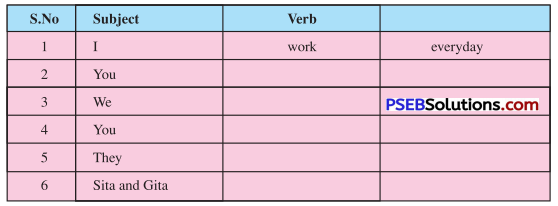
A finite verb is the form of a verb which is limited by the number, person and tense. For example :
1. I eat an apple daily.
2. She eats an apple daily.
3. We eat apples daily.
4. We ate an apple yesterday.
5. We will eat apples tomorrow.

PSEB 8th Class English Solutions Chapter 4 The Old Sage and the Brothers

In the examples above, the verb ‘eat’ changes its forms with change in number, person or tense. Therefore, it can be called a finite verb. Finite Verb का वाक्य number, person या tense बदलने पर अपना रूप बदल लेता है।

B. Non-finite Verbs

A Non-finite form of a verb is not limited by number and person of a subject and has no tense. Non-finite verb-forms are typically infinitive forms with or without ‘to’ (e.g. to go, go), ing forms (e.g. going) and third form of the verb (e.g. finished, gone).
Let’s look at some examples :
(a) I want to eat an apple.
(b) She wants to eat an apple.
(c) We want to eat apples.
(d) They wanted to eat apples.
(e) They will want to eat apples tomorrow.
In the examples above, ‘to eat does not change even when the other verb ‘want keeps changing according to number, person or tense. Therefore, ‘to eat’ is a non-finite verb.

Types of Non-finite Verbs There are three types of Non-finite verbs. These are
(a) The infinitive
(b) The Gerund
(c) The Participles
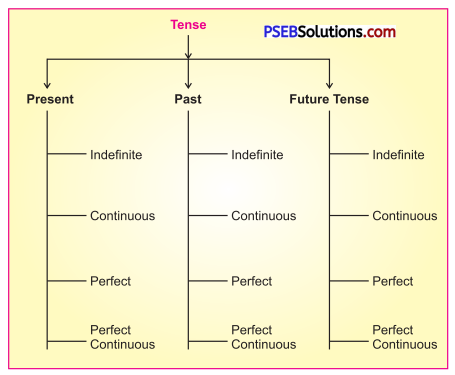
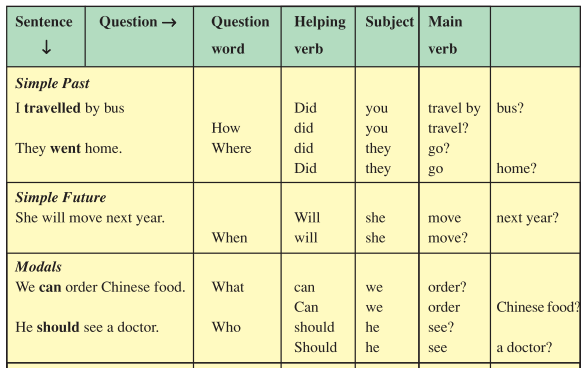
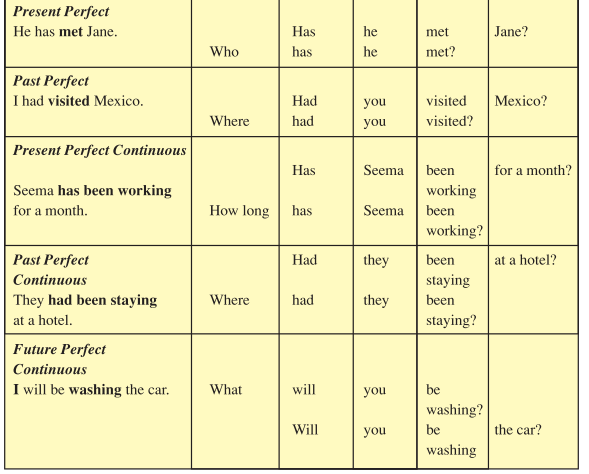
Let us look at the following flowchart to have a better understanding.
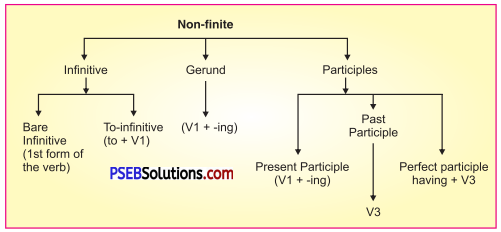
PSEB 8th Class English Solutions Chapter 4 The Old Sage and the Brothers 1

B.1. The Infinitives
The infinitive can further be divided into two categories :
(a) Bare infinitive
(b) To-infinitive

(a) Bare infinitive
Bare Infinitives are also called plain infinitives or infinitives without ‘to’. , Use of Bare infinitives
The bare infinitive is used: with verbs such as ‘bid’, ‘have’, ‘left’, ‘make’
(a) The teacher made the student repeat the lesson.
(b) He bade me write an essay.
(c) He didn’t let me enter the room.

PSEB 8th Class English Solutions Chapter 4 The Old Sage and the Brothers

2. with auxiliaries ‘will’, ‘would’, ‘shall’, ‘should’, ‘can’, ‘could’, ‘do’, ‘must’, ‘may, etc.
(a) You can go now.
(b) You shall know your results tomorrow.

3. with auxiliaries ‘neeď and dare’, the bare infinitive is used primarily in interrogative
and negative sentences, for example :
(a) Dare you go into the foresť at night ?
(b) He daren’t touch his sister’s mobile phone.
(c) Need you go home so soon ?
(d) You needn’t come.

4. with expressions like ‘would rather’, ‘rather than’, ‘had better’, etc.
(a) I would rather stay at home.
(b) You had better ask him for money.
(c) I would die rather than beg.

5. It may follow ‘but’ and ‘except
(a) He did nothing but cry.
(b) He does nothing except complain.

6. with questions denoting suggestions or advice and beginning with ‘why’, ‘why not.
(a) Why make such a noise over a small matter?
(b) Why not take your brother with you ?

(b) To-infinitive
Use of To-infinitive
The To-infinitive is used in many sentence constructions, often expressing the purpose of something or someone’s opinion about something.
1. as a noun :
(a) To speak effectively needs a lot of practice. (subject)
(b) To err is human. (infinitive as subject)
(c) To criticize others is an easy job. (subject)
(d) He likes to play cricket. (infinitive as objects)
(e) To play with fire is a very risky game. (subject)
(f) My duty is to serve my country. (as a complement to a linking verb)
(g) It is easier to preach than to practise. (after the dummy subject ‘it’)

PSEB 8th Class English Solutions Chapter 4 The Old Sage and the Brothers

2. as adverb to modify verbs and adjectives:
(a) We go to school to learn. (modifies the verb ‘go’)
(b) She’s hard to please. (modifies the adjective ‘hard’)

3. as adjective to qualify nouns:
(a) It was a match to remember (qualifies ‘match’)

4. as object complement
(a) He advised me to keep quiet.
(b) I advised him to accept the offer.

5. too + adjective/adverb + infinitive
(a) He’s too weak to walk.
(b) Mona is too young to understand this.
(c) They worked too slowly to achieve the target.

6. enough + infinitive
(a) He has enough money to pay the bill.
(b) He’s kind enough to help you.

Activity 6.

Pick out infinitives in the following sentences and underline them.

1. I saw him go.
2. He promised to come.
3. To forgive is difficult.
4. I watched her dance.
5. It is bad to cheat your family.
Answer:
1. I saw him go.
2. He promised to come.
3. To forgive is difficult.
4. I watched her dance.
5. It is bad to cheat your family.

Activity 7.

Fill in the blanks with appropriate non-finite forms.
(a) You ought …………….. (get) up earlier.
(b) It is easy ……………… (make) mistakes.
(c) He made me ………………. (repeat) the lessons.
(d) You needn’t ………………. (say) anything.
(e) Would you like ………………. (come) in my car ?
(f) He will be able …………… (swim) very soon.
Answer:
(a) to get
(b) to make
(c) repeat
(d) say
(e) to come
(f) swim.

Activity 8:

Combine the following pairs of sentences into one sentence using too/enough + infinitive.

(a) You are very young. You can’t have a gun.
Answer:
You are too young to have a gun.

(b) He’s very ill. He can’t eat anything.
Answer:
He is too ill to eat anything.

(c) Mickey was very foolish. He told lies to the police.
Answer:
Mickey was foolish enough to tell lies to the police.

(d) The fire isn’t very hot. It won’t boil the kettle.
Answer:
The fire is not hot enough to boil the kettle.

(e) I am rather old. I can’t walk that far.
Answer:
I am too old to walk that far.

PSEB 8th Class English Solutions Chapter 4 The Old Sage and the Brothers

B.2. The Gerunds

Gerunds are verb + -ing form used as nouns. They can be used in the following ways :
(a) as a subject
(b) after prepositions
(c) after certain verbs
(d) in noun-compounds

Read the following sentences :

(a) Swimming is a good exercise.
The word ‘swimming’ is formed from the verb ‘swim’ by adding -ing to it. It therefore appears to be a verb. The word ‘swimming’ is the name of an action and is also the subject of the sentence. Hence, it does the work of a noun. The word ‘swimming is like a verb as well as a noun. It is therefore a verb — noun and is called a gerund.

PSEB 8th Class English Solutions Chapter 4 The Old Sage and the Brothers 4

Note : The form of the gerunds and of the present participles are identical. However, Gerunds are verbal nouns and Participles are verbal adjectives.

Examples :
(a) He is fond of riding.– Gerund
(b) Riding along the road, he saw a porcupine. — Present participle

Use of a gerund :

As already mentioned above, a gerund can be used as
(a) the subject of a verb : as
(i) Seeing is believing.
(ii) Collecting stamps is his hobby.

(b) as the object of a transitive verb : as
(i) I enjoy reading poetry.
(ii) i like watching the stars at night.

(c) as object of a preposition : as
(i) She’s fond of dancing
(ii) He was punished for telling a lie.

(d) after certain verbs : the gerund is used after verbs such as given below :
admit, avoid, consider, death, differ, delay, deny, detest, dread, enjoy, excuse, fancy, finish, forgive, imagine, invoke, keep, miss, pardon, postpone, prevent, recollect, resend,risk, stop, suggest, understand, etc.. )

PSEB 8th Class English Solutions Chapter 4 The Old Sage and the Brothers

Examples :
(a) He stopped writing as I entered the room.
(b) Please pardon my saying so.
(c) I enjoy watching this game.

Pick out gerunds in the following sentences :

(a) Swimming is a good exercise.
(b) I enjoy sleeping.
(c) Old men enjoy gossiping.
(d) I hate waiting.
(e) Stealing is a crime.
(f) am fond of walking.
(g) I am good at spelling.
(h) We took part in boating.
(i) My sister does not like cooking.
(j) She’s fond of dancing.
Answer:
(a) swimming
(b) sleeping
(c) gossiping
(d) waiting
(e) Stealing
(f) walking
(g) spelling
(h) boating
(i) cooking
(j) dancing.

Fill in the blanks with the correct gerund or infinitive form of the verbs given in the brackets.

(a) He agreed …………… me. (help).
(b) Suresh enjoys ……………. football. (play).
(c) We failed ………….. the train. (catch)
(d) They decided …………… hard. (work)
(e) She loves ……………. to music. (listen)
(f) I am learning how ………….. (drive)
(g) The class wanted …………… for a picnic. (go)
(h) He urged us ……………. faster. (work)
(i) She loves ……………. books. (read)
(j) I am looking forward to …………… you. (meer)
Answer:
(a) to help
(b) playing
(c) to catch
(d) to work
(e) listening
(f) to drive
(g) to go
(h) to work
(i) reading
(j) meet.

PSEB 8th Class English Solutions Chapter 4 The Old Sage and the Brothers

Learning to Listen

Activity 10.

You will listen carefully to your teacher. Your teacher will read a passage slowly. Write in your notebook what you hear. Do not make spelling mistakes and put appropriate punctuation marks such as comma, question mark or full stop, where needed. (Refer to Appendix I at page no. 166.)
Answer:
Do it yourself.

Learning to Speak

Activity 11:

Look at the pictures given below. There are 8 differences. Do this activity with your partner. While identifying the differences, you all must speak in English only.

Spot the differences

PSEB 8th Class English Solutions Chapter 4 The Old Sage and the Brothers 2

You may use sentences such as 1 can see a difference here
Answer.
1. I can see a difference here in the time. Left hand side clock shows 8.25 but right hand side clock shows 11.25 O’clock.
A —- B
2. Balls on the window rod —- No balls
3. Handles of the drawer are big —- small
4. Cusion of sofa set — one blue —- all yellow
5. Fruits in tray on table—more —- less
6. Book & sequence design —- different
7. Objects on shelf behind sofa —- different
8. Something kept on drawers —- nothing on drawers.

Learning to Write

Given below is an application written to the Principal of a school asking for exemption from examination. Read it carefully and also look at its format.
Answer:
The Principal
Dev Samaj Senior Secondary School
Jalandhar
Sir
I am a student of Class VIII A of your school. Our bimonthly exams are starting from November 01, 20….. Sir, I always stand first in all the exams. My sister’s wedding is falling on November 05, 20…. .As I am the only helping hand of my father, I can’t take the exam this time. This time, I request you to exempt me from the examination. I shall be very thankful to you.
Thanking you
Yours obediently
XYZ …….
Roll No. 21, VIII A
July 5, 20.

PSEB 8th Class English Solutions Chapter 4 The Old Sage and the Brothers

Activity 12.

Write an application to your Principal asking for a School Leaving Certificate in the space given below. You must write.

  • your reason for leaving the school
  • when you will leave the school
  • where you will take admission after leaving the school

Answer:
The Principal
Govt. Senior Secondary School Hamirpur
Sir
I am a student of class VIII of your school. My father has been transferred to XYZ city. He is to report for duty there within three days. All the members of our family are leaving tomorrow. My parents do not wish me to join a hostel. I am sorry to leave your good school, but I am helpless. I shall have to join some school at XYZ city. I have paid all the dues. Kindly issue my school leaving certificate and oblige. I shall be thankful to you for this.
Yours obediently
Om Mehta
VIII-D
March 8,20…..

Learning to Use the Language

Activity 13

What’s the problem? Do you mind if I – Go ahead!
Is it OK if – telling me – Thanks!
Here you are ! Could you turn – Can I borrow –

Conversation 1

Raghav : Yeah?
Gurtej : Hello, ……….. turn the music down, please? It’s one o’clock and I’m trying to sleep.
Raghav : Oh, sorry. Is that okay ?
Gurtej : Yes, ………. Perhaps I can get some sleep now. Good Night!
Answer:
1. could you
2. Thanks.

Conversation 2

Japtej : I’m sorry, leave early today? I’m going to take my dog to see the vet.
Palak : You’re going to take your dog to the vet ? What’s the matter with him ?
Japtej : I don’t know. That’s why I’m going to take him to the vet’s.
Palak : Oh, I see! Sure Thanks for
Answer:
1. Is it ok if I
2. Here you are !
3. telling me.

Conversation 3

Sheenam : Divyam, do you have your mobile phone with you ?
Divyam : Um … yes. Why ?
Sheenam : it, please? I need to make a quick call to my mother.
Divyam : OK,
Answer:
1. Can I borrow
2. go ahead !

Conversation 4

Jyoti : ………… change seats?
Rajneesh : Yes, all right ……. ?
Jyoti : I can’t see because of the sun.
Rajneesh : OK, then. Why don’t you sit there, next to Piyush.
Answer:
1. Do you mind if I
2. What is the problem ?

PSEB 8th Class English Solutions Chapter 4 The Old Sage and the Brothers

Activity 14 :
Given below are some polite requests with equally polite responses. Match the questions in Column A with the correct responses in Column B.
Answer:

S.No. Column A S.No. Column B
1. Can I have a glass of juice? 1. Yes, of course!
2. Is it alright if I make a phone call? 2. I said that some friends were coming over.
3. Could you say that again, please? 3. Well, OK, if it’s a local call.
4. Can I speak to you for a moment? 4. Oh sure, The remote’s on the table.
5. Do you mind if I look at your books? 5. Well, not really. Why can’t you come?
6. Is it OK if I miss the class tomorrow? 6. Of course, there’s some in the fridge.
7. Could you move a little, please? 7. You can borrow some if you want.
8. Do you mind if I turn the TV up? 8. Yes, sorry. I didn’t realise you wanted to sit down.

1. Of course, there’s some in the fridge.
2. Well, OK, if it’s a local call.
3. I said that some friends were coming over.
4. Yes, of course !
5. You can borrow some if you want.
6. Well, not really. Why can’t you come ?
7. Yes, sorry. I didn’t realise you wanted to sit down.
8. Oh sure, The remote’s on the table.

Comprehension Of Passages

Read the following passage and answer the questions given below each :

(1) Long time ago, a rich farmer summoned his three lazy sons. Harry, Raman and Sandeep and said, “I have grown old. I have decided to divide my property among you. As you all know, I own three fields and three houses. Each one of you will get a field and a house only if you prove that you are worth it”. The three sons were surprised. “What do you mean, father ?” cried they. The farmer said, “These fields and houses are the fruits of my hard work. All the three of you are very lazy. I want the three of you to find some work. Return to me after six months with your earnings. I will decide if you are worthy of acquiring my hard-earned property.” The three brothers set out in search of work, On the way, they sat down under a banyan tree to rest.

1. How could the sons gain their father’s property ?
पुत्र अपने पिता की संपत्ति कैसे प्राप्त कर सकते थे ?

2. Where did they take rest ?
उन्होंने आराम कहां किया?

3. Choose true and false statements and write them in your answer-book :
(a) All the three sons were hard-working.
(b) The sons were given six months to prove their worth.

PSEB 8th Class English Solutions Chapter 4 The Old Sage and the Brothers

4. Complete the following sentences according to the meaning of the passage :
(a) Each son will get …………
(b) The three sons set out in ……… of work

Match the words with their meanings :

(i) summoned called
(ii) acquire gain
put in jail

Answer:
1. The sons could gain it by proving themselves worth it.
2. They took rest under a banyan tree.
3.
(a) False
(b) True.
4.
(a) Each son will get a field and a house.
(b) The three sons set out in search of work.
Or
(i) summoned — called
(ii) acquire — gain

(2) Then the old sage said, “Promise me that if ever a poor man asks you for a cup of milk, you will not deny him.”
“It’s a gendeman’s promise”, said the lad “and whatsoever he wishes for milk, butter, curd, sweets, I will never deny.” The old sage smiled, “Do not break your promise.”
“I will not”, assured Harry.
The other two brothers continued on their way with the old.sage. They went on till they came to a stream. The old sage looked sad and worried. “Oh! There’s no boat. How will I cross the stream ?” Raman said very kindly. “Don’t worry! I’ll help you. I’ll carry you on my back.” After crossing the river, the three of them sat down for some rest.
The sage thanked Raman and said, “God bless you, son! Here is a gift for you.”
Raman was delighted. The sage gave him a piece of stick. Raman was surprised. “What is this ?” “It is a magic stick. It will grant you two wishes. Ask now.”

1. What was Harry’s gendeman promise ?
हैरी का सज्जन पुरुष वाला वचन क्या था?

2. Who gave a gift to Raman ? What was it ?
रमन को उपहार किसने दिया? यह क्या या?

3. Choose true and false statements and write them in your answer-book :
(a) The sage crossed the river with the help of a boat.
(b) Harry assured the sage that he would not break his promise.

PSEB 8th Class English Solutions Chapter 4 The Old Sage and the Brothers

4. Complete the following sentences according to the meaning of the passage :
(a) Raman offered to carry the sage across
(b) The old sage looked
Or
Match the words with their meanings :

(i) delighted refuse
(ii) deny happy/glad
wondered

Answer:
1. Harry’s promise was that he would never deny anything to the needy.
2. The sage gave a gift to Raman. It was a piece of magic stick.
3.
(a) False
(b) True.
4.
(a) Raman offered to carry the sage across the river.
(b) The old sage looked sad and worried.
Or
(i) delighted — happy/glad
(ii) deny — refuse.

(3) Sandeep moved on with the old sage. When they came to a desert, they sat down for some rest. The old sage said to Sandeep, “I know you are very tired but I’m very thirsty. Please get me some water”.
“Don’t worry! Please rest here. I’ll find some water for you.” Sandeep set out to find water for the old man. He returned after an hour with some water. The old sage drank the water and blessed Sandeep, “God bless you, son ! Here’s a gift for you.”
Sandeep was delighted. The sage gave him a piece of rope. Sandeep became very happy. He knew he was going to be rewarded. The old sage smiled and said, “It’s a magic rope. It will grant you two wishes. Ask now.”
Sandeep was delighted, “I want a big house.” “Granted.”
A beautiful house appeared.
“What’s your second wish ?” added the sage.
“A field !”, said Harry excitedly. “Granted !”

1. Who brought water for the sage ?
साधु के लिए पानी कौन लाया?

2. How many wishes could the magic rope grant ?
जादुई रस्सी कितनी इच्छाएँ पूरी कर सकती थी?

3. Choose true and false statements and write them in your answer-book :
(a) On the way the sage felt hungry.
(b) Sandeep asked for a beautiful house for his first wish.

4. Complete the following sentences according to the meaning of the passage :
(a) The sage gave Sandeep ……… as a gift.
(b) Sandeep became happy because he was going to be ……….
Or
Write the meanings of the following words in English : (any two) excitedly, grant, wish
Answer:
1. Sandeep brought water for the sage.
2. The magic rope could grant two wishes.
3.
(a) False
(b) True.
4. (a) The sage gave Sandeep a magic rope as a gift.
(b) Sandeep became happy because he was going to be rewarded.
Or
eagerly, fulfil, desire.

PSEB 8th Class English Solutions Chapter 4 The Old Sage and the Brothers

Use Of Words And Phrases in Sentences

1. Deny – He denied me food.
2. Wish – His wish came true.
3. Grant – All his wishes were granted.
4. Summoned – The king summoned his minister to his court.
5. Approached – The beggar approached the langar house for food.
6. Worth – You are not worth this big house.
7. Snatched – All his awards were snatched from him.
8. Appeared – All of a sudden a beautiful girl appeared from no where.
9. Word – He did not keep his word.
10. Delighted – He was delighted to- win the race.

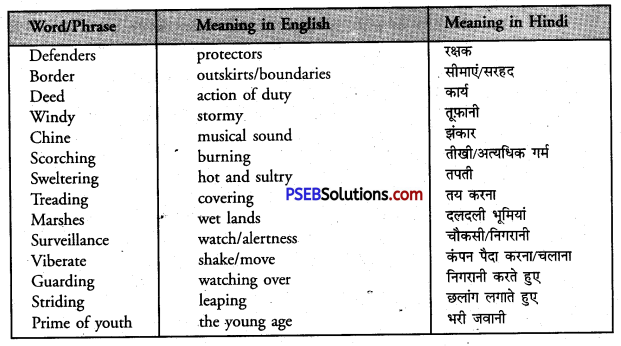
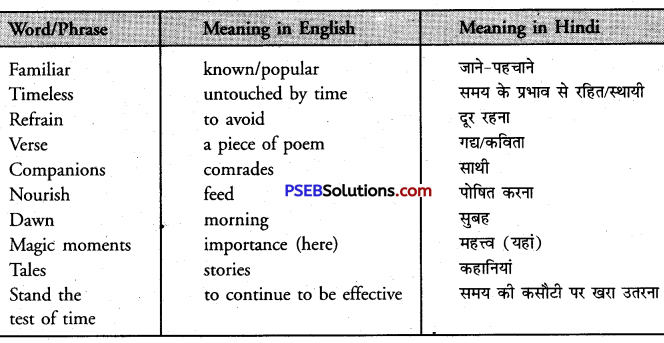
Word-Meanings
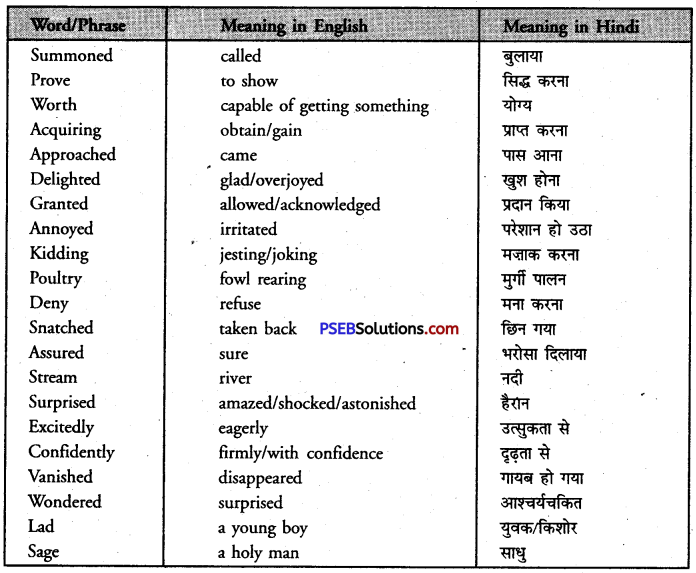
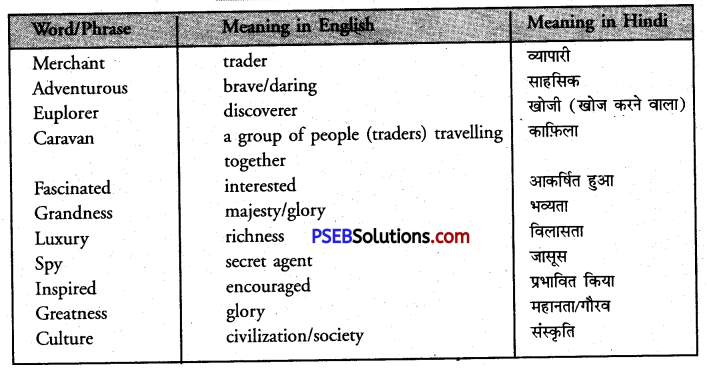
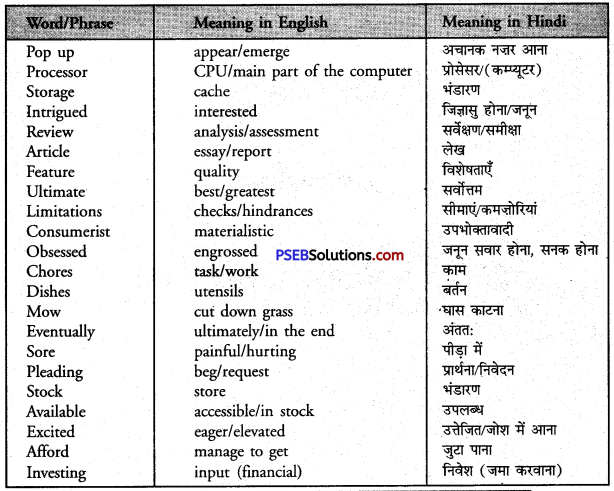
PSEB 8th Class English Solutions Chapter 4 The Old Sage and the Brothers 3

The Old Sage and the Brothers Summary in Hindi

Long time ago…..knew no bound.

बहुत समय पहले एक अमीर किसान ने अपने तीन आलसी पुत्रों-हैरी (Harry), रमन तथा संदीप को बुलाया और कहा, “मैं बूढ़ा हो चुका हूँ। मैंने अपनी सम्पत्ति को तुम्हारे बीच में बांटने का निर्णय लिया है। जैसा कि तुम जानते हो मेरे पास तीन खेत और तीन घर हैं। तुम में से प्रत्येक को एक खेत और एक घर मिलेगा, यदि तुम यह सिद्ध करोगे कि तुम उसके योग्य हो।” तीनों पुत्र हैरान थे। वे चिल्लाए, “पिता जी, आप का क्या अर्थ है ?” किसान ने कहा, “ये खेत और घर मेरी कड़ी मेहनत का फल हैं। तुम तीनों बड़े ही आलसी हो। मैं चाहता हूँ कि तुम तीनों कोई काम ढूंढो।

ठछः मास के बाद अपनी आमदनी लेकर मेरे पास वापिस आओ। मैं निणय करूंगा कि क्या तुम मेरे द्वारा कड़ी मेहनत से अर्जित सम्पत्ति पाने के योग्य हो।” तीनों भाई काम की तलाश में निकल पड़े। रास्ते में वे बरगद के एक वृक्ष के नीचे आराम करने के लिए बैठ गए। जब वे खाना खा रहे थे तभी एक वृद्ध साधु उनके पास आया।

उसने कहा, “मैं भूखा हूं। क्या तुम मुझे खाने के लिए कुछ दे सकते हो ?” हैरी (Harry) ने उसे एक चपाती दे दी। साधु ने खुशी-खुशी उसे खा लिया और बोला, “पुत्र ! ईश्वर तुम्हारा भला करे। तुम्हारे लिए एक उपहार है।” हैरी खुश हो गया। साधु ने उसे कपड़े का एक टुकड़ा दिया।हैरी चिढ़ कर बोला, “यह क्या है ? क्या तुम मेरे साथ मज़ाक कर रहे हो ?”

साधु मुस्कराया और बोला, “यह एक जादुई कपड़ा है। यह तुम्हारी दो इच्छाएं पूरी करेगा। अब मांगो।” हैरी अत्यधिक खुश होकर बोला, “मुझे एक बड़ा घर चाहिए।” “प्रदान किया !” एक सुन्दर घर प्रकट हो गया। साधु ने पूछा, “तुम्हारी दूसरी इच्छा क्या है ?” हैरी ने उत्साह से कहा, “दस गाय।” “दे दी।” दस गाय न जाने कहां से प्रकट हो गईं। हैरी की खुशी का कोई ठिकाना न रहा।

Then the old sage………………Raman confidently.

तब वृद्ध साधु ने कहा, “मुझे वचन दो कि जब कभी भी कोई गरीब आदमी तुमसे एक कप दूध मांगेगा तो तुम इन्कार नहीं करोगे।” युवक ने कहा, “यह एक सज्जन पुरुष का वचन है। वह दूध, मक्खन, दही, मिठाई में से किसी चीज़ की भी इच्छा प्रकट करेगा, मैं इंकार नहीं करूंगा।” वृद्ध साधु मुस्कराया, “अपना वचन मत तोड़ना।” हैरी ने भरोसा दिलाया, “मैं नहीं तोडंगा।”

दूसरे दो भाई वृद्ध साधु के साथ आगे बढ़ गए। वे तब तक चलते रहे जब तक कि वे एक नदी पर नहीं पहुंच गए। वृद्ध साधु उदास और चिंतित दिखाई देने लगा। “ओह ! यहां तो कोई नाव नहीं है। मैं नदी कैसे पार करूंगा ?” रमन ने उदारता से कहा, “चिंता मत करो। मैं तुम्हारी मदद करूंगा। मैं आपको अपनी पीठ पर ले जाऊंगा।” नदी पार करने के पश्चात् वे तीनों आराम करने के लिए बैठ गए।

साधु ने रमन का धन्यवाद किया और कहा, “पुत्र! ईश्वर तुम्हारा भला करे। तुम्हारे लिए एक उपहार है।” रमन खुश हो गया। साधु ने उसे छड़ी का एक टुकड़ा दिया। रमन हैरान रह गया। “यह क्या है ?” साधु ने कहा, “यह एक जादुई छड़ी है। यह तुम्हारी दो इच्छाएं पूरी करेगी। अब मांगो।” रमन खुश हो गया। उसने कहा, “मुझे एक बड़ा घर चाहिए।” “प्रदान किया !” एक सुन्दर घर प्रकट हो गया। साधु ने आगे कहा, “तुम्हारी दूसरी इच्छा क्या है ?” रमन ने उत्सुकता से कहा, “एक मुर्गी फ़ार्म।” “प्रदान किया !” एक मुर्गी पालन फ़ार्म न जाने कहां से प्रकट हो गया।

रमन की खुशी का कोई ठिकाना न रहा। तब वृद्ध साधु ने कहा, “मुझे वचन दो कि जब कभी भी कोई गरीब आदमी तुमसे एक अंडा मांगेगा तो तुम मना नहीं करोगे।”

PSEB 8th Class English Solutions Chapter 4 The Old Sage and the Brothers

युवक ने कहा, “यह एक सज्जन पुरुष का वचन है और वह अंडे, आमलेट, अंडे का हलवा में से किसी भी चीज़ की इच्छा प्रकट करेगा, मैं इंकार नहीं करूंगा।” वृद्ध साधु ने मुस्कराते हुए कहा, “अपना वचन मत तोड़ना।” रमन ने दृढ़ता से कहा, “मैं ऐसा नहीं करूंगा।”

Sandeep moved on… ………..”Granted!”

संदीप वृद्ध साधु के साथ चलता रहा। जब वे एक मरुस्थल में पहुँचे तो नीचे बैठ कर आराम करने लगे। वृद्ध साधु ने संदीप से कहा, “मैं जानता हूँ कि तुम थके हुए हो परन्तु मुझे बहुत प्यास लगी है। कृपया पानी ले आओ।”
“आप चिंता न करें। कृपया यहां आराम करें। मैं आपके लिए पानी की तलाश करता हूं।” संदीप वृद्ध साधु के लिए पानी तलाशने के लिए निकल पड़ा। वह एक घण्टे के बाद पानी लेकर लौटा। वृद्ध साधु ने पानी पिया और संदीप को आशीर्वाद दिया, “पुत्र, ईश्वर तुम्हारा भला करे! तुम्हारे लिए एक उपहार है।”

संदीप प्रसन्न हो गया। साधु ने उसे रस्सी का एक टुकड़ा दिया। संदीप खुश हो गया। वह जानता था कि उसे उपहार मिलने वाला है। वृद्ध साधु मुस्कराया और कहा, “यह एक जादुई रस्सी है। यह तुम्हारी दो इच्छाएं पूरी करेगी। अब मांगो।”
संदीप प्रसन्न था, “मुझे एक बड़ा घर चाहिए।” “प्रदान किया।” एक सुन्दर घर प्रकट हो गया। साधु ने आगे कहा, “तुम्हारी दूसरी इच्छा क्या है ? ” संदीप ने उत्सुकता से कहा, “एक खेत!” “प्रदान किया!” एक खेत न जाने कहां से प्रकट हो गया। संदीप की खुशी का ठिकाना न रहा।

तब वृद्ध साधु ने कहा, “मुझे वचन दो कि जब कभी भी कोई गरीब आदमी तुमसे खाने के लिए कुछ मांगेगा तो तुम इंकार नहीं करोगे।”
युवक ने कहा, “यह एक सज्जन पुरुष का वचन है। वह चावल, गेहूं, सब्जियां, फल में से किसी भी चीज़ की इच्छा प्रकट करेगा, मैं इंकार नहीं करूंगा।” वृद्ध साधु मुस्कराया, अपना वचन मत तोड़ना।”

संदीप ने वचन देते हुए कहा, “मैं ऐसा नहीं करूंगा।” बूढ़ा साधु अपनी यात्रा पर निकल पड़ा। कुछ दिनों के बाद संदीप ने अपने भाइयों से मिलने का निश्चय किया क्योंकि उसे उनकी याद आ रही थी। घर, गायें, मुर्गी फ़ार्म और उसके भाई सब गायब हो चुके थे। वह उन्हें ढूंढ़ नहीं सका। जब वह वहां खड़ा था आश्चर्यचकित था, उसने साधु को अपनी ओर आते देखा। साधु ने उसे बताया, “तुम्हारे भाइयों ने अपना वचन नहीं निभाया। उन्होंने ग़रीबों और जरूरतमंदों की मदद नहीं की। इसलिए जो कुछ भी उन्हें दिया गया था, छिन गया। तुम अपने वचन पर खरे उतरे। इसलिए जब तक तुम अपने वचन को याद रखोगे, आनंद करते रहोगे।

Retranslation From English to Hindi

1. A rich farmer summoned his three lazy sons.
एक अमीर किसान ने अपने तीन आलसी पुत्रों को बुलाया।

2. I have grown old.
मैं बूढ़ा हो चुका हूँ।

3. I own three fields and three houses.
मेरे पास तीन खेत और तीन घर हैं।

4. The three sons were surprised.
तीनों पुत्र हैरान थे।

5. I want three of you to find some work.
मैं चाहता हूँ कि तुम तीनों कोई काम ढूंढ़ो।

6. The three brothers set out in search of work.
तीनों भाई काम की तलाश में निकल पड़े।

7. The sage ate it happily..
साधु ने खुशी-खुशी उसे खा लिया।

8. The sage gave him a piece of cloth.
साधु ने उसे कपड़े का एक टुकड़ा दिया।

9. It’s a magic cloth.
यह एक जादुई कपड़ा है।

10. I want a big house.
मुझे एक बड़ा घर चाहिए।

11. The old sage looked sad and worried.
वृद्ध साधु उदास और चिंतित दिखाई देने दिया।

12. I’ll carry you on my back.
मैं आपको अपनी पीठ पर ले जाऊंगा।

13. Here is a gift for you.
तुम्हारे लिए एक उपहार है।

14. A poultry farm appeared out of nowhere
एक मुर्गी पालन फ़ार्म न जाने कहां से प्रकट हो गया।

15. I know you are tired.
मैं जानता हूँ कि तुम थके हुए हो।

16. It’s a gentleman’s promise.
यह एक सज्जन पुरुष का वचन है।

PSEB 8th Class English Solutions Chapter 4 The Old Sage and the Brothers

17. The old sage set out on his journey.
बूढ़ा साधु अपनी यात्रा पर निकल पड़ा।

18. You were as good as your word.
तुम अपने वचन पर खरे उतरे।

English Guide for Class 8 PSEB Prose

Charge for Love Question Answer Class 8 English Solutions Chapter 6 PSEB Solutions

Punjab State Board PSEB 8th Class English Book Solutions Chapter 6 Charge for Love Textbook Exercise Questions and Answers.

Class 8th English Solutions Chapter 6 Charge for Love Question Answers

Charge for Love Class 8 Questions and Answers

Activity 1.

Look up the following words in a dictionary. You should seek the following information about the words and put them in your WORDS notebook.
1. Meaning of the word as used in the lesson (adjective/noun/verb. etc.)
2. Pronunciation (The teacher may refer to the dictionary or a mobile phone for correct pronunciation.)
3. Spellings.

sign board advertise intention set about
sweat handful delight stirring
hobbling veterinarian hip socket brace
twisted crippled worth cents

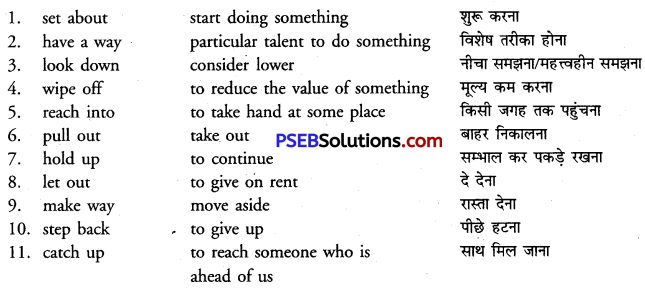
PSEB 8th Class English Solutions Chapter 6 Charge for Love

Vocabulary Expansion

Activity 2.

Write the meaning of the following phrasal verbs from their context in the given space.

PSEB 8th Class English Solutions Chapter 6 Charge for Love 1

Activity 3

Choose the correct option to answer the following questions.

Question 1.
What did the shop owner write on the sign board ?
(a) ‘Come and Buy Puppies’
(b) Free Puppies
(c) Looking For My Lost Puppy
(d) ‘Puppies for Sale’
Answer:
(d) ‘Puppies for Sale’.

Question 2.
What was the name of the mother of the puppies ?
(a) Holly
(b) Dolly
(c) Paula
(d) Peppy.
Answer:
(b) Dolly.

Question 3.
How many puppies were there to choose from?
(a) three
(b) five
(c) four
(d) one.
Answer:
(b) five.

PSEB 8th Class English Solutions Chapter 6 Charge for Love

Question 4.
Which puppy did the boy pick ?
(a) the one with black and white spots
(b) the one with a limp
(c) the one with shaky eyes
(d) the one with big ears.
Answer:
(b) the one with a limp.

Question 5.
Why did the boy pick the puppy with a limp ?
(a) He could empathize with its condition.
(b) The shop owner said he’d give it for free.
(c) He thought it was very cute.
(d) The puppy showed him more affection.
Answer:
(d) The puppy showed him more affection.

PSEB 8th Class English Solutions Chapter 6 Charge for Love

Question 6.
Why did the shop owner want the boy to take the puppy for free?
(a) He felt that he should not put a price on love.
(b) He felt that the boy was too small to pay.
(c) The puppy would be a burden on him due to its limp.
(d) He thought that he would have to spend a lot of money on its regular treatment.
Answer:
(d) He felt that he should not put a price on love.

Activity 4.

Answer the following questions.

Question 1.
Who approached the owner of the shop ?
दुकान मालिक के पास कौन गया ?
Answer:
A little boy approached the owner of the shop.

Question 2.
What was the owner charging for healthy puppies ?
दुकान मालिक स्वस्थ पिल्लों का कितना मूल्य ले रहा था ?
Answer:
For healthy puppies the owner was charging from $ 30 to $.50 dollars.

Question 3.
How much money did the boy have ?
लड़के के पास कितने पैसे थे ?
Answer:
The boy had 2.37 dollars.

Question 4.
What problem did the lame puppy have ?
लंगड़े पिल्ले को क्या समस्या थी ?
Answer:
The lame puppy could neither run nor play.

PSEB 8th Class English Solutions Chapter 6 Charge for Love

Question 5.
Which puppy was chosen by the little boy and why?
लड़के ने कौन-सा पिल्ला चुना और क्यों ?
Answer:
The boy chose crippled puppy because it showed him more affection.

Question 6.
Why did the shop owner agree to give the puppy for free?
दुकान मालिक पिल्ला मुफ्त में देने को क्यों तैयार हो गया ?
Answer:
He agreed to this because there is no charge for love.

Activity 5.

Put a tick (✓) or a cross (✗) against each sentence.

1. The shop owner wanted to sell kittens. ( )
2. The shop owner wanted to sell puppies. ( )
3. The boy was an athlete and needed a pet to exercise with. ( )
4. One of the puppies was blind. ( )
5. The boy had enough money to buy four pets. ( )
6. The shop owner insisted that the boy might take the puppy for free. ( )
7. The boy had a crippled leg. ( )
8. The boy initially came looking for a horse. ( )
Answer:
1. ✗
2. ✓
3. ✗
4.✗
5. ✗
6. ✓
7. ✓
8. ✗

Comprehension Passage

Dengue is a viral disease. It spreads through the bite of an Aedes mosquito. This mosquito breeds in stagnant water kept in buckets, coolers, pots, etc. Therefore, we must empty all the buckets, coolers, pots so that the larvae of the Aedes mosquito is not able to breed around us. Also, when the mosquito bites a person suffering from dengue, the dengue virus enters the blood of that mosquito. After about one week, when this mosquito bites a healthy person, the dengue virus enters the blood of that person and infects him. The platelet count of that person goes very low. Other symptoms of dengue usually begin to show four to six days after infection. The symptoms last for up to ten days. The symptoms are :

  • sudden high fever
  • severe headache
  • pain behind the eyes
  • severe joint and muscle pain
  • fatigue
  • nausea
  • vomiting
  • skin rash which appears two to five days after the onset of fever
  • mild bleeding (such as nose bleeding, bleeding gums or easy bruising)

You should therefore rest, drink plenty of fluids and see your doctor regularly. The doctor can diagnose dengue infection with a blood test. The best way to prevent the disease is to prevent mosquito bites by wearing long sleeves clothes so that the infected mosquito is unable to bite.

Activity 6.

Answer the following questions on the basis of the above passage.

1. How does dengue spread ?
2. How can you prevent dengue ?
3. What are the symptoms of dengue ?
4. Choose the correct option:
(a) The symptoms of dengue last upto …………… days
(i) two to five
(ii) upto ten
(iii) upto eight
(iv) four to six.

(b) The symptoms of dengue are :
(i) high fever
(ii) severe headache
(iii) fatigue
(iv) all of these.
Answer:
1. Dengue spreads through the bite of Aedes mosquito.
2. We can prevent dengue by not allowing the Aedes mosquito to breed around us. We should also save ourselves.
3. The symptoms are :

  • sudden high fever
  • severe headache
  • pain behind the eyes
  • severe joint pain and muscle pain
  • fatigue
  • nausea
  • vomitting
  • skin rash which appears two to five days after the onset of fever.
  • mild bleeding (nose bleeding or gums bleeding).

PSEB 8th Class English Solutions Chapter 6 Charge for Love

4.
(a) (i) two to five.
(b) (iv) all of these.

Learning Language

Past Tense and Future Tense

In this chapter, we will continue with tenses. In the previous chapter, we did the Present tense. Now let’s look at Past tense and Future tense.

Past Tense

The Simple Past Tense or the Past Indefinite is used :

(a) to express that something was done or took place in the past time
Usually adverbs and adverb phrases like ‘yesterday’, ‘ago’, ‘last week’, “last month’, ‘last year’, etc. are associated with Simple Past Tense. For example :

  • I saw him yesterday.
  • He passed the exam last year.
  • She was born in 1990.
  • He died in 1992.

(b) to express a habitual action in the past, for example :

  • As a child I played cricket.
  • I was the captain of my team.

(c) to express an action actually going on at the past time stated, for example :

  • While they bathed (were bathing), we fished (were fishing).

Past Continuous Tense

It is used to indicate that the action was still going on in the past time referred to. For example :

  • When we reached there, she was singing.
  • When you arrived, they were having lunch.
  • She was cooking when the telephone rang.

Past Perfect:

Tenselt is used to denote an action which had been completed at some point in the past time before another action was commenced. For example :

  • The train had left when we reached the station.
  • The patient had died before the doctor arrived.
  • The sun had set before we reached home.

Past Perfect Continuous Tense

It is used to indicate that an action had continued for a certain time previous to the point of time named

  • We had been waiting for you for two hours when you came.
  • I had been writing for an hour when you came to see me.

Activity 7.

Fill in the blanks with the Simple Past Tense forms of the words given in the brackets :

Bahadur Singh smiled. He tossed his revolver in the air and …………….. (catch) it by the handle. He …………….. (take) a careful aim at an empty sardine can and ……………… (fire) another six shots. The bullets ……………. (go) through into the earth kicking up whiffs of dust. His Alsatian dog …………….. (begin) to bark with excitement. He ……………. (leap) up with a growl and ……………… (run) down the canal embankment. He …………… (sniff) at the tin and ………………. (take) it up in his mouth and ……..10…… (run) back with it and ……………… (lay) it at his master’s feet.
Answer:
1. caught 2. took, 3. fired, 4. went, 5. began, 6. leapt, 7. ran, 8. sniffed, 9. took, 10. ran, 11. laid.

PSEB 8th Class English Solutions Chapter 6 Charge for Love

Activity 8.

Fill in the blanks with the Simple Past, Past Continuous, Past Perfect forms of the verbs given in the brackets.

1. I ………….. an elephant on the way back home. (see)
2. Did he ……………… a letter to his father ? (write)
3. He ……………… to read when he was three. (learn)
4. When I saw him, he …………. a blue shirt. (wear)
5. ……………… they ……………… out yesterday ? (go)
6. The scooter …………….. a lot of money. (cost)
7. The First World War …………….. in 1919. (end)
8. When I met Aradhya, she ……………… at the bus stop. (wait)
9. Reema . ……….. first in the last test. (not stand)
10. Children ……………. away when they ……………. the policeman. (run, see)
11. The plane ………………. when we reached the airport. (leave )
12. Ramesh …………….. home when I phoned him. (return)
13. …………….. he ……………… his old car before he bought a new one ? (sell).
14. The children ……………… before I came home. (sleep).
15. The film had already begun when we ……………… the theatre. (reach)
16. The teacher … the book before the examination began. (finish)
17. The robber had run away before the police ………………. . (come)
18. Tom ……………… sleepy after having a good lunch. (feel)
19. I …………….. the message before you came. (receive)
20. He ………………. for India last year. (play)
Answer:
1. saw
2. was, writing
3. learnt
4. was wearing
5. Did, go
6. cost
7. ended
8. was waiting
9. did not stand
10. run, saw
11. had left
12. had returned
13. Had, sold
14. had slept
15. reached
16. had finished
17. came
18. felt
19. had received
20. played.

Future Tense

Simple Future Tense:

It denotes an action that is about to take place or an action that will take place in the future. For example :

  • I shall do it now. (at once, immediately)
  • We shall go there next week.
  • Vandana will come here at 6 o’clock.

Future Continuous Tense:

It denotes an action going on at some point in the future timė.
For example :

  • She will be singing then.
  • I shall be taking my examination tomorrow at this time.

Future Perfect Tense:

It denotes that an action will be completed at some point of time in the future. For example :

  • I shall have done my work before you come.
  • The play will have begun before you get to the theatre.
  • They will have spent all their money by then.

Future Perfect Continuous Tense:

It indicates that the action, whether finished or unfinished will have been in progress for sometime.
For example :

  • We shall have been playing for three hours when you come here.
  • Ashok will have been living in Japan for 10 years.

Activity 9

Put the verbs into the correct form (Simple Future).

Use ‘will. Ashu asked a fortune teller about her future. Here is what he told her :

1. You …………… (earn) a lot of money.
2. You ………………. (travel) around the world.
3. You ……………… (meet) lots of interesting people.
4. Everybody ……………… (adore) you.
5. You ….. (not / have) any problems.
6. Many people …………….. (serve) you.
7. They …………….. (anticipate) your wishes.
8. There ……………… (not / be) anything left to wish for.
9. Everything ……………… (be) perfect.
10. But all these things …………….. (happen) only if you marry me.
Answer:
1. will earn
2. will travel
3. will meet
4. will adore
5. will not have
6. will. serve
7. will anticipate
8. will be not
9. will be
10. will happen.

PSEB 8th Class English Solutions Chapter 6 Charge for Love

Activity 10.

Fill in the blanks using the correct form of the verb given in the brackets.

1. I was not feeling well. So I ……………. much. (not eat)
2. It was so cold at Almora, even water in the taps ……………… (freeze)
3. She assures me that she ………………. me in my work. (help).
4. We ……………… to Mumbai last week. (go)
5. I …………….. Bihar before the earthquake occurred. (leave)
6. He . …… home before the sun sets. (reach)
7. Dinesh ………………. if you invite him. (come)
8. At this time next Monday we ………….. your birthday. (celebrate)
9. When she visits school next month, I ………………. there for 10 years. (teach)
10. The inter school hockey tournament ……………. next Monday. (begin)
Answer:
1. will not eat
2. freeze
3. will help
4. went
5. had left
6. will have reached
7. will come
8. will be celebrating
9. will have been teaching
10. begins/will begin.

Learning to Listen

Activity 11.

You will listen to a voicemail message on your father’s mobile phone. Your father is in Delhi and has forgotten to take his mobile phone. He has another mobile phone with him. Make notes of what you hear. Expand the notes into a proper message that you will send him on his other mobile phone.

Main points of Voicemail Message Text Message
Mohan Kumar from Bell Digital
Some of our products in the market
Demon in your office
Call when back
Phone No…………….
Send your e-mail
New brochure prices will be sent

I wanted to give you some information about our new products. We would like to give a demonstration of our new products in your office. Could you please call me when you are back in the office ? My phone number is 0-6-0-8-6-5-2-7-8-2-0.

Also, can you please send me your e-mail ? I would send you the new brochure of our company and information about our prices. My e-mail address is Mohan, that’s M-O-H-AN dot K-U-M-A-R at B-E-L-L hyphen D-I-G-I-T-A-L- dot com.

Learning to Speak

Activity 12.

Look at the pictures of food given below. These foods are from different countries. Identify the food and the country it comes from and speak 5 sentences on any one of the foods.
PSEB 8th Class English Solutions Chapter 6 Charge for Love 2

(Teachers must help students to identify the country, if required.)

Learning to Write

Activity 13.

Write a paragraph about the little boy of the story ‘Charge for Love’ to describe his character. You may write about.
1. his love for animals
2. his confidence
3. physical description
4. sympathetic nature
5. his understanding of self-worth.

PSEB 8th Class English Solutions Chapter 6 Charge for Love

The little boy is a kind hearted child. He has sympathetic nature. He is affectionate and loves animals. He himself is crippled. So he is very sympathetic toward the crippled puppy. He knows that there are no charges for love. Still he promises to pay the full price of the little dog. He is not ready to take it free of cost. Learning to Use the Language

Activity 14:

Rewrite a part of the story you have read in the form of a short dialogue between the shop owner and the little boy.

Little boy Shop owner Little boy Shop owner Little boy Shop owner Little boy Shop owner Little boy Shop owner Little boy Shop owner Little boy Shop owner Little boy Shop owner Little boy

Little boy: Are you selling your puppies ?
Shop owner: Yes son, do you want to buy a puppy?
Little boy: Yes, very much ! How much are you selling them for ?
Shop onwer: From 30 to 50 dollars each.
Little boy: But I have only 2.37 dollars and have a look on them with that.
Shop owner: With pleasure.
Little boy: Please call them out.
Shop owner: Here is Dolly with her four puppies.
Little boy: What is that stressing in the dog house?
Shop owner: It is a little puppy.
Little boy: Why is it hobbling and limpinge
Shop owner: It has no hip socket. It will only limp. It would always be loved.
Little boy: I want that one.
Shop owner: Why child. It will never play with you…
Little boy: Then look here. I am too lame and crippled. I see affection in its eyes.
Shop owner: You can take it free of cost.
Little boy: I will not. I will pay the full amount what it is worth. I can’t lower it price.

Comprehension Of Passages

Read the following passage and answer the questions given below each :

(1) A shop onwer had some puppies he wanted to sell. He painted a sign board to advertise his intention of selling the pups that said : ‘Puppies For Sale’. He set about nailing in on the wall. Boards like this always haye a way to attracting young children. As he was driving the last nail into the post. A boy saw the board and started walking towards the shop. He approached the owner and asked. “How much are you going to sell the puppies for ?”

The shop owner looked down into the eyes of the little boy “Well !” said the shop owner, as he wiped the sweat off the back of his neck. “These puppies come from fine parents and cost a good deal of money. So I will charge anywhere from $30 to $50 for each puppy.”

1. What did the shop owner want to sell ?
दुकान का मालिक क्या बेचना चाहता था ?

2. Why were the puppies costly, according to the shop owner ?
दुकानदार के अनुसार पिल्ले महंगे क्यों थे ?

3. Choose true and false statements and write them in your answer-book :
(a) The shop owner did not attend the boy.
(b) The boy wanted to buy a pup.

4. Complete the following sentences according to the meaning of the passage :
(a) A boy saw the board and started walking …………..
(b) He set about nailing it ………………
Or
Match the words with their meaning :

(i) A good deal purpose
(ii) Intention clear
large

Answer.
1. The shop owner wanted to sell some puppies.
2. According to the shop owner, the puppies were costly because they were go the fine breed (नस्ल).
3.
(a) False
(b) True.
4.
(a) A boy saw the board and started walking towards the shop.
(b) He set about nailing it on the wall.
Or
(i) A good deal
(ii) Intention purpose

PSEB 8th Class English Solutions Chapter 6 Charge for Love

(2) The little boy pressed his face against the chain link fence. His eyes danced with delight. As the dogs made their way to the fence, the little boy noticed something else stirring inside the doghouse. Slowly, another little ball appeared; this one noticeably smaller.

Down the ramp it slid. Then in an awkward manner, the little pup began hobbling towards others, doing its best to catch up. Immediately the little boy singled out the hobbling and limping puppy and said, “What’s wrong with that little dog ?”

The shop owner explained that a veterinarian had examined the little puppy and discovered that it didn’t have a hip socket. It would always limp. It would always be lame.
“I want the one,” the little boy said, pointing the lame puppy.

The shop owner knelt down at the boy’s side and said, “Son, you want that puppy. It will never be able to run and play with you like these other dogs would. So if you really want him, I’ll just give it to you.”

1. What did the little boy notice inside the dog house?
लड़के ने कुत्ता-घर के अन्दर क्या बात नोटिस की ?

2. What was wrong with the little pup ?
छोटे पिल्ले को क्या समस्या थी ?

3. Choose true and false statements and write them in your answer book :
(a) The little pup slid down the ramp.
(b) The little boy wanted a healthy pup.

4. Complete the following sentences according to the meaning of the passage :
(a) Slowly and little ball ……
(b) The little boy’s eyes danced with.
Or
Match the words with their meaning :

(i) appeared found
(ii) discovered tested
emerged.

Answer:
1. The little boy noticed something stirring inside the dog-house.
2. The pup had to hip-socked. So it was lame and could not walk properly.
3.
(a) True
(b) False
4.
(a) Slowly another little ball appeared.
(b) The little boy’s eyes danced with delight.
Or
(i) appeared — emerged
(ii) discovered — found.

PSEB 8th Class English Solutions Chapter 6 Charge for Love

(3) With tears in his eyes, the shop owner reached down and picked up the little pup. Holding it carefully he handed it on the little boy.
“How much ?” said the little boy.
“No charge, as I said earlier,” answered the shop owner. “These can be no charge for love.”
The little boy got quite upset. He looked straight into the store owner’s eyes, and pointing his finger at him and said, “You are right. There is no charge for love but I cannot lower its wroth by taking it without charge as if it was less than other puppies because it may not run as fast as them. This little dog is worth every bit as much as all the other dogs. I don’t want you to give him to me free of cost. I’ll pay the full price. I’ll give you $2.37 now and 50 cents a month until I have paid in full.”

1. Why did the shop owner want to charge nothing for the little pup ?
दुकानदार छोटे पिल्ले का कुछ भी मूल्य क्यों नहीं लेना चाहता था ?

2. Did the boy buy the pup free of cost ?
क्या लड़के ने पिल्ला मुफ्त में खरीदा ?

3. Choose true and false statements and write them in your answer-book :
(a) They did not want to lower the worth of the pup.
(b) The boy paid $ 50 for the little pup.

4. Complete the following sentences according to the meaning of the passage :
(a) The shop owner reached down and ….
(b) The little boy got ………..
Or
Write the meanings of the following words in English : (Any two)
Revealed, Twisted, Straight.
Answer:
1. He said that there is no charge for love.
The boys wanted to buy that pup out of love.
2. No, he promised to pay its full price.
3.
(a) True
(b) False.
4.
(a) The shop owner reached down and picked up the little pup.
(b) The little boy got quite upset.
Or
revealed – showed, twisted – bent, straight – directly.

Use of words and phrases in sentences

1. Set about – (started) – He set about his work carefully.
2. Revealed – (came to light) – At last the truth was revealed.
3. Upset – (rejected) – He was upset when he lost his job.
4. Understand – (to know) – I don’t understand what you want.
5. Handful – (in a less quantity) – Please give me a handful of sugar.
6. Crippled – (disabled) – Many people became crippled in the war.
7. Wiped – (cleared) – He wiped dirt off his body.
8. Worth – (value) – What is this beautiful picture worth.
9. Stirring – (movement – I can see some stirring in the tree.
10. Delight – (joy) – Helping the needy gives me delight.

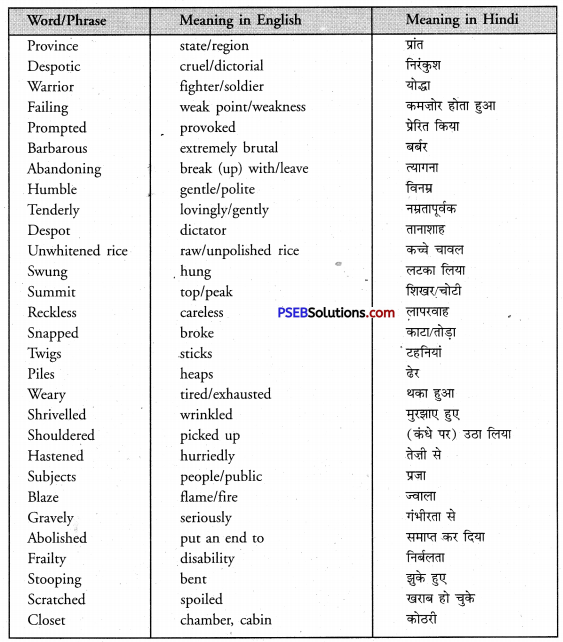
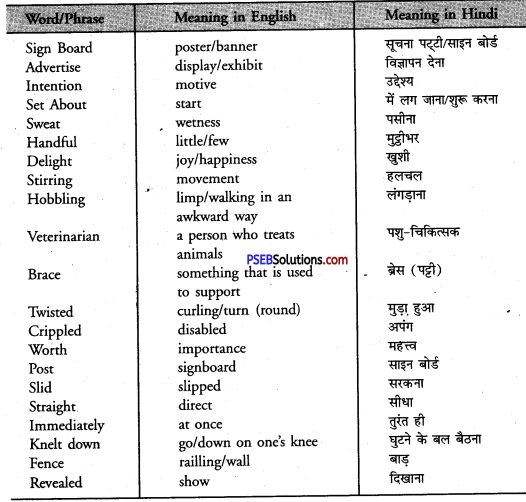
Word Meanings

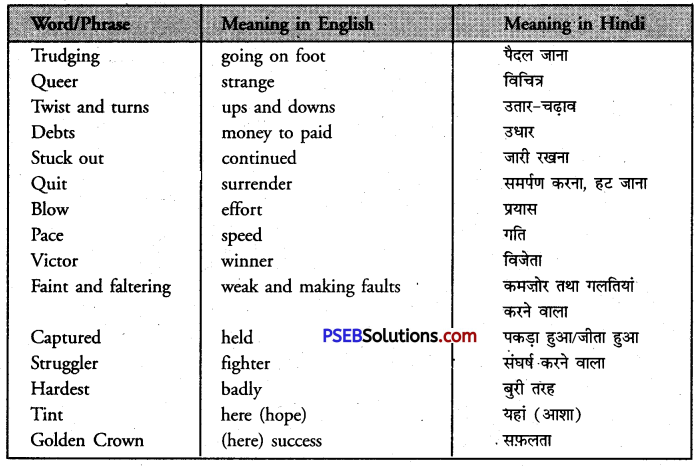
PSEB 8th Class English Solutions Chapter 6 Charge for Love 3

Charge for Love Summary in Hindi

A shop owner……….. looked.” he said.
एक दुकानदार के पास कुछ पिल्ले (कुत्ते के बच्चे) थे। वह उन्हें बेचना चाहता था। उसने पिल्लों को बेचने की अपनी इच्छा जाहिर करने के लिए एक साइन बोर्ड बनाया। इसमें लिखा था ‘बिक्री के लिए पिल्ले’। वह इसे दीवार पर कीलों द्वारा लगाने के लिए चल पड़ा। इस प्रकार के बोर्ड सदा छोटे बच्चों को आकर्षित करते हैं। जैसे ही वह

विज्ञापन पर आखिरी कील गाढ़ रहा था, एक बच्चे ने बोर्ड को देखा और दुकान की ओर चल पड़ा। वह मालिक के पास पहुंचा और पूछा, “आप पिल्लों को कितने में बेचना चाहते हैं।” . दुकान के मालिक ने नीचे झुक कर छोटे बच्चे की आंखों में देखा। उसने अपनी गर्दन के पीछे से पसीना पोंछते हुए कहा, “तो सुनो! ये पिल्ले अच्छी नस्ल के हैं और ये काफी कीमती हैं।

इसलिए मैं प्रत्येक का लगभग 30 से 50 डालर के बीच मूल्य लूंगा। बच्चे ने एक क्षण के लिए अपना सिर नीचे कर लिया। तब उसने अपने जेब में नीचे तक हाथ डाला और मुट्ठी भर खुले पैसे निकाल कर दुकान मालिक को आगे बढ़ा दिए। वह बोला, “मेरे पास 2.37 डालर हैं। क्या ये उन्हें देखने भर के लिए काफी हैं ?”

“Sure, said the shop owner …………. that little dog” ?

दुकान मालिक ने कहा, “निस्संदेह ! उसने एक सीटी बजाई। उसने आवाज़ लगाई डॉली यहां आओ।” डॉली कुत्ता-घर से निकली और ढलान पर दौड़ते हुए आगे आई। उसके पीछे-पीछे चार छोटे-छोटे फर वाले गोले आए। – छोटे बच्चे ने अपना चेहरा चेन वाली बाड़ से दबा लिया। उसकी आंखों में खुशी छा गई। जैसे ही कुत्ते बाड़ की ओर चले, छोटे बच्चे का ध्यान-कुत्ता घर में होने वाली कुछ और हलचल पर गया।

धीरे-धीरे एक और छोटा गोला दिखाई दिया, यह काफ़ी छोटा था।वह ढलान पर सरकने लगा। फिर एक अजीब तरीके से वह छोटा पिल्ला लंगड़ाकर अपनी पूरी कोशिश के साथ दूसरों के साथ मिल जाने के लिए चल पड़ा।तुरंत ही छोटे बच्चे ने लंगड़ाते हुए और लड़खड़ाते पिल्ले को चुन लिया और कहा, “उस छोटे कुत्ते को क्या हुआ है ?”

The shop owner ………… a big metal brace.

दुकान मालिक ने विस्तार से बताया कि एक पशु-चिकित्सक ने छोटे पिल्ले की जांच की थी। उसे पता चला कि उसकी हिप सॉकेट नहीं है। यह सदा लंगड़ा कर चलेगा। यह सदा लंगड़ा रहेगा। छोटे बच्चे ने लंगड़े पिल्ले की ओर इशारा करते हुए कहा, “मुझे वही-चाहिए।” दुकान मालिक बच्चे की ओर झुका और बोला, “बेटे, तुम्हें वह पिल्ला चाहिए। यह कभी भी तुम्हारे साथ भाग और खेल नहीं सकेगा जैसा कि ये दूसरे कुत्ते कर सकेंगे। इसलिए यदि तुम्हें सच में यही चाहिए तो मैं तुम्हें ऐसे ही दे दूंगा।”

इसके साथ ही वह छोटा बच्चा बाड़ से पीछे हटा, नीचे आया और अपनी एक टांग की पतलून को ऊपर की ओर मोड़ने लगा। यह करते हुए उसने दिखाया कि उसकी टांग के दोनों ओर स्टील-ब्रेसं (पट्टी) को विशेष रूप से बनाए गए जूते से जोड़ा गया था। उस समय उसकी हैरानी और भी बढ़ गई जब छोटा बच्चा अपनी दूसरी टांग की पतलून को ऊपर मोड़ने लगा। वह अपनी बुरी तरह से मुड़ चुकी अपंग बाईं टांग जो कि एक बड़ी मेटल ब्रेस की मदद से जुड़ी हुई थी, दिखाना चाहता था।

Looking up at ……………… paid in full.”

दुकान मालिक को देखते हुए उसने कहा, “आपने देखा श्रीमान, मैं स्वयं ठीक ढंग से भाग नहीं सकता और इस असहाय छोटे पिल्ले को भी कोई चाहिए होगा जो उसे समझ सके।” दुकान मालिक की आंखों में आंसू आ गए, वह नीचे आया और उसने छोटे पिल्ले को उठाया। उसने उसे छोटे बच्चे को पकड़ाते हुए कहा, ध्यानपूर्वक पकड़ना। छोटे बच्चे ने कहा, “कितने?” दुकान मालिक ने उत्तर दिया, “जैसा कि मैंने पहले कहा था कोई मोल नहीं। प्यार का कोई मोल नहीं।”

PSEB 8th Class English Solutions Chapter 6 Charge for Love

छोटा बच्चा परेशान हो उठा। उसने सीधा स्टोर मालिक की आंखों में देखा और उसकी ओर अंगुली करके कहा, “आप ठीक कह रहे हैं। प्यार का कोई मोल नहीं होता। परन्तु मैं इसको बिना मोल के लेकर इसका महत्त्व कम नहीं करना चाहता क्योंकि यह दूसरे पिल्लों के जैसे तेज़ नहीं भाग सकता। इस छोटे कुत्ते का उतना ही महत्त्व है जितना अन्य सभी कुत्तों का है। मैं नहीं चाहता कि आप इसे मुझे बिना मूल्य के दे दो। मैं इसका पूरा मूल्य दूंगा। मैं 2.37 डालर आपको अभी दूंगा और 50 सेंट हर महीने दूंगा जब तक कि मैं इसका पूरा मूल्य न दे दूं।”

Retranslation from english to hindi

1. A shop owner wanted to sell some puppies. — दुकानदार कुछ पिल्ले बेचना चाहता था।
2. He set about nailing it on the wall. — वह इसे दीवार पर कीलों द्वारा लगाने के लिए चल पड़ा।
3. These puppies come from fine parents. — ये पिल्ले अच्छी नस्ल के हैं।
4. The boy dropped his head for a moment. — बच्चे ने एक क्षण भर के लिए अपना सिर नीचे कर लिया।
5. He pulled out a handful of change. — उसने मुट्ठी भर खुले पैसे निकाले।
6. Is that enough to take a look ? — क्या ये उन्हें देखने भर के लिए काफी हैं ?
7. He let out a whistle. — उसने सीटी बजाई।
8. His eyes danced with delight. — उसकी आंखों में खुशी छा गई।
9. The little boy noticed something else stirring inside the doghouse. — छोटे बच्चे का ध्यान कुत्ता-घर में होने वाली किसी अन्य हलचल पर गया।
10. Down the ramp it slid. — वह ढलान पर सरकने लगा।
11. It didn’t have a hip socket. — उसकी हिप सॉकेट नहीं है।
12. It would always be lame. — यह सदा लंगड़ा कर चलेगा।
13. It will never be able to run and play with you — यह कभी भी तुम्हारे साथ भाग और खेल नहीं सकेगा।
14. The little boy got quite upset. — छोटा बच्चा परेशान हो उठा।
15. I don’t want you to give him to me free of cost.– मैं नहीं चाहता कि आप इसे मुझे बिना मूल्य के दे दो।

English Guide for Class 8 PSEB Prose
Value of Money Question Answer Class 8 English Solutions Chapter 1 PSEB Solutions

Punjab State Board PSEB 8th Class English Book Solutions Chapter 1 Value of Money Textbook Exercise Questions and Answers.

Class 8th English Solutions Chapter 1 Value of Money Question Answers

Value of Money Class 8 Questions and Answers

Activity 1.

Look up the following words in a dictionary. You should seek the following information about the words and put them in your WORDS notebook.

1. Meaning of the word as used in the lesson (adjective/noun/verb. etc.)
2. Pronunciation (The teacher may refer to the dictionary or a mobile phone for correct pronunciation.)
3. Spellings.

PSEB 8th Class English Solutions Chapter 1 Value of Money

नोटः

1. विद्यार्थी Lesson के आरंभ मे दिए गएा Word – Meaning पढे
2. Pronunciation के लिए अपने अध्यापक से निर्देश लें।
3. दिए गए शब्दों की Spellings याद करें और इन्हें बार-बार सीखने का अभ्यास करें।

processor intrigue review feature ultimate
limitations consumerist obsessed storage investing

Activity 2.

Given below are a few words. Write them in the order as they appear in a dictionary.

1. Market
2. realized
3. decided
4. value
5. money
6. ultimate
7. moment
8. storage
9. arrange
10. machine
11. technology
12. consumerist
13. excited
14. faster
15. account
16. investing
17. pollution
18. disaster
19. persuade
20. prepare
Answer:
1. account
2. arrange
3. consumerist
4. decided
5. disaster
6. excited
7. faster
8. investing
9. machine
10. market
11. moment
12. money
13. persuade
14. pollution
15. prepare
16. realized
17. storage
18. technology
19. ultimate
20. value.

PSEB 8th Class English Solutions Chapter 1 Value of Money

Activity 3.

Learning to Read and Comprehend

Answer the following questions.
a. What made the narrator unhappy ?
वक्ता किस बात से नाखुश थी ?
Answer:
The limitations of her computer against Bell computer made the narrator unhappy.

b. What was the narrator obessed with ?
वक्ता पर किस बात की सनक सवार थी ?
Answer:
The narrator was obessed with doing more work and earning more money.

c. What were the two features of Bell Computer that were being advertised on TV?
टी.वी. पर बेल कम्प्यूटर की किन विशेषताओं का विज्ञापन आ रहा था ?
Answer:
(i) It has the fastest processor.
(ii) It has very high storage.

d. What offer did the parents give to the narrator ?
वक्ता को माता-पिता ने क्या पेशकश दी ?
Answer:
The parents offered her to earn money by doing house jobs.

e. Which two things did the narrator do to complete the chores ?.
काम पूरे करने के लिए वक्ता ने क्या दो काम किए ?
Answer:
(i) She started getting up early. :
(ii) She started doing her work quickly.

f. What happened when the narrator went to the store to order the computer she wanted ?
जब अपनी पसंद के कम्प्यूटर का ऑर्डर देने के लिए वक्ता स्टोर पर गई तो क्या हुआ ?
Answer:
She found that a new model was coming out soon. It was even faster and had double the storage.

g. Why did she decide against buying the computer she was obessed with ?
वक्ता ने अपनी सनक का कम्प्यूटर न खरीदने का फ़ैसला क्यों किया ?
Answer:
She decided not to buy that computer because she had learned the value of money. Buying the computer she wanted meant the waste of money because of the fast changing technology.

PSEB 8th Class English Solutions Chapter 1 Value of Money

h. Why did the Bell employee advise the narrator to wait for a few more days ?
बेल कम्पनी के कर्मचारियों ने वक्ता को कुछ और दिन इन्तज़ार करने की सलाह क्यों दी ?
Answer:
They advised the narrator to wait for a few days because a new model of the computer was coming out soon.

Activity 4.

Identify the speaker and the listener.

(a) “Oh, you don’t need to buy that one. We have another one coming out soon. It is even faster and has double the storage.”
Answer:
Speaker : employee at the Bell center.
Listener : the narrator.

(b) “Please dad ! Is there anything else you need help with ?”
Answer:
Speaker : the narrator
Listener : narrator’s father.

(c) “Give me more chores !”
Answer:
Speaker : the narrator
Listener : the narrator’s father.

Activity 5.

Think and discuss with your partner the given scenario.
“Oh you don’t need to buy that one. We have another one coming out soon. It is even faster and has double the storage.”

Do you think

(a) It was wise of the narrator to put her money in a savings account ? Why/why not?
Answer:
Yes, it was really wise of her because it enabled her to save her hard earned money.

(b) It would have been wiser of the narrator to work for two more months and buy the newer model of the computer ? Why/Why not?
Answer:
No, it was not wise. The models of machine go on changing with fast changing technology

PSEB 8th Class English Solutions Chapter 1 Value of Money

(c) It is advisable for fourteen year old to overwork herself/himself as the narrator did ? Why/Why not?
Answer:
Doing overwork is bad as it tells upon ( बुरा प्रभाव डालता है) one’s health.

Learning Language

The Sentence

A sentence to a group of words which makes complete sense. Here are some examples :
पूरा अर्थ देने वाला शब्द-समूह वाक्य कहलाता है। यहां कुछ उदाहरण दिए हैं :
(a) Ram is going to school.
(b) Do not spit on the floor.
(c) What is your name?
(d) May God bless you !
(e) What a fine morning!
The examples above are complete sentences because each of these makes complete sense.

Forms of Sentences.
Sentences can be classified (वर्गीकरण) into five important types according to the functions they perform.
They are :

  • Assertive Sentence
  • Interrogative Sentence
  • Imperative Sentence
  • Exclamatory Sentence
  • Optative Sentence

Assertive Sentence : An Assertive sentence is the one that makes a statement or assertion. It may be affirmative (positive) or negative. An Assertive sentence ends with a period (full stop).
कथन वाला वाक्य Assertive Sentence कहलाता है| यह Positive या Negative कोई भी हो सकता है।
Examples :

  • We love our country. (Affirmative)
  • She speaks the truth. (Affirmative)
  • I do not like this picture. (Negative)
  • Rakesh does not smoke. (Negative)

An Assertive sentence is sometimes also called a Declarative sentence or a statement.

Interrogative Sentence : An Interrogative sentence is the one which asks a question.
(प्नरन पूछने वाला वाक्य)
Examples :

  • Where is my book ?
  • Why do you scold the child ?
  • Did he learn his lesson ?

Imperative Sentence : An Imperative sentence is the one which expresses a command, a request, an advice or an entreaty.
Examples :
(a) Shut the front door. — (command)
(b) Find my leather jacket. — (command)
(c) Clean your room. — (command)
(d) Wait for me. — (entreaty)
(e) Get out! — (command)
(f) Make sure you pack warm clothes. — (advice)
(g) Please be quiet. — (request/entreaty)
(h) Be nice to your friends. — (advice)
(i) Sit down. — (command)
(j) Please help. — (request)
(k) Help the poor. — (advice)
(l) Do pay us a visit some time. — (entreaty)

PSEB 8th Class English Solutions Chapter 1 Value of Money

Exclamatory Sentence: An Exclamatory sentence makes a statement that conveys some sudden strong emotion or excitement. मन के अकस्मात् भाव व्यक्त करने वाला वाक्य
Examples :
(a) Hey! I have got the film tickets.
(b) What a fine hit!
(c) How beautiful the flower is !
(d) Happy birthday, Amit !
(e) Thank you, Shashi !
(f) I hate you !
(g) Ice cream and sundaes are my favourite !

Optative Sentence : An Optative sentence expresses a prayer, keen wish, curse etc. This kind of sentence generally starts with ‘may’ or ‘wish’. Sometimes, ‘may remains hidden. (प्रार्थना, मनोकामना, श्राप, आदि भाव व्यक्त करने वाला वाक्य)
Examples :
(a) May you live long !
(b) Long live the king !
(c) May you live long enough to see your grandchildren prosper!
(d) May God bless us all!
(e) May you all succeed !
(f) May God give you good health !
(g) Wish you a very successful married life !
(h) Wish you a happy journey together!
(i) May you win the race !

Activity 6.

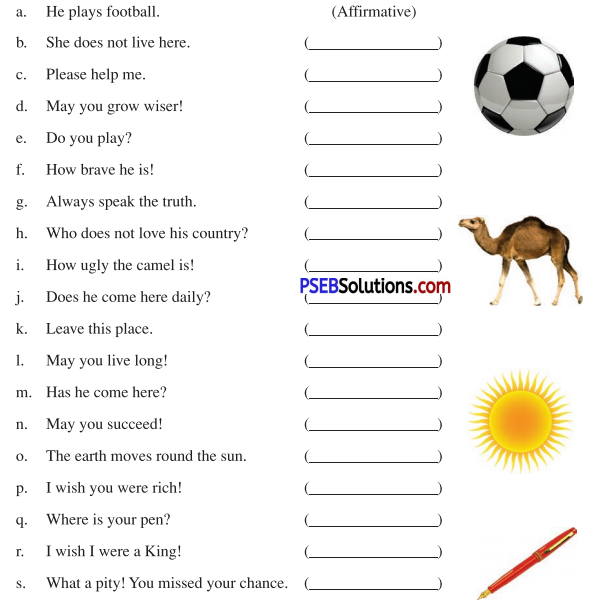
Read the sentences given below and state which type of sentences they are in the given space.

PSEB 8th Class English Solutions Chapter 1 Value of Money 5
Answer:
(a) He plays fooball —- (Affirmative)
(b) She does not live here. —- (Assertive)
(e) Please help me. —- (Imperative)
(ci) May you grow wiser! —- (Optative)
(e) Do you play? —- (Interrogative)
(J) How brave he is! —- (Exclamatory)
(ç) Always speak the truth. —- (Imperative)
(h) Who does not love his country? —- (Interrogative)
(1) How ugly the camel is! —- (Exclamatory)
(i) Does he come here daily? —- (Interrogative)
(k) Leave his place. —- (Imperative)
(1) May you live long! —- (Optative)
(m) Has he come here ? —- (Interrogative)
(n) May you succeed! —- (Optative)
(o) The earth moves round the sun. —- (Assertive)
(p) I wish you were rich! —- (Optative)
(q) Where is your pen ? —- (Interrogative)
(r) I wish I were a King! —- (Optative)
(s) What a pity ! You missed your chance. —- (Exclamatory)

PSEB 8th Class English Solutions Chapter 1 Value of Money

Assertive and Interrogative Sentences

Study the give ahead sentences carefully and note how Declarative sentences have been changed into Interrogative sentences.

Assertive (Declarative) Interrogative (Question)
1. The cow is eating grass. Is the cow eating grass ?
2. I am writing a book. Am I writing a book ?
3. The Germans were merching into Belgium. Were the Germans marching into Belgium ?
4. Meena was writing a letter. Was Meena writing a letter ?
5. They were being questioned. Were they being questioned ?
6. The train started at ten. Did the train start at ten ?
7. I got an e-mail from my son in New York. Did I get an e-mail from my son in New  York ?
8. She sings well. Does she sing well ?
9. They have studied very hard. Have they studied very hard ?
10. They play a match. Do they play a match ?
11. I shall leave for Mumbai tomorrow. Shall I leave for Mumbai tomorrow ?
12. You should speak the truth. Should you speak the truth ?
13. He can run a mile in four minutes. Can he run a mile in four minutes ?
14. We shall discuss the matter with the Principal. Shall we discuss the matter with the Principal ?
15. He should pay the fee in time. Should he pay the fee in time ?
16. The mother looks after her child. Does the mother look after her child ?
17. Idle boys shirk work. Do idle boys shirk work ?
18. We go to the fair with our friends. Do we go to the fair with our friends ?
19. A goat grazes in the field. Does a goat graze in field ?
20. We do not quarrel with our class fellows. Do we not quarrel with our class fellows ?

Activity 7.

Change the following Affirmative (Declarative) sentences into Interrogative sentences.

1. He is clever. — Is he clever ?
2. He was simple. — Was he simple ?
3. Ram was feeling tired. — Was Ram feeling tired ?
4. Sita was angry. — Was Sita angry?
5. They were good friends. — Were they good friends?
6. He painted the door blue. — Did he paint the door blue ?
7. He has three pencils. — Has he three pencils ?
8. We had a good time there. — Had we a good time there?
9. I have to do it. — Have I to do it?
10. Sohan had finished his work. — Had Sohan finished his work ?
11. I shall go there tomorrow — Shall I go there tomorrow ?
12. He will play a match. — Will he play a match ?
13. I can do it. — A Can I do it?
14. He may help you. — May he help you ?
15. The sun does not shine at night. — Does the sun not shine at night?

PSEB 8th Class English Solutions Chapter 1 Value of Money

Activity 8.

Convert the following Interrogative sentences into Assertive (Declarative) sentences.

1. Are you on leave today? — You are on leave today.
2. Was the train late ? — The train was late.
3. Were the boys not lazy? — The boys were not lazy.
4. Am I strong? — I am strong
5. Is your sister ill ? — You sister is ill.
6. Has it been raining since morning ? — It has been raining since morning.
7. Have you fulfilled your promise ? — You have fulfilled your promise.
8. Has he taken the test ? — She has taken the test.
9. Had you seen this picture ? — You had seen the picture.
10. Did he come by train yesterday? — He came by train yesterday.
11. Can you travel fifty miles a day? — You can travel fifty miles a day.
12. Should I stick to my promise ? — I should stick to my promise.
13. Does the watchman keep watch over — The watchman keeps watch over the house? the house.
14. Do you pray to God everyday? — You pray to God everyday.

Positive and Negative Sentences

Study the following sentences and note how Positive sentences have been changed into Negative sentences :

Positive Negative     
1. I am a student. I am not a student.
2. It is a garland. It is not a garland.
3. We are tourists. We are not tourists.
4. The mango was sweet. The mango was not sweet.
5. The knives were sharp. The knives were not sharp.
6. You can win the game. You cannot (can’t) win the game.
7. We must help him. We must not help him.
8. She may resign from her post. She may not resign from her post.
9. You should follow this path. You should not follow this path.
10. I may be dropped out of the team. I may not be dropped out of the team.
11. I have learnt my lesson. I have not learnt my lesson.
12. They had reached there. They had not reached there.
13. He has written a book. He has not written a book.
14. We had a dog. We did not (didn’t) have a dog.
15. I have a book. I do not (don’t) have a book.

Activity 9.

Change the following Positive sentences into their Negative form.

1. This dress is very costly. — This dress is not very costly.
2. His neighbour was quite well yesterday. — His neighbour was not quite well yesterday.
3. Your friends were good to me. — Your friends were not good to me.
4. Shyam has a lotus in his hand. — Shyam does not have lotus in his hand.
5. I have a horse. — I have no horse.
6. I have seen this picture. — I have not seen this picture.
7. You have corrected me. — You have not corrected me.
8. The cattle graze in the pasture. — The cattle don’t graze in the pasture.
9. I get up early in the morning. — I don’t get up early in the morning.
10. We saw a snake in the grass.— We saw no snake in the grass.

PSEB 8th Class English Solutions Chapter 1 Value of Money

Note : You can also use the shortened forms as ‘weren’t’ in place of ‘were not’, ‘isn’t’ in place of‘is not’, ‘wasn’t’ in place of‘was not’, ‘don’t’ in place of‘do not’, ‘didn’t’ in place of‘did not’, ‘doesn’t’ in place of‘does not’, ‘can’t’ in place of‘cannot’, etc. These shortened forms are generally used in conversation i.e. Spoken English.

Activity 10.

Convert the following Negative sentences into their Positive form.

1. Sohan is not an idle boy. — Sohan is an idle boy
2. I do not have an umbrella with me. — I have an umbrella with me.
3. He may not play well today. — He may play well today.
4. She cannot tell a lie. — She can tell a lie.
5. I must not take this medicine. — I must take this medicine
6. He does not take this risk. — He takes this risk.
7. Do not strike the match. — Strike the match.
8. Do not let him go. — Let him go.
9. Do not keep my book. — Keep my book
10. They did not catch the evening train. — They caught the evening train.

Exclamatory and Assertive Sentences

Study the following sentences carefully and note how Exclamatory sentences have been changed into Assertive sentences :

Exclamatory Assertive
1. What a lovely scene ! It is a very lovely scene.
2. Long live our leader ! We wish that our leader may live long.
3. Alas ! I shall never be able to see him again. It is very sad that I shall never be able to see him again.
4. Hurrah ! We have won the match. We are very happy that we have won the match.
5. What a pity ! You have been wasting opportunities. It is very sad that you have been wasting opportunities.
6. Alas ! The soldier died fighting. It is sad that the soldier died fighting.
7. How hot it is today ! It is very hot today.
8. Death to the traitors ! The traitors must be punished with death.
9. How glad I am that you have come ! I am very glad that you have come.
10. What a disgrace for the family ! It is a big disgrace for the family.

Activity 11:

Change the following Exclamatory sentences into Assertive sentences

1. Bravo! You have done well. — It is brave of you to do the well.
2. Alas! The soldiers died at Galwan — It is sad that the soldiers died at Galwan Valley.
3. How beautiful the scenery is ! — The scenery is very beautiful.
4. How foolish I had been ! — I have been very foolish.
5. What a disaster the earthquake is ! — The earthquake is a big disaster.
6. How stiff the paper is ! — The paper is very stiff.
7. May God reward this act of yours ! — We wish that God may reward this act of yours.
8. What a terrible storm it is! — It is a very terrible storm.
9. Wonderful! I have never seen anything like this earlier — It is really wonderful to see such a thing.
10. May God pardon this sinner — We very much wish that God may pardon this sinner.

PSEB 8th Class English Solutions Chapter 1 Value of Money

Activity 12:

Change the following Assertive sentences into Exclamatory sentences.
Answer:
1. He is truly noble. — 1. How noble he is !
2. This is indeed a great pleasure. — 2. What a pleasure !
3. It is very kind of you to help him — 3. What a kindness to help him like that. like it!
4. I wish I were young again. — 4. Oh! I were young again.
5. It is a very wonderful opportunity. — 5. What a wonderful opportunity!
6. It is a bitterly cold morning. — 6. What a cold morning!
7. It was an extremely delightful — 7. How delightful the party was ! party.
8. She danced very beautifully. — 8. How beautifully she danced !
9. I wish I had never met you. — 9. Would that I had never met you.
10. It is stupid of me to forget your name. — 10. How stupid ! I have forgotten your name.

Activity 13:

Listen to your teacher-talking about birds. Your teacher will read the text twice. Complete the following table and answer the question that follows while listening to the passage the second time.

First Listening
PSEB 8th Class English Solutions Chapter 1 Value of Money 6
Answer:
PSEB 8th Class English Solutions Chapter 1 Value of Money 7

Second Listening Question :
Why are birds referred to as the friends of farmers’?
Answer:
They are friends of farmers because they eat the unuseful insects from the fields. If they don’t eat them they will spoil their crops.

PSEB 8th Class English Solutions Chapter 1 Value of Money

Learning to Speak (Pairwork)

Activity 14.

Work with your partner. You will play the roles of a shop owner and a customer. Both of you will ask and answer the questions asked during the conversation. The beginning of the conversation is given. You will start with the given conversation and then continue.

Shop owner : How may I help you ?
Customer : I need to buy some biscuits and ice cream.
Shop owner : Which biscuits do you want ?
Customer : I want good cream biscuits. Which ones do you have ?
Shop owner : I have Little Magic biscuits.
Customer : Little Magic ? Never heard of them!
Shop owner : Oh, they are chocolate biscuits with vanilla and strawberry cream.
Customer : That sounds interesting! I think I will buy some.
Shop owner : …………………………..
Customer : …………………………..
Shop owner : …………………………..
Customer : …………………………..
Shop owner : …………………………..
Customer : …………………………..
Shop owner : …………………………..
Customer : …………………………..
Shop owner : …………………………..
Customer : …………………………..
Shop owner : …………………………..
Answer:
Shop owner : How may I help you ?
Customer : I need to buy some biscuits and ice cream.
Shop owner : Which biscuits do you want ?
Customer : I want good cream biscuits. Which ones do you have ?
Shop owner : I have Little Magic biscuits.
Customer : Little Magic ? Never heard of them!
Shop owner : Oh, they are chocolate biscuits with vanilla and strawberry cream.
Customer : That sounds interesting! I think I will buy some.
Shop owner : How much do you want to buy?
Customer : Two or three packets.
Shop owner : Don’t worry. They are not very costly.
Customer : What is the price of one packet after all ?
Shop owner : We sell it ten rupees per packet !
Customer : Is there any scheme?
Shop owner : Why not, if you buy five packets, one is free.
Customer : Then pack me the five packets.
Shop owner : Buy more. The rates are going up next week.
Customer : What about the free scheme?
Shop owner : It will continue for about two months.
Customer : Please pack me ten packets soon. The weather is going bad.
Shop owner : Hurry up, boys ! The customer must not get wet.

Learning to Write

Learning to write is an art. Whenever we plan to write, we find it difficult to start. Let us try and make it a little less difficult. Think of a story or an advertisement or any other form of writing. You will need to understand four things about it. They are :

  • Setting — It answers the questions ‘where’ and ‘when’ (the place and time) the C story or the action taken place.
  • Characters — It answers the question ‘who’ (the people) is involved in the action.
  • Problem — It answers the question ‘what the issue is or the problem that needs to be solved.
  • Solution — It answers the question ‘how the problem is solved.

Activity 15:

Think of a story that you have read in this book. Identify the setting, characters, problem and the solution.

Name of the Story The Value of Money
Setting An Urban Area
Characters Narrator, Bell center employees
Problem Buying the Latest Computer, Changing Models with the fast changing technology.
Solution Go on with your current computer. Save Money. Honour its value.

Activity 16

Write about a real incident that happened with you in the form of a story keeping the components of the story in your mind. First make your notes and then write the incident in the space given.

Setting City Market, A Book Shop
Characters I, my friend, my uncle.
Problem Buying new school books. Pocket picked.
Solution Got money from my uncle and bought books.
Incident/story Yesterday I went to the city market to buy new school books. My friend was with me. But to our surprise, someone had picked my pocket. Suddenly I saw my uncle passing by the Book shop. I told him my problem. We bought two new books after he gave me the money, I needed.

PSEB 8th Class English Solutions Chapter 1 Value of Money

Activity 17

Narrate a situation when your parents offered you money in exchange for doing something in the box given below.
Answer:
Money for Mobile
I wanted to buy a new mobile. But my parents refused to buy it to me. I was sad. But in the evening, I got an offer to work in the home garden for money. I did digging job and watered the plants for a month. I got twenty thousand rupees for this. How happy I was ! I bought a mobile worth five thousand only and saved the rest of money.

Learning to Use the Language
The ground water in Punjab is declining. We need to do something to stop this. You would certainly have seen awareness campaigns on TV advising the citizens to save water. Hos

Activity 18.

Prepare a list of Do’s and Don’ts that will help us to save water. You can start thinking of your everyday routine when you use water. You will put up this list at a prominent place in your home where everybody can see it and make efforts to save water. You must write complete sentences.
Answer:

S.No. Dos Don’ts
1. Save water at all costs. Don’t waste water in any way.
2. Use less water while bathing. Don’t wash your car with a pipe.
3. Use dirty water for flush. Don’t let the tap run while brushing teeth.
4. Use a bucket to wash your car. Don’t fill your cooler tank to the brim.
5. Stop the leakage of water through taps. Don’t do over-watering of your plants.
6. Put a plastic bottle in your toilet tank                                      ’ Don’t use a tub for a bath.
7. Turn off water while brushing your teeth. Don’t (Never) keep drinking water uncovered.
8. Turn off water while shaving. Don’t fill the bucket full for bathing.

Comprehension of Passages

Read the following passage and answer the questions given below each :

(1) It was summer break and I had been watching a lot of T.V. There was this one advertisement that would pop up on screen all the time. It was for the latest Bell Computer. It had ‘the fastest processor’ and ‘unbelievably high storage’among many other new features. Every time I saw it, I was intrigued. I would go online and watch people reviewing the computer just to find out more about its features. I would read articles about its features in tech magazines. It appeared to be an ultimate computer while the limitations of my own computer made me unhappy. But my parents refused to buy me the computer when I asked them about it.

1. What was the advertisement for ?
विज्ञापन किस बात के लिए था ?

2. What did the narrator want to buy and why?
वक्ता क्या खरीदना चाहती थी और क्यों ?

3. Choose true and false statements and write them in your answer-book :
(a) The narrator had been watching a lot of T.V. during summer break.
(b) The narrator’s a parents bought her the latest Bell Computer.

PSEB 8th Class English Solutions Chapter 1 Value of Money

4. Complete the following sentences according to the meaning of the passage :
(a) It appeared to be an …..
(b) The narrator’s computer made her unhappy because of …………..
Or
Match the words with their meaning :

(i) find out emerge
(ii) pop up go out
know

Answer:
1. The advertisement was for the latest Bell Computer.
2. The narrator wanted to buy to latest Bell Computer because it had many new features over her computer.
3. (a) True, (b) False.
4.
(a) It appeared to be an ultimate computer.
(b) The narrator’s computer made her unhappy because of its limitations.
Or :
(i) find out — know
(ii) pop up – emerge

(2) Looking back now, I probably did not even need all those extra features. I could do everything. I wanted to do on my own computer without running into any issues but the consumerist in me seemed to think otherwise.

After a while, my parents noticed how obsessed I was with this new computer so they decided to give me a chance to earn it. They told me if I started doing house chores they would give me money for it and I could save up until I had enough to buy the computer on my own. It seemed like a good idea and I jumped at the opportunity. The very next day, I started waking up early to make extra time to be able to do more chores.

PSEB 8th Class English Solutions Chapter 1 Value of Money

1. Why did the narrator need money?
वक्ता को पैसे की ज़रूरत क्यों थी ?

2. How could the narrator earn it ?
वक्ता पैसे कैसे कमा सकती थी ?

3. Choose true and false statements and write them in your answer-book :
(a) The narrator was very happy with her computer.
(b) The narrator jumped at the opportunity of earning money.

4. Complete the following sentences according to the meaning of the passage :
(a) I probably did not need all ……………..
(b) The consumerist in the narrator seemed …
Or
Write the meanings of the following words in english : (Any two)
features, opportunity, chores
Answer:
1. The narrator needed money to buy a new computer.
2. The narrator could earn it buy doing house chores.
3. (a) False, (b) True.
4. (a) I probably did not need all those extra features.
(b) The consumerist in the narrator seemed to think otherwise.
Or
features — qualities, opportunity-chance, Chores — jobs.

(3) As I got quicker, I started having more free time and didn’t really know what to do with it. “Please dad! Is there anything else you need help with ? I’m willing to do anything; just lay it on me. Give me more chores !” I remember pleading with dad.

I was obsessed. Any free time I had, I wanted to fill it with more work and more money. Since the summer break was almost over and I knew I would have less time once I started going to school again. So, I wanted to work as much as possible during the break.

It took me a few months but I eventually saved up enough to buy myself the Bell Computer. It was a week before my birthday and I went to the Bell Center to place an order. I knew it would take at least a week for the store to get it in case it was out of stock.

1. How did the narrator want to use her free time?
वक्ता अपना खाली समय कैसे बिताना चाहती थी ?

2. When did she go to the Bell center and why?
वह बेल सेंटर पर कब गई और क्यों ?

3. Choose true and false statements and write them in your answer-book :
(a) The summer break was almost over.
(b) The narrator did not want to go to school again.

4. Complete the following sentences according to the meaning of the passage :
(a) I wanted to work as much as possible …..
(b) As I got quicker, I started having …..
Or
Match the words with them meaning :

(i) lay ultimately
(ii) eventually leave
possibly

Answer:
1. She wanted to use her free time by doing more and more work.
2. She went to the Bell center a week before her birthday to place an order for the new computer.
3. (a) True, (b) False.
4. (a) I wanted to work as much as possible during the break.
(b) As I got quicker, I started having more free time.
Or
(i) lay — leave
(ii) eventually — ultimately

PSEB 8th Class English Solutions Chapter 1 Value of Money

Use of Words and phrases in sentences.

1. Review – Let us review, the problem.
2. Features – This computer has many good features.
3. Pop up – The differences of the two brothers popped up.
4. Limitations – Every machine has its own limitations.
5. Find out – I want to find out of the truth behind the quarrel.
6. Out of stock – Sugar is out of stock these days.
7. Plead – He pleaded for mercy.
8. Opportunity – Avail of every opportunity.
9. Sore – My eyes are sore.

Word Meaning:

PSEB 8th Class English Solutions Chapter 1 Value of Money 8

Value of Money Summary in Hindi

It was 14 when ……….. to think otherwise.

मैं चौदह (14) वर्ष की थी, जब मुझे धन के महत्त्व का पता चला । यद्यपि मेरे पास एक कम्प्यूटर था और उसमें कोई खराबी भी नहीं थी, फिर भी मैं अपने लिए एक नया कम्प्यूटर लेना चाहती थी। गर्मी की छुट्टियां थीं और मैं बहुत ज्यादा टी.वी. देख रही थी। वहां स्क्रीन पर हर समय अचानक एक विज्ञापन दिखाई देता था। यह बेल के नए कम्प्यूटर का था। इसमें बहुत सी अन्य नई विशेषताओं के साथ-साथ ‘तीव्रतम प्रोसेसर’ और ‘अविश्वसनीय उच्च भंडारण’ क्षमता भी थी । जब भी मैं इसे देखती मुझ पर इसे पाने का जनून सवार हो जाता था। कम्प्यूटर की और अधिक विशेषताओं को जानने के लिए मैं ऑनलाइन जाती और लोगों के सर्वेक्षणों (विचारों) को देखती। मैं तकनीकी (Tech) से जुड़ी पत्रिकाओं में उसकी विशेषताओं के लेखों को पढ़ती।

वह सर्वोत्तम कम्प्यूटर लगता था जबकि मेरे अपने कम्प्यूटर की सीमाएं/कमजोरियां मुझे दुःखी कर देती थीं। परन्तु जब मैंने अपने माता-पिता से कम्प्यूटर खरीदने के लिए कहा तो उन्होंने मना कर दिया। अब मैं जब भी पीछे मुड़ कर देखती हूँ तो मुझे लगता है कि शायद मुझे अतिरिक्त विशेषताओं की कोई आवश्यकता ही नहीं थी। मैं अपने कम्प्यूटर पर बिना किसी रुकावट के हर वह काम कर सकती थी जो मैं करना चाहती थी परन्तु मेरे अन्दर छिपे उपभोक्तावादी के विचार इसके विपरीत थे।

After a while …………………………… during the break.
कुछ समय के बाद मेरे माता-पिता ने ध्यान दिया कि मुझ पर नए कम्प्यूटर का कितना जनून सवार है। इसलिए उन्होंने निश्चय किया कि वे मुझे पैसा कमाने का एक अवसर देंगे। उन्होंने मुझसे कहा कि यदि मैं घर के काम करने आरम्भ कर दूं तो वे मुझे उसके लिए पैसा देंगे और मैं तब तक पैसा इकट्ठा करूं जब तक कि मैं अपने कम्प्यूटर न खरीद सकूँ। मुझे यह विचार अच्छा लगा और मैं यह मौका पाकर उछल पड़ी। अगले ही दिन से मैंने जल्दी उठना आरम्भ कर दिया ताकि मैं ज्यादा काम करने के लिए अधिक समय निकाल पाऊँ।

मैं दिन में तीन बार बर्तन साफ करती; कूड़ा बाहर निकालती; सप्ताह के अंत में लॉन (Lawn) की घास काटती; सारा घर साफ करती और जब कभी भी आवश्कता होती कार को धोती। मैं प्रतिदिन बिना थके लगातार तब तक काम करती जब तक कि मेरा सारा शरीर दुखने नहीं लगता और अगले दिन उठकर फिर से वही करती। अंततः मैं इसकी आदी हो गयी और यह सब मुझे आसान लगने लगा। मेरी क्षमता और अधिक बढ़ गई और मैं हर काम पहले से अधिक जल्दी करने लगी।

जैसे ही मुझमें तेजी आई। मेरे पास और अधिक समय बचने लगा और मुझे समझ नहीं आता था कि मैं उस समय का क्या करूं। मुझे याद आ रहा है मैं अपने डैड से प्रार्थनी करती हूँ कि “आप पिता जी (डैड) कृपया बताएं, क्या आपको किसी और काम में मेरी मदद की आवश्यकता है ? मैं कुछ भी करने को तैयार हूं, बस काम मुझ पर छोड़ दें। मुझे और अधिक काम दें।”

PSEB 8th Class English Solutions Chapter 1 Value of Money

मुझे जनून था। मेरे पास जितना भी खाली समय होता मैं उसे और अधिक काम करके व्यतीत करना चाहती ताकि और अधिक पैसा कमा सकूँ क्योंकि ग्रीष्म अवकाश लगभग समाप्त होने वाला था और मुझे मालूम था कि जैसे ही मैं स्कूल जाना आरम्भ कर दूंगी तो मेरे पास समय कम रह जाएगा। इसलिए मैं छुट्टियों में ही अधिक-से-अधिक काम कर लेना चाहती थी।

It took me a …………….. the value of money.

मुझे कुछ महीने लग गए। परन्तु अंतत: मैंने इतना पैसा जोड़ लिया कि मैं अपने लिए बेल कम्प्यूटर खरीद सकू। अपने जन्म-दिन से एक सप्ताह पहले मैं आर्डर देने के लिए बेल सेंटर (केंद्र) पर गयी। मैं जानती थी उनके स्टोर में उपलब्ध नहीं होगा तो, इसे मंगवाने के लिए स्टोर वालों को कम-से-कम एक सप्ताह का समय चाहिए होगा।

मैं अंदर गई और सीधा सामने वाले डेस्क के पीछे बैठे कर्मचारी के पास यह जानने के लिए पहुंची कि क्या कम्प्यूटर उपलब्ध है। । उसने कहा, “ओह, आपको वह खरीदने की आवश्यकता नहीं है। हमारे पास शीघ्र ही एक और आ रहा है। वह इससे भी अधिक तेज़ और दोहरी क्षमता वाला है।” इससे पहले कि वह मुझे उसका मूल्य बताता मैं क्षण भर के लिए थोड़ी उत्तेजित हो उठी। मुझे आभास हुआ कि इसे पाने के लिए मुझे दो महीने तक और घर के काम करने होंगे।

तब मुझे अहसास हुआ कि तकनीक कितनी तेजी से बदलती है। मशीन चाहे कितनी भी अच्छी हो जब तक आप उसे चलाने में पूरी तरह अभ्यस्त होते हैं, बाजार में हमेशा उससे तेज़ और बेहतर मॉडल आ जाता है। मैंने उसी क्षण कम्प्यूटर न खरीदने का फैसला किया क्योंकि मैं कड़ी मेहनत से कमाए अपने पैसे को किसी ऐसी चीज़ पर खर्च नहीं करना चाहती थी जिसका मूल्य जल्दी ही कम हो सकता है। अन्ततः मैंने वह सारा पैसा बचत खाते में जमा (निवेश) करवा दिया। इस प्रकार मैंने धन के महत्त्व को सीखा।

Retranslation From English to Hindi

1. It was summer break. —- गर्मी की छुट्टियां थीं।
2. I had been watching a lot of T.V. —- मैं बहुत ज्यादा टी.वी. देख रही थी।
3. It appeared to be an ultimate computer. —- वह सर्वोत्तम कम्प्यूटर लगता था।
4. I could save up until I had enough to buy the computer on my own. —- मैं तब तक पैसा इकट्ठा करूं। जब तक कि मैं अपना कम्प्यूटर न खरीद सकू।
5. I would do the dishes three times a day. —- मैं दिन में तीन बार बर्तन साफ करती।
6. My whole body was sore. —- मेरा सारा शरीर दुखने लगा।
7. Eventually, I got used of it.—- अंतत: मैं इसकी आदी हो गई।
8. I also got more efficient at it. —- मेरी दक्षता और अधिक बढ़ गई।
9. I was doing everything a lot quicker. —- मैं हर काम पहले से अधिक जल्दी करने लगी।
10. I was obsessed. —- मुझे जनून था।
11. I walked in and went straight to the employee sitting behind the front desk. —- मैं अंदर गई और सीधा सामने वाले डेस्क के पीछे बैठे कर्मचारी के पास पहुंची।
12. You don’t need to buy that one.—- आपको वह खरीदने की आवश्यकता नहीं है।
13. It is even faster and has double the storage. —- वह और अधिक तेज़ तथा दोहरी क्षमता वाला है।
14. This is how I learned the value of money. —- इस प्रकार मैंने धन के महत्त्व को सीखा। .

English Guide for Class 8 PSEB Prose
Don’t Quit Question Answer Class 8 English Solutions Poem Chapter 2 PSEB Solutions

Punjab State Board PSEB 8th Class English Book Solutions Poem 2 Don’t Quit Textbook Exercise Questions and Answers.

Class 8th English Solutions Poem Chapter 2 Don’t Quit Question Answers

Don’t Quit Class 8 Questions and Answers

Activity 1.

Look up the following words in a dictionary. You should seek the following information about the words and put them in your WORDS notebook.

1. Meaning of the word as used in the poem (adjective/noun/verb. etc.)
2. Pronunciation (The teacher may refer to the dictionary or a mobile phone for correct pronunciation.)
3. Spellings.

PSEB 8th Class English Solutions Poem 2 Don’t Quit

trudging care queer twists and turns
stuck out blow faint and faltering victor
golden crown tint after hardest

Activity 2.

Make a list of five pairs of rhyming words in the poem.

1. will — hill
2. bit — quit
3. turns — learns
4. up — cup
5. down — crown

Learning to Read and Comprehend

Activity 3.

Answer the following questions.

Question 1.
What is the poem about?
कविता किसके बारे में है ?
Answer:
The poem is about the importance of determination and tenacity in life.

Question 2.
What is hard about going uphill?
ऊपर पहाड़ी पर जाने में क्या कठिनाई है ?
Answer:
The journey is full of difficulties.

Question 3.
What is meant by ‘funds are low’?
‘funds are low’ का क्या अर्थ है?
Answer:
It means nominal resources.

PSEB 8th Class English Solutions Poem 2 Don’t Quit

Question 4.
What does the poet mean by ‘twists and turns’?
‘Twists and turns’ से कवि का क्या अभिप्राय है?
Answer:
‘Twists and turns’ mean ups and downs in life.

Question 5.
Do you think sudden ‘twists and turns in life can be beneficial to us ?
क्या आपके विचार में हमारे जीवन में अचानक आने वाले उतार-चढ़ाव हमारे लिए किस तरह लाभदायक हैं ?
Answer:
Yes, sudden twists and turns in life can be beneficial to us. as failure has the seed of success in life.

Question 6.
Why does the poet say ‘you have to sigh’?
कवि क्यों करता है ‘you have to sigh’?
Answer:
The poet says so because one sometimes faces failure when one is very close to success.

Question 7.
What does another blow’ mean?
another blow’ का क्या अर्थ है ?
Answer:
Another blow means very next effort that bring success.

PSEB 8th Class English Solutions Poem 2 Don’t Quit

Question 8.
How long do you try to do something before you turn to do something else ?
कोई और काम करने से पहले आप अपने काम को पूरा करने के लिए कब तक प्रयास करते हैं ?
Answer:
I never quit and go on making endless efforts for success.

Activity 4.

Read the stanzas and answer the questions that follow.

1. Life is queer with its twists and turns,
As everyone of us sometimes learns,

And many a failure turns about,
When he might have won had he stuck it out.

(a) What is life full of ?
जीवन किस चीज़ से भरा है ?
Answer:
Life is full of twists and turns.

(b) What does everyone of us sometimes learn?
हममें से प्रत्येक जीवन में कभी न कभी कुछ सीखता क्या है ?
Answer:
It is that failure changes its direction all at once and there is success.

(c) Find the synonym of ‘strange from the stanza.
Stanza में ‘Strange’ का समानार्थक बताएं।
Answer:
Queer.

2. And you never can tell just how close you are,
It may be near when it seems afar;
So stick to the fight when you’re hardest hit
It’s when things seem worst that you must not quit.

(a) Name the poem and the poet.
कविता तथा कवि का नाम बताओ |
Answer:
The name of the poem is ‘Don’t Quit’ and that of the poet is Edgar A. Guest.

(b) What do you understand by ‘sticking to the fight when hardest hit ?
‘Sticking ……… hardest hit’ से क्या अभिप्राय है
Answer:
We must stick to the fight when everything seems to be going wrong.

PSEB 8th Class English Solutions Poem 2 Don’t Quit

(c) What should not be done when things seem worst ?
जब सब कुछ खराब होता दिखाई दे तो हमें क्या नहीं करना चाहिए ?
Answer:
We must not quit our fight or stop fighting.

Learning Language

Formation of Comparative and Superlative Degrees.

An adjective is a word which qualifies a noun or a pronoun. In other words, an adjective adds something to the meaning of a noun or a pronoun.
Examples :
किसी Noun या Pronoun की विशेषता या उसके बारे में कुछ बताने वाला शब्द Adjective कहलाता है।

(a) a black horse
(b) some money
(c) thirty books
(d) this noble man
(e) a clever boy

Formation of Degrees of Adjectives

Rules

I. Most adjectives generally form the comparative degree by adding suffix ‘-er’ and the superlative degree by adding the suffix ‘-est’ to the possitive degree of Adjective.

Positive Comparative Superlative
noble nobler noblest
near nearer nearest
able abler ablest
sane saner sanest
clean cleaner cleanest
dear dearer dearest
bright brighter brightest
bold bolder boldest
clever cleverer cleverest
short shorter shortest
deep                ‘ deeper deepest
tall taller tallest
few fewer fewest
fast faster fastest
great greater greatest
hard harder hardest
high higher highest
keen keener keenest
kind kinder kindest
light lighter lightest
strong stronger strongest
weak weaker weakest
poor poorer poorest
rare rarer rarest
pure purer purest
rich richer richest
safe safer safest
sweet sweeter sweetest

II. In the case of longer adjectives of three or more syllables, comparative and superlative degrees are formed by adding the word ‘more and most’ before the positive degree.

Positive Comparative Superlative
beautiful more beautiful most beautiful
courageous more courageous most courageous
brilliant more brilliant most brilliant
capable more capable most capable
difficult more difficult most difficult
wonderful more wonderful most wonderful
interesting more interesting most interesting
ignorant more ignorant most ignorant
diligent more diligent most diligent

PSEB 8th Class English Solutions Poem 2 Don’t Quit

III. Adjectives of two syllables follow one or the other of the above rules. Those ending in ‘-ful’, ‘-er’ ‘-ve’ usually take ‘more’ and ‘most’.

Positive Comparative Superlative
active more active most active
doubtful more doubtful most doubtful
careful more careful most careful
harmful more harmful most harmful
proper more proper most proper
obscure more obscure most obscure
secure more secure most secure

IV. Those ending in ‘-y or ‘-ly add ‘-ier’ and ‘-est’ after the removal of ‘-y’.

Positive                        Comparative Superlative
pretty prettier prettiest
happy happier happiest
heavy heavier heaviest
easy easier easiest
jolly jollier jolliest
busy busier busiest
holy holier holiest

V. When a consonant comes after a short vowel sound, it doubles itself and adds ‘-er’ and ‘-est’ in comparative and superlative forms.

Positive Comparative Superlative
big bigger biggest
hot hotter hottest
fat fatter fattest
sad sadder saddest
wet wetter wettest
thin thinner thinnest
red redder reddest
mad madder maddest

VI. Miscellaneous Adjectives

Positive Comparative Superlative
bad worse worst
far farther farthest
good better best
late latter/later last/latest
little less least
low lower lowest
much more most
old older/elder oldest/eldest
up upper uppermost/upmost

PSEB 8th Class English Solutions Poem 2 Don’t Quit

1. He is a ………………….. student. (tall)
2. The Taj is a ………………….. building. (beautiful)
3. My table is the …………………….. of all. (big)
4. Her sweatshirt is ……………………… than her jeans. (soft)
5. Teena’s hair is ………………….. than Leena’s hair. (long)
6. Saumya is ………………. than Vijaya. (funny)
7. Haridwar is one of the …………………….. places for the Hindus. (holy)
8. Gold is .. ………………. than silver. (expensive)
9. Ravinder is ………………….. than Parul. (smart)
10. This is the ……………………… book I have ever read. (good)
Answer:
1. tall
2. beautiful
3. biggest
4. softer
5. longer
6. funnier
7. holiest
8. more expensive
9. smarter
10. best.

Make comparative forms of the word given in the brackets by adding ‘-er’ or ‘more” to it.

1. Cats are ……………………. (affectionate) than goats.
2. Sheena is …………………… (old) than Gagan.
3. China is ……………………… (large) than Poland.
4. My Hindi class is … …… (boring) than my Maths class.
5. In the UK, the streets are generally ……. …….. …… (narrow) than in the USA.
6. Delhi is ……………………… (busy) than Chandigarh.
7. Jyoti is …………………….. (quiet) than her sistęs.
8. Kiran is ………………….. (ambitious) than her brother.
9. My garden is a lot ……………………… (colourful) than this park:
10. My house is a bit . ………………….. (comfortable) than a hotel.
Answer:
1. more affectionate
2. older
3. larger
4. more boring
5. narrower
6. busier
7. quiter
8. more ambitious
9. more colourful
10. more comfortable.

Learning to Listen

Activity 6.

Listen carefully to your teacher telling you about an unsinkable ship and fill in the gaps provided.

The Titanic was a British passenger ship that sank to the bottom of the ……….1…….. during its first voyage. The ship was constructed during the 1900s by a transportation ………….2…………. known as White Star. With this they wanted to introduce a new set of luxury passenger …………3………….. that would transport wealthy people across the …….4……. Ocean. White Star finished building the Titanic in …………5………….. . At that time, it was the ……….6…………… ship that had ever been ………….7……….. The Titanic was designed with ……….8………….. compartments that could fill up with …….9……. if any issues occurred. For this reason, many people …………10………… that the Titanic was unsinkable. In April………11 ……., the Titanic began its first voyage from England to the ………..12…………. , carrying over 2,000 passengers. While at sea, the ship collided with an ……….13…………… and began to overflow. The passengers and the ……….14………….. evacuated the ship, but there were not enough ……….15………… to save everyone. Out of 2,000 passengers, only 705 ……16…… The sinking of the Titanic is one of the ………17………….. tragedies of the 20th century.
Answer.
1. ocean
2. company
3. ships
4. Atlantic
5. 1911
6. biggest
7. built
8. safety
9. water
10. believed
11. 1912
12. United States
13. iceberg
14. crew
15. boats
16. survived
17. greatest

PSEB 8th Class English Solutions Poem 2 Don’t Quit

Learning to Speak (Groupwork)

Activity 7.

One student from each group will be given a picture. The student will see it carefully and place it face down so that the rest of the students cannot see the picture card. Describe the picture for other students to draw. The student will speak for two minutes using adjectives. (The teacher will get some pictures for students so that pictures are unseen for them.)
Answer:
विधार्थी स्वयं करें

Learning to Write

Activity 8.

Write a story using the following hints. Also give a heading to the story.

a stage …………….. drinking water ………………. saw the reflection ……………… beautiful horns . ……………….. felt proud ……………. saw reflection of his legs ………………. felt ashamed …………….. heard the barking …………… hunter’s dog ……………. started running ……………… his horns ……………… entangled in a bush ……………… tried his best to untangle horns ……………….. succeeded with great difficulty ……………… dogs reached …….. used thin legs to escape ………………… understood importance of ugly looking legs.
Answer.
‌Once‌ ‌there‌ ‌was‌ ‌a‌ ‌stage.‌ ‌One‌ ‌day‌ ‌he‌ ‌was‌ ‌very‌ ‌thirsty.‌ ‌He‌ ‌went‌ ‌to‌ ‌a‌ ‌pool.‌ ‌He‌ ‌was‌ ‌drinking‌ ‌water.‌ ‌The‌ ‌water‌ ‌was‌ ‌very‌ ‌clear.‌ ‌He‌ ‌saw‌ ‌his‌ ‌own‌ ‌reflection‌ ‌in‌ ‌the‌ ‌water.‌ ‌He‌ ‌saw‌ ‌his‌ ‌horns.‌ ‌They‌ ‌were‌ ‌very‌ ‌beautiful.‌ ‌He‌ ‌feels‌ ‌proud‌ ‌for‌ ‌them.‌ ‌Then‌ ‌he‌ ‌saw‌ ‌his‌ ‌legs.‌ ‌They‌ ‌were‌ ‌thin‌ ‌and‌ ‌ugly.‌ ‌He‌ ‌felt‌ ‌ashamed‌ ‌to‌ ‌see‌ ‌them.‌ ‌Soon‌ ‌he‌ ‌saw‌ ‌a‌ ‌hunter.‌ ‌He‌ ‌had‌ ‌hounds‌ ‌with‌ ‌him.‌ ‌The‌ ‌stage‌ ‌was‌ ‌in‌ ‌danger.‌ ‌He‌ ‌ran‌ ‌very‌ ‌fast.‌ ‌His‌ ‌legs‌ ‌helped‌ ‌him.‌ ‌He‌ ‌passed‌ ‌by‌ ‌the‌ ‌bushes.‌ ‌His‌ ‌beautiful‌ ‌horns‌ ‌were‌ ‌caught‌ ‌in‌ ‌a‌ ‌bush.‌ ‌He‌ ‌tried‌ ‌his‌ ‌best‌ ‌to‌ ‌free‌ ‌himself.‌ ‌He‌ ‌freed‌ ‌his‌ ‌horns‌ ‌with‌ ‌great‌ ‌difficulty.‌ ‌Soon‌ ‌the‌ ‌hounds‌ ‌reached‌ ‌there.‌ ‌His‌ ‌ugly‌ ‌legs‌ ‌helped‌ ‌to‌ ‌save‌ ‌him.‌ ‌He‌ ‌understood‌ ‌the‌ ‌importance‌ ‌of‌ ‌ugly‌ ‌looking‌ ‌legs.‌ ‌
Moral.‌ ‌All‌ ‌that‌ ‌glitters‌ ‌is‌ ‌not‌ ‌gold.‌ ‌

Learning‌ ‌to‌ ‌Use‌ ‌the‌Language‌ ‌(Pairwork)‌ ‌

Activity‌ ‌9‌ .

Write‌ ‌short‌ ‌notes‌ ‌on‌ ‌your‌ ‌positive‌ ‌self‌ ‌talking‌ ‌information‌ ‌from‌ ‌the‌ ‌picture‌ ‌given‌ ‌below.‌ ‌
After‌ ‌you‌ ‌have‌ ‌made‌ ‌your‌ ‌notes,‌ ‌talk‌ ‌to‌ ‌your‌ ‌partner‌ ‌(one‌ ‌minute)‌ ‌about‌ ‌yourself.‌
PSEB 8th Class English Solutions Poem 2 Don’t Quit 1

My Positive Self-Talk I am proud of what I am. I believe in myself and my abilities. I am bold enough to face any difficulty and any situation I am put in. Today is going to be an awesome day. I am going to play the role of the leader of my class. I am confident of my success. I am happy too. But I can successfully control my happiness while playing my role.

PSEB 8th Class English Solutions Poem 2 Don’t Quit

Comprehension of Stanzas

Read the following stanzas (extracts) and answer the questions given below each :

(1) When things go wrong as they sometimes will,
When the road you’re trudging seems all up hill,
When the funds are low and the debts are high.
And you want to smile, but you have to sigh,
When care is pressing you down a bit.
Rest, if you must, but don’t you quit.

1. Mention two odd situations you are faced with in life?
जीवन में अपने सामने आने वाली दो विषम स्थितियों का वर्णन करें।

2. What should one do in such situation ?
ऐसी स्थिति में आदमी को क्या करना चाहिए ?

3. Name the poem and its poet.
कविता और इसके कवि का नाम लिखें।
Answer:
1.
(a) The road we are walking on seems to be very long.
(b) The funds are low, but the debts are high.
Or
You want to smile, but you have to sigh.
2. One should rest for some time. We must not quit.
3. The name of the poem is ‘Don’t Quit’ and that of the poet is Edgar A. Guest.

(2) Often the goal is nearer than,
It seems to a faint and faltering man;
Often the struggler has given up
When he might have captured the victor’s cup;
And he learned too late when the night came down,
How close he was to the golden crown,
Success is failure turned inside out.

1. When does a struggler often give up ?.
संघर्ष करने वाला व्यक्ति प्रायः कब आत्म समर्पण कर देता है ?

2. What is success in reality?
सफलता वास्तव में क्या है

3. Name the poem and its poet.
कविता और इसके कवि का नाम लिखें।
Answer:
1. A struggler often gives up when he is about to win or succeed.
2. Success in reality is failure in disguise. It is failure turned inside out.
3. The name of the poem is ‘Don’t Quit. Its poet is Edgar A. Guest.

PSEB 8th Class English Solutions Poem 2 Don’t Quit

Word Meanings

PSEB 8th Class English Solutions Poem 2 Don’t Quit 2

Don’t Quit Poem Summary in English

Don’t Quit Summary in English

This is an inspirational poem. It demands us to be firm in our efforts. We should never lose heart and quit. The struggle must go on. Sometimes in life, we are faced with odd situations. Our job seems to us an uphill task. We wish to smile, but we have to sigh. Our cares press us down. We look for good days but bad luck surrounds us. There are so many other such situations like this too.Man often quits in hard times. He leaves his efforts when

Don’t Quit Summary in Hindi

यह एक प्रेरणादायक कविता है । यह हमसे चाहती है कि हम अपने प्रयासों में स्थिर रहें। हमें कभी धैर्य छोड़ कर पीछे नहीं हटना चाहिए। संघर्ष जारी रहना चाहिए। .. हमें जीवन में कभी-कभी विषम परिस्थितियों का सामना करना पड़ता है। हमें अपना कार्य बहुत ही मुश्किल लगता है। हम मुस्कुराना चाहते हैं, परन्तु हम निराशाभरी गहरी सांस लेकर रह जाते हैं। हमारी चिन्ताएं हमें दबा लेती हैं। हम अच्छे दिन खोजते हैं, परन्तु हम बुरे भाग्य से घिर जाते हैं। ऐसी कई अन्य परिस्थितियां भी आती हैं। आदमी मुश्किल वक्त में प्रायः हार मान लेता है।

PSEB 8th Class English Solutions Poem 2 Don’t Quit

वह उस समय अपने प्रयास बन्द कर देता है, जब सफलता उसके दरवाज़े पर खड़ी होती है। वह केवल एक ही और प्रयास से सफल हो सकता है। उसे याद रखना चाहिए कि जब सफलता दूर लगती है, यह नज़दीक हो सकती है। सफलता वास्तव में उलटा दी गई असफलता ही होती है। इसलिए हमें उस समय अपने संघर्ष पर अटल रहना चाहिए जब हम बुरी तरह मुसीबत में घिर जाएं। इस समय परिस्थिति बहुत ही खराब लगती है परन्तु यही वह समय होता है, जब हमें पीछे नहीं हटना चाहिए।

Central Idea Of The Poem

This poem is based on the idea that life is not all success. It is mostly failure. But we must not quit if we fail in our efforts. Failure has the seeds of success in it. Success, infact is failure turned inside out. Struggle must go on. Our very next blow may shower flowers of success on us.

Class 8 PSEB Solutions Poetry

PSEB 8th Class English Grammar Translation

Punjab State Board PSEB 8th Class English Book Solutions English Grammar Translation Exercise Questions and Answers, Notes.

PSEB 8th Class English Grammar Translation

1. अपना बस्ता खोलो। – Open your bag.
2. अपना नाम बताओ। – Tell our name.
3. बातें मत करो। – Dont’t talk.

PSEB 8th Class English Grammar Translation

4. बुरी संगत से बचो। – Avoid bad company.
5. बड़ों का कहना मानो। – Obey your elders.
6. कूड़ा मत बिखराओ। – Don’t spread the litter.
7. अपने हाथ ऊपर उठाओ। – Hands up.
8. कभी झूठ मत बोलो। – Never tell a lie.
9. अपना काम पूरा करो। – Complete your work.
10. अपनी त्रुटियों को सुधारो। – Mend/Correct your mistakes.
11. मैं थका हुआ हूँ। – I am tired.
12. वह मूर्ख नहीं है। – He is not foolish.
13. मेरे माता-पिता जी शिक्षक हैं। – My parents are teachers.
14. हम भारतीय हैं। – We are Indians.
15. उसकी बहन बहुत बुद्धिमान है। – His/Her sister is very wise.
16. मुझे आप पर गर्व है। – I am proud of you.
17. पानी साफ है। – Water is clean.
18. वह बहुत स्वार्थी है। – He is very selfish.
19. घास हरी-भरी है। – Grass is green.
20. मैं आज स्वस्थ महसूस नहीं कर रहा हूँ। – I am not feeling well today.
21. मैं रोज़ स्कूल जाता हूँ। – I go to school daily.
22. मेरे माता जी स्वादिष्ट भोजन बनाते हैं। – My mother cooks tasty food.
23. सभी ने पाठ याद कर लिया है। – All have learnt their lesson.
24. मैंने अपना जन्मदिन मनाया। – I celebrated my birthday.
25. मेरे पिता जी बाज़ार जाएंगे। – My father will go to the market.
26. भगवान मेरी मदद करेगा। – God will help me.
27. वह तेज़ दौड़ रहा है। – He is running fast.
28. चपरासी घंटी नहीं बजा रहा है। – The peon is not ringing the bell.
29. छात्र पढ़ रहे होंगे। – The students will be studying.
30. किसान आराम नहीं कर रहे होंगे। – The farmers will not be taking rest.
31. सुशील ने अपना काम कर लिया है। – Susheel has done his work.
32. मेरे शिक्षक ने कापी चैक कर ली है। – The teacher has checked my notebook.
33. लड़कों ने कुर्सी नहीं तोड़ी है। – The boys have not broken the chair.
34. मुझे एक नौकरी मिल गई है। – I have got a job.
35. किसी ने मुझे बुलाया है। – Someone has called me.
36. मोहन ने एक गीत गाया है। – Mohan has sung a song.
37. लड़कियां कक्षा में चली गई हैं। – The girls have gone into the class.

PSEB 8th Class English Grammar Translation

38. पुलिस ने चोर को नहीं पकड़ा है। – The police have not caught the thief.
39. वह इस वर्ष पास नहीं हुआ है। – He has not passed this year.
40. मेरे चाचा जी ने मुझे तोहफे में घड़ी दी। – My uncle gave me a watch as a gift.
41. उसने सच नहीं बोला। – He did not speak the truth.
42. मुझे उस दिन बुखार था। – I was ill that day.
43. हमने डॉक्टर को बुला लिया था। – We had called in the doctor.
44. बूढ़े व्यक्ति ने घर बनाया। – The old man built a house.
45. हम बहुत मज़ा कर चुके थे। – We had a lot of fun.
46. सुधा ने खेल खेला था। – Sudha had played a game.
47. मेरी सहेली ने मेरी मदद की थी। – My friend had helped me.
48. बिल्ली ने दूध नहीं पिया। – The cat had not drunk milk.
49. सोनू ने आपको धक्का नहीं दिया था। – Sonu had not pushed you.
50. दादी ने अच्छी कहानी सुनाई। – The grandmother had told a good story.
51. आप कहाँ रहते हो? – Where do you live?
52. आपने झूठ क्यों बोला? – Why did you tell a lie?
53. आपने अपनी छुट्टी कहां बिताई? – Where did you pass your holiday.
54. कक्षा में कौन था? – Who was in the class?
55. आपका घनिष्ठ मित्र कौन है? – Who is your fast friend?
56. अध्यापिका ने क्या पढ़ाया? – What did the teacher teach?
57. उसने उत्तर क्यों नहीं दिया? – Why did he/she not reply?
58. आप कहाँ जा रहे हो? – Where are you going?
59. आप शोर क्यों मचा रहे हैं? – Why are you making a noise?
60. आप कब आ रहे हो? – When are you coming?
61. आप पुस्तक कब पढ़ रहे थे? – When were you reading the book?
62. आप कल क्या कर रहे थे? – What were you doing yesterday?
63. आप काम कब करोगे? – When will you do the work?
64. वह सवाल कैसे हल करेगी? – How will she solve the sum?
65. अब आप कहां जाओगे? – Where will you go now?
66. वह पार्टी पर क्यों नहीं आएगी? – Why will she not attend the party?
67. क्या आपने उत्तर लिख लिया है? – Have you written the answer?
68. क्या उसने पाठ याद कर लिया है? – Has he learnt the lesson?
69. उसने अपना घर क्यों बेच दिया? – Why did he sell his house?

PSEB 8th Class English Grammar Translation

70. क्या उन्होंने मैच जीत लिया था? – Had they won the match?
71. वह परीक्षा में किस तरह पास हो गया? – How did he pass the test?
72. क्या मैं अन्दर आ सकता हूँ? – May I come in?
73. क्या मैं बाहर जा सकता है। – May I go out?
74. क्या वह तैर सकती है? – Can she swim?
75. क्या मैं अब जा सकता हूँ? – May I go now?
76. अपने हाथ हमें भोजन से पहले धोने चाहिए। – We should wash our hands before meal.
77. मुझे अब सोना चाहिए। – I should go to bed now.
78. परिश्रम करो नहीं तो आप फेल हो जाओगे। – Work hard otherswise you will fail.
79. कृपया करके पृष्ठ पलटो। – Please turn the page.
80. शाबाश! आपने बहुत बढ़िया किया। – Well done!

PSEB 8th Class English Grammar Formation of Adverb

Punjab State Board PSEB 8th Class English Book Solutions English Grammar Formation of Adverb Exercise Questions and Answers, Notes.

PSEB 8th Class English Grammar Formation of Adverb

Word – Adverb
Able – ably
Abrupt – Abruptly
Accident – Accidently
Active – Actively
Actual – Actually
Anger – Angrily
Annual – Annually
Awful – Awfully
Bad – Badly
Basic – Basically
Busy – Busily
Brief – Briefly
Bold – Boldly
Clear – Clearly
Close – Closly
Calm – Calmly
Certain – Certainly
Comfort – Comfortably

PSEB 8th Class English Grammar Formation of Adverb

Dear – Dearly
Dead – Deadly
Easy – Easily
Different – Differently
Equal – Equally
Fair – Fairly
Entire – Entirely
Quiet – Quietly
Real – Reality
Rude – Rudely
Safe – Safely
Warm – Warmly
Virtual – Virtually
right – Tighdy
Tender – Tenderly
Wild – Wildly

PSEB 8th Class English Grammar Subject-Verb Agreement

Punjab State Board PSEB 8th Class English Book Solutions English Grammar Subject-Verb Agreement Exercise Questions and Answers, Notes.

PSEB 8th Class English Grammar Subject-Verb Agreement

Subject Verb Agreement

अंग्रेजी भाषा को शुद्ध लिखने के लिए वाक्य में Subject (कर्ता) का Verb (क्रिया) के साथ ठीक ताल-मेल होना अनिवार्य है। कहने का अभिप्राय यह है कि Verb वाक्य के Subject के वचन (Number) तथा पुरुष (Person) के अनुसार होना चाहिए; जैसे,
Ram goes.
Ram and Sham go.
They go.
She goes.
The boys are going
A boy is going.
They were going.
He/She was going.
Subject तथा Verb के उपयुक्त तालमेल के लिए अग्रलिखित नियमों का अध्ययन करें:

PSEB 8th Class English Grammar Subject-Verb Agreement

(1) यदि दो या दो से अधिक एकवचन Subjects को and से जोड़ा जाए तो प्रायः उनके साथ बहुवचन Verb का प्रयोग होता है; जैसे,
Mohan and Ram are friends.
Mohan, Sham and Ram play together.
He and his brother have done the work.
Sham and Gopal were there in the meeting.
He and his friend do not work together.

(2) यदि दो एकवचन संज्ञाएं (Nouns) किसी एक व्यक्ति या किसी एक चीज़ का बोध कराती हों तो ऐसी एकवचन संज्ञाओं (Nouns) के साथ एकवचन Verb का प्रयोग होता है; जैसे,-
My brother and helper has arrived.
The leader and speaker is sitting on the stage.
A great Gandhian and leader is dead.

नोट-
(i) यदि एक ही व्यक्ति का बोध कराना हो तो Article का प्रयोग दोनों संज्ञाओं अथवा विशेषणों में से पहली संज्ञा या विशेषण के साथ ही किया जाता है। ऊपर के वाक्य (2) में केवल leader से पहले
The और वाक्य (3) में Gandhian से पहले A का प्रयोग किया गया है।

(ii) यदि वाक्य दो संज्ञाओं से दो अलग व्यक्तियों का बोध कराता हो तो दोनों संज्ञाओं के साथ उचित Article का प्रयोग किया जाता है। ऐसे वाक्य में बहुवचन क्रिया का प्रयोग होता है।
The leader and the speaker are sitting on the stage.

(3) यदि दो Subjects मिलकर किसी एक ही विचार (one idea) को व्यक्त करते हों तो एकवचन क्रिया (Verb in Singular) का प्रयोग होता है; जैसे,-
Fish and meat is the food of the Bengalis.
Slow and steady wins the race.
Twenty kilometres is not a long distance.
The horse and the carriage has arrived.
Early to bed and early to rise makes a man healthy, wealthy and wise.

(4) यदि एकवचन कर्ता (Subject) से पूर्व each अथवा every का प्रयोग किया जाए तो एकवचन क्रिया (Verb in Singular) का प्रयोग होता है; जैसे,-
Every boy and girl was well dressed.
Every man, woman and child was present.
Each day and each hour takes its account.

(5) यदि दो या दो से अधिक एकवचन Subjects को or, nor, either…….. or, neither………..nor से जोड़ा जाए तो एकवचन क्रिया का प्रयोग होता है; जैसे,
Work or play has no difference for me.
Either Mohan or Sohan has broken the slate.
Neither he nor I was present.
Neither food nor water was available there.

(6) जब or तथा nor से जोड़े गए Subjects का वचन भिन्न-भिन्न हो तो बहुवचन क्रिया का प्रयोग किया जाता है तथा बहुवचन Subject को क्रिया के साथ रखा जाता है; जैसे,
Sham or his brothers have broken the slate.
Neither the monitor nor the students were present.
Neither the speaker nor the listeners were serious.
Either the man or his sons have gone wrong.

(7) जब विभिन्न कर्ता (Subjects) or अथवा nor से जुड़े हुए हों, तो क्रिया (Verb) अपने निकटतम् Subject के Person (पुरुष) से मेल खाती है; जैसे,
Either he or I have to go to Delhi.
Neither you nor he is to blame.
Either your father or you are paying for it.

(8) जब Subjects के वचन अथवा पुरुष (Person) में अन्तर हो और वे and से जुड़े हों तो क्रिया (Verb) बहुवचन में प्रयोग होती है; जैसे,
He and I are good friends.
My father and I have jointly done this.
You and he are always together.
You and I are always in time.

(9) समूहवाचक संज्ञा (Collective Noun) के साथ पूरे समूह का भाव व्यक्त करने के लिए एकवचन क्रिया (Verb in Singular) का प्रयोग होता है। परन्तु यदि समूह के व्यक्तियों (individuals) का बोध कराना हो तो बहुवचन क्रिया (Verb in Plural) का प्रयोग होता है; जैसे,
The Committee has chosen its Chairman.
The fleet has set sail.
The Council is one in its opinion for the choice of Chairman.
The Council (councillors) are not one in their opinion for the choice of Chairman.
There is a large number of boys in the class.
A number of players were playing foul.
The police were called out.

(10) कुछ संज्ञाएं देखने में बहुवचन लगती हैं, परन्तु वे अर्थ की दृष्टि से एकवचन होती हैं। ऐसी संज्ञाओं के साथ एकवचन क्रिया (Verb) लगती है; जैसे,
The news is good.
Physics is an easy subject.
The wages of sin is death.
Politics is a dirty game.

PSEB 8th Class English Grammar Subject-Verb Agreement

(11) कुछ संज्ञाएं देखने में एकवचन लगती हैं परन्तु अर्थ में बहुवचन होती हैं। ऐसी संज्ञाओं के साथ बहुवचन क्रिया (Verb in Plural) का प्रयोग होता है; जैसे,
The gentry were invited to the party.
These poultry are mine.
The cattle are grazing in the field.
People are shouting for nothing.

(12) क्रिया का मेल हमेशा वास्तविक Subject के साथ ही कराना चाहिये। यह जरूरी नहीं है कि क्रिया का निकटतम Subject ही वास्तविक हो। इसलिए वास्तविक Subject को ध्यान में रखना आवश्यक है; जैसे,
Each of the players was rewarded.
Neither of the women was tall.
Each one of plots is for sale.
The quality of these machines is good.
One of the boys was my friend.

(13) यदि Subject में दो Nouns या Pronouns ‘with’ या ‘as well as’ के साथ जुड़े हों, तो क्रिया उनमें से चहले Noun या Pronoun से मेल खती हहै; जैसे
Ram, with all the members of his family, was present.
He, as well as his friends, is present.
Mohan, and not his friend, has done this.
I, as well as he, have worked hard.

(14) जब किसी क्रिया का Subject कोई Relative Pronoun हो, तो क्रिया Relative Pronoun से ठीक पहले वाले Subject के अनुसार लगती है; जैसे
I, who am your guide, shall stand by you.
You, who are my guide, are expected to stand by me.
He is among the persons who are against me.

Exercises (Solved)

I. Say whether the Verbs in the following sentences are Transitive or Intransitive. If the Verb is Transitive name the Object.
(T = Transitive, I = Intransitive, O = Object)

1. He killed a snake.
2. The fire burns brightly.
3. Birds fly in the air.
4. I drink tea five times a day.
5. A blind man cannot see.
6. He came here last night.
7. She has lost her books.
8. He walked twenty miles.
9. A woman came to buy tea.
10. You should teach him a lesson.
Hints :
1. T, O = a snake
2. In.
3. In.
4. T, O = tea
5. In.
6. In.
7. T, O = her books
8. In.
9. T, O = tea.
10. T, O = him, a lesson.

PSEB 8th Class English Grammar Subject-Verb Agreement

II. Pick out the Auxiliary Verbs in the following sentences:

1. I am writing a novel.
2. He has done wrong.
3. He did not come in time.
4. He is treated badly.
5. I had heard of this before.
6. I shall leave for Mumbai tomorrow.
7. The boy said that he might have done so.
8. He must have gone home.
9. Did he ask you to write to him?
10. I can fly an aeroplane.
Hints:
1. am
2. has
3. did
4. is
5. had
6. shall
7. might have
8. must have
9. Did
10. can.

III. Put the correct Verb in the blanks:

(a) 1. The tallest of these boys ……….. next door to me. (live, lives)
2. All the players in my team ……….. done well. (has, have)
3. The cost of all types of pens ………… gone up. (has, have)
4. The toys that were bought by my son ………… really useful. (are, is)
5. He ……….. regularly. (work, works)
Hints:
1. lives
2. have
3. has
4. are
5. works.

(b) 1. Slow and steady ………. the race. (win, wins)
2. Bread and butter ………. what they want. (is, are)
3. Time and tide ………… for none. (wait, waits)
4. Oil and water ……….. mix. (does not, do not)
5. Tobacco and alcohol ………. injurious to health. (is, are)
Hints:
1. wins
2. is
3. wait
4. do not
5. are.

PSEB 8th Class English Grammar Subject-Verb Agreement

(c) 1. Neither the captain nor the soldiers ………. been arrested. (has, have)
2. Neither he nor his servants ………… honest. (was, were)
3. Either Rajinder or his parents ……….. responsible for this. (was, were)
4. Neither the Principal nor the lecturers ………………. present at the meeting. (was, were)
5. He or his friends ……….. to blame. (was, were)
Hints:
1. have
2. were
3. were
4. were
5. were.

(e) 1. You, as well as he ……….. innocent. (is, are)
2. Not only the workman but the supervisor also …………………. been dismissed. (has, have)
3. He, as well as you, ………… innocent. (is, are)
4. The workmen, with their leader, ………… been arrested. (have, has)
5. The gallery, with its beautiful pictures, ………… a great attraction. (is, are)
Hints:
1. are
2. have
3. is
4. have
5. is.

(g) 1. None but the brave ………… the fair. (deserve, deserves)
2. Each day and each hour ………… its own importance. (has, have)
3. None of the ships ………… rescued from the storm. (was, were)
4. One of my friends ……….. the owner of this factory. (is, are)
5. Either of these two proposals ……….. acceptable to me. (is, are)
Hints:
1. deserve
2. has
3. was
4. is
5. is.

PSEB 8th Class English Grammar Subject-Verb Agreement

(h) 1. The United States ……….. a prosperous country. (is, are)
2. The news of the flood ……….. caused great anxiety. (has, have)
3. The Arabian Nights ………. interesting stories. (contain, contains)
4. Good crockery ………. expensive. (is, are)
5. The West Indies ………. a land of great cricketers. (is, are)

PSEB 8th Class English Vocabulary Antonyms

Punjab State Board PSEB 8th Class English Book Solutions English Vocabulary Antonyms Exercise Questions and Answers, Notes.

PSEB 8th Class English Vocabulary Antonyms

An Antonym is a word which is opposite (विपरितर्थक) in meaning to another words as:

Word – Antonym
ago – now
gentle – harsh
earn – waste
narrow – broad
holy – dirty
suffer – enjoy

PSEB 8th Class English Vocabulary Antonyms

big – small
obedient – disobedian
fail – pass
outside – inside
at last – in the beginning
useful – useless
came – wild
found – lost
back – front
none – all
waste – use
lazy – active
borrow – Jend
sunsel – sunrise
flat – round
modern – ancient
freedom – slavery
clear – unclear
peace – wat
rough – smooth
fresh – staff
profit – loss
unwise – wise
select – reject
pleasure – pain
minor – major
spoil – mend
patient – impatient
pure – impure
defeat – victory
action – inaction
gain – loss
sow – reap
agree – disagree
think – thin
enemy – friend
right – left
openly – secretly
heru – villain
real – false
fit – unfit
remove – cover
war – peace
beggar – king
ugly – beautiful
happily – sadly
gather – scatter
dropped – collecte
answer – question
helieve – disbelieve
absent – present
necessary – unnecessory
older – younger
death – birth
appear – disappear
able – unable
powerful – weak
fool – wise
unhappy – happy
trust – mistrust
fine – ugle
many – few
true – untrue

PSEB 8th Class English Vocabulary Antonyms

stand – sit
silent – noisy
difficult – easy
punish – reward
trouble – comfort
began – stopped
before – after
enter – exist
punishment – reward
pleased – displeased
dead – alive
remove – fix
whole – some
pet – wild
top – bottom
kindly – unkindly
glad – sad
joy – sorrow
far – near
less – more
bless – curse
quick – slew
divide – multiply
praise – condemn
reply – question
truth – lie
correct – incorrect
always – forever
clever – foolish
hard – soft
mountain – valley
loving – hateful
refuse – accept
young – old
warm – cool
short – long
good – bad
laugh – weep
cleverest – dullest
night – day
long – short
easily – late
morning – evening
join – leave
before – after
light – heavy
either – neither
famous – notorious
nor – or
slow – fast
like – dislike
small – big
started – reached
beautiful – ugly
happy – sad
thick – thin
give – take
victory – defeat
dark – light
winner – loser
ancient – modern
light – dark
last – first
honour – shame

PSEB 8th Class English Vocabulary Antonyms

come – go
below – above
forgive – punish
stupid – wise
honest – dishonest
free – slave
loud – low
soft – hard
alone – together
tiny – big
wide – narrow
gait – small
sharp – blunt

PSEB 8th Class English Grammar Formation of Nouns

Punjab State Board PSEB 8th Class English Book Solutions English Grammar Formation of Nouns Exercise Questions and Answers, Notes.

PSEB 8th Class English Grammar Formation of Nouns

Formation of Nouns from Adjectives

Adjectives – Nouns
Able – ability
Capable – capability
Abandant – abundance
Cheap – cheapness
Accurate – accuracy
Certain – certainly
Active – activity
Chaste – chastity
Adequate – adequacy

PSEB 8th Class English Grammar Formation of Nouns

Compulsory – compulsion
Brave – bravery
Cowardly – cowardice
Bread – breadth
Curious – curiosity
Brief – brevity
Dear – dearth
Busy – business
Deep – depth
Calm – calmness
Dense – density
Casual – casualty
Equal – equality
False – falsehood
Perfect – perfection
Fast – fastness
Pious – piety
Fertile – fertility
Poor – poverty
Financial – finance
Popular – popularity
Free – freedom
Private – privacy
Frequent – frequency
Proud – pride
Frank – frankness
Proper – propriety
Gay – gaiety
Public – publicity
Generous – generosity
Pure – purity
Grand – grandour
Quick – quickness
Great – greatness
Real – reality
Happy – happiness
Red – redness
Hard – hardship
Rival – rivalry
High – height
Rich – richness
Holy – holiness
Round – roundness
Honest – honesty
Royal – royalty
Hot – heat
Safe – safety
Human – humanity
Scarce – scarcity
Humble – humility
Secret – secrecy
Inferior – inferiorty
Short – shortage
Innocent – innocence
Solid – solidity
Intense – intensity
Solitary – solitude
Just – justice
Special – speciality
Little – littleness
Strong – strength
Local – locality
Splendid – splendour
Long – length
Stupid – stupidity
Mean – meanness
Supreme – supremacy
Merry – merriment
Sweet – sweetness
Moist – moisture
True – truth
Magnificant – magnificent
Uniform – uniformity
Mortal – mortality
Vacant – vacancy
Necessary – necessity
Vain – vanity
New – newness
Weak – weakness
Noble – nobility
Wide – width
One – oneness
Wise – wisdom
Obedient – obedience
Young – youth

PSEB 8th Class English Grammar Formation of Nouns

Foundation of Nouns from Verbs

Verbs – Nouns
Abound – abundance
Arrive – arrival
Accomplish – accomplishment
Bear – birth
Acknowledge – acknowledgement
Betray – betrayal
Acquaint – acquaintance
Bind – bond
Acquire – acquisition
Bite – bite
Admit – admission
Bless – blessing
Advise – advice
Break – breakage
Amuse – amusement
Amuse – amusement
Approve – approval
Believe – belief
Carry – carriage
Practise – practice
Choose – choice
Pretend – pretence
Consume – consumption
Proceed – procedure
Contain – contents
proceed – process
Decide – decision
Protect – protection
Deny – denial
Prove – proof
Depart – departure
Provide – provision
Dig – ditch
Purify – purification
Do – deed
Pursue – pursuit
Drink – draught
Quote – quotation
Envelop – envelope
Receive – receipt
Exceed – excess
Reduce – reduction

PSEB 8th Class English Grammar Formation of Nouns

Exist – existence
Relieve – relief
Expect – expectation
Refer – reference
Except – exception
Refine – refinement
Float – fleet
Reveal – revelation
Flow – flood
Refuse – refusal
Fly – flight
Refresh – refreshment
Free – freedom
Reform – reformation
Furnish – furniture
See – sight
Give – gift
Sit – seat
Go – gait
Serve – service
Grieve – grief
Slay – slaughter
Grow – growth
Sow – seed
Elate – hatred
Speak – speech
Heal – health
Steal – stealth
Judge – judgement, justice
Strike – stroke
Succeed – success, succession
Know – knowledge
Laugh – laughter
Secure – security
Learn – learning
Tell – tale
Lend – loan
Trace – track
Live – life
Try – trial
Manage – management
Think – thought
Mean – meaning
Thieve – theft
Marry – marriage
Urge – urgency
Move – motion, movement
Vacate – vacancy, vacation
Obey – obedience
Vary – variety
Object – objection
Weave – web
Occupy – occupation
Write – writ, writing
Offend – offence
Oppose – opposition
Weigh – weight
Perform – performance
Wed – weeding
Please – pleasure
Withdraw – withdrawal

PSEB 8th Class English Grammar Formation of Nouns

Formation of Abstract Nouns

Words – Abstract Noun
Act – action
Agent – agency
Boy – boyhood
Man – manhood
Bond – bondage
owner – ownership
Beggar – beggary
Patriot – patriotism
Child – childhood
Priest – priesthood
Coward – cowardice
Servant – service
Creature – creation
Speaker – speech
Friend – friendship
Slave – slavery
Hero – herosim
Thief – theft
Infant – infancy
Woman – womanhood
King – kingship
Widow – widowhood
Mother – motherhood
Young – youth

PSEB 8th Class English Grammar Adjective and Degree

Punjab State Board PSEB 8th Class English Book Solutions English Grammar Adjective and Degree Exercise Questions and Answers, Notes.

PSEB 8th Class English Grammar Adjective and Degree

An Adjective is a word which qualifies or adds something to the meaning of a Noun or a Pronoun.

जो शब्द किसी Noun अथवा Pronoun की विशेषता प्रकट करता है उसे Adjective (विशेषण) कहते हैं। Adjective प्रायः Noun के साथ प्रयोग होता है। यह या तो किसी व्यक्ति, पशु अथवा स्थान का वर्णन करता है या किसी संख्या अथवा मात्रा का बोध कराता है; जैसे-

  1. Many years ago there was a miser. (संख्या)
  2. He never ate good food. (गुण)
  3. He spent little money. (मात्रा)

PSEB 8th Class English Grammar Adjective and Degree

इन वाक्यों में Many, good तथा little शब्द क्रमशः संख्या, गुण एवं मात्रा का बोध कराते हैं। अतः ये शब्द Adjectives हैं।
Adjective मुख्यतः 9 प्रकार के होते हैं-
1. Adjectives of Quality-जो विशेषण किसी व्यक्ति अथवा वस्तु के गुण या प्रकार का बोध कराते हैं, उन्हें Adjectives of Quality (गुणवाचक विशेषण) कहते हैं ; जैसे-good, fresh; bad आदि।

2. Proper Adjectives_Proper Nouns से बनने वाले विशेषण Proper Adjectives (व्यक्तिवाचक विशेषण) कहलाते हैं; जैसे-Indian, Chinese.

3. Adjectives of Quantity-जो विशेषण किसी वस्तु की मात्रा का बोध कराते हैं उन्हें Adjectives of Quantity (परिमाणवाचक विशेषण) कहते हैं। इस प्रकार के Adjective प्रायः कितने (How much) शब्द का उत्तर देते हैं; जैसे-some, no, great.

4. Adjectives of Number-जो विशेषण संख्या अथवा क्रम का बोध कराते हैं, उन्हें Adjectives of Number (संख्यावाचक विशेषण) कहते हैं; जैसे-two, all आदि।

5. Distributive Adjectives-जो विशेषण किसी विशेष वर्ग के व्यक्ति अथवा वस्तु को अलग-अलग प्रकट करें, उन्हें Distributive Adjectives (विभाजन विशेषण) कहते हैं; जैसे-each, either, every आदि।

6. Demonstrative Adjectives-जो विशेषण सम्बन्धित व्यक्ति अथवा वस्तु की ओर संकेत करते हैं, उन्हें Demonstrative Adjectives (संकेतवाचक विशेषण) कहते हैं; जैसे-this, that आदि।

7. Interrogative Adjectives -जो विशेषण प्रश्न पूछने के लिए प्रयोग किया जाता है, उसे Interrogative Adjective (प्रश्नवाचक विशेषण) कहते हैं; जैसे-which, what, whose आदि।

8. Possessive Adjectives- किसी वस्तु या व्यक्ति पर अधिकार व्यक्त करने वाले विशेषण को Possessive Adjectives (सम्बन्धवाचक विशेषण) कहा जाता है; जैसे, My book, Your brother, आदि।

9. Emphasizing Adjectives- जो शब्द Possessive Adjectives पर बल देने के लिए प्रयोग किए जाते __ . हैं, वे Emphasizing Adjectives (निजवाचक विशेषण) कहलाते हैं। इसके लिए प्रायः own शब्द प्रयोग किया जाता है; जैसे,
I became my own servant.

A- Degrees of Adjectives

There are three degrees of comparison:

  1. Positive Degree.
  2. Comparative Degree.
  3. Superlative Degree.

B-Degrees के प्रयोग के नियम

1. Adjective (विशेषण) की पहली Degree (Positive) का प्रयोग उस समय होता है जब कोई तुलना न करनी हो या तुलना की दोनों वस्तुएं (Noun या Pronoun) एक जैसी हों। इसमें as’ का प्रयोग होता है, जैसे-

  • Ram is a good boy.
  • He is as strong as I.
  • This book is as good as Ram’s.

2. दूसरी Degree (Comparative) का प्रयोग उस समय होता है जब दो वस्तुओं या दो व्यक्तियों की तुलना करनी हो। इसमें than’ का प्रयोग होता है; जैसे-

  • He is more intelligent than his brother.
  • Ram is more intelligent of the two brothers.
  • This is better of the two pens.

PSEB 8th Class English Grammar Adjective and Degree

3. तीसरी Degree (Superlative) का प्रयोग उस समय होता है जब कोई व्यक्ति या वस्तु अन्य सभी व्यक्तियों या वस्तुओं की तुलना में अच्छी हो। इसका प्रयोग एक वस्तु की दो से अधिक वस्तुओं के साथ तुलना करने में होता है; जैसे,-

  • She is the most beautiful of all the sisters.
  • Ram is the eldest of the four brothers.

C–Use of Some Adjectives

(Note : Adjectives are given in italics.)
1. Your elder brother will captain our team.
2. Our school is older than yours.
3. He is older than I.
4. Who is the eldest member in the family ?
5. It is the oldest temple of the area.
6. My bat is superior to yours.
7. This wood is inferior to that.
8. Is John junior to Gopal ?
9. Ishwar is senior to me.
10. There is little milk in the jug.
11. I have a little money in my pocket.
12. The little money I saved is spent.
13. He makes few mistakes.
14. He makes a few mistakes.
15. The few boys who were present in the morning have run away.
16. He has some books on American literature.
17. I have some friends here in this town.
18. Do you have any books on grammar ?
19. Have you any money?
20. I have not received any help from him.
21. I reached the school later than Shyam.
22. What is the latest score ?
23. The latest issue of this magazine is awaited.
24. Mohan narrated two tales but I found the latter more interesting.
25. The last train leaves at 11-50 at night.
26. The last batsman played extremely well.
27. We have much amount to spend on clothing.
28. Many students in our class have won prizes.

Exercises (Solved)

I. Write out the story, putting one of the adjectives from the list in each blank:
Long delightful high sour ripe warm hungry

It was a ………….. day. A fox had just entered a garden. Among the many……….. things in the garden was a vine laden with bunches of grapes. One of them was a ……..3…….. bunch which hung invitingly over the fox’s head. The very sight of it made the fox feel ……..4……… He leapt up at the grapes several times. But they were too ……..5……. for him to reach. After a ……..6…… time he decided to give up trying. He went away declaring that the grapes were ……..7…….. This is the origin of the expression ‘sour grapes’.
Hints:
1. warm
2. delightful
3. ripe
4. hungry
5. high
6. long
7. sour.

PSEB 8th Class English Grammar Adjective and Degree

II. Fill in the blanks with the comparative or superlative degree of the adjectives given in the brackets:

1. The Taj is ……………… than any other building. (beautiful)
2. This is the ……………… book I have ever read. (good)
3. The climate of Shimla is ………………. than that of Delhi. (good)
4. Mohan is the …………….. boy in his class. (tall)
5. Hardwar is one of the ……………… places for the Hindus. (holy)
6. Ram is …………… than his sister. (intelligent)
7. Mumbai is ……………… than any other city in Maharashtra. (large)
8. This dress is ………………. than that. (costly)
9. Radha has …………….. sense than her sister. (much)
10. My table is the ……………… of all. (big)
Hints:
1. more beautiful
2. best
3. better
4. tallest
5. holiest
6. more intelligent
7. larger
8. costlier
9. more
10. biggest.

III. Put the correct word in the blank spaces:

(a) 1. He came …………….. than Sham. (later, latter)
2. The ……………… train leaves the station at 11 p.m. (last, later)
3. What is the …………….. news ? (latest, last)
4. I met Shila and Rita yesterday. The former promised to come to the party but the ………………… gave a flat refusal. (later, latter)
5. Ram is ………………… than Hari. (elder, older)
6. He is the ……………. member of the family. (eldest, oldest)
7. The ……………… brother controls the entire business. (older, elder)
8. Delhi is ………………… from Ludhiana than Ambala. (further, farther)
9. You are not going to get any ……………… help from us. (further, farther)
10. History is ……………….. difficult than Mathematics. (less, fewer)
11. ……………… boys attended the meeting this time. (less, fewer)
12. These chairs cost sixty rupees ……….. (every, each)
13. ……………….. man loves him. (every, each)
14. His days are numbered; he has ……………… hope to survive. (little, a little)
15. …………….. effort on your part will help me a lot. (little, a little)
Hints :
1. later
2. last
3. latest
4. latter
5. older
6. eldest
7. elder
8. farther
9. further
10. less
11. Fewer
12. each
13. Every
14. little
15. a little.

PSEB 8th Class English Grammar Adjective and Degree

IV. Correct the following sentences:

1. The poors always deserve mercy.
2. The three friends helped each other.
3. Shakespeare is greater than any dramatist.
4. There were no less than fifty persons present.
5. Every of the two friends is ill.
6. Iron is more useful than any metal.
7. My hat is more superior than yours.
8. The three brothers understand each other well.
9. He is a best boy in the class.
10. The higher you go the coolest it is.
Hints:
1. The poor always deserve mercy.
2. The three friends helped one another.
3. Shakespeare is greater than any other dramatist.
4. There were no fewer than fifty persons present.
5. Each of the two friends is ill.
6. Iron is more useful than any. other metal.
7. My hat is superior to yours.
8. The three brothers understand one another well.
9. He is the best boy in the class.
10. The higher you go, the cooler it is.