
PSEB 9th Class Science Solutions Chapter 1 Matter in Our Surroundings

Punjab State Board PSEB 9th Class Science Book Solutions Chapter 1 Matter in Our Surroundings Textbook Exercise Questions and Answers.

PSEB Solutions for Class 9 Science Chapter 1 Matter in Our Surroundings

PSEB 9th Class Science Guide Matter in Our Surroundings Textbook Questions and Answers

Question 1.
Convert the following temperature to the Celsius scale:
(a) 293 K
(b) 470 K.
Answer:
(a) 293 K = 293 – 273 = 20°C
(b) 470 K = 470 – 273 = 197°C

PSEB 9th Class Science Solutions Chapter 1 Matter in Our Surroundings

Question 2.
Convert the following temperatures to the Kelvin scale:
(a) 25°C
(b) 373°C.
Answer:
(a) 25°C – 25 + 273 = 298 K
(b) 373°C = 373 + 273 = 646 K

Question 3.
Give reason for the following observations:
(a) Naphthalene balls disappear with time without leaving any solid.
(b) We can get the smell of perfume sitting several metres away.
Answer:
(a) This is because naphthalene sublimes i.e. it directly changes into vapour without melting.
(b) This is because the molecules of perfume are moving with very high velocities (i.e. diffusion) in all the directions.

Question 4.
Arrange the following substances in increasing order of forces of attraction between the particles-water, sugar, oxygen.
Answer:
The increasing order of intermolecular forces of attraction is Oxygen < Water < Sugar.

Question 5.
What is the physical state of water at:
(a) 25°C
(b) 0°C
(c) 100°C?
Answer:
(a) At 25° C, water is liquid.
(b) At 0° C, water is solid (Ice).
(c) At 100° C, water is gas (Steam).

PSEB 9th Class Science Solutions Chapter 1 Matter in Our Surroundings

Question 6.
Give two reasons to justify that:
(a) Water at room temperature is a liquid.
(b) An iron almirah is a solid at room temperature.
Answer:
(a) At room temperature water is liquid because the attractive forces between the molecules of water are small and can move from one point to another.
(b) An iron almirah is solid because the molecules are held together by strong intermolecular attractive forces and the molecules or particles are very close to each other.

Question 7.
Why is ice at 273 K more effective in cooling than water at the same temperature ?
Answer:
Ice at 273 K is more effective in cooling than water at 273 K, this is because in ice, the molecules have lower energy as compared to the particles in the liquid water at the same temperature (273 K) and require latent heat of fusion for melting.

Question 8.
What produces more severe bums: boiling water or steam?
Answer:
Steam produces severe burns as compared to boiling water. This is because in steam the molecules have higher kinetic energy than in boiling water.

Question 9.
Name A, B, C, D, E and F in the following diagram showing state change-
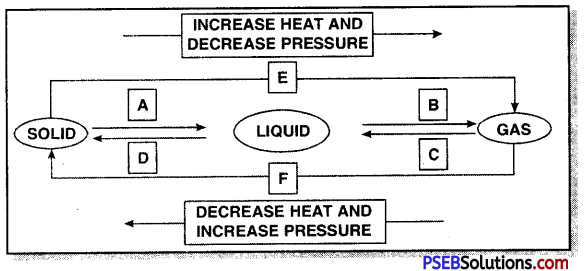
PSEB 9th Class Science Solutions Chapter 1 Matter in Our Surroundings 1
Answer:
A – Fusion
B – Vaporisation
C – Condensation
D – Solidification
E – Sublimation
F – Sublimation

Science Guide for Class 9 PSEB Matter in Our Surroundings InText Questions and Answers

Question 1.
Which of the following are matter?
Chair, air, love, smell, hate, almonds, thought, cold, cold drink, smell of perfume.
Answer:
Chair, air, almonds, cold drink, smell of perfume.

PSEB 9th Class Science Solutions Chapter 1 Matter in Our Surroundings

Question 2.
Give reasons for the following observations:
The smell of hot sizzling food reaches you several metres away, but to get the smell from cold food you have to go close.
Answer:
The smell of hot sizzling food reaches us several metres away, but to get the smell from cold food we have to go close. This is because the rate of diffusion of a gas increases with the increase in temperature. In hot food, the rate of diffusion is large but in cold food, the rate of diffusion is slow.

Question 3.
A diver is able to cut through water in a swimming pool, which property of matter does this observation show?
Answer:
The diver is able to cut through water in a swimming pool because in water the attractive forces between the molecules are small.

Question 4.
What are the characteristics of the particles of matter?
Answer:
The characteristics of the particles of matter are:

  1. The particles of matter have vacant spaces between them.
  2. The particles of matter are always in motion.
  3. There are attractive forces between the particles of matter.

Question 5.
The mass per unit volume of a substance is called density, (density = mass/volume). Arrange the following in order of increasing density – air, exhaust from chimneys, honey, water, chalk, cotton and iron.
Answer:
The increasing order of density is
Exhaust from chimneys < air < cotton < chalk < honey < iron.

Question 6.
(a) Tabulate the differences in the characteristics of states of matter.
(b) Comment upon the following:
rigidity, compressibility, fluidity, filling a gas container, shape, kinetic energy and density.
Answer:
(a) Differences in the characteristics of states of matter:

Characteristics Solid Liquid Gas
1. Vacant spaces Very small Small Very large
2. Attractive forces between particles Very large Small Negligible
3. Compressibility Negligible Low High
4. Rigidity High Low Not rigid
5. Density High Low Very Low
6. Energy Small Large as compared to solid Very high

(b) Rigidity: It is the property by virtue of which a substance can retain its shape when a force is applied to it. Solids possess the property of rigidity.

  1. Compressibility: The property by virtue of which the volume of a substance can be decreased by applying force or pressure on it. Gases have high compressibility because of large vacant spaces between the molecules of a gas.
  2. Fluidity: It is the property by virtue of which the molecules of one substance can flow from one point to another. Liquids and gases possess fluidity.
  3. Filling a gas container: A gas fills the container because there are negligible attractive forces between the molecules of a gas and the molecules of a gas move with very high velocities in all possible directions.
  4. Shape: It is the definite geometrical arrangement of constituent particles of a substance. Solids have definite shapes.
  5. Kinetic energy: It is the energy possessed by a particle due to its motion.
  6. Density: Density of a substance is the mass per unit volume. Its units are g/cc or kg/m3.

PSEB 9th Class Science Solutions Chapter 1 Matter in Our Surroundings

Question 7.
Give reasons:
(a) A gas fills completely the vessel in which if is kept.
(b) A gas exerts pressure on the walls of the container.
(c) A wooden table should be called a solid.
(d) We can easily move our hand in air but to do the same in solid block of wood we need a Karate expert.
Answer:
(a) This is because in a gas the attractive forces between the molecules are negligible and molecules of a gas move with very high speeds in all possible directions.
(b) This is due to the hits or bombardments of the molecules of a gas against the walls of a container.
(c) This is because it has a definite mass, volume and shape.
(d) This is because in air, the attractive forces between the particles are negligible but in a solid block of wood, there are large attractive forces between the constituent particles.

Question 8.
Liquids generally have lower density as compared to solids. But you must have observed that ice floats on water. Find out why.
Answer:
Ice floats over water because ice has lower density than liquid water. This is because in ice for a given mass volume is more as compared to in liquid water.

Question 9.
Convert the following temperature to Celsius scale:
(a) 300 K
(b) 573 K?
Answer:
(a) 300 K = 300 – 273 = 27°C.
(b) 573 K = 573 – 273 = 300°C.

Question 10.
What is the physical state of water at:
(a) 250°C
(b) 100°C?
Answer:
(a) Gas
(b) Gas

PSEB 9th Class Science Solutions Chapter 1 Matter in Our Surroundings

Question 11.
For any substance, why does the temperature remain constant during the change of state?
Answer:
This is because the heat supplied is used to overcome the attractive forces between the particles i.e., there is change in potential energy.

Question 12.
Suggest a method to liquefy atmospheric gases.
Answer:
The atmospheric gases can be liquefied by cooling under pressure.

Question 13.
Why does a desert cooler cool better on a hot dry day?
Answer:
On a hot dry day due to increase in temperature and lesser humidity the evaporation of water will be faster.

Question 14.
How does the water kept in an earthen pot (matka) become cool during summer?
Answer:
This is because the water comes out from the pores of earthen pot (matka) and it evaporates. Due to evaporation it causes cooling.

Question 15.
Why does our palm feel cold when we put some acetone or petrol or perfume on it?
Answer:
This is because the particles of acetone or petrol or perfume gain energy from our palms and surroundings and evaporate causing cooling.

Question 16.
Why are we able to sip hot tea or milk faster from a saucer rather than a cup?
Answer:
Because a saucer provides more surface area than a cup for evaporation of liquid into vapour and it causes a more cooling effect.

PSEB 9th Class Science Solutions Chapter 1 Matter in Our Surroundings

Question 17.
What type of clothes should we wear in summer?
Answer:
White cotton clothes.
PSEB 8th Class Home Science Practical अण्डा पकाना

Punjab State Board PSEB 8th Class Home Science Book Solutions Practical अण्डा पकाना Notes.

PSEB 8th Class Home Science Practical अण्डा पकाना

ऑमलेट

सामग्री-

  1. अण्डे — 4
  2. प्याज — 2 छोटे
  3. टमाटर — \(\frac{1}{2}\)छोटा
  4. हरी मिर्च — 1 – 2
  5. नमक और काली मिर्च — स्वाद के अनुसार
  6. घी — तलने के लिए

विधि—अण्डे का पीला और सफ़ेद भाग अलग-अलग कर लें। सफेद भाग को अच्छी तरह फेंट लें। अब इसमें पीला भाग अच्छी तरह मिला लें और नमक व काली मिर्च भी डाल लें। फ्राइंग पैन (Frying pan) गरम करके थोड़ा-सा घी डालकर अण्डे के आधे घोल को फैला दें। इसके ऊपर बारीक कटा हुआ प्याज, टमाटर और हरी मिर्च फैलाकर सिक जाने पर ऑमलेट को मोड़ दें। इसी प्रकार आधे बचे घोल का भी ऑमलेट बना लें।
कुल मात्रा—दो ऑमलेट

PSEB 8th Class Home Science Practical अण्डा पकाना

फ्राइड अण्डा

सामग्री—

  1. अण्डे — 2
  2. घी — तलने के लिए
  3. नमक तथा काली मिर्च — स्वाद के अनुसार

विधि-फ्राइंग पैन (Frying Pan) गरम करके उसमें थोड़ा-सा घी डाल दें। अण्डे को फ्राइंग पैन में ऐसे तोड़ें ताकि पीला और सफ़ेद भाग मिले नहीं। अब फ्राइंग पैन को ढककर मन्द आँच पर रखें। दो मिनट में अण्डा अपनी ही भाप में पक जाता है। परोसते समय सिकी हुई डबलरोटी पर मक्खन लगाकर ऊपर से फ्राइड अण्डा रख दें और नमक, काली मिर्च छिड़क दें।
कुल मात्रा-दो।

पोचड् अण्डा

सामग्री-

  1. अण्डे — 2
  2. पानी — 2 गिलास के लगभग
  3. नमक, काली मिर्च — स्वाद के अनुसार
  4. सिरका — 2 छोटी चम्मच

विधि—फ्राइंग पैन (Frying Pan) में पानी गरम कर लें। इसमें सिरका और थोड़ासा नमक डालकर उबाल आने दें। अब इसमें अण्डा ऐसे तोड़ें कि सफ़ेद और पीला भाग मिले नहीं। दो-तीन मिनट में पक जाने पर निकालकर काली मिर्च छिड़क कर टोस्ट या तले हुए आलू के टुकड़ों के साथ परोसें।
कुल मात्रा—दो।

PSEB 8th Class Home Science Practical अण्डा पकाना

सक्रैम्बल्ड अण्डा

सामग्री-

  1. अण्डे — 4
  2. दूध — 2 बड़े चम्मच
  3. मक्खन — 2 छोटे चम्मच
  4. नमक, काली मिर्च — स्वाद के अनुसार।

विधि—अण्डों को तोड़कर फेंट लें। इसमें बाकी सब चीजें मिला लें। पतीले में यह घोल डालकर धीमी आँच पर बराबर हिलाते हुए पकाएँ। एक-दो मिनट में पक जाने पर निकाल लें। ध्यान रखें कि वह बहुत ज्यादा सख्त न हो।
कुल मात्रा—दो कटोरी।

ऐग ऑन बडूज नेस्ट

सामग्री—

  1. अण्डे — 2 स्लाइस
  2. डबलरोटी — 5
  3. प्रोसेस्ड पनीर — 25 ग्राम
  4. मक्खन — 10 ग्राम
  5. काली मिर्च (पिसी) — थोड़ी-सी
  6. नमक — स्वादानुसार

विधि—डबल रोटी के स्लाइसों पर मक्खन लगा लें। पनीर को कद्दूकस कर लें तथा उसका आधा भाग डबलरोटी के टुकड़ों पर डाल दें। एक ट्रे में थोड़ा घी लगाकर डबलरोटी को उसमें रख दें। अब अण्डों को तोड़कर उनकी ज़र्दी व सफ़ेदी को अलग-अलग कर लें। (ध्यान रहे कि जर्दी टूटे नहीं) अण्डे की सफेदी को ‘ऐग बीटर’ (Egg Beater) की सहायता से अच्छी तरह फेंट लें ताकि सख्त-सी हो जाए। अब इस सफेदी को डबलरोटी के स्लाइसों पर चारों तरफ़ डाल दें तथा दोनों के बीच में अण्डे की जर्दी को तोड़ दें। ऊपर से कद्दूकस किया हुआ पनीर ओवन में भूरे रंग का होने तक सेंकें। अब इन पर नमक व काली मिर्च बुरक कर परोसें।
कुल मात्रा—दो व्यक्तियों के लिए।

PSEB 8th Class Home Science Practical अण्डा पकाना

पौष्टिक पराँठे

सामग्री—

  1. आटा — \(\frac{1}{2}\)कटोरी
  2. पालक — 100 ग्राम
  3. मूंगफली — 50 ग्राम
  4. हरा धनिया — थोड़ा-सा
  5. बेसन — \(\frac{1}{2}\)कटोरी
  6. हरी मिर्च — 2-3
  7. अदरक — 1 छोटा टुकड़ा
  8. नमक — स्वादानुसार
  9. घी — तलने के लिए

विधि—मूली कद्दूकस कर लें। मूली के नरम पत्तों और पालक के पत्तों को धोकर बारीक काट लें। हरी मिर्च, हरा धनिया और अदरक को भी काट लें। मूंगफली के दानों को मोटा-मोटा सा कूट लें। आटा और बेसन को छननी में छान लें और शेष सारी चीजें मिलाकर आटा गूंथ लें। इसके पराँठे बनाकर दही के साथ परोसें।

PSEB 8th Class Home Science Practical अण्डा पकाना

भरवां पराँठा

सामग्री-

  1. गेहूँ का आटा —150 ग्राम
  2. जल — आवश्यकतानुसार
  3. नमक — थोड़ा-सा
  4. आलू — 50 ग्राम
  5. चने की दाल — 30 ग्राम
  6. हरी मिर्च — 1-2 2
  7. घी — 2 छोटी चम्मच
  8. गर्म मसाला — \(\frac{1}{4}\) चाय का चम्मच
  9. पिसी हुई लाल मिर्च — आवश्यकतानुसार
  10. घी या तेल — सेंकने के लिए

विधि—आटे में नमक डालकर गूंथ लें और \(\frac{1}{2}\) घण्टे के लिए रख दें। आलू तथा चने की दाल उबालें और आलू को छीलकर मथ लें। दाल को भी इसी में मिला लें। हरी मिर्च धोकर बारीक काटें और इसे दाल व आलू में मिला दें। एक चम्मच घी गर्म करके दाल व आलू का मिक्सचर तथा मसाले डालकर पाँच मिनट के लिए भून लें। इस प्रकार स्टफिंग तैयार हो जाएगी। आटे को भली प्रकार गूंथ कर उसमें चार गोलियाँ बना लें। हर एक गोली को थोड़ा-सा बेल लें फिर इसमें एक बड़ा चम्मच स्टफिंग भरकर फिर से गोली बना लें। अब इस पराँठे को पूरा बेल लें। पराँठे को तवे पर घी लगाकर सेंक लें।

नोट—स्टफिंग, मौसम के अनुसार सब्जियाँ; जैसे-मूली और फूलगोभी की भी बनाई जा सकती है।
मूंगफली की स्टफिंग भी बनाई जा सकती है।
कुल मात्रा—4 पराँठे।

PSEB 10th Class Physical Education Book Solutions Guide in Punjabi English Medium

PSEB 10th Class Physical Education Book Solutions Guide in Punjabi English Medium

Punjab State Board Syllabus PSEB 10th Class Physical Education Book Solutions Guide Pdf in English Medium & Punjabi Medium & Hindi Medium are part of PSEB Solutions for Class 10.

PSEB 10th Class Physical Education Guide | Health and Physical Education Guide for Class 10 PSEB

Physical Education Guide for Class 10 PSEB | PSEB 10th Class Physical Education Book Solutions

PSEB 10th Class Physical Education Book Solutions in English Medium

Physical Education 10th Class PSEB Guide Rules of Games

PSEB 10th Class Physical Education Book Solutions in Punjabi Medium

Physical Education 10th Class PSEB Guide ਖੇਡਾਂ ਦੇ ਨਿਯਮ (Rules of Games)

PSEB 10th Class Physical Education Book Solutions in Hindi Medium

Physical Education 10th Class PSEB Guide खेलों के नियम (Rules of Games)

PSEB 10th Class English Literature Book Solutions

Punjab State Board Syllabus PSEB 10th Class English Literature Book Solutions Guide Pdf is part of PSEB Solutions for Class 10.

10th Class English Literature Book PSEB Solutions

10th Class English Literature Book PSEB Supplementary Reader

PSEB 10th Class English Main Course Book Solutions

Punjab State Board Syllabus PSEB 10th Class English Main Course Book Solutions Guide Pdf is part of PSEB Solutions for Class 10.

English Main Course Book Class 10 Solutions PSEB

English Main Course Book Class 10 Solutions PSEB Prose

Class 10th English Main Course Book Solutions PSEB Poetry

PSEB 10th Class Home Science Book Solutions Guide in Punjabi English Medium

Punjab State Board Syllabus PSEB 10th Class Home Science Book Solutions Guide Pdf in English Medium and Punjabi Medium are part of PSEB Solutions for Class 10.

PSEB 10th Class Home Science Guide | Home Science Guide for Class 10 PSEB

Home Science Guide for Class 10 PSEB | PSEB 10th Class Home Science Book Solutions

PSEB 10th Class Home Science Book Solutions in Hindi Medium

PSEB 10th Class Home Science Book Solutions in Punjabi Medium

PSEB 10th Class English Grammar Book Solutions Pdf

Punjab State Board Syllabus PSEB 10th Class English Grammar Book Solutions Pdf is part of PSEB Solutions for Class 10.

10th Class English Grammar Book Solutions PSEB Pdf

10th Class PSEB English Grammar Book Solution

10th Class English Grammar Book PSEB Pdf Vocabulary

PSEB 10th Class English Grammar Book Reading Skills

PSEB English Grammar and Composition Class 10 Solved Exercises


PSEB 9th Class Home Science Book Solutions Guide in Punjabi English Medium

Punjab State Board Syllabus PSEB 9th Class Home Science Book Solutions Guide Pdf in English Medium and Punjabi Medium are part of PSEB Solutions for Class 9.

PSEB 9th Class Home Science Guide | Home Science Guide for Class 9 PSEB

Home Science Guide for Class 9 PSEB | PSEB 9th Class Home Science Book Solutions

PSEB 9th Class Home Science Book Solutions in Hindi Medium

भाग-I गृह व्यवस्था

भाग-II भोजन और पोषण विज्ञान

भाग-III बाल विकास और पारिवारिक संबंध

भाग-IV वस्त्र विज्ञान

PSEB 9th Class Home Science Book Solutions in Punjabi Medium

ਭਾਗ-I ਗ੍ਰਹਿ ਵਿਵਸਥਾ

ਭਾਗ-II ਭੋਜਨ ਅਤੇ ਪੋਸ਼ਣ ਵਿਗਿਆਨ

ਭਾਗ-III ਬਾਲ ਵਿਕਾਸ ਅਤੇ ਪਰਿਵਾਰਿਕ ਸੰਬੰਧ

ਭਾਗ-IV ਵਸਤਰ ਵਿਗਿਆਨ

PSEB 9th Class English Literature Book Solutions

Punjab State Board Syllabus PSEB 9th Class English Literature Book Solutions Guide Pdf is part of PSEB Solutions for Class 9.

9th Class English Literature Book PSEB Solutions

9th Class English Literature Book PSEB Supplementary Reader

PSEB 9th Class English Main Course Book Solutions

Punjab State Board Syllabus PSEB 9th Class English Main Course Book Solutions Guide Pdf is part of PSEB Solutions for Class 9.

English Main Course Book Class 9 Solutions PSEB

English Main Course Book Class 9 Solutions PSEB Prose

Class 9th English Main Course Book Solutions PSEB Poetry