PSEB 8th Class Physical Education Solutions Chapter 5 The Golden Boy-Abhinav Bindra

Punjab State Board PSEB 8th Class Physical Education Book Solutions  Chapter 5 The Golden Boy-Abhinav Bindra Textbook Exercise Questions and Answers.

PSEB Solutions for Class 8 Physical Education Chapter 5 The Golden Boy-Abhinav Bindra

Physical Education Guide for Class 8 PSEB The Golden Boy-Abhinav Bindra Textbook Questions and Answers

Question 1.
When was Abhinav Bindra born?
Answer:
Abhinav Bindra was born on 28th September 1982 to Dr. Upjeet Singh Bindra and Mrs. Babali Bindra. They were Sikhs and lived in S.A.S Nagar. Abhinav Bindra had an elder sister. Being a younger child his parents loved him very much. He studied at the Doon school for two years before moving to St. Stephen’s school Chandigarh. He holds a B.B.A degree from a foreign university.

PSEB 8th Class Physical Education Solutions Chapter 5 The Golden Boy-Abhinav Bindra

Question 2.
When did Abhinav Bindra participate in Olympics for the first time?
Answer:
Abhinav Bindra’s hard work bore fruit, in 1988 he was selected for the commonwealth games at the age of 15 and he became the youngest Indian player. In Sydney, he participated in the 2000 Olympics at the age of 18. Though he did not get any position there but participating in Olympics at such a small age was itself an achievement. He participated in 2004 Athens Olympics despite of breaking the Olympics record, Bindra failed to win a medal.

Question 3.
When did Abhinav Bindra become world champion?
Answer:
In 2006, Bindra became the first Indian shooter to win the world championship gold in Zagreb. It strengthened him in Olympic games Beijing 2008. Abhinav Bindra won the gold and defeated the world level shooters. It was India’s first gold medal after 1980, after 26 years. He won many medals in international tournaments. He became the champion at Asian games, Grand-Prix and Common Wealth sports.

Question 4.
When did Abhinav Bindra win gold medal in the Olympics?
Answer:
In Olympic games in Beijing 2008, Abhinav Bindra won the gold and defeated the world-level shooters. It was India’s first gold medal after 1980, after 26 years. He won many medals in international tournaments. He became to champion at Asian games, Grand-Prix and Common Wealth sports.

PSEB 8th Class Physical Education Solutions Chapter 5 The Golden Boy-Abhinav Bindra

Question 5.
Which awards are awarded to Abhinav Bindra by the Government of India?
Answer:
He has been honoured many times for his achievements. A foreign company, who makes guns, honoured him by gifting a gun made of gold. The Government of India had awarded him Arjuna Award, Rajeev Gandhi Khel Rattana Award and Padma Bhushan. He is’called the Golden Boy because of winning many gold medals at international level.

PSEB 8th Class Physical Education Guide The Golden Boy-Abhinav Bindra Important Questions and Answers

Multiple Choice Questions

Question 1.
Where Mr. Abhinav Bindra was bom?
(A) Jerakpur
(B) Bathinda
(C) Gurdaspur
(D) Chandigarh.
Answers:
(A) Jerakpur

Question 2.
When Abhinav Bindra was bom?
(A) 1982
(B) 1980
(C) 1989
(D) 1986.
Answers:
(A) 1982

Question 3.
When Abhinav Bindra participated in Olympic?
(A) 2000
(B) 1996
(C) 2004
(D) 2008.
Answers:
(A) 2000

PSEB 8th Class Physical Education Solutions Chapter 5 The Golden Boy-Abhinav Bindra

Question 4.
When Abhinav Bindra become world champion?
(A) 2004
(B) 2000
(C) 2006
(D) 2012.
Answers:
(D) 2012.

Question 5.
Mention the award which was given by Government.
(A) Arjuna Award
(B) Rajeev Gandhi Khel Rattana Award
(C) Padama Bhushan Award
(D) None of these.
Answers:
(A) Arjuna Award
(B) Rajeev Gandhi Khel Rattana Award
(C) Padama Bhushan Award

Very Short Answer Type Questions

Question 1.
When was Abhinav Bindra born?
Answer:
Abhinav Bindra was born on 28th September, 1982 to Dr. Upjeet Singh Bindra and Mrs. Babali Bindra.

Question 2.
Who was the first coach of Abhinav Bindra in shooting?
Answer:
Karnal Jagir Singh was first coach of Abhinav Bindra in shooting.

PSEB 8th Class Physical Education Solutions Chapter 5 The Golden Boy-Abhinav Bindra

Question 3.
In which Olympic Abhinav Bindra won the gold medal in shooting?
Answer:
In Olympic game Beijing 2008, Abhinav Bindra won the gold medal.

Question 4.
Who insisted to Abhinav Bindra for shooting.
Answer:
Rana Gurmeet Singh Sodhi came to Abhinav Bindra’s farm house and insisted him for shooting.

Question 5.
Who did appreciate the talent of Abhinav Bindra fpr shooting?
Answer:
Rana Gurmeet Singh Sodhi appreciated Abhinav Bindra’s talent and suggested to Abhinav’s father to encourage him to be a shooter.

Short Answer Type Questions

Question 1.
How Abhinav Bindra took interest in shooting?
Answer:
One day when his father was cleaning and oiling the guns he found a fault with a gun. So he went to Dehradun to get it repaired. Abhinav was also with him. The guns were set in a very decorative manner in the gun shop. Those guns tempted Abhinav and he fell in love with guns. He was hardly 10 years old when his father allowed him to shoot but only in his presence.

PSEB 8th Class Physical Education Solutions Chapter 5 The Golden Boy-Abhinav Bindra

Question 2.
To whom did Abhinav Bindra wrote a letter for the training of shooting?
Answer:
Abhinav Bindra wrote a letter to the coach, Dhillon that he wished to get training from him and he also mentioned that one day he would be proud of having coached by him. The coach Dhillon was impressed seeing the dedication and determination of Abhinav at the age of 13.

Question 3.
In which international competition Abhinav Bindra could not get a medal?
Answer:
In 1998, he was selected for the Common Wealth games at the age of 15 and he became the youngest Indian player. In Sydney, he participated in the 2000 Olympics at the age of 18, though he did not get any position there but participating in Olympics at such a small age was itself an achievement. He participated in 2004 Athens Olympics despite of breaking the Olymplic record, Bindra failed to win a medal.

Question 4.
Write the incident of Olympic in which Abhinav Bindra won the gold medal?
Answer:
He kept on trying and at last he shot the best aim of his life but at that moment he was ignorant of the fact that he had become the first Indian who had won a gold medal in Olympics. When he looked into the eyes of his coach, Gabriele Buhimann (Switzerland), she told him by making the sign of vfctory that he had won the first position and marked a new record. In’this way, Abhinav Bindra’s name got written in golden words.. He had won in the 10 metre Air Riffle event.

PSEB 8th Class Physical Education Solutions Chapter 5 The Golden Boy-Abhinav Bindra

Question 5.
Who has honoured Abhinav Bindra for his outstanding achievement?
Answer:
A foreign company, which makes guns, honoured him by gifting a gun made of gold.

Question 6.
Write the various awards which were awarded to Abhinav Bindra by the Government of India?
Answer:

  • Aijuna Award
  • Rajeev Gandhi Khel Rattana Award
  • Padam Bhushan Award.

He is called the Golden Boy because of winning many gold medals at international level.

Marching Game Rules – PSEB 10th Class Physical Education

Punjab State Board PSEB 10th Class Physical Education Book Solutions Marching Game Rules.

Marching Game Rules – PSEB 10th Class Physical Education

Question 1.
What is marching?
Answer:
Marching:
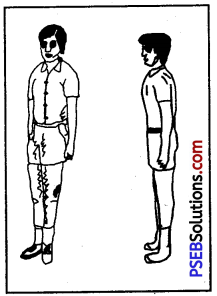
1. Attention:
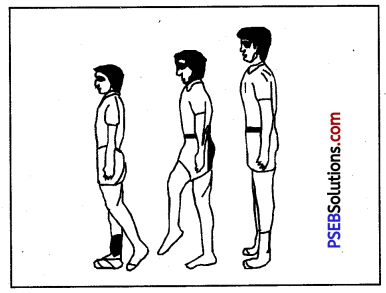
It is very important position. The ankle of the feet should be in line, making the 30° angle should be straight along with body, chest should be normal. Both the arms are attached with side of the body and finger should be little close.

2. The neck should be straight by looking ahead the body. Weight should be on both feet and respiration should be normal.
Marching Game Rules - PSEB 10th Class Physical Education 1

Marching Game Rules - PSEB 10th Class Physical Education

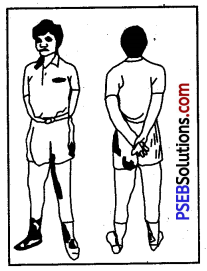
Stand at Ease:
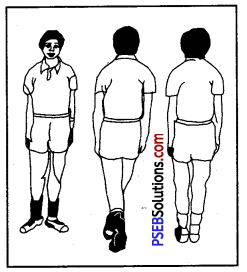
Stand at ease position move left foot toward, left side at the distance 12″. The weight of the body should be on both legs and drag both the hands behind. His body and right hand would be under the left hand. The thumb of right hand should be under left hand. At ease position, both the hand should be stretched keeping the finger stretched.
Marching Game Rules - PSEB 10th Class Physical Education 2
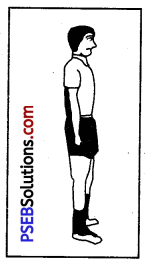
Right Dress:
On the command of right dress, all students move ahead with right foot and get the position at the distance of 15″, but a student standing at right will remain standing, student in a first row raise right hand, left shoulders and move towards left. The fingers load others, students would stand to his right hand and other would follow, they would keep at the distance of 30″.
Marching Game Rules - PSEB 10th Class Physical Education 3
Left Dress: On getting command left dress, all movement will be followed by left hand.

Left Turn:
In this exercise, student will stand in attention position and counting two. On counting one, student will turn left side at the 90° and on left toe and right finger will raise upward after this exercise. On counting two, will raise a foot 6″ and meet with other foot.
Marching Game Rules - PSEB 10th Class Physical Education 4
Right Turn:
This exercise is performed on counting two as it is done on left turn. In the same way right ankle or left foot is done.
Marching Game Rules - PSEB 10th Class Physical Education 5
About Turn:
On command of about turn, student will turn back from the right side at the degree of 180°, while taking turn left, foot will be raise and turn on right foot. The body weight should be parallel on both feet on counting two, student will turn left foot and will remain in attention position.
Marching Game Rules - PSEB 10th Class Physical Education 6
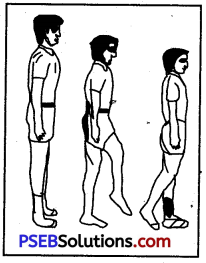
Quick March:
On command quick march, student will take left foot ahead. This foot will drag near the earth keeping knee straight, in this same way, right foot will be followed. The finger of hand will close, this exercise is performed after taking right foot ahead and repeat again and again. The hand position with be contrast to it. This exercise will be continue on counting one and two.

Marching Game Rules - PSEB 10th Class Physical Education

Halt:
The command of halt is given, when right foot is the cross to the left foot. As command is given to students, as soon as will touch the left foot to the earth. Right leg will come to the parallel, and they will stand. Their both hands will be together and student will remain in attention position.

PSEB 9th Class Agriculture Solutions Chapter 10 Fishery

Punjab State Board PSEB 9th Class Agriculture Book Solutions Chapter 10 Fishery Textbook Exercise Questions and Answers.

PSEB Solutions for Class 9 Agriculture Chapter 10 Fishery

Agriculture Guide for Class 9 PSEB Fishery Textbook Questions and Answers

(A) Answer in 1-2 words:

Question 1.
Name two exotic breeds of fish.
Answer:
Common carp, silver carp.

Question 2.
What should be the depth of the pond?
Answer:
It should be 6-7 feet.

Question 3.
What should be the pH of water for fish rearing?
Answer:
pH should be between 7-9.

PSEB 9th Class Agriculture Solutions Chapter 10 Fishery

Question 4.
Which fertilizer can be used in the new fish pond?
Answer:
Urea and single superphosphate.

Question 5.
How many fingerlings can be put in one acre?
Answer:
4000 fingerlings per acre.

Question 6.
What is the source of fish seed?
Answer:
College of fishery, GADVASU, Ludhiana or Government hatcheries.

Question 7.
Name two Indian breeds of fish.
Answer:
Katla, Rohu.

Question 8.
What type of soil is required for fish pond?
Answer:
Clayey soil.

Question 9.
What should be the size of commercial fish pond?
Answer:
1 to 5 acre and 6-7 feet deep.

Question 10.
Name one carnivorous fish.
Answer:
Malhi, Singhara.

(B) Answer in 1-2 sentences:

Question 1.
Name Indian and Exotic breeds of fish.
Answer:
Indian breeds of fish are – Katla, Rohu, Mrigal. Exotic carps, Common carp, Silver carp, Grass carp.

Question 2.
What do you know about design of fish pond?
Answer:
For commercial fishery, pond should have an area of.l to 5 acre and it should be 6-7 feet deep. Base of the pond should be plain but sides should be sloppy. There should be proper arrangement of inflow and outflow of water. Put values on inlet and outlet pipes for this purpose. Make pond in February and put fish seed in it in March-April. There should be a one Kanal nursery pond also.

PSEB 9th Class Agriculture Solutions Chapter 10 Fishery

Question 3.
Explain about the quality of water used for fishery.
Answer:
Water used in the pond for fishery should have pH between 7-9. Oxygen dissolved in water and pH of water plays an important role in the survival and growth of fish. If pH of pond water is below 7 then add ground calcium carbonate (80-100 kg per acre) in the pond water. Dissolve this calcium carbonate in water outside the pond and when it is cool then add this in pond.

Question 4.
What should be the ratio of different fish breeds in a pond?
Answer:
Seed fish can be put in the following ratio :

  • Katla 20%, Common carp 20%, Mrigal 10%, Rohu 30%, Silver carp 10%, and Grass carp 10%.
  • Katla 25%, Mrigal 20%, Rohu 35% and Common carp 20%.

Question 5.
How weeds can be removed from fish pond?
Answer:
Water level should be kept upto 5-6 feet in old ponds to check the growth of weeds. Following methods can be used to control weeds :

  • Physical approach. Remove all the water from the pond and remove all the weeds using barbed wire.
  • Biological approach. Grass carp and silver carp can control many types of weeds.

Question 6.
Write precautions for using canal water in the pond.
Answer:
If the pond is to be filled with canal water then wire mesh should be put at the mouth of the inlet pipe. This prevents the entry of carnivorous fish in the fish pond.

Question 7.
Write about enemies of fish in pond.
Answer:

  • Carnivorous fish – Malhi, Singhara.
  • Weed fish – Shisha, Puthi Kanghi.
  • Frogs and Snakes.

Question 8.
How feeding is done in pond?
Answer:
There should be’25% protein in fish feed. Finely ground the feed and soak it in water for 3-4 hours. Make bolls of this feed. Put these in baskets, trays or plastic bags having holes. Keep these at 2-3 feet below the water level.

Question 9.
Write about health management of fish.
Answer:
Dip the fish seed (fingerlings) in solution of potassium permanganate (100 gram per litre) before putting them into the pond. This helps in preventing the diseases. Monitor the fish stock for health related problems at fortnight interval.

Question 10.
From where fishery training can be obtained?
Answer:
It can be obtained from District Fishery Officer, Deputy Director, GADVASU Ludhiana, Deputy Director, Krishi Vigyan Kendra.

PSEB 9th Class Agriculture Solutions Chapter 10 Fishery

(C) Answer in 5-6 sentences:

Question 1.
Write a note on selection of site, design and digging of fish pond.
Answer:
Selection of site for pond. Select a land which have clayey soil for making pond. Clayey soil prevents the seepage of water. Do puddling in light soil. Water source should be near the pond so that it can be filled easily. If canal water is to be used put wire mesh at the mouth of inlet pipe to prevent entry of carnivorous fish into the pond. Design and digging. For commercial fishery, pond should have an area of 1 to 5 acre and it should be 6-7 feet deep. Base of the pond should be plain but sides should be sloppy. There should be proper arrangement of inflow and outflow of water. Put valves on inlet and outlet pipes for this purpose. Make pond in February and put fish seed in it in March-April. There should be a one Kanal nursery pond also.

Question 2.
How old ponds can be used for fish rearing?
Answer:
Water level should be kept upto 5-6 feet in old ponds to check the growth of weeds. Following methods can be used to control weeds :
1. Physical approach. Remove all the water from the pond and remove all the weeds using barbed wire.
2. Biological approach. Grass carp and silver carp can control many types of weeds.
Control of enemies of fish. Old pond may contain following enemies of fish

  • Carnivorous fish – Malhi, Singhara.
  • Weed fish – Shisha, puthi Kanghi.
  • Frogs and Snakes.

Remove these by using the net and kill the snakes carefully.

Question 3.
How weeds can be removed from old ponds?
Answer:
Do it yourself.

Question 4.
What type of manures and fertilizers are used in fish ponds?
Answer:
Plankton is natural food for fish. To maintain regular supply of plankton in the newly constructed pond. Put farmyard manure, biogas slurry, poultry manure, urea and single superphosphate. Always add fertilizers before 15 days of adding fish seed in the pond. Rate of adding fertilizer in the old pond depends upon the quality of water and production of plankton in it.

Question 5.
What is the role of Government Department of Fishery and Veterinary University in fishery development?
Answer:
Before starting the occupation of fishery get training from Fishery Department, Punjab. Department arranges five day training for this purpose. One can get training from District Fishery Officer, Deputy Director, GADVASU, Ludhiana or from Krishi Vigyan Kendra.

Very Short Answer Type Questions:

Question 1.
When does a fish become marketable?
Answer:
When it becomes 500 gram.

Question 2.
Name a weed fish.
Answer:
Puthi Kanghi.

Question 3.
What is natural food for fish?
Answer:
Plankton.

Question 4.
What should be the depth of pond?
Answer:
6-7 feet.

Question 5.
What types of soil should be selected for making pond for fishery?
Answer:
Clayey soil.

Question 6.
Why do we select clayey soil for pond?
Answer:
Because this type of soil is suitable to hold water for a longer time and seepage is less in it.

PSEB 9th Class Agriculture Solutions Chapter 10 Fishery

Question 7.
In which month pond should be made?
Answer:
In the month of February.

Question 8.
What type of carps can eat weeds?
Answer:
Common carp, silver carp.

Question 9.
Name weed fish.
Answer:
Shisha, Puthi Kanghi.

Question 10.
Carnivorous fish are
Answer:
Singhara, Malta.

Question 11.
If pH of water is less than 7 what should we add?
Answer:
We should add ground calcium carbonate 80-100 kg per acre.

Short Answer Type Question:

Question 1.
Write about catching fish and putting fish seed.
Answer:
When fish attains a weight of 500 grams it becomes marketable. Remove such fish from the pond and put same number and breed of fingerlings in the pond by taking these fingerlings from the nursery.

PSEB 9th Class Agriculture Guide Fishery Important Questions and Answers

Multiple Choice Questions:

1. When is fish ready for marketing?
(a) 500 gram
(b) 50 gram
(c) 10 gram
(d) 20 gram
Answer:
(a) 500 gram

2. Weed fish is :
(a) Katla
(b) Mrigal
(c) Puthi Kangi
(d) Rohu
Answer:
(c) Puthi Kangi

3. Put seed fish at the rate of ……………. per acre.
(a) 4000
(b) 15000
(c) 1000
(d) 500
Answer:
(a) 4000

4. Carnivorus fish is :
(a) Singhara
(b) Malhi
(c) Dola
(d) All
Answer:
(d) All

PSEB 9th Class Agriculture Solutions Chapter 10 Fishery

5. pH of water for fish rearing :
(a) 7-9
(b) 2-3
(c) 13-14
(d) 11-12
Answer:
(a) 7-9

True/False:

1. Indian breeds of fish are-Catla, Rohu, Mrigal.
Answer:
True

2. Pond size should be 1-5 acre and it should be 6-7 feet deep.
Answer:
True

3. Keep water level in pond upto 2-3 feet.
Answer:
False

4. There should be 10% protein in fish feed.
Answer:
False

5. One should not get training before starting the occupation of the fishery.
Answer:
False

Fill in the Blanks:

1. Put seed fish of 1-2 inch size at the rate of …………… per acre.
Answer:
4000

2. …………… gram fish is ready for marketing.
Answer:
500

3. Fish farming or fishery is a subsidiary occupation and is more …………… than agriculture.
Answer:
profitable

4. Fish pond should be made in …………… land.
Answer:
clayey

5. pH of the water should be …………… If it is less than 7 use lime water.
Answer:
7-9

PSEB 10th Class Agriculture Solutions Chapter 10 Beneficial and Harmful Animals in Agriculture

Punjab State Board PSEB 10th Class Agriculture Book Solutions Chapter 10 Beneficial and Harmful Animals in Agriculture Textbook Exercise Questions and Answers.

PSEB Solutions for Class 10 Agriculture Chapter 10 Beneficial and Harmful Animals in Agriculture

Agriculture Guide for Class 10 PSEB Beneficial and Harmful Animals in Agriculture Textbook Questions and Answers

(A) Answer in one-two words:

Question 1.
How many species of rodents are there in Punjab?
Answer:
8 types.

Question 2.
In which area of Punjab Indian bush rat is found?
Answer:
Dry and sandy areas.

Question 3.
How much damage is caused to germinating winter maize by rodents?
Answer:
10.7%.

PSEB 10th Class Agriculture Solutions Chapter 10 Beneficial and Harmful Animals in Agriculture

Question 4.
At how many locations poison bait should be placed in one acre?
Answer:
At 40 locations at the rate of 10 grams of bait at a point

Question 5.
Name the two reodent eating beneficial birds.
Answer:
Owl and eagle.

Question 6.
Name the bird causing maximum damage to crops. Or Which is the most harmful bird in agriculture?
Answer:
Parrot (Rose ringed parakeet)

Question 7.
How much should be the height of scare crow from the crop?
Answer:
One metre more than the height of crop.

Question 8.
Name any one chemical used for killing rodents.
Answer:
Zinc phosphide.

Question 9.
Where does lapwing make its nest?
Answer:
On the ground.

PSEB 10th Class Agriculture Solutions Chapter 10 Beneficial and Harmful Animals in Agriculture

Question 10.
What does Hoopoe eat its diet?
Answer:
Insects.

(B) Answer in one-two sentences:

Question 1.
Why we need to protect the agricultural products from harmful animals?
Answer:
Development in the agriculture field can be maintained if agriculture produce is stored properly and protected from harmful animals, birds etc. It is necessary to protect the produce from the pests.

Question 2.
Describe the method of pre-baiting for rodents.
Answer:
To trap more rodents it becomes necessary to prebait the rodents. For this purpose place bait in each cage consisting of 10 to 15 gram pearl millet, sorghum or cracked wheat, which contains two per cent of powdered sugar and two ppr cent of groundnut or sunflower oil, for 2-3 days.

Question 3.
How to reduce the ill effect of Bromadiolone in human being?
Answer:
Effect of bromadiolone can be reduced by using vitamin K as antidote. Use this vitamin under the supervision of ajdoctor.

PSEB 10th Class Agriculture Solutions Chapter 10 Beneficial and Harmful Animals in Agriculture

Question 4.
How the anti rat campaign can help in eradication of rats at village level? .
Answer:
It is of no use to eradicate rats in a smaller area. Because rats will come again from the neighbouring field or area. To get best results there should be rat killing campaign at village level. Under this campaign rodents are killed collectively in whole of the village at all the locations e.g. in orchards, in cultivated, uncultivated, forestry land etc.

Question 5.
What do you mean by scarecrow? What is its role in crop protection?
Answer:
Take a small pitcher, draw human face on it using colour. This pitcher is made to hang on the sticks fixed vertically in the fields. Put on human clothes on this structure. This is known as scarecrow. Birds consider this structure as human being and do not come to the field.

Question 6.
How the oil seed crop can be protected from parakeet damage?
Answer:
Parrot has little communal association with crows. Therefore to keep the parrots away from the fields, hang 1-2 dead crows/their dumies at sites of frequent bird damage. This way we can protect oilseed crops from parrots.

Question 7.
Why the crop should not be sown at the place having dense trees?
Answer:
Birds have their nests on the trees. If maize and sunflower crops are sown near such sites where birds come and go very easily and very frequently then birds can easily damage the crop. Therefore, crop should not be sown near the places having dense trees.

PSEB 10th Class Agriculture Solutions Chapter 10 Beneficial and Harmful Animals in Agriculture

Question 8.
How the beneficial birds help farmers in protecting the crops?
Answer:
Rats are the prey for owls, hawks, falcon, eagles etc. Birds like drongos, blue joy, cattle egret, lapwings etc. are insects eating birds. These eat many of the harmful insects from the fields.

Question 9.
How do you identify the Cattle Egret?
Answer:
It is a white coloured bird and its beak is yellow. This bird is seen preying on insects behind the tractor or oxen during ploughing.

Question 10.
What do you know about the precautions to be taken during use of poisonous bait?
Answer:
Precautions while-using poisonous baits:

  • Use a stick or Khurpa for mixing the ingredients of bait while preparing. Otherwise use rubber gloves. Protect eyes, nose and mouth from the bait;
  • Keep rodenticides and poisonous bait away from the reach of children and domestic animals.
  • Never prepare baits in household utensils.
  • Use polythene bags for carrying baits and after use bury these bags under the earth.
  • Killed rats along with baits should be buried deep under the earth.
  • Zinc phosphide is very poisonous for humans. In case of accidental ingestion induce vomitting by inserting fingers in the mouth upto throat and rash to doctor.

PSEB 10th Class Agriculture Solutions Chapter 10 Beneficial and Harmful Animals in Agriculture

(C) Answer in five-six sentences:

Question 1.
How many types of rodents are there in Punjab? Describe the rodent species found in various areas of Punjab.
Answer:
In Punjab there are 8 species of rats and mice. Indian gerbil, Indian bush rat, Indian mole rat, soft furred field rat, short tailed mole rat, house mouse, brown spiny mouse, field mouse. The Indian mole rat can damage sugarcane and rice-wheat at the time of germinating. Indian mole rat is found mostly in bet area whereas Indian gerbil and Indian bush rat are found in Kandi region (district Hoshiarpur)

Question 2.
Describe the two methods of preparation of poisonous bait.
Answer:
1. 2% zinc phosphide bait:
Take 1 kg of bajra or sorghum or cracked wheat with 20 gram of vegetable oil (sunflower or groundnut oil), and 25 gram of zinc phosphide. Mix all these materials thoroughly. Always prepare fresh bait and never add water to this bait.

2. 0.005% Bromadiolone bait:
Take 20 gram of vegetable oil, (sunflower or groundnut oil), 20 gram powdered sugar and 20 gram bromadiolone powder and 1 kg of cracked wheat or any other cereal flour. Mix this material properly, bait is ready for use.

Question 3.
How to manage rodents by integrated management methods?
Answer:
Using only one method to control rats is not very effective. Rats multiply themselves quickly by giving birth to offsprings. Therefore, use more than one method to kill rats. Rats coming out from flooded burrows should be killed using sticks. After sowing of a crop use chemical methods to kill rats. After pre-baiting also put some gas tablets in the burrows. After zinc phosphide if needed use bromadiolone.

PSEB 10th Class Agriculture Solutions Chapter 10 Beneficial and Harmful Animals in Agriculture

Question 4.
Describe the traditional methods used for protection of crops from birds.
Answer:

  • Sow Dhaincha and Bajra near the costly crops to save the crops from birds. Birds like to eat bajra and dhaincha. Birds prefer these crops as their feed and main crop is saved.
  • Do not sow crops like sunflower near the places where birds usually visit e.g. near the electricity wires and near the dense trees.
  • To save maize and sunflower from Parrots, sow these crops at least in two-three acres of area. Parrots do not go inside the crop and does not harm the crop to large extent.

Question 5.
Describe the mechanical method of protecting crop from birds.
Answer:
1. Making explosions: Make false gun shots at different time intervals to scare the birds.

2. Using scarecrow:
Take a small pitcher, draw human face on it using colour. This pitcher is made to hang on the sticks fixed vertically in the fields. Put on human clothes on this structure. This is known as scarecrow. Birds consider this structure as human being and do not come to the field.

3. Hanging dead crows:
Parrot has little communal association with crows. Therefore, to keep the parrots away from the fields, hang 1-2 dead crows/their dumies at sites of frequent bird damage. This way we protect oilseed crops from parrots.

4. Using rope-crackers:
Tie fire crackers on a rope at 6-8 inch distance. Ignite the lower end of the rope. Explosions caused by fire crackers at different intervals scare the birds and the birds fly away. Fix the rope in the centre at the time of germination and at the boundaries of the field at the time of maturity.

PSEB 10th Class Agriculture Solutions Chapter 10 Beneficial and Harmful Animals in Agriculture

PSEB 10th Class Agriculture Guide Beneficial and Harmful Animals in Agriculture Important Questions and Answers

Multiple Choice Questions

Question 1.
Friendly birds are:
(a) Lapwing
(b) Blue Joy
(c) Drongo
(d) All.
Answers:
(d) All.

Question 2.
Rats eaten by an owl in a day.
(a) 4-5
(b) 8-10
(c) 1-2
(d) All.
Answers:
(a) 4-5

Question 3.
Where does red mattled lapwing (tatihri) make its nest?
(a) on ground
(b) on trees
(c) in water
(d) None.
Answers:
(a) on ground

Question 4.
Chemical used to kill rats is:
(a) Sodium
(b) Potassium chloride
(c) Zinc phosphide
(d) All.
Answers:
(c) Zinc phosphide

PSEB 10th Class Agriculture Solutions Chapter 10 Beneficial and Harmful Animals in Agriculture

Question 5.
How many types of birds are found in Punjab?
(a) 100
(b) 50
(c) 300
(d) 50.
Answers:
(c) 300

Question 6.
Which bird makes its nest in the cavities of the trees?
(a) Hoopoe
(b) Red-wattled lapwing
(c) Cattle egret
(d) House sparrow.
Answers:
(a) Hoopoe

Question 7.
Which bird makes its nest on ground?
(a) Hoopoe
(b) Red-watded Lapwing
(c) Cattle Egret
(d) Blue Joy.
Answers:
(b) Red-watded Lapwing

Question 8.
Which bird makes its nest in groups on the top of the trees?
(a) Hoopoe
(b) Red-wattled lapwing
(c) Cattle egret
(d) Owl.
Answers:
(c) Cattle egret

PSEB 10th Class Agriculture Solutions Chapter 10 Beneficial and Harmful Animals in Agriculture

Question 9.
How much damage is caused to sprouting wheat by rodents?
(a) 2.9%
(b) 10.7%
(c) 4.5%
(d) 1.1%.
Answers:
(a) 2.9%

True False:

1. Blue Joy has insects as its main diet.
Answers:
True

2. Eight type of rodents and mice are found in the fields of Punjab.
Answers:
True

3. Rose-ringed parakeet is most harmful bird in the field of agriculture.
Answers:
True

4. Zinc Phoshide is used to kill cats.
Answers:
True

5. Owl, Falcon are friendly birds for a farmer.
Answers:
True

PSEB 10th Class Agriculture Solutions Chapter 10 Beneficial and Harmful Animals in Agriculture

Fill in the blanks:

1. Scare crow should be atleast ………………… higher than the crop.
Answers:
one metre

2. For trapping rodents place ………………….. traps per acre in the field.
Answers:
16

3. ………………………….. percent of total bird species in India are useful to agriculture.
Answers:
3. 98

4. ………………………. bird has a yellow beak.
Answers:
Cattle egret.

PSEB 10th Class Agriculture Solutions Chapter 10 Beneficial and Harmful Animals in Agriculture

Very Short Answer Type Questions

Question 1.
Where does rats live?
Answer:
Rats live in Burrows.

Question 2.
Which species of rats are found in areas of sugarcane and wheat rice and bet areas?
Answer:
Indian mole rat.

Question 3.
Which rat is found in Kandi region?
Answer:
Gerbil rat.

Question 4.
Which rats are found in Kandi region?
Answer:
Indian Bush rats.

Question 5.
How much damage is done by rats at the time of sprouting and maturity?
Answer:
At the time of sprouting is 2.9%. At the time of maturity is 4.5%.

PSEB 10th Class Agriculture Solutions Chapter 10 Beneficial and Harmful Animals in Agriculture

Question 6.
How much damage is done to peas by rats at the time of maturity?
Answer:
1.1%.

Question 7.
How much damage is done by rats in bet area at the time of maturity of wheat?
Answer:
25%.

Question 8.
How will you kill rats which are coming out of flooded burrows?
Answer:
Kill with sticks.

Question 9.
How many traps per acre should be placed for trapping rats?
Answer:
16 traps.

Question 10.
After how many days cages should be used again for trapping rats?
Answer:
After 30 days.

Question 11.
For how much area one kg of zinc phosphide bait be used?
Answer:
2.5 acre.

Question 12.
What is natural method to control rats?
Answer:
Rats are the prey for owls, kites, hawks, falcons, eagles, snakes, cats, mongooses, jackals, etc.

Question 13.
How many species of birds are found in Punjab?
Answer:
300 species.

PSEB 10th Class Agriculture Solutions Chapter 10 Beneficial and Harmful Animals in Agriculture

Question 14.
What is the worth in Rs. of rice which are eaten by doves, Pigeons and weaving bird?
Answer:
Worth rupees 2 crore.

Question 15.
After how many days should the direction, clothes and location of the scarecrow be changed?
Answer:
After ten days.

Question 16.
How many rats are eaten by an owl?
Answer:
4-5 rats in a day.

Question 17.
For how many times a single pair of house sparrow feeds its chick?
Answer:
250 times.

PSEB 10th Class Agriculture Solutions Chapter 10 Beneficial and Harmful Animals in Agriculture

Short Answer Type Questions

Question 1.
What should we do to save birds around us?
Answer:

  • We should plant conventional trees like, Banyan, Peepal, Kikkar, Tahli, Toot etc. around our living area.
  • We should provide place for nests by placing wooden or earthen pots wherever possible.

Question 2.
Write about Neelkanth.
Answer:
It has pale blue abdomen and breast is rufous brown. It is of the size of blue rock pigeon. It feeds on insects. Its nest is in the cavities of the trees.

Question 3.
Write about Red-wattled Lapwing.
Answer:
Its head, bieast and neck are black in colour. It is bronze brown from above and white from below. It feeds on insects and snails. It makes its nest on ground.

Question 4.
How are the crops protected by using scarecrows (Darna)?
Answer:
See in above questions.

PSEB 10th Class Agriculture Solutions Chapter 10 Beneficial and Harmful Animals in Agriculture

Long Answer Type Questions

Question 1.
Give chemical methods of killing rodents (rats).
Answer:
See above question.

Question 2.
Give mechanical methods to protect crops from rats.
Answer:
Following mechanical methods are used:

  • Killing rats-After harvesting, at the time of Rauni rats come out from the flooded burrows which are killed by sticks.
  • Using cage/traps-See above questions.
  • Using bait-See above questions.

Question 3.
How traps and cages can be used to protect crop from rodents?
Answer:
Kill the trapped rats by drowning in water and the interval between two trapping in the same location should not be less than 30 days. P.A.U. has developed double chambered multi-catch trap with tunnel type entrance. Many rats can be trapped at a time. Place 16 traps for an acre at runways and activity sites of rats in the fields, also place traps in homes, poultry farms, godowns, stores etc. Place one trap for 4 to 8 square metre along the walls, comers of rooms, grain storing places and behind the boxes.

In cold stores wrap the traps in newspapers before placing. For catching rats pre-baiting is done. For this purpose put in each cage/trap bait consisting of 10 to 15 grams of bajra or sorghum or cracked wheat, which contains 2% of powdered sugar and 2% of groundnut or sunflower oil. This should be done for 2-3 days. Thus by using traps crops can be saved from damage by rats.

PSEB 10th Class Agriculture Solutions Chapter 10 Beneficial and Harmful Animals in Agriculture

Question 4.
Why we should not kill birds useful for crops?
Answer:
Useful birds include insectivorous and rodentivorous birds. They feed insects to their young ones. Predatory birds; like, owl, eagle, falcons etc. eat rats and mice. An owl can eat 4-5 rats a day. These birds help the farmers by killing insects and rodents. We should not kill such useful birds.

Question 5.
What do you know about the precautions to be taken during the uses of poison bait?
Answer:

  • Poison bait should be kept away from the reach of children, domestic animals, pets and birds.
  • Save the mouth, eyes and skin from the poison b&t.
  • Never use household utensils for the preparation of poison bait.
  • Use polythene bags for storage and carrying these poison baits. Bury them after use.
  • Collect and burry the left over poison bait and the dead rats aways from the field.

Question 6.
How will you identify the woodpecker?
Answer:
It has a long beak, which has a little bend. It has lines on its feathers, body and tail of white and black colour. It has cockscomb also.

PSEB 10th Class Agriculture Solutions Chapter 9 Certified Seed Production

Punjab State Board PSEB 10th Class Agriculture Book Solutions Chapter 9 Certified Seed Production Textbook Exercise Questions and Answers.

PSEB Solutions for Class 10 Agriculture Chapter 9 Certified Seed Production

Agriculture Guide for Class 10 PSEB Certified Seed Production Textbook Questions and Answers

(A) Answer in one-two words:

Question 1.
Write names of two Mexican wheat varieties which were introduced in India in sixties.
Answer:
Lerma Roso, Sonora-64.

Question 2.
Write name of machine which is used for cleaning of seed.
Answer:
Seed grader.

Question 3.
Write name of two recently recommended varieties of wheat.
Answer:
W.H. 1105, PBW 621.

PSEB 10th Class Agriculture Solutions Chapter 9 Certified Seed Production

Question 4.
How many tags are stitched on a bag of certified seed?
Answer:
Two – green and blue.

Question 5.
What is the colour of tag which is used to label foundation seed?
Answer:
White tag.

Question 6.
Write full form of T.L.
Answer:
Truthfully Labelled.

Question 7.
In which year seed act was passed?
Answer:
In the year 1966.

Question 8.
What is the minimum germination per cent of certified wheat seed?
Answer:
Not less than 85%.

Question 9.
Give minimum purity of certified seeds of rice.
Answer:
98%.

Question 10.
Write one important yield contributary hereditary trait of cotton plant.
Answer:
Number of cotton bolls, average weight of cotton bolls.

PSEB 10th Class Agriculture Solutions Chapter 9 Certified Seed Production

(B) Answer in one-two sentences:

Question 1.
What are the objectives of seed act? When was this regulated?
Answer:
The objective of seed act was to provide right pedigree seeds at lower cost to the farmers. This act was enacted in year 1966.

Question 2.
List two important hereditary and yield contributory traits of cotton plant.
Answer:
Heredity qualities of cotton crop are – number of cotton bolls, average weight Of cotton bolls, number of branches bearing fruit etc.

Question 3.
Define foundation seed.
Answer:
Certified seeds are produced from foundation seeds and foundation seeds shall be the progeny of breeder seeds.

Question 4.
Write full name of agency which certifies the quality of seed.
Answer:
Punjab State Seed Certification Authority has the authority to certify seeds.

PSEB 10th Class Agriculture Solutions Chapter 9 Certified Seed Production

Question 5.
List three important yield contributory traits of wheat plant.
Answer:
Some of the yield contributory traits of wheat plants are – number of branches per plant, number of grains per ear, weight of grains, length of ear etc.

Question 6.
Who produces breeder seed?
Answer:
The agency which has researched and discovered the variety, produces nuclear seeds and then produces breeder seed from nuclear seed.

Question 7.
List three parameters of physical quality of seeds. .
Answer:
Physical appearance qualities – colour of seed, shape, weight etc.

Question 8.
Define a certified seed.
Answer:
Those seeds which are produced according to the standards set by Punjab State Seed Certification Agency and also under their supervision are called certified seeds.

Question 9.
What is the importance of isolation distance in seed production?
Answer:
The crop which is used for seed production should be separated from the same crop species by some minimum distance. This way seed quality and standard can be maintained and affect of other crop can be avoided.

Question 10.
Why removal of off types from a seed crop is so important?
Answer:
The seed we get is of high quality and is free from mechanical mixing.

PSEB 10th Class Agriculture Solutions Chapter 9 Certified Seed Production

(C) Answer in five-six sentences:

Question 1.
Differentiate hereditary traits from phenotype or physical quality traits.
Answer:
Physical quality traits:
Colour of seed, shape, weight, free from breakage, free from garbage, free from weeds and free from other seeds etc. are some of qualities which a high quality seed should have.

Hereditary traits:
These are the qualities which cannot be seen externally. These are the hidden qualities, which are carried on from one crop to the other crop. These are called genetic traits. Different plants have different genetic qualities. The difference we see in different varieties of the same crop are due to genetic qualities.

Question 2.
List three important field standards in seed production.
Answer:

  • Isolation of seed.crop from other crops.
  • Number of off-plants in the seed crop.
  • Number of diseased plants in the seed crop.

Question 3.
Explain seed standards for a certified seed production.
Answer:
There are two types of standards which are to be followed to produce certified seeds:
(1) Standards to be followed for the seed crop in the field.
(2) Standards of the seed.

(1) Standards to be followed for the seed crop in the field:

  • Isolation of seed crop from other crops.
  • Number of off-plants in the seed crop.
  • Number of diseased plants in the seed crop.

(2) Standards of the seed:
By testing the seed in the laboratory we can check the standards. These standards are like:

  • seed germination
  • physical purity of seed.
  • number of diseased seeds
  • number of seeds of weeds in the seeds, seeds of other crops.
  • moisture per cent in seed.

PSEB 10th Class Agriculture Solutions Chapter 9 Certified Seed Production

Question 4.
Explain procedure for certified seed production on commercial scale.
Answer:
1. One should get proper and full knowledge and information about seed production and Marketing (sound knowledge and required expertise). Such a training can be obtained from P.A.U. Ludhiana, Krishi Vigyan Kendras (KVK), department of agriculture, Punjab State Seed Certification Authority, PUNSEED etc.

2. Choosing crop whose seed is to be produced, Make a proper plan for necessary infrastructure required for seed production and marketing etc.

3. To establish a firm and get seed licence from the department of agriculture.

4. Some of the basic requirements are seed grading machine for cleaning of seed threshing floor, store, bag closer machine, bags for packing seeds.

5. We can get foundation seed from director seeds, P.A.U. Ludhiana. Bill for seed should be in the name of firm or company and it is necessary.

6. Get the crop as recommended from the foundation seed and get registered the crop with department of Punjab State Seed Certification Authority.

7. Keep on removing by pulling out the plants which are off-type plants, diseased plants, weed plants. The above mentioned department supervise/observe the crop for two-three times.

8. Harvest the crop, clean it and pack it properly. Do all these activities under the supervision of PSSCA. Put on proper tags on the seed bags.

PSEB 10th Class Agriculture Solutions Chapter 9 Certified Seed Production

Question 5.
List important points for starting seed production enterprise.
Answer:
Following points should followed for starting seed production enterprise:

  • Choose a crop that will give good returns and is easy to produce the seeds of this crop or not.
  • Choose the crop suited to the area and which can be cultivated by you.
  • Choose the crop whose seed is consumed in large quantity, e.g. wheat.
  • Become registered farmer with PUNSEED.
  • Whichever seeds you want to produce, gain sound knowledge and expertise to produce such seeds.
  • One can earn good profit by producing hybrid seeds, but it needs hardwork, proper training and patience.
  • Basic infrastructure is required which is a costly affair. Basic infrastructure consists of store, threshing floor, seed grader and other machines.

PSEB 10th Class Agriculture Guide Certified Seed Production Important Questions and Answers

Multiple Choice Questions

Question 1.
Categories of seeds are:
(a) Primary
(b) Breeder
(c) Foundation and certified
(d) All.
Answers:
(d) All.

PSEB 10th Class Agriculture Solutions Chapter 9 Certified Seed Production

Question 2.
Which colour tag is put on the foundation seed bag?
(a) White
(b) Blue
(c) Red
(d) Yellow.
Answers:
(a) White

Question 3.
Which colour tag is put on the bag of breeder seeds?
(a) Golden
(b) White
(c) Pink
(d) Blue.
Answers:
(a) Golden

Question 4.
New varieties of wheats which are disease free:
(a) WH1105
(b) PBW621
(c) HD3086
(d) All.
Answers:
(d) All.

Question 5.
Which colour tag by Government is put on the certified seed bag?
(a) Blue
(b) Green
(c) White
(d) None.
Answers:
(a) Blue

Question 6.
Which colour tag is put on bag of breeder seeds?
(a) Golden
(b) White
(c) Pink
(d) Blue.
Answers:
(b) White

Question 7.
How many tags are put on the bag of certified seeds?
(a) 2
(b) 3
(c) 5
(d) 4.
Answers:
(a) 2

PSEB 10th Class Agriculture Solutions Chapter 9 Certified Seed Production

Question 8.
What should be the minimum purity of certified seeds of paddy?
(a) 98%
(b) 80%
(c) 85%
(d) 13%.
Answers:
(a) 98%

True False:

1. Hereditary traits are determined by genetic factors.
Answers:
True

2. PBW 621 is a variety of wheat.
Answers:
True

3. Bags with certified seeds bear two tags.
Answers:
True

4. Lerma Roso is a Mexican wheat variety.
Answers:
True

5. Certified seeds of rice must have minimum 98% purity.
Answers:
True

PSEB 10th Class Agriculture Solutions Chapter 9 Certified Seed Production

Fill in the blanks:

1. Number of tillers per plant is a trait for wheat.
Answers:
hereditary

2. Certification tags shall be of colour for foundation seed.
Answers:
white

3. The credit of green revolution goes to wheat varieties.
Answers:
Mexican

4. Bag containing seed bears a golden tag.
Answers:
breeder.

Very Short Answer Type Questions

Question 1.
When were the Mexican wheat verities cultivated for first time?
Answer:
In 1965-66. .

Question 2.
From where was green revolution started?
Answer:
From the cultivation of semi dwarf Mexican wheat varieties.

Question 3.
Write hereditary qualities of corn.
Answer:
Length and circumference of com cob, average number of grains in the com cob, average weight of 1000 grains, time for maturity etc.

Question 4.
Write about germination of certified seeds of rice.
Answer:
Germination should not be less than 80%.

Question 5.
Which tag is attached on bag of certified seed by government?
Answer:
Blue coloured tag.

PSEB 10th Class Agriculture Solutions Chapter 9 Certified Seed Production

Short Answer Type Questions

Question 1.
When did the farmers experience good quality seeds?
Answer:
Nearly 50 years ago when they cultivated the Mexican Semidwarf varieties of wheat and the yield was double than the previous years.

Question 2.
What is seed?
Answer:
Some grains or some other vegetative parts of a plant e.g. roots, stem cuttings, bulbs, sukers etc. which can be used to grow new plants. These all are considered as seeds.

Question 3.
Give properties of certified seeds.
Answer:
Certified seeds have following qualities. These seeds should be of

  • definite purity
  • free from diseases and seeds of weeds
  • definite germination.

Question 4.
Write possible qualities of certified seeds of wheat.
Answer:

  • Germination – pot less than 85% .
  • Purity – not less than 98%
  • Moisture content – not more than 12%.

Question 5.
What information we get from green tag fixed on bags of certified seeds?
Answer:
Green Tag has the following information about the seed germination, purity, diseases and other standards.

PSEB 10th Class Agriculture Solutions Chapter 9 Certified Seed Production

Question 6.
Where is the head office of Punjab State See Certification Agency and where is the zonal office?
Answer:
Head office is at SCO 837-838 Sec. 22 A, Chandigarh and regional offices at Ludhiana, Jalandhar, Kotkpura.

Question 7.
What is the process to reach the certified seed?
Answer:
We get breeder seed from the nuclear seed, foundation seed from breeder seed then certified seed from the foundation seed.

Question 8.
What are the various tags attached to different seed bags?
Answer:
Yellow tag on breeder seed, White tag on foundation seed, Blue tag on certified seed.

Question 9.
How many types of seeds are there according to Seed act?
Answer:
There are four types of seeds – Nuclear seeds, Breeder seeds, Foundation seeds, Certified seeds.

Question 10.
What do you know about T.L. seed?
Answer:
If seed is not certified but otherwise it conforms to all seed and field standards it is called T.L. (truthfully labelled) seed. Such seeds should have standards like – hereditary purity, germination, moisture content as per the standards etc.

Long Answer Type Questions

Question 1.
Write about possibilities of profit and risk in the enterprise of seed production.
Answer:
The enterprise of certified seeds production is profitable. Such seeds have more selling price than the other seeds. But there is some initial cost involved e.g. cost of foundation seed, certification fees, cost to remove off-type plants, seed grading, packaging of seed, attaching tag, sealing and storing of seeds. During 2014-2015, minimum support price of one quintal of wheat was Rs. 1450. But certified seed of wheat was sold at a price of Rs. 2000-2500 per quintal. This way enterprise of seed production of certified and hybrid seed is very profitable.

There is also a fear of loss in this business also, as in other businesses. Some times the seed remains unsold and it can fail in laboratory test also. But the possibility of unsold seed is very less because already there is huge demand of seed in the market, which is not being fulfilled. So, this business is very profitable.

PSEB 10th Class Agriculture Solutions Chapter 9 Certified Seed Production

Question 2.
What do you mean by certified seed? Write three features of certified seeds.
Answer:
See in the above questions.

Question 3.
Which four parameters are examined in the seed test laboratory while examining seeds?
Answer:
By testing the seed in the laboratory we can check the standards. These standards are like:

  • seed germination
  • physical purity of seed.
  • a number of diseased seeds
  • number of seeds of weeds in the seeds, seeds of other crops.
  • moisture percent in the seed.

PSEB 10th Class Agriculture Solutions Chapter 8 Agro Based Industries

Punjab State Board PSEB 10th Class Agriculture Book Solutions Chapter 8 Agro Based Industries Textbook Exercise Questions and Answers.

PSEB Solutions for Class 10 Agriculture Chapter 8 Agro Based Industries

Agriculture Guide for Class 10 PSEB Agro Based Industries Textbook Questions and Answers

(A) Answer in one-two words:

Question 1.
Which crops can be dried and powdered at domestic level?
Answer:
Turmeric, Chillies etc.

Question 2.
From where the training on agro based industries can be obtained?
Answer:
Punjab Agriculture University, Ludhiana, Krishi Vigyan Kendras.

Question 3.
Name any two machines installed in agro processing complex.
Answer:
Mini rice mill, small flour mill, grinder, oil expeller, cotton ginning machine.

PSEB 10th Class Agriculture Solutions Chapter 8 Agro Based Industries

Question 4.
List the items in which mentha oil is used. What are the uses of peppermint (Mentha) oil?
Answer:
Medicines, perfumes, cosmetics etc.

Question 5.
How much Jaggery can be made from one quintal of sugarcane?
Answer:
10-12 kg.

Question 6.
What is the percentage of post-harvest losses in grains?
Answer:
10%.

Question 7.
What is the pre requisite for starting any agro based industry?
Answer:
Basic training.

Question 8.
How much powder can be made from one quintal of raw turmeric? Or How much turmeric powder can be produced during processing from 100 kg raw turmeric?
Answer:
15-20 kg.

Question 9.
How water and oil are separated during mentha processing?
Answer:
With the help of separator.

Question 10.
Name any two rural agro-based industries.
Answer:
Turmeric processing plant, Mentha procesing unit, Juggery manufacturing.

PSEB 10th Class Agriculture Solutions Chapter 8 Agro Based Industries

(B) Answer in one-two sentences:

Question 1.
What type of agro based industry can be set at cooperative level?
Answer:
A huge investment is (nearly 30 lakhs Rupees) is needed to set up dehydration and freezing plant for the processing of fruits and vegetables. Such units can be established at cooperative level and initial investment at individual level is reduced to large extent.

Question 2.
Why post harvest loss is taking place in our country?
Answer:
There is lack of sources for processing and storage, therefore post harvest losses are taking place.

Question 3.
What should be done to reduce the post harvest losses?
Answer:
We should process the agriculture produce to stop the damage of grains.

Question 4.
How agro based industries can be helpful in enhancing income of the fanners?
Answer:
Farmers can get more income by processing and selling of the agricultural produce at small scale. Farmer can also increase his income by adopting the occupations like – poultry farming, dairy farming etc.

PSEB 10th Class Agriculture Solutions Chapter 8 Agro Based Industries

Question 5.
Discuss the method for processing mentha.
Answer:
For extracting oil from mentha, mentha processing plant is established. Mentha crop is dried in open sun to reduce the moisture content. It is taken in an,air tight tanks in which steam is passed at pressure. Oil gets heated up and gets mixed with steam. Oil and steam mixture is removed from the tank and is cooled down quickly and oil and water are collected in another tank. This tank is known as separator. Oil is lighter than water and floats on the surface of water. It is decantated and collecte in plastic containers which are then sealed.

Question 6.
Describe the machine developed by PAU, Ludhiana for processing of turmeric.
Answer:
Punjab Agricultural University has developed a machine which is used for washing and polishing of turmeric. This machine can wash 2.5 -3.0 quintal turmeric in an hour and then can polish it also.

Question 7.
What are the technical operations related with jaggery manufacturing?
Answer:
Sugarcane is crushed using cane crusher. Juice so obtained is heated and concentrated to get jaggery.

Question 8.
Discuss any three machines used in agro processing complexes.
Answer:
Agro processing complexes can have machines like minirice mill, oil expel’ler, cotton gining machine etc. which are used to process paddy, oil seeds, cotton etc.

Question 9.
Why can’t the freezing plants for fruits and vegetables be installed at farmers’ level?
Answer:
A huge investment nearly Rs. 30 lakh is required to set up this unit. Therefore, it cannot be established at farmer’s level.

PSEB 10th Class Agriculture Solutions Chapter 8 Agro Based Industries

Question 10.
Which agricultural produces can be used at home after drying? Or Write the name of four agricultural products which are used dried at domestic travel.
Answer:
Fenugreek, corriander, mint, chillies etc. can be used at homes after drying.

(C) Answer in five-six sentences:

Question 1.
Discuss the advantages of setting up of agro processing complexes in Punjab.
Answer:
Generally, there is damage of 10% grains after harvesting and in case of fruits and vegetables this damage and loss is upto 30 – 40%. If processing units are established at village level then such losses can be minimized. Farmers can get more income. Unemployed youth can get work and we can get fresh and high quality eatables. Due to availability of employment and earning, the migration towards cities is also reduced.

Question 2.
What type of machinery can be installed in a small agro processing complex and which crops will be processed?
Answer:
A small agro processing complex can have following machines.

  • mini rice mill
  • oil expeller
  • small flour mill
  • grinder
  • pulse cleaner and grader
  • cotton ginning machine
  • small feed mill
  • mini dal mill

These machines are used for processing pulses, cereals, oil seeds, spices, paddy, cotton etc. .

PSEB 10th Class Agriculture Solutions Chapter 8 Agro Based Industries

Question 3.
What should be done to stop the migration of people from rural to urban areas?
Answer:
People migrate towards cities due to non availability of employment and income per family is also not up to the mark instead it is very low. If more opportunities are made available and sources of income are also generated then this will help in stopping the migration towards the cities. Therefore encouragement should be given to agriculture based enterprises.

Youth in rural areas can set their own small processing units. Some other agriculture based enterprises like dairy farming, fish farming, poultry farming, mushroom cultivation, honey production, bee keeping etc. can be adopted. By self-marketing of the processed products, one can get more returns.

Question 4.
What should be the policy for capital intensive agro processing industry?
Answer:
There are some agro processing plants which have very high initial cost. For example, the cost to establish dehydration and freezing plant for fruits and vegetables is nearly Rs. 30 lakh. Such a plant cannot be set up. at an individual level. Such a unit should be established at cooperative level by group of farmers. This way one plant can be used by various farmers and they can process their produce and can market them.

Question 5.
Discuss the various operations involved in turmeric processing. Or How turmeric powder is prepared from raw tarmeric?
Answer:
For processing, all the turmeric, rhizomes are washed properly to remove soil sticking to it etc. For this purpose P.A.U. has developed a machine which can wash and polish turmeric. This machine can wash and polish simultaneously nearly 2.5 – 3.0 quintal turmeric per hour. After this step (i.e. washing etc.) turmeric is boiled so that fingers become soft and their colour becomes uniform.

If boiling is done in open container it takes an hour but if boiled in pressure cooker it takes 20 minutes. After boiling, turmeric fingers are dried in sun so that moisture content is less than 10%. It takes nearly 15 days if strong sunlight is available. Now top layer of turmeric is removed by polishing. Then it is grounded in the grinder (hammer mill). This way 100 kg fresh turmeric gives 15-20 kg. powdered turmeric.

PSEB 10th Class Agriculture Solutions Chapter 8 Agro Based Industries

PSEB 10th Class Agriculture Guide Agro Based Industries Important Questions and Answers

Multiple Choice Questions

Question 1.
……………… kg turmeric powder can be obtained from 100 kg of fresh turmeric.
(a) 25-30
(b) 15-20
(c) 5-10
(d) 45-50.
Answer:
(b) 15-20

Question 2.
……………..kg Gud can be prepared from one quintal sugarcane.
(a) 21-22
(b) 30-35
(c) 10-12
(d) 18-20.
Answer:
(c) 10-12

Question 3.
After harvesting, there is nearly …………. loss in Crops.
(a) 5%
(b) 10%
(c) 20%
(d) 50%.
Answer:
(b) 10%

Question 4.
Mentha oil is used in
(a) medicines
(b) perfumes
(c) cosmetics
(d) All.
Answer:
(d) All.

PSEB 10th Class Agriculture Solutions Chapter 8 Agro Based Industries

Question 5.
After harvesting loss in fruits and vegetables in:
(a) 15-20%
(b) 20-30%
(c) 30-40%
(d) 10-15%.
Answer:
(c) 30-40%

Question 6.
How much jaggery (Gud) can be prepared from 100 kg sugarcane?
(a) 10-12 kg
(b) 40-45 kg
(c) 60-70 kg
(d) 30-35 kg.
Answer:
(a) 10-12 kg

Question 7.
What name of Punjabi magazine published by Punjab Agricultural university every month?
(a) Changi kheti
(b) Modem kheti
(c) Kheti niya
(d) Krishi jagran.
Answer:
(a) Changi kheti

Question 8.
From which crop is raw material for textile industry obtained?
(a) wheat
(b) cotton
(c) sugarcane
(d) mustard.
Answer:
(b) cotton

Question 9.
Which machine is used for oil extraction from oil seeds?
(a) Oil expeller
(b) Flour mill
(c) Seed grader
(d) Grinder.
Answer:
(a) Oil expeller

PSEB 10th Class Agriculture Solutions Chapter 8 Agro Based Industries

Question 10.
Which machine is used for cleaning of seed
(a) Oil expeller
(b) Flour mill
(c) Seed grader
(d) Grinder.
Answer:
(c) Seed grader

True False:

1. Post harvest losses in grains are approximately 10%.
Answer:
True

2. Mentha is a weed.
Answer:
False

3. We can get 15-20 kg of turmeric powder from 100 kg of fresh turmeric.
Answer:
True

4. We can get 30-40 kg of Jaggery from one quintal sugarcane.
Answer:
False

PSEB 10th Class Agriculture Solutions Chapter 8 Agro Based Industries

Fill in the blanks:

1. Post harvest losses in fruits and vegetables is …………….. .
Answer:
30-40 %

2. ……………. is used to dry vegetables.
Answer:
Solar dryer

3. During Mentha processing, oil and water are separated with the help of …………. .
Answer:
Separator

4. Mentha processing plant is used to extract oil from ……………. crop.
Answer:
Mentha.

PSEB 10th Class Agriculture Solutions Chapter 8 Agro Based Industries

Very Short Answer Type Questions

Question 1.
Give one reason of unemployment.
Answer:
Limited number of jobs.

Question 2.
How much damage/loss occur to the vegetables and fruits after harvesting?
Answer:
30 – 40%.

Question 3.
How much is the cost for setting up of agro-processing complexes?
Answer:
5 to 20 lakh Rupees.

Question 4.
How many days are required to dry turmeric fingers after boiling?
Answer:
In strong sunlight 15 days.

Question 5.
What is use of turmeric?
Answer:
Medicines, cosmetics and as dye in cotton clothes.

PSEB 10th Class Agriculture Solutions Chapter 8 Agro Based Industries

Question 6.
What is used for drying vegetables?
Answer:
Solar drier.

Question 7.
Name monthly magazine related to agriculture?
Answer:
‘Changi Kheti’.

Question 8.
How many Krishi Vigyan Kendras are under P.A.U.?
Answer:
17.

Question 9.
Write the name of four agricultural related co-occupations.
Answer:
Cattle rearing (Cows, goats, sheep etc), Poultry fanning, Honey bee rearing, fish rearing, Dairy farm, etc.

Question 10.
What is the use of flour mill (atta chakki)?
Answer:
Used to grind wheat, maize seeds to get flour.

PSEB 10th Class Agriculture Solutions Chapter 8 Agro Based Industries

Short Answer Type Questions

Question 1.
Is there any financial help available by government or other organisation for establishing agriculture based enterprises?
Answer:
Government as well as many other organisations provide financial help and training to establish agriculture based occupations.

Question 2.
What is the cost of establishment of agro-processing unit and how much is the income from this unit?
Answer:
Cost for setting up these machines is from Rs. 5 to 20 lakh and one can get an income of Rs. 10 thousand to 50 thousand per month.

Question 3.
Give uses of turmeric (in food).
Answer:
Turmeric is used to prepare various vegetables curries, to give taste, colour and flavour to the food items and it is also used for preparing food and chatnies at large scale.

Question 4.
Which things can be dried in solar drier?
Answer:
Fenugreek leaves, corriander, chilli, garlic etc. and some medicinal plants can be dried.

Question 5.
Write down the names of four agro based industries which can be started at the village level.
Answer:
Do it yourself.

PSEB 10th Class Agriculture Solutions Chapter 8 Agro Based Industries

Long Answer Type Questions

Question 1.
Write about processing of turmeric.
Answer:
Answer yourself.

Question 2.
Write about processing of mentha?
Answer:
Answer yourself.

Question 3.
Write the name of any ten agriculture based enterprises.
Answer:

  • Poultry farming
  • Dairy farming
  • Honey production
  • Mushroom cultivation
  • Fish farming
  • Jaggery manufacturing
  • Drying of vegetables and their packaging
  • Agro-processing complex
  • Turmeric processing unit
  • Mentha processing plant.

PSEB 8th Class Agriculture Solutions Chapter 10 Post Harvest Handling of Fruits and Vegetables

Punjab State Board PSEB 8th Class Agriculture Book Solutions Chapter 10 Post Harvest Handling of Fruits and Vegetables Textbook Exercise Questions and Answers.

PSEB Solutions for Class 8 Agriculture Chapter 10 Post Harvest Handling of Fruits and Vegetables

Agriculture Guide for Class 8 PSEB Post Harvest Handling of Fruits and Vegetables Textbook Questions and Answers

(A) Answers in one or two words:

Question 1.
Which instrument is used to measure the firmness of fruits and vegetables?
Answer:
Penetrometer.

Question 2.
Which parameter is measured with a refractometer?
Answer:
The sweetness of fruit.

Question 3.
How much fruits and vegetables are lost before they reach markets?
Answer:
25-30%.

PSEB 8th Class Agriculture Solutions Chapter 10 Post Harvest Handling of Fruits and Vegetables

Question 4.
On which fruit the use of waxing is useful?
Answer:
Citrus fruits (Kinnow), apple and pears.

Question 5.
What is the storage temperature for potato and kinnow?
Answer:
For potato 1 to 2° C and for Kinnow 4 to 6°C

Question 6.
How much should be the relative humidity for storage of onkm?
Answer:
65-70%.

PSEB 8th Class Agriculture Solutions Chapter 10 Post Harvest Handling of Fruits and Vegetables

Question 7.
Which fruits are harvested on the basis of TSS and acid ratio?
Answer:
Grapes and citrus fruits, e.g. organge, Kinnow etc.

Question 8.
What precautions should be taken during transportation of produce?
Answer:
Vehicle should be padded or lined with straw. Heavy weight produce should not be loaded over the soft produce.

Question 9.
Name the harmful chemical used for ripening of fruit
Answer:
Calcium carbide.

Question 10.
Name the internationally acceptable technique used for ripening of fruits.
Answer:
Ripening by ethylene gas.

PSEB 8th Class Agriculture Solutions Chapter 10 Post Harvest Handling of Fruits and Vegetables

(B) Answer in one to two sentences:

Question 1.
On what basis fruits and vegetable are graded?
Answer:
Grading should be done as per the requirement of the market. Grading is done on the basis of size, weight, colour etc. This fetches more profit to the farmer.

Question 2.
Why produce should be cooled after harvest?
Answer:
Produce should be cooled immediately after harvesting. This helps in increasing the shelf life of the horticulture produce. Cold water or cold air can be used for this purpose.

Question 3.
What are the benefits of storage of fruits and vegetables?
Answer:
Produce is cheap in the season, and earning is less. If produce is preserved and sold in off season, it fetches more profit to the farmer.

Question 4.
What is the use of pentrometer and refractometer?
Answer:
Pentrometer is used to measure the firmness of the fruit and refractometer is used to measure the sweetness of the fruit.

PSEB 8th Class Agriculture Solutions Chapter 10 Post Harvest Handling of Fruits and Vegetables

Question 5.
How fruits and vegetables are graded on commercial scale?
Answer:
Fruits and vegetables are graded on commercial scale with the help of mechanical grader.

Question 6.
Which fruits are ripened with ethylene gas?
Answer:
Ripening by using ethylene is internationally accepted technique. Fruits like, banana, pears, tomato are ripened by this technique.

Question 7.
Which parameters should be taken into consideration for harvesting of tomato?
Answer:
Parameter that should be taken into consideration for harvesting of tomato is colour chart. For the nearby market red matured tomato, for medium distance markets at pink stage and for distant market harvesting at green stage should be done.

Question 8.
Which produce is packed in jute sacks?
Answer:
Potato and onion are packed in jute sacks.

PSEB 8th Class Agriculture Solutions Chapter 10 Post Harvest Handling of Fruits and Vegetables

Question 9.
Which wax is approved by FSSAI?
Answer:
FSSAI has approved shellak wax, camauba wax and bees wax.

Question 10.
What kind of boxes is used for the packaging of high-value produce?
Answer:
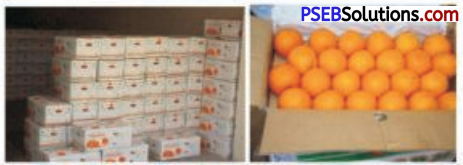
Corrugated fibre board boxes are used for the packing of high-value produce like, apple, mango, grapes, kinnow, peach, litchi, plum etc.

(C) Answers in five to six sentences:

Question 1.
What do you mean by waxing of fruits and what are its benefits?
Answer:
During marketing of the produce there is a loss of water contents which affect the natural gloss and quality of the produce. Fruits like, Kinnow, Peach etc. and vegetables like, Brinjal, Capsicum, Tomato, Cucumber etc. are waxed after harvesting. At the time of grading, washing or doing other preserving activities natural wax is removed. Rewaxing with food grade wax is done. Waxing helps in maintaining water content of the produce at the time of marketing. Dry the produce after waxing. Food grade waxes which is approved by FSSAI are shellac wax, bees wax, camauba wax.

Question 2.
Write a brief note on ripening of fruits with ethylene gas.
Answer:
Ripening of fruits at commercial level is done by using ethylene gas which is internationally accepted technique. In this technique fruits are kept in an enclosed chamber where the produce is exposed to 100-150 ppm of ethylene gas for 24 hours. This triggers the ripening process. Temperature should be maintained between 15 to 25 °C and humidity should be 90-95% ethylene gas is produced by using ethylene generator.

PSEB 8th Class Agriculture Solutions Chapter 10 Post Harvest Handling of Fruits and Vegetables

Question 3.
Write a short note on shrink and cling film packing of fruit.
Answer:
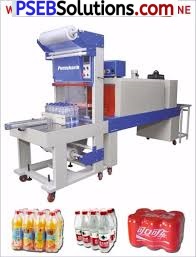
Fruits and vegetables are packed in a paper tray and wrapped with shrink or cling film.
PSEB 8th Class Agriculture Solutions Chapter 11 Processing of Fruits and Vegetables 1
The produce packed in this way remains visible to the cousumer and quality of the produce is also maintained. High value fruits and vegetables like kinnow, tomato, seedless cucumber etc. are packed using this technique. Farmer can earn good profit using this technique.

Question 4.
What is the importance of packging of fruits in corrugated fibre board boxes?
Answer:
For secure transportation of the fruits and vegetables, packaging proves beneficial, it is necessary to avoid bruising of produce during the transportation. Corrugated fibre board boxes are used for packaging of high value produce; like, apple, mango, grapes, kinnow, litchi, plums, peach etc. paper shreds or pieces of cardboard paper are also used in these boxes so that fruits do not get pressed against each other.
PSEB 8th Class Agriculture Solutions Chapter 10 Post Harvest Handling of Fruits and Vegetables 2

Question 5.
What precaution should be taken during harvesting of fruits and vegetables?
Answer:
Fruits and vegetables should be harvested carefully so that least damage to the produce takes place should be done manually with modesty. Take out the produce from the soil using hands use cloth laps open at both ends at the time of harvesting. Save produce from injuries. Use clip, knife and scissors for harvesting fruits. Take care that clipper and knife used are clean and sharp. Kinnow like fruits should be harvested with very small stalk with the fruit. If the stalk is long then at the time of transportation other fruits can get injuries. Use ladder for plucking Kinnow, pears, peach, alucha, ber, mango, etc.

PSEB 8th Class Agriculture Solutions Chapter 10 Post Harvest Handling of Fruits and Vegetables

PSEB 8th Class Agriculture Guide Post Harvest Handling of Fruits and Vegetables Important Questions and Answers

Very Short Answer Type Questions

Question 1.
According to WHO (World Health Organisation) how much fruits and vegetables should be consumed by a person in a day?
Answer:
300 gram vegetables and 80 gram fruits.

Question 2.
In India how much fruits and vegetables are available for a person per day?
Answer:
30 gram fruits and 80 gram vegetables.

Question 3.
How can we loiow about the maturity for harvesting of the tomato, mango, peach etc.?
Answer:
By using color chart.

Question 4.
What is the parameter for maturity of peachy?
Answer:
Turning from green color to yellow.

PSEB 8th Class Agriculture Solutions Chapter 10 Post Harvest Handling of Fruits and Vegetables

Question 5.
What is the parameter for maturity of guava?
Answer:
Turning deep green color to light green color.

Question 6.
What is the parameter for maturity of potato.
Answer:
Vines show sign of senescence (drying).

Question 7.
What is the parameter for maturity of plums?
Answer:
Reddish colour on 1/4 to 1/2 of surface.

Question 8.
What is parameter for maturity of bell Pepper?
Answer:
Fully developed fruit and green shining.

Question 9.
What is parameter for maturity of pea?
Answer:
Pods filled but not faded in colour.

Question 10.
What type of wax is coated on the fruits.
Answer:
Food grade wax like bees wax.

PSEB 8th Class Agriculture Solutions Chapter 10 Post Harvest Handling of Fruits and Vegetables

Question 11.
How is packaging of onion and potato in done?
Answer:
Using jute sacks.

Question 12.
For how many days kinnows can be stored in cold store?
Answer: 1 1/2 to 2 months.

Question 13.
How much moisture content should be in potato and kinnow at the time of storing in cold storage?
Answer:
90-95%.

Question 14.
What are the harmful effects of fruits ripened by calcium carbide?
Answer:
Blisters in mouth, ulcer, acidity in stomach.

Question 15.
For how much time fruits are exposed to ethylene gas in enclosed chamber?
Answer:
24 hours.

Question 16.
Name two fruits on which wax is coated?
Answer:
Kinnow, peach.

PSEB 8th Class Agriculture Solutions Chapter 10 Post Harvest Handling of Fruits and Vegetables

Question 17.
What is the maturity parameter for harvesting of fruits and vegetables.
Answer:
Size and colour- of these.

Question 18.
What instrument is used to measure the firmness of fruits?
Answer:
Pentrometer.

Question 19.
What is the relation between firmness and maturity?
Answer:
Mature fruit is less firm i,e. it becomes soft.

Question 20.
How to make fruits free from bacteria at home?
Answer:
Using bleaching soloution.

Question 21.
Which type of containers are used to store fruits?
Answer:
Containers should have plane inner surfaces.

PSEB 8th Class Agriculture Solutions Chapter 10 Post Harvest Handling of Fruits and Vegetables

Question 22.
What should be done to protect produce from injuries?
Answer:
Produce should be placed between layers of paper or cardboard.

Question 23.
What is the main purpose of canning?
Answer:
Main purpose of canning is to preserve the produce for a long time.

Question 24.
How grapes and Alucha should be cleaned?
Answer:
These should be cleaned using 100-150 ppm chlorine water. This way produce can be protected from diseases.

Question 25.
How grading is done for round shaped produce?
Answer:
These can be graded by using different sizes of rings.

Question 26.
Which chemicals are used to treat the produce after plucking?
Answer:
Calcium chloride, Sodium bisulphate, Potassium sulphate etc.

Question 27.
Name water tolerating crops.
Answer:
Carrot, tomato, turnip.

PSEB 8th Class Agriculture Solutions Chapter 10 Post Harvest Handling of Fruits and Vegetables

Question 28.
Which vegetables should not be washed before packing?
Answer:
Cabbage, Bhindi, peas.

Question 29.
Which fruits are graded on the basis of maturity?
Answer:
Tomato, Banana, Mango etc.

Short Answer Type Questions

Question 1.
How do we know the maturity of fruits? Describe in detail.
Answer:
Size of the fruits is a measure of their maturity. Mango is ready to be for harvesting when a beak appears on the fruit. For checking the ripening of tomato, peach, plums etc. coloured charts are used. For nearby market tomatoes should be red and for a distance market, these should be of pink colour but for very far away market full sized yet green tomatoes should be harvested.

Question 2.
How the hardness index of fruits be determined?
Answer:
Following method is used to determine the hardness index:
With the help of a sharp knife cut a thin slice. Slice is having pulp and skin of the fruit. Place the fruit on a plane hard surface and with the help of a proper sized plunger measure the hardness of the fruit. For this start pressing the fruit on the plunger with uniform speed. Measure the hardness index of the fruit from marks on the plunger.

PSEB 8th Class Agriculture Solutions Chapter 10 Post Harvest Handling of Fruits and Vegetables

Question 3.
What is Refractometer? For which fruits it is used?
Answer:
To measure the sweetness of the fruits refractometer is used. This is used for fruits like grapes, muskmelon etc.

Question 4.
How the acidity of the fruit is measured?
Answer:
When citrus fruits are ripe, there sourness decreases. To know the acidity, one or two drops of phenolphthalein are added to measured volume of fruit juice. In it add 0.1 N of sodium hydroxide solution drop by drop till the colour of juice changes to pink. From the used sodium hydroxide and given volume of juice, acidity of the juice can be measured.

PSEB 8th Class Agriculture Solutions Chapter 10 Post Harvest Handling of Fruits and Vegetables

Question 5.
How is ratio of percentage of sweetness and sourness is measured?
Answer:
By knowing this ratio quality of the fruit is judged. Percentage sweetness and sourness are measured and value of sweetness is divided by value of sourness to know the ratio.

Question 6.
What do you know about preservation to fruits?
Answer:
Every fruit is available in the market in a particular period of time of the year and it is available in plenty and it can be bought for comparatively less price. On these days fruits should be bought and preserved. More income can be earned by selling these in far away markets and by selling in off-season.

Question 7.
Why is it necessary to preserve vegetables?
Answer:
If vegetables are not preserved then more profit can not be earned, when vegetables are cheap in the season, buy and preserve the vegetables. These can be sold in off season and more profit can be earned.

Question 8.
How canning is profitable?
Answer:
By canning or packing, we can avoid the losses which may occur after plucking. This way more profit can be earned.

Question 9.
What is the use of Penetro meter?
Answer:
It is a device which is used to measure the hardness of the fruit.

Question 10.
Why is it necessary to (pluck kinnow with small stalk) keep the stalk short while plucking kinnow?
Answer:
If the stalk is long it can injure the other fruits while transportation. Thus kinnow are plucked or harvested with small stalks.

PSEB 8th Class Agriculture Solutions Chapter 10 Post Harvest Handling of Fruits and Vegetables

Question 11.
What is the importance of quality of crops?
Answer:
If quality is maintained then transportation, storage and marketing can be done for a long span of time and thus, more profit can be earned. This way consumer, exporter and trader all feel satisfied.

Long Answer Type Questions

Question 1.
What is the importance of plastic trays in {he preservation (storage) of fruits and vegetables?
Answer:
Plastic trays are costly, but these can be cleaned easily and used again and again. Air can pass through them because these have holes. These can be stacked over each other. At the time of harvesting, these prove very helpful. These can be used at time of harvesting, for storage, for transportation and for selling in the market. These trays are used for harvesting, storage and transportation of Kinnow, grapes, tomato etc.

Question 2.
What are merits of good quality produce?
Answer:
Following are the merits of good quality produce:

  • This type of produce can be transported, marketed and stored for a longer time.
  • This type of produce gives satisfaction to exporters, traders and consumers.
  • Produce have long life after harvesting.
  • Marketing sphere also grows big.
  • More profit can be earned on selling such a produce.

Question 3.
What do you know about cooling, sorting and cleaning of the produce after harvesting?
Answer:
1. Cooling of the produce:
For long shelf life of the produce, it is allowed to cool down. The method of cooling depends on the type of produce. Different methods of cooling are with blowing cool air, cooling in a room, cooling with cold water. Any of the method can be used.

2. Sorting and cleaning of the produce:
Sorting and grading of the produce is done, injured, diseased and irregular shaped produce is separated out. Then it is cleaned, method of cleaning depends on the type of produce. Apples are cleaned using dry brushes whereas citrus fruits, carrots etc. are washed with water. Whether to use dry brushes or water for cleaning depends on the type of produce and extent of cleanliness, e.g. grapes and aluchas are never to be cleaned wash.

These fruits are made disease free by using 100-150 ppm chlorine water. Before packaging of cabbage and cauliflower etc., non eatable parts should be removed.

PSEB 8th Class Agriculture Solutions Chapter 10 Post Harvest Handling of Fruits and Vegetables

Question 4.
What do you know about grading and marketing of fruits and vegetables?
Answer:
Grading is done on the basis of size, weight, colour etc. Graded produce can earn more profit. Round fruits like tomato, tinda, apple etc. are graded using different sized rings. More profit can be earned if grading is done on the basis of maturity of produce like tomato, barihna, mango etc. Some type of machines on small scale can also be used for grading.

Fully grown but green tomato, mango etc. can be stored for sometime and when the rates in the market are on rise these can be ripened and sold to earn more profit. Green onion, mint, coriander leaves etc. are packed into bundles of 100 grams and 500 grams. This way these can be transported easily.

Question 5.
What do you know about the treatment of produce after harvesting?
Answer:
If produce is treated after harvesting it can be saved from various types of fungal diseases and many other diseases. Chemicals used for the treatment are potassium sulphate, sodiumbisulphite, calcium chloride etc. Some times produce is treated using hot water and blowing hot wind. This way germs are either killed or become weak and the produce is saved from disease. After the use of hot air or hot water, produce should be cooled down immediately by using showers of cold water or cold wind.

Question 6.
Which precautions should be kept in mind, while canning fruits and vegetables?
Answer:
Following precautions should be kept in mind while canning fruits and vegetables:

  • Do not allow the produce to get injuries.
  • Raw or more ripe fruits should be separated out.
  • Do not wash green vegetables, cabbage, bhindi, tomato, etc. before canning.
  • Chlorine used in water should not be more than 100-150 ppm.
  • Water tolerant produce like tomato, carrot, turnip, etc. should be collected in the water-filled tank (chubacha).
  • The table surface on which produce is washed, graded, or packed should be made smooth by placing sponge pieces at comers or edges or irregular points.
  • Do not use restricted chemicals on the produce.
  • Treat the produce after harvesting using proper methods like waxing, hot air, water, sulphar dioxide, etc.
  • To lessen the damage, produce should be canned in the fields.

PSEB 11th Class Sociology Solutions Chapter 5 Culture

Punjab State Board PSEB 11th Class Sociology Book Solutions Chapter 5 Culture Textbook Exercise Questions and Answers.

PSEB Solutions for Class 11 Sociology  Chapter 5 Culture

Sociology Guide for Class 11 PSEB Culture Textbook Questions and Answers

Answer the following very short answer questions in 1-15 words each:

Question 1.
State the basic elements of culture.
Answer:
Traditions, social norms and values are the basic elements of culture.

Question 2.
Who called culture a ‘total way of life of the people?
Answer:
These words are of Clyde Kluckhohn.

Question 3.
In what way is culture transmitted in non-literate societies?
Answer:
Because culture is a learned behaviour, that’s why in non-literate societies culture is transmitted through learning.

PSEB 11th Class Sociology Solutions Chapter 5 Culture

Question 4.
Give a broad classification of culture.
Answer:
Culture is of two types-material culture and non-material culture.

Question 5.
Name few examples of non-material culture.
Answer:
Views, norms, values, habits, ideals, traditions etc.

Question 6.
Who gave the theory of cultural lag?
AnsweR:
The theory of cultural lag was given by William F. Ogburn.

Answer the following short answer questions in 30-35 words each:

Question 1.
What is culture ?
Answer:
Our ways of living, philosophy, feelings, views, machines; tools etc. all material and non-material things and this is culture. All these things are produced and used by group. So, culture is that on which we work upon, think on it and keep it.

Question 2.
What is cultural lag ?
Answer:
Culture consists of two parts-material and non-material. Due to new inventions, change comes very quickly in material culture but our views, traditions etc. i.e. non-material culture does not change very quickly. As a result, gap is created between the two which is known as cultural lag.

PSEB 11th Class Sociology Solutions Chapter 5 Culture

Question 3.
What are social norms ?
Answer:
Each society makes certain rules for the behaviour of its members and these are known as norms. So, norms are few directions for behaviour. Norms regulate and direct the behaviour of individuals. They are very important aspects of culture.

Question 4.
What are the central values of modern India ?
Answer:
Democratic system, equality, justice, freedom, secularism etc. are the central values of modern India. Each society has its own central values. Small communities stress on any specific value but large societies stress on universal values.

Question 5.
Mention some values of traditional Indian society.
Answer:
Each society is having different values. One society streses on one value and other society stresses on the other. Important values of traditional Indian society are detachment, materialism and religion, attainment of four purusharthas, dharma, artha, kama and moksha.

PSEB 11th Class Sociology Solutions Chapter 5 Culture

Question 6.
How is the cognitive component of culture expressed ?
Answer:
The cognitive components of culture are expressed with the help of imagination, literature, art, religion and scientific theories. Views are expressed in literature and in this way the cognitive aspect of culture is preserved.

Answer the following short answer questions in 75-85 words each:

Question 1.
How is culture a total way of life of the people ?
Answer:
There is no denying fact that culture is a total way of life of the people. Whatever we have is our culture. Our views, ideals, habits, clothes, money, property etc. and whatever humans have achieved till today is our culture. If we separate all these from human life, nothing will be left in it and then human life will reach the level of early man. Yet each society has its different culture but they have certain elements which are common everywhere. So, we can say that culture is a total way of human life.

Question 2.
Write a note on material and non-material culture.
Answer:
The meaning of material culture is by that culture in which all the man made things are included. This culture is concrete because we can see or touch it such as scooter, T.V. table, chair, pen, bus, car etc. All these things are concrete and thus a part of material culture.

In non-material culture, all the things are included which are abstract in nature. We can neither see non touch them. We can just feel them such as traditions, customs, values, skills, norms etc. All such things are abstract so non-material culture is abstract in nature.

PSEB 11th Class Sociology Solutions Chapter 5 Culture

Question 3.
Discuss in brief the basic elements of culture.
Answer:

  1. Customs and traditions are the types of organised social behaviour which are used again and again. They are permanent ways of.behaviour. Each society has its own customs and traditions.
  2. Norms are also very essential elements of culture. It is expected from each person to behave in a specified way. Norms are the established ways of behaviour shared by the members of a group.
  3. Values are also its inseparable part. Each society has its own values and it is expected from every one to accept them.

Question 4.
‘Culture is learned behaviour’. Explain the statement with suitable examples.
Answer:
There is no denying the fact that humans learn their culture. It is not a biological trait which one gets from his parents in the form of genes. An individual learns culture gradually through the process of learning. No one is having views and ideas when he takes birth but all these he learns while living in society after interacting with others. Every type of action or activity is learned only while living in society. So, it is clear that culture is learned behaviour.

Answer the following short answer questions in 250-300 words each:

Question 1.
How does the understanding of culture in social analysis differ from the everyday use of the word ‘culture’ ?
Answer:
The meaning of everyday use of the word ‘culture’ is very much different from the meaning given by sociologists. In every usage, culture is limited only to art or life style of different countries. But the meaning given by sociology is very much different. Sociology says that whatever man has achieved from his early life till today is his culture. Traditions, ideas, norms, values, mores, chair, table, car, pen, books, written knowledge etc. Whatever man has achieved only while living in society is his culture, So, the meaning of culture given in both the senses is different from each other.

PSEB 11th Class Sociology Solutions Chapter 5 Culture

Question 2.
What do you mean by culture ? Highlight the characteristics of culture.
Answer:
The most important thing which differentiates humans from animals is the culture which humans have but animals don’t. The most important thing which human has is his culture. If the culture would be taken away from them then nothing would be left with them. In all the organisms of the world, only humans have the capability to make and preserve their culture.

Culture comes out of the interactions of humans. Culture not only comes out of human interaction but it shows the way to future’s human interactions. Culture helps in the formation of personality of a man and helps him to live in society. Culture makes that type of atmosphere in which man becomes capable of doing functions of society. In this way man and culture are connected very deeply with each other because culture differentiates man from animals.

Culture, is the mest important feature of human society. According to Aristotle, “Man is a social animal.” If we will describe the differences between man and animal then this culture will be the decisive factor of difference between them. Man himself creates his culture and has the capacity to preserve it for its future generation. Actually it is the product of human interactions #nd on the basis of this culture we can differentiate one society from the other.

We cannot understand human society without understanding the culture because culture exerts a lot of effect on the social life. Cultural factor is also an important factor of social change. In this way we can say that man is not only a biological man but is a cultural man as well. In common language culture is equated with education means literate person is a cultured man and illiterate person is a non-cultured man. But this meaning of culture is not correct. Sociology takes its meaning in very wide sense. According to sociologists any thing which man has made to fulfil his needs is culture.

Definitions:
1. According to Maclver and Page, “It is the expression of our nature in our modes of living and thinking, in our everyday course, in art, in literature, in religion, in recreation and enjoyment.”

2. According to Bierstedt, “Culture is the complex whole that consists of everything we think and do and have as members of society.”

3. According to Ogburn and Nimkoff, “It is that part of man’s total environment into which he alone is born. It consists buildings, tools, wearing apparel, art, science, religion and all the ways of doing things which man learns.”

4. According to Majumdar, “Culture is the sum total of human achievement, material as well as non-material capable of transmission, sociologically
i.e. tradition and communication critically as well as horizontally.”

5. According to Lundberg, “Culture refers to the social mechanism of behaviour and to the physical and symbolic product of these behaviours.”
From the given definitions it is clear that all those things are included in culture which a man learns while living in society like art, law, feelings, customs, ways of wearing, eating, literature, knowledge, belief etc.

All these things are the part of culture and they do not work separately but they work with each other and form an organization. This organization is known as culture. In short, the things which a man has learnt and whatever he has got from his ancestors as heritage is known as culture. In heritage tools, ways of behaviour, ways of science, ways of doing work are included.

PSEB 11th Class Sociology Solutions Chapter 5 Culture

Functions or Characteristics of Culture:
1. Culture is transmitted from generation to generation. Culture is transmitted from one generation to another because a child learns many things from the behaviour of his parents. Man learns a lot from the achievements of his ancestors. No one wants to start any thing from the beginning and that’s why he takes care of that work which his ancestors have done.

This transmission is going on from the ages and that’s why every one gets separate personality. No one brings any thing with his birth. He needs to learn every thing by living in society with his parents, grandparents etc. In’this way culture is transmitted from one generation to another.

2. Culture is social. Culture cannot become the personal property of an individual. It is social because neither one man can make the whole culture and nor it is property of anyone. When any one invents any thing then that invention is not his personal thing but becomes property of society because that thing will be used by the whole society.

In this way different things of our culture are used by society. Any thing can be called a part of the culture at that time when that thing will be accepted by most of the people of society. In this way universality of that thing-is an essential element of culture. So culture is not individual but is social.

3. Culture can be learned. Culture is learned by humans. It is not a biological quality which a person gets from his parents by birth. Man learns culture by socialization. No one brings thoughts and ideas by birth but he learns them by interacting with other persons of society. Every type of work is learned by society. From this it is clear that culture is a learned behaviour.

4. Culture fulfills needs of society. If any thing is invented then that thing is invented because man needs that thing. In this way every thing of culture comes out so that the needs of man could be fulfilled. Why man learnt to grow wheat, because he needs wheat for his hunger. In this way man learnt to grow food and this learned behaviour is transmitted from generation to generation.

Needs are not only biological but are sociocultural also. With hunger, man needs love and sympathy which a man learns while living in society. In this way different parts of culture fulfil different needs of society. Whichever part of culture is unable to fulfil the needs of society, gradually it comes to an end.

5. Changes often come in culture. Culture never stops at one place but often changes because nothing is unchangeable in the world. Change is law of nature and if change is necessary then culture is also changeable. Culture fulfills all the needs of society which generally change with the passage of time because situations are not the same all the times.

With the change in situations, needs also change which means, the methods of fulfilling those needs also change. For example during earlier times agriculture was done with old means like plough but with the increase of population, needs were also increased and that’s why now agriculture is being done with tractors and combines to fulfil the increased needs. So with the change in situation, culture is also bound to change.

PSEB 11th Class Sociology Solutions Chapter 5 Culture

6. One culture consists of many cultures. In every culture we can see some common norms, traditions, feelings, rituals, behaviour etc. but with that we can see many types of ways of eating, wearing, ways of living, behaviour, etc. From this it is clear that one culture consists of many cultures. For example we can see many subcultures in Indian culture because every one has its own ways of living, behaving, eating etc. from which it is clear that one culture has many cultures.

Question 3.
Explain the two types of culture in detail.
Answer:
Culture is an important factor for social change. With the change in culture, society also changes because it is the social heritage of society. Famous sociologists Ogburn and Nimkoff,’in their book ‘Hand Book of Sociology’, have given two types of culture and these are :
(1) Material Culture
(2) Non-material Culture.

1. Material Culture:
Material culture is artificial culture. Its main feature is that all the things made by man are included in this. Material culture is related to concrete things. We can touch and see all the things of material culture. For example machines, tools, means of transport, books, phone, etc. Material culture is related with inventions of man.

New technological knowledge is also included in material culture. Everything is included in this type of culture which is made, changed and transmitted till today. These material aspects of culture help its members to define their behaviour. For example the people engaged in agriculture have occupation but they use different implements and tools. All these are the‘‘parts of material culture.

2. Non-material Culture:
Important feature of non-material culture is that it is abstract. Abstract means those things which we cannot touch, and see. We can only feel them. For example religion, traditions, rituals, customs, art, literature, music, values, ideas etc. are included in non-material culture. According to Ogburn and Nimkoff, culture is divided in two parts for the easiness of subject or just for analytical purposes.

PSEB 11th Class Sociology Solutions Chapter 5 Culture

Question 4.
Write a detailed note on cultural lag.
Answer:
First of all the concept of cultural lag was used by Ogburn to understand the problems of society and conditions of conflict. Ogburn was the first sociologist who has given the detailed meaning of the concept of Cultural Lag. Yet other sociologists like Spencer, Sumner, Muller etc. have also used the concept of cultural lag in their writings but Ogburn has used this concept in his book ‘Social Change’ to understand social disorganization problems and conflict. In sociology, this concept was accepted widely.

Meaning of Cultural Lag. According to Ogburn and Nimkoff, change in different parts of culture never comes with the same speed. The speed of change of one part is more as compared to the other. But culture is a system. It is made up of many parts. Its different parts are inter-connected and inter-related. This system of culture can be maintained if the change in all arts of culture will come at the same speed. Actually what happens is that if one part of culture changes due to any invention then another part of the culture, which depends upon that part, also changes. But the change in the second part comes very late.

How much time will this second part take, depends upon the nature of the second part. This lateness goes on for many years because of which problem comes in the system. This lag in different parts of culture is known as Cultural Lag. According to Ogburn, “The thesis is that the various parts of modern culture are not changing at the same rate, some parts are changing much more rapidly than others, and that since there is co-relation and inter-dependence of parts, a rapid change in one part of our culture requires re-adjustments through other changes in the various co-related parts of culture. where one part of culture changes first, through some discovery or invention and occasional changes in some part of culture-dependent upon it, there frequently is a delay in the changes occasioned in the dependent part of the culture.”

PSEB 11th Class Sociology Solutions Chapter 5 Culture

The meaning of lag is to stay behind. Ogburn has given example to explain the meaning of ‘Lag’. According to him, anything is made of two parts. If change comes in one part of that thing then this change will definitely affect the other parts. This part, which is affected by that change, slowly and slowly changes automatically. These changes come slowly and slowly take some time. This difference of time is known as lag or to stay behind. Ogburn has explained the concept of cultural lag in this way.

According to him, culture has two parts that are interrelated. If ally change comes in one part then the second part is bound to be affected by that change. This second part slowly and slowly adapts itself to change and makes itself according to that change. But this adaptation takes some time. This difference of time, which is there between ‘change and adaptation, is known as cultural lag. When any part of culture moves forward with some development or invention and the second part lags behind then we can say that cultural lag exists.

According to Ogburn, culture has two parts (1) Material Culture (2) Non-material Culture. In material culture, all those things are included which we can touch and see like a machine, table, chair, book, T.V. scooter, etc., and in non-material culture all those things are included which we cannot see and touch, only we can feel them. For example, habits, thought, behaviour, feelings, customs, etc. Both parts are closely interrelated. If change comes in any part then the second part is bound to change.

This law is also applicable to material and non-material cultures. Changes often come in material culture and these changes come very fast because of new inventions. Material culture changes very fast but the speed of changes in non-material is very slow. That’s why because of rapid changes material culture moves forward but non-material culture, whose speed is very slow, lags behind. In this way, the lagging behind of the non-material culture from the material culture is known as cultural lag.

According to Ogburn, change comes in material culture with great speed because people want to use material things in a proper way. To use material things we need money and there is no need to move away from traditions and thoughts. For example, we are ready to buy Fridge, T.V., Scooter, Car, etc. but are not willing to change our customs and traditions. With one more example everything will be clear.

PSEB 8th Class Science Solutions Chapter 16 Light

Punjab State Board PSEB 8th Class Science Book Solutions Chapter 16 Light Textbook Exercise Questions and Answers.

PSEB Solutions for Class 8 Science Chapter 16 Light

PSEB 8th Class Science Guide Light Textbook Questions and Answers

Exercises

Question 1.
Suppose you are in a dark room. Can you see objects in the room ? Can you see objects outside the room ? Explain.
Answer:
No, we cannot see anything in dark. As no light is falling on the objects in the room and they are not emitting any light on their own. So, nothing is visible inside the dark room.
Objects outside the room can be seen, if either there is light outside the room or objects are emitting their own light.

Question 2.
Differentiate between regular and diffused reflection. Does diffused reflection mean the failure of the laws of reflection ?
Answer:
Differences between regular reflection and diffused reflection:

Regular reflection Diffused reflection
1. It occurs on a smooth, plane surface. 1. It occurs on a rough, irregular surface.
2. Reflected rays are parallel to one another. 2. Reflected rays are unparallel to each other.

Diffused reflection is not failure of laws of reflection. It is only due to irregularities on the reflecting surface.

PSEB 8th Class Science Solutions Chapter 16 Light

Question 3.
Mention against each of the following whether regular or diffused reflection will take place when a beam of light strikes. Justify your answer in each case.
[a] Polished wooden table
[b] Chalk powder
[c] Cardboard surface
[d] Marble floor with water spread over it.
[e] Mirror
[f] Piece of paper.
Answer:
(a) Polished wooden table. Regular reflection, as wooden table has smooth polished surface.
(b) Chalk powder. Diffused reflection due to rough surface of chalk powder.
(c) Cardboard surface. Diffused reflection because cardboard has small irregularities on its surface.
(d) Marble floor with water spread over it. Regular reflection as water gives a smooth surface.
(e) Mirror. Regular reflection due to smooth surface.
(f) Piece of paper. Regular reflection if paper is fine and diffused reflection if paper is coarse.

Question 4.
State the laws of reflection.
Answer:
Laws of reflection.

  1. Angle of incidence (∠i) = Angle of reflection ( ∠r).
  2. Incident ray, reflected ray and the normal at the point of incidence all lie in the same plane.

Question 5.
Describe an activity to show that the incident ray, the reflected ray, normal, the point of incidence lie in the same plane.
Experiment.
Take a white sheet, spread it on a table. Draw a line MM on it. Place a plane mirror vertically on this line. Now throw light on a comb in this ways that a parallel light rays fall on the mirror. Adjust it in such a way that a beautiful pattern of incident and reflected rays is formed. Now mark points A, B, C on incident ray and points D, E, F on its corresponding reflected ray. Switch off the torch and remove the mirror. Join the points and extend line to mirror. ABC will meet MM at O and DEF will all also be meeting at O. OA is incident ray and OF is reflected ray. Draw ON ⊥ MM .
PSEB 8th Class Science Solutions Chapter 16 Light 1
Measure the angle of incidence ∠AON and the angle of reflection ∠FON which would found to be equal. Incident ray, reflected ray and normal, all lie in one plane of paper.

Question 6.
Fill in the blanks in the following.
(a) A person 1 m in front of a mirror seems to be ……………….. m away from his image.
(b) If you touch your ………………….. ear with right hand in front of a plane mirror it will be seen that your right ear is touched with ……………… .
(c) The size of pupil becomes …………………. when you in dim light.
(d) Night birds have ………………. cones than rods in their eyes.
Answer:
(a) 2m
(b) Right, Left
(c) large
(d) more.

Choose the correct option in the Questions 7-8.

Question 7.
Angle of incidence is equal to angle of reflection
(a) Always
(b) Sometimes
(c) Under special conditions
(d) Never.
Answer:
(a) Always.

PSEB 8th Class Science Solutions Chapter 16 Light

Question 8.
Image formed by a plane mirror is
(a) virtual, behind the mirror and enlarged.
(b) virtual, behind the mirror and of same size as the object.
(c) real at the surface of mirror and enlarged.
(d) real, behind the mirror and of same size as the object.
Answer:
(b) Virtual, behind the mirror and of same size as the object.

Question 9.
Describe the construction of a Kaleiodeoscope.
Answer:
PSEB 8th Class Science Solutions Chapter 16 Light 2
Construction of a Kaleiodeoscope. It is a toy to form many images by multiple reflections. A Kaleiodeoscope is made up of three strips of plane mirrors inclined at angles of 60° enclosed in a tube. One end of tube has a ground glass plate with a clear glass plate on its inner side. A metallic ring separates the two plates and the space is filled with coloured pieces of glass or broken bangles. A cardboard with a hole in the centre is fixed on the other end of the tube.

Question 10.
Draw a labelled sketch of the human eye.
Answer:
Labelled diagram to show different parts of human eye.
PSEB 8th Class Science Solutions Chapter 16 Light 3

Question 11.
Gurmit wanted to perform activity 16.8 using a laser torch. Her teacher advised her not do so. Can you explain the basis of the teacher’s advice ?
Answer:
Laser torch has very sharp beams of light which can destroy the pupil or retina of the eye.

Question 12.
Explain how can you take care of your eyes.
Answer:
Care of eyes.
Eyes are the most precious gifts of nature. So we should take full care of our eyes by taking atleast following precautions.

  1. We should wash our eyes daily with clean water.
  2. We should not read or work in very bright or dim light.
  3. We should not read in a running vehicle.
  4. We should not rub our eyes.
  5. We should use sunglasses on hot summer day.
  6. We should not look directly at the sun. Also we should not look at the sun during solar eclipse.
  7. We should eat vitamin A rich food for healthy, clear eyes.

Question 13.
What is the angle of incidence of a ray if the reflected ray is at an angle of 90° to the incident ray ?
Solution:
PSEB 8th Class Science Solutions Chapter 16 Light 4
If ∠i = angle of incidence
∠r = angle of reflection
∠i + ∠r = 90 (given)
But ∠i = ∠r
(According to laws of reflection)
∴ ∠i + ∠i = 90°
2 ∠i = 90
∠r = ∠i – 45°

PSEB 8th Class Science Solutions Chapter 16 Light

Question 14.
How many images of a candle will be formed if it placed between two parallel mirrors separated by 40 cm ?
Answer:
PSEB 8th Class Science Solutions Chapter 16 Light 5
When mirrors are separated by 40 cm and are parallel to each other so that the angle between the mirrors is 0° which is not sulj-multiple of 360°. Then theoretically, the number of images formed would be infinite, but as a considerable amount of light is lost due to reflections so only a limited number of images are seen which is shown in figure.

Question 15.
Two mirrors meet at right angles. A ray of light is incident on one at an angle of 30° as shown is figure. Draw the reflected ray from the second mirror.
PSEB 8th Class Science Solutions Chapter 16 Light 6
Solution:
PSEB 8th Class Science Solutions Chapter 16 Light 7

Question 16.
Bhoojo stands at A just on the side of a plane mirror as shown in figure. Can he see himself in the mirror ? Also can he see image of objects situated at P, Q and R ?
PSEB 8th Class Science Solutions Chapter 16 Light 8
Solution:
Bhoojo cannot see his image in the mirror as he is standing outside the edge of mirror. He can see the images of P and Q easily but not the image of R.
PSEB 8th Class Science Solutions Chapter 16 Light 9

Question 17.
(a) Find out the position of image of an object situated at A in plane mirror.
(b) Can Paheli at B see this image ?
(c) Can Bhoojo at C see this image ?
(d) When Paheli moves from B to C where does the image of A move ?
PSEB 8th Class Science Solutions Chapter 16 Light 10
Answer:
PSEB 8th Class Science Solutions Chapter 16 Light 11
(a) The image of A in the mirror will be as far behind as the object in front of the mirror.
(b) Yes, Paheli can see the image.
(c) Yes, Bhoojo can see this image.
(d) When Paheli moved from B to C, the image of A will not move forward.

PSEB 8th Class Science Solutions Chapter 16 Light

PSEB Solutions for Class 8 Science Light Important Questions and Answers

Multiple Choice Questions

Question 1.
The plane and polished surface that returns light falling on it in the same direction or any other direction is called:
(a) Lens
(b) Prisom
(c) Mirror
(d) Kaleidoscope.
Answer:
(c) Mirror.

Question 2.
How many colours are present in white sunlight ?
(a) 2
(b) 5
(c) 7
(d) 3.
Answer:
(c) 7.

Question 3.
What is the most convenient distance for reading by a normal eye ?
(a) 10 cm
(b) 25 cm
(c) 15 cm
(d) 20 cm.
Answer:
(b) 25 cm.

Question 4.
When you see in dim light the size of your pupil becomes:
(a) Small
(b) Large
(c) Neither small nor large
(b) Very small.
Answer:
(b) Large.

Question 5.
The Phenomena of splitting of light into its constituent colours is called:
(a) Reflection
(b) Refraction
(c) Dispersion
(b) Combination.
Answer:
(c) Dispersion.

Question 6.
The eye lenses focuses:
(a) On Cornea
(b) On Retina
(c) On Iris
(d) None of these.
Answer:
(b) On Retina.

PSEB 8th Class Science Solutions Chapter 16 Light

Very Short Answer Type Questions

Question 1.
Can any one see in the dark ?
Answer:
No.

Question 2.
It is what that helps us to see objects ?
Answer:
Light.

Question 3.
Name any two Luminous bodies.
Answer:

  1. Sun
  2. Electric bulb.

Question 4.
Is moon a luminous or a non-luminous body ?
Answer:
Non-luminous.

Question 5.
Where is a reflection seen ?
Answer:
In mirror.

Question 6.
Which surface can act as a mirror ?
Answer:
Any polished and smooth surface.

PSEB 8th Class Science Solutions Chapter 16 Light

Question 7.
If you are standing in front of a mirror and observing your own image what is the relation between the distance of the object and the image from the mirror ?
Answer:
Distance of object from the mirror = Distance of image from the mirror.

Question 8.
What is the angle of reflection, when a ray of light is incident normally on a plane mirror ?
Answer:
Zero.

Question 9.
Name two objects which split white light into many colours.
Answer:
Water bubbles, surface of CD, prism.

Question 10.
Name the seven colours of light.
Answer:
Red, orange, yellow, green, blue, indigo and violet.

Question 11.
Give one example of dispersion of light in nature.
Answer:
A rainbow.

Question 12.
Is focal length of eye lens fixed ? If not, why ?
Answer:
No. Eye lens has variable focal length. Focal length of Eye lens varies due to action of ciliary muscles.

PSEB 8th Class Science Solutions Chapter 16 Light

Question 13.
What is the function of sclerotic in human eye ?
Answer:
Sclerotic provides a solid shape to the eye and protects it from external injuries.

Question 14.
What is the function of ciliary muscles in human eye ?
Answer:
Eye lens is held in its position by ciliary muscles. Ciliary muscles help the eye lens to change its focal length by adjusting its curvature.

Question 15.
What is the function of rods on the retina ?
Answer:
Rods are sensitive to intensity of light. The more the intensity of light, more are they excited.

Question 16.
What are cones ?
Answer:
Cones on retina are sensitive to different colours. If cones are absent or insufficient, the person is colour blind.

Question 17.
What is basic cause of colour blindness ?
Answer:
It is due to absence or insufficient number of cones on the retina. Seeing sun or towards it during solar eclipse may cause colour blindness.

Question 18.
Why cats and bats are able to see at night ?
Answer:
They have very large number of rods on retina. Hence, they are able to see even a small quantity of light.

Question 19.
At what rate the images pass one after the other on a cinema screen ?
Answer:
25 or more per second.

PSEB 8th Class Science Solutions Chapter 16 Light

Question 20.
What type of photosensitive cells are present on the retina of the eye ?
Answer:
Cones and rods.

Question 21.
Name one device that can be used by short statured person to see over the head of a crowd.
Answer:
Periscope.

Question 22.
Find out the letters of English alphabet or any another language known to you in which the image formed in a plane mirror appears exactly like the letter itself.
Answer:
PSEB 8th Class Science Solutions Chapter 16 Light 12

Short Answer Type Questions

Question 1.
What are luminous and non-luminous bodies ? Give examples.
Answer:
Luminous Bodies.
Those objects which emit their own light, are called luminous bodies e.g. sun, stars, burning fire, radium etc.

Non-luminous Bodies.
Those objects which do not emit light of their own but shine due to other luminous bodies, are called Non-Luminous bodies. They are visible only, when light falls on them.
e.g. Moon, earth and other planets, things in a room.

Question 2.
How do we see objects ?
Answer:
When light from a light source falls on any object, it is scattered by it. The scattered light enters our eyes to form the image of the object and the object is, thus, seen.

Question 3.
Give the conditions necessary for seeing an object.
Answer:
Conditions for Seeing Objects. To see an object, the following three conditions are required to be satisfied:

  1. Source of light to make object visible
  2. The object
  3. Eye sight.

Question 4.
What is a virtual image ? Give one situation where a virtual image is formed.
Answer:
Virtual image.
An image, which cannot be obtained on a screen, is called a virtual image. Virtual image is formed when reflected rays do not actually meet at a point.
Image formed in a plane mirror is always virtual.

PSEB 8th Class Science Solutions Chapter 16 Light

Question 5.
What do you understand by lateral inversion ?
Answer:
Lateral Inversion.
In a plane mirror, the right side of the object becomes left side of the image and the left side of the object becomes right side of the image. That is the image is sideways inverted. This phenomenon, is called lateral inversion.

Question 6.
State the laws of reflection of light.
Answer:
Laws of reflection.
The reflection at the smooth surface is found to obey the following two laws, called the laws of reflection.

  1. The angle of incidence is equal to the angle of reflection
    i.e., ∠i – ∠r.
  2. The incident ray, the reflected ray and the normal at the point of incidence lie in the same plane.

Question 7.
What is diffused reflection and regular reflection ?
Answer:
Diffused Reflection.
It takes place when the surface is not smooth or polished e.g., wall, paper. The rays reflected from an uneven surface are not parallel but scattered in all directions and such reflection is called diffused reflection.
PSEB 8th Class Science Solutions Chapter 16 Light 13
Regular Reflection.
It takes place when a beam of light falls on a smooth and polished surface, e.g., a mirror. The reflected rays from an even surface form a clear image.

Question 8.
What do you understand by reflection of light ?
Answer:
Reflection of light.
When a ray of light falls on a mirror, or polished surface, it is sent back in a particular direction obeying certain laws of reflection. This phenomenon is known as reflection of light.

Question 9.
Define the following:
1. Reflected Ray
2. Angle of reflection.
Answer:
1. Reflected Ray. A streak of light, starting from the mirror, is called reflected ray.

2. Angle of reflection. The angle made by the reflected ray with the normal at the point of incidence is called angle of reflection. It is represented by r.

Question 10.
If incident ray strikes the mirror at 90°, what will be the angle of reflection ?
Answer:
If incident ray strikes the mirror normally, then after reflection, the ray will come back along the same path. As the angle of incidence is zero, so angle of reflection will also be zero.

PSEB 8th Class Science Solutions Chapter 16 Light

Question 11.
Define the term ‘Dispersion of light.’
Answer:
Dispersion of Light.
When a beam of light passes through a prism, the white light splits into seven colours. This phenomenon of splitting of white light into its constituent colours by a prism is known as dispersion of light.

Question 12.
While passing through a prism, why does the white light split into seven colours.
Answer:
The rays of different colours pass smoothly through air but when passing through a prism they have to change the speed according to the angle of prism. Different colours have different wave lengths and thus, they choose different paths. So, the spectrum is seen.

Question 13.
What is myopia ?
Answer:
Myopia.
The focal length of the eyes of some people is very small. Therefore, the image of distant object is not formed on their retina but it is formed at a point in front of the retina. In other words, they cannot see distant objects. This defect of vision is called Myopia or short sightedness.

Question 14.
What is hypermetropia ?
Answer:
Hypermetropia.
When people grow old, the muscles of the eyes lose their strength to control the curvature of the lens. As a result, the image of nearby objects is not formed at the retina, but it is formed behind the retina. So these people cannot see nearby objects clearly. This defect of vision is called Hypermetropia or Farsightedness.

Question 15.
Explain in short perception of colour.
Answer:
Perception of colour.
Human eye contains large number of rods and cones which are sensitive to light. Rods respond to the intensity of light and cones respond to the colour of the light. If cone cells are absent in the eye then such a person is colour blind. With the help of cones cells one can perceive colour. This is called perception of colour.

Question 16.
The following picture shows the reflection of light:
PSEB 8th Class Science Solutions Chapter 16 Light 14
(A) Name the ray AO
(B) Name the ray OB
(C) Find the value of angle x
Answer:
(A) Name of ray AO = Incident7 ray
(B) Name the ray OB = Reflected ray
(C) Value of angle x = 30° because angle of incidence is equal to angle of reflection.

Long Answer Type Questions

Question 1.
Differentiate between a real image and a virtual image.
Answer:
Differences between a real image and a virtual image.

Real Image Virtual Image
1. The real image is formed when the rays of light actually meet after reflection. 1. The image formed is virtual when the rays of light don’t meet after reflection.
2. Real image can be obtained on the screen. 2. Virtual images cannot be obtained on the screen.
3. Real image is always inverted. 3. Virtual image is always erect.

Question 2.
State the characteristics of the image formed by a plane mirror.
Answer:
Characteristics of the image formed in a plane mirror.

  1. The image is as far behind the plane mirror, as the object is in front of it.
  2. The image is laterally (sideways) inverted.
  3. The image is of the same size as that of the object.
  4. The image formed in a plane mirror is virtual, erect and of the same size as the object.
  5. The image formed in a plane mirror cannot be obtained on the screen.

PSEB 12th Class Sociology Important Questions Chapter 10 Social Problems: Alcoholism and Drug Addiction

Punjab State Board PSEB 12th Class Sociology Important Questions Chapter 10 Social Problems: Alcoholism and Drug Addiction Important Questions and Answers.

PSEB 12th Class Sociology Important Questions Chapter 10 Social Problems: Alcoholism and Drug Addiction

Multiple Choice Questions:

1. Which of these is the situation of social problem?
(а) Most of the people are affected by this
(b) This is an undesirable condition
(c) There is conflict in social values
(d) All of these
Answer:
(d) All of these

2. Which of these is the economic factor of social problem?
(a) Unemployment
(b) Poverty
(c) Slums
(d) All of these
Answer:
(d) All of these

PSEB 12th Class Sociology Important Questions Chapter 10 Social Problems: Alcoholism and Drug Addiction

3. What do we call the person who consumes alcohol once or twice in a year?
(a) Rare user
(b) Infrequent user
(c) Light drinker
(d) Moderate drinker
Answer:
(a) Rare user

4. What do we call the persons who start consuming alcohol right from the morning?
(a) Moderate drinkers
(b) Heavy drinkers
(c) Infrequent drinkers
(d) Light drinkers
Answer:
(b) Heavy drinkers

5. Which of these is a type of drug?
(a) opium
(b) cocain
(c) charas
(d) All of these
Answer:
(d) All of these

Fill in the Blanks:

1. The situation of ……………… is undesirable in society.
Answer:
Social problem

2. ……………….. is a type of drug which is drunk.
Answer:
Alcohol

3. Opium, Heroins, cocain come under the category of ……………….
Answer:
narcotics

4. ………………… and ……………….. can play a way important role in keeping children away from drugs.
Answer:
School, teacher

5. Consuming …………………. is having a bad effect on one’s health.
Answer:
drug

PSEB 12th Class Sociology Important Questions Chapter 10 Social Problems: Alcoholism and Drug Addiction

True/False:

1. Social problems affect most of the members of society.
Answer:
True

2. Heroin is a type of Narcotics.
Answer:
True

3. Drug addict always wants to consume drugs.
Answer:
True

4. The Union Government passed The Narcotic Drugs and Psychotropic Substances Act in 1955 A.D.
Answer:
False

5. There is no value conflict in social problems.
Answer:
False

PSEB 12th Class Sociology Important Questions Chapter 10 Social Problems: Alcoholism and Drug Addiction

One Word/One Line Questions Answers:

Question 1.
What is social problem?
Answer:
Social problem is that undesirable situation which everybody wants to change.

Question 2.
On what social problem depends?
Answer:
Social problem depends upon the values of society.

Question 3.
How many members of society get affected by social problems?
Answer:
Most of the members of society get affected by social problems.

Question 4.
Give socio-cultural factors of social problems.
Answer:
Untouchability, female foeticide, dowry, domestic violence, violence against women etc.

Question 5.
Give economic factors of social problems.
Answer:
Poverty, unemployment, slums, illiteracy, crime etc.

Question 6.
What is alcoholism?
Answer:
When any one starts consuming alcohol on frequent basis, it is called alcoholism.

Question 7.
Who is a rare user?
Answer:
One who consumes liquor once or twice in one year, he is called rare user.

Question 8.
Who is an infrequent user?
Answer:
One who consumes alcohol once in two-three months is an infrequent user.

Question 9.
Who is a light drinker?
Answer:
Light drinker is that who consumes alcohol once or twice in one mouth.

Question 10.
Who is a moderate drinker?
Answer:
Moderate drinkers is the one who consumes alcohol three-four time in one month.

PSEB 12th Class Sociology Important Questions Chapter 10 Social Problems: Alcoholism and Drug Addiction

Question 11.
Who is a heavy drinker?
Answer:
One who consumes alcohol on daily basis is a heavy drinker.

Question 12.
How much of the Indian population consumes alcohol atleast once during its lifetime?
Answer:
Around 42% of the total population.

Question 13.
Give one cause of alcoholism.
Answer:
People consume alcohol to ignore their tensions and problems.

Question 14.
Give one effect of alcoholism.
Answer:
It leatds to was tage of money and Loss of health.

Question 15.
What is a drug?
Answer:
Drug is a chemical which physiologically and psychologically affects our abillity to do work.

Question 16.
Give names of any four narcotics.
Answer:
Opium, cocain, Heroin, Marijuana, charas etc.

Question 17.
When was the Narcotic Drugs and Psychotropic Substances Act passed?
Answer:
This law was passed in 1985 A.D.

Very Short Answer Type Questions:

Question 1.
Give two features of social problems.
Answer:

  • Social problems are such unwanted circumstances with which most of the members of society are directly or indirectly affected.
  • About social problems, most of the members of society believe that their solution is must.

Question 2.
Give socio-cultural factors of social problems.
Answer:
In India, people of many religions, castes and lingual groups live with each other. That’s why many socio cultural problems occur over here such as untouchability, female foeticide, dowry, domestic violence, violence against women etc.

PSEB 12th Class Sociology Important Questions Chapter 10 Social Problems: Alcoholism and Drug Addiction

Question 3.
Give three reasons of alcoholism.
Or
Two causes of alcoholism.
Answer:

  • People consume alcohol to remove their tensions.
  • People get tired with their occupation and that’s “why they consume alcohol.
  • Many persons like to sit with their friends and they force him to consume alcohol.

Question 4.
Give three reasons of drug addiction.
Answer:

  • Many a times, peer group forces an individual to consume drug.
  • Sometimes, an individual feels alienated and to remove alienation, he starts to use drugs.
  • Many people are unable to face the situations in life and that’s why they start to use drugs.

Short Answer Type Questions:

Question 1.
Alcoholism.
Answer:
Alcoholism is a state in which the person is unable to keep control on his quantity of taking alcohol which he cannot stop after starts to using it. Alcohol cannot be called as stimulant but it acts as a inhibitor on our nervous system. When person starts to use it, he feels himself free from all the tensions and he slowly slowly starts to use too much quantity of it. Alcoholism not only reduces his work efficiency but it destroys his family as well.

Question 2.
Alcoholic Person.
Answer:
Alcoholic person is that person who uses alcohol or drinks alcohol. Person, who is a compulsive drinker, cannot live without drinking alcohol. In this way the person who cannot live without drinking alcohol is known as alcoholic person. He is unable to keep control on himself. He drinks daily and goes to such extent that he cannot do any work without alcohol. His body starts to shiver in its absence.

PSEB 12th Class Sociology Important Questions Chapter 10 Social Problems: Alcoholism and Drug Addiction

Question 3.
Types of Alcoholic Persons.
Answer:

  • Rare alcoholic: Who drinks once or twice in a year.
  • Infrequent alcoholic: Who drinks once in two or three months or drinks only in any marriage or party.
  • Lighter user alcoholic: Who drinks once or twice in a month to enjoy his holiday.
  • Moderate user alcoholic: Who drinks thrice or four times in month to enjoy his holiday.
  • Heavy user alcoholic: Who drinks alcohol many times in a day or who drinks daily.

Question 4.
Occupation-cause of Alcoholism.
Answer:
In many cases, occupation becomes a cause of alcoholism. Occupation of many persons is such that they become very much tired and they need something to do work again. It not only removes their tiredness but it also motivates them to work again the next day. In the same way many persons start to use alcohol to please other persons related occupations. For example, many times any worker has to drink with his owner or boss to please him and becomes an addict of it. In this way person has to drink alcohol due to his occupation and he becomes an addict of it.

Question 5.
Mental tension – Cause of Alcoholism.
Answer:
Every person is the victim of one or another mental tension. If some one does’t have money, so he is in tension to run his house. Some have money but are tensed for its safety, tension of business, tension of office, tension due to poverty, anyone is tense due to his owner, boss or wife, any one has fear of loss in business and someone is tensed due to competition. In this way every person is the victim of one or another type of tension. If he drinks alcohol then is nervous system relaxes for some time and for some time he becomes free from every type of mental tension.

Question 6.
Poverty-Cause of Alcoholism.
Answer:
A poor person is always in tension to earn money, His family members are more in number but he is the sole earner of the family. That’s why expenditure of the family is more but income is very less. Person always remains in tension of giving food, cloth and education to his children. That’s why he takes the help of the alcohol to remove his tension. He gets relief from his mental tensions for some time after using alcohol. In this way he starts to drink more quantity of alcohol and becomes an alcoholic.

Question 7.
Drug Addiction.
Answer:
When a person uses any subtance with which his body becomes dependent upon that substance or drug then it is known as drug addiction. Drug is that substance which directly affects the brain and nervous system of the person. In this way when a person becomes so dependent upon that drug that he cannot live without drug then it is known as drug addiction.

Question 8.
Drug Abuse.
Answer:
When a person starts using any illegal drug or misuses any legal drug then it is known as drug abuse. It damages person mentally as well as physically. Use of L.S.D. and Cocain, use of Heroin, Smoking of Hashish and Ganja, Alcoholism etc. all are included in this. Person enjoys fully in it. He goes on the trip of enjoyment. He could be able to do any work after its use unless he could not be able to do any thing.

Question 9.
Drug dependency.
Answer:
When person starts to use daily any drug legally or illegally and he cannot live without it then it is known as drug dependency. Dependency can be physical as well as mental. When a person uses any drug again and again grasps drug in itself then it is known as physical dependence. But when his body aches and he feels physical problems due to non use of that drug then it is a physical loss as well as mental loss.

PSEB 12th Class Sociology Important Questions Chapter 10 Social Problems: Alcoholism and Drug Addiction

Question 10.
Characteristics of Drug Addiction.
Answer:

  • Sudden wish occurs in the person to get drug in drug addiction.
  • In drug addiction he wants to get drug in any way unless his body stops working.
  • In drug addiction, there is a tendency to increase the dose slowly and slowly.
  • Person becomes physically and mentally dependent upon drugs in drug addiction.

Question 11.
Types of Drugs.
Answer:

  • Liquor or Alcohol
  • Sedatives
  • Narcotics
  • Stimulants
  • Hallucinogens
  • Nicotine

Question 12.
Psychological Causes of Drug Abuse.
Answer:

  • When any person wants to reduce his tensions then he starts to use drug.
  • There is a wish in some person that how it feels when we take drug and that’s why they start to use drugs.
  • Unemployed persons want to pass their time and that’s why they start to use drugs.
  • Many persons use drugs to increase their self-confidence.

Question 13.
Social Causes of Drug Abuse.
Answer:

  • Many times friends of any person force him to use drugs because of which he starts to use drugs.
  • Conflicts of the family also force the person to use drugs so that he could not come in mental tension.
  • Many times a wish occurs in the person while observing that his elders are using any drug and that’s why he starts to use drug.

Question 14.
Ways to control Drug addiction.
Answer:

  • People should be motivated not to use drugs so that they could be motivated to do so.
  • Doctors should also restrict themselves from not giving those drugs to their patients with which they could become addicted.
  • People should be told about the losses of drugs so that the people should keep themselves away from the drugs.
  • Parents should behave friendly with their children and they should be told about the evil consequences of drug abuse so that they could be a way of these drugs.

Long Answer Type Questions:

Question 1.
What is Alcoholism? Give its types.
Answer:
Alcoholism is a condition in which a person is unable to control his quantity of drinking alcohol with which he cannot stop it once he starts drinking alcohol. In this way, an alcoholic person is a person who uses whisky, drinks whisky, and is a compulsive person who cannot live without drinkings. In this way, a person who cannot live without drinking alcohol is known as an alcoholic person. Generally, we can come to know about features of alcoholism through four factors, and these four factors are:

  • Too much use of alcohol.
  • The tension of alcoholic person on his too much use of alcohol.
  • No control of alcoholic person on his too much use of alcohol.
  • Occurrence of disturbance in social, psychological, and worldly functions.

In this way Don Kehlan has explained five types of alcoholic persons on the basis of quantity and frequency of drinking and these five types are given below:

  • Rare alcoholic: Rare alcoholic persons are those persons who drink alcohol once or twice a year and even drink for the sake of fun.
  • Infrequent alcoholic. An infrequent alcoholic person is a person who drinks alcohol once or twice in two or three months or at the time of any marriage or function.
  • Light user alcoholic. Light user alcoholic is that person who drinks once or twice in one month. He sometimes drinks in the company of his friends.
  • Moderate user alcoholic. Moderate user alcoholic is that person who drinks thrice or four times in a month or wants to enjoy his holiday (Sunday).
  • Heavy user alcoholic. Heavy user alcoholic person is that who drinks alcohol daily or many times in a day. They are also known as Hardcore alcoholic persons.

PSEB 12th Class Sociology Important Questions Chapter 10 Social Problems: Alcoholism and Drug Addiction

Question 2.
How Alcoholism can be prevented? Explain it.
Or
How can we cure the problem of alcohol?
Answer:
Alcoholism is that problem which has been faced by our country since a long time. Not only person himself but his family and society also disintegrates with this. His morality comes to an end, he starts to commit crimes, and his health also deteriorates. In this way it has very much evil consequences on person. We should jointly solve this problem so that the society could he prevented from disorganization. Government and social service institutions can play a very important role in it. This problem can be prevented in many ways.

1. First of person should motivate himself to not to start drink of alcohol. If he will not start using it then how he will become addict of it. Family can play a very important role in it. Elders of the family can motivate their children by not using alcohol. Elders can tell them about the evil consequences of alcoholism. They can educate them from time to time so that they could move on the right path.

2. Government can play a very important role in it. Government can announce the policy of restriction on alcohol and can impose this policy in the state. It should take strict action against the makers and sellers of the liquor so that people should keep themselves away from it. Government should also discourage drinkers not to use alcohol.

3. If a doctor is taking care of an alcoholic person then he always has hatreds against the alcoholic person. It is a shocking thing for that person. Doctors should change their attitude so that the alcoholic person should leave use of alcohol from his heart. Doctors should keep a sympathetic attitude towards alcoholic persons.

4. Restriction on alcoholism and alcohol should not be propagated among the people. Government, social service institutions and people can take the help of T.V., radio, newspapers, magazines, etc., and can propagate against its evil consequences. Educational institutions can also play a very big part in it and can motivate the students to get an education in their institutions. They can organize Seminars against it so that people should keep themselves away from this problem.

5. Generally whisky has been taken as a means of recreation. But if it will be banned then the means of recreation for the people will come to an end. That’s why government and non-governmental institutions can establish recreational centres so that the people can enjoy these places instead of using alcohol.

6. People should also be motivated by this problem. This problem is very big and cannot be solved in one or two days. For that people are necessary to be motivated. The illiterate people of our country are hardly aware of the evil consequences of this problem. People should also be educated regarding this and should be educated to live a better life. If people would be educated properly then this problem could also be solved very quickly.

7. Government should make strict laws to restrict alcoholism so that the drinkers and sellers of alcohol could be strictly punished. For this special courts could be constituted so that the lawbreakers could be punished very quickly.

8. Not only externally but the mentality of the people should also be changed. An actual ban on alcoholism can happen if the person himself should leave this problem. That’s why the mentality of the person should be changed. Plays, Lectures can be organized regarding this so that people could themselves change their mentality.

So after looking at this explanation we can say that the problem of alcoholism is a social problem and it has not just one or two reasons but it has many reasons behind it. People themselves are increasing this problem and if they want they themselves can eradicate this problem. If the public will take a tough stand against it then the government will also have to take part in it. If government and people both join hands with each other then this problem can be removed very quickly.

Question 3.
Explain different types of drugs.
Answer:
We can divide drugs into six parts which are given below:

  1. Whisky or liquor
  2. Sedatives
  3. Narcotics
  4. Stimulants
  5. Hallucinogens
  6. Nicotine

Now we will explain them in detail:

1. Whisky or alcohol. Some people drink alcohol as something which can give them pleasure and some people drinks alcohol so that they can get stimulant to do their work. Alcohol also works as a substance that gives us peace with which our nerves gets peace and relaxation. It acts as a sedative that calms down nerves or a type of anesthetic which reduces the pain of living. Humans have to face many problems and tensions in their lives because of which they become the victims of mental tension. That’s why they take help of alcohol to relieve their mental tension. Alcohol relieves tension and reduces aggressive inhibitions. It also reduces the power of taking decisions and creates confusion.

2. Sedatives. Sedatives are also known as depressants. It relaxes our central nervous system, induces sleep and gives a very calming effect. In medical terms, they are used for insomnia, epilepsy, high blood pressure and it is given to the patient before operation and during surgery so that they could relax. It acts as a depressant which depresses the actions of nerves and muscles. It also slows down breathing and heart beating and makes the user relax. But if the user will start to use a higher dose then he can become gloomy, sluggish, irritable and quarrelsome. His capacity of working and thinking reduces with this.

3. Narcotics. We can include opium, heroin, brown sugar, marijuana, charas, ghanja, bhang, smack etc. in narcotics. Heroin is a white powder which is made by morphine, cocaine is made by the leaves of coca bush, ganja, charas can be obtained from the hemp plant. Marijuana is a particular form of cannabis. Cocaine, heroin, morphine etc. can be .taken either by injections or in the form of cigarettes. All of these increase the capacity of the work of the person, gives him a lot of enjoyment and a feeling of superiority comes in him. But when person becomes an addict of these things then he cannot live without them. However, weakness, insomnia, nervousness remains and in the end person dies without them.

4. Stimulants. Stimulants activate the nervous system, treat small depression, relieve tension, keep a person awake, increase alertness and reduce aggressive inhibitions. Caffeine, cocaine, Amphetamines, etc. are used stimulative agents. If these will be taken according to the prescription by the doctor then it can produce self-confidence and alertness. But if they will be used more frequently then many problems like headache, sweating, diarrhea, nervousness can occur. These stimulants do not produce physical dependence but are psychologically addicting. Abruptly withdrawing the drug can result in mental illness and suicidal depression.

5. Hallucinogens. The most important element in this category is L.S.D. which is never prescribed by any doctor. It is either taken orally or in the form of an injection. It is so powerful that one ounce of LSD can produce three lakh human doses. Its minimum dose also directly affects the person. If any person uses it then he remains in hallucination, dreams, etc. after taking its dose. Severe mental derangement can result from an attempt to withdraw from its use.

6. Nicotine. We can include tobacco, bidi, cigarettes, cigars, snuff, etc. in it. It has no positive impact on our body but physically a person depends upon it. It leads to relaxation, stimulates the central nervous system, increases wakefulness, and removes boredom. But its heavy dose can lead to heart attack, lung cancer, bronchitis. If any person starts to use it then he becomes dependent upon it.