PSEB 10th Class SST Solutions History Chapter 2 Political and Social Conditions of the Punjab before Guru Nanak Dev Ji

Punjab State Board PSEB 10th Class Social Science Book Solutions History Chapter 2 Political and Social Conditions of the Punjab before Guru Nanak Dev Ji Textbook Exercise Questions and Answers.

PSEB Solutions for Class 10 Social Science History Chapter 2 Political and Social Conditions of the Punjab before Guru Nanak Dev Ji

SST Guide for Class 10 PSEB Political and Social Conditions of the Punjab before Guru Nanak Dev Ji Textbook Questions and Answers

Answer the following questions in 10-15 words:

Question 1.
Who was Behlol Khan Lodhi?
Answer:
Behlol Lodhi was the Sultan of Delhi from 1450 to 1489. He established the rule of the Lodhi dynasty.

Question 2.
Describe any one quality of Ibrahim Lodhi.
Answer:
Ibrahim Lodhi was a good soldier.

Question 3.
Describe two shortcomings of Ibrahim Lodhi.
Answer:

  1. Ibrahim Lodhi himself was an Afghan (Pathan) but he failed to understand the freedom-loving nature and habits of the Afghans, his own tribesmen.
  2. He abandoned the policy of his father and grandfather and tried to discipline the Afghans. He failed miserably in his policy.

Question 4.
When did Babur conquer Punjab and whom did he defeat in this battle?
Answer:
Babur won a victory in the first battle of Panipat in April 1526. He defeated Ibrahim Lodhi, the Delhi Sultan.

Question 5.
Define the classes into which the Muslim society was divided.
Answer:
The Muslim society was divided into three classes:

  1. Amirs (nobles) high ranking commanders, Ulemas and Sayyids (Muslim clergy)
  2. Middle Class and
  3. the Slaves.

Question 6.
What do you know about the Ulemas?
Answer:
The Ulemas were the leaders of Muslim religious class. They were scholars of Arabic and religious literature.

Question 7.
What was the difference between the food of the Hindu and the Muslim societies?
Answer:
The food of Amirs, high-ranking military officers, Sayyids, Sheikhs, Qazis and Muslim priests was rich and non-vegetarian. But the food of the Hindus was simple and mostly vegetarian.

PSEB 10th Class SST Solutions History Chapter 2 Political and Social Conditions of the Punjab before Guru Nanak Dev Ji

Question 8.
Who were the Sayyids?
Answer:
The Sayyids claimed themselves to be the descendants of Bibi Fatima, the daughter of Prophet Muhammad. This class is highly respected in the Muslim society.

Question 9.
Describe the Muslim Middle Class.
Answer:
The Muslim Middle Class consisted of middle-ranking government officials, soldiers, traders and farmers. Their financial condition was good. In the Muslim society, the people holding the government posts were considered as the members of the middle class of the society.

Question 10.
Describe the dress of the Muslim women.
Answer:
The Muslim women wore shirts, ghaghras, and tight pajamas, covering their whole body. They covered their whole body with a cloak called Burka.

Question 11.
Describe the sources of entertainment of the Muslims.
Answer:
The main sources of entertainment of Muslim nobles, Amirs and military commanders were polo, horse riding, dance and music. The game of chess was equally popular among the Amirs or the Upper Class and the poor section of Muslim society or the Lower Class.

Question 12.
What is meant by Social Classes?
Answer:
A society is generally divided into different classes having their separate characteristics.

Answer the following questions in about 30-50 words :

Question 1.
Describe the religious policy of Sikander Lodhi.
Answer:
According to Muslim historians, Sikander Lodhi was an intelligent ruler, who believed in welfare of his subjects and impartial justice. However, Dr. Indu Bhushan Banerjee strongly opposes this view. According to him, he did justice only to the Muslim section of his subjects. He was a highly oppressive ruler and adopted the policy of intolerance in case of his Hindu subjects. He demolished numerous temples and forcibly converted many Hindus to Muslim faith. Millions of Hindus became victims of his atrocities.

Question 2.
Describe the administration of Sikander Lodhi.
Answer:
Sikander Ledhi was a powerful ruler. He centralized his administration and kept all the nobles and feudal lords under his strict control. He appointed Daulat Khan . Lodhi as Nazim of Punjab. The boundaries of Punjab extended from Bhera to Sirhind at that time. Dipalpur was an important Suba of the Punjab province. However, Dipalpur was under nominal control of Lodhi Emperor.

Sikander Lodhi worked for public welfare and considered it his main duty to solve the problems of his subjects. Unfortunately, he adopted this policy only in case of his, Muslim subjects. But he did not treat Hindus well.

PSEB 10th Class SST Solutions History Chapter 2 Political and Social Conditions of the Punjab before Guru Nanak Dev Ji

Question 3.
Describe the revolts during the rule of Ibrahim Lodhi.
Answer:
The following two major revolts took place against the rule of Ibrahim Lodhi.

  1. The Revolt of Afghans (Pathans). Ibrahim Lodhi tried to discipline the freedom-loving Afghan tribesmen. The Afghans did not tolerate it. They, therefore, rose in revolt under the leadership of Alam Khan, an uncle of Ibrahim Lodhi. Ibrahim Lodhi failed to crush their revolt.
  2. Revolt in Punjab. Daulat Khan Lodhi was the governor of Punjab. He was also an uncle of Ibrahim Lodhi. He was annoyed by the stiff, obstinate and suspicious attitude of the Emperor Ibrahim Lodhi. As a result, Daulat Khan Lodhi decided to free himself from the control of the Emperor and started conspiring against him. He invited Babur, the ruler of Kabul, to invade India to achieve his own aim.

Question 4.
Why did Dilawar Khan Lodhi go to Delhi? How did Ibrahim Lodhi treat him?
Answer:
Dilawar Khan visited Delhi to meet Ibrahim Lodhi and to clarify his position regarding his relations with his father Daulat Khan. Ibrahim Lodhi threatened Dilawar Khan. He told Dilawar Khan that he would severely punish his father Daulat Khan for conspiring against him. Dilawar Khan was shown horrifying scenes of torture, which were inflicted on the rebels and afterward, even he was imprisoned by the Sultan. Somehow, Dilawar Khan managed to escape from the prison of Ibrahim Lodhi.

On reaching Lahore, he told his father Daulat Khan all the facts; the treatment meted out to him and happenings at Delhi. Daulat Khan got the message and also came to know the real intentions of Ibrahim Lodhi and decided to cross swords with him.

Question 5.
Describe the Sayyidpur attack of Babur.
Answer:
Babur marched towards Sayyidpur (Emnabad) after occupying Sialkot. A large army stationed at Sayyidpur offered a stiff resistance to the cavalry of Babur. However, Babur won the battle. The defeated army was mercilessly killed. The people of Sayyidpur were also subjected to cruelties. Many of them were made slaves. Guru Nanak Dev Ji described the cruel deeds of Babur in his ‘Babur Vani’.

Question 6.
Write about Babur’s invasion of India in 1524 A.D.
Answer:
In 1524, Babur attacked India for the fourth time. Alam Khan, the real uncle of Ibrahim Lodhi, appealed to Babur to help him in occupying the throne of Delhi. Even the governor of Punjab, Daulat Khan Lodhi, another relative of Ibrahim Lodhi, had sought the help of Babur against Ibrahim Lodhi. Consequently, Babur, passing through Bhera reached Lahore. On reaching Lahore, Babur learnt that Daulat Khan had been driven out of Lahore by the army of Delhi before his arrival.

Babur immediately took revenge of the defeat of Daulat Khan by defeating the army of Delhi. In the meantime, misunderstanding developed between Daulat Khan Lodhi and Babur at Dipalpur. Daulat Khan was expecting th&t Babur would appoint him as the governor of Punjab after his victory. But Babur gave him only the territories of Jalandhar and Sultanpur. The disappointed Daulat Khan was infuriated. He ran away to hilly areas in order to raise an army to take revenge of his insult at the hands of Babur. However, the situation took a new turn when Babur entrusted Dipalpur to Alam Khan Lodhi and left for Kabul to strengthen his army and make more preparations for another invasion of India.

Question 7.
What efforts were made by Alam Khan to conquer Punjab?
Answer:
Babur entrusted the charge of Dipalpur to Alam Khan Lodhi at the end of his fourth expedition before returning to Kabul. Later, Alam Khan Lodhi planned to grab the whole of Punjab. However, his dream was shattered when Daulat Khan defeated him and turned him out of Punjab. Alam Khan Lodhi again went to seek protection of Babur. He signed a treaty with Babur. According to the terms of the treaty, Alam Khan Lodhi promised Babur to help him to occupy the throne of Delhi. Alam Khan assured Babur that after occupying Punjab, he would accept the suzerainty of Babur over Punjab. However, Alam Khan failed in his plans. Ultimately, Alam Khan helped Daulat Khan against Ibrahim Lodhi. This time again he failed to achieve his goal and all his plans to grab Punjab were ruined.

PSEB 10th Class SST Solutions History Chapter 2 Political and Social Conditions of the Punjab before Guru Nanak Dev Ji

Question 8.
Describe the strategy of war between the army of Ibrahim Lodhi and of Babur at Panipat.
Answer:
The strength of the army of Ibrahim Lodhi on the battleground of Panipat was one lakh soldiers. It was divided into four sections.

  1. Advance Wing
  2. Central Wing
  3. Left-Wing and
  4. Right Wing.

There were 500 elephants also in his army.

Babur had arranged 700 carts before his army. The wheels of those carts were tied to each other with leather, leaving gaps between the pairs of carts. The artillery was arranged behind those carts. Behind the cannons, the front and the central wings, the army was stationed. The Left and Right Talughmas (invading platoons, which adopted guerilla technique of war) flanked the main army. At the back of such a layout stood the cavalry, ready to charge the enemy.

Question 9.
Write a note on the Amirs and Sardars.
Answer:
The Amirs and high-ranking commanders belonged to the upper section of the Muslim society. They were given ranks and titles. The commanders were paid in the form of land grants called ‘Iqtas’ from where they collected land revenue. They were free to spend land revenue as they liked.

The commanders always remained involved in wars. They were engaged in making plans to free themselves from the control of the Delhi ruler in one way or the other. They ‘ did not look after the local administration, which was a part of their official duty. They spent their wealth on a life of luxury and debauchery. They lived in big mansions with many wives. They had many male and female slaves.

Question 10.
Write about the religious leaders of the Muslims.
Answer:
There were two sections of Muslim high clergy.

  1. Ulemas. They belonged to religious class of the Muslim society. They were authorities on Arabic and religious literature,
  2. Sayyids: Apart from the Ulemas, there was a class of Sayyids in the Muslim religious society. They claimed themselves to be the descendants of Bibi Fatima, the daughter of Prophet Muhammad.

Both the Sayyids and the Ulemas had a thorough knowledge of the law governing the Muslim society.

Question 11.
Describe the slave class.
Answer:
The lowest class in the Muslim society included persons like weavers, potters, laborers, slaves and eunuchs. The prisoners of war^ were made slaves. They were also exported to the other countries. The eunuch slaves were employed to serve the royal ladies in the harems. The women slaves were like an object of amusement for satisfying the whims of the Amirs and high ranking commanders. Such women received shelter, food and clothing in return. Their condition of life depended upon the mercy of their owners.

Question 12.
What were the food habits of the Muslims?
Answer:
The food habits of Upper Section of Muslim Society. The Muslims were mostly non-vegetarians. The upper section of Muslim society included Amirs, high ranking commanders, Sayyids, Sheikhs, priests and Qazis. They enjoyed delicious food, spices and chillies in excess. The ‘Pulao’ and ‘Korrma’ were their most favourite delicacies. Among sweets and desserts, they liked puddings of ground flour (Halwa) and syrups (sharbats). It was a normal habit with the members of the upper class to take drugs.

The food of common Muslims. The common Muslims were non-vegetarians. The baked cakes of wheat (chappati) and roasted meat were their staple diet. The cooked food | was also available in the bazaars. Most of the Muslim artisans loved to take mashed curd (lassi) along with their meals.

PSEB 10th Class SST Solutions History Chapter 2 Political and Social Conditions of the Punjab before Guru Nanak Dev Ji

Question 13.
Write about the dress of the Muslims.
Answer:

  1. The Upper-Class Muslims wore costly and gaudy dresses. Their clothes were made of silk and fine cotton. The Amirs wore elongated headgear (Pagadi). They called their headgear ‘Cheera’.
  2. The Dress of the Slaves of the Nobles. They wore girdle (special cloth) covering abdomen. They kept a handkerchief and wore red slippers. They wore ordinary headgears.
  3. The Muslim Clergy. They wore cotton clothes. They wore headgears of seven yards long cloth. The Sufis wore loose gowns.
  4. The common Muslims. They wore shirts and pyjamas. They also wore shoes and socks.
  5. The Muslim women. A Muslim woman wore blouse, ghagra and narrow pyjama. For purdah, Burqa was used.

Question 14.
Mention the position of women in the Muslim society.
Answer:
A description of condition of the Muslim women in the sixteenth century is given below :

  1. They did not enjoy a respectable position in the Muslim society.
  2. The women belonging to high class lived in highly protected environment of harems. The slaves and concubines were provided to serve them.
  3. The Pardah system was rigorously observed. However, this system was not strictly observed in the rUral areas.
  4. The women of the families of the common people working in the houses of upper-class people lived in separate portions of the houses. Their portion was called Zenana Khanpa. They could come out of their dwelling houses only in Pardah.

Question 15.
Write about the caste system prevalent before Guru Nanak Dev Ji.
Answer:
The Hindu society was divided into different castes or classes before the times of Guru Nanak Dev Ji. The main castes were: Brahman, Kshatriya, Vaishya and Shudra. Apart from these main castes, there were numerous sub-castes.
1. Brahmans. The Brahmans had become totally- negligent of their duties and responsibilities towards the society and worked for their personal interests. They indulged in flattery of the ruling class to serve their own interests. They-also had great influence on the common man. The common people were trapped in numerous superstitions due to the influence of Brahmans.

2. Kshatriyas and Vaishyas. The condition of the Kshatriyas and the Vaishyas was comparatively better.

3. Shudras. The condition of Shudras was very miserable. They were hated and treated as untouchables. There was no harmony between the upper castes and the lower castes in the Hindu society.

Question 16.
Write about the army administration of Babur and of Ibrahim Lodhi.
Answer:
The strength of the army of Ibrahim Lodhi on the battleground of Panipat was one lakh soldiers. It was divided into four sections.

  1. Advance Wing
  2. Central Wing
  3. Left-Wing and
  4. Right Wing.

There were 500 elephants also in his army.

Babur had arranged 700 carts before his army. The wheels of those carts were tied to each other with leather, leaving gaps between the pairs of carts. The artillery was arranged behind those carts. Behind the cannons, the front and the central wings, the army was stationed. The Left and Right Talughmas (invading platoons, which adopted guerilla technique of war) flanked the main army. At the back of such a layout stood the cavalry, ready to charge the enemy.

Answer the following questions in about 100-120 words :

Question 1.
Describe the political condition of Punjab before Guru Nanak Dev Ji.
Answer:
The political condition of the Punjab was very miserable before the times of Guru Nanak Dev Ji (i.e. in the beginning of the 16th century). The Punjab was known as the Lahore Province (Suba) in those days and formed the part of the Delhi Empire. However, the glory of Delhi Empire had declined by that time. As a result, the Punjab administration was weak and inefficient.

The brief description of political condition of Punjab in the beginning of the 16th century was as ahead:
1. Despotic Rule. In the beginning of 16th century, Punjab was ruled by the despotic rulers. All the Delhi Sultans of this period from Behlol Lodhi to Ibrahim Lodhi, were despots. They believed in the doctrine of Divine Right of the King and considered themselves as the representatives of God on the earth. All the powers of the Empire were concentrated in their hands. How can one expect that rights of common man were safe during the rule of such despots.

2. Political Anarchy. The country had been reduced to an arena of intriguet u, ^ ,£l the reign of the Lodhis. The last years of the reign of Sikander Lodhi witnessed revolts all over the Empire. During the reign of Ibrahim Lodhi, there were frequent revolts in his kingdom. All his commanders and courtiers were busy in conspiring against him. The provincial governors were either trying to establish their independent kingdoms or joining the camps of contenders to the throne of Delhi. Such a state of anarchy worsened the condition of Punjab. It was a historic fact that no ruler could effectively rule Delhi without his control over the Punjab. Hence, all the Subedars were watching the situation in Punjab keenly. The governor of Punjab, Daulat Khan Lodhi, was making every effort to establish his independent control over Punjab. A spirit of revolt was rising among the people of Punjab due to the selfish policies of the incapable rulers.

3. Lawlessness. In.the beginning of the 16th century, there was complete lawlessness in the Punjab. The ruling class was busy in merry making. The government officers were corrupt. There was no hope for any one to get justice in such a situation. The condition of the period is also reflected in the sayings of Guru Nanak Dev Ji. Guru Sahib Ji said that justice had taken wings. Guru Sahib Ji further revealed that there was not a single man ,who would do job without taking bribe. The ruler himself sought gratification to deliver justice. Sikander Lodhi tried to deliver justice but he adopted this approach only for his Muslim subjects.

4. Wars. The Punjab was reduced to a battle-ground. Every ambitious noble was making efforts to establish his control over Punjab, so that he could occupy the throne of Delhi. The intrigues and ambitions of military commanders, Subedars, and courtiers led to numerous clashes. During the period, a tussle between Daulat Khan Lodhi and Ibrahim Lodhi continued for a long time. Babur invaded the Punjab five times during 1519-1526 A.D.

PSEB 10th Class SST Solutions History Chapter 2 Political and Social Conditions of the Punjab before Guru Nanak Dev Ji

Question 2.
Describe Babur’s conquest of Punjab.
Answer:
The victory of Babur over Punjab was the outcome of the first battle of Panipat. It was fought in 1526 A.D. between Babur and Ibrahim Lodhi, the Sultan of Delhi. Babur won this battle and occupied Punjab.

Babur’s invasion. Babur left Kabul for India in November 1525, with his twelve thousand soldiers. He defeated Daulat Khan Lodhi at Lahore on his march towards Delhi. The Sultan of Delhi, Ibrahim Lodhi proceeded towards north-west along with an army of one lakh soldiers against Babur. His army was divided into four wings, namely, the advance guard, central division, right-wing and left-wing. There were five hundred elephants in his army. The rival armies stood face to face in the battlefield of Panipat.

Beginning of the Battle. There was no attack from either side for eight days. Ultimately, on April 21, 1526, the army of Ibrahim attacked Babur’s forces. Babur started his attack by continuously firing his cannons. It was a new situation and experience for the Delhi army. Immediately afterward, the right and left Talugma wings of Babur’s army attacked Delhi army. It was followed by a strong charge of the middle wing of Babur’s army consisting of cavalry on the centre of Delhi army. In this manner, Delhi army was encircled from all sides. They could move neither forward nor retreat. The elephants of Ibrahim’s army were terrified and injured by the gunshots. They trampled their own soldiers of Delhi army under their feet. Within no time, the ground of Panipat was flooded with corpses of the killed soldiers. By the end of the noon, on the same day, the battle was over. The dead body of Ibrahim was found lying among numerous corpses of Rajput soldiers who were bodyguards of the dead Sultan. This battle completed the occupation of Punjab by Babur.

PSEB 10th Class Social Science Guide Political and Social Conditions of the Punjab before Guru Nanak Dev Ji Important Questions and Answers

Answer the following questions in one word or one line :

Question 1.
What was the political condition of Punjab under the rule of Ibrahim Lodhi?
Answer:
The Punjab had been reduced to an arena of intrigues under the rule of Ibrahim Lodhi.

Question 2.
Why did Ibrahim Lodhi summon Daulat Khan Lodhi to Delhi?
Answer:
Ibrahim summoned Dault Khan to Delhi to punish him.

Question 3.
Why did Daulat Khan send his son Dilawar Khan to the Sultan of Delhi?
Answer:
Daulat Khan Lodhi had thought that the Sultan of Delhi would punish him severely.

Question 4.
Why did Daulat Khan Lodhi invite Babur to attack India?
Answer:
Daulat Khan Lodhi wanted to establish his own independent rule over Punjab.

Question 5.
Why did Daulat Khan Lodhi turn against Babur?
Answer:
Babur did not appoint him the ruler of whole of the Punjab after his victory.

Question 6.
Where did Daulat Khan fight Babur?
Answer:
Daulat Khan fought a battle with Babur at Malout but was defeated.

PSEB 10th Class SST Solutions History Chapter 2 Political and Social Conditions of the Punjab before Guru Nanak Dev Ji

Question 7.
Write down the words in which Guru Nanak Dev Ji described the political condition of the Punjab of early 16th century.
Answer:
The king was like a lion, judicial officers were dogs.

Question 8.
When was Babur’s first attack on Punjab made?
Answer:
Babur first attacked on Punjab in 1519 A.D.

Question 9.
Why did Babur went to conquer Punjab?
Answer:
He wanted to occupy the throne of Delhi after conquering Punjab.

Question 10.
When was the First Battle of Panipat fought?
Answer:
21 April 1526 A.D.

Question 11.
Who was Alam Khan Lodhi?
Answer:
Uncle of Ibrahim Lodhi.

Question 12.
Who were the religious leaders of the Muslims in the early 16th century?
Answer:
Ulemas and Sayyids.

PSEB 10th Class SST Solutions History Chapter 2 Political and Social Conditions of the Punjab before Guru Nanak Dev Ji

Question 13.
What was the condition of the Shudras?
Answer:
They were hated and treated as untouchables.

Fill in the blanks :

Question 1.
Guru Nanak Dev Ji was bom in _________
Answer:
1469 A.D.

Question 2.
The First Battle of Panipat was fought in _________
Answer:
1526 A.D.

Question 3.
In the beginning of the 16th century A.D., the Hindu Society was divided into ____________ main castes.
Answer:
Four

PSEB 10th Class SST Solutions History Chapter 2 Political and Social Conditions of the Punjab before Guru Nanak Dev Ji

Question 4.
The Ulemas were the leaders of the Muslim ________ class.
Answer:
Religious

Question 5.
Guru Nanak Dev Ji described the cruel deeds of Babur in his_______________.
Answer:
“Babur Vani”.

Multiple Choice Questions:

Question 1.
Daulat Khan was the Subedar of
(a) Bihar
(b) Peshawar
(c) Rohirkhand
(d) Punjab.
Answer:
(d) Punjab.

Question 2.
The strength of army of Ibrahim Lodhi in the battle ground of Panipat was
(a) One lakh
(b) 50000
(c) 20000
(d) 70000.
Answer:
(a) One lakh.

Short Answer Type Questions

Question 1.
Discuss the political condition of Punjab of-early sixteenth century.
Or
Describe the political condition of Punjab before Guru Nanak Dev JL
Answer:
In the early sixteenth century, the condition of the Punjab was very deplorable. It was called Lahore province and was a part of the Delhi Empire in those days. The Sultans of Delhi (Behlol Lodhi to Ibrahim Lodhi 1451 to 1526) were despots. Anarchy spread in Punjab under their rule. The whole atmosphere was poisoned with conspiracies. There was naked dance of lawlessness in the whole of Punjab. The ruling class was busy in merry-making. The government officials were corrupt and openly neglected their duties. There was no hope of getting justice in such a situation. Guru Nanak Dev Ji said that justice had taken wings. Bhai Gurdas had also described the corruption and maladministration of this period.

PSEB 10th Class SST Solutions History Chapter 2 Political and Social Conditions of the Punjab before Guru Nanak Dev Ji

Question 2.
What was the cause of struggle between Sultan Ibrahim Lodhi and Daulat Khan Lodhi in the beginning of the sixteenth century? What steps did Ibrahim Lodhi take to check Daulat Khan Lodhi?
Answer:
Daulat Khan Lodhi was the governor of Punjab during the reign of Sultan Ibrahim Lodhi. In name, he was subordinate to Sultan Ibrahim Lodhi but he was virtually acting as an independent ruler of Punjab. He won over Alam Khan Lodhi, the uncle of Ibrahim Lodhi, to his side through secret negotiations, wherein he assured Alam Khan Lodhi his help in acquiring the throne of Delhi. When Ibrahim Lodhi learnt about this secret plot. he summoned Daulat Khan Lodhi to Delhi. Daulat Khan sent his son Dilawar Khan Lodhi in his place to clarify his position. When Dilawar Khan Lodhi arrived in Delhi, Ibrahim Khan Lodhi imprisoned him. Somehow, Dilawar Khan managed to escape from the prison and reached back Lahore to join his father. Daulat Khan Lodhi invited Babur to invade India in order to take revenge upon Ibrahim Lodhi for his act.

Question 3.
Describe the struggle between Babur and Daulat Khan Lodhi.
Answer:
Daulat Khan Lodhi invited Babur to invade India, Daulat Khan expected that Babur would appoint him the governor of Punjab after his victory. However, Babur gave him the territory of Jalandhar and Sultanpur only. As a result, he raised the banner of revolt against Babur. It soon led to a battle between them in which Daulat Khan and his son Ghazi Khan were defeated. After that, Babur returned to Kabul after entrusting his Indian possessions to Alam Khan. The moment Babur turned his back, Daulat Khan chased out Alam Khan, who at that time, represented Babur in Punjab, and declared himself the ruler of Punjab instead. Alam Khan visited Babur at Kabul and invited him to invade India. Babur again invaded India for the fifth time in 1525 and imprisoned Daulat Khan. Daulat Khan was later pardoned but he died soon after.

Question 4.
Describe the struggle between Babur, the Badshah of Kabul, and Ibrahim Lodhi, Sultan of Delhi.
Or
Describe the first battle of Panipat. What was the significance of this battle in the history of Punjab?
Answer:
Babur marched towards Delhi after defeating Daulat Khan Lodhi. Ibrahim Lodhi also left Delhi with an army of one lakh soldiers to cross swords with Babur. They fought the battle at Panipat on April 21, 1526. Ibrahim Lodhi, the Sultan of Delhi, was defeated and killed in the battle. Babur, the Padshah of Kabul, reached Delhi with his victorious army and unfurled his flag of victory over Delhi. With that Delhi Sultanate came to an end and the rule of the Mughal dynasty began. Hence, the battle of Panipat decided the fate of Punjab and also of whole of India. (Refer to the point Beginning of the Battle in answer to Question 2 of Section C of this very chapter for the details of the battle of Panipat).

Question 5.
Describe the condition of the Hindu society of the sixteenth century Punjab.
Answer:
The condition of Hindu society in the sixteenth century Punjab was very miserable. Every Hindu was treated with suspicion. They were not appointed on high jobs in the government. The Jaziya and Toll tax (which were imposed only on non-Muslims) were forcibly collected from them. The government had imposed numerous restrictions on Hindu customs, traditions, festivals and dress. They were subjected to torture and humiliation to compel them to embrace Islam. Sikandar Lodhi killed a Brahmin named ‘Bodhan’ because he had resisted conversion to Islam. It is also a part of local oral history that once Sikandar Lodhi had planned to kill all the Hindus who had assembled at Kurukshetra in a religious fair. However, he refrained from executing his plans due to the fear of mass revolt of the Hindus against him.

PSEB 10th Class SST Solutions History Chapter 2 Political and Social Conditions of the Punjab before Guru Nanak Dev Ji

Question 6.
Describe the various classes of sixteenth-century Muslim society.
Answer:
The Muslim society of the sixteenth century in Punjab was divided into following three classes:

  1. Upper class. The Afghan Amirs, Sheikhs, Qazis, Ulemas or religious leaders, and powerful feudal lords, etc. were included in this class. The ministers of the sultans and high-ranking civil and military officers also belonged to this section of the Muslim Society. This section led a life of luxury and merry-making.
  2. Middle class. The low ranking Qazis, soldiers, middle-ranking government officials, traders etc. were members of this class. They enjoyed more freedom under the Sultanate rule as compared to other lower sections of the society and also a position of respect in the Muslim Society.
  3. Lower class. The slaves, the domestic servants, artisans and eunuchs were included in this class. There were female slaves also. Their life was miserable.

Long Answer Type Questions

Question 1.
Describe the social condition of the Muslims in the sixteenth century Punjab.
Answer:
1. The Punjab remained under the control of the Muslim rulers from 11th to 16th century. During the reign of those Muslim rulers, many Muslims came and settled in Punjab. They married women of Punjab, which included the slave women and concubines. Many low caste people of Punjab embraced Islam due to the fear of Muslim rulers and also the influence of Sufi saints. Many Persian (Iranian) and Afghan tribes came to Punjab and made it their home. Hence, by the beginning of sixteenth century, there was a substantial increase in the Muslim population of Punjab. Their position was far better than those of the Hindus in the Punjab. The reason for their comparatively better position was the rule of Muslim kings over Punjab for a long time. Besides, only Muslims were appointed on high jobs in the Muslim government.

2. The Classes of Muslim Society. The Muslim society was divided into the following three classes:
1. Upper Class. The high-ranking nobles, Iqtadars, Ulemas, etc. were counted among the members of this class. A noble held high rank in the Muslim government. He was addressed as ‘Malik’, ‘Khan’, ‘Amir’, etc. Iqtadars were basically big landlords. All the nobles had their personal armies, which they offered to Sultans for military purpose on demand. The life of a member of this class was spent in luxury and merry-making. The upper-class people lived in palaces or mansions. They indulged in drinking and kept numerous women for their different types of amusements. The Ulemas enjoyed great respect in the society. They had indepth knowledge of Quran and Arabic language. As a result, they wielded great influence in the Muslim royal courts.

2. Middle Class. The farmers, traders, soldiers, middle ranking government officers were included in this class. The Muslim scholars and writers were also counted among them. Their standard of living and social status were far better than the social status and economic condition of the Hindus.

3. Lower Class. The artisans, domestic servants, male and female slaves etc. formed the lower class of the Muslim society. The standard of living of this section of Muslim society was very low. They worked hard to earn their livelihood. The artisans like weavers, goldsmiths, ironsmiths, carpenters, cobblers, etc. could hardly earn two square meals by even putting in hardwork throughout the day. The domestic servants and slaves served the high class of the Muslim society.

Question 2.
Describe the condition of Muslim and Hindu women in the sixteenth century Punjab.
Answer:
1. Condition of Women. The condition of women in Punjab was pitiable in the beginning of the sixteenth century. They were rated as feeble, hopeless, weak and inferior to men. They were treated as slaves in their own homes. They were cursed to live in subordination to men. Among some of the Rajput clans, the birth of a girl was considered as an ill-omen and she was killed at the time of birth. Even the condition of Muslim women was not good. They were rated as the objects of amusement for men.

2. Irrational Social Traditions. Numerous irrational social traditions were current in contemporary society which hindered the overall growth of women.
Some of the worst traditions and customs were:
Practice of Sati, Female infanticide, Child Marriage, Johar, Purdah System, Polygamy, Sati practice, etc.

According to Sati practice, whenever the husband of a woman died, she burnt herself alive on the pyre of her dead husband. If any woman refused she was maltreated by the whole society. All the facilities of life were denied to her.
Johar: ‘Johar’ was a tradition popular among the Rajput women. According to this tradition, the Rajput women immolated themselves in order to safeguard their honour.

Purdah system: The Purdah system was prevalent among both the Hindu and Muslim women. The Hindu women covered their faces with their chunnis or saris and Muslim women.wore Burkas.

Polygamy: The custom of polygamy was very popular among the Muslims. The Emperor and high-ranking officers kept many women for their amusements and fun. Female education was totally neglected. Only the women of royal family received some education. The rest of women folk remained illiterate. There were other numerous restrictions on women. For example, they were not permitted to move out of their homes freely and they remained trapped in the four walls of their houses. Their movements outside their houses were strictly restricted.

PSEB 10th Class SST Solutions History Chapter 2 Political and Social Conditions of the Punjab before Guru Nanak Dev Ji

Question 3.
Describe in brief the intrigues of Daulat Khan Lodhi in Punjab.
Answer:
Daulat Khan Lodhi was the son of Tatar Khan. Sikander Lodhi had appointed his reliable and near relative Tatar Khan as the governor of Punjab because of the sensitive situation in Punjab Province. After the death of Tatar Khan, his son Daulat Khan was appointed as governor of Punjab. During the lifetime of Sikander Lodhi, Daulat Khan remained loyal to Delhi Sultans but after the death of the Sultan, he started conspiring against the Delhi Sultanate with an aim to establish his independent control over Punjab.

1. Intrigues against Ibrahim Lodhi. Ibrahim Lodhi learnt about the plots of Daulat Khan Lodhi against him. He summoned Daulat Khan Lodhi to Delhi to clarify his position. But the Sultan Daulat Khan was guilty. Hence, he sent Dilawar Khan, his son, in his place to Delhi to represent him. Ibrahim Lodhi threatened Dilawar Khan. He tried to convey him the message that he could severely punish those who dared to conspire against him.

Afterwards, he imprisoned Dilawar Khan. Somehow, Dilawar Khan managed to escape from the prison. On reaching Lahore, he told Dault Khan about all the happenings. Daulat Khan was quick to realise the danger of facing a real conflict with Ibrahim Lodhi. Therefore, first of all, he immediately declared himself as an independent ruler of Punjab. Further, in order to strengthen his position, he sought the help “of Babur, the ruler of Kabul, and sent his son Dilawar Khan to him for negotiations. Dilawar Khan assured Babur of the full support of his father. Babur was desirous of becoming the ruler of India. He had earlier invaded India a couple of times with the same aim.

Hence, he found his dream of ruling India becoming true, when he received the offer of Daulat Khan. He marched towards India with full strength and easily occupied Lahore. However, when he proceeded further, he faced a strong opposition of the Afghan leaders. He ordered his army to indulge in loot and plunder at Lahore. Soon after, Dipalpur and Jalandhar were also looted. After conquering Punjab, Babur made Daulat Khan the Subedar of Jalandhar and entrusted the rest of Punjab to Alam Khan Lodhi, who was also made a representative or Vakil of Babur in India.

2. Daulat Khan’s Revolt against Babur. Daulat Khan had expected that Babur would declare him an independent ruler of Punjab. He was shocked and infuriated when Babur declared him the Subedar of Jalandhar only. He raised the banner of revolt against Babur along with his son Ghazi Khan. Babur easily crushed his revolt. Daulat Khan escaped to the hills of Shivaliks to save his life. When Babur left India, Daulat Khan came down from the Shivalik hills. He occupied a major portion of Punjab after defeating the armies of Alam Khan and Ibrahim Lodhi.

3. Defeat of Daulat Khan and his death. Babur was keeping an eye on the activities of Daulat Khan Lodhi. When he learned that Daulat Khan had occupied Punjab again, he left Kabul in November 1525 to invade India. On reaching Lahore, he learned that Daulat Khan Lodhi was camping at Malout near Hoshiarpur. Hence, Babur immediately attacked Malout. Daulat Khan was not able to resist the attack and lost the battle. He was imprisoned and sent to Bhera but he died before reaching there.

PSEB 10th Class SST Solutions Economics Source Based Questions and Answers

Punjab State Board PSEB 10th Class Social Science Book Solutions Economics Source Based Questions and Answers.

PSEB 10th Class Social Science Solutions Economics Source Based Questions and Answers

Question 1.
At the time of calculation of National Income, goods and services are multiplied by their prices. If the quantity of national product is multiplied by the current prices we call it national income at the current price or monetary income. Conversely, if the quantity of national product is multiplied with the price of some fixed period i.e. base year, the result obtained is called National Income at constant prices or Real National Income. Prices keep on changing. As a result of it, National Income is subject to increase or decrease without any change in the number of goods and services. In order to estimate the real economic progress of a country, the national income of different years should be measured at the prices of some particular period of a year an account of constant prices, real income will only change with the change in the number of goods and services.
(a) What do you mean by National Income?
Answer:
National income is the net factor income earned by normal residents of a country in the form of wages, rent, interest, and profit in one year. This is the sum of domestic factor income and net factor income.

(b) State the difference between Gross national income and net national income.
Answer:

  • When depreciation is included in the national income of a country it is known as gross national income. Conversely when depreciation is deducted. It is known as net national income. In fact,
  • National income + depreciation = Gross national income
  • National income – depreciation = Net national income
  • Gross is a broader concept as compared to ‘Net’.

PSEB 10th Class SST Solutions Economics Source Based Questions and Answers

Question 2.
The word consumption is used in two senses. In the first sense as a process and in the second as an expenditure. In the sense of a noun, it is the activity that satisfies human wants directly like the use of water for quenching thirst and the use of food for the satisfaction of hunger etc. Thus consumption is that process by which a person uses the utility of a good in order to satisfy his wants.
In the expenditure, sense consumption means that total expenditure which is incurred on the consumption goods.
Under national income whatever many people spend on the purchase of goods and services for the direct satisfaction of their wants is called consumption or total consumption expenditure.
(а) What is consumption? What are the factors that affect it?
Answer:

  • Consumption means expenditure made on consumption during one year in an economy.
  • Consumption depends on many factors like income, price of the commodity, fashion, etc.
  • Thus it can be said that consumption is a function of many factors, which means it depends on many factors.
  • Income has the most effect on consumption. Generally with the rise in income consumption also increase but the increase in consumption is less than that of income.

(b) What is the propensity to consume? State its types.
Answer:
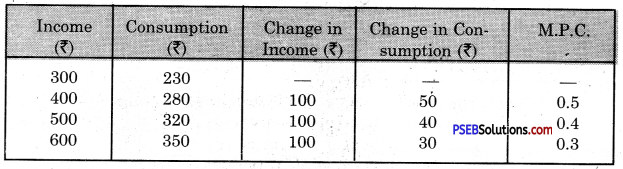
A schedule showing the various amounts of consumption that correspond to different levels of income is known as the propensity to consume.
PSEB 10th Class SST Solutions Economics Source Based Questions and Answers 1

  • Average Propensity to Consume. The ratio of total consumption to total income is called average propensity to consume. This implies that people will spend how much part of their income on consumption and how much part they save. This is obtained by dividing the consumption by the income, or
    APC = \(\frac{\mathrm{C}}{\mathrm{Y}}\)
  • Marginal Propensity to Consume. The ratio of change in consumption to change in income is called marginal propensity to consume, i.e.,
    MPC = \(\frac{\Delta \mathrm{C}}{\Delta \mathrm{Y}}\)

Question 3.
Public Finance is the combination of two words, i.e., Public + Finance. Public means group of people who are represented by the government and finance means monetary factor. Thus public finance means the financial sources of the government i.e. revenue and expenditures. That portion of economics in which the problems of revenue and expenditure are discussed is called public finance. Thus Public finance is the study of the problems of government institutions concerning central, state, and local governments. Public finance includes revenue of government i.e. tax, interest, profit etc. Public expenditure includes defense, administration, education, health industries, agriculture etc. Public debts are also studied under public finance.

The economic activities of the government of the country have also increasd with the passage of time. The area of public finance has also been widened. It studies not only the revenue and expenditure of the government but it also studies all economic activities of the government concerning special economic objectives like full employment, economic development, income and equal distribution of wealth, price stability, etc.
(а) What are the main sources of Government Income?
Answer:
The main sources of income of the government are taxes which are of two types.

  1. Direct taxes
  2. Indirect taxes

1. Direct taxes. Direct tax is that which is paid by the same person on whom tax has been imposed legally. For example income tax, gift tax, corporate tax, wealth tax etc.

2. Indirect taxes. Indirect tax is defined as that form of taxes which are imposed on goods and services. These taxes are imposed indirectly on Public. Examples of indirect taxes are sale tax, excise duty, entertainment tax, export, import duty, GST etc.

(b) State the main objectives of Public Finance.
Answer:
Following are the main objectives of Public Finance.

  1. Price Stabilization. Public Finance maintains stability in the prices of goods and services thereby, preventing constant fluctuations and inflation and deflation that tend to destabilize the economy of a country.
  2. Equitable Distribution of Wealth. Public Finance is also concerned with equitable distribution of income and wealth among individuals and various sections of the country. „
  3. Satisfaction of Needs. The satisfaction of collective needs is another main objective of Public Finance.
  4. Allocation of Resources. Public Finance performs the function of allocating resources among public and private sectors.
  5. Provision of full employment. Provision of full employment opportunities to citizens of a country is another aim to public finance.

PSEB 10th Class SST Solutions Economics Source Based Questions and Answers

Question 4.
In every underdeveloped country there is a need and availability of infrastructure in a sufficient quantity. Lack of Infrastructure facilities will create hurdles in the development of industries and agriculture sector as a result of it their rate of growth will come down. For example, we daily feel that the industrial and agriculture sector suffer a lot on account of shortage of power. Similarly, if there is a lack of transport facilities then industries will not be able to get raw-material and their finished goods will also not reach the market in time. Thus, insufficient of economic infrastructure will bring down the rate of growth of production sectors like industries and agriculture etc. On the contrary, the sufficient availability of economic infrastructure will be helpful in acceleration of their development.
(a) What is meant by infrastructure?
Answer:
The part of the capital stock of the economy which is necessary from the viewpoint of providing various kinds of services is called infrastructure in short, infrastructure means those activities, facilities and services which are helpful in the operation and development of other sectors.

(b) State the meaning of economic infrastructure? What are its kinds?
Answer:
Economic infrastructure refers to that capital stock which offers various types of productive services directly to the producers. For example, a country’s transportation system like Railways, Road Airways provides services to the one part of the production and distribution system only. Similarly Banking system, money and capital market provide services to the other part of industries and agriculture.

Following are the main components of economic infrastructure.

  • Transport and Communication
  • Electric Power
  • Irrigation
  • Banking and other financial institutions.

Question 5.
The modern era is an era of consumerism. A variety of hew goods are supplied in the market daily for the utility and comfortability of the consumer^. New food products, new fashion garments, decorative items, household gadgets, new means of transport, modern means of entertainment like-coloured television, video etc. ate being invent and produced continuously. Advertisement and publicity are being used at large scale to introduce or to make available these1 goods to the coneuthers. Now a days a consumer chooses his consumption material on the basis of attractive advertisements and publicity of different producers. In this way, they are exploited in many ways. To protect the consumers from such type of exploitation,” consumer protection measures have been started.
(a) What is Consumer Protection?
Answer:
Consumer protection means the protection of the buyers of consumers goods from the exploitation of the unfair trade practices of the producers.

(b) What is Consumer Education?
Answer:
To protect the intersects of the consumers, it is very much essential to educate
them. It is with this view that the consumer’s week is celebrated throughout the country between March 15 and March 21 every year. During these days more stress is given on awareness among the consumers regarding their rights. The occassion is mai’ked by various exhibitions, seminars and street plays. Consumers are apprised of the possible unfair trade malpractice^ of short weights and measures, adulteration and the dike.

Question 6.
India is considered to be an agrarian economy because 68% of its population is still dependent on agriculture for livelihood. After independence Indian inherited a backward agricultural economy from the Britishers. Mahatma Gandhi considered agriculture as “Soul of India”. Iri this context Nehru had also said, “Agriculture needs utmost priorities.” Emphasising thb importance of agriculture Dr. V.K.R.V. Rao said, “If the vast mountain of development is to be crossed under five year plans, then the targets fixed for agriculture will have to be achieved. In the words of eminent Indian scholar Dantewala, “For the economic development of Indian economy. Success in the field of agriculture leads the country to the path of economic progress.”
(a) What is agriculture?
Answer:
The term “Agriculture” in the English language is derived from two words, “Agri means field and ‘culture’ means cultivatioin in other words, “Agriculture is the art or science of production of crops and livestock on a farm.”

(b) State the importance of agriculture in Indian economy.
Answer:
Following are the main importances of Agriculture in Indian economy.

  1. Contribution in National Income. About 40% of national income of India comes from primary sector like agriculture and forestry etc. During the period of planning share of agriculture in the national income has been ranging between 51% and 29%.
  2. Agriculture and Employment. In Indian economy, maximum employment opportunities are available in the agriculture sector.
  3. Transport. Agriculture in India offers a crucial support to the transport industry. Both railways and roadways are the bulk carriers of farm products in India.
  4. Wealth of Nation. A significant component of the country’s wealth belongs to the agricultural sector. In terms of fixed assets, land occupies the highest rank in India.
  5. Contribution to Domestic trade. Agriculture also plays a significant role in the country’s domestic trade. This is borne art by the fact that huge expenditure in India is incurred on the purchase of farm products needed by more than a billion people in the country.

PSEB 10th Class SST Solutions Economics Source Based Questions and Answers

Question 7.
The term “Green Revolution is a combination of two words—“Green” and “Revolution”. Green stand for greenery. Revolution means so sudden and fast changes that the spectators were wonder-struck. This term has been used for the progress of agricultural production. Because of the severe agricultural reforms initiated during the period of first three plans in India, in 1967-68, the production of foodgrains increased by about 25% as compared to the last year i.e., 1966-67. Such a tremendous increase in the production of foodgrains in any one year was nothing short of revolution. That is why, the economists gave this spectacular increase in foodgrains products the name of Open Revolution.
(a) State the effects of Green-revolution.
Answer:

  1. Effects on Prices. During the third five-year plan, prices, especially prices of agricultural commodities had a sharp rise. However, due to Green Revolution, the pace of price rise showed down.
  2. Prosperity of the Farmers. The Green revolution has very much improved the economic condition of the farmers. Their standard of living has gone up very much than before.
  3. Plaughing Back of Profits. The one good effect of the Green Revolution is that now the farmers are also included to invest large part of their income on the development of agriculture.
  4. Change in Thinking. Green revolution has completely revolutionized the thinking of the Indian rural people. Now they are convinced that with the help of science they can change that misfortune into fortunes.
  5. Effect on Consumers. Poor Indians spend about 80% at their income on agricultural commodities. The green revolution has helped them to balance their budget and raise their standard of living.

(b) What is Green-revolution? State its features.
Answer:
Green Revolution refers to an extraordinary increase in agricultural production especially in wheat and Rice, which was made possible due to the adoption of new techniques of High Yielding varieties of seeds.

Features:

  • The year 1968 was the initial year of Green Revolution.
  • Pant Agricultural University, Pant Nagar (U.P.) made an appreciable contribution to it by envolving a new variety of seeds.
  • Indian Agricultural Research Institute (I.A.R.I.) New Delhi has also made lot of contributon in regard in bringing the Green Revolution.
  • Credit of bringing Green Revolution in India goes to Dr. Norman E. Borlaugh and Dr. M.N. Swami Nathan.

Question 8.
For economic progress of Underdeveloped countries like India, industrialization occupied important place. Only through Industrial development by increasing the rate of production and employment the rate of growth of Indian economy can be increased. Prior to independence, industrial development was very low in India, but after independence, government laid great emphasis on the industrial development of the country. As a result of it, many new industries were established in the country and production capacity and the efficiency of the existing industries were also enchanced. Under the five year plans, the industries development has also been given much importance.
(a) State the importance of Industrial development
Answer:

  1. Employment. Through industrialisation, new industries are established. As a result of it, the millions of unemployed persons get work in these industries and it solve the unemployment problem of the country.
  2. Self Dependence. Industrial development makes provision for the production of essential goods in the country. As a result there will be less dependence on other countries and our country will become self-sufficient in the production of large number of goods.
  3. Increase in National Income. In India, industrialization will bring better and proper utilisation of natural resources. It will increase total production, employment national income and per capita income of the country.
  4. Essential for National Defence. Through industrialization many industries like Iron, steel, aeroplane, defense, production etc. can be established which are very important for the security of the country, because these industries manufacture large quantity of war material.
  5. Production of Socially Useful Goods. Through industrialization, the production of essential goods like cloth, cycles, goods, paper, oil etc. has become possible.

(b) How Industries helps in the Balanced growth of an economy?
Answer:
Indian Economy is an unbalanced economy because the bulk of working population and. capital of the country is engaged in agriculture. There is uncertainty in agriculture. Industrialisation will make the economy a balanced one and it will reduce the dependence on agriculture.

PSEB 10th Class SST Solutions Economics Source Based Questions and Answers

Question 9.
“Cottage industries are those industries which are completely or partially run by the members of a family either as a whole-time business or as a part time business.” Mostly these type of industries are run by the artisans in their homes. Machines are rarely used. Usually these industries fulfil the local requirements. These industries are run by the members of the family. Workers on labour basis are rarely used. They need very less capital. Since these industries are mainly situated in villages, so these are known as “village or rural industries.”
(a) State the difference between cottage and small industries.
Answer:

  1. Cottage industries are normally set up in villages and they are spread throughout the country, whereas small scale industries are mostly set up in cities.
  2. In cottage industries, only family members work whereas in small scale industries, work is done through hired workers.
  3. Cottage industries normally fulfil the local needs where as small-scale industries produce goods for cities and semi-urban areas. So their production market is very large.
  4. In cottage industries, production is done with the help of simple tools and very less capital is required. Whereas small-scale industries are run with power and more working capital is also required.
  5. In cottage industries, traditional goods like khadi mats and shoes etc. are produced whereas in small scale industries modem goods like Radio, Television, Electrical and Electronics goods etc. are produced.

(b) What are the problems of cottage industries?
Answer:

  1. Problem of Raw Material and Power. These industries do not get raw material in sufficient quantity and whatever material they get it is of poor quality and for it they have to play high prices.
  2. Problem of Finance. In India credit is not available to these industries in sufficient quantity. They have to depend on moneylenders for finance who charge very high rate of interest.
  3. Old Method of Production. In there industries mostly old methods of production are used. Old tools like oil press for oil expelling or handlooms for weaving clothes are used. As a result of it the number of production decreases and poor qualities of products are manufactured. Their demand in the market goes down.
  4. Problem of Marketing. The entrepreneurs of the industries face many problems in selling their products at fair price and quantity because the outward look of the product produced by these industries is not good.

PSEB 10th Class SST Solutions Economics Source Based Questions and Answers

Question 10.
The role of large scale industries is very important for the economic development of India. The major share of fixed capital investment in industries has been invested in big Industries. A large portion of the total industrial production is received from these industries.
(а) Classified the large scale industries.
Answer:

  1. Basic Industries. Basic industries are those industries which provide necessary inputs to agriculture and industries. The examples are steel, Iron, Good Chemical Fertizlers Aluminium and Electricity.
  2. Capital Goods Industries. Capital Goods Industries are those industries which produce machinery and instruments for agriculture and industries. These include machines, mechanical instruments, tractors truck etc.
  3. Intermediate Goods Industries. Intermediate goods industries are those industries which produce those goods which are used for the production of other goods. Examples of there are tyres, mobile oil etc.
  4. Consumer Goods Industries. Consumer goods industries are those industries which produce consumer goods. These include sugar, cloth, paper industries etc.

(b) State the importance of large scale industries in the Industrialisation of a country.
Answer:

  1. Production of Capitalistic and Basic goods. For the industrialization of a country, capital goods like machines, instruments and basic goods like steel, Iron, chemicals are of great importance. The production of these capital and basic goods is possible only by large scale industries. ,
  2. Economic Infrastructure. Economic infrastructure like means of transport, electricity, communication facilities etc. are very much required for industrialization. Only big industries can produce mean of transport like railways engines and wagons, trucks, motors, planes, etc.
  3. Research and High Technique. For the industrialization of any country, research and high techniques are of very much important. A lot al money are able researches are required for this purpose. Only large scale industries can arrange required money for research and able researcher.
  4. Increase in Productivity. Because of large investment in big industries, per unit capital is more. Per unit productivity increases a lot. because of it.

PSEB 7th Class Social Science Solutions Chapter 14 Tribes, Nomad and Settled Societies

Punjab State Board PSEB 7th Class Social Science Book Solutions History Chapter 14 Tribes, Nomad and Settled Societies Textbook Exercise Questions and Answers.

PSEB Solutions for Class 7 Social Science History Chapter 14 Tribes, Nomad and Settled Societies

SST Guide for Class 7 PSEB Tribes, Nomad and Settled Societies Textbook Questions and Answers

I. Answer the following questions :

Question 1.
Which was the main occupation of the tribal people?
Answer:
Agriculture was the main occupation of most of the tribes, but many of the tribes liked the occupation of hunting, gathering or animal husbandry.

Question 2.
What do you mean by the Nomad?
Answer:
Tribal people used to migrate from one place to another in search of food and other things to live. They were known as Nomads.

Question 3.
Where did the people of tribal society live?
Answer:
During the medieval period, tribal people lived in the all parts of the Indian subcontinent. For example, the tribes such as Gonds, Bhils, Kolis, Kui, Oraons and Kuki lived in Meghalaya, Ma nipur, Nagaland, Madhya Pradesh, Dadra and Nagar Haveli etc. Few tribes like Gakhar, Khokhar, Arghoon, Langah, Bloach etc. lived in the many parts of Punjab.

PSEB 7th Class Social Science Solutions Chapter 14 Tribes, Nomad and Settled Societies

Question 4.
Which tribes were lived in Punjab during the medieval period?
Answer:
Few tribes like Gakhar, Khokhar, Arghoon, Langah Bloach etc. lived in many parts of Punjab.

Question 5.
Who was Sufaka?
Answer:
He was the first ruler of Ahom.

II. Fill in the blanks :

Question 1.
Ahom tribe established kingdom in the territories of present _________
Answer:
Assam

Question 2.
_________ was a prosperous kingdom from 15th to 18th century.
Answer:
Gondwana

Question 3.
The people of Ahom tribe belonged to _________ class of China.
Answer:
Tai-Mongolo-id

PSEB 7th Class Social Science Solutions Chapter 14 Tribes, Nomad and Settled Societies

Question 4.
Queen Durgawati was famous _________ ruler.
Answer:
Gond.

PSEB 7th Class Social Science Guide Tribes, Nomad and Settled Societies Important Questions and Answers

Multiple Choice Questions

Question 1.
Societies which does not follow the rules given by brahmins and were not divided into many unequal classes were known as
(a) Urban society
(b) Rural society
(c) Tribal society
(d) Modem society.
Answer:
(c) Tribal society.

Question 2.
Which of these is the feature of tribal society?
(a) United by kinship bonds
(b) Obtained livelihood by agriculture
(c) Have their own different religion, culture and language
(d) All of these.
Answer:
(d) All of these.

Question 3.
Which tribe was influential in Punjab in 13thl and 14th centuries?
(a) Gokkhars
(b) Khokhar
(c) Gond
(d) Bhil.
Answer:
(b) Khokhar.

Question 4.
Which of these was the large and powerful tribe of north west?
(a) Balochi
(b) Gonds
(c) Gakkhar
(d) Bhils.
Answer:
(a) Balochi.

Question 5.
Which tribe was living in western Himalaya?
(a) Nagas
(b) Gaddis
(c) Ahoms
(d) Cheros.
Answer:
(b) Gaddis.

PSEB 7th Class Social Science Solutions Chapter 14 Tribes, Nomad and Settled Societies

Question 6.
Which tribe had their homes in Maharashtra highlands, Karnataka and Gujarat?
(a) Bhils
(b) Gonds
(c) Koragas
(d) Kolis.
Answer:
(d) Kolis.

Question 7.
Who moved over long distance with their animals?
(a) Rural nomadics
(b) Gaddi people
(c) Nomadic pastoralists
(d) Ahoms.
Answer:
(c) Nomadic pastoralists.

Question 8.
Nomadic pastoralists used to exchange their products of wool, ghee, with settled agriculturalists for
(a) Grain
(b) Utensils
(c) Cloth
(d) All of these.
Answer:
(d) All of these.

Short Answer Type Questions

Question 1.
What is Tribal Society?
Answer:
Tribal society is a society which lives very much away from our civilisation i.e. in forests, valley’s and mountains. They have their own culture, language etc. and they never liked to be interfered by any one.

Question 2.
How did the historians write the history of tribal society?
Answer:
During the medieval period, the tribals never maintained any written records about them. They used to perform their social traditions and customs. These customs continued from one generation to another. These social traditions and customs helped the historians to write the history of tribal society.

Question 3.
Where did the Ahom and Naga tribes live?
Answer:
Ahom, Naga, and few other tribes lived in the north-eastern parts of the Indian subcontinent.

PSEB 7th Class Social Science Solutions Chapter 14 Tribes, Nomad and Settled Societies

Question 4.
Where did the Munda and Santhal tribes live?
Answer:
Munda and Santhal tribes lived in the territories of the present Bihar and Jharkhand.

Question 5.
Where did the Kuli, Brado tribes live?
Answer:
Kuli and Brado tribes lived in the hilly areas of Maharashtra and Karnataka. Kuli’s also lived in some parts of Gujarat.

Question 6.
What were the main professions of the tribal people?
Answer:
Main profession of the tribal people was agriculture. But many of them still lived in the ancient conditions and that is why they used to do hunting and food gathering. Many of the tribes also did pastoralism in which they used to rear animals for milk, meat and other purposes.

Question 7.
What type of life the nomadic people had during the medieval period?
Answer:
During the medieval period, occupation of the nomads was grazing the animals. Most of the times they moved far away for grazing the animals. They used to earn by animal breeding as well. They used to exchange butter made from milk of animals and wood with corn, clothes, utensils etc. with the farmers. They also moved from one place to another for selling their goods fry loading these goods on their animals.

Question 8.
Explain in brief about the Grocer dynasty.
Answer:
During the medieval period, members of Grocer dynasty were famous as the nomadic merchants among the many other dynasties of the nomadic people. For example, during the times of Ala-ud-din Khalji, the Grocers transported the corn by loading on the bulls to sell in the cities. They transported the eatables on the bulls for the Mughal army during the war time.

Question 9.
What facilities are provided to the tribal people of the Indian Government?
Answer:
Government, of India has provided a number of facilities to tribal people to uplift their social status. A number of vocational training institutions are opened up in the tribal areas. Tribal people are provided with bank loans so that they can improve their economic condition. They are also provided with 7.5% reservation in government jobs and educational institutions. Even many constituencies are reserved for them in Lok Sabha and many State Assemblies.

PSEB 7th Class Social Science Solutions Chapter 14 Tribes, Nomad and Settled Societies

Question 10.
Give a brief introduction of the life of tribes living in jungles and nomadic tribes.
Answer:
The tribes mostly live in Manipur, Meghalya, Madhya Pradesh, Nagaland, Dadra and Nagar Haweli. These includes tribes like Bheels, Gonds, Ahoms, Kuis, Cohns, Kukis, etc. Generally they live in jungles. The govt, had made many efforts to improve their situation.

Question 11.
Give an account of the Ahoms and their state formation.
Answer:
The Ahom tribe ruled from 13th to 19th century on modern Assam. Their relation was with the Tai-Mongolo-id group of China. They came from China in 13th century. ‘Sufaka’ was the first Ahom ruler of Assam. He ruled from 1228 A.D. to 1268 A.D. The Ahoms defeated many local rulers, which included dynasties like Kachari, Moran and Nagaseta. Thus the Ahoms expanded their state to Brahamputra valley. Their, capital was Gorgoan.

The Ahoms even struggled with Mughals and Bengal states. The Mughals tried to control Assam but could not succeed. At last Aurangzeb captured Gorgoan, but could not keep it for a long time. In 1818 A.D. the people from Burma attacked Assam and the Ahom king ran away. In 1826 A.D. the English reached Assam. They defeated Burmese people and entered into a treaty of ‘Yandaboo’. Thus Assam came under the subordination of the English.

Question 12.
Throw some light on the history of Gonds.
Answer:
This tribe is related to central India. They live in Western Orissa, Eastern Maharashtra, Chhattisgarh, Madhya Pradesh, etc. This area is known as Gondwana because a large number of Gonds live over here. From the 15th to 18th century, many states were established in Gondwana. Rani Durgawati was a famous Gond ruler. Her state was a free state with Jabalpur as the capital. Rani Durgawati died in battle with Akbar’s army as she refused to accept the subordination of Akbar. The Gond people have very few necessities of life. Their houses are also very simple. They are also illiterate people.

PSEB 7th Class Social Science Solutions Chapter 13 Towns, Traders and Craftsmen

Punjab State Board PSEB 7th Class Social Science Book Solutions History Chapter 13 Towns, Traders and Craftsmen Textbook Exercise Questions and Answers.

PSEB Solutions for Class 7 Social Science History Chapter 13 Towns, Traders and Craftsmen

SST Guide for Class 7 PSEB Towns, Traders and Craftsmen Textbook Questions and Answers

I. Answer these questions :

Question 1.
Name any four pilgrimage centres.
Answer:
Nankana Sahib, Amritsar, Kurukshetra, Haridwar, Badrinath, Mathura, Banaras, Jagannath Puri, Dwarka Puri etc. are few of the pilgrimage centres.

Question 2.
Which Guru laid the foundation of Amritsar gnd when?
Answer:
Amritsar is a famous religious place of the Sikhs. It was founded by 4th Guru Sri Guru Ramdas Ji in 1577 A.D. In the beginning, the name of Amritsar was Chak Guru Ramdas. During the time of Sri Guru Ram Das Ji, the work of digging was started on two ponds named Amritsar and Santokhsar, but after Guru Ramdas Ji, fifth Guru Arjan Dev Ji completed this work.

Importance: In 1604 A.D., the placement of Sri Guru Granth Sahibji was done in Sri Harmandar Sahib. In 1609 A.D., Sixth Guru Sri Guru Hargobindji built Shri Akal Takht Sahib in front of Sri Harmandar Sahib. Here, Guruji accepted the gifts of horses and weapons from Gursikhs. Here, discussions were also held on political affairs. Even today, the religious decisions of Sikhs are announced from here. In 1805 A.D., Maharaja Ranjit Singh gave golden covering on the domes of Sri Harmandir Sahib. Since then it has been called ‘The Golden Temple’.

Question 3.
Where the Surat is situated?
Answer:
Surat is a famous port and trading city. It io located in the state of Gujarat. It is a big industrial and trading city. Shivaji plundered it twice and got hold of big riches. During 12th century the Parsis occupied Surat. In 1512 A.D., the Portugese occupied it. In 1573 A.D., Surat came under the control of Akbar and became a major trading city.

In 1612 A.D., the English get many facilities from Emperor Jahangir for trading in Surat. The Portugese, the Dutch and the French also established their trading centres. In 1759 A.D., the English captured the Surat port but they could control it completely in 1842 A.D. The Khwaja-Sahib mosque and nine-Sayyed mosque located here are very famous. The Swami Narain temple and the old Jain temples located here are also very important.

II. Fill in the blanks:

Question 1.
Amritsar was founded by _________
Answer:
Sri Guru Ramdas Ji

Question 2.
Surat is a _________ city.
Answer:
famous port and trading

PSEB 7th Class Social Science Solutions Chapter 13 Towns, Traders and Craftsmen

Question 3.
Nankana Sahib is situated in _________
Answer:
Pakistan

Question 4.
India had many port _________
Answer:
cities.

III. Write True or False against the each statement:

Question 1.
Mohenjodaro was the capital city of Indus valley people.
Answer:
True

Question 2.
In 1629, Shah Jahan made a new capital in Delhi.
Answer:
False

Question 3.
Surat was an important pilgrimage centre.
Answer:
False

Question 4.
Fatehpur Sikri was the capital town of Mughals.
Answer:
True

PSEB 7th Class Social Science Solutions Chapter 13 Towns, Traders and Craftsmen

Question 5.
Lahore was a commercial town in Medieval period.
Answer:
True

IV. Activity:

Question 1.
Make a list of the following (four each).
(a) Capital towns
(b) Port towns
(c) Commercial towns
(d) Pilgrimage centres
Answer:
(a) Capital towns: Ajmer, Kanauj, Delhi, Agra.
(b) Port towns: Goa, Cochin, Surat, Broach?
(c) Commercial towns: Lahore, Multan, Surat, Ahmedabad.
(d) Pilgrimage centres: Nankana Sahib, Amritsar, Kurukshetra, Haridwar.

PSEB 7th Class Social Science Guide Towns, Traders and Craftsmen Important Questions and Answers

Multiple Choice Questions

Question 1.
Which of these is the type of town?
(a) Temple town
(b) Commercial town
(c) Administrative town
(d) All of these.
Answer:
(d) All of these.

Question 2.
Which of these was the capital of Chola dynasty?
(a) Thanjavur
(b) Masulipathnam
(c) Surat
(d) Hampi.
Answer:
(a) Thanjavur.

PSEB 7th Class Social Science Solutions Chapter 13 Towns, Traders and Craftsmen

Question 3.
Kings used to hold courts at _________ to give orders to subordinates.
(a) Temples
(b) Royal courts
(c) Mandapas
(d) Fort.
Answer:
(c) Mandapas.

Question 4.
Who built Rajarajeshvara temple?
(a) Raj Raja IV
(b) Raj Raja I
(c) Sultan of Bijapur
(d) None of these.
Answer:
(b) Raj Raja I.

Question 5.
The process by which cities develop is known as
(a) Civilization
(b) Urbanization
(c) Metropoltian
(d) Modernization.
Answer:
(b) Urbanization.

Question 6.
Pilgrimage centre which slowly developed into townships was
(a) Varindavan
(b) Ajmer
(c) Tiruvannamalai
(d) All of these.
Answer:
(d) All of these.

Question 7.
Who gave right to temples to collect taxes from traders?
(a) Kings
(b) Temple authority .
(c) Zamindars
(d) Both (a) or (c).
Answer:
(d) Both (a) or (c).

Short Answer Type Questions

Question 1.
Give a list of the following during the medieval period.
Answer:

  1. Capital Cities: Lahore, Fatehpur Sikri, Delhi, Agra.
  2. Port Cities: Cochin, Surat, Bharoch, Sopara.
  3. Trading Cities: Delhi, Agra, Surat, Ahmednagar.

PSEB 7th Class Social Science Solutions Chapter 13 Towns, Traders and Craftsmen

Question 2.
Give two means which give us information about the Mughal administration.
Answer:

  1. The travellogue of Bernier.
  2. The maps prepared by William Hawkins and Sir Thomas Roe.

Question 2 A.
Write names of any two capital towns of Mughal Empire.
Answer:
Two main capital cities of the Mughal Empire were Delhi and Agra.

Question 3.
How were cities developed?
Answer:
After the development of agriculture, men started living near farms. This gave birth to the concept of villages. When the number of people increased (population), some of these villages became cities. Some of these cities were developed because of the activities of religious personalities, traders, artisans or because of ruling class. These cities, came to be known as capital cities, religious cities, port cities and trading cities.

Question 4.
Give information about the capital cities during the ancient period and the Mughal period. .
Answer:
Ancient period:

  • Harappa and Mohenjodaro were the capital cities of Indus Valley Civilization.
  • During Vedic period, Ayodhya and Inderprasatha were the capital cities.
  • In 600 B.C., 16 states had their own capital cities. The main were Kausambi, Pataliputra and Vaishali.

Rajput Period:

  • Under Rajput rulers, Ajmer, Kanauj, Tripuri, Delhi, Agra, Fatehpur Sikri, etc. were developed as capital cities.
  • In South India, Kanchi, Badami, Kalyani, Vengi, Devagiri, Manyakhet, Tanjavur and Madurai, etc. were capital cities.

Sultanate and the Mughal periods:

  • During Sultanate period, Lahore and Delhi developed as capital cities.
  • During the dughal period Delhi, Agra, Fatehpur Sikri were the capital cities.

Question 5.
In India many port cities were developed. Why?
Answer:
India is sorrounded by the sea on three sides. So, in India many port cities were developed as trading centre.

PSEB 7th Class Social Science Solutions Chapter 13 Towns, Traders and Craftsmen

Question 6.
Name two important ports of eastern coast of India during Medieval period.
Answer:
Vishakhapatnam (Modem Andhra Pradesh) and Tamralipti.

Question 7.
Discuss the contribution of traders and artisans in the economic development of India.
Answer:
The Indian traders and artisans gave important contribution in the economic development of India. The Indian artisans were skilled in preparing best quality stock. They were very skilled in textile industry. The cloth prepared by them was world famous whether it was woolen, cotton, silky. The leather goods were also very popular.

In the medieval period, there was development of the art of making alloys. The blacksmiths and’ goldsmiths prepared best quality goods. The traders exported these goods to other countries. And thus, India was turned into a “Golden Sparrow”.

Question 8.
Write about the historical importance of Lahore City.
Answer:
Lahore is a famous city of Pakistan. During the medieval period, it was an important Indian city. During the times of Turk invasion, Lahore was the capital of Hindu ruling dynasty. After that, it remained the capital of Qutub-ud-din Aibak and Iltutmish. Iltutmish later on, made Delhi his capital.

During the times of invasion of Babar, Daulat Khan Lodhi was the Governor of Punjab. During the administration of Mughals, Lahore was«the capital of the state of Punjab. In 1761 A.D., Lahor-e was captured by the Sikhs. In 1799 A.D., Maharaja Ranjit Singh made Lahore his capital. In 1849 A.D. Lahore came under the control of the British. From 1849 to 1947 A.D. Lahore remained the capital of Punjab state. At the time of partition, Lahore! became a part of Pakistan.

Question 9.
Discuss the sources that tell us about towns in the Mughal period.
Answer:

  1. The travelogues of a Portuguese visitor named Duarte Barbosa and an English visitor named Ralph Fitch tell us about the cities of that period
  2. The map of the Mughal empire in 1629 A.D. shows places like Thatta, Lahore, Surat, and Multan. This map was prepared by Hondiu.
  3. The government documents related to the land revenue in the Mughal period give us information about old and new cities.

PSEB 9th Class SST Solutions History Chapter 4 Sri Guru Arjan Dev Ji: Contribution in the Development of Sikhism and his Martyrdom

Punjab State Board PSEB 9th Class Social Science Book Solutions History Chapter 4 Sri Guru Arjan Dev Ji: Contribution in the Development of Sikhism and his Martyrdom Textbook Exercise Questions and Answers.

PSEB Solutions for Class 9 Social Science History Chapter 4 Sri Guru Arjan Dev Ji: Contribution in the Development of Sikhism and his Martyrdom

SST Guide for Class 9 PSEB Sri Guru Arjan Dev Ji: Contribution in the Development of Sikhism and his Martyrdom Textbook Questions and Answers

I. Multiple Choice Questions:

Question 1.
The name of Guru Arjan Dev Ji’s mother was .
(a) Bibi Bhani
(b) Shabrai Devi
(c) Bibi Amro
(d) Bibi Anokhi.
Answer:
(a) Bibi Bhani.

Question 2.
The name of the eldest son of Guru Ram Das Ji was
(a) Mahadev
(b) Arjan Dev
(c) Prithichand.
Answer:
(c) Prithichand.

Question 3.
In which fort Jahangir imprisoned Guru Hargobind Ji?
(a) Gwalior
(b) Lahore
(c) Delhi
(d) Jaipur.
Answer:
(a) Gwalior.

PSEB 9th Class SST Solutions History Chapter 4 Sri Guru Arjan Dev Ji: Contribution in the Development of Sikhism and his Martyrdom

Question 4.
Where did Khusrau meet Guru Arjan Dev Ji?
(a) Goindwal
(b) Hargobindpur
(c) Kartarpur
(d) Santokhsar.
Answer:
(a) Goindwal.

Question 5.
When was Sri Guru Arjan Dev Ji martyred by Jahangir?
(a) 24 May, 1606 A.D.
(b) 30 May, 1606 A.D.
(c) 30 May, 1581 A.D.
(d) 24 May, 1675 A.D.
Answer:
(b) 30: May 1606. A.D.

II. Fill in the blanks :

Question 1.
Guru Arjan Dev Ji’s period was from __________ upto
Answer:
1581-1606 A.D.

Question 2.
In 1590, Sri Guru Arjan Dev Ji constructed a sarovar __________
Answer:
Tarn Taran.

III. Match the Columns:

Question 1.

A

B

1. Martyrdom of Sri Guru Arjan Dey Ji (i) Jahangir
2. MiriPiri (ii) 30th May, 1606
3. Saint Mian Mir (iii) Sri Guru Hargobind Sahib Ji
4. Khusrau (iv) Foundation stone of Harmandir Sahib Ji

Answer:

A

B

1. Martyrdom of Sri Guru Arjan Dey Ji (ii) 30th May, 1606
2. MiriPiri (iii) Sri Guru Hargobind Sahib Ji
3. Saint Mian Mir (iv) Foundation stone of Harmandir Sahib Ji
4. Khusrau (i) Jahangir

IV. Differentiate between:

Question 1.
Miri and Piri.
Answer:
Guru Hargobind Sahib put on two swords which he called one of Miri and the other of Piri. His sword of Miri symbolized his leadership of the Sikh followers in worldly affairs. The Piri sword represented his leadership of the Sikhs in spiritual affairs.

PSEB 9th Class SST Solutions History Chapter 4 Sri Guru Arjan Dev Ji: Contribution in the Development of Sikhism and his Martyrdom

V. Very Short Answer Type Questions

Question 1.
Who was the fifth Guru of the Sikhs?
Answer:
Sri Guru Arjan Dev Ji.

Question 2.
When and who laid the foundation of Harmandir Sahib Ji?
Answer:
The foundation of Harmandir Sahib Ji was laid by a famous Sufi Saint Mian Mir in 1588 A.D.

Question 3.
To whom Guru Arjan Dev Ji got dictate Adi Granth Sahib Ji?
Answer:
Bhai Gurdas Ji.

Question 4.
When was the compilation of Adi Shri Guru Granth Sahib Ji completed?
Answer:
In 1604 A.D.

Question 5.
Who was the leader of Naqshbandi?
Answer:
Shaikh Ahmad Sirhindi.

Question 6.
Who was the first Granthi of Harmandir Sahib?
Answer:
Baba Buddha Ji.

PSEB 9th Class SST Solutions History Chapter 4 Sri Guru Arjan Dev Ji: Contribution in the Development of Sikhism and his Martyrdom

Question 7.
What do you mean by Daswandh?
Answer:
The meaning of Daswandh is each Sikh must give one tenth of his income in the name of Guru.

VI. Short Answer Type Questions

Question 1.
To whom did Sri Guru Ram Das Ji give Guruship and when?
Answer:
Guru Ram Das Ji wanted to give Guru Gaddi to one of his three sons. Guru Ji thought about it. Out of all three one (Mahadev) was a Faqir. He had no interest in worldly affairs. So Guru Ji did not give him Guru Gaddi. Guru Ji’s second son Prithi Chand was also considered incapable because he was not fit for Guru Gaddi. Under these circumstances, Guru Ji declared his younger son Arjan Dev as his successor in 1581 A.D.

Question 2.
Describe the Martyrdom of Sri Guru Arjan Dev Ji.
Answer:
The Mughal Emperor Akbar had very cordial relations with Guru Arjan Dev Ji. However, Jahangir the next Mughal emperor abandoned the policy of toleration after the death of Akbar. Jahangir was on the look out for an oppourtunity to give mortal blow to Sikh religion. In the meantime, Prince Khusro, the son of Jahangir, revolted against his father. After being defeated at the hand of his father, Khusro came to Guru Arjan Dev Ji. Guru Sahib blessed him. Jahangir imposed a fine of two lakh rupees on Guru Sahib on the charge of helping rebellious Khusro. Guru Sahib showed his inability to pay. As a result, Guru Sahib was detained and subjected to severe torture. It infuriated the Sikhs. The Sikhs learned that the only course then left open to them was to rise in arms for the protection of their religion.

Question 3.
What do you mean by religious intolerance of Jahangir?
Answer:
Unlike Akbar, Emperior Jahangir was a fundamentalist Muslim. He wanted to spread his religion. But people of all the religions and castes were very much influenced with the teachings and generosity of Sikhism and were adopting Sikhism. Jahangir did not tolerate the growing influence of Sikhism and started doing jealousy with Sikhism. That is why he martyred Guru Arjan Dev Ji.

Question 4.
Who was Chandu Shah? Why did he turn against Guru Arjan Dev Ji?
Answer:
Chandu Shah was a high ranking official of the Mughal administration in Punjab. Guru Arjan Dev Ji had declined to marry the daughter of Chandu Shah to his own son on the suggestion of Sikh Sangat. Chandu Shah felt insulted and tried to instigate Akbar against Guru Sahib with the motive of taking revenge. Akbar held Guru Sahib in high esteem and considered himself as a friend of Guru Sahib. Akbar did not give any importance to the grumbling of Chandu Shah. Chandu Shah did not stop conspiring against Guru Sahib. After the death of Akbar, Chandu Shah instigated Jahangir and convinced him that Guru Sahib had helped the rebellious Prince Khusro. Jahangir had already decided to end the religious movement of Guru Sahib. The instigation by Chandu Shah further provoked Jahangir to take a strong step against Guru Sahib.

PSEB 9th Class SST Solutions History Chapter 4 Sri Guru Arjan Dev Ji: Contribution in the Development of Sikhism and his Martyrdom

Question 5.
What was the immediate cause of Sri Guru Arjan Dev Ji’s martyrdom?
Answer:
The martyrdom of Guru Arjan Dev Ji took place in May 1606 A.D. The major reason behind this martyrdom was Jahangir’s fundamentalist religious policy. He wanted to curb the growing popularity of Sikhism. Guru Ji gave blessings to Khusro, son of Jahangir. It was considered a political crime. Moreover, the compilation of Sri Adi Granth Sahib Ji by Guru Arjan Dev Ji further increased the suspicion of Jahangir. The opponents of Guru Ji told Jahangir that lot is written in Sri Adi Granth Sahib against Islam. So, Jahangir called Guru ji to his court. He ordered Guru Ji to write something on prophet Mohammad but Guru Ji refused his order. So Jahangir issued an order to put Guru Sahib to death by torture.

Question 6.
What was the role of Masand System in the development of Sikh religion?
Answer:
The Masand System played an important role in the development and organisation of the Sikh religion. The importance of the Masand System for Sikh religion was as under :
1. The system ensured regular and fixed donations for the Guru Gaddi. .With a fixed income from donations, Guru Sahib was able to undertake much constructive work for the development of Sikh religion. Guru Arjan Dev Ji not only built tanks at Amritsar and Santokhsar, but also built new cities, constructed ponds, dug wells, etc.

2. Masand System, not only ensured fixed donations, but also helped in spreading the message of Sikh religion more enthusiastically. Earlier, the work of spread of religion was done through Manji system. It was confined only to the Punjab during those days. However, Guru Arjan Dev Ji appointed Masands even outside Punjab. It helped in the spread of Sikh religion even outside.

3. Guru Sahib started holding his own court when he had an assured income through Masand System. The Masands and the devoted Sikhs brought donations and gifts to the court of Guru Arjan Dev Ji on every Baisakhi day and bowed their heads before him to seek his blessings. Gradually, the court of Guru Sahib acquired the status of a court of an emperor for the Sikhs and Sikh Sangat started calling Guru Arjan Dev Ji as Sachcha Padshah (The True Emperor) out of love and devotion for him.

VII. Long Answer Type Questions

Question 1.
What is the contribution of Guru Arjan Dev Ji in the development of Sikh religion? Discuss in detail.
Answer:
The history of Sikh religion entered a new phase with the coming of Guru Arjan Dev Ji to Guru Gaddi. It was the result of his efforts that Sikhs were blessed with Harmandir Sahib Ji and numerous other places of pilgrimage. Not only that, the Sikhs got their first sacred and divine book when Guru Arjan Dev Ji compiled the Adi Granth Sahib. The Hindus had their Ramayana, the Muslims their Quran Sharif, the Christians their Bible, and the Sikhs their Guru Granth Sahib Ji.

A brief description of the activities and contribution of Guru Arjan Dev Ji is given as follows :
1. Construction of Sri Harmandir Sahib: Guru Arjan Dev Ji completed the work of construction of Amritsar and Santokhsar Sarovars after the expiry of Guru Ram Das Ji. Guru Sahib constructed Sri Harmandir Sahib in the midst of Amritsar Sarovar. Guru Sahib constructed a door each in all the four directions of Sri Harmandir Sahib. These four doors convey the message that Sri Harmandir Sahib is open to all the religions, castes and tribes without any discrimination. Guru Sahib told his followers that a pilgrimage to Sri Harmandir Sahib would bestow the benefit of 68 places of pilgrimage of the Hindus. In this manner, Sri Harmandir Sahib became one of the most sacred and important religious places.

2. Foundation of Tarn Taran. Guru Arjan Dev Ji founded the city of Tarn Taran as well. The city was founded in the heart of Majha region. It is also an important place of pilgrimage like Amritsar for th§ Sikhs. Guru Ji also constructed many other buildings and Sarovars.

3. Construction of Baoli at Lahore. On his tour to Lahore, Guru Arjan Dev Ji got constructed a Baoli in the Dubbi Bazaar. The Baoli soon became an important place of pilgrimage for the Sikhs of the surrounding region..

4. Foundation of Hargobindpur and Chheratta. Guru Arjan Dev Ji founded the city of Hargobindpur on the banks of river Beas to celebrate the birth of his son Hargobind Ji. Apart from this he also got a well dug at Chheratta near Amritsar in order to provide water to the local people. Guru Sahib also arranged for six pulleys to draw water from the well and the area is known after those pulleys as Chheratta.

5. Foundation of Kartarpur. In 1593, Guru Arjan Dev Ji founded the city of Kartarpur and also built a Sarovar in Kartarpur which is called Gangsar.

6. Improvement in the Masand System. Guru Arjan Dev Ji felt the need to improve Masand system. Guru Sahib instructed the Sikh followers to deposit one- tenth (Daswandh) of their annual income with the Masands. The Masands deposited the collections in the main treasury (Guru Ki Golak) at Amritsar on every Baisakhi day. The Masands appointed their representatives to collect donations. Those representatives were called Sangatias. The one-tenth donation was called Daswandh. Apart from the work of collection of Daswandh, the Masands also spread the message of Sikh religion.

7. Compilation of the Adi Granth Sahib. Guru Arjan Dev Ji bestowed upon the Sikhs a sacred and religious book by compiling the Adi Granth Sahib. Guru Arjan Dev Ji compiled Adi Granth Sahib at Ramsar. Bhai Gurdas Ji assisted Guru Sahib in its compilation. The work of compilation was completed in 1604. Guru Sahib included the hymns of first four Gurus, followed by the hymns of Bhakti saints and finally the sayings of Bhatt Bahiyan. Guru Arjan Dev Ji also included his own Vani in the holy book.

8. Encouraged Horse Trade. Guru Arjan Dev Ji encouraged the Sikhs to start trading in horses. The Sikhs were benefited from the trading in horses in the following ways :
(1) Trading in horses was the most profitable business in those days. As a result, the Sikhs became very rich by trading in the horses. They contributed Daswandh regularly out of their income from this trade.
(2) The Sikhs became fully trained in making selection of good horses. It helped them in the long run in organising a Sikh cavalry.

9. Spread of Religious Teachings. Guru Arjan Dev Ji made many people his followers by his religious teachings. Guru Sahib impressed the people with his ideals, teachings, amiable personality, sweet temper, and toleration. Many Muslims also joined the Sikh religion under the influence of Guru Arjan Dev Ji.

Thus the Sikh religion progressed tremendously under the spiritual leadership of Guru Arjan Dev Ji. The Adi Granth Sahib, the most sacred book of the Sikhs, was compiled, the cities like Tarn Taran, Kartarpur,® Hargobindpur, were founded and the Sikh religion was blessed with Sri Harmandir Sahib.

PSEB 9th Class SST Solutions History Chapter 4 Sri Guru Arjan Dev Ji: Contribution in the Development of Sikhism and his Martyrdom

Question 2.
What were the reasons behind Guru Arjan Dev Ji’s martyrdom? Discuss.
Answer:
Guru Arjan Dev Ji was one of those great saints of the world who sacrificed their lives for the sake of their religion. The circumstances which were responsible for the martyrdom of Guru Sahib were as follows :
1. Fanaticism of Jahangir. Jahangir became the Mughal Emperor in 1605. He hated the Sikhs. He had similar feelings for Guru Arjan Dev Ji. He wanted that either Guru Sahib should become a Musalman or else be put to death. He definitely played a big role in the martyrdom of Guru Arjan Dev Ji.

2. Hostility of Prithia. Guru Ram Das Ji had appointed Guru Arjan Dev Ji as his successor to Guru Gaddi because Guru Sahib was convinced of his intelligence and ability. Prithia, the elder brother of Guru Arjan Dev Ji, did not relish the decision of Guru Ram Das Ji. Then Prithia started conspiring against Guru Arjan Dev Ji in league with the governor of Punjab and his finance minister Chandu Shah. It is true that Prithia had died before the martyrdom of Guru Sahib but it was he who had done the maximum damage to Sikh religion by infusing hatred in the hearts of Mughals against Guru Arjan Dev Ji.

3. Splendour of Guru Arjan Dev Ji’s Court. The Sikhs had grown rich by the blessings of Guru Arjan Dev Ji. The Sangat set up a magnificent court for Guru Sahib, where Guru Sahib continued with his religious activities. The Sangat started addressing Guru Sahib as “Sachcha Padshah” out of love and devotion for him. Jahangir could not tolerate the rising strength of Sikh community within his empire. Hence, the Emperor decided to act against Guru Sahib.

4. Case of Prince Khusro. Khurso, the eldest son of Emperor Jahangir, was once even considered for succession to the throne of Mughal Empire by Akbar himself. Prince Khusro revolted against his father Emperor Jahangir. The Mughal army chased him. Khurso came to Punjab and sought shelter with Guru Sahib whom he considered as a friend of his grandfather Akbar. Guru Sahib, a saintly figure, expressed good wishes for Khusro. However, the Mughal Emperor took this act of Guru Sahib as a political offence and decided to sentence Guru Ji to death.

5. Hostility of Chandu Shah. Chandu Shah was a high ranking official of the Mughal administration in Punjab. Guru Arjan Dev Ji had declined to marry the daughter of Chandu Shah to his own son on the suggestion of Sikh Sangat. Chandu Shah felt insulted and tried to instigate Akbar against Guru Sahib with the motive of taking revenge. Akbar held Guru Sahib in high esteem and considered himself as a friend of Guru Sahib. Akbar did not give any importance to the grumbling of Chandu Shah. Chandu Shah did not stop conspiring against Guru Sahib. After the death of Akbar, Chandu Shah instigated Jahangir and convinced him that Guru Sahib had helped the rebellious Prince Khusro. Jahangir had already decided to end the religious movement of Guru Sahib. The instigation by Chandu Shah further provoked Jahangir to take a strong step against Guru Sahib.

6. Compilation of the Adi Granth Sahib. Guru Arjan Dev Ji had compiled the Adi Granth Sahib. The enemies of Guru Sahib told Jahangir that Guru Sahib had included such matter in the holy book which was against Islam. Jahangir asked Guru Sahib to remove all such matter from Adi Granth Sahib, which was supposed to be against Islam. Guru Sahib clearly told Jahangir that he was not going to delete anything from the Adi Granth Sahib as there was no such matter in it which could be considered against any religion. Then Jahangir proposed to Guru Sahib to add something in Adi Granth Sahib in praise of Prophet Muhammad. Guru Sahib refused to oblige Jahangir and told him that nothing could be entered in the Adi Granth except as directed by the Divine Voice itself. Jahangir was infuriated by such a reply.

7. Penalty imposed on Guru Sahib. The religious fanaticism of Jahangir reached its peak due to the reasons given above. Jahangir issued an order to put Guru Sahib to death by torture. Later, he changed his own orders and asked the Guru Sahib to pay a penalty of two lakh rupees. Guru Sahib refused to pay even a single paisa as penalty and claimed that all the money with him was meant only for the poor and orphans. Jahangir was enraged and again issued orders for the torture and execution of Guru Sahib.

Martyrdom. Guru Sahib was subjected to horrible physical torture. Guru Sahib was made to sit on red-hot iron plate and then hot sand was poured on his body. Guru Sahib was also made to enter boiling water. Finally, in May 1606 Guru Sahib was martyred. According to Sikh scholars, when Guru Sahib was being tortured, one day Guru Sahib expressed a desire to take bath in a river. When Guru Sahib entered the river Ravi, he suddenly disappeared.

Question 3.
What were impacts of Martyrdom of Guru Arjan Dev Ji in Sikh religion? Discuss.
Answer:
The martyrdom of Guru Arjan Dev Ji caused fundamental changes in the attitude of the Sikhs.
1. Guru Sahib had left a parting message for his son Guru Hargobind that read,
“The day is approaching fast when Good and Evil will clash Let him (Guru Hargobind Ji) sit fully armed on the throne and maintain army to the best of his ability.” The last message of Guru Sahib was the starting point of the military policy of “the Sikhs. The Sikh religion of ‘Saints’ became the religion of ‘Saint Soldiers’ (Sant Sipahi) with rosary in one hand and a sword in the other.

2. Before the martyrdom of Guru Arjan Dev Ji, the Sikhs and the Mughals had very cordial relations. However, the martyrdom of Guru Arjan Dev Ji injured the religious feelings of the Sikhs and they developed ill-will against the Mughal rule in their hearts.

3. The Sikh religion became more popular due to the martyrdom of Guru Arjan Dev Ji. The Sikh followers of Guru Sahib were now all out to sacrifice their lives for the cause of their religion. There is no doubt that the martyrdom of Guru Sahib had given a new direction to the history of Sikh religion. ‘

4. The martyrdom of Guru Arjan Dev Ji gave birth to .militant spirit among the Sikhs. The Sikh community was transformed into a sect of aggressive fighters for the cause of religion from being a community of pious and peace loving people. They had been transformed into Sant Sipahis.

5. Earlier, the Mughals and the Sikhs had very cordial relations but the martyrdom of Guru Sahib had hurt their religious sentiments and they became the bitter enemies of the Mughal rule.

6. The martyrdom of Guru Sahib raised the prestige and popularity of the Sikh religion. The Sikhs were bent upon the protection of their religion by all means.
Indeed, the martyrdom of Guru Sahib turned a new leaf in the history of Sikh religion. It transformed peace loving saintly Sikhs into Sant Sipahis. “The martyrdom of Guru Sahib convinced the Sikhs that they must arm themselves and fight if they want to live.”

PSEB 9th Class Social Science Guide Sri Guru Arjan Dev Ji: Contribution in the Development of Sikhism and his Martyrdom Important Questions and Answers

Multiple Choice Questions :

Question 1.
Sri Adi Granth Sahib was compiled by __________
(a) Guru Amar Das Ji (b) Guru Arjan Dev Ji
(c) Guru Ram Das Ji (d) Guru Teg Bahadur Ji.
Answer:
(b) Guru Arjan Dev Ji.

PSEB 9th Class SST Solutions History Chapter 4 Sri Guru Arjan Dev Ji: Contribution in the Development of Sikhism and his Martyrdom

Question 2.
__________ was appointed the first Granthi of Harmandir Sahib.
(a) Bhai Prithia Ji
(b) Sh. Mahadev Ji
(c) Baba Buddha Ji
(d) Natha Mai Ji.
Answer:
(c) Baba Buddha Ji.

Question 3.
Chheratta was founded by
(a) Guru Teg Bahadur Ji
(b) Guru Hargobind Ji
(c) Guru Arjan Dev Ji
(d) Guru Ram Das Ji.
Answer:
(c) Guru Arjan Dev Ji.

Question 4.
Two swords of Miri and Piri were put on by _________________
(a) Guru Arjan Dev Ji
(b) Guru Hargobind Ji
(c) Guru Teg Bahadur Ji
(d) Guru Ram Das Ji.
Answer:
(6) Guru Hargobind Ji.

Question 5.
Which Guru got martyred during the times of Jahangir?
(a) Guru Angad Dev Ji
(6) Guru Amar Das Ji
(c) Guru Arjan Dev Ji
(d) Guru Ram Das Ji.
Answer:
(c) Guru Arjan Dev Ji.

Fill in the blanks :

Question 1.
Guru Hargobind Sahib spend last 10 years of his life at __________ in preaching religion.
Answer:
Kiratpur Sahib.

Question 2.
Guru Arjan Dev Ji was born at __________
Answer:
Goindwal Sahib.

Question 3.
__________ was the first Guru who got martyrdom.
Answer:
Guru Arjan Dev Ji.

PSEB 9th Class SST Solutions History Chapter 4 Sri Guru Arjan Dev Ji: Contribution in the Development of Sikhism and his Martyrdom

Question 4.
The construction work of Harmandir Sahib was completed in __________ A.D.
Answer:
1601.

Question 5.
__________ was the sixth Guru of Sikhs.
Answer:
Guru Hargobind Ji.

Very Short Answer Type Questions

Question 1.
When and who laid the foundation of Harmandir Sahih?
Answer:
The foundation of Harmandir Sahib was laid in 1589 A.D. by the famous Sufi Saint Mian Mir.

Question 2.
What is the meaning of keeping four doors at Harmandir Sahib?
Answer:
It means that this place is equally open for all the classes, castes and religions.

Question 3.
When and which city was founded hy Guru Arjan Dev Ji between Ravi and Beas?
Answer:
Guru Arjan Dev Ji laid the foundation of Tarn Taran in 1590 A.D. between Ravi and Beas.

Question 4.
Name four cities founded by Guru Arjan Dev Ji.
Answer:
Tarn Taran, Kartarpur, Hargobindpur and Chheratta.

Question 5.
What is meant by Daswandh?
Answer:
It means that every Sikh will keep one tenth of his income in the name of the Guru.

Question 6.
Write about the Baoli Sahib (water source) of Lahore.
Answer:
Guru Arjan Dev Ji had constructed a large well (Baoli) in Dubbi Bazaar in Lahore. It became a place of pilgrimage for his Sikh followers.

PSEB 9th Class SST Solutions History Chapter 4 Sri Guru Arjan Dev Ji: Contribution in the Development of Sikhism and his Martyrdom

Question 7.
What was the need of compilation of the Adi Granth Sahib by Guru Arjan Dev Ji?
Answer:
Guru Arjan Dev Ji wanted that his Sikhs should be benefited from the true and divine hymns of Guru Sahiban for which he found it necessary to make available a true and sacred religious book.

Question 8.
Write two advantages of trading in horses during Guru Arjan Dev Ji’s times.
Answer:
(1) The Sikhs became very rich by trading in horses and donations to the Guru also increased.
(2) It also helped in destroying the caste system among the Sikhs.

Question 9.
Write two social reforms brought about by Guru Arjan Dev Ji.
Answer:
(1) Guru Sahib tried to encourage widow remarriage.
(2) Guru Sahib prohibited the use of liquor and intoxicants by his Sikh followers.

Question 10.
Write about the relationship between Guru Arjan Dev Ji and Akbar.
Answer:
Akbar had very friendly relations with Guru Arjan Dev Ji.

Question 11.
Why did Jahangir want to kill Guru Arjan Dev Ji?
Answer:

  1. The Mughal Emperor Jahangir was jealous of the rising popularity of Guru Arjan Dev Ji.
  2. He was perturbed (troubled) by the fact that like the Hindus, many Muslims were coming under the influence of Guru Arjan Dev Ji.

Question 12.
Write the importance of the swords of ‘Miri’ and ‘Piri’.
Answer:
Guru Hargobind Ji put on two swords and called them ‘Miri’ and ‘Piri’. The ‘Miri’ sword represented the leadership of Guru Hargobind Ji over the Sikhs in their worldly affairs. The sword ‘Piri’ indicated the leadership of Guru Sahib in spiritual matters of the Sikhs.

Question 13.
Describe the royal symbols used by Guru Hargobind Sahib Ji.
Answer:
Guru Hargobind Sahib Ji put on a Crest (Kalgi), Umbrella (Chatra), and the two swords as his royal symbols. Guru Hargobind Ji kept 52 bodyguards. Guru Sahib also adopted the title ‘Sachcha Padhshah’ (True Emperor) and sat on a throne.

Question 14.
How did Guru Hargobind Sahib Ji fortify the city of Amritsar?
Answer:
Guru Hargobind Ji raised a thick wall all around the city of Amritsar. Guru Sahib also constructed a fort called ‘Lohgarh’ within the city and garrisoned it.

Question 15.
How and where did Guru Hargobind Sahib Ji spend his last ten years?
Answer:
Guru Hargobind Ji spent the last ten years of his life at Kiratpur. Guru Sahib devoted his time to popularise the teachings of the Sikh religion.

Question 16.
Which Sikh Guru got martyrdom during the reign of Jahangir?
Answer:
Guru Arjan Dev Ji.

Question 17.
Who was the fifth Guru of the Sikhs?
Answer:
Guru Arjan Dev Ji.

Question 18.
Who constructed Harmandir Sahib at Amritsar?
Answer:
Guru Arjan Dev Ji.

PSEB 9th Class SST Solutions History Chapter 4 Sri Guru Arjan Dev Ji: Contribution in the Development of Sikhism and his Martyrdom

Question 19.
Which cities were founded by Guru Arjan Dev Ji?
Answer:
Tarn Taran, Kartarpur and Hargobindpur.

Question 20.
With which system is Daswandh related?
Answer:
Daswandh is related with the Masand system.’

Question 21.
When was the compilation work of Sri Adi Granth Sahib Ji completed? ’
Answer:
In 1604 A.D.

Question 22.
Who compiled Sri Adi Granth Sahib Ji?
Answer:
Guru Arjan Dev Ji.

Question 23.
When Guru Arjan Dev Ji got martyrdom?
Answer:
In 1606 A.D.

Question 24.
Which Guru adopted two swords called Miri and Piri?
Answer:
Guru Hargobind Ji.

Question 25.
Name the Pathan army General of Guru Hargobind Ji.
Answer:
Painda Khan.

Question 26.
Which Guru constructed Akal Takht, fort of Lohgarh and organised the Sikh army?
Answer:
Guru Hargobind Ji.

PSEB 9th Class SST Solutions History Chapter 4 Sri Guru Arjan Dev Ji: Contribution in the Development of Sikhism and his Martyrdom

Question 27.
Which Guru fortified Amritsar?
Answer:
Guru Hargobind Ji.

Question 28.
Who gave the land for the city of Kiratpur?
Answer:
Raja Kalyan Chand.

Question 29.
Which Mughal emperor imprisoned Guru Hargobind Ji at Gwalior fort?
Answer:
Jahangir.

Question 30.
Describe any one difficulty which Guru Arjan Dev Ji encountered on coming to Guru Gaddi.
Answer:
Guru Sahib faced animosity and opposition of his eldest brother Bhai Prithia.

Question 31.
Write the name of Guru Sahib who was the first martyr.
Answer:
Guru Arjan Dev Ji.

Question 32.
Write any one effect of the martyrdom of Guru Arjan Dev Ji.
Answer:
The martyrdom of Guru Arjan Dev Ji provoked the Sikhs to rise in arms.

Question 33.
Which two persons had assisted Guru Arjan Dev Ji in the execution of his plans for the construction of Sri Harmandir Sahib?
Answer:
Bhai Buddha Ji and Bhai Gurdas Ji.

Question 34.
When was the construction of Sri Harmandir Sahib completed?
Answer:
In 1601 A.D.

PSEB 9th Class SST Solutions History Chapter 4 Sri Guru Arjan Dev Ji: Contribution in the Development of Sikhism and his Martyrdom

Question 35.
What were the representatives of Guru Arjan Dev Ji called?
Answer:
The representatives of Guru Arjan Dev Ji were called the Masands.

Question 36.
Who completed the work of compilation of ‘Adi Granth Sahib’?
Answer:
Guru Arjan Dev Ji.

Question 37.
Where was Adi Granth Sahib placed?
Answer:
Adi Granth Sahib was placed in Sri Harmandir Sahib at Amritsar.

Question 38.
From whom did Guru Hargobind Ji receive the training in the use of arms and knowledge of religion?
Answer:
Bhai Buddha Ji.

Question 39.
How many hymns of Guru Nanak Dev Ji, Guru Angad Dev ji, Guru Amar Das Ji and Guru Ram Das Ji have been included in Sri Adi Granth Sahib?
Answer:
Guru Nanak Dev Ji-976, Guru Angad Dev Ji-61, Guru Amar Das Ji-907, Guru Ram Das Ji-679.

Question 40.
Write any one cause for the adoption of “New Policy” by Guru Hargobind Ji.
Answer:
For self-defence of the Sikh community.

Question 41.
Which four places emerged as sacred cities for the Sikh religion by the time of Guru Hargobind Ji?
Answer:
Goindwal, Amritsar, Tarn Taran and Kartarpur.

Question 42.
Which four Sikh institutions had played major role in the consolidation and progress of Sikh religion?
Answer:
The institutions of Pangat, Sangat, Manji System and Masand System. Question 5. Write the names of any four commanders of Guru Hargobind Ji. Answer:Bhai Bidhi Chand, Bhai Pheru, Bhai Jetha and Bhai Paida.

Question 43.
Which two singers were instructed by Guru Hargobind Ji to sing heroic deeds songs (vir rasa) on high notes in his presence?
Answer:
Nathamal and Abdullah.

Question 44.
Write any one cause which resulted in the confinement of Guru Hargobind Ji.
Answer:
Jahangir was irritated by his ‘New Policy’.

PSEB 9th Class SST Solutions History Chapter 4 Sri Guru Arjan Dev Ji: Contribution in the Development of Sikhism and his Martyrdom

Question 45.
Why was the title of “Bandi Chhor Baba” (a holy deliverer) given to Guru Hargobind Ji?
Answer:
Guru Sahib got released 52 Rajput chiefs imprisoned in the Gwalior Fort.

Question 46.
How many battles were fought between the Sikhs and the Mughals during the period of Guru Hargobind Ji?
Answer:
Three battles.

Question 47.
Write the names of four main missionary preachers of the period of Guru Hargobind Ji.
Answer:
Almast, Phul, Gonda and Balu Hassan.

Short Answer Type Questions

Question 1.
Write about Sri Harmandir Sahib.
Answer:
Guru Arjan Dev Ji had raised Sri Harmandir Sahib in the centre of the Sarovar Amritsar after the final union of Guru Ram Das Ji with the Divine Power. Sufi fakir, Mian Mir laid the foundation stone of Sri Harmandir Sahib in 1589. Guru Sahib had constructed doors in each of the four directions of Sri Harmandir Sahib. It was done to declare that the doors of Sri Harmandir’Sahib were open to the people of all the castes and religious without distinction. Bhai Budda Ji supervised the work of construction of Sri Harmandir Sahib and completed it in 1601. In 1604, Adi Granth Sahib was placed in Sri Harmandir Sahib and Bhai Budda Ji was appointed as the first Granthi of Sri Harmandir Sahib.

Question 2.
What do you know about Tarn Taran Sahib?
Answer:
The town of Tarn Taran was founded by Guru Arjan Dev Ji. Tarn Taran has great significance in the history of Sikhs. Tarn Taran is an important place of pilgrimage like Amritsar for the Sikhs. A large number of Sikh pilgrimage come to Tarn Taran and take bath in the Sarovar. It was because of Tarn Taran that the Jats of Majha region of Punjab adopted Sikh religion during the period of Guru Arjan Dev Ji. The Jats of the Majha region proved to be most courageous and fearless while fighting against the Mughals in the battles. Indu Bushan Banerjee remarks that the history of the Sikhs took a new turn with the entry of the Jats into Sikh religion.

Question 3.
What were the benefits of the Masand System for the Sikh religion?
Answer:
The Masand System played an important role in the development and organisation of the Sikh religion. The importance of the Masand System for Sikh religion was as under :
1. The system ensured regular and fixed donations for the Guru Gaddi. With a fixed income from donations, Guru Sahib was able to undertake much constructive work for the development of Sikh religion. Guru Arjan Dev Ji not only built tanks at Amritsar and Santokhsar, but also built new cities, constructed ponds, dug wells, etc.

2. Masand System not only ensured fixed donations but also helped in spreading the message of Sikh religion more enthusiastically. Earlier, the work of spread of religion was done through Manji system. It was confined only to the Punjab during those days. However, Guru Arjan Dev Ji appointed Masands even outside Punjab. It helped in the spread of Sikh religion even outside.

3. Guru Sahib started holding his own court when he had an assured income through Masand System. The Masands and the devoted Sikhs brought donations and gifts to the court of Guru Arjan Dev Ji on every Baisakhi day and bowed their heads before him to seek his blessings.

PSEB 9th Class SST Solutions History Chapter 4 Sri Guru Arjan Dev Ji: Contribution in the Development of Sikhism and his Martyrdom

Question 4.
Describe the organisation of the army by Guru Hargobind Sahib Ji.
Answer:
Guru Hargobind Ji raised an army for self-defence. There were a number of armed soldiers and volunteers in his army. Many courageous and war-loving young men of Majha region joined his army. According to one record, there were 60 musketeers, 300 horse riders, and 800 horses in his army. There were also five hundred volunteers who were paid nothing as salary and even then, they loved to be in his army out of their devotion to Guru Sahib. The army was divided into five sections (jathas). The five famous commanders (Jathedars) were Bidhi Chand, Perana, Jetha, Paida and Langha. Apart from this army, there was a separate company of Afghan (Pathan) soldiers, headed by Painda Khan.

Question 5.
Write about the daily life of Guru Hargobind Ji.
Answer:
Guru Hargobind Ji had changed his life style according to his ‘New Policy’. According to his new daily routine, after taking his bath early morning, Guru Sahib visited Sri Harmandir Sahib to give religious instruction. After the discourse, the Langar was served every day. After the Langar, Guru Sahib used to take rest for some time before leaving for hunting. Guru Hargobind Ji had instructed Abdul and Nathmal to sing songs of heroism (songs of vir rasa) on high notes in order to infuse courage into the Sikh Sangat. Guru Sahib organised special troupes of singers (Dhadis). In this manner, Guru Sahib created a new awareness among the Sikhs and created in them the spirit of courage.

Question 6.
What do you know about the ‘Akal Takht’?
Answer:
Guru Hargobind Ji used to give religious instructions at Sri Harmandir Sahib. Guru Sahib had constructed a new building called ‘Akal Takht’ (the Throne of Supreme God) in the western part of the premises of Sri Harmandir Sahib to give advice to the Sikhs in the worldly matters. There was raised a platform about 12 feet high. Guru Sahib used to solve the military and political problems of the Sikhs while sitting there. Guru Sahib also listened to heroic songs (songs of vir rasa) from his followers at Akal Takht. Guru Sahib also imparted physical training to his Sikh followers near Akal Takht.

Question 7.
What is the importance of the Adi Granth Sahib in the history of Sikh religion?
Answer:
The compilation of Adi Granth Sahib provided the strong foundation for the Sikh religion. Adi Granth Sahib became the most reliable and holy book of the Sikhs. All the social ceremonies concerning the life of the Sikhs, like birth, marriage, initiation to adulthood, death, etc. were performed in divine presence of the Adi Granth Sahib. The Sikhs who had deep faith in the holiness of Adi Granth Sahib, developed a feeling of being one with the fellow believers, giving rise to class consciousness and ultimately to the rise of a distinct Sikh Panth. Later, the holy book was raised to the status of Guru itself and the holy book became the Guru of the Sikh religion. The Sikhs and numerous other people believe that the hymns of Guru Granth Sahib are divine utterances.

Question 8.
Write the historical significance of Adi Granth Sahib.
Answer:
Adi Granth Sahib is the holy book of the Sikhs. It was not written with any historic perspective or motive. However, it has great historical importance also. It is one of the major sources of political, social, religious, economic and cultural history of the 16th and the 17th century Punjab. Guru Nanak Dev Ji had severely condemned the rule of Lodhis and oppression of Babur over the people of Punjab in his sayings. It is a source of information about the dominance of caste system, the exploitation of women, and other shortcomings of Indian society like irrational customs, rites and traditions during those days. The religion had lost its sanctity. Guru Nanak Dev Ji had declared “No one is a Hindu or a Muslim,” suggesting that religion had lost its actual meaning and people were treading a wrong path.

PSEB 9th Class SST Solutions History Chapter 4 Sri Guru Arjan Dev Ji: Contribution in the Development of Sikhism and his Martyrdom

Question 9.
Write down any four causes of the martyrdom of Guru Arjan Dev Ji.
Answer:
The circumstances which led to the martyrdom of Guru Arjan Dev Ji were as follows:
1. Intolerant Religious policy of Jahangir. Jahangir, the Mughal Emperor, was hostile to Guru Arjan Dev Ji. He was planning to convert him to Islam or to kill him.
2. The Enmity of Prithia. Guru Ram Das Ji had appointed Guru Arjan Dev Ji as his successor because Guru Sahib was much impressed with the intelligence and ability of Bhai Arjan Dev Ji. However, Bhai Prithi Chand did not like his decision. Prithi Chand started conspiring against Guru Arjan Dev Ji.
3. The Grandeur of Guru Arjan Dev Ji’s court. The Guru Sahib held a splendid court. The Sangat had also increased the grandeur of his court and out of their respect and love for him had started addressing him as their “Sachcha Padshah”. The Mughal emperor could not tolerate all these developments so he decided to take some severe action against him.
4. Penalty imposed on Guru Arjan Dev Ji. Jahangir imposed a penalty on Guru Sahib and detained him. The fanaticism of Jahangir crossed all limits and he passed the orders to execute Guru Sahib by inflicting tortures on his person.

Question 10.
What was the reaction against the martyrdom of Guru Arjan Dev Ji?
Answer:
The martyrdom of Guru Arjan Dev Ji caused fundamental changes in the attitude of the Sikhs.
1. Guru Sahib had left a parting message for his son Guru Hargobind that read, “The day is approaching fast when Good and Evil will clash Let him (Guru Hargobind Ji) sit fully armed on the throne and maintain army to the best of his ability.” The last message of Guru Sahib was the starting point of the military policy of the Sikhs. The Sikh religion of ‘Saints’ became the religion of ‘Saint Soldiers’ (Sant Sipahis) with rosary in one hand and a sword in the other.

2. Before the martyrdom of Guru Arjan Dev Ji, the Sikhs and the Mughals had very cordial relations. However, the martyrdom of Guru Arjan Dev Ji injured the religious feelings of the Sikhs and they developed ill-will against the Mughal rule in their hearts.

3. The Sikh religion became more popular due to the martyrdom of Guru Arjan Dev Ji. The Sikh followers of Guru Sahib were now all out to sacrifice their lives for the cause of their religion. There is no doubt that the martyrdom of Guru Sahib had given a new direction to the history of Sikh religion.

Question 11.
Write any four important aspects of the personality and character of Guru Arjan Dev Ji.
Answer:
The fifth Guru, Guru Arjan Dev Ji was a man of high character and pleasing manners. The four main aspects of his personality are as under :
1. Guru Sahib was a successful organiser and religious leader. Guru Sahib vigorously spread the message of Sikh religion and gave an organised form to the Sikh community by making necessary reforms in the Masand System.
2. Guru Sahib was a great builder. Guru Sahib completed the work of building the city of Amritsar, constructed Sri Harmandir Sahib, and founded cities like Tarn Taran, Hargobindpur etc. Guru Sahib also constructed a Baoli at Lahore.
3. Guru Sahib completed the work of compilation of Adi Granth Sahib.
4. Guru Sahib was a great social reformer. Guru Sahib encouraged widow remarriage and checked the use of intoxicants among the Sikhs. Guru Sahib also established a centre where free medicines and clothes were provided to the sick.

Question 12.
Name any four causes which forced Guru Hargobind Ji to adopt the “New Policy”.
Answer:
1. Hostility and Interference of the Mughals. The Mughal Emperor Jahangir adopted the policy of oppression towards Sikhs after the martyrdom of Guru Arjan Dev Ji. Consequently, it became necessary for the next Guru Sahib, Guru Hargobind Ji to adopt New Policy for the defence of the Sikh religion.

2. The martyrdom of Guru Arjan Dev Ji. It became clear to the Sikhs after the martyrdom of Guru Arjan Dev Ji that they had to bear the arms along with the rosaries for the protection of Sikh religion. Hence, Guru Hargobind Ji adopted the New Policy with the same aim in view.

3. Parting Message of Guru Arjan Dev Ji. In his last message, Guru Arjan Dev Ji had instructed the Sikhs to bear arms. Hence, Guru Hargobind Ji started imparting the training in arms along with spiritual knowledge to the Sikhs.

4. Entry of the Jats in Sikhism. Guru Hargobind Ji was encouraged to adopt the new policy on the entry of Jats in the Sikh religion. The Jats were freedom loving by nature and had great aptitude for fighting battles.

PSEB 9th Class SST Solutions History Chapter 4 Sri Guru Arjan Dev Ji: Contribution in the Development of Sikhism and his Martyrdom

Question 13.
Write briefly the contribution of Guru Hargobind Ji to Sikhism.
Answer:
1. Guru Sahib put on two swords when he occupied Guru Gaddi. One sword represented his Miri and the other his Piri. With that, Guru Sahib became the political leader as well as a religious guide of the Sikhs.
2. Guru Sahib also erected a new building near Sri Harmandir Sahib. The new building is called Akal Takht. Guru Sahib imparted the training in arms to the Sikhs.
3. Jahangir imprisoned Guru Hargobind Ji in the fort of Gwalior. Soon after, he learnt that he had taken a wrong decision. He released Guru Sahib. However, Guru Sahib persuaded Jahangir to release all the Rajput kings imprisoned in the Gwalior fort.
4. Guru Sahib also fought battles with the Mughals.- The Mughal emperor Shahjahan sent army against Guru Sahib three times. Guru Sahib fought against them very bravely. The Mughal army lost all the three battles.

Long Answer Type Questions

Question 1.
Describe the origin, development and merits of the Masand System.
Answer:
Origin of the Masand System : Guru Ram Das Ji, the fourth Guru of the Sikhs, started the Masand System. He felt the need for more money when he was looking after the work of digging of Amritsar Sarovar and Santokhsar Sarovar. Guru Ram Das Ji did not have enough resources. Therefore, Guru Sahib deputed his trusted followers in different directions of the country to collect funds from his Sikh devotees. They were called the Masands or Ram Dasis. These followers were the close confidants of Guru Ram Das Ji. Wherever those followers or Masands went, they collected the donations and spread the message of Sikh religion.

Progress of the Masand System : Guru Arjan Dev Ji made improvements in the Masand system and made it an institution that was more effective. Before the period of Guru Arjan Dev Ji, the donations to earlier Guru Sahiban were not fixed and were irregular. Guru Arjan Dev Ji had started construction work of many buildings and Sarovars for which he required a fixed and regular inflow of cash. Apart from this, it had become difficult to collect the donations from numerous Sikh followers whose number had increased manifold. Guru Arjan Dev Ji gave a proof of his superior managing skill by providing the solution for the existing problems of organization of the Sikh religion.

Guru Sahib improved the organization of Masand system by taking the following measures :
1. Guru Sahib fixed the amount of donation to be made by his Sikh devotees to him. Guru Sahib enjoined upon his devotees to donate one-tenth of their annual income for the maintenance of Langar.

2. Guru Sahib appointed his representatives, who were called the Masands for the collection of Daswandh from his Sikh devotees. The Masands deposited the collections in the treasury of Guru Sahib (Guru Ki Golak) at Amritsar on Baisakhi day every year. The receipts were issued to the Masands for the donations received at Amritsar.

3. The Masands had appointed their representatives who were called the Sangtias, to collect the Daswandh. The Sangtias collected the Daswandhs from far off places and deposited them in the treasury of the Guru.

4. The Sangtias and Masands considered it a sin to use even a single penny out of the donations for personal use. Guru Sahib had already ordained on this issue that whosoever embezzled the money of Daswandh, would become the victim of physical sufferings.

5. The Masands did not confine their activities only to the collection of Daswandhs, they also employed their energies for spreading the message of the Sikh religion. Guru Sahib ensured at the time of appointment of a Sikh as a Masand that, he had a high moral character and deep faith in the Sikh religion.;

Importance and Benefits of the Masand System : The Masand system played an important role in building and consolidation of the Sikh religion. The importance of Masand System for the Sikh religion can be given as follows :
1. The donations to Guru Gaddi became fixed and regular. It helped Guru Sahib to continue with his construction work. Guru Sahib founded not only the Sarovars at Amritsar and Santokhsar but also built many cities, ponds, wells etc with the regular donations. The constructive work of Guru Sahib contributed in a significant way to the spread and popularity of Sikh religion.

2. On the one hand, the Masand System ensured a regular income to the Guru Ji and on the other, it popularised the Sikh religion in an effective manner. Earlier, Manji System carried out the work of spread of the Sikh religion. The Manji system had confined its activities to the Punjab region. Guru Sahib appointed Masands even outside Punjab. It resulted in the spread of Sikh religion in other parts of the country because the Masands collected not only the Daswandh but also devoted their energies for spreading the message of Sikh religion.

3. Guru Sahib started holding his own court with the regular donations received in the form of Daswandh. The Masands and devoted Sikhs brought donations and gifts to the court of Guru Arjan Dev Ji on every Baisakhi and bowed their heads before him to seek his blessings.

PSEB 9th Class SST Solutions History Chapter 4 Sri Guru Arjan Dev Ji: Contribution in the Development of Sikhism and his Martyrdom

Question 2.
Describe the ‘New Policy’ of Guru Hargobind Ji.
Answer:
Guru Hargobind Ji, the son of Guru Arjan Dev Ji, became the sixth Guru of the Sikhs after the martyrdom of Guru Arjan Dev Ji. Guru Hargobind Ji adopted a ‘New Policy’. The main feature of his new policy was to make the Sikhs peace loving as well as courageous and fearless.

The main features of the ‘New Policy’ of Guru Hargobind Ji are the following :
1. The Royal Insignias and the title of ‘Sachcha Padshah’: Guru Hargobind Ji adopted the title of ‘Sachcha Padshah’ and put on a number of royal insignias in line with his ‘New Policy1. Guru Sahib started wearing princely dress and discontinued using the saintly headgear and woollen beads (sayli) which were the symbols of saints and fakirs. Guru Sahib put on two swords and a crest (Kalgi) in place of woollen beads (sayli) and saintly headgear. Guru Sahib also kept bodyguards for self-defence just like the princes of the contemporary times.

2. Miri and Piri : Guru Hargobind Ji had become the military leader of the Sikhs besides being their spiritual leader. From then onwards, Guru Sahib was ‘Mir’ (Military Commander) and ‘Pir’ (Religious Leader) of the Sikhs. Guru Sahib put on two swords to represent his new role as ‘Mir’ and ‘Pir’ of his Sikhs. Guru Sahib named one sword as ‘Piri’ and the second as ‘Miri’. Guru Sahib gave special attention to the physical fitness of the Sikhs. Guru Sahib encouraged his Sikh followers to take exercise regularly, to participate in wrestling bouts, to go on hunting and to receive training in horse riding. Guru Sahib thus transformed his saintly followers into saint soldiers by adopting his ‘New Policy’.

3. Construction of Akal Takht : Guru Hargobind Ji took upon himself the responsibility of guiding the worldly activities of his Sikh followers apart from his role of being their true Guru in the sphere of spiritual life. Guru Sahib imparted spiritual knowledge at Sri Harmandir Sahib. In order to guide the Sikhs in their worldly affairs, Guru Sahib built Akal Takht (Throne of Supreme God—The Timeless) near Sri Harmandir Sahib. Guru Sahib listened to the military and political problems of the Sikhs while sitting on a raised platform 12 feet high at the Akal Takht.

4. Raising of Army : Guru Hargobind Ji raised an army for self-defence of the Sikhs. There were numerous professional soldiers and volunteers in his army. The fearless and courageous Jats of Majha region volunteered to join his army. According to one estimate, Guru Sahib had 800 horses, 300 horse riders, and 60 musketeers. Guru Sahib was served by a contingent of 500 such volunteers who did not seek any salary. Besides this army, Guru Sahib was also served by a separate contingent of Afghan (Pathan) soldiers headed by Painda Khan.

5. Keeping of Horses and Arms : Guru Hargobind Ji took special measures to make his ‘New Policy’ successful. Guru Sahib advised his Sikh followers to make donations of horses and arms as far as possible. Consequently, Guru Sahib collected many horses and a large number of arms.

6. Fortification of Amritsar : Guru Hargobind Ji raised a thick wall around the city of Ramdaspur (Amritsar) for its defence and security. The fort of Lohgarh was built and stocked with armaments and other military provisions.

7. New Daily Routine : Guru Hargobind Ji also made changes in his daily routine. According to his ‘New Policy’ his new daily routine was that after taking his bath early in the morning, Guru Sahib visited Sri Harmandir Sahib to give religious instruction. After the discourse, the Langar was served every day under his supervision. After the Langar, Guru Sahib used to take rest for some time before leaving for hunting. Guru Hargobind Ji had instructed Abdul and Nathamal to sing songs of heroism (songs of vir rasa) on high notes in order to infuse courage in the Sikh Sangat. Guru Sahib organised special troupes of singers (Dhadis). In this manner, Guru Sahib raised a new awareness among the Sikhs and made them brave and fearless.

8. Inculcated the spirit of Self-Defence : The core of the ‘New Policy’ was to inculcate the spirit of self-defence among his Sikh followers. Therefore, the aim of raising the army was neither to grab the land of others nor to intimidate any one. No doubt, Guru Sahib valiantly fought battles against the Mughals, but in no way, those battles were motivated by any lust for territory. Rather they were’genuine efforts for self-defence and survival.

Question 3.
Besides adopting the New Policy what other measures were taken by Guru Hargobind Ji for the development of Sikhism?
Answer:
Guru Hargobind Ji was the only son of Guru Arjan Dev Ji, the fifth Guru Sahib. Guru Hargobind Ji was bom on June, 1595 in village Wadali in District Amritsar. Guru Sahib was a precocious child. Guru Sahib became the sixth Guru of the Sikhs after the martyrdom of his father, the fifth gum, Gum Arjan Dev Ji in 1606 and successfully guided the course of Sikh religion upto 1645. Gum Sahib made significant contribution to the development of Sikh religion by adopting the ‘New Policy’ and winning battles against the Mughals.

A brief survey of the contribution of Gum Hargobind Ji to Sikhism is given as under :
1. Stay at Kiratpur : The king of Kahlur, Raja Kalyan Chand, was a follower of Guru Sahib. The Raja had given land to Guru Gaddi. Guru Sahib built a city called Kiratpur on that land. Guru Sahib made the city his abode in 1635. Guru Sahib lived the last ten years of his life at Kiratpur and spent his time in spreading the message of Sikh religion.

2. Conversion of Hill Chiefs to Sikhism. Guru Hargobind Ji converted many people from hilly regions to Sikh religion. Many hill chiefs had accepted Sikhism under his influence. However, the people of hilly region did not continue.to follow the Sikh religion for a long period. The royal families reverted to their old practices of idol worship and other related ceremonies. Such practices were not permitted by Sikh religion.

3. The Religious Tours of Guru Hargobind Ji. Jahangir, the Mughal Emperor, became a friend of Guru Hargobind Ji when he released Guru Sahib from his confinement in Gwalior fort after realising his mistake. Guru Sahib undertook religious tours during that period of peace. Guru Sahib first visited Amritsar and then Lahore. At Lahore, Guru Sahib raised Gurudwara Dera Sahib in the memory of Guru Arjan Dev Ji. From Lahore, Guru Sahib went to Kashmir passing through Gujranwala and Bhimbar (Gujarat). Guru Sahib had made many followers in Kashmir. Guru Sahib inaugurated ‘Sangat’ in Kashmir. Bhai Sewa Das was deputed as representative of Guru Sahib in the ‘Sangat’.

Guru Sahib visited Nankana Sahib also. On his return journey from there, Guru Sahib spent some time at Amritsar. Guru Sahib also visited Nanakmatta (Gorakhmatta) in Uttar Pardesh. The yogis at Nanakmatta ran away from the city on seeing the grandeur of the entourage of Guru Hargobind Ji. Guru Sahib stayed there for some time to propagate the message of Sikh religion and reactivated the Sangat system. On his way back to Punjab, Guru Sahib also toured Malwa region of Punjab. Guru Sahib returned to Amritsar after staying for sometime at Dharauli Bhai (Ferozepur).

4. Deputed Religious Preachers : Guru Hargobind Ji remained involved in the battles upto 1635. Due to his pre-occupation, Guru Sahib deputed his eldest brother Bhai Gurditta (a saintly person with a big following) for preaching and spreading Sikh religion. Bhai Gurditta sent his four representatives named Bhai Almast, Phul, Gauda, and Balu Hasan for this task. Almast spread the message of Sikh religion in Nanakmatta and Dacca; Gauda and Phul in Doab and Malwa and Balu Hasan in Kashmir, Hazara, and Pathohar. Guru Sahib also sent Bhai Bidhi Chand to Bengal, Bhai Gurdas to Kabul and then to Benaras for preaching the Sikh faith.

5. Appointment of Guru Har Rai Ji as Successor: Guru Hargobind appointed his grandson Har Rai (son of Bhai Gurditta) as his successor before joining the Divine Power.

PSEB 10th Class SST Solutions History Chapter 1 Physical Features of the Punjab and their influence on its History

Punjab State Board PSEB 10th Class Social Science Book Solutions History Chapter 1 Physical Features of the Punjab and their influence on its History Textbook Exercise Questions and Answers.

PSEB Solutions for Class 10 Social Science History Chapter 1 Physical Features of the Punjab and their influence on its History

SST Guide for Class 10 PSEB Physical Features of the Punjab and their influence on its History Textbook Questions and Answers

Answer the following questions in 10-15 words:

Question 1.
Name the words and the language from which the word Punjab has been derived. Write its meaning also.
Answer:
The word Punjab is a combination of two words
Punj
Aab.
These two words are of Persian language.

The meanings of these words are five rivers. These five rivers are:
the Satluj,
Beas,
Ravi,
Chenab and
Jhelum.

Question 2.
What was the impact of the partition of India on Punjab?
Answer:
After the partition of India, Punjab was partitioned into two parts. The western part of Punjab was transferred to Pakistan and eastern part became East Punjab province of independent Republic of India.

Question 3.
In which period of Indian history was Punjab called ‘Saptsindhu’ and why?
Answer:
The Punjab was called Saptsindhu during the Vedic period of Indian history. During that period, Punjab was a region of seven rivers.

Question 4.
Write the names of the five passes situated in the western ranges of the Himalayas.
Answer:
The five passes of the North-West mountain ranges are —Khyber, Tochi, Gomal, Kurram and Bolan.

PSEB 10th Class SST Solutions History Chapter 1 Physical Features of the Punjab and their influence on its History

Question 5.
If Punjab had no Himalayas in the North, what type of area would it have been?
Answer:
Had there been no Himalayas in the north of Punjab, it would have been a cold and dry region. There would have been no farming.

Question 6.
What is the meaning of ‘Doab’?
Answer:
The territory between two rivers is known as the Doab. There are five Doabs in the Punjab.

Question 7.
How was the Doab Bist Jalandhar named? Write the names of any two famous cities of this area.
Answer:
Doab Bist Jalandhar is the region between the rivers Beas and Satluj. By joining the first letters of the names of the rivers Beas and Satluj, the word. Bist is formed. Jalandhar and Hoshiarpur are the two famous cities of this region.

Question 8.
Why is the Doab Bari called Majha? What are the residents of this area called?
Answer:
The Bari Doab is situated in the central Punjab. The word Majha means inner or the centre and that is why it is called the Majha. The people living in this region are called Majhels or Majahis.

Answer the following questions in about 30-50 words:

Question 1.
Write any four advantages of the Himalayas.
Answer:
The following are the main four benefits of the Himalayan mountains:

  1. The rivers of Himalayas flow during the whole year. They make the land of the Punjab fertile.
  2. There are dense forests in the Himalayan mountains. These forests provide many herbs and large quantities of wood.
  3. The high snow-covered peaks of the Himalayas protect India from the attacks of foreign invaders from the North.
  4. The Himalayan mountains check the monsoon winds and help in bringing rains.

Question 2.
Write briefly about any three Doabs.
Answer:

  1. The Sindh Sagar Doab. This Doab is the region between the rivers Indus and Jhelum. It is not a fertile region for farming.
  2. The Chhaj Doab. This Doab is the region between the rivers Chenab and Jhelum.
    The important cities of this Doab are Gujarat, Bhera and Shahpur.
  3. The Rachna Doab. It is the region between the rivers Ravi and Chenab, which is a very fertile region. Gujranwala and Shekhupura are the important towns of this Doab.

PSEB 10th Class SST Solutions History Chapter 1 Physical Features of the Punjab and their influence on its History

Question 3.
How did the rivers of Punjab affect the course of its history?
Answer:
The rivers of Punjab always stopped the march of the invaders of India. When the rivers were in flood in the rainy season, they expanded in the vast area and it became impossible to cross them. Undoubtedly, it was the reason that Alexander was held back for many days on the banks of river Jhelum before crossing it because it was in flood. These rivers proved unsurmountable hurdles for many invaders.

The rivers of Punjab had also been used as the natural boundaries for administrative purposes. The Mughal rulers divided the areas of the administrative units like Sarkars, Parganas, and Subas by adopting the rivers as the boundaries. The rivers of Punjab had made its land fertile and brought its people wealth and prosperity. Had the rivers not brought the alluvial soil from the high mountains to the plains, Punjab would not have any fertile land.

Question 4.
Give information about the boundaries of Punjab in different periods of Indian history.
Answer:
The boundaries of the Punjab territory varied from time to time throughout its history.

  1. According to the Rig-Veda, the boundaries of Punjab included the regions covered by the rivers Indus, Jhelum, Chenab, Ravi, Beas, Satluj and Saraswati.
  2. During the Mauryan and Kushaii periods, the boundaries of Punjab extended upto Hindukush mountain ranges and Taxila.
  3. During the Sultanate period (1206-1526), the boundaries of Punjab extended from Lahore to Peshawar. During the Mughal period (1526-1707), the Punjab was divided into two provinces, namely, Lahore Suba and Multan Suba.
  4. During the reign of Maharaja Ranjit Singh, the boundaries of Punjab extended from the river Satluj to Peshawar.
  5. The British named the territory of Lahore kingdom of Maharaja Dalip Singh (son of Maharaja Ranjit Singh) as the Punjab after annexing it to the British Indian Empire.
  6. After the partition of India, a major part of die Punjab was transferred to Pakistan.
  7. On the basis of language, Punjab was divided into three states, namely Punjab, Haryana and Himachal Pradesh.

Question 5.
How did the Himalayan mountains influence the history of Punjab?
Answer:
The Himalayas influenced the history of Punjab in the following manner:

  1. Punjab: The Gateway of India. The Punjab remained the Gateway of India for centuries since ancient times due to the North-Western mountain ranges of the Himalayas. The foreign invaders crossed the passes of these ranges to invade India.
  2. The Problem of the North-West Frontier: The security of North-West Frontier of India had always remained a major problem for the rulers of India. Those rulers, who failed to ensure the security of North-West Frontiers, suffered heavy losses. ,
  3. Protection against Foreign Invasions: It was impossible to cross the high ranges of the Himalayas from north. Consequently, Punjab remained secure in the north for a long time since nobody could invade from the northern side.
  4. Economic Prosperity: The rivers, originating in the Himalayas, replenished her plains with fertile soil from year to year. Consequently, the plains of Punjab were counted among the most fertile lands of the world.

Answer the following questions in 100-120 words:

Question 1.
Describe the mountain ranges of the Himalayas and its North-Western hills.
Answer:
The landscape of Punjab had numerous features. The boundaries df Punjab make a triangle. They extend from the Himalayas in the north o Sindh and to Rajasthan in the south. They touch the Sulaiman mountain ranges in the west and in the opposite direction in the east, reach upto river Yamuna.

The Himalayas and North-West Mountains: The description of the geographical features of the Punjab is as follows:
(A) The Himalayas. There are a number of Himalayan ranges in Punjab. There are many important valleys in these ranges. The average width of Himalayan ranges in the Punjab is 250 kilometres. However, these ranges are not very high.

These ranges can be divided into three parts on the basis of their average height, which are:

  1. the Great Himalayas,
  2. the Middle Himalayas and
  3. the Outer Himalayas.

1. The Great Himalayas. In the east, the mountain ranges of the Great Himalayas reach upto Nepal and Tibet. In its western part, it is again called the Great Himalayas. The Great Himalayas separate the Punjab regions of Lahul-Spiti and thstrict of Kangra from Kash mir. The scenic Kulu Valley and Rohtang Pass are situated in these ranges. These ranges rise from 5851 metres to 6781 metres. These mountain ranges are always covered with snow.

2. The Middle Himalayas. They are popularly known as the Pangi mountain ranges. These ranges start from Rohtang Pass. They cover the valleys of Chamba and Dharamshala. They extend from Kashmir to the districts of Rawalpindi, Gujrat and Jhelum. These ranges rise upto a height of 923 metres and are called ‘Mountains of Dholadhar’.

(B) North-West Mountains. The North-West Mountains form the western part of the Himalayas in Punjab. These mountains include the Kirthar and Sulaiman ranges. They have not high rising ranges. The most important feature of these ranges is the presence of a number of passes in them which link India with the other parts of Asia. Among these passes, the Khyber Pass is the most important. It is 1100 metres above the sea level and links Kabul with Peshawar. It remained a major entry point to India for the invaders. Apart from Khyber, there are Kurram, Tochi, Gomal and Bolan Passes. All these Passes are to the south of Khyber and link Afghanistan with India. The Bolan Pass is in the south extreme of the Sulaiman Mountain range from where begins the Kirthar Mountain range. Bolan Pass is a wider pass. It permits transit between Quetta City and Afghanistan.

PSEB 10th Class SST Solutions History Chapter 1 Physical Features of the Punjab and their influence on its History

Question 2.
Describe the Plains of Punjab.
Answer:
The people of the plains of Punjab are prosperous. For Punjab, its plains were like a stage, where the drama of history was played. They are spread between the river Indus in the North-West and river Yamuna in the South-East.

These plains are counted among the most fertile plains in the world.
(A) The two regions of the Plains. The plains of Punjab are divided into two regions: The Eastern -plain and the Western Plain. The plains surrounded by Yamuna and Ravi rivers are called the Eastern plains. They are very fertile. They are also densely populated. The plains between Ravi and Indus rivers are called Western plains. They are less fertile as compared to the Eastern Plains.

(B) Five Doabs. The word ‘Doab’ is a Persian word which means two waters or two rivers. Hence, the territory between two rivers is called Doab. The plains of Punjab consist of five Doabs. It was during the reign of Akbar that Punjab was divided according to the boundaries of its Doabs for the first time and since then its administrative boundaries have been retained. The naming of each Doab is quite interesting and done on a very scientific basis. The name of a Doab is formed by joining the first letters of those two rivers between which the plain to be named is situated.

The description of these Doabs is as follows:

  1. The Sindh Sagar Doab. The region situated between the rivers Indus and Jhelum is called the Sindh Sagar Doab. It is not a very fertile region. Jhelum and Rawalpindi are the important cities of this Doab.
  2. Rachna Doab. This area situated between the rivers Ravi and Chenab is quite fertile. The important towns of this Doab are Gujranwala and Shekhupura.
  3. Bist-Jalandhar Doab. This Doab consists of the plains situated between the rivers Beas and Satluj. It is a very fertile area. Jalandhar and Hoshiarpur are the leading cities of this Doab. It is also the most popular Doab. Its popularity can be judged from the fact that its local people mean to talk about Punjab whenever they use the single word Doab or Bist-Jalandhar Doab.
  4. Bari Doab. The territory between the rivers Beas and Ravi is called the Bari Doab. It is also a fertile region. It is popular as Majha as it refers to central location of the area in the Punjab. The two most famous cities of Punjab, namely, Amritsar and Lahore, are situated in this Doab.
  5. Chaj Doab. The territory between the Chenab and Jhelum is called Chaj Doab. The important cities of this Doab are Gujarat, Bhera and Shahpur.

(C) Malwa and Bangar. The wide plain situated between the rivers Satluj and Yamuna is a part of Punjab. The plain can be divided into two parts namely, Malwa and Bangar.

  1. Malwa. The area extending from the banks of river Satluj to the banks of river Yamuna is called Malwa. Ludhiana, Patiala, Nabha, Sangrur, Faridkot, Bhatinda etc. are the prominent cities of Malwa. The area is known in Punjab as Malwa and the people belonging to this area are called Malwais. The area got its name from the name of a republican tribe called Malava, which lived here during the ancient period of Indian history.
  2. Bangar or Haryana. This region extends from river Ghaghar to river Yamuna. Ambala, Kurukshetra, Panipat, Rohtak, Karnal, Gurgaon, Faridabad and Hissar are the prominent cities of this area. This area has. great historical importance because numerous battles which influenced the course of Indian history, were fought here.

PSEB 10th Class Social Science Guide Physical Features of the Punjab and their influence on its History Important Questions and Answers

Answer the following questions in one word or one line:

Question 1.
What is meant by Sapt Sandhu?
Answer:
Sapt Sandhu means land of seven rivers.

Question 2.
Which Mughal ruler had divided the Punjab into two provinces?
Answer:
The Mughal ruler Akbar the Great divided the Punjab into two provinces.

Question 3.
By what name was the Punjab called during the reign of Maharaja Ranjit Singh?
Answer:
The Punjab was called ‘Lahore Kingdom’ during the reign of Maharaja Ranjit Singh.

Question 4.
When did the British annex Punjab?
Answer:
The British annexed Punjab in 1849.

PSEB 10th Class SST Solutions History Chapter 1 Physical Features of the Punjab and their influence on its History

Question 5.
When did the division of Punjab take place on linguistic basis?
Answer:
The Punjab was divided into two states namely, Punjab and Haryana in 1966 on linguistic basis.

Question 6.
Name any four major tribes which invaded Punjab after crossing the passes of the north-west ranges of Himalayas.
Answer:
The four main tribes were the Aryans, Sakas, Greeks and Kushans.

Question 7.
Name the four main cities of Terai region (foothills) of the Himalayas in Punjab.
Answer:
The four main cities of the Terai region are Sialkot, Kangra, Hoshiarpur and Gurdaspur.

Question 8.
In which two parts are the plains of Punjab divided?
Answer:
The plains of Punjab are divided into two parts namely, Eastern Plains and Western Plains.

Question 9.
Why are the plains of Punjab called ‘Real Punjab’? Give any one reason in support of the claim.
Answer:
The plains are fertile and are the main cause of prosperity of Punjab.

Question 10.
Name any two Doabs of the Plains of Punjab.
Answer:

  1. Bist-Jalandhar Doab,
  2. Bari Doab.

PSEB 10th Class SST Solutions History Chapter 1 Physical Features of the Punjab and their influence on its History

Question 11.
Name the rivers which surround the Malwa region in the Punjab.
Answer:
The rivers Satluj and Ghaghar surround the Malwa region.

Question 12.
How did the plains influence the history of Punjab? Describe any one influence.
Answer:
The prosperity of the Punjab encouraged the foreign invaders to attack the Punjab.

Question 13.
Name any four places in Punjab where historic battles took place.
Answer:
Tarian, Panipat, Peshawar and Thanesar.

Question 14.
Write any one influence of the rivers on the history of Punjab.
Answer:
The rivers acted as a great hurdle in the path of invaders of Punjab.

Question 15.
What is the meaning of the term “Doab”?
Answer:
Territory between two rivers.

Question 16.
The plains of the Punjab consisted of how many Doabs before its partition in 1947?
Answer:
Five.

Question 17.
Give the names of the provinces of the Punjab during the rule of Emperor Akbar.
Answer:
Lahore and Multan.

Question 18.
Give the name of the Governor-General of India who annexed Punjab in 1849.
Answer:
Lord Dalhousie.

PSEB 10th Class SST Solutions History Chapter 1 Physical Features of the Punjab and their influence on its History

Question 19.
How the Tarai region of Punjab played an important role in the history of Sikhs? Give one example.
Answer:
The Sikhs took shleter in the forests of Terai whenever Punjab was attacked by the invaders.

Question 20.
Give the names of the rivers in the Indian part of Punjab.
Answer:
Satluj, Beas and water of Ravi.

Fill in the blanks:

Question 1.
The word Punjab is derived from __________ Persian words __________ and __________
Answer:
Two, Panj, Aab

Question 2.
The Punjab was called ___________ during the Vedic period of Indian history.
Answer:
Sapatsandhu

Question 3.
The territory between two rivers is known as the ___________
Answer:
Doab

PSEB 10th Class SST Solutions History Chapter 1 Physical Features of the Punjab and their influence on its History

Question 4.
The Sindh Sagar Doab is the region between the rivers and ___________
Answer:
Sindh, Jehlum

Question 5.
The Punjab was called _____________ during the reign of Maharaja Ranjit Singh
Answer:
Lahore Kingdom.

Multiple Choice Questions:

Question 1.
Who annexed the Punjab in the British Empire?
(a) Dalhousie
(b) Clive
(c) Warren Hastings
(d) John Lawrence.
Answer:
(a) Dalhousie

Question 2.
Which province was the gateway of India?
(a) U.P.
(b) Bengal
(c) Bihar
(d) Punjab.
Answer:
(d) Punjab.

Short Answer Type Questions

Question 1.
What role did the Punjab play in the history of India?
Answer:
The Punjab played an important role in the history of India due to its special geographical location. It became the cradle of Indian civilization. The oldest ancient culture (Indus Valley Civilization) flourished in the Punjab. The Aryans made it the centre of their political sway. They composed their sacred books like the Vedas, Puranas, Mahabharta, Ramayana etc. in the Punjab. Punjab was the the Gateway of India.

All the invaders upto the medieval period came to India by passing through Punjab. Hence, people of Punjab had to fight numerous battles to hold back the advancing invaders, Apart from this, Punjab was the birthplace of Hinduism and Sikhism. Guru Nanak Dey Ji gave his divine message on this very land. It was here that Guru Gobind Singh created the Khalsa Panth and successfully resisted the Mughal oppression. Banda Singh Bahadur and Maharaja Ranjit Singh hold prominent places in the history of India.

PSEB 10th Class SST Solutions History Chapter 1 Physical Features of the Punjab and their influence on its History

Question 2.
Give a brief description of the geographical division of Punjab keeping in view the history of Punjab.
Answer:
The geographical features of Punjab can be divided into three parts, keeping in view the history of Punjab:

  1. Himalayas and the North-West Mountain ranges.
  2. The Terai region (foothills).
  3. The Plains.

The mighty Himalayas form the boundary of Punjab in the north. The high rising peaks of the Himalayas are always covered with snow. The Himalayas hìve three ranges which run parallel to one another. There are numerous passes in the North-West ranges through which the invaders, traders and religious preachers had been corning to India since ancient times. The second geographical division of Punjab is Terai region. It is sandwiched between the mountains and the plains of Punjab. The population in this region is small.

The most important geographical division of Punjab is its plains, which are very fertile. They extend from river Indus in the north-west to river Yamuna in the southeast. It is formed by the fertile soil deposited by the rivers from the Himalayas. It is the cause of the prosperity of Punjab since ancient times.

Question 3.
How did the geographical features of Punjab influence the history of Punjab?
Answer:
Each geographical feature of Punjab had influenced differently the history of Punjab.

  1. The passes of the North-West Mountain Ranges of Himalayas allowed passage to numerous invaders. Hence, the security of the North-west region remained a major problem for every ruler. On the other hand, the snow-capped high rising peaks of the Himalayas in the north of Punjab provided perfect security from all the possible invaders from the northern side.
  2. The distinctive culture of Punjab is a gift of the Himalayas standing in the North and the West of Punjab.
  3. The prosperity and wealth of Punjab had always attracted greedy invaders. Consequently, Punjab had to face their invasions frequently.
  4. The Terai region provided shelter to the Sikhs during their hard times. The Sikhs saved themselves and courageously faced the oppressive rulers.

Question 4.
Who annexed the Punjab to the British Empire and when? Describe the role of the Punjab in the freedom struggle of India.
Answer:
Dalhousie (1848-1856), the Governor-General of India, annexed the Punjab to the British Indian Empire in 1849. The Punjab made commendable contribution to the freedom struggle of India. Baba Ram Singh started the Kuka Movement in Punjab. He was the first to oppose the British rule. The people of Punjab began the freedom struggle during the 20th century by starting, Gaddhar Movement, Gurudwara Movement, Babbar Akali Movement, Naujwan Sabha (Martyr Bhagat Singh’s Movement), Akali Movement, Praja Mandal Movement etc. Martyr Bhagat Singh sacrificed his life on the gallows for the sake of his motherland. The heroes of freedom struggle like Madan Lai Dhingra, Kartar Singh Sarabha and Udham Singh laid down their lives for the freedom of India. Ultimately, in 1947, India became free.

PSEB 10th Class SST Solutions History Chapter 1 Physical Features of the Punjab and their influence on its History

Question 5.
Describe the main features of Mountain Valleys (Tilhat) or Terai region (Foothills) in Punjab.
Answer:
The Terai region of Punjab is situated below the hills of Himachal Pradesh and of Punjab. This region is 308 to 923 metres high above the sea level. It presents a different look from the rest of the Himalayan regions in Punjab because of its meadows and valleys. The areas of Sialkot, Kangra, Hoshiarpur, Gurdaspur and some areas of Ambala district are parts of this region. It is mostly a hilly area. CSnsequently, the region is not much fertile. The water borne diseases rapidly spread here during the rainy season. It has a small population. The people of the region are forced to work hard for their livelihood. This hard life has made them strong and sturdy.

Question 6.
How far have the plains influenced the history of Punjab?
Answe

  1. Punjab had always remained a prosperous state because its plains are fertile. The wealth and prosperity of Punjab always attracted the greedy invaders from outside Punjab.
  2. Many historic battles were fought in the plains of Punjab. Peshawar, Kurukshetra, Thanesar, Sirhind, Bhatinda, Bhera, Kari, Tarrain, Panipat etc. witnessed major decisive battles. The three major decisive battles, the Battles of Panipat took place in Punjab.
  3. The people of Punjab were made to fight numerous battles because of the geographical location of the plains of Punjab. They suffered numerous atrocities at the hands of invaders. For example, Timur was notorious for his inhuman atrocities, which he inflicted on the people of Punjab.
  4. The people of Punjab developed the qualities of bravery and courage due to their involvement in frequent wars which they were made to fight.
  5. The Aryans developed Hinduism in Punjab. During the medieval period, this very land had the honour of being the birthplace of Guru Nanak Dev Ji who gave his spiritual message in a very simple language.

Long Answer Type Question

Question 1.
“The Himalayas have deeply influenced the history of Punjab.” Justify this statement with your arguments.
Answer:
The Himalayas stand high like a huge wall on the northern side of Punjab. The Himalayas have deeply influenced the history of Punjab:
1. Punjab: The Gateway of India. The Punjab had remained the Gateway of India for centuries because of the North-West ranges of Himalayas. First of all, the Aryans from Iran crossed the North Western mountain passes and invaded India. They faced strong opposition of the people of Punjab. But they ultimately settled in this region.

2. The Problem of North-West Frontiers: The protection of North-West Frontiers had always remained a major problem for the Indian rulers. The Indian rulers were forced to spend a large amount of money for the protection of these frontiers.

3. Protection against the attacks of foreigners: The Northern ranges of the Himalayas are very high and always remain covered with snow. Therefore, Punjab remained safe from the attacks of the foreigners from the northern side.

4. Economic Prosperity: The Punjab has remained a prosperous region due to the Himalayas. The rivers of Himalayas replenished the upper soil of its land. Consequently, Punjab plains were counted among the most fertile regions of the world.

5. The Trade Relations with Foreign Countries: The passes in the northwest ranges served as trade routes to the foreign countries. The merchants from West Asian and Central Asian countries visited India by these trade routes. The Punjabi traders also visited their countries.

6. Distinctive Culture of Punjab: The Persians, Arabs, Turks, Mughals, and Afghans came to India crossing the passes of the North-West Himalayas. Their different languages like Arabic, Persian, Turkish, etc. mixed with Sanskrit-based local languages and dialects. This fusion of different cultures gave birth to the distinctive culture of Punjab which is now full of Indian and foreign features.

PSEB 6th Class Social Science Solutions Chapter 14 India: From 200 B.C. – 300 A.D.

Punjab State Board PSEB 6th Class Social Science Book Solutions History Chapter 14 India: From 200 B.C. – 300 A.D. Textbook Exercise Questions and Answers.

PSEB Solutions for Class 6 Social Science History Chapter 14 India: From 200 B.C. – 300 A.D.

SST Guide for Class 6 PSEB India: From 200 B.C. – 300 A.D. Textbook Questions and Answers

I. Answer the following questions in brief:

Question 1.
Write about the administration of Satavahanas.
Answer:
The Satavahana kingdom was well administered. The king was supreme in the state. He was regarded as the protector of religion. He was believed to possess divine powers. The empire was divided into provinces ruled by civil and military governors. The provinces were divided into districts, called Aharas. These were administered by certain officials, namely Amatyas and Mahamatyas, The rural areas were headed by Goulmikas. The Goulmikas were responsible for collecting the revenue or land tax.

Question 2.
Who was the first great Chola ruler and what were his achievements?
Answer:
Karikala was the first great Chola ruler. He bagged several achievements. He defeated badly his neighbouring Chera and Pandya kingdoms. He invaded Sri Lanka. He cleared forests and made the land cultivable. He arranged for canals and tanks for irrigation. He constructed a dam on the river Kaveri to check floods.

Question 3.
Write about the life of people in South India during the period 200 B.C. to 300 A.D.
Answer:
The life of people in South India during the period 200 B.C. to 300 A.D. was very simple. Most of the people lived in villages and their main occupation was agriculture. But the royalty and rich people lived in the interior parts of the towns. Many of merchants and craftsmen lived along the coasts, from where trade was easy. The people lived in their families cordially. After day’s work, amusements consisted of music, dancing, poetry recitations and gambling, etc. Musical instruments like pipes, flutes, string instruments and drums were in use. Music was advanced. There was special music for the different hours of day and night. Farmers, merchants, herdsmen and craftsmen paid taxes to the government.

PSEB 6th Class Social Science Solutions Chapter 14 India: From 200 B.C. - 300 A.D.

Question 4.
What do you know about Megalithic Culture?
Answer:
The Megalithic Culture existed in South India around 1000 B.C. This region was inhabited by the people known as the Megalith Builders. These people encircled the graves of the dead with large stones to give them shape of enclosures. That is why their culture is called the Megalithic Culture.

We come to know about the Megalithic Culture from the remains discovered at Inamgaon, Takalghat and Mahurjhari in Maharashtra and Maski, Kopbal and Brahmagiri in South India. These remains show that the people of the Megalithic Culture used black and red pottery. This pottery consisted of a variety of pots and vessels. Many of them were made on wheel.

The people practised both agriculture and hunting as their profession. Agriculture was developed but most of the people liked hunting.

Question 5.
Write about the burial system of the Megalithic Culture. .
Answer:
The people of the Megalithic Culture adopted a peculiar custom to bury their dead. They buried their dead and encircled their graves with large stones. Moreover, they also buried the articles like pottery, weapons and implements of the dead along with him. Probably, they believed that the dead went to another world and would need their belongings in the next world.

Question 6.
Who were Demetrius and Menander?
Answer:
1. Demetrius: Demetrius was the first Indo-Greek invader who invaded India after the decline of the Mauryan Empire and occupied a large part of Afghanistan, Punjab and Sind. But Demetrius had to lose the Bacteria province of Central Asia because Uketice had made a successful revolt there.

2. Menander: Menander was a great Indo-Greek ruler. He is popular as Milinda in the Buddha literature. He was a very able and brave ruler. He invaded India in the time of Pushyamitra Sunga and occupied Punjab (including modern Pakistan) and some parts of Kashmir. He became a Buddhist.

Question 7.
What do you know about the Scythians?
Answer:
The Scythians are also known as the Shakas. They were the original inhabitants of Central Asia. They came to India as invaders in the middle of 200 B.C. and settled down here. In the beginning, they had their establishments in North-West Punjab, Mathura in Uttar Pradesh and Central India. But afterwards, Gujarat in Western India and Ujjain region of Madhya Pradesh became their stronghold. Rudradaman-I was a very famous ruler of the Scythian dynasty, who ruled in 200 A.D. In the end of the fourth century A.D. Chandragupta Vikramaditya (Chandragupta-II) of the Gupta dynasty defeated the Scythians and brought their rule to an end.

PSEB 6th Class Social Science Solutions Chapter 14 India: From 200 B.C. - 300 A.D.

Question 8.
Write a note about Kanishka.
Answer:
Kanishka was the most famous ruler of the Kushana dynasty. He ruled from 78 to 102 A.D. As far as his bravery is concerned, he can be compared with Samudragupta. The Kushana Empire was expanded the most during his reign. His empire was extended upto Bihar and included areas of Central India, Gujarat, Sind, Punjab, Afghanistan and Bacteria. He also fought a war with a Chinese General Pan Chao.

As a follower of Buddhism, Kanishka can be compared with Ashoka. He got repaired Buddhist Stupas and monasteries and constructed several new ones. He called a conference of Buddhist scholars in Kashmir, known as the Fourth Buddhist Council. He patronised Buddhist scholars like Ashvaghosha, Nagarjuna and Vasumitra.

Kanishka was also a great lover of art. Many beautiful statues of Buddha were made in his time. Besides Gandhara Art, Mathura Art also developed. He also issued a large number of gold and silver coins.

II. Fill in the blanks :

Question 1.
Gautmiputra Satakarni ruled from _________ to A.D.
Answer:
106, 130

Question 2.
The Satavahanas laid _________ to connect the towns and villages.
Answer:
roads

Question 3.
The Satavahana rulers were the followers of _________
Answer:
Hinduism

PSEB 6th Class Social Science Solutions Chapter 14 India: From 200 B.C. - 300 A.D.

Question 4.
_________ was the capital of the Pandya Kingdom
Answer:
Madurai

Question 5.
Pallavas were called _________ in English.
Answer:
Parthians

Question 6.
_________ was the famous king of the Kushana dynasty.
Answer:
Kanishka.

III. Match the columns :

Question 1.

A B
(1) Gautmiputra Satakarni’s successor (a) Yajnasri Satakarni
(2) Satavahanas’s last great ruler (b) Vasishthiputra Pulamayi
(3) Black and redware (c) Pottery
(4) Sickle and spade (d) Kushana king
(5) Menander (e) Chinese General
(6) Kujula Kadphises (f) Indo Greek invader
(7) Pan Chao (g) Buddhist scholar
(8) Asvaghosha (h) Implements

Answer:
Correct columns :

A B
(1) Gautmiputra Satakarni’s successor (b) Vasishthiputra Pulamayi
(2) Satavahanas’s last great ruler (a) Yajnasri Satakarni
(3) Black and redware (c) Pottery
(4) Sickle and spade (h) Implements
(5) Menander (f) Indo Greek invader
(6) Kujula Kadphises (d) Kushana king
(7) Pan Chao (e) Chinese General
(8) Asvaghosha (g) Buddhist scholar

IV. Write ‘true’ or ‘false’ in the brackets given after each statement:

Question 1.
The most important successors of the Mauryas in the Deccan were the Satavahanas.
Answer:
True

PSEB 6th Class Social Science Solutions Chapter 14 India: From 200 B.C. - 300 A.D.

Question 2.
Gautmiputra Satakarni ruled from 106 A.D.to 131 A.D.
Answer:
False.

Question 3.
Music, dancing, poetry recitations and gambling were popular forms of amusement.
Answer:
True

Question 4.
Sakas were not defeated by the Chandragupta Vikramaditya.
Answer:
False.

Question 5.
Gondopharns was a Scythian king.
Answer:
False.

Question 6.
Kanishka called the Fourth Buddhist Council.
Answer:
True

Question 7.
Huvishka was a Parthian king.
Answer:
False.

V. Activity (Something To Do) :

Question 1.
Show the extent of Madurai, Arikmedu, Kaveripattinam, Amravati, Nagarjuna Konda, Broach on the map of India. Answer:
Do it yourself.

PSEB 6th Class Social Science Guide India: From 200 B.C. – 300 A.D. Important Questions and Answers

Multiple Choice Questions:

Question 1.
Which of these was the main feature of Bhakti?
(A) It emphasised the worship of god or goddess by an individual.
(B) It discarded the performance of Yajna and Sacrifices.
(C) It emphasised at the purity of heart.
(D) All of these.
Answer:
(D) All of these.

PSEB 6th Class Social Science Solutions Chapter 14 India: From 200 B.C. - 300 A.D.

Question 2.
For which of these was South India famous?
(A) Gold
(B) Spices.
(C) Precious stones
(D) All of these.
Answer:
(D) All of these.

Question 3.
Which river valley was the most fertile?
(A) Godavari
(B) Kaveri
(C) Krishna
(D) All of these.
Answer:
(B) Kaveri.

Question 4.
Which of these was the capital of Pandyas?
(A) Madurai
(B) Decca
(C) Magadha
(D) Kashi.
Answer:
(A) Madurai.

Question 5.
Kaveripattinam belonged to family.
(A) Chera
(B) Chola
(C) Satavahana
(D) Pandya.
Answer:
(B) Chola.

Question 6.
Name the most important ruler of the Satavahanas.
(A) Gautamiputra Shri Satakarni
(B) Vijayraja I
(C) Vijayraja II
(D) Pulkeshin I.
Answer:
(A) Gautamiputra Shri Satakarni.

Very Short Answer Type Questions

Question 1.
Who were the most important successors of the Mauryas in the Deccan?
Answer:
The Satavahanas.

PSEB 6th Class Social Science Solutions Chapter 14 India: From 200 B.C. - 300 A.D.

Question 2.
Which Satavahana king was described as the Lord of the West?
Answer:
Gautmiputra Satakarni.

Question 3.
Where did Vasishthiputra Pulamayi set up his capital?
Answer:
Vasishthiputra Pulamayi set up his capital at Pratishthana in Aurangabad District of Maharashtra.

Question 4.
When did the Satavahana dynasty come to an end?
Answer:
The Satavahana dynasty came to an end in 220 A.D.

Question 5.
What were Aharas?
Answer:
Districts in the Satavahana administration were called Aharas.

Question 6.
Name the items of import during the Satavahanas’ reign.
Answer:
Wine, copper, tin, glass and precious stones.

Question 7.
Name the capital city of the Cholas.
Answer:
Tanjore.

Question 8.
Name the capital city of the Pandya kingdom.
Answer:
Madurai.

PSEB 6th Class Social Science Solutions Chapter 14 India: From 200 B.C. - 300 A.D.

Question 9.
Name the capital city of the Cheras.
Answer:
Vanji.

Question 10.
Name the most important religion which arose in West Asia during the first century A.D.
Answer:
The Christianity.

Question 11.
Who were the Sakas?
Answer:
The Sakas were foreigners who came from Central Asia as invaders and settled down in India.

Question 12.
Name the rribst important ruler of the Parthians.
Answer:
Gondopharns.

Question 13.
During whose reign was the Fourth Buddhist Council held?
Answer:
Kanishka.

Question 14.
Name the areas in which Gandhara Art was popular.
Answer:
Gandhara Art was popular in modern Punjab, Kashmir and modern Afghanistan.

Question 15.
Name the two sects of Buddhism.
Answer:
Mahayana and Hinayana.

PSEB 6th Class Social Science Solutions Chapter 14 India: From 200 B.C. - 300 A.D.

Question 16.
Who were the successors of Kanishka?
Answer:
Vasishka, Huvishka and Vasudeva.

Question 17.
Who was the greatest Satavahana ruler and when did he rule?
Answer:
Gautmiputra Satakarni was the greatest Satavahana ruler. He ruled from A.D. 106 till A.D. 130.

Question 18.
Who was the last great ruler of Satavahanas?
Answer:
Yajnasri Satakarni was the last great ruler of Satavahanas.

Question 19.
With which countries Satavahanas had trade relations?
Answer:
Satavahanas had trade relations with many countries like Arabia, Iran, Egypt, Burma and Malaya.

Question 20.
From where the remains of the Megalithic period have been discovered?
Answer:
Inamgaon, Takalghat, Mahurjhari in Maharashtra and Maski, Kopbal and Brahmagiri in South India.

Question 21.
What was Fourth Buddhist Council?
Answer:
Kanishka called a conference of Buddhist scholars at a place Kundalvana in Kashmir. This conference was known as Fourth Buddhist Council.

Question 22.
What were the popular forms of amusement of Cheras?
Answer:
Music, dancing, gambling and poetry recitations were popular forms of amusement.

PSEB 6th Class Social Science Solutions Chapter 14 India: From 200 B.C. - 300 A.D.

Question 23.
Name the things exported from Satavahana kingdom.
Answer:
Wine, Copper, tin, glass and precious stones were imported. The exported goods brought gold and silver coins in return.

Question 24.
Who were the Satavahanas?
Answer:
The Satavahanas were also known the Andhras. After the fall of the Mauryas, they arose in the Deccan.

Question 25.
What were the Jatakas?
Answer:
Collection of stories about the Bodhisattvas were the Jatakas. The Bodhisattvas were holy persons who had lived on earth before the Buddha.

Question 26.
What were the Chaityas?
Answer:
Prayer or meeting halls where the Buddhists worshipped were known as the Chaityas.

Short Answer Type Questions

Question 1.
Who was the most famous Saka ruler, and why?
Answer:
Rudradaman-I was the most famous Saka ruler. He ruled in the second century A.D. He did a lot of work that made him the most famous among other Saka rulers. He promoted agriculture by constructing canals and dams. He exempted his subjects from taxes. He drove the Satavahanas out of Central Asia and forced them to settle in Andhra Pradesh.

PSEB 6th Class Social Science Solutions Chapter 14 India: From 200 B.C. - 300 A.D.

Question 2.
What do you know about the Indo-Greeks? Name their famous rulers.
Answer:
The Indo-Greeks were the rulers whose forefathers had come from Greece to India. They ruled in Punjab and Kabul Valley Demetrius and Menander were famous Indo-Greek rulers.

Question 3.
Name the countries with which trade was carried on by the merchants of the Satavahana kingdom.
Answer:
The Satavahana kings took great pains to increase trade and make their kingdom prosperous. At that time trade was carried on by the merchants with Persia, Egypt, Iraq, Arabia, Myanmar and Malaya.

Question 4.
What is Gandhara School of Art?
Answer:
With the advent of the Greeks in India, Indian artists and sculptors learnt the Greek art of making the images of Greek and Roman gods. Indian artists working in Gandhara were interested in this new style of sculpture and were influenced by it. The statues of Lord Buddha and scenes from Buddha’s life resembled the Greek style. This type of art came to be known as Gandhara School of Art.

Question 5.
What are the teachings of Christianity?
Answer:
Christianity believes in one God, who is the Almighty. Jesus Christ is the messenger and son of God. Christianity emphasises on love and humanity. It also emphasises on purity of life. Men, according to Christianity, are sons of God and hence they should live a noble life. The souls of the pure-hearted persons will go to heaven and will be united with God.

Long Answer Type Question

Question 1.
What is meant by Chaityas, Stupas and Viharas? Mention the names of the places where these have been found.
Answer:
1. Chaityas. Chaityas were the halls where the Buddhists worshipped or met. These have been mainly found at Karle and Bedsa in the Western Ghats near Pune.

2. Stupas. Stupas were large semi-circle mounds in which were placed the relics of either Lord Buddha or the Buddhist monks. They were sacred to the Buddhists. These have been mainly found at Sanchi (near Bhopal) and Amravati (in Andhra Pradesh).

3. Viharas. Viharas or monasteries were the places where the Buddhist monks lived. Many of the Viharas were built close to big cities so that the monks could go to the cities every morning and beg for alms. The Viharas have been mainly found at Taxila (near Peshawar in Pakistan) and Sarnath (near Varanasi in Uttar Pradesh).

PSEB 7th Class Social Science Solutions Chapter 12 Monumental Architecture

Punjab State Board PSEB 7th Class Social Science Book Solutions History Chapter 12 The Creation of an Empire – The Mughal Empire Textbook Exercise Questions and Answers.

PSEB Solutions for Class 7 Social Science History Chapter 12 Monumental Architecture

SST Guide for Class 7 PSEB Monumental Architecture Textbook Questions and Answers

I. Answer the following questions :

Question 1.
Which are the main temples of Northern India?
Answer:
During the period of 800-1200 A.D., a number of temples were built in North India. The Vishnu temple at Jagannath Puri, Lingaraj temple at Bhubaneswar, the Sun temple at Konark, the Mahadeva at Khajuraho in Bundelkhand, Tejpal temple at Mount Abu, are the important temples of North India.

Question 2.
Describe the main features of Indian-Muslim architecture?
Answer:
The main features are as follows :

  • This style was the remix of Turk, Afghan and Indian style.
  • Many mosques and tombs were built in this style. Pillars, minarets, and domes are the main features of this style.
  • On the walls of these buildings, writings have been done taken from the holy ‘Quran’.
  • On the ‘Allai Darwaza’ which was built in the period of Alauddin Khalji, red stone and white marble has been used.
  • In many buildings pillars have been used.

Question 3.
Which are the temples of the Southern India?
Answer:

  • Raj Rajeshwar Temple built by Chola King Rajraja.
  • Gangaikondcholpuram temple built by the Chola king Rajendra I.
  • The Kailash Temple in Ellora built by Rashtrakuta rulers.
  • Brihadeshwara Temple in Tanjavur.

PSEB 7th Class Social Science Solutions Chapter 12 Monumental Architecture

Question 4.
Why Mughal Emperor Shah Jahan is calledi the ‘Prince of Builders’?
Answer:
Shah Jahan was very fond of building structures. All the buildings built by him have a special place from the viewpoint of art and beauty. In Agra he built Jahangir Mahal, Rani Jodhabai palace, Moti Masjid of Red Fort and Taj Mahal, etc. Taj Mahal is one of the most beautiful buildings of the world and is on the bank of river Yamuna. He built the Red Fort where he built many buildings like Diwan-i-Aam, Diwan-i-Khas, Moti Masjid, etc. Besides, he also built a throne for himself which was studded with diamonds and is known as Takht-e-Taus. Because of all these features, he is called the ‘Prince of Architecture’.

II. Fill in the blanks :

Question 1.
The Qutab Minar was completed by _________
Answer:
Qutab-ud-din Aibak/Iltutmish

Question 2.
_________ near Agra, was built by Akbar as his new capital.
Answer:
Fatehpur Sikri

Question 3.
The Buland Darwaja is situated in _________
Answer:
Fatehpur Sikri

Question 4.
Taj Mahal was built by in the memory of _________
Answer:
Shah Jahan/Mumtaz Mahal

PSEB 7th Class Social Science Solutions Chapter 12 Monumental Architecture

Question 5.
Jahangir built _________
Answer:
Akbar’s Tomb in Sikandra.

III. Write True or False for each statement:

Question 1.
Turks and Afghans introduced new styles and techniques of architecture in India.
Answer:
True

Question 2.
The temples at Khajuraho were built by the rulers of the Chandella dynasty.
Answer:
True

Question 3.
Ala-ud-din Khalji built a new capital at Siri.
Answer:
False

PSEB 7th Class Social Science Solutions Chapter 12 Monumental Architecture

Question 4.
Muhammad Tughlaq built Tughlaqabad.
Answer:
False

Question 5.
The Dravidian style of architecture was used in the Chola temples.
Answer:
True

IV. Activities

Question 1.
Collect pictures of the monumental architecture of the Mughal period and paste them in your notebook.
Answer:
Do it yourself.

Question 2.
Draw the Taj Mahal.
Answer:
Do it yourself.

PSEB 7th Class Social Science Guide Monumental Architecture Important Questions and Answers

Multiple Choice Questions

Question 1.
A Style of architecture in which roofs, doors and windows made by placing a horizontal beam across two vertical columns was known as
(a) Trabeate
(b) Superstructure
(c) Substructure
(d) None of these.
Answer:
(a) Trabeate.

PSEB 7th Class Social Science Solutions Chapter 12 Monumental Architecture

Question 2.
_________ were attached to the teinples, mosques, tombs and in buildings between 8th and 13th centuries.
(a) Substructures
(b) Baolis
(c) Gardens
(d) Chahar Bagh.
Answer:
(b) Baolis.

Question 3.
Who constructed Kandariya Mahadeva Temple?
(a) Rajarajadeva King
(b) King Srimara Shrivallabha
(c) King Dhangadeva
(d) King Sena-I.
Answer:
(c) King Dhangadeva.

Question 4.
Who destroyed the temple of Somnath?
(a) Muhammad Ghori
(b) Mahmud Ghaznavi
(c) Sena-I
(d) Sena-II.
Answer:
(b) Mahmud Ghaznavi.

Question 5.
Which of these Mughal emperor was personally interested in art and architecture?
(a) Akbar
(b) Jahangir
(c) Shahjahan
(d) All of these.
Answer:
(d) All of these.

PSEB 7th Class Social Science Solutions Chapter 12 Monumental Architecture

Question 6.
Who was a great lover of construction of buildings?
(a) Shahjahan
(b) Mahmud Ghaznavi
(c) Babur
(d) Humayun.
Answer:
(a) Shahjahan.

Question 7.
Who built the Taj Mahal?
(a) Babur
(b) Akbar
(c) Shahjahan
(d) Jahangir.
Answer:
(c) Shahjahan.

Question 8.
Who described his interest in planning and laying out formal gardens, placed within rectangular walled enclosures and divided into four quarters by artificial channels?
(a) Shahjahan
(b) Babur
(c) Akbar
(d) Humayun.
Answer:
(b) Babur.

Question 9.
Who constructed court in Red Fort which emphasised connection between royal justice and imperial court?
(a) Babur
(b) Akbar
(c) Shahjahan
(d) Jahangir.
Answer:
(c) Shahjahan.

PSEB 7th Class Social Science Solutions Chapter 12 Monumental Architecture

Question 10.
Who built the city of Fatehpur Sikri?
(a) Akbar
(b) Shahjahan
(c) Babur
(d) Jahangir
Answer:
(a) Akbar.

Match the following columns :

Question 1.

A B
1. Lingaraja Temple (i) Bhubneshwar
2. Birhadeshvara Temple (ii) Delhi
3. Adhai Din Ka Jhonpara (iii) Fatehpur Sikri
4. Adina Masjid (iv) Khajuraho
5. Humayun’s Tomb (v) Madurai
6. Moti Masjid (vi) Agra.
7. Red Fort (vii) Tanjavur
8. Taj Mahal (viii) Ajmer.

Answers :

A B
1. Lingaraja Temple (i) Bhubneshwar
2. Birhadeshvara Temple (vii) Tanjavur
3. Adhai Din Ka Jhonpara (viii) Ajmer.
4. Adina Mosque (ii) Delhi
5. Humayun’s Tomb (ii) Delhi
6. Moti Masjid (vi) Agra.
7. Red Fort (ii) Delhi
8. Taj Mahal (vi) Agra.

Short Answer Type Questions

Question 1.
Which is the largest statue in the world?
Answer:
In Karnataka, a statue of Sharavanbelgola is located at Gomateshvara.

Question 2.
Give a list of temples of North India built from 806-1200 A.D.
Answer:

  1. Jagannath Puri Temple.
  2. Lingaraja Temple of Bhubneshwar.
  3. Sun temple at Konark.
  4. Tejpal Temple at Mount Abu.

PSEB 7th Class Social Science Solutions Chapter 12 Monumental Architecture

Question 3.
Describe briefly the Birhadeshvara temple of Tanjavur.
Answer:
It is a magnificent example of temple construction in South India. This Lord Shiva temple was built by King Raj Raja I. The main door of this temple is known as ‘Gopuram’. Its height is almost 94 meters.

Question 4.
Describe briefly the Kailash temple at Ellora.
Answer:
This temple is a beautiful example of the building art of Rashtrakuta kings. It was built by Rashtrakuta King Krishna I. This temple has been cut out of rocks. This temple is considered one of the wonders of the world.

Question 5.
Name two buildings built by Mughal Emperor Jahangir.
Answer:
In Sikandara he built Akbar’s Tomb and in Agra, he built Itmad-ud-Daulah’s Tomb.

Question 6.
Shah Jahan built many other buildings besides Taj Mahal. Describe briefly.
Answer:
Shah Jahan built the following buildings besides Taj Mahal:
1. Red Fort: It was built by Shah Jahan in Delhi near the banks of Yamuna in 1639. It is made of red stone. In this castle, there are many beautiful buildings called ‘Rang Mahal’, ‘Diwan-i-Aam’, ‘Diwan-i-Khas’, ‘Shah Burj’ and ‘Khwab-Gah’. It has been decorated with valuable stones, diamonds, gold and silver.

2. Moti Masjid: Moti Masjid has been bruit by Shah Jahan in the Red Fort of Agra. It is made of marble and the expenditure was 3 lakh rupees.

3. Musamman Burj: It is also made of marble. It is very beautiful and looks clearly from Taj Mahal.

4. Shahjahanabad: In 1639 A.D., Shah Jahan founded Shahjahanabad. To make this city, skilled workers were brought from far and wide.

5. Jama Masjid: This is one of the biggest mosques of India. It took 10 years to build it.

6. Jahangir’s Tomb: This tomb was built in Shahdara (Pakistan). It was decorated with marble.

7. Peacock Crown Throne of Shah Jahan: It is placed in Diwan-i-Khas. It is known as Takhat-i-Taus. It is made up of marble. It took 7 years to build it and one crore was the expenditure. In 1739 A.D., Nadir Shah took it to Iran.
Besides the above, Delhi’s Shalimar Bagh and Kashmir’s Wazir Bagh are also very famous.

PSEB 7th Class Social Science Solutions Chapter 12 Monumental Architecture

Question 7.
How did regional kingdoms contribute to architecture?
Answer:
In regional kings we can name the Bahmani kings and Vijaynagar kings :

  1. The Bahmani rulers built Jama Masjid, Char Minar, Madrasa of Mahmud Gawan. In Gulbarga, the tomb of Ferozshah is a beautiful example of building style.
  2. The kings from Vijaynagar made Hajara Rama and Vithal Swami Mandir.
  3. Besides Bahmani and Vijaynagar kings the Jaunpur ruler also built important monuments. The Atala mosque built by them is very famous.

Question 8.
Describe the main features of North India’s temples.
Answer:
From 800 to 1200 A.D., many temples were built in north India. The features are as under :

  • These temples were built in Nagar style. The Khajuraho Temple of Madhya Pradesh is a magnificent piece of Nagar art style.
  • The Tejpal Temple of Mount Abu in Rajashan and other temples have been built in white marble. These temples show the best artistic skill.
  • On the internal sidewalls of the temples beautiful statues have been carved. Whereas, outer side walls are plane.

Question 9.
Write short notes on the following :
1. Monuments constructed by Akbar.
Answer:
Monuments constructed by Akbar. Akbar was a lover of architecture. He built many forts and buildings where red stone was used. The buildings built by Akbar include Jama Masjid, Panch Mahal, Diwan-i-Khas and Diwan-i-Aam. After the victory of Gujarat, he built ‘Buland Darwaza’. His buildings are built on the style of Irani and Hindu building style.

2. Importance of temples in South India.
Answer:
Importance of temples in South India :

  • Raj Rajeshwar Temple built by Chola King Rajraja.
  • Gangaikondcholpuram temple built by the Chola king Rajendra I.
  • The Kailash Temple in Ellora built by Rashtrakuta rulers.
  • Brahdeshwar Temple in Tanjavur.

3. The Taj Mahal.
Answer:
The Taj Mahal. Taj Mahal is the most beautiful building built by Mughal emperor Shah Jahan. It is located on the banks of river Yamuna. It was built by Shah Jahan in the memory of his beloved wife Begum Mumtaz Mahal. To built the Taj Mahal almost 20,000 workers worked for twenty two years and almost 3 crores were spent as expenditure. Taj Mahal is a beautiful mixture of many building styles. It is made of white marble and decorated with almost 20 types of valuable stones brought from different countries. Because, of its beauty it is counted among the seven wonders of the world.

Question 10.
Make list of the monuments constructed during the Delhi Sultanate.
Answer:
The description is as follows :
1. Monuments by the slave dynasty: Qutab-ud-din built a mosque named Quwat- ul-Islam in Delhi. It has writings from the Holy Quran. In Ajmer he built a mosque named Dhai-Din-Ka-Jhompra. He also started the construction of Qutab Minar near Mahroli in Delhi. But because of his death, the construction could not be completed. Afterwards, his successor Iltutmish completed it. The 70-metre high building has five storeys.

2. Monuments in the period of Ala-ud-din Khalji: The ‘Alai Darwaza’ is the most famous building built by Ala-ud-din Khalji. This door is made up of red stone and white marble. Ala-ud-din Khalji also built a palace with 1000 pillars, Hauz-i- Khas, and a mosque named Jamait Khana.

3. Monuments by Tughlaq rulers:

  • Giasuddin Tughlaq built a city called Tughlaqabad near Delhi.
  • Muhammed-bin-Tughlaq built a city named Jahanpanah.
  • The cities founded by Ferozshah Tughlaq include Firozabad, Firoza, Hisar, and Jaunpur. He built many mosques, schools, bridges, etc.

4. Buildings by Lodhis and Sayyid: These Sultans made tombs of Mubarak Shah and Muhammad Shah. The tomb of Sikandar Lodhi, Bara Gumbad, etc, was built during the Lodhi period.

PSEB 9th Class SST Solutions History Chapter 3 Development of Sikh Religion (1539-1581)

Punjab State Board PSEB 9th Class Social Science Book Solutions History Chapter 3 Development of Sikh Religion (1539-1581) Textbook Exercise Questions and Answers.

PSEB Solutions for Class 9 Social Science History Chapter 3 Development of Sikh Religion (1539-1581)

SST Guide for Class 9 PSEB Development of Sikh Religion (1539-1581) Textbook Questions and Answers

I. Multiple Choice Questions :

Question 1.
Which Guru Ji started the construction work of the Baoli at Goindwal
(a) Guru Angad Dev Ji
(b) Guru Amar Das Ji.
(c) Guru Ram Das Ji
(d) Guru Nanak Dev Ji.
Answer:
(a) Guru Angad Dev Ji.

Question 2.
What was the total number of Manjidars?
(a) 20
(b) 21
(c) 22
(d) 23.
Answer:
(c) 22.

Question 3.
To which Guru Sahib did Mughal flmperor Akbar come to meet at Goindwal Sahib?
(a) Guru Nanak Dev Ji
(b) Guru Angad Dev Ji
(c) Guru Amar Das Ji
(d) Guru Ram Das Ji.
Answer:
(c) Guru Amar Das Ji.

Question 4.
Where did Bhai Lehna Ji go to see Guru Nanak Dev Ji?
(a) Shri Amritsar Sahib
(b) Kartarpur
(c) Goindwal
(d) Lahore.
Answer:
(b) Kartarpur.

PSEB 9th Class SST Solutions History Chapter 3 Development of Sikh Religion (1539-1581)

Question 5.
To which of his sons did Guru Ram Das Ji entrust the Gurugaddi?
(a) Prithichand
(6) Mahadev
(c) Arjundev
(d) None of these.
Answer:
(c) Arjundev.

II. Fill in the blanks :

Question 1.
Shri Guru Angad Dev Ji wrote __________ in Gurmukhi script.
Answer:
Bal Bodh

Question 2.
__________ used to visit Haridwar for taking dip in the holy Ganga.
Answer:
Guru Amar Das Ji

Question 3.
__________ constructed Baoli at Goindwal Sahib.
Answer:
Guru Amar Das Ji

Question 4.
Shri Guru Ram Das Ji established __________city.
Answer:
Ramdaspur (Amritsar)

PSEB 9th Class SST Solutions History Chapter 3 Development of Sikh Religion (1539-1581)

Question 5.
The Bani ‘Laavan’ is the famous composition of Guru __________
Answer:
Guru Ram Das Ji.

III. Match the following :

Question 1.

A

B

1. Baba Buddha Ji (i) Amrit Sarovar
2. Masand System (ii) Shri Guru Ram Das Ji
3. Bhai Lehna Ji (iii) Shri Guru Angad Dev Ji
4. Manji System (iv) Shri Guru Amar Das Ji

Answer:

A

B

1. Baba Buddha Ji (iv) Shri Guru Amar Das Ji
2. Masand System (ii) Shri Guru Ram Das Ji
3. Bhai Lehna Ji (iii) Shri Guru Angad Dev Ji
4. Manji System (i) Amrit Sarovar

Differentiate between the following :

Question 1.
Sangat and Pangat
Answer:
Sangat: Sangat is the group of the followers of the Guru who sit together to follow the preachings of the Guru.
Pangat: According to Pangat, all the followers of the Guru used to eat collectively the food made in the common kitchen.

IV. Very Short Answer Type Questions

Question 1.
What was the earlier name of Guru Angad Dev Ji?
Answer:
Bhai Lehna was the earlier name of Guru Angad Dev Ji.

Question 2.
What do you mean by Gurmukhi?
Answer:
The meaning of Gurmukhi is the words uttered by the Guru. Presently all the religious books of the Sikhs are in this language.

Question 3.
Who was known as a Manjidar?
Answer:
The head of the Manji was known as a Manjidar. They acted as a bridge between Guru Ji and the Sikh Sangat.

PSEB 9th Class SST Solutions History Chapter 3 Development of Sikh Religion (1539-1581)

Question 4.
What was the old name of Amritsar?
Answer:
The old name of Amritsar was Ramdaspura.

Question 5.
What was the real name of Guru Ram Das Ji?
Answer:
Bhai Jetha Ji was the real name of Guru Ram Das Ji.

Question 6.
What do you understand by Masand System?
Answer:
Guru Ramdass Ji needed a large amount of money to complete the construction work of ponds (Sarovars) of Amritsar and Santokhsar. Therefore, Guru Sahib started Masand System. Guru Sahib deputed his trusted Sikh devotees to go to far off places to spread the message of Sikh religion and collect donations. Such devotees were called Masands. These Masands successfully spread the message of Sikhism and collected large donations. This system played a major role in the spread of Sikh religion to far off places. The Masand system proved to be a link between the Sikh devotees and Guru Sahib and established an emotional bond between them.

V. Short Answer Type Questions

Question 1.
Write a note on Manji System.
Answer:
The Manji System was founded by Guru Amar Das Ji. The number of the Sikh followers had increased immensely by the time of Guru Amar Das Ji. However, Guru Amar Das Ji was very old and it was difficult for him to visit his large spiritual empire of Sikh followers in order to spread his teachings. Hence, Guru Sahib divided his spiritual empire into 22 regions called the Manjis. Each Manji was further divided into Pidees. The Manji System had great significance in the history of Sikh religion.

Question 2.
What was the contribution of Guru Angad Dev Ji in the development of Gurmukhi Script?
Answer:
Guru Angad Dev Ji made improvements in the Gurumukhi Script. In order to popularise Gurmukhi, Guru Sahib wrote Bal Bodh to help the children learn the alphabet of Gurmukhi. The Gurmukhi was a common language of the people of the region. It helped in the promotion of Sikh religion. All the religious literature of Sikhism is written in Gurmukhi script.

PSEB 9th Class SST Solutions History Chapter 3 Development of Sikh Religion (1539-1581)

Question 3.
Write a short note on the social reforms of Guru Amar Das Ji.
Answer:
Guru Ji did the following social reforms :

  • Guru Amar Das Ji criticised the caste system. Guru Ji believed that caste based differences were against the wishes of the Supreme God. That’s why the langar system of Guru Ji does not keep any discrimination of caste system.
  • Another social evil of Sati system prevailed during those days. Guru Ji strongly opposed the evil of Sati System.
  • Guru Ji strongly criticised the Purdah system prevalent among the women. Guru Sahib considered purdah as the main hindrance in the development of society.
  • Guru Ji was against the use of intoxicants. That is why Guru Ji instructed the Sikhs to remain away from the intoxicants.

Question 4.
Write a note on the founding of Amritsar.
Answer:
Guru Ram Das Ji founded Ramdaspura. This city is now called Amritsar. Guru Ram Das Ji had started the work of digging of two sarovars (ponds) called Amritsar and Santokhsar in 1577 A.D. Guru Sahib found that it was difficult to look after the work of construction of the ponds from Goindwal. Hence, Guru Sahib decided to camp at the site of construction at Amritsar. His followers started visiting him at his camping sight and some of them also stayed there, which led to the rise of a small township. This township was lovingly named Ramdaspur, Guru Ram Das Ji tried to provide all the amenities to his followers who were staying there because of their devotion to him. Guru Sahib also established a small market there. That market became popular as ‘Market of Guru Ji’ or ‘Guru ka Bazaar’. In this manner, the city became an important place of pilgrimage and trading centre for the Sikhs and contributed in a significant way to the growth of Sikh religion.

VI. Long Answer Type Questions

Question 1.
Shri Guru Angad Dev Ji contributed significantly towards the development of Sikhism. Discuss.
Answer:
Guru Angad Dev Ji became the second Guru of the Sikh religion in 1539 after Guru Nanak Dev Ji. His period proved to be a blessing for the Sikh religion.

Guru Sahib contributed to the development of the Sikh religion in the following manner :
1. Improvement in Gurmukhi Script. Guru Angad Dev Ji made improvement, in Gurmukhi script in order to popularise Gurmukhi. Guru Sahib wanted to help the children learn the alphabet of Gurmukhi. The Gurmukhi was a common language of the people of the region. It helped in the promotion of Sikh religion. All the religious literature of Sikhism is written in Gurmukhi script.

2. The Janam Sakhi of Guru Nanak Dev Ji. Guru Angad Dev Ji instructed Bhai Bala Ji to write the Janam Sakhi of Guru Nanak Dev Ji. Guru Sahib also collected all the sayings of Guru Nanak Dev Ji. It helped the Sikhs to follow the true path shown by Guru Nanak Dev Ji. Guru Sahib himself also wrote Vani in line with the teachings of Guru Nanak Dev Ji.

3. The Langar System. Guru Angad Dev Ji continued the Langar system with full devotion. Langar was served to all the people without any distinction based on caste system. It helped in decreasing the feelings of inequality based on caste system and helped in spreading the message of Sikh religion.

4. Separating the Udasis from the Sikhs. The elder son of Guru Nanak Dev Ji, Bhai Sri Chand had established the Udasi sect. He’had popularised asceticism (Sanyas). The idea of asceticism was against the fundamental teachings of Guru Nanak Dev Ji. Guru Angad Dev Ji made it clear to his followers that the Sikh religion is a religion of householders. There was no place for ascetics (Sanyasis) in it. Guru Sahib declared that those Sikhs, who believed in asceticism, were not true Sikhs. In this manner, by separating Udasis from the Sikh community, Guru Sahib strengthened the Sikh religion.

5. Laid the foundation of Goindwal. Guru Angad Dev Ji founded the city of Goindwal. This city became an important Sikh religious centre during the period of Guru Amar Das Ji. Even today, it is one of the most important religious centres of Sikhism.

6. Enforced Discipline. Guru Angad Dev Ji maintained strict discipline in his Sikh community. He turned out Bhai Satta and Bhai Balwand out of Sikh Sangat for breaking discipline. However, on the request of Bhai Laddha, Guru Sahib pardoned them. This episode served as a warning to the indisciplined elements in the Sikh community.

It is true that Guru Angad Dev Ji had given a distinct identity to the Sikh religion by making improvements in Gurumukhi script. The Sikh followers got their own separate script and language. The langar system freed the Sikh religion from the influence of caste system. It helped Sikh religion to establish its own separate identity different from the Hindu religion. All the credit goes to Guru Angad Dev Ji for all such developments which made Sikh religion a distinct religion.

PSEB 9th Class SST Solutions History Chapter 3 Development of Sikh Religion (1539-1581)

Question 2.
What is the contribution of Shri Guru Amar Das Ji towards the development of Sikh religion?
Answer:
Guru Amar Das Ji occupies an important place in the history of Sikh religion. The seeds of the religion which Guru Nanak Dev Ji had sowed, sprouted during the period of Guru Angad Dev Ji. Guru Amar Das Ji raised a fence around the new religion and saved it from getting absorbed into Hindu religion. Guru Amar Das Ji helped the Sikh community to adopt new customs and traditions in their social life, which developed the real traits of Sikh religion. They were different from the social customs and .traditions of the Hindu religion. No doubt, Guru Sahib was a great divine soul. Payne, a scholar, called him an aggressive reformer. Another scholar has praised Guru Sahib as a genius and a man of justice. It is a historical fact that it was during his period that Sikh religion established its distinctive identity.

A brief survey of the work of Guru Amar Das Ji is as follows :
1. Construction of Baoli at Goindwal. Guru Amar Das Ji completed the construction work of Baoli at Goindwal which was started during the period of Guru Angad Dev Ji. Guru Amar Das Ji constructed 84 steps in the Baoli. Guru Sahib said that a Sikh could get freedom from the cycle of births and deaths covering 84 lakh forms of lives by reciting the hymns of Jupji Sahib on each step. The Baoli of Goindwal became an important place of pilgrimage for the Sikhs.

2. Langar System. Guru Amar Das Ji also made the Langar system popular which helped further in the spread of Sikhism. Guru Sahib made some more rules for Langar System. As per the new rules, whosoever wanted to earn the benefit of participation in Sangat, he must partake Langar with the rest of the Sangat before joining it in the presence of Guru Sahib. While partaking food in the Langar, Brahmins, Kshatriyas, Vaishs, Shudras, Kings, common men and people of all castes and tribes sat in one row and partook food.

Langar system propagated the message of Sikh religion in a more forceful and effective manner. It ended the discrimination based on castes. It developed the feelings of unity and equality in the Sikh Sangat. As a consequence, it bound the Sikhs into a strong bond of unity.

3. Collection of the Sayings of Guru Sahiban. Guru Angad Dev collected the true Vani’ of Guru Nanak Dev Ji and added his own Vani’ also. Guru Angad Dev Ji entrusted the sacred collection to Guru Amar Das Ji. Guru Amar Das Ji also composed his ‘Vani’ and added to the collection. In this manner, the true ‘Vani’ was preserved in a pure form and later found place in the ‘Adi Granth Sahib’. The grandson of Guru Amar Das Ji, Guru Arjan Dev Ji accomplished the ultimate task.

4. Manji System. The number of followers of Sikhism had increased manifold by the time of Guru Amar Das Ji. Guru Amar Das Ji found it difficult to reach all his disciples who were spread over a large area. Guru Sahib divided his spiritual territory into 22 regions. Each region was called a ‘Manji’. Each Manji was a centre of religious preaching and Guru Sahib appointed learned and reliable Sikh devotees to control each Manji.

The establishment of Manji system was an important step in the systematic organisation of the Sikh religion. G.C. Narang in his book ‘Transformation of Sikhism’, remarks that the introduction of Manji System by Guru Sahib, had strengthened the Sikh religion and contributed to the spread of Guru’s divine message in different regions of the country in a more effective way.

5. Separation of Sikhs from the Udasis. The Udasi sect of Bhai Sri Chand had also become popular in the early period of Guru Amar Das Ji’s Guru-gaddi. There was a possibility of Sikh religion losing its identity by being merged with the Udasi sect. It is recognised by. many historians that Guru Amar Das Ji had judged the situation and strongly spoken against the main principles of asceticism of Udasi sect, which were against the principles of Sikh religion as founded by Guru Nanak Dev Ji. Guru Amar Das Ji helped the Sikh Sangat to understand clearly that they would not be able to become true Sikhs, if they adopted the principles of Udasi sect. In this manner, because of the efforts of Guru Amar Das Ji, the Sikh religion maintained its separate identity and flourished.

6. Separate Sikh Ceremonies. Guru Amar Das Ji instructed the Sikhs to discontinue useless customs and traditions. Among the Hindus, it was a tradition of weeping and crying over the death of one’s near ones. Guru Sahib advised his disciples to meditate on God in such situations in one’s life instead , of performing useless ceremonies and rites. Guru Sahib also started a new ceremony for marriage, which was called Anand Karaj.

7. Composition of Anand Sahib. Guru Sahib composed a new Vani which is called ‘Anand Sahib’. Anand Sahib ended the importance of Vedic hymns for the Sikhs and gave them their own sacred literature.

Thus, the period of Guru Amar Das Ji’s Guru-gaddi and his sacred literature occupy the most important place in the history of Sikh religion. Guru Sahib constructed a Baoli, introduced Manji System, elaborated the Langar System, and introduced new traditions and customs in the Sikh religion which was well-organised during his days.

Question 3.
What is the contribution of Shri Guru Ram Das Ji towards the development of Sikhism?
Answer:
The fourth Guru Sahib of Sikh religion was Guru Ram Das Ji. Guru Sahib made the contribution to the growth of Sikh religion given ahead :
1. Laid the foundation of Amritsar City. Guru Ram Das Ji laid on the land bought during the period of Guru Amar Das Ji, the foundation of a city called Ramdaspur. Presently, it is called Amritsar. In 1577, when Guru Sahib started construction work on the two ponds (Sarovars) called Amritsar and Santokhsar, he found that it was not easy to supervise the construction of ponds from Goindwal. Guru Sahib encamped at the construction site. His Sikh devotees also came after him and pitched their tents around the ponds.

The camping place developed into a small settlement. That settlement became popular as Ramdaspur. Guru Sahib wanted to provide every facility to his devotees who had followed him to the place out of love for him. Guru Sahib, therefore, invited 52 merchants belonging to 52 different trades and provided all the things required by the settlers. They set up a type of Bazaar which is now called Guru Ka Bazaar. The city soon acquired the status of an important place of pilgrimage for the Sikhs. They stopped visiting the places of Hindu pilgrimage.

2. Introduction of Masand System. Guru Ram Das Ji needed a large amount of money to complete the construction work of ponds (Sarovars) of Amritsar and Santokhsar. Therefore, Guru Sahib started Masand System. Guru Sahib deputed his trusted Sikh devotees to go to far off places to spread the message of Sikh religion and collect donations. Such devotees were called Masands. These Masands successfully spread the message of Sikhism and collected large donations. This system played a major role in the spread of Sikh religion to far off places. The Masand system proved to be a link between the Sikh devotees and Guru Sahib and established an emotional bond between them.

3. End of the Conflict with the Udasis. Guru Angad Dev Ji and Guru Amar Das Ji had separated Udasi sect from the Sikh community but Guru Ram Das Ji adopted a kind attitude towards the Udasi sect. According to a tradition, once Bhai Sri Chand, the founder of Udasi sect came to meet Guru Ram Das Ji. During his meeting, Bhai Sri Chand asked Guru Sahib that why he had kept a long beard. Guru Sahib gave an answer full of humility when he said that his beard was meant to dust the feet of great personalities like Bhai Sri Chand. Bhai Sri Chand was highly impressed by the answer of Guru Sahib and he accepted Guru Sahib as superior to him. In this manner, the conflict between the Udasi sect and the Sikh community ended. It immensely helped in the spread of Sikh religion.

PSEB 9th Class SST Solutions History Chapter 3 Development of Sikh Religion (1539-1581)

Question 4.
How did Sikhism flourish with the establishment of the new cities and the new traditions by the Gurus?
Answer:
The Guru Sahiban founded many cities for the spread of the Sikh religion and prosperity of their devotees. One of the main aims of founding the new cities was to provide separate places of pilgrimage to the Sikhs which could be exclusively used by them for the fulfilment of their religious needs.

They created a spirit of unity among them. A brief survey of the cities founded during the Guru periods is as given ahead :
1. Goindwal. Guru Angad Dev Ji founded the city of Goindwal. The city started developing as a religious centre since 1546, the year of its foundation. Guru Sahib entrusted the development of the city to his follower Amar Das Ji. Guru Amar Das Ji had constructed Baoli Sahib during the period of Guru Angad Dev Ji. Gradually, Goindwal became an important religious centre for the Sikhs. Presently, it is one of the most important and sacred religious places for the Sikhs.

2. Ramdaspur. Guru Ram Das Ji laid the foundation of Ramdaspur. Presently, it is called Amritsar. In 1577, Guru Sahib started work on the two ponds (Sarovars) called Amritsar and Santokhsar. Guru Sahib found that it was not easy to supervise the work of construction of the ponds from Goindwal. So Guru Sahib camped at the construction site. His Sikh devotees also came after him and pitched their tents around the ponds. The camping place developed into a small settlement. That settlement became popular as Ramdaspur. Guru Sahib was anxious to provide every facility to his devotees who had followed him to the place out of love for him. Guru Sahib, therefore, invited 52 merchants belonging to 52 different trades, and provided all the necessary things of daily life to the settlers. A type of bazaar sprang up which is now called Guru Ka Bazaar. The city soon became an important centre of pilgrimage for the Sikhs. They stopped visiting the places of Hindu pilgrimage.

3. Tarn Taran. Guru Arjan Dev Ji laid the foundation of the city of Tarn Taran in the region surrounded by the rivers Beas and Ravi. Guru Sahib had laid its foundation in 1590. The city of Tarn Taran has great importance in the history of Sikhs. Tarn Taran is a very important centre of pilgrimage just like Amritsar. Thousands of Sikh pilgrims come to take a dip in the Sarovar (tank) at Tarn Taran regularly. The city attracted the Jats of Majha region who hecame the followers of the Sikh religion. The Jats of Majha region recorded their name in the history of the region for their valour and courage which they demonstrated in the battles from time to time.

4. Kartarpur. In 1593, Guru Arjan Dev Ji founded a city in Jalandhar Doab and named it Kartarpur, meaning a ‘City of God’. Guru Sahib also got dug a well at Kartarpur which became popular as Gangsar. The city became a major centre of preaching of Sikh religion for Jalandhar Doab region.

5. Hargobindpur and Chheratta. In order to celebrate the birth of his son Hargobind Ji, Guru Arjan Dev Ji founded a city on the banks of river Beas and called it Hargobindpur. In addition to that, Guru Sahib got dug a well near Amritsar to overcome the shortage of water in the region. Guru Sahib got manufactured six pulleys (rehat) to draw water from the well. Therefore, the city became popular as Chheratta while referring to the six pulleys. Gradually, the settlement at Chheratta grew into a city and it still reminds us of the activities of Guru Arjan Dev Ji.

6. Chak Nanaki. Guru Hargobind Ji laid the foundation of Chak Nanaki near Kiratpur. Guru Sahib had bought land for this city on June 19, 1665 for Rs. 500.

PSEB 9th Class Social Science Guide Development of Sikh Religion (1539-1581) Important Questions and Answers

Multiple Choice Questions :

Question 1.
Which Guru laid the foundation of Baoli at Goindwal?
(a) Guru Arjan Dev Ji
(b) Guru Nanak Dev Ji
(c) Guru Angad Dev Ji
(d) Guru Teg Bahadur Ji.
Answer:
(c) Guru Angad Dev Ji.

Question 2.
Guru Ram Das Ji founded the city of
(a) Amritsar
(b) Jalandhar
(c) Kiratpur Sahib
(d) Goindwall Sahib.
Answer:
(a) Amritsar.

Question 3.
Guru Angad Dev Ji became the second Guru in A.D.
(a) 1479
(b) 1539
(c) 1548
(d) 1670.
Answer:
(b) 1539.

PSEB 9th Class SST Solutions History Chapter 3 Development of Sikh Religion (1539-1581)

Question 4.
Guru Angad Dev Ji left this world in A.D.
(a) 1552
(b) 1538
(c) 1546
(d) 14 1$,
Answer:
(a) 1552.

Question 5.
Guru Amar Das Ji left this world in A.D.
(a) 1564
(b) 1538
(c) 1546
(d) 1574.
Answer:
(d) 1574.

Question 6.
Which Guru Sahib made Guru-gaddi hereditary?
(a) Guru Amar Das Ji
(b) Guru Ram Das Ji
(c) Guru Gobind Singh Ji
(d) Guru Teg Bahadur Ji.
Answer:
(b) Guru Ram Das Ji.

Fill in the blanks:

Question 1.
The earlier name of Guru __________ was Bhai Lehna.
Answer:
Angad Sahib

Question 2.
__________ was the fourth Guru of Sikhs.
Answer:
Guru Ram Das Ji

Question 3.
Guru Angad Dev Ji founded the city of
Answer:
Goindwal

PSEB 9th Class SST Solutions History Chapter 3 Development of Sikh Religion (1539-1581)

Question 4.
The Mughal Emperor met Guru Amar Das Ji at Goindwal.
Answer:
Akbar

Question 5.
__________ was the third Guru of Sikhs.
Answer:
Guru Amar Das Ji

Question 6.
Udasi Sect was started by __________ the elder son of Guru Nanak Dev Ji.
Answer:
Baba Srichand

Question 7.
Manji System was established by __________
Answer:
Guru Amar Das Ji.

Very Short Answer Type Questions

Question 1.
Name the Guru who was earlier known as Bhai Lehna Ji.
Answer:
Bhai Lehna Ji was the earlier name of Guru Angad Dev Ji.

Question 2.
Define Langar System.
Answer:
The Langar System or Pangat refers to that tradition by which all the people without any distinction, like caste, religion, etc. sat in one row and partook food. Guru Amar Das Ji had made a rule according to which no body would come in his presence without first partaking food in the Pangat.

Question 3.
Name the Guru who laid the foundation of Baoli at Goindwal Sahib.
Answer:
Guru Angad Dev ji laid the foundation of a large well (Baoli) in Goindwal.

PSEB 9th Class SST Solutions History Chapter 3 Development of Sikh Religion (1539-1581)

Question 4.
Name the Guru whom Akhar visited.
Answer:
Akbar Met Guru Amar Das Ji at Goindwal.

Question 5.
Write two objectives of the Masand System.
Answer:
The two aims of Masand System were as follows :
1. To collect the donations for the development work relating to Sikh religion.
2. To organise the Sikhs.

Question 6.
Who was the fourth Guru of the Sikhs? Which city was founded by him?
Answer:
Guru Ram Das Ji was the fourth Guru of the Sikhs and Guru Sahib built the city of Ramdaspur (Amritsar).

Question 7.
What do you know about Langar System?
Answer:
The Langar System or Pangat was started by Guru Nanak Dev Ji. Guru Angad Dev Ji continued the system with full devotion. This system proved to be a powerful agency for popularising the Sikh religion.

Question 8.
What was preached by Guru Angad Dev Ji to the Sikhs through the Sangat System?
Answer:
Guru Angad Dev Ji gave the message of peace and brotherhood and dealt a severe blow to the caste system among the Sikhs.

Question 9.
What was the contribution of Guru Angad Dev Ji towards Langar system?
Answer:
Guru Angad Dev Ji further promoted the Langar system or Pangat, which was established by Guru Nanak Dev Ji. This system worked with the voluntary support of his Sikh followers. Bibi Khiwi, wife of Guru Angad Dev Ji, managed the Pangat System with full devotion.

Question 10.
Write about the wrestling grounds established by Guru Angad Dev Ji.
Answer:
Guru Angad Dev Ji believed that the physical fitness was essential for the intellectual development of the Sikhs. That’s why he established wrestling grounds.

PSEB 9th Class SST Solutions History Chapter 3 Development of Sikh Religion (1539-1581)

Question 11.
What do you know about Goindwal Sahib?
Answer:
The city of Goindwal is situated on the bank of river Beas. Guru Amar Das Ji constructed here a baoli, a large oblong tank of water. In the course of time, Goindwal became an important centre of Sikh pilgrimage.

Question 12.
Write the views of Guru Amar Das Ji about Caste System.
Answer:
Guru Amar Das Ji was strongly against untouchability and discrimination based on Caste System (Jati System).

Question 13.
What were the views of Guru Amar Das Ji about the Sati System?
Answer:
Guru Amar Das Ji strongly criticised the practice of Sati.

Question 14.
How was Goindwal Sahib founded by Guru Amar Das Ji? How was it different from other religious places?
Answer:
Goindwal was different from the other religious places in many ways.

  • The city was built with the voluntary service (Kar sewa) of the Sikhs.
  • The Sikh devotees had no faith in the worship of any god or goddess or any priest in the city.

Question 15.
What reforms did Guru Amar Das Ji introduce for marriage, birth and death ceremonies?
Answer:

  1. Guru Amar Das Ji replaced the ceremony of Pheras (going around the fire pit in Hindu marriage) with the ceremony of Lavan in Sikh marriage.
  2. Guru Sahib started the ceremony of singing the ‘Anand Vani’ at the time of birth and marriage.

Question 16.
Write about the importance of Ramdaspur or Amritsar.
Answer:
The Sikhs got their own city of pilgrimage and an important business centre with the founding of Ramdaspur or Amritsar.

Question 17.
Write about the importance of the meeting between Guru Ram Das Ji and the Mughal emperor Akbar.
Answer:
Friendly relations developed between Guru Ram Das Ji and Akbar when Akbar met Guru Sahib at Goindwal.

Question 18.
Name the parents of Guru Angad Dev Ji.
Answer:
The name of father of Guru Angad Dev Ji was PheTuman and name of the mother was Sabrai Devi.

Question 19.
To whom was Bhai Lehna married?
Answer:
Bhai Lehna (Guru Angad Dev Ji) was married to Bibi Khivi.

PSEB 9th Class SST Solutions History Chapter 3 Development of Sikh Religion (1539-1581)

Question 20.
Who established the Udasi Sect?
Answer:
Baba Sri Chand, the elder son of Guru Nanak Dev Ji, established the Udasi Sect.

Question 21.
Which place was the centre of religious activities of Guru Angad Dev Ji?
Answer:
Khadoor Sahib in Amritsar district.

Question 22.
Where and when was Guru Amar Das Ji born?
Answer:
Guru Amar Das Ji was born in 1479 A.D. in village Basarke in district Amritsar.

Question 23.
Describe one difficulty which Guru Amar Das Ji faced on occupying Guru-gaddi.
Answer:
He was faced with the opposition of Bhai Dattu and Bhai Dasu.

Question 24.
How many children did Guru Amar Das Ji have?
Answer:
Guru Amar Das Ji had two sons and two daughters.

Question 25.
How many steps were constructed in the Baoli (Large Well) at Goindwal?
Answer:
Guru Amar Das Ji got constructed 84 steps in the Baoli at Goindwal.

Question 26.
Which Guru Sahib had started Manji System?
Answer:
Guru Amar Das Ji had started the Manji System.

Question 27.
Write about any one major contributions of Guru Amar Das Ji for the spread of Sikh religion.
Answer:
Guru Amar Das Ji got completed the construction of Goindwal.

Question 28.
Which three festivals were selected by Guru Amar Das Ji for the Sikh community to celebrate?
Answer:
Baisakhi, Maghi, and Diwali.

PSEB 9th Class SST Solutions History Chapter 3 Development of Sikh Religion (1539-1581)

Question 29.
When did Guru Amar Das Ji make the final union with the Divine Power?
Answer:
Guru Amar Das Ji made the final union with the Divine Power in 1574.

Question 30.
Who had made the Guru-gaddi hereditary?
Answer:
Guru Amar Das Ji declared that after Guru Ram Das Ji, the Guru-gaddi will be hereditary.

Question 31.
What was the name of the wife of Guru Ram Das Ji?
Answer:
The name of the wife of Guru Ram Das Ji was Bibi Bhani.

Question 32.
Write about any one important contribution made by Guru Ram Das Ji for the spread of Sikh religion.
Answer:
Guru Ram Das Ji founded and developed the holy city of Amritsar.

Question 33.
What was the earlier name of the holy city of Amritsar?
Answer:
The earlier name of the holy city of Amritsar was Ramdaspur.

Question 34.
Write the names of two Sarovars (Large ponds) constructed by Guru Ram Das Ji.
Answer:
Guru Ram Das Ji got dug two Sarovars namely Santokhsar and Amritsar.

Question 35.
By what name did the bazaar founded by Guru Ram Das Ji around Amritsar become famous?
Answer:
“Guru ka Bazaar”.

Question 36.
Who started Langar System?
Answer:
Langar system was started by Guru Nanak Dev Ji. .

Question 37.
Name the fourth Guru of the Sikhs.
Answer:
Guru Ram Das Ji.

PSEB 9th Class SST Solutions History Chapter 3 Development of Sikh Religion (1539-1581)

Question 38.
Which Guru started the Masand System?
Answer:
Guru Ram Das Ji.

Question 39.
For which two occasions, Guru Amar Das Ji started new special customs?
Answer:
Guru Amar Das Ji started the ceremony of singing the ‘Anand Vani’ at the time of birth and marriage.

Question 40.
Write any one work done by Guru Amar Das Ji to spread Sikhism.
Answer:
Guru Amar Das Ji started the construction work of a Baoli in Goindwal.

Question 41.
Guru Amar Das Ji instructed the Sikhs to celebrate which three festivals?
Answer:
Guru Amar Das Ji instructed the Sikhs to celebrate Baisakhi, Maghi and Diwali. .

Question 42.
Where did the Sikhs collect to celebrate their festival during the times of Guru Amar Das Ji?
Answer:
They collected at Goindwal.

Question 43.
When did Guru Amar Das Ji leave this world?
Answer:
Guru Amar Das Ji left this world in 1574 A.D.

Question 44.
To which family did Guru Amar Das Ji give Guru-gaddi?
Answer:
Guru Amar Das Ji gave Guru-gaddi to the Sodhi family of Guru Ram Das Ji and Bibi Bhani Ji.

Question 45.
Name the wife of Guru Ram Das Ji.
Answer:
Bibi Bhani was the wife of Guru Ram Das Ji.

Question 46.
Give the names of the sons of Guru .Ram Das Ji.
Answer:
Guru Ram Das Ji had three sons—Prithi Chand, Mahadev and Arjan Dev.

Question 47.
Write any one function done by Guru Ram Das Ji to spread Sikhism.
Answer:
Guru Ram Das Ji founded the city of Amritsar which became the most important pilgrimage place of the Sikhs.

Question 48.
What was the earlier name of Amritsar?
Answer:
Ramdaspur was the earlier name of Amritsar.

PSEB 9th Class SST Solutions History Chapter 3 Development of Sikh Religion (1539-1581)

Question 49.
What was the reason behind founding ‘Guru ka Bazaar’ by Guru Ram Das Ji?
Answer:
Guru Ji wanted to make Amritsar self-reliant. So, Guru Ji invited 52 different traders and founded this Bazaar.

Short Answer Type Questions

Question 1.
How did Guru Angad Dev Ji separate the Sikhs from the Udasi Sect?
Answer:
Bhai Sri Chand, the elder son of Guru Nanak Dev Ji, had founded the Udasi sect. He praised the life of an ascetic (monk or sanyasi). This idea of spiritual ascetic life was against the fundamental teachings of Guru Nanak Dev Ji. Guru Angad Dev Ji made it clear to the Sikhs that the Sikh religion was a religion of the householders and not of the monks who broke the family ties for their spiritual life.

There was no place for ascetics in the Sikh religion. Guru Sahib also declared that a Sikh who adopted a life of an ascetic was not a true Sikh. In this manner, Guru Sahib separated the Sikhs from the Udasis and consolidated the foundations of Sikh religion.

Question 2.
What reforms were introduced in marriage ceremonies by Guru Amar Das Ji?
Answer:
At the time of Guru Amar Das Ji, the influence of caste system was dominating the people of Punjab. The people considered it against their religion to marry outside one’s own caste. Guru Sahib believed that such a tradition had divided the people. Guru Sahib instructed his Sikh followers to break the caste barriers and permitted inter-caste marriages. Guru Sahib also reformed the marriage ceremonies. Guru Sahib started the ceremony of Lavan in place of Pheras. Bhai Jetha Ji (Guru Ram Das Ji) wrote the Lavans on the advice of Guru Amar Das Ji.

Question 3.
Describe the Baoli Sahib (water source) at Goindwal Sahib.
Answer:
Guru Amar Das Ji completed the work of construction of the Baoli at Goindwal, which was started during the period of Guru Angad Dev Ji. Guru Amar Das Ji constructed 84 steps in the Baoli. Guru Sahib told his Sikh followers that whosoever would recite the hymns of ‘Jupji Sahib’ with full devotion on each of the 84 steps, he would become free from the cycle of births and deaths covering 84 lakh types of lives (Yonis) and achieve Moksha (Salvation). Indu Bushan Banerjee says that the Baoli played a significant role in the history of Sikh religion. The Baoli of Goindwal became a popular place of pilgrimage for the Sikhs. The Gurudwara Baoli Sahib stands there. ,

Question 4.
Write about the Anand Sahib.
Answer:
Guru Amar Das Ji had composed fresh Vani called Anand Sahib. Guru Sahib had composed the Anand Sahib at the time of birth Of his grandson named Anand. It has forty hymns. Guru Amar Das Ji instructed his Sikh followers to sing Anand Sahib on the happy occasions in their fives like birth, marriage or any other similar occasion. After the composition of Anand Sahib, the need of Vedic hymns for Sikh community completely ended. The Sikhs sing the hymns of Anand Sahib on the occasions of happiness in their fives upto this day.

PSEB 9th Class SST Solutions History Chapter 3 Development of Sikh Religion (1539-1581)

Question 5.
Write about the agreement between the Sikhs and the Udasis.
Answer:
Guru Angad Dev Ji and Guru Amar Das Ji had successfully kept the Sikhs away from the Udasi sect. However, Guru Ram Das Ji adopted an attitude of humility and kindness towards the Udasis. It is said that once Bhai Sri Chand, the organiser of the Udasi sect came to meet Guru Ram Das Ji. On meeting Guru Sahib, Bhai Sri Chand asked, “Why have you kept such a long beard 7” Guru Sahib humbly replied, “It is meant to clean the feet of great persons like you.” The answer touched the heart of Bhai Sri Chand and the overwhelmed Bhai Sri Chand immediately accepted the superiority of Guru Ram Das Ji. In this manner, the decades long conflict between the Udasis and the Sikhs ended.

Question 6.
Describe the Baolis (water sources) constructed during the times of Guru Sahibs.
Answer:
During the period of Sikh Guru Sahiban, the following large wells (Baolis) were constructed.
1. The Baoli at Goindwal: The construction of Baoli at Goindwal was completed by Guru Amar Das Ji. The foundation stone of the Baoli was laid by Guru Angad Dev Ji. Guru Amar Das Ji constructed 84 steps leading to the water level in the large well. Guru Sahib further instructed his Sikh followers that whosoever recited the hymns of Jupji Sahib with full devotion on each of the 84 steps, he would become free from the cycle of births and deaths.

2. The Baoli at Lahore : Guru Arjan Dev Ji constructed a large well in Dubbi Bazaar at Lahore. The Baoli at Lahore became an important place of pilgrimage for the Sikhs.

Question 7.
Throw light on any four measures taken by Guru Angad Dev Ji for the development of Sikhism.
Answer:
Guru Angad Dev Ji became the second Guru of the Sikhs after Guru Nanak Dev Ji’s demise in 1539. His period proved to be a blessing for the rise of Sikhism.

Guru Sahib contributed to the rise of Sikhism by doing the following works :

  1. Improvement of Gurmukhi Script. Guru Angad Dev Ji made improvements in the Gurmukhi script. In order to popularise Gurmukhi, Guru Sahib wrote ‘Bal Bodh’ to help children to learn the alphabet of Gurmukhi.
  2. The Janam Sakhi of Guru Nanak Dev Ji and other Writings. Guru Angad
    Dev Ji instructed Bhai Bala Ji to write a Janam-Sakhi of Guru Nanak Dev Ji. Guru Sahib also collected all the hymns of Guru Nanak Dev Ji. It helped the Sikhs to know the true instructions of Guru Nanak Dev Ji. Guru Angad Dev Ji also wrote his own Vani in line with the teachings of Guru Nanak Dev Ji.
  3. Langar System. Guru Angad Dev Ji continued Langar system with full devotion. It helped in reducing the ill-feelings based on caste system among the people and helped in spreading the message of Sikh religion.
  4. Founding of Goindwal. Guru Angad Dev Ji founded the city of Goindwal. This city became an important Sikh religious centre during the period of Guru Amar Das Ji. Even today, it is one of the most important religious centres of Sikhism.

Question 8.
How was the institution of Guru and Sikh (Guru and his follower) established?
Answer:
A brotherhood of Sikh community had been fully evolved before the final union of Guru Nanak Dev Ji with the Divine Power. Guru Nanak Dev Ji took special care to perpetuate the Sikh community. Guru Sahib appointed his most devoted follower Bhai Lehna as his successor before he breathed his last. Bhai Lehna ascended the Guru-gaddi under the name Guru Angad Dev Ji after the final union of Guru Nanak Dev Ji with the Divine Power. In this manner, Guru-Sikh tradition was evolved and gradually it was firmly established. The tradition of Guru Panth (Guruship of Guru-gaddi) became the most revered institution in the history of Sikh religion.

Question 9.
Why had Guru Nanak Dev Ji appointed Bhai Lehna to Guru-gaddi in place of his own sons by completely setting aside their claims?
Answer:
Guru Nanak Dev Ji had two sons, named Baba Sri Chand and Baba Lakshmi Chand. Guru Sahib did not appoint either of them to Guru-gaddi. Guru Sahib preferred to appoint his devoted follower Bhai Lehna as his successor to Guru-gaddi.

Guru Sahib had special reasons to turn down the claims of his sons to Guru-gaddi, which were as follow :
1. A perfect householder’s life for a Sikh was one of the important principles of the teachings of Guru Nanak Dev Ji. However, Baba Sri Chand was an ascetic and Baba Lakshmi Chand was too worldly. On the other hand, Bhai Lehna had sincerely followed the teachings of Guru Nanak Dev Ji and lived a life of a perfect householder.

2. The humility and service to the Guru with complete devotion were the core principles of the creed of Guru Nanak Dev Ji. Baba Sri Chand was devoid of these very qualities in his personality. On the other hand, Bhai Lehna was a perfect model of humility and complete surrender to Guru Sahib.

3. Guru Nanak Dev Ji did not believe in the superiority of the Vedas, Shashtras and the Brahmin class. Guru Sahib did not consider Sanskrit as a sacred language. However, Baba Sri Chand Ji had deep faith in Sanskrit language, the Vedas and the Shastras.

PSEB 9th Class SST Solutions History Chapter 3 Development of Sikh Religion (1539-1581)

Question 10.
Describe the position of Langar System and its importance during the period of Guru Angad Dev Ji.
Answer:
The expansion and promotion of Langar System by Guru Angad Dev Ji had beneficial results. The Langar System became an important and effective method of propagation of Sikh religion. Secondly, it turned up as an institution for the shelter of the poor people and thirdly, it became a powerful agency for preaching and popularity of the principles of Sikh religion. There were already numerous similar institutions which worked on charity of some individuals but Langar system was probably the first institution of its own kind which depended on the collective donations and gifts of the whole Sikh community. It ended the feelings of high and low rooted in the principles of caste system and inculcated the feelings of unity and brotherhood among the members of the Sikh community.

Question 11.
Which incident of the period of Guru Angad Dev Ji revealed Guru Sahib as a strict disciplinarian?
Answer:
Guru Angad Dev Ji set an effective example of discipline in the Sikh community for his devotees. According to the oral history, there were two famous players of Rabab (a string musical instrument) named Satta and Balwant in the service of Guru Sahib. Both of them became proud of their artistic skills and started overlooking the instructions of Guru Sahib. They also started boasting that the popularity of Guru Sahib was due to their mastery over ragas and way of singing of the Guru Vani. They even went to the extent of claiming that the popularity of Guru Nanak Dev Ji was due to the melodies of Mardana. Guru Sahib banished them from his place due to their indiscipline and overbearing attitude. However, on the pleading of his devoted follower Bhai Laddha, Guru Sahib pardoned them. It left a deep impression on the minds of the Sikhs. Consequently, the importance of discipline was honoured in Sikh religion very strictly.

Question 12.
How did Guru Amar Das Ji become the follower of Guru Angad Dev Ji? How had Guru Amar Das Ji received the Guru-gaddi?
Answer:
Before adopting Sikh religion, Bhai Amar Das, one day got a chance to listers to divine Vani of Guru Nanak Dev Ji, which was being sung by Bibi Amro, the daughter of Guru Angad Dev Ji. Guru Amar Das Ji was so impressed and captivated by the divine hymns that he immediately sought the audience of Guru Angad Dev Jf and adopted Guru Angad Dev Ji as his Guru. From then onwards, Guru Amar Das Ji stayed with Guru Angad Dev Ji at Hradoor Sahib from 1541 to 1552 and devoted himself completely to the service of Guru Angad Dev Ji. During the chilly winter of Punjab plains, Bhai Amar Das Ji used to fetch water in an earthen pitcher from the river Beas for the bath of Guru Angad Dev Ji early in the morning.

Once on his way back to Guru Sahib’s house, Bhai Amar Das Ji stepped on a thorn and stumbled. The pitcher fell making a loud noise. A sleeping woman, a wife of a washerman on the way side of his path, was awakened from her sleep and lamented with a taunt that the old man might be the homeless Amro. Guru Angad Dev Ji learnt about this” episode. Guru Sahib immediately called Bhai Amar Das Ji in his presence and ordained, “From now on Amar Das shall not remain homeless, rather he shall be a shelter to numerous homeless.” In March 1552, Guru Angad Dev Ji appointed Guru Amar Das Ji as his successor. In this way, Guru Amar Das Ji became the third Sikh Guru.

Question 13.
Describe the progress of Langar System during the period of Guru Amar Das Ji.
Answer:
Guru Amar Das Ji introduced some new rules for Langar system. According to the new rules, no one was expected to join the Sangat of Guru Sahib without partaking food in the Langar. The women, who served in the Langar, were not allowed to observe Purdah. It is said that even Emperor Akbar took food in the Langar following all the rules before meeting Guru Amar Das Ji. The Langar was open to people from all the sections of the society without any consideration of religion, caste and tribe.

The Brahmans, Kshtriyas, Vaish, lower castes and people of all other castes sat together and partook food served equally to all. It gave a strong blow to the caste, colour, and racial considerations, which were quite dominating at that time. It developed the feeling of equality among the followers of Guru Sahib. No doubt, Langar system had definitely bound the Sikh community in a common bond of unity and brotherhood and developed the feeling of equality among them thereby.

PSEB 9th Class SST Solutions History Chapter 3 Development of Sikh Religion (1539-1581)

Question 14.
Describe the progress of Manji System during the period of Guru Amar Das Ji.
Answer:
Guru Amar Das Ji introduced the Manji System. The number of the Sikhs had increased tremendously by his times. However, Guru Sahib was quite advanced in age and he, therefore, found it difficult to peach his Sikhs spread far and wide in order to preach his teachings. Hence, Guru Sahib divided his religious domain into 22 provinces. Each province was called ‘Manji’. Each ‘Manji’ was further divided into local centres called ‘Piris’. The Manji System played an important part in the history of Sikh religion. G.C. Narang is of the view that the contribution of Guru Sahib Ji to Manji System consolidated the base of Sikh religion and facilitated in a great way the spread of Sikh religion in all parts of the country.

Question 15.
“Guru Amar Das Ji was a great social reformer.” Give any four arguments in support of this statement.
Answer:

  1. Guru Sahib strongly criticised the principles of Caste system. Guru Sahib declared that the class differences were totally unacceptable to Supreme God. Ther ” re, no caste or class considerations were observed in Langar System.
  2. The practice of Sati was very common in the times of Guru Sahib. Guru Sahib strongly condemned the evil of Sati.
  3. Guru Sahib also denounced the prevailing Purdah system in very strong terms. Guru Sahib considered Purdah a great hindrance in the growth of society.
  4. Guru Sahib instructed his Sikh followers to keep away from the use of intoxicants.

Long Answer Type Questions

Question 1.
Describe the social reforms introduced by Guru Amar Das Ji.
Answer:
During the times of Guru Amar Das Ji, the society was suffering from many social evils. Guru Amar Das Ji was fully aware df those shortcomings and brought about numerous social reforms.

The main achievements of Guru Amar Das Ji in the field of social reforms are as follow :
1. Criticism of Caste System. Guru Amar Das Ji made efforts to end the evils in the society caused by caste system. Wherever Guru Sahib went, he criticised the differences among the social groups based on caste system. Guru Sahib was of the view that those caste differences were against the wishes of Supreme God and a hindrance in the way of social development. The 19th century leaders of social reform movements had the same views and all their activities to reform social condition were similar to what Guru Amar Das Ji did in the 16th century.

2. Opposed to Untouchability. Guru Amar Das Ji made successful efforts to end untouchability. No untouchability or Jati considerations were permitted and observed in the Langar. People of all castes, tribes and social status sat together and partook food with brotherly feelings. It is said that Emperor Akbar and Raja of Hamirpur partook food in the Langar according to the rules laid down by Guru Amar Das Ji.

3. Supported Widow Remarriage. Widow remarriage was not permitted during the period of Guru Amar Das Ji. The widows were forced to live a miserable life after the death of their husbands. Guru Amar Das Ji strongly supported widow remarriage and tried to secure a respectable position for women in the society.

4. Condemnation of the Practice of Sati. Another most shameful social evil was the custom of Sati. The historians believe that it was Guru Amar Das Ji who had raised a voice of protest against the custom of Sati for the first time in the history of India. Even Akbar borrowed the idea of taking some measures against the practice of Sati from Guru Sahib. Guru Sahib declared that a woman was not a true Sati who had burnt herself alive on the pyre of her husband. Guru Sahib opined that a true Sati could be a woman who lived her life in the memory of her dead husband. For that, the widow should lead a highly moral life and purity and spend her time in praying to God.

5. Criticism of Purdah System. Guru Amar Das Ji strongly criticised the Purdah System prevalent among the women. Guru Sahib considered purdah as the main hindrance in the development of society. Guru Sahib did not permit purdah for women who volunteered to serve the Langar and wanted to participate in Sangat.

6. Criticism of the Use of the Intoxicants. Guru Amar Das Ji instructed the Sikhs to remain away from the intoxicants. In one of his ‘Shabads’, Guru Sahib has strongly criticized the use of liquor. Guru Amar Das Ji guided his followers to pray for forgiveness and become addicted to the spirit of Name. Guru Sahib condemned the addiction to intoxicants. Guru Sahib suggested an alternative of seeking enjoyment in social service.

7. Promotion ojf Brotherhood among the Sikhs through New Festivals.
Guru Amar Das Ji instructed the Sikh Sangat to celebrate three main festivals, i.e. Maghi, Diwali, and Baisakhi in a new way. On the advice of Guru Sahib, the Sikh Sangat used to gather around the house of Guru Sahib and celebrated those festivals as he directed. This reform played a major role in uniting the Sangat in a strong bond of brotherhood.

8. New Ceremonies concerning Birth and Death. Guru Amar Das Ji also started new and distinctive ceremonies for birth, marriage, and death for the Sikhs. Those ceremonies are different from the ceremonies of the Hindus. There was no need of the assistance of the Brahmins in performing those ceremonies. These reforms played a major role in imparting a separate identity to the Sikh religion.

It is a historical fact that the reforms undertaken by Guru Amar Das Ji had given new strength to the Sikh religion.

PSEB 10th Class Computer Notes Chapter 2 HTML Fundamentals

This PSEB 10th Class Computer Notes Chapter 2 HTML Fundamentals will help you in revision during exams.

PSEB 10th Class Computer Notes Chapter 2 HTML Fundamentals

HTML stands for Hypertext Markup Language, and it is the most widely used language to write Web Pages.

  • Hypertext refers to the way in which Web pages (HTML documents) are linked together. Thus, the link available on a webpage is called Hypertext.
  • As its name suggests, HTML is a Markup Language which means you use HTML to simply “mark-up” a text document with tags that tell a Web browser how to structure it to display.

PSEB 10th Class Computer Notes Chapter 2 HTML Fundamentals

HTML:

Originally, HTML was developed with the intent of defining the structure of documents like headings, paragraphs, lists, and so forth to facilitate the sharing of scientific information between researchers.

Web page has many elements as page style, paragraph, list, table and picture etc. Each section is written in the form of tag. The tags indicate that the element viz. heading, list, paragraph etc to which the section of web page relates. Picture, sound and movie can be included in addition to the text in a web page.

Structure of Document:

It is easier to understand the structure of a HTML document. The complete document is written between <HTML> and </HTML> tags. The tags <Head>, <Body>, <Title>etc are written between these. The structure of HTML document is explained in detail below:
PSEB 10th Class Computer Notes Chapter 2 HTML Fundamentals Notes 1

Creating A Web Page or Html Document:

Web page is the first page of a website. This gives an introduction about whole website. This page contains many types of the links which are related with other web pages.
The whole of work regarding creation of web document is done in notepad. The steps to be followed to open a notepad are:
1. Start → Programs → Accessories → Notepad
Or
2. Notepad can also be opened by typing notepad in Run dialog box.
The notepad windows will be displayed. Create the document in the notepad as under :
<HTML>
<HEAD>
<TITLE> First Web Page</TITLE>
</HEAD>
<BODY>
This is my first Web page in HTML document.
</BODY>
</HTML>

PSEB 10th Class Computer Notes Chapter 2 HTML Fundamentals

Viewing HTML Document

Save this document as .html extension. For example, you can name this document as MyWebpage.html.
To look at web page we use some web browser. Internet explorer is a commonly used browser. The steps to look a webpage with the help of internet explorer are as under:

  1. Click on Start → Programs → Internet Explorer Internet explorer windows will be displayed.
  2. Click on File → Open Menu
  3. Go to MyWebpage.html file with the help of browse button and click on open button.
  4. Click OK. The internet explorer will show the Page.

Types of Web Browsers:

Web Browsers are software installed on your PC. To access the Web, you need a web browser, such as Netscape Navigator, Microsoft Internet Explorer or Mozilla Firefox.
There are four leading web browsers – Explorer, Firefox, Netscape, and Safari, but there are many other browsers available. You might be interested in knowing complete browser statistics. Now we will see these browsers in a bit more detail.

1. Internet Explorer. Internet Explorer (IE) is a product from software giant Microsoft. This is the most commonly used browser in the universe. This was introduced in 1995 along with Windows 95 launch and it has passed Netscape popularity in 1998.

2. Google Chrome. This web browser is developed by Google and its beta version was first released on September 2, 2008 for Microsoft Windows. Today, chrome is known to be one of the most popular web browser with its global share of more than 50%.

3. Mozilla Firefox. Firefox is a new browser derived from Mozilla. It was released in 2004 and has grown to be the second most popular browser on the Internet.

4. Safari. Safari is a web browser developed by Apple Inc. and included in Mac OS X. It was first released as a public beta in January 2003. Safari has very good support for latest teclinologies like XHTML, CSS2 etc.

5. Opera. Opera is smaller and faster than most other browsers, yet it is full- featured. Fast, user-friendly, with keyboard interface, multiple windows, zoom functions, and more. Java and non Java-enabled versions available. Ideal for newcomers to the Internet, school children, handicap and as a front-end for CD- Rom and kiosks.

PSEB 10th Class Computer Notes Chapter 2 HTML Fundamentals

HTML Tags:

HTML is made up of different tags and attributes. The tag is an HTML command that shows the layout or displays the desired output of a whole or part of the web page. HTML tag is bound by angular brackets ( <> ) that always opens with a < (less than) sign and closes with a > (greater than) sign. It controls the appearance, layout and flow of the web page.
A tag contains three parts: element (identification of tag), attribute and value.
HTML tags can be of two types:
1. Container/Paired Tags
2. Empty/Singular Tags

1. Container/Paired Tags. It is also called container tag. A tag is said to be a paired tag if it along with a companion tag or closing tag appears at the end. For example, the tag is paired tag. The tag with its closing tag is used to render in Bold Text. In paired tag, first tag is called the opening tag and the second tag is called the closing tag.

2. Empty/Singular Tags. The second type of tag is the singular tag, which is also known as a stand-alone tag or empty tag. The stand-alone tag does not have companion tag or closing tag.
For example: Other singular tags are:
Tags Description
<BR> Insert a link break
<HR> Defines a horizontal rule
<!–> Defines a comment

HTML Attributes:

An attribute defines a property for an element, consists of an attribute/value pair, and appears within the element’s start tag. An element’s start tag may contain any number of space separated attribute/value pairs.
An attribute is used to define the characteristics of an HTML element and is placed inside the element’s opening tag. All attributes are made up of two parts – a name and a value:
1. The name is the property you want to set. For example, the paragraph <p> element in the example carries an attribute whose name is align, which you can use to indicate the alignment of paragraph on the page.
2. The valuers what you want the value of the property to be set and always put within quotations.

Tags Attributes

PSEB 10th Class Computer Notes Chapter 2 HTML Fundamentals

Body Tags:

It is main tag of HTML. It contains all other tags. Everything written in this tag is displayed.

Background Attributes:

It defines background image of HTML document <Body Background = “Image.JPG”>

Bg Color attribute:

It defines background color of HTML document <Body bgcolor = ” green” >

Difference between Background and BGCOLOR:

The difference between background and BGCOLOR is as ahead:

Background BGCOLOR
1. Background attribute is used in body as well as in table tag ,to add background image in the given webpage or a table. 1. BGCOLOR attribute is used in body as well as in table tag, to change the background color of the webpage or a table.
2 Syntax <body background= “Red”> 2. Syntax is <table bgcolor=”Green” >
3. Example : <BQDY background-‘image.jpg”> 3. Example : <body bgcolor-‘green”>

Text Attribute:

It defines Text Color in HTML document <Body Text = “Read”>

Formatting In Html Documents:

HTML Headings

The heading tag is used to fix the heading. There are 6 levels of heading in all. The levels are numbered as heading 1 to heading 6. All the letters of the heading in a given level have same font. The font size goes on decreasing as we move from heading 1 to heading 6. The heading in level 1 is expressed by tags <H1> and </Hl>. Similarly in the heading in level 2 we use the tags <H2> and </H2>. <H6> is the lowest level. The font size in it is the smallest.

Tags – Description
<H1 >…</HI> – A first-level heading.
<H2>…</H2> – A second-level heading.
<H3>…</H3> – A third-level heading.
<H4>…</H4> – A fourth-level heading (seldom used).
<H5>…</H5> – A fifth-level heading (seldom used).
<H6>…</H6> – A sixth-level heading (seldom used).

Font Tag

Fonts play a very important role in making a website more, user friendly and increasing content readability. Font face and color depends entirely on the computer and browser that is being used to view your page but you can use HTML <font> tag to add style, size, and color to the text on your website. You can use a <basefont> tag to set all of your text to the same size, face, and color.

The font tag is having three attributes called size, color, and face to customize your fonts. To change any of the font attributes at any time within your webpage, simply use the <font> tag. The text that follows will remain changed until you close with the </font> tag. You can change one or all of the font attributes within one <font> tag.

PSEB 10th Class Computer Notes Chapter 2 HTML Fundamentals

Set Font Size

You can set content font size using size attribute. The range of accepted values is from 1 (smallest) to 7(largest). The default size of a font is 3.

Setting Font Face

You can set font face using face attribute but be aware that if the user viewing the page doesn’t have the font installed, they will not be able to see it. Instead user will see the default font face applicable to the user’s computer.

Specify Alternate Font Faces

A visitor will only be able to see your font if they have that font installed on their computer. So, it is possible to specify two or more font face alternatives by listing the font face names, separated by a comma.
<font face = “drial,helvetica”>
When your page is loaded, their browser will display the first font face available. If none of the given fonts are installed, then it will display the default font face, Times New Roman.

Setting Font Color

You can set any font color you like using color attribute. You can specify the color that you want by either the color name or hexadecimal code for that color.

Paragraph Tag:

Paragraph is the basic composition of HTML, Paragraph is started with <P> tag and closes with </P> tag. Whenever one has to get to next line leaving one line blank, <P> tag is used. The tag <P> leave a space equivalent to one line between previous line and the following line.

Paragraph Tag Attributes

The paragraph tag has a few basic attributes you should learn about to start with.

  • id – this has to be unique to the page. An id can be used on multiple pages but only once on a single page.
    An id can be used in the stylesheet to set specific formatting to the paragraphs with this id.
  • class – A class is used to apply styling to the paragraph. It can be applied to many paragraphs on the page or across the whole website.
  • lang – defines the language used in the paragraph. You would use this if the contents of the paragraph is different from the base language of the web page. e.g. French when the rest of the page is in English.
  • style – The style attribute is used when you want to apply specific styling to a paragraph.

Novice web page coders and some HTML editors do this when using the design view of the HTML editor like a word processing program. This adds unnecessary coding to the web page as this is a typical styling it can be applied using the stylesheet.

Using the style attribute of the paragraph tag makes it hard to manage the editing of the website because in the future if you want to change the styling you have to hunt down every instance of that inline style in all the pages. This can be quite a bit of work if you have a large site. We would recommend that you try and avoid using this paragraph tag attribute all together but if you absolutely have to use it, use it very few times.

PSEB 10th Class Computer Notes Chapter 2 HTML Fundamentals

The Line Break:

The line break tag is used to start the text from the new line. This tag does not leave a blank line space as the paragraph tag does. The text jumps to new line on using line break tag. The tag <BR> is a symbol for line break.

Difference between <P> and <BR> tags.

The difference between <P> and <BR> tag is as follows:

Paragraph <P> Tag Break <BR>Tag
1. <P> tag is a container element which marks a block of text as a paragraph in a webpage and tlxl web browser leaves a line between two paragraphs. This tag has an attribute ALIGN, which can take three values – left, right and center. 1. The <P> tag denotes a paragraph and ends with a </P> and is a container tag. t < BR> tag b an empty element that is used to break a line and display the proceeding text from the next line, without giving any spare between two lines. It has no attribute. The <BR> is a line break and is an empty tag.
2. This tag is used to define paragraphs with in your text. 2. This tag is simply a line break. It just jumps to the next line without any spacing or formatting options.
3. Example: <P>hello Dear students </P> 3. Example : Hello<BR>Dear Students.

The HR Tag

The HR (Horizontal Ruler) tag is a very helpful html element for dividing up sections of text in a page, without having to resort to one pixel high graphic. The problem is that left unstyled, your leaving it up to the browser to determine how it looks. Which can be indifferent at the best of times.

One way to control this is by using the available HTML attributes:

  • align: [left, center and right] noshade: (solid line)
  • size: [pixel value] line height of the element
  • width: [ pixel or percentage value ] width of the element

HTML Lists:

HTML offers web authors three ways for specifying lists of information. All lists must contain one or more list elements. Lists may contain:

  • <ul> – An unordered list. This will list items using plain bullets.
  • <ol> – An ordered list. This will use different schemes of numbers to list your items.
  • <dl> – A definition list. This arranges your items in the same way as they are arranged in a dictionary.

PSEB 10th Class Computer Notes Chapter 2 HTML Fundamentals

HTML Ordered Lists

If you are required to put your items in a numbered list instead of bulleted, then HTML ordered list will be used. This list is created by using <ol> tag. The numbering starts at one and is incremented by one for each successive ordered list element tagged with <li>.

Example
PSEB 10th Class Computer Notes Chapter 2 HTML Fundamentals Notes 3

The type Attribute

You can use type attribute for <ol> tag to specify the type of numbering you like. By default, it is a number. Following are the possible options:

  • <ol type = “1”> – Default-Case Numerals.
  • <ol type = “I”> – Upper-Case Numerals.
  • <ol type = “i”> – Lower-Case Numerals.
  • <ol type = “A”> – Upper-Case Letters.
  • <ol type = “a”> – Lower-Case Letters.

The start Attribute

You can use start attribute for <ol> tag to specify the starting point of numbering you need. Following are the possible options:

  • <ol type = “1” start = “4”> – Numerals starts with 4.
  • <ol type = “I” start = “4”> – Numerals starts with IV.
  • <ol type = “i” start = “4”> – Numerals starts with iv.
  • <ol type = “a” start = “4”> – Numerals starts with d.
  • <ol type = “A” start = “4”> – Numerals starts with D.

HTML Unordered List:

An unordered list is a collection of related items that have no special order or sequence. This list is created by using HTML <ul> tag. Each item in the list is marked with a bullet.
Example
PSEB 10th Class Computer Notes Chapter 2 HTML Fundamentals Notes 4

The type Attribute:

You can use type attribute for <ul> tag to specify the type of bullet you like. By default, it is a disc. Following are the possible options:

  • <ul type = “square”>
  • <ul type = “disc”>
  • <ul type = “circle”>

PSEB 10th Class Computer Notes Chapter 2 HTML Fundamentals

HTML Definition Lists:

HTML and XHTML supports a list style which is called definition lists where entries are listed like in a dictionary or encyclopedia. The definition list is the ideal way to present a glossary, list of terms, or other name/value list.
Definition List makes use of following three tags:

  • <dl> – Defines the start of the list
  • <dt> – A term –
  • <dd> – Term definition
  • </ dl> – Defines the end of the list

Example
PSEB 10th Class Computer Notes Chapter 2 HTML Fundamentals Notes 5

Difference between Ordered and Unordered Lists:

The difference between ordered and unordered lists is as follows :

Ordered List Unordered list –
1. In an Ordered list, the order of the list item is important. If we change the order, the meaning of the whole list changes.

2. Ordered List starts with <OL> and ends with</OL> tag.

3. Ordered List has an <U> (list Item) tag which defines the list dements defined in the list.

4. In an Ordered List, the attribute used is TYPE which has values as 1, A, a, I, i.

5. Default value of TYPE ATTRIBUTE is 1.

1. In an unordered list the order of the items is not significant. We can swap two items or reverse the whole list and it still remains the same list.

2. Unordered List starts with <UL> and aids with</UL> tag.

3. Unordered List has an <U> (List Item) tag which defines the list dements defined in the list.

4. In an Unordered List the attribute used is TYPE which has values as *, o, and SQUARE. ‘

5. Default value of TYPF. ATTRIBUTE is “Disc”.

PSEB 10th Class Computer Notes Chapter 2 HTML Fundamentals

Nested List:

When a list is given in another list. It is called a nested list. We can give as many as list in another lists.

HTML – Images:

Images are very important to beautify as well as to depict many complex concepts in simple way on your web page. This tutorial will take you through simple steps to use images in your web pages.

Insert Image

You can insert any image in your web page by using <img> tag. Following is the simple syntax to use this tag.
<imgsrc = “Image URL” … attributes-list/>
The <img> tag is an empty tag, which means that, it can contain only list of attributes and it has no closing tag.

Example
To try following example, let’s keep our HTML file test.htm and image file test.png in the same directory.
PSEB 10th Class Computer Notes Chapter 2 HTML Fundamentals Notes 6

Set Image Location

Usually we keep all the images in a separate directory. So let’s keep HTML file test.htm in our home directory and create a subdirectory images inside the home directory where we will keep our image test.png.

Set Image Width/Height

You can set image width and height based on your requirement using width and height attributes. You can specify width and height of the image in terms of either pixels or percentage of its actual size.

PSEB 10th Class Computer Notes Chapter 2 HTML Fundamentals

Set Image Border

By default, image will have a border around it, you can specify border thickness in terms of pixels using border attribute. A thickness of 0 means, no border around the picture.

Example
PSEB 10th Class Computer Notes Chapter 2 HTML Fundamentals Notes 7

Set Image Alignment

By default, image will align at the left side of the page, but you can use align attribute to set it in the center or right.

Example
PSEB 10th Class Computer Notes Chapter 2 HTML Fundamentals Notes 8

HTML-Tables:

The HTML tables allow web authors to arrange data like text, images, links, other tables, etc. into rows and columns of cells.
The HTML tables- are created using the <table> tag in which the <tr> tag is used to create table rows and <td> tag is used to create data cells. The elements under <td> are regular and left aligned by default.
Example
PSEB 10th Class Computer Notes Chapter 2 HTML Fundamentals Notes 9

PSEB 10th Class Computer Notes Chapter 2 HTML Fundamentals

Table Heading

Table heading can be defined using <th> tag. This tag will be put to replace <td> tag, which is used to represent actual data cell. Normally you will put your fop row as table heading as shown below, otherwise you can use <th> element in any row. Headings, which are defined in <th> tag are centered and bold by default.

Cellpadding and Cellspacing Attributes

There are two attributes called cellpadding and cellspacing which you will use to adjust the white space in your table cells. The cellspacing attribute defines space between table cells, while cellpadding represents the distance between cell borders and the content within a cell.

Colspan and Rowspan Attributes

You will use colspan attribute if you want to merge two or more columns into a single column. Similar way you will use rowspan if you want to merge two or more rows.

Difference between Colspan and Rowspan Attributes

The difference between colspan and rowspan is as follows:

Colspan Rowspan
1. Sometimes it makes sense for a cell to span multiple columns. This might be used for a header cell that titles a group of columns of entries.

2. Allows a single table cell to span the width of more than one cell or column.

3. ROWSPAN is attribute that is used in i.e. <th> and <td> tag.

4. It provides the same functionality as “merge cell” in spreadsheet programs like Excel.

5. Example: <th colspan=”3″>

1. Sometimes it makes sense for a cell to span multiple rows. This might be used for a side-bar that groups rows of entries.

2. Allows “a single table cell to span the height of more than one row.

3. COLSPAN is attribute that is used in i.e. <th> and <td> tag.

4. It provides the same functionality as “merge cell” in spreadsheet programs like Excel.

5. Example: <th rowspan=”3″>

Tables Backgrounds

You can set table background using one of the following two ways –
1.  bgcolor attribute – You can set background color for whole table or just for one cell.
2. background attribute – You can set background image for whole table or just for one cell.
You can also set border color also using bordercolor attribute.

PSEB 10th Class Computer Notes Chapter 2 HTML Fundamentals

Table Height and Width

You can set a table width and height using width and height attributes. You can specify table width or height in terms of pixels or in terms of percentage of available screen area.

Table Caption

The caption tag will serve as a title or explanation for the table and it shows up at the top of the table. This tag is deprecated in newer version of HTML/ XHTML.

Table Header, Body and Footer:

Tables can be divided into three portions – a header, a body, and a foot. The head and foot are rather similar to headers and footers in a word-processed document that remain the same for every page, while the body is the main content holder of the table.
The three elements for separating the head, body, and foot of a table are –

  • <thead> – to create a separate table header.
  • <tbody> – to indicate the main body of the table.
  • <tfoot> – to create a separate table footer.

A table may contain several <tbody> elements to indicate different pages or groups of data. But it is notable that <thead> and <tfoot> tags should appear before <tbody>.