PSEB 10th Class Agriculture Solutions Chapter 5 Plantation of New Orchards

Punjab State Board PSEB 10th Class Agriculture Book Solutions Chapter 5 Plantation of New Orchards Textbook Exercise Questions and Answers.

PSEB Solutions for Class10 Agriculture Chapter 5 Plantation of New Orchards

Agriculture Guide for Class 10 PSEB Plantation of New Orchards Textbook Questions and Answers

(A) Answer in one-two words:

Question 1.
How much is the area of the fruits under Punjab?
Answer:
76500 hectare.

Question 2.
Name the insecticide used to control the termite attack.
Answer:
Mix 30 gram lindaneror 15 milli litre chloropyriphos 20 EC in 2.5 kg soil per pit to protect the plants from termites.

Question 3.
Name two recommended peach cultivars.
Answer:
Flordaprince, Partap.

PSEB 10th Class Agriculture Solutions Chapter 5 Plantation of New Orchards

Question 4.
Give the number of planting system for the plantation of new orchards.
Answer:
Three systems-square, filler, hexagonal system.

Question 5.
What is the time for plantation of deciduous frujj; trees?
Answer:
Mid January to mid February.

Question 6.
Give the suitable time for the plantation of mango and litchi orchards.
Answer:
September-October.

Question 7.
Give the time of application of FYM to the orchards. Or In which month farmyard manure (FYM) should be added to fruit plants?
Answer:
2-3 months before the initiation of new growth, generally in the month of December.

Question 8.
Write the name of two recommended amla cultivars.
Answer:
Balwant, Neelam, Kanchan.

PSEB 10th Class Agriculture Solutions Chapter 5 Plantation of New Orchards

Question 9.
What is the pit size for the plantation of fruit crops?
Answer:
One metre deep.

Question 10.
Name the fruit trees recommended for cultivation in district Amritsar.
Answer:
Pears, grapes, mango, guava, peach, kinnow and other mandarins, lemon etc.

PSEB 10th Class Agriculture Solutions Chapter 5 Plantation of New Orchards

(B) Answer in one-two sentences:

Question 1.
Which kind of soil is suitable for plantation of fruit trees?
Answer:
Well drained, deep loamy and fertile soil is required for planting of orchard. There should be no hard pan upto depth of 2 m.

Question 2.
Name the fruit trees recommended for cultivation in sub- mountainous zone.
Answer:
Guava, mango, litchi, pears, kinnow and other mandarins, lemon, peach, plums, chikoo (sapota), gooseberry (amla) etc.

Question 3.
Name the fruit trees recommended for cultivation in arid- irrigated zone.
Answer:
Malta, lemon, kinnow and other mandarins, ber, grapes, guava etc.

Question 4.
Define evergreen fruit trees with suitable examples.
Answer:
These plants have leaves throughout the year and are always green examples-Loquat, guava, mango, litchi, kinnow and other mandarins, sweet orange, lime, sapota etc.

PSEB 10th Class Agriculture Solutions Chapter 5 Plantation of New Orchards

Question 5.
Define deciduous fruit trees with suitable examples.
Answer:
These plants completely lose their foliage during the winter or dry season. Example-Pears, grapes, peach, plums.

Question 6.
What is square system of planting?
Answer:
This is a system of planting orchards in which row spacing and plant spacing are kept same. Plants are at right angle tb each other and nearby four plants of two rows form a square.

Question 7.
What is the irrigation interval for the fruit trees?
Answer:
Younger plants should be irrigated at weekly intervals from March to June upto 3-4 years. Then from November to February at intervals of 2-3 weeks and from July to November depending upon rainfall and soil type, irrigation should be applied.

Question 8.
What is the depth of water table for successful cultivation of orchards?
Answer:
Underground water should be lower than 3 m of depth and there should be no fluctuation in this level.

Question 9.
What do you mean by Filler system of planting the fruit trees?
Answer:
Some of the fruit plants like litchi, mango, pears start giving fruits after long time (late bearing). Some plants which are temporary are planted in the orchard, which bear fruits in short interval of time. These act as filler plant. When main fruit plants come to bearing then these filler plants are removed.

PSEB 10th Class Agriculture Solutions Chapter 5 Plantation of New Orchards

Question 10.
From where the nursery plants should be purchased?
Answer:
Healthy, vigorous, insect free, disease free and of known pedigree, good variety plants should be taken from some reliable nursery, if possible, should be taken from PAU Ludhiana, from the department of Horticulture and from government approved nurseries.

(C) Answer in five-six sentences:

Question 1.
What points should be kept in mind while purchasing the fruit plants from nursery?
Answer:

  • Fruit plants which are free from insects and diseases should be selected from the nursery.
  • Plants should be healthy, vigorous and of medium height budded or grafted on suitable rootstock.
  • Lift the evergreen plants in such a way that they carry roots with them and are covered with well sized earthen balls.
  • Take care that grafting.is done on the original plant. Union should be smooth and should not be high.
  • Before transplanting remove the Tying material.
  • Purchase 10% more plants from the requirement, these can be used to fill the gap created due to death of some plants.

PSEB 10th Class Agriculture Solutions Chapter 5 Plantation of New Orchards

Question 2.
Describe the various planting system of orchards in detail.
Answer:
There are three system of planting orchards:
(i) Square pattern
(ii) Filler pattern
(iii) Hexogonal pattern.

(i) Square system:
In this layout method plant rows are equally spaced. Plants are at right angle to each other. In this system four plants opposite to each other form a square. This is the most commonly followed system in Punjab. Orchards planted in this layout give fruits for long time and in the initial phase when orchards are not giving income, the layout permits intercropping and one can get income from this cultivation of crops.

(ii) Filler system:
Some of the fruit plants like, litchi, mango, pears etc. start, bearing after long time. In such orchards some short lived plants are planted, these come to bear earlier than main plants. These are called filler plants. After few years when main trees come to bearing then these filler plants should be removed.

(iii) Hexagonal system:
In this system row spacing is less than the plant spacing but plant to plant spacing is always same. In this layout, 15 to 20% more plants can be planted. To prevent the problem of entangling branches of different trees, should be trimmed and pruned properly.

Question 3.
Why the training and pruning of fruit trees is necessary?
Answer:
Fruit plants need a proper structure and appearance which should be given at younger age. This is done by careful training. Proper appearance and structure is necessary so that plants can get proper sunlight and proper ventilation. This helps in getting better yield and high quality fruits and this also increases the age of tree.

Deciduous fruit plants like grapes, pears, peach, plums etc. which are planted in Punjab are prunned for the first four to five years. When plants come to bearing, plants are trimmed so as to get better yield and high quality fruits. Prusing is necessary to remove non productive parts, diseased, dried, crisscrossed and broken branches. This helps in regulating the fruit crop of better quality and productivity in also improved.

Question 4.
What points should be kept in mind while harvesting the fruits?
Answer:
1. Some standards or certain maturity indices should be followed and maintained while harvesting fruits e.g. some of the fruits can be harvested before proper maturity e.g. mango, banana, plums etc. But grapes, litchi etc. can not be ripened after harvesting. Standards should be set and maintained according to the fruit.

2. Never pull the fruit from the branch. This may cause the branch to break or the fruit skin near the stem end can be ruptured.

3. Grade fruits harvested into 3-4 sizes. Pack these in the card- board boxes, poly nets, crates after grading.

4. Do not pack the fruits which are unripe, more ripe, small, irregular shaped, damaged and injured.

PSEB 10th Class Agriculture Solutions Chapter 5 Plantation of New Orchards

Question 5.
Write down a short note on the use of fertilizers in orchards.
Answer:
We have to dig a pit before planting fruit trees. This pit is refilled with a mixture of top soil and well rotten farmyard manure in equal part. Vegetative growth of fruit plants take place in the months of February to April. During their growth, plants must get all the nutrients. Therefore apply farmyard manure before 2-3 months before the initation of new growth.

FYM is usually applied in the month of December. Nitrogen fertilizer is applied in two parts. One at the before flowering and one at the time of fruit set. Phosphorus should be applied with the first dose of nitrogen. Apply potash before the maturity of fruits so that fruits are of good quality. Use broadcast method to apply fertilizers of main nutrients. Apply micronutrient fertilizers only if deficiency of these nutrients is found.

PSEB 10th Class Agriculture Guide Plantation of New Orchards Important Questions and Answers

Multiple Choice Questions

Question 1.
Nutrients we get from fruits are:
(a) vitamins
(b) minerals
(c) protein
(d) All.
Answers:
(d) All.

Question 2.
When evergreen plants are sown?
(a) February-March
(b) September-October
(c) Both correct
(d) None.
Answers:
(b) September-October

Question 3.
Planting system for establishing orchards.
(a) square
(b) filler
(c) hexagonal
(d) All.
Answers:
(d) All.

Question 4.
…………….is not an evergreen fruit plant.
(a) Pears
(b) Loquat
(c) Mango
(d) Litchi.
Answers:
(a) Pears

PSEB 10th Class Agriculture Solutions Chapter 5 Plantation of New Orchards

Question 5.
Deciduous fruit plants are:
(a) grapes
(b) peach
(c) plums
(d) All.
Answers:
(d) All.

Question 6.
Evergreen fruit plants are:
(a) Mango
(b) Litchi
(c) Lime
(d) All.
Answers:
(d) All.

Question 7.
In which month autumn fruit plants are sown?
(a) April-May
(b) January-February
(c) June-July
(d) May-June.
Answers:
(b) January-February

Question 8.
Which district of Punjab is located in sub-mountainous zone?
(a) Bathinda
(b) Amritsar
(c) Roopnagar
(d) Chandigarh.
Answers:
(c) Roopnagar

PSEB 10th Class Agriculture Solutions Chapter 5 Plantation of New Orchards

True False:

1. Partap is a variety of peach.
Answers:
True

2. Kanchan is a variety of Amla.
Answers:
True

3. Fruits should not be pulled from the branches during harvesting.
Answers:
True

4. Fruit crop is a long term investment.
Answers:
True

5. There are three planting system for new orchards.
Answers:
True

PSEB 10th Class Agriculture Solutions Chapter 5 Plantation of New Orchards

Fill in the blanks:

1. ………… plants are planted from mid january to mid February.
Answers:
Deciduous

2. W. Murcott is a recommended cultivar of ………………… fruit.
Answers:
Mandarin (orange)

3. Cricket ball is a cultivar of …………….. .
Answers:
Spota

4. Ganesh is a eultivar of ……………… .
Answers:
Pomegranate

5. Early Grande in a cultivar of …………… .
Answers:
Peach.

PSEB 10th Class Agriculture Solutions Chapter 5 Plantation of New Orchards

Very Short Answer Type Questions

Question 1.
Which nutrients are found in fruits?
Answer:
Fruits contain proteins, minerals, vitamins etc.

Question 2.
How many zones are there in Punjab on the basis of climate?
Answer:
Three zones.

Question 3.
How many types of fruit plants are there based on their time of planting?
Answer:
Two types.

Question 4.
Give examples of evergreen fruit plants.
Answer:
Mango, litchi, citrus, chicoo (spota) etc.

Question 5.
Give examples of deciduous fruit plants.
Answer:
Pears, grapes, peach, plums etc.

Question 6.
What is suitable time for planting evergreen fruit plants?
Answer:
February to March, September to October.

PSEB 10th Class Agriculture Solutions Chapter 5 Plantation of New Orchards

Question 7.
What is the time for planting orchards of Mango and Litchi?
Answer:
September-October.

Question 8.
What is the time for planting deciduous plants?
Answer:
In winter when these are in dormant stage.

Question 9.
What is time of planting peach and plums?
Answer:
Mid of January.

Question 10.
What is time of planting pears, grapes?
Answer:
Mid of February.

PSEB 10th Class Agriculture Solutions Chapter 5 Plantation of New Orchards

Question 11.
What should be the level of water under the earth for planting fruit plants?
Answer:
Water should be below three metres from the surface of earth.

Question 12.
Give name of varieties of orange.
Answer:
Kinnow, Local, Daisy, W. Murcott.

Question 13.
Write varieties of malta (sweet orange).
Answer:
Musambi, Jaffa, Blood red, Valencia.

Question 14.
Write varieties of lemon.
Answer:
Kagazi, Baramasi Lemon-1, Galgal.

Question 15.
Write varieties of mango.
Answer:
Dusehari, Langra, Alphonso.

Question 16.
Write varieties of pears.
Answer:
Punjab beauty, Pathamakh (hard pear), Punjab nectar, Punjab gold, Baggugosha, Le Conte.

Question 17.
Write varieties of Peach.
Answer:
Early Grande, Shan-e-Punjab, Partap.

PSEB 10th Class Agriculture Solutions Chapter 5 Plantation of New Orchards

Question 18.
Write varieties of plums.
Answer:
Satluj purple, Kala Amritsari.

Question 19.
Write varieties of guava.
Answer:
Sardar, Allahabad Sufeda, Arka Amulya, Punjab pink.

Question 20.
Write varieties of grapes.
Answer:
Perlette, Beauty seedless, Flame seedless, Punjab purple, Shaweta.

Question 21.
Write varieties of her.
Answer:
Umran, Sanaur 2, Wallaiti.

Question 22.
Write varieties of litchi.
Answer:
Dehradun, Calcuttia.

Question 23.
Write varieties of Chicoo (Sapota).
Answer:
Kali pati, Cricket ball.

Question 24.
Write varieties of pomegranate.
Answer:
Bhagwa, Ganesh, Kandhari.

Question 25.
How many more plants are planted if the planting system is hexagonal?
Answer:
15-20 %.

PSEB 10th Class Agriculture Solutions Chapter 5 Plantation of New Orchards

Question 26.
Write about plant height taken from Nursery.
Answer:
Plants should be of medium height.

Question 27.
Which method is used to apply fertilizers of main nutrients in the orchards?
Answer:
Broadcast method.

Question 28.
Why should not fruit be pulled from the branch?
Answer:
It may rupture the skin of the fruit and branch may break also.

Short Answer Type Questions

Question 1.
Punjab is divided into how many zones on the basis of climate and name them?
Answer:
Punjab is divided into three zones based on climate –

  • Submountainous zone
  • Central zone
  • Arid irrigated zone.

PSEB 10th Class Agriculture Solutions Chapter 5 Plantation of New Orchards

Question 2.
Name the districts which lies in submountainous zone?
Answer:
Roop Nagar, Hoshiarpur, Pathankot, Sahibjada Ajit Singh Nagar, Shaheed Bhagat Singh Nagar, Union territory Chandigarh.

Question 3. Which fruits are recommended for submountain zone?
Answer:
Mango, cirtrus fruits, lemon, kinnow, lime, litchi, peach, plums, chicoo, amla etc.

Question 4.
Which districts come under the central zone?
Answer:
Amritsar, Tarantaran, Kapurthala, Bamala, Patiala, Jalandhar, Sangrur, Ludhiana, Moga, Fatehgarh Sahib etc. .

Question 5.
Which fruit trees are recommended for central zone?
Answer:
Pears, guava, peach, mango, kinnow, orange, lemon, grapes etQuestion

Question 6.
Which are the districts which come under the arid-irrigated zone?
Answer:
Bhatinda, Manasa, Shri Mukatsar Sahib, Faridkot, Ferozepur, Fazilka etc.

Question 7.
Name the fruit plants which are recommended for arid- irrigated zone.
Answer:
Kinnow and other mandarins, malta, lemon, grapes, ber, guava etc.

PSEB 10th Class Agriculture Solutions Chapter 5 Plantation of New Orchards

Question 8.
What type of soil is required for cultivation of fruit plants? (For an orchard?)
Answer:
For an orchards soil should be well drained, deep, loamy and fertile. There should be not hard pan within two metres of its depth.

Question 9.
Which type of soil is not suitable for orchards?
Answer:
Fruit plants should not be grown in water logged, marshy, saline or acidic soils.

Question 10.
Which of the fruits can ripen after harvesting and which can not?
Answer:
Banana, Mango, Plums etc. can ripen or mature after harvesting but Grapes, Litchi etc. cannot mature after harvesting.

PSEB 10th Class Agriculture Solutions Chapter 5 Plantation of New Orchards

Long Answer Type Questions

Question 1.
Write in brief about irrigation and fertilizer application for fruit plants.
Answer:
See above question (for fertilizers)
Irrigation:
Apply irrigation from March to June after every week, from November to February after 2-3 weeks, and July to November depending upon on rainfall and type of soil for young plants. When trees come to bearing then at the time of flowering and at the time of fruit set and in summer irrigation becomes necessary. If irrigation is not applied in summer it results in excessive shedding of flowers/fruits.

Question 2.
Write the improved varieties of following: Mango, Peach, Plums, Guava, Grapes, Amla, Pomegranate.
Answer:
Mango-Langra, Alphonso, Dushari.
Peach-Partap, Shan-e-Punjab, Florida Prince, Early grande, Parbhat.
Plums-Black Amritsari, Satluj Purple.
Guava-Arka Amulya, Alahabad Sufeda, Punjab Pink, Sardar.
Grapes-Beauty seedless, Punjab purple, Flame seedless, Perlette.
Amla-Neelam, Kanchan, Balwant.
Pomegranate-Kandhari, Ganesh, Bhagwa.

Question 3.
What do you know about the square system of plantation of fruit plants?
Answer:
Do yourself.

Question 4.
Which points should be kept in mind while selecting fruit plants from the nursery.
Answer:
Do yourself.
PSEB 9th Class Welcome Life Solutions Chapter 3 Interpersonal Relationships

Punjab State Board PSEB 9th Class Welcome Life Book Solutions Chapter 3 Interpersonal Relationships Textbook Exercise Questions and Answers.

PSEB Solutions for Class 9 Welcome Life Chapter 3 Interpersonal Relationships

Welcome Life Guide for Class 9 PSEB Interpersonal Relationships InText Questions and Answers

Textbook Page No.13

The procedure of Activity:

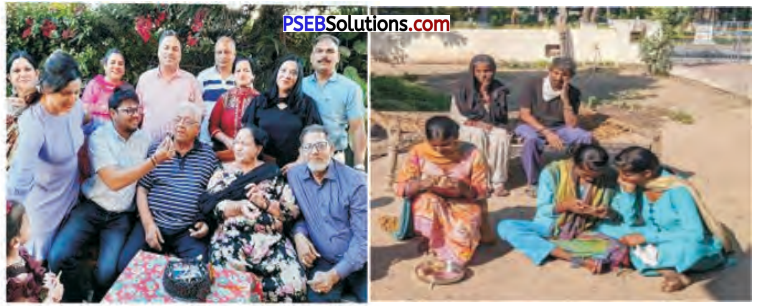
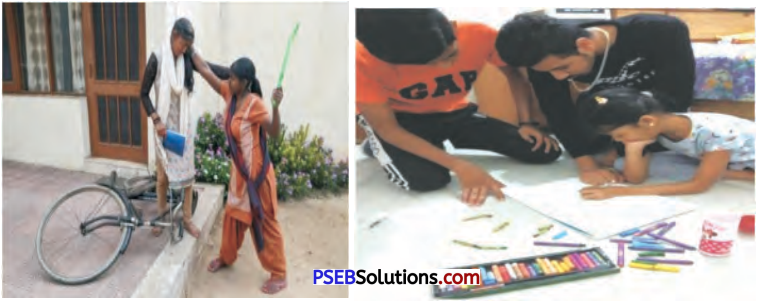
Pictures 1 & 2 will be shown to the students. Then they will answer the questions related to these pictures shown to them.

PSEB 9th Class Welcome Life Solutions Chapter 3 Interpersonal Relationships Img 1

Question 1.
What is the difference between these two?
Answer:
In picture 1 members of a family are laughing and celebrating a birthday. In picture 2, everyone is busy on his/her mobile and is not talking to each other which is wrong.

PSEB 9th Class Welcome Life Solutions Chapter 3 Interpersonal Relationships Img 2

Question 2.
How do you treat your young ones? Choose your response from picture 3 or picture 4.
Answer:
Our treatment with young ones will be in picture 4. In picture 3, two girls are fighting and in picture 4, two boys and a girl are collectively doing work.

Textbook Page No. 14

Question 3.
When you obey and show respect to your elders how do they react to your response?
Answer:
Whenever I obey and show respect to my elders, they become very happy and give me many blessings.

PSEB 9th Class Welcome Life Solutions Chapter 3 Interpersonal Relationships

Question 4.
Whenever you disobey or show disrespect to your elders then what is their reaction?
Answer:
Whenever I disobey or show disrespect to my elders, they become very angry and speak rudely as well.

Question 5.
What do we gain by giving respect to our elders?
Answer:
I feel very happy when I give respect to our elders. They love me and bless me and I feel blessed with this.

Textbook Page No. 18

Question 1.
If you were in the place of these girls what would you have done?
Answer:
If I were in the place of these girls, I would have talked with my parents and teachers as well. I could have made Manjot and Simranjot realize that they must not dare to do it again.

Question 2.
If you were in Anmol’s place, what would you do?
Answer:
I would be doing the same thing that Anmol has done. I would have told them that the act of theirs is wrong and they must not repeat the same thing.

PSEB 9th Class Welcome Life Guide Interpersonal Relationships Textbook Questions and Answers

Question 1.
Which of the character you like most in the play ‘live and let others live’ and why?
Answer:
I believe, Anmol is the best character in the play. Its reason is he handled the situation quite wisely. He was the eldest among all and he considered solving friend’s problems as his duty. He makes Manjot and Simranjit understand that we must not tease girls but be with them as friends. So, he handled the situation easily and wisely.

Question 2.
Should boys and girls have equal rights?
Answer:
Yes, both boys and girls should have equal rights. Even our constitution has given us the Right to Equality and it is said that there shall be no discrimination on the basis of sex. Instead of looking at social differences, both should be treated in equal terms.

Question 3.
Where you live your own life till now without caring for the Rights and liberty of others?
Answer:
Yes, till now, I lived my life for myself but after reading the play, I realized that I must do something for others as well. Now I will change my habit and will try to do something for others.

PSEB 9th Class Welcome Life Solutions Chapter 3 Interpersonal Relationships

Question 4.
Do you come to know that we should let others live their own life too?
Answer:
Yes, now I realised that others have their own life too and they also have the right to live life like us. Everyone wants to live life according to his own wish and others don’t have any right to interfere in anyone’s life. What will happen if others will start interfering in our lives? That’s why we should let others live their lives according to their wish.

Question 5.
How you should treat your classmates?
Answer:
We should treat our classmates with friendly behavior which should be based upon equality. Along with this, we must understand the fact that others have their lives too and we must not interfere in their lives. Instead, we should live in cooperation with others.

PSEB Solutions for Class 9 Welcome Life Interpersonal Relationships Important Questions and Answers

Multiple Choice Questions:

1. What should be there in a mutual relationship?
(a) Respect
(b) Love
(c) Sympathy
(d) All of these
Answer:
(d) All of these

2. All the ……………. of the family are part of a family tree.
(a) members
(b) friends
(c) relatives
(d) none of these.
Answer:
(a) members.

PSEB 9th Class Welcome Life Solutions Chapter 3 Interpersonal Relationships

3. Elder members of the family should be …………….
(a) respect
(b) jealousy
(c) ended
(d) all of these.
Answer:
(a) respect.

4. Where was Pooja standing?
(a) School
(b) Stage
(c) Home
(d) Road.
Answer:
(b) Stage.

PSEB 9th Class Welcome Life Solutions Chapter 3 Interpersonal Relationships

5. Who misbehaved with Pooja and Komal?
(a) Manjot
(b) Simranjit
(c) Both (a) and (b)
(d) Anmol.
Answer:
(c) Both (a) and (b).

6. Pooja and Komal tell their problem to ……………….
(a) Manjot
(b) Teachers
(c) Family
(d) Anmol
Answer:
(d) Anmol

7. Who didn’t want to tell her problem to her family
(a) Pooja
(b) Anmol
(c) Komal
(d) Simranjit
Answer:
(a) Pooja

8. Which is the adolescent age ?
(a) 14-18 years
(b) 10-19 years
(c) 15-21 years
(d) 17-21 years
Answer:
(b) 10-19 years

9. Harassing girls is known as ……………….
(a) Eve, Teasing
(b) Adam Teasing
(c) Girls Teasing
(d) Women Teasing
Answer:
(a) Eve Teasing

PSEB 9th Class Welcome Life Solutions Chapter 3 Interpersonal Relationships

10. Teasing boys are known as …………….
(a) Eve Teasing
(b) Adam Teasing
(c) Boys Teasing
(d) Male Teasing
Answer:
(b) Adam Teasing

11. Under Section ………………….. of Indian Penal Code, 1-9 years of imprisonment can be given for Eve Teasing.
(a) 519
(b) 509
(c) 529
(d) 539.
Answer:
(b) 509

Fill in the Blanks:

1. Harassing girls is known as …………………
Answer:
Eve Teasing

2. Harassing boys is known as ……………..
Answer:
Adam Teasing

3. ………………. and ………………… misbehaved with Komal and Pooja.
Answer:
Simranjit, Manjot

4. We must ……………. the elders.
Answer:
respect

5. We must ……………. the younger ones.
Answer:
love

Tick the Right (✓) or Strong (x) Statement:

1. We should live in love with family members.
Answer:

2. Komal and Pooja did not tell their family about teasing by boys.
Answer:

3. Anmol told a few things to Manjot and Simranjit.
Answer:

4. There is no punishment for Eve Teasing.
Answer:
x

5. We must follow the concept of Live and Let Live.
Answer:

Match the following:

(A) (B)
Section 509 Love
Harassing girls 1-9 years of imprisonment
Harassing boys Eve Teasing
Elders Adam Teasing
Young ones Respect

Answer:

(A) (B)
Section 509 1-9 years of imprisonment
Harassing girls Eve Teasing
Harassing boys Adam Teasing
Elders Respect
Young ones Love

Very Short Answer Type Questions:

Question 1.
What mutual relationships should be like?
Answer:
Mutual relationships should be full of love and respect.

Question 2.
Who is the inseparable part of the family tree?
Answer:
Family members are the inseparable part of the family tree.

Question 3.
Who is of great importance in our lives?
Answer:
Elders of the family have great importance in our lives.

Question 4.
Who are the main characters of the play given in the chapter?
Answer:
Komalpreet, Pooja, Simranjit, Manjot, and Anmol are the main characters of the play.

PSEB 9th Class Welcome Life Solutions Chapter 3 Interpersonal Relationships

Question 5.
Who harassed Komal and Pooja?
Answer:
Simranjit and Manjot harassed the girls.

Question 6.
Why did Pooja did not tell the incident to her family?
Ans.
She feared that her family might scold her.

Question 7.
Why did Pooja have a fear that her family might scold her?
Answer:
Because she believed that boys can do anything and no one will say anything to them but parents are* always ready to scold girls.

Question 8.
Why did Pooja and Komal not tell the incident to teachers?
Answer:
Because if teachers will tell the incident to their family, they will not let them go to school.

Question 9.
Who was told about the incident by Pooja, and Komal?
Answer:
They told the incident to Anmol who is their well-wisher.

Question 10.
What did the girls tell Anmol?
Answer:
They told Anmol that Simranjit and Manjot harass them on the way.

Question 11.
What is adolescent age?
Answer:
The age of 10-19 years is known as the adolescent age in which children develop psychologically, socially, and emotionally.

Question 12.
What do you mean by Eve Teasing?
Answer:
Harassing girls is known as Eve Teasing.

Question 13.
What do you mean by Adam Teasing?
Answer:
Harassing boys is known as Adam Teasing.

PSEB 9th Class Welcome Life Solutions Chapter 3 Interpersonal Relationships

Question 14.
What is the punishment for eve-teasing?
Answer:
According to Section 509 of I.P.C., there is a punishment of 1-9 years for eve-teasing.

Question 15.
What was the impact of Anmol’s discussion with Manjot and Simran?
Answer:
They both regretted their actions and apologized to the girls as well.

Question 16.
What did they all decide?
Answer:
They all decided that they will not do eve-teasing and Adam teasing.

Short Answer Type Questions:

Question 1.
What is the importance of a family tree in our lives?
Answer:
Just as roots, stems, flowers, branches, fruits, etc. are parts of a tree, so are family members. This family tree grows only when the elders love the young ones and younger ones respect the elders. Each family member has its own significance. This tree can only remain green if all live together with love. Only with the mutual love and respect of family members, the family grows and prosper. Family is of great importance in our lives and we are nothing without family.

Question 2.
Why didn’t Pooja tell the family and teachers about the incident of teasing?
Answer:
When Komal told Pooja that we should tell the parents and teachers about the incident, she refused to do as she was afraid of her family. The family will rebuke her and find her fault in the incident. She did not want to discuss the incident with teachers as well as they might approach her family which in turn will not let her go out of the house. That’s why they decided to handle the situation themselves.

Question 3.
Why did Pooja and Komal decide to tell Anmol about this incident?
Answer:
When Pooja and Komal were thinking about finding the solution to the issue, suddenly the name of Anmol come up in their minds. The reason was Anmol was their well-wisher and neighbor as well. Along with this, he was a good friend of Manjot and Simran as well. He considered both the girls as his sisters. That’s why they both believed that Anmol will sort out the issue very easily.

Question 4.
Why is adolescent age important?
Answer:
The age of 10-19 years is known as the adolescent age. This is the time when our mental, social and emotional development takes place. Human personality is also formed in this age. During this age, we must keep emotions in control and focus on our study or the time will be wasted. We need to focus on the career instead of looking for boys or girls. This is the time when we need to concentrate on making a career.

Question 5.
What did Anmol tell Manjot and Simranjit?
Answer:
When Manjot and Simranjit harassed the girls the girls decided to tell the incident to Anmol. Anmol told the boys that everyone wants to live with complete freedom. That’s why we must not interfere in girls’ lives. Teasing is not good for anyone. We must not become enemies but should cooperate with each other.

Question 6.
What was the impact of Anmol’s discussion with Manjot and Simran?
Answer:
When Anmol discussed the incident of teasing with Manjot and Simran then they realized that this is wrong. They promised not to repeat the same mistake again. They realized their fault and decided to follow the concept of ‘Live and Let Live. Both the boys apologized to the girls and become good friends.

Long Answer Type Question:

Question 1.
What did we learn from this chapter?
Answer:
We learned many things from this chapter such as :

  • Family is just like a tree with many members in it. There should be mutual love and respect between the family members and they should cooperate with each other.
  • There should be no gender-based discrimination in society. Both must be given equal rights.
  • We need to make boys understand that girls also have their self-respect. We should not tease them. Instead, they should also be respected.
  • We must respect the elders of the family and live by cooperating with each other.
  • We must respect the existence of others in society and follow the idea of ‘Live and Let Live’.
  • In adolescent age, we should focus on career building and should not waste our time. We should do hard work to get success in life.

Source-Based Question:

Question 1.
Read the source and answer the questions that follow :
The family tree continues to grow and there is a need that by doing, respect, and care we can make this family tree strong and green which means strong bonding within and with the society. Dear students! As a tree consists of Roots, Stem, Branches, Leaves, Flowers, and fruits, in the same way our family members can be represented in a family tree. Now let us try to make your own family tree. Paste maximum pictures of your family members from Paternal and Maternal too.

1. How should we behave with the elders of the family?
Answer:
We should behave with respect to the elders of the family and learn from their experiences.

2. How should we treat the younger ones of the family?
Answer:
We should treat younger ones with love as they learn everything from their elders.

PSEB 9th Class Welcome Life Solutions Chapter 3 Interpersonal Relationships

3. What is the importance of family in our lives?
Answer:
Family is of great importance in our lives as, without family, there is no value in life. We cannot learn anything without family.

4. Do the little ones matter in the family?
Answer:
Yes, little ones matter in the family as they will become elders one day and run the family.

PSEB 6th Class Science Solutions Chapter 2 Components of Food

Punjab State Board PSEB 6th Class Science Book Solutions Chapter 2 Components of Food Textbook Exercise Questions and Answers.

PSEB Solutions for Class 6 Science Chapter 2 Components of Food

Science Guide for Class 6 PSEB Components of Food Intext Questions and Answers

Think and Answer (Textbook Page No. 12)

Question 1.
What happens when we add few drops of iodine solution to raw potato?
Answer:
The colour of potato turns blue-black on addition of Iodine drops.

Question 2.
What is the colour of Iodine solution?
Answer:
Violet.

PSEB 6th Class Science Solutions Chapter 2 Components of Food

Question 3.
Besides raw potato which other food items can be used for testing of starch?
Answer:
Boiled rice, wheat flour, sweet potato and sugar cane.

Think and Answer (Textbook Page No. 13)

Question 1.
Name the chemicals used to test the presence of proteins in food.
Answer:
Copper Sulphate (CUSO4) solution and Caustic Soda (NaOH) solution.

Question 2.
Name any two food items containing protein.
Answer:
Boiled egg and peas.

Think and Answer (Textbook Page No. 15)

Question 1.
Why paper becomes translucent when we crush cashew on it?
Answer:
Paper becomes translucent due to presence of oily patch.

Question 2.
Name any two food items that contain fats.
Answer:
Cashew, groundnut, mustard seeds.

PSEB 6th Class Science Guide Components of Food Textbook Questions and Answers

Exercise – 1

1. Fill in the Blanks:

(a) We use ………………. solution to test the presence of starch.
Answer:
iodine

(b) Potato, rice and wheat are rich sources of …………………
Answer:
carbohydrates (starch)

(c) Citrus fruits mainly contain vitamin ……………….
Answer:
C

(d) Anaemia is caused by deficiency of ………………
Answer:
iron

(e) Goitre is caused by deficiency of …………………..
Answer:
iodine

PSEB 6th Class Science Solutions Chapter 2 Components of Food

2. Write True or False:

(a) Vitamin-D is synthesized when body is exposed to sunlight.
Answer:
True

(b) We get calcium from milk and milk products.
Answer:
True

(c) Pulses are chief sources of fats.
Answer:
False

(d) Rice alone can provide all necessary nutrients to body.
Answer:
False

(e) Night blindness is caused due to deficiency of vitamin A.
Answer:
True

3. Match the Column A with Column B:

Column A Column B
1. Protein deficiency (a) Rickets
2. Vitamin A (b) Beri-Beri
3. Vitamin B (c) Scurvy
4. Vitamin C (d) Night blindness
5. Vitamin D (e) Kwashiorkor

Answer:

Column A Column B
1. Protein deficiency (e) Kwashiorkor
2. Vitamin A (d) Night blindness
3. Vitamin B (b) Beri-Beri
4. Vitamin C (c) Scurvy
5. Vitamin D (a) Rickets

4. Choose the Correct Answer:

Question (i)
Which of the following is rich source of Protein?
(a) Potato
(b) Mango
(c) Rice
(d) Moong Dal.
Answer:
(d) Moong Dal

Question (ii)
Which of the following is essential for normal functioning of thyroid gland?
(a) Vitamin D
(b) Calcium
(c) Iodine
(d) Iron
Answer:
(c) Iodine

PSEB 6th Class Science Solutions Chapter 2 Components of Food

Question (iii)
Anaemia is caused due to deficiency of :
(a) Vitamin A
(b) Calcium
(c) Iron
(d) Iodine
Answer:
(c) Iron

Exercise – 2

5. Very Short Answer Type Questions:

Question (i)
What is balanced diet?
Answer:
The diet that contains adequate amount of all the essential nutrients, roughage and water for proper growth and development of body is called Balanced diet.

Question (ii)
What are the chief sources of carbohydrates?
Answer:
Bajra, jowar, rice, wheat, jaggery, mango, banana, potato, etc.

Question (iii)
Why are the proteins called body building foods?
Answer:
Proteins are essential for growth and repair of body cells so foods rich in protein content are called body building foods.

Question (iv)
What is the importance of roughage for human body?
Answer:
Roughage helps our body to get rid of indigestible food and prevents constipation. It also helps to retain water in food and growth of good bacteria in stomach.

Question (v)
Name any two food items containing fats.
Answer:
Meat, eggs, fish, milk and milk products like butter, ghee etc.

6. Short Answer Type Questions:

Question (i)
Why is water essential for life?
Answer:
Water is essential for life because it helps us in absorption of nutrients from food. It also helps us to get rid of wastes from body in the form of urine and sweat.

Question (ii)
Name five types of nutrients that our body need.
Answer:
Carbohydrates, proteins, fats, minerals and vitamins.

PSEB 6th Class Science Solutions Chapter 2 Components of Food

Question (iii)
From where do we get vitamin C ? What can happen to human body due to the deficiency of vitamin C?
Answer:
We get vitamin C from citrus fruits (Lemon, Orange), amla, tomato, broccoli, etc. Due to deficiency of vitamin see we suffer from a disease called scurvy. The main symptoms of this disease are bleeding gums.

Question (iv)
Fats and carbohydrates are called energy giving foods. Explain Why ?
Answer:
These are called energy giving foods because these when digested release large amounts of energy needed for doing various activities.

7. Long Answer Type Questions:

Question (i)
What are deficiency diseases? Write briefly about the diseases caused by deficiency of proteins and carbohydrates in human body.
Answer:
The diseases caused due to shortage of nutrients in our diet for long time are called deficiency diseases. In other words, deficiency of proteins, carbohydrates, vitamins and minerals results in certain diseases called deficiency diseases.

(1) Disease caused by deficiency of proteins and carbohydrates both is Marasmus. The main symptoms are dry skin, sunken eyes, prominent ribs, body becomes very lean, thin and weak enough that child may not be able to move.

(2) Disease caused by deficiency of proteins is Kwashiorkor. The main symptoms are stunted growth, swelling of face, dry skin, retention of water in body, discolouration of hair.

Question (ii)
Discuss the importance of minerals for human body.
Answer:
Minerals are the components of food that we need for good health and proper growth of body. These do not provide energy to body. These are needed in very small quantities. Iron, Calcium, Iodine and Phosphorus are important minerals for our body. Their deficiency can cause some disease.

Iron.
It is important mineral needed by our body for formation of haemoglobin in body. Main sources of iron are leafy vegetables, fruits, jaggery, etc. Its deficiency can cause anaemia.

Calcium.
It is important mineral needed by our body for formation of bones. Main sources of calcium are Milk and milk products, eggs, etc. Its deficiency can cause weak bones and tooth decay.

Phosphorous.
It is important mineral needed by our body for providing strength to bones and teeth. Main sources of phosphorus are milk, cheese, banana, bajra, nuts, etc. Its deficiency can cause weak bones and tooth decay.

Iodine.
It is important mineral needed by our body for normal functioning of thyroid gland. Main sources of iodine are iodised Salt, Sea food, Green leafy vegetables, etc. Its deficiency can cause goitre disease. The main symptom of this disease is enlargement of gland in neck (Thyroid).

Question (iii)
What are vitamins? Discuss the importance of different types of vitamins for human body.
Answer:
Vitamins are essential for proper functioning of our body. Like minerals they are also required in very small quantity and also do not provide any energy to body. We need many vitamins like A, B, C, D, E and K.

Vitamin A.
The main sources are eggs, meat, milk, cheese, green leafy vegetables, carrots, papya, etc. It is needed for maintaining healthy eyes and skin. Its deficiency can cause night blindness.

Vitamin B.
The main sources are milk, green vegetables, peas, eggs, cereals, mushrooms etc. It is needed for normal growth and functioning of central nervous system, digestive system. Its deficiency can cause beri-beri disease.

Vitamin C.
The main sources are milk, citrus fruits (lemon, orange), amla, tomato, broccoli, etc. It helps us to increase our immunity and fight against different diseases. Its deficiency can cause scurvy or bleeding gums disease.

Vitamin D.
The main sources are dairy products, fish liver oil, exposure to sunlight, etc. It is required for healthy bones and teeth. Its deficiency can cause rickets disease.

Vitamin E.
The main sources are nuts such as almonds, peanut, vegetable oils such as sunflower and soybean oils, leafy vegetables such as spinach and broccoli, etc. It protects cells from damage, and help in lowering a variety of health problems.

Vitamin K.
The main sources are green leafy vegetables (such as spinach, turnip, mustard, broccoli, cauliflower, and cabbage), fish, meat, eggs, and cereals (contain smaller amounts), etc. It is needed for blood clotting.

PSEB 6th Class Science Solutions Chapter 2 Components of Food

PSEB 6th Class Science Guide Components of Food Important Questions and Answers

Multiple Choice Questions:

Question 1.
Number of important nutrients of food needed by our body is :
(a) Two
(b) Four
(c) Five
(d) Ten.
Answer:
(c) Five

Question 2.
Which is not an energy giving food
(a) Water
(b) Roughage
(c) Vitamins
(d) All
Answer:
(d) All

Question 3.
It is needed for testing protein in a food material :
(a) A solution of Copper Sulphate and Caustic soda
(b) Nitric acid
(c) Iodine
(d) All of these
Answer:
(a) A solution of Copper Sulphate and Caustic soda

Question 4.
Iodine is used for testing :
(a) Carbohydrates (sugar)
(b) Protein
(c) Vitamin
(d) Water
Answer:
(a) Carbohydrates (sugar)

Question 5.
Milk Contains nutrients :
(a) Water
(b) Carbohydrates
(c) Proteins
(d) All of these.
Answer:
(d) All of these

Question 6.
Lime, Amla are source of :
(a) Carbohydrates
(b) Minerals
(c) Proteins
(d) Vitamin-C.
Answer:
(d) Vitamin-C

Question 7.
Fats are tested by :
(a) Salt
(b) Taste
(c) Rubbing on paper
(d) Using iodine solution.
Answer:
(c) Rubbing on paper

Question 8.
Deficiency of Vitamin D causes :
(a) Scurvy
(b) Beri-Beri
(c) Rickets
(d) Goitre.
Answer:
(c) Rickets

PSEB 6th Class Science Solutions Chapter 2 Components of Food

Question 9.
Weak eye sight is symptom of :
(a) Scurvy
(b) Anaemia
(c) Rickets
(d) Night blindness.
Answer:
(d) Night blindness

Question 10.
Food which contains all the nutrients in proper amounts is known as :
(a) Good diet
(b) Complete diet
(c) Balanced diet
(d) Healthy diet.
Answer:
(c) Balanced diet

Question 11.
Play role in protecting body against diseases.
(a) Minerals
(b) Carbohydrates
(c) Fats
(d) Vitamins.
Answer:
(d) Vitamins.

Fill in the Blanks:

(a) The components of food needed by our body are called ……………….
Answer:
nutrients

(b) The fibrous indigestible material present in food is termed as ……………….
Answer:
roughage

(c) Simple tests can be done for presence of …………….., …………… and …………………
Answer:
carbohydrates, fats, proteins

(d) To conduct test some chemicals like …………….., ……………..and caustic soda are needed.
Answer:
iodine solution, copper sulphate

(e) ……………… and …………….. are the carbohydrates found in food.
Answer:
starch, sugar

PSEB 6th Class Science Solutions Chapter 2 Components of Food

(f) Carbohydrates and fats provide ……………. to the body.
Answer:
energy

(g) …………… …………….. help in protecting the body against diseases.
Answer:
Vitamins

(h) Proteins are body ……………… foods.
Answer:
building

(i) Different types of vitamins are …………….., ………….. ,………………. ,……………. and …………..
Answer:
A, B, C, D, E, K

(j) Besides different nutrients, water and ………….. are also needed by the body.
Answer:
Dietary fibres

(k) Roughage / dietary fibres helps body to get rid of …………….. food.
Answer:
undigested

(l) Diseases caused by …………….. of a nutrient is called deficiency disease.
Answer:
deficiency

PSEB 6th Class Science Solutions Chapter 2 Components of Food

(m) Vitamin C gets easily destroyed by …………… during cooking.
Answer:
heat

Write (T) against True and (F) against False statement:

(a) We need only three important nutrients in our food.
Answer:
False

(b) Iodine in a food item cannot be easily tested.
Answer:
False

(c) Copper sulphate is used for testing proteins in the food.
Answer:
True

(d) Fatty substances leave patchy marks on the surfaces on which they are kept or wrapped.
Answer:
True

(e) Proteins protect the body from diseases.
Answer:
False

(f) Only a single vitamin B is present in the body.
Answer:
False

(g) Leafy vegetables are source of roughage.
Answer:
True

(h) Milk and eggs are source of minerals.
Answer:
True

(i) Goitre is a disease caused by the deficiency of vitamin C.
Answer:
False

(j) Rickets is a disease in which teeth decay quickly.
Answer:
False

PSEB 6th Class Science Solutions Chapter 2 Components of Food

(k) Anaemia is a disease in which body weakens up due to lack of Iron.
Answer:
True

(l) Lack of vitamin B is cause of Beri-Beri.
Answer:
True

(m) Kwashiorkar is caused due to deficiency of vitamin A.
Answer:
False

Matching

Match the following items given in column A with that in column B :

Column A Diseases caused Column B Deficiency of
(1) PEM Vitamin A
(2) Beri-Beri Vitamin D
(3) Scurvy Vitamin B
(4) Goitre Roughage
(5) Rickets Proteins
(6) Night blindness Vitamin C
(7) Constipation Iodine

Answer:
(1) PEM – Proteins
(2) Beri-Beri – Vitamin B
(3) Scurvy – Vitamin C
(4) Goitre – Iodine
(5) Rickets – Vitamin D
(6) Night Blindness – Vitamin A
(7) Constipation – Roughage.

Very Short Answer Type Questions

Question 1.
Which are the important nutrients required for providing energy to our body for doing various activities?
Answer:
Carbohydrates and fats.

Question 2.
Which nutrient of food is body building?
Answer:
Protein is body building nutrient of food.

Question 3.
Which nutrients act as protective food?
Answer:
Vitamins and minerals.

PSEB 6th Class Science Solutions Chapter 2 Components of Food

Question 4.
Which is more energy rich nutrient – fat or carbohydrates?
Answer:
Fat.

Question 5.
Name diseases caused due to deficiency of vitamin ‘C’ and vitamin ‘D”.
Answer:
Vitamin ‘C’ – Scurvy, Vitamin ‘D’ – Rickets

Question 6.
Which foods are rich in fats?
Answer:
Oil, butter, ghee etc.

Question 7.
Which nutrient is present in Sugar, Potato and cereals?
Answer:
Carbohydrates.

Question 8.
What is effect of excess water in food material?
Answer:
Excess water helps in dissolving minerals.

Question 9.
Why should we not wash rice and dais repeatedly?
Answer:
This will cause loss of vitamins and minerals.

Question 10.
Which chemical is used for Testing Starch in food?
Answer:
Iodine solution.

Question 11.
What happens when copper sulphate solution and sodium hydroxide solution are added to a food material containing proteins ?
Answer:
Appearance of violet colour.

PSEB 6th Class Science Solutions Chapter 2 Components of Food

Question 12.
How are deficiency diseases prevented?
Answer:
By taking balanced diet.

Question 13.
What is the cause of kwashiorkar and marasmus?
Answer:
Deficiency of protein causes kwashiorkar whereas deficiency of proteins and carbohydrates both causes marasmus.

Short Answer Type Questions

Question 1.
List few sources of proteins and carbohydrates.
Answer:
(i) Sources of Proteins :
(a) Plant sources : Peas, Soyabean, Grains.
(b) Animal sources : Milk, Fish, Meat.

(ii) Sources of Carbohydrates : Sugarcane, Potato, Beetroots, Mango, Papaya, Banana, Maize.

Question 2.
List few sources of vitamins and fats.
Answer:
(i) Sources of Vitamins : milk, liver, grains, fruit, butter, egg, leafy vegetables.
(ii) Sources of Fats : Ghee, Butter, Oil, Cream.

Question 3.
What are deficiency diseases?
Answer:
Deficiency disease. Diseases that occur due to deficiency of one or more nutrients over a long period are called deficiency diseases. Anaemia, Rickets, Scurvy and Goitre are examples of deficiency diseases.

Question 4.
How will you test carbohydrates, and proteins present in the food?
Answer:
We can test carbohydrate by using iodine solution test. Here we observe that the colour of carbohydrate turns blue-black on addition of Iodine drops.
We can test presence of protein by adding two drops of Copper Sulphate (CUSO4) and 10 drops of Caustic Soda (NaOH) solution to the test tube.

Question 5.
Why is roughage important for us ?
Answer:
Roughage is important for us because it

  1. regulates the process of digestion.
  2. controls the bowel movements.
  3. increases the bulk of bowels.
  4. prevents constipation.

Question 6.
We must take foods that provide us vitamins, why ?
Answer:
We must take foods that provide us vitamins because these

  1. help to digest food.
  2. keep the skin healthy.
  3. keep teeth, joints and gums healthy.

PSEB 6th Class Science Solutions Chapter 2 Components of Food

Question 7.
Why are proteins better known as body building food ?
Answer:
Proteins. These are known as a body building food as they help in growth, repair and maintenance of the body.

Question 8.
What are different types of carbohydrates ?
Answer:
We have two types of carbohydrates. These are simple carbohydrates and complex carbohydrates. Glucose, fructose, lactose, sucrose, etc. are examples of simple carbohydrates. Starch, cellulose, etc. are examples of complex carbohydrates

Question 9.
Proteins are very important for us. Justify the statement.
Answer:
Proteins are very important for us because these play very important roles like proper growth and repair in our body. If we do not have enough protein in our diet then we may suffer from problems like kwashiorkor and marasmus.

Question 10.
Why vitamins are essential for our body ?
Answer:
Need of vitamins for human body. Vitamins are essential because :

  1. They help to digest food.
  2. They keep the skin and mouth healthy.
  3. They keep teeth, gums and joints healthy.

Question 11.
What are the main sources of vitamin C and vitamin D ?
Answer:
Sources of vitamins. Vitamin C is found in all citrus fruits and many fresh vegetables. Vitamin D is found in fish, oil, eggs, milk and milk products.

Question 12.
Write the main difference between Vitamins and Minerals.
Answer:
Differences between Vitamins and Minerals.

Vitamins Minerals
1. Vitamins are compounds which are present in our diet. 1. Minerals are inorganic salts which are present in our diet.
2. For example : Wheat, Rice, Milk, Citrus, fruit etc. are the sources of vitamins. 2. For example : Calcium, Phosphorus, Sodium, Iodine etc.

Question 13.
What are carbohydrates ?
Answer:
Carbohydrates.
These are the main constituents of almost all our diets and our food components. Carbohydrates are energy food. They provide energy to our body to do work and play. In addition carbohydrates add flavour to our food. Many processed foods including breads, pizzas, burgers, noodles, jams etc. are rich in carbohydrates. Sugar and starch are pure carbohydrate.

Question 14.
What are the effects of fat in diet ?
Answer:
Effects of excess fat in diet :

  • Obesity. Excessive deposition of fat on the tissues.
  • Digestive disturbances particularly in children.
  • Cholesterol accumulation/deposition around blood-vessel causing a disease arteriosclerosis and finally heart disease.

PSEB 6th Class Science Solutions Chapter 2 Components of Food

Question 15.
What disease is caused due to deficiency of vitamin C ?
Answer:
Deficiency of vitamin C causes Scurvy.
Example : A guinea pig has a disease of scurvy due to deficiency of vitamin C but when this vitamin was added to its diet, it became healthy and normal.

Question 16.
What is roughage ?
Answer:
Roughage and its role.
Roughage is mainly a plant food. Flour, cereals, potatoes, fresh fruits and raw or cooked vegetables provide roughage in our body. Dried beans and peas are also good sources of fibres.

Question 17.
What happens to a person if the diet is deficient in both carbohydrates and proteins for a longer period of time ?
Answer:
The growth may stop completely. Such a person becomes very lean, thin and so weak that he may not even be able to move.

Question 18.
Name three foods each rich in :
(i) Starch
(ii) Dietary Fibre
(iii) Fats and oils
(iv) Protein
(v) Sugar.
Answer:
(i) Starch : Rice, wheat, bajra.
(ii) Dietary fibre : Spinach, cabbage, lady finger.
(iii) Fats and oils : Ghee, butter, groundnut, cheese.
(iv) Protein : Milk, meat, fish, egg.
(v) Sugar : Milk, banana, sugarcane.

Long Answer Type Questions

Question 1.
Explain ‘balanced diet’.
Answer:
Balanced diet.
A diet is said to be balanced when it provides the proper amount and proportion of carbohydrates, proteins, vitamins, minerals, roughage and water to maintain a healthy body. A balanced diet should have the following three qualities :

  • It should be rich in various essential nutrients like minerals and vitamins.
  • It should provide just enough raw material needed for the growth, development, repair and replacement of tissues of the body.
  • It should provide proper energy required by the body.

Question 2.
Write the important functions of water in our body.
Answer:
Important functions of water. The human body contains about 70% water. Water performs the following functions in our body :

  1. It transports food materials within the body.
  2. It helps in the formation of urine and faeces.
  3. It regulates our body temperature.
  4. It is essential part of blood and digestive juices.

Question 3.
Draw a table showing diseases / disorders caused by deficiency of vitamins and minerals.
Answer:
Diseases / disorders caused by deficiency of vitamins and minerals.

Vitamin/ Mineral Deficiency disease/disorder Symptoms
Vitamin A Loss of vision Poor vision, loss of vision in darkness (night), sometimes complete loss of vision.
Vitamin B Beri-beri Weak muscles and very little energy to work.
Vitamin C Scurvy Bleeding gums, wounds take a longer time to heal.
Vitamin D Rickets Bones become soft and bent.
Calcium Bone and tooth-decay Weak bones, tooth decay.
Iodine Goiter Glands in the neck appear swollen, mental disability in children.
Iron Anaemia Weakness

PSEB 8th Class Agriculture Solutions Chapter 1 Soil and Soil Management

Punjab State Board PSEB 8th Class Agriculture Book Solutions Chapter 1 Soil and Soil Management Textbook Exercise Questions and Answers.

PSEB Solutions for Class 8 Agriculture Chapter 1 Soil and Soil Management

Agriculture Guide for Class 8 PSEB Soil and Soil Management Textbook Questions and Answers

(A) Answer in one to two words:

Question 1.
What is the pH of normal soil for crop production?
Answer:
pH should be from 6.5 to 8.7.

Question 2.
Name any two physical properties of soils.
Answer:
Particle size, soil density, pore size, water holding capacity etc.

PSEB 8th Class Agriculture Solutions Chapter 1 Soil and Soil Management

Question 3.
Which soils have highest infiltration rate?
Answer:
Sandy soil.

Question 4.
What is the percentage of clay particles in clayey soils?
Answer:
At least 40% clayey particles.

Question 5.
Which soil property determines the soil acidity or alkalinity?
Answer:
Value of pH for the soil.

Question 6.
Which are the prominent salts present in saline soils?
Answer:
Chlorides and sulphates of potassium, calcium and magnesium.

Question 7.
The soil with higher concentration of sodium carbonates and bicarbonates are categorized as.
Answer:
Alkali soil.

PSEB 8th Class Agriculture Solutions Chapter 1 Soil and Soil Management

Question 8.
Which amendment is used for reclamation of alkali soils?
Answer:
Gypsum.

Question 9.
Name two green manure crops.
Answer:
Daincha, Jantar.

Question 10.
Which crop is best suited for cultivation in clayey soils?
Answer:
For cultivation of paddy crop.

PSEB 8th Class Agriculture Solutions Chapter 1 Soil and Soil Management

(B) Answer in one to two sentences:

Question 1.
What is soil?
Answer:
Soil is the upper layer of earth in which plant roots grow, plants take water and nutrients from it.

Question 2.
Write the important functions of soil.
Answer:
Crops absorb water and nutrients from soil and soil also gives physical strength to the plants.

Question 3.
Enlist the physical properties of soil.
Answer:
Size of particles, soil density, pore size, water holding capacity etc.

Question 4.
Compare clayey and sandy soils.
Answer:

Sandy Soil Clayey Soil
1. If soil is rubbed between finger and thumb, it feels gritty. 1. Soil particles are very fine.
2. Water holding capacity in not good. 2. Water holding capacity is large.
3. Pore size is big. 3. Pore size is very small.

PSEB 8th Class Agriculture Solutions Chapter 1 Soil and Soil Management

Question 5.
What acidic 90?
Answer:
Those soils which have high acidic content and their pH value is less than 7 are acidic soils. These soils are found in areas of heavy rain fall, due to this, bases drin out and due to decay of organic malter Like leaves etc. soil becomes acidic.

Question 6.
What is saline soil?
Answer:
Soils which have high content of salt in them are saline soils. These soils have chlorides and sulphates of potassium,, calcium and magnesium. .

Question 7.
Write two main methods to identify a sandy soil.
Answer:

  • Sandy soils have higher infiltration rate.
  • It feels gritty when soil is rubbed in hands.
  • Moist ball breaks very easily.

Question 8.
What are the major properties of loamy soils?
Answer:

  • Particles are very-very fine.
  • Pore size is very small.
  • When taken in hand it feels like powder.
  • Water holding capacity is high.

Question 9.
What are saline-alkali soils?
Answer:
Soils with higher concentration of sodium and soluble salts in it are called saline-alkali soils.

Question 10.
What is puddling?
Answer:
Ploughing in flooded field is known as puddling.

PSEB 8th Class Agriculture Solutions Chapter 1 Soil and Soil Management

(C) Answer in five to six sentences:

Question 1.
Describe the different types of sods according to their physical properties.
Answer:
Physical properties of soil are: size of soil particle, pore size, soil structure, water holding capacity etc. There are three types of soils:
1. Clayey Soil:
It has more than 40% of clay content. Its water holding capacity is high. Balls can be made from moist clay and do not break on applying pressure. Particles are fine and pore size is also very fine.

2. Sandy Soil:
These soils have low water holding capacity. Particle size is not very small and pore size is also not very small as compared to clayey soil, water infiltration rate is high. Moist ball break easily with very little pressure. When rubbed in hands it feels gritty.

3. Loamy soil:
Properties of this soil lies between sandy and clayey soil. Its properties are optimum for crop cultivation and is best suited for agriculture.

Question 2.
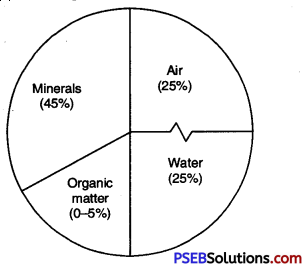
Give the diagrammatic representation of soil components.
Answer:
Soil is a mixture of minerals, organic matter, water and air. Their proportion is shown in the diagram below. Water and air content can vary.

PSEB 8th Class Agriculture Solutions Chapter 1 Soil and Soil Management 1

PSEB 8th Class Agriculture Solutions Chapter 1 Soil and Soil Management

Question 3.
Explain the management practices for improving sandy soils.
Answer:

  • Incorporate green manure which is 45-50 days old or before the flowering sets. Sunhemp/dhaincha can be used for this purpose.
  • Apply well decomposed organic manue (FYM etc.) by ploughing.
  • Poultry manure, pig manure and compost etc. can be mixed with the soil.
  • Cultivate leguminous crops in such soils.
  • Use small plot size for irrigation.
  • Remove the top sandy layer by using Karaha.
  • Incorporate clay soil or village pond soil to improve the quality.

Question 4.
Explain the method of reclamation of alkali soil.
Answer:

  • Level the field uniformly so that distribution of water is same throughout the field.
  • Do not allow the outflow of salt dissolved water to adjoining fields, prevent it by making strong bunds around the field.
  • To know the requirement of gypsum for the soil, get soil and water tested.
  • Broadcast the required dose of gypsum in the field and mix it with shallow ploughing.
  • Apply green manure, organic manure etc. to improve the soil.

Question 5.
Explain in detail the management strategy for clayey soils.
Answer:

  • To improve water infiltration rate and aeration of the clayey soil apply green manure and organic manure.
  • Plough the crop residue in the soil.
  • Plough the field at proper moisture content to avoid the formation of large-sized clods. .
  • This soil is suitable for cultivation of paddy.
  • There should be proper drainage system so as to drain out excessive water.

PSEB 8th Class Agriculture Solutions Chapter 1 Soil and Soil Management

PSEB 8th Class Agriculture Guide Soil and Soil Management Important Questions and Answers

Very Short Answer Type Questions

Question 1.
Is earth living or non-living according to soil scientists?
Answer:
It is living.

Question 2.
What is the percentage of minerals and organic matter in earth?
Answer:
Minerals 45% and organic matter 0-5%.

Question 3.
Which soil is called light soil?
Answer:
Sandy soil.

Question 4.
Which soil has high water holding capacity?
Answer:
Clayey soil.

Question 5.
Which soil is best suited for agriculture?
Answer:
Loamy soil.

Question 6.
Where is the problem of acidic soils found?
Answer:
In areas of heavy rainfall.

PSEB 8th Class Agriculture Solutions Chapter 1 Soil and Soil Management

Question 7.
What is value of pH for Acidic soils?
Answer:
Less than 7.

Question 8.
What range of pH value is suited for agriculture?
Answer:
6.5 to 8.7.

Question 9.
What is pH of saline soils?
Answer:
Less than 8.7.

Question 10.
Which soils are called Kauai, reh, Thur or shorn?
Answer:
Saline soils.

Question 11.
How much is the water holding capacity of alkali soils?
Answer:
Very less.

Question 12.
Name a crop used for green manure?
Answer:
Sunhemp, Jantar.

Question 13.
What should be the plot size for sandy soils for irrigation?
Answer:
Small size.

Question 14.
What is the suitable time to mix lime in acidic soil?
Answer:
3-6 months before sowing the crop.

PSEB 8th Class Agriculture Solutions Chapter 1 Soil and Soil Management

Question 15.
How big is the problem of acidic soils in Punjab?
Answer:
There is no problem of acidic soils in Punjab.

Short Answer Type Questions

Question 1.
Write reason why soils become acidic?
Answer:
Heavy rainfall helps in the growth of plants and more vegetation is found in such areas. Leaves etc. fall on the ground decompose and increase the acidic content. Rain water helps in the flowing out of basic salts which further adds to the acidic nature.

Question 2.
Write two properties of saline soils.
Answer:

  • Chloride and sulphate salts of calcium, magnesium and potassium have high concentration in such soils.
  • pH of these soils is less than 8.7.

Question 3.
Write two properties of alkali soils.
Answer:

  • In such soils concentration of carbonates and bicarbonates of sodium is high.
  • Infiltration rate of such soils is low.

Question 4.
Write two methods to reclaim the acidic soils.
Answer:
The soil is reclaimed by using lime. Remains from cane mill and wood ash can also be used.

PSEB 8th Class Agriculture Solutions Chapter 1 Soil and Soil Management

Question 5.
Give properties of loamy soil.
Answer:
Its properties are between sandy and clayey soil. It feels like powder when taken in hands.

Question 6.
What is the meaning of water logged soil?
Answer:
Those soils in which water table is at depth of 0 to 1.5 m below surface of soil are called water logged soils.

Question 7.
How saline soils are reclaimed?
Answer:
Salts are washed away with water from the soil. For doing this field is flooded with water and is then ploughed. This water is drained out from the field which have salts dissolved in it. In another method, salts are made to dissolve into water and this water is allowed to leach down.

Question 8.
How can we improve sandy soils?
Answer:
We can improve sandy soil by incorporating 45-50 days old green manure crop of dhaincha/sunhemp in the soil.

PSEB 8th Class Agriculture Solutions Chapter 1 Soil and Soil Management

Long Answer Type Questions

Question 1.
Make a list of physical properties of soil. Write few lines about any one of these?
Answer:
Different soils have different physical properties. Some of the physical properties are:

  1. Particle size
  2. Depth
  3. Colour
  4. Density
  5. Water holding capacity
  6. Temperature
  7. Pore size
  8. Infiltration rate

Particle size:
Soil is made up of different mineral particles. Particle size depends on the ratio in which different sized particles are present in the soil. Fertility of the soil depends on particle size to some extent.

Question 2.
What is pH value? What is the effect of pH value on soil?
Answer:
pH value:
pH value tells us the nature of the soil i.e. acidic, neutral or alkaline nature. pH value is the ratio of concentration of hydrogen ion (H+) and hydroxyl ion (OH-) in a solution.

pH value of soil Type of soil
> 8.7 Alkali
8.7 – 7 slightly  alkaline
7 Neutral
7.6 to 5 light acidic
< 6.5 acidic

Question 3.
Write briefly about the chemical characters of soil?
Answer:
Soils have different types of chemical properties like pH, electric conductivity (EC), salt content, etc. Based on these chemical properties, soils are classified as below:

  1. Acidic soils: These soils have a pH value of less than 7. These soils are found in areas where high rainfall occurs.
  2. Salt-affected soils: These soils have a high concentration of salts. Based on salt concentration, pH and EC soils can be saline, alkali, or saline-alkali.

PSEB 7th Class Science Solutions Chapter 1 Nutrition in Plants

Punjab State Board PSEB 7th Class Science Book Solutions Chapter 1 Nutrition in Plants Textbook Exercise Questions and Answers.

PSEB Solutions for Class 7 Science Chapter 1 Nutrition in Plants

PSEB 7th Class Science Guide Nutrition in Plants Textbook Questions and Answers

1. Fill in the Blanks:

(i) The process of obtaining and utilization of food by an organism is called ……………..
Answer:
nutrition

(ii) ………………. from the air is taken in through the tiny pores called stomata present on the surface of leaves.
Answer:
Carbon dioxide

(iii) ……………… is the initial product of photosynthesis.
Answer:
glucose (Carbohydrate)

PSEB 7th Class Science Solutions Chapter 1 Nutrition in Plants

(iv) The plants which depend on the food produced by other plants are called ………………..
Answer:
heterotrophs

2. State True or False:

(i) Carbohydrates is not an essential component of food.
Answer:
False

(ii) All green plants are autotrophs.
Answer:
True

(iii) Euglena is an organism that has both plant and animal like characters.
Answer:
True

(iv) Sunlight is not necessary for photosynthesis.
Answer:
False

3. Match the Column ‘A’ with Column ‘B’:

Column ‘A’ Column ‘B’
1. Agaricus (a) Parasite
2. Rhizobium (b) Feaves
3. Chlorophyll (c) Feguminous plants
4. Cuscuta (d) Saprophyte

Answer:

Column ‘A’ Column ‘B’
1. Agaricus (d) Saprophyte
2. Rhizobium (c) Leguminous plants
3. Chlorophyll (b) Leaves
4. Cuscuta (a) Parasite

4. Choose the Correct Answer:

Question (i)
An Organism that fixes atmospheric nitrogen in the soil is :
(a) Amarbel
(b) Mushroom
(c) Rhizobium
(d) Chlorophyll
Answer:
(c) Rhizobium.

PSEB 7th Class Science Solutions Chapter 1 Nutrition in Plants

Question (ii)
The Organisms that cannot prepare their own food and depends on others for food are known as :
(a) Autotrophs
(b) Fleterotrophs
(c) Nutrients
(d) Minerals
Answer:
(b) Heterotrophs.

Question (iii)
Food factory of the plants is :
(a) Leaf
(b) Stem
(c) Root
(d) Flower
Answer:
(a) Leaf.

Question (iv)
Which of the following is a saprophyte ?
(a) Rhizobium
(b) Agaricus
(c) Cuscuta
(d) Protein
Answer:
(c) Cuscuta.

5. Very Short Answer Type Questions:

Question (i)
Define Nutrition.
Answer:
Nutrition. The act of obtaining and using food by the organism is called nutrition. Not all living things have the same food.

Question (ii)
What is photosynthesis ?
Answer:
Photosynthesis. It is a process in which food (carbohydrates) is produced by the plants. During this process, carbon dioxide and water are synthesized into glucose (simple carbohydrates) in the presence of sunlight by plant’s green matter (chlorophyll pigment).
Through this action green plants convert light energy into chemical energy.
Chemical Equation :
PSEB 7th Class Science Solutions Chapter 1 Nutrition in Plants 1

Question (iii)
Name the raw materials required for photosynthesis.
Answer:
Ingredients for photosynthesis :

  1. Carbon dioxide
  2. Water
  3. Solar Energy

Question (iv)
What are insectivorous plants ?
Answer:
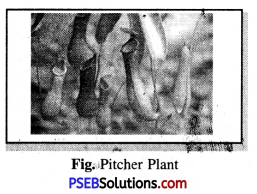
Insectivorous plants. Plants that have a system for catching and digesting organisms are called insectivorous plants, such as pitcher plant. The leaves of these plants are transformed into pot compositions to catch insects.

6. Short Answer Type Questions:

Question (i)
What do you mean by parasitic mode of nutrition ?
Answer:
Parasitic Nutrition. Nutrition in which the parasitic organism harms another organism and derives its food from it is called parasitic nutrition.

PSEB 7th Class Science Solutions Chapter 1 Nutrition in Plants

Question (ii)
Explain symbiotic relationship.
Answer:
Symbiotic relationship. Two different organisms co-exist with each other and depend on each other for their nourishment, then it is called symbiotic relationship. In this kind of relationship both the beings get benefit from each other. Like the fungus found on the roots of many plants. The fungus gets nourishment from the roots of the plant and in turn absorbs water and minerals from the soil. Fungus and moss are a good example of symbiotic relationship. Here the fungi absorb water from the earth and in turn the algae provide food through photosynthesis.

Question (iii)
How does the pitcher plant catch insects ?
Answer:
PSEB 7th Class Science Solutions Chapter 1 Nutrition in Plants 2
The pitcher plant transforms its leaves into pot-like structures to catch insects. This pot-like creation has curly hair on the face. When an insect sits on it, it slips down and cannpt climb up again and falls to the bottom of the pot. The enzymes present at the bottom digest the insect.

7. Long Answer Type Questions:

Question (i)
How are nutrients replenished in the soil ?
Answer:
Regain of nutrients by soil. Plants continue to absorb water, minerals and other nutrients from the soil which leads to lack of nutrients in the soil. Time to time nutrition should be provided to the soil so that the fertility of the soil is maintained. Farmers usually recreate these nutrient deficiencies by mixing manure in the soil and Fertilizers (which contain one or more preservatives) to fulfil nutrients.
In forest the forest waste, leaves and animal waste is decomposed by decomposers into nutrients to improve fertility of the soil.

Question (ii)
What do you mean by nutrients ? Explain various modes of nutrition in plants.
Answer:
Nutrients. Carbohydrates, fats, proteins, vitamins and minerals are the main components of food. They help in the formation and function of the body and are called nutrients.

The main methods of nutrition in plants are :
(a) Autotrophic Nutrition. Those who prepare their own food from simple foods are called Autotrophs. This process of preparing food by such plants is called Autotrophic nutrition. All green plants are Autotrophic. In this method, chlorophyll, a green pigment present in plants, takes carbon dioxide and water from the air and makes food in the form of carbohydrates in the presence of solar energy. This action is called photosynthesis. Example-all green plants.

(b) Heterotrophic Nutrition. Some plants do not have green pigment (chlorophyll) and cannot make their own food, so they rely on food prepared by other plants for food. Such plants are called Heterotrophic plants and this method of obtaining food is called Heterotrophic nutrition. Example. Amar Bel.

PSEB Solutions for Class 7 Science Nutrition in Plants Important Questions and Answers

1. Fill in the Blanks:

(i) Green plants are called …………….. since they synthesise their own food.
Answer:
Autotrophs

(ii) The food synthesised by the plants is stored as ………………..
Answer:
Starch

PSEB 7th Class Science Solutions Chapter 1 Nutrition in Plants

(iii) In photosynthesis solar energy is captured by the pigment called …………….. .
Answer:
Chlorophyll

(iv) During photosynthesis plants take ……………… and produce …………….. .
Answer:
Carbondioxide, Oxygen

2. State True or False:

(i) Carbondioxide is released during photosynthesis.
Answer:
False

(ii) Plants which synthesise their food themselves are called saprotrophs.
Answer:
False

(iii) The product of photosynthesis is not a protein.
Answer:
False

(iv) During photosynthesis solar energy is converted into chemical energy.
Answer:
True

3. Match the Column I with Column II :

Column I Column II
(i) Chlorophyll (a) Bacteria
(ii) Nitrogen (b) Pitcher plant
(iii) Amarbel (c) Leaf
(iv) Animals (d) Parasite
(v) Insects (e) Heterotrophs

Answer:

Column I Column II
(i) Chlorophyll (c) Leaf
(ii) Nitrogen (a) Bacteria
(iii) Amarbel (d) Parasite
(iv) Animals (e) Heterotrophs
(v) Insects (b) Pitcher plant

4. Choose the Correct Answer:

Question 1.
The organisms which depend upon other organisms for food are called ……………..
(a) Symbionts
(b) Parasites
(c) Autotrophs
(d) Saprophytes.
Answer:
(b) Parasites.

PSEB 7th Class Science Solutions Chapter 1 Nutrition in Plants

Question 2.
Which part of the plant usually contains stomata ?
(a) Roots
(b) Stem
(c) Leaves
(d) Flower.
Answer:
(c) Leaves.

Question 3.
Which gas is released during photosynthesis ?
(a) Oxygen
(b) Carbon dioxide
(c) Nitrogen
(d) Hydrogen.
Answer:
(a) Oxygen.

Question 4.
What is the unit of living beings
(a) Organ
(b) Organ system
(c) Cell
(d) Tissue.
Answer:
(c) Cell.

Question 5.
What is the ultimate source of energy in the living beings ?
(a) Moon
(b) Sun
(c) Stars
(d) Planet.
Answer:
(b) Sun.

Question 6.
Name one eatable fungus.
(a) Alga
(b) Bacteria
(c) Rhizopus
(d) Mushroom.
Answer:
(d) Mushroom.

Question 7.
Plants breathe through:
(a) Epidermis
(b) Buds
(c) Stomata
(d) Root hairs.
Answer:
(c) Stomata.

Question 8.
What are green coloured thread like structures over the pond water called ?
(a) Fungi
(b) Algae
(c) Amoeba
(d) Paramecium.
Answer:
(b) Algae.

PSEB 7th Class Science Solutions Chapter 1 Nutrition in Plants

Very Short Answer Type Questions

Question 1.
Name the nutrients.
Answer:
Nutrients. Carbohydrates, vitamins, fats, proteins, minerals, roughage.

Question 2.
How do plants synthesise food ?
Answer:
Green plants synthesise their food material using carbondioxide, water and solar energy.

Question 3.
Name the various type of nutrition.
Answer:
Types of Nutrients. Autotrophic, Heterotrophic, Saprotrophic and Parasitic.

Question 4.
What are openings / pores in a leaf known as ?
Answer:
Stomata.

Question 5.
What is function of chlorophyll in a leaf ?
Answer:
Chlorophyll capture the energy of sunlight.

Question 6.
Which is ultimate source of energy for all living organisms ?
Answer:
Sun.

Question 7.
What are products of photosynthesis ?
Answer:
Carbohydrates and oxygen.

Question 8.
Name the various parts of plants which take part in photosynthesis.
Answer:
Green stems and green leaves.

PSEB 7th Class Science Solutions Chapter 1 Nutrition in Plants

Question 9.
Besides green leaves, which other coloured leaves are found in plants ?
Answer:
Deep red, violet or brown.

Question 10.
What is algae ?
Answer:
Algae It is a slimy, green patch found in pond or in stagnant water.

Question 11.
Do algae photosynthesis ? Why ?
Answer:
Yes, algae do photosynthesis as they contain chlorophyll.

Question 12.
From which elements are carbohydrates made up of ?
Answer:
Carbon, hydrogen and oxygen.

Question 13.
Name some four human parasites.
Answer:

  1. Mosquitoes
  2. lice
  3. bed bug
  4. leech.

Question 14.
Write one eatable fungus.
Answer:
Mushrooms.

Question 15.
Where does mould grow ?
Answer:
Moist and rainy areas.

PSEB 7th Class Science Solutions Chapter 1 Nutrition in Plants

Short Answer Type Questions

Question 1.
Write the definite word for the following:
(i) Weak stem parasitic plant.
(ii) A plant in which both Autotrophic nutrition and heterotrophic nutrition are found,
(iii) The holes through which gases are exchanged in the leaves.
Answer:
(i) Amar bel (Cuscuta)
(ii) Pitcher plant
(iii) Stomata

Question 2.
Differentiate autotrophic and heterotrophic nutrition.
Answer:
Differences between autotrophic nutrition and heterotrophic nutrition.

Autotrophic nutrition Heterotrophic nutrition
(1) Organisms prepare their own food by obtaining energy from sun. (1) Organisms obtain ready-made food from other plants or animals.
(2) It occurs in green plants and blue green algae. (2) It occurs in parasitic plants, fungi, most of bacteria and animals.

Question 3.
Why do coloured leaves photosynthesise when they are not green in colour ?
Answer:
Coloured leaves (red, brown etc.) do contain chlorophyll but large amount of red, brown pigment mask the green colour. So, they can photosynthesise.

Question 4.
How do fungus grow on the things ?
Answer:
Spores of fungi are present in air. When they land on wet and warm things, they germinate.

Question 5.
How do lichens show symbiotic relationship ?
Answer:
Lichens, a chlorophyll partner algae and non-green fungus live together. The fungus provides shelter, water and minerals to algae while algae provides food which is synthesised by it. So they both show symbiotic relationship.

PSEB 7th Class Science Solutions Chapter 1 Nutrition in Plants

Question 6.
Explain the parasitic relationship between Rhizobium and plants.
Answer:
PSEB 7th Class Science Solutions Chapter 1 Nutrition in Plants 3
Rhizobium is a bacterium that lives in nodules on the roots of legumes. It converts the nitrogen in the air into a usable form which is used by the plant and in return provides shelter and food to bacteria.

Question 7.
What do you understand by a parasites, saprophytes and symbiosis ? Give one example for each.
Answer:

  • Parasites. Those plants or animals which obtain their food from a host and also get shelter from it, are known as parasites, e.g. Cuscuta and Viscum etc.
  • Symbiosis. It is a type of relationship which is mutually beneficial for both the parents (host and parasite), e.g. Lichens are combination of algae and fungi. The fungus holds the algal cells in its mat of web-like hyphae and in return supplies water and dissolved minerals.
  • Saprophytes. Those organisms which grow on dead and decaying organic matter and obtain their food from decomposed bodies are known as saprophytes, e.g. Bacteria, mushrooms etc.

Question 8.
Distinguish between a parasite and a saprotroph.
Answer:
Differences between a parasite and saprotroph.

Parasite Saprotroph
(1) These organisms depend upon other living organisms for its food.
Example : Cuscuta, tape- worms, roundworms.
(1) These organisms obtain their food from dead organic matter.
Example : Fungi, bacteria.
(2) They produce special type of organs like suckers, hooks to obtain their food. (2) They secrete some enzymes to decompose complex molecules into simple form.

Question 9.
What are the conditions required for Autotrophic nutrition and its basic and by-products ?
Answer:
Photosynthesis is essential for Autotrophic nutrition which requires the following conditions : (1) sunlight (2) chlorophyll (green pigment), (3) carbon dioxide and (4) water.

The by-products of this process are: The basic products of photosynthesis are oxygen gas and glucose. Afterwards glucose is stored in the form of starch.

Long Answer Type Questions

Question 1.
Symbiosis is beneficial for both the partners, justify.
Answer:
PSEB 7th Class Science Solutions Chapter 1 Nutrition in Plants 4
Symbiosis. The type of association in which both the partner’s benefit is called symbiosis.
In plants like lichens, there is an association between green algae and non-green fungus. The fungus forms a mat of web-like hyphae to hold the algal cells. The fungal hyphae supply water and minerals to the algae. The algae can synthesize food for themselves as well as for the fungus.

Football Game Rules – PSEB 10th Class Physical Education

Punjab State Board PSEB 10th Class Physical Education Book Solutions Football Game Rules.

Football Game Rules – PSEB 10th Class Physical Education

Question 1.
Write a note on the FootBall playground, Goal Area, Goal, Penalty Area, Corner Area, Lines, and Ball?
Answer:
Football playground:
The football ground will be rectangular. Its Length is a Minimum of 90 M (100 yards), Maximum of 120 M (130 yards). Width Minimum 45 M (50 yards), Maximum 90 M (100 yards).

International Match. Length: Minimum 100 M (110 yards), Maximum 110 M (120 yards) Width: Minimum 64 M (70 yards), Maximum 90 M (100 yards).

Football image 1

Marking:
The playfield should be marked with distinctive lines. These lines should not exceed five inches in width. Long lines are called touch lines and the short lines the goal lines. At each comer of the playfield a flag post is placed. Such a post should not be less than one yard outside the touch line. A circle shall be drawn in the centre of the field of play with a radius of ten yards.

Goal Area:
At each end of the playfield two lines shall be drawn which shall be at right angles to the goal lines. Each line shall extend upto 10 yards in the field, and shall be joined by a line drawn parallel to the goal line. The space encircled by these lines and the goal lines is called the goal area.

Penalty Area:
Two lines shall be drawn at each comer of the field at right angles to the goal lines. These lines shall be at a distance of 18 yards from each goal post, and shall be joined by a line drawn parallel to the goal line. The space enclosed by these lines and the goal lines is called a penalty area.

Goal Post:
Two posts shall be placed in the centre of goal lines at a distance of 8 yards or 24 feet. Their ends are joined by a crossbar. These are 8 high from the ground. The width and the thickness of goal posts and cross bars should not exceed 5″.

Football image 2

Corner Area:
From the post of each corner flag, a quarter circle, with a radius of one yard, will be drawn inside the playground. On all the four comers of the playfield 3 yard high flags are placed. Two flags are placed on either sides of the centre line outside the ground at a distance of 1 yard. The remaining flags are placed on the corner of the ground.

Ball:
The shape of football is spherical. Its upper part is made of leather or of some other approved material. Its circumference is not less than 68.5 cms and not more than 71 cms. Its weight shall be from 14 to 16 ounces. The ball cannot be changed during the play without the permission of the referee.

Football Game Rules - PSEB 10th Class Physical Education

Question 2.
How many players take part in the game of Foot Ball? Describe the duration of the game, dress, numbers of officials, and goal?
Answer:
Number of players:
A football match is played between two teams. Each team consists of 11 players and 5 extra players. In a match no team is allowed to substitute more than two players. The substituted player is not allowed to take part in the match again.

Dress:
The player can normally wear a shirt or jersey, underpants (knickers), socks and shoes. The colour of the goalkeeper’s shirt or jersey shall be different from that of other players. The shoes are to be worn compulsorily.

Officials:
Among the officials are a referee and two line men. The referee makes the players obey the rules of the game and decides any matter of big dispute. His decision, about what happened in the game and what was the result, is final.

Duration of the Game:
The game is played in two equal durations of 45 minutfes each. An interval of 5 minutes follows the first duration, and of 10 minutes with the consent of the two teams. The start of play. In the beginning of the play the choice of the first kick and the side is made by a toss. The toss winning team is free to choose either side and to kick first.

Score or Goal:
When a ball, according to rules, crosses completely the goal line under the cross bar between the goal posts, a goal is allowed. The team scoring more goals shall be declared the winner. In case, no goal is scored or an equal number of goals are scored, the game shall be termed a draw. But if the tournament is taking place as per league rules, then in case of a draw both the teams shall be awarded 1 point each.

Golden Goal

If the football match ends in draw, the extra time for play will be given of which duration of play will be 15-15 minute each whenever during the period of a goal is scored by a team the match ends there and then. In case there is no result during the play, then 5-5 penalty strokes are made by each team till the winner is decided.

The Ball In and Out of play

The ball is out of play as a result of the following reasons:

  1. If the ball crosses the goal line on the ground or in the air.
  2. When the referee has stopped the game.
  3. When the ball goes out after having touched the goal post, cross bar or comer flag post.
  4. When the ball goes out of the goal line, in the goal posts under the crossbar, provided the ball is not thrown with hand or arm.
  5. When a player played the ball when the ball was at a lesser distance than him from the goal line of his rival.

The ball in the play

The ball remains in the play from the beginning to the end, but when it was in these situations:

  1. If the ball bounces back after having struck the goal post, the crossbar comer and flag.
  2. From a wrong play to the whistling of the umpire.
  3. When the ball strikes the umpire or line man when he is in the playfield.
  4. Till the sound of the whistle from outside the playfield.
  5. The game continues despite any infringement of a rule until the umpire stops the game.

Formation of Players:
The formation of players in football matches varies. Normally, it is 1-2-3-5. But in the European countries it is as follows:

Football image 3

The players continue to change the formation during the play according to the need.

Football Game Rules - PSEB 10th Class Physical Education

Question 3.
What do you understand by off side, Free kick, Throw in, Penalty kick, Corner kick, Goal kick?
Answer:
(1) Off-side:
A player is off-side when he is in the half of his opponents or their goal line, and when there are no two opponents behind him. Even in such cases he is not off side if he is in the following situations:

  1. When he is in his own half of the field of play.
  2. When the ball last touches him or he plays with it.
  3. When he receives the ball from goal kick, throw-in or comer kick or he is thrown down by the referee.
  4. When the ball has been played by the opponent. For the violation of this rule, a free kick will be awarded to the players of the opposing team from the place of offence.

(2) Free Kick:
Free kick is of two types:
Direct kick and Indirect kick. When a player is taking a direct or indirect kick, opposing players should remain at a distance of 10 yards. The direct kick is that from which a goal can be scored direct. Indirect kick is that from which a goal cannot be scored unless the ball has been touched by any other player. In case of violation of this rule, the defensive team is awarded an indirect free kick from the spot of infringement.

(3) Throw-in:
When the ball passes over the touch line, either on the ground or in the air, it is thrown inside from the point where it has crossed the line. One player of the offending team throws the ball inside the playfield from the point where the ball has crossed the line.

The thrower at the time of delivering the ball must face the field. Either of his foot should be on or outside the touch line. The thrower will make use of both of his hands, and throw the ball from behind and over his head. He cannot play the ball until it has been touched or played by any other player.

If the throw-in is not proper, the opposing team takes the throw-in. If the thrower touches the ball before the ball has been touched or played by any other player, the opposing team is awarded a free indirect kick.

(4) Penalty Kick:
This kick is taken from the penalty mark. When it is being taken, only the player taking the kick and the opposing goalkeeper remain in the field of play. This mark will be at least 10 yards away. In order to complete the penalty kick the half time or the full time may be extended.

When a player is taking the penalty kick, the goalkeeper should remain standing at one place in the goal area. The goalkeeper can move after the kick has been taken. If such infringement takes place, the kick will be taken again. If, for some reason, the player taking the penalty kick misses it, then the defender is asked to take the kick from a distance of 16 yards.

If the defending team violates the rules and a goal has not been scored, the kick shall be taken again. In case of infringement of the rule by the opposing team, then the kick shall be taken again even though the goal has been Scored. If the infringement of the law is made by the player taking the kick, a player of the opposing team shall take a free hit on the place of infringement.

(5) Corner kick:
When the ball passes over the goal line and it has last been played by one of the players of the defending team, a member of the offending team is asked to take comer kick. The player of the opposing team takes the comer kick in a quarter area of the nearest flag post. Until the comer kick is taken, the players of the opposing team shall remain away at a distance of 10 yards. The kicker cannot touch the ball until it has been touched or played by another player.

Football image 4

(6) Goal Kick:
When the ball passes over the goal line (not over the goal posts), and it is being played by the opposing team, then the defending team takes the kick outward the penalty area. When the kick is being taken, the players of the opposing team shall remain outside the penalty area. If the ball does not go out of the penalty area and does not reach the playground direct, the kick shall be re-taken. The kicker cannot touch it until it has been touched or played by another player.

Football Game Rules - PSEB 10th Class Physical Education

Fouls and Offences in the Game of Football

(a) If a player intentionally commits the following offences or infringement of rules, the opposing team shall be awarded an indirect free kick from the place of infringement:

  1. Kicks or attempts to kick an opponent.
  2. Jumps, pushes or strikes a blow at an opponent.
  3. Charges an opponent in a violent or dangerous manner.
  4. Charges an opponent from behind.
  5. Holds an opponent or plays by holding on to his clothes.
  6. Hurts or attempts to hurt an opponent.
  7. Obstructs an opponent or throws him by the use of his legs or attempts to throw him.
  8. Pushes an opponent with his hand or any part of his arm.
  9. Holds the ball in his hand.

If a player of the defending team commits any of these offences in the penalty area, the attacking team is given penalty kick.

(b) If a player, commits the following offences, the opposing team shall be awarded an indirect free kick from the place of infringement:

  1. When he plays the ball in dangerous way.
  2. When the ball is away and he charges the other player with shoulder.
  3. While playing, he deliberately obstructs the player of the opposing team.
  4. To attack the goalkeeper, except:
    • When he is obstructing an opponent.
    • When he is holding the ball.
    • When the ball goes out of his goal area.

5. (a) When as a goalkeeper, he takes more than four steps without throwing the ball on the ground.

Football image 5

(b) When as a goalkeeper he indulges in such tactics as hold up a game and waste the time, and tries to give undue advantage to his team.

(c) A player shall be warned that the opposing team shall be awarded an indirect free kick if:

  • he indulges in abuses and plays foul.
  • he misbehaves even on being warned.
  • he plays foul or misbehaves. In that case, the referee can send him off the field for the whole duration of the game.

Football Game Rules - PSEB 10th Class Physical Education

Question 4.
Describe some important Technique of Football?
Answer:
The important Technique of Football

Kicking:
Kicking is a way of moving the ball towards the required direction with the help of feet, with the required speed keeping in view that the ball reaches its destination. In the art of kicking, accuracy, speed, direction and distance are maintained not by left or right foot but by both feet.

The most important point in the training of the players is about the need of playing the game with both feet. It is easy to teach the young new players how to play with both feet. Without it, it is difficult for a player to reach any level of success in the game.

  1. To kick with the inside of feet.
  2. To kick with the outside of feet.

When the ball is kicked within a short distance these two variations are put into use. The ball moves slowly but a great improvement is brought about, as result of which this method is often put into use at the time of aiming towards the goals.

Football image 6

Half Kick:
When the ball comes bouncing to the player or is in the air, there is then a sort of instability not only about its direction of bouncing because of the level of football ground but also about its height and speed. The most effective way of making it clear is the right time, co-ordination of the movements of kicking feet and the raising of the ball upto a proper height.

Football image 7

Over head kick:
This kick is taken with a three-fold purpose

(a) to deflect the ball from the opposing player
(b) to move the ball towards the direction of the kick, and
(c) to turn the ball back towards the direction from where it came. Over-head kick is an improved form of kick, and is generally taken in case the ball is bouncing.

To Make Pass:
The action of making ‘passes’ in football is the basis of team work. The pass increases the co-ordination among the team and adds to the growth of team work. Connected with the condition of the play a ‘pass’ is an evidence of the team play and hence is a basic element for which special time and attention should be given during the training and practice of the team. To achieve perfection at goals a team pass is a right type of kick by an individual player.

It is said that a successful pass is better than kicks. To give pass is an important part of inter-relatedness. It is to harmonize the complex structure of mutual movement between players with individual intelligence at the time of attack and defence during the play. In giving pass, one who makes ‘pass’ the ball and the one who receives the ‘pass’ are involved.

Making passes are normally categorised into long and short passes:

(a) Long passes:
These passes are made use of when there is rapid movement in the game. In such situations long passes prove to be very useful. In such passes, the ball can be moved both sideways and backward. In all long passes, the upper part of the foot or kick is used. The long passes strengthen the defence and facilitate short passes.

(b) Short passes:
Short passes are used for a distance of 15 yards or so, and they are more quick and accurate than long passes.

Push pass:
The use of push pass is made when the opponent is not very near. It is also made to throw the ball in the goal area at a close distance and to throw the ball towards the sides.

Low-pass:
It is shorter than push-pass. In it, the ball is raised high and bounced. It is used to cross the ball over the head of the opponent when he is quite near or is trying to take the throw-ball.

Football Game Rules - PSEB 10th Class Physical Education

The Outer-parts of Feet-Flick or Jab Pass

In contrast to the other two passes, the flick pass is used to flick or push the ball, having turned the feet inward. This type of pass is used to give pass towards the back while keeping the ball in possession and dribbling it.

Trapping:
Trapping is the basis of controlling the ball. The trapping of the ball means preventing the ball from going away from the player. It is not merely an activity of stopping the ball or making it stationary but also an essential technique used to take the ball in firm hold. Stopping the ball is first step of ball control, and the second part which the player brings into practice for his own benefit is also essential.

Note:
The training of traps should be given for
(a) dribbling ball and
(b) bouncing ball.

Football image 8

Trap with the Under-foot:
Such a type of trapping is good if you have no hurry and enough freedom, and nobody is beside you.

Football Game Rules - PSEB 10th Class Physical Education

Trap with Inner Parts of Feet

It is most effective and commonly used trap. Not only does this trap enable a player to trap the ball but also helps him in moving towards any direction. This trap is particularly good for the ball coming from a side or a comer. If the ball comes straight, the body is moved in the direction in which the ball is to go.

Football image 9

Trap with the Outer Part of Foot

It is like the earlier one but it is difficult for in it one has to keep the balance as the weight of the player’s body turns outside and off the centre.

Pet or Chest-trap

When the ball is above the waist and cannot be effectively trapped with feet, it is taken on the abdomen or chest or as it bounces from the ground.

Football image 10

Head-trap

It is meant for those experienced players who are well-versed in the foundation of ‘heading’.

Football image 11

Football Game Rules - PSEB 10th Class Physical Education

Important Information About the Football Game

  • The length of the ground = 100 yards to 130 yards 100 metre to 120 metre
  • The Breadth of the ground = 50 yards to 100 yards 45 meter to 90 metre
  • The shape of football ground = square
  • Number of players in one team = 11 and 5 substitutes
  • Circumference of the ball = 27° to 28°
  • Weight of the ball = 14 Aunce to 18 aunce
  • Duration of the match = 45-45 minutes of two half
  • Interval time = 15 minutes
  • Substitution of players in one match = 3 players
  • Official of the match = One table official, one referee, two line man,
  • Height of the goal post = 2.44 m
  • Height of the corner flag = 5
  • The match is played between two teams. Each team has eleven players. The total number of players in a team are 16, out of which only 11 play. Among these players there is a goalkeeper. 5 players are kept in reserve as substitutes.
  • During the play a team cannot substitute more than two players. A substituted player is not allowed to play again.
  • The duration of the game will be 45-5-45 minutes. The interval will be of 5 minutes.
  • After the interval the teams change their ends/sides.
  • By giving pass to each other on the fixed spot on the centre, line, that players start the game. Ends are decided by toss.
  • One table official, a referee and two line men are officials for the match.
  • The dress of the goalkeeper is different from that of his team.
  • The player should not wear anything which may prove to be dangerous to other players.
  • The game stops when the ball crosses the goal or side line.
  • The referee can ask for the stoppage of the game for some reason.

PSEB 7th Class Science Solutions Chapter 8 Winds, Storms and Cyclones

Punjab State Board PSEB 7th Class Science Book Solutions Chapter 8 Winds, Storms and Cyclones Textbook Exercise Questions and Answers.

PSEB Solutions for Class 7 Science Chapter 8 Winds, Storms and Cyclones

Science Guide for Class 7 PSEB Winds, Storms and Cyclones Intext Questions and Answers

Think and answer (Textbook Page No. 85)

Question 1.
The can gets crushed because of the atmospheric pressure. (True/False)
Answer:
True.

Question 2.
Air exerts pressure. (True/False)
Answer:
True.

PSEB 7th Class Science Solutions Chapter 8 Winds, Storms and Cyclones

Think and Answer (Textbook Page No. 86)

Question 1.
Both balloons should be of equal size. (True/False)
Answer:
True.

Question 2.
The fast moving wind creates …………………. pressure.
Answer:
More.

Think and Answer (Textbook Page No. 87)

Question 1.
The air ……………. on heating.
Answer:
expands.

Question 2.
On cooling the boiling tube, the balloon expands. (True/False)
Answer:
False.

Think and Answer (Textbook Page No. 88)

Question 1.
Hot air is ……………………… than cold air.
Answer:
lighter.

Question 2.
The paper cup over the burning candle comes down as it becomes heavier. (True / False)
Answer:
False.

PSEB 7th Class Science Guide Winds, Storms and Cyclones Textbook Questions and Answers

1. Fill in the blanks:

(i) Air exerts …………………..
Answer:
Pressure

(ii) Moving air is called …………………
Answer:
Wind

PSEB 7th Class Science Solutions Chapter 8 Winds, Storms and Cyclones

(iii) Near earth the …………………. air rises up and ………………………. air comes down.
Answer:
hot, cold

(iv) Winds are generated due to ………………………….. heating of earth.
Answer:
uneven

(v) The centre of a cyclone is called its ………………. .
Answer:
Eye

2. State True or False:

(i) A bicycle tube expands when we fill air in it.
Answer:
True

(ii) Air moves from a region of low pressure to high pressure.
Answer:
False

(iii) The speed of wind can be measured by an instrument called Anemometer.
Answer:
True

(iv) Thunder is a loud sound produced by lightning.
Answer:
True

(v) We should ignore the cyclone warnings.
False

PSEB 7th Class Science Solutions Chapter 8 Winds, Storms and Cyclones

3. Choose the Correct Answer:

Question (i)
Which of the following is not an example of air exerting pressure ?
(a) Flying a kite
(b) Filling air in bicycle tube
(c) Filling air in balloon
(d) Hot air balloon.
Answer:
(d) Hot air balloon.

Question (ii)
Moving air is called ………………… .
(a) Wind
(b) Cyclones
(c) Lightning
(d) Storm.
Answer:
(a) Wind.

Question (iii)
Which is the property of air ?
(a) Expands on cooling
(b) Contracts of heating
(c) Expands on heating
(d) None of the above.
Answer:
(c) Expands on heating

Question (iv)
Winds are produced due to ……………………. .
(a) Heating of air
(b) Cooling of land
(c) Heating of water
(d) Uneven heating of land and water.
Answer:
(d) Uneven heating of land and water.

Question (v)
High speed winds can cause …………………… .
(a) Thunderstorms
(b) Cyclones
(c) Tornado
(d) All of the above.
Answer:
(b) Cyclones

4. Match the Column ‘I’ with Column ‘II’:
PSEB 7th Class Science Solutions Chapter 8 Winds, Storms and Cyclones 1
Answer:
PSEB 7th Class Science Solutions Chapter 8 Winds, Storms and Cyclones 2

5. Very Short Answer Type Questions:

Question (i)
Which property of air is described by the inflated balloon ?
Answer:
Moving air exerts pressure.

PSEB 7th Class Science Solutions Chapter 8 Winds, Storms and Cyclones

Question (ii)
Which is lighter, cold air or hot air ?
Answer:
Hot air is lighter than cold air.

Question (iii)
Which region of earth gets maximum heat from the sun ?
Answer:
Equator and its adjoining areas are exposed to direct sunlight for a long time, resulting in higher temperatures in the vicinity of the equator.

Question (iv)
Which winds bring rain in India ?
Answer:
Rainfall in India is caused by monsoon winds. These winds filled with water vapour come from the sea.

Question (v)
Name the instrument used for measuring the speed of wind.
Answer:
Wind / air speed can be measured with an Anemometer.

6. Short Answer Type Questions:

Question (i)
Why are the holes made in hanging banners and hoardings ?
Answer:
Holes are made on hanging banners and advertisements so that they cannot be blown away due to blowing winds or wind pressure. The air will pass through the holes and there will be no pressure on the banner.

Question (ii)
In which situation does the uneven heating of the earth produces winds ?
Answer:
The sun does not heat different parts of the earth uniformly. So there is a difference in temperature and pressure. The wind that moves from a high pressure area to a low pressure area is called a wind. The higher the pressure, the higher is the wind speed.

Question (iii)
Which winds blow from ocean to land in summer ? What is their significance ?
Answer:
In summer season, the air near the surface of the earth becomes warmer and lighter and rises upwards. The air above the sea is colder and heavier than the air on the earth. So the wind moves from the ocean to the land. This cool breeze from the ocean is called Sea breeze. Due to this breeze, the weather is very pleasant for the people living near the coastal areas.

PSEB 7th Class Science Solutions Chapter 8 Winds, Storms and Cyclones

Question (iv)
What is the difference between a thunderstorm and a cyclone ?
Answer:
Thunder Storm.
Lightning strikes thunderstorms and heat up the air to a higher temperature, causing the air to expand faster and produce a louder sound. This loud sound is called thunder. The wind that blows with rain is called a storm. Sometimes a storm is accompanied by a thunder, which is then called a thunderstorm.

Cyclone.
When water takes up heat from the atmosphere to change it into vapours for the formation of cloud. These water vapours cool and condense to form raindrops and release the absorbed heat. This heat causes the surrounding air to heat up and form a low pressure area. A strong wind blows towards this low pressure center. This action is repeated several times to form a low pressure area and dense clouds from the center of a strong wind.

Many layers of high winds begin to revolve around the low pressure center. This condition is called a cyclone. Center of the storm is a quiet area called the Eye of cyclone. The area of the eye is free from clouds. Outside the Eye is a circle of clouds and thunderstorms. The wind blows here at a speed of 150 to 250 kilometre per hour.

Question (v)
State effective measures to be taken in areas vulnerable to cyclones ?
Answer:
Effective safety measures to be adopted in areas prone to post-cyclone :
1. Measures to be taken by the government :

  • Tall and dense trees of native species should be planted on the coastal areas to reduce wind/wind speed.
  • Ponds should be constructed in coastal areas to absorb excess water.
  • Cyclone shelters should be constructed in cyclone sensitive areas.
  • To issue early warning to the people of the affected area by adopting advance information technology.

2. Measures that can be adopted by the people :

  • Do not ignore cyclone warnings.
  • Areas that have frequent cyclones should be evacuated.
  • Make appropriate arrangements to move their livestock, valuables and household members to safer places.

Question (vi)
What is a Tornado ? Give two safety measures.
Answer:
Tornado. It is strong rotating winds in Funnel shaped cloud. Its diameter varies from 1 m to 1 km. On account of very low pressure at the centre of the funnel it pulls the dust, debris and even people and vehicles towards the centre.
Safety measures from Tornado:

  • Take shelter inside a room, having no window. If a room without window is unavailable then closed all doors and windows.
  • If a person is in the vehicle or driving, he should get out of it and sit in low laying area.
  • Whenever you face tornado you can protect yourself by sitting on your knees and
    putting down your head by wrapping arms around your neck.

7. Long Answer Type Questions:

Question (i)
Explain why does a tin can get crushed when water is boiled in it and after closing it cold water is poured on it ?
Answer:
When water is boiled in an iron container, all the air in the container heats up and becomes lighter and rises upwards. In this way all the air in the box goes out. On further heating, the boiling water turns into steam and the can is filled with water. Covering the vessel with a lid ensures that the vapours are trapped inside the container. This reduces the air pressure inside the box compared to the outside air. In this way on pouring cold water the outside air pressure causes the box to shrink inwards.

Question (ii)
Explain with an activity that air expands on heating.
Answer:
Air expands by heating. This fact can be proved by the following activity:
Activity.
Take a thick glass test tube. Tightly tie a balloon over its mouth with tape. Take hot water in a beaker. Place the test tube in the water such that balloon stays out of the water. Watch the balloon for 3-4 minutes to look for any change in the size of balloon. Now take out the test tube from water and let it cool down to normal temperature. In another beaker take a small amount of ice cold water and place the test tube carrying balloon in the beaker. Wait for 3-4 minutes. Observe the change in size.

You will notice that the balloon placed in hot water swells (increases in size) after some time and the balloon when on the other placed in cold water shrinks (decreases in size).

Conclusion.
When the test tube is placed in hot water, the air in the balloon heats up and expands causing the balloon to inflate. This indicates that the air expands on healing. When the test tube is placed in ice, the air present in balloon contracts. It shows cooling causes air to contraction.

Question (iii)
How is a cyclone formed ? Describe how a cyclone caused widespread destruction in Odisha in 1999.
Answer:
Formation of Cyclone.
When water takes up heat from the atmosphere to change it into vapours for the formation of cloud. These water vapours cool and condense to form raindrops and release the absorbed heat. This heat causes the surrounding air to heat up and form a low pressure area. A strong wind blows towards this low pressure center. This action is repeated several times to form a low pressure area and dense clouds from the center of a strong wind.

Many layers of high winds begin to revolve around the low pressure center. This condition is called a cyclone. Center of the storm is a quiet area called the Eye of cyclone. The area of the eye is free from clouds. Outside the Eye is a circle of clouds and thunderstorms. The wind blows here at a speed of 150 to 250 kilometre per hour.

Destruction caused by cyclone in Odisha. A very strong cyclone strike to Indian state Odisha on 18 October, 1999. The speed of this cyclone was 200 km/h and it destroyed 45000 houses leaving 70,000 people homeless. Again on 29th October 1999 a cyclone hits Odhisa with a speed of 260 km/h accompanied by 9 meter high wave. Many people lost their lives and property worth of crores was destroyed.

PSEB 7th Class Science Solutions Chapter 8 Winds, Storms and Cyclones

PSEB Solutions for Class 7 Science Winds, Storms and Cyclones Important Questions and Answers

1. Fill in the blanks:

(i) Wind is air.
Answer:
moving

(ii) Winds are generated due to heating on the earth.
Answer:
uneven

(iii) Near the earth’s surface air rises up whereas air comes down.
Answer:
warm, cooler

(iv) Air moves from a region of pressure to a region of pressure.
Answer:
high, low

2. Match the Column ‘I’ with Column ‘II’:

Column ‘I’ Column ‘II’
(i) Hot air (a) Low pressure area of the cyclone
(ii) Changes in atmospheric pressure cause (b) Sunlight
(iii) The eye of the cyclone (c) Blows away the roof
(iv) High speed air over the roof (d) Winds, storms and cyclones.

Answer:

Column ‘I’ Column ‘II’
(i) Hot air (b) Sunlight
(ii) Changes in atmospheric pressure cause (d) Winds, storms and cyclones
(iii) The eye of the cyclone (a) Low pressure area of the cyclone
(iv) High speed air over the roof (c) Blows away the roof

3. Choose the Correct Answer:

Question (i)
Which of the following place is likely to be affected by a cyclone?
(a) Amritsar
(b) Chennai
(c) Delhi
(d) Jaipur
Answer:
(b) Chennai

Question (ii)
An instrument used to measure wind speed is called ………………. .
(a) Anemometer
(b) Barometer
(c) Thermometer
(d) Lactometer.
Answer:
(a) Anemometer.

PSEB 7th Class Science Solutions Chapter 8 Winds, Storms and Cyclones

Question (iii)
How many hours in advance cyclone chart is issued of expected storm by satellites and radars ?
(a) 72
(b) 48
(c) 96
(d) 12
Answer:
(b) 48

Question (iv)
Which winds carry water and bring rain ?
(a) Unequal
(b) Equal
(c) Monsoon
(d) None of the above.
Answer:
(c) Monsoon.

Question (v)
A dark funnel shaped cloud that reaches from sky to the ground is called ……………….
(a) Wind
(b) Tornado
(c) Cyclone
(d Monsoon.
Answer:
(b) Tornado.

Question (vi)
Hurricane in America, Typhoon in Japan are nothing but ………………. only.
(a) Cyclones
(b) Tornado
(c) Monsoon wind
(d) Thunder storms.
Answer:
(a) Cyclones.

Question (vii)
In which year did Orissa was hit by a cyclone ?
(a) 1999
(b) 2000
(c) 2001
(d) 2004.
Answer:
(a) 1999.

State True or False:

(i) Wind always blows from low pressure area to high pressure area.
Answer:
False

(ii) Wind speed is measured with an anemometer.
Answer:
True

PSEB 7th Class Science Solutions Chapter 8 Winds, Storms and Cyclones

(iii) Heavy rains accompanied by strong winds are called cyclones.
Answer:
False

(iv) A hurricane is a storm with strong winds blowing through a funnel-shaped cloud.
Answer:
True

Very Short Answer Type Questions

Question 1.
What disaster fell on 18 October, 1999 in India ?
Answer:
A cyclone hits Orissa.

Question 2.
When did second cyclone hit Orissa ?
Answer:
29 October, 1999.

Question 3.
What was the number of homeless people hit by cyclone ?
Answer:
About 700000 people.

Question 4.
What is wind ?
Answer:
Air in motion.

Question 5.
Give the characteristic of air.
Answer:
Air exerts pressure.

PSEB 7th Class Science Solutions Chapter 8 Winds, Storms and Cyclones

Question 6.
Why do we fill air into bicycle tubes ?
Answer:
To keep the tube tight so that it can run smoothly on a surface.

Question 7.
What happens to air pressure when speed of wind is increased ?
Answer:
Air pressure reduces.

Question 8.
Why does hot air move upwards ?
Answer:
Because it is lighter than cold air.

Question 9.
What are monsoon winds ?
Answer:
Monsoon winds are those winds which come from the oceans and seas and carry water with them and bring rain.

Question 10.
Name few natural disasters caused by wind.
Answer:
Cyclones, thunder storms, tornadoes etc.

Question 11.
In winter what is direction of winds ?
Answer:
From land to oceans.

Short Answer Type Questions

Question 1.
What is a cyclone ? On which factors it depends ?
Answer:
Cyclone. A low pressure system with very- high speed winds revolving around it is called cyclone.
Wind speed, wind direction, humidity and temperature are some factors which contribute to the development of a cyclone.

PSEB 7th Class Science Solutions Chapter 8 Winds, Storms and Cyclones

Question 2.
Give a brief account of formation of thunderstorms.
Answer:
In hot, humid climate, the rising temperature produces strong winds. These rise upwards and carry lot of water droplets. These water droplets freeze at height and fall downwards. The swift falling water droplets along with rising air produce lightning and sound. This phenomenon is called thunderstorm.

Question 3.
How are clouds important to farmers ?
Answer:
Importance of clouds to farmers.

  1. Clouds are important for harvest. If harvest is good, farmers are happy.
  2. Clouds bring rains.
  3. They make the weather pleasant.

Question 4.
How will you help your neighbours in case cyclone approaches your village/town ?
Answer:
Helping neighbours during cyclones:

  1. Moving them to cyclone shelters.
  2. Shifting their household property to safer places.
  3. Providing them medical aid.

Question 5.
What planning is required to deal with situation created by a cyclone ?
Answer:
Plans to deal with situation created by cyclone.

  • Shift essential household good, domestic animals to safer places.
  • Keep handy phone numbers of all emergency services like Police, fire brigade and medicle centres.
  • Avoid driving on roads with standing water.

Long Answer Type Questions

Question 1.
How will you show air expands on heating ?
Answer:
Experiment to show air expands on heating. Take a boiling tube and fix a balloon tightly over the neck of the tube. Insert the boiling tube carrying balloon into a beaker containing hot water.
Watch the balloon for 2-3 minutes you will notice that the balloon has start inflating. This experiment shows that air expands on heating.
PSEB 7th Class Science Solutions Chapter 8 Winds, Storms and Cyclones 3

Question 2.
What precautions should be taken when a thunderstorm is accompanied by lightning?
Answer:
Precautions to be taken during lightning in thunderstorms accompanied by lightning:

  1. Never take shelter under an isolated tree.
  2. Do not lie on the ground.
  3. Do not use an umbrella having a metallic rod.
  4. Window, open garages, storage sheds, metal sheds are not safe places.
  5. Never stay in the water.
  6. Inside a car or bus is a safe place to take shelter.

Gymnastics Game Rules – PSEB 10th Class Physical Education

Punjab State Board PSEB 10th Class Physical Education Book Solutions Gymnastics Game Rules.

Gymnastics Game Rules – PSEB 10th Class Physical Education

Gymnastics is an ancient sports in 2600 BC. Gymnastics exercises used to be performed in China but the actual development started in Greece and Rome. The word ‘Gymnastics’ is derived from the Greek word ‘Gymnos’ which means “Naked body”, actually exercises done by naked body is called Gymnastics. These exercises used to be performed to keep the body healthy.

The Greek laid down the great emphasis on Gymnastics. The spartans were very popular in providing Gymnastics training for their youth. Boys and girls were expected to be good Gymnastics in those days. With the fall of both civilizations i.e. Greek and Roman, Gymnastics disappeared from these civilizations.

The Great Grandfather of Gymnastics John Guts Muths introduced Gymnastics in the Persian schools. In this way Germany rediscovered Gymnastics and owing to that the International Gymnastics Federation was constituted in 1881. In 1884 the first Gymnastics competition was conducted in Modem Olympics which were held in Athens in 1896.

Gymnastics for men was included but later on Gymnastics for women was included in 1928 Olympic games in 1974. In Asian games which were held in Tehran, Gymnastics was made one of the sports. The first world cup of Gymnastics was held in 1975. In these days Gymnastics is an attractive, fascinating and very popular sport.

Gymnastics Game Rules - PSEB 10th Class Physical Education

Latest General Rules of Gymnastics

1. Men compete in six events

  • floor exercises
  • vaulting horse.
  • Pommelled horse
  • Roman Rings
  • Horizontal bars and parallel bars. Women compete in four events i.e. vaulting horse, uneven bars, balancing beam and floor exercises.

2. Gymnasts present themselves to a Judge before and after their event. They start their exercise when the signal is given to them. If during the exercise they fall, they have 30 seconds to remount and continue.

3. Regarding team competition, size Gymnastics of each perform is compulsory and an optional exercise on each apparatus. The five highest scores are added to give the team total.

4. A gymnast must wear proper kit. He may wear bandages or socks. He/She must starts the exercise within 30 seconds. When the signal is given by a coach another gymnast may assist a gymnast into hanging position on horizontal bar and Roman Rings.

Question 1.
Write about the Sports Equipment of Gymnastics.
Answer:
Specification of Playfield and related Sports Equipment

(A) Equipment for men
1. Floor = 12 M × 12 M
2. Parallel Bars

Length of bars = 3500 m.m.
Width of bars = 420-520 m.m.
Height of bars = 1750 m.m.

Gymnastics image 1

3. Horizontal Bar

Diameter of Bar = 28 m.m.
Length of Bar = 2400 m.m.
Height of Bar = 2550 to 2700 m.m.
Diameter of uprights = 50-60 m.m.
Diameter of Tension work = 5.6 m.m.

Gymnastics image 2

4. Pommel Horse

Length of Pommel Horse = 1600 m.m.
Width of Pommel Horse = 350 m.m.
Height from the floor = 1100 m
Height of Pommel = 120 m.m.
Distance between Pommel = 400-450 m.m.

Gymnastics image 3

5. Roman Rings

Diameter (Grip) = 28 m.m.
Height of stand from floor = 5500 m.m.
Length of leather straps = 700 m.m.
Thickness = 4 m.m.
Inside diameter of Ring = 180 m.m.
Height of the rings from floor = 2500 m.m.
Width = 35 m.m.

Gymnastics image 4

6. Vaulting Horse

Height of vaulting horse = 1350 m.m.
Adjustable steps in the intervals = 50 m.m.
Length = 1600 m.m.

Gymnastics image 5

(B) Equipment of Women

1. Floor = 12 m × 12 m
2. Vaulting Horse
Height of Vaulting Horse = 1250 m.m.
Adjustable steps in the Intervals = 100-150 m.m.
Length = 1600 m.m.

3. Balancing Beam

Length of Beam = 5000 m.m.
Width of Beam = 100 m.m.
Height of Beam = 1200 m.m.
Adjustable = 700 – 1200 m.m.

Gymnastics image 6

4. Uneven bars

Length of uneven bars = 2400 m.m.
Height of the bars from floor = 2300 m.m. and 1500 m.m.
Distance between bars = 580-900 m.m.
Diameter of uprights = 50-60 m.m.
Thickness of uprights = 30 m.m.

Gymnastics image 7
Gymnastics image 8

Gymnastics Game Rules - PSEB 10th Class Physical Education

Important Tournaments

  1. Olympic Games
  2. Asian Games
  3. World Cup
  4. All India Inter-University Gymnastics Championship
  5. National Championship
  6. Federation Cup
  7. School National
  8. China Cup

Sports Personalities

Indian Sports Personalities

  1. Sham Lai
  2. Km Kripali Patel
  3. Dr. Kalpana Debnalt
  4. Montar Debnalt
  5. Anju Dua
  6. Sunita Sharma

International Sports Personalities

  1. Olga Korbut
  2. Nadia Comaneci
  3. Nelli Kim
  4. Ludmilla Tourscheva
  5. Dov. Lupi
  6. Karin Janz
  7. Elvra Saadi

Gymnastics Game Rules - PSEB 10th Class Physical Education

Question 2.
Describe the fundamental skills of Gymnastics?
Answer:
Fundamental Skills of Gymnastics For Men

(A) Parallel Bars

  1. Up start
  2. Front start
  3. Shoulder stand
  4. Hand stand
  5. Hand stand with 180° Turn
  6. Hand stand to Front turn on the shoulder
  7. Backward Roll 8. Hand stand to cast wheel

(B) Horizontal Bar

  1. Up start with over grip
  2. Up start with under grip
  3. Short circle
  4. One leg circle with heel foot
  5. Heel foot
  6. Swing through vault

(C) Pommelled Horse

  1. Front Support Position
  2. Single Leg Half Circle
  3. Double Leg Half Circle
  4. Front Scissors

(D) Roman Rings

  1. Up start
  2. Back circle to back hang
  3. Muscle up
  4. Back level
  5. Back uprise
  6. Dislocation
  7. Back uprise with L-position.

(E) Vaulting Horse

  1. Straddle vault
  2. Squat vault
  3. Cast wheel
  4. Hand stand with cast wheel
  5. Hand spring.

(F) Floor Exercises

  1. Forward Roll to Hand stand
  2. Backward Roll to Hand stand
  3. Forward Roll to Head spring
  4. Hand spring to Dive Roll
  5. Round off to Flick Flak
  6. One Leg Hand Spring
  7. Hand stand to Forward Roll with straight legs

Gymnastics Game Rules - PSEB 10th Class Physical Education

Fundamental Skills of Gymnastics For Women

(A) Balancing Beam

  1. Gallop step with Balance
  2. Scissors Jump
  3. Forward Roll
  4. Backward Roll
  5. Cast wheel
  6. Bridge
  7. Balance
  8. Dismount

(B) Vaulting Horse

  1. Spit vault
  2. Hand spring
  3. Squat vault

(C) Uneven Bars

  1. Swing on Upper Bar
  2. Back uprise
  3. One Leg Forward Circle
  4. One Leg Backward Circle
  5. Cross Balancing
  6. Hand Spring.

(D) Floor Exercises

  1. Forward Roll to Hand stand
  2. Backward Roll to Hand stand
  3. Round off
  4. Slow back Hand spring
  5. Split Sitting
  6. Slow Hand spring
  7. Hand spring
  8. Head spring

Gymnastics Game Rules - PSEB 10th Class Physical Education

Points In Gymnastics

For each gymnastic exercise, there are points from 0 to 10, and each point is sub-divided into 10 parts. If the panel of the judges is of five members, the minimum and maximum points are not considered, and an average of mid three points is taken. If the panel is composed of three judges, the marks of three are taken for average.

Decisions:
The following points are important so far as decisions are concerned:

  1. Five or at least three judges are kept till the end of each event of the competition. One of these judges is considered to be Chief Judge.
  2. The judges make an assessment of the feats of other players on the basis of the feats of the first players on eveiy apparatus. They also consult one another for exercises so that there may be a common base of assessment.
  3. Thereafter, they decide independently and do not consult one another except in very special circumstances.
  4. The result shall be decided from the average of points awarded by three judges.
  5. If there is difference in the points awarded by two judges, the points of Chief Judge are also considered.
  6. It is the duty of the Chief Judge to make a compromise between the other two judges in case of dispute. If the other Judges do not reach a compromise, the Chief Judge shall declare his verdict.

Gymnastics Game Rules - PSEB 10th Class Physical Education

Question 3.
Write brief Rules of Gymnastics?
Answer:
General Rules of Gymnastics

  1. Each team consists of 6 players. Each player participates in all events. For team championship, the performance of the best five players is taken into account.
  2. The substitution of players during the competition is not allowed.
  3. The judges of events and teams should reach the ground in time.
  4. If a player meets with an accident or falls ill, the captain should immediately call the doctor and get his advice.
  5. The game may be stopped for half an hour so that the same player recovers and joins the team. If his condition does not improve, he is removed from the game and the game restarts.
  6. Team competitions shall be held in two parts-first for compulsory exercises and second for optional exercises.
  7. The duration of these competitions shall be determined beforehand, and the competitions shall be held according to the fixed schedule.
  8. Only those players, who have taken part in all events of the team competition, are allowed to participate in the final.
  9. Only members of the jury, contestants and their technical managers, secretaries, members of the watch and ward staff looking after the equipment and playground are allowed to be present at the place of competitions.
  10. Each player is entitled for two attempts on Long-Horse vault. The best performance shall be credited.
  11. Optional or voluntary exercises cannot be repeated on any apparatus.
  12. No team can use its own apparatus. It is the duty of the organisers to arrange for the apparatus.
  13. The organisers are to arrange for the apparatus,
  14. If there is difference in the points awarded by judges, the verdict of the Chief Judge shall be considered.
  15. Each player is given two tries (chances) during the competition. If he does not touch vaulting horse or Beam Balance, he is given another chance. But if he touches any of these, a foul is awarded.
  16. There can be no substitution of players during the play.

Points to Remember

  1. For each gymnastic exercise, there are points for 0 to 10, and each point is further divided into ten parts.
  2. The decision of the jury is final. No appeal can be made against it.
  3. A team participating in a gymnastic contest is composed of 6 players. The team participating in School Mini National Games is, however, composed of 6 players.
  4. Players cannot be substituted after the competition has started.
  5. Only those players, who have taken part in all events of team competition, can participate in the final.
  6. If a player gets hurt or feels sick during competition, his team can wait for thirty minutes for his condition to improve.
  7. If a player leaves the team without the permission of the jury, he will not be allowed to rejoin it.
  8. For team championship, the performance of the best five players is considered.

Gymnastics Game Rules - PSEB 10th Class Physical Education

Important Information About the Gymnastics Game

  1. Number of players in Gymnastics = 8
  2. Substitution is allowed or not = no substitution
  3. Decision of the jury = Final
  4. Time for waiting of player = 30 minutes
  5. A player can whether = no leave the court or not
  6. To decide the woman the number of players are wanted = 6 players
  7. Points are given = 0 to ten
  8. Officials for competition = Three to five
  9. Competition for boys =
    • Parallel bar
    • Vaulting horse
    • Ground Gymnastic
    • Horizontal Bar
    • Roman Ring
    • Pommel horse
  10. Competition for girls =
    • Beam Balance
    • Ground Gym
    • Uneven Bar
    • Vaulting horse

PSEB 8th Class Science Solutions Chapter 12 Friction

Punjab State Board PSEB 8th Class Science Book Solutions Chapter 12 Friction Textbook Exercise Questions and Answers.

PSEB Solutions for Class 8 Science Chapter 12 Friction

PSEB 8th Class Science Guide Friction Textbook Questions and Answers

Exercises

Question 1.
Fill in the blanks.
[a] Friction opposes the ………………… between the surfaces in contact with each other.
[b] Friction depends on ……………….. of surfaces.
[c] Friction produces ……………….
[d] Sprinkling of powder on the carrom board ……………….. friction.
[e] Sliding friction is ………………. than the static friction.
Answer:
(a) relative motion
(b) nature
(c) heat
(d) decreases
(e) less.

Question 2.
Four children were asked to arrange forces due to rolling, static and sliding frictions in decreasing order. Their arrangements are given below. Choose the correct arrangement.
[а] rolling, static, sliding
[b] rolling, sliding, static
[c] static, sliding, rolling
[d] sliding, static, rolling.
Answer:
(c) Static, sliding, rolling.

PSEB 8th Class Science Solutions Chapter 12 Friction

Question 3.
Alida runs her car on the dry marble floor, wet marble floor, newspaper and towel spread on the floor. The force of friction acting on the car on different surfaces in increasing order will be
(i) wet marble floor, dry marble floor, newspaper and towel.
(ii) newspaper, towel, dry marble floor, wet marble floor.
(iii) towel, newspaper, dry marble floor, wet marble floor.
(iv) wet marble floor, dry marble floor, towel, newspaper.
Answer:
(ii) Newspaper, towel, dry marble floor, wet-marble floor.

Question 4.
Supose your writing desk is tilted a little. A book kept on it starts sliding down. Show the direction of frictional force acting on it.
Answer:
Upward direction.

Question 5.
You spill a bucket of soapy water on a marble floor accidently. Would it make it easier or more difficult for you to walk on the floor ? Why ?
Answer:
Soapy water will make the walking more difficult.
Soapy floor acts as a smooth surface as it has no irregularities in it and soap is also very slippery in nature. So, when we walk on soapy floor, we do not have opposing force with the result we slip.

Question 6.
Explain why sportsmen use shoes with spikes.
Answer:
Sportsmen use shoes with spikes to get a better grip on the floor.

Question 7.
Iqbal has to push a lighter box and Seema has to push a similar heavier box on the same floor. Who will have to apply a larger force and why ?
Answer:
Seema will experience a more frictional force since heavier box applies greater pressure on the floor as compared to lighter box due to its weight.

Question 8.
Explain why sliding friction is less than static friction.
Answer:
When a body is at rest, then the force active between the two surfaces in contact is more due to irregularities on two surfaces locked into one another.

But when a body is moving or sliding, the contact points do not get enough time to lock into one another. So sliding friction is always less than’ static friction.

PSEB 8th Class Science Solutions Chapter 12 Friction

Question 9.
Give examples to show that friction is both a friend and a foe.
Answer:
Friction as a friend.

  1. We can write with a pen or pencil.
  2. Teacher is able to write with chalk on the blackboard.
  3. We walk on the floor.
  4. Fix a nail on the wall.

Friction as a foe.

  1. It weakens the materials.
  2. It produces heat in machines which damages the various parts.
  3. Stones on rubbing, produces fire.

Question 10.
Explain why objects moving in fluids must have special shapes.
Answer:
When objects move through fluids, they have to overcome friction acting on them. In this process, they lose energy. Efforts are made to minimize friction by giving special shapes to the moving objects.

PSEB Solutions for Class 8 Science Friction Important Questions and Answers

Multiple Choice Questions

Question 1.
While pushing a heavy box from one place to another in his house, Naresh noticed that it was difficult to take a stationary box from its resting position to moving position but it was easy to move that box with that speed. Why was it so ?
(a) Sliding friction is less than static friction
(b) Static friction is less than sliding friction
(c) The weight of the box decreases
(d) None of the above.
Answer:
(a) Sliding friction is less than static friction.

Question 2.
The moving ball on the floor stops after some time because ……………….. acts on it.
(a) magnetic force
(b) electrostatic force
(c) frictional force
(d) both electrostatic force and frictional force.
Answer:
(c) frictional force.

Question 3.
It is difficult to walk on wet floor because:
(a) frictional force increases
(b) frictional force decreases
(c) sometimes frictional force increases
(d) it is impossible to apply more muscular force
Answer:
(b) frictional force decreases.

Question 4.
You move a stone of glass on the cemented floor, marble floor, water, towel and on ice. The force of friction acting on the different surfaces in increasing order will be:
(a) cemented floor, water, towel, marble floor, ice
(b) marble floor, cemented floor, water, ice, towel
(c) ice, water, marble, towel, cemented floor
(d) water, ice, marble, cemented floor, towel
Answer:
(d) water, ice, marble, cemented floor, towel

PSEB 8th Class Science Solutions Chapter 12 Friction

Question 5.
Static friction works when:
(a) an attempt is made to bring an object from motion to rest form
(b) an attempt is made to bring an object from rest form to motion
(c) we do not want to bring any change in the situation of an object
(d) none of the above.
Answer:
(b) an attempt is made to bring an object from rest form to motion .

Question 6.
Rolling friction is:
(a) more than static friction
(b) equal to static friction
(c) less than static friction
(d) sometimes more than static friction and sometimes less than static friction.
Answer:
(c) less than static friction.

Question 7.
Four children were asked to arrange rolling, static and sliding frictions in decreasing order. Their arrangements are given below. Choose the correct arrangement.
(a) rolling, static, sliding
(b) rolling, sliding, static
(c) static, sliding, rolling
(d) sliding, static, rolling.
Answer:
(c) static, sliding, rolling

Question 8.
Alya runs her car on the dry marble floor, wet marble floor, newspaper and towel spread on the floor. The force of friction acting on the car on different surfaces in increasing order will be:
(a) wet marble floor, dry marble floor, newspaper and towel
(b) newspaper, towel, dry marble floor, wet marble floor
(c) towel, newspaper, dry marble floor, wet marble floor
(d) wet marble floor, dry marble floor, towel, newspaper.
Answer:
(a) wet marble floor, dry marble floor, newspaper and towel

Very Short Answer Type Questions

Question 1.
In which direction the force of friction acts ?
Answer:
It acts in a direction opposite to the direction in which the force is applied.

Question 2.
It is difficult to move a cycle along a road with its brakes on. Why ?
Answer:
Sliding friction is more than rolling friction.

PSEB 8th Class Science Solutions Chapter 12 Friction

Question 3.
Why a rolling ball stops after some time ?
Answer:
Due to opposing force of air and friction between the ball and the ground.

Question 4.
What is friction ?
Answer:
Friction.
It is the resistance offered to the movement of one material object against another when the two are in contact with each other.

Question 5.
Why are tyres made circular ?
Answer:
Rolling friction is less than sliding friction.

Question 6.
Friction is a self-adjusting force. Is it correct ?
Answer:
Till the body moves, forces of friction adjusts itself in such a way that it is equal and opposite to the applied force.

Question 7.
Which is more smooth : wet muddy or cemented floor ?
Answer:
Wet muddy floor.

Question 8.
What is a spring balance ?
Answer:
Spring balance. It is a device used to measure force dcting on an object.

PSEB 8th Class Science Solutions Chapter 12 Friction

Short Answer Type Questions

Question 1.
Why a horse has to apply more force to start a tonga than to keep it moving ?
Answer:
In the first few steps the horse has to do work against the force of friction as well as has to give acceleration (has to increase kinetic energy) to the tonga. After when it begins to move it has to work only against friction.

Question 2.
Give some examples of force of friction.
Answer:
The following are the examples of force of friction in our daily life.:

  1. A ball rolled inside a hall with smooth floor moves a longer distance than one on a rough ground, when both are rolled with the same initial velocity.
  2. A person walking inside a room, with polished tiles is afraid of slipping, especially when the tiles are wet.
  3. If talcum powder is spread on a carrom board the coins move easily and cover a longer distance.
  4. If a driver applies brakes, the moving vehicle stops.

Question 3.
Friction produces heat. How ?
Answer:
Friction produces heat. It can be shown by following examples-

  1. Rubbing hands together for few minutes makes our hand hot.
  2. Striking match stick produces fire by friction.
  3. Jar of a mixer becomes hot after when it is run for few minutes.

Question 4.
Out of the given two situations, which one will be easy to push the object and why ?
PSEB 8th Class Science Solutions Chapter 12 Friction 1
Answer:
In situation 1 it is easy to push the object because rolling friction is less than sliding friction.

Long Answer Type Questions

Question 1.
Define friction. What is the cause of friction ? Give factors affecting friction. Explain that friction is necessary evil.
Answer:
Friction.
It is the opposing force or retarding force; which is called into play when a body actually moves or tends to move over the surface of another body.

When an object is pushed with a small amount of force, it does not move at all. It means that the other surface on which object is lying exerts some force on the object which is in a direction opposite to our push. The opposing force is called friction.

Cause of friction.
Every surface, howsoever, consists of irregularities in the form of mounds and grooves. When one surface tends to move over the other surface, these irregularities get interlocked with one another and hence motion is opposed. This gives rise to frictional force. Thus, force of friction is due to roughness of the surface.

Factors affecting friction.

  1. Nature of two surfaces in contact.
  2. Area of contact.
  3. The normal force with which the two surfaces are pressed.
    Friction is a necessary evil because it has both advantages and disadvantages.

Advantages of friction.
Friction plays a very important role in our daily life.
1. We can walk, run, climb up the mountains and the trees only due to friction. Steps of the stairs are made rough to increase friction and hence avoid slipping.

2. The moving vehicles can only be stopped by applying brakes. Due to lack of friction, it is very difficult to drive a vehicle out of mud. Tyres of the vehicles have special projections and depressions, so as to avoid slipping.

3. Belts and pulleys are capable of driving machine only because of friction.

4. If friction were absent, a knot could not be tied; a nail could not be fixed in the wood, the buildings would have tumbled down, the eatables could not be held in fingers and not chewed by the teeth. The clothes could not be stitched and the writing with pen was not possible.

Disadvantages of friction:

  1. It causes wear and tear.
  2. Efficiency of machines decreases due to loss of energy due to friction.
  3. Heat produced due to friction damages the machines.
    This shows that friction is a necessary evil.

PSEB 8th Class Science Solutions Chapter 12 Friction

Question 2.
What is force of limiting friction and sliding friction?
Answer:
When no force is applied on a body, there is no force of friction acting on it and the body remains at rest. As you go on increasing applied force, force of friction increases by an equal amount upto a certain limit L. From O to L, the body remains at rest and force of friction is called force of static friction. If the force is slightly increased beyond L, the body starts sliding over the other body. This maximum force of friction which comes in to play is called force of limiting friction. Beyond L, the force of friction decreases a bit and the body starts sliding. This force of friction is called sliding, kinetic or dynamic friction.
PSEB 8th Class Science Solutions Chapter 12 Friction 2

PSEB 12th Class Sociology Important Questions Chapter 9 Social Movements

Punjab State Board PSEB 12th Class Sociology Important Questions Chapter 9 Social Movements Important Questions and Answers.

PSEB 12th Class Sociology Important Questions Chapter 9 Social Movements

Multiple Choice Questions:

1. The movement which aims to remove social evils is known as
(a) Reform movement
(b) Revivalist movement
(c) Revolutionary movement
(d) None of these
Answer:
(a) Reform movement

2. Who played an important role in the Chipko movement?
(a) Chandi Prasad Bhatt
(b) Lai Bahadur Shastri
(c) Medha Patkar
(d) Arundhati Roy
Answer:
(a) Chandi Prasad Bhatt

PSEB 12th Class Sociology Important Questions Chapter 9 Social Movements

3. Who was awarded ‘Padma Vibhushan’ for his contribution to the Chipko movement?
(a) Medha Patkar
(b) Sunder Lai Bahuguna
(c) Chandi Prasad Bhatt
(d) Raja Ram Mohan Roy
Answer:
(b) Sunder Lai Bahuguna

4. Who started Satya Shodhak Movement?
(a) Joti Rao Phule
(b) Ishwar Chandra Vidyasagar
(c) Raja Ram Mohan Roy
(d) Dr.B.R. Ambedkar
Answer:
(a) Joti Rao Phule

5. Who started Mahar Movement?
(a) Joti Rao Phule
(b) Dr. B.R. *Ambedkar
(c) Raja Ram Mohan Roy
(d) Sunder Lai Bahuguna.
Answer:
(b)Dr. B.R. Ambedkar

6. With whose efforts, Sati Pratha was declared illegal?
(a) Raja Ram Mohan Roy
(b) Dr. Ambedkar
(c) Joti Rao Phule
(d) Ishwar Chandra Vidyasagar
Answer:
(a) Raja Ram Mohan Roy

Fill in the Blanks:

1. Dr, Ambedkar belonged to …………… caste.
Answer:
Mahar

2. Satya Shodhak Samaj was established in …………………. A.D.
Answer:
1873

3. ………………….. started Self Respect Movement.
Answer:
Periyar Ramaswami

4. Sree Narayan Guru belonged to ………………. caste.
Answer:
Izava

5. Majdoor Mahajan Sabha was started by ………………..
Answer:
Mahatma Gandhi

PSEB 12th Class Sociology Important Questions Chapter 9 Social Movements

True/False:

1. Dr. Ambedkar adopted Jainism.
Answer:
False

2. Periyar Ramaswami started Self Respect Movement in Kerala.
Answer:
False

3. Satya Shodhak Samaj was started in Maharashtra.
Answer:
True

4. All India trade Union congress was started in 1920 A.D.
Answer:
True

5. Kisan Sahha was started in 1930 A.D.
Answer:
True

6. Brahmo Samaj was started by Raja Ram Mohan Roy.
Answer:
True

One Word/One Line Questions Answers:

Question 1.
Who is known as the father of modern India?
Answer:
Raja Ram Mohan Roy is known as the father of modern India.

Question 2.
When and who used the word social movement the first time?
Answer:
German Scholar Lorenz Van Stein was the one who used this term in 1850 A.D. in his book ‘History of the French Social Movement from 1789 to the Present’. Question 3. When did the French and Russian revolutions take place?
Answer:
The French revolution took place in 1789 A.D. and the Russian revolution took place in 1917 A.D.

Question 4.
Give one necessary element of social movement.
Answer:
Collective consciousness is one of the necessary element of social movement.

Question 5.
What is the main objective of social movement?
Answer:
Main objective of social movement is to replace the old system by establishing new system.

Question 6.
Which movement brings sudden change in society?
Answer:
Revolutionary movement brings sudden change in society.

Question 7.
When and who started Satya Shodhak Samaj?
Answer:
Jyoti Rao Phule started Satya Shodhak in 1873 A.D.

PSEB 12th Class Sociology Important Questions Chapter 9 Social Movements

Question 8.
What was the major issue of Satya Shodhak Samaj?
Answer:
Major issue of Satya Shddhak Samaj was to end every type of authority of Brahmins.

Question 9.
When, where and who started Sree Narayan Dharam Paripalan movement?
Answer:
This movement was started by Sree Narayan Guru in 1895 A.D. in Kerala.

Question 10.
Why was Sree Narayan Dharam Paripalan Movement started?
Answer:
To uplift the social status of Izava caste and to remove the evil like untouchability.

Question 11.
When, where and who started Self Respect Movement?
Answer:
Self Respect Movement was started by Periyar E.V. Ramaswami in 1925 A.D. in Tamil Nadu.

Question 12.
What was the major objective of Self Respect Movement?
Answer:
To arose the sense of self respect among backward castes in caste based society.

Question 13.
When and which religion was adopted by Dr. Ambedkar?
Answer:
Dr. Ambedkar adopted Buddhism in 1956 A.D.

Question 14.
What is included in class based movements?
Answer:
Worker’s movement and Peasant’s movement are included in class based movements.

Question 15. Who established Mazdoor Mahajan Sangh?
Answer:
Mazdoor Mahajan Singh was established by Mahatma Gandhi.

Question 16.
When and where was All India Trade Union Congress established?
Answer:
It was established at Bombay in 1920 and Lala Lajpat Rai was its first President.

Question 17.
Where did Indigo rebellion take place in 1866-68?
Answer:
In 1866-68, Indigo rebellion take place in Darbhanga and Champaran.

Question 18.
Where were Peasant movements started?
Answer:
Peasant movements were mainly started in Punjab.

Question 19.
Who helped in removing Sati Pratha from society?
Answer:
Raja Ram Mohan Roy with the help of Lord William Bentick helped in removing Sati Pratha from society.

Question 20.
When was SEWA Bank started?
Answer:
SEWA Bank was started in 1974 A.D.

Question 21.
When and where was Chipko Movement started?
Answer:
Chipko movement was started in 1973 A.D. in the Garhwal region of Uttrakhand.

Question 22.
Who were the major leaders of Chipko movement?
Answer:
Major leaders of Chipko movement were Cha’ndi Prasad Bhatt, Gaura Devi and Sunder Lai Bahuguna.

Question 23.
When and where was Appiko movement started?
Answer:
Appiko movement was started in 1973 in Karnataka.

Question 24.
Why was Narmada Bachao movement started?
Answer:
It was started in Gujarat to save environment and to place the displaced persons.

PSEB 12th Class Sociology Important Questions Chapter 9 Social Movements

Very Short Answer Type Questions:

Question 1.
What are social movements?
Or
Social Movement.
Answer:
There are certain unnecessary conditions in society which are going on from the ages. Under these circumstances, few people collectively try to change the social system. Such collective efforts are known as social movements.

Question 2.
Give two features of social movements.
Answer:

  • Collective consciousness is the major feature of social movements. The sense of unity motivates the people to take part in it.
  • Social movement runs with an ideology. Without definite ideology, movement cannot start.

Question 3.
Satya Shodhak Movement.
Answer:
This was a non-Brahmin movement started by Jyotiba Phule through Satya Shodhak Samaj. He was of the view that according to traditions, Brahmins have established authority. Such authority should be removed and lower castes should be uplifted.

Question 4.
Sree Narayan Dharam Paripalan movement.
Answer:
This movement was started by Sree Narayan Guru in Kerala. He himself belonged to Izava community which was considered a lower caste. He wanted to eliminate untouchability and to establish such temples which are open for all.

Question 5.
Self-Respect Movement.
Answer:
This movement was started in 1925 by Periyar Ramaswamy in Tamilnadu-. Major objective of this movement was to uplift lower castes and to arose self respect for them. He started this movement against the social theory of Dharma and Karma.

Question 6.
Mahar Caste.
Answer:
Mahar Caste was a lower caste of Maharashtra. Before adopting Buddhism, it was one of the major part of Maharashtra’s population. Their socio-economic status was quite low. They lived separately in Maharashtra and it was considered that their touch will impure others. They did menial jobs.

Question 7.
Indigo movement.
Answer:
Indigo movement was mainly started in Darbha’nga and Champaran districts of Bihar because the British greatly exploited the Indigo planters. They were forced to grow indigo and sell it at cheap rates. Planters were fed up with this exploitation and they started these movements.

Question 8.
Brahmo Samaj.
Answer:
Brahmo Samaj was started in 1828 by Raja Ram Mohan Roy at Calcutta. It was greatly influenced by the western ideas. It did a lot against Sati system and that’s why the British government declared it illegal. It also gave stress on women education and right of property for women.

Question 9.
Environment movement.
Answer:
To save our environment from getting polluted, many reform movements were initiated in our country. Many people participated in these and saved the environment. Chipko movement, Appiko movement, Narmada Bachao Andolan are few of its examples.

PSEB 12th Class Sociology Important Questions Chapter 9 Social Movements

Short Answer Type Questions:

Question 1.
Which changes could be brought with the help of socio-reform movements?
Answer:
India is a welfare state in which every one gets equal opportunity. The main objective of welfare state is to make life of the people happy. But this could be possible if all the existing beliefs and evils of society could be removed. Only socio¬reform movements can remove them. But nothing can be obtained only by making law. For this reforms are necessary in society. For example, laws are there for child marriage, dowry system, child labour etc., but these things are common in our country. All these things are obstacles in our country. If we want to develop our society then socio-reform movements are very much necessary. That’s why socio-reform movements are necessary to bring changes in society.

Question 2.
Give four features of social movements.
Answer:

  • Social movements are always anti-social.
  • Social movements are always planned and deliberate efforts.
  • Their main objective is to bring reforms in society.
  • Collective efforts are required in it because one person cannot bring changes in society.

Question 3.
What is the nature of social movements?
Answer:

  • Social movements are not institutions because institutions are permanent and traditional and are considered a necessary aspect of the culture. These movements come to an end themselves after the achievement of their objective.
  • Social movements are not associations as well because associations have their own constitutions. This movement is generally informal, unorganised and is against traditions.
  • Social movements are neither pressure or sectional groups because these movements demand the changes in social norms.

Question 4.
Explain the stages of social movement.
Answer:

  • At the first stage, there is discontentment, among the people. Without discontentment, movement cannot start. Dissatisfaction is the major cause of concern at first stage.
  • The second stage is also known as the popular stage and people’s dissatisfaction leads to collective mobilisation. The leader promises with them to remove their problems.
  • Third stage is known as formalisation stage. The organisation of movement clarifies its ideology and if it is accepted, the collective action takes place. It leads to the beginning of movement.
  • The fourth stage is of institutionalisation when the movement becomes crystallised. The goal of the movement is accepted in that society.
  • Fifth stage is the dissolution of the movement. Sometimes, after the attainment of objectives, movement itself comes to an end or sometimes the movement itself fades away.

Question 5.
Satya Shodhak Movement.
Answer:
Satya Shodhak movement was a non—Brahmin movement. It was represented by Satya Shodhak Samaj which was started by Jyoti Rao Phule in 1873 A.D. Jyoti Rao phule belonged to Phul Mali caste. Most of the members of this caste were gardners who cultivated flowers, fruits and vegetables. Phule and his associates were of the view that the people of Maharashtra are divided in two ways. On one side there are Brahmins and people of lower castes are on the other side. Brahmins ieployed their traditional religions authority and newly acquired powers as officials marriage, dowry system, child labour etc., but these things are common in our country. All these things are obstacles in our country. If we want to develop our society then socio-reform movements are very much necessary. That’s why socio-reform movements are necessary to bring changes in society.

Question 2.
Give four features of social movements.
Answer:

  • Social movements are always anti social.
  • Social movements are always planned and deliberate efforts.
  • Their main objective is to bring reforms in society.
  • Collective efforts are required in it because one person cannot bring changes in society.

Question 3.
What is the nature of social movements?
Answer:

  • Social movements are not institutions because institutions are permanent and traditional and are considered a necessary aspect of the culture. These movements come to an end themselves after the. achievement of their objective.
  • Social movements pre not associations as well because associations have their own constitutions. This movement is generally informal, unorganised and is against traditions.
  • Social movements are neither pressure or sectional groups because these movements demand the changes in social norms.

Question 4.
Explain the stages of social movement.
Answer:

  • At the first stage, there is discontentment among the people. Without discontentment, movement cannot start. Dissatisfaction is the major cause of concern at first stage.
  • The second stage is also known as the popular stage and people’s dissatisfaction leads to collective mobilisation. The leader promises with them to remove’their problems.
  • Third stage is known as formalisation stage. The organisation of movement clarifies its ideology and if it is accepted, the collective action takes place. It leads to the beginning of movement.
  • The fourth stage is of institutionalisation when the movement becomes crystallised. The goal of the movement is accepted in that society.
  • Fifth stage is the dissolution of the movement. Sometimes, after the attainment of objectives, movement itself comes to an end or sometimes the movement itself fades away.

Question 5.
Satya Shodhak Movement.
Answer:
Satya Shodhak movement was a non-Brahmin movement. It was represented by Satya Shodhak Samaj which was started by Jyoti Rao Phule in 1873 A.D. Jyoti Rao phule belonged to Phul Mali caste. Most of the members of this caste were gardners who cultivated flowers, fruits and vegetables. Phule and his associates were of the view that the people of Maharashtra are divided in two ways. On one side there are Brahmins and people of lower castes are on the other side. Brahmins deployed their traditional religions authority and newly acquired powers as officials under the British rule enforce this divide. The ideology of this movement was based on the idea that every type of Brahmin’s authority should be removed. This is the most important condition for the upliftment of lower castes.

Question 6.
Sree Narayan Dharam Paripalan Movement.
Answer:
Sree Narayan Dharam Paripalan movement was started in 1895. by Sree Narayan Guru in Kerala. He himself belonged to Izava community which was considered impure caste. Izava people were not allowed to do idol worship and animal sacrifice. Two main points were centered in this movement. First one was the end of untouchability and the second was the establishment of such temples which could be open for all. He also tried to change and simplify the rules related to marriage, religious customs and last rites. He even gave a new slogan, “One God and one religion for all mankind.”

PSEB 12th Class Sociology Important Questions Chapter 9 Social Movements

Question 7.
Self Respect Movement.
Answer:
In 1925, Periyar E.V. Ramaswami started Self Respect Movement in Tamil Nadu. The objective of this movement was to establish such society in which lower castes should have equal rights. Another objective of this movement was to establish self respect for lower castes in caste based society. This movement proved quite effective in Tamilnadu. Major issue of this movement was to establish socio-economic equality. This movement concentrated on removing social evils on the name of dharam—karam. Periyar also said that this movement must be institutionalised to achieve its objective.

Question 8.
Appiko movement.
Answer:
Chipko movement was started in Garhwal region of Uttrakhand. After getting impressed from this, farmers of a district in Karnataka started the same type of movement. In south India, it was known as Appiko movement. In the local language of Karnataka, hugging is known as Appiko. In September 1983, people of Salkani region under the leadership of Pandurang Hegde hugged the. trees of Kalsa forest. It spread everywhere in south India. To make aware to the people, many methods were adopted such as folk dances, street plays etc. This movement got success when state government restricted cutting green trees. Only dry trees were allowed to cut to fulfil local needs.

Long Answer Type Questions:

Question 1. Explain the women’s movements in India.
Or
What do you understand by Women’s movement? Discuss any two movements.
Answer:
Women’s Movement. There exist many women oriented social evils in Indian society right from the ages. That’s why many women’s organisation came into being at national and local level in early 20th century. The Women’s India Association (WIA) (1917), All India Women’s Conference (AIWC) (1926), National Council for Women in India (NCWI) (1925) are worth mentioning. Some of them started with a limited scope but their scope widened over the time. For example, the AIWC started with an idea of ‘Women Welfare’ and ‘Politics’ but few years later its President stated that,“Can the Indian man or woman be free if India be a slave? How can we remain dumb about national freedom, the very basis of all great reforms?” It can be argued that this period of activity did not constitute a social movement. It can be argued otherwise too.

It is generally throught that only middle class educated woman are involved in social movements. But we should keep in mind the women’s participation in freedom struggle. They participated along with men in tribal revolts and struggles in rural areas during colonial times. We can take examples of the Tebhaga movement in Bengal, the Teleangana arms struggle from the erstwhile Nizam’s rule and the Warli tribals revolt against bondage in Maharashtra.

One issue which is generally raised is that if there was an active women’s movement before 1947, what happened after 1947. One explanation can be given that many women who were involved in national movement got involved in the national building task. Some give the reason that trauma of Partition is responsible for it. In the mid 1970’s women’s movement again started in India. Some call it the second phase of women’s movement in India. But some are of the view that nature of both the movements is different. After independence there was a growth of autonomous women’s movements. It means they were independent from political parties. It was felt that political parties always try to marginalise issues of women.

Except the organisational changes and change in nature, new issues were focussed in new movement like violence against women. Many campaigns were initiated, over the years, against this evil. That’s why these days forms of children – having columns of both names of father and mother. Other important legal changes have also taken place because of campaign by women’s movement. Issues of employment, land rights have been fought alongside rights against dowry and sexual harassment.

Question 2.
Environmental movements often also contain economic and identity issues. Discuss.
Answer:
The Modern period has greatly emphasised the issue of development. From many decades people are concerned about uncontrolled use of natural resources and a model of development which creates new needs. It further demands more exploitations of already depleted natural resources. This model of development has also been criticised because it has been assumed that all the sections of society are benefited from this development. So big dams displaced the people from their livelihood and homes. The impact of industrial pollution is another story. Here we can take example of an ecological movement in which many issues are interlinked.

The Chipko movement, in the foothills of Himalayas, is an example of interlinked issues. Ramachandra Guha wrote in his book, ‘Unquiet Woods’, that villagers rallied together to save the Rhododendron and Oak forests near their villages. When government contractors came to cut down the trees, all the villagers stepped forward and hugged the trees to prevent them for being axed. Villagers’ subsistence was also at stake. All of them were dependent on forests to get firewood, fodder and things of daily needs. That’s why villagers stood against government’s desire to generate revenues by selling timber.

The economy of subsistence stood against the economy of profit. Along side the issue of social inequality, the Chipko movement also raised the issue of ecological problem. Cutting down of forests could have led to ecological destruction which could have resulted in devastating floods and landslides in the region. These red and green issues were interlinked for the villagers. As their survival was dependent upon forests, they also valued the forests for their own sake because ecological wealth benefits everyone. Moreover this movement also showed people’s anger, living in hill villages, against a distant government, in plains, which seemed indifferent and hostile to their concerns. So concerns of economy, ecology and political representation were important in Chipko movement.