PSEB 7th Class Science Solutions Chapter 15 Light

Punjab State Board PSEB 7th Class Science Book Solutions Chapter 15 Light Textbook Exercise Questions and Answers.

PSEB Solutions for Class 7 Science Chapter 15 Light

Science Guide for Class 7 PSEB Light Intext Questions and Answers

Think and Answer (Textbook Page No. 186)

Question 1.
The process of change in direction of light after falling on a mirror is called ……………….. of light.
Answer:
Reflection.

Question 2.
Angle of incidence is equal to angle of reflection. (True/False)
Answer:
True.

PSEB 7th Class Science Solutions Chapter 15 Light

Think and Answer (Textbook Page No. 189)

Question 1.
The distance between the object and the mirror is ……………… to the distance
between the image and the mirror.
Answer:
Equal.

Question 2.
Thes plane mirror has to be placed vertically on the graph paper. (True/False)
Answer:
True.

Question 3.
The plane mirror should be vertically upright.
Answer:
Right.

Think and Answer (Textbook Page No. 191)

Question 1.
The image of the sun formed by the concave mirror on the wall is …………………… image.
(Real/Virtual)
Answer:
Real.

Question 2.
Is the image of a candle seen using a concave mirror same as that the image of the Sun seen on the wall ?
Answer:
In both cases the rays of light are reflected from a concave mirror to form a real image.

Think and Answer (Textbook Page No. 192)

Question 1.
When the object is very far from the concave mirror, the image formed is ………………….
and
Answer:
Real, inverted/small in size.

Question 2.
The image formed on the screen is real.
Answer:
True. (True/False)

Question 3.
For a concave mirror, the image formed is always real.
Answer:
False.

PSEB 7th Class Science Solutions Chapter 15 Light

Think and Answer (Textbook Page No. 195) (True/False)

Question 1.
The bright spot of light obtained on the paper is the image formed due to effect.
Answer:
Converging.

Question 2.
The image obtained on the paper is the virtual image.
Answer:
False.

Think and Answer (Textbook Page No. 196) 

Question 1.
The convex lens is placed between the object and the screen. (True/False)
Answer:
True.

Question 2.
For a convex lens, the image formed is always real. (True/False)
Answer:
False.

Think and Answer (Textbook Page No. 198)

Question 1.
White light is composed of ………………. Colours. (True/False)
Answer:
Seven.

Question 2.
When disc with seven colours is rotated, it appears to be red. (True/False)
Answer:
False.

Question 3.
Name the seven colours of which the white light is made of.
Answer:
The seven colours of white light are:

  1. Violets,
  2. Indigo,
  3. Blue,
  4. Green,
  5. Yellow,
  6. Orange
  7. Red.

Collectively called VIBGYOR.

PSEB 7th Class Science Solutions Chapter 15 Light

PSEB 7th Class Science Guide Light Textbook Questions and Answers

1. Fill in the Blanks:

(i) An image formed by a ………………….. mirror is always of the same size as that of object.
Answer:
plane

(ii) In a plane mirror, the left hand of a person appears to be the ………………… hand in the image and ……………. hand appears to be the left hand in the image.
Answer:
right, right

(iii) The image formed by a convex mirror is always ………………… and ……………….. in size.
Answer:
erect, smaller

(iv) Convex lenses are ………………… in the middle and concave lenses are ……………….. in the middle than at the edges.
Answer:
thin, thick

(v) A prism splits the white light into ……………….. colours.
Answer:
seven

2. State True or False:

(i) There is reflection of light through a lens.
Answer:
False

(ii) The ray of light coming towards the plane mirror is called the reflected ray.
Answer:
False

PSEB 7th Class Science Solutions Chapter 15 Light

(iii) The image formed by a plane mirror is always in front of the mirror.
Answer:
False

(iv) A concave mirror is a part of hollow sphere of glass, whose outer side is coated with silver layer and reflection takes place from the inside.
Answer:
True

(v) Concave lens always forms a virtual, erect and smaller image of the object.
Answer:
True

3. Choose the Correct Answer:

Question (i)
Which of the following does not show reflection of light ?
(a) Plane mirror
(b) Concave mirror
(c) Convex mirror
(d) Card board.
Answer:
(d) Card board.

Question (ii)
Which is used for rear view in cars and other vehicles:
(a) Concave mirror
(b) Convex mirror
(c) Convex lens
(d) Concave lens.
Answer:
(b) Convex mirror.

Question (iii)
The image of an object formed by a concave lens is always ?
(a) Real and diminished
(b) Virtual and larger
(c) Real and larger
(d) Virtual and diminished.
Answer:
(d) Virtual and diminished.

Question (iv)
The process of splitting of white light in seven colours on passing through a prism is called:
(a) Reflection of light
(b) Refraction of light
(c) Bending of light
(d) Dispersion of light.
Answer:
(d) Dispersion of light.

PSEB 7th Class Science Solutions Chapter 15 Light

4. Match the Column ‘I’ with Column ‘II’:

Column ‘I’ Column ‘II’
1. Mirror used by dentists (a) Spectacles
2. Rear view Mirror (b) Microscope
3. Magnifying glass (c) Vehicles
4. Concave Lens (d) Concave

Answer:

Column ‘I’ Column ‘II’
1. Mirror used by dentists (d) Concave
2. Rear view Mirror (c) Vehicles
3. Magnifying glass (b) Microscope
4. Concave Lens (a) Spectacles.

5. Very Short Answer Type Questions:

Question (i)
Is the image formed by a plane mirror real or virtual ?
Answer:
The image formed by the plane mirror is Virtual.

Question (ii)
Which lens forms a real image of an object ?
Answer:
Convex lens forms a real image of the object.

Question (iii)
Which optical instrument uses convex lens ?
Answer:
Convex lens is used in a microscope.

Question (iv)
What is the seven rainbow coloured disc called ?
Answer:
The seven-rainbow coloured disc is called Newton’s disc.

6. Short Answer Type Questions:

Question (i)
Differentiate between Real and Virtual images. Give examples.
Answer:
Difference between Real image and Virtual image:

Real image Virtual image
1. The rays of light coming from the object are actually found to meet at a point after reflection or refraction. 1. The light rays coming from an object do not actually meet but appear to meet at a single point after reflection or refraction.
2. They are always inverted. 2. They are always erect.
3. Real image can be obtained on a screen.

Example : (a) If the object is too far away from the concave mirror, the image becomes too small and inverted. When the object is brought closer to the concave miiror, the image after reflection becomes large and real.

(b) If the object is in front of a convex lens then the rays coming from that will form a real, inverted image after refraction.
PSEB 7th Class Science Solutions Chapter 15 Light 1

3. Virtual image can not be obtained on a screen

Example : (a) If the object is between the focal point of the concave mirror and the object, then the image is large, upright and virtual.In the convex mirror for each position of the object, the image obtained is virtual, erect and small.

(b) If the object is between the focal point of the convex lens and the lens, then image is virtual, erect and large.
PSEB 7th Class Science Solutions Chapter 15 Light 2

PSEB 7th Class Science Solutions Chapter 15 Light

Question (ii)
A person is standing 5m away from a plane mirror. How far will his image be:
(a) from the mirror
(b) from the person himself ?
Solution:
We know that the image formed in a plane mirror is at the same distance behind the mirror is as the object is in front of the mirror. So,
(a) Distance of image from the mirror = Distance of person from the mirror
= 2 meters

(b) Distance of the image from the person = Distance of the person from the plane mirror + Image distance from the mirror. = 2 meters + 2 meters
∴ Distance of the image from the person = 4 meters

Question (iii)
Give two uses of concave mirrors.
Answer:
Uses of concave mirrors:

  • Concave mirror is used as a having mirror, as the concave mirror produces a large and erect image when the mirror is placed close to the face.
  • Concave mirrors are mostly used on the headlights of vehicles. Here the bulb (light source) is placed on the principal focus of the concave mirror.

Question (iv)
State two differences between convex lens and concave lens.
Answer:
Difference between convex lens and concave lens:

Convex lens Concave lens
(1) It is thick in the middle and thin at the edges. (1) It is thin in the middle and thick at the edges.
(2) It generally forms a large image of the object. (2) It forms a small and virtual image of the object.

Question (v)
Of how many colours is white light made of ? Name them.
Answer:
White light consists of seven colours. Their names are:

  1. Violet,
  2. Purple (Indigo),
  3. Blue,
  4. Green.
  5. Yellow,
  6. Orange and
  7. Red.

Question (vi)
Ravi is observing his image in a plane mirror. The distance between the mirror and his image is 6 m. If he moves 2 m towards the mirror, then the distance between Ravi and his image will be:
Answer:
Given, the distance between the plane mirror and the image = 6 meters
We know, the distance between the object (Ravi) and the mirror = Distance between the mirror and the image
Distance between Ravi and mirror = 6 meters (Given.)
PSEB 7th Class Science Solutions Chapter 15 Light 3
When he moves 2 meters forward then the distance between Ravi and mirror will be
= 6 meters – 2 meters
= 4 meters.
Now,
Distance between Ravi and his image = Distance between Ravi and Plane mirror + Distance between plane mirror and image
= 4 meters + 4 meters
= 8 meters

7. Long Answer Type Questions:

Question (i)
State and explain the characteristics of the image formed by a plane mirror.
Answer:
Characteristics of the image formed by the plane mirror:

  • The image of the burning candle (object) is seen behind the mirror at the same distance. Therefore the image formed by a plane mirror is always formed as far behind the mirror as the objects is in front of it.
  • Since the image of the candle behind the mirror cannot be obtained on the screen, therefore, The image formed by the mirror is always virtual.
  • When we place the candle upright the image formed is also upwards. This shows that the image formed by a plane mirror is erect.
  • When we compare the size of the candle and its image formed in a plane mirror, they are of the same size. This shows the size of the object and the size image formed by the plane mirror is equal.
  • The distance between the candle and the mirror is equal to the distance between the image of the candle and the minor.
  • The image formed by a plane mirror is laterally inverted. That is, the left side of the object appears to the right side of the image and the right side of the object is to the left side of the image.

Question (ii)
What is meant by dispersion of the light ? Explain by using a Prism. Which natural phenomenon is associated with dispersion of light ?
Answer:
PSEB 7th Class Science Solutions Chapter 15 Light 4
Dispersion of Light.
It is the phenomena of spliting the white light into its seven colours. The process of its separation into seven colors is characterized by a white ray of light passing through the prism as shown in the figure.

Place a white screen on the other side of prism. You will see that the white light will be splited in seven colors. These colors form a band of the seven colors received on the screen called the spectrum. Due to the different wavelengths of the seven colors, these seven colors diverge at different angles. These seven colors are: (1) Violet, (2) Indigo, (3) Blue, (4) Green, (5) Yellow, (6) Orange, (7) Red.

We can remember these names with the word VIBGYOR formed from their first letters. You may have seen rainbows forming in the sky after rain. It causes the rays of the sun’s white light to be dispersed from the water droplets hanging in the atmosphere. Here the water droplets act like a prism and split up the white sunlight into its seven colours.

PSEB 7th Class Science Solutions Chapter 15 Light

PSEB Solutions for Class 7 Science Light Important Questions and Answers

1. Fill in the Blanks:

(i) An image that cannot be obtained on a screen is called …………………..
Answer:
virtual image

(ii) Image formed by a convex …………………. is always virtual and smaller in size.
Answer:
mirror

(iii) An image formed by a ………………….. mirror is always of same size as that of an object.
Answer:
plane

(iv) An image which can be obtained on a screen is called a ………………. image
Answer:
real

(v) An image formed by a …………………. lens cannot be obtained on a screen.
Answer:
concave

2. Match the Column ‘A’ with Column ‘B’:

Column ‘A’ Column ‘B’
(i) Convex lens (a) Rainbow
(ii) Real, inverted and equal image (b) Concave mirror
(iii) Alphabetical process (c) Magnifying glass
(iv) Virtual image (d) Convex lens
(v) The reflecting surface is inward (e) Cannot be obtained on screen

Answer:

Column ‘A’ Column ‘B’
(i) Convex lens (c) Magnifying glass
(ii) Real, inverted and equal image (d) Convex lens
(iii) Alphabetical process (a) Rainbow
(iv) Virtual image (e) Cannot be obtained on screen
(v) The reflecting surface is inward (b) Concave mirror.

3. Choose the Correct Answer:

Question (i)
Light travels in:
(a) Straight lines
(b) Curved lines
(c) Circles
(d) None of the above.
Answer:
(a) Straight lines.

PSEB 7th Class Science Solutions Chapter 15 Light

Question (ii)
Erect, virtual and diminished image is formed in:
(a) plane mirror
(b) concave mirror convexo.
(c) convex mirror
(d) concave mirror
Answer:
(c) convex mirror.

Question (iii)
To see an object it is necessary:
(a) Source of light
(b) Source of light and an object
(c) Source of light, object and an eye
(d) None of these.
Answer:
(c) Source of light, object and an eye.

Question (iv)
After passing through a prism, light is split up into:
(a) two colours
(b) five colours
(c) seven colours
(d) six colours.
Answer:
(c) seven colours.

Question (v)
To see magnified view of teeth, dentists use:
(a) plane mirror
(b) concave mirror
(c) convex mirror and convex mirrors.
(d) combination of concave
Answer:
(b) concave mirror

Question (vi)
Which mirror is used to get magnified and real image ?
(a) convex mirror
(b) plane mirror
(c) concave mirror
(d) none of the above.
Answer:
(c) concave mirror.

Question (vii)
Convex lens is:
(a) thick at the centre and thin at the edges
(b) thick at the edges and thin at the centre
(c) uniformly thick
(d) irregularly thick.
Answer:
(a) thick at the centre and thin at the edges.

Question (viii)
When Newton disc is rotated fast which colour is seen ?
PSEB 7th Class Science Solutions Chapter 15 Light 5
(a) Black
(b) White
(c) Blue
(d) Yellow.
Answer:
(b) White.

PSEB 7th Class Science Solutions Chapter 15 Light

Very Short Answer Type Questions

Question 1.
Give one property of light.
Answer:
Light travels in a straight line.

Question 2.
Which surface acts as a mirror ?
Answer:
Any smooth and polished surface.

Question 3.
If you are standing in front of a plane mirror and observing your own image what is the relation
Answer:
Distance of the object from the mirror = Distance of the Image from the mirror.

Question 4.
What are spherical mirrors ?
Answer:
Spherical Mirrors. Spherical mirrors are the part of hollow spherical reflecting surface of which the mirror is a part. The spherical mirrors are of two types:

  1. Concave mirrors
  2. Convex mirrors.

Question 5.
One wants to get an enlarged image of an object in a mirror. What type of mirror should one use ?
Answer:
Concave mirror.

Question 6.
What type of mirror is used in automobiles for the benefit of drivers ?
Answer:
Convex mirror.

Question 7.
What type of mirrors are used in search-lights and head lights of cars ?
Answer:
Concave mirror.

PSEB 7th Class Science Solutions Chapter 15 Light

Question 8.
Name the mirror in which the image of object is always diminished and virtual.
Answer:
Convex mirror.

Question 9.
Name the kind of mirror which produces a diminished real image.
Answer:
Concave mirror.

Question 10.
Write a note on convex lens.
Answer:
PSEB 7th Class Science Solutions Chapter 15 Light 6
Convex lens.
A convex lens is thick in the centre and thin at the edges. This lens has the capability to converge a beam of light. So this lens is also called a converging lens.

Question 11.
What is a concave lens ?
Answer:
PSEB 7th Class Science Solutions Chapter 15 Light 7
Concave lens.
A concave lens is thin at the centre and thick at the edges. This lens has a capacity to diverge a beam of light. So this lens is also called a diverging lens.

Question 12.
Name the seven constituent colors of light.
Answer:
Violet, Indigo, Blue, Green, Yellow, Orange, Red.

Question 13.
Describe a natural phenomenon in which seven colors of light are displayed.
Answer:
View of the rainbow after rains.

Short Answer Type Qucstions

Question 1.
Why should not we see towards sun through a convex lens ?
Answer:
A convex lens is a converging lens. It converges a beam of parallel rays coming from the Sun at the focus. If a piece of paper or cloth is placed at the focus of a convex lens from the sun, these catch fire. So, if we see towards the sun through a convex lens, large amount of heat will be produced which is very harmful for the eyes. Hence we should not see the sun through a convex lens.

Question 2.
What is a virtual image ? Give one situation where a virtual image is formed.
Answer:
Virtual image. An image which cannot be obtained on a screen, is called a virtual image.
Image formed in a plane mirror is always virtual.
Image in a concave mirror is virtual when object is placed very close to the mirror.
Image formed in a convex mirror is always virtual.

PSEB 7th Class Science Solutions Chapter 15 Light

Question 3.
State two differences between a convex and a concave lens.
Answer:
Differences between a Convex and a Concave lens:

Convex lens Concave lens
1. It is thick at the centre and thin at the edges.

PSEB 7th Class Science Solutions Chapter 15 Light 8

It is thin at the centre and thick at the edges

PSEB 7th Class Science Solutions Chapter 15 Light 9

2. The image is generally formed on the other side of the lens (except when the object is between F and optical centre). The image is formed on the same side of the object.
3. It converges a beam of light to a It diverges a beam of light as coming from a point.

Question 4.
Give one use each of a concave and a convex mirror.
Answer:
Use of concave mirror. It is used as reflector in a searchlight or car head-light.
Use of convex mirror. It is used in cars and other vehicles as a rear view mirror.

Question 5.
Which type of mirror can form a real image ?
Answer:
A concave mirror forms a real image.

Question 6.
Which type of lens forms always a virtual image ?
Answer:
Concave lens.

Question 7.
Give the conditions necessary for seeing an object.
Answer:
Conditions for seeing an object. To see an object the following three conditions are required to be satisfied:

  1. Source of light to make the object visible.
  2. The object.
  3. Eye.

Question 8.
What are the uses of mirrors ?
Answer:
Uses of Mirrors. We use mirrors in our daily life for one or the other purpose.
(i) Plane Mirror. Plane mirrors are used in the barber’s shops and in homes as looking glass. It is also used in periscope and other optical instruments.

(ii) Concave mirror.

  1. It is used as reflector in a search light or in a car head light.
  2. It is used in the solar cookers to converge the radiations coming from the sun.

(iii) Convex mirror.

  1. It is used in the cars and other vehicles as a rear view mirror to have look at the vehicles coming behind.
  2. It is used in amusement parks for showing strange looking images of people who stand in front of them.

Long Answer Type Question

Question 1.
Give an experiment to show that white light is made up of seven colours.
Answer:
PSEB 7th Class Science Solutions Chapter 15 Light 10
White light is a mixture of seven colours. To prove that white light is a mixture of seven colours, the following activity is performed.

Make a small top with a rotating disc. Paint the upper surface of the disc with sectorial area proportionately to the seven colours of the rainbow. Now rotate the disc when a white colour will appear on the disc. Light helps us to see the objects around us.

PSEB 7th Class Science Solutions Chapter 10 Respiration in Organisms

Punjab State Board PSEB 7th Class Science Book Solutions Chapter 10 Respiration in Organisms Textbook Exercise Questions and Answers.

PSEB Solutions for Class 7 Science Chapter 10 Respiration in Organisms

Science Guide for Class 7 PSEB Respiration in Organisms Intext Questions and Answers

Think and Answer (Textbook Page No. 117)

Question 1.
How long were you able to hold your breath?
Answer:
Up to 35 seconds.

Question 2.
Why can we not hold our breath for a long time?
Answer:
We need oxygen all the time within our body, by holding breath for too long the amount of Carbon dioxide will increase which can be fatal.

PSEB 7th Class Science Solutions Chapter 10 Respiration in Organisms

Think and answer (Textbook Page No. 118)

Question 1.
In which condition the rate of breathing is slowest ?
Answer:
After resting, the respiratory rate is at least 12 to 20 breaths per minute. A lower rate is a sign of a physical problem.

Question 2.
What is your normal breathing rate ?
Answer:
20 breaths per minute.

Think and Answer (Textbook Page No. 121)

Question 1.
What does the rubber sheet represent ?
Answer:
The Diaphragm represents the rubber seat.

Question 2.
Which organs are represented by balloons ?
Answer:
The two lungs represent the balloons.

Question 3.
Can you explain the mechanism of breathing with the help of this model ?
Answer:
Yes, because it is working model of breathing. Therefore, this will explain that action completely.

Think and Answer (Textbook Page No. 118)

Question 1.
Why does lime water turn milky ?
Answer:
When we blow in lime water the exhaled carbon dioxide reacts with lime water to make lime water milky.

Question 2.
What is the formula of lime water ?
Answer:
Chemical formula of Lime water: Ca(OH)2

PSEB 7th Class Science Solutions Chapter 10 Respiration in Organisms

PSEB 7th Class Science Guide Respiration in Organisms Textbook Questions and Answers

1. Fill in the Blanks:

(i) Lactic acid is produced during ………………….. respiration.
Answer:
Aerobic

(ii) Taking in of air rich in oxygen is called ………………… .
Answer:
Breathing

(iii) The number of times a person breathes in a minute is termed as ……………………. .
Answer:
Breathing rate

(iv) Exchange of gases in the leaves of plants takes place through ……………….. .
Answer:
Stomata

(v) The skin of an earthworm is …………….. to touch.
Answer:
Wet and slippery

2. State True or False:

(i) Frogs breathe through their skin as well as lungs.
Answer:
True

(ii) We cannot feel breathing movements in our body.
Answer:
False

(iii) Aerobic respiration produces more energy than anaerobic respiration.
Answer:
True

PSEB 7th Class Science Solutions Chapter 10 Respiration in Organisms

(iv) During heavy exercise the breathing rate of a person slows down.
Answer:
True

(v) Insects have organ, called trachea for respiration.
Answer:
True

3. Match the Column ‘A’ with Column ‘B’:

Column ‘A’ Column ‘B’
(i) Lenticels (a) Gills
(ii) Yeast (b) Old stem
(iii) Fish (c) Skin
(iv) Stomata (d) Alcohol
(v) Earthworm (e) Leaves

Answer:

Column ‘A’ Column ‘B’
(i) Lenticels (b) Old stem
(ii) Yeast (d) Alcohol
(iii) Fish (a) Gills
(iv) Stomata (e) Leaves
(v) Earthworm (c) Skin

4. Choose the Correct Answer:

Question (i)
The earthworms respire through:
(a) Trachea
(b) Gills
(c) Lungs
(d) Skin.
Answer:
(d) Skin

Question (ii)
Respiration helps in:
(a) Digestion
(b) Energy production
(c) Locomotion
(d) Chromosomes.
Answer:
(b) Energy production.

Question (iii)
In cockroaches, air enters the body through:
(a) Skin
(b) Lungs
(c) Spiracles
(d) Gills.
Answer:
(c) Spiracles.

Question (iv)
In old and woody stem gaseous exchange take place through:
(a) Stomata
(b) Lenticels
(c) Root hair
(d) Do not respire.
Answer:
(b) Lenticels.

PSEB 7th Class Science Solutions Chapter 10 Respiration in Organisms

Question (v)
During heavy exercise we get cramps due to:
(a) Glucose
(b) Oxygen
(c) Lactic acid
(d) Alcohol.
Answer:
(c) Lactic acid.

5. Very Short Answer Type Questions:

Question (i)
Define the term breathing rate.
Answer:
Breathing Rate. The number of times a person breathes in a minute, is called the breathing rate. Breathing once means inhaling once and exhaling once.

Question (ii)
What is respiration ? Name two types of respiration.
Answer:
Respiration. This is a simple physical activity during which oxygen-rich air from the atmosphere is drawn into the respiratory organs (lungs in humans). This part of the respiratory system is called breathing and after breathing, carbon dioxide-rich air is expelled from the respiratory tract into the atmosphere.
There are two types of respirations:

  1. Aerobic respiration.
  2. Anaerobic respiration.

6. Short Answer Type Questions:

Question (i)
Why do we get muscle cramps after heavy excercise ?
Answer:
After exercise we feel tired due to Anaerobic respiration. In the absence of oxygen, lactic acid is formed due to the partial oxidation of glucose. Lactic acid builds up in the muscles causing fatigue and stiffness.

Question (ii)
Why does an over watered potted plant die ?
Answer:
When we water the plants more than what plants need, they die. This is because more water fills the air spaces between the soil particles. As a result, the roots of the plants do not get enough oxygen.

Question (iii)
Why do we often sneeze when we inhale a lot of dust-laden air ?
Answer:
When we inhale in a dusty environment, the unwanted dust particles get trapped in the nasal passage, nasal hair and mucus causing irritation or itching in the nose which makes us sneeze. With the onset of sneezing, those unnecessary dust particles are expelled and clean air begins to enter our lungs.

7. Long Answer Type Questions:

Question (i)
How respiration is different from breathing ?
Answer:
Differences between Respiratory and Breathing.

Respiration Breathing
(1) This action takes place in cells. (1) This action takes place outside the cells.
(2) Energy is produced in this action. (2) This action does not produce energy.
(3) It is a chemical reaction. (3) It is a physical activity in which gases are exchanged.
(4) Respiratory organs are not required in this activity. (4) The respiratory organs (lungs) are required.
(5) It requires enzymes. (5) Enzymes are not required in this activity.
(6) This action produces carbon dioxide and energy. (6) It releases carbon dioxide.
(7) It involves oxidation of glucose. (7) It draws in oxygen.

PSEB 7th Class Science Solutions Chapter 10 Respiration in Organisms

Question (ii)
Draw a labelled diagram of human respiratory system.
Answer:
Labelled diagram of human Respiratory System:
PSEB 7th Class Science Solutions Chapter 10 Respiration in Organisms 1

Question (iii)
List similarities and differences between aerobic and anaerobic respiration.
Answer:
Difference between Aerobic respiration and Anaerobic respiration :

Aerobic Respiration Anaerobic Respiration
(1) This action occurs in the presence of oxygen. (1) This action takes place in the absence of oxygen.
(2) This action takes place in both the biological fluid and the mitochondria biological fluid. (2) This action takes place only in the of the cells.
(3) In aerobic respiration, complete oxidation of glucose occurs. (3) In anaerobic respiration incomplete oxidation of glucose takes place.
(4) In this action CO2 and water are formed. (4) Alcohol and carbon dioxide are formed in this process.
(5) In this action from a molecule of glucose 38 ATP molecules are free. (5) From a molecule of glucose in this action 2 ATP molecules are free.
(6) Complete oxidation of one molecule of glucose releases 673 kcal of energy. (6) Partial oxidation of one molecule of glucose releasing 21 kilo calorie of energy.

PSEB Solutions for Class 7 Science Respiration in Organisms Important Questions and Answers

1. Fill in the Blanks:

(i) Organisms that do not require oxygen for respiration are called ………………..
Answer:
Anaerobic organisms

(ii) Accumulation of ………………….. causes stiffness in muscles.
Answer:
Lactic acid

(iii) Our breathing rate ………………… when we do exercise or work hard.
Answer:
Increases

(iv) The leaves of plants use ……………….. for the exchange of gases.
Answer:
Stomata

(v) Fishes breathe through …………………..
Answer:
Gills

PSEB 7th Class Science Solutions Chapter 10 Respiration in Organisms

2. Match the Column ‘I’ with Column ‘II’:

Column ‘I’ Column ‘II’
(a) Yeast (i) Earthworm
(b) Diaphragm (ii) Gills
(c) Skin (iii) Alcohol
(d) Leaves (iv) Chest Cavity
(e) Fish (v) Stomata
(f) Frog (vi) Lungs and skin

Answer:

Column ‘I’ Column ‘II’
(a) Yeast (iii) Alcohol
(b) Diaphragm (iv) Chest Cavity
(c) Skin (i) Earthworm
(d) Leaves (v) Stomata
(e) Fish (vi) Gills
(f) Frog (vii) Lungs and skin

3. Choose the Correct Answer:

Question (i)
Which one of the following is an anaerobic organism ?
(a) Cow
(b) Yeast
(c) Frog
(d) Butterfly.
Answer:
(b) Yeast.

Question (ii)
The percentage of CO2 in exhaled air is:
(a) 0.4%
(b) 4%
(c) 4.4%
(d) 14.4%.
Answer:
(c) 4.4%.

Question (iii)
The products of anaerobic respiration are:
(a) Carbohydrate and O2
(b) Ethylalcohol and CO2
(c) Carbohydrate and CO2
(d) Ethylalcohol and O2
Answer:
(b) Ethylalcohol and CO2

Question (iv)
Respiratory organs of fish are:
(a) Skin
(b) Lungs
(c) Gills
(d) Stomata.
Answer:
(c) Gills.

Question (v)
Plants carry out photosynthesis only during:
(a) Night
(b) Day
(c) Day and Night
(d) None of these.
Answer:
(b) Day

Question (vi)
Respiratory organs of frog are:
(a) Lungs and Skin
(b) Gills
(c) Only skin
(d) None of these.
Answer:
(a) Lungs and Skin.

PSEB 7th Class Science Solutions Chapter 10 Respiration in Organisms

Question (vii)
The Vital biological system of organisms is:
(a) Digestion
(b) Reproduction
(c) Excretion
(d) Respiration.
Answer:
(d) Respiration.

Question (viii)
Which organism uses more than one organ for respiration?
(a) Fish
(b) Cockroach
(c) Human
(d) Frog.
Answer:
(d) Frog.

Question (ix)
Air enters ¡n the body of cockroach:
(a) Through lungs
(b) Through gilds
(e) Through spricales
(d) Through skin.
Answer:
(e) Through spricals.

4. State True or False:

(i) During heavy exercise the breathing rate of a person slows down.
Answer:
False

(ii) Plants carry out photosynthesis only during the day and respiration only at night.
Answer:
False

(iii) Frogs breathe through their apart from skin.
Answer:
True

(iv) The fishes have lungs for respiration.
Answer:
False

(v) The size of the chest cavity increases during inhalation.
Answer:
True

PSEB 7th Class Science Solutions Chapter 10 Respiration in Organisms

Very Short Answer Type Qucstions

Question 1.
Name the energy giving processes.
Answer:
Nutrition and respiration.

Question 2.
What are the end products of aerobic respiration ?
Answer:
Carbon dioxide, water and energy.

Question 3.
What are the end products of anaerobic respiration ?
Answer:
Ethyl alcohol (C2H5OH) and carbon dioxide (CO2).

Question 4.
Define breathing.
Answer:
Breathing. The process by which organisms take oxygen from environment and release carbon dioxide, is called breathing.

Question 5.
What are the two main processes in respiration ?
Answer:
The two main processes in respiration are:
(i) Breathing i.e. taking in O2 and giving out CO2.
(ii) Using O2 in the cells (internal respiration).

Question 6.
What are anaerobes ?
Answer:
Anaerobes. Organisms which can survive in absence of free air are called anaerobes.

Question 7.
Give an example of anaerobe.
Answer:
Yeast.

PSEB 7th Class Science Solutions Chapter 10 Respiration in Organisms

Question 8.
What is cellular respiration ?
Answer:
Cellular respiration. Respiration taking place in living cells is called cellular respiration.

Question 9.
Which functions of cell need energy ?
Answer:
Nutrition, transport, excretion, reproduction.

Question 10.
What is the reason of cramps in legs ?
Answer:
Formation of lactic acid.

Question 11.
How can the muscles of legs be relieved ?
Answer:
By massaging or taking hot water bath.

Question 12.
When does breathing rate increase ?
Answer:
During exercise or running.

Question 13.
What is diaphragm ?
Answer:
Diaphragm. It is a large muscular sheet forming the floor of chest cavity.

Question 14.
What happens to chest cavity during inhalation ?
Answer:
During inhalation, the space in chest cavity increases.

Question 15.
When does the space in chest cavity decrease ?
Answer:
During exhalation.

Short Answer Type Questions

Question 1.
What is anaerobic respiration ?
Answer:
Anaerobic respiration. Some cells like bacteria and yeast release energy by breaking down glucose into ethyl alcohol and CO2 in the absence of oxygen. This process is called anaerobic respiration.

PSEB 7th Class Science Solutions Chapter 10 Respiration in Organisms

Question 2.
What are stomata ? Give two functions of stomata.
Answer:
Stomata. These are the small holes (pores) present on the lower surface of leaves. It is guarded by two kidney-shaped guard cells. The light affects its opening.
Functions. (i) Exchange of gases, (ii) Control of transpiration.

Question 3.
Explain respiration in plants.
Answer:
Respiration in plants. Plants, during the process of photosynthesis, give off oxygen which is utilized during respiration.
Stomata are the openings located on the lower surface of the leaves which are guarded by two kidney-shaped guard cells. Through stomatal opening exchange of gases takes place.

Question 4.
Is respiration the same as breathing ?
Answer:
Resiration and breathing are not the same processes. During respiration oxidation of food occurs along with the release of energy. It is purely a chemical process. Breathing is purely a physical process. It mainly occurs by inhalation and exhalation. In breathing simply exchange of gases occurs, where O2 is drawn in and carbon dioxide is thrown out.

Question 5.
Give chemical equation for Aerobic respiration.
Answer:
Glucose + Oxygen → Carbon dioxide + Water + energy.
C6H12O6 + 6O2 → 6CO2 + 6H2O + Energy

Question 6.
Give an account of movement of ribs during inhalation and exhalation processes.
Answer:
Movement of Ribs

  1. During inhalation. Ribs move up and outwards to increase space in chest cavity.
  2. During exhalation. Ribs move down and inwards to decrease space in chest cavity.

Question 7.
Describe the importance of respiration in plants. .
Answer:
Importance of respiration in plants. During respiration the energy rich foodstuffs (glucose and fructose) are changed into water and carbon dioxide accompanied by the release of usable energy which is necessary for the sustenance of plant life. The carbon dioxide so released is made use of in the manufacture of food by the plant during the process of photosynthesis.

Question 8.
Give an account of respiration in fishes.
Answer:
Respiration in fishes. Fishes live in water and breathe through gills which is their breathing organ. Fishes take in water through their mouth and force is out through the gills. In gills water and blood flow in opposite direction to increase diffusion of oxygen.
PSEB 7th Class Science Solutions Chapter 10 Respiration in Organisms 2

Long Answer Type Question

Question 1.
Show by an experiment that CO2 is present in the exhaled air.
Answer:
PSEB 7th Class Science Solutions Chapter 10 Respiration in Organisms 3
We can prove by the following experiment that CO2 is present in the exhaled air:
Experiment. Set up the apparatus as shown in the figure. Exhale air through your mouth into the tube provided for this purpose. You will notice that the lime water is kept in test B. Through which exhaled air is passing has turned milky.

On the other hand, test tube A through which exhaled air is not passing has shown slight milkiness due to atmosphere air entering from the side tube. It proves that carbon dioxide is present in exhaled air which has turned lime water present in test tube B milky and milkiness is due to the formation of calcium carbonate in the figure.
PSEB 7th Class Science Solutions Chapter 10 Respiration in Organisms 4

PSEB 8th Class Science Solutions Chapter 14 Chemical Effects of Electric Current

Punjab State Board PSEB 8th Class Science Book Solutions Chapter 14 Chemical Effects of Electric Current Textbook Exercise Questions and Answers.

PSEB Solutions for Class 8 Science Chapter 14 Chemical Effects of Electric Current

PSEB 8th Class Science Guide Chemical Effects of Electric Current Textbook Questions and Answers

Exercises

Question 1.
Fill in the blanks.
(a) Most liquids that conduct electricity are solutions of ……………….. , ………………. and ………………. .
(b) The passage of an electric current through a solution causes ……………….. effects.
(c) If you pass current through copper sulphate solution copper gets deposited on the plate connected to the ………………… terminal of the battery.
(d) The process of depositing a layer of any desired metal on another material, by means of electricity is called ……………………… .
Answer:
(a) acid, bases, salts.
(b) chemical
(c) negative (- ve)
(d) electroplating.

Question 2.
When the free ends of a tester are dipped in a solution, the magnetic compass needle shows deflection. Can you explain the reason ?
Answer:
Deflection of compass needle is due to conduction of electricity through the solution because the solution is good conductor.

PSEB 8th Class Science Solutions Chapter 14 Chemical Effects of Electric Current

Question 3.
Name three liquids, which when tested in a manner shown in fig. may causes the magnetic needle to deflect.
PSEB 8th Class Science Solutions Chapter 14 Chemical Effects of Electric Current 1
Answer:

  1. Acid
  2. Base
  3. Acidulated water.

Question 4.
The bulb does not glow in the setup shown in fig. List the possible reasons. Explain you answer.
PSEB 8th Class Science Solutions Chapter 14 Chemical Effects of Electric Current 2
Answer:
The set up shows no glowing of the bulb but it does not mean that liquid is not conducting electricity. Liquid may be so weak electrolyte that it can not make the bulb glow. So, to test it for surity, LED can be used, which glows for very minute currents.

Question 5.
A tester is used to check the conduction of electricity through two liquids labelled A and B. It is found that the bulb of the tester glows very brightly for liquid A while it glows dimly for liquid B. You would conclude that.
(i) liquid A is better conductor than liquid B.
(ii) liquid B is better conductor than liquid A.
(iii) both liquids are equally conducting.
(iv) conducting properties of liquids cannot be compared in this manner.
Answer:
(i) Liquid A is better conductor than liquid B.

Question 6.
Does pure water conduct electricity ? If not, what can we do to make it conducting ?
Answer:
Pure water does not conduct electricity but it can be made good conductor by adding few drops of dil. sulphuric acid. The water so obtained is called acidulated water.

Question 7.
In case of a fire, before the firemen use the water hoses, they shut off the main electrical supply for the area. Explain why they do this.
Answer:
Pure water is an insulator but tap water is a good conductor of electricity. To avoid electrocuting, firemen manually shut off the supply before using water hoses.

Question 8.
A child staying in the coastal regions tests the drinking water and also the sea water with his tester. He finds that the compass needle deflects more in case of sea water. Can you explain the reason ?
Answer:
Since sea water is rich in salt concentration. So, compass needle is more deflected in sea water as compared to the drinking water available in coastal areas.

PSEB 8th Class Science Solutions Chapter 14 Chemical Effects of Electric Current

Question 9.
Is it safe for electrician to carry out electrical repairs outdoor during heavy downpour ? Explain.
Answer:
No, it is not safe for a wireman to carry out electrical repairs during heavy down pour because water (Impure) is a conductor of electricity. So, wireman can get electric shock.

Question 10.
Paheli had heard that rain water is as good as distilled water. So she collected some rainwater in a clean glass tumbler and tested it using a tester. To her surprise she found that compass needle showed deflection. What could be the reasons ?
Answer:
No doubt, rain water is pure like distilled water. But then environment is contaminated with many impurities. These impurities get dissolved in rain water, making it a conductor of electric current.

Question 11.
Prepare a list of objects around you that are electroplated.
Answer:
Electroplated objects.

  1. Handle bar of cycle.
  2. Wheel rims.
  3. Artificial ornaments.
  4. Bath taps.
  5. Kitchen gas burners.

Question 12.
The process that you saw in Activity 14.7 is used for purification of copper. A thin plate of pure copper and a thick rod of impure copper are used as electrodes. Copper from impure rod is sought to be transferred to the thin copper plate. Which electrode should be attached to positive terminal of the battery and why ?
Answer:
Thick rod of impure copper is to be attached to positive terminal of battery as pure copper moves to electrode connected to negative terminal of the battery.

PSEB Solutions for Class 8 Science Chemical Effects of Electric Current Important Questions and Answers

Multiple Choice Questions

Question 1.
In order to keep the flow of electricity continue in circuit, which of the following items should be used in place of iron nail in the given circuit.
PSEB 8th Class Science Solutions Chapter 14 Chemical Effects of Electric Current 3
(a) Graphite
(b) Plastic
(c) Wood
(d) Rubber.
Answer:
(a) Graphite.

Question 2.
Pankaj knows that pure water is bad conductor of electricity. If you dissolve salt in water then what will happen ?
(а) Water will become good conductor of electricity.
(b) Water will remain bad conductor of electricity.
(c) Water will neither be a good conductor nor a bad conductor of electricity.
(d) None of the above.
Answer:
(a) Water will become good conductor of electricity.

PSEB 8th Class Science Solutions Chapter 14 Chemical Effects of Electric Current

Question 3.
Which out of the following is insulator of electricity ?
(a) Acid
(b) Bases
(c) Pure water
(d) Solutions of salt
Answer:
(c) Pure water

Question 4.
Which out of the following is not an insulator ?
(a) Rubber
(b) Plastic
(c) Wood
(d) Copper
Answer:
(d) Copper

Question 5.
What is the effect of passing electric current through the solution of electrolytes ?
(a) Magnetic effect
(b) Heat effect
(c) Chemical effect
(d) None of these.
Answer:
(c) Chemical effect.

Question 6.
Which effect of electric current is used in electroplating ?
(a) Magnetic effect
(b) Chemical effect
(c) Heat effect
(d) None of these.
Answer:
(b) Chemical effect

Question 7.
The availability of some amount of impurities make water:
(a) conductor
(b) insulator
(c) pure
(d) none of these.
Answer:
(a) conductor.

Question 8.
A tester is used to check the conduction of electricity through two liquids labelled A and B. It is found that the bulb of the tester glows very brightly for liquid A while it glows dimly for liquid B, you would conclude that:
(а) Liquid A is better conductor than liquid B
(b) Liquid B is better conductor than liquid A
(c) Both liquids are equally conducting
(d) Conducting properties of liquids cannot be compared in this manner.
Answer:
(a) liquid A is better conductor-than liquid B.

PSEB 8th Class Science Solutions Chapter 14 Chemical Effects of Electric Current

Very Short Answer Type Questions

Question 1.
Is human body a conductor or an insulator ?
Answer:
Conductor.

Question 2.
What are conductors ?
Answer:
Conductors.
Materials like silver, copper, aluminium, iron and human body etc. which allow electric current to pass through them, are called conductors.

Question 3.
What are insulators ? Give two examples.
Answer:
Insulators.
Materials like wood, rubber, silk, plastic etc. which do not allow electric current to pass through them, are called insulators.

Question 4.
Do all liquids allow electric current to pass through them ?
Answer:
No.

Question 5.
What is LED ? ,
Answer:
LED-Light Emitting Diode.

Question 6.
Name the phenomenon of breaking up of a chemical compound under the action of electric current.
Answer:
Electrolysis.

PSEB 8th Class Science Solutions Chapter 14 Chemical Effects of Electric Current

Question 7.
What do we get on electrolysis of acidulated water ?
Answer:
Hydrogen gas and Oxygen gas.

Question 8.
Which effect of current is used in electroplating ?
Answer:
Chemical effect.

Question 9.
Which effect of current makes a bulb glow ?
Answer:
Heating effect.

Question 10.
How can small current be tested ?
Answer:
By using LEDs.

Question 11.
Name different effects of electric current.
Answer:

  1. Heating effect,
  2. lighting effect,
  3. chemical effect and
  4. magnetic effect.

Question 12.
Is air an insulator ?
Answer:
Yes.

Question 13.
Name few liquids which can conduct electricity.
Answer:
Lime water, lemon juice, vinegar, tap water.

PSEB 8th Class Science Solutions Chapter 14 Chemical Effects of Electric Current

Question 14.
Can conductors be classified as insulators or vice versa under special conditions ?
Answer:
Yes.

Question 15.
Which commonly used liquids can conduct electricity ?
Answer:
Solution of acids, bases and salts.

Question 16.
What are electrodes ?
Answer:
Electrodes.
Metallic rods or plates immersed in electrolytes to make contact with battery, are called electrodes.

Question 17.
By which phenomenon cheap articles are coated with gold or expensive metals ?
Answer:
Electroplating.

Question 18.
Is electroplating useful process ?
Answer:
Yes.

Short Answer Type Questions

Question 1.
Air is a bad conductor of electricity. Show with an experiment.
Answer:
Air-a bad conductor of electricity.
Take a battery bulb and connect it to a cell and a switch. When the switch is fixed with a safety pin then the current flows and bulb glows, but when safety pin is removed then there is only air between the gap of switch and current does not flow. It shows that air is bad conductor of electricity.

PSEB 8th Class Science Solutions Chapter 14 Chemical Effects of Electric Current

Question 2.
What is electrolysis ?
Answer:
Electrolysis.
Breaking up of chemical compounds under the action of electric current, is called electrolysis. When we pass electric current through water (acidulated), it breaks up into its constituents : hydrogen and oxygen. Hydrogen is liberated at the cathode whereas oxygen is liberated at the anode.

Question 3.
What is electroplating ?
Answer:
Electroplating.
Process of electrolysis is used to deposit thin layers of valuable metals (like zinc, silver or gold) on cheaper metals by the passage of electricity through electrolyte to save them from rusting whereas to give them a decorative look. This process is called electroplating.

Question 4.
Give a brief account of LED.
Answer:
PSEB 8th Class Science Solutions Chapter 14 Chemical Effects of Electric Current 4
LED.
It is light emitting diode. It glows even when the current is .very small. It consists a bulb with two legs called leads. One leg is longer and other leg is shorter.
Longer leg is attached to +ve terminal of battery and shorter leg is attached to -ve terminal.

Long Answer Type Questions

Question 1.
Is water a good conductor ? What happens when common salt is added to water ?
Answer:
PSEB 8th Class Science Solutions Chapter 14 Chemical Effects of Electric Current 5
Pure or distilled water is an insulator.
Experiment.
Dip two carbon rods in distilled water and connect it to a bulb, 6 V battery and a key. The bulb will not light up showing that distilled water is a bad conductor of electricity.

Now replace distilled water by water mixed with common salt. The bulb will at once light up, when key is introduced. This shows that distilled water is perfectly insulator, impure water specially one containing common salt is highly conducting.

Question 2.
What is electroplating ? Give its uses.
Answer:
PSEB 8th Class Science Solutions Chapter 14 Chemical Effects of Electric Current 6
Electroplating.
It is the process by which a costlier metal is deposited on base or cheap metal by passing current through its salt solution. When an electric current is passed through an electrolyte (the compound) breaks up into its constituent ions.

Positive ions are attracted towards cathode (negative electrode) and negative ions are attracted towards anode (positive electrode). This process of electrolysis is used in plating materials with a thin coat of metals is called electroplating.

Uses of Electroplating:

  1. Iron is electroplated with nickel or chromium to prevent it from rusting.
  2. Artificial jewellery, made from cheap metals is electroplated with expensive metals like gold and silver to give it an attractive look.
  3. Handle bars of cycle, wheel rims, car parts etc. are coated with chromium to give a shiny look.
  4. Tin cans are made by electroplating a layer of tin on the iron.

Question 3.
How can a spoon be copper plated ?
Answer:
PSEB 8th Class Science Solutions Chapter 14 Chemical Effects of Electric Current 7
Experiment.
Take a spoon that is to be electroplated with copper. Take a copper plate and make it anode by connecting it to the positive terminal of the battery. The spoon is connected to the negative terminal of the battery. A rheostat (Variable resistance); key and ammeter are also connected in series as shown. CuSO4 solution is put in a glass vessel. A rheostat is adjusted till a proper current flows through electrolyte [For best electroplating 1A of current should be passed for every 100 cm2 of the surface to be electroplated say if the area of a spoon on both sides is 60 cm2, a current of 0.6 A should be passed.] Pass the current for 5-10 minutes, till a layer of shinning copper is seen deposited on a spoon.

PSEB 8th Class Science Solutions Chapter 17 Stars and the Solar System

Punjab State Board PSEB 8th Class Science Book Solutions  Chapter 17 Stars and the Solar System Textbook Exercise Questions and Answers.

PSEB Solutions for Class 8 Science Chapter 17 Stars and the Solar System

PSEB 8th Class Science Guide Stars and the Solar System Textbook Questions and Answers

Exercises

Question 1.
Which of the following is NOT a member of the solar system?
[a] An asteroid
[b] A satellite
[c] A constellation
[d] A comet
Answer:
[d] A comet.

Question 2.
Which of the following is NOT planet of the sun?
[а] Sirius
[b] Mercury
[c] Saturn
[d] Earth
Answer:
[a] Sirius.

Question 3.
Phases of the moon occur because
(a) we can see only that part of the moon which reflects light towards us.
(b) our distance from the moon keeps changing.
(c) the shadow of the earth covers only a part of moon’s surface.
(d) the thickness of the moon’s atmosphere is not constant.
Answer:
(a) We can see only that part of the moon which reflects light towards us.

Question 4.
Fill in the blanks.
(а) The planet which is farthest from the sun is …………………….. .
(b) The planet which appears reddish in colour is …………………… .
(c) A group of stars that appear to form a pattern in the sky is known as a …………………….. .
(d) A celestial body that revolves around a planet is known as ………………………. .
(e) Shooting stars are actually not ………………………………….. .
(f) Asteroids are found between the orbits of ……………………. and …………………………… .
Answer:
(a) Neptune
(b) Mars
(c) Constellation
(d) Satellite
(e) Stars
(f) Mars, Jupiter.

PSEB 8th Class Science Solutions Chapter 17 Stars and the Solar System

Question 5.
Mark the following statements as true (T) or false (F) :
(a) Pole star is a member of our solar system. ()
(b) Mercury is the smallest planet of the solar system. ()
(c) Uranus is the farthest planet in the solar system. ()
(d) INSAT is an artificial satellite. ()
(e) There are nine planets in the solar system. ()
(f) Constellation Orion can be seen only with a telescope. ()
Answer:
(a) (T)
(b) (T)
(c) (F)
(d) (T)
(e) (F)
(f) (F).

Question 6.
Match items in column A with one or more items in column B
Answer:

Column A Column B
(i) Inner planets (a) Saturn
(ii) Outer planets (b) Pole star
(iii) Constellation (c) Great Bear
(iv) Satellite of the earth (d) Moon
(e) Earth
(f) Orion
(g) Mars

Answer:

Column A Column B
(i) Inner planets (e) Earth
(g) Mars
(ii) Outer planets (a) Saturn
(iii) Constellation (c) Great Bear
(f) Orion
(iv) Satellite of the Earth (d) Moon

Question 7.
In which part of the sky can you find Venus if it is visible as an evening star?
Answer:
In west part of the sky.

Question 8.
Name the largest planet of the solar system.
Answer:
Jupiter.

Question 9.
What is a constellation? Name any two constellations.
Answer:
Constellations are small groups of stars appearing in the space having specific common shapes. All the stars of a group always stay together and their positions are fixed relative to each other e.g. Ursa Major.

PSEB 8th Class Science Solutions Chapter 17 Stars and the Solar System

Question 10.
Draw sketches to show the relative positions of prominent stars in
(a) Ursa Major
(b) Orion.
Answer:
PSEB 8th Class Science Solutions Chapter 17 Stars and the Solar System 1

Question 11.
Name two objects other than planets which are members of the solar system.
Answer:
Asteroids, Meteors, Natural satellite.

Question 12.
Explain how you can locate the Pole Star with the help of Ursa Major.
Answer:
PSEB 8th Class Science Solutions Chapter 17 Stars and the Solar System 2
Ursa major changes its position in the sky after every three hours, it appears to revolve around fixed star. This fixed star is pole star.

Question 13.
Do all the stars in the sky move? Explain.
Answer:
All the stars except pole stars, appear to move in the sky from east to west as the earth rotates from west to east about its axis. Pole star is situated in the direction of axis of the earth, so it appears to be stationary.

Question 14.
Why is the distance between stars expressed in light years? What do you understand by the statement that a star is eight light-years away from the earth?
Answer:
Distance between the stars is very large. It is of the order of millions or billions kilometres. So, it is not convenient to express the distance in kilometres. So another larger unit called light-year is used to express distance between the stars. It can be defined as distance travelled by light in one year.

When a star is 8 light-years from the earth it means, light with speed of 3 × 10⁸ m/sec, takes 8 years to cover that distance from earth to that star.
Now 1 light year = 9.46 × 10¹⁵ m
.’. 8 light years = 8 × 9.45 × 1015 m
= 75.6 × 10¹⁵ m
So, earth is 7.56 x 10¹⁶ m away from the given star.

PSEB 8th Class Science Solutions Chapter 17 Stars and the Solar System

Question 15.
The radius of Jupiter is 11 times the radius of the Earth. Calculate the ratio of the volumes of Jupiter and the Earth. How many Earths can Jupiter accommodate?
Answer:
Let R be radius of the Earth.
then volume of the Earth = \(\frac{4}{3} \pi \mathrm{R}^{3}\)
and volume of Jupiter = \(\frac{4}{3} \pi \mathrm{R}^{\prime 3}\)
= \(\frac{4}{3} \times \pi(11 \mathrm{R})^{3}\) [as R’= 11R]
Now Ratio = \(\frac{\text { Volume of the Earth }}{\text { Volume of the Jupiter }}=\frac{\frac{4}{3} \pi \mathrm{R}^{3}}{\frac{4}{3} \pi(11 \mathrm{R})^{3}}=\frac{1}{1331}\)
or 1:1331

Question 16.
Bojo made the following sketch of the solar system. Is the sketch correct ?.’If not, correct it.
PSEB 8th Class Science Solutions Chapter 17 Stars and the Solar System 3
Answer:
PSEB 8th Class Science Solutions Chapter 17 Stars and the Solar System 4

PSEB Solutions for Class 8 Science Stars and the Solar System Important Questions and Answers

Multiple Choice Questions

Question 1.
Parvinder saw a constellation in the sky in a clear dark night. Name this constellation.
PSEB 8th Class Science Solutions Chapter 17 Stars and the Solar System 5
(a) Saptarishi
(b) Orion
(c) Cassiopia
(d) None of the above.
Answer:
(a) Sapatrishi.

Question 2.
The planet which is nearest to the sun?
(a) Earth
(b) Mercury
(c) Saturn
(d) Venus
Answer:
(b) Mercury.

PSEB 8th Class Science Solutions Chapter 17 Stars and the Solar System

Question 3.
Which planet is called red planet?
(a) Mars
(b) Mercury
(c) Venus
(d) Jupiter
Answer:
(a) Mars

Question 4.
Which is the brightest planet at night?
(a) Mercury
(b) Earth
(c) Venus
(d) Mars
Answer:
(c) Venus.

Question 5.
The planet which is farthest from the Sun is :
(a) Neptune
(b) Jupiter
(c) Mercury
(d) Earth
Answer:
(a) Neptune.

Question 6.
Name the first Indian Artificial satellite.
(a) INSAT
(b) IRS
(c) Arya Bhatta
(d) Kalpana-I
Answer:
(c) Arya Bhatta.

PSEB 8th Class Science Solutions Chapter 17 Stars and the Solar System

Question 7.
Name the planet of the solar system where life exists.
(a) Mercury
(b) Earth
(c) Mars
(d) Saturn
Answer:
(b) Earth.

Question 8.
Which of the following is not the member of solar system?
(a) An asteroid
(b) A satellite
(c) A constellation
(d) A comet
Answer:
(c) A constellation.

Question 9.
Which of the following is not planet of the solar system?
(a) Sirius
(b) Mercury
(c) Saturn
(d) Earth
Answer:
(a) Sirius.

Very Short Answer Type Questions

Question 1.
Name the star closest to earth other than sun.
Answer:
Alpha century.

Question 2.
How much time does light take to reach us from Alpha century.
Answer:
4.3 years.

Question 3.
Which constellation looks like a big kite with a tail?
Answer:
Ursa-major constellation.

Question 4.
Name the constellation which looks like a cluster of twinkling gems in the night sky.
Answer:
Pleides constellation.

PSEB 8th Class Science Solutions Chapter 17 Stars and the Solar System

Question 5.
Define a light year.
Answer:
Light year. It is the distance travelled by light with a speed of 3,00,000 km/ hr in one year.
1 light year = 9.46 × 10¹² km.

Question 6.
How far is the sun from the earth?
Answer:
The sun is at a distance of 1.5 × 10⁸ km from the earth.

Question 7.
Which planet is known as the red planet?
Answer:
Mars.

Question 8.
Which planet rotates on its axis from East to West?
Answer:
Uranus.

Question 9.
Which force hold the planets in their orbits around the sun?
Answer:
Gravitational force of the sun holds the planets in their orbits around the sun.

Question 10.
What are Asteroids?
Answer:
Asteroids. The small solid objects made up of rocks and minerals, which move in the gap between the orbits of the Mars and Jupiter are called Asteroids.

PSEB 8th Class Science Solutions Chapter 17 Stars and the Solar System

Question 11.
What are meteorites?
Answer:
Meteorites are small chunks of rock or metal that are leftovers of broken comets. They are called meteors while falling through the atmosphere and appearing as streak of light. But those meteors that fall on the earth surface are called meteorites.

Question 12.
What are phases of moon?
Answer:
The shape of the bright part of the moon changes slightly every day. These are called phases of moon.

Question 13.
What is an artificial satellite?
Answer:
Artificial Satellite. It is an object which is made to revolve around the earth or any object.

Question 14.
Write two uses of artificial satellites.
Answer:
Uses of Artificial Satellites. Artificial satellites are used for long-distance communication, research, remote sensing and defence.

Question 15.
Which planet has maximum of satellites?
Answer:
Jupiter.

Question 16.
Why is Pole star stationary?
Answer:
It is because pole star is situated on the axis of the earth.

Question 17.
Which is natural satellite of the earth?
Answer:
Moon.

Question 18.
Why can’t Moon surface be used for communication?
Answer:
It is because moon has no atmosphere.

PSEB 8th Class Science Solutions Chapter 17 Stars and the Solar System

Question 19.
Which is the biggest planet of the solar system?
Answer:
Jupiter.

Question 20.
Which is the nearest planet of the earth?
Answer:
Mars.

Question 21.
In which part of the sky and at what time of the year are the following constellations seen? Scorpio, Great Bear, Pole Star and the Orion.
Answer:
1. Scorpio is visible in summer.
2. Great bear (Saptarishi) is visible in autumn.

  • Pole star is visible in north throughout the year.
  • Orion (Vyadha) is visible in winter in southern sky only.

Question 22.
When was Halley’s comet last seen?
Answer:
In 1986.

Question 23.
Name the nearest and the farthest planet from the sun.
Answer:
The nearest planet from the sun is Mercury and the farthest planet is Neptune.

Short Answer Type Questions

Question 1.
How can you identify Ursa Major?
Answer:
Identification of Ursa Major. It is a group of seven bright stars. It appears like a large ladle or a question mark. The two stars marked 1 and 2 at the top of the ladle are called Pointers, as the line joining them points towards the polar star.

Question 2.
What are planets? How many planets are there in the solar system? Name them.
Answer:
Planets. The bright objects in the night sky which don’t twinkle like the stars and appear to change their positions with respect to the stars are called planets. In the solar system, there are nine planets. These are: Mercury, Venus, Earth, Mars, Jupiter, Saturn, Uranus, Pluto and Neptune.

PSEB 8th Class Science Solutions Chapter 17 Stars and the Solar System

Question 3.
Give three points of difference between a star and planet.
Answer:
Differences between star and planet.

Star Planet
1. They are very hot. 1. They are not very hot.
2. They emit their own heat and light. 2. They reflect the sun’s energy falling over them.
3. They twinkle. 3. They don’t twinkle.
4. They are dot-shaped. 4. They are disc-shaped.
5. They travel in the sky from East to West. 5. They travel in sky around the sun from West to East.

Question 4.
Why is life possible of the earth?
Answer:
The earth has sufficient oxygen and water necessary for life. The temperature on earth is suitable for the existence of life. Also there is an ozone layer around earth which prevents the habitants from the harmful solar radiations. Therefore, all the conditions for the evolution of life are fulfilled on the earth.

Question 5.
Do all the stars of a constellation lie really close together?
Answer:
The various stars forming a constellation are rarely close to each other in space. The stars are in the same direction but at quite different distances from us. They appear to our eye was close together, although they are not really so.

Question 6.
Name the planets which can be identified with naked eye.
Answer:
Besides our own earth, we can identify only five other planets with naked eye. These planets are Mercury, Venus, Mars, Jupiter and Saturn.

Question 7.
What is the solar system? Name the planets situated between the sun and the earth.
Answer:
Solar System. The sun and its family i.e. planets, satellites, asteroids, comets, etc. is called as solar system. The sun is at the centre of the solar system and all members of the solar system are revolving around the sun in elliptical paths, called orbits. The planets situated between the sun and the earth are Mercury and Venus.

PSEB 8th Class Science Solutions Chapter 17 Stars and the Solar System

Question 8.
What is pole star and why is it important?
Answer:
Pole Star. All the stars except one, appear to be shifting their positions in the sky. There is only one star called pole star, which does not shift its position. It is lying in North above the north pole on the axis of rotation of the earth. It is used as a direction finder by sailors and those working in, offshore drilling operations.

Question 9.
Differentiate between a star and a shooting star.
Answer:
Differences between a star and a shooting star :

Star Shooting Star
1. A star is made up of hot gases such as hydrogen and helium. 1. A shooting star is made up of rock and metal particles.
2. A star emits light due to the nuclear reaction taking place in it. 2. A shooting star emits light due to the heat produced by friction on entering the atmosphere.
3. The size of a star is very big. 3. The size of a shooting star is very small. It may be as small as a dust particle.

Question 10.
What are meteors or the shooting stars?
Answer:
Meteors or the Shooting Stars. You must have seen certain objects which appear to fall from the sky leaving a streak of light. They are also called shooting stars. Word ‘STAR’ is in fact misleading since they are neither themselves stars nor in any way connected with stars. These are pieces of rock floating in space.

When these floating rocks enter the earth’s atmosphere, they experience a lot of friction of air and get burnt. They appear as a ball of fire falling towards earth emitting intense light. Most of these burn up in atmosphere. When a meteor is very large, it does not burn up completely and reaches the earth. This piece reaching the earth and sea is called Meteorite.

Question 11.
Represent Solar system in a tabular form.
Answer:
Solar system can be represented as
PSEB 8th Class Science Solutions Chapter 17 Stars and the Solar System 6

Question 12.
What is light year? How is it expressed in meters.
Answer:
Light year. We know that light travels nearly a distance of 3 × 10⁸ m in one second or 3,00,000 km in one second. Light year is the distance travelled by light in
1 year or in 365\(\frac{1}{4}\) days.
∴1 light year = 365 \(\frac{1}{4}\) × 24 × 60 × 60 × 3 × 108 m/s
or 1 Light year = 9.46 × 10¹⁵ m

PSEB 8th Class Science Solutions Chapter 17 Stars and the Solar System

Question 13.
Why do the heavenly bodies seem to move from east to west?
Answer:
The heavenly bodies seem to be moving from east to west because earth rotates on its imaginary axis from west to east whereas it appears to us that earth is stationary. That is why various heavenly bodies appear to us moving from east to west. Earth completes one round on its axis in 24 hours.

Question 14.
Define the following terms :
1. Planet
2. Satellite
3. Period of rotation.
Answer:
1. Planet. The celestial bodies which revolve around the sun are called planets, e.g., Mercury, Earth and Venus.

2. Satellite. The celestial bodies which revolve around the planets are called satellites. Moon is a satellite of earth. Some other bodies also have satellites.

3. Period of rotation. The time taken by a planet to complete one rotation on its axis is called period of rotation.

Question 15.
Which is the brightest among all the planets and why?
Answer:
Venus is the brightest planet among all the planets. The bright appearance of Venus is due to its cloudy atmosphere, which reflects almost three-fourth of the sunlight that falls on it.

Question 16.
There is very much difference between the temperatures of Mercury and Venus planets, while there is not so on the earth and the Mars planets. Why?
Answer:
Mercury and Venus are the nearest neighbours of the sun. There is no thick atmospheric cover around them that can work like a heat cover. But these planets are so nearest to the sun that they cannot save themselves from the sunlight and are heated very much. They become most coolest after the sunset.

Only the Earth and Mars are such planets where there is a balance between the atmospheric cover and their distance from the sun. Therefore, there is not much difference in the day and night temperatures of both the planets due to this balance.

Question 17.
Why are the Mercury and the Venus known as morning or evening stars?
Answer:
The Mercury and the Venus are known as morning or evening stars because both can be seen near the horizon immediately before the sunrise and after the sunset. At this time, these appear like the brightest star.

Question 18.
What are the conditions favouring life to flourish on earth?
Answer:
Following are the conditions that favour life to flourish on earth :

  • Oxygen is present in the atmosphere of the earth which is necessary for respiration for all the organisms.
  • Presence of water for the biological process on the earth.
  • Due to proper distance of the earth from the sun, there is proper temperature on the earth.
  • Presence of protective ozone layer around the earth which protects us from the ultraviolet radiations of the Sun.

PSEB 8th Class Science Solutions Chapter 17 Stars and the Solar System

Long Answer Type Questions

Question 1.
What is a solar system?
Answer:
Solar System: Solar system consists of the Sun, a large number of asteroids between Mars and Jupiter. There are large number of comets or shooting stars which move in highly elliptical paths. The planet nearest to the sun is Mercury followed by Venus, Earth, Mars, Jupiter, Saturn, Uranus, Neptune. Whereas mercury is the smallest planet, Jupiter is the largest one.
PSEB 8th Class Science Solutions Chapter 17 Stars and the Solar System 7
The planets rotate about the sun in elliptical path as well as spin about their own axis [Fig. (6)]. The nearest star to our solar system is Alpha Centauri and is about 4.3 light-years away from us. Brightest star Sirius is about 8.7 light-year from us.

Fig. (a) shows the motion of different planets around the sun (not to the scale). Shape of solar system resembles an inverted saucer with all planets. Sun dominates the solar system and accounts for 99.9% of total matter of the whole system. The sun is the source of all the energy in solar system. Earth receives almost all the energy from the sun.

Question 2.
What is meant by Uttrayan and Dakshinayan?
Answer:
Uttrayan and Dakshinayan. We generally say that the Sun rises in the east and sets in the west. This is only partially correct because the position of rising sun changes every day. Let us perform a time-consuming experiment to stress our point. Note down the direction of rising sun on the sky.

Repeat the observation every week. A continuous change will be observed. From summer solstice (around June 21), the point of the sun shifts towards south. The sun is said to be in dakshinayan (moving south). This continues till winter (around December 22). After this sunrise changes its direction and stars move towards north. Now it is said to be in Uttaryan (moving north). Only on March 21 and September 23, the sunrise in the east and sets in the west.

Question 3.
What are terrestrial and Jovian Planets?
Answer:
Terrestrial planets. Four planets near to the Sun i.e. mercury, venus, earth and mars are called terrestrial planets. Their structure is similar to that of the earth. These are small planets and have a thin atmosphere on them.
Jovian planets are larger in size than terrestrial planets.

These planets are made of mainly hydrogen and helium. These planets, namely Jupiter, Saturn and Neptune are so-called because their structure is similar to Jupiter. They have a number of moons around them and some have rings around them. Their temperature, gravity etc. are such that life can never be possible on them.

PSEB 8th Class Science Solutions Chapter 17 Stars and the Solar System

Question 4.
Write a short note on ‘Comets’.
Answer:
Comets: Comets are heavenly bodies which revolve around the Sun in highly elliptical path. Comets appear in the sky as a ball of fire with a tail. Tail always points away from the sun. Lesser the distance it has from the sun, longer is the tail. Comets are composed of rock-like material surrounded by large masses of easily vaporised substances like water, ammonia, methane etc. When comets approach the sun, some of its material is vaporised due to heat of the sun. Light of the sun exerts pressure on these vapours and force them away Tail is longest and from the comet in the form of a tail.
PSEB 8th Class Science Solutions Chapter 17 Stars and the Solar System 8

Question 5.
Write various uses of artificial satellites.
Answer:
Uses of Artificial Satellites. Various uses of artificial satellites are as follows :

  • They can be used to forecast weather.
  • They facilitate radio and television programme transmission.
  • Artificial satellites enable long-distance telephone communication.
  • They help to locate mineral and metal deposits.
  • Artificial satellites fitted with telescopes and software programmes gather and process data on space phenomena, thus enhancing our knowledge and understanding of the universe.

PSEB 9th Class Physical Education Solutions Chapter 4 First Aid

Punjab State Board PSEB 9th Class Physical Education Book Solutions Chapter 4 First Aid Textbook Exercise Questions and Answers.

PSEB Solutions for Class 9 Physical Education Chapter 4 First Aid

Very Short Answer Type Questions

Question 1.
What do you know about First Aid?
Answer:
The aid which is given to a patient before arrival to the doctor is known as first aid.

Question 2.
What is Fracture?
Answer:
Breakage in Bone is called Fracture.

Question 3.
What is Unconsciousness?
Answer:
It means to lose consciousness.

PSEB 9th Class Physical Education Solutions Chapter 4 First Aid

Question 4.
What is Electric Shock?
Answer:
One gets electric shock when touches a live electric wire.

Question 5.
Name any two types of fracture?
Answer:

  • Simple fracture
  • Multiple fracture.

Question 6.
Complicated Fracture is dangerous. (Right or Wrong)
Answer:
Right.

PSEB 9th Class Physical Education Book Chapter 4 First Aid

Question 7.
Depressed Fracture is harmful. (Right or Wrong)
Answer:
Wrong.

Question 8.
Write any two symptoms of unconciousness.
Answer:

  • Pulse becomes very slow
  • skin becomes cold.

PSEB 9th Class Physical Education Solutions Chapter 4 First Aid

Question 9.
What is dislocation?
Answer:
Displacement of bone from the joint is known as Dislocation.

Question 10.
Is there any difference between strain and sprain?
Answer:
Yes, there is a difference.

Short Answer Type Questions

Question 1.
What do you know about First Aid?
Answer:
In our daily life many accidents occur. No wonder we may get injured or wounded on bicycle or in the playfield. Accidents can occur anywhere and anytime at home and outside. It is not possible that doctor may be present at the place of accident. The aid given to the wounded or the patient till the doctor arrives or is approached is called FIRST AID.

PSEB 9th Class Physical Education Solutions Chapter 4 First Aid

Question 2.
What is strain?
Answer:
Often we hear players say that their muscles are under strain, and so they cannot carry on their game any more. Over work makes the muscles crack, sometimes more and sometimes less. As a result of cracked muscles players feel much pain. Many times that part that has been greatly strained swells.

Question 3.
What is sprain?
Answer:
The player may get sprain:
The feet and the wrists are prone to receive sprains. The ligaments and tissues quickly crack by chance around it. The player feels pain and is unable to take part in the game.

Question 4.
What will you do if you got dislocation of your knee joint while playing Hockey?
Answer:
If I got my knee joint dislocated while playing Hockey, I will get treatment as under:
I will get dressed dislocated joint with plaster. I will try my level best the joint which was dislocated may not have external pressure. I shall use splint to check die movement of the joint.

PSEB 9th Class Physical Education Solutions Chapter 4 First Aid

Question 5.
What First Aid will you render to a patient of drowning?
Answer:
Treatment of Drowning:
Some people get drowned while crossing, or bathing in rivers, canals or streams. If First Aid is given to a drowned person after taking him out of water, his life may be saved. Such a person should be given First Aid in the following ways:

1. Removing Water from the Belly:
The drowned person should be taken out of water, and lied down with his belly on a pitcher to get water removed from his belly. If the pitcher is not available, he should be lied on belly-side, and toss him upward by holding his waist. This action will remove water from his belly.

2. Making the Patient Wear Dry clothes: Give the patient dry clothes to wear.

3. Keeping the Patient’s Body Warm: Wrap a blanket or sheet round the patient’s body so that his body may remain warm.

4. Administering Artificial Respiration: If the breathing of the drowned man stops, he should be administered artificial respiration.

5. Giving Hot Tea or Coffee: When the patient comes to his senses, he should be given hot tea or coffee to drink.

6. Taking the Patient to the Doctor: If necessary, the patient should be taken to a doctor.

Question 6.
What First Aid will you render to a patient in case of burning?
Answer:
Sometimes a person gets burnt in fire, by hot vessels, chemicals, acid or electric shock. The result is that skin, muscles and tissues are destroyed. Sometimes scalds are caused by very hot tea, milk, coffee or acid. The skin turns red or clothes get stuck up to the body. One feels intolerable pain. Sometimes a person dies as a result of excessive burns.

Treatment:

  • The burnt up part should be carefully treated.
  • One should not run in case one catches fire. In such case, one should lie down.
  • The person whose clothes catch fire should be wrapped with a blanket.

PSEB 9th Class Physical Education Solutions Chapter 4 First Aid

Question 7.
What do you mean by Electric Shock? How will you treat it?
Answer:
Electric Shock:
One gets electric shock when one touches a live electric wire, or when such a wire accidentally touches any part of his body. Even one’s body may get burnt in the process. One may go unconscious, or may even die of electric shock. If a person gets touch to a live electric wire, the main supply of electricity should be switched off to release him from the wire. If one fails to locate main switch, the following steps may be taken:

1. Using Rubber Gloves and Dry Wood:
The life of a person may be saved by the use of rubber gloves and dry wood in case the power of electricity is up to 500 watts. Electric current does not pass through these things. A moist or metallic thing should not be used.

2. Removing the Plug: If electric wire is coming from a distant place, it should be broken or the plug should be removed.

3. Giving Artificial Respiration: If the electrocuted person is not breathing, he should be administered artificial respiration.

4. Treatment of Scald or Burnt Part: If some part of the patient is scalded or burnt, its treatment should be done.

5. Encouraging the Patient: The patient should be encouraged.

6. Wrapping in a Blanket: The patient should be kept warm in a blanket.

7. Giving Hot Milk or Tea: The patient should be given hot tea or milk to drink.

Question 8.
Describe the various rules of First Aid.
Answer:
Rules of First Aid:
1. Immediate Aid:
First Aid should be given to the injured at the earliest possible. There should be no hesitation or fear in providing First Aid because there is no time in thinking. Immediate decisions have to be taken to save the life of the injured.

2. Artificial Respiration:
If a person is unconscious, and is not breathing, he should be given artificial respiration. A person suffering from heart attack can also be saved by artificial respiration.

3. Sympathetic Attitude:
The injured person gets extremely frightened. So a sympathetic attitude and goodwill prove to be very important. These are beneficial in removing the fear in the mind of the injured.

4. Prevention of Bleeding:
The flow of blood from the injury should be stopped at the earliest as the excessive loss of blood may endanger the life of the injured.

5. Keeping the injured away from the Crowd:
When a person gets involved in an accident, many people come and surround him from all sides. It prevents the flow of fresh air to the injured and the injured also gets frightened and upset. So the steps should be taken to keep the injured away from the crowd, and to provide First Aid at the earliest.

6. Immediate Medical Aid:
The Medical aid should be arranged for the injured immediately. No untrained person should be allowed to use hit and trial methods of treatment.

PSEB 9th Class Physical Education Solutions Chapter 4 First Aid

Question 9.
Write down the causes, symptoms and treatment of dislocation of joints.
Answer:
Generally, there is a joint dislocation in the field of sports. The displacement of bones is known as dislocation. The displacement generally occurs in the case of bones of shoulders, hips and wrists.

Causes:

  • When heavy thing hit fastly to any joints of a person.
  • The weight of sports material is too much heavy.
  • Hard surface or uneven ground.
  • Insufficient warming up of a player.
  • Suddenly falling of an athlete.

Symptoms:

  • The movement in the joint stops. The joint pains with the slightest of movement.
  • The joint pains as well as swelling.
  • The bone can be seen protruding at the place of dislocation.
  • The shape of the joint also changed.
  • There is a feeling of strain in the joint.

Treatment:

  • The dislocated joint should not be moved much.
  • The bone should be got reset from a competent doctor.
  • Icy cold water should be poured on the dislocated joint.

Question 10.
Mention the causes of Fracture, its symptoms and treatment.
Answer:
Causes:

  • When a player plays the game with over courage, over joy or under pressure.
  • To fall on hard or slippery ground.
  • To play on uneven playfields and fall down.
  • To play the game without the supervision of an expert.

Symptoms:

  • The place of fracture develops swelling.
  • The fracture part of the body becomes strengthless.
  • The player feels much pain.
  • The shape of fracture part also changes.
  • The part of the body becomes shapeless.
  • A cracking sound is produced when the fractured part is made to move.

Treatment:

  • In case of fracture, the fractured part should not be allowed to move.
  • The treatment of the fracture should be immediately done as far as possible.
  • In case of injury in the fracture, first of all bleeding should be controlled.
  • The broken bone should be set with splints and bandage.
  • The fractured part should be plastered with the help of a doctor.

PSEB 9th Class Physical Education Solutions Chapter 4 First Aid

Question 11.
What is unconsciousness? Mention its symptoms and treatment.
Answer:
Unconsciousness means losing of sense
Symptoms:
These are as under-

  • Rate of pulse becomes very slow.
  • Skin becomes cold.
  • The colour of face turns pale.
  • Blood pressure becomes low.

Treatment:

  • Check up the heart beat and pulse rate of the patient properly.
  • The tongue of the patient should not touch the upper part of the wind pipe.
  • Peal off the clothes or loosen the clothes of a patient.
  • Let the fresh air should come.
  • Massage the chest continuously.
  • Try to give artificial respiration if needed.
  • Patient should not be given anything orally till he gets conscious.
  • He may be given hot drink.
  • You may make him smell ammonia, spirit or onion.
  • The cause of unconsciousness may be removed as early as possible.

Long Answer Type Questions

Question 1.
What are the qualities and duties of First Aider?
Answer:

  • A First Aider should be a person who seeks comfort and joy in serving others, and who looks upon his job as his religious duty.
  • He should have the maximum knowledge of medical sciences particularly, he should be quite well versed in
  • Anatomy and Physiology.
  • He should be capable of understanding the nature of injury, and should be properly trained in First Aid.
  • He should be a man of genial nature and self-confidence.
  • He should be capable of understanding the mental state of the injured.
  • He should have patience, devotion and dedication.
  • He should be capable of giving First Aid in a very natural, affectionate manner.
  • He should be capable of encouraging the injured.
  • He should be familiar with all those points which are relevant to providing First Aid.
  • All necessary medicines should always be ready for use in his First Aid Box.
  • A high academic qualification is not sufficient for a First Aider. He should have developed in him qualities of a man of high moral character.

In order to make the job of First Aid interesting, a First Aider should be a jovial person. His jovial nature will help in establishing a good rapport between him and the person who needs First Aid, but his humour should not be of cheap variety. His personality should be balanced. He should be perfectly capable, healthy and strong from physical, mental, social and psychological point of view.

Duties of First Aider:

  • First aider should give First Aid immediately to the patient.
  • He should encourage the patient.
  • Try to arrange the doctor as early as possible.
  • The dress of the patient should be removed or loosened.
  • He should help the patient to save his life.
  • He should keep the patient in a comfortable position.
  • There should not be crowd or noise around the patient.
  • In case of continuous bleeding, the main vessels should be pressed.
  • The patient must be kept in open air.
  • If the accident occurs due to electronic current or gas, he should first switch off electric current or gas.

PSEB 9th Class Physical Education Solutions Chapter 4 First Aid

Question 2.
Describe the types of Fracture which is the most dangerous fracture.
Answer:
When a bone is broken into two or more parts is known as fracture. Fractures are of seven types which are as under:
1. Simple Fracture: In this type of fracture, there is neither any visible injury on the body nor is there any harm to the muscles. This is known as simple or closed fracture.
PSEB 9th Class Physical Education Solutions Chapter 4 First Aid 1
2. Compound Fracture or Open Fracture: In case of Com-pound Fracture, the part of the bone comes out of the skin.
PSEB 9th Class Physical Education Solutions Chapter 4 First Aid 2
3. Complicated Fracture: In this type of fracture, the internal organs are hurt and affected such as heart, spinal cord, lungs, kidney etc.
4. Commuted Fracture: In commuted fracture, the bones gets broken at many places, and sometimes it is broken Sito pieces.
PSEB 9th Class Physical Education Solutions Chapter 4 First Aid 3
5. Impacted Fracture: In this type of fracture, the broken bones come inside another bone.
PSEB 9th Class Physical Education Solutions Chapter 4 First Aid 4
6. Green Stick Fracture: This type of fracture occurs mostly in the young boys of tender age because their bones are very soft and they bend easily. A piece of bones, getting out of the bone, cracks up in this type of fracture.
PSEB 9th Class Physical Education Solutions Chapter 4 First Aid 5
7. Depressed Fracture: This type of fracture occurs in the skull bones. The skull bones gets depressed downward. It is known as depressed fracture.

PSEB 9th Class Physical Education Solutions Chapter 4 First Aid

Question 3.
What is strain? Describe its causes, symptoms and treatment?
Answer:
Strain:
Often we hear players say that their muscles are under strain, and so they cannot carry on their game any more. Over work makes the muscles crack, sometimes more and sometimes less. As a result of cracked muscles players feel much pain. Many times that part that has been greatly strained swells.

Causes:

  • Excess loss of water from the body through sweating.
  • More Physical Fatigue.
  • Less co-ordination in the parts of the body.
  • The hard playground also causes straining of muscles.
  • The main cause of strain is insufficient working of a player.
  • Bring the weak muscles in action quickly.
  • Use of bad types of sports equipments.
  • Body is insufficient in strength to bear the load of the activities.

Symptoms:

  • Too much tension in muscles.
  • Strain parts become unable to do the work.
  • Feeling too much pain after getting strain.
  • The part of the body seems to be depressed.
  • The player may turn blue internally.
  • Joint becomes very soft.

Safety Measures:

  • The playground should be properly watered, neat and clean. The surface should not be uneven.
  • The pitch of High Jump and Long Jump must be kept very soft.
  • The students must get safety education.
  • The players should be properly warmed up before entering the field.
  • Players should not play on wet or slipery place.
  • The equipment should be of high standard.
  • The players should be cool. They should not take part in games while they are excited.

Treatment:

  • The main cause of strain is insufficient warming of a player entering the field.
  • The hard playground, too, causes straining of muscles. As such, the playground should be watered off and on.
  • The weak muscles crack soon. So one should do exercises to make muscles strong.
  • In case muscles are under strain, the player should take rest.
  • At first, the strained spot should be cooled down with ice. After 24 hours, it should be fomented by salty hot water.

PSEB 9th Class Physical Education Solutions Chapter 4 First Aid

Question 4.
What is sprain? Discuss its causes, symptoms and treatment.
Answer:
Sprain:
The player may get sprain. The feet and the wrists are prone to receive sprains. The ligaments and tissues quickly crack by chance around it. The player feels pain and is unable to take part in the game.

Type of Sprain:
Broadly speaking, there are two types of sprain-

1. Ordinary Sprain: In such a case the player gets slight in-jury on the tissue groups that crack, and he does not feel much pain.

2. Heavy Sprain: The player gets hard injury on his tissue group, and feels much pain, and is unable to take part in the game.

Causes:
There may be causes of sprain, some of which are as follows:

  • The feet of the player land on uneven place.
  • Sometimes the jumping pit is not well dug out.
  • Sprain is caused sometimes when the player is not properly warmed up before actual play.
  • The weakness of joints.
  • The lack of proper coaching.
  • A sudden fall while running.
  • Sprain may be caused because of inadequate or rough sports equipment such as stud loose boots used in football.

Symptoms:
Whenever a player gets sprain on his joints, he feels pain on the very joint. He is unable to carry on with his game. He feels as if his joint has lost strength and is inflamed.

Treatment:

  • When a player gets sprain, he should be called out of the play ground.
  • By pouring cold water on the sprained joint or putting some ice on it, the bleeding slows down internally and the swelling also decreases.
  • Dressing on the sprained joint also reduces the pain and swelling. Dressing should be done in shape of number 8.
  • The sprained joint should be fomented after 48 hours.
  • The player should not be allowed to move much.
  • Index should be applied after 48 hours on the upper part of the joint. The patient may get some relief and the swelling decreases.
  • The sprained joint should be fomented by warm lemon.

Question 5.
Describe the various rules of First Aid.
Answer:
Rules of First Aid:
1. Immediate Aid:
First Aid should be given to the injured at the earliest possible. There should be no hesitation or fear in providing First Aid because there is no time in thinking. Immediate decisions have to be taken to save the life of the injured.

2. Artificial Respiration:
If a person is unconscious, and is not breathing, he should be given artificial respiration. A person suffering from heart attack can also be saved by artificial respiration.

3. Sympathetic Attitude:
The injured person gets extremely frightened. So a sympathetic attitude and goodwill prove to be very important. These are beneficial in removing the fear in the mind of the injured.

4. Prevention of Bleeding:
The flow of blood from the injury should be stopped at the earliest as the excessive loss of blood may endanger the life of the injured.

5. Keeping the injured away from the Crowd:
When a person gets involved in an accident, many people come and surround him from all sides. It prevents the flow of fresh air to the injured and the injured also gets frightened and upset. So the steps should be taken to keep the injured away from the crowd, and to provide First Aid at the earliest.

6. Immediate Medical Aid:
The Medical aid should be arranged for the injured immediately. No untrained is should be allowed to use hit and trial methods of treatment.

PSEB 7th Class Science Solutions Chapter 11 Transportation in Animals and Plants

Punjab State Board PSEB 7th Class Science Book Solutions Chapter 11 Transportation in Animals and Plants Textbook Exercise Questions and Answers.

PSEB Solutions for Class 7 Science Chapter 11 Transportation in Animals and Plants

Science Guide for Class 7 PSEB Transportation in Animals and Plants Intext Questions and Answers

Think and Answer (Textbook Page No. 131)

Question 1.
What is pulse rate ?
Answer:
Pulse rate. The number of times a person’s heart beats per minute, called pulse rate.

Question 2.
Where can we feel the pulse ?
Answer:
We can feel the pulse on the neck, behind the knee and near the ankle and wrist joints.

PSEB 7th Class Science Solutions Chapter 11 Transportation in Animals and Plants

Think and Answer (Textbook Page No. 134)

Question 1.
What is a stethoscope ?
Answer:
Stethoscope. Doctors use a stethoscope to hear the sounds of the heart and lungs inside the patient’s body while examining his condition. The stethoscope has a chest piece at one end and an ear piece at the other end. The two pieces are connected by a rubber tube.

Question 2.
Is there any relationship between heart beat and pulse rate ?
Answer:
Both the pulse rate and the heart rate are the same because the contraction of the heart increases the blood pressure in the arteries which is detected by the pulse rate. Therefore, a pulse test is a direct measure of the heart rate.

Think and Answer (Textbook Page No. 137)

Question 1.
Define osmosis.
Answer:
Osmosis. This is the process by which a solvent passes through a semi-permeable membrane from a low-concentration solution to a solution of high concentration so that the concentration of solutions on both sides of the membrane become equal.

Question 2.
Define semi-permeable membrane.
Answer:
Semi-permeable membrane. It is a type of organic or organic polymer membrane through which some molecules or ions (charged particles) can pass through diffusion.

PSEB 7th Class Science Guide Transportation in Animals and Plants Textbook Questions and Answers

1. Fill in the Blanks:

(i) In plants, water and minerals are transported by ………………. .
Answer:
Roots

(ii) Doctors use …………………. to listen the internal sounds of the body.
Answer:
stethoscope

(iii) Sweat contains water and …………………
Answer:
salts

PSEB 7th Class Science Solutions Chapter 11 Transportation in Animals and Plants

(iv) The blood vessels having thick elastic walls are called ………………….
Answer:
artery

(v) The rhythmic contraction and expansion of heart is called …………………..
Answer:
heartbeat

2. State True or False:

(i) Phloem vessels transport food materials in plants.
Answer:
False

(ii) Deoxygenated blood is carried back to heart by veins.
Answer:
True

(iii) The veins have thick walls.
Answer:
True

(iv) Blood plasma is the solid component of blood.
Answer:
False

(v) The red colour of blood is due to the presence of plasma.
Answer:
False

3. Match the Column ‘A’ with Column ‘B’:

Column ‘A’ Column ‘B’
(i) Transport of water (a) Stomata
(ii) Red in colour (b) Xylem
(iii) Exchange of gases (c) Haemoglobin
(iv) Blood clotting (d) Phloem
(v) Transport of food (e) Platelets

 Answer:

Column ‘A’ Column ‘B’
(i) Transport of water (b) Xylem
(ii) Red in colour (c) Haemoglobin
(iii) Exchange of gases (a) Stomata
(iv) Blood clotting (e) Platelets
(v) Transport of food (d) Phloem

PSEB 7th Class Science Solutions Chapter 11 Transportation in Animals and Plants

4. Choose the Correct Answer:

Question (i)
Blood cells responsible for clotting are:
(a) Plasma
(b) WBC’s
(c) RBC’s
(d) Platelets
Answer:
(d) Platelets.

Question (ii)
The lower chambers of heart are called:
(a) Atria
(b) Valves
(c) Veins
(d) Ventricles
Answer:
(b) Valves.

Question (iii)
The excretory system consists of:
(a) Kidney
(b) Bladder
(c) Urethra
(d) All of these.
Answer:
(d) All of these.

Question (iv)
The muscular organ which beats continuously to act as a pump
(a) Auricles
(b) Kidney
(c) Heart
(d) Veins.
Answer:
(c) Heart.

Question (v)
Blood contains:
(a) Plasma
(b) WBC’s
(c) RBC’s
(d) All of these.
Answer:
(d) All of these.

5. Very Short Answer Type Questions:

Question (i)
Why is blood red in colour ?
Answer:
Red colour of blood is due to a pigment called haemoglobin which is a protein. It combines with iron molecules to form a complex compound and carries oxygen to different parts of the body. Due to the high amount of iron in it, it reflects the red color, which makes the colour of blood red.

Question (ii)
Define translocation.
Answer:
Translocation. The process of transmitting food materials from the leaves to other parts of the plant is called translocation.

PSEB 7th Class Science Solutions Chapter 11 Transportation in Animals and Plants

Question (iii)
What is dialysis ?
Answer:
Dialysis. If a person’s both kidneys are damaged, the blood does not get filtered properly, causing harmful solids and fluid to pile up in the body. Such person cannot live long unless his blood is filtered regularly through an artificial kidney. The process of removing toxins from the blood with the help of a machine (artificial kidney), is called dialysis.

6. Short Answer Type Questions:

Question (i)
State three functions of blood.
Answer:
Functions of blood:

  1. Oxygenated blood transfers nutrients to the lungs and tissues.
  2. The blood carries the waste products to the kidneys.
  3. The blood carries antibodies to fight infection.
  4. Blood controls body temperature.

Question (ii)
Name the parts of excretory system in humans.
Answer:
Parts of Excretory System in humans. The following are the main components of the humipi excretion system :

  1. Kidneys
  2. Ureters
  3. Urinary bladder
  4. Urethra.

Question (iii)
Why do veins have valves ?
Answer:
The main function of the valves in the veins is to stop the blood from coming back because they have low blood pressure. That is, it is ensured that the blood is flowing in one direction. The valves in the veins help the blood to flow to the heart in the opposite direction of gravity.

7. Long Answer Type Questions:

Question (i)
Write and explain the components of blood.
Answer:
Components of Blood. Blood is a fluid connective tissue, made up of four main components :
(1) Red blood cells,
(2) White blood cells,
(3) Platelets and
(4) Plasma.

(1) Red blood cells (R.B.C.). These contain proteins called haemoglobin which carry oxygen and carbon dioxide in the respiration process.

(2) White Blood Cells (W.B.C.). They destroy harmful bacteria and dead cells from the body and protects from infection.

(3) Platelets. They help build blood clotting. Thus stop the loss of precious blood.

(4) Plasma. It is also part of the blood, which contains proteins, hormones, glucose, fatty acids, amino acids, mineral salts, digestible and excretory substances. It is a major component of blood.

Question (ii)
Describe the function of Heart.
Answer:
PSEB 7th Class Science Solutions Chapter 11 Transportation in Animals and Plants 1
Function of the Heart. The heart is an organ which beats continuously to act as a pump for the transportation of blood. The arteries receive oxygenated blood from the heart and supply it throughout the body. Whereas, the veins carry the deoxygenated blood from the body parts to the heart for oxygenation.

The right atrium receives blood from veins and pumps it to the right ventricle.
The right ventricle pumps the blood received from the right atrium to the lungs.
The left atrium receives oxygenated blood from the lungs and pumps it to the left ventricle. The left ventricle pumps the oxygenated blood throughout the body.
The valves in the heart allow blood to flow in only one direction and prevent the blood from flowing backwards.

Question (iii)
Draw a labelled diagram of excretory system.
Answer:
Diagram of Human Excretary System.
PSEB 7th Class Science Solutions Chapter 11 Transportation in Animals and Plants 2

PSEB 7th Class Science Solutions Chapter 11 Transportation in Animals and Plants

Question (iv)
Differentiate between Arteries and Veins.
Answer:
Differences between the Arteries and Veins:

Arteries Veins
(1) The arteries carry blood from the heart to different parts of the body. (1) Veins collect blood from different parts of the body and carry it to the heart.
(2) They do not have valves. (2) They have valves.
(3) Their walls are thick. (3) Their walls are thin.
(4) All the arteries except the pulmonary artery carry pure blood. (4) Veins other than lung veins carry impure blood containing Carbon dioxide.
(5) These are present deep under the skin. (5) These are present at shallow depths under the skin
(6) Blood flow is fast and jerky. (6) Blood flow is slow.

Question (v)
Explain the transportation of substances in plants.
Answer:
PSEB 7th Class Science Solutions Chapter 11 Transportation in Animals and Plants 3
Transport of substances in plants. Plants take water and carbon dioxide present in the atmosphere to prepare their food with the help of chlorophyll in the presence of sunlight. Water and mineral salts are absorbed by the roots and transported to the leaves where photosynthesis takes place.

Transport of water and minerals in plants. Plants get water and minerals from the soil. This is usually done by the roots. The roots have root hairs which increase the surface area of the roots which helps the roots to absorb water and the minerals dissolved in it. The emission of water in the leaves creates a force of attraction which helps water and nutrients to reach the top of plant. Plants have pipe-like vessels to transport water and nutrients from the soil. Veins are made up of a special type of dead cell called a Xylem.

Transportation of Food. Food produced by photosynthesis in plant leaves needs to be transported to every part of the plant. The tissue responsible for transporting food to plants is called the Phloem. The phloem carries the glucose produced in the leaves to all parts of the plant. The process of transfer of food prepared in the leaves to other parts of the plant is called transport.

PSEB Solutions for Class 7 Science Transportation in Animals and Plants Important Questions and Answers

1. Fill in the Blanks:

(i) The blood from heart is transported to all parts of the body by …………….. .
Answer:
Arteries

(ii) Haemoglobin is present in ………………. cells.
Answer:
Red blood

(iii) Arteries and veins are joined by a network of ……………………….
Answer:
Capillaries

(iv) The rhythmic expansion and contraction of heart is called ………………….
Answer:
Heart beat

(v) The main excretory product in human beings is ……………….. .
Answer:
Urine

PSEB 7th Class Science Solutions Chapter 11 Transportation in Animals and Plants

(vi) Sweat contains water and ………………….
Answer:
Salts

(vii) Kidneys eliminate the waste materials in the liquid form called ………………. .
Answer:
Urine

(viii) Water reaches great height in the trees because of sunction pull caused by …………………….. .
Answer:
transpiration

2. Match the Column T with Column ‘II’:

Column ‘I’ Column ‘II’
(i) Stomata (a) Absorption of water
(ii) Xylem (b) Transpiration
(iii) Root hairs (c) Transport of food
(iv) Phloem (d) Transport of water

 Answer:

Column ‘I’ Column ‘II’
(i) Stomata (b) Transpiration
(ii) Xylem (d) Transport of water
(iii) Root hairs (a) Absorption of water
(iv) Phloem (c) Transport of food.

3. Choose the Correct Answer:

Question (i)
How many chambers are there in human heart ?
(a) One
(b) Two
(c) Three
(d) Four.
Answer:
(d) Four.

Question (ii)
Name the instrument used to measure heart beat.
(a) Stethoscope
(b) Horoscope
(c) Microscope
(d) Telescope.
Answer:
(a) Stethoscope.

Question (iii)
Which is excretory organ of man ?
(a) Lung
(b) Kidney
(c) Stomach
(d) Heart.
Answer:
(b) Kidney.

PSEB 7th Class Science Solutions Chapter 11 Transportation in Animals and Plants

Question (iv)
What are the components of blood ?
(a) R.B.C.
(b) W.B.C.
(c) Blood platelets
(d) All of the above.
Answer:
(d) All of the above.

Question (v)
What is heart beat rate per minute of a healthy human being ?
(a) 72-80
(b) 52-60
(c) 92-100
(d) 62-70.
Answer:
(a) 72-80.

Question (vi)
Which of the following is not a part of excretory system ?
(a) Kidney
(b) Lungs
(c) Urinary bladder
(d) Urethra.
Answer:
(b) Lungs.

4. State True or False:

(i) The transport of substances in Spirogyra occurs by diffusion method.
Answer:
True

(ii) Platelets are not required for blood clotting.
Answer:
False

(iii) Emissions in Hydra are not by diffusion method.
Answer:
False

(iv) Xylem and phloem are vascular tissues.
Answer:
True

PSEB 7th Class Science Solutions Chapter 11 Transportation in Animals and Plants

Very Short Answer Type Questions

Question 1.
What are the main conducting tissues in plants ?
Answer:
Xylem and phloem are the main conducting tissues of plants.

Question 2.
What is the function of valves in heart ?
Answer:
Valves present in heart allow one way flow of blood.

Question 3.
Name the procedure used in the working of an artificial kidney.
Answer:
Haemodialysis.

Question 4.
To which part of body is urine carried through ureter ?
Answer:
Urinary bladder.

Question 5.
What is Urethra ?
Answer:
Urethra. It is a muscular tube which carries urine from urinary bladder to outside through the opening at its end.

Question 6.
Name the substance which is excreted by lungs.
Answer:
Carbon dioxide.

Question 7.
What is dialysis ?
Answer:
Dialysis. The process of removing waste products form blood using artificial kidney in place of natural kidney, is called dialysis.

PSEB 7th Class Science Solutions Chapter 11 Transportation in Animals and Plants

Question 8.
What is transpiration ?
Answer:
Transpiration. The loss of water in the form of water vapours from the surface of leaves is called transpiration.

Question 9.
What red pigment is present in red blood cells ?
Answer:
Haemoglobin.

Short Answer Type Questions

Question 1.
What are capillaries ? Give their functions.
Answer:
Capillaries. They are blood vessels present in the terminals of artery and vein. They are thin walled and extremely narrow tubes. Exchange of food materials, gases, w ater, hormones etc. take place across the thin walls of capillaries.

Question 2.
Name the parts of the human circulatory system.
Answer:
The circulatory system of the human body consists of:

  1. Heart, centrally located pump.
  2. Blood, liquid tissue.
  3. Arteries. Blood carrying tubes from the heart to different body parts.
  4. Veins. Blood bringing tubes from different body parts to the heart.
  5. Capillaries. Union of arteries and veins.

Question 3.
What are heart beat and pulse rate ?
Answer:
Heart beat. A heart beat consists of one auricular systole, one ventricular systole and then a short pause. At rest, human heart beats 72 times per minute. It can be listened with the help of stethoscope.

Pulse rate. When the ventricles contract, the blood is forced into the aorta and exerts the pressure on the wall of the aorta. The pressure difference between systole (about 120 mm Hg) and diastole (about 80 mm Hg) is known as pulse pressure (about 40 mm Hg). This blood pressure is expressed as 120/ 80. The heart beats 72 times per minute is referred to as the pulse rate.

Question 4.
Give reasons:
(i) Veins have valves at intervals in their inner lining whereas the arteries do not have valves.
(ii) The wall of the ventricles is thicker than that of the auricles.
(iii) The blood from the right ventricle enters the pulmonary artery, but cannot go back from the pulmonary artery to the right ventricle.
(iv) The left auricle contains oxygenated blood.
(v) The red blood corpuscles cannot divide.
(vi) Pulmonary artery contains deoxygenated blood.
(vii) Auricles are thin walled chambers.
(viii) Left ventricle is much thicker and muscular than the right ventricle of the heart.
Answer:
(i) Veins are thin walled and collapsible. Their lumen is comparatively wide. They take deoxygenated blood from various parts of the body back to heart. To prevent the backflow of blood, valves are present at intervals.

Arteries are thick walled and non-collapsible. Their lumen is narrow. As the blood in arteries flows with jerks the latter do not have valves.

(ii) Since blood is supplied to different organs of the body by ventricles, their wall is thicker than those of auricles because a thick wall exerts more pressure on the blood.

(iii) The opening of right ventricle into the pulmonary artery is guarded by semilunar valves which allow the flow of blood from the right ventricle into the pulmonary artery, but not in the reverse direction. Hence blood from the right ventricle enters the pulmonary artery, but cannot go back from pulmonary artery to right ventricle.

(iv) The left auricle contains oxygenated blood, because it receives blood from the lungs where blood is oxygenated.

(v) The red blood corpuscles cannot divide because they lack nuclei.

(vi) Pulmonary artery carries deoxygenated blood from the right ventricle to the lungs for oxygenation.

(vii) Auricles are collecting chambers for the blood, so they are thin walled to accommodate large volume of blood.

(viii) Left ventricle has to pump blood all over the body, under pressure, through the dorsal aorta. Hence, more muscular.

Question 5.
Name the different organs of excretory system.
Answer:
Different organs of excretory system:

  1. Kidney
  2. Ureter
  3. Urinary bladder
  4. Urethra
  5. Urinary opening.

PSEB 7th Class Science Solutions Chapter 11 Transportation in Animals and Plants

Question 6.
Why is transportation of food materials necessary in plants ?
Answer:
Necessity of transportation of food materials. Each and every part of plant needs food for obtaining energy, growth and maintaining body. As the food is prepared in the leaves and water is absorbed by roots from the soil, so, it is necessary to transport the food materials in plants.

Question 7.
Why is transport of materials necessary in plant or an animal ? Explain.
Answer:
Transportation of materials in plants and animals is necessary as each and every part of organism need food for obtaining energy and building and maintaining body. As the food is prepared in leaves and water is absorbed by roots in plants and absorbed by digestive system in living organisms. So it is necessary to transport the materials in the plants and animals.

Question 8.
What will happen if there are no platelets in the blood ?
Answer:
Platelets help in clotting of blood. So, in absence of platelets, blood will not clot. So, if a person gets injured once, the whole blood will flow out and hence a person may die.

Question 9.
What are components of blood ?
Answer:
Components of blood are:

  1. Fluid matrix called plasma.
  2. Red blood corpuscles (RBC)
  3. White blood corpuscles (WBC)
  4. Blood Platelets.

Question 10.
Why is blood needed by all parts of a body ?
Answer:
Need of blood:

  1. It transports oxygen and carbon dioxide.
  2. It helps in clotting.
  3. It carries nutritive and waste materials, enzymes and hormones etc.
  4. It helps in excretion of wastes.

Question 11.
What makes the blood look red ?
Answer:
Blood is red in colour due to presence of a pigment, haemoglobin in red blood corpuscles.

Question 12.
Describe the function of the heart.
Answer:
Functions of the heart :
The main function of heart is to pump blood to various parts of the body through blood
vessels.

The heart receives blood from the veins and pumps it to arteries. During relaxation both the atria get filled with blood. The left atrium is filled with oxygenated blood and right atrium gets filled with deoxygenated blood collected from different parts of the body.

When atria contracts, the valves open. As a result of this the oxygenated blood enters from the left atrium into the left ventricle while deoxygenated blood from right atrium enters into right ventricle.

When the ventricles contract, the valves get closed. Owing to it, the oxygenated blood is supplied to different parts of the body and deoxygenated blood is carried to lungs for purification.

PSEB 7th Class Science Solutions Chapter 11 Transportation in Animals and Plants

Question 13.
Why is it necessary to excrete waste products ?
Answer:
Necessity to excrete waste products. As a result of various functions of cells, number of waste materials are formed in the body. Accumulation of these waste products may become toxic. So, these must be removed from the body as soon as these are formed.

Question 14.
Differentiate between Heart beat and Pulse rate.
Answer:
Differences between Heart beat and Pulse rate

Heart beat Pulse Rate
(i) It is the rhythmic contraction and relaxation of heart. (i) It is the rhythmic contraction and relaxation in aorta and its main arteries.
(ii) One complete heart beat consists of one systole and one diastole and lasts for about 0.8 second. (ii) Pulse is a regular jerk of an artery. It depends on the rate of heart beat.

Question 15.
Differentiate between Transpiration and Respiration.
Answer:
Difference between Transpiration and Respiration

Transpiration Respiration
(i) It takes place in plants. (i) It takes place in animals.
(ii) Only water vapour is removed. (ii) Sweat containing urea, uric acid and salts are removed.
(iii) It takes place through the leaves and stem and through the stomata and lenticles. (iii) It takes place through the skin. It takes place through the sweat pores of the sweat glands.

Long Answer Type Question

Question 1.
Describe the structure of the human excretory (urinary) system.
Answer:
The human excretory (urinary) system consists of the following organs:

  • Kidneys
  • Ureters
  • Urinary bladder
  • Urethra.

(i) Kidneys. The kidneys are a pair of bean-shaped delicate organs. They are situated one on each side of the mid-dorsal line of the abdominal cavity, just below the level of the stomach.

(ii) Ureters. They are two tubes about 30 cm long, emerging from each kidney with the pelvis of which they are continuous. The ureters run downwards and inwards and open into the urinary bladder.

(iii) Urinary bladder. It serves as a reservoir for the urine. It is a hollow muscular organ lined with stratified epithelium. Its average capacity for storage of urine is about 500 ml.

(iv) Urethra. The urethra in the two sexes differs. The male urethra is about 20 cm in length. While that of females is only 1.5 cm in length.
PSEB 7th Class Science Solutions Chapter 11 Transportation in Animals and Plants 4

PSEB 7th Class Computer Solutions Chapter 6 Microsoft Word (Part-IV)

Punjab State Board PSEB 7th Class Computer Science Book Solutions Chapter 6 Microsoft Word (Part-IV) Textbook Exercise Questions and Answers.

PSEB Solutions for Class 7 Computer Science Chapter 6 Microsoft Word (Part-IV)

Computer Guide for Class 7 PSEB Microsoft Word (Part-IV) Textbook Questions and Answers

1. Fill in the Blanks

Question 1.
……………….. key is used to move the cursor in the next adjoining cell of a table.
(a) Ctrl
(b) Shift
(c) Tab
(d) Home.
Answer
(c) Tab

Question 2.
The table button is present on the …………. tab.
(a) Home
(b) Layout
(c) Insert
(d) View.
Answer
(c) Insert

PSEB 7th Class Computer Solutions Chapter 6 Microsoft Word (Part-IV)

Question 3.
We can change the width of the column by selecting the ………….. button in the Table Group.
(a) Select
(b) View Grid lines
(c) Properties
(d) None of these.
Answer:
(c) Properties

Question 4.
A ………………. consists of a number of columns and rows.
(a) Document
(b) Table
(c) View
(d) Data.
Answer:
(b) Table

Question 5.
A ………….. is an intersection of columns and rows.
(a) Cell
(b) Table
(c) View
(d) Data.
Answer:
(a) Cell

PSEB 7th Class Computer Solutions Chapter 6 Microsoft Word (Part-IV)

2. Very Short Answer Type Questions

Question 1.
Which key is used to move the cursor to the next cell in a table?
Answer:
Pressing the Tab key or right arrow keys moves the cursor to the next cell.

Question 2.
Intersection of a column and row is called?
Answer:
The intersection area of the row and column is called the cell.

Question 3.
Which group of Layout tab contains the split cells option?
Answer:
The split cell option is in the Merge group of the Layout tab.

Question 4.
Which option can be used to join two or more cells?
Answer:
Two or more cells can be merged using the Merge option.

PSEB 7th Class Computer Solutions Chapter 6 Microsoft Word (Part-IV)

3. Short Answer Type Questions

Question 1.
Define Table.
Answer:
A table is a collection of rows and columns where data is grouped together. Rows are placed horizontally and columns are placed vertically in the table and the intersection of a row and column is known as Cell. Cells are small boxes in the worksheet where we enter data.

Question 2.
Write the name of options for inserting a table in Word document?
Answer:
In MS Word, we can create tables in three ways:

  • With the help of Table Buttons.
  • With the help of Insert Table option.
  • With the help of Draw Table option.

Question 3.
What is the use of Split Cells option?
Answer:
Microsoft Word allows cells to be divided into multiple cells. Steps to divide a cell into several smaller sub-cells are as follows:

  • Place mouse pointer inside the cell that you want to split into several cells.
  • Now click on the “Layout” tab and then click on the “Split cells” button from the “Merge” group.
  • A “Split Cells” dialog box will open and ask about the Number of columns/ Number of Rows.
  • Select the required number of rows and columns.
  • Click the OK button.

PSEB 7th Class Computer Solutions Chapter 6 Microsoft Word (Part-IV)

Question 4.
What is the use of Merged Cells option?
Answer:
Microsoft Word allows two or more cells to merge to form one large cell. You will often need to combine the columns in the top row to create a table title. You can combine cells row-by-column or column-by-column, you can’t mix cells diagonally.
The steps for merging cells are as follows:

  • Select the cells we want to merge.
  • Click the Merge Cells button from the Merge group on the Layout tab.
  • When clicked, this option will convert all selected cells into one cell.

Question 5.
How will you enter data in Table Cells?
Answer:
The steps for inserting text into a table are given below:
1. Click on the cell in which you want to insert the text.
2. Now type.
Or
You can also add text using copy paste.

PSEB 7th Class Computer Solutions Chapter 6 Microsoft Word (Part-IV)

4. Long Answer Type Questions

Question 1.
How do you insert a table in your document? Explain any method briefly.
Answer:
In MS Word, we can create tables in three ways:
1. With the help of Table Buttons.
2. With the help of Insert Table option.
3. With the help of Draw Table option.

1. Creating a table using the Table Button
The following are the steps to create a table with the help of table button:

  • Place your cursor where you want to create the table.
  • In the Insert tab, click on the “Table” command from the Table group.
  • Now a grid will open.
  • From this grid, select the rows and columns according to your need.
  • The table you selected will now appear on the screen.

2. Creating a table using the Insert Table option
Below are the steps to create a table using the Insert Table option:

  • In the Insert tab, click on the “Table” command from the Table group.
  • A drop-down menu will open. Click on the “Insert Table” option from this menu.
  • The Insert Table dialog box will appear.
  • In this box, specify the number of rows and columns and click on the ok button.

3. Creating a table with the help-of a Draw table option
The steps to create a table with the help of a draw table option are as follows:

  • In the Insert tab, click on the Table command from the Table group.
  • A drop-down menu will open, click on the Draw Table option from this menu.
  • The mouse pointer will turn into a pencil.
  • Draw a rectangle on the page with the help of a pencil.
  • Draw vertical and horizontal lines to form columns and rows as needed.

Question 2.
Explain Properties button of Layout Tab.
Answer:
With the Table Properties dialog box we can adjust the alignment of the table and the size of the row, column or cell.
PSEB 7th ClPSEB 7th Class Computer Solutions Chapter 6 Microsoft Word (Part-IV) 1.1ass Computer Solutions Chapter 6 Microsoft Word (Part-IV) 1
In MS Word we can also split or merged the Cells into a table.

PSEB 7th Class Computer Solutions Chapter 6 Microsoft Word (Part-IV)

PSEB 7th Class Computer Guide Microsoft Word (Part-IV) Important Questions and Answers

1. Fill in the Blanks

Question 1.
Tables can be drawn in Word using the…………….and ……………. buttons.
(a) Home, Insert, Design table
(b) Table, Insert, Draw table
(c) Both Options are Correct
(d) Both Options are Incorrect.
Answer:
(b) Table, Insert, Draw table

Question 2.
……………. is called a set of rows and columns.
(a) Cell
(b) Table
(c) Documents
(d) None.
Answer:
(b) Table

Question 3.
The table command is available on the……………. tab.
(a) Home
(b) Design
(c) Review
(d) Insert.
Answer:
(d) Insert.

PSEB 7th Class Computer Solutions Chapter 6 Microsoft Word (Part-IV)

Question 4.
With the…………….option we can draw tables as we wish.
(a) Insert Table
(b) Add Table
(c) Draw Table
(d) Quick Table.
Answer:
(c) Draw Table

Question 5.
Clicking the ……………. arrow button moves the cursor to the next cell.
(a) Left arrow
(b) Right arrow
(c) Down arrow
(d) Up arrow.
Answer:
(b) Right arrow

Question 6.
The ……………. option is used to convert text to a table.
(a) Insert Table
(b) Convert Table to Text
(c) Draw Table
(d)Convert Text to Table.
Answer:
(b) Convert Table to Text

Question 7.
Split table is present in ……………. group of Layout tab.
(a) Merge
(b) Clipboard
(c) Style
(d) Design.
Answer:
(a) Merge

Question 8.
The ……………. option adds a new cell to the right of the existing cell.
(a) Auto fill
(b) Insert right
(c) Insert left
(d) Merge cell.
Answer:
(b) Insert right

PSEB 7th Class Computer Solutions Chapter 6 Microsoft Word (Part-IV)

Question 9.
……………. option is used to delete the table.
(a) Merge Table
(b) Split Table
(c) Remove
(d) Delete Table.
Answer:
(d) Delete Table.

Question 10.
The ……………. option is used to add a new row at the above of insertion point.
(a) Insert Row
(b) Insert Below
(c) Insert Above
(d) All of these.
Answer:
(c) Insert Above

PSEB 7th Class Computer Solutions Chapter 6 Microsoft Word (Part-IV)

2. Short Answer Type Questions

Question 1.
Write the steps to covert text into table.
Answer:
Steps to convert text into table are as follows:

  • Select the text which you want to convert into table.
  • Click on the “Table” command in the ‘Table” group of the Insert tab.
  • Select the command “Convert Text To Table”.
  • The “Convert Text to Table” dialog box opens.
  • Select the desired option in the Separate text at section.
  • Click OK button.

Question 2.
With which tabs we can modify the table?
Answer:
Design and layout tabs are used to modify the tables.

PSEB 7th Class Computer Solutions Chapter 6 Microsoft Word (Part-IV)

Question 3.
Write the steps to add a row into the table.
Answer:
In MS Word we have 2 ways to add row into the table. Which are as follows:
Method 1.
Below are the steps to add rows to the table:

  • Place the cursor in the table where you want to add the new row.
  • Now right click on the mouse, a drop-down menu will appear on the screen.
  • Click on the Insert option from this menu.
  • If you want to add a new row above the insertion point, click on the “Insert Row Above” option.
  • If you want to add a new row below the insertion point, click on the “Insert Row Below” option.
  • A new row will appear above the insertion point.

Method 2.
The step of adding rows to the table is given below:

  • Place the cursor in the table where you want to add the new row.
  • From the “Rows & Columns” group of the “Layout tab”, click on the “Insert Above/Insert Below” option.
  • A new row will appear below/above the insertion point

Question 4.
Write the steps to add columns from right click.
Answer:

  • Place the insertion point where you want to add new column.
  • Right-click on the mouse. A menu will appear.
  • Click on the Insert option from this menu.
  • If you want to add a new column to the left of the insertion point, click on the “Insert Column to the left” option.
  • If you want to add a new column to the right of the insertion point, click on the “Insert Column to the right” option.
  • A new column will now appear to the right or left of the cursor.

PSEB 7th Class Computer Solutions Chapter 6 Microsoft Word (Part-IV)

Question 5.
Write the steps to remove a column.
Answer:
Here are the steps to delete a row or column from the table:

  • Select a row or column.
  • Right click your mouse. A menu will appear.
  • Click on the Delete Cells option.
  • A Delete Cell dialog box will now open.
  • Click “Delete entire column” option to delete the column.
  • The appropriate column will be deleted.

Delete columns using the Layout tab

  • Select the row or column you want to delete.
  • Click the “Delete” button from the Rows & Columns group of the Layout tab.
  • A drop-down menu will open.
  • From this menu, click the “Delete Column” option to delete the column.

3. Long Answer Type Questions

Question 1.
How can a table be converted into text and text into a table?
Answer:
Below are the steps for inserting text into a table:
1. Click on the cell in which you want to insert the text.
2. Now type
Or
You can also add text using copy paste

To Convert Text to a Table
Steps to convert text into table are as follows:

  • Select the text which you want to convert into table.
  • Click on the “Table” command in the “Table” group of the insert tab.
  • Select the command “Convert Murine of rows: Text To Table”.
  • The “Convert Text to Table” dialog box opens.
  • Select the desired option in the Separate text at section.
  • Click OK button.

Convert Table into Text:
Steps to convert table into text are as follows:

  • Select the rows of tables you want to convert to text.
  • On the Layout tab, in the Data section, click “Convert To Text”.
  • In the Convert Table box, under Separate Text With, click on the different character you want to use instead of the column boundaries. Rows will be separated by paragraph symbols.

PSEB 7th Class Computer Solutions Chapter 6 Microsoft Word (Part-IV)

Question 2.
Write about the inclusion of a cell in a table.
Answer:
Adding Cells to Tables:
In MS Word, you can add a new cell around the selected cell, such as right, left, up or down. The steps to add a new cell are as follows:

  • Click in the cell.
  • Press the right mouse button inside the cell.
  • From this menu click “Insert” and then click “insert cell” option.
  • Choose which side of the selected cell you want new cell.
    PSEB 7th Class Computer Solutions Chapter 6 Microsoft Word (Part-IV) 2

PSEB 7th Class Computer Solutions Chapter 6 Microsoft Word (Part-IV)

Question 3.
What are table properties and how they can be used?
Answer:
Properties of Tables
With the Table Properties dialog box we can adjust the alignment of the table and the size of the row, column or cell.
In MS Word we can also split or merged the Cells into a table.

PSEB 7th Class Computer Solutions Chapter 6 Microsoft Word (Part-IV) 4

Question 4.
What is ‘Splitting’ and how to split a table, a cell?
Answer:
Splitting the Cell:
Microsoft Word allows cells to be divided into multiple cells. Steps to divide a cell into several smaller sub-cells are as follows:
1. Place mouse pointer inside the cell that you want to split into several cells.
2. Now click on the “Layout” tab and then click on the “Split cells” button from the “Merge” group.
PSEB 7th Class Computer Solutions Chapter 6 Microsoft Word (Part-IV) 7
3. A “Split Cells” dialog box will open and ask about the Number of columns/ Number of Rows.
PSEB 7th Class Computer Solutions Chapter 6 Microsoft Word (Part-IV) 8
4. Select the required number of rows and columns
5. Click the OK button.

Splitting the Table:
Microsoft Word allows a table to be split into multiple tables but a single operation always splits the table into two tables.
The following are simple steps to split a table into two tables in a World Document.
1. Place the cursor in the row that you want to be the first row of the second table.
2. Click the Split Table button ‘ from the Merge group on the Layout tab.
PSEB 7th Class Computer Solutions Chapter 6 Microsoft Word (Part-IV) 9

PSEB 7th Class Science Solutions Chapter 14 Electric Current and Its Effects

Punjab State Board PSEB 7th Class Science Book Solutions Chapter 14 Electric Current and Its Effects Textbook Exercise Questions and Answers.

PSEB Solutions for Class 7 Science Chapter 14 Electric Current and Its Effects

Science Guide for Class 7 PSEB Electric Current and Its Effects Intext Questions and Answers

Think and Answer (Textbook Page No. 175)

Question 1.
How many terminals are there in an electric cell? Name them.
Answer:
There are two terminals in an electric cell : (1) Positive and (2) Negative terminal.

Question 2.
What is the role of the switch in the electrical circuit?
Answer:
In electrical circuit the switch completes and breaks the circuit i.e. the switch is there to make the current flow in the complete electrical circuit and to stop the flow of current by breaking the circuit when required.

PSEB 7th Class Science Solutions Chapter 14 Electric Current and Its Effects

Think and Answer (Textbook Page No. 176)

Question 1.
When switch is in ‘ON’ position then bulb …………………. and feels ……………… .
Answer:
Glows, hot.

Think and Answer (Textbook Page No. 176)

Question 1.
When switch is OFF the wire feels hot. (True/False)
Answer:
False.

Question 2.
When switch is ON the wire feels cold. (True/False)
Answer:
False.

Question 3.
If you take any other wire, will you feel the same effect.
Answer:
Because the current heats up the wire because of thermal effect of electricity. It will feel the same when you take any other wire.

Think and Answer (Textbook Page No. 178)

Question 1.
Why a magnetic needle point in NS direction when there is no magnetic substance near it ?
Answer:
A magnetic needle is a unique magnet with one end as the North Pole and the other as the South Pole. Our earth behaves like a giant magnet with its magnetic north pole coinciding with its geographical south direction and its magnetic south pole coinciding with geographical north direction. The North Pole of a magnetic needle that is a magnet is free to rotate horizontally on its axis is attracted towards the earth’s magnetic South Pole and the south pole of the magnetic needle towards the earth’s magnetic north pole. So even though no magnetic substance nearby, the magnetic needle still points north-south direction.

Question 2.
Why magnetic needle gets deflected when a bar magnet is brought near it ?
Answer:
Similar poles of magnets repel each other and opposite poles attract each other. So when the rod magnet is brought close to the magnetic needle (which is a tight magnet), the magnetic needle, which is free to rotate, disintegrates.

Question 3.
Why a magnetic needle gets deflected when current is switched on ?
Answer:
When the electric current is turned on, the magnetic field indicates that a magnet is located near it as current carrying wire behaves like a magnet.

PSEB 7th Class Science Guide Electric Current and Its Effects Textbook Questions and Answers

1. Fill in the Blanks:

(i) Shorter line in the symbol for cell represents …………………. .
Answer:
Negative terminal

(ii) Combination of two or more cells is called …………………. .
Answer:
Battery

PSEB 7th Class Science Solutions Chapter 14 Electric Current and Its Effects

(iii) When key is in ………………….. position current flows through the circuit.
Answer:
On

(iv) In a battery positive terminal of one cell is connected to ………………….. terminal of next cell.
Answer:
Positive

(v) Electric heater works on the ………………… effect of current.
Answer:
Heating

2. State True or False:

(i) To make a battery of two cells, positive terminal of one cell is connected to negative terminal of another.
Answer:
True

(ii) Electric iron works on the basis of heating effect of current.
Answer:
True

(iii) Magnetic crane is based on magnetic effect of current.
Answer:
True

(iv) When current flows in the circuit then circuit is called open circuit.
Answer:
False

(v) An electric bell works on the principle of electromagnet.
Answer:
True

PSEB 7th Class Science Solutions Chapter 14 Electric Current and Its Effects

3. Match the Column ‘I’ with Column ‘II’:

Column ‘I’ Column ‘II’
(i) Electrical cell (a) Electric component
(ii) Electrical heater (b) Heating effect of current
(iii) Electric fuse (c) Electromagnet
(iv) Magnetic crane (d) Safety device

Answer:

Column ‘I’ Column ‘II’
(i) Electrical cell (d) Safety device
(ii) Electrical heater (b) Heating effect of current
(iii) Electric fuse (a) Electric component
(iv) Magnetic crane (c) Electromagnet

4. Choose the Correct Answer:

Question (i)
Which appliance is not based on heating effect of current?
(a) Electric toaster
(b) Loudspeaker
(c) Heater
(d) Electric iron.
Answer:
(b) Loudspeaker.

Question (ii)
Which of these devices are not based on magnetic effect of current ?
(a) Room heater
(b) Magnetic crane
(c) Electric bell
(d) Loudspeaker.
Answer:
(a) Room heater

Question (iii)
The amount of heat produced in wire depends on:
(a) Nature of material
(b) Length
(c) Thickness
(d) All of these.
Answer:
(d) All of these.

Question (iv)
The wire used in the bulb is called:
(a) Element
(b) Spring
(c) Filament
(d) Component.
Answer:
(c) Filament.

Question (v)
An electric bell consists of:
(a) Gong
(b) Hammer
(c) Electromagnet
(d) All of these.
Answer:
(d) All of these.

5. Very Short Answer Type Questions:

Question (i)
What is an electromagnet ? How does it work ?
Answer:
Electromagnet. A piece of iron temporarily becomes a magnet when placed inside a current carrying coil of enamel-coated copper wire.
While when the electric current is switched off. it behaves like iron again i.e. it loses its magnetic properties.

PSEB 7th Class Science Solutions Chapter 14 Electric Current and Its Effects

Question (ii)
What is a magnetic crane ? How does it work ?
Answer:
Magnetic Crane. It is a normal crane with a powerful electromagnet attached to one end. When a current is passed, it becomes a powerful magnet which attracts and separates the iron from the garbage and when the electric current is switched off, it loses its magnetic properties.

Question (iii)
Draw an electric circuit with one battery, one bulb and one switch in open position.
Answer:
Diagram of an electrical circuit with a battery, a bulb, and an open switch.
PSEB 7th Class Science Solutions Chapter 14 Electric Current and Its Effects 1

6. Short Answer Type Questions:

Question (i)
Define the following:
(1) An Electric cell,
(2) A Battery,
(3) Electric circuit,
(4) Open circuit,
(5) Closed circuit.
Answer:
(1) An Electric Cell. It is a source of energy that converts chemical energy stored in it
into electrical energy. It has two electrodes – (1) positive electrode and (2) negative electrode.

(2) A Battery. This is a combination of two or more cells that are combined in a series order to get current. It is used in flashlights, toys and cars etc. where more current is required.

(3) Electric Circuit. The path that starts from one terminal of the cell through the bulb, reaches the other terminal and in which electric current can flow.
PSEB 7th Class Science Solutions Chapter 14 Electric Current and Its Effects 2
(4) Open Circuit. If there is no current flowing through the electrical circuit, then such a circuit is called open circuit.
PSEB 7th Class Science Solutions Chapter 14 Electric Current and Its Effects 3
5. Closed Circuit. An electrical circuit through which an electric current flows is called a closed circuit.
PSEB 7th Class Science Solutions Chapter 14 Electric Current and Its Effects 4

7. Long Answer Type Questions:

Question (i)
Explain the principle, construction and working of an electric bell using suitable diagram.
Answer:
PSEB 7th Class Science Solutions Chapter 14 Electric Current and Its Effects 5
Electric bell. It is a mechanical device that works on the principle of an electro magnet. This produces sound on repeated passing of electric current

Principle. A soft iron piece placed inside a copper coil carrying current behaves like a magnet.
Construction. It consists of the following main components:
1. Electromagnet. It consists of a laminated metal wire which is wrapped around an iron bar. This bar becomes an electriomagnet when an electric current passes through wire.
2. Hammer. It is an iron blade/ leaf with a small metal ball at one end called a hammer. It is placed near the electromagnet. There is a contact screw near the iron leaf.
3. Gong. It is made of a cup shaped metal. When the hammer is attracted it hits the bell and a sound is heard.

Working.
When we turn on the switch, Battery the contact screw comes in contact with the iron leaf due to which an electric current flows in the electric coil and it becomes an electromagnet. This electromagnet attracts the iron leaf, causing the hammer to strike the bell and make a sound but during this operation the contact of the hammer is broken by the screw which breaks the electrical circuit. Due to this the coil now has the same properties as an electromagnet and cannot attract an iron leaf. Now the iron leaf returns to its original position and touches the contact screw again. It again generates an electromagnet and the hammer strikes the bell again. This action is repeated quickly and the bell rings again and again.

Question (ii)
What is an electric fuse ? How does it work ? Why is it an essential component in an electric supply ?
Answer:
PSEB 7th Class Science Solutions Chapter 14 Electric Current and Its Effects 6

Electric Fuse.
It is a safety device which prevents damages to electric circuits and prevents electric fires. Sometimes, the two wires of electricity at home and factories come in contact with each other and cause short circuit then the amount of electric current of circuit increases as a result of decrease in resistance and the electric appliances. The circuit catch fire due to production of heat. To Prevent this type of danger, fuse wires are connected to circuit wires.

Working.
In general, the fuse wire is a thin, small wire which is an alloy of copper, tin and lead. It has a very low melting point as compared to copper. This wire is connected between the two terminals of a Porcelain holder. For the circuit which is to keep safe, the two joining wires are connected in series.

The fuse wire has a fixed capacity according to its thickness. The fuse wire, when more current passes through it, melts after getting heated. The circuit breaks with the melting of the wire and the flow of electric current is obstructed. As a result the fault in any instrument or circuit is found out immediately. After removing that fault, a new fuse wire is put in fuse holder and the flow of electric current is started again.

PSEB 7th Class Science Solutions Chapter 14 Electric Current and Its Effects

PSEB Solutions for Class 7 Science Electric Current and Its Effects Important Questions and Answers

1. Fill in the Blanks:

(i) An electrical circuit with standard symbols is called ………………….. .
Answer:
Circuit diagram

(ii) When we bring the switch to ‘ON’ position, the hot plate, electric toaster, and electric press get heated up due to ……………….. _ of electricity.
Answer:
Heating effect

(iii) Fuse is a ………………. device.
Answer:
Safety

(iv) Laminated copper wire wound around a wooden cylinder is called ………………. .
Answer:
Coil

(v) Magnet has two poles, one is ……………… pole and other is ……………… pole.
Answer:
North, South

(vi) Long line in the symbol of electric cell represents ……………… terminal.
Answer:
Positive

2. Match the Column ‘I’ with Column ‘II’:

Column ‘I’ Column ‘II’
(i) Circuit diagram (a) Making an electromagnet due to current
(ii) Electric bell (b) Electric fuse
(iii) Safety technique (c) Fuse wire
(iv) Melts quickly. (d) An electrical circuit with standard symbols

Answer:

Column ‘I’ Column ‘II’
(i) Circuit diagram (d) An electrical circuit with standard symbols
(ii) Electric bell (a) Making an electromagnet due to current
(iii) Safety technique (b) Electric fuse
(iv) Melts quickly. (c) Fuse wire

PSEB 7th Class Science Solutions Chapter 14 Electric Current and Its Effects

3. Choose the Correct Answer:

Question (i)
The device that breaks the electrical circuit:
(a) Electric Cell
(b) Electric Bulb
(c) Switch
(d) None of the above
Answer:
(c) Switch.

Question (ii)
There are ……………… terminals of electric bulbs:
(a) Two
(b) Four
(c) Three
(d) One
Answer:
(a) Two.

Question (iii)
Used to make connecting wires:
(a) Rubber
(c) Plastic
(b) Aluminium
(d) None of the above.
Answer:
(b) Aluminium.

Question (iv)
An electric current passed through an electric bulb but the bulb did not light up because:
(a) The filament is broken
(b) The filament is resistant to electricity
(c) The filament is the conductor of electricity
(d) None of these.
Answer:
The filament is broken.

Question (v)
The direction of electric current flowing from the cell in the electrical circuit is:
(a) From the positive terminal to the negative terminal
(b) From the negative terminal to the negative terminal
(c) Negative to positive terminal for the first half and positive to negative terminal for the next half.
(d) None of these.
Answer:
(a) From the positive terminal to negative terminal.

Question (vi)
Melting point of fuse wire should be:
(a) low
(b) high
(c) neither high nor low
(d) None of the above.
Answer:
(a) low.

Question (vii)
The filament of the bulb is made of:
(a) Iron
(b) Copper
(c) Tungsten
(d) Tin.
Answer:
(c) Tungsten.

PSEB 7th Class Science Solutions Chapter 14 Electric Current and Its Effects

Question (viii)
Fuse wire is made of:
(a) Tin
(b) Aluminium
(c) Lead
(d) Copper.
Answer:
(a) Tin.

Question (ix)
What is the reason for deflection of compass when the switch in ‘ON’ position ?
PSEB 7th Class Science Solutions Chapter 14 Electric Current and Its Effects 7
(a) Due to heat
(b) Formation of Magnetic Field
(c) Due to Chemical Reaction
(d) None of the above.
Answer:
(b) Formation of Magnetic Field.

4. State True or False:

(i) The electromagnet attracts the safety pin when the flow of electric current is stopped.
Answer:
False

(ii) The strength of electromagnet doesn’t depend up on the number of turns of the coil wrapped around it.
Answer:
False

(iii) The direction of flow of electric current in an electrical circuit is from positive terminal to negative terminal.
Answer:
True

(iv) To make a battery, two or more cells have to be joined in series by connecting the negative terminal of the first cell to the positive terminal of the second cell and the negative terminal of the second cell to the positive of third cell.
Answer:
True

(v) The same poles of a magnet attract and opposite poles repel each other.
Answer:
False

(vi) To make battery of two cells the negative terminal to one cell is connected to negative terminal of another cell.
Answer:
False

PSEB 7th Class Science Solutions Chapter 14 Electric Current and Its Effects

Very Short Answer Type Questions

Question 1.
From where does the torch get electricity ?
Answer:
Electric cell.

Question 2.
How many terminals an electric cell has ?
Answer:
Two terminals, one + ve and other – ve.

Question 3.
What is the function of an electric switch ?
Answer:
To make or break the electric circuit.

Question 4.
Which bulb does not glow even if it is connected to the cell ?
Answer:
Fused bulb.

Question 5.
What is the main reason of fused bulb ?
Answer:
A broken filament.

Question 6.
What is an electromagnet ?
Answer:
Electromagnet. A piece of soft iron which acquires magnetic properties on passing electric current, through a solenoid wound around iron piece, is called electromagnet.

Question 7.
On which factor does magnetism produced depends ?
Answer:
The magnetism produced depends on:

  1. Amount of current flowing through the coil.
  2. Number of turns wound on the soft iron piece.

PSEB 7th Class Science Solutions Chapter 14 Electric Current and Its Effects

Short Answer Type Questions

Question 1.
Show how will you connect a bulb and a torch cell to make it glow ?
Answer:
Diagram showing connection of a bulb and torch cell.
PSEB 7th Class Science Solutions Chapter 14 Electric Current and Its Effects 8

Question 2.
How can you test the conductivity of a given material ?
Answer:
To test conductivity of a given material, we connect the two ends of that material to positive (+) and negative (-) terminal of a cell through a bulb. If after connecting the material the bulb lights up, the material is a conductor and if bulb does not light up, the material is an insulator.
PSEB 7th Class Science Solutions Chapter 14 Electric Current and Its Effects 9

Question 3.
Draw in your note book the symbols to represent the following components of an electrical circuit, connecting wires, switch in the ‘OFF’ position, Bulb, Cell, Switch in the ‘ON’ position and Battery.
Answer:
PSEB 7th Class Science Solutions Chapter 14 Electric Current and Its Effects 10

Question 4.
Name any two effects of electric current.
Answer:
Effects of electric current:

  1. Heating effect
  2. Magnetic effect.

Question 5.
When the current is switched on through a wire, a compass needle kept nearby gets deflected from its north-south position. Explain.
Answer:
On passing current, the wire behaves like a bar magnet and affects the compass needle kept nearby so that it gets deflected from its N – S position.

Question 6.
An electrician is carrying out some repairs in your house. He wants to replace a fuse by a piece of wire. Would you agree ? Give reasons for your suggestion.
Answer:
Fuse wire cannot be replaced by any wire because fuse wire must have low melting point. If any other ordinary wire is used then it may result in fire and destroy other electrical appliances.

Question 7.
What are the basic requirements for an electric circuit.
Answer:
The basic requirements of an electric circuit are:

  • Source of current (cell, battery etc.).
  • Electric device for supplying electric current.
  • Connectivity wires (for providing a path to the flow of current).
  • Switch (for making and breaking the circuit).

PSEB 7th Class Science Solutions Chapter 14 Electric Current and Its Effects

Question 8.
Do you think an electromagnet can be used for separating plastic bags from a garbage heap ? Explain.
Answer:
No, plastic bags cannot be separated from garbage heap using an electromagnet because electromagnet can attract only magnetic materials towards it. If these plastic bags have metal / iron handles, only then they can be lifted by using an electromagnet.

Question 9.
Will the compass needle show deflection, when the switch in circuit shown in fig. given below is closed ?
Answer:
The compass needle will show deflection because circuit is complete. It is because when switch is closed, passage of current will produce a magnetic field around the in which causes deflection of compass needle.
PSEB 7th Class Science Solutions Chapter 14 Electric Current and Its Effects 11

Question 10.
Zubeda made an electric circuit using a cell holder shown in fig. a switch and a bulb. When she put the switch in the ‘ON’ position the bulb did not glow. Help Zubeda in identifying the possible defect in the circuit.
Answer:
She may have connected -ve terminal to -ve terminal or positive terminal to the positive terminal in a cell holder.
PSEB 7th Class Science Solutions Chapter 14 Electric Current and Its Effects 12

Question 11.
Fig. given below shows four cells fixed on a board. Draw lines to indicate how will you connect their terminals with wires to make a battery of four cells.
PSEB 7th Class Science Solutions Chapter 14 Electric Current and Its Effects 13
Answer:
PSEB 7th Class Science Solutions Chapter 14 Electric Current and Its Effects 14

Question 12.
The bulb in the circuit shown in fig. given below does not glow. Can you identify the problem ? Make necessary changes in the circuit to make the bulb glow.
PSEB 7th Class Science Solutions Chapter 14 Electric Current and Its Effects 15
Answer:
PSEB 7th Class Science Solutions Chapter 14 Electric Current and Its Effects 16

Long Answer Type Question

Question 1.
What is an electromagnet ? How can it be prepared ? What are the factors that affect its power ? Also write down the uses of electromagnets.
Answer:
PSEB 7th Class Science Solutions Chapter 14 Electric Current and Its Effects 17
Electromagnet.
A piece of iron wrapped by enamel-coated copper wire forming a coil. This piece of iron temporarily becomes a magnet when an electric current passes through coil. Such a magnet is called Electromagnet.

Making an electromagnet.
Take approximately 6-10 cm long iron nail and a 50 cm plastic coated wire. Wrap the wire around the iron nail in the form of a coil. Connect the independent ends of the wire to the terminals of the power cell through the switch as shown in the figure.

Turn the switch on and now bring some pins closer to the end of the nail. You will notice that the pins are pulled towards the nail, because the coil behaves like a magnet when an electric current passes through it. An iron nail lies in this magnetic field also becomes a magnet. When the flow of electric current ceases the magnetic effect of the coil and then of the nail disappears. This coil-nail setup becomes an electromagnet.

Factors Affecting the Power of Electromagnetism:

  • Strength of electric current.
  • The number of turns of wire wrapped around the iron nail.

Uses of electromagnets:

  • To lift heavy iron objects and to separate the magnetic material from the heap of scrap: a strong electromagnet is placed at one end of the crane.
  • Electromagnets are also used in many toys.
  • Doctors use an electromagnet to remove a small piece of magnetic material that may have entered the eye of a worker accidentally.
  • It is also used in many devices: such as an electric bells, telegraphs, telephones, speakers, etc.

PSEB 6th Class Science Solutions Chapter 14 Water

Punjab State Board PSEB 6th Class Science Book Solutions Chapter 14 Water Textbook Exercise Questions and Answers.

PSEB Solutions for Class 6 Science Chapter 14 Water

Science Guide for Class 6 PSEB Water Intext Questions and Answers

Think and Answer (Textbook Page No. 145)

Question 1.
Does every person use same quantity of water every day ?
Answer:
No, every person does not use same quantity of water every day.

Think and Answer (Textbook Page No. 146)

Question 1.
What happens to ice-cream when it is taken out of the refrigerator ?
Answer:
It melts.

Question 2.
What is the state of ice-cream ?
Answer:
Solid.

PSEB 6th Class Science Solutions Chapter 14 Water

Think and Answer (Textbook Page No. 147)

Question 1.
What happens when you spill water on the floor in hot summer days ?
Answer:
It evaporates

Question 2.
Why cow’ dung cakes are kept in sunlight ?
Answer:
To become dry as a result of evaporation of water.

Think and Answer (Textbook Page No. 148)

Question 1.
Why do we observe water droplets outside water bottle when taken out from a refrigerator ?
Answer:
The temperature outside refrigerator is warmer and when the bottle comes out of refrigerator, the water vapour present in air condenses and forms droplets of water on surface of bottle. This process is known as condensation.

PSEB 6th Class Science Guide Water Textbook Questions and Answers

Fill in the Blanks:

(a) The process of changing of water into its vapour is called ………………….
Answer:
evaporaion

(b) The process of changing water vapour into water is called …………………
Answer:
condensation

(c) No rainfall for a year or more may lead to ……………… in that region.
Answer:
drought

(d) Excessive rains may cause …………………..
Answer:
clood

(e) Three states of water are …………………….. , ……………….. and ………………. .
Answer:
solid, liquid and gas

PSEB 6th Class Science Solutions Chapter 14 Water

(f) In plants, transpiration takes place through …………….
Answer:
stomata

2. Write True or False:

(a) Ice on cooling changes to steam.
Answer:
Flase

(b) Evaporation of water takes place in sunlight.
Answer:
Flase

(c) We should not repair the pipe having leakage.
Answer:
Flase

(d) Water in ocean is fit for drinking.
Answer:
Flase

(e) Drip irrigation method is useful for farming.
Answer:
True

3. Match the Column A with Column B:

Column A Column B
1. Water conservation (a) Solid form of water
2. Snow (b) Sunny day
3. Precipitation (c) Rainwater harvesting
4. Evaporation (d) Ground water
5. Fresh water (e) Rain from clouds

Answer:

Column A Column B
1. Water conservation (c) Rainwater harvesting
2. Snow (a) Solid form of water
3. Precipitation (e) Rain from clouds
4. Evaporation (b) Sunny day
5. Fresh water (d) Ground water.

PSEB 6th Class Science Solutions Chapter 14 Water

4. Choose the Correct Answer:

Question (i)
How much part of earth is covered with water ?
(ci) two third
(b) half
(c) one third
(d) three fourth.
Answer:
(d) three fourth

Question (ii)
Fog appearing on a cold winter morning is the result of:
(a) Condensation
(b) evaporation
(c) Precipitation
(d) none.
Answer:
(a) Condensation

Question (iii)
Which of the source of water is not used for drinking?
(a) river
(b) ocean
(c) dam
(d) lake.
Answer:
(b) ocean

Question (iv)
Process of conversion of gas into liquid is called:
(a) Evaporation
(b) Melting
(c) Condensation
(d) Boiling.
Answer:
(c) Condensation

Question (v)
About how much percentage of water is present in human body:
(a) 60%
(b) 70%
(c) 80%
(d) 90%.
Answer:
(b) 70%

5. Very Short Answer Type Questions:

Question (i)
What are two main sources of water ?
Answer:
Main sources of water are surface water and ground water.

Question (ii)
What is the advantage of drip irrigation ?
Answer:
Advantage of drip irrigation is that water and other nutrients are directly delivered to plants.

Question (iii)
What is the effect of temperature on evaporation ?
Answer:
The rate of evaporation increases with increase of temperature.

PSEB 6th Class Science Solutions Chapter 14 Water

Question (iv)
Differentiate between ground water and surface water.
Answer:
Ground water is found below the surface of earth and is safe for drinking.
Surface water is found in lakes, rivers, wells and reservoirs.

Question (v)
What is transpiration ?
Answer:
The process by which water is lost in the air by plants is called transpiration.

6. Short Answer Type Questions:

Question (i)
Explain floods and its effects.
Answer:
The overflow of large amount of water beyond its normal limits is known as flood. Effects of Flood.

  1. Many people and animals die.
  2. Some people become homeless.
  3. Wide-spread of communicable diseases.

Question (ii)
Define condensation. Give two examples.
Answer:
The process of conversion of gaseous form back to liquid form is called condensation.
Examples are :

  1. Fogging of windshield or rear view of car.
  2. Dew on leaves of grass on a winter morning.

Question (iii)
Explain formation of clouds.
Answer:
When we go higher from the surface of earth, the temperture falls. The air becomes so cool that the water vapours condense to form water droplets. These water droplets together in air are clouds.

Question (iv)
Write three ways to conserve water.
Answer:
Three ways to conserve water are :

  1. Rain water harvesting
  2. Recycling of water
  3. Turning off tap when not in use.

Question (v)
What is drought and what are its effects ?
Answer:
A period when there is very little or no rainfall is called drought. Effects of Drought :

  1. Soil becomes dry and infertile due to loss of water.
  2. Ponds become dry and level of water in wells goes down.

PSEB 6th Class Science Solutions Chapter 14 Water

7. Long Answer Type Questions:

Question (i)
Explain the uses of water.
Answer:
Water is a very vital resource and is used for many purposes. Some of the uses of water are mentioneded below :
Uses of Water.

  1. It maintains temperature on earth.
  2. It is used for drinking, bathing, washing, etc.
  3. Running or flowing water is used for generating electricity.
  4. It is used for irrigation of crops.
  5. It is also used for cleanng, cooking, watering plants, etc.

Question (ii)
Explain water cycle with diagram.
Answer:
Water cycle in nature. Water falls on earth in the form of rain, dew, snow etc. This
PSEB 6th Class Science Solutions Chapter 14 Water 1
water falls in ponds, streams, oceans and some water seeps down the earth. With the heat of sun, the water evaporates from the streams, ponds, oceans etc. and fills the atmosphere with water vapours. These water vapours on cooling get condensed and form clouds. These clouds come back on earth in form of rains. So, this cycle goes on.

Question (iii)
Why there is need to conserve water ? Write technique of rain water harvesting.
Answer:
Fresh water is only 2.59% on earth and is in very low amount that can be used for drinking or human consumption. So, we must conserve the water.

Rain Harvesting. It is a technique which involves collection and storage of rain water and its reuse, it is the simplest and oldest method.

Techniques of rain harvesting. The most commonly used technique used for rain water harvesting is roof top rain water harvesting.

Roof Top Rain Water harvesting. In this rain water is collected on the roof of house and then stored in storage tank through pipes. This stored water can be used for any purpose.
PSEB 6th Class Science Solutions Chapter 14 Water 2

PSEB Solutions for Class 6 Science Water Important Questions and Answers

Multiple Choice Questions:

Question 1.
The process of conversion of water into vapours is:
(a) Evaporation
(b) Transpiration
(c) Condensation
(d) None.
Answer:
(a) Evaporation

Question 2.
The process of converting water vapours into water is:
(a) Evaporation
(b) Transpiration
(c) Condensation
(d) None.
Answer:
(c) Condensation

Question 3.
We use water in:
(a) Industry
(b) Agriculture
(c) Domestic needs
(d) Industry agriculture and domestic needs.
Answer:
(d) Industry agriculture and domestic needs.

PSEB 6th Class Science Solutions Chapter 14 Water

Question 4.
Saline water is found in:
(a) Seas
(b) Taps
(c) Lakes
(d) nowhere.
Answer:
(a) Seas

Question 5.
Hot air causes:
(a) Transpiration
(b) Evaporation
(c) Condensation
(d) None.
Answer:
(b) Evaporation

Question 6.
Water cycle is a phenomenon:
(a) Fast
(b) Slow
(c) Medium
(d) None of these.
Answer:
(b) Slow

Question 7.
To get 1 kg of wheat grains evaporated. from wheat plant litre water gets
(a) 100
(b) 200
(c) 400
(d) 500.
Answer:
(d) 500

Question 8.
Excessive rainfall causes:
(a) Drought
(b) Flood
(c) Storm
(d) None of these.
Answer:
(b) Flood

Question 9.
of earth is covered with water.
(a) 33%
(b) 67%
(c) 25%
(d) None of these.
Answer:
(b) 67%

Question 10.
Water is available in plenty from:
(a) River
(b) Well
(c) Sea
(d) Rain.
Answer:
(c) Sea

PSEB 6th Class Science Solutions Chapter 14 Water

Question 11.
Change of water vapours into water is called:
(a) Vaporisation
(b) Transpiration
(c) Condensation
(d) None of these.
Answer:
(a) Vaporisation

Question 12.
Change of water vapours into water is called:
(a) Evaporation
(b) Transpiration
(c) Condensation
(d) None of these.
Answer:
(c) Condensation

Fill in the Blanks:

(a) We use water for many …………….. .
Answer:
activities

(b) We get water from …………… .
Answer:
taps

(c) ……………. , ……………… and …………… are sources of water.
Answer:
Ponds, lakes, wells

(d) About …………… of earth is covered with water.
Answer:
2/3rd

(e) ………………. water is saline.
Answer:
Sea

(f) ………………… is needed to convert water into water vapour.
Answer:
Heat

PSEB 6th Class Science Solutions Chapter 14 Water

(g) The warm air provides heat for evaporation of water in ……………… areas.
Answer:
shady

(h) About …………….. litres of water is transpirated by wheat plants to provide 1 kilogram of wheat.
Answer:
500

(i) Clouds are ………………. that remain floating in air.
Answer:
tiny droplets

(j) Snow is another form of ……………… .
Answer:
water

(k) Open wells are fed by ………….. .
Answer:
ground water

(l) Water cycle is a ……………. process.
Answer:
slow

(m) Excess rainfall leads to many ………………..
Answer:
problems

PSEB 6th Class Science Solutions Chapter 14 Water

(n) In ……………… conditions, food and fodder are scarce.
Answer:
drought

(o) The ………………. of water is increasing day-by-day.
Answer:
demand

(p) Collecting rain water is ……………… .
Answer:
rain water harvesting

(q) Excess rains are cause of …………….. .
Answer:
floods

Write (T) against true and (F) against false statements.

(a) Every region in the world get same amount of water.
Answer:
False

(b) Plants need water to grow.
Answer:
True

(c) Industries have no use of water.
Answer:
False

(d) Water can evaporate from any place either in shade or sunlight.
Answer:
True

(e) Plants transpirate water in the absence of sunlight.
Answer:
True

PSEB 6th Class Science Solutions Chapter 14 Water

(f) Heating increases the evaporation.
Answer:
True

(g) Clouds are nothing but condensed water.
Answer:
True

(h) Never waste water.
Answer:
True

Very Short Answer Type Questions

Question 1.
In which structures, the vast quantity of water is available ?
Answer:
Seas or Oceans.

Question 2.
What is nature of water in seas ?
Answer:
Salty (Saline).

Question 3.
When water evaporates from the seas, lakes, rivers etc, what happens to the salts dissolved in it ?
Answer:
Salts remain behind.

Question 4.
Is evaporation a fast process ?
Answer:
No, it is a slow process.

Question 5.
What is dew ?
Answer:
Dew is condensed water vapour.

PSEB 6th Class Science Solutions Chapter 14 Water

Question 6.
What is rain ?
Answer:
Falling of droplets on earth after becoming heavy is rain.

Question 7.
Besides rain, how water returns to the earth ?
Answer:
In the form of hail or snow.

Question 8.
Evaporation, Transpiration, Condensation are processes of which cycle ?
Answer:
Water cycle.

Question 9.
What is ground water ?
Answer:
Rain water seeps into the soil and gets collected on a rock. This collected water is ground water. It is pure.

Short Answer Type Questions

Question 1.
Write few uses of water.
Answer:
Uses of water.

  1. For drinking, bathing, washing etc.
  2. For cooking, cleaning, watering the plants etc.
  3. For crop growth.
  4. For generating electricity.
  5. In many industries like textile industries and food processing industries.

Question 2.
What is evaporation ? Which factors increase the evaporation ?
Answer:
Evaporation. The process of conversion of liquid into its vapours is called evaporation. Factors responsible for increasing evaporation are :

  • Wind. More wind results in speedy evaporation
  • Sunlight. More sunlight increases the speed of evaporation. This is why evaporation is fast during summer and slow during winter.
  • Exposed Surface Area. When the surface area is large, the speed or rate of evaporation is high.
  • Humidity. If the humidity in the surrounding is high then the speed of evaporation is low and if the humidity is low then the rate of evaporation is low.

Question 3.
Water disappears from the wet clothes. Why ?
Answer:
Heat from sun converts water into water vapours which get disappeared in the air.

Question 4.
What are clouds ?
Answer:
Clouds are nothing but condensed water vapours in the sky.

PSEB 6th Class Science Solutions Chapter 14 Water

Question 5.
Why is sea water not fit for drinking purposes ?
Answer:
Sea water contains many salts in it thus giving water a salty or saline taste. This salty water is not fit for drinking purposes.

Question 6.
What are effects of excessive rains ?
Answer:
Effects of excessive rains.

  • Excessive rains will increase the level of water in ponds, rivers, seas etc. resulting in floods.
  • Excessive rains can result in floods. These floods can cause damage to property, life and crops.

Question 7.
What is rain water harvesting ? Why is it done ?
Answer:
Rain water harvesting. The collection of rain water in tanks etc. is called rain water harvesting.
Need of rain water harvesting. We must do rain harvesting because of the following reasons :

  1. To increase the availability of water.
  2. To store water for later use when its scarcity is felt.

Long Answer Type Questions

Question 1.
List sources of water. Explain briefly.
Answer:
Sources of water. At homes we get water from taps, but the main sources of water are :
(i) Ponds
(ii) Lakes
(iii) Rivers
(iv) Wells
(v) Sea water
(vi) Rain.

(i) Ponds. Ponds are low lying areas in which rain water or river water gets collected.

(ii) Lakes. Lakes are natural sources of water. They may contain salts in them.

(iii) Rivers. Rivers contain water formed by melting of snow on the mountains. These rivers many be flowing all year round or temporarily during a particular season. These rivers also have rain water in it. There may be or may not be impurities in them.

(iv) Wells. A part of rain-water seeps into the ground through soil. It reaches the bottom areas of earth’s crust and collects there as a water body. This water is put to use by bor wells and hand pumps.

(v) Sea water. Oceans are big reservoirs of water. Most of the rivers fall into the sea and thus carry dissolved salts and impurities into the sea. That is why, sea water is salty in taste.

(vi) Rain. The rain drops in the form of a cloud are almost pure. But rain water gets contaminated due to gases from atmosphere, particulate matter, acid fumes and micro-organisms floating in the air. We get rain only during specific period i.e. monsoon season in our country.

Question 2.
What is Rain ? What will happen if it does not rain at all ?
Answer:
Rain. When the water vapours in the cloud become too heavy, it falls back to the ground as rain. The earth receives heavy rain at some part of the year. Some parts do not get enough of rainfall. It affects the human, plants and animal life. If at certain places there will not be rain for a year then the soil becomes dry and drought. As most of the soil water evaporates and transpirates from the plants, rivers, ponds and wells, it will dry and water table would lower down. All this affects the humans, animals and wild plants. If it continues for one or two years in continuation, it results into drought.

Question 3.
What will happen if it keeps raining continuously ?
Answer:
Consequences of continuous rains. Rains bring a lot of enjoyment and pleasant weather especially after hot days. However, if it rains heavily, you might have noticed water getting collected here and there and at times causing disruption of normal life.

In case of continuous rains the water level of rivers, lakes and ponds will rise. The soil surface will get laden with water resulting into flood. When the soil gets too much of water, air in the soil comes out of it. Due to lack of air the animals living inside the soil also come out of it. Heavy rains also result in the loss of crops due to overflooding.

Question 4.
Explain and draw a neat diagram of water cycle in nature.
Answer:
Answer:
Water cycle in nature. Water falls on earth in the form of rain, dew, snow etc. This
PSEB 6th Class Science Solutions Chapter 14 Water 1
waterfalls in ponds, streams, oceans, and some water seep down the earth. With the heat of the sun, the water evaporates from the streams, ponds, oceans, etc., and fills the atmosphere with water vapours. These water vapours on cooling get condensed and form clouds. These clouds come back on earth in form of rains. So, this cycle goes on.

PSEB 8th Class Science Solutions Chapter 13 Sound

Punjab State Board PSEB 8th Class Science Book Solutions Chapter 13 Sound Textbook Exercise Questions and Answers.

PSEB Solutions for Class 8 Science Chapter 13 Sound

PSEB 8th Class Science Guide Sound Textbook Questions and Answers

Exercises

Question 1.
Choose the correct answer.
Sound can travel through
(a) gases only
(b) solids only
(c) liquids only
(d) solids, liquids and gases.
Answer:
(d) solids, liquids and gases.

Question 2.
Voice of which of the following is likely to have minimum frequency ?
(a) Baby girl
(b) Baby boy
(c) A man
(d) A woman.
Answer:
(c) A man.

PSEB 8th Class Science Solutions Chapter 13 Sound

Question 3.
In the following statements, tick T against those which are true, and F against those which are false:
(a) Sound cannot travel in vacuum.
Answer:
True

(b) The number of oscillations per second of a vibrating object is called its time period.
Answer:
False

(c) If the amplitude of vibration is large, sound is feeble.
Answer:
False

(d) For human ears, the audible range is 20 Hz to 20,000 Hz
Answer:
True

(e) The lower the frequency of vibration, the higher is the pitch.
Answer:
False

(f) Unwanted or unpleasant sound is termed as music.
Answer:
False

(g) Noise pollution may cause partial hearing impairment.
Answer:
True

Question 4.
Fill in the blanks with suitable words.
(a) Time taken by an object to complete one oscillation is called ………………….
(b) Loudness is determined by the ………………. of vibration.
(c) The unit of frequency is ……………… .
(d) Unwanted sound is called ………………… .
(e) Shrillness of a sound is determined by the …………………. of the vibration.
Answer:
(a) Time period,
(b) amplitude,
(c) Hertz (Hz),
(d) noise,
(e) frequency.

Question 5.
A pendulum oscillates 40 times in 4 seconds. Find its time period and frequency.
Number of oscillations
Solution:
Frequency = PSEB 8th Class Science Solutions Chapter 13 Sound 1
= \(\frac{40}{4}\)
= 10 Hz.
Time period = \(\frac{1}{\text { Frequency }}\)
= \(\frac{1}{10}\)
= 0.1 s.

Question 6.
The sound from a mosquito is produced when it vibrates its wings at an average rate of 500 vibrations per second. What is the time period of the vibration ?
Solution:
Frequency 500 vibrations = 500 Hz
Time period = ?
We know, time period = \(\frac{1}{\text { Frequency }}\)
= \(\frac{1}{500}\)
= \(\frac{2 \times 1}{2 \times 500}\)
= \(\frac{2}{1000}\)
= 2 × 10⁻³ s

PSEB 8th Class Science Solutions Chapter 13 Sound

Question 7.
Identify the part which vibrates to produce sound in the following instruments ?
(a) Dholak
(b) Sitar
(c) Flute.
Answer:

Instrument Vibrating part
(а) Dholak Stretched membrane
(b) Sitar String
(c) Flute Air column.

Question 8.
What is difference between noise and music ? Can music become noise sometime ?
Answer:
Differences between noise and music:

Noise Music
1. It is an unpleasant sound. 1. It is a pleasant sound.
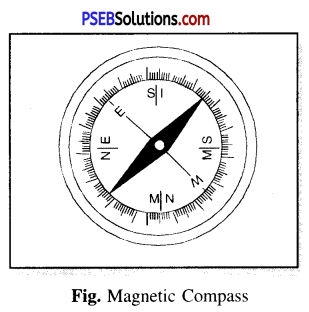
2. It causes discomfort. 2. It has a soothing effect.
3. It can lead to health problems. 3. No health problems are associated with it.

Yes, music can become noise when music is too loud, then it becomes a noise.

Question 9.
List sources of noise pollution in your surroundings.
Answer:
Sources of noise pollution:

  1. Sounds of vehicles.
  2. Loudspeakers.
  3. Working Machines.
  4. Bursting of crackers.
  5. Desert coolers.
  6. Radios and televisions at high volumes.
  7. Kitchen appliances.
  8. Hawkers.

Question 10.
Explain in what ways noise pollution is harmful to humans.
Answer:
Harmful effects of noise pollution:

  1. Lack of sleep.
  2. Hypertension.
  3. Anxiety.
  4. Partial deafness.

Question 11.
Your parents are going to buy a house. They have been offered one on the roadside and another three lanes away from the roadside. Which house would you suggest your parents should buy ? Explain your answer.
Answer:
Parents should buy a house three lanes away from the roadside because roadside house has many disadvantages such as:

  1. Lot of noise due to passing vehicles.
  2. Smoke and dust produced by running vehicles.
  3. Sound of loud horns of vehicles at the time of traffic jams.

PSEB 8th Class Science Solutions Chapter 13 Sound

Question 12.
Sketch larynx and explain its function in your own words.
Answer:
PSEB 8th Class Science Solutions Chapter 13 Sound 2
Function of Larynx.
When air passes through the vocal cords, they produce sound. Vocal cords may become loose/thick or tight/thin on vibration, thus causing different types of voices.
Question 13.
Lightning and thunder take place in the sky at the same time and at the same distance from us. Lightning is seen earlier and thunder is heard later. Can you explain why ?
Answer:
The speed of light is 3 × 10⁸ m/s while that of sound is only 340 m/s. So, lightning and thunder although taking place simultaneously in the sky at the same distance will be seen and heard at different intervals of time.

PSEB Solutions for Class 8 Science Sound Important Questions and Answers

Multiple Choice Questions

Question 1.
The unit of frequency is:
(a) dB
(6) Hz
(c) dB and Hz
(d) None of these.
Answer:
(b) Hz.

Question 2.
The intensity of disagreeable sound for human ear is
(a) 60 dB
(b) 10 dB
(c) 90 dB
(d) 30 dB.
Answer:
(c) 90 dB.

Question 3.
Ultrasonic sound is:
(a) Sound of frequency less than 20 Hz
(b) Sound of frequency more than 20 KHz
(c) Sound of frequency 20 Hz to 20000 Hz
(d) None of these.
Answer:
(b) Sound of frequency more than 20 KHz.

Question 4.
Speed of sound at 20°C is approximately:
(a) 430 m/s
(b) 304 m/s
(c) 340 m/s
(d) 3400 m/s
Answer:
(c) 340 m/s

PSEB 8th Class Science Solutions Chapter 13 Sound

Question 5.
The intensity of sound at ordinary inhale is:
(a) 10 dB
(b) 20 dB
(c) 60 dB
(d) 70 dB.
Answer:
(a) 10 dB.

Very Short Answer Type Questions

Question 1.
What is sound ?
Answer:
Sound. It is a form of energy which produces in us the sensation of hearing.

Question 2.
How is sound produced ?
Answer:
Sound is produced by vibrations of a body.

Question 3.
Will sound travel in vacuum ?
Answer:
No, it will require some medium.

Question 4.
Does sound travel in gases ?
Answer:
Yes.

Question 5.
Does sound travel in liquids ?
Answer:
Yes.

PSEB 8th Class Science Solutions Chapter 13 Sound

Question 6.
Does sound travels in solids ?
Answer:
Yes.

Question 7.
On what factor does loudness of sound depend ?
Answer:
Loudness of sound depends upon the amplitude of vibrating body.

Question 8.
If an object makes 10 oscillations in a second, then what is its frequency ?
Answer:
10 Hertz.

Question 9.
Will the sound travel faster, in wood or water ?
Answer:
In solids, the sound travels faster than liquids. So sound will travel faster in wood than in water.

Question 10.
Sound is produced when objects …………………. .
Answer:
Sound is produced when objects vibrate.

Question 11.
The number of oscillations per second is called …………………… .
Answer:
The number of oscillations per second is called frequency.

Question 12.
We can respond to the frequency of sound more than ……………….. hertz and less than ……………… hertz.
Answer:
We can respond to the frequency of sound more than 20 hertz and less than 20,000 hertz.

PSEB 8th Class Science Solutions Chapter 13 Sound

Question 13.
Name the section of throat in which the human voice is produced.
Answer:
Larynx.

Question 14.
Name the characteristics of sound which help us to distinguish different sounds.
Answer:
The characteristics of sound which distinguish different sounds. The pitch or loudness of the sound.

Question 15.
What is the audible range of human ear ?
Answer:
Audible Range. The human ear responds to sounds having frequencies 20 hertz to 20,000 hertz.

Question 16.
Define the term pitch.
Answer:
Pitch. A sensation depending upon the frequency is known as the pitch.

Question 17.
Which sound has higher frequency ? Sound produced by a buzzing mosquito or sound produced by roaring lion.
Answer:
The frequency of sound produced by a buzzing mosquito will be more than the frequency of sound produced by a roaring lion.

Question 18.
Write the following frequencies in their increasing order:
(i) Voice of a child
(ii) Voice of man
(iii) Voice of a woman.
Answer:
Voice in increasing order of their frequencies:
Voice of a man < Voice of a child < Voice of a woman.

Question 19.
How do we hear sound ?
Answer:
When sound waves travelling through air strike our ears, diaphragm of ear starts vibrating. These vibrations reach the ear nerves by small bones and send the messages to our brain and which we hear.

PSEB 8th Class Science Solutions Chapter 13 Sound

Question 20.
What is length of vocal cords in man ?
Answer:
About 20 mm.

Question 21.
Unpleasant sounds are called ………………. .
Answer:
Noise.

Question 22.
Which sound is produced by musical instruments ?
Answer:
Musical sound.

Question 23.
What is unit of loudness of sound ?
Answer:
Decibel (dB).

Question 24.
Name an instrument with pleasant sound.
Answer:
Harmonium/Guitar/Piano.

Question 25.
What is hearing impairment ?
Answer:
The disability to hear sounds is hearing impairment.

Question 26.
What are causes of hearing impairment ?
Answer:
Ear disease, injury, age and loud noise.

PSEB 8th Class Science Solutions Chapter 13 Sound

Question 27.
Give an example of loud noise.
Answer:

  1. Sound produced by machinery in a factory.
  2. Loudspeakers at full volume.

Question 28.
At which unit, sound becomes harmful ?
Answer:
More than 80 dB (Average factory range).

Question 29.
Which is the major cause of noise pollution ?
Answer:
Vehicles.

Question 30.
Which natural organism is important to reduce noise pollution ?
Answer:
Plants and trees.

Question 31.
What is noise pollution ?
Answer:
Noise Pollution. Presence of excessive or unpleasant sound in the atmosphere is called, noise pollution.

Short Answer Type Questions

Question 1.
Define the term time period, frequency and amplitude.
Answer:
Time Period.
It is the time taken by a vibrating particle to complete one vibration.

Frequency.
The number of oscillations per second is called the frequency of the oscillation. Frequency is measured in hertz [Hz].

Amplitude.
The maximum distance through which a vibrating body is displaced from its central resting position, is called amplitude of oscillations.

PSEB 8th Class Science Solutions Chapter 13 Sound

Question 2.
One astronaut speaks with another astronaut on Moon. Can the other astronaut listen to the first astronaut ?
Answer:
There is no atmosphere on the moon, thus, the astronauts cannot listen to each other. Therefore, a material medium is required for the propagation of sound.

Question 3.
Sound produced by a mosquito is quite different from the roar of a lion. Explain.
Answer:
The loudness of sound depends upon the amplitude of the wave. A mosquito produces sound by the vibration of its wings, in open air while the lion roars by the vibration of its vocal chords. The amplitude of the sound produced by mosquito will be less than the sound produced by a lion. The pitch and quality of the two sounds is quite different, which makes the two sounds different and distinguishable.

Question 4.
Explain with simple experiment to show that sound propagates through solid substance.
Answer:
Experiment.
Connect two empty match boxes by tying them with the two ends (15 to 20 m long). Request your friend to keep one match box close to his ear. By stretching the string speak into one match box. Sound will be heard very clearly by your friend. This shows that sound can propagate through solids.

Question 5.
How is the human voice produced ?
Answer:
Production of Human voice.
The human voice is the result of vibrations. It is produced in the larynx, a section of the throat. Muscles in the larynx tighten the vocal cords. Air from the lungs rushes past the tight stretched cords and causes the vocal cords to vibrate. The vibrations produced in the vocal cords produce the sound or the voice.

Question 6.
What are ultrasounds ?
Answer:
Ultrasound.
Our ear does not respond to sounds of frequencies less than 20 hertz or greater than 20,000 hertz. Sound of frequency greater than 20,000 hertz is called ultrasonic. The instrument used for producing ultrasonic sound is ultrasonic CT.

Question 7.
What are the uses of ultrasonic sound ?
Answer:
Uses of ultrasonic sound:

  1. Dogs can listen ultrasonic sounds. So to call their dogs people use ultrasonic sounds.
  2. In medical science, ultrasonics are used for forming the images of internal organs of human body.

PSEB 8th Class Science Solutions Chapter 13 Sound

Question 8.
A boy claps his hands in front of stair-case and hears a musical sound. Explain.
Answer:
The distance of each step of stair case increases from the boy. When a boy claps, sound will not strike all the steps simultaneously but it will strike in short and regular intervals. The reflected sound from them will be received by the ear in the form of a number of waves at regular intervals. Thus a periodic disturbance produces a musical sound.

Question 9.
Give an activity to prove that sound travels faster in water than in air.
Answer:
Sound travels faster in water (liquids) than in air, we can prove this fact by the following activity.
Activity. Take a longer balloon and fill it with water. Hold it close to your ear and scratch it gently with index finger on the farther side of the balloon. A sound will be heard. Repeat this experiment with air-filled balloon. On comparing the two sounds, it is proved that sound travels faster in water than in air.

Question 10.
What is noise ? What is its unit ?
Answer:
Noise.
The unpleasant sounds which are not soft and sweet are known as noise such as sound of machines, automobiles, crackers, etc.
The unit of voice is Decibel (dB).
Noise level is 0-120 dB.

Question 11.
State one difference between noise and a musical sound.
Answer:
Noise is a sound, which produces disagreeable (jarring) effect on the ear. On the other hand, musical sound produces pleasing effect on the ear of the listener.

Question 12.
How do children with impaired hearing communicate ?
Answer:
Children with impaired hearing communicate using sign language and with technically developed devices.

Question 13.
Identify the part which vibrates to produce sound in the following instruments ?

Sr. No. Musical Instrument Sound producing part
1. Flute
2. Dholak

Answer:

Sr. No. Musical Instrument Sound producing part
1. Flute Air column
2. Dholak Stretched membrane

PSEB 8th Class Science Solutions Chapter 13 Sound

Long Answer Type Questions

Question 1.
Give an activity to show that sound needs medium to be heard.
Answer:
Sound needs medium.
Sound produced by a vibrating object reaches our ears due to vibrations of the molecules of the medium (air) in succession. If there is no air between the vibrating object and our ear, we would not hear any sound at all. We can study this by the following activity.
PSEB 8th Class Science Solutions Chapter 13 Sound 3
Activity.
Take a wooden stick and hold one end close to your ear. Ask your friend to scratch the other end gently, you will hear the sound.

This activity shows that sound can travel through wood. Sound can travel through liquids as well. You can check this by filling a balloon with water. Hold a water filled balloon close to you ear and scratch the opposite surface of the balloons with your finger.You will again hear sound. Now do the same experiment with an air-filled balloon. This time the sound heard is very feeble in comparison.
Thus, we conclude that sound requires a medium to be heard.

Question 2.
What is noise pollution ? What are its causes and its effects ?
Answer:
Noise pollution.
The unwanted sound which is not soft and is disagreeable to the ear, is called noise. The presence of loud sound in atmosphere is only noise pollution.

Causes of noise pollution.

  1. The loud sounds produced by machines in factories.
  2. Loud speakers.
  3. Generators.
  4. Railway stations.
  5. Air ports.
  6. Music programmes.
  7. Crackers.

Effects of noise pollution:

  1. The worst effect of noise pollution is deafness.
  2. It raises the heart beat.
  3. It also effects the pupil of eyes, thus causing night blindness or colour blindness.

Question 3.
What is music? Name the various types of vibrating objects used in
different kinds of musical instruments.
Answer:
Music.
Music is the arrangement of the sound of different frequencies called notes or Swara in a way that it produces a pleasing effect on the ear.
In musical instruments, we use vibrating objects such as strings, membranes, and columns of air. There are, thus, three families of musical instruments:

  1. Stringed instruments (tantu vadya) e.g. violin, sitar, etc.
  2. Wind instruments or reed instruments (sushir vadya) e.g. the flutes or the shahnai.
  3. Membranous instruments (avanaddha vadya). Many of these are percussions or rhythm instruments e.g. tabla or mridangam.