PSEB 6th Class Computer Solutions Chapter 2 Computer Components

Punjab State Board PSEB 6th Class Computer Book Solutions Chapter 2 Computer Components Textbook Exercise Questions and Answers.

PSEB Solutions for Class 6 Computer Science Chapter 2 Computer Components

Computer Guide for Class 6 PSEB Computer Components Textbook Questions and Answers

1. Fill in the Blanks

Question 1.
Which part of the computer system accepts input from the user?
(a) Input Unit
(b) Output Unit
(c) Control Unit
(d) None of these
Answer:
(a) Input Unit

Question 2.
Which is a part of the CPU?
(a) Control Unit
(b) Memory Unit
(c) ALU
(d) All of above
Answer:
(d) All of above

Question 3.
Which memory stores permanent data in computer system ?
(a) Primary Memory
(b) RAM
(c) Secondary Memory
(d) All of above.
Answer:
(c) Secondary Memory

PSEB 6th Class Computer Solutions Chapter 2 Computer Components

Question 4.
Which is a most powerful type of computer ?
(a) Mainframe Computer
(b) Mini Computer
(c) Micro Computer
(d) Super Computer.
Answer:
(d) Super Computer

Question 5.
Which part of computer system gives result as an output to the user ? ‘
(a) Memory
(b) Input Unit
(c) Control Unit
(d) Output Unit.
Answer:
(d) Output Unit.

2. Write the Full Forms

Question 1.
ALU?
Answer:
ALU – Arithmetic and LgicaI Unit.

Question 2.
CPU?
Answer:
CPU – Central Processing Unit

Question 3.
LCD?
Answer:
LCD – liquid Crystal Display

Question 4.
RAM?
Answer:
RAM – Randoni Access Memory

Question 5.
ROM?
Answer:
ROM – Read Only Memory

Question 6.
CU?
Answer:
CU – Central Unit

Question 7.
MU?
Answer:
MU – Memory Unit

Question 8.
IPO?
Answer:
IPO – Input Processing Output.

3. Short Answer Type Questions

Question 1.
Write the name of parts of CPU.
Answer:
The names of three parts of CPU are :

  • Input Unit
  • Processing Unit
  • Output Unit.

Question 2.
What are the types of memories ?
Answer:
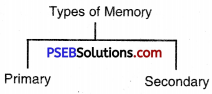
The types of memories are :

  1. Primary Memory
  2. Secondary Memory

Question 3.
What are Secondary Storage Devices ?
Answer:
Secondary storage devices are the devices which are not directly accessible by CPU. These are used to store the data and instructions for a long time. These devices are magnetic and optical in nature. The storage capacity of these devices is more than primary memory. They have less cost and speed than primary memory.

PSEB 6th Class Computer Solutions Chapter 2 Computer Components

Question 4.
What is the function of ALU ?
Answer:
The functions of ALU are to perform arithmetic and logical units. All the calculations are done by this part of the CPU. This part is also responsible for making comparisons.

Question 5.
What is Micro-Computer?
Answer:
Micro computers are used computers which use microprocessors as CPU. Micro or personal computers are the most common computers. These are the computers which are used in homes, schools and offices. These computers are small in size and the cost of this computer is very less.

Question 6.
What are different categories of Computers ?
Answer:
The different categories of computers are:

  1. Microcomputer
  2. Mini Computer
  3. Mainframe Computer
  4. Supercomputer

4. Long Answer Type Questions

Question 1.
What do you mean by Block Diagram of Computer ? Define its Components.
Answer:
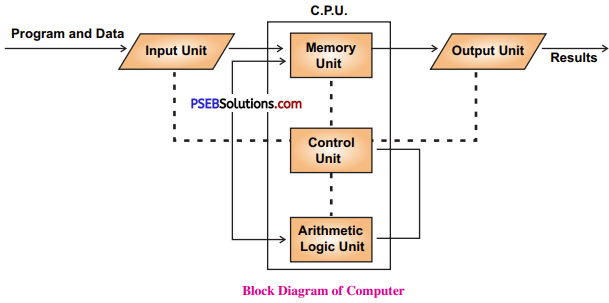
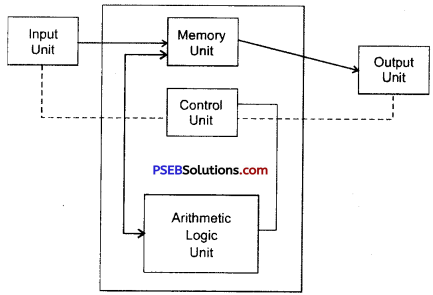
Block Diagram of Computer is a Graphical representation of various steps involved in working of computers. The main parts shown in this block diagram are Input Unit, Processing Unit and Output Unit. The Processing Unit is divided into three parts namely Memory Unit, Control Unit and Arithmetic Logic Unit.
The Central Processing Unit of a computer system is divided into three parts.

  1. Memory Unit
  2. Control Unit
  3. Arithmetic and Logical Unit

PSEB 6th Class Computer Solutions Chapter 2 Computer Components - 4

1. Memory Unit:
This unit is also known as storage unit. This unit holds the data and instruction in it. It can store data and instruction temporary and permanently. Many types of memories are used in this unit for special purposes. These memories vary in size, storage capacity, nature of operation, speed and cost.

2. Control Unit:
Control Unit is meant for controlling all the activities of the computer. This unit works as the brain of a computer. It performs all the operations given in the form of instructions. It also controls the functioning of other components of the computer. It controls both input and output units also.

PSEB 6th Class Computer Solutions Chapter 2 Computer Components

3. Arithmetic and Logical Unit:
This is the third part of the Central Processing Unit. This unit is related to performing all the arithmetic and logical operations. A lot of calculations are done by computer in each type of work. All these calculations are done by this unit of CPU. Part of Central Processing Unit is integrated within the processor.

Question 2.
How Computer Works ? Explain each term in detail.
Answer:
The process of processing the data is called the processing cycle of a computer. It is the way of processing within a computer system. Three Steps are Involved in this cycle.

1. Input:
This part is related with input of data and instruction. Computers cannot work without proper input. To enter the necessary data and instructions in the computer input unit is required. Man can enter the data and instruction in its own language and that is converted into computer languages by this input unit. There are many types of input devices used for input. Keyboard is the most common input device used to enter textual data. The second common device for input is the mouse. This device is used to point a special part on the screen or to select a command with mouse pointer. The Other common devices which are used for input are microphone, touch screen, scanner etc.

2. Processing :
Processing is the process of acting according to given instructions. This is the main task done by computer as it gets instructions from the computer. The main aim of Computer is to work as per the given instructions. This task is done by the processor of the computer. The processor is just like the brain of a human being. This processor is also known as the Central Processing Unit.

3. Output :
After processing, the data is converted into some information. The user of the computer needs that information from the computer as its result. This result is shown to the user using output devices. The most common output device is a monitor. The other output devices are speaker, printer and plotters.

Activity

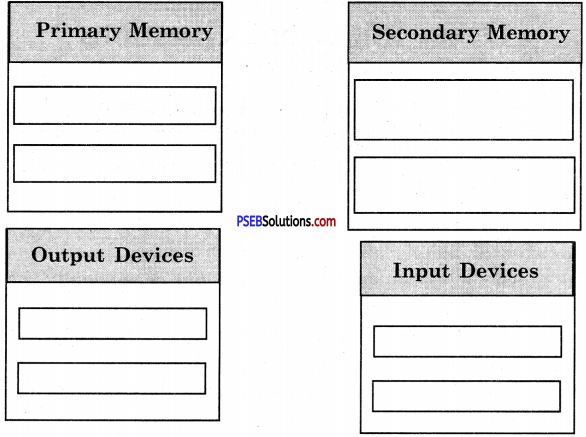
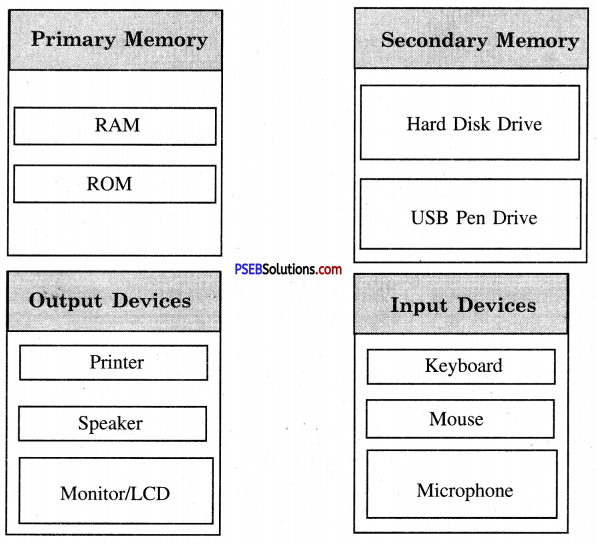
Write the given Items in their respective Category :

  1. RAM
  2. Keyboard
  3. Mouse
  4. ROM
  5. Hard Disk Drive
  6. Printer
  7. Microphone
  8. Speaker
  9. USB Pen Drive
  10. Monitor/LCD.

PSEB 6th Class Computer Solutions Chapter 2 Computer Components - 2
Answer:
PSEB 6th Class Computer Solutions Chapter 2 Computer Components - 3

PSEB 6th Class Computer Guide Computer Components Important Questions and Answers

1. Fill in the Blanks

Question 1.
…………… is the process of entering data and instructions to the computer.
(a) Input Devices
(b) Output Devices
(c) CPU
(d) None of these.
Answer:
(a) Input Devices

PSEB 6th Class Computer Solutions Chapter 2 Computer Components

Question 2.
The process of saving data and instructions permanently is known as ……………….
(a) Memory
(b) Storage
(c) Processing
(d) Output.
Answer:
(a) Memory

Question 3.
The process of producing results from the data for getting useful information is called ………………
(a) Input
(b) Output
(c) Processing
(d) None of these.
Answer:
(c) Processing

Question 4.
Primary storage is also known as …………….. Memory.
(a) Secondary
(b) Main
(c) Auxiliary
(d) All of these.
Answer:
(b) Main

Question 5.
Secondary storage is also called ……………. storage.
(a) Secondary
(b) Main
(c) Auxiliary
(d) All of these.
Answer:
(c) Auxiliary.

2. Write the Full Forms
1. I/O
2. IPO
Answer.
1. I/O – input/Output
2. IPO – input Processing Output

3. Short Answer Type Questions

Question 1.
Draw the diagram of basic functions of a Computer.
Answer:
The five important functions/operations performed by computer are :

  1. Take Input: Computer receives data and instructions from user.
  2. Save : Computer save the information.
  3. Processing : Computer processes the data.
  4. Output: Computer gives output after processing.
  5. Control: Computer controls different parts and all operations.
PSEB 6th Class Computer Solutions Chapter 2 Computer Components - 8

Question 2.
Name the parts of CPU Unit.
Answer:
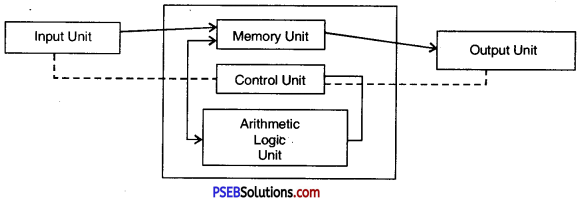
The three parts of CPU Unit are:

  1. Arithmetic logic unit.
  2. Main Memory unit.
  3. Control unit.

PSEB 6th Class Computer Solutions Chapter 2 Computer Components - 5

Question 3.
What is Memory ? Name two types of memory.
Answer:
The storage capacity of computer is called memory.

Memory are of two types:
1. RAM – Random Access Memory:
The primary storage is referred to as random access memory (RAM) because it is possible to randomly select and use any location of the memory directly store and retrieve data. It takes some time to any address of the memory as the first address. It is also called read/write memory.
PSEB 6th Class Computer Solutions Chapter 2 Computer Components - 9

2. ROM:
ROM is an acronym for Read-Only Memory. It refers to computer memory chips containing permanent or semi-permanent data. Unlike RAM, ROM is non-volatile; even after you turn off your computer, the contents of ROM will remain.

PSEB 6th Class Computer Solutions Chapter 2 Computer Components

Question 4.
Describe about Laptop.
Answer:
Laptop is a portable personal computer. It is light in weight and small enough. It is very easy to operate in a person’s lap. It has its own battery and can be charged easily as required. It can be carried while travelling.

PSEB 6th Class Computer Solutions Chapter 2 Computer Components - 6

Question 5.
What is Tablet ?
Answer:
Tablet is very thin portable computer. It is usually battery powered. It has a touch screen as the primary interface of an input device. It has no keyboard and mouse.

PSEB 6th Class Computer Solutions Chapter 2 Computer Components - 7

4. Long Answer Type Questions

Question 1.
Discuss about Primary Memory.
Answer:
Primary memory is also known as main memory of Computer System. It is directly accessible memory by Microprocessor which is a control unit of CPU. All the instructions and data must be present in primary memory before processing. This memory is also known as main memory of computer. There are two types of primary memories used within the computer.

RAM (Random Access Memory):
This primary memory is the main memory of computer. It is very fast memory of computer. All instructions and data are stored here during processing. This memory is volatile in nature i.e. all contents stored in this memory are lost when power goes off. This device cannot hold data permanently.

ROM (Read Only Memory):
This memory is a permanent memory attached on the motherboard of computer system. Content stored in it cannot be changed as it is read only memory. This memory hold instructions and data required for computer system to start. No write operation is allowed on this memory.

Question 2.
Discuss about Secondary Memory.
Answer:
Secondary Memory
Secondary storage is called auxiliary storage. It is a permanent memory of computer system. As we studied earlier, primary memory RAM is not permanent and ROM do not allow user to store any data on it. So, to provide permanent storage in computer, we use secondary storage devices. This memory is not directly accessible by the processor. It is for storing data not in active use. So it is called non-volatile memory. In a personal computer, secondary storage typically consists of hard disk drive and many removable media like CD, DVD or USB Pen Drive etc.

PSEB 6th Class Computer Solutions Chapter 2 Computer Components

Question 3.
Explain Control Unit.
Answer:
Central Processing Unit of a computer system can be divided into three parts:-

  1.  Memory Unit (MU)
  2. Control Unit (CU)
  3. Arithmetic Logical Unit (ALU)

1. Memory Unit:
Memory Unit of a computer system is also known as “Storage Unit”. It holds data and instructions in computer system. There are several types of memories. Each of them is having its different role to perform. Their size, storage capacity, nature of operation and speed make them different from each other.

2. Control Unit:
The control unit is the brain of computer. It performs all the operations given in the form of input instructions or programs. It also controls the functioning of all other components of computer. It accepts all the instruction from input unit and generates series of control signals according to the input instructions given. These Control Signals then operate the other parts of the computer. This is the main function of Control unit.

3. Arithmetic Logical Unit (ALU):
This is a core component of computer CPU. As per its name, it performs all the arithmetic and logic related tasks during processing. In digital computer, all the operations are performed logically and contain a lot of calculations to be processed. Processing of arithmetic operations and all logical operations like AND, OR, NOT etc. are done by this part of CPU. This part of computer system is integrated within the “Microprocessor”.


PSEB 6th Class Computer Solutions Chapter 1 Introduction To Computer

Punjab State Board PSEB 6th Class Computer Book Solutions Chapter 1 Introduction To Computer Textbook Exercise Questions and Answers.

PSEB Solutions for Class 6 Computer Science Chapter 1 Introduction To Computer

Computer Guide for Class 6 PSEB Introduction To Computer Textbook Questions and Answers

1. Fill in the Blanks

Question 1.
Computer is a/an ……………
(a) Electronic Machine
(b) Mechanical Machine
(c) Magnetic Machine
(d) All of above.
Answer:
(a) Electronic Machine

Question 2.
Computers can do ……………
(a) Calculations
(b) Accept data and instructions
(c) Storage
(d) All of above
Answer:
(d) All of above

PSEB 6th Class Computer Science Solutions Chapter 1 Introduction To Computer

Question 3.
Computer performs its operations with high ……………
(a) Speed
(b) Accuracy
(c) Efficiency
(d) All of above.
Answer:
(d) All of above

Question 4.
In banks, computer is used for ……………
(a) Keeping the bank safe
(b) Keeping Account records.
(c) Keeping bank clean
(d) None of these.
Answer:
(b) Keeping Account records

Question 5.
Time taken by computer to do a work can be measured in ……………
(a) Minutes
(b) Hours
(c) Milliseconds
(d) Days.
Answer:
(c) Milliseconds

Question 6.
In Education, a computer is used for ……………
(a) Preparing Notes
(b) Preparing results
(c) Preparing Reports
(d) All of these.
Answer:
(d) All of these

PSEB 6th Class Computer Science Solutions Chapter 1 Introduction To Computer

Question 7.
Which one of these is a limitation of Computer
(a) Speed
(b) Accuracy
(c) No IQ
(d) Diligence.
Answer:
(c) No IQ.

2. Short Answer Type Questions

Question 1.
Define Computer.
Answer:
Computer is an electronic device which gets the data and instructions from the user. It processes the data as per given instructions and gives the result in the desired form. Computer can be defined as :
A computer is an electronic machine that accepts data as input from the user and processes the data under the control of a set of instructions and gives the result as an output.

Question 2.
Explain the uses of computer in Education Field.
Answer:
Students and teachers are using computers in their education. Teachers use computers to teach the students and students use computers to prepare their notes, making drawing and making projects etc. The internet is used to search study material. Results, time-table and various reports are prepared using the computer. Computers are also used for record keeping online data processing etc.

Question 3.
Write the name of any three Portable Computing Devices.
Answer:
The name of three portable computing devices are:

  • Mobile phone
  • Palmtop computer
  • Tablets

3. Long Answer Type Questions

Question 1.
What are the characteristics of computer ?
Answer:
The main characteristics of computers are as given below :
1. Speed : Computer is a very fast machine. It can do calculation in milliseconds. It can complete days work in seconds. That is why it has reduced human effort.

2. Accuracy : Computer is an accurate machine. It never makes any mistakes. If a mistake is performed in any calculation that is
always due to human error. A computer can do any task repeatedly for thousands of times without any error.

3. Reliability : Reliability means the ability of being trusted. A computer is a reliable machine. We cannot doubt the results given by computers because they are always correct. There is no need of rechecking the results. It gives the same result every time.

4. Diligence : Computer never gets tired. It can do work for many days or even for years. During this time its efficiency does not decrease and neither it commits errors after long working. In fact, a computer is a hardworking machine.

5. Automation : Automation means to do the work automatically. Computers can be instructed to do the work without any interaction. He can be given the instructions and the computer can do work without asking anything. We just need to start the computer and ask him to do the particular work. After that it will do the whole work without asking anything.

6. Storage : The storage capacity of computers is very large. It can attach many storage devices such as hard disk, pen drive at 17 to it. it can store any type of data such as text, audio, video animation in it. We can also store the storage capacity of computers. Computers store data for a very long time.

PSEB 6th Class Computer Science Solutions Chapter 1 Introduction To Computer

Question 2.
Define any five applications of Computer.
Answer:
Computers are used in many areas. Some of the application areas of Computer are given below :
1. Education: Students and teachers are using computers in their education. Teachers use computers to teach the students and students use computers to prepare their notes-making, drawing and making projects etc. The internet is used to search study material, results time-table and various reports are prepared using the computer. Computers are also used for record keeping, online data processing etc. Punjab Education Department is using computer on their web portal like www.epunjabschool.gov.in, www.pseb.ac.in

2. Entertainment: Computers are a good source of entertainment also. The user can watch movies, listen song and camp. Beautiful presentations can be made on the computer. All the films made these days use computers for their special effects.

3. Sports : Computers are also used in the sports field. They are used to improve the performance of players to keep data and to evaluate the performance and to display information about various tournaments which will happen in future. Digital scoreboards are also a part of games today. The players can improve their games by analysing their record.

4. Communication : Computers have given new ways of communication. The user can make video calls, audio calls, chat using computer data and send email to their friends and relatives. Any type of data can be shared using smartphone, tablet, laptop and computers.

5. Shops : Shopkeepers are also using computers for their various works. They are using computers to manage their stock to generate purchase orders to generate bills to advertise their shop. The use of computers in shops saves a lot of time for the shopkeeper and the customer.

PSEB 6th Class Computer Science Solutions Chapter 1 Introduction To Computer

Question 3.
What are the limitations of Computer ?
Answer:
The main limitations of computer are as under:

  • A computer cannot take decisions by itself.
  • A computer cannot correct wrong instructions.
  • Computer cannot do any work without instruction from the user.
  • It does not have feelings or IQ (Intelligence Quotient).
  • It does not have knowledge and experience like a human being.
  • Computer can not start work until asked.

Question 4.
What do you mean by Portable Computing Devices ? Explain any three of them.
Answer:
Portable devices are those devices which can be easily carried from one place to another. Technology has given us many portable devices. Some of them are explained below :
1. Mobile Phone or Smart Phone :
It is the most common portable computing device used in these days. Each one is using their mobile phones these days. Smart phones can do a lot of calculation work and processing. Their speed is also very fast. Modern mobile phones are equipped with camera, large storage capacity and high processing speed. They can be used in education, business trading, entertainment, gaming etc. Mobile phones are very small devices. It can be carried in our pockets. There are a lot of mobile phones available in the market with different features.

2. Tablet Computer :
It is a small computer. It is mainly known as a tablet. If the battery is used in this tablet. It has a touch screen which is used to give input and get the output. Tablets can be used for many purposes. Most of the students are using tablets in their education at home as well as at their schools.

3. Palmtop Computer :
Palmtop computer is a small size computer which can be placed on our palm. This computer has a small screen and small keyboard. It is just like a mobile phone having a keyboard. These computers are not very popular these days. These computers were used for limited purposes only.

PSEB 6th Class Computer Science Solutions Chapter 1 Introduction To Computer

Question 5.
Explain the uses of Computer.
Answer:
The applications of Computer are :

  1. We can do mathematical calculations on the computer.
  2. We can play games on the computer.
  3. We can draw pictures on the computer.
  4. We can listen to songs and watch films on the computer.
  5. We can use computers to print books and newspapers.
  6. We can use computers to book our tickets to travel in trains, buses and airplanes.
  7. We can check the arrival and departure time of trains, buses and airplanes with the help of a computer.
  8. We can check the weather conditions of any place before travelling.
  9. We can print reports, results of our school or time-table.
  10. We can store our data into a computer for future use.

PSEB 6th Class Computer Guide Introduction To Computer Important Questions and Answers

1. Fill in the Blanks

Question 1.
…………… is an electronic machine.
(a) TV
(b) Typewriter
(c) Computer
(d) All of these.
Answer:
(c) Computer

Question 2.
The speed of computer is …………..
(a) Fast
(b) Slow
(c) Medium
(d) None of these.
Answer:
(a) Fast

PSEB 6th Class Computer Science Solutions Chapter 1 Introduction To Computer

Question 3.
Computer has very large ……………
(a) Speed
(b) Memory
(c) Display
(d) Keyboard.
Answer:
(b) Memory

Question 4.
In business computers are used to prepare …………….
(a) Cash
(b) Tickets
(c) Books of accounts
(d) None of these.
Answer:
(c) Books of Accounts

Question 5.
Computers are used in Education by………… and ………….
(a) Teachers, Students
(b) Businessman, Banker
(c) Parents, Children
(d) All of these.
Answer:
(a) Teachers, Students.

2. True or False

Question 1.
Computer can perform Mathematical Calculations.
Answer:
True

Question 2.
Computer cannot take decision itself.
Answer:
True

Question 3.
Computer doesn’t have storage capacity.
Answer:
True

Question 4.
A computer cannot correct wrong instructions.
Answer:
False

Question 5.
Computer is an electronic machine which receives input, processes it and gives output.
Answer:
True

PSEB 6th Class Science Solutions Chapter 1 Introduction To Computer

3. Short Answer Type Questions

Question 1.
What is a computer ?
Answer:
A computer is an electronic device that accepts input, processes data, stores data, and produces output.
Computers are not very intelligent devices, but they handle instructions flowlessly and fast. They must follow explicit directions from both the user and computer programmer. Computers are really nothing more than a very powerful calculator with some great accessories.

Question 2.
Give definition of computer.
Answer:
The computer is a digital electronic machine that processes data to give information. A computer is an electronic device, operating under the control of instructions stored in its own memory that concept data, manipulate the data according to specified rules, produce results, and store the results for further use.

Question 3.
What can we do on a computer ?
Answer:
A computer accepts input, processes data, stores data and produces output. Computer can perform the following functions :

  • Mathematical calculation
  • Desktop Publication
  • Play Games
  • Drawing
  • Multimedia
  • Booking of Railway and Airplane Tickets
  • In Banks
  • In Medicine etc.
  • Libraries Automation
  • Shops Automation
  • Domestic work.

Question 4.
How a Computer is helpful in Health and Medicine?
Answer:
Computers are necessary in every area of health and medicine, The following are the important tasks in health and medicine where computer is used:

For maintaining patient history and records.
As an aid in operation theatre.
Also used for patient monitoring and diagnosis of diseases.
For taking appointment of doctor.

PSEB 6th Class Science Solutions Chapter 1 Introduction To Computer

Question 5.
How a computer is helpful in Banks?
Answer:
In bank, computers are used to maintain records of loans, customers, credits and also used in ATM’s.

4. Long Answer Type Questions

Question 1.
Write down about the fields where a Computer can be used ?
Answer:
Following are the uses of computer in Modern Times:

  • We can do mathematical calculations on the computer.
  • We can play games on the computer.
  • We can draw pictures on the computer.
  • We can listen to songs and watch films on the computer.
  • We can use computers to print books and newspapers.
  • We can use computers to book our tickets to travel in trains, buses and airplanes.
  • We can check the arrival and departure time of trains. buses and airplanes
  • with the help of a computer.
  • We can check the weather conditions of any place before travelling.
  • We can print reports, results of our school or time t.able.
  • We can store our data into a computer for future use.

Question 2.
Write down characteristics of a Computer.
Answer:
PSEB 6th Class Computer Solutions Chapter 1 Introduction To Computer - 1
Speed : Computer is a very fast machine. It can do calculation in milliseconds. It can complete days work in seconds. That is why it has reduced human effort.

Accuracy : Computer is an accurate machine. It never makes any mistakes. Ifa mistake is performed in any calculation that is always due to human
error. A computer can do any task repeatedly for thousands of times without any error.

Reliability: Reliability means the ability of being trusted. A computer is a reliable machine. We cannot doubt the results given by computers because they are always correct. There is no need of rechecking the results. It gives the same result every time.

Diligence : Computer never gets tired. It can to do work for many days or even for years. During this time its efficiency does not decrease and neither it commits errors after long working. In fact, a computer is a hardworking machine.

Automation : Automation means to do the work automatically. Computers can be instructed to do the work without any interaction. He can be given the instructions and the computer can do work without asking anything. We just need to start the computer and ask him to do the particular work. After that it will do the whole work without asking anything.

Storage : The storage capacity of computers is very large. It can attach many storage devices such as hard disk, pen drive at 17 to it. It can store any type of data such as text. audio, video, animation in it. We can also store the storage capacity of computers. Computers store data for a very long time.

PSEB 6th Class Science Solutions Chapter 1 Introduction To Computer

Question 3.
Write down the limitations of a Computer.
Answer:
PSEB 6th Class Computer Solutions Chapter 1 Introduction To Computer - 2
Computers are capable of doing a lot of work. But, after all this is a machine and unable to do some tasks. These kinds of tasks are considered as limitations of computers.

Some of the main limitations of computer are as under:

  • A computer cannot take decisions by itself.
  • A computer cannot correct wrong instructions.
  • Computer cannot do any work without instruction from the user.
  • It does not have feelings or IQ (Intelligence Quotient)
  • It does not have knowledge and experience like a human being.
  • Computer can not start work until asked.

PSEB 6th Class Social Science Solutions Chapter 13 The Mauryas and The Sungas

Punjab State Board PSEB 6th Class Social Science Book Solutions History Chapter 13 The Mauryas and The Sungas Textbook Exercise Questions and Answers.

PSEB Solutions for Class 6 Social Science History Chapter 13 The Mauryas and The Sungas

SST Guide for Class 6 PSEB The Mauryas and The Sungas Textbook Questions and Answers

I. Answer the following questions :

Question 1.
What do you know about Alexander?
Answer:
Alexander was the son of Emperor Philip of Macedonia. He became the ruler of Macedonia after his father’s death. He desired to conquer the whole world. Therefore, as soon as he was enthroned, he began to conquer the world. For the first two years, he conquered the territories surrounding Macedorfla. Then he started with a large army to conquer Persia. He also conquered Asia Minor, Syria, Egypt, and Afghanistan. In 326 B.C., he invaded India and defeated several kings of the northwest in Punjab up to the river Beas. He first defeated Ambhi, the king of Taxila and then the ruler of the territory between the rivers Jhelum and Chenab, namely Porus. Porus faced Alexander bravely. Soldiers of Alexander got scared of the resistance they received in Punjab. They were also tired of long journey and warfare. Therefore, Alexander had to go back from the Beas. But he was not able to reach his country. On the way he suffered from fever and died.

Question 2.
Write a note about Kautilya.
Answer:
Kautilya is also known as Chanakya. He was a great scholar and teacher at the Taxila University. Chandragupta Maurya considered him as his teacher. It was only with the help of Kautilya that Chandragupta Maurya was able to overthrow the Nanda /nasty and establish the Mauryan Empire. When Chandragupta became the emperor, Kautilya became the Prime Minister of the Mauryan Empire. Kautilya was also a great writer. His book ‘Arthasastra’ tells us about the Mauryan administration.

Question 3.
Why is Ashoka called ‘the great’?
Answer:
Ashoka was the only king in the history of the world who stopped war after victory. Throughout his life he worked for the good of the people. He treated all religions alike. He looked after his subjects as a father cares for his children. Every individual was the most important person of the state. He treated everybody alike and gave money and help to all religions regardless of their beliefs. He discarded caste system. His faith in universal brotherhood of mankind uplifted him and he became a god on earth. Boundaries of any country were not his limit. He adopted Buddhism and sent preachers to preach it to many countries of the world like Sri Lanka, China, Afghanistan and Nepal. He held a vast empire in those ancient times above everything. There was no rebellion against him inspite of his policy of peace and non-violence. He was the first ruler who gave the world the concept of a welfare state and religious tolerance. That is why Ashoka holds an important position in the history of the world and is called ‘the great’.

PSEB 6th Class Social Science Solutions Chapter 13 The Mauryas and The Sungas

Question 4.
What do you know about Mauryan art?
Answer:
The Mauryan rulers were lovers of art and they gave an important contribution to the field of art. This contribution of theirs is described as under:

  1. Chandragupta constructed a big palace. This palace was very beautiful and stood erected on several pillars. Ashoka’s palace was also magnificent.
  2. Chandragupta Maurya constructed a big lake, named Sudarshana, in Gujarat.
  3. Ashoka constructed a large number of Stupas. The Stupa of Sanchi in Madhya Pradesh is very famous.
  4. Ashoka built two cities, namely Srinagar and Lalit Patan.
  5. Ashoka got some beautiful caves built in the hills of Barabar and Nagarjuni in Bihar for the monks and Nirgranthas.
  6. Ashoka got constructed huge pillars of sand stone from Chunar. These pillars were 34 feet high. They have a fine polish on them which shines like a mirror. Ashoka got his inscriptions engraved on these pillars.
  7. Ashoka’s pillars had sculptures of animals like bull, elephant, lion, etc. One such sculpture of four lions seated back to back was on the top of the pillar at Samath (Uttar Pradesh). It is our National Emblem now.
  8. Some beautiful sculptures of Yakshas and Yakshis were also made in the Mauryan Age. One such sculpture has been found as Didarganj near Patna. This sculpture is of a Yakshi who w carrying a Chauri (fly-whisk) on her shoulder.

II. Fill in the blanks :

Question 1.
Alexander’s soldiers got scared of the _________ they received in Punjab.
Answer:
resistance

Question 2.
Chandragupta ruled till _________ B.C.
Answer:
297

Question 3.
Megasthenes was a Greek ambassador of _________
Answer:
Seleucus

PSEB 6th Class Social Science Solutions Chapter 13 The Mauryas and The Sungas

Question 4.
Kautilya’s _________ and Megasthenes’s _________ tell us about Mauryan administration.
Answer:
Arthasastra, Indica

Question 5.
In Madhya Pradesh the stupa of _________ is very famous.
Answer:
Sanchi.

III. Write ‘true’ or ‘false’ in the brackets given after each statement :

Question 1.
Seleucus defeated Chandragupta Maurya.
Answer:
False

Question 2.
Ashoka built great pillars of iron.
Answer:
False

Question 3.
Mahamatra was officer of Alexander.
Answer:
False

PSEB 6th Class Social Science Solutions Chapter 13 The Mauryas and The Sungas

Question 4.
Ashoka adopted Buddhism after Kalinga War. Chandragupta constructed Sudarshana Lake.
Answer:
True

Question 5.
In Madhya Pradesh the stupa of . is very famous.
Answer:
True

IV. Match the columns:

Question 1.

A B
(1) Megasthenes (a) Arthasastra
(2) Kautilya (b) Stupa
(3) Sanchi (c) Minister
(4) Amatya (d) Indica

Answer:

A B
(1) Megasthenes (d) Indica
(2) Kautilya (a) Arthasastra
(3) Sanchi (b) Stupa
(4) Amatya (c) Minister

V. Activity (Something To Do):

Question 1.
Collect pictures of monuments built by Ashoka and paste them in your scrap book.
Answer:
Do it yourself.

PSEB 6th Class Social Science Guide The Mauryas and The Sungas Important Questions and Answers

Multiple Choice Questions

Question 1.
Dhamma is a word of _________ language.
(A) Prakrit
(B) Hindi
(C) Devnagri
(D) Sanskrit.
Answer:
(A) Prakrit.

PSEB 6th Class Social Science Solutions Chapter 13 The Mauryas and The Sungas

Question 2.
Dhamma means _________
(A) Wealth
(B) Dharma
(C) Kingdom
(D) State.
Answer:
(B) Dharma.

Question 3.
People lived in Mauryan Empire were engaged in _________ occupation.
(A) Merchants
(B) Crafts persons
(C) Officials
(D) All of these.
Answer:
(D) All of these.

Question 4.
Officials collected _________ from the area under the direct control of the ruler.
(A) Gold
(B) Silver
(C) Taxes
(D) Food grains.
Answer:
(C) Taxes.

PSEB 6th Class Social Science Solutions Chapter 13 The Mauryas and The Sungas

Question 5.
Royal princes often went to the provinces as
(A) Governors
(B) Rulers
(C) Generals
(D) Tax collectors.
Answer:
(A) Governors.

Question 6.
The Mauryans rulers tried to control this which was important for transport.
(A) Roads
(B) Rivers
(C) Both a+b
(D) None of these.
Answer:
(C) Both a+b.

Question 7.
People in forested regions provided” the Mauryan officials.
(A) Timber
(B) Wax
(C) Honey
(D) All of these.
Answer:
(D) All of these.

Question 8.
Most of the Ashoka inscriptions are in the script.
(A) Brahmi
(B) Devnagri
(C) Gurumukhi
(D) Persian
Answer:
(A) Brahmi.

PSEB 6th Class Social Science Solutions Chapter 13 The Mauryas and The Sungas

Question 9.
Which problem Ashoka wanted to solve by introducing dhamma?
(A) Different people followed different religions.
(B) In some religions, animal sacrifice was a ritual.
(C) Most of the masters ill treated their servants and slaves
(D) All of these.
Answer:
(D) All of these.

Question 10.
Which of these means was adopted by Ashoka to spread the message of dhamma?
(A) He appointed dhamma mahamatta to spread teachings.
(B) He got his messages inscribed on rocks and pillars.
(C) He sent his messengers to other lands.
(D) All of these.
Answer:
(D) All of these.

Question 11.
Who was the Prime Minister of Chandra Gupta Maurya?
(A) Chanakya
(B) Ashoka
(C) Bimbisara
(D) Ajatasatru.
Answer:
(A) Chanakya.

Question 12.
Chanakya wrote
(A) Kamasutra
(B) Arthashastra
(C) Upnishada
(D) Manu Smriti.
Answer:
(B) Arthashastra.

PSEB 6th Class Social Science Solutions Chapter 13 The Mauryas and The Sungas

Question 13.
_________ was an ambassador of Selecus Nicator who was sent to the court of Chandragupta Maurya?
(A) Megasthenes
(B) Ashoka
(C) Bimbisara
(D) Chanakya.
Answer:
(A) Megasthenes.

Very Short Answer Type Questions

Question 1.
When did Alexander invade India?
Answer:
Alexander invaded India in 326 B.C.

Question 2.
Who was ruling over the Punjab when Chandragupta Maurya became the king?
Answer:
The Greek General Seleucus Nikator was ruling over the Punjab when Chandragupta Maurya became the king.

Question 3.
What was the extent of the Mauryan Empire under Chandragupta Maurya?
Answer:
Chandragupta Maurya’s empire extended from Afghanistan in the north-west to Karnataka in the south and from Assam in the east to Gujarat in the west.

Question 4.
Name the areas added to the Mauryan Empire by Bindusara.
Answer:
Bindusara added some of the southern parts of India to the Mauryan Empire.

Question 5.
Why were the Nanda kings unpopular?
Answer:
The Nanda kings had collected huge wealth and led a luxurious life. They were not efficient rulers.

PSEB 6th Class Social Science Solutions Chapter 13 The Mauryas and The Sungas

Question 6.
Who was Ashoka?
Answer:
Ashoka was the most famous of the Mauryan kings and one of the greatest rulers India has ever had.

Question 7.
Where were Ashoka’s edicts inscribed?
Answer:
Ashoka’s edicts were inscribed on rocks and on tall pillars made of sandstone.

Question 8.
What was the capital city of Ashoka?
Answer:
Patliputra (Patna) was the capital city of Ashoka.

Question 9.
Whom did Ashoka send to Sri Lanka and why?
Answer:
Ashoka sent his son Mahendra and daughter Sanghamitra to Sri Lanka to preach the message of Buddhism.

Question 10.
According to Ashoka, how should a king treat his subjects?
Answer:
According to Ashoka, a king should treat his subjects as a father treats his children.

Question 11.
Name some of the officers of the Mauryan administration.
Answer:
Some of the officers of the Mauryan administration were Rajuka, Mahamatra, Yukta, etc.

PSEB 6th Class Social Science Solutions Chapter 13 The Mauryas and The Sungas

Question 12.
Name the great centres of learning during the Mauryan rule.
Answer:
Taxila, Patliputra and Varanasi were the great centres of learning during the Mauryan rule.

Question 13.
How much was land revenue on agriculture levied during the Mauryan rule?
Answer:
The land revenue on agriculture was generally 1/6th of the produce.

Question 14.
Who constructed Sudarshana Lake,’and where?
Answer:
Chandragupta Maurya constructed Sudarshana Lake in Gujarat.

Question 15.
When did the Mauryan Empire start breaking up?
Answer:
The Mauryan Empire started breaking up after the death of Ashoka.

Question 16.
Who was Alexandar?
Answer:
Alexander was a great Greek conqueror from Macedonia. He invaded India in 326 B.C. and defeated Porus. On his way back to Greece, he died midway.

Question 17.
Who was Chanakya?
Answer:
Chanakya was the Prime Minister and advisor of Chandragupta Maurya. He was a great teacher and scholar who wrote a book called Arthasastra.

PSEB 6th Class Social Science Solutions Chapter 13 The Mauryas and The Sungas

Question 18.
What is meant by Dhamma?
Answer:
Dhamma was a code of morality given by Ashoka for his people to lead virtuous and peaceful life.

Short Answer Type Questions

Question 1.
What role did Chanakya play in the formation of the Mauryan Empire?
Answer:
Chanakya played the most significant role in the formation of the Mauryan Empire. Without his help and guidance it would not have been possible to establish the mighty Mauryan Empire by Chandragupta Maurya. Once the Nanda king insulted Chanakya. Chanakya left his empire and took a vow to take revenge from him. Due to this reason he helped Chandragupta in establishing the Mauryan Empire.

Question 2.
What do you know about Arthasastra?
Answer:
Arthasastra is a famous book written by Kautilya. In this book, Kautilya explains how a good government should be organised. It gives vital elements of good administration. It gives detailed instructions on the control of the state, the organisation of national economy and the conduct of war. It is a very precious source of information about many aspects of ancient Indian life.

Question 3.
What is Indica?
Answer:
Indica is a book written by Megasthenes, the Greek Ambassador of Seleucus Nikator who lived in the court of Chandragupta Maurya for five years. In this book, Megasthenes describes the social, economic and political conditions of India during Chandragupta Maurya’s reign.

PSEB 6th Class Social Science Solutions Chapter 13 The Mauryas and The Sungas

Question 4.
What was Ashoka’s Dhamma?
Answer:
Dhamma is the Prakrit form of the Sanskrit word Dharma, meaning religion. It included the best in every religion. It was a set of moral principles, such as :

  • One should respect one’s elders.
  • Proper treatment should be given to youngsters.
  • One should not slaughter animals and should observe ahimsa (non-violence).
  • One should practise tolerance and respect other religions.
  • One should observe truthfulness.
  • One should lead a pure life, etc.

Question 5.
What did Ashoka do to spread his ideas about Dhamma?
Answer:
Ashoka took the following steps to spread his ideas about Dhamma :

  • He himself lived an ideal life and set an example before his people.
  • He inscribed his ideas on rocks and pillars in all corners of his empire.
  • He used Prakrit, the common language of the people, in his edicts.
  • He appointed Dharmamahamatras to persuade the people to live according to his ideals of the Dhamma.
  • He sent monks to preach Buddhism in other countries. Even his own son Mahendra and his daughter Sanghamitra went to Sri Lanka.

Question 6.
From where have we got the design of our National Emblem?
Answer:
We have got the design of our National Emblem from the pillar at Sarnath. It was made by Ashoka and had four lions carved on the top. When India became independent in 1947, it was decided to use this design of four lions as the National Emblem of India.

Question 7.
Write a note about the Sungas.
Answer:
The Sunga dynasty was founded by Pushyamitra Sunga in 184 B.C. Pushyamitra Sunga was the commander-in-chief of the Mauryan army. He murdered the last Mauryan king Brihadratha and himself became the king. He was a powerful ruler and made several conquests. He s6nt his grandson Vasumitra to fight with the Greek invader Menander. Vasumitra defeated the invader on the banks of the river Indus. Pushyamitra performed two horse- sacrifices. He built -the Stupa of Bharhut in Madhya Pradesh. After Pushyamitra his son Agnimitra became the king. The Sunga dynasty collapsed soon after the Scythians, Parthians and Kushanas began to invade India.

Long Answer Type Questions

Question 1.
Describe the Mauryan administration.
Answer:
The Mauryan administration was a very well organised and vast system.
1. The King: The king was the head of the state and very powerful. He led his army in war, imparted justice, looked after the welfare of his people and levied taxes.

2. Council of Ministers: The king had council of ministers to help him. The ministers were known as mantris or Amatyas.

3. Officers: There were high officers like the crown prince, treasurer, collector-general of taxes, accountant-general and several directors of separate departments like forests, mines, foreign travellers, etc.

4. Provinces: The empire was divided into provinces and generally royal princes were appointed their governors. There were several officers like Rajuka, Mahamatra, Yukta, etc. in provinces.

5. Army: The Mauryan army was very strong and comprised of infantry, horses, elephants and chariots. It had naval force also.

6. Spy System: The spy system of the Mauryas was also very strong. Spies were sent to get the news of enemies and to keep an eye on people’s activities.

PSEB 6th Class Social Science Solutions Chapter 13 The Mauryas and The Sungas

Question 2.
What were the causes of the decline of the Mauryan Empire?
Answer:
The Mauryan Empire lasted a little over a hundred years and after the death of Ashoka, it began to break up. Several causes were responsible for the decline of this great empire.

These causes were as follows:

  • The successors of Ashoka were weak and incapable. They became careless and could not control such a big empire like that of the Mauryan mighty rulers like Chandragupta, Bindusara, and Ashoka.
  • Due to weak administration, the officers became corrupt and autocratic. The income of the state was badly affected. It became difficult to maintain a strong and large army.
  • Due to an unstable Government, the Mauryan Empire broke into pieces.
  • The network of roads was neglected. This disrupted trade and contact between regions. The large army could not be maintained without the regular flow of revenue.
  • The Greek rulers invaded Punjab and further weakened the decaying administration of the Mauryas.
  • Pushyamitra Sunga murdered the last Mauryan king Brihadratha and became the ruler of Patliputra.

PSEB 6th Class Science Solutions Chapter 2 Components of Food

Punjab State Board PSEB 6th Class Science Book Solutions Chapter 2 Components of Food Textbook Exercise Questions and Answers.

PSEB Solutions for Class 6 Science Chapter 2 Components of Food

Science Guide for Class 6 PSEB Components of Food Intext Questions and Answers

Think and Answer (Textbook Page No. 12)

Question 1.
What happens when we add few drops of iodine solution to raw potato?
Answer:
The colour of potato turns blue-black on addition of Iodine drops.

Question 2.
What is the colour of Iodine solution?
Answer:
Violet.

PSEB 6th Class Science Solutions Chapter 2 Components of Food

Question 3.
Besides raw potato which other food items can be used for testing of starch?
Answer:
Boiled rice, wheat flour, sweet potato and sugar cane.

Think and Answer (Textbook Page No. 13)

Question 1.
Name the chemicals used to test the presence of proteins in food.
Answer:
Copper Sulphate (CUSO4) solution and Caustic Soda (NaOH) solution.

Question 2.
Name any two food items containing protein.
Answer:
Boiled egg and peas.

Think and Answer (Textbook Page No. 15)

Question 1.
Why paper becomes translucent when we crush cashew on it?
Answer:
Paper becomes translucent due to presence of oily patch.

Question 2.
Name any two food items that contain fats.
Answer:
Cashew, groundnut, mustard seeds.

PSEB 6th Class Science Guide Components of Food Textbook Questions and Answers

Exercise – 1

1. Fill in the Blanks:

(a) We use ………………. solution to test the presence of starch.
Answer:
iodine

(b) Potato, rice and wheat are rich sources of …………………
Answer:
carbohydrates (starch)

(c) Citrus fruits mainly contain vitamin ……………….
Answer:
C

(d) Anaemia is caused by deficiency of ………………
Answer:
iron

(e) Goitre is caused by deficiency of …………………..
Answer:
iodine

PSEB 6th Class Science Solutions Chapter 2 Components of Food

2. Write True or False:

(a) Vitamin-D is synthesized when body is exposed to sunlight.
Answer:
True

(b) We get calcium from milk and milk products.
Answer:
True

(c) Pulses are chief sources of fats.
Answer:
False

(d) Rice alone can provide all necessary nutrients to body.
Answer:
False

(e) Night blindness is caused due to deficiency of vitamin A.
Answer:
True

3. Match the Column A with Column B:

Column A Column B
1. Protein deficiency (a) Rickets
2. Vitamin A (b) Beri-Beri
3. Vitamin B (c) Scurvy
4. Vitamin C (d) Night blindness
5. Vitamin D (e) Kwashiorkor

Answer:

Column A Column B
1. Protein deficiency (e) Kwashiorkor
2. Vitamin A (d) Night blindness
3. Vitamin B (b) Beri-Beri
4. Vitamin C (c) Scurvy
5. Vitamin D (a) Rickets

4. Choose the Correct Answer:

Question (i)
Which of the following is rich source of Protein?
(a) Potato
(b) Mango
(c) Rice
(d) Moong Dal.
Answer:
(d) Moong Dal

Question (ii)
Which of the following is essential for normal functioning of thyroid gland?
(a) Vitamin D
(b) Calcium
(c) Iodine
(d) Iron
Answer:
(c) Iodine

PSEB 6th Class Science Solutions Chapter 2 Components of Food

Question (iii)
Anaemia is caused due to deficiency of :
(a) Vitamin A
(b) Calcium
(c) Iron
(d) Iodine
Answer:
(c) Iron

Exercise – 2

5. Very Short Answer Type Questions:

Question (i)
What is balanced diet?
Answer:
The diet that contains adequate amount of all the essential nutrients, roughage and water for proper growth and development of body is called Balanced diet.

Question (ii)
What are the chief sources of carbohydrates?
Answer:
Bajra, jowar, rice, wheat, jaggery, mango, banana, potato, etc.

Question (iii)
Why are the proteins called body building foods?
Answer:
Proteins are essential for growth and repair of body cells so foods rich in protein content are called body building foods.

Question (iv)
What is the importance of roughage for human body?
Answer:
Roughage helps our body to get rid of indigestible food and prevents constipation. It also helps to retain water in food and growth of good bacteria in stomach.

Question (v)
Name any two food items containing fats.
Answer:
Meat, eggs, fish, milk and milk products like butter, ghee etc.

6. Short Answer Type Questions:

Question (i)
Why is water essential for life?
Answer:
Water is essential for life because it helps us in absorption of nutrients from food. It also helps us to get rid of wastes from body in the form of urine and sweat.

Question (ii)
Name five types of nutrients that our body need.
Answer:
Carbohydrates, proteins, fats, minerals and vitamins.

PSEB 6th Class Science Solutions Chapter 2 Components of Food

Question (iii)
From where do we get vitamin C ? What can happen to human body due to the deficiency of vitamin C?
Answer:
We get vitamin C from citrus fruits (Lemon, Orange), amla, tomato, broccoli, etc. Due to deficiency of vitamin see we suffer from a disease called scurvy. The main symptoms of this disease are bleeding gums.

Question (iv)
Fats and carbohydrates are called energy giving foods. Explain Why ?
Answer:
These are called energy giving foods because these when digested release large amounts of energy needed for doing various activities.

7. Long Answer Type Questions:

Question (i)
What are deficiency diseases? Write briefly about the diseases caused by deficiency of proteins and carbohydrates in human body.
Answer:
The diseases caused due to shortage of nutrients in our diet for long time are called deficiency diseases. In other words, deficiency of proteins, carbohydrates, vitamins and minerals results in certain diseases called deficiency diseases.

(1) Disease caused by deficiency of proteins and carbohydrates both is Marasmus. The main symptoms are dry skin, sunken eyes, prominent ribs, body becomes very lean, thin and weak enough that child may not be able to move.

(2) Disease caused by deficiency of proteins is Kwashiorkor. The main symptoms are stunted growth, swelling of face, dry skin, retention of water in body, discolouration of hair.

Question (ii)
Discuss the importance of minerals for human body.
Answer:
Minerals are the components of food that we need for good health and proper growth of body. These do not provide energy to body. These are needed in very small quantities. Iron, Calcium, Iodine and Phosphorus are important minerals for our body. Their deficiency can cause some disease.

Iron.
It is important mineral needed by our body for formation of haemoglobin in body. Main sources of iron are leafy vegetables, fruits, jaggery, etc. Its deficiency can cause anaemia.

Calcium.
It is important mineral needed by our body for formation of bones. Main sources of calcium are Milk and milk products, eggs, etc. Its deficiency can cause weak bones and tooth decay.

Phosphorous.
It is important mineral needed by our body for providing strength to bones and teeth. Main sources of phosphorus are milk, cheese, banana, bajra, nuts, etc. Its deficiency can cause weak bones and tooth decay.

Iodine.
It is important mineral needed by our body for normal functioning of thyroid gland. Main sources of iodine are iodised Salt, Sea food, Green leafy vegetables, etc. Its deficiency can cause goitre disease. The main symptom of this disease is enlargement of gland in neck (Thyroid).

Question (iii)
What are vitamins? Discuss the importance of different types of vitamins for human body.
Answer:
Vitamins are essential for proper functioning of our body. Like minerals they are also required in very small quantity and also do not provide any energy to body. We need many vitamins like A, B, C, D, E and K.

Vitamin A.
The main sources are eggs, meat, milk, cheese, green leafy vegetables, carrots, papya, etc. It is needed for maintaining healthy eyes and skin. Its deficiency can cause night blindness.

Vitamin B.
The main sources are milk, green vegetables, peas, eggs, cereals, mushrooms etc. It is needed for normal growth and functioning of central nervous system, digestive system. Its deficiency can cause beri-beri disease.

Vitamin C.
The main sources are milk, citrus fruits (lemon, orange), amla, tomato, broccoli, etc. It helps us to increase our immunity and fight against different diseases. Its deficiency can cause scurvy or bleeding gums disease.

Vitamin D.
The main sources are dairy products, fish liver oil, exposure to sunlight, etc. It is required for healthy bones and teeth. Its deficiency can cause rickets disease.

Vitamin E.
The main sources are nuts such as almonds, peanut, vegetable oils such as sunflower and soybean oils, leafy vegetables such as spinach and broccoli, etc. It protects cells from damage, and help in lowering a variety of health problems.

Vitamin K.
The main sources are green leafy vegetables (such as spinach, turnip, mustard, broccoli, cauliflower, and cabbage), fish, meat, eggs, and cereals (contain smaller amounts), etc. It is needed for blood clotting.

PSEB 6th Class Science Solutions Chapter 2 Components of Food

PSEB 6th Class Science Guide Components of Food Important Questions and Answers

Multiple Choice Questions:

Question 1.
Number of important nutrients of food needed by our body is :
(a) Two
(b) Four
(c) Five
(d) Ten.
Answer:
(c) Five

Question 2.
Which is not an energy giving food
(a) Water
(b) Roughage
(c) Vitamins
(d) All
Answer:
(d) All

Question 3.
It is needed for testing protein in a food material :
(a) A solution of Copper Sulphate and Caustic soda
(b) Nitric acid
(c) Iodine
(d) All of these
Answer:
(a) A solution of Copper Sulphate and Caustic soda

Question 4.
Iodine is used for testing :
(a) Carbohydrates (sugar)
(b) Protein
(c) Vitamin
(d) Water
Answer:
(a) Carbohydrates (sugar)

Question 5.
Milk Contains nutrients :
(a) Water
(b) Carbohydrates
(c) Proteins
(d) All of these.
Answer:
(d) All of these

Question 6.
Lime, Amla are source of :
(a) Carbohydrates
(b) Minerals
(c) Proteins
(d) Vitamin-C.
Answer:
(d) Vitamin-C

Question 7.
Fats are tested by :
(a) Salt
(b) Taste
(c) Rubbing on paper
(d) Using iodine solution.
Answer:
(c) Rubbing on paper

Question 8.
Deficiency of Vitamin D causes :
(a) Scurvy
(b) Beri-Beri
(c) Rickets
(d) Goitre.
Answer:
(c) Rickets

PSEB 6th Class Science Solutions Chapter 2 Components of Food

Question 9.
Weak eye sight is symptom of :
(a) Scurvy
(b) Anaemia
(c) Rickets
(d) Night blindness.
Answer:
(d) Night blindness

Question 10.
Food which contains all the nutrients in proper amounts is known as :
(a) Good diet
(b) Complete diet
(c) Balanced diet
(d) Healthy diet.
Answer:
(c) Balanced diet

Question 11.
Play role in protecting body against diseases.
(a) Minerals
(b) Carbohydrates
(c) Fats
(d) Vitamins.
Answer:
(d) Vitamins.

Fill in the Blanks:

(a) The components of food needed by our body are called ……………….
Answer:
nutrients

(b) The fibrous indigestible material present in food is termed as ……………….
Answer:
roughage

(c) Simple tests can be done for presence of …………….., …………… and …………………
Answer:
carbohydrates, fats, proteins

(d) To conduct test some chemicals like …………….., ……………..and caustic soda are needed.
Answer:
iodine solution, copper sulphate

(e) ……………… and …………….. are the carbohydrates found in food.
Answer:
starch, sugar

PSEB 6th Class Science Solutions Chapter 2 Components of Food

(f) Carbohydrates and fats provide ……………. to the body.
Answer:
energy

(g) …………… …………….. help in protecting the body against diseases.
Answer:
Vitamins

(h) Proteins are body ……………… foods.
Answer:
building

(i) Different types of vitamins are …………….., ………….. ,………………. ,……………. and …………..
Answer:
A, B, C, D, E, K

(j) Besides different nutrients, water and ………….. are also needed by the body.
Answer:
Dietary fibres

(k) Roughage / dietary fibres helps body to get rid of …………….. food.
Answer:
undigested

(l) Diseases caused by …………….. of a nutrient is called deficiency disease.
Answer:
deficiency

PSEB 6th Class Science Solutions Chapter 2 Components of Food

(m) Vitamin C gets easily destroyed by …………… during cooking.
Answer:
heat

Write (T) against True and (F) against False statement:

(a) We need only three important nutrients in our food.
Answer:
False

(b) Iodine in a food item cannot be easily tested.
Answer:
False

(c) Copper sulphate is used for testing proteins in the food.
Answer:
True

(d) Fatty substances leave patchy marks on the surfaces on which they are kept or wrapped.
Answer:
True

(e) Proteins protect the body from diseases.
Answer:
False

(f) Only a single vitamin B is present in the body.
Answer:
False

(g) Leafy vegetables are source of roughage.
Answer:
True

(h) Milk and eggs are source of minerals.
Answer:
True

(i) Goitre is a disease caused by the deficiency of vitamin C.
Answer:
False

(j) Rickets is a disease in which teeth decay quickly.
Answer:
False

PSEB 6th Class Science Solutions Chapter 2 Components of Food

(k) Anaemia is a disease in which body weakens up due to lack of Iron.
Answer:
True

(l) Lack of vitamin B is cause of Beri-Beri.
Answer:
True

(m) Kwashiorkar is caused due to deficiency of vitamin A.
Answer:
False

Matching

Match the following items given in column A with that in column B :

Column A Diseases caused Column B Deficiency of
(1) PEM Vitamin A
(2) Beri-Beri Vitamin D
(3) Scurvy Vitamin B
(4) Goitre Roughage
(5) Rickets Proteins
(6) Night blindness Vitamin C
(7) Constipation Iodine

Answer:
(1) PEM – Proteins
(2) Beri-Beri – Vitamin B
(3) Scurvy – Vitamin C
(4) Goitre – Iodine
(5) Rickets – Vitamin D
(6) Night Blindness – Vitamin A
(7) Constipation – Roughage.

Very Short Answer Type Questions

Question 1.
Which are the important nutrients required for providing energy to our body for doing various activities?
Answer:
Carbohydrates and fats.

Question 2.
Which nutrient of food is body building?
Answer:
Protein is body building nutrient of food.

Question 3.
Which nutrients act as protective food?
Answer:
Vitamins and minerals.

PSEB 6th Class Science Solutions Chapter 2 Components of Food

Question 4.
Which is more energy rich nutrient – fat or carbohydrates?
Answer:
Fat.

Question 5.
Name diseases caused due to deficiency of vitamin ‘C’ and vitamin ‘D”.
Answer:
Vitamin ‘C’ – Scurvy, Vitamin ‘D’ – Rickets

Question 6.
Which foods are rich in fats?
Answer:
Oil, butter, ghee etc.

Question 7.
Which nutrient is present in Sugar, Potato and cereals?
Answer:
Carbohydrates.

Question 8.
What is effect of excess water in food material?
Answer:
Excess water helps in dissolving minerals.

Question 9.
Why should we not wash rice and dais repeatedly?
Answer:
This will cause loss of vitamins and minerals.

Question 10.
Which chemical is used for Testing Starch in food?
Answer:
Iodine solution.

Question 11.
What happens when copper sulphate solution and sodium hydroxide solution are added to a food material containing proteins ?
Answer:
Appearance of violet colour.

PSEB 6th Class Science Solutions Chapter 2 Components of Food

Question 12.
How are deficiency diseases prevented?
Answer:
By taking balanced diet.

Question 13.
What is the cause of kwashiorkar and marasmus?
Answer:
Deficiency of protein causes kwashiorkar whereas deficiency of proteins and carbohydrates both causes marasmus.

Short Answer Type Questions

Question 1.
List few sources of proteins and carbohydrates.
Answer:
(i) Sources of Proteins :
(a) Plant sources : Peas, Soyabean, Grains.
(b) Animal sources : Milk, Fish, Meat.

(ii) Sources of Carbohydrates : Sugarcane, Potato, Beetroots, Mango, Papaya, Banana, Maize.

Question 2.
List few sources of vitamins and fats.
Answer:
(i) Sources of Vitamins : milk, liver, grains, fruit, butter, egg, leafy vegetables.
(ii) Sources of Fats : Ghee, Butter, Oil, Cream.

Question 3.
What are deficiency diseases?
Answer:
Deficiency disease. Diseases that occur due to deficiency of one or more nutrients over a long period are called deficiency diseases. Anaemia, Rickets, Scurvy and Goitre are examples of deficiency diseases.

Question 4.
How will you test carbohydrates, and proteins present in the food?
Answer:
We can test carbohydrate by using iodine solution test. Here we observe that the colour of carbohydrate turns blue-black on addition of Iodine drops.
We can test presence of protein by adding two drops of Copper Sulphate (CUSO4) and 10 drops of Caustic Soda (NaOH) solution to the test tube.

Question 5.
Why is roughage important for us ?
Answer:
Roughage is important for us because it

  1. regulates the process of digestion.
  2. controls the bowel movements.
  3. increases the bulk of bowels.
  4. prevents constipation.

Question 6.
We must take foods that provide us vitamins, why ?
Answer:
We must take foods that provide us vitamins because these

  1. help to digest food.
  2. keep the skin healthy.
  3. keep teeth, joints and gums healthy.

PSEB 6th Class Science Solutions Chapter 2 Components of Food

Question 7.
Why are proteins better known as body building food ?
Answer:
Proteins. These are known as a body building food as they help in growth, repair and maintenance of the body.

Question 8.
What are different types of carbohydrates ?
Answer:
We have two types of carbohydrates. These are simple carbohydrates and complex carbohydrates. Glucose, fructose, lactose, sucrose, etc. are examples of simple carbohydrates. Starch, cellulose, etc. are examples of complex carbohydrates

Question 9.
Proteins are very important for us. Justify the statement.
Answer:
Proteins are very important for us because these play very important roles like proper growth and repair in our body. If we do not have enough protein in our diet then we may suffer from problems like kwashiorkor and marasmus.

Question 10.
Why vitamins are essential for our body ?
Answer:
Need of vitamins for human body. Vitamins are essential because :

  1. They help to digest food.
  2. They keep the skin and mouth healthy.
  3. They keep teeth, gums and joints healthy.

Question 11.
What are the main sources of vitamin C and vitamin D ?
Answer:
Sources of vitamins. Vitamin C is found in all citrus fruits and many fresh vegetables. Vitamin D is found in fish, oil, eggs, milk and milk products.

Question 12.
Write the main difference between Vitamins and Minerals.
Answer:
Differences between Vitamins and Minerals.

Vitamins Minerals
1. Vitamins are compounds which are present in our diet. 1. Minerals are inorganic salts which are present in our diet.
2. For example : Wheat, Rice, Milk, Citrus, fruit etc. are the sources of vitamins. 2. For example : Calcium, Phosphorus, Sodium, Iodine etc.

Question 13.
What are carbohydrates ?
Answer:
Carbohydrates.
These are the main constituents of almost all our diets and our food components. Carbohydrates are energy food. They provide energy to our body to do work and play. In addition carbohydrates add flavour to our food. Many processed foods including breads, pizzas, burgers, noodles, jams etc. are rich in carbohydrates. Sugar and starch are pure carbohydrate.

Question 14.
What are the effects of fat in diet ?
Answer:
Effects of excess fat in diet :

  • Obesity. Excessive deposition of fat on the tissues.
  • Digestive disturbances particularly in children.
  • Cholesterol accumulation/deposition around blood-vessel causing a disease arteriosclerosis and finally heart disease.

PSEB 6th Class Science Solutions Chapter 2 Components of Food

Question 15.
What disease is caused due to deficiency of vitamin C ?
Answer:
Deficiency of vitamin C causes Scurvy.
Example : A guinea pig has a disease of scurvy due to deficiency of vitamin C but when this vitamin was added to its diet, it became healthy and normal.

Question 16.
What is roughage ?
Answer:
Roughage and its role.
Roughage is mainly a plant food. Flour, cereals, potatoes, fresh fruits and raw or cooked vegetables provide roughage in our body. Dried beans and peas are also good sources of fibres.

Question 17.
What happens to a person if the diet is deficient in both carbohydrates and proteins for a longer period of time ?
Answer:
The growth may stop completely. Such a person becomes very lean, thin and so weak that he may not even be able to move.

Question 18.
Name three foods each rich in :
(i) Starch
(ii) Dietary Fibre
(iii) Fats and oils
(iv) Protein
(v) Sugar.
Answer:
(i) Starch : Rice, wheat, bajra.
(ii) Dietary fibre : Spinach, cabbage, lady finger.
(iii) Fats and oils : Ghee, butter, groundnut, cheese.
(iv) Protein : Milk, meat, fish, egg.
(v) Sugar : Milk, banana, sugarcane.

Long Answer Type Questions

Question 1.
Explain ‘balanced diet’.
Answer:
Balanced diet.
A diet is said to be balanced when it provides the proper amount and proportion of carbohydrates, proteins, vitamins, minerals, roughage and water to maintain a healthy body. A balanced diet should have the following three qualities :

  • It should be rich in various essential nutrients like minerals and vitamins.
  • It should provide just enough raw material needed for the growth, development, repair and replacement of tissues of the body.
  • It should provide proper energy required by the body.

Question 2.
Write the important functions of water in our body.
Answer:
Important functions of water. The human body contains about 70% water. Water performs the following functions in our body :

  1. It transports food materials within the body.
  2. It helps in the formation of urine and faeces.
  3. It regulates our body temperature.
  4. It is essential part of blood and digestive juices.

Question 3.
Draw a table showing diseases / disorders caused by deficiency of vitamins and minerals.
Answer:
Diseases / disorders caused by deficiency of vitamins and minerals.

Vitamin/ Mineral Deficiency disease/disorder Symptoms
Vitamin A Loss of vision Poor vision, loss of vision in darkness (night), sometimes complete loss of vision.
Vitamin B Beri-beri Weak muscles and very little energy to work.
Vitamin C Scurvy Bleeding gums, wounds take a longer time to heal.
Vitamin D Rickets Bones become soft and bent.
Calcium Bone and tooth-decay Weak bones, tooth decay.
Iodine Goiter Glands in the neck appear swollen, mental disability in children.
Iron Anaemia Weakness

PSEB 6th Class Social Science Solutions Chapter 12 India: From 600 B.C. – 400 B.C.

Punjab State Board PSEB 6th Class Social Science Book Solutions History Chapter 12 India: From 600 B.C. – 400 B.C. Textbook Exercise Questions and Answers.

PSEB Solutions for Class 6 Social Science History Chapter 12 India: From 600 B.C. – 400 B.C.

SST Guide for Class 6 PSEB India: From 600 B.C. – 400 B.C. Textbook Questions and Answers

I. Answer the following questions :

Question 1.
What do you understand by Mahajanapada?
Answer:
By about 600 B.C., a part of the Ganga plain had been cleared of forests and people had settled down in different tracts. These territories were called Janapadas and named after the ruling clan in each area. The more powerful Janapadas among these were known as Mahajanapadas.

Question 2.
Write about any four important Mahajanapadas.
Answer:
Magadha, Kosala, Vatsa and Avanti were four important Mahajanapadas.

  • Magadha: Magadha was the most powerful Mahajanapada. It included Gaya and Patna areas of Bihar. Its capital city was Rajagriha.
  • Kosala: Kosala was another powerful Mahajanapada and its capital city was Ayodhya or Sketa.
  • Vatsa: The capital city of Vatsa was Kausambi.
  • Avanti: The capital city of Avanti Mahajanapada was Ujjain.

Question 3.
Write about the rise of Magadha under the Haryanjca dynasty.
Answer:
In the beginning, Magadha has comprised only the areas of Patna and Gaya in Bihar, but later on it saw a great rise under the rule of the Haryanka kings, namely Bimbisara and Ajatasatru.
1. Bimbisara: Bimbisara became the king of Magadha in about 543 B.C. He made his kingdom more powerful in many ways. He occupied the Ganga. He conquered the Artga State in the southeast and occupied the major port of the Gmga, namely Champa. His capital city was Rajagriha near Nalanda.

2. Ajatasatru: Ajatasatru was a son of Bimbisara. He murdered his father in 492 B,C. and became the ruler of Magadha. He invaded his neighbouring states and expanded his kingdom. He defeated Kashi, Kosala and Vaisali and made Magadha the most powerful kingdom of North India. He made Patliputra(Patna) his new capital.

PSEB 6th Class Social Science Solutions Chapter 12 India: From 600 B.C. - 400 B.C.

Question 4.
What do you know about caste system during this period?
Answer:
In India of 600 B.C. to 400 B.C., the caste system and four stages of life were two most important features of society.
1. Caste System: The caste system was rigid. Society was mainly divided into four castes. These castes were Brahmanas, Kshatriyas, Vaishyas and the lower castes. Brahmanas were given great respect in society, whereas low castes’ condition was very bad and they were ill-treated. The caste system was based on birth.

Besides the above four castes, there were several sub-castes based on professions. These sub-castes included carpenters, ironsmiths, goldsmiths, chariot-makers, potters and oil-pressers, etc.

Question 5.
Write a note about the punch-marked coins.
Answer:
In India of 600 B.C. to 400 B.C., copper and silver coins were used for transactions: These coins were mostly irregular pieces of metal in shape but of fixed weight. They were punched with various symbols. Such coins were known as the punch-marked coins.

Question 6.
What do you know about Jainism?
Answer:
Jainism came into existence in 600 B.C. There were twenty-four teachers of this religion, who were known as Tirthankaras. Adriana (Rishabhdeva) was the first and Vardhamana Mahavira was the 24th Tirthankara.
PSEB 6th Class Social Science Solutions Chapter 12 India From 600 BC 400 BC 1
Vardhamana Mahavira

Teachings: Teachings of Jainism are as follows :

  • Ahimsa: Ahimsa is the main teaching of Jainism. Man should not hurt anybody. There is soul in even the smallest particle. So every effort should be made not to kill it.
  • Truth: Man should speak the truth. Truth purifies the soul. We should not speak ill of anybody.
  • Non-Stealing: Stealing is a sin. To take a thing or wealth without permission is stealing. It hurts others.
  • Non-Possession: We should not accumulate property. It causes attachment in life and ties man in worldly affairs.
  • Chastity: Man should follow chastity.
  • Hard Penance: Moksha can be achieved by hard penance, that frees the man from the cycle of birth and death.
  • Three Jewels: Three Jewels (Tri-ratna) is a way of achieving Moksha. These three jewels are Right Faith, Right Knowledge and Right Conduct.

Sects of Jainism: Shwetambara and Digambara are the two sects of Jainism.

  • Shwetambara: The followers of the 23rd Tirthankara Parshvanatha are called Shwetambaras. Shwetambaras wear white clothes.
  • Digambara: The followers of the 24th and last Tirthankara of Jainism are known as Digambaras. These saints wear no clothes.

PSEB 6th Class Social Science Solutions Chapter 12 India: From 600 B.C. - 400 B.C.

Question 7.
Which are the main teachings of Buddhism?
Answer:
The main teachings of Buddhism are as follows :
1. Four Noble Truths. The Four Noble Truths of Buddhism are :
PSEB 6th Class Social Science Solutions Chapter 12 India From 600 BC 400 BC 2

  • The world is full of sorrow.
  • The cause of sorrow is desire.
  • We can conquer sorrow by conquering desire.
  • Desire can be conquered by following the Eight Fold Path.

2. The Eightfold Path, Mahatma Buddha has suggested the Eightfold Path for freeing oneself from sorrow and achieving Nirvana. The eight principles of the Eightfold Path are

  • Right Belief,
  • Right Thought,
  • Right Speech,
  • Right Action,
  • Right Means of Livelihood,
  • Right Effort,
  • Right Recollection,
  • Right Meditation.

3. The Middle Path: Mahatma Buddha also taught the Middle Path. It means that one should not torture oneself by severe austerities, nor should one indulge in luxuries of life.

4. Moral Teachings: Moral teachings of Buddhism included non-violence, speaking the truth, non-use of intoxicants, not to accept or keep money, not to eat at odd hours, not coveting others’ property, etc.

II. Fill in the blanks :

Question 1.
Bimbisara ruled from __________ to B.C.
Answer:
543, 492.

Question 2.
Ministers were known as __________
Answer:
Amatyas

Question 3.
Agriculture and cattle rearing were the ____________ occupations.
Answer:
peasants

Question 4.
There have been _____________ Tirthankaras in Jainism.
Answer:
24

PSEB 6th Class Social Science Solutions Chapter 12 India: From 600 B.C. - 400 B.C.

Question 5.
Gautama Buddha’s real name was __________
Answer:
Siddhartha

Question 6.
Lord Mahavir Ji spent Grihastha life till __________ years.
Answer:
30.

III. Match the columns :

Question 1.

A B
(1) Magadha (a) Republic
(2) Ajatasatru (b) Mahajanapada
(3) Vajji (c) Guild
(4) Shreni (d)King
(5) Parsvanatha (e) Ashtangika Marg
(6) Buddha (f) Tirthankara

Answer:
Correct columns :

A B
(1) Magadha (b) Mahajanapada
(2) Ajatasatru (d)King
(3) Vajji (a) Republic
(4) Shreni (c) Guild
(5) Parsvanatha (f) Tirthankara
(6) Buddha (e) Ashtangika Marg

IV. Write ‘true’ or ‘false’ in a statement :

Question 1.
Sixteen Mahajanapadas are mentioned in Buddhist literature.
Answer:
True

Question 2.
Bimbisara ruled from 543 to 492 AD.
Answer:
False

PSEB 6th Class Social Science Solutions Chapter 12 India: From 600 B.C. - 400 B.C.

Question 3.
The ministers were known as Chera.
Answer:
False

Question 4.
Normal agriculture tax was IA of produce
Answer:
False

Question 5.
Sarthavaha was the leader of merchants.
Answer:
False

Question 6.
Gautama Buddha was son of Siddhartha.
Answer:
False

Question 7.
Jains believe that they had 24 Tirthankars.
Answer:
True

Question 8.
Gautama Budhha was not the son of Siddhartha.
Answer:
True.

V. Activities (Something To Do):

Question 1.
Locate the rivers Ganga, Yamuna and Indus on the map of India.
Answer:
Do it yourself.

PSEB 6th Class Social Science Solutions Chapter 12 India: From 600 B.C. - 400 B.C.

Question 2.
Find books on the lives of the Buddha and Mahavira in your school library and read them. Note down the anecdotes in their lives which interest you.
Answer:
Do it yourself.

PSEB 6th Class Social Science Guide India: From 600 B.C. – 400 B.C. Important Questions and Answers

Multiple Choice Questions

Question 1.
Thirst or desire to get something is known as
(A) Tanha
(B) Prakrit
(C) Atman
(D) Vihara.
Answer:
(A) Tanha.

Question 2.
__________ are the Hindu religious books which literally means “approaching and sitting near.”
(A) Veda
(B) Upanishad
(C) Manu Smriti
(D) Epics.
Answer:
(B) Upanishad.

Question 3.
Followers of Vardhaman Mahavira are known as
(A) Jaina
(B) Buddha
(C) Mahavira
(D) Bhikkshu.
Answer:
(A) Jaina.

PSEB 6th Class Social Science Solutions Chapter 12 India: From 600 B.C. - 400 B.C.

Question 4.
Followers of who beg food for themselves were known as Bhikkshu.
(A) Buddha
(B) Vishnu
(C) Mahavira
(D) Shiva.
Answer:
(A) Buddha.

Question 5.
__________ is a stage of life.
(A) Jati
(B) Varna
(C) Ashrama
(D) Purushartha.
Answer:
(C) Ashrama.

Question 6.
__________ was the founder of Buddhism.
(A) Mahavira
(B) Gautama Buddha
(C) Guru Nanak Dev
(D) Kabir.
Answer:
(B) Gautama Buddha.

PSEB 6th Class Social Science Solutions Chapter 12 India: From 600 B.C. - 400 B.C.

Question 7.
Where did the Buddha die?
(A) Pataliputra
(B) Kaushambhi
(C) Magadha
(D) Kusinara.
Answer:
(D) Kusinara.

Question 8.
In __________ language the Buddha taught to the ordinary people?
(A) Hindi
(B) Gurmukhi
(C) Prakrit
(D) Devnagari.
Answer:
(C) Prakrit.

Question 9.
__________ language was used to compose the Vedas.
(A) Vedic Sanskrit
(B) Hindi
(C) Prakrit
(D) Devnagari.
Answer:
(A) Vedic Sanskrit.

Question 10.
Which of these, was a famous woman upanishadic thinker?
(A) Sita
(B) Gargi
(C) Draupadi
(D) Kunti.
Answer:
(B) Gargi.

Very Short Answer Type Questions

Question 1.
Name two famous republics.
Answer:
The Shakyas and the Lichchhvis were two famous republics.

PSEB 6th Class Social Science Solutions Chapter 12 India: From 600 B.C. - 400 B.C.

Question 2.
Mention the names of two of the earliest kings of Magadha.
Answer:
Bimbisara and Ajatasatru were the two earliest kings of Magadha.

Question 3.
Name two dynasties which ruled over Magadha after the Haryanka dynasty.
Answer:
Shishunaga and Nanda dynasties.

Question 4.
Who was Mahapadma Nanda?
Answer:
Mahapadma Nanda was the most important ruler of the Nanda dynasty.

PSEB 6th Class Social Science Solutions Chapter 12 India: From 600 B.C. - 400 B.C.

Question 5.
Which new cities came into existence during 600 B.C. to 400 B.C.?
Answer:
Several new cities came into existence during 600 B.C. to 400 B.C. The important amongst these were Varanasi, Rajagriha, Shravasti, Kaushambi, Vaishali, Champa, Ujjaiyini, Taxila, Ayodhya, Mathura, and Patliputra.

Question 6.
Who were known as Amatyas?
Answer:
Ministers were known as Amatyas.

Question 7.
What was the most important source of income of early kingdoms and republics?
Answer:
Taxes.

Question 8.
Who was the founder of Buddhism?
Answer:
Mahatma Buddha.

Question 9.
In which Mahajanapada did Vardhamana Mahavira and Mahatma Buddha preach?
Answer:
Vardhamana Mahavira and Mahatma Buddha preached in Magadha.

Question 10.
What was the position of king in India from 600 B.C. to 400 B.C.?
Answer:
The king held the supreme position. He was regarded as the protector of society and religion.

Question 11.
What message did Vardhamana Mahavira and Mahatma Buddha give to people?
Answer:
Vardhamana Mahavira and Mahatma Buddha taught the people to lead a good life and not to do wrong.

PSEB 6th Class Social Science Solutions Chapter 12 India: From 600 B.C. - 400 B.C.

Question 12.
Who were Sarthvahas?
Answer:
Merchants from 600 B.C. to 400 B.C. were known as Sarthvahas.

Question 13.
What is meant by Jina?
Answer:
Jina means conqueror.

Question 14.
Where was Vardhamana Mahavira born?
Answer:
Vardhamana Mahavira was born at Kundagram near Vaishali in Bihar.

Question 15.
What was the real name of Mahatma Buddha? Where was he born?
Answer:
The real name of Mahatma Buddha was Siddhartha. He was born at Lumbini in Nepal.

Question 16.
Who was the last Nanda King?
Answer:
Dhan Nanda was the last Nanda King.

Question 17.
Name some of the officials of kings of Mahajan- apadas.
Answer:
Amatyas or Mantries, Purohita, Senapati, Sangrahatri, Cher a and Gramini were some of. the important officials of kings of Mahajanapadas.

Question 18.
What was Ashrama?
Answer:
Whole of the life span was divided into four stages which were known as Ashramas.

PSEB 6th Class Social Science Solutions Chapter 12 India: From 600 B.C. - 400 B.C.

Question 19.
Name all four Ashramas.
Answer:
Brahmacharya Ashrama, Grihastha Ashrama, Vanaprastha Ashrama and Sanyasa Ashrama.

Question 20.
What were punch-marked coins?
Answer:
Coins in this age were punched with different symbols and these were known as punch-marked coins.

Question 21.
Which was the supreme body of monks in Buddhism?
Answer:
Mahatma Buddha founded the supreme body of monks which was known as the Buddhist Samgha.

Question 22.
What are Tripitaka?
Answer:
All the teachings of the Buddha are compiled in three major works which are known as Tripitaka.

Question 23.
What was Mahayana?
Answer:
Mahayana was one part of Buddhism which means the great vehicle and its followers believed in the idol worship of the Buddha as a god.

Question 24.
What was Hinayana?
Answer:
It was another part of Buddhism whose followers followed the original teachings of the Buddha and considered the Buddha as a great teacher.

Question 25.
What do you mean by Janapadas?
Answer:
Republics or monarchical states established in Northern India around 600 B.C.were known as Janapadas.

PSEB 6th Class Social Science Solutions Chapter 12 India: From 600 B.C. - 400 B.C.

Question 26.
What were Mahajanapadas?
Answer:
Mahajanapadas were the more powerful Janapadas. They were sixteen in number around 600 B.C.. Vatsa, Magadha, Kosala etc. were some of them.

Question 27.
What is meant by Shreni?
Answer:
Persons with some profession organized themselves into guilds or unions. These guilds or unions were known as Shrenis.

Short Answer Type Questions

Question 1.
Why is the period between 600 B.C. to 400 B.C. known as the period of the second urbanization?
Answer:
Several big cities came into existence during the period between 600 B.C. and 400 B.C. These cities were called puras, nagaras or mahanagaras. Varanasi, Taxila, Ayodhya, Mathura, Rajagriha, Sravasti, Kaushambi, Vaishali, Champa, Ujjaiyini and Patliputra were some of the big cities. Because of the emergence of big cities, this period is known as the period of the second urbanisation. The first period of urbanisation was that of the Indus Valley Civilisation.

Question 2.
How did the position of a king grow in a kingdom? What sort of life did he lead?
Answer:
The Brahmanas made the position of the king very strong. They preached that the king was not an ordinary man. He was like a god among men. The Brahmanas also performed certain ceremonies to endow-the king with god-like virtues and powers. The king lived a splendid life. He lived in a big palace, married many wives and spent his days in comfort and luxury.

Question 3.
Write a note on the administration between 600 B.C. and 400 B.C.
Answer:
The king was very powerful. He ruled the state with the help of Purohita, Amatyas (ministers), Senapati, Sangrahatri, Chera and Gramini. He had many other officers to carry out the works of the state. To carry out the expenses of the state, the king collected taxes. Some amount was spent on the welfare of the people and some amount was given to the Brahmanas to look after the temples. With this income, the king could pay his soldiers and other state officers.

PSEB 6th Class Social Science Solutions Chapter 12 India: From 600 B.C. - 400 B.C.

Question 4.
Give a brief account of the life of Vardhamana Mahavira.
Answer:
Vardhamana Mahavira was born at Kundanpur near Vaishali in Bihar in 600 B.C. He was the son of a chief called Siddhartha and his mother was Trishala Rani. He was the 24th and last Tirthankara of Jainism. He left his home and wandered about for many years, trying to find the answers to the questions of life which troubled him. After twelve years six months and fifteen days, he attained the truth. He spent the rest of his life in spreading Jainism. He told his followers that their deeds should be based on Right Faith, Right Knowledge and Right Action. He died at the age of 72.

Question 5.
Throw some light on the life of Mahatma Buddha.
Answer:
Mahatma Buddha was bom at Lumbini in Nepalese Tarai. His father’s name was Shuddodhana and his mother was Mayadevi. His real name was Siddhartha and he belonged to a royal family. He was married to Princess Yasodhara and had a son, Rahul. He left home after he had seen a sick man, an old man, and a dead man. He thought that this world is full of sorrow and misery. He wandered in search of salvation and finally found enlightenment under a peepal tree at Bodh Gaya in Bihar. He founded Buddhism and preached his religion for forty years. He died at the age of 80.

Long Answer Type Question

Question 1.
Describe the economic life of India between 600 B.C. and 400 B.C.
Answer:
Between 600 B.C. and 400 B.C. in India, the main occupations of people were agriculture and cattle-rearing. Peasants were normally the owners of the land. But there were also landless labourers who worked on others’ land for a living. Several types of crops such as wheat, rice, maize, barley, sugarcane, sesame, mustard, pulses, vegetables, and fruits were grown.

Other professions included industrial crafts and trade. Woodwork, pottery, leather tanning, shipbuilding, weaving, garland-making, iron-smithery, jewellery, ivory-work, and several other professions were adopted by people. Some people earned their livelihood by fishing, hunting, dancing, acting, snake-charming, etc. Persons following the same profession organized themselves into unions or guilds, called Shrines. Each guild had its own president or head.

Trade was carried on both within the country and with foreign lands. There were roads across the country, some of which connected with foreign lands or seaports. Goods were also carried through ships and boats in oceans and rivers. Merchants known as Sarthavaha carried goods from one place to the other and moved in caravans. Indian goods were in great demand in foreign countries. Copper and silver coins were used for transactions.

People had to pay taxes to the king. Normally 1/6th of agricultural produce was charged as tax from peasants. Taxes on industrial goods and trade were charged according to the value of the goods.

PSEB 6th Class Social Science Solutions Chapter 11 The Vedic Age

Punjab State Board PSEB 6th Class Social Science Book Solutions History Chapter 11 The Vedic Age Textbook Exercise Questions and Answers.

PSEB Solutions for Class 6 Social Science History Chapter 11 The Vedic Age

SST Guide for Class 6 PSEB The Vedic Age Textbook Questions and Answers

I. Answer the following questions in brief:

Question 1.
Write five sentences about the political life of the Early Vedic Age.
Answer:
There were several tribal states in the early Vedic Age. These states often fought with each other. Each state had its own king who was generally selected for his strength and bravery. But later on, the kingship became hereditary. The king ruled according to the wishes of the tribe and he had various persons to assist him. The king’s duty was to protect the tribe. There were two important assemblies, namely Sabha and Samiti, with which the king discussed very important matters.

Question 2.
Which gods were worshipped by the Vedic people?
Answer:
The Vedic people worshipped gods of nature. Their main gods were Indra, Agni, Varuna, Soma, Prithvi, Surya, Pushan, Vishnu and Ashvins.

PSEB 6th Class Social Science Solutions Chapter 11 The Vedic Age

Question 3.
What do you know about the social life of the Vedic Age?
Answer:
The important points in the social life of the Vedic Age were as follows :
1. Varna System: The society was divided into four varnas. These varnas were Brahamanas, Kshatriyas, Vaisyas and fourth Varna. The varnas were based on occupation.

  • Brahmanas: The Brahamanas formed the intellectual class. They were devoted to study, teaching and religious affairs.
  • Kshatriyas: The Kshatriyas were the warrior class.
  • Vaisyas: Peasants and traders were included in the Vaishyas.
  • Slave class: Fourth Varna belonged to the slave class.

2. Family: Family consisted of father, mother, sisters and brothers. Joint family system was prevalent. Father headed the family. Each family wanted to have a son.

3. Position of Women: Women were given a great respect in society. They were educated and had the right to marry by their own choice. They participated in all social and religious ceremonies.

4. Food: The food of the Vedic people was simple but nourishing. Wheat, rice, pulses, fruit, vegetables, milk, butter and ghee were their main food items. Some people consumed non-vegetarian food also. They also consumed intoxicating items like Soma.

5. Dress and Ornaments: People wore turban, banian, shirt, dhoti, etc. Both men and women were fond of ornaments.

6. Means of Recreation: Hunting, chariot-races, horse-riding, dancing and singing, -gambling, etc. were the major means of recreation of people of the Vedic Age.

Question 4.
What were the economic activities of the Vedic people?
Answer:
Agriculture, cattle-rearing, workmanship and trade were the major economic activities of the Vedic people :
1. Agriculture: The Vedic people grew wheat, barley, cotton, rice, pulses, vegetables, etc. Fields were ploughed with the help of oxen.

2. Cattle-rearing: The Vedic people reared cow, horse, sheep, goat, ox, etc. Cow was held sacred and cow-slaughter was prohibited.

3. Workmanship: Iron-smiths, carpenters, chariot-makers, weavers, potters, etc. were the major workmen of the Vedic Age. People depended on them for their daily needs.

4. Trade: Trade was carried on both by land routes and by boats and ships in rivers and seas.

PSEB 6th Class Social Science Solutions Chapter 11 The Vedic Age

Question 5.
Which rivers flowed in the land of Saptasindhu?
Answer:
Saptasindhu stands for the land of seven rivers. Punjab was known as the land of Saptasindhu in the Vedic Age. The rivers forming this land included the Indus, Jhelum, Chenab, Ravi, Beas, Satluj and Sarasvati.

II. Fill in the blanks :

Question 1.
There were several small ________ in the early Vedic period.
Answer:
tribal states

Question 2.
The society was divided into four divisions, called the ________
Answer:
varnas

Question 3.
The main food items of the Vedic people were ________
Answer:
wheat and rice, pulses

Question 4.
The Vedic people were fond of ________
Answer:
outdoor games

PSEB 6th Class Social Science Solutions Chapter 11 The Vedic Age

Question 5.
The Vedic people worshipped ________
Answer:
nature.

III. Match the columns :

Question 1.

A B
(i) Vipasa (a) Political body
(ii) Sabha (b) Branch of Science
(iii) Ayurveda (c) A god
(iv) Varuna (d) A river

Answer:
Correct columns :

A B
(i) Vipasa (d) A river
(ii) Sabha (a) Political body
(iii) Ayurveda (b) Branch of Science
(iv) Varuna (c) A god

IV. Write ‘true’ or ‘false’ in the brackets given after each statement :

Question 1.
Parushni is the name of a river.
Answer:
True

Question 2.
Indra was the Vedic God of rain.
Answer:
True

Question 3.
Cow was not sacred to Vedic people.
Answer:
False.

PSEB 6th Class Social Science Solutions Chapter 11 The Vedic Age

Question 4.
Women were not respected in Vedic Age.
Answer:
False.

V. Activities (Something To Do) :

Question 1.
Make a list of the Vedic people’s gods that are worshipped even today.
Answer:
Do it yourself.

Question 2.
Collect a few hymns from the Vedas.
Answer:
Do it yourself.

PSEB 6th Class Social Science Guide The Vedic Age Important Questions and Answers

Multiple Choice Questions

Question 1.
Which of these is the oldest Hindu religious book?
(A) Vedas
(B) Ramayana
(C) Mahabharata
(D) Manu Smriti.
Answer:
(A) Vedas.

Question 2.
How many Vedas are there?
(A) Two
(B) Three
(C) Four
(D) Five.
Answer:
(C) Four.

Question 3.
Which of these is the oldest Veda?
(A) Rigveda
(B) Yajurveda
(C) Atharvaveda
(D) Samveda.
Answer:
(A) Rigveda.

PSEB 6th Class Social Science Solutions Chapter 11 The Vedic Age

Question 4.
________were yoked to chariots.
(A) Bulls
(B) Horses
(C) Dogs
(D) Cows.
Answer:
(B) Horses.

Question 5.
Beginning of the composition of the vedas dated back to around years ago.
(A) 3500
(B) 1500
(C) 2500
(D) 500.
Answer:
(A) 3500.

Question 6.
________ were used for all types of work.
(A) Women
(B) Slaves
(C) Men
(D) Children.
Answer:
(B) Slaves.

Question 7.
Megaliths were found in
(A) South India
(B) North-East India
(C) Kashmir
(D) All of these.
Answer:
(D) All of these.

Question 8.
What was included in the offerings made’ in Yajnas.
(A) Ghee
(B) Grain
(C) Animals
(D) All of these.
Answer:
(D) All of these.

PSEB 6th Class Social Science Solutions Chapter 11 The Vedic Age

Question 9.
Why were battles fought?
(A) to capture cattles, land
(B) on the issue of water
(C) to capture people to make them slaves
(D) all of these.
Answer:
(D) all of these.

Question 10.
Who was Charaka?
(A) Famous ancient Indian physician
(B) Ancient King
(C) Famous ancient Indian mathematician
(D) Famous astrologer.
Answer:
(A) Famous ancient Indian physician.

Very Short Answer Type Questions

Question 1.
How do you come to know about the Vedic Civilization? .
Answer:
We come to know about the Vedic Civilization from the hymns and the poems and the stories which were composed during the Vedic Age.

Question 2.
Why is the Aryan period known as the Vedic Age?
Answer:
The Aryan period is known as the Vedic Age because the four Vedas were composed in this period.

Question 3.
What was the language of the Aryans?
Answer:
The language of the Aryans was Sanskrit.

Question 4.
Name the river on the banks of which the Vedas were written.
Answer:
The Sarasvati.

Question 5.
What did the Aryans do to please their gods?
Answer:
To please their gods, the Aryans performed yajnas.

PSEB 6th Class Social Science Solutions Chapter 11 The Vedic Age

Question 6.
In which part of India did the Aryans settle first?
Answer:
The Aryans at first settled in Punjab.

Question 7.
Make a list of the Vedic people’s gods who are worshipped even today.
Answer:
The Vedic people’s gods who are worshipped even today are Indra, Agni, Surya, etc.

Question 8.
Name the smallest unit of the Aryan society.
Answer:
Family.

Question 9.
Who was Senani?
Answer:
Senani was the commander of the warriors who assisted the king during a war.

Question 10.
What is Ashwamedha?
Answer:
Ashwamedha was a yajna performed by releasing a horse and claiming the land wherever it roamed.

Question 11.
Name the officers who assisted the king during the Early Vedic Age.
Answer:
The officers who assisted the king during the Early Vedic Age were Purohita, Senani, Gramini and others.

PSEB 6th Class Social Science Solutions Chapter 11 The Vedic Age

Question 12.
What was Sabha?
Answer:
Sabha was a smaller assembly of selected people of the village.

Question 13.
What was Samiti?
Answer:
Samiti was the assembly of whole village community. In this assembly anyone could speak his mind about any problem.

Question 14.
What are Upanishads?
Answer:
Upanishads are parts of the Vedas.

Question 15.
Name all four Vedas. Which of these is the oldest?
Answer:
The Rigveda, Samaveda, Yajurveda and the Atharvaveda are the four Vedas. The Rigveda is the oldest Veda out of all four Vedas.

Question 16.
What is meant by Arya?
Answer:
The meaning of Arya is ‘noble’. It means an educated and well mannered person.

Question 17.
Who were Rajan and Samrat?
Answer:
Head of the State was king and was generally succeeded by his son. He was known as Rajan and the more powerful kings were known as Samrat.

PSEB 6th Class Social Science Solutions Chapter 11 The Vedic Age

Question 18.
What was Soma and Sura?
Answer:
People consumed a drink on special occasions which v is known as Soma. But few people also consumed alcoholic liquor which was known as Sura.

Question 19.
Why was consumption of Sura condemned?
Answer:
Sura was a alcoholic liquor whose consumption was considered as bad. That’s why its consumption was condemned.

Question 20.
What do you mean by the Epics?
Answer:
The Epics are the poems narrating continuously great events of one or more heroes, about their bravery and the battle which they fought.

Question 21.
Who were the Aryans?
Answer:
The people of the Vedic Civilization are known as the Aryans. They came to India from Central Asia or North-Eastern Iran.

Question 22.
What is meant by Vish and Jana?
Answer:
The meaning of Vish was a clan which was a group of families. The people of the tribe were called Jana.

Short Answer Type Questions

Question 1.
What were the religious beliefs and practice’s of the Vedic people?
Answer:
The religious beliefs and practices of the Vedic people were simple. They worshipped all forms of nature. They worshipped sun, moon, sky, rain, air, fire and trees like peepal and animals like cow. They did not make temples or statues of their gods and goddesses. They sang songs in their praise in the open. They performed yajnas to please their gods. Hymns were sung at the time of yajnas.

PSEB 6th Class Social Science Solutions Chapter 11 The Vedic Age

Question 2.
Name the rivers the mention of which is found in the Rigveda.
Answer:
The mention of the rivers like the Indus, Jhelum, Chenab, Ravi, Beas, Satluj, Sarasvati, Yamuna and Ganga is found in the Rigveda. The Sarasvati was the most sacred river in the Vedic Age. The Punjab was known as Saptasindhu or the ‘Land of Seven Rivers’ after these rivers.

Question 3.
Describe the science and technology in the Vedic Civilization.
Answer:
Science and technology flourished during the Vedic Age. Mathematics and its branches like algebra, geometry and trigonometry were highly advanced. Astronomy and astrology were also well known. The Vedic people could calculate the movement of planets, occurrence of the eclipses of the sun and the moon and rotation of the earth on its axis and around the sun. The medical sciences were called Ayurveda and were fairly advanced.

Question 4.
Write few lines about ‘Rigveda’.
Answer:
The Rigveda is a collection of hymns in praise of nature god. It is the oldest book in the world. The Rigveda was not written by a single or one person but its hymns were written by a number of scholars, i.e. Rishis, over a long period of time and were included in it.

Question 5.
What is Vedic Literature?
Answer:
A number of books were written after the Vedas during a long period of time. Some of them explain the rituals mentioned in the Vedas, some of them are commentaries on the Vedas and few others are works of philosophy of religion. They are known as the Brahmans, Aranyakas, Upanishads and the Sutras. Together or collectively they are known as the Vedic Literature because they were composed during the long time of Vedic period.

Long Answer Type Question

Question 1.
Describe the administrative set up of the Vedic Age.
Answer:
Society in the Vedic Age was divided into tribes and each tribe had settled in a particular region. Each tribe heeded a leader or head who would defend it from aggression by other tribes.

These tribes fought over grasslands where their animal herds would graze.

  1. King: King was the head of the tribal state. He ruled according to the wishes of the tribe. He was normally succeeded by his son. He was assisted by a number of persons.
  2. Senani: Senani was the commander-in-chief of the king’s army.
  3. Purohita: Purohita was the priest who performed the religious ceremonies for the king and advised him on various matters.
  4. Sabha and Samiti: Sabha and Samiti were the two most important assemblies where the king consulted the members of tribes to take a final decision.
  5. Gramini: Gramini was the head of the village. The king also consulted the Gramini.
  6. Messengers: There were messengers through whom the king made contact with his tribesmen.

PSEB 6th Class Computer Solutions Chapter 7 Input Devices

Punjab State Board PSEB 6th Class Computer Book Solutions Chapter 7 Input Devices Textbook Exercise Questions and Answers.

PSEB Solutions for Class 6 Computer Science Chapter 7 Input Devices

Computer Guide for Class 6 PSEB Input Devices Textbook Questions and Answers

1. Fill in the Blanks

Question 1.
……………. is used to click photos on the computer.
(a) Headphone
(b) Web camera
(c) Speakers
(d) None of these.
Answer:
(b) Web Camera

Question 2.
Bar code Reader consists of ……………
(a) Sensor
(b) Light
(c) Heat
(d) Magnetic.
Answer:
(a) Sensor

PSEB 6th Class Computer Solutions Chapter 7 Input Devices

Question 3.
………….. is a pointing device.
(a) Headphone
(b) Keyboard
(c) Mouse
(d) Web Camera
Answer:
(c) Mouse

Question 4.
………….. is used to add text and picture in computer.
(a) Printer
(b) Scanner
(c) Speakers
(d) Mouse
Answer:
(b) Scanner

Question 5.
keys are used to. move cursor in all directions.
(a) Arrow
(b) Special
(c) Function
(d) Numeric.
Answer:
(a) Arrow.

2. Very Short Answer Type Questions

Question 1.
Which device is used to capture pictures on the computer?
Answer:
Web Camera.

Question 2.
Which part of Paint window is used to move screen?
Answer:
Window Border.

Question 3.
How many function keys are there on a keyboard?
Answer:
12.

PSEB 6th Class Computer Solutions Chapter 7 Input Devices

Question 4.
Which device is used to control video games?
Answer:
Joy Stick.

Question 5.
Which keys are used to move cursor?
Answer:
Arrow Keys.

3. Short Answer Type Questions

Question 1.
Define input devices.
Answer:
Input devices are those devices which are used to enter data and instructions in the computer.

Question 2.
Write the name of any six input devices.
Answer:
The name of 6 input devices are :

  1. Keyboard
  2. Mouse
  3. Scanner
  4. Webcam
  5. Light Pen
  6. Joy Stick.

Question 3.
Write a short note on Joy Stick.
Answer:
Joy Stick is a pointing device which is used to give input to the computer. A Joy Stick consists of a base and a stick on it. This stick can be moved in all four directions. With the movement of the stick the mouse pointer moves on the computer screen. Joy Sticks are mainly used to play games on the computer.

PSEB 6th Class Computer Solutions Chapter 7 Input Devices

4. Long Answer Type Questions

Question 1.
Explain any two input devices.
Answer:
The two most commonly used input devices are :
1. Keyboard :
Keyboard is the main input device used in computers. This device is used to enter textual data to the computer. The keyboard is a flat device which has various keys on it. When a key is pressed on the keyboard, it is a special signal to the computer. There are many types of keys available on the keyboard. Also many types of keyboards are available in the market. The user can use the keyboard as per his convenience.

Types of Keys :
Keyboard has the following types of keys. These are :

  • Alphabetical Keys
  • Numeric Keys
  • Functional Key
  • Special Keys
  • Arrow Keys
  • Special Symbols Keys.

2. Mouse :
Mouse is an important input pointing device. It is used to control cursor movements on the screen. It is a small hand holding device. It is also called a pointing device. Generally it has three buttons. It is called a mouse because of its shape. Mouse is rolled over a flat surface. As you move a mouse, the cursor also moves on the screen in the same direction.

PSEB 6th Class Computer Solutions Chapter 7 Input Devices

3. Mouse Pad :
The pad on which we move the mouse is known as the Mouse pad. Mouse has following three buttons :

  • Left Button
  • Right Button
  • Scroll Button.

Question 2.
Write a note on Bar Code Reader.
Answer:
A Bar code reader (or Bar code scanner) is an electronic device for reading printed bar codes. Like a flat bed scanner, it consists of a light source, a lens and a light sensor translating optical impulses into electrical ones. It is used in shops, stores for different purposes. These are helpful in stores in order to maintain accurate and updated inventory monitoring. They can help to determine the price of an item. It is a fixed input gadget that is used to capture and read information enclosed in a bar code. This device consists of a scanner.

Question 3.
What is Mouse ? Explain the functions of Mouse Buttons.
Answer:
Mouse is an important Input Pointing device. It is used to control cursor movements on the screen. It is a small hand holding device. It is also called a pointing device. Generally it has three buttons. It is called a mouse because of its shape. Mouse is rolled over a flat surface. As you move a mouse, the cursor also moves on the screen in the same direction.

Mouse has following three buttons :

  • Left Button
  • Right Button
  • Scroll Button

(i) Left Button :
Generally left button is used for selecting an item or running a program. When the left button on the mouse is pressed then it is called a “click” operation. When this button is pressed twice, it is called “Double Click”. The programs are opened with double click. While things are selected with a single click.

PSEB 6th Class Computer Solutions Chapter 7 Input Devices

(ii) Right Button :
When we press the right button, it is called right click. It is used to open a shortcut menu.

(iii) Scroll Button :
It is just like a wheel fixed in the centre of the left and right button of the mouse. It rotates the screen which is called scrolling. It is used to move the screen up and down.

Question 4.
What are pointing devices? Explain with Examples.
Answer:
Pointing devices are those devices which are used to point on screen for or providing instructions to the computer. These devices are used on graphical user interfaces only. Most of these devices control the pointer on the computer screen. These are used to click or select command from the computer screen. There are lot of pointing devices used these days.

Few of these pointing devices are :

  • Mouse
  • Joy Stick
  • Light Pen

Question 5.
Explain Special Keys and their functions.
Answer:
As the name suggests special keys are used for special purposes. Each special key is used to perform a specal function. Some special keys with their functions are mentioned as under :
PSEB 6th Class Computer Solutions Chapter 7 Input Devices - 8

Group Activity:

Take the students to computer lab in a group to Identify the Keyboard’s keys. Let’s count and write the no. of keys of given type on your keyboard in a list below :
PSEB 6th Class Computer Solutions Chapter 7 Input Devices - 1
Answer:
PSEB 6th Class Computer Solutions Chapter 7 Input Devices - 3

PSEB 6th Class Computer Solutions Chapter 7 Input Devices

PSEB 6th Class Computer Guide Input Devices Important Questions and Answers

1. Fill in the Blanks

Question 1.
……………… devices gives input to computer.
(a) Input
(b) Output
(c) Process
(d) Control.
Answer:
(a) Input

Question 2.
………………… sends pictures to computer.
(a) Mouse
(b) Web camera
(c) Light Pen
(d) Monitor.
Answer:
(b) Web Camera

Question 3.
…………………….. its used to play video games.
(a) Mouse
(b) Screen
(c) Joy Stick
(d) Keyboard.
Answer:
(c) Joy Stick

Question 4.
……………. is used to enter text.
(a) Mouse
(b) Touch Screen
(c) Keyboard
(d) Light Pen.
Answer:
(c) Keyboard.

PSEB 6th Class Computer Solutions Chapter 7 Input Devices

2. Very Short Answer Type Questions

Question 1.
How many buttons does a common computer mouse has?
Answer:
Three.

Question 2.
What is Light Pen ?
Answer:
Light pen is an input device which is used to draw on screen.

Question 3.
What is Joy Stick ?
Answer:
Joy Stick is an input device used to control pointer on screen.

Question 4.
What is Touch Screen ?
Answer:
Touch screen is a display screen used to get input using fingers.

Question 5.
Name any 6 input devices.
Answer:
Keyboard, Mouse, Scanner, Touch pad, Bar code reader, Light pen.

PSEB 6th Class Computer Solutions Chapter 7 Input Devices

Question 6.
What is Biometric ?
Answer:
Biometric is an input device which gets the input from human body.

Question 7.
What is electronic signature pad ?
Answer:
It is an input device which is used to get digital signature of user.

3. Short Answer Type Questions

Question 1.
What are Input Devices ?
Answer:
An input device is a device which is used to enter data and instructions in the computer, It means input devices read data into a computer system. It allows users to interact with computers and control it.

Question 2.
What is Microphone?
Answer:
Microphone is an input device which is used to input voice or audio in the computer. It is a mic, which is connected to computer using some wire. It is also used to give voice commands to computer.

Question 3.
What do you mean by Web Camera?
Answer:
A web camera is just like a digital camera attached to a computer. It gives pictures and videos as input to the computer. Web Camera is used to click photographs. It works similar to a digital camera, but the web camera saves photos on the computer. Web camera is not an expensive device. We can use this device for video conferencing.

Question 4.
What do you mean by Scanner?
Answer:
Scanner is an input device. It is used to add text and pictures on the computer. It works like a Photostat Machine. Scanner scans a picture or document and gives it to the computer in the form of a digital signal. Scanners are available in many types and shapes in the market.

4. Long Answer Type Questions

Question 1.
Explain Keybaord and its Keys.
Answer:
This is main Input Device. A Keyboard is a device with set of keys that enables you to enter text data in to a computer. A keyboard has many buttons which are called keys. A keyboard is used for typing letters, words, numbers and special symbols. It is a standard input device. Number of Keys on a keyboard can be vary among different types of keyboards.
PSEB 6th Class Computer Solutions Chapter 7 Input Devices - 4

Types of Keys : Keyboard has following types of Keys. These are
PSEB 6th Class Computer Solutions Chapter 7 Input Devices - 5
PSEB 6th Class Computer Solutions Chapter 7 Input Devices - 6

Alphabetical Keys (A to Z) : Alphabet keys are used to type characters. These keys are present in the middle of the keyboard. All the keys A to Z are called alphabet keys.

Numeric Keys (0 to 9): The numeric keys are used to type numbers. These keys are present below the functional keys. On the right side of keyboard a special pad is present. It contains 17 keys. This key pad is called numeric key pad.This pad is similar to calculator, because along with numbers it also has mathematical signs and enter key. On the left top of the pad, a key named num lock is also provided. The Key’s of this key pad works if num lock is on. The status indicated by the indicator on the keyboard.

PSEB 6th Class Computer Solutions Chapter 7 Input Devices

Functional keys (F1 to F12): These are 12 keys. These are from F1 to F12. These are located at the top of the keyboard. The function of these keys can be different for different program. Eg. F1 key is generally used for help
PSEB 6th Class Computer Solutions Chapter 7 Input Devices - 7

Special Keys: Each special key is used to perform a special function. Some special key with their functions are mentioned as under
PSEB 6th Class Computer Solutions Chapter 7 Input Devices - 8

Arrow Keys : These are used to move cursor. These are four in number. These can move up, down, left, right. Arrow Keys are used to
move the cursor in all directions.

Special Symbol Keys :
These are special symbols used in typing to represent some special meaning. These symbols are used to represent pause in sentence, full stop, arithmetic operations etc.
PSEB 6th Class Computer Solutions Chapter 7 Input Devices - 9

Question 2.
Write a note on Bar Code.
Answer:
A Barcode reader (or Barcode scanner) is an electronic device for reading printed barcodes. Like a flatbed scanner, it consists of a light source, a lens and a light sensor translating optical impulses into electrical ones. It is used in shops, stores for different reasons. These are helpful in stores in order to maintain accurate and updated inventory monitoring. They can help to determine the price of an item. It is a fixed input gadget that is used to capture and read information enclosed in a bar code. This device consists of scanner.
PSEB 6th Class Computer Solutions Chapter 7 Input Devices - 11

Question 3.
What do you mean by Mouse? Explain.
Answer:
Mouse is an important Input device. It is used to control cursor movements on the screen. It is a small hand holding device. It is also called pointing device. Generally it has three buttons. It is called mouse because of its shape. Mouse is rolled over a flat surface. As you move a mouse, the cursor also moves on the screen in same direction
PSEB 6th Class Computer Solutions Chapter 7 Input Devices - 10

Mouse pad : The pad on which we move the mouse is known as the Mouse pad.

Mouse has following three buttons:

  1. Left Button
  2. Right Button
  3. Scroll Button

Left Button : Generally left button is used for selecting an item or running a program. When left button on mouse is pressed then it is called “click” operation. When This button is pressed twice, it is called “Double Click”. The programs are opened with double click. While things are selected with single click.

PSEB 6th Class Computer Solutions Chapter 7 Input Devices

Right Button : When we press right button, it is called right-click. It is used to open shortcut Menu.

Scroll Button : It is just like a wheel fixed in the centre of left and right button of mouse. It rotates the screen which is called scrolling. It is used to move screen up and down.

PSEB 6th Class Computer Solutions Chapter 8 Output Devices

Punjab State Board PSEB 6th Class Computer Book Solutions Chapter 8 Output Devices Textbook Exercise Questions and Answers.

PSEB Solutions for Class 6 Computer Science Chapter 8 Output Devices

Computer Guide for Class 6 PSEB Output Devices Textbook Questions and Answers

1. Fill in the Blanks

Question 1.
Monitor is soft and is hard output device.
(a) Printer
(b) Plotter
(c) Both of these
(d) None of these.
Answer:
(a) Printer

Question 2.
………….. is used to listen to sound of computer
(a) Printer
(b) Speaker
(c) Microphone
(d) Mouse.
Answer:
(b) Speaker

PSEB 6th Class Computer Solutions Chapter 8 Output Devices

Question 3.
……………. prints output on paper
(a) Printer
(b) Keyboard
(c) Mouse
(d) Speaker.
answer:
(a) Printer

Question 4.
……………. printer prints by joining dots
(a) Dot matrix
(b) Inkjet
(c) Laser
(d) None of these
answer:
(a) Dot Matrix

Question 5.
Monitors are of …………. types.
(a) 2
(b) 3
(c) 4
(d) 5
answer:
(a) 2

Question 6.
Headphones are also called …………
(a) IPhone
(b) Earphone
(c) Both of these
(d) None of these
answer:
(b) Earphone.

PSEB 6th Class Computer Solutions Chapter 8 Output Devices

2. Short Answer Type Questions

Question 1.
What are output devices?
Answer:
Output devices are those devices which are used to get output from the computer.
They can give us soft as well as hard copies of output.

Question 2.
What are Speakers?
Answer:
Speaker is an output device which is used to get sound output from the computer. It is connected to sound card in the computer.

Question 3.
Where is projector used ?
Answer:
Projectors are used to display the output in big size. These are mainly used in meetings or to display presentations to a large number of people. They are also used in the classroom for teaching.

PSEB 6th Class Computer Solutions Chapter 8 Output Devices

Question 4.
What are the types of printers ?
Answer:
The different types of printers are :

  1. Dot Matrix printer
  2. Ink printer
  3. laser printer.

Question 5.
Write a note on Printer ?
Answer:
Printer is an output device which is used to get a hard copy of the output. They can print black and white as well as in color. There are many types of printers available these days. Printers give the output on paper.

Question 6.
Write the name of any three output devices.
Answer:
The name of three output devices are :

  1. Printer
  2. Monitor
  3. Speaker.

3. Long Answer Type Questions

Question 1.
Write note on the monitor and its types.
Answer:
Monitor is also called visual display terminal. It is used to get a soft copy of the output. It is the most common output device. It looks like a television screen.

PSEB 6th Class Computer Solutions Chapter 8 Output Devices

There are different kinds of monitors available these days:

  1. Cathode ray tube
  2. Flat panel display

1. Cathode ray tube monitor :
These monitors were used in earlier days. These monitors use cathode ray technology to display the information. These look like bulky television sets. The size of these monitors is measured by the diagonal length on the screen. Monitors are available in 15, 17, 19 and 21 inches screens. Initially these were black and white but now colored monitors are also available.

2. Flat panel display monitors:
These are the monitors which have a thin display portion. These are reduced in volume, weight and Pi requirement. These monitors can be hung up on the walls. We can see these monitors on calculators, video games, laptop computers etc. These monitors consume less power. Some examples of flat panel display monitors are LCD, LED and plasma.

PSEB 6th Class Computer Solutions Chapter 8 Output Devices

Question 1.
Write the difference between Input and Output Devices.
Answer:
Following are the differences between input and output devices :

Input devices:

  1. These are used to give input to computer
  2. Data and instructions are given as input using these devices
  3. Input devices are available in large categories
  4. Some common input devices are keyboard, mouse, scanner, web camera

Output devices:

  1. These devices are used to get output from the computer
  2. After processing information is taken using these devices
  3. The categories of availability of in output devices is less
  4. The common output devices are printer, monitor, speaker

Activity
Let’s check our knowledge in the form of an activity. Count the devices in your school and fill in the boxes against their names. Also Tick (V) in the related box for each device type:
PSEB 6th Class Computer Solutions Chapter 8 Output Devices - 4
Answer:
PSEB 6th Class Computer Solutions Chapter 8 Output Devices - 6

PSEB 6th Class Computer Guide Output Devices Important Questions and Answers

1. Fill in the Blanks

Question 1.
Speakers give ………….. type of output.
(a) Speed
(b) Light
(c) Sound
(d) Text
Answer:
(c) Sound

Question 2.
Headphone work like ……………..
(a) Monitor
(b) Speaker
(c) Printer
(d) Projector
Answer:
(b) Speaker

PSEB 6th Class Computer Solutions Chapter 8 Output Devices

Question 3.
displays large images ………………
(a) Monitor
(b) Printer
(c) Projector
(d) Plotter
Answer:
(c) Projector

Question 4.
…………….. prints large images
(a) Printer
(b) Plotter
(c) Speaker
(d) Projector
Answer:
(b) Plotter.

2. Short Answer Type Questions

Question 1.
Name different types of output devices.
Answer:
Output devices are of following types:

  1. Monitor
  2. Printer
  3. Speaker
  4. Headphone
  5. Plotter
  6. Projector.

Question 2.
Name the types of monitors.
Answer:
Monitors are of two types:

  1. Cathode Ray Tube Monitor
  2. Flat Panel Display Monitor.

Question 3.
Where the projectors are used?
Answer:
Projectors are used to display large display to large number of audience.

PSEB 6th Class Computer Solutions Chapter 8 Output Devices

Question 4.
Name the types of printers.
Answer:
Printers are of following types:

  1. Dot Matrix Printer
  2. Inkjet Printer
  3. Laser Printer

Question 5.
Writer a note on Plotter.
Answer:
Plotter is an output device which is used to print big sized text and images. It works like printer but on large scale. It is used in CAD. Plotters are of different types.

Question 6.
Name the devices which can be used as both input and output devices.
Answer:
Pendrive, CD, DVD, Modem, Touch Screen.

Question 7.
What are speakers?
Answer:
Speakers are output devices which are used to give audio output. We can listen music, songs etc. using speakers. Speakers are of many types.

PSEB 6th Class Computer Solutions Chapter 8 Output Devices

Question 8.
What do you mean by headphones?
Answer:
Headphones are output device which work like speakers. They are used by placing in ears. They are also called ear phones.

3. Long Answer Type Questions

Question 1.
What are printers? Explain three types of printers.
Answer:
Printer prints output on paper. It is a hard output device. The output of printer is permanent. Its output can be preserved. Printers are available with different speed resolution and size in the market. Black and white as well as coloured Printers are available now a days. Coloured printers
give coloured printout.

Printers are of three types:

  1. Dot matrix Printer
  2. Inkjet Printer
  3. Laser Printer

Dot Matrix Printer:
This type of printers prints by joining dots. Its printing cost is very low.Its speed is slow and their printing output is very poor. It produces sound while working. The resolution of its printing is very low
PSEB 6th Class Computer Solutions Chapter 8 Output Devices - 1

Inkjet Printer:
This type of printer is an example of coloured printer. These printers are having less cost and it does not produce sound while working. Its speed is faster than dot matrix printer. The running cost of this type of printers is very high.
PSEB 6th Class Computer Solutions Chapter 8 Output Devices - 2

Laser Printer:
This type of printers is both black and white as well as coloured. These printers are very costly. Their speed is very fast as compared to other printers. Their printing quality is very high. They work silently and their running cost is very low. These printers are most widely used due to their less running cost and very high printing quality.
PSEB 6th Class Computer Solutions Chapter 8 Output Devices - 3

PSEB 6th Class Computer Solutions Chapter 8 Output Devices

Question 2.
Differentiate between CRT and Flat Panel Display.
Answer:
CRT Monitor:

  1. CRT monitors are big in size
  2. CRT monitors are heavy
  3. They produce large amount of heat.
  4. They use more electricity
  5. CRT monitors are cheaper

Flat Panel Display Monitors:

  1. Flat panel monitors are small in size
  2. Flat panel monitors are light weight
  3. Flat panel produce very less heat
  4. They use less electricity
  5. These monitors are costly

PSEB 6th Class Science Solutions Chapter 1 Food Where Does It Come From

Punjab State Board PSEB 6th Class Science Book Solutions Chapter 1 Food Where Does It Come From Textbook Exercise Questions and Answers.

PSEB Solutions for Class 6 Science Chapter 1 Food Where Does It Come From

Science Guide for Class 6 PSEB Food Where Does It Come From Intext Questions and Answers

Think and Answer (Textbook Page No. 2)

Question 1.
What are materials needed to prepare food items called?
Answer:
Ingredients.

Question 2.
What ingredients are used to prepare Kheer?
Answer:
Ingredients for preparing kheer are milk, rice, sugar, and dry fruits.

PSEB 6th Class Science Solutions Chapter 1 Food Where Does It Come From

Think and Answer (Textbook Page No. 4)

Question 1.
Which term is used for the part of plant we use as food?
Answer:
The plant parts which are used by us as food are called edible parts.

Question 2.
Which part of mango tree is edible?
Answer:
Fruit.

Think and Answer (Textbook Page No. 6)

Question 1.
Name two animals which eat only plants or plant products?
Answer:
Cow and goat

Question 2.
Name two animals which eat only flesh?
Answer:
Lion and tiger.

Question 3.
Name two animals which eat both plants and animals?
Answer:
Cat and dog.

PSEB 6th Class Science Guide Food Where Does It Come From Textbook Questions and Answers

Exercise – 1

1. Fill in the Blanks:

(a) Materials needed to prepare food items are called ………………
Answer:
ingredients

(b) White part of egg is called …………………
Answer:
albumin

(c) Plants can prepare their own food by the process of ………………
Answer:
photosynthesis

(d) ……………… and ………………… of mustard is used as food.
Answer:
Leaves, seeds,

(e) Honeybee collects ………………… from flowers.
Answer:
nectar

PSEB 6th Class Science Solutions Chapter 1 Food Where Does It Come From

2. Write True or False:

(a) All animals are carnivores.
Answer:
False

(b) Root of sweet potato is used as food.
Answer:
True

(c) Egg is not nutritional food as it contains no proteins.
Answer:
False

(d) Stem of sugarcane is used to prepare juice, sugar and jaggery.
Answer:
True

(e) Butter, curd and Honey are milk products.
Answer:
False

3. Match the Column A with Column B:

Column A Column B
1. Carrot (a) Pulses
2. Gram, Peas (b) Fruit
3. Wheat, Rice (c) Root
4. Potato (d) Cereals
5. Orange (e) Stem

Answer:

Column A Column B
1. Carrot (c) Root
2. Gram, Peas (a) Pulses
3. Wheat, Rice (d) Cereals
4. Potato (e) Stem
5. Orange (b) Fruit

4. Choose the Correct Answer:

Question (i)
Which of the following is an omnivorous animal?
(a) Lion
(b) Eagle
(c) Dear
(d) Crow
Answer:
(d) Crow

Question (ii)
Which part of cabbage is used as food?
(a) Stem
(b) Root
(c) Leaves
(d) None of above.
Answer:
(c) Leaves

PSEB 6th Class Science Solutions Chapter 1 Food Where Does It Come From

Exercise-2

5. Very Short Answer Type Questions:

Question (i)
What are ingredients?
Answer:
The materials needed to prepare food items are called ingredients.

Question (ii)
Name any three milk products.
Answer:
Cheese, butter, curd, and cream.

Question (iii)
Name any two seeds which are used as spices.
Answer:
Ginger, and turmeric.

6. Short Answer Type Questions:

Question (i)
How are the seeds important source of human food?
Answer:
Seeds are important ingredients of our food. Pulses are seeds of gram, peas, kidney beans and green gram (moong) are rich sources of protein. Cereals are seeds of grass plants like wheat, rice and maize. These are good sources of carbohydrates. Seeds of many plants are good sources of edible oils like mustard, groundnut and coconut.

Question (ii)
What is the importance of food for living beings?
Answer:
Food is very important because it

  1. provides energy to do work.
  2. helps in growth and development of body.
  3. protects us from diseases.
  4. keeps us healthy.
  5. helps in healing the injured body parts.

Question (iii)
Write briefly about any two food products that we get from animals.
Answer:
We get different food ingredients from animals. Some of the examples are milk, eggs, meat, honey, etc.

Milk and Milk Products.
Milk is used worldwide as food. It is also converted into dairy products like cheese, butter, curd, cream etc. We use milk of buffalo, cow, goat and sheep. Milk contains proteins, sugar, fats and vitamins. It is very good for health.

Honey.
Honey is sweet and thick fluid produced by honeybees. Honeybees collect nectar from flowers and convert it into honey and store it in their hives. Honey contains sugar, Water, minerals, enzymes and vitamins. Honey is being used as food and medicine since ancient times.

Question (iv)
Write briefly about any two food products that we get from plants.
Answer:
We get different food products from plants. Examples are fruits, seeds, edible leaves, roots and stems.

Fruits.
Fruits are important source of vitamins and minerals and are also essential for good health. Fruits like apple, mango, guava, papaya, orange, etc. are eaten raw. Some fruits are also used to make pickles, jams and juices.

Seeds.
Seeds of many plants used as food and food ingredients.
Gram, peas, kidney beans and green gram (moong) are examples of pulses. These are rich sources of proteins.

Seeds of grass like crops e.g. wheat, rice and maize are known as cereals. These are good sources of carbohydrates. Wheat flour is used to make chapati, bread and biscuits.

Seeds of coriander (dhania), cumin (zeera) and black pepper are used as spices in kitchen. Oil of mustard seeds is used in cooking.

PSEB 6th Class Science Solutions Chapter 1 Food Where Does It Come From

7. Long Answer Type Question :

Question (i)
How can we categorise animals on the basis of their food habits? Explain with the help of examples.
Answer:
We can categorise animals on the basis of their food habits into three categories. These are :
(1) Herbivores,
(2) Carnivores and
(3) Omnivores.

(1) Herbivores are the animals which eat only plants and plant products are called herbivores, e.g. cow, goat, rabbit, sheep, deer, elephant, etc.

(2) Carnivores are the animals which eat other animals are called carnivores, e.g. lion, tiger, lizard, snake, etc.

(3) Omnivores are the animals which eat both plant and animals are called omnivores, e.g. Crow, bear, dog and rat, man, etc.

PSEB Solutions for Class 6 Science Food Where Does It Come From Important Questions and Answers

Multiple Choice Questions:

Question 1.
The following root is eaten by us.
(a) Turnip
(b) Rose
(c) Brinjal
(d) Potato
Answer:
(a) Turnip

Question 2.
Fruit of following plant is a food to us.
(a) Wheat
(b) Tomato
(c) Spinach
(d) Sugarcane.
Answer:
(b) Tomato

Question 3.
Which is a herbivore :
(a) Goat
(b) Lion
(c) Hawk
(d) Dog
Answer:
(a) Goat

Question 4.
Cat is an example of :
(a) Herbivore
(b) Carnivore
(c) Omnivore
(d) none.
Answer:
(c) Omnivore

Question 5.
Milk product is :
(a) Curd
(b) Paneer
(c) Ghee
(d) All
Answer:
(d) All

PSEB 6th Class Science Solutions Chapter 1 Food Where Does It Come From

Fill in the Blanks:

(a) Food is prepared by using one or two or more ……………
Answer:
ingredients

(b) We get …………….. and ………………. from plants.
Answer:
fruits, vegetables

(c) Animals provide us …………….. and ……………..
Answer:
milk, meat

(d) Paddy is source of ……………….
Answer:
rice

(e) Some plants have more than one parts.
Answer:
edible

(f) Banana leaf is used as a ………………
Answer:
plate (saucer)

(g) Seeds of mustard give us …………….
Answer:
oil

(h) Honey-bees prepare honey from the ……………. of the flowers.
Answer:
nectar

(i) On the basis of eating habits, the living organisms are grouped into ………………. and ………………
Answer:
herbivores, carnivores, omnivores.

Write (T) against True and (F) against False statement:

(a) Plants are source of seeds, fruits, vegetables, spices etc.
Answer:
True

PSEB 6th Class Science Solutions Chapter 1 Food Where Does It Come From

(b) Butter, cream, cheese and curd are milk products.
Answer:
True

(c) Roots of all plants can be eaten as food.
Answer:
False

(d) We can eat stems and flowers of some plants.
Answer:
True

(e) Turmeric is an example of spice.
Answer:
True

(f) Seeds of moong and kidney beans are example of pulses.
Answer:
True

(g) Plants can prepare their food by a process called respiration.
Answer:
False

(h) Lions and tigers eat other animals for their food so they are called carnivores.
Answer:
True

Match the following items given in column A with that in column B:

Column A Column B
(1) Lion Collect nectar
(2) Deer Photosynthesis
(3) Man Eat other animals
(4) Female mosquito Eat plants
(5) Honey bee Take food from plants and animals.
(6) Green plants Human blood.

Answer:
(1) Lion – Eat other animals
(2) Deer – Eat plants
(3) Man – Take food from plants and animals.
(4) Female mosquito – Human blood
(5) Honey bee – Collect nectar
(6) Green plants – Photosynthesis.

PSEB 6th Class Science Solutions Chapter 1 Food Where Does It Come From

Very Short Answer Type Questions

Question 1.
List five carnivores.
Answer:
Carnivores :

  1. Lion,
  2. Tiger,
  3. Wolf,
  4. Lizard,
  5. Vulture.

Question 2.
Give examples of five herbivores.
Answer:
Herbivores :

  1. Deer,
  2. Goat,
  3. Elephant,
  4. Cow,
  5. Buffalo.

Question 3.
List three omnivores.
Answer:

  1. Man,
  2. Dog,
  3. Crow.

Question 4.
Which parts of plant are edible?
Answer:
Root, stem, leaf, flower i.e. all parts of a plant are edible.

Question 5.
Which food product is prepared by bees?
Answer:
Honey.

Question 6.
Name plants whose seeds are eaten as food.
Answer:
Moong, chana, peas, wheat etc.

Question 7.
Should we eat unknown plants? Why?
Answer:
No, we should not do so because some plants are poisonous.

PSEB 6th Class Science Solutions Chapter 1 Food Where Does It Come From

Question 8.
Where is nectar collected from and stored by bees?
Answer:
Nectar is collected from flowers and stored in their beehives.

Question 9.
Name some stems which are used as spices?
Answer:
Ginger and turmeric.

Question 10.
List four food products are that obtained from animals?
Answer:

  1. Milk,
  2. eggs,
  3. meat and
  4. honey.

Question 11.
Name four food items prepared from milk.
Answer:

  1. Curd,
  2. cream,
  3. butter and
  4. cheese.

Question 12.
Why do we need to take food?
Answer:
For getting energy and for doing various physical activities.

Question 13.
How can you classify foods?
Answer:
Classification of food. Classification of food is done in the following categories :

  1. Energy giving food
  2. Body building food
  3. Protective food.

Question 14.
Name four examples of animals which (i) give us milk and (ii) give us meat to eat.
Answer:
Animals which give us milk are (i) Cow (ii) Buffalo (iii) Goat (iv) Camel.
Animals which give us meat are (i) Pig (ii) Goat (iii) Chicken (iv) Sheep.

Question 15.
Name two animals which give us eggs to eat.
Answer:

  1. Hen
  2. Duck.

PSEB 6th Class Science Solutions Chapter 1 Food Where Does It Come From

Short Answer Type Questions

Question 1.
Differentiate between carnivores, herbivores and omnivores.
Answer:
Carnivores. These are the animals which obtain their food by eating other animals. Examples are lion, tiger, lizard, snake, etc.

Herbivores. Animals which eat only plants and plant products are called herbivores. Examples are cow, goat, rabbit, sheep, deer, elephant, etc.

Omnivores. Animals which eat both plants and animals are called omnivores. Examples are crow, bear, dog, rat, etc. Humans can also eat all types of substances, so they are also an example of omnivores.

Question 2.
Differentiate between pulses and cereals.
Answer:
Pulses are the seeds of plants like gram, peas, kidney beans, green gram (moong). These are good source of proteins.

Cereals are the seeds of plants like wheat, rice, maize, etc. These are good source of carbohydrates.

Question 3.
What are the main sources of food for different animals including man? Give examples.
Answer:
All animals and humans get their food from plants and other animals.
Food from plants : grains, pulses, fruits, vegetables, spices.
Food from Animals : milk, meat, milk products, etc.

Question 4.
Why are plants called producers and animals are called consumers?
Answer:
We know plants can synthesis their food by using carbon dioxide and water from the surrounding using the green pigment called chlorophyll and sunlight. For this reason these are called producers. On the other hand, animals cannot synthesise their food like plants so they depend upon plants or other animals for their food. Hence they are called consumers.

Question 5.
Why is a man called an omnivorous animal?
Answer:
Man is called an omnivorous animal because he eats both, plant food (such as grains, pulses, fruits and vegetables) as well as meat of animals (such as goat, chicken and fish). ‘Omnivorous animals’ are also called ‘Omnivores’.

Question 6.
Give examples of plants which have (i) roots, (ii) leaves and (iii) stems as edible parts.
Answer:
(i) We eat roots of carrot, radish, turnip, sweet potato, etc.
(ii) We eat leaves of mustard, spinach, cabbage, coriander, mint, etc.
(iii) We eat stems of ginger, potato, onion, sugarcane, turmeric, etc.

PSEB 6th Class Science Solutions Chapter 1 Food Where Does It Come From

Question 7.
We eat fruits and seeds of some plants. Give some examples of such plants.
Answer:
We eat fruits of plants like mango, apple, guava, papaya, orange, etc. On the other hand we eat seeds of pulses, cereals, etc.

Long Answer Type Questions

Question 1.
Give the main ingredients and their sources for the following food items. Kheer, matar paneer, chapati/roti, karhi and parantha
Answer:
PSEB 6th Class Science Solutions Chapter 1 Food Where Does It Come From 1

Question 2.
Write a short note on honey and milk.
Answer:
Honey.
It is sweet and thick fluid produced by honeybees. They collect nectar from flowers and convert it into honey. Sugar, water, minerals, enzymes and vitamins are the main ingredients of honey. Honey is stored in the beehives. It is in use as food and medicine since ancient times.

Milk.
It is known as complete food as it gives us all ingredients like fats, proteins, carbohydrates, minerals and vitamins. It is a food consumed all over the world. It can also be converted into many other products like cheese, butter, curd, cream, etc. We obtain milk from animals like buffalo, cow, goat, camel, sheep, etc.

Question 3.
Write down the functions or importance of food.
Answer:
Food is essential for all living organisms because of the following reasons :
(i) It provides energy. The food that we eat is digested, absorbed and then oxidised to
provide energy. The energy thus released, is utilised by all living organisms to perform various
activities like running, walking and various movements.

(ii) It helps in growth and development. The food provides all necessary materials for cell division and helps in growth and development.

(iii) It helps to overcome wear and tear. Food is also needed by living beings for replacement and reparing of their damaged parts.

(iv) It protects the body against diseases. Food gives us resistance against diseases and protects us from infection.

Question 4.
Write short notes on eggs and meat as food items.
Answer:
Eggs and meat are food items obtained from animals. People who eat eggs and meat are known as non-vegetarians.

(i) Eggs. Eggs are also a very common food item for people. We commonly eat eggs produced by hens and ducks. The eggs we eat have a hard shell outside. Inside this shell we have a white part called albumin and a yellow part called yolk. Albumin is rich in proteins whereas yolk is rich in fats.

(ii) Meat. We eat the flesh of some animals which is known as meat. Meat is also eaten by a large number of people all over the world. We generally eat the meat of goat, sheep, chicken, and fish. All types of meat have proteins and fats as the main ingredient. In addition, we also eat sea animals like prawns, oysters, crabs, etc.

PSEB 6th Class Social Science Solutions Chapter 10 The Harappan Civilization

Punjab State Board PSEB 6th Class Social Science Book Solutions History Chapter 10 The Harappan Civilization Textbook Exercise Questions and Answers.

PSEB Solutions for Class 6 Social Science History Chapter 10 The Harappan Civilization

SST Guide for Class 6 PSEB Early Man: The Stone Age Textbook Questions and Answers

I. Answer the following questions in brief:

Question 1.
Name some important cities of the Harappan Civilization.
Answer:
Some important cities of the Harappan Civilization were Harappa, Mohenjodaro, Lothal, Kalibangan, Banawali, etc.

Question 2.
What do you know about the social life of the Indus Valley people?
Answer:
The social life of the Indus Valley people was highly developed. The people ate wheat, barley, rice, pulses, fruits, vegetables, and drank milk. They also ate meat and fish. Both cotton and woollen clothes were worn. The women wore a long skirt and blouse, the skirt being held at the waist by a girdle. The men wrapped long pieces of cloth around themselves. Both men and women were fond of fashion and wearing ornaments. Rich people wore gold, silver and precious stones whereas the poor people wore jewellery made of bones, terracotta and semi-precious beads.

People were fond of games. Dancing and singing, playing of dice and chess, hunting, etc. were the main sources of amusement. For the children, there were toys made of clay.

Question 3.
Write a note on the town planning of the Indus Civilization.
Answer:
The town planning of the Indus Civilization was remarkable. The cities were usually divided into two parts. The upper part built on raised platforms was the citadel. It included the public buildings, the granaries, the more important workshops and the religious buildings. The lower part was inhabited by common people. If the city was attacked or threatened by floods, the inhabitants of the lower city found refuge in the citadel. The cities had wide and straight roads and streets that intersected at right angles. The drainage system was quite good that helped in the cleanliness of cities.

PSEB 6th Class Social Science Solutions Chapter 10 The Harappan Civilization

Question 4.
What were the causes of the decline of the Harappan Civilization?
Answer:
The Harappan Civilization lasted for about a thousand years. By 1500 B.C., when the Aryans began to arrive in India, the Harappan Civilization had collapsed. Nothing can be said in certain how this civilization declined.

Various scholars have mentioned different reasons for the decline of the Harappan Civilization.

  • The Aryans waged a war against the people of the Harappan Civilization and defeated them. Consequently, the Harappan Civilization was ruined. But this view is not supported these days.
  • Regular floods in the river Indus and its tributaries destroyed this civilization.
  • About 1900 B.C. the river Sarasvati got dried and the Harappan people moved towards east in the Ganga plain.
  • Earthquakes or an epidemic destroyed this civilization.
  • The climate began to change and the region became more and more dry, like a desert. It resulted in unproductivity of the land.

Question 5.
What were the economic activities of the Indus Valley Civilization people?
Answer:
The Indus people led a prosperous economic life. Agriculture was the main occupation of the people. Plenty of wheat, barley and cotton were grown. Animals like sheep, bulls, cows, pigs, camels and elephants were reared. People living in cities were traders. They had good trade contacts with foreign lands like Mesopotamia. Pottery and brick-making were important industries. Metal workers made tools and implements. Women were engaged in spinning and weaving.

Question 6.
Write about any two centres of Harappan Civilisation in Punjab.
Answer:
1. Sanghol: Sanghol is situated in the Ludhiana district. This town was excavated in 1968 A.D. by S.S. Talwar and R.S. Bist. A number of statues and utensils of Indus valley have been found here. This centre had a big trench which always remained full with water.

2. Sunat: This site is also situated in Ludhiana district. It was excavated in 1983-84 A.D. The remains found here give us good information about the last period of Harappan Civilization.

II. Fill in the blanks :

Question 1.
Harappan civilization was about ________ times bigger than the Egyptian civilization.
Answer:
20

PSEB 6th Class Social Science Solutions Chapter 10 The Harappan Civilization

Question 2.
In Punjab, ________, ________, ________ and ________ yielded remains of this civilization.
Answer:
Sanghol, Rohira, Surat, Kotla Nihang Khan

Question 3.
Houses were made of ________ and ________
Answer:
baked bricks, wood

Question 4.
A large ________ hall has been discovered at Mohenjodaro.
Answer:
pillared

Question 5.
Men and women were fond of jewellery and ________
Answer:
other fashions

Question 6.
The people worshipped ________
Answer:
Mother Goddess

PSEB 6th Class Social Science Solutions Chapter 10 The Harappan Civilization

Question 7.
The Peepal tree was considered ________
Answer:
sacred.

III. Match the columns :

Question 1.

A B
(i) Pasupati (a) Port city
(ii) Mohenjodaro (b) Writing
(iii) Lothal (c) God
(iv) Pictograph (d) Great Bath

Answer:
Correct columns:

A B
(i) Pasupati (c) God
(ii) Mohenjodaro (d) Great Bath
(iii) Lothal (a) Port city
(iv) Pictograph (b) Writing

IV. Write ‘true’ or ‘false’ in the brackets given after each statement:

Question 1.
Ropar (Roopnagar) is located in Pakistan.
Answer:
False

Question 2.
Mother Goddess was not worshipped by the Harappan people.
Answer:
False

PSEB 6th Class Social Science Solutions Chapter 10 The Harappan Civilization

Question 3.
Punjab has no remains of the Indus Civilization.
Answer:
False

Question 4.
The Indus people did not know the art of writing.
Answer:
False

V. Activities (Something To Do) :

Question 1.
Visit the museum and see the excavated articles of the Harappan civilization.
Answer:
Do it yourself.

Question 2.
On a map of India mark the cities of the Harappan civilization.
Answer:
Do it yourself.

Question 3.
Draw sketches of the seals and the jewellery of the Harappan people and display them in your class.
Answer:
Do it yourself.

PSEB 6th Class Social Science Guide The Harappan Civilization Important Questions and Answers

Multiple Choice Questions

Question 1.
Name some special buildings which were constructed on the citadel.
(A) The Great Bath
(B) Fire altars
(C) Elaborate Store houses
(D) All of these.
Answer:
(D) All of these.

PSEB 6th Class Social Science Solutions Chapter 10 The Harappan Civilization

Question 2.
Which of these materials is used to make things found by archaeologists in Harappan cities?
(A) Stone
(B) Metal
(C) Shell
(D) All of these.
Answer:
(D) All of these.

Question 3.
Which of these metals was used in Harappan civilisation?
(A) Gold
(B) Copper
(C) Silver
(D) All of these.
Answer:
(D) All of these.

Question 4.
The weights were generally made of ________
(A) Chert
(B) Silver
(C) Gold
(D) Stone.
Answer:
(A) Chert.

Question 5.
The Harappan also made seals out of ________
(A) Gold
(B) Silver
(C) Stone
(D) Chert.
Answer:
(C) Stone.

Question 6.
Gold and silver were used to make ornaments and
(A) vessels
(B) chariots
(C) weights
(D) none of these.
Answer:
(A) vessels.

PSEB 6th Class Social Science Solutions Chapter 10 The Harappan Civilization

Question 7.
________ was a very special tank found in Mohenjodaro.
(A) The Great Bath
(B) Fire altars
(C) Elaborate storehouses
(D) None of these.
Answer:
(A) The Great Bath.

Very Short Answer Type Questions

Question 1.
Name the Indians who started excavations in Harappa for the first time. When did they excavate?
Answer:
The Indians who started excavations in Harappa for the first time were Daya Ram Sahni and R.D. Banerjee. They excavated in 1921-22 A.D.

Question 2.
What was found at Lothal (Gujarat)?
Answer:
The ruins of a port were found at Lothal (Gujarat).

Question 3.
Which pictures were mostly depicted on seals found out during excavations?
Answer:
The pictures of animals, birds, trees and gods and goddesses were depicted on seals.

Question 4.
Which was the oldest city discovered in India?
Answer:
The oldest city discovered in India was Mohenjodaro. Now it is in Pakistan.

PSEB 6th Class Social Science Solutions Chapter 10 The Harappan Civilization

Question 5.
Name the people with whom the Harappans had trading contacts.
Answer:
The Harappans had trading contacts with the Sumerians.

Question 6.
Which was the centre of foreign trade in India during the Harappan Civilization?
Answer:
Lothal (Gujarat) was the main centre of foreign trade in India during the Harappan Civilization.

Question 7.
Name the script used by the Harappan people. Has it been deciphered by now?
Answer:
The Harappan people used the pictographic script. This script has not yet been deciphered.

Question 8.
Which metals did the Harappan people use?
Answer:
The Harappan people used copper, bronze, lead, tin, silver and gold.

Question 9.
Name a tree which the Harappan people treated as sacred.
Answer:
Peepal.

Question 10.
Which crops were widely grown during the Harappan Civilization?
Answer:
Wheat and barley were widely grown during the Harappan Civilization.

PSEB 6th Class Social Science Solutions Chapter 10 The Harappan Civilization

Question 11.
When did the Harappan Civilization come to light?
Answer:
Harappan civilization came to light with the Harappan discovery located in Montgomery district of Punjab and Mohenjodaro in the Larkana district of Sind in 1921-22.

Question 12.
Why was a large pillared hall used at Mohenjodaro?
Answer:
Large pillared hall was probably used for public meetings or for some religious purpose.

Question 13.
Which ornaments were used by the Harappan people?
Answer:
Harappan women wore necklaces, bangles, ear-rings, etc. and men wore earrings, bracelets and pendants.

Question 14.
Which were the favourite pastime games of the Harappan people?
Answer:
Harappan people were fond of both outdoor and indoor games. Playing of dice and chess, dancing, racing, hunting etc. were some of their favourite pastimes.

Question 15.
Which Gods and Goddesses were worshiped by the Harappan. people?
Answer:
Harappan people worshiped Mother Goddess. They also worshiped, Pasupati the another name of God Siva. He was also worshiped in the form of Sivalinga.

Question 16.
When Indus Valley Civilization came to an end?
Answer:
Around 1500 B.C., Indus Valley Civilization came to an end.

PSEB 6th Class Social Science Solutions Chapter 10 The Harappan Civilization

Question 17.
What was Granary?
Answer:
In the citadel at Harappa, the most impressive buildings were the granaries. These buildings were neatly laid out in rectangles and in them grain was stored.

Question 18.
What was the Great Bath?
Answer:
The best known building in the Mohenjodaro citadel was the Great Bath. It was 39 feet long, 23 feet broad and 8 feet deep.

Question 19.
What is meant by Pictographs?
Answer:
The Harappan people knew how to write apd their language was written in picture like signs, called pictographs.

Short Answer Type Questions

Question 1.
Why is the Harappan Civilization also called the .Indus Valley Civilization?
Answer:
The cities of Harappa and Mohenjodaro were discovered in the Indus Valley. Some other sites sharing the same culture were found in the Indus Valley. That is why the Harappan Civilization is also called the Indus Valley Civilization.

Question 2.
Describe the buildings of the Harappan Civilization.
Answer:
The buildings of the Harappan Civilization were built of baked bricks. The walls were plastered and coloured. The roofs were flat. The buildings had a few windows and plenty of doors. In the building, there was a courtyard. Some buildings had their own wells. Every building had its own bathroom and kitchen.

PSEB 6th Class Social Science Solutions Chapter 10 The Harappan Civilization

Question 3.
What do you know about the roads and streets of the Harappan Civilization?
Answer:
The roads and streets of the Harappan Civilization were well planned. They were wide. They ran straight and intersected one another at right angles. The houses were built on both sides of streets.

Question 4.
Describe the Great Bath of Mohenjodaro.
Answer:
The Great Bath is the most remarkable structure found in Mohenjodaro. It was a common bathing place. It had galleries all around. There were many rooms on either side, for changing dress. On one side, there were steps leading into the bath. Arrangements were made to drain the used water through a network of the drainage system.
PSEB 6th Class Social Science Solutions Chapter 10 The Harappan Civilization 1
The Great Bath at Mohenjodaro

Question 5.
Discuss the religion of the Harappan people.
Answer:
We cannot give any definite opinion about the religion of the Harappan people. No temples or houses of worship could be traced from the ruins so far. The female terracotta figurines discovered from various sites indicate that people worshipped Mother Goddess. Some seals bearing the picture of Pasupati (God Shiva) have been found. He was also worshipped in the form of Sivalinga. The Harappan people also worshipped bull and peepal tree.

Question 6.
Which were the main centres of the world’s earliest civilizations?
Answer:
There were four main centres of the world’s earliest civilization and these were :

  • The Valley of river Nile (Egypt)
  • The Valley of rivers Tigris and Euphrates (Mesopotamia)
  • The Valley of river Indus (Indus Valley)
  • The Valley of rivers Hwang-Ho and Yangtse Kiang.

PSEB 6th Class Social Science Solutions Chapter 10 The Harappan Civilization

Long Answer Type Question

Question 1.
Describe the centres of the Harappan Civilization in Punjab.
Answer:
During excavations, the Archaeological Department of Punjab has discovered several places in Punjab which belong to the Harappan Civilization.

A brief account of these centres is as follows :
1. Sanghol: Sanghol is situated in District Ludhiana. The town was excavated in 1968 A.D. by S.S. Talwar and R.S. Bist There have been found many utensils and statues of the Harappan Civilization. This centre had a big trench which always remained full with water. It was built so that the city could be protected from enemies.

2. Rohira: Rohira, is situated in Sangrur District. This place was excavated in 1976-1977 A.D. There found the utensils, bricks, and toys made of clay, etc. It looks like that the Harappan Civilization and the Rohira Civilization had been contemporary to each other.

3. Sunat: Sunat is situated in Ludhiana District. It was excavated in 1983-84 A.D. The remains found at Sunat give us great information about the last period of the Harappan Civilization.

4. Kotla Nihang Khan: Kotla Nihang Khan is situated in District Ropar. It was discovered in 1953 A.D. by Y.D. Sharma The utensils, tools, and ornaments found here are very much similar to those found in the Harappan Civilization.