PSEB 11th Class Physics Important Questions Chapter 10 Mechanical Properties of Fluids

Punjab State Board PSEB 11th Class Physics Important Questions Chapter 10 Mechanical Properties of Fluids Important Questions and Answers.

PSEB 11th Class Physics Important Questions Chapter 10 Mechanical Properties of Fluids

Very Short Answer Type Questions

Question 1.
Three vessels have same base area and different neck area. Equal volume of liquid is poured into them, which will possess more pressure at the base?
Answer:
If the volumes are same, then height of the liquid will be highest in which the cross-section area is least at the top. So, the vessel having least cross-section area at the top possess more pressure at the base (∵ P = ρgh).

Question 2.
What is the use of barometer?
Answer:
Barometer is used to measure the atmospheric pressure.

Question 3.
What is the use of open tube manometer?
Answer:
Open tube manometer is used for measuring pressure difference.

Question 4.
‘What is the gauge pressure?
Solution:
The difference between absolute pressure and atmospheric pressure is known as gauge pressure.
As, Pabsolute = Pa+ ρgh
So, Pabsolute – Pa = ρgh
i.e., Pgauge = ρgh
Here ρ is the density of a fluid of depth h.

PSEB 11th Class Physics Important Questions Chapter 10 Mechanical Properties of Fluids

Question 5.
If a wet piece of wood bums, then water droplets appear on the other end, why?
Answer:
When a piece of the wet wood bums, then steam formed and water appear in the form of droplets due to surface tension on the other end.

Question 6.
Why soap bubble bursts after some time?
Answer:
Soap bubble bursts after some time because the pressure inside it become more than the outside pressure.

Question 7.
Can two streamlines cross each other? Why?
Answer:
Two streamlines can never cross each other because if they cross them at the point of intersection there will be two possible direction of flow of fluid which is impossible for streamlines.

Question 8.
A hot liquid moves faster than a cold liquid. Why?
Answer:
The viscosity of liquid decreases with the increase in temperature. Therefore, viscosity of hot liquid is less than that of cold liquid. Due to this hot liquid moves faster than the cold liquid.

Question 9.
Is viscosity a vector? (NCERT Exemplar)
Answer:
Viscosity is a property of liquid it does not have any direction, hence it is a scalar quantity.

Question 10.
Is surface tension a vector? (NCERT Exemplar)
Answer:
No, surface tension is a scalar quantity.
Surface tension = \(\frac{\text { Work done }}{\text { Surface area }} \) , where work done and surface area both Surface area are scalar quantities.

Short Answer Type Questions

Question 1.
A large force is needed to normally separate two glass plates having a thin layer of water between them. Why?
Answer:
The thin layer of water between the glass plates forms a concave surface all around. This decreases the pressure on the inner side of the liquid film. Thus, a large amount of force is required to pull them apart against the atmospheric pressure.

Question 2.
Two soap bubbles in vacuum having radii 3 cm and 4 cm respectively coalesce under isothermal conditions to form a single bubble. What is the radius of the new bubble?
Solution:
Surface energy of first bubble = Surface area x Surface tension
= 2 x 4 πr21T = 8πr21T
Surface energy of second bubble = 8πr22T
Let r be the radius of the coalesced bubbles.
∴ Surface energy of new bubble = 8πr2 T
According to the law of conservation of energy,
PSEB 11th Class Physics Important Questions Chapter 10 Mechanical Properties of Fluids 1
∴ r = 5 cm

Question 3.
A balloon with hydrogen in it rises up but a balloon with air comes down. Why?
Answer:
The density of hydrogen is less than air. So, the buoyant force on the balloon will be more than its weight in case of the hydrogen. So, in this case the balloon rises up. In case of air, the weight of balloon is more than the buoyant force acting on it, so balloon will come down.

PSEB 11th Class Physics Important Questions Chapter 10 Mechanical Properties of Fluids

Question 4.
It is easier to spray water in which some soap is dissolved. Explain why?
Answer:
When the liquid is sprayed, it is broken into small drops. The surface area increases and hence the surface energy is also increased. Therefore, work has to be done to supply the additional energy. Since surface energy is numerically equal to the surface tension, so when soap is dissolved in water, the surface tension of the solution decreases and hence less energy is spent to spray it.

Question 5.
Why are the wings of an aeroplane rounded outwards while flattened inwards?
Answer:
The special design of the wings increases velocity at the upper surface and decreases velocity at the lower surface. So, according to Bernoulli’s theorem, the pressure on the upper side is less than the pressure on the lower side. This difference of pressure provides lift.

Question 6.
The surface tension and vapour pressure of water at 20°C is 7.28 x 10⁻² Nm-1 and 233x 103 Pa, respectively. What is the radius of the smallest spherical water droplet which can form without evaporating at 20°C?
Answer:
Given, surface tension of water (S) = 7.28 x 10⁻² N/m
Vapour pressure (p) = 2.33 x 10³ Pa
The drop will evaporate if the water pressure is greater than the vapour pressure.
Let a water droplet or radius R can be formed without évaporating.
Vapour pressure = Excess pressure in drop.
∴ p = \(\frac{2 S}{R}\) or R= \(\frac{2 S}{p}=\frac{2 \times 7.28 \times 10^{-2}}{2.33 \times 10^{3}}\)
= 6.25 x 10⁻⁵ m

Long Answer Type Questions

Question 1.
if a sphere of radius r falls under gravity through a liquid of viscosity q, its average acceleration is half that of in starting of the motion. Then, show that the time taken by it to attain the term mal velocity is independent of the liquid density.
Solution:
Let the density of sphere’s material is ρ and that of liquid is σ.
When the sphere just enters in the liquid.
Downward force on the sphere, F = weight of the sphere – weight of the fluid displaced by it.
F= \(\frac{4}{3} \pi r^{3}\) ρg – \(\frac{4}{3} \pi r^{3}\)σg
∵ Mass = Volume xDensity = \(\frac{4}{3} \pi r^{3}\) (ρ-σ)g
∴ Acceleration of the sphere at this instant.
PSEB 11th Class Physics Important Questions Chapter 10 Mechanical Properties of Fluids 2
When the sphere approches to terminal velocity, its acceleration becomes zero.
∴ Average acceleration of the sphere = \(\frac{a+0}{2}\)
= \(\frac{\left(1-\frac{\sigma}{\rho}\right) g}{2}=\left(1-\frac{\sigma}{\rho}\right) \frac{g}{2}\)

If time t taken by the sphere to attain the terminal velocity As we know that,
Terminal velocity, ν = \(\frac{2}{3} \frac{r^{2}}{\eta}(\rho-\sigma) g\)
∵ The sphere falls from rest,
∴ u=O
Using ν=u+at
Putting values in above eqdation, we get
PSEB 11th Class Physics Important Questions Chapter 10 Mechanical Properties of Fluids 3
Thus, t is independent of the liquid density.

PSEB 11th Class Physics Important Questions Chapter 10 Mechanical Properties of Fluids

Question 2.
(a) Derive the expression for excess of pressure inside:
(i) a liquid drop.
(ii) a liquid bubble.
(iii) an air bubble.
(b) Derive the relation between the surface tension and the surface energy
Solution:
(a) (i) Let r = radius of a spherical liquid drop of centre O.
T = surface teñsion of the liquid.
Let pi and p0 be the values of pressure inside and outside the drop.
PSEB 11th Class Physics Important Questions Chapter 10 Mechanical Properties of Fluids 4
∴ Excess of pressure inside the liquid drop = pi -p0
Let Δr be the increase in its radius due to excess of pressure. It has one free surface outside it.
∴ increase in surface area of the liquid drop
PSEB 11th Class Physics Important Questions Chapter 10 Mechanical Properties of Fluids 5
= 8πr Δr …………………………… (i)

(∵ Δr is small ∴ Δr2 is neglected.)
∴ increase in surface energy of the drop is
W = surface tension x increase in area
=T x8πr Δr …………………………………… (ii)

Also W = Force due to excess of pressure x displacement
W = Excess of pressure x area of drop x increase in radius
= (pi -p0 )4πr2 Δr ………………………………… (iii)
From eqs. (ii) and (iii), we get
(pi -p0 ) x 4 πr2 Δr = T x8πr A r Δr
or pi -p0 = \(\frac{2 T}{r}\)

(ii) In a liquid bubble : A liquid bubble has air both inside and outside it and therefore it has two free surfaces.
r,Δr, T = ? as above
Thus increase in its surface area
= 2 [ 4 π(r+Δr)2 – 4 πr²]
= 2 x 8 πrΔr
= 16πrΔr
∴ W = T x 16πrΔr, …………………… (iv)

Also W= (pi -p0 ) x 4πr² x Δr ………………………. (v)
∴ From (iv) and (v), we get
(pi -p0 ) x 4πr² x Δr = T. 16πrΔr
or pi -p0 = \(\frac{4 T}{r}\)

(iii) Inside an air bubble: Air bubble is formed inside liquid, thus air bubble has one free surface inside it and liquid is outside.
If r = radius of the air bubble.
Δr = increase in its radius due to excess of pressure (pi -p0 ) inside it.
T = surface tension of the liquid in which bubble is formed, increase in surface area = 8 πrΔr
∴ W = T x 8 πrΔr
Also W = (pi -p0)x 4 πr²Δr
∴ (pi -p0) x 4 πr²Δr = T x 8 πrΔr
or pi -p0 = \(\frac{2 T}{r}\)

(b) Let ABCD be a rectangular frame of wire. Let LM be a slidable cross-piece. Now dip the wireframe in the soap solution so that a film is formed over the frame. Due to surface tension, the film has a tendency to shrink and thereby, the cross-piece LM will be pulled in inward direction which can be kept in its position by applying an equal and opposite force F on it.
∴ F = T × 2l
where T = surface tension and l = length of LM.
It has been taken 21 as the film has two free surfaces.
Let x = small distance by which LM moves to L’M’.
∴ 2l × x = increase in the area of the film
if W = work done in increasing the area by 2l × x,
then W = F × x = (T × 2l) × x
PSEB 11th Class Physics Important Questions Chapter 10 Mechanical Properties of Fluids 6
If U be the surface energy, then by definition
U = \(\frac{\text { Work done in increasing the surface area }}{\text { increase in surface area }} \)
= \(\frac{T \times 2 l \times x}{2 l \times x}\)
U = T
Thus, U is numerically equal to the surface energy.

PSEB 11th Class Physics Important Questions Chapter 5 Laws of Motion

Punjab State Board PSEB 11th Class Physics Important Questions Chapter 5 Laws of Motion Important Questions and Answers.

PSEB 11th Class Physics Important Questions Chapter 5 Laws of Motion

very short answer type questions

Question 1.
Bodies of larger mass need greater initial effort to put them in motion. Why?
Answer:
According to the Newton’s second law of motion, F = ma, for given acceleration a, if m is large, F should be more i. e., greater force will be required to put a larger mass in motion.

Question 2.
The distance travelled by a moving body is directly proportional to time. Is any external force acting on it?
Solution:
When S ∝ t, so acceleration = 0. Therefore, no external force is acting on the body.

Question 3.
A body is acted upon by a number of external forces. Can it remain at rest?
Answer:
Yes, if the external forces acting on the body can be represented in magnitude and direction by the sides of a closed polygon taken in the same order.

PSEB 11th Class Physics Important Questions Chapter 5 Laws of Motion

Question 4.
If force is acting on a moving body perpendicular to the direction of motion, then what will be its effect on the speed and direction of the body?
Answer:
No change in speed, but change in direction is possible. Forces acting on a body in circular motion is an example.

Question 5.
An impulse is applied to a moving object with a force at an angle of 20° w.r.t. velocity vector, what is the angle between the impulse vector and change in momentum vector?
Answer:
Impulse and change in momentum are along the same direction. Therefore, angle between these two vectors is zero degree.

Question 6.
A body is moving in a circular path such that its speed always remains constant. Should there be a force acting on the body?
Answer:
When a body is moving along a circular path, speed always remains constant and a centripetal force is acting on the body.

Question 7.
The mountain road is generally made winding upwards rather than going straight up. Why?
Solution:
When we go up a mountain, the opposing force of friction
F = μR = μ mg cosθ.
where θ is angle of slope with horizontal. To avoid skidding, F should be large.
∴ cosθ should be large and hence, θ must be small.
Therefore, mountain roads are generally made winding upwards. The road straight up would have large slope.

Short answer type questions

Question 1.
A body of mass 500 g tied to a string of length 1 m is revolved in the vertical circle with a constant speed. Find the minimum speed at which there will not be any slack on the string. Take g = 10ms-2
Solution:
The tension T in the string will provide the necessary centripetäl force
\(\frac{m v^{2}}{r}\) i.e., T = \(\frac{m v^{2}}{r}\)
Here, m = 500g = \(\frac{1}{2}\)kg; r = 1m
T = \(\frac{1}{2}\)υ2N ……………. (i)
There will not be slack 1f T ≥ weight of the body
i.e., T ≥ mg or \(\frac{1}{2}\)υ2 ≥\(\frac{1}{2}\) × 10
υ2 ≥ 10 or υ ≥ \(\sqrt{10}\) ms-1
So the minimum speed = \(\sqrt{10}\) ms-1 = 3.162 ms-1

PSEB 11th Class Physics Important Questions Chapter 5 Laws of Motion

Question 2.
A light, inextensible string as shown in figure connects two blocks of mass M1 and M2. A force F as shown acts upon M1. Find acceleration of the system and tension in string.
PSEB 11th Class Physics Important Questions Chapter 5 Laws of Motion 1
Solution:
Here as the string is inextensible, acceleration of two blocks will be same. Also, string is massless so tension throughout the string will be same. Contact force will be normal force only. Let acceleration of each block is a, tension in string is T and contact force between M1 and surface is N1 and contact force between M2 and surface is N2
Applying Newton’s second law for the blocks;
For M1, F – T = M1 a ……………. (i)
M1 g – N1 = 0 …………….. (ii)
For M2, T = M2 ……………… (iii)
M2g – N = 0 ……………… (iv)
Solving equations (i) and (iii), we get
a = \(\frac{F}{M_{1}+M_{2}}\)
and T = \(\frac{M_{2} F}{M_{1}+M_{2}}\)
PSEB 11th Class Physics Important Questions Chapter 5 Laws of Motion 2

Question 3.
A block of mass m is held against a rough vertical wall by pressing it with a finger. If the coefficient of friction between the block and the wall is μ and the acceleration due to gravity is g, calculate the minimum force required to be applied by finger to hold the block against the wall? (NCERT Exemplar)
Solution:
Given, mass of the block = m
Coefficient of friction between the block and the wall = μ
Let a force F be applied on the block to hold the block against the wall.
The normal reaction of mass be N and force of friction acting upward be f.
In equilibrium, vertical and horizontal forces should be balanced separately.
f = mg …………….. (i)
∴ and F = N …………… (ii)
PSEB 11th Class Physics Important Questions Chapter 5 Laws of Motion 3

But force of friction (f) = μN
= μF [using eq. (ii) ] ………….. (iii)
From eqs. (i) and (iii), we get
μF = mg
or F = \(\frac{m g}{\mu}\)

PSEB 11th Class Physics Important Questions Chapter 5 Laws of Motion

Question 4.
A bird is sitting on the floor of a closed glass cage and the cage is in the hand of a girl. Will the girl experience any change in the weight of the cage when the bird (i) starts flying in the cage with a constant velocity, (ii) flies upwards with acceleration and (iii) flies downwards with acceleration?
Solution:
In a closed glass cage, air inside is bound with the cage. Therefore,
(i) there would be no change in weight of the cage if the bird flies with a constant velocity.
(ii) the cage becomes heavier, when bird flies upwards with an acceleration.
(iii) the cage appears lighter, when bird flies downwards with an acceleration.

Question 5.
When walking on ice, one should take short steps rather than long steps. Why?
Solution:
Let R represent the reaction offered by the ground. The vertical component R cosθ will balance the weight of the person and the horizontal component R sinθ will help the person to walk forward.
PSEB 11th Class Physics Important Questions Chapter 5 Laws of Motion 4
Now, normal reaction = R cosθ
Friction force = R sinθ
Coefficient of friction, μ = \(\frac{R \sin \theta}{R \cos \theta}\) = tanθ
In a long step, θ is more. So tanθ is more. But μ has a fixed value. So, there is danger of slipping in a long step.

Question 6.
A body of mass m is suspended by two strings making angles α and β with the horizontal as shown in fig. Calculate the tensions in the two strings.
PSEB 11th Class Physics Important Questions Chapter 5 Laws of Motion 5
Solution:
Considering components of tensions T1 and T2 along the horizontal and vertical directions,
We have
-T1cosα + T2cosβ = 0
or T1cosα = T2cosβ …………… (i)
and T1 sinα + T2 sinβ = mg
From eq. (i) T2 = \(\frac{T_{1} \cos \alpha}{\cos \beta}\) and substituting it in eq. (ii), we get
PSEB 11th Class Physics Important Questions Chapter 5 Laws of Motion 6

PSEB 11th Class Physics Important Questions Chapter 5 Laws of Motion

Question 7.
State the law of conservation of momentum. Establish the same for a ‘n’ body system.
Solution:
When no external force acts on a system the momentum will remain conserved. Consider a system of a n bodies of masses m1 ,m2 ,m3 , ………… ,mn. If p1 , p2 , P3 , ………. ,Pn are the momentum associated then the rate of change of momentum with the system,
\(\frac{d p}{d t}=\frac{d p_{1}}{d t}+\frac{d p_{2}}{d t}+\frac{d p_{3}}{d t}\) + ………. + \(\frac{d p_{n}}{d t}=\frac{d}{d t}\) = (p+1 +p2 +p3+ ………. +pn )
If no external force acts, \(\frac{d p}{d t}\) = 0
∴ p = constant, i.e., P1 + p2 + P3 +………… +Pn = constant.

Question 8.
A block slides down from top of a smooth inclined plane of elevation θ fixed in an elevator going up with an acceleration a0. The base of incline has length L. Find the time taken by the block to reach the bottom.
PSEB 11th Class Physics Important Questions Chapter 5 Laws of Motion 7
Solution:
The free body force diagram is shown. The forces are
(i) N normal to the plane (ii) mg acting vertically down (iii) ma0 (pseudo-force).
PSEB 11th Class Physics Important Questions Chapter 5 Laws of Motion 8
If a is the acceleration of the body with respect to incline, taking components of forces parallel to the incline mg sinθ + ma0 sinθ = ma
a = (g + a0)sinθ
This is the acceleration with respect to elevator.
The distance travelled is \(\frac{L}{\cos \theta}\) If t is the time for reaching the bottom of
incline, using equation of motion, s = ut + \(\frac{1}{2}\)at2, we get
\(\frac{L}{\cos \theta}\) = 0 + \(\frac{1}{2}\)(g + a0)sinθ.t2
t = [latex]\frac{2 L}{\left(g+a_{0}\right) \sin \theta \cos \theta}[/latex]1/2

Long answer type questions

Question 1.
Figure shows (x – t), (y – t) diagram of a particle moving in 2-dimensions.
PSEB 11th Class Physics Important Questions Chapter 5 Laws of Motion 9
If the particle has a mass of 500 g, find the force (direction and magnitude) acting on the particle. (NCERT Exemplar)
Given, mass of the particle (m) = 500 g = 0.5 kg
x – t graph of the particle is a straight line.
Hence, particle is moving with a uniform velocity along x-axis, i. e., its acceleration along x-axis is zero and hence, force acting along x-axis is zero.
y – t graph of particle is a parabola. Therefore, particle is in accelerated motion along y – axis.
At t = 0, uy = 0
Along y – axis, at t = 2s, y = 4m
Using equation of motion, y = uyt + \(\frac{1}{2}\) ayt2
4 = 0 × 2 + \(\frac{1}{2}\) × ay × (2)2
or ay = 2 m/s2
∴ Force acting along y – axis (fy) = may = 0.5 × 2 = 1.0 N (along y – axis)

PSEB 11th Class Physics Important Questions Chapter 5 Laws of Motion

Question 2.
When a body slides down from rest along a smooth inclined plane making an angle of 45° with the horizontal, it takes time T. When the same body slides down from rest along a rough inclined plane making the same angle and through the same distance, it is seen to take time pT, where p is some number greater than 1. Calculate the coefficient of friction between the body and the rough plane. (NCERT Exemplar)
Solution:
On smooth inclined plane Acceleration of a body sliding down a smooth inclined plane, a = g sinθ
Here, θ = 45°
a = gsin45°= \(\frac{g}{\sqrt{2}}\)
Let the travelled distance be s.
Using the equation of motion, s = ut + \(\frac{1}{2}\) at2 ,
We get
s = 0 .t + \(\frac{1}{2} \frac{g}{\sqrt{2}}\)T2
or s = \(\frac{g T^{2}}{2 \sqrt{2}}\) ………… (i)

On rough inclined plane
Acceleration of the body,
a = g (sinθ – μ cosθ)
= g (sin 45° – μ cos 45°)
= \(\frac{g(1-\mu)}{\sqrt{2}}\) [as sin 45°= cos 45° = \(\frac{1}{\sqrt{2}}\)]
Again using equation of motion,
PSEB 11th Class Physics Important Questions Chapter 5 Laws of Motion 10

PSEB 11th Class Physics Solutions Chapter 10 Mechanical Properties of Fluids

Punjab State Board PSEB 11th Class Physics Book Solutions Chapter 10 Mechanical Properties of Fluids Textbook Exercise Questions and Answers.

PSEB Solutions for Class 11 Physics Chapter 10 Mechanical Properties of Fluids

PSEB 11th Class Physics Guide Mechanical Properties of Fluids Textbook Questions and Answers

Question 1.
Explain why
(a) The blood pressure in humans is greater at the feet than at the brain
(b) Atmospheric pressure at a height of about 6 km decreases to nearly half of its value at the sea level, though the height of the atmosphere is more than 100 km
(c) Hydrostatic pressure is a scalar quantity even though pressure is force divided by area.
Answer:
(a) The pressure of a liquid is given by the relation
P =hρg
where, P = Pressure
h = Height of the liquid column
ρ = Density of the liquid ‘ .
g = Acceleration due to the gravity

It can be inferred that pressure is directly proportional to height. Hence, the blood pressure in human vessels depends on the height of the blood column in the body. The height of the blood column is more at the feet than it is at the brain. Hence, jthe blood pressure at the feet is more than it is at the brain.

(b) Density of air is the maximum near the sea level. Density of air decreases with increase in height from the surface. At a height of about 6 km, density decreases to nearly half of its value at the sea level. Atmospheric pressure is proportional to density. Hence, at a height of 6 km from the surface, it decreases to nearly half of its value at the sea level.

(c) When force is applied on a liquid, the pressure in the liquid is transmitted in all directions. Hence, hydrostatic pressure does not have a fixed direction and it is a scalar physical quantity.

Question 2.
Explain why
(a) The angle of contact of mercury with glass is obtuse, while that of water with glass is acute.
(b) Water on a clean glass surface tends to spread out while mercury on the same surface tends to form drops. (Put differently, water wets glass while mercury does not.)
(c) Surface tension of a liquid is independent of the area of the surface
(d) Water with detergent dissolved in it should have small angles of contact.
(e) A drop of liquid under no external forces is always spherical in shape
Solution:
(a) The angle between the tangent to the liquid surface at the point of contact and the surface inside the liquid is called the angle of contact (0), as shown in the given figure.
PSEB 11th Class Physics Solutions Chapter 10 Mechanical Properties of Fluids 17
Sla, Ssa, and Ssl are the respective interfacial tensions between the liquid-air, solid-air, and solid-liquid interfaces. At the line of contact, the surface forces between the three media must be in equilibrium, i. e.,
cos θ = \(\frac{S_{s a}-S_{s l}}{S_{l a}}\)
The angle of contact 0, is obtuse if Ssa < Sla (as in the case of mercury on glass). This angle is acute if Ss < Sa (as in the case of water on glass).

(b) Mercury molecules (which make an obtuse angle with glass) have a strong force of attraction between themselves and a weak force of attraction toward solids. Hence, they tend to form drops. On the other hand, water molecules make acute angles with glass. They have a weak force of attraction between themselves and a strong force of attraction toward solids. Hence, they tend to spread out.

(c) Surface tension is the force acting per unit length at the interface between the plane of a liquid and any other surface. This force is independent of the area of the liquid surface. Hence, surface tension is also independent of the area of the liquid surface.

(d) Water with detergent dissolved in it has small angles of contact (0). This is because for a small 0, there is a fast capillary rise of the detergent in the cloth. The capillary rise of a liquid is directly proportional to the cosine of the angle of contact (0). If 0 is small, then cos 0 will be large and the rise of the detergent water in the cloth will be fast.

(e) A liquid tends to acquire the minimum surface area because of the presence of surface tension. The surface area of a sphere is the minimum for a given volume. Hence, under no external forces, liquid drops always take spherical shape.

PSEB 11th Class Physics Solutions Chapter 10 Mechanical Properties of Fluids

Question 3.
Fill in the blanks using the word(s) from the list appended with each statement:
(a) Surface tension of liquids generally…with temperatures (increases/ decreases)
(b) Viscosity of gases …………………. with temperature, whereas viscosity of liquids ………………………… with temperature (increases/decreases)
(c) For solids with elastic modulus of rigidity, the shearing force is proportional to …………………………… while for fluids it is proportional to ………………………………… (shear strain/rate of shear strain)
(d) For a fluid in a steady flow, the increase in flow speed at a constriction follows (conservation of mass / Bernoulli’s principle)
(e) For the model of a plane in a wind tunnel, turbulence occurs at a ………………………….. speed for turbulence for an actual plane (greater /smaller)
Solution:
(a) decreases
The surface tension of a liquid is inversely proportional to temperature.

(b) increases; decreases
Most fluids offer resistance to their motion. This is like internal mechanical friction, known as viscosity. Viscosity of gases increases with temperature, while viscosity of liquids decreases with temperature.

(c) shear strain; rate of shear strain
With reference to the elastic modulus of rigidity for solids, the shearing force is proportional to the shear strain. With reference to the elastic modulus of rigidity for fluids, the shearing force is proportional to the rate of shear strain.

(d) conservation of mass/Bernoulli’s principle
For a steady-flowing fluid, an increase in its flow speed at a constriction follows the conservation of mass/Bemoulli’s principle.

(e) greater
For the model of a plane in a wind tunnel, turbulence occurs at a greater speed than it does for an actual plane. This follows from Bernoulli’s principle and different Reynolds numbers are associated with the motions of the two planes. ,

Question 4.
Explain why
(a) To keep a piece of paper horizontal, you should blow over, not under, it
(b) When we try to close a water tap with our fingers, fast jets of water gush through the openings between our fingers
(c) The size of the needle of a syringe controls flow rate better than the thumb pressure exerted by a doctor while administering an injection
(d) A fluid flowing out of a small hole in a vessel results in a backward thrust on the vessel
(e) A spinning cricket ball in air does not follow a parabolic trajectory
Answer:
(a) When air is blown under a paper, the velocity of air is greater under the paper than it is above it. As per Bernoulli’s principle, atmospheric pressure reduces under the paper. This makes the paper fall. To keep a piece of paper horizontal, one should blow over it. This increases the velocity of air above the paper. As per Bernoulli’s principle, atmospheric pressure reduces above the paper and the paper remains horizontal.

(b) According to the equation of continuity,
Area x Velocity = Constant
For a smaller opening, the velocity of flow of a fluid is greater than it is when the opening is bigger. When we try to close a tap of water with our fingers, fast jets of water gush through the openings between our fingers. This is because very small openings are left for the water to flow out of the pipe. Hence, area and velocity are inversely proportional to each other.

(c) The small opening of a syringe needle controls the velocity of the blood flowing out. This is because of the equation of continuity. At the constriction point of the syringe system, the flow rate suddenly increases to a high value for a constant thumb pressure applied.

(d) When a fluid flows out from a small hole in a vessel, the vessel receives a backward thrust. A fluid flowing out from a small hole has a large velocity according to the equation of continuity,
Area x Velocity = Constant
According to the law of conservation of momentum, the vessel attains a backward velocity because there are no external forces acting on the system.

(e) A spinning cricket ball has two simultaneous motions-rotatory and linear. These two types of motion oppose the effect of each other. This decreases the velocity of air flowing below the ball. Hence, the pressure on the upper side of the ball becomes lesser than that on the lower side. An upward force acts upon the ball. Therefore, the ball takes a curved path. It does not follow a parabolic path.

PSEB 11th Class Physics Solutions Chapter 10 Mechanical Properties of Fluids

Question 5.
A 50 kg girl wearing high heel shoes balances on a single heel. The heel is circular with a diameter 1.0 cm. What is the pressure exerted by the heel on the horizontal floor?
Solution:
Mass of the girl, m = 50 kg
Diameter of the heel, d = 1 cm = 0.01 m
Radius of the heel, r = \(\frac{d}{2}\) = 0.005 m
Area of the heel = πr²
= 3.14 x (0.005)2
= 7.85 x 10⁻⁵ m2

Force exerted by the heel on the floor,
F = mg
= 50 x 9.8 = 490 N
Pressure exerted by the heel on the floor,
P = \(\frac{\text { Force }}{\text { Area }}\)
= \(\frac{490}{7.85 \times 10^{-5}}\) = 6.24 x 10⁶Nm-2
Therefore, the pressure exerted by the heel on the horizontal floor is 6.24 x 10⁶Nm-2 .

Question 6.
Torieelli’s barometer used mercury. Pascal duplicated it using French wine of density 984kg m3. Determine the height of the wine column for normal atmospheric pressure.
Solution:
Density of mercury, ρ1 = 13.6 x 10³ kg / m3
Height of the mercury column, h1 = 0.76 m
Density of French wine, ρ2 = 984 kg / m3
Height of the French wine column = h2
Acceleration due to gravity, g = 9.8 m / s2

The pressure in both the columns is equal, i. e.,
Pressure in the mercury column = Pressure in the French wine column
ρ1h1g = ρ2h2g
h2 = \(\frac{\rho_{1} h_{1}}{\rho_{2}}\)
= \(\frac{13.6 \times 10^{3} \times 0.76}{984}\)
= 10.5m
Hence, the height of the French wine column for normal atmospheric pressure is 10.5 m.

Question 7.
A vertical off-shore structure is built to withstand a maximum stress of 109 Pa. Is the structure suitable for putting up on top of an oil well in the ocean? Take the depth of the ocean to bet roughly 3 km, and ignore ocean currents.
Solution:
Yes The maximum allowable stress for the structure, P = 109Pa
Depth of the ocean, d = 3 km = 3 x 10³ m
Density of water, ρ = 103 kg / m3
Acceleration due to gravity, g = 9.8 m / s2

The pressure exerted because of the sea water at depth, d = ρdg
= 3 x 103 x 103 x 9.8 = 2.94 x 10⁷ Pa
The maximum allowable stress for the structure (109 Pa) is greater than the pressure of the seawater (2.94 x 10⁷ Pa). The pressure exerted by the ocean is less than the pressure that the structure can withstand. Hence, the structure is suitable for putting up on top of an oil well in the ocean.

PSEB 11th Class Physics Solutions Chapter 10 Mechanical Properties of Fluids

Question 8.
A hydraulic automobile lift is designed to lift cars with a maximum mass of 3000 kg. The area of cross-section of the piston carrying the load is 425cm2. What maximum pressure would the smaller piston have to bear?
Solution:
The maximum mass of a car that can be lifted, m = 3000 kg
Area of cross-section of the load-carrying piston, A = 425 cm2 = 425x 10-4m2
The maximum force exerted by the load, F = mg
= 3000 x 9.8 = 29400N
The maximum pressure exerted on the load-carrying piston, P = \(\frac{F}{A}\)
= \(\frac{29400}{425 \times 10^{-4}}\)
= 6.917 x 10⁵ Pa
Pressure is transmitted equally in all directions in a liquid. Therefore, the maximum pressure that the smaller piston would have to bear is 6.917 x 10⁵Pa.

Question 9.
A U-tube contains water and methylated spirit separated by mercury. The mercury columns in the two arms are in level with 10.0 cm of water in one arm and 12.5 cm of spirit in the other. What is the specific gravity of spirit?
Solution:
The given system of water, mercury, and methylated spirit is shown as follows:
PSEB 11th Class Physics Solutions Chapter 10 Mechanical Properties of Fluids 1
Height of the spirit column, h1 = 12.5cm = 0.125m
Height of the water column, h2 = 10 cm = 0.1 m
P0 = Atmospheric pressure
ρ1 = Density of spirit
ρ2 = Density of water
Pressure at point B = P0 + h1ρ1g
Pressure at point D = P0 + h2ρ2g
Pressure at points B and D is the same.
PSEB 11th Class Physics Solutions Chapter 10 Mechanical Properties of Fluids 2
Therefore, the specific gravity of spirit is 0.8.

Question 10.
In the previous problem, if 15.0 cm of water and spirit each are further poured into the respective arms of the tube, what is the difference in the levels of mercury in the two arms? (Specific gravity of mercury = 13.6)
Solution:
Height of the water column, h1 =10+15 = 25cm
Height of the spirit column, h2 = 12.5 +15 = 27.5cm
Density of water, ρ1 = 1 g cm-3
Density of spirit, ρ2 = 0.8 g cm-3
Density of mercury = 13.6 g cm-3

Let h be the difference between the levels of mercury in the two arms. Pressure exerted by height h, of the mercury column:
= hρg = h x 13.6g ……………………………….. (i)
Difference between the pressures exerted by water and spirit
h1ρ1g – h2ρ1g
= g (25 x 1 – 27.5 x 0.8) = 3g ……………………………….. (ii)
Equating equations (i) and (ii), we get
13.6 hg = 3g
h = 0.220588 ≈ 0.221 cm .
Hence, the difference between the levels of mercury in the two arms is 0.221 cm.

PSEB 11th Class Physics Solutions Chapter 10 Mechanical Properties of Fluids

Question 11.
Can Bernoulli’s equation be used to describe the flow of water through a rapid in a river? Explain.
Answer:
No Explanation: Bernoulli’s equation cannot be used to describe the flow of water through a rapid in a river because of the turbulent flow of water. This principle can only be applied to a streamlined flow.

Question 12.
Does it matter if one uses gauge instead of absolute pressures in applying Bernoulli’s equation? Explain.
Answer:
No Explanation: It does not matter if one uses gauge pressure instead of absolute pressure while applying Bernoulli’s equation. The two points where Bernoulli’s equation is applied should have significantly different atmospheric pressures.

Question 13.
Glycerine flows steadily through a horizontal tube of length 1.5 m and radius 1.0 cm. If the amount of glycerine collected per second at one end is 4.0 x 10⁻³ kgs-1, what is the pressure difference between the two ends of the tube?(Density of glycerine = 1.3 x 10³ kg m -3 and viscosity of glycerine = 0.83Pas). [You may also like to check if the assumption of laminar flow in the tube is correct].
Solution:
Length of the horizontal tube, l = 1.5m
Radius of the tube, r = 1 cm = 0.01 m
Diameter of the tube, d = 2r = 0.02 m
Glycerine is flowing at a rate of 4.0 x 10 kgs .
M = 4.0 x 10⁻³ kgs-1
Density of glycerine, ρ = 1.3 x 10⁻³ kg m-3
Viscosity of glycerine, η = 0.83Pas
Volume of glycerine flowing per sec,
V = \(\frac{M}{\rho}=\frac{4.0 \times 10^{-3}}{1.3 \times 10^{3}}\)
= 3.08 x 10⁻⁶ m3 s-1
According to Poisevelle’s formula, we have the relation for the rate of flow,
V = \(\frac{\pi p r^{4}}{8 \eta l} \)
where, p is the pressure difference between the two ends of the tube
∴ p = \(\frac{V 8 \eta l}{\pi r^{4}}\)
= \(\frac{3.08 \times 10^{-6} \times 8 \times 0.83 \times 1.5}{3.14 \times(0.01)^{4}} \)
= 9.8 x 10² Pa
Reynold’s number is given by the relation,
R = \(\frac{4 \rho V}{\pi d \eta}=\frac{4 \times 1.3 \times 10^{3} \times 3.08 \times 10^{-6}}{3.14 \times(0.02) \times 0.83}\)
= 0.3
Reynold’s number is about 0.3. Hence, the flow is laminar.

Question 14.
In a test experiment on a model aeroplane in a wind tunnel, the flow speeds on the upper and lower surfaces of the wing are 70ms-1 and 63 ms-1 respectively. What is the lift on the wing if its area is 2.5m2? Take the density of air to be 1.3 kg m-3.
Solution:
Speed of wind on the upper surface of the wing, V1 = 70 m/s
Speed of wind on the lower surface of the wing, V2 = 63 m/s
Area of the wing, A = 2.5 m2
Density of air, ρ = 1.3 kg m
According to Bernoulli’s theorem, we have the relation:
PSEB 11th Class Physics Solutions Chapter 10 Mechanical Properties of Fluids 3
where, P1 = Pressure on the upper surface of the wing
P2 = Pressure on the lower surface of the wing
The pressure difference between the upper and lower surfaces of the wing provides lift to the aeroplane.
Lift on the wing = (P2 – P1 )A
PSEB 11th Class Physics Solutions Chapter 10 Mechanical Properties of Fluids 4
Therefore, the lift on the wing of the aeroplane is 1.51 x 10³N.

PSEB 11th Class Physics Solutions Chapter 10 Mechanical Properties of Fluids

Question 15.
Figures (a) and (b) refer to the steady flow of a (non-viscous) liquid. Which of the two figures is incorrect? Why?
PSEB 11th Class Physics Solutions Chapter 10 Mechanical Properties of Fluids 5
Solution:
Figure (a) is incorrect.
Take the case given in figure (b).
PSEB 11th Class Physics Solutions Chapter 10 Mechanical Properties of Fluids 6
where, A1 = Area of pipe 1
A2 = Area of pipe 2
V1 = Speed of the fluid in pipe 1
V2 = Speed of the fluid in pipe 2
From the law of continuity, we have
A1V1 = A2V2
When the area of a cross-section in the middle of the venturi meter is small, the speed of the flow of liquid through this part is more. According to Bernoulli’s principle, if speed is more, then pressure is less. Pressure is directly proportional to height. Hence, the level of water in pipe 2 is less. Therefore, figure (a) is not possible.

Question 16.
The cylindrical tube of a spray pump has a cross-section of 8.0 cm2 one end of which has 40 fine holes each of diameter 1.0 mm. If the liquid flow inside the tube is 1.5 m min-1, what is the speed of ejection of the liquid through the holes?
Solution:
Area of cross-section of the spray pump. A = 8 cm2 = 8 x 10⁻⁴ m2
number of holes, n = 40
Diameter of each hole, d = 1 mm = 1 x 10⁻³ m
Radius of each hole,r = d/2 = 0.5 x 10⁻³ m
Area of cross-section of each hole, a = πr² = π(0.5 x 10⁻³)2m2
Total area of 40 holes, A2 = n x a
= 40 x 3.14 x (0.5 x 10-3)2 m2
= 31.41 x 10⁻⁶ m2

Speed of flow of liquid inside the tube, V1 = 1.5 m/min = 0.025m/s
Speed of ejection of liquid through the holes = V2
According to the law of continuity, we have A1V1 = A2V2
V2 = \(\frac{A_{1} V_{1}}{A_{2}}=\frac{8 \times 10^{-4} \times 0.025}{31.41 \times 10^{-6}}\)
= 0.636 m/s
Therefore, the speed of ejection of the liquid through the holes is 0.636 m/s.

Question 17.
A U-shaped wire is dipped in a soap solution and removed. The thin soap film formed between the wire and the light slider supports a weight of 1.5 x 10⁻² N (which includes the small weight of the slider). The length of the slider is 30 cm. What is the surface tension of the film?
Solution:
The weight that the soap film supports, W = 1.5 x 10⁻² N
Length of the slider, l = 30 cm = 0.3 m
A soap film has two free surfaces.
∴ Total length = 2l = 2 x 0.3 = 0.6 m
Surface tension, T = \(\frac{\text { Force or Weight }}{2 l} \)
= \(\frac{1.5 \times 10^{-2}}{0.6}\) =  2.5 x10⁻²  N/m
Therefore, the surface tension of the film is 2.5 x10⁻²Nm-1.

Question 18.
Figure (a) shows a thin liquid film supporting a small weight = 4.5 x 10⁻² N.
What is the weight supported by a film of the same liquid at the same temperature in fig. (b) and (c)? Explain your answer physically.
PSEB 11th Class Physics Solutions Chapter 10 Mechanical Properties of Fluids 7
Solution:
Take case (a):
The length of the liquid film supported by the weight, l = 40 cm = 0.4 m
The weight supported by the film, W = 4.5 x 10⁻² N
A liquid film has two free surfaces.
∴ Surface tension = \(\frac{W}{2 l}=\frac{4.5 \times 10^{-2}}{2 \times 0.4}\) = 5.625 x 10⁻² Nm-1
In all the three figures, the liquid is the same. Temperature is also the same for each case. Hence, the surface tension in figure (b) and figure (c) is the same as in figure (a), i.e., 5.625x 10 ~2Nm-1.
Since the length of the film in all the cases is 40 cm, the weight supported in each case is 4.5 x 10⁻² N.

PSEB 11th Class Physics Solutions Chapter 10 Mechanical Properties of Fluids

Question 19.
What is the pressure inside the drop of mercury of radius 3.00 mm at room temperature? Surface tension of mercury at that temperature (20°C) is 4.65 x 10⁻¹ Nm-1. The atmospheric pressure is 1.01 x 10⁵ Pa. Also give the excess pressure inside the drop.
Solution:
Radius of the mercury drop, r = 3.00 mm = 3 x 10⁻³ m
Surface tension of mercury, T = 4.65 x 10⁻¹ N m-1
Atmospheric pressure, P0 = 1.01 x 10⁵ Pa
Total pressure inside the mercury drop = Excess pressure inside mercury + Atmospheric pressure
= \(\frac{2 T}{r}+P_{0}\)
PSEB 11th Class Physics Solutions Chapter 10 Mechanical Properties of Fluids 8
Excess pressure = \(\frac{2 T}{r}=\frac{2 \times 4.65 \times 10^{-1}}{3 \times 10^{-3}}\) = 310 Pa

Question 20.
What is the excess pressure inside a bubble of soap solution of ‘ radius 5.00 mm, given that the surface tension of soap solution at the temperature (20°C) is 2.50 x 10⁻² Nm-1? If an air bubble of the same dimension were formed at depth of 40.0 cm inside a container containing the soap solution (of relative density 1.20), what would be the pressure inside the bubble? (1 atmospheric pressure is 1.01 x 10⁵ Pa).
Solution:
Soap bubble is of radius, r = 5.00 mm = 5 x 10⁻³ m
Surface tension of the soap solution, T = 2.50 x 10⁻² Nm-1
Relative density of the soap solution = 1.20
∴ Density of the soap solution, ρ = 1.2 x 10³ kg/m3
Air bubble formed at a depth, h = 40 cm = 0.4 m
Radius of the air bubble, r = 5 mm = 5 x 10⁻³ m
1 atmospheric pressure = 1.01 x 10⁵Pa

Acceleration due to gravity, g = 9.8 m/s2
Hence, the excess pressure inside the soap bubble is given by the relation
P = \(\frac{4 T}{r}=\frac{4 \times 2.5 \times 10^{-2}}{5 \times 10^{-3}}\) = 20 Pa
Therefore, the excess pressure inside the soap bubble is 20 Pa.
The excess pressure inside the air bubble is given by the relation
P’ = \(\frac{2 T}{r}\)
= \(\frac{2 \times 2.5 \times 10^{-2}}{5 \times 10^{-3}}\)
=10 Pa

Therefore, the excess pressure inside the air bubble is 10 Pa.
At a depth of 0.4 m, the total pressure inside the air bubble =Atmospheric pressure + hρg + P’
= 1.01 x 10⁵ + 0.4 x 1.2 x 103 x 9.8 + 10 ,
= 1.057 x 10⁵ Pa = 1.06 x 10⁵ Pa
Therefore, the pressure inside the air bubble is 1.06 x 10⁵ Pa.

Additional Exercises

Question 21.
A tank with a square base of area 1.0 m2 is divided by a vertical partition in the middle. The bottom of the partition has a small-hinged door of area 20 cm2. The tank is filled with water in one compartment, and an acid (of relative density 1.7) in the other, both to a height of 4.0 m. compute the force necessary to keep the door close.
Solution:
Base area of the given tank, A = 1.0 m2
Area of the hinged door, a = 20 cm2 = 20 x 10-4 m2
Density of water, ρ1 = 103 kg/m3
Density of acid, ρ2 = 1.7 x 10³ kg/m3
Height of the water column, h1 = 4 m
Height of the acid column, h2 = 4 m
Acceleration due to gravity, g = 9.8 m/s2
Pressure due to water is given as
P1 =h1ρ1g = 4 x 103 x 9.8 = 3.92 x 10⁴Pa
Pressure due to acid is given as, P2 = h2ρ2g
= 4 x 1.7 x103 x 9.8
= 6.664 x 10⁴ Pa

Pressure difference between the water and acid columns,
ΔP=P2– P1
= 6.664 x 10⁴ -3.92 x104
= 2.744 x10⁴ Pa
Hence, the force exerted on the door = ΔP x a
= 2.744 x 104 x 20 x 10-4 = 54.88N
Therefore, the force necessary to keep the door closed is 54.88N.

PSEB 11th Class Physics Solutions Chapter 10 Mechanical Properties of Fluids

Question 22.
A manometer reads the pressure of a gas in an enclosure as shown in figure (a). When a pump removes some of the gas, the manometer reads as in figure (b). The liquid used in the manometers is mercury and the atmospheric pressure is 76 cm of mercury.
(a) Give the absolute and gauge pressure of the gas in the enclosure for cases (a) and (b), in units of cm of mercury.
(b) How would the levels change in case (b) if 13.6 cm of water (immiscible with mercury) are poured into the right limb of the manometer? (Ignore the small change in the volume of the gas).
PSEB 11th Class Physics Solutions Chapter 10 Mechanical Properties of Fluids 9
Solution:
(a) For figure (a)
Atmospheric pressure, P0 = 76 cm of Hg
The difference between the levels of mercury in the two limbs gives gauge pressure Hence, gauge pressure is 20 cm of Hg.
Absolute pressure = Atmospheric pressure + Gauge pressure
= 76+20 =96 cm of Hg

For figure (b)
Difference between the levels of mercury in the two limbs = -18 cm Hence, gauge pressure is -18 cm of Hg.
Absolute pressure = Atmospheric pressure + Gauge pressure
= 76 cm-18cm = 58 cm

(b) 13.6 cm of water is poured into the right limb of figure (b).
Relative density of mercury = 13.6
Hence, a column of 13.6 cm of water is equivalent to 1 cm of mercury. Let h be the difference between the levels of mercury in the two limbs. The pressure in the right limb is given as,
PR = Atmospheric pressure + 1 cm of Hg
= 76+1 = 77 cm of Hg …………………………. (i)
The mercury column will rise in the left limb.
Hence, pressure in the left limb,
PL = 58 + h ……………………………. (ii)
Equating equations (i) and (ii), we get
77 = 58 + h
h = 19 cm
Hence, the difference between the levels of mercury in the two limbs will be 19 cm.

Question 23.
Two vessels have the same base area but different shapes. The first vessel takes twice the volume of water that the second vessel requires to fill upto a particular common height. Is the force exerted by the water on the base of the vessel the same in the two cases? If so, why do the vessels filled with water to that same height give different readings on a weighing scale?
Answer:
Yes.
Two vessels having the same base area have identical force and equal pressure acting on their common base area. Since the shapes of the two vessels are different, the force exerted on the sides of the vessels has non-zero vertical components. When these vertical components are added, the total force on one vessel comes out to be greater than that on the other vessel. Hence, when these vessels are filled with water to the same height, they give different readings on a weighing scale.

Question 24.
During blood transfusion the needle is inserted in a vein where the gauge pressure is 2000Pa. At what height must the blood container be placed so that blood may just enter the vein? [Take the density of whole blood = 1.06 x 10³ kg m-3 ].
Solution:
Given, gauge pressure, P = 2000 Pa
Density of whole blood, p = 1.06 x 10³ kg m-3
Acceleration due to gravity, g = 9.8 m/s2
Height of the blood container = h
Pressure of the blood container, P = hρg
h = \(\frac{P}{\rho g}=\frac{2000}{1.06 \times 10^{3} \times 9.8}\)
= 0.1925 m
The blood may enter the vein if the blood container is kept at a height greater than 0.1925m, i. e., about 0.2 m.

PSEB 11th Class Physics Solutions Chapter 10 Mechanical Properties of Fluids

Question 25.
In deriving Bernoulli’s equation, we equated the work done on the fluid in the tube to its change in the potential and kinetic energy,
(a) What is the largest average velocity of blood flow in an artery of diameter 2 x 10⁻³ m if the flow must remain laminar?
(b) Do the dissipative forces become more important as the fluid velocity increases? Discuss qualitatively.
Solution:
(a) Diameter of the artery, d = 2×10⁻³ m
Viscosity of blood, η = 2.084 x 10⁻³ Pas
Density of blood, ρ = 1.06 x 10³ kg/m3
Reynolds’ number for laminar flow, NR = 2000
The largest average velocity of blood is given as
Vavg = \(\frac{N_{R} \eta}{\rho d}\)
= \(\frac{2000 \times 2.084 \times 10^{-3}}{1.06 \times 10^{3} \times 2 \times 10^{-3}}\)
= 1.966 m/s
Therefore, the largest average velocity of blood is 1.966 m/s
(b) Yes, as the fluid velocity increases, the dissipative forces become more important. This is because of the rise of turbulence. Turbulent flow causes dissipative loss in a fluid.

Question 26.
(a) What is the largest average velocity of blood flow in an artery of radius 2 x 10⁻³ m if the flow must remain laminar?
(b) What is the corresponding flow rate? (Take viscosity of blood to be 2.084 x 10⁻³ Pas).
Solution:
(a) Radius of the artery, r = 2 x 10⁻³ m
Diameter of the artery, d=2 x 2x 10-3 m = 4 x 10⁻³m
Viscosity of blood, η = 2.084 x 10⁻³ Pa s
Density of blood, ρ = 1.06 x 10³ kg/m3
Reynolds’ number for laminar flow, NR = 2000
The largest average velocity of blood is given by the relation
VAvg = \(\frac{N_{R} \eta}{\rho d}=\frac{2000 \times 2.084 \times 10^{-3}}{1.06 \times 10^{3} \times 4 \times 10^{-3}}\)
= 0.983 m/s
Therefore, the largest average velocity of blood is 0.98,3 m/s.

(b) Flow rate is given by the relation
R = πr² Vavg
= 3.14 x (2 x 10-3)2 x 0.983
= 1.235 x 10⁻⁵m3s-1
Therefore, the corresponding flow rate is 1.235 x 10⁻⁵m3s-1.

Question 27.
A plane is in level flight at constant speed and each of its two wings has an area of 25m2. If the speed of the air is 180km/h over the lower wing and 234 km/h over the upper wing surface, determine the plane’s mass. (Take air density to be 1kg m-3).
Solution:
The area of the wings of the plane, A = 2 x 25 = 50 m2
Speed of air over the lower wing,
V1 = 180 km/h = 180 x \(\frac{5}{18}\) m/s = 50 m/s
Speed of air over the upper wing,
V2 = 234 km/h = 234 x \(\frac{5}{18}\) m/s = 65 m/s
Density of air, ρ = 1 kg m-3
Pressure of air over the lower wing = P1
Pressure of air over the upper wing = P2
The upward force on the plane can be obtained using Bernoulli’s equation as
PSEB 11th Class Physics Solutions Chapter 10 Mechanical Properties of Fluids 10
The upward force (F) on the plane can be calculated as
PSEB 11th Class Physics Solutions Chapter 10 Mechanical Properties of Fluids 11
Using Newton’s force equation, we can obtain the mass (m) of the plane as
F = mg
m = \(\frac{43125}{9.8}\)
= 4400.51 kg ≈ 4400 kg
Hence, the mass of the plane is about 4400 kg.

PSEB 11th Class Physics Solutions Chapter 10 Mechanical Properties of Fluids

Question 28.
In Millikan’s oil drop experiment, what is the terminal speed of an uncharged drop of radius 2.0 x 10⁻⁵ m and density 1.2 x 10⁻⁵ kg m?
Take the viscosity of air at the temperature of the experiment to be 1.8x 10⁵ Pas. How much is the viscous force on the drop at that speed? Neglect buoyancy of the drop due to air.
Solution:
Terminal speed = 5.8cm/s; Viscous force = 3.9 x 10⁻¹⁰ N
Radius of the given uncharged drop, r = 2.0 x 10⁻⁵ m
Density of the uncharged drop, ρ = 1.2 x 10³ kg m-3
Viscosity of air, η = 1.8 x 10⁻⁵ Pa s
Density of air (ρ0) can be taken as zero in order to neglect buoyancy of air.
Acceleration due to gravity, g = 9.8 m/s2
Terminal velocity (ν) is given by the relation
ν = \(\frac{2 r^{2} \times\left(\rho-\rho_{0}\right) g}{9 \eta}\)
= \(\frac{2 \times\left(2.0 \times 10^{-5}\right)^{2}\left(1.2 \times 10^{3}-0\right) \times 9.8}{9 \times 1.8 \times 10^{-5}}\)
= 5.807 x 10⁻²ms-1
= 5.8 cm s-1
Hence, the terminal speed of the drop is 5.8 cms-1.
The viscous force on the drop is given by:
F = 6πηrν
∴ F = 6 x 3.14 x 1.8 x 10-5 x 2.0 x 10-5 x 5.8 x 10-2
= 3.9 x 10⁻¹⁰N
Hence, the viscous force on the drop is 3.9 x 10⁻¹⁰N.

Question 29.
Mercury has an angle of contact equal to 140° with soda-lime glass. A narrow tube of radius 1.00 mm made of this glass is dipped in a trough containing mercury. By what amount does the mercury dip down in the tube relative to the liquid surface outside? Surface tension of mercury at the temperature of the experiment is 0.465 Nm-1. Density of mercury = 13.6 x 10³ kgm-3.
Solution:
Angle of contact between mercury and soda-lime glass, θ = 140°
Radius of the narrow tube, r = 1 mm = 1 x 10⁻³ m
Surface tension of mercury at the given temperature, T = 0.465N m-1
Density of mercury, ρ = 13.6 x 10³ kg/m3
Dip in the height of mercury = h

Acceleration due to gravity, g = 9.8 m/s2
Surface tension is related with the angle of contact and the dip in the height as
T = \(\frac{h \rho g r}{2 \cos \theta}\)
∴ h = \(\frac{2 T \cos \theta}{r \rho g}\)
PSEB 11th Class Physics Solutions Chapter 10 Mechanical Properties of Fluids 12
= -5.34 mm
Here, the negative sign shows the decreasing level of mercury. Hence, the mercury level dips by 5.34 mm

Question 30.
Two narrow bores of diameters 3.0mm and 6.0mm are joined together to form a U-tube open at both ends. If the U-tube contains water, what is the difference in its levels in the two limbs of the tube?
Surface tension of water at the temperature of the experiment is 7.3 x 10⁻²Nm-1.
Take the angle of contact to be zero and density of water to be 1.0x 10³ kg m-3 (g = 9.8ms-2).
Solution:
Diameter of the first bore, d1 = 3.0 mm = 3 x 10⁻³ m
Hence, the radius of the first bore, r1 = \(\frac{d_{1}}{2}\) =1.5 x 10⁻³m
Diameter of the second bore, d2 =6.0 mm
Hence, the radius of the second bore, r2 = \(\frac{d_{2}}{2} \) = 3 x 10⁻³ m
Surface tension of water, T = 7.3 x 10⁻² N m-1
Angle of contact between the bore surface and water, θ=0
Density of water, ρ = 1.0 x 10³ kg/m-3
Acceleration due to gravity, g =9.8 m/s2
Let h1 and h2 be the heights to which water rises in the first and second tubes respectively.

These heights are given by the relations
h1 = \(\frac{2 T \cos \theta}{r_{1} \rho g}\) …………………..(i)
h2 = \(\frac{2 T \cos \theta}{r_{2} \rho g}\) …………………… (ii)
The difference between the levels of water in the two limbs of the tube can be calculated as
= h1 – h2
= \(\frac{2 T \cos \theta}{r_{1} \rho g}-\frac{2 T \cos \theta}{r_{2} \rho g}\)
PSEB 11th Class Physics Solutions Chapter 10 Mechanical Properties of Fluids 13
= 4.966 x 10⁻³m = 4.97 mm
Hence, the difference between levels of water in the two bores is 4.97 mm.

PSEB 11th Class Physics Solutions Chapter 10 Mechanical Properties of Fluids

Question 31.
(a) It is known that density p of air decreases with height y as ρ = ρoe-y/yo
where ρo = 1.25kg m-3 is the density at sea level, and a constant. This density variation is called the law of atmospheres. Obtain this law assuming that the temperature of atmosphere remains a constant (isothermal conditions). Also assume that the value of g remains constant.

(b) A large He balloon of volume 1425m3 is used to lift a payload of 400 kg. Assume that the balloon maintains constant radius as it rises. How high does it rise?
[Take y0 =8000m and ρHe = 018 kg m-3]
Solution:
Volume of the balloon, V = 1425m3
Mass of the payload, m = 400 kg
Acceleration due to gravity, g = 9.8 m/s2
yo =8000m
ρHe =0.18kgm-3
ρo =1.25kg/m3

Density of the balloon = ρ
Height to which the balloon rises = y
Density (ρ) of air decreases with height (y) as
ρ = ρ0e-y/yo
\(\frac{\rho}{\rho_{0}}=e^{-y / y_{0}}\) …………………………… (i)

This density variation is called the law of atmospheres.
It can be inferred from equation (i) that the rate of decrease of density with height is directly proportional to ρ, i. e.,
PSEB 11th Class Physics Solutions Chapter 10 Mechanical Properties of Fluids 14
where, k is the constant of proportionality
Height changes from 0 to y, while density changes from ρo to ρ).
Integrating the sides between these limits, we get
PSEB 11th Class Physics Solutions Chapter 10 Mechanical Properties of Fluids 15
Comparing equations (i) and (ii) we get
y0 = \(\frac{1}{k}\)
k = \(\frac{1}{y_{0}}\) ……………………………………. (iii)

From equations (ii) and (iii), we get
ρ = ρ0e-y/yo
(b) Density,
ρ = \(\frac{\text { Mass }}{\text { Volume }}\)
PSEB 11th Class Physics Solutions Chapter 10 Mechanical Properties of Fluids 16
= 0.46 kg/m3
From equations (ii) arid (iii), we can obtain y as
ρ = ρ0e-y/yo
log e\(\frac{\rho}{\rho_{0}}=-\frac{y}{y_{0}}\)
∴ y =-8000 x loge \(\frac{0.46}{1.25}\)
=-8000 x-1=8000m8 km
Hence, the balloon will rise to a height of 8 km.

PSEB 11th Class Physics Solutions Chapter 5 Laws of Motion

Punjab State Board PSEB 11th Class Physics Book Solutions Chapter 5 Laws of Motion Textbook Exercise Questions and Answers.

PSEB Solutions for Class 11 Physics Chapter 5 Laws of Motion

PSEB 11th Class Physics Guide Laws of Motion Textbook Questions and Answers

Question 1.
Give the magnitude and direction of the net force acting on
(a) a drop of rain falling down with a constant speed,
(b) a cork of mass 10 g floating on water,
(c) a kite skillfully held stationary in the sky,
(d) a car moving with a constant velocity of 30 km/h on a rough road,
(e) a high-speed electron in space far from all material objects, and free of electric and magnetic fields.
Answer:
(a) Zero net force
The rain drop is falling with a constant speed. Hence, its acceleration is zero. As per Newton’s second law of motion, the net force acting on the rain drop is zero.

(b) Zero net force
The weight of the cork is acting downward. It is balanced by the buoyant force exerted by the water in the upward direction. Hence, no net force is acting on the floating cork.

(c) Zero net force
The kite is stationary in the sky, i. e., it is not moving at all. Hence, as per Newton’s first law of motion, no net force is acting on the kite.

(d) Zero net force
The car is moving on a rough road with a constant velocity. Hence, its acceleration is zero. As per Newton’s second law of motion, no net force is acting on the car.

(e) Zero net force
The high speed electron is free from the influence of all fields. Hence, no net force is acting on the electron.

PSEB 11th Class Physics Solutions Chapter 5 Laws of Motion

Question 2.
A pebble of mass 0.05 kg is thrown vertically upwards. Give the direction and magnitude of the net force on the pebble,
(a) during its upward motion,
(b) during its downward motion,
(c) at the highest point where it is momentarily at rest. Do your answers change if the pebble was thrown at an angle of 45° with the horizontal direction?
Ignore air resistance.
Solution:
Acceleration due to gravity, irrespective of the direction of motion of an object, always acts downward. The gravitational force is the only force that acts on the pebble in all three cases. Its magnitude is given by Newton’s second law of motion as:
F = m × a
Where,
F = Net force
m = Mass of the pebble = 0.05 kg
a = g =10 m/s2
F =0.05 × 10 =0.5 N
The net force on the pebble in all three cases is 0.5 N and this force acts in the downward direction.

If the pebble is thrown at an angle of 45° with the horizontal, it will have both the horizontal and vertical components of velocity. At the highest point, only the vertical component of velocity becomes zero. However, the pebble will have the horizontal component of velocity throughout its motion. This component of velocity produces no effect on the net force acting on the pebble.

Question 3.
Give the magnitude and direction of the net force acting on a stone of mass 0.1 kg,
(a) just after it is dropped from the window of a stationary train,
(b) just after it is dropped from the window of a train running at a constant velocity of 36 km/h,
(c) just after it is dropped from the window of a train accelerating with 1 ms-2,
(d) lying on the floor of a train which is accelerating with 1 ms-2, the stone being at rest relative to the train.
Neglect air resistance throughout.
Solution:
(a) Mass of the stone, m = 0.1 kg
Acceleration of the stone, a = g = 10 m/s2
As per Newton’s second law of motion, the net force acting on the stone,
F = ma = mg = 0.1 × 10 = 1 N
Acceleration due to gravity always acts in the downward direction.
The net force acting on the stone is because of acceleration due to gravity and it always acts vertically downward. The magnitude of this force is 1 N.

(b) The train is moving with a constant velocity. Hence, its acceleration is zero in the direction of its motion, i.e., in the horizontal direction. Hence, no force is acting on the stone in the horizontal direction.

(c) It is given that the train is accelerating at the rate of 1 m/s2 .
Therefore, the net force acting on the stone, F’ = ma = 0.1 × 1 = 0.1 N
This force is acting in the horizontal direction. Now, when the stone is dropped, the horizontal force F’, stops acting on the stone. This is because of the fact that the force acting on a body at an instant depends on the situation at that instant and not on earlier situations.

Therefore, the net force acting on the stone is given only by acceleration due to gravity.
F = mg = 1 N
This force acts vertically downward.

(d) The weight of the stone is balanced by the normal reaction of the floor. The only acceleration is provided by the horizontal motion of the train.
Acceleration of the train, a = 0.1 m/s2
The net force acting on the stone will be in the direction of motion of the train. Its magnitude is given by:
F = ma
= 0.1 × 1 = 0.1 N

PSEB 11th Class Physics Solutions Chapter 5 Laws of Motion

Question 4.
One end of a string of length l is connected to a particle of mass m and the other to a small peg on a smooth horizontal table. If the particle moves in a circle with speed υ the net force on the
particle (directed towards the centre) is:
(i) T,
(ii) T – \(\frac{m v^{2}}{l}\),
(iii) T + \(\frac{m v^{2}}{l}\),
(iv) 0
T is the tension in the string. [Choose the correct alternative].
Solution:
(i) When a particle connected to a string revolves in a circular path around a centre, the centripetal force is provided by the tension produced , in the string. Hence, in the given case, the net force on the particle is the tension T, i. e.,
F = T = \(\frac{m v^{2}}{l}\)
where F is the net force acting on the particle.

Question 5.
A constant retarding force of 50 N is applied to a body of mass 20 kg moving initially with a speed of 15 ms-1. How long does the body take to stop?
Solution:
Retarding force, F = -50 N
Mass of the body, m = 20 kg
Initial velocity of the body, u = 15 m/s
Final velocity of the body, υ = 0
Using Newton’s second law of motion, the acceleration (a) produced in the body can be calculated as:
F = ma
-50 = 20 × a
∴ a = \(\frac{-50}{20}\) = -2.5 m/s2
20
Using the first equation of motion, the time (t) taken by the body to come to rest can be calculated as:
υ = u + at
t = \(\frac{-u}{a}=\frac{-15}{-2.5}\) = 6s

Question 6.
A constant force acting on a body of mass 3.0 kg changes its speed from 2.0 ms-1 to 3.5 ms-1 in 25 s. The direction of the motion of the body remains unchanged. What is the magnitude and direction of the force?
Solution:
Mass of the body, m = 3 kg
Initial speed of the body, u = 2 m/s
Final speed of the body, υ = 3.5 m/s Time,
Time t = 25 s
Using the first equation of motion, the acceleration (a) produced in the body can be calculated as:
υ = u + at
∴ a = \(\frac{v-u}{t}\)
= \(\frac{3.5-2}{25}=\frac{1.5}{25}\) = 0.06 m/s2
As per Newton’s second law of motion, force is given as:
F = ma
= 3 × 0.06 = 0.18 N
Since the application of force does not change the direction of the body, the net force acting on the body is in the direction of its motion.

PSEB 11th Class Physics Solutions Chapter 5 Laws of Motion

Question 7.
A body of mass 5 kg is acted upon by two perpendicular forces 8 N and 6 N. Give the magnitude and direction of the acceleration of the body.
Solution:
Mass of the body, m = 5 kg
The given situation can be represented as follows:
PSEB 11th Class Physics Solutions Chapter 5 Laws of Motion 1
The resultant of two forces is given as:
R = \(\sqrt{(8)^{2}+(-6)^{2}}=\sqrt{64+36}\) = 10N
θ is the angle made by R with the force of 8 N
∴ θ = tan-1 (\(\frac{-6}{8}\)) = -36.87°
The negative sign indicates that 0 is in the clockwise direction with respect to the force of magnitude 8 N.
Hence, the magnitude of the acceleration is 2 m/s2, at an angle of 37° with a force of 8 N.
As per Newton’s second law of motion, the acceleration (a) of the body is given as :
F = ma
a = \(\frac{F}{m}=\frac{10}{5}\) = 2m/s2
Hence, the magnitude of the acceleration is 2 m/s2, at an angle of 37° with a force of 8 N.

Question 8.
The driver of a three-wheeler moving with a speed of 36 km/h sees a child standing in the middle of the road and brings his vehicle to rest in 4.0 s just in time to save the child.
What is the average retarding force on the vehicle? The mass of the three-wheeler is 400 kg and the mass of the driver is 65 kg.
Solution:
Initial speed of the three-wheeler, u = 36 km/h
Final speed of the three-wheeler, υ = 10 m/s
Time, t = 4s
Mass of the three-wheeler, m = 400 kg
Mass of the driver, = m’ = 65 kg
Total mass of the system, M = 400 + 65 = 465 kg

Using the first law of motion, the acceleration (a) of the three-wheeler can be calculated as:
= u + at
a = \(\frac{v-u}{t}=\frac{0-10}{4}\) = -2.5 m/s2
The negative sign indicates that the velocity of the three-wheeler is decreasing with time.
Using Newton’s second law of motion, the net force acting on the three-wheeler can be calculated as:
F = Ma
= 465 × (-2.5) = -1162.5 N
= -1.2 × 10³ N
The negative sign indicates that the force is acting against the direction of motion of the three-wheeler.

PSEB 11th Class Physics Solutions Chapter 5 Laws of Motion

Question 9.
A rocket with a lift-off mass 20,000 kg is blasted upwards with an initial acceleration of 5.0 ms-2. Calculate the initial thrust (force) of the blast.
Solution:
Mass of the rocket, m = 20,000 kg
Initial acceleration, a = 5 m/s2
Acceleration due to gravity, g = 10 m/s2
Using Newton’s second law of motion, the net force (thrust) acting on the rocket is given by the relation:
F – mg = ma
F = m(g + a)
= 20000 × (10 + 5)
= 20000 × 15 = 3 × 10⁵ N

Question 10.
A body of mass 0.40 kg moving initially with a constant speed of 10 m s-1 to the north is subject to a constant force of 8.0 N directed towards the south for 30 s. Take the instant the force is applied to be t = 0, the position of the body at that time to be t = 0, and predict its position at t = -5 s, 25 s, 100 s.
Solution:
Mass of the body, m = 0.40 kg
Initial speed of the body, u = 10 m/s due north
Force acting on the body, F = -8.0 N
Acceleration produced in the body, a = \(\frac{F}{m}=\frac{-8.0}{0.40}\) = -20 m/s2
At t = -5 s
Acceleration, a’ = 0 and u = 10 m/s
s = ut + \(\frac{1}{2}\) a’t2
= 10 × (-5) + 0
= -50 m

At t = 258
Acceleration, a” = -20 m/s2
and u = 10 m/s
s’ =ut + \(\frac{1}{2}\) a” t2
= 10 × 25 + \(\frac{1}{2}\) × (-20) × (25)2
= 250 – 6250 = -6000 m

At t = 100 s
For 0 ≤ t ≤ 30 s
a = -20 m/s2
u = 10 m/s
s1 = ut + \(\frac{1}{2}\) a”t2
= 10 × 30 + \(\frac{1}{2}\) × (-20) × (30)2
= 300 – 9000
= -8700 m
For 30 < t ≤ 100 s
As per the first equation of motion, for t = 30 s, final velocity is given as:
υ = u + at
= 10 + (-20) × 30 =-590 m/s
Velocity of the body after 30 s = -590 m/s
Distance travelled in time interval from t = 30 s to t =100 s
s2 = υt
= -590 × 70 = -41300 m
.’.Total distance, s” = s1 + s2 = -8700 – 41300 = -50000 m = -50 km

PSEB 11th Class Physics Solutions Chapter 5 Laws of Motion

Question 11.
A truck starts from rest and accelerates uniformly at 2.0 ms-2. At t = 10 s, a stone is dropped by a person standing on the top of the truck (6 m high from the ground). What are the (a) velocity, and (b) acceleration of the stone at t = 11 s? (Neglect air resistance.)
Solution:
(a) Initial velocity of the truck, u = 0
Acceleration, a = 2 m/s2
Time, t = 10 s
As per the first equation of motion, final velocity is given as:
υ = u + at
= 0 + 2 × 10 =20 m/s
The final velocity of the truck and hence, of the stone is 20 m/s.
At t = 11 s, the horizontal component (υx ) of velocity, in the absence of air resistance, remains unchanged, i.e.,
υx = 20 m/s
The vertical component (υy) of velocity of the stone is given by the first equation of motion as :
υy = u + ayδt
where, δt = 11 – 10 = 1 s
and ay = g = 10 m/s2
υy = 0 + 10 × 1 =10 m/s
The resultant Velocity (υ) of the stone is given as:
PSEB 11th Class Physics Solutions Chapter 5 Laws of Motion 2
υ = \(\sqrt{v_{x}^{2}+v_{y}^{2}}\)
= \(\sqrt{20^{2}+10^{2}}=\sqrt{400+100}\)
= \(\sqrt{500}\) = 22.36 m/s

Hence, velocity is 22.36 mIs, at an angle of 26.57° with the motion of the truck.

b) Let θ be the angle made by the resultant velocity with the horizontal component of velocity, υx
∴ tanθ = (\(\frac{v_{y}}{v_{x}}\))
θ = tan-1(\(\frac{10}{20}\))
= tan-1 (0.5)
= 26.57°
When the stone is dropped from the truck, the horizontal force acting on it becomes zero. However, the stone continues to move under the influence of gravity. Hence, the acceleration of the stone is 10 m/s2 and it acts vertically downward.

Question 12.
A bob of mass 0.1 kg hung from the ceiling of a room by a string 2 m long is set into oscillation. The speed of the bob at its mean position is 1 ms-1. What is the trajectory of the bob if the String is cut when the bob is (a) at one of its extreme positions, (b) at its mean position.
Solution:
(a) At the extreme position, the velocity of the bob becomes zero. If the string is cut at this moment, then the bob will fall vertically on the ground.

(b) At the mean position, the velocity of the bob is 1 m/s. The direction of this velocity is tangential to the arc formed by the oscillating bob. If the bob is cut at the mean position, then it will trace a projectile path having the horizontal component of velocity only. Hence, it will follow a parabolic path.

PSEB 11th Class Physics Solutions Chapter 5 Laws of Motion

Question 13.
A man of mass 70 kg stands on a weighing scale in a lift which is moving
(a) upwards with a uniform speed of 10 ms-1,
(b) downwards with a uniform acceleration of 5 m s-2,
(c) upwards with a uniform acceleration of 5ms-2.
What would be the readings on the scale in each case?
(d) What would be the reading if the lift mechanism failed and it hurtled down freely under gravity?
Solution:
(a) Mass of the man, m = 70 kg
Acceleration, a = 0
Using Newton’s second law of motion, we can write the equation of motion as:
R – mg = ma
where, ma is the net force acting on the man.
As the lift is moving at a uniform speed, acceleration a = 0
∴ R = mg
= 70 × 10= 700 N
∴ Reading on the weighing scale = \(\frac{700}{g}=\frac{700}{10}\) 70 kg

(b) Mass of the man, m = 70 kg
Acceleration, a = 5 m/s2 downward
Using Newton’s second law of motion, we can write the equation of motion as:
R + mg = ma
R = m(g – a)
= 70 (10 – 5) = 70 × 5
= 350 N
Reading on the weighing scale = \(\frac{350}{g}=\frac{350}{10}\) = 35 kg

(c) Mass of the man, m = 70 kg
Acceleration, a = 5 m/s2 upward
Using,Newton’s second law of motion, we can write the equation of motion as:
R – mg = ma
R = m(g + a)
= 70 (10 + 5)
= 70 × 15 = 1050 N
∴ Reading on the weighing scale = \(\frac{1050}{g}=\frac{1050}{10}\) = 105 kg

(d) When the lift moves freely under gravity, acceleration a = g
Using Newton’s second law of motion, we can write the equation of motion as:
R + mg = ma
R = m(g – a)
= m(g – g) = 0
∴ Reading on the weighing scale = \(\frac{0}{g}\) = 0 kg
The man will be in a state of weightlessness.

Question 14.
Following figure shows the position-time graph of a particle of mass 4 kg. What is the (a) Force on the particle for t< 0, t > 4 s, 0< t< 4s? (b) impulse at f = 0 and f = 4s? (Consider one-dimensional motion only).
PSEB 11th Class Physics Solutions Chapter 5 Laws of Motion 3
Solution:
(a) For t < 0 It can be observed from the given graph that the position of the particle is coincident with the time axis. It indicates that the displacement of the particle in this time interval is zero. Hence, the force acting on the particle is zero. For t > 4 s
It can be observed from the given graph that the position of the particle is parallel to the time axis. It indicates that the particle is at rest at a distance of 3 m from the origin. Hence, no force is acting on the particle.
For 0 < t < 4
It can be observed that the given position-time graph has a constant slope. Hence, the acceleration produced in the particle is zero. Therefore, the force acting on the particle is zero.

(b) At t = 0
Impulse = Change in momentum
= mυ – mu
Mass of the particle, m = 4 kg
Initial velocity of the particle, u = 0
Final velocity of the particle, υ = \(\frac{3}{4}\) m/s
∴ Impulse = (\(\frac{3}{4}\) – 0) = 3 kg m/s
At t = 4s
Initial velocity of the particle, u = \(\frac{3}{4}\) m/s
Final velocity of the particle, υ = 0
∴ Impulse = 4(0 – \(\frac{3}{4}\)) = -3 kg m/s

PSEB 11th Class Physics Solutions Chapter 5 Laws of Motion

Question 15.
Two bodies of masses 10 kg and 20 kg respectively kept on a smooth, horizontal surface are tied to the ends of a light string. A horizontal force F = 600 N is applied to (i) A, (ii) B, along the direction of string. What is the tension in the string in each case?
Solution:
Horizontal force, F = 600 N
Mass of body A, m1 = 10 kg
Mass of body B, m2 = 20 kg
Total mass of the system, m = m1 + m2 = 30 kg
Using Newton’s second law of motion, the acceleration (a) produced in the system can be calculated as :
F = ma
∴ a = \(\frac{F}{m}=\frac{600}{30}\) = 20 m/s2
When force F is applied on body A:
PSEB 11th Class Physics Solutions Chapter 5 Laws of Motion 4
The equation of motion can be written as:
F – T = m1a
∴ T = F – m1a
= 600 – 10 × 20 =400 N
When force F is applied on body B:
PSEB 11th Class Physics Solutions Chapter 5 Laws of Motion 5
The equation of motion can be written as:
F – T = m2a
T = F – m2a
∴ T =600 – 20 × 20 = 200 N

Question 16.
Two masses 8 kg and 12 kg are connected at the two ends of a light inextensible string that goes over a frictionless pulley. Find the acceleration of the masses, and the tension in the string when the masses are released.
Solution:
The given system of two masses and a pulley can be represented as shown in the following figure:
PSEB 11th Class Physics Solutions Chapter 5 Laws of Motion 6
Smaller mass, m1 = 8 kg
Larger mass, m2 = 12 kg
Tension in the string = T
Mass m2, owing to its weight, moves downward with acceleration a and mass m1 moves upward.
Applying Newton’s second law of motion to the system of each mass:
For mass m1:
The equation of motion can be written as:
T – m1g = ma ……………. (i)

For mass m2:
m2g – T = m2 a ………………. (ii)
Adding equations (i) and (ii),we get:
(m2 – m1)g = (m1 + m2)a
∴ a = [Latex](\frac{m_{2}-m_{1}}{m_{1}+m_{2}}[/Latex]) g
= (\(\frac{12-8}{12+8}\)) × 10 = \(\frac{4}{20}\) × 10 = 2m/s2
Therefore, the acceleration of the masses is 2 m/s2 .
Substituting the value of a in equation (ii), we get:
PSEB 11th Class Physics Solutions Chapter 5 Laws of Motion 7
Therefore, the tension in the string is 96 N.

PSEB 11th Class Physics Solutions Chapter 5 Laws of Motion

Question 17.
A nucleus is at rest in the laboratory frame of reference. Show that if it disintegrates into two smaller nuclei the products must move in opposite directions.
Solution:
Let m, m1 and m2 be the respective masses of the parent nucleus and the two daughter nuclei. The parent nucleus is at rest.
Initial momentum of the system (parent nucleus) = 0
Let υ1 and υ2 be the respective velocities of the daughter nuclei having masses m1 and m2.
Total linear momentum of the system after disintegration
= m1 υ1 + m2υ2
According to the law of conservation of momentum,
Total initial momentum = Total final momentum
0 = m1υ1+ m2υ2
υ1 = \(\frac{-m_{2} v_{2}}{m_{1}}\)
Here, the negative sign indicates that the fragments of the parent nucleus move in directions opposite to each other.

Question 18.
Two billiard balls each of mass 0.05 kg moving in opposite directions with speed 6 ms-1 collide and rebound with the same speed. What is the impulse imparted to each hall due to the other?
Solution:
Mass of each ball = 0.05 kg
Initial velocity of each ball = 6 m/s
Magnitude of the initial momentum of each ball, pi = 0.3 kg m/s
After collision, the balls change their directions of motion without changing the magnitudes of their velocity.
Final momentum of each ball, pf = -0.3 kg m/s
Impulse imparted to each ball = Change in the momentum of the system
= Pf – Pi
= -0.3 -0.3 = -0.6 kg m/s
The negative sign indicates that the impulses imparted to the balls are opposite in direction.

PSEB 11th Class Physics Solutions Chapter 5 Laws of Motion

Question 19.
A shell of mass 0.020 kg is fired by a gun of mass 100 kg. If the muzzle speed of the shell is 80 m s-1, what is the recoil speed of the gun?
Solution:
Mass of the gun, M = 100 kg
Mass of the shell, m = 0.020 kg
Muzzle speed of the shell, υ = 80 m/s
Recoil speed of the gun = V
Both the gun and the shell are at rest initially.
Initial momentum of the system = 0
Final momentum of the system = mυ – MV
Here, the negative sign appears because the directions of the shell and the gun are opposite to each other.
According to the law of conservation of momentum,
Final momentum = Initial momentum
mυ – MV = 0
∴ V = \(\frac{m v}{M}\)
= \(\frac{0.020 \times 80}{100}\) = 0.016 M/S
= 1.6 cm/s

Question 20.
A batsman deflects a ball by an angle of 45° without changing its initial speed which is equal to 54 km/h. What is the impulse imparted to the ball? (Mass of the ball is 0.15 kg.)
Solution:
The given situation can be represented as shown in the following figure.
PSEB 11th Class Physics Solutions Chapter 5 Laws of Motion 8
where,
AO = Incident path of the ball
OB = Path followed by the ball after deflection
∠AOB = Angle between the incident and deflected paths of the ball = 45°
∠AOP = ∠BOP = 22.5° = θ
Initial and final velocities of the ball = υ
Horizontal component of the initial velocity = υcosθ along RO
Vertical component of the initial velocity = υ sinθ along PO
Horizontal component of the final velocity = υ cosθ along OS
Vertical component of the final velocity = υ sinθ along OP
The horizontal components of velocities suffer no change. The vertical components of velocities are in the opposite directions.
∴ Impulse imparted to the ball
= Change in the linear momentum of the ball
= m υcosθ – (-mυ cosθ)
= 2mυ cosθ
Mass of the ball, m = 0.15 kg
Velocity of the ball, υ = 54 km/h = 54 × \(\frac{5}{18}\) m/s = 15 m/s
∴ Impulse = 2 × 0.15 × 15 cos 22.5° = 4.5 × 0.9239 = 4.16 kg m/s

PSEB 11th Class Physics Solutions Chapter 5 Laws of Motion

Question 21.
A stone of mass 0.25 kg tied to the end of a string is whirled round in a circle of radius 1.5 m with a speed of 40 rev./min in a horizontal plane. What is the tension in the string? What is the maximum speed with which the stone can be whirled around if the string can withstand a maximum tension of 200 N?
Solution:
Mass of the stone, m = 0.25 kg
Radius of the circle, r = 1.5 m
Number of revolution per second, n = \(\frac{40}{60}=\frac{2}{3}\) rps

Angular velocity, ω = \(\frac{v}{r}\) = 2πn ……………… (i)
The centripetal force for the stone is provided by the tension T, in the string, i.e.,
PSEB 11th Class Physics Solutions Chapter 5 Laws of Motion 9
Therefore, the maximum speed of the stone is 34.64 m/s.

Question 22.
If, in question 21, the speed of the stone is increased beyond the maximum permissible value, and the string breaks suddenly, which of the following correctly describes the trajectory of the stone after the string breaks:
(a) the stone moves radially outwards,
(b) the stone flies off tangentially from the instant the string breaks,
(c) the stone flies off at an angle with the tangent whose magnitude depends on the speed of the particle?
Solution:
(b) When the string breaks, the stone will move in the direction of the velocity at that instant. According to the first law of motion, the direction of velocity vector is tangential to the path of the stone at that instant. Hence, the stone will fly off tangentially from the instant the string breaks.

Question 23.
Explain why
(a) a horse cannot pull a cart and run in empty space,
(b) passengers are thrown forward from their seats when a speeding bus stops suddenly,
(c) it is easier to pull a lawn mower than to push it,
(d) a cricketer moves his hands backwards while holding a catch.
Answer:
(a) In order to pull a cart, a horse pushes the ground backward with some force. The ground in turn exerts an equal and opposite reaction force upon the feet of the horse. This reaction force causes the horse to move forward.
An empty space is devoid of any such reaction force. Therefore, a horse cannot pull a cart and run in empty space.

(b) When a speeding bus stops suddenly, the lower portion of a passenger’s body, which is in contact with the seat, suddenly comes to rest. However, the upper portion tends to remain in motion (as per the first law of motion). As a result, the passenger’s upper body is thrown forward in the direction in which the bus was moving.

(c) While pulling a lawn mower, a force at ah angle θ is applied on it, as shown in the following figure.
PSEB 11th Class Physics Solutions Chapter 5 Laws of Motion 10
The vertical component of this applied force acts upward. This reduces the effective weight of the mower.
On the other hand, while pushing a lawn mower, a force at an angle θ is applied on it, as shown in the following figure.
PSEB 11th Class Physics Solutions Chapter 5 Laws of Motion 11
In this case, the vertical component of the applied fords acts in the direction of the weight of the mower. This increases the effective weight of the mower.
Since the effective weight of the lawn mower is lesser in the first case, pulling the lawn mower is easier than pushing it.

(d) According to Newton’s second law of motion, we have the equation of motion:
F = ma = m\(\frac{\Delta v}{\Delta t}\) ……………. (i)
where,
F = Stopping force experienced by the cricketer as he catches the ball m = Mass of the ball
∆t = Time of impact of the ball with the hand It can be inferred from equation (i) that the impact force is inversely proportional to the impact time, i.e.,
f ∝ \(\frac{1}{\Delta t}\) ………….. (ii)
Equation (ii) shows that the force experienced by the cricketer decreases if the time of impact increases and vice versa.
While taking a catch, a cricketer moves his hand backward so as to increase the time of impact (∆t). This is turn results in the decrease in the stopping force, thereby preventing the hands of the cricketer from getting hurt.
Additional Exercises

PSEB 11th Class Physics Solutions Chapter 5 Laws of Motion

Question 24.
Figure below shows the position-time graph of a body of mass 0.04 kg. Suggest a suitable physical context for this motion. What is the time between two consecutive impulses received by the body? What is the magnitude of each impulse?
PSEB 11th Class Physics Solutions Chapter 5 Laws of Motion 12
Solution:
A ball rebounding between two walls located between at x = 0 and x = 2 cm; after every 2 s, the bah receives an impulse of magnitude 0.08 × 10⁻² kg-m/s from the walls.
The given graph shows that a body changes its direction of motion after every 2 s.
Physically, this situation can be visualized as a ball rebounding to and fro between two stationary walls situated between positions x = 0 and x = 2 cm. Since the slope of the x – t graph reverses after every 2 s, the ball collides with a wall after every 2 s. Therefore, ball receives an impulse after every 2 s.
Mass of the ball, m = 0.04 kg
The slope of the graph gives the velocity of the ball. Using the graph, we can calculate initial velocity (u) as:
u = \(\frac{(2-0) \times 10^{-2}}{(2-0)}\) = 10-2 m/s
Velocity of the ball before collision, u = 10-2 m/s
Velocity of the ball after collision, υ = -10-2 m/s
(Here, the negative sign arises as the ball reverses its direction of motion.) Magnitude of impulse = Change in momentum
= | mυ – mu | = 10.04 (υ – u) |
= | 0.04 (-10-2 – 10 -2 ) |
= 0.08 × 10⁻² kg-m/s
= 8 × 10⁻⁴ kg-ms-1

Question 25.
Figure below shows a man standing stationary with respect to a horizontal conveyor belt that is accelerating with 1 m s-2. What is the net force on the man? If the coefficient of static friction between the man’s shoes and the belt is 0.2, up to what acceleration of the belt can the man continue to be stationary relative to the belt? (Mass of the man = 65 kg.)
PSEB 11th Class Physics Solutions Chapter 5 Laws of Motion 13
Solution:
Mass of the man, m = 65 kg
Acceleration of the belt, a = 1 m/s2
Coefficient of static friction, μ = 0.2
The net force F, acting on the man is given by Newton’s second law of motion as:
Fnet = ma = 65 × 1 – 65 N
The man will continue to be stationary with respect to the conveyor belt until the net force on the man is less than or equal to the frictional force fs, exerted by the belt, i. e.,
F’net = fs
ma’ = μmg
∴ a’ =0.2 × 10 = 2 m/s2
Therefore, the maximum acceleration of the belt up to which the man can stand stationary is 2 m/s2.

Question 26.
A stone of mass m tied to the end of a string revolves in a vertical circle of radius R. The net forces at the lowest and highest points of the circle directed vertically downwards are: [Choose the correct alternative]

Lowest Point Highest Point
(a) mg – T1 mg + T2
(b) mg + T1 mg – T1
(c) mg + T1 – (mυ12)/R mg – T2 + (mυ 12) / R
(d) mg – T1 – (mυ12 )/ R mg + T2 + (mυ12 ) / R

T1 and υ 1 denote the tension and speed at the lowest point. T2 and υ2denote corresponding values at the highest point.
Solution:
(a) The free body diagram of the stone at the lowest point is shown in the following figure.
PSEB 11th Class Physics Solutions Chapter 5 Laws of Motion 14
According to Newton’s second law. of motion, the net force acting on the stone at this point is equal to the centripetal force, i.e.,
Fnet = mg – T1 ……………….. (i)
where, υ1 = Velocity at the lowest point
The free body diagram of the stone at the highest point is shown in the following figure.
PSEB 11th Class Physics Solutions Chapter 5 Laws of Motion 15
Using Newton’s second law of motion, we have:
Fnet = mg + T2 ……………… (ii)
where, υ 2 = Velocity at the highest point
It is clear from equations (i) and (ii) that the net force acting at the lowest and the highest points are (mg – T1 ) and (mg + T2) respectively.

PSEB 11th Class Physics Solutions Chapter 5 Laws of Motion

Question 27.
A helicopter of mass 1000 kg rises with a vertical acceleration of 15 m s-2. The crew and the passengers weigh 300 kg. Give the magnitude and direction of the
(a) force on the floor by the crew and passengers,
(b) action of the rotor of the helicopter on the surrounding air,
(c) force oh the helicopter due to the surrounding air.
Solution:
Mass of the helicopter, mh = 1000 kg
Mass of the crew and passengers, mp = 300 kg
Total mass of the system, m = 1300 kg
Acceleration of the helicopter, a = 15 m/s2

(a) Using Newton’s second law of motion, the reaction force R, on the system by the floor can be calculated as:
R – mpg = mpa
or R = mp(g + a)
= 300 (10 + 15) = 300 × 25
= 7500 N
Since the helicopter is accelerating vertically upward, the reaction force will also be directed upward. Therefore, as per Newton’s third law of motion, the force on the floor by the crew and passengers is 7500 N, directed downward.

(b) Using Newton’s second law of motion, the reaction force R’, experienced by the helicopter can be calculated as:
R’ – mg = ma
or R’ = m(g + a)
= 1300 (10 + 15) = 1300 × 25
= 32500 N
The reaction force experienced by the helicopter from the surrounding air is acting upward. Hence, as per Newton’s third law of motion, the action of the rotor on the surrounding air will be 32500 N, directed downward.

(c) The force on the helicopter due to the surrounding air is 32500 N, directed upward.

Question 28.
A stream of water flowing horizontally with a speed of 15 ms-1 gushes out of a tube of cross-sectional area 10-2 m2, and hits a vertical wall nearby. What is the force exerted on the wall by the impact of water, assuming it does not rebound?
Solution:
Speed of the water stream, υ = 15 m/s
Cross-sectional area of the tube, A = 10-2 m2
Volume of water coming out from the pipe per second,
V = Aυ = 15 × 10-2 m3/s
Density of water, ρ = 103 kg/m3
Mass of water flowing out through the pipe per second = ρ × V =150 kg/s The water strikes the wall and does not rebound. Therefore, the force , exerted by the water on the wall is given by Newton’s second law of motion as:
F = Rate of change of momentum = \(\frac{\Delta P}{\Delta t}=\frac{m v}{t}\)
= 150 × 15 = 2250 N

Question 29.
Ten one-rupee coins are put on top of each other on a table. Each coin has a mass m. Give the magnitude and direction of
(a) the force on the 7th coin (counted from the bottom) due to all the coins on its top,
(b) the force on the 7th coin by the eighth coin,
(c) the reaction of the 6th coin on the 7th coin.
Solution:
(a) Force on the seventh coin is exerted by the weight of the three coins on its top.
Weight of one coin = mg
Weight of three coins = 3 mg
Hence, the force exerted on the 7th coin by the three coins on its top is 3 mg. This force acts vertically downward.

(b) Force on the seventh coin by the eighth coin is because of the weight of the eighth coin and the other two coins (ninth and tenth) on its top.
Weight of the eighth coin = mg
Weight of the ninth coin = mg
Weight of the tenth coin = mg
Total weight of these three coins = 3 mg
Hence, the force exerted on the 7th coin by the eighth coin is 3 mg. This force acts vertically downward.

(c) The 6th coin experiences a downward force because of the weight of the four coins (7th, 8th, 9th and 10th) on its top.
Therefore, the total downward force experienced by the 6th coin is 4 mg.
As per Newton’s third law of motion, the 6th coin will produce an equal reaction force on the 7th coin, but in the opposite direction. Hence, the reaction force of the 6th coin on the 7th coin is of magnitude 4 mg. This force acts in the upward direction.

PSEB 11th Class Physics Solutions Chapter 5 Laws of Motion

Question 30.
An aircraft executes a horizontal loop at a speed of 720 km/h with its wings banked at 15°. What is the radius of the loop?
Solution:
Speed of the aircraft, υ = 720 km/h = 720 × \(\frac{5}{18}\) = 200 m/s
Acceleration due to gravity, g = 10 m/s2
Angle of banking, θ = 15°
For radius r, of the loop, we have the relation:
tan0 =\(\frac{v^{2}}{r g}\)
r = \(\frac{v^{2}}{g \tan \theta}=\frac{200 \times 200}{10 \times \tan 15^{\circ}}=\frac{4000}{0.268}\)
= 14925.37 m = 14.92 km

Question 31.
A train runs along an unbanked circular track of radius 30 m at a speed of 54 km/h. The mass of the train is 106 kg. What provides the centripetal force required for this purpose – The engine or the rails? What is the angle of banking required to prevent wearing out of the rail?
Solution:
Radius of the circular track, r = 30 m
Speed of the train, υ = 54 km/h = 15 m/s
Mass of the train, m = 106 kg
The centripetal force is provided by the lateral thrust of the rail on the wheel. As per Newton’s third law of motion, the wheel exerts an equal and opposite force on the rail. This reaction force is responsible for the wear and rear of the rail.
The angle of banking 0, is related to the radius (r) and speed (υ) by the relation:
tanθ = \(\frac{v^{2}}{r g}=\frac{(15)^{2}}{30 \times 10}=\frac{225}{300}\)
θ = tan-1 (0.75) = 36.87°
Therefore, the angle of banking is about 36.87°.

Question 32.
A block of mass 25 kg is raised by a 50 kg man in two different ways as shown in figure below. What is the action on the floor by the man in the two cases? If the floor yields to a normal force of 700 N, which mode should the man adopt to lift the block without the floor yielding?
PSEB 11th Class Physics Solutions Chapter 5 Laws of Motion 16
Solution:
Mass of the block, m = 25 kg
Mass of the man, M = 50 kg
Acceleration due to gravity, g = 10 m/s2
Force applied on the block, F =25 × 10 = 250 N
Weight of the man, W = 50 × 10 = 500 N

Case (a): When the man lifts the block directly
In this case, the man applies a force in the upward direction. This increases his apparent weight.
.’. Action on the floor by the man = 250 + 500 = 750 N

Case (b): When the man lifts the block using a pulley
In this case, the man applies a force in the downward direction. This decreases his apparent weight.
Action on the floor by the man = 500 – 250 = 250 N
If the floor can yield to a normal force of 700 N, then the man should adopt the second method to easily lift the block by applying lesser force.

PSEB 11th Class Physics Solutions Chapter 5 Laws of Motion

Question 33.
A monkey of mass 40 kg climbs on a rope (see figure), which can stand a maximum tension of 600 N. In which of the following cases will the rope break: the monkey
(a) climbs up with an acceleration of 6 m s-2
(b) climbs down with an acceleration of 4 m s-2
(c) climbs up with a uniform speed of 5 m s-1
(d) falls down the rope nearly freely under gravity?
(Ignore the mass of the rope).
PSEB 11th Class Physics Solutions Chapter 5 Laws of Motion 17
Solution:
Case (a)
Mass of the monkey, m = 40 kg
Acceleration due to gravity, g = 10 m/s
Maximum tension that the rope can bear, Tmax = 600 N
Acceleration of the monkey, a = 6 m/s2 upward
Using Newton’s second law of motion, we can write the equation of motion as:
T – mg = ma
∴ T = m(g +a)
= 40(10 + 6)
= 640 N
Since T > Tmax, the rope will break in this case.

Case (b)
Acceleration of the monkey, a = 4 m/s2 downward
Using Newton’s second law of motion, we can write the equation of motion as:
mg – T = ma
∴ T = m(g – a)
= 40(10 – 4)
= 240 N
Since T < Tmax, the rope will not break in this case.

Case (c)
The monkey is climbing with a uniform speed of 5 m/s. Therefore, its acceleration is zero, i.e.,a = 0.
Using Newton’s second law of motion, we can write the equation of motion as:
T – mg = ma
T- mg = 0
∴ T = mg
= 40 × 10
= 400 N
Since T < Tmax, the rope will not break in this case.

Case (d)
When the monkey falls freely under gravity, its will acceleration become equal to the acceleration due to gravity, i.e.,a = g
Using Newton’s second law of motion, we can write the equation of motion as:
mg – T = mg
∴ T = m(g – g) = 0
Since T < Tmax, the rope will not break in this case.

Question 34.
Two bodies A and B of masses 5 kg and 10 kg in contact with each other rest on a table against a rigid wall (see figure). The coefficient of friction between the bodies and the table is 0.15. A force of 200 N is applied horizontally to A. What are (a) the reaction of the partition (b) the action-reaction forces between A and B ? What happens when the wall is removed? Does the answer to (b) change, when the bodies are in motion? Ignore the difference between (μs and μk
PSEB 11th Class Physics Solutions Chapter 5 Laws of Motion 18
Solution:
Mass of body A, mA = 5 kg
Mass of body B, mB =10 kg ,
Applied force, F = 200 N
Coefficient of friction, μs = 0.15

(a) The force of friction is given by the relation:
fs = μ(mA + mB)g
= 0.15(5 + 10) × 10
= 1.5 × 15 = 22.5 N leftward
Net force acting on the partition = 200 – 22.5 = 177.5 N rightward
As per Newton’s third law of motion, the reaction force of the partition will be in the direction opposite to the net applied force.
Hence, the reaction of the partition will be 177.5 N, in the leftward direction.

(b) Force of friction on mass A:
fA = μ mAg
= 0.15 × 5 × 10 = 7.5 N leftward
Net force exerted by mass A on mass B = 200 – 7.5 = 192.5 N rightward
As per Newton’s third law of motion, an equal amount of reaction force will be exerted by mass B on mass A, i. e., 192.5 N acting leftward.
When the wall is removed, the two bodies will move in the direction of the applied force.
Net force acting on the moving system = 177.5 N
The equation of motion for the system of acceleration a, can be written as: Net force = (mA + mB)a
Net force
∴ a = \(\frac{\text { Net force }}{m_{A}+m_{B}}\)
= \(\frac{177.5}{5+10}=\frac{177.5}{15}\) = 11.83 m/s2
Net force causing mass A to move:
FA =mAa = 5 × 11.83 = 59.15N
Net force exerted by mass A on mass B = 192.5 – 59.15 = 133.35 N
This force will act in the direction of motion. As per Newton’s third law of motion, an equal amount of force will be exerted by mass B on mass A, i, e., 133.35 N, acting opposite to the direction of motion.

PSEB 11th Class Physics Solutions Chapter 5 Laws of Motion

Question 35.
A block of mass 15 kg is placed on a long trolley. The coefficient of static friction between the block and the trolley is 0.18. The trolley accelerates from rest with 0.5 ms-2 for 20 s and then moves with uniform velocity. Discuss the motion of the block as viewed by (a) a stationary observer on the ground, (b) an observer moving with the trolley.
Solution:
Mass of the block, m = 15 kg
Coefficient of static friction, μ = 0.18
Acceleiation of the trolley, a = 0.5 m/s2

(a) As per Newton’s second law of motion, the force (F) on the block caused by the motion of the trolley is given by the relation:
F = ma = 15 × 0.5 = 7.5 N
This force is acted in the direction of motion of the trolley.
Force of static friction between the block and the trolley:
f = μ mg = 0.18 × 15 × 10 = 27 N
The force of static friction between the block and the trolley is greater than the applied external force. Hence, for an observer on the ground, the block will appear to be at rest.
When the trolley moves with uniform velocity there will be no applied external force. Only the force of friction will act on the block in this situation.

(b) An observer, moving with the trolley, has some acceleration. This is the case of non-inertial frame of reference. The frictional force, acting on the trolley backward, is opposed by a pseudo force of the same magnitude. However, this force acts in the opposite direction. Thus, the trolley will appear to be at rest for the observer moving with the trolley.

Question 36.
The rear side of a truck is open and a box of 40 kg mass is placed 5 m away from the open end as shown in figure below. The coefficient of friction between the box and the surface below it is 0.15. On a straight road, the truck starts from rest and accelerates with 2 m s-2. At what distance from the starting point does the box fall off the truck? (Ignore the size of the box).
PSEB 11th Class Physics Solutions Chapter 5 Laws of Motion 19
Solution:
Mass of the box, m = 40 kg
Coefficient of friction, μ = 0.15
Initial velocity, u = 0
Acceleration, a = 2 m/s2
Distance of the box from the end of the truck, s’ = 5 m
As per Newton’s second law of motion, the force on the box caused by the accelerated motion of the truck is given by:
F = ma – 40 × 2 = 80 N
As per Newton’s third law of motion, a reaction force of 80 N is acting on the box in the backward direction. The backward motion of the box is opposed by the force of friction /, acting between the box and the floor of the truck. This force is given by:
f = μmg = 0.15 × 40 × 10 = 60 N
∴ Net force acting on the block:
Fnet = 80 – 60 = 20 N backward
The backward acceleration produced in the box is given by:
aback = \(\frac{F_{\text {net }}}{m}=\frac{20}{40}\) = 0.5m/s2
Using the second equation of motion, time t can be calculated as :
s’ =ut + \(\frac{1}{2}\)abackt2
5 = 0 + \(\frac{1}{2}\) × 0.5 × t2
∴ t = \(\sqrt{20}\) s
Hence, the box will fall from the truck after \(\sqrt{20}\) s from start.
The distance s, travelled by the truck in \(\sqrt{20}\) s is given by the relation :
s = ut + \(\frac{1}{2}\) at2
= 0 + \(\frac{1}{2}\) × 2 × (\(\sqrt{20}\) )2 = 20 m

PSEB 11th Class Physics Solutions Chapter 5 Laws of Motion

Question 37.
A disc revolves with a speed of 33\(\frac{1}{3}\) rev/min, and has a radius of 15 cm. Two coins are placed at 4 cm and 14 cm away from the centre of the record. If the coefficient of friction between the coins and the record is 0.15, which of the coins will revolve with the record?
Solution:
Mass of each coin = m
Radius of the disc, r = 15 cm = 0.15 m
Frequency of revolution, v = 33 \(\frac{1}{3}\) rev/min = \(\) rev/s
Coefficient of friction, μ = 0.15
In the given situation, the coin having a force of friction greater than or equal to the centripetal force provided by the rotation of the disc will revolve with the disc. If this is not the case, then the coin will slip from the disc.

Coin placed at 4 cm:
Radius of revolution, r’ = 4 cm = 0.04 m
Angular frequency, ω = 2πv = 2 × \(\frac{22}{7}\) × \(\frac{5}{9}\) = 3.49 s-1
Frictional force, f = μ mg = 0.15 × m × 10 = 1.5m N
Centripetal force on the coin:
Fcent = mr’ω2
= m × 0.04 × (3.49)2
= 0.49 m N
Since f > Fcent, the coin will revolve along with the record.

Coin placed at 14 cm:
Radius, r” = 14 cm = 0.14 m
Angular frequency, ω = 3.49 s-1
Frictional force, f’ = 1.5 m N
Centripetal force is given as:
Fcent = mr”ω2
= m × 0.14 × (3.49)2 = 1.7m N
Since f < cent, the coin will slip from the surface of the record.

Question 38.
You may have seen in a circus a motorcyclist driving in vertical loops inside a ‘death-well’ (a hollow spherical chamber with holes, so the spectators can watch from outside). Explain clearly why the motorcyclist does not drop down when he is at the uppermost point, with no support from below. What is the minimum speed required at the uppermost position to perform a vertical loop if the radius of the chamber is 25 m?
Solution:
In a death-well, a motorcyclist does not fall at the top point of a vertical loop because both the force of normal reaction and the weight of the motorcyclist act downward and are balanced by the centripetal force. This situation is shown in the following figure.
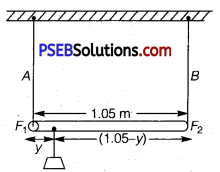
PSEB 11th Class Physics Solutions Chapter 5 Laws of Motion 20
The net force acting on the motorcyclist is the sum of the normal force (FN) and the force due to gravity (Fg = mg).
The equation of motion for the centripetal acceleration ac, can be written as :
Fnet – mac
FN + Fg = mac
FN + mg = \(\frac{m v^{2}}{r}\)
Normal reaction is provided by the speed of the motorcyclist. At the minimum speed (υmin),
FN = 0
mg = \(\frac{m v_{\min }^{2}}{r}\)
∴ υmin = \(\frac{r}{\sqrt{r g}}=\sqrt{25 \times 10}\) = 15.8 m/s

Question 39.
A 70 kg man stands in contact against the inner wall of a hollow cylindrical drum of radius 3 m rotating about its vertical axis with 200 rev/min. The coefficient of friction between the wall and his clothing is 0.15. What is the minimum rotational speed of the cylinder to enable the man to remain stuck to the wall (without falling) when the floor is suddenly removed?
Solution:
Mass of the man, m = 70 kg .
Radius of the drum, r = 3 m
Coefficient of friction, μ = 0.15
Frequency of rotation, v = 200 rev/mm = \(\frac{200}{60}=\frac{10}{3}\) rev/s
The necessary centripetal force required for the rotation of the man is provided by the normal force (FN).
When the floor revolves, the man sticks to the wall of the drum. Hence, the weight of the man (mg) acting downward is balanced by the frictional force (f = μFN) acting upward.
Hence, the man will not fall until:
mg< f
mg< μFN = μmrω
g < μ rω2
ω = \(\sqrt{\frac{g}{\mu r}}\)
The minimum angular speed is given as:
ωmin = \(\sqrt{\frac{g}{\mu r}}\)
= \(\sqrt{\frac{10}{0.15 \times 3}}\) = 4.71 rad s-1

PSEB 11th Class Physics Solutions Chapter 5 Laws of Motion

Question 40.
A thin circular loop of radius R rotates about its vertical diameter with an angular frequency ω. Show that a small bead on the wire loop remains at its lowermost point for ω ≤ \(\sqrt{g / R}\). What is the angle made by the radius vector joining the centre to the bead with the vertical downward direction for ω = \(\sqrt{2 g / R}\)?  Neglect friction.
Solution:
Let the radius vector joining the bead with the centre makes an angle 0, with the vertical downward direction.
PSEB 11th Class Physics Solutions Chapter 5 Laws of Motion 21
OP = R = Radius of the circle
N = Normal reaction
The respective vertical and horizontal equations of forces can be written as:
mg = N cosθ ……………. (i)
mlω2= N sinθ ………….. (ii)
In Δ OPQ, we have:
sinθ = \(\frac{l}{R}\)
l = R sinθ ………….. (iii)
Substituting equation (iii) in equation (ii), we get:
m (R sinθ) ω2 = N sinθ
mR ω2 = N ……………. (iv)
Substituting equation (iv) in equation (i), we get:
mg = mRω2cosθ
cosθ = \(\frac{g}{R \omega^{2}}\) …………….. (v)
Since cosθ ≤ 1, the bead will remain at its lowermost point for \(\frac{g}{R \omega^{2}}\) ≤ 1,
i.e for ω ≤ \(\sqrt{\frac{g}{R}}\)
For ω = \(\sqrt{\frac{2 g}{R}}\) or ω2 = \(\frac{2 g}{R}\) …………….. (vi)
On equating equations (v) and (vi), we get:
\(\frac{2 g}{R}=\frac{g}{R \cos \theta}\)
cosθ = \(\frac{1}{2}\)
∴ θ = cos-1 (0.5) = 60°

PSEB 11th Class Physics Solutions Chapter 4 Motion in a Plane

Punjab State Board PSEB 11th Class Physics Book Solutions Chapter 4 Motion in a Plane Textbook Exercise Questions and Answers.

PSEB Solutions for Class 11 Physics Chapter 4 Motion in a Plane

PSEB 11th Class Physics Guide Motion in a Plane Textbook Questions and Answers

Question 1.
State, for each of the following physical quantities, if it is a scalar or a vector:
volume, mass, speed, acceleration, density, number of moles, velocity, angular frequency, displacement, angular velocity.
Answer:
Scalar quantities: Volume, mass, speed, density, number of moles, angular frequency.
Vector quantities: Acceleration, velocity, displacement, angular velocity.

Question 2.
Pick out the two scalar quantities in the following list:
force, angular momentum, work, current, linear momentum, electric field, average velocity, magnetic moment, relative velocity.
Answer:
Work and current are scalar quantities.

PSEB 11th Class Physics Solutions Chapter 4 Motion in a Plane

Question 3.
Pick out the only vector quantity in the following list:
Temperature, pressure, impulse, time, power, total path length, energy, gravitational potential, coefficient of friction, charge.
Answer:
Impulse is only a vector quantity in the given quantities.

Question 4.
State with reasons, whether the following algebraic operations with scalar and vector physical quantities are meaningful:
(a) adding any two scalars,
(b) adding a scalar to a vector of the same dimensions,
(c) multiplying any vector by any scalar,
(d) multiplying any two scalars,
(e) adding any two vectors,
(f) adding a component of a vector to the same vector.
Answer:
(a) Not meaningful
Explanation: Adding any two scalars is not meaningful because only the scalars of same dimensions can be added.

(b) Not meaningful
Explanation: The addition of a vector quantity with a scalar quantity is not meaningful.

(c) Meaningful
Explanation: A scalar can be multiplied with a vector. For example, force is multiplied with time to give impulse.

(d) Meaningful
Explanation: A scalar, irrespective of the physical quantity it represents, can be multiplied with another scalar having the same or different dimensions.

(e) Not meaningful
Explanation: Adding any two vectors is not meaningful because only vectors of same dimensions can be added.

(f) Meaningful
Explanation: A component of a vector can be added to the same vector as they both have the same dimensions.

Question 5.
Read each statement below carefully and state with reasons, if it is true or false:
(a) The magnitude of a vector is always a scalar,
(b) each component of a vector is always a scalar,
(c) the total path length is always equal to the magnitude of the displacement vector of a particle,
(d) the average speed of a particle (defined as total path length divided by the time taken to cover the path) is either greater or equal to the magnitude of average velocity of the particle over the same interval of time,
(e) Three Vectors not lying in a plane can never add up to give a null vector.
Answer:
(a) True
Explanation: The magnitude of a vector is a number. Hence, it is a scalar.

(b) False
Explanation: Each component of a vector is also a vector.

(c) False
Explanation: Total path length is a scalar quantity, whereas displacement is a vector quantity. Hence, the total path length is always greater than the magnitude of displacement. It becomes equal to the magnitude of displacement only when a particle is moving in a straight line.

(d) True
Explanation: It is because of the fact that the total path length is always greater than or equal to the magnitude of displacement of a particle.

(e) True
Explanation: Three vectors, which do not he in a plane, cannot be represented by the sides of a triangle taken in the same order.

PSEB 11th Class Physics Solutions Chapter 4 Motion in a Plane

Question 6.
Establish the following vector inequalities geometrically or otherwise:
(a) \(|\vec{a}+\vec{b}| \leq|\vec{a}|+|\vec{b}|\)
(b) \(|\vec{a}+\vec{b}| \geq|| \vec{a}|-| \vec{b}||\)
(c) \(|\vec{a}-\vec{b}| \leq|\vec{a}|+|\vec{b}|\)
(d) \(|\vec{a}-\vec{b}| \geq|| \vec{a}|-| \vec{b}||\)
When does the equality sign above apply?
Solution:
(a) Let two vectors \(\vec{a}\) and \(\vec{b}\) be represented by the adjacent sides of a parallelogram OMNP, as shown in the given figure.
PSEB 11th Class Physics Solutions Chapter 4 Motion in a Plane 1
\(|\overrightarrow{O M}|=|\vec{a}|\) ……………. (i)
\(|\overrightarrow{M N}|=|\overrightarrow{O P}|=|\vec{b}|\) ……………. (ii)
\(|\overrightarrow{O N}|=|\vec{a}+\vec{b}|\) ……………. (iii)
In a triangle, each side is smaller than the sum of the other two sides. Therefore, in ∆ OMN, we have:
ON < (OM + MN)
\(|\vec{a}+\vec{b}|<|\vec{a}|+|\vec{b}|\) ………….. (iv)
If the two vectors \(\vec{a}\) and \(\vec{b}\) act along a straight line in the same direction, then we can write: \(|\vec{a}+\vec{b}|=|\vec{a}|+|\vec{b}|\) …………… (v)
Combining equations (iv) and (v), we get: \(|\vec{a}+\vec{b}| \leq|\vec{a}|+|\vec{b}|\) (b) Let two vectors \(\vec{a}\) and \(\vec{b}\) be represented by the adjacent sides of a parallelogram OMNP, as shown in the given figure.
PSEB 11th Class Physics Solutions Chapter 4 Motion in a Plane 2
Here, we have:
\(|\overrightarrow{O M}|=|\vec{a}|\) …………….. (i)
\(|\overrightarrow{M N}|=|\overrightarrow{O P}|=|\vec{b}|\) …………….. (ii)
\(|\overrightarrow{O N}|=|\vec{a}+\vec{b}|\) …………….. (iii)
In a triangle, each side is smaller than the sum of the-other two sides. Therefore, in ∆ OMN, we have: ON + MN > OM
ON + OM > MN
\(|\overrightarrow{O N}|>|\overrightarrow{O M}-\overrightarrow{O P}|\) (∵ OP = MN)
\(|\vec{a}+\vec{b}|>\| \vec{a}|-| \vec{b}||\) ……………….. (iv)

If the two vectors \(\vec{a}\) and \(\vec{b}\) act along a straight line in the same direction, then we can write:
\(|\vec{a}+\vec{b}|=\|\vec{a}|-| \vec{b}\|\) ……………. (v)
Combining equations (iv) and (v), we get:
\(|\vec{a}+\vec{b}| \geq \| \vec{a}|-| \vec{b}||\)

(c) Let two vectors \(\vec{a}\) and \(\vec{b}\) be represented by the adjacent sides of a parallelogram PORS, as shown in the given figure.
PSEB 11th Class Physics Solutions Chapter 4 Motion in a Plane 3
Here we have:
\(|\overrightarrow{O R}|=|\overrightarrow{P S}|=|-\vec{b}|\) ……………… (i)
\(|\overrightarrow{O P}|=|\vec{a}|\) …………….. (ii)
\(|\overrightarrow{O S}|=|\vec{a}-\vec{b}|\) …………….. (iii)
In a triangle, each side is smaller than the sum of the other two sides. Therefore, in ∆ OPS, we have:
OS < OP + PS
\(|\vec{a}-\vec{b}|<|\vec{a}|+|-\vec{b}|\)
\(|\vec{a}-\vec{b}|<|\vec{a}|+|\vec{b}|\) …………… (iv)
If the two vectors act in a straight line but in opposite directions, then we can write:
\(|\vec{a}-\vec{b}|=|\vec{a}|+|\vec{b}|\) …………….. (v)
Combining equations (iv) and (v), we get
\(|\vec{a}-\vec{b}| \leq|\vec{a}|+|\vec{b}|\)

(d) Let two vectors \(\vec{a}\) and \(\vec{b}\) be represented by the adjacent sides of a parallelogram PORS, as shown in the given figure.
PSEB 11th Class Physics Solutions Chapter 4 Motion in a Plane 4
The following relations can be written for the given parallelogram. OS + PS > OP …………… (i)
OS > OP – PS ……………. (ii)
\(|\vec{a}-\vec{b}|>|\vec{a}|-|\vec{b}|\) ……………….. (iii)
The quantity on the LHS is always positive and that on the RHS can be positive or negative. To make both quantities positive, we take modulus on both sides as:
\(\|\vec{a}-\vec{b}\|>\|\vec{a}|-| \vec{b}\|\)
\(|\vec{a}-\vec{b}|>|| \vec{a}|-| \vec{b}||\) ………………. (iv)
If the two vectors act in a straight line but in the opposite directions, then we can write:
\(|\vec{a}-\vec{b}|=\| \vec{a}|-| \vec{b}||\) …………….(v)
Combining equations (iv) and (v), we get
\(|\vec{a}-\vec{b}| \geq|| \vec{a}|-| \vec{b}||\)

PSEB 11th Class Physics Solutions Chapter 4 Motion in a Plane

Question 7.
Given \(\vec{a}+\vec{b}+\vec{c}+\vec{d}\) = 0, which of the following statements are correct:
(a) \(\vec{a}, \vec{b}, \vec{c}\) and \(\overrightarrow{\boldsymbol{d}}\) must each be a null vector,
(b) The magnitude of \((\vec{a}+\vec{c})\) equals the magnitude of \((\vec{b}+\vec{d})\),
(c) The magnitude of a can never be greater than the sum of the magnitudes of \(\vec{b}, \vec{c}\) and \(\vec{d}\),
(d) \(\vec{b}+\vec{c}\) must lie in the plane of \(\overrightarrow{\boldsymbol{a}}\) and \(\overrightarrow{\boldsymbol{b}}\) if \([latex]\overrightarrow{\boldsymbol{a}}\)[/latex] and \(\overrightarrow{\boldsymbol{d}}\) are not collinear, and in the line of \(\overrightarrow{\boldsymbol{a}}\) and \(\overrightarrow{\boldsymbol{d}}\), if they are collinear?
Solution:
(a) Incorrect
In order to make \(\vec{a}+\vec{b}+\vec{c}+\vec{d}\) = 0, it is not necessary to have all the four given vectors to be null vectors. There are many other combinations which can give the sum zero.

(b) Correct
\(\vec{a}+\vec{b}+\vec{c}+\vec{d}\) = 0
\(\vec{a}+\vec{c}=-(\vec{b}+\vec{d})\)
Taking modulus on both the sides, we get:
\(|\vec{a}+\vec{c}|=|-(\vec{b}+\vec{d})|=|\vec{b}+\vec{d}|\)
Hence, the magnitude of (\(\vec{a}+\vec{c}\)) is the same as the magnitude of (\(\vec{b}+\vec{d}\)).

(c) Correct \(\vec{a}+\vec{b}+\vec{c}+\vec{d}\) = 0
\(\vec{a}=(\vec{b}+\vec{c}+\vec{d})\)

Taking modulus on both sides, we get
\(|\vec{a}|=|\vec{b}+\vec{c}+\vec{d}|\)
\(|\vec{a}| \leq|\vec{a}|+|\vec{b}|+|\vec{c}|\) ………………. (i)

Equation (i) shows that the magnitude of a is equal to or less than the sum of the magnitudes of \(\vec{b}\), \(\vec{c}\) and \(\vec{d}\).
Hence, the magnitude of vector a can never be greater than the sum of the magnitudes of \(\vec{b}\), \(\vec{c}\) and \(\vec{d}\).

(d) Correct For \(\vec{a}+\vec{b}+\vec{c}+\vec{d}\) = 0
\(\vec{a}+(\vec{b}+\vec{c})+\vec{d}\) = 0
The resultant sum of the three vectors \(\vec{a},(\vec{b}+\vec{c})\) and \(\vec{d}\) can be zero
only if (\(\vec{b}+\vec{c}\)) lie in a plane containing a and d, assuming that these
three vectors are represented by the three sides of a triangle.

If a and d are collinear/ then it implies that the vector (\(\vec{b}+\vec{c}\) ) is in the line of \(\vec{a}\) and \(\vec{d}\). This implication holds only then the vector sum of all the vectors will be zero.

Question 8.
Three girls skating on a circular ice ground of radius 200m start from a point P on the edge of the ground and reach a point Q diametrically opposite to P following different paths as shown in figure below. What is the magnitude of the displacement vector for each? For which girl is this equal to the actual length of the path skate?
PSEB 11th Class Physics Solutions Chapter 4 Motion in a Plane 5
Solution:
Displacement is given by the minimum distance between the initial and final positions of a particle. In the given case, all the girls start from point P and reach point Q. The magnitudes of their displacements will be equal to the diameter of the ground.
Radius of the ground = 200 m
Diameter of the ground = 2 × 200 = 400 m
Hence, the magnitude of the displacement for each girl is 400 m. This is equal to the actual length of the path skated by girl B.

PSEB 11th Class Physics Solutions Chapter 4 Motion in a Plane

Question 9.
A cyclist starts from the centre O of a circular park of radius 1 km, reaches the edge P of the park, then cycles along the circumference, and returns to the centre along QO as shown in figure below. If the round trip takes 10 min, what is the (a) net displacement, (b) average velocity, and (c) average speed of the cyclist?
PSEB 11th Class Physics Solutions Chapter 4 Motion in a Plane 6
Solution:
(a) Displacement is given by the minimum distance between the initial and final positions of a body. In the given case, the cyclist comes to the starting point after cycling for 10 minutes. Hence, his net displacement is zero.

(b) Average velocity is given by the relation;
PSEB 11th Class Physics Solutions Chapter 4 Motion in a Plane 7
Since the net displacement of the cyclist is zero, his average velocity will also be zero.

(c) Average speed of the cyclist is given by the relation
PSEB 11th Class Physics Solutions Chapter 4 Motion in a Plane 8

Question 10.
On an open ground, a motorist follows a track that turns to his left by an angle of 60° after every 500 m. Starting from a given turn, specify the displacement of the motorist at the third, sixth and eighth turn. Compare the magnitude of the displacement with the total path length covered by the motorist in each case.
Solution:
The path followed by the motorist is a regular hexagon with side 500 m, as shown in the given figure
PSEB 11th Class Physics Solutions Chapter 4 Motion in a Plane 9
Let the motorist start from point P.
The motorist takes the third turn at S.
∴ Magnitude of displacement PS = PV + VS = 500 + 500 = 1000 m
Total path length = PQ + QR +RS = 500 + 500 + 500 = 1500 m
The motorist takes the sixth turn at point P, which is the starting point.
∴ Magnitude of displacement = 0
Total path length = PQ + QR + RS + ST +TU + UP
= 500 + 500 + 500 + 500 + 500 + 500 = 3000 m
The motorist takes the eight turn at point R
∴ Magnitude of displacement = PR
PSEB 11th Class Physics Solutions Chapter 4 Motion in a Plane 10
= 866.03 m
If it is inclined at an angle β from the direction of PQ, then
PSEB 11th Class Physics Solutions Chapter 4 Motion in a Plane 11
or β = 30°
Therefore, the magnitude of displacement is 866.03 m at an angle of 30° with PR.
Total path length = Circumference of the hexagon + PQ + QR
= 6 × 500 + 500 + 500 = 4000 m
The magnitude of displacement and the total path length corresponding to the required turns is shown in the given

Turn Magnitude of dispalcement (m) Total path length (m)
Third 1000 1500
Sixth 0 3000
Eighth 866.03; 30° 4000

Comparison of the magnitude of displacement with the total path length in each case:
PSEB 11th Class Physics Solutions Chapter 4 Motion in a Plane 12

PSEB 11th Class Physics Solutions Chapter 4 Motion in a Plane

Question 11.
A passenger arriving in a new town wishes to go from the station to a hotel located 10 km away on a straight road from the station. A dishonest cabman takes him along a circuitous path 23 km long and reaches the hotel in 28 min. What is (a) the average speed of the taxi, (b) the magnitude of average velocity? Are the two equal?
Solution:
Total distance travelled = 23 km
Total time taken = 28 min = \(\frac{28}{60}\) h

PSEB 11th Class Physics Solutions Chapter 4 Motion in a Plane 13

(b) Distance between the hotel and the station =10 km = Displacement of the taxi
∴ Average velocity = \(\frac{\frac{10}{28}}{\frac{60}{60}}\) = 21.43 km/ h

Therefore, the two physical quantities (average speed and average velocity) are not equal.

Question 12.
Rain is falling vertically with a speed of 30 m s-1. A woman rides a bicycle with a speed of 10 ms-1 in the north to south direction. What is the direction in which she should hold her umbrella?
Solution:
The described situation is shown in the given figure.
PSEB 11th Class Physics Solutions Chapter 4 Motion in a Plane 14
Here, υc = Velocity of the cyclist
υr = Velocity of falling rain
In order to protect herself from the rain, the woman must hold her umbrella in the direction of the relative velocity (v) of the rain with respect to the woman.
υ = υr + (-υc)
= 30 + (-10) = 20 m/s
tanθ = \(\frac{v_{c}}{v_{r}}=\frac{10}{30}\)
θ = tan-1 (\(\frac{1}{3}\))
= tan-1 (0.333) ≈ 18°
Hence, the woman must hold the umbrella toward the south, at an angle of nearly 18° with the vertical.

Question 13.
A man can swim with a speed of 4.0 km/h in still water. How long does he take to cross a river 1.0 km wide if the river flows steadily at 3.0 km/h and he makes his strokes normal to the river current? How far down the river does he go when he reaches the other hank?
Solution:
PSEB 11th Class Physics Solutions Chapter 4 Motion in a Plane 15
Speed of the man, υm = 4 km/h
Width of the river = 1 km
PSEB 11th Class Physics Solutions Chapter 4 Motion in a Plane 16
= \(\frac{1}{4}\) h = \(\frac{1}{4}\) × 60 = 15 min
Speed of the river, υr = 3 km/h
Distance covered with flow of the river = υr × t
= 3 × \(\frac{1}{4}\) = \(\frac{3}{4}\) km
= \(\frac{3}{4}\) × 1000 = 750 m

PSEB 11th Class Physics Solutions Chapter 4 Motion in a Plane

Question 14.
In a harbour, wind is blowing at the speed of 72 km/h and the flag on the mast of a boat anchored in the harbour flutters along the N-E direction. If the boat starts moving at a speed of 51 km/h to the north, what is the direction of the flag on the mast of the boat?
Solution:
Velocity of the boat, υb = 51 km/h
Velocity of the wind, υw = 72 km/h
The flag is fluttering in the north-east direction. It shows that the wind is blowing toward the north-east direction. When the ship begins sailing toward the north, the flag will move along the direction of the relative velocity (υwb) of the wind with respect to the boat.
PSEB 11th Class Physics Solutions Chapter 4 Motion in a Plane 17
∴ β = tan-1 (1.0038) = 45.18°
Angle with respect to the east direction = 45.18° – 45° = 0.18°
Hence, the flag will flutter almost due east.

Question 15.
The ceiling of a long hall is 25 m high. What is the maximum horizontal distance that a ball thrown with a speed of 40 m s 1 can go without hitting the ceiling of the hall?
Solution:
Speed of the ball, u = 40 m/s
Maximum height, h = 25 m
In projectile motion, the maximum height reached by a body projected at an angle 0, is given by the relation:
PSEB 11th Class Physics Solutions Chapter 4 Motion in a Plane 18

Question 16.
A cricketer can throw a ball to a maximum horizontal distance of 100 m. How much high above the ground can the cricketer throw the same ball?
Solution:
Maximum horizontal distance, R = 100 m
The cricketer will only be able to throw the ball to the maximum horizontal distance when the angle of projection is 45°, i.e., θ = 45°.
The horizontal range for a projection velocity v, is given by the relation:
R = \(\frac{u^{2} \sin 2 \theta}{g}\)
100 = \(\frac{u^{2}}{g}\) sin90°
\(\frac{u^{2}}{g}\) = 100 ……………… (i)
The ball will achieve the maximum height when it is thrown vertically upward. For such motion, the final velocity v is zero at the maximum height H.
Acceleration, a = -g
Using the third equation of motion:
υ2 – u2 = -2gH
H = \(\frac{1}{2}\) × \(\frac{u^{2}}{g}\) = \(\frac{1}{2}\) × 100 = 50 m

Question 17.
A stone tied to the end of a string 80 cm long is whirled in a horizontal circle with a constant speed. If the stone makes 14 revolutions in 25 s, what is the magnitude and direction of acceleration of the stone?
Solution:
Length of the string, l = 80 cm = 0.8 m
Number of revolutions = 14
Time taken = 25 s
PSEB 11th Class Physics Solutions Chapter 4 Motion in a Plane 19
= 9.91 m/s2
The direction of centripetal acceleration is always directed along the string, toward the centre, at all points.

PSEB 11th Class Physics Solutions Chapter 4 Motion in a Plane

Question 18.
An aircraft executes a horizontal loop of radius 1.00 km with a steady speed of 900 km/h. Compare its centripetal acceleration with the acceleration due to gravity.
Solution:
Radius of the loop, r = 1 km = 1000 m
Speed of the aircraft,υ = 900 km/h = 900 × \(\frac{5}{18}\) = 250 m/s
Centripetal acceleration, ac = \(\frac{v^{2}}{r}\)
= \(\frac{(250)^{2}}{1000}\) = 62.5 m/s2
Acceleration due to gravity, g = 9.8 m/s2
\(\frac{a_{c}}{g}=\frac{62.5}{9.8}\) = 6.38
ac = 6.38 g

Question 19.
Read each statement below carefully and state, with reasons, if it is true or false:
(a) The net acceleration of a particle in circular motion is always along the radius of the circle towards the centre.
(b) The velocity vector of a particle at a point is always along the tangent to the path of the particle at that point.
(c) The acceleration vector of a particle in uniform circular motion averaged over one cycle is a null vector.
Answer:
(a) False
Reason: The net acceleration of a particle in circular motion is not always directed along the radius of the circle towards the centre. It happens only in the case of uniform circular motion.

(b) True
Reason: At a point on a circular path, a particle appears to move tangentially to the circular path. Hence, the velocity vector of the particle is always along the tangent at a point.

(c) True
Reason: In uniform circular motion (UCM), the direction of the acceleration vector points toward the centre of the circle. However, it constantly changes with time. The average of these vectors over one cycle is a null vector.

Question 20.
The position of a particle is given by
r̂ = 3.0 t î – 2.0 t2ĵ + 4.0k̂ m
where t is in seconds and the coefficients have the proper units for r to be in metres.
(a) Find the υ and a of the particle?
(b) What is the magnitude and direction of velocity of the particle at t = 3.0 s?
Solution:
PSEB 11th Class Physics Solutions Chapter 4 Motion in a Plane 20
= – tan-1 (2.667)
= -69.45°
The negative sign indicates that the direction of velocity is below the x-axis.

PSEB 11th Class Physics Solutions Chapter 4 Motion in a Plane

Question 21.
A particle starts from the origin at t 0 s with a velocity of 10.0 ĵ m/s and moves in the x – y plane with a constant acceleration of (8.0î + 2.0ĵ) ms-2.
(a) At what time is the x – coordinate of the particle 16 m? What is the y-coordinate of the particle at that time?
(b) What is the speed of the particle at the time?
Solution:
PSEB 11th Class Physics Solutions Chapter 4 Motion in a Plane 21
PSEB 11th Class Physics Solutions Chapter 4 Motion in a Plane 22
PSEB 11th Class Physics Solutions Chapter 4 Motion in a Plane 23

Question 22.
î and ĵ are unit vectors along x- and y-axis respectively. What is the magnitude and direction of the vectors î + ĵ and î – ĵ? What are the components of a vector \(\overrightarrow{\boldsymbol{A}}\) = 2î + 3ĵ along the directions of î + ĵ and î – ĵ? [You may use graphical method]
Solution:
Consider a vector \(\vec{P}\), given as:
\(\vec{P}\) = î + ĵ
Pxî +Py ĵ = î + ĵ
On comparing the components on both sides, we get:
Px = Py = 1
\(|\vec{P}|=\sqrt{P_{x}^{2}+P_{y}^{2}}=\sqrt{1^{2}+1^{2}}=\sqrt{2}\) …………… (i)
Hence, the magnitude of the vector î + ĵ is √2.
Let 0 be the angle made by the vector \(\), with the x-axis, as shwon in the following figure.
PSEB 11th Class Physics Solutions Chapter 4 Motion in a Plane 24
Hence, the vector î + ĵ makes an angle of 45° with the x-axis.
Let \(\vec{Q}\) = î – ĵ
PSEB 11th Class Physics Solutions Chapter 4 Motion in a Plane 25
PSEB 11th Class Physics Solutions Chapter 4 Motion in a Plane 26
PSEB 11th Class Physics Solutions Chapter 4 Motion in a Plane 27

PSEB 11th Class Physics Solutions Chapter 4 Motion in a Plane

Question 23.
For any arbitrary motion in space, which of the following relations are true:
PSEB 11th Class Physics Solutions Chapter 4 Motion in a Plane 28
(The ‘average’ stands for average of the quantity over the time interval t1 to t2)
Solution:
(b) and (e)
(a) It is given that the motion of the particle is arbitrary. Therefore, the average velocity of the particle cannot be given by this equation.
(b) The arbitrary motion of the particle can be represented by this equation.
(c) The motion of the particle is arbitrary. The acceleration of the particle may also be non-uniform. Hence, this equation cannot represent the motion of the particle in space.
(d) The motion of the particle is arbitrary; acceleration of the particle may also be non-uniform. Hence, this equation cannot represent the motion of particle in space.
(e) The arbitrary motion of the particle can be represented by this equation.

Question 24.
Read each statement below carefully and state, with reasons and examples, if it is true or false:
A scalar quantity is one that
(a) is conserved in a process
(b) can never take negative values
(c) must be dimensionless
(d) does not vary from one point to another in space
(e) has the same value for observers with different orientations of axes.
Answer:
(a) False
Reason: Despite being a scalar quantity, energy is not conserved in inelastic collisions.

(b) False
Reason: Despite being a scalar quantity, temperature can take negative values.

(c) False
Reason: Total path length is a scalar quantity. Yet it has the dimension of length.

(d) False
Reason: A scalar quantity such as gravitational potential can vary from one point to another in space.

(e) True
Reason: The value of a scalar does not vary for observers with different orientations of axes.

Question 25.
An aircraft is flying at a height of 3400 m above the ground. If the angle subtended at a ground observation point by the aircraft positions 10.0 s apart is 30°, what is the speed of the aircraft?
Solution:
The positions of the observer and the aircraft are shown in the given figure.
PSEB 11th Class Physics Solutions Chapter 4 Motion in a Plane 29
Height of the aircraft from ground, OR = 3400 m
Angle subtended between the positions, ∠POQ =30°
Time = 10 s
In Δ PRO:
tan15° = \(\frac{P R}{O R}\)
PR = OR tan 15°
= 3400 × tan15°
Δ PRO is similar to Δ RQO.
PR =RQ
Motion in a Plane 81
PQ = PR + RQ
= 2PR = 2 × 3400 tanl5°
= 6800 × 0.268 = 1822.4 m
speed of the aircraft = \(\frac{1822.4}{10}\) = 182.24 m/s

PSEB 11th Class Physics Solutions Chapter 4 Motion in a Plane

Question 26.
A vector has magnitude and direction. Does it have a location in space? Can it vary with time? Will two equal vectors a and b at different locations in space necessarily have identical physical ‘ effects? Give examples in support of your answer.
Answer:
No; Yes; No
Generally speaking, a vector has no definite locations in space. This is because a vector remains invariant when displaced in such a way that its magnitude and direction remain the same. However, a position vector has a definite location in space.

A vector can vary with time. For example, the displacement vector of a particle moving with a certain velocity varies with time.

Two equal vectors located at different locations in space need not produce the same physical effect. For example, two equal forces acting on an object at different points can cause the body to rotate, but their combination cannot produce an equal turning effect.

Question 27.
A vector has both magnitude and direction. Does it mean that anything that has magnitude and direction is necessarily a vector? The rotation of a body can be specified by the direction of the axis of rotation, and the angle of rotation about the axis. Does that make any rotation a vector?
Answer:
No; No
A physical quantity having both magnitude and direction need not be considered a vector. For example, despite having magnitude and direction, current is a scalar quantity. The essential requirement for a physical quantity to be considered a vector is that it should follow the law of vector addition.

Generally speaking, the rotation of a body about an axis is not a vector quantity as it does not follow the law of vector addition. However, a rotation by a certain small angle follows the law of vector addition and is therefore considered a vector.

Question 28.
Can you associate vectors with (a) the length of a wire bent into a loop, (b) a plane area, (c) a sphere? Explain.
Answer:
No; Yes; No
One cannot associate a vector with the length of a wire bent into a loop. One can associate an area vector with a plane area. The direction of this vector is normal, inward or outward to the plane area.
One cannot associate a vector with the volume of a sphere. However, an area vector can be associated with the area of a sphere.

PSEB 11th Class Physics Solutions Chapter 4 Motion in a Plane

Question 29.
A bullet fired at an angle of 30° with the horizontal hits the ground 3.0 km away. By adjusting its angle of projection, can one hope to hit a target 5.0 km away? Assume the muzzle speed to the fixed, and neglect air resistance.
Solution:
No
Range, R = 3 km
Angle of projection, θ = 30°
Acceleration due to gravity, g = 9.8 m/s2
Horizontal range for the projection velocity u0, is given by the relation :
R = \(\frac{u_{0}^{2} \sin 2 \theta}{g}\)
3 = \(\frac{u_{0}^{2}}{g}\) sin 60°
\(\frac{u_{0}^{2}}{g}\) = 2√3 ……………… (i)
The maximum range (Rmax) is achieved by the bullet when it is fired at an angle of 45° with the horizontal, that is,
Rmax = \(\frac{u_{0}^{2}}{g}\) = ………………. (ii)
On comparing equations (i) and (ii), we get:
Rmax = 2√3 × 1.732 = 3.46 km
Hence, the bullet will not hit a target 5 km away.

Question 30.
A fighter plane flying horizontally at an altitude of 1.5 km with speed 720 km/h passes directly overhead an dnti-aircraft gun. At what angle from the vertical should the gun be fired for the shell with muzzle speed 600 ms-1 to hit the plane? At what minimum altitude should the pilot fly the plane to avoid being hit? (Take g = 10ms-2)
Solution:
Height of the fighter plane = 1.5 km = 1500 m
Speed of the fighter plane, υ = 720 km/h = 200 m/s
Let θ be the angle with the vertical so that the shell hits the plane. The
situation is shown in the given figure.
PSEB 11th Class Physics Solutions Chapter 4 Motion in a Plane 30
Muzzle velocity of the gun, u = 600 m/s
Time taken by the shell to hit the plane = t
Horizontal distance travelled by the shell = uxt
Distance travelled by the plane = υt
The shell hits the plane. Hence, these two distances must be equal.
uxt = υt
usinθ = υ
sinθ = \(\frac{v}{u}=\frac{200}{600}=\frac{1}{3}\) 0.33
θ = sin-1 (0.33) = 19.5°
In order to avoid being hit by the shell, the pilot must fly the plane at
an altitude (H) higher than the maximum height achieved by the shell.
PSEB 11th Class Physics Solutions Chapter 4 Motion in a Plane 31

Question 31.
A cyclist is riding with a speed of 27 km/h. As he approaches a circular turn on the road of radius 80 m, he applies brakes and reduces his speed at the constant rate of 0.50 m/s every second. What is the magnitude and direction of the net acceleration of the cyclist on the circular turn?
Solution:
Speed of the cyclist, υ = 27 km/h = 7.5 m/s
Radius of the circular turn , r = 80m
Centripetal acceleration is given as:
a = \(\frac{v^{2}}{r}\)
= \(\frac{(7.5)^{2}}{80}\) = 0.7 m/s2
The situation is shown in the given figure:
PSEB 11th Class Physics Solutions Chapter 4 Motion in a Plane 32
Suppose the cyclist begins cycling from point P and moves toward point Q. At point Q, he applies the brakes and decelerates the speed of the bicycle by 0.5 m/s2.
This acceleration is along the tangent at Q and opposite to the direction of motion of the cyclist.
Since the angle between ac and aT is 90°, the resultant acceleration a is given by:
a = \(\sqrt{a_{c}^{2}+a_{T}^{2}}=\sqrt{(0.7)^{2}+(0.5)^{2}}=\sqrt{0.74}\) = 0.86 m/s2
and
tan θ = \(\frac{a_{c}}{a_{T}}\)
where θ is the angle of the resultant with the direction of velocity
tanθ = \(\frac{0.7}{0.5}\) = 1.4
θ = tan-1 (1.4) = 54.46°
Hence, the net acceleration of the cyclist is 0.86 rn/s2, 54.60 0 with the direction of velocity.

PSEB 11th Class Physics Solutions Chapter 4 Motion in a Plane

Question 32.
(a) Show that for a projectile the angle between the velocity and the x-axis as a function of time is
θ(t) = tan (\(\frac{v_{0 y}-g t}{v_{0 x}}\))

(b) Show that the projection angle θ0 for a projectile launched from the origin is given by
θ0 = tan-1 (\(\frac{\mathbf{4} \boldsymbol{h}_{\boldsymbol{m}}}{\boldsymbol{R}}\))
where the symbols have their usual meaning.
Solution:
Let y Ox and y 0, respectively be the initial components of the velocity of the projectile along horizontal (x) and vertical (y) directions.
Let y and y , respectively be the horizontal and vertical components of velocity at a point P.
PSEB 11th Class Physics Solutions Chapter 4 Motion in a Plane 33
Time taken by the projectile to reach point P = t.
Applying the first equation of motion along the vertical and horizontal directions, we get:
PSEB 11th Class Physics Solutions Chapter 4 Motion in a Plane 34
PSEB 11th Class Physics Solutions Chapter 4 Motion in a Plane 35

PSEB 11th Class Physics Important Questions Chapter 7 System of Particles and Rotational Motion

Punjab State Board PSEB 11th Class Physics Important Questions Chapter 7 System of Particles and Rotational Motion Important Questions and Answers.

PSEB 11th Class Physics Important Questions Chapter 7 System of Particles and Rotational Motion

very short answer type questions

Question 1.
(n – 1) equal point masses each of mass m are placed at the vertices of a regular n-polygon. The vacant vertex has a position vector \(\vec{a}\) with respect to the centre of the polygon. Find the position vector of centre of mass. (NCERT Exemplar)
Solution
Suppose, \(\vec{b}\) be the position vector of centre of mass of regular n-polygon. As (n – 1) equal point masses each of mass m are placed at (n – 1) vertices of regular polygon, therefore
\(\frac{(n-1) m b+m a}{(n-1+1) m}\) = 0
⇒ (n – 1)mb + ma = 0
⇒ b = \(\frac{-a}{(n-1)}\)

Question 2.
If net torque on a rigid body is zero, does it linear momentum necessary remain conserved?
Answer:
The linear momentum remain conserved if the net force on the system is zero.

PSEB 11th Class Physics Important Questions Chapter 7 System of Particles and Rotational Motion

Question 3.
When is a body lying in a gravitation field in stable equilibrium?
Answer:
A body in a gravitation field will be in stable equilibrium, if the vertical line through its centre of gravity passes through the base of the body.

Question 4.
Is centre of mass and centre of gravity body always coincide?
Ans.
No, if the body is large such that g varies from one point to another, then centre of gravity is offset from centre of mass.
But for small bodies, centre of mass and centre of gravity lies at their geometrical centres.

Question 5.
Why is moment of inertia also called rotational inertia?
Answer:
The moment of inertia gives a measure of inertia in rotational motion. So, it is also called rotational inertia.

Question 6.
In a flywheel, most of the mass is concentrated at the rim. Explain why?
Answer:
Concentration of mass at the rim increases the moment of inertia and thereby brings uniform motion.

Question 7.
Does the radius of gyration depend upon the speed of rotation of the body?
Answer:
No, it depends only on the distribution of mass of the body.

PSEB 11th Class Physics Important Questions Chapter 7 System of Particles and Rotational Motion

Question 8.
Can the mass of body be taken to be concentrated at its centre of mass for the purpose of calculating its rotational inertia?
Answer:
No, the moment of inertia greatly depends on the distribution of mass about the axis of rotation.

Short answer type questions

Question 1.
Does angular momentum of a body in translatory motion is zero?
Solution:
Angular momentum of a body is measured with respect to certain origin.
PSEB 11th Class Physics Important Questions Chapter 7 System of Particles and Rotational Motion 1
So, a body in translatory motion can have angular momentum.
It will be zero, if origin lies on the line of motion of particle.

Question 2.
Figure shows momentum versus time graph for a particle moving along x – axis. In which region, force on the particle is large. Why?
PSEB 11th Class Physics Important Questions Chapter 7 System of Particles and Rotational Motion 2
Solution:
Net force is given by F = \(\frac{d p}{d t}\)
Also, rate of change of momentum = slope of graph.
As from graph, slope AB = slope CD
And slope (BC) = slope (DE) = 0
So, force acting on the particle is equal in regions AB and CD and in regions BC and DE (which is zero).

PSEB 11th Class Physics Important Questions Chapter 7 System of Particles and Rotational Motion

Question 3.
Two cylindrical hollow drums of radii R and 2J2, and of a common height h, are rotating with angular velocities ω (anti-clockwise) and ω (clockwise), respectively.
Their axes, fixed are parallel and in a horizontal plane separated by (3R + δ). They are now brought in contact (δ → 0).
(i) Show the frictional forces just after contact.
(ii) Identify forces and torques external to the system just after contact.
(iii) What would be the ratio of final angular velocities when friction ceases? (NCERT Exemplar)
Solution:
PSEB 11th Class Physics Important Questions Chapter 7 System of Particles and Rotational Motion 3
(ii) F’ = F = F” where F and F” are external forces through support.
Fnet = 0
External torque = F x 3 R, anti-clockwise.

(iii) Let ω1 and ω2 be final angular velocities (anti-clockwise and clockwise respectively).
Finally, there will be no friction.
Hence, Rω1 = 2Rω2 ⇒ \(\frac{\omega_{1}}{\omega_{2}}\) = 2

Question 4.
Angular momentum of a system is conserved if its M.I. is changed. Is its rotational K. E. also conserved?
Solution:
Kinetic energy of rotation = \(\frac{1}{2}\)Iω2 = \(\frac{1}{2}\) (Iω)ω = \(\frac{1}{2}\)Lω

L = Iω is constant, if moment of inertia (I) of the system changes. It means as I changes, then ω also changes.
Hence K.E. of rotation also changes with the change in I. In other words, rotational K.E. is not conserved.

PSEB 11th Class Physics Important Questions Chapter 7 System of Particles and Rotational Motion

Question 5.
How much fraction of the kinetic energy of rolling is purely
(i) translational, (ii) rotational.
Solution:
PSEB 11th Class Physics Important Questions Chapter 7 System of Particles and Rotational Motion 4

Question 6.
Listening to the discussion on causes of pollution and due to which temperature on earth is rising, increase in temperature leads to melting of polar ice, Meenu realised that if each one of us contributed to create pollution free environment, then even small efforts can lead to big results. So, she decided to lead the step and instead of going to school by her car, she joined school bus and also asked her father to go to office using car pool.
(i) What do you think is mainly responsible for global warming?
(ii) If the ice on polar caps of the earth melts due to pollution, how will it affect the duration of the day?
Explain.
(iii) What values does Meenu show?
Answer:
(i) Pollution created by the people of world is the main cause of global warming.
(ii) Earth rotates about its polar axis. When ice of polar caps of earth melts, mass concentrated near the axis of rotation spreads out, therefore moment of inertia, I increases.
As no external torque acts,
∴ L = I = Iω = (\(\frac{2 \pi}{T}\)) = Constant
With increase of I, T will increase i.e., length of day will also increase,
(iii) Meenu is considerate towards environment and her thought of leading the steps to reduce pollution is commendable.

PSEB 11th Class Physics Important Questions Chapter 7 System of Particles and Rotational Motion

Question 7.
Explain how a cat is able to land on its feet after a fall taking the advantage of principle of conservation of angular momentum?
Answer:
When a cat falls to ground from a height, it stretches its body alongwith the tail so that its moment of inertia becomes high. Since, la is to remain constant, the value of angular speed a decreases and therefore the cat is able to’ land on the ground gently.

Question 8.
A uniform disc of radius R is resting on a table on its rim. The coefficient of friction between disc and table is μ (figure). Now, the disc is pulled with a force \(\overrightarrow{\boldsymbol{F}}\) as shown in the figure. What is the maximum value of \(\overrightarrow{\boldsymbol{F}}\) for which the disc rolls without slipping? (NCERT Exemplar)
PSEB 11th Class Physics Important Questions Chapter 7 System of Particles and Rotational Motion 5
Solution:
Let the acceleration of the centre of mass of disc be a, then
Ma = F – f
The angular acceleration of the disc is a = a/R (if there is no sliding).
Then, (\(\frac{1}{2}\)MR2)α = Rf
⇒ Ma = 2f
Thus, f =F/3. Since, there is no sliding.
⇒ f ≤ μ mg ⇒ F ≤ 3μ Mg

Question 9.
Two equal and opposite forces act on a rigid body. Under what condition will the body (i) rotate (ii) not rotate?
Answer:
(i) Two equal and opposite forces acting on a rigid body such that their lines of action do not coincide, constitute a couple. This couple produces the turning effect on the body. Hence, the rigid body will rotate.

(ii) If two equal and opposite forces act in such a way that their lines of action coincide, then these forces cancel out the effect of each other. Hence, the body will not rotate.

PSEB 11th Class Physics Important Questions Chapter 7 System of Particles and Rotational Motion

Long answer type questions

Question 1.
Find position of centre of mass of a semicircular disc of radius r. (NCERT Exemplar)
Solution:
As semicircular disc is symmetrical about its one of diameter, we take axes as shown. So, now we only have to calculate YCM (As XCM is zero by symmetry and choice of origin).
PSEB 11th Class Physics Important Questions Chapter 7 System of Particles and Rotational Motion 6
Now, for a small element OAB, as element is small and it can be treated as a triangle so,
Area of sector OAB = \(\frac{1}{2}\) x r x rdθ
Height of triangle = r
Base of triangle = AB = rdθ
So, its mass dm = \(\frac{1}{2}\)r2 dθ.ρ [∵ ρ = \(\frac{\text { mass }}{\text { area }}\)]
As centre of mass of a triangle is at a distance of \(\frac{2}{3}\) from its vertex (at centroid, intersection of medians). So, y = \(\frac{2}{3}\)rsinθ (location of CM of small sector AOB).
PSEB 11th Class Physics Important Questions Chapter 7 System of Particles and Rotational Motion 7
PSEB 11th Class Physics Important Questions Chapter 7 System of Particles and Rotational Motion 8
So, CM of disc is at a distance of \(\frac{4 r}{3 \pi}\)from its centre on its axis of symmetry.

PSEB 11th Class Physics Important Questions Chapter 7 System of Particles and Rotational Motion

Question 2.
Obtain an expression for linear acceleration of a cylinder rolling down an inclined plane and hence find the condition for the cylinder to roll down the inclined plane without slipping.
Solution:
When a cylinder rolls down on an inclind plane, then forces involved are (i) Weight mg (ii) Normal reaction N (iii) Friction f
From free body diagam,
PSEB 11th Class Physics Important Questions Chapter 7 System of Particles and Rotational Motion 9
From free body diagram,
N – mg cos θ = 0
or N = mg cosθ
Also, if a = acceleration of centre of mass down the plane, then
Fnet = ma = mgsin θ – f …………… (i)
As friction produces torque necessary for rotation,
τ = Iα = f R
PSEB 11th Class Physics Important Questions Chapter 7 System of Particles and Rotational Motion 10

PSEB 11th Class Physics Important Questions Chapter 8 Gravitation

Punjab State Board PSEB 11th Class Physics Important Questions Chapter 8 Gravitation Important Questions and Answers.

PSEB 11th Class Physics Important Questions Chapter 8 Gravitation

Very Short Answer Type Questions

Question 1.
By which law is the Kepler’s law of areas identical?
Answer:
The law of conservation of angular momentum.

Question 2.
Draw areal velocity versus time graph for mars. (NCERT Exemplar)
Answer:
Areal velocity of planet revolving around the Sun is constant with time (Kepler’s second law).
PSEB 11th Class Physics Important Questions Chapter 8 Gravitation 1

Question 3.
At what factor between the two particles gravitational force does not depend?
Answer:
Gravitational force does not depend upon the medium between the two particles.

Question 4.
Two particles of masses m1 and m2 attract each other gravitationally and are set in motion under the influence of the gravitational force? Will the centre of mass move?
Answer:
Since the gravitational force is an internal force, therefore the centre of mass would not move.

Question 5.
Work done in moving a particle round a closed path under the action of gravitation force is zero. Why?
Answer:
Gravitational force is a conservative force which means that work done by it, is independent of path followed.

Question 6.
What would happen if the force of gravity were to disappear suddenly?
Answer:
The universe would collapse. We would be thrown away because of the centrifugal force. Eating, drinking and in fact all activities would become impossible.

Question 7.
Why a body weighs more at poles and less at equator?
Answer:
The value of g is more at poles than at the equator. Therefore, a body weighs more at poles than at equator.

Question 8.
Give a method for the determination of the mass of the moon.
Solution:
Soli By making use of the relation, gm = \(\frac{G M_{m}}{R_{m}^{2}} \)

Short Answer Type Questions

Question 1.
A planet moving along an elliptical orbit is closest to the Sim at a distance r1 and farthest away at a distance of r2.
If v1 and v2 are the linear velocities at these points respectively, then find the ratio \(\frac{v_{1}}{v_{2}}\).
Solution:
From the law of conservation of angular momentum
mr1v1 = mr2v2
⇒ r1v1 = r2v2 or
\(\frac{v_{1}}{v_{2}}=\frac{r_{2}}{r_{1}}\)

Question 2.
A mass M is broken into two parts, m and (M – m). How is m related to M so that the gravitational force between two parts is maximum?
Solution:
Let =m,m2 =M – m
F = G\(\frac{m(M-m)}{r^{2}}=\frac{G}{r^{2}}\left(M m-m^{2}\right)\)
Differentiating w.r:t. m, \(\frac{d F}{d m}=\frac{G}{r^{2}}(M-2 m)\)
For F to be maximum, \(\frac{d F}{d m}\) = 0
PSEB 11th Class Physics Important Questions Chapter 8 Gravitation 2
m1 = m2 = M/2

Question 3.
Two stationary particles of masses M1 and M2 are a distance d apart. A third particle lying on the line joining the particles, experiences no resultant gravitational force. What is the distance of this particle from M1?
Solution:
The force on m towards Mi is F =G \(\frac{M_{1} m}{r^{2}}\)
The force on m towards Mi is F = G \(\frac{M_{2} m}{(d-r)^{2}} \)

Equating two forces, we have
PSEB 11th Class Physics Important Questions Chapter 8 Gravitation 4
So, distance of an particle from m is . r = d
r = d \(\left(\frac{\sqrt{M_{1}}}{\sqrt{M_{1}}+\sqrt{M_{2}}}\right)\).

Question 4.
Aspherical planet has mass Mp and clinometer Dp. A particle of mass m falling freely near the surface of this planet will experience an acceleration due to gravity, equal to whom?
Solution:
Force is given by
F = \(-\frac{G M m}{R^{2}}=\frac{G M_{p} m}{\left(D_{P} / 2\right)^{2}}=\frac{4 G M_{P} m}{D_{P}^{2}}\)
\(\frac{F}{m}=\frac{4 G M_{P}}{D_{P}^{2}}\)

Question 5.
What is the gravitational potential energy of a body at height h from the Earth surface?
Solution:
Gravitational potential energy, i. e.,
Uh = \(-\frac{G M m}{R+h}=-\frac{g R^{2} m}{R+h}\)
[where g = \(\frac{G M}{R^{2}}\) ]
= – \(\frac{g R^{2} m}{R\left(1+\frac{h}{R}\right)}=-\frac{m g R}{1+\frac{h}{R}}\)
.
Question 6.
An artificial satellite is moving in a circular orbit around the Earth with a speed equal to half the magnitude of escape velocity from Earth.
Determine
(i) the height of satellite above Earth’s surface.
(ii) if the satellite is suddenly stopped, find the speed with
which the satellite will hit the Earth’s surface after falling down.
Solution:
Escape velocity = \(\sqrt{2 g R}\), where g is acceleration due to gravity on surface of Earth and R the radius of Earth.
Orbital velocity = \(\frac{1}{2} v_{e}=\frac{1}{2} \sqrt{2 g R}=\sqrt{\frac{g R}{2}} \) …………………. (i)

(i) If h is the height of satellite above Earth
PSEB 11th Class Physics Important Questions Chapter 8 Gravitation 5
h=R
(ii) If the satellite is stopped in orbit, the kinetic energy is zero and its
potential energy is – \(\frac{G M m}{2 R}\)
Total energy =-\(\frac{G M m}{2 R}\)

Let v be its velocity when it reaches the Earth.
Hence the kinetic energy = \(\frac{1}{2} m v^{2}\)
Potential energy = – \(\frac{G M m}{2 R}\)
PSEB 11th Class Physics Important Questions Chapter 8 Gravitation 6

Question 7.
Why do different planets have different escape velocities?
Solution:
Escape velocity, v = \(\sqrt{2 g R}=\sqrt{\frac{2 G M}{R}}\)
Thus escape velocity of a planet depends upon (i) its mass (M) and
(ii) its size (R).
As different planets have different masses and sizes, so they have different escape velocities.

Question 8.
Under what circumstances would your weight become zero?
Answer:
The weight will become zero under the following circumstances
(i) during free fall
(ii) at the centre of the Earth
(iii) in an artificial satellite
(iv) at a point where gravitational pull of Earth is equal to the gravitational pull of the Moon.

Long Answer Type Questions

Question 1.
A mass m is placed at P, a distance h along the normal through the centre O of a thin circular ring of mass M and radius r. If the mass is removed further away such that OP becomes 2h, by what factor the force of gravitation will decrease, if h = r? (NCERT Exemplar)
PSEB 11th Class Physics Important Questions Chapter 8 Gravitation 7
Solution:
Consider a small element of the ring of mass dM, gravitational force between dM and m, distance x apart in figure i.e.,
dF = \(\frac{G(d m) m}{x^{2}}\)
PSEB 11th Class Physics Important Questions Chapter 8 Gravitation 8
dF can be resolved into two rectangular components.
(i) dF cos θ along PO and
(ii) dF sinθ perpendicular to PO (given figure)
The total force (F) between the ring and mass (m) can be obtained by integrating the effects of all the elements forming the ring, whereas all the components perpendicular to PO cancel out i.e., ∫dFsinθ=O, the component along PO add together to give F i.e.,
PSEB 11th Class Physics Important Questions Chapter 8 Gravitation 9

Question 2.
A satellite is to be placed in equatorial geostationary orbit around the Earth for communication.
(i) Calculate height of such a satellite.
(ii) Find out the minimum number of satellites that are needed to cover entire Earth so that at least one of satellite is visible from any point on the equator.
[M = 6 x 10 24 kg, R = 6400 km, T = 24 h, G = 6.67 x 10⁻¹¹SI (NCERT Exemplar)
Solution:
(i) As, according co Kepler’s third law, we get
T2 = \(\frac{4 \pi^{2} r^{3}}{G M}\)
⇒ r = \( \left(\frac{G M T^{2}}{4 \pi^{2}}\right)^{1 / 3}\)
PSEB 11th Class Physics Important Questions Chapter 8 Gravitation 10
As we known =R +h
h=r-R
h=4.23 x 10⁷ m – 6.4 x 10⁶ m
h = 3.59 x 10⁷ m

(ii) In ΔOES,cos θ = \(\frac{O A}{O S}=\frac{R}{R+h}\)
= \(\frac{1}{\left(1+\frac{h}{R}\right)}\)
= \(\frac{1}{(1+5.609)}\)
=0.1513
(as,\(\frac{h}{R}=\frac{3.59 \times 10^{7} \mathrm{~m}}{6.4 \times 10^{6} \mathrm{~m}}\) = 5.609)
where, θ ≈ 81° or 2θ = 162°
Number of satellites required to cover entire the Earth.
= \(\frac{360^{\circ}}{162^{\circ}}=2.2\) ≈ 3.

PSEB 11th Class Physics Solutions Chapter 8 Gravitation

Punjab State Board PSEB 11th Class Physics Book Solutions Chapter 8 Gravitation Textbook Exercise Questions and Answers.

PSEB Solutions for Class 11 Physics Chapter 8 Gravitation

PSEB 11th Class Physics Guide Gravitation Textbook Questions and Answers

Question 1.
Answer the following:
(a) You can shield a charge from electrical forces by putting it inside a hollow conductor. Can you shield a body from the gravitational influence of nearby matter by putting it inside a hollow sphere or by some other means?
(b) An astronaut inside a small spaceship orbiting around the earth cannot detect gravity. If the space station orbiting around the earth has a large size, can he hope to detect gravity?
(c) If you compare the gravitational force on the earth due to the sun to that due to the moon, you would find that the Sun’s pull is greater than the moon’s pull. (You can check this yourself using the data available in the succeeding exercises). However, the tidal effect of the moon’s pull is greater than the tidal effect of sun. Why?
Answer:
(a) No, Gravitational influence of matter on nearby objects cannot be screened by any means. This is because gravitational force unlike electrical forces is independent of the nature of the material medium. Also, it is independent of the status of other objects.

(b) Yes, If the size of the space station is large enough, then the astronaut will detect the change in Earth’s gravity (g).

(c) Tindal effect depends inversely upon the cube of the distance while gravitational force depends inversely on the square of the distance. Since the distance between the Moon and the Earth is smaller than the distance between the Sun and the Earth, the tidal effect of the Moon’s pull is greater than the tidal effect of the Sun’s pull.

Question 2.
Choose the correct alternative:
(a) Acceleration due to gravity increases/decreases with increasing altitude.
(b) Acceleration due to gravity increases/decreases with increasing depth (assume the earth to be a sphere of uniform density).
(c) Acceleration due to gravity is independent of mass of the earth/mass of the body.
(d) The formula -G Mm(1 /r2 -1/r1) is more/less accurate than the formula mg (r2 – r1) for the difference of potential energy between two points r2 and r1 distance away from the centre of the earth.
Solution:
(a) Decreases,
Explanation : Acceleration due to gravity at altitude h is given by the relation:
gh = \(\left(1-\frac{2 h}{R_{e}}\right) g\)
where, Re = Radius of the Earth
g = Acceleration due to gravity on the surface of the Earth
It is clear from the given relation that acceleration due to gravity decreases with an increase in height.

(b) Decreases,
Explanation : Acceleration due to gravity at depth d is given by the relation:
gd = \(\left(1-\frac{d}{R_{e}}\right) g\)
It is clear from the given relation that acceleration due to gravity decreases with an increase in depth.

(c) Mass of the body,
Explanation : Acceleration due to gravity of body of mass m is given by the relation:
g = \(\frac{G M_{e}}{R^{2}}\)
where, G = Universal gravitational constant
Me = Mass of the Earth
Re = Radius of the Earth
Hence, it can be inferred that acceleration due to gravity is independent of the mass of the body.

(d) More,
Explanation : Gravitational potential energy of two points r2 and r1 distance away from the centre of the Earth is respectively given by:
V(r1) = -GmM
V(r2) = – \(\frac{G m M}{r_{2}}\)
V = V (r2) – V(r1) = -GmM\(\left(\frac{1}{r_{2}}-\frac{1}{r_{1}}\right)\).
Hence, this formula is more accurate than the formula mg (r2 – r1).

Question 3.
Suppose there existed a planet that went around the Sun twice as fast as the Earth. What would be its orbital size as compared to that of the Earth?
Solution:
Time taken by the Earth to complete one revolution around the Sun,
Te = 1 year
Orbital radius of the Earth in its orbit, Re = 1 AU
Time taken by the planet to complete one revolution around the Sun,
Tp = \(\frac{1}{2} T_{e}=\frac{1}{2}\) year
Orbital radius of the planet = Rp
From Kepler’s third law of planetary motion, we can write
PSEB 11th Class Physics Solutions Chapter 8 Gravitation 1
Hence, the orbital radius of the planet will be 0.63 times smaller than that of the Earth.

Question 4.
I0, one of the satellites of Jupiter, has an orbital period of 1.769 days and the radius of the orbit is 4.22 x 10⁸ m. Show that the mass of Jupiter is about one-thousandth that of the sun.
Solution:
Orbital period of I0, TI0 = 1.769 days = 1.769 x 24 x 60 x 60 s
Orbital radius of II0, RI0 = 4.22 x 10⁸ m
Satellite I0 is revolving around the Jupiter Mass of the latter is given by the relation:
Mj = \(\frac{4 \pi^{2} R_{I_{O}}^{3}}{G T_{I_{O}}^{2}}\) ……………………….. (i)

where Mj = Mass of Jupiter
G = Universal gravitational constant Orbital period of the Earth,
Te = 365.25 days = 365.25 x 24 x 60 x 60 s Orbital radius of the Earth,
Re =1 AU = 1.496 x 10¹¹ m
Mass of Sun is given as:
Ms = \(\frac{4 \pi^{2} R_{e}^{3}}{G T_{e}^{2}}\) ………………………. (ii)
PSEB 11th Class Physics Solutions Chapter 8 Gravitation 2
= 1045.04
∴ \(\frac{M_{s}}{M_{j}} \sim 1000\)
\(M_{s} \sim 1000 \times M_{j}\)
Hence, it can be inferred that the mass of Jupiter is about one thousandth that of the Sun.

Question 5.
Let us assume that our only consists of 2.5 x 10¹¹ stars each of one solar mass. How long will a star at a distance of 50,000 ly from the galactic center take to complete one revolution? Take the diameter of the Milky Way to be 105 ly.
Solution:
Number of stars in our galaxy, = 2.5 x 10¹¹
Mass of each star = one solar mass =2 x 1030 kg
Mass of our galaxy,M =2.5 x 1011 x 2 x 1030 = 5 x 1041 kg
Diameter of Milky Way, d = 105 ly
Radius of Milky Way,r= 5 x 10⁴ ly
∵ 1 ly=946 x 1015m
∴ r=5 x 104 x 9.46 x 1015
=4.73 x 10²⁰m

Since a star revolves around the galactic centre of the Milky Way, its time period is given by the relation:
T = \(\left(\frac{4 \pi^{2} r^{3}}{G M}\right)^{1 / 2}\)
PSEB 11th Class Physics Solutions Chapter 8 Gravitation 3
1 year = 365 x 324 x 60 x 60 s
∵ 1 s = \(\frac{1}{365 \times 24 \times 60 \times 60} \) years
∴ 1.12 x 10¹⁶ s = \(\frac{1.12 \times 10^{16}}{365 \times 24 \times 60 \times 60}\) = 3.55 x 10 8 years

Question 6.
Choose the correct alternative:
(a) If the zero of potential energy Is at infinity, the total energy of an orbiting satellite is negative of its kinetic/potential energy.
(b) The energy required to launch an orbiting satellite out of Earth’s gravitational influence Is more/less than the energy required to project a stationary object at the same height (as the satellite) out of Earth’s influence.
Solution:
(a) Kinetic energy
Explanation: Total mechanical energy of a satellite is the sum of its kinetic energy (always positive) and potential energy (maybe negative). At infinity, the gravitational potential energy of the satellite is zero. As the Earth-satellite system is a bound system, the total energy of the satellite is negative.

Thus, the total energy of an orbiting satellite at infinity is equal to the negative of its kinetic energy.

(b) Less
Explanation: An orbiting satellite acquires certain amount of energy that enables it to revolve around the Earth. This energy is provided by its orbit. It requires relatively lesser energy to move out of the influence of the Earth’s gravitational field than a stationary object on the Earth’s surface that initially contains no energy.

Question 7.
Does the escape speed of a body from the Earth depend on
(a) the mass of the body,
(b) the location from where it is projected,
(c) the direction of projection,
(d) the height of the location from where the body is launched?
Answer:
(a) No, we know that the escape velocity of the body is given by
Ve = \(\sqrt{\frac{2 G M}{R}} \) , where M and R are mass and radius of Earth. Thus clearly, it does not depend on the grass of the body as Ve is independent of it.

(b) Yes, we know that Ve depends upon the gravitational potential at the point from where the body is launched. Since the gravitational potential depends on the latitude and height of the point, therefore the escape velocity depends on the location of the point from where it is projected. It can also be experienced as:
Ve = \(\sqrt{2 g r}\) . As g has different values at different heights. Therefore, Ve depends upon the height of location.

(c) No, it does not depend on the direction of projection as Ve is independent of the direction of projection.

(d) Yes, it depends on the height of location from where the body is launched as explained in (b).

Question 8.
A comet orbits the Sun in a highly elliptical orbit. Does the comet have a constant
(a) linear speed,
(b) angular speed,
(c) angular momentum,
(d) kinetic energy,
(e) potential energy,
(f) total energy throughout its orbit? Neglect any mass loss of the comet when it comes very close to the Sun.
Solution:
(a) No, according to law of conservation of linear momentum L = mvr constant, therefore the comet moves faster when it is close to the sun and moves slower when it is farther away from the sun. Therefore, the speed of the comet does not remain constant.

(b) No, as the linear speed varies, the angular speed also varies. Therefore, angular speed of the comet does not remain constant.

(c) Yes, as no external torque is acting on the comet, therefore, according to law of conservation of angular momentum, the angular momentum of the comet remain constant.

(d) No, kinetic energy of the comet = \(\frac{1}{2}\) mν2 As the linear speed of the comet changes as its kinetic energy also changes. Therefore, its KE does not remains constant.

(e) No, potential energy of the comet changes as its kinetic energy changes.

(f) Yes, total energy of a comet remain constant throughout its orbit.

Question 9.
Which of the following symptoms is likely to afflict an astronaut in space
(a) swollen feet,
(b) swollen face,
(c) headache,
(d) orientational problem?
Answer:
(b), (c), and (d)
Explanations:
(a) Legs hold the entire mass of a body in standing position due to gravitational pull. In space, an astronaut feels weightlessness because of the absence of gravity. Therefore, swollen feet of an astronaut do not affect him/her in space.

(b) A swollen face is caused generally because of apparent weightlessness in space sense organs such as eyes, ears, nose, and mouth constitute a person’s face. This symptom can affect an astronaut in space.

(c) Headaches are caused because of mental strain. It can affect the working of an astronaut in space.

(d) Space has different orientations. Therefore, orientational problems can affect an astronaut in space.

Question 10.
In the following two exercises, choose the correct answer from among the given ones:
The gravitational intensity at the center of a hemispherical shell of uniform mass density has the direction indicated by the arrow (see figure) (i) a, (ii) b, (iii) c, (iv) 0.
PSEB 11th Class Physics Solutions Chapter 8 Gravitation 4
Solution:
(iii) Gravitational potential (V) is constant at all points in a spherical shell.
Hence, the gravitational potential gradient \(\left(\frac{d V}{d r}\right)\) is zero everywhere inside the spherical shell. The gravitational potential gradient is equal to the negative of gravitational intensity. Hence, intensity is also zero at all points inside the spherical shell. This indicates that gravitational forces acting at a point in a spherical shell are symmetric.

If the upper half of a spherical shell is cut out (as shown in the given figure), then the net gravitational force acting on a particle located at center O will be in the downward direction.
PSEB 11th Class Physics Solutions Chapter 8 Gravitation 5
Since gravitational intensity at a point is defined as the gravitational force per unit mass at that point, it will also act in the downward direction. Thus, the gravitational intensity at center O of the given hemispherical shell has the direction as indicated by arrow c.

Question 11.
For the above problem, the direction of the gravitational intensity at an arbitrary point P is indicated by the arrow
(i) d,
(ii) e,
(iii) f,
(iv) g.
Solution:
(ii) Gravitational potential (V) is constant at all points in a spherical shell.
Hence, the gravitational potential gradient \(\left(\frac{d V}{d r}\right)\) inside the spherical shell. The gravitational potential gradient is equal to the negative of gravitational intensity. Hence, intensity is also zero at all points inside the spherical shell. Ibis indicates that gravitational forces acting at a point in a spherical shell are symmetric. If the upper half of a spherical shell is cut out (as shown in the given figure), then the net gravitational force acting on a particle at an arbitrary point P will be in the downward direction.
PSEB 11th Class Physics Solutions Chapter 8 Gravitation 6
Since gravitational intensity at a point is defined as the gravitational force per unit mass at that point, it will also act in the downward direction. Thus, the gravitational intensity at an arbitrary point P of the hemispherical shell has the direction as indicated by arrow e.

Question 12.
A rocket Is fired from the Earth towards the Sun. At what distance from the Earth’s centre is the gravitational force on the rocket zero? Mass of the Sun = 2 x 1030kg, mass of the Earth = 6 x 1024 kg. Neglect the effect of other planets etc. (orbital radius = 1.5 x 10¹¹ m)
Solution:
Mass of the Sun, Ms = 2 x 1030 kg
Mass of the Earth, Me = 6 x 10 24 kg
Orbital radius, r = 1.5 x 10¹¹ m
Mass of the rocket = m
PSEB 11th Class Physics Solutions Chapter 8 Gravitation 7
Let x be the distance from the center of the Earth where the gravitational force acting on satellite P becomes zero.
From Newton’s law of gravitation, we can equate gravitational forces acting on satellite P under the influence of the Sun and the Earth as:
PSEB 11th Class Physics Solutions Chapter 8 Gravitation 8
= 2.59 x 10⁸ m

Question 13.
How will you ‘weigh the Sun’, that is estimate its mass? The mean orbital radius of the Earth around the Sun is 1.5 x 10⁸ km.
Solution:
Orbital radius of the Earth around the Sun, r = 1.5 x 10⁸ km = 1.5 x 10¹¹ m
Time taken by the Earth to complete one revolution around the Sun,
T = 1 year = 365.25 days = 365.25 x 24 x 60 x 60 s
Universal gravitational constant, G = 6.67 x 10⁻¹¹N-m2 kg-2
Thus, mass of the Sun can be calculated using the relation,
M = \(\frac{4 \pi^{2} r^{3}}{G T^{2}}\)
= \(\frac{4 \times(3.14)^{2} \times\left(1.5 \times 10^{11}\right)^{3}}{6.67 \times 10^{-11} \times(365.25 \times 24 \times 60 \times 60)^{2}}\)
= \(\frac{133.24 \times 10^{33}}{6.64 \times 10^{4}}\) = 2.0 x 1030kg
Hence, the mass of the Sun is 2.0 x 1030 kg.

Question 14.
A Saáurn year is 29.5 times the Earth year. How far is the Saturn from the Sun if the Earth is 1.5 x 10⁸ km away from the Sun?
Solution:
Distance of the Earth from the Sun, re = 1.5x 10⁸ km= 1.5 x 10¹¹ m
Time period of the Earth = Te
Time period of Saturn, Ts = 29.5 Te
Distance of Saturn from the Sun = rs
From Kepler’s third law of planetary motion, we have
T=\(\left(\frac{4 \pi^{2} r^{3}}{G M}\right)^{\frac{1}{2}}\)
For Saturn and Sun, we can write
PSEB 11th Class Physics Solutions Chapter 8 Gravitation 9
= 1.43 x 10¹² m

Question 15.
A body weigths 63 N on the surface of the Earth. What is the gravitational force on it due to the Earth at a height equal to half the radius of the Earth?
Solution:
Weight of the body, W =63 N
Acceleration due to gravity at height h from the Earth’s surface is given by the relation:
g’ = \(\frac{g}{\left(1+\frac{h}{R_{e}}\right)^{2}}\)
where, g = Acceleration due to gravity on the Earth’s surface
Re =Radius of the Earth
For h= \(\frac{R_{e}}{2}\)
g’ = \(\frac{g}{\left(1+\frac{R_{e}}{2 \times R_{e}}\right)^{2}}=\frac{g}{\left(1+\frac{1}{2}\right)^{2}}=\frac{4}{9} g\)

Weight of a body of mass m at height h is given as
W’ = mg’
= m x \(\frac{4}{9}\) g = \(\frac{4}{9}\) x mg
= \(\frac{4}{9}\) W
= \(\frac{4}{9}\) x 63 =28 N

Question 16.
Assuming the Earth to be a sphere of uniform mass density, how much would a body weigh halfway down to the centre of the Earth if it weighed 250 N on the surface?
Solution:
Weight of a body of mass m at the Earth’s surface, W = mg = 250 N
Body of mass m is located at depth, d = \(\frac{1}{2}\) Re
where, Re = Radius of the Earth
Acceleration due to gravity at depth d is given by the relation
g’ = \(\left(1-\frac{d}{R_{e}}\right) g=\left(1-\frac{R_{e}}{2 \times R_{e}}\right) g=\frac{1}{2} g\)
Weight of the body at depth d,
W’ = mg’
= m x \(\frac{1}{2} g=\frac{1}{2}\) mg = \(\frac{1}{2}\) W
= \(\frac{1}{2}\) x 250 = 125 N

Question 17.
A rocket is fired vertically with a speed of 5 km s-1 from the Earth’s surface. How far from the Earth does the rocket ‘ go before returning to the earth? Mass of the Earth = 6.0 x 1024 kg; mean radius of the Earth = 6.4 x 10⁶ m;
G = 6.67 x 10 -11 N-m2 kg-2.
Solution:
Velocity of the rocket, ν = 5 km/s = 5 x 10³ m/s
Mass of the Earth, Me = 6.0 x 1024 kg
Radius of the Earth, Re = 6.4 x 10⁶ m
Height reached by rocket mass, m = h

At the surface of the Earth,
Total energy of the rocket = Kinetic energy + Potential energy
= \(\frac{1}{2} m v^{2}+\left(\frac{-G M_{e} m}{R_{e}}\right)\)
At highest point h,
ν = 0
and, Potential energy = – \(\frac{G M_{e} m}{R_{e}+h}\)
Total energy of the rocket = 0+ \(\left(-\frac{G M_{e} m}{R_{e}+h}\right)=-\frac{G M_{e} m}{R_{e}+h}\)
From the law of conservation of energy, we have
Total energy of the rocket at the Earth’s surface=Total energy at height h
PSEB 11th Class Physics Solutions Chapter 8 Gravitation 10
PSEB 11th Class Physics Solutions Chapter 8 Gravitation 11
Height achieved by the rocket with respect to the centre of the Earth = Re +h
= 6.4 x 10⁶ +1.6 x 106 = 8.0 x 10⁶ m

Question 18.
The escape speed of a projectile on the Earth’s surface is 11.2 km s-1. A body is projected out with thrice this speed. What is the speed of the body far away from the Earth? Ignore the presence of the Sun and other planets.
Solution:
Escape velocity of a projectile from the Earth, υesc = 11.2 km/s
Projection velocity of the projectile, vp = 3 vesc
Mass of the projectile = m
Velocity of the projectile far away from the Earth = vf
Total energy of the projectile on the Earth = \(\frac{1}{2} m v_{p}^{2}-\frac{1}{2} m v_{\mathrm{esc}}^{2}\)
The gravitational potential energy of the projectile far away from the Earth is zero.
Total energy of the projectile far away from the Earth = \(\frac{1}{2}\) mv2f
From the law of conservation of energy, we have
PSEB 11th Class Physics Solutions Chapter 8 Gravitation 12

Question 19.
A satellite orbits the Earth at a height of 400 km above the surface. How much energy must be expended to rocket the satellite out Of the Earth’s gravitational influence? Mass of the satellite = 200 kg mass of the Earth = 6.0 x 1024 kg; radius of the Earth=6.4x 10⁶ m;G=6.67 x 10⁻¹¹ N-m2 kg-2.
Solution:
Mass of the Earth, Me =6.0 x 1024 kg
Mass of the satellite, m = 200 kg
Radius of the Earth, Re = 6.4 x 10⁶ m
Universal gravitational constant, G = 6.67 x 10⁻¹¹ N-m2kg2
Heightofthesatellite,h =400 km=4 x 10⁵ m=0.4 x 10⁶ m

Total energy of the satellite at height h = \(\frac{1}{2} m v^{2}+\left(\frac{-G M_{e} m}{R_{e}+h}\right)\)
Orbital velocity of the satellite, ν = \(\sqrt{\frac{G M_{e}}{R_{e}+h}}\)
Total energy of height, h = \(\frac{1}{2} m\left(\frac{G M_{e}}{R_{e}+h}\right)-\frac{G M_{e} m}{R_{e}+h}=-\frac{1}{2}\left(\frac{G M_{e} m}{R_{e}+h}\right) \)

The negative sign indicates that the satellite is bound to the Earth. This is called bound energy of the satellite.
Energy required to send the satellite out of its orbit = – (Bound energy)
PSEB 11th Class Physics Solutions Chapter 8 Gravitation 13

Question 20.
Two stars each of one solar mass (= 2x 1030 kg) are approaching each other for a head-on collision. When they are a distance 109 km, their speeds are negligible. What is the speed with which they collide? The radius of each star is 104 km. Assume the stars to remain undistorted until they collide. (Use the known value of G).
Solution:
Mass of each star, M = 2 x 1030 kg
Radius of each star, R = 104 km = 107 m
Distance between the stars, r = 109 km = 1012 m
For negligible speeds, ν = 0 total energy of two stars separated at distance r
= \(\frac{-G M M}{r}+\frac{1}{2} m v^{2}\)
= \(\frac{-G M M}{r}+0\) = 0 ………………………… (i)

Now, consider the case when the stars are about to collide:
The velocity of the stars = ν
Distance between the centers of the stars = 2R
Total kinetic energy of both stars = \(\frac{1}{2} M v^{2}+\frac{1}{2} M v^{2}\) = Mv2
Total potential energy of both stars = \(\frac{-G M M}{2 R}\)
Total energy of the two stars = Mv2 – \(\frac{-G M M}{2 R}\) ………………………. (ii)
Using the law of conservation of energy, we can write
PSEB 11th Class Physics Solutions Chapter 8 Gravitation 14

Question 21.
Two heavy spheres each of mass 100 kg and radius 0.10 m are placed 1.0 m apart on a horizontal table. What is the gravitational force and potential at the midpoint of the line joining the centers of the spheres? Is an object placed at that point in equilibrium? If so, is the equilibrium stable or unstable?
Solution:
The situation is represented in the following figure :
PSEB 11th Class Physics Solutions Chapter 8 Gravitation 15
Mass of each sphere, M = 100 kg
Separation between the spheres, r = 1 m
X is the mid-point between the spheres. Gravitational force at point X will be zero. This is because gravitational force exerted by each sphere will act in opposite directions. Gravitational potential at point X
PSEB 11th Class Physics Solutions Chapter 8 Gravitation 16
Any object placed at point X will be in equilibrium state, but the equilibrium is unstable. This is because any change in the position of the object will change the effective force in that direction.

Additional Exercises

Question 22.
As you have learnt in the text, a geostationary satellite orbits the Earth at a height of nearly 36,000 km from the surface of the Earth. What is the potential due to Earth’s gravity at the site of this satellite? (Take the potential energy at infinity to be zero). Mass of the Earth = 6.0 x 1024 kg, radius = 6400 km.
Solution:
Mass of the Earth, M = 6.0 x 1024 kg
Radius of the Earth, R = 6400 km = 6.4 x 10⁶ m
Height of a geostationary satellite from the surface of the Earth,
h = 36000 km = 3.6 x 10⁷m
Gravitational potential energy due to Earth’s gravity at height h,
PSEB 11th Class Physics Solutions Chapter 8 Gravitation 17

Question 23.
A star 2.5 times the mass of the Sun and collapsed to a size of 12 km rotates with a speed of 1.2 revs. per second. (Extremely compact stars of this kind are known as neutron stars. Certain stellar objects called pulsars belong to this category). Will an object placed on its equator remain stuck to its surface due to gravity? (Mass of the Sun = 2 x 1030 kg).
Solution:
Yes, A body gets stuck to the surface of a star if the inward gravitational force is greater than the outward centrifugal force caused by the rotation of the star.
Gravitational force, fg = \(\frac{G M m}{R^{2}}\)
where,M =Mass of the star=2.5 x 2 x 1030 = 5 x 1030 kg
m = Mass of the body

R=Radiusofthestar=12 km=1.2 x 10⁴ m
∴ fg = \(\frac{6.67 \times 10^{-11} \times 5 \times 10^{30} \times m}{\left(1.2 \times 10^{4}\right)^{2}}\)
= 2.31 x 10¹² mN
Centrifugal force, fc = mrω2

where, ω = Angular speed = 2 πv
ν = Angular frequency = 1.2 rev s-1
f c=mR(2πv)2
= m x (1.2 x 104) x 4 x(3.14)2 x (1.2)2 = 1.7 x 10⁵ mN
Since fg > fc, the body will remain stuck to the surface of the star.

Question 24.
A spaceship is stationed on Mars. How much energy must be expended on the spaceship to launch it out of the solar system? Mass of the spaceship = 1000 kg; mass of the Sun = 2 x 1030 kg; mass of mars = 6.4 x 10²³ kg; radius of mars = 3395 km; radius of the orbit of mars = 2.28 x 10⁸ km;
G = 6.67 x 10⁻¹¹ N-m2kg-2.
Solution:
Given, mass of the Sun, M = 2 x 1030 kg
PSEB 11th Class Physics Solutions Chapter 8 Gravitation 18
Mass of the mars, m = 6.4 x 10²³ kg
Mass of spaceship, Δm = 1000 kg
Radius of orbit of the mars, r0 = 2.28 x 10¹¹
Radius of the mars, r = 3.395 x 10⁶ m
If v is the orbital velocity of mars, then
PSEB 11th Class Physics Solutions Chapter 8 Gravitation 19
Since the velocity of the spaceship is the same as that of the mars, Kinetic energy of the spaceship,
PSEB 11th Class Physics Solutions Chapter 8 Gravitation 20
PSEB 11th Class Physics Solutions Chapter 8 Gravitation 21
Total potential energy of the spaceship,
U = Potential energy of the spaceship due to its being in the gravitational
field of the mars + potential energy of the spaceship due to its being in the gravitational field of the Sun.
PSEB 11th Class Physics Solutions Chapter 8 Gravitation 22
Total energy of the spaceship E=K +U = 2.925 x 10¹¹ J – 5.977 x 10¹¹J
= – 3.025 x 10¹¹ J = -3.1 x 10¹¹ J
Negative energy denotes that the spaceship is bound to the solar system. Thus, the energy needed by the spaceship to escape from the solar system = 3.1 x 10¹¹ J.

Question 25.
A rocket is fired ‘vertically’ from file surface of mars with a speed of 2 kms-1. If 20% of its initial energy is lost due to martian atmospheric resistance, how far will the rocket go from the surface of Mars before returning to it?
Mass of mars = 6.4x 10²³ kg; radius of mars = 3395 km;
G = 6.67 x 10⁻¹¹ N-m2 kg2.
Solution:
Initial velocity of the rocket, ν = 2 km/s = 2 x 10³ m/s
Mass of Mars, M = 6.4 x 10²³ kg .
Radius of Mars, R = 3395 km = 3.395 x 10⁶ m
Universal gravitational constant, G = 6.67 x 10⁻¹¹ N-m2 kg-2
Mass of the rocket = m
Initial kinetic energy of the rocket = \(\frac{1}{2} m v^{2}\)
Initial potential energy of the rocket = \(\frac{-G M m}{R}\)
Total initial energy = \(\frac{1}{2} m v^{2}-\frac{G M m}{R}\)

If 20 % of initial kinetic energy is lost due to martian atmospheric resistance, then only 80 % of its kinetic energy helps in reaching a height.
Total initial energy available = \(\frac{80}{100} \times \frac{1}{2} m v^{2}-\frac{G M m}{R}=0.4 m v^{2}-\frac{G M m}{R} \)
Maximum height reached by the rocket = h
At this height, the velocity and hence, the kinetic energy of the rocket will become zero.
Total energy of the rocket at height h = \(-\frac{G M m}{(R+h)}\)
Applying the law of conservation of energy for the rocket, we can write
PSEB 11th Class Physics Solutions Chapter 8 Gravitation 23
= 495 x 103 m = 495 km

PSEB 11th Class Biology Solutions Chapter 1 The Living World

Punjab State Board PSEB 11th Class Biology Book Solutions Chapter 1 The Living World Textbook Exercise Questions and Answers.

PSEB Solutions for Class 11 Biology Chapter 1 The Living World

PSEB 11th Class Biology Guide The Living World Textbook Questions and Answers

Question 1.
Why are living organisms classified?
Answer:
Living organisms are classified because:

  • there are millions of organisms on the earth, which need a proper system of classification for identification.
  • a number of new organisms are discovered each year. They require a particular system to be identified and to find out their correct position in a group.

Question 2.
Why are the classification systems changing every now and then?
Answer:
Evolution is the major factor responsible for the change in classification systems. Since, evolution still continues, so many different species of plants and animals are added in the already existed biodiversity. These newly discovered plant and animal specimens are then identified, classified and named according to the already existing classification systems. Due to evolution, animal and plant species keep on changing, so necessary changes in the already existed classification systems are necessary to place every newly discovered plant and animal in their respective ranks.

PSEB 11th Class Biology Solutions Chapter 1 The Living World

Question 3.
What different criteria would you choose to classify people that you meet often?
Answer:
The different scientific criteria to classify people that we meet often would be :
(i) Nomenclature: It is the science of providing distinct and proper names to the organisms. It is the determination of correct name as per established universal practices and rules.

(ii) Classification: It is the arrangement of organisms into categories based on systematic planning. In classification various categories used are class, order, family, genus and species.

(iii) Identification: It is the determination of correct name and place of an organism. Identification is used to tell that a particular species is similar to other organism of known identity. This includes assigning an organism to a particular taxonomic group.
The same criteria can be applied to the people we meet daily. We can identify them will their names classify them according to their living areas, profession, etc.

Question 4.
What do we learn from identification of individuals and populations?
Answer:
Identification of individuals and population categorized it into a species. Each species has unique characteristic features. On the basis of these features, it can be distinguished from other closely related species, e. g.,
PSEB 11th Class Biology Solutions Chapter 1 The Living World 1

Question 5.
Given below is the scientific name of Mango. Identify the correctly written name.
(i) Mangifera Indica
(ii) Mangifera indica.
Answer:
(ii) Mangifera indica (the name of species can never begins with a capital letter).

PSEB 11th Class Biology Solutions Chapter 1 The Living World

Question 6.
Define a taxon. Give some examples of taxa at different hierarchical levels.
Answer:
Taxon is a grouping of organisms of any level in hierarchical classification, which is based on some common characteristics, e.g., insects represent a class of phylum – Arthropoda. All the insects possess common characters of three pairs of jointed legs. The term ‘taxon’ was introduced by ICBN in 1956. Examples of taxa are kingdom, phylum or division, class, order, family, genus and species. These taxa form taxonomic hierarchy, e.g., taxa for human :
Phylum – Chordata
Class – Mammalia
Order – Primata
Family – Hominidae
Genus – Homo
Species – sapiens

Question 7.
Can you identify the correct sequence of taxonomical categories?
(a) Species → Order → Phylum → Kingdom
(b) Genus → Species → Order → Kingdom
(c) Species → Genus → Order → Phylum
Answer:
The correct sequence of taxonomical categories is as follows :
Species → Genus → Order → Phylum

Question 8.
Try to collect all the currently accepted meanings for the word ‘species’. Discuss with your teacher the meanings of species in case of higher plants and animals on one hand, and bacteria on the other hand.
Answer:
A group of individual organisms with fundamental similarities is called species. It can be distinguished from other closely related species on the basis of distinct morphological differences.
In case of higher plants and animals, one genus may have one or more than one species, e.g.,Panthera leo (lion) and Panthera tigris (tiger).
In this example, Panthera is genus, which includes leo (lion) and tigris (tiger) as species.
In case of bacteria, different categories are present on the basis of shape. These are spherical, coccus, rod-shaped, comma and spiral-shaped. Thus, meaning of species in case of higher organisms and bacteria are different.

PSEB 11th Class Biology Solutions Chapter 1 The Living World

Question 9.
Define and understand the following terms:
(i) Phylum,
(ii) Class,
(iii) Family,
(iv) Order,
(v) Genus.
Answer:
(i) Phylum: Phylum comes next to Kingdom in the taxonomical hierarchy. All broad characteristics of an animal or plant are defined in a phylum. For example all chordates have a notochord and gill at some stage of life cycle. Similarly all arthropods have jointed legs made of chitin.

(ii) Class: The category class includes related orders. It is higher than order and lower than phylum. For example, class – Mammalia has order – Carnivora, Primata, etc.

(iii) Family: It is the category higher than genus and lower than order, which has one or more related genera having some common features. For example, Felidae, Canidae, etc.

(iv) Order: Order further zeroes down on characteristics and includes related genus. For example humans and monkeys belong to the order primates. Both humans and monkeys can use their hands to manipulate objects and can walk on their hind legs.

(v) Genus: It comprises a group of related species which has more characters in common in comparison to species of other genera. We can say that genera are aggregates of closely related species. For example, j potato, tomato and brinjal are three different species but all belong to the genus Solatium. Lion (Panthera leo), leopard (P. pardus) and tiger (P. tigris) with several common features, are all species of the genus Panthera. This genus differs from another genus Felis which includes cats.

Question 10.
How is a key helpful in the identification and classification of an
organism?
Answer:
Key is a device (scheme) of diagnostic alternate (contrasting) characters, which provide an easy means for the identification of unknown organism. The keys are taxonomic literature based on the contrasting characters generally a pair called couplet. Each statement in the key is called a lead. Separate taxonomic keys are required for each taxonomic category such as family, genus and species for identification purposes. Being analytical ‘ in nature, two types of keys are commonly used-indented key and bracketed key.

(i) Indented key provides sequence of choice between two or more statements of characters of species. The user has to make correct choise for identification.

(ii) Bracketed key (1) are used for contrasting characters like indented key but they are not repeated by intervening sub-dividing character and each character is given a number in brackets.
PSEB 11th Class Biology Solutions Chapter 1 The Living World 2

PSEB 11th Class Biology Solutions Chapter 1 The Living World

Question 11.
Illustrate the taxonomical hierarchy with suitable examples of a plant and an animal.
Answer:
PSEB 11th Class Biology Solutions Chapter 1 The Living World 3
Taxonomical hierarchy is the system of arrangement of taxonomic categories in a descending order depending upon their relative dimensions. It was introduced by Linnaeus (1751) and is therefore, also called Linnaeus hierarchy. Each category, referred to as a unit of classification commonly called as taxon (pi. taxa), e.g., taxonomic categories and hierarchy can be illustrated by a group of organisms, i.e., insects. The common features of insects is ‘three pair of jointed legs’. It means insects are recognisable objects which can be classified, so given a rank or category.
Category further denotes a rank. Each rank or taxon, represents a unit of classification taxonomic studies of all plants and animals led to the development of common categories such as kingdom, phylum or division (for plants), class, order, family, genus and species. All organisms, including those in the plant and animal, kingdoms have ‘species’ as the lowest category.

To place an organism in various categories is to have the knowledge of characters of an individual or group of organism. This helps to identify similarities and dissimilarities among the individual of the same kind of organisms as well as of other kinds of organism. Some organisms with their taxonomical categories are given in following table:
PSEB 11th Class Biology Solutions Chapter 1 The Living World 4

PSEB 11th Class Biology Solutions Chapter 21 Neural Control and Coordination

Punjab State Board PSEB 11th Class Biology Book Solutions Chapter 21 Neural Control and Coordination Textbook Exercise Questions and Answers.

PSEB Solutions for Class 11 Biology Chapter 21 Neural Control and Coordination

PSEB 11th Class Biology Guide Neural Control and Coordination Textbook Questions and Answers

Question 1.
Briefly describe the structure of the following:
(a) Brain
(b) Eye
(c) Ear
Answer:
(a) Brain
The human brain has the following parts :
(i) Cerebrum
A deep cleft called longitudinal fissure divides the brain/cerebrum into two halves-cerebral hemispheres.
The two cerebral hemispheres are joined together by bundles of densely packed nerve fibers, called corpus callosum.
The outer surface of cerebrum, the cerebral cortex, is called grey matter, due to its greyish appearance; the cell bodies of the neurons are concentrated in this region; it contains motor areas, sensory areas and association areas.
Inner to the cortex is the white matter, that consists of myelinated nerve fibers in the form of nerve fibre tracts.

(ii) Thalamus
Thalamus is the major coordinating centre for sensory and motor signals.

(iii) Hypothalamus
It has centers to control body temperature, hunger, thirst, etc.
It contains several groups of neurosecretory cells, which secrete hormones.

(iv) Limbic System
The inner parts of the cerebral hemispheres and a group of deep structures called amygdala, hippocampus, etc. form a complex structure, called limbic system. Along with the hypothalamus, it is involved in the regulation of sexual behavior, expression of emotions, motivation, etc.

(v) Midbrain
Midbrain is located between the hypothalamus of the forebrain and the pons of the hindbrain. The dorsal portion of the midbrain consists of four small lobes, called corpora quadrigemina. A canal, called cerebral aqueduct passes through the midbrain.

(vi) Hindbrain
It consists of pons, cerebellum and medulla oblongata. The medulla contains centres which control vital functions like respiration, cardiovascular reflexes and gastric secretions. The medulla continues down as the spinal cord.

(b) Eye

  • Each eye ball consists of three concentric layers, the outermost sclera, middle choroid and innermost retina.
  • The sclera in the front (l/6th) forms the transparent cornea.
  • The middle choroid is highly vascular and pigmented, that prevents internally reflected light within the eye; just behind the junction between cornea and sclera, the choroid becomes thicker forming the ciliary body.
  • The iris extends from the ciliary body in front of the lens; it controls the dilation or constriction of pupil.
  • The lens is suspended from the ciliary body, by suspensory ligaments.
  • The anterior chamber of eye is filled with an aqueous clear fluid, aqueous humor and the posterior chamber has a gelatinous material, vitreous humor.
  • The retina is composed of three layers of cells; the photoreceptor layer contains rods and cones, the intermediate layer has bipolar neurons, which synapse with retinal ganglion cells and their axons bundle to form optic nerve.
  • The photoreceptor cells (rods and cones) contain the light sensitive proteins, called photopigments.
  • The point in the retina where the optic nerve leaves the eye and the retinal blood vessels enter the eye is called a blind spot; there are no photoreceptor cells in this region.
  • Lateral to blindspot, there is a yellowish pigmented spot, called macula lutea with a central pit called fovea.
  • The fovea is the region where only cones are densely packed and it is the point where acuity (resolution) vision is the greatest.

(c) Ear
The ear performs two sensory functions, namely
(a) hearing and

(b) maintenance of body balance.

  • Ear consists of three parts: external ear, middle ear and internal ear.
  • The external ear consists of the pinna, and external auditory meatus.
  • The tympanic membrane separates the middle ear from the external ear.
  • The middle ear (tympanic cavity) is an air- filled chamber, which is connected to pharynx by Eustachian tube.
  • The middle ear lodges three small bones, the ear ossicles namely, the malleus, incus and stapes.
  • The middle ear communicates with the internal ear through the oval window and round window.
  • The inner ear is a fluid-filled chamber and called labyrinth; it has two parts, an outer bony labyrinth, inside
  • which a membranous labyrinth is floating in the perilymph; the membranous labyrinth is filled with a fluid, called endolymph.
  • The labyrinth is divided into two parts, the cochlea and vestibular apparatus.
  • Cochlea is the coiled portion of the labyrinth and its membranes, Reissner’s membrane and basilar membrane divide the perilymph-filled bony labyrinth into an upper scala vestibule, middle scala media and a lower scala tympani; scala media is filled with endolymph.
  • At the base of the cochlea, scala vestibuli ends at the oval window, while the scala tympani terminates at the round window, that opens to the middle ear.
  • Organ of Corti is the structural unit of hearing; it consists of hair cells which are the auditory receptors and is located on the basilar membrane.
  • A thin elastic tectorial membrane lies over the row of hair cells.
  • The vestibular apparatus is composed of three semicircular canals and an otolith organ or vestibule.
  • The otolith organ has two parts namely the utricle and saccule.
  • The utricle and saccule also contain a projecting ridge, called macula.
  • The crista ampullar and macula are the specific receptors of the vestibular apparatus, for maintaining body balance.

PSEB 11th Class Biology Solutions Chapter 21 Neural Control and Coordination

Question 2.
Compare the following:
(a) Central Neural System (CNS) and Peripheral Neural System (PNS)
(b) Resting potential and action potential
(c) Choroid and retina
Answer:
(a) Comparison between Central Neural System (CNS) and Peripheral Neural System (PNS): The CNS includes the brain and the spinal cord and is the site of information processing and control. The PNS comprises of all the nerves of the body associated with the CNS (brain and spinal cord). The nerve fibers of the PNS are of two types :
(i) Afferent fibers, (ii) Efferent fibers

(b) Comparison between Resting Potential and Action Potential:
The electrical potential difference across the resting plasma membrane A is called the resting potential. The electrical potential difference across the plasma membrane at the site A is called the action potential, which is in fact termed as a nerve impulse.

(c) Comparison between Choroid and Retina: The middle layer of eyeball which contains many blood vessels and looks bluish in colour is known as choroid. The choroid layer is thin over the posterior two-thirds of the eyeball, but it becomes thick in the anterior part to form the ciliary body. The ciliary body itself continues forward to form a pigmented and opaque structure called the iris.

Retina is the inner layer of eye ball and it contains three layers of cells from inside to outside, i. e., ganglion cells, bipolar cells and photoreceptor cells. There are two types of photoreceptor cells, namely, rods and cones. These cells contain the light-sensitive proteins called the photopigments.

Question 3.
Explain the following processes:
(a) Polarisation of the membrane of a nerve fibre
(b) Depolarisation of the membrane of a nerve fibre
(c) Conduction of a nerve impulse along a nerve fibre
(d) Transmission \of a nerve impulse across a chemical synapse
Answer:
(a) Polarisation of the Membrane of a Nerve Fibre: During resting condition, the concentration of K+ ions is more inside the axoplasm while the concentration of Na+ ions is more outside the axoplasm. As a result, the potassium ions move faster from inside to outside as compared to sodium ions. Therefore, the membrane becomes positively charged outside and negatively charged inside. This is known as polarisation of membrane or polarised nerve.

(b) Depolarisation of the Membrane of a Nerve Fibre: When an electrical stimulus is given to a nerve fibre, an action potential is generated. The membrane becomes permeable to sodium ions than to potassium ions. This results into positive charge inside and negative charge outside the nerve fibre. Hence, the membrane is said to be depolarised.

(c) Conduction of a Nerve Impulse Along a Nerve Fibre: There are two types of nerve fibers-myelinated and non-myelinated. In myelinated nerve fibre, the action potential is conducted from node to node in jumping manner. This is because the myelinated nerve fibre is coated with myelin sheath.

The myelin sheath is impermeable to ions. As a result, the ionic exchange and depolarization of nerve fiber is not possible along the whole length of nerve fiber. It takes place only at some point, known as nodes of Ranvier, whereas in non-myelinated nerve fiber, the ionic exchange and depolarization of nerve fiber takes place along the whole length of the nerve fiber. Because of this ionic exchange, the depolarised area becomes repolarised and the next polarised area becomes depolarised.

(d) Transmission of a Nerve Impulse Across a Chemical Synapse:
Synapse is a small gap that occurs between the last portion of the axon of one neuron and the dendrite of next neuron. When an impulse reaches at the endplate of axon, vesicles consisting of chemical substances or neurotransmitters, such as acetylcholine, fuse with the plasma membrane.

This chemical moves across the cleft and attaches to chemo-receptors present on the membrane of the dendrite of next neuron. This binding of chemical with chemo-receptors leads to the depolarization of membrane and generates a nerve impulse across nerve fibre. The chemical, acetylcholine, is inactivated by enzyme acetylcholinesterase. The enzyme is present in the postsynaptic membrane of the dendrite. It hydrolyses acetylcholine and this allows the membrane to repolarise.

Question 4.
Draw labeled diagrams of the following:
(a) Neuron
(b) Brain
(c) Eye
(d) Ear
Answer:
(a) Neuron
PSEB 11th Class Biology Solutions Chapter 21 Neural Control and Coordination 1
(b) Brain
PSEB 11th Class Biology Solutions Chapter 21 Neural Control and Coordination 2
(c) Eye
PSEB 11th Class Biology Solutions Chapter 21 Neural Control and Coordination 3
(d) Ear
PSEB 11th Class Biology Solutions Chapter 21 Neural Control and Coordination 4

Question 5.
Write short notes on the following:
(a) Neural coordination
(b) Forebrain
(c) Midbrain
(d) Hindbrain
(e) Retina
(f) Ear ossicles
(g) Cochlea
(h) Organ of Corti
(i) Synapse
Answer:
(a) Neural Coordination: The organized network of point-to-point connections for quick coordination provided by neural system is called neural coordination. The mechanism of neural coordination involves transmission of nerve impulses, impulse conduction across a synapse, and the physiology of reflex action.

(b) Forebrain: The forebrain consists of :
1. Olfactory lobes: The anterior part of the brain is formed by a pair of short club-shaped structures, the olfactory lobes. These are concerned with the sense of smell.

2. Cerebrum: It is the largest and most complex of all the parts of the human brain. A deep cleft divides the cerebrum longitudinally into two halves, which are termed as the left and right cerebral hemispheres connected by a large bundle of myelinated fibres the corpus callosum. The outer cover of cerebral hemisphere is called cerebral cortex. The cerebral cortex is referred to as the grey matter due to its greyish appearance (as neuron cell bodies are concentrated here).

The cerebral cortex is greatly folded. The upward folds, gyri, alternate with the downward grooves or sulci. Beneath the grey matter, there are millions of medullated nerve fibers, which constitute the inner part of the cerebral hemisphere. The large concentration of medullated nerve fibers gives this tissue an opaque white appearance. Hence, it is called the white matter.

3. Lobes: A very deep and a longitudinal fissure, separates the two cerebral hemispheres. Each cerebral hemisphere of the cerebrum is divided into four lobes, i.e., frontal, parietal, temporal, and occipital lobes.

In each cerebral hemisphere, there are three types of functional areas:
(i) Sensory areas receive impulses from the receptors and motor areas transmit impulses to the effectors.
(ii) Association areas are large regions that are neither clearly sensory nor motor injunction. They interpret the input, store the input and initiate a response in light of similar past experiences. Thus, these areas are responsible for complex functions like memory, learning, reasoning, and other intersensory associations.

(iii) Diencephalon is the posteroventral part of forebrain. Its main parts are as follows :
Epithalamus is a thin membrane of non-neural tissue. It is the posterior segment of the diencephalon. The cerebrum wraps around a structure called thalamus, which is a major coordinating center for sensory and motor signaling. The hypothalamus, that lies at the base of thalamus contains a number of centers, which control body temperature, urge for eating and drinking. It also contains several groups of neurosecretory cells, which secrete hormones called hypothalamic hormones.

(c) Midbrain: The midbrain is located between the thalamus and hypothalamus of the forebrain and pons of the hindbrain. A canal called the cerebral aqueduct passes through, the midbrain.
The dorsal portion of the midbrain mainly consists of two pairs (i.e., four) of rounded swellings (lobes) called corpora qua trigeminal.

(d) Hindbrain: The hindbrain consists of :

(i) Pons: It consists of fiber tracts that interconnect different regions of the brain.

(ii) Cerebellum: It is the second-largest part of the human brain (means little cerebrum). It has very convoluted surface in order to provide the additional space for many more neurons.

(iii) Medulla: It (oblongata) is connected to the spinal cord and contains centers, which control respiration, cardiovascular reflexes, and gastric secretions.

(e) Retina: The inner layer of eyeball is the retina and it contains three layers of cells from inside to outside—ganglion cells, bipolar cells and photoreceptor cells. There are two types of photoreceptor cells namely, rods and cones. These cells contain the light-sensitive proteins called the photopigments.

(f) Ear Ossicles: The middle ear contains three ossicles called malleus, incus and stapes which are attached to one another in a chain-like fashion. The malleus is attached to the tympanic membrane and the stapes is attached to the oval window or the cochlea. The ear ossicles increase the efficiency of transmission of sound waves to the inner ear.

(g) Cochlear: The membranous labyrinth of inner ear is filled with a fluid called endolymph. The coiled portion of the labyrinth is called cochlea. The membranes constituting cochlea, the Meissner’s and basilar, divide the surrounding perilymph-filled bony labyrinth into an upper scale vestibule and a lower scala tympani. The space within cochlea called scala media is filled with endolymph. At the base of the cochlea, the scala vestibule ends at the oval window, while the scala tympani terminates at the round window which opens to the middle ear.

(h) Organ of Corti: The organ of Corti is a structure located on the basilar membrane of inner ear, which contains hair cells that act as auditory receptors. The hair cells are present in rows on the internal side of the organ of Corti. The basal end of the hair cell is in close contact with the afferent nerve fibers. A large number of processes called stereocilia are projected from the apical part of each hair cell. Above the rows of the hair cells is a thin elastic membrane called tectorial membrane.

(i) Synapse: It is a junction between two neurons, where one neuron expands and comes in near contact with another neuron. A synapse is formed by the membranes of a pre-synaptic neuron, and a post-synaptic neuron, which may or may not be separated by a gap called synaptic cleft.

There are two types of synapses-an electrical synapse and a chemical synapse. In electrical synapse, membranes of pre and post-synaptic neurons are is very close proximity field. In chemical synapse, these membranes are separated by a fluid-filled space called synaptic cleft.

PSEB 11th Class Biology Solutions Chapter 21 Neural Control and Coordination

Question 6.
Give a brief account of:
(a) Mechanism of synaptic transmission
(b) Mechanism of vision
(c) Mechanism of hearing
Answer:
(a) Mechanism of Synaptic Transmission: Synapse is a junction between two neurons. It is present between the axon terminal of one neuron and the dendrite of next neuron separated by a cleft.

There are two ways of synaptic transmission :
1. Chemical transmission: When a nerve impulse reaches the end plate of axon, it releases a neurotransmitter (acetylcholine) across the synaptic cleft. This chemical is synthesized in cell body of the neuron and is transported to the axon terminal. The acetylcholine diffuses across the cleft and binds to the receptors present on the membrane of next neuron. This causes depolarization of membrane and initiates an action potential.

2. Electrical transmission: In this type of transmission, an electric current is formed in the neuron. This electric current generates an action potential and leads to transmission of nerve impulses across the nerve fiber. This represents a faster method of nerve conduction than the chemical method of transmission.

(b) Mechanism of Vision: Retina is the innermost layer of eye. It contains three layers of cells-inner ganglion cells, middle bipolar cells and outermost photoreceptor cells. A photoreceptor cell is composed of a protein called opsin and an aldehyde of vitamin A called retinal. When light rays are focused on the retina through cornea, it leads to the dissociation of retinal from opsin protein.

This changes the structure of opsin. As the structure of opsin changes, the permeability of membrane changes, generating a potential difference in the cells. This generates an action potential in the ganglionic cells and is transmitted to the visual cortex of the brain via optic nerves. In the cortex region of brain, the impulses are analyzed and image is formed on the retina.

(c) Mechanism of Hearing: The pinna of the external region collects the sound waves and directs it towards ear drum or external auditory canal. These waves strike the tympanic membrane and vibrations are created. Then, these vibrations are transmitted to the oval window, fenestra ovalis, through three ear ossicles, named as malleus, incus, and stapes. These ear ossicles act as lever and transmit the sound waves to internal ear.

These vibrations from fenestra ovalis are transmitted into cochlear fluid. This generates sound waves in the lymph. The formation of waves generates a ripple in the basilar membrane. This movement bends the sensory hair cells present on the organ of corti against tectorial membrane. As a result of this, sound waves are converted into nerve impulses. These impulses are then carried to auditory cortex of brain via auditory nerves. In cerebral cortex of brain, the impulses are analysed and sound is recognised.

Question 7.
Answer briefly:
(a) How do you perceive the colour of an object?
(b) Which part of our body helps us in maintaining the body balance?
(c) How does the eye regulate the amount of light that falls on the retina?
Answer:
(a) The daylight (photopic) vision and colour vision are functions of cones. In the human eye, there are three types of cones which possess their own characteristic photopigments that respond to red, green and blue lights. The sensations of different colours are produced by various combinations of these cones and their photopigments. When these cones are stimulated equally a sensation of white light is produced.

(b) The crista and macula are the specific receptors of the vestibular apparatus of inner ear which are responsible for the maintenance of balance of the body and posture.

(c) The diameter of the pupil is regulated by the muscle fiber of iris. Photoreceptors, rods, and cones regulate the amount of light that falls on the retina.

Question 8.
Explain the following:
(a) Role of Na+ in the generation of action potential.
(b) Mechanism of generation of light-induced impulse in the retina.
(c) Mechanism through which a sound produces a nerve impulse in the inner ear.
Answer:
(a) Role of Na+ in the Generation of Action Potential: When a stimulus is applied to a nerve, the membrane of the nerve becomes freely permeable to Na + . This leads to a rapid influx of Na+ followed by the reversal of the polarity at that site, i. e., the outer surface of the membrane becomes negatively charged and the inner side becomes positively charged. The electrical potential difference across plasma membrane at the membrane is called the action potential, which is in fact termed as a nerve impulse. Thus, this shows that Na+ ions play an important role in the conduction of nerve impulses.

(b) Mechanism of Generation of Light-induced Impulse in the Retina: Light induces dissociation of the retina from opsin resulting in changes in the structure of the opsin. This causes membrane permeability changes. As a result, potential differences are generated in the photoreceptor cells. This produces a signal that generates action potentials in the ganglion cells through the bipolar cells.

These action potentials (impulses) are transmitted by the optic nerves to the visual corted area of the brain, where the nerve impulses are analysed and the image formed on the retina is recognised.

(c) Mechanism through which a Sound Produces a Nerve Impulse in the Inner Ear: In the inner ear, the vibrations are passed through the oval window on to the fluid of the cochlea, where they generate waves in the lymph.
The waves in the lymphs induce a ripple in the basilar membrane.

These movements of the basilar membrane bend \ the hair cells, pressing them against the tectorial membrane. As a result, nerve impulses are generated in the associated afferent neurons. These impulses are transmitted by the afferent fibres via auditory nerves to the auditory cortex of the brain, where the impulses are analyzed and the sound is recognized.

Question 9.
Differentiate between:
(a) Myelinated and non-myelinated axons
(b) Dendrites and axons
(c) Rods and cones
(d) Thalamus and hypothalamus
(e) Cerebrum and cerebellum
Answer:
(a) Differences between Myelinated and Non-myelinated Axons

Myelinated Axon Non-myelinated Axon
1. The myelinated nerve fibers are enveloped with Schwann cells, which form a myelin sheath
around the axon.
1. Unmyelinatcd nerve fibers are enclosed by a Schwann cell that does not form a myelin sheath around the axon.
2. Myelinated nerve fibres are found in spinal and cranial nerves. 2. They are commonly found in autonomous and the somatic neural systems.

(b) Differences between Dendrite and Axon

Dendrite Axon
1. These are short fibres which branch repeatedly and project out of the cell body also contain Nissl’s granules The axon is a long branched fibre, which terminates as a bulb-like structure called. synaptic knob. It possess synaptic vesicles containing chemicals called neurotransmitters.
2. These fibres transmit impulses towards the cell body. The axons transmit nerve impulses away from the cell body to a synapse.

(c) Differences between Rods and Cones

Rod Cone
1. The twilight vision is the function of rods. The daylight vision and colour vision are functions of cones.
2. The rods contain a purplish-red protein called the rhodopsin or visual purple, which contains a derivative of Vitamin-A In the human eye, there are three types of cones which possess their own characteristic photopigments that respond to red, green and blue lights.

(d) Differences between Thalamus and Hypothalamus

Thalamus Hypothalamus
1. The cerebrum wraps around a structure called thalamus. It lies at the base of the thalamus.
2. All types of sensory input passes synapses in the thalamus It contains neurosecretory cells that secrete hypothalamus hormones.
3. It controls emotional and memory functions. It regulates, sexual behavior, expression of emotional reactions and motivation.

.(e) Differences between Cerebrum and Cerebellum

Cerebrum Cerebellum
1. It is the most developed part in brain. It is the second developed part of brain also called as little cerebrum
2. A deep cleft divides cerebrum into two cerebral hemispheres. Externally the whole surface contains gyri and sulci.
3. Its functions are intelligence, learning, memory, speech, etc. It contains centres for coordination and error checking during motor and cognition.

PSEB 11th Class Biology Solutions Chapter 21 Neural Control and Coordination

Question 10.
Answer the following:
(a) Which part of the ear determines the pitch of a sound?
(b) Which part of the human brain is the most developed?
(c) Which part of our central neural, system acts as a master clock?
Answer:
(a) Inner ear
(b) Cerebrum
(c) Brain

Question 11.
The region of the vertebrate eye, where the optic nerve passes out of the retina, is called the
(a) fovea
(b) iris
(c) blind spot
(d) optic chiasma
Answer:
(d) Optic Charisma

Question 12.
Distinguish between:
(a) Afferent neurons and efferent neurons.
(b) Impulse conduction in a myelinated nerve fibre and unmyelinated nerve fibre.
(c) Aqueous humour and vitreous humour.
(d) Blind spot and yellow spot.
(e) Cranial nerves and spinal nerves.
Answer:
(a) Differences between Afferent neurons and Efferent neurons

Afferent Neurons Efferent Neurons
The afferent nerve fibres transmit impulses from tissues/organs to the CNS. The efferent fibres transmit regulatory impulses from the CNS to the concerned peripheral
tissues/organs.

(b) Differences between Myelinated and Non-myelinated Axons

Myelinated Axon Non-myelinated Axon
1. The myelinated nerve fibers are enveloped with Schwann cells, which form a myelin sheath
around the axon.
1. Unmyelinatcd nerve fibers are enclosed by a Schwann cell that does not form a myelin sheath around the axon.
2. Myelinated nerve fibres are found in spinal and cranial nerves. 2. They are commonly found in autonomous and the somatic neural systems.

(c) Differences between Aqueous humour and Vitreous humour

Aqueous Humour Vitreous Humour
1. It is the space between the cornea and the lens. The space between the lens and the retina is called the vitreous chamber.
2. It contains a thin watery fluid. It is filled with a transparent gel.

(d) Differences between Blindspot and Yellow spot

Blind Spot Yellow Spot
1. Photoreceptor cells are not present in this region. Yellow spot or macula lutea is located at the posterior pole of the eye lateral to the blind spot. It has a central pit called fovea.
2. The light focuses on that part of the retina is not detected. The fovea of yellow spot is a thinned-out portion of retina where only the cones are densely packed is the point where visual cavity is greatest.

(e) Differences between Cranial nerves and spinal nerves

Cranial Nerves Spinal Nerves
1. The cranial nerves originate in the brain and terminate mostly in organs head and upper body. The spinal nerves originate in the spinal cord and extend to parts of the body below the head.
2. There are 12 pairs of cranial nerves. There are 31 pairs of spinal nerves.
3. Most of the cranial nerves contain axons and both sensory and motor neurons. All of the spinal nerves contain axons of both sensory and motor neurons.