PSEB 11th Class Biology Important Questions Chapter 21 Neural Control and Coordination

Punjab State Board PSEB 11th Class Biology Important Questions Chapter 21 Neural Control and Coordination Important Questions and Answers.

PSEB 11th Class Biology Important Questions Chapter 21 Neural Control and Coordination

Very Short Answer Type Questions

Question 1.
Which part of the neuron is considered as afferent process?
Answer:
Dendrites conduct nerve impulses towards the cell body and are called afferent processes (receiving processes).

Question 2.
Give the name of the chemicals, which are released at the synaptic junction. [NCERT Exemplar]
Answer:
Neurotransmitters.

Question 3.
Name the small protein tubular structures between the two neurons.
Answer:
Gap junctions.

Question 4.
Which is the largest and most complex of all, the parts of the human brain?
Answer:
Cerebrum.

Question 5.
What is the role of afferent nerve fibers in the neural system?
Answer:
It transmits impulse (sensory) from tissues/organs to the CNS and form, the sensory or afferent pathway.

PSEB 11th Class Biology Important Questions Chapter 21 Neural Control and Coordination

Question 6.
How does the efferent fibers work?
Answer:
The efferent nerve fibers transmit motor impulses from CNS to the concerned tissues/organs and form the motor or efferent pathway.

Question 7.
The autonomic neural system is considered as involuntary neural system. Why?
Answer:
This system transmits impulses from the CNS to the involuntary organs and smooth muscles of the body. So, it is also called involuntary neural system.

Question 8.
How does the somatic neural system works?
Answer:
The somatic neural system controls the movements of the body by acting on the skeletal muscles (i.e., relays voluntary impulses from the CNS to skeletal muscles).

Question 9.
Give the name of the covering that maintains the shape of the eyeball.
Answer:
Sclera (outermost layer).

Question 10.
Which is the bluish (pigmented) layer present beneath the sclera?
Answer:
Choroid.

Question 11.
Which part of our body helps us in maintaining the body balance?
Answer:
Ears.

Question 12.
Which of the photoreceptors is responsible for twilight vision?
Answer:
Rods.

Short Answer Type Questions

Question 1.
Give a brief description of the neural system.
Answer:
The neural system is composed of specialized cells called neurons. It detects stimuli and transmits neural signals. The neural system of complex animals is composed of two parts, viz. central neural system and peripheral neural system. The brain and nerve cord comprise the central neural system and other nerves comprise the peripheral neural system.

Question 2.
Explain parasympathetic neural system.
Answer:
The parasympathetic neural system is part of autonomic neural system. This system has some sort of inhibitory effect. The inhibitory effect minimises the over-functioning of certain functions. Functions, like salivating, digestion, are under control of parasympathetic neural system.

Question 3.
Give a description of the structure of neuron.
Answer:
A neuron is a microscopic structure composed of three major parts, namely, cell body, dendrites and axon.
Cell Body: The cell body contains cytoplasm with typical cell organelles and certain granular bodies called Nissl’s granules.

Dendrites: Short fibers which branch repeatedly, and project out of the cell body also contain Nissl’s granules and are called dendrites. These fibers transmit impulses towards the cell body.

Axon: The axon is a long fibre, the distal end of which is branched. Each branch terminates as a bulb-like structure called synaptic knob which possess synaptic vesicles containing chemicals called neurotransmitters. The axons transmit nerve impulses away from the cell body to a synapse or to a neuromuscular junction.

PSEB 11th Class Biology Important Questions Chapter 21 Neural Control and Coordination

Question 4.
Describe reflex action.
Answer:
The entire process of response to a peripheral neural stimulation, that occurs involuntarily, i.e., without conscious effort or thought and requires the involvement of a part of the central neural system is called a reflex action.
The reflex pathway comprises at least one afferent neuron (receptor) and one efferent (effector or excitor) neuron appropriately arranged in a series.

The afferent neuron receives signals from a sensory organ and transmits the impulse via a dorsal nerve root into the CNS (at the level of spinal cord). The efferent neuron then carries signals from CNS to the effector. The stimulus and response thus forms a reflex arc.

Question 5.
What do you understand by olfactory receptors?
Answer:
The nose contains mucus-coated receptors which are specialized for receiving the sense of smell and are called olfactory receptors. These are made up of olfactory epithelium which consists of three kinds of cells. The neurons of the olfactory epithelium extend from the outside environment directly into a pair of broad bean-sized organs called olfactory bulb. Olfactory bulbs are extensions of the brain’s limbic system.

Long Answer Type Questions

Question 1.
(a) Give an account of spinal nerves in man.
(b) What biological functions are served by the skeletal system?
Answer:
(a) There are 31 pairs of spinal nerve in man. From each segment of the spinal cord, there arises two spinal nerves. Each spinal nerve is a mixed nerve, containing both sensory’ and motor nerve fibres. It runs between the spinal cord and peripheral tissue. The two roots, i. e., motor or ventral and sensory or dorsal connect the spinal nerve to the spinal cord.

The DORSAL ROOT carries sensory or afferent fibre and has dorsal root ganglion at its middle. The VENTRAL, ROOT contains motor or efferent nerve fibers. The dorsal root fibres bring impulses from the peripheral tissue and give rise to sensations like touch, temperature, and pain. The ventral nerve root fibres pass impulses to muscles and glands in the peripheral tissues. The spinal nerve has been named according to their relation with the vertebral column.

These are

  • Eight pairs of cervical,
  • 12 pairs of thoracic,
  • 5 pairs of lumbar,
  • 5 pairs of sacral and
  • a pair of coccygeal or caudal.

(b)

  • The skeletal system forms the rigid structural framework of the body and supports the weight of the body along with its limbs.
  • It affords protection to the internal organs against mechanical injury by forming cage-like compartments, e.g., skull.
  • It serves as a storage depot for calcium and phosphate, which are released for a number of functions of the body.
  • It participates in movement and locomotion.

PSEB 11th Class Biology Important Questions Chapter 22 Chemical Coordination and Integration

Punjab State Board PSEB 11th Class Biology Important Questions Chapter 22 Chemical Coordination and Integration Important Questions and Answers.

PSEB 11th Class Biology Important Questions Chapter 22 Chemical Coordination and Integration

very Short Answer Type Questions

Question 1.
There are many endocrine glands in human body. Name the gland, which is absent in male and the one absent in female. [NCERT Exemplar]
Answer:
The glands, which are absent in male are ovaries and which are absent in female are testes.

Question 2.
Which of the two adrenocortical layers, zona glomerulosa and zona reticularis lies outside enveloping the other?
[NCERT Exemplar]
Answer:
Zona glonierulosa (outer layer) envelopes zona reticularis (inner layer) from the outside.

Question 3.
Name the only hormone secreted by pars intermedia of pituitary gland. [NCERT Exemplar]
Answer:
Melanocyte Stimulating Hormone (MSH).

Question 4.
Mention the name of the largest and the smallest endocrine gland found in man.
Answer:
Thyroid gland is the largest endocrine gland and pituitary gland is the smallest endocrine gland.

Question 5.
A patient complains of constant thirst, excessive passing of urine and low the level blood pressure. When the doctor checked the patient’s blood glucose and blood insulin level, the level were normal or slightly low. The doctor diagnosed the condition as diabetes insipidus. But he decide to measure one more hormone in patient’s blood. Which hormone does the doctor intend to measure? [NCERT Exemplar]
Answer:
Glucagon.

PSEB 11th Class Biology Important Questions Chapter 22 Chemical Coordination and Integration

Question 6.
The outermost layer of adrenal cortex is responsible for secretion of which hormone. Identify?
Answer:
Mineralocorticoids.

Question 7.
Identify the neurohormone that has its functioning in inhibiting the secretion of growth hormone from anterior lobe of pituitary.
Answer:
Somatostatin inhibits the secretion of growth hormone from anterior lobe of pituitary gland.

Question 8.
State the reason for the occurrence of diabetes insipidus in a individual.
Answer:
Deficiency in the secretion of vasopressin (ADH) leads to the disorder known as diabetes insipidus.

Question 9.
Define the term erythropoiesis. Also name the hormone that stimulates it. [NCERT Exemplar]
Answer:
Erythropoiesis is the process of formation of RBCs. The juxtaglomerular cells of kidney produce a peptide hormone called erythropoietin which stimulates it.

Question 10.
What do you understand by the term ANF?
Answer:
Atrial wall of human heart secretes a peptide hormone called atrial natriuretic factor which decreases blood pressure by dilation of the blood vessels.

Question 11.
Mention the name given to the hormones produced by some non-endocrine tissues.
Answer:
Hormones produced by some non-endocrine tissues are called growth factors.

Question 12.
Which two hormones are steroids chemically?
Answer:
Cortisol and testosterone are chemically steroid in nature.

PSEB 11th Class Biology Important Questions Chapter 22 Chemical Coordination and Integration

Short Answer Type Questions

Question 1.
Explain the function of melanin.
Answer:
Melanin controls the circadian variations of the body. During 24 hours different organ system of our body works at different pace. During sleep certain body functions slow down. All of this is known as circadian rhythm. Additionally, melanin influences metabolism, pigmentation, menstruation and defence capability.

Question 2.
How does parathyroid hormone influences calcium uptake in the body?
Answer:
Parathyroid hormone (PTH) increases the Ca2+ levels in the blood. PTH acts on bones and stimulates the process of bone reabsorption (dissolution/demineralization). PTH also stimulates reabsorption of Ca2+ by the renal tubules and increases Ca2+ absorption from the digested food. It is, thus, clear that PTH is a hypercalcemic hormone, i.e., it increases the blood Ca2+ levels. Along with TCT, it plays a significant role in calcium balance in the body.

Question 3.
How do fight or flight hormones prepare our body to fight emergency?
Answer:
Adrenaline and noradrenaline are rapidly secreted in response to stress of any kind and during emergency situations and are called emergency hormones or hormones of fight or flight. These hormones increase alertness, pupillary dilation, piloerection (raising of hairs), sweating etc. Both the hormones increase the heartbeat, the strength of heart contraction, and the rate of respiration. Finally, the body is ready to counter the emergency situations.

Question 4.
What are secondary sexual characters?
Answer:
Characters which do not play direct role in sexual reproduction but are basically means of sexual differentiation are called secondary sexual characters. For example, facial hair and deep voice in males and thin voice in females are secondary sexual characters.

Question 5.
What is acromegaly?
Answer:
Excess secretion of growth hormone in adults, especially in middle age can result in severe disfigurement (especially of the face). This is called acromegaly. This can lead to serious complications and even death; if unchecked. The disease is hard to diagnose in the early stages and is frequently missed for many years, until changes in external features become noticeable.

Long Answer Type Questions

Question 1.
Hypothalamus is a super master endocrine gland. Elaborate. [NCERT Exemplar]
Answer:
Hypothalamus regulates a wide spectrum of body functions. It contains several groups of neurosecretory cells called nuclei, which produce hormones. These hormones regulate the synthesis and secretion of pituitary hormones. However, the hormones produced by hypothalamus are of two types, the releasing hormones (which stimulate secretion of pituitary hormones) and the inhibiting hormones (which inhibit secretions of pituitary hormones).
The hormones reach the pituitary gland through a portal circulatory system and regulate the functions of the anterior pituitary. The posterior pituitary is under the direct regulation of hypothalamus. The oxytocin and vasopressin are the two hormones synthesized by hypothalamus that are transported to posterior pituitary.

Question 2.
A sample of urine was diagnosed to contain high content of glucose and ketone bodies. Based on this observation, answer the following: (NCERT Exemplar)
(i) Which endocrine gland and hormone is related to this condition? %
(ii) Name the cells on which this hormone acts.
(iii) What is the condition called and how can it be rectified?
Answer:
(i) Pancreas gland and insulin hormone is related to this condition.
(ii) The (3-cells of islets of Langerhans of pancreas.
(iii) Prolonged hyperglycemia leads to a complex disorder, called diabetes mellitus, which is associated with loss of glucose through urine and formation of harmful compounds known as ketone bodies. Diabetic patients are successfully treated with insulin therapy.

PSEB 11th Class Biology Important Questions Chapter 22 Chemical Coordination and Integration

Question 3.
(i) Give a diagrammatic representation of the mechanism of protein hormone (e. g., FSH) action.
(ii) Illustrate the differences between the mechanism of action of, a protein and a steroid hormone. [NCERT Exemplar]
Answer:
PSEB 11th Class Biology Important Questions Chapter 22 Chemical Coordination and Integration 1
(ii) Differences between mechanism of action of a protein and a steroid hormone

Protein Hormone Steroid Hormone
Protein hormones interact with membrane-bound receptors. They interact with intracellular receptors.
They generate second messengers (cyclic AMP, IP3, Ca2+, etc.) They regulate gene expression or chromosome function by the interaction of the hormone-receptor complex with the genome.
The second messengers regulate. cellular metabolism. Cumulative biochemical action of hormone-receptor complex results in physiological and developmental effects.

PSEB 11th Class Biology Solutions Chapter 22 Chemical Coordination and Integration

Punjab State Board PSEB 11th Class Biology Book Solutions Chapter 22 Chemical Coordination and Integration Textbook Exercise Questions and Answers.

PSEB Solutions for Class 11 Biology Chapter 22 Chemical Coordination and Integration

PSEB 11th Class Biology Guide Chemical Coordination and Integration Textbook Questions and Answers

Question 1.
Define the following:
(a) Exocrine gland
(b) Endocrine gland
(c) Hormone
Answer:
(a) Exocrine Gland: It is a gland that pours its secretion on the surface or into a particular region by means of ducts for performic a metabolic activity, e.g., sebaceous glands, sweat glands, salivary glands, etc.

(b) Endocrine Gland: It is a gland that pours its secretion into blood or lymph for reaching the target organ because the gland is not connected with the target organ by any duct. It is also known as ductless gland.

(c) Hormone: Hormones are non-nutrient chemicals which act as intercellular messengers and are produced in trace amounts.
PSEB 11th Class Biology Solutions Chapter 22 Chemical Coordination and Integration

Question 2.
Diagrammatically indicate the location of the various endocrine glands in our body.
PSEB 11th Class Biology Solutions Chapter 22 Chemical Coordination and Integration 1
Fig- Location of Endocrine Glands

Question 3.
List the hormones secreted by the following:
(a) Hypothalamus
(b) Pituitary
(c) Thyroid
(d) Parathyroid
(e) Adrenal
(f) Pancreas
(g) Testis
(h) Ovary
(i) Thymus
(j) Atrium
(k) Kidney
(l) G-I Tract
Answer:
(a) Hypothalamus secrets Thyrotropin-releasing hormone, Adrenocorticotropin releasing hormone, Gonadotropin-releasing hormone, Somatotropin releasing hormone, Prolactin releasing hormone, Melanocyte stimulating hormone, releasing hormone.

(b)
(i) Pars Distalis Part of Pituitary (anterior pituitary) secrets Growth Hormone (GH), Prolactin (PRL), Thyroid Stimulating Hormone (TSH), Adrenocorticotrophic Hormone (ACTH), Luteinising Hormone (LH), Follicle Stimulating Hormone (FSH).
(ii) Pars Intermedia secrets Melanocyte Stimulating Hormone (MSH), Oxytocin, Vasopressin.

(c) Thyroid secrets Thyroxine (T4) and triiodothyronine (T3)
(d) Parathyroid secrets Parathyroid hormone (PTH).

(e) Adrenal
(i) secrets Adrenaline, Noradrenaline from adrenal medulla. ‘
(ii) also secretes corticoids (glucocorticoid and mineralocorticoid) and sexocorticoids from adrenal cortex.

(f) Pancreas: The a-cells secrete glucagon, while the β-cells secrete insulin.
(g) Testis: Androgens mainly testosterone.
(h) Ovary: Estrogen and progesterone.
(i) Thymus: Thymosins.
(j) Atrium: Atrial Natriuretic Factor (ANF).
(k) Kidney: Erythropoietin
(l) G-I Tract: Gastrin, secretin, cholecystokinin (CCK), and Gastric Inhibitory Peptide (GIP).

Question 4.
Fill in the blanks:

Hormones Target gland
Hypothalamic hormones ……………………………
Thyrotrophin (TSH) ……………………………..
Corticotrophin (ACTH) ………………………………….
Gonadotrophins (LH, FSH) ………………………………..
Melanotrophin (MSH) ………………………………

Answer:

Hormones Target gland
Hypothalamic hormones Pituitary gland
Thyrotrophin (TSH) Thyroid gland
Corticotrophin (ACTH) Adrenal glands
Gonadotrophins (LH, FSH) Testis and ovary
Melanotrophin (MSH) Hypothalamus

PSEB 11th Class Biology Solutions Chapter 22 Chemical Coordination and Integration

Question 5.
Write short notes on the functions of the following hormones:
(a) Parathyroid hormone (PTH)
(b) Thyroid hormones
(c) Thymosins
(d) Androgens
(e) Estrogens
(f) Insulin and Glucagon
Answer:
(a) Parathyroid Hormone (PTH): The parathyroid glands secrete a peptide hormone called parathyroid hormone (PTH). PTH acts on bones and stimulates the process of bone resorption (dissolution/demineralization). PTH also stimulates reabsorption of Ca2+ by the renal tubules and increases Ca2+ absorption from the digested food. It plays a significant role in calcium balance in the body.

(b) Thyroid Hormones: Thyroid hormones play an important role in the regulation of the basal metabolic rate. These hormones also support the rocess of red blood cell formation. Thyroid hormones control the metabolism of carbohydrates, proteins and fats. The maintenance of water and electrolyte balance is also influenced by thyroid hormones. Thyroid gland also secretes a protein hormone called thyrocalcitonin (TCT), which regulates the blood calcium levels.

(c) Thymosins: The thymus gland secretes the peptide hormones called thymosins. Thymosins play a major role in the differentiation of T-lymphocytes, which provide cell-mediated immunity. In addition, thymosins also promote production of antibodies to provide humoral immunity.

(d) Androgens: Androgens regulate the development, maturation, and functions of the male accessory sex organs like epididymis, vas deferens, seminal vesicles, prostate gland, urethra, etc. These hormones stimulate muscular growth, growth of facial and axillary hair, aggressiveness, low pitch of voice, etc. Androgens play a major stimulatory role in the process of spermatogenesis (formation of spermatozoa), influence the male sexual behavior (libido).

(e) Estrogens: Estrogens produce wide-ranging actions such as stimulation of growth and activities of female secondary sex organs, development of growing ovarian follicles, appearance of female secondary sex characters (e.g., high pitch of voice, etc.), mammary gland development. Estrogens also regulate female sexual behavior.

(f) Insulin and Glucagon: Glucagon acts mainly on the liver cells and stimulates glycogenolysis resulting in increased blood sugar (hyperglycemia). In addition, this hormone stimulates the process of gluconeogenesis, which also contributes to hyperglycemia. Glucagon reduces the cellular glucose uptake and utilization.

Insulin is a peptide hormone, which plays a major role in the regulation of glucose homeostasis. Insulin acts mainly on hepatocytes and adipocytes and enhances cellular glucose uptake and utilization. Insulin also stimulates conversion of glucose to glycogen (glycogenesis) in the target cells. The glucose homeostasis in blood is thus maintained jointly by the two insulin and glucagons.

Question 6.
Give example(s) of:
(a) Hyperglycemic hormone and hypoglycemic hormone
(b) Hypercalcemic hormone
(c) Gonadotrophic hormones
(d) Progestational hormone ‘
(e) Blood pressure lowering hormone
(f) Androgens and estrogens
Answer:
(a) Glucagon and insulin respectively
(b) Parathyroid hormone
(c) Follicle-stimulating hormone and luteinizing hormones
(d) Progesterone
(e) Atrial Natriuretic IFactor (ANF)
(f) Androgens are mainly testosterone and estrogens include estrogen

Question 7.
Which hormonal deficiency is responsible for the following:
(a) Diabetes mellitus
(b) Goitre
(c) Cretinism
Answer:
(a) Diabetes mellitus is due to deficiency of insulin.
(b) Goitre is due to deficiency of thyroxine (T4) and triiodothyronine (T3).
(e) Cretinism is due to deficiency of thyroxine hormone.

Question 8.
Briefly mention the mechanism of action of FSH.
Answer:
Follicle Stimulating Hormone (FSH): In males, FSH and androgens regulate spermatogenesis. FSH stimulates growth and development of the ovarian follicles in females. It stimulates the secretion of estrogens in ovaries.

Question 9.
Match the following columns:

Column I Column II
A. T4 1. Hypothalamus
B. PTH 2. Thyroid
C. GnRH 3. PituItary
D. LH 4. Parathyroid

Answer:

Column I Column II
A.T4 2. Thyroid
B. PTH 4. Parathyroid
C. GnRH 1. Hypothalamus
D. LH 3. Pituitary


PSEB 11th Class Physics Solutions Chapter 7 System of Particles and Rotational Motion

Punjab State Board PSEB 11th Class Physics Book Solutions Chapter 7 System of Particles and Rotational Motion Textbook Exercise Questions and Answers.

PSEB Solutions for Class 11 Physics Chapter 7 System of Particles and Rotational Motion

PSEB 11th Class Physics Guide System of Particles and Rotational Motion Textbook Questions and Answers

Question 1.
Give the location of the centre of mass of a (i) sphere, (ii) cylinder, (iii) ring, and (iv) cube, each of uniform mass density. Does the centre of mass of a body necessarily lie inside the body?
Answer:
The centre of mass (C.M.) is a point where the mass of a body is supposed to be concentrated. For the given geometric shapes having a uniform mass density, the C.M. lies at their respective geometric centres.
No, The centre of mass of a body need not necessarily lie within it. For example, the C.M. of bodies such as a ring, a hollow sphere, etc. lies outside the body.

Question 2.
In the HCl molecule, the separation between the nuclei of the two atoms is about 1.27 Å (1Å = 10-10 m). Find the approximate location of the C.M. of the molecule, given that a chlorine atom is about 35.5 times as massive as a hydrogen atom and nearly all the mass of an atom is concentrated in its nucleus.
Solution:
The given situation can be shown as:
PSEB 11th Class Physics Solutions Chapter 7 System of Particles and Rotational Motion 1
Distance between H and Cl atoms = 1.27 Å
Mass of H atom = m
Mass of Cl atom = 35.5 m
Let the centre of mass of the system lie at a distance x Å from the Cl atom.
Distance of the centre of mass from the H atom = (1.27 – x) Å.
Let us assume that the centre of mass of the given molecule lies at the origin. Therefore, we can have:
\(\frac{m(1.27-x)+35.5 m x}{m+35.5 m}\) = 0
m (1.27 – x) + 35.5mx = 0
1.27 – x = -35.5x
x = \(\frac{-1.27}{(35.5-1)}\) = -0.037 Å
[the negative sign indicates that the centre of mass lies at the left of the molecule, -ve sign negligible.]
Hence, the centre of mass of the HC1 molecule lies 0.037Å from the Cl atom.
Hence, the centre of mass of the HC1 molecule lies
(1.27 – x) = 1.27 – 0.037 = 1.24 Å from the H atom.

PSEB 11th Class Physics Important Questions Chapter 7 System of Particles and Rotational Motion

Question 3.
A child sits stationary at one end of a long trolley moving uniformly with a speed V on a smooth horizontal floor. If the child gets up and runs about on the trolley in any manner, what is the speed of the CM of the (trolley + child) system?
Solution:
The child is running arbitrarily on a trolley moving with velocity υ. However, the running of the child will produce no effect on the velocity of the centre of mass of the trolley. This is because the force due to the boy’s motion is purely internal. Internal forces produce no effect on the motion of the bodies on which they act. Since no external force is involved in the boy-trolley system, the boy’s motion will produce no change in the velocity of the centre of mass’of the trolley.

Question 4.
Show that the area of the triangle contained between the vectors [Latex]\vec{a}[/Latex] and [Latex]\vec{b}[/Latex] is one half of the magnitude of \(\vec{a} \times \vec{b}\).
Consider two vecters \(\overrightarrow{O K}=|\vec{a}|\) = and \(\overrightarrow{O M}=|\vec{b}|\) inclined at an angle θ as, shown in the following figure.
PSEB 11th Class Physics Solutions Chapter 7 System of Particles and Rotational Motion 2
In Δ OMN , we can write the relation:
sinθ = \(\frac{M N}{O M}=\frac{M N}{|\vec{b}|}\)
MN = \(|\vec{b}|\) sinθ
\(|\vec{a} \times \vec{a}|=|\vec{a}||\vec{b}|\) sinθ
= OK.MN x \(\frac{2}{2}\)
= 2 x Area of Δ OMK
∴ Area of Δ𝜏 OMK = \(\frac{1}{2}\) \(|\vec{a} \times \vec{b}|\)

Question 5.
Show that \(\vec{a} \cdot(\vec{b} \times \vec{c})\) is equal in magnitude to the volume of the parallelepiped formed on the three vectors, \(\vec{a}\), \(\vec{b}\) and \(\vec{c}\).
Solution:
A parallelepiped with origin O and sides \(\vec{a}\), \(\vec{b}\) and \(\vec{c}\) is shown in the following figure.
PSEB 11th Class Physics Solutions Chapter 7 System of Particles and Rotational Motion 3
Volume of the given parallelepiped = abc
\(\overrightarrow{O C}=\vec{a}\)
\(\overrightarrow{O B}=\vec{b}\)
\(\overrightarrow{O C}=\vec{c}\)
Let n̂ be a unit vector perpendicular to both \(\) and \(\). Hence, n̂ and \(\)
have the same direction.
∴ \(\vec{b} \times \vec{c}\) = bc sin n̂
= bc sinθ n̂ bcsin90° n̂ = bc n̂
\(\vec{a} \cdot(\vec{b} \times \vec{c})\) = a.(bc n̂)
= abc cosθ n̂
= abc cos0°= abc
= Volume of the parallelepiped

PSEB 11th Class Physics Important Questions Chapter 7 System of Particles and Rotational Motion

Question 6.
Find the components along the x, y, z axes of the angular momentum \(\) of a particle, whose position vector is \(\) with components x, y, z and momentum is \(\) with components px, py and pz. Show
that if the particle moves only in the x-y plane the angular momentum has only a z-component.
Solution:
PSEB 11th Class Physics Solutions Chapter 7 System of Particles and Rotational Motion 4
PSEB 11th Class Physics Solutions Chapter 7 System of Particles and Rotational Motion 5
The particle moves in the x – y plane. Hence, the z – component of the position vector and linear momentum vector becomes zero, i. e.,
z = Pz = 0
Thus, equation (i) reduces to
PSEB 11th Class Physics Solutions Chapter 7 System of Particles and Rotational Motion 6
Therefore, when the particle is confined to move in the x – y plane, the direction of angular momentum is along the z – direction.

Question 7.
Two particles, each of mass m and speed υ, travel in opposite directions along parallel lines separated by a distance d. Show that the vector angular momentum of the two particle system is the same whatever be the point about which the angular momentum is taken.
Solution:
Let at a certain instant two particles be at points P and Q, as shown in the following figure.
PSEB 11th Class Physics Solutions Chapter 7 System of Particles and Rotational Motion 7
Angular momentum of the system about point P:
\(\vec{L}\)P = mυ × 0 + mυ × d
= mυd …………. (i)
Angular momentum of the system about point Q:
\(\vec{L}\)Q = mυ × d + mυ × 0 = mυd …………… (ii)
Consider a point R, which is at a distance y from point Q, i. e.,
QR = y
∴ PR = d – y
Angular momentum of the system about point R:
\(\vec{L}\)R = mυ × (d – y) + mυ × y = mυd – mυy + mυy
= mυd ……………. (iii)
Comparing equations (i), (ii), and (iii), we get
\(\vec{L}\)P = \(\vec{L}\)Q = \(\vec{L}\)R ……….. (iv)
We infer from equation (iv) that the angular momentum of a system does not depend on the point about which it is taken.

PSEB 11th Class Physics Important Questions Chapter 7 System of Particles and Rotational Motion

Question 8.
A non-uniform bar of weight W is suspended at rest by two strings of negligible weight as shown in figure given below. The angles made by the strings with the vertical are 36.9° and 53.1° respectively. The bar is 2 m long. Calculate the distance d of the centre of gravity of the bar from its left end.
PSEB 11th Class Physics Solutions Chapter 7 System of Particles and Rotational Motion 8
Solution:
The free body diagram of the bar is shown in the following figure.
PSEB 11th Class Physics Solutions Chapter 7 System of Particles and Rotational Motion 9
Length of the bar, l = 2 m
T1 and T2 are the tensions produced in the left and right strings respectively.
At translational equilibrium, we have:
T1 sin 36.9° = T2 sin 53.1°
\(\frac{T_{1}}{T_{2}}=\frac{\sin 53.1^{\circ}}{\sin 36.9^{\circ}}=\frac{0.800}{0.600}=\frac{4}{3}\)
⇒ T1 = \(\frac{4}{3}\) T2 ……………… (i)
For rotational equilibrium, on taking the torque about the centre of gravity, we have:
T1 cos 36.9° × d = T2 cos 53.1° (2 – d)
T2 × 0.800 d = T2 0.600 (2 – d)
\(\frac{4}{3}\) × T2 × 0.800 d = T2 [0.600 × 2 – 0.600 d] [from eq. (i)]
1.067 d+ 0.6 d = 1.2
∴ d = \(\frac{1.2}{1.67}\) = 0.72 m
Hence, the C.G. (centre of gravity) of the given bar lies 0.72 m from its left end.

Question 9.
A car weighs 1800 kg. The distance between its front and back axles is 1.8 m. Its centre of gravity is 1.05 m behind the front axle. Determine the force exerted by the level ground on each front wheel and each back wheel.
Solutio:
Mass of the car, m = 1800 kg
Distance between the front and back axles, d = 1.8 m
Distance between the C.G. (centre of gravity) and the back axle
= 1.05 m
The various forces acting on the car are shown in the following figure.
PSEB 11th Class Physics Solutions Chapter 7 System of Particles and Rotational Motion 10
Rf and Rb are the forces exerted by the level ground on the front and back wheels respectively.
At translational equilibrium:
Rf + Rb = mg
= 1800 × 9.8 = 17640 N ………….. (i)
For rotational equilibrium, on taking the torque about the C.G.,
we have
Rf (1.05) = Rb (1.8 – 1.05)
Rf × 1.05 = Rb × 0.75
\(\frac{R_{f}}{R_{b}}=\frac{0.75}{1.05}=\frac{5}{7}\)
\(\frac{R_{b}}{R_{f}}=\frac{7}{5}\)
Rb = 1.4 Rf …………… (ii)
Solving equations (i) and (ii), we get
1.4 Rf + Rf =17640
⇒ 2.4 Rf = 17640
⇒ Rf = \(\frac{17640}{2.4}\)= 7350N
∴ Rb = 17640 – 7350 = 10290 N
Therefore, the force exerted on each front wheel = \(\frac{7350}{2}\) = 3675 N and
The force exerted on each back wheel = \(\frac{10290}{2}\)= 5145 N

PSEB 11th Class Physics Important Questions Chapter 7 System of Particles and Rotational Motion

Question 10.
(a) Find the moment of inertia of a sphere about a tangent to the sphere, given the moment of inertia of the sphere about any of its diameters to be 2 MR2/15, where M is the mass of the sphere and R is the radius of the sphere.
(b) Given the moment of inertia of a disc of mass M and radius R about any of its diameters to be MR2 /4, find its moment of inertia about an axis normal to the disc and passing through a point on its edge.
Solution:
(a) The moment of inertia (M.I.) of a sphere about its diameter = \(\frac{2}{5}\)MR2
PSEB 11th Class Physics Solutions Chapter 7 System of Particles and Rotational Motion 11
M.I.= \(\frac{2}{5}\)MR2
According to the theorem of parallel axes, the moment of inertia of a body about any axis is equal to the sum of the moment of inertia of the body about a parallel axis passing through its centre of mass and the product of its mass and the square of the distance between the two parallel axes.
The M.I. about a tangent of the sphere = \(\frac{2}{5}\) MR2 + MR2 = \(\frac{7}{5}\) MR2

(b) The moment of inertia of a disc about its diameter = \(\frac{1}{4}\) MR2
According to the theorem of perpendicular axis, the moment of inertia of a planar body (lamina) about an axis perpendicular to its plane is equal to the sum of its moments of inertia about two perpendicular axes – concurrent with perpendicular axis and lying in the plane of the body.
The M.I. of the disc about its centre = \(\frac{1}{4}\) MR2 + \(\frac{1}{4}\) MR2 = \(\frac{1}{4}\) MR2
The situation is shown in the given figure.
PSEB 11th Class Physics Solutions Chapter 7 System of Particles and Rotational Motion 12
Applying the theorem of parallel axes,
The moment of inertia about an axis normal to the disc and passing through a point on its edge = \(\frac{1}{2}\)MR2 + \(\frac{1}{2}\)MR2 = \(\frac{3}{2}\) MR2

Question 11.
Torques of equal magnitude are applied to a hollow cylinder and a solid sphere, both having the same mass and radius. The cylinder is free to rotate about its standard axis of symmetry, and the sphere is free to rotate about an axis passing through its centre. Which of the two will acquire a greater angular speed after a given time?
Solution:
Let m and r be the respective masses of the hollow cylinder and the solid sphere.
The moment of inertia of the hollow cylinder about its standard axis,
I1 = mr2
The moment of inertia of the solid sphere about an axis passing through its centre, I2 = \(\frac{2}{5}\) mr2
We have the relation:
τ = Iα
where,
α = Angular acceleration
τ = Torque
I = Moment of inertia
For the hollow cylinder, τ1 = I1α1
For the solid sphere, τ2 = I2τ2
As an equal torque is applied to both the bodies, τ1 = τ2
∴ \(\frac{\alpha_{2}}{\alpha_{1}}=\frac{I_{1}}{I_{2}}=\frac{m r^{2}}{\frac{2}{5} m r^{2}}=\frac{5}{2}\)
⇒ α2 = \(\frac{5}{2}\)α1
⇒ α2 > α1 …………… (i)
Now, using the relation:
ω = ω0 + αt
where,
ω0 = Initial angular velocity
t = Time of rotation
ω = Final angular velocity
For equal ω and t, we have:
ω ∝ α ……………. (ii)
From equations (i) and (ii), we can write:
ω2 > ω1
Hence, the angular velocity of the solid sphere will be greater than that of the hollow cylinder.

PSEB 11th Class Physics Important Questions Chapter 7 System of Particles and Rotational Motion

Question 12.
A solid cylinder of mass 20 kg rotates about its axis with angular speed 100 rad s-1. The radius of the cylinder is 0.25 m. What is the kinetic energy associated with the rotation of the cylinder? What is the magnitude of angular momentum of the cylinder about its axis?
Solution:
Mass of the cylinder, m = 20 kg
Angular speed, ω = 100 rad s-1
Radius of the cylinder, r = 0.25 m
The moment of inertia of the solid cylinder:
I = \(\frac{m r^{2}}{2}\) = \(\frac{1}{2}\) × 20 × (0.25)2
= 0.625 kg-m2
∴ Kinetic energy = \(\frac{1}{2}\) Iω2 = \(\frac{1}{2}\) × 0.625 × (100)2 = 3125 J
∴ Angular momentum, L = Iω = 0.625 × 100 = 62.5 J-s

Question 13.
(a) A child stands at the centre of a turntable with his two arms outstretched. The turntable is set rotating with an angular speed of 40 rev/min. How much is the angular speed of the child if he folds his hands back and thereby reduces his moment of inertia to 2/5 times the initial value? Assume that the turntable rotates without friction.
(b) Show that the child’s new kinetic energy of rotation is more than the initial kinetic energy of rotation. How do you account for this increase in kinetic energy?
Solution:
(a) Initial angular velocity,ω1 = 40 rev/min
Let, Final angular velocity = ω2
The moment of inertia of the child with.stretched hands = I1
The moment of inertia of the child with folded hands = I2
The two moments of inertia are related as:
I2 = \(\frac{2}{5}\)I1
Since no external force acts on the boy, the angular momentum L is a constant.
Hence, for the two situations, we can write:
I2ω2 = I1ω1
ω2 = \(\frac{I_{1}}{I_{2}}\) ω1
= \(\frac{I_{1}}{\frac{2}{5} I_{1}}\) × 40 = \(\frac{5}{2}\) × 40
= 100 rev/min
PSEB 11th Class Physics Solutions Chapter 7 System of Particles and Rotational Motion 13
∴ EF = 2.5 EI
The increase in the rotational kinetic energy is attributed to the internal energy of the child.

PSEB 11th Class Physics Important Questions Chapter 7 System of Particles and Rotational Motion

Question 14.
A rope of negligible mass is wound round a hollow cylinder of mass 3 kg and radius 40 cm. What is the angular acceleration of the cylinder if the rope is pulled with a force of 30 N? What is the linear acceleration of the rope? Assume that there is no slipping.
Solution:
Mass of the hollow cylinder, m = 3 kg
Radius of the hollow cylinder, r = 40 cm = 0.4 m
Applied force, F = 30 N
The moment of inertia of the hollow cylinder about its geometric axis,
I = mr2 = 3 × (0.4)2 = 0.48 kg-m2
Torque, τ = F × r = 30 × 0.4 =12 N-m
For angular acceleration α, torque is also given by the relation
τ = Iα
α = \(\frac{\tau}{I}=\frac{12}{0.48}\)= 25 rad s-2
Linear acceleration = rα = 0.4 × 25 = 10 ms-2

Question 15.
To maintain a rotor at a uniform angular speed of 200 rad s-1, an engine needs to transmit a torque of 180 N-m. What is the power required by the engine?
(Note: uniform angular velocity in the absence of friction implies zero torque. In practice, applied torque is needed to counter frictional torque). Assume that the engine is 100 % efficient.
Solution:
Angular speed of the rotor, ω = 200 rad / s
Torque required, τ = 180 N-m
The power of the rotor (P) is related to torque and angular speed by the relation:
P = τω
= 180 × 200 = 36 × 103 W = 36 kW
Hence, the power required by the engine is 36 kW.

PSEB 11th Class Physics Important Questions Chapter 7 System of Particles and Rotational Motion

Question 16.
From a uniform disk of radius R, a circular hole of radius R/2 is cut out. The centre of the hole is at R/2 from the centre of the original disc. Locate the centre of gravity of the resulting flat body.
Solution:
Let, Mass per unit area of the original disc = σ
Radius of the original disc = R
∴ Mass of the original disc, M = πR2 σ
The disc with the cut portion is shown in the following figure:
PSEB 11th Class Physics Solutions Chapter 7 System of Particles and Rotational Motion 14
Radius of the smaller disc = \(\frac{R}{2}\)
Mass of the smaller disc, M’= π(\frac{R}{2})2 σ = \(\frac{1}{4}\)πR2 σ = \(\frac{M}{4}\)

Let O and O'[]be the respective centres of the original disc and the disc cut off from the original. As per the definition of the centre of mass, the centre of mass of the original disc is supposed to be concentrated at O, while that of the smaller disc is supposed to be concentrated at O’.
It is given that:
00′ = \(\frac{R}{2}\)
After the smaller disc has been cut from the original, the remaining portion is considered to be a system of two masses. The two masses are:
M (concentrated at O), and
– M = (= \(\frac{M}{4}\)) concentrated at O’
(The negative sign indicates that this portion has been removed from the original disc.)
Let x be the distance through which the centre of mass of the remaining portion shifts from point O.
The relation between the centres of masses of two masses is given as:
x = \(\frac{m_{1} r_{1}+m_{2} r_{2}}{m_{1}+m_{2}}\)
For the given system, we can write:
PSEB 11th Class Physics Solutions Chapter 7 System of Particles and Rotational Motion 15
(The negative sign indicates that the centre of mass gets shifted toward the left of point O.)
Hence, the centre of gravity is located at the distance of R/6 from the original centre of the body and opposite to the centre of the cut portion.

Question 17.
A metre stick is balanced on a knife edge at its centre. When two coins, each of mass 5 g are put one on top of the other at the 12.0 cm mark, the stick is found to he balanced at 45.0 cm. What is the mass of the metre stick?
Solution:
Let W and W’ be the respective weights of the metre stick and the coin.
PSEB 11th Class Physics Solutions Chapter 7 System of Particles and Rotational Motion 16
The mass of the metre stick is concentrated at its mid-point, i. e., at the 50 cm mark.
Let, mass of the metre stick = m’
Given, mass of each coin, m = 5 g
When the coins are placed 12 cm away from the end P, the centre of mass gets shifted by 5 cm from point R toward the end P. The centre of mass is located at a distance of 45 cm from point P.
The net torque will be conserved for rotational equilibrium about point R.
10 × g (45 -12) – m’ g (50 – 45) = 0
⇒ 10 × 33 = m’ × 5
∴ m’ = \(\frac{10 \times 33}{5}\) = 66 g
Hence, the mass of the metre stick is 66 g.

PSEB 11th Class Physics Important Questions Chapter 7 System of Particles and Rotational Motion

Question 18.
A solid sphere rolls down two different inclined planes of the same heights hut different angles of inclination, (a) Will it reach the bottom with the same speed in each case? (b) Will it take longer to roll down one plane than the other? (c) If so, which one and why?
Solution:
(a) Yes (b) Yes (c) on the smaller inclination
(a) Mass of the sphere = m
Height of the plane = h
Velocity of the sphere at the bottom of the plane = υ
At the top of the plane, the total energy of the sphere
= Potential energy = mgh
At the bottom of the plane, the sphere has both translational and rotational kinetic energies.
Hence, total energy = –\(\frac{1}{2}\)mυ2 + \(\frac{1}{2}\)Iω2
Using the law of conservation of energy, we can write:
\(\frac{1}{2}\)mυ2 + \(\frac{1}{2}\)Iω2 = mgh ……………. (i)
For a solid sphere, the moment of inertia about its centre, I = \(\frac{2}{5}\) mr2
Hence equation (i) becomes,
\(\frac{1}{2}\)mυ2 + \(\frac{1}{2}\) (\(\frac{2}{5}\)mr22 = mgh
\(\frac{1}{2}\)υ2 + \(\frac{1}{5}\)r2ω2 = gh
But we have the relation, υ = rω
\(\frac{1}{2}\)υ2 + \(\frac{1}{5}\)υ2 = gh
∴ υ2(\(\frac{7}{10}\)) = gh
υ = \(\sqrt{\frac{10}{7} g h}\)
Hence, the velocity of the sphere at the bottom depends only on height (h) and acceleration due to gravity (g). Both these values are constants. Therefore, the velocity at the bottom remains the same from whichever inclined plane the sphere is rolled.

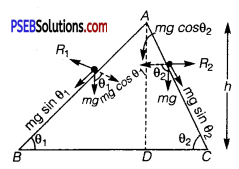
(b), (c) Consider two inclined planes with inclinations θ1 and θ2, related as
θ1 < θ2
The acceleration produced in the sphere when it rolls down the plane inclined at θ1,
θ1 = g sinθ1
The various forces acting on the sphere are shown in the following figure.
PSEB 11th Class Physics Solutions Chapter 7 System of Particles and Rotational Motion 17
R1 is the normal reaction to the sphere.
Similarly, the acceleration produced in the sphere when it rolls down the plane inclined at θ2,
a2 = gsinθ2
The various forces acting on the sphere are shown in the following figure.
PSEB 11th Class Physics Solutions Chapter 7 System of Particles and Rotational Motion 18
R2 is the normal reaction to the sphere.
θ2 > 01; sinθ2 > sinθ1 ……….(i)
∴ a2 > a1 ……………. (ii)
Initial velocity, u = 0
Final velocity, υ = Constant
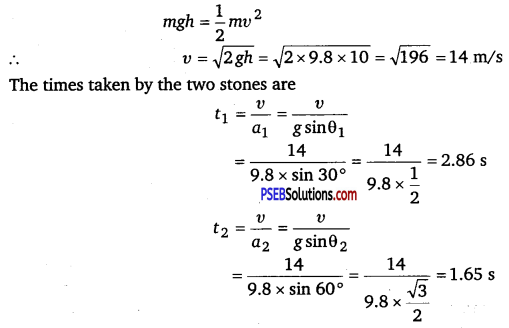
Using the first equation of motion, we can obtain the time of roll as,
υ = u + at
t ∝ \(\frac{1}{a}\)
PSEB 11th Class Physics Solutions Chapter 7 System of Particles and Rotational Motion 19
From equations (ii) and (iii), we get:
t2 < t1
Hence, the sphere will take a longer time to reach the bottom of the inclined plane having the smaller inclination.

Question 19.
A hoop of radius 2 m weighs 100 kg. It rolls along a horizontal floor so that its centre of mass has a speed of 20 cm/s. How much work has to he done to stop it?
Solution:
Radius of the hoop, r = 2 m
Mass of the hoop, m = 100 kg
Velocity of the hoop, υ = 20 cm/s = 0.2 m/s
Total kinetic energy of the hoop = Translational KE + Rotational KE
ET = \(\frac{1}{2}\)mυ2 + \(\frac{1}{2}\) Iω2
Moment of inertia of the hoop about its centre, I = mr2
ET = \(\frac{1}{2}\) mυ2 + \(\frac{1}{2}\)(mr22
But we have the relation, υ = rω
ET = \(\frac{1}{2}\) mυ2 + \(\frac{1}{2}\)mr2 ω2
= \(\frac{1}{2}\) mυ2 + \(\frac{1}{2}\)mυ2 = mυ2
The work required to be done for stopping the hoop is equal to the total energy of the hoop.
□Required work to be done,
W = mυ2 =100 × (0.2)2 = 4 J

PSEB 11th Class Physics Important Questions Chapter 7 System of Particles and Rotational Motion

Question 20.
The oxygen molecule has a mass of 5.30 × 10⁻²⁶ kg and a moment of inertia of 1.94 × 10-46 kg-m2 about an axis through its centre perpendicular to the lines joining the two atoms. Suppose the mean speed of such a molecule in a gas is 500 m/s and that its kinetic energy of rotation is two thirds of its kinetic energy of translation. Find the average angular velocity of the molecule.
Solution:
Mass of an oxygen molecule, m = 5.30 × 10⁻²⁶ kg
Moment of inertia, I =1.94 × 10-46 kg-m2
Velocity of the oxygen molecule, υ = 500 m/s
The separation between the two atoms of the oxygen molecule = 2 r
Mass of each oxygen atom = \(\frac{m}{2}\)
Hence, moment of inertia I, is calculated as
PSEB 11th Class Physics Solutions Chapter 7 System of Particles and Rotational Motion 20

Question 21.
A solid cylinder rolls up an inclined plane of angle of inclination 30°. At the bottom of the inclined plane the centre of mass of the , cylinder has a speed of 5 m/s.
(a) How far will the cylinder go up the plane?
(b) How long will it take to return to the bottom?
Solution:
(a) A solid cylinder rolling up an inclination is shown in the following figure.
PSEB 11th Class Physics Solutions Chapter 7 System of Particles and Rotational Motion 21
Initial velocity of the solid cylinder, υ = 5 m/s
Angle of inclination, θ = 30°
Height reached by the cylinder = h
Energy of the cylinder at point A
KErot = KEtrans
\(\frac{1}{2}\) Iω2 = \(\frac{1}{2}\)mυ2
Energy of the cylinder at point B = mgh
Using the law of conservation of energy, we can write
\(\frac{1}{2}\) Iω2 + \(\frac{1}{2}\)mυ2 =mgh
PSEB 11th Class Physics Solutions Chapter 7 System of Particles and Rotational Motion 22
Hence, the cylinder will travel 3.82 m up the inclined plane.

(b) For radius of gyration K, the velocity of the cylinder at the instance
when it rolls back to the bottom is given by the relation:
PSEB 11th Class Physics Solutions Chapter 7 System of Particles and Rotational Motion 23
PSEB 11th Class Physics Solutions Chapter 7 System of Particles and Rotational Motion 24
Therefore, the total time taken by the cylinder to return to the bottom is 2 × 0.764 = 1.53 s.

PSEB 11th Class Physics Important Questions Chapter 7 System of Particles and Rotational Motion

Question 22.
As shown in figure given below, the two sides of a step ladder BA and CA are 1.6 m long and hinged at A. A rope DE, 0.5 m is tied half way up. A weight 40 kg is suspended from a point F, 1.2 m from B along the ladder BA. Assuming the floor to be frictionless and neglecting the weight of the ladder, find the tension in the rope and forces exerted by the floor on the ladder. (Take g = 9.8 m/s2)
(Hint: Consider the equilibrium of each side of the ladder separately.)
PSEB 11th Class Physics Solutions Chapter 7 System of Particles and Rotational Motion 25
Solution:
The given situation can be shown as:
PSEB 11th Class Physics Solutions Chapter 7 System of Particles and Rotational Motion 26
where, NB = Force exerted on the ladder by the floor point B
NC = Force exerted on the ladder by the floor point C
T = Tension in the rope
BA = CA =1.6 m
DE = 0.5 m
BF =1.2 m
Mass of the weight, m = 40 kg
Draw a perpendicular from A on the floor BC. This intersects DE at mid-point H.
Δ ABI and Δ AIC are similar
∴ BI = IC
Hence, I is the mid-point of BC.
In Δ ABC, DE || BC
∴ BC = 2 × DE = 1m
and AF = BA – BF= 1.6 – 1.2 = 0.4 m …………… (i)
D is the mid-point of AB.
Hence, we can write:
AD = \(\frac{1}{2}\) × BA = 0.8 m ………….. (ii)
Using equations (i) and (ii), we get
DF = AD – AF = 0.8 – 0.4 = 0.4 m
Hence, F is the mid-point of AD.
FG || DH and F is the mid-point of AD. Hence, G will also be the mid-point ofAH.
Δ AFG and Δ ADH are similar
∴ \(\frac{F G}{D H}=\frac{A F}{A D}\)
\(\frac{F G}{D H}=\frac{0.4}{0.8}=\frac{1}{2}\)
FG = \(\frac{1}{2}\)DH
= \(\frac{1}{2}\) × 0.25 = 0.125 m , [∵ DH = \(\frac{1}{2}\)DE]
In Δ ADH,
AH = \(\sqrt{A D^{2}-D H^{2}}\)
= \(\sqrt{(0.8)^{2}-(0.25)^{2}}\) = 0.76 m
For translational equilibrium of the ladder, the upward force should be equal to the downward force.
NB + NC = mg = 40 × 9.8 = 392 …………….. (iii)
For rotational equilibrium of the ladder, the net moment about A is
-NB × BI + mg × FG + NC × CI + T × AG – T × AG = 0
-NB × 0.5 + 40 × 9.8 × 0.125 + NC × (0.5) = 0
(NB – NC) × 0.5 = 49
NB – NC = 98 …………. (iv)
Adding equations (iii) and (iv), we get:
NB = 245 N
NC = 147N
For rotational equilibrium of the side AB, consider the moment about A
-NB × BI + mg × FG + T × AG = 0
-245 × 0.5 + 40 × 9.8 × 0.125 + T × 0.76 = 0
0.76 T = 122.5 – 49 = 73.5
T = \(\frac{73.5}{0.76}\)= 96.7N

PSEB 11th Class Physics Important Questions Chapter 7 System of Particles and Rotational Motion

Question 23.
A man stands on a rotating platform, with his arms stretched horizontally holding a 5 kg weight in each hand. The angular speed of the platform is 30 revolutions per minute. The man ‘ then brings his arms close to his body with the distance of each weight from the axis changing from 90 cm to 20cm. The moment *of inertia of the man together with the platform may be taken to be constant and equal to 7.6 kg-m2 .
(a) What is his new angular speed? (Neglect friction.)
(b) Is kinetic energy conserved in the process? If not, from where does the change come about?
Solution:
(a) Moment of inertia of the man-platform system
= 7.6 kg-m2
Moment of inertia when the man stretches his hands to a distance of 90 cm
= 2 × mr2 = 2 × 5 × (0.9)2
= 8.1 kg-m2
Initial moment of inertia of the system, Ii = 7.6 + 8.1 = 15.7 kg-m2
Initial angular speed, ωi = 30 rev/min
Initial angular momentum, Li = Iiωi = 15.7 × 30 …………….. (i)
Moment of inertia when the man folds his hands to a distance of 20 cm
= 2 × mr2 = 2 × 5(0.2)2 = 0.4 kg-m2
Final moment of inertia, If = 7.6 + 0.4 = 8 kg-m2
Let, final angular speed = ωf
Final angular momentum, Lf = Ifωf = 8ωf ………….. (ii)
From the conservation of angular momentum, we have
Iiωi = Ifωf
∴ ωf = \(\frac{15.7 \times 30}{8}\)= 58.88 rev/min
Hence, new angular speed is 58.88 revolutions per minute.

(b) No, kinetic energy is not conserved in the given process. In fact, with the decrease in the moment of inertia, kinetic energy increases. The additional kinetic energy comes from the work done by the man to fold his hands toward himself.

Question 24.
A bullet of mass 10 g and speed 500 m/s is fired into a door and gets embedded exactly at the centre of the door. The door is 1.0 m wide and weighs 12 kg. It is hinged at one end and rotates about a vertical axis practically without friction. Find the angular speed of the door just after the bullet embeds into it. (Hint: The moment of inertia of the door about the vertical axis at one end is ML2 /3.)
Solution:
Mass of the bullet, m = 10 g = 10 x 10-3 kg
Velocity of the bullet, υ = 500 m/s
Thickness of the door, L = 1 m
Radius of the door, r = \(\frac{1}{2}\) m
Mass of the door, M = 12 kg
Angular momentum imparted by the bullet on the door,
α = mυr
= (10 × 10-3) × (500) × \(\frac{1}{2}\) = 2.5kg-m2s-1 ………………. (i)
Moment of inertia of the door,
I = \(\frac{1}{2}\)ML2 = \(\frac{1}{3}\) × 12 × (1)2 = 4 kg-m2
But α = Iω
∴ ω = \(\) = 0.625 rad s-1

PSEB 11th Class Physics Important Questions Chapter 7 System of Particles and Rotational Motion

Question 25.
Two discs of moments of inertia I\ and /2 about their respective axes (normal to the disc and passing through the centre), and rotating with angular speeds ω1 and ω2 are brought into contact face to face with their axes of rotation coincident, (a) What is the angular speed of the two-disc system? (b) Show that the kinetic energy of the combined system is less than the sum of the initial kinetic energies ‘of the two discs. How do you account for this loss in energy? Take ω1 ≠ ω2.
Solution:
(a) Moment of inertia of disc I = I1
Angular speed of disc I = ω1
Moment of inertia of disc II = I2
Angular speed of disc II = ω2
Angular momentum of disc I, L1 = I1ω1
Angular momentum of disc II, L2 = I2ω2
Total initial angular momentum, L i = I1ω1 + I2ω2
When the two discs are joined together, their moments of inertia get added up.
Moment of inertia of the systme of two discs, I = I1 + I2
Let ω be the angular speed of the system.
Total final angular momentum, Lf = (I1 + I2
Using the law of conservation of angular momentum, we have
Li = Lf
I11 + I22 (I1 + I2
< ω = \(\frac{I_{1} \omega_{1}+\bar{I}_{2} \omega_{2}}{I_{1}+I_{2}}\)

(b) Kinetic energy of disc I, E1 = \(\frac{1}{2}\)I1ω12
Kinetic energy of disc II, E2 = \(\frac{1}{2}\)I2ω22
Total initial kinetic energy, Ei = E1 + E2 = \(\frac{1}{2}\) (I1ω12 + I2ω22)
When the discs are joined, their moments of inertia get added up.
Moment of inertia of the system, I = I1 + I2
Angular speed of the system = ω
Final kinetic energy Ef.
PSEB 11th Class Physics Solutions Chapter 7 System of Particles and Rotational Motion 27
All the quantities on RHS are positive
∴ Ei – Ef > 0
Ei > Ef
The loss of KE can be attributed to the frictional force that comes into play when the two discs come in contact with each other.

PSEB 11th Class Physics Important Questions Chapter 7 System of Particles and Rotational Motion

Question 26.
(a) Prove the theorem of perpendicular axes.
(Hint: Square of the distance of a point (x, y) in the x – y plane from an axis through the origin perpendicular to the plane is x2 + y2 )
(b) Prove the theorem of parallel axes.
(Hint: If the centre of mass is chosen to be the origin Z miri = 0).
Solution:
(a) The theorem of perpendicular axes states that the moment of inertia of a planar body (lamina) about an axis perpendicular to its plane is equal to the sum of its moments of inertia about two perpendicular axes concurrent with perpendicular axis and lying in the plane of the body.
A physical body with centre O and a point mass m, in the x – y plane at , (x, y) is shown in the following figure.
PSEB 11th Class Physics Solutions Chapter 7 System of Particles and Rotational Motion 28
Moment of inertia about x – axis, Ix = mx2
Moment of inertia about y – axis, Iy = my2
Moment of inertia about z – axis, Iz = \(\left(\sqrt{x^{2}+y^{2}}\right)^{2}\)
Ix + Iy = mx2 + my2
= m(x2 + y2)
= m\(\left(\sqrt{x^{2}+y^{2}}\right)^{2}\)
Ix + Iy = Iz
Hence, the theorem is proved.

(b) The theorem of parallel axes states that the moment of inertia of a body about any axis is equal to the sum of the moment of inertia of the body about a parallel axis passing through its centre of mass and the product of its mass and the square of the distance between the two parallel . axes.
PSEB 11th Class Physics Solutions Chapter 7 System of Particles and Rotational Motion 29
Suppose a rigid body is made up of n particles, having masses m1, m2, m3, …… , mn, at perpendicular distances r1, r2, r3, ………….. , mn respectively from the centre of mass O of the rigid body.
The moment of inertia about axis RS passing through the point O,

IIRS = \(\sum_{i=1}^{n}\) miri

The perpendicular distance of mass mi, from the axis QP = a + ri
Hence, the moment of inertia about axis QP,
IQP = \(\sum_{i=1}^{n}\)i(a + ri)2
PSEB 11th Class Physics Solutions Chapter 7 System of Particles and Rotational Motion 30
Now, at the centre of mass, the moment of inertia of all the particles about the axis passing through the centre of mass is zero, that is,
2 \(\sum_{i=1}^{n}\) miari = 0
∴ miri = 0
a ≠ 0
Σmiri = 0
Also, \(\sum_{i=1}^{n}\) mi = M; M = Total mass of the rigid body
∴ IQP = IRS + Ma2
Hence, the theorem is proved.

PSEB 11th Class Physics Important Questions Chapter 7 System of Particles and Rotational Motion

Question 27.
Prove the result that the velocity v of translation of a rolling hody (like a ring, disc, cylinder or sphere) at the bottom of an inclined plane of a height h is given by
υ2 = \(\frac{2 g h}{\left(1+k^{2} / R^{2}\right)}\)
using dynamical consideration (i. e., by consideration of forces and torques). Note k is the radius of gyration of the body about its symmetry axis, and R is the radius of the body. The body starts from rest at the top of the plane.
Solution:
A body rolling on an inclined plane of height h, is shown in the following figure :
PSEB 11th Class Physics Solutions Chapter 7 System of Particles and Rotational Motion 31
m = Mass of the body
R = Radius of the body
k = Radius of gyration of the body
υ = Translational velocity of the body
h = Height of the inclined plane
g = Acceleration due to gravity
Total energy at the top of the plane, ET = mgh
Total energy at the bottom of the plane,
Eb = KErot + KEtrains
= \(\frac{1}{2}\)Iω2 + \(\frac{1}{2}\)mυ2
PSEB 11th Class Physics Solutions Chapter 7 System of Particles and Rotational Motion 32
Hence, the given result is proved.

Question 28.
A disc rotating about its axis with angular speed (ω0 is placed lightly (without any translational push) on a perfectly frictionless table. The radius of the disc is R. What are the linear velocities of the points A, B and C on the disc shown in figure? Will the disc roll in the direction indicated?
PSEB 11th Class Physics Solutions Chapter 7 System of Particles and Rotational Motion 33
Solution:
Angular speed of the disc = ω0
Radius of the disc = R
Using the relation for linear velocity, υ = ω0R
For point A:υA = Rω0; in the direction tangential to the right
For point B:υB = Rω0; in the direction tangential to the left
For point C:υC = (\(\frac{R}{2}\))ω0; in the direction same as that of vA.
The directions of motion of points A, B and C on the disc are shown in the following figure
PSEB 11th Class Physics Solutions Chapter 7 System of Particles and Rotational Motion 34
Since the disc is placed on a frictionless table, it will not roll. This is because the presence of friction is essential for the rolling of a body.

Question 29.
Explain why friction is necessary to make the disc in figure given in question 28 roll in the direction indicated.
(a) Give the direction of frictional force at B, and the sense of frictional torque, before perfect rolling begins.
(b) What is the force of friction after perfect rolling begins?
Solution:
A torque is required to roll the given disc. As per the definition of torque,
the rotating force should be tangential to the disc. Since the frictional force at point B is along the tangential force at point A, a frictional force is required for making the disc roll.

(a) Force of friction acts opposite to the direction of velocity at point B. The direction of linear velocity at point B is tangentially leftward. Hence, frictional force will act tangentially rightward. The sense of frictional torque before the start of perfect rolling is perpendicular to the plane of the disc in the outward direction.

(b) Since frictional force acts opposite to the direction of velocity at point B, perfect rolling will begin when the velocity at that point becomes equal to zero. This will make the frictional force acting on the disc zero.

PSEB 11th Class Physics Important Questions Chapter 7 System of Particles and Rotational Motion

Question 30.
A solid disc and a ring, both of radius 10 cm are placed on a horizontal table simultaneously, with initial angular speed equal to 10 πrad s-1. Which of the two will start to roll earlier? The coefficient of kinetic friction is μk = 0.2
Solution:
Radii of the ring and the disc, r- = 10 cm = 0.1 m
Initial angular speed, ω0 = 10 πrad s--1
Coefficient of kinetic friction, μk = 0.2
Initial velocity of both the objects, u = 0
Motion of the two objects is caused by frictional force. As per Newton’s second law of motion, we have frictional force, f = ma.
μkmg = ma
where,
a = Acceleration produced in the objects
m = Mass
∴ a = μkg …………… (i)
As per the first equation of motion, the final velocity of the objects can be obtained as
υ = u + at
= 0 + μkgt
= μkgt ……………. (ii)
The torque applied by the frictional force will act in perpendicularly outward direction and cause reduction in the initial angular speed.
Torque, τ = -Iα
where, α = Angular acceleration
μkmgr = -Iα
∴ α = \(\frac{-\mu_{k} m g r}{I}\) ……………… (iii)
Using the first equation of rotational motion to obtain the final angular speed,
PSEB 11th Class Physics Solutions Chapter 7 System of Particles and Rotational Motion 35
PSEB 11th Class Physics Solutions Chapter 7 System of Particles and Rotational Motion 36

Question 31.
A cylinder of mass 10 kg and radius 15 cm is rolling perfectly on a plane of inclination 30°. The coefficient of static friction μg, = 0.25.
(a) How much is the force of friction acting on the cylinder?
(b) What is the work done against friction during rolling?
(c) If the inclination θ of the plane is increased, at what value of θ does the cylinder begin to skid, and not roll perfectly?
Solution:
Given, mass of the cylinder, m =10 kg
Radius of the cylinder, r = 15cm = 0.15m
Coefficient of static friction, μs = 0.25
Angle of inclination, θ = 30°
Moment of inertia of a solid cylinder about its geometric axis, I = \(\frac{1}{2}\)mr2
The various forces acting on the cylinder are shown in the following figure:
PSEB 11th Class Physics Solutions Chapter 7 System of Particles and Rotational Motion 37
= \(\frac{2}{3}\) × 9.8 × 0.5 = 3.27 m/s2

(a) Using Newton’s second law of motion, we can write net force as
fnetnet = ma
mg sin30° – f = ma
f = mgsin30° – ma
= 10 × 9.8 × 0.5 – 10 × 3.27
= 49 – 32.7 = 16.3 N

(b) During rolling, the instantaneous point of contact with the plane comes to rest. Hence, the work done against frictional force is zero.

(c) For rolling without skid, we have the relation:
μ = \(\frac{1}{3}\)tanθ
tanθ = 3μ = 3 × 0.25
∴ θ = tan-1 (0.75) = 36.87°

PSEB 11th Class Physics Important Questions Chapter 7 System of Particles and Rotational Motion

Question 32.
Read each statement below carefully, and state, with reasons, if it is true or false;
(a) During rolling, the force of friction acts in the same direction as the direction of motion of the CM of the body.
(b) The instantaneous speed of the point of contact during rolling is zero.
(c) The instantaneous acceleration of the point of contact during rolling is zero.
(d) For perfect rolling motion, work done against friction is zero.
(e) A wheel moving down a perfectly frictionless inclined plane will undergo slipping (not rolling) motion.
Solution:
(a) False
Reason: Frictional force acts opposite to the direction of motion of the centre of mass of a body. In the case of rolling, the direction of motion of the centre of mass is backward. Hence, frictional force acts in the forward direction.

(b) True
Reason: Rolling can be considered as the rotation of a body about an axis passing through the point of contact of the body with the ground. Hence, its instantaneous speed is zero.

(c) False
Reason: When a body is rolling, its instantaneous acceleration is not equal to zero. It has some value.

(d) True
Reason: When perfect rolling begins, the frictional force acting at the lowermost point becomes zero. Hence, the work done against friction is also zero.

(e) True
Reason: The rolling of a body occurs when a frictional force acts between the body and the surface. This frictional force provides the torque necessary for rolling. In the absence of a frictional force, the body slips from the inclined plane under the effect of its own weight.

Question 33.
Separation of Motion of a system of particles into motion of the centre of mass and motion about the centre of mass:
(a) Show \(\overrightarrow{p_{i}}=\overrightarrow{p_{i}^{\prime}}=m_{i} \vec{V}\)
where, \(\overrightarrow{p_{i}}\) is the momentum of the ith particle (of mass mi) and \(\overrightarrow{p_{i}^{\prime}}=\vec{m}_{i} \vec{v}_{i}^{\prime}\). Note \(\overrightarrow{\boldsymbol{v}_{\boldsymbol{i}}^{\prime}}\) is the velocity of the ith particle relative to the centre of mass.
Also, prove using the definition of the centre of mass \(\sum_{i} \overrightarrow{p_{i}^{\prime}}\) = 0

(b) Show K = K’ + \(\frac{1}{2}\) MV2
where, K is the total kinetic energy of the system of particles, K’ is the total kinetic energy of the system when the particle velocities are taken with respect to the centre of mass and MV2 /2 is the kinetic energy of the translation of the system as a whole (i. e., of the centre of mass motion of the system). The result has been used in Sec. 7.14.

(c) Show \(\overrightarrow{\boldsymbol{L}}^{\prime}=\overrightarrow{\boldsymbol{L}}^{\prime}+\overrightarrow{\boldsymbol{R}} \times \boldsymbol{M} \overrightarrow{\boldsymbol{V}}\)
where, \(\overrightarrow{\boldsymbol{L}}^{\prime}=\Sigma \overrightarrow{\boldsymbol{r}_{\boldsymbol{i}}^{\prime}} \times \overrightarrow{\boldsymbol{p}_{\boldsymbol{i}}^{\prime}}\) is the angular momentum of the system about the centre of mass with velocities taken relative to the centre of mass. Remember \(\overrightarrow{\boldsymbol{r}_{i}^{\prime}}=\overrightarrow{\boldsymbol{r}_{i}}-\overrightarrow{\boldsymbol{R}}\) rest of the notation is the standard notation used in the chapter. Note \(\overrightarrow{\boldsymbol{L}}\) and \(\boldsymbol{M} \overrightarrow{\boldsymbol{R}} \times \overrightarrow{\boldsymbol{V}}\) can be said to be angular momenta, respectively, about and of the centre of mass of the system of particles.

(d) Show = \(\frac{d \vec{L}^{\prime}}{d t}=\sum_{i} \overrightarrow{r_{i}^{\prime}} \times \frac{d}{d t}\left(\overrightarrow{p_{i}^{\prime}}\right)\)
Further, show that
\(\frac{d \vec{L}^{\prime}}{d t}\) = τ’ext
where, τ’ext is the sum of all external torques acting on the system about the centre of mass.
(Hint: Use the definition of centre of mass and Newton’s Third Law. Assume the internal forces between any two particles act along the line joining the particles.)
Solution:
(a) Take a system of i moving particles.
Mass of the ith particle = mi
Velocity of the tth particle = υi
Hence, momentum of the ith particle, \(\overrightarrow{p_{i}}\) = miυi
Velocity of the centre of mass = V
The velocity of the ith particle with respect to the centre of mass of the system is given as:
\(\overrightarrow{v_{i}^{\prime}}=\overrightarrow{v_{i}}-\vec{V}\) ……………. (i)
Multiplying m; throughout equation (i), we get
\(m_{i} \overrightarrow{v_{i}^{\prime}}=m_{i} \overrightarrow{v_{i}}-m_{i} \vec{V}\)
\(\overrightarrow{p_{i}^{\prime}}=\overrightarrow{p_{i}}-m_{i} \vec{V}\)
where, \(\overrightarrow{p_{i}^{\prime}}=m_{i} \overrightarrow{v_{i}^{\prime}}\) = Momentum of the ith particle with respect to the centre of mass of the system
∴ \(\overrightarrow{p_{i}}=\overrightarrow{p_{i}^{\prime}}+m_{i} \vec{V}\)
We have the relation: \(\overrightarrow{p_{i}^{\prime}}=m_{i} \overrightarrow{v_{i}^{\prime}}\)
Taking the summation of momentum of all the particles with respect to the centre of mass of the system, we get
\(\Sigma \overrightarrow{p_{i}^{\prime}}=\Sigma_{i} m_{i} \overrightarrow{v_{i}^{\prime}}=\Sigma_{i} m_{i} \frac{d \overrightarrow{r_{i}^{\prime}}}{d t}\)
where, \(\overrightarrow{r_{i}^{\prime}}\) = Position vector of ith particle with respect to the centre of mass
\(\overrightarrow{v_{i}^{\prime}}=\frac{d \overrightarrow{r_{i}^{\prime}}}{d t}\)
As per the definition of the centre of mass, we have
\(\sum_{i} m_{i} \overrightarrow{r_{i}^{\prime}}\) = 0
\(\sum_{i} m_{i} \frac{d \overrightarrow{r_{i}^{\prime}}}{d t}\) = 0
\(\sum_{i} \overrightarrow{p_{i}^{\prime}}\) = 0

(b) KE. of a system consists of two parts translational K.E. (Kt) and rotational K.E. (K’) i.e., K.E. of motion of C.M. (\(\frac{1}{2}\)mυ2) and K.E. of rotational motion about the C.M. of the system of particles (K’), thus total K.E. of the system is given by
K = \(\frac{1}{2}\)mυ2 + \(\frac{1}{2}\) Iω2
= \(\frac{1}{2}\)mυ2 + K’
= K’ + \(\frac{1}{2}\)mυ2

PSEB 11th Class Physics Important Questions Chapter 7 System of Particles and Rotational Motion

(c) Position vector of the i th particle with respect to origin = \(\overrightarrow{r_{i}}\)
position vector of the i th particle with respect to the centre of mass = \(\overrightarrow{r_{i}^{\prime}}\)
Position vector of the centre of mass with respect to the origin = \(\vec{R}\)
It is given that:
\(\overrightarrow{r_{i}^{\prime}}=\overrightarrow{r_{i}}-\vec{R}\)
\(\overrightarrow{r_{i}}=\overrightarrow{r_{i}^{\prime}}+\vec{R}\)
We have from part (a),
\(\overrightarrow{p_{i}}=\overrightarrow{p_{i}^{\prime}}+m_{i} \vec{V}\)
Taking the cross product of this relation by ri, we get:
PSEB 11th Class Physics Solutions Chapter 7 System of Particles and Rotational Motion 38
PSEB 11th Class Physics Solutions Chapter 7 System of Particles and Rotational Motion 39
PSEB 11th Class Physics Solutions Chapter 7 System of Particles and Rotational Motion 40

PSEB 11th Class Physics Important Questions Chapter 6 Work, Energy and Power

Punjab State Board PSEB 11th Class Physics Important Questions Chapter 6 Work, Energy and Power Important Questions and Answers.

PSEB 11th Class Physics Important Questions Chapter 6 Work, Energy and Powere

Very short answer type questions

Question 1.
Under what condition is the work done by a force inspite of displacement being taking place?
Answer:
Work done by a force is zero inspite of displacement being taking place, if displacement is in a direction perpendicular to that of force applied.

Question 2.
Can acceleration be produced without doing any work? Give example.
Answer:
Yes, for uniform circular motion, no work done but a centripetal acceleration is present.

Question 3.
Does the amount of work done depend upon the fact that how fast is a load raised or moved in the direction of force?
Answer:
The amount of work does not depend upon the fact that how fast is a load raised or moved in the direction of force.

PSEB 11th Class Physics Important Questions Chapter 6 Work, Energy and Power

Question 4.
A body is moving along a circular path. How much work is done by the centripetal force?
Answer:
For a body moving along a circular path, the centripetal force acts along the radius while the displacement is tangential, i. e., θ = 90 °, therefore,
W = Fscos90° = 0.

Question 5.
What is the source of kinetic energy of the bulelt coming out of a rifle?
Answer:
The source of kinetic energy of bullet is the potential energy of the compressed spring in the loaded rifle.

Question 6.
A spring is cut into two equal halves. How is the spring constant of each half affected?
Answer:
Spring constant of each half becomes twice the spring constant of the original spring.

Question 7.
Is collision between two particles possible even without any physical contact between them?
Answer:
Yes, in atomic and subatomic particles collision without any physical contact between the colliding particles is taking place e. g., Rutherford’s alpha particles scattering.

Question 8.
Why is electrical power required at all when the elevator is descending? Why should there be a limit on the number of passengers in this case? (NCERT Exemplar)
Answer:
When the elevator is descending, then electric power is required to prevent it from falling freely under gravity.
Also, as the weight inside the elevator increases, its speed of descending – increases, therefore, there should be a limit on the number of passengers in the elevator to prevent the elevator from descending with large velocity.

PSEB 11th Class Physics Important Questions Chapter 6 Work, Energy and Power

Short answer type questions

Question 1.
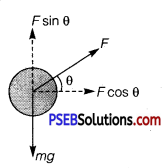
A block of mass M is pulled along a horizontal surface by applying a force at an angle θ with horizontal. Coefficient of friction between block and surface is μ. If the block travels with uniform velocity, find the work done by this applied force during a displacement d of the block.
PSEB 11th Class Physics Important Questions Chapter 6 Work, Energy and Power 1
Solution:
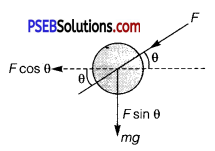
The forces acting on the block are shown in figure. As the block moves with uniform velocity the forces add up to zero.
∴ Fcosθ = μN ………….. (i)
Fsinθ + N = Mg ……………. (ii)
Eliminating N from equations (i) and (ii)
F cosθ = μ(Mg – F sinθ)
F = [Latex]\frac{\mu M g}{\cos \theta+\mu \sin \theta}[/Latex]
Work done by this force during a displacement d
W = F. d cosθ = [Latex]\frac{\mu M g d \cos \theta}{\cos \theta+\mu \sin \theta}[/Latex]

Question 2.
Two springs have force constants K2 and K2 (K1 > K2 )• On which spring is more work done when they are stretched by the same force?
Solution:
PSEB 11th Class Physics Important Questions Chapter 6 Work, Energy and Power 2
As x1 < x2
∴ W1 < W2 or W2 > W1

Question 3.
A particle is moving in a circular path of radius r with constant speed. Due to change in the direction of motion of the particle continuously, the velocity of the particle is changing. But the kinetic energy of the particle remains the same. Explain why ?
Solution:
Kinetic energy is given by
E = \(\frac{1}{2}\) mυ2 = \(\frac{1}{2}\) m(\(\vec{v} \cdot \vec{v}\))
Since \(\vec{v} \cdot \vec{v}\) – υ2, a scalar quantity, so it is the speed which is taken into account while calculating the kinetic energy of the particle. As the speed is constant, so kinetic energy of the particle will also remain constant.

PSEB 11th Class Physics Important Questions Chapter 6 Work, Energy and Power

Question 4.
Can a body have energy without momentum? If yes, then explain how they are related with each other?
Solution:
Yes, when p = 0,
Then, K = \(\frac{p^{2}}{2 m}\) = 0
But E = K + U = U (potential energy), which may or may not be zero.

Question 5.
Two bodies A and B having masses mA and mB respectively have equal kinetic energies. If pA and pB are their respective momenta, then prove that the ratio of momenta is equal to the square root of ratio of respective masses.
Solution:
Let υA and υB be the velocities of A and B respectively.
Since their kinetic energies are equal,
PSEB 11th Class Physics Important Questions Chapter 6 Work, Energy and Power 3

Question 6.
Two ball bearings of mass m each, moving in opposite directions with equal speed υ, collide head on with each other. Predict the outcome of the collision, assuming it to be perfectly elastic.
Solution:
Here, m1 = m2 = m
u1 = υ,u2 = -υ
Velocities of two balls after perfectly elastic collision between them are
PSEB 11th Class Physics Important Questions Chapter 6 Work, Energy and Power 4
After collision, the two ball bearings will move with same speeds, but their direction of motion will be reversed.

PSEB 11th Class Physics Important Questions Chapter 6 Work, Energy and Power

Question 7.
An engine is attached to a wagon through a shock absorber of length 1.5 m. The system with a total mass of 50,000 kg is moving with a speed of 36 kmh-1 when the brakes are applied to bring it to rest. In the process of the system being brought to rest, the spring of the shock absorber gets compressed by 1.0 m. If 90% of
energy of the wagon is lost due to friction, calculate the spring constant. (NCERT Exemplar)
Solution:
Given, mass of the system (m) = 50,000 kg
Speed of the system (υ) = 36 km/h
= \(\frac{36 \times 1000}{60 \times 60}\) = 10 m/s
Compression of the spring (x) = 1.0 m
KE of the system = \(\frac{1}{2}\) mυ2 = \(\frac{1}{2}\) × 50000 × (10)2
= 25000 × 100 J = 2.5 × 10⁶J
Since, 90% of KE qf the system is lost due to friction, therefore, energy transferred to shock absorber, is given by
ΔE = \(\frac{1}{2}\)kx2 = 10% of total KE of the system
= \(\frac{10}{100}\) × 2.5 × 10⁶ J or k = \(\frac{2 \times 2.5 \times 10^{6}}{10 \times(1)^{2}}\)
= 5.0 × 10⁶ N/m

Question 8.
An adult weighting 600 N raises the centre of gravity of his body by 0.25 m while taking each step of 1 m length in jogging. If he jogs for 6 km, calculate the energy utilised by him is jogging assuming that there is no energy loss due to friction of ground and air. Assuming that the body of the adult is capable of converting 10% of energy intake in the form of food, calculate the energy equivalents of food that would be required to compensate energy utilised for jogging. (NCERT Exemplar)
Solution:
Given, weight of the adult (w) = mg = 600 N
Height of each step = h = 0.25m
Length of each step = 1 m
Total distance travelled = 6 km = 6000 m
∴ Total number of steps = \(\frac{6000}{1}\) = 6000
Total energy utilised in jogging = n × mgh
= 6000 × 600 × 0.25J = 9 × 10⁵ J
Since, 10% of intake energy is utilised in jogging.
∴ Total intake energy = 10 × 9 × 105J = 9 × 10⁶J

PSEB 11th Class Physics Important Questions Chapter 6 Work, Energy and Power

Long answer type questions

Question 1.
A body of mass 0.3 kg is taken up an inclined plane length 10 m and height 5 m, and then allowed to slide down the bottom again. The coefficient of friction between the body and the plane is 0.15. What is the
(i) work done by gravitational force over the round trip?
(ii) work done by the applied force over the upward journey?
(iii) work done by the frictional force over the round trip?
(iv) kinetic energy of the body at the end of trip? (Take g = 10 ms-2)
PSEB 11th Class Physics Important Questions Chapter 6 Work, Energy and Power 5
Solution:
Upward journey
PSEB 11th Class Physics Important Questions Chapter 6 Work, Energy and Power 6
Let us calculate work done by different forces over upward joume Work done by gravitational force
Wi = (mg sinθ)s cos 180°
W 1= 0.3 × 10 sin30° × 10 (-1)
W1 =-15J
Work donp by force of friction
W2 = (μ mg cosθ)s cos180°
W2 = 0.15 × 0.3 × 10 cos30° × 10 (-1)
W2 =-3.879 J
Work done by external force
W3 = Fext × s × cos0°
W3 = [mg sinθ + μ mg cosθ] × 10 × 1
W3 = 18.897 J

Downward journey
PSEB 11th Class Physics Important Questions Chapter 6 Work, Energy and Power 7
mg sin30°> μ mg cos30°
Work done by the gravitational force
W4 = mg sin 30° × scos0°
W4 = 0.3 × 10 × \(\frac{1}{2}\) × 10 = +15J
Work done by the frictional force
W5 = μmg cos30° × s cos180°
= 0.15 × 0.3 × \(\frac{10 \sqrt{3}}{2}\) × 10 × (-1) = – 3.897 J
(i) Work done by gravitational force over the round trip
= W1 + W4 = 0J
(ii) Work done by applied force over upward journey
= W3 = 18.897J
(iii) Work done by frictional force over the round trip
W2 + W5 = – 3.897 + (-3.897) = – 7.794 J
(iv) Kinetic energy of the body at the end of the trip
W4 + W5 = 11.103 J

PSEB 11th Class Physics Important Questions Chapter 6 Work, Energy and Power

Question 2.
Prove that when a particle suffers an oblique elastic collision with another particle of equal mass anil initially at rest, the two particles would move in mutually perpendicular directions after collisions.
Solution:
Let a particle A of mass m and having velocity u collides with particle B of equal mass but at rest. Let the collision be oblique elastic collision and after collision the particles A and B move with velocities υ1 and υ2 respectively inclined at an angle 0 from each other.
PSEB 11th Class Physics Important Questions Chapter 6 Work, Energy and Power 8
Applying principle of conservation of linear momentum, we get
mu = mυ1 +mυ2 or u = υ1+ υ2
or u2 = (υ1 + υ2) – (υ1 + υ2)
= υ12 + υ22 + 2υ1υ2cos0 ………….. (i)
Again as total KE before collision = Total KE after collision
∴ \(\frac{1}{2}\) mu2 = \(\frac{1}{2}\)mυ12 + \(\frac{1}{2}\)mυ22
⇒ u2 = υ12 + υ22 ……………. (ii)
Comparing eqs. (i) and (ii), we get 2υ1υ2 cosθ = 0
As in an oblique collision both υ1 and υ2 are finite, hence cos0 = 0
⇒ θ = cos-1(0) = \(\frac{\pi}{2}\)
Thus, particles A and B are moving in mutually perpendicular directions after the collision.

PSEB 11th Class Biology Solutions Chapter 19 Excretory Products and their Elimination

Punjab State Board PSEB 11th Class Biology Book Solutions Chapter 19 Excretory Products and their Elimination Textbook Exercise Questions and Answers.

PSEB Solutions for Class 11 Biology Chapter 19 Excretory Products and their Elimination

PSEB 11th Class Biology Guide Excretory Products and their Elimination Textbook Questions and Answers

Question 1.
Define Glomerular Filtration Rate (GFR).
Answer:
Glomerular Filtration Rate (GFR) is the amount of the filtrate formed by the kidneys per minute. GFR in a healthy individual is approximately 125 mt/mm, i.e., 180 L day.

Question 2.
Explain the autoregulatory mechanism of GFR.
Answer:
Regulation of GFR: The kidneys have built-in mechanisms for the regulation o glomerular filtration rate. One such efficient mechanism is carried out by the juxtaglomerular apparatus (JGA). JGA is a special sensitive region formed by cellular modifications in the distal convoluted tubule and the afferent arteriole at the location of their contact. A fall in GFR can activate the JG cells to release renin which can stimulate the glomerular blood flow and thereby the GFR back to normal.

Question 3.
Indicate whether the following statements are true or false:
(a) Micturition is carried out by a reflex.
(b) Al)H helps In water elimination, making the urine hypotonia.
(c) Protein-free fluid is filtered from blood plasma into the Bowman’s capsule.
(d) Henle’s loop plays an important role in concentrating the urine.
(e) Glucose is actively reabsorbed in the proximal convoluted tubule.
Answer:
(a) True,
(b) False,
(C) True,
(d) True,
(e) True.

PSEB 11th Class Biology Solutions Chapter 19 Excretory Products and their Elimination

Question 4.
Give a brief account of the counter-current mechanism.
Answer:
Counter-current Mechanism

  • The counter-current mechanism takes place in Henle’s loop and vasa recta.
  • The flow of filtrate in the two limbs of Henle’s loop is in opposite directions and thus, forms a counter-current.
  • The flow of blood through the two limbs of vasa recta is also in a counter-current pattern.
  • NaCl is transported by the ascending limb of Henle’s loop which is exchanged with the descending limb of vasa recta.
  • NaCl is returned to the interstitium by the ascending portion of vasa recta.
  • Similarly small amount of urea enters the thin segment of the ascending limb of Henle’ loop, which is transported back to the interstitium by the collecting tubule.
  • This transport of substances facilitated by the special arrangement of Henle’s loop and vasa recta is called the counter-current mechanism,
  • It helps to maintain a concentration gradient in the medullary interstitium, which facilitates an easy passage of water from the collecting tubule thereby concentrating the filtrate (urine).

Question 5.
Describe the foie of liver, lungs and skin in excretion.
Answer:
Liver, lungs and skin also play an important role in the process of excretion. Role of the Liver: Liver is the largest gland in vertebrates. It helps in the excretion of cholesterol, steroid hormones, vitamins, drugs, and other waste materials through bile. Urea is formed in the liver by the ornithine cycle. Ammonia-a toxic substance is quickly changed into urea in the liver and thence eliminated from the body. Liver also changes the decomposed haemoglobin pigment into bile pigments called bilirubin and biliverdin.

Role of the Lungs: Lungs help in the removing waste materials such as carbon dioxide from the body.
Role of the Skin: Skin has many glands which help in excreting waste products through pores. It has two types of glands-sweat and sebaceous glands.

Sweat glands are highly vascular and tubular glands that separate the waste products from the blood and excrete them in the form of sweat. Sweat excretes excess salt and water from the body.
Sebaceous glands are branched glands that secrete an oily secretion called sebum.

Question 6.
Explain micturition.
Answer:
Micturition: The process of release of urine is called micturition and the neural mechanisms causing it is called the micturition reflex. An adult human excretes on an average 1 to 1.5 L of urine per day. The urine formed is a light yellow coloured watery fluid which is slightly acidic (pH 6.0) and has a characteristic odour.

Question 7.
Match the items of Column-I with those of Column-II:

Column-I Column-II
(a) Ammonotelism (i) Birds
(b) Bowman’s capsule (ii) Water reabsorption
(c) Micturition (iii) Bony fish
(d) Uricotelism (iv) Urinary bladder
(e) ADH (v) Renal tubule

Answer:

Column-I Column-II
(a) Ammonotelism (iii) Bony fish
(b) Bowman’s capsule (v) Renal tubule
(c) Micturition (iv) Urinary bladder
(d) Uricotelism (i) Birds
(e) ADH (ii) Water reabsorption

Question 8.
What is meant by the term osmoregulation?
Answer:
It is the phenomenon of regulation of change in the concentration of body fluids according to the concentration of external environment. Le., most marine invertebrates, some freshwater invertebrates, hagfish (a vertebrate).

Question 9.
Terrestrial animals are generally either republic or uricotelic, not ammonotelic, why?
Answer:
Terrestrial adaptation requires the production of less toxic nitrogenous wastes like urea and uric acid for the conservation of water. Aquatic animals excret atnmonia which requires large amounts of water to dissolve. This huge quantity of water is easily available to such animals from surroundings.

However, for terrestrial animals, such a huge quantity of water is not available, hence, they modify their original water product NH3 to comparatively less toxic products like urea and uric acid which requires less amount of water for their excretion.

PSEB 11th Class Biology Solutions Chapter 19 Excretory Products and their Elimination

Question 10.
What is the significance of juxtaglomerular apparatus (JGA) in Sidney function?
Answer:
The juxtaglomerular apparatus (JGA) plays an important role in monitoring and regulation of kidney functioning by hormonal feedback, mechanism, involving the hypothalamus and to a certain extent, the heart.

Question 11.
Name the following:
(a) A chordate animal having flame cells as excretory structures.
(b) Cortical portions projecting between the medullary pyramids in the human kidney.
(c) A loop of capillary running parallel to the Henle’s loop.
Answer:
(a) Flarworms,
(b) Columns of Bertini,
(c) Vasa recta

Question 12.
Fill in the gaps:
(a) Ascending limb of Henle’s loop is ………………………… to water whereas the descending limb is …………………….. to it.
(b) Reabsorption of water from distal parts of the tubules is facilitated by hormone ……………………………. .
(c) Dialysis fluid contains all the constituents as in plasma except …………………………… .
(d) A healthy adult human excretes (on an average) ………………………… gm of urea/day.
Answer:
(a) impermeable, permeable;
(b) vasopressin or ADH.;
(c) the nitrogenous wastes;
(d) 25-30.

PSEB 11th Class Biology Important Questions Chapter 4 Animal Kingdom

Punjab State Board PSEB 11th Class Biology Important Questions Chapter 4 Animal Kingdom Important Questions and Answers.

PSEB 11th Class Biology Important Questions Chapter 4 Animal Kingdom

Very short answer type questions

Question 1.
What are coelomates? Give two examples.
Answer:
Animals possessing coelom are called coelomates, e.g., Annelids, molluscs, arthropods, etc.

Question 2.
Body cavity is the cavity present between body wall and gut wall. In some animals the body cavity is not lined by mesoderm. Such animals are called: [NCERT Exemplar]
Answer:
Pseudocoelomates.

PSEB 11th Class Biology Important Questions Chapter 4 Animal Kingdom

Question 3.
In some animal groups, the body is found to be divided into compartments with atleast some organs/organ repeated. Name this characteristic feature. [NCERT Exemplar]
Answer:
The segmentation that simultaneously divides body both externally and internally is called metamerism.

Question 4.
Name the group which lack digestive tract.
Answer:
Porifera.

Question 5.
Name an animal having canal system and spicules. [NCERT Exemplar]
Answer:
Scypha (sycon)/Leucosolenia.

Question 6.
Give an example of animal which exhibit alternation of generation. [NCERT Exemplar]
Answer:
Obelia, shows alternation of asexual and sexual phases.

Question 7.
Name the animal which exhibits the phenomenon of bioluminescence. Mention the phylum to which it belongs.
[NCERT Exemplar]
Answer:
Pleurobrachia, phylum – Ctenophora.

PSEB 11th Class Biology Important Questions Chapter 4 Animal Kingdom

Question 8.
How is mesoglea different in ctenophores that in cnidarians?
Answer:
The mesoglea in ctenophores also contains amoebocytes, elastic fibres and muscle cells.

Question 9.
What is the role of radula in Mollusca? [NCERT Exemplar]
Answer:
It is the rasping organ that help in feeding.

Question 10.
Identify the animal in which adults exhibit radial symmetry and larvae exhibit bilateral symmetry. [NCERT Exemplar]
Answer:
In Echinodermata, the adults are radially symmetrical and larvae are bilaterally symmetrical.

Question 11.
Why are urochordates called tunicates?
Answer:
This is because the soft body of urochordates is surrounded by a thick test or tunic, often transparent or translucent.

Question 12.
In which fishes cartilaginous skeleton is present?
Answer:
Chondrichthyes.

PSEB 11th Class Biology Important Questions Chapter 4 Animal Kingdom

Question 13.
Which amphibians show branchial (gills) respiration?
Answer:
Young ones of most of the amphibians which are aquatic show branchial respiration.

Question 14.
What is the importance of pneumatic bones and air sacs in Aves? [NCERT Exemplar]
Answer:

  • Pneumatic bones are light but strong, the feature which helps in flight,
  • Air sacs increase the efficiency of respiration and provide buoyancy to the animal.

Short answer type questions

Question 1.
Define tissue level of organization in the Kingdom Animalia. Give some examples of organisms showing tissue level of organization.
Answer:
In tissue level of organization there are specified groups of cells to carry out specific functions. This is a start of division of labour in the Animal Kingdom. Examples: Aurelia and Hydra.

Question 2.
What are diploblastic and triploblastic organisation?
Answer:
Animals in which the cells are arranged in two embryonic layers, an external ectoderm and an internal endoderm, are called diploblastic animals, e.g., coelenterates. An undifferentiated layer, mesoglea, is present in between the ectoderm and the endoderm. Those animals in which the developing embryo has a third germinal layer, mesoderm, in between the ectoderm and endoderm, are called triploblasdc animals (platyhelminthes to chordates).

Question 3.
Write two characters on the basis of which you can say that Coelenterata is more evolved than Porifera.
Answer:
(a) Porifera shows cellular level of organization, while Coelenterata shows tissue level of organisation.
(b) All members of Porifera are sessile, i.e., they are attached to the substratum, while some members of Coelenterata are motile, showing further improvement.

PSEB 11th Class Biology Important Questions Chapter 4 Animal Kingdom

Question 4.
On the basis of which characters you can say that Aschelminthes are more advanced compared to Platyhelminthes?
Answer:
(a) Platyhelminthes are acoelomate,while Aschelminthes are pseudocoelomates. This indicates development of mesoderm.
(b)In Platyhelminthes both sexes are on the same animal, while in Aschelminthes there is segregation of sexes. This shows another point of evolution.

Question 5.
Give a description of the water vascular system in Echinodermata..
Answer:
Water Vascular System in Echinodermata: The water vascular system is a hydraulic system used by echinoderms, such as starfish and sea urchins, for locomotion, food and waste transportation, and respiration. The system is composed of canals connecting numerous tube feet. Echinoderms move by alternately contracting muscles that force water into the tube feet, causing them to extend and push against the ground, then relaxing to allow the feet to retract.

Long answer type questions

Question 1.
Differentiate between polyp and medusa. [NCERT Exemplar]
Answer:
Differences between polyp and medusa are as follows :

Polyp Medusa
1. It is a fixed zooid. It is free swimming.
2. It is asexual. It is sexual.
3. It is cylindrical in outline. Medusa is umbrella-shaped.
4. Tentacles found at upper end of manubrium. Tentacles occur along the margin of umbrella.
5. Mouth is circular and terminal over upright manubrium. Mouth is four sided, lies at the lower end of hanging manubrium.
6. Velum and sense organs are absent. Medusa have a-circular velum and eight sense organs or statocysts.

Question 2.
Differentiate between Chordates and Non-Chordates.
Answer:
Differences between chordates and non-chordates are given below:

Chordates Non-Chordates
•» Notocord is present at stages in some stages of development. Notochord is absent.
•» Central nervous system is dorsal, hollow, single and non-ganglionated. Central nervous system is ventral, solid, double and ganglionated.
•» Gill slits present on lateral side of pharynx in sum stages of throughout life. Gill slits are absent.
•» Tail is present in some stages and throughout life. Tail generally absent.
•» Heart is ventral. Heart is dorsal.
•» Haemoglobin is present in RBCs. It is present in plasma.

PSEB 11th Class Biology Important Questions Chapter 4 Animal Kingdom

Question 3.
Which features make mammals as most successful and dominant animals?
Answer:
Features which make mammals as dominant and successful animals are as follows:

  • The presence of an insulating and protective hairy exoskeleton
  • They are warm blooded so have high rate of metabolism.
  • They are viviparous animals and show placentation and intrauterine development which increases the chances for survival of young ones.
  • They show high degree of parental care.
  • They have more developed hearing efficiency due to the presence of pinna, three ear-ossicles and coiled cochlea in the ear.
  • They are able to speak through language.
  • They have good power of learning due to the presence of more developed brain.

PSEB 11th Class Biology Solutions Chapter 4 Animal Kingdom

Punjab State Board PSEB 11th Class Biology Book Solutions Chapter 4 Animal Kingdom Textbook Exercise Questions and Answers.

PSEB Solutions for Class 11 Biology Chapter 4 Animal Kingdom

PSEB 11th Class Biology Guide Animal Kingdom Textbook Questions and Answers

Question 1.
What are the difficulties that you would face in classification of animals, if common fundamental features are not taken into account?
Answer:
The major difficulties in the classification of animals are on the following lines :

  • Some show cellular level of organisation, some have tissue level and even some have organ system level of organisation.
  • Regarding symmetry, some are radially symmetrical, while some have bilateral symmetry.
  • Some have open circulatory system, while others have closed type.
  • Regarding digestion, some animals have extracellular digestion, while others have intracellular digestion.
  • In case of body cavity, some have true coelom while others are pseudocoelomates.
  • Regarding reproduction, some have only asexual reproduction, while others reproduce both by sexual and asexual means.
    So, these are difficulties that zoologists face in the classification of animals.

Question 2.
If you are given a specimen, what are the steps that you would follow to classify it?
Answer:
If I am given an animal specimen, then I will classify it on the basis of fundamental features which are common to all animal types inspite of the presence of some major differences in the structure and form of animals. The features taken into consideration during classification of animal are as follows:

  • The type of arrangement of cells.
  • Body symmetry.
  • Nature of coelom.
  • Pattern of digestive system.
  • Type of circulatory system.
  • Type of methods of reproduction.

PSEB 11th Class Biology Solutions Chapter 4 Animal Kingdom

Question 3.
How useful is the study of the nature of body cavity and coelom in the classification of animals?
Answer:
Presence or absence of a cavity between the body wall and the gut wall is very important in classification. The body cavity which is lined by, mesoderm, is called coelom.

  • Animals possessing coelom are called coelomates, e.g., annelids, molluscs, arthropods, echinoderms, hemichordates and chordates.
  • In some animals, the body cavity is not mesoderm, instead the mesoderm is present as scattered pouches in between the ectoderm and endoderm. Such a body cavity is called pseudocoelom and the animals possessing them are called pseudocoelomates, e.g., Aschelminthes.
  • The animals in which the body cavity is absent are known as acoelomates, e.g. , Platyhelminthes.

Question 4.
Distinguish between intracellular and extracellular digestion?
Answer:
Differences between intracellular and extracellular digestion are as follows:
(i) Intracellular Digestion: It occurs inside the living cells with the help of lysosomal enzymes. Food particle is taken in through endocytosis. It forms a phagosome which fuses with a lysosome. The digested material pass into the cytoplasm. The undigested matter is throw out by exocytosis. It occurs in Amoeba, Paramecium, etc.,

(ii) Extracellular Digestion: In case of coelentrates digestion occurs in gastrovascular cavity. This cavity has gland cells which secret digestive enzymes over the food. The partially digested fragmented food particles are ingested by nutritive cells. It occurs in Hydra, Aurelia, etc.

Question 5.
What is the difference between direct and indirect development?
Answer:
In direct development the embryo directly develops into an adult, while in indirect development there is an intermediate larval stage. Certain members of arthropods show larval stage of development.

Question 6.
What are the peculiar features that you find in parasitic platyhelminthes?
Answer:
Hooks and suckers are present in the parasitic forms. They are parasitic flatworms commonly called flukes. The body is unsegmented leaf like, which is covered by a thick living tegument. There is no epidermis. The mouth is anterior and is armed with suckers for attachment in the host. Life history includes larval stage and involves more than one hosts.
Examples : Fasciola (the liver fluke), Schistosoma (the blood fluke.)

PSEB 11th Class Biology Solutions Chapter 4 Animal Kingdom

Question 7.
What are the reasons that you can think of for the arthropods to constitute the largest group of the animal kingdom?
Answer:
Arthropods constitute the largest group of the animal kingdom. It is estimated that the Arthropoda population of the world is approximately a billion (1018) individuals, in terms of species diversity, number of individuals and geographical distribution. It is the most successful phylum on the Earth that have ever existed. Arthropods are equipped with jointed appendages, which are variously adapted for walking, swimming, feeding, sensory reception and defence. The appendages of abdomen are associated with locomotion, reproduction and in some cases with defence as well.

The appendages of head are related to defence, whereas those of thorax are mainly associated with locomotion. These features are responsible for its large diversity.

Question 8.
Water vascular system is the characteristic of which group of the following?
(a) Porifera
(b) Ctenophora
(c) Echinodermata
(d) Chordata
Answer:
Echinodermata have the water vascular system.

Question 9.
‘All vertebrates are chordates but all chordates are not vertebrates’.’Justify the statement.
Answer:
Notochord is a characteristic feature of all chordates. The members of sub-phylum – Vertebrata possess notochord during the embryonic stage. But in adults the notochord is replaced by a cartilaginous or bony vertebral column. Whereas in member of other Sub-phyla of Chordata the notochord remain as such. The urochordate and cephalochordates retain the notochord during their entire life cycle. Thus, the absence of notochord in adult vertebrates suggest that all vertebrates are chordates but all chordates are not vertebrates.

Question 10.
How important is the presence of air bladder in Pisces?
Answer:
In fishes, air bladder regulates buoyancy and helps in floating in water. If it is absent, animals need to swim constantly to avoid sinking.

PSEB 11th Class Biology Solutions Chapter 4 Animal Kingdom

Question 11.
What are the modifications that are observed in birds that help them fly?
Answer:
Flight adaptations in birds are as follows :

  • Boat-shaped body helps to propel through the air easily.
  • Feathery covering of body to reduce the friction of air.
  • Holding the twigs automatically by hindlimbs.
  • Extremely powerful muscles that enables the wings to work during flight.
  • Bones are light, hollow and provide more space for muscle attachment. Presence of pneumatic bones which reduce the weight of body and help in flight.
  • The first four thoracic vertebrae are fused to form a furculum for walking of the wings.
  • Lungs are solid and elastic and have associated air sacs.
  • The power of accomodation of eyes is well developed due to the presence of comb-like structure pecten.
  • A single left ovary and oviduct to reduce the body weight.

Question 12.
Could the number of eggs or young ones produced by an oviparous and viviparous mother be equal? Why?
Answer:
The number of eggs or young ones produced by an oviparous or viviparous mother cannot be equal. An oviparous mother gives rise to more number of eggs as some of them die during hatching and as they have to pass through a large number of developmental stages before becoming an adult. On the other hand, a viviparous mother gives rise to fewer number of young ones because there are less chances of their death. Moreover, they did not have to pass through any larval stage.

Question 13.
Segmentation in the body is first observed in which of the following:
(a) Platyhelminthes
(b) Annelida
(c) Aschelminthes
(d) Arthropoda
Answer:
Segmentation in the body is first observed in Annelida. This phenomenon is known as metamerism.

Question 14.
Match the following:

A. Operculum 1. Ctenophora
B. Parapodia 2. Mollusca
C. Scales 3. Porifera
D. Comb plates 4. Reptilia
E. Radula 5. Annelida
F. Hairs 6. Cyclostomata and Chondrichthyes
G. Choanocytes 7. Mammalia
H. Gill slits 8. Osteichthyes

Answer:

A. Operculum 8. Osteichthyes
B. Parapodia 5. Annelida
C. Scales 4. Reptilia
D. Comb plates 1. Ctenophora
E. Radula 2. Mollusca
F. Hairs 7. Mammalia
G. Choanocytes 3. Porifera
H. Gill slits 6. Cyclostomata and Chondrichthyes

PSEB 11th Class Biology Solutions Chapter 4 Animal Kingdom

Question 15.
Prepare a list of some animals that are found parasitic on human heings.
Answer:
A list of parasitic animals on human beings:

Parasite In Part of Human Body
Leishmania donovani Blood
Trichomonas vaginalis Vagina of human female
Plasmodium vivax Blood
Taenia solium Intestine
Ascaris lumbricoides Small intestine
Wuchereria bancrofti Lymphatic and muscular system
Loa loa Eyes
Fasciola hepatica Liver and bile ducts
Entamoeba histolytica Intestine
Trypanosoma gambiense Blood

PSEB 11th Class Biology Important Questions Chapter 3 Plant Kingdom

Punjab State Board PSEB 11th Class Biology Important Questions Chapter 3 Plant Kingdom Important Questions and Answers.

PSEB 11th Class Biology Important Questions Chapter 3 Plant Kingdom

Very short answer type questions

Question 1.
Name the types of classification of plants.
Answer:
Artificial, natural and phylogenetic.

Question 2.
Which system indicates evolutionary as well as genetic relationships among organisms?
Answer:
Phylogenetic system of classification.

Question 3.
What is cytotaxonomy?
Answer:
Cytotaxonomy is a method of classification. It is based on cytological structure and their relatedness.

PSEB 11th Class Biology Important Questions Chapter 3 Plant Kingdom

Question 4.
Food is stored as floridean starch in Rhodophyceae. Mannitol is the reserve food material of which group of algae?
[NCERT Exemplar]
Answer:
Phaeophyceae.

Question 5.
Holdfast, stipe and frond constitutes the plant body in case of
[NCERT Exemplar]
(a) Rhodophyceae
(b) Chlorophyceae
(c) Phaeophyceae
(d) All of these
Answer:
The lamina of Phaeophyceae members large sized body with differentiation of holdfast, stipe and lamina.

Question 6.
The plant body in higher plants is well differentiated and well developed. Roots are the organs used for the purpose of absorptions. What is the equivalent of the roots in the less developed lower plants? [NCERT Exemplar]
Answer:
Rhizoids.

Question 7.
Most algal genera show haplontic life cycle. Name an alga which is (i) Haplodiplontic (ii) Diplontic [NCERT Exemplar]
Answer:
Haplodiplontic: Ulva, Dictyota.
Diplontic: Fucus, Cladophora, Glomerata.

Question 8.
How are mosses considered ecologically important?
Answer:
Mosses, along with lichens are the first organism to colonise rocks, hence are ecologically important.

PSEB 11th Class Biology Important Questions Chapter 3 Plant Kingdom

Question 9.
A prothallus is
(a) a structure in pteridophyte formed before the thallus develops
(b) a sporophytic free-living structure formed in pteridophyte
(c) a gametophytic free-living structure formed in pteridophytes
(d) a primitive structure formed after fertilisation in pteridophyte
[NCERT Exemplar]
Answer:
Gametophyte is a free-living small thalloid structure called prothallus. In most ferns, the prothallus is green and autotrophic.

Question 10.
Where are seeds located in gymnosperm?
Answer:
Seeds lie naked or exposed on the surface of megasporophyll.

Question 11.
The embryo sac of an angiosperm is made up of:
(i) 8 cells
(ii) 7 cells and 8 nuclei
(iii) 8 nuclei
(iv) 7 cells and 7 nuclei [NCERT Exemplar]
Answer:
(ii) Embryo sac of angiosperm develops up to 8 nucleate state prior to fertilisation. There is a three celled egg apparatus, three antipodal cells and two polar nuclei.

Question 12.
What is alternation of generations?
Answer:
Alernation of generations is regular switch over from gamete bearing haploid gametophyte to haploid spore producing diploid sporophyte.

PSEB 11th Class Biology Important Questions Chapter 3 Plant Kingdom

Short answer type questions

Question 1.
What are the main differences among Chlorophyceae, Phaeophyceae and Rhodophyceae?
Answer:
PSEB 11th Class Biology Important Questions Chapter 3 Plant Kingdom 1
PSEB 11th Class Biology Important Questions Chapter 3 Plant Kingdom 2

Question 2.
What is the general structure of bryophytes?
Answer:
Structure of Bryophytes: It is thallus-like and prostrate or erect, and attached to the substratum by unicellular or multicellular rhizoids. They lack true roots, stem or leaves. They may possess root-like, or stem-like structures.

Question 3.
What is the general structure of pteridophytes?
Answer:

  • The main plant body is a sporophyte which is differentiated into true root, stem and leaves. These organs possess well-differentiated vascular tissues.
  • The leaves in pteridophyta are small (microphylls) as in Selaginella or large (macrophylls) as in ferns.
  • The sporophytes bear sporangia that are subtended by leaf-like appendages called sporophylls. In some cases sporophylls may form distinct compact structures called strobili or cones (Selaginella, Equisetum).

PSEB 11th Class Biology Important Questions Chapter 3 Plant Kingdom

Question 4.
Write short notes on:
(a) Importance of carbon fixation by algae.
(b) Importance of Gymnosperms
(c) Importance of Angiosperms
(d) Medicinal use of algae
Answer:
(a) About 50% of carbon fixation is done by algae. This enables majority of sea organisms to get the required food.
(b) Gymnosperms are mainly used as decorative plants. Certain paints are
prepared from Gymnosperm plants.
(c) Angiosperms are the major providers of food-grains to the mankind.
(d) Spirullina is made by algae and is used as a nutritional supplement.

Long answer type questions

Question 1.
Algae are known to reproduce asexually by a variety of spores under different environmental condition. Name these spores and the conditions under which they are produced. [NCERT Exemplar]
Answer:
Zoospores: Flagellate spores, under favourable conditions.
Aplanospores: Non-flagellate, thin-walled spores under approaching unfavourable conditions.
Hypnospores: Thick-walled, resting spores in unfavourable conditions.
Akinetes: Thin-walled and thick-walled spores formed from whole cells in unfavourable conditions. .
Autospores: Spores which look exactly like parent cell formed under favourable conditions.

Question 2.
Write about habit and habitat of algae.
Answer:
Habit and Habitat of Algae: Algae are chlorophyll-bearing, simple, thalloid, autotrophic and largely aquatic (both fresh water and marine) organisms. They occur in a variety of other habitats : moist stones, soils and wood. Some of them also occur in association with fungi (lichen) and animals (e.g., on sloth bear).

PSEB 11th Class Biology Important Questions Chapter 3 Plant Kingdom

Question 3.
What are the differences betweenpinus and cycas?
Answer:

Pinus Cycas
1. Roots are micorrhizal. 1. Roots are not micorrhizal.
2. Stems are branched. 2. Stems are unbranched.
3. Male and female strobili are on same tree. 3. They are on different trees.

PSEB 11th Class Biology Important Questions Chapter 20 Locomotion and Movement

Punjab State Board PSEB 11th Class Biology Important Questions Chapter 20 Locomotion and Movement Important Questions and Answers.

PSEB 11th Class Biology Important Questions Chapter 20 Locomotion and Movement

Very short answer type questions

Question 1.
Give the name of the cells/tissues in human body which:
(i) exhibit amoeboid movement.
(ii) exhibit ciliary movement. [NCERT Exemplar]
Answer:
(i) Macrophages,
(ii) Ciliated, epithelium of trachea.

Question 2.
Which property of muscles is used effectively in muscular movement?
Answer:
Contractile property of muscles.

Question 3.
Give the name of the oxygen-carrying pigment present in skeletal muscle.
Answer:
Myoglobin or muscle hemoglobin.

PSEB 11th Class Biology Important Questions Chapter 20 Locomotion and Movement

Question 4.
Label the different components of actin filament in the diagram given below: [NCERT Exemplar]
Answer:
PSEB 11th Class Biology important Questions Chapter 20 Locomotion and Movement 1

Question 5.
What causes muscle fatigue?
Answer:
Accumulation of lactic acid.

Question 6.
The three tiny bones present in middle ear are called ear ossicles. Write them in correct sequence beginning from eardrum. [NCERT Exemplar]
Answer:
Malleus, incus and stapes.

Question 7.
What is the difference between the matrix of bone and cartilage? [NCERT Exemplar]
Answer:
The matrix of bone is hard due to calcium salts, whereas, the cartilage has slightly pliable matrix due to chondroitin salts.

Question 8.
How many total bones are there in human body? Name the largest and strongest bone.
Answer:
Human body contains 206 bones. Femur is the largest and strongest bone of human body.

Question 9.
Give the name of the cavity in the girdle to which head of femur articulates.
Answer:
Acetabulum.

Question 10.
Give the name of the funny bone.
Answer:
Olecranon process on top of the ulna is called the funny bone.

PSEB 11th Class Biology Important Questions Chapter 20 Locomotion and Movement

Question 11.
Give the location of ball and socket joint in a human body. [NCERT Exemplar]
Answer:
Shoulder joint (between pectoral girdle and head of humerus).

Question 12.
What substance is responsible for lubricating the freely movable joint at the shoulder? ,
Answer:
Synovial fluid.

Short answer type questions

Question 1.
Explain anaerobic breakdown of glycogen in muscles and its effect.
Answer:
Anaerobic Breakdown of Glycogen: The reaction time of the fibres can vary in different muscles. Repeated activation of the muscles can lead to the accumulation of lactic acid due to anaerobic breakdown of glycogen in them, causing fatigue.

Question 2.
Describe the structure of the human skull.
Answer:

  • The skull is composed of two sets of bones-cranial and facial, that totals to 22 bones.
  • Cranial bones are 8 in number. They form the hard protective outer covering, cranium for the brain.
  • The facial region is made up of 14 skeletal elements which form thefront part of the skull.
  • A single U-shaped bone called hyoid is present at the base of the buccal cavity and it is also included in the skull.
  • Each middle ear contains three tiny bones-Malleus, Incus and Stapes, collectively called Ear Ossicles.
  • The skull region articulates with the superior region of the vertebral column with the help of two occipital condyles (dicondylic skull).

Question 3.
Explain the structure of the vertebral column of human.
Answer:
Vertebral Column: Our vertebral column is formed by 26 serially arranged units called vertebrae and is dorsally placed. It extends from the base of the skull and constitutes the main framework of the trunk. Each vertebra has a central hollow portion (neural canal) through which the spinal cord passes.
First vertebra is the atlas and it articulates with the occipital condyles.

The vertebral column is differentiated into following regions starting from the skull:

  1. cervical (7),
  2. thoracic (12),
  3. lumbar (5),
  4. sacral (1-fused) and
  5. coccygeal (1-fused) regions

The number of cervical vertebrae are seven in almost all mammals including human beings. The vertebral column protects the spinal cord, supports the head and serves as the point of attachment for the ribs and musculature of the back. Sternum is a flat bone on the ventral midline of thorax.

PSEB 11th Class Biology Important Questions Chapter 20 Locomotion and Movement

Question 4.
Describe the structure of the rib cage of human.
Answer:
Rib Cage: There are 12 pairs of ribs. Each rib is a thin flat bone connected dorsally to the vertebral column and ventrally to the sternum. It has two articulation surfaces on its dorsal end and is hence called bicephalic.
First seven pairs of ribs are called true ribs. Dorsally, they are attached to the thoracic vertebrae and ventrally connected to the sternum with the help of hyaline cartilage.

The 8th, 9th and 10th pairs of ribs do not articulate directly with the sternum but join the seventh rib with the help of hyaline cartilage. These are called verte brochondral (false) ribs. Last 2 pairs (11th and 12th) of ribs are not connected ventrally and are, therefore, called floating ribs. Thoracic vertebrae, ribs and sternum together form the rib cage.

Question 5.
Give a description of the appendicular skeleton in human.
Answer:
Appendicular Skeleton: The bones of the limbs alongwith their girdles constitute the appendicular skeleton. Each limb is made of 30 bones.

Bones of Limbs
Fore’ Limb Hind Limb
Humerus, Femur,
Radius, Tibia,
Ulna Fibula,
Carpals (8) Tarsals (7)
Metacarpals (5) Metatarsals (5)
Phalanges (14) Phalanges (14)
Patella

Question 6.
Write a short note on disorders of muscular and skeletal systems.
Answer:
Disorders of Muscular System

  • Myasthenia gravis: It is an auto-immune disorder, affecting the neuromuscular junction leading to progressive weakening and paralysis of skeletal muscles.
  • Muscular dystrophy: It is a genetic disorder resulting in progressive degeneration of skeletal muscles.
  • Tetany: It refers to the continued state of contraction or wild contractions of muscles due to low Ca++ in body fluids.

Disorders of Skeletal System:

  • Arthritis: Inflammation of joints.
  • Osteoporosis: Age-related disorder characterized by decreased bone mass and increased chances of fractures. Decreased levels of estrogen is a common cause.
  • Gout: Inflammation of joints due to accumulation of uric acid crystals.

Long answer type questions

Question 1.
Give answer for the following:
(i) Female pelvis is larger and has a broader front than male pelvis. Why?
(ii) Name the different curves of vertebral column.
(iii) What is a sesamoid bone? Name it.
(iv) Which bones have become modified to form ear ossicles?
Answer:
(i) Female pelvis is larger and has a broader front. This is an adaptation for childbirth.
(ii) Vertebral column forms four curves, i.e., cervical, thoracic, lumbar, and sacral located in the neck, thorax, abdomen, and pelvis respectively.
(iii) A bone embedded within a tendon is called a sesamoid bone, e.g., Patella which covers the knee ventrally.
(iv) Articular bone of lower jaw modifies to be malleus. Quadrate bone of upper jaw becomes incus and hyomandibular gets modified to become stapes.