PSEB 11th Class Biology Solutions Chapter 3 Plant Kingdom

Punjab State Board PSEB 11th Class Biology Book Solutions Chapter 3 Plant Kingdom Textbook Exercise Questions and Answers.

PSEB Solutions for Class 11 Biology Chapter 3 Plant Kingdom

PSEB 11th Class Biology Guide Plant Kingdom Textbook Questions and Answers

Question 1.
What is the basis of classification of algae?
Answer:
Basis of classification of algae are as follows:

  • Kinds of pigments.
  • Nature of reserve food.
  • Kinds, number and points of insertion of flagella of motile cells.
  • Presence or absence of organised nucleus in the cell.

Question 2.
When and where does reduction division take place in the life cycle of a liverwort, a moss, a fern, a gymnosperm and an angiosperm?
Answer:
Reduction division in the life cycle of a liverwort, a moss, a fern and a gymnosperm take place during the production of spores from spore mother cells. In case of an angiosperm, the reduction division occurs during pollen grain formation from anthers and during production of embryo sac from ovule.

PSEB 11th Class Biology Solutions Chapter 3 Plant Kingdom

Question 3.
Name three groups of plants that bear archegonia. Briefly describe the life cycle of any one of them.
Answer:
Three groups of plants that bear archegonia are bryophytes, pteridophytes and gymnosperms.
Life Cycle of a Pteridophyte: The life cycle of a pteridophyte consists of two morphologically distinct phases:
1. The gametophytic phase
2. The sporophytic phase.
These two phases come one after another in the life cycle of a pteridophyte. This phenomenon is called alternation of generation. The gametophyte is haploid with single set of chromosomes. It produces male sex organs antheridia and female sex organs archegonia.

  • The antheridia may be embedded or projecting type. Each antheridium has single layered sterile jacket enclosing a mass of androcytes.
  • The androcytes are flask-shaped, sessile or shortly stalked and differentiated into globular venter and tubular neck.
  • The archegonium contains large egg, which is non-mo tile.
  • The antherozoids after liberation from antheridium, reaches up to the archegonium fuses with the egg and forms a diploid structure known as zygotes.
  • The diploid zygote is the first cell of sporophytic generation. It is retained inside the archegonium and forms the embryo.
  • The embryo grows and develop to form sporophyte which is differentiated into roots, stem and leaves.
  • At maturity the plant bears sporangia, which encloses spore mother cells.
  • Each spore mother cell gives rise to four haploid spores which are usually arranged in tetrads.
  • The sporophytic generation ends with the production of spores.
  • Each spore is the first cell of gametophytic generation. It germinates to produce gametophyte and completes its life cycle.

PSEB 11th Class Biology Important Questions Chapter 2 Biological Classification 1

Question 4.
Mention the ploidy of the following:
Protonemal cell of a moss, primary endosperm nucleus in dicot, leaf cell of a moss, prothallus cell of a fern, gemma cell in Marchantia, meristem cell of monocot, ovum of a liverwort and zygote of a fern.
Answer:
Protonemal cell of a moss – haploid
Primary endosperm nucleus in dicot – triploid
Leaf cell of a moss – haploid
Prothallus cell of a fern – haploid
Gemma cell in Marchantia – haploid
Meristem cell of monocot – diploid
Ovum of a liverwort – haploid
Zygote of a fern – diploid

PSEB 11th Class Biology Solutions Chapter 3 Plant Kingdom

Question 5.
Write a note on economic importance of algae and gymnosperms.
Answer:
Economic Importance of Algae

  • Red algae provides food, fodder and commercial products. Porphyra tenera is rich in protein, carbohydrates and vitamin-A, B, E and C.
  • Corallina has vermifuge properties.
  • Agar-agar a gelatin substance used as solidifying agent in culture media is obtained from Gelidium and Gracilaria algae. Funori is a glue used as adhesive and in sizing textiles, papers, etc. Chondrus is most widely used in sea weed in Europe.
  • Mucilage extracted from Chondrus is used in sampoos, shoe polish and creams.
  • Carrageenin is a sulphated polysaccharide obtained from cell wall of Chondrus crispus and Gigartina and is used in confectionary, bakery, jelly, creams, etc.

Economic Importance of Gymnosperms

  • Gymnosperms hold soil particles and thus check soil erosion.
  • Many gymnosperms are grown in gardens as ornamental plants, i.e., Cycas, Thiya, Araucaria, Taxus, Agathis, Maiden hair tree, etc.
  • Sago is a kind of starch obtained from cortex and pith of stem and seeds of Cycas. Roasted seeds of Pinus geradiana (chilgoza) are used as dry fruit.
  • Paper pulp is obtained from wood of Picea (spruce), Gnetum, Pinus (pine) and Larix (larck).
  • The wood of Juniperus virginiana (red cedar) is used to make pencils, holders and cigar boxes. Wood of Taxus is heaviest amongst soft woods and is used for making bows for archery.
  • Dry leaves of Cycas are used to make baskets and brooms. Needles of Pinus in making fibre board. Electric and telephone poles are made of stem of conifers.
  • Essential oils are obtained from Juniperus, Tsugo, Picea, Abies, Cedrus, etc. Resins are obtained from many species of Pinus.

Question 6.
Both gymnosperms and angiosperms bear seeds, then why are they classified separately?
Answer:
Both gymnosperms and angiosperms bear seeds, but they are yet classified separately. Because, in case of gymnosperms the seeds are naked, i.e., the seeds are not produced inside the fruit but in case of angiosperms the seeds are enclosed inside the fruit.

Question 7.
What is heterospory? Briefly comment on its significance. Give two examples.
Answer:
Heterospory is the phenomenon in which a plant produces two types of spores, namely microspores and megaspores.
Heterospory is significant in the following ways:

  • Microspores give rise to male gametophyte and megaspores give rise to female gametophyte.
  • Female gametophyte is retained on the parent plant. The development of zygote takes place within the female gametophyte.
  • This leads to formation of seeds.
    Examples: All gymnosperms and all angiosperms, Pinus, Gnetum, neem, peepal, etc.

PSEB 11th Class Biology Solutions Chapter 3 Plant Kingdom

Question 8.
Explain briefly the following terms with suitable examples:
(i) Protonema
(ii) Antheridium
(iii) Archegonium
(iv) Diplontic
(v) Sporophyll
(vi) Isogamy.
Answer:
(i) Protonema: It is the juvenile stage of a moss. It results from the germinating meiospore. When fully grown, it consists of a slender green, branching system of filaments called the protonema.

(ii) Antheridium: The male sex organ of bryophyte and pteridophyte is known as antheridium. It has a single-layered sterile jacket enclosing in a large number of androcytes. The androcytes’ metamorphose into flagellated motile antherozoids.

(iii) Archegonium: The female sex organ of bryophytes, which is multicellular and differentiated into neck and venter. The neck consists of neck canal cells and venter contains the venter canal cells and egg.

(iv) Diplontic: A kind of life cycle in which the sporophyte is the dominant, photosynthetic, independent phase of the plant and alternate with haploid gametophytic phase is known as diplontic life cycle.

(v) Sporophyll: The sporangium bearing structure in case of Selaginella is known as sporophyll.

(vi) Isogamy: It is the process of fusion between two similar gametes, i.e., Chlamydomonas.

Question 9.
Differentiate between the following:
(i) red algae and brown algae,
(ii) liverworts and moss,
(iii) homosporous and heterosporous pteridophytes.
(iv) syngamy and triple fusion.
Answer:
(i) Differences between Red Algae and Brown Algae

Red Algae Brown Algae
1. It belongs to the It belongs to the class-Rhodophyceae It belongs to the It belongs to the class Phaeophyceae.
2. It is red in colour due to the presence of pigments chlorophyll-a, c and phycoerythrin.

Example: Stylolema, Rhodela.

It is brown in colour due to the presence

Example: Sargassum, Microcystis.

(ii) Differences between Liverworts and Moss

Liverwort Moss
1. These are the member of class-Hepaticopsida of bryophyta. These belongs to class-Bryop’sida of bryophyta.
2. Thallus is dorsoventrally flattened and lobed liver like Thallus is leafy and radially symmetrical.
3. Rhizoids are unicellular. Rhizoids are multicellular
4. Elaters are present in capsule to assist dispersal of spores. Elaters are absent, but peristome teeth are present in the capsule to assist dispersal of spores.

(iii) Differences between Homosporous and Heterosporous Pteridophytes

Homosporous Pteridophyte Heterosporous Pteridophyte
Pteridophytes, which produce only one kind of spores.

Example: Lycopodium

These produce two kinds of spores, i.e., large megaspore and smaller microspore.

Example: Selaginella

(iv) Differences between Syngamy and Triple Fusion

Syngamy Triple Fusion
It is the act of fusion of one male gamete with the egg cell to form zygote. The act of fusion of second male gamete with secondary nucleus to form triploid enddsperm is called triple endosperm is called triple fusion.

PSEB 11th Class Biology Solutions Chapter 3 Plant Kingdom

Question 10.
How would you distinguish monocots from dicots?
Answer:

Dicotyledons (Dicots) Monocotyledons (Monocots)
•» Tap root system Fibrous root system
•» Two cotyledons One cotyledon
•» Reticulate Venation Parallel venation
•» Tetramerous or Pentamerous flowers Trimerous flowers

Question 11.
Match the followings (column I with column II)

Column I Column II
(a) Chlamydomonas (i) Moss
(b) Cycas (ii) Pteridophyte
(c) Selaginella (iii) Algae
(d) Sphagnum (iv) Gymnosperm

Answer:

Column I Column II
(a) Chlamydomonas (iii) Algae
(b) Cycas (iv) Gymnosperm
(c) Selaginella (ii) Pteridophyte
(d) Sphagnum (i) Moss

PSEB 11th Class Biology Solutions Chapter 3 Plant Kingdom

Question 12.
Describe the important characteristics of gymnosperms.
Answer:
Characteristics of gymnosperms are as follows :

  • Naked-seeded plants, i.e., their ovules are exposed and not enclosed in ovaries. Hence, the seeds are naked without fruits.
  • Tap root system is present. They show symbiotic as speciation with fungi
    to form mycorrhizae or with N2-fixing cyanobacteria to form colloidal roots as in Cycas.
  • Leaves are large and needle-shaped.
  • Vascular tissues are well developed.
  • Gymnosperms are heterosporous.
  • Pollination by wind and deposited in ovules.
  • Fertilisation occurs in archegonia.
  • Retention of female gametophyte inside the ovule and the ovules on the sporophytic plant for complete development is responsible for the development of seed habit.

PSEB 11th Class Biology Solutions Chapter 20 Locomotion and Movement

Punjab State Board PSEB 11th Class Biology Book Solutions Chapter 20 Locomotion and Movement Textbook Exercise Questions and Answers.

PSEB Solutions for Class 11 Biology Chapter 20 Locomotion and Movement

PSEB 11th Class Biology Guide Locomotion and Movement Textbook Questions and Answers

Question 1.
Draw the diagram of a sarcomere of skeletal muscle showing different regions.
Answer:
PSEB 11th Class Biology Solutions Chapter 20 Locomotion and Movement 1

Question 2.
Define sliding-filament theory of muscle contraction.
Answer:
The sliding-filament, theory states that the contraction of a muscle fibre takes place by the sliding of the thin filaments over the thick filaments.

Question 3.
Describe the important steps in muscle contraction.
Answer:
Mechanism of Muscle Contraction:

  • The mechanism of muscle contraction is explained by the sliding filament theory.
  • This theory states that contraction of a muscle fibre is due to the sliding of the thin (actin) filaments over the thick (myosin) filaments.
  • Muscle contraction is initiated by a neural signal from the central nervous system through a motor neuron.
  • When the neural signal reaches the neuromuscular junction, it releases a neurotransmitter, i.e., acetylcholine, which generates an action potential in the sarcolemma.
  • This spreads through the muscle fibre and causes the release of Ca++ ions from the sarcoplasmic reticulum into the sarcoplasm.
  • The Ca++ ions bind to the subunit of troponin and brings about conformational changes; this removes the masking of the active site for myosin.
  • The myosin head binds to the active site on actin to form a cross-bridge; this utilises energy from the hydrolysis of ATP.
  • This pulls the actin filaments towards the centre of A-band.
  • As a result, the Z-lines limiting the sarcomere are pulled closer together, causing a shortening of the sarcomere or contraction of muscle.
  • Thus, during muscle contraction, the length of A band remains unchanged, while that of I-band decreases.
  • The myosin goes back to its relaxed state.
  • A new ATP binds and the cross-bridge is broken and the actin filaments slide out of A-band.
  • The cycle of cross bridge-formation and cross bridge breakage continues till the Ca++ ions are pumped back to the sarcoplasmic reticulum which leads to the masking of the active site on F-actin.

PSEB 11th Class Biology Solutions Chapter 20 Locomotion and Movement

Question 4.
Write true or false. If false change the statement so that it is true.
(a) Actin is present in thin filament.
(b) H-zone of striated muscle fibre represents both thick and thin filaments.
(c) Human skeleton has 206 bones.
(d) There are 11 pairs of ribs in man.
(e) Sternum is present on the ventral side of the body.
Answer:
(a) True
(b) False, H-zone represents thick filaments
(c) True
(d) False, there are 12 pairs of ribs in man.
(e) True

Question 5.
Write the difference between:
(a) Actin and Myosin
(b) Red and White Muscles
(c) Pectoral and Pelvic Girdle
Answer:
(a) Differences between Actin and Myosin Filament

Actin Filaments Myosin Filaments
1. These are found in I-band. These are found in A-band.
2. These are thin. These are thick.
3. Cross bridges (heads) are absent. Cross bridges (heads) are present.
4. It is a globular protein with low molecular weight. It is a heavy molecular weight polymerised protein.

(b) Differences between Red and White Muscles

Red Muscles White Muscles
1. In some muscles, myoglobin content is high, which gives a reddish colour to them, such muscles are called red muscles. Some muscles possess very less quantity of myoglobin, so they appear whitish called as white muscles.
2. These contain plenty of mitochondria. These have less number of mitochondria but amount of sarcoplasmic reticulum is high.
3. These are called aerobic muscles. They depend on anaerobic process of energy.

(c) Differences between Pectoral and Pelvic Girdle

Pectoral Girdle Pelvic Girdle
1. It helps in the articulation of upper limbs. It helps in the articulation of lower limbs.
2. It is situated in the pectoral region of the body. It is situated in the pelvic region of the body.
3. Each half of pectoral girdle is formed of a clavicle and a scapula. Pelvic girdle consists of two coxal bones.
4. Scapula is a large triangular flat bone and clavicle is a long slender bone. Each coxal bone is formed of three bones, ilium, ischium and pubis.
5. An expanded process, acromion from scapula forms a depression called glenoid cavity, which articulates with the head of humerus to form shoulder joint. Ilium, ischium and pubis fuse at a point to form a cavity called acetabulum to which the thigh bone articulates.

Question 6.
Match Column-I with Column-II

Column-I Column-II
(a) Smooth muscle (i) Myoglobin
(b) Tropomyosin (ii) Thin filament
(c) Red muscle (iii) Sutures
(d) Skull (iv) Involuntary

Answer:

Column-I Column-II
(a) Smooth muscle (iv) Involuntary
(b) Tropomyosin (ii) Thin filament
(c) Red muscle (i) Myoglobin
(d) Skull (iii) Sutures

PSEB 11th Class Biology Solutions Chapter 20 Locomotion and Movement

Question 7.
What are the different types of movements exhibited by the cells of human body?
Answer:
Cells of the human body exhibit three main types of movements-amoeboid, ciliary and muscular.
(i) Amoeboid Movement: Some specialised cells in our body like macrophages and leucocytes in blood exhibit amoeboid movement. It is effected by pseudopodia formed by the streaming of protoplasm (as in Amoeba). Cytoskeletal elements like microfilaments are also involved in amoeboid movement.
(ii) Ciliary Movement: Ciliary movement occurs in most of our internal tubular organs which are lined by ciliated epithelium. The coordinated movements of cilia in the trachea help us in removing dust particles and some of the foreign substances inhaled along with the atmospheric air. Passage of ova through the female reproductive tract is also facilitated by the ciliary movement.
(iii) Muscular Movement: Movement of our limbs, jaws, tongue, etc., require muscular movement. Locomotion requires a perfect coordinated activity of muscular, skeletal and neural systems.

Question 8.
How do you distinguish between a skeletal muscle and a cardiac muscle?
Answer:

Skeletal Muscle Cardiac Muscle
1. The, cells of skeletal muscles are unbranched. 1. The cells of cardiac muscles are branched.
2. Intercalated disks are absent. 2. The cells are joined with one another by intercalated disks that help in coordination or
synchronization of the heartbeat.
3. Alternate light and dark bands are present. 3. Faint bands are present.
4. They are voluntary muscles. 4. They are involuntary muscles.
5. They contract rapidly and get fatigued in a short span of time. 5. They contract rapidly but do not get fatigued easily.
6. They are present in body parts such as the legs, tongue, hands, etc. 6. These muscles are present in the heart and control the contraction and relaxation of the heart.

Question 9.
Name the type of joint between the following:
(i) Atlas/Axis
(ii) Carpal/Metacarpal of thumb
(iii) Between phalanges
(iv) Femur/Acetabulum
(v) Between cranial bones
(vi) Between pubic bones in the pelvic girdle.
Answer:
(i) Pivot joint
(ii) Saddle joint
(iii) Hinge joint
(iv) Ball and socket joint
(v) Fibrous joint
(vi) Cartilagenous joint

Question 10.
Fill in the blank spaces.
(a) All mammals (except a few) have ………………………………. cervical vertebra.
(b) The number of phalanges in each limb of human is ……………………………………
(c) Thin filament of myofibril contains 2 ‘F’ actins and two other proteins namely ………………………. and ………………..
(d) In a muscle fibre Ca2+ is stored in ………………………..
(e) ………………….. and ……………………………….. pairs of ribs are called floating ribs.
(f) The human cranium is made of …………………………. bones.
Answer:
(a) seven
(b) fourteen.
(c) troponin and tropomyosin
(d) sarcoplasm
(e) 11 th; 12th
(f) eight

PSEB 11th Class Biology Important Questions Chapter 2 Biological Classification

Punjab State Board PSEB 11th Class Biology Important Questions Chapter 2 Biological Classification Important Questions and Answers.

PSEB 11th Class Biology Important Questions Chapter 2 Biological Classification

Very short answer type questions

Question 1.
Name the organisms living in salty areas. [NCERT Exemplar]
Answer:
Halophiles live in habitats having high salinity and high light intensity.

Question 2.
Name the kingdom under which cyanobacteria have been classified.
Answer:
Cyanobacteria are prokaryotic organisms belong to kingdom – Monera.

PSEB 11th Class Biology Important Questions Chapter 2 Biological Classification

Question 3.
What is the principle underlying the use of cyanobacteria in agricultural fields for crop improvement? [NCERT Exemplar]
Answer:
Some cyanobacteria live in mutually beneficial relationship with plants, obtaining food and shelter and fixing nitrogen for the plant. They also reduce soil alkalinity and improve soil texture.

Question 4.
Are chemosynthetic bacteria autotrophic or heterotrophic? [IMCERT Exemplar]
Answer:
Chemosynthetic bacteria are- autotrophs because they are able to synthesize their food from inorganic raw material with the help of energy obtained from chemical reaction.

Question 5.
Fusion of two gametes which are dissimilar in size is termed as. [NCERT Exemplar]
Answer:
Anisogamy, it occurs in Ceratium a dinoflagellate.

Question 6.
Why are cysts formed in protistans?
Answer:
Cysts formation helps to over come unfavourable condition.

PSEB 11th Class Biology Important Questions Chapter 2 Biological Classification

Question 7.
What kind of nutrition occurs in a parasite?
Answer:
Parasites have phagotrophic and absorptive type of nutrition.

Question 8.
An association between roots of higher plants and fungi is called.
Answer:
Mycorrhiza is a symbiotic association between a fungus and the root of a plant. Mycorrhiza does not penetrate deep but remains in the superficial layers of the soil.

Question 9.
How the saprotrophic Basidiomycetes are able to decompose plant matter?
Answer:
The saprotrophic Basidiomycetes can decompose plant matter because they have enzymes for metabolising both cellulose and lignin.

Question 10.
Which are the most advanced group of fungi?
Answer:
Basidiomycetes.

Question 11.
What is capsid and how it is useful for viruses?
Answer:
Capsid is a proteinaceous covering around the virus. It protects the nucleoid from damage from physical and chemical agents.

PSEB 11th Class Biology Important Questions Chapter 2 Biological Classification

Question 12.
Which enzyme is present in bacteriophages?
Answer:
Lysozyme is present in the region that comes in contact with host cell.

Short answer type questions

Question 1.
Write five beneficial usage or effects of bacteria.
Answer:
(a) Curdling of milk
(b) Lactobacillus is an important commensal in the gut flora of humans.
(c) Penicillin antibiotics are prepared by bacteria.
(d) Bacteria is a good decomposer, so it assists in completing the energy cycle.
(e) Rhizobium bacteria helps in nitrogen fixation.

Question 2.
What is the role of methanogens?
Answer:
Methanogens are a type of bacteria which live in the gut of ruminating animals. They assist those animals in digestion and the byproduct of that digestive process is methane. More number of livestock population results in increased methane level in the environment leading to global warming. So, indirectly methanogens can be responsible for global warming.

Question 3.
Cyanobacteria plays a major role in our ecology. Discuss.
Answer:
Cyanobacteria, also known as ‘blue-green algae’ help in carbon fixation in a major way on the ocean surface. They are helpful in nitrogen fixation in paddy fields leading to a better harvest. About 80% of photosynthesis on ocean surface is done by cyanobacteria. So, it can be said that they play a major role in our ecology.

Question 4.
Give a diagrammatic representation of classification of Protista.
Answer:
PSEB 11th Class Biology Important Questions Chapter 2 Biological Classification 1

PSEB 11th Class Biology Important Questions Chapter 2 Biological Classification

Long answer type questions

Question 1.
Answer the following:
(i) A poisonous mushroom having white spores
(ii) Edible Basidiomycetes
(iii) Used in brewing industry
(iv) It is searched by trained pets
(v) Root like, cards like hyphal masses having a distinct growing point.
(vi) Non-motile meiospores develop in Basidiomycetes
(vii) Compact groups of hyphal produced to overcome unfavourable conditions.
Answer:
(i) toadstools
(ii) mushrooms and young pufballs
(iii) brewer’s yeast Saccharomyces cerevisiae
(iv) Truffles (tuber like underground fungus)
(v) Rhizomorphs perennate during periods of scarcity of food and water.
(vi) Basidiospores (develop exogenously)
(vii) Sclerotia under favourable conditions each one forms a new mycelium.

PSEB 11th Class Biology Solutions Chapter 2 Biological Classification

Punjab State Board PSEB 11th Class Biology Book Solutions Chapter 2 Biological Classification Textbook Exercise Questions and Answers.

PSEB Solutions for Class 11 Biology Chapter 2 Biological Classification

PSEB 11th Class Biology Guide Biological Classification Textbook Questions and Answers

Question 1.
Discuss how classification systems have undergone several changes over a period of time?
Answer:
(i) Linnaeus proposed a two kingdom system of classification with Plantae and Animalia kingdoms was developed that included all plants and animals respectively. But as this system did not distinguish between the eukaryotes and prokaryotes, unicellular and multicellular organisms and photosynthetic (green algae) and non-photosynthetic (fungi) organisms, so scientists found it an inadequate system of classification. Classification systems for the living organisms have hence, undergone several changes over time.

(ii) The two kingdom system of classification was replaced by three kingdom system, then by four and finally by five kingdom system of classification of RH Whittaker (1969).

(iii) The five kingdoms included Monera, Protista, Fungi, Plantae and Animalia. This is the most accepted system of classification of living organisms.

(iv) But, Whittaker has not described viruses and lichens. Then Stanley described viruses, viroids, etc.
Thus, over a period of time, classification systems have undergone several changes.

PSEB 11th Class Biology Solutions Chapter 2 Biological Classification

Question 2.
State two economically important uses of:
(a) Heterotrophic bacteria
(b) Archaebacteria
Answer:
(a) Heterotrophic Bacteria

  • Maintain soil fertility by nitrogen fixation, ammonification and nitrification, e.g., Rhizobium bacteria (in the root nodules of legumes).
  • The milk products such as butter, cheese, curd, etc., are obtained by the action of bacteria. The milk contains bacterial forms like Streptococcus lacti, Escherichia coli, Lactobacillus lactis and Clostridium sp., etc.

(b) Archaebacteria

  • Methanogens are responsible for the production of methane (biogas) from the dung of animals.
  • Archaebacteria help in the degradation of waste materials.

Question 3.
What is the nature of cell walls in diatoms?
Answer:
In case of diatoms, the cell wall forms two thin overlapping cells, which fit together as in a soap box. The cell wall is made up of silica. Due to siliceous nature of cell wall, it is known as diatomite or diatomaceous Earth. Diatomaceous Earth is a whitish, highly porous, chemically inert, highly absorbant and fire proof substance.

Question 4.
Find out what do the terms ‘algal bloom’ and ‘red tides’ signify?
Answer:
Sometimes, greqn algae such as Chlorella, Scenedesmus and Spirogyra, etc,, grow in excess in water bodies and impart green colour to the water. These are called algal blooms. Red dianoflagellates (Gonyaulax) grow in abundance in sea and impart red colour to the ocean. This looks like red tides. Both due to algal blooms and ‘red tide’ the animal life declines due to toxins and deficiency of oxygen inside water.

Question 5.
How are viroids different from viruses?
Answer:
Viroids different from viruses as follows:

Virus Viroids
1. These are smaller than bacteria. Smaller than viruses.
2. Both RNA and DNA present. Only RNA is present.
3. Protein coat present. Protein coat absent.
4. Causes diseases like mumps and AIDS. Causes plant diseases like spindle tuber diseases – potato.

PSEB 11th Class Biology Solutions Chapter 2 Biological Classification

Question 6.
Describe briefly the four major groups of Protozoa.
Answer:
Protozoans are divided into four phyla on the basis of locomotory organelles – Zooflagellata, Sarcodina, Sporozoa and Ciliates.
(i) Zooflagellates: These protozoans possess one to several flagella for locomotion. Zooflagellates are generally uninucleate, occasionally multinucleate.
The body is covered by a firm pellicle. There is also present cyst formation.
Examples: Giardia, Trypanosoma, Leishmania and Trichonympha, etc.

(ii) Sarcodines: These protozoans possess pseudopodia for locomotion. Pseudopodia are of four types, i.e., lobopodia, filopodia, axopodia and reticulopodia. Pseudopodia are also used for engulfing food particles. Sarcodines are mostly free living, found in freshwater, sea water and on damp soil only a few are parasitic. Nutrition is commonly holozoic. Sarcodines are generally uninucleates. Sarcodines are of four types – Amoeboids (i.e.,Amoeba, etc.), radiolarians (i.e., Acanthometra, etc.), foraminiferans (i.e., Elphidium, etc.) and heliozoans (i.e., Actinophrys, etc.).

(iii) Sporozoans: All of them are endoparasites. Locomotoryorganelles (cilia, flagella, pseudopodia, etc.) are absent. Nutrition is parasitic (absorptive), Phogotrophy is rare. The body is covered with an elastic pellicle or cuticle. Nucleus is single. Contractile vacuoles are absent. Life cyle consists of two distinct asexual and sexual phases. They may be passed in one (monogenetic) or two different hosts (digenetic),e.g., Plasmodium, Monocystis, etc.

(iv) Ciliates: These are aquatic, actively moving organisms because of the presence of thousands of cilia. They have a cavity (gullet) that opens to the outside of the cell surface. The coordinated movements of rows of cilia causes the water laden with food to enter into the gullet, e.g., Paramecium.

Question 7.
Plants are autotrophic. Can you think of some plants that are partially heterotrophic?
Answer:
Plants are autotrophs, i.e., they prepare their own food through the process of photosynthesis. But, in nature there are also some other plants which are partjally heterotrophic, i.e., they partially depend upon another organisms for food requirements, e.g.,
(i) Loranthus and Viscum are partial stem parasites which have leathery leaves. They attack several fruit and forest trees and with the help of their haustoria draw sap from the xylem tissue of the host.

(ii) Insectivorous plants have special leaves to trap insects. The trapped insects are killed and digested by proteolytic enzymes secreted by the epidermis of the leaves, e.g., pitcher plant.

(iii) Parasitic plant, e.g., Cuscutta develops haustoria, which penetrate, the vascular bundles of the host plant to absorb water and solutes.

Question 8.
What do the terms phycobiont and mycobiont signify?
Answer:
In case of lichens (t. e., an association of algae and fungi), the algal partner which is capable of carrying out photosynthesis is known as phycobiont, whereas the fungal partner which is heterotrophic in nature is known as mycobiont.

PSEB 11th Class Biology Solutions Chapter 2 Biological Classification

Question 9.
Give a comparative account of the classes of Kingdom Fungi under the following:
(i) Mode of nutrition
(ii) Mode of reproduction

Fungal Class Mode of Nutrition Mode of Reproduction
Myxomycetes Heterotrophic and mostly saprophytic Asexual and sexual reproduction
Phycomycetes Mostly parasites Asexual and sexual methods
Zygomycetes Mostly saprophytic Asexual and sexual reproduction
Ascomycetes Saprophytes or parasites Asexual and sexual reproduction
Basidiomycetes Saprophytes or parasites Asexual and sexual method
Deuteromycetes Saprophytes or parasites Only asexual reproduction

Question 10.
What are the characteristic features of Euglenoids?
Answer:
The characteristic features of euglenoids are as follows :

  • They occur in freshwater habitats and damp soils.
  • A single long flagella present at the anterior end.
  • Creeping movements occur by expansion and expansion of their body known as euglenoid movements.
  • Mode of nutrition is holophytic, saprobic or holozoic.
  • Reserve food material is paramylum.
  • Euglenoids are known as plant and animal.
    Plant characters of them are as follows:
    (a) Presence of chloroplasts with chlorophyll.
    (b) Holophytic nutrition
    Animal characters of them are as follows:
    (a) Presence of pellicle, which is made up of proteins and not a cellulose.
    (b) Presence of stigma.
    (c) Presence of contractile vacuole.
    (d) Presence of longitudinal binary fission.
  • Under favourable conditions euglenoids multiply by longitudinal binary fission, e.g., Euglena, Phacus, Paranema, etc.

Question 11.
Give a brief account of viruses with respect to their structure ’ and nature of genetic material. Also name four common viral diseases.
Answer:
Viruses are non-cellular, ultramicroscopic, infectious particles. They are made up of envelope, capsid, nucleoid and occasionally one or two enzymes. Viruses possess an outer thin loose covering called envelope. The central portion of nucleoid is surrounded by capsid that is made up of ( smaller sub-units known as capsomeres.

The nucleic acid present in the viruses is known as nucleoid. It is the r infective part of the virus which utilises the host cell machinery. The
genetic material of viruses is of four types –

(i) Double stranded DNA (dsDNA) as found in pox virus, hepatitis-B virus and herpes virus, etc.
(ii) Single stranded DNA (ssDNA) occur in coliphage Φ, coliphage Φ x 174.
(iii) Double stranded RNA (dsRNA) occur in Reo virus,
(iv) Single stranded RNA (ssRNA) occur in TMV virus, polio virus, etc.
Four common viral diseases are – (i) Polio, (ii) AIDS, (iii) Hepatitis-B (iv) Rabies.

PSEB 11th Class Biology Solutions Chapter 2 Biological Classification

Question 12.
Organise a discussion in your class on the topic—Are viruses living or non-living?
Answer:
Viruses are intermediate between living and non-living objects. They resemble non-living objects in:

  • Lacking protoplast. ‘
  • Ability to get crystallised.
  • High specific gravity which is found only in non-living objects.
  • Absence of respiration and energy storing system.
  • Absence of growth and division.
  • Cannot live independent of a living cell.

They resemble living objects in:

  • Presence of genetic material (DNA or RNA).
  • Property of mutation.
  • Irritability.
  • Can grow and multiply inside the host cell.

PSEB 11th Class Biology Important Questions Chapter 1 The Living World

Punjab State Board PSEB 11th Class Biology Important Questions Chapter 1 The Living World Important Questions and Answers.

PSEB 11th Class Biology Important Questions Chapter 1 The Living World

Very short answer type questions

Question 1.
Define living things.
Answer:
The organisms exhibiting growth, development, metabolism, response to stimuli, reproduction and other characteristics such as movement, etc., are called living things.

Question 2.
In which organisms reproduction is synonymous with growth?
Answer:
In unicellular organisms like Amoeba, bacteria and unicellular algae, reproduction is synonymous with growth, i. e., increase in number of cells.

PSEB 11th Class Biology Important Questions Chapter 1 The Living World

Question 3.
Amoeba multiplies by mitotic cell division. Is this phenomenon growth or reproduction? Explain. [NCERT Exemplar]
Answer:
The phenomenon is reproduction in which unicellular organisms like Amoeba, cell division is a means of multiplication, while in multicellular organisms, it is a means of growth.

Question 4.
Can we relate metabolism with growth of the body?
Answer:
Metabolism occurs due to two phenomena, i.e., anabolism and catabolism. While growth of living things occur when quantity of anabolic reactions exceeds quantity of catabolic reactions.

Question 5.
Linnaeus is considered as father of taxonomy. Name two other botanists known for their contribution to the field of taxonomy. [NCERT Exemplar]
Answer:
John Ray and Bentham and Hooker.

Question 6.
What does ICZN stand for? [NCERT Exemplar]
Answer:
ICZN: International Code of Zoological Nomenclature

PSEB 11th Class Biology Important Questions Chapter 1 The Living World

Question 7.
How is diversity in living world related to taxonomy?
Answer:
The spectrum of diversity in the living world can be known only through the study of taxonomy.

Question 8.
Which is the largest botanical garden in the world? Name a few well known botanical gardens in India. [NCERT Exemplar]
Answer:
Largest botanical garden in the world is Royal Botanical Garden, Kew
(London). Some well known botanical gardens in India are as follows:

  • National Botanical Garden, Lucknow
  • Lloyed Botanical Garden, Darjeeling
  • Indian Botanical Garden Sibpur, Kolkata

Question 9.
The concept of new systematics was developed by which scientist?
Answer:
Julian Huxley (1940)

Question 10.
How correlated characters help in defining genus?
Answer:
Correlated characters are those common features, which are used in delimitation of a taxon above the rank of species.

Short answer type questions

Question 1.
What do you know about herbarium?
Answer:
Herbarium is a store house of collected plant specimens that are dried, pressed and preserved on sheets. Further, these sheets are arranged according to k universally accepted system of classification. These specimens, along with their descriptions on herbarium sheets, become a store house or repository for future use. The herbarium sheets also carry a label providing information about date and place of collection, English, local and botanical names, family, collector’s name, etc. Herbaria also serve as quick referral systems in taxonomical studies.

PSEB 11th Class Biology Important Questions Chapter 1 The Living World

Question 2.
How is botanical garden useful for scientists?
Answer:
In a botanical garden various plant species are reared. Special artificial climate is created for a plant’s specific needs. The purpose of botanical garden is to maintain a rich flora of diverse species. Since, they are live specimens so they help scientists in studying physiology and anatomy over a long duration. Imagine if Mendel were given a botanical garden full of variety of species. He could have done experiment on so many plants and may have come with more insights.

Question 3.
Write a short note on museum.
Answer:
Museums are those places which have collections of preserved animals and plants for taxonomic studies. The organisms are exhibited in the following manners:

  • The plant and animal specimens are kept in chemical solutions and are preserved for longer duration.
  • Plant and animal specimens may also be preserved as dry specimens.
  • Insects are preserved in insect boxes; the collected insects are dried and pinned in these boxes.
  • Larger animals like birds and mammals are usually preserved as stuffed specimens.
  • Skeletons of animals are also collected in the museums.

Question 4.
How is a zoological park helpful to scientists?
Answer:
It is difficult and dangerous to study ferocious animals in their natural habitats. Further, it is cruel to study them in captivity. So zoological park is a better option. Scientists can study different behavioural patterns, like feeding habits, mating rituals. This can help in a better understanding about them.

Long answer type questions

Question 1.
A student of taxonomy was puzzled when told by his professor to look for a key to identify a plant. He went to his friend to clarify what key the professor was referring to? What would the friend explain to him? [NCERT Exemplar]
Answer:
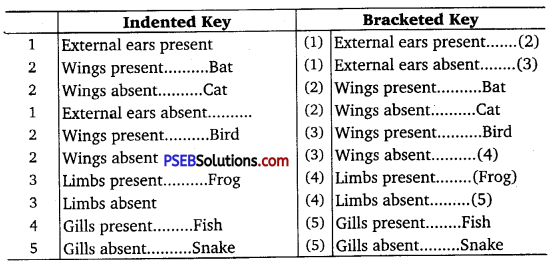
The key for identification of plants is a taxonomic key. It is a important taxonomic aid. Key can be defined as a set of alternate characters arranged in such a manner that by selection and elimination one can quickly find out the name of an organism. Depending upon the category, a key may be class key, order key, family key, genus key and species key.

Taxonomic keys can be of following two types:
(i) Indented or Yolked key
(ii) Bracketed key
Indented key, provides a sequence of two or more alternate characters from which selection and elimination are carried out. In bracketed key, the alternate characters are given numbers in brackets. For example, take four genera of family – Ranunculaceae to explain this,
(i) Ranunculus: Leaves alternate or radical, flowers not subtended by involucre, carpels ovuled, fruit achenes.
(ii) Clematis: Leaves opposite, compound petals absent, sepals 4, carpels uniovulated and fruit achenes.
(iii) Nigella: Flowers regular, carpels united at base, many ovulated, fruit follicles.
(iv) Anemone: Leaves alternate or radical, flowers subtended by involucre, carpels 1-ovulated, fruit achenes.

PSEB 11th Class Biology Important Questions Chapter 1 The Living World

Question 2.
Some of the properties of tissues are not the properties of constituents of its cells. Give three examples to support the statement. [NCERT Exemplar]
Answer:
A living thing has multiple level of organisation. Each level of organisaton i has its own properties, which are not found in its constituents.
Examples of three tissues supporting the statements are
(i) Cardiac muscle tissue: It is a contractile tissue present only in heart. Cell junctions fuse the plasma membrane of cardiac muscle cells and make them stick together. When one cell receives a signal to contract, its neighbours also starts to contract. It means a single cell cannot contract, while there are some fusion points, which allow the cells to contract as a unit.

(ii) Blood: It is a fluid connective tissue. The individual components of blood, i.e., RBCs, WBCs and platelets have different properties but as a unit they make the blood, a tissue serving many functions.

(iii) Bone: It is a hard connective tissue that forms the framework of the body. The individual cells inside the bone do not have this property.

PSEB 3rd Class English Solutions Chapter 6 Lazy Param

Punjab State Board PSEB 3rd Class English Book Solutions Chapter 6 Lazy Param Textbook Exercise Questions and Answers.

PSEB Solutions for Class 3 English Chapter 6 Lazy Param

English Guide for Class 3 PSEB Lazy Param Textbook Questions and Answers

I. Think and Answer

A. Answer the following questions :

Question 1.
Who was a lazy boy? (ਅਲਤੀ ਲਤਦਾ ਕੋਟ ਸੀ ?)
Answer:
Param was a lazy boy. (ਪਰਮ ਇਕ ਆਲਸੀ ਲਤਦਾ ਸੀ |)

Question 2.
What did he do till late at night? (ਡਿਰ ਕੇਰ ਰਾਤ ਤੱਕ ਕੀ ਕਰਦਾ ਸੀ ?)
Answer:
He used to watch T.V. and play video games on mobile phone. (ਉਹ ਦੇਰ ਰਾਤ ਤੱਕ ਟੀ. ਵੀ. ਦੇਖਦਾ ਸੀ ਅਤੇ ਮੋਬਾਈਲ ਫੋਨ ‘ਤੇ ਵੀਡੀਓ ਗੇਮਜ਼ ਖੇਡਦਾ ਸੀ |)

Question 3.
What did he see in his dream? (ੳਸਨੇ ਸੁਧਨੇ ਵਿਖ ਦੀ ਦੇਖਿਆ ?)
Answer:
He saw some worms coming out of his ears and teeth. (ਉਸਨੇ ਦੇਖਿਆ ਕਿ ਕੁੱਝ ਕੀੜੇ ਉਸਦੇ ਕੰਨਾਂ ਅਤੇ ਦੰਦਾਂ ਤੋਂ ਬਾਹਰ ਆ ਰਹੇ ਹਨ ।)

PSEB 3rd Class English Solutions Chapter 6 Lazy Param

B. Write True or False :

1. Param always brushes his teeth properly.
Answer:
False

2. Param’s mother was worried about him.
Answer:
True

3. Param used to play outside with his friends.
Answer:
False

4. Worms were irritating his skin.
Answer:
True.

Match the following words according to the lesson :
PSEB 3rd Class English Solutions Chapter 6 Lazy Param 1

PSEB 3rd Class English Solutions Chapter 6 Lazy Param 2
Answer:
mother-worried,
Param-lazy,
worms-crawling,
ears-dirty.

II. Vocabulary
PSEB 3rd Class English Solutions Chapter 6 Lazy Param 3

PSEB 3rd Class English Solutions Chapter 6 Lazy Param

III. Language Corner
PSEB 3rd Class English Solutions Chapter 6 Lazy Param 5
A. Read aloud these doing words :
PSEB 3rd Class English Solutions Chapter 6 Lazy Param 6
Answer:
do (ਭੂ)
drink (ਛਿੰਕ)
read (ਰੀਡ)
eat (ਈਟ )
trim (ਟ੍ਰਿਸੁ)
write (ਰਾਈਟ)
comb (ਕਾਂਬ)
wear (ਵੀਅਰ)
ask (ਆਸਕ)
brush (ਬੁਰਮ)
listen (ਲਿਸਨ)
fight ( ਫਾਈਟ)
wash (ਵਾਸ )
take ( ਟੋਕ)
sleep (ਸਲੀਪ )

B. Encircle the verbs in the following sentences :
PSEB 3rd Class English Solutions Chapter 6 Lazy Param 7
Answer:
PSEB 3rd Class English Solutions Chapter 6 Lazy Param 8

C. Put these verbs at right place :
move listen wear drink brush say
1. Drink water.
2. Wear uniform.
3. Move in a line.
4. Listen carefully.
5. Brush your teeth.
6. Say thank you.

PSEB 3rd Class English Solutions Chapter 6 Lazy Param

D. Use of has/have :

PSEB 3rd Class English Solutions Chapter 6 Lazy Param 9
ਨੋਟ : He, She, It ਅਤੇ ਇਕ ਵਚਨ Noun ਦੇ ਨਾਲ has ਅਤੇ I, We, You, They ਅਤੇ ਬਰੁਵਥਨ Noun ਦੇ ਨਾਲ have ਦਾ ਪ੍ਰਯੋਗ ਹੁੰਦਾ ਹੈ |

E. Make sentences :

PSEB 3rd Class English Solutions Chapter 6 Lazy Param 10

Answer:
1. He has a good health.
2. She has a good health.
3. I have a good health.
4. They have a good health.

Fill in the blanks using has/have :
1. Bunty has a toothbrush.
2. Ujwal ………………….. a raincoat.
3. Teacher ………………….. a notebook.
4. Girls …………………..a newspaper.
5. Children ………………….. a football.
Answer:
1. Bunty ………………has……………… a toothbrush.
2. Ujwal ……………….has…………………. a raincoat.
3. Teacher ……………………has………………………. a notebook.
4. Girls ……………….have…………………… a newspaper.
5. Children ………………….have………………….. a football.

IV. Listen, Speak and Enjoy

A. Rhyme

Get up early
Brush your teeth fairly.
No loose talk,
Go for a walk.
Then back on the path,
Take a nice bath.
Say your prayers,
With a heart so pure.
Have your breakfast,
To the bite last.
Then go to school,
With a mind so cool.
PSEB 3rd Class English Solutions Chapter 6 Lazy Param 11
ਨੋਟ-ਵਿਦਿਆਰਥੀ ਆਪਣੇ ਆਪ ਕਰਨ । ਇਹ Rhyme ਚੰਗੀਆਂ ਆਦਤਾਂ ਸਿਖਾਉਂਦੀ ਹੈ ।

V. Reading Practice

A. Read the following sentences :

At Home

Go to bed early. ਜਲਦੀ ਸੌਂ ਜਾਓ ।
Get up early. ਜਲਦੀ ਉੱਠੋ ।
Brush your teeth twice a day. ਆਪਣੇ ਦੰਦ ਦਿਨ ਵਿੱਚ ਦੋ ਵਾਰ ਸਾਫ਼ ਕਰੋ।
Take a bath everyday. ਹਰ ਰੋਜ਼ ਇਸ਼ਨਾਨ ਕਰੋ ।
Obey your parents. ਆਪਣੇ ਮਾਤਾ-ਪਿਤਾ ਦਾ ਕਹਿਣਾ ਮੰਨੋ ।

At School

Always reach school on time. ਹਮੇਸ਼ਾਂ ਸਮੇਂ ਸਿਰ ਸਕੂਲ ਪਹੁੰਚੋ ।
Respect your teachers. ਆਪਣੇ ਅਧਿਆਪਕਾਂ ਦਾ ਆਦਰ ਕਰੋ ।
Write down neatly. ਸਾਫ਼-ਸਾਫ਼ ਲਿਖੋ ।
Listen to your lessons carefully. ਆਪਣੇ ਪਾਠ ਸਾਵਧਾਨੀ ਦੇ ਨਾਲ ਸੁਣੋ ॥
Keep your classroom and school clean. ਆਪਣੇ ਕਲਾਸ ਦੇ ਕਮਰੇ ਅਤੇ ਸਕੂਲ ਨੂੰ ਸਾਫ਼ ਰੱਖੋ |

PSEB 3rd Class English Solutions Chapter 6 Lazy Param

B. Learn the following magic words :

PSEB 3rd Class English Solutions Chapter 6 Lazy Param 12

PSEB 3rd Class English Solutions Chapter 6 Lazy Param 13

VI. Writing Task

A. Look at the picture and write words for different times of the day :
PSEB 3rd Class English Solutions Chapter 6 Lazy Param 14
B. Rearrange the words to make sentences :
1. Param lazy boy a was.
Param was a lazy boy.

2. just was dream a It.
It was just a dream.

3. brushed never He his teeth.
He never brushed his teeth.

VII. Value I learnt (ਮੱਲ ਬੋਧ)

Good habits polish our personality. (ਥੰਗੀਆਂ ਆਦਤਾਂ ਸਾਡੀ ਸਖਸੀਲਤ ਨੂੰ . ਸਵਾਰਦੀਆਂ ਨੂੰ ਸੰਵਾਰਦੀਆਂ ਹਨ |)

VIII. Activity

Tick (✓) good habits.
PSEB 3rd Class English Solutions Chapter 6 Lazy Param 16
Fact
ਤੱਥ (ਸਥਾਈ) Health is wealth. (ਸਿਰਤ ਪਨ ਹੈ |)

Lazy Param Summary & Translation in Hindi

A. Word-Meanings

Word/Phrase Meaning in English Meaning in Punjabi
Early before time ਜਲਦੀ
Promise commitment ਵਚਨ ਦੇਣਾ
Dream fantasy ਸੁਪਨਾ
Always regularly/without fail ਹਮੇਸ਼ਾ
Mirror looking glass ਸ਼ੀਸ਼ਾ
Fear terror ਡਰ
Properly rightly ਠੀਕ ਢੰਗ ਨਾਲ
Save defend ਬਚਾਓ
Skin upper layer of the body ਚਮੜੀ
Dirty dusty ਗੰਦੇ
Worms tiny insects ਕੀੜੇ
Scared got afraid ਡਰ ਗਿਆ

PSEB 3rd Class English Solutions Chapter 6 Lazy Param

B. Punjabi Translation Of The Lesson

ਪਰਮ ਇਕ ਆਲਸੀ ਲੜਕਾ ਸੀ । ਉਸਨੂੰ ਘਰ ਵਿਚ ਰਹਿਣਾ ਚੰਗਾ ਲੱਗਦਾ ਸੀ ਅਤੇ ਉਹ ਕਦੀ ਵੀ ਆਪਣੇ ਦੋਸਤਾਂ ਦੇ ਨਾਲ ਬਾਹਰ ਖੇਡਣ ਨਹੀਂ ਜਾਂਦਾ । ਉਹ ਟੀ.ਵੀ. ਦੇਖਦਾ ਰਹਿੰਦਾ ਸੀ ਅਤੇ ਕਾਫ਼ੀ ਦੇਰ ਤੱਕ ਮੋਬਾਈਲ ‘ਤੇ ਵੀਡੀਓ ਗੇਮਜ਼ ਖੇਡਦਾ ਸੀ । ਇਸ ਕਾਰਨ ਉਹ ਕਦੀ ਵੀ ਜਲਦੀ ਨਹੀਂ ਉੱਠ ਸਕਦਾ ਸੀ ਅਤੇ ਸਕੂਲ ਦੇ ਲਈ ਸਦਾ ਲੇਟ ਹੋ ਜਾਂਦਾ ਸੀ । ਹਰ ਰੋਜ਼ ਉਸਦੀ ਮਾਂ ਨੂੰ ਉਸਨੂੰ ਬਿਸਤਰੇ ਤੋਂ ਖਿੱਚ ਕੇ ਉਠਾਉਣਾ ਪੈਂਦਾ ਸੀ ਅਤੇ ਬਾਥਰੂਮ ਵਿਚ ਧੱਕੇ ਨਾਲ ਭੇਜਣਾ ਪੈਂਦਾ ਸੀ । ਉਹ ਕਦੀ ਵੀ ਠੀਕ ਢੰਗ ਨਾਲ ਆਪਣੇ ਦੰਦਾਂ ਨੂੰ ਬੁਰਸ਼ ਨਹੀਂ ਕਰਦਾ ਸੀ । ਉਸਦੇ ਕੰਨ ਬਹੁਤ ਗੰਦੇ ਹੋ ਗਏ ਸਨ ਕਿਉਂਕਿ ਉਹ ਨਹਾਉਂਦੇ ਸਮੇਂ ਆਪਣੇ ਕੰਨਾਂ ਦੇ ਪਿੱਛੇ ਦੀ ਸਫ਼ਾਈ ਨਹੀਂ ਕਰਦਾ ਸੀ । ਜਦੋਂ ਕਦੇ ਵੀ ਉਸਦੀ ਮਾਂ ਪੁੱਛਦੀ, “ਕੀ ਤੂੰ ਆਪਣੇ ਕੰਨ ਸਾਫ਼ ਕੀਤੇ ਹਨ ?” ਪਰਮ ਹਮੇਸ਼ਾ ਇਹ ਕਹਿੰਦਾ, “ਮਾਂ, ਮੈਂ ਵਚਨ ਦਿੰਦਾ ਹਾਂ, ਕਿ ਕੱਲ੍ਹ ਸਾਫ਼ ਕਰ ਲਵਾਂਗਾ ” ਪਰੰਤੂ ਉਹ ਕਦੀ ਆਪਣਾ ਵਚਨ ਪੂਰਾ ਨਹੀਂ ਕਰਦਾ ਸੀ । ਮਾਂ ਨੂੰ ਉਸਦੀ ਚਿੰਤਾ ਰਹਿੰਦੀ ਸੀ।

ਇਕ ਦਿਨ ਉਹ ਸਵੇਰੇ ਆਪਣੇ ਬਿਸਤਰੇ ਤੋਂ ਉੱਠਿਆ ਅਤੇ ਸ਼ੀਸ਼ੇ ਦੇ ਸਾਹਮਣੇ ਖੜ੍ਹਾ ਹੋ ਕੇ ਆਪਣੇ ਦੰਦ ਸਾਫ਼ ਕਰਨ ਲੱਗਾ, ਤਾਂ ਉਸਨੂੰ ਆਪਣੇ ਕੰਨਾਂ ਅਤੇ ਦੰਦਾਂ ਤੋਂ ਕੁੱਝ ਕੀੜੇ ਬਾਹਰ ਆਉਂਦੇ ਦਿਖਾਈ ਦਿੱਤੇ ! ਉਹ ਡਰ ਗਿਆ । ਰੇਂਗਦੇ ਹੋਏ ਕੀੜਿਆਂ ਤੋਂ ਉਸਦੀ ਚਮੜੀ ‘ਤੇ ਖਿੱਚਖਿਚਾਹਟ ਹੋਣ ਲੱਗੀ । ਉਨ੍ਹਾਂ ਦੀ ਸੰਖਿਆ ਜ਼ਿਆਦਾ ਤੋਂ ਜ਼ਿਆਦਾ ਹੁੰਦੀ ਗਈ । ਉਸਨੇ ਉਨ੍ਹਾਂ ਤੋਂ ਛੁਟਕਾਰਾ ਪਾਉਣ ਦੀ ਕੋਸ਼ਿਸ਼ ਕੀਤੀ, ਪਰੰਤੂ ਉਹ ਪਾ ਨਾ ਸਕਿਆ । ਉਹ ਡਰ ਨਾਲ ਚਿਲਾਉਣ ਲੱਗਾ, ‘ਮਾਂ ! ਮੱਦਦ ਕਰੋ ! ਮੈਨੂੰ ਬਚਾਓ ! ਇਹ ਕੀੜੇ ਮੇਰੀ ਚਮੜੀ ਖਾ ਰਹੇ ਹਨ।”

ਅਚਾਨਕ ਉਸਨੂੰ ਲੱਗਿਆ ਕਿ ਕੋਈ ਉਸਨੂੰ ਹਿਲਾ ਰਿਹਾ ਹੈ । ਪਰ ਜਾਗ ਗਿਆ ਅਤੇ ਉਸਨੇ ਦੇਖਿਆ ਕਿ ਉੱਥੇ ਕੋਈ ਕੀੜਾ ਨਹੀਂ ਸੀ । ਇਹ ਸਿਰਫ਼ ਇਕ ਸੁਪਨਾ ਸੀ ਪਰਮ ਬਹੁਤ ਖੁਸ਼ ਸੀ । ਉਸਨੇ ਆਪਣੀ ਮਾਂ ਨੂੰ ਦਿਲਾਸਾ ਦਿੱਤਾ ਕਿ ਉਹ ਹਰ ਰੋਜ਼ ਜਲਦੀ ਉੱਠੇਗਾ ਅਤੇ ਠੀਕ ਢੰਗ ਨਾਲ ਨਹਾਏਗਾ ।.

PSEB 3rd Class English Solutions Chapter 5 A Bear and A Rabbit

Punjab State Board PSEB 3rd Class English Book Solutions Chapter 5 A Bear and A Rabbit Textbook Exercise Questions and Answers.

PSEB Solutions for Class 3 English Chapter 5 A Bear and A Rabbit

English Guide for Class 3 PSEB A Bear and A Rabbit Textbook Questions and Answers

I. Think and Answer

A. Answer the following questions :

Question 1.
Who was taking rest ? ਅਰਾਮ ਕੌਣ ਕਰ ਰਿਹਾ ਸੀ ?
Answer:
The bear was taking rest. (ਭਾਲੂ ਅਰਾਮ ਕਰ ਰਿਹਾ ਸੀ ।

Question 2.
Who likes carrot? (ਗਾਜਰ ਕਿਸਨੂੰ ਪਸੰਦ ਹੈ ?)
Answer:
Bunny, the rabbit likes carrot. (ਗਾਜਰ ਬੰਨੀ ਖ਼ਰਗੋਸ਼ ਨੂੰ ਪਸੰਦ ਹੈ ।

Question 3.
Where does the rabbit live? ਖਰਗੋਸ਼ ਕਿੱਥੇ ਰਹਿੰਦਾ ਹੈ ?)
Answer:
The rabbit lives in a burrow. (ਖਰਗੋਸ਼ ਖੁੱਡ/ਗੁਫ਼ਾ ਵਿੱਚ ਰਹਿੰਦਾ ਹੈ |

Question 4.
Who was digging a pit? (ਖੱਡਾ ਕੌਣ ਪੁੱਟ ਰਿਹਾ ਸੀ ?)
Answer:
A hunter was digging a pit. (ਇਕ ਸ਼ਿਕਾਰੀ ਖੱਡਾ ਪੁੱਟ ਰਿਹਾ ਸੀ )

Question 5.
Where was the pit? (ਖੱਡਾ ਕਿੱਥੇ ਸੀ ?)
Answer:
The pit was on the way to the bear’s cave : (ਖੱਡਾ ਭਾਲੂ ਦੀ ਗੁਫ਼ਾ ਦੇ ਵਲ ਜਾਣ ਵਾਲੇ ਰਾਸਤੇ ਵਿੱਚ ਸੀ ॥

PSEB 3rd Class English Solutions Chapter 5 A Bear and A Rabbit

B. Write True or False :

1. The bear was sleeping in the cave.
2. Bunny was a mouse.
3. The rabbit liked carrots.
4. Hunter was digging a pit.
Answer:
1. False
2. False
3. True
4. True.

II. Vocabulary

A. Write down names of Fruits.
PSEB 3rd Class English Solutions Chapter 5 A Bear and A Rabbit 2

B. Read and understand
Opposites (ਵਿਰੋਧੀ ਸਬਦ)
PSEB 3rd Class English Solutions Chapter 5 A Bear and A Rabbit 3

1. near
2. day
3. here
4. sweet
5. open

III. Language Corner

A. Pronouns

PSEB 3rd Class English Solutions Chapter 5 A Bear and A Rabbit 4
ਨੋਟ-ਵਿਦਿਆਰਥੀ ਇਨ੍ਹਾਂ ਨੂੰ ਯਾਦ ਕਰਨ ।

PSEB 3rd Class English Solutions Chapter 5 A Bear and A Rabbit

Read the following passage carefully :

A bear was taking rest near a tree. A rabbit came there. His name was Bunny. The bear asked him to come near and eat pear. But Bunny did not like pear. He said that he liked carrot. The bear said, “I like honey.” “Would you like to be my friend ?” said the rabbit. “Yes,” said the bear. And they became good friends.

Underline the pronouns in above passage and write in given space :
1. His
2. him
3. He
4. he
5. I
6. you
7. my
8. they

B. Change the number

1. This is a tree.
These are trees.

2. This is a rabbit.
These are rabbits.

3. This is a carrot.
This: These are carrots.

4. This is a cave.
These are caves.

5. That is a burrow.
Those are burrows.
PSEB 3rd Class English Solutions Chapter 5 A Bear and A Rabbit 5

Note for Teacher: Give oral practice of conversation “What is this? What are these?

C. Punctuation

Note for Teacher: Tell the students about punctuation marks (ਵਿਸਗਸ ਥਿੰਨ੍ਹ ) (.) (,) and capital letters (ਅੰਗਰੇਸੀ ਦੇ ਵੱਡੇ ਅੱਖਰ) and their use.

Punctuate the following sentences :
1. I am not a parrot
2. thank you, dear
3. the honey is sweet
4. where do you live
5. my name is bunny
PSEB 3rd Class English Solutions Chapter 5 A Bear and A Rabbit 6
Answer:
1. I am not a parrot.
2. Thank you, dear.
3. The honey is sweet.
4. Where do you live?
5. My name is Bunny.

IV. Listen, Speak and Enjoy

A. Rhyme :

Jerry calls Harry,
Give me a berry.
Oh, Yes. I will,
Oh, Yes I will.
I also want cherry.
Will you give me cherry?
No, I will not.
No, I will not.
ਨੋਟ-ਵਿਦਿਆਰਥੀ ਆਪਣੇ ਆਪ ਕਰਨ ।

PSEB 3rd Class English Solutions Chapter 5 A Bear and A Rabbit 7

B. Do as I say :

Sit properly. ਸਿੱਟ ਪ੍ਰਪਰਲੀ |
Make a queue. ਮੇਰ ਆ ਕਿਉ |
Open your books. ਓਪਨ ਯੂਅਰ ਬੁੱਕਸ ।
Switch on the fan. ਸਵਿੱਚ ਆਨ ਦ ਫੈਨ |
Give me your book. ਗਿਵ ਮੀ ਪੂਅਰ ਬੱਕ |
Look at the blackboard. ਲੁਕ ਐਟ ਦ ਬਲੈਕਬੋਰਡ ।

PSEB 3rd Class English Solutions Chapter 5 A Bear and A Rabbit

V. Reading Practice

A. Read aloud :

PSEB 3rd Class English Solutions Chapter 5 A Bear and A Rabbit 8
ਨੋਟ- ਵਿਦਿਆਰਥੀ ਇਨ੍ਹਾਂ ਸ਼ਬਦਾਂ ਦਾ ਸਹੀ ਉਚਾਰਨ ਦਾ ਵਾਰ-ਵਾਰ ਅਭਿਆਸ ਕਰਨ ।

B. Circle the odd one (ਬੇਮੇਲ ਸਬਦ ) out :

1. rain, brain, rack, chain, plain
2. tick, year, kick, click, thick
3. gear, tear, again, near

Answer:
PSEB 3rd Class English Solutions Chapter 5 A Bear and A Rabbit 9


VI. Writing Task

A. Look at the pictures and name them :
PSEB 3rd Class English Solutions Chapter 5 A Bear and A Rabbit 10

B. Find the rhyming words from the text :
1. pear bear
2. parrot carrot
3. Bunny honey
4. here there

C. Read these sentences and write in your notebook :
PSEB 3rd Class English Solutions Chapter 5 A Bear and A Rabbit 11
1. Milk is healthy food. (ਦੁੱਧ ਇਕ ਸਿਹਤ ਵਧਾਊ ਭੋਜਨ ਹੈ ।
2. Milk makes our teeth strong. ਦੁੱਧ ਸਾਡੇ ਦੰਦਾਂ ਨੂੰ ਮਜ਼ਬੂਤ ਬਣਾਉਂਦਾ ਹੈ ।
3. Milk makes our bones strong. ਦੁੱਧ ਸਾਡੀਆਂ ਹੱਡੀਆਂ ਨੂੰ ਮਜ਼ਬੂਤ ਬਣਾਉਂਦਾ ਹੈ !
4. We must drink it daily. (ਸਾਨੂੰ ਹਰ ਰੋਜ਼ ਦੁੱਧ ਪੀਣਾ ਚਾਹੀਦਾ ਹੈ ।

PSEB 3rd Class English Solutions Chapter 5 A Bear and A Rabbit

VII. Value I learnt (ਮੁੱਲ ਬੇਧ )

A friend in need is a friend indeed. (ਮਿੱਤਰ ਉਹ ਜਿਹੜਾ ਮੁਸੀਬਤ ਵਿੱਚ ਕੰਮ ਆਏ ) .
We should help others. (ਸਾਨੂੰ ਦੂਸਰਿਆਂ ਦੀ ਸਹਾਇਤਾ ਕਰਨੀ ਚਾਹੀਦੀ ਹੈ |

VIII. Activity

Colour the picture and try to draw the same in your notebook :
PSEB 3rd Class English Solutions Chapter 5 A Bear and A Rabbit 12
ਨੋਟ-ਵਿਦਿਆਰਥੀ ਆਪਣੇ ਆਪ ਅਭਿਆਸ ਕਰਨ । Fact ਤੱਥ ਸੱਚਾਈ
Giraffes have blue tongue. ਜਿਰਾਫ਼ਾਂ ਦੀ ਜ਼ਬਾਨ ਨੀਲੀ ਹੁੰਦੀ ਹੈ ।
PSEB 3rd Class English Solutions Chapter 5 A Bear and A Rabbit 13

Bear and A Rabbit Summary & Translation in Hindi

A. Word-Meanings

Word/Phrase Meaning in English Meaning in Punjabi
Rest relaxation ਅਰਾਮ
Digging dig down ਪੱਟਣਾ
Pear a fruit ਨਾਸ਼ਪਾਤੀ
Burrow den/hole ਖੁੱਡ/ਗੁਫ਼ਾ
Hungry one who is feeling something to eat ਭੁੱਖਾ
Cave den गाढ़ा
Jungle wood ਜੰਗਲ
Leaves petals ਪੱਤੀਆਂ
Rabbit hare ਖਰਗੋਸ਼
Hunter one who hunts animals/birds ਸ਼ਿਕਾਰੀ
Honey a sweet food produced by bees ਸ਼ਹਿਦ
Tactfully cleverly ਚਲਾਕੀ

B. Punjabi Translation Of The Lesson
ਇਕ ਭਾਲੂ ਸੀ ਜਿਹੜਾ ਕਿ ਵੱਡੇ ਜੰਗਲ ਵਿੱਚ ਇਕ ਗੁਫ਼ਾ ਵਿਚ ਰਹਿੰਦਾ ਸੀ । ਇਕ ਦਿਨ ਉਹ ਨਾਸ਼ਪਾਤੀ ਦੇ ਦਰੱਖ਼ਤ ਦੇ ਕੋਲ ਅਰਾਮ ਕਰ ਰਿਹਾ ਸੀ । ਦਿਨ ਬਹੁਤ ਗਰਮ ਸੀ । ਉੱਥੇ ਬੰਨੀ ਨਾਂ ਦਾ ਇਕ ਖ਼ਰਗੋਸ਼ ਆਇਆ ॥
ਭਾਲੂ : ਉਹ ਪਿਆਰੇ ! ਇੱਥੇ ਆਓ ਅਤੇ ਇਕ ਹਰੀ ਨਾਸ਼ਪਾਤੀ ਲਵੋ ।
ਬੰਨੀ : ਕਿਉਂ ? ਮੈਂ ਤੋਤਾ ਨਹੀਂ ਹਾਂ ।
ਭਾਲੂ : ਤਾਂ, ਤੈਨੂੰ ਕੀ ਪਸੰਦ ਹੈ ?
ਬੰਨੀ : ਮੈਨੂੰ ਗਾਜਰ ਪਸੰਦ ਹੈ ਅਤੇ ਤੈਨੂੰ ?
ਭਾਲੂ : ਮੈਨੂੰ ਸ਼ਹਿਦ ਪਸੰਦ ਹੈ ।
ਬੰਨੀ : ਓ.ਕੇ. ! ਤੂੰ ਕਿੱਥੇ ਰਹਿੰਦਾ ਹੈਂ ?
ਭਾਲੂ : ਮੈਂ ਗੁਫ਼ਾ ਵਿੱਚ ਰਹਿੰਦਾ ਹਾਂ ਅਤੇ ਤੂੰ ?
ਬੰਨੀ : ਮੈਂ ਬਿਲ ਵਿਚ ਰਹਿੰਦਾ ਹਾਂ ।
ਭਾਲੂ : ਅੱਛਾ, ਤੇਰਾ ਸਭ ਤੋਂ ਪਿਆਰਾ ਮਿੱਤਰ ਕੌਣ ਹੈ ?
ਬੰਨੀ : ਕੋਈ ਨਹੀਂ ।
ਭਾਲੂ : ਮੇਰਾ ਵੀ ਕੋਈ ਮਿੱਤਰ ਨਹੀਂ ਹੈ ।
ਬੰਨੀ : ਤਾਂ ਆਓ ਅਸੀਂ ਦੋਸਤ ਬਣ ਜਾਂਦੇ ਹਾਂ ।
ਭਾਲੂ : ਓ.ਕੇ. ।
ਉਸ ਦਿਨ ਤੋਂ ਦੋਵੇਂ ਚੰਗੇ ਦੋਸਤ ਬਣ ਗਏ ਅਤੇ ਚੰਗਾ ਸਮਾਂ ਬਿਤਾਉਣ ਲੱਗੇ । ਇਕ ਦਿਨ ਖਰਗੋਸ਼ ਨੇ ਜੰਗਲ ਵਿੱਚ ਇਕ ਸ਼ਿਕਾਰੀ ਨੂੰ ਭਾਲੂ ਦੀ ਗੁਫ਼ਾ ਦੇ ਰਸਤੇ ਵਿੱਚ ਡੂੰਘਾ ਖੱਡਾ ਪੁੱਟਦੇ ਅਤੇ ਉਸਨੂੰ ਪੱਤਿਆਂ ਦੇ ਨਾਲ ਢੱਕਦੇ ਹੋਏ ਦੇਖਿਆ | ਉਹ ਉਸੇ ਸਮੇਂ ਇਸ ਜਾਲ ਫੌਦੇ ਬਾਰੇ ਆਪਣੇ ਦੋਸਤ ਨੂੰ ਦੱਸਣ ਲਈ ਜਲਦੀ ਨਾਲ ਦੌੜਿਆ ।
ਬੰਨੀ : ਸੁਣੋ, ਮੇਰੇ ਦੋਸਤ, ਇਕ ਸ਼ਿਕਾਰੀ ਸੀ । ਮੈਂ ਉਸਨੂੰ ਖੱਡਾ ਪੁੱਟਦੇ ਹੋਏ ਦੇਖਿਆ ।
ਭਾਲੂ : ਓਹ ! ਮਜ਼ਾਕ ਬੰਦ ਕਰੋ ।
ਬੰਨੀ : ਨਹੀਂ ! ਨਹੀਂ ! ਇਹ ਸੱਚ ਹੈ ।
ਭਾਲੂ : ਮੈਨੂੰ ਭੁੱਖ ਲੱਗੀ ਹੋਈ ਹੈ । ਮੈਂ ਸ਼ਹਿਦ ਲੱਭਣ ਜਾ ਰਿਹਾ ਹਾਂ ।
ਬੰਨੀ : ਰੁਕੋ। ਰੁਕੋ । ਉੱਥੇ ਨਾ ਜਾਵੇ । ਉੱਥੇ ਝਾੜੀਆਂ ਵਿੱਚ ਇਕ ਡੂੰਘਾ ਖੱਡਾ ਹੈ ।
ਭਾਲੁ : ਕਿਰਪਾ ਕਰਕੇ ਮੇਰਾ ਸਮਾਂ ਖ਼ਰਾਬ ਨਾ ਕਰੋ ।

PSEB 3rd Class English Solutions Chapter 5 A Bear and A Rabbit

ਖ਼ਰਗੋਸ਼ ਨੇ ਚਲਾਕੀ ਦੇ ਨਾਲ ਆਪਣੇ ਮਿੱਤਰ ਨੂੰ ਖੱਡਾ ਦਿਖਾਉਣ ਦੇ ਲਈ ਇਕ ਪੱਥਰ ਸੁੱਟਿਆ । ਇਸ ਪ੍ਰਕਾਰ ਉਸਨੇ ਆਪਣੇ ਦੋਸਤ ਦਾ ਜੀਵਨ ਬਚਾ ਲਿਆ।
ਭਾਲੂ : ਪਿਆਰੇ ! ਧੰਨਵਾਦ ! ਮਾਫ਼ ਕਰਨਾ, ਮੈਂ ਤੇਰਾ ਸੁਝਾਅ ਨਹੀਂ ਮੰਨਿਆ । ਤੂੰ ਸਿੱਧ ਕਰ ਦਿੱਤਾ ਹੈ ਕਿ ਤੂੰ ਮੇਰਾ ਸਭ ਤੋਂ ਚੰਗਾ ਦੋਸਤ ਹੈਂ। ਇਹ ਸੱਚ ਹੈ ਕਿ ਦੋਸਤ ਉਹ ਹੈ ਜਿਹੜਾ ਮੁਸੀਬਤ ਵਿੱਚ ਕੰਮ ਆਏ ॥

PSEB 3rd Class English Solutions Chapter 4 The Clock-My Friend

Punjab State Board PSEB 3rd Class English Book Solutions Chapter 4 The Clock-My Friend Textbook Exercise Questions and Answers.

PSEB Solutions for Class 3 English Chapter 4 The Clock-My Friend

English Guide for Class 3 PSEB The Clock-My Friend Textbook Questions and Answers

I. Think and Answer

A. Answer the following questions :

Question 1.
Who is late for school ? (ਸਕੂਲ ਦੇ ਲਈ ਲੇਟ ਕੌਣ ਹੈ ?).
Answer:
Anmol is late for school. (ਅਨਮੋਲ ਸਕੂਲ ਦੇ ਲਈ ਲੇਟ ਹੈ .

Question 2.
Who is the narrator’s English teacher ? ਵਕਤਾ ਦਾ ਅੰਗਰੇਜ਼ੀ ਦਾ ਅਧਿਆਪਕ ਕੌਣ ਹੈ ?
Answer:
Mrs. Manjit is the narrator’s English teacher. ਸ੍ਰੀਮਤੀ ਮਨਜੀਤ ਵਕਤਾ ਦੀ ਅੰਗਰੇਜ਼ੀ ਦੀ ਅਧਿਆਪਕਾ ਹਨ ॥

Question 3.
How does a clock help us? Or What does clock tell us ? ਘੜੀ ਸਾਡੀ ਮਦਦ ਕਿਵੇਂ ਕਰਦੀ ਹੈ ? ਜਾਂ ਘੜੀ ਸਾਨੂੰ ਕੀ ਦੱਸਦੀ ਹੈ ?
Answer:
A clock tells us time. ਘੜੀ ਸਾਨੂੰ ਸਮਾਂ ਦੱਸਦੀ ਹੈ ॥

Question 4.
What would the narrator gift to his friend? ਵਕਤਾ ਆਪਣੇ ਮਿੱਤਰ ਨੂੰ ਕੀ ਤੋਹਫ਼ਾ ਦੇਵੇਗਾ ?
Answer:
The narrator would gift a clock to his friend. ਵਕਤਾ ਆਪਣੇ ਮਿੱਤਰ ਨੂੰ ਤੋਹਫ਼ੇ ਵਿੱਚ ਘੜੀ ਦੇਵੇਗਾ |

PSEB 3rd Class English Solutions Chapter 4 The Clock-My Friend

B. Show the time in the clock :

PSEB 3rd Class English Solutions Chapter 4 The Clock-My Friend 1

II. Vocabulary

A. Write the names of the months of the year.

PSEB 3rd Class English Solutions Chapter 4 The Clock-My Friend 2
Answer:
1. January
2. February
3. March
4. April
5. May
6. June
7. July
8. august
9. September
10. October
11. November
12. December

B. Write the names of seasons in the given space.

PSEB 3rd Class English Solutions Chapter 4 The Clock-My Friend 3

III. Language Corner
PSEB 3rd Class English Solutions Chapter 4 The Clock-My Friend 4

A. Match the pictures with correct prepositions.

PSEB 3rd Class English Solutions Chapter 4 The Clock-My Friend 5

Answer:
PSEB 3rd Class English Solutions Chapter 4 The Clock-My Friend 6

PSEB 3rd Class English Solutions Chapter 4 The Clock-My Friend

B. Fill in the blanks with the help of a picture.

in on near between under
PSEB 3rd Class English Solutions Chapter 4 The Clock-My Friend 7
Answer:
1. on
2. in
3. under
4. near
5. between.

IV. Listen, Speak and Enjoy

A. Tongue Twister
Tick-Tock, Tick-Tick Tack

B. Conversation
1. Is it a bottle? ਕੀ ਇਹ ਬੋਤਲ ਹੈ?
Yes, it is. ਹਾਂ, ਇਹ ਬੋਤਲ ਹੈ !
PSEB 3rd Class English Solutions Chapter 4 The Clock-My Friend 8

2. Is it a lion ? ਕੀ ਇਹ ਸ਼ੇਰ ਹੈ ?
No, it is a rabbit. ਨਹੀਂ, ਇਹ ਖ਼ਰਗੋਸ਼ ਹੈ ।
PSEB 3rd Class English Solutions Chapter 4 The Clock-My Friend 9

C. Conversation Practice

1. Is it a bird?
No, it is a flower.
PSEB 3rd Class English Solutions Chapter 4 The Clock-My Friend 10

PSEB 3rd Class English Solutions Chapter 4 The Clock-My Friend

2. Is it a zoo?
Yes, it is.
PSEB 3rd Class English Solutions Chapter 4 The Clock-My Friend 11

3. Is it a teddy?
No, it is a doll.
PSEB 3rd Class English Solutions Chapter 4 The Clock-My Friend 12

4. Is it a ribbon?
Yes, it is.
PSEB 3rd Class English Solutions Chapter 4 The Clock-My Friend 13

V. Reading Practice (ਯਾਦ ਕੱਥੇ )

Sixty seconds make a miraute. (ਇਕ ਮਿੰਟ ਵਿੱਚ 60 ਸੈਕਿੰਡ ਹੁੰਦੇ ਹਨ |)
Sixty minutes- make an hour. (ਇਕ ਘੰਟੇ ਵਿੱਚ 60 ਮਿੰਟ ਹੁੰਦੇ ਹਨ|)
Twenty four hours make a day. (ਇਕ ਦਿਨ ਵਿੱਚ 24 ਘੰਟੇ ਹੁੰਦੇ ਹਨ !)
Four weeks make a month. (ਇਕ ਮਹੀਨੇ ਵਿੱਚ ਚਾਰ ਹਫ਼ਤੇ ਹੁੰਦੇ ਹਨ !)
Twelve months make a year. (ਇਕ ਸਾਲ ਵਿੱਚ 12 ਮਹੀਨੇ ਹੁੰਦੇ ਹਨ !)
PSEB 3rd Class English Solutions Chapter 4 The Clock-My Friend 14

VI.Writing Task

A. Look and write the time :
PSEB 3rd Class English Solutions Chapter 4 The Clock-My Friend 15

B. Make your timetable :
At Home:

PSEB 3rd Class English Solutions Chapter 4 The Clock-My Friend 16

In the School


ਨੋਟ-ਵਿਦਿਆਰਥੀ ਆਪਣੇ ਆਪ ਨਾਲ ਜੁੜੀ ਜਾਣਕਾਰੀ ਦੇ ਕੇ Tables ਪੂਰਾ ਕਰਨ ।

VII. Value I learnt (ਮੁੱਲ ਬੇਧ )

Be puncutal. (ਸਸੇ ਦੇ ਪਾਬੰਦ ਰਹੇ |)

VIII. Activity

Colour the given picture :
img
ਨੋਟ- ਵਿਦਿਆਰਥੀ ਦਿੱਤੇ ਗਏ ਚਿੱਤਰ ਵਿੱਚ ਖੁਦ ਰੰਗ ਭਰਨ ।
Fact ਤੱਥ (ਸੱਚਾਈ)
Time never stops. (ਸਸਾਂ ਕਦੇ ਨਹੀ ਰੁਕਦਾ |)

The Clock-My Friend Summary & Translation in Hindi

A. Word-Meanings

Word/Phrase Meaning in English Meaning in Punjabi
Clock time telling device ਦੀਵਾਰ-ਘੜੀ
Value respect/give importance ਆਦਰ ਕਰਨਾ
Advise suggest ਸੁਝਾਅ ਦੇਣਾ
Discipline order ਅਨੁਸਨ
Know realize/understand ਜਾਣਨਾ
Strikes rings ਵਜਾਉਂਦੀ ਹੈ।
Follow obey ਪਾਲਣ ਕਰਨਾ
Punctual regular ਸਮੇਂ ਦਾ ਪਾਬੰਦ
Uniform dress ਯੂਨੀਫ਼ਾਰਮ
Respect regard ਆਦਰ ਕਰਨਾ
Stop come to a halt ਰੁਕ ਜਾਣਾ ,
Parents mother-father ਮਾਤਾ-ਪਿਤਾ
Bother mind/care for ਧਿਆਨ ਦੇਣਾ/ਪਰਵਾਹ ਕਰਨਾ
Precious valuable ਕੀਮਤੀ

( B. Punjabi Translation Of The Lesson)
ਮੇਰੇ ਸਹਿਪਾਠੀ, ਅਨਮੋਲ ਨੂੰ ਅੱਜ ਫਿਰ ਦੇਰ ਹੋ ਗਈ । ਅਧਿਆਪਕਾ ਉਸ ਨੂੰ ਬਹੁਤ ਵਾਰੀ ਚੇਤਾਵਨੀ ਦੇ ਚੁੱਕੀ ਹੈ ! ਇਥੋਂ ਤੱਕ ਕਿ ਉਸਦੇ ਮਾਤਾ-ਪਿਤਾ ਨੇ ਵੀ ਉਸਨੂੰ ਸਮੇਂ ਦਾ ਆਦਰ ਕਰਨ ਨੂੰ ਕਿਹਾ ਹੈ, ਪਰੰਤੂ ਉਹ ਕਦੀ ਵੀ ਧਿਆਨ ਨਹੀਂ ਦਿੰਦਾ ਹੈ | ਸਾਡੀ ਅੰਗਰੇਜ਼ੀ ਦੀ ਅਧਿਆਪਕਾ ਸ੍ਰੀਮਤੀ ਮਨਜੀਤ ਨੇ ਸਾਨੂੰ ਪੜ੍ਹਾਇਆ ਹੈ ਕਿ ਸਮਾਂ ਕਦੇ ਵੀ ਨਹੀਂ ਰੁਕਦਾ । ਇਹ ਸਦਾ ਚੱਲਦਾ ਹੀ ਰਹਿੰਦਾ ਹੈ ਅਤੇ ਘੜੀ ਸਾਨੂੰ ਸਮਾਂ ਦੱਸਣ ਵਿੱਚ ਮਦਦ ਕਰਦੀ ਹੈ । ਸਮਾਂ ਕੀਮਤੀ ਹੈ ? ਇਸ ਦੀ ਕੀਮਤ ਧਨ ਤੋਂ ਵੀ ਜ਼ਿਆਦਾ ਹੈ : ਇਸ ਨੂੰ ਵਾਪਿਸ ਨਹੀਂ ਬੁਲਾਇਆ ਜਾ ਸਕਦਾ : ਇਸ ਲਈ ਸਾਨੂੰ ਸਮੇਂ ਦਾ ਆਦਰ ਕਰਨਾ ਚਾਹੀਦਾ ਹੈ । ਉਨ੍ਹਾਂ ਨੇ ਸਾਨੂੰ ਸੁਝਾਅ ਦਿੱਤਾ ਕਿ ਸਾਡੇ ਕਮਰੇ ਵਿਚ ਇਕ ਘੜੀ ਹੋਣੀ ਚਾਹੀਦੀ ਹੈ । ਉਨ੍ਹਾਂ ਨੇ ਸਾਨੂੰ ਸਮਝਾਇਆ ਹੈ ਕਿ ਸਾਨੂੰ ਘੜੀ ਦੀ ਮਦਦ ਨਾਲ ਆਪਣੀ ਸਮੇਂਸਾਰਣੀ ਬਣਾ ਲੈਣੀ ਚਾਹੀਦੀ ਹੈ ਅਤੇ ਉਸਦਾ ਪਾਲਨ ਕਰਨਾ ਚਾਹੀਦਾ ਹੈ ।

PSEB 3rd Class English Solutions Chapter 4 The Clock-My Friend

ਮੈਂ ਉਨ੍ਹਾਂ ਨੂੰ ਦੱਸਿਆ ਸੀ ਕਿ ਮੇਰੇ ਕਮਰੇ ਵਿਚ ਦਾਦਾ ਜੀ ਦੀ ਇਕ ਵੱਡੀ ਦੀਵਾਰ ਘੜੀ ਹੈ । ਇਹ ਮੈਨੂੰ ਸਮੇਂ ਦਾ ਪਾਬੰਦ ਰਹਿਣ ਵਿਚ ਮਦਦ ਕਰਦੀ ਹੈ ਅਤੇ ਇਹ ਟਿਕ-ਟਿਕ ਦੀ ਅਵਾਜ਼ ਕਰਦੀ ਰਹਿੰਦੀ ਹੈ । ਇਹ ਸਵੇਰੇ ਦੇ 6 ਵਜੇ ਵਜਦੀ ਹੈ ਅਤੇ ਮੈਨੂੰ ਜਗਾਉਂਦੀ ਹੈ । ਮੈਂ ਆਪਣੇ ਦੰਦ ਸਾਫ਼ ਕਰਦਾ ਹਾਂ ਅਤੇ ਇਸ਼ਨਾਨ ਕਰਦਾ ਹਾਂ । ਮੈਂ ਸਕੂਲ ਯੂਨੀਫ਼ਾਰਮ ਪਹਿਨ ਕੇ ਸਕੂਲ ਲਈ ਤਿਆਰ ਹੋ ਜਾਂਦਾ ਹਾਂ । ਮੇਰੀ ਮਾਤਾ ਜੀ ਮੈਨੂੰ ਨਾਸ਼ਤਾ ਪਰੋਸਦੇ ਹਨ | ਜਦੋਂ ਘੜੀ ’ਤੇ ਸਵੇਰ ਦੇ 7:30 ਵੱਜਦੇ ਹਨ, ਮੇਰੀ ਸਕੂਲ ਬੱਸ ਆ ਜਾਂਦੀ ਹੈ । ਮੈਂ ਉਸ ਵਿਚ ਚੜ ਜਾਂਦਾ ਹਾਂ ਅਤੇ ਸਮੇਂ ‘ਤੇ ਸਕੂਲ ਪਹੁੰਚ ਜਾਂਦਾ ਹਾਂ । ਦੁਪਹਿਰ 2 ਵਜੇ ਮੈਂ ਘਰ ਵਾਪਿਸ ਆ ਜਾਂਦਾ ਹਾਂ ਅਤੇ ਆਪਣੀ ਘੜੀ ਨਾਲ ਫਿਰ ਮਿਲਦਾ ਹਾਂ | ਸ਼ਾਮ ਦੇ 5 ਵਜੇ ਇਸ ਦੀਆਂ ਸੂਈਆਂ ਮੈਨੂੰ ਦੱਸਦੀਆਂ ਹਨ ਕਿ ਬਾਹਰ ਜਾਵੋ ਅਤੇ ਖੇਡੋ | ਰਾਤ 9 ਵਜੇ ‘ਗੁੱਡ ਨਾਈਟ’ ਕਹਿਣ ਅਤੇ ਸੌਣ ਦਾ ਸਮਾਂ ਹੁੰਦਾ ਹੈ ।

ਮੇਰੀ ਮਿੱਤਰ ਘੜੀ ਦਾ ਧੰਨਵਾਦ । ਇਹ ਮੈਨੂੰ ਸਮੇਂ ਸਾਰਣੀ ‘ਤੇ ਚੱਲਣ ਵਿੱਚ ਮਦਦ ਕਰਦੀ ਹੈ ਅਤੇ ਅਨੁਸ਼ਾਸਨ ਵਿੱਚ ਰੱਖਦੀ ਹੈ। ਇਥੋਂ ਤੱਕ ਕਿ ਮੇਰੇ ਮਿੱਤਰ ਦੇ ਕੋਲ ਵੀ ਇਕ ਘੜੀ ਹੋਣੀ ਚਾਹੀਦੀ ਹੈ । ਮੈਂ ਉਸਨੂੰ ਘੜੀ ਤੋਹਫ਼ੇ ਵਿਚ ਦੇਵਾਂਗਾ । ਤਦ ਉਹ ਸਕੂਲ ਲਈ ਕਦੀ ਵੀ ਲੇਟ ਨਹੀਂ ਹੋਵੇਗਾ |

PSEB 3rd Class English Solutions Chapter 3 Trees

Punjab State Board PSEB 3rd Class English Book Solutions Chapter 3 Trees Textbook Exercise Questions and Answers.

PSEB Solutions for Class 3 English Chapter 3 Trees

English Guide for Class 3 PSEB Trees Textbook Questions and Answers

I. Think and Answer

A. Write True or False :

(a) Trees give us fruit and wood.
Answer:
True

(b) Trees do not grow.
Answer:
False

(c) Trees harm us.
Answer:
False

(d) Trees give us shade.
Answer:
True

B. Match the rhyming words:

1. know – evening
2. light – grow
3. morning – night
Answer:
1. know- grow
2. light-night
3. morning-evening.

C. Find these words in the grid :

PSEB 3rd Class English Solutions Chapter 3 Trees 1

PSEB 3rd Class English Solutions Chapter 3 Trees

II. Vocabulary


Write the names of colours in the given space.
Answer:
PSEB 3rd Class English Solutions Chapter 3 Trees 2

III. Language Corner

A. Use of was/were :

PSEB 3rd Class English Solutions Chapter 3 Trees 3
ਨੇਟ -was/were ਦੋ ਪ੍ਰਪੇਗ ਨੁੰ is/are ਦੀ ਤਰਜ ਤੋ ਪ੍ਰਯੋਗ ਕਰੋ | Lesson 2 ਵਿੱਚ ਦੇਥੇ I ਦੇ ਨਾਲ Was ਦਾ ਪ੍ਰਯੋਗ ਹੁੰਦਾ ਹੈ ।

B. Make sentences :

PSEB 3rd Class English Solutions Chapter 3 Trees 4
Answer:
1. I was sleeping.
2. We were sleeping.
3. You were sleeping.
4. They were sleeping.
5. He was sleeping.
6. She was sleeping.
7. Cow was sleeping.
8. Birds were sleeping.

C. Rewrite the following sentences by replacing is/are with was/were :

Example: The leaves are green.
The leaves were green.
1. Birds are chirping.
Birds were chirping.
2. The sun is shining.
The sun was shining.
3. The cow is sleeping.
The cow was sleeping.
4. The flowers are fresh.
The flowers were fresh.
5. The roots are dry.
The roots were dry.

PSEB 3rd Class English Solutions Chapter 3 Trees

D. Join and write :

PSEB 3rd Class English Solutions Chapter 3 Trees 5
Answer:
1. holding
2. helping
3. growing
4. touching
5. spreading

IV. Listen, Speak and Enjoy

A. Rhyme

One little flower
One little bee,
One little blue bird
High in the tree,
One little brown bear (ਭੂਰਾ ਤਾਲੂ)
Smiling at me. ਨੋਟ-ਵਿਦਿਆਰਥੀ ਖ਼ੁਦ ਕਰਨ ।
PSEB 3rd Class English Solutions Chapter 3 Trees 6

B. Conversation

PSEB 3rd Class English Solutions Chapter 3 Trees 7
Note for the teacher : Give more practice of conversation.
ਨੋਟ-ਅਧਿਆਪਕ ਦੀ ਸਹਾਇਤਾ ਨਾਲ ਆਪਣੀਆਂ ਕਿਰਿਆਵਾਂ ਦਾ ਉੱਤਰ ਦੇਣਾ ਸਿੱਖੋ !

V. Reading Practice

A. Silent letters

ਨੋਟ-ਧਿਆਨ ਦੇਵੋ, ਅੰਗਰੇਜ਼ੀ ਦੇ ਕੁੱਝ ਸ਼ਬਦਾਂ ਨੂੰ ਬੋਲਦੇ ਸਮੇਂ ਉਨ੍ਹਾਂ ਵਿੱਚ ਦਿੱਤਾ ਗਿਆ ਕੋਈ Letter (ਅੱਖਰ) ਆਵਾਜ਼ ਨਹੀਂ ਦਿੰਦਾ; ਜਿਵੇਂ-
PSEB 3rd Class English Solutions Chapter 3 Trees 8

B. Let’s learn how to spell r in following words.

rat arm car ring
farm bear rest
alarm chair rose
charm their read
dark water road
bark letter rope
paper round flower.
park shark

Note for Teacher: Teacher will help the students to pronounce the above words correctly.
ਨੋਟ-ਅਧਿਆਪਕ ਵਿਦਿਆਰਥੀਆਂ ਦੀ ਇਨ੍ਹਾਂ ਸ਼ਬਦਾਂ ਦਾ ਸਹੀ ਉਚਾਰਨ ਕਰਨ ਵਿੱਚ ਸਹਾਇਤਾ ਕਰਨ ।

VI. Writing Task
PSEB 3rd Class English Solutions Chapter 3 Trees 9
Make sentences using given words.
1. Trees give us wood.
2. Trees give us fruits.
3. Trees give us oxygen.
4. Trees give us shade.
5. Trees give us paper.

PSEB 3rd Class English Solutions Chapter 3 Trees

VII. Value I learnt (ਮੁੱਲ ਬੋਧ)

We should grow more trees.
(ਸਾਨੂੰ ਹੋਰ ਜ਼ਿਆਦਾ ਦਰੱਖ਼ਤ ਉਗਾਉਣੇ ਚਾਹੀਦੇ ਹਨ |

VIII. Activity

Draw your favourite flower and colour it.
PSEB 3rd Class English Solutions Chapter 3 Trees 10
ਨੋਟ-ਵਿਦਿਆਰਥੀ ਇਸ ਵਿਚ ਰੰਗ ਭਰਣ !

[Fact ] ਤੱਥ (ਸੱਚਾਈ)
Peepal tree gives us oxygen day and night. (ਪਿੱਪਲ ਦਾ ਦਰੱਖ਼ਤ ਸਾਨੂੰ ਦਿਨ-ਰਾਤ ਆਕਸੀਜਨ ਦਿੰਦਾ ਹੈ ।)
PSEB 3rd Class English Solutions Chapter 3 Trees 11

Trees Summary & Translation in Hindi

A. Word-Meanings

Word/Phrase Meaning in English Meaning in Punjabi
Harm do a loss ਨੁਕਸਾਨ ਪਹੁੰਚਾਉਣਾ
Gather collect ਇਕੱਠਾ ਕਰਨਾ
Morning sun-rising time ਸਵੇਰ
Evening sun-setting time ਸ਼ਾਮ
Grow develop हॅपटा
Boughs main branches of a tree ਦਰੱਖ਼ਤ ਦੀਆਂ ਮੁੱਖ ਟਹਿਣੀਆਂ
Spread scatter ਫੈਲਾਉਣਾ
Words meaningful groups of letters ਸ਼ਬਦ
Hold catch ਫੜਨਾਂ
Shade shadow ਛਾਂ
Beams rays ਕਿਰਨਾਂ
Touch feel ਛੂਹਣਾ/ਮਹਿਸੂਸ ਕਰਨਾ

PSEB 3rd Class English Solutions Chapter 3 Trees

B. ਕਵਿਤਾ ਦਾ ਪੰਜਾਬੀ ਵਿਚ ਸਾਰ-

ਇਹ ਕਵਿਤਾ ਦਰੱਖਤਾਂ ਦੇ ਬਾਰੇ ਹੈ । ਕਵੀ ਕਹਿੰਦਾ ਹੈ ਕਿ ਦਰੱਖ਼ਤ ਸਭ ਤੋਂ ਜ਼ਿਆਦਾ ਦਿਆਲੂ ਹੁੰਦੇ ਹਨ ! ਉਹ ਕਿਸੇ ਨੂੰ ਕੋਈ ਨੁਕਸਾਨ ਨਹੀਂ ਪਹੁੰਚਾਉਂਦੇ । ਉਹ ਬੱਸ ਵੱਧਦੇ ਰਹਿੰਦੇ ਹਨ ! ਉਹ ਸੁੱਤੀਆਂ ਹੋਈਆਂ ਗਾਵਾਂ ਨੂੰ ਛਾਂ ਦਿੰਦੇ ਹਨ । ਉਨ੍ਹਾਂ ਦੀਆਂ ਮੁੱਖ ਟਹਿਣੀਆਂ ’ਤੇ ਕਈ ਪੰਛੀ ਮੰਡਰਾਉਂਦੇ ਰਹਿੰਦੇ ਹਨ । ਦਿਨ ਨਿਕਲਣ ਤੇ ਸਭ ਤੋਂ ਪਹਿਲਾਂ ਦਰੱਖ਼ਤ ਹੀ ਸੂਰਜ ਦੀਆਂ ਕਿਰਨਾਂ ਨੂੰ ਛੂਹਦੇ ਹਨ । ਜਦੋਂ ਸ਼ਾਮ ਰਾਤ ਵਿੱਚ ਢਲਦੀ ਹੈ ਤਾਂ ਅੰਤਿਮ ਪ੍ਰਕਾਸ਼ (ਆਖ਼ਰੀ ਰੌਸ਼ਨੀ ਦਰੱਖ਼ਤਾਂ ‘ਤੇ ਹੀ ਦਿਖਾਈ ਪੈਂਦਾ ਹੈ ।

PSEB 3rd Class English Solutions Chapter 2 Visit to A Park

Punjab State Board PSEB 3rd Class English Book Solutions Chapter 2 Visit to A Park Textbook Exercise Questions and Answers.

PSEB Solutions for Class 3 English Chapter 2 Visit to A Park

English Guide for Class 3 PSEB Visit to A Park Textbook Questions and Answers

I. Think and Answer
A. Answer the following questions :

Question 1.
Who is riding a bicycle ? (ਮਾਈਕਲ ਕੌਣ ਚਲਾ ਰਿਹਾ ਹੈ ?)
Answer:
Preet is riding a bicycle. (ਸਾਈਕਲ ਪ੍ਰੀਤ ਚਲਾ ਰਹੀ ਹੈ ।)

Question 2.
What is Komał doing ? (ਕੋਮਲ ਕੀ ਕਰ ਰਹੀ ਹੈ ?)
Answer:
Komal is enjoying the swings. (ਕੋਮਲ ਝੂਲਿਆਂ ਦਾ ਆਨੰਦ ਲੈ ਰਹੀ ਹੈ ।

Question 3.
Where is the tree? (ਕਰੱਥਤ ਕਿਬੋ ਹੈ ?)
Answer:
The tree is in the middle of the park. (ਕਰੱਥਤ ਪਾਰਕ ਦੇ ਵਿਧਕਾਰ ਹੈ । )

Question 4.
Who are playing football? (ਫਟਬਾਲ ਕੇਟ ਧੇਡ ਰਹੇ ਹਨ? )
Answer:
Some children are playing football. ( ਕਝ ਬੱਥੇ ਫੁੱਟਬਾਲ ਖੇਡ ਰਹੇ ਹਨ।)

PSEB 3rd Class English Solutions Chapter 2 Visit to A Park

Question 5.
What is the gardener doing ? (ਮਾਲੀ ਦੀ ਕਰ ਰਿਹਾ ਹੈ?)
Answer:
The gardener is watering the plants. (ਮਾਲੀ ਪੇਕਿਆ ਨੰ ਪਾਣੀ ਦੇ ਰਿਗ ਰੈ |)

B. Rewrite the following words in alphabetical order :
Vicky Komal Preet Sumit Veena Bittu
Answer:
Bittu, Komal, Preet, Sumit, Veena, Vicky.

C. Match the names of birds with pictures :
PSEB 3rd Class English Solutions Chapter 2 Visit to A Park 1

II. Vocabulary :

A. Read the names of the days and write in the given space :

Days of the week
1. Monday
2. Tuesday
3. Wednesday
4. Thursday
5. Friday
6. Saturday
7. Sunday
PSEB 3rd Class English Solutions Chapter 2 Visit to A Park 2
ਨੇਟ ਕੱਡ ਦੇਸ਼ਾ ਵਿੱਖ Week ਦੀ ਮਰੂਸਾਤ sunday ਨਾਲ ਵੀ ਮੰਨੀ ਜਾਂਦੀ ਹੈ |

III. Language Corner
A. Makė a list of nouns from the text and read aloud :
PSEB 3rd Class English Solutions Chapter 2 Visit to A Park 3
For example: Veena, kite
1. Sunday
2. Bittu
3. Park
4. Preet
5. Bicycle
6. Vicky
7. Komal
8. Sumit
9. Swings
10. Tree
11. Birds.

B. Use of a/an :
PSEB 3rd Class English Solutions Chapter 2 Visit to A Park 4

Note for the teacher : Use of a/an depends on the beginning sound of the word not the actual letter. Words beginning with consonant sound take ‘a’ as article and the words beginning with vowel sound take ‘an’ as article (ਕਿਸੇ ਸ਼ਬਦ (ਆਮਤੌਰ ‘ਤੇ Noun) ਨਾਲ ਪਹਿਲੇ a ਜਾਂ an ਦਾ ਪ੍ਰਯੋਗ ਸ਼ਬਦ ਨੂੰ ਬੋਲਣ ਦੇ ਸਮੇਂ ਉਸਦੀ ਸ਼ੁਰੂ ਦੀ ਧੁਨੀ ਦੇ ਅਧਾਰ ‘ਤੇ ਕੀਤਾ ਜਾਂਦਾ ਹੈ । Consonant (ਕ, ਖ ਆਦਿ) ਦੀ ਆਵਾਜ਼ ਦੇਣ ਵਾਲੇ ਸ਼ਬਦ ਤੋਂ ਪਹਿਲੇ a ਅਤੇ vowel ae,i,o,u) ਦੀ ਅਵਾਜ਼ ਦੇਣ ਵਾਲੇ ਸ਼ਬਦ ਤੋਂ ਪਹਿਲਾਂ an ਦਾ ਪ੍ਰਯੋਗ ਕੀਤਾ ਜਾਂਦਾ ਹੈ ॥

Examples
PSEB 3rd Class English Solutions Chapter 2 Visit to A Park 5

PSEB 3rd Class English Solutions Chapter 2 Visit to A Park

C. Write a/an before the words given below :

……… ball
………..Owl
………… ice-cream

……… eagle
……… tiger
…………….. aeroplane

……….. onion
………. banana
……….. queen.
Answer:
a ball
an owl
an eagle

a tiger
an ice-cream
an aeroplane

an onion
a banana
a queen.

D. Fill in the blanks with a/an :

1. This is ……….. fruit shop.
Answer:
a

2. We can ride ……….. elephant.
Answer:
an

3. There is …………. ink pot.
Answer:
an

4. I have ……….. pencil and ………. eraser.
Answer:
a, an

5. This is …………. computer.
Answer:
a.

E. Use of islam/are :

PSEB 3rd Class English Solutions Chapter 2 Visit to A Park 6
ਨੋਟ- ਦੇ ਨਾਲ am, Singular Noun ਅਤੇ Singular Pronoun (He, She, It ਆਦਿ) ਦੇ ਨਾਲ is ng Plural Nouns m Pronouns ਦੇ ਨਾਲ are ਦਾ ਪ੍ਰਯੋਗ ਕੀਤਾ ਜਾਂਦਾ ਹੈ | ਧਿਆਨ ਹੱਥੇ ਕਿ you ਨੂੰ ਰਸੇਸਾ Pural ਰੀ ਮੰਨਿਆ ਜਾਂਦਾ ਹੈ |

F. Make sentences using the grid :

PSEB 3rd Class English Solutions Chapter 2 Visit to A Park 7
Answer:
1. I am jumping.
2. She is jumping.
3. They are jumping
4. You are jumping.

G. Make sentences :

PSEB 3rd Class English Solutions Chapter 2 Visit to A Park 8
1. I am sleeping/clapping/eating.
2. Vijay and Vivek are clapping/sleeping/eating.
3. Parul and Priya are eating/sleeping/clapping.
4. Simran is sleeping/eating/clapping.
5. All are clapping/eating/sleeping. Note : ਵਿਦਿਆਰਥੀ ਵਿਕਲਪਾਂ ਵਿੱਚ ਦਿੱਤੇ ਗਏ ਸ਼ਬਦਾਂ ਤੋਂ ਅਲੱਗ-ਅਲੱਗ ਵਾਕ ਬਣਾਉਣ ਦਾ ਅਭਿਆਸ ਕਰਨ |

PSEB 3rd Class English Solutions Chapter 2 Visit to A Park

IV. Listen, Speak and Enjoy

PSEB 3rd Class English Solutions Chapter 2 Visit to A Park 9

Rhyme
Sunday, Monday, Tuesday too,
Wednesday, Thursday just for you.
Friday, Saturday that’s the end,
Now let’s say those days again.
ਨੋਟ-ਵਿਦਿਆਰਥੀ ਇਸ Rhyme ਦੀ ਸਹਾਇਤਾ ਨਾਲ ਹਫ਼ਤੇ ਦੇ ਦਿਨਾਂ ਦੇ ਨਾਂ ਯਾਦ ਕਰਨ

V. Reading Practice

A. Read Aloud
PSEB 3rd Class English Solutions Chapter 2 Visit to A Park 10
ਨੋਟ- ਵਿਦਿਆਰਥੀ ਇਹ ਸ਼ਬਦ ਬੋਲਣ ਦਾ ਵਾਰ-ਵਾਰ ਅਭਿਆਸ ਕਰਨ ।

VI.Writing Task

A. Write words for the following pictures :
PSEB 3rd Class English Solutions Chapter 2 Visit to A Park 11

B. See the picture and frame sentences :
PSEB 3rd Class English Solutions Chapter 2 Visit to A Park 12
Answer:
(a) The girl is sitting on a swing.
(b) Some children are flying kites.
(c) The boy is playing football.
(d) The ducks are swimming in a pond.
(e) The boy is riding a bicycle.
(f) The bird is flying in the sky.

PSEB 3rd Class English Solutions Chapter 2 Visit to A Park

C. Write the following sentences in cursive form :
(a) Today is Sunday.
Today is Sunday.

(b) A fountain is running.
A fountain is running.

(c) A quick brown fox jumped over the lazy dog.
A quick brown fox jumped over the lazy dog.

VII. Value I learnt (ਮੁੱਲ ਬੇਧ)

Save the nature and enjoy it. (ਕਕਰਤ ਦਾ ਬਥਾਅ ਕਰੇ ਅਤੇ ਤਿਸਦਾ ਆਨਂਦ ਲਵੇ |)

VIII. Activity
A. Make a list of items you will carry for a picnic.
PSEB 3rd Class English Solutions Chapter 2 Visit to A Park 13

B. How should we behave in a park?
Tick (✓) all the correct options.
1. Do not pluck flowers.
2. Shout loudly.
3. Use dustbin.
4. Disturb others.
PSEB 3rd Class English Solutions Chapter 2 Visit to A Park 15

Fact (ਤੱਬ (ਸੱਸਾਈ)
Plants give us oxygen. (ਪੇਦੇ ਸਹਨੂੰ ਆਕਸੀਸਜ ਦਿੰਦੇ ਹਨ |)

Visit to A Park Summary & Translation in Hindi

A. Word-Meanings

Word/Phrase Meaning in English Meaning in Punjabi
Park garden ਬਾਗ
Bright clear ਸਾਫ਼
Middle center ਮੱਧ/ਵਿਚਕਾਰ
Nectar holy drink/juice ਰਸ
Sipping (Here) sucking ਚੂਸ ਰਹੇ
Slide a slanting surface ਸਲਾਈਡ
Fountain a spraying device ਫੁਹਾਰਾ
Holiday a free day ਛੁੱਟੀ
Running playing ਚਲ ਰਿਹਾ ਹੈ
Fun entertainment ਅਨੰਦ/ਮਨੋਰੰਜਨ

PSEB 3rd Class English Solutions Chapter 2 Visit to A Park

(B. Punjabi Translation Of The Lesson)

ਅੱਜ ਐਤਵਾਰ ਹੈ । ਦਿਨ ਸਾਫ਼ ਹੈ । ਬਿੱਟੂ ਅਤੇ ਉਸ ਦੇ ਮਿੱਤਰ ਪਾਰਕ ਵਿਚ ਜਾ ਰਹੇ ਹਨ । ਉਹ ਸਵੇਰੇ 9 ਵਜੇ ਪਾਰਕ ਪਹੁੰਚਦੇ ਹਨ । ਉਹ ਬਹੁਤ ਖੁਸ਼ ਹਨ । ਪ੍ਰੀਤ ਆਪਣੀ ਨਵੀਂ ਸਾਈਕਲ ਚਲਾ ਰਹੀ ਹੈ । ਵਿੱਕੀ ਅਤੇ ਵੀਨਾ ਪਤੰਗ ਉਡਾ ਰਹੇ ਹਨ । ਸੁਮਿਤ ਅਤੇ ਬਿੱਟੂ ਸਲਾਈ ਦਾ ਅਨੰਦ ਲੈ ਰਹੇ ਹਨ ! ਕੋਮਲ ਪੰਘੂੜਿਆਂ ਦਾ ਅਨੰਦ ਲੈ ਰਹੀ ਹੈ |

ਪਾਰਕ ਦੇ ਵਿਚਕਾਰ ਇਕ ਵੱਡਾ ਸਾਰਾ ਦਰੱਖ਼ਤ ਹੈ । ਉਸ ’ਤੇ ਪੰਛੀ ਚਹਿ-ਚਹਾ ਰਹੇ ਹਨ । ਇਕ ਔਰਤ ਅਤੇ ਇਕ ਬੱਚਾ ਦਰੱਖ਼ਤ ਦੇ ਕੋਲ ਇਕ ਬੈਂਚ ‘ਤੇ ਬੈਠੇ ਹਨ । ਕੁੱਝ ਬੱਚੇ ਫੁੱਟਬਾਲ ਖੇਡ ਰਹੇ ਹਨ । ਉੱਥੇ ਕਈ ਤਰ੍ਹਾਂ ਦੇ ਫੁੱਲ ਹਨ । ਤਿੱਤਲੀਆਂ ਅਤੇ ਮਧੂ-ਮੱਖੀਆਂ ਫੁੱਲਾਂ ਤੋਂ ਰਸ ਚੂਸ ਰਹੀਆਂ ਹਨ | ਮਾਲੀ ਪੌਦਿਆਂ ਨੂੰ ਪਾਣੀ ਦੇ ਰਿਹਾ ਹੈ । ਫੁਹਾਰਾ ਚਲ ਰਿਹਾ ਹੈ । ਇਕ ਬੱਤਖ਼ ਅਤੇ ਉਸਦੇ ਬੱਚੇ ਤਲਾਬ ਵਿੱਚ ਤੈਰ ਰਹੇ ਹਨ ! ਸਾਰੇ ਭਰਪੂਰ ਅਨੰਦ ਲੈ ਰਹੇ ਹਨ ।