PSEB 6th Class Science Solutions Chapter 3 Fibre to Fabric

Punjab State Board PSEB 6th Class Science Book Solutions Chapter 3 Fibre to Fabric Textbook Exercise Questions and Answers.

PSEB Solutions for Class 6 Science Chapter 3 Fibre to Fabric

Science Guide for Class 6 PSEB Fibre to Fabric Intext Questions and Answers

Think and Answer (Textbook Page No. 21)

Question 1.
List any two types of fabric.
Answer:
Two main types of fabric are
(i) obtained from natural fibres
(ii) obtained from synthetic fibres.

Question 2.
How does silk fabric feel ?
Answer:
Smooth and shiny.

PSEB 6th Class Science Solutions Chapter 3 Fibre to Fabric

Question 3.
With what kind of fabric your dupatta is made up of ?
Answer:
Dupatta is made up of cotton.

Think and Answer (Textbook Page No. 26)

Question 1.
Name the items that are made from jute plant and coconut fibre.
Answer:
Jute is used to make curtains, chair coverings, carpets, mats, ropes, gunny bags, etc. Coconut fibre or coir is used to make floor mats, door mats, brushes, mattresses and ropes

Question 2.
Yarn is made of ……………………
Answer:
Yarn is made of very small strands called fibres.

Question 3.
What is yarn ?
Answer:
Yarn is a thin thread used for making different fabrics. It is made of very small strands called fibres.

Question 4.
How do you make yarn from cotton ?
Answer:
We made yam from cotton fibres by spinning and weaving.

Think and Answer (Textbook Page No. 28)

Question 1.
Wool is ……………. and ………….. air.
Answer:
soft, full of.

PSEB 6th Class Science Guide Fibre to Fabric Textbook Questions and Answers

Fill in the Blanks:

(a) Silk is smooth and ……………….
Answer:
shiny

(b) ……………. is extracted from the outer covering of coconut.
Answer:
Coir

(c) …………… and …………… are synthetic fibres.
Answer:
polyester, nylon

(d) Cotton is a ……………… fibre.
Answer:
natural

PSEB 6th Class Science Solutions Chapter 3 Fibre to Fabric

(e) Yarns are made of ……………
Answer:
fibres

2. Write True or False:

(a) Polyester is a natural fibre.
Answer:
False

(b) In knitting, a single yam is used to make a piece of fabric.
Answer:
True

(c) Cotton clothes are comfortable to wear in hot humid weather.
Answer:
True

(d) The process of removing seed from cotton is called retting.
Answer:
False

(e) The fibres are spun in yams by pulling out and twisting the fibres together.
Answer:
True

3. Match the Column A with Column B:

Column A Column B
1. Jute (a) outer covering of coconut
2. Acrylic (b) stem
3. Coir (c) separation of seeds
4. Ginning (d) synthetic fibres
5. Hand spindle (e) spinning

Answer:

Column A Column B
1. Jute (b) stem
2. Acrylic (d) synthetic fibres
3. Coir (a) outer covering of coconut
4. Ginning (c) separation of seeds
5. Hand spindle (e) spinning

PSEB 6th Class Science Solutions Chapter 3 Fibre to Fabric

4. Choose the Correct Answer:

Question (i)
Which of the following in not a natural fibre ?
(a) Wool
(b) Cotton
(c) Nylon
(d) Jute
Answer:
(a) Wool

Question (ii)
Which of these fabrics will you choose to wear in hot and humid weather ?
(a) Cotton
(b) Silk
(c) Wool
(d) Nylon.
Answer:
(a) Cotton

Question (iii)
The process of separation of seeds from cotton balls is :
(a) Spinning
(b) Ginning
(c) Retting
(d) Picking.
Answer:
(b) Ginning

Question (iv)
Acrylic is :
(a) Natural fibre
(b) Plant fibre
(c) Animal fibre
(d) Synthetic fibre
Answer:
(d) Synthetic fibre

Question (v)
Which of these is a plant fibre ?
(a) Polyester
(b) Acrylic
(c) Wool
(d) Jute.
Answer:
(d) Jute.

5. Very Short Answer Type Questions:

Question (i)
Name any two animal fibres.
Answer:
Silk and wool.

Question (ii)
Name the two basic types of animal fibres.
Answer:
Silk and wool

PSEB 6th Class Science Solutions Chapter 3 Fibre to Fabric

Question (iii)
What is the right time for harvesting of jute plant ?
Answer:
From June to September

Question (iv)
List any two uses of jute.
Answer:
It is used to make curtains, chair coverings, carpets, mats, ropes, gunny bags, etc.

6. Short Answer Type Questions :

Question (i)
Write differences between natural and synthetic fibres.
Answer:
Natural fibres :

  1. Natural fibres are obtained from plants and animals.
  2. Examples are cotton, jute, coir, wool, silk, etc.

Synthetic fibres :

  1. On the other hand synthetic fibres are prepared by man using chemicals.
  2. Examples are polyester, nylon, acrylic, etc.

Question (ii)
What is sericulture ?
Answer:
Sericulture. The rearing of the silk worm for production of silk is known as
sericulture.

Question (iii)
What is meant by ginning of cotton ?
Answer:
Ginning. Separating fibres and seeds from busted cotton balls by combing is called ginning. Ginning was traditionally done by hand but these days we have machines for doing this.

7. Long Answer Type Questions :

Question (i)
Why do we prefer cotton clothes in summer ?
Answer:
We prefer cotton clothes in summer because of following reasons

  1. Cotton clothes are soft.
  2. Cotton clothes absorb heavy amounts of water.

During summer the temperature is very high. In this season we sweat too much. Cotton clothes absorb this sweat. Due to heat this is evaporated. Evaporation causes cooling. This means if we wear cotton clothes in summer we can protect ourselves from the harmful effects of heat around us.

Question (ii)
How spinning of cotton is done ?
Answer:
Spinning. It is an important stage in making clothes. After obtaining fibres we convert these into yarn by spinning. In this process the fibres are converted into yams by pulling out and twisting the fibres together.

The process of making yam from fibres is known as spinning.
Spinning can be done using hand spindle (takli) or on a spinning wheel (charkha). Now a days we have machines for spinning. Hand spindle or charkha is used to produce yam on small scale. For large scale production of yarn spinning machines are better option. After spinning, the next stage is converting yam into fabrics either by weaving or knitting.

PSEB 6th Class Science Solutions Chapter 3 Fibre to Fabric

PSEB 6th Class Science Guide Fibre to Fabric Important Questions and Answers

Multiple Choice Questions:

Question 1.
We get this fibre from sheep, rabbits, goats and yaks :
(a) Cotton
(b) Silk
(c) Nylon
(d) Wool.
Answer:
(d) Wool

Question 2.
Pick out a synthetic fibre :
(a) Nylon
(b) Cotton
(c) Wool
(d) Jute.
Answer:
(a) Nylon

Question 3.
The process of making a piece of fabric from a single yarn is :
(a) Ginning
(b) Weaving
(c) Spinning
(d) Knitting.
Answer:
(d) Knitting

Question 4.
Un-stitched fabric is used for wearing is :
(a) Shirt
(b) Dupatta
(c) Saree
(d) Rain coat.
Answer:
(c) Saree

Question 5.
The plant which gives us natural fibre is :
(a) Rose
(b) Peepal
(c) Flax
(d) Melon.
Answer:
(c) Flax

Question 6.
Silk and Wool fibres are obtained from :
(a) cotton
(b) animals
(c) plants
(d) coconut.
Answer:
(b) animals

Question 7.
The removal of seeds from the cotton is called :
(a) charkha
(b) bobbins
(c) ginning
(d) retting.
Answer:
(c) ginning

Question 8.
The process of getting jute fibres from
(a) bobbins
(b) retting
(c) gunning
(d) bales.
Answer:
(b) retting

PSEB 6th Class Science Solutions Chapter 3 Fibre to Fabric

Question 9.
Patsun is a fibre of :
(a) Rayon
(b) Nylon
(c) Cotton
(d) Jute
Answer:
(d) Jute

Fill in the Blanks:

(a) Fabrics are made up of …………….
Answer:
yarns

(b) Yarns is made up of ………….
Answer:
fibres

(c) Cotton and …………… are natural fibres.
Answer:
Jute

(d) Silk fibre is drawn from ……………… of silkworm.
Answer:
cocoon

(e) Polyester, Nylon and Acrylic are …………….. fibres.
Answer:
synthetic

(f) The separation of fibres from seeds is ……………… .
Answer:
ginning

(g) Jute is harvested at …………… stage.
Answer:
flowering

(h) Spinning is process of making ……………. from fibres.
Answer:
yarn

PSEB 6th Class Science Solutions Chapter 3 Fibre to Fabric

(i) Use of Charkha was popularized by ………………
Answer:
Mahatma Gandhi

(j) Weaving of fabric is done on ……………..
Answer:
looms

(k) Early man covered his body with …………… or ……………..
Answer:
bark and leaves of plants, skin of animals

(l) A …………… stitches clothes.
Answer:
tailor

Write (T) against true and (F) against false Statements:

(a) Cotton, jute and coir are synthetic fibres.
Answer:
False

(b) Jute is not grown in India.
Answer:
False

(c) Spinning can done by Takli or charkha and machines called spinning machines.
Answer:
True

(d) Weaving is setting of yams together in a pattern.
Answer:
True

(e) Socks are made of knitted materials.
Answer:
True

(f) Different kinds of fabrics are used for a variety of clothing items.
Answer:
True

(g) Turban, Saree, Dhoti, etc. are examples of unstitched fabric.
Answer:
True

PSEB 6th Class Science Solutions Chapter 3 Fibre to Fabric

Matching

Match the following:

A B
(1) Retting out gunning skin of jute stem to separate fibres Spinning
(2) Separation of cotton fibres from its seeds Bailing
(3) Making yam from fibres Ginning
(4) Compression of saw cotton fibres into bundles. Retting

Answer:
(1) – Retting,
(2) – Ginning,
(3) – Spinning,
(4) – Bailing

Very Short Answer Type Questions

Question 1.
Name different types of fibres.
Answer:
Different types of fibres are : (i) Natural fibres (ii) Synthetic fibres.

Question 2.
What are fibres ?
Answer:
Fibres are long, narrow and thin strands.

Question 3.
What is a fabric ?
Answer:
Fabric is a clothing material made from yams.

Question 4.
From where do we get synthetic fibres ?
Answer:
We get synthetic fibres from chemical substances.

Question 5.
What is a cotton ball ?
Answer:
Cotton ball is fruit of cotton plant.

Question 6.
In which states of India, we grow jute ?
Answer:
We grow jute in West Bengal, Bihar and Assam.

PSEB 6th Class Science Solutions Chapter 3 Fibre to Fabric

Question 7.
Who popularized the Charkha ?
Answer:
Mahatma Gandhi.

Question 8.
Name two processes by which fabrics are made.
Answer:
Knitting and weaving.

Question 9.
How is knitting done ?
Answer:
By hand or on machines.

Question 10.
What is a loom ?
Answer:
Loom. It is a device used to weave fabric.

Question 11.
Name some natural and synthetic fibres.
Answer:
Natural fibres. Cotton, Jute, Wool and Silk.
Synthetic fibres. Rayon, Nylon and Polyester.

Question 12.
Where is cotton grown in India ?
Answer:
In India cotton is grown in Maharashtra, Gujarat and Punjab.

Short Answer Type Questions

Question 1.
Why are fibres twisted ? Give examples.
Answer:
Fibres are twisted to make them strong and to increase their cohesive power, e.g. animal fleece, grass strands are twisted to make long strands of fabrics.

PSEB 6th Class Science Solutions Chapter 3 Fibre to Fabric

Question 2.
Name few plants and their parts which are used for making fibres.
Answer:
Plants and their parts used for making fibres.
Different plants use their different body parts for making fibres. Some of these are tabulated below :

Plant Part
Cotton Seed
Coconut Seed
Jute Stem
Banana tree Leaf

Question 3.
Name the process by which fibre is separated from cotton seeds and tell how is it done ?
Answer:
Ginning. It is process by which fibre is separated from cotton seeds.
Cotton seeds are plucked one by one and then seeds are separated from fibres using a steel comb. These fibres are then spunned.

Question 4.
Why is jute cultivated and when ?
Answer:
Jute. It is a plant, stem of which yields a fibre. This fibre is very strong. So, for obtaining this fibre, jute is cultivated in rainy season.

Question 5.
What is a Charka ? When and why was it popularized ?
Answer:
Charkha. It is a device to spin yam from fibres. This is hand operated. Mahatma Gandhi popularized it as part of Independence movement to encourage people to wear home spun yarn.

Question 6.
Name different processes involved in making a fabric.
Answer:
Process involved in making of a fabric.

  1. Ginning
  2. Spinning
  3. Weaving
  4. Bailing

Question 7.
Write various uses of cotton.
Answer:
Uses of cotton.

  1. Mixed with other fibres, it is used for the manufacture of durable textiles.
  2. It is used as absorbent and as swabs in hospitals.
  3. It is used as raw material for the manufacture of Rayon and Paper.

Question 8.
Why do we wear clothes ?
Answer:
We wear clothes because

  1. It protects us against wind and weather,
  2. It protects us against injury,
  3. It maintains body heat.

Question 9.
Which parts of plants give us cotton, jute and coir fibres ?
Answer:
Cotton fibre is obtained from seed. Jute fibre is obtained from stem, and coir is from its fruit.

PSEB 6th Class Science Solutions Chapter 3 Fibre to Fabric

Question 10.
What climatic conditions are necessary for cultivation of jute ?
Answer:
Climatic condition for cultivation of Jute. Jute is cultivated during the rainy season. It is grown in alluvial soils in the delta region of rivers like Ganges and Brahmputra.

Question 11.
Write three uses of Jute.
Answer:
Uses of Jute. Jute is extensively used for making gunny bags, carpets, coarse clothes and fopes etc. Now-a-days, it is being used for making jute fabrics.

Question 12.
Why is it necessary to make yarn from fibres for making clothes ?
Answer:
Need of making yarn. Fibres cannot be used directly for making clothes. Twisting of fibres into yam increases the toughness and strength of fibres. So it is necessary to make yam from fibres for making clothes.

Long Answer Type Questions

Question 1.
How cotton fibres are produced in the fields ?
Answer:
Production of cotton.
Cotton is the most important Industrial crop. It is planted early in the spring in a warm climate. The black soil is excellent for its cultivation. Cotton plants grow steadily and soon become bushes of 3 to 6 feet height. After 2 months, they bear white or yellowish flowers which turn pink or red after a few days.

The tiny green seeds grow into spherical shaped structure of the size of a walnut, which is called cotton nut. They grow steadily, the seeds and fibres grow inside. After maturation these bolls become ready to burst open, exposing white fibres.

Question 2.
How jute is cultivated and spun to fabrics ?
Answer:
Cultivation of Jute.
Jute is most extensively used fibres next to cotton. It is obtained from stem of plant called ‘Patsun’. It is cultivated during the rainy season. It is grown in alluvial soils in the delta regions of rivers like Ganges and Brahmputra. Patsun is an 8 – 10 feet high plant. It bears yellow flowers in 3-4 months. This plant may be cut at the time of flowering. The cut plants are placed in the field when dry leaves fall down.

Their bundles are made and placed in stagnant water of a pond for few days when gummy skin rots out to separate fibres. The process is called retting. The fibre is extracted from the retted jute by hand, with jerks and pulls. These are yellow in colour, very strong, have silky lusture and easy to spun into fabrics.

Question 3.
How seeds are removed from fibres and why are they removed ?
Answer:
Removal of seeds.
The cotton-balls, in which cotton fibres are formed, turn so white that they look as if they are covered with snow. The cotton is then handpicked from the plants. Cotton fibres are hairs that grow on the surface of cotton seeds. The picked cotton is taken to godown where seeds are pulled out of the cotton by steel combs. This process is called ginning. These seeds are removed so that cotton becomes more fluffy and easy to spun to fabric.

Question 4.
What is spinning. Explain the process of making yarn from fibre.
Answer:
Spinning. The process of making yam from fabric is called spinning. In this process, fibres from pinch cotton wool are drawn out and twisted.

Process of making yarn from fibre. Hold some cotton wool in one hand, say right hand. Now pinch some cotton between the thumb and forefinger of your other hand (i.e. left hand). Now, gently and slowly start pulling out the cotton and simultaneously twisting the fibre. You will be getting a yarn.
The various manual devices used for spinning are :

  1. Hand Spindle (Takli)
  2. Spinning wheel (Charkha).

These are also called hand-operated spinning devices. Spinning machines are used for spinning very quantities of yarn.

PSEB 6th Class Science Solutions Chapter 5 Separation of Substances

Punjab State Board PSEB 6th Class Science Book Solutions Chapter 5 Separation of Substances Textbook Exercise Questions and Answers.

PSEB Solutions for Class 6 Science Chapter 5 Separation of Substances

Science Guide for Class 6 PSEB Separation of Substances Intext Questions and Answers

Think and Answer (Textbook Page No. 41)

Question 1.
How will you separate rotten tomatoes from a basket of tomatoes?
Answer:
By handpicking.

Question 2.
How will you separate green grapes from black grapes?
Answer:
By handpicking.

Think and Answer (Textbook Page No. 43)

Question 1.
What is the role of wind in winnowing ?
Answer:
The wind blows away the lighter particles.

PSEB 6th Class Science Solutions Chapter 5 Separation of Substances

Question 2.
Can you separate mixture of channa dal and moong dal by winnowing ?
Answer:
No. this mixture cannot be separated by winnowing.

Question 3.
Can you separate a mixture of salt and flour with sieve? Why or Why not ?
Answer:
No. this mixture cannot be separated with sieve. This is because the particles of salt and flour have almost same sizes.

Think and Answer (Textbook Page No. 45)

Question 1.
You are provided with a solution of chalk powder and water in a beaker. Keep the beaker undisturbed for some time. What will you observe ? Name the process.
Answer:
On keeping the beaker undisturbed for some time we observe that the chalk will settle at the bottom in the form sediment. This process of settling insoluble particles at the bottom is called sedimentation.

Think and Answer (Textbook Page No. 46)

Question 1.
Your father asked you to bring fresh orange juice from market. Do you observe the strainer used to separate pulp and seeds from the juice ? Which strainer is the best for this purpose ? Whether tea strainer, filter paper, muslin cloth or strainer with large holes can be used for this purpose.
Answer:
The best strainer will be that which has holes smaller than the sizes of the pulp particles and seeds. Out of the given strainers we can use muslin cloth. We can also use tea strainer and filter paper but these will do the separation slowly. Strainer with large holes will not separate the pulp.

Think and Answer (Textbook Page No. 47)

Question 1.
Name the process involved in preparation of “Khoya” from milk.
Answer:
We prepare “khoya” from milk by the process called evaporation.

Think and Answer (Textbook Page No. 48)

Question 1.
Name the process by which water changes to vapours.
Answer:
The process by which water changes to vapours is called evaporation.

Question 2.
Name the process by which vapours changes to water.
Answer:
The process by which vapours change to water is called condensation.

PSEB 6th Class Science Solutions Chapter 5 Separation of Substances

PSEB 6th Class Science Guide Separation of Substances Textbook Questions and Answers

1. Fill in the Blanks:

(a) Filtration process is helpful in separating an insoluble …………… from a ……………….
Answer:
insoluble, solution

(b) Small pieces of stones can be removed from rice by ……………… method.
Answer:
hand picking

(c) ……………… is used to remove husk from flour.
Answer:
Winnowing

(d) The method in which stalks are beaten to separate the grains is called ………………..
Answer:
threshing

(e) ……………… is the process of pouring out the liquid present on top layer without disturbing
the sediments below.
Answer:
decantation

2. Write True or False:

(a) Sieving is used when the component of mixture has different sizes.
Answer:
True

(b) Process of converting liquid to vapours is called condensation.
Answer:
False

(c) A mixture of salt and flour is separated by handpicking.
Answer:
False

PSEB 6th Class Science Solutions Chapter 5 Separation of Substances

(d) Threshing is a process of separating grains from stalks.
Answer:
True

3. Match the Column A with Column B:

Column A Column B
1. Separating salt from water (a) condensation
2. Heavier particles settle down (b) winnowing
3. Separating different components by blowing wind or air (c) evaporation
4. Conversion of vapour into liquid (d) Sedimentation

Answer:

Column A Column B
1. Separating salt from water (c) evaporation
2. Heavier particles settle down (d) Sedimentation
3. Separating different components by blowing wind or air (b) winnowing
4. Conversion of vapour into liquid (a) condensation

4. Choose the Correct Answer:

Question (i)
Which method is used to separate heavier and lighter components in a mixture by wind ?
(a) Hand picking
(b) Threshing
(c) Sieving
(d) Winnowing.
Answer:
(d) Winnowing

Question (ii)
Formation of water droplets on the outer surface of glass containing ice cold water is because of:
(a) Evaporation of water from glass
(b) Condensation of atmospheric water vapours.
(c) Water that seeped out from glass
(d) Evaporation of atmospheric water vapours.
Answer:
(b) Condensation of atmospheric water vapours.

Question (iii)
You must have seen your mother taking out fine gravels from rice. Which method can be used to separate pebbles from rice ?
(a) Handpicking
(b) Decantation
(c) Evaporation
(d) Sedimentation.
Answer:
(a) Handpicking

Question (iv)
We need to separate one substance from mixture because :
(a) To separate two different but useful components
(b) To remove undesirable substances
(c) To remove harmful substances
(d) All the above.
Answer:
(d) All the above.

PSEB 6th Class Science Solutions Chapter 5 Separation of Substances

5. Very Short Answer Type Questions:

Question (i)
Define sedimentation.
Answer:
Sedimentation is a process in which heavier particles of an insoluble solid settles down in liquid.

Question (ii)
What is evaporation ?
Answer:
The process of converting a liquid into its vapour form is called evaporation.

Question (iii)
For what purpose combine machine is used for ?
Answer:
Combine machine is used for both harvesting and threshing process.

6. Short Answer Type Questions:

Question (i)
Give difference between evaporation and condensation.
Answer:
The process of converting a liquid into its vapour form is called evaporation. The process by which vapours change to water is called condensation.

Question (ii)
Give difference between saturated solution and unsaturated solution.
Answer:
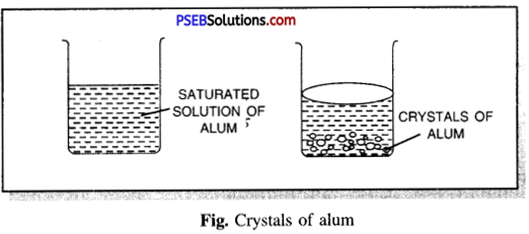
A saturated solution is that solution in which no more solute can be dissolved at a particular temperature. An unsaturated solution is that solution in which more solute can be dissolved at a particular temperature.

Question (iii)
Explain different types of threshing.
Answer:
Threshing can be done in following three ways:

  1. Manual threshing : It is done by beating the stalks with sticks on the ground or beating against any hard object.
  2. Threshing by Animals : Some animals like bullocks are allowed to trample the stalks.
  3. Threshing by Machine. Threshers are generally used for this purpose.

7. Long Answer Type Questions:

Question (i)
Explain the following methods of separation.
(1) Threshing.
(2) Winnowing.
(3) Sieving.
Answer:
(1) Threshing. Threshing is separation of grains from chaff. It can be done using any one method out the three i.e. (a) manual (b) with the help of Animals and (c) using machines.

(2) Winnowing. Winnowing is a method to separate heavier and lighter components of a mixture by wind or by blowing air.
Winnowing is an agricultural method for separating grains from chaff. It is also used to remove hay and chaff or other pests from stored grains.

(3) Sieving. It is a method to separate larger substances from smaller substances using a sieve. It is very easy and cheap method of separation. Components of same sizes in a mixture cannot be separated. For example, you cannot separate chalk powder from flour.

PSEB 6th Class Science Solutions Chapter 5 Separation of Substances

Question (ii)
What is separation ? Why do we need to separate different components of a mixture ?
Answer:
Separation. Separation means process of moving something apart.
We need to sep.arate a mixture into its different components because of the following reasons :

  1. To remove the useless or harmful components. For example, removing tea leaves after making tea.
  2. To obtain the useful component. For getting wheat/rice grains after separating husk, dirt etc.
  3. To remove impurities for getting a pure sample. For example – obtaining sugar crystals from sugarcane juice or salt from sea water.

PSEB 6th Class Science Guide Separation of Substances Important Questions and Answers

Multiple choice questions:

Question 1.
Salt is separated from sea water by :
(a) Evaporation
(b) Decantation
(c) Condensation
(c) Filtration.
Answer:
(a) Evaporation

Question 2.
Cottage cheese (Paneer) is made by adding to milk :
(a) lemon juice
(b) salt
(c) water
(d) tea leaves.
Answer:
(a) lemon juice

Question 3.
Fruit and vegetable juices are filtered to separate :
(a) Seeds
(b) Pulp
(c) Impurities
(d) seeds, pulp and impurities.
Answer:
(d) seeds, pulp and impurities

Question 4.
Filter paper is used in method :
(a) Sieving
(b) Filtration
(c) Condensation
(d) None.
Answer:
(b) Filtration

Question 5.
Sand and sawdust are separated by using method:
(a) Sieving
(b) Winnowing
(c) Hand picking
(d) All.
Answer:
(b) Winnowing

Question 6.
The purity of a substance is determined by:
(a) melting point
(b) colour
(c) source
(d) quantity.
Answer:
(a) melting point

PSEB 6th Class Science Solutions Chapter 5 Separation of Substances

Question 7.
The process in which liquid changes into vapours is:
(a) Sedimentation
(b) Filtration
(c) Evaporation
(d) Decantation.
Answer:
(c) Evaporation

Fill in the Blanks:

(a) Tea …………… are separated from liquid with a strainer.
Answer:
leaves

(b) We ……………… cotton to separate its seeds from the fibre.
Answer:
gin

(c) Butter is taken out by ……………… milk.
Answer:
churning

(d) Pieces of stone and husk are separated from wheat, rice or pulses by ………………
Answer:
hand picking

(e) ……………… are also used for threshing grains.
Answer:
machines

(f) Winnowing is used to separate ……………. and ……………. components of a mixture by blowing air.
Answer:
heavier, lighter

(g) Pebbles and stones are removed from sand by ………………
Answer:
sieving

PSEB 6th Class Science Solutions Chapter 5 Separation of Substances

(h) Larger quantities of salt can be dissolved in water on ………………
Answer:
heating

(i) A solution is prepared by …………….. a substance into a liquid.
Answer:
dissolving

(j) Water dissolves different substances in …………….. amounts.
Answer:
different

Write (T) against true and (F) against false statements :

(a) We cannot separate guavas and mangoes by hand picking.
Answer:
False

(b) We separate stones from rice to throw away them.
Answer:
True

(c) Grain seeds can be plucked like guavas.
Answer:
False

(d) Husk is used as a fodder for cattle.
Answer:
True

(e) Rice and pulses are washed before cooking.
Answer:
True

(f) For separating tea leaves, decantation method is used.
Answer:
False

PSEB 6th Class Science Solutions Chapter 5 Separation of Substances

(g) We cannot remove soil from water.
Answer:
False

(h) Paneer can be separated by using a strainer.
Answer:
True

(i) Sea water evaporates continuously.
Answer:
True

(j) Water drops cannot be condensed on cooling.
Answer:
False

Very Short Answer Type Questions

Question 1.
Give few examples of mixture.
Answer:
Air, sea water, soil, rock salt.

Question 2.
What is Churning ?
Answer:
Churning. It is process in which milk is stirred (rotated) to get the lighter particles of butter separated on the surface.

Question 3.
What is Decantation ?
Answer:
Decantation. It is process in which two immiscible liquids are separated by allowing them to stand for some time till they form two separate layers.

Question 4.
By which method heavy and light particles of a solid mixture are separated ?
Answer:
Winnowing.

PSEB 6th Class Science Solutions Chapter 5 Separation of Substances

Question 5.
Which materials are used as filters ?
Answer:
Porous materials such as thin muslin cloth and filter paper and nylon net.

Question 6.
Name some mixtures found in nature.
Answer:
Milk, Sea-water, Jaggery.

Question 7.
Give an example of a gaseous mixture.
Answer:
Air.

Question 8.
How will you separate a mixture of water and cooking oil ?
Answer:
By separating funnel.

Short Answer Type Questions

Question 1.
What is a mixture ? Give four examples of mixture.
Answer:
Mixture. A mixture is a substance which consists of two or more elements or compounds not chemically combined together in any ratio.
Examples : Air, sea water, soil, rock salt.

Question 2.
Write two properties of mixture.
Answer:

  1. The constituents are not present in a fixed ratio.
  2. It does not have a fixed melting and boiling point.
  3. The various components of the mixture can be separated easily by physical methods.

Question 3.
How is salt separated from sea water ?
Answer:
Separation of Salt from Sea water. Water is collected in flat-square fields (lagoons) near the sea. It is allowed to stand for few days. Now water gets evaporated in the sun leaving behind crude crystals of salt. This crude salt is purified to get pure salt.

Question 4.
What is the criteria of separating the components of a mixture ?
Answer:
While choosing a method of separating different components of mixture, physical properties of components are considered.

PSEB 6th Class Science Solutions Chapter 5 Separation of Substances

Question 5.
Which methods are used to separate a mixture of sand, black gram (urad) and husk ?
Answer:
At first winnowing process is used to remove husk. Then sand is separated by using sieving process.

Question 6.
What is a solution ?
Answer:
Solution. A solution is a homogeneous mixture of a solid in a liquid. It can be prepared by dissolving a solid substance in a liquid.

Question 7.
What is saturated solution ?
Answer:
Saturated Solution. A solution which cannot dissolve more of the solute at the same temperature in it, is said to be saturated solution.

Long Answer Type Questions

Question 1.
What is filtration ? Write few activities where this method is being used.
Answer:
Filtration. The process of separating components of a mixture of an insoluble solid and a liquid is called filtration.
Activities in which filtration is used :

  1. Fruits and vegetable juices to separate the seeds and solid particles of pulp.
  2. Cottage cheese preparation to separate the whey.
  3. Tea preparation to separate tea leaves.

Question 2.
What are different methods of separating mixtures ? Explain any two of them.
Answer:
There are many methods of separating mixtures :
They are :

  1. Hand Picking
  2. Threshing
  3. Winnowing
  4. Sieving
  5. Sedimentation
  6. Decantation
  7. Filtration
  8. Evaporation
  9. Condensation.

1. Sedimentation.
The process of separating light and heavier components of a mixture by allowing it to stay undisturbed, is called sedimentation.
In this process, the mixture is dissolved in water. The heavier particles tend to settle down at the bottom and the lighter particles make the water muddy or just float on it. When this solution is allowed to stand for some time then a separate layer of heavier particles can be seen at the bottom.

This process is known as Sedimentation. The upper layer of impure water is removed to get a pure sample of substances e.g. rice, pulses, etc. are washed with water to get rid of dust and soil particles and husk components which are light and get removed by water easily.

2. Evaporation.
The process of conversion of water into its vapours is called evaporation. This process is continually taking place all around us. For vapour formation, heat is needed which is provided by sunlight.

PSEB 8th Class Science Solutions Chapter 8 Cell Structure and Functions

Punjab State Board PSEB 8th Class Science Book Solutions Chapter 8 Cell Structure and Functions Textbook Exercise Questions and Answers.

PSEB Solutions for Class 8 Science Chapter 8 Cell Structure and Functions

PSEB 8th Class Science Guide Cell Structure and Functions Textbook Questions and Answers

Answer These

Question 1.
Indicate whether the following statements are True [T] or False [F].
(a) Unicellular organisms have one-celled bodies.
Answer:
True

(b) Muscle cells are branched.
Answer:
False

(c) The basic living unit of an organism is an organ.
Answer:
False

(d) Amoeba has irregular shape.
Answer:
True

PSEB 8th Class Science Solutions Chapter 8 Cell Structure and Functions

Question 2.
Make a sketch of the human nerve cell. What function do nerve cells perform ?
Answer:
PSEB 8th Class Science Solutions Chapter 8 Cell Structure and Functions 1
Functions of Nerve Cell:

  1. It receives and transfers messages.
  2. It control and co-ordinate the functioning of different parts of the body.

Question 3.
Write short notes on the following :
(a) Cytoplasm
(b) Nucleus of a cell.
Answer:
(a) Cytoplasm.
It is a jelly-like fluid present inside the cell membrane. Various cell organelles are present in it. It contains water, sugar, minerals, lipids proteins etc.

(b) Nucleus.
As true nucleus is present in all the eukaryotic cells except mammalian RBCs, sieve tube cells, tracheids and vessels. It is formed of four components:
(i) Nuclear Membrane.
It is a two-layered envelope around the nuclear sap. It is porous (with nuclear pores) and semi-permeable membrane. Outer membrane is studded with ribosomes. It regulates exchange of materials between nucleoplasm and cytoplasm.

(ii) Nucleoplasm.
It is a semifluid colloidal substance in which nucleoli and chromatin fibres are present. It acts as nuclear skeleton and forms spindle for the cell division.

(iii) Nucleolus.
It is dense, spherical, naked and darkly stained structure and it is site of formation and store house of RNA.
PSEB 8th Class Science Solutions Chapter 8 Cell Structure and Functions 2
(iv) Chromatin Fibres.
These are long, fine and darkly stained threads which collectively form nuclear reticulum. During prophase of mitosis and meiosis, these condense to form a specific number of rods, called chromosomes. These are embedded with genes which are chemically formed of DNA and act as units of heredity and variation. They also help in the synthesis of structural and enzymatic protein.

Question 4.
Which part of the cell contains organelles ?
Answer:
Cytoplasm contains organelles.

Question 5.
Make sketches of animal and plant cells. State three differences between them.
Or
State four differences between animal and plant cells.
Answer:
Animal cells differ from plant cells in the following definite ways :

Plant cells Animal cells
1. Plant cells have cell wall made up of cellulose. 1. Animal cells have no such walls and no cellulose.
2. Plant cells have chloroplasts. 2. Animal cells do not possess the chloroplasts.
3. Plants cells have thin cytoplasm and large vacuole. 3. Animal cells have thick cytoplasm with no vacuole.
4. Centrosome absent. 4. Centrosome present.
5. Reserve food is in the form of starch. 5. Reserve food is in the form of glycogen and param sylum.

PSEB 8th Class Science Solutions Chapter 8 Cell Structure and Functions 3

Question 6.
State the difference between eukaryotes and prokaryotes.
Answer:
Eukaryotes.
These are the organisms whose cells contain well defined nucleus with a clear nuclear membrane. Examples are onion cells, cheek cells.

Prokaryotes.
These are the organisms whose cells have no definite nucleus i.e. without nuclear membrane. Examples are bacteria, blue green algae.

PSEB 8th Class Science Solutions Chapter 8 Cell Structure and Functions

Question 7.
Where are chromosomes found in a cell ? State their function.
Answer:
Chromosomes are found in nucleus of a cell. Chromosomes carry genes and help in inheritance or transfer of characters from the parents to the offspring.

Question 8.
‘Cells are the basic structural units of living organisms’. Explain.
Answer:
As a building cannot be constructed without bricks. Similarly, a body of living organism has basic structural unit such as cell. Cells are of different size, shapes and group together to form organs, organ systems etc.

Question 9.
Explain why chloroplasts are found only in plant cells ?
Answer:
Chloroplast are green coloured plastids. They impart green colour to plants and only plants make use of green colour to synthesis food.

Question 10.
Complete the crossword with the help of clues given below.
Across
1. This is necessary for photosynthesis.
3. Term for component present in the cytoplasm.
6. The living substance in the cell.
8. Units of inheritance present on the chromosomes.

Down
1. Green plastids.
2. Formed by collection of tissues.
4. It separates the contents of the cell from the surrounding medium.
5. Empty structure in the cytoplasm.
7. A group of cells.
PSEB 8th Class Science Solutions Chapter 8 Cell Structure and Functions 4
Answer:
PSEB 8th Class Science Solutions Chapter 8 Cell Structure and Functions 5

PSEB Solutions for Class 8 Science Cell Structure and Functions Important Questions and Answers

Multiple Choice Questions

Question 1.
A slide is given in the figure below. What does this show ?
PSEB 8th Class Science Solutions Chapter 8 Cell Structure and Functions 6
(a) Cork cells
(b) Onion membrane
(c) Unicellular organism
(d) Multicellular Organism.
Answer:
(b) Onion membrane.

PSEB 8th Class Science Solutions Chapter 8 Cell Structure and Functions

Question 2.
What is the name of basic structural unit in living organism ?
(a) Tissue
(b) Organ of body
(c) Cell
(d) Molecule.
Answer:
(c) Cell.

Question 3.
Which out of the following cell-organ is found in plants only ?
(a) Mitochondria
(b) Chloroplast
(c) Cell membrane
(d) Nucleus
Answer:
(b) Chloroplast.

Question 4.
Which organism is not unicellular ?
(a) Bacteria
(b) Amoeba
(c) Paramecium
(d) Algae or mould
Answer:
(d) Algae or mould.

Question 5.
Which of the cell organelle synthesise protein ?
(a) Lysosome
(b) Chromosome
(c) Ribosome
(d) Centrosome
Answer:
(c) Ribosome.

Question 6.
Who discovered cell ?
(a) Robert Hook
(6) M.J. Schleiden
(c) Schwann
(d) Robert Brown
Answer:
(a) Robert Hook

Question 7.
Which cell organelle is called suicidal bag ?
(a) Ribosome
(b) Lysosome
(c) Chromosome
(d) Centrosome
Answer:
(b) Lysosome

PSEB 8th Class Science Solutions Chapter 8 Cell Structure and Functions

Question 8.
Which out of the following is unicellular organism?
(a) Amoeba
(b) Paramecium
(c) Bacteria
(d) All of these.
Answer:
(d) All of these.

Question 9.
Which is the power-house of cell?
(a) Centrosome
(b) Chloroplast
(c) Mitochondria
(d) Ribosome.
Answer:
(c) Mitochondria.

Question 10.
Name a human cell which can change its shape.
(a) White blood cells
(b) Red blood cells
(c) Platelets
(d) Plasma
Answer:
(b) Red blood cells.

Question 11.
Which organ of the cell is found in plant cell only?
(a) Cell wall
(b) Chromosome
(e) Nucleus
(d) Cytoplasm
Answer:
(a) Cell wall.

Question 12.
Which is the longest cell of human body?
(a) Nerve cell
(b) Muscular cell
(c) Red blood cells ,
(d) White blood cells
Answer:
(a) Nerve cell.

Question 13.
Of what the cell wall is made?
(a) Fat
(b) Cellulose
(c) Protein.
(d) Mineral Salt.
Answer:
(b) Cellulose.

PSEB 8th Class Science Solutions Chapter 8 Cell Structure and Functions

Very Short Answer Type Questions

Question 1.
Fill in the blanks.
1. The cell is the …………………. and functional unit of organism.
2. Cell wall is found in ……………….. cells.
3. Power house of the cell is ………………….
4. Amoeba and Paramecium consists of a single …………………
5. Plastids are present only in ……………….. cells.
Answer
1. structural
2. plant
3. mitochondrion
4. cell
5. plant.

Question 2.
Choose the correct answer.
1. Suicidal bags of cells are ?
(a) Lysosomes
(b) Chloroplast
(c) Mitochondria
(d) Ribosomes.
Answer:
(a) Lysosomes

2. Plant cells do not have:
(a) Cell wall
(b) Centrosomes
(c) Plastids
(d) Mitochondria.
Answer:
(b) Centrosomes.

Question 3.
What is structural and functional unit of life ?
Answer:
Cell.

Question 4.
What is the contribution of Robert Brown in cell biology ?
Answer:
He discovered nucleus in the cells of orchid.

Question 5.
Who proposed the cell theory ?
Answer:
M.J. Schleiden and Theodore Schwann.

Question 6.
Name the smallest and largest cell.
Answer:
Smallest cell – Mycoplasma.
Largest cell – Ostrich egg.

Question 7.
Name the smallest and largest cell of human body.
Answer:

  1. Smallest cell – nephron.
  2. Largest cell – neuron.

Question 8.
Who called the protoplasm as the physical basis of life ?
Answer:
Huxley.

PSEB 8th Class Science Solutions Chapter 8 Cell Structure and Functions

Question 9.
Give the contribution of Rudolf Virchow in the field of biology.
Answer:
He stated “omnis cellula e cellula” which means new cells are formed by the growth and division of pre-existing cells.

Question 10.
What are two types of cells on the basis of nature of nucleus ?
Answer:
Prokaryotic and Eukaryotic cells.

Question 11.
What is nucleoid ?
Answer:
Nucleoid. It is incipient nucleus of prokaryotes like bacteria and blue-green algal cells and is without nuclear membrane.

Question 12.
What is contribution of Robert Hooke in the field of cell biology ?
Answer:
Robert Hooke discovered the cell.

Question 13.
What are the three functional regions of a cell ?
Answer:
Plasma membrane, cytoplasm, nucleus.

Question 14.
Give the primary function of plasma membrane.
Answer:
It regulates exchange of material between cytoplasm and extra-celluar fluid.

Question 15.
Name the smallest sized cell organelle.
Answer:
Ribosome.

Question 16.
Which cell organelle is called suicidal bag ?
Answer:
Lysosome.

PSEB 8th Class Science Solutions Chapter 8 Cell Structure and Functions

Question 17.
Name the largest sized cell organelle.
Answer:
Plastids.

Question 18.
Which cell organelle is called cell centre ?
Answer:
Centrosome.

Question 19.
What are organs ?
Answer:
Organs. Various body parts of animals and plants are called organs.

Question 20.
Who coined the word ‘Cell’ ?
Answer:
Robert Hooke.

Question 21.
Why Robert Hooke coined the word cell ?
Answer:
Robert Hooke was excited when he observed spaces in a cork slice those appeared like honeycomb. He called these compartments as cells.

Question 22.
Name some organs of plants.
Answer:
Roots, stem, leaves, flower, fruit.

Question 23.
Write examples of unicellular organisms.
Answer:
Amoeba, Paramecium, Bacteria, etc.

PSEB 8th Class Science Solutions Chapter 8 Cell Structure and Functions

Question 24.
What is size of the smallest cell ?
Answer:
0.1 micron (μm) i.e. ten thousandth part of a millimetre.

Question 25.
What is yellow yolk in the egg of a hen ?
Answer:
It represents single cell.

Question 26.
Write the size of largest cell observable with naked eyes.
Answer:
170 mm.

Question 27.
What are cell organelles ?
Answer:
The parts of a cell are called cell organelles.

Question 28.
What role does cell membrane play in a cell ?
Answer:
Cell membrane encloses a liquid substance known as protoplasm. It regulates the flow of substances both into the cell and out of it.

Question 29.
Name four major elements responsible for protoplasm.
Answer:
Carbon, Hydrogen, Oxygen, Nitrogen.

PSEB 8th Class Science Solutions Chapter 8 Cell Structure and Functions

Question 30.
What is nucleoplasm ?
Answer:
Nucleoplasm. It is the liquid protoplasm in the nucleus.

Question 31.
Who controls the activities of a cell ?
Answer:
Nucleus.

Question 32.
What do chromosomes do ?
Answer:
Chromosomes help in inheritance or transfer of characters from the parents to next generation.

Question 33.
What are chloroplasts ?
Answer:
The green plastids in the plants are called chloroplasts.

Question 34.
What is the shape of mitochondria ?
Answer:
Rod-shaped or spherical.

Question 35.
Name the power house of a cell.
Answer:
Mitochondria.

PSEB 8th Class Science Solutions Chapter 8 Cell Structure and Functions

Short Answer Type Questions

Question 1.
What is a cell ?
Answer:
Cell.
Just as the bricks are the units of all types of houses, the cells are the units or building blocks of living organisms. Animals and plants like ant, housefly, dog, elephant, sunflower, neem etc. consist of cells.

Question 2.
Write the names of cell organelles.
Answer:
Cell Organelles.
Cell organelles are living strictures of cytoplasm. These include : Endoplasmic reticulum, Golgi apparatus, mitochondria, ribosomes, lysosomes, peroxisomes, plastids, sphaerosomes, glyoxysomes, centrosome. microtubules, microfilaments, cilia and flagella.

Question 3.
What is the difference between the plasma membrane and cell wall ? Give the functions of each one.
Answer:

Characters Plasmsa membrane Cell Wall
1. Occurrence Around the protoplasm of all the cells. Outside the plasma membrane in plant cells, bacteria, blue-green algae, fungi etc.
2. Nature Thin and selective permeable. Thick and freely permeable.
3. Chemistry Lipoproteinous and trilaminar. Formed of cellulose hemicellulose, pectin, water, etc.
4. Function Regulates the exchange of materials between cytoplasm and extracellular fluid. It is protective and supportive in function. It provides definite shape and prevents evaporation of water.

Question 4.
Which cell organelle is called “suicidal bag” and why ?
Answer:
Lysosome is commonly called suicidal bag of cell. It is so as it contains hydrolytic enzymes which help in digestion of foreign food or bacteria (by heterophagy) ; or reserve food or certain cell organelles (by autophagy) ; or the whole cell after the cell death (by autolysis).

PSEB 8th Class Science Solutions Chapter 8 Cell Structure and Functions

Question 5.
Which cell organelle is called “power house” of the cell ? Write about its function briefly.
Answer:
Mitochondrion is commonly called “power house” of the cell because it is site of oxidative breakdown of glucose in aerobic cell respiration to produce energy- rich ATP molecules. One mole of glucose, in aerobic respiration, produces 36 ATP molecules.

Question 6.
Define the following terms :
(a) Protoplasm
(b) Cytoplasm
(c) Nucleoplasm.
Answer:
(a) Protoplasm is the physical basis of life and lies inside the cell membrane. It includes both cytoplasm and nucleoplasm.

(b) Cytoplasm lies between the cell membrane and nucleus. It contains various types of cell-organelles and cell-inclusions. It undergoes cyclosis. It is the site of protein synthesis, glycolysis, etc.

(c) Nucleoplasm lies inside the nucleus and contains only nucleoli and chromatin fibres. It does not undergo cyclosis. It forms spindle during cell division.

Question 7.
Draw a labelled diagram of plant and animal cell.
Answer:
PSEB 8th Class Science Solutions Chapter 8 Cell Structure and Functions 7

Question 8.
Describe the variations in shape and size of cells.
Answer:
The cells are generally round or spherical in shape. However, there is lot of variations in shape of cells. These can be cuboidal and columnar. Some of the animal cells are long and branched as in nerve cells.

PSEB 8th Class Science Solutions Chapter 8 Cell Structure and Functions

Question 9.
What are unicellular and multicellular organisms ?
Answer:
Unicellular Organisms. The organism whose body is made of only a single cell is called a unicellular organism, e.g. Amoeba, Paramecium, Chlamydomonas, Yeast, Euglena etc.
PSEB 8th Class Science Solutions Chapter 8 Cell Structure and Functions 8
Multicellular Organisms. The organisms whose body is made of many cells is called a multicellular organisms, e.g. Man, Hydra, Dog, Elephant etc.

Question 10.
WTiat are organs and organ systems ?
Answer:
Organ. A group of tissues which perform a definite function of the body is called an organ.
Organ System. A group of organs which do a big job is called an organ system.

Question 11.
Draw the diagrams of different kinds of cells.
Answer:

Question 12.
How was the first cell discovered?
Answer:
PSEB 8th Class Science Solutions Chapter 8 Cell Structure and Functions 10
Robert Hooke in 1665 observed slices of cork under a simple magnifying device. Cork is part of the bark of a tree. He took thin slices of cork and observed them under his microscope. He noticed partitioned boxes or compartments in the cork slice. These boxes appeared like a honey comb.

He also noticed that one box was separated from the other by a wall or partition. Hooke coined the term ‘cell’ for each box. Cell in Latin means ‘hollow space.’

Question 13.
Discuss about the various shapes of cells.
Answer:
PSEB 8th Class Science Solutions Chapter 8 Cell Structure and Functions 11
Generally cells are round, spherical or elongated. Some cells are long and pointed at both ends. They exhibit spindle shape. Cells sometimes are quite long and thread like. Some are branched like the nerve cell or neuron.

PSEB 8th Class Science Solutions Chapter 8 Cell Structure and Functions

Question 14.
Differentiate between unicellular and multicellular organisms.
Answer:
Differences between unicellular and multicellular organisms.

Unicellular Organisms Multicellular Organisms
1. These organisms are made of only one cell. 1. These organisms are made of many cells.
2. All functions of body are performed by only a single cell. 2. Each function of the body is performed by a group of special cells.
3. Cilia are found.

Examples. Amoeba, Paramecium etc.

3. Cilia are not found.

Examples. Almost all animals.

Long Answer Type Questions

Question 1.
Describe the structure of a typical cell in detail.
Answer:
Structure of cell
A cell is the basic unit of life. It is capable of performing all functions of life and to fulfil all the functions, cell is made up of different parts. Basically, a cell is formed of three parts:
1. Cell membrane or plasma membrane
2. Nucleus.
3. Cytoplasm.

The cytoplasm is surrounded by cell membrane and nucleus constitutes the protoplasm of a cell. The typical structure of plant and animal cells are shown ahead:

1. Cell Membrane.
It is a delicate, thin membrane. It is also called plasma membrane. It forms the outermost layer in animals but in plant cells an additional membrane is present. It is called cell membrane in animal’s cell and cell wall in plant’s cell. Cell membrane has following functions:
(i) It provides shape to the cell.
(ii) It allows the flow of some substances into the cell and out of the cell.
(iii) It acts as a barrier to protect internal parts.
PSEB 8th Class Science Solutions Chapter 8 Cell Structure and Functions 12

2. Nucleus.
The oval or spherical structure, which is the controlling centre of all activities of the cell is called nucleus. Nucleus is made up of following parts:
(i) Nuclear Membrane. It is the membrane having pores which separates contents of nucleus from cytoplasm.
(ii) Nucleoplasm. The fluid present in nucleus is called nucleoplasm.
(iii) Nucleolus. Small spherical body made up of nucleoprotein. RNA is also present in nucleus.
(iv) Chromatin Material. Several thread like structures forming a network are present in nucleoplasm. Chromatin material is in the form of chromosomes which carries genes on it.

The nucleus has following functions:
Chromatin material of nucleus transmits characters from one generation to other.
It contains informations for carrying out all basic functions.

3. Cytoplasm.
The jelly like fluid inside the membrane of cell is cytoplasm. All tiny structures performing different functions, are present in it. These are called organelles.

It also contains water, sugar, minerals, lipids, proteins etc. The various cell organelles present in cytoplasm are:
(i) Mitochondria. They are commonly called Tower house of the cell’ because they help in release of energy from food. They also store energy. Mitochondria (singular mitochondrion) are oval or rod shaped organelle bounded by two membranes.

(ii) Endoplasmic Reticulum. A complex network of membranes which are present either attached to nucleus or free from it are endoplasmic reticulum. Its network extends from nuclear membrane to cell membrane. It helps in protein synthesis and also in transport of various substances.

(iii) Plastids. These organelles are present only in plant cells. These are of three types:
(а) Chloroplasts. Green coloured plastids are chloroplasts. The green colour is due to the presence of pigment chlorophyll. They are commonly known as ‘Kitchen of the’ cell’ because chloroplasts are the site of photosynthesis i.e. process of making food.

(b) Leucoplasts. Colourless plastids are called leucoplasts. These are present in the roots and underground modified stems.

(c) Chromoplasts. These are coloured plastids. These are present mainly in flowers, petals and fruits.

(iv) Golgi Bodies. These are membrane-bound, piles of many flattened sacs. In plants, Golgi bodies are known as dictyosomes. They are mainly secretory in function.

(v) Vacuoles. The fluid-filled organelles present in a cell are vacuoles. In-plant cells, vacuoles are few in number and larger in size whereas, in animals, they are more in number and smaller in size. They maintain the turgidity of plants cells. Vacuoles also serve as a waste deposit bin in which unwanted materials may be diverted.

(vi) Lysosomes. Small spherical bodies having a single membrane are lysosomes. They sacrifice their own selves to destroy and digest various materials. They are also called ‘suicidal bags’. Plant cells do not have lysosomes.

(vii) Ribosomes. These are small rounded bodies that are present free or attached with the endoplasmic reticulum. They perform the function of protein synthesis.

(viii) Centrosome. It is a rod-like structure. It occurs close to the nucleus and helps in cell division.

PSEB 7th Class Science Solutions Chapter 9 Soil

Punjab State Board PSEB 7th Class Science Book Solutions Chapter 9 Soil Textbook Exercise Questions and Answers.

PSEB Solutions for Class 7 Science Chapter 9 Soil

Science Guide for Class 7 PSEB Soil Intext Questions and Answers

Think and Answer (Textbook Page No. 103)

Question 1.
What is the chemical nature of the soil having pH is 3 ?
Answer:
The chemical nature of soil with pH value is acidic.

Question 2.
What is the chemical nature of soil having pH 10 ?
Answer:
Soil with pH value of 10 is alkaline.

PSEB 7th Class Science Solutions Chapter 9 Soil

Question 3.
Write down the pH of neutral soil.
Answer:
Neutral soils have pH of 7.

Think and Answer (Textbook Page No. 104)

Question 1.
In which type of soil rate of percolation is highest ?
Answer:
Sandy soils have the highest water leaching (leakage) rate.

Question 2.
Which soil has maximum water retention capacity ?
Answer:
Clay by soil has the highest water retention capacity.

Think and Answer (Textbook Page No. 106)

Question 1.
Why is soil tilled or ploughed ?
Answer:
Soil is ploughed to make the soil loose and porous.

Question 2.
What is the use of air present in soil ?
Answer:
The roots of the plants use the air present in the soil.

PSEB 7th Class Science Guide Soil Textbook Questions and Answers

1. Fill in the Blanks:

(i) The top layer of earth upto a depth of 30-40 cm where crops can grow is called ………………..
Answer:
Soil

(ii) A section of earth shows …………………. of soil.
Answer:
Layers

(iii) Acidic nature or alkaline nature of soil can be tested by using a …………………. .
Answer:
pH paper

(iv) ………………… has the finest particles which can even pass through muslin cloth.
Answer:
Clayey soil

PSEB 7th Class Science Solutions Chapter 9 Soil

(v) ………………. soil has least water retention capacity.
Answer:
sand

(vi) ……………….. soil is best for growing crops.
Answer:
Loamy and clayey

(vii) In western states of India like Gujarat and Maharashtra, the soil is of ………………… colour.
Answer:
Black

(viii) ………………… is used by potters for making earthen pots.
Answer:
Clay

(ix) The soil which is used for making cement is ………………….. .
Answer:
Clayey soil

(x) Bricks are made from ………………….. .
Answer:
sandy soil

2. State True or False:

(i) pH paper is used to test the acidic or alkaline nature of soil.
Answer:
True

(ii) Below a depth of 100 cm, the layer of earth is called soil.
Answer:
False

PSEB 7th Class Science Solutions Chapter 9 Soil

(iii) All crops grow better in sandy soil.
Answer:
False

(iv) Overgrazing of pasture lands is also responsible for soil erosion.
Answer:
True

(v) Mining can check soil erosion.
Answer:
False

(vi) Water can easily percolate through clayey soils.
Answer:
False

3. Match the Column ‘A’ with Column ‘B’:

Column ‘A’ Column ‘B’
1. Water can easily percolate through (a) Pollution of soil
2. This soil is best for growing cotton. (b) Soil erosion
3. Polythene, plastic and use of insecticides cause (c) Clay
4. Mining, overgrazing and deforestation cause (d) Black Soil
5. This soil is used in the manufacture of cement (e) Sandy Soil

Answer:

Column ‘A’ Column ‘B’
1. Water can easily percolate through (e) Sandy Soil
2. This soil is best for growing cotton. (d) Black Soil
3. Polythene, plastic and use of insecticides cause (a) Pollution of soil
4. Mining, overgrazing and deforestation cause (b) Soil erosion
5. This soil is used in the manufacture of cement (c) Clay

4. Choose the Correct Answer:

Question (i)
Which of these does not cause soil erosion ?
(a) Deforestation
(b) Building of check dams
(c) Grazing cattle
(d) Mining.
Answer:
(b) Building of check dams.

Question(ii)
Soil is polluted by:
(a) Rotation of crops
(b) Use of manure
(c) Use of insecticides and chemical fertilizers
(d) Using green manure.
Answer:
(b) Use of manure.

PSEB 7th Class Science Solutions Chapter 9 Soil

Question (iii)
Soil is not used for:
(a) Making insecticides
(b) Making check dams
(c) Making cement
(d) Making earthen pots
Answer:
(c) Making cement.

Question (iv)
Which of the following can check soil erosion ?
(a) Deforestation
(b) Afforestation
(c) Grazing of cattle
d) Mining.
Answer:
(c) Grazing of cattle.

Question (v)
Soil is used for.
(a) Making cement
(b) Growing crops
(c) Making Dams
(d) All of these.
Answer:
(c) Making Dams.

Very Short Answer Type Questions:

Question (i)
What is humus ?
Answer:
Humus. The dead and rotten leaves of plants or plants, insects or dead animals buried in the soil, animal dung, etc. combine to form organic matter of the soil called Humus.

Question (ii)
Name the organic constituents of soil.
Answer
Organic constituents of soil.

  1. Dead and decaying leaves of plants
  2. Bodies of dead animals
  3. Animal dung etc.

Question (iii)
Name the inorganic constituents of soil.
Answer
Inorganic components of Soil.

  1. sand,
  2. gravel,
  3. clay and
  4. mineral.

Question (iv)
What do you mean by loamy soil ?
Answer
Loamy soils. Soil whose particle size is between the size of sandy soil and clayey soil. This soil is best for crops.

Question (v)
Define soil erosion.
Answer:
Soil Erosion. Loss of topsoil due to strong winds, heavy rains, floods or other factors is called Soil erosion.

PSEB 7th Class Science Solutions Chapter 9 Soil

6. Short Answer Type Questions:

Question (i)
What is Soil Profile ?
Answer:
Soil Profile. A horizontal (or flat) Section passing through different layers of soil is called cut soil profile. The soil layout layers are as follows :

  1. organic layer,
  2. top soil,
  3. bottom soil. Soil,
  4. rock fragments,
  5. rocky solid floor.

Question (ii)
Draw a labelled diagram of a Soil Profile.
Answer:
PSEB 7th Class Science Solutions Chapter 9 Soil 1
Layers of Soil Profile:

  1. Mulch (organic layer)
  2. Top soil
  3. Sub soil
  4. Rock Fragments
  5. Bed rock

Question (iii)
How does sod get polluted ?
Answer:
Soil Pollution.
Soil pollution occurs due to the presence of unwanted and harmful substances in the soil. The soil is polluted by the following human activities:

1. Increased use of pesticides and chemical fertilizers. We use more pesticides and chemical fertilizers for higher crop yields. All these pesticides and chemical fertilizers remain in the soil due to their non-biodegradable nature which leads to soil contamination.

2. Waste of Industry. Many factories dumps their factory toxic waste in the surrounding areas, which results in soil pollution.

3. Polythene and plastic waste. Many chemicals are used in the manufacture of plastics and polythene. All plastics and polythene are non-biodegradable. When we throw plastic or polythene waste here and there then they remain lying in the soil due to which the soil becomes polluted.

Question (iv)
Why should we plant more bamboo plants ?
Answer:
Cattles need to be grazed in north-hilly and semi-mountainous areas. Grass is repeatedly eaten by cattle as a result of which the top layer of soil becomes bare and loose. As a result, the soil erodes quickly. Bamboo plants are very helpful in controlling soil erosion. So to prevent soil erosion plant as many plants as possible.

Question (v)
List the differences between clayey soil and sandy soil.
Answer:
Differences between clayey soil and sandy soil :

Clayey Soil Sandy Soil
(1) Particles of clayey soil are less than 0.005 mm in size. (1) Sand particles size vary from 0.05mm to 2mm.
(2) It contains humus. (2) It doesn’t contain humus.
(3) There is no empty space in its particles. (3) It has space in between its particles
(4) Doesn’t allow water to percolate. (4) It allows water to percolate through.
(5) It is used to make toys, utensils and sculptures (5) It is not used to make toys and utensils.
(6) It is sticky. (6) It is not sticky.

Question (vi)
What is a Check Dam ? Why is it built ?
Answer:
Check Dam.
Temporary or small dams are built on drains and canals in mountainous areas so that high speed water can be slowed down and used for irrigation. Doing so can help prevent soil erosion and maintain the fertility of the land. Apart from this, water is collected for irrigation for non-rainy days by stopping water during monsoon.

7. Long Answer Type Questions:

Question (i)
Explain how is soil formed ?
Answer:
Formation of Soil.
Many years ago the earth was hard and rocky. With the passage of time, the rocks were broken into small particles by earthquakes. Rain and river water turned these small particles into more fine particles and carried them away with them. This is how soil was formed.

PSEB 7th Class Science Solutions Chapter 9 Soil

Question (ii)
Explain the various factors responsible for soil erosion.
Answer:
Factors responsible for soil erosion:

  • Floods. Floods wash away the fertile topsoil. Sometimes the crops are washed away with flood water.
  • Wind and Storms. Very strong winds and storms blow away the topsoil and cause soil erosion.
  • Deforestation. When wild trees are failed down or the trees are uprooted, the soil becomes soft and loose and is easily washed away.
  • Over grazing. When animals repeatedly graze a grass field, the top layer of soil becomes bare and loose and is easily eroded.
  • Mining. Mining sand, gravel, or minerals become major fector for soil erosion.

Question (iii)
How is soil erosion checked ? Explain.
Answer:
The following steps are taken to check soil erosion:
(i) Planting of trees. Maximum number of local trees should be planted on barren hills and on flat lands grass should be grown. Bamboo plants are very, helpful in preventing erosion of the soil. Therefore, bamboo trees should be planted in hilly and semi-hilly areas.

(ii) Controlling the excavation of mines. Mining should be controlled. The digging should be done in such a way that the mining areas do not become pfond to landslides and soil erosion.

(iii) Grazing alternately. Animals should not be grazed continuously in the same area. After a while, the grazed place should be left empty and undisturbed and the animals should be grazed elsewhere.

(iv) Constructing check dams. Check dams should be constructed on small streams and drains in hilly areas. This will help to reduce soil erosion.

Question (iv)
Classify the soil on the basis of size of particles.
Answer:
Soil classification. Depending on the size of the particles, soil classified as sandy, rocky or loamy.

  • Clay. It is a soil whose particles are very fine, like dust and can also pass through muslin cloth. When water is added, it turns into mud and hardens on drying. Such clay is used to make pottery and utensils.
  • Sandy Soil. It’s particles are larger than clay particles. These particles cannot pass through the muslin cloth. Desert soils are usually sandy. Water is not retained in this type of soil.
  • Rocky Soils. Such soil particles are very large and can be picked by hand. Such particles cannot even pass through a filter.
  • Loamy Soil. The size of loamy soil particles is between the size of sand and clay particles. This type of soil is best for crops.

PSEB Solutions for Class 7 Science Soil Important Questions and Answers

1. Fill in the Blanks:

(i) The …………………. layer of earth in which crops can be grown is called soil.
Answer:
upper most

(ii) Particle size of ………………. soil lie between particle size of sand and clay.
Answer:
loam

(iii) The pH of ………………. soil lie between 8 to 14.
Answer:
Alkaline

(iv) Loss of top layer of soil is called ………………..
Answer:
soil erosion

PSEB 7th Class Science Solutions Chapter 9 Soil

(v) Inclusion of unwanted and harmful substances in the soil is called …………………
Answer:
soil pollution

2. Match the Column ‘I’ with Column ‘II’:

Column ‘I’ Column ‘II’
(i) A home for living organisms (a) Large particles
(ii) Upper layer of soil (b) All kinds of soil
(iii) Sandy soil (c) Dark in colour
(iv) Middle layer of the soil (d) Small particles and packed closely.
(v) Clayey soil (e) Lesser amount of humus

Answer:

Column ‘I’ Column ‘II’
(i) A home for living organisms (b) All kinds of soil.
(ii) Upper layer of soil (c) Dark in colour.
(iii) Sandy soil (a) Large particles.
(iv) Middle layer of the soil (e) lesser amount of humus
(v) Clayey soil (d) Small particles and packed closely.

3. Choose the Correct Answer:

Question (i)
The removal of top layer of soil by water and wind is called ……………………. .
(a) Soil pollution
(b) Soil erosion
(c) Soil profile
(d) Weathering.
Answer:
(b) Soil erosion.

Question (ii)
Which soil is the best for agriculture ?
(a) Loamy
(b) Sandy
(c) Clayey
(d) Sandy & Loamy.
Answer:
(a) Loamy.

Question (iii)
Which soil is better for pulse s ?
(a) Clayey
(b) Sandy
(c) Sandy and Loamy
(d) Loamy.
Answer:
(d) Loamy.

Question (iv)
Which layer of the soil is rich in minerals ?
(a) A-Horizon
(b) B-Horizon
(c) C-Horizon
(d) None of the above.
Answer:
(b) B-Horizon.

Question (v)
Which soil is well aerated ?
(a) Clayey
(b) Loamy
(c) Sandy and Loamy
(d) Sandy.
Answer:
(d) Sandy.

PSEB 7th Class Science Solutions Chapter 9 Soil

Question (vi)
The uppermost laver of earth’s crust is called
(a) Soil
(b) Wind
(c) Water
(d) None of the above.
Answer:
(a) Soil.

State True or False:

(i) Chemical fertilizers pollute the soil.
Answer:
True

(ii) From surface 30-40 cm deep layer of Earth in which plants can grow is called soil.
Answer:
True

(iii) The soil which contains iron salts is good for growing cotton.
Answer:
True

(iv) It only takes a few months for the top layer of soil to form.
Answer:
False

Very Short Answer Type Questions

Question 1.
What is soil ?
Answer:
Soil. The uppermost layer of earth’s crust is soil.

Question 2.
Are all the particles of soil of same size ?
Answer:
No, all the particles of soil are not of same size even the shape and colour of different soils is different.

PSEB 7th Class Science Solutions Chapter 9 Soil

Question 3.
On which factors, soil layers can be differentiated ?
Answer:
Soil colour, texture, depth and chemical composition.

Question 4.
Name the organisms found is soil.
Answer:
Worms, rodents, moles, beetles.

Question 5.
What is nature of bed rock ?
Answer:
Bed rock is hard in nature.

Question 6.
Which soil is well aerated ?
Answer:
Sandy soil.

Question 7.
Which soil is good for rice ?
Answer:
Clayey soil.

Question 8.
Which soil can retain more water ?
Answer:
Top soil.

Question 9.
Which type of soil is good for pulses ?
Answer:
Loamy soil.

PSEB 7th Class Science Solutions Chapter 9 Soil

Short Answer Type Qucstions

Question 1.
Explain the soil as a medium for growth of plants.
Answer:
Plants need soil to grow in as roots of plant take water and minerals from the soil. Soil also holds firmly the roots of plants, thus giving them support.

Question 2.
How can you call soil as a natural resource ?
Answer:
Soil as a natural resource. Soil is one of the most important natural land resource. Greenary on earth is possible only due to soil. Plants need soil to grow, for support and for nutrients.

Soil is main vital support to the living world. It provides the basic building material for shelter, bricks and mortar. Soil is also source of many elements such as aluminium, potassium etc. It also acts as good habitat for many organisms.

Question 3.
How is clayey soil useful for crops?
Answer:
Clayey soil has more power of retaining water. Clayey soil is rich in humus and is, therefore, very fertile. So it is good for crops.

Question 4.
Explain how soil pollution and soil erosion could be prevented.
Answer:
Prevention of Soil pollution:

  1. Ban on plastic and polythene bags.
  2. Treatment of waste before dumping it in the soil.

Prevention of soil erosion:

  1. Growing trees (cultivation)
  2. Crop rotation.
  3. Embankment of rivers.
  4. Afforestation.

Long Answer Type Question

Question 1.
Write uses of soil.
Answer:
Soil is the topmost layer of the earth’s crust. It is formed due to the breaking down of rocks by the action of heat from the sun, wind, and water.
Different uses of soil are:

  • Soil is one of the most important natural resources.
  • Soil supports the growth of plants by holding the roots firmly and supplying water and nutrients.
  • Soil is the home of many organisms.
  • Soil is essential for agriculture. Agriculture provides food, clothing, and shelter for all.
  • Soil is thus an inseparable part of our life.

PSEB 6th Class Science Solutions Chapter 8 Body Movements

Punjab State Board PSEB 6th Class Science Book Solutions Chapter 8 Body Movements Textbook Exercise Questions and Answers.

PSEB Solutions for Class 6 Science Chapter 8 Body Movements

Science Guide for Class 6 PSEB Body Movements Intext Questions and Answers

Think and Answer (Textbook Page No. 77)

Question 1.
What are the small bones present in backbone called ?
Answer:
The small bones present in the backbone are called vertebrae.

Question 2.
Name the ridges like bones which we feel when we touch our chest region.
Answer:
Ribs are the ridges like bones which we feel when we touch our chest region.

PSEB 6th Class Science Solutions Chapter 8 Body Movements

Think and Answer (Textbook Page No. 78)

Question 1.
When you tie a scale with your arm, are you able to bend your elbow ?
Answer:
No, the tied parts are unable to move and we are unable to bend our elbow. From this we can conclude that we cannot bend a single bone. This means we can bend our body only at joints where the bones meet together.

Question 2.
Name the points where two parts of body are seen to be joined together.
Answer:
The points where two parts of body are joined together are called joints.

Think and Answer (Textbook Page No. 80)

Question 1.
Move your arm at shoulder. Are you able to move it in various directions ? If yes name the type of joint present there.
Answer:
Yes, I am able to move my arm in all directions. Ball and socket joint is present between the arm and the shoulder.

Question 2.
Move your arm at elbow. Are you able to move it in various directions ? If yes name the type of joint present there.
Answer:
No, at elbow, I am not able to move my arm in all directions. Arm can be moved back and forth only. The joint present here is hinge joint.

PSEB 6th Class Science Guide Body Movements Textbook Questions and Answers

Exercise – 1

1. Fill in the Blanks :

(a) The points where bones meet are called ……………..
Answer:
joints

(b) Human skeleton is made up of …………….. and cartilages.
Answer:
bones

(c) Skull protects …………….. of body.
Answer:
brain

(d) Earthworm can extend or shorten its body by using its ……………….
Answer:
muscles

(e) Knee joint is an example of …………. joint.
Answer:
hinge

PSEB 6th Class Science Solutions Chapter 8 Body Movements

2. Write True or False:

(a) Rib cage is conical structure made up of 12 pairs of ribs.
Answer:
True

(b) Cartilages are harder than bones.
Answer:
False

(c) Bones do not need the help of muscles to move.
Answer:
False

(d) A streamlined body is one in which middle part of body is larger than head and tail part.
Answer:
True

(e) Snakes move very fast in a straight line.
Answer:
False

3. Match the Column A with Column B:

Column A Column B
1. Ball and Socket Joint (a) Skull bones
2. Immoveable Joint (b) Fingers
3. Hinge joint (c) Wrist bones
4. Pivot Joint (d) Shoulder
5. Gliding Joint (e) Movement of Head

Answer:

Column A Column B
1. Ball and Socket Joint (d) Shoulder
2. Immoveable Joint (a) Skull bones
3. Hinge joint (b) Fingers
4. Pivot Joint (e) Movement of Head
5. Gliding Joint (c) Wrist bones

4. Choose the Correct Answer:

Question (i)
Which of the following organ is protected by rib cage ?
(a) Heart
(b) Brain
(c) Eyes
(d) Ear.
Answer:
(a) Heart

PSEB 6th Class Science Solutions Chapter 8 Body Movements

Question (ii)
Snail moves with the help of :
(a) Shell
(b) Bones
(c) Muscular foot
(d) Cartilage
Answer:
(c) Muscular foot

Question (iii)
Fish maintains its balance in water and change its directions with the help of
(a) Head
(b) Gills
(c) Fins
(d) Body scales.
Answer:
(c) Fins.

Exercise – 2

5. Very Short Answer Type Questions:

Question (i)
Name the longest bone in human body.
Answer:
Femur is the longest bone in the human body.

Question (ii)
Name the type of joint where arms join the shoulder.
Answer:
Ball and socket joint.

Question (iii)
What is the difference between movement and locomotion ?
Answer:
Movement is a change in the position of any part of body of an organism whereas locomotion is movement of whole body of an organism from one place to another.

Question (iv)
Give an example of an organism which can walk, climb and fly.
Answer:
Cockroach.

6. Short Answer Type Questions:

Question (i)
Why we need a pair of muscles to move a bone ?
Answer:
The contraction and relaxation property of the muscles is the basis of movement of bones. Muscles always work in pairs. When one them contracts it pulls the bone in that direction in which it is bulged. The other muscle relaxes. Now to bring back the bone to the original position the relaxing muscle contracts and the contracting muscle relaxes.

Question (ii)
How does earthworm move ?
Answer:
The body of the earthworm is made up of many rings joined together. These rings are connected with the muscles which help to extend or shorten the body.

During movement the earthworm extends the front part of the body while its rear portion is fixed to the ground. Then it fixes the front part and releases the rear part. Then it shortens its bpdy and repeats the whole process. The body secretions of earthworm help in its movement.

PSEB 6th Class Science Solutions Chapter 8 Body Movements

Question (iii)
How does the body of a bird help it in flight ?
Answer:
Birds possess streamlined body, and hollow and light weight bones which help them during flight. The birds can fly because their streamlined bodies are well suited from flying. The hollow bones are lighter and the breast bones are modified to hold massive muscles of flight which are used to move the wings up and down. The birds have tails which direction during flight.

7. Long Answer Type Questions:

Question (i)
Explain different types of joints present in human body.
Answer:
Joint. A point where two bones meet is called a joint.
Joints are of two types :

(1) Fixed Joints or Immovable joints. The joints where the movement of the bones is not possible are called fixed or immovable joints. For example, upper jaw has fixed joint. The joints in the skull are fixed joints.

(2) Moveable joints. The joints where movement of the bones is possible are called moveable joints.
These are of four types

(a) Ball and Socket Joint. In this joint, a ball like rounded end of one bone fits into socket like cavity of the other bone. This joint allows the movement of the bones in all the directions. Joint between arm and shoulder is an example of this type of joint.

(b) Pivot Joint. In this type of joint, a cylinderical bone turns in a ring type bone. The cylinderical bone rotates inside the ring or the ring rotates outside the cylinder. The joint between skull and the vertebral column is an example of pivot joint. It allows the movement of head backward, forward, left and right.

(c) Hinge Joint. This joint is like hinge in the door. It allows movement of bones only in one direction i.e. up and down or front and back. Knee joint and elbow joint are the examples of the hinge joints.

(d) Gliding joint. This joint allows the bones to glide over each other providing only a little movement in all the direction. The examples of gliding joints are the joints between the ankle bones and wrist bones.

Question (ii)
Explain the locomotion in Fish.
Answer:
Fishes possess streamlined body in which tail and head of fish are smaller than the middle part of the body. Fishes also have certain special structures called fins that help ih movement from one place to another. During swimming, the front part of the body curves into one side and tail part remains on the opposite side. Thus a loop is formed. Fishes produce regular jerks by making such loops and pushes the body forward. Fins help to maintain balance and change directions while swimming.

PSEB Solutions for Class 6 Science Body Movements Important Questions and Answers

Multiple Choice Questions:

Question 1.
Name the animal which slithers on the ground.
(a) earthworm
(b) snail
(c) lizard
(d) snake.
Answer:
(d) snake

Question 2.
Rotation of an arm is due to:
(a) Hinge Joint
(b) Pivotal Joint
(c) Ball and Socket Joint
(d) Fixed Joint.
Answer:
(c) Ball and Socket Joint

Question 3.
Skull is made up of:
(a) many bones
(b) one bone
(c) three bones
(d) none of the above.
Answer:
(a) many bones

Question 4.
Outer skeleton of snail is made up of:
(a) bones
(b) muscles
(c) none
(d) both.
Answer:
(b) muscles

Question 5.
A fish swims in the sea with help of :
(a) tail fin
(b) side fins
(c) muscles on the body
(d) All the above.
Answer:
(d) All the above.

PSEB 6th Class Science Solutions Chapter 8 Body Movements

Fill in the Blanks:

(a) We bend or rotate our body at ……………….
Answer:
Joints

(b) ……………… joint allows movements in all directions.
Answer:
Ball and Socket

(c) Elbow joint is an example of ……………….. joint.
Answer:
hinge

(d) X-rays help to know the ……………. of the bones.
Answer:
shape

(e) Backbone, chest bone and ribs form a cage called ………………..
Answer:
rib cage

(f) Backbone is made up of many ……………. bones.
Answer:
Small

(g) The part of our body below stomach is enclosed by ………………..
Answer:
pelvic bones

(h) Skull protects the ……………………
Answer:
brain

PSEB 6th Class Science Solutions Chapter 8 Body Movements

(i) Cartilages are found in the …………… of the body.
Answer:
joints

(j) The movement of bones is due to …………… and ……………… of muscles.
Answer:
contraction, relaxation

(k) The body of earthworm is made up of many ……………… joined end to end.
Answer:
rings

(l) Snails move with the help of ………………..
Answer:
muscular foot

(m) The ………………. muscles move the wings when a cockroach flies.
Answer:
breast

(n) Snake moves forward in ……………… not in a straight line.
Answer:
loops

Write (T) against true and (F) against false statements:

(a) A snake jumps on the earth.
Answer:
False

(b) The hard structure of our body is muscle.
Answer:
False

PSEB 6th Class Science Solutions Chapter 8 Body Movements

(c) Movement of body is due to cartilage in the body.
Answer:
False

(d) The pivot joint join head on the neck.
Answer:
True

(e) Bones in head are joined by movable joints.
Answer:
False

(f) Wrist is made of only single bone.
Answer:
False

(g) A long and hard structure at the back of body is back bone.
Answer:
True

(h) The upper part of ear has small bones in it.
Answer:
False

(i) Muscles work in pairs.
Answer:
True

(j) Fishes have a round body.
Answer:
False

Match the Column :

Match the items in Column A with items in Column B.

Column A Column B
(1) Bone of forearm cranium
(2) Join bone to bone ulna
(3) Join bone to muscles tibia
(4) Bone of leg ligament
(5) Brain case tendon
(6) Teeth and gum scales in the body
(7) Snake chest cage
(8) Ribs immovable Joint
(9) Snail fly in the air.
(10) Cockroach slow movement.

Answer:
(1) Bone of forearm – ulna
(2) Join bone to bone – tendon
(3) Join bone to muscles – ligament
(4) Bone of leg – tibia
(5) Brain case – cranium
(6) Teeth and gum – cranium
(7) Snake – Scales in the body
(8) Ribs – chest cage
(9) Snail – slow movement
(10) Cockroac – fly in the air.

PSEB 6th Class Science Solutions Chapter 8 Body Movements

Very Short Answer Type Questions

Question 1.
How do plants move ?
Answer:
They sway with wind.

Question 2.
Name some movement of animals.
Answer:
Walk, Run, Fly, Jump, Creep, Crawl etc.

Question 3.
Which parts of human body move in one direction only ?
Answer:
Arm at elbow, leg at knee, Finger inside.

Question 4.
Can we move head to all sides ?
Answer:
No.

Question 5.
Which joint allow movement in all directions ?
Answer:
Ball and Socket joint.

Question 6.
By which joint neck and head are joined ?
Answer:
Pivotal Joint.

Question 7.
What is framework of body known as ?
Answer:
Skeleton.

Question 8.
The bone present at the back of body is made up of many small bones. What is its name ?
Answer:
Backbone.

PSEB 6th Class Science Solutions Chapter 8 Body Movements

Question 9.
Is there any bone in our ear ?
Answer:
No.

Question 10.
Name the book written by philosopher Aristotle ?
Answer:
Gait of Animals.

Question 11.
What are vertebrae ?
Answer:
Vertebrae. Vertebrae are small ring shaped bones.

Question 12.
What are floating ribs ?
Answer:
Floating Ribs : The last two pairs of ribs are free called floating ribs because they are attached to bone on one side only.

Question 13.
What is cell ?
Answer:
Cell. It is the smallest and functional unit of life.

Question 14.
What are tissues ?
Answer:
Tissue. A group of similar cells with same kind of function is called a tissue.

Question 15.
What are organs ?
Answer:
Organs. Various cells and tissues combine to form organs which do important body activities. Example : heart, lungs, stomach etc.

Question 16.
What is organ system ?
Answer:
Organ System. Several organs group together as a team to carry out major activities in the body called organ system.
For example : Digestive system comprises organs like mouth, food pipe, stomach, intestine, anus.

PSEB 6th Class Science Solutions Chapter 8 Body Movements

Question 17.
How bones differ from cartilages ?
Answer:
The hardest part of our skeleton is made up of bones while cartilages are comparatively soft and elastic.

Question 18.
What do you mean by a joint ?
Answer:
Joint. A place where two or more bones meet together is called a joint.

Question 19.
What are ligaments ?
Answer:
Ligament : Bones are held together at joints by strong cords called ligaments.

Question 20.
What are dislocations ?
Answer:
Dislocation : The bones at the joints dislodged from their normal position are called dislocations.

Question 21.
What are tendons ?
Answer:
Tendons. Muscles are attached to bones by tough cords called tendons.

Question 22.
Name the minerals used to make bones hard and strong.
Answer:
Calcium and phosphorus make the bones hard and strong.

Question 23.
Name the animals which do not have hard structure.
Answer:
The Jelly fishes, Leeches and worms have no hard structure to support their bodies.

PSEB 6th Class Science Solutions Chapter 8 Body Movements

Question 24.
Where do the following animals live
(i) Whale
(ii) Elephant
(iii) Frog
(iv) Fish.
Answer:
(i) Whale-In sea water
(ii) Elephant : Forest .
(iii) Frog : In water and on land.
(iv) Fish : River, pond, lake, sea.

Question 25.
Name the various parts of skeletal system.
Answer:
The skeletal system can be divided into following main parts :

  1. Skull
  2. Backbone
  3. Limb bones
  4. Chest bones
  5. Shoulder bones
  6. Hip bones.

Question 26.
Name the organs of locomotion of :
(i) Man
(ii) Birds
(iii) Fish.
Answer:
(i) Man : Legs
(ii) Birds : Wings
(iii) Fish : Fins.

Question 27.
How are bones joined together ?
Answer:
Bones are held together at joints by strong cords called ligaments.

Question 28.
How do fish move ?
Answer:
Fish move with the help of its tail and fins.

Short Answer Type Questions

Question 1.
What is Ball and Socket Joint ? Give example.
Answer:
Ball and Socket Joint : In this joint, round end of one bone fits into the hollow space of other bone, thus allowing movement in all directions. Example : The joint between upper arm and the shoulder.

Question 2.
Write a short note on rib cage.
Answer:
PSEB 6th Class Science Solutions Chapter 8 Body Movements 1
Rib cage. In the upper part of body, there is a cage of bones. The chest bone, back bone and ribs join together to form a box called ribcage. It encloses the soft and important organs of the body.

Question 3.
Draw a neat diagram of Pelvic bones.
Answer:
PSEB 6th Class Science Solutions Chapter 8 Body Movements 2

Question 4.
Which other parts are found in skeleton besides bones ?
Answer:
Besides bones, cartilage, tendon are other parts of our skeleton.

PSEB 6th Class Science Solutions Chapter 8 Body Movements

Question 5.
What are the functions of back bone ?
Answer:
Functions of back bone :

  1. It supports the body.
  2. It helps in erect posture of body.
  3. It helps in forming rib cage.
  4. It provides protection to spinal cord.
  5. It helps in bending of the body.
  6. It helps in neck movements.

Question 6.
Why do animals move ?
Answer:
Animals move from one place to another in search of food. They also move to escape from their enemies.

Question 7.
Which movements are shown by a cockroach ? Which parts help in these movements.
Answer:
Movement of Cockroach. Cockroaches can walk, climb and fly in the air. Three pairs of legs help cockroaches in walking. Two pairs of wings attached to breasts help in flying.

Question 8.
How does a snake move ?
Answer:
PSEB 6th Class Science Solutions Chapter 8 Body Movements 3
Movement of Snake. The snake curves its body into its many loops. Each loop gives a forward push by pressing against the ground. The number of loops help in quick movement of the snake.
Its movements are not in the straight line.

Question 9.
What is Skeletal System ?
Answer:
Skeletal System. The skeletal system is made up of many pieces of bones and cartilages. The bone is hard. Cartilages are comparatively soft and elastic. Both gives shape and structure to the body. It protects internal organs. It keeps the body erect and helps in movement of the body.

Question 10.
How many bones are there in human baby and human adult ?
Answer:
A human baby is bom with about 300 bones. Some of these gradually become inseparably united or fused and a human adult has 206 bones.

Question 11.
Name the parts of axial skeleton.
Answer:
It consists of bones of skull, vertebral column and chest

PSEB 6th Class Science Solutions Chapter 8 Body Movements

Question 12.
Write few lines on human skull. Also draw it.
Answer:
PSEB 6th Class Science Solutions Chapter 8 Body Movements 4
Human Skull. Human skull is made of many bones joined together. It encloses and protects a very important part of the body, the brain. The facial bones comprises the upper and lower jaw. The lower jaw is movable.
Fig. The Skull

Question 13.
What is backbone and also draw it ?
Answer:
PSEB 6th Class Science Solutions Chapter 8 Body Movements 5
Backbone. The backbone extends from the base of the skull to the hip. It is made of 33 small bones called vertebrae. The rib cage is joined to these bones. The backbone , and strong back muscles help us to stand erect.

Question 14.
What are shoulder bones ? Which body part is attached with it ?
Answer:
Shoulder bones. The shoulder bone is formed by the collar bone and shoulder blade. It connects the upper part of the chest and bones of the hand. The bone of the upper arm attaches with the shoulder bones.

Question 15.
What is pelvis ? Which bones of the body are attached with it ?
Answer:
Pelvis. The hip bone is formed by the fusion of three bones. The hip bones together with the last two parts of backbone form a large bony bowel. It is called the Pelvis. It is the lowest and strongest part on which we sit. The thigh bones are attached to the hip bones.

Question 16.
Write about the bones of fore limb.
Answer:
Bones of fore limb. Fore limb includes Lie bones of upper arm, fore-arm, wrist, palm and fingers. Our palm consists of many small bones.

Question 17.
Give some examples of fixed and hinge joints.
Answer:
PSEB 6th Class Science Solutions Chapter 8 Body Movements 6
(i) The elbow has a hinge joint that allows only a back and forth movement. Our knee also has hinge joint.
(ii) Upper jaw and rest part of the head has a fixed joint.

PSEB 6th Class Science Solutions Chapter 8 Body Movements

Question 18.
What is pelvic and pectoral girdle ?
Answer:
Girdles are attached to the axial skeleton system and in turn gives support to the bones of the limbs.
Pectoral girdle. The girdle that supports the bones of arm is called pectoral girdle. It consists of two pairs of shoulder bones.

Pelvic girdle. The girdle into which the bones of legs are fitted, is called the pelvic girdle.

Question 19.
What do you mean by bone joints. Name two basic types of joints ?
Answer:
Joint. The place where two or more bones meet together is called a joint. Bones are held together at joints by strong cords called ligaments.
There are basically two types of joints :

  1. Fixed or immovable joint
  2. Movable joints.

Question 20.
What is dislocation and fracture ? What are its causes ?
Answer:
Dislocation. Any sudden movement – a jump, fall may cause an injury to the skeleton and dislocation occurs. In dislocation the bones at the joints are dislodged from their normal position. The ligaments may be tom apart or injured causing pain and swelling. A fracture is a case when bone breaks into one or many pieces.

Question 21.
Name the various organs where cartilages are found.
Answer:
Nose, Ear and various joints.

Question 22.
Write down the functions of skeleton.
Answer:
Functions of skeleton :

  1. It supports the body and gives definite shape to it.
  2. It helps to protect delicate and vital organs like heart, lungs and brain.
  3. It helps in the movement of body parts.
  4. It is a store of minerals and is the place for the formation of RBC cells.

Question 23.
Write down the functions of pectoral girdle.
Answer:
Functions of pectoral girdle

  1. Provides support to the interior parts of the body.
  2. Provides surface for articulation of forearms.
  3. Provides surface for the attachment of muscles.
  4. Provides protection to the vital organs like heart and lungs.

Question 24.
Write down the functions of pelvic girdle.
Answer:
Functions of pelvic girdle

  1. Provides surface for articulation of hindlimbs.
  2. Provides surface for joining of muscles.
  3. Provides protection to the uterus.
  4. Protects from shocks.

PSEB 6th Class Science Solutions Chapter 8 Body Movements

Question 25.
How do animals move ?
Answer:
There are two kinds of animal movements :
(i) In one kind of movement, the organisms move their body parts without changing their position. Example : sponges, corals and sea anemone show this kind of movements.

(ii) In other kind of movement, the animals move from place to place. This kind of movement is called locomotion. It helps the animal to escape from their enemies as well as helps them to search food.

Question 26.
How do birds fly ?
Answer:
The birds can fly because their bodies are well suited for flying. The body is streamlined. The bones have air spaces to make them strong and light. The bony parts of the forelimbs are modified as wings. The breast muscles are modified to hold massive muscles of flight which are used to move the wings up and down .

Question 27.
How do fish move about ?
Answer:
Fish has certain special structures called fins that help in its movement from one place to another. During swimming, the front part of the body curves in one side and tail part remains in the opposite side.

It forms a loop. This makes a jerk and pushes the body forward. A series of such jerks make the fish swim ahead.

Question 28.
How does a snail move ?
Answer:
Snails move slowly with the help of a flat foot. The foot glides with the help of muscles. The foot is present under the belly. So, it looks as if it is moving on its belly. The movement of snail is very slow.

Long Answer Type Questions

Question 1.
How do muscles help in movement of bones ?
Answer:
Muscles on contraction become smaller in length and bulge outside. This contraction and relaxation property of muscles is the basis of movement of bones.

Muscles work in pair. When one of them contracts, it pulls the bone in that direction in which it is bulged. The other muscle relaxes. Now to bring back the bone to original position, the relaxing muscles contracts and contracting muscle relaxes. In this way the bones move.
PSEB 6th Class Science Solutions Chapter 8 Body Movements 7

Question 2.
What are joints ? Name different types of joints. Explain any two of them.
Answer:
Joint. A place where two bones meet is called joint.
The joints are held together by stong tissues called ligaments. Joints may be movable or immovable (fixed) in a body. Different movable joints in the body are :

  1. Hinge joint
  2. Ball and Socket joint
  3. Pivot joint
  4. Gliding joint.

Fixed joints (Immovable). The attachements in which bones do not allow movements is a fixed joint e.g. Bones of skull are attached with fixed joints.

Ball and Socket joint. In this attachment the round end of one bone fits into the hollow space of other bone. This joint allows movement in all directions e.g. arm and leg joints.

Question 3.
Explain movement in earthworms.
Answer:
Movement in earthworm:
The body of an earthworm is made up of many rings joined together. These rings are connected with muscles that help to extend or shorten the body.

During movement, the earthworm extends the front part of the body while its rear portion is fixed to the ground. Then it fixes the front part and releases the rear part. Then it shortens its body and repeats the whole process. A body’s secretion helps in its movements.

PSEB 9th Class Physical Education Solutions Chapter 1 Physical Education-Its Aim and Objectives

Punjab State Board PSEB 9th Class Physical Education Book Solutions Chapter 1 Physical Education-Its Aim and Objectives Textbook Exercise Questions and Answers.

PSEB Solutions for Class 9 Physical Education Chapter 1 Physical Education-Its Aim and Objectives

Very Short Answer Type Questions

Question 1.
What is aim of Physical Education?
Answer:
Aim of Physical Education is to a such atmosphere which is suitable to a person for harmonioes development.

PSEB 9th Class Physical Education Solutions Chapter 1 Physical Education-Its Aim and Objectives

Question 2.
What is Physical Education?
Answer:
Physical Education is that Education which make a person physically fit. Mently sound through exercise.

Question 3.
Name any two objectives of Physical Education.
Answer:

  • Physical development
  • Mentle development.

Question 4.
Give any two contribution of Physical Education for the development of a person and society.
Answer:

  • Proper use of leisure time
  • Realisation of aim of life
  • Social feeling.

Question 5.
Which are the objectives which are attain in the field of sports. Name any two.
Answer:

  • Tolerance
  • Discipline
  • Character development.

Question 6.
Mention the quality which are introduced in sports and game.
Answer:
Quality of Leadership.

PSEB 9th Class Physical Education Book Chapter 1 Physical Education-Its Aim and Objectives

PSEB 9th Class Physical Education Solutions Chapter 1 Physical Education-Its Aim and Objectives

Short Answer Type Questions

Question 1.
What is Physical Education?
Answer:
Physical Education deals with the knowledge pertaining to human body. It gives direction in the development and growth of the body and its means Physical Exercises.

Question 2.
Define Physical Education according to D. Oberteuffer.
Answer:
D. Oberteuffer says: “Physical education is the sum of those experiences which come to the individual through movement.”

Question 3.
Define Physical Education according to J.F. Williams and R. Cassidy & J.B. Nash.
Answer:
According to J.F. Williams:
“Physical education is the sum of men’s physical activities selected as to kind and conducted as to outcomes.” According to R. Cassidy, “Physical education is the sum of change in the individual caused by experiences which bring in motor activity.” J.B. Nash thinks, “Physical education is that phase of the whole field of education that deals with big muscle activities and their related responses.”

PSEB 9th Class Physical Education Solutions Chapter 1 Physical Education-Its Aim and Objectives

Question 4.
What is the aim of Physical Education?
Answer:
“The aim of Physical Education’ is to influence the experiences of persons to the extent that each individual within the limits of the capacity may be helped to adjust sucessfully in society, to increase and improve his wants and to develop the ability to satisfy his wants.”

Question 5.
Write the objectives of Physical Education according to J.B. Nash.
Answer:
J.B. Nash has given the following four objectives of Physical Education:

  • Neuro-muscular Development
  • Emotional Development
  • Interpretative Development
  • Organic Development.

Question 6.
Write the objectives of Physical Education according to Laski.
Answer:
According to Laski:
Physical Education has the following five objectives:

  • Physical Aspect of Development.
  • Emotional Aspect of Development.
  • Social Aspect of Development.
  • Intellectual Aspect of Development.
  • Neuro-muscular Aspect of Development.

PSEB 9th Class Physical Education Solutions Chapter 1 Physical Education-Its Aim and Objectives

Question 7.
“Games make good leaders.” How?
Answer:
Games develop good leadership qualities in man. The field of Physical Education is quite vast. In games the students get opportunities to work as captain, secretary, referee or umpire. He behaves according to his aptitude in these situations. As a captain he directs his team mates and as an umpire and referee he gives in partial judgements. He organises his team very well as a secretary. All these things develop in him the qualities of a good leader.
Qualities of good character are a must for a leader:
He should have the qualities of discipline, punctuality, sympathy, love, equality in attitude towards others. One learns all these qualities by taking part in games.Games also make a person active and smart also.All these things indicate how games develop leadership qualities.

Question 8.
How can Leisure Time be usefully spent? Describe in brief.
Answer:
It has been rightly said, “An idle brain is devil’s workshop.” It is often observed that an idle man indulges in mischiefs. Sometimes an idle man starts indulging in such activities that cannot be accepted socially or ethically. It is due to the fact that the man has idle time but he does not know how to make use of it.

The misuse of free time leads him astray and he is struck in different problems. If a man Knows the proper use of time he can achieve heights of glory. Many inventions have been made by the people who knew the art of making proper use of time. In this way many inventions are the contribution of free time.

PSEB 9th Class Physical Education Solutions Chapter 1 Physical Education-Its Aim and Objectives

Long Answer Type Questions

Question 1.
What is Physical Education? Mention its Aim.
Answer:
Physical Education:
Physical Education deals with the knowledge-pertaining to human body. It gives direction in the development and growth of the body, and its means are physical exercises. Many scholars have given definitions about this subject, some of which are given below:

1. D. Oberteuffer says:
“Physical education is the sum of those experiences which come to the individual through movement.”

2. According to R. Cassidy:
“Physical education is the sum of change in the individual caused by experiences which bring in motor activity.”

3. J.B. Nash thinks:
“Physical education is that phase of the whole field of education that deals with big muscle activities and their related responses.”

4. According to J.F. Williams:
“Physical education is the sum of men’s physical activities selected as to kind and conducted as to outcomes.”

5. In the words of Charles A. Bucher:
“Physical education is an integral part of total education process in a field of endeavour which has as its aim the development of physically, mentally, emotionally and socially fit citizens through the medium of physical activities, which have been selected with a view to realizing these outcomes.”

6. J.R. Sharman thinks:
“Physical education is that part of education which takes place through activities which involve that motor mechanism of the human body and which results in the individual’s formulating behaviour patterns.” According to the definition provided by Central Advisory Board of Physical Education and Recreation, “Physical Eudcation is education. It is education through physical activities for the development of the total personality of the child to its perfection in body, mind and spirit.”

7. In the words of A.R. Wayman:
“Physical Education is that part of Education which has to do with the development and training of the whole individual through physical activities.”
The following points emerge from the study of above-mentioned definitions:

  • Physical education is an integral part of education.
  • Physical activities are the medium of Physical Education.
  • The aim of Physical Education is not merely to make human body healthy and beautiful but also to ensure all-round development of human personality.
  • Today’s physical education is planned and organised on scientific lines.

PSEB 9th Class Physical Education Solutions Chapter 1 Physical Education-Its Aim and Objectives

Question 2.
Describe the main objectives of Physical Education.
Answer:
Difference in the terms ‘Aim’ and ‘Objectives’:
It is essential to differentiate ‘aim’ from ‘objectives’ before we understand them individually. Generally, aim and objective are treated as synonyms,, but in fact these two terms are not synonyms. There is a distinct line that divides the two, and brings out the difference in their meanings. “Aim” is the final goal whereas ‘objective’ is a definite and distinct stage. If our aim is the top-most floor, then the objective constitutes small stages in the way to this floor, and by crossing these stages we reach the destination.

So we can say that in climbing the staircase to our destination objective serves as stairs. When the aim of Physical Education is to produce superior citizens, its objective is to keep them physically healthy. Among its others objectives are to inculcate good habits in man and to endow him with traits of good character. In order to realize the aim of total development of a man’s personality, his physical, mental and moral development are the essential objectives.

Aim of Physical Education:
Different scholars have expressed their opinions in their own way about the aim of Physical Education. The opinion of some of these scholars are as follows :

1. Views of J.F. Williams:
“Physical Education should aim to provide the skilled leadership, adequate facilities and ample time. For affording full opportunity for individuals and groups to participate in situation that are physically wholesome, mentally stimulating and satisfying and socially sound.”

2. Views of J.R. Sharman:
“The aim of Physical Education is to influence the experiences of persons to the extent that each individual within the limits of his capacity may be helped to adjust successfully in society, to increase and improve his wants and to develop the ability to satisfy his wants.” Views of Central Advisory Board of Physical Education. “The aim of Physical Education is to make every child physically, mentally and constitutionally fit and also to develop in him such personal and social qualities as will help him live happily with others and build him up as a good citizen.”

3. Views expressed in Conference of Principals of Physical Training Colleges. “Physical Education should aim to provide opportunities that will make the children and youth of India physically, mentally and constitutionally fit and develop in them the skills and attitudes conducive to long, happy and creative living in a changing society.”

Conclusion:
From the above-mentioned definitions we arrival the conclusion that the aim of Physical Education is the total development of man. Almost all scholars agree that through the medium of Physical Education such qualities should be inculcated in man that may ensure his physical, mental and emotional development.

Objectives of Physical Education:
As has already been mentioned, aim is the final goal for the realization of which there are some objectives. Generally, the aim is one whereas to realize that aim there may be more than one objectives. So Physical Education has only one aim man’s total all-round development, but there are many objectives to realize this aim.

Different scholars have expressed different views about the objectives of Physical Education. The views of some prominent scholars are given ahead:
1. According to Laski.
Physical Education has the following five objectives:

  • Physical Aspect of Development.
  • Emotional Aspect of Development.
  • Social Aspect of Development.
  • Intellectual Aspect of Development.
  • Neuro-muscular Aspect of Development.

2. J.B. Nash has given the following four objectives of Physics Education:

  • Neuro-muscular Development
  • Emotional Development
  • Interpretative Development
  • Organic Development.

3. Another scholar named Buck Walter has divided the objectives. Physical Education into three main categories.
They are as follows:

  • Health
  • Ethical Character
  • Worthy Use of Leisure.

4. Renowned scholar H.C. Buck has categorized the objectives Physical Education as follows:

  • Organic Development
  • Development of Neuro-muscular Co-ordination
  • Development of Right Attitude towards Play and Physical Activities
  • Development of Right Social Attitude and Conduct
  • Development of Correct Health Habits.

In similar says, many other scholars have expressed their opinion about the objectives of Physical Education. Among these scholar the prominent are H. Clark, Hetherington, Wood, Cassidy etc.

Conclusion:
A study of all the above-mentioned views given by differer scholars about the objectives of Physical Education make if clea that Physical Education has the following four main objectives:

  • Physical Development Objectives
  • Mental Development Objectives
  • Motor Development Objectives
  • Social Development Objectives.

PSEB 9th Class Physical Education Solutions Chapter 1 Physical Education-Its Aim and Objectives

Question 3.
What are the objectives of Physical Education the we acquire in game and sports.
Answer:
1. Physical Development Objectives:
Those objectives included in this category by which man develops physically b making his body strong, healthy and attractive. He does physical activities and takes active part in games in order to achieve these objectives.

2. Mental Development Objectives:
Those objectives fall under this category by which mental tension and stress are removed from the child’s mind. Children are trained to think properly. Moreover, they are given training in overcoming and solving various problems and obstacles that come in their way of achieving some aim.

3. Motor Development Objectives:
Those objectives are included in this category by which man becomes capable of doing physical activities easily and without exerting too much.

4. Social Development Objectives:
Those objectives are included in this category by which qualities like leadership, tolerance, co-operation, boldness, self-discipline and self-expression are developed in a person. Such qualities enable one to become an ideal citizen and useful member of society.
PSEB 9th Class Physical Education Solutions Chapter 1 Physical Education-Its Aim and Objectives 1

Character Formation or Moral Development:
Playground is a school for character formation-
In the playground the players abide by the rules of the game. They learn to lead a good life and become refined personalities. If the umpire gives a decision that is not liked by them even then they continue with the game and never indulge in bad behaviour. The qualities like discipline, abiding by the rules, love and co-operation are learnt in the playground. It results in character formation and moral development.

5. Neuro-muscular Co-ordination:
It is essential to conduct our daily activities in an organised manner so that neuro-muscular co-ordination develops. Physical education helps in it.

6. Prevention from Diseases:
An important aim of physical education is to protect students from diseases. Many of the diseases result from ignorance. The students are educated about the causes of many diseases. This can protect them from many diseases. To conclude we can say that Physical Education is very useful for the all round development, citizenship, human values and national integration.

Question 3.
What are the objectives of Physical Education that one acquires in the game of hockey?
Answer:
There are many aims of physical education that the students learn from hockey ground. This helps him to achieve great success and lead an enjoyable life. Following objectives of Physical Education are achieved in a hockey ground:

1. Tolerance:
We learn the lesson of tolerance in the hockey playground. All the players want their team to win. But sometimes, in spite of their best efforts, the opposite team wins the match. In such kind of a situation, the members of the defeated team do not lose heart. They remain in high spirits. They treat victory and defeat in the same way. They gain practical training of tolerance.

2. Discipline:
Students learn to live in discipline. They come to know that discipline is the key to success. They remain in discipline. They abide by the commands of the captain and happy accept the decisions of the referee. Even at the face of imminent depat. They do not indulge in indiscipline.

3. Character Development:
Participation in the game of hockey inculcates a sense of discipline, co-operation and tolerance in the students. It helps in the development of their character. They sacrifice their personal interests for the common cause.

4. Development of Personality:
Taking part in the game of hockey develops certain qualities in the students that help in the development of their personality. The qualities of co-operation and tolerance develop in them and their body also becomes attractive and healthy. All these are the qualities of a good personality.

5. Creation of Good Citizens:
The qualities of discipline, duty, tolerance etc. develop in the students in the hockey playground. These qualities help them in becoming good citizens.

6. Co-operation:
The player in the game of hockey co-operates with his fellow players. He does not force his own views on others-rather politely puts his Views to develop consensus. It develops a sense of co-operation.

7. National Spirit:
Hockey playground is the place where the players take part in the game irrespective of his caste, religion or creed. No player is turned out of the playground on the basis of his religion. It helps develop national spirit.

8. Self-Confidence:
A feeling of self-confidence develops in the students by taking part in the game of hockey. Only a confident player having a lot of patience can win this game. It proves the development of these qualities in the students by taking part in the game of hockey.

9. Spirit of giving equal importance of victory or defeat:
The game of hockey develops the spirit of giving equal importance to victory or defeat. We should not make fun of the opposite team. And we should not be carried away by our success. The defeated team should be encouraged.

10. Spirit of Sacrifice:
The spirit of sacrifice is very essential in the game of hockey. When we play for our school, college, state or country we give the credit of victory to these institutions. Games always demand sacrifice. Duke of Wellington- after defeating Napolean in the battle of Waterloo, said, “The Battle of Waterloo was won at the playing-fields of Eton and Harrow.” It proves that games help in producing good leaders.
PSEB 9th Class Physical Education Solutions Chapter 2 Qualities of Sports and Sportsmanship

Punjab State Board PSEB 9th Class Physical Education Book Solutions Chapter 2 Qualities of Sports and Sportsmanship Textbook Exercise Questions and Answers.

PSEB Solutions for Class 9 Physical Education Chapter 2 Qualities of Sports and Sportsmanship

Very Short Answer Type Question

Question 1.
Write any two advantages of Sports.
Answer:
Make a person physically fit and mantly sound.

Question 2.
Write about the behaviour of sportsman. Write two lines.
Answer:
Accept defeat with honour and dignity everybody considers equals.

Question 3.
Mention any two qualities of a sportsperson.
Answer:

  • Co-operation
  • Tolerance.

Question 4.
Defeat and victory are equal. What it is called?
Answer:
Qualities of players.

PSEB 9th Class Physical Education Book Chapter 2 Qualities of Sports and Sportsmanship

PSEB 9th Class Physical Education Solutions Chapter 2 Qualities of Sports and Sportsmanship

Question 5.
How the quality of order and abide by comet.
Answer:
To participate in game.

Question 6.
The quality of self confidence and responsibility. What an able a person.
Answer:
Good citizenship.

Short Answer Type Questions

Question 1.
Write two qualities of sportsman.
Answer:

  • Spirit of Discipline
  • Tolerance
  • Spirit of sacrifice.

Question 2.
Describe two values of sports.
Answer:

  • Sound health
  • Good citizenship
  • Full control over emotions.

PSEB 9th Class Physical Education Solutions Chapter 2 Qualities of Sports and Sportsmanship

Question 3.
What do you understand by “sportsmanship”?
Answer:
‘Sportsmanship’ and ‘sportsman’ are important words related to games. Sportsmanship is the spirit with which a sportsman takes part in a game from beginning to the end. Sportsmanship is the collection of those qualities that are essential for a sportsman. For example it is essential for a player to be healthy, lively, disciplined, co-operative, active and obedient to the captain of his team.
Question 4.
What system of behaviour is accepted by a sportsman?
Answer:
System of behaviour for a sportsman accepted internationally by sportsmen has following features:

  • The decisions of the authorities are accepted to be correct and final.
  • The rules of the games are in fact the consensus of good people.
  • The greatest assurance is the best and clean performance of the teams.
  • Accept defeat with grace.
  • Treat victory in a natural way.
  • Acknowledging others virtues gives you respect.
  • Finding excuses for defeat or bad performance is not good.
  • A nation or team is respected according to behaviour.
  • Teams coming from outside should be respected.
  • Treat all teams equal.

Question 5.
How can the audience become good sportsmen?
Answer:
Following qualities are essential for the audience to become good sportsmen:

  • They should not obstruct the appreciation of good performance of the players.
  • If the decision goes against their wishes, they should not say anything against the Judge.
  • If the team supported by them is weak, they should not expect to win because only that team can win which has the qualities of good sportsmanship and strength.
  • They should not quarrel with other spectators simply for supporting the other team.
  • If the team they are supporting faces defeat they should not indulge in bad behaviour such as throwing filth in the ground or trying to stop the game so that it may end without any decision.

PSEB 9th Class Physical Education Solutions Chapter 2 Qualities of Sports and Sportsmanship

Long Answer Type Questions

Question 1.
Describe the Values of Sports.
Answer:
Values of Sports:
Sports have attraction for man due to their values.Following are the reasons for the emphasis being given on sports:

1. Sound Health:
Health is invaluable. A sound mind lives in a sound body. Tiredness, idleness remain away from a healthy man.
All the parts of one’s body are activated by jumping, running and other activities related to sports. All the vital parts of body like heart, lungs etc. start functioning well. Thus sports make one active and smart.

2. Sound Body:
Games and Sports develop sound body. Different sports provide strength to different parts of the body. Sports help in increasing height. The co-ordination of muscles and nerves makes a man look attractive.

3. Full Control over Emotions:
For a balanced and successful life full control over emotions is necessary. If the emotions are not controlled the emotions like anger, sadness and pride may destroy man’s personality. Sports keep human mind free from everyday worries, keep him happy and provide control over emotions.

4. Development of Sound Reason:
Man has to face many problems in life. Sound reasoning is needed to face these problems. Sports help in the development of sound reason. During the game a sportsman has to face different problems and situations. He has to take quick decisions and find quick solutions. Delay in such cases may turn the whole situation upside down. One learns to solve one’s problems. This develops sound reason.

5. Development of Character:
A man of character is respected every where. He does not come under the influence of temptations. Sometimes players are offered pecuniary rewards for victory or defeat. But a good player avoids this. If a sportsman indulges in such activities that prove disloyal to his team he is disliked and becomes hatable in the eyes of his fellow sportmen and the audience. No player tries to play foul in front of the public and in the presence of referees. All these things develop qualities of good character.

6. Development of strong Will-Power:
Sports strengthen will power. It enables the sportsman to work with concentration and acheive new heights of glory. Sportsman tries to achieve success and he tries hard for it. This becomes his habit to work with single minded devotion for success in life also. In this way sports develop strong will-power.

PSEB 9th Class Physical Education Solutions Chapter 2 Qualities of Sports and Sportsmanship

7. Development of the feeling of Brotherhood:
Sports help in the development of brotherhood. Sportsmen play in groups and it makes him behave properly according to the expectations of the group. He has to give up those habits that do not correspond with the expectations of the group. Apart from this playing in a group
has an impact on each other. This develops a feeling of love and brotherhood among the members of the group. This moulds their nature according to the group and they command respect in life.

8. Self-expression:
Sports provide an opportunity to the player to express their views without inhibitions. In the playground the players demonstrate their feats and personal qualities in front of the spectators. The expression of these qualities is possible in the playground only.

9. Leadership:
A good leader in sports develops into a good leader in life also. A good leader brings good name to his nation. On the other hand a bad leader endangers the interests of his country. We get disciplined, controlled, self-sacrificing, co-operative soldiers and good officers who sacrifice everything for the country. Therefore the Duke of Wellington, after Napolean’s defeat in the battle of Waterloo, said, “The battle of Waterloo was won at the playing-fields of Eton and Harrow.”

10. Proper Use of Leisure Time:
After day’s work one has ample free time. It becomes a problem to make the proper use of this spare time. If we do not make proper use of this time naturally we indulge in mischief. An idle mind is devil’s workshop. Sports and games help us in making the proper use of this free time. Sports not only help in spending free time usefully but also develop good health.

11. Spirit of Competition and Co-operation:
Competition is the basis of progress and co-operation is the means to great achievements. Every man has the feelings of competition and co-operation. The development of these feelings bring progress in society and take a country to the road to progress. Sports develop these feelings. A great competition takes place in the games of hockey, cricket, football etc. The teams try hard to win the match. The co¬operation of all the players is required to win the match. The efforts of only a single player cannot win the game. In order to develop the feeling of competition and co-operation, games have an important role to play.

12. Free from Casteism and Development of International Understanding:
Games and sports free us from the differences of casteism that cause a great hurdle in the progress of a country. The players belonging to different castes are there in every team. Their living together and making joint efforts to win the game abolish the differences based on casteism. In international competitions the players of different countries participate and have an active interaction with one another. A feeling of friendship develops and it paves way for international co-operation.

13. Spirit of Discipline:
The players remain in discipline and do there duty in the playground. We can say that a man or a player remaining in discipline in the playground develops a habit of discipline in life also.

14. Tolerance:
Games and sports develop a feeling of tolerance in players. We exchange our views with others. A feeling of co-operation and tolerance develops in us.

15. Good Citizenship:
Sports develop the qualities of a good citizen in the players. The players live in discipline, abide by the rules of the games and co-operate with other players. This makes them develop into good citizens.
In short we can say that sports develop the feelings of co-operation brotherhood, good leadership, equality etc. They help us in becoming good citizens.

PSEB 9th Class Physical Education Solutions Chapter 2 Qualities of Sports and Sportsmanship

Question 2.
What do you understand by ‘Sportsmanship’? What should be the qualities of a good sportsman?
Answer:
Meaning of Sportsmanship:
Many of the words from English language have been adopted by Indian languages. ‘Sportsmanship and ‘sportsman’ are important words related to games. Sportsmanship is the spirit with which a sportsman takes part in a game from beginning to the end. Sportsmanship is the collection of those qualities that are essential for a sportsman. For example it is essential for a player to be healthy, lively, disciplined, co-operative, active and obedient to the captain of his team. The collection of these qualities is known as sportsmanship.

Qualities of a Sportsman:

1. Spirit of Discipline:
The greatest quality of a sportsman is to remain in discipline and abide by the rules of the game. A person having this quality can be called a good sportsman.

2. Tolerance:
One of the important qualities of sportsmanship is tolerance. One faces different situations in games. Victory enthralls and defeat disappoints. But a good sportsman is that who encourages the defeated team and accepts his own defeat with a smiling face and congratulates the victorious team.

3.Spirit of Co-operation:
The spirit of co-operation is the third major quality of sportsman. This feeling keeps the players together and makes them work hard to win the game. A good sportsman co-operates with players, captain, coach, the referee and even the players of the opposite team.

4. No Difference between Victory and Defeat:
Every sportsman tries to win the game and makes every possible effet to achieve success. He can be called a good sportsman if he plays not only to win the game but only to demonstrate a good game. If he wins he should not make fun of the defeated team. In case of defeat he should not be disappointed. A good sportsman treats the defeated players not as inferiors rather he considers them his equals.

5.Ability of Obedience and Order:
A good sportsman should have the ability to obey the commands and in certain cases issue commands. In some cases players lose self-control and disobey their captain. They are not true sportsmen.

6.Spirit of Sacrifice:
The aim of a sportsman is to achieve success for his team. He does not play for his self-interest. It is another quality of a sportsman. A player gives the credit of success to his school, college, state and country.

7. Spirit of Brotherhood:
A good sportsman does not give importance to the differences on the basis of caste, creed, religion, language, region etc. He treats all the players in the same way.

8. Spirit of Competition:
Spirit of competition is essential in a good sportsman. This spirit makes him work hard. In fact the key to progress is the spirit of competition. But this spirit of competition should be free from prejudice and maliee.

9. Spirit of Punctuality:
Sportsman respect the sense of punctuality and make maximum use of each and every opportunity. Every record in a game is valuable. A minor negligence may turn victory into defeat.
PSEB 9th Class Physical Education Solutions Chapter 2 Qualities of Sports and Sportsmanship 1

10. Spirit of being Active and Alert: A sportsman always remains active and smart. He does not lose any opportunity.

11. Spirit of Self-Confidence:
Without self-confidence nobody can play a game well. Every player has self-confidence and faith in his ability. The self- confidence of the Japanese won them maximum medals in 1974 Asian Games. In 1978 they again got the first position. In the same way they won in 1982 Asian Games held in Delhi.

12. Spirit of Responsibility: The sense of responsibility is a must for a sportsman. He should not behave in an irresponsible way. A minor irresponsible act on his part may bring defeat.

13. Knowledge of New Rules:
A sportsman should be aware of the latest rules of games and sports. Every year new rules and regulations are framed. A sportsman should be aware of them.In short, we can say that sportsmanship is not a single unit rather a collection of good elements and a sportsman should have the qualities of discipline, tolerance, self confidence, self-sacrifice and co-operation.

PSEB 9th Class Physical Education Solutions Chapter 3 Effects of Intoxicants on Sports Performance

Punjab State Board PSEB 9th Class Physical Education Book Solutions Chapter 3 Effects of Intoxicants on Sports Performance Textbook Exercise Questions and Answers.

PSEB Solutions for Class 9 Physical Education Chapter 3 Effects of Intoxicants on Sports Performance

Very Short Answer Type Questions

Question 1.
Write the name of two intoxicants.
Answer:

  • Wine
  • Hashish.

PSEB 9th Class Physical Education Solutions Chapter 3 Effects of Intoxicants on Sports Performance

Question 2.
Name any two systems which are being effected by intoxicants.
Answer:
On Digestive system and circulatory system.

Question 3.
Write any two harms of intoxicants.
Answer:

  • Face becomes pale.
  • Disturbance of Mantle concentration.

Question 4.
Write any two harm of sports person of intoxicants.
Answer:

  • Carelessness and irresponsibility.
  • End of Sportsmanship

Question 5.
Intoxicants causes depart in sport. (Right or wrong)
Answer:
Right.

Question 6.
Alcohol effects on brain. (Right or wrong)
Answer:
Right.

PSEB 9th Class Physical Education Book Chapter 3 Effects of Intoxicants on Sports Performance

PSEB 9th Class Physical Education Solutions Chapter 3 Effects of Intoxicants on Sports Performance

Question 7.
Chewing Tobacco causes weak eyesight. (Right or wrong)
Answer:
Right.

Question 8.
Smoking causes cancer or not.
Answer:
Causes cancer.

Question 9.
Use of Tobacco does not causes cough and the consumption of tobacco is not prone to T.B. (Right or wrong)
Answer:
Wrong.

Question 10.
Under the influence of intoxicants player become careless. (Right or wrong)
Answer:
Right.

PSEB 9th Class Physical Education Solutions Chapter 3 Effects of Intoxicants on Sports Performance

Short Answer Type Questions

Question 1.
Prepare a list of intoxicants.
Answer:
List of Intoxicants:

  • Alcohol
  • Opiumh
  • Tobacco
  • Bhang
  • Hashis
  • Snuff
  • Caffeine
  • Adernwin.

Question 2.
Describe how intoxicants effect on digestion and memory or thinking of a person.
Answer:
Effect on Digestion:
Intoxicants have highly adverse effect on digestive system. They are highly acidic in nature. As a result of acidic characteristic, the working capacity of liver decreases, and our suffers from many stomach ailments.

Effect on Memory:
Under the influence of intoxicants person cannot speak properly. He only stammers. He loses self-control. He cannot properly judge the changed conditions during the play, and fails to exploit such situations.

Question 3.
Intoxicants cause defeat in sports. How?
Answer:

  • Intoxicated players fail to assess the ever changing condition during the play, and become the cause of their team’s defeat in the end. .
  • An intoxicated player becomes careless and irresponsible.
  • If anybody is found having played under the influence of some intoxicants, he may be debarred from play, his reward is cancelled. In this way victory turns into defeat.

PSEB 9th Class Physical Education Solutions Chapter 3 Effects of Intoxicants on Sports Performance

Question 4.
What are the effects of Alcohol on our body? Discuss harm of alcohol.
Answer:
Effects of Alcohol on Health:
Alcohol is a liquid intoxicant. It is legally binding to write on each bottle of alcohol-“Drinking is injurious to health.” Even then more and more people are becoming addict to alcohol, and seem to ignore the statutory warning totally. Thus, more and more such people are becoming prey to many diseases. Their lungs get defected. The liver is damaged. Age declines. Alcohol, in fact, adversely affects all parts of the body. At first man takes alcohol, then alcohol begins to take (consume) him.

Alcohol has several bad effects, some of which are listed below:

  • Alcohol affects the brain first of all. Nervous system gets affected and the brain weakens. The thinking power or faculty declines.
  • The kidneys in the body weaken.
  • Alcohol becomes a hindrance in the production of digestive juices, as a result of which digestion worsens.
  • Respiration increases, and one catches diseases pertaining to respiratory system.
  • Blood vessels expand under the influence of regular drinking. Brain has to exert more, and one may suffer a heart attack any moment.
  • Regular drinking decreases the work-capacity of muscles. The body gets weakened to face the attack of disease germs.
  • The studies have revealed that a drunkard works less than a normal person. A drunkard also catches various diseases sooner than a normal individual.
  • Drinking is a social evil as it ruins home, health and wealth.

Question 5.
What is the effects of cigarettes and tobacco on our body? What are the harms of smoking?
Answer:
Effect of Smoking on Health:
In our country smoking and taking tobacco has become a habit and a fashion. There are several ways to consume tobacco such as smoking cigarettes, bidis, cigars, hubble-bubble, etc. Tobacco is also eaten in many forms such as eating “paan”, tobacco mixed with lime, “jarda”, etc. There is a dangerous toxic substance called Nicotine in tobacco. There are other toxins like ammonia, carbon dioxide, etc. Nicotine has its adverse effect on the head which begins to feel giddy, and then the heart is badly affected.

The harms of tobacco on health are as under:

  • Eating or taking tobacco weakens eyesight.
  • It increases heart beat. One catches heart diseases which often prove fatal.
  • Studies have revealed that tobacco consuming contracts blood vessels.
  • Tobacco benumbs the body tissues. One does not have good sleep and ultimately suffers from sleeplessness.
  • Stomach begins to remain upset with tobacco consumption.
  • Tobacco also causes cough, and the consumer of tobacco is prone to lung diseases like T.B.
  • The possibility of catching cancer increases with the excessive use of tobacco, particularly the cancer of lungs and throat.

PSEB 9th Class Physical Education Solutions Chapter 3 Effects of Intoxicants on Sports Performance

Long Answer Type Questions

Question 1.
What are intoxicants? Discuss their harms.
Answer:
Intoxicants and their Abuses:
Ever since time immemorial man has been using intoxicants. He was of the opinion that their use was helpful in removing some diseases and in making one feel fresh. But later on the harmful effects of intoxicants came to light. In today’s world, many types of intoxicants have come into use and are easily available. The sports world, in particular, feels concerned and worried. There is no doubt that man can work overtime by consuming some intoxicants, but in the long run overwork results in his fast decay and death.

Among these intoxicants some are worse than leprosy. Such intoxicants as alcohol, tobacco, opium, hashish, bhang, etc. are very harmful to ones’ health. Everybody takes part in some sports for his recreation. He has goodwill and sense of co-operation, and thinks of the well-being of all on the other hand, an intoxicant cannot think of anybody and anything else except his own self, and sometimes not even about his own well-being.

Such a person is a burden on society. He becomes a thorn in the flesh of others. Not only does he make his own life sorrowful but also makes others sorrowful, and turns the life of his family and relatives into a virtual hell. The fact is that intoxicants had highly injurious .effect on one’s health. The use of intoxicants makes one catch diseases of liver, lungs, heart, blood, digestive system, etc. It is not good for players in particular.

Harms of Intoxicants:
Those players who use intoxicants develop the following defects-

  • The face turns pale.
  • One’s steps stagger.
  • The mental balance is lost.
  • The playfield turns into a battlefield.
  • Digestion gets defective.
  • Acidic elements decrease the efficiency of liver.
  • Many stomach ailments are caught.
  • The working capacity of muscles decreases.
  • The player fails to show good performance on the playfield.
  • One catches such dreadful diseases as cancer, asthma etc.
  • The memory of the player suffers.
  • Intoxicated players fail to assess the ever-changing conditions during the play, and become the cause of their team’s defeat in the end.
  • An intoxicated player becomes careless and irresponsible.
  • Body loses the needed co-ordination.

PSEB 9th Class Physical Education Solutions Chapter 3 Effects of Intoxicants on Sports Performance

Question 2.
Mention the adverse effects of intoxicants on the players and their games.
Answer:
The adverse effects of intoxicants on the players and their game are as under:
1. The Lack of Bodily co-ordination and Agility:
The player under the effect of an intoxicant loses his usual agility and physical co-ordination. These are essential qualities for a good game of hockey, football, etc.

2. The Lack of Mental balance and Concentration:
A slight mistake of a player may prove to be very harmful to the team. An intoxicated player cannot play with concentration. Therefore, he commits such mistakes as result in the team’s defeat.

3. Carelessness and Irresponsibility:
An intoxicated player is extremely careless and carefree. He fails to judge his own strength and efficiency. Sometimes such a player receives such an injury that he has to repent later throughout his life.

4. The Loss of the Spirit of Sportsmanship:
The intoxicated player loses his sense of sportsmanship. As he is in semi-conscious state, he has no self-control. He loses his balance of mind, becomes self-willed and plays as he wishes without paying any heed to what his team-mates say or desire.

5. The Lack of Tolerance:
An intoxicated player often expresses his unhappiness over the decisions of the umpire or referee. He has no control on his reasoning, so he behaves indecently.

6. Disobedience of Rules: Such a player often disobeys rules of the game.

7. Turning of Playground into a Battlefield:
A player under the influence of intoxicant turns the playground into a battlefield.
International Olympic Committee has banned the use of intoxicants during games. If anybody is found having played under the influence of some intoxicant, his medal or reward is cancelled. Therefore, players should try to avoid all kinds of intoxicants, show their best performance and brings laurels to their country.

PSEB 10th Class Physical Education Solutions Chapter 1 Effects of Exercise on Respiratory System, Blood Circulation, Muscles and Excretion

Punjab State Board PSEB 10th Class Physical Education Book Solutions Chapter 1 Effects of Exercise on Respiratory System, Blood Circulation, Muscles and Excretion Textbook Exercise Questions and Answers.

PSEB Solutions for Class 10 Physical Education Chapter 1 Effects of Exercise on Respiratory System, Blood Circulation, Muscles and Excretion

Very Short Answer Type Questions

Question 1.
What is pulse rate ?
Answer:
It indicate the rate at which the heart beat. It ranges between 72-80 per minute.
PSEB 10th Class Physical Education Solutions Chapter 1 Effects of Exercise on Respiratory System, Blood Circulation, Muscles and Excretion 1
Heart rate is the same as the pulse rate. We can feel the pulse by putting the fingers of one hand on the forearm of the other hand by pressing it.

Question 2.
Write the function of the blood.
Answer:
Blood supplies oxygen to the body and removes waste product through Excretory system from the body.

Question. 3.
What are the uses of nose breathing ?
Answer:
It provides fresh and warm air to the body.

Question 4.
Which gas do we take while breathing ?
Answer:
Oxygen.

Question 5.
What do you mean by Physical Fatigue ?
Answer:
Body becomes lazy and prohibits to do more work. Mental fatigue relates to mind.

PSEB 10th Class Physical Education Book Chapter 1 Effects of Exercise on Respiratory System, Blood Circulation, Muscles and Excretion

PSEB 10th Class Physical Education Solutions Chapter 1 Effects of Exercise on Respiratory System, Blood Circulation, Muscles and Excretion

Question 6.
What are the kinds of Fatigue ?
Answer:
It is of two types :
1. Physical
2. Mental.

Question 7.
Name the organs of Blood circulation.
Answer:

  1. Heart
  2. Veins
  3. Arteries.

Question 8.
Which vitamins are soluble in water ?
Answer:
A, B, C vitamins.

Question 9.
Which gas is exhaled during respiration.
Answer:
Carbondioxide.

Question 10.
What is Mental Fatigue ?
Answer:
After doing continuous work body become lazy and prohibits to perform more work. It is called fatigue. When it relates to mind, it is known as mental fatigue.

Question 11.
What are the benefits of Pranayam ?
Answer:
Pranayam improves the health and mind and body become active.

Question 12.
Define Muscles.
Answer:
The skeleton of our body is composed of thousands of fibers. Fibers are attached to one another because of connective tissues. The fibers are as thick as our hair. The muscles contract and cause the movement.

PSEB 10th Class Physical Education Solutions Chapter 1 Effects of Exercise on Respiratory System, Blood Circulation, Muscles and Excretion

Question 13.
Name the types of muscles.
Answer:

  1. Voluntary muscles.
  2. Involuntary muscles.
  3. Cardiac muscles.

Question 14.
What is Excretory system ?
Answer:
Excretory system is the one by which harmful and wasteful products are excreted from our body. These wasteful products are urea, carbon dioxide, perspirational water. These products excrete through different organs like lungs, kidney, skin and intestines.

Question 15
Name the organs of Excretory system.
Answer:
Lungs, Kidney, Skin, Intestines.

Question 16.
Give two functions of Muscles.
Answer:

  1. Our body is in movement because of muscles.
  2. Muscles act as lever in our body.

Question 17.
What is Voluntary Muscles ?
Answer:
Voluntary Muscles. Voluntary muscles are those muscles which function according to one’s will such as the muscles of legs and arms.

Short Answer Type Questions

Question 1.
What is respiratory system ?
Answer:
By respiration, we mean taking in of air (inhalation) and expelling it out (exhalation). The taking in of air is known as Inspiration and expelling it out is called Expiration. Respiration is very important for human being. Generally, man breathes 20 to 22 times per minute.

PSEB 10th Class Physical Education Solutions Chapter 1 Effects of Exercise on Respiratory System, Blood Circulation, Muscles and Excretion

Question 2.
What is Blood?
Answer:
Blood is the red-coloured liquid found in every part of the body. It sends essential elements to the cells and carries waste products from there.

Question 3.
Write down the composition of blood.
Answer:
Blood consists of the following constituents:

  1. Plasma
  2. White corpuscles
  3. Red corpuscles
  4. Platelets.

Plasma: It is a yellow transparent liquid. It also contains salt. Red and white corpuscles float in the plasma. Red corpuscles are dislike in shape. The span of life of a red blood corpuscles is about 4 months. It is produced in bone marrow and ends in spleen. The chief function of white blood corpuscles is to protect the body against the invading external germs. These cells are colourless and change their shape. They are bigger and smaller in number as compared to red corpuscles. Blood platelets are meant for blood clotting.

Question 4.
What is Blood Pressure ?
Answer:
PSEB 10th Class Physical Education Solutions Chapter 1 Effects of Exercise on Respiratory System, Blood Circulation, Muscles and Excretion 2
Blood exerts pressure on the walls of those vessels through which it passes. It is called blood pressure. During the period of the contraction of heart, the blood pressure is found to be the lowest in ventricle. During the period of the expansion of heart, Sphygmomanometer the blood pressure is found to be thehighest in big veins. Blood pressure can be measured by shyphogono manameter.

Question 5.
Describe the function of Muscles.
Answer:
Functions of Muscular System:

  • Muscles are joined to the bones in the body.
  • Muscles act as lever in our body.
  • Our body is in movement because of muscles. The various organs of our body function because of muscles.
  • Muscles help in the activities of our body such as eating, breathing, talking, etc. No part of our body can function without them.
  • Muscles maintain balance among various organs of our body.
  • Muscles make use of substances brought by blood in the form of food.
  • Like other cells of the body, muscles too, help in excretory process.

Question 6.
Describe the various types of muscles.
Answer:
Types of Muscles
Muscles are of the following three types :

  1. Voluntary or Striped Muscles.
  2. Involuntary or Unstriped Muscles.
  3. Cardiac Muscles.

1. Voluntary or Striped Muscles:
The muscles which work according to one’s will are known as voluntary or striped muscles. These muscles are related to our brain: Among these types of muscles are those of hands, legs, neck, the upper part of the abdomen, etc. With continuous work these muscles are prone to fatigue. These muscles continue to work on the received message, and provide movement to the body, keep the body safe and produce heat in the body.

2. Involuntary or Unstriped Muscles:
Involuntary muscles are those which are not controlled by one’s will or desire. They continue to work unintendedly. Such muscles are found in heart, liver, intestines, etc. They continue to function even when one is asleep. They help in the functioning of blood circulation and digestion. Their chief characteristics are contraction, expansion and flexibility.

3. Cardiac Muscles.
Muscles of heart are a mixture of the first two types of muscles. But they are not under one’s control.

PSEB 10th Class Physical Education Solutions Chapter 1 Effects of Exercise on Respiratory System, Blood Circulation, Muscles and Excretion

Question 7.
Write down briefly the structure of skin.
Answer:
Skin has two layers :
(i) The outer layer called Epidermis and (ii) The inner layer called Dermis.
Thousand of cells are formed from the inner layer of epidermis. These cells come to the outer surface and die. Everyday we wipe off lakhs of these cells with clothes or towel. Dermis is made of connective tissues. It has many small and big vessels.

Question 8.
What are the main causes of Mental Fatigue?
Answer:

  • Deficiency of nutritional elements in food.
  • Soundless sleep.,
  • More work load than the capacity of an individual.
  • Disease.
  • Lack in concentration.

Question 9.
Describe the functions of kidneys.
Answer:
Kidneys. Kidneys are two in number. These are located towards the back side of stomach. They are in shape like that of bean.
Functions of Kidneys

  1. Urea mixes with blood and enters the kidneys.
  2. These tubes put out toxic substances like uric acid circulatingin arteries and veins around the nerves.
  3. Kidneys filter toxic substances like uric acid.
  4. The waste matter dissolves in water and goes into the big tubes of the tower inside the kidneys.

Tops of the kidney towers have holes. The waste matter and water come in the upper broad portion bymeans of ureter through these holes. From the broad side this urine gets through urethra.

PSEB 10th Class Physical Education Solutions Chapter 1 Effects of Exercise on Respiratory System, Blood Circulation, Muscles and Excretion

Question 10.
What is vital capacity of lungs ? Write in brief.
Answer:
Vital Capacity
PSEB 10th Class Physical Education Solutions Chapter 1 Effects of Exercise on Respiratory System, Blood Circulation, Muscles and Excretion 3
By the vital capacity of lungs we mean that quantity of air which we breathe in of the lungs with the deepest breath. Generally, about 500 cubic cm. air goes into the lungs as we inhale, and about 1800 cubic cm. air comes out of the lungs as we exhale. If we exhale forcefully, another 1500 cubic cm air shall come out but even then about 500 cubic cm. air remains in the lungs. Therefore, we can say that after the deepest inhaling of air, the volumeof air that comes out when air is vigorously exhaled is known as vital capacity of lungs. It is about 4000 cubic cms. The vital capacity of lungs is measured with spirometer.

Question 11.
What is meant by the Composition of Blood ? What are the functions of Blood ? Give its composition.
Answer:
Blood and its composition. Blood is the red coloured liquid found in every part of the body. It sends essential elements to the cells, and carries waste products from there. Composition. If we see a layer of the drop of blood on a glass slide under a microscope we see that there are countless small white coloured particles floating in it. Their colour is slightly yellowish. The collective colour of these countless particles is red. That is why, blood seems to be of red colour.

We can divide blood into the following parts :
PSEB 10th Class Physical Education Solutions Chapter 1 Effects of Exercise on Respiratory System, Blood Circulation, Muscles and Excretion 4
1. Plasma:
It is a yellow transparent liquid in it the Cells of blood continue to float. It contains 90% water and 10% chemical antitoxic substances. This part of blood contains proteins and their amount comes to about 8%. The protein part is called fibrinogen. It also contains salts. It has sodium chloride, magnesium bicarbonate, phosphorus and iron, etc.The remaining part of blood is made of 0.1% fat amino-acid, glucose, uric acid, cretinin, cholesterol, etc.

It provides strength to the tissues. It prepares anti-toxins to kill disease germs. It also performs the function of excreting waste products of the body through excretory system. It has in it nitrogen and urea mixed and it carries it to the kidneys. Kidneys expel it out of the body through urethra.

2. White Corpuscles:
These cells are colourless and change their shape. They are bigger and smaller in number as compared to red corpuscles. For every 500 red corpuscles there is only one white corpuscle. There are 8000 white corpuscles in a cubic millilitre. They are formed in red marrow of the bones.

PSEB 10th Class Physical Education Solutions Chapter 1 Effects of Exercise on Respiratory System, Blood Circulation, Muscles and Excretion

Their chief function is to protect the body against the invading external germs. Whenever the disease germs attack our body from the outside, white corpuscles fight and kill them. If the white corpuscles are weak, fhey will themselves be killed, and the body will catch the disease. They repair the torn out tissues of our body. If any part of our body receives an injury, they reach the injured place at once and destroy the germs. They also produce anti-toxins in the body.

3. Red Corpuscles:
If we-examine a drop of blood through the microscope, we find that its colour is white or light yellow. If a group of such cells (one drop of blood) they will look red. It has many small corpuscles which cannot be seen with naked eye. They can be seen only with the help of a microscope. They are disc-like in shape, and are made of small flexible cells.

A cubic millilitre has about 5000,000 red blood corpuscles. They have a compound which is known as Haemoglobin. This compound is made of protein and iron. Ordinarily, 100 gm of blood has 15 gm of haemo¬globin. It has the capacity of absorbing oxygen in it, and forms oxyhaemoglobin. Tissues get oxygen from it.The span of life of a red blood corpuscle is about 4 months. It is produced in bone marrow and ends in spleen. The colour of bile is green because of the dead red blood corpuscles.The main function of these types of corpuscles is to carry oxygen to cells. They also do the work of carrying waste products to vessels by means of blood.

4. Platelets/Thrombocytes:
Blood has some other types of cells which are called platelets or thrombocytes. They are born in sunlight and vitaminised food. They also perform the function of protecting the body against germs of diseases. The body swells up when their number decreases. On being hurt, the whole blood- of the body, because of the presence of these cells, stops flowing and the person is saved.

Functions of Blood. Blood is a vital part of our body. It is impossible for us to live without it. It carries oxygen to various parts of our body, and helps expel waste products produced in the body by excretion.There is a very complex network of blood vessels in our body. After the digestion of food, the digested food mixes from the walls of the intestines with blood of the fine blood vessels.

PSEB 10th Class Physical Education Solutions Chapter 1 Effects of Exercise on Respiratory System, Blood Circulation, Muscles and Excretion

The various functions qf blood in our life are as follows:

  • It carries oxygen to the various organs of our body. In the presence of haemoglobin, it carries greater amount of oxygen with it.
  • It performs the function of expelling carbon dioxide produced in our body because of the process of cellular oxidation
  • in the body. It reacts with carbon dioxide and forms sodium bicarbonate. Sodium bicarbonate again undergoes a change
  • in the lungs and gets converted to sodium carbonate and carbon dioxide gets expelled. „
  • It carries digested food in our body to various parts of our body.
  • White corpuscles in the blood protect the body against the invading disease germs.
  • Platelets in the blood perform the function of checking the flowof blood in case of injury.
  • It keeps our body temperature normal.
  • It does the work of carrying such substances as hormones or Anti-toxins to various parts of our body.
  • The nitrogenous substances harmful to the body reach the kidney and get converted into urine and expelled out of the body.
  • Being liquid, blood produces blood pressure in various parts of the body.
  • The Rh factor of blood helps in the sexual selection.
  • Blood does the work of carrying injected medicine to the various parts of our body.

Importance of Blood Circulation:

  • Blood circulation is vital to our life. Human body dies when the blood stops to circulate.
  • It is blood that carries oxygen, digested food and carbon dioxide to various parts of our body.
  • It proves to be helpful in excreting the waste products produced in our body.

Long Answer Type Questions

Question 1.
Describe the various organs of Respiratory System. Discuss the effects of exercise on Respiratory System.
Answer:
By respiration, we mean taking in of air (inhalation) and expelling it out (exhalation). The taking in of air is known as Inspiration, and expelling it out is called Expiration.
(a) Inspiration: Diaphragm is like a round dome. When it contracts, it flattens itself in shape, as a result of which the volume of thoracic cavity increases. The air enters from outside rushes in the lungs through respiratory passage.

(b) Expiration: Expiration takes place because of the coming back to the normal position of the chest wall, being flexible and because of the raising up of diaphragm. The pressure on lungs increases, as a result of which air in lungs get expelled.

Importance of Respiratory System

Respiration is an essential activity not only for human being but also for every living creature. A creature can live for some time without water and food but it cannot live ever for a few moments without respiration.

Important Organs taking part in Respiration
The following seven parts are involved in respiratory system:

  1. Nose
  2. Pharynx
  3. Larynx
  4. Trachea
  5. Bronchial Tubes
  6. Lungs
  7. Diaphragm.

1. Nose.
Nose is the most prominent of all respiratory organs It is a sort of tunnel in the skull. Respiration is possible because of it. The membrane of the nose divides it into two parts. It has three plates of bones in it. .
Functions of Nose.
The functions of nose are as follows :
(i) It warms up the air we inhale. The temperature of the air which we inhale is more than the temperature of the air outside. When air enters the body, it joins the blood vessels and its temperature becomes equal to the internal temperature of the body.

(ii) It purifies the air we inhale. When we inhale, the air from
outside enters our body. This air has numerous dust particles and many other types of bacteria. When this air passes through the nose, the fine hair in the tunnel of the nose separates these unnecessary substances and send pure air into our body. These hair ward off the dust particles and bacteria present in the air at the very outset. These dust particles and diseased germs stick to the soft wall of the nose. This part of the nose has phagocytes which kill the deseased germs and purify the air.

2. Pharynx.
Pharynx is in the shape of a tube made of muscles. It is located in the hinder part of the nose. It is placed below the skull. It has two openings in its hinder part. One of them is called gullet and the other is called glottis for respiration.

3. Larynx.
Larynx is like a box, made of cartilage. This cartilage is made of ligaments joining the muscles. There are membranes on both sides of the larynx, which are called vocal cords. The spacebetween these two membranes is called glottis.

PSEB 10th Class Physical Education Solutions Chapter 1 Effects of Exercise on Respiratory System, Blood Circulation, Muscles and Excretion

4. Trachea.
Trachea, a sort of tube, starts from the larynx and in diameter. It is composed of incomplete rings of cartilage. These rings are not joined to the hinder part because the hinder part of the trachea is flat. The rings are 16-20 in number. The inside surface is like the throat. It has small hair to filter the air. This tube at its lower end divides into two parts. One part goes to the right lung and the other part to the left lung. Every part of it is called bronchus.

5. Bronchial Tubes.
The trachea is divided into two parts. These parts are called bronchial tubes. They have cells like those of trachea. These tubes reach the roots of the lungs.

6. Lungs.
Lungs are the most prominent part of the respiratory system. They are situated on both sides of the heart in
the chest. Each lung is covered by a membrane called Pleura. A sticky substance comes out of its middle wall. It saves small bags of lungs (alveoli) from friction of the walls during the expansion of lungs.Small cells assume the forms of expanded air bags which look like the bunches of grapes. The lungs are spongy because of these air bags. Many blood vessels and nerves pass through lungs and supply them nourishment.
PSEB 10th Class Physical Education Solutions Chapter 1 Effects of Exercise on Respiratory System, Blood Circulation, Muscles and Excretion 5

7. Diaphragm.
The main partition which helps in inhaling is called diaphragm. Ib is like a dome, and its central position is projected towards the abdomen. When we breathe, the diaphragm contracts, becomes straight and pushes the liver downwards. When we exhale, these muscles relax and the diaphragm comes back to its original position.

Functions of Respiratory System
The respiratory system has following main functions
1. Every cell of our body gets oxygen with the functioning of the respiratory system.

2. Oxygen causes oxidation. As a result of this phenomenoh, the body gets rid of the waste products produced in it. During metabolism, oxygen combines with hydrogen to form water and with carbon to form cabon dioxide. Water and cabon dioxide are exhaled during exhalation (breathing out.)

Effects of Exercise on Respiratory System
1. Effect on the Factors of Respiration.
The functioning of the respiratory system depends upon factors like the structure of
blood, blood circulation, alkaline reserve, the size of curved chest, the muscles of chest, stomach membrane and acidic nature of blood. Exercise exerts positive effect on all these factors.

2. Increase in the Blood Circulation of Lungs.
More air passes through our lungs by exercise, as a result of which the exchange of gases becomes complete and rapid. Not only does blood get oxygen in proper quantity but there is also an increase in the blood circulation of lungs.

3.Increase in the Lung Capacity.
The lung capacity increases as a result of doing exercise. The high lung capacity is very helpful in doing hard jobs.

4. Expansion of Chest.
The respiration becomes rapid by exercise. It happens because tissues need more amount of oxygen. As a result, heart and lungs have to exert more vigorously. The muscles of chest have also to exert due to exercise, the result of which is that chest expands.

5. Increase in Vital Capacity.
By doing exercise there is an increase in one’s vital capacity. The chest develops as a result thereof. This development is different in different persons. With long time exercises such as marathon, cycling for a long time, one can increase
if one’s vital capacity.

6. Exit of Greater Amount of Carbon Dioxide and Entrance of Greater Quantity of Oxygen in the Body.
The respiratory system and the blood circulatory system are inter-related. Both the activities increase by doing exercise. Thus the greater amount of carbon dioxide exits our body, and greater amount of oxygen enters our body.

7. Increase in the Resistance Powers of the Body.
Lungs develop uniformly as a result of exercises. The respiratory system improves with exercise and with the improved respiratory system, the resistance power of the body also improves.

PSEB 10th Class Physical Education Solutions Chapter 1 Effects of Exercise on Respiratory System, Blood Circulation, Muscles and Excretion

Question 2.
What are the effects of Exercise on the Circulatory System ?
Answer:
Blood Circulatory System:
Blood reaches various organs of our body. This is known as blood circulation. The group of parts which participate in this process are known as Blood Circulatory System. This system is a blessing to the human beings. It is through blood that various organs of our body get food and oxygen and carbon dioxide and other waste products excrete through the system.

The following organs of our body take part in blood circulatory system :

  1. Heart
  2. Arteries
  3. Veins
  4. Capillaries

Blood plays an important role at the time of exercise. At the time of exercise more oxygen is needed for energy in the muscles. By doing exercise the rate of heart beat increases and more blood flows in arteries. The result is that our blood pressure increases. It increases the blood circulation in the body. With the increase in the blood circulation, there is a corresponding increase in activities of the lungs. As a result of some chemical changes in the lungs, the temperature of the body increases. The blood circulation helps in maintaining the balance in this increased temperature. It also sends the waste product produced as a result of chemical action for exeretion to its right place.

Effects of Exercise on the Blood Circulatory System:
The blood circulation is extremely essential for human body. The proper blood circulation makes our body physically fit and healthy. In order to make the right diagnosis, the blood tests of a patient are done at first. These tests reveal any infection in the blood-circulation. Then, the source of infection is removed and the balanced blood is sent to various organs of body. For balanced blood circulation exercise is of great importance.

Exercise has some special effects on our blood circulation, which are as follows :
1. Exhaling of Proper Amount of Carbon Dioxide.
While doing a strenuous exercise the condition of heart is that there is an increase in blood pressure and frequency of palpitation and there is quick movement in blood circulation. The quantity of oxygen is 0.5% in the position of rest, and it increases by 10% at the time of exercise, 15% of increase is needed at the time of doing a heavy exercise. There is also an exhaling of carbon dioxide.

2. Quick Movement of Blood Circulation.
When a person does exercise there is a quick movement of circulation of blood in his body. Blood takes 21 seconds to complete one circle in a position of rest, while it takes 15,10 or even 8 seconds to do so at the time of doing an exercise.

3. Uniform Temperature of Human Body.
Exercise keeps the temperature of human body uniform. With exercise blood circulates quickly in the human body and keeps the temperature of all body organs, even though these organs are covered with clothes or naked such as human face, hands, feet, etc.

4. Increase in the Working of Productive Capacity of Heart.
The muscles of heart function as a central controller. With every contraction of the heart 5 gm. of blood is sent into aorta. It becomes 4 litres in one minute. When a trained player does heavy work, both the sides of his heart send 30 litres of blood per minute. Thus, the working or productive capacity of heart gets increased in this manner. The ratio between simple non-exercising and exercising condition is 1:7.

5. Change in the Composition of Blood.
Exercise brings about a change in the composition of blood. There is an increase of 10% of haemoglobin and red corpuscles in the blood as a result of exercise. There is also an increase in white corpuscles in the blood. We get more oxygen with the increase in red corpuscles. Our body becomes sufficiently strong to combat diseases with the increase in white corpuscles and these corpuscles work as watchmen of our body.

6. Pure Blood. Pure blood is the base of our body.
It is exercise that helps in forming pure blood in adequate quantity in our body. Alcohol, tobacco and other intoxicants badly affect white corpuscles in the blood. It is only by doing exercise that we can keep whitecorpuscles in good condition.

7. Increase in the Supply of Blood.
Exercise increases the supply of blood in our body. Capillaries expand, and even those capillaries which usually remain closed open as we exercise. There is so much increase in the quantity of blood in the outer capillaries of our body that even the colour of our skin appears to be, red.

8. Supplying Greater Quantity of Blood to a Particular Organ.
Sometimes a particular organ of our body requires greater quantity of blood. For example, our stomach needs more blood after taking food. In this condition the arteries of the stomach expand and blood flows greatly in them. Digestive system, therefore, gets improved with exercise. It is through exercise that blood, the base of our life, circulates properly in our body.
For example, the doctor advises theexercise of the paralysed part of a person suffering from paralysis. According to the doctor, that part may start functioning again with the increased flow of blood in it as a result of exercise. That is why, a player is asked to do exercise.

9. Decreasing the Rate of Heartbeat.
The rate of heartbeat of a common man is 72-80 per minute. But if he begins to do vigorous exercise, the capacity of the blood flow in the arteries of his heart increases, and the rate of his heart beat comes down to 60-65 per minute. Thus, the speed of our heart beat decreases with exercise, and there is an increase in the blood supply in the big artery of the heart.

10. Prevention of Diseases.
As a result of exercise, the blood flows through the veins of our body at a rapid speed. The result is that fat does not deposit on the walls of blood veins and arteries, and there is no blockage in the flow of blood. Consequently, a person who does vigorous regular exercise does not fall a prey to diseases like high blood pressure. Blood circulates slowly in the veins in the bodies of non-exercising persons.

Fat gets deposited on the walls of their veins, as a result of which such persons fall a prey to high blood pressure. For example, if the water in the sewerage pipe that takes the dirty waste matter out of the house flows slowly, Some water with waste matter will remain in the pipe and germs will grow and breed on the dirty waste matter. But if the flow of water in the pipe is fast, all the waste matter will flow out with the rapid flow of water , and no waste matter shall remain in the pipe. Similarly, if the blood flow in our body is fast, there will be no blockage and no disease.

PSEB 10th Class Physical Education Solutions Chapter 1 Effects of Exercise on Respiratory System, Blood Circulation, Muscles and Excretion

Question 3.
What are muscles ? Describe the effect of exercises on Muscular System.
Answer:
Muscular System. Different organs of our body are covered with flesh which is formed of many muscles together. In our body there are over 500 muscles. 45% of the weight of our body is composed of muscles. Muscles are red coloured chunks of flesh which we can see by removing the upper skin of our body.
Parts of Muscles. There are three following parts of muscles.

1. Belly
2. Insertion
3. Origin.

1. Belly.
The innermost and the thickest part of the muscle is called belly.

2. Insertion.
The part of the muscle connected with movable bone is called insertion.
PSEB 10th Class Physical Education Solutions Chapter 1 Effects of Exercise on Respiratory System, Blood Circulation, Muscles and Excretion 6

Muscular System

3. Origin.
The part of the muscle connected with immovable bone is known as origin.

Types of Muscles :
Muscles are mainly of two types.
1. Voluntary Muscles:
Voluntary muscles are those muscles which function according to one’s will, such as the muscles of legs and arms.

2. Involuntary Muscles:
These types of muscles do not function according to one’s will. One’s will or desire has no effect upon them. Such muscles are those of heart, liver and intestines.

Every function of our body depends upon the contraction of muscles. Muscles receive messages from the Central Nervous System. On receiving the messages muscles obtain energy from some chemical changes for contraction, and the fibres of muscles assume a new form. The skeleton of our body is composed of thousands of fibres. Fibres are attached to one another because of connective tissues. These fibres are as thick as our hair, and each of these fibres is 1 to 1.5 inches in length
PSEB 10th Class Physical Education Solutions Chapter 1 Effects of Exercise on Respiratory System, Blood Circulation, Muscles and Excretion 7

Involuntary Muscles
Each of these fibres is a cell, and it differs in length- and width. This cell has in it a liquid called sarcoplasm which, in turn has myofibrils which are capable of contraction and expansion. It i$ due to these myofibrils that muscles contract and expand. Each fibre is covered with membrane called sarcolemma.

About a hundred of such fibres form a bundle called Fasciculus. Such small bundles form a bigger bundle, and some bundles give rise to a muscle. There are several blood capillaries in a muscle which distribute blood. These blood capillaries form a sort of network. In the state of rest most of these blood capillaries close, but in the state of action or movement, they open up, thereby fulfilling the need of blood.

Effects of Exercise on Muscular System.
The following changes take place in our muscular system as a result of regular exercise :
1. Moving the Muscles and Total Development of the Body:
The chief objective of exercise is to bring the muscles of body into motion. The development of whole body gets stimulated as a result of regular exercise.

2. Respiration Easy and Effective:
Exercise helps in the expansion of chest muscles. As a result of exercise, respiration becomes easy and effective.

3. Quick Response to Minor Excitement:
As a result of regular exercise, muscles become beautiful and flexible. Their tone also improves, resulting in their quick response even when there is minor stimulation or excitement.

4. Co-ordination between Groups of Muscles:
Co-ordination is developed among different groups of muscles by doing regular exercise, and the habit is developed to work together. If there is no or any lack of this co-ordination, it becomes difficult to do certain tasks.

5. Proper Blood Circulation:
The palpitation of heart increases with exercise. As a result of exercise, blood reaches every part of the body properly and adequately, and the muscles of the heart begin to function properly.

6. Increase in the Power of Muscles:
Exercise brings an increase in the power of muscles. This increase in muscle power depends upon the vigour, tempo and frequency of exercise. The hill labourer and carpenter have long and strong arms because they make maximum use of these parts of body while doing their jobs. Swimming, wrestling, gymnastics, weight-lifting, basketball, football and many other games help in development in the muscle power.

7. Effects on Bones and Joints:
Regular exercise affects bones and joints immensely. By doing exercise the bone muscles become strong and developed. Bones also increase. The bones ofchildren are thin, soft and amorphous. The activity of their muscles have much good effect. Owing to lack of activity their bones remain soft and begin to assume ugly look.

8. Maintaining Muscles in Working Order:
As a result of regular exercise muscles remain in good working order. They are capable of fulfilling various needs of body. They have the power to expand in proportion and in size. It is possible only if we get adequate food. But if muscles are not put to proper use, even the good food will fail to bring about any increase in their size and power.

9. Increase in the Size of Muscles in Length and Breadth:
By doing exercise one can increase muscles in size, in length as well as breadth. For example, if one exercises arms with weight or perform ‘dandas’, there will be an increase in the size of arm muscles. The biceps and triceps of arms will begin to looks strong and thick.

10. Assistance to Maintain Correct Body Posture in Old Age:
As a result of regular exercise muscles in the body become strong and increase in size. It helps one in old age in keeping correct body posture. But if one has not done exercise and the muscles have remained weak, one may suffer from hunchback and other bad states of health in old age.

11. Increase in the Neuro-Muscular Co-ordination:
Regular exercise increases the neuro-muscular co-ordination. For example, a player hits the ball, the rival player is able to block the hit by immediately turning his body the moment the hit is taken. The kick is made in the twinkling of an eye but the rival player is able to stop the ball because of his excellent neuro-muscular co-ordination.

12. Increase in the Speed of Deoxygenated Blood towards the Heart:
When we do exercise oxygenated blood reaches the minutest cells of the muscles in our body, and deoxygenated blood therefrom quickly travels to the heart for purification. By doing exercise one increases the speed of deoxygenated blood towards the heart, because with exercise the cells need more oxygenated blood.

PSEB 10th Class Physical Education Solutions Chapter 1 Effects of Exercise on Respiratory System, Blood Circulation, Muscles and Excretion

Question 4.
What are the effects of exercises on the Excretory System?
Answer:
Excretory System:
Excretory system is the one by which harmful and wasteful products are excrete from our body. If these useless and harmful products remain inside the body, the body becomes a victim of many diseases. Among these wasteful products are urea, carbon dioxide, perspiration and water. These products excrete through different organs like lungs, kidneys, skin and intestines.

Effects of Exercise on Excretory System:
Exercise has good effect on excretory system. Some of these.good effects are as follows

  1. Body gets activated as a result of exercise. The blood circulation increases thereby. Due to exchange of gases in the body, food elements get digested and waste products get excreted. It helps in keeping the temperature of the body uniform.
  2. Muscles have to get into motion as a result of exercise. It results into some body change. The dirty elements come out of the skin, and the body remains free from skin diseases.
  3. With exercise poisonous and waste products continue to be excreted from body. Diseased germs do not get accumulated in the body. The body becomes able to fight out these diseased germs.
  4. Kidneys expel out waste products in the form of urine. They act as sieve. With exercise they become activated and efficient.

Question 5.
Write a short note on the followings :

  1. Functions of Skin
  2. Kidneys
  3. Heart
  4. Arteries and Veins

Answer:
1. Skin and their Functions

Skin-Structure and Functions:
Skin is the outermost covering of the body. It keeps the whole body covered, and protects all the muscles and other organs of the body. It maintains the body temperature.

Structure

Skin has two layers:
(i) the outer layer called Epidermis and
(ii) the inner layer called Dermis.

Epidermis: The outer skin, that is, epidermis, is made by mixing of several layers of cells. The first layer is made of lifeless, hard transparent and colourless, countless cells. Its thickness is different in different parts of the body. It is 1/200 cms., on the face and 1/20 cm. on the heels. It has no blood vessels.

So when this part of the skin in cut, neither does the blood flow nor is pain felt. Just as a snake casts away its outer skin, so does our outer skin get worn out and old skin is replaced with the new. There are pigment grains in the lower surface of the epidermis. They are greater in number in dark coloured people as compared to the fair-complexioned. The main function of epidermis is to protect dermis.
PSEB 10th Class Physical Education Solutions Chapter 1 Effects of Exercise on Respiratory System, Blood Circulation, Muscles and Excretion 8

If we examine the skin under a microscope, we see very small holes. These are the mouths of sweat glands by means of which the waste products of the body come out in the form of sweat.

Dermis:
It is also known as inner-skin. It is below the outer skin, that is, epidermis. It is made of connective tissues. It has many small and big blood vessels. Moreover, there are nerve fibres which function like small machines.It continues to collect feelings, experiences, excitements and sensations.. The collection of these sensations reaches the brain.

Skin Glands:
There are two types of glands in the inner skin.
1. Sweat Glands.
The sweat glands are 20-50 lakhs in number. These are present in all organs of the body except lips, sex organs, etc. They are present in greater number on the palms of the hands and soles of feet. Sweating results in lowering of body temperature. When sweat dries up, it takes up heat from the body, as a result of which the body temperature is lowered.
2. Sebaceous Glands. These glands are related only to the roots of the hair.
When sweat is formed, it does not have foul sihell, but when the bacteria of the skin act upon it, it starts emitting foul smell.

Functions of the Skin:

  • It covers and protects the body.
  • It protects our body from heat and cold.
  • It is an organ of excretory system. It purifies blood by excretingwaste products such as urea and non-living mineral substances through sweat.
  • It keeps the body beautiful. Had there been no skin, our bodyWould have looked like a dreadful skeleton.
  • It maintains the temperature of the body.
  • It produces in us the sensations of warmth and coldness.
  • It acts as a sensory organ.
  • It prevents disease germs from entering our body.

2 Kidneys

Structure and Functions of Kidneys

Kidneys: Kidneys are two in number. These are located towards the back side of stomach. They are in shape like that of bean. They help in excreting urine from the body. They keep the quantities of water and blood equal. Urea, uric acid, minerals etc. continue to be excreted from the body through these orgAnswer:If it is cut and viewed, an empty space will be seen. There are fine tubules around this empty space. They are pretty long and curve together to join other tubules.
PSEB 10th Class Physical Education Solutions Chapter 1 Effects of Exercise on Respiratory System, Blood Circulation, Muscles and Excretion 9
The external part of each kidney is convex while the internal is concave. The open space in the concave part is known as Hilum. It is here that the renal artery enters and the renal vein comes out of the kidney. It collects the blood and takes it to the renal vein. Every ureter is 10″ long and opens into a bag after covering full distance. This bag is known as urinary bladder. Urine collects in this bag.

PSEB 10th Class Physical Education Solutions Chapter 1 Effects of Exercise on Respiratory System, Blood Circulation, Muscles and Excretion

Functions of Kidneys:

  • The waste matter of the body mixes with the blood and forms urea. Urea mixes with blood and enters the kidneys.
  • Urea mixed with blood comes into the cells of the kidneys.
  • These tubules pull out toxic substances like uric acid circulating in arteries and veins around the nerves.
  • Kidneys filter toxic substances like uric acid.
  • The waste matter dissolves in water and goes Into the big tubes of the towers inside the kidneys.
  • The tops of the kidney towers have holes. The waste matter and water come in the upper broad portion by means of ureter through these holes.
  • From the broad side this urine gets excreted through urethra.

3 & 4 Heart, Arteries and Veins:

The major portion of the amount of blood of the human body remains in this part. It is made of flexible tissues of flesh. It is an extremely delicate and the most important organ of the body. It is located to the left of the chest. It resembles a closed fist in size.
PSEB 10th Class Physical Education Solutions Chapter 1 Effects of Exercise on Respiratory System, Blood Circulation, Muscles and Excretion 10

Lengthwise, it is divided into two parts. Each part is further divided into two parts upper and lower parts. The upper parts are called auricles, and the lower parts are called ventricles. The pure blood from different parts of the body reach the right auricle by veins and then reach the right ventricle by tricuspid valve. From right ventricle blood reach lungs for purification through pulmonary artery, and on its way back oxygenated blood reach left auricle of the heart. It reaches the left ventricle by bicuspid valve. From the left ventricle blood reaches different parts of body through Aorta. Thus, the blood continues to circulate in this manner.

Veins and Arteries
The pipes which bring the blood from lungs, and from other parts of the body to the heart are known as veins. The structure of the walls of veins resembles that of arteries, but the layer of their flexible tissues and muscles is very thin. Except pulmonary vein, all other veins carry the deoxygenated blood to the heart.

Arteries:
Arteries carry the oxygenated blood from heart to various parts of our body. These are made of flexible, but thick walls. Oxygenated blood flows through them. But the artery which carries blood to lungs has in it deoxygenated blood.This artery carrying deoxygenated blood is known as Pulmonary Artery. The prominent of all arteries is called Aorta.
PSEB 10th Class Physical Education Solutions Chapter 1 Effects of Exercise on Respiratory System, Blood Circulation, Muscles and Excretion 11

Kabaddi Game Rules – PSEB 10th Class Physical Education

Punjab State Board PSEB 10th Class Physical Education Book Solutions Kabaddi Game Rules.

Kabaddi Game Rules – PSEB 10th Class Physical Education

Question 1.
Mention the length and breadth of the Kabaddi ground. Describe the main rules of the game?
Answer:
Playground:
The playground shall be rectangular, level and soft. It should be made of earth, manure or saw dust. For men, it is 12.50 metre long and 10 metre wide. For women and juniors, it is 11 metre long and 8 metre wide. It is divided by a centre line into two equal parts. There shall be a strip of one metre on each side of the playfield. It is called Lobby. In each half at a distance of 3 metres on the centre line and parallel to it, lines of the full width of ground shall be drawn.

These lines are called Baulk lines. The mid-line should be distinctly marked. The width of the mid-line and other lines should not exceed 5 cms, or 2 inches. Outside the side line and towards the end line a space of 4 metres should be left empty. The sitting block shall be 2 metres away from the end line. The sitting block for men shall be 2 m × 8 m., and for women and juniors it shall be 2 m × 6 m.

Bonus Line:

  1. This line is at a distance of 10 cms. from the baulk line, and for seniors, it is at a distance of 1 metre from the baulk line.
  2. When a raider comes after having crossed it fully, he does not get any point for it.
  3. If a raider after having crossed the bonus line is caught, the opposing team is awarded a point.
  4. If a raider succeeds in crossing the bonus line and also touching an opponent, he is given one point.

kabbadi court image 1

Officials:

  1. One referee
  2. Two umpires
  3. Two linesmen
  4. One scorer

The decisions of the umpire are final, but they can be changed under special circumstances. When the referee considers the decision wrong, he announces his own decision.

Players Dress:
The player’s dress includes a banyan and nicker (half pant). Then there is ‘jangian’ or join-cloth below. The use of safety pin and ring is prohibited. Nails should be pared.

Kabaddi Game Rules - PSEB 10th Class Physical Education

Rules of The Game

1. The toss winning team shall have the right to choose the end of raid.

2. A player who goes out of the boundary during the play shall be considered ‘out’.

3. If anjapponent goes out of the boundary and catches the raider, the raider shall not be considered ‘out’ but all the players catching him shall be ‘out’. The raider shall come back to his side and take part in their game.

4. Lobby is also considered to be the limit of the game when the struggle starts. When the struggle is over, players in the struggle can enter the respective lobby.

5. A raider should go on sounding the words ‘Kabaddi-Kabaddi’ while entering the court of the opponents. If he starts the cant of Kabaddi only after he has entered the opponent’s court, he is ordered back by the umpire and the opponent shall be given the chance of raiding.

6. If even after the warning the raider deliberately violates the rule, the umpire shall declare his turn over, and his opponent shall be awarded one point, but he shall not be declared out.

7. After a raider has returned to his court, the opposing team shall immediately send its raider. So each side shall send its raiders alternately until the end of the play.

8. If a raider caught by opponents escapes and reaches his side safely, he shall not be pursued thereafter.

9. Only one raider shall go to the anti-court at a time. If more than one raiders reach the anti-court, the umpire shall order them to return to their court, and their turn of raiding shalLbe over. The opponents who touch them shall not be declared out. They shall not pursue the raiders to send them out.

10. If after the warning a player violates the rule, the umpire shall end his turn, and award one point to the opponents, but he shall not be declared ‘out’.

11. If a raider loses his cant in the anti-court, he shall be reckoned to be ‘out’. But if it happens as a result of the use of unfair means by the opponents, then he shall be deemed to have returned safely to his court.

12. No player shall push his opponent violently out of his boundary. The one who does so shall be considered ‘out’, and the raider shall return safely to his court.

13. Until the raider is in the anti-court, no opposing player shall touch with any part of his body the ground of the raider’s court beyond the mid-line.

14. If a player who violates the Rule no. 12 catches the raider or helps others in catching him, the raider shall safely return to his court, and all the opponents involved in the struggle shall be ‘out’.

15. If a player enters the anti-court out of turn, the umpire shall order him to come back. If after the warning by the umpire he does so again, the opponents shall be given one point.

16. According to new rules, it is not a foul to get water from outside and drink it.

17. When a team makes the entire opposing team out, it is successful. Two points are added to the points it has scored in making the opponents out. The players of both the sides shall enter their respective courts, and the game shall continue upto the end of time.

18. If a player warns a raider against any danger by the opponents, the umpire shall award one point against him.

19. No raider or opponent can be held by any part of his body other than his waist, hand or foot. He who violates this rule shall be declared ‘out’.

20. During any play if only one or two players of a team are left and the captain of the opposing team declares them out in order to bring in the play the whole of his team, the opponents shall score as many points as there are players and additional two scores of Lona.

21. With the opponents being out, the out-players of the team shall be put in the game in the same order in which they were out.

22. New Rules – If the match remains suspended for 20 minutes because of injury to some players, the match can be replayed.

23. The match can be started with five players. But when the five players are out, we shall consider full Lona, that is, 5 + 2 score, of players and 2 scores of Lona.

24. Lona has two scores.

Kabaddi Game Rules - PSEB 10th Class Physical Education

Question 2.
Write five main rules of the Kabaddi match and its violations?
Answer:
Rules Of The Match
1. Each team has twelve members in all, out of which only 7 shall enter the ground together. The remaining shall remain in reserve.

2. For men the game shall have two durations of 20 minutes, and for women, two durations of 15 minutes. There shall be an interval of 5 minutes between these durations of play. The ends shall be changed after the interval.

3. For each player going ‘out’, the opposing team shall be given one score. The team getting Lona shall be given two scores.

4. At the end of the game the team having more scores shall be declared the winner.

5. If the match ends in a draw, two extra durations of 5-5 minutes for play shall be granted. During the extra time the game shall be continued by the end players of the other team. If the tie occurs at the end of 50 minute game for men or 40 minute game for women, the team that scores the first point shall be the winning one.

6. If no score is made during the whole 50 minute game for men or 40 minute game for women, the toss winning team shall be declared the winner.

7. If a match cannot be completed due to some reason, it shall be re-played.

8. In case of an injury to a player, the captain shall ask for a time out. But the duration of the time-out shall not be more than two minutes. The injured player can be substituted. Before starting the second turn of the game, two players can be substituted.

The game can be started by one or two or minimum number of players. At the start of the game those players who are absent can join the game later at any time, but the referee must be informed. If the injury to a player is serious, the injured player can be substituted. By the end of the first game, only two players can be substituted.

9. A match may be started if there are five players in a team but

(i) when the seven players of the team are out, the absent players shall also be ‘out’ and the opposing team shall be awarded Lona, (ii) the absent players can join the game with the referee’s permission.

(iii) the substitutes can be taken in place of absent players any time, but when they are so taken, no player can be substituted till the end of the match, and (iv) any player can be substituted in case the match is re-played.

10. Playing by using oil on the body is not permissible. The nails of the players should be pared well. The players shall wear banyan, underwear the nicker (half pant). Rubber-soled shoes and socks may be put on, if necessary.

11. During the play except the captain or leader, no player shall instruct. The captain can instruct only in his own half.

12. For junior boys and girls the duration of play is 15-5-15 minutes, out of which the interval is of 5 minutes.

Various Fouls and Violations in Kabaddi Fouls.

  • To try to stifle a raider by shutting his mouth or throttling him.
  • Using violent tackling by one player against the other.
  • Instruction or coaching cannot be done from the outside.
  • To hold the raider with the half of leg-scissors.
  • It is a foul when player on rest takes more than five minutes.
  • To take more than five seconds to send a raider by a team.
  • The referee can remove such players from the game by deducting their scores or marks. The whistle shall not be blown during the time of struggle.
  • To catch by hair or clothes intentionally is foul.

Violations

  • Violating the rules or decisions time and again.
  • Using derogatory remarks against the officials.
  • To show insulting behaviour to the officials or to try to influence their decisions.
  • To make insulting remarks to the opponent.

FOULS PLAY:
Referee or umpire will control the match of tournament by using the cards:

GREEN CARD:
Warning to player or coach.

YELLOW CARD:
Temporary suspension for 2 minutes.

RED CARD:
Suspension for the match or for the tournament

Kabaddi Game Rules - PSEB 10th Class Physical Education

Important Information About the Kabbadi Game

  • The length of the ground for men = 13 Metre
  • The Breadth of the ground for men = 10 Metre
  • The length of‘the ground for women = 12 Metre
  • The breadth of ground for women = 8 Metre
  • The length and breadth for Junior boys & girls = 11 × 8 metre
  • Total number of players in a team = 12
  • Duration of the match for men = 20-5-20 Minutes
  • Duration of play for women = 15-5-15 M.
  • Breadth of the lines = 5 cms.
  • Points of Iona = 2 points
  • Size of sitting block for men = 1 × 8 M.
  • Size of sitting block for women = 1 × 6 M.
  • Officials of the match = One referee, Two umpires, one scorer, one time-keeper, two linemen
  • Each team has 7 players. Seven players shall play in ground at one time. There are 5 substitutes.
  • The team that wins the toss chooses the end and also gets an opportunity of the raid first.
  • The game has two durations of 20 minutes each with an interval of 5 minutes. For women and juniors the duration of the game is 15-5-15 minutes, out of which there is an interval of 5 minutes.
  • If any player leaves the ground, he shall be declared ‘out’.
  • If any part of the body of a player touches the outside of the boundary of the ground, he shall be ‘out’.
  • If the match is not completed for some reason, it shall be replayed.
  • A player cannot use oil or any greasy matter on his body.
  • During the game no player can hold the other player by leg scissors.
  • A substitute may take the place of a player if he is injured.
  • The captain can take a time-out with the permission of the referee, but the duration of the time-out should not be more than 2 minutes.
  • The player can be given water from outside the boundary. If water is given inside the boundary, it is a foul.
  • A team can substitute three players.
  • If a team gets a Lona, it is given additional two points.
  • Substitutes cannot be substituted again.