PSEB 10th Class Agriculture Solutions Chapter 7 Contribution of Agriculture in Economic Development

Punjab State Board PSEB 10th Class Agriculture Book Solutions Chapter 7 Contribution of Agriculture in Economic Development Textbook Exercise Questions and Answers.

PSEB Solutions for Class 10 Agriculture Chapter 7 Contribution of Agriculture in Economic Development

Agriculture Guide for Class 10 PSEB Contribution of Agriculture in Economic Development Textbook Questions and Answers

(A) Answer in one-two words:

Question 1.
How much population of our country lives in villages?
Answer:
More than two-third.

Question 2.
What proportion of labour force in India is dependent directly on agriculture?
Answer:
54%.

PSEB 10th Class Agriculture Solutions Chapter 7 Contribution of Agriculture in Economic Development

Question 3.
What is the contribution of agriculture in gross domestic product in the country?
Answer:
According to 2012-13 data it was 13.7%.

Question 4.
How much food grains were produced in 1950-51 and how much did it increase to in 2013-14?
Answer:
It was 51 million ton in 1950-51, which was 264 million ton in 2013-14.

Question 5.
Which are the three sectors of Indian economy?
Answer:
Agriculture, Industry and service sector.

Question 6.
Where does India stand in foreign trade?
Answer:
Tenth.

Question 7.
Which country has been left behind by India in the field of rice export?
Answer:
Thailand.

PSEB 10th Class Agriculture Solutions Chapter 7 Contribution of Agriculture in Economic Development

Question 8.
Name the major industries dependent for raft material on agriculture.
Answer:
Textile industry, sugar industry, jute industry.

Question 9.
In which year the Food Security Act was passed?
Answer:
In the year 2013.

Question 10.
What is India’s agricultural balance of trade?
Answer:
According to 2013-14, balance of trade was surplus by 25 billion dollar.

(B) Answer in one-two sentences:

Question 1.
How agricultural development is linked with dependence of population on agriculture?
Answer:
Dependence of people on agriculture helps in good growth and development of economy. As the economy of country develops, dependence on agriculture automatically decreases.

Question 2.
What are the main agricultural exports of India?
Answer:
Cotton, pulses, oil, fruits, tea, coffee, vegetables, cashew, spices, rice, wheat etc.

Question 3.
What are the main agricultural imports of India?
Answer:
Pulses, oil seed, dry fruits, edible oil etc.

PSEB 10th Class Agriculture Solutions Chapter 7 Contribution of Agriculture in Economic Development

Question 4.
Name a few agricultural based enterprises. Or Write the name of any four agriculture based enterprises.
Answer:
Dairy farming, poultry farming, fish farming, piggry, animal husbandry, fish farming, agroforestry etc. are some agricultural based enterprises.

Question 5.
Why a buffer stock of food grains in the country is maintained?
Answer:
This is done to control the rise in prices in case of inflation in future under the fear of fall in supply. Needy families are provided with foodgrains every month from this stock under Public Distribution System (PDS).

Question 6.
What are the main provisions of Food Security Act, passed by Govt of India in year 2013?
Answer:
The main provisions of the food security act is to provide 5 kg of grains per kg per month to 75% rural population and to 25% urban population.

Question 7.
How development of railways is linked to the agricultural development?
Answer:
Railways are used to transport agricultural produce from one part of the country to other parts of country and this way department of railways get income and this helps in the expansion and development of railways.

Question 8.
Name the industries which depend upon agriculture for marketing of their products. Or Write name of four agro-based industries.
Answer:
Tractor, agricultural implements, fertilizers, weedicides, insecticides etc. are used in agricultural sector. Those industries which manufacture them or produce them depend on agriculture sector for marketing these products.

Question 9.
What type of unemployment do we find in agriculture?
Answer:
Unemployment found in agriculture sector is seasonal and .hidden or disguised unemployment.

Question 10.
What are the benefits of allied activities of agriculture?
Answer:
Allied activities of agriculture are helpful to farmers in the sense these fulfil their daily needs by providing them with better and nutritious diet and also as source of extra income, e.g. milk, eggs, meat, fish, honey etc. are the products which they obtained from these allied activity, consume market and sell these and this helps in adding to their income also.

PSEB 10th Class Agriculture Solutions Chapter 7 Contribution of Agriculture in Economic Development

(C) Answer in five-six sentences

Question 1.
What is the contribution of agriculture in economic development of India?
Answer:
Nearly two-third population of our country depends on agriculture and 54% of the labour force directly depend on agriculture. GDP of the nation from agriculture was 13.7% in the year 2012-13. Several industries are based on agriculture e.g. sugar, jute and textile industries. Products from many industries are used in agriculture.

Transportation, godowns, warehouses add to the economy of the country. Several agricultural products are exported and country gain in terms of dollars. Due to export of agricultural products central government gain from export duty. State government earns from land taxes and also from irrigation. Marketing fees also adds to the government treasury. Agriculture adds to the economy of the country.

Question 2.
What is the significance of agriculture in India’s foreign trade?
Answer:
Foreign trade of India is very deeply dependent on agriculture. Several agriculture products are imported e.g. tea, coffee, spices, oil, cotton, fruits, vegetables, pulses, cashew and now wheat and rice,also. In 2012, India was at the top in the export of rice by leaving behind-Thailand. India is at 10th place in export of grains in the world. Some materials like cotton fibre, yam, readymade cloth, jute products etc. are also exported. In year 2013-14 gross export of agricultural products was 42 billion dollar and in the same year import was of 17 billion dollar. This way India’s balance of trade was surplus by 25 billion dollar.

PSEB 10th Class Agriculture Solutions Chapter 7 Contribution of Agriculture in Economic Development

Question 3.
What were the main reasons of Green Revolution in the country?
Answer:
After the independence of India, for many decades we remained dependent on other countries for grain. Hard work of farmers of India, researched by scientists, improved seeds, agricultural implements, fertilizers, pesticides etc. helped in bringing green revolution. Grain production became so large that now we export wheat, rice and other agricultural products.

Question 4.
Why the pressure on agriculture should be reduced in India? Give reasons.
Answer:
Large proportion of our population depends on agriculture. Nearly 54% of labour force is directly engaged in agriculture sector. An economy can develop and grow in a better way if we can reduce our dependence on agriculture. Seasonal and hidden unemployment is found in agricultural sector it is necessary to provide some other jobs to such workers. As the economy of the country grows, dependence on agriculture decreases automatically and dependence on industry and services sector increases.

Question 5.
How does agricultural and industrial growth depend on each other?
Answer:
If agriculture develops and grows in a country, then various types I of agriculture produces are available in large quantities. There is need to establish various industries for the processing and consumption of these produces. Some parts of our country where these products are not available, these are transported to such parts of the country. The excess grains are stored in warehouses.

Some of the industries based on agriculture are sugar industry, jute industry, shellar, oil extracting industry etc. This way agriculture development helps in the growth of industry. But for sustained agricultural development, some other products and implements etc. are needed in the agriculture sector. Products from various industries e.g. tractor industry, machinery, fertilizers, pesticide and other chemicals etc. are used in agriculture sector. This way industrial development is related to agriculture development.

PSEB 10th Class Agriculture Solutions Chapter 7 Contribution of Agriculture in Economic Development

PSEB 10th Class Agriculture Guide Contribution of Agriculture in Economic Development Important Questions and Answers

Multiple Choice Questions

Question 1.
During the year 2012-13, share for GDP from agriculture sector was:
(a) 13.7%
(b) 15.9%
(c) 11.5%
(d) None.
Answer:
(a) 13.7%

Question 2.
Grain production in India during 2013-14 was:
(a) 264 million ton
(b) 51 million ton
(c) 100 million ton
(d) None.
Answer:
(a) 264 million ton

Question 3.
Main agricultural exports of India:
(a) tea
(b) cotton
(c) pulses
(d) All.
Answer:
(d) All.

Question 4.
Which country has been left behind by the India in the field of rice export?
(a) Thailand
(b) Bhutan
(c) America
(d) Sri Lanka.
Answer:
(a) Thailand

PSEB 10th Class Agriculture Solutions Chapter 7 Contribution of Agriculture in Economic Development

Question 5.
In 2012 buffer stock of food grain was-
(a) 82 million ton
(b) 25 million ton
(c) 52 million ton
(d) 108 million ton
Answer:
(a) 82 million ton

Question 6.
Under provision of Food Security Act-2013, how much grain to be alloted per person per month?
(a) 5 kg
(b) 10 kg
(c) 15 kg
(d) 20 kg.
Answer:
(a) 5 kg

True or False:

1. Many industries get, their raw material from agriculture.
Answer:
True

2. In the year 2012, India got first position in the export of rice leaving behind Thailand.
Answer:
True

3. There is seasonal and disguised unemployment in the field of agriculture.
Answer:
True

4. India’s gross agricultural exports stood at 42 billion dollar in 2013-14.
Answer:
True

5. The yield of food grains increased to about 2125 kg per hectare.
Answer:
True.

PSEB 10th Class Agriculture Solutions Chapter 7 Contribution of Agriculture in Economic Development

Fill in the blanks:

1 is considered to be back bone of Indian economy.
Answer:
Agriculture

2. India is now placed at number in import of agricultural produce and food grains in the world.
Answer:
Ten

3. In the year 2012, our country had a buffer stock of tones of food grains.
Answer:
82 million

4. About of the households are engaged in dairy farming in India.
Answer:
70 million.

PSEB 10th Class Agriculture Solutions Chapter 7 Contribution of Agriculture in Economic Development

Very Short Answer Type Questions

Question 1.
What is agriculture for our country?
Answer:
Back bone of our economy.

Question 2.
How much population is involved in the occupation for dairy farming in our country?
Answer:
70 million families.

Question 3.
Which of the sectors come under the service sectors?
Answer:
Banking services, transportation, storage and warehouses, insurance, tourism etc.

Question 4.
What is the place of our country in the world on the basis of population?
Answer:
2nd place.

Question 5.
How much percentage in household consumption is from agriculture?
Answer:
60%.

Question 6.
What is the yield of grains?
Answer:
2125 kg per hectare.

PSEB 10th Class Agriculture Solutions Chapter 7 Contribution of Agriculture in Economic Development

Question 7.
How much was the stock of grains in the country in the year 2012?
Answer:
82 million tons.

Question 8.
How much wheat would be supplied at a subsidized rate to feed to 82 crores of population every year?
Answer:
61 million ton.

Question 9.
In export of which agriculture product India remained at top in year 2012?
Answer:
Rice.

Question 10.
How much was the total agricultural export in the year 2013-14?
Answer:
42 billion dollar.

Question 11.
How many percent of workers in India are directly engaged in agriculture?
Answer:
50% workers.

PSEB 10th Class Agriculture Solutions Chapter 7 Contribution of Agriculture in Economic Development

Short Answer Type Questions

Question 1.
Which are the small scale industries based on agriculture?
Answer:
Small scale industries based on agriculture are-rice shellar, oil extraction etc.

Question 2.
Which is the third sector of economy? Give example.
Answer:
Third sector is service sector in economy, e.g. Banking services, transportation, warehouses, insurance sector, tourism etc.

PSEB 10th Class Agriculture Solutions Chapter 7 Contribution of Agriculture in Economic Development

Long Answer Type Questions

Question 1.
Country has become self-dependent in the production of grains. Explain by comparison.
Answer:
In the year 1950-51, food grain production was 51 million ton which in the year 2013-14 became 264 million tons. Grain yield has also increased and is approximately 2125 kg per hectare. In the year 2012 country had 82 million ton of food grains in the buffer stock which itself is a record. This shows that country has become self-dependent.

Question 2.
Write any five reasons for the green revolution in the country?
Answer:

  • Increased availability and ease of sources of irrigation.
  • The use of fertilizers helped in obtaining higher yields.
  • Discovery and use of high-yielding varieties.
  • Protection of crops against diseases, weeds, and insects became easy.
  • Increased use of Agri machinery.

Question 3.
Write any four reasons for the green revolution in India.
Answer:
Do yourself.

PSEB 10th Class Agriculture Solutions Chapter 6 Agroforestry

Punjab State Board PSEB 10th Class Agriculture Book Solutions Chapter 6 Agroforestry Textbook Exercise Questions and Answers.

PSEB Solutions for Class 10 Agriculture Chapter 6 Agroforestry

Agriculture Guide for Class 10 PSEB Agroforestry Textbook Questions and Answers

(A) Answer in one-two words:

Question 1.
How much area should under forests in Punjab, as per National Forest Policy 1988?
Answer:
20%.

Question 2.
How much area is under forests and tree cover in Punjab?
Answer:
6.49%.

Question 3.
How many major agro climatic zones are there in Punjab on the basis of climate?
Answer:
Three.

PSEB 10th Class Agriculture Solutions Chapter 6 Agroforestry

Question 4.
In which season acute shortage of fodder is felt in Kandi region of Punjab?
Answer:
In winter.

Question 5.
What is the spacing for planting of poplar on boundary of a field?
Answer:
3 metres.

Question 6.
What types of .soils are there in Kandi region?
Answer:
Soil is undulating that is not uniformly levelled. It has many ups and down.

Question 7.
Name two trees used for fodder in Kandi region.
Answer:
Dhak, Beri, Chhal, Kachnar etc.

Question 8.
What should be the pH of soil for poplar cultivation?
Answer:
6.5 to 8.0.

PSEB 10th Class Agriculture Solutions Chapter 6 Agroforestry

Question 9.
Name the trees suitable for commercial agroforestry in Punjab.
Answer:
Poplar, Eucalyptus

Question 10.
How many Poplar plants are planted in per hectare?
Answer:
200 trees per acre.

(B) Answer in one-two sentences:

Question 1.
What is the planting time of Poplar in Punjab?
Answer:
Suitable time for planting poplar in Punjab is January-February.

Question 2.
Define Agroforestry.
Answer:
Agroforestry is a land management system in which cultivation of trees and crops is done together in a field along with rearing of animals on the same piece of land.

Question 3.
What type of soil and irrigation facilities are available in Central plain zone in Punjab?
Answer:
In this zone, soil is fertile and irrigation facilities are available here.

PSEB 10th Class Agriculture Solutions Chapter 6 Agroforestry

Question 4.
What type of trees are found in S-W region of Punjab?
Answer:
Kikar, Tahli, Mango, Dhrek, Nim, Jamun, Toot etc. trees are planted in south-western zone.

Question 5.
Write down planting and spacing requirements of Eucalyptus.
Answer:
Cuttings are used for the propagation of Eucalyptus. Eucalyptus can be planted on the boundaries of the field or in block plantation. Plant to plant spacing on the boundaries should be 2 metres and if planted in block plantation the spacing should be 4 x 2 m.

Question 6.
Write the clones of poplar planted in Punjab.
Answer:
PL-1, PL-2, PL-3, PL-4, PL-5, L-47/88, L-48/89 are clones of poplar.

Question 7.
What is the planting time of Eucalyptus in Punjab?
Answer:
Eucalyptus can be planted in March-April and July-August.

Question 8.
Write down the names of the industries where poplar wood is used.
Answer:
Wood obtained from poplar can be used in Match box industry, ply manufacturing, packing cases etc.

Question 9.
What is the spacing for poplar planting?
Answer:
If poplar is planted on boundaries then plant spacing should be 3 metre and if it is planted in die whole field then spacing should be 8 x 2.5 m or 5 x4m.

PSEB 10th Class Agriculture Solutions Chapter 6 Agroforestry

Question 10.
Write the name of trees grown in Kandi region.
Answer:
Toot, Nim, Tahli, khair, Kikkar, Bel, Kachnar, Mango, Subabaul, Aijun, Harar, Behra, Phalis and dhak, Dehrek, Sohanjana etc.

(C) Answer in Jive-six sentences:

Question 1.
Write down the clones planted and spacing for poplar planting in Punjab. .
Answer:
PL-1, PL-2, PL-3, PL-4, PL-5, L-47/88, L^18/89 are some of the clones of poplar. If poplar is planted on boundaries then plant spacing should be 3 metre and if it in planted is the whole field then spacing should be 8 x 2.5 m or 5 x 4 m. 200 plants per acre can be planted in the field.

Question 2.
Write down the source of clonal Eucalyptus plants in Punjab.
Answer:
We should plant Eucalyptus plants prepared from cuttings in Agroforestry. These all grow uniformely. These can be obtained from any nursery of department of forests and wildlife preservation, Punjab, PAU, Ludhiana or any other private registered nursery.

Question 3.
How poplar can be planted?
Answer:
Make a pit which is 3 feet deep and have diameter of 15-20 cm. Use chloropyriphos and Emisan-6 against termies and diseases. Plant poplar trees in the month of January and February. Water the plants immediately after planting the poplar tree. If poplar is planted on boundaries then plants spacing should be 3 metre and if it in planted in the whole field then spacing should be 8 x 2.5 m or 5 x 4 m. 200 plants per acre can be planted in the fields.

PSEB 10th Class Agriculture Solutions Chapter 6 Agroforestry

Question 4.
Where poplar wood is used?
Answer:
Cultivation of poplar is helpful in creating employment and also in small enterprises in which wood is the raw-material. Poplar is used in various industries e.g. it is used in the manufacturing of match sticks. It is also used in the manufacture of plywood and also in the packaging industry to make boxes. This way one can earn by the cultivation of poplar. It sheds off its leaves in winter thus has no harm for Rabi crops.

Question 5.
Why Poplar and Eucalyptus are suitable for commercial Agroforestry? Or Why are Eucalyptus and poplar cultivated as commercial agro forestry in Punjab?
Answer:
Poplar and Eudalyptus are suitable for commercial agroforestry in Punjab. Wood obtained from these trees can be easily marketed. The income from these trees in more than wheat-rice cropping system.

Safeda:
It grows in less time, stem is straight, its branches shed off regularly. Its wood is used as building material, its pulp is used in paper industry, wooden beams are also obtained from it. Therefore it is suitable for cultivation in agroforestry.

Poplar:
It provides employement. Its wood is used in small scale industry; like, ply, match sticks, packing boxes etc. It also does not affect the Rabi crops.

PSEB 10th Class Agriculture Solutions Chapter 6 Agroforestry

PSEB 10th Class Agriculture Guide Agroforestry Important Questions and Answers

Multiple Choice Questions

Question 1.
According to National Forest Policy 1988, forests should occupy of area in plain states.
(a) 5%
(b) 20%
(c) 50%
(d) 29%.
Answer:
(b) 20%

Question 2.
In central plain region trees are grown.
(a) Poplar
(b) Dek
(c) Eucalyptus
(d) All
Answer:
(d) All

Question 3.
………….. is not a variety of poplar:
(a) PL-5
(b) PL-47/88
(c) PL-858
(d) PL-48/89.
Answer:
(b) PL-47/88

Question 4.
Poplar trees become ready in years for harvesting.
(a) 5 to 7
(b) 1 to 2
(c) 10 to 12
(d) 15 to 25.
Answer:
(a) 5 to 7

PSEB 10th Class Agriculture Solutions Chapter 6 Agroforestry

Question 5.
pH value for soil for poplar cultivation.
(a) 10
(b) 6.5 to 8.0
(c) 3 to 4
(d) 4 to 5.5.
Answer:
(b) 6.5 to 8.0

Question 6.
In which direction the trees are planted on ridges of the farms for agro forestry?
(a) North-South
(b) East-west
(c) South-east
(d) North-east.
Answer:
(a) North-South

Question 7.
For timber production after how many years Eucalyptus can be harvested?
(a) 13 to 15 years
(b) 6 to 8 years
(c) 4 to 6 years
(d) 2 to 4 years.
Answer:
(a) 13 to 15 years

Question 8.
For batten production, after how many years Eucalyptus can be harvested?
(a) 13 to 15 years
(b) 6 to 8 years
(c) 4 to 6 years
(d) 2 to 4 years.
Answer:
(c) 4 to 6 years

PSEB 10th Class Agriculture Solutions Chapter 6 Agroforestry

Question 9.
For paper pulp production, after how many years Eucalyptus can be harvested?
(a) 13 to 15 years
(b) 6 to 8 years
(c) 4 to 6 years
(d) 2 to 4 years.
Answer:
(b) 6 to 8 years

True False:

1. Poplar is more successful in Bet area.
Answer:
True

2. Poplar tree become ready for harvesting after 5-7 years.
Answer:
True

3. To save orchards from wild life, Jatropha are grown around the orchards.
Answer:
True

4. Poplar cultivation is successful in Kallar and water logged soils.
Answer:
False

5. Eucalyptus clonal plants should be planted in Agroforestry.
Answer:
False

PSEB 10th Class Agriculture Solutions Chapter 6 Agroforestry

Fill in the blanks:

1. Poplar wood is used in the manufacture of ……………. .
Answer:
Match sticks

2. For boundaries poplar trees are planted at spacing.
Answer:
3 m

3. …………….. erosion is major problem in sub-mountainous zone.
Answer:
Soil

4. Pl-3 is a …………….. clone.
Answer:
poplar

5. In winter the scarcity of ……………. is felt in submountaneous zone.
Answer:
fodder.

PSEB 10th Class Agriculture Solutions Chapter 6 Agroforestry

Very Short Answer Type Questions

Question 1.
Why is agroforestry suitable for Punjab?
Answer:
It helps in increasing the area under the forests and trees.

Question 2.
Can we take income from agroforestry?
Answer:
Yes, more than the conventional agricultural practices i.e. more than paddy-wheat cropping system.

Question 3.
In which direction, trees should be planted on the boundaries of fields? (PS.E.B. 2017)
Answer:
In North-South direction.

Question 4.
In how many zones is Punjab divided on the basis of climate?
Answer:
Three zones.

Question 5.
On what basis the farmer in Kandi area grow their crops?
Answer:
Agriculture is based on the rainfall.

Question 6.
Which of the trees are planted to save the orchards?
Answer:
Jatroffa, Karonda, Ipomea.

PSEB 10th Class Agriculture Solutions Chapter 6 Agroforestry

Question 7.
What type of soil is found in south-western zone?
Answer:
Saline and alkaline soil.

Question 8.
Poplar is not harmful for rabi crops, how?
Answer:
Its leaves shed off in winter and it is not harmful for rabi crops.

Question 9.
What type of soil is not suitable for poplar?
Answer:
Kallar and water-logged.

Question 10.
In which area poplar is must successful?
Answer:
In bet area.

Question 11.
How many poplar trees can be planted in the field?
Answer:
200 trees per acre.

Question 12.
In how many years poplar trees are ready?
Answer:
5 to 7 years.

Question 13.
What type of Eucalyptus plants should be planted?
Answer:
Prepared from cuttings.

PSEB 10th Class Agriculture Solutions Chapter 6 Agroforestry

Question 14.
How many Eucalyptus plants are planted In the whole field?
Answer:
500 trees per acre.

Question 15.
If Eucalyptus cultivation is for long time, what should be row spacing?
Answer:
8 metre.

Question 16.
After how many years can we get wood for buildings (timber) from Eucalyptus?
Answer:
13 to 15 years.

Question 17.
After how many years is Eucalyptus ready for pulp?
Answer:
6 to 8 years.

Question 18.
After how many years Eucalyptus is ready for battens?
Answer:
4 to 6 years.

PSEB 10th Class Agriculture Solutions Chapter 6 Agroforestry

Question 19.
Write file name of two trees which are mainly grown in Punjab for commercial agroforestry.
Answer:
Poplar, Eucatyplus.

Short Answer Type Questions

Question 1.
Write the name bf two main models for agroforestry?
Answer:
There are two main models for agroforestry-Boundary plantation and intercropping in block plantation.

Question 2.
Where do farmers plant trees if they use boundary plantation model?
Answer:
They plant trees on the boundaries of fields.

Question 3.
Which of the trees are used for planting on the boundaries?
Answer:
Subabaul, Drek, Toot, Eucalyptus, Poplar, Siris, Lassora, Sohanjana, Nim, Tahli etc. –

Question 4.
Which farmers do the mixed farming of crops and trees?
Answer:
Those farmers who have more agricultural land can do mixed farming.

Question 5.
Which of the trees are suitable for planting in the whole field?
Answer:
Poplar, Eucalyptus, Dhrek and Tun are suitable trees.

PSEB 10th Class Agriculture Solutions Chapter 6 Agroforestry

Question 6.
In which area is the problem of soil erosion found?
Answer:
Soil found in the Kandi area is not uniform and land has many ups and downs (undulating) therefore problem of soil erosion is also found there.

Question 7.
Which type of soil is suitable for poplar?
Answer:
Well drained, loamy to sandy, fertile soil and which have pH value from 6.5 to 8.0 is suitable for growing popular.

Question 8.
List four uses of wood of Eucalyptus.
Answer:
Batten, pulp, wood used in buildings construction, industry, furniture

Question 9.
Write the name of four trees which are grown in whole field in agroforestry.
Answer:
Poplar, Eucalyptus, Toon, Dhrek.

Question 10.
Why salinity is found in the upper surface of the soil in the South-Western zone?
Answer:
Water under the earth in this zone is saline. This makes upper surface of the soil also saline.

PSEB 10th Class Agriculture Solutions Chapter 6 Agroforestry

Long Answer Type Questions

Question 1.
Write about trimming and pruning of poplar? Or Write the benefit of correctly pruning poplar plants at the right time.
Answer:
There is no need of trimming in the first year, but in the second year after shedding off the leaves there is a need of pruning of the trees to make it straight and to give it good appearance. If trimming and pruning is done at proper time then the stem remains straight and without nodes.

Question 2.
Which of the qualities of Eucalyptus make it suitable for cultivation in agroforestry? Or For which qualities Eucalyptus is grown in agroforestry?
Answer:
It grows in less time, stem is straight, its branches shed off regularly. Its wood is used as building material, its pulp i§, used in paper industry, wooden beams are also obtained from it. Therefore it is suitable for cultivation in agroforestry.

Question 3.
Define Agroforestry.
Answer:
According to National Forest Policy 1988, to fulfil the needs based on wood and to keep the environment safe, area under the forests should be 20%. But it is not possible to increase the area under the forests therefore this is achieved by agroforestry. Agroforestry is the cultivation of trees and crops together in the same field. The objective behind this, type of cultivation is that farmers can fulfil their needs e.g. cereals, wood, fuel, fodder and also can save the natural resources e.g. soil, water, air etc. There is also an increase in their income.

Question 4.
What do you mean by agroforestry? Explain in detail about the planting trees on farm boundaries in agroforestry.
Answer:
Do it yourself.

PSEB 10th Class Computer Solutions Chapter 8 Microsoft Publishers-II

Punjab State Board PSEB 10th Class Computer Book Solutions Chapter 8 Microsoft Publishers-II Textbook Exercise Questions and Answers.

PSEB Solutions for Class 10 Computer Science Chapter 8 Microsoft Publishers-II

Computer Guide for Class 10 PSEB Microsoft Publishers-II Textbook Questions and Answers

1. Multiple choice questions

Question 1.
Now day’s brochures are also available in electronic format and are called:
(a) e-brochures
(b) m-brochures
(c) t-brochures
(d) k-brochures
Answer:
(a) e-brochures

Question 2.
A small card printed with one’s name, occupation, business address, etc. is called:
(a) Brochures
(b) Newsletters
(c) Business cards
(d) Menus
Answer:
(c) Business cards

PSEB 10th Class Computer Solutions Chapter 8 Microsoft Publishers-II

Question 3.
What is the most common document requested of applicants in job applications?
(a) Banner
(b) Resume
(c) Calendar
(d) Flyer
Answer:
(b) Resume

Question 4.
What are longer than resumes-at least two or three pages?
(a) Curriculum vita (CV)
(b) Banner
(c) Invitation
(d) Catalogue
Answer:
(a) Curriculum vita (CV)

PSEB 10th Class Computer Book Chapter 8 Microsoft Publishers-II

2. Fill in the Blanks

1. Advertising means how a company encourages people to buy their …………… or ideas.
Answer:
Products and services

2. MS-Publisher offers templates and other tools to help us create a variety of publications, including brochures, newsletters, …………… and …………….
Answer:
Business Cards and Menus

3. Business cards are cards bearing business information about a ……………. or ……………….
Answer:
Company and Individual

4. A resume provides a summary of our ………….., credentials, …………… and other accomplishments and skills.
Answer:
Education and Work history.

PSEB 10th Class Computer Solutions Chapter 8 Microsoft Publishers-II

3. True or False

1. A compliment card is a piece of card or high quality paper expressing friendship or any other sentiment.
Answer:
True

2. Certificates of achievement, merit, and honor can be powerful tools.
Answer:
True

3. Brochures are prop national documents, primarily never used to introduce a company, organization.
Answer:
False.

PSEB 10th Class Computer Solutions Chapter 8 Microsoft Publishers-II

4. Very Short Answer Type Questions

Question 1.
What is a piece of paper, cloth, wood or any other material which is painted with pictures or words and which gives some information about a particular place, product, or event.
Answer:
Sign

Question 2.
What is a common packaging item, usually made of thin flat material?
Answer:
Envelop

Question 3.
What is something given to a person, a group of people, or an organization recognition of their excellence in a certain field?
Answer:
Award

Question 4.
What is a form of paper advertisement used for wide distribution, posted or distributed in a public place, handed out to individuals or sent through the mail?
Answer:
Flyer

Question 5.
What is a printed report containing news or information of the activities of a business or an organization more.
Answer:
Newsletter

PSEB 10th Class Computer Solutions Chapter 8 Microsoft Publishers-II

5. Short Answer Type Questions

Question 1.
Explain Signs?
Answer:
A sign is a piece of paper, clothe, wood or any other material which is painted with pictures or words and which gives some information about a particular place, product, or event.

Question 2.
Explain Resumes?
Answer:
A resume provides a summary of our education, work history, credentials, and other accomplishments and skills. There are also optional sections, including a resume objective and career summary statement.

Question 3.
What is Banner?
Answer:
A long strip of cloth bearing a slogan or design carried in a demonstration, procession or hung in a public place. Depending on how it is used, a banner can be a flag or other piece of cloth bearing a symbol, logo, slogan or other marketing message. An online banner is either a graph mage that announces the name or identity of a site.

Question 4.
Explain Newsletters?
Answer:
A newsletter is a printed report containing news or information of the activities of a business or an organization that is send by mail regularly to all its members, customers, employees or people, who are interested in. Newsletters generally contain one topic of interest to its recipients. A newsletter may be considered grey literature.

Question 5.
What are Menus?
Answer:
A menu may be a list from which guests use to choose options available. Basically Menu is the main way to give or take order from guest.

PSEB 10th Class Computer Solutions Chapter 8 Microsoft Publishers-II

6. Long Answer Type Questions

Question 1.
What are Advertisements? Explain various print media used for advertisements?
Answer:
An advertisement or ‘ad” for short is anything that draws good attention towards these things. Advertising is an audio or visual form of marketing communication that employs an openly sponsored, non-personal message to promote or sell a product, service or idea. Advertising means how a company encourages people to buy their products, services or ideas. It is usually designed by an advertising agency. Ads appear on television, as well as radio, newspapers, magazines etc. Sponsors of advertising are often businesses who wish to promote their products or services.

Advertising is communicated through various mass media, including old media such as newspapers, magazines, Television, Radio, outdoor advertising or direct mail; or new media such as search results, blogs, websites or text messages. The actual presentation of the message in a media is referred to as an advertisement or “ad”. Non-commercial advertisers include political parties, interest groups, religious organizations and governmental agencies.
MS – Publisher offers templates and other tools to help us create a variety of advertisements like:

  • Banners
  • Brochures
  • Catalogs
  • Flyers
  • Newsletters

Question 2.
What are Business Cards? Write steps for creating Business Card in Publisher?
Answer:
A small card printed with one’s name, occupation, business address, etc. is called a business card. Business cards are cards bearing business information about a company or individual. They are shared during formal introductions. A usiness card typically includes the givers name, company or business affiliation id contact information such as street addresses, telephone number (s), fax number, mail addresses and website.

Steps to Create Business Cards:
1. Click on File Tab, then New, and then Business Card-
Select any one according to choice. On right side of window, you can customize this selected Business Card with the help of color scheme, font scheme, business information, page size options and logo.

2. After changing of color, fonts scheme, business information and page size, click on Create button.

3. The Business Card is designed successfully. Now you can change Business Name or Individual name also, Address, Contacts etc.

PSEB 10th Class Computer Solutions Chapter 8 Microsoft Publishers-II

Question 3.
What is Label? Where labels can be used for?
Answer:
A label is a piece of paper, polymer, cloth, metal, or other material affixed to a container or product. Information printed directly on a container or item can also be considered labeling. Labels have many uses, including providing information on a product’s origin, manufacturer, use, shelf- life and disposal etc. Many hazardous products such as poisons or flammable liquids must have a warning label.
Uses of Labels:

1. Products:
Permanent product labels need to remain secure throughout the life of the product. For example, a food label must be secure until the food has been used.

2. Packaging:
Packaging may have labeling attached to or integral with the package. These may carry pricing, bar codes, UPC (Universal Product Code) identification, usage guidance, addresses, advertising, recipes, and so on.

3. Assets:
In industrial or military environments, asset labeling is used to clearly identify assets for maintenance and operational purposes. Such labels . are frequently made of engraved Trifoliate or a similar material.

4.Textiles:
Garments normally carry separate care/treatment labels which typically indicate how the item should be washed for e.g. machine washed or dry cleaned. Textile labels may be woven into the garment or attached, and may be heat resistant, colorfast, washable. Printed labels are an alternative to woven labels.

5. Mailing: Mailing labels identify the addressee, the sender and any other information which may be useful in transit.

6. Security Labels:
They are used for authentication, theft reduction, and protection against counterfeit and are commonly used on ID cards, credit cards, packaging, and products from CDs to electronics to clothing.

PSEB 10th Class Computer Solutions Chapter 8 Microsoft Publishers-II

Question 4.
What is Letterhead? How to create Letterhead in Publisher?
Answer:
A newsletter is a printed report containing news or information of the activities of a business or an organization that is sent by mail regularly to all it members, customers, employees or people, who are interested in. Newsletter generally contain one main topic of interest to its recipients. A newsletter may b( considered grey literature.E-newsletters delivered electronically via e-mail anc can be viewed as spamming if sent unsolicited.

Steps to Create Newsletters using MS-Publisher:

  • Click on File Tab, then New, and then Newsletters.
  • Select newsletter design from available Templates as per requirement and click on Create.
  • Modify the newsletter and add your own content.

PSEB 10th Class Computer Guide Microsoft Publishers-II Important Questions and Answers

Multiple Choice Questions

Question 1.
Which thing is like a long strip?
(a) Newsletter
(b) Banner
(c) Label
(d) Business card
Answer:
(b) Banner

Question 2
What is called list of things?
(a) Banner
(b) Label
(c) Envelope
(d) Catalogue
Answer:
(d) Catalogue

PSEB 10th Class Computer Solutions Chapter 8 Microsoft Publishers-II

Question 3
What is used for Day planning?
(a) Banner
(b) Label
(c) Calendar
(d) Catalogue
Answer:
(c) Calendar

Question 4
What the Stationary printed with heading is called?
(a) Label
(b) Banner
(c) Letterhead
(d) Catalogue
Answer:
(c) Letterhead

Fill in the Blanks

1. ……………….. menu is used to change the font colour and text bar colour of text.
Answer:
Format

2. Title of newsletter is typed in ………………..
Answer:
Text Box

3. Date of newsletter is typed in …………….
Answer:
Data Text box

4. Post card has ……………… number of sides.
Answer:
two

5. If you do not want to include the logo, then click …………………
Answer:
None.

PSEB 10th Class Computer Solutions Chapter 8 Microsoft Publishers-II

True/False

1. You should type note or message in text box.
Answer:
True

2. Different designs are shown in the preview gallery.
Answer:
True

3. Envelopes are used to write letters.
Answer:
True

4. In news letter every page has same layout.
Answer:
False

5. By default, in news letter, there are three columns and three stories.
Answer:
True

Very Short Answer Type Question

Question 1.
What is resume?
Answer:
Like resume, a curriculum vitae (CV) provides a summary of ones experience and skills. Typically, CVs are longer than resumes-at least two or three pages.

Short Answer Type Questions

Question 1.
What is a Banners?
Answer:
Banner an image, usually displayed at the top of each page in a Web site, containing text and design elements. You can create banners for any event and to capture the attention of the public.

Question 2.
Define Newsletter.
Answer:
Newsletter is a letter that consist of schedule of events, information about the chief guest and other distinguished people who will attend that event.

PSEB 10th Class Computer Solutions Chapter 8 Microsoft Publishers-II

Question 3.
Write a short note on Postcard.
Answer:
Postcard is a card that contains the some information regarding some particular events, celebration, greating etc. In View Publication task pane, Under News form a design, click publications for Print Post cards. Choose the suitable option from the list. Various post card designs are .displayed in preview gallery, select the post card design. Type the note or message in the text box. In post card options task pane, under side 2 information, click the details, which should appear on the reverse side of the post card. In the last specify the number of post cards, under copies per sheet and save the publication.

Question 4.
How will you open new letterhead?
Answer:
The following are the steps two open new letter head :

  • In New Publication task pane, Under New from a Design, click Publication for print letterhead.
  • Klick any one option from two i.e. Plain paper or special paper.
  • Click the any suitable design from the preview gallery.
  • By default logo is included in the letter head, if you do not want to inclued the logo, then click none, under logo.
  • After making all necessary changes, Save the publication as letter head.

Question 5.
Write the usage of envelope.
Answer:
The following are the usage of envelopes :

  • To send invitating card.
  • To send letters.

Question 6.
What is Banner?
Answer:
Banner an image, usually displayed at the top of each page in a Web site, containing text and design elements. You can create banners for any event and to capture the attention of the public.

Question 7.
What is Newsletter?
Answer:
News Letter is a letter that consist of schedule of events, information about the chief guest and other distinguished people who will attend that event.

Question 8.
What is Postcard?
Answer:
Post Card is a card that contains the some information regarding some particular events, celebration, greating etc.

PSEB 10th Class Computer Solutions Chapter 8 Microsoft Publishers-II

Question 9.
State the difference between letterhead and postcard.
Answer:
Post Card is a card that contains the some information regarding some particular events, celebration, greeting etc. Post card has two sides. Letter head is a stationery which is used to write letter.

Long Answer Type Questions

Question 1.
Write the steps to create Newsletter.
Answer:
Newsletters are a great way to share information with family, friends and customers. Microsoft Publisher’s newsletter function provides complete design and layout flexibility. Use the program to select a design layout and color scheme, format text and insert images quickly and easily to create a custom newsletter.
PSEB 10th Class Computer Solutions Chapter 8 Microsoft Publishers-II 1
Following are steps that are used to create a newsletter in Microsoft Publisher:
1. Choose a newsletter design. On the main menu click “File” and then “New” to open the Catalog Window. Click the “Newsletters” option on the Wizards menu, select the desired design from the options and then click “Start Wizard.” Enter your contact information in the window prompt. Delete the sample text in the field to leave a field blank. Click “Include color scheme in this set” and select the desired colors. Click “Update” when finished. Complete the steps in the Wizard or click “Finish” to exit the Newsletter wizard.

2. Enter the text. Place the mouse inside the desired text box and click once. Type the text or cut and paste from a Word document. Format the font style, size and appearance by using the main menu at the top of the screen. Place the mouse over the border until the word “Resize” appears. Click and drag the border to the desired size.

3. Insert images by clicking “Insert” and then “Picture.” Select from clip art or photos stored on your computer. Resize the image. Click and drag the mouse diagonally towards the center of the photo until the photo reaches the desired size.

4. Edit the text box-and image layouts as needed. Create a new text box by , clicking the text frame tool (“A”). Place the mouse in the desired location, then click and drag to create the desired box size. Place the mouse over the item until the word “Move” appears. Click and hold down the mouse and drag to the desired location. Place the mouse inside the box and click once, on the main menu click “Edit” and then “Delete Object” if you need to delete a text box.

5. Change the number of pages in the newsletter as needed. Click “Insert” and then “Page” and follow the instructions in the pop up window. Click the desired page number at the page display on the bottom of the screen and click “Edit” and then “Delete Page” to remove pages.

6. Finalize the newsletter. Proofread and spell check. Print the document on paper and place the pages in order to ensure the page numbers line up properly before copying. This is helpful if you plan to copy two-sided or convert to 11 x 17 inch paper.

PSEB 10th Class Computer Solutions Chapter 8 Microsoft Publishers-II

Question 2.
Write the steps to create Envelope.
Answer:
Special occasion cards get piled away with the rest of the mail when they are in plain envelopes with no special decal or design to separate them from others. Design a special envelope using Microsoft Publisher for a single use birthday card envelope or to use on all your mailings, so that people will see your envelopes and know that they are from you. Relatives and close friends will also appreciate the time you took to make their envelope special.
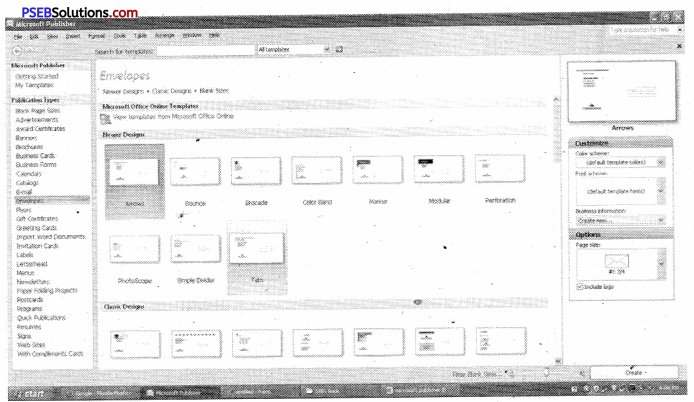
PSEB 10th Class Computer Solutions Chapter 8 Microsoft Publishers-II 2
Following are steps that are used to create an envelope in Microsoft Publisher :
1. Launch Microsoft Publisher and click “Publications for Print.” A list of options will appear underneath this section. You can choose from several pre-made envelopes. These envelope designs are for several different types of businesses.

2. Delete any option or area of the envelope you do not need for your purpose. Select the area by left clicking on the area once and it will bring up a border around the box. Right click on the selection and choose “Delete.”

3. Move any of the pre-selected fields by dragging it to where you would prefer it. Select the area; move the mouse pointer till it becomes a four arrowed figure. Left click and hold the mouse button and drag the box to where you want it.

4. Fill in the address fields by highlighting and entering in the correct information.

5. Insert pictures and designs to the envelope to make it more personal. Click “Insert” and “Clipart”, “Object” or “Textbox.” Recipients of your letters will love having designs on the envelopes that display your personality.

6. Choose to make your own envelope from scratch by selecting “Blank Print Publication” from under the New section on the left hand side of the Microsoft Publisher screen. Select “File”, “Page Setup” and a new window will appear. Hit “Envelope” from under the Publication Type and adjust any height and width dimensions you may need. This is easy, just measure your envelope.

7. Insert and edit till your message is clear from the design on your envelope. Try printing in gray scale and on regular paper before printing on any envelopes. This will save money and trees.

PSEB 12th Class Political Science Solutions Chapter 16 India and SAARC

Punjab State Board PSEB 12th Class Political Science Book Solutions Chapter 16 India and SAARC Textbook Exercise Questions and Answers.

PSEB Solutions for Class 12 Political Science Chapter 16 India and SAARC

Long Answer Type Questions

Question 1.
Write a note on establishment (formation) of SAARC and discuss its objectives.
Or
Describe background and efforts made for the establishment of South Asian Association for Regional Co-operation (SAARC).
Answer:
The quest for regional co-operation in South Asia, as initiated by the late Zia-Ur-Rahman of Bangladesh in March, 1980, was given concrete foundation with the emergence of SAARC (South Asian Association for Regional Co-operation) in August, 1983. On August 1, 1983, foreign ministers of seven countries (Bangladesh, Bhutan, India, Maldives, Nepal, Pakistan and Sri Lanka) met at New Delhi and approved programme of economic co-operation. They decided on an integrated programme of action for regional co-operation. Thus, the seven South Asian countries formally established the SAARC in 1985.
In its 14th Summit which was held at New Delhi on April 3-4-2007, Afghanistan becomes the 8th member of SAARC.

Background And Efforts Made for the Establishment of SAARC:
1. Working Paper on SAARC:
Before the formal launching of SAARC, useful and productive ground work was done by several meetings of the seven South Asian states. The working paper was prepared by Bangladesh’s former President Mr. Zia-Ur-Rehman. He stressed the need of setting up an organisation to promote regional co-operation.

2. Colombo Meeting of the Foreign Ministers of South Asian States (1981):
At this meeting the foreign ministers of South Asian countries- India, Nepal, Bhutan, Bangladesh, Pakistan, Sri-Lanka and Maldives, acknowledged the importance of regional co-operation. The meeting agreed to explore the possibilities of co-operation in five spheres i.e. agriculture, rural development, communication, weather and health and population activities.

3. Foreign Secretaries. Meeting in Kathmandu (1981):
At this meeting the recommendations of the seven nation study group and the report of the coordination committee of the whole was accepted. It also decided to explore the possibilities of Transport, Postal Service and Scientific and Technological cooperation.

4. Islamabad Meeting of Foreign Secretaries (1982):
This meeting approved the recommendations of the study group set up in Kathmandu and decided to constitute new study groups on sports, arts and culture.

5. Dhaka Meeting (1983):
This meeting evaluated the mutual co-operation in different fields and recommended the adoption of integrated programme of action by the foreign ministers. It also decided to set up a standing committee.

6. New Delhi Meeting of Foreign Ministers (1983):
In this meeting the foreign ministers signed the declaration of South Asian regional cooperation. The declaration listed the following objectives of South Asian Regional Co-operation.

  • to promote the welfare of the people of South Asia and to raise their standard of living,
  • to accelerate economic growth, social progress and cultural development in the region;
  • to promote and strengthen collective self-reliance among these countries,
  • to contribute to mutual trust, understanding and appreciation of one another’s problems;
  • to promote active collaboration and mutual assistance in various fields;
  • to strengthen co-operation among themselves and regional forums; and
  • to co-operate with international and regional organisations with similar aims and objectives.

The declaration also stated that SAARC is based on respect for the principle of sovereign equality; territorial integrity, political independence, non¬interference in the international affairs of other states and mutual benefits. The heads of state or government meet annually. It also decided to set up different committees.

7. New Delhi Meeting (1984):
This meeting gave a call for developing friendly relations among the countries of this region, along with co-operation in socio-economic and cultural field.

8. Standing Committee Meeting in Male in Feb. 1985:
This meeting recommended the establishment of a ministry council of South Asian countries through which the common will of mutual co-operation could be given institutional form. Thus, after so much hard work, studies and meeting SAARC was formally inaugurated in Dec. 1985.

Objectives and Principles of SAARC:
The South Asian Association of Regional Co-operation was formally inaugurated in Dec. 1985. The SAARC is an organisation of Eight countries of South Asia:Bhutan, India, Afghanistan, Bangladesh, Maldives, Nepal, Pakistan and Sri Lanka. SAARC was established primarily for co-operation in agriculture, rural development, science and technology, culture, health, population control, narcotics and terrorism.

Objectives of SAARC:
The objectives of the association are : 1. to promote the welfare of the people of South : 2. to accelerate economic growth, social progress and cultural development in the region; 3. to promote and strengthen collective self-reliance among these countries. 4. to contribute to mutual trust, understanding and appreciation of one another’s problems; 5. to promote active collaboration and mutual assistance in various fields; 6. to strengthen co-operation among themselves and regional forums; and 7. to co-operate with international and regional organisations.

Principles of SAARC:

  1. SAARC is based on the principles of sovereign equality; territorial integrity, political independence, non-interference in the internal affairs of other states and mutual benefits.
  2. Decisions at all levels are taken on the basis of unanimity. But bilateral and contentious issues will be excluded from the deliberations.
  3. SAARC is not a political organisation but is formed to accelerate development through mutual co-operation.
  4. The members of SAARC would not act as obstruction in having relations with the individual countries of SAARC and with other countries.

PSEB 12th Class Political Science Solutions Chapter 16 India and SAARC

Question 2.
What important activities SAARC has taken up during its existence? What has been India’s role in them?
Answer:
SAARC is active since 1985. It has taken up many activities as a regional co-operation association. It’s activities are as follows :
First SAARC Summit:
The leaders of seven South Asian countries Bangladesh, Bhutan, Sri Lanka, Maldives, Nepal, Pakistan and India, concluded on Dec. 8, 1985. at Dhaka their first ever regional summit. The Summit Conference adopted a Charter of this regional body to be known as South Asian Association for Regional Co-operation. This marked a major development in co-operation among the countries of the region. It will also help in the maintenance of peace and stability in the area.

Second Summit of SAARC:
The second summit of SAARC was held at Bangalore on Nov. 16-17, 1986 under the Chairmanship of Sh. Rajiv Gandhi. It decided to evolve a joint policy to fight terrorism in South Asia, to set up technical committees on women’s participation in development, drug abuse and drug trafficking.

Third Summit of SAARC:
The third summit of SAARC was held at Kathmandu (Nepal) in Nov. 1987, where agreements were reached on terrorism and established a SAARC Reserved Food Grain Stock. The Reserved Food Grain Stock, launched at the summit, will begin with a stock of 200,000 tonnes of wheat and rice. The summit also decided to commission a comprehensive study of the region’s environment and the necessary measures for its protection and preservation.

Fourth SAARC Summit:
The fourth annual summit of SAARC ended in Islamabad on December 31, 1988. The summit pledged to stamp out terrorism and meet the basic needs of the people through a regional plan ‘SAARC 2000’ with specific targets.

Fifth SAARC Summit 1990:
Fifth SAARC summit was held in Male, the capital of Maldives, in November, 1990. The summit decided to enlarge visa-free travel facilities beyond the present categories of members of Parliament and Supreme Court Judges.

Ninth Session of SAARC Council of Ministers, 1991. On July 4, 1991 the Ninth Session of the SAARC Council of Ministers agreed on taking co-ordinated action to combat the menace of terrorism which they said threatened to destabilize the region. On the economic front, the SAARC Council-also approved to institutionalise co-operation in tourism and trade manufacture and service.

Sixth SAARC Summit 1991:
Sixth SAARC summit was held in Colombo, the capital of Sri Lanka, on Dec. 21, 1991. The seven SAARC nations have agreed to liberalise trade and called for greater co-operation and interaction among the member states to combat terrorism in the region. India has done well by proposing a collective economic security system for the region.

Seventh SAARC Summit 1993:
Seventh SAARC summit was held at Dhaka, the capital of Bangladesh, on April, 1993. The South Asian Association for Regional Co-operation entered a new phase of economic co-operation as the seventh summit approved the 63 point Dhaka declaration and endorsing the South Asia Preferential trade agreement seeking to reduce trade barriers in the region.

Eighth SAARC Summit 1995:
Eighth SAARC summit was held in New Delhi on 2nd May, 1995. All the members of SAARC countries agreed to liberalise trade and called for greater co-operation. Delhi declaration of the eighth SAARC summit called for an international convention prohibiting the use or threat of use of nuclear weapons under any circumstances and strongly deploring acts of terrorism spreading in and outside the region. The declaration called for the production of organised tourism in a big way in the SAARC region. Another significance of this Summit was agreement on South Asian Preferential Trading Arrangement (SAPTA).

Ninth SAARC Summit 1997:
Ninth SAARC summit was held at Male, the capital of Maldives on 11th May, 1997. Leaders of seven South Asian nations accepted India’s proposal to transform the region into a free trade area by 2001. SAARC countries agreed for the removal of all trade barriers and structural impediments by advancing the deadline by four years from the earlier agreed goal of SAFTA by 2005.

Tenth SAARC Summit 1998:
Tenth SAARC summit was held at Colombo on 29th July, 1998. Despite its failings and shortcomings, SAARC has taken several bold steps including establishing a framework for SAPTA (South Asian Preferential Trade Arrangement) and SAFTA (South Asian Free Trade Area). India made a fine gesture that it would remove import restrictions on over two thousand products to facilitate intra-regional trade. With the solitary exception of Pakistan, all other member-countries of SAARC also agreed on the need to hasten the process by two years to realise SAFTA by 2001.

Eleventh SAARC Summit, 2002:
The Eleventh SAARC summit was held at Kathmandu, the capital of Nepal on 5th Jan. 2002 under tenscious shadow of Indo- Pak relations. The 11th SAARC Summit decided for the urgent conclusion of comprehensive convention on combating International terrorism and conducting international cooperation in ending this scourge in conformity with the U.N. Charter. The Summit recognised the importance of creating a free trade area. The declaration called for coordination among the SAARC member states on all World Trade Organisation issues.

Twelfth SAARC Summit (2004):
The 12th SAARC Summit was held at Islamabad; the capital of Pakistan in January 2004. During this summit firstly, SAFTA was approved and it will take effect from January, 2006. Secondly, all the SAARC nations signed its ‘Social Charter’. Thirdly, it was decided to start a ‘SAARC Award’ to respect and encourage the contribution of individual in the spheres of peace, poverty alleviation, social welfare etc. Fourthly, the SAARC nations signed a protocol on the prevention of terrorism.

Thirteenth SAARC Summit (2005):
The 13th SAARC summit was held at Dhaka on November 12, 2005. Summit decided a united fight against terrorism afflicting the region.

Fourteenth SAARC Summit:
The Fourteenth SAARC Summit was held at New Delhi on April 3-4, 2007. All the eight members were present. Afghanistan is the latest addition in the SAARC and because of this addition the total members of the SAARC are eight now. SAARC Summit adopted a 30-point declaration with commitment to ensure market access by all SAARC member countries and also collectively combat poverty, diseases, disaster and terrorism. All the eight members of the SAARC were unanimous for taking strict steps to curb terrorism in the Universe. Two agreements on establishing South Asian University and SAARC Food Bank were signed in the concluding session of the 14th SAARC Summit in New Delhi.

Fifteenth SAARC SUMMIT:
The Fifteenth SAARC Summit was held in Colombo, SRI LANKA on August, 2-3, 2008. The Summit concluded with the leaders expressing serious concern over the threat posed by terrorism to the peace, stability and security of the region and emphasizing the need for strongest possible co-operation in fighting terror and transnational organised crime. The Summit adopted the Colombo Declaration titled ‘Partnership for the growth of our people’ at the concluding session on August 3. The declaration stressed the importance of completing all legislative and other relevant measures to implement within the member states the provisions of the Regional Convention on Narcotic Drugs and Psychotropic substances.

Sixteenth SAARC Summit:
The Sixteenth SAARC Summit was held in Thimpu, Bhutan on April 28-29, 2010. The Summit concluded with the leaders express serious concerns over terrorism. SAARC leaders also decided to celebrated the decade of 2011-2020 as a ‘Decade of Intraregional Connectivity in SAARC’.

17th SAARC Summit (2011):
The 17th SAARC Summit was held in Addu (Maidive) on Nov. 10-11, 2011. The Addu declaration said that the leaders agreed upon the theme of ‘Building Bridges.’ The leaders committed to work towards a huge boost in intra SAARC trade, improving air, rail, motor and water transport connectivity between member countries and putting their heads together to solve common development concerns.

18th SAARC Summit-2014:
The 18th SAARC Summit was held in 2014 in Nepal. It concluded adopting a 36-point declaration with commitment to control Terrorism and Religious Fundamentalism.

India’s Role in SAARC :
India has been playing a vital role in the activities of SAARC. To make this organisation a success India has made constructive contributions. Its contributions in the founding and functioning of the organisation are significant and these are as follow:

  1. India played a leading role in the formation of SAARC. With India’s effort SAARC was constituted in 1985 with a view to promote co-operation in the neighbouring countries.
  2. The second SAARC Summit was held in Bangalore in 1986 under the chairmanship of Late Prime Minister Sh. Rajiv Gandhi.
  3. India announced a grant of Rs. 150 lacs to SAARC for the year 1987-88.
  4. In 1988, India offered 1,53,200 tonnes of foodgrains to create a reserved foodgrains stock for SAARC nations.
  5. India announced a contribution of Rs. 2 crores for SAARC activities for the year 1989-90.
  6. Industrial Development Bank of India hosted a meeting of national development institutions of the member countries in October 1991.
  7. In Dec. 1991, during the Sixth SAARC Summit India proposed a collective economic security system for the region.
  8. India hosted the first cultural festival of SAARC countries in October, 1992.
  9. India also ratified SAARC convention on Narcotic Drugs.
  10. The Eighth SAARC Summit was held in New Delhi on 4 May, 1995.
  11. The first SAARC Trade fair was also held in New Delhi from 9th to 14th January, 1996.
  12. India has removed all Quantitative Restrictions from SAARC countries from August 1, 1998.
  13. To boost the trade within the region India has placed over 2000 products from the Restricted List to Open General List.
  14. Under SAPTA India offered duty concessions to SAARC nations on 160 items.
  15. India has offered to conclude bilateral free trade agreements with those SAARC nations who are willing to move faster.
  16. India has already free trade agreements with Nepal and Bhutan.
  17. India has given financial aid to SAARC nations on a large scale particularly to Nepal, Bhutan and Maldives.
  18. In 12th SAARC Summit India pledged a contribution of Rs. 21.5 million for conferences to give concrete shape to freeing the SAARC region from hunger and giving an added impetus to the SAARC food bank.
  19. In the 13th SAARC Summit India offered concrete proposals to strengthen, including the facility of daily air services by designated airlines on a reciprocal basis, provision of transit facilities, setting up of a South Asian University and establishment of Regional Food Bank, SAARC High Economic Council and SAARC Museum of Textiles and Handicrafts.

Thus, India has played a constructive role in SAARC. It has always helped the member-states in time of need and emergency. India’s role in SAARC activities is a mark of India’s firm belief in SAARC and its policies.

PSEB 12th Class Political Science Solutions Chapter 16 India and SAARC

Question 3.
Describe India’s role in SAARC.
Answer:
India has been playing a vital role in the activities of SAARC. To make this organisation a success India has made constructive contributions. Its contributions in the founding and functioning of the organisation are significant and these are as follow:

  1. India played a leading role in the formation of SAARC. With India’s effort SAARC was constituted in 1985 with a view to promote co-operation in the neighbouring countries.
  2. The second SAARC Summit was held in Bangalore in 1986 under the chairmanship of Late Prime Minister Sh. Rajiv Gandhi.
  3. India announced a grant of Rs. 150 lacs to SAARC for the year 1987-88.
  4. In 1988, India offered 1,53,200 tonnes of foodgrains to create a reserved foodgrains stock for SAARC nations.
  5. India announced a contribution of Rs. 2 crores for SAARC activities for the year 1989-90.
  6. Industrial Development Bank of India hosted a meeting of national development institutions of the member countries in October 1991.
  7. In Dec. 1991, during the Sixth SAARC Summit India proposed a collective economic security system for the region.
  8. India hosted the first cultural festival of SAARC countries in October, 1992.
  9. India also ratified SAARC convention on Narcotic Drugs.
  10. The Eighth SAARC Summit was held in New Delhi on 4 May, 1995.
  11. The first SAARC Trade fair was also held in New Delhi from 9th to 14th January, 1996.
  12. India has removed all Quantitative Restrictions from SAARC countries from August 1, 1998.
  13. To boost the trade within the region India has placed over 2000 products from the Restricted List to Open General List.
  14. Under SAPTA India offered duty concessions to SAARC nations on 160 items.
  15. India has offered to conclude bilateral free trade agreements with those SAARC nations who are willing to move faster.
  16. India has already free trade agreements with Nepal and Bhutan.
  17. India has given financial aid to SAARC nations on a large scale particularly to Nepal, Bhutan and Maldives.
  18. In 12th SAARC Summit India pledged a contribution of Rs. 21.5 million for conferences to give concrete shape to freeing the SAARC region from hunger and giving an added impetus to the SAARC food bank.
  19. In the 13th SAARC Summit India offered concrete proposals to strengthen, including the facility of daily air services by designated airlines on a reciprocal basis, provision of transit facilities, setting up of a South Asian University and establishment of Regional Food Bank, SAARC High Economic Council and SAARC Museum of Textiles and Handicrafts.

Thus, India has played a constructive role in SAARC. It has always helped the member-states in time of need and emergency. India’s role in SAARC activities is a mark of India’s firm belief in SAARC and its policies.

PSEB 12th Class Political Science Solutions Chapter 16 India and SAARC

Short Answer Type Questions

Question 1.
What do you know about SAARC? Write the names of its member countries.
Answer:
The quest for regional co-operation in South Asia, as initiated by late Zia- Ur-Rahman of Bangladesh in March 1980, was given a concrete foundation with the emergence of SAARC. The leaders of seven South Asian countries India, Bangladesh, Pakistan, Sri Lanka, Nepal, Bhutan and Maldives concluded on December 5, 1985 at Dhaka their first ever regional summit. The summit conference adopted a Charter of this regional body to be known as South Asian Association for Regional Co-operation.

This marked a major development in co-operation among the countries of this region. The Indian Prime Minister in his inaugural address termed it as the beginning of a new dawn. The Dhaka Declaration stated that the Heads of State or Government shall meet annually. The SAARC Secretariat was set up at Kathmandu on 16 January, 1987. In its 14th summit which was held at New Delhi on April, 3-4-2007, Afghanistan became the 8th member of SAARC. The basic aim of the organisation as declared by Dhaka Declaration is “to make the full use of all the human and natural resources and to accelerate the economic and social development of the region.”

Question 2.
Write main objectives of SAARC.
Answer:
The objectives of the association are:

  • to promote the welfare of the people of South
  • to accelerate economic growth, social progress and cultural development in the region;
  • to promote and strengthen collective self-reliance among these countries.
  • to contribute to mutual trust, understanding and appreciation of one another’s problems;
  • to promote active collaboration and mutual assistance in various fields;
  • to strengthen co-operation among themselves and regional forums; and
  • to co-operate with international and regional organisations.

PSEB 12th Class Political Science Solutions Chapter 16 India and SAARC

Question 3.
WHhat are the main principles of SAARC? Write the names of its member countries.
Or
Write down the names of the member countries of SAARC.
Answer:
Principles of SAARC:

  1. SAARC is based on the principles of sovereign equality; territorial integrity, political independence, non-interference in the internal affairs of other states and mutual benefits.
  2. Decisions at all levels are taken on the basis of unanimity. But bilateral and contentious issues will be excluded from the deliberations.
  3. SAARC is not a political organisation but is formed to accelerate development through mutual co-operation.
  4. The members of SAARC would not act as obstruction in having relations with the individual countries of SAARC and with other countries.

Names of the member countries of SAARC:

  1. India
  2. Pakistan
  3. Bangladesh
  4. Bhutan
  5. Maldives
  6. Sri Lanka
  7. Nepal,
  8. Afghanistan.

Question 4.
Write a short note on SAFTA.
Answer:
The aim of SAFTA is to establish a ‘South Asian Free Trade Area’ through mutual co-operation. A free trade area means that trading among the countries of the area is free from taxes and custom restrictions. During its establishment it was hoped that SAFTA will replace SAPTA before the start of 21st century. The Tenth SAARC Summit decided to set up a committee of experts to conclude on Treaty 2001 on SAFTA. In 12th SAARC Summit held on January, 2004 in Islamabad the SAARC nations have signed the treaty.

On December 29, 2005 the Union Cabinet of India cleared the implementation of South Asian Free Trade Area (SAFTA) agreement though the actual movement of commodities among Seven Nations started from July 1, 2006. SAFTA allows for a differential and progressively freer regions. India, in effect, will offer relatively unhindered access to its markets for Bangladesh, Bhutan, Maldives and Nepal, the poorest SAARC members, while different ‘sensitive lists’ on goods and services would be prepared for Pakistan and Sri Lanka.

PSEB 12th Class Political Science Solutions Chapter 16 India and SAARC

Question 5.
Write down any four achievements of ‘SAARC’.
Answer:

  • All the member countries of SAARC have come closer to one another and their mutual tension has been lessened.
  • All the member countries are collectively working for their socio-economic development.
  • SAARC has created “Food Stock Pool”. It has developed a sense of self-reliance and self-respect among SAARC nations.
  • SAARC has accelerated development in the region.

Very Short Answer Type Questions

Question 1.
What do you know about SAARC?
Answer:
The quest for regional co-operation in South Asia, as initiated by late Zia- Ur-Rahman of Bangladesh in March 1980, was given a concrete foundation with the emergence of SAARC. The leaders of seven South Asian countries India, Bangladesh, Pakistan, Sri Lanka, Nepal, Bhutan and Maldives concluded on December 5, 1985 at Dhaka their first ever regional summit.

Question 2.
Write the full name of ‘SAARC’.
Answer:
The full name of SAARC is South Asian Association for Regional Cooperation.

Question 3.
Write down the names of SAARC member countries.
Or
Write the names of any four countries of SAARC.
Answer:

  1. India
  2. Pakistan
  3. Bangladesh
  4. Bhutan
  5. Maldives
  6. Sri Lanka
  7. Nepal,
  8. Afghanistan.

Question 4.
Write a short note on SAFTA
Answer:
The aim of SAFTA is to establish a ‘South Asia Free Trade Area’ through mutual co-operation. A free trade area means that trading among the countries of the area is free from taxes and custom restrictions.

PSEB 12th Class Political Science Solutions Chapter 16 India and SAARC

Question 5.
Write down any two achievements of ‘SAARC’.
Answer:

  • All the member countries of SAARC have come closer to one another and their mutual tension has been lessened.
  • All the member countries are collectively working for their socio-economic development.

Question 6.
Write any two problems of SAARC.
Answer:

  • The first problem is Political lnstability in the SAARC Region.
  • The second problem of SAARC is Terrorism.

One Line Answer Type Questions

Question 1.
What is meant by SAARC?
Or
What is the full form of SAARC?
Answer:
SAARC i.e. South Assian Association for Regional Cooperation is an organisation of eight countries of South Asia. It has been established with the objective of increasing mutual co-operation between these countries.

Question 2.
When was SAARC established?
Answer:
A Conference of the Foreign Ministers of seven countries was held on 1-2 August, 1983. They deliberated about the establishment of SAARC. It was formally founded in its first conference at Dhaka in Bangladesh in 1985.

Question 3.
What has been the impact of SAARC as a means of Regional Co-operation?
Answer:
Because of SAARC, the South Asian Countries have come closer to each other. It has been successful in settling some common problems in these countries.

PSEB 12th Class Political Science Solutions Chapter 16 India and SAARC

Question 4.
Mention full form of SAARC and SAFTA
Answer:

  • SAARC: South Asian Association for Regional Co-operation.
  • SAFTA: South Asian Free Trade Area.

Question 5.
When and where was the 18th SAARC Conference held?
Answer:
The 18th SAARC Summit conference was held at Thimpu, the capital of Nepal on Nov. 2014.

Question 6.
Write down names of member countries of SAARC.
Answer:
SAARC includes countries such as India, Pakistan, Sri Lanka, Nepal, Bhutan, Bengladesh, Maldives and Afganistan.

Question 7.
When and in which conference, Afganistan was made a member country of SAARC?
Answer:
Afganistan was made a member of SAARC in the 14th Summit Conference held in India in April, 2007.

Question 8.
Where is the office of SAARC situated?
Answer:
The office of SAARC is in Kathmandu, the capital of Nepal.

Question 9.
Write down any two countries in the north of India who have joined SAARC.
Answer:
In the north of India, Nepal and Bhutan are the member countries of SAARC.

Question 10.
Write down any two countries in the south of India who have joined SAARC.
Answer:
In the south of India, Sri Lanka and Maldives are the member countries of SAARC.

PSEB 12th Class Political Science Solutions Chapter 16 India and SAARC

Question 11.
When was SAARC established?
Answer:
1985.

Question 12.
Write down any one name of the member country of SAARC.
Answer:
India.

Question 13.
How many conferences of SAARC have been held so far?
Answer:
There have been 18 Summit Conferences of SAARC so far.

Question 14.
Where was the 14th Summit Conference of SAARC held?
Answer:
In India.

PSEB 12th Class Political Science Solutions Chapter 16 India and SAARC

Fill in The Blanks

1. The SAARC is an organisation of ………….. member states.
Answer:
Eight

2. ………….. is playing an important role in SAARC activities.
Answer:
India

3. First SAARC Summit was concluded on 8 Dec ………….. .
Answer:
1985

4. 17th SAARC Summit was held in ………….. .
Answer:
Maldives.

PSEB 12th Class Political Science Solutions Chapter 16 India and SAARC

True Or False Statement

1. SAARC is a national organisation.
Answer:
False

2. SAARC is an Institution of South Asian countries.
Answer:
True

3. India is not a member of SAARC.
Answer:
False

4. Afghanistan becomes 8th member of SAARC.
Answer:

5. So far fifteen summits have concluded of SAARC.
Answer:
False.

PSEB 12th Class Political Science Solutions Chapter 16 India and SAARC

Choose The Correct Answer

Question 1.
SAARC was initiated by:
(a) Mr. Zia-ul-Rehman
(b) Mr. Zia-ul-Haq
(c) Mrs. Indira Gandhi
(d) Mr. Mujib-ur-Rehman
Answer:
(a) Mr. Zia-ul-Rehman

Question 2.
SAARC is a/an:
(a) Universal Organisation
(b) Regional Organisation
(c) World Organisation
(d) International Organisation
Answer:
(b) Regional Organisation

Question 3.
The 18th Summit of SAARC
(a) India
(b) Sri Lanka
(c) Nepal
(d) Bhutan.
Answer:
(c) Nepal

PSEB 12th Class Political Science Solutions Chapter 16 India and SAARC

Question 4.
The SAARC was formed
(a) 1987
(b) 1983
(c) 1985
(d) 1982.
Answer:
(b) 1983

Volleyball Game Rules – PSEB 10th Class Physical Education

Punjab State Board PSEB 10th Class Physical Education Book Solutions Volleyball Game Rules.

Volleyball Game Rules – PSEB 10th Class Physical Education

Question 1.
Describe Volleyball court, Net, Ball, Behaviour of players and Coaches, Number of players, Position of players.
Answer:
Playfield:
The length of the volleyball playfield shall be 18 metres and breadth 9 metres. There should be no obstruction of any kind upto a height of 7 metres from the ground. The court shall be marked by lines of 5 cms. These lines shall be drawn at least 2 metres away from all obstructions. The centre line under the net divides the court into two equal parts.

Attack Line:
In each half of the court an attack line of 9 metres 5 cms, parallel to the central line, shall be drawn. Its width is included in 3 metres. One line on the right hand side is drawn as its extension and the second line of 3 metres to the left of it. The extension of the service area shall be minimum 3 metres.
Volleyball Game Rules - PSEB 10th Class Physical Education 2
Volleyball Court:
The court of this game should be 18×9 metres. There should be no obstruction of any kind upto a height of 7 metres from the ground. The court is like a rectangle. The width of its boundary lines should be 5 cms. These lines should be atleast 2 metres away from all obstructions. Two lines of 15 x15 cms. In length and 5 cms. in width are drawn behind the last line and parallel to it. These lines mark the service area of the court.

Volleyball Game Rules - PSEB 10th Class Physical Education

One line is drawn right to the side line and the other is drawn to the left of the side line.. The minimum extension of the depth of the service area shall be 2 metres. The centre line under the net divides the court into two equal parts. In each half of the court a line of 9 metres 6 cms., parallel to the central line, at a distance of 3 metres is drawn. It is called attack line.

Net:
The net shall be 9 metres long and 1 metre wide. The squares of the net should be 15 cms. On its upper part a canvas strap of 5 cms. should be placed in such a way that a flexible cable may pass through it. The net is attached to the posts with this cable. The rope is not used under the net now-a-days. The height of the net for men from the centre should be 2.43 metres from the ground, and for women, it should be 2.24 metres. Flexible straps of 5 cms. width are attached on the ends of net. Both the sign posts supporting the net shall be at least 50 cms. from the side line.

Ball:
The ball should be round and made of supple leather. In it there should be a bladder. Its circumference should be 66 cms. + 1 cms. and weight should be 270 gms. + 10 gms. The pressure of air in the ball should be between 0.48 and 0.52 kg/cm2. The colour of the ball should be uniform.
Conduct of Players and Coaches-

  • Every player should be aware of the rules of game.
  • During the play a player can talk to the referee only through his captain.
  • All of the following acts of breach will be punished :
  • To talk to the officials time and again about their decisions.
    • To use improper words while talking to the officials.
    • To act indecently with the aim of influencing the decisions of officials.
    • To misbehave with or use uncivilised remarks to the opponent.
    • To give coaching to players by any one from the outside of the court.
    • To walk out of the court without the referee’s permission.
    • Clapping or crying by the players when the ball is touched and particularly at service

Warning is given for a minor offence. When the offence is repeated, a player is given a personal warning, by which his team loses the service or a point. A penalty is recorded on the score sheet in case of a serious offence. It entails the lose of service and one point. It the offence is repeated, the referee may disqualify the player fora set or for the rest of the match.

Dress of Player:
The player shall wear jersey, pants and pliable foot wear. He shall not wear on his head turban or cap or any such jewellery as may cause injury to other players.
Number of Players and Substitutes-
1. The number of players in one team shall not exceed 6 under all circumstances. The number of players including substitutes shall not be more than 12.

2. Substitutes and coaches shall sit in the court in front of the referee.

3. The captain of a team or coach can request the referee for a substitute. In this game only 6 players in maximum can play. Before a substitute enters the court he shall go to the scorer in dress and after his approval shall immediately take his place.

4. Any player in the beginning of the set may be replaced only once by a substitute. During the same set the original player may go back to the court, but this can be done only once. A substitute leaving the game cannot come back again in the same set. Only that player may come back who has gone out for the substitute.

Volleyball Game Rules - PSEB 10th Class Physical Education

Position of Players:
The court is divided into two parts. In each half a team of six members plays. After the service, players of both teams stand in their respective areas. They stand in lines in numbers 3-3. It is not essential that the lines shall be straight. Players parallel to the net take their positions from left to right in a way that in doing the service the players 4, 3, 2 are in front of the attack line, and the players 5, 6, 1 are behind. This position remains until the service of a team changes.
Volleyball Game Rules - PSEB 10th Class Physical Education 1
After the service, the players can occupy any position. The rotation order recorded on the score sheet shall have to be kept in use till the end of the set. The game shall be stopped owing to some fault in the rotation, and the faults is removed. All points made by the team during the fault are cancelled. The points scored by the opposing team are retained. If the fault or error is not known at the proper time the defaulter team shall resume its correct position and shall have to lose the service or a point according to the situation.

Officials:
The following officials are appointed to conduct the game:
(i) Referee:
The referee sees to it whether a player is playing according to rules or not. He keeps control over the game, and his decisions are final. If any player breaks the rules, he is entitled to stop him from playing and may award him punishment.

(ii) Umpire:
He substitutes players. In addition to it, he gives signals on crossing the lines, time-on and touching the line. On the request of a captain he allows the substitution of a player. He assists the referee as well. He also brings the players to their positions turn by tarn:

(iii) Scorer:
During the play the scorer asks for the change of end, and keeps in view the rotation of the players. At the start of the game, he notes down the numbers and names of players, and keeps a record of scores.

(iv) Two Linesmen:
In case of a foul, the linesmen of both the teams give signals to the referee. In each end there is a lineman for a team. He announces when the ball falls in or out.

Volleyball Game Rules - PSEB 10th Class Physical Education

Question 2.
Describe the main Rules of Volleyball game.
Answer:
Rules of Play –

  • The number of players in each team shall be compulsorily 6. The number of players including the substitutes in a team cannot exceed 12.
  • All international matches are played to the best of five or to the best of three sets. In all international matches, five winning sets are played.
  • At the start of the game the captains of both the teams toss to decide ends and service. The toss winning team is free to choose either service or ends.
  • After each set the ends are changed. In the last set when a team has made 8 points, the ends are changed.
  • No team can play the game with less than 6 players.
    Volleyball Game Rules - PSEB 10th Class Physical Education 4

Time out:

  • The referee or umpire will grant time-out only in case the ball is damaged (dead).
  • A captain or a coach may ask for time-out for rest.
  • During a time-out the players cannot leave the court to talk to any one. They can only seek advice from their coach.
  • Each team can take two times-out in a set. The duration of such a time-out is not more than 30 seconds. Two times-out can be taken consecutively.
  • If a team, after getting two times-out, requests for the third, the referee shall give a warning to the concerned captain or coach. If the time-out is demanded even after this, the concerned team has to lose a point or service.
  • During the time-out for rest, neither can the players leave the court without permission nor the coach can enter the court. Of course, the coach, while remaining out of the court, can talk to the players.
  • A maximum interval of 2 minutes is permitted between two sets, but the interval between the fourth and fifth sets is of five minutes.
  • The game starts immediately after the substitution of a player.
  • In case a player is injured a time-out of 3 minutes is granted. It is allowed if the player is not substituted.

Obstacles of Play:
If a match is interrupted for some reason and cannot be completed, the problem shall be solved like this-

  • The game shall be re-started on the same court, and the score also shall remain the same as it was left earlier.
  • If the interruption in the game does not exceed 4 hours, the match shall be resumed at the fixed court.
  • In case the match is resumed on another court, the score of the interrupted set shall be deemed to be cancelled but the results pf the completed sets shall remain the same.

Volleyball Game Rules - PSEB 10th Class Physical Education

Passes:
1. Under-hand Pass. This technique is now considered to be very useful. It makes even a difficult service easy. In this pass, the left hand is tightly closed. The ball is placed on the right fist such a way that the thumbs remain parallel to each other. The under-hand ball is received when the ball is quite low.

2. Back Pass. The back pass is made use of to dodge an opponent. The player who is to make pass makes it behind his head. The volley server volleys.

3. Under-hand Ball with Back Rolling. When the ball is beside the net, the hit should be made by opening the fingers and touching them with the ball.

4. Under-hand Ball with Side Rolling. When the ball is to one side of the player, the hand is opened in the direction of the ball. The ball is received by side rolling.

5. Under hand Pass with the Hand. This method is used to return the ball when the ball is to the one side of the player in the direction in which it is to be received. The ball is taken by slightly bending the leg, extending the arm and closing the fist.

6. Taking the Ball Struck with the Net. This type of ball is taken by under-hand, otherwise it is cut towards the fellow players so that it may be passed carefully.

Service:
(a) By service we mean the putting of the ball into play by the right hand back line player. The player hits the ball with his hand either open or closed or any part of the arm in such a way that the ball passes over the net to the opposite court. The service should be done from the fixed place. Throwing the ball by hand is prohibited. A player after service can remain on the boundary line or enter the court.

If the served ball falls on the ground untouched by any player, the service is re-taken. If the service ball passes over the net without touching it and between the antennae, the service is considered to be good. The service will have to be re-taken as soon as the referee blows the whistle. A player shall continue to serve until a fault is committed by any player of his team.

(b) Faults of Service.
If any of the following faults are committed, the referee will blow his whistle for the change of service :

  • When the ball touches the ground.
  • When the ball passes under the net.
  • When the ball touches the antennae or it does not pass over the net completely.
  • When the ball touches a player or an object before it reaches the opponent’s court.
  • When the ball lands outside the limit of the opponent’s court.
  • When the player’s foot, while the service is being taken, is on the line or touches the line.

(c) Second and later Service:
In each new set that team shall serve which has not served in the preceding set. The service in the final set is decided by toss.

(d) Obstacles of Play: If, in the opinion of the referee, a player deliberately obstructs a game, he is penalized.

Change in Service:
When the serving team commits a fault, the service is changed. The service also undergoes a change when the ball is side-out.

Hitting the Ball:

  • Each team can contact the ball three times so as to pass the ball into the court of the opposing team.
  • A ball can be hit with any upper part of the body.
    A ball can pass touching the various upper parts of the body but it should be simultaneous. The ball should not be caught; rather it should bounce forcibly.
  • If a ball lodges for sometime in the player’s hands or arms, it shall be reckoned to bathe ball held. Lifting, pushing, carrying shall also be considered as holding. To hit the ball distinctly with both hands from below is in conformity with the rules.

Blocking:
Blocking is that activity by which, as soon as the ball crosses the net, the attack by an opponent is attempted to be stopped with any upper part of the body, above the abdomen. Blocking is done by the players of the first line. Players of back line are not allowed to do blocking. After blocking any player who takes part in blocking may get the ball.

Games of Net:

  • A ball is considered to be good if it (other than served) touches the net completely.
  • A ball is also considered to be good when it passes the net from inside the marks.
  • A ball hitting the net can be played. If a ball that has been played three times by a team touches the net the fourth time or falls on the ground, the referee shall blow the whistle for the offence.
  • A ball which hits the net so hard that the net contacts an opponent, the opponent shall not be penalized for this contact.
  • If two opposing players touch the net simultaneously, it is considered a double fault.

Crossing Hand Over Net:

  • During blocking, the touching of the ball with hands over the net in the court of the opponents is not considered a fault provided the contact has been made after the attack by the opponents.
  • To pass hands over the net after an attack is not a fault.
  • If the ball is touched by the blocking players, then the same team can cross the ball over the net by touching the ball with hands three times.

Crossing Centre Line:

  • If during the play, any part of the body of any player contacts or enters the opponent’s court, it is considered a fault.
  • Passing of the ball under the net, and attracting the attention of the opponent by touching the ground with any part of the body after crossing from under the net shall be considered a fault.
  • To enter the opponent’s court before the referee whistles shall be deemed as a fault.

Ball out of Play:

  • If the ball touches the net outside antennae or the antennae, it is considered a fault.
  • If the ball touches the ground or any object outside the court, it is considered to be ‘out’. A ball touching hands shall be deemed correct.
  • The play stops with the referee’s whistle, and the ball shall be considered out of play.

Volleyball Game Rules - PSEB 10th Class Physical Education

Score:

  • When a team is leading by two sets, it is declared to be the winner. A set has 15 points. If the score is tied at 14-14, the play is continued upto 16-14, 17-15 and 19-17.
  • If a team refuses to come into the court on being asked by the referee, it loses the game. A wait of 15 minutes for the team to play is possible. It is left in case of injury to a player during the game.
  • If a team fails to return the ball correctly in the court of the opponent, the points is awarded to the opposing team.

Fouls in Volleyball:

  • If during the game a player touches the net, it is considered to be foul.
  • To touch the centre line is a foul.
  • Crossing the line before service is a foul.
  • When the ball hits the face, back and waist, it is a foul.
  • If there is a sound while taking the ball.
  • Holding is a foul.
  • If the ball is touched more than three times, it is a foul.
  • If a player touches the ball with hands continuously for two times, it is a foul.
  • If during the service he is pursued in a wrong situation.
  • If the rotation is faulty.
  • If the ball is given side-pass.
  • If the ball crosses the net from below.
  • When the service is not done from the service area.
  • If the service is not correct, even then it is a foul.
  • If the served ball is crossed by a player of the serving side.
  • While doing service it is a foul to form group.
  • Doing the service before the whistle is a foul. If any of these fouls is done, the referee asks for the change in service. He can give warning to any player or can expel him.

Decisions:

  • The decisions of the officials are final. .
  • Only the captain of a playing team can protest against the decisions about the interpretation of rules.
  • If the referee’s’decision is not correct, the game is played under protest, and the protest is sent to the higher officials.

Important Information about the Volleyball Game

  • The length and breadth of = 18 x 9m
    Volleyball ground
  • The breadth f the post of the = 7 c.m.
    canvas strap
  • The number of Antenica = Two
  • Length of Antenia = 1.80m
  • Distance of poles from line = 1 meter
  • Length and breadth of the net = 9.50 x 1 meters
  • The height of the net for men = 2.43 meters
  • The height of the net for women = 2.24 meters
  • Circumference of the ball = 65 to 67 c.m.
  • Colour of the ball = Multiple colour
  • Weight of the ball = 260 to 280 gm
  • Number of player in a team = 12 (size players 6 substitute)
  • Officials of the match = Two referee, One scorer, Two or four lineman
  • The size number of the back = Height 20 c.m.,15 c.m. Length, 2 c.mBreadth.
    of players
  • Twelve (12) players take part in the game of volleyball, out of which 6 play and 6 are substitutes.
  • Both the teams participating in a match has 6 players each.
  • Standing in their court these players make the ball pass over the net.
  • A point is awarded against the team in whose court the ball falls.
  • There is no time limit for the game of volleyball; instead the best of three or the best of five games is played.
  • No rope is now used under the net.
  • The toss winning team is free to choose service or end.
  • Only two players can be substituted in the game of volleyball.
  • A player of the opposing team can block the service if it is going beside the net. Service will be considered
    correct when the ball during service touched to the net and reached in opponent’s playing area.
  • A team can be scratched if it does not enter the ground in fifteen minutes.
  • Each game of volleyball is of 25 points.
  • Libro player is allowed substitution whenever he desire but for defence purpose only.
  • A player can throw the ball in opponents playing area by hitting the ball with foot and knee.

Lezium Game Rules – PSEB 10th Class Physical Education

Punjab State Board PSEB 10th Class Physical Education Book Solutions Lezium Game Rules.

Lezium Game Rules – PSEB 10th Class Physical Education

Question 1.
Write down the measurement of lezium and its types.
Answer:
Lezium:
Lezium consists of a wooden handle of 16″ to 18″ in length with an iron chain fixed at both ends of the wooden handle and a rod of 15 cm (6″) in the middle. The iron chain contains iron plates in each ring which produces rhythmic and jingling sound when the lezium is in use. The weight of the whole apparatus is between 1 3/4 to 2 lbs.

Lezium Game Rules - PSEB 10th Class Physical Education

Types of Lezium:
Lezium Skand, Aram, Husshyar, Pavitra, Char Awaj, Ek Jagah, Aidi Lagala, Starting position, Do Rukh, Age Shlang, Peechhe Shlang.

Lezium Skand:
In this position, lezium is kept on right shoulder. In this position, lezium is like egg position, and the wooden handle is remain behind and the chain of iron remain in front of the body.
Lezium Game Rules - PSEB 10th Class Physical Education 1
Aram:
In this position, iron chain kept in a right hand and hanging in left hand when a student is remain in husshyar position the order of aram is given.

Husshyar:
Before starting of the Lezium, student should come in husshyar position. This position is kept when the lezium is on the shoulder. This exercise is performed by counting two on counting one, the iron chain and on counting two the lezium should be kept up to left shoulder and bring it in front of the chest with left hand. Wooden handle is race iron chain in the right hand and pull towards the body. After this exercise, came into the first position.

Pavitra:
This position is obtain from the Skand position. Keeping front left knee is little bend, bring the right foot behind the body. The weight should be on the left toe and push toward the floor. The remain straight chest and head must be raised upward. In this position, left leg must be towards the right and lezium should be in husshyar position.

Char Awaj:
In the starting of husshyar position on counting one keep the knee straight and bend the body, take the first stock near the feet in this position. Wrist goes out side and the handle of the lezium become parallel to the body, one counting to range the body up and snatch the iron chain from the wooden handle.

In the position, lezium will be on waist, on counting three and in a first position. The wooden handle should be moved to the right side and right hand should be in front of the body. On counting four, wooden handle should be taken in front of mouth, which we can see through the lezium.

Ek Jagah:
In the exercise, in counting four rotate the lezium in a round left to right after this next four counting should be repeated from left side.

Adha Lagao:
In this exercise, all the eight counting must be repeated and foot movement should be performed on char awaj. The left leg should be brought to the right leg and the left toe .. should be brought to right, the thumb should be kept between the finger.

Starting position:
In this position, rotating the back Char awaj should be performed four times. In coming first position, the exercise rotate the body from left side and lezium should be in front of the chest. In keeping the taal on counting four rotate the body in fast position. By doing this exercise, arm should be rotate in circle motion.

Do Rukh:
This exercise consist of eight counting and pavitra is N starting position just counting three. It will be like pavitra on counting four in a opposite direction from the left position. In a quick motion, perform four on counting five, rotate the lezium upward to down ward from left toe to right toe. Char awaj perform on counting six. It should be like to on counting seven take the Pavitra position, and char awaj take three counting. On counting eight, it should be like first position.

Lezium Game Rules - PSEB 10th Class Physical Education

Aage Shalang:
This is the exercise of ten counting. Starting position is of pavitra, on counting one, bending forward near the left toe to the char awaj should be done. When taking left foot is completed on counting three, right foot should be forwarded like near the left foot, char awaj should be perform. In this way, left toe is done up on counting five, char awaj to be perform.

Taking six and seven stock with the left lezium should be nearer and foot should be kept in pavitra position. On counting eight, char awaj should be performed on counting nine, bending forward char awaj must be one stock. On counting ten, raise the body by farming char awaj and return to pavitra position.

Peechhe Shalang:
In this exercise, counting should be in ten, starting position must be a pavitra perform. The char awaj near the left toe on counting. In second and third, rotate to right and make two perform. In opposite direction, perform char awaj on four counting four times. Six and seven rotate from left foot keeping the right foot behind, on counting eight perform the char awaj, in this position student should be in pavitra position while counting nine char awaj should be performed.

Forward Bend:
On counting one, keep the right foot ahead. Bend on right side and open the lezium in same position. On counting two, raise the right foot up to three inches and by bending forward, lezium should be close on counting three, keep the left foot ahead and repeat the counting one. In this way, the exercise should be performed.

PSEB 12th Class Sociology Important Questions Chapter 12 Social Issues: Old Age and Disability

Punjab State Board PSEB 12th Class Sociology Important Questions Chapter 12 Social Issues: Old Age and Disability Important Questions and Answers.

PSEB 12th Class Sociology Important Questions Chapter 12 Social Issues: Old Age and Disability

Multiple Choice Questions:

1. In 2021, the number of elders in India will be
(a) 140 million
(b) 150 million
(c) 160 million
(d) 170 million
Answer:
(a) 140 million

2. In 2001, how many elders were there in India?
(a) 80 million
(b) 77 million
(c) 83 million
(d) 86 million
Answer:
(b) 77 million

PSEB 12th Class Sociology Important Questions Chapter 12 Social Issues: Old Age and Disability

3. In the Indian Census Survey, who is considered as an elder?
(a) 58 years
(b) 65 years
(c) 60 years
(d) 63 years
Answer:
(c) 60 years

4. Which of these is the sign of old age?
(a) Tooth decay
(b) Baldness
(c) Grey hair
(d) All of these
Answer:
(d) All of these

5. Which science studies the process of old age?
(a) Gerontology
(b) Dermitology
(c) Physiology
(d) Botany
Answer:
(a) Gerontology

6. Which of these problems is faced by the old age people?
(a) Economic insecurity
(b) Deteriorating health
(c) Change in Roles
(d) All of these
Answer:
(d) All of these

Fill in the Blanks:

1. ………………. is a natural stage of human life which is bound to come.
Answer:
Old age

2. In 1947, around ……………… crore people were elders.
Answer:
1.9

3. According to United Nations, the world population till 2050 will be ……………….
Answer:
910 crore

4. Maintenance and Welfare of Parents and Senior Citizens Act was passed in ………………. A.D.
Answer:
2007

5. According to 6th All India Educational Survey, around …………………. crore children need special education.
Answer:
two

PSEB 12th Class Sociology Important Questions Chapter 12 Social Issues: Old Age and Disability

True/False:

1. The age of retirement in India is 70 years.
Answer:
True

2. The colour of elders changes into black.
Answer:
False

3. There is tooth decay in old age.
Answer:
True

4. There is a provision of reservation in government jobs for disable persons.
Answer:
True

5. Old age people are given a pension of? 5000 per month.
Answer:
False

One Word/One Line Questions Answers:

Question 1.
What is the population of the world?
Answer:
The world’s population is 650 crores.

Question 2.
According to United Nations, in 2050, what would be world’s population?
Answer:
It will be 910 crores in 2050.

Question 3.
In 2021, what would be the population of old age people?
Answer:
It will be around 121 million.

Question 4.
Who is considered as an elder in India?
Answer:
One who is having age of 60 years or more.

Question 5.
Give few signs of old age.
Answer:
Tooth decay, baldness, grey hair, hearing and viewing problems etc.

Question 6.
What do we call to the study of the process of ageing?
Answer:
We call it Gerontology.

Question 7.
What was the major issue in Hindi movie Piku?
Answer:
Major issue in Piku was the mutual relation between an aged father and his daughter in which father was completely dependent on his daughter.

Question 8.
What is the impact of ageing on health?
Answer:
With ageing, body becomes physically and mentally weak.

Question 9.
When was ‘The Rehabilitation Council Act’ passed?
Answer:
It was passed in 1992.

PSEB 12th Class Sociology Important Questions Chapter 12 Social Issues: Old Age and Disability

Very Short Answer Type Questions:

Question 1.
What is meant by Gerontology?
Answer:
Gerontology is a type of science which studies the process of ageing and studies the problems faced by the old age people. Gerontologist studies age, increasing age and the process of ageing.

Question 2.
Activity theory of ageing.
Answer:
Activity theory of ageing says that to remairi happy in old age, one must remain active. This theory says that is the existing roles and rules stops functioning, they must be replaced because with the decline in activity level, the level of satisfaction will also come down.

Question 3.
Problems of old age.
Answer:

  • In old age, one becomes physically and psychologically weak.
  • Economically he depends upon children and becomes economically insecure.
  • Old people are not ready to adapt the changing conditions of life.

Question 4.
Old age homes.
Answer:
Many people are unable to maintain balance with their parents and throw them out of their homes. For such elders, government has made old age homes so that they can in peace in the last stage of their life. Here, every type of care is taken about their needs.

Short Answer Type Questions:

Question 1.
Causes of Problem of Aged.
Answer:

  • The importance and respect of the elders have been decreased due to the decreasing effect of the caste system and that’s why they have to face many types of problems.
  • Due to the development of technology, the importance of the art of elders has been decreased because of which they have to face many types of problems.
  • People are leaving their houses and villages and are moving towards cities due to the spread of education and the problems of elders start from here.
  • People use the whole of their savings to give a better future to their children because of which they have to face many economic problems.

Question 2.
Status of Aged in Ancient times.
Answer:
Status of the aged in ancient India was very good. Patriarchal and joint families were there because of which control of the family was in the hands of elders. Wealth and property of the family was under their control. They had complete knowledge related to art and occupation. They were getting full respect in the family. They used to take all the decisions of the family and no one was going against their wishes. In this way the status of the elders was very good.

Question 3.
Problems which come in old age.
Answer:

  • In old age people suffer from diseases like blood pressure, sugar, heart problem etc.
  • People spend whole of their saving in giving a better future to their children because of which they have to face many economic problems in old age.
  • If elders are dependent upon their children then they have to obey their children because of which many times they are disrespected by their children.

Question 4.
Problem of aged related to health.
Answer:
Persons work for the whole life with great heart. When he becomes old his body hardly responds. He suffers from many diseases like sugar, blood pressure. He is unable to do anything. In this way health related problems are very important for elders.

Question 5.
Old age Homes.
Answer:
If the children of an aged person throw him out of the house he is left with no option except to live in old age homes. In this way old age homes are those houses where those elders are living who are unable to live with their family members. Elders are properly cared in these homes. They are given complete security and shelter ‘in these homes. In this way those aged who are unable to live with their children, they have to live in old age homes. Many old age homes are running in big cities.

Question 6.
Generation Gap.
Answer:
The difference between ideals, rules, ways of behaviour etc. of persons of two generations is known as the generation gap. Actually the old generation expects from the young generation that they must live their lives according to them. But young generation is having its own rules, ideals, ways of behaviour etc. and they never let any one to interfere in their lives. This leads to conflict between the both generations which is known as the generation gap.

PSEB 12th Class Sociology Important Questions Chapter 12 Social Issues: Old Age and Disability

Long Answer Type Questions:

Question 1.
What do you know about the Problems of the Aged?
Answer:
If we look at the Indian population before Indian independence then we will come to know that the rate of life expectancy before independence was around 31 years. It means that person who is born in India lives around 31 years of average. But after independence and after the opening up of health facilities like hospitals, dispensaries etc. the average life expectancy has been increased and has reached to the age of 62 years. It means that within 50 years the life expectancy in India has doubled. Many changes have come in the life of the people after the start of 20th century. First and the most important change which has come is that the average life of the person has been increased. Generally it has been said that the person whose age is more then 60 years or who has been retired from his job has become an aged person or old person. The number of aged persons have also increased with the increase in average age.

This increasing numbers of aged is becoming a challenge for the country. In earlier times every member of the family was coming to the end. It hardly matters that whether he was a child or an aged. If any person was becoming an aged then he was completely taken care by the family. But now people hardly take care of the aged due to the changes which came in the institution of the family, westernization and modernization. They are either not cared by their children or they are sent to old aged homes by their children. This is the biggest problem of the aged.

Generally it has been believed that the problems of a person increases with his increase in age. Rosow says that yet aged people have many problems but one can take them in health, social and financial problems. Person’s utility, in modern age, can be seen on the basis of economic basis and aged people are not considered as useful. Situation of the aged further deteriorates due to technical progress and social change. Problems of the aged has been increased to a great extent due to the increasing number of people of the’ age of 60 years in last few decades. These days aged people have to face many types of social, economic and psychological problems. Even aged people of rural and urban areas have to face the problem of spending their leisure time.

After looking at this we should treat the aged people like humans and should be kept one thing in mind that these people also have their needs and wishes That’s why we should look at their needs from their point of view so that we should be able to understand them and should fulfil their needs.

Historical Perspective:

If we look at the status of the aged people in ancient Indian Society then their position was very good. People in ancient societies were living in the groups of hunters and food gatherers. Aged people were specialized in doing every type of activity. They were considered as very important. Aged, people in ancient societies were given very much importance. Status of the aged people was very powerful in social, religious and political sphere. One scholar has analysed many ancient societies and said that the behaviour, traditions and customs were running according to aged people in ancient societies which was very particular from cultural point of view.

Aged people in ancient Hebru society were considered as the gift of the God. Importance of the aged people in pre industrial societies was considered till that time until they would be able to contribute towards society. Every type of power of society was in their hands and they were given enough security in the society. When they were unable to contribute towards society then they used to retire from their duties. Control of the family was then generally given to the elder son of the family. Because they were elders and had done a lot for the society and family, that’s why they were given enough security from the family. They were the main sources of cultural knowledge.

In Rome, aged people were seen from negative point of view. Due to their more age they were considered as wicked. But some of them were made guardians of small hildren of rich families. Their work was to take the children to school and to bring lem back safely. But elder people in Rome’s history were seen in the negative form.

Question 2.
Explain the status of aged in India.
Answer:
Status of the aged people in ancient Indian society was very good. Aged person was the head of the family and family and property were both in his complete control. He was given the great respect in society and his status was higher than all. At that time it was said that experience of person increases with the increase in age and they give this experience to their next generation. With the passage of time Arya people came to India and they divided the Indian society in four Varnas. Age of the person was considered as 100 years and it was divided in the four ashramas of 25-25 years.

These 4 ashramas were given the names of Brahmacharya, Grihastha, Vaan Prastha and Sanyasa ashrama’s. Person was getting education in first ashram and he was establishing his house after marriage in second ashrama. He had to pay the three debts of life i.e. Dena Rina, Pitri Rina and Rishi Rina. During this time, it was expected from young generation that they should take care of elder people in grihastha ashram. Aged persons were given the security through this ashrama system and all the functions of family and society were being done by aged people.

Persons in the age group of 50 years used to move towards forests in vaan prastha ashram by giving everything in the hands of their children. But many a times they used to come back to their homed to give advice on any matter to their children. That’s why they were given enough respect in the society. With the passage of time, this system was changed but the status of aged people remained as it is Actual change in the status of women came after the advent of the Britishers.

The Britishers started to win over India and with this they started to bring social change in India. They adapted a new judicial and educational system with whirl changes came in ancient relations. Young generation started to live away from their elders due to new educational institutions and industries. People started to move from rural areas to urban areas with which a danger came on the existence of ancient and joint families. When people started to move towards urban areas then they started to live in nuclear families because of which they were unable to take care of elder people. New social structure, values, social and political system and new social processes started to come forward. All these have brought some changes in socio¬economic system of society which are given below:

  • In earlier times production was being done at home but now production is being done in factories because of which now family is no more remains as a centre of economic production.
  • People started to move from rural areas to urban areas in the search of employment especially the people of young age.
  • When people started to move away from rural areas to urban areas then join! families were disintegrated and nuclear families came into being.
  • Very big organizations and new occupations came into being in cities with this the importance of art of occupation, given by elders, was reduced. Importance of knowledge of elders was reduced due to the advancement of new type of knowledge of different occupations.
  • Due to industries, work started to be done on machines. With this one danger started to occur for person and that danger was to be retire from the job. Now the role of the elders remain without any role.
  • Facilities of health were increased due to industrialization and new invention with which death rate was reduced very quickly. Average age was increased very quickly and the number of elder people in total population were increased.

At this moment new problem were started for elders like old age, problem of retirement, problem of health, problem of loneliness. When young generation had left their villages then in the start they were sending money to their villages and even going back to the villages to meet them. But slowly and slowly this was also reduced and the problems of the aged were further increased. Even elders were called as a problem. Loneliness, inability, economic dependence are these problems which are seen as the problems of elders in society.

In 1931 or before independence the average age in India was 31 years but after independence most of the evil diseases or serious diseases were kept under control. Average age in 2011 was increase up to 66 year due to health facilities. In this way number of elders were increased due to increase in age and their problems were also increased due to this. Views of the people were also changed due to industrialization, westernization and modernization because of which the rude behaviour towards elders was also increased. Attack towards elders is also included in rude behaviour.

Giving sanction to the problem of rude behaviour towards elders and to find misbehaviour is not an easy work. If any elder is not doing anything then he generally lives in the house. They depend upon their family. Here one thing is important that elders never like to talk to anyone about rude behaviour towards them. If any one comes to know about this even then they never accept this thing. They think that their own children are misbehaving them it hardly matters. Many elders are afraid of the fact that if they would be left by their children with then what would happen lo them, he will remain alone. That’s why they don’t like to talk with any one about the rude behaviour of their children. Elders never like to live in any old age home. They like to live with their children because they don’t have any other option without this.

Quantity of Misbehaviour. If we will do research on the rude behaviour over the elders then the very wrong results will come in front of us because we will not be able to get the required data. It’s reason is that the aged people will not talk with anyone regarding this. According to one research 4 out of 100 aged persons are misbehaved and out of 100, 3 have to face physical violence. Not only this females are more misbehaved as compared to males. Here one thing should be kept in mind that boys misbehave more with their parent as compared to girls even they have to face violence also. Girls are doing less violence with their parents. This problem is going on all over the place. Yet any research on national level has not taken place but some researchers have tried to do so but all of them are unable to tell us that how much serious this problem is? But on the basis of newspapers and reports we caii say that this problem is very serious.

Dumbbell Game Rules – PSEB 10th Class Physical Education

Punjab State Board PSEB 10th Class Physical Education Book Solutions Dumbbell Game Rules.

Dumbbell Game Rules – PSEB 10th Class Physical Education

Question 1.
What are Dumbbells? Write about its types.
Answer:
Dumbbell:
Dumbbell is an ancient Indian method of exercise, which can be performed indoor or outdoor.
Dumbbell is of two types-
(1) Iron Dumbbell
(2) Wooden Dumbbell: The dumbbell is very thick and heavy and in the middle, it is very thin. Hold the handle and struck them with each other, so the voice 1 may be produced. In this exercise position one, position two, position three and positions are performed.
Dumbbell Game Rules - PSEB 10th Class Physical Education 1
2. Body position while doing dumbbell:
The ankle should close and the finger should be open, knee and leg should be straight. The shoulder keeping backward and chest should be straight’ while doing, dumbbell from rest position to attention position and attention to rest position catch the dumbbell in both hands. The leader command the attention position, on the direction of the leader, student acquire the attention position, while folding the dumbbell v both hands and raising the hand upward.

Dumbbell Game Rules - PSEB 10th Class Physical Education

Bend the dumbbell towards the elbow and bring the dumbbell from left hand to right hand. When the dumbbell meet each other, the noise is created, after this the leader in other vishram position. Student raise his right hand and keeping the dumbbell near the earth and make the noise. They will bring both dumbbell at the back and make the noise together. After this, on order of attention, the student should bend the elbow and strike the dumbbell with each other.

In this position, acquire the attention position. The ankle should be meet each other and finger should be spread out. In this way, noise created by striking each other. Second position is changed from first position, keeping both the hand straight in front of the body.

The palm should be pointed towards the earth, in the position dumbbell strick again. After coming third position is changed. From third position we gained first position. In this position, the palm of the hand should be upward, bring the hand near the chin and strike dumbbell each other and remain the attention position.

The exercise should be performed by counting sixteen. In exercise, there are four positions-

  1. First Position
  2. Second Position
  3. Third Position
  4. Fourth Position.

1. First Position:
In first position, student will remain in attention position. By folding raise the hand upward and bring the hand near the chin. In this position, palm and the dumbbell strike with each other.

2. Second Position:
In second position, this position is very mentioning. The arm should bring downward from upward and bring the arm backward. In this position, again dumbbell is strike with each other.

Dumbbell Game Rules - PSEB 10th Class Physical Education

3. Third Position:
In third position, hand should be moved, after straight the both hands, the elbow should be near the body, again in this position dumbbell strike.

4. Fourth Position:
In fourth position, student came in attention position and bring the both hands with dumbbell near the body.

PSEB 11th Class Sociology Solutions Chapter 12 Western Sociological Thinkers

Punjab State Board PSEB 11th Class Sociology Book Solutions Chapter 12 Western Sociological Thinkers Textbook Exercise Questions and Answers.

PSEB Solutions for Class 11 Sociology Chapter 12 Western Sociological Thinkers

Sociology Guide for Class 11 PSEB Western Sociological Thinkers Textbook Questions and Answers

Answer the following very short answer questions in 1-15 words each:

Question 1.
The formal study of society as an academic discipline originated in which country and in which century?
Answer:
The formal study of society as an academic discipline originated in France (Europe) during the 19th century.

Question 2.
Name the three factors responsible for the development of Sociology as an independent discipline.
Answer:
The industrialist Revolution, the French Revolution, and the ideas of Enlightenment are responsible for the growth of sociology.

Question 3.
State the names of two thinkers associated with enlightenment.
Answer:
Charles Montesquieu and Jean Jacques Rousseau were the two thinkers associated with enlightenment.

PSEB 11th Class Sociology Solutions Chapter 12 Western Sociological Thinkers

Question 4.
French Revolution took place in which year?
Answer:
The French Revolution took place in 1789 A.D.

Question 5.
What does the term ‘positivism ’ stand for ?
Answer:
Positivism says that society works according to certain fixed laws which can be discovered.

Question 6.
Who named two branches of Sociology as social statics and social dynamics ?
Answer:
Auguste Comte gave the names of social statics and social dynamics as two

Question 7.
Make a chart of Auguste Comte’s law of three stages.
Answer:
PSEB 11th Class Sociology Solutions Chapter 12 Western Sociological Thinkers - 1

Question 8.
Karl Marx’s theory of class is based on which determinism ?
Answer:
Karl Marx’s theory of class is based on the ownership of means of production. One group owns all the means of production and the other doesn’t have any.

Question 9.
Who wrote the book ‘Communist Manifesto’ ?
Answer:
Communist Manifesto was written by Karl Marx and Fredrich Engles.

Question 10.
What are the stages of social change given by Karl Marx ?
Answer:
Communism and then socialism are the stages of social change given by Karl Marx.

Question 11.
Who classified the society by the nature of solidarity existing in the society? .
Answer:
Emile Durkheim classified the society by the nature of solidarity existing in the society.

PSEB 11th Class Sociology Solutions Chapter 12 Western Sociological Thinkers

Question 12.
Name the two kinds of solidarities discussed by Emile Durkheim.
Answer:
Mechanical and organic solidarity are the two kinds of solidarities discussed by Emile Durkheim.

Question 13.
List the types of social action given by Max Weber.
Answer:
Max Weber gave four types of social action and these are-Zweckrational, Wertrational, affective action and traditional action.

Question 14.
Name the types of authority mentioned by Max Weber.
Answer:
Max Weber mentioned three types of authority-Traditional authority, Legal authority and Charismatic authority. „

Answer the following short answer questions in 30-35 words each:

Question 1.
What is enlightenment ?
Answer:
Enlightenment was the age when great intellectual development took place and many changes came in the philosophical ideas. This time was around 17th-18th centuries. Major thinkers of this age were Montesquieu and Rouseau. These thinkers stressed on the supremacy of science and reason over belief. Due to these thinkers, people started giving stress on using scientific method in social phenomenon.

Question 2.
Write a short note on theological and metaphysical stage.
Answer:
Comte says that in theological stage, human ideas were imaginative. He considered every thing as a form of God. Concept was that yet all the things are lifeless but ultimate power exists in them. Second stage continued from 14th to 16th century.During this age, the right of uninterrupted observation came forward which was having no limit. That’s why spirituality declined and it also affected the metaphysical aspect.

PSEB 11th Class Sociology Solutions Chapter 12 Western Sociological Thinkers

Question 3.
What do you mean by animism ?
Answer:
Animism is a theory which says that people believe that God exists only in living things. The meaning of word ‘Anima’ is ‘soul’ or ‘movement’. That’s why people started worshipping animals, birds, land and air as well.

Question 4.
Discuss class as defined by Karl Marx.
Answer:
According to Karl Marx, “Classes are large groups of people differing from each other by the place they occupy in a historically determined system of social production, by their relation to the means of production, by their role in the social organisation of labour and consequently by the dimensions of the share of social wealth of which they dispose and their mode of acquiring it.”

Question 5.
What do you mean by class consciousness ?
Answer:
Each class is aware about its members, their position and social status. Such awareness is called class consciousness. Members of all the classes are conscious about their groups and that’s why they generally like to keep relations with the members of their own class.

Question 6.
Define historical materialism.
Answer:
Historical materialism is understanding history in terms of the relations of the people to the means of production. In simple words historical materialism is the philosophical theory of social development.

PSEB 11th Class Sociology Solutions Chapter 12 Western Sociological Thinkers

Question 7.
Write a brief note on social facts.
Answer:
Durkheim gave the concept of social fact. According to him, social fact is the every permanent or temporary way of doing action which is capable of exerting external pressure on an individual or every way of repeating action which is available everywhere but keeps independent existence from individual ideas.

Question 8.
Discuss organic solidarity.
Answer:
Organic solidarity is available in modern societies and is based on the differences existing among its members. It prevails in the societies with more population and poeple have formal relations among them. Repressive laws prevail in such societies.

Question 9.
What do you mean by Zweckrational action ?
Answer:
It is a type of rational action which is performed while keeping in mind the final goal. In these actions, an actor clearly knows about the goals and select particular means to attain his goals. These are planned and taken after evaluating the goal. These are also known as instrumental action.

Question 10.
What is affective action ?
Answer:
This action is emotional. It is determind on most of the occassions, by the state of mind of the actor. In this case, the action is not aimed towards a goal but is determined by an emotional reaction of the actor in a given set of circumstances.

Question 11.
Define Authority.
Answer:
Authority is a particular form of power supported by the rules of a social system. It is generally accepted as legitimate by those who participate in it.

PSEB 11th Class Sociology Solutions Chapter 12 Western Sociological Thinkers

Answer the following short answer questions in 75-85 words each:

Question 1.
Explain the law of three stages as propounded by Auguste Comte.
Answer:
Auguste Comte gave the law of three stages and said that there are three stages of social evolution-theological stage, metaphysical stage and positive stage. In theological stage, all the human ideas were imaginative and he considered all the things as a reaction to the actions of a supernatural power.

Thought was that yet all the things are lifeless but that supernatural power exists among them. Second stage was metaphysical stage which continued from 14th to 19th century.

In this stage, revolutionary movement started and protestent religion originated. In 16th century, negative concept emerged whose main aim was social change. In this, people had the right of unlimited observation. In positive stage, industrial society emerged and science came forward. In this stage there is no conflict in social system and progress.

Question 2.
Discuss the features of mechanical solidarity.
Answer:

  1. Members in such societies have homogeneity of behaviour and they behave in a similar way.
  2. Common beliefs and feelings are the symbols of mechanical solidarity. Collective consciousness exists among the members of society.
  3. Repressive laws prevail in mechanical societies where there is a system of punishment for criminals.
  4. Morality is the base of mechanical societies and consequently solidarity prevails in society.
  5. Religion, as well, is one of the important bases of such societies and individuals
    behave according to religion.

Question 3.
Discuss the features of organic solidarity.
Answer:

  1. Societies with organic solidarity have differentiation and specialisation amongst them. Many classes prevail in such societies.
  2. Division of labour is of great importance over here and people depend upon each other to fulfil their basic needs.
  3. Many organisations and groups prevail over here and that’s why restitutive laws are of great importance.
  4. In organic societies, contractual relations are the source of social solidarity and individuals are hired on contract.
  5. In such societies religion is of very less importance.
  6. Such societies are modern societies.

Question 4.
Differentiate between theological and metaphysical stage.
Answer:
(i) Theological Stage : This stage started with the beginning of humanity when humans were afraid of natural forces. He considered all the things as a result of action of any supernatural power. He believed that yet all the things are lifeless but god prevails among all.

(ii) Metaphysical Stage : Comte calls this stage as a revolutionary stage of modern society. This state started in 14th century and continued till 19th century. It is divided into two parts. In first part, revolutionary movement started and revolutionary philosophy came after the advent of Protestent religion. Second stage started in 16th century and negative theories started in it whose main objective was social change.

PSEB 11th Class Sociology Solutions Chapter 12 Western Sociological Thinkers

Question 5.
Do you think capitalism will be replaced by communist societies in near future ?
Answer:
No, we don’t think that capitalism will be replaced by communist societies in near future. Actually capitalist system is based on open market but communist economy is under government’s control and presently no one likes such control. In 1917 A.D, Russian monarchy was replaced by communism but after few decades, economy reached its worst ever condition. That’s why in 1990 A.D., U.S.S.R. was disintegrated and divided into many countries. So we can say that communist societies cannot replace capitalist economies.

Answer the following short answer questions in 250-300 words each:

Question 1.
Has Sociology developed as a full fledged science as envisioned by Auguste Comte ?
Answer:
Auguste Comte was the one who coined the term sociology in 1839 A.D. He wrote a book ‘The Course of Positive Philosophy’ which got published in six parts. In this book, he wrote that different parts of society are studied by different social sciences. For example, Political Science studies the political aspect of society, economic aspect is studied by economics. So, there must be a science which could study society.

He imagined a science which could study society, social relation etc. and according to his imagination, a new science emerged which is known as Sociology. After Comte, Herbert Spencer gave many a- concept with which the scope of Sociology started expanding. Emile Durkheim was the first Sociologist who tried to establish Sociology as a Science. During his studied, he used scientific method and said that society can be studied with these methods such as observation etc.

Tie gave many concepts to sociology such as social fact, suicide, division of labour, religion etc. and the use of scientific method is clearly visible in his concepts. He was the first professor of Sociology. Karl Marx and Max Weber also gave great contribution in establishing sociology as a science. Karl Marx gave conflict theory and most of the other theories are centered around this theory. Marx studied society from economic point of view and that the history of society is the history of class struggle.

PSEB 11th Class Sociology Solutions Chapter 12 Western Sociological Thinkers

He gave a detailed description of two classes and the continuing conflict between them. He gave many concepts to sociology such as historical materialism, dialectical materialism, class and class struggle, theory of alienation etc. Max Weber also tried to do the same and gave the theory of social action.

He gave scientific explanation of sociology and gave other theories such as social action, authority, domination, religion, bureaucracy etc. After these founding fathers of Sociology, many other philosophers came forward and we cannot neglect their contribution in establishing Sociology as a science.

Among them, Talcott Parsons, J.S. Mill, Malinowaski, Robert Merton, Gillin and Gillin, G.S. Ghurye are quite important.
Since the last few decades scientific methods are used in sociology so that the study could remain objective. With this, it will be possible to implement the findings of one region into another.

After using hypothesis, observation, sampling, interview, schedule, questionnaire, classification, tabulation, use of statistics etc. Sociology has definitely established itself as a science.

Question 2.
What is Marx’s theory of class struggle ?
Answer:
In Marx’s developed scientific theories, one thing is included and that is he has explained the existence of class before different social classes. Most important thing is that Marx gave a very good explanation of classes. The main aim of Marx was to know about that society, in which we are living and the face which we can see today, why it is so and with which forces changes came in it ? Not only this he has also explained that in future which type of changes will come in this society.

Marx and Angles both concluded after their research that there is a lot of exploitation in the society. So the another aim of their research was to find a conceptual way to establish exploitationless society. On the basis of his study Marx was of the view that the changes which are coming in nature and in human society they are not coming at once. An internal struggle is always going on in nature and society. With this struggle, phenomena are developing and the cycle of natural and social evolution is going on.

PSEB 11th Class Sociology Solutions Chapter 12 Western Sociological Thinkers

The main philosophical concept of Marx is Dialectic materialism. With Dialectic system the explanation of society is known as Historical Materialism. According to him, the development and change in society is not coming because of any king, leader, divine’s mind and courage but it comes due to some specific socio-economic reasons. The ways of thinking, doing work and systerhs are coming from the development level of production system and by the ways of exchange.

Man always tries to produce more with less labour. Internal struggle is always there in the human society and in opposite things of nature. Because of this process man always changes old system of production with new system of production with new natural and®social knowledge. With this the social structure also changes which was based on economic structure. So to understand and to solve the problems of society of any age we have to study the oppositions of socio-economic structure of that age.

What is Class ? Before understanding the concept of class struggle of Marx, first of all we should understand what class is. After analysing history, Marx has strongly advocated that we should study from the point of view that we should find those laws which govern human history and for this we should observe the work and behaviour of common people instead of few specific people.

Every type of society was divided in different groups. In this way different classes form a special socio-economic unit. This unit is known as class. Marx was of the view that in every type of society we can see a number of classes which are divided in different units. According to Marx’s explanation of class, Lenin gave definition of class.

Lenin wrote, “Class is a big group of those people which in any method of social production of history, from their own point of view, from the point of view of their relations with means of production, from the point of view of their role in social structure of labour and because of result of which of how much they are owner of social property, and from the point of view of getting that property they are different from each other.”

According to Marx in any of the ages because of division of labour and because of getting different means of livelihood humans are divided in different classes and every class has its different and special class consciousness. By class, Marx doesn’t mean concept of Indian caste system. By class, he means that group of people which can be defined from their role in production process.

In simple words, “Class is a group of those people which earn their livelihood in the same manner.” The birth of class is based on the ways of production. The way in which production system changes, old classes are also replaced by the new classes.

PSEB 11th Class Sociology Solutions Chapter 12 Western Sociological Thinkers

Class Struggle:
Marx has explained that there are two classes in every type of society. After understanding the detailed concept of class, now we are in a position to understand the concept of ‘class struggle’. Marx wrote that in every society there are two opposite classes, one who exploits and second which is exploited and the struggle is always there in these two classes.

To this struggle Marx gave the name of ‘class struggle’. In the Communist Manifesto, Marx wrote that with the existence of society, class struggle was also started side by side. According to Marx in the processes of production different classes have different roles to play. So for the interests of the needs of these classes the condition of struggle is must and this struggle gives a base for different and opposite ideologies.

A conflict started in developing powers of production and in functionalist and in relations of static property and with this the speed of struggle increased. Speed of history is determined by the role of classes and we can find social economic classes in all those societies where general principle of division of labour is applied.

According to Marx, class struggle is starting from that production system which divides the society into different classes. In this one class produces after a lot of hard work like slaves, half slaves, farmers, labourers etc. and other class without doing any hard work and any work, uses quite large part .of production like masters of slaves, feudal lords, owners of land, capitalists etc.

This helps in reaching class struggle at its highest stage. Marx believes that when any revolution becomes successful then with this a new socio-economic system emerges. We should keep in mind that according to Marx there is a difference in ‘Class Opposition’ and ‘Class Struggle’. Generally people mix these with each other.

In struggle there is a definite consciousness but in all ‘Class Oppositions’ theTe is no class consciousness. For example, in America before civil war, black slaves had limited opposition against their white masters and in India the social opposition against caste system cannot be called as class struggle.

Class opposition will be mixed in class struggle when in the process of production exploited class will start to feel that now it is impossible for them to live in that condition. In this the role of political parties is quite significant. So for this according to Marx it is the duty of revolutionary political parties that they should speed up class struggle for the development of class consciousness.

PSEB 11th Class Sociology Solutions Chapter 12 Western Sociological Thinkers

In this way in his concept of Historical Materialism, Marx clarified that the history of evolution of society, history of evolution of production system means is the history of production forces and evolution of production relations of man. While studying history we should keep in mind that history is not only about some events, phenomenon, life sketches of kings and queens, greatness or braveness of military generals and it is not only the collection of all these things.

History cannot be a science after analysing all these things. History can be a science when it should have analysis of production system and inter-related social and political institutions of art, religion, behaviour, philosophy, literature and with them the analysis of those producers of material things – common people.

So on this base Marx has divided the whole human history in these parts :
1. Primitive Communal Society: Primitive communal society was the first stage of social history. In this the means of production were underdeveloped like tools of stones, arrow, bow etc. To produce essential commodities joint labour was used. So for this every one had the right over production and there was no economic exploitation and there was no class difference.

2. Slave Society: Second stage of social history was slave society. With the development of agriculture, cattle rearing and tools of metal the production system and relations started to change and slave system was started. With developed means of production the concept of private property came into being and different classes of slaves and slave masters also came into being. In this way class struggle came into being. According to Marx class-struggle was started in this society because in this society masters started to exploit slaves.

3. Feudal Society: This was Feudal Society. In this stage means of production i.e., land came under occupation of some land owners and some feudal lords. Large number of landless half slaves became farmers. The concept of private property also strengthened in this age. We can see the remains of this stage even today in the developing country like India and in underdeveloped countries. In this stage two classes of farmers and feudal lords were made. Class struggle also increased in this stage.

4. Capitalist Society: This age was of the capitalist society. Actually at the end of 15th century when science started to develop then an opposition was started between new means of production and between relations of production system. With the invention of new machines and with the establishment of large industries this age of capitalism was started which prevails even today. In this age two classes were made.

One was capitalist class which was exploiting other class and other was class of labourers which were forced to sell their labour at no cost or very less pay to the owner of means of production i.e. capitalist. In this age with the development of science education increased and because labourers were working with each other in large industries they got organized and gradually class consciousness was developed. Today exploited class is not ready to be exploited by other class. Class struggle is at its best.

This is the last system based on exploitation. Today the destruction of capitalism has started. Human society is going towards socialism in a rapid speed. Example of this is the governments of Russia, China and other countries. According to Marx, the root cause behind exploitation is private property and because of this thing only there are two main classes in every sphere of production in society.

Out of these two classes, one class has all the means of economic production because of which this class is exploiting poor people and other class is that which doesn’t have any means of production. In every age of society we can find struggle (except primitive communism) between these two. It was the assumption of Marx that with the help of its money and means of production capitalist class always tries to force the people to adopt its thinking and life style and system.

According to Marx, “That class which has the material force, all means of production and intellectual power always controls means of mental production also.” For this type of control it uses every type of force. The religion, philosophy, politics, economy, morality etc. which it has forced the people to adopt become slaves of capitalists. To maintain this condition of exploitation it is must to suppress the everything of classes with force.

PSEB 11th Class Sociology Solutions Chapter 12 Western Sociological Thinkers

Social evolution is given by different stages. The evolution of any society, system or historical age depends upon circumstances of that country. No social system lives forever. All processes are dialectic. There is always an internal struggle between new processes of production (Thesis) and old processes of production (Anti Thesis).

It is must to adopt new processes instead of old processes. The qualitative changes happen slowly and slowly, but quantitative changes happen at once. So according to law of evolution revolutionary changes are automatic and compulsory. These changes are based on force. In the process of evolution there is a conflict between opposite forces. In the end class struggle will speed up and it is must for exploited class or labour class to win this struggle.

According to Marx because of this opposition capitalism will automatically come to an end. In capitalist system, poverty, striveness and unemployment will increase very quickly. When it will be beyond the range of labourer class then they will break all the chains and revolutionary age will start. According to Marx capitalism will be the last Social system based on exploitation.

Capitalists will not leave their rights. With peaceful methods exploitation cannot be stopped. So for this revolution is must. A part of society will change into labour class and this revolutionary change will be good for every one. Under the leadership of labour class and after‘the class struggle when the machinery of the state will be under their control then the age of Socialism will start. According to Marx, state is the biggest weapon in the hands of capitalist class to exploit.

Even after revolution the mediocres of feudalism and capitalism will try and go for anti-revolution. So after going to socialism from capitalism it will be the temporary stage of dictatorship of labour class. After the establishment of sqcialism and after the end of exploitation, all the classes will come to an end and every one will get according to his labour but in the developed stage of communism every one will get according to its needs.

Slowly and slowly the state, which was the weapon of exploitation in the hands of capitalist class, will also come to an end and instead of state those institutions will come into being which will be based on cooperation. Classes and class struggle will come to an end. The end of class struggle between labourers and capitalists will come with the end of capitalism. When the means of production will come in the hands of society then the ban on production will go and destruction of production forces will also come to an end.

PSEB 11th Class Sociology Solutions Chapter 12 Western Sociological Thinkers

The idea of end of classes through class struggle is not a dream in present age. World is going very fast towards the establishment of classless socialist society. With the revolution of labourers all the opposition will be solved. It is the historical duty of modern labour class to fulfil this wish of labour class. After this with conscious mind, man will make his history himself. In this way beginning of Marxism is the new step towards development of class struggle of movement of labour class.

Not only Marx and Engles have given a scientific ideology of labourers but also they have given a new conceptual tool in the hands of labour class and they have established a new type of class system of labourers. Firstly they had established a communist league and then they collected all the organizations of labourers in the world and made ‘International Association’ of working class. In this way Marx and Engles have given the concept of class and class struggle.

Question 3.
Write a note on communist revolution in Russia and China.
Answer:
(i) Russian Revolution: Before 1917, Russia was controlled by the Romanov dynasty. At the beginning of First World War (1914), Tzar Nicholas II had his empire on Russia. Except the area around Moscow, many other areas were included in the Russian empire such as present day Finland, Latvia, Lithuania, Estonia, part of Poland, Ukraine and Belaroos. Georgia, Agminia and Azerbaijan were also included in this.

Before 1914, political parties were not allowed in Russia. In 1898, socialists started Russian Democratic Workers Party and they supported the ideas of Karl Marx. But according to official policies, it had to illegally start its activities. It published its own newspaper, collected labourers and started doing strikes.

PSEB 11th Class Sociology Solutions Chapter 12 Western Sociological Thinkers

Russia was under a monarch who acted as a dictator. Unlike other European nations, Tzar was not responsible to the Parliament. Liberals started a movement to remove such practice. Liberals along with socialists, democrats and social revolutionaries, collected farmers and labourers and during the 1905 revolution, demanded the constitution. Russian workers were influenced by this and they also started demanding less hours of work and more pay.

When they were getting ready for the revolution, police attacked them. More than 100 workers died and more than 300 wounded. As this event happened on Sunday, it-is known as ‘Bloody Sunday’ in the Russian history. In 1914 A.D., the First World War started and the Tzar forced Russia into the war. Russian economy was already not in a good shape.

It started showing the signs of decline. Russia involved a great deal in the war. On one side, the Tzar was trying to dissolve the Parliament (Duma) and on the other side, the members of Parliament were trying to save the country from such situation. Under’ these circumstances, on 22 February, 1917, One factory was shut down in Petrograd and all the workers became unemployed. Other workers of 50 more factories, showed them their sympathy and started their strike.

Till then, there was no political party leading the movement. Workers surrounded the government buildings and the government imposed curfew. Workers got scattered till evening but they again came forward on 24th and 25th February. Government called the military and police was asked to observe them.

On 25th February, Sunday, Government dismissed the Parliamant (Duma). Leaders started opposing it and strikers came out on roads, with full force on 26th February. On 27th February, Police Headquarters was destroyed. People came out of their houses and they started raising slogans for bread, pay, less hours of work and democracy. Government again called the military but military refused to shoot the common people. Army men also joined the strikers and they collected in the building in which last time Duma was sitting.

PSEB 11th Class Sociology Solutions Chapter 12 Western Sociological Thinkers

Next day, a workers group met the Tzar. Army Generals also advised the Tzar to accept the demands of strikers. Finally on 2nd March, 1917, he accepted the demands of strikers and his rule in Russia came to an end. In October, Lenin controlled Russia and Russian Revolution come to an end.

(ii) Chinese Revolution : On 1st October 1949, Chinese Communist leader Mao- Tse-Tung declared to establish people’s Republic of China (PRC). With this declaration, the war between the Chinese Communist Party and Nationaliste Party come to an end which started after the second world war. With the establishment of PRC, the official chaos started in 1911 with the Chinese Revolution coming to an end. With the defeat of Nationalist Party, U.S.A severed all its political ties with China.

Chinese Communist Party was established in 1921 at Shanghai. Chinese communists supported the Nationalist Party in 1926-27 at the time of northern attack. This support contiuned till White Terror of 1927 when the Nationalists started killing the communists. In 1931 A.D. Japan captured Manchuria. At this time, govt, of Republic of China had fear of three sided attack-Japanese attack, Communist revolt and attack of the northern people.

Few Generals of Chinese army were fedup with the behaviour of Nationalist leader Chiang-Kai-Shek that he was more interested in internal dangers instead of caring about the Japanese attack. They captured Shek and asked him to cooperate with the communist army. This was the first attempt of having cooperation between the Nationalist Govt, and the Chinese Communist Party (C.C.P.). But this effort remained for a very small period of time. Nationalists started thinking about the Japanese and Communists started spreading their influence in the rural areas.

During the Second World Was, support for the communists increased to a great extent. American officers in China tried to suppress this support in the Nationalist region. Due to these undemocratic policies and the prevailing corruption during the war, Chinese govt, become weak against the communists. In 1945, Japan lost the war and the danger of civil war increased in China. American govt, continued its support to Chiang-Kai- Shek’s govt, as it was only Shek who could reduce the communist influence in China.

PSEB 11th Class Sociology Solutions Chapter 12 Western Sociological Thinkers

In 1945, Chiang-Kai-Shek and Mao-Tse-Tung met to discuss about the formation of govt, post war. Both agreed to restore democracy, collective army and freedom for political parties. Treaty was on the cards but due to the American intervention, it failed and in 1946, civil war started in China.

During the civil war from 1947-1949, the victory of communists was on the cards as they had public support, better army and the weapons captured from the Japanese army in Manchuria. In October, 1949, after winning many areas, Mao-Tse-Tung declared to establish People’s Republic of China. So in 1949, Chinese Revolution came to an end.

Question 4.
What is the contribution of Durkheim to Sociology ?
Answer:
Famous sociologist and philosopher Emile Durkheim was born on 15 April, 1858 at Lorraine region of north eastern France at a place called Epinel. Durkheim’s initial education was completed in an educational institution at Epinel. Right from his childhood, Durkheim was an intelligent child.

His family was quite famous in their field and that is why he received brilliance from his family. He received education till graduation at Epinel and then he migrated to Paris for getting higher education.

At Paris, his journey of getting higher education started. Here he tried to get admission in the world famous institution ‘Ecole Normale Superieure’. Here only brilliant students were able to get admission. After two unsuccessful attempts, Durkheim was able to get admission over here in 1879 A.D. This institution provided education on the French, Latin and Greek philosophy and these subjects were included in whole of its curriculum.

PSEB 11th Class Sociology Solutions Chapter 12 Western Sociological Thinkers

But Durkheim did not take interest in all these because he was more interested in studying actual political, intellectual and social conditions of society. Durkheim believed that positivism is must in knowledge. He believed that until present political, intellectual and social problems are not studied, while studying any subject or philosophy, that knowledge is not useful.

Due to such ideas of his, Durkheim was so dissatisfied with the atmosphere of this world famous institution that most of the times, he went against his teachers. Even then, he got his son Andre admitted in this institution. In 1880, famous positivist and historian Prof. Fustel de Coulanges became director of this institution. He was one of the teachers of Durkheim who had special feelings for him. Prof. Coulanges changed curriculum over here and Durkheim became very happy.

Durkheim greatly respected Prof. Coulanges. He wrote a book ‘Montesquieu’ in Latin language and dedicated this book to Prof. Coulanges. Here Durkheim met Emile Boutroux. Durkheim was very much influenced by him and he wrote his research paper of Doctrate under his guidance. Here, Durkheim met few more world famous scholars.

He also got many students over there who later on became famous Sociologists. His intellectual and mental thinking increased a lot when he came in contact with these famous scholars. In 1882 A.D., he left Ecole Normale Superieure and for next five years, he taught in different High Schools near Paris. With his influence, he started a new curriculum of Sociology in these schools. Durkheim became famous as a very good teacher.

In 1885-86, he took leave of one year and left for Gerfnany for higher studies. In Germany, Durkheim deeply studied Psychology, Economics, Cultural Anthropology. Here he studied the essays of Comte and came under his influence. Later on he gave birth to Sociological Positivism. .
In 1887, Bordeavux University opened up a new department of Sociology and Durkheim was invited to come over here to study. After studying for next 9 years, in 1896, he became Professor at the same department.

In 1893, Paris University gave him his Doctrate for writing his research paper ‘De la Division du Travail Social’ (Division of Labour in Society). This book got published and he became quite famous ater this. In 1895, Durkheim created his second important book ‘Les Regies da ea Methode Sociologique’ (The Rules of Sociological Method).

In 1897, Durkheim wrote his third famous book ‘Le Suicide : Etude de Sociologie’ (Suicide : A Study of Sociology). After publishing these world famous books, Durkheim’s name was started to consider as a major philosopher, Sociologist and a great writer.

PSEB 11th Class Sociology Solutions Chapter 12 Western Sociological Thinkers

In 1898, Durkheim started a sociology related magazine ‘L Annee Sociologique’ and remained at the post of its editor till 1910 A.D. This magazine of Durkheim became quite famous in the intellectual environment of France. In this magazine, many of the great philosophers such as Georges Devy, Simond, Levi Strauss etc. got their essays published.

In 1902, Durkheim was called in Paris University at the post of Professor and he took charge over here. After Durkheim’s efforts in 1913, Education department’s name was changed to Education and Sociology department. Here Durkheim taught moral education, origin of religion, beginning of family, social philosophy of Comte and Saint Simon.

In 1912, Durkheim, wrote another book ‘Les Formes Elementairs Delavie Religieuse’ (Elementary Forms of Religious Life).
Durkheim got married when he was appointed at Bordeaux University. His wife’s name was Lauise Drefus. He had two children, daughter Marie and son Andre.

His wife helped him a lot. There were many functions such as editing, checking, communication etc. which she did with great labour. First World War started in 1914. Durkheim sent his son Andre in the war and himself started writing essays in newspaper to uplift the morale of people. But war made him mentally weak. During the war, he received the news of his son’s death. He completely broke down after his son’s death. In 1916, Durkheim became sick and on 15th November, 1917, he died at the age of 59 years.

PSEB 11th Class Sociology Solutions Chapter 12 Western Sociological Thinkers

Writings Of Durkheim:
During his lifetime, Durkheim wrote many books which are given below:

  1. The Division of Labour in Society – 1893
  2. The Rules of Sociological Method – 1895
  3. Suicide – 1897
  4. Elementary Forms of Religious Life – 1912
  5. Education and Philosophy (After death) – 1922
  6. Sociology and Philosophy (After death) – 1924
  7. Moral Education (After death) – 1925
  8. Sociology and Saint Simon (After death) – 1925
  9. Pragmatism and Sociology (After death) – 1955

After Durkheim’s death, his wife and friends got published his essays and speeches which increased sociological literature.

Question 5.
Discuss the types of social actions given by Weber. .
Answer:
Weber gave four types of social action and these are :
1. Zweckrational behaviour : Weber says that by Zweckrational social behaviour we mean by that social behaviour which are directed by for the fulfilment of many objectives rationally while keeping in mind its usage. In this we not only keep in mind the selection of means but here values are also kept in mind. Means are checked fully and the action is edited and directed on that base.

2. Wertrational behaviour : In Wertrational behaviour a good available place is given to any clear and special value. We do not take care of other values. In this rational base is not possible but on moral, religious or beautiful basis it can be accepted. To maintain moral and religious assumption wertrational behaviour can be done. To accept these actions there is no need of any reason or rational base. Just they are accepted as it is because while doing a thing social status increases and personal peace also comes.

PSEB 11th Class Sociology Solutions Chapter 12 Western Sociological Thinkers

3. Affectual behaviour : These types of action can happen due to human sentiments and behaviour. While living in society we have to go through a number of feelings like love, hatred, anger etc. Because of these feelings the state of peace and violence comes in society. While doing these types of behaviour we do not take help of tradition and reason.

4. Traditional behaviour. Traditional actions can be done on the basis of already existing definite traditions. To make social life easy and peaceful traditional actions are quite important. It is quite possible that any situation of conflict can come in society but generally in this type of action there is no need of taking help of rationals or any other influence. These actions are directed and controlled by customs of society.

Question 6.
How does Weber relate economic activity to religion?
Answer:
Essence of Capitalism:
The early study of Weber was centred on that habit which can be seen particularly in modern society. To explain the religious influence on economic behaviour Weber has written many essays from 1904 to 1905 and on the basis of those essays his most famous book ‘The Protestant Ethic and the Spirit of Capitalism’ was published.

In this book Weber explained that how the development of capitalism was influenced by the thoughts and policies of Protestant Religion. These thoughts were a challenge to Marx’s concept that the social and religious conciousness of man is determined by its social class.

PSEB 11th Class Sociology Solutions Chapter 12 Western Sociological Thinkers

According to Weber’s view the clear cut thing for modern industrial world’s man. is that he should work hard. According to Weber, “Hard work is a duty and its result is inherent in it.” This thought is an extraordinary quality of modern industrial world’s man. Man does not do his work efficiently, because he has to do this work he does so because he wants to do this work.

This is the base of his personal satisfaction. It is expected from a man to do his duty for his livelihood and he does so. It doesn’t matter in which field he is. There is one quotation of America, “If any one is able to do any work then he should do his work in the most efficient manner.” This quotation is the essence of capitalism According to Weber, this concept does not belong to any supernatural aim, in fact it is related with the success of the man which he gets in economic life.

It doesn’t matter that in a particular time this concept was related with religious morality. To clarify the essence of capitalism Weber compared it to other economic process called Traditionalism. In economic processes, traditionalism is that stage in which man wants to earn more and more profit and wants to do less work.

He wants to take more rest during his time of work and he doesn’t want to accomodate with the new methods of work. They can be satisfied with the simple ways of living life and wants to earn profit at once. The accumulation of money is an another part of economic traditionalism. All these characteristics are totally opposite to the essence of capitalism.

Actually modern capitalism is a big complex of interrelated institutions whose base are economic efforts not the efforts of book makers (betting). Capitalism is the complex of lawful forms of business corporations, centre of organizational exchange, the system of giving public loan in the form of government debt letters and the organization of industries whose aim is to produce things on rational basis.

According to Weber, the quality of essence of capitalism is not only the quality of western societies. In many societies many people came into being who had organised their business in quite an efficient way, who were the hard workers than their servants, whose life was simple and who were using their saving to increase their business.

PSEB 11th Class Sociology Solutions Chapter 12 Western Sociological Thinkers

But even after this the effect of the capitalist characteristics was there in western societies. It’s reason was that in west this quality was not developed as a personal quality but was developed as a simple way of living life. In this way the hard working life of people, business behaviour, public loan system, the investment of capital in business continuously and the wish towards hard work is the essence of capitalism.

In contrary to that effort get profit at once, to see hard work as a curse, accumulation of money and to be satisfied with the simple way of living are general economic habits.

Protestant Ethics:
After clarifying that the aim of his study was essence of capitalism, Weber has given a number of reasons on the basis of which he wants to find its origin into the religious thoughts of reform movement. Weber asked his one student ‘Badan’ to study religious relations in state and selection of education.

After studying this he concluded that in comparison to catholic students, protestant students are taking more admissions in those educational institutions which are related to industrial life. One another reason also was there that in European time to time less populated groups have completed their social and political losses by their economic hardwok but Catholics were unable to do this.

With the influence of these circumstances Weber’s thought got strength that there must have been a relation between religious policy and economic activities. After this he also had seen in 16th century so many rich states and cities had accepted Protestant religion. Because of so many reasons Protestant religion was increasing its efforts of economic profit.

On this base Weber tried to know that whether Protestant religion was spread in economic backward countries and whether after developed capitalist economy Catholic religion became influencial or not. The main aim of Weber in writing ‘The Protestant Ethic and Spirit of Capitalism’ was to explain these contradictions and to clarify the influence of religious- policies on economic life.

PSEB 11th Class Sociology Solutions Chapter 12 Western Sociological Thinkers

Wiber here wants to clarify that how the policies of Protestant religion became source of motivation for those people who were in favour of getting economic profit from rational point of view. So according to Weber concepts related to any religion should be analysed from that point to view that how any concept motivates the behaviour of its followers.

While keeping in mind this question Weber analysed the essays written by priests of Protestant religion and clarifies the influence of Kalvinism’s concepts on the daily behaviour of group. As a policy of the Protestant religion the order of Saint Paul was accepted widely: “Whoever will not work will not eat food and like poor, rich also do any work or business to increase the prestige of god.”

In this way hardworking life is according to the religious belief of Protestant religion. Richard Baxter has written, “Just for work god protects us and our actions. Hard work is the moral and natural aim of power. Just with hard work only any one can serve god.” Another Saint John Banian has written, “It will not be said that what you believe but it will be said that whether one was working hard or just talking with other.”

In this way in the Protestant religion working life was accepted as service to god. The praise of hard work has given birth to new laws and rules in Protestant religion. According to it, the wastage of time is a sin. Life is short and valuable, so man should use its surplus time to increase the prestige of god by using it in useful works.

Useless talking, to meet people a lot, sleeping a lot and to keep oneself busy in religious functions by giving loss to daily functions is a sin. It is so because god has given us a work to earn livelihood and we are not doing this. From this point of view the policies of Protestant religion are against ideal of personal policy that ‘the rich should not do any work or religious functions are more valuable that wordly functions.’ This is Protestant Ethic.

Relationship of Capitalism and Protestant Ethics:
After analysing Protestant Ethics and the spirit of capitalism Weber found many equalities in its different basis. These equalities have motivated Weber to clarify that which conditions were the reasons in economic behaviours and religious politics and which conditions were results. First of all Weber studied the religious guilds in 16th and 17th centuries and the influence on human behaviour of changes which came in its assumptions.

First of all many religious guilds stressed on the getting and accumulation of materialistic things and after some time accumulation of money was kept in the category of non religiousness in which to finish all wishes in front of hard work was good enough. These religious guilds had clarified it was an obstacle in the way of hard work.

PSEB 11th Class Sociology Solutions Chapter 12 Western Sociological Thinkers

When this concept of finishing of wish came out of limit of religious centres and started to influence worldly morality then it also started to contribute in the creation of modern economy i.e. capitalism. This change has given direction to Weber’s study that the religious policies are basic reasons which influence person’s economic and secular behaviours.

In this way with the help of many historical proofs Weber tries to clarify that how the policies or Ethics of Protestant religion were helpful in the development of early capitalism. The reform movement of Protestant religion gives right to those people to enter in religions festivals who have full faith in the policies of this religion.

The members of religious councils had to prove that they have the full capabilities to give practical form to the ethics of religions. This tradition to give importance to earn means of livelihood becomes very helpful in the development of capitalism. Slowly and slowly these moral beliefs of Protestant religion were changed as the system of life in the life of its followers.

Weber has accepted this condition as that phenomena with the help of which rationalization increased in the different aspects of western life. This rationalization came in western civilization as different forms and it has direct relation with the development of capitalism. In this Weber has explained the Protestant Ethics and spirit of capitalism and he clarified and understood religion on this base.

PSEB 11th Class Sociology Solutions Chapter 11 Social Change

Punjab State Board PSEB 11th Class Sociology Book Solutions Chapter 11 Social Change Textbook Exercise Questions and Answers.

PSEB Solutions for Class 11 Sociology Chapter 11 Social Change

Sociology Guide for Class 11 PSEB Social Change Textbook Questions and Answers

Answer the following very short answer questions in 1-15 words each:

Question 1.
Define social change.
Answer:
Many changes often come in social relations and this is social change.

Question 2.
Name the basic sources of social change.
Answer:
There are three basic sources of social change-innovation, Discovery and Diffusion.

Question 3.
Give two features of social change.
Answer:

  1. Social change is a universal process which comes in everxf society.
  2. Comparison is must in social change.

Question 4.
What is endogenous change ?
Answer:
The changes which develop within a society are known as endogenous change.

PSEB 11th Class Sociology Solutions Chapter 11 Social Change

Question 5.
Name some factors responsible for social change.
Answer:
Natural factors, beliefs and values, social reforms, demographic factors, tech-nological factors, educational factors etc.

Question 6.
What is progress ?
Answer:
When we proceed in a desired direction to achieve our goal s then the change is known as progress.

Question 7.
Give examples of planned change.
Answer:
To give education and training to the people ig planned cha nge.

Question 8.
Give two examples of unplanned change.
Answer:
Natural calamities such as flood, earthquakes with which complete change comes in society.

PSEB 11th Class Sociology Solutions Chapter 11 Social Change

Answer the following short answer questions in 30-35 words each:

Question 1.
Explain the meaning of social change.
Answer:
When change comes in different parts of society and this ch; mge affects lives of most of the people living in society, it is known as social changi. It means that structural change comes in the living style of the people.

Question 2.
What is diffusion ?
Answer:
The meaning of diffusion is spreading of something more wid< sly. For example when cultural ideas spread from one group to the second group it is known as diffu¬sion. Social change in most of the society often comes due to diffusion.

Question 3.
State a brief note on evolution and revolution.
Answer:
(i) Evolution. When change comes in a definite direction ar id change comes in traits and composition of an element, it is evolution.
(ii) Revolution. The sudden and spontaneous change is revolution. Existing sys¬tem comes to an end and is replaced by a new system.

PSEB 11th Class Sociology Solutions Chapter 11 Social Change

Question 4.
List out the three basic ways in which change takes place.
Answer:
Change in three basic things brings change in society and these are :

  1. Behaviour of the group
  2. Social structure
  3. Cultural attributes.

Question 5.
What are t he three sources from which change can originate ?
Answer:
(i) Innovation:
The meaning of innovation is creating something new by using an already known elememt. In this, new technique is innovated by using an already existing technology.

(ii) Discovery:
‘In means the ,act of finding for the first time or to invent something new about which we don’t know anything.

(iii) Diffusion:
It means to spread something widely. If cultural ideas of one group spread into the other, it is known as diffusion.

Question 6.
Briefly outline the difference between social and cultural change.
Answer:
(i) Social change can come consciously or unconsciously but cultural change alsways comes with conscious efforts.
(ii) Social change is the change which comes only in social relations but in cultural change, a major change comes in religion, ideas, values etc.

PSEB 11th Class Sociology Solutions Chapter 11 Social Change

Answer the following short answer questions in 75-85 words each:

Question 1.
What are t he main types of social change ? Briefly discuss them.
Answer:
Evolution, progress, development and revolution are the main types of social change. When internal, gradual and sequal change comes and social institutions start to become complex., it is known as evolution. When change comes in any thing in a desired direction, it is known as development. When people proceed towards a desired direction to achieve something and goal is achieved, it is known as progress. When sudden and quick change comes and the existing system is replaced by the new one, it is known as revolution.

Question 2.
Disc uss briefly the demographic factor of social change.
Answer:
Demogra phic factor also exerts a great influence on social change. Social organisation, traditions, institutions, customs etc. are also influenced by the demo graphic factor. Increase or decrease in population, change in sex ratio affect social relations. Change: in population becomes an obstacle in the way of society’s economic progress and a reason of many social problems. Increase in population often creates the situation of n alemployment and poverty which leads to the increase in corruption and disturbance in society.

Question 3.
Describ e any four factors responsible for social change.
Answer:

  • Natural Factor: Due to natural factor such as flood, earthquake etc. soci¬ety completely cl langes and social change takes place.
  • Demogrs iphic Factor: Increase or decrease in population, change in sex ratio also becomes a r eason of social change.
  • TechnoHogical Factor: If change takes place in most of the existing tech¬niques in society, social change takes place.
  • Educational Factor: When most of the society’s population starts to take education, it becomes one of the factors of social change.

PSEB 11th Class Sociology Solutions Chapter 11 Social Change

Question 4.
Highlight the few points of differences between educational factor and technological factor.
Answer:

  1. Educational factor can become a reason of tecnological factor but techno-logical factor cannot become a reason of educational change.
  2. With the increase in literacy rate, every one in society gets affected but techno-logical factors have a very slow impact on the people.
  3. With education planned change can take place but with technological factors, both planned and unplanned change takes place.

Answer the following short answer questions in 250-300 words each:

Question 1.
Define Social Change. Discuss its features in detail.
Answer:
Word ‘Change’ is value free word. It never tells us about good or bad or about any rule. In general sense change is that difference which is there in the present state and earlier state of any thing. Like any one has money today but was poor yesterday. His position has been changed due to money.

Comparison is necessary in change be-cause if we want to clarify any change then it can be clarified only by comparison. In this way, social change is related with society. When change comes in society or social relationships then it is known as social change.

Every type of change in the human society cannot be called as social change. Social change is related with the change which comes in social relationships. We can include mutual actions and relations in different parts of society in social relationships. Meaning of change is the difference in existing conditions and earlier condition of any thing.

PSEB 11th Class Sociology Solutions Chapter 11 Social Change

That’s why when we compare the existing condition and earlier condition of anything then we observe some difference. This difference is social change. In this way we can say that social change is related with the difference in social structure, actions, relations,organizations etc. Man is dynamic by nature and no society can live without change.

Definitions:
1. According to Gillin and Gillin, “Social change as variations.from the modes of life, whether due to alteration in geographical conditions in cultural equipment, composition of the population or ideologies, and whether brought by diffusion or invention within the group.”

2. According to Kingsley Davis, “By social change, I meant only such alterations as occur in social organization that is structure and function of society.”

3. According to Jones, “Social change is a term used to describe variations or modifications of any aspect of social process, social patterns, social interactions or social organization.”

4. According to Eldridge and Marril, “In its concrete sense, social change in activities that differ from those which they (or their immediate forefathers) engaged in some time before, society is compared of vast and complex network of patterned human relationships in which all men participate. When human behaviour is in the process of modification, this is only another way of indicating that social change is occurring.”

On the basis of given definitions, we can conclude that according to all sociologists, when any change or difference comes in any aspect of social interactions, social organization, social relationships, social process etc. then it is called a social change. In this way, we can say that every change is not a social change. Social change exists in the social relationships of society or organizations or actions.

Features of Social Change:
1. Social change is universal : Social change is that change which comes in every society. No society is completely static because change is the law of nature. It doesn’t matter which society it is, whether it is ancient or modern, it exists in every culture and society. Demographic change in society, change because of inventions, change in values and ideals etc. always exists in society. It is right that the speed of social change is different in different societies but change is always universal.

PSEB 11th Class Sociology Solutions Chapter 11 Social Change

Social change is a universal phenomenon which occurs in all societies and in all ages. The time from which human society has started, changes have come in it and will remain forever. Every stage of human society has gone through changes, yet the speed of change in them might be different. Change is law of nature and no one can be prevented from this.

2. Definite prediction is not possible in social change : Any type of definite prediction is impossible in social change. It is so because social relationships are not definite. They keep on changing. For example, if we predict that caste system, untouch ability or dowry system etc. will come to an end in the coming ages and may be we’ll not be able to find complete end of these evils in society. That’s why if we will predict definitely-then it can be proved wrong.

We cannot imagine definitely about behaviour of a person. That’s why prediction is impossible in social change. Social change is a community change. It doesn’t mean that there is no rule of social change or we cannot imagine about it. It’s meaning is only that sometimes because of any reason change comes at once about which we have never thought of.

3. Speed of social change is not uniform: Yet social change is universal but its speed is different in different societies. It comes very quickly in some societies and in some societies its speed is very slow. For example, if we compare ancient and modern societies then we can see that speed of change is very fast in modern societies as compared to ancient societies.

Even this speed is very fast in metropolitan cities and very slow in smaller cities . The reason of difference of speed is that the factors, which bring social change, are different in different societies. We can imagine about change by comparing two societies.

4. Social change is community change : If any change comes in the life of one person or some people then it cannot be called as social change. It is so because social change is not personal. It is that change which comes in the life style of majority of persons living in a large community. So if change will affect only few persons, then it can be called as individual change.

But when majority of the people of a group are affected by the change then it can be called as social change. In this way, the nature of social change is social. It is not related with the change in any specific group, institution or caste but it is related with the changes which comes in whole community.

5. Social change is the result of interaction of number of factors : Social change is not the result of only one factor. Our society is complex in nature. Change comes in every sector of society because of many factors. Generally we can see that change comes because of economic progress, development in technology, change in atmosphere or change in demography. Yet it is right that change comes because of any factor but other factors are also reasons of change.

PSEB 11th Class Sociology Solutions Chapter 11 Social Change

6. Change is law of nature : Existence of social change is law of nature. Change comes even against our wish. We cannot control natural forces which often brings change. Man is dynamic by nature. Change in society either comes because of natural forces or because of planned ways of humans to fulfil their needs. We always want new things and try to achieve them. So the dynamic nature of person is also responsible for social change.

Question 2.
Explain in detail the sources of social change.
Answer:
W. G. Ogburn has given a detailed description about the sources of social change. Accordings to Ogburn, out of three factors, one or more sources are the reasons of social change and these three sources are :

  1. Innovation
  2. Discovery
  3. Diffusion

(i) Innovation:
The meaning of innovation is to prepare a new thing by using the existing elements. It means to prepare a new system of knowledge by using existing knowledge. For example by using the technology of an old car, innovating a new tech¬nology, finding technology for increasing its speed and to increase its mileage. Innova¬tion can be technological as well as social. In this, change can come in form, function, meaning or principle and consequently whole of society can change.

(ii) Discovery:
Discovery is the act of finding something for the first time. It means that when any thing is found for the first time, it is known as discovery. For example, some one made car or scooter for the first time or any scientist finds a news species of plant. It can be called as discovery. It means that elements are already existing in this world but we are not aware about it.1 With discovery, a new thing is added to the culture.

In reality, elements may have existed in the world but after its discovery, it becomes a part of our culture. However, it becomes a factor of social change at the time when it is put to use when it is merely known. Social and cultural circumstances either encourage or discourage the capacity of culture.

PSEB 11th Class Sociology Solutions Chapter 11 Social Change

(iii) Diffusion:
The meaning of diffusion is the spreading of something. For example when cultural ideas of one group spread to another it is called .diffusion. Social change in almost all the societies come due to diffusion. It operates both within and between societies. Diffusion takes place at the time* when relations are made between societies. It is a two way process.

Due to diffusion elements of one culture are spread into the other, it changes and adopts the elements of other. For example the English used in England is very much different from the English used in India. When India was under the British occupation, many of their cultural elements were adopted by the Indian people. In this way during diffusion, change comes in the ele-ments.

Question 3.
Write down the factors influencing social change.
Answer:
1. Physical Environment. Change in physical environment comes through those processes which are out of control of humans. New directions open for humans due to these changes which indirectly affect the culture of humans. All these inani-mate phenomena are included in physical environment which affects social life in one way or the other. Change in climate like rain, heat, cold, change of season, earth-quakes, thundering, changes related to topography availability of minerals, rivers, stones etc.

affects greatly the social life. Physical changes affect the human ability to do work. Behaviour of humans is different in winter and summer. Human way of working changes with the change in climate. Humans work very quickly in winter and people get angry in summer. People like to live in those physical conditions where they should be able to spend their life very easily. People don’t like to live at those places where natural calamities like earthquake, flood etc. frequently come.

People live at those places where all the facilities of living life are easily available. Balance of population disturbs due to changes in physical environment because of which many problems occur. Physical environment affects the culture also. Where land is fertile, people do agricultural work and people living near coastal areas catch the fish.

PSEB 11th Class Sociology Solutions Chapter 11 Social Change

2. Biological Factor. Some sociologists are of the view that biological factor is the important factor of social change. Meaning of biological factor is that quantitative aspect of population which occurs due to heredity. Like human sex is determined at the time of birth and on this base different physical differences exist in males and females.

Their social behaviour is also different due to this change. Females take care of house and children but males go out for work to earn money. If the proportion of males and females is not the same in any society then many social problems occur due to this.

Physical features are determined by heredity and these features create the similarities and disimilarities like being white or black. In U.S.A. jealousy is there due to colour. White female is known as beautiful and black female never gets that respect which any white female can get. Behaviour of the person is also related with the features of heredity.

Behaviour of the child is according to the behaviour of parents. Humans have more or less anger. Heredity and mental level both are inter related. Human behaviour and mental level are veiy important in social life. In short, we can say that individual traits of a person are determined by his hereditary traits. These traits affect the interactions of humans.

PSEB 11th Class Sociology Solutions Chapter 11 Social Change

Human relations occur due to interactions on the basis of which social system and structure are determined. If any change comes in it then that is social change. In this way we can say that biological factors become the reason of social change. Great people help in bringing social change due to qualitative aspect of population.

3. Demographic Factors. Structure, size, distribution etc. of population affect the social structure. Countries with more population have to face many problems like poverty, unemployment, lower standard of life etc. Like India and China have to face many types of problmes. Countries with less population like U.K., Canada etc. have less problems and higher standard of life.

Countries with more population have many types of customs to reduce birth rate. For example, family planning prevails in India. Small families came into being due to family planning and social relations change due to smaller families. Those countries, where population is less, have different types of relations. Status of females is higher in them and there is no concept of family planning. In short, changes come in the patterns of interactions of people due to size of population.

In this way change also comes due to structure of population. In structure of population change comes due to age division, regional division of population, sex ratio, social structure, rural-urban ratio, ratio of population on technical level, immigration, emigration etc. These traits of population put a great effect on social structure and no problem can be solved without taking care of it.

PSEB 11th Class Sociology Solutions Chapter 11 Social Change

4. Cultural Factors. Change in the material and non-material culture affects the social relations. Concept of family planning has put a great effect on the institution of family. Because of less number of children, they can upbring their children in a proper way. Direction of social change is also determined due to cultural factors. This not only determines the direction of social change but it also determines its limits by giving it speed.

5. Technological Factors. Yet the technical factors are the part of material aspect of cultural but it has its own important. These technological factors give a great contribution in social change. Technology changes our society. This change yet comes in our material environment, but change also comes in customs, traditions, institutions of the society with this factor. Means of transport and communication, machines of daily use etc. have completely changed our life and society.

Production on the large scale was started due to invention of machines, division of labour and specialization was increased. Cities were developed very quickly, standard of life became higher, industries were developed but quarrels, accidents were also increased, villages were changed into towns and cities.

Effect of religion was decreased, conflict was increased. In this way some aspects of social life are there which are greatly affected by technology. So in modern times technological factor is a very big factor of social change.

6. Ideological Factor. Except these factors different types of ideologies also bring a lot of change in society. For example, social change has come due to change in the institution of marriage, dowry system, increasing education among women, decreasing effect of caste system, change in gender relations etc. So many changes have come in social relations and individual relations due to new .ideologies. In short, new ideas and theories affect the inventions and economic conditions. Actually new ideology comes due to revolution.

PSEB 11th Class Sociology Solutions Chapter 11 Social Change

Question 4.
What do you mean by social change ?’Highlight the demographic factor of social change.
Answer:
Demogarphic Factor : If we look at the society carefully then we will’see that population in our society is increasing or decreasing. Many problems of society are related only with more or less population. If we look at the 19th century then we can see that demographic factor was responsible to bring social change to a certain extent.

The effect of demographic factor is not related only with India but the whole world is affected by this. It is right that the increasing population in our country is producing many problems like to weaken the country from economic side, to produce social evils etc. but its effect is different in different countries.

In this way, we can see that demographic factors bring many changes in structure, organizations, functions, actions, ideals etc. of society. Social change is also related with this. Now we will look at the meaning of demographic factor. Meaning of Demographic Factor : Demographic factor is related to population. It means that we include size, density and distribution of population in this.

Demographic factor is that factor of social change which directly affects our society. Richness or poorness of society depends upon demographic factor. It means that the country with more population will have lower standard of living and countries with less population will have higher standard of living.

For example the countries like India and China have more population and that’s why their problems of poverty, unemployment etc. are increasing. But the countries like Canada, Australia, Britain etc.

have less population because of which their standard of living of people is higher than others. So from this example we can imagine that population plays an important role in bringing social change in society. In demographic factor, the increasing-decreasing birth rate and death rate affect our society.

PSEB 11th Class Sociology Solutions Chapter 11 Social Change

From this description we come to conclusion that many changes in our society are because of more or less population. Increasing population of a country can create many problems for it. Now we will see that how demographic factor affects our social life.

1. Poverty : With increasing population people are unable to meet their daily needs. According to the theory of Malthus, the increase in population is like Geometry means 8 x 8 = 64 but increase in production is Arithmetically means 8 + 8 = 16. It means that 64 people are there to eat when production will meet the demand of only 16.

That’s why problems like poverty and starvation are increasing. It means that development in economic means is generally very slow but birth rate increases very quickly. Thus it affects the economy of the country adversely.

(а) Hereditary occupation or agriculture : India is basically an agriculturist country because of which most of the population is engaged in agriculture. Agriculture is that occupation in which more number of people are required. One person alone cannot control every work of agriculture. That’s why children in more number are required because if the family will be big then agriculture will be possible.

PSEB 11th Class Sociology Solutions Chapter 11 Social Change

(b) Illiteracy : In a country like India, illiteracy is also a reason of increasing population. Most of the people in India are illiterate. Illiterate people are surrounded by many types of superstitions like son is necessary because of which they are without any conciousness about small family. They hardly see any benefit of small family because of which their standard of living is generally low. They are not conscious about getting education, raising their standard of living, health of children etc. It is all because of illiteracy.

(c) Cultural restrictions : People in India are very much influenced by culture that they cannot free themselves from the restrictions of culture. For example, according to Vedas, son will give fire to the body of the father. That’s why son is necessary. Even person gets more respects after the birth of son. In this way these cultural restrictions pressurise the person and he hardly thinks about progress.

(d) Protection : Actually every person is thinking that when he gets old then his children will take care of him. More numbers of children give more satisfaction to person that they will take care of him in his old age.

The traditional outlook, importance of having a son or lack of education are some of the reasons which are responsible for more population. For the development of country control over population is necessary. For this person should be educated so that he should be aware about the problems of increasing population.

2. Unemployment: With the development of industrialization and urbanization, unemployment has also been increased. People had to come out of their houses to get education. People of villages started to live in cities, because of which population of cities was increased and the number of houses were decreased.

Inflation started to go up. Function of domestic production was gone in the hands of factories. Machines started to do more work in minimum time. That’s why humans were replaced by machines and unemployment was increased.

3. Low Standard of Living : With the increase in population, poverty and unemployment also started to increase with which the standard of living of people became low. Earning members are decreasing and consumers are increasing. With increasing inflation it is difficult for people to give all the facilities to their children. Value of things has also increased which has resulted in low standard of living.

PSEB 11th Class Sociology Solutions Chapter 11 Social Change

After looking at the growing problems related to population Indian Government took many steps. It was seen that the growing population is the main reason behind poverty. That’s why programmes of family planning were started.

With this help of films and T.V. steps were taken to change the attitude of people regarding having son or daughter. Government has given sanctions to small family as compared to bigger families. So the solution of problem of increasing population can be found in the programmes of family planning.

4. Immigration : Immigration and emigration also affect the population. For example, people from Bangladesh, Tibbet, Nepal, Sri Lanka are coming to India and start to live in India. With this immigration population increases very quickly. Poverty, starvation, inflation and many other problems are coming due to this.

5. Emigration : If .people are coming to India through immigration then people are also going out of India through emigration. Emigration means when people are leaving their country and started to live in another country. Specially the people with better education like Doctors, Engineers, Scientists etc.

are going to another country to live for better future. Country spends a lot of money to train and educate them but other countries are taking the benefit of their intelligence.

One reason of emigration is that our country is not giving them money according to their ability and even some don’t have any employment. Whichever country gives them employment and better facilities, they are going to that country. Even they break their family to go abroad. No one takes care of their parents. It affects the whole social structure of our society.

Question 5.
Discuss the role of educational factor in the process of social change in detail.
Answer:
Education is also one of the important factors of bringing social change. Actually education is the main base of progress. Knowledge of person increases after getting education. That’s why person finds solution of problems, which exist in society, after getting education. Countries with more educated people develop more as compared to other countries.

It is so because literate person gives his cooperation in removing problems of society. The percentage of illiterate people is more in Indian society. That’s why people are still related with superstitions. To remove these superstitions it is necessary that the person should be educated. To know about the effects of educational factor on society, first of all it is necessary that we should know about the meaning of education.

PSEB 11th Class Sociology Solutions Chapter 11 Social Change

Word Education has come out of Latin word ‘Educere’ whose meaning is ‘to bring up’. Meaning of education is not only to give bookish knowledge to person but also to prepare him for future by putting good habits in him. According to Anderson, “Education is the social process by which an individual learns the things necessary to fit him for the life of his society.”

In this way on the basis of given description we can say that mores, customs, traditions, culture etc. of society are transmitted to other generation by education. This is given in informal and formal both ways. Formal education is given in educational institutions like school, college and universities.

Educational Factor and Social Change:
1. Educational factor and family:
Educational factor has put a great effect on the institution of family. Man has to arrange for bread and butter in ancient society just to live. All the members of the family were engaged in same occupation. Standard of living was very low because people were unconscious about the progress.

People started to live according to the changed values with the advent of formal education. Earlier all the members of the family were engaged in same occupation but now they started to adopt new occupations according to their wish and ability.

With this the new system of nuclear family came into being instead of traditional joint family. If person does hard work in modern societies then he can raise his standard of living. Now he achieves his position with his ability. Now his status is not ascribed but is achieved.

In this way educational factor has changed the structure and functions of family. In modern families where both husband and wife are doing work, children are generally taken care in cretches. That’s why the control of family on its members has been reduced.

PSEB 11th Class Sociology Solutions Chapter 11 Social Change

Family is also very much affected by western education. Individualistic senses were developed in the person. Members of joint family started to go towards city for job after coming out of villages. People started to adopt new ideas instead of ancient ideas. Today it is right that some people are doing agricultural work jointly or with each other but their family life is certainly different.

A Conflicting situation has come in the views of old generation and younger generation. People became materialistic due to changes in the ways of living of the people. That’s why joint families have started to disintegrate. Number of literate persons in the family now has been increased.

2. Effect of educational factor on caste system: Caste system in’Indian society is that social evil which has produced obstacles in its progress. Education in the caste system was restricted only to the members of higher caste and the type of education was religious. Caste system started to weaken with the advent of British empire because all the people were Indians for Britishers.

They treated all the Indians in similar way. They gave emphasis to western education in the field of education. That’s why education became secular. Modern educational system gave emphasis on values like liberty, equality and fraternity. School, colleges of formal education were started. Person of every caste started to get education in these institutions. All members of higher and lower castes started to get education in same school with which the sense of untouchability was reduced.

3. Effect of educational factor on marriage: Institution of marriage has also been changed under the effect of educational factor. Outlook of educated persons towards marriage has been changed. In earlier times family was arranging the marriage and the bride or bridegroom was determined by the elder members of the family. They were of the view that marriage should be done in the family with equal status. They hardly considered the qualities of boy or girl instead they were considering the status of family.

PSEB 11th Class Sociology Solutions Chapter 11 Social Change

But now the individual qualities of boy or girl are considered. Now marriage is not considered as religious sacrament but is considered as a contract which can be broken at any time. Now number of love marriages and court marriages are increased. Child marriages were popular in ancient times which have many demerits. But now the age of marriage is fixed by law that marriage is possible at a specific age.

Now the element of adjustment is there in the relations of husband and wife instead of religious sacrament. Now educated female is not the slave of male. If husband misbehaves with wife then she can give divorce to husband and can five separately. Educated youth never do haste in doing marriage. In fact they give preference to their career. Except this, love marriage and court marriages are increasing day by day.

4. Effect of education on social stratification : Education is one of the- important factors of social stratification. It has divided the whole society in two parts (i) literate and (ii) illiterate. A person gets position in society by education. Person gets higher education to achieve higher status. Educational qualification leads to the achievement of position in society. In this way the population of modern society is divided on the basis of education. Literate person gets respect in society.

Status of a person,was ascribed in ancient society. In means that the person was getting status from his family in which he is bom. But with the development in educational sector, status of a person is achieved. It means that person gets social position in modern societies according to his qualities and ability. Person can achieve higher status with “his will, hard work and ability.

5. Effect of education on position of women; Educational factors have played an important role in changing status of woman. Educated woman in modern society is taking part in every sector of society. Indira Gandhi was the Prime Minister of India and ruled over it for many years. With the spread of education, the age of marriage of a girl has been increased.

PSEB 11th Class Sociology Solutions Chapter 11 Social Change

Now she is free to choose her partner of life. Love marriage is given importance and number of divorces has been increased. Position of women has been improved due to education. Family of small size is preferred. When a female starts to do job after getting education then she prefers to produce less number of children.

Upbringing of children is out of family these days and the wish of higher standard of living has put economic pressure on them. It is easy to give education to one or two children. Now female in Indian society is standing equally with males in every sector of society. Now she does not spend her life as a slave of male but spends her life as his friend.

6. Effect of education on social values : Education not only produces personal values but also develops the values like equality, democracy. It is education because of which all humans are equal in front of law. Under the effect of education many social evils like Sati System, child marriage, caste system, No to widow remarriage etc.

either are finished or are on the verge of finishing. Many good customs like widow remarriage, Inter caste marriage etc. are coming forward due to education. Now discrimination has been finished, position of women has been improved considerably due to education. Modern society and all the values of modem society are the contribution of education.

7. Effect of education on occupations : The basis of occupation in ancient societies was not education but was caste system. Person had to adopt the occupation of his caste in which he is born. There was no effect of education. But under the effect of modern education the importance is given to individual’s abilities instead of caste system. Now the occupation of a person is not dependent upon his caste but is dependent upon what he is and what is his educational qualification.

In modern times if a person wants to increase his ability then he should be educated. If any person wants to achieve higher status then it is necessary for him to be educated. Education has decreased the importance of caste system. Equality related to caste has been reduced to a great extent. Now any one can achieve any status after getting education.

PSEB 11th Class Sociology Solutions Chapter 11 Social Change

Question 6.
Write a detailed note on technological factors of social change.
Answer:
Technological factors are very important in bringing social change in Indian society. Many new things are invented in society daily which greatly affects the whole society. In modern society the speed of these inventions has been increased because of which change often comes in society. Progress of any society is related with the technology of that society. Lot of progress has come in means of transport, communication, post etc. from technological point of view.

Today’s age is known as Machine Age because of which we can see the effect of machines in every sector,of society. Even according to many sociologists technological factor is the main factor in bringing social change in society. Actually all those machines, tools and things are included in technological factor in which human force is used.

Technology and Social change : Now we will see that how technology has played an important role in bringing social change.

PSEB 11th Class Sociology Solutions Chapter 11 Social Change

1. Changes in the area of production :
Technology has greatly influenced the sector of production. Domestic production was affected by the opening of industries Biggest change was that the domestic production has been changed in the factories production. Thousands of persons are working in big industries, females came out of houses due to end of domestic production. Social life of females is changed with this.

Now more production is there at less cost and the quality is much better than the domestic quality. Females have got employment in big industries. People were making cloth and sugar in their houses. But now this production has come in the hands of factories. Now many textiles and sugar industries are there where thousands of people are working.

2. Development in means of communication : With the development of factories, machines and more production, development in the communication system was also necessary.

PSEB 11th Class Sociology Solutions Chapter 11 Social Change

With the development of means of communication relations were established with other countries. With the help of modern techniques like Telephone, Radio, T.V., Magazines, Printing Press etc. dependence in interrelations was produced. Because of development of means of communication exchange of cultures was started with which proximity was produced in different countries.

In earlier societies communication was there only with talking and symbols, but when the writing was started with talking then different groups started to understand each other. With this speed came in daily life of the people. It was very helpful in establishing relations with the people of other countries. Now person is doing work according to his ability and his standard of living has been changed.

Development of communication has not only done progress in our society, but our social life has also been greatly affected by this. Instead of primary relations, secondary relations among humans has been established. It became easy for the person to come out of houses because person can talk from anywhere with his family members. But privacy has come to an end and family control has been reduced. .

3. New techniques of agriculture : Now new techniques are used in the field of agriculture, like new tools, use of chemical manure, new machines etc. are used by different people with which the standard of living of the people has been changed. With the use of chemical manures production in agriculture has been increased.

PSEB 11th Class Sociology Solutions Chapter 11 Social Change

Now people are using new types of seeds. In ancient times, whole family was doing agricultural work. With machines people have been able to do more work with less human force. India’s business is also increased due to more production of agriculture. Number of people from villages started to work in industries.

4. Development of means of transportation : With the development of means of communication, means of transport also developed. They developed because people came in contact with each other. Planes, Buses, Cars, Cycles, Raliways, Ships were invented with which it became easy to go from one country to another. People started to go to work to far off places because they got a number of facilities at far off places. Because of this the mobility in humans has also increased.

The discrimination in Indian society was also decreased with the development of means of transport. People started to go in same means of transport with which the equal relations were established in the people of different castes.

5. Changes in Family : Under the effect of technological factors the institution of family has completely changed. Modern family has been changed completely. All the members of the family have to come out of house to earn bread and butter. That’s why all the functions of the family are taken away by other institutions. Small children are taken care of by cretches.

Functions related to health are taken away by Hospitals. Recreational functions of the family are taken away by cinema, T.V., pictures etc. Now the attitude of person is personal. Structure of the family has been changed. Now small families are developed. Now small and nuclear families are developed in place of joint families.

PSEB 11th Class Sociology Solutions Chapter 11 Social Change

6. Changes in Marriage System : Marriage was a religious sacrament in the ancient society. Marriage of the person was generally fixed by his elders. But because of technical factors the outlook of people towards marriage has been changed. Now marriage is not a religious sacrament but is accepted as a social contract. Base of marriage is contract which can be broken at any time.

First of all now marriage is not considered as a religious sacrament but now it is considered as a social contract. Now base of the marriage is contract which can be broken at any time. The institution of marriage has been completely changed. Area of selection of mate has been increased. Person can marry out of caste with his wish.

If husband and wife are having opposite views then they can separate from each other. Now woman does not consider herself inferior to man. Now they are economically not dependent upon males. That’s why their status is considered as equal to man.

7. Changes in Caste System : In ancient times, caste system was so effective that person could neither adopt occupation of his choice nor he was allowed to establish contacts with other castes. Society was divided in four parts. Humans were getting social status according to their caste. But with the progress in technological sector, caste system has weakened to a great extent.

Now society has been divided on the basis of classes not on castes. Now the household production has gone in the hands of factories instead of houses. Person had to come out of house to earn money. People of all the castes have to work with each other in factories with which untouchability is reduced to a great extent.

PSEB 11th Class Sociology Solutions Chapter 11 Social Change

Now humans get job on the basis of their ability. Even at some places people of lower castes are at higher positions and people of higher castes are at lower position and they have to work under them. Now relations between all the castes are on equal terms.