PSEB 9th Class Science Important Questions Chapter 7 Diversity in Living Organisms

Punjab State Board PSEB 9th Class Science Important Questions Chapter 7 Diversity in Living Organisms Important Questions and Answers.

PSEB 9th Class Science Important Questions Chapter 7 Diversity in Living Organisms

Long Answer Type Questions:

Question 1.
Give a broad outline classification of kingdom plantae.
Answer:
Classification of kingdom Plantae:

  1. Kingdom Plantae is divided into five subdivisions i.e. Thallophyta, Bryophyta, Pteridophyta, Gymnosperms and Angiosperms.
  2. Thallophyta includes Algae.
  3. Algae are found in water and moist places.
  4. Fungi are non-green, heterotrophic (parasitic and saprophytic) thallophytes.
  5. In Bryophytes, plant body is thallus-like (thalloid) or leaf-like (foliose). Body differentiated to form stem and leaf-like structure. Riccia, Marchantia and Funaria are examples.
  6. In pteridophytes plant body is differentiated into root, stem and leaves. There is specialised tissue for conduction of water and other materials. This group includes Marselia, Ferns, and horse tails.
  7. In Gymnosperms, seeds are not covered with fruit wall or pericarp. Cycas, Pine, and deodar are examples.
  8. In Angiosperms, seeds are covered with fruit wall or pericarp to form fruits.

PSEB 9th Class Science Important Questions Chapter 7 Diversity in Living Organisms

Question 2.
What are phanerogams? Write characters of gymnosperms and angiosperms.
Answer:
Phanerogamae. These are seed-bearing plants. Vascular tissue is present. They are found on land. This division is composed of two main sub-divisions i.e. Gymnosperms and Angiosperms.
PSEB 9th Class Science Important Questions Chapter 7 Diversity in Living Organisms 1
Characters of gymnosperms:

  1. They are flowering plants and seeds develop inside fruit.
  2. Cotyledons are the plant embryos present inside the seed.
  3. Plant body is divided into root system and shoot system. Examples: Mango, Rose, Wheat, Grasses.

Question 3.
Give an outline classification of animal kingdom with two characters of each phylum with example.
Answer:
Classification of kingdom Animalia:

Name of phylum Characters Examples
1. Porifera Pore bearing body, spongocoel present. Leucosolenia, Sycon, Spongilla
2. Coelenterata Diploblastic, radial symmetry, nematocysts present. Hydra, Obelia, Physalia, Aurelia
3. Platyhelminthes Triploblastic, flat body, acoelomate Fasciola, Taenia, Turbellaria
4. Nematehelminthes Pseudocoelomate, cylindrical body Ascaris, Dracunculus
5. Annelida coelomate, segmented body, setae or suckers or parapodia present. Pheretima, Nereis, Leech
6. Arthropoda Jointed appendages, chitinous exoskeleton, haemocoel present Crab, prawn, centipede, spider, cockroach
7. Mollusca soft-bodied, shell present Pila, Unio, Chiton, Dentalium
8. Echinodermata spiny skin, water vascular system Sea Lily, Seastar, Sea urchin, Sea cucumber
9. Hemichordata Notochord in proboscis, Tomaria larva Balanoglossus
10. Chordata Notochord present, dorsal hollow nerve tube, pharynx perforated by gill slits Fishes, Frog, Toad, Snakes, Lizard, Birds, Mammals

PSEB 9th Class Science Important Questions Chapter 7 Diversity in Living Organisms

Question 4.
Write characters of phylum protozoa and phylum porifera.
Answer:
Characters of Phylum Protozoa:
1. Very minute, one-celled microscopic organisms. Cell itself is an organism therefore, they are also called acellular organisms.
2. Structure is very simple. The body consists merely of a mass of protoplasm. There is no tissue or organ formation.
3. Generally, there is no skeleton. However, locomotory and feeding organelles such as pseudopodia, flagella or cilia may be present.
Example. Amoeba, Entamoeba, Paramecium, Trypanosoma.
PSEB 9th Class Science Important Questions Chapter 7 Diversity in Living Organisms 2
Characters of Phylum Porifera:
1. They are primitive, sessile animals with specialized cells but no tissues or organs.
2. Pores ali over the body, no digestive tract.
3. Collar cells filter out food particles from water current flowing through canal system.
4. Mostly marine.
5. They are called sponges.
Examples: Euplectella, Sycon, Spongilla.
PSEB 9th Class Science Important Questions Chapter 7 Diversity in Living Organisms 3

Question 5.
Give a brief account of Whittaker’s five kingdoms of life.
Answer:
Whittaker’s Five Kingdoms are: Monera, Protista, Fungi, Plantae and Animalia.

  1. Kingdom Monera: Monerans are prokaryotes. Examples: Bacteria, Blue-green algae.
  2. Kingdom Protista: Protists are unicellular eukaryotes having widely diverse lifestyles. Protists form tine precursors from which higher forms-Plantae, Fungi and Animalia-arose on photosynthetic, assimilative and ingestive lines. Examples: Mastigophores, Ciliates, Sarcodines, Sporozoans, Slime moulds, Diatoms.
  3. Kingdom Fungi: Fungi are eukaryotic, heterotrophic organisms with assimilative nutrition. Examples: Rhizopus, Agarieus,
  4. Kingdom Plantae: Plantae includes eukaryotic, multicellular, photosynthetic organisms. It includes green multicellular plants.
  5. Kingdom Animalia: Animals are eukaryotic, multicellular consumer characterised by ingestive nutrition. It includes non-chordates and chordates.

Question 6.
Differentiate between plants and animals.
Answer:
Differences between plants and animals:

Characters Plants Animals
1. Mode of nutrition Autotrophs, prepare food from inorganic substances. Heterotrophs, feed on com­plex organic compounds.
2. Photosynthesis Photosynthesize. Do not photosynthesize.
3. Chlorophyll Possess chlorophyll. Have no chlorophyll.
4. Locomotion Are fixed but move parts of the body. Move the whole body.
5. Branching Branching body. Compact body.
6. Response Are less sensitive and respond slowly. Are highly sensitive and re­spond quickly.
7. Cell wall Cellulose cell walls usually present. Have no cellulose cell walls.

PSEB 9th Class Science Important Questions Chapter 7 Diversity in Living Organisms

Question 7.
Enlist the peculiar features of phylum Arthropoda.
Answer:

  1. These have organ-system organization and bilateral symmetry.
  2. These are triploblastic and haemocoelomates (have hemocoel-a body cavity with blood).
  3. Their body is externally covered by a sclerotized chitinous exoskeleton formed of plates, called sclerites, and are formed of chitin.
  4. Body is divided into 2 (cephalothorax and abdomen) or 3 parts (head, thorax and abdomen).
  5. Mouth is surrounded by mouthparts which are of different types in different arthropods.
  6. These have jointed appendages which are of different types to perform different functions.
  7. These have complete and coiled gut.
  8. Respiration occurs by gills or book lungs or tracheae (air tubes).
  9. Blood is colourless and is called hemolymph.
  10. Excretion occurs by green glands or coxal glands or malpighian tubules.
  11. Examples: Insects Periplaneta (cockroach), Butterfly, Dragonfly, Housefly, Crustaceans, Crab, Centipede, Palaemon (Prawn), Millipede and Scorpion (Arachnid).

Question 8.
Write distinct features of phylum Echinodermata.
Answer:

  1. Spiny skin of these animals contain dermal calcareous plates. Spines may be movable (c.g. sea urchin).
  2. Pentaradial symmetry in adult but larva is bilaterally symmetrical.
  3. Head absent. But divisible into central disc and arms.
  4. Water vascular system (Ambulacra! system) is present. It consists of an array of radiating and tube-like appendages called tube feet. Locomotory organs are tubular tube feet or podia and also aid in capturing prey.
  5. Body has oral surface bearing mouth and aboral surface bears anus.
  6. Tube feel, and dermal branchiae aid in gaseous exchange.
  7. All are marine, mostly gregarious and free living, creep slowly on the sea bottom.
    Examples: Star fish, Sea urchin. Sea cake, Sea lily and Sea cucumber.

Question 9.
Give diagnostic characters of phylum chordata.
Answer:
Diagnostic characters of Phylum Chordata:

  1. Presence of notochord, at any stage of life history. Notochord is stiff rod-like structure which is retained throughout life in lower chordates. It is replaced by vertebral column in higher chordates.
  2. Presence of dorsal, hollow nervous system.
  3. Pharynx is perforated by gill slits at any stage of life history.
  4. Tail is present at any stage of life history.
  5. Respiratory pigment haemoglobin is present in the R.B.C.

Short Answer Type Questions:

Question 1.
Briefly describe diversity of life.
Answer:
Diversity of life (also called biological diversity or biodiversity) is the variety of living systems. It may refer to extinct organisms, but also to their diversity in the past. It usually covers multiple levels of biological diversity. About 2 million species have been described upto date. About 17000 – 19000 new species are added every year to the list. Exact number of species present on earth is unknown, current estimates favouring figures in the range of 8-12 million.

Thus biological diversity includes all forms of life including micro-organisms, plants and animals. Biological diversity is constantly changing.

Question 2.
Differentiate taxonomy and systematics.
Answer:
Difference between Taxonomy and Systematics:

Taxonomy Systematics
1. It is the science of identification, nomenclature and classification.

2. It deals with rules and principles of classification.

1. Systematics is the science of identification, nomenclature, description and classification.

2. It brings out unique properties at every level of classification

PSEB 9th Class Science Important Questions Chapter 7 Diversity in Living Organisms

Question 3.
Describe the importance of classification.
Answer:
Importance of classification:
  1. Recognition: Classification of living beings recognises the basic taxonomic units or species.
  2. Description: Classification of organisms is responsible for description of species.
  3. Relationship: It tells a possible way for grouping these units on the basis of their resemblances and relationships.
  4. Phylogeny: It gives us most of the information permitting a reconstruction of phylogeny of life. It helps in understanding the evolution of organisms.
  5. Applied biology: It has great role in applied biology (agriculture, public health, environmental biology) also.
  6. The introduction of harmful plants and animals can be checked. Exact identification of harmful pests, a disease vector, a pathogen and their control is made possible with knowledge of applied biology.
  7. Human health: Exact identification of insects helps in controlling the epidemic diseases like malaria, filaria, dengue fever, kala-azar etc.
  8. Horticulture: Several ornamentals have been introduced due to proper identification and nomenclature.

Question 4.
Why are local names not sufficient to recognize the organisms? What are the advantages of keeping scientific names?
Answer:
Local names are not understood elsewhere. The common name of a species often varies with language and region of world. In Biology, we deal with a very large number of species. It would not be possible to refer to them unless each one of them had a separate name for itself.
Advantages of scientific names:

  1. The scientific names are same all over the world.
  2. They are uniformly binomial.
  3. They are definite and accepted universally.
  4. They are descriptive.
  5. They indicate general relationship.

Question 5.
Write different categories of classification.
Answer:

  1. Species: It is defined as a dynamic group of organisms, which:
    • resemble each other in all essential respects, i.c. structure and function.
    • Interbreed among themselves to produce fertile young ones of their own kind.
  2. Genus: It forms the taxonomic higher category than species. It is a group of closely related species.
  3. Family: A number of genera having several common characters constitute a family.
  4. Order: A number of families having many common characters are placed in an order.
  5. Class: The class is the basic category. Similar orders are grouped together in the common class. A class is generally a subdivision of a phylum.
  6. Phylum: A number of classes having common features constitute a phylum.
  7. Division: In the case of plants, many classes constitute a division which corresponds to the phylum of animal kingdom.
  8. Kingdom: All the animals are included in Kingdom Animalia, while all plants are included in the Kingdom Plantae. It is the highest taxonomic category.

PSEB 9th Class Science Important Questions Chapter 7 Diversity in Living Organisms

Question 6.
Classify tiger and mango.
Answer:

Category Tiger Mango
Kingdom Animalia Plantae
Phylum/Division Chordata Tracheophyta
Sub-Phylum Vertebrata
Class Mammalia Mangoliopsida
Order Carnivora Spindales
Genus Panther a Mangifera
Species Tigris Indica

Question 7.
List differences between monocot plants and dicot plants.
Answer:
Apart   below:

Monocot plants Dicot plants
1. Roots are generally adventitious. 1. They usually possess tap root.
2. Venation in leaves is parallel. 2. Venation is reticulate.
3. Flowers of monocots are trimerous i.e. floral leaves in each whorl are either three or a multiple of three. 3. Flowers in dicots are either tetramerous or pentamerous.
4. The calyx and corolla are not differentiated and the outer two whorls are exactly alike to form perianth. 4. The flower has distinct calyx and corolla.
5. Vascular bundles in stem are scattered and closed. 5. The vascular bundles in dicot stem arranged in-ring and are open.

Question 8.
What are the basis of Whittaker’s system of classification?
Answer:
Whittaker based his classification on the following three criteria:

  1. The prokaryotic versus eukaryotic structure of cell.
  2. The unicellular versus multicellular organization.
  3. The three different modes of nutrition i.e. autotrophic, absorptive and holozoic (ingestive).

Question 9.
What are the advantages of five-kingdom system of classification?
Answer:
Advantages of five-kingdom system:

  1. The subdivisions of two kingdoms have been redistributed among additional kingdoms. Such an arrangement reflects the phylogeny evolutionary history of different life styles in a better way.
  2. This system allows us to visualize the increase of complexity with evolutionary time.
  3. Five kingdom arrangement allows us to visualize the divergence of their modes of nutrition in the multicellular organisms.
  4. An added advantage of Whittaker’s system lies in the coherence and definable characters of a kingdom as a unit of classification.

PSEB 9th Class Science Important Questions Chapter 7 Diversity in Living Organisms

Question 10.
Name the five kingdoms as proposed by R.H. Whittaker. Give at least one example in each case.
Answer:
Robert H. Whittaker of Cornell University organised the living organisms into five kingdoms as follows:

  1. Kingdom Monera (Bacteria, Blue-green algae)
  2. Kingdom Protista (Amoeba, Euglena)
  3. Kingdom Fungi (Mushroom)
  4. Kingdom Plantae (Green Plants)
  5. Kingdom Animalia (Animals)

Question 11.
Give general characters of kingdom Monera.
Answer:
PSEB 9th Class Science Important Questions Chapter 7 Diversity in Living Organisms 4
Characters of Kingdom Monera:

  1. Body is formed of single-cell but the cells lack nuclear membrane and membrane-bound organelles such as mitochondria, chloroplasts etc.
  2. They may be motile or non-motile. Flagella, if present, have a solid core and formed of flagellin protein.
  3. Monerans have various forms of nutrition: some are autotrophs capable of photosynthesis, others are capable of deriving energy from inorganic chemical reaction (chemosynthetic).
  4. Most species absorb organic nutrients from their environment.
  5. Reproduction is asexual.
  6. Some organisms may have cell wall.
  7. Monerans are the important decomposers in the biosphere. Examples are Bacteria, Blue-Green algae (Cyanobacteria) and Mycoplasma.

Question 12.
What kinds of organisms are grouped under Protista?
Answer:
Characters of Kingdom Protista:

  1. This kingdom includes diverse kinds of mostly unicellular and primarily aquatic eukaryotes.
  2. They are eukaryotic organisms having typical eukaryotic cell organelles such as nucleus, mitochondria, ER, Golgi bodies, plastids etc.
  3. Mode of nutrition may be absorptive, ingestive or photo-autotrophic.
  4. Mostly bear eukaryotic flagella or cilia composed of 9 + 2 internal microtubular structure.
  5. Reproduction asexual as well as sexual. Examples: Protozoan (Amoeba), Euglena, Diatoms.

PSEB 9th Class Science Important Questions Chapter 7 Diversity in Living Organisms

Question 13.
Write the general characters of kingdom Fungi.
Answer:
Tire kingdom of multicellular decomposers is Fungi. This kingdom includes diverse kinds of eukaryotic, predominantly multicellular, heterotrophic organisms.
Characters of Kingdom Fungi:
1. Body organization mycelial or secondarily unicellular, composed of hyphae, coenocytic or septate.
2. They are non-green as chlorophyll is absent.
3. They are heterotrophic in nutrition and obtain food from dead and decaying organic matter by absorption.
PSEB 9th Class Science Important Questions Chapter 7 Diversity in Living Organisms 5
4. Cell wall is chitinous cellulose
5. Asexual reproduction by spore formation.
6. Sexual reproduction also occurs.
Examples: Bread moulds, mushrooms, puff balls and bracket fungi, Penicillium, yeast and certain parasitic fungi.

Question 14.
Make a list of characteristics of kingdom Plantae.
Answer:
Kingdom Plantae. This kingdom includes multicellular producers. The characteristics are:

  1. Complex multicellular plants adapted for photosynthesis.
  2. The plant cells are rigid because of cellulose cell wall.
  3. Mostly the cells are rigid and cannot contract and relax like animal cells do. Plants are immobile and do not exhibit the phenomenon of locomotion.
  4. Plant synthesize all organic constituents from water, C02 and inorganic forms of essential elements using light energy trapped by chlorophyll and accessory pigments.
  5. They have unlimited growth.

Question 15.
List the general characters of kingdom Animalia.
Answer:
Characters of Kingdom Animalia:

  1. Members of the group are multicellular eukaryotes with tissue differentiation.
  2. Nutrition hetero trophic, ingestive mode of intake of food.
  3. Muscle cells well developed which provide mobility.
  4. Nervous system well developed.
  5. Ecologically animals are consumers.
  6. Sexual reproduction occurs. Examples: Sponges, insects, molluscs, fishes, birds, reptiles and mammals.

Question 16.
What is binomial nomenclature? Illustrate with an example.
Answer:
In binomial nomenclature, name of every organism is composed of two components-first one is genus (generic) and second species name (specific).
Example: Scientific name of human is Homo sapiens where Homo is generic name and sapiens is specific name.

Question 17.
Give some examples of binomial nomenclature.
Answer:

  • Scientific name of potato is Solanum tuberosum Linn. Where Solanum is genus, tuberosum is species and Linn is the scientist.
  • Man is scientifically called as Homo sapiens Mill. Here Homo is a generic name and sapiens is specific name.
  • Mill is the scientist. Sometimes specific names can be given after a country or locality e.g. Rosa indica, Rumcx nepalensis.

PSEB 9th Class Science Important Questions Chapter 7 Diversity in Living Organisms

Question 18.
Write some advantages of binomial nomenclature.
Answer:
(a) The biological names are same all over the world.
(b) They are uniformly binomial.
(c) They are definite and accepted universally.
(d) They are descriptive.
(e) They indicate general relationship.
(f) All newly discovered plants and animals can be named and described easily.

Question 19.
Write distinguishing features of division Thallophyta.
Answer:
Characters of Division Thallophyta:
(a) Plants belonging to this group are the simplest and primitive.
(b) The plants are made up of single cell or group of cells.
(c) The plant body is thallus i.e. it is not differentiated into stem, root and leaves. id) The reproductive organs are unicellular and thus unjacketed.
(e) The zygote formed after fertilization, gives rise to either plant body directly or produces spores.
(f) Vascular tissue absent.

Question 20.
Write three characters of Algae. Give examples.
Answer:
Characters of Algae
(a) Green in colour due to chlorophyll.
(b) They are photoautotrophs.
(c) Reserve food material is starch.
Example: Chlamydomonas, Volvox, Ulothrix, Spirogyra.

Question 21.
Sketch Aspergillus, Penicillium and Agaricus.
Answer:
PSEB 9th Class Science Important Questions Chapter 7 Diversity in Living Organisms 6

PSEB 9th Class Science Important Questions Chapter 7 Diversity in Living Organisms

Question 22.
What are lichens?
Answer:
Lichens: They are organisms formed of intimate combination of an alga and fungus found in all types of habitat. It is an example of mutualism. Mycobiont is the fungal component and phycobiont an algal partner.
Example: Graphis, Parmelia and Usnea.

Question 23.
Write important characters of division Bryophyta.
Answer:
Characters of Division Bryophyta
(a) The plant body is not differentiated into root, stem and leaves (thalloid).
(b) Absorbing and anchoring organs are rhizoids.
(c) Vascular tissue and mechanical tissue absent.
(d) Vegetative reproduction is very common.
(e) Sexual reproduction is by gamete formation.
(f) Sex organs are multicellular and jacketed.
(g) Formation of sporogonium takes place.
Examples: Riccia, Porella, Punaria (Moss), Marchantia (Liverwort) and Anthoceros.

Question 24.
List four important features of Pteridophytes.
Answer:
Important features of Pteridophytes:

  1. The dominant plant body in ferns is sporophyte. It is differentiated into root, stem and leaves.
  2. The leaves are large (megaphyllous), variously-shaped and look like the branches. They are called as fronds.
  3. The stem may be an underground rhizome or a trunk as in tree ferns while the roots are adventitious.
  4. Ferns bear special spore-bearing leaves called the sporophylls. The spores are produced in sporangia.
  5. Spores in ferns, germinate each forming an independent, small gametophyte, the prothallus. The latter bear the sex organs, antheridia (male) and archegonia (female).

PSEB 9th Class Science Important Questions Chapter 7 Diversity in Living Organisms

Question 25.
Make a few diagrams of common pteridophytes.
Answer:
PSEB 9th Class Science Important Questions Chapter 7 Diversity in Living Organisms 7

Question 26.
What are the two main divisions of angiosperms on the basis of number of cotyledons.
Answer:
Classification according to cotyledons
The number of cotyledons in seed of a flowering plant is either one or two. The angiosperms are divided into two groups-1. Monocotyledons and 2. Dicotyledons.
1. Monocotyledons are the plants in which the seed contains a single cotyledon; e.g. Wheat, Rice, Maize, Sugarcane, Grasses. There are about 50,000 species of them.
2. Dicotyledons are those flowering plants in which the seed contains two cotyledons.
e.g. Solarium sp, Mango, Beans, Castor, Gram, Sunflower.

Question 27.
Write two differences between gymnosperms and angiosperms.
Answer:
Differences between gymnosperms and angiosperms:

Gymnosperms Angiosperms
1. The seeds are naked.

2. These are cone-bearing plants.

1. The seeds are present within fruits.

2. They bear flowers.

Question 28.
What characters of seed plants make them specially adapted to life on land?
Answer:
Characters of seed plants which make them specially adapted to life on land are:

  1. Presence of vascular tissue.
  2. The development of seed habit removed the liquid medium as an essential feature for fertilization.
  3. Presence of cuticle in the leaves.

Question 29.
Write three features of kingdom Animalia.
Answer:
Features of Kingdom Animalia:

  1. Eukaryotic cells lack cell wall.
  2. They do not perform photosynthesis instead take readymade food, thus heterotrophs.
  3. They have power of locomotion.

PSEB 9th Class Science Important Questions Chapter 7 Diversity in Living Organisms

Question 30.
Write unique features of Coelenterates (cnidarians).
Answer:
Unique Features of Coelenterates (cnidarians)

  1. Tissue level of organisation of the body.
  2. Special stinging cells, the cnidoblasts, for defence and offence.
  3. Incomplete digestive tract bounded by gastrodermis of body wall.
  4. Simple gonads without gonoducts.
  5. Show polymorphism.

Examples: Hydra, Jellyfish and Sea Anemone.
PSEB 9th Class Science Important Questions Chapter 7 Diversity in Living Organisms 8

Question 31.
Write characters of flatworms. Give example.
Answer:
PSEB 9th Class Science Important Questions Chapter 7 Diversity in Living Organisms 9
Characters of Flatworms:

  1. Dorsoventrally flattened triploblastic, bilaterally symmetrical animals.
  2. They are acoelomate.
  3. Mostly parasite, a few are free living.
  4. Incomplete branched or unbranched alimentary canal.
  5. Bisexual or hermaphrodite. Life history is complicated. Examples: Planaria, Fasciola and Taenia.

Question 32.
Write features of roundworms.
Answer:
PSEB 9th Class Science Important Questions Chapter 7 Diversity in Living Organisms 10
Features of Roundworms:

  1. Unsegmented, bilaterally symmetrical cylindrical worms also called as roundworms.
  2. They are triploblastic and pseudo- coelomatic.
  3. Mostly free living.
  4. Complete alimentary canal present.
  5. Sexes are separate and show sexual dimorphism. Fertilized egg has a thick wall and survive adverse conditions. Examples: Ascaris (Roundworm), Ancylostoma (Hookworm), Dracunculus (Guinea worm), Rhabditis.

PSEB 9th Class Science Important Questions Chapter 7 Diversity in Living Organisms

Question 33.
List unique features of phylum Annelida. Give examples.
Answer:
Unique Features of Phylum Annelida:
1. Metameric segmentation i.e. body divided externally by grooves into metameres or segments and internally bv septa into compartments.
2. Nephridia for excretion and osmoregulation.
3. Closed circulatory system with respiratory pigment dissolved in the plasma. Examples : Nereis, Pheretima (Earthworm), Ilirudinaria (Leech), Aphrodite (Sea-mouse).
PSEB 9th Class Science Important Questions Chapter 7 Diversity in Living Organisms 11

Question 34.
List three important distinguishing characters of phylum Arthropoda.
Answer:
Distinguishing Characters of Phylum Arthropoda
1. Body covered with chitinous exoskeleton.
2. Body bears jointed appendages.
3. One or two pairs of jointed antennae present.
4. There is an open circulatory system, and so the blood does not flow in well defined blood vessels.
PSEB 9th Class Science Important Questions Chapter 7 Diversity in Living Organisms 12

Question 35.
Write unique features of phylum Mollusca. Give three examples.
Answer:
Unique Features of Phylum Mollusca:
1. Three body regions head, visceral mass and foot.
2. A glandular fold, the mantle, over the body.
3. Mantle cavity with anal, excretory and genital apertures in it.
4. Calcareous shell around the body in most cases.
PSEB 9th Class Science Important Questions Chapter 7 Diversity in Living Organisms 13
5. A rasping organ, the radula in the buccal cavity.
Examples: Pila, Sepia, Octopus.

Question 36.
What are Echinoderms?
Answer:
1. Phylum Echinodennata includes starfish, sea cucumbers, sea urchins, sea lilies etc.
2. The animals show pentaradial symmetry.
3. There is an exoskeleton of calcareous plates and spines.
4. Locomotion is by tube feet.
5. There occurs a peculiar water vascular system. Echinoderms are confined to sea.
PSEB 9th Class Science Important Questions Chapter 7 Diversity in Living Organisms 14

Question 37.
Write five examples of echinoderms.
Answer:
Examples of echinoderms

  1. Asterias (Star fish)
  2. Sea urchin
  3. Antedon (Sea lily)
  4. Sea Cucumber
  5. Sea cake

Question 38.
List three characters of phylum Hemichordata. Give one example.
Answer:
PSEB 9th Class Science Important Questions Chapter 7 Diversity in Living Organisms 15
Characters of Phylum Hemichordata

  1. Body divided into proboscis, collar and trunk.
  2. Respiration through gills.
  3. Bilateral symmetry.
  4. Example: Balanoglossus (Tongue worm).

Question 39.
Give the general characteristics of the vertebrates.
Answer:
General Characters of Vertebrates:

  1. The body is divided into three regions – a head with an internal cranium, trunk and postanal tail.
  2. The notochord is replaced by vertebral column during life history.
  3. Body contains cartilaginous or bony endoskeleton.
  4. The post-anal part called tail is usually present.
  5. There is a complex brain with special sense organs.
  6. There is well developed ventral heart with two, three or four chambers.
  7. Two pairs of lateral appendages, fins or limbs present.
  8. The excretory organs are kidneys.
  9. Respiration occurs through gills or lungs.
  10. The sexes are separate.

PSEB 9th Class Science Important Questions Chapter 7 Diversity in Living Organisms

Question 40.
Differentiate exoskeleton and endoskeleton.
Answer:
Differences between exoskeleton and endoskeleton:

Exoskeleton Endoskeleton
1. It is present outside the body.

2. Examples: chitinuous cuticle of insects, calcareous shell of mollusc, hard plates of echinoderm, scales, feathers, hair, nails, horns of vertebrates.

1. It is present inside the body.

2. Bones and cartilages constitute the endoskeleton.

Question 41.
Write characters of class Pisces.
Answer:
Characters of Class Pisces:

  1. All fish varieties belong to this class which are exclusivusingely water living animals.
  2. Their skin is covered with scales/plates.
  3. They obtain oxygen dissolved in water by gills.
  4. The body is streamlined and a muscular tail is used for movement.
  5. They are cold-blooded and their hearts have only two chambers.
  6. Some fish varieties have their skeletons made entirely of cartilage, such as Sharks and some with a skeleton made of both bone and cartilage, such as Tuna or Rohu.

Question 42.
List distinguishing characters of cartilaginous fishes.
Answer:
Chondrichthyes (Cartilaginous fishes):
1. Skeleton cartilaginous
2. Mouth and nares ventral
3. Gill slits uncovered
4. Tail fin asymmetrical
5. No swim bladder
6. Intestine with scroll valve
7. Males with claspers
PSEB 9th Class Science Important Questions Chapter 7 Diversity in Living Organisms 16
Examples: Scoliodon, Narcine, Torpedo, Trygon, Angler fish, Lionfish

Question 43.
List distinguishing features of bony fishes.
Answer:
Osteichthyes (Bony fishes):
1. Skeleton bony
2. Mouth anterior
3. Gill slits covered by opercula
4. Tail symmetrical
5. Swim bladder present
6. Intestine without scroll valve
7. Copulatory organs claspurs absent.
PSEB 9th Class Science Important Questions Chapter 7 Diversity in Living Organisms 17
Examples: Labeo, Rita, Exocoetus, Hippocampus, Solea, Muraena, Lophius, Anabas, Protopterus.

PSEB 9th Class Science Important Questions Chapter 7 Diversity in Living Organisms

Question 44.
Give a few features of class Amphibia.
Answer:
Features of Class Amphibia:
Amphibia (amphibians): First land vertebrates, evolved from lobe-finned bony fishes, skin naked and moist for respiration, have four limbs, digits without claws, sac-like lungs, 3-chambered heart, eggs laid in water, tailed, gill-breathing larva undergoes metamorphosis, embryonic membranes not formed.
PSEB 9th Class Science Important Questions Chapter 7 Diversity in Living Organisms 18
Examples: Ichthyophis, Ram (Frog), Bufo (Toad), Salamander.

Question 45.
Write distinguishing features of class Reptilia.
Answer:
Distinguishing characters of Class Reptilia
1. Dry homy scale-covered skin present.
2. Body divisible into head, neck, trunk and tail,
3. Heart divisible into incomplete four-chambered heart.
PSEB 9th Class Science Important Questions Chapter 7 Diversity in Living Organisms 19

Question 46.
Write distinct features of class Aves.
Answer:
Features of Class Aves:

  1. Body covered with feathers.
  2. Forelimbs modified into wings.
  3. jaws absent, beak present.
  4. Lungs with air sacs.

Question 47.
Write distinguishing features of class Mammalia.
Answer:
Distinguishing features of Class Mammalia:

  1. Body is covered with hair.
  2. Presence of rnilk produced by mammary glands.
  3. Presence of pinnae or external ear.
  4. Presence of diaphragm.
  5. They give birth to young ones.

Question 48.
Name at least five invertebrates belonging to different groups which are of economic importance.
Answer:

  1. Pearl oyster helpful in pearl industry.
  2. Silkmoth spins silk.
  3. Earthworm helps the farmer as an aid in ploughing.
  4. Palaemon is consumed as food.
  5. Bath sponge is used as bath sponge and also for making cushions.

Question 49.
Write differences between cartilaginous fishes and bony fishes.
Answer:
Differences between cartilaginous and bony fishes:

Cartilaginous Fish Bony Fish
1. Alwavs marine. 1. May be marine or fresh water.
2. Skin covered by small placoid scales. 2. Scales are large either cycloid or ganoid.
3. Mouth is subterminal or ventral. 3. Mouth terminal.
4. Gill slits not covered by operculum. 4. Gills covered by operculum.
5. Swim bladder absent. 5. Presence of swim bladder.
6. Endoskeleton entirely cartilaginous. 6. Endoskeleton bony.
7. Tail fin asymmetrical. 7. Tail fin symmetrical.
8. Usually viviparous. 8. Oviparous.
Examples-Sharks, Rays, Sea horse. Examples-Labeo, Catfish, Flat fish.

PSEB 9th Class Science Important Questions Chapter 7 Diversity in Living Organisms

Question 50.
Draw a few examples of common birds.
Answer:
PSEB 9th Class Science Important Questions Chapter 7 Diversity in Living Organisms 20

Question 51.
Make a flow chart of classification of Kingdom Animalia.
Answer:
PSEB 9th Class Science Important Questions Chapter 7 Diversity in Living Organisms 21

Question 52.
Write differences between chardates and non-chardates.
Answer:
Differences between chordates and non-chordates:

Chordates Non-Chordates
1. Notochord is present in some stage of the life cycle.

2. Tail is present at some stage.

3. A living endoskeleton is present.

4. Pharyngeal gill slits are present at some stages of life.

5. Digestive tract is complete.

6. Heart is ventral.

1. The notochord is absent in non- chordates.

2. Tail is absent in most cases.

3. Endoskeleton if present, is non-living.

4. Pharyngeal gill slits are absent.

5. Digestive tract may be complete, incomplete or absent.

6. Heart is absent, if present, then on dorsal or lateral side.

Very Short Answer Type Questions:

Question 1.
What is Classification?
Answer:
The method of placing organisms into groups and such groups depending upon similarities and differences.

PSEB 9th Class Science Important Questions Chapter 7 Diversity in Living Organisms

Question 2.
Who is the father of taxonomy?
Answer:
Carl Linnaeus.

Question 3.
Define species.
Answer:
Species. It is defined as a dynamic group of organisms, which:
1.  resemble each other in all essential respects, i.e. structure and function.
2. interbreed freely under natural conditions to produce fertile young ones of their own kind.

Question 4.
Name the two groups according to old system of classification.
Answer:
1. Plant kingdom
2. Animal kingdom.

Question 5.
Who devised binomial nomenclature?
Answer:
Carolus Linnaeus.

Question 6.
Write two sub-groups of plant kingdom.
Answer:
1. Cryptogamae
2. Phanerogamae.

Question 7.
Why are algae green in colour?
Answer:
Green colour of algae is due to the presence of chlorophyll pigment in their cells.

Question 8.
How do fungi obtain their food?
Answer:
Fungi obtain their food from dead decaying matter by absorption.

Question 9.
Name two kinds of angiospermic plants.
Answer:
1. Monocotyledonous plants
2. Dicotyledonous plants.

Question 10.
Name the respiratory organ of fishes.
Answer:
Gills.

PSEB 9th Class Science Important Questions Chapter 7 Diversity in Living Organisms

Question 11.
How many chambers are present in the heart of fishes?
Answer:
Two chambers.

Question 12.
Give examples of bony fishes.
Answer:
Labeo (Rahu), Anabas, Exocoetus, Hippocampus (Sea horse).

Question 13.
Write examples of phylum Echinodermata.
Answer:
Starfish, Sea cucumber, Sea Lily, Sea urchin, Antedon (Feather star).

Question 14.
Write examples of phylum Urochordata.
Answer:
Herdmania, Doliolum, Pyrosoma.

Question 15.
Give one example of cartilaginous fish.
Answer:
Scoliodon.

PSEB 9th Class Science Important Questions Chapter 7 Diversity in Living Organisms

Question 16.
Name the excretory structures of flatworms.
Answer:
Flame cells

Question 17.
Name the body cavity of Nematodes.
Answer:
Pseudocoel.

Question 18.
Give the habitat of Ascaris.
Answer:
An endoparasite of intestine of man, especially children.

Question 19.
Name any two mammals.
Answer:
1. Elephant
2. Monkey

Question 20.
What are the different forms with respect to size in which life occurs on earth?
Answer:
Microscopic bacteria a few micrometres in size, the ~30 metre long blue whale and -100 metre tall redwood trees of California.

PSEB 9th Class Science Important Questions Chapter 7 Diversity in Living Organisms

Question 21.
Name the plant having life span of more than thousand years.
Answer:
Pine trees.

Question 22.
Which division of biology helps us in exploring the diversity of life forms?
Answer:
Taxonomy.

Question 23.
Who made the first attempt to classify animals?
Answer:
Aristotle.

Question 24.
Name any five marine animals.
Answer:
Whale, Octopus, Star fish, Shark, Sea horse.

Question 25.
Name the organisms which carry out photosynthesis.
Answer:
Green plants.

PSEB 9th Class Science Important Questions Chapter 7 Diversity in Living Organisms

Question 26.
What do you mean by characteristics?
Answer:
Characteristic is a particular form or function of a living organism.

Question 27.
What is a prokaryotic cell?
Answer:
Prokaryotic cell. A cell without clearly demarcated nucleus and membrane-bound organelles.

Question 28.
Give examples of prokaryotes.
Answer:
Prokaryotes (monerans) includes bacteria, blue-green algae.

Question 29.
What is evolution?
Answer:
Descent with modification.

Question 30.
Who wrote the book ‘Origin of species’?
Answer:
Charles Darwin (1859).

Question 31.
What are primitive animals?
Answer:
The group of animals which have ancient body divisions and have not changed very much. They are also called lower organisms.

PSEB 9th Class Science Important Questions Chapter 7 Diversity in Living Organisms

Question 32.
Define advanced organisms.
Answer:
The group of organisms that have acquired their particular body design relatively recently, also called ‘higher’ organisms.

Question 33.
Name five kingdoms as proposed by R.H. Whittaker.
Answer:
Monera, Protista, Fungi, Plantae, Animalia.

Question 34.
What are basis of five kingdom classification as proposed by Whittaker?
Answer:
1. Nature of cells
2. Number of cells
3. Mode of nutrition

Question 35.
Name the two divisions as proposed by Karl Woose.
Answer:
1. Archaebacteria
2. Eubacteria

Question 36.
Name the various taxonomic categories.
Answer:
Species, genus family, order, class, phylum and kingdom.

Question 37.
Name the tnree aspects of systematics.
Answer:
Identification, nomenclature and classification.

PSEB 9th Class Science Important Questions Chapter 7 Diversity in Living Organisms

Question 38.
What is highest taxonomic category?
Answer:
Kingdom.

Question 39.
What is the nature of cells of monerans?
Answer:
Prokaryotic cell.

Question 40.
Name the kind of mode of nutrition in kingdom Monera,
Answer:
Autotrophic and Saprotrophic.

Question 41.
Give examples of kingdom Monera.
Answer:
Bacteria, Cyanobacteria and Mycoplasma.

Question 42.
Write locomotory structures of kingdom Protista.
Answer:
1. Cilia
2. Flagella

PSEB 9th Class Science Important Questions Chapter 7 Diversity in Living Organisms

Question 43.
Write examples of Protista.
Answer:
Single-celled algae, Protozoa (Fuglena, Amoeba) and Diatoms.

Question 44.
Give examples of Fungi.
Answer:
Yeast, Mushroom, Mucor, Rhizopus.

Question 45.
What is the mode of nutrition of Fungi?
Answer:
Fungi obtain their food from dead decaying organic matter.

Question 46.
What is symbiosis?
Answer:
An inter-relationship between two different species e.g. Lichens.

Question 47.
Write few characters of kingdom Animalia.
Answer:
1. Eukaryotic
2. Multicellular
3. Heterotrophic mode of nutrition

PSEB 9th Class Science Important Questions Chapter 7 Diversity in Living Organisms

Question 48.
What is thallus-like plant body?
Answer:
When there is no differentiation of the plant body into root, stem and leaves.

Question 49.
Give few examples of Bryophytes.
Answer:
Riccia, Mardmntia, Funaria (Moss).

Question 50.
Name the division which is called ‘amphibians of plant kingdom’.
Answer:
Bryophyta.

Question 51.
What is hypha?
Answer:
In fungi, thallus is made up of colourless filamentous structure called hypha.

PSEB 9th Class Science Important Questions Chapter 7 Diversity in Living Organisms

Question 52.
What is the mode of nutrition in Fungi?
Answer:
Absorptive-saprophytic, Heterotrophic.

Question 53.
Name the group in which seeds are naked.
Answer:
Gymnosperms.

Question 54.
Name the group in which reproductive organs are flowers.
Answer:
Angiosperms.

Question 55.
Name the class of angiosperms in which reticulate venation is present.
Answer:
Dicots.

Question 56.
Name the class of organisms in which leaves show parallel venation.
Answer:
Monocots.

Question 57.
Name the reproductive organ of Angiosperms.
Answer:
Flower.

PSEB 9th Class Science Important Questions Chapter 7 Diversity in Living Organisms

Question 58.
What are cryptogams?
Answer:
Cryptogams are flowerless, seedless, lower plants.

Question 59.
What are phanerogams?
Answer:
Phanerogams are seed bearing plants.

Question 60.
What are Algae?
Answer:
These are green, autotrophic thallophytes.

Question 61.
Write examples of dicot plants.
Answer:
Pea, Gram, Rose.

Question 62.
How do oviparous and viviparous animals differ from each other?
Answer:
Oviparous animals lay eggs e.g. birds, while viviparous animals give birth to young ones e.g. most of mammals.

PSEB 9th Class Science Important Questions Chapter 7 Diversity in Living Organisms

Question 63.
What are hermaphrodite animals?
Answer:
Animals which have both male and female reproductive organs e.g. earthworm, leech, etc.

Question 64.
Name the skeletal elements of sponges.
Answer:
Spicules (needles) or spongin fibres or both.

Question 65.
What are cnidoblasts? Give their function.
Answer:
These are stinging cells present on the tentacles of coelenterates like Hydra. These inject the hypnotoxin and paralyze the prey.

Question 66.
Name the cavity present in the body of Coelenterates.
Answer:
Coelenteron.

PSEB 9th Class Science Important Questions Chapter 7 Diversity in Living Organisms

Question 67.
Mention two characters of sponges.
Answer:
Presence of two types of pores (dermal ostia and osculum) and collar cells.

Question 68.
Which characters appeared for the first time in the flatworms?
Answer:
Triploblastic, bilateral symmetry and organ-system organisation.

Question 69.
Write two examples of phylum Annelida.
Answer:
Earthworm, Leech.

Question 70.
Write two examples of phylum Coelenterata.
Answer:
Hydra, Obelia.

Question 71.
Name five animals belonging to kingdom Arthropoda.
Answer:
Prawn, Butter fly, Housefly, Spider, Crab, Body Louse.

Question 72.
Write two examples of phylum Mollusca.
Answer:
Pila, Unio, Cuttlefish.

PSEB 9th Class Science Important Questions Chapter 7 Diversity in Living Organisms

Question 73.
Give two examples of phylum Echinodermata.
Answer:
Star Fish, Sea lily.

Question 74.
What is primary unit of classification?
Answer:
Species.

Question 75.
What were the two most outstanding contributions of Linnaeus to the modem science of taxonomy?
Answer:
The outstanding contributions of Linnaeus were his method of grouping species in a hierarchy and his binomial method of nomenclature.

Question 76.
What is a genus?
Answer:
Group of related species.

PSEB 9th Class Science Important Questions Chapter 7 Diversity in Living Organisms

Question 77.
Why do species included in a genus resemble in many features?
Answer:
Because they have originated from a common ancestor.

PSEB 9th Class Computer Notes Chapter 6 Internet Applications

This PSEB 9th Class Computer Notes Chapter 6 Internet Applications will help you in revision during exams.

PSEB 9th Class Computer Notes Chapter 6 Internet Applications

Internet allows us to use many services like Internet Banking, Online Shopping, Online Ticket Booking, Online Bill Payment, emaihetc.

Internet provides concept of electronic commerce that allows the business deals to be conducted on electronic systems

PSEB 9th Class Computer Notes Chapter 6 Internet Applications

Email:

Email, short for “electronic mail,” It is one of the most widely used features of the Internet, along with the web. It allows us to send and receive messages to and from anyone with an email address, anywhere in the world.

Gmail:

‘Google Mail’ or ‘Gmail’ is a free email service provided by Google. You can send and receive emails, block spam, create an address book, and perform other basic email tasks.
PSEB 9th Class Computer Notes Chapter 6 Internet Applications 1

Creating new account:

In this, we’ll study about how to get started with email by creating an account in Gmail.
Follow these step-by-step instructions to create a Gmail account
1. Open up our internet browser.
2. Type address. WWW.gmail.com

3. Create Google Account
The ‘choose our username’ is the unique email address that we wish to use, which will be placed before ‘@gmail.com’.
1. Type password
2. Then fill your birth date (Month, Day, Year)
PSEB 9th Class Computer Notes Chapter 6 Internet Applications 2
3. Fill your Gender (Male/Female)
4. Mobile phone number and any other e-mail address(if exist)
Once we have completed this page fully, clicking Next Step will take us to the next Page.
Click “Continue to Gmail” to go to our inbox and get started.

PSEB 9th Class Computer Notes Chapter 6 Internet Applications

Captcha Code:

A CAPTCHA is a type of test used in computing to determine whether or not the user is human.
PSEB 9th Class Computer Notes Chapter 6 Internet Applications 3
A CAPTCHA is a program that protects websites by generating and grading tests that humans can pass but current computer programs cannot.

How to send and receive E-mail?

To send an email, click “Compose Mail” located above the folder list. An entry form appears in the Gmail interface.

The recipients: In the “To:” box, type the address of the person we want to write to.
To view the “Cc:” tab click “Add Cc”. Cc means “carbon copy”, type here the addresses of people who are not the main recipients of the message, but we still want to send a copy to.

To view the “Bcc:” tab click “Add Bcc”. Bcc stands for “Blind carbon copy “, type here the addresses of people we want to send a copy of the mail to, without the other recipients knowing.
PSEB 9th Class Computer Notes Chapter 6 Internet Applications 4

PSEB 9th Class Computer Notes Chapter 6 Internet Applications

The subject

In “Subject:”, enter the subject of the email.
When we finish typing our mail, click the “Send” button to send it immediately or on the “Save” button to save as draft.

Attach file(s)with email message:

In the new message window, click the paperclip icon to add an attachment. Find and click on the folder or files we wish to attach, then click “Open” and we should see the attachment added to our message.
PSEB 9th Class Computer Notes Chapter 6 Internet Applications 5

Google Apps:

Google Apps is a suite of Web-based applications from Google that includes e-mail, calendar, word processing, spreadsheet and presentations.
PSEB 9th Class Computer Notes Chapter 6 Internet Applications 6

PSEB 9th Class Computer Notes Chapter 6 Internet Applications

1. Google Calendar

Google Calendar is a time-management web application and mobile app created by Google. Google Calendar allows multiple calendars to be created and shown in the same view. Each can be shared, either read-only or with full edit control, and either with specified people or with everyone.
PSEB 9th Class Computer Notes Chapter 6 Internet Applications 7

2. Google Maps

Google Maps is a desktop web mapping service developed by Google. It offers satellite imagery, street maps, 360° panoramic views of streets (Street View), real-‘time traffic conditions (Google Traffic), and route planning for traveling by foot, car, bicycle (in beta), or public transportation.
PSEB 9th Class Computer Notes Chapter 6 Internet Applications 8

3. Translate

Google Translate is a free multilingual statistical machine translation provided by Google to translate text, speech, images, or real-time video from one language into another.
PSEB 9th Class Computer Notes Chapter 6 Internet Applications 9

PSEB 9th Class Computer Notes Chapter 6 Internet Applications

4. Google +

Google+ (Google Plus) is Google’s attempt at social networking. The Google+ service that delivers functionality and many features similar to those of Facebook.
PSEB 9th Class Computer Notes Chapter 6 Internet Applications 10

5. Google Docs

Google Docs is an online word processor that lets you create and format text documents and collaborate with other people in real-time.
PSEB 9th Class Computer Notes Chapter 6 Internet Applications 11

6. Google Sheets

Google Sheets is an online spreadsheet app that lets you create and format spreadsheets and simultaneously work with other people.

7. Google Slides

Google Slides is an online presentations app that allows you to show off your work in a visual way.
PSEB 9th Class Computer Notes Chapter 6 Internet Applications 12

PSEB 9th Class Computer Notes Chapter 6 Internet Applications

8. Play Store

Google Play is Google’s online store for purchasing and downloading apps, music, books, movies and similar content for use on Android-powered smartphones, tablets, Google TV and similar devices.
PSEB 9th Class Computer Notes Chapter 6 Internet Applications 13

Google Drive

Google Drive is a service offered by Google that allows us to store and share files online.
PSEB 9th Class Computer Notes Chapter 6 Internet Applications 13

Benefits of Google Drive:

  1. Google Drive lets us send large files directly from our Gmail account.
  2. Google Drive allows us to access our files remotely.
  3. Google Drive has its own mobile application which gives us access to our files on our iPhone or smartphone.
  4. Google Drive allows us to find content easily with a keyword search.
  5. Google Drive is equipped with an OCR (optical character recognition) function, which allows us to search for words or expressions in scanned documents.
  6. Google Drive allows users to open various types of files.
  7. All the facilities described above are free.

How to share file(s)?

1. Open Drive, or a file or folder we want to share.
2. Open the sharing box:

  • While we have a file open: Click Share in the top-right comer.
  • While we have a folder open: Click the share icon in the top-right.
  • From our file list in Drive: Select the name of a file or folder and click the share icon at the top.

3. Under “People” in the sharing box, type the email addresses of the people or Google Groups we want to share with.
PSEB 9th Class Computer Notes Chapter 6 Internet Applications 15
4. Choose the type of access we want to give -these users by clicking the dropdown arrow to the right of the text box:

  • Can edit: Users can edit the file or folder and share it with others.
  • Can comment: Users can view and add comments to the file, but can’t edit it.
  • Can view: Users can see the file or folder but can’t edit or comment on it

5. Click Done. The users will receive an email letting them know we’ve shared the file or folder with them.
6. If we want to share multiple files at once, add the files to a folder in Drive and then share the entire folder with the people we want to see the files.

PSEB 9th Class Computer Notes Chapter 6 Internet Applications

How to download software?

The same basic steps apply to most downloads:

  1. Click the link.
  2. Choose open or save.
  3. Confirm the download.
  4. rim or open the download.

Internet in Media

TV, radio and the Internet used to be completely separate things, but that’s no longer true with today’s technology. We can now watch TV shows on our computer, connect to the Internet on many.

1. On Line Newspaper:
Online newspaper is the online version of a newspaper, either as a stand-alone publication or as the online version of a printed periodical.

2. Online TV channels, Radio, Live programs(Streaming Media)
Online radio is the distribution of audio broadcasts over the Internet. There are thousands of Internet radio stations that can be streamed to a software media player in a computer, mobile device, stand-alone Internet radio, media hub or media server.

What is Cloud?

The term ‘Cloud’ refers to a Network or Internet. In other words, we can say that Cloud is something, which is present at remote location.
Applications such as e-mail, web conferencing, customer relationship management (CRM) execute on cloud.
Cloud networking refers to manipulating, configuring, and accessing the hardware and software resources remotely. It offers online data storage, infrastructure, and application.

PSEB 9th Class Computer Notes Chapter 6 Internet Applications

Cloud Printing:

Cloud Printing enable users to print documents and other materials on any device associated with the cloud (network). Users create content with any softwarefool they want and transfer the file to a cloud printing service provider via whatever device they choose, which then routes the file to a cloud-attached printer at a location selected by the user.

Internet Security:

The Internet is indeed private and secure, but there are a number of serious security risks.

1. Virus/Anti-virus:
A computer virus is a computer program that replicates itself into other computer programs and can cause damage to a computer’s software, hardware or data.

2. Spyware:
Spyware is a program installed on our computer that sends information about us and how we use our computer to a third party, typically without we being aware this is happening. Spyware often enters our system when we install some type of free software from an untrusted source.

3. Trojan:
A Trojan horse, often shortened to Trojan, is a type of malware designed to provide unauthorized, remote access to a user’s computer. Trojan horses do not have the ability to replicate themselves like viruses; however, they can lead to viruses being installed on a machine since they allow the computer to be controlled by the Trojan creator.

4. Phishing Scams:
Phishing is an e-mail fraud method in which the wrongdoer sends out legitimate-‘looking email in an attempt to gather personal and financial information from recipients.

5. Digital Signature:
Digital Signature is a digital code which is attached to an electronically transmitted document to verify its contents and the sender’s identity.

PSEB 10th Class Hindi Solutions Chapter 15 सदाचार का तावीज़

Punjab State Board PSEB 10th Class Hindi Book Solutions Chapter 15 सदाचार का तावीज़ Textbook Exercise Questions and Answers.

PSEB Solutions for Class 10 Hindi Chapter 15 सदाचार का तावीज़

Hindi Guide for Class 10 PSEB सदाचार का तावीज़ Textbook Questions and Answers

(क) विषय-बोध

1. निम्नलिखित प्रश्नों के उत्तर एक या दो पंक्तियों में दीजिए

प्रश्न 1.
राजा ने राज्य में किस चीज़ के फैलने की बात दरबारियों से पूछी?
उत्तर:
राजा ने राज्य में भ्रष्टाचार फैलने की बात दरबारियों से पूछी।

प्रश्न 2.
राजा ने भ्रष्टाचार ढूँढ़ने का काम किसे सौंपा?
उत्तर:
राजा ने भ्रष्टाचार ढूँढ़ने का काम विशेषज्ञों को सौंपा।

PSEB 10th Class Hindi Solutions Chapter 15 सदाचार का तावीज़

प्रश्न 3.
एक दिन दरबारियों ने राजा के सामने किसे पेश किया?
उत्तर:
एक दिन दरबारियों ने राजा के सामने एक साधु को पेश किया।

प्रश्न 4.
साधु ने राजा को कौन-सी वस्तु दिखायी?
उत्तर:
साधु ने राजा को एक तावीज़ दिखाया।

प्रश्न 5.
साधु ने तावीज़ का प्रयोग किस पर किया?
उत्तर:
साधु ने तावीज़ का प्रयोग कुत्ते पर किया।

प्रश्न 6.
तावीज़ों को बनाने का ठेका किसे दिया गया?
उत्तर:
तावीज़ों को बनाने का ठेका साधु बाबा को दिया गया।

प्रश्न 7.
राजा वेश बदलकर पहली बार कार्यालय कब गए थे?
उत्तर:
राजा वेश बदलकर पहली बार दो तारीख को कार्यालय गए थे।

2. निम्नलिखित प्रश्नों के उत्तर तीन-चार पंक्तियों में दीजिए

प्रश्न 1.
दरबारियों ने भ्रष्टाचार न दिखने का क्या कारण बताया?
उत्तर:
एक दरबारी के अनुसार भ्रष्टाचार को वे इसलिए नहीं देख पाते क्योंकि वह बहुत बारीक होता है। उसकी आँखें महाराज की विराटता को देखने की इतनी अधिक अभ्यस्त हो गई हैं कि उन्हें कोई बारीक चीज़ दिखाई नहीं देती। उनकी आँखों में तो सदा महाराज की सूरत बसी रहती है। ऐसी स्थिति में किसी और वस्तु को देख पाना कैसे संभव है।

प्रश्न 2.
राजा ने भ्रष्टाचार की तुलना ईश्वर से क्यों की?
उत्तर:
राजा ने भ्रष्टाचार की तुलना ईश्वर से इसलिए की क्योंकि उसने विशेषज्ञों की जाँच-पड़ताल से पाया कि भ्रष्टाचार अति सूक्ष्म है। वह अगोचर है। भ्रष्टाचार सर्वव्यापी है और ये सभी गुण एवं विशेषताएँ तो ईश्वर में होती हैं। इन्हीं गुणों एवं विशेषताओं के कारण राजा ने भ्रष्टाचार की तुलना ईश्वर से की।

प्रश्न 3.
राजा का स्वास्थ्य क्यों बिगड़ता जा रहा था?
उत्तर:
राजा के राज्य में खूब हल्ला मचा हुआ था कि यहाँ भ्रष्टाचार बहुत फैल रहा है। राजा को कहीं भी भ्रष्टाचार नहीं दिखाई दे रहा था। उसने अपने दरबारियों से पूछा कि अगर उन्होंने भ्रष्टाचार को कहीं देखा हो तो उसे लाकर राजा को दिखाओ, परन्तु दरबारियों को भी भ्रष्टाचार दिखाई नहीं दिया था। उनका मानना था कि जब महाराज को नहीं दिखा तो वे कैसे देख सकते हैं? अतः दरबारियों और विशेषज्ञों की रिपोर्ट का पुलिंदा देखकर राजा का स्वास्थ्य निरंतर बिगडता जा रहा था।

प्रश्न 4.
साधु ने सदाचार और भ्रष्टाचार के बारे में क्या कहा ?
उत्तर:
साधु ने कहा कि भ्रष्टाचार और सदाचार दोनों ही व्यक्ति की अपनी आत्मा में होते हैं। यह बाहर से आने वाली वस्तु नहीं है। मनुष्य को जब ईश्वर बनाता है तब वह किसी की आत्मा में ईमान की कल को फिट कर देता है और किसी की आत्मा में बेईमानी की कल को फिट कर देता है। इस कल में से ईमान या बेईमानी के स्वर ध्वनि के रूप में निरंतर निकलते रहते हैं। इन स्वर ध्वनियों को ही ‘आत्मा की पुकार’ कहा जाता है। प्रत्येक व्यक्ति आत्मा की पुकार के अनुसार ही अपना कार्य करता है। किन्तु जिन व्यक्तियों की आत्मा से निरंतर बेईमानी के स्वर निकलते रहते हैं, उन्हें किस प्रकार से दबाया जाए। उनके बेईमानी के स्वर को ईमान के स्वर में कैसे परिवर्तित किया जाए। कई वर्षों तक निरन्तर चिंतन करने के बाद अब मैंने एक ऐसे तावीज़ का निर्माण किया है जो व्यक्ति को सदाचारी बनाता है। यह तावीज़ जिस व्यक्ति की भुजा पर बँधा होगा वह सदाचारी बन जाएगा।

PSEB 10th Class Hindi Solutions Chapter 15 सदाचार का तावीज़

प्रश्न 5.
साध को तावीज़ बनाने के लिए कितनी पेशगी दी गई?
उत्तर:
राज्य में फैले भ्रष्टाचार को समाप्त करने के लिए एक मन्त्री के सुझाव पर राजा ने साधु को तावीज़ बनाने का ठेका दे दिया। तावीज़ बनाने के लिए साधु को पाँच करोड़ रुपए पेशगी के तौर पर दिए गए। देखते ही देखते लाखों तावीज़ बनकर तैयार हो गए उन्हें राज्य के हर कर्मचारी की भुजा पर बाँध दिया गया।

प्रश्न 6.
तावीज़ किस लिए बनवाए गए थे?
उत्तर:
भ्रष्टाचार को मिटाकर व्यवस्था में परिवर्तन लाने के लिए राजा ने तावीज़ बनवाए थे। अपने दरबारियों के कहने से राजा ‘सदाचारी तावीज़’ वाले साधु से तावीजें बनवाकर अपने कर्मचारियों की भुजाओं पर बंधवाता है, जिससे वे सदाचारी बन जाएं क्योंकि साधु ने उसे बताया था कि जिस आदमी की भुजा पर यह बंधा होगा, वह सदाचारी हो जाएगा। उसने कुत्ते पर भी इसका प्रयोग किया था। यह तावीज़ गले में बांध देने से कुत्ता भी रोटी नहीं चुराता।

प्रश्न 7.
महीने के आखिरी दिन तावीज़ में से कौन-से स्वर निकल रहे थे?
उत्तर:
महीने के आखिरी दिन जब राजा वेश बदलकर तावीज़ का प्रभाव देखने के लिए एक कर्मचारी के पास काम करवाने गया और उसे पाँच का नोट दिखाया, जो उसने ले लिया। राजा ने उस कर्मचारी को उसी समय वहीं पकड़ लिया और पूछा कि क्या उसने तावीज़ नहीं बाँधा है? उसने तावीज़ बाँधी हुई थी। जब राजा ने तावीज़ पर कान लगाकर सुना तो तावीज़ में से आवाज़ आ रही थी कि ‘आज इकतीस है, आज तो ले ले!’

3. निम्नलिखित प्रश्नों के उत्तर छह या सात पंक्तियों में दीजिए

प्रश्न 1.
विशेषज्ञों ने भ्रष्टाचार खत्म करने के क्या-क्या उपाय बताए?
उत्तर:
भ्रष्टाचार को दूर करने के लिए विशेषज्ञों ने व्यवस्था परिवर्तन करने पर बल दिया। ऐसी नीतियां एवं कानून लाए जाएँ, जिनसे भ्रष्टाचार के अवसर पूर्णत: समाप्त किये जा सकें। जब तक समाज में ठेकेदारी प्रथा विद्यमान है, तब तक ठेकेदारों का अस्तित्व रहेगा और यह लोग अपना काम निकलवाने हेतु किसी न किसी अधिकारी को घूस खिलाते रहेंगे। अधिकारियों की घूस बंद होने के स्थान पर निरन्तर बढ़ती रहेगी। यदि ठेकेदारी प्रथा को समाप्त कर दिया जाए तो समाज से घूसखोरी समाप्त की जा सकती है। हमें उन सभी कारणों की जाँच-पड़ताल करनी होगी जिनके कारण भ्रष्टाचार उत्पन्न होता है तथा व्यक्ति या तो घूस लेता है या फिर किसी को घूस देता है।

प्रश्न 2.
साधु ने तावीज़ के क्या गुण बताए?
उत्तर:
साधु ने तावीज़ के गुणों को बताते हुए कहा कि यह तावीज़ जिस किसी की भुजा पर बँधा होगा उसमें बेईमानी नहीं आ सकती। वह गलत रास्ते पर नहीं चलेगा। भुजा पर बँधा तावीज़ उसे ईमानदारी के रास्ते पर चलने को बाध्य करता रहेगा। उसके मन से लालच, वैरभाव आदि सब कुछ दूर हो जाएगा। वह चाहकर भ्रष्टाचार के चंगुल में नहीं फँस पाएगा। उसका आचरण एकदम शुद्ध तथा आत्मा एकदम पवित्र हो जाएगी।

प्रश्न 3.
‘सदाचार का तावीज़’ पाठ में छिपे व्यंग्य को स्पष्ट कीजिए।
उत्तर:
‘सदाचार का तावीज़’ पाठ मूल रूप से एक व्यंग्यात्मक रचना है। इस रचना के माध्यम से व्यंग्यकार लेखक हरिशंकर परसाई कहना चाहते हैं कि केवल भाषणों, कार्यकलापों, पुलसिया कार्यवाही, नैतिक स्लोगनों, वाद-विवाद आदि के ज़ोर से कभी भी भ्रष्टाचार को जड़ से समाप्त नहीं किया जा सकता। भ्रष्टाचार को समाप्त करने के लिए समाज में व्यक्ति को नैतिक स्तर दृढ़ करना होगा। जब व्यक्ति की नैतिकता में विकास होगा तभी व्यक्ति समाज और राष्ट्र का कल्याण कर सकेगा। देश में कार्यरत सभी कर्मचारियों को जब उनकी आवश्यकतानुसार पर्याप्त वेतन दिया जाएगा तब कहीं जाकर भ्रष्टाचार की नकेल कसी जा सकती है। भ्रष्टाचार पर लगाम लगाना किसी एक व्यक्ति का काम नहीं बल्कि इसकी जिम्मेदारी पूरे समाज की है, जिसे पूरी ईमानदारी से हमें निभाना चाहिए।

(ख) भाषा-बोध

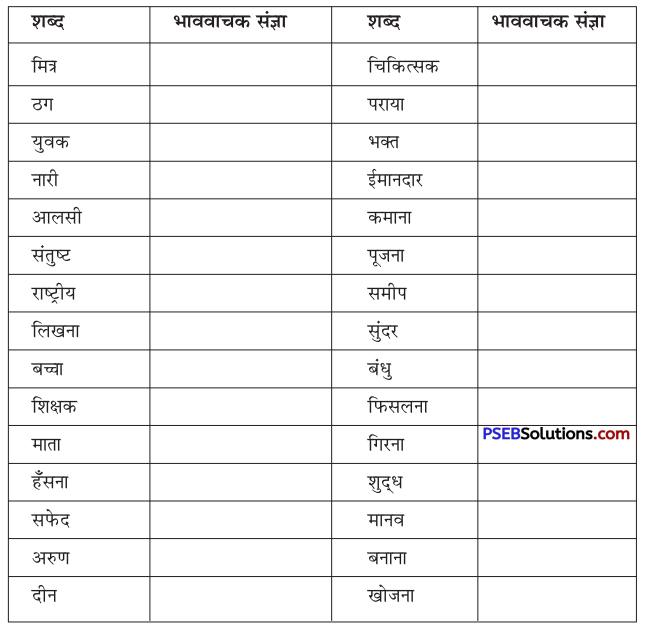
1. निम्नलिखित शब्दों के विपरीत शब्द लिखिए

एक – ————
पाप – ———–
गुण – ————
विस्तार – ————
सूक्ष्म – ————-
ईमानदारी – ————–
उत्तर:
शब्द – विपरीत शब्द
एक – अनेक।
पाप – पुण्य।
गुण – अवगुण।
विस्तार – संकुचन।
सूक्ष्म – स्थूल।
ईमानदारी – बेइमानी।

2. निम्नलिखित शब्दों के दो-दो पर्यायवाची शब्द लिखिए

राजा – ————
कान – ————-
मनुष्य – ———–
दिन – ————-
सदाचार – ————
भ्रष्टाचार – ————
उत्तर:
शब्द – पर्यायवाची शब्द
राजा – नरेश, सम्राट्।
मनुष्य – नर, आदमी।
सदाचार – अच्छा आचरण, पवित्र।
कान – कर्ण, श्रवण।
दिन – दिवस, वार।
भ्रष्टाचार – बुरा आचरण, दुराचार।

PSEB 10th Class Hindi Solutions Chapter 15 सदाचार का तावीज़

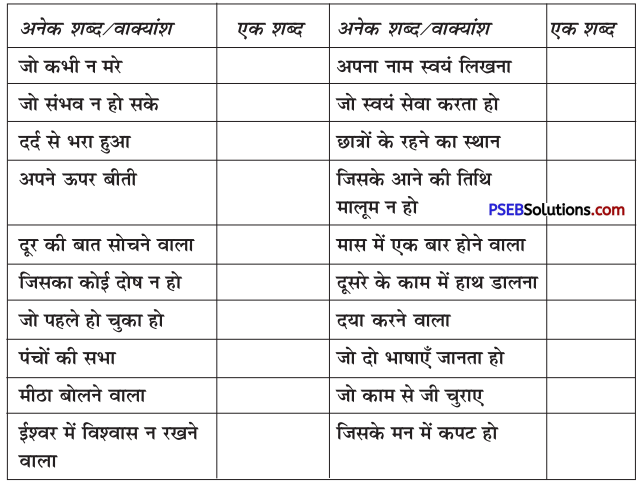
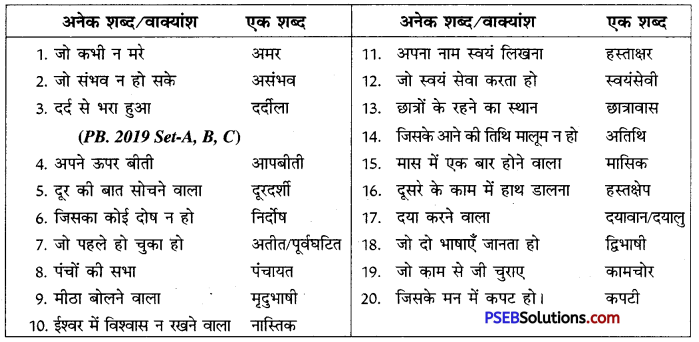
3. निम्नलिखित वाक्यांशों के लिए एक शब्द लिखिए

‘अच्छे आचरण वाला – —————
बुरे आचरण वाला – —————-
जो किसी विषय का ज्ञाता हो – ————–
हर तरफ फैला हुआ – —————-
जो दिखाई न दे – ————-
जिसकी आत्मा महान् हो – ————–
उत्तर:
वाक्यांश एक – शब्द
‘अच्छे आचरण वाला – सदाचारी
बुरे आचरण वाला – दुराचारी
जो किसी विषय का ज्ञाता हो – विशेषज्ञ
हर तरफ फैला हुआ – सर्वव्यापक, सर्वव्यापी
जो दिखाई न दे – अदृश्य
जिसकी आत्मा महान् हो – महात्मा।

(ग) रचनात्मक अभिव्यक्ति

प्रश्न 1.
साधु के स्थान पर आप राजा को भ्रष्टाचार समाप्त करने का कौन-सा उपाय बताते?
उत्तर:
साधु के स्थान पर मैं राजा को भ्रष्टाचार समाप्त करने के निम्नलिखित उपाय बताता-

  1. ठेकेदारी प्रथा समाप्त की जाए।
  2. आम जनता तथा अधिकारियों के बीच दलालों को समाप्त किया जाए।
  3. रिश्वत लेने और देने वालों को सजा का प्रावधान हो।
  4. सरकारी तंत्र में व्याप्त घूसखोरी समाप्त की जाए।
  5. जमाखोरी और कालाबाजारी पर अंकुश लगाया जाए।
  6. मिलावट और नकली माल के उत्पादन पर रोक लगाई जाए।
  7. टैक्स की चोरी करने वालों पर सख्त कारवाई हो।

प्रश्न 2.
विद्यार्थी के रूप में भ्रष्टाचार को खत्म करने के लिए आप कौन-कौन से कदम उठाएँगे?
उत्तर:
भ्रष्टाचार का अंत करने के लिए नैतिकता पर बल देना होगा। नैतिक क्रांति लानी होगी। चरित्र-निर्माण में बाधक तत्व-धन, लोभ और स्वार्थ को उखाड़ना होगा। राष्ट्र हित को सामने रखना होगा। शिक्षा-पद्धति में धार्मिक और नैतिक शिक्षा पर बल देना होगा। यह नैतिक क्रांति जनता को पहले अपने जीवन में लानी होगी। यही नैतिकता उसे निर्भीक और साहसी बनाएगी। उसके आगे रिश्वतखोर और भ्रष्ट अधिकारियों को घुटने टेकने पड़ेंगे। भ्रष्टाचार का एक सूक्ष्म कारण है हमारी सामाजिक अर्थव्यवस्था। हमारी आर्थिक नीतियाँ भ्रष्टाचार को बढ़ावा देती हैं। पूँजीवादी अर्थव्यवस्था में भ्रष्टाचार का अंत नहीं हो सकता, क्योंकि पूँजीवाद अर्थव्यवस्था धन की लिप्सा को अधिक बढ़ाती जाती है। पर जब तक अर्थव्यवस्था नहीं बदलती जनता को पग उठाना पड़ेगा, तभी भ्रष्टाचार समाप्त होगा।

प्रश्न 3.
भ्रष्टाचार या रिश्वत से सम्बन्धित आप अपना या अपने माता-पिता का कोई अनुभव लिखिए।
उत्तर:
एक बार मैं अपने माता-पिता के साथ रेल से पटना जा रहा था। हमने ए०सी० थर्ड में टिकट बुक करवाई थी। हमने दिल्ली स्टेशन से अपने आरक्षण कोच में प्रवेश किया। जल्दी ही हम अपनी सीट पर जा बैठे। हमारे साथ वाली सीट पर एक परिवार और था। उनके पास चार टिकट थी किंतु वे पाँच लोग थे। कुछ देर बाद टी०टी० आया उसने उनसे टिकट दिखाने को कहा तो उन्होंने टिकट दिखा दी। तब टी०टी० ने एक टिकट दूसरे दर्जे की होने पर उसे जुर्माने की बात कही। वे लोग जुर्माना भरना चाहते थे। किंतु टी०टी० ने उनसे कहा यदि वे उसे 500 रु० दे दें तो वह जुर्माने की रसीद नहीं काटेगा। यह एक भ्रष्टाचार का जीता जागता नमूना था। जो मैंने अपनी आँखों से देखा था।

(घ) पाठ्येतर सक्रियता

प्रश्न 1.
भ्रष्टाचार के विरुद्ध स्लोगन लिखकर स्कूल में निश्चित स्थान पर लगाइए।
उत्तर:
1. देश को जगाना होगा,
भ्रष्टाचार को भगाना होगा।

2. देश का यदि चाहते हो विकास,
भ्रष्टाचार को न आने दो आस-पास।

3. गली-गली में शोर है,
भ्रष्टाचार का ज़ोर है।

4. अबकी बार यहीं पुकार,
जड़ से मिटाओ भ्रष्टाचार।

प्रश्न 2.
‘भ्रष्टाचार और उसका समाधान’ विषय पर कक्षा में परिचर्चा कीजिए।
उत्तर:
विद्यार्थी अध्यापक की सहायता से कक्षा में स्वयं करें।

प्रश्न 3.
ईमानदारी से सम्बन्धित कहानियाँ पढ़िए।
उत्तर:
विद्यार्थी पुस्तकालय में जाकर ईमानदारी से संबंधित कहानियाँ खोजकर पढ़ें।

प्रश्न 4.
इस निबंध में आए संवादों के आधार पर किसी एक प्रसंग को लघु नाटिका में रूपांतरित करके उसे स्कूल/कक्षा में मंचित कीजिए।
उत्तर:
अध्यापक की सहायता से विद्यार्थी स्वयं करें।

प्रश्न 5.
समय-समय पर विभिन्न पत्रिकाओं/समाचार-पत्रों आदि में ‘भ्रष्टाचार उन्मूलन’ संबंधी विषय पर कविता, निबंध, स्लोगन राइटिंग (नारे लेखन) आदि प्रतियोगिताओं में भाग लीजिए।
उत्तर:
विद्यार्थी अध्यापक की सहायता से विद्यालय में होने वाली प्रतियोगिताओं में भाग लें।

प्रश्न 6.
स्कूल अथवा अपने इलाके में चल रहे लीगल लिटरेसी क्लब के सक्रिय सदस्य बनें तथा अपने आस-पास हो रहे भ्रष्टाचार उन्मूलन में सहयोग करें।
उत्तर:
विद्यार्थी अपने विवेक के आधार पर किसी सामाजिक संस्था का सदस्य बनकर देश हित में कार्य करें।

(ङ) ज्ञान-विस्तार

I. हरिशंकर परसाई- परसाई जी हिंदी-साहित्य के श्रेष्ठ व्यंग्यकार हैं। इन्होंने व्यंग्य को साहित्य में महत्त्वपूर्ण स्थान दिलवाया है। इन्होंने व्यंग्य को अपने लेखन से देश की विभिन्न समस्याओं के साथ जोड़ कर प्रस्तुत करने में अद्भुत सफलता प्राप्त की है। इन्होंने हास्य-व्यंग्य लिखने के साथ-साथ लंबे समय तक स्कूल-कॉलेजों में शिक्षण का कार्य भी किया है। बाद में इन्होंने साहित्य-लेखन के लिए अपनी शिक्षक की नौकरी त्याग दी थी। इनका व्यंग्य केवल हंसी-मज़ाक और मनोरंजन की वस्तु नहीं है बल्कि उन्होंने इसके माध्यम से समाज की अनेक समस्याओं को उजागर किया है। भ्रष्टाचार, शोषण, राजनीति, समाज आदि पर गहरा व्यंग्य करने के कारण ही इन्हें हिंदी-साहित्य में अनूठा स्थान प्राप्त हुआ है।

II. सदाचार-सदाचार (सत् + आचार) मानव के अच्छे आचरण से संबंधित शब्द है। यह शब्द सुशीलता, अच्छा चाल-चलन, अच्छे व्यवहार, नेक नियती, शुद्ध आचरण, नेकचलनी, शीलाचार आदि को व्यक्त करता है। सदाचार के मार्ग पर चलकर ही इन्सान विश्व भर में नाम कमा सकता है। स्वामी विवेकानन्द, पूर्व प्रधानमंत्री श्री लाल बहादुर शास्त्री, मदर टेरेसा आदि सभी सदाचारी थे और हमें उनके जीवन से शिक्षा प्राप्त करनी चाहिए। हम सबको सदाचार के मार्ग पर चलने की प्रेरणा महापुरुषों से लेनी चाहिए। ऐसा करके ही हम अपने परिवार, समाज और देश का नाम ऊँचा कर सकेंगे।

PSEB 10th Class Hindi Solutions Chapter 15 सदाचार का तावीज़

III. भ्रष्टाचार-यह शब्द भ्रष्ट + आचार दो शब्दों से मिलकर बना है। पापाचार, दुष्ट व्यवहार, अनाचार, पतित व्यवहार, कदाचित बदनीयती, नीच आचार आदि शब्द भ्रष्टाचार को ही व्यक्त करते हैं। मानव जीवन के जो कार्य अनैतिक और अनुचित होते हैं, उन्हें ही भ्रष्टाचार कहते हैं। अपना लाभ और स्वार्थ को पूरा करने के लिए किए जाने वाले सभी प्रकार के अनैतिक कार्य भ्रष्टाचार ही होते हैं। रिश्वतखोरी, काला बाज़ारी, कमीशन खोरी, तस्करी आदि सब भ्रष्टाचार के ही रूप हैं। हमें भ्रष्टाचार से दूर रहकर इसे समाज से मिटाने का प्रयत्न करना चाहिए।

PSEB 10th Class Hindi Guide सदाचार का तावीज़ Important Questions and Answers

प्रश्न 1.
राजा ने दरबारियों को किसे लाने को कहा?
उत्तर:
राजा ने दरबारियों से कहा कि जब कहीं भी कभी उन्हें भ्रष्टाचार दिखाई दे तो उसका नमूना अवश्य लाएँ ताकि भ्रष्टाचार के बारे में पता चले कि वह कैसा होता है।

प्रश्न 2.
राजा खुश क्यों हो रहा था?
उत्तर:
राजा को पहली बार पता चला था कि उसके राज्य में चमत्कारी साधु है इसलिए वह खुश हो रहा था।

प्रश्न 3.
दरबारियों ने भ्रष्टाचार के बारे में क्या बताया?
उत्तर:
दरबारियों ने भ्रष्टाचार के बारे में बताया कि भ्रष्टाचार स्थूल नहीं सूक्ष्म है। वह सब जगह है लेकिन दिखाई नहीं देता।

प्रश्न 4.
राजा को कितने तावीज़ों की आवश्यकता जान पड़ रही थी?
उत्तर:
राजा राज्य के प्रत्येक नागरिक के हाथ पर ताबीज़ बाँधने के लिए करोड़ों तावीज़ों की आवश्यकता थी।

प्रश्न 5.
कर्मचारी ने माह की आखिरी तारीख को रिश्वत क्यों ली होगी?
उत्तर:
कर्मचारी ने माह की आखिरी तारीख को रिश्वत इसलिए ली होगी क्योंकि उसे जो वेतन मिलता होगा वह उसे पर्याप्त नहीं होता होगा और वह पूरा महीना नहीं चल पाता होगा।

प्रश्न 6.
लेखक ने व्यंग्य द्वारा ‘सदाचार का तावीज़’ पाठ में क्या कहना चाहा है?
उत्तर:
लेखक ने व्यंग्य द्वारा ‘सदाचार का तावीज़’ पाठ में कहा है कि केवल भाषणों, नैतिक स्लोगनों, तावीज़ों तथा डंडे के ज़ोर पर भ्रष्टाचार को नहीं मिटाया जा सकता।

प्रश्न 7.
लेखक के अनुसार भ्रष्टाचार को कैसे मिटाया जा सकता है?
उत्तर:
लेखक के अनुसार नैतिक मूल्यों की स्थापना करके तथा कर्मचारियों को पर्याप्त वेतन देकर भ्रष्टाचार को मिटाया जा सकता है।

प्रश्न 8.
राजा का व्यक्तित्व कैसा था?
उत्तर:
राजा केवल अपने बारे में सोचता था। उसे चापलूसी पसंद थी। चापलूस लोग ही उसके मंत्री थे।

प्रश्न 9.
विशेषज्ञों ने सिंहासन में हुए भ्रष्टाचार के विषय में क्या बताया?
उत्तर:
विशेषज्ञों ने बताया कि सिंहासन की रंगाई का जो बिल दिया गया वह लागत से दुगुना था। उसमें आधे पैसे राजा के अफसर खा गए थे।

प्रश्न 10.
विशेषज्ञों ने राजा को भ्रष्टाचार के सम्बन्ध में क्या बताया?
उत्तर:
विशेषज्ञों के अनुसार भ्रष्टाचार को हाथ पकड़कर नहीं लाया जा सकता। वह सूक्ष्म, अगोचर और सर्वत्र व्याप्त है। उसे देखा नहीं, अनुभव किया जा सकता है। अब भ्रष्टाचार ईश्वर हो गया है। भ्रष्टाचार मुख्यतः घूस के रूप में रहता है।

प्रश्न 11.
विशेषज्ञों ने भ्रष्टाचार दूर करने के लिए क्या सुझाव दिया ?
उत्तर:
विशेषज्ञों ने भ्रष्टाचार उन्मूलन के लिए महाराज को व्यवस्था में परिवर्तन करने के लिए कहा। वे ठेका प्रथा समाप्त करने के लिए ज़ोर दे रहे थे क्योंकि ठेकेदार अधिकारियों को घूस देकर अपना काम निकालते हैं। उन्होंने भ्रष्टाचार के अवसर घटाने तथा उन कारणों को दूर करने का भी सुझाव दिया जिन कारणों से घूसखोरी बढ़ती है।

PSEB 10th Class Hindi Solutions Chapter 15 सदाचार का तावीज़

प्रश्न 12.
दरबारी भ्रष्टाचार दूर करने के लिए किसे लाए और क्यों ?
उत्तर:
दरबारी भ्रष्टाचार दूर करने के लिए एक साधु को ले आए। वह सदाचार का तावीज़ बनाता था। उसके बताए हुए तावीज़ को पहनकर बेईमान भी ईमानदार बन जाता था। उस साधु की बातों से राजा प्रभावित हो गया तथा उसने उसे लाखों तावीज़ बनाने का ठेका दे दिया। उसे इस काम के लिए पाँच करोड़ रुपए पेशगी भी दे दिए गए।

प्रश्न 13.
दरबारियों ने साधु को राजा के सामने प्रस्तुत करते हुए क्या बताया?
उत्तर:
एक दिन दरबारियों ने राजा के समक्ष एक साधु को प्रस्तुत किया। उन्होंने राजा से कहा कि यह साधु एक महान् तपस्वी है। यह एक गुफा में तपस्या कर रहा था। हम इसे अपने साथ ले आए हैं। इसने अपनी तपस्या शक्ति के बल पर एक ऐसे तावीज़ का निर्माण किया जो व्यक्ति को सदाचारी बनाता है। उसे भ्रष्टाचार से दूर रखता है। उसे निरंतर सद्विचार देता रहता है। व्यक्ति में अच्छे-बुरे को पहचानने की शक्ति प्रदान करता है। साधु द्वारा निर्माण किया गया तावीज़ पूर्णत: मंत्रों से सिद्ध है। यह व्यक्ति को सदाचारी बनाता है। उसके अंदर की बेईमानी को समाप्त कर उसे नेक इन्सान बनाकर सच्चाई के मार्ग पर लाता है।

प्रश्न 14.
राजा ने वेश बदलकर क्या करना चाहा था?
उत्तर:
राजा ने वेश बदलकर अपने राज्य में हो रहे भ्रष्टाचार को स्वयं अपनी आँखों से देखना चाहा। इसके लिए वह अपने राज्य कर्मचारियों को वेश बदलकर घूस देने की कोशिश करने लगा। पहली बार राजा कर्मचारियों को घूस देने में पूर्णतः असफल रहा क्योंकि कर्मचारियों ने घूस ली ही नहीं। कर्मचारियों के घूस न लेने के क्रियाकलाप को देखकर राजा बहुत प्रसन्न हुआ कि उसके कर्मचारी राज्य और राजा के प्रति कितने निष्ठावान हैं। किन्तु वही कर्मचारी दूसरी बार रिश्वत लेने के लिए तैयार हो गए। रिश्वत लेने का यह दिन महीने का आखिरी दिन था। राजा को समझ नहीं आ रहा था कि यह सब क्या हो रहा है। रिश्वत न लेने वाले कर्मचारी रिश्वत कैसे लेने लगे। इन्हें अचानक क्या हो गया ? राजा को समझ नहीं आ रहा था।

प्रश्न 15.
‘सदाचार का तावीज़’ पाठ के आधार पर बताइए कि कर्मचारियों ने महीने की आखिरी तारीख को रिश्वत क्यों ली?
उत्तर:
कर्मचारियों ने महीने की आखिरी तारीख़ को रिश्वत इसलिए ली होगी क्योंकि महीना भर काम करने के बाद उन्हें जो वेतन मिलता होगा, वह उन्हें पर्याप्त नहीं होता होगा। उस वेतन से उनकी आवश्यकताएं पूरी नहीं होती होंगी। उनका और उनके परिवार का पालन-पोषण ठीक प्रकार से नहीं हो पा रहा होगा, इसलिए महीने की इक्तीस तारीख को उनके मन में घूस लेने का भाव जागृत हुआ कि आज तो घूस ले ही लेनी चाहिए। बिना घूस लिए जीवनयापन करना अत्यंत कठिन है। कठिनता से जीवन जीने के स्थान पर घूस लेना ही उचित है। जब कल वेतन मिल जाएगा, तब फिर से घूस लेना बंद कर देंगे जब फिर से आवश्यकता होगी घूस ले लेंगे।

प्रश्न 16.
‘सदाचार का तावीज़’ किस प्रकार की रचना है?
उत्तर:
‘सदाचार का तावीज़’ हरिशंकर परसाई द्वारा रचित व्यंग्यात्मक लेख है। इसमें लेखक ने भ्रष्टाचार की व्याप्ति तथा उसे दूर करने के अनोखे उपायों पर कटाक्ष किया है।।

प्रश्न 17.
‘सदाचार का तावीज़’ पाठ में लेखक ने किस समस्या को उठाया है और क्या संदेश देना चाहा है?
उत्तर:
लेखक ने अत्यंत रोचक कहानी के रूप में इस भ्रष्टाचार की समस्या को उजागर किया है और संदेश दिया है कि जब तक कर्मचारियों को उनके कार्य के अनुरूप उचित वेतन नहीं मिलेगा भ्रष्टाचार समाप्त नहीं हो सकता। लेखक ने व्यंग्यात्मक आलेखों के अनुरूप सहज, व्यावहारिक तथा कटाक्षपूर्ण भाषा-शैली का प्रयोग किया है। उनके व्यंग्य चुटीले तथा अर्थपूर्ण हैं। साधु की तावीज़ के गुण सुनकर राजा का प्रसन्न होकर यह कहना कि उसे तो ज्ञात ही नहीं था कि उसके राज्य में ऐसे चमत्कारी साधु भी हैं। महात्मन्, हम आपके बहुत आभारी हैं। आपने हमारा संकट हर लिया। हम सर्वव्यापी भ्रष्टाचार से बहुत परेशान थे। मगर हमें लाखों नहीं, करोड़ों तावीज़ चाहिए। हम राज्य की ओर से तावीज़ों का कारखाना खोल देते हैं। आप उसके जनरल मैनेजर बन जाएं और अपनी देख-रेख में बढ़िया तावीज़ बनवाएं। टोटकों को मानने वालों पर तीक्ष्ण प्रहार है।

प्रश्न 18.
‘सदाचार का तावीज़’ पाठ में लेखक ने भ्रष्टाचार और उसके उन्मूलन के अनूठे उपायों पर किस प्रकार व्यंग्य किया है?
उत्तर:
जब भ्रष्टाचार उन्मूलन की विशेषज्ञ समिति राजा को भ्रष्टाचार मिटाने के लिए व्यवस्था में परिवर्तन करने का सुझाव देती है तो राजा-दरबारियों से राय करता है। वे कहते हैं कि यह उचित योजना नहीं बल्कि एक मुसीबत है। इस योजना के आधार पर हमें व्यवस्था में अनेक बदलाव करने होंगे, जिसमें बहुत परेशानी हो सकती है। हमारी सारी व्यवस्था अव्यवस्था में बदल जाएगी। जो जैसा होता आ रहा है, यदि हम उसे बदलेंगे तो अनेक नई परेशानियां खड़ी हो सकती हैं। हमें तो कोई ऐसी योजना अपनानी चाहिए जिससे बिना व्यवस्था में बदलाव लाए ही भ्रष्टाचार समाप्त हो जाए। भ्रष्टाचार उन्मूलन समिति के सुझावों को नहीं मानना यही सिद्ध करता है कि दरबारी भी भ्रष्टाचार में लिप्त है।

प्रश्न 19.
विशेषज्ञों ने राजा के शासन में भ्रष्टाचार की सर्वव्यापकता के बारे में क्या बताया?
उत्तर:
विशेषज्ञों ने राजा के शासन में भ्रष्टाचार की सर्वव्यापकता के बारे में बताते हुए कहा कि आप के सारे राज्य में भ्रष्टाचार घर कर गया है। कोई ऐसा क्षेत्र नहीं जहाँ भ्रष्टाचार न हो। उदाहरण के लिए आप के सिंहासन के रंग का बिल झूठा बनाया गया। यह भ्रष्टाचार घूस के रूप में विद्यमान है। हर काम में घूसखोरी अपनी जगह बनाए हुए है। ठेकेदारी प्रथा इसका सशक्त उदाहरण है। रिश्वतखोरी अपनी चरम सीमा पर है। रिश्वतखोरी और जमाखोरी ने कर्मचारियों और अधिकारियों को नकारा बनाया हुआ है। उनका नैतिक पतन हो चुका है। लोगों में स्वार्थ की भावना बढ़ती जा रही है।

प्रश्न 20.
राजा ने तावीज़ की जाँच किस प्रकार की ? उसके क्या परिणाम निकले?
उत्तर:
जब राजा वेश बदलकर इस तावीज़ के प्रभाव की जाँच करने किसी कार्यालय में काम करवाने के लिए कर्मचारी को पाँच रुपए देता है तो वह नहीं लेता। राजा प्रसन्न होता है कि भ्रष्टाचार समाप्त हो गया, परन्तु जब कुछ दिन बाद वह फिर वेश बदलकर उसी कर्मचारी को देता है तो वह ले लेता है। वह उसकी जाँच करता है तो तावीज़ उसकी भुजा पर बंधा था। राजा ने हैरानी में तावीज़ पर कान लगाया तो उसमें से आवाज़ आ रही थी, ‘अरे, आज इकतीस है। आज तो ले ले।’ पहली बार जब राजा आया था तो दो तारीख थी, कर्मचारी की जेब भरी थी, पर इकतीस को खाली हो गई थी। भ्रष्टाचार वहीं था, कहीं गया नहीं था।

एक पंक्ति में उत्तरात्मक प्रश्न

प्रश्न 1.
राज्य में किस बात का हल्ला मचा?
उत्तर:
राज्य में भ्रष्टाचार बहुत फैलने का हल्ला मचा।

प्रश्न 2.
दरबारी को भ्रष्टाचार क्यों नहीं दिखाई दिया?
उत्तर:
क्योंकि वह बहुत बारीक होता है।

प्रश्न 3.
विशेषज्ञों के अनुसार भ्रष्टाचार कैसा होता है?
उत्तर:
भ्रष्टाचार सूक्ष्म, अगोचर, सर्वत्र व्याप्त, दिखाई नहीं देने वाला तथा अनुभव करने योग्य होता है।

PSEB 10th Class Hindi Solutions Chapter 15 सदाचार का तावीज़

प्रश्न 4.
साधु के अनुसार भ्रष्टाचार कहाँ होता है?
उत्तर:
साधु के अनुसार भ्रष्टाचार मनुष्य की आत्मा में होता है, बाहर नहीं होता।

बहुवैकल्पिक प्रश्नोत्तरनिम्नलिखित प्रश्नों के उत्तर एक सही विकल्प चुनकर लिखें

प्रश्न 1.
विशेषज्ञ जाति के कितने आदमी बुलाए गए?
(क) तीन
(ख) पाँच
(ग) सात
(घ) नौ।
उत्तर:
(ख) पाँच

प्रश्न 2.
वेश बदले हुए राजा ने 2 तारीख को कर्मचारी को कितने रुपए की घूस दी?
(क) तीन
(ख) पाँच
(ग) सात
(घ) नौ।
उत्तर:
(ख) पाँच

प्रश्न 3.
साधु को तावीज़ बनाने के कारखाने को खोलने के लिए कितने करोड़ रुपए पेशगी मिले?
(क) दो
(ख) चार
(ग) पाँच
(घ) छह।
उत्तर:
(ग) पाँच

एक शब्द/हाँ-नहीं/सही-गलत/रिक्त स्थानों की पूर्ति के प्रश्न

प्रश्न 1.
विशेषज्ञों के अनुसार राजा के शासन में भ्रष्टाचार मुख्यतः किसके रूप में था? (एक शब्द में उत्तर दें)
उत्तर:
घूस के

प्रश्न 2.
हम भ्रष्टाचार बिल्कुल मिटाना चाहते हैं। (हाँ या नहीं में उत्तर दें)
उत्तर:
हाँ

प्रश्न 3.
वह महाराज के सिंहासन में नहीं है। (हाँ या नहीं में उत्तर दें)
उत्तर:
नहीं

प्रश्न 4.
इस कल में से ईमान या बेईमानी के स्वर निकलते हैं। (सही या गलत में उत्तर दें)
उत्तर:
सही

प्रश्न 5.
अरे, आज इकतीस है। आज तो मत ले। (सही या गलत में उत्तर दें)
उत्तर:
गलत

प्रश्न 6.
राजा ……………. में पड़ गए।
उत्तर:
असमंजस

प्रश्न 7.
महाराज, राज्य क्यों …………… में पड़े।
उत्तर:
झंझट

प्रश्न 8.
राजा का ………. बिगड़ने लगा।
उत्तर:
स्वास्थ्य।

सदाचार का तावीज़ कठिन शब्दों के अर्थ

घूस = रिश्वत। झंझट = उलझन। सदाचार = अच्छा आचरण। सर्वव्यापी = हर तरफ फैला हुआ। प्रपितामह = पड़दादा। कंदरा = गुफा । मुख्यतः = प्रमुख रूप से। अंजन = काजल। तावीज़ = रक्षा कवच। उत्सुकता = अधीरता, बेचैनी। साधक = साधना करने वाला। सूक्ष्म = बारीक। पेशगी = काम करने के पहले दिया जाने वाला वंश। स्थूल = मोटा। विचारणीय = सोचने योग्य। भ्रष्टाचार = बुरा आचार-विचार । दरबार = राज्य सभा। यकायक = अचानक। कल = यंत्र, मशीन। अगोचर = अदृश्य, अप्रत्यक्ष। खलल = व्यवधान। आँचकर = आँखों में काजल लगाकर। जादू = चमत्कारी गुण। आदि = आदत, अभ्यस्त । साधक = साधना करने वाला। बिल = किसी वस्तु का भुगतान किया जाने वाला कागजी प्रमाण। नमूना = थोड़ा-सा अंश, सेंपल । व्यवस्था = शासन प्रणाली। छान-बीन = जाँच-पड़ताल। असमंजस = दुविधा। तरकीब = उपाय, युक्ति। विराटता = बहुत बड़ा, विशालता। सिंहासन = राजा के बैठने का स्थान। व्याप्त = समाया हुआ। विशेषज्ञ = किसी विषय-विशेष का ज्ञान रखने वाला। माह = महीना, मास। सर्वत्र = सब जगह। आस्तीन = पहनने के कपड़े का वह भाग जो बाँह को ढकता है।

सदाचार का तावीज़ Summary

सदाचार का तावीज़ लेखक परिचय

हिंदी के सुप्रसिद्ध व्यंग्य लेखक हरिशंकर परसाई का जन्म 22 अगस्त, सन् 1922 ई० को मध्य प्रदेश के होशंगाबाद जिले के जमानी नामक गाँव में हुआ था। इनकी प्रारंभिक शिक्षा गाँव में ही हुई थी। इन्होंने नागपुर विश्वविद्यालय से हिंदी विषय में एम० ए० की परीक्षा उत्तीर्ण की थी। आपने कुछ वर्षों तक अध्यापन कार्य किया परंतु बार-बार स्थानांतरणों से तंग आकर अध्यापन कार्य छोड़ लेखन करने का निर्णय किया।

परसाई जी जबलपुर में बस गए और वहीं से कई वर्षों तक ‘वसुधा’ नामक पत्रिका निकालते रहे। आर्थिक कठिनाइयों के कारण उन्हें यह पत्रिका बंद करनी पड़ी। परसाई जी की रचनाएँ प्रमुख पत्र-पत्रिकाओं में प्रकाशित होती रहीं। सन् 1984 ई० में ‘साहित्य अकादमी’ ने इन्हें इनकी पुस्तक ‘विकलांग श्रद्धा का दौर’ पर पुरस्कृत किया था। मध्य प्रदेश के संस्कृति विभाग ने इन्हें इक्कीस हज़ार रुपए का पुरस्कार प्रदान किया, जिसे वहां के मुख्यमंत्री ने स्वयं इनके घर जबलपुर आकर दिया। इन्हें बीस हज़ार रुपए के चकल्लस पुरस्कार से भी सम्मानित किया गया था। परसाई जी प्रगतिशील लेखक संघ के प्रधान रहे हैं।

हिंदी व्यंग्य लेखन को सम्मानित स्थान दिलाने में परसाई जी का महत्त्वपूर्ण योगदान है। सन् 1995 ई० में इनका देहांत हो गया। परसाई जी का व्यंग्य हिंदी साहित्य में अनूठा है। सुप्रसिद्ध पत्रिका ‘सारिका’ में इनका स्तंभ ‘तुलसीदास चंदन घिसे’ अत्यधिक लोकप्रिय हुआ था। इन सामाजिक विकृतियों को इन्होंने सदा ही अपने पैने व्यंग्य का विषय बनाया है। इनकी प्रमुख रचनाएँ निम्नलिखित हैं-
कहानी संग्रह–’हंसते हैं रोते हैं’, ‘जैसे उनके दिन फिरे’, ‘दो नाक वाले लोग’, ‘माटी कहे कुम्हार से’। उपन्यास-‘रानी नागफनी की कहानी’ तथा ‘तट की खोज’। निबंध संग्रह–’तब की बात और थी’, ‘भूत के पांव पीछे’, ‘बेइमानी की परत’, ‘पगडंडियों का जमाना’, ‘सदाचार का ताबीज़’, ‘शिकायत मुझे भी है’, ‘ठिठुरता हुआ गणतंत्र’, ‘विकलांग श्रद्धा का दौर’, ‘निठल्ले की डायरी’।
व्यंग्य संग्रह-वैष्णव की फिसलन, तिरछी रेखाएँ, ठिठुरता हुआ गणतंत्र, विकलांग श्रद्धा का दौर। परसाई जी का सारा साहित्य ‘परसाई रचनावली’ के नाम से छप चुका है।

PSEB 10th Class Hindi Solutions Chapter 15 सदाचार का तावीज़

सदाचार का तावीज़ कहानी का सार

‘सदाचार का तावीज़’ हरिशंकर परसाई द्वारा रचित एक व्यंग्य रचना है, जिसमें लेखक ने देश में व्याप्त भ्रष्टाचार तथा उसके उन्मूलन के खोखले रूपों पर कटाक्ष किया है। लेखक एक काल्पनिक राज्य की कहानी सुनाता है जहाँ भ्रष्टाचार बहुत फैल गया था। वहाँ का राजा दरबारियों को कहता है कि प्रजा देश में फैले भ्रष्टाचार पर हल्ला मचा रही है, उन्हें तो आज तक यह नहीं दिखाई देता। अगर उन लोगों ने इसे कहीं देखा हो तो बताओ। दरबारियों को भी नहीं दिखाई देता। एक दरबारी के कहने पर विशेषज्ञों को भ्रष्टाचार ढूंढ़ने का काम सौंपा जाता है।

दो महीने की जांच के बाद विशेषज्ञ राजा को बताते हैं कि भ्रष्टाचार बहुत है पर उसे पकड़ कर नहीं लाया जा सकता क्योंकि वह सूक्ष्म तथा अगोचर है और सर्वत्र व्याप्त है। वह देखने की नहीं अनुभव करने की वस्तु है। राजा इन गुणों को ईश्वर के मानकर पूछता है कि तो क्या भ्रष्टाचार ईश्वर है ? वे उत्तर देते हैं कि अब तो भ्रष्टाचार ईश्वर हो गया है। उदाहरण के रूप में वे राजा को बताते हैं कि आप के सिंहासन के रंग का बिल झूठा बनाया गया। यह भ्रष्टाचार घूस के रूप में फैला हुआ है। जब राजा ने उनसे इसे दूर करने का उपाय पूछा तो उन्होंने व्यवस्था में बहुत से परिवर्तन करने तथा ठेकेदारी की प्रथा समाप्त करने के लिए कहा। राजा ने विचार करने के लिए उनकी योजना रख ली।

राजा और दरबारियों ने विशेषज्ञों की योजना का अध्ययन किया। राजा सोच-सोच कर बीमार हो गया तो एक दरबारी ने उन्हें कहा कि इस योजना को त्याग कर कोई ऐसा उपाय सोचना चाहिए जिससे बिना अधिक उलट-फेर किए ही भ्रष्टाचार समाप्त हो जाए। इसके लिए दरबारियों ने एक साधु को खोज लिया जिसने सदाचार की तावीज़ बना ली थी जिसे भुजा पर बांधने से व्यक्ति सदाचारी बन जाता था। राजा को यह उपाय पसंद आ गया। एक मंत्री के सुझाव पर उसने साधु को तावीज़ बनाने का ठेका और पाँच करोड़ रुपए इस कार्य को करने के लिए पेशगी दे दिए। लाखों तावीज़ बने और प्रत्येक सरकारी कर्मचारी की भुजा पर बांध दिए गए।

एक दिन राजा वेश बदलकर तावीज़ का प्रभाव देखने दो तारीख को एक कार्यालय में गया और किसी कर्मचारी को पाँच रुपए देकर अपना काम करवाना चाहा तो उसने उसे ‘यहाँ घूस लेना पाप है’ कह कर भगा दिया। राजा प्रसन्न हुआ कि तावीज़ ने कर्मचारी ईमानदार बना दिए हैं। वह एक दिन फिर इकतीस तारीख को उसी कर्मचारी के पास काम करवाने गया और उसे पाँच का नोट दिखाया जो उसने ले लिया। राजा ने उसे पकड़ लिया और पूछा कि क्या उसने तावीज़ नहीं बांधा है? उसने तावीज़ बांधी हुई थी। जब राजा ने तावीज़ पर कान लगाया तो उसमें से आवाज़ आ रही थी कि आज इकतीस है, आज तो लें ले !’

PSEB 10th Class Hindi Solutions Chapter 14 राजेन्द्र बाबू

Punjab State Board PSEB 10th Class Hindi Book Solutions Chapter 14 राजेन्द्र बाबू Textbook Exercise Questions and Answers.

PSEB Solutions for Class 10 Hindi Chapter 14 राजेन्द्र बाबू

Hindi Guide for Class 10 PSEB राजेन्द्र बाबू Textbook Questions and Answers

(क) विषय बोध

I. निम्नलिखित प्रश्नों के उत्तर एक या दो पंक्तियों में दीजिए

प्रश्न 1.
राजेंद्र बाबू को लेखिका ने प्रथम बार कहाँ देखा था?
उत्तर:
राजेंद्र बाबू को लेखिका ने सबसे पहले पटना के स्टेशन पर एक बेंच पर बैठे देखा था।

प्रश्न 2.
राजेंद्र बाबू अपने स्वभाव और रहन-सहन में किसका प्रतिनिधित्व करते थे?
उत्तर:
राजेंद्र बाबू अपने स्वभाव और रहन-सहन में एक सामान्य भारतीय या भारतीय कृषक का प्रतिनिधित्व करते थे।

PSEB 10th Class Hindi Solutions Chapter 14 राजेन्द्र बाबू

प्रश्न 3.
राजेंद्र बाबू के निजी सचिव और सहचर कौन थे?
उत्तर:
राजेंद्र बाबू के निजी सचिव और सहचर भाई चक्रधर जी थे।

प्रश्न 4.
राजेंद्र बाबू ने किनकी शिक्षा की व्यवस्था करने के लिए लेखिका से अनुरोध किया?
उत्तर:
राजेंद्र बाबू ने अपनी 15-16 पौत्रियों की शिक्षा की व्यवस्था करने के लिए लेखिका से अनुरोध किया था।

प्रश्न 5.
लेखिका प्रयाग से कौन-सा उपहार लेकर राष्ट्रपति भवन पहुंची थी?
उत्तर:
लेखिका प्रयाग से बारह सूपों का उपहार लेकर राष्ट्रपति भवन पहुंची थी।

प्रश्न 6.
राष्ट्रपति को उपवास की समाप्ति पर क्या खाते देखकर लेखिका को हैरानी हुई?
उत्तर:
राष्ट्रपति के उपवास की समाप्ति पर कुछ उबले हुए आलू खाकर परायण करते हैरानी हुई थी।

II. निम्नलिखित प्रश्नों के उत्तर तीन या चार पंक्तियों में दीजिए

प्रश्न 1.
राजेंद्र बाबू को देखकर हर किसी को यह क्यों लगता था कि उन्हें पहले कहीं देखा है?
उत्तर:
राजेंद्र बाबू की मुखाकृति तथा शरीर का सम्पूर्ण गठन एक सामान्य भारतीय की तरह था। उनकी वेशभूषा भी सामान्य व्यक्तियों के समान थी। उनका स्वभाव तथा रहन-सहन भी एक सामान्य नागरिक जैसा ही था। इसलिए जो भी उन्हें देखता था उसे यही लगता था कि ऐसे व्यक्ति को तो पहले कहीं देखा था।

प्रश्न 2.
पं० जवाहर लाल नेहरू की अस्त-व्यस्तता तथा राजेंद्र बाबू की सारी व्यवस्था किसका पर्याय थी?
उत्तर:
पं० जवाहर लाल नेहरू की अस्त-व्यस्तता एक व्यवस्था से निर्मित होती थी। राजेंद्र बाबू की व्यवस्था ही अस्त-व्यस्तता से परिपूर्ण होती थी। इसलिए उनकी व्यवस्थता पं० जवाहर लाल नेहरू की अस्त-व्यस्तता की पर्याय थी तथा पं० जवाहर लाल नेहरू की अस्त-व्यस्तता राजेंद्र बाबू की व्यवस्था की पर्याय थी।

प्रश्न 3.
राजेंद्र बाबू की वेश-भूषा के साथ उनके निजी सचिव और सहचर चक्रधर बाबू का स्मरण लेखिका को क्यों हो आया ?
उत्तर:
राजेंद्र बाबू की वेशभूषा तथा अस्त-व्यस्तता से लेखिका को उनके निजी सचिव और सहचर चक्रधर बाबू का स्मरण हो गया था। चक्रधर बाबू तब तक अपने मोज़े तथा जूते नहीं बदलते थे जब तक मोज़ों से पाँचों उँगलियाँ बाहर नहीं निकलने लगती थीं तथा जूतों के तलों में सुराख नहीं हो जाते थे। वे अपने वस्त्र भी उनके जीर्ण-शीर्ण हो जाने तक नहीं बदलते थे। वे राजेंद्र बाबू के पुराने वस्त्रों को पहन कर ही वर्षों उनकी सेवा करते रहे थे।

प्रश्न 4.
लेखिका ने राजेंद्र बाबू की पत्नी को सच्चे अर्थों में धरती की पुत्री क्यों कहा है?
उत्तर:
लेखिका ने राजेंद्र बाबू की पत्नी को सच्चे अर्थों में धरती की पुत्री इसलिए कहा है क्योंकि वे धरती के समान सरल, क्षमामयी, सबके प्रति ममतालु तथा त्यागमयी थीं। बिहार के ज़मींदार परिवार की वधू होकर भी उन्हें अहंकार नहीं था। वे सबका बहुत ध्यान रखती थीं। वे अत्यंत विनम्र स्वभाव की थीं।

प्रश्न 5.
राजेंद्र बाबू की पोतियों का छात्रावास में रहन-सहन कैसा था ?
उत्तर:
राजेंद्र बाबू की पोतियां छात्रावास में सामान्य छात्राओं के समान बहुत सादगी और संयम से रहती थीं। वे सभी खादी के कपड़े पहनती थीं। उन्हें अपने वस्त्र स्वयं धोने होते थे। उन्हें अपने कमरे की सफ़ाई, झाड़-पोंछ स्वयं करनी होती थीं। वे अपने गुरुजनों की सेवा भी करती थीं। उन्हें साबुन, तेल आदि के लिए सीमित राशि ही दी जाती थी।

PSEB 10th Class Hindi Solutions Chapter 14 राजेन्द्र बाबू

प्रश्न 6.
राष्ट्रपति भवन में रहते हुए भी राजेंद्र बाबू और उनकी पत्नी में किसी प्रकार का परिवर्तन नहीं हुआउदाहरण देकर स्पष्ट करें।
उत्तर:
राष्ट्रपति भवन में रहते हुए भी राजेंद्र बाबू तथा उनकी पत्नी में किसी प्रकार का परिवर्तन नहीं हुआ था। अपनी पौत्रियों के संबंध में राजेंद्र बाबू ने लेखिका से कहा था कि उनकी पौत्रियाँ जैसी रहती आई हैं, अब भी वैसी ही रहेंगी। इसी प्रकार से उनकी पत्नी स्वयं भोजन बना कर पति, परिवार तथा परिजनों को खिलाने के बाद ही स्वयं अन्न ग्रहण करती थीं। उपवारर का णयण फल, मेवों, मिठाइयों आदि के स्थान पर वे उबले हुए आलू खाकर करते थे।

III. निम्नलिखित प्रश्नों के उत्तर छ:-सात पंक्तियों में दीजिए

प्रश्न 1.
राजेंद्र बाबू की शारीरिक बनावट, वेश-भूषा और स्वभाव का वर्णन करें।
उत्तर:
राजेंद्र बाबू के हाथ, पैर, शरीर सब में लंबाई की विशेषता थी। उनके काले, घने, छोटे कटे हुए बाल, चौड़ा मुख, चौड़ा माथा, घनी भौहें, बड़ी-बड़ी आँखें, कुछ भारी नाक, गोलाई लिए चौड़ी ठुड्डी, कुछ मोटे और सुडौल होंठ, गेहुँआ रंग, बड़ी-बड़ी मूंछे थीं। वे खादी की मोटी धोती-कुर्ता, काला बंद गले का कोट, गांधी टोपी, साधारण मौजे और जूते पहनते थे। उनका स्वभाव अत्यन्त शांत था। वे सदा सादगी पसंद करते थे। अपने स्वभाव तथा रहन-सहन में वे एक सामान्य भारतीय अथवा किसान के समान थे। उनका खान-पान अत्यन्त साधारण था।

प्रश्न 2.
पाठ के आधार पर राजेंद्र बाबू की पत्नी की चारित्रिक विशेषताओं का वर्णन करें।
उत्तर:
राजेंद्र बाबू की पत्नी एक सच्ची भारतीय नारी थीं। वह धरती के समान सहनशील, क्षमामयी, ममतालु तथा सरल थीं। बचपन में ही उनका विवाह हो गया था। बिहार के ज़मीदार परिवार की वधू तथा स्वतंत्रता संग्राम के सुप्रसिद्ध सेनानी एवं भारत के प्रथम राष्ट्रपति की पत्नी होने का भी उन्हें अहंकार नहीं था। राष्ट्रपति भवन में वे स्वयं भोजन पकाती थी तथा पति, परिवार, परिजनों आदि को खिला कर ही स्वयं अन्न ग्रहण करती थीं। लेखिका के छात्रावास में अपनी पौत्रियों से मिलने आने पर वे छात्रावास की अन्य छात्राओं, सेवकों आदि को भी मिठाई बांट देती थीं। गंगा स्नान के समय वे खूब दान करती थीं।

प्रश्न 3.
आशय स्पष्ट कीजिए:
(क) सत्य में जैसे कुछ घटाना या जोड़ना संभव नहीं रहता, वैसे ही सच्चे व्यक्तित्व में भी कुछ जोड़नाघटाना सम्भव नहीं है।
उत्तर:
भाव यह है कि सत्य अंत तक सत्य ही रहता है। उसमें से कुछ भी घटाया या बढ़ाया नहीं जा सकता। उसी प्रकार एक सच्चे व्यक्तित्व में कुछ भी घटाया या बढ़ाया नहीं जा सकता, क्योंकि सच्चा व्यक्ति सदैव एक ही रूप में नज़र आता है।

(ख) क्या वह सांचा टूट गया जिसमें ऐसे कठिन कोमल चरित्र ढलते थे?
उत्तर:
भाव यह है कि क्या ईश्वर से वह सांचा टूट गया है, जिसके माध्यम से वह राजेंद्र बाबू जैसे कठिन और कोमल चरित्र वाले व्यक्ति बनाता था। अब ईश्वर ने उन जैसे सरल तथा परिश्रमी व्यक्ति बनाना बंद कर दिया है। आज वह वातावरण नष्ट हो गया है जिस वातावरण में नैतिक चरित्रों का निर्माण होता था।

(ख) भाषा बोध

I. निम्नलिखित में संधि कीजिए

शीत + अवकाश, विद्या + अर्थी, मुख + आकृति, छात्र + आवास, प्रति + ईक्षा, प्रति + अक्ष।
उत्तर:
शीत + अवकाश = शीतावकाश
विद्या + अर्थी = विद्यार्थी
मुख + आकृति = मुखाकृति
छात्र + आवास = छात्रावास
प्रति + ईक्षा = प्रतीक्षा
प्रति + अक्ष = प्रत्यक्ष।

II. निम्नलिखित शब्दों में संधि विच्छेद कीजिए

राजेंद्र, वातावरण, फलाहार, व्यतीत, मिष्ठान्न, प्रत्येक, व्यवस्था, एकासन।
उत्तर:
राजेंद्र = राजा + इंद्र
वातावरण = वात + आवरण
फलाहार = फल + आहार
व्यतीत = वि + अतीत
मिष्ठान्न = मिष्ठा + अन्न
प्रत्येक = प्रति + एक
व्यवस्था = वि + अवस्था
एकासन = एक + आसन।

III. निम्नलिखित विग्रह पदों को समस्त पदों में बदलिए

राष्ट्र का पति
रसोई के लिए घर
कर्म में निष्ठा
विद्या की पीठ
गंगा में स्नान
राष्ट्रपति का भवन
उत्तर:
राष्ट्र का पति = राष्ट्रपति
रसोई के लिए घर = रसोईघर
कर्म में निष्ठा. = कर्मनिष्ठा
विद्या का पीठ = विद्यापीठ
गंगा में स्नान = गंगास्नान
राष्ट्रपति का भवन = राष्ट्रपति भवन

IV. निम्नलिखित अनेक शब्दों के लिए एक शब्द लिखिए

गाँव का रहने वाला, नगर में रहने वाला, कृषि कर्म करने वाला, छात्रों के रहने का स्थान, जिसका कोई शत्रु न हो, जिसे पराजित न किया जा सके, अतिथि का स्वागत करने वाला।
उत्तर:
वाक्यांश = एक शब्द
गाँव का रहने वाला = ग्रामीण
नगर का रहने वाला = नागरिक
कृषि कर्म करने वाला = कृषक
छात्रों के रहने का स्थान = छात्रावास
जिसका कोई शत्रु न हो = अजातशत्रु
जिसे पराजित न किया जा सके = अपराजेय
अतिथि का स्वागत करने वाला = आतिथेय।

(ग) रचनात्मक अभिव्यक्ति

प्रश्न 1.
राजेंद्र बाबू सादगी और सरलता की प्रतिमूर्ति थे। आप उनके कौन-कौन से गुणों को अपने जीवन में अपनाना चाहेंगे?
उत्तर:
हम राजेंद्र बाबू के जीवन से सादगी, सरलता, विनम्रता, सहजता आदि गुणों को अपने जीवन में अपनाना चाहते हैं।

PSEB 10th Class Hindi Solutions Chapter 14 राजेन्द्र बाबू

प्रश्न 2.
आप किसी महान् व्यक्तित्व से मिले हो अथवा आपने किसी महान् व्यक्तित्व के बारे में पढ़ा हो तो संक्षेप में लिखिए।
उत्तर:
मैं स्वामी विवेकानंद जी के विषय में पढ़ रहा था तो मुझे उनसे संबंधित यह प्रसंग बहुत प्रेरणादायक लगा भारत के प्रतिनिधित्व करने वाले स्वामी विवेकानंद पार्लियामेंट ऑफ रिलीजंज़ में भाग लेने के लिए अमेरिका जाने वाले थे। आपके गुरु ठाकुर रामकृष्ण परम-हंस ब्रह्मलीन हो चुके थे। आप गुरु माँ शारदा देवी जी का आशीर्वाद लेने उनके पास पहुँचे। माँ शारदा रसोई घर में आटा मल रही थीं। उन्होंने विवेकानंद जी से चाकू मांगा। विवेकानंद जी ने चाकू का फल तो अपने हाथ में पकड़ा और चाकू की मूठ माँ की ओर बढ़ा दी। माँ ने प्रसन्न होकर आटे से सने हाथ से विवेकानंद को आशीर्वाद देते हुए विजयीभव कह दिया और कहा, “बेटा, चाकू पकड़ाने की छोटी-सी घटना ने आपकी महानता का परिचय दे दिया। आप दूसरों के कष्टों को अपने ऊपर झेलते हुए और अपना सुख दूसरों को बाँटते हुए पूरे विश्व में ठाकुर जी की शिक्षा का प्रचार करोगे।” इस प्रसंग से मैंने यह सीखा कि समस्त कष्ट अपने लिए होते हैं तथा सुख दूसरों के लिए होते हैं।

प्रश्न 3.
भारत के सभी राष्ट्रपतियों के चित्र एकत्र करके एक चार्ट पर चिपकाकर पुस्तकालय अथवा अन्य किसी समुचित स्थान पर लगाइए।
उत्तर:
आप स्वयं कीजिए।

प्रश्न 4.
भारत के राष्ट्रपति-चुनाव के संबंध में जानकारी प्राप्त कीजिए।
उत्तर:
अपने अध्यापक/अध्यापिका का सहायता से कीजिए।

(घ) पाठ्येतर सक्रियता

प्रश्न 1.
राजेंद्र बाबू के बाद के भारत के विभिन्न राष्ट्रपतियों के बारे में जानकारी प्राप्त करने के लिए जीवनियां पढ़िए।
उत्तर:
विद्यार्थी स्वयं करें।

प्रश्न 2.
डॉ. राजेंद्र प्रसाद जैसी आकृति व वेशभूषा धारण करके फैन्सी ड्रेस प्रतियोगिता में भाग लीजिए।
उत्तर:
विद्यार्थी स्वयं करें।

प्रश्न 3.
सरलता व सादगी का व्यक्तित्व पर सकारात्मक प्रभाव पड़ता है। इस विषय के पक्ष और विपक्ष में कक्षा में परिचर्चा करें।
उत्तर:
विद्यार्थी स्वयं करें।

(ङ) ज्ञान-विस्तार

1. डॉ० राजेन्द्र प्रसाद-
डॉ० राजेन्द्र प्रसाद हमारे देश के पहले राष्ट्रपति थे। इनका जन्म जीरा देयू (बिहार) में 3 दिसंबर, सन् 1884 में हुआ था। इनके अभिभावक श्री महादेव सहाय थे। डॉ० राजेन्द्र प्रसाद की पत्नी का नाम राजवंशी देवी था। इन्होंने अपनी प्रारंभिक शिक्षा कलकत्ता विश्वविद्यालय, प्रेसीडेंसी कॉलेज (कलकत्ता) से प्राप्त की थी। इन्होंने उच्च शिक्षा प्राप्त करने के पश्चात् बी० एल० कानून में एम० ए० और पी० एच० डी० की उपाधियां प्राप्त की थीं। देश की स्वतंत्रता प्राप्ति के पश्चात् इन्होंने 26 जनवरी, सन् 1950 से 13 मई सन् 1962 तक देश के राष्ट्रपति पद को अति सफलतापूर्वक संभाला था। इन्हें भारत रत्न की उपाधि प्राप्त हुई थी। इनका देहावसान 28 फरवरी, सन् 1963 ई० में पटना के सदाकत आश्रम में हो गया था।

2. राष्ट्रपति भवन-यह देश के राष्ट्रपति का भव्य निवास स्थान है। इसे सन् 1950 तक वाइसरॉय हाउस के नाम से जाना जाता था और भारत के गवर्नर जनरल तब इसमें रहा करते थे। यह दिल्ली के बीचो-बीच बना हुआ है जिसमें 340 कक्ष हैं। यह भवन विश्व के किसी भी राष्ट्राध्यक्ष के रहने वाले भवन से बड़ा है। इनकी भव्यता अद्भुत है।

3. भारत के राष्ट्रपतियों की क्रमानुसार सूची-

  • डॉ० राजेन्द्र प्रसाद
  • डॉ० सर्वपल्ली राधाकृष्णन
  • डॉ० ज़ाकिर हुसैन
  • वी० वी० गिरी (बराहगिरी वेंकट गिरी)
  • फ़करुद्दीन अली अहमद
  • नीलम संजीवा रेड्डी
  • ज्ञानी जैल सिंह
  • रामास्वामी वेंकटरमण
  • डॉ० शंकरदयाल शर्मा
  • के० आर० नारायणन
  • डॉ० ए० पी० जे० अब्दुल कलाम
  • प्रतिभा पाटिल
  • प्रणब मुखर्जी।
  • राम नाथ कोविंद

राष्ट्रपति भवन

भारत सरकार के राष्ट्रपति का सरकारी आवास ‘राष्ट्रपति भवन’ के नाम से जाना जाता है। सन् 1950 तक इसे वाइसरॉय हाउस नाम से पुकारा जाता था। तब यह उस समय भारत के गवर्नर जनरल का निवास स्थल था। यह नई दिल्ली के बीचोबीच बना हुआ है। इसमें 340 कक्ष हैं। यह पूरे संसार में किसी भी राष्ट्राध्यक्ष के घर से बड़ा है।

PSEB 10th Class Hindi Guide राजेन्द्र बाबू Important Questions and Answers

प्रश्न 1.
‘राजेंद्र बाबू को मैंने पहले पहल एक सर्वथा गद्यात्मक वातावरण में देखा था।’ लेखिका द्वारा वर्णित ‘गद्यात्मक वातावरण’ का वर्णन करो।
उत्तर:
लेखिका ने जब पहली बार राजेंद्र बाबू को देखा था, तो वह उनके व्यक्तित्व से पूर्णतः अपरिचित थी। परंतु जैसे-जैसे वह उनके संपर्क में आती गई, वैसे-वैसे उनके जीवन में छिपे हुए गूढ़ रहस्यों को भी जानती गई। इसी ‘गद्यात्मक वातावरण’ का वर्णन लेखिका ने इस पाठ में किया है।

प्रश्न 2.
निम्नलिखित वाक्य में लेखिका ने राजेंद्र बाबू की किस विशेषता की ओर संकेत किया है? ‘पहली दृष्टि में ही जो आकृति स्मृति में अंकित हो गई थी, उसमें इतने वर्षों में न कोई नई रेखा जुड़ी है और न कोई नया रंग भरा है।’
उत्तर:
इन पंक्तियों में लेखिका ने राजेंद्र बाबू के प्रभावपूर्ण, आकर्षक एवं सच्चे व्यक्तित्व की ओर संकेत किया है।

प्रश्न 3.
लेखिका ने सूत्र रूप में राजेंद्र बाबू और पं० नेहरू में तुलना की है। उसे स्पष्ट रूप से समझाओ।
उत्तर:
पं० नेहरू के जीवन में फैली हुई अव्यवस्था में भी कोई न कोई व्यवस्था अवश्य छिपी रहती थी जबकि राजेंद्र बाबू का पूरा जीवन ही अव्यवस्थित था अपितु उनकी व्यवस्था में भी अव्यवस्था की झलक दिखाई पड़ती थी।

प्रश्न 4.
पाठ के किन वाक्यों से पता चलता है कि राजेंद्र बाबू अपनी वेश-भूषा के प्रति सचेष्ट नहीं रहते थे? ऐसा क्यों?
उत्तर:
लेखिका ने जब पहली बार राजेंद्र बाबू को देखा तो उसे उनकी वेश भूषा बहुत अस्त-व्यस्त लगी। उनके कोट के ऊपर के भाग का बटन टूट जाने के कारण खुला था। उनका एक मोज़ा जूते पर उतर आया था और दूसरा टखने पर घेरा बना रहा था। जूतों पर मिट्टी की पर्त चढ़ी हुई थी। उनके सिर पर पहनी हुई गांधी टोपी भौंहों पर खिसक आई थी। उनकी वेश-भूषा देखकर लगता था मानो वे किसी हड़बड़ी में चलते-चलते कपड़े पहनते आए हैं, जो जिस स्थिति में अटक गया, वह उसी स्थिति में अटका रह गया।

PSEB 10th Class Hindi Solutions Chapter 14 राजेन्द्र बाबू

प्रश्न 5.
राजेंद्र बाबू की वेश-भूषा की अस्त-व्यस्तता के साथ उनके निजी सचिव और सहचर चक्रधर बाबू का स्मरण लेखिका को क्यों हो आया?
उत्तर:
राजेंद्र बाबू की वेश-भूषा की अस्त-व्यस्तता के साथ उनके निजी सचिव और सहचर चक्रधर बाबू का स्मरण लेखिका को इसलिए हो आया क्योंकि यह एक सच्चे शिष्य की भाँति राजेंद्र बाबू के पुराने वस्त्रों को पहन कर स्वयं को धन्य अनुभव करते थे।

प्रश्न 6.
भाव स्पष्ट कीजिए ‘व्यापकता ही सामान्यता की शपथ है, परंतु व्यापकता संवेदना की गहराई में स्थित रहती है।’
उत्तर:
भाव यह है कि संवेदनशीलता एक व्यक्ति को अन्य व्यक्तियों से जोड़ती है, जिससे वह अपनी विशिष्टता के रहते हुए भी एक सामान्य व्यक्ति बन जाता है।

एक पंक्ति में उत्तरात्मक प्रश्न

प्रश्न 1.
लेखिका प्रयाग में कौन-सी कक्षा में पढ़ती थी तथा शीतावकाश में कहाँ जा रही थी?
उत्तर:
लेखिका प्रयाग में बी०ए० में पढ़ती थी और शीतावकाश में भागलपुर जा रही थी।

प्रश्न 2.
डॉ० राजेन्द्र प्रसाद की वेशभूषा की क्या विशेषता दृष्टि को और भी उलझा देती थी?
उत्तर:
उनकी वेशभूषा की ग्रामीणता दृष्टि को और भी उलझा लेती थी।

प्रश्न 3.
डॉ० राजेन्द्र प्रसाद की व्यवस्था कैसी थी?
उत्तर:
डॉ० राजेन्द्र प्रसाद की सारी व्यवस्था ही अस्त-व्यस्तता की पर्याय थी।

प्रश्न 4.
फलाहार के साथ किन खाद्य पदार्थों की कल्पना लेखिका ने की थी?
उत्तर:
फलाहार के साथ उत्तम खाद्य पदार्थों की कल्पना लेखिका ने की थी।

बहुवैकल्पिक प्रश्नोत्तरनिम्नलिखित प्रश्नों के उत्तर एक सही विकल्प चुनकर लिखें

प्रश्न 1.
राजेन्द्र बाबू के निकट संपर्क में आने का अवसर लेखिका को कब मिला?
(क) 1935 में
(ख) 1937 में
(ग) 1939 में
(घ) 1941 में।
उत्तर:
(ख) 1937

प्रश्न 2.
राजेन्द्र बाबू के सचिव और सहचर थे
(क) चक्रधर
(ख) चक्रपाणि
(ग) चक्रभुज
(घ) चक्रम।
उत्तर:
(क) चक्रधर

प्रश्न 3.
लेखिका राष्ट्रपति भवन जाते समय अपने साथ क्या उपहार ले गई?
(क) कुशासन
(ख) शीतलपाटी
(ग) सूप
(घ) चटाई।
उत्तर:
(ग) सूप

एक शब्द/हाँ-नहीं/सही-गलत/रिक्त स्थानों की पूर्ति के प्रश्न

प्रश्न 1.
राजेन्द्र बाबू को जीवन मूल्यों की परख रखने वाली दृष्टि के कारण कौन-सी उपाधि मिली थी? (एक शब्द में उत्तर दें)
उत्तर:
देशरत्न

प्रश्न 2.
राजेन्द्र बाबू और उनकी सहधर्मिणी सप्ताह में एक दिन अन्न नहीं ग्रहण करते थे। (हाँ या नहीं में उत्तर लिखें)
उत्तर:
हाँ

प्रश्न 3.
राजेन्द्र बाबू की 20-25 पौत्रियाँ थीं। (हाँ या नहीं में उत्तर दें)
उत्तर:
नहीं

प्रश्न 4.
पटना में भाई से मिलने की बात थी। (सही या गलत में उत्तर दें)
उत्तर:
सही

प्रश्न 5.
सच्चे व्यक्तित्व में कुछ भी जोड़ा-घटाया जा सकता है। (सही या गलत लिख कर उत्तर दें)
उत्तर:
गलत

PSEB 10th Class Hindi Solutions Chapter 14 राजेन्द्र बाबू

प्रश्न 6.
वे सच्चे अर्थ में ………… की पुत्री थीं।
उत्तर:
धरती

प्रश्न 7.
उस समय …………… के सैनिकों का ……….. जेल ही रहता था।
उत्तर:
संघर्ष, गंतव्य

प्रश्न 8.
मन की सरल ……….. ने उन्हें ………….. बना दिया।
उत्तर:
स्वच्छता, अजातशत्रु।

राजेंद्र बाबू कठिन शब्दों के अर्थ

अटूट = न टूटने वाला। शीतावकाश = सर्दियों की छुट्टियाँ। प्रतीक्षा = इंतज़ार। देहाती = गाँव में रहने वाला। विराजमान = उपस्थित। विहंगम = उड़ती-सी साधारण। अभिवादन = प्रणाम करना। स्मृति = याद। रोमिल = रोम, छोटे-छोटे बाल। अनायास = अचानक। स्वच्छंदतावाद = खुलापन। हड़बड़ी में = जल्दी में। कृषक = किसान। प्रतिनिधित्व करना = नेतृत्व करना। संवेदना = सहानुभूति। गरिमा = गौरव, बड़प्पन। अस्तव्यस्तता = अव्यवस्थित। संकुचित होना = शर्माना, सिकुड़ना। अनमिल = अमेल। सचिव = सलाहकार। गवाक्ष = झरोखा। सहेजना = समेट लेना। परिधान = वस्त्र। प्रसाधित = सजा हुआ। शिलान्यास = नींव का पत्थर रखना। संरक्षण = देख-रेख में। सहधर्मिणी = पत्नी। पर्दापण = आना, प्रवेश करना। अपराजेय = कभी न हारने वाला। कोलाहल = शोर। बिना विचलित हुए = बिना किसी घबराहट के। अपवाद = नियम विरुद्ध। संलग्न = जुड़ा होना, नत्थी। निमन्त्रण = बुलावा। विस्मय = आश्चर्य। तत्कालीन = उस समय की। उपवास = व्रत। खाद्य = खाने योग्य। दारापन = पेट भरना। अजातशत्रु = शत्रुओं से रहित। प्राप्य = पाने योग्य।

राजेंद्र बाबू Summary

राजेंद्र बाबू लेखिका परिचय

जीवन परिचय-छायावादी काव्य के चार प्रमुख कवियों में से एक मात्र कवयित्री महादेवी वर्मा का जन्म होली के दिन सन् 1907 में उत्तर प्रदेश के फर्रुखाबाद कस्बे में हुआ। इनकी आरंभिक शिक्षा इंदौर में हुई। मिडल की परीक्षा में सारे प्रांत में प्रथम आई थीं। इन्होंने प्रयाग विश्वविद्यालय से संस्कृत में एम० ए० किया। कुछ समय बाद ही उनकी नियुक्ति प्रयाग महिला विद्यापीठ में ही हो गई। इन्हें इसी संस्थान की प्राचार्य के पद पर कार्य करने का भी सौभाग्य प्राप्त हुआ। गाँधीवादी विचारधारा तथा बौद्ध दर्शन ने महादेवी को काफ़ी प्रभावित किया। स्वाधीनता आंदोलन में भी महादेवी वर्मा ने बढ़-चढ़ कर भाग लिया। उन्होंने कुछ वर्षों तक ‘चाँद’ नामक पत्रिका का संपादन कार्य कुशलतापूर्वक किया। 11 सितंबर, सन् 1987 को इनका देहावसान हो गया।

रचनाएँ-महादेवी वर्मा की मुख्य रचनाएँ निम्नलिखित हैंकाव्य
संग्रह-‘निहार’, ‘रश्मि’, ‘नीरजा’, ‘सांध्यगीत’, दीपशिखा, ‘प्रथम आयाम’, ‘अग्नि रेखा’।
गद्य रचनाएँ-‘पथ के साथी’, ‘अतीत के चलचित्र’, ‘स्मृति की रेखाएँ’, ‘श्रृंखला की कड़ियाँ’, ‘मेरा परिवार और चिंतन के क्षण’।

‘यामा’ पर उन्हें ‘भारतीय ज्ञानपीठ’ पुरस्कार प्राप्त हुआ तथा भारत सरकार ने उन्हें सन् 1956 में ‘पद्मभूषण अलंकरण’ से सम्मानित किया।

महादेवी वर्मा छायावाद की प्रमुख स्तंभ हैं। उनके काव्य में जन-जागरण की चेतना के साथ स्वतंत्रता की कामना भी अभिव्यक्त की गई है। उन्होंने भारतीय समाज में नारी पराधीनता के यथार्थ और स्वतंत्रता की विवेचना की है। नारी के दुःख, वेदना और करुणा की त्रिवेणी ने महादेवी को अन्य कवियों से अधिक संवेदनशील एवं भावुक बना दिया है। अपनी प्रेमानुभूति में उन्होंने अज्ञात एवं असीम प्रेमी को संबोधित किया है। इसलिए आलोचकों ने उसकी कविता में रहस्यवाद को खोजा है। अपने आराध्य प्रियतम के प्रति महादेवी वर्मा ने दुःख की अनुभूति के साथ करुणा का बोध भी अभिव्यक्त किया है।

महादेवी वर्मा एक सफल गद्यकार हैं। उन्होंने गद्य कृतियों में नारी स्वतंत्रता, असहाय चेतना और कमजोर वर्ग के प्रति संवेदनशील अनुभूतियाँ अभिव्यक्त की हैं। उन्होंने सामान्य मानवीय संवेदनाओं को अपने साहित्य की मूल प्रवृत्ति बनाया है।

राजेंद्र बाबू पाठ का सार

लेखिका श्रीमती महादेवी वर्मा ने राजेंद्र बाब को पहली बार पटना स्टेशन पर देखा। प्रथम दृष्टि में उनकी जो आकृति लेखिका की स्मृति पटल पर अंकित हुई, वह वर्षों के पश्चात् भी यथावत् बनी हुई थी। काले घने कटे हुए बाल, चौड़ा मुख, बड़ी-बड़ी आँखें, गेहुँआ वर्ण, बड़ी-बड़ी ग्रामीणों जैसी मूछे, लंबा कदकाठ ग्रामीणों की-सी वेश-भूषा, सिर पर गाँधी टोपी पहने हुए राजेंद्र बाबू का व्यक्तित्व बरबस हर व्यक्ति को अपनी ओर आकर्षित कर लेता था।

न केवल आकृति, शारीरिक गठन और वेश-भूषा में ही, अपितु अपने स्वभाव और रहन-सहन में भी वे एक सामान्य भारतीय का प्रतिनिधित्व करते थे। प्रतिभा और बुद्धि की विशिष्टता के साथ उनकी संवेदनशीलता भी उनके सामान्य व्यक्तित्व को गरिमामयी बना देती थी। राजेंद्र बाबू की वेश-भूषा और अपनी इस अस्त-व्यस्तता वास्तव में उनकी व्यवस्था का ही परिणाम होती थी और अपनी इस अस्त-व्यवस्ता के प्रकट होने की स्थिति में वे भूल करने वाले किसी बालक की तरह ही सिमट जाते थे।

लेखिका को राजेंद्र बाबू के संपर्क में आने का अवसर सन् 1937 में मिला, जब कांग्रेस के अध्यक्ष के रूप में बाबू जी ने महिला विद्यापीठ के महाविद्यालय के भवन की नींव डाली। तभी उन्होंने अपनी पौत्रियों की शिक्षा-व्यवस्था के लिए महादेवी से आग्रह किया और उन्हें विद्यापीठ के छात्रावास में भर्ती करवा दिया। इसी बीच लेखिका का परिचय राजेंद्र बाबू की पत्नी से हुआ जो स्वभाव की बहुत सरल, सीधी-सादी, क्षमाशील और ममत्व की मूर्ति थीं। एक ज़मींदार परिवार की वधू और महान् स्वतंत्रता सेनानी की पत्नी होने पर भी उनमें अहंकार लेशमात्र भी न था। छात्रावास की बालिकाओं तथा नौकर-चाकरों पर वह समान रूप से अपने स्नेह की वर्षा करती थीं।

PSEB 10th Class Hindi Solutions Chapter 14 राजेन्द्र बाबू

राजेंद्र बाबू भी सभी छात्राओं को स्नेहपूर्ण दृष्टि से देखते थे। यही नहीं उन्होंने अपनी पौत्रियों को भी सामान्य बालिकाओं के साथ सादगी एवं संयम से रहने का पाठ पढ़ाया था। वे उनमें अहंकार की भावना न देखना चाहते थे। इसलिए भारत के राष्ट्रपति बनने पर भी उन्होंने अपनी पोतियों को पहले की तरह ही सादगीपूर्ण रहते हुए कर्मनिष्ठ बनने की शिक्षा दी थी। राजेंद्र बाबू की पत्नी में भी कोई परिवर्तन न आया था। राष्ट्रपति भवन में रहते हुए भी वह एक सामान्य भारतीय नारी की तरह जीवन यापन करती थीं।

एक दिन जब महादेवी दिल्ली आने का विशेष निमंत्रण पाकर राष्ट्रपति-भवन पहुँची, तो वहाँ उनका खूब अतिथिसत्कार हुआ। भोजन के समय राजेंद्र बाबू और उनकी पत्नी का उपवास होने के कारण महादेवी को उनके साथ फलाहार लेना उचित लगा। उस दिन भारत के प्रथम राष्ट्रपति को सामान्य आसन पर बैठ कर दिन भर के उपवास के उपरान्त कुछ उबले हुए आलू खाकर पेट भरते देखकर लेखिका को आश्चर्य हुआ और उन्होंने उनके चेहरे पर संतोष की एक झलक महसूस की। वास्तव में जीवन मूल्य की सच्ची पहचान रखने वाले वे एक महान् व्यक्ति थे, जिन्हें ‘देशरत्न’ (भारत रत्न) की उपाधि दी गई। स्वभाव की इसी सरलता से उनके जीवन में कोई शत्रु नहीं था।

PSEB 10th Class Hindi Solutions Chapter 13 मैं और मेरा देश

Punjab State Board PSEB 10th Class Hindi Book Solutions Chapter 13 मैं और मेरा देश Textbook Exercise Questions and Answers.

PSEB Solutions for Class 10 Hindi Chapter 13 मैं और मेरा देश

Hindi Guide for Class 10 PSEB मैं और मेरा देश Textbook Questions and Answers

(क) विषय बोध

I. निम्नलिखित प्रश्नों के उत्तर एक या दो पंक्तियों में दीजिए

प्रश्न 1.
लेखक को अपनी पूर्णता का बोध कब हुआ?
उत्तर:
जब लेखक को यह पता चला कि उसे अनेक की अपने लिए ज़रूरत पड़ती है और वह भी अनेक की ज़रूरतें पूरी करता है तो उसे अपनी स्थिति की पूर्णता का बोध हुआ।

प्रश्न 2.
मानसिक भूकंप से क्या अभिप्राय है?
उत्तर:
मानसिक विचारों और विश्वासों में हलचल उत्पन्न होना मानसिक भूकंप होता है, जिससे मन में अनेक विचार आंदोलित होने लगते हैं।

PSEB 10th Class Hindi Solutions Chapter 13 मैं और मेरा देश

प्रश्न 3.
किस तेजस्वी पुरुष के अनुभव ने लेखक को हिला दिया?
उत्तर:
स्वर्गीय पंजाब केसरी लाला लाजपतराय के विदेश यात्रा के दौरान भारतवर्ष की गुलामी की लज्जा के कलंक के अनुभव ने लेखक को हिला दिया।

प्रश्न 4.
मनुष्य के लिए संसार के सारे उपहारों और साधनों को व्यर्थ क्यों कहा?
उत्तर:
नुष्य के लिए संसार के सभी उपहार और साधन तब व्यर्थ हो जाते हैं जब उसका देश गुलाम हो या किसी भी अन्य रूप से हीन होता है।

प्रश्न 5.
युद्ध में ‘जय’ बोलने वालों का क्या महत्त्व है?
उत्तर:
युद्ध क्षेत्र में लड़ने के अतिरिक्त जय बेलने वाले सैनिकों का साहस बढ़ाने का कार्य करते हैं। इससे उनका उत्साह बढ़ता है।

प्रश्न 6.
दर्शकों की तालियाँ खिलाड़ियों पर क्या प्रभाव डालती हैं?
उत्तर:
दर्शकों की तालियाँ मैदान में खेलने वाले खिलाड़ियों के उत्साह को बढ़ाती हैं। उत्साह के बढ़ने से वो अधिक अच्छा और जोश से भर कर जीत के लिए खेलते हैं।

प्रश्न 7.
जापान के स्टेशन पर स्वामी रामतीर्थ क्या ढूंढ़ रहे थे?
उत्तर:
जापान के स्टेशन पर स्वामी रामतीर्थ फल ढूंढ़ रहे थे।

प्रश्न 8.
कमालपाशा कौन थे?
उत्तर:
कमालपाशा तुर्की के राष्ट्रपति थे।

प्रश्न 9.
बूढ़े किसान ने कमालपाशा को क्या उपहार दिया?
उत्तर:
बूढ़े किसान ने कमालपाशा को मिट्टी की छोटी-सी हाँडी में पाव-भर शहद का उपहार दिया था।

प्रश्न 10.
किसान ने पंडित जवाहर लाल नेहरू को क्या उपहार दिया?
उत्तर;
किसान ने पंडित नेहरू को रंगीन सुतलियों से बुनी खाट उपहार में दी।

प्रश्न 11.
लेखक के अनुसार हमारे देश को किन दो बातों की आवश्यकता है?
उत्तर:
लेखक के अनुसार हमारे देश को शक्ति बोध और सौंदर्य बोध इन दो बातों की आवश्यकता है।

प्रश्न 12.
शल्य कौन था?
उत्तर:
शल्य महाबली कर्ण का सारथि, माद्री का भाई, मद्रय देश का राजा तथा नकुल-सहदेव का मामा था।

II. निम्नलिखित प्रश्नों के उत्तर तीन या चार पंक्तियों में दीजिए

प्रश्न 1.
लाला लाजपतराय के किस अनुभव ने लेखक की पूर्णता को अपूर्णता में बदल दिया?
अथवा
‘मैं और मेरा देश’ निबन्ध के आधार पर लिखें कि लाला लाजपतराय के किस अनुभव ने लेखक की पूर्णता को अपूर्णता में बदल दिया?
उत्तर:
लाला लाजपतराय संसार के अनेक देशों में घूमने गए थे। जब वे वहाँ से घूम कर अपने देश में लौटे तो उन्होंने अपना विदेशी यात्रा का अनुभव सुनाते हुए कहा कि वे अमेरिका, इंग्लैंड, फ्रांस तथा संसार के दूसरे जिन देशों में भी गए उन पर भारतवर्ष की गुलामी की लज्जा का कलंक लगा ही रहा। उनके इस अनुभव ने लेखक की पूर्णता को अपूर्णता में बदल दिया था।

PSEB 10th Class Hindi Solutions Chapter 13 मैं और मेरा देश

प्रश्न 2.
स्वामी रामतीर्थ द्वारा फलों की टोकरी का मूल्य पूछने पर जापानी युवक ने क्या कहा?
उत्तर:
स्वामी रामतीर्थ के मुख से यह सुनकर कि जापान में शायद अच्छे फल नहीं मिलते। एक जापानी युवक एक टोकरी ताज़ा फल स्वामी जी को भेंट करते हुए कहता है कि लीजिए ताजे फल। स्वामी जी ने जब उसे फलों का मूल्य देना चाहा तो उसने मना किया और कहा कि आप इनका मूल्य देना ही चाहते हैं तो अपने देश में जाकर किसी से यह न कहिएगा कि जापान में अच्छे फल नहीं मिलते।

प्रश्न 3.
किसी देश के विद्यार्थी ने जापान में ऐसा कौन-सा काम किया जिससे उसके देश के माथे पर कलंक का टीका लग गया?
उत्तर:
किसी देश का कोई युवक जापान में शिक्षा लेने आया। वह सरकारी पुस्तकालय में पुस्तक पढ़ने लगा। उसने उस पुस्तक में से कुछ चित्र फाड़ लिए और पुस्तक वापस कर आया। किसी जापानी युवक ने इसकी शिकायत की और पुस्तकालय के अधिकारी को सूचित कर दिया। पुलिस ने तलाशी लेकर वे चित्र उस विद्यार्थी से बरामद कर लिए और उसे जापान से निकाल दिया। साथ ही उन्होंने पुस्तकालय के नोटिस-बोर्ड पर लिखवा दिया कि जिस देश का वह विद्यार्थी था उस देश का कोई भी निवासी इस पुस्तकालय में प्रवेश नहीं कर सकता। इस प्रकार उस युवक के इस काम से उसके देश के माथे पर कलंक का टीका लगा।

प्रश्न 4.
लेखक के अनुसार कोई भी कार्य महान् कैसे बन जाता है?
उत्तर:
महत्त्व किसी कार्य की विशालता में नहीं होता, महत्त्व सदा उस कार्य को करने की भावना में होता है। लेखक के अनुसार यदि कोई बड़े से बड़ा कार्य अच्छी भावना से न किया जाए तो वह कार्य हीन होता है। इसके विपरीत अच्छी भावना से किया गया छोटे-से-छोटा कार्य भी महान् होता है।

प्रश्न 5.
शल्य ने कौन-सा महत्त्वपूर्ण कार्य किया? पाठ के आधार पर लिखिए।
उत्तर:
कर्ण का सारथि बन कर शल्य कर्ण के सम्मुख अर्जुन की अजेयता का बार-बार उल्लेख करता रहता था। इससे कर्ण के आत्मविश्वास में कमी आ गई जिससे बाद में वह अर्जुन से पराजित हो गया था। कर्ण जब भी अपने पक्ष की विजय से प्रसन्न होता, शल्य की अर्जुन की प्रशंसा उसे अपने पक्ष की हीनता का बोध कराती थी।

प्रश्न 6.
शक्ति-बोध और सौंदर्य-बोध से क्या तात्पर्य है? पाठ के आधार पर बताइए।
उत्तर:
शक्ति-बोध का अर्थ देश को शक्तिशाली बनाने से और सौंदर्य-बोध का अर्थ देश को सुंदर बनाने से है। लेखक शक्ति-बोध को स्पष्ट करते हुए कहता है कि यदि हम सार्वजनिक स्थलों पर अपने देश की बुराई करते हैं तथा अपने देश को हीन और दूसरे देशों को अपने देश से श्रेष्ठ बताते हैं तो इससे हमारे देश के शक्ति-बोध को चोट पहुँचती है। इसी प्रकार से सौंदर्य-बोध को स्पष्ट करते हुए लेखक कहता है कि जब हम अपने घर, मुहल्ले, गलियों, सार्वजनिक स्थलों आदि को गंदा रखते हैं तो हम अपने देश के सौंदर्य-बोध को क्षति पहुँचाते हैं।

प्रश्न 7.
हम अपने देश के शक्तिबोध को किस प्रकार चोट पहुंचाते हैं?
उत्तर:
जब हम रेलों, मुसाफिरखानों, क्लबों, चौपालों आदि सार्वजनिक स्थानों पर अपने देश की ख़ामियों का वर्णन करते हैं, दूसरे देशों की खुशहाली की प्रशंसा करते हैं, अपने देश की दयनीय दशा का वर्णन करते हैं, अपने देश को हीन तथा दूसरे देशों को श्रेष्ठ बताते हैं तो हम अपने देश के शक्ति-बोध को चोट पहुँचाते हैं। इससे हम स्वयं ही अपने देश के सामूहिक मानसिक बल को भी हीन कर देते हैं। हम अपने देश को तुच्छ तथा अन्य देशों को उच्च मानने लगते हैं।

प्रश्न 8.
हम अपने देश के सौंदर्य बोध को किस प्रकार चोट पहुंचाते हैं?
उत्तर:
जब हम अपने देश के प्रत्येक ऐसे स्थान को साफ-स्वच्छ नहीं रखते तो हम देश के सौंदर्य बोध को चोट पहुंचाते हैं। हमें अपना घर मुहल्ला, गली, गाँव, नगर आदि सभी की सफाई-स्वच्छता की ओर ध्यान देना चाहिए। यदि हमारा परिवेश गंदा रहेगा तो हमारे सौंदर्य बोध को धक्का लगेगा। सौंदर्य बोध हमारे मन-मस्तिष्क के साथ-साथ सोच पर भी आधारित होता है।

प्रश्न 9.
देश की उच्चता और हीनता की कसौटी क्या है?
उत्तर:
देश की उच्चता और हीनता की कसौटी ‘चुनाव’ है। जिस देश के लोग यह समझते हैं कि चुनाव में किसे अपना मत देना चाहिए और किसे नहीं देना चाहिए-वह देश उच्च है। जिस देश के नागरिक झूठे-उत्तेजक नारों या व्यक्तियों के गलत प्रभाव से अपना मत देते हैं, वे हीन हैं। उच्चता और हीनता की कसौटी ही किसी जाति और देश को ऊँचा उठाती है।

III. निम्नलिखित प्रश्नों के उत्तर छः या सात पंक्तियों में दीजिए

प्रश्न 1.
लाला लाजपतराय जी ने देश के लिए कौन-सा महत्त्वपूर्ण कार्य किया? निबंध के आधार पर उत्तर दीजिए।
उत्तर:
लाला लाजपत राय देश के स्वतंत्रता सेनानियों में से प्रमुख थे। उन्होंने देश की पराधीन स्थिति पर चिंता व्यक्त करते हुए अनेक लेख लिखे थे। वे अपनी ओजस्वी वाणी द्वारा भारतीयों में गुलामी के विरुद्ध लड़ने के लिए जोश भर देते थे। उनका व्यक्तित्व अपूर्व था। जो भी उनसे मिलता था, प्रभावित हो जाता था। उन्होंने अमेरिका, इंग्लैंड, फ्रांस आदि की यात्राएं की थीं। वे इस बात से दु:खी थे कि विदेशों में यात्रा करते समय उन पर भारतवर्ष की गुलामी की लज्जा का कलंक लग रहा था। उन्होंने भारतवासियों को इस कलंक से मुक्त होने के लिए प्रेरित किया।

प्रश्न 2.
तुर्की के राष्ट्रपति कमालपाशा और भारत के प्रधानमंत्री पंडित जवाहर लाल नेहरू से संबंधित घटनाओं द्वारा लेखक क्या संदेश देना चाहता है?
उत्तर:
तुर्की के राष्ट्रपति कमालपाशा को उसकी वर्षगांठ के अवसर पर एक बूढ़ा किसान मिट्टी की हाँडी में पावभर शहद देता है, जिसे कमालपाशा ने उसी समय शहद को चाटकर किसान को कहा कि यह तो तुम्हारा सर्वोत्तम उपहार है। इसी प्रकार से प्रधानमंत्री जवाहर लाल नेहरू को एक किसान ने रंगीन सुतलियों से बुनी खाट भेंट की, तो उसे देखकर पंडित जी भाव-विभोर हो गए थे। इन दोनों उपहारों में भेंटकर्ता के हृदय का शुद्ध प्यार झलक रहा था। इन घटनाओं से लेखक यह सिद्ध करना चाहता है कि अच्छी भावना से किया गया छोटे से छोटा कार्य भी महान् होता है। इन दोनों ने अपना-अपना उपहार हृदय की शुद्ध भावना से दिया था, इसलिए इन की छोटी-सी भेंट भी अत्यंत मूल्यवान हो गई।

PSEB 10th Class Hindi Solutions Chapter 13 मैं और मेरा देश

प्रश्न 3.
लेखक ने देश के नागरिकों को चुनाव में किन बातों की ओर ध्यान देने के लिए कहा है?
उत्तर:
देश के प्रत्येक नागरिक को अपने मताधिकार का सही रूप से प्रयोग करना चाहिए। मत का प्रयोग करते समय यह ध्यान रखना चाहिए कि मत सही व्यक्ति को दिया जा रहा है। किसी के गलत प्रभाव में आकर किसी गलत व्यक्ति को मत देना उचित नहीं है। हमें व्यक्ति विशेष के गुण-दोषों को विचार कर ही मतदान करना चाहिए। किसी प्रकार के लालच में आकर मतदान नहीं करना चाहिए।

(ख) भाषा-बोध

I. निम्नलिखित शब्दों से भाववाचक संज्ञा बनाइए:

मनुष्य, ऊँचा, पूर्ण, लड़ना, स्वतंत्र, गुलाम, उच्च, व्यक्ति, हीन, पुरुष।
उत्तर:
शब्द = भाववाचक संज्ञा
मनुष्य = मनुष्यता
ऊँचा = ऊँचाई
पूर्ण = पूर्णता
लड़ना = लड़ाई
स्वतंत्र = स्वतंत्रता
गुलाम = गुलामी
उच्च = उच्चता
व्यक्ति = व्यक्तित्व
पुरुष = पौरुष
हीन = हीनता

II. निम्नलिखित शब्दों के विशेषण शब्द बनाइए

नगर, राष्ट्र, संसार, भारत, संस्कृति, दया, परिवार, घर।
उत्तर:
शब्द = विशेषण
नगर = नागरिक
राष्ट्र = राष्ट्रीय
संसार = सांसारिक
भारत = भारतीय
संस्कृति = सांस्कृतिक
दया = दयालु
परिवार = पारिवारिक
घर = घरेलू

III. निम्नलिखित शब्दों के विपरीत शब्द लिखिए:

ज्ञान, लाभ, अंधकार, सफल, जीवन, पराजय, साधारण, पक्ष, स्वतंत्र, सम्मान।
उत्तर:
शब्द – विपरीत शब्द
ज्ञान – अज्ञान
लाभ – हानि
अंधकार – उजाला
सफल – विफल
जीवन – मृत्यु
पराजय – विजय
साधारण – असाधारण
पक्ष – विपक्ष
स्वतंत्र – परतंत्र
सम्मान – अपमान

(ग) रचनात्मक अभिव्यक्ति

प्रश्न 1.
आप अपने देश के सम्मान और गरिमा को बनाए रखने में क्या योगदान दे सकते हैं? स्पष्ट कीजिए।
उत्तर:
अपने देश का गौरव बढ़ाने के लिए हमें ऐसा कोई कार्य नहीं करना चाहिए जिससे हमारे देश की स्वतंत्रता और सम्मान को ठेस पहँचे। सार्वजनिक स्थलों पर कभी भी अपने देश को हीन तथा अन्य देशों को श्रेष्ठ नहीं बताना चाहिए। अपने घर, गली, सार्वजनिक स्थलों पर गंदगी नहीं फैलानी चाहिए। जब भी कोई चुनाव हो हमें अपना मत योग्य व्यक्ति को देना चाहिए। कभी भी किसी गलत प्रलोभन में आकर किसी गलत व्यक्ति को मत नहीं देना चाहिए।

प्रश्न 2.
हम सभी अपने देश से जुड़े हैं। हमारे अच्छे और बुरे कार्यों का प्रभाव देश पर पड़ता है। इस सन्दर्भ में अपने अध्ययन और अनुभव के आधार पर किसी घटना का वर्णन करें।
उत्तर:
एक दिन मैं अपने पिता जी की आज्ञा के बिना उनका मोटर साइकिल लेकर ऐसे ही घूमने निकल गया। मेरे पास वाहन चलाने का लाइसैंस नहीं है। मैं अभी सोलह वर्ष का हूँ। मैंने सिर पर हैलमेट भी नहीं पहना था। चौराहे पर मुझे एक पुलिस वाले ने रोक लिया और मेरा चालान काटने लगा। मैं गिड़गिड़ाने लगा और अपनी जेब में रखा हुआ सौ का नोट उसे देकर पीछा छुड़ाया। यहीं से मैं घर लौट आया। जब मैंने सोचा तो मुझे लगा कि मैंने बुरा कार्य किया है। रिश्वत दी है तथा भ्रष्टाचार को अपनाया है। जो देश के साथ मैंने धोखा दिया। भविष्य में ऐसा कुछ न करने का मैंने प्रण किया।

प्रश्न 3.
आप अपने विद्यालय में शक्ति-बोध और सौंदर्य बोध कैसे ला सकते हैं? इस विषय पर कक्षा में चर्चा कीजिए।
उत्तर:
हम अपने विद्यालय में देश-प्रेम, स्वदेश भक्ति, सत्यनिष्ठा, दृढ़ता, उदारता आदि भावों का प्रचार कर शक्तिबोध तथा विद्यालय परिसर को साफ़-सुथरा रख कर सौंदर्य बोध ला सकते हैं।

प्रश्न 4.
सार्वजनिक संपत्ति की सुरक्षा हम सब कैसे करें। इस विषय पर कक्षा में चर्चा कीजिए।
उत्तर:
सार्वजनिक संपत्ति की हमें उसी प्रकार से सुरक्षा करनी चाहिए जैसी सुरक्षा हम अपने घर तथा अपनी वस्तुओं की करते हैं। इस विषय पर विद्यार्थी अपने साथियों से चर्चा कर लिखें।

(घ) पाठ्येतर सक्रियता

1. लाला लाजपतराय के जन्मदिन और पुण्यतिथि पर इनके बारे में अपने विचार विद्यालय की प्रार्थना सभा में प्रस्तुत करें। (विद्यार्थी स्वयं करें)
2. ‘अकेला चना क्या भाड़ फोड़ेगा’ कहावत को शत प्रतिशत झूठ सिद्ध करने वाले देश भक्तों/महान् पुरुषों के चित्र एकत्रित कर कक्षा-पत्रिका तैयार कीजिए।

निम्नलिखित प्रेरक-प्रसंगों का कक्षा में मंचन कीजिए

  1. स्वामी रामतीर्थ और जापानी युवक का प्रसंग।
  2. पंडित जवाहर लाल नेहरू और किसान का प्रसंग।
  3. तुर्की के राष्ट्रपति और बूढ़े किसान का प्रसंग।।
  4. कर्ण और शल्य का प्रसंग।

(ङ) ज्ञान-विस्तार

भामाशाह- भामाशाह अत्यंत देशभक्त थे। वे मेवाड़ के शासक महाराणा प्रताप के छुटपन से ही मित्र थे। उनके पास बहुत अधिक धन-दौलत थी जिसे उन्होंने अपने देश मेवाड़ के लिए महाराणा प्रताप को सौंप दी थी। उसी धन से प्रताप ने अपनी सेना का पुनर्गठन कर के मुगल शासकों को हराकर अपना मेवाड़ पुनः प्राप्त कर लिया था।

कर्ण-महाभारत काल में कर्ण का नाम सर्वोपरि है। उसकी माँ कुंती थी लेकिन कारण वश उसका पालन-पोषण उसने नहीं किया था। कर्ण दुर्योधन का अच्छा मित्र था और उसने उसी के पक्ष में रह कर अपने पांडव भाइयों के विरुद्ध लड़ाई लड़ी थी। वह महान् दानी था और उसे सूर्य का पुत्र माना जाता है। सूर्य पुत्र होने के कारण ही उसे जन्मजात कवच-कुंडल प्राप्त हुए थे।

शल्य-शल्य पांडु के सगे साले थे और वे शल्य माद्रा के शासक थे। वे नकुल और सहदेव के मामा थे लेकिन इन्होंने महाभारत के युद्ध में पांडवों का साथ नहीं दिया था। ये युद्ध भूमि में कर्ण के सारथी बने थे और बाद में युधिष्ठिर के हाथों युद्ध के अंतिम दिन मारे गए थे।

चेखोव-ये रूस के अत्यंत प्रसिद्ध चिकित्सक, कथासार और नाटककार थे। इनका पूरा नाम एंटोन पाब्लोविच चेखोव था। इन्होंने लेखन कार्य करने के साथ-साथ सफलतापूर्वक चिकित्सा कार्य को भी निभाया था। वे मानते थे कि ‘चिकित्सा’ उनकी पत्नी थी और ‘साहित्य’ प्रेमिका।

कमालपाशा-कमालपाशा का पूरा नाम ‘अतातुर्क उर्फ मुस्तफ़ा कमालपाशा’ था। इनका काल 1881 से 1938 तक माना जाता है। आधुनिक तुर्की का वास्तविक विकास इन्होंने ही किया था। इन्होंने अपने समय के साम्राज्यवादी शासक सुल्तान अब्दुल हमीद द्वितीय को सिंहासन से हटा देने में सफलता प्राप्त की थी। उन्होंने अपने देश का चहुंमुखी विकास करने में पूरी तरह से सफलता प्राप्त की थी।

PSEB 10th Class Hindi Solutions Chapter 13 मैं और मेरा देश

PSEB 10th Class Hindi Guide मैं और मेरा देश Important Questions and Answers

प्रश्न 1.
युद्ध क्षेत्र में लड़ने के अतिरिक्त एक नागरिक और क्या कार्य कर सकता है?
उत्तर:
अपना-अपना कार्य ठीक प्रकार से करें। किसान खेती ठीक से करें जिससे लड़ने वालों को रसद पहुँच सके।

प्रश्न 2.
युद्ध में “जय” बोलने वालों का क्या महत्त्व है?
उत्तर:
युद्ध में “जय” बोलने वालों का बहुत महत्त्व है। इससे युद्ध लड़ने वालों को प्रोत्साहन मिलता है और वे नये जोश से युद्ध करने लगते हैं।

प्रश्न 3.
दर्शकों की तालियाँ खिलाड़ियों पर क्या प्रभाव डालती हैं?
उत्तर:
दर्शकों की तालियाँ खिलाड़ियों में नया जोश भर देती हैं। उनके पैरों में बिजली भर जाती है और हारते हुए खिलाड़ी भी जीत जाते हैं।

प्रश्न 4.
कवि-सम्मेलनों और मुशायरों की सफलता किस बात पर निर्भर करती है ?
उत्तर:
कवि-सम्मेलनों और मुशायरों की सफलता दाद देने वालों पर निर्भर करती है। जिस कवि को अधिक दाद मिलती है, वह अधिक सफल माना जाता है।

प्रश्न 5.
कमालपाशा की घटना के द्वारा लेखक क्या बताना चाहता है ?
उत्तर:
कमालपाशा की घटना के द्वारा लेखक यह बताना चाहता है कि प्यार से दिया हुआ छोटा-सा उपहार भी अनमोल होता है। कमालपाशा की वर्षगांठ के अवसर पर उत्सव की समाप्ति के बाद एक देहाती बूढ़ा उन्हें उपहार देने आया। सैक्रेटरी ने बूढ़े से कहा कि समय बीत चुका है। बूढ़े के कहने पर कमालपाशा को सूचना भेजी गयी। उन्होंने आदर से बूढ़े किसान को बुलाया और उसके द्वारा लायी गई मिट्टी की हांडी में पाव-भर शहद के उपहार को स्वयं खोला और शहद चाटकर कहा कि सर्वोत्तम उपहार तुम्हारा ही है क्योंकि इसमें तुम्हारे हृदय का शुद्ध प्यार है।

प्रश्न 6.
एक किसान और पंडित जवाहर लाल नेहरू के बीच घटित घटना का उल्लेख करें।
उत्तर:
एक किसान रंगीन सुतलियों से बुनी खाट प्रधानमंत्री पंडित नेहरू को देने उनकी कोठी पर पहुँचा। पंडित . जी कोठी से बाहर आए तो वह खाट उसने पंडित जी को दे दी। पंडित जी को देख कर वह भाव-विभोर हो गया तो पंडित जी ने उससे पूछा कि वह क्या चाहता है? उसने कहा कि यह उपहार स्वीकार करें। पंडित नेहरू ने उस का यह उपहार प्यार से स्वीकार किया तथा अपनी एक फोटो पर दस्तखत करके उसे दे दी।

प्रश्न 7.
लेखक के आनंद की दीवार में दरार क्यों पड़ गयी?
उत्तर:
लेखक के आनंद की दीवार में दरार इसलिए पड़ गयी थी कि उसे पता चला कि उसकी स्थिति बहुत हीन हो गई है। उसका कहीं भी कोई भी अपमान कर सकता है। वह उस अपमान के लिए बदला लेना तो दूर, उसके लिए कहीं अपील या दया की प्रार्थना भी नहीं कर सकता क्योंकि वह एक गुलाम देश का नागरिक है।

प्रश्न 8.
लेखक की छटपटाहट का क्या कारण था?
उत्तर:
लेखक की छटपटाहट का कारण यह था कि यदि किसी मनुष्य के पास संसार के ही नहीं, यदि स्वर्ग के भी सब उपहार और साधन हों, पर उस का देश गुलाम हो या किसी भी दूसरे रूप से हीन हो, तो वे सारे उपहार और साधन उसे गौरव नहीं दे सकते। यह सोच कर उसका मन विभिन्न विचारों से छटपटाने लगा था।

प्रश्न 9.
लेखक ने जीवन को एक युद्ध क्यों कहा है?
उत्तर:
लेखक जीवन को एक युद्ध मानता है। वह युद्ध लड़ना ही युद्ध नहीं मानता है। उसके विचार में लड़ने वालों तक रसद पहुँचाना भी युद्ध लड़ने के समान है। इसके लिए किसानों को ठीक प्रकार से खेती करनी चाहिए। साथ युद्ध करने वालों की जय-जयकार भी करनी चाहिए। इससे युद्ध करने वालों की हिम्मत बढ़ती है।

प्रश्न 10.
हम अपने देश के सौंदर्य-बोध को किस प्रकार चोट पहुंचाते हैं?
उत्तर:
रास्ते में केले के छिलके फेंककर, अपने घर का कूड़ा बाहर फेंक कर, गन्दी बातें करके, सार्वजनिक स्थानों जैसे धर्मशाला, होटल आदि में थूक कर, उत्सव, समारोह आदि में धक्का-मुक्की करके, कहीं समय देकर वहाँ समय पर न पहुँच कर, अपने घर, दफ्तर, गली आदि को गन्दा रख कर हम देश के सौंदर्य-बोध को चोट पहुंचाते हैं।

एक पंक्ति में उत्तरात्मक प्रश्न

प्रश्न 1.
लेखक बड़ा कैसे हुआ?
उत्तर:
लेखक अपने पड़ोस में खेल कर तथा पड़ोसियों की ममता-दुलार पाकर बड़ा हुआ था।

प्रश्न 2.
लाला लाजपतराय को किस बात की लज्जा थी?
उत्तर:
उन्हें इस बात की लज्जा थी कि भारतवर्ष की गुलामी का कलंक उनके माथे पर लगा है।

PSEB 10th Class Hindi Solutions Chapter 13 मैं और मेरा देश

प्रश्न 3.
स्वामी रामतीर्थ कहाँ गए थे?
उत्तर:
स्वामी रामतीर्थ जापान गए थे।

प्रश्न 4.
चुनाव के समय प्रत्येक नागरिक का क्या कर्त्तव्य है?
उत्तर:
उसे सही व्यक्ति को अपना मत देना चाहिए।

बहुवैकल्पिक प्रश्नोत्तर निम्नलिखित प्रश्नों के उत्तर एक सही विकल्प चुनकर लिखें

प्रश्न 1.
एक दिन किसकी दीवार में दरार पड़ गई
(क) संबंधों की
(ख) मित्रों की
(ग) आनन्द की
(घ) घर की।
उत्तर:
(ग) आनन्द की

प्रश्न 2.
भूकंप कहाँ उठा था?
(क) मानस में
(ख) रास्ते में
(ग) पहाड़ों में
(घ) संबंधों में।
उत्तर:
(क) मानस में

प्रश्न 3.
किसान पंडित नेहरू को उपहार में देने के लिए क्या लाया था
(क) शहद
(ख) खाट
(ग) चटाई
(घ) कुर्सी।
उत्तर:
(ख) खाट

एक शब्द/हाँ-नहीं/सही-गलत/रिक्त स्थानों की पूर्ति के प्रश्न

प्रश्न 1.
वह देश कैसा है जिस देश के नागरिक यह समझते हैं कि चुनाव में किसे मत देना चाहिए और किसे नहीं? (एक शब्द में उत्तर दें)
उत्तर:
उच्च

प्रश्न 2.
कमालपाशा ईरान के राष्ट्रपति थे। (सही या गलत लिखकर उत्तर दें)
उत्तर:
गलत

प्रश्न 3.
युद्ध में जय बोलने वालों का भी महत्त्व है। (सही या गलत लिखकर उत्तर दें)
उत्तर:
सही

प्रश्न 4.
मैं अपने नगर के लोगों का सम्मान करता था, वे मेरा सम्मान नहीं करते थे। (हाँ या नहीं में उत्तर लिखें)
उत्तर:
नहीं

प्रश्न 5.
मैं अपने घर में जन्मा था, पला था। (हाँ या नहीं में उत्तर लिखें)
उत्तर:
हाँ

प्रश्न 6.
एक ………… पुरुष का …………. ही वह भूकंप था।
उत्तर:
तेजस्वी, अनुभव

प्रश्न 7.
एक …………. युवक …………….. पर खड़ा था।
उत्तर:
जापानी, प्लेटफार्म

प्रश्न 8.
राष्ट्रपति ……………… उसकी ………….. भेजी गई।
उत्तर:
तक, सूचना।

मैं और मेरा देश कठिन शब्दों के अर्थ

संपर्क = मेल-जोल। संचित = एकत्र किया हुआ। सम्मान = इज्ज़त। अपूर्णता = कमी। आनंद = खुशी, प्रसन्नता। अपूर्व = अनोखा। मानसिक = मन से सम्बन्धित। मानस = मन। पराधीनता = गुलामी। भौंचक्का = हैरान। उत्तेजना = प्रेरणा-वेगों को तीव्र करना। रसद = भोजन, खाने पीने की वस्तुएँ। दाद देना = तारीफ़ करना, प्रशंसा करना। साक्षी = गवाह। आग्रह = अनुरोध। सर्वोत्तम = सबसे अच्छा। ह्रास = गिरावट। अजेयता = जो जीता न जा सके। सघन = बहुत अधिक घना। सुरुचि = अच्छी पसन्द। संगठित = एकत्रित, जोड़ा हुआ। तुच्छ = नगण्य। भूकंप = भूचाल। बवंडर = आँधी-तूफ़ान। ठसक = अभिमान, गर्व। कसक = रुक-रुक कर होने वाली पीड़ा, टीस। लज्जा = शर्म, लाज। गौरव = आदर, सम्मान। धनिक = धनवान व्यक्ति। मुशायरों = उर्दू, फ़ारसी का कवि सम्मेलन। साक्षी = गवाही देने वाला। दुर्लभ = कठिनता से प्राप्त होने वाली। हीन = तुच्छ, नगण्य। लांछित = कलंकित। विश्राम = आराम। हंडिया = एक तरह की मिट्टी का बर्तन। निहाल = प्रसन्न एवं संतुष्ट। खाट = चारपाई। दस्तखत = हस्ताक्षर। विवरण = व्याख्या। कसौटी = परख, जाँच। संदेह = शंका। तरेड़ = दरार। जीनों में = सीढ़ियों में। ठेलम-ठेल = धक्कम धक्का।

PSEB 10th Class Hindi Solutions Chapter 13 मैं और मेरा देश

मैं और मेरा देश लेखक परिचय

शरी कन्हैया लाल मिश्र ‘प्रभाकर’ आधुनिक युग के प्रमुख गद्य लेखक हैं। उनका जन्म सन् 1906 में सहारनपुर जिले के देवबन्द ग्राम में हुआ था। प्रभाकर जी की रुचि सामाजिक कार्यों में थी, जिसके परिणामस्वरूप वे राष्ट्रीय आंदोलन में भी बढ़-चढ़ कर भाग लेने लगे। आप सद्वृत्तियों एवं सामाजिक तथा राष्ट्रीय भावनाओं को जगाने वाले लेखक हैं। पत्रकारिता में आपकी विशेष रुचि है। आपने विकास, ज्ञानोदय तथा नया जीवन जैसी लोकप्रिय पत्रिकाओं का सम्पादन तथा संचालन किया।

प्रमुख रचनाएँ निम्नलिखित हैं-
रेखाचित्र-नई पीढ़ी नए विचार, ज़िंदगी मुस्कराई, माटी हो गई सोना। निबंध संग्रह-बाजे पायलिया के धुंघरू। लघु कथा संग्रह-आकाश के तारे, धरती के फूल। संस्मरणात्मक रेखाचित्र-दीप जले, शंख बजे । रिपोर्ताज-क्षण बोले, कण मुस्काए, महके आंगन चहके द्वार।

इनकी रचनाओं पर इनके व्यक्तित्व की स्पष्ट छाप है। व्यावहारिक पक्ष की प्रबलता ने इनकी रचनाओं को प्रभावशाली बना दिया है। व्यंग्यात्मक शैली के कारण इनकी रचनाओं में रोचकता का समावेश है। इनकी रचनाएँ देशभक्ति की भावना से परिपूर्ण हैं। इनके साहित्य में देशभक्ति का स्वर सुनाई देता है। इनकी भाषा सरल तथा व्यावहारिक है।

मैं और मेरा देश पाठ का सार

‘मैं और मेरा देश’ शीर्षक निबंध के रचयिता श्री कन्हैया लाल मिश्र ‘प्रभाकर’ हैं। इस निबंध के माध्यम से उन्होंने पराधीन देश और स्वाधीन देश का अंतर स्पष्ट करते हुए देश-प्रेम की शिक्षा दी है। एक नागरिक के रूप में जहां हमारे अधिकार हैं वहां कुछ कर्त्तव्य भी हैं। इन दोनों के बीच में समन्वय की ज़रूरत है।

पराधीनता का दर्द-लेखक की मान्यता है कि वह अपने घर में जन्मा, पला और आस-पड़ोस में खेल-कूद कर बड़ा हुआ है। अपने नगर के लोगों से मिलजुल कर उनका सम्मान करते हुए उनसे सम्मान पाता रहा है। वह सदा एकदूसरे के काम आया है तथा अन्य भी उसकी सहायता करते रहे हैं। इस प्रकार उसे लगता था कि वह पूर्ण रूप से संतुष्ट व्यक्ति है, किंतु एक दिन उसके इस आनंद में बाधा पड़ गयी जब उसे यह पता चला कि पराधीन व्यक्ति की स्थिति बड़ी हीन होती है। इसका पता लेखक को लाला लाजपतराय द्वारा व्यक्त किए गए अनुभव से चला।

लाला जी का अनुभव यह था, ‘मैं अमेरिका गया, इंग्लैंड गया, फ्रांस गया और संसार के दूसरे देशों में भी घूमा, पर जहां भी मैं गया भारतवर्ष की गुलामी की लज्जा का कलंक मेरे माथे पर लगा रहा।’ इस कथन ने लेखक को झकझोर दिया। वह इस निष्कर्ष पर पहुंचा कि जब तक देश स्वतंत्र नहीं तब तक सब प्रकार की सुख-सुविधाएं व्यर्थ हैं। नागरिक को कोई भी ऐसा कार्य नहीं करना चाहिए जिससे उसके देश की स्वतंत्रता अथवा देश के सम्मान को धक्का पहुंचे। नागरिक भी देश के सम्मान का अधिकारी है।

देश का गौरव कैसे बढ़ायें-हर एक व्यक्ति अपने देश के गौरव को बढ़ाने में अपना योगदान दे सकता है। यह सोचना कि एक व्यक्ति देश के लिए क्या कर सकता है, गलत ढंग से सोचना है। जहां युद्ध में लड़ने वालों का महत्त्व है वहां युद्ध में सामग्री पहुंचाने वालों तथा उस सामग्री का उत्पादन करने वालों का भी महत्त्व है। किसान खेती न उपजाए तो रसद पहुंचाने वाले क्या कर सकते हैं? इतना ही नहीं, युद्ध में जय बोलने वालों का भी महत्त्व होता है। ‘जय’ का नारा सुनकर लड़ने वालों में जोश और उत्साह का भाव तीव्र होता है, जिससे वे अपनी सामर्थ्य से भी अधिक काम कर दिखाते हैं। दर्शकों की तालियां खिलाड़ियों को उत्साहित करती हैं। कवि सम्मेलनों तथा मुशायरों की अधिकांश सफलता तारीफ करने वालों पर निर्भर करती है। अतः साधारण-से-साधारण नागरिक अपने देश के लिए बहुत कुछ कर सकता है। कहावत प्रसिद्ध है कि ‘अकेला चना भाड़ नहीं फोड़ सकता।’ पर इतिहास इस बात का साक्षी है कि अनेक बार अकेले व्यक्ति ने भी बहुत बड़ा चमत्कार कर दिखाया है।

देशभक्ति का उदाहरण-एक बार महान् संत स्वामी रामतीर्थ जापान गए। वे रेल में यात्रा कर रहे थे। एक दिन उन्हें खाने के लिए फल न मिले। उन दिनों वे फलाहारी थे। फल न मिलने पर उनके मुँह से निकला-‘जापान में शायद अच्छे फल नहीं मिलते।’ एक जापानी युवक ने स्वामी जी की यह बात सुन ली। वह युवक अपनी पत्नी को रेल में बिठाने आया था। वह दौड़ कर कहीं दूर से फलों का ताज़ा टोकरा लेकर आया और स्वामी जी को भेंट कर दिया। स्वामी जी ने उसे उन फलों का मूल्य देना चाहा पर उस युवक ने कहा-‘आप इनका मूल्य देना ही चाहते हैं तो वह यह है कि आप अपने देश में जाकर किसी से यह न कहिएगा कि जापान में अच्छे फल नहीं मिलते।’ युवक के इस देशप्रेम ने स्वामी जी का मन मोह लिया।

देश को कलंकित करने का उदाहरण- एक अन्य घटना भी सुनिए-किसी दूसरे देश का निवासी एक युवक जापान में शिक्षा प्राप्त करने के लिए गया। उसने एक सरकारी पुस्तकालय की एक पुस्तक में से कुछ दुर्लभ चित्र निकाल लिये। किसी जापानी युवक ने उसकी इस हरकत को देख लिया। उसने पुस्तकालयाध्यक्ष को इसकी सूचना दे दी। पुलिस ने उस विद्यार्थी के कमरे की तलाशी ली और चित्र प्राप्त कर लिए। उस विद्यार्थी को जापान से निकाल दिया गया। उस विद्यार्थी के अपराध ने अपने सारे देश को बदनाम कर दिया। पुस्तकालय के बाहर बोर्ड पर लिख दिया गया कि उस देश का कोई निवासी इस पुस्तकालय में प्रवेश नहीं कर सकता।

कमालपाशा की महानता-इससे स्पष्ट है कि एक व्यक्ति की अच्छाई जहां देश को ऊंचा उठाती है वहां उसकी चरित्रहीनता पूरे देश के गौरव को हानि भी पहुंचाती है। लेखक का अनुभव है कि अच्छी भावना से किया गया छोटेसे-छोटा कार्य भी देश के लिए लाभकारी होता है। कमालपाशा अपने देश तुर्की के राष्ट्रपति थे। राजधानी में उनकी वर्षगांठ का उत्सव मनाया गया। उत्सव की समाप्ति पर जब वे अपने कक्ष में पहुंचे तो उस समय एक बूढ़ा वर्षगांठ का उपहार लेकर आया। राष्ट्रपति को इसकी सूचना भेजी गई।

वह बूढ़ा तीस मील की दूरी से पैदल चल कर आया था। राष्ट्रपति विश्राम के वस्त्रों में ही नीचे आए। उन्होंने बूढ़े किसान का उपहार स्वीकार किया। यह उपहार मिट्टी की हंडिया में पाव-भर शहद था। कमालपाशा ने उस हांडी को खोला। दो उंगलियां शहद की चाटीं। तीसरी उंगली शहद भर कर बूढ़े के मुँह में दे दी। बूढ़ा धन्य हो गया। इतना ही नहीं राष्ट्रपति ने उस उपहार को सर्वोत्तम उपहार बताया। बूढे को राष्ट्रपति की शाही कार में शाही सम्मान के साथ उसके गाँव भेज दिया गया।

नेहरू जी की सरलता-हमारे देश में भी एक किसान ने रंगीन सूतलियों से एक खाट बुनी और उसे अपने कन्धों पर उठा कर प्रधानमंत्री श्री जवाहर लाल नेहरू की कोठी में पहुंचा और पंडित जी से उस खाट को स्वीकार करने की प्रार्थना की। पंडित जी ने उस खाट वाले की भावना का इतना सम्मान किया कि उसे अपने दस्तखत से युक्त अपनी एक फोटो भेंट में दे दी।

हम कैसे कार्य करें-हम जो भी काम करें वह देश के अनुकूल हों। कभी भी और किसी भी स्थान पर अपने देश की निन्दा नहीं करनी चाहिए और न ही अपने देश को दूसरे देशों से हीन समझना चाहिए। अपने देश की निंदा करना अथवा उसे हीन कहना अपने देश के शक्ति-बोध को भयंकर चोट पहुंचाना है। इससे देश के सामूहिक मानसिक बल को चोट पहुंचती है। शल्य महाबली कर्ण का सारथि था। जब कभी कर्ण अपने पक्ष की विजय की घोषणा करता तभी वह (शल्य) अर्जुन की अजेयता का उल्लेख भी कर देता। इस तरह उसने कर्ण के आत्म-विश्वास में दरार डाल दी। इस दरार ने कर्ण की पराजय की नींव डाल दी।

PSEB 10th Class Hindi Solutions Chapter 13 मैं और मेरा देश

मतदान अवश्य करें-सफ़ाई की ओर उचित ध्यान देना, किसी सार्वजनिक स्थान को गंदा न करना भी देश-भक्ति का एक रूप है। यदि हम चाहते हैं कि अपने देश का सब काम ढंग से चल सके तो हम अपने मत का उचित प्रयोग करें। अतः प्रत्येक नागरिक का यह कर्त्तव्य है कि जब भी कोई चुनाव हो वह अपने मत का महत्त्व समझे और यह मान कर चले कि उनके मत को प्राप्त किए बिना महान्-से-महान् व्यक्ति भी अधिकारी नहीं बन सकता। इस विचार से हम अपने देश को ऊँचा उठा सकते हैं।

PSEB 10th Class Hindi Solutions Chapter 12 मित्रता

Punjab State Board PSEB 10th Class Hindi Book Solutions Chapter 12 मित्रता Textbook Exercise Questions and Answers.

PSEB Solutions for Class 10 Hindi Chapter 12 मित्रता

Hindi Guide for Class 10 PSEB मित्रता Textbook Questions and Answers

(क) विषय-बोध

I. निम्नलिखित प्रश्नों के उत्तर एक या दो पंक्तियों में दीजिए:

प्रश्न 1.
घर से बाहर निकल कर बाहरी संसार में विचरने पर युवाओं के सामने पहली कठिनाई क्या आती है?
उत्तर:
दृढ़ संकल्प वाले लोगों की घर से बाहर निकल कर बाहरी संसार में विचरने पर युवा पुरुष के सामने पहली कठिनाई मित्र चुनने की होती है।

प्रश्न 2.
हमसे अधिक दृढ़ संकल्प वाले लोगों का साथ बरा क्यों हो सकता है?
उत्तर:
दृढ़ संकल्प वाले लोगों की हमें हर बात बिना विरोध के मान लेनी पड़ती है।

PSEB 10th Class Hindi Solutions Chapter 12 मित्रता

प्रश्न 3.
आजकल लोग दूसरों में कौन-कौन सी दो-चार बातें देखकर चटपट उसे अपना मित्र बना लेते हैं?
उत्तर:
आजकल लोग किसी का हँसमुख चेहरा, बातचीत का ढंग, थोड़ी चतुराई या साहस जैसी दो-चार बातें देखकर ही शीघ्रता से उसे अपना मित्र बना लेते हैं।

प्रश्न 4.
किस प्रकार के मित्र से भारी रक्षा रहती है?
उत्तर:
विश्वासपात्र मित्र से बड़ी भारी रक्षा रहती है क्योंकि जिसे ऐसा मित्र मिल जाए उसे समझना चाहिए कि खज़ाना मिल गया है।

प्रश्न 5.
चिंताशील, निर्बल तथा धीर पुरुष किस प्रकार का साथ ढूँढ़ते हैं?
उत्तर:
चिंताशील मनुष्य प्रफुल्लित व्यक्ति का, निर्बल बली का तथा धीर व्यक्ति उत्साही पुरुष का साथ ढूँढ़ते हैं।

प्रश्न 6.
उच्च आकांक्षा वाला चंद्रगुप्त युक्ति और उपाय के लिए किस का मुँह ताकता था?
उत्तर:
उच्च आकांक्षा वाला चंद्रगुप्त युक्ति और उपाय के लिए चाणक्य का मुँह ताकता था।

प्रश्न 7.
नीति-विशारद अकबर मन बहलाने के लिए किसकी ओर देखता था?
उत्तर:
नीति-विशारद अकबर मन बहलाने के लिए बीरवल की ओर देखता था।

प्रश्न 8.
मकदूनिया के बादशाह डेमेट्रियस के पिता को दरवाज़े पर कौन-सा ज्वर मिला था?
उत्तर:
मकदूनिया के बादशाह डेमेट्रियस के पिता को दरवाज़े पर मौज-मस्ती में बादशाह का साथ देने वाला कुसंगति रूपी एक हँसमुख जवान नामक ज्वर मिला था।

प्रश्न 9.
राजदरबार में जगह न मिलने पर इंग्लैंड का एक विद्वान् अपने भाग्य को क्यों सराहता रहा?
उत्तर:
इंग्लैंड के एक विद्वान् को युवावस्था में राजदरबारियों में जगह नहीं मिली। इस पर वह सारी उम्र अपने भाग्य को सराहता रहा। उसे लगता था कि राजदरबारी बन कर वह बुरे लोगों की संगति में पड़ जाता जिससे वह आध्यात्मिक उन्नति न कर पाता। बुरी संगति से बचने के कारण वह अपने आप को सौभाग्यशाली मानता है।

प्रश्न 10.
हृदय को उज्ज्वल और निष्कलंक रखने का सबसे अच्छा उपाय क्या है?
उत्तर:
हृदय को उज्ज्वल और निष्कलंक रखने का सबसे अच्छा उपाय स्वयं को बुरी संगति से दूर रखना है।

II. निम्नलिखित प्रश्नों के उत्तर तीन या चार पंक्तियों में दीजिए:

प्रश्न 1.
विश्वासपात्र मित्र को खज़ाना, औषधि और माता जैसा क्यों कहा गया है?
उत्तर:
लेखक ने विश्वासपात्र मित्र को खज़ाना इसलिए कहा है क्योंकि जैसे खज़ाना मिलने से सभी प्रकार की कमियाँ दूर हो जाती हैं उसी प्रकार से विश्वासपात्र मित्र मिलने से ही सभी कमियाँ दूर हो जाती हैं। वह एक औषधि के समान हमारी बुराइयों रूपी बीमारियों को ठीक कर देता है। वह माता के समान धैर्य और कोमलता से स्नेह देता है।

प्रश्न 2.
अपने से अधिक आत्मबल रखने वाले व्यक्ति को मित्र बनाने से क्या लाभ है?
अथवा
‘मित्रता’ निबन्ध के आधार पर लिखें कि अपने से अधिक आत्मबल रखने वाले व्यक्ति को मित्र बनाने से क्या लाभ
उत्तर:
हमें अपने से अधिक आत्मबल रखने वाले व्यक्ति को अपना मित्र बनाना चाहिए। ऐसा व्यक्ति हमें उच्च और महान् कार्यों को करने में सहायता देता है। वह हमारा मनोबल और साहस बढ़ाता है। उसकी प्रेरणा से हम अपनी शक्ति से अधिक कार्य कर लेते हैं। जैसे सुग्रीव ने श्री राम से मित्रता की थी। श्री राम से प्रेरणा प्राप्त कर उसने अपने से अधिक बलवान बाली से युद्ध किया था। ऐसे मित्रों के भरोसे से हम कठिन से कठिन कार्य भी आसानी से कर लेते हैं।

PSEB 10th Class Hindi Solutions Chapter 12 मित्रता

प्रश्न 3.
लेखक ने युवाओं के लिए कुसंगति और सत्संगति की तुलना किससे की और क्यों?
उत्तर:
सत्संगति से हमारा जीवन सफल होता है। सत्संगति सहारा देने वाली ऐसी बाहु के समान होती है जो हमें निरंतर उन्नति की ओर उठाती जाती है। कुसंगति के कारण हमारा जीवन नष्ट हो जाता है। कुसंगति पैरों में बंधी हुई चक्की के समान होती है जो हमें निरंतर अवनति के गड्ढे में गिराती जाती है।

III. निम्नलिखित प्रश्नों के उत्तर छः या सात पंक्तियों में दीजिए

प्रश्न 1.
सच्चे मित्र के कौन-कौन से गुण लेखक ने बताएं हैं?
उत्तर:
लेखक के अनुसार सच्चा मित्र पथ-प्रदर्शक के समान होता है, जिस पर हम पूरा विश्वास कर सकते हैं। वह हमारे भाई जैसा होता है, जिसे हम अपना प्रीति पात्र बना सकते हैं। सच्चे मित्र में उत्तम वैद्य-सी निपुणता, अच्छीसे-अच्छी माता-सा धैर्य और कोमलता होती है। सच्चा मित्र हमारी बहुत रक्षा करता है। सच्चा मित्र हमें संकल्पों में दृढ़ करता है, दोषों से बचाता है तथा उत्तमतापूर्वक जीवन-निर्वाह करने में हर प्रकार से सहायता देता है।

प्रश्न 2.
बाल्यावस्था और युवावस्था की मित्रता के अंतर को स्पष्ट कीजिए।
उत्तर:
बाल्यावस्था की मित्रता में एक मग्न करने वाला आनंद होता है। इसमें मन को प्रभावित करने वाली ईर्ष्या और खिन्नता का भाव भी होता है। इसमें बहुत अधिक मधुरता, प्रेम और विश्वास भी होता है। जल्दी ही रूठना और मनाना भी होता है। युवावस्था की मित्रता बाल्यावस्था की मित्रता की अपेक्षा अधिक दृढ़, शांत और गंभीर होती है। युवावस्था का मित्र सच्चे-पथ प्रदर्शक के समान होता है।

प्रश्न 3.
‘दो भिन्न प्रकृति के लोगों में परस्पर प्रीति और मित्रता बनी हो सकती है’-उदाहरण सहित स्पष्ट कीजिए।
उत्तर:
यह आवश्यक नहीं है कि मित्रता एक ही प्रकार के स्वभाव तथा कार्य करने वाले लोगों में हो। मित्रता भिन्न प्रकृति, स्वभाव और व्यवसाय के लोगों में भी हो जाती है जैसे मुग़ल सम्राट अकबर और बीरबल भिन्न स्वभाव के होते हुए भी मित्र थे। अकबर नीति विशारद तथा बीरबल हंसोड़ व्यक्ति थे। इसी प्रकार से धीर और शांत स्वभाव के राम और उग्र स्वभाव के लक्ष्मण में भी गहरी मित्रता थी।

प्रश्न 4.
मित्र का चुनाव करते समय हमें किन-किन बातों का ध्यान रखना चाहिए?
उत्तर:
मित्र बनाते समय ध्यान रखना चाहिए कि वह हमसे अधिक दृढ़ संकल्प का न हो क्योंकि ऐसे व्यक्तियों की हर बात हमें बिना विरोध के माननी पड़ती है। वह हमारी हर बात को मानने वाला भी नहीं होना चाहिए क्योंकि तब हमारे ऊपर कोई नियंत्रण नहीं रहता। केवल हंसमुख चेहरा, बातचीत का ढंग, चतुराई आदि देखकर भी किसी को मित्र नहीं बनाना चाहिए। उसके गुणों तथा स्वभाव की परीक्षा करके ही मित्र बनाना चाहिए। वह हमें जीवन-संग्राम में सहायता देने वाला होना चाहिए। केवल छोटे-मोटे काम निकालने के लिए किसी से मित्रता न करें। मित्र तो सच्चे पथप्रदर्शक के समान होना चाहिए।

प्रश्न 5.
‘बुराई अटल भाव धारण करके बैठती है। क्या आप लेखक की इस उक्ति से सहमत हैं? स्पष्ट कीजिए।
उत्तर:
लेखक का यह कथन पूरी तरह से सही है कि बुराई हमारे मन में अटल भाव धारण कर के बैठ जाती है। भद्दे और फूहड़ गीत हमें बहुत जल्दी याद हो जाते हैं। अच्छी और गंभीर बात जल्दी समझ में नहीं आती। इसी प्रकार से बचपन में सुनी अथवा कही हुई गंदी गालियां कभी नहीं भूलतीं। ऐसे ही जिस व्यक्ति को कोई बुरी लत लग जाती है, जैसे सिगरेट, शराब आदि पीना, तो उसकी वह बुरी आदत भी आसानी से नहीं छूटती है। कोई व्यक्ति हमें गंदे चुटकले आदि सुनाकर हंसाता है तो हमें बहुत अच्छा लगता है। इस प्रकार बुरी बातें सहज ही हमारे मन में प्रवेश कर जाती हैं।

(ख) भाषा-बोध

I. निम्नलिखित शब्दों से भाववाचक संज्ञा बनाइए

मित्र = ————
बुरा = ————
कोमल = ————
अच्छा = ————
शांत = ————
निपुण = ————
लड़का = ————
दृढ़। = ————
उत्तर:
शब्द = भाववाचक संज्ञा
मित्र = मित्रता
बुरा = बुराई
कोमल = कोमलता
अच्छा = अच्छाई
शांत = शांति
निपुण = निपुणता
लड़का = लड़कपन
दृढ़ = दृढ़ता

PSEB 10th Class Hindi Solutions Chapter 12 मित्रता

II. निम्नलिखित वाक्यांशों के लिए एक शब्द लिखिए

जिसका सत्य में दृढ़ विश्वास हो = ———–
जो नीति का ज्ञाता हो = ————-
जिस पर विश्वास किया जा सके = ————–
जो मन को अच्छा लगता हो = ————-
जिसका कोई पार न हो। = ————–
उत्तर:
वाक्यांश = एक शब्द
जिसका सत्य में दृढ़ विश्वास हो = सत्यनिष्ठ
जो नीति का ज्ञाता हो = नीतिज्ञ
जिस पर विश्वास किया जा सके = विश्वसनीय
जो मन को अच्छा लगता हो = मनोरम
जिसका कोई पार न हो = अपरंपार।

III. निम्नलिखित में संधि कीजिए

युवा + अवस्था
बाल्य + अवस्था
नीच + आशय
महा + आत्मा
नशा+ उन्मुख
वि + आहार
हत + उत्साहित,
प्रति + एक
सह + अनुभूति
पुरुष + अर्थी।
उत्तर:
युवा + अवस्था = युवावस्था
बाल्य + अवस्था . = बाल्यावस्था
नीच + आशय = नीचाशय
महा + आत्मा = महात्मा
नशा + उन्मुख = नशोन्मुख
वि + अवहार = व्यवहार
हत + उत्साहित = हतोत्साहित
प्रति + एक = प्रत्येक
सह + अनुभूति = सहानुभूति
पुरुष + अर्थी = पुरुषार्थी।

IV. निम्नलिखित समस्त पदों का विग्रह कीजिए

नीति-विशारद, सत्यनिष्ठा, राजदरबारी, जीवन निर्वाह, पथप्रदर्शक, जीवन-संग्राम, स्नेह बंधन।
उत्तर:
नीति-विशारद = नीति का विशारद
सत्यनिष्ठा = सत्य की निष्ठा
राजदरबारी = राज का दरबारी
जीवन निर्वाह = जीवन का निर्वाह
पथप्रदर्शक = पथ का प्रदर्शक
जीवन-संग्राम = जीवन का संग्राम
स्नेह बंधन . = स्नेह का बंधन।

V. निम्नलिखित मुहावरों के अर्थ समझकर इनका वाक्यों में प्रयोग कीजिए

कच्ची मिट्टी की मूर्ति-परिवर्तित होने योग्य-बच्चों की बुद्धि कच्ची मिट्टी की मूर्ति जैसी होती है।
खज़ाना मिलना-अधिक मात्रा में धन मिलना – हरजीत कौर को बज़ीफा क्या मिला जैसे उसे खज़ाना मिल गया हो।
जीवन की औषधि होना-जीवन रक्षा का साधन-बूढ़े खजान सिंह की पेंशन उसके जीवन की औषधि है। मुँह ताकना-आशा लगाए बैठना-अपने छोटे-से कामों के लिए किसी का मुँह ताकना उचित नहीं है।
ठट्ठा मारना-ठठोली करना, हँसी मज़ाक करना, ऐश करना-रोहित का चुटकुला सुनकर ललित ठट्ठा मार कर हँस पड़ा
पैरों में बंधी चक्की-पाँव की बेड़ी-शबनम को दिल्ली में अच्छी नौकरी मिली थी पर बूढ़े माँ-बाप उसके पैरों में बंधी चक्की बन गए और वह गांव में ही रहकर मजदूरी करने लगी।
घड़ी भर का साथ-थोड़ी देर का साथ-गाड़ी में मिले साथी घड़ी भर का साथ देकर अपने-अपने रास्ते चले जाते हैं।

(ग) रचनात्मक अभिव्यक्ति

प्रश्न 1.
आपने अपने मित्रों का चुनाव उनके किन-किन गुणों से प्रभावित होकर किया है? कक्षा में बताइए।
उत्तर:
मैंने अपने मित्रों का चुनाव उनके रहन-सहन, स्वभाव की विनम्रता, वाणी की मधुरता, दूसरों के प्रति उदारता, परोपकार की भावना, बड़ों के प्रति आदर, स्वच्छता, सादगी, मितव्ययता, सत्यवादिता, समयबद्धता आदि गुण देखकर किया है।

प्रश्न 2.
आपका मित्र बुरी संगति में पड़ गया है। आप उसे कुसंगति से बचाकर सत्संगति की ओर लाने के लिए, क्या उपाय करेंगे?
उत्तर:
बुरी संगत में पड़े हुए मित्र को सत्संगति की ओर लाने के लिए मैं उसे कुसंगति की हानियों से परिचित करते हुए उसके सम्मुख ऐसे उदाहरण प्रस्तुत करूँगा जिनकी कुसंगति के कारण बुरी दशा हुई। इससे शिक्षा लेकर वह कुसंगति छोड़ कर सत्संगति की ओर प्रेरित होगा।

प्रश्न 3.
एक अच्छी पुस्तक, अच्छे विचार भी सच्चे मित्र की तरह ही होते हैं। आप इससे कहाँ तक सहमत हैं?
उत्तर:
हम इस कथन से पूरी तरह से सहमत हैं; जैसे-रामचरितमानस पढ़ने से हमें अच्छा मित्र, पुत्र, भाई, पति, पत्नी, राजा आदि बनने की प्रेरणा मिलती है। इसी प्रकार से अन्य अच्छी पुस्तकें भी एक सच्चे मित्र के समान हमारा मार्गदर्शन करती हैं।

PSEB 10th Class Hindi Solutions Chapter 12 मित्रता

प्रश्न 4.
क्या आपने कभी अपनी बुरी आदत को अच्छी आदत में बदलने का प्रयास किया है? उदाहरण देकर कक्षा में बताइए।
उत्तर:
सुबह देर से उठना मेरी बुरी आदत थी। माता जी के बार-बार उठाने पर भी मैं ‘अभी उठता हूँ’ कह कर फिर सो जाता था। परीक्षा के दिनों में भी ऐसा ही हुआ। एक दिन देर से उठने के कारण मैं परीक्षा भवन में देर से पहुंचा तो मुझे परीक्षा नहीं देने दी गई। इससे मेरा एक वर्ष खराब हो गया। तब से मैं अब सुबह समय से उठ जाता हूँ।

(घ) पाठ्येतर सक्रियता

1. सच्ची मित्रता पर कुछ सूक्तियाँ चार्ट पर लिखकर कक्षा में लगाइए।
2. सत्येन बोस द्वारा निर्देशित ‘दोस्ती’ फ़िल्म जिसे राष्ट्रीय पुरस्कार तथा छः फ़िल्म फेयर अवार्ड भी मिले थे, देखिए।
3. अपने मित्रों की जन्म तिथि, टेलीफोन नंबर तथा उसका पता एक डायरी में नोट कीजिए।
4. अपने मित्रों के जन्म दिवस पर बधाई कार्ड बनाकर भेंट कीजिए।
5. कक्षा में अपने मित्रों की अच्छी आदतों की सूची तैयार कीजिए।
6. अपने सहपाठियों के साथ एक समूह चित्र (ग्रुप फोटो) खिंचवाकर अपने पास रखें।
उत्तर:
विद्यार्थी स्वयं करें।

(ङ) ज्ञान-विस्तार

राम-सुग्रीव-अयोध्या के राजा दशरथ और उनकी रानी कौशल्या के बड़े पुत्र श्री राम थे। राम के तीन अन्य भाई लक्ष्मण, भरत और शत्रुघ्न थे। श्रीराम के हनुमान भक्त थे और उन्होंने ही सुग्रीव से श्री राम की मित्रता करवाई थी। सुग्रीव अपने भाई बाली से डरते हुए ऋण्यमूक पर्वत पर छिप कर रहता था उसने श्री राम की सीता माता की खोज में सहायता की थी।

चन्द्रगुप्त-चाणक्य-चन्द्रगुप्त मौर्य अपने समय के अति बलशाली और बुद्धिमान् सम्राट् थे। उन्होंने चाणक्य (कौटिल्य) की सहायता से अति शक्तिशाली और समृद्ध शासन को बड़ी कुशलता से चलाया था। माना जाता है कि चाणक्य ने ही अपने बुद्धि-कौशल से मौर्य शासन को स्थापित कराया था। मगध के राजा महानंद से अपमानित होने के कारण उन्होंने नंदवंश को अपनी बुद्धि और कौशल से मिटा दिया था और चंद्रगुप्त को शासक बना दिया था। चाणक्य के द्वारा रचित अर्थशास्त्र को मौर्यकाल के भारत का दर्पण स्वीकार किया जाता है।

अकबर-बीरबल-अकबर मुग़ल शासन के अत्यंत उदार सहृदय और निपुण शासक थे। उन्होंने केवल तेरह वर्ष की आयु में ही बैरम खाँ के संरक्षण में गद्दी संभाल ली थी। उनके शासन काल को उदारता और समन्वय का समय माना जाता है। उनके दरबार में नौ अति बुद्धिमान् सहायक थे जिन्हें ‘नवरत्न’ कहा जाता है। उनमें बीरबल अत्यंत निपुण, हाजिर जवाब, बुद्धिमान् और समझदार था। उनकी कहानियां आज भी लोगों की जुबान पर हैं।

मकदूनिया-यूनान का मकदूनिया अति प्रसिद्ध गणराज्य था। सिकंदर वहीं का राजा था, जिसे अपनी वीरता और बुद्धिमत्ता के कारण ‘अलेग्जेंडर द ग्रेट’ कहते हैं। उस काल में यूनान के दो अन्य राज्य एथेन्स और स्पार्टा ज्ञान-विज्ञान के केंद्र बने हुए थे। सुकरात एथेन्स के थे। उन्हें स्वतंत्र विचारों के कारण अब भी अनूठा माना जाता है। वहां के शासक ने उनकी इसी बात से चिढ़ कर उन्हें ज़हर का प्याला पिलाकर मरवा दिया था। उसी काल में प्लेटो और अरस्तु जैसे विद्वान् उत्पन्न हुए थे। प्लेटो ने तब एक विद्यापीठ की स्थापना की थी। अरस्तु इसी विद्यापीठ का विद्यार्थी था। यह काल यूनान के लिए अति महत्त्व और गौरव का था जिसका अभी भी गुणगान किया जाता है।

PSEB 10th Class Hindi Guide मित्रता Important Questions and Answers

प्रश्न 1.
हमारे जीवन की सफलता किस बात पर निर्भर करती है?
उत्तर:
हमारे जीवन की सफलता अच्छे मित्र के चुनाव पर निर्भर करती है क्योंकि अच्छा मित्र ही हमें सफलता की ओर ले जाता है।

प्रश्न 2.
सुग्रीव और राम की मित्रता द्वारा लेखक क्या स्थापित करना चाहता है?
उत्तरः
सुग्रीव और राम की मित्रता के द्वारा लेखक यह बताना चाहता है कि जिस प्रकार सुग्रीव ने राम का पल्ला पकड़ा था वैसी ही मित्रता सबको करनी चाहिए।

प्रश्न 3.
अच्छी और बुरी संगति की तुलना लेखक ने किसके साथ की है?
उत्तर:
अच्छी संगति सहारा देने वाली बाहु के समान हमें निरंतर उन्नति की ओर उठाती जाती है। बुरी संगति पैरों में बंधी हुई चक्की के समान निरंतर अवनति के गड्ढे में गिराती जाती है।

प्रश्न 4.
बुरी संगति से बचने के लिए लेखक ने किस कहावत का उदाहरण दिया है?
उत्तर:
बुरी संगति से बचने के लिए लेखक ने इस कहावत का उदाहरण दिया है”काजल की कोठरी में कैसो ही सयानों जाय। एक लीक काजल की लागि है पै लागि है।”

प्रश्न 5.
मित्रों के चुनाव की उपयुक्तता पर मनुष्य के जीवन की सफलता किस प्रकार निर्भर होती है?
उत्तर:
उचित मित्र के चुनाव पर ही मनुष्य के जीवन की सफलता निर्भर करती है। उचित मित्र हमें जीवन में उन्नति करने के लिए सही सलाह देता है। यदि मित्र की संगति अच्छी है तो हम भी अच्छे बनेंगे। क्योंकि संगति का प्रभाव हमारे आचरण पर पड़ता है । इसलिए किसी को मित्र बनाने से पहले उसके आचरण, स्वभाव की अच्छी तरह से छानबीन कर लेनी चाहिए।

प्रश्न 6.
आत्मशिक्षा में मित्रता किस प्रकार सहायक सिद्ध होती है?
उत्तर:
मित्र हमें उत्तम संकल्पों से दृढ़ करते हैं। हमें दोषों और बुराइयों से बचाते हैं। हमें सत्य-मार्ग पर चलते हुए मर्यादित तथा पवित्र जीवन व्यतीत करने की प्रेरणा देते हैं। हमें निराशा के समय सांत्वना देकर उत्साहित करते हैं। इस प्रकार मित्रों से हमें आत्मशिक्षा में भी सहायता मिलती है।

प्रश्न 7.
छात्रावस्था में मित्रता की धुन सवार क्यों रहती है?
उत्तर:
छात्रावस्था में मित्रता करने की धुन सवार रहती है। हृदय इतना अधिक निर्मल होता है कि किसी को भी मित्र बनाने के लिए तैयार रहता है। किसी की सुंदरता, प्रतिभा, स्वच्छंद स्वभाव आदि से आकर्षित होकर उसे मित्र बनाने की इच्छा उत्पन्न हो जाती है। मित्र बनाकर सब-कुछ बहुत लुभावना लगता है।

PSEB 10th Class Hindi Solutions Chapter 12 मित्रता

प्रश्न 8.
लेखक ने मित्र के क्या कर्त्तव्य बताये हैं ?
उत्तर:
लेखक के अनुसार मित्र हमारे अच्छे कार्यों में हमारा उत्साह इस प्रकार से बढ़ाता है कि हम अपनी सामर्थ्य से अधिक काम कर जाते हैं। वह दृढ़ चित्त और सत्य संकल्पों से यह कार्य करता है। वह सदा हमारी हिम्मत बढ़ाता रहता है। वह हमारे आत्मबल को बढ़ाता है।

प्रश्न 9.
बुरी संगति को लेखक ने छूत क्यों कहा है?
उत्तर”
जिस प्रकार से छूत की बीमारी लग जाती है, उसी प्रकार से बुरी संगति भी छूत की तरह जब लग जाती है तो छूटती नहीं है। भद्दे और फूहड़ गीत किसी गंभीर अथवा अच्छी धुन की अपेक्षा जल्दी याद हो जाते हैं। काजल की कोठरी में से कितना ही बच कर निकलने की कोशिश करें, कालिख लग ही जाती है। बचपन में सुनी हुई बुरी बातें कभी नहीं भूलती हैं।

प्रश्न 10.
‘विश्वासपात्र मित्र से बड़ी भारी रक्षा रहती है।’ स्पष्ट कीजिए।
उत्तर:
प्रस्तुत पंक्ति में आचार्य शुक्ल यह बताना चाहते हैं कि मानव-जीवन में विश्वासपात्र मित्र का कितना अधिक महत्त्व है। लेखक की मान्यता है कि जिस मित्र पर विश्वास किया जा सके, वह मानव-जीवन के लिए दवाई के समान होता है। जैसे दवाई हमें विभिन्न बीमारियों से मुक्त करा देती है, वैसे ही विश्वासपात्र मित्र हमें जीवन के अनेक संकटों से बचा सकता है। लेखक का विचार है कि विश्वासपात्र मित्र हमारे विचारों को ऊँचा उठाते हैं, हमारे चरित्र को दृढ़ बनाते हैं, हमें बुराइयों और गलतियों से बचाते हैं। ऐसा मित्र हमारे मन और आचरण में सत्य-निष्ठता को जागृत करता है तथा हमें पवित्रतापूर्वक जीवन-यापन करने की प्रेरणा देता है। ऐसे मित्र की प्रेरणा से हम प्रेमपूर्वक मर्यादित जीवनयापन कर सकते हैं। हमें निराशा के क्षणों में प्रोत्साहन भी विश्वासपात्र मित्रों से ही प्राप्त होता है।

एक पंक्ति में उत्तरात्मक प्रश्न

प्रश्न 1.
विश्वासपात्र मित्र जीवन का क्या है?
उत्तर:
विश्वासपात्र मित्र जीवन की एक औषध है।

प्रश्न 2.
किस अवस्था में मित्रता की धुन सवार रहती है?
उत्तर:
छात्रावस्था में मित्रता की धुन सवार रहती है।

प्रश्न 3.
कौन-सा ज्वर सबसे भयानक होता है?
उत्तर:
कुसंग का ज्वर सबसे भयानक होता है।

प्रश्न 4.
कौन-सी बातें हमारी धारणा में बहुत दिनों तक टिकती हैं?
उत्तर:
बुरी बातें हमारी धारणा में बहुत दिनों तक टिकती हैं।

बहुवैकल्पिक प्रश्नोत्तरनिम्नलिखित प्रश्नों के उत्तर एक सही विकल्प चुनकर लिखें

प्रश्न 1.
युवा पुरुष प्रायः किससे कम काम लेते हैं?
(क) विवेक
(ख) उत्साह
(ग) साहस
(घ) निडरता।
उत्तर:
(क) विवेक

प्रश्न 2.
सच्ची मित्रता में किस जैसी निपुणता और परख होती है?
(क) मंत्री
(ख) न्यायाधीश
(ग) वैद्य
(घ) राजा।
उत्तर:
(ग) वैद्य

प्रश्न 3.
नीति-विशारद अकबर मन बहलाने के लिए किसकी ओर देखता था?
(क) सलीम
(ख) बीरबल
(ग) टोडरमल
(घ) तानसेन।
उत्तर:
(ख) बीरबल

PSEB 10th Class Hindi Solutions Chapter 12 मित्रता

एक शब्द/हाँ-नहीं/सही-गलत/रिक्त स्थानों की पूर्ति के प्रश्न

प्रश्न 1.
आजकल क्या बढ़ाना कोई बड़ी बात नहीं है? (एक शब्द में उत्तर दें)
उत्तर:
जान-पहचान

प्रश्न 2.
मकदूनिया का बादशाह अकबर था। (हाँ या नहीं में उत्तर लिखें)
उत्तर:
नहीं

प्रश्न 3.
बुरी संगति की छूत से बचो। (हाँ या नहीं में उत्तर लिखें)
उत्तर:
हाँ

प्रश्न 4.
हमारे और हमारे मित्र के बीच सच्ची सहानुभूति होनी चाहिए। (सही या गलत)
उत्तर:
सही]

प्रश्न 5.
मित्र सच्चे पथ प्रदर्शक के समान नहीं होना चाहिए। (सही या गलत)
उत्तर:
गलत

प्रश्न 6.
संगति का गुप्त …………. हमारे ………… पर बड़ा भारी पड़ता है।
उत्तर:
प्रभाव, आचरण

प्रश्न 7.
चिन्ताशील मनुष्य ………. चिन्त का ………. ढूँढ़ता है।
उत्तर:
प्रफुल्लित, साथ

प्रश्न 8.
काजल की ……………. में कैसो ही ………….. जाय।
उत्तर:
कोठरी, सयानो।

मित्रता कठिन शब्दों के अर्थ

मित्रता = दोस्ती। युवा = जवान। एकांत = अकेला, निर्जन स्थान। उपयुक्तता = सही होना। परिणत होना = बदल जाना। चित्त = मन। संगति = साथ। हेल-मेल = मेल जोल, घनिष्ठता। अपरिमार्जित = जो साफ सुथरा न हो। प्रवृत्ति = स्वभाव, आदत। अपरिपक्व = जो पका न हो, अविकसित। दृढ़ संकल्प = पक्का इरादा। विवेक = अच्छे-बुरे को पहचानने की क्षमता। आश्चर्य = हैरानी। अनुसंधान = खोज, पड़ताल। त्रुटियों = गलतियों। चटपट = फटाफट, जल्दीजल्दी। आत्मशिक्षा = जीवन-ज्ञान। संकल्प = निश्चय। मर्यादा = जीवन अनुशासन। हतोत्साहित = जिसमें उत्साह न हो। उत्साहित = उत्साह, हौंसला। निपुण = कुशल, प्रवीण। परख = पहचानने की शक्ति। उमंग = रोमांच। खिन्नता = खीजना, चिढ़ जाना। अनुरक्ति = लीन होना, जुड़ना, लगाव। उद्गार = भाव। प्रफुल्लित = प्रसन्न। निर्बल = कमजोर। उथल-पुथल = हलचल। जीवन-संग्राम = जीवन संघर्ष। स्नेह = प्रेम-प्यार। प्रीति-पात्र = कृपा-पात्र। वांछनीय = अपेक्षित। चिंताशील = परेशान।

उच्च आकांक्षा = उत्कृष्ट इच्छा। मृदुल = कोमल। युक्ति = तरीका। नीति विशारद = नीति-निपुण, नीतिवान। कर्त्तव्य = फर्ज। सामर्थ्य = योग्यता। दृढ़ चित्त = पक्का इरादा। सत्य संकल्प = शुभ-विचार। आत्मबल = नैतिक शक्ति। प्रतिष्ठित = स्थापित होना। पुरुषार्थ = मेहनत, जीवन लक्ष्य (धर्म, अर्थ, काम, मोक्ष)। लिप्त = लीन। शिष्ट = सभ्य, सदाचारी। सत्यनिष्ठ = सत्य पर अडिग रहने वाला, सत्यवान। विनोद = मनोरंजन। मनचला = छिछला। बनाव सिंगार = टीमटाम, बनावट। निस्सार = सारहीन व्यर्थ। शोचनीय = चिंताजनक। सात्विकता = पवित्रता। अनंत = जिसका अंत नहीं होता। गंभीर = गहन। रहस्य = छुपा हुआ। इंद्रियविषय = इंद्रियों से संबंधित। नीचाशयों = घटिया इरादे। कुत्सित विचार = बुरे विचार। कलुषित = दूषित। कुसंग = बुरी-संगत। क्षय = हानि, कम होना। अवनति = पतन। चेष्टा = प्रयत्न। बेधना = घाव करना। चौकसी = सावधानी। सवृत्ति = अच्छी आदत। अभ्यस्त = निपुण। कुंठित = अप्रखर, अक्षम, कमज़ोर। निष्कलंक = निर्दोष, पवित्र।

मित्रता Summary

मित्रता लेखक परिचय

आचार्य रामचंद्र शुक्ल का जन्म बस्ती जिले के ‘अगोना’ नामक ग्राम में सन् 1889 ई० में हुआ था। इनकी शिक्षा मिर्जापुर में हुई। इन्होंने सन् 1901 में मैट्रिक परीक्षा उत्तीर्ण की थी। इसके बाद विपरीत परिस्थितियों के कारण ये आगे पढ़ नहीं पाए थे। कुछ समय के लिए इन्होंने मिर्जापुर के मिशन स्कूल में चित्रकला के अध्यापक पद पर कार्य किया। सन् 1908 में नागरी प्रचारिणी सभा में इन्हें ‘हिंदी शब्द सागर’ के सहकारी संपादक के रूप में नियुक्त किया गया। इन्होंने काफ़ी समय तक ‘नागरी प्रचारिणी पत्रिका’ का संपादन किया। कुछ समय तक ये काशी विश्वविद्यालय में हिंदी के प्राध्यापक रहे और सन् 1937 में बाबू श्यामसुंदर दास के अवकाश ग्रहण करने पर हिंदी-विभाग के अध्यक्ष नियुक्त किये गये। सन् 1941 में काशी में इनका देहावसान हो गया।

रचनाएँ-आचार्य शुक्ल ने कविता, कहानी, अनुवाद, निबंध, आलोचना, कोष-निर्माण, इतिहास-लेखन आदि अनेक क्षेत्रों में अपनी अपूर्व प्रतिभा का परिचय दिया है। इनकी सर्वाधिक ख्याति निबंध-लेखक और आलोचक के रूप में हुई है। इनकी प्रमुख रचनाएँ-हिंदी-साहित्य का इतिहास, जायसी ग्रंथावली, तुलसीदास, सूरदास, चिंतामणि (तीन भाग), रस-मीमांसा आदि हैं। सन् 1903 ई० में रचित इनकी कहानी ‘ग्यारह वर्ष का समय’ हिंदी की प्रारंभिक कहानियों में उल्लेखनीय है। इनके द्वारा रचित चिंतामणि के तीनों भाग इनकी मृत्यु के बाद छपे थे।

PSEB 10th Class Hindi Solutions Chapter 12 मित्रता

शुक्ल जी के निबंध हिंदी-साहित्य की अनुपम निधि हैं। अनुभूति और अभिव्यंजना की दृष्टि से उनके निबंध उच्चकोटि के हैं। इनमें गंभीर विवेचन के साथ-साथ गवेषणात्मक चिंतन का मणि-कांचन संयोग, निर्धांत-अनुभूति के साथ-साथ प्रौढ़ अभिव्यंजना का अद्भुत मिश्रण, लेखक के गंभीर व्यक्तित्व के साथ-साथ विषय-प्रतिपादन की प्रौढ़ता का औदार्य, विचार-शक्ति के स्वस्थ संघटन के साथ-साथ भाव-व्यंजना का वैचित्र्यपूर्ण माधुर्य तथा जीवन की विविध रसात्मक अनुभूतियों के साथ-साथ जगत् की विविध रहस्यपूर्ण गतिविधियों का अनोखा चमत्कार मिलता है।

मित्रता पाठ का सार

‘मित्रता’ आचार्य रामचंद्र शुक्ल द्वारा लिखित एक विचारात्मक निबंध है। लेखक का विचार है कि यों तो मेल-जोल से मित्रता बढ़ जाती है किंतु सच्चे मित्र का चुनाव एक कठिन समस्या है। नवयुवकों को यदि अच्छा मित्र मिल जाए तो उनका जीवन सफल हो सकता है क्योंकि संगत का प्रभाव हमारे आचरण पर पड़ता है तथा हमारा जीवन अपने मित्रों के संपर्क से बहुत अधिक प्रभावित होता है। इसलिए लेखक ने मित्र के चुनाव, मित्र के लक्षण आदि का विवेचन इस निबंध में किया है।

युवा व्यक्ति की मानसिक स्थिति-लेखक का विचार है कि जब कोई युवा व्यक्ति अपने घर से बाहर निकलकर संसार में प्रवेश करता है तो उसे सबसे पहले अपना मित्र चुनने में कठिनाई का अनुभव होता है। प्रारंभ में वह बिल्कुल अकेला होता है। धीरे-धीरे उसकी जान-पहचान का घेरा बढ़ने लगता है जिनमें से उसे अपने योग्य उचित मित्र का चुनाव करना पड़ता है। मित्रों के उचित चुनाव पर उसके जीवन की सफलता निर्भर करती है, क्योंकि संगति का प्रभाव हमारे आचरण पर भी पड़ता है। युवावस्था कच्ची मिट्टी के समान होती है जिसे कोई भी आकार प्रदान किया जा सकता है। सही मित्र की मित्रता ही हमें जीवन में उन्नति प्रदान करती है। केवल हँसमुख व्यक्तित्व से संपन्न मनुष्य को, बिना उसके गण-दोष परखे, मित्र बना लेना उचित नहीं है। हमें मित्र बनाते समय मैत्री के उद्देश्य पर भी विचार करना चाहिए क्योंकि मित्रता एक ऐसा साधन है जिससे आत्मशिक्षा का कार्य आसान हो जाता है। विश्वासपात्र मित्र हमें उत्तमतापूर्वक जीवन निर्वाह करने में सहायता देते हैं। ऐसी ही मित्रता करने का प्रयत्न प्रत्येक युवा व्यक्ति को करना चाहिए।

छात्रावस्था की मित्रता-प्राय: छात्रावस्था के युवकों में मित्रता की धुन सवार रहती है। मित्रता उनके हृदय से उमड़ पड़ती है। उनके हृदय से मित्रता के भाव बात-बात में उमड़ पड़ते हैं। युवा पुरुषों की मित्रता स्कूल के बालक की मित्रता से दृढ़, शांत और गंभीर होती है। वास्तव में, सच्चा मित्र जीवन संग्राम का साथी होता है। सुंदर-प्रतिभा, मन-भावनी चाल तथा स्वच्छंद तबीयत आदि दो-चार गुण ही मित्रता के लिए पर्याप्त नहीं हैं। सच्चा-मित्र पथ-प्रदर्शक के समान होना चाहिए, जिस पर हम पूरा विश्वास कर सकें। वह भाई के समान होना चाहिए जिसे हम अपना प्रेम-पात्र बना सकें।

भिन्न स्वभाव के लोगों में मित्रता-दो भिन्न प्रकृति, व्यवसाय और रुचि के व्यक्तियों में भी मित्रता हो सकती है। राम-लक्ष्मण तथा कर्ण और दुर्योधन की मित्रता परस्पर विरोधी प्रकृति के होते हुए भी अनुकरणीय है। वस्तुत: समाज में विभिन्नता देखकर ही लोग परस्पर आकर्षित होते हैं तथा हम चाहते हैं कि जो गुण हममें नहीं हैं, उन्हीं गुणों से युक्त मित्र हमें मिले। इसीलिए चिंतनशील व्यक्ति प्रफुल्लित व्यक्ति को मित्र बनाता है। निर्बल बलवान् को अपना मित्र बनाना चाहता है।

मित्र का कर्तव्य-लेखक एक सच्चे मित्र के कर्तव्यों के संबंध में बताता है कि वह उच्च और महान् कार्यों में अपने मित्र को इस प्रकार सहायता दे कि वह अपनी निजी सामर्थ्य से भी अधिक कार्य कर सके। इसके लिए हमें आत्मबल से युक्त व्यक्ति को अपना मित्र बनाना चाहिए। संसार के अनेक महान् पुरुष मित्रों के द्वारा प्रेरित किए जाने पर ही बड़े-बड़े कार्य करने में समर्थ हुए हैं। सच्चे मित्र उचित मंत्रणा के द्वारा अपने मित्र का विवेक जागृत करते हैं तथा उसे स्थापित करने में सहायक होते हैं। संकट और विपत्ति में उसे पूरा सहारा देते हैं। जीवन और मरण में सदा साथ रहते हैं।

मित्र के चुनाव में सावधानी-लेखक मित्र के चुनाव में सतर्कता का व्यवहार करने पर बल देता है क्योंकि अच्छे मित्र के चुनाव पर ही हमारे जीवन की सफलता निर्भर करती है। जैसी हमारी संगत होगी, वैसे ही हमारे संस्कार भी होंगे, अतः हमें दृढ़ चरित्र वाले व्यक्तियों से मित्रता करनी चाहिए। मित्र एक ही अच्छा है, अधिक की आवश्यकता नहीं होती। इस संबंध में लेखक ने बेकन के कथन का उदाहरण दिया है कि “समूह का नाम संगत नहीं है। जहाँ प्रेम नहीं है, वहाँ लोगों की आकृतियाँ चित्रवत् हैं और उनकी बातचीत झाँझ की झनकार है।” अत: जो हमारे जीवन को उत्तम और आनंदमय करने में सहायता दे सके ऐसा एक मित्र सैंकड़ों की अपेक्षा अधिक श्रेष्ठ है।

किन लोगों से मित्रता न करें-लेखक ऐसे लोगों से दूर रहने के लिए कहता है जो हमारे लिए कुछ नहीं कर सकते, न हमें कोई अच्छी बात बता सकते हैं, न हमारे प्रति उनके मन में सहानुभूति है और न ही वे बुद्धिमान् हैं । लेखक की मान्यता है कि आजकल हमें मौज-मस्ती में साथ देने के लिए अनेक व्यक्ति मिल सकते हैं जो संकट में हमारे निकट भी नहीं आयेंगे, ऐसे लोगों से कभी मित्रता नहीं करनी चाहिए। जो नवयुवक मनचलों के समान केवल शारीरिक बनावश्रृंगार में लगे रहते हैं, महफिलें सजाते हैं, सिगरेट का धुआँ उड़ाते हुए गलियों में ठट्टा मारते हैं, उनका जीवन शून्य, निःसार और शोचनीय होता है। वे अच्छी बातों के सच्चे आनंद से कोसों दूर रहते हैं। उन्हें प्राकृतिक अथवा मानवीय सौंदर्य के स्थान पर केवल इंद्रिय-विषयों में ही लिप्त रहना अच्छा लगता है। उसका हृदय नीच आशाओं तथा कुत्सित विचारों से परिपूर्ण रहता है। लेखक इस प्रकार के व्यक्तियों से सावधान रहते हुए इनसे मित्रता न करने पर बल देता है।

कुसंग का ज्वर-लेखक ने कुसंग को एक भयानक ज्वर का नाम दिया है जो केवल नीति और सद्वृत्ति का नाश नहीं करता, अपितु बुद्धि का भी क्षय करता है। बुरे व्यक्ति की संगत अथवा मित्रता करने वाला व्यक्ति दिन-प्रतिदिन अवनति के गड्ढे में ही गिरता जायेगा। अतः बुरे व्यक्तियों की संगत से सदा बचना चाहिए। इस संबंध में लेखक एक उदाहरण देता है कि इंग्लैंड के एक विद्वान् को युवावस्था में राज दरबारियों में स्थान नहीं मिला तो वह जीवन-भर अपने भाग्य को सराहता ही रहा। बहुत-से लोग तो इसे अपना बड़ा भारी दुर्भाग्य समझते, पर वह अच्छी तरह जानता था कि वहाँ वह बुरे लोगों की संगत में पड़ता जो उसकी आध्यात्मिक उन्नति में बाधक होते। इसी कारण वह राज-दरबारी न बनकर स्वयं को सौभाग्यशाली समझता था।

PSEB 10th Class Hindi Solutions Chapter 12 मित्रता

बुरी आदतों का आकर्षण-लेखक के विचार में बुरी आदतें तथा बुरी बातें प्राय: व्यक्तियों को अपनी ओर शीघ्रता से आकर्षित कर लेती हैं। अतः ऐसे लोगों से कभी भी मित्रता नहीं करनी चाहिए जो अश्लील, अपवित्र और फूहड़ रूप से तुम्हारे जीवन में प्रवेश करना चाहते हैं, क्योंकि यदि एक बार व्यक्ति को इन बातों अथवा कार्यों में आनंद आने लगेगा तो बुराई अटल भाव धारण कर उसमें प्रवेश कर जायेगी। व्यक्ति की भले-बुरे में अंतर करने की शक्ति भी नष्ट हो जायेगी तथा विवेक भी कुंठित हो जाता है। ऐसी स्थिति में व्यक्ति बुराई का भक्त बन जाता है। स्वयं को निष्कलंक रखने के लिए समस्त बुराइयों से बचना आवश्यक है क्योंकि-
“काजल की कोठरी में कैसो ही सयानों जाय।
एक लीक काजल की लागि है पै लागि है।”

PSEB 10th Class Hindi Solutions Chapter 11.ii अहसास

Punjab State Board PSEB 10th Class Hindi Book Solutions Chapter 11.ii अहसास Textbook Exercise Questions and Answers.

PSEB Solutions for Class 10 Hindi Chapter 11.ii अहसास

Hindi Guide for Class 10 PSEB अहसास Textbook Questions and Answers

(क) विषय-बोध

I. निम्नलिखित प्रश्नों के उत्तर एक-दो पंक्तियों में दीजिएप्रश्न

प्रश्न 1.
स्कूल बस पर छात्र-छात्राएँ कहाँ जा रहे थे?
उत्तर:
स्कूल बस पर छात्र-छात्राएँ शैक्षिक भ्रमण के लिए रोज़ गार्डन जा रहे थे।

प्रश्न 2.
छात्राएँ बस में क्या कर रही थीं?
उत्तर:
छात्राएँ बस में अंताक्षरी खेल रही थीं।

PSEB 10th Class Hindi Solutions Chapter 11.ii अहसास

प्रश्न 3.
दिवाकर बस में बैठा क्या देख रहा था?
उत्तर:
दिवाकर बस में बैठकर खिड़की के बाहर वृक्षों को तथा दूर तक फैले आसमान को देख रहा था।

प्रश्न 4.
दिवाकर को अपने मन में अधूरेपन का अहसास क्यों होता था ?
उत्तर:
दिवाकर अपाहिज था और दूसरे बच्चों की भाँति उछल-कूद नहीं पाता था। इसलिए उसे अपने मन में अधूरेपन का अहसास होता था।

प्रश्न 5.
कार्यक्रम के दौरान छात्र-छात्राएँ क्या देखकर डर गए?
उत्तर:
कार्यक्रम के दौरान छात्र-छात्राएँ साँप को देखकर डर गए।

II. निम्नलिखित प्रश्नों के उत्तर तीन-चार पंक्तियों में दीजिए

प्रश्न 1.
दिवाकर की नए स्कूल में किसने मदद की?
उत्तर:
दिवाकर पिता की ट्रांसफर होने के कारण गाँव के स्कूल से शहर आया था। यहाँ शहर के स्कूल में वह स्वयं को अधूरा समझ रहा था। उसकी शारीरिक अपंगता उसे दूसरों से अलग करती थी। वह न ही उनके साथ खेल-कूद कर पाता था और न ही भाग-दौड़ पाता था। ऐसे समय में उसकी अध्यापिका नीरू ने अपने स्नेहपूर्ण व्यवहार से उसका हौसला बढ़ाया तथा समय-समय पर उसकी मदद भी की।

प्रश्न 2.
दिवाकर बैंच पर बैठकर क्या सोच रहा था?
उत्तर:
जिस समय सभी बच्चे रोज़ गार्डन में खेल-कूद रहे थे। झूला-झूल रहे थे। उस समय वहीं पास में एक बैंच पर बैठा दिवाकर अपनी पुरानी यादों में खोया हुआ था। वह दो साल पहले की घटना को याद कर, उसी में खोया था। उसे याद आता है कि दो साल पहले जब वह अपनी बड़ी मौसी के घर दिल्ली गया था तब उसने वहाँ फन सिटी में कितना मज़ा किया। उस समय फ़न सिटी में कितना खेला-कूदा था। वहाँ उसने खूब मस्ती की थी। यही सब विचार/ यादें उसके दिमाग में घूम रही थीं।

प्रश्न 3.
साँप को देखकर दिवाकर क्यों नहीं डरा?
उत्तर:
शहर में आने से पहले दिवाकर गाँव के स्कूल में पढ़ता था। वहाँ उसने खेतों में कई बार साँप और अन्य जानवरों को देखा था। उसके लिए साँप को देखना कोई नई और डर की बात नहीं थी। इसके साथ-साथ वह एक साहसी, निडर और कर्मशील बालक था। उसने अपनी सूझ-बूझ का परिचय देते हुए अपने विवेक और वैसाखी का सहारा लेकर सॉप को दूर फेंक दिया था।

प्रश्न 4.
दिवाकर ने अचानक साँप को सामने देखकर क्या किया?
उत्तर:
दिवाकर.अचानक साँप को देखकर तनिक भी घबराया नहीं जबकि अन्य छात्र-छात्राएँ डर के मारे काँप रहे थे। किसी को कुछ सूझ नहीं रहा था। ऐसे में दिवाकर ने बड़े ही धीरज से काम लिया। उसने बिना डरे और घबराए अपनी वैसाखी से साँप को उठाकर दूर फेंक दिया।

PSEB 10th Class Hindi Solutions Chapter 11.ii अहसास

प्रश्न 5.
दिवाकर को क्यों पुरस्कृत किया गया?
उत्तर:
दिवाकर को जब उसकी साँप को वैसाखी से दूर फेंकने संबंधी वीरता, साहस एवं सूझ-बूझ के लिए प्रात:कालीन सभा में प्राचार्य महोदय द्वारा सम्मानित किया गया तो उस समय वह स्वयं को अधूरा अथवा अपाहिज न समझकर स्वयं को पूर्ण समझ रहा था। अब उसे दूसरों को देखकर स्वयं में कोई कमी का अहसास नहीं हो रहा था।

प्रश्न 6.
लघुकथा ‘अहसास’ का उद्देश्य क्या है?
उत्तर:
‘अहसास’ एक सामाजिक लघुकथा है। इसमें लेखिका ने एक बालक को शारीरिक चुनौतियों का सामना करते हुए दिखाया है। लेखिका प्रायः यथार्थ की पृष्ठभूमि पर अपनी कहानियों की रचना करती हैं। मानवतावाद का समर्थन करना ही उनका प्रमुख उद्देश्य रहा है। उनकी लघु कथा ‘अहसास’ शारीरिक चुनौतियों का सामना करने वाले बच्चों में आत्म-विश्वास जगाने वाली एक प्रेरणादायक लघुकथा है। लेखिका का विचार है कि समाज में शारीरिक अक्षमता को किसी की कमी न समझकर उसका हौसला बढ़ाना चाहिए। अपनी लघुकथा में लेखिका उद्देश्य को स्पष्ट करने में पूर्णतया सफल रही है।

प्रश्न 7.
‘अहसास’ नामकरण की सार्थकता स्पष्ट करो।
उत्तर:
कहानी का शीर्षक प्राय: कहानी के मूलभाव तथा उसकी प्रभावोत्पादक शक्ति का परिचायक होता है। शीर्षक सम्पूर्ण कहानी का निचोड़ होता है। यह कहानी की मूलभावना का प्रतीक होता है। प्रस्तुत कहानी का शीर्षक ‘अहसास’ है। यह शीर्षक अत्यंत आकर्षक, भावपूर्ण तथा जिज्ञासामय है। कहानी में दिवाकर जब प्रात:कालीन सभा में प्राचार्य द्वारा सम्मानित होता है तो उसे स्वयं में पूर्णता का अहसास होता है। उसके नीरस जीवन में सरसता का संचार हो जाता है। उसके मन का बदला यह भाव और अहसास ही कथा का शीर्षक बना है। इस प्रकार लघुकथा का शीर्षक उपयुक्त तथा अनुकूल है। सारी लघुकथा शीर्षक ‘अहसास’ से ही जुड़ी है तथा केंद्रित भी है।

(ख) भाषा-बोध

I. निम्नलिखित शब्दों के विशेषण शब्द बनाएँ

खामोश = ……………
व्यवहार = ………….
सम्मान = …………..
बहादुरी = …………..
रंग = ……………….
हिम्मत = ………………….
उत्तर:
खामोश = खामोशी
व्यवहार = व्यावहारिक
सम्मान = सम्मानित
बहादुरी = बहादुर
रंग = रंगीन
हिम्मत = हिम्मती

II. निम्नलिखित मुहावरों के अर्थ समझकर उनका वाक्यों में प्रयोग कीजिए

मुहावरा = अर्थ = वाक्य
i. चेहरे का रंग उड़ जाना = डर जाना = …………..
ii. पीठ थपथपाना = शाबास देना = ……………
iii. जान में जान आ जाना = राहत महसूस करना = ………………
उत्तर:
i. अपने कमरे में साँप को देखते ही रुचि के चेहरे का रंग उड़ गया था।
ii. पापा ने अनुज के परीक्षा में अंकों को देख पीठ थपथपाई थी।
iii. उस अंधेरी रात में घर पहुँच कर हम सबकी जान में जान आ गई थी।

(ग) रचनात्मक अभिव्यक्ति

‘प्रश्न 1.
आपने अपने सहपाठी की किसी प्रकार की मदद की हो तो अपने शब्दों में लिखिए।
उत्तर:
यह घटना पिछले वर्ष की है। हमारे विद्यालय में पारितोषिक वितरणोत्सव मनाया गया था। हमारी कक्षा में कई विद्यार्थी सांस्कृतिक कार्यक्रम प्रस्तुत करने के लिए चयनित हुए थे। उत्सव के दो दिन पहले मैं और मोहन हम दोनों विद्यालय से घर वापस जा रहे थे। तभी अचानक सड़क पार करते समय मोहन एक कार की चपेट में आ गया। उसके हाथ और पैर से खून निकल रहा था। मैंने तुरंत उसे उठाया और एक आटो रिक्शा में बैठा कर अस्पताल लेकर गया। वहाँ उसका इलाज करवाया। इसके बाद उसके माता-पिता को सारी घटना बताई। डॉक्टर ने कहा कि मैं सही समय पर मोहन को अस्पताल ले आया। यदि कुछ देर हो जाती तो उसकी जान पर खतरा बन सकता था। लेकिन मेरी सर्तकता और सूझ-बूझ के कारण उसकी जान बच गई।

PSEB 10th Class Hindi Solutions Chapter 11.ii अहसास

प्रश्न 2.
अपने स्कूल के किसी शैक्षणिक भ्रमण का वर्णन अपने शब्दों में कीजिए।
उत्तर:
ऐतिहासिक स्थलों की यात्रा विद्यार्थियों के लिए बड़ी लाभप्रद है। ऐतिहासिक स्थलों पर पहुँच कर हम स्वयं, मानो इतिहास का अंग बन जाते हैं। इतिहास जीवित होकर मानों हमारे सामने साकार हो उठता है। ऐसी यात्राओं के द्वारा हम अपने इतिहास को सही दृष्टि से देखते हैं। ऐतिहासिक स्थलों तथा इतिहास के प्रति हमारे ज्ञान में वृद्धि के लिए हमारे विद्यालय से शैक्षणिक भ्रमण का आयोजन हुआ। हमारी यह यात्रा भारत की राजधानी की थी। हमारी उस ऐतिहासिक यात्रा का वर्णन निम्न प्रकार से है-
लाल किला-फरवरी मास में हमें अपने विद्यालय की ओर से दिल्ली की यात्रा के लिए ले जाया गया। हम पचास छात्र थे, हमारे साथ थे हमारे इतिहास के अध्यापक। हमने अपना सामान ‘क्लॉक रूम’ में रखा और नाश्ता करके हम लाल किला देखने चल पड़े। लाल पत्थर का यह किला शाहजहां ने बनवाया था ऐसा माना जाता है। दिल्ली से पहले मुग़लों की राजधानी आगरा थी। यह लाल किला मुग़ल वंश के इतिहास के साथ तो जुड़ा ही है, स्वतंत्र भारत के लिए भी इसका महत्त्व कम नहीं है।

नेता जी सुभाष की याद-लाल किले को देखकर नेता जी सुभाष चंद्र बोस की याद ताज़ा हो उठी। उन्होंने इसी किले पर अपने राष्ट्र’ का ध्वज फहराने का संकल्प किया था और अब हर वर्ष स्वतंत्रता दिवस को प्रधानमंत्री तिरंगा झंडा फहरा कर यहीं से राष्ट्र के नाम अपने संदेश प्रसारित करते हैं। आज़ाद हिंद सेना के वीरों पर मुकद्दमा भी इसी किले में चलाया गया था। अब यहाँ राष्ट्रीय अजायब घर है, जिसमें ऐतिहासिक महत्त्व की अनेक वस्तुएँ प्रदर्शित की गई हैं।

चाँदनी चौक और कुतुबमीनार-लाल किले के सामने चाँदनी चौक है। यह भी मुग़लों के समय का महत्त्वपूर्ण बाज़ार है। इसका महत्त्व अब भी कम नहीं हुआ है। यहाँ से हम बस में बैठ कर कुतुबमीनार पहुँचे। बहुत से इतिहासकारों का मत है कि कुतुबमीनार कुतुबद्दीन ऐबक द्वारा निर्मित करवायी गई थी, किन्तु कुछ अन्य इतिहासकार इसे एक भारतीय सम्राट् द्वारा निर्मित ध्रुवस्तंभ मानते हैं। उनके मतानुसार इसका निर्माण ज्योतिष शास्त्र के नियमों के अनुसार नक्षत्रों और ग्रहों का अध्ययन करने के लिए करवाया गया था। वे इसका संबंध कुछ दूरी पर बनी ‘जंतर मंतर’ नामक खुली वेधशाला से जोड़ते हैं जहाँ नक्षत्रों आदि की गति जानने के लिए काफ़ी विशद् प्रबंध किये गए हैं। ‘जंतर-मंतर’ को देखकर हम अपने पूर्वजों की वैज्ञानिक दृष्टि पर आश्चर्यचकित रह गए।

बिरला मंदिर-अब हम लोग बिरला मंदिर गए। इसी मंदिर में प्रार्थना सभा में राष्ट्रपिता महात्मा गाँधी की हत्या की गई थी। इस मंदिर को सभी संप्रदायों के देवताओं और महापुरुषों से संबंधित करके राष्ट्रीय एकता का प्रतीक बनाने की कोशिश की गई है। यहीं हमने भोजन भी किया।

राष्ट्रपति भवन-अब हम लोग संसद् भवन, सचिवालय तथा राष्ट्रपति भवन देखने गए। सौभाग्य से राष्ट्रपति भवन के मुग़ल-बाग दर्शकों के लिए खुले थे। इन्हें केवल फरवरी मास में ही खोला जाता है। असंख्य फूलों से भरे इस उपवन ने हमारे मन मोह लिए। सुंदर मोर और हिरण यहाँ-वहाँ घूम रहे थे। लगभग एक घंटा वहाँ रुकने के बाद हम होटल लौट आए।

राजघाट तथा शांति वन-कुछ देर आराम करने के पश्चात् हम राजघाट तथा शांति वन गए। यहाँ क्रमश: महात्मा गाँधी तथा जवाहरलाल नेहरू को श्रद्धांजलि अर्पित की। स्वर्गीय लालबहादुर शास्त्री की समाधि देखने विजयघाट भी गए। लौटते समय हम जामा मस्जिद भी गए। यहाँ से सभी लोग स्कूटरों पर बैठ कर कनाट प्लेस चले। दिल्ली का सारा सौन्दर्य शाम को वहाँ उमड़ आता है। यहाँ हमने टी हाउस में चाय पी थी। भीड़ को देखकर तो हम एकदम ही दंग रह गए। हम वहाँ अधिक देर नहीं ठहर सके, क्योंकि रात की गाड़ी से हमें लौटना भी तो था।

दिल्ली भारत का ही नहीं विश्व का एक प्रमुख शहर है। यहाँ अनेक दर्शनीय स्थान हैं। मैं समझता हूँ दिल्ली के भ्रमण के लिए कम-से-कम एक सप्ताह का कार्यक्रम बनाया जाना चाहिए।

(घ) पाठ्येतर सक्रियता

(I) 26 जनवरी गणतंत्र दिवस पर बहादुर बच्चों का वृत्तांत इंटरनेट पर देखें-उनकी बहादुरी के किस्सों को पढ़ें और अपने मित्रों को सुनाएं।
(II) शारीरिक चुनौतियों का सामना करने वाले उन महान चरित्रों की सूची बनाएँ-जिन्होंने अपने आत्म-विश्वास के बल पर चुनौतियों का सामना करते हुए अपने जीवन के मकसद को हासिल किया-उनमें हैलन-कैलर का नाम गर्व से लिया जाता है जो देखने, बोलने और सुनने में असमर्थ होने के बावजूद भी शिक्षा के उच्चतम शिखर पर पहुँची। इसी तरह ‘सुधा चंद्रन’ प्रसिद्ध नर्तकी-जिसकी एक दुर्घटना में टांग चली गई थी, ने अपनी मेहनत और विश्वास के बलबूते पर नृत्य के क्षेत्र में अपना मुकाम हासिल किया इसी तरह के अन्य चरित्रों के बारे में इंटरनेट से जानकारी प्राप्त करें।
उत्तर:
अपने अध्यापक/अध्यापिका की सहायता से स्वयं कीजिए।

(ङ) ज्ञान-विस्तार

‘अहसास’ लघुकथा जीवन में निरंतर संघर्ष करते रहने की प्रेरणा देती है। हमारे जीवन में अनेक कठिनाइयां आती रहती हैं, यदि हम उनसे घबरा कर हाथ पर हाथ रखे बैठ जाएंगे तो कभी भी उन्नति नहीं कर सकते। इसलिए मुसीबतों तथा कठिनाइयों का डट कर सामना करना चाहिए। अष्टावक्र आठ स्थानों से टेढ़े होते हुए भी अपनी विद्वता से सब को अपना लोहा मना सके। सूरदास, मिल्टन आदि अंधे होकर भी महान कवि बने। लुई ब्रेल ने अंधों के लिए ब्रेललिपि का आविष्कार कर उन्हें पढ़ने-लिखने का अवसर दिया। ऐसे ही अनेक उदाहरण दिए जा सकते हैं जो आत्मविश्वास, दृढ़ निश्चय, सही सोच तथा संघर्षरत रहकर हमें अपना लक्ष्य प्राप्त करने की प्रेरणा देते हैं। इसलिए ‘ईश्वर भी उनकी सहायता करता है, जो अपनी सहायता स्वयं करते हैं’ कथन के अनुसार पहल स्वयं ही करनी होगी। जब हम कर्म करने के लिए तत्पर हो जाते हैं तो हमारे साथ केवल हमारे दो हाथ ही नहीं परमात्मा के हज़ारों हाथ भी साथ होते हैं।

PSEB 10th Class Hindi Guide अहसास Important Questions and Answers

प्रश्न 1.
‘अहसास’ शीर्षक कहानी किस तरह की कहानी है?
उत्तर:
‘अहसास’ शीर्षक कहानी शारीरिक चुनौतियों का सामना करने वाले बच्चों में आत्म विश्वास जगाने वाली एक प्रेरणादायक लघुकथा है।

प्रश्न 2.
परीक्षा के तुरंत बाद किस कार्यक्रम का आयोजन हुआ?
उत्तर:
परीक्षा के तुरंत बाद शैक्षिक भ्रमण के आयोजन का कार्यक्रम निश्चित किया गया।

प्रश्न 3.
दिवाकर की टाँग कैसे टूट गई थी?
उत्तर:
पिछले वर्ष हुई एक दुर्घटना में दिवाकर की टाँग टूट गई थी।

प्रश्न 4.
दो वर्ष पहले दिवाकर कहाँ गया था? वहाँ उसने क्या किया था?
उत्तर:
दो वर्ष पहले दिवाकर अपनी बड़ी मौसी के घर दिल्ली गया था। वहां उसने फन सिटी में खूब मस्ती की थी।

PSEB 10th Class Hindi Solutions Chapter 11.ii अहसास

प्रश्न 5.
सांस्कृतिक कार्यक्रम के दौरान लड़के और लड़कियाँ कहाँ बैठे थे?
उत्तर:
सांस्कृतिक कार्यक्रम के दौरान लड़के और लड़कियाँ वृक्षों के नीचे घर पर समूह बनाकर बैठे थे।

प्रश्न 6.
दिवाकर को अपनी पूर्णता का अहसास कैसे हुआ?
उत्तर:
प्रात:कालीन सभा में सम्मानित होने के बाद तालियों की गड़गड़ाहट में दिवाकर को अपनी पूर्णता का अहसास हुआ।

प्रश्न 7.
दिवाकर के लिए स्कूल नई जगह क्यों था?
उत्तर:
दिवाकर पहले गाँव के स्कूल में पढ़ता था। वह शहर के स्कूल में अभी कुछ दिन पहले ही आया था। इसलिए स्कूल उसके लिए नई जगह थी।

प्रश्न 8.
‘अहसास’ किस प्रकार की रचना है ? संक्षेप में बताइए।
उत्तर:
‘अहसास’ एक लघुकथा है। इसका कथानक अत्यंत छोटा है। छोटा कथानक होने के बावजूद इसका संदेश अत्यंत व्यापक एवं सटीक है। यह लघुकथा शारीरिक चुनौतियों का सामना करने वाले बच्चों में आत्म-विश्वास जगाने वाली प्रेरणादायक लघुकथा है।

प्रश्न 9.
लघुकथा ‘अहसास’ के आधार पर बताइए देश के सच्चे निर्माता कौन हैं?
उत्तर:
देश के सच्चे निर्माता देश के वे सभी लोग हैं जो अपने-अपने गांव-नगर में जन-सामान्य के प्रति मानवतापूर्ण व्यवहार करते हैं। वे प्रचार और प्रदर्शन की अपेक्षा चुपचाप दीन-हीन असहाय लोगों की सहायता करते हैं तथा उनका जीवन-स्तर ऊँचा उठाने में उनकी भरसक सहायता करते हैं। लघुकथा ‘अहसास’ में नीरू मैडम भी दिवाकर को समय समय पर हौसला तथा प्रेरणा देकर उसके जीवन को आगे बढ़ाने में उसकी सहायता करती हैं।

प्रश्न 10.
‘अहसास’ लघुकथा की भाषा-शैली पर प्रकाश डालिए
उत्तर:
प्रस्तुत लघुकथा की भाषा सरल तथा पात्रानुकूल है। आवश्यकतानुसार लेखिका ने अंग्रेजी के प्रचलित शब्दों-ट्रांसफर, स्कूल, रोज़-गार्डन, रिफ्रेशमैंट, सिटी आदि का प्रयोग किया है। भाषा विज्ञान की दृष्टि से इनका तत्सम शब्दों के प्रति विशेष लगाव है। इन्होंने यत्र-तत्र, विदेशी, तद्भव, देशज शब्दों का भी सहज रूप से प्रयोग किया है। इनकी भाषा में मुहावरों के प्रयोग से शक्ति वक्रता उत्पन्न हुई है।

एक पंक्ति में उत्तरात्मक प्रश्न

प्रश्न 1.
बेटे ने बसंती को पत्र में क्या लिखा था?
उत्तर:
उसकी तरक्की हो गई है और उसे कम्पनी की ओर से बहुत बड़ी कोठी मिली है, इसलिए वह उसके पास रहने के लिए आ जाए।।

प्रश्न 2.
बेटा माँ को नौकर के हवाले क्यों कर गया?
उत्तर:
बेटे की पत्नी काम पर तथा बच्चे स्कूल जा चुके थे।

प्रश्न 3.
स्कूल बस कहाँ के लिए रवाना हो चुकी थी?
उत्तर:
स्कूल बस एक दिवसीय शैक्षणिक भ्रमण के लिए रवाना हो चुकी थी।

PSEB 10th Class Hindi Solutions Chapter 11.ii अहसास

प्रश्न 4.
दिवाकर को किसने हिम्मत दी?
उत्तर:
दिवाकर को कक्षा अध्यापिका नीरू मैडम के स्नेहपूर्ण व्यवहार ने हिम्मत दी।

बहुवैकल्पिक प्रश्नोत्तरनिम्नलिखित प्रश्नों के उत्तर एक सही विकल्प चुनकर लिखें

प्रश्न 1.
तालियों की गड़गड़ाहट में दिवाकर को अपनी किस बात का अहसास हो रहा था?
(क) अपूर्णता
(ख) पूर्णता
(ग) विजय
(घ) पराजय।
उत्तर:
(ख) पूर्णता

प्रश्न 2.
शहर में नौकरों वाला कमरा किसे दिया गया था?
(क) रोशमा को
(ख) बसंती को
(ग) बचनी को
(घ) भागो को।
उत्तर:
(ग) बचनी को

प्रश्न 3.
दिवाकर ने बैसाखी से किसे उठाकर दूर फेंक दिया?
(क) साँप को
(ख) कुत्ते को
(ग) चूहे को
(घ) बिल्ली को।
उत्तर:
(क) साँप को

एक शब्द/हाँ-नहीं/सही-गलत/रिक्त स्थानों की पूर्ति के प्रश्न

प्रश्न 1.
बसंती को जिस कमरे में ठहराया गया, वह उसे कैसा लगा? (एक शब्द में उत्तर दें)
उत्तर:
स्वर्ग

प्रश्न 2.
वह डरती-डरती बैड पर बैठ गई। (हाँ या नहीं में उत्तर दें)
उत्तर:
नहीं

प्रश्न 3.
दिवाकर वैशाखियों के सहारे चलता था। (हाँ या नहीं में उत्तर दें)
उत्तर:
हाँ

प्रश्न 4.
छात्राएँ लुकन-छिपाई खेल रही थीं। (सही या गलत में उत्तर दें)
उत्तर:
गलत

प्रश्न 5.
बेटे की ज़िद के आगे बसंती की एक न चली। (सही या गलत में उत्तर दें)
उत्तर:
सही

प्रश्न 6.
बहुत ……….. गदे थे।
उत्तर:
नर्म

PSEB 10th Class Hindi Solutions Chapter 11.ii अहसास

प्रश्न 7.
नई ………… नए लोग।
उत्तर:
जगह

प्रश्न 8.
तुमने तो ………… कर दिया।
उत्तर:
कमाल।

अहसास कठिन शब्दों के अर्थ

अहसास = महसूस करना। भ्रमण = घूमना। फौरन = तुरंत। आसमा = आसमान। दिक्कत = परेशानी। अचानक = सहसा। पीठ थपथपाना = शाबाशी देना। निगाहें = नज़रें, दृष्टि। कमाल = एक दम अलग, अनोखा। प्रातः कालीन = सुबह का समय। प्राचार्य = प्रिंसीपल। चेहरे का रंग उड़ना = डर जाना। सम्मानित करना = आदर-सम्मान देना। पुरस्कृत करना = पुरस्कार देना। रिफ्रैंशमेंट = खाने के लिए कुछ देना। विकट = कठिन। सौहार्दपूर्ण व्यवहार = अच्छा एवं मधुर व्यवहार। रवाना होना = चले जाना। अन्ताक्षरी = एक प्रकार का संगीत से जुड़ा हुआ मनोरंजक खेल। शैक्षिक भ्रमण = शिक्षा संबंधी भ्रमण के लिए विद्यार्थियों का जाना।

अहसास Summary

अहसास लेखिका परिचय

जीवन परिचय-ऊषा० आर० शर्मा का जन्म 24 मार्च, सन् 1953 में मुंबई में हुआ था। इन्होंने भारत के विभिन्न राज्यों में अपने विद्यालय स्तर की शिक्षा प्राप्त की। पंजाब विश्वविद्यालय से दर्शन शास्त्र और लोक प्रशासन से एम० ए. की परीक्षा पास की। शिक्षा के प्रति इनका अत्यधिक लगाव था। इन्होंने शिक्षा विषय में स्नातक स्तर पर विशेष रूप से शिक्षा ग्रहण की। कई वर्षों तक इन्होंने भारतीय-प्रशासनिक सेवा (I.A.S.) की सदस्या के रूप में कार्य किया। इसके बाद वे शिक्षा और लेखन के क्षेत्र में निरंतर मार्गदर्शन का कार्य कर रही हैं। इनकी साहित्य और कला में गहरी रुचि थी। संगीत, नाटक तथा रंगमंच के कार्यक्रमों में भाग लेना इनकी इसी कला और प्रतिभा का साक्षात् उदाहरण है। पंजाब भाषा विभाग की ओर से इन्हें ज्ञानी संत सिंह पुरस्कार और सुदर्शन पुरस्कार दिए गए। इन्हें पंजाब साहित्य अकादमी के द्वारा ‘वीरेंद्र सारस्वत सम्मान’ प्रदान किया गया।

रचनाएँ-ऊषा आर० शर्मा बहुमुखी प्रतिभा की धनी हैं। इन्होंने विभिन्न विधाओं पर सफलतापूर्वक लेखनी चलायी है। इनकी प्रमुख रचनाएँ निम्नलिखित हैं-
एक वर्ग आकाश, पिघलती साँकलें, भोज पत्रों के बीच, दोस्ती हवाओं से, परिंदे धूप के, बूंद-बूंद अहसास, सूरज मेरा तुम्हारा और बीहड़ के फूल (सभी काव्य संग्रह) हाशिए पर बिंदु, क्यों न कहूँ आदि।
इनके कहानी-संग्रह, काव्य-संग्रह तथा कथा-संग्रह पर शोध कार्य का काम भी हो चुका है।

साहित्यिक विशेषताएँ-ऊषा आर० शर्मा जी ने गद्य एवं पद्य दोनों प्रकार की रचनाएँ लिखीं। ये लेखिका और कवयित्री के रूप में प्रतिष्ठित हुईं हैं। इनकी भाषा में तत्सम, तद्भव तथा विदेशी सभी प्रकार के शब्द मिल जाते हैं। उनकी शैली कवित्वपूर्ण, प्रेरणादायी एवं रोचक है। वे कम-से-कम शब्दों में छोटे-छोटे वाक्यों के माध्यम से अपनी बात कहने में सिद्धहस्त हैं।

अहसास कहानी का सार

‘अहसास’ ऊषा० आर० शर्मा द्वारा रचित एक लघुकथा है। इस कहानी में लेखिका ने शारीरिक चुनौतियों का सामना करने वाले एक अपाहिज बच्चे की कहानी द्वारा लोगों में एक अहसास जगाने का प्रयास किया है। विद्यालय में परीक्षाएँ समाप्त हो चुकी थीं। इसके तुरन्त बाद एक शैक्षिक भ्रमण का कार्यक्रम आयोजित किया गया। भ्रमण को लेकर बच्चों में गहरी रुचि थी। स्कूल बस में सभी के मन और तन हर्षित लग रहे थे। कोई अंताक्षरी खेल रहा था तो कोई मस्ती में झूम रहा था। लेकिन इन सबके बीच दिवाकर चुप-चाप, गुम-सुम सा बैठा हुआ था। वह बस की खिड़की से अंदर-बाहर देख रहा था। उसके पिता का ट्रांसफर हाल ही में हुआ था। पहले वह गाँव के स्कूल में पढ़ता था।

वह शारीरिक रूप से अपाहिज था। उसे वैशाखियों का सहारा लेकर चलना पड़ता था। उसकी अध्यापिका नीरू का व्यवहार तथा प्यार उसकी हिम्मत को बढ़ाता था। जल्दी ही रोज़ गार्डन आ गया। सभी छात्र-छात्राएँ खुशी से झूमते हुए पार्क में पहुँचे। पार्क में तरह-तरह के झूले थे। रंग-बिरंगे फूल खिले हुए थे। अध्यापिका नीरू बच्चों को रिफ्रेशमेंट बाँट रही थी। वहीं पास में दिवाकर एक बैंच पर बैठा हुआ था। वह अन्य छात्र-छात्राओं को झूला-झूलते हुए देख रहा था। उन्हें झूलते हुए देखकर उसे दो वर्ष पूर्व की घटना याद आ गई जब वह अपनी मौसी के घर दिल्ली गया था। उसने वहाँ फन सिटी में खूब मस्ती की थी। किंतु पिछले साल एक दुर्घटना में उसे अपनी टाँग खोनी पड़ी थी। अब वह स्वयं को अधूरा समझने लगा था।

PSEB 10th Class Hindi Solutions Chapter 11.ii अहसास

तभी मैडम नीरू सभी बच्चों को साथ लेकर एक सांस्कृतिक कार्यक्रम करने लगी। दिवाकर वहीं पास के बैंच पर बैठा वह सब देख रहा था। सहसा एक साँप झाड़ियों में से निकल कर बच्चों के सामने आ गया। अपने सामने साँप को देखकर सभी छात्र-छात्राएँ और अध्यापिका डर गईं। किंतु ऐसी कठिन परिस्थिति में दिवाकर ने बड़ी ही सूझ-बूझ से काम लेते हुए अपनी वैशाखी से उस साँप को उठाकर दूर फेंक दिया। सभी की जान में जान आ गई। मैडम नीरू ने दिवाकर को शाबाशी देते हुए कहा-“दिवाकर। तुमने आज हम सबकी जान बचाई है। तुमने तो कमाल कर दिया। तुम वाकई बहादुर हो-असली हीरो।”

अगली सुबह विद्यालय की प्रार्थना सभा में प्राचार्य महोदय के द्वारा दिवाकर को उसकी सूझ-बूझ और वीरता के लिए सम्मानित किया गया। उस दिन दिवाकर को स्वयं में पूर्णता का अहसास हो रहा था।

PSEB 9th Class Computer Notes Chapter 2 MS Excel Part-II

This PSEB 9th Class Computer Notes Chapter 2 MS Excel Part-II will help you in revision during exams.

PSEB 9th Class Computer Notes Chapter 2 MS Excel Part-II

A chart is a tool that is used to communicate data graphically. A chart can allow knowing the meaning behind data.

Charts:

Excel has various types of charts, so we can choose one that most effectively represents our data.

PSEB 9th Class Computer Notes Chapter 2 MS Excel Part-II

Types of Chart:

  1. Pie Chart
  2. Column Chart
  3. Line Chart
  4. Bar Chart
  5. Area Chart
  6. Scatter Chart.

Create a Chart

To create a line chart, the steps are as follows:
1. Type the data in our excel worksheet.
PSEB 9th Class Computer Notes Chapter 2 MS Excel Part-II 1
2. Select the range.
PSEB 9th Class Computer Notes Chapter 2 MS Excel Part-II 2
3. On the Insert tab, in the Charts group, choose Line, and select Line with Markers.
PSEB 9th Class Computer Notes Chapter 2 MS Excel Part-II 3

PSEB 9th Class Computer Notes Chapter 2 MS Excel Part-II

Change a chart type

We can easily change a chart type at any time. Following are the steps to change a chart type:
1. Select the chart.
PSEB 9th Class Computer Notes Chapter 2 MS Excel Part-II 4
2. On the Insert tab, in the Charts group, choose Column, and select Clustered Column.
PSEB 9th Class Computer Notes Chapter 2 MS Excel Part-II 5

Switch Row/Column

1. Select the chart. Chart Tools contextual tab is activated.
PSEB 9th Class Computer Notes Chapter 2 MS Excel Part-II 6
2. On the Design tab, click Switch Row/ Column.
PSEB 9th Class Computer Notes Chapter 2 MS Excel Part-II 7

Add chart Title

1. Select the chart.
2. On the Layout tab, click Chart Title, Above Chart.
PSEB 9th Class Computer Notes Chapter 2 MS Excel Part-II 8
3. We will see a caption (Chart Title) above our chart. Enter our desired title.
PSEB 9th Class Computer Notes Chapter 2 MS Excel Part-II 9

Elements of a Chart

  1. Chart area: A chart area contains everything inside the chart window, including all parts of the chart.
  2. Data marker: A data marker is a symbol on the chart that represents a single value in the worksheet. A data marker can be a bar in a bar chart, a pie in a pie chart, or a line on a line chart.
  3. Data series: It is a group of related values such as all the values in a single row in the chart.
  4. Axis: It is a line that is used as a major reference for plotting data in a chart.
  5. Tick mark: It is a small line intersecting an axis. A tick mark indicates a category, scale, or chart data series.
  6. Plot area: It is the area where our data is plotted and it includes the axes and all markers that represent data points.
  7. Gridlines: These are the optional lines extending from the tick marks across the plot area.
  8. Chart text: It is a label8- or title that we add to our chart. Attached text is a title or label that is linked to an axis such as the Chart Title.
  9. Legend: It is a key that identifies patterns, colors, or symbols associated with the markers of a chart data series. The legend shows the data series name corresponding to each data marker

PSEB 9th Class Computer Notes Chapter 2 MS Excel Part-II

Equations and Symbols

How to insert equations, symbols and special characters in excel:

Excel makes it easy to enter symbols, such as foreign currency marks, as well as special characters, like trademark and copyright symbols, into cells. These symbols are available in the Symbol dialog box.
PSEB 9th Class Computer Notes Chapter 2 MS Excel Part-II 10
1. Click the Insert tab and then click the Symbol button in the Symbols group. The Symbol dialog box appears.
PSEB 9th Class Computer Notes Chapter 2 MS Excel Part-II 11PSEB 9th Class Computer Notes Chapter 2 MS Excel Part-II 12
2. Select the desired symbol on the Symbols tab; or click the Special Characters tab and select the desired character.
3. Click Insert to insert the symbol or character.
4. Click close when we’re done adding symbols and special characters. The inserted symbols or characters appear in the worksheet.
5. Press Enter to complete the cell entry.

Pivot Table:

Insert Pivot Table

The data in a worksheet can be easily managed by using PivotTables. We can summarize the data. Pivot Table allows us to manipulate it in various ways. PivotTables are very helpful tool when we have to deal with large and complex spreadsheets.
PSEB 9th Class Computer Notes Chapter 2 MS Excel Part-II 13
A PivotTable is very helpful in doing these calculations. We can do calculations and summarize the data in a way that’s not only easy to read but also easy to manipulate.
PSEB 9th Class Computer Notes Chapter 2 MS Excel Part-II 14

PSEB 9th Class Computer Notes Chapter 2 MS Excel Part-II

How to create a PivotTable:

1. Select the table or cells – including column headers – containing the data we want to use.
2. From the Insert tab, click the PivotTable command.
PSEB 9th Class Computer Notes Chapter 2 MS Excel Part-II 15
3. The Create PivotTable dialog box will appear. Click OK.
PSEB 9th Class Computer Notes Chapter 2 MS Excel Part-II 16

Add fields to the Pivot Table:

1. Before using Pivot Table, first of all we’ll need to decide which fields to add to the PivotTable. Each field is a column header from the source data.
2. In the Field List, place a check mark next to each field we want to add.
PSEB 9th Class Computer Notes Chapter 2 MS Excel Part-II 17
3. The selected fields will be added to one of the four areas below the Field List.
PSEB 9th Class Computer Notes Chapter 2 MS Excel Part-II 18
4. The PivotTable now shows the change.

Data Tools:

Data Tools are simply tools which make it easy to manipulate data. Some of them are used to save our time by extracting or joining data and others perform complex calculations on data.

PSEB 9th Class Computer Notes Chapter 2 MS Excel Part-II

Convert Text to Columns:

Steps are as follows:
1. Type the data in our worksheet as:
PSEB 9th Class Computer Notes Chapter 2 MS Excel Part-II 19
2. Select the range with full names.
PSEB 9th Class Computer Notes Chapter 2 MS Excel Part-II 20
3. On the Data tab, click Text to Columns.
PSEB 9th Class Computer Notes Chapter 2 MS Excel Part-II 21
4. Choose Delimited and click Next.
PSEB 9th Class Computer Notes Chapter 2 MS Excel Part-II 22
5. Clear all the check boxes under Delimiters except for the Comma and Space check box.
PSEB 9th Class Computer Notes Chapter 2 MS Excel Part-II 23
6. Click Finish.

Data Validation:

Data validation is a powerful feature that is used to set up certain rules to dictate what can be entered into a cell.
PSEB 9th Class Computer Notes Chapter 2 MS Excel Part-II 24

PSEB 9th Class Computer Notes Chapter 2 MS Excel Part-II

How to Create Data Validation Rule:

To create a data validation rule, the steps are as follows:
1. Type the data in our excel worksheet.
2. Select cell D2.
3. On the Data tab, click Data Validation.
PSEB 9th Class Computer Notes Chapter 2 MS Excel Part-II 25
1. In the Allow list, click Whole number.
PSEB 9th Class Computer Notes Chapter 2 MS Excel Part-II 26
2. In the Data list, click between.
3. Enter the Minimum and Maximum values.
Input Message: Input messages appear when the user selects the cell and tell the user what to enter.

On the Input Message tabas below do the following:
1. Check ‘Show input message when cell is selected’.
PSEB 9th Class Computer Notes Chapter 2 MS Excel Part-II 27
2. Enter a title.
3. Enter an input message.

Error Alert:

If users ignore the input message and enter a number that is not valid, we can show them an error alert.
On the Error Alert tab do the following:
1. Check ‘Show error alert after invalid data is entered1.
2. Enter a title.
3. Enter an error message.
PSEB 9th Class Computer Notes Chapter 2 MS Excel Part-II 28
4. Click OK.

PSEB 9th Class Computer Notes Chapter 2 MS Excel Part-II

Data Validation Result:

To check our Data Validation result follows the steps as below:
1. Select cell C2.
PSEB 9th Class Computer Notes Chapter 2 MS Excel Part-II 29
2. Try to enter a number higher than 10.

What-If Analysis:

What-If Analysis in Excel allows us to try out different values (scenarios) for formulas. In MS Excel a scenario is a set of values that saves and can substitute automatically on our worksheet.
PSEB 9th Class Computer Notes Chapter 2 MS Excel Part-II 30
1. On the Data tab, click What-If Analysis and select Scenario Manager from the list.
PSEB 9th Class Computer Notes Chapter 2 MS Excel Part-II 31
2. The Scenario Manager Dialog box appears.
PSEB 9th Class Computer Notes Chapter 2 MS Excel Part-II 32
3. Type a name, select cell and click on OK.
PSEB 9th Class Computer Notes Chapter 2 MS Excel Part-II 33
4. Enter the corresponding value and click on OK again.
PSEB 9th Class Computer Notes Chapter 2 MS Excel Part-II 34
5. Next, add 4 other scenarios.
PSEB 9th Class Computer Notes Chapter 2 MS Excel Part-II 35

PSEB 9th Class Computer Notes Chapter 2 MS Excel Part-II

Scenario Summary:

After creating your required Scenarios, to easily compare the results of these scenarios following are the steps below:
1. Click the Summary button in the Scenario Manager.
PSEB 9th Class Computer Notes Chapter 2 MS Excel Part-II 36
2. Next, select cell for the result cell and click on OK.
PSEB 9th Class Computer Notes Chapter 2 MS Excel Part-II 37

Goal Seek?

The goal seek function is a part of what-if analysis tool set. It allows a user to use the desired result of a formula to find the possible input value necessary to achieve that result.
PSEB 9th Class Computer Notes Chapter 2 MS Excel Part-II 38
3. Type a name, select cell and click on OK.
PSEB 9th Class Computer Notes Chapter 2 MS Excel Part-II 39
4. Enter the corresponding value and click on OK again.
PSEB 9th Class Computer Notes Chapter 2 MS Excel Part-II 40
5. Next, add 4 other scenarios.
PSEB 9th Class Computer Notes Chapter 2 MS Excel Part-II 41
Scenario Summary: After creating your required Scenarios, to easily compare the results of these scenarios following are the steps below:
1. Click the Summary button in the Scenario Manager.
PSEB 9th Class Computer Notes Chapter 2 MS Excel Part-II 42
2. Next, select cell for the result cell and click on OK.
PSEB 9th Class Computer Notes Chapter 2 MS Excel Part-II 43

Goal Seek?
The goal seek function is a part of what-if analysis tool set. It allows a user to use the desired result of a formula to find the possible input value necessary to achieve that result.
PSEB 9th Class Computer Notes Chapter 2 MS Excel Part-II 44

PSEB 9th Class Computer Notes Chapter 2 MS Excel Part-II

Protection:

In simple words Protection means to keep our stuff safe from misuse from an authorised person. In Excel we can protect our workbook/worksheet.

Protect Worksheet

Steps to Protect Worksheet:
1. Right click a worksheet tab
PSEB 9th Class Computer Notes Chapter 2 MS Excel Part-II 45
2. Click Protect Sheet.
PSEB 9th Class Computer Notes Chapter 2 MS Excel Part-II 46
PSEB 9th Class Computer Notes Chapter 2 MS Excel Part-II 47

Protect Workbook

A workbook can be protected easily as we have protected a worksheet. A workbook can be protected such as:
Structure: If we protect the workbook structure, users cannot insert, delete, rename, move, copy, hide or unhide worksheets anymore.
Windows: If we protect the workbook windows, we cannot move, change the size and close windows anymore.
PSEB 9th Class Computer Notes Chapter 2 MS Excel Part-II 48
1. Open a workbook.
2. On the Review tab, click Protect Workbook.
PSEB 9th Class Computer Notes Chapter 2 MS Excel Part-II 49
3. Check Windows enter a password and click OK.
PSEB 9th Class Computer Notes Chapter 2 MS Excel Part-II 50
4. Re-enter the password and click on OK.
PSEB 9th Class Computer Notes Chapter 2 MS Excel Part-II 51

PSEB 9th Class Computer Notes Chapter 2 MS Excel Part-II

View Tab

PSEB 9th Class Computer Notes Chapter 2 MS Excel Part-II 52

Split

In Excel we can split the worksheet window into separate panes and scroll the worksheet in each pane so that we can easily compare data from two separate worksheet locations. We can make the panes in a workbook window disappear by double-clicking anywhere on the split bar that divides the window.
1. Click the split box above the vertical scroll bar.
2. Notice the two vertical scroll bars.
3. To remove the split, double click the horizontal split bar that divides the panes (or drag it up).
PSEB 9th Class Computer Notes Chapter 2 MS Excel Part-II 53

Freeze

Freeze option is very useful in some cases when we have a long table and want to see all. We need to scroll it while looking all the data. We will see that the table headings are also scrolled during scrolling, so it becomes difficult to understand the meaning of data without having its heading name hidden.

Freeze Top Row: To freeze the top row, execute the following steps.
1. On view tab, click Freeze Panes and then Freeze
PSEB 9th Class Computer Notes Chapter 2 MS Excel Part-II 54

2. Scroll down to the rest of the worksheet.
PSEB 9th Class Computer Notes Chapter 2 MS Excel Part-II 63

PSEB 9th Class Computer Notes Chapter 2 MS Excel Part-II

How to Unfreeze Panes of your worksheet

To unlock all rows and columns, execute the following steps.
1. On the View tab, click Freeze Panes, Unfreeze Panes.
PSEB 9th Class Computer Notes Chapter 2 MS Excel Part-II 64

How to Freeze Panes of a Worksheet

To freeze panes, execute the following steps.
1. Select row.
2. On the View tab, click Freeze Panes, Freeze Panes.
PSEB 9th Class Computer Notes Chapter 2 MS Excel Part-II 55
3. Scroll down to the rest of the worksheet.

Hide/Unhide Columns, Rows and Sheets:

Hiding Rows:

In desired spreadsheet select the rows (for multiple selection hold Ctrl key and keep selecting) we want to hide and navigate to Home tab.
From Cells group, click Format button. Now from Hide & Unhide options, click Hide Rows.
Upon click it will automatically hide the selected rows.
PSEB 9th Class Computer Notes Chapter 2 MS Excel Part-II 56

PSEB 9th Class Computer Notes Chapter 2 MS Excel Part-II

Hiding Columns:

For hiding the columns in specific sheet, following are the steps:
1. Select the columns we want to handle.
2. Now click on Format button in Cells group. Now Click on Hide & Unhide options then click Hide Columns.
PSEB 9th Class Computer Notes Chapter 2 MS Excel Part-II 57

How to Hide Worksheets

Following are the steps to do so:
1. Select the sheet which we want to hide.
2. Now Click Hide Sheet from Hide & Unhide options from Cell group in Home Tab.
3. Click on Hinde Sheet Option from Hide and Unhide.
PSEB 9th Class Computer Notes Chapter 2 MS Excel Part-II 58

Macro:

A macro is a series of commands that is grouped together so that we can run whenever we need to perform the specific task. We can use macros in Excel to save time by automating tasks that we perform frequently.

The easiest method for creating many macros is to use macro recorder. When we record a macro Excel stores the information about each step you take as you perform a series of commands. We then run the macro to repeat or playback the set of commands.
PSEB 9th Class Computer Notes Chapter 2 MS Excel Part-II 59
The macro recorder records every action we complete. So before we start the process of recording it is very important to plan macro- that what steps we need to record. To display the Developer tab, follow these steps:
1. Click the File tab and then click Options. The Excel Options dialog box
appears.
2. Click Customize Ribbon in the left pane, and then select the Developer check box under Main Tabs on the right side of the dialog box.
PSEB 9th Class Computer Notes Chapter 2 MS Excel Part-II 60
3. Click OK. The Developer tab appears in the Ribbon.
PSEB 9th Class Computer Notes Chapter 2 MS Excel Part-II 61

PSEB 9th Class Computer Notes Chapter 2 MS Excel Part-II

How to Record a macro:

Follow these steps to record a macro:
1. Choose Record Macro in the Code group of the Developer tab. The Record Macro dialog box appears.
2. Type a name for the macro in the Macro Name text box.
PSEB 9th Class Computer Notes Chapter 2 MS Excel Part-II 62
3. Assign a Shortcut Key.
4. From the Store Macro In drop-down list, select where we want to store the macro:

  • This Workbook: Save the macro in the current workbook file.
  • New Workbook: Create macros that we can run in any new workbooks created during the current Excel session.
  • Personal Macro Workbook: Choose this-option if you want the macro to be available whenever we use Excel, regardless of which worksheet we’re using.
  • Type a description of the macro in the Description text box.
  • Click OK. The Record Macro option on the Developer tab changes to Stop Recording.
  • Perform the actions you want to record.
  • Choose Stop recording in the Code group of the Developer tab.
  • The macro recorder stops recording keystrokes and the macro is complete.

PSEB 10th Class Science Important Questions Chapter 15 Our Environment

Punjab State Board PSEB 10th Class Science Important Questions Chapter 15 Our Environment Important Questions and Answers.

PSEB 10th Class Science Important Questions Chapter 15 Our Environment

Long Answer Type Questions

Question 1.
Differentiate the following :
(i) Ecosystem and Biome
Answer:

Ecosystem Biome
1. It is the self sustaining unit. 1. It is the group of ecosystems.
2, It is formed by living organisms and non living environment. 2. It has ecosystems with almost same climate and specific geographical conditions.
3. It is a comparatively small unit of the living world. 3. It is a huge form of living world.

(ii) Food Chain and Food Web
Answer:
Food Chain and Food Web

Food Chain Food Web
1. It is a food and energy flow in an ecosystem that shows which organism is consumed by the other organism. 1. It is a network of different inter connected food chains of an ecosystem.
2. It is a systematic straight chain of getting food. 2. It is a web composed by various interconnected food chains.
3. There are a few number of trophic levels. 3. There are large number of organisms in it that show natural balance in ecosystem.
4. It is limited and small.
PSEB 10th Class Science Important Questions Chapter 15 Our Environment 1
4. It is a web of many food chains.
PSEB 10th Class Science Important Questions Chapter 15 Our Environment 2

(iii) Carnivore and Omnivore
Answer:
Carnivore and Omnivore

Carnivore Omnivore
1. These are flesh eating animals e.g. lion, cheetah, etc. 1. These animals eat both flesh and plants e.g. human beings, eagle, etc.
2. These are given place on 3rd trophic level or above. 2. These are often given place on second trophic level.

Question 2.
Why it is said that flow of energy is always unidirectional?
Answer:
Flow of energy is always unidirectional in this world. Flow of energy begins with the solar energy. Green plants get this energy with the help of photosynthesis. The energy of sun enters the organisms through environment. Only those plants and animals absorb sunlight in which a green pigment called chlorophyll is present. After absorbing this energy, plants change it into chemical energy which is stored in the form of carbohydrates. A part of it is utilized by the plants for their grow’th and development and the rest of energy is released in the form of heat.
PSEB 10th Class Science Important Questions Chapter 15 Our Environment 3
Trophic level

Herbivores eat these plants as their food. Chemical energy stored in food enters herbivores w’hen they eat these plants. Organisms spend some part of energy in their normal activities and development and some of its part in respiratory activities. A part of energy, which is not being used, is released as heat. Carnivores eat herbivores organisms and first cycle of energy begins. Energy which is not being used is released as heat. Energy released in the form of heat cannot be reused in the process of photosynthesis by plants. This is why the energy flow is called unidirectional.

PSEB 10th Class Science Important Questions Chapter 15 Our Environment

Question 3.
Why does food chain become short?
Answer:
Energy flow’ is unidirectional and its transformation takes place at different levels. Energy is always transferred from lower level to the higher levels. Only 10% of the energy gets transferred ahvays when energy is transferred from one trophic level to the next. A lot of energy gets wrnsted if many transfers are present there in a food chain. Food chains should be small to save loss of energy.

Maximum energy is wasted if there are many trophic levels in a food chain. To save energy from getting wasted, food chain should be short. During energy transformation in food chain, maximum energy is present at producer level. Energy availability becomes low on moving towards right hand side in a food chain.
e.g. Grass → Grass Hopper → Frog → Snake → Peacock

If all frogs are killed in this chain, then it will be adversely affected. The following changes will be seen :

  • Population of grass hoppers will increase.
  • Population of snakes will decrease due to non-availability of frogs.
  • Population of peacocks will be affected due to less number of snakes.

Due to unwanted and unnecessary deeds of human beings the food chain becomes small and that creates imbalance in nature.

Question 4.
Can there be more than six trophic levels in a food chain? If not, why?
Answer:
Energy transformation takes place at every level of a food chain and energy starts decreasing. After three or four levels, energy remains almost negligible. During photosynthesis plants absorb only 1% of solar energy and rest of the energy goes waste in environment. When herbivores consume plants, only 10% of energy is absorbed by them. If we assume that energy trapped by the sun provides 1000 J then plants absorb only 10 J and herbivores get 1 J from it. In the same way, when carnivores eat herbivores, they trap only 0.01 J of energy. Hence, when level of food chain increases, energy availability becomes low that is why it results in that a food chain cannot have more than six levels. The availability of energy is maximum at producer level and then keeps on decreasing and is least at last level.

Question 5.
In the context of energy which level of food chain is considered beneficial for us? Why?
Answer:
At producer level of food chain, maximum energy is available. It means that closer we are to producer level (plants) more energy we get. That is why in concept of energy, two or three level food chains are considered very beneficial.
Two level food chain : Producer → Human.

Green vegetables etc. are comparatively more beneficial. We get more energy from the vegeterian habits that’s why we get more energy by eating vegetables directly.
Third level food chain : Producer → Goat → Human. The energy which we get from this food chain is less because some amount of energy is absorbed by goat and some amount is released as heat energy and human beings get less amount of energy. This is why we say that second and third level food chains are beneficial for us.

Question 6.
Write in brief the role of decomposers in recycling.
Answer:
All the organisms on earth are differentiated as producers, consumers and decomposers on the basis of their food habits. Decomposers are the organisms which can carry out breakdown of complex organic compounds into simple compounds. They help in decaying dead bodies of plants and animals. These are parasites because simple compounds can also be absorbed by them through their body surface.

Plants absorb minerals from soil through water and carbon-dioxide from air is used in the process of photosynthesis. Major elements which participate in this process are C, N, O, S and P. These elements move to other tropic levels. These elements are released when dead bodies of the plants and animals are decayed with the help of decomposers. These elements can be absorbed by plants and they become a part of cycle again.

Question 7.
What is meant by soil erosion? What are agents of soil erosion? Write effects of soil erosion.
Answer:
Soil Erosion: It is the removal of top, fertile, mineral rich soil layer by water and wind.
Agents of Soil Erosion. The agents of soil erosion are water and wind, each contributing a significant amount of soil loss every year in our country. Soil erosion may be a slow process that continues relatively unnoticed or it may occur at an alarming rate causing serious loss of top soil.

Worldwide erosion removes about 25.4 billion tons of soil each year.

Effects of soil erosion. It has several adverse effects :

  • Loss of productive land.
  • Loss of crop/pasture.
  • Reduced yield as fertilizers may also be washed out.
  • It may damage roads, bridges, trees and houses.

Short Answer Type Questions

Question 1.
Define environment. What are its major components?
Answer:
The immediate surroundings where we live is called our environment. The major components of it are biotic and abiotic.

Biotic components: All living organisms, plants and human beings are considered in biotic components.
Abiotic components: Physical or non-living components include air, water, soil. Air is used for respiration, water is used for drinking and soil (land) where we live. Apart from this there are climatic components like solar energy, heat, light, rain, humidity, air, etc.

Question 2.
What is environmental pollution? Write three examples of non- hiodegradables which are harmful for human beings.
Answer:
Environment is mainly comprised of physical and living components. Any unsuitable change in the natural conditions of these components is called pollution. Environmental pollution is mainly of three types—water pollution, soil pollution, air pollution.

Water pollution is mainly caused due to inorganic waste from various industries. This dirty liquid waste is made to flow in rivers which leads to pollution of river water. Various chemicals used in agricultural lands, excreation in open garbage, dead bodies, etc. are the main causes of soil pollution. Excess percentage of oxygen in air has no ill effect on air but the change in quantity of other gases in air makes it unfit for respiration. This is called air pollution. Decomposition of non-biodegradable substances is very slow and their life is long. e.g. DDT, compounds of arsenic, etc.

Question 3.
How does development affect our environment?
Answer:
Excessive developments always effects our environment. Imbalance in environment is the result of development made by we people. To meet the increasing needs and demands resources are always tapped. For this, we have to depend on environment. Our natural resources are limited. And their unjudicious use gives an adverse effect on environment. Environment gets polluted when land suitable for agriculture is used for making hotels and buildings. In this way development affects our environment.

Question 4.
Define Pollution.
Answer:
The appearance of unwanted and harmful changes in our biological, physical and chemical environment is called pollution. Mainly pollution is of three types—soil, air and water pollution.

Question 5.
Differentiate biodegradable and non-biodegradable pollutants. Classify the following under the above two categories : DDT, Paper, Cotton cloth, Plastics.
Answer:

Biodegradable pollutants Non-biodegradable pollutants
1. These pollutants can be broken down into non poisonous substances in nature by the action of living organisms such as bacteria, fungi. 1. These pollutants cannot be broken down into non poisonous substances by living organisms.
2. They get recycled thus do not need any dumping sites. 2. They cannot be recycled thus require dumping sites.
3. They cause minimum environmental pollution. Example : Paper and cotton cloth. 3. They cause environmental pollution. Example : DDT and plastics.

Question 7.
Define Biosphere.
Answer:
Biosphere means: ‘Sphere of living beings’. Land, water and air are present on earth. These help plants and animals to live. All these three combine together as a unit to help the survival of life on earth. It is the largest biological system and is called biosphere.

Question 8.
What happens when we add waste to the environment? Explain.
Answer:
Problems caused by the wastes

  • Solid waste is a great environmental hazard.
  • Plastic and their waste products such as carry bags, waste glasses, bottles, cups, plates are most dangerous as they choke in drain.
  • They cause soil pollution and degrade the soil.
  • They prevent growth of vegetation when dumped underground.
  • Water pollution will make the water non-potable.
  • The plastic waste when mixed with municipal waste make them unfit for recycling.
  • Non-biodegradable substances may be inert and simply persist in the environment for a long time and may harm various members of the ecosystem.

Question 9.
List the biotic and abiotic components of ecosystem.
Answer:
Differences between Biotic and Abiotic components of ecosystem

Biotic Components:

  • Biotic components of an ecosystem are those living substances which are different members of a community.
  • Biotic components of an ecosystem are :
    1. Producers
    2. Consumers
    3. Decomposers

Abiotic Components

  • Abiotic components are non-living factors.
  • It includes water, minerals, salts, humidity, light, temperature, pH, wind, topography and background.

Question 8.
Explain functions of ecosystem.
Answer:
Functions of ecosystem

  • Energy flow: The energy flow from producers to consumers. There is loss of energy at every trophic level.
  • Biogeochemical cycle: The cyclic flow of nutrients between non-living environment and living organisms is called biogeochemical cycles.

PSEB 10th Class Science Important Questions Chapter 15 Our Environment

Question 9.
List the key functional aspects of ecosystems.
Answer:

  • Productivity and energy flow.
  • Nutrient cycling.
  • Development and stabilization.

Question 10.
Differentiate between producers and consumers.
Answer:

Producers Consumers
1. The organisms which can prepare their own food by the process of photosynthesis are called producers. 1. The organisms which are dependent on other organisms for their food are called consumers.
2. Green plants are called producers. 2. All animals are called consumers.

Question 11.
How different levels will be affected if frogs are removed from the following food chain?
Grass → Grass Hopper → Frog → Snake → Peacock
Answer:

  • Number of grass hoppers will increase on removing frogs.
  • Grass will decrease due to increase in population of grass hoppers.
  • Due to less grass, there wall be struggle between grass hoppers for their survival.
  • Due to non-availability of frogs, snakes and peacocks will start consuming some different food for their survival.
  • Snakes and peacocks may change their place for getting their food.

Question 12.
Write food chains of various trophic levels. At which level energy will be maximum?
Answer:
Examples of food chain are :

  • Plants → human
  • Grass → deer → snake
  • Grass → insects → frog → snake
  • Alga → small organism → small fish → large fish
  • Grass → grass hopper → frog → snake → peacock.

In these food chains, first level is always of producers.

In these food chains :
1st is two-level, 2nd is three-level, 3rd and 4th are four-level and 5th is five-level food chain.

Question 13.
How does energy reach from environment to the consumer and in which form?
Answer:
Plants have green pigment in them called chlorophyll due to which they can trap solar energy. Energy from environment enters through photosynthesis. 1% of sunlight is used by the plants through photosynthesis. Plants change this energy to chemical energy and is stored in the form of carbohydrates. A part of this energy is used in respiration by the plants which helps in their growth and development. Chemical energy stored in the eatable goes to the first trophic level (herbivores) and is used for respiration and growth.

Question 14.
What will happen if all the decomposers are removed from the ecosys¬tem?
Answer:
If the decomposers are removed from the ecosystem :

  • Complex organic matter will not be broken. So nutrients will not return to nutrient pool.
  • Different nutrient cycles will be disturbed.
  • Balance in the eco-system will be disturbed.
  • Waste materials will get accumulated.

Question 15.
Write four characteristics of food web.
Or
What is food web?
Answer:
Characteristics of Food Web

  • Unlike food chains, food webs are never straight.
  • Food web is formed by inter-linking of food chains.
  • Food web helps in ecosystem development.
  • Food web provides alternative pathways of food availability. Example, if a particular species of producers is destroyed by a disease in the ecosystem the herbivores of that area can feed on other species of producers.

Question 16.
What results do you get from the transformation of energy?
Answer:
Energy transformation takes place from producer to consumer in a food chain. Following results are found from this transformation :

  • Energy is changed from one form to the other. During photosynthesis light energy changes to chemical energy. Only plants can transform energy from one form to another. This is why they are called as transformers.
  • Energy level during transformation continuously decreases from one trophic level to the other trophic level. Some part of energy is utilised by these for their growth and the remaining is released in the form of heat.
  • The energy available at any trophic level becomes less than the energy at producer level.

Question 17.
How do harmful insecticides concentrate in our bodies?
Answer:
Many pesticides are sprayed on crops to protect them from various pests and diseases. These chemicals get dissolved in water and by dripping through soil reach the underground water level. Plants absorb these with other minerals in the form of water received from the soil. In this way, they enter our food chain. During transformation of energy at different levels of food chain, these chemicals get concentrated in our bodies.
PSEB 10th Class Science Important Questions Chapter 15 Our Environment 4
These harmful chemicals are found in large amount in human bodies. Concentration of DDT is maximum in our bodies which is used as insecticide to kill mosquitoes.

Question 18.
How are human beings responsible for ecological imbalance?
Answer:
Various modern agricultural techniques are used by man which are responsible for ecological imbalance because of the following reasons :

  • Use of machinery and other impliments.
  • Use of fertilizers and harmful medicines.
  • Burning animal dung and other things.
  • Deep Mining.

Question 19.
(i) What is 10% law?
Answer:
According to this law only 10% of energy is transferred to the organisms of next trophic level from the previous one.

(ii) Which man will get more energy-vegetarian or meat eater? Give reason.
Answer:
By energy concept, herbivores are more benefitted.

Reason: Plants are at first trophic level. 10% of the energy is transferred to next level which clears that herbivores (vegetarians) get more energy as compared to carnivores (meat eaters).

Question 20.
Explain with the help of a diagram how is life on earth dependent on sun?
Answer:
In biosphere various organisms live and all these are dependent on sun for their various activities. Sun is the basic and ultimate source of energy. Solar energy enters the biosphere through photosynthesis.
PSEB 10th Class Science Important Questions Chapter 15 Our Environment 5
Life on Earth is dependent upon Sun.

Question 21.
How is ecological balance maintained?
Answer:
Food chains are connected in nature. Sometimes, a level of food chain comes to an end. Then that food chain connects itself to some other level of the food chains and stability remains maintained. The flow of food material and energy remains intact. If all deers living in a forest are destroyed, then lion will start killing some other animal as it’s alternative and will complete the cycle. Ecological balance is thus maintained by nature.

Question 22.
Name the chemicals which are considered responsible for hole in ozone layer.
Answer:

  • Aerosols
  • Modern fire extinguishers
  • Nuclear Explosion
  • Halogen
  • Sulphate aerosol
  • CFCs, (Chlorofluoro carbons), CBC (Chlorobromo carbons) etc. which are used in refrigeration.

PSEB 10th Class Science Important Questions Chapter 15 Our Environment

Question 23.
Name the activities of human beings those have caused much harm to environment.
Answer:

  • Rapidly increasing population
  • Industrialisation
  • Excessive use of fertilizers and pesticides
  • Deforestation
  • Mining of mountains
  • Excess use of fossil fuels
  • Misuse of fertile agricultural land
  • Unplanned and uncontrolled expansion of cities.

Question 24.
Name the problems created by human beings for whole of the world.
Answer:

  • Depletion of ozone layer
  • Acid rain
  • Rapid changes in environment
  • Natural disasters-Land slides, Floods
  • Mountain Slide
  • Green house effect
  • Irregular rainfall
  • Increase in Cancer, Heart diseases etc.
  • Drought and expansion of deserts.

Question 25.
Distinguish between decomposers and parasites.
Answer:

Decomposers Parasites.
1. These are often not harmful for living beings. 1. These cause harm to living beings.
2. These change complex carbonic material to simple carbon matter and absorb them. Example: Mushroom. 2. These get their food from the bodies of other living beings. Example: Ascaris, Taenea.

Question 26.
A food chain is given below :
Grass → Deer → Lion
What will happen if lion is removed from this food chain?
Answer:
If all lions are removed from this food chain the growth of deer will become uncontrolled and their number will increase very rapidly. They will graze the grass to its extinction and that area will change into a desert.

Question 27.
Think about the food chains given below :
(I) Plants → Rats → Snakes → Hawks
(II) Plants → Rats → Hawks
If in these two food chains 100 joule of energy is present in both at the producer level, write from which food chain will hawk get more energy and how much? Justify your answer.
Answer:
Hawks will get more energy from three steps food chain because hawks are comparatively nearer to the plants. According to 10% law, energy available to next level is 10% of the energy transferred from the previous level. Hawks will get more energy in second food chain and that will be (10 – 01) joule excess.

Question 28.
Explain with the help of a food chain how does bio-magnification of harmful chemicals take place.
Answer:
The entry of harmful chemicals in our food chain with the help of various methods and its continuous accumulation and concentration is called bio-magnification.

These chemicals can enter our bodies by many means. Suppose 0 02 ppm insecticide was there in water of a lake. 5 ppm of it got concentrated in phytoplankton and 240 ppm in fish. Consumed 1600 ppm insecticide was accumulated in those birds who consumed these fishes. It clearly shows that bio-magnification increases with the increase in food chain.
PSEB 10th Class Science Important Questions Chapter 15 Our Environment 6

Question 29.
If plants get 20,000 J of energy from sun, how much energy will be available to lion in the following food chain? Calculate.
Plants → Deer → Lion
Answer:
We know that 10% energy flow takes from one trophic level to the other.
∴ Lion will get only 20 J of energy.

Question 30.
Why do the food habits of first and third tropic levels differ?
Answer:
First trophic level is a result of producers. All green plants are related to first trophic level. They are autotrophs whereas third trophic level is of carnivores. They are second level consumers.
PSEB 10th Class Science Important Questions Chapter 15 Our Environment 7

Question 31.
How much joules of energy will be received by vulture in the chain of three living beings—vulture, snakes and paddy. Sun provides 10,000 J energy to Paddy.
Answer:
Food chain
Wheat → Mouse → Snake → Vulture
PSEB 10th Class Science Important Questions Chapter 15 Our Environment 8
According to 10% law, only 10% of energy will be available to next level. That’s why vulture will get 10 J of energy.

Question 32.
How does ecological pyramid represents the graphical representation of food system of living being in biosphere?
Answer:
Ecological pyramid shows the graphical representation of food chain and its various trophic levels. Ecological pyramid shows different trophic levels in such a way that base of it is shown by producer. As we move from base to upper direction the higher trophic levels are seen. The peak of pyramid is shown by extreme carnivores.
PSEB 10th Class Science Important Questions Chapter 15 Our Environment 9
Ecological pyramid of food system in living beings

Question 33.
How is ozone made in atmosphere? How is it depleting?
Answer:
O3 molecule is a result of combining three atoms of oxygen. The oxygen molecule has two atoms of oxygen. Oxygen is necessary for respiration of organisms. But ozone is deadly poisonous in nature. At higher levels of atmosphere ozone performs a vital role. It protects earth from ultra violet radiations coming from sun towards earth. U.V. radiations are extremely harmful for all organisms on earth. These radiations causes skin cancer. On the higher level of air U.V. radiations disintegrate O2 and produces free oxygen (O). The free atom of oxygen (O) combines with oxygen that results in the formation of ozone (O3).
PSEB 10th Class Science Important Questions Chapter 15 Our Environment 10

Question 34.
In railway trains, tea/coffee is served in earthen pots and disposal cups made of paper? What are the harms of it?
Answer:
Tea/Coffee is served in railway trains just because of two reasons-cleanliness and convenience. But soil of fertile lands is used for making these cups which is very harmful for the fertility of agricultural lands. Also disposal paper cups are made of paper which is made of wood. It is very difficult to recycle these. It will increase the process of deforestation. These cups also cause pollution.

Our environment will get disturbed because of this.

Question 35.
What is ozone hole? What is its significance?
Answer:
Ozone hole: It means a complete disappearance of ozone layer over a part of atmosphere. During the period 1956-1970 the spring time 03 layer thickness above Antarctica varied from 280-325 Dobson unit. Thickness was sharply reduced to 225 DU in 1979 and 136 DU in 1985. The decline in ozone layer thickness is called ozone hole. It was first noted in 1985 over Antarctica.

Cooling of the stratosphere (where ozonosphere is located) will produce bigger ozone hole not only over Antarctica but also over Arctic region. Ozone layer will further thin out
from rest of the stratosphere. It will be accompanied by major climatic changes all over the globe. Forests will be wiped out from many places. Radio communications will be disrupted.

Question 36.
Write the harmful effects of ozone depletion.
Answer:
Effects of ozone depletion

  • UV radiation striking the earth and these radiations cause skin cancer and damage to eye.
  • These damage defence (immune) system of body.
  • May lead to variations in global rainfall.
  • It causes ecological disturbances such as floods, shortage of food etc.

Question 37.
Explain global warming.
Answer:
Global Warming or Greenhouse Effect: Carbon dioxide content of the air is increasing due to deforestation and combustion in industries, automobiles and planes, and is likely to become double by 2020. This increase is affecting the atmospheric composition and balance gases, which are among the factors that control earth’s climate.
PSEB 10th Class Science Important Questions Chapter 15 Our Environment 11
Green house

Increase of carbon dioxide may cause rise in atmospheric temperature, producing what is called the greenhouse effect. A rise of global temperature by more than 2 or 3 degrees may melt glaciers and polar ice. This will cause rise in ocean level and consequent flooding of coastal towns and submission of islands. Rainfall pattern may also change, affecting agricultural output.

Question 38.
How is acid rain formed? Effect
Answer:
Acid rain: When S02 and S03 produced from incomplete combustion of fossil fuel and smelting of non-ferrous metals combine with water, form H2S03 and H2S04. They fall down in the form of rain, it is called acid rain.

Question 39.
What is global warming?
Answer:
The increase in global temperature due to rise in amount of C02 concentration in the atmosphere.

PSEB 10th Class Science Important Questions Chapter 15 Our Environment

Question 40.
List four common disposal methods.
Answer:

  1. Incineration: Reduction to ashes.
  2. Recycling: Recovery and processing to be used again.
  3. Composting: Converting into compost to be used as manure.
  4. Landfill: Bury the waste in low lying area.

Question 41.
Complete the sketch by labelling A, B, C, D to illustrate food web.
PSEB 10th Class Science Important Questions Chapter 15 Our Environment 12
Food Web
Answer:
Food web:
(A) Rats
(B) Frog
(C) Snake
(D) Vulture.

Question 42
Match the following :

Column I Column II
(a) Phyto planktons (i) Fish
(b) Larvae/Insects (ii) Bird
(c) Carnivore (iii) Primary Consumers
(d) Top Carnivore (iv) Producers.

Answer:

Column I Column II
(a) Phyto planktons (iv) Producers.
(b) Larvae/Insects (iii) Primary Consumers
(c) Carnivore (iii) Primary Consumers
(d) Top Carnivore (ii) Bird

Very Short Answer Type Questions

Question 1.
What do you mean by the word environment?
Answer:
Environment is the sum total of all external conditions and influences that affect the life and development of an organism i.e. the environment includes all physical or abiotic and biological or biotic factors.

Question 2.
Where do different countries discuss their problem based on environmental issues?
Answer:
Developed and developing countries discuss their issues regarding environmental problems in world conferences regularly.

Question 3.
In whi ch biogeochemical cycles do various interactions take place?
Answer:
Nitrogen, carbon, oxygen and water cycles.

Question 4.
Which substances are called waste substafices?
Answer:
Substances which become unuseful and remain of no worth for us are called waste substances.

Question 5.
What helps in digestion of food in our body?
Answer:
Enzymes.

Question 6.
Which substances are specific in their action?
Answer:
Enzymes.

Question 7.
Which man made material cannot be decomposed by bacteria and decomposers?
Answer:
Plastic.

Question 8.
Which physical conditions affect plastic?
Answer:
Heat and Pressure.

Question 9.
What are biodegradable sub-stances?
Answer:
The substances which get decomposed in their life cycle by decomposers are bio-degradable substances.

Question 10.
Give four examples of biodegrad-able substances.
Answer:
Peals of fruits and vegetables, paper, fodder, husk.

Question 11.
What are non-biodegradable substances?
Answer:
Those substances which cannot be decomposed throughout their life by the decomposers are called non-biodegradable substances.

Question 12.
Give two examples of non-biodegradable substances.
Answer:
Plastic, Glass.

PSEB 10th Class Science Important Questions Chapter 15 Our Environment

Question 13.
Give examples of natural ecosystem.
Answer:
Forest, ponds, lakes.

Question 14.
Give two examples of man made ecosystem.
Answer:
Garden, Agricultural field.

Question 15.
In which three categories are the organisms categorised?
Answer:
Producers, consumers and decomposers.

Question 16.
What are Producers?
Answer:
The organisms those convert inorganic substances into organic substance during photosynthesis with the help of sunlight and chlorophyll are called producers.

Question 17.
Give two examples of organisms which can do photo-synthesis.
Answer:
Green plants and blue green algae.

Question 18.
On what do all organisms directly or indirectly dependent for their food?
Answer:
Producers which means plants undergoing photosynthesis.

Question 19.
What are consumers?
Answer:
The organisms which depend directly or indirectly on producers for food are called consumers.

Question 20.
Give four examples of consumers.
Answer:
Human beings, Lion, Monkey, Sparrow.

Question 21.
Which two organisms decompose waste substances?
Answer:
Microbes and Fungi.

Question 22.
Why are micro-organisms called decomposers?
Answer:
Micro-organisms convert complex organic substances into simple inorganic substances which mix with the soil and are again used by plants.

Question 23.
Where are living organisms found?
Answer:
They are found in sea water, ice-covered regions, air and soil.

Question 24.
What is biosphere?
Answer:
All environmental regions found on earth and the organisms living there together form biosphere.

Question 25.
List four components which help in making biosphere a non-living component.
Answer:
Air, water, soil and minerals are non-living components of biosphere.

Question 26.
Do living and non-living components dependent on each other?
Answer:
Yes, they are dependent on each other and affect each other also.

Question 27.
List the living components of biosphere.
Answer:
Plants and organisms.

Question 28.
What is the main activity of decomposers?
Answer:
The micro-organisms decompose the dead remains of plants and animals. This category comprises microbes and fungi.

Question 29.
Give one example each of autotrophs and heterotrophs.
Answer:
Autotrophs—Green plants Heterotrophs—Human beings.

Question 30.
Is energy increased or decreased during transformation in food chain?
Answer:
Energy is decreased at every coming trophic level.

Question 31.
Grass → deer → lion.
Who is the producer and why?
Answer:
Grass is the producer because it traps sunlight to store food in form of carbohydrates.

PSEB 10th Class Science Important Questions Chapter 15 Our Environment

Question 32.
What are omnivores?
Answer:
Organisms which eat both plants and flesh of other animals are called omnivores, e.g. Man.

Question 33.
Name two ecosystems of this world.
Answer:
Forests and oceans.

Question 34.
Grass → insects → frog → birds → human.
In this food chain (i) Who gets maximum energy? (ii) Who gets minimum energy?
Answer:
Insects get maximum energy and human beings get least energy.

Question 35.
Give an example of food chain in water.
Answer:
Algae → small organisms → small fish → large fish.

Question 36.
What is formed when various food chains combine?
Answer:
Food web.

Question 37.
Who will get more energy-herbivores or carnivores?
Answer:
Herbivores.

Question 38.
What is the main activity of food chain?
Answer:
Transformation of food and energy are main activities of food chain.

Question 39.
What are planktons?
Answer:
Planktons are extremely small micro-organisms which float independently in ponds, sea, rivers, etc.

Question 40.
What are phytoplanktons?
Answer:
Phytoplanktons are producers those can easily float on the surface of water.

Question 41.
What are zooplanktons?
Answer:
These are very small living beings which feed on phytoplanktons e.g. Amoeba, Paramecium etc.

Question 42.
Which organisms produce food material?
Answer:
Green plants are the producers

Question 43.
Give an example of a producer of water food chain.
Answer:
Algae.

Question 44.
How is energy transferred?
Answer:
Energy enters through abiotic components and is released in the from of heat.

Question 45.
How are eagle and vultures important components of our environment?
Answer:
Eagle and vultures live by eating dead bodies of animals so they play a vital role in food chains.

Question 46.
What are trophic levels?
Answer:
The levels at which food is transferred in a food chain is called trophic levels.

Question 47.
Who forms food chain?
Answer:
Organisms participating at different levels of this chain, form the food chain.

Question 48.
What form trophic levels?
Answer:
Each level of a food chain forms a trophic level.

Question 49.
Who are related to first trophic level?
Answer:
Autotrophs or producers.

Question 50.
Who are the organisms of second trophic level?
Answer:
Herbivores or first level consumers.

Question 51.
Give two examples of third trophic level organisms.
Answer:
Lion, Cheetah (Jaguar).

Question 52.
How much amount of solar energy is trapped by green plants?
Answer:
10%.

Question 53.
How much percentage of food can be transferred to next trophic level?
Answer:
10%.

Question 54.
How many levels are there in normal food chain?
Answer:
Three or four levels.

Question 55.
At which level is the population maximum?
Answer:
Producer level.

Question 56.
In whose body of some living being is the most toxic chemical accumulated?
Answer:
Human’s body.

Question 57.
What is the reason of accumulation of the most harmful substances in human’s body?
Answer:
Biological magnification.

Question 58.
How many atoms of oxygen combine to form ozone?
Answer:
Three atoms.

Question 59.
From what does ozone layer protect earth?
Answer:
From U.V. radiations.

Question 60.
What harm can be caused to human beings by U.V. radiations?
Answer:
It causes skin cancer.

Question 61.
What decomposes atoms of oxygen (02) to free oxygen (O) at the higher level of air?
Answer:
U.V. radiations of higher energy.

Question 62.
Since when the level of ozone has started decreasing in atmosphere?
Answer:
Since 1980.

Question 63.
What is the root cause of depletion of ozone layer?
Answer:
Chlorofluorocarbons (CFC’s).

PSEB 10th Class Science Important Questions Chapter 15 Our Environment

Question 64.
Where are CFC’s mainly used?
Answer:
In refrigeraters and fire extinguishers.

Question 65.
What agreement was accepted by United Nations Environment Programme (UNEP) in 1987?
Answer:
Agreement to freeze CFC production at 1986 levels.

Question 66.
How improvement in our life style has affect garbage?
Answer:
Garbage has increased.

Question 67.
Which type of garbage has increased with the change in packaging material?
Answer:
Non-biodegradable waste has increased.

Question 68.
Name any two water pollutants.
Answer:

  1. Domestic sewage.
  2. Industrial effluents.

Multiple Choice Questions

Question 1.
Biotic components include:
(A) producers only
(B) consumers only
(C) producers and consumers only
(D) producers, consumers and decomposers.
Answer:
(D) producers, consumers and decomposers.

Question 2.
The word ecosystem was coined by:
(A) Writer
(B) Tansley
(C) Odum
(D) Darwin.
Answer:
(B) Tansley

Question 3.
Green plants are:
(A) autotrophs
(B) heterotrophs
(C) parasites
(D) saprophytes.
Answer:
(A) autotrophs

Question 4.
Which organism Is a decomposer?
(A) Vukure
(B) Fungus
(C) Fox
(D) Frog.
Answer:
(B) Fungus

Question 5.
Grass-insect-frog-snake-hawk. In this food chain the secondary consumers are:
(A) insects
(B) frog
(C) snake
(D) grass.
Answer:
(B) frog

PSEB 10th Class Science Important Questions Chapter 15 Our Environment

Question 6.
Which one is a primary consumer in a pond ecosystem?
(A) Green algae
(B) Zooplankton
(C) Snake
(D) Bacteria.
Answer:
(B) Zooplankton

Question 7.
The best arrangement of an energy system consisting of hawks, snakes, mice and grasses is:
(A) grass → mice → snake → hawks
(B) grass → snake → mice → hawks
(C) grass → mice — hawks → snakes
(D) mice → snake → hawks → grass.
Answer:
(A) grass → mice → snake → hawks

Question 8.
They can be put in the category of primary consumers:
(A) Eagles and tigers
(B) Fishes and whales
(C) Snakes and frogs
(D) Insects and cattles.
Answer:
(D) Insects and cattles.

Fill in the Blanks:

Question 1.
_________ and _________ are examples of non-biodegradables wastes.
Answer:
Plastics, metal.

Question 2.
_________ and _________ are examples of artificial ecosystem.
Answer:
Crop field, aquarium.

Question 3.
Plants prepare their own food by trapping solar energy and are called _________
Answer:
Producers.

Question 4.
_________ is a unit of environment and can be identified and studied.
Answer:
Ecosystem.

Question 5.
Each step in a food chain constitute _________
Answer:
Trophic level.

PSEB 10th Class Science Important Questions Chapter 15 Our Environment

Question 6.
Thinning in ozone layer allows harmful _________ rays to reach earth surface.
Answer:
UV.

Question 7.
Burning of waste in low lying area is called _________
Answer:
Land fill.

PSEB 9th Class Science Solutions Chapter 7 Diversity in Living Organisms

Punjab State Board PSEB 9th Class Science Book Solutions Chapter 7 Diversity in Living Organisms Textbook Exercise Questions and Answers.

PSEB Solutions for Class 9 Science Chapter 7 Diversity in Living Organisms

PSEB 9th Class Science Guide Diversity in Living Organisms Textbook Questions and Answers

Question 1.
What are the advantages of classifying organisms?
Answer:
Advantages of classification

  1. Classification makes the study of wide variety of organisms easy.
  2. Classification of organisms is responsible for description of species.
  3. It helps in understanding the interrelation among different groups of organisms.
  4. Classification of living beings recognises the basic taxonomic units of species.
  5. It helps in understanding the evolution of organisms.
  6. Exact identification of insects helps in controlling epidemic diseases like malaria, filaria, dengue fever, kala azar etc.

PSEB 9th Class Science Solutions Chapter 7 Diversity in Living Organisms

Question 2.
How would you choose between two characteristics to be used for developing a hierarchy in classification?
Answer:
Characteristic is a particular form or function. Many inter-related characteristics are used in order to classify all living organisms.

  • Nature of cell is basic characteristic of classification.
  • Number of cells.

Question 3.
Explain the basis for grouping organisms into five kingdoms.
Answer:

  1. Nature of cell. Prokaryotic or eukaryotic.
  2. Number of cells. Unicellular or multicellular.
  3. Mode of nutrition. Absorptive, autotrophic or holozoic.

Question 4.
What are the major divisions in kingdom Plantae? What are the basis for these divisions?
Answer:
Major divisions of Kingdom Plantae.
PSEB 9th Class Science Solutions Chapter 7 Diversity in Living Organisms 1

PSEB 9th Class Science Solutions Chapter 7 Diversity in Living Organisms

Question 5.
How are the criteria for deciding divisions in plants different from the criteria for deciding the subgroups among animals?
Answer:
Criteria for dividing plants: The eukaryotic multicellular organisms with cell wall and those which carry out photosynthesis are placed under kingdom plantae.

The first level of classification among plants depends on whether the plant body has well-differentiated, distinct components. The next level of classification is based on whether the differentiated plant body has special tissues for the transport of water and other substances within it. Further classification looks at tire ability to bear seeds and whether the seeds are enclosed within fruits.

Criteria for dividing animals into sub-groups: The eukaryotic multicellular heterotrophic and those which lack cell wall are placed in animal kingdom. They are further classified on the basis of extent and type of body design and differentiation presence.

Question 6.
Explain how animals in vertebrata are classified into further sub-groups.
Answer:
Classification of vertebrata
PSEB 9th Class Science Solutions Chapter 7 Diversity in Living Organisms 2

Science Guide for Class 9 PSEB Diversity in Living Organisms InText Questions and Answers

Question 1.
Why do we classify organisms?
Answer:
Classification helps in the study of broad group of organisms with a wide variety in a simple way.

PSEB 9th Class Science Solutions Chapter 7 Diversity in Living Organisms

Question 2.
Give three examples of the range of variations that you see in life forms around you.
Answer:
Different forms in which life occurs on earth

  1. Size. Microscopic bacteria a few micrometres in size at one end of the size-scale and ~ 30 metre long blue whale and ~ 100 metre tall red wood trees of California.
  2. Life Span. Pine trees live for thousands of years while insects such as mosquitoes die within few days.
  3. Colour. Colourless or transparent worms to brightly coloured birds and flowers.

Question 3.
Which do you think is more basic characteristic for classifying organism and why;
(a) the place where they live?
(b) the kind of cells they are made of?
Answer:
The kind of cells is more basic characteristic for classification of organisms. The cells may be prokaryotic or eukaryotic. The presence or absence of nucleus, or membrane bound organelles would reflect on every aspect of cell design and capacity to make a multicellular body.

Question 4.
What is the primary characteristic on which the first division of organism is made?
Answer:
Nature of Cell. Prokaryotic cell or eukaryotic cell.

Question 5.
On what bases plants and animals put into different categories?
Answer:

  1. Mode of nutrition. Plants prepare their own food by photosynthesis due to the presence of chlorophyll in chloroplasts and animals acquire ready made food.
  2. Plants are fixed whereas animals are motile.
  3. Plants show limited growth whereas animals stop growing after attaining a certain size.
  4. Plant cells are surrounded by cell wall and animal cells lack cell wall.

PSEB 9th Class Science Solutions Chapter 7 Diversity in Living Organisms

Question 6.
Which organisms are called primitive and how are they different from the so called advanced organisms?
Answer:

  • Primitive organisms: The organisms which have ancient body designs that have not changed very much. They are also called ‘lower’ organisms.
  • Advanced organisms: The group of organisms that have acquired their particular body design relatively recently. They are also called ‘higher’ organisms.

Question 7.
Will advanced organisms be the same as complex organisms? Why?
Answer:
Yes, complexity in design will increase over evolutionary time, hence older (primitive) organisms are simple while younger organisms are more complex.

Question 8.
What is the criterion for classification of organisms as belonging to kingdom monera or protista?
Answer:
The criterion for classification of monera and protista Nature and number of cell. Prokaryotes belong to kingdom monera and single celled eukaryotes belong to kingdom protista.

Question 9.
In which kingdom will you place an organism which is single celled eukaryotic and photosynthetic?
Answer:
Protista.

PSEB 9th Class Science Solutions Chapter 7 Diversity in Living Organisms

Question 10.
In the hierarchy of classification, which grouping will have the smallest number of organisms with a maximum of characteristics in common and which will have the largest number of organisms?
Answer:

  1. Species will have smallest number of organisms.
  2. Kingdom will have largest number.

Question 11.
Which division among plants has simplest organisms?
Answer:
Algae (Thallophytes).

Question 12.
How are pteridophytes different from phanerogams?
Answer:

  1. Phanerogams produce seeds while pteridophytes do not.
  2. Reproductive organs are hidden in pteridophytes but well developed in phanerogams.
  3. Pteridophytes have specialised tissue for the conduction of water whereas proper vascular tissues are present in phanerogams.

PSEB 9th Class Science Solutions Chapter 7 Diversity in Living Organisms

Question 13.
How do gymnosperms and angiosperms differ from each other?
Answer:
Differences between gymnosperms and angiosperms:

Gymnosperms Angiosperms
1. Seeds are naked. 1. Seeds are enclosed in fruits.
2. Reproductive organs sporophylls form cones. 2. Reproductive organs are flowers.
3. Ovules not enclosed in ovary. 3. Ovules are enclosed in ovary.
4. Xylern lack vessels. 4. Xylem contain vessels.
5. Companion cells are absent in phloem. 5. Companion cells are present.

Question 14.
How do poriferans animals differ from coelenterate animals?
Answer:
Differences between poriferans and coelenterates:

Poriferans Coelenterates
1. Numerous minute pores ostia for entry of water and single osculum for exit of water present. 1. The body bears a single pore.
2. Appendages absent. 2. Tentacles as appendages present.
3. Intercellular digestion. 3. Digestion is intracellular as well as intercellular.
4 Spicules or spongin fibres present. 4. Stinging cells called cnidoblasts present.

PSEB 9th Class Science Solutions Chapter 7 Diversity in Living Organisms

Question 15.
How do annelid animals differ from arthropods?
Answer:
Differences between annelids and arthropods

Annelids Arthropods
1. Jointed appendages absent.

2. Body covered with cuticle.

3. True coelom as body cavity present.

4. Closed type of circulatory system present.

1. Body bears jointed appendages.

2. Body covered with chitinous cuticle forming exoskeleton.

3. Haemocoel present.

4. Open type of circulatory system present

Question 16.
What are the differences between amphibia and reptilia?
Answer:
Differences between amphibia and reptilia:

Amphibia Reptilia
1. Body wall not covered with any kind of exoskeleton. 1. Scales or dermal plates present.
2. Body divided into head and trunk. 2. Body divided into head, neck, trunk and tail.
3. Fertilization is external. 3. Fertilization is internal.

PSEB 9th Class Science Solutions Chapter 7 Diversity in Living Organisms

Question 17.
What are the differences between animals belonging to the aves group and those in the mammalia group?
Answer:
Differences between aves and mammals:

Aves Mammals
1. Body covered with feathers. 1. Body covered with hair.
2. Wings present. 2. Wings absent.
3. Pinna absent. 3. Pinna present.
4. Diaphragm absent. 4. Diaphragm present.