PSEB 12th Class Sociology Notes Chapter 6 Gender Inequalities

This PSEB 12th Class Sociology Notes Chapter 6 Gender Inequalities will help you in revision during exams.

PSEB 12th Class Sociology Notes Chapter 6 Gender Inequalities

Gender Role:

  • Gender role is the behaviour that is attached to each sex by society.

Gender Discrimination:

  • It is the behaviour of exclusion, subordination, and non-participation by which one part of the population, especially women, are mainly sidelined or ignored.

Transgender:

  • That group of individuals who have traits of both the sexes i.e. men and women.

PSEB 12th Class Sociology Notes Chapter 6 Gender Inequalities

Socialization:

  • That lifelong learning process in which an individual learns the ways of living life and culture and transfer it to the next generation.

Patriarchy:

  • The type of society in which authority is in the hands of males and females is excluded from this.
  • Authority is in the hands of the eldest male of the family and the family’s name runs on the father’s name.

Child Sex Ratio:

  • It means the number of girls (0-6 years) behind 100 boys (0-0 years).
  • In 2011, it was 1000: 914.

Sex Ratio:

  • It means the number of females behind every 1000 males.
  • In 2011, it was 1000 : 943.

→ We all live in society along with family and relatives. While living in society, we might have heard males talking about females.

→ In this conversation, you might have thought that females of the family are discriminated against. This sex-based discrimination is known as gender discrimination.

→ Word ‘Gender’ is made by society and is given by culture.

→ Gender is a sociological word in which political, cultural, socio-psychological, and economic relations are established between males and females.

PSEB 12th Class Sociology Notes Chapter 6 Gender Inequalities

→ It means that whenever we talk about male-female relations from a socio-cultural point of view, the word ‘gender’ comes forward.

→ There is a difference between the word ‘Sex’ and ‘Gender’.

→ Word ‘sex’ is a biological word that tells us about male or female. But Gender difference is that behaviour that is made with social customs.

→ Whenever we talk about gender relations, it refers to relations between males and females that are based on ideological, cultural, political, and economic issues.

→ In gender relations, we study gender subordination that which sex controls the other.

→ Our society is a male-dominated society in which females are discriminated against in several ways.

PSEB 12th Class Sociology Notes Chapter 6 Gender Inequalities

→ The Indian Constitution has given us the right to equality but still, there are many rights which females do not enjoy.

→ A patriarchal family is a family dominated and controlled by the father.

→ He takes all the important decisions and males are considered superior to females.

→ Gender socialization is a method that takes care that all the children must learn to behave according to their sex.

→ It divides children into different groups of boys and girls. In this way, gender socialisation controls human behaviour.

→ Gender discrimination is not new in our society. This process is going on for ages.

→ Females are discriminated against in many ways and they suffer a lot during their lifetime.

→ If we talk about the child sex ratio (0-6 years), it was 1000 : 914 in 2011.

PSEB 12th Class Sociology Notes Chapter 6 Gender Inequalities

→ It means that there were 914 girls behind every 1000 boys.

→ We can observe this discrimination even in the field of education.

→ In 2011, the literacy rate in India was 74%. Out of this 82% were males and 65% were females.

→ Even today, people in the interior parts of our country do not prefer to send their girls to schools.

→ Females in our country face many problems in their daily life.

→ Rape, abduction, prostitution, trafficking, eve-teasing, domestic violence are a few of the problems which they face in their daily life.
PSEB 12th Class Sociology Notes Chapter 5 Class Inequalities

This PSEB 12th Class Sociology Notes Chapter 5 Class Inequalities will help you in revision during exams.

PSEB 12th Class Sociology Notes Chapter 5 Class Inequalities

Class Struggle:

  • It is a type of tension which exists in society due to the different interests of different socio-economic groups.

Bourgeoisie:

  • It is a type of social class which owns all the means of production and economically exploits other social groups with the help of its means.

PSEB 12th Class Sociology Notes Chapter 5 Class Inequalities

Elite:

  • These people are highly specialised persons who play leadership and directional role in their own status group and society. Their direction creates the process of social transformation.

Proletariat:

  • In a capitalist society, this word is used for the group which includes daily workers, especially industrial workers.

Social Mobility:

  • This word is used for the movement of different persons or groups of different socio-economic statuses.

Slavery:

  • It is a form of social stratification in which few people keep control over others as the owner of the property.

Petty-Bourgois:

  • It is a French word used for a social group that includes small capitalists such as shopkeepers, workers who manage the production, division, and distribution process.

→ We can find many classes in all the societies which are more rich, respected and powerful than the others.

→ All these groups form stratification in society.

PSEB 12th Class Sociology Notes Chapter 5 Class Inequalities

→ There are many classes in a society formed on different bases and are different from each other on one base or the other.

→ Karl Marx did not define the concept of ‘class’ anywhere but according to him, there are two classes everywhere.

→ First is the group which has all the means of production (HAVES) and the other is one that doesn’t have anything. (HAVE-NOTS).

→ There are many features of a class system such as, it is universal in nature, status, in this is achieved, it is an open system, its main base is economy, it is permanent, etc.

→ Karl Marx was of the view that there exists consciousness among classes.

→ Marx was of the view that in different ages, there existed two types of groups.

→ The first group is that which owns all the means of production and is known as the capitalist class.

→ The second class is that which does not have any means of production and is known as the labour class.

→ Max Weber was of the view that wealth, power, and prestige are the bases of social inequality.

→ Class is attached to many things such as economy, social status, and power in politics.

PSEB 12th Class Sociology Notes Chapter 5 Class Inequalities

→ He says that the way of living life of members of one group is almost the same.

→ Warner studied American society and said that there are three types of classes.

→ Upper class, middle class, and lower class. These three groups are further divided into three groups—upper, middle, and lower class.

→ Warner explained class structure on the basis of income and money.

→ If we look at the present age, we can see that classes are formed on many bases but their major bases are education, income, and wealth.

→ Class and caste are very much different from each other such as class is an open system but caste is a closed system, status in class is achieved but in caste, it is not achieved, there is mobility in the class system but not in the caste system.

PSEB 12th Class Sociology Notes Chapter 4 Caste Inequalities

This PSEB 12th Class Sociology Notes Chapter 4 Caste Inequalities will help you in revision during exams.

PSEB 12th Class Sociology Notes Chapter 4 Caste Inequalities

Caste Consciousness:

  • A great understanding of one’s caste identity is known as caste consciousness.

Dominant Caste:

  • A caste group in any area which is more in number and. has control over the resources.

Casteism:

  • Such activities with which preference is given to members of one caste and others are ignored.

PSEB 12th Class Sociology Notes Chapter 4 Caste Inequalities

Sanskritisation:

  • The process with which lower caste people try to imitate the ideas, habits, ways of living, behavior, etc. of upper castes and to uplift their social status.

Endogamy:

  • The type of marriage in which one is required to marry within his own group or caste.

Exogamy:

  • The type of marriage in which one is required to marry out of his group such as family, kinship, etc.

Protective Discrimination:

  • It is a process or official program in which the suppressed groups of society are given special privileges such as S.C.’s, S.T.’s, O.B.C.’s, women, etc.

→ During ancient times, there existed a varna system in Indian society which included four varnas-Brahmin, Kshatriya, Vaishya, and fourth varna.

→ Varna system was based on occupation and one was allowed to change his varna. But, with time, the varna system became hereditary and took the form of a caste system.

→ Many sociologists and anthropologists have given definitions of the caste system.

→ But Indian Sociologist G.S. Ghurye was of the view that the caste system is so complex to define. So, he gave six features of the caste system.

PSEB 12th Class Sociology Notes Chapter 4 Caste Inequalities

→ Caste was an endogamous group that kept certain restrictions on its members such as restrictions on keeping relations with other castes, marriage, feeding, etc.

→ There were many restrictions on the members of one caste on keeping relations with other castes.

→ In India, caste-based stratification existed if Brahmins were at the top and lower castes were at the bottom of the stratified system.

→ According to M.N. Srinivas, the concept of pollution was the most important feature of the caste system.

→ Presently, the Indian government has provided protection to scheduled castes in the form of the reservation policy.

→ That’s why these people are taking advantage and are able to get money and status in society.

→ They are taking education, doing jobs in govt, jobs, and industries and are raising their social status.

→ There are many theories about the origin of the caste system but out of these theories, traditional theory, religious theory, and occupational theory are the important ones.

→ After the Indian independence, the government passed many legislations to remove caste-based inequalities from society.

PSEB 12th Class Sociology Notes Chapter 4 Caste Inequalities

→ Along with this, many other reasons came forward which reduced the impact of the caste system such as industrialisation, urbanisation, secularisation, democratisation, etc.

→ The processes of Sanskritisation, Westernisation, and Modernisation also played an important role in reducing the impact of the caste system.

→ Now scheduled castes are taking advantage of reservation policy to raise their social status in society.

PSEB 12th Class Sociology Notes Chapter 3 Urban Society

This PSEB 12th Class Sociology Notes Chapter 3 Urban Society will help you in revision during exams.

PSEB 12th Class Sociology Notes Chapter 3 Urban Society

Urban Society:

  • That society where inequality, secondary relations, artificiality, mobility, and non-agricultural occupations prevail.
  • These are large in size and people are progressive in nature.

Urbanization:

  • It is the progress of migration of rural people to urban areas which increases the size of cities.
  • It is the process in which rural areas convert into urban areas.

PSEB 12th Class Sociology Notes Chapter 3 Urban Society

Urbanism:

  • Urbanism expresses the urban way of living.
  • It also tells us about the evolution of urban society and the expansion of urban culture.

Poverty:

  • It is a situation in which people are unable to meet their basic needs of food, cloth, and shelter.

Housing:

  • The foremost need of every civilized society is housing because it gives an individual a place to live.

Slums:

  • A slum is a place of living in an urban area where people live in unhygienic conditions in temporary houses.
  • Their size varies according to the size of the city and they lack sanitation, cleanliness, clean drinking water, electricity, and other basic facilities.

→ There is a continuous trend during the last few decades of migration of rural people to urban areas which led to an increase in the urban population. There exist many facilities in urban areas which attract the rural population.

→ According to the Census of 2011, the total Indian population was 121 crore out of which 37.7 crore or 32% population lives in urban areas.

→ According to this survey, all those areas are urban where there is a municipality, corporation, cantonment board, or notified town area committee.

PSEB 12th Class Sociology Notes Chapter 3 Urban Society

→ When rural people start to migrate to urban areas, this process is known as urbanisation. This process has played an important role in the progress of urban society.

→ It is a two-way process in which not only do people migrate to an urban area and their occupations change but changes also come in their ways of living, eating habits, views, ideas, etc.

→ Urbanism is an important element of urban society which differentiates the identity and personality of the urban population from the rural and tribal people. It shows a way of living life.

→ There are many features of urban society such as more population, inequality, secondary means of social control, social mobility, main occupation except agriculture, division of labour, specialisation, individualism, etc.

→ We can find joint families in rural society but urban areas have nuclear families.

→ Due to individualism, people prefer to have nuclear families.

→ The urban economy is based on occupational diversity and mobility.

→ Different occupations depend upon each other and consequently, people depend upon each other.

→ Normally, we can find many problems in urban areas but problems of housing and slums are quite common. These are increasing with the increase in urbanization.

PSEB 12th Class Sociology Notes Chapter 3 Urban Society

→ Rural people migrate to urban areas in search of occupation and a place of living.

→ They get employment over there but are unable to find any place of living which forces them to live in slums.

→ Due to such slums, urban areas face many problems.

PSEB 12th Class Sociology Notes Chapter 2 Rural Society

This PSEB 12th Class Sociology Notes Chapter 2 Rural Society will help you in revision during exams.

PSEB 12th Class Sociology Notes Chapter 2 Rural Society

Rural Society:

  • That society which lives in a rural area with special features such as small in size, less density of population, agriculture-main occupation, similarities among the people, caste-based stratification, joint family, etc.

Endogamy:

  • The type of marriage in which an individual needs to marry within his own group such as caste.

Exogamy:

  • The type of marriage in which one needs to marry out of his group such as clan, family.

PSEB 12th Class Sociology Notes Chapter 2 Rural Society

Green Revolution:

  • With the help of high-yielding variety seeds, agriculture production was increased and this is known as the green revolution.

Indebtedness:

  • When a person takes a loan for agriculture or any other purpose, it is known as a loan.
  • When he fails to pay back the loan and it increases with interest, then it is known as indebtedness.

Joint Family:

  • That family in which members of a minimum of three generations live such as grandparents, parents, grandchildren, etc.
  • They live under one roof, eat in a common kitchen, and perform the same economic activity.

→ India is basically a rural society in which around 70% (68.84%) population still lives in villages.

→ Rural people live a very simple life, share a lot with each other, and have many similarities with each other.

→ Mahatma Gandhi is often quoted to have said, “Real India lives in its villages.”

→ There are many features of rural society such as small in size, close relationship, homogeneity, more social control, agriculture main occupation, more impact of religion, the dominance of joint family, less social mobility, etc.

→ Rural society is dominated by the joint family in which a minimum of three generations lives together. Such families are large in size and live under a single roof.

PSEB 12th Class Sociology Notes Chapter 2 Rural Society

→ In 1992, the 73rd Constitutional Amendment was made and a three-tier structure of local self-government was established.

→These three levels are Panchayat at the village level, Panchayat Samiti at the block level, and Zila Parishad at the district level. Their main objective is to do all-around development of rural areas.

→ During the decade of 1960s, a green revolution came in India to increase agricultural production for farmers.

→ There were many positive consequences of this revolution such as cereal production increased, production of commercial crops increased, changes in the methods of agriculture, etc.

→ But there were a few negative consequences as well such as it helped only the rich farmers, the difference between rich and poor farmers increased, etc.

→ Indian farmers presently are facing a very serious issue and this is the problem of indebtedness.

→ Due to this problem, many farmers have committed suicide. There can be many reasons for indebtedness such as poverty,’ ancestral debt, legal cases, backwardness, extra expenditure, more interest on loans, etc.

PSEB 12th Class Sociology Notes Chapter 2 Rural Society

→ Present rural society is going through a phase of transition. Now old relations are coming to an end, control of caste panchayats is reducing, crimes are increasing, the jamjar system has come to an end, people are migrating towards urban areas, etc.

PSEB 12th Class Sociology Notes Chapter 1 Tribal Society

This PSEB 12th Class Sociology Notes Chapter 1 Tribal Society will help you in revision during exams.

PSEB 12th Class Sociology Notes Chapter 1 Tribal Society

Simple Division of Labour:

  • Tribal societies are based on a simple division of labor in which age and sex are the most important bases.

Animism:

  • Animism is faith in spirits that there exist spirits even after death. This theory was given by Tylor.

Totemism:

  • When any object, plant, animal, or stone is considered sacred by a tribe, it is known as a totem.
  • Belief in totem is known as totemism. So, the sacred object is not touched or eaten.
  • It is believed that there exists some spiritual power in that object.

PSEB 12th Class Sociology Notes Chapter 1 Tribal Society

Subsistence Economy:

  • A subsistence economy is an economy in which people only fulfill their needs.
  • Tribal societies are simple in nature and they fulfill their needs by hunting, collecting, fishing, and collecting other forest products.
  • The barter system also exists in tribal societies.
  • There is no notion of profit among tribal societies.
  • In fact, their economy is based on the fulfillment of their needs.

Shifting Cultivation:

  • This is one of the methods of doing agriculture among tribal people.
  • It is also known as Jhum or Podu agriculture in different tribes.
  • In this method, first of all, the forest is cleared by cutting trees and then cleared land is sown with seeds before the rainy season.
  • After the rain, the crop is ready to cut down. Later on, another piece of land is cleared to do agriculture and the process continues.

→ Indian tribal heritage is quite rich and varied. Here different racial and linguistic tribes live and they are at different levels from an economic and technological point of view.

→ Though many changes are coming among Indian tribes still they are backward and the government is giving special attention to their welfare.

→ Tribals in India are known by different names such as Vanyajati, Vanvasi, Pahari, Adimjati, Adivasi, Janjati, Anusuchit Janjati (Scheduled Tribe) etc.

PSEB 12th Class Sociology Notes Chapter 1 Tribal Society

→ Actually, the tribe is an endogamous group that lives in a particular geographical area, which has a specific language and culture. Technically, they live in ancient conditions and their economy is subsistence and based on the barter system.

→ Tribes are divided on different bases. Sir Herbert Risley has given their classification on different bases. They can also be divided on an economic basis and on the basis of their integration into the mainstream of our country.

→ There exist hundreds of tribes in India but seven major tribes are there whose population is one lac or more such as the Gond, the Bhils, the Sanfchals, the Oraons, the Munda, and the Khonds.

→ There exist many types of families, in tribal society, on many bases such as authority, place of living, and descent. In the same way, many types of marriages exist in tribal society.

PSEB 12th Class Sociology Notes Chapter 1 Tribal Society

→ Tribal societies face many problems but the most important one is deforestation and displacement. Due to deforestation, tribals are displaced from their areas and are forced to move somewhere else. That’s why they face many problems.

→ Many changes are coming in tribal society such as, they are integrating into the mainstream of the country, they are adopting social ways of living of their nearby society, they are leaving their own occupations and are adopting the new ones and they are migrating to other areas.

PSEB 7th Class Maths Solutions Chapter 2 Fractions and Decimals Ex 2.5

Punjab State Board PSEB 7th Class Maths Book Solutions Chapter 2 Fractions and Decimals Ex 2.5 Textbook Exercise Questions and Answers.

PSEB Solutions for Class 7 Maths Chapter 2 Fractions and Decimals Ex 2.5

1. Which is greater decimal number ?

Question (i).
0.9 or 0.4
Answer:
0.9 or 0.4
Here in 0.9 tenth place is greater than tenth place of 0.4.
9 > 4
∴ 0.9 > 0.4

Question (ii).
1.35 or 1.37
Answer:
1.35 or 1.37
Whole number parts of both number are equal
So, we have to compare decimal part
Also digits at tenths place are also equal.
Hundredths part of 1.37 is greater than hundredth the part of 1.35
∴ 1.37 > 1.35

Question (iii).
10.10 or 10.01
Answer:
10.10 or 10.01
Whole number parts of both numbers are equal
So, we have to compare decimal part
Tenths part of 10.10 is greater than tenths part of 10.01
∴ 10.10 > 10.01

PSEB 7th Class Maths Solutions Chapter 2 Fractions and Decimals Ex 2.5

Question (iv).
1735.101 or 1734.101
Answer:
1735.101 or 1734.101
Whole number part of 1735.101 is greater than whole number part of 1734.101
∴ 735.101 > 1734.101

Question (v).
0.8 or 0.88.
Answer:
0.8 or 0.88
Here tenths place in both the number is same and hundredths place in 0.88 is greater than the hundredths place in 0.8.
∴ 0.88 > 0.8

2. Write following decimal number in the expanded form :

Question (i).
40.38
Answer:
40.38 = 40 + 0 + .3+ .08
= 4 × 10 + 0 + 3 × \(\frac {1}{10}\) + 8 × \(\frac {1}{100}\)

Question (ii).
4.038
Answer:
4.038 = 4 + 0.0 + 0.03 + 0.008
4 + 0 × \(\frac {1}{10}\) + 3 × \(\frac {1}{100}\) + 8 × \(\frac {1}{1000}\)

Question (iii).
0.1038
Answer:
0.4038 = 0 + 0.4 + 0.00 + 0.003 + 0.0008
= 0 + 4 × \(\frac {1}{10}\) + 0 × \(\frac {1}{100}\) + 3 × \(\frac {1}{1000}\) + 8 × \(\frac {1}{10000}\)

Question (iv).
4.38.
Answer:
4.38 = 4 + 0.3 + 0.08
= 4 + 3 × \(\frac {1}{10}\) + 8 × \(\frac {1}{100}\)

PSEB 7th Class Maths Solutions Chapter 2 Fractions and Decimals Ex 2.5

3. Write the place value of 5 in the following decimal numbers :

Question (i).
17.56
Answer:
Place value of 5 in 17.56 = 0.5
= \(\frac {5}{10}\)

Question (ii).
1.253
Answer:
Place value of 5 in 1.253 = 0.05
= \(\frac {5}{100}\)

Question (iii).
10.25
Answer:
Place value of 5 in 10.25 = 0.05
= \(\frac {5}{100}\)

Question (iv).
5.62.
Answer:
Place value of 5 in 5.62 = 5

4. Express in rupees using decimals :

Question (i).
55 paise
Answer:
55 paise = ₹ \(\frac {55}{100}\)
= ₹ 0.55

Question (ii).
55 rupees 5 paise
Answer:
55 rupees 5 paise = 55 rupees + 5 paise
= ₹ 55 + ₹ \(\frac {5}{100}\)
= ₹ 55 + ₹ 0.5
= ₹ 55.05

PSEB 7th Class Maths Solutions Chapter 2 Fractions and Decimals Ex 2.5

Question (iii).
347 paise
Answer:
347 paise = ₹ \(\frac {347}{100}\)
= ₹ 3.47

Question (iv).
2 paise.
Answer:
2 paise = ₹ \(\frac {2}{100}\)
= ₹ 0.02.

5. Express in km :

Question (i).
350 m
Answer:
350 m = \(\frac {350}{1000}\) km
= 0.350 km
[Since 1000 m = 1 km,
∴ 1 m =\(\frac {1}{1000}\) km]

Question (ii).
4035 m
Answer:
4035 m = \(\frac {4035}{1000}\) km
= 4.035 km

Question (iii).
2 km 5 m
Answer:
2 km 5 m = 2 km + 5 m
= 2 km + \(\frac {5}{1000}\) km
= 2.05 km

PSEB 7th Class Maths Solutions Chapter 2 Fractions and Decimals Ex 2.5

6. Multiple Choice Questions :

Question (i).
Place value of 2 in 3.02 is :
(a) 2
(b) 20
(c) \(\frac {2}{10}\)
(d) \(\frac {2}{100}\)
Answer:
(d) \(\frac {2}{100}\)

Question (ii).
The correct ascending order of 0.7, 0.07, 7 is :
(a) 7 < 0.07 < 0.7
(b) 0.07 < 0.7 < 7
(c) 0.7 < 0.07 < 7
(d) 0.07 < 7 < 0.7.
Answer:
(b) 0.07 < 0.7 < 7

Question (iii).
Decimal expression of 5 kg 20 gram is :
(a) 5.2 kg
(b) 5.20 kg
(c) 5.02 kg
(d) None of these.
Answer:
(c) 5.02 kg

Question (iv).
Expanded form of 2.38 is
(a) 2 + \(\frac {38}{10}\)
(b) 2 + 3 + \(\frac {8}{10}\)
(c) \(\frac {238}{100}\)
(d) 2 + \(\frac {3}{10}\) + \(\frac {8}{100}\)
Answer:
(d) 2 + \(\frac {3}{10}\) + \(\frac {8}{100}\)

PSEB 7th Class Maths Solutions Chapter 2 Fractions and Decimals Ex 2.3

Punjab State Board PSEB 7th Class Maths Book Solutions Chapter 2 Fractions and Decimals Ex 2.3 Textbook Exercise Questions and Answers.

PSEB Solutions for Class 7 Maths Chapter 2 Fractions and Decimals Ex 2.3

1. Solve the following :

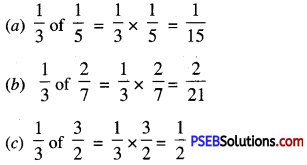
Question (i).
\(\frac {1}{3}\) of
(a) \(\frac {1}{5}\)
(b) \(\frac {2}{7}\)
(c) \(\frac {3}{2}\)
Answer:
PSEB 7th Class Maths Solutions Chapter 2 Fractions and Decimals Ex 2.3 8

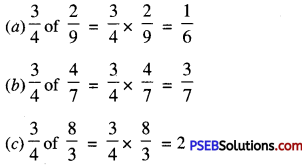
Question (ii).
\(\frac {3}{4}\) of
(a) \(\frac {2}{9}\)
(b) \(\frac {4}{7}\)
(c) \(\frac {8}{3}\)
Answer:
PSEB 7th Class Maths Solutions Chapter 2 Fractions and Decimals Ex 2.3 9

2. Multiply the fractions and reduce it to the lowest form (If possible) :

Question (i).
\(\frac{2}{7} \times \frac{7}{9}\)
Answer:
\(\frac{2}{7} \times \frac{7}{9}\)
= \(\frac {2}{9}\)

Question (ii).
\(\frac{1}{3} \times \frac{15}{8}\)
Answer:
\(\frac{1}{3} \times \frac{15}{8}\)
= \(\frac {5}{8}\)

Question (iii).
\(\frac{12}{27} \times \frac{3}{9}\)
Answer:
\(\frac{12}{27} \times \frac{3}{9}\)
= \(\frac {4}{27}\)

Question (iv).
\(\frac{2}{5} \times \frac{6}{4}\)
Answer:
\(\frac{2}{5} \times \frac{6}{4}\)
= \(\frac {3}{5}\)

Question (v).
\(\frac{81}{100} \times \frac{6}{7}\)
Answer:
\(\frac{81}{100} \times \frac{6}{7}\)
= \(\frac {243}{350}\)

Question (vi).
\(\frac{3}{5} \times \frac{5}{27}\)
Answer:
\(\frac{3}{5} \times \frac{5}{27}\)
= \(\frac {1}{9}\)

PSEB 7th Class Maths Solutions Chapter 2 Fractions and Decimals Ex 2.3

3. Multiply the following fractions :

Question (i).
\(\frac{3}{2} \times 5 \frac{1}{3}\)
Answer:
\(\frac{3}{2} \times 5 \frac{1}{3}\)
= \(\frac{3}{2} \times \frac{16}{3}\)
= 8

Question (ii).
\(\frac{1}{7} \times 5 \frac{2}{3}\)
Answer:
\(\frac{1}{7} \times 5 \frac{2}{3}\)
= \(\frac{1}{7} \times \frac{17}{3}\)
= \(\frac {17}{21}\)

Question (iii).
\(2 \frac{5}{6} \times 4\)
Answer:
\(2 \frac{5}{6} \times 4\)
= \(\frac {17}{6}\) × 4
= \(\frac {34}{3}\)
= 11\(\frac {1}{3}\)

Question (iv).
\(4 \frac{1}{3} \times 9 \frac{1}{4}\)
Answer:
\(4 \frac{1}{3} \times 9 \frac{1}{4}\)
= \(\frac{13}{3} \times \frac{37}{4}\)
= \(\frac {481}{12}\)

Question (v).
\(2 \frac{2}{3} \times 3 \frac{5}{8}\)
Answer:
\(2 \frac{2}{3} \times 3 \frac{5}{8}\)
= \(\frac{8}{3} \times \frac{29}{8}\)
= 9\(\frac {2}{3}\)

Question (vi).
\(3 \frac{1}{5} \times 2 \frac{1}{4}\)
Answer:
\(3 \frac{1}{5} \times 2 \frac{1}{4}\)
= \(\frac{16}{5} \times \frac{9}{4}\)
= \(\frac {36}{5}\)
= 7\(\frac {1}{5}\)

4. Which fraction is greater in the following fractions ?

Question (i).
\(\frac {3}{2}\) of \(\frac {2}{7}\) or \(\frac {5}{2}\) of \(\frac {3}{8}\)
Answer:
\(\frac {3}{2}\) of \(\frac {2}{7}\)
= \(\frac{3}{2} \times \frac{2}{7}\)
= \(\frac {3}{7}\)
or
\(\frac {5}{2}\) of \(\frac {3}{8}\)
= \(\frac{5}{2} \times \frac{3}{8}\)
= \(\frac {15}{16}\)
Since, \(\frac {15}{16}\) > \(\frac {3}{7}\)
So, \(\frac {5}{2}\) of \(\frac {3}{8}\) is greater.

Question (ii).
\(\frac {1}{2}\) of \(\frac {6}{5}\) or \(\frac {1}{3}\) of \(\frac {4}{5}\)
Answer:
\(\frac {1}{2}\) of \(\frac {6}{5}\)
= \(\frac {1}{2}\) × \(\frac {6}{5}\)
= \(\frac {3}{5}\)
or
\(\frac {1}{3}\) of \(\frac {4}{5}\)
= \(\frac {1}{3}\) × \(\frac {4}{5}\)
= \(\frac {4}{15}\)
Since, \(\frac {3}{5}\) > \(\frac {4}{15}\)
So, \(\frac {1}{2}\) of \(\frac {6}{5}\) is greater.

PSEB 7th Class Maths Solutions Chapter 2 Fractions and Decimals Ex 2.3

5. If the speed of a car is 105 \(\frac {1}{3}\) km/hr, find the distance covered by it m 3\(\frac {2}{3}\) hours.
Answer:
Distance travelled in 1 hour= 105\(\frac {1}{3}\) km
= \(\frac {316}{3}\) km
Distance travelled in 3\(\frac {2}{3}\) hours i.e. in \(\frac {11}{3}\) hours
= \(\frac {11}{3}\) × \(\frac {316}{3}\) km
= \(\frac {3476}{9}\) km
= 386\(\frac {2}{9}\)km

6. The length of a rctangular plot of land is 29\(\frac {3}{7}\) m. If its breadth is 12\(\frac {8}{11}\)m, find its area.
Answer:
Length of rectangular plot (l)
= 29\(\frac {3}{7}\)m = \(\frac {206}{7}\)m
Breadth of rectangular plot (b)
= 12\(\frac {8}{11}\)m = \(\frac {140}{11}\)m
Area of rectangular plot
= l × b = \(\frac{206}{7} \mathrm{~m} \times \frac{140}{11} \mathrm{~m}\)
= \(\frac{4120}{11}\) sq.m
= 374\(\frac{6}{11}\) sq.m

7. If a cloth costs ₹ 120 \(\frac {1}{4}\) per metre, find the cost of 4\(\frac {1}{3}\) metre of this cloth.
Answer:
Per m cost of cloth = ₹ 120\(\frac {1}{4}\)
= ₹ \(\frac {481}{4}\)
Cost of 4\(\frac {1}{3}\) metre of this cloth
= \(\frac {1}{3}\) × ₹ \(\frac {481}{4}\)
= ₹ \(\frac {6253}{12}\)
= ₹ 521\(\frac {1}{12}\)

PSEB 7th Class Maths Solutions Chapter 2 Fractions and Decimals Ex 2.3

8. Multiple choice questions :

Question (i).
\(\frac {1}{4}\) of \(\frac {8}{3}\) is :
(a) \(\frac {9}{7}\)
(b) \(\frac {8}{4}\)
(c) \(\frac {2}{3}\)
(d) 1
Answer:
(c) \(\frac {2}{3}\)

Question (ii).
\(\frac {3}{2}\) × \(\frac {2}{3}\) = ?
(a) 1
(b) \(\frac {5}{6}\)
(c) 3
(d) \(\frac {6}{5}\)
Answer:
(a) 1

Question (iii).
The value of the product of two proper fractions is :
(a) greater than both of the proper fractions.
(b) lesser than both of the proper fractions.
(c) lie between the given two fractions.
(d) none of these.
Answer:
(b) lesser than both of the proper fractions.

PSEB 7th Class Maths Solutions Chapter 2 Fractions and Decimals Ex 2.3

9. Check if the following equations are ‘True’ or ‘False’ :

Question (i).
\(1 \frac{2}{3} \times 4 \frac{5}{7}=4 \frac{10}{21} ?\) (True/False)
Answer:
False

Question (ii).
\(\frac{3}{4} \times \frac{2}{3}=\frac{2}{3} \times \frac{3}{4} ?\) (True/False)
Answer:
True

PSEB 7th Class Maths Solutions Chapter 2 Fractions and Decimals Ex 2.2

Punjab State Board PSEB 7th Class Maths Book Solutions Chapter 2 Fractions and Decimals Ex 2.2 Textbook Exercise Questions and Answers.

PSEB Solutions for Class 7 Maths Chapter 2 Fractions and Decimals Ex 2.2

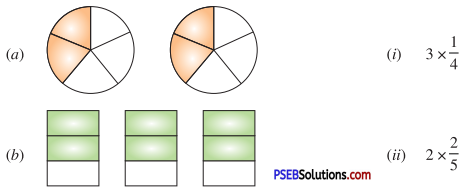
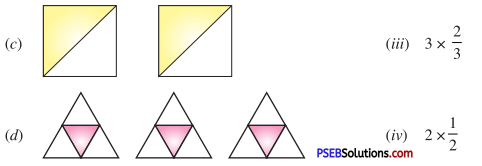
1. Match the following :

PSEB 7th Class Maths Solutions Chapter 2 Fractions and Decimals Ex 2.2 1
PSEB 7th Class Maths Solutions Chapter 2 Fractions and Decimals Ex 2.2 2
Answer:
(a) (ii),
(b) (iii),
(c) (iv),
(d) (i).

PSEB 7th Class Maths Solutions Chapter 2 Fractions and Decimals Ex 2.2

2. Multiply whole number to a fraction and reduce it to the lowest form. Also convert into a mixed fraction :

Question (i).
4 × \(\frac {1}{3}\)
Answer:
4 × \(\frac {1}{3}\) = \(\frac{4 \times 1}{3}\)
= \(\frac {4}{3}\)
= 1\(\frac {1}{3}\)

Question (ii).
11 × \(\frac {4}{7}\)
Answer:
11 × \(\frac {4}{7}\) = \(\frac{11 \times 4}{7}\)
= \(\frac {44}{7}\)
= 6\(\frac {2}{7}\)

Question (iii).
\(\frac {3}{4}\) × 6
Answer:
\(\frac {3}{4}\) × 6 = \(\frac{3 \times 6}{4}\)
= \(\frac {9}{2}\)
= 4\(\frac {1}{2}\)

Question (iv).
\(\frac {9}{7}\) × 5
Answer:
\(\frac {9}{7}\) × 5 = \(\frac {45}{7}\)
= 6\(\frac {3}{7}\)

Question (v).
2\(\frac {5}{6}\) × 4
Answer:
2\(\frac {5}{6}\) × 4 = \(\frac{17}{6} \times 4\)
= \(\frac{17 \times 4}{6}\)
= \(\frac{17 \times 2}{3}\)
= \(\frac {34}{3}\)
= 11\(\frac {1}{3}\)

Question (vi).
10\(\frac {5}{6}\) × 5
Answer:
10\(\frac {5}{6}\) × 5
= \(\frac {65}{6}\) × 5
= \(\frac{65 \times 5}{6}\)
= \(\frac {325}{6}\)
= 54\(\frac {1}{6}\)

PSEB 7th Class Maths Solutions Chapter 2 Fractions and Decimals Ex 2.2

Question (vii).
5 × 6\(\frac {3}{4}\)
Answer:
5 × 6\(\frac {3}{4}\) = 5 × \(\frac {27}{4}\)
= \(\frac{5 \times 27}{4}\)
= \(\frac {135}{4}\)
= 33\(\frac {3}{4}\)

Question (viii).
3 \(\frac {2}{5}\) × 8
Answer:
3 \(\frac {2}{5}\) × 8 = \(\frac {17}{5}\) × 8
= \(\frac{17 \times 8}{5}\)
= \(\frac {136}{5}\)
= 27\(\frac {1}{5}\)

3. Solve :

Question (i).
\(\frac {1}{2}\) of 46
Answer:
\(\frac {1}{2}\) of 46
= \(\frac {1}{2}\) × 46
= 23

Question (ii).
\(\frac {2}{3}\) of 27
Answer:
\(\frac {2}{3}\) of 27
= \(\frac {2}{3}\) × 27
= 18

Question (iii).
\(\frac {1}{3}\) of 36
Answer:
\(\frac {1}{3}\) of 36
= \(\frac {1}{3}\) × 36
= 12

Question (iv).
\(\frac {3}{4}\) of 16
Answer:
\(\frac {3}{4}\) of 16
= \(\frac {3}{4}\) × 16
= 12

Question (v).
\(\frac {5}{7}\) of 35
Answer:
\(\frac {5}{7}\) of 35
= \(\frac {5}{7}\) × 35
= 25

PSEB 7th Class Maths Solutions Chapter 2 Fractions and Decimals Ex 2.2

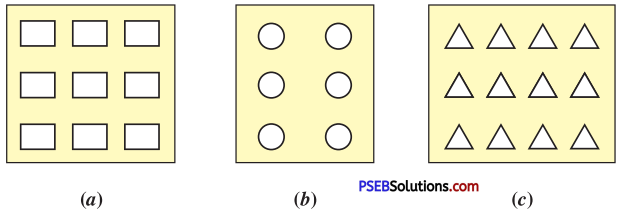
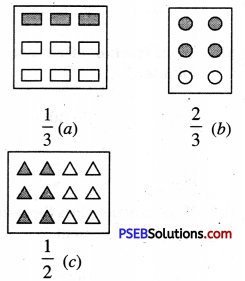
4. Shade :

(i) \(\frac {1}{3}\) of the rectangles in box (a)
(ii) \(\frac {2}{3}\) of the circles in box (b)
(iii) \(\frac {1}{2}\) of the triangles in box (c)
PSEB 7th Class Maths Solutions Chapter 2 Fractions and Decimals Ex 2.2 11
Answer:
PSEB 7th Class Maths Solutions Chapter 2 Fractions and Decimals Ex 2.2 12

5. Rahul earns ₹ 44,000 per month. He spends \(\frac {3}{4}\) th of his income every month and saves the rest of his earning. Find his monthly savings ?
Answer:
Rahul earns per month = ₹ 44000
He spends = \(\frac {3}{4}\)th of ₹ 44000
= ₹ \(\frac {3}{4}\) × 44000
= ₹ 33000
His savings = ₹ 44,000 – ₹ 33000
= ₹ 11000

6. The cost of a book is ₹ 117\(\frac {1}{2}\). Find the cost of 8 books ?
Answer:
Cost of one book = ₹ 117 \(\frac {1}{2}\)
= ₹ \(\frac {235}{2}\)
Cost of 8 books = 8 × ₹ \(\frac {235}{2}\)
= ₹ 4 × 235
= ₹ 940

PSEB 7th Class Maths Solutions Chapter 2 Fractions and Decimals Ex 2.2

7. Multiple choice questions :

Question (i).
\(\frac {1}{2}\) × 8 is equal to
(a) 8
(6) 2
(c) 4
(d) 1
Answer:
(c) 4

Question (ii).
\(\frac {3}{2}\) of 16 is :
(a) 48
(b) 8
(c) 3
(d) 24
Answer:
(d) 24

Question (iii).
What fraction of an hour is 40 minutes ?
(a) \(\frac {2}{3}\)
(b) 40
(c) \(\frac {1}{4}\)
(d) \(\frac {1}{2}\)
Answer:
(a) \(\frac {2}{3}\)

Question (iv).
What fraction does the shaded part of figure represent ?
PSEB 7th Class Maths Solutions Chapter 2 Fractions and Decimals Ex 2.2 13
(a) \(\frac {1}{3}\)
(b) \(\frac {2}{3}\)
(c) \(\frac {3}{4}\)
(d) \(\frac {1}{2}\)
Answer:
(c) \(\frac {3}{4}\)

PSEB 10th Class Hindi Vyakaran विलोम शब्द

Punjab State Board PSEB 10th Class Hindi Book Solutions Hindi Grammar vilom shabd विलोम शब्द Exercise Questions and Answers, Notes.

PSEB 10th Class Hindi Grammar विलोम शब्द

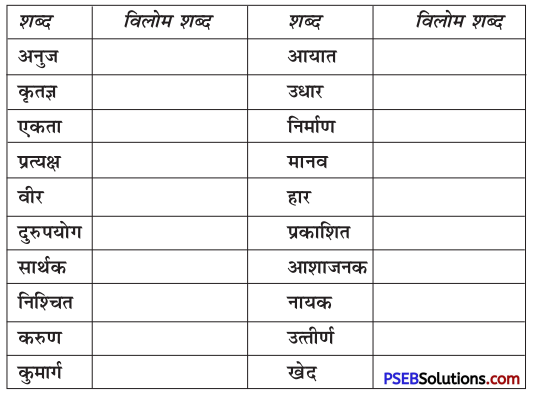
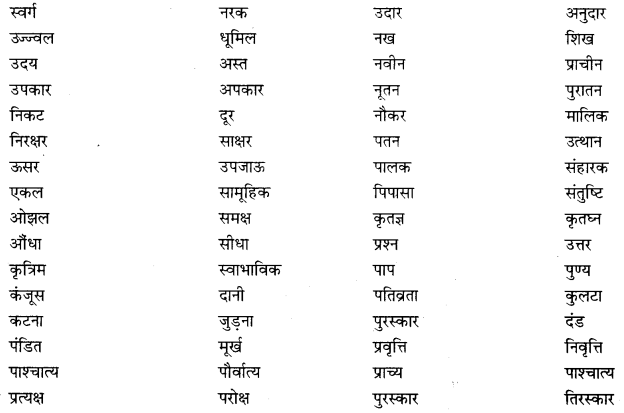
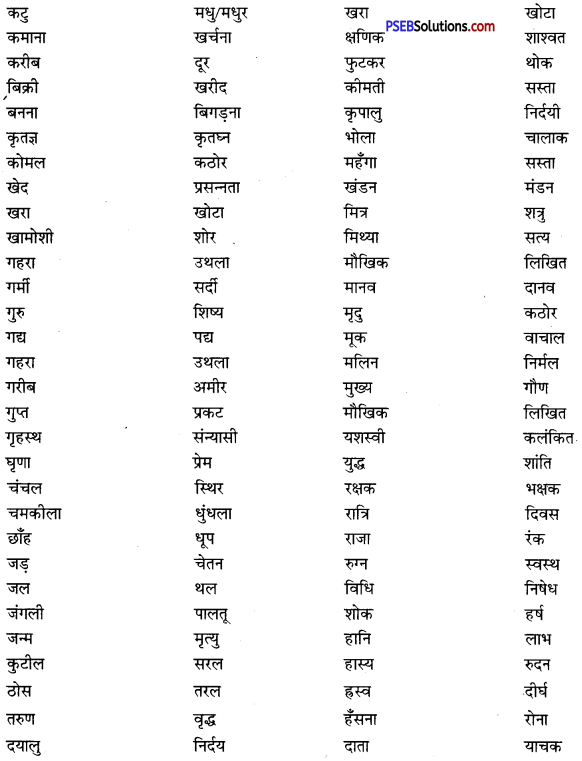
निम्नलिखित शब्दों के विलोम शब्द लिखिए
PSEB 10th Class Hindi Vyakaran विलोम शब्द 1
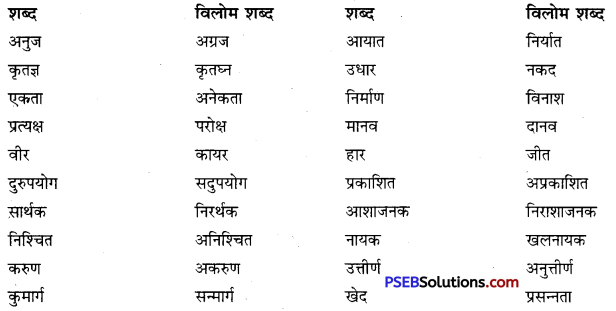
उत्तर:
PSEB 10th Class Hindi Vyakaran विलोम शब्द 2

PSEB 10th Class Hindi Vyakaran विलोम शब्द

निम्नलिखित बहुविकल्पी प्रश्नों के उत्तर एक सही विकल्प चुनकर लिखें.

प्रश्न 1.
असली का विलोम शब्द है
(क) निष्ठुर
(ख) अनुचित
(ग) नवीन
(घ) नकली।
उत्तर:
(घ) नकली

प्रश्न 2.
चेतन का विलोम शब्द है
(क) सुप्त
(ख) जड़
(ग) जागृत
(घ) निद्रा।
उत्तर:
(ख) जड़

प्रश्न 3.
कोमल का विलोम शब्द है
(क) निष्ठुर
(ख) निकृष्ट
(ग) कर्कश
(घ) अधम।
उत्तर:
(ग) कर्कश

प्रश्न 4.
सार्थक का विलोम शब्द है,
(क) व्यर्थ
(ख) निरर्थक
(ग) निर्गुण
(घ) क्षीण।
उत्तर:
(ख) निरर्थक

प्रश्न 5.
पूर्व का विलोम है, पश्चिम (हाँ या नहीं में उत्तर लिखें)
उत्तर:
हाँ

प्रश्न 6.
दानव का विलोम है, मानव (हाँ या नहीं में उत्तर लिखें)
उत्तर:
नहीं

प्रश्न 7.
भय का विलोम है, साहस (हाँ या नहीं में उत्तर लिखें)
उत्तर:
हाँ

PSEB 10th Class Hindi Vyakaran विलोम शब्द

प्रश्न 8.
ताप का विलोम है, शीत (सही या गलत लिखकर उत्तर दें)
उत्तर:
सही

प्रश्न 9.
पतन का विलोम है, गिरावट (सही या गलत लिखकर उत्तर दें)
उत्तर:
गलत

प्रश्न 10.
मिलन का विलोम है, विरह (सही या गलत लिख कर उत्तर दें)
उत्तर:
सही।

निम्नलिखित में से किसी एक शब्द का विलोम शब्द लिखिए

वर्ष
1. कंजूस, जिंदाबाद।
उत्तर:
कंजूस = दानी
जिंदाबाद = मुर्दाबाद।

2. हानि, ईमानदार।
उत्तर:
हानि = लाभ
ईमानदार = बेईमान।

3. निंदा, हार।
उत्तर:
निंदा = स्तुति
हार = जीत।

वर्ष
1. करीब, मित्र।
उत्तर:
करीब = दूर
मित्र = शत्रु।

2. आशा, मान
उत्तर:
आशा = निराशा
मान = अपमान।

3. विधवा, स्वस्थ।
उत्तर:
विधवा = सधवा
स्वस्थ = अस्वस्थ।

वर्ष
कंजूस, विस्तार।
उत्तर:
कंजूस = खर्चीला
विस्तार = संक्षेप।

प्रश्न 1.
विलोम शब्द किसे कहते हैं? उदाहरण सहित लिखिए।
उत्तर:
परस्पर विपरीत अर्थ का ज्ञान कराने वाले किसी शब्द को विलोम शब्द कहते हैं। इसे विपरीत या विलोमार्थी शब्द भी कहते हैं। उदाहरण-
(I) रीना सदा न्याय का पक्ष लेती है।
विलोम अर्थ-रीना सदा अन्याय का पक्ष लेती है।

(II) नीरज साधारण परिवार से संबंधित है।
विलोम अर्थ-नीरज असाधारण परिवार से संबंधित है।

(III) गली में एक व्यक्ति था।
विलोम अर्थ-गली में अनेक व्यक्ति थे।

(IV) गीताजंली का व्यवहार उचित था।
विलोम अर्थ-गीतांजली का व्यवहार अनुचित था।

(V) आप की यह हरकत पाक नहीं कहला सकती।
विलोम अर्थ-आप की यह हरकत नापाक नहीं कहला सकती।

PSEB 10th Class Hindi Vyakaran विलोम शब्द

प्रश्न 2.
विलोम शब्द किस-किस प्रकार बनाए जाते हैं? उदाहरण सहित लिखिए।
उत्तर:
विलोम शब्द प्रायः तीन प्रकार से बनाए जाते हैं-
(क) उपसर्ग के योग से
(ख) उपसर्ग बदलने से
(ग) विलोम शब्द मूल रूप से।
उदाहरण-
(क) उपसर्ग के योग सेइच्छा-अनिच्छा, साधारण-असाधारण, यश-अपयश, गुण-अवगुण, सुगंध-दुर्गंध, पसंद-नापसंद।
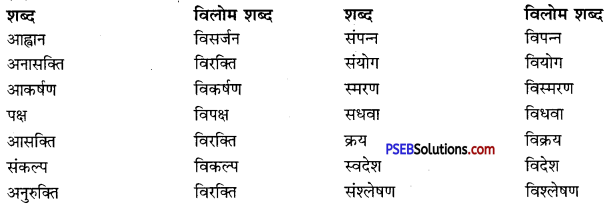
(ख) उपसर्ग बदलने से-साक्षर-निरक्षर, ईमानदार-बेईमानदार, स्वदेश-विदेश, संपन्न-विपन्न, अधुनातन-पुरातन, आयात-निर्यात।
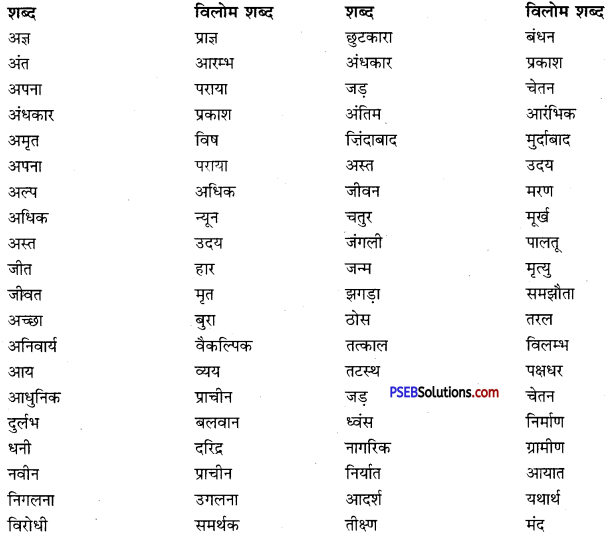
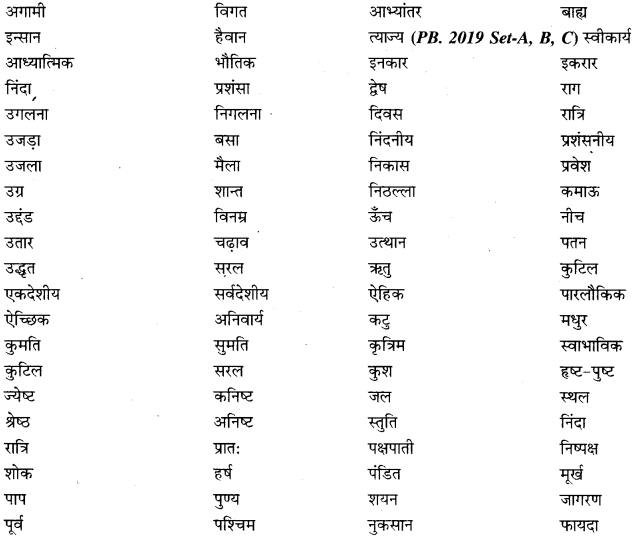
(ग) विलोम शब्द मूल से-उदय-अस्त, आधुनिक-प्राचीन, उजड़ा-बसा, झगड़ा-समझौता, निकास-प्रवेश, दिवस-रात।

(क) उपसर्ग के योग से बने विलोम शब्द
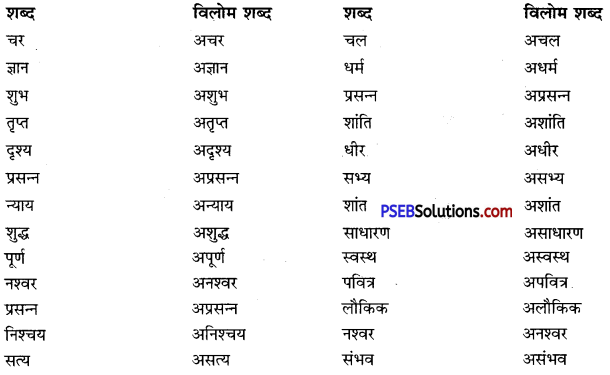
(i) ‘अ’ उपसर्ग के योग से बने विलोम शब्द
PSEB 10th Class Hindi Vyakaran विलोम शब्द 3

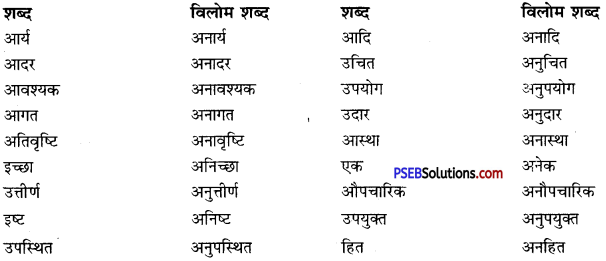
(ii) ‘अन्’ उपसर्ग के योग से बने विलोम शब्द
PSEB 10th Class Hindi Vyakaran विलोम शब्द 4

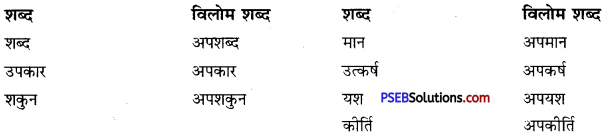
(iii) ‘अप’ उपसर्ग के योग से बने विलोम शब्द
PSEB 10th Class Hindi Vyakaran विलोम शब्द 5

(iv) ‘अव’ उपसर्ग के योग से बने विलोम शब्द
PSEB 10th Class Hindi Vyakaran विलोम शब्द 6

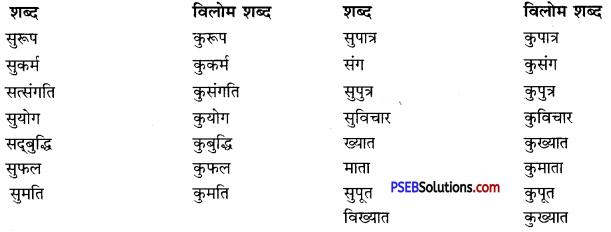
(v) ‘कु’ उपसर्ग के योग से बने विलोम शब्द
PSEB 10th Class Hindi Vyakaran विलोम शब्द 7

PSEB 10th Class Hindi Vyakaran विलोम शब्द

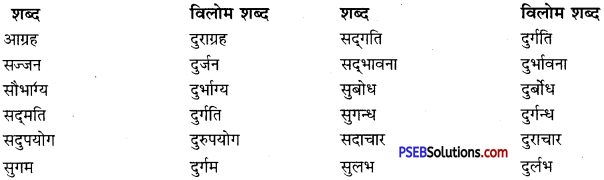
(vi) ‘दुः/दुर्’ उपसर्ग के योग से बने विलोम शब्द
PSEB 10th Class Hindi Vyakaran विलोम शब्द 8

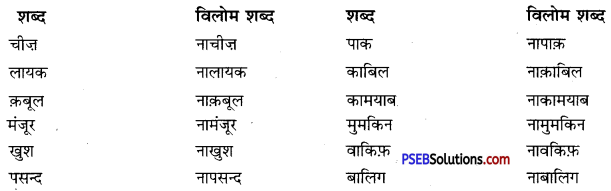
(vii) ‘ना’ उपसर्ग के योग से बने विलोम शब्द
PSEB 10th Class Hindi Vyakaran विलोम शब्द 9

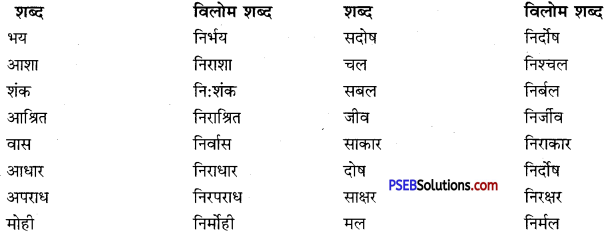
(viii) ‘निः/निर्’ उपसर्ग के योग से बने विलोम शब्द
PSEB 10th Class Hindi Vyakaran विलोम शब्द 10

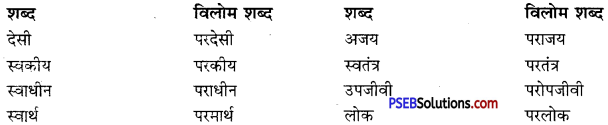
(ix) ‘पर’ उपसर्ग के योग से बने विलोम शब्द
PSEB 10th Class Hindi Vyakaran विलोम शब्द 11

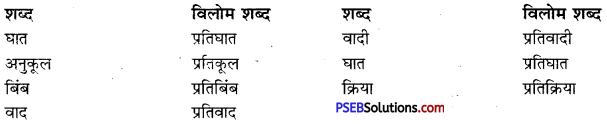
(x) ‘प्रति’ उपसर्ग के योग से बने विलोम शब्द
PSEB 10th Class Hindi Vyakaran विलोम शब्द 12

(xi) ‘वि’ उपसर्ग के योग से बने विलोम शब्द
PSEB 10th Class Hindi Vyakaran विलोम शब्द 13

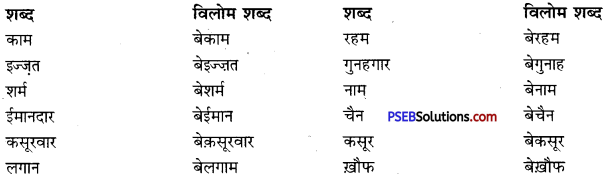
(xii) ‘बे’ उपसर्ग के योग से बने विलोम शब्द
PSEB 10th Class Hindi Vyakaran विलोम शब्द 14

PSEB 10th Class Hindi Vyakaran विलोम शब्द

कुछ विपरीत शब्द मूल रूप में ही प्रयुक्त होते हैं। जैसे-
PSEB 10th Class Hindi Vyakaran विलोम शब्द 15
PSEB 10th Class Hindi Vyakaran विलोम शब्द 16
PSEB 10th Class Hindi Vyakaran विलोम शब्द 17
PSEB 10th Class Hindi Vyakaran विलोम शब्द 18