PSEB 12th Class History Notes Chapter 6 Guru Arjan Dev Ji and His Martyrdom

This PSEB 12th Class History Notes Chapter 6 Guru Arjan Dev Ji and His Martyrdom will help you in revision during exams.

PSEB 12th Class History Notes Chapter 6 Guru Arjan Dev Ji and His Martyrdom

Early Career and Difficulties:

  • Guru Arjan Dev Ji was born on April 15, 1563 A.D. at Goindwal Sahib.
  • The name of his father was Guru Ram Das Ji and the name of his mother was Bibi Bhani Ji.
  • He was married to Ganga Devi, the daughter of Krishan Chand of village Mou of Phillaur.
  • He assumed Guruship in 1581 A.D.
  • After his assumption of Guruship, his elder brother Prithi Chand adopted an attitude of open defiance.
  • He had to face opposition from the Naqshbandis and the Brahmans.
  • Diwan Chandu Shah of Lahore was also against him.

Chapter 6 Guru Arjan Dev Ji and His Martyrdom

Development of Sikhism under Guru Arjan Dev Ji:

  • During his pontificate, Guru Arjan Dev Ji undertook multifarious tasks for the development of Sikhism.
  • During his Guruship, he got Sri Harmandir Sahib constructed. Its construction work was completed in 1601 A.D.
  • In 1590 A.D. Tarn in 1593 A.D. Kartarpur and in 1595 A.D. Sri Hargobindpur were founded.
  • The compilation of the Adi Granth Sahib Ji was the greatest accomplishment of Guru Arjan Dev Ji. This great task was accomplished in 1604 A.D.
  • Guru Arjan Dev Ji contributed significantly towards the Masand system.
  • Guru Arjan Dev Ji encouraged the Sikhs the trade horses with the Arab countries.
  • He kept the doors of Sikhism open by nominating his successor.

Martyrdom of Guru Arjan Dev Ji:
A few facts related to the martyrdom of Guru Arjan Dev Ji are as follows:

Causes:

  • Jahangir was an orthodox Sunni Muslim.
  • He could not tolerate the growing prosperity of Sikh Panth.
  • Prithi Chand, the elder brother of Guru Arjan Dev Ji had started hatching conspiracies to acquire the Gurgaddi.
  • Chandu Shah, the Diwan of Lahore wanted to take revenge for his insult from Guru Sahib Ji.
  • The Naqshbandis also instigated Jahangir against Guru Arjan Dev Ji.
  • The help extended to Shahzada Khusrau by Guru Arjan Dev Ji became the immediate cause of his martyrdom.

Chapter 6 Guru Arjan Dev Ji and His Martyrdom

Martyrdom:

  • On Jahangir’s instructions, Guru Arjan Dev Ji was taken prisoner on 24th May 1606 A.D.
  • He was asked to pay a fine of rupees 2 lakhs which was refused.
  • Guru Arjan Dev Ji was martyred at Lahore on 30th May 1606 A.D.

Importance:

  • The martyrdom of Guru Arjan Dev Ji is considered to be an important incident in Sikh history.
  • Because he was the first Sikh Guru who gave his martyrdom he was called ‘Shaheedan de Sirtaj’.
  • As a consequence of this martyrdom, there came about a transformation in the form of Sikhism.
  • Guru Hargobind Ji decided to adopt a new policy of Miri and Piri.
  • The Sikhs began to unite in a single band.
  • The relations between the Sikhs and Mughals grew tense.
  • The era of Mughal atrocities bega.
  • Sikhism gained greater popularity than before.

PSEB 12th Class History Notes Chapter 5 Development of Sikhism Under Guru Angad DevJi, Guru Amar Das Ji and Guru Ram Das Ji

This PSEB 12th Class History Notes Chapter 5 Development of Sikhism Under Guru Angad DevJi, Guru Amar Das Ji and Guru Ram Das Ji will help you in revision during exams.

PSEB 12th Class History Notes Chapter 5 Development of Sikhism Under Guru Angad DevJi, Guru Amar Das Ji and Guru Ram Das Ji

Early Career of Guru Angad Dev Ji:

  • Guru Angad Dev Ji was born in a village named Matte Di Sarai on 31st March 1504 A.D.
  • The original name of Guru Angad Dev Ji was Bhai Lehna Ji.
  • The name of his father was Pheru Mai and the name of his mother was Sabhrai Devi.
  • At the age of 15 years, he was married to Bibi Khivi Ji, the daughter of Devi Chand of the same village.
  • In due course of time, he was blessed with two daughters Bibi Amro and Bibi Anokhi, and two sons Datu and Dasu.
  • Once when he set out for a pilgrimage of Jwalamukhi, he met Guru Nanak Dev Ji at Kartarpur.
  • So overwhelmed was he by his personality and teachings, that he decided to become Guru Nanak Dev Ji’s disciple.
  • Guru Nanak Dev Ji was greatly impressed by his true devotion and tireless service and appointed him as his successor on 7th September 1539 A.D.

Chapter 5 Development of Sikhism Under Guru Angad DevJi, Guru Amar Das Ji and Guru Ram Das Ji

Development of Sikhism under Guru Angad Dev Ji:

  • Guru Angad Dev Ji popularised the Gurmukhi script.
  • He also collected the hymns of Guru Nanak Dev Ji.
  • Guru Angad Dev Ji summoned Bhai Bala, a devotee of Guru Nanak Dev Ji, and got a Janam Sakhi written on Guru Nanak Dev Ji’s life.
  • Many historians did not agree with this view.
  • Guru Angad Dav Ji expanded the Langar system.
  • Guru Angad Dev Ji more effectively organised the institution of Sangat.
  • He denounced the Udasi sect thereby leading to the preservation of the purity and originality of the Sikh religion.
  • He founded new towns named Goindwal Sahib near Khadur Sahib.
  • He gave his blessings to Humayun thereby restoring the cordial relations between the Mughals and the Sikhs.

Immersed in Eternal Light:

  • Foreseeing his end, Guru Angad Dev Ji appointed Guru Amar Das Ji as his successor.
  • He immersed, in Eternal Light on 29th March 1552 A.D.

Early career and Difficulties of Guru Amar Das Ji:

  • Guru Amar Das Ji was born in Basarke village of Amritsar on 5th May 1479 A.D.
  • The name of his father was Tej Bhan Bhalla.
  • At the age of 24 years, he was married to Mansa Devi, the daughter of Devi Chand.
  • He was blessed with two sons Baba Mohan and Baba Mohri and two daughters Bibi Dani and Bibi Bhani.
  • At the age of 62, he became the disciple of Guru Angad Dev Ji.
  • He assumed Guruship in March 1552 A.D.
  • He was 73 years old at that time.
  • When Guru Amar Das Ji succeeded to the Guruship, he had to face opposition from both the sons of Guru Angad Dev Ji, Dasu, and Datu.
  • Baba Sri Chand who was the elder son of Guru Nanak Dev Ji had founded the Udasi sect also opposed him.
  • He also faced stiff opposition from the Muslims of Goindwal Sahib.

Chapter 5 Development of Sikhism Under Guru Angad DevJi, Guru Amar Das Ji and Guru Ram Das Ji

Development of Sikhism under Guru Amar Das Ji:

  • Guru Amar Das Ji retained Guruship from 1552 to 1574 A.D. Goindwal Sahib was the centre of activities of Guru Amar Das Ji.
  • The first significant step undertaken by Guru Amar Das Ji for the development of Sikhism was the construction of a Baoli with 84 steps at Goindwal Sahib.
  • He developed the langar institution.
  • He established the Manji system (22 Manjis) to convey the message of Sikhism in far-off areas.
  • Guru Amar Das Ji denunciated the Udasi sect.
  • Guru Amar Das Ji vehemently opposed the prevalent’social malpractices.
  • Guru Amar Das Ji introduced new (special) rituals for the Sikhs to be observed on the occasions of birth, marriage, and death.
  • Akbar’s visit to Goindwal Sahib in 1568 A.D. helped to establish friendly relations between the Sikhs and the Mughals.

Immersed in Eternal Light:

  • Guru Amar Das Ji appointed Bhai Jetha Ji, his son-in-law as his successor in 1574 A.D.
  • Guru Amar Das Ji was immersed in Eternal Light on September 1, 1574 A.D.

The early career of Guru Ram Das Ji:

  • Guru Ram Das Ji was born at Chuna Mandi in Lahore on 24th September 1534 A.D.
  • His childhood name was Bhai Jetha Ji.
  • His father’s name was Hari Das and his mother’s name was Daya Kaur.
  • Impressed by the personality of Guru Amar Das Ji, he became Guru Amar Das Ji’s disciple.
  • In 1553 A.D. he was married to Bibi Bhani, the youngest daughter of Guru Amar Das Ji.
  • He assumed Guruship in 1574 A.D. He was the 4th Guru of the Sikhs.

Chapter 5 Development of Sikhism Under Guru Angad DevJi, Guru Amar Das Ji and Guru Ram Das Ji

Development of Sikhism under Guru Ram Das Ji:

  • Guru Ram Das Ji established Ramdaspura or Amritsar in 1577 A.D.
  • He initiated the digging work of two serovars (tanks) Amritsar and Santokhsar.
  • The Masand system was introduced by him for the propagation of Sikhism and to collect money from the Sikhs.
  • The reconciliation between the Sikhs and the Udasis proved to be a milestone in Sikh history during the pontificate of Guru Ram Das Ji.
  • He continued the Sangat, Pangat, and Manji systems.
  • He further consolidated the friendly relations with the Mughal emperor Akbar.

Immersed in Eternal Light:

  • Before Guru Ram Das Ji was immersed in Eternal Light, he nominated his youngest son Arjan Dev as his successor.
  • He immersed in Eternal Light on 1st September 1581 A.D.

PSEB 12th Class Sociology Notes Chapter 12 Social Issues: Old Age and Disability

This PSEB 12th Class Sociology Notes Chapter 12 Social Issues: Old Age and Disability will help you in revision during exams.

PSEB 12th Class Sociology Notes Chapter 12 Social Issues: Old Age and Disability

Old Age Homes:

  • Homes are made for elders so that they can live happily over there.

Disability:

  • It means the consequences of impairment in terms of functional performance and activity.

PSEB 12th Class Sociology Notes Chapter 12 Social Issues: Old Age and Disability

Old Age:

  • That stage of life starts after 60 years, which no one likes, and in which one faces many physical and other problems.

Gerontology:

  • Field of science which studies the process of aging.

→ Old age is a necessary and natural part of human life and all humans have to pass through this phase.

→ No one wants to go through this phase because an individual faces many physical problems in this.

→ One needs to depend upon others in this phase.

→ According to United Nations, people above the age of 60 years come under the category of old age.

→ Almost in all the western countries, age of 60-65 years is kept to take pension benefits and other facilities.

→ Symbols of old age are visible quite early such as tooth decay, grey hair, hunched back, hearing loss, slow pace of the walk, vision impairment, etc.

PSEB 12th Class Sociology Notes Chapter 12 Social Issues: Old Age and Disability

→ At this age, one also faces many physical problems such as heart problems, high blood pressure, arthritis, sugar, etc.

→ In old age, one faces many problems such as health-related issues, economic insecurity, home-related problems, social problems, mental problems, own role-related problems, etc. Due to stress and tensions, death comes very quickly.

→ Old age problems can be removed in many ways such as by making old age homes, by starting welfare programmes for them, by creating easy jobs for them, by taking care of them, by providing better health facilities, by making strict laws, etc.

→ In almost the entire world, around 100 crore people are there who are facing disability in one way or the other.

→ The meaning of disability is any type of physical problem such as impairment, handicap, the inability of listening, etc.

→ Disability can be of many types such as locomotor disability, visual disability, hearing disability, mental disability, speech disability.

→ There can be many reasons for a disability such as a disease, birth-based problems, malnutrition, congenital factor, stress, accident, etc.

PSEB 12th Class Sociology Notes Chapter 12 Social Issues: Old Age and Disability

→ Disabled persons have to face many problems such as segregation and isolation, poverty, social oppression, etc.

→ The problems of disabled persons can be cured in many ways such as by providing better health facilities, by removing discrimination, by giving them education in normal schools, by arousing consciousness among people, etc.

PSEB 7th Class Maths Solutions Chapter 2 Fractions and Decimals Ex 2.6

Punjab State Board PSEB 7th Class Maths Book Solutions Chapter 2 Fractions and Decimals Ex 2.6 Textbook Exercise Questions and Answers.

PSEB Solutions for Class 7 Maths Chapter 2 Fractions and Decimals Ex 2.6

1. Find the product of each of the following:

Question (i).
1.31 × 10
Answer:
1.31 × 10
= \(\frac {131}{100}\) × 10
= \(\frac {131}{10}\)
= 13.1

Question (ii).
1.31 × 10
Answer:
25.7 × 10
= \(\frac {257}{10}\) × 10
= 257

Question (iii).
1.01 × 100
Answer:
1.01 × 100
= \(\frac {101}{100}\) × 100
= 101

Question (iv).
0.45 × 100
Answer:
0.45 × 100
= \(\frac {45}{100}\) × 100
= 45

PSEB 7th Class Maths Solutions Chapter 2 Fractions and Decimals Ex 2.6

Question (v).
9.7 × 100
Answer:
9.7 × 100
= \(\frac {97}{10}\) × 100
= 970

Question (vi).
3.87 × 10
Answer:
3.87 × 10
= \(\frac {387}{100}\) × 100
= \(\frac {387}{10}\)
= 38.7

Question (vii).
0.07 × 10
Answer:
0.07 × 10
= \(\frac {7}{100}\) × 10
= \(\frac {7}{100}\)
= 0.70

Question (viii).
0.3 × 100
Answer:
0.3 × 100
= \(\frac {3}{10}\) × 100
= 30

Question (ix).
5.37 × 1000
Answer:
5.37 × 1000
= \(\frac {537}{10}\) × 100
= 53700

Question (x).
0.02 × 1000
Answer:
0.02 × 1000
= \(\frac {2}{100}\) × 100
= 20

PSEB 7th Class Maths Solutions Chapter 2 Fractions and Decimals Ex 2.6

2. Find the product of each of the following :

Question (i).
1.5 × 3
Answer:
1.5 × 3 = \(\frac {15}{10}\) × 3
= \(\frac {45}{10}\)
= 4.5

Question (ii).
2.71 × 12
Answer:
2.71 × 12 = \(\frac {271}{100}\) × 12
= \(\frac {3252}{100}\)
= 32.52

Question (iii).
7.05 × 4
Answer:
7.05 × 4 = \(\frac {705}{100}\) × 4
= \(\frac {2820}{100}\)
= 28.2

Question (iv).
0.05 × 12
Answer:
0.05 × 12 = \(\frac {5}{100}\) × 12
= \(\frac {60}{100}\)
= 0.6

PSEB 7th Class Maths Solutions Chapter 2 Fractions and Decimals Ex 2.6

Question (v).
112.03 × 8
Answer:
112.03 × 8 = \(\frac {89624}{100}\) × 8
= 896.24

Question (vi).
3 × 7.53
Answer:
3 × 7.53 = 3 × \(\frac {753}{100}\)
= \(\frac {2259}{100}\)
= 22.59

3. Evaluate the following :

Question (i).
3.7 × 0.4
Answer:
3.7 × 0.4 = \(\frac{37}{10} \times \frac{4}{10}\)
= \(\frac {148}{100}\)
= 1.48

Question (ii).
2.75 × 1.1
Answer:
2.75 × 1.1 = \(\frac{275}{100} \times \frac{11}{10}\)
= \(\frac {3025}{1000}\)

Question (iii).
0.07 × 1.9
Answer:
0.07 × 1.9 = \(\frac{7}{100} \times \frac{19}{10}\)
= \(\frac {133}{1000}\)
= 0.133

PSEB 7th Class Maths Solutions Chapter 2 Fractions and Decimals Ex 2.6

Question (iv).
0.5 × 31.83
Answer:
0.5 × 31.83 = \(\frac{5}{10} \times \frac{3183}{100}\)
= \(\frac {15915}{1000}\)
= 15.915

Question (v).
7.5 × 5.7
Answer:
7.5 × 5.7 = \(\frac{75}{10} \times \frac{57}{10}\)
= \(\frac {4275}{100}\)
= 42.75

Question (vi).
10.02 × 1.02
Answer:
10.02 × 1.02 = \(\frac{1002}{100} \times \frac{102}{100}\)
= \(\frac {102240}{10000}\)
= 10.2204

Question (vii).
0.08 × 0.53
Answer:
0.08 × 0.53 = \(\frac{8}{10} \times \frac{53}{100}\)
= \(\frac {424}{10000}\)
= 0.0424

Question (viii).
21.12 × 1.21
Answer:
21.12 × 1.21 = \(\frac{2112}{100} \times \frac{121}{100}\)
= \(\frac {255552}{10000}\)
= 25.5552

Question (ix).
1.06 × 0.04
Answer:
1.06 × 0.04 = \(\frac{106}{100} \times \frac{4}{100}\)
= \(\frac {424}{1000}\)
= 0.0424

PSEB 7th Class Maths Solutions Chapter 2 Fractions and Decimals Ex 2.6

4. A piece of wire is divided into 15 equal parts. If length of one part is 2.03 m, then find the total length of the wire.
Answer:
Length of one part = 2.03 m
Length of 15 parts = 15 × 2.03 m
= 30.45 m

5. The cost of 1 metre cloth is ₹ 75.80. Find the cost of 4.75 metre cloth.
Answer:
Cost of 1 metre cloth = ₹ 75.80
Cost of 4.75 metre cloth = ₹ 75.80 × 4.75
= ₹ 360.05

6. Multiple choice questions :

Question (i).
1.25 × 10 = ?
(a) 0.125
(b) 125
(c) 12.5
(d) 1.25
Answer:
(c) 12.5

Question (ii).
If x × 100 = 135.72 then value of x is equal to
(a) 13.572
(b) 1.3572
(c) 135.72
(d) 13572.
Answer:
(b) 1.3572

Question (iii).
The value of 1.5 × 8 is :
(a) 1.2
(b) 120
(c) 12
(d) 0.12.
Answer:
(c) 12

PSEB 7th Class Maths Solutions Chapter 2 Fractions and Decimals Ex 2.6

7.
Question (i).
The product of a decimal number and zero is always zero. (True/False)
Answer:
True

Question (ii).
On multiplying a decimal number by 10, the decimal point is shifted to the left by one place. (True/False)
Answer:
False.

PSEB 12th Class Sociology Notes Chapter 11 Female Foeticide and Domestic Violence

This PSEB 12th Class Sociology Notes Chapter 11 Female Foeticide and Domestic Violence will help you in revision during exams.

PSEB 12th Class Sociology Notes Chapter 11 Female Foeticide and Domestic Violence

Sex Ratio:

  • The number of females behind every 1000 males in a particular area is known as the sex ratio.

Patriarchy:

  • A system of society in which males dominate females.

Female Infanticide:

  • Killing girls right after their birth is known as female infanticide.

Female Foeticide:

  • Termination of a girl’s foetus in the mother’s womb is known as female foeticide.

PSEB 12th Class Sociology Notes Chapter 11 Female Foeticide and Domestic Violence

→ Violence against women is quite common everywhere in the whole of the world and all societies are facing the same problem.

→ In violence against women, we can include rape, sexual violence, abduction, prostitution, dowry-related problems. Female foeticide and domestic violence are a few of them.

→ When a female gets pregnant, a sex determination test is done in the womb of the mother.

→ If the would-be child is boy, it’s fine but if it’s a girl, the foetus gets terminated. It is known as female foeticide.

→ Female foeticide directly affects the sex ratio of a place and it comes down.

→ The sex ratio is quite low in our country. In 2011, it was 1000 : 943.

→ Dowry, the lower status of women, wish to have a boy, modern technology, family planning, patriarchal society, etc. are a few of the reasons because of which people opt for female foeticide.

PSEB 12th Class Sociology Notes Chapter 11 Female Foeticide and Domestic Violence

→ There are some evil consequences of female foeticide etc. such as a bad impact on female health, less sex ratio, atrocities on women, an increase in crimes, women-related evils in society, etc.

→ Domestic violence is also one of the major problems of our society.

→ In this, wrong behaviour is committed with females, males, or children which is socially unacceptable.

→ It not only hurts an individual physically but mentally as well.

→ There could be many reasons for domestic violence such as socio-cultural, economic, legal, social constraints, etc. Wife battering is also a form of domestic violence.

PSEB 12th Class Sociology Notes Chapter 11 Female Foeticide and Domestic Violence

→ Domestic violence can be stopped by making laws, giving social education, and with the help of government and non-government organisations.

PSEB 12th Class Sociology Notes Chapter 10 Social Problems: Alcoholism and Drug Addiction

This PSEB 12th Class Sociology Notes Chapter 10 Social Problems: Alcoholism and Drug Addiction will help you in revision during exams.

PSEB 12th Class Sociology Notes Chapter 10 Social Problems: Alcoholism and Drug Addiction

Slums:

  • That place of living is in urban areas which is illegally constructed and which lack basic amenities of life.

Red Tapism:

  • It is an idiom used for governmental interference. In the name of official rules, bureaucracy tries to interfere everywhere.

Alcohol:

  • Alcohol is a type of depressant that slows down the brain and one starts to think and behave in a particular way.

Absolute Poverty:

  • It is a situation in which people don’t have the basic necessities of life.
  • For example, lack of food, drinking water, shelter, clothes, medicine, etc.

PSEB 12th Class Sociology Notes Chapter 10 Social Problems: Alcoholism and Drug Addiction

Nepotism:

  • It is a custom in which preference is given to one’s own friends or relatives while giving jobs or any other work.

Delinquency:

  • Crime of minor nature committed by young persons.

Alienation:

  • Emotional isolation is called alienation.

Peer Group: Peer group is a social and primary group whose members have a common background, age, ideas, social status, etc.

→ Each society goes through the phases of transitions. These transitions or changed can be constructive as well as destructive.

→ If these changes are destructive, many problems occur in a society that could have dangerous consequences. These problems are known as social problems.

→ There can be many factors responsible for social problems such as socio-cultural factors, economic factors, regional factors, political factors, environmental factors etc.

→ All these factors collectively give birth to social problems.

PSEB 12th Class Sociology Notes Chapter 10 Social Problems: Alcoholism and Drug Addiction

→ Presently, people have started considering alcoholism as a social problem that was not considered during earlier times.

→ Alcoholism is a method of consuming alcohol that is not only dangerous for himself but for his family as well.

→ There can be many reasons for alcoholism such as misery, occupation, friends, entertainment, business, etc.

→ Alcoholism can have dangerous consequences such as loss of money, bad impact on health, increase in crimes, poverty, individual and familial disorganization etc.

→ Presently, the problem of drug addiction is increasing day by day. Young persons are inclining towards drugs and they are becoming a drug addicts.

→ Drug addiction is a physical and psychological dependence on anything without which one cannot live.

→ We can include many things in drugs such as sedatives, stimulants, narcotics, tobacco.

PSEB 12th Class Sociology Notes Chapter 10 Social Problems: Alcoholism and Drug Addiction

→ If one starts consuming any one of these, he becomes so dependent on them that he cannot live without them.

→ There can be many reasons for drug addiction such as psychological reasons, physical reasons, social factors, the impact of friends, to run away from tensions, etc.

→ Drug addiction can have many dangerous consequences such as dependency on drugs, loss of money, impact on health and family, etc.

PSEB 12th Class Sociology Notes Chapter 9 Social Movements

This PSEB 12th Class Sociology Notes Chapter 9 Social Movements will help you in revision during exams.

PSEB 12th Class Sociology Notes Chapter 9 Social Movements

Reform Movement:

  • Such movements aimed at bringing reforms in traditional customs.

Revolutionary Movement:

  • Movements that aimed at bringing quick and sudden change in society are revolutionary movements.

PSEB 12th Class Sociology Notes Chapter 9 Social Movements

Ideology:

  • Ideology is the collection of ideas of a group.

Formal Organisation:

  • That organized group whose rules are made at a formal level and members are given definite roles.

Caste:

  • A caste is an endogamous group that keeps certain restrictions on its members regarding feeding, occupation, etc.

Revivalist Movement:

  • That movement aimed at re-establishing old values.

→ If we look carefully at all the societies, we will find many prevailing social problems.

→ To take them out and to remove them, social movements play a very important role.

→ Sometimes many unnecessary situations occur in society with which conditions over there deteriorate.

→ To remove such unnecessary situations, a few collective efforts are required which are known as social movements.

→ There are many, features of social movements such as they have group consciousness, collective efforts are required, a permanent ideology is there, it fovours to bring change, they bring a new social system, it can be violent or non-violent, etc.

→ Social movements are of many types such as reform movements, revolutionary movements, and revivalist movements.

PSEB 12th Class Sociology Notes Chapter 9 Social Movements

→ The reform movement wants to bring some change without changing the whole of society.

→ The revolutionary movement aims at changing the whole of society.

→ The revivalist movement aims at reestablishing old values.

→ From time to time, many movements started in our country. Caste-based movements were one of them.

→ Caste-based movements are the story of bringing out the struggle of lower castes or lower classes.

→ Jyotiba Phule, Sri Narayana Guru, Periyar Ramaswami, Dr. B.R. Ambedkar started movements, in different parts of the country, to uplift lower castes.

→ In class-based movements, worker’s movements and peasant movements can be included

→ Both workers and peasants wanted to get rid of exploitation and that’s why such movements were started.

→ From time to time, trade union movements were also started whose main aim was to demand better working conditions and better salaries for the workers working in industries.

PSEB 12th Class Sociology Notes Chapter 9 Social Movements

→ Women were also suppressed from the ages. To uplift their social status, many reform movements were initiated.

→ In the 19th century, Raja Ram Mohan Roy, Ishwar Chandra Vidyasagar, D.K. Karve etc. started many women movements which resulted in uplifting their social status.

→ Many environmental movements were also started, in the country, whose main.

→ the aim was to save the environment. Chipko Movement, Appiko Movement, Narmada Bachao Andolan were such movements.

PSEB 12th Class Sociology Notes Chapter 8 Modernisation and Globalisation

This PSEB 12th Class Sociology Notes Chapter 8 Modernisation and Globalisation will help you in revision during exams.

PSEB 12th Class Sociology Notes Chapter 8 Modernisation and Globalisation

Outsourcing:

  • Giving work to other companies is known as outsourcing.

Disinvestment:

  • Privatisation of public sector companies is known as disinvestment.

Charismatic Leader:

  • That leader who is having some charismatic features in his personality and who can influence the public with his personality.

PSEB 12th Class Sociology Notes Chapter 8 Modernisation and Globalisation

Secularization:

  • That belief in which state, morality, and education are distanced from the impact of religion.

Liberalisation:

  • Reducing government control over the market and opening up economic boundaries.

→ In simple language, the meaning of modernisation is adopting new and modern ways and values of living life.

→ Initially, this meaning was taken in a very narrow sense but now the changes in the agricultural economy and industrial economy are also included in it.

→ First of all the word modernisation was used by Daniel Lerner while analysing the middle eastern societies.

→ According to him, modernisation is a process of change that comes in non-western societies due to their direct or indirect relations with western societies.

→ There are many features of modernisation such as it is a revolutionary and complex process.

→ This process goes on for a long time, it cannot move back, it brings progress in society, etc.

→ Modernisation comes due to certain reasons such as an increase in urban areas, the advent of large industries, increase in the level of education, development of means of communication, changes brought by any charismatic leader, etc.

PSEB 12th Class Sociology Notes Chapter 8 Modernisation and Globalisation

→ Modernisation brought many changes in Indian society such as weakening of caste system, change in the structure of the family, increase in the weakening of caste system, change in the structure of the family, increase in the impact of western education, the advent of the new legal system, many reforms were brought in society, etc.

→ The present world is known as a ‘global village’ because the process of globalisation has brought countries closer to each other. Just while sitting at home, we come to know about what is going in the world.

→ The simple meaning of globalisation is the unlimited and unrestricted movement of goods, services, views, information, people, and capital between different countries.

→ It breaks the economic, social, and cultural barriers between those countries.

→ This all has been made possible with the developed means of communication.

→ There are many features of globalisation such as de-localization of functions, acceleration of every work, availability of all the goods around the world, increase in interdependency among countries, increase in mutual exchange, etc.

→ Two processes are very much necessary for globalisation and these are liberalisation and privatisation.

→ The meaning of liberalisation is running the economy according to market rules and the meaning of privatisation is selling government companies to the private sector.

PSEB 12th Class Sociology Notes Chapter 8 Modernisation and Globalisation

→ There are many reasons of globalisation such as the development of means of transport and communication, the opening up of economic barriers by the government, the advent of multinational companies, etc.

→ Globalisation exerted a great impact on our country such as the advent of trading liberalisation, investment of foreign capital in-country, the advent of money from foreign countries, exchange of technology, the advent of the economic market, production across countries, etc.

PSEB 12th Class Sociology Notes Chapter 7 Westernisation and Sanskritisation

This PSEB 12th Class Sociology Notes Chapter 7 Westernisation and Sanskritisation will help you in revision during exams.

PSEB 12th Class Sociology Notes Chapter 7 Westernisation and Sanskritisation

Reference Group:

  • That group according to which an individual moulds hip behaviour, ways of living, eating, etc.

Twice Born (Dwija):

  • The first three castes of Hindu society are known as Dwija or Twice-born castes.
  • They’ll have to perform a thread ceremony or Janeu Samskai.

PSEB 12th Class Sociology Notes Chapter 7 Westernisation and Sanskritisation

Vertical Social Mobility:

  • Vertical social mobility is the movement of an individual or group from one status to another.
  • It includes a change in class, occupation, and status.

Hierarchy:

  • The system of status in the group in which positions of individuals are defined.

→ Culture is not born out of anything but is a learned behavior.

→ Westernization and Sanskritization are the two cultural processes that greatly affect Indian society.

→ The concept of westernization was given by M.N. Srinivas.

→ According to him, westernization is a process that greatly brought changes in different fields such as technology, institutions, ideology, values, etc. during the last 150 years.

PSEB 12th Class Sociology Notes Chapter 7 Westernisation and Sanskritisation

→ The process of westernization was not confined only to a particular section of society.

→ Those who took western education and started doing government jobs were greatly affected by the process.

→ Many social reformers played a very important role in increasing the process of westernization.

→ For example, Raja Ram Mofian Roy and other reformers began many reform movements and brought changes in society.

→ Westernization had a great effect on Indian society such as the decline in caste-based distinctions, increase in education, changes in Ways of living arid eating, development of means of transport and communication, change in the status of women, etc.

→ The process of Sanskritization is attached to the caste system and the concept is given by M.N. Srinivas.

→ According to him, when lower caste people try to adopt the living and try to change their caste, this process is known as Sanskritization.

PSEB 12th Class Sociology Notes Chapter 7 Westernisation and Sanskritisation

→ Instead of using the word Brahminisation, Srinivas used the word Sanskritizatioii as it is not necessary that the caste which is imitated is only a Brahmin caste. It can be Kshatriya or Vaishya.

→ Another concept that comes forward in rural areas is the dominant caste.

→ According to Srinivas, the dominant caste is that which has more land in the village, whose population is more and which keeps the higher place in the local hierarchy.

PSEB 9th Class Science Important Questions Chapter 9 Force and Laws of Motion

Punjab State Board PSEB 9th Class Science Important Questions Chapter 9 Force and Laws of Motion Important Questions and Answers.

PSEB 9th Class Science Important Questions Chapter 9 Force and Laws of Motion

Long Answer Type Questions:

Question 1.
What are the different types of Forces? Explain each with the help of example
Answer:
Types of forces. There are two types of forces:
1. Balanced forces
2. Unbalanced Forces.
1. Balanced Forces: When several forces are acting simultaneously on a body and their resultant is zero, the forces are said to be balanced forces.

In the case of balanced forces if some body is at rest then it will remain at rest and if it is moving with uniform speed then it will continue to move with the same speed, as if no force is doing any work. In this way with the effect of balanced forces. There does not take place any change in position of the body.

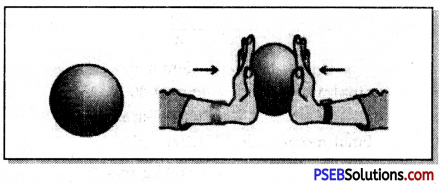
Balanced forces change the shape of the objects, e.g. if a rubber ball is pressed between palms by applying equal and opposite forces then the shape of the ball changes. This ball no longer remains round and instead becomes flat.
PSEB 9th Class Science Important Questions Chapter 9 Force and Laws of Motion 1
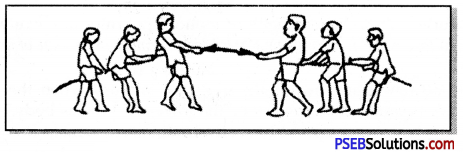
Example: In a tug of war, when both teams pull the rope with equal force, then resultant forces becomes zero. Therefore, both teams remain in their places. In this situation the forces applied by the two teams are equal and opposite so get balanced.
Condition for forces to be balanced.
PSEB 9th Class Science Important Questions Chapter 9 Force and Laws of Motion 2
Two equal forces acting in the opposite direction become balanced if they act along the same line and their magnitudes are equal.
Effect of Balanced Forces: Forces acting on any object if do not change its state of rest or its motion then these do change the shape of the object.

2. Unbalanced Forces: If the resultant of the several forces acting on a body is not zero, the forces are said to be unbalanced forces. Unbalanced forces produce change in the direction of uniform motion of the body or its state of rest.
Example:
In a tug-of-war, when one of the two teams pulls the rope with a larger force, it is able to pull the weaker team towards it. Here two forces are not balanced. Therefore, it results in the motion of the weaker team towards the larger force along the rope.

PSEB 9th Class Science Important Questions Chapter 9 Force and Laws of Motion

Question 2.
State and explain the Newton’s First Law of Motion.
Answer:
Newton’s First Law of Motion. This law states that “In this universe all bodies will remain in their state of rest or of uniform motion in a straight line until some external force is applied to bring about change in their state.
According to this law, motion can be divided into two parts:
1. First part says that a body at rest continues in its state of rest unless some external force is applied to bring change in its state of rest. We find a book lying on the table keeps lying in the same state unless someone applies force on it to pick it up.

2. Second part says that a body jn uniform motion continues moving in straight line path with a uniform speed unless someone applies external force to stop it. But in our daily life it appears but different.

As for example when we stop pedalling a bicycle the moving bicycle stops. After studying minutely it is found that between tyres of bicycle and ground there acts a force of friction which is an external force which opposes the motion. The resistance of air also opposes the motion of bicycle. So, moving bicycle stops moving due to these two forces.

Question 3.
What is inertia? What are its different types? Give examples for each one of them.
Answer:
Inertia: It is the property of matter by virtue ofivhich an object is unable to change by itself its state of rest or of uniform motion in a straight line.
Because of this property Newton’s First Law of Motion is also called the law of Inertia.

Types of Inertia Inertia is of three types:
1. Inertia of Rest: It means a body at rest tends to remain in its position of rest. i.e. a body at rest opposes the forces which try to move it. It can be understood clearly by the following example.
A man standing in a stationary bus or train falls backward when the bus or train suddenly starts moving forward. When the bus moves, the lower part (limbs) of his body begins to move along with the bus while his upper-part tends remain at rest due to inertia.

2. Inertia of Motion: This means a body in motion continues to move with uniform
motion in a straight line. i.e. it is the tendency of a body to remain in its state of uniform motion in a straight line.

Example: 1. A person sitting in moving bus falls forward when the moving bus suddenly stops. It is because as the bus stops the lower part of his body comes to rest along with the bus while upper part of his body continues to remain in motion due to inertia of motion.

2. An athelete runs for some distance before taking a jump so that his inertia of motion may help his muscular force to a longer jump.

3. Inertia of Direction. It is the property of a body which helps to maintain its direction i.e. it is inability of a body to change by itself its direction of motion.
Example: The mudguard is fitted in the wheel of a bicycle to protect from mud particles and water drops sticking to its wheel leaving it tangentially.
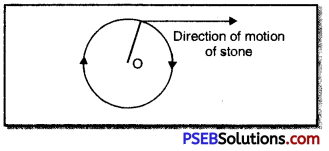
Imagine a stone tied to the end of a thread moving in a horizontal circle, while doing so, if the thread breaks then due to inertia of direction the stone flies off tangentially in a straight line.
PSEB 9th Class Science Important Questions Chapter 9 Force and Laws of Motion 3

Question 4.
State and explain Newton’s Second Law of motion with the help of this law how can we measure force.
Answer:
Newton’s Second Law of Motion. Newton’s second Law of motion helps to calculate the force required to bring a body in motion. It consists of two parts
1. The rate of change of momentum of a body is directly proportional to the applied unbalanced force and
2. the change in momentum due to the external applied force takes place in the direction of force.
i.e. According to this law “the external force applied in the body is directly proportional to the product of mass of the body and the acceleration produced in the direction of force.

Explanation: When a force acts on a body, it produces change in its momentum. If the force is doubled then the change in momentum also gets doubled. The more the force applied; the more is the change in momentum produced. Momentum is the product of mass of the body and its velocity. Generally no change in mass occurs. Therefore, the rate of change of momentum is actually the rate of change of velocity. Thus the applied force is proportional to the acceleration.

When an external force acts on a body at rest, it begins to move in the direction of force. When force acts in the direction of motion of the body then its momentum gets increased. But when force acts in a direction opposite to the direction of motion, its momentum gets reduced.
Force (F) ∝ mass (m) × acceleration (a)
or F = k × m × a ….(i)
(where k is a constant of proportionality)
If we choose the unit of force in such a way that as unit of force produces unit acceleration in a body of unit mass, then
Substituting F = 1, m = 1 and a = 1 in (1)
1 = k × 1 × 1
or k = 1
∴ from equation (i), F = 1 × m × a
or F = m × a
Force = Mass × Acceleration

PSEB 9th Class Science Important Questions Chapter 9 Force and Laws of Motion

Question 5.
Derive the mathematical relation for magnitude of force from Newton’s Second Law of Motion.
Answer:
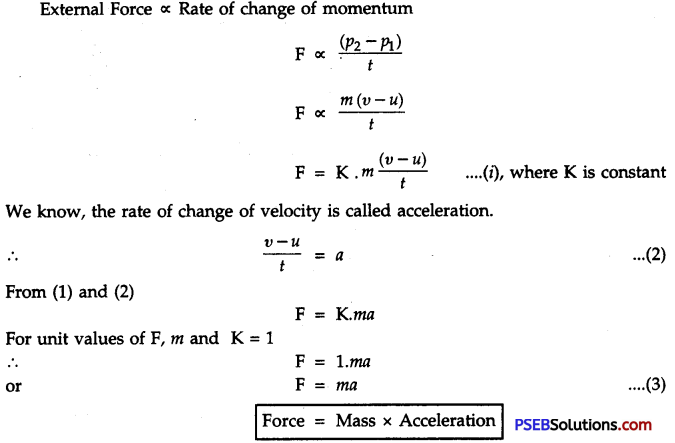
Measurement of Magnitude of Force from Newton’s Law of Motion. Suppose force F acts on a body of mass’m’ for Y seconds which changes its velocity from u to υ, then
Initial momentum of body, p1 = mu
Final momentum of body, p1 = mυ
Now because final velocity (υ) is more than the initial velocity (u), therefore final momentum (p2) will be more than the initial momentum (p1) change in momentum,
p = p2 – p1
= mυ – mu
= m (υ – u)
According to second law of motion,
PSEB 9th Class Science Important Questions Chapter 9 Force and Laws of Motion 4

Question 6.
State and explain Newton’s third Law of motion.
Answer:
Newton’s third Law of Motion. This law states that “Every action has equal and opposite reaction” According to this law, there does not exist one force in isolation. Force always exists in pair i.e. forces of action and reaction always act on different bodies.

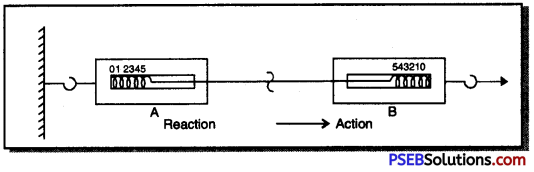
Explanation: (1) Consider two similar spring balances attached to each other through their hooks. One end of spring balance A is fastened to the fixed support. Pull the free end of spring balance B to right side. Note the readings of both the spring balances. Both will read the same as shown in fig. It is because read.
A and B pull each other in opposite direction with same force.
PSEB 9th Class Science Important Questions Chapter 9 Force and Laws of Motion 5
(2) Keep two balls A and B on a table at some distance from each other. When you push the ball. A towards B then the ball A acts on ball B. This force is represented by
FA→B According to Newton’s third law of motion, the ball B also reacts and applies
force on ball A. This force is represented as FB→A. if both the balls are similar then the magnitudes of action and reaction will be equal.
∴ FA→B = – FB→A
Action and reaction forces always act in the direction opposite to each other.

PSEB 9th Class Science Important Questions Chapter 9 Force and Laws of Motion

Question 7.
What is meant by the Law of Conservation of Momentum? Deduce this law mathematically with the help of Newton’s second and third law of motion.
Answer:
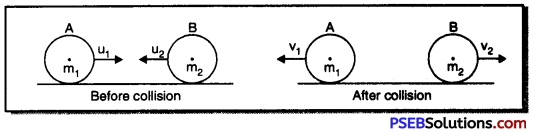
Law of Conservation of Momentum. For a system of bodies, the total vector sum of momenta of all the bodies due to mutual action and reaction remain unchanged so long as no external force acts on the system.”
PSEB 9th Class Science Important Questions Chapter 9 Force and Laws of Motion 6
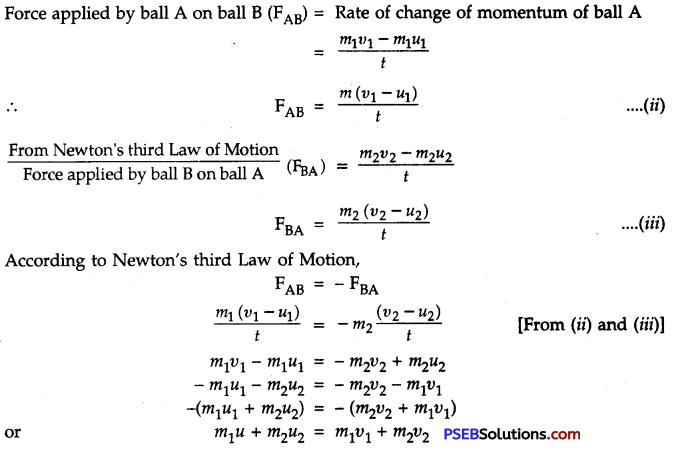
Mathematical Derivation: Consider two rubber balls of masses m1, m2 and initial velocities u1, u2 respectively. Let these collide and their velocities after collisions be υ1 and υ2 respectively. If A applies a force F on B also for time t; B also applies a force F on A for same time t.
From Newton’s Second Law of Motion:
PSEB 9th Class Science Important Questions Chapter 9 Force and Laws of Motion 6
i.e. total momentum of balls A and B before collision
= Total momentum of balls A and B after collision
This proves the law of conservation of momentum that is the total momentum remains conserved.

Short Answer Type Questions:

Question 1.
What is force? Give its units.
Answer:
Force. Force is an agent which

  • produces or tends to produce motion in the body
  • stops the moving body or tends to stop
  • increases the speed of the body or tries to increase the speed therefore,

Force may be defined is as physical cause (a push or a pull) which changes or tends to change the state of rest or uniform motion or direction of motion of a body. The force exerted by the engine makes the train to move from its actual position of rest while the force exerted by the brakes slows down or stops the moving train. The force exerted on the steering wheel of a car changes its direction of motion.
Force is a vector quantity.
Units of force: The unit of force depends upon the unit of mass and acceleration. S.I. unit of force is Newton and C.G.S. unit is Dyne
1N = 105 Dynes

PSEB 9th Class Science Important Questions Chapter 9 Force and Laws of Motion

Question 2.
Why does the horse rider fall forward when a running horse suddenly stops?
Answer:
When horse is running, both the horse and the rider are in motion. When the horse suddenly stops, the lower part of the rider and horse come in the state of rest while the upper part of the rider remains in motion so that he falls forward.

Question 3.
When a horse suddenly gallops, the rider falls backward. Why?
Answer:
The horse and the rider form one system. Initially both are at rest. When the horse suddenly gallops then the horse and the lower part of the rider come into motion in the forward direction while the upper part of the rider’s body tends to remain at rest. Therefore, the rider falls backward.

Question 4.
Why does a passenger fall forwaid when he alights from the moving bus?
Answer:
While alighting from the moving bus the passenger falls forward because when the feet of the passenger touch the ground, his lower part suddenly comes to rest while the upper part still remains in motion. In this way the passenger falls forward.

Question 5.
Define momentum of a body. Also give its units.
Answer:
Momentum. It is defined as the quantity of motion possessed by the body. It is measured by the product of the mass and velocity of the body.

PSEB 9th Class Science Important Questions Chapter 9 Force and Laws of Motion 8

PSEB 9th Class Science Important Questions Chapter 9 Force and Laws of Motion

Question 6.
A fast-moving bullet when hits the windowpane makes a round hole while a stone strikes and shatters it, why?
Answer:
If stone piece strikes window pane glass, it gets shattered while a fast-moving bullet when strikes the windowpane a round hole is formed. The reason is that small particle of glass around and near the hole do not move due to inertia along with the bullet and threfore, do not scatter.

Question 7.
Explain how a dirty blanket becomes dust-free if it is jerked once or twice?
Answer:
If a dirty blanket is beaten with a stick or is given a jerk then dust particles get separated from it because when we beat or give a jerk to the blanket it comes in motion but due to inertia of rest, dust particles remained at rest and get separated and the blanket becomes dust-free.

Question 8.
Why a fan continues to rotate for sometime even after it is switched off?
Answer:
When a fan is rotating, then because of inertia of motion it continues it rotation for some time even if we switch if off. Due to friction on resistance of air it comes to rest after few seconds.

Question 9.
Why does a gun recoil when a bullet is fired from the gun? Explain.
Answer:
When bullet is not fired, then gun and bullet both are at rest, thus total momentum of both together is zero. When a bullet is fired from the gun the bullet moves with very high speed in the forward direction i.e. its momentum is very high. Now according to law of conservation of momentum, total momentum should still be zero as was before the firing of the bullet. Thus to balance the momentum of bullet in the forward direction gun recoil.

Question 10.
Why a cricket player lowers his hand while taking of catch of cricket ball?
Answer:
A lot of force is needed to stop a fast moving ball. If we lower our hands while catching the ball, acceleration of the ball is decreased and we have to apply less force of stop the ball.

PSEB 9th Class Science Important Questions Chapter 9 Force and Laws of Motion

Question 11.
Write differences between balanced and unbalanced forces.
Answer:
Differences between balanced forces and unbalanced forces:

Balanced forces Unbalanced forces
1. When balanced forces act simultaneously on a body then their net resultant is zero. When unbalanced forces act simultaneously on a body then their net resultant is not zero.
2. Balanced forces are acting on a body which is at rest, these can not bring it in motion. Unbalanced forces act on a body at rest, these can bring it in motion.
3. These forces cannot bring a change in speed or direction of the motion. This force can bring change in the speed of direction of motion.
4. This force can make a change in the shape of the body. This force can not make a change in the shape of the body.

Question 12.
Why a boatman exists a force on water with his oars in the opposite direction to move forward?
Answer:
That force, which causes motion in any direction, is the reaction of the applied force. To move the boat in forward direction boatman exerts a force on water with his oars in the opposite direction. As a reaction to this force boat moves in forward direction because action and reaction are equal and opposite to each other.

Important Formulae:

  1. Force (F) = m × a
  2. Acceleration (a) = \(\frac {F}{m}\)
  3. Acceleration (a) = \(\frac {υ – u}{t}\)
  4. Momentum(p) = m × υ
  5. Pressure (P) = \(\frac {F(force)}{A(Area)}\)

Numerical Problems (Solved):

Question 1.
What acceleration will be produced in a body of mass 3 kg, when a force of 12 N is applied?
Solution:
Here, Force (F) = 12 N
Mass (m) = 3 kg
Acceleration (a) =?
We know F = m × a
12 = 3 × a
or a = \(\frac {12}{3}\)
∴ a = 4 m s-2

PSEB 9th Class Science Important Questions Chapter 9 Force and Laws of Motion

Question 2.
How much force will be required to produce an acceleration of 4 m s-2 in a ball of mass 6 kg?
Solution:
Mass of the ball (m) = 6 kg
Acceleration produced in the ball (a) = 4ms-2
Force (F) = ?
We know, F = m × a
= 6 × 4
Force (F) = 24 N

Question 3.
A man throws a ball of mass 0.5 kg vertically upwards with a velocity of 10 m s-1. What will be its initial momentum? What would be its momentum at the highest point of its reach?
Solution:
Mass of the ball (m) = 0.5 kg
Initial velocity of ball (u) = 10 m s-1
Final velocity of the ball (v) = 0 (At highest point the ball comes to rest)
Initial momentum of the ball = m × u
= 0.5 × 10
= 5 kg – m/s
Final momentunvof the ball = m × υ
= 0.5 × 0 = 0

Question 4.
A steam engine of mass 3 × 10⁴ kg pulls two wagons each of mass 2 × 10⁴ kg with an acceleration of 0.2 m s-2. Neglecting frictional force, calculate the:
1. force exerted by the engine.
2. force experienced by each wagon.
Solution:
Mass of steam engine (m1) = 3 × 10⁴ kg
Mass of two wagons (m2) = 2 × (2 × 104 kg)
Total mass of the engine and wagons (m) = m1 + m2
= 3 × 10⁴ + 4 × 104
= (3 + 4) × 104 kg
= 7 × 10⁴ kg
Acceleration (a) = 0.2 ms-2
1. We know, F = m × a
= 7 × 104 × 0.2
= 1.4 × 10⁴ N
2. Force experienced by each wagon = 1.4 × 10⁴ N

PSEB 9th Class Science Important Questions Chapter 9 Force and Laws of Motion

Question 5.
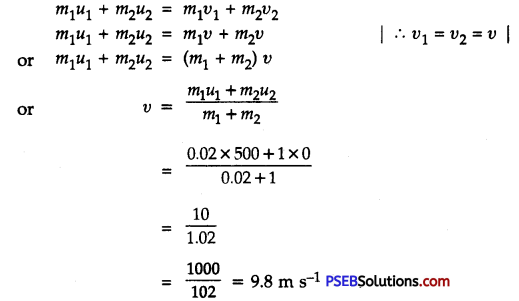
A bullet of mass 20 g moving with a speed of 500 ms-1 strikes a wooden block of mass 1 kg and gets embedded in it. Find the speed with which block moves along with the bullet.
Solution:
Suppose the final velocity of the bag with bullet embedded in it is υ.
For Bullet, m1 = 20 g = 0.02 kg, u1 = 500 m s-1, υ1 = υ
For Block, m2 = 1 kg, u2 = 0, υ2 = υ
According to the law of conservation of momentum,
Total momentum before collision = Total momentum after collision
PSEB 9th Class Science Important Questions Chapter 9 Force and Laws of Motion 9

Question 6.
A car travelling at the speed of 108 km/h takes 4 s to stop on applying brakes. Calculate the force acting on the car after applying brakes. Total mass of the car (including passengers) is 1000 kg.
Solution:
Inital velocity of the car (u) = 108 km/h
= 108 × \(\frac {5}{18}\)
= 30 ms-1
Final velocity of the car (υ) = 0 ms-1
Total mass of the car (m) = 1000kg
Time taken to stop the car (t) = 4s
Force ‘F’ due to application of brakes = m\(\frac {υ – u}{t}\)
= 1000kg × \(\frac {0 – 30}{4s}\)ms-1
= – 750 kg – ms-2
= – 750 N
Negative sign shows that the force applied by the brakes is acting in a direction opposite to the direction of motion of the car.

Question 7.
Which one requires more force, a body of mass 2 kg accelerated at the rate 5 m s-2 or a body of mass 4 kg accelerated at 2 m s-2
Solution:
Given:
m1 = 2kg, a1 = 5 ms-2
m2 = 4kg, a2 = 2 ms-2
Force required for first body, F1 = m1 × a1
= 2kg × 5ms-2
Force required for second body, F2 = m2 × a2
= 4kg × 2ms-2 = 8N
F1 > F2
From this, it is clear that the first body would require more force.

PSEB 9th Class Science Important Questions Chapter 9 Force and Laws of Motion

Question 8.
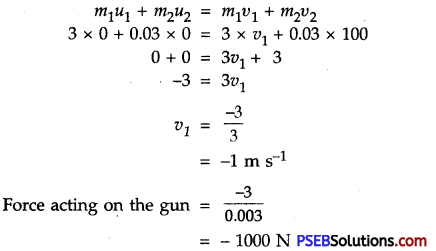
A bullet of mass 0.03 kg is fired from a gun of mass 3 kg which leaves the muzzle of the gun write a velocity of 100 ms-1. If bullet takes 0.003 s to come out of the gun then calculate the force acting on the gun.
Solution:
Mass of the gun (m1) = 3 kg
Mass of the bullet (m2) = 0.03 kg
Before firing, both the gun and the bullet are at rest
∴ Initial velocity of the gun (u1) = 0
Initial velocity of the bullet (u2) = 0
After firing. Final velocity of the gun (υ1) =?
Final velocity of the bullet (υ2) = 100 m s-1
According to the law of conservation of momentum
PSEB 9th Class Science Important Questions Chapter 9 Force and Laws of Motion 11
Negative sign shows that the gun moves backward and experiences a force of 1000 N

Question 9.
From a rifle of mass 5000 g a bullet of 20 g is fired with a velocity of 500 ms-1 with respect to the ground. Find the velocity of recoil of the rifle.
Solution:
According to law of conservation of momentum,
MV + mυ = 0
V = – \(\frac {mυ}{M}\)
Now m = 0.02 kg, υ = 500 ms-1 and M = 5 kg
∴ \(\frac {20×500}{5000}\)
or V = – 2ms-1
Negative sign shows recoiling of the rifle.

Question 10.
A girl of 40 kg mass jumps with a horizontal velocity of 5 ms-1 on a stationary trolley. The wheels of the skate are frictionless. What will be the velocity of the girl in the position of start of the trolley. Suppose no unbalanced force is acting in the horizontal direction.
Solution:
Suppose in the initial motion of the trolley, the velocity of the trolley and the girl is υ
Total initial momentum of the girl and trolley = 40 kg × 5 m s-1 + 3 kg × 0 ms-1
= 200 kg ms-1 + 0
= 200 kg – ms-1
Total momentum of the girl and trolley after she jumps on the trolley.
= 40 kg × υ ms-1 + 3 kg × υ m s-1
= (40 + 3) × υ kg – ms-1
= 43 υ kg – ms-1
According to the law of conservation of momentum.
43υ = 200
υ = \(\frac {200}{43}\)
= 4.65 ms-1
The girl boarding on the trolley will move with a velocity of 4.65 m s-1 in the direction of jump.

PSEB 9th Class Science Important Questions Chapter 9 Force and Laws of Motion

Question 11.
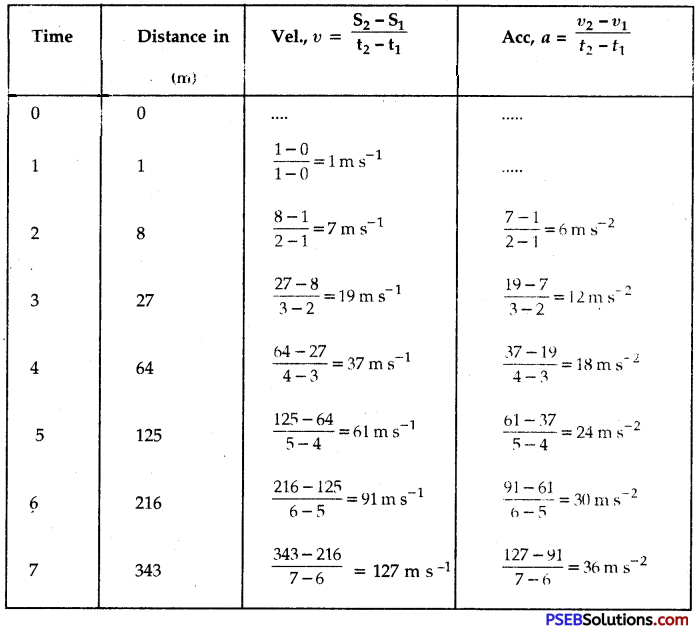
The following is the distance-time table of an object in motion.

Time in seconds Distance in metres
0 0
1 1
2 8
3 27
4 64
5 125
6 216
7 343

(a) What conclusion can you draw about acceleration? Is it constant, increasing, decreasing or zero?
(b) What do vou infer about forces acting on obiect?
Solution:
PSEB 9th Class Science Important Questions Chapter 9 Force and Laws of Motion 10
(a) Table shows that the motion is accelerated and acceleration is increasing uniformly with time i.e. acceleration is increasing by 6 ms-2 every second.
(b) Since acceleration is increasing uniformly, the force is also increasing uniformly with time.

PSEB 9th Class Science Important Questions Chapter 9 Force and Laws of Motion

Question 12.
Two persons manage to push a motor car of mass 1,200 kg at uniform velocity on the road. The same motor can be pushed by three persons to produce an acceleration of 0.2 ms-2. With what force does each person push the motor car? Assume that all persons push motor car with same muscular effort.
Solution:
Here, mass of the car (m) = 1200 kg
Acceleration produced in the car (a) = 0.2 ms-2
Acceleration produced by first two persons in the car = 0
It is clear that when third person pushes the car, an unbalanced force acts on the car which produces an acceleration of 0.2 ms-2
∴ Force applied by three persons together (F) = m × a
= 1200 × 0.2 = 240 N
Now because three persons together push the car using their muscular force to produce an acceleration of 0.2 ms-2
∴ Push (Force) applied by each person = \(\frac{F}{3}\)
= \(\frac{240 \mathrm{~N}}{3}\)
= 80 N

Question 13.
A hammer of mass 500 g moving at 50 ms-1, strikes a nail. The nail stops the hammer in a very short time of 0.01 s. What is the force of the nail on the hammer?
Solution:
Mass of the hammer (m) = 50 gm
= \(\frac{500}{1000}\)kg
= \(\frac{1}{2}\)kg
Initial velocity (u) = 50ms-1
Final velocity (v) = 0ms-1
Time (t) = 0.01s
Force (F) = ?
We know, υ = u + at
0 = 50 + a × 0.01
– 50 = a × \(\frac{1}{100}\)
a = – 50 × 100
∴ a = – 5000 ms-2
Here, negative sign indicates that there is retardation.
Now force applied by the nail on the hammer (F) = m × a
= \(\frac{1}{2}\) × (- 5000)
= – 2500 N
∴ Force = 2500 N

PSEB 9th Class Science Important Questions Chapter 9 Force and Laws of Motion

Question 14.
A motorcar of mass 1,200 kg is moving along a straight line with uniform velocity of 90 km h-1. Its velocity is slowed down to 18 km h-1 in 4 s by an unbalanced external force. Calculate the acceleration and change in momentum. Also calculate the magnitude of the force required.
Solution:
Here, mass of the car (m) = 1200 kg
Time (t) = 4 s
Initial velocity of the car (u) = 90 km/h
= \(\frac{90 \times 5}{18}\)ms-1
= 25ms-1
Final velocity of the car (υ) = 18 km/h
= 18 × \(\frac{5}{18}\)ms-1 = 5ms-1
Acceleration of the car (a) = ?
Change in momentum of the car = ?
Magnitude of the force acting on the car (F) = ?
We know, υ = u + at
5 = 25 + a × 4
– 20 = 4a
or a = \(\frac{20}{4}\)
Initial momentum = mu = 1,200 × 25 = 30,000kg ms-1
Final momentum = 1,200 × 5 = 6,000kg ms-1
Change in momentum = Final momentum – Initial momentum
= mυ – mu
= m × (υ – u)
= 1200 × (5 – 25)
= 1200 × (- 20)
= – 24000 kg ms-1
= 24000kg – ms-1 (decrease)
F = \(\frac{m×(υ – u)}{t}\)
= \(\frac{1,200×(5 – 25)}{4}\)
F = – 6,000 N
Magnitude of the force (F) = 6000N

Very Short Answer Type Questions:

Question 1.
To bring a body into motion, what is required to be done?
Answer:
It is required to be pulled, pushed or kicked.

Question 2.
Why does an object fall down?
Answer:
Due to unbalanced gravitational force.

PSEB 9th Class Science Important Questions Chapter 9 Force and Laws of Motion

Question 3.
Which type of force is required to change the direction of motion of the body – a balanced or unbalanced force?
Answer:
An unbalanced force is required.

Question 4.
Why does a body stop after rolling down for some time?
Answer:
Due to frictional force.

Question 5.
How can force of friction be reduced?
Answer:
By polishing/smearing the surface with a lubricant.

Question 6.
Which scientist postulated the three laws of motion?
Answer:
Newton.

Question 7.
By which other name the first law of motion is known?
Answer:
Law of Inertia.

Question 8.
Of heavy and light objects, which have more inertia?
Answer:
Heavier objects have more inertia.

Question 9.
What is the S.I unit of momentum?
Answer:
The S.I. unit of momentum is kg – ms-1.

PSEB 9th Class Science Important Questions Chapter 9 Force and Laws of Motion

Question 10.
Why is talcom powder sprinkled on carrom board while playing?
Answer:
In order to reduce friction.

Question 11.
Why does an athelete run before taking a high jump?
Answer:
To increase inertia in order to take high leap.

Question 12.
What is law of conservation of momentum?
Answer:
Law of conservation of momentum. The sum total of momentum of two objects before and after collision remains same unless some external force is applied.

Question 13.
A bus and a ball are moving with the same speed. To stop which one would require more force?
Answer:
Due to more inertia of bus, more force is required to be applied for stopping it.

Question 14.
A vehicle stops on applying brakes. During this activity, what happens to its momentum?
Answer:
In this activity the major part of momentum of the vehicle is transferred to the ground while the remaining part is transferred to the air molecules.

PSEB 9th Class Science Important Questions Chapter 9 Force and Laws of Motion

Question 15.
1 kg wt is equal to how many newtons?
Answer:
1 kg wt = 9.8 Newtons.

Question 16.
1 newton is equal to how many kg wt?
Answer:
1 newton = 0.102 kg wt.

Question 17.
On which physical quantity inertia of an object depends?
Answer:
On mass of the object.

Question 18.
On which Newton’s law of motion, the working principle of rocket is based?
Answer:
On Newton’s third law of motion.
