Rhythmic Folk Dance Game Rules – PSEB 10th Class Physical Education

Punjab State Board PSEB 10th Class Physical Education Book Solutions Rhythmic Folk Dance Game Rules.

Rhythmic Folk Dance Game Rules – PSEB 10th Class Physical Education

Question 1.
Write down the name of main Folk-Dance.
Answer:
The main Rhythmic Folk Dances are:

  • Lezium
  • Dumb-bell
  • Tipri
  • Folk Dance
  • Skipping
  • Ribbon Dance
  • Pole Dance
  • Mass P.T.

1. Folk Dance:
It is divided into two parts-
1. Regional Folk Dance
2. Western Folk Dance
(i) Regional Folk Dances are: Gujrati, Tipri, Machhua of Maharashtra, Rajasthani Folk Dance, Kolaham of Tamil, Bangali Folk Dance, Gidha and Bhangara of Punjab.
(ii) Some steps of Western Folk Dance are:

  • Do side
  • Heel toe step
  • Gup
  • Polka
  • Slide.

2. Lezium:
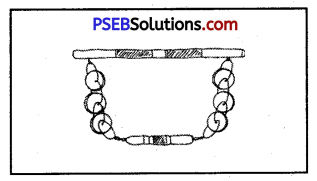
Lezium consists of a wooden handle of 15″ to 18″ in length with an iron chain fixed at both ends of the wooden handle and a rod of 15 cms (6″) in the middle. The iron chain contains iron plates in each ring which produces rhythmic and jingling sound when the lezium is in use. The weight of the whole apparatus is between 1 % to 2 lbs.
Rhythmic Folk Dance Game Rules - PSEB 10th Class Physical Education 1
Types of Lezium : Lezium Skand, Aram, Husshyar, Pavitra, Char Awaj, Ek Jagah, Aidi Lagala, Starting position, Do Rukh, Age Shlang, Peeche Shlang.
Rhythmic Folk Dance Game Rules - PSEB 10th Class Physical Education 2

Rhythmic Folk Dance Game Rules - PSEB 10th Class Physical Education

3. Dumble:
Dumble is an ancient Indian method of exercise, which can be performed indoor or outdoor.
Dumble is of two types-

  • Iron Dumble
  • Wooden Dumble: The Dumble has very thick and heavy and in the middle it is very thin.
    Rhythmic Folk Dance Game Rules - PSEB 10th Class Physical Education 3

Hold the Handle and struck them with each other so the voice may be produced. In this exercise position one, position two, position three and position are performed.

4. Tipri:
Tipri is a thick wooden stick having 15′ to 18″ in length. The thickness of the wooden stick may be 20 to 25 mm and weight about 100 gm. By holding this tipri in both hands dance is performed. It is of two types:

  • Lonely
  • In group.

5. Skipping:
It is a cotton rope at least 10 cm in diameter and 3 metres in length. Hold both the ends of the rope and rotate it from forward to backward by touching it to the floor-as soon as it touches the ground jump over it.

The following activities can be performed:

  • A pushing jumping forward and backward over a single rope.
  • Performed skipping with partner.
  • Skipping with coming in and going out.
  • Skipping on stunts

PSEB 12th Class Political Science Solutions Chapter 15 India and United Nations

Punjab State Board PSEB 12th Class Political Science Book Solutions Chapter 15 India and United Nations Textbook Exercise Questions and Answers.

PSEB Solutions for Class 12 Political Science Chapter 15 India and United Nations

Long Answer Type Questions

Question 1.
Write a note on U.N.
Answer:
There breathes nobody in this world who is not acquainted with the name of the United Nations. After long debates and discussions which took place in various World Conferences held from time to time between 1940 and 1945, ultimately the United Nations Conference was held at San-Francisco from April 26 to 25 June 1945. The Conference adopted the U.N. Charter which was signed by delegates of 51 Nations. The U.N. actually started functioning on October 24, 1945. It is an organisation of 193 countries of the world which aims at establishing peace in the world. Peace can be established in the world if all the countries extend willing co-operation to this organization.

Aims and Principles of U.N.
The U.N. Charter contains 111 short articles, prefaced by a preamble, which speaks for the aims of the United Nations. It starts with the words. “We the people of the United Nations,” signifying thereby that the United Nations speak in the name of the people of the world. The basic aims of the U.N. are:

  • To save succeeding generations from the scourge of war;
  • To re-affirm faith in the fundamental human rights;
  • To establish justice and respect for international obligations; and
  • To promote social progress and better standards of life.

These aims can be classified as under:

  • To maintain international peace and security.
  • To develop friendly relations among nations based on respect for the principle of equal rights and self-determination of people.
  • To achieve international co-operative for solving international problems of an economic, social and humanitarian character.
  • To promote and encourage respect for human rights and for fundamental freedoms for all without any distinction of race, sex, language or region.
  • To act as a centre for harmonizing the actions of world nations in the achievement of agreed common ends.

Basic Principles of The U.N.
All the members, in order to achieve the main purpose of U.N., will act in accordance with the principles given ahead:

  • The organization is based on the principles of sovereign equality of its members.
  • All member-States are supposed to fulfil the obligation imposed upon them by Charter.
  • All international disputes are to be settled through peaceful means.
  • All member-States must refrain from the use of force in any international dispute.
  • The organization as far as possible, shall avoid intervention in the domestic affairs of a State.
  • The member-States are supposed to assist the organization in any action taken by it in accordance with the U.N. Charter.
  • All member-States must give free help to U.N.O. in any action taken according to the Charter.
  • All members must act according to the principles of U.N.O. in order to create international peace and security.

Organs of U.N.
The principal organs of U.N. are given as under:
1. The General Assembly
2. The Security Council
3. The Economic and Social Council
4. The International Court of Justice
5. The Trusteeship Council
6. The Secretariat.

1. General Assembly:
The General Assembly consists of all the members of U.N. Each state can send five representatives in the General Assembly. Each member-State has, however, one vote. In the Assembly all the member- States, however big or small, meet on the terms of sovereign equality of all the member-States. It elects its President and Vice-Presidents for each session. The General Assembly meets regularly once every year, commencing usually in September.

Special sessions may be convened at the request of the Security Council or of a majority of the members of the U.N. All decisions on important questions are taken by 2/3 majority of those present. A majority of the.members of the General Assembly constitutes a quorum. The General Assembly does most of its work in Committee’s voting but decision regarding less important questions may be taken by a simple majority of votes. Functions. The General Assembly can be called World Parliament or World Panchayat.

The Assembly elected 10 non-permanent members of the Security Council for a term of two years, 54 members of the Economic and social Council and some members of the Trusteeship Council. A Secretary-General is elected on the recommendations of the Security Council. It is the deliberative body of the organization. Apart from the duties discussed above, it performs the following functions:

  • The General Assembly can deal with all matters within the scope of U.N. Charter.
  • It can make recommendations to any member or to the Security Council on any question within its jurisdiction.
  • It considers principle of co-operation for the creation of world peace and security.
  • It can initiate studies and make recommendations for the development of International Law and its codification.
  • It can call the attention of the Security Council to such situations which may endanger world peace.
  • It is empowered to make suggestions for promoting international co-operation in economic, social, cultural and health fields.
  • It receives and considers the annual reports from the Security Council and other organs about the maintenance of world peace.
  • It considers and approves the budget of U.N.
  • It fixes the amount which each member-State has to contribute for the working of U.N.
  • To assist in the realization of fundamental human rights for all without distinction of race, sex, language or religion.

‘The Uniting for Peace Resolution’ confers effective power on the General Assembly for the purpose of maintaining International peace and security.This Resolution was adopted by the General Assembly on 3rd November, 1950.

2. Security Council:
It consists of 15 members, five of which are permanent members. It is the most important and most powerful organ of the U.N. The permanent members are- England, France, U.S.A., Russia and Republic of China. Ten members are non-permanent, These non-permanent members are elected by the General Assembly for a period of two years. No State can be elected as a member for two consecutive terms.

The Security Council must meet at least twice a month, but its meeting can be held even before if the need arises. Meetings of the Security Council are held at the call of the President at any time he deems necessary, but the interval between meetings must not exceed fourteen days. Each member presides over the meeting of the council for a month turn by turn.

The concurrence of permanent members is necessary for all vital decisions of the Security Council affecting international peace and security. Decisions on all matters are to be made by a majority of nine members (including the five permanent) except on procedural matters which require the decision of any nine members.

By casting a negative vote, any one of the permanent members can veto a decision. But mere abstention from the vote, or the absence of a permanent member from the meeting, does not operate as a veto. No member can cast his vote in a matter with which he is personally connected. The Security Council can invite any State to participate in its meeting but it is not entitled to exercise its vote.

Functions:

  • The admission of new States to the organization and the expulsion therefrom can only be done on the recommendation of the Security Council.
  • It makes recommendations to the General Assembly for the appointment of the General Secretary.
  • It can take any measure necessary to maintain or restore international peace.
  • It can ask the contesting parties to solve their conflict by peaceful means, like negotiation, enquiry and mediation.
  • The Security Council may decide measures, not involving the use of armed force, to be employed to give effect to its decisions.
  • The Security Council may take such action by air, sea or land force, as may be necessary to maintain or restore international peace and security.
  • It shares with the General Assembly the function of electing judges to the International Court of Justice and right to request the court for advisory opinion or legal matters.

3. Economic and Social Council:
Before 1965 this body consisted of 18 members who were elected by the General Assembly. From 1st Jan. 1966 its membership was increased to 27 and now-a-days it has 54 members. One- third of its members retire after every one year and this way a member is elected for a period of three years. A retiring member is eligible for immediate re-election. It can have extra members also but these members cannot have the right to vote. It must meet at least twice a year and decisions are taken by ordinary majority. It elects its own President.

Functions:
Its main function is to solve the economic and social problem of the people.

  • It initiates studies and makes report about international economic, social, educational, health and cultural matters to the General Assembly and other specialized agencies.
  • It sets up commissions in economic and social fields for the promotion of human rights.
  • It calls international conferences on matters under its jurisdiction.
  • It makes recommendations for the purpose of promoting respect for and observance of human rights and fundamental freedom of all.
  • It helps the nations in their development plans.
  • It may take appropriate steps to obtain regular reports from the specialised agencies.

4. International Court of Justice:
It is the judicial organ of the United Nations. It decides the disputes among different member-States of the U.N. It has 15 judges, and they are elected by the General Assembly and the Security Council, voting independently. Those candidates who obtain an absolute majority of votes in the General Assembly and in the Security Council are considered as elected. The judges are elected for nine years.

After every 3 years, 1/3rd of the judges retire but they can be re-elected. Its meetings are held at the Hague and decisions are taken by a majority vote of the judges present. The Court elects its President and Vice-president for three years. Except for judicial vacations, the Court is permanently in session. A quorum of nine judges is required to constitute the Court. French and English are the official languages of the Court.

Functions:

  • It decides disputes among different States. Any State can refer its case to the court for decision.
  • It hears and decides disputes on the basis of International Law. United Nations Charter, international treaties and international customs and traditions.
  • The General Assembly can ask for legal advice on any issue from the International Court of Justice.
  • Its decisions are only in the form of advice and no member is bound to act according to the decision given by it. The Security Council gets its decisions enforced

5. Trusteeship Council:
It consists of members from States which administer Trust territories and such of the five permanent members of the Security Council as do not administer any trust territory. But it has also to include some other representations in such a way that the total becomes equally divided between the trust administering members and the non-trust administering members. All these extra members are to be elected by the General Assembly for a period of 3 years. The Trusteeship Council meets twice a year, generally in January and June. At its summer session each year it elects its President and a Vice-president to preside over its meetings. All the decisions are made by a majority of the members present and voting. Each member of the Trusteeship Council possesses one vote.

Functions:

  • The council is to see that trust territories are administered and ultimately get responsible government or independence according to the wishes of the masses.
  • It also considers reports which have been submitted by the administering authority.
  • It further examines petitions and visits the respective trust territories in order to promote world peace.
  • It makes efforts for the promotion of moral, social and economic welfare of the trust territories.
  • It formulates a questionnaire on the political, economic, social and educational advancement of the inhabitants of each trust territory.

6. Secretariat:
A Secretariat has been established for working out the administration of the various organs of the U.N. It functions under the Supervision and direction of a Secretary General. He is appointed for a period of five years. The General Assembly appoints the Secretary General on the recommendations of the Security Council. Secretary General can be re-elected. He is the Chief Administrative Officer of the United Nations. Antonio Guterres of Portugal is the present Secretary General. The international staff is required by him under the rules and regulations laid down by the General Assembly.

The Secretariat is located at the Headquarters of the U.N. in New York. It has branch offices at Geneva, Vienna and Nairobi.
Functions:

  • The Secretariat maintains the records of the proceeding of the various organs of the U.N.. It collects information and materials needed by them and conducts correspondence with States on behalf of the U.N.
  • It calls the meeting of the various organs of the U.N.
  • It enforces the decisions taken by various organs of the U.N.
  • It prepares the annual report of each organ of the U.N. and presents it to the General Assembly.
  • It brings to the notice of Security Council any matter which in its opinion may threaten the international peace and security.
  • It produces statistical publication, information bulletins and analytical work in accordance with the decisions of the General Assembly.
  • It organises conferences, expert group meetings, seminars on topics of concern to the international community.
  • It is to run the working of the U.N. smoothly and efficiently.

PSEB 12th Class Political Science Solutions Chapter 15 India and United Nations

Question 2.
Describe India’s role in the United Nations.
Or
Describe the role of India in United Nations Organisation (U.N.O.).
Answer:
India has been a member of the U.N.O from the very beginning. She is among those countries which signed the U.N. Charter first of all. As India is a peace- loving country so its policies are very much in tune with the policies of the U.N.O. After the attainment of Independence, India took a keen interest in the activities of the U.N.O. She co-operated with the U.N.O. in all its activities. She helped the U.N.O. in its aim of maintaining world peace. India also became the member of the specialised agencies of U.N.O. and helped in its co-operative efforts. Whenever the U.N.O. was faced with a problem, India extended her full support for solving it. India performed the following functions for helping the U.N.O. in the fulfilment of its objects:

1. Policy of Neutrality:
India had adopted the policy of neutrality in international affairs. India is always anxious for maintaining friendly relations with all countries of the world. Today the entire world is divided into two blocs and each bloc is opposed to the other. This division of the – world into two blocs is a hindrance in the fulfilment of the objectives of the U.N.O. It increases the chances of war and decreases the chances of co- 1 operative efforts on the part of member countries. India has kept itself aloof from these power-blocs and has always stood for the policy of neutrality. India has also made efforts to bridge the gap in these two power-blocs and has done its best in reducing the tension between them.

2. Panchsheel:
India had propagated the principles of Panchsheel for the maintenance of world peace. By following the principles of Panchsheel the chances of war are much reduced and all the countries of the world live in co-operation with one another. The principles of Panchsheel have been accepted by Asian, African and many European countries. It has helped a great deal in the maintenance of world peace. The maintenance of world peace is one of the main aims of the U.N.O.

3. Peaceful solution of her disputes with other countries:
India has always tried to find out a peaceful solution of her disputes with other countries.
Just after the attainment of Independence, India had a dispute with Pakistan over the Kashmir issue, and the dispute was referred to the U.N.O. by India.
In 1962, China attacked India and we put in our best to solve the problem peacefully. In 1965, India was attacked by Pakistan, but it accepted the cease-fire and respected the resolution on cease-fire of Security Council of the U.N.O. Whatever differences we have with other countries, we are always: desirous of solving them peacefully.

4. Co-operation in ending wars in other countries:
India has always; co-operated with U.N.O. in ending wars in other countries. It helped in bringing to an end the civil war in Korea. India had a hand in the maintenance of peace in Laos and Indo-China. India was given the responsibility of defending the ceasefire line in Korea. Indian representative headed the Commission appointed for the maintenance of peace in Indo-China. India helped U.N. to the maximum in ending the civil war in the Congo. India was substantially associated with the conversion of the United Nations Operation in the Congo from a non-military to a military force.

India was:also appointed a member of the Advisory Committee on the Congo. India; made every possible effort to bring the dispute between England and Egypt over Suez Canal to an end. Speaking in the debate on the question of Cyprus in the General Assembly on May 11, 1983, India called for the withdrawal of foreign military forces from Cyprus and appealed to both parties to resume the inter-community talks. India declared, Cyprus cannot be divided or partitioned The identity and integrity of this island republic must be preserved at all costs.” Thus whenever world peace is threatened, India takes a keen interest in solving the issues peacefully.

5. Help in the freedom of dependent countries:
India has always helped the dependent countries in the attainment of freedom. India helped Indonesia -in the attainment of freedom. Whenever any country started the movement for attaining independence, India always supported the cause.

6. Anti-Colonialism:
India stood for anti-colonialism. India is for stepping up fight against Colonialism. Speaking during a General Assembly debate on decolonisation on Nov. 23, 1982, India called for combating colonialism and its new manifestations like Namibia and Palestine with renewed vigour. On April 8, 1987, India asked the U.N. Security Council not to ‘shy away’ from its responsibility in getting Namibia freed from its illegal occupation bySouth Africa against whom it demanded comprehensive mandatory sanctions.

7. Criticism of Injustice-rand Aggression. Whenever any country committed aggression against any other country or did injustice to any other country, India always raised its voice against the aggressor. It criticised the aggressive designs of powerful nations. When Russia attacked Hungary; Britain and

France attacked Egypt and Britain attacked Cyprus, India criticised their actions without any hesitation. India condemned South Africa’s unprovoked and wanton aggression against Lesotho and acts of subversion and aggression against Angola. On Dec. 13, 1982 India called for the total isolation of South Africa to compel it to end its illegal occupation of Namibia as well as its terrorist activities against other countries in the region. India has always supported a measure on its merits and has always sided with truth. It had adopted the policy of neutrality.

8. Support of Disarmament:
India has also supported disarmament for lessening the possibility of wars. India is against the policy of performing nuclear experiments. In principle, India has stood for general and complete disarmament within the framework of the United Nations.
Addressing the General Assembly, Mr. Rajiv Gandhi, Prime Minister of India, asked nuclear powers to eliminate all nuclear weapons by the year 2010.

India proposed a Comprehensive Global Security System that would ensure “peaceful co-existence for a new, just, equitable and democratic world order.” On January 14, 1993 India signed along with other countries the Chemical Weapons Ban Treaty. After India conducted nuclear tests in May, 1998 United States and other countries urged India to sign CTBT (Comprehensive Test Ban Treaty) unconditionally. But India reiterated its stand that since the treaties are discriminatory, they are not acceptable to the nation without any change.

9. Admission of New States:
India tried her best for the admission of Communist China and Bangla Desh into the United Nations.

10. Against Racial Discrimination:
India has always spoken fearlessly against the racial discrimination to which the ‘Coloured people’ (as in South Africa) are being subjected by the ‘White’ ruling class. India was the first country to impose comprehensive voluntary sanctions against the apartheid regime of South Africa in 1946. India urged the United Nations to treat the problem of racial discrimination as a threat to international peace and security and carry out the responsibility enjoined by the Charter. Consequently, the United Nations adopted a number of resolutions calling upon the government of South Africa to end racial discrimination. In this way India has become the friend of the black people.

11. Protection of Human Rights:
India is a great supporter of human rights. India has always made great efforts that U.N. should adopt proper measures to safeguards the human rights.

12. India in Space Committee of U.N. India is a member of space committee of U.N. India has always made efforts that space should be used for world peace.

13. Restructuring the U.N. Security Council:
India has raised the question of restructuring the Security Council. Addressing the General Assembly on Sept. 26,1998 Prime Minister Atal Behari Vajpayee proposed induction of fresh blood in the Security Council so as to make it more representative of the membership of the United Nations. The Prime Minister made a passionate plea that some developing countries should be made permanent members at par with the present members. Mr. Vajpayee also put India’s claims for a permanent seat in the Security Council.

The Secretary-General expressed appreciation of India’s role in furthering the efforts of the non-aligned movement for peace, security and development. Thus India has played a significant role in U.N.O.’s peace keeping role.

PSEB 12th Class Political Science Solutions Chapter 15 India and United Nations

Short Answer Type Questions

Question 1.
What do you mean by United Nations?
Or
When did India become the member of the U.N.O.?
Answer:
United Nations Organisation is an international organisation which was established after Second World War on October 24,1945. India is the founder member of this organisation. The United Nations represents the second major effort in the twentieth century to achieve the goal of a better world through a general international organisation of the states. U.N.O. is an association of states and its primary objective is maintenance of international peace and security. At present 193 States are the members of the United Nations.

Question 2.
Write the main objectives of United Nations.
Or
Write the main objects of U.N.O. (United Nations Organisation.)
Answer:
The aims and purposes of the United Nations as laid down in Article 1 of the Charter are as follow:

  1. To maintain international peace and security.
  2. To develop friendly relations among nations.
  3. To achieve international co-operation in solving international problems of an economic, social, cultural and humanitarian character and to promote respect for human rights and humanitarian freedoms.
  4. To promote and encourage respect for human rights and for fundamental freedoms for all without any distinction of race, sex, language or region.

Question 3.
What role has India played in the United Nations in the maintenance of world peace?
Or
What role has India played in maintaining the world peace?
Answer:
The main aim of the United Nations is maintenance of international peace and security. India is a peace-loving country and India has played a very important role in the United Nations in maintaining world peace. India has given its full co¬operation to U.N. to settle international disputes such as:
1. Korean problems:
In 1950 North Korea attacked South Korea. India supported the resolution of the U.N. by which North Korea was declared the aggressor. To stop war U.N. sent forces of sixteen countries and India also participated. ,

2. Indo-China problems. Indian representatives headed the Commission appointed for the maintenance of peace in Indo-China.

3. Congo and Gaza crises. India helped U.N. to the maximum in ending theCivil War in Congo. India was substantially associated with the conversion of the United Nations’ operation in Congo from a non-military to a military force. Lt. General P. S. Gyani from India was the commander of the U.N. forces in Gaza.

4. Iran-Iraq War. India played a very important role in ending Iran-Iraq war.

PSEB 12th Class Political Science Solutions Chapter 15 India and United Nations

Question 4.
What do you mean by United Nations? Write its main organs.
Or
When was United Nations formed? Write the names of its organs.
Answer:
Meaning of United Nation:
United Nations Organisation is an international organisation which was established after Second World War on October 24,1945. India is the founder member of this organisation. The United Nations represents the second major effort in the twentieth century to achieve the goal of a better world through a general international organisation of the states. U.N.O. is an association of states and its primary objective is maintenance of international peace and security. At present 193 States are the members of the United Nations.

Main organs of United Nations:
There are six organs of U.N-

  1. General Assembly
  2. Security Council
  3. The Economic and Social Council
  4. International Court of Justice
  5. Trusteeship Council
  6. The Secretariat.

PSEB 12th Class Political Science Solutions Chapter 15 India and United Nations

Question 5.
What are the major organs of the United Nations?
Or
Write down names of the four organs of United Nations.
Answer:
There are six organs of the United Nations. The brief description of these organs is given below:
1. General Assembly:
General Assembly is the biggest organ of the U.N. and it consists of all the members of the U.N. At present 193 states are the members of the General Assembly. Mainly General Assembly is the deliberative body and it also approves the annual budget of the United Nations.

2. Security Council:
Security Council is mainly responsible for the maintenance of international peace and security. The Security Council is the executive body of the United Nations. At present it consists of fifteen members. Five big powers (England, U.S.A., France, Russia, China) are the permanent members of the Security Council and ten are the temporary members elected by the General Assembly for a period of two years.

3. Economic and Social Council:
Economic and Social Council consists of 54 members and they are elected by the General Assembly for a period of three years. This Council is mainly responsible for solving economic and social problems of the world.

4. Trusteeship Council:
Trusteeship Council is responsible for supervising the administration of trust territories. The Trusteeship Council consists of an equal number of administering and non-administering powers.

5. International Court of Justice:
It consists of fifteen judges who are elected by the General Assembly on the recommendation of the Security Council for nine years. International Court of Justice decides the cases between the states.

6. Secretariat:
Secretariat comprises a Secretary General and such staff as the organisation may require. Secretary General is the Chief Administrative Officer of the Secretariat.

Question 6.
Write the names of five countries having veto power in U.N.O.
Or
Write down the names of four permanent members of the Security Council of United Nations.
Answer:
The Security Council of the U.N. consists of 15 members, five of which are permanent. The permanent members are- England, France, U.S.A., Russia and People’s Republic of China. Ten members are non-permanent or temporary. These non-permanent members are elected by the General Assembly for a period of two years. The permanent members of the Security Council enjoy the power of Veto. Veto power is a special power of permanent members by which they can affect the decisions of the Security Council.

PSEB 12th Class Political Science Solutions Chapter 15 India and United Nations

Question 7.
Enumerate three main organs of the U.N which are considered to be as Legislature, Executive and Judiciary of the U.N.
Answer:
1. General Assembly:
General Assembly is the largest organ of the U.N. It can also be called world parliament, world panchayat or the legislature of the U.N. The General Assembly consists of all the members of U.N. All the deliberative functions are performed by it.

2. Security Council:
Security Council is the executive body of the U.N. consisting of 15 members, of which 5 members are permanent and 10 members are temporary. No decision can take place without the consensus of the Security Council.

3. It considers and approves the budget of U.N.O.

4. International Court of Justice:
It is the Judicial organ or the Judiciary of the U.N. It decides the disputes among different member-states of the U.N. It has 15 Judges.

Question 8.
Mention the main functions of the General Assembly.
Answer:
The General Assembly performs the following functions:

  • The General Assembly can deal with all matters within the scope of the U.N. Charter.
  • It considers and approves the budget of U.N.O.
  • The General Assembly can call the attention of the Security Council to such situations which may endanger world peace.
  • It is empowered to make suggestions for promoting international co-operation in economic, social, cultural and health fields.

Question 9.
Write the names of five countries having Veto Power in United Nations.
Answer:

  1. U.S.A.
  2. Russia,
  3. China,
  4. England
  5. France.

PSEB 12th Class Political Science Solutions Chapter 15 India and United Nations

Question 10.
Write important specialised Agencies of United Nations.
Answer:

  • UNESCO
  • World Health Organisation (W.H.O)
  • International Labour Organisation (I.LO)
  • Food and Agriculture Organisation (F.A.O).

Very Short Answer Type Questions

Question 1.
What do you mean by United Nations?
Answer:
United Nations Organisation is an international organisation which was established after Second World War on October 24, 1945. India is the founder member of this organisation. U.N.O. is an association of states and its primary objective is maintenance of international peace and security. At present 193 States are the members of the United Nations.

Question 2.
Write two objectives of United Nations.
Answer:
The aims and purposes of the United Nations as laid down in Article 1 of the Charter are as follow:—
1. To maintain international peace and security.
2. To develop friendly relations among nations.

Question 3.
Write down the names of the principal organs of the United Nations.
Answer:
There are six organs of U.N.

  1. General Assembly
  2. Security Council
  3. The Economic and Social Council
  4. International Court of Justice
  5. Trusteeship Council
  6. The Secretariat.

PSEB 12th Class Political Science Solutions Chapter 15 India and United Nations

Question 4.
Write the names of five countries having veto power in U.N.O.
Answer:
The Security Council of the U.N. consists of 15 members, five of which are permanent. The permanent members are-England, France, U.S.A., Russia and People’s Republic of China.

Question 5.
Mention two functions of the General Assembly.
Answer:
The General Assembly performs the following functions:

  • The General Assembly can deal with all matters within the scope of the U.N. Charter.
  • The General Assembly can call the attention of the Security Council to such situations which may endanger world peace.

Question 6.
When was United Nations Organisation formed? What is the number of its founder member countries?
Answer:
United Nations organisation was formed on 24th October, 1945. The number of its founder member countries was 51. India is the founder member of this organisation.

Question 7.
Write down the names of four specialised agencies of the U.N.O.
Answer:

  1. UNESCO
  2. World Health Organization (W.H.O.)
  3. International Labour Organization (I.L.O.)
  4. Food and Agriculture Organization (F.A.O.)

PSEB 12th Class Political Science Solutions Chapter 15 India and United Nations

Question 8.
Write two organs of U.N.O. which are called respectively legislature and executive.
Answer:

  1. Legislature – General Assembly.
  2. Executive – Security Council.

One Line Answer Type Questions

Question 1.
Why was U.N.O. established?
Answer:
The United Nations Organisation was established to stop wars in the world and to promote international peace and security.

Question 2.
Give any one basic principle of the United Nations.
Answer:
A basic principle of the United Nations is to establish the United Nations on the basis of equity of nations.

Question 3.
Write down any one objective of establishing the United Nations.
Answer:
The main objective of the United Nations Organisation is to maintain international peace and security.

Question 4.
Write one important specialised Agency of the United Nations.
Answer:
International Labour Organisation (I.L.O.).

PSEB 12th Class Political Science Solutions Chapter 15 India and United Nations

Question 5.
Write names of two organs of the United Nations.
Or
Write two main organs of the United Nations.
Answer:

  • General Assembly
  • Security Council.

Question 6.
When was the U.N. Declaration of Human Rights adopted?
Answer:
The U.N. Declaration of Human Rights was adopted on 10 December, 1948.

Question 7.
When was United Nations founded?
Or
When was United Nations established?
Answer:
United Nations was established on 24 October, 1945.

Question 8.
How are the temporary members of the Security Council elected? Answer: The temporary members of the Security Council are elected by the General Assembly.

Question 9.
Who is the present Secretary General of the United Nations Organisation?
Answer:
The present Secretary General of the United Nations is Shri Antonio Guterres.

PSEB 12th Class Political Science Solutions Chapter 15 India and United Nations

Question 10.
When did India become member of the United Nations?
Answer:
India became member of the U.N.O. in 1945.

Fill in The Blanks

1. India is a founder member of ……………………..  .
Answer:
U.N.O.

2. U.N.O. was established in ……………………..  .
Answer:
1945

3. The U.N.O. has …………………….. principal organs.
Answer:
Six

4. Security Council of …………………….. U.N.O consists of members.
Answer:
15.

PSEB 12th Class Political Science Solutions Chapter 15 India and United Nations

True Or False Statement

1. U.N.O was established after Second World War.
Answer:
True

2. All members of the U.N.O are sovereign state.
Answer:
True

3. The U.N.O has 10 principal organs.
Answer:
False.

4. Kofi Annan is a General Secretary of U.N.O.
Answer:
False.

PSEB 12th Class Political Science Solutions Chapter 15 India and United Nations

Choose The Correct Answer

Question 1.
India became the member of U.N.O. in:
(a) 1945
(b) 1947
(c) 1950
(d) 1960.
Answer:
(a) 1945

Question 2.
The number of nations which gathered at San Francisco to formulate U.N. Charter was:
(a) 51
(b) 49
(c) 50
(d) 52
Answer:
(a) 51

PSEB 12th Class Political Science Solutions Chapter 15 India and United Nations

Question 3.
Who was the first Woman President of the U.N. General Assembly?
(a) Sarojini Naidu
(b) Aruna Asaf Ali
(c) Vijay Luxmi Pandit
(d) Raj Kumari Amrit Kaur.
Answer:
(c) Vijay Luxmi Pandit

Question 4.
Which one of the following is not a permanent member of U.N. Security Council?
(a) Russia
(b) India
(c) China
(d) France.
Answer:
(b) India

Question 5.
How many organs has U.N.O.?
(a) 5
(b) 6
(c) 7
(d) 8
Answer:
(b) 6

PSEB 12th Class Political Science Solutions Chapter 14 Foreign Policy of India-Determinants and Basic Principles

Punjab State Board PSEB 12th Class Political Science Book Solutions Chapter 14 Foreign Policy of India-Determinants and Basic Principles Textbook Exercise Questions and Answers.

PSEB Solutions for Class 12 Political Science Chapter 14 Foreign Policy of India-Determinants and Basic Principles

Long Answer Type Questions

Question 1.
Explain the various determinants of India’s Foreign Policy.
Or
What do you mean by foreign Policy? Explain the main factors that determine India’s Foreign Policy.
Answer:
Meaning of Foreign Policy. Foreign policy is the set of principles and means adopted by a nation for defining, justifying and securing the objectives of national interests. According to Dr. Mohinder Kumar, “Foreign Policy is a thought out course of action for achieving objectives in foreign relations as dictated by the ideology of national interest.”
Norman Hill defines foreign policy “As the substance of Nation’s efforts to promote its interests vis-a-vis other nations.”

Factors determining India’s Foreign Policy:
A number of factors influence the foreign policy of a nation. India had to formulate its foreign policy after attaining freedom in 1947. The Directive Principles of State Policy have been described in the Constitution of free India and they are to be followed. Following are the principles related to foreign policy:
1. To contribute to international peace and security.

2. To establish just and respectable relations with various nations.

3. To create the feeling of devotion and trust in the nation for international laws and treaties.

4. To encourage the settlement of international disputes by arbitration. Indian leaders, even before attaining independence, started thinking about the principles which the Government of India would follow in its foreign policy after independence. Congress, in 1925, expounded the following four principles with regard to foreign policy:

  • To oppose imperialistic and colonialistic Governments.
  • To support people’s struggle for freedom and equality.
  • To establish world-peace and to develop hatred for wars.
  • To remain aloof from foreign groupism.

Free India has adopted that foreign policy which is based on national interest. Various factors given below have contributed in determining this policy:
1. Geographical Factors:
The geographical factors have contributed a lot in determining India’s foreign policy. India has enormous coastal dimensions- its length is about 3,500 miles. Any country dominating Indian Ocean can easily overpower Indian trade and can pose danger to India politically. The Britishers could rule over India by their sea-power only. So, strong naval forces are required for the security of India and efforts are being directed in this direction. But Indian naval forces will take a long time to be at par with the English, American and Russian naval forces. That is why India has friendly relations with Great Britain.

India shares its boundaries with Pakistan, China, Nepal, Bangla Desh and Myanmar. Some of the provinces of Kashmir State, though under Pakistan at present, have common boundaries with Afghanistan and Russia. China is situated in the north of India. The Himalayas are situated between India and China and they have performed the role of a watchman in the ancient and middle ages. Now the situation has undergone a change because of scientific inventions and production of war weapons. But Chinese aggression in 1962 disillusioned India. India had always tried to improve its relations with Communist China. Besides, India has followed the policy of non¬alignment to avoid strained relations with China.

The Communist and Western Blocs in international politics have tried to maintain friendly relations with India. India’s geographical situation is in the middle of Indian Ocean. It is equally connected with West Asia and South East Asia by sea route. It is not far from China and Russia situated in North. So under these circumstances, it is not safe for India to join either of the two Blocs. India’s policy of non-alignment, in fact is the result of these geographical factors.

2. Historical Background:
Every nation’s foreign policy is under the impact of its historical background. India’s foreign policy, too, is not devoid of this effect. India remained under the British rule for two hundred years and as a result it has more contacts with Great Britain as compared to other nations. After the Second World War and because of changed circumstances, the British themselves ended their rule. Both the countries are friendly with each other even today because of this background.

Historical background has played important role in Indo-Pak relations. Kashmir problem has not been solved so far because Pakistan claims its right over the majority of Muslims whereas Kashmir is an inseparable part of India. The welfare of both the nations lies in the policy of co-operation from geographical point of view, but their historical background embitters their relations.

India’s exploitation and slavery because of imperialism has influenced its foreign policy and how its main principle is to oppose imperialism and colonialism.

3. Economic Factors:
The economic factors of a developing country play a major role in shaping the foreign policy of a nation. Economic considerations influence the foreign policy of even advanced nations like the U.S.A., the Russia, Britain, France etc. India depends on advanced countries for scientific and technological assistance. India has trade links mainly with England and United States of America. India imports machinery and foodstuffs mainly from these countries. Enough of the capital of America and Britain has been invested in Indian factories. India’s foreign policy is favourably inclined towards western capitalistic states. India, during the last few years, has increased its trade relations with Russia also. As Pt. Jawahar Lai Nehru once remarked, “The foreign policy of a country is the outcome of her economic policy.”

(i) Population:
Population, too, affects foreign policy. The progress of a nation can be slack because of its over-population as it has to get assistance from other nations also. A big nation having over-population is weaker than a small nation with less population. We have to depend upon foreign countries for food-stuffs because of growing population. According to Morgenthau, “India’s foreign policy has weakened because of food crisis.”

The return of immigrants from South-East Africa, Sri Lanka, South East Asia and other countries added to India’s population problem which influences India’s foreign policy. The population of immigrants in India is less in proportion to its total population but their number is large in the countries accepting them. Because of this, various problems have arisen between natives and Indian immigrants.

(ii) Natural Resources:
The foreign policy of a nation is undoubtedly, affected by its natural resources. These natural resources play an important role in developing the industry and trade of that nation. America and Russia, because of their abundant natural resources, are self-dependent economically and possess huge military power. These natural resources hold an important place in India’s independent foreign policy.

The proper use of natural resources depends upon other co-factors such as capital, labour, organisation, new social set-up and values. Japan progressed sufficiently even in the absence of these factors and raw-material whereas Myanmar, with all these facilities, didn’t make a headway. The availability of natural resources for a long time properly influences the foreign policy of a nation.

(iii) Technology:
Every nation in the beginning has to depend upon foreign assistance or technology for economic development. For example America depended upon foreign monetary help or technology and Japan took assistance from other countries to strengthen itself. Similarly, Russia depended on foreign help to be an industrial nation. Russian capital made China prosperous after 1949. So India’s dependence on other countries for economic and industrial progress is not surprising but with the economic and industrial development, dependence on other countries lessened. India’s foreign policy will certainly be influenced by capitalistic and technologically prosperous countries as it becomes self-sufficient.

4. National Interest:
National interest has played a remarkable role in formulating foreign policy. On 4th Dec. 1947 while addressing Constituent Assembly, Pt. Nehru said, “Whatever policy you may lay down, the art of conducting the foreign affairs of a country lies in finding out what is most advantageous to the country. We talk about international goodwill and mean what we say but in the ultimate analysis, a Government functions for the good of the country; it governs and no Government dares to do anything which is disadvantageous to the country.
Therefore, whether a country is Imperialist or Socialist or Communist, its foreign minister thinks primarily in the interest of that country.”

Pt. Nehru based India’s foreign policy on non-alignment and establishment of world-peace and paved a way for economic and industrial development. Had India got involved in one of the two power Blocs, it wouldn’t have enjoyed economic help. Thus the policy of non-alignment was adopted, keeping in view the national interests.

India preferred to remain a member of Commonwealth of Nations for national advantage. For the safety of India’s sea boundaries and economic and trade development, it was essential to have relations with British Commonwealth. India, for national interest, indulged in certain activities which can’t be appreciated.

5. Impact of Ideology:
All ideology of a country leaves its deep impact on its foreign policy. The Congress, during national movement, presented various ideologies before the world in international spheres. Congress always favoured world peace, peaceful co-existence and strongly opposed imperialism and colonialism. Congress, on assuming office, had to formulate a foreign policy based on these ideals. Congress was under the impact of Gandhian ideals and principles and so India’s foreign policy was bound to be affected by Gandhism. India’s sympathies for Communist countries are attributed to the influence of Marxism. Pt. Nehru, the maker of India’s foreign policy, was under the impact of western democratic traditions. He liked the qualities of Western democracy and Communism and preferred to avoid their evils. So the policy of non-alignment was adopted.

6. National Struggle:
India’s national movement contributed a lot in the making of its foreign policy.

  • Indians were determined not to make national movement a pawn in the hands of great powers.
  • An awakening was created to play an important role in international politics inspite of remaining a non-aligned state.
  • People were encouraged to oppose colonialism, socialism and colour discriminations
  • People got inspired to participate in freedom struggle.

7. Personal Factors:
The foreign policy of India has been influenced by the individual trait of its great leaders. Pt. Nehru’s ideology has sufficiently affected India’s foreign policy. He was deadly against imperialism, colonialism, fascism and supported peaceful way of solving problems. He favoured friendly co-operation and peaceful co-existence but at the same time he supported the use of power against injustice.

Besides Pt. Nehru, the ideology of Dr. Radhakrishnan, Krishna Menon, Pannikar etc. left its impact on India’s foreign policy in relation with Chinese, in the beginning, was influenced by Pannikar’s personality. So India couldn’t properly judge the nature of its relations with China. As a result of the false reports given by Pannikar, India’s ambassador to China, Pt. Nehru remained in illusion and India faced defeat in Chinese aggression. But the events of 1962 gave realistic touch to India’s foreign policy. The basic as well as practical elements lying in India’s foreign policy were preserved during the regime of late Prime Ministers Shri Lai Bahadur Shastri, Mrs. Indira Gandhi, Mr. Rajiv Gandhi, P.V. Narasimha Rao, Mr. Atal Bihari Vajapyee and at present by Sh. Narinder Modi.

8. Promotion of World Peace:
One of the basic determinants of Indian Foreign policy is world peace. India has always formulated its foreign policy to promote world peace.

9. Principle of Non-alignment:
Principle of non-alignment has played a very important role in formulating foreign policy. India itself is a non-aligned country and so its foreign policy is also based on non-alignment.

Love for peace, toleration, friendly behaviour, co-operation, co- existence are the very pillars of our foreign policy even today but they are based on realism and practicality. Mere slogans for peace are futile-a strong nation with immense military force and capability are essential to give a true meaning to these slogAnswer: India is not interested in aggression and expansion, rather it needs strong military base for self-protection.

PSEB 12th Class Political Science Solutions Chapter 14 Foreign Policy of India-Determinants and Basic Principles

Question 2.
Describe main basic principles of the Foreign Policy of India.
Or
Write down any six features of India’s Foreign Policy. Explain.
Or
What do you mean by ‘Foreign Policy’? Write any four features of Indian Foreign Policy.
Or
What do you mean by ‘Foreign Policy’? Discuss the principles of ‘Non-Alignment’ and ‘Panchsheel’ under Indian Foreign Policy.
Answer:
Meaning of Foreign Policy:
Foreign policy is the set of principles and means adopted by a nation for defining, justifying and securing the objectives of national interests. According to Dr. Mohinder Kumar, “Foreign Policy is a thought out course of action for achieving objectives in foreign relations as dictated by the ideology of national interest.”
Norman Hill defines foreign policy “As the substance of Nation’s efforts to promote its interests vis-a-vis other nations.”

Factors determining India’s Foreign Policy:
A number of factors influence the foreign policy of a nation. India had to formulate its foreign policy after attaining freedom in 1947. The Directive Principles of State Policy have been described in the Constitution of free India and they are to be followed. Following are the principles related to foreign policy:
1. To contribute to international peace and security.

2. To establish just and respectable relations with various nations.

3. To create the feeling of devotion and trust in the nation for international laws and treaties.

4. To encourage the settlement of international disputes by arbitration. Indian leaders, even before attaining independence, started thinking about the principles which the Government of India would follow in its foreign policy after independence. Congress, in 1925, expounded the following four principles with regard to foreign policy:

  • To oppose imperialistic and colonialistic Governments.
  • To support people’s struggle for freedom and equality.
  • To establish world-peace and to develop hatred for wars.
  • To remain aloof from foreign groupism.

Free India has adopted that foreign policy which is based on national interest. Various factors given below have contributed in determining this policy:
1. Geographical Factors:
The geographical factors have contributed a lot in determining India’s foreign policy. India has enormous coastal dimensions- its length is about 3,500 miles. Any country dominating Indian Ocean can easily overpower Indian trade and can pose danger to India politically. The Britishers could rule over India by their sea-power only. So, strong naval forces are required for the security of India and efforts are being directed in this direction. But Indian naval forces will take a long time to be at par with the English, American and Russian naval forces. That is why India has friendly relations with Great Britain.

India shares its boundaries with Pakistan, China, Nepal, Bangla Desh and Myanmar. Some of the provinces of Kashmir State, though under Pakistan at present, have common boundaries with Afghanistan and Russia. China is situated in the north of India. The Himalayas are situated between India and China and they have performed the role of a watchman in the ancient and middle ages. Now the situation has undergone a change because of scientific inventions and production of war weapons. But Chinese aggression in 1962 disillusioned India. India had always tried to improve its relations with Communist China. Besides, India has followed the policy of non¬alignment to avoid strained relations with China.

The Communist and Western Blocs in international politics have tried to maintain friendly relations with India. India’s geographical situation is in the middle of Indian Ocean. It is equally connected with West Asia and South East Asia by sea route. It is not far from China and Russia situated in North. So under these circumstances, it is not safe for India to join either of the two Blocs. India’s policy of non-alignment, in fact is the result of these geographical factors.

2. Historical Background:
Every nation’s foreign policy is under the impact of its historical background. India’s foreign policy, too, is not devoid of this effect. India remained under the British rule for two hundred years and as a result it has more contacts with Great Britain as compared to other nations. After the Second World War and because of changed circumstances, the British themselves ended their rule. Both the countries are friendly with each other even today because of this background.

Historical background has played important role in Indo-Pak relations. Kashmir problem has not been solved so far because Pakistan claims its right over the majority of Muslims whereas Kashmir is an inseparable part of India. The welfare of both the nations lies in the policy of co-operation from geographical point of view, but their historical background embitters their relations.

India’s exploitation and slavery because of imperialism has influenced its foreign policy and how its main principle is to oppose imperialism and colonialism.

3. Economic Factors:
The economic factors of a developing country play a major role in shaping the foreign policy of a nation. Economic considerations influence the foreign policy of even advanced nations like the U.S.A., the Russia, Britain, France etc. India depends on advanced countries for scientific and technological assistance. India has trade links mainly with England and United States of America. India imports machinery and foodstuffs mainly from these countries. Enough of the capital of America and Britain has been invested in Indian factories. India’s foreign policy is favourably inclined towards western capitalistic states. India, during the last few years, has increased its trade relations with Russia also. As Pt. Jawahar Lai Nehru once remarked, “The foreign policy of a country is the outcome of her economic policy.”

(i) Population:
Population, too, affects foreign policy. The progress of a nation can be slack because of its over-population as it has to get assistance from other nations also. A big nation having over-population is weaker than a small nation with less population. We have to depend upon foreign countries for food-stuffs because of growing population. According to Morgenthau, “India’s foreign policy has weakened because of food crisis.”

The return of immigrants from South-East Africa, Sri Lanka, South East Asia and other countries added to India’s population problem which influences India’s foreign policy. The population of immigrants in India is less in proportion to its total population but their number is large in the countries accepting them. Because of this, various problems have arisen between natives and Indian immigrants.

(ii) Natural Resources:
The foreign policy of a nation is undoubtedly, affected by its natural resources. These natural resources play an important role in developing the industry and trade of that nation. America and Russia, because of their abundant natural resources, are self-dependent economically and possess huge military power. These natural resources hold an important place in India’s independent foreign policy.

The proper use of natural resources depends upon other co-factors such as capital, labour, organisation, new social set-up and values. Japan progressed sufficiently even in the absence of these factors and raw-material whereas Myanmar, with all these facilities, didn’t make a headway. The availability of natural resources for a long time properly influences the foreign policy of a nation.

(iii) Technology:
Every nation in the beginning has to depend upon foreign assistance or technology for economic development. For example America depended upon foreign monetary help or technology and Japan took assistance from other countries to strengthen itself. Similarly, Russia depended on foreign help to be an industrial nation. Russian capital made China prosperous after 1949. So India’s dependence on other countries for economic and industrial progress is not surprising but with the economic and industrial development, dependence on other countries lessened. India’s foreign policy will certainly be influenced by capitalistic and technologically prosperous countries as it becomes self-sufficient.

4. National Interest:
National interest has played a remarkable role in formulating foreign policy. On 4th Dec. 1947 while addressing Constituent Assembly, Pt. Nehru said, “Whatever policy you may lay down, the art of conducting the foreign affairs of a country lies in finding out what is most advantageous to the country. We talk about international goodwill and mean what we say but in the ultimate analysis, a Government functions for the good of the country; it governs and no Government dares to do anything which is disadvantageous to the country.
Therefore, whether a country is Imperialist or Socialist or Communist, its foreign minister thinks primarily in the interest of that country.”

Pt. Nehru based India’s foreign policy on non-alignment and establishment of world-peace and paved a way for economic and industrial development. Had India got involved in one of the two power Blocs, it wouldn’t have enjoyed economic help. Thus the policy of non-alignment was adopted, keeping in view the national interests.

India preferred to remain a member of Commonwealth of Nations for national advantage. For the safety of India’s sea boundaries and economic and trade development, it was essential to have relations with British Commonwealth. India, for national interest, indulged in certain activities which can’t be appreciated.

5. Impact of Ideology:
All ideology of a country leaves its deep impact on its foreign policy. The Congress, during national movement, presented various ideologies before the world in international spheres. Congress always favoured world peace, peaceful co-existence and strongly opposed imperialism and colonialism. Congress, on assuming office, had to formulate a foreign policy based on these ideals. Congress was under the impact of Gandhian ideals and principles and so India’s foreign policy was bound to be affected by Gandhism. India’s sympathies for Communist countries are attributed to the influence of Marxism. Pt. Nehru, the maker of India’s foreign policy, was under the impact of western democratic traditions. He liked the qualities of Western democracy and Communism and preferred to avoid their evils. So the policy of non-alignment was adopted.

6. National Struggle:
India’s national movement contributed a lot in the making of its foreign policy.

  • Indians were determined not to make national movement a pawn in the hands of great powers.
  • An awakening was created to play an important role in international politics inspite of remaining a non-aligned state.
  • People were encouraged to oppose colonialism, socialism and colour discriminations
  • People got inspired to participate in freedom struggle.

7. Personal Factors:
The foreign policy of India has been influenced by the individual trait of its great leaders. Pt. Nehru’s ideology has sufficiently affected India’s foreign policy. He was deadly against imperialism, colonialism, fascism and supported peaceful way of solving problems. He favoured friendly co-operation and peaceful co-existence but at the same time he supported the use of power against injustice.

Besides Pt. Nehru, the ideology of Dr. Radhakrishnan, Krishna Menon, Pannikar etc. left its impact on India’s foreign policy in relation with Chinese, in the beginning, was influenced by Pannikar’s personality. So India couldn’t properly judge the nature of its relations with China. As a result of the false reports given by Pannikar, India’s ambassador to China, Pt. Nehru remained in illusion and India faced defeat in Chinese aggression. But the events of 1962 gave realistic touch to India’s foreign policy. The basic as well as practical elements lying in India’s foreign policy were preserved during the regime of late Prime Ministers Shri Lai Bahadur Shastri, Mrs. Indira Gandhi, Mr. Rajiv Gandhi, P.V. Narasimha Rao, Mr. Atal Bihari Vajapyee and at present by Sh. Narinder Modi.

8. Promotion of World Peace:
One of the basic determinants of Indian Foreign policy is world peace. India has always formulated its foreign policy to promote world peace.

9. Principle of Non-alignment:
Principle of non-alignment has played a very important role in formulating foreign policy. India itself is a non-aligned country and so its foreign policy is also based on non-alignment.

Love for peace, toleration, friendly behaviour, co-operation, co- existence are the very pillars of our foreign policy even today but they are based on realism and practicality. Mere slogans for peace are futile-a strong nation with immense military force and capability are essential to give a true meaning to these slogAnswer: India is not interested in aggression and expansion, rather it needs strong military base for self-protection.

The basic elements of India’s foreign’s policy today are the same what they were previously. The only difference is that idealism was emphasised more in the age of Nehru whereas realism got the upper hand in Shastri-era. But a fine combination of idealism in India’s foreign policy was witnessed under the leadership of Mrs. Gandhi. Shri Morarji Desai, too, preferred to combine idealism and realism in India’s foreign policy. Also under the able leadership Mr. Atal Bihari Vajpayee, and at present Sh. Narender Modi, the same old principles are being emphasised.

Following are the features of India’s foreign policy:

1. The policy of non-alignment.
2. Opposition to imperialists and colonialists.
3. Opposition to the policy of caste, colour and discriminations etc.
4. Friendly relations with other States.
5. Unity of Afro-Asian countries to strengthen mutual economic and political relations.
6. Importance of the principles of United Nations,
7. India is not neutral in International Politics.
8. Panchsheel.
9. National consensus.

1. Non-Alignment:
The main characteristic of India’s foreign policy is non¬alignment. India itself is a non-aligned country and so its foreign policy is also based on non-alignment. In fact India was the first country which initiated the policy of non-alignment which was adopted by most of the countries of Asia and Africa which attained indepedence in the post World- War II period. Pt. Nehru said-as far as possible, we don’t want to associate with power groups which caused two World Wars which can take place in future also. India signed a friendship treaty with Russia in 1971 to make its relations all the more friendly. For this agreement, the critics started condemning India’s foreign policy.

Non-alignment doesn’t mean that India can’t have friendly relations with other countries. The Janata Government, after assuming office in 1977, stressed the policy of real non-alignment. Non alignment is still the best policy for India and in recognition of this fact there is no intention in official or non-official circles to deviate from it. Late Mrs. Gandhi’s foreign policy was truly based on non-alignment. Former Prime Ministers-Rajiv Gandhi, P.V. Narsimha Rao, H.D. Deve Gowda, I. K. Gujral, Atal Bihari Vajpayee followed the principles of non-alignment. At present Sh. Narender Modi is also following the policy of non-alignment.

2. Opposition to Imperialists and Colonialists:
Since India itself remained a victim of British imperialism it has always opposed imperialism and colonalism. India regards imperialism to be injurious to world peace as it leads to war. So Indian leaders by visiting other countries and delivering speeches in U.N. have tried to liberate slave countries from the clutches of imperialistic countries. India has always supported the national movements in the slave countries. Whenever imperialism tried to dominate, India strongly opposed it. When Holland, after the Second World-War, tried to overpower Indonesia, India protested against it.

When England and France attacked Egypt to capture Suez Canal in 1956, India sided with Egypt. In the same way India strived to liberate countries like Malaya, Algeria, Congo and Morocco. India strongly protested against United States of America when it tried to overpower Cuba.

3. Opposition to the policy of caste, colour, discrimination etc. Another basic principle of India’s foreign policy is that it has always raised its voice against the policy of caste and colour discriminations. India has always favoured the abolition of caste system and it has tried to remove caste- ridden policies from the world also. India has consistently raised the question of the treatment of the people of Indian origin in the Union of South Africa and severely condemned the policy of racial segregation followed by the government of South Africa. India also took up the cause of Negroes in United States and non-white population in Rhodesia.

4. Friendly relations with other States:
India is always ready to have friendly relations with other States of the world. India not only improved its friendly ties with Asian countries but with other countries of the world also.

5. Unification of Afro-Asian countries:
India tries to unify Asian and African countries to strengthen economic and political relations. India believes that these countries can unitedly oppose colonialism and create an atmosphere for the freedom of other Asian and African countries. The imperialistic and developed countries believe that Afro-Asian countries will depend upon them for economic and technical help and thus they will dominate them. But the united Afro-Asian countries can successfully face this challenge and safeguard their freedom.

6. Importance to the principles of United Nations:
Much importance has been attached to the principles of United Nations in India’s foreign policy. India has always strived to establish world peace by stopping wars. India has full faith in the capacity of the United Nations to settle the disputes. It was precisely out of this faith that India took the issue of Kashmir to the United Nations. India also extended full support to the United Nations in implementation of its decision by providing military and other personnel. During the Congolese conflict, India made available a large number of contingents to preserve peace in the region.

7. India is not neutral in international politics:
Non-alignment is the very basis of the India’s foreign policy but it doesn’t stand for India’s non¬participation in international politics. Since India has not joined any group, it adopts the policy of rational judgement. In the words of Pt. Nehru-“We can’t and won’t remain neutral when freedom is in danger, justice is challenged or invasion is in progress.”

India is partial neither to Russia nor to America. That is why India, like other non-aligned countries, blamed Soviet Union when Korean war took place and also held America responsible in Vietnam war.

8. Panchsheel:
Panchsheel is another important contribution of India to international politics. The principles became popular when an agreement on the issue of Tibet took place between India and China. Five principles were evolved to maintain friendly ties between the States. These five principles called ‘Panchsheel’ are as given below:

1. The nations should respect each other’s territorial unity and sovereignty.
2. No nation should attack another nation.
3. No nation should interfere in the internal affairs of another nation.
4. All the countries should have peaceful and harmonious co-existence. All the non-aligned countries, including India, participated in

Bandung conference in 1955 and India added five more points to the principles of Panchsheel:
1. To respect fundamental human rights.
2. To protect one’s self alone or collectively, India will retaliate against the attack of another country but won’t initiate war. India heroically faced Chinese attack in 1962 and fought bravely against Pakistan in 1965 and 1971.
3. All the agreements and treaties on the international level will be signed by India independently.
4. India will indulge in secret agreements for its own welfare.
5. India will peacefully settle disputes with different nations.

9. National Consensus:
India’s foreign policy is based on a national consensus. The consensus does not necessarily mean complete indentity of views on all matters but foreign policy issues have seldom been controversial during elections. This has been the case since the days of Jawaharlal Nehru, the prime builder to non-alignment. There have been no wide swings or radical changes in India’s foreign policy, though there has been a shift in emphasis, for instance, on close ties with the U.S.A. or Moscow.

The foreign policy of India under Rajiv Gandhi was based on the basic principles enunciated by Nehru and followed by Shasrti and Mrs. Gandhi. United Front government also followed the same basic principles. Present government is also following the same basic principles.

10. Faith in Disarmament:
India has full faith in disarmament. It means reduction or destruction of armament. India considers race for armaments as a grave threat to the world peace. For the realisation of this end, India has pleaded for disarmament within and outside the United Nations.

PSEB 12th Class Political Science Solutions Chapter 14 Foreign Policy of India-Determinants and Basic Principles

Short Answer Type Questions

Question 1.
What is meant by Foreign Policy?
Answer:
Foreign policy is the set of principles and means adopted by a nation for defining, justifying and securing the objectives of national interests. According to Dr. Mohinder Kumar, “Foreign Policy is a thought out course of action for achieving objectives in foreign relations as dictated by the ideology of national interest.” Norman Hill defines foreign policy as: “It is the substance of Nation’s efforts to promote its interests vis-a-vis- other nations.”

Question 2.
What is ‘Panchsheel’? Write the principles of Indian Panchsheel.
Or
What do you mean by Panchsheel?
Answer:
Panchsheel is another important contribution of India to international politics. The principles became popular when an agreement on the issue of Tibet took place between India and China. Five principles were evolved to maintain friendly ties between the two States. These five principles called ‘Panchsheel’ are as given below:

  • Mutual respect for each other’s territorial integrity and sovereignty.
  • Non-aggression.
  • Non-intervention in each other’s domestic affairs.
  • Mutual benefit and equality.
  • Peaceful co-existeqce.

PSEB 12th Class Political Science Solutions Chapter 14 Foreign Policy of India-Determinants and Basic Principles

Question 3.
Describe any four determinants of India’s Foreign Policy.
Answer:
1. Geographical Factors:
The geographical factors have contributed a lot in determining India’s foreign policy. India shares its boundaries with Pakistan, China, Nepal, Bangla Desh and Myanmar. That is why India has always tried to maintain friendly relations with her neighbouring countries.

2. Economic Factors:
Economic factors have largely influenced the Indian policy. Population, national resources, technology etc. have played a remarkable role in determining foreign policy of India.

3. National Interest:
National interest has played a remarkable role in formulating foreign policy. The policy of non-alignment was adopted keeping in view the national interests. India preferred to remain a member of Commonwealth of Nations for national advantage.

4. Promotion of World Peace:
One of the basic determinants of Indian Foreign Policy is world peace. India has always formulated its foreign policy to promote World Peace.

Question 4.
What is the meaning of Non-Alignment?
Or
What do you understand by Non-Alignment?
Answer:
Pt. Nehru, the architect of India’s foreign policy, adopted non-alignment as its base. Following are the meanings derived from the policy of non-alignment.

  • India has not joined any bloc nor will it join any group.
  • The policy of non-alignment is an independent policy.
  • Non-alignment is a policy of peacefulness.
  • Non-alignment does not stand for isolationism.
  • Non-alignment does not mean neutrality in international affairs. Our policy is that there should be active efforts for world peace and it should be given a firm foundation.

PSEB 12th Class Political Science Solutions Chapter 14 Foreign Policy of India-Determinants and Basic Principles

Question 5.
What is the role of geographical factors in determining the Indian foreign policy?
Or
Explain the geographical determinant of the Indian Foreign Policy.
Answer:
The geographical factor has played a very significant role in determining India’s foreign policy. India has enormous coastal dimensions-its length is about 3,500 miles. Strong naval forces are required for the security of India and efforts are being made in this direction. India has friendly relations with Great Britain. India shares its boundaries with Pakistan, China, Nepal and Burma (Myanmar). The Himalayas, situated between India and China, have performed the role of a watchman in the ancient and middle ages. India has always tried to improve its relations with Communist China, Pakistan, Bangla Desh, Nepal etc.

Question 6.
Explain the constitutional provisions with regard to India’s Foreign Policy.
Answer:
Article 51 of Chapter IV of the Indian Constitution lays down certain principles which are the bases of Indian Foreign Policy. Following are the constitutional bases of the Indian Foreign Policy-

  • To promote international peace and security.
  • To establish just and respectable relations with various nations.
  • To foster respect for international law and treaty obligations in the dealings of organised people with one another.
  • To encourage the settlement of international disputes by arbitration.

PSEB 12th Class Political Science Solutions Chapter 14 Foreign Policy of India-Determinants and Basic Principles

Question 7.
What is meant by statement that India is opposed to Colonialism and Racialism?
Answer:
1. India has always opposed imperialism and colonialism. India regards colonialism to be injurious to world peace as it leads to war. India has always supported the national movement in the slave countries. India strived to liberate countries like Malaya, Algeria, Congo, Morocco etc.

2. India has always raised voice against the policy of caste, colour and discrimination. India has always condmned the policy of racial discrimination followed by South Africa on every platform. India has opposed the discrimination against the Negroes in America.

Question 8.
What is Indian Nuclear Policy?
Answer:
India has stood for general and complete disarmament within the framework of the United Nations. Addressing the General Assembly, Mr. Rajiv Gandhi, Prime Minister, asked nuclear powers to eliminate all nuclear weapons by the year 2010. India is the sixth country in the world enjoying atomic power by having undertaken a successful experiment in 1974. There are four atomic power centres working in India. But this power is being utilised for peaceful and creative purpose and not for making atomic bomb.

After India conducted nuclear tests in May, 1998 United States and other countries urged India to sign CTBT (Comprehensive Test Ban Treaty) unconditionally. But India reiterated its stand that since the treaty is discriminatory, they are not acceptable to the nation without any change.

Question 9.
Write any four characteristics of Indian Foreign Policy.
Or
Write any three basic principles of India’s Foreign Policy.
Answer:
1. Non-Alignment:
Non-alignment is the basic principle of India’s foreign policy. In fact, India was the first country which initiated the policy of non-alignment which was adopted by most of the countries of Asia and Africa which attained independence in the post world war-II period.

2. Opposition to the policy of Caste, Colour and Discrimination etc. Another basic principle of India’s foreign policy is that it has always raised voice against the policy of caste, colour and discrimination.

3. Opposition to Imperialism:
India has always opposed imperialism and colonialism. India regards imperialism to be injurious to world peace as it leads to war.

4. Faith in United Nations: India is a founding member of the United Nations and has full faith in the aims and principles of the United Nations.

PSEB 12th Class Political Science Solutions Chapter 14 Foreign Policy of India-Determinants and Basic Principles

Very Short Answer Type Questions

Question 1.
What is meant by Foreign Policy?
Answer:
Foreign policy is the set of principles and means adopted by a nation for defining, justifying and securing the objectives of national interests. According to Dr. Mohinder Kumar, “Foreign Policy is a thought out course of action for achieving objectives in foreign relations as dictated by the ideology of national interest.”

Question 2.
Write down the principles of Panchsheel.
Answer:
Following are the five principles of Panchsheel:

  • Mutual respect for each other’s territorial integrity and sovereignty.
  • Non-aggression.
  • Non-intervention in another’s domestic affairs.
  • Mutual benefit and equality.
  • Peaceful co-existence.

Question 3.
Mention any two determinants of India’s Foreign Policy.
Answer:

  1. Geographical Factors: The geographical factors have contributed a lot in determining India’s foreign policy.
  2. Economic Factors: Economic factors have largely influenced the Indian policy. Population, national resources, technology etc. have played a remarkable role in determining foreign policy.

PSEB 12th Class Political Science Solutions Chapter 14 Foreign Policy of India-Determinants and Basic Principles

Question 4.
What is the meaning of Non-Alignment?
Answer:
Pt. Nehru, the architect of India’s foreign policy, adopted non-alignment as its base. Following are the meanings derived from the policy of non-alignment.

  • India has not joined any bloc nor will it join any group.
  • The policy of non-alignment is an independent policy

Question 5.
What is meant by statement that India is opposed to Colonialism and Racialism?
Answer:
1. India has always opposed imperialism and colonialism. India regards colonialism to be injurious to world peace as it leads to war. India has always supported the national movement in the slave countries. India strived to libterate countries like Malaya, Algeria, Congo, Morocco etc.

2. India has always raised voice against the policy of caste, colour and discrimination. India has always condmned the policy of racial discrimination followed by South Africa on every platform. India has opposed the discrimination against the Negroes in America.

Question 6.
Write any two characteristics of Indian Foreign Policy.
Answer:

  • Non-Alignment. Non-alignment is the basic principle of India’s foreign policy.
  • Opposition to the policy of Caste, Colour and Discrimination etc.

Another basic principle of India’s foreign policy is that it has always raised voice against the policy of caste, colour and discrimination.

PSEB 12th Class Political Science Solutions Chapter 14 Foreign Policy of India-Determinants and Basic Principles

One Line Answer Type Questions

Question 1.
What do you mean by Foreign policy?
Answer:
Foreign policy is a group of those rules and principles through which a country establishes its relations with the other country.

Question 2.
In which Articles of the Indian Constitution the principles of foreign policy have been mentioned?
Answer:
In Art. 51 of the Directive Principles, the principles of foreign policy have been mentioned.

Question 3.
What are the main basic principles of the Indian foreign policy?
Answer:

  • Non-alignment
  • Protection of National Interests
  • Opposition to the policy of Apartheid.

PSEB 12th Class Political Science Solutions Chapter 14 Foreign Policy of India-Determinants and Basic Principles

Question 4.
Who was the main architect of Indian Foreign Policy?
Answer:
Pt. Jawaharlal Nehru was the main architect of Indian foreign policy.

Question 5.
Mention the main feature of Indian Foreign Policy.
Answer:
The main feature of India’s foreign policy is Non-alignment.

Question 6.
What do you mean by Non-alignment?
Answer:
Non-alignment means not to join any group and to have free domestic and foreign policy. It means that India is free and has not joined any group.

Question 7.
Write down any two determining factors of India’s foreign policy.
Answer:

  • Geographical position of India.
  • History of Indian struggle for freedom.

Question 8.
What is the meaning of Panch-Sheel?
Answer:
Panch-Sheel is the group of those five principles which were mentioned in the Preamble of an Agreement between India and China in 1954.

Question 9.
Mention any one element of Panch-Sheel.
Answer:

  • To honour territorial integrity and sovereignty of each other.
  • Peaceful co-existence.

PSEB 12th Class Political Science Solutions Chapter 14 Foreign Policy of India-Determinants and Basic Principles

Question 10.
Write down any two objectives of the foreign policy of India.
Answer:

  • To defend the territorial integrity.
  • To maintain and encourage international peace and security.

Question 11.
Mention any two principles of India regarding establishment of relations with other countries of the world.
Answer:

  • To promote international peace and security.
  • To establish honourable and peaceful relations among nations of the world.

Fill in The Blanks

1. India became independent in …………………………  .
Answer:
1947

2. ………………………… is main important policy of Indian foreign policy.
Answer:
Non-aligned Movement

3. Baidung conference was held in …………………………  .
Answer:
1955

4. India made its first Nuclear test in …………………………
Answer:
1974

5. So far ………………………… summits have been completed of Non-aligned movement.
Answer:
17.

PSEB 12th Class Political Science Solutions Chapter 14 Foreign Policy of India-Determinants and Basic Principles

True Or False Statement

1. India is a peaceful country.
Answer:
True

2. India is an imperialist state.
Answer:
False

3. Economic factor effects the Indian foreign policy.
Answer:
True

4. Non-aligned Movement is a main feature of Indian foreign policy.
Answer:
True

5. India is a supporter of Panchsheel.
Answer:
True

PSEB 12th Class Political Science Solutions Chapter 14 Foreign Policy of India-Determinants and Basic Principles

Choose The Correct Answer

Question 1.
The principles of Panchsheel were first propounded at international level between:
(a) India and China
(b) India and Pakistan
(c) India and Sri Lanka
(d) India and Japan.
Answer:
(a) India and China

Question 2.
‘The foreign policy of a country is the outcome of her economic policy.’ This remark was made by:
(a) Indira Gandhi
(b) Jawaharlal Nehru
(c) Morarji Desai
(d) Charan Singh.
Answer:
(b) Jawaharlal Nehru

PSEB 12th Class Political Science Solutions Chapter 14 Foreign Policy of India-Determinants and Basic Principles

Question 3.
Main principles of Indian Foreign Policy are:
(a) NAM
(b) Opposition to imperialism
(c) Support to UNO
(d) All of the above.
Answer:
(d) All of the above.

Question 4.
Which out of the following is not the feature of Indian Foreign Policy?
(a) Faith in the aims of UNO
(b) Support for disarmament
(c) Support for colour discrimination
(d) Non-Alignment.
Answer:
(c) Support for colour discrimination

PSEB 12th Class Political Science Solutions Chapter 13 National Integration

Punjab State Board PSEB 12th Class Political Science Book Solutions Chapter 13 National Integration Textbook Exercise Questions and Answers.

PSEB Solutions for Class 12 Political Science Chapter 13 National Integration

Long Answer Type Questions

Question 1.
Define National Integration. Write suggestions to solve the problems of National Integration in India.
Or
Define National Integration. Explain the difficulties faced in way of National Integration.
Or
Explain three obstacles in the way of National Integration and also give any three suggestions to maintain National Integration in India.
Answer:
National Integration is our basic need. It means national unity or combining all the people of the nation into a single whole. It is a particular sentiment that binds together all people in one common bond. National integration refers to social and political integration within a nation-state. National integration is identifiable by the psychological or attitudinal criterion of an individual’s sense of belonging to his or her own nation. National integration includes nation-building and state-building.

A psychological and educational process……… involving the development of a feeling of unity, solidarity and cohesion, in the hearts of people, a sense of common citizenship (destiny) and a feeling of loyalty to the nation.

National Integration promotes political stability. It is essential to preserve our hard won independence. This problem has assumed new dimensions due to disruptive and divisive forces of communalism and linguism which are raising their ugly head in different parts of the country.

Today India is free but it is like a house divided against its own self. Instead of national integration or unity there is national disintegration. Anti-social and anti-national forces are gaining ground. Prof. R. Bhaskaran rightly observes that we feel the dire need of national integration as there is every fear that clashes can occur here in India due to casteism, communalism, linguism and provincialism. These are the expressions of narrow outlook and activities of the citizens and groups who pursue personal interests above national interests. Though the Indian government has strived to solve the problem of national integration, yet it exists even today.

Hindrances in The Way of National Integration:
There are innumerable hindrances in the way of National Integration owing to linguistic fanaticism, regionalism, separatist tendencies and communalism. Some of these obstacles are as under:
1. Language:
India is a multi-lingual nation. According to the population statistics collected in 1961, 1018 languages are spoken in India and 26 are prominent. They are Hindi, Punjabi, Assamese, Gujarati, Marathi, Bengali, Urdu, English, Tamil, Sindhi, etc. The states were reorganised in 1956 on the lingual basis to promote national integration. But it too, couldn’t solve the problem. Clashes took place in Mumbai over Gujarati and Marathi languages resulting in the division of Mumbai into two parts—Maharashtra and Gujarat in 1960.

Punjab was reconstituted in 1966 on lingual basis, resulting in the formation of Haryana. There is wide-spread grouping in India on the language issue and people are averse to consider this problem open-mindedly, so much so that even now there is no consensus about the national language and though the Constitution has made Hindi the official language, it has been opposed by the southern states in general and by Tamil Nadu in particular.

2. Communalism:
Communalism poses a strong challenge to National Integration. India was partitioned because of Hindu-Muslim communalism and these communal disputes are recurrent even in free India. Communal riots many a time took place in Ranchi, Jabalpur, Indore, Ahmedabad, Aligarh, Muradabad, Jammu & Kashmir. No part of the country is free from communal disturbances. In some parts of the country, religious places are being used for political purposes which is most unfortunate. The communal feelings totally mar the feeling of national unity and hinder the path of National Integration.

3. Casteism:
Casteism is another obstruction in the way of National Integration. Dr. Radhakrishnan, the then Vice-President of India, expressed his view in this context while addressing the first National Integration Conference. He opined that casteism is to be eliminated as a social evil, but it has emerged as a political and administrative evil. Casteism is being staked to win elections and absorb more people in jobs. Shri Jai Prakash Narayan once commented— casteism is the most prominent political party in India. Casteism has crept even into administrative fields.

4. Regionalism:
Regionalism poses another threat to National Integration. Regionalism is largely an outcome of economic and political reasons. The regions which are backward economically launch agitations for their economic development. Even political parties resort to regionalism to strengthen their stand. Akali Dal in Punjab, D.M.K. and Anna D.M.K. in Tamil Nadu, Telgu Desam in Andhra Pardesh —all depended upon regionalism to make themselves strong.

5. Poverty:
Poverty is the greatest hindrance in the way of National Integration. Indian society is replete with poverty. The poor are frustrated to see another class of society being prosperous and so the desperate politicans exploit it to satisfy their political ambitions.

6. Unacceptability of the basic values of the Constitution:
All the political parties do not accept the basic values of the Constitution. The communist and communal parties primarily are opposed to the basic values of Constitution.

7. Lack of Education:Majority of the people in India are illiterate and so the leaders with vested interests easily lead the common people to the path of agitation. Selfish political leaders play with the sentiments of innocent people in the name of religion, caste, language and provincialism to grind, their own axe.

8. Failure of Socialism:
According to Prof. Govind Ram Verma, failure of socialism has all the more complicated problem of National Integration. Had socialism succeeded, all would have enjoyed its fruit. But now unemployment, backwardness, poverty, economic inequality discourage emotional integration creating various political problems.

9. Corruption:
Indian Administration is the very embodiment of corruption which hinders National Integration. People have lost faith in Administration and an atmosphere of chaos and misrule prevails. Such disruptive tendencies severely challenge National Integration.

10. Government’s Policy:
The Government’s policy is considered to be another obstacle in the process of National Integration. The government has miserably failed in curbing disintegrating forces. The Congress leaders have raised voices against casteism, regionalism, communalism from time to time, but it has promoted regionalism and casteism in practice.

11. Sons of the Soil Theory:
Sons of the Soil theory is a serious threat to National Integration. This theory has practically nullified the concept of single Indian citizenship, thereby shaking the very foundation of India’s national unity.

12. Role of Political Parties:
The role of some of the political parties in the process of national integration has been disintegrative and negative. Regional Political Parties have spread the virus of communalism and casteism in the country and thereby they have weakened the process of national integration.

Methods to Remove Hindrances in the way of National Integration:
It is imperative to eliminate all obstacles to achieve National Integration. Here are some of the steps to get rid of these stumbling blocks.

1. Economic Development:
The country should be economically developed to bring about national integration. The possibilities of National Integration can be enhanced by overcoming unemployment, economic inequality, poverty and by properly sharing economic benefits.

2. Reforms in Political Atmosphere:
The political atmosphere in the country should be improved to effect National Integration. The people of different communities, castes and regions lack mutual faith and the same should be inculcated to improve political atmosphere in the country. It will ultimately help in achieving National Integration.

3. Proper Educational System:
Proper Educational System is as vital step to bring about National Integration. The country should have a uniform educational pattern aimed at inculcating the spirit of nationalism among the students who are the future citizens. The teachers in the educational institutions should be nationalists to the backbone.

4. Secularism should be real:
India has been declared a secular state in the Constitution, but it should be put into practice as well. People should be made to develop religious tolerance for other religions.

5. To remove corruption:
The administration should be cleansed of every type of corruption to achieve national integration.

6. Cultural Exchange:
Cultural programmes should be arranged among the people of different communities speaking diverse languages to create national integration.

7. Contribution of Political Parties:
Political parties can significantly contribute to bring about national integration. Political parties should not provoke religious, lingual and regional feelings of the masses for their vested interests, rather they should build a healthy public opinion for national integration.

8. Change in the policies of Government:
The central government must change its policies to create a suitable atmosphere for national integration. The government should give up its discriminatory policies. It should accept the genuine demands of the people without providing an opportunity to launch agitations or movements.

9. Restrictions on Communal Organisations:
Communal organisations should be put under strict control to achieve National Integration. The masses, too, should be enlightened about the propriety of the restrictions imposed upon communal organisations.

Steps taken to achieve National Integration:
The efforts which have been made so far for the achievement of National Integration can be classified under three heads:
1. Legislations passed by the Government.
2. Steps taken by Government and formal organisations.
3. Work done by informal organisations.

1. Legislations passed by the Government:
The government passed two legislations in 1961 to restrict communal propaganda. Any propaganda spreading hatred and enmity among people of different communities was declared a cognizable offence through these legislations. Moreover, there is a provision in the law that if a man is punished under this law, he forefeits his claim to contest elections and to franchise. In 1963, 16th amendment was affected to ensure the unity and sovereignty of the country.

2. Steps taken by Governmental and formal organisations:
A National Integration Conference was held at New Delhi from 28th Sept, to 1st Oct. 1961. The leaders of the political parties, prominent educationists, writers and scientists were invited to participate in it. This conference was of the view that political parties promoted communalism, casteism and regionalism and so they needed a set code of conduct. It contains following points:

(i) No political party should resort to a propaganda creating tension among the communities believing in different religions and speaking different languages.

(ii) The political parties should not launch any movement pertaining to communal, regional and lingual problems.

(iii) Political parties should not disrupt the meeting and exhibitions organised by other parties.

(iv) Political power should not be utilised to fulfil intra-party ends.

(v) The Government shouldn’t impose undesirable restrictions upon the freedom of citizens so that political parties may be able to work freely. The conference formed a National Integration Council consisting of Prime Minister, Home Minister, Chief Ministers of States, seven leaders of political parties, Chairman of University Grants Commission, two educationists, a nominee of scheduled castes and backward classes and seven persons nominated by the Prime Minister.

The Council had to chalk out a code of conduct for the masses, Press and students had to consider the complaints of the minority classes. On 20th June, 1968 the council held its meeting in Srinagar and condemned all tendencies which harm national integration. Communal riots occurred at Ahmedabad in 1969 and at Bhiwandi in May, 1970. The National Integration Council prepared a programme for mass- movement to end communalism. In 1970 the All India Committee of the ruling Congress passed a resolution suggesting that semi-militant and Communal organisations like R.S.S. and Jammait-Islam had no palce in secular society.

In June, 1975, Mrs. Gandhi after declaring internal emergency formed two committees to consider the problem of National Integration. One committee was headed by Brahma Nand Reddy and the second by Prof. Nurul Husan. A meeting was held at Delhi on 28th Nov. 1976, under the chairmanship of Mr. Reddy and seven-point programme was prepared for National Integration. In 1980 National Integration Council was revived. In June, 1987 a meeting of the Committee of National Integration Council was held and it condemned communal and anti-national forces.

Mr. V.P. Singh became Prime Minister on 2nd Dec. 1989. He called meeting of the National Integration Council which at its first meeting in April, 1990 adopted a five-point resolution affirming the resolve of the people to meet the challenges facing the country’s unity, integrity and its secular democratic polity in a united and determined manner.

Reorganisation of National Integration Council 1991. In Oct. 1991 Prime Minister Narsimha Rao reorganised National Integration Council and its members were increased. A meeting of the reconstituted National Integration Council was held on 2nd Nov., 1991 and discussion took place on the methods to maintain communal harmony. In this meeting general consensus was that Babri Masjid should not be touched and Ram Mandir should be built.

Meeting of the Standing Committee of the National Integration Council. On 22nd Oct. 1993 a meeting of the Standing committee of the National Integration Council was held and it supported the actions taken by the government to maintain communal harmony and peace. Reorganisation of National Integration Council-2010. On April, 12, 2010 Prime Minister Dr. Manmohan Singh reorganised National Integration Council. Total members of its organisation is 147. Meeting of National Integration Council was held in Sept. 2013. In this meeting, the Council criticised the communal riots.

3. Work done by informal organisations:
Two informal organisations are prominent
1. Insani Biradri and
2. All India anti-communal committee.
‘Insani Biradri’ was established in 1970. Shri Jai Prakash Narayan was nominated its President and Sheikh Abdullah its Vice-President. But this organisation proved ineffective as it could not define communal organisations. All India Anti-communal Committee was headed by Smt. Subhadra Joshi. This organisation believes that combined forces of communalism are responsible for communal riots and Rashtriya Sawayam Sevak Sangh is prominent of them all.

The sixth conference of this committee was held at Delhi in 1974 and it suggested to put legal restrictions on communal organisations. It is of the view that the representatives of a communal organisation hke Muslim League shouldn’t be given any place in National Integration Council and every effort should be made to secularise educational system.

Conclusion
Thus the way of National Integration is blocked with innumerable hurdles which must be eliminated. It is imperative to develop emotional integration among the diverse communities having diverse languages, religions and diverse customs. So National Integration is necessary because unity is strength. Indians should transcend their petty differences and make Mother India happy, prosperous and united. Let the unity in diversity, the main feature of Indian society, be strengthened for all the times to come.

PSEB 12th Class Political Science Solutions Chapter 13 National Integration

Question 2.
Discuss the various methods of national integration. What are the four aspects of national integeration?
Answer:
Various methods of National Integration:
National Integration is our basic need. It means national unity or combining all the people of the nation into a single whole. It is a particular sentiment that binds together all people in one common bond. National integration refers to social and political integration within a nation-state. National integration is identifiable by the psychological or attitudinal criterion of an individual’s sense of belonging to his or her own nation. National integration includes nation-building and state-building.

A psychological and educational process……. involving the development of a feeling of unity, solidarity and cohesion, in the hearts of people, a sense of common citizenship (destiny) and a feeling of loyalty to the nation.

National Integration promotes political stability. It is essential to preserve our hard won independence. This problem has assumed new dimensions due to disruptive and divisive forces of communalism and linguism which are raising their ugly head in different parts of the country.

Today India is free but it is like a house divided against its own self. Instead of national integration or unity there is national disintegration. Anti-social and anti-national forces are gaining ground. Prof. R. Bhaskaran rightly observes that we feel the dire need of national integration as there is every fear that clashes can occur here in India due to casteism, communalism, linguism and provincialism. These are the expressions of narrow outlook and activities of the citizens and groups who pursue personal interests above national interests. Though the Indian government has strived to solve the problem of national integration, yet it exists even today.

Hindrances in The Way of National Integration:
There are innumerable hindrances in the way of National Integration owing to linguistic fanaticism, regionalism, separatist tendencies and communalism. Some of these obstacles are as under:
1. Language:
India is a multi-lingual nation. According to the population statistics collected in 1961, 1018 languages are spoken in India and 26 are prominent. They are Hindi, Punjabi, Assamese, Gujarati, Marathi, Bengali, Urdu, English, Tamil, Sindhi, etc. The states were reorganised in 1956 on the lingual basis to promote national integration. But it too, couldn’t solve the problem. Clashes took place in Mumbai over Gujarati and Marathi languages resulting in the division of Mumbai into two parts Maharashtra and Gujarat in 1960.

Punjab was reconstituted in 1966 on lingual basis, resulting in the formation of Haryana. There is wide-spread grouping in India on the language issue and people are averse to consider this problem open-mindedly, so much so that even now there is no consensus about the national language and though the Constitution has made Hindi the official language, it has been opposed by the southern states in general and by Tamil Nadu in particular.

2. Communalism:
Communalism poses a strong challenge to National Integration. India was partitioned because of Hindu-Muslim communalism and these communal disputes are recurrent even in free India. Communal riots many a time took place in Ranchi, Jabalpur, Indore, Ahmedabad, Aligarh, Muradabad, Jammu & Kashmir. No part of the country is free from communal disturbances. In some parts of the country, religious places are being used for political purposes which is most unfortunate. The communal feelings totally mar the feeling of national unity and hinder the path of National Integration.

3. Casteism:
Casteism is another obstruction in the way of National Integration. Dr. Radhakrishnan, the then Vice-President of India, expressed his view in this context while addressing the first National Integration Conference. He opined that casteism is to be eliminated as a social evil, but it has emerged as a political and administrative evil. Casteism is being staked to win elections and absorb more people in jobs. Shri Jai Prakash Narayan once commented— casteism is the most prominent political party in India. Casteism has crept even into administrative fields.

4. Regionalism:
Regionalism poses another threat to National Integration. Regionalism is largely an outcome of economic and political reasons. The regions which are backward economically launch agitations for their economic development. Even political parties resort to regionalism to strengthen their stand. Akali Dal in Punjab, D.M.K. and Anna D.M.K. in Tamil Nadu, Telgu Desam in Andhra Pardesh —all depended upon regionalism to make themselves strong.

5. Poverty:
Poverty is the greatest hindrance in the way of National Integration. Indian society is replete with poverty. The poor are frustrated to see another class of society being prosperous and so the desperate politicans exploit it to satisfy their political ambitions.

6. Unacceptability of the basic values of the Constitution:
All the political parties do not accept the basic values of the Constitution. The communist and communal parties primarily are opposed to the basic values of Constitution.

7. Lack of Education:Majority of the people in India are illiterate and so the leaders with vested interests easily lead the common people to the path of agitation. Selfish political leaders play with the sentiments of innocent people in the name of religion, caste, language and provincialism to grind, their own axe.

8. Failure of Socialism:
According to Prof. Govind Ram Verma, failure of socialism has all the more complicated problem of National Integration. Had socialism succeeded, all would have enjoyed its fruit. But now unemployment, backwardness, poverty, economic inequality discourage emotional integration creating various political problems.

9. Corruption:
Indian Administration is the very embodiment of corruption which hinders National Integration. People have lost faith in Administration and an atmosphere of chaos and misrule prevails. Such disruptive tendencies severely challenge National Integration.

10. Government’s Policy:
The Government’s policy is considered to be another obstacle in the process of National Integration. The government has miserably failed in curbing disintegrating forces. The Congress leaders have raised voices against casteism, regionalism, communalism from time to time, but it has promoted regionalism and casteism in practice.

11. Sons of the Soil Theory:
Sons of the Soil theory is a serious threat to National Integration. This theory has practically nullified the concept of single Indian citizenship, thereby shaking the very foundation of India’s national unity.

12. Role of Political Parties:
The role of some of the political parties in the process of national integration has been disintegrative and negative. Regional Political Parties have spread the virus of communalism and casteism in the country and thereby they have weakened the process of national integration.

Methods to Remove Hindrances in the way of National Integration:
It is imperative to eliminate all obstacles to achieve National Integration. Here are some of the steps to get rid of these stumbling blocks.

1. Economic Development:
The country should be economically developed to bring about national integration. The possibilities of National Integration can be enhanced by overcoming unemployment, economic inequality, poverty and by properly sharing economic benefits.

2. Reforms in Political Atmosphere:
The political atmosphere in the country should be improved to effect National Integration. The people of different communities, castes and regions lack mutual faith and the same should be inculcated to improve political atmosphere in the country. It will ultimately help in achieving National Integration.

3. Proper Educational System:
Proper Educational System is as vital step to bring about National Integration. The country should have a uniform educational pattern aimed at inculcating the spirit of nationalism among the students who are the future citizens. The teachers in the educational institutions should be nationalists to the backbone.

4. Secularism should be real:
India has been declared a secular state in the Constitution, but it should be put into practice as well. People should be made to develop religious tolerance for other religions.

5. To remove corruption:
The administration should be cleansed of every type of corruption to achieve national integration.

6. Cultural Exchange:
Cultural programmes should be arranged among the people of different communities speaking diverse languages to create national integration.

7. Contribution of Political Parties:
Political parties can significantly contribute to bring about national integration. Political parties should not provoke religious, lingual and regional feelings of the masses for their vested interests, rather they should build a healthy public opinion for national integration.

8. Change in the policies of Government:
The central government must change its policies to create a suitable atmosphere for national integration. The government should give up its discriminatory policies. It should accept the genuine demands of the people without providing an opportunity to launch agitations or movements.

9. Restrictions on Communal Organisations:
Communal organisations should be put under strict control to achieve National Integration. The masses, too, should be enlightened about the propriety of the restrictions imposed upon communal organisations.

Steps taken to achieve National Integration:
The efforts which have been made so far for the achievement of National Integration can be classified under three heads:
1. Legislations passed by the Government.
2. Steps taken by Government and formal organisations.
3. Work done by informal organisations.

1. Legislations passed by the Government:
The government passed two legislations in 1961 to restrict communal propaganda. Any propaganda spreading hatred and enmity among people of different communities was declared a cognizable offence through these legislations. Moreover, there is a provision in the law that if a man is punished under this law, he forefeits his claim to contest elections and to franchise. In 1963, 16th amendment was affected to ensure the unity and sovereignty of the country.

2. Steps taken by Governmental and formal organisations:
A National Integration Conference was held at New Delhi from 28th Sept, to 1st Oct. 1961. The leaders of the political parties, prominent educationists, writers and scientists were invited to participate in it. This conference was of the view that political parties promoted communalism, casteism and regionalism and so they needed a set code of conduct. It contains following points:

(i) No political party should resort to a propaganda creating tension among the communities believing in different religions and speaking different languages.

(ii) The political parties should not launch any movement pertaining to communal, regional and lingual problems.

(iii) Political parties should not disrupt the meeting and exhibitions organised by other parties.

(iv) Political power should not be utilised to fulfil intra-party ends.

(v) The Government shouldn’t impose undesirable restrictions upon the freedom of citizens so that political parties may be able to work freely. The conference formed a National Integration Council consisting of Prime Minister, Home Minister, Chief Ministers of States, seven leaders of political parties, Chairman of University Grants Commission, two educationists, a nominee of scheduled castes and backward classes and seven persons nominated by the Prime Minister.

The Council had to chalk out a code of conduct for the masses, Press and students had to consider the complaints of the minority classes. On 20th June, 1968 the council held its meeting in Srinagar and condemned all tendencies which harm national integration. Communal riots occurred at Ahmedabad in 1969 and at Bhiwandi in May, 1970. The National Integration Council prepared a programme for mass- movement to end communalism. In 1970 the All India Committee of the ruling Congress passed a resolution suggesting that semi-militant and Communal organisations like R.S.S. and Jammait-Islam had no palce in secular society.

In June, 1975, Mrs. Gandhi after declaring internal emergency formed two committees to consider the problem of National Integration. One committee was headed by Brahma Nand Reddy and the second by Prof. Nurul Husan. A meeting was held at Delhi on 28th Nov. 1976, under the chairmanship of Mr. Reddy and seven-point programme was prepared for National Integration. In 1980 National Integration Council was revived. In June, 1987 a meeting of the Committee of National Integration Council was held and it condemned communal and anti-national forces.

Mr. V.P. Singh became Prime Minister on 2nd Dec. 1989. He called meeting of the National Integration Council which at its first meeting in April, 1990 adopted a five-point resolution affirming the resolve of the people to meet the challenges facing the country’s unity, integrity and its secular democratic polity in a united and determined manner.

Reorganisation of National Integration Council 1991. In Oct. 1991 Prime Minister Narsimha Rao reorganised National Integration Council and its members were increased. A meeting of the reconstituted National Integration Council was held on 2nd Nov., 1991 and discussion took place on the methods to maintain communal harmony. In this meeting general consensus was that Babri Masjid should not be touched and Ram Mandir should be built.

Meeting of the Standing Committee of the National Integration Council. On 22nd Oct. 1993 a meeting of the Standing committee of the National Integration Council was held and it supported the actions taken by the government to maintain communal harmony and peace. Reorganisation of National Integration Council-2010. On April, 12, 2010 Prime Minister Dr. Manmohan Singh reorganised National Integration Council. Total members of its organisation is 147. Meeting of National Integration Council was held in Sept. 2013. In this meeting, the Council criticised the communal riots.

3. Work done by informal organisations:
Two informal organisations are prominent
1. Insani Biradri and
2. All India anti-communal committee.
‘Insani Biradri’ was established in 1970. Shri Jai Prakash Narayan was nominated its President and Sheikh Abdullah its Vice-President. But this organisation proved ineffective as it could not define communal organisations. All India Anti-communal Committee was headed by Smt. Subhadra Joshi. This organisation believes that combined forces of communalism are responsible for communal riots and Rashtriya Sawayam Sevak Sangh is prominent of them all.

The sixth conference of this committee was held at Delhi in 1974 and it suggested to put legal restrictions on communal organisations. It is of the view that the representatives of a communal organisation hke Muslim League shouldn’t be given any place in National Integration Council and every effort should be made to secularise educational system.

The Four Aspects of National Integeration:
1. Psychological Aspect:
Emotional integration of the people forms a key component of National Integration in India and it is taken to mean the development of a strong brotherhood and fraternity among all its people. It essentially stands for psychological and emotional integration of the people into a nation capable of securing its objectives through integrative behaviour.

2. Economic Aspect:
Economic aspect of National Integration means development of all parts of the country and economic disparities should be minimised.

3. Social Aspect:
Social aspect means all classes and communities of India should get equal oppotunities for development. All people should be treated as equal. There should be no discrimination on the basis of caste, colour, religion, sex etc.

4. Political Aspect: Political demands of different regions of the country should be given due consideration.

Conclusion
Thus the way of National Integration is blocked with innumerable hurdles which must be eliminated. It is imperative to develop emotional integration among the diverse communities having diverse languages, religions and diverse customs. So National Integration is necessary because unity is strength. Indians should transcend their petty differences and make Mother India happy, prosperous and united. Let the unity in diversity, the main feature of Indian society, be strengthened for all the times to come.
Aspects of National Integration. Following are the various aspects of National Integration.

PSEB 12th Class Political Science Solutions Chapter 13 National Integration

Short Answer Type Questions

Question 1.
Write down the meaning of National Integration in India.
Or
Write down the meaning of National Integration.
Answer:
National Integration means ur.it” T or combining all the people of the nation into a single whole. It is a particular sentiment that binds together all people in one common bond. National Integration includes nation-building and state-building. In the words of Dr. R.S. Radhakrishnan, “National Integration is not a house which could be built by mortar and bricks. It is not an implementation plan which could be discussed and implemented by experts. Integration, on the contrary, is a thought which must go into the hearts of the people. It is the consciousness which must awaken the people at large.”

Question 2.
What do you know about psychological aspect of National Integration?
Or
What is psychological aspect of National Integration?
Answer:
Emotional integration of the people forms a key component of National Integration in India and it is taken to mean the development of a strong brotherhood and fraternity among all its people. It essentially stands for psychological and emotional integration of the people into a nation capable of securing its objectives through integrative behaviour.

Question 3.
What are the different aspects of National Integration in India?
Answer:

1. Economic Aspect:
Economic aspect of National Integration means development of all parts of the country and economic disparities should be minimised.

2. Social Aspect:
Social aspect means all classes and communities of India should get equal opportunities for development. All people should be treated equal. There should be no discrimination on the basis of caste, colour, religion, sex etc.

3. Political Aspect. Political demands of different regions of the country should be given due considerations.

4. Another aspect of National Integration is psychological.

PSEB 12th Class Political Science Solutions Chapter 13 National Integration

Question 4.
Explain four hindrances in the way of National Integration.
Or
Write four hindrances in the way of National Integration.
Answer:
1. Language:
India is a multi-lingual nation and in India the role of language has been more disintegrative rather than integrative. So much so that even now there is no consensus about the National Language as Hindi is opposed by some people.

2. Regionalism: Regionalism is a threat to the National Integration. Growing regional feelings have become a burning problem for India.
3. Communalism:
Communalism poses a strong challenge to national integration. Political parties are polluting the political environment by using communal propaganda.

4. Casteism: Casteism is another obstruction in the way of National Integration. The role of caste is growing day-by-day in political affairs.

Question 5.
How are the Communalism and Sons of Soil Principle (Regionalism) important obstacles in the way of National Integration in India?
Or
How does the regionalism influence National Integration in India?
Answer:
Communalism and Regionalism are proving the biggest challenges in the way of National Integration in India.
Communalism:
Communalism poses a strong challenge to National Integration. India was partitioned because of Hindu-Muslim communalism and these communal disputes are recurrent even in free India. Communal riots many a time took place in Ranchi, Jabalpur, Indore, Ahmedabad, Aligarh, Muradabad, Jammu & Kashmir. No part of the country is free from communal disturbances. In some parts of the country, religious places are being used for political purposes which is most unfortunate. The communalistic feelings totally mar the feeling of national unity and hinder the path of National Integration.

Sons of Soil or Regionalism:
Regionalism poses a big threat to National Integration. Regionalism is largely an outcome of economic and political reasons. The regions which are backward economically launch agitations for their economic development. Even political parties resort to regionalism to strengthen their stand.

PSEB 12th Class Political Science Solutions Chapter 13 National Integration

Question 6.
What is the need of the National Integration in India?
Answer:
National Integration is first and foremost need for any state. Today India is free but it is like a house divided against its own self. Instead of national integration or unity there is national disintegration. Anti-social and anti-national forces are gaining ground. Prof. R. Bhaskaran rightly observes that we feel the dire need of national integration as there is every fear that clashes can occur here in India due to casteism, communalism, linguism and provincialism. These are the expressions of narrow outlook and activities of the citizens and groups who pursue personal interests above national interests. Though the Indian government has strived to solve the problem of national integration, yet it exists even today.

Question 7.
Give any four suggestions to promote National Integration in India.
Answer:
1. Economic Development: The country should be economically developed to bring about national integration.

2. Proper Educational System:
Proper Educational System is a vital step to bring about national integration. The teachers in the educational institutions should be nationalists to the backbone.

3. Reforms in Political Atmosphere:
The political atmosphere in the country should be improved to effect National Integration. The people of different communities, castes and regions lack mutual faith and the same should be inculcated to improve political atmosphere in the country.

4. Secularism should be real: People of India should be made to develop religious tolerance for other religions.

Question 8.
Examine steps taken towards National Integration.
Answer:
After independence many steps have been taken for the achievement of national integration. Following are some of them:
1. In 1961 the government passed two legislations to restrict communal propaganda. Any propaganda spreading hatred and enmity among people of different communities was declared a cognizable offence through these legislations.

2. In 1963, 16th Amendment was effected to ensure the unity and sovereignty of the country.

3. In different meetings of National Integration Council, the issue of National Integration is discussed and suggestions are given for the promotion of National Integration.

PSEB 12th Class Political Science Solutions Chapter 13 National Integration

Question 9.
What role can Education play in the promotion of National Integration?
Answer:
Proper educational system is a vital step to bring about National Integration. The country should have a uniform educational pattern aimed at inculcating the spirit of nationalism among the students who are the future citizens. The teachers in the educational institutions should be nationalists to the backbone.

Question 10.
What do you mean by political and social aspects of National Integration?
Answer:
For the National Integration of the country, it is very much necessary that full attention should be paid towards the political demands of the people of different 1 parts of India. Political power in the centre should be in the hands of such a party as can have the loyalty and faith of the majority of the people of the country. On the basis of language Indian states were organised. At the centre as well as in all the
states, elected governments are working but still politically, many people are dissatisfied. The demands for the establishment of separate independent states are increasing and creating the atmosphere of political disintegration in the country.

Social aspect of National Integration means that there should be equal justice, treatment and opportunity to all the citizens of India. There should be no social discrimination with any particular community or the people on the basis of caste, religion, creed, sex, property etc. Though untouchability is constitutionally abolished in India, yet practically, in many parts of India, people believe in caste system.

Question 11.
What is National Integration Parishad (Council)?
Answer:
A National Integration Conference was held at New Delhi from 28th Sept, to 1st Oct. 1961. The leaders of the political parties, prominent educationists, writers and scientists were invited to participate in it. This conference was of the view that political parties promoted Communalism, Casteism and Regionalism and so they needed a set code of conduct.

The conference formed a National Integration Council consisting of Prime Minister, Home Minister, Chief Ministers of States, seven leaders of Political Parties, Chairman of University Grants Commission, Two Educationists, a Nominee of Scheduled Castes and Backward Classes and seven persons nominated by the Prime Minister. The National Integration Council in its first meeting gave a direction to the process of National Integration by defining the type of National Integration that was to be secured in India.

PSEB 12th Class Political Science Solutions Chapter 13 National Integration

Very Short Answer Type Questions

Question 1.
What do you understand by National Integration?
Answer:
National Integration means uniting or combining all the people of the nation into a single whole. It is a particular sentiment that binds together all people in one common bond. National Integration includes nation-building and state-building.

Question 2.
What do you mean by psychological aspect of National Integration?
Answer:
Emotional integration of the people forms a key component of National Integration in India and it is taken to mean the development of a strong brotherhood and fraternity among all its people. It essentially stands for psychological and emotional integration of the people into a nation capable of securing its objectives through integrative behaviour.

Question 3.
Write any one famous definition of National Integration.
Or
Write any one definition of National Integration.
Answer:
According to Dr. R.S. Radhakrishnan, “National Integration is not a house which could be built by mortar and bricks. It is not an implementation plan which could be discussed and implemented by experts. Integration, on the contrary, is a thought which must go into the hearts of the people. It is the consciousness which must awaken the people at large.”

Question 4.
Discuss any two hindrances in the way of National Integration.
Answer:
1. Language:
India is a multi-lingual nation and in India the role of language has been more disintegrative rather than integrative. So much so that even now there is no consensus about the National Language as Hindi is opposed by some people.

2. Regionalism: Regionalism is a threat to the National Integration. Growing regional feelings have beeome a burning problem for India.

PSEB 12th Class Political Science Solutions Chapter 13 National Integration

Question 5.
Give any two suggestions to promote National Integration in India.
Answer:

  1. Economic Development: The country should be economically developed to bring about national integration.
  2. Proper Educational System: Proper Educational System is a vital step to bring about national integration. The teachers in the educational institutions should be nationalists to the backbone.

Question 6.
Examine any two steps taken towards National Integration.
Answer:
After independence many steps have been taken for the achievement of national integration. Following are some of them:
1. In 1961 the government passed two legislations to restrict communal propaganda. Any propaganda spreading hatred and enmity among people of different communities was declared a cognizable offence through these legislations.
2. In 1963, 16th Amendment was effected to ensure the unity and sovereignty of the country.

Question 7.
What role can Education play in the promotion of National Integration?
Answer:
Proper Educational system is a vital step to bring about National Integration. The country should have a uniform educational pattern aimed at inculcating the spirit of nationalism among the students who are the future citizens. The teachers in the educational institutions should be nationalists to the backbone.

Question 8.
What do you know about National Integration Parishad (Council)?
Answer:
A National Integration Conference was held at New Delhi from 28th Sept, to 1st Oct. 1961. This conference was of the view that political parties promoted Communalism, Casteism and Regionalism and so they needed a set code of conduct. The conference formed a National Integration Council consisting of Prime Minister, Home Minister, Chief Ministers of States, seven leaders of Political Parties, Chairman of University Grants Commission, Two Educationists, a Nominee of Scheduled Castes and Backward Classes and seven persons nominated by the Prime Minister.

PSEB 12th Class Political Science Solutions Chapter 13 National Integration

One Line Answer Type Questions

Question 1.
Explain the meaning of National Integration.
Answer:
The real meaning of National Integration is to foster the feeling of association with one nation among those who live in a country having different and diverse cultures.

Question 2.
Give one definition of National Integration.
Answer:
According to Mynor Weiner, “National Integration implies observance of divisive forces that would balkanize the nation and presence of attitudes throughout the society that give preference to national and public interests as distinct from parochial interests.”

Question 3.
Mention any two aspects of National Integration.
Answer:

  1. Political Aspect
  2. Economic Aspect.

Question 4.
What is National Integration Council?
Or
When was National Integration Council formed?
Answer:
National Integration Council is such an institution which aims to promote national development. It was established in 1961.

PSEB 12th Class Political Science Solutions Chapter 13 National Integration

Question 5.
Who is the founder of the Institution ‘Insani Biradri’?
Answer:
Khan Abdul Guffar Khan.

Question 6.
Why was Insani Biradari formed?
Answer:
To face the dragon of Communalism, an organisation named Insani Biradri was established in 1970.

Fill in The Blanks

1. National integrity depends on ……………..  .
Answer:
National Integration

2. The states were reorganised in 1956 on the …………….. basis to promote National Integration.
Answer:
Lingual

3. According to Sh …………….. caste in India is the most important Political Party.
Answer:
Jai Prakash Narayan

4. There should be planned …………….. development of the whole region of the country for the promotion of national integration.
Answer:
Economic

5. ‘Insani Biradri’ was established in ……………..  .
Answer:
1970.

PSEB 12th Class Political Science Solutions Chapter 13 National Integration

True Or False Statement

1. Casteism is main hindrance in the way of National Integration.
Answer:
True

2. Poverty is not a hundrance in the way of National Integration.
Answer:
False

3. Illitrate man encourges the National Integration.
Answer:
False

4. Indian administration is the very embodiment of corruption which hinders National Integration.
Answer:
True

5. Insani Biradari was established in 1980.
Answer:
False

PSEB 12th Class Political Science Solutions Chapter 13 National Integration

Choose The Correct Answer

Question 1.
Main hindrances of National Integration are:
(a) Regionalism
(b) Communalism
(c) Casteism
(d) All of the above.
Answer:
(d) All of the above.

Question 2.
Punjab was reconstituted on lingual basis in:
(a) 1947
(b) 1956
(c) 1966
(d) 1975.
Answer:
(c) 1966

Question 3.
What is the suggestion to remove hindrances in the way of National Integration?
(a) Economic Development
(b) Reform in Political Atmosphere
(c) Proper Educational System
(d) All of the above.
Answer:
(d) All of the above.

PSEB 12th Class Political Science Solutions Chapter 13 National Integration

Question 4.
Which is one aspect of National Integration?
(a) Political Aspect
(b) Social Aspect
(c) Culture Aspect
(d) All of the above.
Answer:
(d) All of the above.

Question 5.
Which among them is to encourage National Integration?
(a) National Integration Council
(b) Insani Biradri
(c) All India Anti-Communal Committee
(d) All of the above.
Answer:
(d) All of the above.

PSEB 12th Class Political Science Solutions Chapter 12 Electoral System

Punjab State Board PSEB 12th Class Political Science Book Solutions Chapter 12 Electoral System Textbook Exercise Questions and Answers.

PSEB Solutions for Class 12 Political Science Chapter 12 Electoral System

Long Answer Type Questions

Question 1.
What is meant by people’s participation? What are the reasons of people’s low participation in India?
Or
What is meaning of people’s participation? Explain four reasons of low and poor people’s participation in India.
Answer:
Meaning of People’s Participation:
Political participation broadly refers to a wide spectrum of political activities ranging from the simple act of voting to widespread political activism in the political process. It thus implies several voluntary activities apart from voting during the elections. It may involve joining a political party, participation in a political meeting, demonstration, rally, standing for election to the local bodies, state legislature or parliament, maintaining contacts with the elected representatives, sending petitions to the government for the redressal of grievances of the people and a number of other activities concerned in any way with the political system of the country.

Reasons for Low People’s Participation in Indian Democracy:
India is the biggest demorcratic country in the world. But in India hardly 60% of the voters cast their votes. Following factors are responsible for people’s low participation in elections of India.

  1. Poverty: Majority of the people in India are poor. A poor person remains worried about earning his livelihood and has no time to cast his vote. The poor person does not even think about the elections.
  2. Illiteracy: Majority of the people in India are illiterate. An illiterate person does not understand the importance of the right to vote. Hence illiterate persons don’t go to cast their votes.
  3. Unemployment: Thousands of educated and uneducated people are unemployed in India. They remain indifferent to democracy and do not take interest in elections.
  4. Another reason of low people’s participation is indian democracy are indifferent views of the peoples.
  5. Corruption is another reason for low people’s participation in India.
  6. People do not have enough faith in political parties.
  7. Social and political backwardness is another reason for low people’s participation in media.

PSEB 12th Class Political Science Solutions Chapter 12 Electoral System

Question 2.
What is meant by Voting Behaviour? Write main determinants of Voting Behaviour in India.
Or
What is meant by Voting Behaviour? Write the factors which determine the Voting Behaviour in India.
Answer:
Samuel Eldersveld writes, The term ‘voting behaviour’ is not new. But it is used of late to describe certain areas of study and type of political phenomena which previously either had not been conceived or were considered irrelevant. Voting behaviour connotes today more than examination of voting records, compilation of voting statistics and computation of electoral shifts.

Students are deeply immersed in analysis of individual psychological process (perception, emotion, motivation) and their relation to political action as well as of industrial patterns, such as the communication process, and their impact on elections. Today we accept the relevance of a host of variables which, if perceived at all fifteen years ago, certainly did not constitute the focus of inquiry into voting behaviour. The term thus, has expanded in meaning and further is construed as but one area of study subscribed within the broader designation of political behaviour.”

Today voting behaviour is regarded as that area or field of political science which is most suitable for study by the application of scientific techniques. According to Bowman and Boyntion the traditional approaches to the study of this subject were of two kinds: those, which emphasised legal and constitutional aspects, aimed at the description and analysis of election laws, qualifications of voters, delimitation of constituencies and voting machinery. For example, description studies of Negro disenfranchisement. Historical accounts of election campaigns also formed part of this group. In other words, which were the result of traditional approach, were more normative and value laden.

‘Whereas the traditional approach to electoral politics is concerned primarily with assessing the quality of election choice and analysing electoral institutions, the empirical and the behavioural approaches have focussed upon the relationship among the determinants of electoral outcomes. Empirical research has attempted to identify the factors contributing to the voting decision, while behavioural research has attempted to construct theoretical generalisations explaining the interconnections of variable accounting for these decisions, making possible the prediction of future voting patterns.’

Analysis of Voting behaviour began in France in 1913, in the United States during the period between the two world wars and in the United Kingdom after the Second World War.

Factors which influence Voting Behaviour:
It is difficult to ascertain voting behaviour of the voters. Prof. Maya remarks that individual may cast his vote to protect his personal interest or that of a group to which he is loyal; he may merely express his preference for the candidate; he may take part in a ritual because it is the thing to do, like celebrating a national holiday; he may express his faith in democracy and his country; he may pass judgement on the government’s record or show his agreement with a party’s general policy; he may study type of the candidate and his party carefully.

Or he may simply flip a coin. All voting is an emotional experience for ditch-diggers and professors alike; and the people vote in the same election, but not all of them vote on it. Many factors influence the voting behaviour and some important factors which influence the voting behaviour are as below:

1. Social Class:
Social class is one of the most important factors which influence the voting behaviour. Social class is the most important determinant of the voting behaviour in the United Kingdom. While the middle class votes for the conservative party, the workers vote for the labour party. Social class is less significant in American elections than in Western Europe, yet people with low incomes tend to support the democratic party while the rich tend to be republicAnswer:

2. Religion:
Religion also influences the voting behaviour to some extent. The Unionist Party wins the overwhelming majority of protestant votes in Northern Ireland. Conservative parties in France dominate more strongly the areas of Bittany and Alsac. American ethnic minorities have tended to support the democratic party, and voting in Canada, Belgium and South Africa is still based on religious ethnic divisions. With Kennedy the candidate in 1960, four out of the five Catholics voted Democratic Party and analysis of 1964 returns indicates that this Catholic support of the Democratic Party continued. As V. D. Key says, probably the best guess is that Kennedy won because of the fact that he was a Catholic.

3. Age:
Age is also a great factor which influences the voting behaviour. Generally older voters tend to vote for conservative parties. Moreover, age reflects the historical period when the elector’s voting habits were being formed. The Michigan Survey Centre reported in 1960 that two-thirds of its respondents who could recall their first vote still identified with the same party, and 56 per cent claimed never to have crossed party lines in a presidential election.

4. Caste:
Caste is another factor which influences the behaviour of voters. In Indian caste plays a very important role in elections. Prof. Rudolph says, “Within the new context of political democracy, caste remains a central element of India’s society even while adapting itself to the values and methods of democratic politics. Indeed, it has become one of the chief means by which the Indian masses have been attached to the process of democratic politics.”

While emphasising the role of caste in the Kerala elections, Prof. Harrison says: “The success of the Kerala Communist Party as the first regional Communist Party in India to capture control of a state government can be explained, above all, to its ability to manipulate politically strategic caste lobbies within linguistic boundaries as in Andhra. The Kerala Communists were able to transform economic despair into a legislative majority because of their footing on regional caste ground, notable among the numerous Ezhaves who provided the necessary majority of constituencies.” .

5. Effect of Individual Personality:
According to Profs. Carr, Berustein and Murphy, one of the most fascinating aspects of political behaviour is the effect of individual personality traits on the voting decision.

6. The influence of Policy Views:
Key is of the opinion that great number of citizens do in fact vote according to their policy preference. In his examinations of Gallup studies ranging from 1936 to 1960, Key found a marked correlation between voters’ views on public policy issues and their support of one party or the other.

7. Party Propaganda: Party campaign and propaganda is also an important factor which influences the voting behaviour to some extent.

8. Money Power: Voters are also influenced by money power, which plays a major part in the election system.

9. Elite Influence. In every political system, howsoever modern, there are bound to be elitist sections who exercise their influence on the masses.

10. Respected and influential leaders:
Sometimes, the choice of voting is made for the vote by others, such as elders, respected persons and influential leaders.

11. Conscious thinking:
The voting decision of a voter may be the result of his conscious thinking effort to discriminate between the different choices open to him.

12. The voter’s choice is made in a concrete situation and his idea about that situation normally affects his choice and thus the general public opinion is likely to have important bearing on people’s voting choice.

Varma and Bhambari write:
Voting choice is, in one way or the other, the function of a process of political decision-making by each individual voter but that does not mean that the individual voter makes the decision in abstract; all the normal political, social and other forces which influence him and some of them are especially whipped up on the election even exert greater influence on him. As a citizen, a voter has own political and social preferences and prejudices which he must take into account while making his voting choice.

It has been traditional in voting research to emphasise the stability of voter’s behaviour and attribute change to a small group of voters, the ‘floating voters’, who lack a consistent image of the political parties and who fail to identify themselves with a particular party. According to Alan Ball, this view that while the vast majority of electors are stable in their voting behaviour, elections are decided by a relatively small, ill-informed and disinterested minority, has been challenged recently on two fronts.

First, American research has pointed to the possibility that the floating voter may not be as politically illiterate, as the more partisan voter, and secondly,and more importantly, British research has shown that electoral changes may not be due only to this small group of voters, but that in fact there is a far large element of instability in voting behaviour than was believed to be the case.

PSEB 12th Class Political Science Solutions Chapter 12 Electoral System

Question 3.
Explain any six functions of Election Commission of India.
Or
Explain the composition of the Election Commission and explain four functions of National Election Commission in India.
Or
Discuss the six functions of Election Commission of India.
Answer:
India is a sovereign democratic republic. For the successful working of democracy, elections must be held in a non-partisan spirit. The framers of our Constitution were aware of the need to have an independent and impartial agency to conduct free and fair elections in the country. To ensure this, the Constitution has provided an Election Commission to conduct fair elections.

Composition:
The Election Commission consists of the Chief Election Commissioner and such number of other Election Commissioners as the President may from time to time fix. Till 1989, the Election Commission has always been a one man commission in the sense that though the Chief Election Commissioner was always appointed, no other Election Commissioner was appointed. In 1989 the President appointed two Election Commissioners on the eve of the general elections of 1989.

However, the National Front Government, soon after it came to power, decided to abolish these posts and reverted to the earlier position. In October, 1993 the President appointed two Election Commissioners through an ordinance and gave them the same position and status as the Chief Election Commissioner. The Ordinance was challenged by the Chief Election Commissioner T.N. Seshan and the Supreme Court upheld the supremacy of the Chief Election Commissioner over the newly appointed Election Commissioners.

After the judgement given by the Supreme Court on July 1995, the Court has ruled that the Election Commissioners enjoy equal status with the Chief Election Commissioner. The appointment of Chief Election Commissioner and other Election Commissioners is made by the President. Before every general elections, the President also appoints, in consultation with the Election Commission, such Regional Commissioners as he considers necessary to assist the Election Commission. At present there are one Chief Election Commissioner and two other Election Commissioners.

The tenure and the service conditions of the Election Commission are determined by the President. Generally the Election Commissioner is appointed for a period of six years. The conditions of service of the Chief Election Commissioner shall not be varied to his disadvantage after his appointment. The Chief Election Commissioner may only be removed when 2/3 majority of the Parliament passes a resolution for his removal. Regional Commissioners can only be removed on the recommendation of the Chief Election Commissioner.

The President or the Governor of a State makes available to the Election Commission such staff as may be necessary for the discharge of its functions.
Functions of the Election Commission. Following are the main functions of the Election Commission:
1. Superintendence, direction and control of the electoral roll for election.

2. To conduct elections to Parliament and legislatures of states and also to the offices of the President and Vice-President.

3. The Election Commission fixes the time-table for the elections.

4. The Election Commission orders a fresh elections in a constituency or at a polling booth if it resorted to malpractices, such as intimidation of voters or burning of polling booths etc. or if it has vitiated the electoral process. On 21st May, 1991 Election Commission countermanded elections in two Parliamentary Constituencies.

5. The Election Commission appoints Returning Officers and Assistant Returning Officers to conduct the elections.

6. The Election Commission allots symbols to various political parties and the candidates.

7. The Election Commission is authorised to recognise a political party. It is the Election Commission that determines what political parties will be recognised at both National and state levels. Election Commission gave recognition to Seven National Political Parties and 59 state level parties.

8. The Election Commissioner is to ensure that only those persons cast their votes, who are entitled to it and that there is no impersonation.

9. The Election Commission decides where polling booths should be set up so that electorates are not required to travel a long distance.

10. The Election Commission is responsible for the safe custody of the ballot boxes and the counting of votes before the results are announced.

11. The Election Commission prepares a code of conduct for all political parties and independent candidates who are contesting elections.

12. The Election Commission supervises the staff deputed by the Union government and the State governments for the election purposes.

13. All election results are announced by the Election Commission. So far 17 elections to the Lok Sabha have been conducted. The Election Commission has acquired considerable prestige and reputation for conducting elections in a fair and free manner.

PSEB 12th Class Political Science Solutions Chapter 12 Electoral System

Question 4.
Describe the features of the Indian Electoral System.
Answer:
The main features of Indian Electoral system are:
1. Universal Adult Franchise:
In India the system of universal adult franchise has been adopted for the election of Lok Sabha and State Legislative Assemblies. Every person who is a citizen of India and who is not less than eighteen years of age has the right to exercise his vote in election of members of the House of the People and State Legislative Assemblies.

2. Direct Election:
The Constitution provides for the system of direct election of the members of the Lok Sabha and Legislative Assembly of every state by the eligible voters.

3. Joint Electoral System:
The Constitution of India provides for a system of joint electorates. Under the joint electorate system every voter in constituency is entitled to participate in electing representative from the constituency.

4. Single Member Constituency:
The Constitution of India provides for a single member constituency. For this purpose the entire country is divided into 543 constituencies. Belonging voters elect their representatives. But only one representative represents his constituency.

5. Election Commission: The Constitution has provided Election Commission to conduct free and fair elections.

PSEB 12th Class Political Science Solutions Chapter 12 Electoral System

Question 5.
Explain the main steps of Election process in India.
Or
What is election process? Name all the important stages of Indian election process.
Answer:
India is a democratic country. But India has adopted indirect democracy. Administration is run by the representatives of the people, who are elected for a fixed term. In India election procedure is as given below:

1. Constituencies:
The first important task in elections is delimitation of constituencies. Under Article 327 of the Constitution the Union Parliament is empowered to enact legislation from time to time to provide for the delimitation of constituencies for elections to Parliament and to the state legislatures. Parliament passed the Delimitation Commission Act, 1952. The Act provides for the establishment of a Delimitation Commission for the purpose of delimitating constituencies in each state after every census.

2. List of Voters:
First, temporary list of voters is prepared. If anybody’s name is excluded from the list, he can ask for inclusion of his name. But such a request is to be made within a fixed time.

3. Appointment: Senior staff for election purposes is appointed for supervision.

4. Polling Stations: In each constituency polling stations are established and a fixed number of voters are directed to cast their votes there.

5. Filing of the Nomination Papers: After the announcement of the date of elections, nomination papers are filed in favour of candidates.

6. Withdrawal of Nomination: Candidates are allowed to withdraw their names from elections. But this is to be done before the last date for withdrawal.

7. Scrutiny and Objections:
On the fixed date nomination papers are scrutinised and those papers, which are not proper, are rejected and the names of eligible candidates are announced.

8. Propaganda:
With the announcement of elections, political parties and indepedent candidates start propaganda and try to influence the voters. The party propaganda is carried out through election manifesto of the party, public meetings, door canvassing, pamphlets etc. Electioneering ceases forty- eight hours before the closing hour or polling in each constituency.

9. Polling:
On the day of the polling, a holiday is declared so that each voter can cast his vote. At polling booth voters are given ballot papers and the voter stamps against the name of the candidate whom he wants to vote. After that the voter puts the ballot paper in the ballot box.

10. Counting of votes:
After the polling is over the polling officer seals the ballot boxes in the presence of two representatives of the candidates and sends the ballot boxes at a particular place. On the fixed date ballot boxes are opiened in the presence of the representatives of candidates and votes are counted. A candidate getting the highest votes is declared elected. If a candidate fails to get one-sixth of the votes then he loses his security also.

11. Election Expenses:
Each candidate has to submit the accounts of election expenditure to the Election Commission within forty-five days of the declaration of result. The amount of election expenditure is fixed and if any candidate spends more than the fixed limit then his election is nullified.

12. Election Petition:
If any candidate is not satisfied with the impartiality of election or due to some other reason, he may appeal to the court. The court decides the case and an appeal can be made to the Supreme Court against the decision of the High Court.

PSEB 12th Class Political Science Solutions Chapter 12 Electoral System

Question 6.
What is meant by Adult Franchise? Write two arguments in favour and two against Adult Franchise.
Or
Write arguments in favour of and against Adult Franchise.
Or
Give arguments for and against Adult Franchise.
Answer:
What is Adult Franchise or Adult Suffrage? With the advent of democracy, there started a heated controversy as to which category of the people in society should be given the right to elect representatives. Some people are of the opinion that the right to vote is a function and it should be given only to those people who use it properly. Some favour property and some favour education as the basis for giving the right to vote to the people. But the majority is of the opinion that all the people should be equally given the right to vote.

By adult franchise we mean that every person, both male and female, above the age of maturity, irrespective of caste, colour, creed, property, education, profession or sex, is entitled to enjoy the right to vote in the elections. The idea underlying this principle is that the final sovereignty lies with the people as a whole and not with a particular section of society. At present nearly all the civilized countries like Britain, U.S.A., Russia, France, India, etc., have adopted this principle of Adult Suffrage’ and accordingly all the adults enjoy the right to vote. The age of attaining maturity is fixed by the State. In Britain it is 18 years, in India it is 18 years, in Switzerland it is 20 years and in Russia it is 18 years.

How Universal Adult Franchise was accepted in different countries? There has been a long struggle for the acceptance of the principle of Universal adult franchise. Many battles had to be fought, all the world over, for making it a reality. Women were not considered equal, politically, socially and legally. Hence women were not given the right to vote. Till the second decade of the twentieth century, no country had adopted Universal Adult Franchise.

New Zealand was the first country to incorporate the provisions for universal adult franchise in 1893. Manhood suffrage was introduced in Great Britain in 1918 whereas Universal Adult Franchise was introduced in 1928. The United States extended franchise to women by the 19th Amendment of the Constitution in 1919. Soviet Union, the land of the October Revolution 1917, introduced universal adult franchise in 1936. Slogan of Liberty, Equality and Fraternity was popularised by the French Revolution of 1789, but it was only in 1945 that universal adult franchise was introduced. In India Universal Adult Franchise was followed in 1950.

Arguments in Favour of Adult Franchise:
The principle of Adult Franchise possesses some fundamental merits which cannot be ignored in the modern age of democracy. The merits are as follows:
1. It is in accordance with democratic principles:
The principle of adult franchise is in accordance with the democratic principles. Democracy is a government of the people by the people and for the people. If the principle of adult franchise is not introduced then the power to govern will pass on to some section of the people instead of remaining with the people and the administration may not be run in the best interests of the masses.

2. National unity:
The system of Universal Adult franchise is quite essential for the maintenance of national unity. If only a section of the people is given the right to vote, then the entire public could not consider the government as its own. The people would be divided into two groups and the people who do not enjoy the right to vote would not extend willing co-operation to the government. This way national unity cannot be achieved. But if the system of Universal Adult Franchise is introduced, then all the citizens would consider the State as their own.

3. Laws affect all alike:
Whatever laws are framed by the government, they are not meant for a particular community or a section of the people but they affect all alike. Only those people should have the power to frame laws to whom they concern. Therefore, the introduction of the principle of Adult Franchise is essential so that everybody gets the right to participate in the election of the representatives. It is only under such circumstances that laws can be framed in accordance with the wishes of the people.

4. Peace and order:
The application of the principle of Adult Franchise lies ‘ in the establishment of peace and order in the State. The laws are framed
by the representatives of the people in accordance with their wishes. That is why the laws are willingly obeyed by the people. The people fully co-operate with the government and the laws are never violated. All this helps in the maintenance of peace and order.

5. All the people pay taxes to the government:
The government collects money from the people in the form of taxes. Now a days both the direct and indirect taxes are imposed upon the people and hence all the people pay taxes. According to democratic principle that money should be spent by those people only who have given it in the form of taxes. Therefore, all the people should have the right to send representative to that body which has the power to impose taxes upon the people.

6. Political education:
An important merit of Adult Franchise is that it gives political education to the people. If a large number of people get the right to vote, it helps in making them politically educated. When all the people participate in the election they are bound to think about the problems of the country. They will try to find out solution to all the problems which are facing the country.

7. It creates spirit of self-respect:
Through the system of Adult Franchise the people develop the spirit of self-respect. People develop the feeling that they have a share in the government of the State and they have a hand in the making of the government. They think themselves a very important part of the machinery of the State. They do not think themselves in any way inferior to anybody.

8. No danger of Revolution:
Another merit of Adult Franchise is that all the people get the right to vote and there is no danger of revolution. There are many reasons for it. First, because of Adult Franchise the government represents the entire mass of public and nobody ever complains against the government. Secondly, if the government does not function in accordance with the wishes of the people, the people can change it. The government represents all the people and no section of society opposes its actions.

9. Representation to minorities:
Due to Adult Franchise minorities also get some representation. Hence the problem of giving representation to the minorities is solved by Adult Franchise.

10. Essential for civil rights:
Every citizen enjoys civil and economic rights. To protect social and economic rights, political rights are essential and right to vote is the most important political right.

Arguments Against Adult Franchise:
There is a large number of people who find fault with the system of Adult Franchise and they put forward the following arguments in support of their viewpoint:
1. Uneducated should not be given the right to vote:
The right to vote is not a natural or an inherent right which everybody can enjoy. In fact it is a sort of special privilege which is conferred only on those persons who are best fitted to utilize it for the welfare of the State. Some people are of the opinion that the right to vote should be given only to the educated people. The educated persons can make a proper use of their rights. An uneducated person cannot understand who is the best candidate out of all.

2. Government of the fools:
The masses are ignorant and illiterate. They do not even possess the capacity or understanding to elect the best candidates and to judge the worth of governmental policy. Therefore to entrust the right of voting to ignorant masses is to welcome dangerous consequences. The system of Universal Adult Franchise establishes a government of the fools because the fools and the ignorant are in a majority in society.

3. Franchise based on property:
Some people are of the view-point that franchise should be based on property. Those who are propertied persons and who pay the taxes should have the right to elect the representatives so that these representatives could frame the laws in accordance with the wishes of the tax payers. But this argument does not carry much weight. Nowadays all the people pay taxes and the laws are applicable to all the people equally.

4. No franchise to women:
Some people are of the opinion that women should not be given the right to vote. They say that women are physically weak and they are not capable enough to take an active part in politics. Their proper place is home and not political field. Their participation in politics will disturb the peace at home. In the modern age even this argument does not carry weight. The women are taking very active and intelligent part in politics.

5. All citizens are not equal:
It is also wrong that all the people are equal. Nature has not created everybody equal. Some are wise from their very birth and others are fools. All the people cannot be given similar type of work because all are not equally competent. Therefore all the people cannot be given the right to vote and the right to contest election on equal footing.

6. Franchise is not a right but a responsibility:
Many scholars consider that the right to vote is not a right but it is a responsibility. The right can be extended only to those persons who are really capable of using it properly. If it is extended to an incompetent person, it proves very useless. Therefore the right to vote should be extended only to the capable and educated persons.

7. Radical legislation:
Another defect of adult franchise is that it helps in the framing of radical legislation. A large number of people are elected who can influence the ordinary citizens by their progressive views. These people adopt progressive measures and they create a new atmosphere in society. These progressive measures create cultural lag in society and the relationship between the present and the past is completely broken.

Conclusion:
There is no doubt that the system of Adult Franchise has been criticised on various grounds and various arguments have been put forward against it but the fact is that the merits of Adult Franchise outweigh its demerits. In the modern age almost all the countries have adopted the system of Adult Franchise. In the absence of Adult Franchise democracy is incomplete and it cannot be a success.

PSEB 12th Class Political Science Solutions Chapter 12 Electoral System

Question 7.
What do you know of the Direct and Indirect Election system? Also explain their merits and demerits.
Or
Explain the merits and demerits of the system of Direct Election.
Or
Write Merits and Demerits of Direct Election System.
Answer:
In democracy the people elect their representatives and the representatives carry out the wishes of the people. Nowadays almost all the countries have adopted the system of Adult franchise. There are two ways to electing representatives- Direct Election and Indirect Election.

Direct Election:
In the system of Direct election the voters directly participate in election and elect their representatives. The process of direct election is quite simple. Every voter goes to the polling station and records his vote either in favour or against particular candidates. A candidate securing the maximum number of votes is declared elected. This system of election is the most popular and is followed in all democratic countries for electing members of People’s Chamber. All members of the State assemblies and House of People in India are elected directly. Every adult in India exercises the right to vote.

Its Merits.
1. Firstly, direct election is consistent with the principle of democracy. People have direct share in the choice of their representatives and in determining the public policy.

2. Secondly, the system makes the citizens active and alert. Each voter feels that his voice will count in the formation of government and the selection of law-makers. A direct contact between the electors and the representatives stimulates interest in public affairs and develops the sense of public spirit. The system makes people conscious of the rights and duties and is fully in keeping with the democratic principles.

3. Thirdly, the representative elected under this system feels responsible to the people and he tries to keep himself in touch with them and better their conditions.

4. Fourthly, direct election broadens the mental outlook of the citizens since it places before them the national aspects of the social and political problems. The voters are presented the different policies and programmes of the candidates.

5. Fifthly, direct election checks the use of corrupt and unfair means in election.

Its Demerits.
1. Firstly, direct election means political excitement which leads to the election of undesirable candidates. The voters are easily carried away or misled by clever orators. They are swept off their feet by popular passion.

2. Secondly, direct election increases the election expenditure which entails a heavy burden on the public purse.

3. Thirdly, direct election places the final choice of the representatives in the hands of the masses and most of them do not have enough of intelligence or independence to vote for the right type of candidates.

4. Fourthly, direct election means election campaigns and intensive political propaganda for and against different candidates. Many citizens, therefore, who would have proved the best administrators, avoid to contest elections.
This means a great national loss.

Indirect Election:
Indirect election means that the voters do not directly participate in the election of their representatives but choose only an intermediary body which elects the representatives. This intermediary body is usually called the Electoral College. It is a system of Double election. In the first instance, the general mass of voters elect from among themselves a small group of electors. These electors then elect the final representatives who become the members of the legislature.

Thus the final choice of electing the representatives is not that of the general mass of voters but of the intermediary body of electors which the general mass of voters had elected in the first instance. This Indirect Election system is often used for the constitution of second chamber. The Council of States in India, the President of India and the President of U.S.A. are elected by the method of Indirect election.

Its Merits:
1. It is useful where the people are sufficiently educated and politically organized and where the constituencies are very large and unwieldy.

2. The final choice of the representatives is in the hands of a body of select persons who possess superior knowledge and are guided by a keener sense of responsibility. It helps to check popular passion.

3. Clever politicians and orators cannot mislead the few selected people. There is no occasion for any disorder or dislocations taking place as a result of the voters being swayed by political passions. There are neither election campaigns nor party propaganda.

4. This system minimizes the evils of party politics and propaganda.

5. Under this system there are in fact two elections. This involves delay which proves very useful. The Electoral College makes the final choice after cool consideration. The delay makes the situation cool and the electors can vote freely and dispassionately.

Its Demerits.
1. The method of indirect election creates a big gap between the representative and the voters. The representatives do not feel responsible to the primary voters.
2. The voters have no direct participation in the selection of their representatives, and so they take little interest in politics and become negligent on public affairs. The system, therefore, has no educative value.
3. The system gives birth to corruption and political intrigue. The intermediate body of voters has a small membership and can be more easily bribed by a rich and powerful candidate.
4. Actually it leads to more party strifes and in countries where political parties are well organized, election by indirect method has become a mere formality.

Conclusion:
Out of the two methods of elections, the method of Direct Election prevails in most of the countries. In all the democratic countries the representatives to the legislature are elected by the method of Direct Election. The members of the Upper House can be elected through the method of Indirect Election. In India the members of the Rajya Sabha are elected by the method of Indirect Election. The President of India and the President of U.S.A. are also elected by the method of Indirect Election.

PSEB 12th Class Political Science Solutions Chapter 12 Electoral System

Short Answer Type Questions

Question 1.
Write down the composition of Election Commission in India.
Or
Write down the composition of the Election Commission.
Answer:
The Election Commission consists of the Chief Election Commissioner and such number of other Election Commissioners the President may appoint from time to time. In October, 1993 the President appointed two Election Commissioners through an ordinance. At present the Election Commission consists of Chief Election Commissioner and two Election Commissioners.

The appointment of Chief Election Commissioner and other Election Commissioners is made by the President. Before each general election, the President also appoints, in consultation with the Election Commission, such Regional Commissioners as he considers necessary to assist the Election Commission. The tenure and other service conditions of the Election Commission are determined by the President. Generally the Election Commissioner is appointed for a period of six years. The conditions of service of the Chief Election Commissioner shall not be varied to his disadvantage after his appointment.

Question 2.
Explain any two changing characteristics of Indian Electorate.
Answer:
Important changes have taken place in the character of Indian electorate. Two important changes are as follows:

  1. The Indian voter has become more politicised. Indian electorate are now taking more interest in the political activities of the country. Indian voters are now more conscious politically.
  2. Indian electorate are more concerned with the contemporary events and problems than with the past achievements or activities of the parties.

PSEB 12th Class Political Science Solutions Chapter 12 Electoral System

Question 3.
Suggest four remedies to improve the Indian Electoral System.
Answer:
Following remedies are suggested to improve the Indian Electoral System:
1. The present electoral system of single-member constituencies should be replaced by a system of proportional representation.

2. Strict action should be taken against those who indulge in booth-capturing and bogus voting. The high powered Committee on electoral reforms recommended a series of legislative measures to eradicate booth-capturing, rigging and intimidation. The recommended steps include ordering of repoll or countermanding not only on the report of the returning officer but also otherwise and vesting the Commission with power of appointment of investigating agencies, prosecuting agencies and asking for the constitution of Special Courts.

3. There should be provision for recall.

4. The elections including the polling should be so conducted that the people are in a position to exercise their franchise freely, without intimidation, coercion, interference, undue inducement by political parties and others.

PSEB 12th Class Political Science Solutions Chapter 12 Electoral System

Question 4.
Discuss four techniques of election campaign in India.
Answer:

  • Every main political party and sometimes independent candidates issue election manifesto.
  • Political parties and candidates arrange public meetings and processions, by which they try to persuade the voters in their favour through their speeches and personalities.
  • Wall-paintings, posters and big leaflets are other important techniques of election campaign.
  • Slogans is a very popular and influential technique of election campaign.

Question 5.
Write four functions of Election Commission.
Or
Write down any four functions of Election Commission.
Answer:
1. Election Commission supervises, directs and controls the elections. Such elections include election to Parliament, the legislature of every State and the offices of the President and the Vice-President held under the constitution of India.

2. Election Commission prepares electoral rolls and delimitation of constituencies.

3. Election Commission appoints returning officers and assistant returning officers to conduct the election.

4. The allotment of election symbols to a political party and an independent candidate is done by the Election Commission.

Question 6.
Write any four drawbacks of Indian Electoral System.
Answer:
1. Number of Seats:
There is no relationship between the votes secured by a party and its strength in the Assembly or the Parliament. The number of seats secured by a particular party is not proportionate to the voters.

2. Money Power:
Another important drawback of Indian electoral system is the growing influence of money in elections. The expenses incurred on election are so huge that parties tend to give ticket only to a millionaire. The high cost of electioneering has resulted in corrupt practices.

3. Misuse of Public Media:
It is being alleged that the Congress was using the government monopoly in radio and television for the party. This thing has gone a long way in helping the party in power by projecting.its image. These public media have thus been abused.

4. The existing system of election gives more importance to the individual candidate than the’political party.

PSEB 12th Class Political Science Solutions Chapter 12 Electoral System

Question 7.
Write down four facts which determine the Voting Behaviour in India.
Answer:

  1. Influence of Religion: Religion influences the voting behaviour to a great extent. In India, many parties seek votes on the basis of religion.
  2. Influence of Caste: Caste influences the voting behaviour to a large extent. In India caste plays a very important role in elections.
  3. Party Propaganda: Party campaign and propaganda is also an important factor which influences the voting behaviour to some extent.
  4. Money Power: Voters are also influenced by money power, which plays a major part in the election system.

Question 8.
Write any four stages of Electoral Process in India.
Answer:
In India election procedure is as follows:
1. Constituencies:
The first important task in election is delimitation of constituencies. Parliament passed the Delimitation Commission Act, 1952. The Act provides for the establishment of a Delimitation Commission for the purpose of delimitating constituencies in each state after every census.

2. List of Voters:
First, temporary list of voters is prepared. If anybody’s name is excluded from the list, he can ask for inclusion of his name. But such a request is to be made within a fixed time.

3. Filing of the Nomination Papers. After the announcement of the date of election, nomination papers are filed in favour of candidates.

4. Withdrawal of Nomination:
Candidates are allowed to withdraw their names from elections. But this is to be done before the last date for withdrawal.

PSEB 12th Class Political Science Solutions Chapter 12 Electoral System

Question 9.
What are the causes of inadequate people’s participation in India?
Or
Why is the level of people’s participation so low in India?
Answer:
India is the biggest democratic country in the world. But in India hardly 60% of the voters cast their votes. Following factors are responsible for people’s low participation in elections of India.
1. Poverty:
Majority of the people in India are poor. A poor person remains worried about earning his livelihood and has no time to cast his vote. The poor person does not even think about the elections.

2. Illiteracy:
Majority of the people in India are illiterate. An illiterate person does not understand the importance of the right to vote. Hence illiterate persons don’t go to cast their votes.

3. Unemployment:
Thousands of educated and uneducated people are unemployed in India. They remain indifferent to democracy and do not take interest in elections.

4. Another reason of low people’s participation in Indian democracy is indifferent view of the peoples.

Question 10.
What do you understand by People’s Participation in a Democracy?
Answer:
Political participation broadly refers to a wide spectrum of political activities ranging from the simple act of voting to widespread political activism in the political process. It thus implies several voluntary activities apart from voting during the elections. It may involve joining a political party, participation in a political meeting, demonstration, rally, standing for election to the local bodies, state legislature or parliament, maintaining contacts with the elected representatives, sending petitions to the government for the redressal of grievances of the people and a number of other activities concerned in any way with the political system of the country.

Question 11.
How does Casteism effect the Voting Behaviour in India?
Answer:
Caste influences the behaviour of voters. In India caste plays a very important role in elections Prof. Rudolph says, “Within the new context of political democracy, caste remains a central element of Indian society even while adapting itself to the values and methods of democratic politics. Indeed, it has become one of the chief means by which the Indian masses have been attached to the process of democratic politics.”

PSEB 12th Class Political Science Solutions Chapter 12 Electoral System

Question 12.
Explain the meaning of voting behaviour. Describe two major determinants of voting behaviour in India.
Or
Explain voting behaviour in India.
Answer:
In the words of J.C. Plano and R.E. Riggs, “Voting behaviour is a field of study concerned with the ways in which people tend to vote in public elections and reasons they vote as they do.”
In brief, the study of voting behaviour implies two things:

  • Why people exercise their right to vote and
  • Why they exercise their franchise in favour of different candidates.

Some of the important determinants of voting behaviour in India are:

  • Caste of the candidate.
  • Religion of the candidate.
  • Region to which the candidate belongs.
  • Influence of money.

Question 13.
What is the salary and term of the Chief Election Commissioner and other Election Commissioners?
Or
Write down the tenure of the members of Election Commission.
Answer:
In December, 1993 the Indian Parliament passed the Chief Election Commissioner and other Election Commissioners (Conditions of Service) Amendment Act, 1993. As per the provisions of the Act, the Chief Election Commissioner and other Election Commissioners are paid a salary equal to the salary of a judge of the Supreme Court. Thus, each of them is paid? 250000 per month as salary.

The Act further provides that the Chief Election Commissioner or an Election Commissioner holds office for a term of six years from the date on which he assumes his office. But if the Chief Election Commissioner or an Election Commissioner attains the age of sixty-five years before the expiry of the term of six years, he shall vacate his office on the date on which he attains the said age.

Question 14.
How is the Chief Election Commissioner removed in India?
Or
Describe the method of appointment, tenure and procedure of the removal of Chief Election Commissioner of India.
Answer:
1. The Chief Election Commissioner is appointed by the President subject to the provisions of any law made on that behalf by the Indian Parliament.

2. The Chief Election Commissioner is appointed for a period of six years.

3. The Chief Election Commissioner is removed from his office by an order of the President after an address by each House of Parliament supported by a majority of the total membership of the House and by a majority of not less than two thirds of the members of the House present and voting had been presented to the President in the same session for such removal on the ground of proved misbehavior or incapacity.

PSEB 12th Class Political Science Solutions Chapter 12 Electoral System

Question 15.
Describe any four features of the Indian Electoral System.
Answer:
The three important features of the Indian Electoral System are the following:

  1. Universal Adult Franchise: In India the system of universal adult franchise has been adopted for the election of members of Lok Sabha and of State Legislative Assemblies.
  2. Direct Election: The Constitution provides for the system of direct election of the members of the House of the People and of Legislative Assembly of every state by the eligible voters.
  3. Joint Electorate System: The Constitution of India provides for a system of joint electorates.
  4. There is a provision of Reservation of seats for the SCs and STs.

Question 16.
What do you mean by Universal Adult Franchise?
Or
What do you understand by Universal Adult Franchise?
Answer: By universal adult franchise we mean that every citizen both male and female, above the age of maturity, irrespective of caste, colour, creed, property, education, profession or sex, is entitled to enjoy the right to vote in the election. The age of attaining maturity is fixed by the state. In England and in India it is 18 years.

Question 17.
Give four arguments in favour of Adult Franchise.
Answer:
The arguments in favour of adult franchise are given below:
1. It is in accordance with democratic principles. The principle of adult franchise is in accordance with the democratic principles.

2. National unity. The system of Universal Adult Franchise is quite essential for the maintenance of national unity. If the system of Universal Adult Franchise is introduced then all the citizens would consider the State as their own.

3. Laws affect all alike. The introduction of the principle of Adult Franchise is essential so that everybody gets the right to participate in the election of the representatives. It is only under such circumstances that laws can be framed in accordance with the wishes of the people.

4. An important merits of Adult Franchise is that it gives political education to the people.

PSEB 12th Class Political Science Solutions Chapter 12 Electoral System

Question 18.
Give three arguments against Adult Franchise.
Answer:
1. The uneducated should not be given the right to vote. The right to vote is not a natural or an inherent right which everybody can enjoy. The educated persons can make the proper use of their rights. An uneducated person cannot understand who is the best candidate out of all.

2. Government of the fools. The system of Universal Adult Franchise establishes a government of the fools because the fools and the ignorant are in a majority in the society.

3. All citizens are not equal. It is also wrong that all the people are equal. Therefore, all the people cannot be given the right to vote and to contest election on equal footing.

4. Franchise is not a right but responsibility. Therefore the right to vote should be extended only to the capable and educated persons.

Question 19.
What do you mean by Direct Method of Election?
Answer:
In the system of Direct election the votes directly participate in election and elect their representatives, the process of direct election is quite simple. Every voter goes to the polling station and records his vote either in favour or against particular candidates. A candidate securing the maximum number of votes is declared elected. This system of election is the most popular and is followed in all democratic countries for electing members of People’s Chamber. All members of the State assemblies and House of People in India are elected directly. Every adult in india exercises the right to vote.

Question 20.
What is meant by Indirect Method of Election?
Answer:
Indirect elections means that the voters do not directly participate in the election of their representatives but choose only an intermediary body which elects the representatives. This intermediary body is usually called the Electoral College. It is a system of Double election. In the first instance, the general mass of voters elect from among themselves a small group of electors. These electors then elect the final representatives who become the members of the legislature.

Thus the final choice of electing the representatives is not that of the general mass of voters but of the intermediary body of electors which the general mass of voters had elected in the first instance. This Indirect Election system is often used for the constitution of second chamber. The Council of States in India, the President of India and the President of U.S.A are elected by the method of Indirect election.

PSEB 12th Class Political Science Solutions Chapter 12 Electoral System

Question 21.
Distinguish between Direct election and Indirect election methods.
Or
Differentiate between Direct and Indirect Election System.
Answer:
In the system of direct election the voters directly participate in election and elect their representatives. But in indirect election the voters do not directly participate in the election of their representatives but choose an intermediary body which elects the representatives. This intermediary body is usually called the Electoral College. It is a system of double election. In India all members of the state assemblies and Lok Sabha are elected directly. The Rajya Sabha in India, the President of India and the President of U.S.A. are elected by the method of indirect election.

Question 22.
What is Indirect Democracy?
Answer:
In indirect democracy people participate in law-making indirectly. People elect some representatives and these representatives act according to the wishes of the people. Their main aim is to promote the welfare of the people. They frame laws of the State and run the administration for the best interests of the people. The entire country is divided into equal electoral constituencies and from each constituency one representative is elected. The representatives are elected for a fixed period and after the expiry of their term fresh elections are held. This system prevails in almost all the countries of the world today.

Question 23.
Write four merits of Indirect Election.
Answer:

  • It is useful where the people are sufficiently educated and politically organised.
  • Indirect election minimizes the evils of party politics and propaganda.
  • The method of indirect election is less expensive because the number of voters is small.
  • Clever politicians and orators cannot mislead the few selected people.

PSEB 12th Class Political Science Solutions Chapter 12 Electoral System

Question 24.
Write four demerits of Indirect Election.
Answer:

  1. The method of indirect election creates a big gap between the representatives and the voters. The representatives do not feel responsible to the primary voters.
  2. The voters have no direct participation in the selection of their representatives and so they take little interest in politics and become negligent in public affairs.
  3. Indirect election encourages corruption because the number of voters is very small and therefore it is easier to purchase their votes. Besides money other methods are also used to pressurise the voters.
  4. Actually it leads to more parties.

Question 25.
Write four merits of Direct Election.
Answer:

  1. Direct election is consistent with the principle of democracy. People have direct share in the choice of their representatives.
  2. The representative elected directly feels responsible to the people and he tries to keep himself in touch with them and works to better their conditions.
  3. Direct election system makes the citizen active and alert. A direct contact between the electors and the representatives stimulates interest in public affairs and develops the sense of public spirit.
  4. Direct election checks the use of correct and unfair means in elections.

Question 26.
Write four demerits of Direct Election.
Answer:

  1. Direct election means political excitement which leads to the election of undesirable candidates. The voters are easily carried away or misled by clever orators.
  2. Direct election increases the election expenditure which entails a heavy burden on the public purse.
  3. Thirdly, direct election places the final choice of the representatives in the hands of the masses and most of them do not have enough of intelligence or independence to vote for the right type of candidates.
  4. Many citizens, who would have proved the best administrators, avoid to contest elections. This means a great national loss.

PSEB 12th Class Political Science Solutions Chapter 12 Electoral System

Very Short Answer Type Questions

Question 1.
Write the composition of Indian Election Commission.
Answer:
The Election Commission consists of the Chief Election Commissioner and two other Election Commissioners. The appointment of Chief Election Commissioner and other Election Commissioners is made by the President. Generally the Election Commissioner is appointed for a period of six years. The conditions of service of the Chief Election Commissioner shall not be varied to his disadvantage after his appointment.

Question 2.
Discuss two techniques of election campaign in India.
Answer:

  • Every main political party and sometimes independent candidates issue . election manifesto.
  • Political parties and candidates arrange public meetings and processions, by which they try to persuade the voters in their favour through their speeches and personalities.

Question 3.
Write down any two functions of Election Commission.
Answer:
1. Election Commission supervises, directs and controls the elections. Such elections include election to Parliament, the legislature of every State and the offices of the President and the Vice-President held under the Constitution of India.
2. Election Commission prepares electoral rolls and delimitation of constituencies.

PSEB 12th Class Political Science Solutions Chapter 12 Electoral System

Question 4.
Which two conditions are necessary for the successful functioning of electoral system in India?
Answer:
The following three conditions are essential for the successful functioning of electoral system in India.
1. Independence of Election Commission:
For the successful functioning of electoral system in India it is essential that the Election Commission should be independent.

2. Check on Money Power:
A major drawback of Indian electoral system is the growing influence of money in election. For fair election it is essential that the role of money power in election should be controlled.

Question 5.
Mention any two drawbacks of Indian Electoral System.
Answer:
1. Number of Seats:
There is no relationship between the votes secured by a party and its strength in the Assembly or the Parliament. The number of seats secured by a particular party is not proportionate to the voters.

2. Money Power: Another important drawback of Indian electoral system is the growing influence of money in elections.

Question 6.
Write any two factors which influence Voting Behaviour.
Answer:

  1. Influence of Religion: Religion influences the voting behaviour to a great extent. In India, many parties seek votes on the basis of religion.
  2. Influence of Caste: Caste influences the voting behaviour to a large extent. In India caste plays a very important role in elections.

PSEB 12th Class Political Science Solutions Chapter 12 Electoral System

Question 7.
Describe any two preliminary stages of election procedure in India.
Answer:
In India election procedure is as follows:
1. Constituencies:
The first important task in election is delimitation of constituencies. Parliament passed the Delimitation Commission Act, 1952. The Act provides for the establishment of a Delimitation Commission for the purpose of delimitating constituencies in each state after every census.

2. List of Voters:
First, temporary list of voters is prepared. If anybody’s name is excluded from the list, he can ask for inclusion of his name. But such a request is to be made within a fixed time.

Question 8.
What is the reason for people’s low participation in Indian democracy?
Answer:
1. Poverty. Majority of the people in India are poor. A poor person remains worried about earning his livelihood and has no time to cast his vote. The poor person does not even think about the elections.

2. Illiteracy. Majority of the people in India are illiterate. An illiterate person does not understand the importance of the right to vote. Hence illiterate persons don’t go to cast their votes.

Question 9.
What do you understand by Political Participation in a Democracy?
Answer:
Political participation broadly refers to a wide spectrum of political activities ranging from the simple act of voting to widespread political activism in the political process. It thus implies several voluntary activities apart from voting during the elections.

PSEB 12th Class Political Science Solutions Chapter 12 Electoral System

Question 10.
Mention any two features of the Indian Electoral System.
Answer:
The two important features of the Indian Electoral System are the following:

  1. Universal Adult Franchise: In India the system of universal adult franchise has been adopted for the election of members to Lok Sabha and to State Legislative Assemblies.
  2. Direct Election: The Constitution provides for the system of direct election of the members to the House of the People and to Legislative Assembly of every state by the eligible voters.

Question 11.
What do you mean by Universal Adult Franchise?
Answer:
By universal adult franchise we mean that every citizen both male and female, above the age of maturity, irrespective of caste, colour, creed, property, education, profession or sex, is entitled to enjoy the right to vote in the election. The age of attaining maturity is fixed by the state. In England and in India it is 18 years.

Question 12.
Give two statements in favour of Universal Adult Franchise.
Or
Give two arguments in favour of Adult Franchise.
Answer:
The arguments in favour of adult franchise are given below:
1. It is in accordance with democratic principles. The principle of adult franchise is in accordance with the democratic principles.
2. National unity. The system of Universal Adult Franchise is quite essential for the maintenance of national unity. If the system of Universal Adult Franchise is introduced then all the citizens would consider the State as their own.

Question 13.
Give two arguments against Adult Franchise.
Answer:
1. The uneducated should not be given the right to vote. The right to vote is not a natural or an inherent right which everybody can enjoy. The educated persons can make the proper use of their rights. An uneducated person cannot understand who is the best candidate out of all.

2. Government of the fools. The system of Universal Adult Franchise establishes a government of the fools because the fools and the ignorant are in a majority in the society.

PSEB 12th Class Political Science Solutions Chapter 12 Electoral System

Question 14.
What is meant by Direct and Indirect Election?
Answer:
In the system of direct election the voters directly participate in election and elect their representatives. But in indirect election the voters do not directly participate in the election of their representatives but choose an intermediary body which elects the representatives.

Question 15.
Write any two merits of Indirect Election.
Answer:

  • It is useful where the people are sufficiently educated and politically organised.
  • Indirect election minimizes the evils of party politics and propaganda.

Question 16.
Mention any two demerits of Indirect Election.
Answer:

  1. The method of indirect election creates a big gap between the representatives and the voters. The representatives do not feel responsible to the primary voters.
  2. The voters have no direct participation in the selection of their representatives and so they take little interest in politics and become negligent in public affairs.

Question 17.
Write any two merits of Direct Election method.
Answer:

  1. Direct election is consistent with the principle of democracy. People have direct share in the choice of their representatives.
  2. The representative elected directly feels responsible to the people and he tries to keep himself in touch with them and works to better their conditions.

Question 18.
Write four demerits of Direct Election.
Answer:

  1. Direct election means political excitement which leads to the election of undesirable candidates. The voters are easily carried away or misled by clever orators.
  2. Direct election increases the election expenditure which entails a heavy burden on the public purse.

PSEB 12th Class Political Science Solutions Chapter 12 Electoral System

One Line Answer Type Questions

Question 1.
What is Electorate?
Answer:
That part of the total population which participates in election of its representatives is collectively called Electorate.

Question 2.
What is the criterion (basis) for a person to cast vote in India?
Answer:
A citizen, who is eighteen years old or above this age, has the right to cast vote.

Question 3.
What principle of Enfranchisement has been adopted in India?
Answer:
Principle of Universal Adult Frachise.

Question 4.
In which chapter and in which Articles of the Indian Constitution the electoral system has been described?
Answer:
The electoral system has been described in the 15th chapter of the Indian Constitution from Art. 324 to 329.

Question 5.
Write one feature of Indian electoral system.
Answer:
Joint electorate system has been adopted for the election.

Question 6.
Write the composition of Election Commission of India.
Answer:
In the Election Commission, there is a Chief Election Commissioner and a few other Election Commissioners.

PSEB 12th Class Political Science Solutions Chapter 12 Electoral System

Question 7.
How the members of Election Commission are appointed?
Answer:
According to the Constitution, the appointment of the members of the Election Commsission is made by the President.

Question 8.
How is the Chief Election Commissioner appointed?
Answer:
The Chief Election Commissioner is appointed by the President.

Question 9.
Mention the tenure of the members of the Election Commission.
Answer:
The tenure of the members of the Election Commission is fixed by President after framing laws for it. Usually this tenure is six years.

Question 10.
Write one function of Election Commission of India.
Answer:
The main function of the Election Commission is to conduct elections for Parliament and State Legislatures and to prepare electoral rolls.

Question 11.
In India, how many elections have been held so far for the Constitution of Lok Sabha?
Answer:
Till now, there have been 17 elections for the Constitution of Lok Sabha.

PSEB 12th Class Political Science Solutions Chapter 12 Electoral System

Question 12.
In which year, elections to the first Lok Sabha were held in India?
Answer:
The elections for the first Lok Sabha in India were held in 1952.

Question 13.
Which two elections are conducted by Indirect Electoral Process in India?
Answer:
1. President
2. Vice-President.

Question 14.
Which two elections are conducted in India through direct election process?
Answer:
1. Election of Lok Sabha 2. Election of Legislative Assembly.

PSEB 12th Class Political Science Solutions Chapter 12 Electoral System

Fill in The Blanks

1. …………….. number of elections of Lok Sabha have so far been conducted in India.
Answer:
Seventeen

2. Mass political consciousness has been encouraging electoral …………….. in India.
Answer:
Participation

3. The Chief Election Commissioner can be removed by the ……………..  .
Answer:
Parliament

4. At present, there are …………….. members in Election Commission.
Answer:
Three

5. For election to the Lok Sabha or State Legislative Assemblies, India has adopted a …………….. system of representation.
Answer:
Territorial.

PSEB 12th Class Political Science Solutions Chapter 12 Electoral System

True Or False Statement

1. The Parliament, through 61st Amendment, reduced the minimum voting age from 21 to 18.
Answer:
True

2. 1st Lok Sabha election was held in 1950, and 15th Lok Sabha election was held in 2004.
Answer:
False

3. In India, there is Universal Adult Franchise.
Answer:
True

4. Main drawback of Indian electroal system is the growing influence of money in elections.
Answer:
True

5. The bye election will be held within six months from the date the vacancy occurs.
Answer:
True

PSEB 12th Class Political Science Solutions Chapter 12 Electoral System

Choose The Correct Answer

Question 1.
Which is the biggest democratic country in the world?
(a) Japan
(b) India
(c) U.K.
(d) U.S.A.
Answer:
(b) India

Question 2.
The Chief Election Commission is appointed by:
(a) Parliament
(b) President
(c) Prime Minister
(d) Governor.
Answer:
(b) President

Question 3.
How many members are there in Election Commission?
(a) one
(b) two
(c) three
(d) four.
Answer:
(c) three

PSEB 12th Class Political Science Solutions Chapter 12 Electoral System

Question 4.
Election Commissioner in India is appointed for a period of:
(a) 4 years
(b) 7 years
(c) 6 years
(d) 5 years.
Answer:
(c) 6 years

Question 5.
In India the voting is fixed at the age of:
(a) 14 years
(b) 17 years
(c) 18 years
(d) 15 years.
Answer:
(c) 18 years

PSEB 9th Class Welcome Life Solutions Chapter 5 Creative Thinking

Punjab State Board PSEB 9th Class Welcome Life Book Solutions Chapter 5 Creative Thinking Exercise Questions and Answers.

PSEB Solutions for Class 9 Welcome Life Chapter 5 Creative Thinking

Welcome Life Guide for Class 9 PSEB Creative Thinking InText Questions and Answers

Textbook Page No. 28

1. Here are two maps of Punjab in front of you. In the first picture draw or write on the map about the present scenario of Punjab, What you see today.
2. In the second picture, draw or write about the scene you imagine and wish to see our ‘Future Punjab’.
PSEB 9th Class Welcome Life Solutions Chapter 5 Creative Thinking Img 1

Answer:
Do it yourself with the help of -your creative thinking.

3. In our village, wastewater gets collected in a pond after domestic use. This water is not used for any useful purpose. Can we make this water useful or suggest some alternative for it. Write ten lines about it.
Answer:
By installing a water treatment plant in the village, domestic water of the village can be treated and then used to grow vegetables and flowers. It will save a lot of water and money can be earned as well by selling flowers and vegetables in the market.
PSEB 9th Class Welcome Life Solutions Chapter 5 Creative Thinking Img 2

Textbook Page No. 29

Let’s think of some new ideas.

Question 1.
The water from the taps in your school seeps into the pond. How can we make proper use of it?
Answer:
A garden can be made in the school and flowers can be planted over there. Tap water can be given to the garden and flowers and we can save a lot of water.

PSEB 9th Class Welcome Life Solutions Chapter 5 Creative Thinking

Question 2.
Your father is a farmer. He only does farming. His income is low. What other activities related to agriculture, can you advise your father?
Answer:
There is enough talking these days about diversity in agriculture. I would also advise my father that if you want to make more profit in agriculture, you have to give up the old crops and start growing the new ones. For example, a fruit orchard can be planted and flowers can be cultivated. The profit in this is quite high.

Question 3.
In your school, rainwater gets collected in your ground and dries after several days. It produces mosquitoes and filth. What solution can we suggest?
Answer:
This problem can have two solutions. Firstly, rainwater can be pumped into the ground with the help of pipes so that the groundwater level should not fall down. Another way is to collect rainwater and use it to feed school gardens and trees. This can save a lot of water.

Question 4.
You have dreams to be someone great become in life. Which are the obstacles in the way of fulfillment of this dream? Which solutions are you thinking about?
Answer:
Everyone has a dream to become something in life and there are obstacles in the way of fulfilling that dream such as competition, homely atmosphere, money, etc. There is a solution to all these problems. For the competition, we can do a lot of hard work and fulfill our dream. The atmosphere of the family can be changed after having a discussion with family members. Money issue comes everywhere. This loan can be taken from the bank and can be repaid in installments. In this way, we can find the solution to every problem.

5. For example, you want to become a doctor.
Prepare its table by yourself as given below :
PSEB 9th Class Welcome Life Solutions Chapter 5 Creative Thinking Img 3
Answer:
Do it yourself.

You want to outshine in studies by scoring high scores. Prepare a table as given below about your problem and solutions.
PSEB 9th Class Welcome Life Solutions Chapter 5 Creative Thinking Img 4
Answer:
Do it yourself.

PSEB 9th Class Welcome Life Solutions Chapter 5 Creative Thinking

PSEB 9th Class Welcome Life Guide Creative Thinking Important Questions and Answers

Multiple Choice Questions:

1. The base of human life is ………………. thinking.
(a) Creative
(b) Personal
(c) Social
(d) None of these
Answer:
(a) Creative

2. A person with creative thinking wants to create something.
(a) Old
(b) New
(c) Personal
(d) Social
Answer:
(b) New

3. When the mother mixes the leftover vegetables in the dough and makes parathas at home, what type of thinking it is?
(a) Old
(b) Sarcastic
(c) Creative
(d) No one
Answer:
(c) Creative

4. Life can be ………………. with creative thinking.
(a) changed
(b) reminded
(c) static
(d) No one
Answer:
(a) changed

5. ………………… keeps coming up at every turn of life.
(a) New turns
(b) New issues
(c) New problems
(d) All of these
Answer:
(d) All of these

6. To solve his problems, one needs to find ……………. solutions.
(a) New
(b) Old
(c) Both (a) and (b)
(d) None of these
Answer:
(a) New

7. Dasrath Manjhi lived in ……………..
(a) Jharkhand
(b) Gujrat
(c) Bihar
(d) Chattisgarh.
Answer:
(c) Bihar

8. Who is known as the ‘Mountain Man?
(a) Dasrath Manjhi
(b) Jyotiba Pauley
(c) Raja Ram Mohan Roy
(d) Swami Vivekanand.
Answer:
(a) Dasrath Manjhi

9. What important work was done by Dasrath Manjhi?
(a) Broke mountain
(b) Made road by cutting a mountain
(c) Dig a canal
(d) Cut down trees from the forest
Answer:
(b) Made road by cutting a mountain.

PSEB 9th Class Welcome Life Solutions Chapter 5 Creative Thinking

10. What is required to find a new solution to a problem?
(a) Thinking
(b) Behaviour
(c) Courage
(d) All of these
Answer:
(d) All of these

11. We must know how to ……………………. ourselves in front of others.
(a) Express
(b) Spoil
(d) Destroy
(d) None of these
Answer:
(a) Express

Fill in the Blanks:

1. We face problems at every step of ………………….
Answer:
life

2. The skill of …………… can take us to great heights.
Answer:
expression

3. Rock Garden was made by ……………………..
Answer:
Nek Chand

4. Rock Garden is situated in ……………….
Answer:
Chandigarh

5. ………………… thinking is the base of human life.
Answer:
Creative

Tick the Right (✓) or Wrong (x) Statement:

1. Dasrath Manjhi made a road in a river.
Answer:
x

2. Nek Chand made Rock Garden.
Answer:

3. Nature always creates something new.
Answer:

4. Creative thinking brings changes.
Answer:

5. There is a solution to every problem.
Answer:

Match the Following:

(A) (B)
Dasrath Manjhi Chandigarh
Creative thinking Bihar
Problems Wish to create new
Nek Chand Solution
Rock Garden Rock Garden

Answer:

(A) (B)
Dasrath Manjhi Bihar
Creative thinking Wish to create new
Problems Solution
Nek Chand Rock Garden
Rock Garden Chandigarh

PSEB 9th Class Welcome Life Solutions Chapter 5 Creative Thinking

Very Short Answer Type Questions:

Question 1.
What is the base of human life?
Answer:
The basis of human life is creative thinking.

Question 2.
How students can do their work in a new way?
Answer:
Students can use creative thinking to do their work in a new way.

Question 3.
How can anything new be created?
Answer:
Something new can be created with creative thinking.

Question 4.
Does nature have any creative power?
Answer:
Yes, nature does have creative power.

Question 5.
How can we bring creative power into ourselves?
Answer:
By changing the way we look at things, we can put creative power into ourselves.

Question 6.
What does creative thinking mean?
Answer:
Creative thinking means the tendency to do something new, unique, and original.

Question 7.
When would a person with creative thinking get social respect?
Answer:
He gets social respect when he creates something new and develops himself.

Question 8.
What do we get at every turn of life?
Answer:
At every turn of life, we encounter new issues and new difficulties.

Question 9.
What man has achieved so far is the result of which thinking?
Answer:
Whatever man has achieved so far is the result of his creative thinking.

Question 10.
Who was Dasrath Manjhi ?
Answer:
Dasrath Manjhi lived in Bihar who worked hard for 22 years to make a road by cutting a mountain.

Question 11.
Why did Dasrath Manjhi make a road by cutting a mountain?
Answer:
Because his wife died by slipping from a hill and they did not reach the hospital on road due to lack of a road.

Question 12.
Who is known as the ‘Mountain Man’?
Answer:
Dasrath Manjhi is known as the ‘Mountain Man’

Question 13.
What is required to find new solutions?
Answer:
Finding new solutions requires thinking and courage.

Question 14.
What is the benefit of making the right decision at right time?
Answer:
The right decisions made at the right time make our lives more meaningful.

PSEB 9th Class Welcome Life Solutions Chapter 5 Creative Thinking

Question 15.
What type of age is the present age?
Answer:
The present age is the age of presenting oneself in front of others in a better way.

Question 16.
Who is successful in life?
Answer:
One who has the art of presenting himself along with knowledge becomes successful in life.

Question 17.
Why was Nek Chand famous?
Answer:
Because Nek Chand made Rock Garden from the waste products.

Short Answer Type Questions:

Question 1.
Explain the development of creativity.
Answer:
The meaning of creativity is to create or to do something new, unique, and original. People with a creative mind, always think of new ideas and always try to express such ideas in a unique way. Different individuals have different qualities and traits. An individual with a creative mind uses this quality to develop himself and that’s why he gets social respect. Such focus can be associated with any field i.e. art, literature, science, etc. If such creativity will be developed among students, we can properly use their energy to create new ideas.

Question 2.
Write a note on Nature’s power of creativity.
Answer:
Nature is always creating something new around us. Crumbs sprouted on the branches of the trees. New fruits and flowers appear on the trees and plants. All the planets or the earth are constantly revolving around the sun. High mountains, rivers, lakes, waterfalls, everything is created by nature. We are also created by nature. There is an infinite power of nature that beings something new every day. In this way, we too must create something new so that the cycle of nature continues.

Question 3.
How can we find a new solution or a new path?
Answer:
We live in the world and live life. Every step we take in life brings us new twists and turns and we face many problems at every turn. Every day we face many difficulties. At that time it becomes important for us to find a solution to that problem. Everything that human beings have achieved from primitive man to the present day is the result of all the efforts that have been made to overcome the difficulties. When the need arises man thinks and finds ways to solve the problem. This is how new solutions or new paths are found.

Question 4.
“Necessity is the mother of invention”. Explain the statement with an example.
Answer:
It is true that necessity is the mother of invention. Here we can take the example of a thirsty crow who was moving here and there in search of water. Then he found a jug but the water was quite less. It was not possible for the crow to drink the water. Here crow found the new solution. Few stones were lying there around the jug. Crow picked stones one by one and put them in the Jug. The water level rose up. Crow drank the water and moved on. In this way whenever any need arises, we find a unique solution.

Question 5.
Why is Dasrath Manjhi called the ‘Mountain Man’?
Answer:
Dasrath Manjhi lived in Bihar and his village was surrounded by mountains or hills where he worked. Once his wife was coming to him to give lunch and died by slipping from a hill. The hospital was 55 km away and she did not reach the hospital on time so she died. That’s why Manjhi worked hard for 22 years. He cut the mountain and made a 360 feet long and 30 feet wide road. Initially, he was called crazy but once the road was built, he was given the name of the ‘Mountain Man’.

Question 6.
What is the significance of the art of presentation in today’s world?
Answer:
In today’s world, the art of presentation is of great importance. The meaning of the presentation is presenting oneself in front of the world in a better way. One who has knowledge along with the art of Presentation can achieve great success in life. No matter is which field the person is in, an individual with the art of presentation can achieve great heights. When we present ourselves, in front of others, in a better way, others can be highly impressed. In this way, this art is very important in the present age.

Long Answer Type Question:

Question 1.
What did you learn from this chapter? Explain in detail.
Answer:
We learned many things from the chapter such as :

  • Everyone must have a trait of creative thinking with which he can create something new.
  • Nature always creates something new. In the same way, we can also create something new.
  • While living in society, we face many problems and we need to find the best solution to such problems.
  • If a person thinks something, he can do it with hard work. For example, Dasrath Manjhi cut down a mountain and made a road.
  • While finding solutions to problems, we need to take the right decision at right time. It makes life meaningful.
  • Everyone must have the art of presentation, Knowledge, and art of presentation can make an individual quite successful.

PSEB 9th Class Welcome Life Solutions Chapter 5 Creative Thinking

Source-Based Question:

Question 1.
Read the source and answer the following questions.
A man named Dasrath Manjhi was a resident of Bihar. His village was surrounded by mountains. He worked between the hills. His wife Falguni Devi was coming to give him his lunch. She fell down from the hill. The hospital was 55 km away from his village. The actual distance was 15 km if there were no mountains in between. If his wife would have rushed to the hospital in time, she could have survived. So she died. With these thoughts in mind, Manjhi, constantly worked hard for 22 years to cut the mountain and made a 360 ft. long and 30 ft. wide road. At first, people made fun of him. by calling him crazy but once the road was built he came to be known as “The Mountain Man”.

1. Who was Dasrath Manjhi ?
Answer:
Dasrath Manjhi lived in Bihar who made a road by cutting a mountain.

2. How big was the road made by Manjhi?
Answer:
Manjhi worked hard for 22 years to cut the mountain and make a 360 feet long and 30 feet wide road.

3. Why is Dasrath Manjhi called the ‘Mountain Man’?
Answer:
Dasrath Manjhi is called the ‘Mountain Man’ because he cut the mountain and cut the road for the convenience of the public.

4. Why did Manjhi make a road by cutting a mountain?
Answer:
Manjhi’s wife slipped from a hill and died when she was coming to him to serve the lunch and that’s why he made a road so that people can reach the hospital very easily and quickly.

5. How did Manjhi’s wife die?
Answer:
She died by slipping from a hill while she was on the way to serve lunch to her husband Dasrath Manjhi.

PSEB 9th Class Computer Solutions Chapter 5 Introduction to MS-Access

Punjab State Board PSEB 9th Class Computer Book Solutions Chapter 5 Introduction to MS-Access Textbook Exercise Questions and Answers.

PSEB Solutions for Class 9 Computer Science Chapter 5 Introduction to MS-Access

Computer Guide for Class 9 PSEB Introduction to MS-Access Textbook Questions and Answers

1. Fill in the Blanks

1. ………………. is a relational database management system.
(a) Excel
(b) Word
(c) Powerpoint
(d) Access
Answer:
(d) Access

2. ………………… is the main part of the database.
(a) Query
(b) Table
(c) Form
(d) Module
Answer:
(b) Table

3. One field is the collection set of ………………..
(a) Database
(b) Tables
(c) Data items
(d) Forms
Answer:
(c) Data items

4. Queries are used for tables to convert, …………….., ………………… and ………………..
(a) Store, Forms, Update
(b) For delete, Create table, Update
(c) For Store, Paste, Copy
(d) Copy Queries, Make modules, create reports
Answer:
(b) For delete, Create table, Update

5. Important setting for a field is called ………………..
(a) Database
(b) Macro
(c) Data types
(d) Reports
Answer:
(c) Data types

2. Short Answer Type Questions

Question 1.
Write the name of components of MS-Access.
Answer:
M-S Access has various components. All of the components along with their descriptions are shown below :
Table. Access 2010 Program Window Elements

Name Description
Title bar Appears at the top of the program window and displays the name of the database and the program. The buttons on the right side of the Title bar are used to minimize, maximize, restore, and close the program window.
Quick Access toolbar Appears on the left side of the Title bar and contains frequently used commands that are independent of the tab displayed on the Ribbon.
Ribbon Extends Extends across the top of the program window, directly below the Title bar, and consists of a set of tabs, each of which contains groups of related commands.
Navigation pane Appears on the left side of the program window and displays a list of all the objects in a database.
Object window Appears below the Ribbon and displays open database objects.
Status bar Appears at the bottom of the program window and displays information about the database and provides access to certain program functions.

Question 2.
Write data types that are used in MS-Access.
Answer:
Data is stored in the computer according to its type. MS-Access supports various data types which are :
Text. The field can contain any characters. The Field Size property defines the maximum number of characters. The maximum cannot be above 255 characters.
Memo. Like a text field, but the maximum number of characters is 65,535. Access takes more time to process a memo field, so use text fields if adequate.
Number. The field can contain a number. The Field Size property defines what kind of number. ,,
Integer. A small integer. It must be in the range -32,768 to +32,767 (a 16-bit integer).

  1. Long Integer. It must be in the range of around -2,140 million to +2,140 million (a 32-bit integer).
  2. Single. A decimal number in the range from -3.4*1038 to +3.4*1038 with an accuracy of 6 or 7 significant digits (a 32-bit floating-point number).
  3. Double. A decimal number in the range from -1.8*10308 to +1.8*10308 with 14 significant digits (a 64-bit floating-point number).
  4. Decimal. A very long integer with a decimal point placed somewhere. Intended for monetary calculations where rounding must be strictly controlled. In the book, we use Single or Double instead.

PSEB 9th Class Computer Solutions Chapter 5 Introduction to MS-Access

Question 3.
What are the advantages of MS-Access?
Answer:
Various advantages of using MS Access are :
1. Easy to install and use —Access gives data managers a fully functional, relational database management system in minutes. Like many other Microsoft applications, Access contains Wizards that walk you through each step of the way. The user interface is intuitive; accelerating data information retrieval.

2. Ease to integrate—Access works well with many of the developing software programs based in Windows. It also can be used in the front-end as back-end tables with products like Microsoft SQL Server and non-Microsoft products like Oracle and Sybase.

3. NET-friendly—Access is a go-to choice for users who plan to develop software using .NET; linking to Access database. Its graphical user interface also offers easy functionality and setup.

4. Widely popular—Microsoft Access is the most popular desktop database system in the world.

Question 4.
What do you mean by record?
Answer:
A record is sometimes referred to as a row, while a field is also known as a column. There are several ways to delete, add or edit records in a table using Microsoft Access. Users can directly manipulate records in Datasheet view. A query can be created and designed to edit and view records by simply running the query. Alternatively, a form can also be designed and created based on a database query or table then used to manipulate records.

Question 5.
What is table 7-Name the different ways to create a table?
Answer:
A table is a database object that you define and use to store data. Each table contains information about a particular subject (such as customers). A table consists of records and fields. Each record contains data about one instance of the table subject (such as a particular customer). Each record consists of one or more fields. Each field contains data about one aspect of the table subject (such as a customer’s first name or email address). Because other database objects depend so heavily on tables, you should always start your design of a database by creating all of its tables, and then creating any other objects. In Datasheet view, a table is similar in appearance to an Excel worksheet in that data is stored in rows (records) and columns (fields). The first row contains column headers (field names). In this format, the table is often simply referred to as a datasheet.

There are two ways to create a table in MS Access which are:

  • Creating Tables in Datasheet View
  • Creating Tables in Design View

Question 6.
What do you mean by Form?
Answer:
A Form is a database object which allows you to view the data one record at a time, unlike a Table where you can view the data as a continuous list of records. A Form is a convenient tool for data entry purposes because it allows the user to see all the Field entries in a single record at one time, unlike the Table view (the Datasheet View) which will often be unable to show all the data fields of a single record across the screen.

Question 7.
What is the report?
Answer:
A report is an object in Microsoft Access that is used to display and print your data in an organized manner. The Navigation Pane is where you can find all of the saved reports in the database. To view your reports, make sure that all objects are visible in the Navigation Pane. To do this, click on the Navigation Pane menu and select “Object Type” from the popup menu. Click on the Navigation Pane menu one more time and select “All Access Objects” from the popup menu. Now the Navigation Pane should display all of the tables, queries, forms, reports, and modules that are in your database. You should now be able to see all of your report objects.

3. Long Answer Type Questions

Question 1.
What are the instructions to design the database? Explain it.
Answer:
Various instructions to create a Database are :
The rule of thumb that should guide you, when planning a database, is that it becomes increasingly difficult to make changes the further along you go in the process of building a new database. If you think about it, this is true of anything you create. Here, then, are some words of wisdom that you should bear in mind when designing a database.

Taking your time upfront saves time later on:
The database you create will have a long, useful life if you take the time to plan it carefully. After you have decided on the fields to include with each record, and before you create the database, you should still invest time designing layouts for reports. Thinking about reports will cause you to think about what data you plan to put in the database.

Teamwork helps:
During the planning stage, run your ideas by others who are familiar with the kind of database you have in mind. Network among your friends. Tell them what you have in mind. Ask them to review your design. You’ll be surprised how many valuable ideas they’ll come up with that may have escaped you if you had relied on your own resources. Another good idea is to involve your students in the design. This will help them learn skills that will benefit them throughout their lives.

Keep fields simple:
The more “atomic” your fields the more flexible will be your database. Atomic here means “reduced to its simplest form.” For example, in a database of names and addresses, you would keep each part of the person’s name as a separate field. The first name should be stored by itself; the same for the middle name and last name. That way you can sort the names by first or last name. You can print a listing last name first or first name last, with or without the middle name, and so on. You will have choices. Lumping the whole name under one field limits your options.

PSEB 9th Class Computer Solutions Chapter 5 Introduction to MS-Access

Question 2.
Write steps to make table through datasheet view.
Answer:
Creating Tables in Datasheet View: In the Datasheet view, you can enter data into a new table without first defining the table’s structure.

To create a table in Datasheet view :
On the Create tab, in the Tables group, click the Table button. A new, blank table opens in the Object window in Datasheet view.
Adding Fields by Entering Data. You can add a new field to the table by entering data in the Click to Add column (the last column) of the datasheet; Access will automatically assign a data type based on the data that you enter.
To add a field by entering data :

1. Click in the first cell in the Click to Add column, enter the first item of data for the new record, and then press the Tab or Enter key to move to the first cell in the column to the right. Access assigns the value 1 to the ID field, assigns the name Field to the second field, and moves the Click to Add label to the third column. The icon on the row selector changes to a pencil to indicate that the record has been changed, but has not yet been saved, and the asterisk (*) icon moves to the row selector of the next row.

2. Click the pencil icon in the row selector. This saves the first record with the value 1 assigned to the ID field; subsequent records will be numbered sequentially.

3. Continue entering items of data in consecutive cells, and pressing the Tab or Enter key.

4. When you finish entering all the data for the first record, click anywhere in the row below to save the record. After you complete the first record of a new table, you should change the default field names to something more meaningful. For instructions, see the Renaming Field section of this handout. After you enter several rows of data, it is a good idea to save the table. For instructions, see the Saving Table section of this handout.

PSEB 9th Class Computer Solutions Chapter 5 Introduction to MS-Access

Question 3.
How does the table create in design view? Write steps.
Answer:
To create a table in Design view various steps are:

1. On the Create tab, in the Tables group, click the Table Design button. A new, blank table opens in the Object window in Design view.

To define fields various steps are:

  1. In the Field Name column, type a name for the first field.
  2. In the Data Type column, click the down arrow and select a data type from the list (see Figure). The Field Properties pane displays the available properties for the selected data type.
  3. In the Description column, type a description for the field.
  4. Repeat steps 1 through 3 to add additional fields to the table. After you add all of your fields, you must save the table before you can add any data.

Question 4.
What are the filters? Write steps to implement it.
Answer:
Filters allow you to view only the data you want to see. When you create a filter, you set criteria for the data you want to display. The filter then searches all of the records in the table, finds the ones that meet your search criteria, and temporarily hides the ones that don’t. Filters are useful because they allow you to focus on specific records without being distracted by the data you’re uninterested in. For instance, if you had a database that included customer and order information, you could create a filter to display only customers living within a certain city or only orders that contain a certain product. Viewing this data with a filter won11 be far more convenient than searching for it in a large table.

Steps to create a filler
1. Click the drop-down arrow next to the field you want to filter by. We will filter by city because we want to see a list of customers who live in a certain city.
2. A drop-down menu with a checklist will appear. Only checked items will be included in the filtered results. Use the following options to determine which items will be included in your filter :

  • Select and deselect items one at a time by clicking their checkboxes. Here, we will deselect all of the options except for Cary.
  • Click Select All to include every item in the filter. Clicking Select All a second time will deselect all items.
  • Click Blank to set the filter to find only the records with no data in the selected field.

3. Click OK.

PSEB 9th Class Computer Solutions Chapter 5 Introduction to MS-Access

Question 5.
What is sorting? How do you implement it on your document?
Answer:
Sorting is the tool in MS Access that lets you organize your data. When you sort data, you are putting it in some order. When you sort records, you are putting them into a logical order, with similar data grouped together. For example, the information in a database belonging to a bakery could be Sorted in a number of ways:

  • Orders could be sorted by order date or by the last name of the customers who placed the orders.
  • Customers could be sorted by name or by the city or zip. code where they live.
  • Products could be sorted by name, category (like pies, cakes, and cupcakes), or price.

You can sort both text and numbers in two ways: in ascending order and descending order. Ascending means going up, so an ascending sort will arrange numbers from smallest to largest and text from A to Z. Descending means going down, or largest to smallest for numbers and Z to A for text. First, you have to move to the column on which the sort is to be based:

  1. Press <Tab> to move to the Surname field
  2. Click on [Ascending] in the Sort & Filter group on the Home tab of the Ribbon. The names of the students are now in alphabetical order. Note that only the screen display is sorted – the records are still stored in the order in which they were typed, and they always will be.
  3. Use the [Remove Sort] button to reset the data to its original unsorted order.

PSEB 9th Class Computer Guide Introduction to MS-Access Important Questions and Answers

Fill in the Blanks

1. ………………… is the main file of the database.
(a) Table
(b) Field
(c) Database
(d) Record
Answer:
(c) Database

2. ………………. provides facility to store data.
(a) Row
(b) Column
(c) Table
(d) Field
Answer:
(c) Table

3. ………………… is the special setting of the field.
(a) Data
(b) Database
(c) Data type
(d) Data field
Answer:
(c) Data type

4. …………….. is a unique Key.
(a) Secondary
(b) Candidate
(c) Foreign
(d) Primary
Answer:
(d) Primary

True or False

1. Access is a product of Microsoft company
Answer:
True

2. Forms are used to view data.
Answer:
False

Short Answer Type Questions

Question 1.
What is Query?
Answer:
A query allows the user to view, change, and analyze data in different ways like combining data from two different tables (Customers and Orders) to create a user’s own custom view (London Orders for April). Can also be used as the source of records for forms, reports, and data access pages.

Question 2.
Define form and report in Ms access.
Answer:
Form: A form allows a user to enter/change/update data to the table(s)
Report: A report is an effective way to output your data in a printed format in the way you want it

Question 3.
Explain how you can import data from other sources into the Access database?
Answer:
To import data into the Access database :

  • In the main menu, click on EXTERNAL DATA, in the Import and Link group
  • Choose the type of file you want to import
  • To know which type of file can be imported or link the Access database, follow the instruction in the Get External Data wizard

PSEB 9th Class Computer Solutions Chapter 5 Introduction to MS-Access

Question 4.
Explain what is the size limitation for an Access database?
Answer:
The Access 2.0 database has a size limitation of 1 gigabyte.

Question 5.
Between different data’s what are types of relationships can be formed?
Answer:
The table contains your data can build three types of relationships:

  • One-to-one relationships: A single piece of data in one table is linked with a single data in another table.
  • One-to-many relationship: A single piece of data in a table is linked to several data’s in another table
  • Many-to-many relationship: Where several data’s in one table is related to several other data’s in another table

Question 6.
Explain how you can build a relationship between the different databases in Access?
Answer:
When you establish a relationship between two data, the first table for your data is referred to as the primary key while the new field in another data is called a foreign key.

Question 7.
Name some of the file extensions for MS Access.
Answer:
One of the file extensions for MS Access is

  • Access database.accdb
  • Access project.adp
  • Access project.mdw .
  • Access blank project template.adn
  • Access workgroup.mdw
  • Protected access database.accde

Long Answer Type Questions

Question 1.
Explain how you can create a form in Microsoft Access 2013?
Answer:
Forms allow inserting data across multiple tables. There are different methods for creating forms but with the Form Wizard method, you can always modify the form later using Design View. To create a form

  • From the main menu, click on CREATE and then choose the FORM option
  • It will create a new form in Layout view, based on the fields in the Customer table
  • Scroll the drop-down arrow under the View icon and select Form View. This is how the user will see the form.
  • On the form, you will see fields like Customer, First Name, Last Name, and Date Created
  • After filling in all details in the form, you can see the newly created record with data in the table
  • Once you completed filling the field in the form, confirm that you click on the save button on the top of the ribbon

Question 2.
In MS Access 2013 what are the different ways you can enter data?
Answer:
Different methods you can enter data in MS Access are

  • Datasheet View
  • Form
  • SQL View
  • Import from External Data (XML, Data Services, HTML, etc.)

Question 3.
How do you import data from another access database?
Answer:
The process of importing data from another Access database follows these general steps they are. % Preparing the document for import operation and make sure that extensions are not in .mde or .accde because in that extension you can import only tables. % Source should be closed automatically when the process is completed % Make sure that you have permission to reading and write.

PSEB 9th Class Computer Solutions Chapter 5 Introduction to MS-Access

Question 4.
What types of applications can we build with Microsoft Access?
Answer:
There really is no limit on the types of applications that can be built with Microsoft Access. Accounting, order management, inventory, contact management, estimating, and project management are just a few types. For example, some companies find that available accounting software packages do not give them the flexibility they need to capture their accounting information and choose to build a custom Access application designed specifically for their business needs. The same holds true for order and inventory management.

Microsoft makes available many Microsoft Access templates for common needs such as contact management, inventory, etc. which can be customized further to meet a particular business need. These templates are available on the Microsoft.com website. Regardless of whether an existing template exists, Microsoft Access can Be used to design powerful, multi-user applications that can drive extraordinary efficiencies in your business.

PSEB 10th Class Computer Solutions Chapter 7 Microsoft Publishers-I

Punjab State Board PSEB 10th Class Computer Book Solutions Chapter 7 Microsoft Publishers-I Textbook Exercise Questions and Answers.

PSEB Solutions for Class 10 Computer Science Chapter 7 Microsoft Publishers-I

Computer Guide for Class 10 PSEB Microsoft Publishers-I Textbook Questions and Answers

1. Multiple Choice Questions

Question 1.
Choose an application used to design and produce attractive advertising and promotional material.
(a) Document
(b) Spreadsheet
(c) Publication
(d) Presentation
Answer:
(c) Publication

Question 2
Publisher enables us to produce quick publications by using:
(a) Manual
(b) Wizards
(c) Customize
(d) All of these
Answer:
(b) Wizards

PSEB 10th Class Computer Solutions Chapter 7 Microsoft Publishers-I

Question 3
To open the Microsoft publisher by keyboard, what we need to type in search bar?
(a) WordPad
(b) Notepad
(c) Access
(d) Publisher
Answer:
(d) Publisher

Question 4
Each tab is divided into:
(a) Groups
(b) Status Bar
(c) Menus
(d) None of these.
Answer:
(a) Groups

PSEB 10th Class Computer Book Chapter 7 Microsoft Publishers-I

Question 5
After creating publication, save the publication by clicking on save option in:
(a) Groups
(b) Home
(c) Insert
(d) View
Answer:
(a) Groups

Question 6
Close the publication by clicking button in File menu.
(a) Open
(b) New
(c) Print
(d) Close
Answer:
(d) Close

PSEB 10th Class Computer Solutions Chapter 7 Microsoft Publishers-I

2. Fill In The Blanks

1. We can also add the objects to the blank Layout like ………….. word art, and auto shapes etc.
Answer:
Text, Pictures

2. The handles centered on the lines of the box will stretch the object ………… and …………. .
Answer:
Vertically and Horizontally

3. We can …………. and …………… on the handles to resize our frame.
Answer:
Click and Drag

4. To view additional features within each group, click the dialog box launcher (arrow) at the bottom of each ……………..
Answer:
Right Comer, Group

5. When we click on a small circles appear around the edge of ……………. the frame. These are called
Answer:
Frame , Handles.

PSEB 10th Class Computer Solutions Chapter 7 Microsoft Publishers-I

3. True or False

1. A Template is a tool used in Publisher to help us easily create basic publication.
Answer:
True

2. Most publications are divided into several different areas called frames.
Answer:
True

3. The comer handles will resize the object proportionally.
Answer:
True

4. Before exiting Publisher, we should not close all the publications.
Answer:
False

5. We cannot add items to the quick access toolbar by click on any item.
Answer:
False

PSEB 10th Class Computer Solutions Chapter 7 Microsoft Publishers-I

Very Short Answer Type Questions

Question 1.
Extension used to save a publication is?
Answer:
.pub

Question 2.
To move objects which cursor is used?
Answer:
Crosshairs

Question 3.
Online Templates are available in?
Answer:
Office.com

Question 4.
List of our recently used Publisher files are in?
Answer:
Recent

Question 5.
AZX The text is arranged around the object by using which option?
Answer:
Wrap text

PSEB 10th Class Computer Solutions Chapter 7 Microsoft Publishers-I

Short Answer Type Questions

Question 1.
What is Publisher?
Answer:
Publisher is an application software which is used to create publication for professional and personal use. It is a product of Microsoft company. It is one of the major software of Desktop Publishing.

Question 2.
Write the steps for Moving Objects in publisher.
Answer:
Following are the steps to Move Object in Publisher:
1. Click on the Object.
2. Place the cursor on solid line so that you see cross hairs.
3. Click and Drag the Object to desired location.

Question 3.
Define Templates?
Answer:
Template is a set of Predefined design styles that can be used to create a publication of document. It can be customized as per our needs.

Long Answer Type Questions

Question 1.
How to create a publication using blank layout in publisher?
Answer:
We can create new Publication by following methods:

  • By using blank layout.
  • By using installed templates.
  • By using online templates.

Creating a publication using Blank Layout:
Following are there steps to start with a blank publication-

  • Click the File menu, and then click New.
  • Under Available Templates, click a blank publication template, and then click Create.
  • You can create a publication with our own specifications in Publication. You can also add the objects to the blank layout like text,picture, word art, and auto shapes etc.
  • After creating publication, save the publication by clicking on save option in File menu.
  • The Save As dialog box appears, type a name for our publication, select the folder in which we want to save it, and then click save button.

PSEB 10th Class Computer Solutions Chapter 7 Microsoft Publishers-I

Question 2.
How to add text using text box and write the steps for editing text in publisher?
Answer:
Adding Text in Publication. Following steps are used to add text in publication:

  • From the Home or Insert Tab, select Draw Text Box.
  • Place the cursor on the page where we want to draw a text box.
  • Click and drag the cursor across the page to the desired size. The size of the text box can be changed after we have drawn it.
  • When we let go of the left click on the mouse, we are brought to the format tab which gives us more options for the text box.
  • Type the text in text box.

Editing Text in MS Publisher:
1. Highlight the text we want to edit.
2. If we are not brought to the Text Box Tools Format Tab, then select it.
3. Text Group Options :

  • Text Fit. Defines how the text will fit in the text box : Best Fit, Shrink Text on Overflow, Grow Text Box to Fit, Do Not Auto-Fit.
  • Text Direction. Changes direction to horizontal or vertical.
  • Hyphenation. Changes hyphenation behavior of selected text.

4. Font Group Options. Style Font Size, Bold, Italics, Underline, Text Spacing, & Color.
5. Alignment Group Options. Text Box Alignment, Columns, Margins.
6. Effects Group Options. Shadow, Outline, Engrave, Emboss.

Question 3.
How to Print your Publication? Write their steps.
Answer:
There are two basic ways to print your publication :
First one is to click on the print icon on toolbar. This will print one copy of our publication with the default print options.

1. Click on the File menu and click Print.
2. When the print window appears, select the desired number of copies.
3.Choose any other print settings:

  • All Pages, Selection, Current Page, or Custom Range
  • Manually enter page numbers we want to print
  • How many pages print per sheet of paper
  • Paper Size .
  • 1-sided or 2-sided printing.

4. Click Print.

PSEB 10th Class Computer Solutions Chapter 7 Microsoft Publishers-I

PSEB 10th Class Computer Guide Microsoft Publishers-I Important Questions and Answers

Multiple Choice Questions

Question 1.
A pre defined design is called?
(a) Publication
(b) ClipArt
(c) Design
(d) Template
Answer:
(d) Template

Question 2.
Publications include:
(a) Advertising Material
(b) Promotional Material
(c) Both of these
(d) None of these
Answer:
(c) Both of these

Fill in the Blanks

1. Publisher is used to ………….. , …………… and ……………. publication.
Answer:
Design, Promotional, Advertising

2. …………. area is the blank area of the publisher window.
Answer:
Publication

3. ………….. is the small window on the left side of Publisher Window.
Answer:
Task Pane

4. Various invitation card types all displayed in ………………… .
Answer:
Preview Gallery

5. The advertising and promotional material is called ……………… .
Answer:
Publications.

PSEB 10th Class Computer Solutions Chapter 7 Microsoft Publishers-I

Select True/False

1. Publisher is used to print document.
Answer:
True

2. The status bar is present at the bottom of the publisher window.
Answer:
True

3. The personal information is filled in personal information dialog box.
Answer:
True

4. The publications of publisher are saved with extension .ppt.
Answer:
False

5. Before existing publisher, it is not necessary to close all the publications.
Answer:
True.

PSEB 10th Class Computer Solutions Chapter 7 Microsoft Publishers-I

Very Short Answer Type Question

Question 1
What is Publisher?
Answer:
Publisher is an application that is used to. design and produce advertisement and promotional materials.

Short Answer Type Questions

Question 1.
Write the steps to open the Publisher.
Answer:
The following are the steps to open publisher:
1. Click on start button.
2. Select MS Publisher from the program.
3. Click OK.

Question 2.
Write the name of component of Publisher Window.
Answer:
On the start menu, point to all programs, point to microsoft office, and then click Micro soft office publisher. The Microsoft publisher window will appear.

PSEB 10th Class Computer Solutions Chapter 7 Microsoft Publishers-I

Question 3.
What are the two ways of creating a Publication?
Answer:
The following are the two ways of creating a publication:
1. By Wizards
2. By Using blank layout.

Question 4.
Write the steps to Save Publication.
Answer:
The following are the steps to save of publication :
(i) On the File Menu, Click Save. The Save As dialog box appears. The default name of the publication is Publication 1.
(ii) Select the folder in which you want to save the application, type name in the File Name box and then click Save.
The publication is save in the selected folder with a pub extension.

Long Answer Type Questions

Question 1.
Write the difference between word and publisher.
Answer:

Word Publisher
1. Word is an example of Word Processing Software 1. Publisher is an example of DTP software
2. Word Document has extension .doc 2. Publisher document has extension of .pub
3. Word is mostly used of common typing purpose 3. Publisher is used for designing professional objects.

PSEB 10th Class Computer Solutions Chapter 7 Microsoft Publishers-I

Question 2.
Explain the components of Publisher Window.
Answer:
Components of publisher window:
There are three most important components that we should remember as we work within Publisher 2010. These are:
PSEB 10th Class Computer Solutions Chapter 7 Microsoft Publishers-I 1
1. Quick Access Toolbar:
The quick access toolbar is a customizable toolbar that contains commands that we may want to use. We can place the quick access toolbar above or below the ribbon. To change the location of the quick access toolbar, click on the arrow at the end of the toolbar and click Show below the Ribbon. We can also add items to the quick access toolbar, simply click on any item and if will be added to our toolbar.

2. Ribbon:
The ribbon is the panel at the top portion of the document it has six tabs: Home, Insert, Page Design, Mailings, Review, and View. Each tab is divided into groups

3. File Window:
When we click on the File menu, we are brought to the Info screen. It looks like that our document is gone, but it is not. As we click on the options in the File menu, the screen will change accordingly.

  • Save: Save the file as a 2010 file.
  • Save As: Allows you to choose a different file type (i.e. PDF, Word).
  • Open: Browse to a Publisher file.
  • Close: Closes the file but keeps Publisher running.
  • Info: Edit Business information, use Design Checker, and set Commercial Print Information.
  • Recent: List of our recently used Publisher files.
  • New: New Publication Screen.
  • Print: Print Options.
  • Save & Send: Options for saving e mailing the file.
  • Help: Microsoft Help.
  • Options: Set default options.
  • Exit: Closes Publisher (file and program).

Question 3.
How to create a publication using blank layout?
Answer:
Creating a publication using blank layout:
Following are the steps to start with a blank publication:
1. Click the File menu, and then click New.

2. Under Available Templates, click a blank publication template, and then click Create.

3. Now, we can create a publication with our own specifications in publication. We can also add the objects to the blank layout like text, picture, word art, and auto shapes etc.

4. After creating publication, save the publication by clicking on save option in File menu. The Save As dialog box appears, type a name for bur publication, select the folder in which you want to save it, and then click save button. The publication is saved with a .pub extension.

5. Close the publication by clicking close button in File menu. A dialog box appears, if we want to save the changes, then click yes button, otherwise click no. Before exiting Publisher, we should close all the publications, then Click Exit in File menu or click cross button on title bar.

PSEB 10th Class Computer Solutions Chapter 7 Microsoft Publishers-I

Question 4.
How you can load MS Publishers?
Answer:
Microsoft Publisher:
Microsoft Publisher is differing from Microsoft Word in that the emphasis is placed on page layout and design rather than text composition and proofing. Microsoft Publisher is a business desktop publishing program that enables users to easily create professional-looking marketing materials.

The Microsoft Publisher offers more design options with over 2,000 professionally designed publication templates and hundreds of design elements for users to mix and match within their publications. A flexible wizard model allows users to work the way they want, and automated design expertise helps them achieve professional results without design expertise. Stronger office integration and a complete print-to-web publishing solution enable users to deliver professional looking results.

Question 5.
What are the steps to save Publication in MS Publisher?
Answer:
There are two basic ways to save our publication. First one is to Point and click on the save icon on our toolbar.

Follow these step:

  • Click on the File menu and Save As.
  • When the Save As Dialogue Box appears Click Browse and find the location on computer where we want the file saved.
  • Type the name of our publication in the File Name field.
  • Click on the Save button.

Question 6.
Write the steps to modify a page design.
Answer:
Page Design:
1. Click the tab Page Design if needed, to change templates, adjust page margins, apply ruler guides, or apply built-in color schemes to the chosen template.

2. We can use the Built-in Ruler Guide templates to help in aligning text boxes, pictures, or other objects. To apply a Built-in Ruler Guide template click on the command Guides in the group Layout, and then choose a template.

3. To add a vertical or horizontal ruler guide repeat the above step, then click on Add Vertical or Horizontal Ruler Guide.

4. To add additional guides, move the mouse pointer over the vertical or horizontal ruler, drag the guide in the desired direction when the pointer changes to a two headed arrow.

PSEB 10th Class Computer Solutions Chapter 7 Microsoft Publishers-I

Question 7.
Write the steps of Creating a Publication with Templates.
Answer:
Creating a publication with Templates:
We can create a publication in Publisher by using template.
Available Publication Types : Publisher 2010 allows us:
1. To apply built-in templates.
2. To apply our own custom templates.
3. To search from a variety of templates available on Office.com. Office.com provides a wide selection of popular Publisher templates, including newsletters and flyers.

To find and apply a template in Publisher 2010, dp the following:
1. On the File tab, click New.
2. Under Available Templates, do one of the following:

  • To use a template that we already have installed, click My Templates, click the template that we want, and then click Create
  • To use one of the pre-built templates installed in Publisher, under Most Popular or More Templates, click the category that we want, click the template that we want, and then click Create.
  • To find and apply a template on Office.com, under Most Popular or More Templates, click the category that we want, click the template that we want, and then click Download.

PSEB 9th Class Welcome Life Solutions Chapter 7 Decision Making

Punjab State Board PSEB 9th Class Welcome Life Book Solutions Chapter 7 Decision-Making Exercise Questions and Answers.

PSEB Solutions for Class 9 Welcome Life Chapter 7 Decision Making

Welcome Life Guide for Class 9 PSEB Decision Making InText Questions and Answers

Textbook Page No. 39-40-41

Activity song that asks questions.

Those who answer are brilliant.

1. To wake up late or rise early
Which habit is good?
Answer::
To rise early.

2. Neat clothes / dirty clothes. What is suitable?
Answer:
Neat clothes.

3. One time / Always late.
Who will rise high?
Answer:
On-time.

PSEB 9th Class Welcome Life Solutions Chapter 7 Decision Making

4. Hardworker / Copycat Who is the wise child?
Answer:
Hard worker.

5. Decent child / Mischievous Who will score well?
Answer:
Decent child.

6. Happy child / Irritated Who will get more love?
Answer:
Happy child.

7. Responsible / Careless Which is bad?
Answer:
Careless.

8. Cheat / Genuine Who will live long?
Answer:
Genuine.

9. Truth / Lie Which is good?
Answer:
Truth.

10. Active / Lazy
Who will reach the destination?
Answer:
Active.

11. Wellwisher / Enemy Which is the bad way?
Answer:
Enemy.

PSEB 9th Class Welcome Life Solutions Chapter 7 Decision Making

12. To be together / To fight What should we do?
Answer:
To be together.

13. Sweet talk / To be abusive Which habit is bad?
Answer:
To be abusive.

14. To be obedient or quarrelsome
Which behavior is good?
Answer:
To be obedient.

15. Burger, Noodles, Fruits, Salad Which is good for health?
Answer:
Fruits, salad.

16. Cold drink / Lassi
Which is healthy?
Answer:
Lassi.

17. Watching movies / Exercise physical
Affect eyes badly?
Answer:
Watching movies.

PSEB 9th Class Welcome Life Solutions Chapter 7 Decision Making

Textbook Page No. 41

Practice

Question 1.
Which habits do you like?
Answer:

  • I like my habit that I do any work with utmost diligence and keeping on working for it till it is completed.
  • I do everything with full concentration so that the work should be done in the best possible way.
  • I am punctual. I knew the urgency of the situation and would finish the work before its too late.

Question 2.
Write about those habits of you which you don’t like.
Answer:

  • I get so obsessed with completing any task that I don’t even notice anything.
  • I want everyone to follow and obey me which is not possible.
  • I get angry at people very quickly which is wrong. I should talk peacefully with other people.

Question 3.
Do you use the Internet?
Answer:
Yes.

Question 4.
Do you play video games?
Answer:
No.

PSEB 9th Class Welcome Life Solutions Chapter 7 Decision Making

Question 5.
For how much time do you give spend on your mobile phone?
Answer:
15 minutes.

Question 6.
Give an example about the bad effects of drug addiction from our surroundings.
Answer:
Drugs cause many deaths which ruin their families.

PSEB 9th Class Welcome Life Guide Decision Making Important Questions and Answers

Multiple Choice Questions:

1. ………………… is of great importance in life.
(a) Decision
(b) Not taking a decision
(c) Lie
(d) Jealousy
Answer:
(a) Decision

2. One right decision can …………….
(a) Destroy the life
(b) Change the life
(c) Stops the life
(d) None of these
Answer:
(b) Change the life

3. While taking a decision we must :
(a) think of the short term consequences
(b) think of the long term consequences
(c) don’t think of the consequences
(d) none of these.
Answer:
(b) think of the long-term consequences.

PSEB 9th Class Welcome Life Solutions Chapter 7 Decision Making

4. Decisions in ………………… age are taken with the help of friends.
(a) adolescent
(b) young
(c) old
(d) early
Answer:
(a) adolescent

5. We must adopt ………….. habits.
(a) good
(b) bad
(c) both (a) and (b)
(d) none of these.
Answer:
(a) good

6. There is a need to identify ………………
(a) good habits
(b) personality
(c) bad habits
(d) all of these
Answer:
(c) bad habits.

7. To reach our destination ……………….
(a) there is a need to move in the right direction.
(b) don’t care about direction.
(c) do the work without thinking
(d) all of these.
Answer:
(a) there is a need to move in the right direction.

8. …………….. is a must to complete any work.
(a) Dishonesty
(b) Dedication
(c) Ego
(d) No one.
Answer:
(b) Dedication.

Fill in the Blanks:

1. We must know us………………..
Answer:
destination

2. ……………….. is must to reach our destination.
Answer:
education

3. Misuse of …………………. can take us in the wrong direction.
Answer:
social media

4. ………………. is of great importance in life.
Answer:
Decision

5. Don’t take any decision under anyone……………….
Answer:
pressure

Tick the Right (✓) or Wrong (x) Statement:

1. Taking a decision is a must.
Answer:
x

2. Take decisions under someone’s pressure.
Answer:
x

3. Just think about long-term consequences before making a decision.
Answer:

4. Dedication is a must to complete any
Answer:

5. We must leave bad habits.
Answer:

PSEB 9th Class Welcome Life Solutions Chapter 7 Decision Making

Match the Following:

(A) (B)
Decision Good habit
Completing work Right time
Effect of friends Dedication
Taking drugs Adolescent age
Be honest Bad habit

Answer:

(A) (B)
Decision Right time
Completing work Dedication
Effect of friends Adolescent age
Taking drugs Bad habit
Be honest Good habit

Very Short Answer Type Questions:

Question 1.
What is the importance of right decisions in life,?
Answer:
Right decisions can change the whole life.

Question 2.
What should be kept in mind while taking decisions?
Answer:
We should be kept in mind that what could be the long-term effect of that decision.

Question 3.
By whom the decisions are influenced in adolescent age?
Answer:
In adolescent age, decisions are influenced by friends.

Question 4.
What is necessary to reach any destination?
Answer:
Movement in the right direction is necessary to reach any destination.

Question 5.
What type of problem drug abuse is?
Answer:
Drug abuse is a social problem.

PSEB 9th Class Welcome Life Solutions Chapter 7 Decision Making

Question 6.
What is the disadvantage of misusing social media?
Answer:
Misuse of social media can lead us in a- wrong direction.

Question 7.
How can we come to know that our dedication is in the right direction?
Answer:
If we know about our destination, we realize that our dedication is in the right direction.

Short Answer Type Questions:

Question 1.
How do we need to make decisions? Write a note on it.
Answer:
We live in social life in which we have to make many decisions. So decisions are quite important in life and one right decision can bring a great change in life. But while taking decisions, we need to look into all of its aspects. We need to think about the long-term effects of any decision. Decisions taken in the adolescent age are not influenced by parents but by friends.

Question 2.
What is the importance of good and bad habits in life?
Answer:
Everyone is having a few good and bad habits. The main thing is which part is more strong. If good habits are more and bad habits are less then the person will definitely do progress in life. But if bad habits are more in number then life can be ruined. That’s why it is a must for us to shunt out bad habits and adopt good habits.

Question 3.
Why is it necessary to give the right direction to one’s dedication?
Answer:
There is no denying the fact that it is necessary to give the right direction to one’s dedication. Everyone is having an aim in his life and there is a need to move in the right direction to reach that aim. If we will move in the wrong direction, we will not be able to achieve our aim. There are many things that give us stability but a few things attract us as well. We must be attracted to right things. For example, drugs attract us but we must not get attracted.

Long Answer Type Question:

Question 1.
What did you learn from this chapter?
Answer:
We learned many things from this chapter such as :

  • We take a lot of decisions in life and therefore decisions are very important in our life.
  • Because we make so many decisions in life, even one decision can change our life.
  • When making any decision, we should think about all aspects of that decision. It is also important to think about the far-reaching consequences of that decision,
  • No decision should be made under pressure. If something is not right then it should not be done.
  • Everyone has some good and bad habits. We must give up bad habits and adopt good ones.
  • Everyone has a goal. It is important to direct your dedication to achieve the goal. We must not get attracted to bad things.

PSEB 9th Class Welcome Life Solutions Chapter 7 Decision Making

Source-Based Question:

Question 1.
Read the source and answer the questions that follow :
Seerat was the only child of his parents. He was too pampered. His school friends used to smoke. They used to offer cigarettes to Seerat. His parents had told him about right and wrong. Seerat used to refuse to smoke. One day, his friends started making fun of him. He got annoyed and smoked slowly he got addicted to it.

1. Should Seerat have refused to smoke strictly?
Answer:
Yes, Seerat should have refused to smoke.

2. If you would have been in Seerat’s place, what you would have done?
Answer:
I definitely would have refused to smoke and complained to teachers about this.

3. What strength do we have to say ‘no’?
Answer:
A great determination is needed to say ‘no’ to anything which is wrong.

4. What did Seerat’s friends do in school?
Answer:
Seerat’s friends frequently smoked cigarettes in school.

5. What did Seerat do in anger?
Answer:
Once Seerat’s friends made fun of him. Seerat became angry and smoked, Gradually he got addicted to it.

PSEB 12th Class Sociology Important Questions Chapter 11 Female Foeticide and Domestic Violence

Punjab State Board PSEB 12th Class Sociology Important Questions Chapter 11 Female Foeticide and Domestic Violence Important Questions and Answers.

PSEB 12th Class Sociology Important Questions Chapter 11 Female Foeticide and Domestic Violence

Multiple Choice Questions:

1. Why is female foeticide takes place?
(a) Wish to have a son
(b) To save dowry
(c) For the continuation of family
(d) All of these
Answer:
(d) All of these

2. After how many weeks of pregnancy, sex determination test is conducted?
(a) 10 weeks
(b) 14 weeks
(c) 18 weeks
(d) 22 weeks
Answer:
(c) 18 weeks

3. What is sex ratio in India?
(a) 1000: 943
(b) 1000: 956
(c) 1000: 896
(d) 1000: 953
Answer:
(a) 1000: 943

4. In 2011, what was sex ratio in Punjab?
(a) 1000: 846
(b) 1000: 895
(c) 1000: 876
(d) 1000: 882
Answer:
(b) 1000: 895

PSEB 12th Class Sociology Important Questions Chapter 11 Female Foeticide and Domestic Violence

5. ……………….. district of Punjab has the highest sex ratio.
(a) Ludhiana
(b) Patiala
(c) Amritsar
(d) Hoshiarpur
Answer:
(d) Hoshiarpur

6. Which district of Punjab has the lowest sex ratio?
(a) Patiala
(b) Bathinda
(c) Amritsar
(d) Ludhiana
Answer:
(b) Bathinda

7. When was the Pre-Natal Diagnostic Technique (Prohibition of Sex Selection) Act passed?
(a) 1994
(b) 1995
(c) 1996
(d) 1997
Answer:
(a) 1994

Fill in the Blanks:

1. In female foeticide, female foetus is terminated in the ……………… of mother.
Answer:
womb

2. Wish to have a ………………… is the major reason of female foeticide.
Answer:
boy

3. Female foeticide disturbs ………………..
Answer:
sex-ratio

4. Abortion is not allowed under the section ………………… to ………………… of Indian Penal Code.
Answer:
316, 320

5. In ………………., members of family are beaten.
Answer:
domestic violence

True/False:

1. Punjab in India, has the highest sex ratio.
Answer:
False

2. Bhatinda in Punjab has the lowest sex ratio.
Answer:
True

3. It is illegal to know the sex of foetus.
Answer:
True

4. Domestic violence is done against women.
Answer:
True

5. There is no mental violence against women.
Answer:
False

One Word/One Line Questions Answers:

Question 1.
What is meant by crime against women?
Answer:
It means physical or psychological atrocities against women.

Question 2.
Give few examples of crimes against women.
Answer:
Rape, sexual violence, abduction, beating, orostitution etc.

Question 3.
What is meant by female foeticide?
Answer:
After knowing the sex of foetus, terminating of female foetus is called female foeticide.

Question 4.
After how much time of pregnancy, test is conducted?
Answer:
After 18 weeks of pregnancy.

Question 5.
What is meant by sex ratio?
Answer:
Number of females behind 1000 males in a given area.

PSEB 12th Class Sociology Important Questions Chapter 11 Female Foeticide and Domestic Violence

Question 6.
What was sex ratio in India in 2011 A.D?
Answer:
Sex ratio in India in 2011 was 1000: 943.

Question 7.
What sex ratio in Punjab in 2011 A.D?
Answer:
It was 1000: 895 in 2011 A.D.

Question 8.
Which districts of Punjab have highest and least sex ratio?
Answer:
Hoshiarpur (961) and Bhatinda (869) respectively.

Question 9.
Give one reason of female foeticide.
Answer:
Wish to have a male child and to arrange dowry.

Question 10.
Give one result of female foeticide.
Answer:
Bad impact on female’s health and disturbance in sex ratio.

Question 11.
What is meant by domestic violence?
Answer:
Beating up of wife and children is known as domestic violence.

Question 12.
Give types of domestic violence.
Answer:
Physical violence, sexual abuse, emotional violence, verbal abuse etc.

Question 13.
What is the normal reason of wife battering?
Answer:
Dissatisfaction from dowry and problem with wife.

Question 14.
What is the most common form of domestic violence?
Answer:
Wife battering and violence against women.

Very Short Answer Type Questions:

Question 1.
Female Foeticide.
Answer:
People wish to have a boy and that’s why when their wives get pregnant, they conduct a sex determination test. In case of female foetus, abortion takes, place and female foetus is killed in the womb of mother. It is known as female foeticide.

Question 2.
Sex Ratio.
Answer:
Number of females behind 1000 males at a particular given time in a particular area is known as sex ratio. Just by looking at sex ratio, we can come to know about the status of women at that place. It was 1000: 943 in India in 2011 A.D.

Question 3.
Reasons of Female Foeticide.
Answer:

  • People wish to have a boy and that’s why they opt for female foeticide.
  • Dowry is given at the time of girl’s marriage. To save dowry, people opt for this work.
  • Boy is headed for the continuation of family. That’s why people opt. for female foeticide.

Question 4.
Consequences of Female Foeticide.
Answer:

  • Sex ratio of society gets disturbed and number of females declines.
  • Violence against women increases such as rape, prostitution, beating, abduction, etc.
  • It leads to lower status of women in India.

Question 5.
Domestic Violence.
Answer:
Domestic violence is a type of socially unaccepted behaviour which one member of family does against the other members such as beating giving threat, showing fear etc. It mainly happens with females and children.

Short Answer Type Questions:

Question 1.
Gender.
Answer:
Generally the word Gender is used to express the physical and social differences between a male and a female. It means that which are physical differences between a male and a female which are given by nature and which are social differences between them which they get only while living in society. So the word Gender is used to express these differences.

Question 2.
Gender Discrimination.
Answer:
In simple wqrds the differences exist between male and female are given the name of Gender Discrimination. Two types of Humans Male and Female, live over in this world. Any one can be differentiated only by looking at its physical features that whether its male or female. Nature has also kept few differences among them. Male and female both have their different physical features. On the basis of these features, we can differentiate between them. So whatever difference exists between them, is given the name of gender discrimination.

Question 3.
Sex Ratio.
Answer:
In simple words, the number of females for every 1000 males is given the name of sex ratio. It means that, in any particular area, how many females are there behind every 1000 males. It is known as Sex Ratio. Sex ratio is related with demo-graphic traits of any country’s population and the knowledge of sex ratio is necessary to get knowledge about population. In 2001, Sex ratio in India was 1000: 933.

PSEB 12th Class Sociology Important Questions Chapter 11 Female Foeticide and Domestic Violence

Question 4.
Cause of Declining Sex Ratio
Answer:

  • People want to have a boy child and they never hesitate to abort the female foetus. It leads to a decline in sex ratio.
  • Sex ratio declines with increase in female foeticide.
  • Sex ratio declines with the custom of killing new born girls i.e. female infanticide.
  • Emigration of males from one place to another also leads to decline in sex ratio.
  • In traditional societies birth of girl is considered as a curse because of which boys are preferred over girls. It also leads to decline in sex ratio:

Question 5.
Consequences of Declining Sex Ratio.
Answer:

  • Declining Sex ratio leads to increase in violence against women.
  • The custom of polyandry encouragement with declining sex ratio.
  • Declining sex ratio leads to lower social status of women.
  • Health of women deteriorates with it.
  • Trade of women also takes place with declining sex ratio.

Question 6.
Sex Ratio in India.
Answer:
The condition of sex ratio in our country is quite worried. According to census survey of 2001, there were only 933 females behind every 1000 males. In our country, only Kerala is a state and Puduchery is a union territory where females are more as compared to males. In rest of the states and union territories, females are less as compared to male. This situation is quite worried in Punjab, Haryana, Mizoram, Chandigarh etc. Sex ratio is continuely declining in our country.

Question 7.
Sex determination test.
Answer:
In our society, this problem is going on from least few decades. When a lady becomes pregnent, then her in laws family expects that the new born baby should be a baby boy. That’s why after sometime of her pregnency, they opt. for an ultrasound test so that the sex of child could be determined in the womb of the mother. This is known as sex determination test. If the child in the womb is boy then its fine but if the child is a girl then lady is forced to abort the child. This is the reason that sex ratio in our country is going down. Presently this is 1000: 940.

Question 8.
Domestic Violence.
Answer:
The concept of Domestic violence is a complex concept. It is very difficult to define it. When any dispute occurs in the two members of the family and one member is physically and mentally tortured by other member then it is known as Domestic violence. In this pushing, slapping, punching, knifing, shooting, throwing things etc. are included. It not only physically hurts the members but it tortures the person mentally as well.

Question 9.
Definition of Domestic Violence.
Answer:
According to Pagelow, “Domestic violence is an act of commission or omission by family members and any condition resulting from such acts which deprives other family members of equal rights and freedom and interferes with their proper development and choice of freedom.”

Question 10.
Cause of Domestic Violence.
Answer:

  • People use alcohol to get relief from the tension. When wife and children ask them not to do so then they start to beat them and increases domestic violence.
  • Many people are angry by nature and become angry even on small-small things and beat their children.
  • Many persons are drug addict. If they are unable to get money to buy drugs then they beat their family members to get money.
  • Many persons always remains in tension due to poverty and many times they beat up their wives and children due to this.

Question 11.
Wife Battering.
Answer:
This is one of the major disadvantage of male dominated society that wives are physically assaulted by their husbands. Meaning of wife battering is use of violence by husband for his wife. Actually husbands feel that wives are their slaves and whatever they will say, wives need to accept that. But actually, these days, women are getting education with which they come to know about their rights. Now they strongly oppose the wrong doing of their husbands and that’s why they are physically assaulted.

Long Answer Type Questions:

Question 1.
Explain the causes of declining sex ratio in India.
Answer:
There are number of factors which affect sex ratio in any society and these are given below:

1. Biological cause. If sex ratio in any country decreases then its first reason is always biological. It is quite possible that more numbers of males are born in any particular society which leads to decline in sex ratio. From few researches it has been seen that, in our country, the rate of death of girl child, up to the age of one month, is more as compared to male child. As a result, sex ratio has been declined in our country. During the decade of 1981-1990, only 100 girls were there for every 109.5 boys in our country. In this way biological factor could be considered as a cause of declining sex ratio.

2. Migration: Emmigration or migration could also be considered as a cause of declining or increasing sex ratio. It is quite possible that few male members of a state might went over-to other state in search of job. It can increase or decrease sex ratio of both the ’states. Generally it has been seen that when any one migrates from one place to another in search of employment then he never takes his wife and children with him. He stays there for many years to earn money and occasionally he visit his native state. This visit is generally for a short duration because longer duration can lead to loss of money or even employment. We can take example of Punjabi youths who went over to foreign countries or natives of U.P. Bihar, who generally come to Punjab to earn money. This leads to change in sex ratio in the state like Punjab.

3. Female Foeticide: In last few decades, the major cause of declining sex ratio has been the female foeticide. Meaning of female foeticide is killing of unbprn girls in the tomb of her mother. People generally like to have a male child because of which they conduct a sex determination test on the pregnant lady. If it is boy then it’s fine but if it a girl then they opt for abortion. In this way they kill the girl child even before her birth. Female foeticide leads to decrease in number of girls as compared to boys and sex ratio shows positive trend toward boys. Yet, these days, sex determination is legally banned and even abortion is also legally banned and strict punishment is there for both of these but still this test and abortions are going on.

4. Female Infanticide: In many groups of our country, it is a tradition to kill the girl child right after the birth. This custom was quite popular in many tribes of our country. According to this custom, people used to kill their girl child exactly after the birth. They are helped by the mid wives to do this work. The main reason of this is the belief that they need to upbring the girl, then they will have to give dowry at the time of marriage. So to save their money, they prefer to kill the newly born girl child. British government and even Indian Government tried to eliminate this custom, but still it is going on. As a result, sex ratio declines.

5. Traditional Society: Sex ratio declines more in traditional societies as compared to developed societies. If we compare developed countries like America, Japan, Germany etc. with traditional societies like India, Pakistan, Bangladesh etc. then we will find that sex ratio is less in traditional societies. It is so because people have a tendency in traditional society that they want to have a boy as compared to girl for the continuation of family and they could perform rituals after death. Due to different tendencies of traditional societies, sex ratio declines over there. In this way sex ratio declines in traditional societies.

6. Wish to have a male child: People generally want that they must have a boy so that he can help in continuation of family and he could perform rituals after their death. Except this, people want to have a boy because they know about the fact that they will have to shell out a lot of money at the time of her marriage. Even after marriage they are required to give a lot for rest of her life. That’s why they prefer to have a boy and they does lot of efforts to take a boy. They never hesitate to opt for abortion. In this way wish to have a boy leads to decline in sex ratio.

7. Leaving girl child after her birth: From last few years, a common tendency is developing among people that if the girl child is born then they leave their newly born girl child at railway station or bus stand. It is so because they think that they already have one girl at home and they don’t want another girl child. Instead they want to have a male child. When the girl child takes birth then they leave her to die. She dies in the absence of proper care which leads to decline in sex ratio.

8. Sons are considered pivotal for family welfare. There is a general tendency among people that sons are considered pivotal for family welfare as they not only take care of them in their old age but they will take cpre of the family as well. That’s why they do everything to have male child and they never hesitate to abort the girl child. It also leads to decline is sex ratio.

9. Dowry System: Dowry system is also one Sf the cause of decline in sex ratio. People know about the fact that at the time of marriage of their girls, they will have to shell out a lot of money to give dowry. Even they will have to take the loan to meet the demands of parents of bridegroom. But if they will have a boy then dowry will come to their house. That’s why they prefer to have a boy child instead of girl child which leads to decline in sex ratio.

10. Daughter means Double Loss: A number of people feel that daughter means a double loss to them. Double means when she will marry then she will not only leaves her family but she will be a source of marriage expense. People will have to spent a lot of money on daughter even before her marriage and after marriage she will go to another family which means a double loss for them.

PSEB 12th Class Sociology Important Questions Chapter 11 Female Foeticide and Domestic Violence

Question 2.
What are the consequences of the declining sex ratio in India?
Answer:
Following are the consequences of declining sex ratio:
1. Violence with women. First consequence of declining sex ratio is that it lead to increase in violence with women. Girls are being killed before birth, new born girls are being either killed or they are left out to die. Women have to face violence because they have given birth to girls not to boys. Sexual violence can also increase like rape, abductions prostitution etc.

2. Polyandry. One of the wrong consequences of declining sex ratio is that it gives encouragement to polyandry. When sex ratio declines then number of females remains less then number of males in society and as a result, one female will have to marry with two or more then two males. That’s why polyandry or fraternal polyandry gets encouragement. All the brothers become husbands of that female. It will have wrong impact on her health. Morality comes down in society and status of females also comes down in society.

3. lower social status of women. A declining sex ratio leads to lower status of women as well. If any female is unable to give birth to a male child then she is forced to go for abortion. After this she is always taunted to unable to give birth to a male child. Social evils and social institutions are also responsible for this and they are also responsible for lower status of women,

4. Bad effect on Health. It any females is unable to give birth to a male child then she is being taunted and even is tortured. She is forced to conduct sex determination test and if the sex of foetus is female then she is forced to opt for abortion. It exerts a bad impact on her wealth and even on her mental health as well.

5. Purchasing of women. The declining sex ratio also leads to the purchase of women. If any one is unable to get married then he tries to purchase women to fulfil his sexual desires. In
ancient times, a custom of bride price was also there.

6. Shortage of females. The declining sex ratio also leads to shortage of females in society. In India sex ratio is 1000: 933. It means that only 933 females are there behind every 1000 males. In this way declining sex ratio leads to a shortage of females in society.

7. Increasing imbalance in society. The declining Sex ratio leads to imbalance in society. More number of males as compared to less number of females creates a lot of problems in society. It can even lead to quarrels Jor women in society. In this way, we can say that declining sex ratio leads to drastic consequences on society.