PSEB 7th Class Maths Solutions Chapter 10 Practical Geometry Ex 10.2

Punjab State Board PSEB 7th Class Maths Book Solutions Chapter 10 Practical Geometry Ex 10.2 Textbook Exercise Questions and Answers.

PSEB Solutions for Class 7 Maths Chapter 10 Practical Geometry Ex 10.2

1. Construct ΔABC in which AB = 3.5 cm, BC = 5 cm and CA = 7 cm.
Solution:
Given : Three sides of a triangle as AB = 3.5 cm, BC = 5 cm and CA = 7 cm.
To construct : A triangle with these three sides.
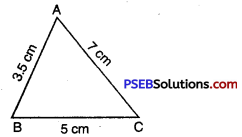
Step 1. We first draw a rough sketch of the triangle ABC and indicate the lengths of the three sides.
PSEB 7th Class Maths Solutions Chapter 10 Practical Geometry Ex 10.2 1
Step 2. Draw a line segment BC = 5 cm.
PSEB 7th Class Maths Solutions Chapter 10 Practical Geometry Ex 10.2 2
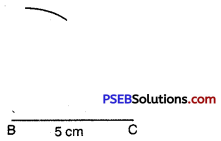
Step 3 : From B; point A is at a distance 3.5 cm. So, with B as centre, draw an arc of radius
3.5 cm (Now point A will be some where on this arc. Our job is to find where exactly A is.)
PSEB 7th Class Maths Solutions Chapter 10 Practical Geometry Ex 10.2 3
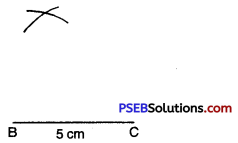
Step 4. From C, point A is at a distance of 7 cm. So, with C as centre; draw an arc of radius 7 cm. (A will be some where on this arc. We have to fix it).
PSEB 7th Class Maths Solutions Chapter 10 Practical Geometry Ex 10.2 4
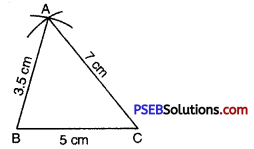
Step 5. A has to be on both the arcs drawn. So it is the point of intersection of arcs.
Mark the point of intersection of arcs as A. Join AB and AC.
Thus we obtain ΔABC.
PSEB 7th Class Maths Solutions Chapter 10 Practical Geometry Ex 10.2 5

PSEB 7th Class Maths Solutions Chapter 10 Practical Geometry Ex 10.2

2. Construct a triangle ABC in which AB = BC = 6.5 cm and CA = 4 cm. Also name the kind of triangle drawn.
Solution:
Given : Three sides of triangle as AB = BC = 6.5 cm. and CA = 4 cm.
To construct : A triangle with these three sides.
Steps of Construction :
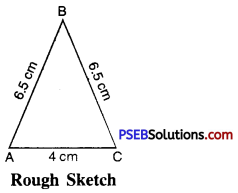
Step 1. We first draw a rough sketch of the triangle ABC and indicate the lengths of the three sides.
PSEB 7th Class Maths Solutions Chapter 10 Practical Geometry Ex 10.2 6
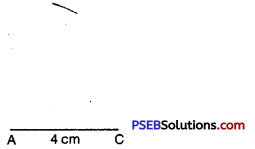
Step 2. Draw a line segment AC = 4 cm.
PSEB 7th Class Maths Solutions Chapter 10 Practical Geometry Ex 10.2 7
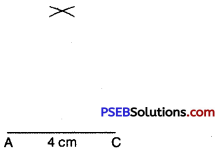
Step 3. From A; point B is at a distance of 6.5 cm. So, with A as centre, draw an arc of radius 6.5 cm. (Now point B will be somewhere on this arc. Our job is to find where exactly A is.)
PSEB 7th Class Maths Solutions Chapter 10 Practical Geometry Ex 10.2 8
Step 4. From C; point B is at a distance of 6.5 cm. So; with C as centre; draw an arc of radius 6.5 cm. (B will be some where on this arc. We have to fix it.)
PSEB 7th Class Maths Solutions Chapter 10 Practical Geometry Ex 10.2 9
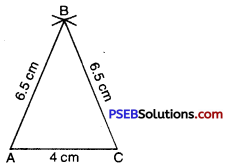
Step 5. B has to be on both the arcs drawn. So it is the point of intersection of arcs. Mark the point of intersection of arcs as B. Join AB and BC.
PSEB 7th Class Maths Solutions Chapter 10 Practical Geometry Ex 10.2 10
We observe that AB = BC = 6.5 cm.
Since two sides are of equal length. Thus we obtain an isosceles ΔABC.

PSEB 7th Class Maths Solutions Chapter 10 Practical Geometry Ex 10.2

3. Construct a triangle XYZ such that length of each side is 5 cm. Also name the kind of triangle drawn.
Solution:
Given : A triangle XYZ in which XY = YZ = ZX = 5 cm..
To Construct. A triangle XYZ with each side 5 cm.
Steps of Construction :
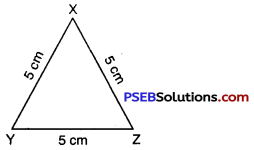
Step 1. We first draw a rough sketch of the triangle XYZ and indicate the lengths of the three sides.
PSEB 7th Class Maths Solutions Chapter 10 Practical Geometry Ex 10.2 11
Step 2. Draw a line segment YZ = 5 cm.
PSEB 7th Class Maths Solutions Chapter 10 Practical Geometry Ex 10.2 12
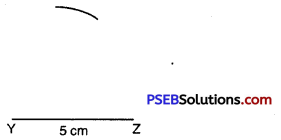
Step 3. From Y; point X is at a distance of 5 cm. So, with Y as centre, draw an arc of radius 5 cm. (Now point X will be somewhere on this arc. Our job is to find where exactly X is.)
PSEB 7th Class Maths Solutions Chapter 10 Practical Geometry Ex 10.2 13
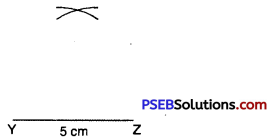
Step 4. From Z, point X is at a distance of 5 cm. So, with Z as centre, draw an arc of radius 5 cm. (X will be somewhere oh this arc. We have to fix it.)
PSEB 7th Class Maths Solutions Chapter 10 Practical Geometry Ex 10.2 14
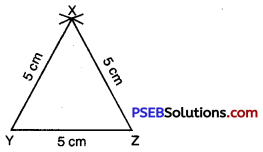
Step 5. Point X has to be on both the arcs drawn. So, it is the point of intersection of arcs.
Mark the point of intersection of arcs as X. Join XY and XZ.
PSEB 7th Class Maths Solutions Chapter 10 Practical Geometry Ex 10.2 15
Thus we obtain an equilateral ΔXYZ each of whose side is 5 cm.

PSEB 7th Class Maths Solutions Chapter 10 Practical Geometry Ex 10.2

4. Construct a triangle PQR such that PQ = 2.5 cm, QR = 6 cm and RP = 6.5 cm. Measure ∠PQR and also name the kind of triangle drawn.
Solution:
Given. Three sides of triangle as PQ = 2.5 cm, QR = 6 cm and RP = 6.5 cm.
To construct. A triangle with these three sides.
Steps of Construction :
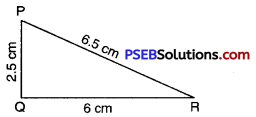
Step 1. We first draw a rough sketch of the triangle PQR and indicate the lengths of the three sides.
PSEB 7th Class Maths Solutions Chapter 10 Practical Geometry Ex 10.2 16
Step 2. Draw a line segment QR of length 6 cm.
PSEB 7th Class Maths Solutions Chapter 10 Practical Geometry Ex 10.2 17
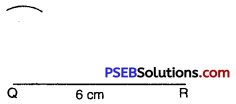
Step 3. From Q; point P is at a distance of 2.5 cm. So, with Q as centre, draw an arc of radius 2.5 cm. (Now point P will be some where on this arc. Our job is to find where exactly P is.)
PSEB 7th Class Maths Solutions Chapter 10 Practical Geometry Ex 10.2 18
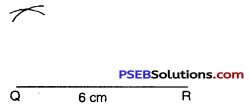
Step 4. From R; point P is at a distance of 6.5 cm. So; with R as centre; draw an arc of radius 6.5 cm. (P will be somewhere on this arc. We have to fix it.)
PSEB 7th Class Maths Solutions Chapter 10 Practical Geometry Ex 10.2 19
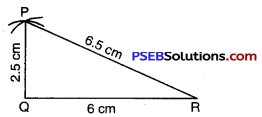
Step 5. Point P has to be on both the arcs drawn. So, it is the point of intersection of arcs. Mark a point of intersection of arcs as P. Join PQ and PR.
PSEB 7th Class Maths Solutions Chapter 10 Practical Geometry Ex 10.2 20
Thus we obtain ΔPQR; on measuring ∠PQR, we observe that ∠PQR = 90° so it is a right angled triangle.

PSEB 7th Class Maths Solutions Chapter 10 Practical Geometry Ex 10.2

5. Construct a triangle ABC, in which AB = 6 cm, BC = 2 cm, CA = 3 cm. (If possible). If not possible give the reason.
Solution:
Since AB = 6 cm, BC = 2 cm, CA = 3 cm
Here BC + CA = 2 cm + 3 cm
= 5 cm < 6 cm < AB
Which is not possible because the sum of two sides of a triangle is always greater than third side of the triangle.

6. Question (i).
Which of the following can be used to construct a triangle ?
(a) The lengths of the three sides
(b) The perimeter of the triangle
(c) The measures of three angles
(d) The name of three vertices
Answer:
(a) The lengths of the three sides

Question (ii).
A triangle can be constructed by taking its sides as :
(a) 1.8 cm, 2.6 cm, 4.4 cm
(b) 3 cm, 4 cm, 8 cm
(c) 4 cm, 7 cm, 2 cm
(d) 5 cm, 4 cm, 4 cm.
Answer:
(d) 5 cm, 4 cm, 4 cm.

PSEB 6th Class Maths Solutions Chapter 3 Playing with Numbers Ex 3.5

Punjab State Board PSEB 6th Class Maths Book Solutions Chapter 3 Playing with Numbers Ex 3.5 Textbook Exercise Questions and Answers.

PSEB Solutions for Class 6 Maths Chapter 3 Playing with Numbers Ex 3.5

1. Find LCM of following numbers by prime factorization method:

Question (i)
45, 60
Solution:
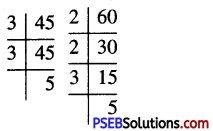
PSEB 6th Class Maths Solutions Chapter 3 Playing with Numbers Ex 3.5 1
∴ 45 = 3 × 3 × 5
60 = 2 × 2 × 3 × 5
We find that in these prime factorizations, 2 occurs maximum two times, 3 occurs maximum two times and 5 occurs maximum once
∴ L.C.M. of 45 and 60
= 2 × 2 × 3 × 3 × 5 = 180

PSEB 6th Class Maths Solutions Chapter 3 Playing with Numbers Ex 3.5

Question (ii)
52, 56
Solution:
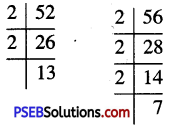
PSEB 6th Class Maths Solutions Chapter 3 Playing with Numbers Ex 3.5 2
We find that in these prime fatorisation, 2 occurs maximum 3 times, 13 and 7 occurs maximum once.
∴ L.C.M. of 52 and 56
= 2 × 2 × 2 × 13 × 7 = 728

Question (iii)
96, 360
Solution:
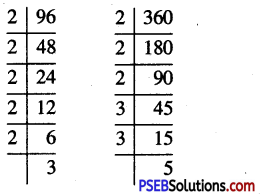
PSEB 6th Class Maths Solutions Chapter 3 Playing with Numbers Ex 3.5 3
∴ 96 = 2 × 2 × 2 × 2 × 2 × 3
360 = 2 × 2 × 2 × 3 × 3 × 5
We find that in these prime factorisation, 2 occurs maximum 5 times, 3 occurs maximum 2 times and 5 occurs maximum once.
∴ L.C.M. of 96 and 360
= 2 × 2 × 2 × 2 × 2 × 3 × 3 × 5 = 1440

Question (iv)
36, 96, 180
Solution:
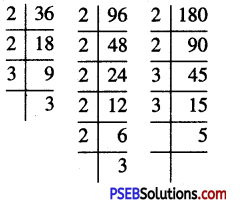
PSEB 6th Class Maths Solutions Chapter 3 Playing with Numbers Ex 3.5 4
∴ 36 = 2 × 2 × 3 × 3
96 = 2 × 2 × 2 × 2 × 2 × 3
and 180 = 2 × 2 × 3 × 3 × 5
We find that in these factorisation, 2 occurs maximum 5 times, 3 occurs maximum 2 times and 5 occurs maximum once.
∴ L.C.M. of 36, 96 and 182
= 2 × 2 × 2 × 2 × 2 × 3 × 3 × 5 = 1440

Question (v)
18, 42, 72.
Solution:
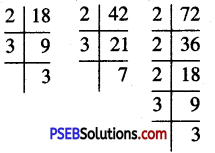
PSEB 6th Class Maths Solutions Chapter 3 Playing with Numbers Ex 3.5 5
∴ 18 = 2 × 3 × 3
42 = 2 × 3 × 7
72 = 2 × 2 × 2 × 3 × 3
We find that in these factorization 2 occurs maximum 3 times, 3 occurs maximum 2 times and 7 occurs maximum once.
∴ L.C.M. of 18, 42 and 72
= 2 × 2 × 2 × 3 × 3 × 7 = 504

PSEB 6th Class Maths Solutions Chapter 3 Playing with Numbers Ex 3.5

2. Find LCM of the following by common division method:

Question (i)
24, 64
Solution:
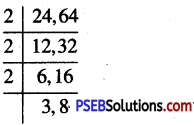
PSEB 6th Class Maths Solutions Chapter 3 Playing with Numbers Ex 3.5 6
∴ L.C.M. of 24, 64
= 2 × 2 × 2 × 3 × 8 = 192

Question (ii)
42, 63
Solution:
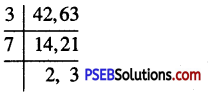
PSEB 6th Class Maths Solutions Chapter 3 Playing with Numbers Ex 3.5 7
∴ L.C.M. of 42 and 63
= 3 × 7 × 2 × 3 = 126

Question (iii)
108, 135, 162
Solution:
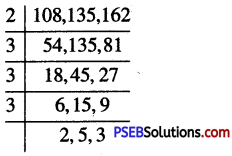
PSEB 6th Class Maths Solutions Chapter 3 Playing with Numbers Ex 3.5 8
∴ L.C.M. of 108, 135 and 162
= 2 × 3 × 3 × 3 × 2 × 5 × 3 = 1620

Question (iv)
16, 18, 48
Solution:
PSEB 6th Class Maths Solutions Chapter 3 Playing with Numbers Ex 3.5 9
∴ L.C.M. of 16, 18 and 48
= 2 × 2 × 2 × 2 × 3 × 3 = 144

PSEB 6th Class Maths Solutions Chapter 3 Playing with Numbers Ex 3.5

Question (v)
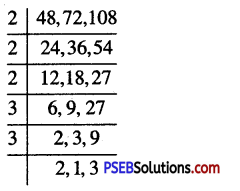
48, 72, 108
Solution:
PSEB 6th Class Maths Solutions Chapter 3 Playing with Numbers Ex 3.5 10
∴ L.C.M. of 48, 72 and 108
= 2 × 2 × 2 × 3 × 3 × 2 × 3 = 144

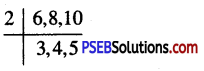
3. Find the smallest number which is divisible by 6, 8 and 10.
Solution:
We know that the smallest number divisible by 6, 8 and 10 is their L.C.M.
So, we calculate L.C.M. 6, 8 and 10
PSEB 6th Class Maths Solutions Chapter 3 Playing with Numbers Ex 3.5 11
∴ L.C.M. = 2 × 3 × 4 × 5 = 120
Hence, required number =120

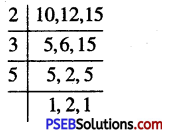
4. Find the least number when divided by 10,12 and 15 leaves remainder 7 in each case.
Solution:
We know that the least number divisible by 10, 12 and 15 is their L.C.M.
PSEB 6th Class Maths Solutions Chapter 3 Playing with Numbers Ex 3.5 12
So, the required number will be 7 more than their L.C.M.
We calculate their L.C.M.
L.C.M of 10, 12 and 15 = 2 × 3 × 5 × 2 = 60
Hence, Required number = 60 + 7 = 67

PSEB 6th Class Maths Solutions Chapter 3 Playing with Numbers Ex 3.5

5. Find the greatest 4-digit number exactly divisible by 12, 18 and 30.
Solution:
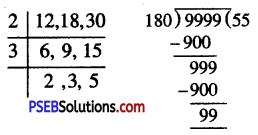
First find the L.C.M. of 12, 18, 30
PSEB 6th Class Maths Solutions Chapter 3 Playing with Numbers Ex 3.5 13
∴ L.C.M. of 12, 18, 30
= 2 × 3 × 2 × 3 × 5 = 180
Now the greatest 4 digit number = 9999
We find that when 9999 is divided by 180, the remainder is 99.
Hence, the greatest number of 4 digits which is exactly divisible by 12, 18, 30
= 9999 – 99 = 9900

6. Find the sandiest 4-digit number exactly divisible by 15, 24 and 36.
Solution:
First find L.C.M. of 15, 24, 36
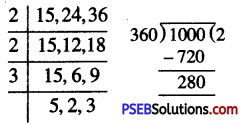
PSEB 6th Class Maths Solutions Chapter 3 Playing with Numbers Ex 3.5 14
L.C.M. of 15, 24, 36
= 2 × 2 × 3 × 5 × 2 × 3 = 360 Now, 4 digit smallest number is 1000 We find that when 1000 is divided by 360, the remainder is 280.
∴ Smallest 4 digits number, which is exactly divisible by 15, 24 and 36
= 1000 + (360 – 280) = 1000 + 80 = 1080.
Hence, required number = 1080

PSEB 6th Class Maths Solutions Chapter 3 Playing with Numbers Ex 3.5

7. Four bells toll at intervals of 4, 7, 12 and 14 seconds. The bells toll together at 5 a.m. When will they again toll together?
Solution:
The bells will toll together at a time which is multiple of four intervals 4, 7, 12 and 14 seconds
So, first we find L.C.M. of 4, 7, 12 and 14
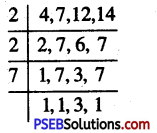
PSEB 6th Class Maths Solutions Chapter 3 Playing with Numbers Ex 3.5 15
∴ L.C.M. = 2 × 2 × 7 × 3 = 84
Thus the bells will toll together after 84 seconds or 1 minute 24 seconds.
First they toll together at 5 a.m., then they will toll together after 1 minutes 24 seconds i.e. 5 : 01 : 24 a.m.

8. Three boys step off together from the same spot their steps measures 56 cm, 70 cm and 63 cm respectively. At what distance from the starting point will they again step together?
Solution:
The distance covered by each one of them has to be same as well as minimum walk So, the minimum distance each should their steps will be L.C.M. of the distances L.C.M. of the measure of their steps.
PSEB 6th Class Maths Solutions Chapter 3 Playing with Numbers Ex 3.5 16
∴ L.C.M. = 2 × 7 × 4 × 5 × 9 = 2520cm
Hence, the will again step to gether after a distance of 2520 cm.

9. Can two numbers have 15 as their HCF and 65 as their LCM. Give reasons in support of your answer.
Solution:
We know that H.C.F. of given numbers is a factor of their L.C.M.
But 15 is not a factor of 65
So, there can not be two numbers with H.C.F. 15 and L.C.M. 65.

PSEB 6th Class Maths Solutions Chapter 3 Playing with Numbers Ex 3.5

10. Can two numbers have 12 as their HCF and 72 as their LCM. Give reasons in support of your answer.
Solution:
We know that H.C.F. of given numbers is a factor of their L.C.M.
Here, 12 divides 72 exactly. So 12 is a factor of 72
Hence, there can be two numbers with H.C.F. 12 and L.C.M 72.

11. The HCF and LCM of two numbers are 13 and 182 respectively. If one of the numbers is 26. Find other numbers.
Solution:
H.C.F. = 13 and L.C.M. = 182,
1st number = 25
Now, 1st number × 2nd number = H.C.F. × L.C.M.
26 × 2nd number = 13 × 182
∴ 2nd number = \(\frac {13×182}{26}\)
= 91

12. The LCM of two co-prime numbers is 195. If one number is 15 then find the other number.
Solution:
L.C.M. of two co-prime numbers = 195
H.C.F. of two co-prime numbers = 1
One number = 15
1st number × 2nd number = H.C.F. × L.C.M.
15 × 2nd number= 1 × 195
∴ 2nd number = \(\frac {1×195}{15}\)
= 13

PSEB 6th Class Maths Solutions Chapter 3 Playing with Numbers Ex 3.5

13. The H.C.F. of two numbers is 6 and product of two numbers is 216. Find their L.C.M.
Solution:
H.C.F. of two numbers = 6
Product of two numbers = 216
We know that
H.C.F. × L.C.M. = Product of two numbers
∴ 6 × L.C.M. = 216
∴ L.C.M. = \(\frac {216}{6}\) = 36

PSEB 7th Class Maths Solutions Chapter 6 Triangles Ex 6.1

Punjab State Board PSEB 7th Class Maths Book Solutions Chapter 6 Triangles Ex 6.1 Textbook Exercise Questions and Answers.

PSEB Solutions for Class 7 Maths Chapter 6 Triangles Ex 6.1

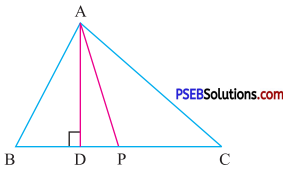
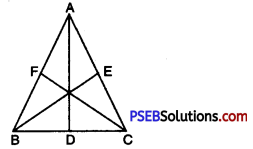
1. In ΔABC, P is midpoint of BC, then
(i) BP = ……………..
(ii) AP is a …………….. of ΔABC
(iii) ∠ADC = ……………..
(iv) BD = BC (True/False)
(v) AD is an …………….. of ΔABC
PSEB 7th Class Maths Solutions Chapter 6 Triangles Ex 6.1 1
Solution:
(i) PC
(ii) Median
(iii) 90°
(iv) False
(v) Altitude

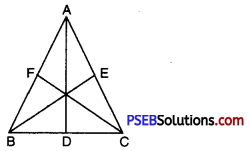
2. (a) Draw AD, BE, CF three medians in a ΔABC.
(b) Draw an equilateral triangle and its medians. Also compare the lengths of the medians.
(c) Draw an isosceles triangle ABC in which AB = BC. Also draw its altitudes.
Solutions:
(a) We are given ΔABC D, E and F are mid points of the sides BC, CA and AB respectively. Join AD, BE and CF.
The AD, BE and CF are the required medians.
PSEB 7th Class Maths Solutions Chapter 6 Triangles Ex 6.1 2

(b) Draw an equilateral triangle ABC, D,E and F are the mid points of sides BC, CA and AB respectively. On joining AD, BE and CF, we get the required medians AD, BE and CF. Measure the lengths of AD, BE and CF we observe that the three medians AD, BE and CF are equal in length.
∴ AD = BE = CF.
PSEB 7th Class Maths Solutions Chapter 6 Triangles Ex 6.1 3

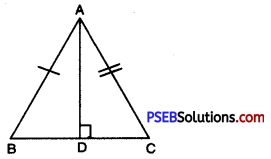
(c) Draw an isosceles ΔABC in which AB = BC Altitude can be drawn as below :
AD is the altitude from A to D.
PSEB 7th Class Maths Solutions Chapter 6 Triangles Ex 6.1 4
PSEB 7th Class Maths Solutions Chapter 6 Triangles Ex 6.1
3. Find the value of the unknown exterior angles.

Question (i).
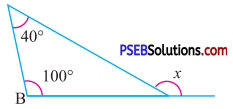
PSEB 7th Class Maths Solutions Chapter 6 Triangles Ex 6.1 5
Answer:
In the given triangle,
By exterior angle property of a triangle
Exterior angle = sum of interior opposed angles
x = 100° + 40°
∴ x = 140°

Question (ii).
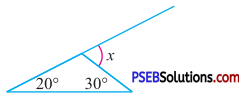
PSEB 7th Class Maths Solutions Chapter 6 Triangles Ex 6.1 6
Answer:
By exterior angle property of a triangle
Exterior angle = Sum of interior opp. angles
x = 20° + 30°
∴ x = 50°

Question (iii).
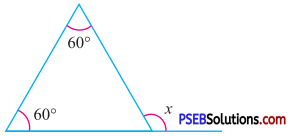
PSEB 7th Class Maths Solutions Chapter 6 Triangles Ex 6.1 7
Answer:
By exterior angle property of a triangle
Exterior angle = Sum of interior opp. angles
x = 60° + 60°
∴ x = 120°

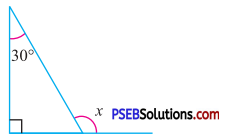
Question (iv).
PSEB 7th Class Maths Solutions Chapter 6 Triangles Ex 6.1 8
Answer:
By exterior angle property of a triangle
Exterior angle = Sum of interior opp. angles
x = 90° + 30°
∴ x = 120°

PSEB 7th Class Maths Solutions Chapter 6 Triangles Ex 6.1

4. Find the value of x in the following figures.

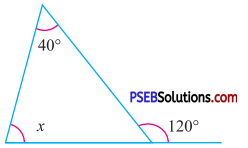
Question (i).
PSEB 7th Class Maths Solutions Chapter 6 Triangles Ex 6.1 9
Answer:
By exterior angle property of a triangle
Sum of interior opp. angles = Exterior angle
40° + x = 120°
x = 120° – 40°
x = 80°.

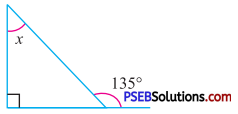
Question (ii).
PSEB 7th Class Maths Solutions Chapter 6 Triangles Ex 6.1 10
Answer:
By exterior angle property of a triangle
Sum of interior opp. angles = Exterior angle
x + 90° = 135°
x = 135° – 90°
x = 45°

Question (iii).
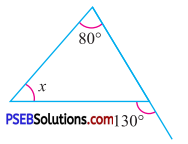
PSEB 7th Class Maths Solutions Chapter 6 Triangles Ex 6.1 11
Answer:
By exterior angle property of a triangle
Sum of interior opp. angles = Exterior angle
x + 80° = 130°
x = 130° – 80°
x = 50°

Question (iv).
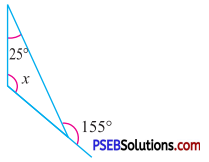
PSEB 7th Class Maths Solutions Chapter 6 Triangles Ex 6.1 12
Answer:
By exterior angle property of a triangle
Sum of interior opp. angles = Exterior angle
x + 25° = 155°
x = 155° – 25°
x = 130°

PSEB 7th Class Maths Solutions Chapter 6 Triangles Ex 6.1

5. Find the value of y in following figures.

Question (i).
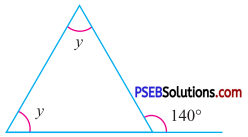
PSEB 7th Class Maths Solutions Chapter 6 Triangles Ex 6.1 13
Answer:
By exterior angle property of a triangle
Sum of interior opp. angles = Exterior angle
y + y = 140°
2y = 140°
y = \(\frac{140^{\circ}}{2}\)
y = 70°

Question (ii).
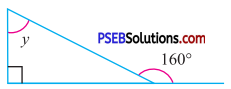
PSEB 7th Class Maths Solutions Chapter 6 Triangles Ex 6.1 14
Answer:
By exterior angle property of a triangle
Sum of interior opp. angles = Exterior angle
y + 90° = 160°
y = 160° – 90°
y = 70°

Question (iii).
PSEB 7th Class Maths Solutions Chapter 6 Triangles Ex 6.1 15
Answer:
By exterior angle property of a triangle
exterior angle = Sum of interior opp. angles
5y = y + 80°
5y – y = 80°
4y = 80°
y = \(\frac{80^{\circ}}{4}\)
y = 20°.

PSEB 9th Class Science Solutions Chapter 12 Sound

Punjab State Board PSEB 9th Class Science Book Solutions Chapter 12 Sound Textbook Exercise Questions and Answers.

PSEB Solutions for Class 9 Science Chapter 12 Sound

PSEB 9th Class Science Guide Sound Textbook Questions and Answers

Question 1.
What is sound and how is it produced?
Answer:
Sound: Sound is a form of energy which produces in our ears the sensation of hearing. It is produced due to vibration of a body about its mean position.

How to produce sound? We can produce sound in different bodies by plucking, by rubbing, by blowing or by giving jolt. In other words, by producing vibration in bodies sound can be produced. By vibration we mean moving a body rapidly to and fro about its mean position.

PSEB 9th Class Science Solutions Chapter 12 Sound

Question 2.
Describe with the help of diagram, how compressions and rarefactions are produced in air near a source of sound?
Answer:
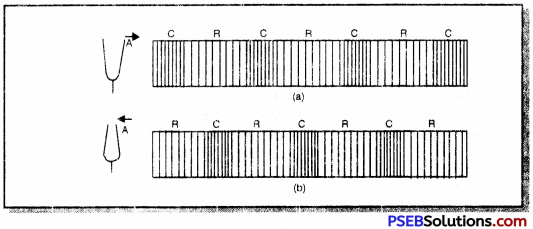
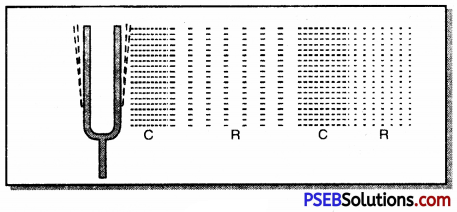
Sound in air gets propagated in the form of longitudinal wave motion consisting of regions of compressions and rarefactions. Consider, for example, a tuning, fork in a state of vibrations. [Fig.(a)] As prong moves towards right, it compresses the layer of air in contact with it. As air has elasticity, the compressed air tends to relieve itself of its strain and moves forward to right to compress the next layer and so on.

Thus, a wave of compression moves towards the right. At the point of compression, there is an increase of pressure and is shown in form of crest C. At the point of rarefaction of concentration of particles is least and has been shown as trough R.

When the prong moves towards left, a region of reduced pressure or rarefaction is produced towards right [Fig. (b)].
PSEB 9th Class Science Solutions Chapter 12 Sound 1
Thus, a wave of rarefaction starts moving towards right. This way a series of compressions arid rarefactions move in forward direction.

Question 3.
Cite an experiment to show that sound needs a material medium for its propagation.
Or
Describe an experiment to show that sound needs a material medium for its propagation.
Or
Describe an activity to show that sound is a mechanical wave and needs a material medium for its propagation.
Answer:
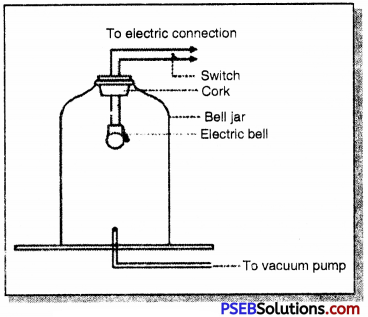
Sound needs material medium for propagation: Sound is a mechanical wave which needs a material medium to travel, (propagate) It can travel through air, water, steel, etc but cannot travel through vacuum. This can be demonstrated by the following experiment.
PSEB 9th Class Science Solutions Chapter 12 Sound 2
Experiment: Take an electric bell and a glass bell-jar. Suspend the electric bell in a bell jar with the help of a cork fitted in the mouth of the jar. Connect the bell jar to a vacuum pump as shown in Fig. Press the switch of electric bell when sound is heard.

Now work the exhaust pump and remove air from the jar slowly. As air is removed the sound becomes fainter and fainter. After sometime when most of the air is removed, a feeble sound will be heard. If the whole of the air from the jar is removed no sound of electric bell will be heard. This proves that material medium is needed for the propagation of sound.

Question 4.
Why is sound wave called longitudinal wave?
Answer:
Sound waves when travel through a medium, the particles of the medium move to and fro in the same direction in which the disturbance (wave) travels. That is why, the sound waves are called longitudinal waves.

PSEB 9th Class Science Solutions Chapter 12 Sound

Question 5.
Which characteristic of the sound helps you to identify your friend by his voice while sitting with others in a dark room.
Answer:
On the basis of quality or timbre of sound, we can identify our friend’s voice.

Question 6.
Flash and thunder are produced simultaneously. But thunder is heard a few seconds after the flash is seen. Why?
Answer:
The speed of sound (344 m s-1) is much smaller than the speed of light (3 × 10⁸ m s-1). So thunder is heard a few seconds after the flash is seen although these are produced at the same time.

Question 7.
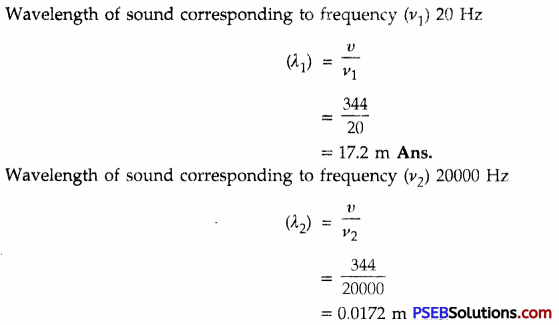
A person has a hearing range from 20 Hz to 20 KHz. What is the typical wavelength of sound waves in air corresponding to these frequencies? Take the speed of sound in air as 344 ms-1.
Solution:
Given speed of sound (υ) = 344 m s-1
Lower limit of frequency (ν1) = 20 Hz
Upper limit of audible frequency (ν2) = 20 KHz
= 20 × 1000 Hz.
= 20000 Hz
PSEB 9th Class Science Solutions Chapter 12 Sound 3

Question 8.
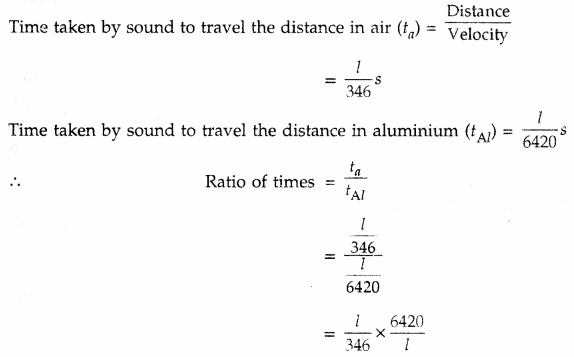
Two children are at opposite er Is of an aluminium rod. One strikes the end of the rod with a stone. Find the ratio of times taken by the sound wave in air and in aluminium to reach the second child.
Solution:
PSEB 9th Class Science Solutions Chapter 12 Sound 4
PSEB 9th Class Science Solutions Chapter 12 Sound 5

Question 9.
The frequency of source of sound is 100 Hz. How many times does it vibrate in a minute?
Solution:
Frequency of source sound = 100 Hz
i.e, Number of vibrations produced in 1 second = 100
Number of vibrations produced in 1 min = 60 s = 100 × 60 = 6000

PSEB 9th Class Science Solutions Chapter 12 Sound

Question 10.
Does sound follow the same laws of reflection as light does? Explain.
Answer:
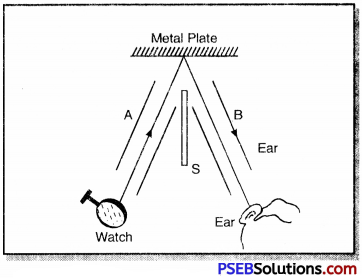
PSEB 9th Class Science Solutions Chapter 12 Sound 6
Yes, sound follows the same laws of reflection as light does. Like light sound is reflected from solid or liquid surface.
These laws are:

  • First Law: The directions of incident sound and reflected sound make equal angles with the normal to the surface at the point of incidence.
    i.e. \(\angle i=\angle r\)
  • Second Law: The incident sound wave, the reflected sound wave and normal to the reflecting surface at the point of incidence all lie in the same plane.

Question 11.
When a sound is reflected from a distant object, an echo is produced. Let the distance between the reflecting surface and the source of sound production remains the same. Do you hear echo sound on a hotter day?
Answer:
On a hotter day the speed of sound increases with the increase of temperature. So on that day reflected sound returns tq source earlier than 0.1 s. Hence a clear echo sound can not be heard.

Question 12.
Give two practical applications of reflection of sound waves.
Answer:
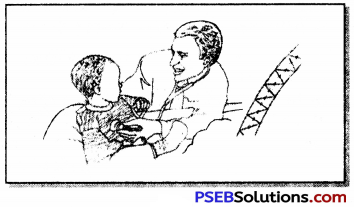
PSEB 9th Class Science Solutions Chapter 12 Sound 7
Stethoscope is doctor’s device which is used to hear the sound produced inside heart or lungs. The speed of sound of a patient’s heart beat is guided along the tube to the doctor’s ears by multiple reflection of sound.

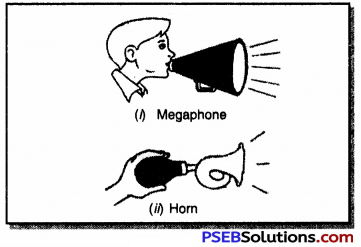
2. The front part of musical instruments like megaphone or loudspeaker, horn, shehnai is made open and conical so that the sound waves produced may be reflected repeatedly and may be reflected repeatedly and may be sent forward towards the listeners.
PSEB 9th Class Science Solutions Chapter 12 Sound 8

Question 13.
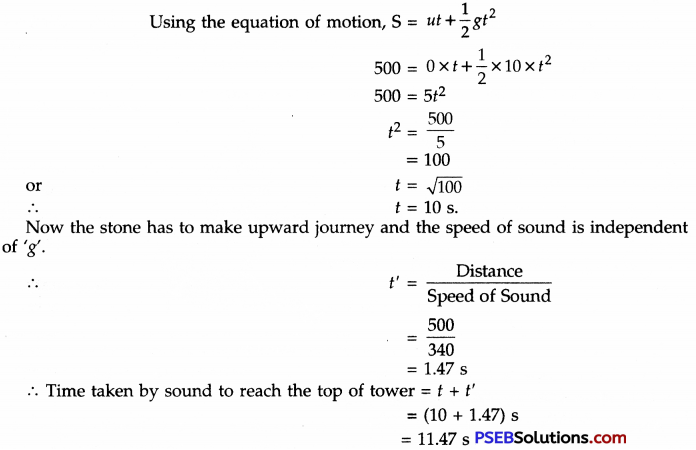
A stone is dropped from the top of a tower 500 m high into a pond of water at the base of the tower. When is the splash heard at the top? Given, g = 10 m s-2 and speed of sound = 340 m s-2.
Solution:
Here, initial velocity of sound (u) = 0
Height of the lower (i.e. distance covered) (S) = 500 m
Acceleration due to gravity (g) = 10 ms-2
PSEB 9th Class Science Solutions Chapter 12 Sound 9

PSEB 9th Class Science Solutions Chapter 12 Sound

Question 14.
A sound wave travels at a speed of 339 m s-1. If its wavelength is 1.5 cm, what is the frequency of the wave? Will it be audible?
Solution:
Speed of sound (υ) = 339 ms-1
Wavelength of sound (λ) = 1.5 cm
= \(\frac {1.5}{100}\)
= 0.015 m
Frequency of wave (ν) =?
We know, frequency (ν) = \(\frac{υ}{\lambda}\)
= \(\frac {339}{0.015}\)
= 22600 Hz
Yes, sound waves are inaudible because these have frequency 22600 Hz which is not within the audible range 20 Hz to 20,000 Hz.

Question 15.
What is reverberation? How can it be reduced?
Answer:
Reverberation: The persistance of sound due to repeated reflection of sound is called reverberation. If sound after its production is allowed to suffer repeated reflection from walls and ceiling of big halls of concert so that it persists is called reverberation. It is unwanted sound because of which sound is not distinctly heard. To reduce reverberation effect of sound, walls and ceiling should be covered with sound absorbing materials like compressed fiber or heavy curtains having folds etc.

Question 16.
What is loudness of sound? What factors does it depend on?
Answer:
Loudness of sound is the measure of sensitivity of human ears. Like intensity it is not sound energy passing through unit area in 1 second. Two sounds can have same frequencies but still these may be heard having different loudness.

Question 17.
Explain how bats use ultrasounds to catch a prey?
Answer:
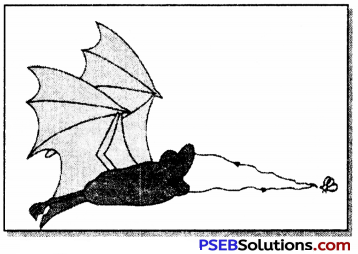
PSEB 9th Class Science Solutions Chapter 12 Sound 10
In darkness bats while flying in search of their prey emit ultrasound waves and then detect these waves after reflection. Very high-frequency ultrasonic squeaks of bat are reflected from prey and returned to bat’s ear. Amount and time delay of reflected wave helps bat in estimating the position and distance of prey.

PSEB 9th Class Science Solutions Chapter 12 Sound

Question 18.
How is ultrasound used for cleaning?
Answer:
Ultrasounds are used to clean parts located in hard-to-reach places e.g., complicated electronic components, watches, spiral or odd shaped parts. Appliances to be cleaned are placed in cleaning solutions and ultrasonic waves are sent through cleaning solution. Due to high frequency of ultrasounds, the dust, oil, grease and dirt get detached.

Question 19.
Explain the working and applications of SONAR.
Or
Write the full name of SONAR. How will you determine the depth of a sea using echo ranging?
Or
Write full form of SONAR. List any two purposes for which, it is used and explain its working for any one such purpose.
Answer:
SONAR: The acronym Sonar stands for Sound Navigation and Ranging. Sonar is a device that uses ultrasonic waves to measure the distance, direction and speed of underwater objects.
Principle: It uses the phenomenon of echoes in determining the sea-depth and locating the presence of underwater objects.

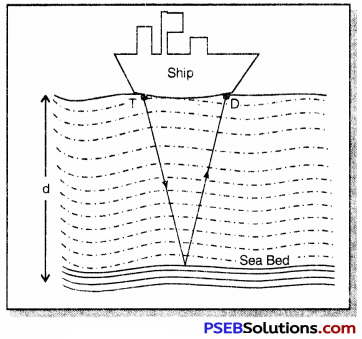
Working: Sonar consists of a transmitter T, and a detector D, installed below a ship as shown in Fig. The wave produced by transmitter travel through water and are reflected by sea-bed of obstacle. Reflected waves are sensed by the detector. Detector converts ultrasonic waves into electric signal. These signals are interpreted by detector.
PSEB 9th Class Science Solutions Chapter 12 Sound 11
If time interval between transmission and reception is t and speed of sound in sea-water is v, then 2d = υ × t or d = υt/2, where d is the depth of the sea. This method is also called echo sounding.
Practical Applications: It is used to locate underwater submarines, icebergs, sunken ships and underwater hills etc.

PSEB 9th Class Science Solutions Chapter 12 Sound

Question 20.
A sonar device on a submarine sends out a signal and receives an echo 5 s later. Calculate the speed of sound in water if the distance of the object from submarine is 3,625 m.
Solution:
Time between emission of sound and its collection (t) = 5 s
Depth of sea (2d) = 2 × 3625 m = 7250 m
We know, 2d = Speed of sound × Time
7250 = Speed of sound × 5
∴ Speed of sound (υ) = \(\frac {7250}{5}\)
= 1450 m s-1

Question 21.
Explain how defects in a metal block can be detected using ultrasound?
Answer:
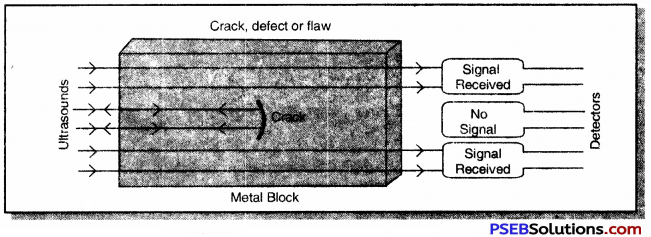
In industries metallic components are used in the construction of big structures like buildings, bridges, machines, scientific equipments, etc. ultrasounds (ultrasonic waves) are used to detect the internal defects or cracks in big metallic blocks which are not visible from outside.

Ultrasonic waves are allowed to pass through the metal block and detectors are used to detect the transmitted waves. If there is even a small defect, the ultrasound gets reflected back and does not reach the detector, as shown in figure. This indicates the presence of a defect.
PSEB 9th Class Science Solutions Chapter 12 Sound 12

Question 22.
Explain how the human ear works.
Answer:
Ear is very sensitive device used to hear sound. It converts compressions and rarefactions of frequency range 20 Hz to 20,000 Hz into electric signals that travel to brain via auditory nerve.

The ear consists of three sections:

  1. the outer ear,
  2. the middle ear and
  3. the inner ear.

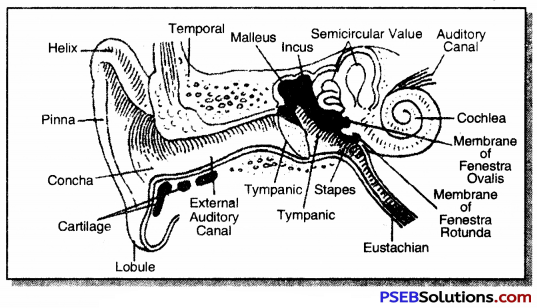
The outer ear consists of Pinna and Auditory Canal. Pinna is a cup-shaped fleshy part of the outer ear. Pinna collects and amplifies sound waves which then pass on the auditory canal. At the end of auditory canal, there is a thin membrane called tympanic membrane or eardrum. When compression reaches the eardrum, the pressure on membrane increases and the ear drum is forced inwards. When rarefaction reaches the eardrum, it moves outwards.

The vibrations are amplified by lever action of three bones called hammer, anvil and stirrup in the middle ear. In turn, the middle ear transmits the amplified pressure variations to the inner ear. The amplified pressure variations are converted into electric signals by cochlea in the inner ear. The electric signals generated are conveyed to the brain
PSEB 9th Class Science Solutions Chapter 12 Sound 13
via the auditory nerve. The brain interprets them as sound. In fact we do not hear with ear. We hear with brain through ears.

Science Guide for Class 9 PSEB Sound InText Questions and Answers

Question 1.
How does the sound produced by the vibrating object in a medium reach your ear?
Answer:
When the vibrating object (such as tuning fork or school bell) moves forward then it compresses the air particles lying just ahead of it which results in production of high pressure region. This region is called compression. This pressure moves forward in the direction in which the object is vibrating, when this vibrat ing object moves backward then a region of low pressure is produced which is known as rarefaction.
PSEB 9th Class Science Solutions Chapter 12 Sound 14
When the vibrating object rapidly moves to and fro then a series of compression and rarefaction pulses are formed i.e. sound wave is produced.
In this way the transmission of sound is caused in the form of transmission of change in density which reaches our ear and forces the tympanic membrane to vibrate. This produces the sensation of hearing in us.

PSEB 9th Class Science Solutions Chapter 12 Sound

Question 2.
Explain how sound is produced by your school bell?
Answer:
When the school bell is hit with a hammer, it begins to vibrate which produces sound waves. If we gently touch the bell, we feel vibrations. Wave is a disturbance which produces motion in the neighbouring particles of the medium. These particles handover the disturbance in the next particles lying close to the vibrating particles so that sound waves reach us. The particles of the medium do not move from one place to another, it is only the disturbance that travels forward.

Question 3.
Why are sound waves called mechanical waves?
Answer:
Sound is a kind of energy which cannot be produced by itself. To produce it some mechanical enery is required which may be by clapping or by striking bell with a hammer. This sound energy is transmitted in the form of waves by producing disturbance of the particles of the medium. Therefore, sound waves are called mechanical waves.

Question 4.
Suppose you and your friend are on the moon. Will you be able to hear any sound produced by your friend?
Answer:
For propagation of sound, air or some other material medium is required. On the surface of moon there is no such medium present as a result of which sound can not be propagated from one place to another place. So you can neither talk to your friend nor the sound produced by your friend can be heard by you.

Question 5.
Which wave property determines
(a) loudness
(b) pitch?
Answer:
(a) Loudness: The loudness of a sound wave is determined by its amplitude. The amplitude of sound wave depends upon magnitude of force. The more the force, the loud is sound produced. Loud sound traverses more distance because it has more energy in it. The more the sound is away from the source, the less is its loudness. Hence, loudness depends upon square of the amplitude.

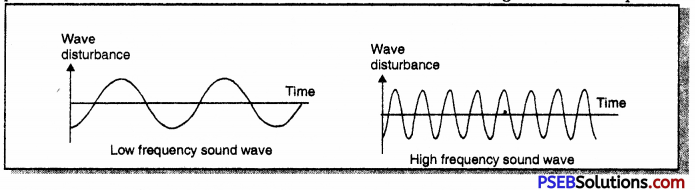
(b) Pitch: The frequency of sound produced is called pitch. Frequency determines the aitch of a sound. The more is the vibration of the source, the higher will be its pitch.
PSEB 9th Class Science Solutions Chapter 12 Sound 15
So more the frequency, higher the pitch of sound.
In sound of high pitch the number of compressions passing through a fixed point in a unit time will be more.

PSEB 9th Class Science Solutions Chapter 12 Sound

Question 6.
Guess, which sound has a higher pitch: guitar or a car horn?
Answer:
Though sound of car horn is louder than that of guitar but guitar has higher pitch than car horn.

Question 7.
What are wavelength, frequency, time period and amplitude of a sound wave?
Answer:
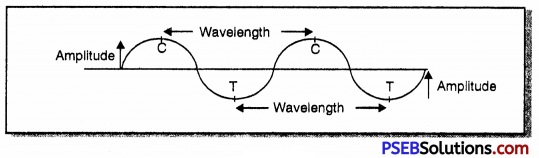
1. Wavelength of wave: The distance travelled by the wave during the time, the particle of the medium completes 1 vibration is called wavelength.
Or
The distance between two consecutive compressions or rarefactions in a longitudinal wave or the distance between the consecutive crests or two consecutive troughs is called wavelength. It is denoted by a greek letter ‘λ’ (lambda). SI unit of wavelength is meter (m).
PSEB 9th Class Science Solutions Chapter 12 Sound 16
2. Frequency: In any medium when wave propagates the number of vibrations made by a particle of the medium is called frequency. It is denoted by ‘ν’. S.I. unit of frequency is Hertz (Hz). It is determined by the number of compressions or rarefactions passing through a fixed point.

3. Time Period: It is the time taken by a particle to complete one vibration during the propagation of wave. It is denoted by “T”. S.I. unit of time period is second.
Or
Time taken by two nearest compressions or rarefactions of sound waves to cross a point is called time period.

4. Amplitude: The maximum displacement of a particle of the medium on either side of mean position is called amplitude, of wave. It is denoted by letter ‘A’. For sound wave its unit is same as that of pressure or density. The loudness of sound depends on its amplitude.

Question 8.
How are the wavelength and frequency of a sound wave related to its speed?
Answer:
Velocity of sound wave (υ) = Wavelength (λ) × Frequency (ν).

PSEB 9th Class Science Solutions Chapter 12 Sound

Question 9.
Calculate the wavelength of a sound wave whose frequency is 220 Hz and speed is 440 m s-1 in a given medium.
Solution:
Velocity of sound wave (υ) = 440 ms-1
Frequency of sound (ν) = 220 Hz
Wavelength of sound wave (λ) = ?
We know, υ = ν × λ
440 = 220 × λ
or λ = \(\frac {440}{220}\)
or wavelength (λ) = 2 m

Question 10.
A person is listening to a tone of 500 Hz sitting at a distance of 450 m from the source of sound. What is the time interval between successive compressions from the source?
Solution:
Given frequency of sound (ν) = 500 Hz
Time taken between two successive compressions (T) = ?
We know, time period (T) = \(\frac{1}{\text { Frequency }(ν)}\)
= \(\frac {1}{500}\)
= 0.002 s

Question 11.
Distinguish between loudness and intensity of sound.
Answer:
Difference between Loudness and Intensity:

Loudness Intensity
1. The loudness of sound is the measure of senstivity of ears. It is the sound energy passing through a unit area in 1 second.
2. The loudness of sound can not be measured. The intensity of sound can be measured.
3. For different observers the loudness of sound is different. The intensity of sound is same for different persons.
4. The loudness of ultrasonic and infrasonic waves is zero because they are inaudible. There is a possibility of intensity in ultrasonic and infrasonic sound in ultrasonic and infrasonic sound waves.

Question 12.
In which of the three media, air, water or iron sound travels the fastest at a particular temperature?
Answer:
Sound travels fastest in iron as compared to air and water. The velocity of sound in iron is 5950 m s-1, followed by water [1500 m s-1], air [350 m s-1],

PSEB 9th Class Science Solutions Chapter 12 Sound

Question 13.
An echo returned in 3 s. What is the distance of reflecting surface from the source? Given that the speed of sound is 342 m s-1.
Solution:
Velocity of sound (v) = 342 ms-1
Time taken for echo to be heard (t) = 3s
Distance travelled by sound (S) = υ × t
= 342 × 3
= 1026 m
i.e. sound takes 3 s to travel from source to reflecting surface and then back to source and during this time the distance travelled is 1026 m.
Distance between source and reflecting surface = \(\frac {1026}{2}\) m
= 513 m

Question 14.
Why are the ceilings of concert halls curved?
Answer:
PSEB 9th Class Science Solutions Chapter 12 Sound 17
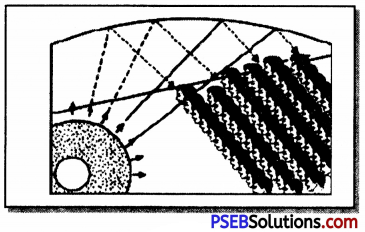
Ceilings of concert halls are made curved as is shown in Fig so that sound after reflection from all surfaces of hall may spread evenly to all parts and heard equally clear.

Question 15.
What is audible range of average human ear?
Answer:
For average human ear the audible range of sound is 20 Hz to 20,000 Hz.

Question 16.
What is the range of frequencies associated with
(a) infrasound
(b) ultrasound?
Answer:
(a) For infrasound the frequency range is less than 20 Hz.
(b) For ultrasound the frequency range is more than 20 KHz (i.e. 20,000 Hz)

PSEB 9th Class Science Solutions Chapter 12 Sound

Question 17.
A submarine emits a sonar pulse, which returns from an underwater cliff in 1.02 s. If the speed of sound in salt water is 1531 m s-1, how far away is the cliff?
Solution:
Time is taken by the sound to travel from submarine to cliff and back to the submarine
= 1.02 s
Speed of sound in saltwater = 1531 ms-1
Distance travelled by sound (2d) = Speed of sound × Time taken
= 1531 × 1.02 [∵ d is the distance between submarine and cliff]
= 1561.62 m
or d = \(\frac {1561.62}{2}\) m
i.e. Distance between submarine and cliff (d) = 780.81 m

PSEB 7th Class Maths MCQ Chapter 9 Rational Numbers

Punjab State Board PSEB 7th Class Maths Book Solutions Chapter 9 Rational Numbers MCQ Questions with Answers.

PSEB 7th Class Maths Chapter 9 Rational Numbers MCQ Questions

Multiple Choice Questions :

Question 1.
Look at the above number line and tell which of the following values is the greatest.
(a) a + b
(b) b – a
(c) a × b
(d) a ÷ b
Answer:
(a) a + b

Question 2.
The product of a rational number and its reciprocal is always :
(a) -1
(b) 0
(c) 1
(d) equal to itself.
Answer:
(c) 1

Question 3.
Which of the following is not an natural number ?
(a) 0
(b) 2
(c) 10
(d) 105.
Answer:
(a) 0

Question 4.
The ascending order of \(\frac{-3}{5}, \frac{-2}{5}, \frac{-1}{5}\) is :
(a) \(\frac{-1}{5}<\frac{3}{5}<\frac{2}{5}\)
(b) \(\frac{-3}{5}<\frac{-2}{5}<\frac{-1}{5}\)
(c) \(\frac{-3}{5}<\frac{-1}{5}<\frac{-2}{5}\)
(d) \(\frac{-2}{5}<\frac{-3}{5}<\frac{-1}{5}\)
Answer:
(b) \(\frac{-3}{5}<\frac{-2}{5}<\frac{-1}{5}\)

PSEB 7th Class Maths MCQ Chapter 9 Rational Numbers

Question 5.
Write \(\frac {1}{4}\) as a rational number with 4 denominator 20.
(a) \(\frac{2}{20}\)
(b) \(\frac{3}{20}\)
(c) \(\frac{5}{20}\)
(d) \(\frac{4}{20}\)
Answer:
(c) \(\frac{5}{20}\)

Question 6.
The value of \(\frac{-13}{7}+\frac{6}{7}\) :
(a) \(\frac{19}{7}\)
(b) \(\frac{-7}{7}\)
(c) \(\frac{7}{7}\)
(d) None of these
Answer:
(b) \(\frac{-7}{7}\)

Question 7.
The additive inverse of \(\frac{-9}{11}\) is :
(a) \(\frac{9}{11}\)
(b) \(\frac{-9}{11}\)
(c) \(\frac{11}{9}\)
(d) \(\frac{-11}{9}\)
Answer:
(a) \(\frac{9}{11}\)

Question 8.
The additive inverse of \(\frac{5}{7}\) is :
(a) \(\frac{7}{5}\)
(b) \(\frac{-5}{7}\)
(c) \(\frac{-7}{5}\)
(d) \(\frac{5}{7}\)
Answer:
(b) \(\frac{-5}{7}\)

PSEB 7th Class Maths MCQ Chapter 9 Rational Numbers

Fill in the blanks :

Question 1.
The smallest natural number is ………………..
Answer:
1

Question 2.
The numbers which are used for counting are called ………………..
Answer:
natural number

Question 3.
All natural number along with zero (0) are called ………………..
Answer:
whole number

Question 4.
Reciprocal of \(\frac {5}{3}\) is ………………..
Answer:
\(\frac {3}{5}\)

Question 5.
Additive inverse of –\(\frac {3}{4}\) is ………………..
Answer:
\(\frac {3}{4}\)

PSEB 7th Class Maths MCQ Chapter 9 Rational Numbers

Write True or False :

Question 1.
The smallest natural number is zero (0). (True/False)
Answer:
False

Question 2.
0 is an integer which is neither negative nor positive. (True/False)
Answer:
True

Question 3.
The smallest whole number is 1. (True/False)
Answer:
False

Question 4.
–\(\frac {2}{5}\) is a fraction. (True/False)
Answer:
False

Question 5.
\(\frac {1}{0}\) not a rational number. (True/False)
Answer:
True

PSEB 7th Class Maths Solutions Chapter 9 Rational Numbers Ex 9.2

Punjab State Board PSEB 7th Class Maths Book Solutions Chapter 9 Rational Numbers Ex 9.2 Textbook Exercise Questions and Answers.

PSEB Solutions for Class 7 Maths Chapter 9 Rational Numbers Ex 9.2

1. Find the sum

Question (i).
\(\frac{6}{9}+\frac{2}{9}\)
Solution:
\(\frac{6}{9}+\frac{2}{9}\) = \(\frac{6+2}{9}\)
= \(\frac {8}{9}\)

Question (ii).
\(\frac{-15}{7}+\frac{9}{7}\)
Solution:
\(\frac{-15}{7}+\frac{9}{7}\) = \(\frac{-15+9}{7}\)
= \(\frac{-6}{7}\)

Question (iii).
\(\frac{17}{11}+\left(\frac{-9}{11}\right)\)
Solution:
\(\frac{17}{11}+\left(\frac{-9}{11}\right)\) = \(\frac{17-9}{11}\)
= \(\frac{8}{11}\)

Question (iv).
\(\frac{-5}{6}+\frac{3}{18}\)
Solution:
\(\frac{-5}{6}+\frac{3}{18}\)
Now, \(\frac{-5}{6}=\frac{-5}{6} \times \frac{3}{3}=\frac{-15}{18}\)
PSEB 7th Class Maths Solutions Chapter 9 Rational Numbers Ex 9.2 1
L.C.M. of 6 and 18
= 2 × 3 × 3 = 18
Thus, \(\frac{-5}{6}+\frac{3}{18}=\frac{-15}{18}+\frac{3}{18}\)
= \(\frac{-15+3}{18}\)
= \(\frac {-12}{18}\)
= \(\frac {-2}{3}\)

PSEB 7th Class Maths Solutions Chapter 9 Rational Numbers Ex 9.2

Question (v).
\(\frac{-7}{19}+\frac{-3}{38}\)
Solution:
\(\frac{-7}{19}+\frac{-3}{38}\)
Now, \(\frac{-7}{19}=\frac{-7}{19} \times \frac{2}{2}\)
= \(\frac {-14}{38}\)
\(\begin{array}{l|l}
2 & 19,38 \\
\hline 19 & 19,19 \\
\hline & 1,1 \\
\hline
\end{array}\)
L.C.M. = 2 × 19
= 38
Thus, \(\frac{-7}{19}+\frac{-3}{38}=\frac{-14}{38}+\frac{-3}{38}\)
= \(\frac{-14-3}{38}\)
= \(\frac{-17}{38}\)

Question (vi).
\(-3 \frac{4}{7}+2 \frac{3}{7}\)
Solution:
\(-3 \frac{4}{7}+2 \frac{3}{7}\)
= \(-\frac{25}{7}+\frac{17}{7}\)
= \(\frac{-25+17}{7}\)
= \(\frac{-8}{7}\)

Question (vii).
\(\frac{-5}{14}+\frac{8}{21}\)
Solution:
\(\frac{-5}{14}+\frac{8}{21}\)
Now, \(\frac{-5}{14}=\frac{-5}{14} \times \frac{3}{3}\)
= \(\frac{-15}{42}\)
\(\begin{array}{l|l}
2 & 14,21 \\
\hline 3 & 7,21 \\
\hline 7 & 7,7 \\
\hline & 1,1
\end{array}\)
L.C.M of 14, 21 = 2 × 3 × 7
= 42
\(\frac{8}{21}=\frac{8}{21} \times \frac{2}{2}\)
= \(\frac{16}{42}\)
Thus, \(\frac{-5}{14}+\frac{8}{21}\)
= \(\frac{-15}{42}+\frac{16}{42}\)
= \(\frac{-15+16}{42}\)
= \(\frac{1}{42}\)

Question (viii).
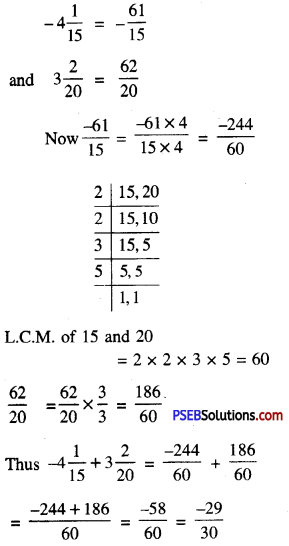
\(-4 \frac{1}{15}+3 \frac{2}{20}\)
Solution:
PSEB 7th Class Maths Solutions Chapter 9 Rational Numbers Ex 9.2 2

PSEB 7th Class Maths Solutions Chapter 9 Rational Numbers Ex 9.2

2. Find

Question (i).
\(\frac{7}{12}-\frac{11}{36}\)
Solution:
\(\frac{7}{12}-\frac{11}{36}\) = \(\frac{7}{12}\) + (Additive inverse of \(\frac{11}{36}\))
= \(\frac{7}{12}+\left(\frac{-11}{36}\right)\)
= \(\frac{21+(-11)}{36}\)
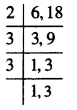
\(\begin{array}{l|l}
2 & 12,36 \\
\hline 2 & 6,18 \\
\hline 3 & 3,9 \\
\hline 3 & 1,3 \\
\hline & 1,1
\end{array}\)
L.C.M of 12 and 36
= 2 × 2 × 3 × 3
= 36
= \(\frac{10}{36}=\frac{5}{18}\)

Question (ii).
\(\frac{-5}{9}-\frac{3}{5}\)
Solution:
\(\frac{-5}{9}-\frac{3}{5}\) = \(\frac {-5}{9}\) + (additive inverse of \(\frac {3}{5}\))
= \(\frac{-5}{9}+\left(\frac{-3}{5}\right)\)
= \(\frac{-25+(-27)}{45}\)
L.C.M of 9 and 5 is 45 = \(\frac {-52}{45}\)

Question (iii).
\(\frac{-7}{13}-\left(\frac{-5}{91}\right)\)
Solution:
\(\frac{-7}{13}-\left(\frac{-5}{91}\right)\) = \(\frac {-7}{13}\) + (additive inverse of \(\frac {-5}{91}\))
= \(\frac{-7}{13}+\left(\frac{5}{91}\right)\)
= \(\frac{-49+(5)}{91}\)
L.C.M of 13 and 91 = 7 × 13 = 91
\(\begin{array}{l|l}
7 & 13,91 \\
\hline 13 & 13,13 \\
\hline & 1,1
\end{array}\)
= \(\frac {-44}{91}\)

PSEB 7th Class Maths Solutions Chapter 9 Rational Numbers Ex 9.2

Question (iv).
\(\frac{6}{11}-\frac{-3}{4}\)
Solution:
\(\frac{6}{11}-\frac{-3}{4}\) = \(\frac {6}{11}\) + (additive inverse of \(\frac {-3}{4}\))
= \(\frac{6}{11}+\left(\frac{3}{4}\right)\)
= \(\frac{24+33}{44}\)
L.C.M of 11 and 4 is 44 = \(\frac {57}{44}\)

Question (v).
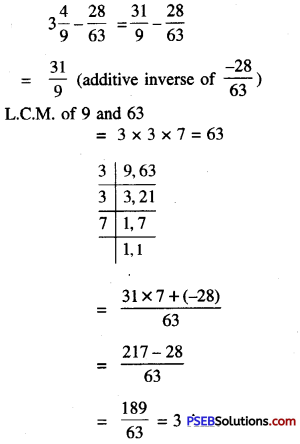
\(3 \frac{4}{9}-\frac{28}{63}\)
Solution:
PSEB 7th Class Maths Solutions Chapter 9 Rational Numbers Ex 9.2 3

3. Find the product of :

Question (i).
\(\frac{5}{9} \times \frac{-3}{8}\)
Solution:
\(\frac{5}{9} \times \frac{-3}{8}\)
= \(\frac{5 \times-3}{9 \times 8}\)
= \(\frac {-5}{24}\)

Question (ii).
\(\frac{-3}{7} \times \frac{7}{-3}\)
Solution:
\(\frac{-3}{7} \times \frac{7}{-3}\)
= \(\frac{-3 \times 7}{7 \times-3}\)
= 1

PSEB 7th Class Maths Solutions Chapter 9 Rational Numbers Ex 9.2

Question (iii).
\(\frac{3}{13} \times \frac{5}{8}\)
Solution:
\(\frac{3}{13} \times \frac{5}{8}\)
= \(\frac{3 \times 5}{13 \times 8}\)
= \(\frac {15}{104}\)

Question (iv).
\(\frac {3}{10}\) × (-18)
Solution:
\(\frac {3}{10}\) × (-18)
= \(\frac{3 \times-18}{10}\)
= \(\frac{-27}{5}\)

4. Find the value of:

Question (i).
-9 ÷ \(\frac {3}{5}\)
Solution:
-9 ÷ \(\frac {3}{5}\)
= -9 × (Reciprocal of \(\frac {3}{5}\))
= -9 × \(\frac {5}{3}\)
= -15

Question (ii).
\(\frac {-4}{7}\) ÷ 4
Solution:
\(\frac {-4}{7}\) ÷ 4
= \(\frac {-4}{7}\) × (Reciprocal of 4)
= \(\frac{-4}{7} \times \frac{1}{4}\)
= \(\frac {-1}{7}\)

PSEB 7th Class Maths Solutions Chapter 9 Rational Numbers Ex 9.2

Question (iii).
\(\frac{7}{18} \div \frac{5}{6}\)
Solution:
\(\frac{7}{18} \div \frac{5}{6}\)
= \(\frac {7}{18}\) × (Reciprocal of \(\frac {5}{6}\))
= \(\frac{7}{18} \times \frac{6}{5}\)
= \(\frac {7}{15}\)

Question (iv).
\(\frac{-8}{35} \div\left(\frac{-2}{7}\right)\)
Solution:
\(\frac{-8}{35} \div\left(\frac{-2}{7}\right)\)
= \(\frac {-8}{35}\) × (Reciprocal of \(\frac {-2}{7}\))
= \(\frac{-8}{35} \times \frac{7}{-2}\)
= \(\frac {4}{5}\)

Question (v).
\(\frac {-9}{15}\) ÷ -18
Solution:
\(\frac {-9}{15}\) ÷ -18
= \(\frac {-9}{15}\) × (Reciprocal of -18)
= \(\frac{-9}{15} \times \frac{1}{-18}\)
= \(\frac {1}{30}\)

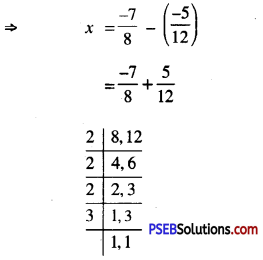
5. What ratonal number should be added to \(\frac {-5}{12}\) to get \(\frac {-7}{8}\)?
Solution:
Let the required number to be added be x.
then, \(\frac {-5}{12}\) + x = \(\frac {-7}{8}\)
PSEB 7th Class Maths Solutions Chapter 9 Rational Numbers Ex 9.2 4
L.C.M of 8, 12 = 2 × 2 × 2 × 3
= 24
= \(\frac{-7 \times 3+5 \times 2}{24}\)
= \(\frac{-21+10}{24}\)
= \(\frac {-11}{24}\)

PSEB 7th Class Maths Solutions Chapter 9 Rational Numbers Ex 9.2

6. What number should be subtracted from \(\frac {-2}{3}\) to get \(\frac {-5}{6}\) ?
Solution:
Let the required number to be subtracted be x, then
\(\frac{-2}{3}-x=\frac{-5}{6}\)
⇒ \(\frac{-2}{3}-\left(\frac{-5}{6}\right)\) = x
x = \(\frac{-2}{3}+\frac{5}{6}\)
= \(\frac{-4+5}{6}\)
= \(\frac {1}{6}\)

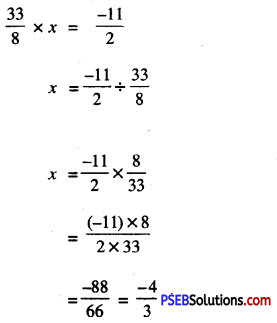
7. The product of two rational numbers is \(\frac {-11}{2}\). If one of them is \(\frac {33}{8}\), find the other number.
Solution:
Let the required number be x, then
PSEB 7th Class Maths Solutions Chapter 9 Rational Numbers Ex 9.2 5

8. Multiple Choice Questions

Question (i).
The sum of \(\frac{5}{4}+\left(\frac{25}{-4}\right)\) =
(a) -5
(b) 5
(c) 4
(d) -4
Answer:
(a) -5

Question (ii).
\(\frac{17}{11}-\frac{6}{11}\) =
(a) 1
(b) -1
(c) 6
(d) 3
Answer:
(a) 1

PSEB 7th Class Maths Solutions Chapter 9 Rational Numbers Ex 9.2

Question (iii).
\(\frac{2}{-5} \times \frac{-5}{2}\) =
(a) 1
(b) -1
(c) 2
(d) -5
Answer:
(a) 1

Question (iv).
\(\frac{7}{12} \div\left(\frac{-7}{12}\right)\) =
(a) 1
(b) -1
(c) 7
(d) -7
Answer:
(b) -1

Question (v).
Which of the following is value of (-4) × [(-5) + (-3)]
(a) -32
(b) 120
(c) 32
(d) -23
Answer:
(c) 32

PSEB 6th Class Maths Solutions Chapter 3 Playing with Numbers Ex 3.4

Punjab State Board PSEB 6th Class Maths Book Solutions Chapter 3 Playing with Numbers Ex 3.4 Textbook Exercise Questions and Answers.

PSEB Solutions for Class 6 Maths Chapter 3 Playing with Numbers Ex 3.4

1. Find H.C.F. of the following numbers by prime factorisation:

Question (i)
30, 42
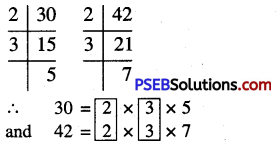
Solution:
First we write the prime factorization of the given numbers
PSEB 6th Class Maths Solutions Chapter 3 Playing with Numbers Ex 3.4 1
We find that 2 occurs two times and 3 occurs two times as common factors.
∴ HCF of 30 and 42 = 2 × 3 = 6

Question (ii)
135,225
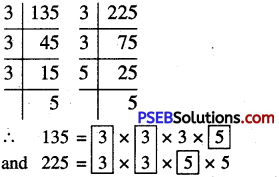
Solution:
First we write the prime factorization of the given number
PSEB 6th Class Maths Solutions Chapter 3 Playing with Numbers Ex 3.4 2
We find that 3 occurs two times and 5 occurs once as common factors
∴ HCF of 135 and 225 = 3 x 3 x 5 = 45

PSEB 6th Class Maths Solutions Chapter 3 Playing with Numbers Ex 3.4

Question (iii)
180,192
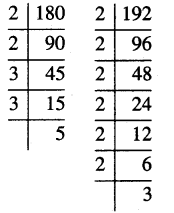
Solution:
First we write the prime factorisation of the given numbers
PSEB 6th Class Maths Solutions Chapter 3 Playing with Numbers Ex 3.4 3
We find that 2 occurs twice and 3 occurs once as common factors
HCF of 180 and 192
= 2 × 2 × 3 = 12

Question (iv)
49,91,175
Solution:
First we write the prime factorization of the given numbers
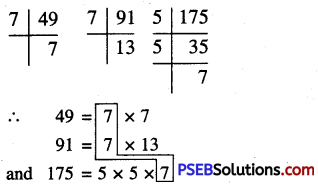
PSEB 6th Class Maths Solutions Chapter 3 Playing with Numbers Ex 3.4 5
We find that 7 occurs once as a common factor.
∴ HCF of 49, 91 and 175 = 7

Question (v)
144, 252, 630.
Solution:
First we write the prime factorisation of the given numbers
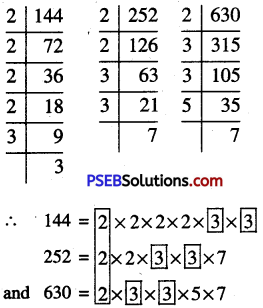
PSEB 6th Class Maths Solutions Chapter 3 Playing with Numbers Ex 3.4 6
We find that 2 occurs once and 3 occurs twice as common factors.
∴ HCF of 144, 252 and 630
= 2 × 3 × 3 = 18

PSEB 6th Class Maths Solutions Chapter 3 Playing with Numbers Ex 3.4

2. Find H.C.F. of the following numbers using division method:

Question (i)
170, 238
Solution:
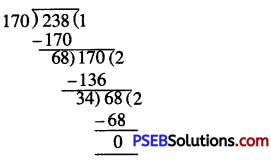
Given numbers are 170 and 238
PSEB 6th Class Maths Solutions Chapter 3 Playing with Numbers Ex 3.4 7
Hence, H.C.F. of 170 and 238 = 34

Question (ii)
54, 144
Solution:
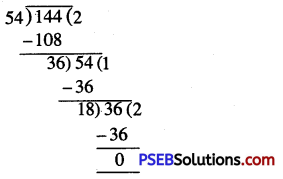
Given numbers are 54 and 144
PSEB 6th Class Maths Solutions Chapter 3 Playing with Numbers Ex 3.4 8
Hence, H.C.F. of 54 and 144 = 18

Question (iii)
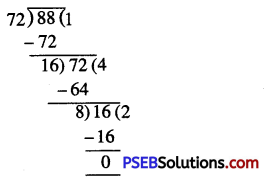
72, 88
Solution:
Given numbers are 72 and 88.
PSEB 6th Class Maths Solutions Chapter 3 Playing with Numbers Ex 3.4 9
Hence, H.C.F. of 72 and 88 = 8

PSEB 6th Class Maths Solutions Chapter 3 Playing with Numbers Ex 3.4

Question (iv)
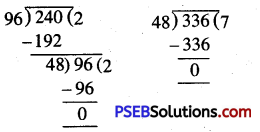
96, 240, 336
Solution:
Given numbers are 96, 240 and 336 Consider any two numbers say 96 and 240
PSEB 6th Class Maths Solutions Chapter 3 Playing with Numbers Ex 3.4 10
∴ H.C.F. of 96 and 240 = 48
Now, we find H.C.F. of 48 and 336
∴ H.C.F. of 48 and 336 = 48
Hence, H.C.F. of 96, 240 and 336 = 48

Question (v)
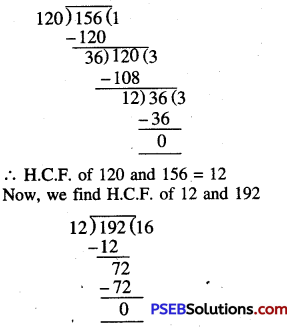
120, 156, 192.
Solution:
Given numbers are 120, 156 and 192 Consider any two numbers say 120 and 156
PSEB 6th Class Maths Solutions Chapter 3 Playing with Numbers Ex 3.4 11
∴ H.C.F. of 12 and 192 = 12
Hence, H.C.F. of 120, 156 and 192 = 12

3. What is the H.C.F. of two prime numbers?
Solution:
H.C.F. of two prime numbers = 1.

4. What is the H.C.F. of two consecutive even numbers?
Solution:
The H.C.F. of two consecutive even numbers = 2.

PSEB 6th Class Maths Solutions Chapter 3 Playing with Numbers Ex 3.4

5. What is the H.C.F. of two consecutive natural numbers?
Solution:
H.C.F. of two consecutive natural numbers = 1.

6. What is the H.C.F. of two consecutive odd numbers?
Solution:
H.C.F. of two conseutive odd numbers = 1.

7. Find the greatest number which divides 245 and 1029, leaving a remainder 5 in each case.
Solution:
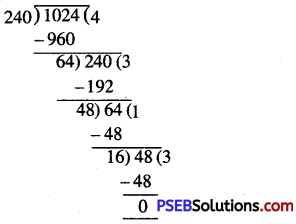
Given that, required number when divides 245 and 1029, the remainder is 5 in each case.
⇒ 245 – 5 = 240 and 1029 – 5 = 1024 are completely divisible by the required number.
⇒ Required number is the highest common factor of 240 and 1024. Since it is given that required number is the greatest number.
∴ Required number is the H.C.F. 240 and 1024.
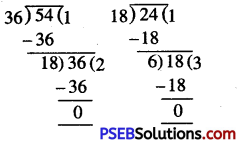
PSEB 6th Class Maths Solutions Chapter 3 Playing with Numbers Ex 3.4 12
Hence, required number (H.C.F.) of 240 and 1024 = 16

8. Find the greatest number that can divide 782 and 460 leaving remainder 2 and 5 respectively.
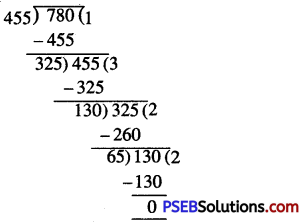
Solution:
Required greatest number = H.C.F. of (782 – 2) and (460 – 5)
= H.C.F. of 780 and 455 = 65
PSEB 6th Class Maths Solutions Chapter 3 Playing with Numbers Ex 3.4 13
Hence required greatest number = 65

PSEB 6th Class Maths Solutions Chapter 3 Playing with Numbers Ex 3.4

9. Find the greatest number that will divide 398,437 and 540 leaving remainders 7,12 and 13 respectively.
Solution:
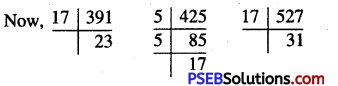
Required greatest number = H.C.F. of (398 – 7), (437 – 12) and (540 – 13)
= H.C.F. of 391, 425 and 527
PSEB 6th Class Maths Solutions Chapter 3 Playing with Numbers Ex 3.4 14
∴ 391 = 17 × 23
425 = 5 × 5 × 17
and 527 = 17 × 31
∴ H.C.F. = 17
Hence, required greatest number = 17

10. Two different containers contain 529 litres and 667 litres of milk respectively. Find the maximum capacity of container which can measure the milk of both containers in exact number of times.
Solution:
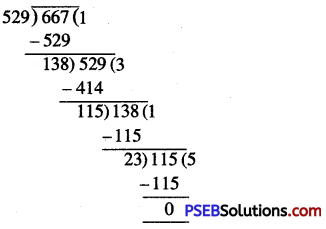
We have to find, maximum capacity of a container which measure both conainers in exact number of times.
⇒ We required the maximum number which divides 529 and 667
⇒ Required number = H.C.F. of 529 and 667 = 23
PSEB 6th Class Maths Solutions Chapter 3 Playing with Numbers Ex 3.4 15
Hence required capacity of container = 23 litres

11. There are 136 apples, 170 mangoes and 255 oranges. These are to be packed in boxes containing the same number of fruits. Find the greatest number of fruits possible in each box.
Solution:
We have to find the greatest number of fruits in each box ,
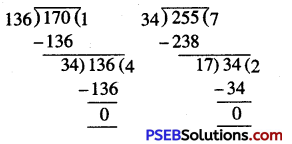
So, we required greatest numbers which divides 136, 170 and 255
∴ Required greatest number of fruits possible in each box
= H.C.F. of 136, 170 and 255
Now take any two numbers, say 136 and 170
H.C.F. of 136 and 170 = 34
Now find H.C.F. of 34 and 255
∴ H.C.F. of 34 and 255 = 17
H.C.F. of 136, 170 and 255 = 17
PSEB 6th Class Maths Solutions Chapter 3 Playing with Numbers Ex 3.4 16
∴ Hence the greatest number of fruits possible in each box = 17

PSEB 6th Class Maths Solutions Chapter 3 Playing with Numbers Ex 3.4

12. Three pieces of timber 54 m, 36 m and 24 m long, have to be divided into planks of the same length. What is the greatest possible length of each plank?
Solution:
We have to find the greatest possible length of each plank.
So, we required the maximum number which divides 54 m, 36 m and 24 m.
∴ Required length of each plank = H.C.F. of 54 m, 36 m and 24 m
Now, take any two numbers, say 54 and 36
H.C.F. of 54 and 36 = 18
Now find the H.C.F. of 18 and 24
H.C.F. 18 and 24 = 6
H.C.F. 54, 36 and 24 = 6
PSEB 6th Class Maths Solutions Chapter 3 Playing with Numbers Ex 3.4 17
Hence, the greatest length of each plank = 6m

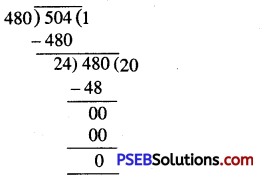
13. A room Measures 4.8 m and 5.04 m. Find the size of the largest square tile that can be used to tile the floor without cutting any tile.
Solution:
We have to find the size of largest square tile that can be used to the floor without cutting any tile.
∴ Required size of tile = H.C.F. of 4.8 and 5.04 m
= H.C.F. of 480 cm and 504 cm [1 m – 100 cm]
∴ H.C.F. of 480 cm and 504 cm = 24 cm
PSEB 6th Class Maths Solutions Chapter 3 Playing with Numbers Ex 3.4 18
Hence size of each square tile = 24 cm

PSEB 6th Class Maths Solutions Chapter 3 Playing with Numbers Ex 3.4

14. Reduce each of the following fractions to lowest forms:

Question (i)
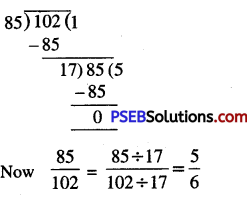
\(\frac {85}{102}\)
Solution:
In order to reduce given fraction to the lowest terms,
We divide numerator and denominator by their H.C.F.
Now we find H.C.F. of 85 and 102 Clearly H.C.F. of 85 and 102 = 17
PSEB 6th Class Maths Solutions Chapter 3 Playing with Numbers Ex 3.4 19

Question (ii)
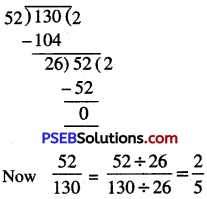
\(\frac {52}{130}\)
Solution:
We find H.C.F. of 52 and 130
Clearly H.C.F. of 52 and 130 = 26
PSEB 6th Class Maths Solutions Chapter 3 Playing with Numbers Ex 3.4 20

PSEB 6th Class Maths Solutions Chapter 3 Playing with Numbers Ex 3.4

Question (iii)
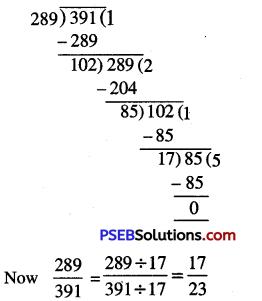
\(\frac {289}{391}\)
Solution:
We find H.C.F. of 289 and 391
Clearly, H.C.F. of 289 and 391 = 17
PSEB 6th Class Maths Solutions Chapter 3 Playing with Numbers Ex 3.4 21

PSEB 9th Class Hindi Vyakaran मुहावरे तथा लोकोक्तियाँ

Punjab State Board PSEB 9th Class Hindi Book Solutions Hindi Grammar muhavare tatha lokoktiyan मुहावरे तथा लोकोक्तियाँ Exercise Questions and Answers, Notes.

PSEB 9th Class Hindi Grammar मुहावरे तथा लोकोक्तियाँ

नीचे दी गई लोकोक्तियों के अर्थ समझकर वाक्य बनाइए

1. अशर्फ़ियाँ लुटें और कोयलों पर मोहर (एक ओर लापरवाही से खर्च किया जाए और दूसरी ओर पैसे-पैसे का हिसाब रखा जाए)-वीर सिंह लाटरी पर हज़ारों रुपए खर्च कर देता है पर संतों से घर खर्च का पाई-पाई का हिसाब माँगता है इसी को कहते हैं अशर्फ़ियाँ लुटें और कोयलों पर मोहर’।

2. आगे कुआँ पीछे खाई (दोनों ओर संकट)-चोर पुलिस को अपना भेद बताए तो फंसता था और न बताए तो पुलिस से पिटता था इसलिए उसकी दशा आगे कुआँ पीछे खाई जैसी हो रही थी कि जिधर जाए उधर मुसीबत।

3. उल्टे बाँस बरेली को (विपरीत कार्य करना)-नागपुर के संतरे तो दुनियाँ में प्रसिद्ध हैं और तुम फिरोज़पुर से उन्हें नागपुर संतरे भेज रहे हो, यह तो उल्टे बाँस बरेली को जैसी बात कर रहे हो।

PSEB 9th Class Hindi Vyakaran मुहावरे तथा लोकोक्तियाँ

4. एक और एक ग्यारह होते हैं (एकता में बल है)-नेता जी ने कहा देश को आजादी दिलवाने के लिए सब एक हो जाओ क्योंकि एक और एक ग्यारह होते हैं, तभी हम अंग्रेजों को देश से भगा सकेंगे।

5. एक अनार सौ बीमार (वस्तु थोड़ी, माँग ज्यादा )-बिजली विभाग में दस क्लर्कों की नौकरियाँ निकलीं तो दस हज़ार लोगों ने प्रार्थना पत्र दे दिए, इसे ही कहते हैं एक अनार सौ बीमार, दस पदों के लिए दस हज़ार तैयार।

6. ओस चाटे प्यास नहीं बुझती (कम वस्तु से तृप्ति नहीं होती)-पेटू राम को खाने के लिए एक केला देने से उसका काम नहीं बनेगा, उसे तो कम-से-कम एक दर्जन केले चाहिए भला कहीं ओस चाटे प्यास बुझती है जो एक केले से उसका पेट भर जाएगा।

7. कंगाली में आटा गीला (मुसीबत पर मुसीबत)-इधर मनिन्द्र के घर की छत गिरी उधर गाँव से उसके पिता की मृत्यु का समाचार मिला, उसकी दशा तो कंगाली में आटा गीला जैसी हो गई है।

8. कागज़ हो तो हर कोई बाँचे, भाग्य न बाँचा जाए (कागज़ पर लिखा पढ़ सकते हैं, पर भाग्य नहीं पढ़ा जा सकता)-किरपाल सिंह की भैंस मरी, फिर घर में आग लगी, अब पत्नी मर गई तो वह भागा-भागा ज्योतिषी जी के पास गया कि ये सब क्यों हो रहा है ज़रा कुंडली देखकर बताइए तो ज्योतिषी जी ने कहा किरपाले “कागज़ हो तो हर कोई बाँचे, भाग्य न बाँचा जाए” तेरी किस्मत में जो होगा तुझे भुगतना पड़ेगा।

9. खोदा पहाड़ निकली चुहिया (बहुत मेहनत करने पर कम फल की प्राप्ति होना)-हम अध्यापकों के साथ मोरनी हिल देखने गए तो वहाँ हिल के नाम पर एक टीला-सा देखकर हम कह उठे खोदा पहाड़ निकली चुहिया।

10. गंगा गए गंगादास, जमना गए जमनादास (सिद्धांतहीन व्यक्ति)-आजकल के नेता अपने स्वार्थ के लिए कभी ‘क’ दल में तो कभी ‘ख’ दल में चले जाते हैं, उनका हाल तो यह है कि गंगा गए तो गंगादास, जमना गए जमना दास।

11. घमंड का सिर नीचा (अहंकारी को सदा मुँह की खानी पड़ती है)-हरबंस को अपनी ताकत पर बहुत घमंड था पर जब उसे कुश्ती में मेहर ने हरा दिया तो उसका मुँह देखने वाला था सच है घमंड का सिर नीचा ही रहता है।

12. चोर के घर मोर (चालाक का उससे भी अधिक चालाक से सामना होना)-सुनीता अपने को बहुत चतुर और होशियार समझती थी पर जब हेमा उसे बेवकूफ बना कर उसका कीमती हार कम दामों में ले गई तो उसे पता चला कि चोर के घर मोर ने डाका डाल लिया है।

13. जाको राखे साइयाँ मार सके न कोय (जिसे परमात्मा रखे उसे कोई मार नहीं सकता)-भीषण बस दुर्घटना में सभी यात्री मारे गए थे पर एक तीन वर्षीय बच्चा बस के नीचे से जीवित निकाल लिया गया, इसी को कहते हैं जाको राखे साइयाँ मार सके न कोय।।

14. डूबते को तिनके का सहारा (मुसीबत में थोड़ी-सी मदद भी मायने रखती है)-पिंकी को अपने कारोबार में घाटा हो रहा था पर उसी समय उसे सुभाष से मिली कुछ आर्थिक मदद ने बचा लिया तो उसे लगा कि डूबते को तिनके का सहारा भी बहुत होता है।

15. दूर के ढोल सुहावने (दूर से सब अच्छा लगता है)-हमने सुना था कि मुंबई की जुहू बीच बहुत अच्छी होती है परन्तु वहाँ समुद्र के काले तेलीय पानी को देख कर लगा कि सिर्फ दूर के ढोल सुहावने होते हैं।

16. नीम हकीम खतरा जान (अधूरा ज्ञान हानिकारक होता है)-सुंदर कुछ दिन किसी डॉक्टर की दुकान पर सफाई का काम करके लोगों को डॉक्टर बन कर दवा दे रहा है ऐसे नीम हकीम खतरा जान लोगों से सतर्क रहना चाहिए।

17. प्यासा कुएँ के पास जाता है, कुआँ प्यासे के पास नहीं (जिसे सहायता लेनी हो वह स्वयं सहायता देने वाले के पास जाता है)-विनोद को कुछ प्रश्न समझ में नहीं आ रहे तो उसके पिता ने उसे अपने अध्यापक के पास जाकर समझने के लिए कहा क्योंकि प्यासा कुएँ के पास जाता है, कुआँ प्यासे के पास नहीं।

18. मन चंगा तो कठौती में गंगा (मन पवित्र हो तो घर ही तीर्थ समान हो जाता है)-मन में स्थिरता न हो तो मंदिर-मस्जिद जाने से भी कोई लाभ नहीं होता, स्थिर मन से घर में ही परमात्मा का चिंतन करने से भी परमात्मा मिल जाते हैं क्योंकि मन चंगा तो कठौती में गंगा कहा गया है।

19. साँप मरे लाठी न टूटे (हानि न हो पर काम हो जाए)-परीक्षा में नकल करते हुए पकड़े जाने का डर रहता है, इसलिए कुछ ऐसा उपाय करना चाहिए कि साँप भी मरे, लाठी न टूटे; परीक्षा में उत्तीर्ण भी हो जाएँ और नकल भी न करनी पड़े।

20. होनहार बिरवान के होत चीकने पात (महान् व्यक्ति की महानता के लक्षण उसके बचपन में ही दिखाई दे जाते हैं)-मुंशी प्रेमचंद छोटी आयु में ही कहानियाँ लिखने लंग गए थे और आगे चल कर विश्व प्रसिद्ध कथाकार बन गए, इसे कहते हैं होनहार बिरवान के होत चीकने पात।

PSEB 9th Class Hindi Vyakaran मुहावरे तथा लोकोक्तियाँ

परीक्षोपयोगी अन्य मुहावरे/लोकोक्तियाँ

(क) मुहावरे

  1. अकल का अन्धा होना (बेवकूफ होना)-उसे समझाने की कोशिश करना व्यर्थ है। वह तो पूरा अकल का अन्धा है।
  2. अंग-अंग ढीला होना (थक जाना)-दिनभर परिश्रम करने से मेरा अंग-अंग ढीला हो गया है।
  3. अन्धे को दीपक दिखाना (नासमझ को उपदेश देना)- भगवान कृष्ण दुर्योधन के धृष्टतापूर्ण व्यवहार से समझ गए थे कि उसे उपदेश देना अन्धे को दीपक दिखाना है।
  4. अपना उल्लू सीधा करना (अपना मतलब निकालना)-स्वार्थी मित्रों से बचकर रहना चाहिए। उन्हें तो अपना उल्लू सीधा करना आता है।
  5. अकल मारी जाना (घबरा जाना)-प्रश्न-पत्र देखते ही शांति की अकल मारी गई।
  6. अकल चरने जाना (सोच-समझकर काम न करना)-बना बनाया मकान तुड़वा रहे हो, इसे बनवाते समय क्या तुम्हारी अकल चरने गई थी।
  7. अपनी खिचड़ी अलग पकाना (सबसे अलग रहना)-अपनी खिचड़ी अलग पकाने से कोई लाभ नहीं होता इसलिए सबसे मिल-जुलकर रहना चाहिए।
  8. आँख उठाना (नुकसान पहुँचाना)–यदि तुमने मेरी ओर आँख उठा कर देखा तो मुझसे बुरा कोई न होगा।
  9. आँखें चार होना (आमने-सामने होना)-पुलिस से आँखें चार होते ही चोर घबरा गया।
  10. आँखें दिखाना (क्रोध करना)-कक्षा में शोर सुनकर जैसे ही अध्यापक ने आँखें दिखाई कि सब चुप हो गए।
  11. आँखें फेरना (प्रतिकूल होना)-मतलबी लोग अपना काम होते ही आँखें फेर लेते हैं।
  12. आँखों का तारा (बहुत प्यारा)-राम दशरथ की आँखों के तारे थे।
  13. आँखों में खटकना (बुरा लगना)-अनुशासनहीन बच्चे सबकी आँखों में खटकते हैं।
  14. आँच न आने देना (नुकसान न होने देना)-माँ अपनी सन्तान पर आँच नहीं आने देती।
  15. कान खा लेना (किसी बात को बार-बार कहना)-सुचित्रा ने सुबह से पिकनिक पर जाने की रट लगाकर
    अपनी माता के कान खा लिए।
  16. कान में पड़ना (सुनाई देना)-चिल्ला क्यों रहे हो, तुम्हारी बातें मेरे कान में पड़ रही हैं।
  17. कानों को हाथ लगाना (तौबा करना)-कानों को हाथ लगाकर कहती हूँ कि अब कभी झूठ नहीं बोलूँगी।
  18. गड़े मुर्दे उखाड़ना (बीती हुई बातों को कहना)-रवि वर्तमान की बात नहीं करता, हमेशा गड़े मुर्दे उखाड़ता रहता है।
  19. गागर में सागर भरना (बड़ी बात थोड़े से शब्दों से कहना)-बिहारी ने अपने दोहों में गागर में सागर भर दिया है।
  20. गुदड़ी का लाल (सामान्य परन्तु गुणी)-सतीश एक गरीब रिक्शेवाले का पुत्र था लेकिन उसने भारतीय प्रशासनिक सेवा में प्रथम स्थान प्राप्त कर सिद्ध कर दिया है कि वह तो गुदड़ी का लाल है।
  21. घाव पर नमक छिड़कना (दु:खी को और दु:खी करना)-महँगाई के इस युग में निर्धन कर्मचारियों के भत्ते बन्द करना घाव पर नमक छिड़कना है।
  22. घी के दिये जलाना (बहुत प्रसन्न होना)-अपने सैनिकों की विजय का समाचार सुनकर भारतवासियों ने घी के दिये जलाए।
  23. चूड़ियाँ पहनना (कायर)-जो सैनिक युद्ध में जाने से डरते हैं, उन्हें घर में चूड़ियाँ पहन कर बैठना चाहिए।
  24. चोली-दामन का साथ (सदा साथ रहना)-राम शाम चाहे कितना झगड़ा कर लें फिर भी उनमें चोली दामन का साथ है क्योंकि वे एक-दूसरे के बिना रह नहीं सकते।
  25. छोटा मुँह बड़ी बात (अपनी हैसियत से बढ़कर बात करना)-चींटी ने कहा मैं हाथी को मार दूंगी। उसका ऐसा कहना तो छोटा मुँह बड़ी बात है।
  26. टस से मस न होना (परवाह नहीं करना)-शिव को कितना भी समझाओ कि बुरे लोगों का साथ न करो, परन्तु वह तो टस से मस नहीं होता और उन्हीं लोगों का साथ करता है।
  27. दिन फिरना (भाग्य बदलना)-कभी दुखी नहीं होना चाहिए क्योंकि सबके दिन फिरते हैं।
  28. निन्यानवे के फेर में पड़ना (असमंजस में पड़ना)-निन्यानवे के फेर में पड़कर मनुष्य का जीवन दुःखी हो जाता है।
  29. पाँचों उंगलियाँ घी में होना (बहुत लाभ होना)-वस्तुओं के भाव चढ़ जाने से व्यापारियों की पाँचों उंगलियाँ घी में होती हैं।
  30. श्री गणेश करना (प्रारम्भ करना)-परीक्षाओं के सिर पर आते ही रमन ने पढ़ने का श्रीगणेश कर दिया।

(ख) लोकोक्तियाँ

  1. अन्धा क्या जाने बसंत की बहार (असमर्थ व्यक्ति गुणों को नहीं पहचान सकता)-उस मूर्ख को गीता का उपदेश देना व्यर्थ है। उस पर तो ‘अन्धा क्या जाने बसंत की बहार’ वाली कहावत चरितार्थ होती है।
  2. अन्धी पीसे कुत्ता चाटे (नासमझ अथवा सीधे-सादे व्यक्ति के परिश्रम का लाभ दूसरे व्यक्ति उठाते हैं) दिनेश जो कुछ कमाता है, उसके मित्र उड़ा कर ले जाते हैं। यहाँ तो अन्धी पीसे कुत्ता चाटे वाली बात हो रही है।
  3. अन्धों में काना राजा (मूों में थोड़े ज्ञान वाला भी बड़ा मान लिया जाता है)-हमारे गाँव में किशोरी लाल ही थोड़ा-सा पढ़ा-लिखा व्यक्ति है। सभी उसकी इज्जत करते हैं। इसी को कहते हैं-अन्धों में काना राजा।
  4. अपनी-अपनी डफली अपना-अपना राग. (भिन्न-भिन्न मत होना)-इस सभा में कोई भी निर्णय नहीं हो सकता। सबकी अपनी-अपनी डफली अपना-अपना राग है।
  5. अकेला चना भाड़ नहीं फोड़ सकता (बड़ा काम अकेला व्यक्ति नहीं कर सकता)-देश से भ्रष्टाचार एक व्यक्ति नहीं मिटा सकता। सबको मिलकर प्रयास करना चाहिए क्योंकि अकेला चना भाड़ नहीं फोड़ सकता।
  6. आँख के अन्धे गाँठ के पूरे (मूर्ख परन्तु धनी)-हरजीत के पास कोई डिग्री तो नहीं है परन्तु पैसा तो अच्छा कमा लेता है। वह आँख का अंधा तो है पर गाँठ का पूरा है।
  7. आँख का अंधा, नाम नैन सुख (नाम अच्छा काम बुरा)-करोड़ीमल भीख माँग कर अपना पेट भरता है। यह तो वही बात हुई कि आँख का अन्धा, नाम नैन सुख।
  8. एक और एक ग्यारह होना (एकता में बल)-अकेले की बजाए मिलकर काम करने से बहुत लाभ होता है क्योंकि एक और एक ग्यारह होते हैं।
  9. एक तो चोरी दूसरे सीना ज़ोरी (काम बिगाड़ कर आँख दिखाना)-जतिन ने आयूष को पीटा और फिर जाकर अपनी माता से आयूष की शिकायत की, यह तो वही बात हुई कि एक तो चोरी दूसरे सीना जोरी।
  10. एक पंथ दो काज (एक उद्यम से दो कार्य होना)-प्रकाश कौर अस्पताल अपना चैकअप कराने गई थी और लौटते हुए फल-सब्जी भी ले आई। इस प्रकार एक पंथ दो काज हो गए।
  11. एक मछली सारे तालाब को गंदा करती है (एक की बुराई से सब पर दोष लगता है)-दफ्तर में बड़े बाबू के रिश्वत लेने से सारे दफ़्तर की बदनामी हो रही है। सच है कि एक मछली सारे तालाब को गंदा करती है।
  12. एक म्यान में दो तलवारें नहीं समा सकतीं (दो विरोधी एक स्थान पर एक साथ शासन नहीं कर सकते) शेर सिंह ने गब्बर सिंह को ललकारते हुए कहा कि इस इलाके में तुम रहोगे या मैं क्योंकि एक म्यान में दो तलवारें नहीं समा सकतीं।
  13. ओछे की प्रीत बालू की भीत (नीच की मित्रता)-दुर्योधन से मित्रता सबके विनाश का कारण बनी थी क्योंकि ओछे की प्रीत बालू की भीत होती है।
  14. और बात खोटी, सही दाल रोटी (सब धंधा दाल-रोटी का है)-भीम सिंह सारा दिन मेहनत करता है, उसे और कोई बात अच्छी नहीं लगती। उसका मानना है कि और बात खोटी, सही दाल रोटी।
  15. कहाँ राजा भोज कहाँ गंगू तेली (असम्भव बात)-अमर सिंह जैसे मेधावी छात्र के साथ निकम्मे बोध सिंह की कोई तुलना नहीं है क्योंकि कहाँ राजा भोज, कहाँ गंगू तेली।
  16. कागज़ की नाव नहीं चलती (बेईमानी से काम नहीं होता)-वज़ीर सिंह ज्यादा हेरा-फेरी मत किया करो क्योंकि हमेशा कागज़ की नाव नहीं चलती।
  17. काम प्यारा है चाम नहीं (काम देखा जाता है)-सुरेन्द्र कौर की खूबसूरती का फैक्टरी के मालिक पर कोई प्रभाव नहीं पड़ता क्योंकि उसे तो काम प्यारा है चाम नहीं।
  18. का वर्षा जब कृषि सुखानी (मुसीबत टल जाने पर सहायता आना)-करोड़ों की सम्पत्ति जब जल कर राख हो गई तो आग बुझाने वाले आए। यह तो वही हुआ का वर्षा जब कृषि सुखानी।
  19. काला अक्षर भैंस बराबर (निरक्षर)-इन्द्रजीत कौर के बनाव-शृंगार पर मत जाओ, जब वह बोलेगी तो तुम्हें पता चल जाएगा कि वह तो काला अक्षर भैंस बराबर है।
  20. कुत्ते की दुम बारह वर्ष नली में रखी जाए फिर भी टेढ़ी की टेढ़ी (दुष्ट अपनी दुष्टता नहीं छोड़ता) – शराबी लाख कसमें खााकर भी शराब पीना नहीं छोड़ता तभी तो कहा है कि कुत्ते की दुम बारह वर्ष नली में रखी जाए फिर भी टेढ़ी की टेढ़ी।

नीचे लिखे किन्हीं पाँच मुहावरों और लोकोक्तियों का वाक्यों में इस प्रकार प्रयोग करें कि अर्थ स्पष्ट हो जाएँ-
अकल चरने जाना, एक अनार सौ बीमार, अब पछताए होत क्या जब चिड़िया चुग गई खेत, कानों को हाथ लगाना, आँखों में खटकना, आँखें खुलना, कान खाना, अंत भले का भला, अधजल गगरी छलकत जाए, अंधों में काना राजा, एक और एक ग्यारह होते हैं, कान पर जूं न रेंगना, अंगूठा दिखाना, गड़े मुर्दे उखाड़ना, आँखें चुराना, अपना उल्लू सीधा करना, एक पंथ दो काज, उल्टे बांस बरेली को, अंधे की लाठी, आँच न आने देना, एक तो चोरी दूसरे सीना जोरी, अपनी खिचड़ी अलग पकाना, ईश्वर की माया कहीं धूप कहीं छाया, चादर से बाहर पैर पसारना, एक मछली सारे तालाब को गंदा करती है, आम के आम गुठलियों के दाम, आँख उठाना, चूड़ियाँ पहनना, अंग-अंग ढीला होना, अकेला चना भाड़ नहीं फोड़ सकता, अंधी पीसे कुत्ता खाय, ऊँट के मुँह में जीरा, आँख से अंधे नाम नैन सुख, आँखों का तारा, गुदड़ी का लाल, अंधे को दीपक दिखाना, एक पंथ दो काज, अकलमारी जाना, आँखें दिखाना, अपनी-अपनी ढफली अपना-अपना राग, अँधा क्या जाने बसंत बहार, आँखें फेरना, आँखें चुराना, कान में पड़ना, घाव पर नमक छिड़कना, घी के दिए जलाना, आँख के अंधे गांठ के पूरे, गागर में सागर भरना, श्री गणेश करना, बगलें झाकना, लातों के भूत बातों से नहीं मानते, काठ की हांडी बार-बार नहीं चढ़ती, टका सा जवाब देना, मिट्टी का माधो, पगड़ी उछालना, न रहेगा बाँस न बजेगी बाँसुरी, काला अक्षर भैंस बराबर, लोहा लेना, घर की मुर्गी दाल बराबर, घर का भेदी लंका ढाहे, दिन फिरना, खोदा पहाड़ निकली चूहिया।

मुहावरा ऐसे वाक्यांश को कहते हैं जो किसी सामान्य अर्थ का बोध न कराकर विशेष अर्थ का बोध कराता है। वाक्य में इसका प्रयोग क्रिया के समान होता है, जैसे-‘आकाश-पाताल एक करना’। इस वाक्यांश का सामान्य अर्थ है ‘पृथ्वी और आकाश को परस्पर मिलाना’ लेकिन ऐसा संभव नहीं हो सकता है। अत: मुहावरे के रूप में इसका विशेष अर्थ होगा-‘बहुत परिश्रम करना’ इसी प्रकार ‘अंगारे बरसना’ का अर्थ होगा-‘बहुत तेज धूप पड़ना’।

PSEB 9th Class Hindi Vyakaran मुहावरे तथा लोकोक्तियाँ

मुहावरों का सहज-स्वाभाविक प्रयोग करके अपनी मौखिक या लिखित भाषा को अधिक प्रभावपूर्ण, सशक्त और आकर्षक बनाया जा सकता है। साहित्यकार इनके प्रयोग से भाषा को साहित्यिकता का गुण प्रदान करते हैं, क्योंकि ये कम शब्दों में भावों को गहनता, सरसता और गंभीरता प्रदान करने की विशेषता रखते हैं। मुहावरे वाक्य को लाक्षणिकता का गुण प्रदान करते हैं।

मुहावरों का उचित प्रयोग करते समय निम्नलिखित बातों की ओर विशेष ध्यान देना चाहिए-
मुहावरे का अर्थ।
मुहावरे का वाक्य में सटीक प्रयोग।
वाक्य का अनिवार्य अंग।
मुहावरे का सामान्य नहीं अपितु विशेष अर्थ।
क्रिया, लिंग, वचन, कारक आदि के अनुसार मुहावरे में परिवर्तन।

लोकोक्तियाँ

‘लोकोक्ति’ शब्द दो शब्दों ‘लोक’ और ‘उक्ति’ के मेल से बना है जिसे कहावत भी कहा जाता है। भाषा को प्रभावशाली बनाने के लिए मुहावरों के समान लोकोक्तियों का प्रयोग किया जाता है। ‘लोक में प्रचलित उक्ति’ को लोकोक्ति कहते हैं। लोकोक्ति ऐसा वाक्य होता है जिसे कथन की पुष्टि के लिए प्रस्तुत किया जाता है। लोकोक्ति के पीछे मानव-समाज का अनुभव अथवा घटना विशेष रहती है। मुहावरे के समान इसका भी विशेष अर्थ ग्रहण किया जाता है, जैसे- “हाथ कंगन को आरसी क्या” इसका अर्थ होगा “प्रत्यक्ष को प्रमाण की आवश्यकता नहीं होती।” यहाँ लोक-जीवन का अनुभव प्रकट हो रहा है-यदि हाथ में कंगन पहना हो तो उसे देखने के लिए शीशे की आवश्यकता नहीं होती।

लोकोक्ति और मुहावरे में अंतर

मुहावरा लोकोक्ति
1. मुहावरा वाक्य में एक वाक्यांश की तरह प्रयुक्त किया जाता है। 1. लोकोक्ति अपने आप में एक स्वतंत्र वाक्य होती है।
2. मुहावरा स्वतंत्र रूप में अपने अर्थ को ठीक प्रकार से अभिव्यक्त नहीं कर पाता। 2. लोकोक्ति स्वतंत्र रूप में अपना अर्थ प्रयुक्त कर पाती है।
3. मुहावरे में लाक्षणिक अर्थ होता है। 3. लोकोक्ति में शाब्दिक और लाक्षणिक दोनों अर्थ विद्यमान होते हैं।
4. मुहावरे का प्रयोग भाषा को सौंदर्य और साहित्यिकता देने के लिए किया जाता है। 4. लोकोक्ति से किसी विशिष्ट घटना या प्रसंग को प्रकट किया जाता है।

कुछ प्रचलित मुहावरे : अर्थ और वाक्य में प्रयोग

(क) पाठ्य पुस्तक में दिए गए मुहावरे

  1. अंग-अंग मुसकाना (बहुत प्रसन्न होना)-संगीत प्रतियोगिता में प्रथम पुरस्कार प्राप्त कर सिमरन का अंग-अंग मुसकरा उठा।
  2. अंगारे उगलना (कठोर बातें करना)-राम सिंह से प्यार से भी कुछ पूछो तो उसके मुँह से तो सदा अंगारे उगलते रहते हैं।
  3. अंधे की लकड़ी (एकमात्र सहारा)-शहनवाज़ अपने माता-पिता के लिए अंधे की लकड़ी है।
  4. अकल चकराना (कुछ समझ में न आना)-विज्ञान का प्रश्न-पत्र देखते ही राजबीर की अकल चकरा गई।
  5. अकल के घोड़े दौड़ाना (अनेक विचार करना)-अकल के घोड़े दौड़ा कर ही रहीम अपनी मुसीबतों से छुटकारा पा सका।
  6. अपने मुँह मियाँ मिठू बनना (अपनी तारीफ़ खुद करना)-अपनी पार्टी के गुण गिना कर नेता जी अपने मुँह मियाँ मिठू बन रहे थे।
  7. आँखें चुराना (छिपना)-जबसे सुरजीत की चोरी की आदत की पोल खुली है, वह सबसे आँखें चुराता फिर. रहा है।
  8. आँखों पर बिठाना (सम्मान करना)-जब हमारे विद्यालय की फुटबाल टीम ‘पंजाब केसरी’ पुरस्कार जीत कर आई तो सबने उसे आँखों पर बिठा लिया।
  9. आँखें खुलना (होश आना)-हरभजन जब अपनी सारी दौलत जुए में हार गया तो उसकी आँखें खुलीं।
  10. आँसू पी कर रह जाना (कठिनाई में भी न घबराना)-अपने खलियान को जलते देखकर भी रहमान आँसू पी कर रह गया।
  11. आग-बबूला होना (बहुत क्रोधित होना)-कक्षा में शोर सुन कर अध्यापक जी आग-बबूला हो गए।
  12. आग में पानी डालना (गुस्सा दूर करना, लड़ाई मिटाना)-शीला और लीला के आपसी झगड़े में बीच-बचाव कर प्रीतो ने आग में पानी डालने का काम किया।
  13. आसमान टूट पड़ना (भारी मुसीबत पड़ना)-पिता की अचानक मृत्यु होने से मनमोहन सिंह पर तो आसमान टूट पड़ा।
  14. आसमान सिर पर उठाना (बहुत शोर करना)-बच्चों ने आसमान सिर पर उठा कर माँ की नाक में दम कर दिया है।
  15. ईमान बेचना (बेईमानी करना)-राजा हरिश्चंद्र ने किसी भी कीमत पर अपना ईमान बेचा नहीं था।
  16. ईद का चाँद होना (बहुत समय बाद मिलना या दिखाई देना)-सांसद बनते ही ईश्वर सिंह जनता के लिए ईद का चाँद हो गया है।
  17. कलेजा ठंडा होना (संतोष होना)-निर्भया के अपराधियों को फाँसी की सजा मिलने पर उसके माता-पिता का कलेजा ठंडा हुआ।
  18. कलेजे पर साँप लोटना (ईर्ष्या होना)-महेश का नया तिमंजला मकान देख कर रमेश के कलेजे पर साँप लोटने लगा।
  19. कान का कच्चा (सुनकर विश्वास करना)-कान का कच्चा व्यक्ति जीवन में सदा धोखा खाता है।
  20. कान पर जूं तक न रेंगना (कोई असर न होना)-भजन सिंह ने हरपाल को शराब पीने से रोकने के लिए अनेक दुर्घटनाएँ सुनाईं पर उसके तो कान पर तक न रेंगी बल्कि वह और शराब पीने लगा।
  21. खटाई में पड़ना (काम लटक जाना)-बैंक से कर्जा न मिल सकने से गोपाल के मकान का काम खटाई में पड़ गया है।
  22. ख्याली पुलाव पकाना (कल्पना करते रहना)-गुरुदेव कुछ करता तो है नहीं बस अमीर बनने के ख्याली पुलाव पकाता रहता है।
  23. गिरगिट की तरह रंग बदलना (मौकापरस्त होना, सिद्धांतहीन व्यक्ति)-आजकल के नेता अपने स्वार्थ के लिए गिरगिट की तरह रंग बदल कर पार्टियाँ बदलते रहते हैं।
  24. गुड़ गोबर होना (काम बिगाड़ना)-आज हरप्रीत कौर के विवाह का समारोह था परन्तु तेज़ वर्षा ने सब गुड़ गोबर कर टैंट आदि उखाड़ दिए।
  25. घड़ों पानी पड़ना (लज्जित होना)-परीक्षा में नकल करते हुए पकड़े जाने पर रजनीश पर घड़ों पानी पड़ गया।
  26. चादर देख कर पैर पसारना (आय के अनुसार व्यय करना)-दमड़ी लाल एक-एक पैसा संभाल कर रखता है और चादर देखकर पैर पसारता है, इसलिए वह बहुत सुखी है।
  27. चेहरे से हवाइयाँ उड़ना (बहुत घबरा जाना)-जब परीक्षक ने शहनाज़ को परीक्षा में नकल करते हुए पकड़ा तो उसके चेहरे से हवाइयाँ उड़ने लगीं।
  28. छिपा रुस्तम (सामान्य पर गुणी)-लाल बहादुर शास्त्री जी देखने में तो छोटे-से थे, परन्तु प्रधानमंत्री के कार्य कुशलता पूर्वक करने में वे छिपे रुस्तम निकले।
  29. छोटा मुँह बड़ी बात (बढ़-चढ़ कर बातें करना)-यदि कुछ समझ नहीं आए तो किसी पर व्यर्थ ही आरोप लगाना छोटा मुँह बड़ी बात हो जाती है।
  30. ज़मीन आसमान एक करना (बहुत मेहनत/प्रयत्न करना)-परीक्षा में प्रथम स्थान प्राप्त करने के लिए नवजोत ने ज़मीन आसमान एक कर दिया था।
  31. जान पर खेलना (जोखिम उठाना)-सुखबीर ने अपनी जान पर खेलकर तालाब में डूबते हुए रहमान को बचा . लिया।
  32. झख मारना (व्यर्थ में समय बर्बाद करना)-तेजा दिनभर इधर-उधर झख मारता रहता है और फिर कहता है कि उसे कोई काम ही नहीं मिलता।
  33. टेढ़ी उँगली से घी निकालना (बलपूर्वक काम करना)-जब मोहन ने सोहन को उसका उधार नहीं लौटाया तो उसने उसे स्पष्ट कह दिया कि कल तक मेरी रकम लौटा देना नहीं तो मैं टेढ़ी उँगली से घी निकालना भी जानता हूँ।
  34. ठगा-सा रह जाना (हैरान होना)-जादूगर ने जादू देखकर सभी ठगे से रह गए।
  35. डूबती नैया पार लगाना (कठिनाई से बचाना)-परमजीत के मकान की कुर्की होते देखकर प्रकाश सिंह ने उसकी आर्थिक मदद कर उसकी डूबती नैया पार लगा दी।
  36. ढोल की पोल (ऊपरी/बाहरी दिखावा)-आयकर विभाग के छापे से गुजराल की अमीरी की ढोल की पोल खुल गई।
  37. तलवे चाटना (खुशामद करना)-नेताओं के तलवे चाट कर ही महीपाल को सड़क बनाने का ठेका मिला
  38. ताँता बँधना (लगातार होना)-डेंगू की बीमारी से मरने वालों का ताँता बँधा हुआ है।
  39. थाली का बैंगन (सिद्धांतहीन अथवा अस्थिर विचारों वाला व्यक्ति)-थाली का बैंगन व्यक्ति सदा अपने स्वार्थ की सोचता है, वह किसी का सगा नहीं होता।
  40. दाँत काटी रोटी (पक्की मित्रता)-रवि और शशि में दाँत काटी रोटी है।
  41. दालभात में मूसलचंद (दो के बीच दखल देना)-शबाना और हैदर के प्रेम में अशफ़ाक दालभात में मूसलचंद बन कर रोड़े अटका रहा है।
  42. धज्जियाँ उड़ाना (नष्ट करना)-अखिलेश ने रमा के रेत के घरौंदे में लात मारकर उसकी धज्जियाँ उड़ा दीं।
  43. धुन का पक्का (मज़बूत इरादे वाला)-जो व्यक्ति अपनी धुन का पक्का होता है, वह जीवन में अवश्य सफल होता है।
  44. नाक भौं चढ़ाना (नखरे करना)-खाने में मूंग धुली दाल बनी देखकर रश्मि नाक भौं चढ़ाने लगी।
  45. नाक कटना (सम्मान नष्ट होना)-सीमा ने घर से भाग कर अपने परिवार की नाक कटा दी है।
  46. पत्थर पर लकीर (पक्की बात)-राजा हरिश्चन्द्र जो कह देते थे वह पत्थर पर लकीर बन जाती थी।
  47. फूंक-फूंक कर कदम रखना (सोच समझ कर कार्य करना)-कोई भी नया कार्य प्रारंभ करने से पहले फूंकफूंक कर कदम रखना चाहिए तभी सफलता मिलती है।
  48. फूला न समाना (बहुत प्रसन्न होना)-परीक्षा में प्रथम स्थान प्राप्त कर चैतन्य फूला न समाया।
  49. बात का धनी (वायदे का पक्का)-राजा हरिश्चंद्र बात के धनी थे, वे जो कहते थे करके भी दिखाते थे।
  50. बीड़ा उठाना (संकल्प करना)-नल-नील ने सागर पर पुल बनाने का बीड़ा उठाया था।
  51. भरी थाली में लात मारना (लगा-लगाया काम छोड़ना)-जब तक कोई दूसरा अच्छा काम नहीं मिल जाता तब तक वर्तमान काम को छोड़ना भरी थाली में लात मारना होगा।
  52. मिजाज़ ठीक करना (अकड़ दूर करना)-अंगद ने रावण के दरबार में बड़े-बड़े राक्षसों के मिजाज़ ठीक कर दिए थे।
  53. रुपया उड़ाना (फिजूल खर्च करना)-पिता के मरने के बाद दोस्तों पर रुपये उड़ा कर बलकार सिंह आज दाने-दाने को तरस रहा है।
  54. लोहे के चने चबाना (बहुत कठिन कार्य करना)-अकबर को महाराणा प्रताप के साथ युद्ध करते हुए लोहे के चने चबाने पड़े थे।
  55. वीरगति को प्राप्त होना (मृत्यु होना)-कारगिल युद्ध में शत्रुसेना का मुकाबला करते हुए अनेक भारतीय सैनिक वीरगति को प्राप्त हुए थे। .
  56. शेखी बघारना (अपनी प्रशंसा-खुद करना)–नेता जी अपनी पार्टी की खुद ही शेखी बघारने लगे। .
  57. शैतान के कान कतरना (बहुत चालाक होना)-तुम बलबीर से दोस्ती तो कर रहे हो, पर उससे बच कर । रहना क्योंकि वह तो शैतान के कान कतरना भी जानता है।
  58. सिर-धड़ की बाजी लगाना (प्राणों की चिंता न करना)-वीर अपनी मातृभूमि की रक्षा के लिए अपने सिरधड़ की बाजी लगाना भी नहीं भूलते हैं।
  59. हाथ धोकर पीछे पड़ना (काम करने की धुन लगना)-नकुल को जो काम दिया जाए, वह हाथ धोकर उसके पीछे पड़ जाता है और उसे पूरा करके ही दम लेता है।

PSEB 9th Class Hindi Vyakaran मुहावरे तथा लोकोक्तियाँ

नीचे दिए गए मुहावरों के अर्थ समझकर वाक्य बनाइए

  1. अगूंठा दिखाना (देने से मना करना)-तृप्ता से जब मुक्ता ने उसकी कलम मांगी तो उसने उसे अगूंठा दिखा दिया।
  2. आड़े हाथों लेना (अच्छी तरह काबू करना)-बिना माँ की आज्ञा के फ़िल्म देख आने पर पवन को माँ ने आड़े हाथों लिया।
  3. ईमान बेचना (बेईमानी करना)-आजकल के नेता अपना ईमान बेचने के लिए सदा तैयार रहते हैं।
  4. उड़ती चिड़िया पहचानना (रहस्य जान लेना)-सुखचैन से बचकर रहना, वह तो उड़ती चिड़िया पहचान लेता
  5. ओखली में सिर देना (जानबूझ कर मुसीबत में फँसना)-लक्खे और सुक्खे को लड़ते देख मुन्ना उन्हें छुड़ाने लगा कि वे दोनों उसे ही धुनने लगे तो उसे लगा कि ओखली में सिर देकर उसने अच्छा नहीं किया।
  6. काया पलट देना (बिल्कुल बदल जाना)-सुरजीत सिंह की विधायक बनते ही काया पलट हो गई है।
  7. कलई खुलना (रहस्य खुलना)-आयकर विभाग के छापे में बंसल के घर से मिले काले धन से उसकी बेईमानी की कमाई की कलई खुल गई है।
  8. गले मढ़ाना (ज़बरदस्ती किसी को कोई काम सौंपना)-सुधा ने घर के कामकाज के साथ बच्चों की देखभाल का काम भी गले मढ़ दिया तो वह काम ही छोड़ कर चली गई।
  9. घास खोदना (फ़जूल समय बिताना)-कोई कमाई का काम करो, जिससे घर चल सके सिर्फ घास खोदने से कुछ नहीं होगा।
  10. टका-सा जवाब देना (कोरा उत्तर देना)-जब ममता ने अनीता से सौ रुपए मांगे तो उसने रुपये देने की बजाय उसे टका-सा जवाब देते हुए कह दिया कि नहीं दूंगी।
  11. दाँत खट्टे करना (बुरी तरह हराना)-भारतीय सैनिकों ने शत्रु सेना के दाँत खट्टे कर दिए।
  12. दाल में काला होना (गड़बड़ होना)-सुजान सिंह के घर सी०बी०आई० का छापा पड़ने से लगता है कि उसके कारोबार में अवश्य ही दाल में काला है।
  13. नाव पार लगाना (प्रयास सफल करना)-व्यापार में कृपाल की मदद करके उस्मान ने उसके डूबते व्यापार की नाव पार लगा दी।
  14. पेट पर लात मारना (रोजी-रोटी छीनना)-केवल सिंह ने रमन सिंह को नौकरी से निकाल कर उसके पेट पर लात मार दी है।
  15. फलना-फूलना (सुखी और संपन्न होना)-सोहन सिंह का व्यापार आज़कल खूब फल-फूल रहा है।
  16. बाजी मारना (सफल होना)-दस बच्चों की दौड़ में हार्दिक बाजी मारकर प्रथम आया है।
  17. भेड़ की खाल में भेड़िया (देखने में सीधा पर खतरनाक)-राहुल की सादगी पर मत जाओ, वह तो भेड़ की खाल में भेड़िया है।
  18. माथा ठनकना (संदेह होना)-इंदर सिंह की दो सालों में ही कमाई में हुई बेहद वृद्धि से पड़ौसियों का माथा ठनकने लगा कि कहीं वह कोई ग़लत काम तो नहीं कर रहा।
  19. रुपया ठीकरी कर देना (व्यर्थ में पैसा खर्च करना)-महेंद्र कौर ने बेटे को नया कारोबार करने के लिए दस लाख रुपए दिए पर उसने नशे में सारा रुपया ठीकरी कर दिया।
  20. हाथों के तोते उड़ना (दुःख से हैरान होना)-बेटे की दुर्घटना का समाचार सुनते ही माँ-बाप के हाथों के तोते उड़ गए।

कुछ प्रचलित लोकोक्तियाँ:

1. अंत भले का भला (भलाई करने वाले का भला होता है)-जसवंत सिंह सदा सबकी सेवा करता रहा जब उस पर मुसीबत आई तो सबने मिलकर उसकी जी जान से मदद की क्योंकि अंत भले का भला ही होता है।

2. अधजल गगरी छलकत जाए (कम गुणी दिखावा बहुत करता है)-सुमन को सुर-ताल का तो ज्ञान नहीं पर स्वयं को बड़ी संगीत विशारद कहती है, उसका तो वही हाल है कि अधजल गगरी छलकत जाए।

3. अब पछताए होत क्या, जब चिड़ियाँ चुग गई खेत (समय बीत जाने पर पछताने से क्या लाभ)-सरबजीत ने पहले तो ठीक से पढ़ाई नहीं की और अब फेल हो जाने पर रो रही है परन्तु अब पछताए होत क्या, जब चिड़ियाँ चुग गईं खेत।

4. आँखों देखी मक्खी नहीं निगलते (जानबूझ कर बुरा या हानिकारक काम नहीं करते)- अमर को कई बार नशा न करने के लिए कहा पर वह अन्य नशेड़ियों की दुर्दशा देखकर भी नहीं संभला जबकि आँखों देखी मक्खी नहीं निगलते पर वह देख कर भी अनदेखा कर गया।

5. आँवले का खाया और बड़े का कहा बाद में सीख देता है (आँवला खाने में कसैला तथा बड़ों की शिक्षा सनने में कड़वी लगती है पर बाद में लाभ होता है)-माँ-बाप के समझाने पर भी भीम की समझ में कुछ नहीं आया वह उनकी सीख की अनदेखी कर व्यापार में घाटा खाकर पछता रहा है और सोचता है कि उनका कहा मान लेता क्योंकि आँवले का खाया और बड़े का कहा बाद में सीख देता है।

6. आम के आम गुठलियों के दाम (दुगुना लाभ)-अखबार पढ़ कर फेंकना मत क्योंकि इन दिनों अखबार की रद्दी अच्छे भाव पर बिक जाती है इसलिए इसे पढ़ कर संभाल कर रखो और बाद में बेच देना इस प्रकार आम के आम गुठलियों के दाम की बात हो जाएगी।

7. आग लगने पर कुआँ खोदना (मुसीबत पड़ने पर उससे छुटकारे का प्रयत्न करना)-जब परीक्षा सिर पर आ पड़ी तो प्रीतम को लगा कि उसने कुछ पढ़ा ही नहीं और वह टयूशन रखने के लिए इधर-उधर भटकता रहा पर उसे कहीं कोई अध्यापक नहीं मिला, सच है आग लगने पर कुआँ खोदने से आग नहीं बुझती।

8. ईश्वर की माया कहीं धूप कहीं छाया (सभी एक समान नहीं होते)-रामलाल का एक बेटा डॉक्टर बन गया है जबकि दूसरा पढ़ लिख कर भी भटक रहा है, सच है ईश्वर की माया कहीं धूप कहीं छाया।

9. ऊँची दुकान फीका पकवान (केवल ऊपरी दिखावा करना)-टैगोर इंटरनेशनल स्कूल नाम का ही इंटरनेशनल है क्योंकि उसमें सभी अध्यापक अप्रशिक्षित हैं, इसी को कहते हैं ऊँची दुकान फीका पकवान।

10. एक हाथ से ताली नहीं बजती (अकेला व्यक्ति झगड़े का कारण नहीं होता)-ऐसा कैसे हो सकता है कि भजनो ने कुछ किया ही न हो और माँ ने उसकी पिटाई कर दी हो क्योंकि एक हाथ से ताली नहीं बजती।.

PSEB 9th Class Hindi Vyakaran मुहावरे तथा लोकोक्तियाँ

11. एक बार भूले से भूला कहाये, बार-बार भूले सो मूर्खानंद कहाये (एक बार ग़लती हो तो सावधान हो जाना चाहिए किंतु फिर वही गलती हो तो मूर्खता कहलाती है)– सुन्दर को कितना समझाओ, वह कुछ नहीं समझता और बार-बार एक ही भूल कर बैठता है। इसलिए सभी उसे मूर्खानंद कहते हैं क्योंकि एक बार भूले से भूला कहाये, बारबार भूले सो मूर्खानंद कहाये।

12. कमली ओढ़ने से फ़कीर नहीं होता (ऊपरी दिखावे/ढोंग से वास्तविकता नहीं आती)-इन्द्रजीत कौर की मक्कारी को सब जानते हैं इसलिए जब वह किसी से मीठी बातें करती है तो भी लोग उस पर विश्वास नहीं करते क्योंकि कमली ओढ़ने से कोई फ़कीर नहीं होता।

13. करे कोई भरे कोई (अपराध की सज़ा अपराधी के स्थान पर दूसरे को मिलना)-कक्षा में शोर रमेश कर रहा ‘था परन्तु सज़ा सुरेश को मिली इसी को कहते हैं करे कोई भरे कोई।

14. खिसियानी बिल्ली खंभा नोचे (अपमान का बदला दूसरे से लेना)-कमला को जब परीक्षा में अच्छे अंक नहीं मिले तो वह अपनी माँ पर ही बरसने लगी कि वे उसे पढ़ने नहीं देती जबकि वह खुद ही नहीं पढ़ती थी, इसी को कहते हैं खिसियानी बिल्ली खंभा नोचे।

15. घर की मुर्गी दाल बराबर (सरलता से उपलब्ध वस्तु का आदर नहीं होता)-जोगेंद्र के पिता की जूतों की दुकान है, इसलिए वह रोज़ नए से नए जूते पहन कर अपनी शान दिखाता है उसके लिए नित नया जूता पहनना घर की मुर्गी दाल बराबर के समान है।

16. जान है तो जहान है (जीवन रहने पर ही संसार है)-इतना अधिक काम मत करो कि बीमार पड़ जाओ, कुछ आराम भी कर लिया करो क्योंकि जान है तो जहान है।

17. जैसी करनी वैसी भरनी (जो जैसा करता है, वैसा ही फल पाता है)-जमाखोरी करने के कारण पुलिस ने समय सिंह को गिरफ्तार कर लिया है सच है जैसी करनी वैसी भरनी।

18. जाये की पीर माँ को होती है (जो जिसे पैदा करता है, उसके नुकसान की चिंता भी उसे ही होती है)-ओले पड़ने से बलकार की सारी फ़सल बर्बाद हो गई तो बेचारे का रो-रो कर बुरा हाल हो गया क्योंकि जाये की पीर माँ को ही होती है।

19. जिस के घर में माई उसकी राम बनाई (जिसकी माँ जीवित हो उसे कोई चिंता नहीं होती)-जब से रक्खे को व्यापार में घाटा हुआ है तब से सभी ने उससे किनारा कर लिया है, सच ही तो है जिसके घर में माई उसकी राम बनाई नहीं तो उसका कोई भी नहीं।

20. दूध का दूध, पानी का पानी (सच झूठ का सही फैसला)-अदले जहाँगीर को न्याय करने में निपुण माना जाता था क्योंकि वह दोषी को दंड देकर दूध का दूध, पानी का पानी कर देता था।

21. न रहेगा बाँस, न बजेगी बाँसुरी (कारण के नष्ट होने पर कार्य का न होना)-परेशान मरीज़ को डॉक्टर ने कहा-‘तुम्हारी बीमारी का कारण कब्ज़ है, इसे दूर करो सब कुछ ठीक हो जाएगा क्योंकि इस प्रकार न रहेगा बाँस न बजेगी बाँसुरी।

22. नाच न जाने आँगन टेढ़ा (काम करना न आने पर बहाने बनाना)-स्वर्णा को खाना बनाना तो आता नहीं जब . भी उसे कुछ बनाने के लिए कहो तो टाल-मटोल करने लगती है, सच ही तो है कि नाच-न जाने आँगन टेढ़ा।

23. पाँचों उँगलियाँ बराबर नहीं होती (सब एक जैसे नहीं होते)-सभी अधिकारियों को भ्रष्ट कहना उचित नहीं है क्योंकि पाँचों उँगलियाँ बराबर नहीं होती हैं।

24. बगल में छुरी मुँह में राम-राम (भीतर से शत्रुता और ऊपर से मीठी बातें)-तुम शकुंतला की बातों में मत आना क्योंकि उसकी तो बगल में छुरी और मुँह में राम-राम रहता है, वह ऊपर से जितनी मीठी है अंदर से उतनी ही खोटी है।

25. बार-बार चोर की, एक बार शाह की (चालाकी कभी-न-कभी पकड़ी जाती है)-हरभजन हर बार नकल करके पास हो जाता था. पर इस बार नकल करते हुए पकड़ा गया तथा परीक्षा देने से निकाल दिया गया, इसी को कहते हैं बार-बार चोर की, एक बार शाह की।

26. बिन माँगे मोती मिलें, माँगे मिले न भीख (माँगे बिना अच्छी वस्तु मिल जाती है और माँगने से साधारण भी नहीं मिलती)-प्रदीप से पिता ने पूछा कि जन्मदिन पर क्या लेना है, उसने कहा सिर्फ आपका आशीर्वाद और शाम को उसके पिता ने उसे नए स्कूटर की चाबी जन्मदिन के उपहार में दी तो उसके मुँह से निकल पड़ा बिना माँगे मोती मिलें माँगे मिले न भीख।

27. मन न मिले तो मिलना कैसा, मन मिल जाए तो तजना कैसा (जिससे मन न मिले उससे मिलने का क्या लाभ और जिससे मन मिल जाए उसे छोड़ना क्यों?)-राम की श्याम से खूब बनती है पर उसकी देवेश से बिल्कुल नहीं बनती क्योंकि कहा जाता है कि मन न मिले तो मिलना कैसा, मन मिल जाए तो तजना कैसा।

28. मान न मान मैं तेरा मेहमान (ज़बरदस्ती किसी का मेहमान बनना)-मेहरसिंह ने बिना बुलाए ही काहन सिंह के घर में डेरा जमा लिया है और वहाँ से जाता ही नहीं, इसी को कहते हैं मान न मान मैं तेरा मेहमान ।।

29. संभाल अपनी घोड़ी, मैंने नौकरी छोड़ी (स्वाभिमानी अपना अपमान नहीं सहता)-मिल मालिक ने जब नवीन को बुरी-बुरी गालियाँ दी तो उसका आत्म-सम्मान यह सहन न कर सका और वह उसे संभाल अपनी घोड़ी, मैंने नौकरी छोड़ी कह कर अपना त्याग पत्र देकर आ गया।

30. हाथों से नाखून कहाँ दूर हो सकते हैं (बहुत नज़दीकी रिश्ता नहीं जा सकता)-दो बहनों सुधा और मीना में बनती नहीं थी पर जब सुधा ने मीना की गंभीर बीमारी की बात सुनी तो उसकी देखभाल के लिए उसके पास जा पहुँची क्योंकि कभी हाथों से नाखून कहाँ दूर रह सकते हैं ?

PSEB 9th Class Hindi Vyakaran मुहावरे तथा लोकोक्तियाँ

31. हाथी को गन्ने ही सूझते हैं (स्वार्थी सदा अपना स्वार्थ सिद्ध करता है)-राम दयाल को जब उसके दल ने उसकी स्वार्थी मनोवृत्ति के कारण दल से निकाल दिया तो अपनी स्वार्थ पूर्ति के लिए वह दूसरे दल में शामिल हो गया क्योंकि हाथी को सदा गन्ने ही सूझते हैं।

PSEB 10th Class Hindi Vyakaran प्रपत्र पूर्ति

Punjab State Board PSEB 10th Class Hindi Book Solutions Hindi Grammar prapatra poorti प्रपत्र पूर्ति Exercise Questions and Answers, Notes.

PSEB 10th Class Hindi Grammar प्रपत्र पूर्ति

प्रपत्र पाठ्यक्रम-बैंक, डाकघर तथा रेलवे से संबंधित प्रपत्र पूर्ति
‘प्रपत्र’ अंग्रेज़ी शब्द फार्म का अनुवाद है। आम बोलचाल की भाषा में प्रपत्र को फार्म भी कहते हैं। प्रपत्र शब्द पत्र के आगे ‘प्र’ उपसर्ग लगाने से बना है। बालक के जन्म से लेकर मृत्यु तक के प्रपत्र भरकर बालक का जन्म प्रमाण-पत्र तथा मृतक का मृत्यु प्रमाण-पत्र प्राप्त करना होता है। इसके अतिरिक्त स्कूल, कॉलेज में प्रवेश के लिए, परीक्षा देने के लिए, नौकरी के लिए, प्रतियोगी परीक्षाओं के लिए, राशन कार्ड, आधार कार्ड, बिजली-पानीटेलीफोन-मोबाइल, गैस कनेक्शन लेने के लिए, पासपोर्ट बनवाने, बैंक/डाकखाने में पैसे जमा कराने या निकालने के लिए, रेल-हवाई यात्रा के समय आरक्षण कराने के लिए, विवाह के पंजीकरण, वाहन पंजीकरण, व्यवसाय पंजीकरण आदि अनेक कार्यों के लिए भी प्रपत्र भरने होते हैं। कोई भी प्रपत्र भरते समय निम्नलिखित तथ्यों का ध्यान रखना चाहिए-

(क) प्रपत्र के साथ दिए गए निर्देशों को अच्छी प्रकार से पढ़ कर ही प्रपत्र भरना चाहिए।
(ख) प्रपत्र में दिए गए निर्देश के अनुसार ही प्रपत्र को पैन/बॉलपैन/पेंसिल से भरना चाहिए।
(ग) प्रपत्र में जिन स्तंभों (कॉलमों) को अंग्रेज़ी के बड़े (कैपिटल) अक्षरों में भरना हो, उन्हें बड़े अक्षरों में भरना चाहिए।
(घ) प्रपत्र पर अपना छायाचित्र (फोटो) उचित स्थान पर चिपकाएं या पिन से नत्थी कीजिए। यदि फ़ोटो को सत्यापित (अटैस्ट) कराना है अथवा अपने हस्ताक्षर करने हैं, तो वह भी कीजिए।
(ङ) प्रपत्र के साथ निर्देशानुसार स्वहस्ताक्षरित अथवा राजपत्रित अधिकारी द्वारा सत्यापित (अटैस्टिड) दस्तावेज़ लगाएँ।
(च) प्रपत्र का कोई भी स्तम्भ (कॉलम) रिक्त न छोड़ें। यदि वह स्तम्भ आप पर लागू नहीं होता तो वहां लागू नहीं लिख दीजिए।
(छ) प्रपत्र में दिए गए स्थान पर अपने हस्ताक्षर कीजिए तथा स्थान और दिनांक लिखिए।
(ज) प्रपत्र साफ़, स्पष्ट, सुंदर तथा पढ़ा जा सके-ऐसे अक्षरों में भरा जाना चाहिए।
(झ) प्रपत्र भरकर व्यक्तिगत रूप से जमा कराते समय उसकी जमा करने वाले कार्यालय से रसीद ले लें। डाक से रजिस्ट्री अथवा स्पीड-पोस्ट से प्रपत्र भरकर भेज सकते हैं। यहाँ कुछ प्रपत्रों को भरने के उदाहरण दिए जा रहे हैं।

PSEB 10th Class Hindi Vyakaran प्रपत्र पूर्ति

1. उदाहरण-किसी खेल में चयन के लिए दिए गए प्रपत्र को भरना-
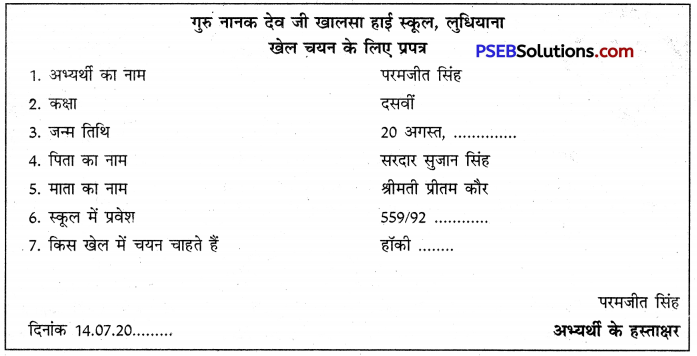
PSEB 10th Class Hindi Vyakaran प्रपत्र पूर्ति 1

2. उदाहरण-नौकरी के लिए दिए गए प्रपत्र को भरना
(क) व्यक्तिगत तथा पारिवारिक विवरण
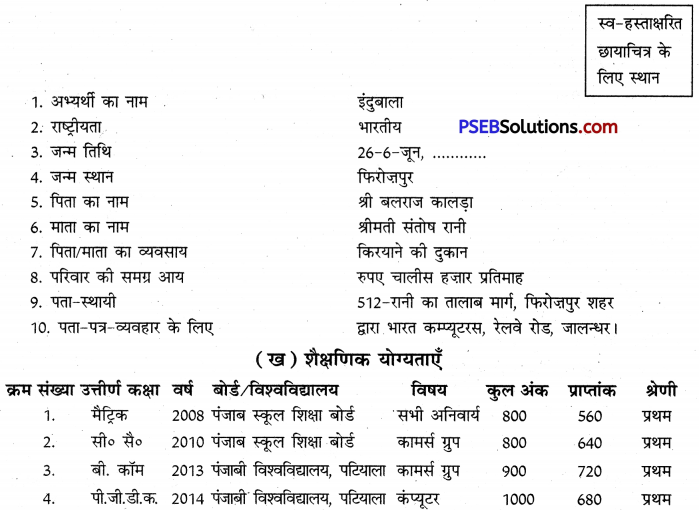
PSEB 10th Class Hindi Vyakaran प्रपत्र पूर्ति 2

(ग) व्यावसायिक अनुभव (यदि कोई हो)
PSEB 10th Class Hindi Vyakaran प्रपत्र पूर्ति 3

दसवीं के पाठ्यक्रम में बैंक, डाकघर तथा रेलवे से संबंधित प्रपत्रों की पूर्ति निर्धारित है। इसलिए यहाँ इन्हीं तीनों विभागों से संबंधित प्रपत्रों पर विस्तार से चर्चा की जा रही है-

(क) बैंक से संबंधित प्रपत्र
आधुनिक युग में बैंकों का हमारे दैनिक जीवन में बहुत महत्त्व है। इससे हमारे लेन-देन तथा व्यवसाय में बहुत सहायता मिलती है। बैंक में खाता खुलवाने के लिए कुछ प्रमाण-पत्रों की आवश्यकता होती है, जो निम्नलिखित हैं-

  1. आवासीय पते का प्रमाण-पत्र; जैसे-राशन कार्ड, आधार कार्ड, ड्राइविंग लाइसेंस, पासपोर्ट, वरिष्ठ नागरिक प्रमाण-पत्र आदि।
  2. जिस बैंक में खाता खुलवाना हो वहाँ के किसी खाताधारी से गवाही।
  3. फ़ोटो।
  4. पैनकार्ड की प्रतिलिपि।
  5. जन-धन योजना में शून्य राशि से खाता खुल सकता है।
  6. विद्यार्थियों को अपने विद्यालय के पहचान-पत्र तथा प्राचार्य के हस्ताक्षरित खाता खोलने के फार्म के आधार पर बैंक में शून्य राशि से खाता खोलने की सुविधा है।
  7. बैंक में खाता खोलने वाले को बैंक में अपने नमूने के हस्ताक्षर भी देने पड़ते हैं, जिससे कोई अन्य व्यक्ति उसके खाते से रुपए नहीं निकाल सके।
  8. बैंक में खाता खोलने के बाद मिलने वाले ए०टी०एम० कार्ड से खाता धारक किसी भी ए०टी०एम० बूथ से कभी भी पैसे निकलवा सकता है तथा खरीददारी भी कर सकता है।

बैंक में खातों के प्रकार-बैंक में खातों के अनेक प्रकार होते हैं; जैसे-बचत खाता, चालू खाता, आवर्ती खाता, सावधि जमा खाता आदि। विद्यार्थियों को बचत खाता खुलवाना चाहिए, जिसमें उनकी छात्रवृत्ति, अपनी बचत आदि जमा हो सकती है। बचत खाता, आवर्ती खाता तथा सावधि खाता पर बैंक जमा राशि पर नियमानुसार ब्याज भी देते हैं, जो खाताधारक के खाते में जमा होता रहता है। बैंक के लेन-देन में मुख्य रूप से निम्नलिखित प्रपत्र प्रयोग में आते हैं-

  1. बैंक में खाता खोलने का प्रपत्र
  2. रुपए नकद जमा करने का प्रपत्र
  3. राशि चैक द्वारा जमा करने का प्रपत्र
  4. रुपए निकलवाने का प्रपत्र/चैक
  5. ड्राफ्ट बनवाने का प्रपत्र।

यहां प्रमुख प्रपत्रों की रूपरेखा तथा उनके भरने के उदाहरण दिए जा रहे हैं-
1. बैंक में खाता खोलने का प्रपत्र

बैंक में खाता खोलने के प्रपत्र के प्रत्येक कॉलम को ध्यान से पढ़कर साफ़-साफ़ शब्दों में भरिए। खाता एक व्यक्ति अकेले या दो-तीन व्यक्ति मिलकर भी खोल सकते हैं तथा इस संबंध में परिचालन का विकल्प चुन सकते हैं। किसी खाता धारक से परिचय भी दिया जाता है तथा नामांकन का पूरा विवरण भी भरिए। नामिती नाबालिग हो तो उसके संरक्षक का नाम भी लिखना होता है। खाता खोलने हेतु आवेदन फार्म का एक उदाहरण यहां दिया जा रहा है-
1. खाता खोलने का प्रपत्र
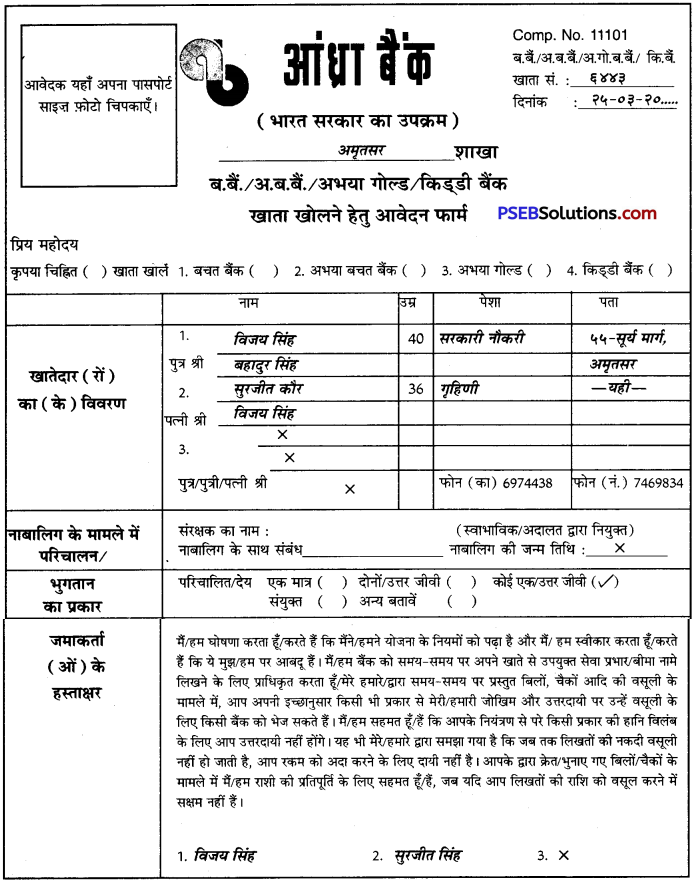
PSEB 10th Class Hindi Vyakaran प्रपत्र पूर्ति 4
PSEB 10th Class Hindi Vyakaran प्रपत्र पूर्ति 5

प्रश्न 1.
विद्यार्थियों को बैंक में खाता खुलवाने के लिए किन-किन दस्तावेज़ों की आवश्यकता होती है?
उत्तर:
आधुनिक युग में बैंकों का हमारे दैनिक जीवन में बहुत महत्त्व है। इससे हमारे लेन-देन तथा व्यवसाय में बहुत सहायता मिलती है। बैंक में खाता खुलवाने के लिए कुछ प्रमाण-पत्रों की आवश्यकता होती है, जो अग्रलिखित हैं-

  1. आवासीय पते का प्रमाण-पत्र ; जैसे-राशन कार्ड, आधार कार्ड, ड्राइविंग लाइसेंस, पासपोर्ट वरिष्ठ नागरिक प्रमाण-पत्र आदि।
  2. जिस बैंक में खाता खुलवाना हो वहाँ के किसी खाताधारी से गवाही।
  3. फ़ोटो।
  4. पैनकार्ड की प्रतिलिपि।
  5. जन-धन योजना में शून्यराशि से खाता खुल सकता है।
  6. विद्यार्थियों को अपने विद्यालय के पहचान-पत्र तथा प्राचार्य के हस्ताक्षरित खाता खोलने के फार्म के आधार पर बैंक में शून्य राशि से खाता खोलने की सुविधा है।
  7. बैंक में खाता खोलने वाले को बैंक में अपने नमूने के हस्ताक्षर भी देने पड़ते हैं, जिससे कोई अन्य व्यक्ति उसके ख़ाते से रुपए नहीं निकाल सके।

PSEB 10th Class Hindi Vyakaran प्रपत्र पूर्ति

2. बैंक में पैसे जमा कराने का प्रपत्र
बैंक में नकद राशि जमा करने के लिए जो प्रपत्र भरना होता है, उसके दो हिस्से होते हैं। एक बैंक की प्रति तथा दूसरी ग्राहक की प्रति होती है। इन दोनों हिस्सों को भरना होता है, जिसमें दिनांक, खाता संख्या, खाताधारी का नाम, जमा राशि तथा जमा राशि का विवरण कि किस-किस राशि के कितने नोट हैं लिखना होता है। दिए गए स्थान पर मोबाइल नंबर लिखकर जमाकर्ता के हस्ताक्षर होते हैं। यहाँ एक उदाहरण दिया जा रहा है जिसमें विजय सिंह और सुरजीत कौर के खाते में एक हज़ार रुपए नकद जमा करने के लिए प्रपत्र भरा गया है-
PSEB 10th Class Hindi Vyakaran प्रपत्र पूर्ति 6

3. बैंक में चैक द्वारा राशि जमा कराने का प्रपत्र बैंक में चैक जमा कराने का प्रपत्र भी दो भागों में होता है। एक प्रति बैंक की तथा दूसरी ग्राहक की होती है। इसमें दिनांक, खाते का प्रकार तथा संख्या, खातेदार का नाम, चैक संख्या, चैक जारी करने वाले बैंक तथा शाखा का नाम, दिनांक तथा राशि भरनी होती है। यहाँ एक उदाहरण दिया जा रहा है जिसमें मनमोहन सिंह अपने खाते में दस हज़ार रुपए का चैक जमा कर रहे हैं-
PSEB 10th Class Hindi Vyakaran प्रपत्र पूर्ति 7

4. बैंक से रुपए निकलवाने का प्रपत्र/चैक बैंक से रुपए निकलवाने के लिए बैंक के भगतान प्रपत्र तथा बैंक द्वारा दिए गए चैक का प्रयोग किया जाता है। चैक द्वारा किसी संस्था अथवा व्यक्ति को भी भुगतान कर सकते हैं। बैंक से भुगतान प्रपत्र पर रुपए निकलवाने के लिए पासबुक साथ लगानी पड़ती है। इसमें खातेदार अपने खाते की संख्या, निकाले जाने वाली राशि, दिनांक तथा अपने हस्ताक्षर कर के राशि निकलवा सकता है। प्रीतम कौर अपने खाते से दस हज़ार रुपए भुगतान प्रपत्र पर निकाल रही है। इसका उदाहरण यहाँ दिया जा रहा है-
PSEB 10th Class Hindi Vyakaran प्रपत्र पूर्ति 8
चैक द्वारा किसी को भुगतान करने अथवा स्वयं रुपए निकालने के लिए चैक में दिनांक, खाता संख्या, किसे भुगतान करना है, राशि तथा खाताधारी के हस्ताक्षर करना आवश्यक होता है। यहाँ एक चैक राजनाथ सिंह द्वारा भारतीय जीवन बीमा निगम को आठ हजार नौ सौ बीस रुपए का जारी किया गया है उसका प्रारूप यहाँ दिया जा रहा है। चैक को रेखांकित कर देना चाहिए इस चैक को कोई अन्य नहीं भुना सकता।
PSEB 10th Class Hindi Vyakaran प्रपत्र पूर्ति 9

5. बैंक ड्राफ्ट बनवाने का प्रपत्र
बैंक ड्राफ्ट एक मांग-प्रपत्र होता है, जिसे कोई भी व्यक्ति बैंक को निर्धारित शुल्क देकर बनवा सकता है। यह बैंक की एक शाखा द्वारा अपनी उस शाखा के नाम जारी किया जाता है जहाँ ग्राहक ने अपनी राशि भेजनी है। बैंक ड्राफ्ट पाने वाला व्यक्ति उस शाखा से ड्राफ्ट की राशि नकद अथवा अपने बैंक खाते में जमा करवा कर प्राप्त कर सकता है। बैंक ड्राफ्ट के प्रपत्र में दिनांक, आवेदन का नाम पता, किसके पक्ष में, कहाँ भेजना है, ड्राफ्ट की राशि, शुल्क आवेदक के हस्ताक्षर, मोबाइल नंबर भरने होते हैं। यहाँ राजेन्द्र सिंह द्वारा श्री रघुराज भालेराव पाठक को नागपुर पाँच हज़ार रुपए का ड्राफ्ट बनवाने का प्रपत्र उदाहरण के रूप में भरकर दिया जा रहा है। ड्राफ्ट के लिए राजेन्द्र सिंह ने दिए पाँच हजार तीस रुपए हैं परन्तु उसे ड्राफ्ट पांच हज़ार रुपए का ही मिलेगा। तीस रुपए ड्राफ्ट बनवाने का शुल्क है। इसके भी दो भाग होते हैं। एक ग्राहक के लिए तथा दूसरा बैंक के लिए-
PSEB 10th Class Hindi Vyakaran प्रपत्र पूर्ति 10

बोर्ड परीक्षाओं में पूछे गए प्रपत्र-पूर्ति सम्बन्धी प्रश्नोत्तर

प्रश्न 1.
मान लो आपका नाम निर्मला देवी है। आपको सेविंग्स बैंक खाता नं0 79684 में से दस हज़ार रुपये निकलवाने हैं। अत: आप नीचे दिए गए प्रपत्र की रूपरेखा को अपनी उत्तर-पुस्तिका पर उतार कर भरें-
PSEB 10th Class Hindi Vyakaran प्रपत्र पूर्ति 11
उत्तर:
PSEB 10th Class Hindi Vyakaran प्रपत्र पूर्ति 12

प्रश्न 2.
मान लो आपका नाम तमन्ना है। आपका मुख्य डाकघर, अमृतसर में बचत खाता नं0 764329 है। आपके इस खाते में ₹4,500/- हैं। आपको इस खाते में ₹ 1,500/- जमा करवाने हैं। इसलिए नीचे दिए गए प्रपत्र के प्रारुप को अपनी उत्तर-पुस्तिका पर उतार कर भरें-
PSEB 10th Class Hindi Vyakaran प्रपत्र पूर्ति 13
उत्तर:
PSEB 10th Class Hindi Vyakaran प्रपत्र पूर्ति 14

PSEB 10th Class Hindi Vyakaran प्रपत्र पूर्ति

प्रश्न 3.
मान लीजिए आपका नाम विनोद कुमार है। आप पटियाला में रहते हैं। आपको अपने बचत खाता नं० 17321986 में र दो हज़ार जमा करवाने हैं। अत: आप नीचे दिए गए प्रपत्र की रूपरेखा को अपनी उत्तरपुस्तिका पर उतार कर भरें-
PSEB 10th Class Hindi Vyakaran प्रपत्र पूर्ति 10
उत्तर:
PSEB 10th Class Hindi Vyakaran प्रपत्र पूर्ति 16

(ख) डाकघर से संबंधित प्रपत्र

डाकघर में भी बैंक की तरह अनेक प्रकार से लेन-देन होता है तथा यहाँ भी रुपए जमा करने, निकालने, मनीआर्डर से रुपए भेजने आदि से संबंधित अनेक कार्य होते हैं, जिनके लिए अनेक प्रपत्रों का प्रयोग करना पड़ता है। डाकखाने में प्रयोग में आने वाले मुख्य प्रपत्र अग्रलिखित हैं-

  1. खाता खोलने का प्रपत्र
  2. रुपए जमा कराने का प्रपत्र
  3. रुपए निकलवाने का प्रपत्र
  4. मनीआर्डर से रुपए भेजने का प्रपत्र

1. डाकघर में खाता खोलने का प्रपत्र
डाकघर में खाता खोलने के लिए दिए गए प्रपत्र को ध्यानपूर्वक पढ़कर सभी कॉलम साफ़-साफ़ शब्दों में भरने चाहिए। खाता एक व्यक्ति अथवा संयुक्त रूप से दो-तीन व्यक्ति भी खोल सकते हैं। परिचायक का नाम, पता तथा खातेदारों के हस्ताक्षर करने होते हैं। खाते में नामांकन भी किया जा सकता है। उदाहरण के लिए एक भरा हुआ प्रपंत्र यहाँ दिया जा रहा है-
डाकघर बचत-बैंक
खाता खोलने के लिए आवेदन पत्र
PSEB 10th Class Hindi Vyakaran प्रपत्र पूर्ति 17

4. मैंहम किसी भी समय सुसंगत नियम में विनिर्दिष्ट सीमा के भीतर अपने सभी एकल या संयुक्त बचत बैंक/सा० स० ज० खातों में अतिशेष बनाए रखने का और डाकघर बचत बैंक से मांग किए जाने पर ऐसे सभी खातों की विशिष्टियां भी देने का वचन देता हूँ/देते हैं।

5. मैं/हम केंद्रीय सरकार द्वारा बनाए गए ऐसे नियमों का पालन करने के लिए सहमत हूँ/हैं जो समय-समय पर खाते को लागू हों।

6. मैं हम सरकारी बचत बैंक अधिनियम, 1873 (1873 का 5) की धारा 4 के अधीन नीचे व्यक्ति (व्यक्तियों) को अपनी मृत्यु हो जाने की दशा में खाते में जमा रकम के लिए एकमात्र प्राप्तकर्ता (प्राप्तकर्ताओं) के रूप में नाम निर्दिष्ट करता हूँ करते हैं।
PSEB 10th Class Hindi Vyakaran प्रपत्र पूर्ति 18

2. डाकघर में पैसे जमा कराने का प्रपत्र
डाकघर में धनराशि जमा करवाने के प्रपत्र में खाताधारी को डाकघर का पता, दिनांक, खातेधारी का नाम, खाता संख्या, जमा कराने की राशि शब्दों और अंकों में, जमा के बाद कुल राशि लिख कर अपने हस्ताक्षर करने होते हैं। इसके साथ डाकघर बचत बैंक की पास बुक भी लगानी होती है, जिसमें बचत बैंक सहायक जमा की गई राशि लिखकर, डाकघर की मोहर लगाकर तथा अपने हस्ताक्षर कर जमाकर्ता को वापिस कर देता है। यहां जालंधर के डाकघर में सतीश कुमार शर्मा के खाता संख्या 1901 में एक हज़ार रुपए जमा करने के प्रपत्र को भरकर उदाहरण के रूप में दिया जा रहा है।
PSEB 10th Class Hindi Vyakaran प्रपत्र पूर्ति 19

3. डाकघर बचत बैंक से पैसे निकलवाने का प्रपत्र
डाकघर बचत बैंक से पैसे निकलवाने के लिए प्रपत्र में जमाकर्ता को डाकघर का नाम, दिनांक, खाता संख्या, निकाली गई राशि, शेष राशि, यदि आवश्यकता हो तो संदेशवाहक का नाम, हस्ताक्षर देने होते हैं। अदायगी आदेश में राशि मिलने के हस्ताक्षर खातेदार अथवा संदेशवाहक द्वारा किए जाते हैं। यहां एक उदाहरण के रूप में भरा हुआ प्रपत्र दिया जा रहा है-
PSEB 10th Class Hindi Vyakaran प्रपत्र पूर्ति 20

PSEB 10th Class Hindi Vyakaran प्रपत्र पूर्ति

प्रश्न 3.
मान लीजिए आपका नाम नरेश कुमार है। आपको लोकेश कुमार को दिनांक 10.04.2016 को ₹10,000/- का स्वहस्ताक्षरित रेखांकित किया हुआ चेक लिखकर देना है। इस अनुसार निम्नलिखित चेक के प्रपत्र को भरें-
PSEB 10th Class Hindi Vyakaran प्रपत्र पूर्ति 21
उत्तर:
PSEB 10th Class Hindi Vyakaran प्रपत्र पूर्ति 22

4. मनीऑर्डर से रुपये भेजने का प्रपत्र
मनीऑर्डर से रुपए भेजने का काम डाकघर में वर्षों से हो रहा है। डाकघर से मनीऑर्डर प्रपत्र लेकर भरना होता है। इसके 6 भाग होते हैं। पहला भाग जिसे रुपये भेजने हैं रुपयों की संख्या शब्दों और अंकों में प्राप्तकर्ता का नाम, पता, पिनकोड, दिनांक लिखकर भेजने वाला अपने हस्ताक्षरकर्ता है। चौथा भाग में भेजने वाले का नाम पता तथा पिन कोड लिखना होता है। छठे भाग में भेजने वाला संदेश लिख सकता है। दूसरा, तीसरा और पांचवां भाग डाक विभाग ने भरना होता है। डाविभाग भेजने वाली राशि पर निर्धारित शुल्क भी लेता है। यहाँ मनीऑर्डर प्रपत्र को भर कर प्रस्तुत किया जा रहा है-
PSEB 10th Class Hindi Vyakaran प्रपत्र पूर्ति 23
(संदेश के लिए स्थान)
जालन्धर शहर प्रिय, सुजान
02-12-2000 तुम्हारे पत्र के अनुसार 800 सौ रुपए भेज रहे हैं । मिलने पर सूचना देना और रुपयों की ज़रूरत हो तो लिखना। सब को सत श्री अकाल कहना।
तुम्हारा मित्र,
सुखदेव सिंह

5. इलेक्ट्रानिक मनीआर्डर (ई०एम०ओ०) आधुनिक युग में इंटरनेट की प्रगति के साथ-साथ अपनी धनराशि किसी दूसरे को भेजने का इलेक्ट्रानिक मनीऑर्डर जल्दी से जल्दी और सरलता से भेजने का डाक विभाग द्वारा चलाया गया मनीऑर्डर का नया रूप है। इससे आम मनीआर्डर भेजने की अपेक्षा कम समय लगता है। जिस दिन ई०एम०ओ० किया जाता है, वह उसी दिन प्राप्तकर्ता को मिल जाता है। इस पर भी डाक विभाग निर्धारित शुल्क लेता है। इसके प्रपत्र की रूपरेखा यहाँ प्रस्तुत की जा रही है-
PSEB 10th Class Hindi Vyakaran प्रपत्र पूर्ति 24

6. मोबाइल मनीट्रांसफर सर्विस (इंसटेंट मनीऑर्डर) मोबाइल मनीट्रांसफर सर्विस धन भेजने का सबसे तेज़, सुविधाजनक, विश्वसनीय और सरल माध्यम है। इसे इंसटेट मनीऑर्डर अथवा तत्काल मनीआर्डर भी कहते हैं। इस माध्यम से कुछ ही मिनटों में धनराशि प्राप्तकर्ता को मिल जाती है। डाकघर से प्राप्त प्रपत्र को भर कर अधिकारी को देने पर प्रेषक को कम्प्यूटर द्वारा सोलह अंकों का सीलबंद गुप्त नम्बर दिया जाता है, जिसे प्रेषक प्राप्तकर्ता को फोन, एस०एम०एस० अथवा ई-मेल द्वारा बता देता है, जो इंसटेंट मनीऑर्डर के अपने नगर के केंद्र पर जाकर वहाँ के अधिकारी को बताता है तथा अपनी पहचान का फोटो पहचानपत्र दिखाकर प्रेषक द्वारा उसे भेजी गई राशि प्राप्त कर सकता है। इस सेवा में उन्नीस हज़ार रुपए तक की राशि नकद प्राप्त की जा सकती है जबकि बीस हज़ार रुपए अथवा उससे अधिक राशि का भुगतान चैक द्वारा किया जाता है। इस सेवा को प्राप्त करने का प्रपत्र अग्रलिखित है-
PSEB 10th Class Hindi Vyakaran प्रपत्र पूर्ति 25

PSEB 10th Class Hindi Vyakaran प्रपत्र पूर्ति

प्रश्न 1.
इन्सटेंट मनीऑडर्र (आई०एम०ओ) किसे कहते हैं?
उत्तर:
मोबाइल मनीट्रांसफर सर्विस धन भेजने का सबसे तेज़, सुविधाजनक, विश्वसनीय और सरल माध्यम है। इसे इंसटेट मनीऑर्डर अथवा तत्काल मनीआर्डर भी कहते हैं। इस माध्यम से कुछ ही मिनटों में धनराशि प्राप्तकर्ता को मिल जाती है। डाकघर से प्राप्त प्रपत्र को भरकर अधिकारी को देने पर प्रेषक को कम्प्यूटर द्वारा सोलह अंकों का सीलबंद गुप्त नम्बर दिया जाता है, जिसे प्रेषक प्राप्तकर्ता को फोन, एस०एम०एस० अथवा ई०-मेल द्वारा बता देता है, जो इंसटेंट मनीऑर्डर के अपने नगर के केंद्र पर जाकर वहाँ के अधिकारी को बताता है तथा अपनी पहचान का फोटो पहचानपत्र दिखाकर प्रेषक द्वारा उसे भेजी गई राशि प्राप्त कर सकता है। इस सेवा में उन्नीस हजार रुपए तक की राशि नकद प्राप्त की जा सकती है जबकि बीस हज़ार रुपए अथवा उससे अधिक राशि का भुगतान चैक द्वारा किया जाता है।

7. अंतर्राष्ट्रीय धन अंतरण
डाकघर में विदेशों से धन मंगवाने अथवा भेजने के लिए मनीऑर्डर सेवाओं के अन्तर्गत अंतर्राष्ट्रीय धन अंतरण सेवा, मनीग्राम, इलेक्ट्रानिक क्लियरेंस सेवाएं (ई०सी०एस०) आदि भी समुचित मूल्य पर उपलब्ध हैं।

8. इंडियन पोस्टल ऑर्डर
इंडियन पोस्टल ऑर्डर डाकघर से निश्चित राशि के प्राप्त किये जा सकते हैं। इनके द्वारा एक व्यक्ति किसी दूसरे व्यक्ति अथवा संस्था को धनराशि भेज सकता है। ये भारत के सभी डाकघरों से प्राप्त किए जा सकते हैं। विभिन्न प्रतियोगी परीक्षाओं, नौकरियों के आवेदन-पत्रों आदि का शुल्क इंडियन पोस्टल ऑर्डर द्वारा मांगा जाता है। इन्हें रेखांकित भी कर सकते हैं। इसकी खरीद तिथि से वैधता दो वर्षों की होती है। इसे प्रयोग नहीं करने पर निश्चित अवधि में वापस करने पर खरीदी हुई राशि वापस भी ली जा सकती है।

इसके दो भाग फॉइल और काउंटर फॉइल होते हैं जिसके नाम इंडियन पोस्टल ऑर्डर भेजा जाता है उसे फॉइल कहते हैं और जो हिस्सा भेजने वाले के पास रहता है उसे काउंटर फॉइल कहते हैं। पोस्टल आर्डर में राशि प्राप्तकर्ता का नाम, पता, शहर, प्रेषक का नाम पता, दिनांक तथा जिस डाकघर से प्राप्तकर्ता को धनराशि प्राप्त करनी है उसका नाम लिखा जाता है। यदि इसे रेखाकिंत करना है तो वह भी किया जाता है। यहाँ इंडियन पोस्टल ऑर्डर का एक उदाहरण दिया जा रहा है, जिसमें गुरनाम सिंह, फिरोजपुर, पंजाब लोक सेवा आयोग, लुधियाना को एक रुपए का पोस्टल ऑर्डर भेज रहा है-
PSEB 10th Class Hindi Vyakaran प्रपत्र पूर्ति 26

9. रजिस्ट्री-पत्र की पावती
डाकघर से किसी को रजिस्ट्री-पत्र भेजते समय उसके साथ रजिस्ट्री-पत्र की पावती भी लगानी होती है। यह पावती रजिस्ट्री-पत्र प्राप्तकर्ता हस्ताक्षर कर प्रेषक के पास भेज देता है। इसमें भेजने वाले को अपना तथा प्राप्तकर्ता का पूरा पता लिखना होता है। इसके आगे-पीछे दो भाग होते हैं। इसका प्रारूप निम्नलिखित है-
रजिस्ट्री-पावती प्रपत्र
PSEB 10th Class Hindi Vyakaran प्रपत्र पूर्ति 27
PSEB 10th Class Hindi Vyakaran प्रपत्र पूर्ति 28

(ग) रेलवे आरक्षण प्रपत्र
रेलवे में आरक्षण करवाने अथवा आरक्षण रद्द करवाने के लिए प्रपत्र भरना होता है। दोनों ही स्थितियों में एक प्रकार का ही प्रपत्र प्रयोग में आता है। भरने से पहले उस पर लिखना होता है कि आरक्षण लेने के लिए प्रपत्र भर रहे हैं । अथवा आरक्षण रद्द करवाने के लिए। इस प्रपत्र में तीन भाग होते हैं । प्रथम भाग में आरक्षण लेने अथवा रद्द की जाने वाली रेलगाड़ी का नाम, क्रमांक, यात्रा करने की तिथि, श्रेणी, कहां से कहाँ तक, यात्रियों के नाम, आयु, लिंग, आवेदक का नाम, पता, मोबाइल नम्बर तथा हस्ताक्षर होते हैं। दूसरा भाग में वापसी यात्रा का विवरण तथा तीसरा भाग रेलवे के कर्मचारी भरते हैं। इसका एक उदाहरण यहाँ दिया जा रहा है-

रेलवे आरक्षण कराने के लिए प्रपत्र का नमूना
उत्तर:
PSEB 10th Class Hindi Vyakaran प्रपत्र पूर्ति 29

आगे की यात्रा/वापसी यात्रा का विवरण
PSEB 10th Class Hindi Vyakaran प्रपत्र पूर्ति 30

टिप्पणी : 1. अधिकतम अनुपेय यात्रियों की संख्या प्रति मांग पत्र 6 व्यक्ति।
2. एक बार एक व्यक्ति से केवल एक ही मांग पत्र स्वीकार किया जाएगा।
3. कृपया खिड़की छोड़ने से पहले अपने टिकट और शेष राशि की जांच कर लें।
4. ठीक ढंग से न भरे हुए तथा अपठनीय फार्म स्वीकार नहीं किए जाएंगे।
5. विशेष मांग पर उपलब्धता के आधार पर विचार किया जाएगा।

अब रेलवे आरक्षण/आरक्षण रद्द करने की सुविधा इंटरनेट/मोबाइल फोन द्वारा भी उपलब्ध है, जिसकी पूरी जानकारी आई०आर०सी०टी०सी० की बेबसाइट पर उपलब्ध है।

1. मान लीजिए आपका नाम तमन्ना शर्मा है।आपका गुड बैंक, शाखा गंगानगर में एक बचत खाता है। आपका खाता नम्बर-45632789 है। आपका मोबाइल नं0 1009321432 है। आपको दिनांक 22.10.2015 को अपने इस खाते में 12,000 रुपये नकद जमा करवाने हैं। आपके पास जमा करवाने के लिए एक हज़ार के 8 नोट, पांच सौ के नोट तथा पचास के 20 नोट हैं। इस अनुसार निम्नलिखित प्रपत्र भरें:
उत्तर:
गुड बैंक, गंगानगर
बैंक में रुपये जमा करवाने के लिए प्रपत्र ( बैंक प्रति)
PSEB 10th Class Hindi Vyakaran प्रपत्र पूर्ति 31

गुड बैंक, गंगानगर
बैंक में रुपये जमा करवाने के लिए प्रपत्र (ग्राहक प्रति)
PSEB 10th Class Hindi Vyakaran प्रपत्र पूर्ति 32

PSEB 10th Class Hindi Vyakaran प्रपत्र पूर्ति

2. मान लीजिए आपका नाम रत्नलीन कौर है। आपका मोबाइल नम्बर 1890876535 है। आपका हिमालय बैंक, शाखा सोलन में एक बचत खाता नम्बर 96237180 है। आपको दिनांक 11.08.2015 को अपने इस खाते में से 7,000 रुपये निकालवाने हैं। इस अनुसार निम्नलिखित प्रपत्र भरें
उत्तर:
PSEB 10th Class Hindi Vyakaran प्रपत्र पूर्ति 33

3. मान लीजिए आपका नाम प्रकाश सिंह है। आपका भारतीय डाक के सेक्टर 15 चंडीगढ़ में 344565 नम्बर एक बचत खाता है। आपके इस खाते में अब तक 45,000 रुपये जमा हैं। आपको दिनांक 02.01.2016 को अपने इस खाते में से 4,000 रुपये निकलवाने हैं। इस अनुसार निम्नलिखित प्रपत्र भरें:
उत्तर:
PSEB 10th Class Hindi Vyakaran प्रपत्र पूर्ति 34
PSEB 10th Class Hindi Vyakaran प्रपत्र पूर्ति 35

4. मान लीजिए आपका नाम तुषार कपूर है। आप मकान नं० 987, पुरानी दिल्ली रोड, गुड़गाँव (हरियाणा)-122001 में रहते हैं। आपका बेटा मकान नं० 456 सिविल लाइन्स बरेली (उत्तर प्रदेश) 243001 में रहता है। आप अपने बेटे को भारतीय डाक के माध्यम से दिनांक 05.11.2015 को मनीआर्डर के द्वारा 5,000/- रुपये भेजना चाहते हैं। इस प्रपत्र में उसे संदेश भी लिखें ‘अपनी सेहत का ध्यान रखना’। इस अनुसार निम्नलिखित प्रपत्र भरें।
PSEB 10th Class Hindi Vyakaran प्रपत्र पूर्ति 36

5. मान लीजिए आपका नाम शिखर कुमार है। आपको लोकेश कुमार को दिनांक 6.12.15 को 10,000/- रु० का स्वहस्ताक्षरित रेखांकित किया हुआ चेक लिखकर देना है। इस अनुसार निम्नलिखित चैक के प्रपत्र को भरें:
PSEB 10th Class Hindi Vyakaran प्रपत्र पूर्ति 37

बोर्ड परीक्षा में पूछे गए प्रश्न

निम्नलिखित में से किसी एक प्रपत्र को अपनी उत्तर-पुस्तिका पर उतारकर भरें
1. (क) मान लीजिए आपका नाम सुलोचना कुमारी है। आपका हिमालय बैंक, शाखा-शिमला में एक बचत खाता है, जिसका नम्बर, 18954326781 है। आपको अपने इस खाते में से 2500 रुपये निकलवाने हैं। इस अनुसार निम्नलिखित प्रपत्र भरें-
PSEB 10th Class Hindi Vyakaran प्रपत्र पूर्ति 38
उत्तर:
PSEB 10th Class Hindi Vyakaran प्रपत्र पूर्ति 39

(ख) मान लीजिए आपका नाम रूप सिंह है। आपका भारतीय डाक के सेक्टर 15, करनाल में एक बचत खाता है, जिसका नम्बर 128947654431 है। आपको अपने इस खाते में से 4000/- रुपये निकलवाने हैं। इस अनुसार निम्नलिखित प्रपत्र भरें:
PSEB 10th Class Hindi Vyakaran प्रपत्र पूर्ति 40
उत्तर:
PSEB 10th Class Hindi Vyakaran प्रपत्र पूर्ति 41

PSEB 10th Class Hindi Vyakaran प्रपत्र पूर्ति

2. (क) मान लीजिए आपका नाम पीयूष सिन्हा है। आपका कल्याण बैंक, शाखा-भुवनेश्वर में एक बचत खाता है, जिसका नम्बर 1150000234567 है। आपको अपने इस खाते में 18000/- रुपये जमा करवाने हैं। इस अनुसार निम्नलिखित प्रपत्र भरें:

PSEB 10th Class Hindi Vyakaran प्रपत्र पूर्ति 42
उत्तर:
PSEB 10th Class Hindi Vyakaran प्रपत्र पूर्ति 43

(ख) मान लीजिए आपका नाम दीदार सिंह है। आपका भारतीय डाक के सेक्टर-25, देहरादून में एक बचत खाता है, जिसका नम्बर 18634956744 है। आपको अपने इस खाते में से 10000/- रुपये निकलवाने हैं। इस अनुसार निम्नलिखित प्रपत्र भरें:
PSEB 10th Class Hindi Vyakaran प्रपत्र पूर्ति 44
उत्तर:
PSEB 10th Class Hindi Vyakaran प्रपत्र पूर्ति 45

3. (क) मान लीजिए आपका नाम निर्मला कौर है। आपका भारतीय डाक के सेक्टर-42, जम्मू में एक बचत खाता है, जिसका नम्बर 62745367823 है। आपको अपने इस खाते से 8200/- रुपये निकलवाने हैं। इस अनुसार निम्नलिखित प्रपत्र भरें-
PSEB 10th Class Hindi Vyakaran प्रपत्र पूर्ति 46
उत्तर:
PSEB 10th Class Hindi Vyakaran प्रपत्र पूर्ति 47

(ख) मान लीजिए आपका नाम दिनेश कुमार है। आपको मुनीश कुमार को 12000/- रु० का स्वहस्ताक्षरित चेक लिखकर देना है। इस अनुसार निम्नलिखित चेक के प्रपत्र को भरें:

PSEB 10th Class Hindi Vyakaran प्रपत्र पूर्ति 48
उत्तर:
PSEB 10th Class Hindi Vyakaran प्रपत्र पूर्ति 49

4. (क) निम्नलिखित में से किसी एक प्रपत्र को अपनी उत्तर-पुस्तिका पर उतारकर भरें-
(i) मान लीजिए आपका नाम पूनम कुमारी है। आपका भविष्य बैंक, शाखा-शिमला में एक बचत खाता है, जिसका नम्बर 373748488 है। आपको अपने इस खाते में से ₹ 5500/- निकलवाने हैं। इस अनुसार
निम्नलिखित प्रपत्र की रूपरेखा अपनी उत्तर पुस्तिका पर उतार कर भरें-
PSEB 10th Class Hindi Vyakaran प्रपत्र पूर्ति 50
उत्तर:
PSEB 10th Class Hindi Vyakaran प्रपत्र पूर्ति 51

PSEB 10th Class Hindi Vyakaran प्रपत्र पूर्ति

(ख) मान लीजिए आपका नाम सुप्रिया देवी है। आपका भारतीय डाक के सेक्टर-15 नोएडा में एक बचत खाता है, जिसका नम्बर 834747993 है। आपको अपने इस खाते में से दिनांक 23.05.2018 को ₹4500/- निकलवाने हैं। इस अनुसार अग्रलिखित प्रपत्र की रूपरेखा अपनी उत्तर-पुस्तिका पर उतार कर भरें:
PSEB 10th Class Hindi Vyakaran प्रपत्र पूर्ति 52
उत्तर:
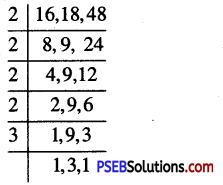
PSEB 10th Class Hindi Vyakaran प्रपत्र पूर्ति 53

PSEB 9th Class Maths Solutions Chapter 5 Introduction to Euclid’s Geometry Ex 5.2

Punjab State Board PSEB 9th Class Maths Book Solutions Chapter 5 Introduction to Euclid’s Geometry Ex 5.2 Textbook Exercise Questions and Answers.

PSEB Solutions for Class 9 Maths Chapter 5 Introduction to Euclid’s Geometry Ex 5.2

Question 1.
How would you rewrite Euclid’s fifth postulate so that it would be easier to understand?
Answer:
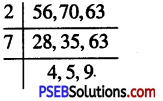
‘When a straight line l falls on two other straight lines m and n, it makes four interior angles. If the sum of two interior angles on the same side of line l is 180°, then lines m and n will never intersect each other, i.e., lines m and n are parallel line.

PSEB 9th Class Maths Solutions Chapter 5 Introduction to Euclid's Geometry Ex 5.2

Question 2.
Does Euclid’s fifth postulate imply the existence of parallel lines? Explain.
Answer:
Yes. Euclid’s fifth postulate implies the existence of parallel lines. If a straight line l falls on two straight lines m and n such that the sum of the interior angles on one side of l is two right angles (180°), then by Euclid’s fifth postulate the lines m and n will not meet on this side of l. At the same time, the sum of the Interior angles on the other side of l will also be two right angles (180°). Hence, lines m and n will not meet on that side of l also. Thus, m and n will never meet if the sum of the interior angles on one side is two right angles (180°). This states that lines m and n are parallel.