PSEB 9th Class Maths Solutions Chapter 5 Introduction to Euclid’s Geometry Ex 5.1

Punjab State Board PSEB 9th Class Maths Book Solutions Chapter 5 Introduction to Euclid’s Geometry Ex 5.1 Textbook Exercise Questions and Answers.

PSEB Solutions for Class 9 Maths Chapter 5 Introduction to Euclid’s Geometry Ex 5.1

Question 1.
Which of the following statements are true and which are false? Give reasons for your answers:
(i) Only one line can pass through a single point.
Answer:
lines or perpendicular lines where two lines pass through their point of intersection which is always unique.

(ii) There are an infinite number of lines which pass through two distinct points.
Answer:
The given statement is false because if it is so. the distance between two points can never be defined. Also, it contradicts postulate 1.

PSEB 9th Class Maths Solutions Chapter 5 Introduction to Euclid's Geometry Ex 5.1

(iii) A terminated line can be produced indefinitely on both the sides.
Answer:
The given statement is true according to postulate 2.

(iv) If two circles are equal, then their radii are equal.
Answer:
The given statement is true. if two circles are equal. their circumferences as well as their centres will coincide when placed on each other. Now, radius is the distance between centre of a circle and any point on the circle. Hence, their radii are also equal.

(v) In the given figure, if AB = PQ and PQ = XY, then AB = XY.
PSEB 9th Class Maths Solutions Chapter 5 Introduction to Euclid's Geometry Ex 5.1 1
Answer:
The given statement is true according to axiom 1. Here. AB and XY are equal to the same thing PQ. Hence, AB and XY are equal, i.e., AB = XY.

PSEB 9th Class Maths Solutions Chapter 5 Introduction to Euclid's Geometry Ex 5.1

Question 2.
Give a definition for each of the following terms. Are there other terms that need to be defined first? What are they, and how might you define them?
(i) Parallel lines
Answer:
Parallel lines: Two lines which lie in the same plane and do not intersect anywhere are called parallel lines.

(ii) Perpendicular lines
Answer:
Perpendicular lines: Two lines intersecting each other at right angles are called perpendicular lines.

(iii) Line segment
Answer:
Line segment: Line segment is a part of a line and having two end-points. In other words, line segment is a terminated line.

PSEB 9th Class Maths Solutions Chapter 5 Introduction to Euclid's Geometry Ex 5.1

(iv) Radius of a circle
Answer:
Radius of a circle: Any line segment joining the centre of a circle to any point on its circumference is called a radius of a circle.
Note : The length of the radius of a circle is also referred as radius of the circle.

(v) Square
Answer:
Square: A quadrilateral with all the four sides equal and all the four angles equal (90° each) is called a square.
There are many other terms like line, plane, right angle, centre of a circle, circumference and quadrilateral that need to be defined first. Among them, line and plane cannot be defined so they are taken as undefined terms. Other four terms can be defined as below:

  • Right angle: An angle of 90° is called a right angle.
  • Centre of a circle: A point in the plane of a circle which is equidistant from all the points of the circle is called the centre of the circle.
  • Circumference: The length of the boundary of a circle is called its circumference.
  • Quadrilateral: A closed plane figure having four sides and four angles is called a quadrilateral.

PSEB 9th Class Maths Solutions Chapter 5 Introduction to Euclid's Geometry Ex 5.1

Question 3.
Consider two ‘postulates’ given below:
(i) Given any two distinc’t points A and B, there exists a third point C which is in between A and B.
(ii) There exist at least three points that are not on the same line.
Do these postulates contain any undefined terms? Are these postulates consistent? Do they follow from Euclid’s postulates? Explain.
Answer:
Yes. These postulates contain undefined terms like point and line.
Yes. These postulates are consistent.
Postulate (i) states that given two distinct points A and B, there is a point C on line AB which lies between A and B.
Postulate (ii) states that given two distinct points A and B. we have atleast one point C which does not lie on line AB.
These postulates do not follow from Euclid’s postulates. They follow from axiom 5.1.

Question 4.
If a point C lies between two points A and B such that AC = BC. then prove that AC = \(\frac{1}{2}\)AB. Explain by drawing the figure.
Answer:
AC = BC
∴ AC + AC = BC + AC
[Equals are added to equals and axiom 2]
∴ 2AC = AB [BC + AC coincides with AB and axiom 4]
∴ \(\frac{1}{2}\)(2AC) = \(\frac{1}{2}\)AB lAxiom 7]
∴ AC = \(\frac{1}{2}\)AB

PSEB 9th Class Maths Solutions Chapter 5 Introduction to Euclid's Geometry Ex 5.1 2

PSEB 9th Class Maths Solutions Chapter 5 Introduction to Euclid's Geometry Ex 5.1

Question 5.
In Q. 4, point C is called a midpoint of line segment AB. Prove that every line segment has one and only one midpoint.
Answer:
From question 4, we get two properties of the midpoint C of line segment AB. (i) C is a point lying on line segment AB between A and 8. (ii) C is equidistant from A and B.

If possible, suppose point D other than point C is also a midpoint of line segment AB. Then, according to question 4, we have AD = \(\frac{1}{2}\) AB.
Moreover. AC = \(\frac{1}{2}\) AB is proved in Q. 4.
∴ AD = AC [Axiom 1]
Now, D and C both lie on line segment AB between A and B and at the same distance from A. This proves that D and C are the same points. Hence, every line segment has one and only one midpoint.

Question 6.
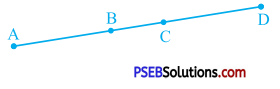
In the given figure, if AC = BD, then prove that AB = CD.
PSEB 9th Class Maths Solutions Chapter 5 Introduction to Euclid's Geometry Ex 5.1 3
Answer:
AC = BD (Given)
∴ AB + BC = BC + CD (AB + BC coincides with AC and BC + CD coincides with BD]
∴ AB + BC – BC = BC + CD – BC
[Subtracting equals from equals and axiom 3]
∴ AB = CD

PSEB 9th Class Maths Solutions Chapter 5 Introduction to Euclid's Geometry Ex 5.1

Question 7.
Why is axiom 5, in the list of Euclid’s axioms, considered a ‘universal truth’? (Note that the question is not about the fifth postulate.)
Answer:
Euclid’s axiom 5 states that the whole is greater than a part. The word part itself is meant for something which is less than the whole. This is true for anything in any part of the world. So, it is considered as a ‘universal truth’.

PSEB 9th Class Science Notes Chapter 14 Natural Resources

This PSEB 9th Class Science Notes Chapter 14 Natural Resources will help you in revision during exams.

PSEB 9th Class Science Notes Chapter 14 Natural Resources

→ Earth is the only planet on which life exists.

→ Life on earth depends upon ambient temperature, water, and food.

→ The resources on earth are equally important.

→ The most important requirement is solar energy.

PSEB 9th Class Science Notes Chapter 14 Natural Resources

→ The environment is the surroundings of an organism and influences its life.
or
The environment is the sum total of all the components both from living and non-living ones.

→ The living or biotic components include plants, animals, and microorganisms whereas non-living or abiotic or physical components consists of air, water, soil, light, and temperature.

→ The habitat of plants and animals greatly varies.

→ Natural resources. It is the stock of nature such as air, water, soil, coal, minerals, animals, and plants that are useful to mankind in many ways.

→ Life on earth depends upon resources like soil, water, air, and energy from the sun. Inexhaustible resources are present in plenty and cannot be exhausted by man’s consumption.

→ The stock of exhaustible natural resources in nature is limited and will finish sooner or later.

→ Air is an important form of inexhaustible natural resource which is essential for our survival.

→ Composition of Air:

  • Nitrogen (N2) – 78%
  • Oxygen (O2) – 21%
  • Carbon dioxide (CO2) – 0.03%
  • Argon – 0.93%
  • Helium, Neon, Ozone, Ammonia – 0.04%

→ Helium, Argon, and Neon are noble gases.

PSEB 9th Class Science Notes Chapter 14 Natural Resources

→ Lithosphere: It is the outer crust of our planet, the Earth.

→ Hydrosphere: It is the portion of the earth’s surface covered with water which is about 75 percent—comprising of seas, oceans, rivers, streams, lakes, ponds, etc.

→ Atmosphere: It is the multilayered gaseous envelope of air that covers the whole of our planet Earth like a blanket.

→ Atmosphere plays important role in the control of climate, movement of air (winds), and rain.

→ Biosphere: It is the life-supporting zone of the Earth where the atmosphere, the hydrosphere, and the lithosphere interact and make life possible.

→ It occupies the highest position or level in the hierarchy of organisation on the earth.

→ Water is an important medium for all the life processes and acts as a universal solvent and is termed ‘wonder liquid’.

→ Water covers 75% of the earth’s surface.

→ The oceans, rivers, streams, lakes, ponds, pools, polar ice caps, water vapours constitute the hydrosphere.

→ Soil is another main natural resource essential for our survival and development.

→ Soil forms the upper surface of the land and supports plant growth.

→ Soil is an important resource that decides the diversity of life in an area.

PSEB 9th Class Science Notes Chapter 14 Natural Resources

→ The outermost layer of Earth is called the crust and the minerals found in this layer supply a variety of nutrients to life forms.

→ Causes of Soil Erosion:

  • Wind causes soil erosion by carrying away the top loose soil particles.
  • Rain causes soil erosion on unprotected topsoil by washing it down.
  • Improper farming or tilling and leaving the field fallow for a long time causes soil erosion.
  • Frequent flooding of rivers causes soil erosion by removing the fertile topsoil of the fields near the river banks.
  • Deforestation also leads to soil erosion.

→ The underground reservoir of the earth of metals and minerals is limited.

→ Renewable sources of energy are regenerated naturally within a short span of time e.g. plants, animals, sunlight, etc.

→ Non-renewable sources of energy take millions of years to form like coal, lignite, petroleum, and natural gas.

→ The substances like water, oxygen, carbon, and nitrogen move from one stage to another say from biotic to abiotic and again to biotic components in a cyclic manner.

→ Air Pollution: It is an undesirable change in the physical, chemical, or biological characteristics of air. It is caused due to an increase in the content of harmful substances (air pollutants) in the air such as oxides of nitrogen and sulphur, etc.

→ The major sources of air pollution are the burning of fossil fuels like coal and petroleum, automobiles, thermal power plants, and industries.

→ Pollution of air, water, and soil affects the quality of life and harms biodiversity.

→ Water Pollution is the contamination of the water of rivers and lakes with unwanted and harmful substances.

PSEB 9th Class Science Notes Chapter 14 Natural Resources

→ Water is said to be polluted when there is any physical, biological, or chemical change in its quality that adversely affects living organisms and makes it unfit for use.

→ The balance in the environment including the flow of energy and matters is also supported by various living beings by acting as producers and consumers.

→ Forests provide timber for building and furniture along with raw materials for the paper industry.

→ Ozone layer: Ozone is a triatomic gas with a molecular formula O3 which is present in the upper reaches of the atmosphere (in the stratosphere region).

→ The ozone layer prevents the harmful radiations of the sun from reaching the surface of the earth, where they may damage many forms of life.

→ Role of ozone: Unlike oxygen, ozone is poisonous but it performs a very important role for us.

→ It forms a thick layer in the upper regions of the atmosphere and absorbs harmful radiation from the sun.

→ This prevents those harmful radiations from reaching the surface of the Earth where they may damage many forms of life.

→ CO2 forms 95-97% of the atmosphere on Venus and Mars.

→ On the moon, the temperature ranges from -190°C to 110°C.

→ Smog formed by smoke and fog is a visible indication of air pollution.

PSEB 9th Class Science Notes Chapter 14 Natural Resources

→ Exhaustible Resources: These resources are limited in nature and will finish sooner or later.

→ Inexhaustible resources: These resources are unlimited and cannot be exhausted by man’s consumption.

→ Renewable resources: These resources are naturally replenished after man’s consumption.

→ Non-Renewable Resources: These resources cannot be replaced after they are used.

→ Underground Water: The water present below the soil is called underground water.

→ Crust: Topmost surface of the earth is called the crust.

→ Mineral resources: These resources are present on earth and are non-renewable.

→ Atmosphere: It is a transparent gaseous envelope surrounding the earth.

→ Pollution: It is an undesirable change in physical, chemical, or biological characteristics of the water and soil.

→ Acid rain: When gases like SO2 and SO3 react with water to form sulphuric acid and sulphurous acid and precipitate as rain is called acid rain.

→ Smoke: It is a secondary pollutant produced as a result of reactions of products of incomplete combustion.

→ Smog: Combination of smoke and fog forms smog (Smoke + fog = Smog).

→ Aerosoles: Certain chemicals are released in the air with force in the form of mist or vapour.

→ Soil: The topmost fertile layer of the earth capable of supporting plant growth is called soil.

PSEB 9th Class Science Notes Chapter 14 Natural Resources

→ Fertility of soil: The capacity of the soil to sustain plant life with required nutrients is called the fertility of the soil.

→ Water covers 75% of the earth’s surface.

→ NGO: Non-Governmental Organisation.

→ IUCN: International Union For Conservation of Nature and Natural Resources.

PSEB 6th Class Maths MCQ Chapter 3 Playing with Numbers

Punjab State Board PSEB 6th Class Maths Book Solutions Chapter 3 Playing with Numbers MCQ Questions with Answers.

PSEB 6th Class Maths Chapter 3 Playing with Numbers MCQ Questions

Multiple Choice Questions

Question 1.
Which number is a factor of every, number?
(a) 0
(b) 1
(c) 2
(d) 3.
Answer:
(b) 1

PSEB 6th Class Maths MCQ Chapter 3 Playing with Numbers

Question 2.
How many even numbers are prime?
(a) 1
(b) 2
(c) 3
(d) 4.
Answer:
(a) 1

Question 3.
The smallest composite number is:
(a) 1
(b) 2
(c) 3
(d) 4.
Answer:
(d) 4.

Question 4.
Which of the following number is a perfect number?
(a) 8
(b) 6
(c) 12
(d) 18.
Answer:
(b) 6

Question 5.
Which of the following is not a multiple of 7?
(a) 35
(b) 48
(c) 56
(d) 91.
Answer:
(b) 48

PSEB 6th Class Maths MCQ Chapter 3 Playing with Numbers

Question 6.
Which of the following is not a factor of 36?
(a) 12
(b) 6
(c) 9
(d) 8.
Answer:
(d) 8.

Question 7.
The number of prime numbers upto 25 are:
(a) 9
(b) 10
(c) 8
(d) 12.
Answer:
(a) 9

Question 8.
Which mathematician gave the method to find prime and composite numbers?
(a) Aryabhatta
(b) Ramayan
(c) Eratosthenes
(d) Goldbach.
Answer:
(c) Eratosthenes

Question 9.
The statement “Every even number greater than 4 can be expressed as the sum of two odd prime numbers” is given by:
(a) Goldbach
(b) Eratosthenes
(c) Aryabhatta
(d) Ramanujan.
Answer:
(a) Goldbach

Question 10.
Which of the following is a prime number?
(a) 221
(b) 195
(c) 97
(d) 111.
Answer:
(c) 97

PSEB 6th Class Maths MCQ Chapter 3 Playing with Numbers

Question 11.
Which of the following number is divisible by 4?
(a) 52369
(b) 25746
(c) 21564
(d) 83426.
Answer:
(c) 21564

Question 12.
Which of the following is not true?
(a) If a number is factor of two numbers then it is also factor of their sum.
(b) If a number is factor of two numbers then it is also factor of their difference.
(c) 15 and 24 are co-prime to each other.
(d) 1 is neither prime nor composite.
Answer:
(c) 15 and 24 are co-prime to each other.

Question 13.
Which of the following pair is co-prime?
(a) (12, 25)
(b) (18, 27)
(c) (25, 35)
(d) (21, 56).
Answer:
(a) (12, 25)

Question 14.
Which of the following number is divisible by 8?
(a) 123568
(b) 412580
(c) 258124
(d) 453230.
Answer:
(a) 123568

Question 15.
Prime factorisation of 84:
(a) 2 × 2 × 3 × 2 × 7
(b) 7 × 2 × 3 × 3
(c) 2 × 3 × 7 × 2
(d) 3 × 2 × 3 × 2 × 7.
Answer:
(c) 2 × 3 × 7 × 2

PSEB 6th Class Maths MCQ Chapter 3 Playing with Numbers

Question 16.
H.C.F. of 25 and 45 is:
(a) 15
(b) 5
(c) 225
(d) 135.
Answer:
(b) 5

Question 17.
If L.C.M. of two numbers is 36 then which of the following can not be their H.C.F.?
(a) 9
(b) 12
(c) 8
(d) 18.
Answer:
(c) 8

Question 18.
The L.C.M. of two co-prime numbers is 143. If one number is 11 then find other number.
(a) 132
(b) 154
(c) 18
(d) 13.
Answer:
(d) 13.

Question 19.
Find the greatest number which divides 145 and 235 leaving the remainder 1 in each case.
(a) 24
(b) 18
(c) 19
(d) 17.
Answer:
(b) 18

PSEB 6th Class Maths MCQ Chapter 3 Playing with Numbers

Question 20.
The greatest 4 digit number which is divisible by 12,15 and 20.
(a) 9990
(b) 9000
(c) 9960
(d) 9999.
Answer:
(c) 9960

Question 21.
Which of the following is a prime number?
(a) 23
(b) 51
(c) 39
(d) 26.
Answer:
(a) 23

Question 22.
Which of die following is a prime number?
(a) 32
(b) 30
(c) 31.
(d) 33.
Answer:
(c) 31.

Question 23.
Which of the following is a composite number?
(a) 12
(b) 19
(c) 29
(d) 31.
Answer:
(a) 12

PSEB 6th Class Maths MCQ Chapter 3 Playing with Numbers

Question 24.
Which of the following is an even number?
(a) 13
(b) 15
(c) 16
(d) 19.
Answer:
(c) 16

Question 25.
Which of the following is an odd number?
(a) 12
(b) 13
(c) 14
(d) 20.
Answer:
(b) 13

Fill in the blanks:

Question 1.
…………… is an even prime number?
Answer:
2

Question 2.
…………… is the greatest prime number between 1 and 10.
Answer:
7

Question 3.
……………. is neither prime nor composite number.
Answer:
1

PSEB 6th Class Maths MCQ Chapter 3 Playing with Numbers

Question 4.
A number which has only two factors is called a …………….. number.
Answer:
prime number

Question 5.
A number which has more than two factors is called a ……………… number.
Answer:
composite number

Write True/False:

Question 1.
The sum of three odd number is even. (True/False)
Answer:
False

Question 2.
All prime numbers are odd. (True/False)
Answer:
False

Question 3.
All even numbers are composite numbers. (True/False)
Answer:
False

PSEB 6th Class Maths MCQ Chapter 3 Playing with Numbers

Question 4.
1 neither prime nor composite. (True/False)
Answer:
True

Question 5.
If a number is factor of two numbers then it is also factor of their sum. (True/False)
Answer:
True

PSEB 9th Class Science Notes Chapter 13 Why Do We Fall Ill

This PSEB 9th Class Science Notes Chapter 13 Why Do We Fall Ill will help you in revision during exams.

PSEB 9th Class Science Notes Chapter 13 Why Do We Fall Ill

→ According to WHO, health is a state of complete physical, mental and social well-being, and not merely an absence of disease or infirmity.

→ Health is a state of being well enough to function well physically, mentally, and socially.

→ Good health is characterized by – the absence of disease, free from social and psychological tensions, self-confidence, and efficient working.

→ Good health brings all-around progress and is the real wealth of an individual.

→ Good health is adversely affected by – overpopulation, environmental pollution, poverty, ignorance, unhealthy sexual life, etc.

PSEB 9th Class Science Notes Chapter 13 Why Do we Fall Ill

→ Personal health includes four aspects: Personal cleanliness, exercise, rest, and healthy habits.

→ Basic conditions for maintaining good health are a Balanced diet; proper habits; exercise and relaxation habits, clean food, air, and water; avoiding hazardous substances; proper education, etc.

→ Different organs of different systems show interactions and interdependence.

→ The supply of food is a must for the proper functioning of organs to keep a person healthy.

→ Diseases are classified as acute or chronic, depending on their duration.

→ The disease may be due to infectious or non-infectious causes.

→ Infectious agents belong to different categories of organisms and may be unicellular and microscopic or multicellular.

→ On the basis of period of occurrence, diseases are of two types: Congenital (inborn diseases e.g. Haemophilia, Albinism) and acquired (during one’s own life span) diseases.

→ Acquired diseases are of two types on the basis of their communication: Communicable (which can be transmitted from diseased person to healthy persons) and Non-communicable diseases.

→ Communicable diseases are also called infectious diseases as these occur due to successful infection of the pathogenic (disease-causing) micro-organisms.

PSEB 9th Class Science Notes Chapter 13 Why Do we Fall Ill

→ Infectious diseases can be prevented by public health hygiene measures that reduce exposure to infectious agents.

→ Common examples of diseases caused by viruses are common cold, influenza, dengue fever, and AIDS.

→ Typhoid fever, T.B., cholera, and anthrax are caused by bacteria.

→ Skin infections are caused by fungi.

→ Malaria, Kala Azar, sleeping sickness are caused by protozoans.

→ Ascariasis and elephantiasis are caused by worms.

→ AIDS, Syphilis, and Gonorrhoea are sexually transmitted diseases.

→ Principles of Prevention: Following three limitations are normally confronted while treating an infectious disease:

  • If a person has a disease, his/her body functions are damaged and may never recover completely.
  • Treatment will take time, which means that person suffering from a disease is likely to be bedridden for some time even if given proper treatment.
  • The person suffering from an infectious disease can serve as the source from where the infection may spread to other people.
  • It is because of such reasons that the prevention of diseases is better than their cure.

PSEB 9th Class Science Notes Chapter 13 Why Do we Fall Ill

→ Some common vaccines:

  • DPT vaccine for protection against diphtheria, whooping cough, and tetanus.
  • BCG vaccine for protection against tuberculosis.
  • Polio (OPV) vaccine.
  • Typhoid vaccine.
  • Measles vaccine.
  • TT vaccine against tetanus.
  • Hepatitis A and Hepatitis B for protection against jaundice.

→ Pulse Polio is an immunization campaign established by the Government of India in 1994 to eradicate poliomyelitis (polio) in India by vaccinating annually all children under age five against polio.

→ These vaccines form the public health program of childhood immunization for preventing infectious diseases.

→ Infectious diseases can also be prevented by using immunisation.

→ Effective prevention of infectious diseases in the community requires that everyone should have access to public hygiene and immunisation.

→ Vaccine against Hepatitis A is also available in our country.

→ August 20 is observed as ‘Malaria Day’.

→ December 1 is observed as ‘World AIDS Day’.

→ March 24 is observed as ‘World TB Day’.

PSEB 9th Class Science Notes Chapter 13 Why Do we Fall Ill

→ The incidence of diarrhoeal disease is highest in Andhra and Orissa states.

→ Helicobacter pylori are responsible for peptic ulcers.

→ Bacteria Staphylococcus can cause acne.

→ Trypanosoma, a protozoan organism can cause sleeping sickness.

→ Health: It is a state of physical, mental, and social well-being.

→ Acute disease: Diseases that occur very rapidly, but occur for short period.

→ Chronic diseases: Diseases that last for long period and cause prolonged poor health.

→ Communicable diseases: These are transmitted from one man to another. These diseases are caused by viruses, Bacteria, Protozoa, Fungi, and Worms.

→ Non-Communicable diseases: The diseases which are not transmitted from an infected person to the other are called non-communicable diseases.

→ Antibodies: These are proteinic substances produced by the body in response to antigens and protect the body from damage.

PSEB 9th Class Science Notes Chapter 13 Why Do we Fall Ill

→ Malnutrition: Defective nutrition due to inadequate intake of nutrients or due to faulty digestion or absorption or metabolism.

→ Allergy: Hypersensitive condition of the body in response to certain substances is termed allergy.

→ Disease: Any condition which interferes with the normal functioning of the body.

→ Acquired diseases: Diseases developed during own life span.

→ Congenital diseases: Inborn diseases which occur from birth.

→ Vaccination: A preventive inoculation that prevents the occurrence of disease by stimulating the immune system.

→ Therapy: Treatment of diseases.

PSEB 9th Class Maths MCQ Chapter 6 Lines and Angles

Punjab State Board PSEB 9th Class Maths Book Solutions Chapter 6 Lines and Angles MCQ Questions with Answers.

PSEB 9th Class Maths Chapter 6 Lines and Angles MCQ Questions

Multiple Choice Questions and Answer

Answer each question by selecting the proper alternative from those given below each question to make the statement true:

Question 1.
The measure of the complementary angle of an angle with measure 40° is ………………….. .
A. 40°
B. 20°
C. 140°
D. 50°
Answer:
D. 50°

Question 2.
The measure of the supplementary angle of an angle with measure 70° is ………………… .
A. 20°
B. 35°
C. 70°
D. 110°
Answer:
D. 110°

PSEB 9th Class Maths MCQ Chapter 6 Lines and Angles

Question 3.
∠ ABC and ∠ ABD form a linear pair. If ∠ ABC = 30°, then ∠ ABD = ………………. .
A. 30°
B. 60°
C. 150°
D. 15°
Answer:
C. 150°

Question 4.
∠P and ∠Q are supplementary angles such that ∠P = 2x – 5 and ∠Q = 3x + 10. Then ∠Q = …………….. .
A. 35°
B. 65°
C. 105°
D. 115°
Answer:
D. 115°

Question 5.
The measure of an angle is four times the measure of its complementary angle. Then, the measure of that angle is ………………… .
A. 18°
B. 72°
C. 40°
D. 10°
Answer:
B. 72°

PSEB 9th Class Maths MCQ Chapter 6 Lines and Angles

Question 6.
The measures of two supplementary angles differ by 20°. Then, the measure of the acute angle among them is …………….. .
A. 50°
B. 80°
C. 100°
D. 20°
Answer:
B. 80°

Question 7.
The measure of an angle is twice the measure of its supplementary angle. Then, the measure of that angle is ………………. .
A. 60°
B. 120°
C. 50°
D. 100°
Answer:
B. 120°

Question 8.
∠ ACD is an exterior angle of ∆ ABC. If ∠ ACD = 110° and ∠ A = 60°, then ∠ B = ………………….. .
A. 50°
B. 60°
C. 70°
D. 55°
Answer:
A. 50°

PSEB 9th Class Maths MCQ Chapter 6 Lines and Angles

Question 9.
In ∆ ABC, ∠ A = 70° and ∠ B = 60°. Then, the measure of an exterior angle of ∆ ABC can be ……………….. .
A. 50°
B. 110°
C. 100°
D. 70°
Answer:
B. 110°

Question 10.
In ∆ ABC, ∠ B = 55° and ∠ C = 65°. Then the measure of an exterior angle of ∆ ABC cannot be ………………. .
A. 125°
B. 120°
C. 115°
D. 110°
Answer:
D. 110°

PSEB 9th Class Science Notes Chapter 12 Sound

This PSEB 9th Class Science Notes Chapter 12 Sound will help you in revision during exams.

PSEB 9th Class Science Notes Chapter 12 Sound

→ Sound is a kind of energy that produces a sensation of hearing in our ears.

→ Sound is produced due to vibrations of an object, Vibration means the to and fro movement of an object.

→ In human voice, the sound is produced due to the vibration of the larynx.

→ The substance through which sound travels is called medium.

→ Wave is a sort of disturbance.

PSEB 9th Class Science Notes Chapter 12 Sound

→ For transmission of sound, a medium is required and the air is generally used as a medium.

→ Sound can not travel through a vacuum.

→ In transverse waves, the particles of the medium vibrate in a direction perpendicular to the direction of propagation of the wave.

→ The distance between two consecutive rarefactions is called wavelength.

→ The movement of compressions passing through a point in a unit of time is called frequency.

→ The time taken by two consecutive compressions or rarefactions passing through a fixed point is called the frequency of the wave.

→ The relation between velocity (υ), frequency (ν) and wavelength (λ) of the wave is υ = ν × λ

→ The velocity sound depends mainly upon the nature of medium and temperature.

→ To hear an echo the minimum time elapsed between the original sound and reflected sound should be 0.1 seconds.

→ Sound energy passing through a unit area in 1 second is called the intensity of sound.

→ The human audible range is 20 Hz to 20 kHz.

→ Sound travels through a substance in the form of longitudinal waves.

→ Sound travels through air medium in the form of compressions and rarefactions.

PSEB 9th Class Science Notes Chapter 12 Sound

→ Compression is a region of high pressure and maximum density.

→ Sound: It is a kind of energy that produces in us the sensation of hearing.

→ Amplitude: The maximum displacement of the particle of the medium on either side of its mean position during vibration is called its Amplitude.

→ Frequency: The number of vibrations made by the vibrating body in 1 second is called its frequency.

→ Wavelength: Whatever time is taken by the particle to complete 1 vibration during the same time the distance travelled by the wave is called wavelength. It is denoted by ‘λ’.

→ Wave velocity: In a medium, the magnitude of the product of frequency and wavelength of a wave is equal to wave velocity i.e. υ = ν × λ

→ Oscillation or Vibration: The to and fro motion of a vibrating particle about its mean position to complete 1 vibration is called oscillation or vibration.

→ Periodic motion: The motion which is repeated after a fixed interval of time is called periodic motion,

→ Rarefaction: In longitudinal waves, the region where the particles of the medium are farther apart than the normal distance is called rarefaction. Here the pressure is lower than normal.

→ Echo: The reflected sound is called echo.

→ Transverse waves: Those waves in which the particles of the medium vibrate about their mean position in a direction perpendicular to the direction of propagation of the wave, such waves are called transverse waves.

PSEB 9th Class Science Notes Chapter 12 Sound

→ Longitudinal waves: Those waves in which the particles of the medium vibrate forward and backward in the same direction in which the wave travels then the wave is called a longitudinal wave.

→ Ultrasonic waves: Those longitudinal waves which have a frequency of more than 20000 Hertz (Hz) are called ultrasonic waves.

→ SONAR (Sound Navigation and Ranging): It is a device that measures the time for producing sound waves and reflected waves.

→ Time Period: The time taken to complete one complete vibration (i.e. to travel from mean position to one extreme position than to other extreme position and back is called time period. It is denoted by ‘T’ and expressed in seconds.

→ Compression: Due to the forwarding motion of the longitudinal wave, the region where the particles of medium come close to each other than the normal distance between them is called compression. Here the pressure is higher than normal.

PSEB 10th Class Maths Solutions Chapter 4 Quadratic Equations Ex 4.4

Punjab State Board PSEB 10th Class Maths Book Solutions Chapter 4 Quadratic Equations Ex 4.4 Textbook Exercise Questions and Answers.

PSEB Solutions for Class 10 Maths Chapter 4 Quadratic Equations Ex 4.4

Question 1.
Find the nature of the roots of the following quadratic equations. If the real roots exist, find them:
(i)2x2 – 3x + 5 = 0
(ii) 3x2 – 4√3x + 4 = o
(iii) 2x2 – 6x + 3 = 0
Solution:
(i) Given quadratic equation is, 2x2 – 3x + 5 = 0
Compare it with ax2 + bx + c = 0
a = 2, b = -3, c = 5
D = b2 – 4ac
= (-3)2 4 × 2 × 5
= 9 – 40 = -31 < 0
Hence, given quadratic equation has no real roots.

PSEB Solutions PSEB 10th Class Maths Solutions Chapter 4 Quadratic Equations Ex 4.4

(ii) Given quadratic equation is, 3x2 – 4√3x + 4 = 0
Compare it with ax2 + bx + c = 0
a = 3, b = -4√3, c = 4
D = b2 – 4ac
= (-4√3)2 – 4 × 3 × 4
= 48 – 48 = 0
given equation has real and equal roots.
Now, x = \(\frac{-b \pm \sqrt{\mathrm{D}}}{2 a}\)
= \(\frac{-(-4 \sqrt{3}) \pm \sqrt{0}}{2 \times 3}\) = \(\frac{2}{\sqrt{3}}\)
Hence, roots of given quadratic equation are \(\frac{2}{\sqrt{3}}\) and \(\frac{2}{\sqrt{3}}\).

(iii) Given quadratic equation is :
2x2 – 6x + 3 = 0
Compare it with ax2 + bx + c = 0
∴ a = 2, b = -6, c = 3
D = b2 – 4ac
= (-6)2 4 × 2 × 3
= 36 – 24 = 12 > 0
∴ given equation has real and distinct roots.
Now, x = \(\frac{-b \pm \sqrt{\mathrm{D}}}{2 a}\)

= \(\frac{-(-6) \pm \sqrt{12}}{2 \times 2}\)

= \(\frac{6 \pm 2 \sqrt{3}}{4}\)

= \(\frac{3 \pm \sqrt{3}}{2}\)

= \(\frac{3+\sqrt{3}}{2}\) and \(\frac{3-\sqrt{3}}{2}\)
Hence, roots of given quadratic equation are \(\frac{3+\sqrt{3}}{2}\) and \(\frac{3+\sqrt{3}}{2}\).

PSEB Solutions PSEB 10th Class Maths Solutions Chapter 4 Quadratic Equations Ex 4.4

Question 2.
Find the values of k for each of the following quadratic equations, so that they have two equal roots.
(i) 2x2 + kx + 3 = 0
(ii) kx(x – 2) + 6 = 0
Solution:
(i) Given quadratic equation is : 2x2 + kx + 3 = 0
Compare it with ax2 + bx + c = 0
∴ a = 2, b = k, c = 3
∵ roots of the given quadratic equation are equal.
∴ D = 0
b2 – 4ac = 0
Or(k)2 – 4 × 2 × 3 = 0
Or k2 – 24 = 0
Or k2 = 24
Or k = ±√24
Or k = ±2√6.

(ii) Given quadratic equation is:
kx (x – 2) + 6 = 0
Or k – 2kx + 6 = 0
Compare it with ax2 + bx + c = 0
∴ a = k, b = -2k, c = 6
∵ roots of the given quadratic equation are equal
∴ b2 – 4ac = 0
Or(-2k)2 – 4 × k × 6 = 0
Or 4k2 – 24k = 0
Or 4k[k – 6]= 0
Either 4k = 0 Or k- 6 = 0
k = 0 Or k = 6
∴ k = 0, 6.

PSEB Solutions PSEB 10th Class Maths Solutions Chapter 4 Quadratic Equations Ex 4.4

Question 3.
Is it possible to design a rectangular mango grove whose length is twice its breadth, and the area is 800 m2? If so, find
its length and breadth.
Solution:
Let breadth of rectangular grove = x m
and length of rectangular grove = 2x m
Area of rectangular grove = length × breadth
= [x × 2x] m2 = 2 × 2 m2
According to question
2x2 = 800
x2 = \(\frac{800}{2}\) = 400
x = ± √400
x = ± 20.
∵ length of rectangle cannot be negative.
So, we reject x = -20
∴ x = 20
∴ breadth of rectangular grove = 20 m
and length of rectangular grove = (2 × 20) m = 40 m.

Question 4.
Is the following situation possible?If so, determine their present ages. The sum of the ages of two friends is 20 years. Four years ago, the product of their ages in years was 48.
Solution:
Let age of one friend = x years
and age of 2nd friend = (20 – x) years
Four years ago,
Age of 1st friend = (x – 4) years
Age of 2nd friend = (20 – x – 4) years = (16 – x) years
∴ Their product = (x – 4) (16 – x)
= 16x – x2 – 64 + 4x
= – x2 + 20x – 64
According to Question
– x2 + 20x – 64 = 48
Or – x2 + 20x – 64 – 48 = 0
Or – x2 + 20x – 112 = 0
Or x2 – 20x + 112 = 0 …………….(1)
Compare it with ax2 + bx + c = 0
∴ a = 1, b = -20, c = 112
D = b2 – 4ac
= (-20)2 – 4× 1 × 112
= 400 – 448 = -48 < 0
∴ roots are not real
then no real value of x satisfies the quadratic equation (1).
Hence, given situation is not possible.

PSEB Solutions PSEB 10th Class Maths Solutions Chapter 4 Quadratic Equations Ex 4.4

Question 5.
Is it possible to design a rectangular park of perimeter 80 m and area 400 m2 ? If so, find its length and breadth.
Solution:
Let length of rectangular park = x m
Breadth of rectangular park = y m
∴ Perimeter of rectangular park = 2 (x + y) m
and area of rectangular park = xy m2
According to 1st condition
2 (x + y) = 80
x + y = \(\frac{80}{2}\) = 40
y = 40 – x …………(1)
According to 2nd condition,
xy = 400
x (40 – x) = 400 [using (1)]
Or 40x – x2 = 400
Or 40x – x2 – 400 = 0
Or x2 – 40x + 400 = 0
Compare it with ax2 +bx + c = 0
a = 1, b = -40, c = 400
D = b2 – 4ac
= (-40)2 – 4 × 1 × 400
= 1600 – 1600 = 0
Now, x = \(\frac{-b \pm \sqrt{\mathrm{D}}}{2 a}\)

= \(\frac{-(-40) \pm \sqrt{0}}{2 \times 1}\)

= \(\frac{40}{2}\) = 20
When x = 20 then from (1)
y = 40 – 20 = 20
∴ Length and breadth of rectangular park are equal of measure 20 m.
Hence, given rectangular park exist and it is a square.

PSEB 9th Class Hindi Vyakaran अनुवाद

Punjab State Board PSEB 9th Class Hindi Book Solutions Hindi Grammar anuvad अनुवाद Exercise Questions and Answers, Notes.

PSEB 9th Class Hindi Grammar अनुवाद

हिंदी में अनुवाद

1. ਧੱਕ ਧੁਰਿੰਟੀ ਚੰਡੀਆਫ ਫੈ।
2. ਰੀਕਾਰੀ ਸਰਿੰਜ ਕੀ ਧਾਕਧਾ ਜੀ ਤਾਰ ਥੀਂ ਸਗੜੀ ਧਾਰੀ ਫੈ।
3. ऐतिहासिक स्थानों की यात्रा से हमारे ज्ञान में वृद्धि होती है।
4. छब्बीस जनवरी और पंद्रह अगस्त हमारे राष्ट्रीय त्योहार हैं।
5. हमारे हृदय में अपनी मातृभाषा के लिए प्यार होना चाहिए।
6. करतार सिंह सराभा ने उन्नीस वर्ष की छोटी आयु में देश के लिए शहादत प्राप्त की।
7. ਸਿਰ ਜੀ ਰਬਰਾ ਸਮੀ ਗਾਂ ਦੀ ਸ਼ਾਦ ਫੈ।
8. विज्ञान की खोजों में सारे संसार के वैज्ञानिकों ने योगदान दिया है।
9. समाचार-पत्र का हमारे जीवन में महत्त्वपूर्ण स्थान है।
10. ਸੰਧਾ ਕੇ ਕਰੇ ਕੇ ਸ਼ਾਬ ਕੀਤੀ ਸੀ ਕਛੁ ਕਵੀ ਵੈ । .
11. हमें बिजली की बचत करनी चाहिए।
12. यदि आप अपना आज खराब करोगे तो आपका कल भी खराब हो जाएगा।
13. पशु संपत्ति की रक्षा करो और हिंसा से दूर रहो।
14. जतिंद्र सिंह पढ़ता है और नौकरी भी करता है।
15. गुरु नानक देव जी ने कर्म करके खाने की शिक्षा दी है।
16. मित्रों के साथ कभी भी हेराफेरी नहीं करनी चाहिए।
17. यदि नौकरी नहीं मिल रही तो स्वरोजगार की राह अपनाओ।
18. ढोल की आवाज़ सुनकर हम घरों से बाहर आ गए।
19. समझदार इन्सान खाली समय का भी सदुपयोग करता है।
20. घर की भान्ति स्कूल में भी सफाई बहुत आवश्यक है।

PSEB 9th Class Hindi Vyakaran अनुवाद

हल सहित अनुवाद संबंधी अतिरिक्त उदाहरण

हिन्दी – पंजाबी
1. नौवें गुरु की शहीदी के बाद गोबिन्द राय नवम्बर, 1675 को गुरु पद पर बैठे। – ਨੌਵੇਂ ਗੁਰੂ ਦੀ ਸ਼ਹੀਦੀ ਤੋਂ ਬਾਅਦ ਗੋਬਿੰਦ ਰਾਏ ਨਵੰਬਰ, 1675 ਨੂੰ ਗੁਰੂ ਗੱਦੀ ‘ਤੇ ਬੈਠੇ ।
2. बुढ़िया का क्रोध तुरन्त स्नेह में बदल गया। – ਬੁੱਢੀ ਦਾ ਗੁੱਸਾ ਜਲਦੀ ਪਿਆਰ ਵਿੱਚ ਬਦਲ ਗਿਆ ।
3. शायद तुम भगवान् राम के पराक्रम को नहीं जानते। – ਸ਼ਾਇਦ ਤੁਸੀਂ ਭਗਵਾਨ ਰਾਮ ਦੀ ਸ਼ਕਤੀ ਨੂੰ ਨਹੀਂ ਜਾਣਦੇ ।
4. संगीत का प्रभाव कभी व्यर्थ नहीं जाता। – ਸੰਗੀਤ ਦਾ ਪ੍ਰਭਾਵ ਕਦੇ ਵਿਅਰਥ ਨਹੀਂ ਜਾਂਦਾ ।
5. मांगी हुई चीजों को लेने-देने के अतिरिक्त भी हमे दूसरों से बहुत-सा काम रहता है। – ਮੰਗੀਆਂ ਹੋਈਆਂ ਚੀਜ਼ਾਂ ਨੂੰ ਲੈਣ ਦੇ ਇਲਾਵਾ ਵੀ ਸਾਨੂੰ ਦੁਸਰਿਆਂ ਨਾਲ ਬਹੁਤ ਸਾਰਾ ਕੰਮ ਰਹਿੰਦਾ ਹੈ ।
6. आज इस वैज्ञानिक सभ्यता में मानवीय भावनाओं का लोप होता जा रहा है। – ਅੱਜ ਇਸ ਵਿਗਿਆਨਿਕ ਸੱਭਿਅਤਾ ਵਿੱਚ ਮਨੁੱਖੀ ਭਾਵਨਾਵਾਂ ਖ਼ਤਮ ਹੁੰਦੀਆਂ ਜਾ ਰਹੀਆਂ ਹਨ ।
7. हर एक कला निपुण पुरुष के चरणों में यह नयनों की गंगा सदा बहती है। – ਹਰ ਇੱਕ ਕਲਾ ਨਿਪੁੰਨ ਪੁਰਖ ਦੇ ਚਰਨਾਂ ਵਿੱਚ ਇਹ ਨੈਣਾਂ ਦੀ ਗੰਗਾ ਸਦਾ ਵਹਿੰਦੀ ਹੈ ।
8. समाज और जाति का एक आदमी यदि अलग अपने को सुधारे तो जाति की जाति या समाज का समाज सुधर जाए। – ਸਮਾਜ ਅਤੇ ਜਾਤੀ ਦਾ ਇੱਕ ਆਦਮੀ ਜੇਕਰ ਅਲੱਗ ਆਪਣੇ ਆਪ ਨੂੰ ਸੁਧਾਰੇ ਤਾਂ ਜਾਤੀ ਦੀ ਜਾਤੀ ਜਾਂ ਸਮਾਜ ਦਾ ਸਮਾਜ ਸੁਧਰ ਜਾਵੇ ।
9. सूरदास की रचनाओं में सूरसागर सबसे प्रसिद्ध है। – ਸੂਰਦਾਸ ਦੀਆਂ ਰਚਨਾਵਾਂ ਵਿਚੋਂ ਸੂਰਸਾਗਰ ਸਭ ਤੋਂ .
10. कृष्ण का प्रेम ही मीरा की कविता का मुख्य विषय – ਕ੍ਰਿਸ਼ਨ ਦਾ ਪ੍ਰੇਮ ਹੀ ਮੀਰਾ ਦੀ ਕਵਿਤਾ ਦਾ ਮੁੱਖ ਵਿਸ਼ਾ ਹੈ ।
11. गुरु नानक देव जी ने भी अवतारवाद, मूर्ति पूजा तथा ऊँच-नीच का विरोध किया है। – ਗੁਰੂ ਨਾਨਕ ਦੇਵ ਜੀ ਨੇ ਵੀ ਅਵਤਾਰਵਾਦ, ਮੂਰਤੀ ਪੂਜਾ ਅਤੇ ਉਚ-ਨੀਚ ਦਾ ਵਿਰੋਧ ਕੀਤਾ ਹੈ |
12. बिहारी के दोहे गागर में सागर भरने के लिए प्रसिद्ध हैं। – ਬਿਹਾਰੀ ਦੇ ਦੋਹੇ ਗਾਗਰ ਵਿੱਚ ਸਾਗਰ ਭਰਨ ਲਈ ਪ੍ਰਸਿੱਧ ਹਨ ।
13. कविता में विचार तत्त्व की प्रधानता होती है। – ਕਵਿਤਾ ਵਿੱਚ ਵਿਚਾਰ ਤੱਤ ਦੀ ਪ੍ਰਧਾਨਤਾ ਹੁੰਦੀ ਹੈ ।
14. डॉक्टर इन्द्र नाथ मदान को उनकी साहित्यिक सेवाओं के लिए पंजाब सरकार ने सम्मानित किया है। – ਡਾਕਟਰ ਇੰਦਰ ਨਾਥ ਮਦਾਨ ਨੂੰ ਉਨ੍ਹਾਂ ਦੀਆਂ ਸਾਹਿਤਕ ਸੇਵਾਵਾਂ ਲਈ ਪੰਜਾਬ ਸਰਕਾਰ ਨੇ ਸਨਮਾਨਿਤ ਕੀਤਾ ਹੈ ।
15. उपवास और संयम आत्महत्या के साधन नहीं हैं। – ਵਰਤ ਅਤੇ ਸੰਜਮ ਆਤਮ-ਹੱਤਿਆ ਦੇ ਸਾਧਨ ਨਹੀਂ ਹਨ ।
16. जीवन के प्रति आस्था ही तपस्या है। – ਜੀਵਨ ਪ੍ਰਤੀ ਵਿਸ਼ਵਾਸ ਹੀ ਤਪੱਸਿਆ ਹੈ ।
17. तुम्हारी उम्र कितनी है? – ਤੁਹਾਡੀ ਉਮਰ ਕਿੰਨੀ ਹੈ ?
18. मैं कल दिल्ली जाऊँगा। – ਮੈਂ ਕਲ ਦਿੱਲੀ ਜਾਵਾਂਗਾ ।
19. रमन दसवीं श्रेणी का विद्यार्थी है। – ਰਮਨੇ ਦਸਵੀਂ ਸ਼੍ਰੇਣੀ ਦਾ ਵਿਦਿਆਰਥੀ ਹੈ ।
20. गुरु अर्जन देव जी सिक्खों के पाँचवें गुरु थे। – ਗੁਰੂ ਅਰਜਨ ਦੇਵ ਜੀ ਸਿੱਖਾਂ ਦੇ ਪੰਜਵੇਂ ਗੁਰੂ ਸਨ ।
21. रविवार को हमारे विद्यालय का वार्षिक पुरस्कार वितरण समारोह होगा। – ਐਤਵਾਰ ਨੂੰ ਸਾਡੇ ਸਕੂਲ ਦਾ ਸਾਲਾਨਾ ਇਨਾਮ ਵੰਡ ਸਮਾਰੋਹ ਹੋਵੇਗਾ ।

PSEB 9th Class Hindi Vyakaran अनुवाद

22. ईश्वर को हमेशा याद रखो। – ਈਸ਼ਵਰ ਨੂੰ ਹਮੇਸ਼ਾਂ ਯਾਦ ਰੱਖੋ ।
23. एकता में बल है। – ਏਕਤਾ ਵਿਚ ਬਲ ਹੈ ।
24. चण्डीगढ़ में बड़ी-बड़ी इमारतें हैं। – ਚੰਡੀਗੜ੍ਹ ਵਿਚ ਵੱਡੀਆਂ-ਵੱਡੀਆਂ ਇਮਾਰਤਾਂ ਹਨ ।
25. सूर्य ऊर्जा का प्रमुख स्रोत है। – ਸੂਰਜ ਊਰਜਾ ਦਾ ਪ੍ਰਮੁੱਖ ਸਰੋਤ ਹੈ ।
26. हमारे मुख्याध्यापक निर्धन बच्चों को नि:शुल्क पढ़ाते हैं। – ਸਾਡੇ ਮੁੱਖ ਅਧਿਆਪਕ ਗ਼ਰੀਬ ਬੱਚਿਆਂ ਨੂੰ ਮੁਫ਼ਤ ਪੜ੍ਹਾਉਂਦੇ ਹਨ ।
27. पृथ्वी सूर्य के इर्द-गिर्द घूमती है। – ਪਿਥਵੀ ਸੂਰਜ ਦੇ ਆਲੇ-ਦੁਆਲੇ ਘੁੰਮਦੀ ਹੈ ।
28. अपने माता-पिता की आज्ञा का पालन करो। – ਆਪਣੇ ਮਾਤਾ-ਪਿਤਾ ਦੀ ਆਗਿਆ ਦਾ ਪਾਲਣ ਕਰੋ ।
29. रोहित सेब खाता है। – ਰੋਹਿਤ ਸੇਬ ਖਾਂਦਾ ਹੈ ।
30. मेरा बड़ा भाई वकील है। – ਮੇਰਾ ਵੱਡਾ ਭਰਾ ਵਕੀਲ ਹੈ ।
31. शेर जंगल का राजा है। – ਸ਼ੇਰ ਜੰਗਲ ਦਾ ਰਾਜਾ ਹੈ । |
32. हमारे घर मेहमान आये हुए हैं। – ਸਾਡੇ ਘਰ ਮਹਿਮਾਨ ਆਏ ਹੋਏ ਹਨ ।
33. श्री गुरु गोबिन्द सिंह जी ने 1699 ई० में खालसा पंथ का सृजन किया था। – ਸ੍ਰੀ ਗੁਰੁ ਗੋਬਿੰਦ ਸਿੰਘ ਜੀ ਨੇ 1699 ਈ: ਵਿਚ ਖ਼ਾਲਸਾ ਪੰਥ ਦੀ ਸਿਰਜਣਾ ਕੀਤੀ ਸੀ ।
34. तुम कौन-कौन सा खेल खेलते हो? – ਤੁਸੀਂ ਕਿਹੜੀਆਂ-ਕਿਹੜੀਆਂ ਖੇਡਾਂ ਖੇਡਦੇ ਹੋ ?
35. सलीम अपनी पुस्तक पढ़ता है। – ਸਲੀਮ ਆਪਣੀ ਪੁਸਤਕ ਪੜ੍ਹਦਾ ਹੈ ।
36. कल हमारे विद्यालय में खेल हुए थे। – ਕੱਲ੍ਹ ਸਾਡੇ ਸਕੂਲ ਵਿਚ ਖੇਡਾਂ ਹੋਈਆਂ ਸਨ ।
37. हमारे देश की रक्षा के लिए कई सैनिक शहीद हुए। – ਸਾਡੇ ਦੇਸ਼ ਦੀ ਰੱਖਿਆ ਲਈ ਕਈ ਸੈਨਿਕ ਸ਼ਹੀਦ ਹੋਏ ।
38. गुरु जी ने अपने शिष्यों को अस्त्र-शस्त्र चलाने की शिक्षा दी। – ਗੁਰੂ ਜੀ ਨੇ ਆਪਣੇ ਚੇਲਿਆਂ ਨੂੰ ਅਸਤਰ-ਸ਼ਸਤਰ ਚਲਾਉਣ ਦੀ ਸਿੱਖਿਆ ਦਿੱਤੀ ।
39. गुरुप्रीत हमेशा पहले स्थान पर आती है। – ਗੁਰਪ੍ਰੀਤ ਹਮੇਸ਼ਾਂ, ਪਹਿਲੇ ਨੰਬਰ ਤੇ ਆਉਂਦੀ ਹੈ ।
40. पंजाबी लोग बड़े परिश्रमी हैं। – ਪੰਜਾਬੀ ਬੜੇ ਮਿਹਨਤੀ ਲੋਕ ਹਨ ।
41. भारत हमारी मातृभूमि है। – ਭਾਰਤ ਸਾਡੀ ਮਾਤ ਭੂਮੀ ਹੈ ।
42. सेवा बिन मेवा नहीं मिलता। – ਬਿਨਾਂ ਸੇਵਾ ਮੇਵਾ ਨਹੀਂ ਮਿਲਦਾ ।
43. सूर्य पूर्व दिशा में उदय होता है। – ਸੂਰਜ ਪੂਰਬ ਦਿਸ਼ਾ ਵਿਚ ਚੜ੍ਹਦਾ ਹੈ ।
44. खाली बैठ कर बहुमूल्य समय नहीं गंवाना चाहिए। – ਵਿਹਲੇ ਬੈਠ ਕੇ ਕੀਮਤੀ ਸਮਾਂ ਨਹੀਂ ਗੁਆਉਣਾ ਚਾਹੀਦਾ।
45. परिश्रम से जी चुराना विद्यार्थियों का काम नहीं। – ਮਿਹਨਤ ਤੋਂ ਜੀ ਚੁਰਾਉਣਾ ਵਿਦਿਆਰਥੀ ਦਾ ਕੰਮ ਨਹੀਂ ।
46. भटिंठा का किला दर्शनीय है। – ਬਠਿੰਡੇ ਦਾ ਕਿਲਾ ਵੇਖਣ ਯੋਗ ਹੈ ।
47. महात्मा गांधी को राष्ट्रपिता कहते हैं। – ਮਹਾਤਮਾ ਗਾਂਧੀ, ਨੂੰ ਰਾਸ਼ਟਰ ਪਿਤਾ ਕਹਿੰਦੇ ਹਨ ।
48. घृणा पर प्रेम से विजय प्राप्त करो। – ਨਫ਼ਰਤ ਉੱਤੇ ਪ੍ਰੇਮ ਨਾਲ ਜਿੱਤ ਪ੍ਰਾਪਤ ਕਰੋ ।
49. बिना टिकट यात्रा करना अपराध है। – ਬਿਨਾਂ ਟਿਕਟ ਸਫ਼ਰ ਕਰਨਾ ਅਪਰਾਧ ਹੈ ।
50. गांवों में लोग कठोर परिश्रम करते हैं। – ਪਿੰਡਾਂ ਵਿਚ ਲੋਕ ਸਖ਼ਤ ਮਿਹਨਤ ਕਰਦੇ ਹਨ ।
51. कश्मीर के दृश्य मनमोहक हैं। – ਕਸ਼ਮੀਰ ਦੇ ਦ੍ਰਿਸ਼ ਬੜੇ ਮਨਮੋਹਕ ਹਨ ।
52. मेरा भाई परीक्षा में प्रथम श्रेणी में आ गया है। – ਮੇਰਾ ਭਰਾ ਪ੍ਰੀਖਿਆ ਵਿਚੋਂ ਪਹਿਲੇ ਦਰਜੇ ਤੇ ਆ ਗਿਆ ।
53. लड़की बड़े ध्यान से पढ़ती है। – ਲੜਕੀ ਬੜੇ ਧਿਆਨ ਨਾਲ ਪੜ੍ਹਦੀ ਹੈ ।
54. आय से अधिक खर्च करना अच्छी बात नहीं है। – ਆਮਦਨ ਤੋਂ ਵੱਧ ਖ਼ਰਚ ਕਰਨਾ ਚੰਗੀ ਗੱਲ ਨਹੀਂ ।
55. माता-पिता की सेवा करना हम सबका बड़ा धर्म – ਮਾਤਾ-ਪਿਤਾ ਦੀ ਸੇਵਾ ਕਰਨਾ ਸਾਡਾ ਸਭ ਤੋਂ ਵੱਡਾ ਧਰਮ ਹੈ ।
56. प्रतिदिन सुबह दाँतों को साफ़ करना चाहिए। – ਹਰ ਰੋਜ਼ ਸਵੇਰੇ ਦੰਦਾਂ ਨੂੰ ਸਾਫ਼ ਕਰਨਾ ਚਾਹੀਦਾ ਹੈ ।

PSEB 9th Class Hindi Vyakaran अनुवाद

57. हमें किसी का दिल नहीं दुखाना चाहिए।। – ਸਾਨੂੰ ਕਿਸੇ ਦਾ ਦਿਲ ਨਹੀਂ ਦੁਖਾਉਣਾ ਚਾਹੀਦਾ ।
58. आजकल के नवयुवक कार्य कम और आराम अधिक पसंद करते हैं। – ਅੱਜ-ਕੱਲ੍ਹ ਦੇ ਨੌਜਵਾਨ ਕੰਮ ਘੱਟ ਤੇ ਆਰਾਮ ਜ਼ਿਆਦਾ ਪਸੰਦ ਕਰਦੇ ਹਨ ।
59. देश से प्रेम करना आप का प्रमुख कर्त्तव्य है। – ਦੇਸ਼ ਨਾਲ ਪਿਆਰ ਕਰਨਾ ਤੁਹਾਡਾ ਮੁੱਖ ਕਰਤੱਵ ਹੈ |

अभ्यास के लिए वाक्य

1. (क) ਸੁਰਜ ਪੂਰਬ ਦਿਸ਼ਾ ਵਿੱਚ ਚੜ੍ਹਦਾ ਹੈ ।
(ख) ਮਿਹਨਤ ਤੋਂ ਜੀ ਚੁਰਾਉਣਾ ਵਿਦਿਆਰਥੀ ਦਾ ਕੰਮ ਨਹੀਂ ।
(ग) ਆਪਣੇ ਮਾਤਾ-ਪਿਤਾ ਦੀ ਆਗਿਆ ਦਾ ਪਾਲਨ ਕਰੋ ।

2. (क) ਭਾਰਤ ਸਾਡੀ ਮਾਤਭੂਮੀ ਹੈ ।
(ख) ਦੇਸ਼ ਨਾਲ ਪਿਆਰ ਕਰਨਾ ਤੁਹਾਡਾ ਮੁੱਖ ਕਰਤੱਵ ਹੈ ।
(ग) ਪ੍ਰਿਥਵੀ ਸੂਰਜ ਦੇ ਆਲੇ-ਦੁਆਲੇ ਘੁੰਮਦੀ ਹੈ !

3. (क) ਲੜਕੀ ਬੜੇ ਧਿਆਨ ਨਾਲ ਪੜ੍ਹਦੀ ਹੈ ।
(ख) ਕਸ਼ਮੀਰ ਦੇ ਦ੍ਰਿਸ਼ ਬੜੇ ਮਨਮੋਹਕ ਹਨ ।
(ग) ਈਸ਼ਵਰ ਨੂੰ ਹਮੇਸ਼ਾਂ ਯਾਦ ਰੱਖੋ ।

4. (क) ਮਨ ਦਸਵੀਂ ਸ਼੍ਰੇਣੀ ਦਾ ਵਿਦਿਆਰਥੀ ਹੈ ।
(ख) ਮੇਰਾ ਭਰਾ ਪ੍ਰੀਖਿਆ ਵਿਚ ਪਹਿਲੇ ਦਰਜੇ ਤੇ ਆਇਆ ।
(ग) ਮੁੱਖ ਅਧਿਆਪਕ ਗ਼ਰੀਬ ਬੱਚਿਆਂ ਨੂੰ ਮੁਫ਼ਤ ਪੜ੍ਹਾਉਂਦੇ ਹਨ ।

5. (क) ਦੇਸ਼ ਦੀ ਰੱਖਿਆ ਲਈ ਕਈ ਸੈਨਿਕ ਸ਼ਹੀਦ ਹੋਏ ।
(ख) ਵਿਹਲੇ ਬੈਠ ਕੇ ਕੀਮਤੀ ਸਮਾਂ ਨਹੀਂ ਗੁਆਉਣਾ ਚਾਹੀਦਾ ।
(ग) ਅੱਜ ਦੀ ਸੱਭਿਅਤਾ ਭਾਵਨਾਵਾਂ ਨਹੀਂ ਦੇਖਦੀ ।

6. (क) ਆਮਦਨ ਤੋਂ ਵੱਧ ਖ਼ਰਚ ਕਰਨਾ ਚੰਗੀ ਗੱਲ ਨਹੀਂ !
(ख) ਚੰਡੀਗੜ੍ਹ ਵਿਚ ਵੱਡੀਆਂ-ਵੱਡੀਆਂ ਇਮਾਰਤਾਂ ਹਨ ।
(ग) ਗੁਰੂ ਜੀ ਨੇ ਆਪਣੇ ਚੇਲਿਆਂ ਨੂੰ ਅਸਤਰ-ਸ਼ਸਤਰ ਚਲਾਉਣ ਦੀ ਸਿੱਖਿਆ ਦਿੱਤੀ ।

7. (क) ਸੂਰਜ ਉਰਜਾ ਦਾ ਮੁੱਖ ਸਰੋਤ ਹੈ ।
(ख) ਹਰ ਰੋਜ਼ ਦੰਦਾਂ ਨੂੰ ਸਾਫ਼ ਕਰਨਾ ਚਾਹੀਦਾ ਹੈ ।
(ग) ਮਹਾਤਮਾ ਗਾਂਧੀ ਨੂੰ ਰਾਸ਼ਟਰ ਪਿਤਾ ਕਿਹਾ ਜਾਂਦਾ ਹੈ।

8. (क) ਸੂਰਦਾਸ ਦੀਆਂ ਰਚਨਾਵਾਂ ਵਿਚੋਂ ‘ਸੂਰਸਾਗਰ ਸਭ ਤੋਂ ਪ੍ਰਸਿੱਧ ਹੈ ।
(ख) ਮੇਰਾ ਵੱਡਾ ਭਰਾ ਵਕੀਲ ਹੈ ।
(ग) ਆਪਣੇ ਮਾਤਾ-ਪਿਤਾ ਦੀ ਆਗਿਆ ਦਾ ਪਾਲਨ ਕਰੋ ।

9. (क) ਨਫ਼ਰਤ ਉੱਤੇ ਪ੍ਰੇਮ ਨਾਲ ਜਿੱਤ ਪ੍ਰਾਪਤ ਕਰੋ ।
(ख) ਸਾਨੂੰ ਕਿਸੇ ਦਾ ਦਿਲ ਨਹੀਂ ਦੁਖਾਉਣਾ ਚਾਹੀਦਾ ।
(ग) ਐਤਵਾਰ ਨੂੰ ਸਾਡੇ ਸਕੂਲ ਦਾ ਸਾਲਾਨਾ ਇਨਾਮ ਵੰਡ ਸਮਾਰੋਹ ਹੋਵੇਗਾ

10. (क) ਬਿਨਾਂ ਟਿਕਟ ਸਫ਼ਰ ਕਰਨਾ ਅਪਰਾਧ ਹੈ ।
(ख) ਮਿਹਨਤ ਤੋਂ ਜੀ ਚੁਰਾਉਣਾ ਵਿਦਿਆਰਥੀ ਦਾ ਕੰਮ ਨਹੀਂ ।
(ग) ਗੁਰੂ ਅਰਜਨ ਦੇਵ ਜੀ ਸਿੱਖਾਂ ਦੇ ਪੰਜਵੇਂ ਗੁਰੂ ਸਨ ।

11. (क) ਵਿਹਲੇ ਬੈਠ ਕੇ ਕੀਮਤੀ ਸਮਾਂ ਨਹੀਂ ਗੁਆਉਣਾ ਚਾਹੀਦਾ ।
(ख) ਗੁਰੁ ਅਰਜਨ ਦੇਵ ਜੀ ਸਿੱਖਾਂ ਦੇ ਪੰਜਵੇਂ ਗੁਰੂ ਸਨ ।
(ग) ਏਕਤਾ ਵਿਚ ਬਲ ਹੈ ।

12. (क) ਤੁਸੀਂ ਕਿਹੜੀਆਂ-ਕਿਹੜੀਆਂ ਖੇਡਾਂ ਖੇਡਦੇ ਹੋ ?
(ख) ਦੇਸ਼ ਨਾਲ ਪਿਆਰ ਕਰਨਾ ਤੁਹਾਡਾ ਮੁੱਖ ਕਰਤੱਵ ਹੈ ।
(ग) ਸਾਨੂੰ ਕਿਸੇ ਦਾ ਦਿਲ ਨਹੀਂ ਦੁਖਾਉਣਾ ਚਾਹੀਦਾ

13. (क) ਪ੍ਰਿਥਵੀ ਸੂਰਜ ਦੇ ਆਲੇ-ਦੁਆਲੇ ਘੁੰਮਦੀ ਹੈ ।
(ख) ਅਸੀਂ ਉੱਥੇ ਵੇਲੇ ਸਿਰ ਪੁੱਜ ਜਾਵਾਂਗੇ ।
(ग) ਚੰਡੀਗੜ੍ਹ ਵਿਚ ਵੱਡੀਆਂ-ਵੱਡੀਆਂ ਇਮਾਰਤਾਂ ਹਨ ।

14. (क) ਮਾਤਾ ਪਿਤਾ ਦੀ ਸੇਵਾ ਕਰਨਾ ਸਭ ਤੋਂ ਵੱਡਾ ਧਰਮ ਹੈ ।
(ख) ਪਿੰਡਾਂ ਵਿਚ ਲੋਕ ਸਖ਼ਤ ਮਿਹਨਤ ਕਰਦੇ ਹਨ ।
(ग) ਸਾਡੇ ਘਰ ਮਹਿਮਾਨ ਆਏ ਹੋਏ ਹਨ ।

15. (क) ਆਪਣੇ ਦੇਸ਼ ਦੀ ਰੱਖਿਆ ਲਈ ਕਈ ਸੈਨਿਕ ਸ਼ਹੀਦ ਹੋਏ ।
(ख) ਪੰਜਾਬੀ ਬੜੇ ਮਿਹਨਤੀ ਲੋਕ ਹਨ ।
(ग) ਮੈਂ ਕੱਲ੍ਹ ਦਿੱਲੀ ਜਾਵਾਂਗਾ ।

PSEB 9th Class Hindi Vyakaran अनुवाद

16. (क) ਮਿਹਨਤੀ ਵਿਅਕਤੀ ਹਮੇਸ਼ਾਂ ਸਫ਼ਲ ਹੋ ਜਾਂਦਾ ਹੈ ।
(ख) ਮਾਤਾ-ਪਿਤਾ ਦੀ ਸੇਵਾ ਕਰਨਾ ਸਾਡਾ ਸਭ ਤੋਂ ਵੱਡਾ ਧਰਮ ਹੈ ।
(ग) ਬਿਨਾਂ ਟਿਕਟ ਸਫ਼ਰ ਕਰਨਾ ਅਪਰਾਧ ਹੈ ।

17. (क) ਪਰਮਾਤਮਾ ਤੇ ਵਿਸ਼ਵਾਸ਼ ਰੱਖੋ, ਉਹੀ ਸਭ ਦਾ ਸੁਆਮੀ ਹੈ ।
(ख) ਪੰਜਾਬੀ ਬੜੇ ਮਿਹਨਤੀ ਲੋਕ ਹਨ ।
(ग) ਨਫ਼ਰਤ ਉੱਤੇ ਪ੍ਰੇਮ ਨਾਲ ਜਿੱਤ ਪ੍ਰਾਪਤ ਕਰੋ । ਚ ” % ੦ ੧੭੫੧

18. (क) ਮੈਂ ਪੰਜਾਬ ਦਾ ਵਸਨੀਕ ਹਾਂ।
(ख) ਵਰਤ ਅਤੇ ਸੰਜਮ ਆਤਮ-ਹੱਤਿਆ ਦੇ ਸਾਧਨ ਨਹੀਂ ਸਨ |
(ग) ਗੁਰੂ ਜੀ ਨੇ ਮੂਰਤੀ ਪੂਜਾ ਦਾ ਵਿਰੋਧ ਕੀਤਾ ਹੈ ।

19. (क) ਬਿਹਾਰੀ ਦੇ ਦੋਹੇ ਗਾਗਰ ਵਿਚ ਸਾਗਰ ਲਈ ਪ੍ਰਸਿੱਧ ਹਨ ।
(ख) ਅਸੀਂ ਪੱਕੇ ਮਿੱਤਰ ਹਾਂ ।
(ग) ਭਾਰਤ ਸਾਡੀ ਮਾਤ ਭੂਮੀ ਹੈ ।

20. (क) ਮੇਰਾ ਭਰਾ ਪ੍ਰੀਖਿਆ ਵਿੱਚੋਂ ਪਹਿਲੇ ਦਰਜੇ ਤੇ ਆ ਗਿਆ ।
(ख) ਅੱਜ-ਕਲ੍ਹ ਮਹਿੰਗਾਈ ਦਾ ਸਮਾਂ ਹੈ ।
(ग) ਭੈੜੀ ਸੰਗਤ ਤੋਂ ਮਨੁੱਖ ਇਕੱਲਾ ਹੀ ਚੰਗਾ ।

21. (क) ਫੁੱਲ ਖਿੜੇ ਹੋਏ ਹਨ। .
(ख) ਬਿਨਾ ਸੇਵਾ ਮੇਵਾ ਨਹੀਂ ਮਿਲਦਾ।
(ग) ਮਾਤਾ-ਪਿਤਾ ਦੀ ਸੇਵਾ ਕਰਨਾ ਸਾਡਾ ਸਭ ਤੋਂ ਵੱਡਾ ਧਰਮ ਹੈ।

22. (क) ਮੇਰਾ ਵੱਡਾ ਭਰਾ ਵਕੀਲ ਹੈ।
(ख) ਸੂਰਜ ਪੂਰਬ ਦਿਸ਼ਾ ਵਿਚ ਚੜ੍ਹਦਾ ਹੈ।
(ग) ਪਿੰਡਾਂ ਵਿਚ ਲੋਕ ਸਖ਼ਤ ਮਿਹਨਤ ਕਰਦੇ ਹਨ।

23. (क) ਹਰ ਰੋਜ਼ ਸਵੇਰੇ ਦੰਦਾਂ ਨੂੰ ਸਾਫ਼ ਕਰਨਾ ਚਾਹੀਦਾ ਹੈ ।
(ख) ਪੰਜਾਬੀ ਬੜੇ ਮਿਹਨਤੀ ਲੋਕ ਹਨ ।
(ग) ਮਾਤਾ-ਪਿਤਾ ਦੀ ਸੇਵਾ ਕਰਨੀ ਸਾਡਾ ਸਭ ਤੋਂ ਵੱਡਾ ਧਰਮ ਹੈ ।

24. (क) ਨਫ਼ਰਤ ਉੱਤੇ ਪ੍ਰੇਮ ਨਾਲ ਜਿੱਤ ਪ੍ਰਾਪਤ ਕਰੋ ।
(ख) ਭਾਰਤ ਸਾਡੀ ਮਾਤ ਭੂਮੀ ਹੈ ।
(ग) ਸੂਰਜ ਪੂਰਬ ਦਿਸ਼ਾ ਵਿਚ ਚੜ੍ਹਦਾ ਹੈ ।

25. (क) ਮਹਾਤਮਾ ਗਾਂਧੀ ਨੂੰ ਰਾਸ਼ਟਰ ਪਿਤਾ ਕਿਹਾ ਜਾਂਦਾ ਹੈ ।
(ख) ਪਿੰਡਾਂ ਵਿਚ ਲੋਕ ਸਖ਼ਤ ਮਿਹਨਤ ਕਰਦੇ ਹਨ ।
(ग) ਆਮਦਨ ਤੋਂ ਵੱਧ ਖ਼ਰਚ ਕਰਨਾ ਚੰਗੀ ਗੱਲ ਨਹੀਂ ।

26. (क) ਮਿਹਨਤ ਤੋਂ ਜੀ ਚੁਰਾਉਣਾ ਵਿਦਿਆਰਥੀ ਦਾ ਕੰਮ ਨਹੀਂ ।
(ख) ਬਠਿੰਡੇ ਦਾ ਕਿਲਾ ਵੇਖਣ ਯੋਗ ਹੈ ।
(ग) ਭਾਰਤ ਸਾਡੀ ਮਾਤ ਭੂਮੀ ਹੈ ।

27. (क) ਪੰਜਾਬੀ ਬੜੇ ਮਿਹਨਤੀ ਲੋਕ ਹਨ ।
(ख) ਸੂਰਜ ਪੂਰਬ ਦਿਸ਼ਾ ਵਿੱਚ ਚੜ੍ਹਦਾ ਹੈ ।
(ग) ਕਸ਼ਮੀਰ ਦੇ ਦਿਸ਼ ਬੜੇ ਮਨਮੋਹਕ ਹਨ ।

28. (क) ਵਿਹਲੇ ਬੈਠ ਕੇ ਕੀਮਤੀ ਸਮਾਂ ਨਹੀਂ ਗੁਆਉਣਾ ਚਾਹੀਦਾ
(ख) ਮਹਾਤਮਾ ਗਾਂਧੀ ਨੂੰ ਰਾਸ਼ਟਰ ਪਿਤਾ ਕਿਹਾ ਜਾਂਦਾ ਹੈ ।
(ग) ਬਿਨਾਂ ਸੇਵਾ ਮੇਵਾ ਨਹੀਂ ਮਿਲਦਾ ।

29. (क) ਈਸ਼ਵਰ ਨੂੰ ਹਮੇਸ਼ਾਂ ਯਾਦ ਰੱਖੋ ।
(ख) ਸੂਰਜ ਪੂਰਬ ਦਿਸ਼ਾ ਵਿਚ ਚੜ੍ਹਦਾ ਹੈ।
(ਗ) ਆਮਦਨ ਤੋਂ ਵੱਧ ਖ਼ਰਚ ਕਰਨਾ ਚੰਗੀ ਗੱਲ ਨਹੀਂ ।

30. (क) ਭਾਰਤ ਸਾਡੀ ਮਾਤ ਭੂਮੀ ਹੈ ।
(ख) ਮਹਾਤਮਾ ਗਾਂਧੀ ਨੂੰ ਰਾਸ਼ਟਰ ਪਿਤਾ ਕਿਹਾ ਜਾਂਦਾ ਹੈ ।
(ग) ਬਠਿੰਡੇ ਦਾ ਜ਼ਿਲ੍ਹਾ ਵੇਖਣਯੋਗ ਹੈ ॥

PSEB 9th Class Hindi Vyakaran अनुवाद

31. (क) ਸਾਡੇ ਘਰ ਮਹਿਮਾਨ ਆਏ ਹੋਏ ਹਨ,
(ख) ਮੇਰਾ ਭਰਾ ਪ੍ਰੀਖਿਆ ਵਿਚੋਂ ਪਹਿਲੇ ਦਰਜੇ ‘ਤੇ ਆ ਗਿਆ ।
(ग) ਗੁਰੂ ਅਰਜਨ ਦੇਵ ਜੀ ਸਿੱਖਾਂ ਦੇ ਪੰਜਵੇਂ ਗੁਰੂ ਹਨ।

32. (क) ਕਿਰਸਾਨ ਕੰਮ ਕਰ ਰਿਹਾ ਹੈ ।
(ख) ਅਸੀਂ ਉੱਥੇ ਵੇਲੇ ਸਿਰ ਪੁੱਜ ਜਾਵਾਂਗੇ ।
(ग) ਸਾਨੂੰ ਕਿਸੇ ਦਾ ਦਿਲ ਨਹੀਂ ਦੁਖਾਉਣਾ ਚਾਹੀਦਾ
(घ) ਆਪਣੇ ਮਾਤਾ ਪਿਤਾ ਦੀ ਆਗਿਆ ਦਾ ਪਾਲਣ ਕਰੋ । ਮੇਰਾ ਬੜਾ ਭਰਾ ਵਕੀਲ ਹੈ ।
(ङ) ਅਸੀਂ ਪੱਕੇ ਮਿੱਤਰ ਹਾਂ ।

33. (क) ਈਸ਼ਵਰ ਨੂੰ ਹਮੇਸ਼ਾ ਯਾਦ ਰੱਖੋ ।
(ख) ਤੁਹਾਡੀ ਉਮਰ ਕਿੰਨੀ ਹੈ ?
(ग) ਫੁੱਲ ਖਿੜੇ ਹੋਏ ਹਨ ।
(घ) ਲੜਕੀ ਬੜੇ ਧਿਆਨ ਨਾਲ ਪੜ੍ਹਦੀ ਹੈ ।
(ङ) ਬਠਿੰਡੇ ਦਾ ਕਿਲ੍ਹਾ ਵੇਖਣ ਯੋਗ ਹੈ ।
(च) ਪੰਜਾਬੀ ਬੜੇ ਮਿਹਨਤੀ ਲੋਕ ਹਨ ।

34. (क) ਮੈਂ ਕੱਲ੍ਹ ਦਿੱਲੀ ਜਾਵਾਂਗਾ ।
(ख) ਤੁਸੀਂ ਕਿਹੜੀਆਂ-ਕਿਹੜੀਆਂ ਖੇਡਾਂ ਖੇਡਦੇ ਹੋ ।
(ग) ਗੁਰੂ ਅਰਜਨ ਦੇਵ ਜੀ ਸਿੱਖਾਂ ਦੇ ਪੰਜਵੇਂ ਗੁਰੂ ਸਨ ।
(घ) ਸਾਡੇ ਘਰ ਮਹਿਮਾਨੇ ਆਏ ਹੋਏ ਹਨ ।
(ङ) ਭਾਰਤ ਸਾਡੀ ਮਾਤ ਭੂਮੀ ਹੈ ।
(च) ਸੂਰਜ ਪੂਰਬ ਦਿਸ਼ਾ ਵਿੱਚ ਚੜ੍ਹਦਾ ਹੈ ।

प्रश्न 1.
अनुवाद किसे कहते हैं?
उत्तर:
किसी भाषा में कही या लिखी गई बात का किसी दूसरी भाषा में सार्थक ढंग से परिवर्तन करना अनुवाद कहलाता है।

प्रश्न 2.
अनुवाद के लिए सबसे आवश्यक किसे माना जाना चाहिए?
उत्तर:
अनुवाद के लिए सबसे आवश्यक उन दो भाषाओं का ज्ञान माना जाना चाहिए जिनका एक से दूसरी भाषा में अनुवाद किया जाना है।

प्रश्न 3.
स्रोत भाषा और लक्ष्य भाषा से क्या तात्पर्य है?
उत्तर:
जिस भाषा में रचित सामग्री का अनुवाद किया जाता है उसे स्रोत भाषा कहते हैं और जिस भाषा में अनुवाद किया जाता है उसे लक्ष्य भाषा कहते हैं।

प्रश्न 4.
अनुवादक किसे कहते हैं?
उत्तर:
जो व्यक्ति किसी एक भाषा से दूसरी भाषा में अनुवाद करता है उसे अनुवादक कहते हैं।

प्रश्न 5.
किसी भी अनुवाद कार्य के लिए सबसे अधिक किन बातों की आवश्यकता होती है?
उत्तर:
दोनों भाषाओं की लिपियों, शब्दावली, वाक्य संरचना और व्याकरण के पूर्ण ज्ञान की आवश्यकता होती है।

प्रश्न 6.
पंजाबी में स्वरों के लिए किन तीन अक्षरों को मान्यता दी जाती है?
उत्तर:
ੳ, ਅ, ੲ ।

PSEB 9th Class Hindi Vyakaran अनुवाद

प्रश्न 7.
हिंदी और पंजाबी की स्वर ध्वनियों को लिखिए।
उत्तर:
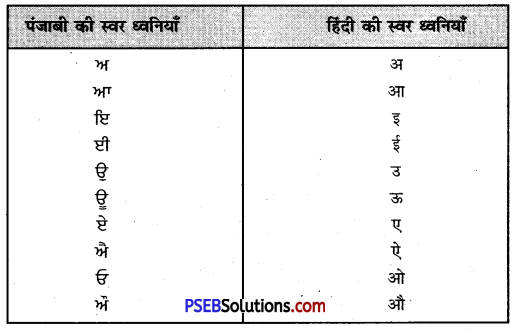
PSEB 9th Class Hindi Vyakaran अनुवाद 1

प्रश्न 8.
पंजाबी और हिंदी की व्यंजन ध्वनियों को लिखिए।
उत्तर:
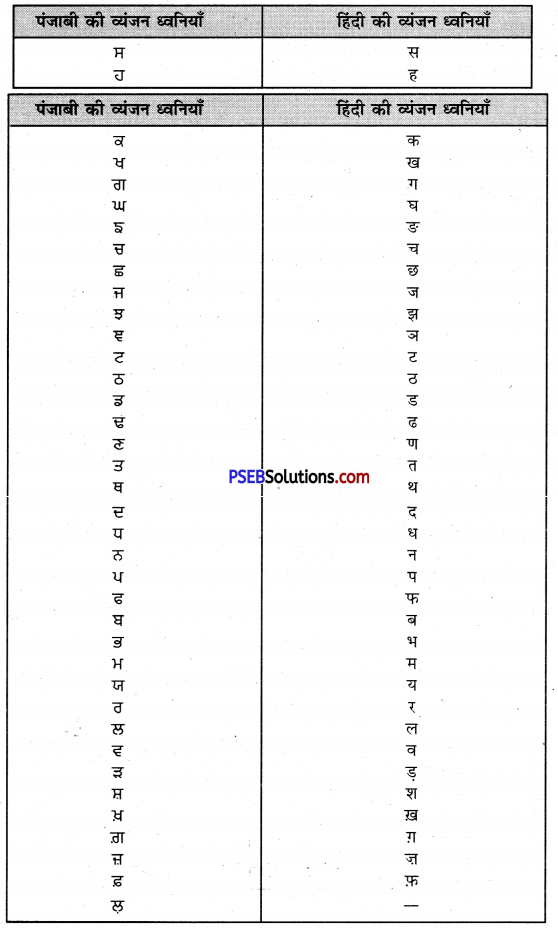
PSEB 9th Class Hindi Vyakaran अनुवाद 2

प्रश्न 9.
हिंदी और पंजाबी में प्रयुक्त की जाने वाली स्वरों की मात्राओं की तुलना कीजिए।
उत्तर:
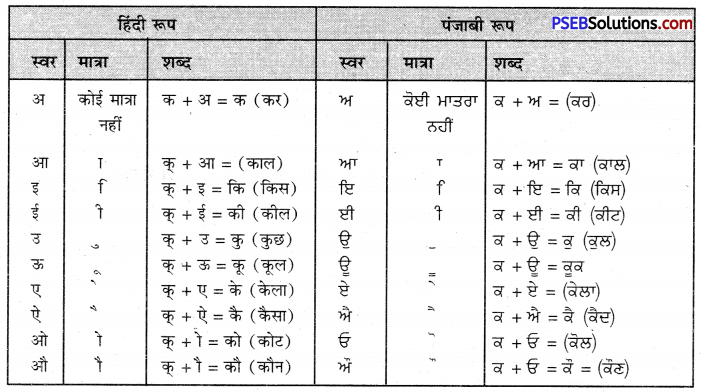
PSEB 9th Class Hindi Vyakaran अनुवाद 3

प्रश्न 10.
हिंदी और पंजाबी में बिंदी और टिप्पी का प्रयोग किस प्रकार किया जाता है?
उत्तर:
हिंदी में बिंदी का प्रयोग किया जाता है पर टिप्पी का प्रयोग नहीं किया जाता लेकिन पंजाबी में बिंदी और टिप्पी का प्रयोग नासिक्य ध्वनियों के लिए किया जाता है। पंजाबी में टिप्पी का प्रयोग ‘मुक्ता’, ‘सिहारी’, ‘ओंकड़’ तथा ‘दुलैंकड़’ मात्राओं के साथ किया जाता है; जैसे-
यंत, तंठा, मंच, विसी, ग्रि, मरत, वडप्ल, न, वर, पंठ।
हिंदी में बड़े ‘ऊ’ के साथ चंद्र बिंदु का प्रयोग किया जाता है; जैसे नँ, बूंद।

प्रश्न 11.
पंजाबी में टिप्पी वाले शब्दों को हिंदी में किस प्रकार लिखा जाता है? स्पष्ट करें।
उत्तर:
(I) चंद्रबिंदु की जगह टिप्पी का प्रयोग किया जाता है; जैसे यस = पहुँच, अउ = मुँह।
(II) ‘के’ के स्थान पर ‘का’ के प्रयोग की स्थिति में टिप्पी का प्रयोग किया जाता है; जैसे- वेठ = कान, संभ = चाम, वन = काम।
(III) आदि बुद्धि (द को दा, प को पा) की स्थिति में चंद्र बिंदु की जगह टिप्पी का प्रयोग किया जाता है; जैसेटर = दाँत, पन = पाँच।

प्रश्न 12.
पंजाबी में किन मात्राओं के साथ बिंदी का प्रयोग किया जाता है? उत्तर-पंजाबी में कन्ना (T), लां (े), होड़ा (‘) तथा कनौड़ा (“)।
मात्राओं के साथ बिंदी का प्रयोग किया जाता है: जैसे-
मांठी, पांडह, ठोर, तोग, चैतात, मैवा, ठोर, टु, मैंड, पॅम आदि।

प्रश्न 13.
हिंदी में जहाँ आधा अक्षर लिखा जाता है वहाँ पंजाबी में किए गए अनुवाद में किस सावधानी को ध्यान में रखना चाहिए?
उत्तर:
हिंदी में जहाँ आधा अक्षर लिखा जाता है वहाँ पंजाबी में पूरा अक्षर लिखा जाता है और उसके साथ ‘इ’ की मात्रा लगा दी जाती है। ‘य’ के स्थान पर ” लिखा जाता है, जैसे-
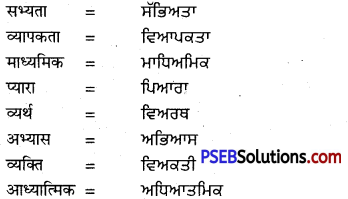
PSEB 9th Class Hindi Vyakaran अनुवाद 4

PSEB 9th Class Hindi Vyakaran अनुवाद

प्रश्न 14.
जब पंजाबी के कुछ शब्दों में धातु के अंतिम अक्षर को ‘इ’ की मात्रा में लगा कर साथ में ‘आ’ लगा कर क्रिया बनाई जाती है तब हिंदी में क्या किया जाता है?
उत्तर:
ऐसी स्थिति में हिंदी में प्रायः ‘आ’ अथवा ‘या’ ही लगाया जाता है। जैसे-
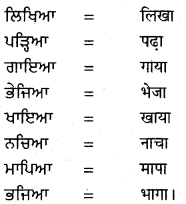
PSEB 9th Class Hindi Vyakaran अनुवाद 5

प्रश्न 15.
पंजाबी में जिन क्रियाओं के अंत में ‘डा’ लगा होता है वहाँ हिंदी में क्या लगाया जाता है?
उत्तर:
पंजाबी में जिन क्रियाओं के अंत में ‘ठा’ लगा होता है वहाँ हिंदी में ‘या’ का प्रयोग किया जाता है; जैसे-

PSEB 9th Class Hindi Vyakaran अनुवाद 6

प्रश्न 16.
हिंदी के शब्दों में जहाँ ‘व’ से पहले आधा अक्षर लगाया जाता है वहाँ पंजाबी अनुवाद में क्या परिवर्तन किया जाता है?
उत्तर:
जहाँ हिंदी के शब्दों में ‘व’ से पहले आधा अक्षर लगाया जाता है वहाँ पंजाबी में पूरा अक्षर लिखा जाता है और उस पूरे अक्षर के साथ ‘व’ के स्थान पर ‘ੳ’ की मात्रा (_) लगाई जाती है; जैसे-
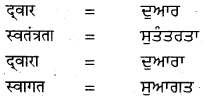
PSEB 9th Class Hindi Vyakaran अनुवाद 7

प्रश्न 17.
हिंदी में प्रयुक्त संयुक्त व्यंजनों को पंजाबी में किस प्रकार परिवर्तित किया जाता है कि उनमें सरलता और सहजता उत्पन्न हो जाए?
उत्तर:
पंजाबी में संयुक्त व्यंजनों में सरलता लाने के लिए स्वर का लोप किया जाता है और संयुक्त व्यंजनों के बीच में स्वर का आगम कर दिया जाता है। जैसे-
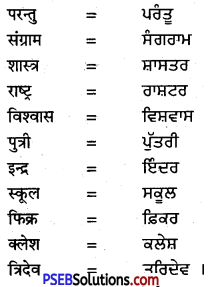
PSEB 9th Class Hindi Vyakaran अनुवाद 8

प्रश्न 18.
पंजाबी में द्वित्व अक्षर (संयुक्त अक्षर) कितने हैं? इन्हें किस प्रकार लिखा जाता है?
उत्तर:
पंजाबी में दो अक्षरों के मेल से बनने वाले अक्षरों को द्वित्व अक्षर या संयुक्त अक्षर कहते हैं। ये संख्या में कुल तीन हैं- ਹ (.), ਰ (.), ਵ(.) । जिन अक्षरों के साथ ये प्रयुक्त किए जाते हैं, वहाँ इन्हें अक्षर के पैरों के नीचे लिखा जाता है। जैसे-
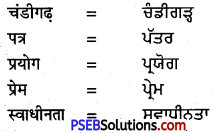
PSEB 9th Class Hindi Vyakaran अनुवाद 9

प्रश्न 19.
हिंदी में संयुक्त व्यंजनों से लिखे जाने वाले शब्द पंजाबी में किस प्रकार लिखे जाते हैं? उदाहरण सहित लिखिए।
उत्तर:
हिंदी में जो शब्द संयुक्त व्यंजनों की सहायता से लिखे जाते हैं वे आधुनिक पंजाबी में अलग-अलग व्यंजनों के साथ लिखे जाते हैं। जैसे-
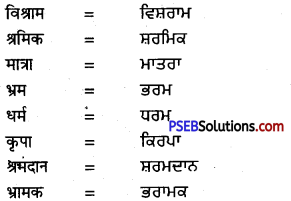
PSEB 9th Class Hindi Vyakaran अनुवाद 10

प्रश्न 20.
हिंदी के कुछ शब्दों के अंत में जहाँ ‘व’ का प्रयोग किया जाता है वहाँ पंजाबी में उसकी जगह क्या प्रयोग किया जाता है ?
उत्तर:
हिंदी शब्दों के अंत में कहीं-कहीं ‘व’ का प्रयोग किया जाता है वहाँ पंजाबी में ‘व’ की जगह ‘ਅ’ का प्रयोग किया जाता है। लेकिन जब संज्ञा को विशेषण बनाया जाता है तो ‘ਵ’ को ‘ਅ’ नहीं किया जाता है। जैसे-
स्वभाव = ਸੁਤਅ
स्वाभाविक = ਸੁਭਾਵਿਕ

प्रश्न 21.
हिंदी में ‘ऐ’ की मात्रा ‘ह’ से पहले आने वाले अक्षर पर लगाई जाती है लेकिन पंजाबी में ऐसा न करके क्या किया जाता है? उदाहरण सहित लिखिए।
उत्तर:
हिंदी में ‘ऐ’ की मात्रा (‘) का प्रयोग ‘ह’ से पहले आने वाले अक्षर पर किया जाता है, जैसेचेहरा, मेहरा, मेहर, सेहत, मेहरबान, मेहनत आदि। पंजाबी में ऐसी स्थिति में ‘वा’ (उ) से पहले ‘ए’ की मात्रा की जगह सिहारी (छोटी ‘इ’ की मात्रा) लगाई जाती है। जैसे- सिग्ठा, भिनता, भिगठ, मिराउ, भिग्तपाठ, भिउठउ आदि।

PSEB 9th Class Hindi Vyakaran अनुवाद

प्रश्न 22.
पंजाबी में ‘उ’ से पहले भी’ होने पर ‘उ’ पर छोटी ‘इ’ की मात्रा लगती है लेकिन हिंदी में इस स्थिति में क्या किया जाता है?
उत्तर:
हिंदी में, इस स्थिति में, छोटी ‘इ’ की मात्रा का प्रयोग नहीं किया जाता; जैसे-
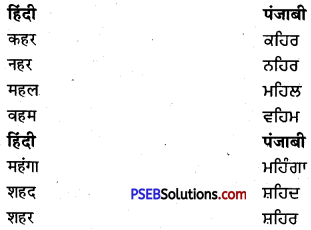
PSEB 9th Class Hindi Vyakaran अनुवाद 11

प्रश्न 23.
पंजाबी और हिंदी में ‘र’ ध्वनि के बाद नासिक्य ध्वनि होने की स्थिति में लिखने पर क्या अंतर दिखाई देता है?
उत्तर:
पंजाबी में ‘ठ’ के बाद नासिक्य ध्वनि होने पर ‘न’ (ठ) का प्रयोग किया जाता है लेकिन हिंदी में ‘ण’ का प्रयोग होता है; जैसे-
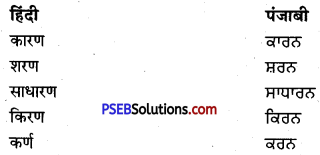
PSEB 9th Class Hindi Vyakaran अनुवाद 12

प्रश्न 24.
पंजाबी में कुछ शब्दों का रूप हिंदी शब्दों के मूलरूप से परिवर्तित कर दिया गया है। उनके उदाहरण लिखिए।
उत्तर:
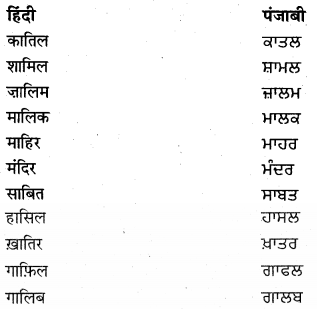
PSEB 9th Class Hindi Vyakaran अनुवाद 13

प्रश्न 25.
आधुनिक पंजाबी में अनेक ऐसे शब्द हैं जिनमें मात्राओं के अंतर के कारण उनके लिखने और बोलने में अंतर आ चुका है। कुछ उदाहरण दीजिए।
उत्तर:
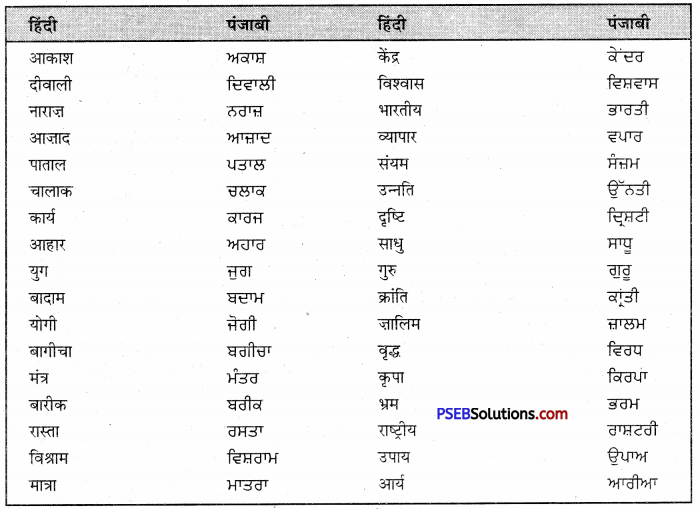
PSEB 9th Class Hindi Vyakaran अनुवाद 14

प्रश्न 26.
हिंदी और पंजाबी के लिपिगत अंतरों को स्पष्ट कीजिए।
उत्तर:
(i) गुरुमुखी लिपि में क्ष, त्र, ज्ञ से युक्त व्यंजन न होने के कारण हिंदी से पंजाबी में अनुवाद करते समय ध्वनियों का रूप बदल जाता है। जैसे-

PSEB 9th Class Hindi Vyakaran अनुवाद 15

(ii) देवनागरी लिपि में स्वर वर्णों के साथ मात्रा चिह्न का प्रयोग नहीं होता। गुरुमुखी लिपि में स्वर वर्णों के साथ मात्रा चिह्न का प्रयोग होता है। जैसे-
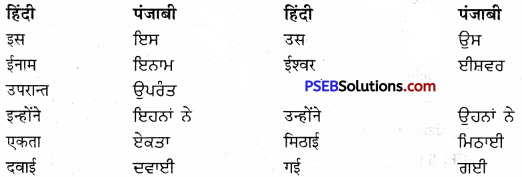
PSEB 9th Class Hindi Vyakaran अनुवाद 16

(iii) गुरुमुखी लिपि में स्वर न होने के कारण पंजाबी और हिन्दी शब्दों में अन्तर आ जाता है। जैसे-

PSEB 9th Class Hindi Vyakaran अनुवाद 17

(iv) देवनागरी लिपि में हलन्त ‘र’ (रेफ़) का प्रयोग रेफ़ के अगले स्वर/व्यंजन के ऊपर () होता है। गुरुमुखी लिपि में हलन्त ‘र’ का कोई प्रयोग नहीं होता है। जैसे-
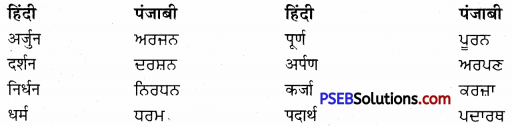
PSEB 9th Class Hindi Vyakaran अनुवाद 18

प्रश्न 27.
ध्वनिगत अंतरों को स्पष्ट कीजिए।
उत्तर:
(i) य और व से पहले यदि कोई हलंत व्यंजन हो तो गुरुमुखी लिपि में प्रायः क्रमशः ‘इ’ और ‘उ’ हो जाते हैं। जैसे-

PSEB 9th Class Hindi Vyakaran अनुवाद 19

(ii) अनुनासिक ध्वनि के लिए देवनागरी लिपि के हरेक वर्ग (कवर्ग, चवर्ग आदि) के सभी वर्गों (क, ख आदि) के साथ उसी वर्ग का पाँचवां अक्षर (ङ आदि) प्रयुक्त होता है। कई बार सभी पंचम वर्गों की जगह केवल अनुस्वार (‘) का प्रयोग कर दिया जाता है। गुरुमुखी लिपि में इस ध्वनि के लिए प्रायः टिप्पी (“) का प्रयोग होता है। जैसे-
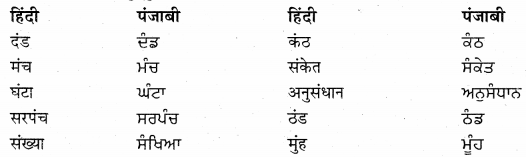
PSEB 9th Class Hindi Vyakaran अनुवाद 20

PSEB 9th Class Hindi Vyakaran अनुवाद

प्रश्न 28.
अनुवाद कार्य में व्याकरणिक अंतरों का क्या प्रभाव दिखाई देता है?
उत्तर:
(i) लिंग परिवर्तन करते समय हिंदी और पंजाबी शब्दों में अंतर आ जाता है। जैसे-
कुछ आकारान्त शब्दों का लिंग बदलते समय ‘अ’ ‘इया’ में बदल जाता है। ऐसे शब्दों में पंजाबी में ‘आ’ केवल ‘ई’ में बदलता है।
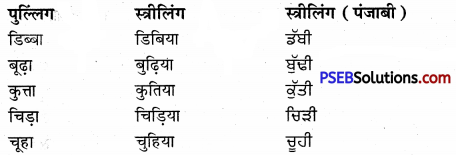
PSEB 9th Class Hindi Vyakaran अनुवाद 21

(ii) कुछ शब्दों के लिंग बदलते समय अन्त में ‘इक’ लगता है। पंजाबी में ऐसे शब्दों में प्रायः ‘का’ लगता है। जैसे-
पुल्लिग – स्त्रीलिंग – स्त्रीलिंग (पंजाबी)
सेवक – सेविका – ਸੇਵਕਾ
अध्यापक – अध्यापिका – ਅਧਿਆਪਕਾ

1. गुरुमुखी लिपि में प्राय: स्वर / व्यंजन के हलन्त रूपों का कम प्रयोग होता है। देवनागरी लिपि में उच्चारण के अनुसार स्वर / व्यंजन के हलन्त रूप प्रयुक्त होते हैं। जैसे-

PSEB 9th Class Hindi Vyakaran अनुवाद 22

2. देवनागरी लिपि में द्वित्व शब्दों का प्रयोग होता है, परन्तु गुरुमुखी लिपि में द्वित्व शब्दों के हलन्त वर्ण के स्थान पर अद्वक () का प्रयोग होता है। संयुक्त व्यंजनों में भी यह परिवर्तन आता है। जैसे-
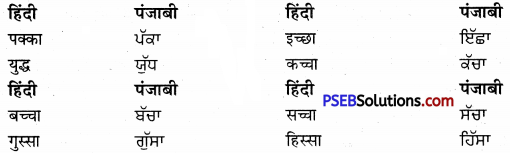
PSEB 9th Class Hindi Vyakaran अनुवाद 23

3. हिंदी और पंजाबी में भिन्न उच्चारण होने के कारण शब्द-जोड़ों में व्यंजन भेद के कारण भिन्नता आ जाती है। हिंदी के बहुत-से शब्दों में प्रयुक्त य, ग, न, ङ, क्रमशः- व, क, ण और ध्वनियों में बदल जाते हैं। नीचे इसी अंतर को स्पष्ट करने वाले कुछ शब्द दिए गए हैं।
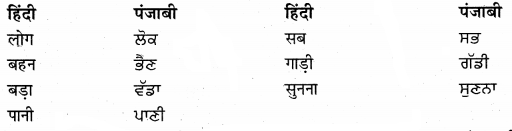
PSEB 9th Class Hindi Vyakaran अनुवाद 24

4. उच्चारण में भिन्नता होने के कारण कई बार हिंदी शब्दों में पंजाबी की अपेक्षा स्वर / व्यंजन की मात्रा में वृद्धि हो जाती है। जैसे-

PSEB 9th Class Hindi Vyakaran अनुवाद 25

5. उच्चारण में भिन्नता के कारण कई बार पंजाबी में देवनागरी के ‘ष’ का उच्चारण ख जैसा, ष का उच्चारण श जैसा और क्ष का उच्चारण छ जैसा हो जाता है। नीचे इस अंतर को स्पष्ट किया गया है। जैसे-
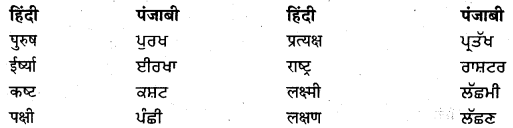
PSEB 9th Class Hindi Vyakaran अनुवाद 26

6. हिंदी और पंजाबी शब्दों में बहुवचन बनाने में कुछ अन्तर है। जैसे-

PSEB 9th Class Hindi Vyakaran अनुवाद 27

7. हिंदी के अनेक शब्दों के अंत में प्रयुक्त ‘य’ प्रायः पंजाबी शब्दों में लोप हो जाता है। जैसे-

PSEB 9th Class Hindi Vyakaran अनुवाद 28

प्रश्न 29.
पंजाबी और हिंदी के शब्दों में बहुवचन बनाने के लिए क्या-क्या अंतर होते हैं ? स्पष्ट कीजिए।
उत्तर:
(i) पंजाबी में एकवचन स्त्रीलिंग शब्दों के अंत में मुक्ता अक्षर होने की स्थिति में बहुवचन बनाते समय ‘कन्ने’ के ऊपर बिंदी लगाई जाती है लेकिन हिंदी में इस स्थिति में ‘अ’ को ‘एँ’ में बदला जाता है; जैसे-
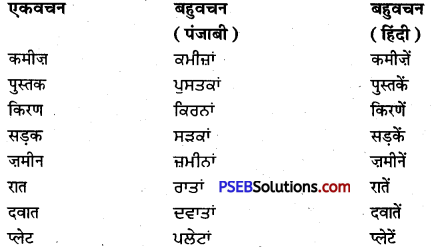
PSEB 9th Class Hindi Vyakaran अनुवाद 29

(ii) जब एकवचन स्त्रीलिंग पंजाबी के शब्दों में कन्ना हो तो वहाँ बहुवचन ‘हां’ लगाकर बनाया जाता है लेकिन हिंदी में आकारांत एकवचन के अंत में ‘एँ’ जोड़ने से बहुवचन बनता है। जैसे-
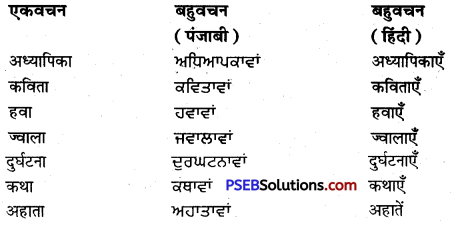
PSEB 9th Class Hindi Vyakaran अनुवाद 30

(iii) पंजाबी में एकवचन स्त्रीलिंग शब्दों के अंत में जहाँ ओंकड़ (_) और दुलैंकड़ (-) प्रयुक्त होते हैं वहाँ बहुवचन रूप में ‘मां’ लगा दिया जाता है लेकिन हिंदी में उकारांत और इकारांत शब्दों में बहुवचन की स्थिति में अंत में ‘एँ’ जोड़ा जाता है, जैसे-
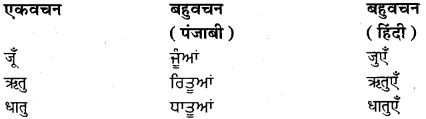
PSEB 9th Class Hindi Vyakaran अनुवाद 31

PSEB 9th Class Hindi Vyakaran अनुवाद

(iv) पंजाबी में जिन एकवचन स्त्रीलिंग शब्दों के अंत में बड़ी ई (।) की मात्रा लगी होती है। उसका बहुवचन अंत में ‘आं’ लगाकर बनता है। हिंदी में इस कार्य के लिए ‘ई’ को ‘इ’ में बदल दिया जाता है। जैसे-
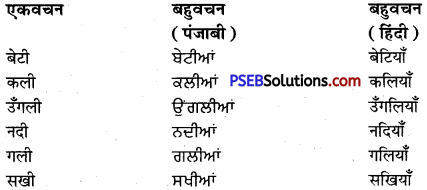
PSEB 9th Class Hindi Vyakaran अनुवाद 32

(v) हिंदी और पंजाबी के अनेक आकारांत पुल्लिग शब्दों में समानता रहती है और इन में ‘आ’ को ‘ए’ में बदल कर बहुवचन बनाया जाता है। जैसे-
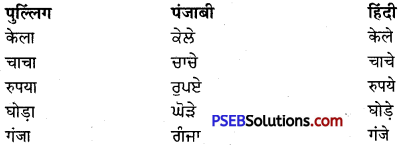
PSEB 9th Class Hindi Vyakaran अनुवाद 33

प्रश्न 30.
हिंदी और पंजाबी की वाक्य संरचना की विशेषताएँ लिखिए।
उत्तर:
हिंदी और पंजाबी के अनेक ध्वनियों, शब्दावली और उच्चारण में बहुत अधिक समानता है। इसलिए उनकी वाक्य-संरचना भी लगभग मिलती-जुलती है। इन दोनों भाषाओं में क्रिया रूप भी लिंग के अनुसार बदल जाती हैं। इनके कर्तृवाच्य में क्रिया का लिंग मुख्य रूप से कर्ता के सामन होता है और क्रिया का लिंग मुख्य रूप से ‘कर्म’ के अनुसार होता है। इनके भाववाच्य में क्रिया सदा पुल्लिग में रहती है। इन दोनों में क्रिया के दो वचन होते हैं-एकवचन और बहुवचन। इनको एक के लिए एकवचन की क्रिया और अनेक के लिए बहुवचन की क्रिया प्रयुक्त होती है। इन दोनों भाषाओं में संज्ञा, वचन और लिंग के अनुसार विशेषण बोधक शब्द रूप में बदल जाता है। इन दोनों भाषाओं में क्रियाओं के तीन पुरुष रूप ही होते हैं-उत्तम पुरुष, मध्यम पुरुष और अन्य पुरुष। काल के अनुसार भी इन दोनों में एक समान परिवर्तन होते हैं।

पाठ्य-पुस्तक में दिए गए अनुवाद संबंधी हल सहित उदाहरण नीचे कुछ पंजाबी वाक्यों के हिंदी स्वरूप को देखिए:

पंजाबी वाक्य – हिंदी वाक्य
1. ਸੱਚੇ ਬਹਾਦਰ ਕਦੇ ਵੀ ਯੁੱਧ ਵਿੱਚ ਪਿੱਠ ਨਹੀਂ ਦਿਖਾਉਂਦੇ । – सच्चे बहादुर कभी भी युद्ध में पीठ नहीं दिखाते।
2. ਮਾਤਾ-ਪਿਤਾ ਨੂੰ ਆਪਣੇ ਬੱਚਿਆਂ ਦਾ ਧਿਆਨ ਰੱਖਣਾ ਚਾਹੀਦਾ ਹੈ । – माता-पिता को अपने बच्चों का ध्यान रखना चाहिए।
3. ਮਿਹਨਤੀ ਆਦਮੀ ਹਮੇਸ਼ਾ ਸਫ਼ਲ ਹੁੰਦਾ ਹੈ । – परिश्रमी आदमी सदैव सफल होता है।
4. ਹਰਪਾਲ ਸਿੰਘ ਪੜ੍ਹਦਾ ਹੈ ਅਤੇ ਰਜਿੰਦਰ ਕੁਮਾਰ ਖੇਡਦਾ ਹੈ । – हरपाल सिंह पढ़ता है और राजेंद्र कुमार खेलता है।
5. ਮੇਰੇ ਵੱਡੇ ਭਰਾ ਦਾ ਵਿਵਹਾਰ ਬਹੁਤ ਹੀ ਨਰਮ ਹੈ । – मेरे बड़े भाई का व्यवहार बहुत ही नरम है।
6. ਗੁਰੂ ਗੋਬਿੰਦ ਸਿੰਘ ਜੀ ਨੇ “ਖਾਲਸਾ ਪੰਥ’ ਦੀ ਸਿਰਜਣਾ ਕੀਤੀ ਸੀ । – गुरु गोबिंद सिंह जी ने ‘खालसा पंथ’ का निर्माण किया।
7. ਸਾਨੂੰ ਕਦੇ ਵੀ ਕਿਸੇ ਦਾ ਬੁਰਾ ਨਹੀਂ ਕਰਨਾ ਚਾਹੀਦਾ । – हमें कभी भी किसी का बुरा नहीं करना चाहिए।
8. ਗੁਰੂ ਨਾਨਕ ਦੇਵ ਜੀ ਇੱਕ ਉੱਚੀ-ਸੁੱਚੀ ਤੇ ਬਹੁਮੁਖੀ ਸ਼ਖ਼ਸੀਅਤ ਦੇ ਮਾਲਕ ਸਨ | – गुरु नानक देव जी एक ऊँचे-सच्चे और बहुमुखी व्यक्तित्व के स्वामी थे।
9. ਉਹੀ ਵਿਅਕਤੀ ਸਭ ਦੀ ਸੇਵਾ ਕਰ ਸਕਦਾ ਹੈ ਜਿਹੜਾ ਪੂਰੀ ਤਰ੍ਹਾਂ ਸਵਾਰਥ ਤੋਂ ਰਹਿਤ ਹੋਵੇ । – वही व्यक्ति सबकी सेवा कर सकता है जो पूरी तरह स्वार्थ रहित हो।
10. ਸਾਨੂੰ ਪ੍ਰਭੂ ਵਿੱਚ ਵਿਸ਼ਵਾਸ ਰੱਖਣਾ ਚਾਹੀਦਾ ਹੈ । – हमें ईश्वर पर विश्वास करना चाहिए।
11. ਚੰਡੀਗੜ੍ਹ, ਪੰਜਾਬ ਅਤੇ ਹਰਿਆਣਾ ਦੀ ਰਾਜਧਾਨੀ ਹੈ । – चंडीगढ़, पंजाब तथा हरियाणा की राजधानी है।
12. ਸ਼ਹੀਦ ਸੁਖਦੇਵ ਬਚਪਨ ਤੋਂ ਹੀ ਦ੍ਰਿੜ ਸੁਭਾਅ ਦੇ ਸਨ । – शहीद सुखदेव बचपन से ही दृढ़ स्वभाव के थे।
13. ਅੱਜ ਵਿਗਿਆਪਨ ਕਲਾ ਤੇਜ਼ੀ ਨਾਲ ਉੱਨਤੀ ਕਰ ਰਹੀ ਹੈ । – आज विज्ञापन कला तेज़ी से उन्नति कर रही है।
14. ਇਹ ਉਹੀ ਵਿਦਿਆਰਥੀ ਹੈ ਜਿਸ ਨੂੰ ਕੱਲ੍ਹ ਇਨਾਮ ਮਿਲਿਆ ਸੀ । – यह वही विद्यार्थी है जिसे कल इनाम मिला था।
15. ਭਾਰਤ ਨੂੰ ਸੋਨੇ ਦੀ ਚਿੜੀ ਕਿਹਾ ਜਾਂਦਾ ਸੀ । – भारत को सोने की चिड़िया कहा जाता था।
16. ਕੁੱਝ ਪਾਉਣ ਲਈ ਕੁੱਝ ਗਵਾਉਣਾ ਵੀ ਪੈਂਦਾ ਹੈ । – कुछ पाने के लिए कुछ गँवाना भी पड़ता है।
17. ਵੱਡਾ ਉਹ ਹੁੰਦਾ ਹੈ ਜਿਹੜਾ ਆਪਣੇ ਕੋਲ ਬੈਠੇ ਨੂੰ ਛੋਟਾ ਮਹਿਸੂਸ ਨਾ ਹੋਣ ਦੇਵੇ । – बड़ा वह होता है जो अपने पास बैठे हुए को छोटा महसूस न होने दे।
18. ਮੇਰਾ ਵੱਡਾ ਮੁੰਡਾ ‘ਦਸਵੀਂ ਦੀ ਪਰੀਖਿਆ ਵਿੱਚੋਂ ਰਾਜ ਭਰ ਵਿੱਚ ਪਹਿਲੇ ਨੰਬਰ ‘ਤੇ ਆਇਆ ਹੈ । – मेरा बड़ा लड़का दसवीं की परीक्षा में राज्य भर में प्रथम स्थान पर आया है।
19. ਸੁਹਾਗ ਕੁੜੀ ਦੇ ਵਿਆਹ ਵੇਲੇ ਗਾਏ ਜਾਂਦੇ ਹਨ । – सुहाग लड़की के विवाह के अवसर पर गाये जाते हैं।
20. ਆਮਦਨ ਤੋਂ ਵੱਧ ਖਰਚ ਕਰਨਾ ਚੰਗੀ ਗੱਲ ਨਹੀਂ । – आय से अधिक व्यय करना अच्छी बात नहीं।
21. ਮਾਤਾ-ਪਿਤਾ ਦੀ ਸੇਵਾ ਕਰਨਾ ਸਾਡਾ ਸਭ ਤੋਂ ਵੱਡਾ ਧਰਮ ਹੈ । – माता-पिता की सेवा करना हमारा सबसे बड़ा धर्म है।
22. ਹਰ ਰੋਜ਼ ਸਵੇਰੇ ਦੰਦਾਂ ਨੂੰ ਸਾਫ਼ ਕਰਨਾ ਚਾਹੀਦਾ ਹੈ । – हर रोज़ सवेरे दाँतों को साफ करना चाहिए।
23. ਭਾਰਤ ਦੇਸ਼ ਮੇਰੀ ਆਨ, ਬਾਨ ਅਤੇ ਸ਼ਾਨ ਹੈ । – भारत देश मेरी आन, बान और शान है।
24. ਮਿਹਨਤੀ ਕਦੇ ਕੰਮ ਤੋਂ ਹੀ ਨਹੀਂ ਚੁਰਾਉਂਦਾ । – मेहनती कभी काम से जी नहीं चुराता।
25. ਮਹਾਤਮਾ ਗਾਂਧੀ ਨੂੰ ਰਾਸ਼ਟਰ ਪਿਤਾ ਕਿਹਾ ਜਾਂਦਾ ਹੈ । – महात्मा गाँधी को राष्ट्रपिता कहा जाता है।
26. ਨਫ਼ਰਤ ਉੱਤੇ ਪ੍ਰੇਮ ਨਾਲ ਜਿੱਤ ਪ੍ਰਾਪਤ ਕਰੋ । – नफ़रत पर प्रेम के साथ जीत प्राप्त करो।
27. ਵਿਹਲੇ ਬੈਠ ਕੇ ਕੀਮਤੀ ਸਮਾਂ ਨਹੀਂ ਗੁਆਉਣਾ ਚਾਹੀਦਾ । – व्यर्थ बैठकर बहुमूल्य समय नहीं गँवाना चाहिए।
28. ਮਾਂ ਆਪ ਹਰ ਦੁੱਖ ਸਹਾਰ ਕੇ ਆਪਣੇ ਲਾਡਲੇ ਨੂੰ . ਹਰ ਸੁੱਖ ਦਿੰਦੀ ਹੈ । – माँ स्वयं हर दुःख सहकर अपने लाडले को हर सुख देती है।
29. ਪੰਚਾਇਤ ਦੇ ਮੁਖੀ ਨੂੰ ਸਰਪੰਚ ਕਿਹਾ ਜਾਂਦਾ ਹੈ । – पंचायत के मुखिया को सरपंच कहते हैं।
30. ਰਾਜ ਘਾਟ ਮਹਾਤਮਾ ਗਾਂਧੀ ਦੀ ਸਮਾਧ ਹੈ । – राज घाट महात्मा गाँधी की समाधि है।
31. ਪੰਜਾਬ ਸਕੂਲ ਸਿੱਖਿਆ ਬੋਰਡ ਦਾ ਦਫ਼ਤਰ ਮੁਹਾਲੀ ਸ਼ਹਿਰ ਵਿੱਚ ਹੈ । – पंजाब स्कूल शिक्षा बोर्ड का कार्यालय मोहाली शहर में है।
32. ਛੁੱਟੀ ਉਪਰੰਤ ਮੈਂ ਸਿੱਧਾ ਘਰ ਚਲਾ ਗਿਆ ਸੀ । – छुट्टी के उपरान्त मैं सीधा घर चला गया था।
33. ਸ੍ਰੀ ਕ੍ਰਿਸ਼ਨ ਦੀ ਮਾਤਾ ਦਾ ਨਾਂ ਦੇਵਕੀ ਸੀ । – श्री कृष्ण की माता का नाम देवकी था।
34. ਬੁੱਢੀ ਦਾ ਗੁੱਸਾ ਜਲਦੀ ਹੀ ਪਿਆਰ ਵਿੱਚ ਬਦਲ ਗਿਆ । – बुढ़िया का गुस्सा जल्दी ही प्यार में बदल गया।
35. ਸੰਤੋਖ ਦਾ ਫ਼ਲ ਮਿੱਠਾ ਹੁੰਦਾ ਹੈ । – संतोष का फल मीठा होता है।
36. ਮੁੰਨੀ ਝਾਂਜਰ ਪਾ ਕੇ ਬਹੁਤ ਖੁਸ਼ ਸੀ । – मुन्नी पाजेब डालकर बहुत खुश थी।
37. ਸਾਡੀ ਅਧਿਆਪਕਾ ਸਾਨੂੰ ਬਹੁਤ ਪਿਆਰ ਨਾਲ ਪੜ੍ਹਾਉਂਦੀ ਹੈ । – हमारी अध्यापिका हमें बहुत ही प्यार के साथ पढ़ाती है।
38. ਪ੍ਰੀਖਿਆ ਖ਼ਤਮ ਹੋਣ ਨੂੰ ਦਸ ਮਿੰਟ ਬਾਕੀ ਹਨ । – परीक्षा समाप्त होने को दस मिनट शेष हैं।
39. ਪੰਛੀ ਸ਼ਾਮ ਨੂੰ ਆਪਣੇ-ਆਪਣੇ ਆਲ੍ਹਣਿਆਂ ਵਿਚ ਚਲੇ ਗਏ । – पक्षी शाम को अपने-अपने घोंसले में चले गए।
40. ਉਸ ਦਾ ਦੁੱਖ ਸੁਣ ਕੇ ਮੇਰੀਆਂ ਅੱਖਾਂ ਵਿੱਚੋਂ ਹੰਝੂ – उसका दुःख सुनकर मेरी आंखों में से आंसू आ गए।

PSEB 9th Class Hindi Vyakaran अनुवाद

हिंदी में अनुवाद कीजिए

1. ਪੰਜਾਬ ਯੂਨੀਵਰਸਿਟੀ ਚੰਡੀਗੜ੍ਹ ਵਿੱਚ ਹੈ ।
2. ਦੀਵਾਲੀ ਕੱਤਕ ਦੀ ਮੱਸਿਆ ਦੀ ਰਾਤ ਨੂੰ ਮਨਾਈ ਜਾਂਦੀ ਹੈ ।
3. ਇਤਿਹਾਸਕ ਸਥਾਨਾਂ ਦੀ ਯਾਤਰਾ ਨਾਲ ਸਾਡੇ ਗਿਆਨ ਵਿੱਚ ਵਾਧਾ ਹੁੰਦਾ ਹੈ ।
4. ਛੱਬੀ ਜਨਵਰੀ ਅਤੇ ਪੰਦਰਾਂ ਅਗਸਤ ਸਾਡੇ ਕੌਮੀ ਤਿਉਹਾਰ ਹਨ ।
5. ਸਾਡੇ ਹਿਰਦੇ ਵਿੱਚ ਆਪਣੀ ਮਾਂ-ਬੋਲੀ ਲਈ ਪਿਆਰ ਹੋਣਾ ਚਾਹੀਦਾ ਹੈ ।
6. ਕਰਤਾਰ ਸਿੰਘ ਸਰਾਭਾ ਨੇ ਉੱਨੀ ਸਾਲ ਦੀ ਛੋਟੀ ਉਮਰ ਵਿੱਚ ਦੇਸ਼ ਲਈ ਸ਼ਹੀਦੀ ਪਾਈ ।
7. ਮਿਠਾਸ ਅਤੇ ਨਿਮਰਤਾ ਸਾਰੇ ਗੁਣਾਂ ਦਾ ਨਿਚੋੜ ਹੈ |
8. ਵਿਗਿਆਨ ਦੀਆਂ ਕਾਢਾਂ ਵਿੱਚ ਸਾਰੇ ਸੰਸਾਰ ਦੇ ਵਿਗਿਆਨੀਆਂ ਨੇ ਯੋਗਦਾਨ ਪਾਇਆ ਹੈ ।
9. ਅਖ਼ਬਾਰ ਦਾ ਸਾਡੇ ਜੀਵਨ ਵਿੱਚ ਮਹੱਤਵਪੂਰਨ ਸਥਾਨ ਹੈ ।
10. ਜਨਸੰਖਿਆ ਦੇ ਵੱਧਣ ਨਾਲ ਬੇਰੁਜ਼ਗਾਰੀ ਵੀ ਵੱਧ ਰਹੀ ਹੈ ।
11. ਸਾਨੂੰ ਬਿਜਲੀ ਦੀ ਬੱਚਤ ਕਰਨੀ ਚਾਹੀਦੀ ਹੈ ।
12. ਜੇਕਰ ਤੁਸੀਂ ਆਪਣਾ ਅੱਜ ਖ਼ਰਾਬ ਕਰੋਗੇ ਤਾਂ ਤੁਹਾਡਾ ਕਲ਼ ਵੀ ਖ਼ਰਾਬ ਹੋ ਜਾਏਗਾ ।
13. ਜਨਤਕ ਸੰਪੱਤੀ ਦੀ ਰੱਖਿਆ ਕਰੋ ਅਤੇ ਹਿੰਸਾ ਤੋਂ ਦੂਰ ਰਹੋ ।
14. ਜਤਿੰਦਰ ਸਿੰਘ ਪੜ੍ਹਦਾ ਹੈ ਨਾਲੇ ਨੌਕਰੀ ਕਰਦਾ ਹੈ ।
15. ਗੁਰੂ ਨਾਨਕ ਦੇਵ ਜੀ ਨੇ ਕਿਰਤ ਕਰਕੇ ਖਾਣ ਦੀ ਸਿੱਖਿਆ ਦਿੱਤੀ ਹੈ ।
16. ਦੋਸਤਾਂ ਨਾਲ ਕਦੇ ਵੀ ਹੇਰਾਫੇਰੀ ਨਹੀਂ ਕਰਨੀ ਚਾਹੀਦੀ ।
17. ਜੇਕਰ ਨੌਕਰੀ ਨਹੀਂ ਮਿਲ ਰਹੀ ਤਾਂ ਸੈ-ਰੁਜ਼ਗਾਰ ਦਾ ਰਸਤਾ ਅਪਣਾਓ ।
18. ਢੋਲ ਦੀ ਅਵਾਜ਼ ਸੁਣ ਕੇ ਅਸੀਂ ਘਰੋਂ ਬਾਹਰ ਆ ਗਏ ।
19. ਸਿਆਣਾ ਇਨਸਾਨ ਖਾਲੀ ਸਮੇਂ ਦਾ ਵੀ ਸਦੁਪਯੋਗ ਕਰਦਾ ਹੈ ।
20. ਘਰ ਵਾਂਗ ਸਕੂਲ ਵਿਚ ਵੀ ਸਫ਼ਾਈ ਬਹੁਤ ਜ਼ਰੂਰੀ ਹੈ ।

PSEB 9th Class Science Notes Chapter 11 Work, Energy and Power

This PSEB 9th Class Science Notes Chapter 11 Work, Energy and Power will help you in revision during exams.

PSEB 9th Class Science Notes Chapter 11 Work, Energy and Power

→ All living beings need food for their energy needs.

→ Machines too need fuels like petrol and diesel for energy.

→ In our daily life, we consider any useful physical or mental activity as work.

→ Work done by the force acting on a body is equal to the product of the magnitude of the force and the displacement in the direction of the force.

→ When a force acts in a direction opposite to the direction of displacement produced, then the work done is negative.

PSEB 9th Class Science Notes Chapter 11 Work, Energy and Power

→ When a force acts in the direction of displacement then the work done is positive.

→ For us, the sun is the major natural source of energy.

→ In addition to this, we can also get energy from nuclei of atoms, from the interior of earth, and tides.

→ If a body has the capacity to do work then it is said to possess energy.

→ The object which does work loses energy and the object on which work is done gains energy.

→ The sum total of potential and kinetic energy of the body is called mechanical energy.

→ The energy present in the body due to its motion is called it’s kinetic energy.

→ The kinetic energy of an object increases with the increase of its velocity.

→ When an object is raised to some height above the ground, the work done against gravitational force is stored in the object as potential energy.

PSEB 9th Class Science Notes Chapter 11 Work, Energy and Power

→ We can transform one form of energy into another form.

→ The rate of doing work or transformation of energy is called power.

→ The unit of energy is joule but this unit is small. Its bigger unit is kilowatt hour (kWh) 1 kWh = 3.6 × 10⁶ J

→ HP Energy consumed in industries and commercial establishments are expressed in kilowatt-hour which is also called unit (B.O.T. unit)

→ In order to survive all living beings have to do some basic activities for which energy is required. This energy they get from the food they eat.

→ According to the law of conservation of energy, energy can neither be created nor destroyed but it can only be transformed from one form to another form total energy before and after transformation always remains constant.

→ Energy is present in different forms as for example kinetic energy, potential energy, heat energy, chemical energy, electric energy, and light energy.

→ From a scientific point of view for doing work two conditions must be satisfied:

  • some force must act on the object
  • the object must be displaced in the direction of the force.

→ The unit of power is the watt.

→ 1 kilowatt = 1000 watt.

→ 1 watt is the power of that agent which does 1 joule of work in 1 second.

→ Energy: The capacity of doing work is called energy.

→ Kinetic Energy: The capacity of the bodies to do work due to the motion present in them is called kinetic energy.

PSEB 9th Class Science Notes Chapter 11 Work, Energy and Power

→ Potential Energy: The capacity of an object to do work clue to change in its position or configuration is called its potential energy.

→ Law of Conservation of Energy: Energy can neither be created nor destroyed but it can be changed from one form into another form.

→ Joule: If one Newton (N) of force acts on a body of 1 kg and displaces it through 1 m then work done on the body is one joule.

→ Power: The rate at which energy is supplied or consumed is called power. The unit of power is the watt (W).
Power = \(\frac{\text { Energy Supplied }}{\text { Time }}\)

→ Watt: If a source supplies or consumes energy at the rate of 1 Joule (J) per second then the power of the source, is said to be one watt.

→ Work: If the force acting on a body displaces the body in the direction of force then work is said to be done by the force.
Work = Force × Displacement
i.e. W = F × S

PSEB 9th Class Maths Solutions Chapter 6 Lines and Angles Ex 6.3

Punjab State Board PSEB 9th Class Maths Book Solutions Chapter 6 Lines and Angles Ex 6.3 Textbook Exercise Questions and Answers.

PSEB Solutions for Class 9 Maths Chapter 6 Lines and Angles Ex 6.3

Question 1.
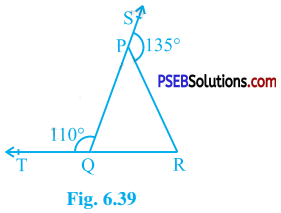
In the given figure, sides QP and RQ of ∆ PQR are produced to points S and T respectively. If ∠ SPR =135° and ∠ PQT = 110°, find ∠ PRQ.

PSEB 9th Class Maths Solutions Chapter 6 Lines and Angles Ex 6.3 1

Answer:
Here, ∠ SPR and ∠ PQT are exterior angles.
Then, by theorem 6.8,
∠ SPR = ∠ PQR + ∠ PRQ and
∠ PQT = ∠ QPR + ∠ PRQ
∴ ∠ PQR + ∠ PRQ = 135° and
∠ QPR + ∠ PRQ = 110°
Adding these two equations,
∠ PQR + ∠ PRQ + ∠ QPR + ∠ PRQ = 135° + 110°
∴ 180° + ∠ PRQ = 245° (Theorem 6.7)
∴ ∠ PRQ = 245° – 180°
∴ ∠ PRQ = 65°

PSEB 9th Class Maths Solutions Chapter 6 Lines and Angles Ex 6.3

Question 2.
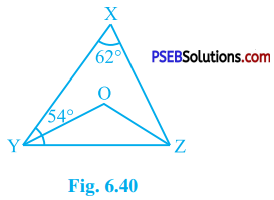
In the given figure, ∠ X = 62°, ∠ XYZ = 54°. If YO and ZO are the bisectors of ∠ XYZ and ∠ XZY respectively of ∆ XYZ, find ∠ OZY and ∠ YOZ.

PSEB 9th Class Maths Solutions Chapter 6 Lines and Angles Ex 6.3 2

Answer:
In ∆ XYZ,
∠ X + ∠ XYZ + ∠ XZY = 180° (Theorem 6.7)
∴ 62° + 54° + ∠ XZY = 180°
∴ ∠ XZY = 180° – 62° – 54°
∴ ∠ XZY = 64°
YO and ZO are bisectors of ∠ XYZ and ∠ XZY respectively.
∴ ∠ OYZ = \(\frac{1}{2}\) ∠ XYZ = \(\frac{1}{2}\) × 54° = 27° and
∠ OZY = \(\frac{1}{2}\) ∠ XZY = \(\frac{1}{2}\) × 64° = 32°.
Now, in ∆ OYZ,
∠ OYZ + ∠ OZY + ∠ YOZ = 180° (Theorem 6.7)
∴ 27° + 32° + ∠ YOZ = 180°
∴ ∠ YOZ = 180° – 27° – 32°
∴ ∠ YOZ = 121°

PSEB 9th Class Maths Solutions Chapter 6 Lines and Angles Ex 6.3

Question 3.
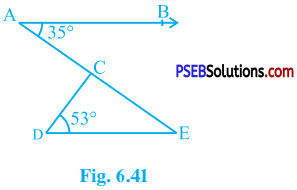
In the given figure, if AB || DE, ∠ BAC = 35° and ∠ CDE = 53°, find ∠ DCE.
PSEB 9th Class Maths Solutions Chapter 6 Lines and Angles Ex 6.3 3

Answer:
AB || DE and AE is transversal for them.
∴ ∠ AED = ∠ BAE (Alternate interior angles)
∴ ∠ CED = ∠ BAC (Point C lies on line AE)
∴ ∠ CED = 35° (Given : ∠ BAC = 35°)
In ∆ CDE, by theorem 6.8
∠ CDE + ∠ CED + ∠ DCE = 180°
∴ 53° + 35° + ∠ DCE = 180°
∴ ∠ DCE = 180° – 53° – 35°
∴ ∠ DCE = 92°

PSEB 9th Class Maths Solutions Chapter 6 Lines and Angles Ex 6.3

Question 4.
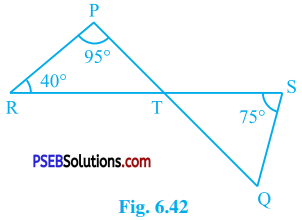
In the given figure, if lines PQ and RS intersect at point T, such that ∠ PRT = 40°, ∠ RPT = 95° and ∠ TSQ = 75°, find ∠ SQT.

PSEB 9th Class Maths Solutions Chapter 6 Lines and Angles Ex 6.3 4

Answer:
In ∆ PRT,
∠ RPT + ∠ PRT + ∠ PTR = 180° (Theorem 6.7)
∴ 95° + 40° + ∠ PTR = 180°
∴ 135° + ∠ PTR = 180°
∴ ∠ PTR = 180°- 135°
∴ ∠ PTR = 45°
Lines PQ and RS intersect at point T.
∴ ∠ STQ = ∠ PTR (Vertically opposite angles)
∴ ∠ STQ = 45°
In ∆ STQ,
∠ TSQ + ∠ STQ + ∠ SQT = 180° (Theorem 6.7)
∴ 75° + 45° + ∠ SQT = 180°
∴ 120° + ∠ SQT = 180°
∴ ∠ SQT = 60°

PSEB 9th Class Maths Solutions Chapter 6 Lines and Angles Ex 6.3

Question 5.
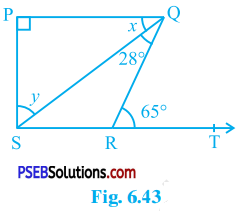
In the given figure, if PQ ⊥ PS, PQ || SR, ∠ SQR = 28° and ∠ QRT = 65°, then find the values of x and y.

PSEB 9th Class Maths Solutions Chapter 6 Lines and Angles Ex 6.3 5

Answer:
PQ || SR and QR is transversal for them.
∴ ∠ PQR = ∠ QRT (Alternate interior angles)
∴ ∠ PQR = 65° (Given : ∠ QRT = 65°)
∴ ∠ PQS + ∠ SQR = 65° (Adjacent angles)
∴ x + 28° = 65° (Given : ∠ SQR = 28°)
∴ x = 65° – 28°
∴ x = 37°
PQ ⊥ PS
∴ ∠ SPQ = 90°
In ∆ PSQ,
∠ SPQ + ∠ PQS + ∠ PSQ = 180° (Theorem 6.7)
∴ 90° + 37° + y = 180°
∴ 127° + y = 180°
∴ y = 180°- 127°
∴ y = 53°

PSEB 9th Class Maths Solutions Chapter 6 Lines and Angles Ex 6.3

Question 6.
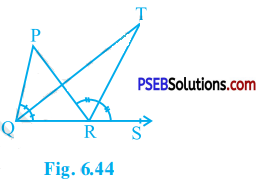
In the given figure, the side QR of ∆ PQR is produced to a point S. If the bisectors of ∠ PQR and ∠ PRS meet at point T, then prove that ∠ QTR = \(\frac{1}{2}\) ∠ QPR.

PSEB 9th Class Maths Solutions Chapter 6 Lines and Angles Ex 6.3 6

Answer:
QT is the bisector of ∠ PQR and RT is the bisector of ∠ PRS.
∴ ∠ TQR = \(\frac{1}{2}\) ∠ PQR and ∠ TRS = \(\frac{1}{2}\) ∠ PRS ……………… (1)
∠ PRS is an exterior angle of ∆ PQR.
∴ ∠ PRS = ∠ QPR + ∠ PQR
∴ \(\frac{1}{2}\) ∠ PRS = \(\frac{1}{2}\) ∠ QPR + \(\frac{1}{2}\) ∠ PQR
∴ ∠ TRS = \(\frac{1}{2}\) ∠ QPR + ∠ TQR [By (1)] …………… (2)
In ∆ TQR, ∠ TRS is an exterior angle.
∴ ∠ TRS = ∠ QTR + ∠ TQR ……………. (3)
From (2) and (3), we get
∠ QTR + ∠ TQR = \(\frac{1}{2}\) ∠ QPR + ∠ TQR
∴ ∠ QTR = \(\frac{1}{2}\) ∠ QPR