PSEB 11th Class Physics Important Questions Chapter 13 Kinetic Theory

Punjab State Board PSEB 11th Class Physics Important Questions Chapter 13 Kinetic Theory Important Questions and Answers.

PSEB 11th Class Physics Important Questions Chapter 13 Kinetic Theory

Very Short Answer Type Questions

Question 1.
Under what conditions, real gases behave as an ideal gas?
Answer:
At low pressure and high temperature, real gases behave as an ideal gas.

Question 2.
When air is pumped into a cycle tyre, the volume and pressure of the air in the tyre, both are increased. What about Boyle’s law in this case? (NCERT Exemplar]
Answer:
When air is pumped, more molecules are pumped in Boyle’s law is stated for situation where number of molecules remain constant.

Question 3.
What is the minimum possible temperature on the basis of Charles’ law?
Answer:
The minimum possible temperature on the basis of Charles’ law is -273.15°C.

Question 4.
If a vehicle runs on the road for a long time, then the air pressure in the tyres increases. Explain.
Answer:
Due to the presence of friction between the road and tyres, the tyres get heated as a result of which temperature of air inside the tyre increases and hence pressure in tyre also increases.

PSEB 11th Class Physics Important Questions Chapter 13 Kinetic Theory

Question 5.
What is the number of degree of freedom of a bee flying in a room?
Answer:
Three, because bee is free to move along x-direction or y-direction or z-direction.

Question 6.
How degree of freedom of a gas molecule is related with the temperature?
Answer:
Degree of freedom will increase when temperature is very high because at high temperature, vibrational motion of the gas will contribute to the kinetic energy. Hence, there is an additional kinetic energy associated with the gas, as a result of increased degree of freedom.

Question 7.
Is molar specific heat of a solid a constant quantity?
Answer:
Yes, the molar specific heat of a solid is a constant quantity and its value is 3 cal/mol-K.

Question 8.
Name experimental evidence in support of random motion of gas molecules.
Answer:
Brownian motion and diffusion of gases provide experimental evidence in support of random motion of gas molecules.

Question 9.
What is mean free path of a gas?
Answer:
The average distance travelled by a molecule between two successive collisions is known as mean free path of the molecule.

PSEB 11th Class Physics Important Questions Chapter 13 Kinetic Theory

Short Answer Type Questions

Question 1.
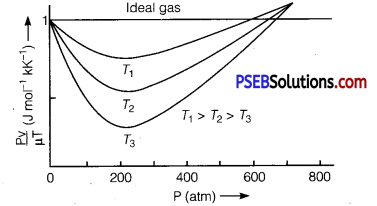
State ideal gas equation. Draw a graph to check whether a real gas obeys this equation. What is the conclusion drawn?
Answer:
According to the ideal gas equation, we have PV = µRT
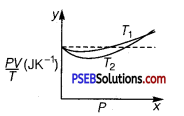
Thus, according to this equation \(\frac{P V}{\mu T}\) = R i.e., value of \( \frac{P V}{\mu T}\) must be a constant having a value 8.31 J mol-1 K-1. Experimentally value of \(\frac{P V}{\mu T}\) for real gases was calculated by altering the pressure of gas at different temperatures. The graphs obtained have been shown in the figure.
PSEB 11th Class Physics Important Questions Chapter 13 Kinetic Theory 1
Here, for the purpose of comparison, graph for an ideal gas has also been drawn, which is a straight line parallel to pressure axis. From the graph it is clear that behaviour of real gases differ from an ideal gas. However, at high temperatures and low pressures behaviour is nearly same as that of an ideal gas.

Question 2.
Explain, why
(i) there is no atmosphere on Moon.
(ii) there is fall in temperature with altitude. (NCERT Exemplar)
Answer:
(i) The Moon has small gravitational force and hence the escape velocity is small. As the Moon is in the proximity of the Earth as seen from the Sun, the Moon has the same amount of heat per unit area as that of the Earth. The air molecules have large range of speeds.

Even though the rms speed of the air molecules is smaller than escape velocity on the Moon, a significant number of molecules have speed greater than escape velocity and they escape. Now, rest of the molecules arrange the speed distribution for the equilibrium temperature. Again, a significant number of molecules escape as their speeds exceed escape speed. Hence, over a long time, the Moon has lost most of its atmosphere.

(ii) As the molecules move higher, their potential energy increases and hence kinetic energy decreases and temperature reduces. At greater height, more volume is available and gas expands. Hence, some cooling takes place.

Question 3.
Two perfect gases at absolute temperatures T1 and T2 are mixed. There is no loss of energy. Find the temperature of the mixture if the masses of the molecules are m1 and m2 and the number of the molecules in the gases are n1 and n2 respectively.
Solution:
According to kinetic theory, the average kinetic energy per molecule of a
gas = \(\frac{3}{2} \) KBT
Before mixing the two gases,the average K.E. of all the molecules of two gases
= \(\frac{3}{2} \)KBn1T1 + \(\frac{3}{2} \)KBn1T2
After mixing, the average K.E. of both the gases
= \(\frac{3}{2} \)kB (n1 +n2)T
where, T is the temperature of mixture.
Since there is no loss of energy,
Hence, \(\frac{3}{2} \)kB (n1 +n2)T = \(\frac{3}{2} k_{B} n_{1} T_{1}+\frac{3}{2} k_{B} n_{2} T_{2}\)
or T = \(\frac{n_{1} T_{1}+n_{2} T_{2}}{\left(n_{1}+n_{2}\right)}\).

PSEB 11th Class Physics Important Questions Chapter 13 Kinetic Theory

Question 4.
At room temperature, diatomic gas molecule has five degrees of freedom. At high temperatures, it has seven degrees of freedom. Explain.
Answer:
At low temperatures, diatomic gas has three translational and two rotational degrees of freedom, so total number of degrees of freedom is 5. But at high temperature, gas molecule starts to vibrate which give two additional degrees of freedom. So the total numbers of degrees of freedom is 7.

Question 5.
What is basic law followed by equipartition of energy?
Answer:
The law of equipartiüon of energy for any dynamical system in thermal equilibrium, the total energy is distributed equally amongst all the degrees of freedom. The energy associated with each molecule per degree of freedom is \(\frac{1}{2}\) kBT, where kB is Boltzmann’s constant and T is temperature of the system.

Question 6.
On what parameters does the λ (mean free path) depends?
Solution:
We know that,
λ = \(\frac{k T}{\sqrt{2} \pi d^{2} P}=\frac{m}{\sqrt{2} \pi d^{2} \rho}=\frac{1}{\sqrt{2} \pi n d^{2}}\)
Therefore, A depends upon:
(i) diameter (d) of the molecule, smaller the ‘d’, larger is the mean free path λ .
(ii) λ ∝ T i. e., higher the temperature larger is the λ.
(iii) λ ∝ \(\frac{1}{P}\) i.e., smaller the pressure larger is the λ.
(iv) λ ∝ \(\frac{1}{\rho}\) i.e., smaller the density (ρ), larger will be the λ.
(v) λ ∝ \(\frac{1}{n}\) i. e., smaller the number of molecules per unit volume of the gas, larger is the λ.

Question 7.
Although velocity of air molecules is very fast but fragrance of a perfume spreads at a much slower rate. Explain?
Answer:
This is because perfume vapour molecules do not travel uninterrupted, they undergo a number of collisions and trace a zig-zag path, due to which their effective displacement per unit time is small, so spreading is at a much slower rate.

Long Answer Type Questions

Question 1.
Consider an ideal gas with following distribution of speeds:

Speed (m/s) % of molecules
200 10
400 20
600 40
800 20
1000 10

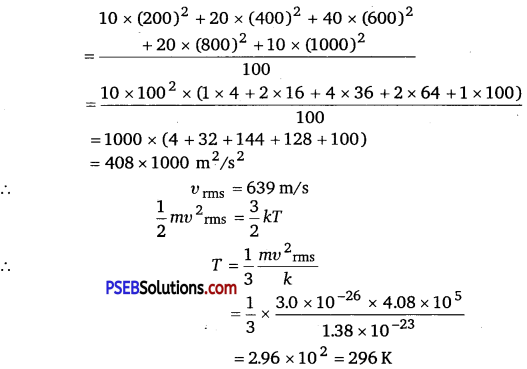
(i) Calculate υrms and hence T(m = 3.0 x 10⁻²⁶ kg)
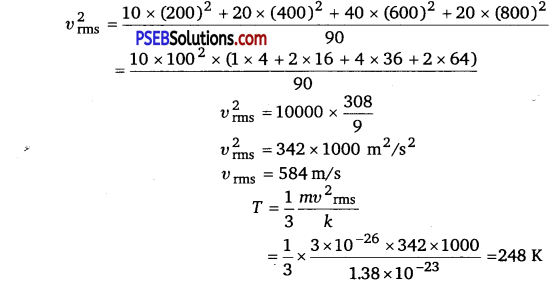
(ii) If all the molecules with speed 1000 m/s escape from the system, calculate newvma and hence T.(NCERTExemplar)
Solution:
This problem is designed to give an idea about cooling by evaporation.
(i) υ2rms = \(\frac{\sum n_{i} v_{i}^{2}}{\sum n_{i}}\)
PSEB 11th Class Physics Important Questions Chapter 13 Kinetic Theory 2
(ii)
PSEB 11th Class Physics Important Questions Chapter 13 Kinetic Theory 3

PSEB 11th Class Physics Important Questions Chapter 13 Kinetic Theory

Question 2.
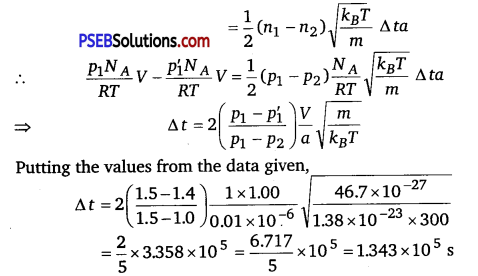
A box of 1.00 m3 is filled with nitrogen at 1.50 atm at 300 K. The box has a hole of an area Is 0.010 mm2. How much time is required for the pressure to reduce by 0.10 atm., if the pressure outside is 1 atm.
Solution:
Given, the volume of the box, V 1.00 m3
Area of hole, a = 0.010 mm3 = 0.01 x 10⁻⁶ m2
Temperature outside = Temperature inside
Initial pressure inside the box = 1.50 atm
Final pressure inside the box = 0.10 atm
PSEB 11th Class Physics Important Questions Chapter 13 Kinetic Theory 4
Assuming,
υix= Speed of nitrogen molecule inside the box along x-direction.
n1 = Number of molecules per unit volume in a time interval of Δt, all the particles at a distance (υixΔt) will collide the hole and the wall, the particle colliding along the hole will escape out reducing the pressure in the box.

Let the area of the wall is A, Number of particles colliding in time, Δt = \(\frac{1}{3}\) n1ixΔt)A \(\frac{1}{2}\) is the factor because all the particles along x-direction are behaving randomly. Hence, half of these are colliding against the walls on either side.
Inside the box, υ2ix + υ2iy + υ2iz = υ2rms
⇒ υ2ix = \(\frac{v_{r m s}^{2}}{3}\) [∵ υix = υiy= υiz]

If particles collide along hole, they move out. Similarly, outer particles colliding along hole will move in.
Ifa = area of hole
Then, net particle flow in time,
Δt = \(\frac{1}{2}\left(n_{1}-n_{2}\right) \frac{k_{B} T}{m} \Delta t a\) [∵υrms = \(\sqrt{\frac{3 k_{B} T}{m}} \)]

[Temperature inside and outside the box are equal]
Let n = number of density of nitrogen
n = \(\frac{\mu N_{A}}{V}=\frac{p N_{A}}{R T}\) [∵ \(\frac{\mu}{V}=\frac{p}{R T}\)]
where, NA = Avogadro’s number
If after time Δt, pressure inside changes from p1 to p2
n’1 = \(\frac{p_{1}^{\prime} N_{A}}{R T}\)
Now, number of molecules gone out = n1V -n’1V
PSEB 11th Class Physics Important Questions Chapter 13 Kinetic Theory 5

PSEB 11th Class Physics Solutions Chapter 13 Kinetic Theory

Punjab State Board PSEB 11th Class Physics Book Solutions Chapter 13 Kinetic Theory Textbook Exercise Questions and Answers.

PSEB Solutions for Class 11 Physics Chapter 13 Kinetic Theory

PSEB 11th Class Physics Guide Kinetic Theory Textbook Questions and Answers

Question 1.
Estimate the fraction of molecular volume to the actual volume occupied by oxygen gas at SIP. Take the diameter of an oxygen molecule to be 3Å.
Solution:
Diameter of an oxygen molecule, d = 3Å
Radius, r = \(\frac{d}{2}=\frac{3}{2}\) =1.5 Å = 1.5 x 10⁻⁸ cm
Actual volume occupied by 1 mole of oxygen gas at STP = 22400 cm3
Molecular volume of oxygen gas, V = \(\frac{4}{3}\) πr3N

where, N is Avogadro’s number = 6.023 x 10²³ molecules/mole
∴ V = \(\frac{4}{3}\) x 3.14 x (1.5 x 10-8)3 x 6.023 x 1023 = 8.51cm3

Ratio of the molecular volume to the actual volume of oxygen = \(\frac{8.51}{22400}\) = 3.8 x 10⁻⁴ ≈ 4 x 10⁻⁴

Question 2.
Molar volume is the volume occupied by 1 mol of any (ideal) gas at standard temperature and pressure (STP: 1 atmospheric pressure, 0°C). Show that it is 22.4 litres.
Solution:
The ideal gas equation relating pressure (P), volume (V), and absolute temperature (T) is given as PV = nRT
where, R is the universal gas constant = 8.314 J mol-1 K-1
n = Number of moles = 1
T = Standard temperature = 273 K
P = Standard pressure = 1 atm = 1.013 x 10⁵ Nm-2
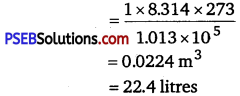
∴ V = \(\frac{n R T}{P}\)
PSEB 11th Class Physics Solutions Chapter 13 Kinetic Theory 1
Hence, the molar volume of a gas at STP is 22.4 litres.

PSEB 11th Class Physics Solutions Chapter 13 Kinetic Theory

Question 3.
Given figure shows plot of PV IT versus P for 1.00 x 10⁻³ kg of oxygen gas at two different temperatures.
PSEB 11th Class Physics Solutions Chapter 13 Kinetic Theory 2
(a) What does the dotted plot signify?
(b) Which is true: T1 > T2 or T1 <T2?
(c) What is the value of PVIT where the curves meet on the y-axis?
(d) If we obtained similar plots for 1.00 x 10³ kg of hydrogen, would we get the same value of PV/T at the point where the curves meet on the y-axis? If not, what mass of hydrogen yields the same value of PV/T (for low-pressure high-temperature region of the plot)? (Molecular mass of H2=2.02u,of O2 =32.0 u, R= 8.31Jmol-1K-1)
Solution:
(a) The dotted plot in the graph signifies the ideal behaviour of the gas, i. e., the ratio \(\frac{\bar{P} V}{T}\) is equal. μR(μ is the number of moles and R is the universal gas constant) is a constant quantity. It is not dependent on the pressure of the gas.

(b) The dotted plotmn the given graph represents an ideal gas. The curve of the gas at temperatureT1 is closer to the dotted plot than the curve of the gas at temperature T2. A real gàs approaches the behaviour of an ideal gas when its temperature increases. Therefore, T1 > T2 is true for the given plot.

(c) The value of the ratio PV/T, where the two curves meet, is μ.R. This is because the ideal gas equation is given as:
PV=μRT
\(\frac{P V}{T}\) = μR
where P is the pressure
T is the temperature
V is the volume
μ is the number of moles
R is the unìversal constant
Molecular mass of oxygen = 32.0 g
Mass of oxygen =1 x 10⁻³ kg = 1 g
R =8.314J mole-1K-1
∴ \(\frac{P V}{T}=\frac{1}{32} \times 8.314\) =0.26JK-1
Therefore, the value of the ratio PV/T, where the curves meet on the y-axis, is 0.26JK-1.

(d) If we obtain similar plots for 1.00 x 10⁻³ kg of hydrogen, then we will not get the same value of PV/T at the point where the curves meet the y-axis. This is because the molecular mass of hydrogen (2.02 u) is different from that of oxygen (32.0 u).
We have \(\frac{P V}{T}\) = 0.26JK-1
R = 8.314 J mole-1 K-1
Molecular mass (M) of H2 =2.02 u PV
\(\frac{P V}{T}\) = μR at constant temperature
where, μ = \(\frac{m}{M}\) , m = Mass of H2
∴ m = \(\frac{P V}{T} \times \frac{M}{R}=\frac{0.26 \times 2.02}{8.314}\)
= 6.3 x 10⁻² g = 6.3 x 10⁻⁵ kg
Hence, 6.3 x 10⁻⁵ kg of H2 will yield the same value of PV/T.

Question 4.
An oxygen cylinder of volume 30 litres has an initial gauge pressure of 15 atm and a temperature of 27°C. After some oxygen is withdrawn from the cylinder, the gauge pressure drops to 11 atm and its temperature drops to 17°C. Estimate the mass of oxygen taken out of the cylinder (R = 8.31 J mol-1 K -1, molecular mass of O 2 =32 u).
Solution:
Absolute pressure, p1 = (15 + 1) atm
[∵ Absolute pressure = Gauge pressure +1 atm] = 16 x 1.013 x 105 Pa
V1 = 30 L = 30 x 10-3 m3
T1 = 273.15 + 27 = 300.15K
Using ideal gas equation,
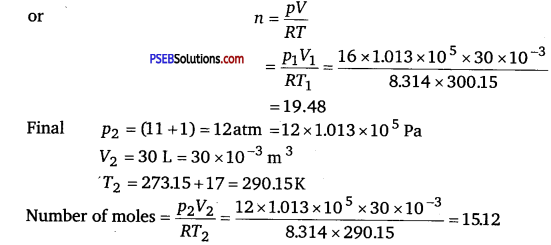
pV = nRT
PSEB 11th Class Physics Solutions Chapter 13 Kinetic Theory 3
Hence, moles removed = 19.48-15.12 = 4.36
Mass removed = 4.36 x 32 g = 139.52 g = 0.1396 kg.
Therefore, 0.14 kg of oxygen is taken out of the cylinder.

Question 5.
An air bubble of volume 1.0 cm3 rises from the bottom of a lake 40 cm deep at a temperature of 12°C. To what volume does it grow when it reaches the surface, which is at a temperature of 35°C?
Solution:
Volume of the air bubble, = 1.0 cm3 = 1.0 x 10⁻⁶ m3
Bubble rises to height, d = 40 m
Temperature at a depth of 40 m, T1 = 12°C = 273 + 12 = 285K
Temperature at the surface of the lake, T2 = 35°C = 273 + 35 = 308K
The pressure on the surface of the lake,
P2 =1 atm = 1 x 1.013 x 105Pa
The pressure at the depth of 40 m,
P1 = 1 atm + dρg
where, ρ is the density of water = 103 kg/m3
g is the acceleration due to gravity = 9.8 m/s2
∴ P1 = 1.013 X10⁵+40 X 103 X 9.8 = 493300 Pa
We have \(\frac{P_{1} V_{1}}{T_{1}}=\frac{P_{2} V_{2}}{T_{2}}\)
where, V2 is the volume of the air bubble when it reaches the surface
V2= \(\frac{P_{1} V_{1} T_{2}}{T_{1} P_{2}}=\frac{(493300)\left(1.0 \times 10^{-6}\right) 308}{285 \times 1.013 \times 10^{5}}\)
= 5.263 x 10⁻⁶ m3 or 5.263 cm3
Therefore, when the air bubble reaches the surface, its volume becomes 5.263 cm3.

PSEB 11th Class Physics Solutions Chapter 13 Kinetic Theory

Question 6.
Estimate the total number of air molecules (inclusive of oxygen, nitrogen, water vapour and other constituents) in a room of capacity 25.0 m3 at a temperature of 27°C and 1 atm pressure.
Solution:
Volume of the room, V = 25.0 m3
Temperature of the room, T = 27°C = 273 + 27°C = 300 K
Pressure in the room, P = 1 atm = 1 x 1.013 x 105 Pa
The ideal gas equation relating pressure (?), Volume (V), and absolute temperature (T) can be written as PV = kBNT
where,
KB is Boltzmann constant = 1.38 x 10 -23 m2 kg s-2 K-1
N is the number of air molecules in the room
∴ N = \(\frac{P V}{k_{B} T}\)
= \(\frac{1.013 \times 10^{5} \times 25}{1.38 \times 10^{-23} \times 300}\) = 6.11 x 1026 molecules
Therefore, the total number of air molecules in the given room is 6.11 x 1026.

Question 7.
Estimate the average thermal energy of a helium atom at (i) room temperature (27°C),
(ii) the temperature on the surface of the Sun (6000K),
(iii) the temperature of 10 million Kelvin (the typical core temperature in the case of a star).
Solution:
(i) At room temperature, T = 27°C = 273 +27 = 300 K
Average thermal energy, E = \(\frac{3}{2}\)kT
where k is Boltzmann constant = 1.38 x 10⁻²³ m2 kg s-2 K-1
∴ E = \(\frac{3}{2}\) x 1.38 x 10-23 x 300 = 6.21 x 10⁻²¹ J
Hence, the average thermal energy of a helium atom at room temperature (27°C) is 6.21 x 10⁻²³ J

(ii) On the surface of the Sun, T = 6000 K
Average thermal energy = \(\frac{3}{2}\) kT = \(\frac{3}{2}\) x 1.38 x 10-23 x 6000
= 1.241 x 10⁻¹⁹J
Hence, the average thermal energy of a helium atom on the surface of the Sun is 1.241 x 10⁻¹⁹J.

(iii) At temperature, T =107 K
Average thermal energy = \(\frac{3}{2}\)kT = \(\frac{3}{2}\) x 1.38 x 10-23 x 107
= 2.07 x 10⁻¹⁶ J
Hence, the average thermal energy of a helium atom at the core of a star is 2.07 x 10⁻¹⁶ J.

Question 8.
Three vessels of equal capacity have gases at the same temperature and pressure. The first vessel contains neon (monatomic), the second contains chlorine (diatomic), and the third contains uranium hexafluoride (polyatomic). Do the vessels contain equal number of respective molecules? Is the root mean square speed of molecules the same in the three cases? If not, in which case is υrms the largest?
Solution:
Yes. All contain the same number of the respective molecules.
No. The root means square speed of neon is the largest.
Since the three vessels have the same capacity, they have the same volume.

Hence, each gas has the same pressure, volume, and temperature. According to Avogadro’s law, the three vessels will contain an equal number of the respective molecules. This number is equal to Avogadro’s number, N = 6.023 x 10²³.
The root mean square speed (υrms)oi a gas of mass m, and temperature T, is given by the relation: υrms = \(\sqrt{\frac{3 k T}{m}} \)
where k is Boltzmann constant
For the given gases, k and T are constants.

Hence, υrms depends only on the mass of the atoms, i.e., υrms ∝ \(\sqrt{\frac{1}{m}}\)
Therefore, the root mean square speed of the molecules in the three cases is not the same.

Among neon, chlorine, and uranium hexafluoride, the mass of neon is the smallest.
Hence, neon has the largest root mean square speed among the given gases.

PSEB 11th Class Physics Solutions Chapter 13 Kinetic Theory

Question 9.
At what temperature is the root mean square speed of an atom in an argon gas cylinder equal to the rms speed of a helium gas atom at -20°C? (atomic mass of Ar = 39.9 u, of He = 4.0u).
Solution:
Temperature of the helium atom, THe = -20°C = 273 – 20 = 253K
Atomic mass of argon, MAr= 39.9 u
Atomic mass of helium, MHe = 4.0 u
Let, (υrms)be the rms speed of argon.
Let (υrms )He be the rms speed of helium.
The rms speed of argon is given by
rms)Ar = \(\sqrt{\frac{3 R T_{\mathrm{Ar}}}{M_{\mathrm{Ar}}}}\) …………………………….. (i)
where, R is the universal gas constant
TAr is temperature of argon gas
The rms speed of helium is given by:
rms)He = \(\sqrt{\frac{3 R T_{\mathrm{He}}}{M_{\mathrm{He}}}}\) …………………………. (ii)

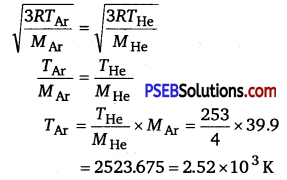
It is given that: (υrms)Ar = (υrms)He
PSEB 11th Class Physics Solutions Chapter 13 Kinetic Theory 4
Therefore, the temperature of the argon atom is 2.52 x 10³ K.

Question 10.
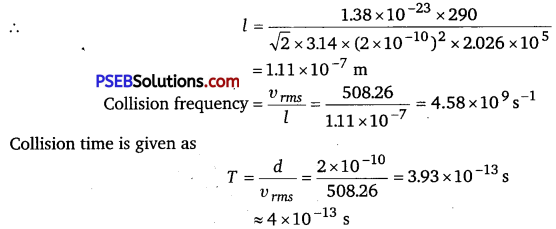
Estimate the mean free path and collision frequency of a nitrogen molecule in a cylinder containing nitrogen at 2.0 atm and temperature 17°C. Take the radius of a nitrogen molecule to be roughly 1.0 Å. Compare the collision time with the time the molecule moves freely between two successive collisions (Molecular mass of N2 = 28.0u).
Solution:
Pressure inside the cylinder containing nitrogen,
P =2.0atm = 2 x 1.013 x 105 Pa = 2.026 x 10⁵ Pa
Temperature inside the cylinder, T = 17°C = 273 +17 = 290 K
Radius of a nitrogen molecule, r = 1.0 Å = 1 x 10,sup>-10 m
Diameter, d = 2 x 1 x 10-10 = 2 x 10⁻¹⁰ m
Molecular mass of nitrogen, M = 28.0 g = 28 x 10-3 kg
The root mean square speed of nitrogen is given by the relation
υrms = \(\sqrt{\frac{3 R T}{M}}\)
where, R is the universal gas constant = 8.314 J mole -1 K-1
∴ υrms = \(\sqrt{\frac{3 \times 8.314 \times 290}{28 \times 10^{-3}}}\) = 508.26m/s
The mean free path (l) is given by the relation:
l = \(\frac{k T}{\sqrt{2} \times d^{2} \times P}\)
where,
k is the Boltzmann constant = 1.38 x 10⁻²³ kgm2s-2 K-1
PSEB 11th Class Physics Solutions Chapter 13 Kinetic Theory 13

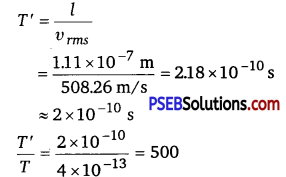
Time is taken between successive collisions,
PSEB 11th Class Physics Solutions Chapter 13 Kinetic Theory 5
Hence, the time taken between successive collisions is 500 times the time taken for a collision.

Additional Exercises

Question 11.
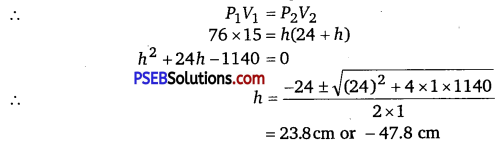
A metre long narrow bore held horizontally (and closed at one end) contains a 76 cm long mercury thread, which traps a 15 cm column of air. What happens if the tube is held vertically with the open end at the bottom?
Solution:
Length of the narrow bore, L=1 m = 100 cm
Length of the mercury thread, l = 76 cm
Length of the air column between mercury and the closed-end, la = 15cm
Since the bore is held vertically in air with the open end at the bottom, the mercury length that occupies the air space is 100-(76+15) = 9 cm

Hence, the total length of the air column = 15 + 9 = 24 cm
Let h cm of mercury flow out as a result of atmospheric pressure.
∴ Length of the air column in the bore = 24 + h cm
and, length of the mercury column = 76 – h cm
Initial pressure, P1 = 76 cm of mercury
Initial volume,V1 =15 cm3
Final pressure, P2 = 76 – (76 – h) = h cm of mercury
Final volume, V2 = (24 + h) cm3
The temperature remains constant throughout the process.
PSEB 11th Class Physics Solutions Chapter 13 Kinetic Theory 6

Height cannot be negative. Hence, 23.8cm of mercury will flow out from the bore and 52.2 cm of mercury will remain in it. The length of the air column will be 24 +23.8 = 47.8 cm.

Question 12.
From a certain apparatus, the diffusion rate of hydrogen has an average value of 28.7cm3s-1. The diffusion of another gas under the same conditions is measured to have an average rate of 7.2 cm3 s-1. Identify the gas. [Hint: Use Graham’s law of diffusion: R1/R2 =(M2/M1)1/2, where R1, R2 are diffusion rates of gases 1 and 2, and M1 and M2 their respective molecular masses. The law is a simple consequence of the kinetic theory.]
Solution:
Rate of diffusion of hydrogen, R1 = 28.7cm3 s-1
Rate of diffusion of another gas, R2 = 7.2 cm3 s-1
According to Graham’s Law of diffusion, we have
\(\frac{R_{1}}{R_{2}}=\sqrt{\frac{M_{2}}{M_{1}}}\)
where, M1 is the molecular mass of hydrogen 2.020 g
M2 is the molecular mass of the unknown gas
∴ M2 = M1\(\left(\frac{R_{1}}{R_{2}}\right)^{2}\) = 2.01 \(\left(\frac{28.7}{7.2}\right)^{2}\) = 32.09 g
32g is the molecular mass of oxygen. Hence, the unknown gas is oxygen.

PSEB 11th Class Physics Solutions Chapter 13 Kinetic Theory

Question 13.
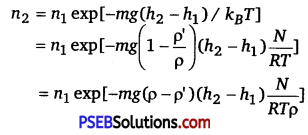
A gas in equilibrium has uniform density and pressure throughout its volume. This is strictly true only if there are no external influences. A gas column under gravity, for example, does not have a uniform density (and pressure). As you might expect, its density decreases with height. The precise dependence is given by the so-called law of atmospheres n2 =n1 exp[-mg(h2 -h1) / kB T]
where n2,n1 refer to number density at heights h2 and h1 respectively.
Use this relation to derive the equation for sedimentation equilibrium of a suspension in a liquid column: n2 = n1 exp [-mg NA (ρ -ρ’)(h2 -h1) / (ρRT)]
where ρ is the density of the suspended particle, and ρ’ that of surrounding medium. [NA is Avogadro’s number and R the universal gas constant.] [Hint: Use Archimedes principle to find the apparent weight of the suspended particle.]
Solution:
According to the law of atmospheres, we have
n2=n1 exp [-mg(h2 – h1])/kBT] ………………………………. (i)
where, n1 is the number density at height h1, and n2 is the number density at height h2
mg is the weight of the particle suspended in the gas column
Density of the medium = ρ’
Density of the suspended particle = ρ
Mass of one suspended particle = m’
Mass of the medium displaced = m
Volume of a suspended particle = V
According to Archimedes’ principle for a particle suspended in a liquid column, the effective weight of the suspended particle is given as

Weight of the medium displaced – Weight of the suspended particle
= mg – m’g
= mg – Vρ’g = mg – \(\left(\frac{m}{\rho}\right)\) ρ’g
= mg – \(\left(1-\frac{\rho^{\prime}}{\rho}\right)\) …………………………….. (ii)
Gas constant, R = kBN
kB = \(\frac{R}{N}\) …………………………………….. (iii)
Substituting equation (ii) in place of mg in equation (i) and then using equation (iii), we get
PSEB 11th Class Physics Solutions Chapter 13 Kinetic Theory 7

Question 14.
Given below are densities of some solids and liquids. Give rough estimates of the size of their atoms:

Substance Atomic Mass (u) Density (103 kg m-3)
Carbon (diamond) 12.01 2.22
Gold 197.00 19.32
Nitrogen (liquid) 14.01 1.00
Lithium 6.94 0.53
Fluorine (liquid) 19.00 1.14

[Hint: Assume the atoms to be ‘tightly packed’ in a solid or liquid phase, and use the known value of Avogadro’s number. You should, however, not take the actual numbers you obtain for various atomic sizes too literally. Because of the crudeness of the tight packing approximation, the results only indicate that atomic sizes are in the range of a few Å].
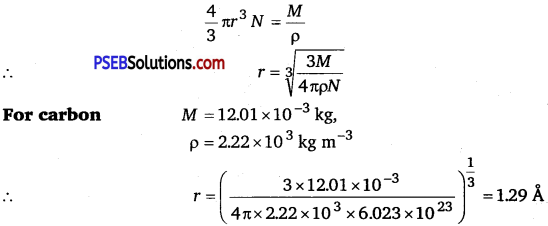
Atomic mass of a substance = M
Density of the substance = ρ

Avogadro’s number = N = 6.023 x 10²³
Volume of each atom = \(\frac{4}{3} \pi r^{3}\)
Volume of N number of molecules = \(\frac{4}{3} \pi r^{3}\) N …………………………….. (i)
Volume of one mole of a substance = \(\frac{M}{\rho}\) ………………………………….. (ii)

PSEB 11th Class Physics Solutions Chapter 13 Kinetic Theory 8
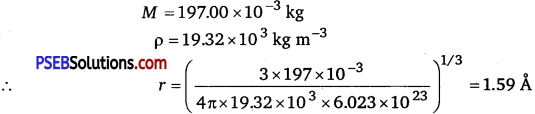
For gold
PSEB 11th Class Physics Solutions Chapter 13 Kinetic Theory 9
Hence, the radius of a gold atom is 1.59 Å
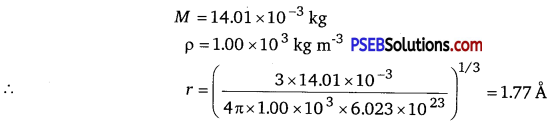
For liquid nitrogen
PSEB 11th Class Physics Solutions Chapter 13 Kinetic Theory 10
Hence, the radius of a liquid nitrogen atom is 1.77 Å

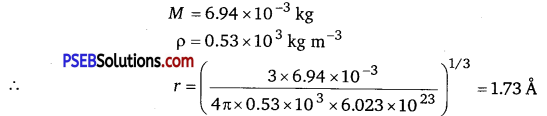
For lithium
PSEB 11th Class Physics Solutions Chapter 13 Kinetic Theory 11
Hence, the radius of a lithium atom is 1.73 Å.

For liquid fluorine
PSEB 11th Class Physics Solutions Chapter 13 Kinetic Theory 12
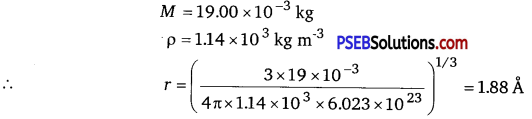
Hence, the radius of liquid fluorine atom is 1.88 Å.

PSEB 11th Class Physics Important Questions Chapter 3 Motion in a Straight Line

Punjab State Board PSEB 11th Class Physics Important Questions Chapter 3 Motion in a Straight Line Important Questions and Answers.

PSEB 11th Class Physics Important Questions Chapter 3 Motion in a Straight Line

Very short answer type questions

Question 1.
What is the condition for an object to be considered as a point object?
Answer:
An object can be considered as a point object if the distance travelled by it is very large than its size.

Question 2.
For which condition, the distance and the magnitude of displacement of an object have the same values?
Answer:
The distance and the magnitude of displacement of an object have the same values, when the body is moving along a straight line path in a fixed direction.

PSEB 11th Class Physics Important Questions Chapter 3 Motion in a Straight Line

Question 3.
Speed of a particle cannot be negative. Why?
Answer:
Speed is the distance travelled in unit time and distance cannot be negative.

Question 4.
Is it possible that a body could have constant speed but varying velocity?
Answer:
Yes, a body could have constant speed but varying velocity if only the direction of motion changes.

Question 5.
For which condition, the average velocity will be equal to the instantaneous velocity?
Answer:
When a body moves with a uniform velocity, then
υav = υinst

Question 6.
Give an example of uniformly accelerated linear motion.
Answer:
Motion of a body under gravity.

Question 7.
Give example of motion where x > 0, υ < 0, a > 0 at a particular instant. (NCERT Exemplar)
Solution:
Let the motion is represented by
x(t) = A + Be-γt ……………. (i)
Let A>B and γ > 0
Now velocity x(t) = \(\frac{d x}{d t}\) = -Bγe-γt
Acceleration a(t) = \(\frac{d x}{d t}\) = Bγ2e-γt
Suppose we are considering any instant t, then from Eq. (i) we can say that
x(t)>0,υ(t)< 0 and a>0

PSEB 11th Class Physics Important Questions Chapter 3 Motion in a Straight Line

Short answer type questions

Question 1.
Explain how an object could have zero average velocity but non-zero average speed?
Solution:
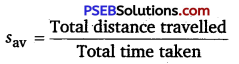
υ = \(=\frac{\text { Net displacement }}{\text { Total time taken }}\)
and average speed,
PSEB 11th Class Physics Important Questions Chapter 3 Motion in a Straight Line 1
If an object moves along a straight line starting from origin and then returns back to origin.
Average velocity = 0
and Average speed = \(\frac{2 s}{t}\)

Question 2.
If the displacement of a body is zero, is distance necessarily zero? Answer with one example.
Answer:
No, because the distance covered by an object is the path length of the path covered by the object. The displacement of an object is given by the change in position between the initial position and final position.

Question 3.
Is earth inertial or non-inertial frame of reference?
Answer:
Since, earth revolves around the sun and also spins about its own axis, so it is an accelerated frame of reference. Hence, earth is a non-inertial frame of reference.
However, if we do not take large scale motion such as wind and ocean currents into consideration, we can say that approximation the earth is an inertial frame.

PSEB 11th Class Physics Important Questions Chapter 3 Motion in a Straight Line

Question 4.
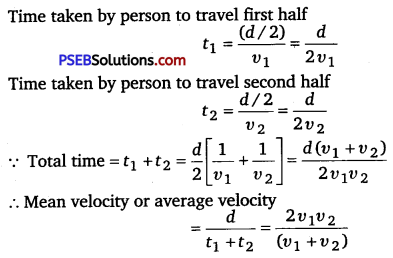
A person travels along a straight road for the first half with a velocity υ 1 and the second half with velocity υ 2. What is the mean velocity of the person?
Solution:
PSEB 11th Class Physics Important Questions Chapter 3 Motion in a Straight Line 2

Question 5.
The displacement of a particle is given by at2 What is dependency of acceleration on time?
Solution:
Let x be the displacement. Then, x = at2
∴ Velocity of the object, υ = \(\frac{d x}{d t}\) = 2 at
Acceleration of the object, a = \(\frac{d v}{d t}\) = 2 a
It means that a is constant.

Question 6.
What are uses of a velocity-time graph?
Solution:
From a velocity-time graph, we can find out
(i) The velocity of a body at any instant.
(ii) The acceleration of the body and
(iii) The net displacement of the body in a given time-interval.

PSEB 11th Class Physics Important Questions Chapter 3 Motion in a Straight Line

Question 7.
Draw displacement-time graph for a uniformly accelerated motion. What is its shape?
Solution:
Displacement-time graph for a uniformly accelerated motion has been shown in adjoining fig. The graph is parabolic in shape.
PSEB 11th Class Physics Important Questions Chapter 3 Motion in a Straight Line 3

Question 8.
The distance travelled by a body is proportional to the square of time. What type of motion this body has?
Solution:
Let x be the distance travelled in time t. Then,
x ∝ t2 [given]
x = kt2 [here, k = constant of proportionality]
We know that velocity is given
υ = \(\frac{d x}{d t}\) = 2kt
and acceleration is given by
a = \(\frac{d v}{d t}\) = 2 k [constant]
Thus, the body has uniform accelerated motion.

Long answer type questions

Question 1.
It is a common observation that rain clouds can be at about a kilometre altitude above the ground.
(i) If a rain drop falls from such a height freely under gravity, what will be its speed? Also, calculate in km/h (g = 10m/s2).
(ii) A typical rain drop is about 4 mm diameter. Momentum is mass × speed in magnitude. Estimate its momentum when it hits ground.
(iii) Estimate time required to flatten the drop.
(iv) Rate of change of momentum is force. Estimate how much force such a drop would exert on you?
(v) Estimate the order of magnitude force on umbrella. Typical lateral separation between two rain drops is 5 cm.
(Assume that umbrella is circular and has a diameter of 1 m and cloth is not pierced through it.) (NCERT Exemplar)
Solution:
Here, height (h) = 1 km = 1000 m, g = 10 m/2
(i) Velocity attained by the rain drop in freely falling through a height h.
υ = \(\sqrt{2 g h}=\sqrt{2 \times 10 \times 1000}\)
= 100√2 m/s
= 100√2 \(\frac{60 \times 60}{1000}\) km/h
= 360√2 km/h ≈ 510 km/h

(ii) Diameter of the drop (d) = 2 r = 4 mm
∴ Radius of the drop (r) = 2 mm = 2 × 10⁻³ m
Mass of a rain drop (m) = V × ρ
= \(\frac{4}{3}\) πr3ρ = \(\frac{4}{3} \times \frac{22}{7}\) x (2 × 10⁻³)3 × 10³
[ v density of water = 103 kg/m3 ]
≈ 3.4 × 10⁻⁵ kg
Momentum of the rain drop (p) = mυ
= 3.4 × 10-5 × 100√2
≈ 4.7 × 10⁻³ kg-m/s

(iii) Time required to flatten the drop = time taken by the drop to travel the distance equal to the diameter of the drop near the ground
t = \(\frac{d}{v} \times \frac{4 \times 10^{-3}}{100 \sqrt{2}}\) = 0.028 × 10⁻³ s
= 2.8 × 10⁻⁵ s

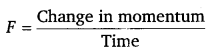
(iv) Force exerted by a rain drop
PSEB 11th Class Physics Important Questions Chapter 3 Motion in a Straight Line 4
= \(\frac{p-0}{t}=\frac{4.7 \times 10^{-3}}{2.8 \times 10^{-5}}\) ≈ 168 N

(v) Radius of the umbrella (R) = \(\frac{1}{2}\) m
∴ Area of the umbrella (A) = πR2 = \(\frac{22}{7}\) x (\(\frac{1}{2}\))2 = \(\frac{22}{28}=\frac{11}{14}\) ≈ 0.8M2
Number of drops striking the umbrella
simultaneously with average separation of 5 cm or 5 × 10⁻² m
= \(\frac{0.8}{\left(5 \times 10^{-2}\right)^{2}}\) = 320
∴ Net force exerted on umbrella = 320 × 168 = 53760 N

PSEB 11th Class Physics Important Questions Chapter 3 Motion in a Straight Line

Question 2.
If a body moving with uniform acceleration in straight line describes successive equal distance in time interval t1, t2 and t3, then show that
\(\frac{1}{t_{1}}-\frac{1}{t_{2}}+\frac{1}{t_{3}}=\frac{3}{t_{1}+t_{2}+t_{3}}\)
Solution:
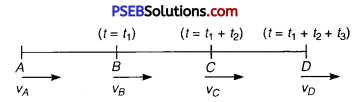
As shown in figure, let three successive equal distances be represented by AB, BC and CD
PSEB 11th Class Physics Important Questions Chapter 3 Motion in a Straight Line 5
Let each distance berm. Let υABC and υD be the velocities at points A, B, C and D respectively.
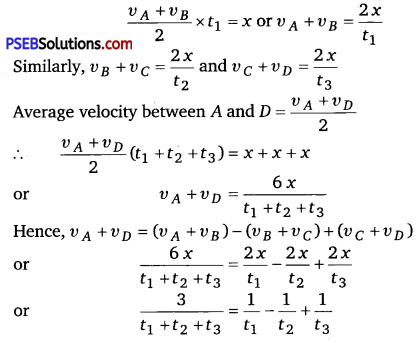
Average velocity between A and B = \(\frac{v_{A}+v_{B}}{2}\)
PSEB 11th Class Physics Important Questions Chapter 3 Motion in a Straight Line 6

PSEB 11th Class Physics Solutions Chapter 3 Motion in a Straight Line

Punjab State Board PSEB 11th Class Physics Book Solutions Chapter 3 Motion in a Straight Line Textbook Exercise Questions and Answers.

PSEB Solutions for Class 11 Physics Chapter 3 Motion in a Straight Lines

PSEB 11th Class Physics Guide Motion in a Straight Line Textbook Questions and Answers

Question 1.
In which of the following examples of motion, can the body be considered approximately a point object:
(a) a railway carriage moving without jerks between two stations.
(b) a monkey sitting on top of a man cycling smoothly on a circular track.
(c) a spinning cricket ball that turns sharply on hitting the ground.
(d) a tumbling beaker that has slipped off the edge of a table.
Answer:
(a), (b)

Explanation
(a) The size of a carriage is very small as compared to the distance between two stations. Therefore, the carriage can be treated as a point sized object.
(b) The size of a monkey is very small as compared to the size of a circular track. Therefore, the monkey can be considered as a point sized object on the track.
(c) The size of a spinning cricket ball is comparable to the distance through which it turns sharply on hitting the ground. Hence, the cricket ball cannot be considered as a point object.
(d) The size of a beaker is comparable to the height of the table from which it slipped. Hence, the beaker cannot be considered as a point object.

PSEB 11th Class Physics Solutions Chapter 3 Motion in a Straight Line

Question 2.
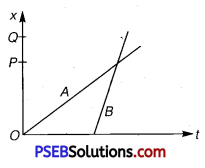
The position-time (x – t) graphs for two children A and B returning from their school O to their homes P and Q respectively are shown in below figure. Choose the correct entries in the brackets below;
(a) (A / B) lives closer to the school than (B / A)
(b) (A / B) starts from the school earlier than (B/ A)
(c) (A / B) walks faster than (B / A)
(d) A and B reach home at the (same/different) time
(e) (A / B) overtakes (B / A) on the road (once/twice).
PSEB 11th Class Physics Solutions Chapter 3 Motion in a Straight Line 1
Solution:
(a) Draw normals on graphs from points P and Q. It is clear that OQ > OP. Therefore, child A lives closer to the school than child B.
PSEB 11th Class Physics Solutions Chapter 3 Motion in a Straight Line 2
(b) Child A start from school at time t =0 (become its graph starts from origin) whild child B starts from school at time t = OC. Therefore, child A starts from school earlier than B.

(c) The slope of distance-time graph represents the speed. More the slope of the graph, more will be the speed. As the slope of the x-t graph of B is higher than the slope of the x – t graph of A, therefore child B walks faster than child A.
(d) Corresponding to points P and Q, the value of t from x – t graphs for children A and B is same i. e.,OE. Therefore, children A and B will reach their homes P and Q at the same time.

(e) x – t graphs for children A and B intersect each other at a point D. Child B starts later but reaches home at the same time as that of child A, therefore child B overtake child A on the road once.

Question 3.
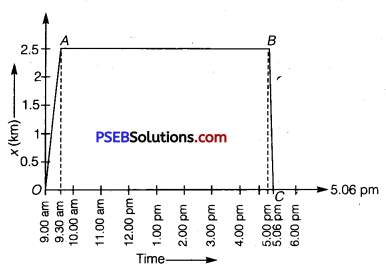
A woman starts from her home at 9.00 am, walks with a speed of 5kmh-1 on a straight road up to her office 2.5 km away, stays at the office up to 5.00 pm, and returns home by an auto with a speed of 25 km h-1. Choose suitable scales and plot the x – t graph of her motion.
Solution:
Speed of the woman = 5 km/h
Distance between her office and home = 2.5 km
Time taken = \(\frac{\text { Distance }}{\text { Speed }}\)
= \(\frac{2.5}{5}\) = 0.5 h = 30 min
Time of arival at office = 9.00 am + 30 min = 9.30 am i. e., at 9.30 am the distance covered will be 2.5 km. This part of journey is represented in graph by OA.
It is given that she covers the same distance in the evening by an auto. Now, speed of the auto = 25 km/h
= \(\frac{2.5}{25}=\frac{1}{10}\) = 0.1 h = 6 mm

She leaves the office at 5.00 pm and take 6 min to reach home. Therefore, she reaches her home at 5.06 pm at this time the distance is zero. This part of journey is represented in graph by BC.
PSEB 11th Class Physics Solutions Chapter 3 Motion in a Straight Line 3

PSEB 11th Class Physics Solutions Chapter 3 Motion in a Straight Line

Question 4.
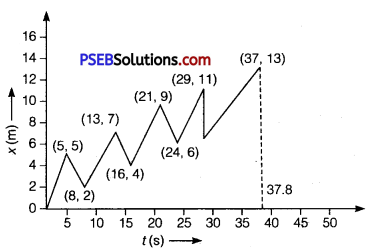
A drunkard walking in a narrow lane takes 5 steps forward and 3 steps backward, followed again by 5 steps forward and 3 steps backward, and so on. Each step is 1 m long and requires 1 s. Plot the x – t graph of bis motion. Determine graphically and otherwise how long the drunkard takes to fall in a pit 13 m away from the start.
Solution:
The x – t graph of the drunkard is shown in figure.
PSEB 11th Class Physics Solutions Chapter 3 Motion in a Straight Line 4
Length of each step =1 m, time taken for each step = 1 s
Time taken to move by 5 steps = 5 s
5 steps forward and 3 steps backward means that the net distance covered by him in first 8 steps i. e., in8s = 5m-3m = 2m
Distance covered by him in first 16 steps orl6s = 2 + 2 = 4m
Distance covered the drunkard in first 24 s i. e., 24 steps = 2 + 2 + 2= 6m
and distance covered in 32 steps i. e. 32 s = 8 m
Distance covered in37 steps = 8 + 5 = 13m
Distance of the pit from the start = 13 m
Total time taken by the drunkard to fall in the pit = 37 s
Since, 1 step requires 1 s of time, so we arrive at the same result from the graph shown.

Question 5.
A jet airplane travelling at the speed of 500 km h-1 ejects its products of combustion at the speed of 1500 km h-1 relative to the jet plane. What is the speed of the latter with respect to an observer on the ground?
Speed of the jet airplane, υjet = 500 km/h
Relative speed of its products of combustion with respect to the plane,
υsmoke = -1500 km/h
Speed of its products of combustion with respect to the ground V’smoke Relative speed of its products of combustion with respect to the airplane,
υsmoke = υ’smoke υ jet
-1500 = υ’smoke – 500
υ’smoke = -1000 km/h
The negative sign indicates that the direction of its products of combustion is opposite to the direction of motion of the jet airplane.

PSEB 11th Class Physics Solutions Chapter 3 Motion in a Straight Line

Question 6.
A car moving along a straight highway with speed of 126 km h-1 is brought to a stop within a distance of 200 m, What is the retardation of the car (assumed uniform), and how long does it take for the car to stop?
Solution:
Initial velocity of the car, u= 126 km/h = 126 × \(\frac{5}{18}\) m/s
= 35 m/s (∵ 1 km/h \(\frac{5}{10}\) m/s)
Final velocity of the car, υ = 0
Distance covered by the car before coming to rest, s = 200 m
From third equation of motion,
υ2 – u2 = 2as
(0)2 – (35)2 = 2 × a × 200
a = \(\frac{35 \times 35}{2 \times 200}\) = -3.06 m/s2
From first equation of motion,
v = u +at
t = \(\frac{v-u}{a}=\frac{0-35}{-3.06}=\frac{-35}{-3.06}\) = 11.44s
∴ Car will stop after 11.4 s.

Question 7.
Two trains A and B of length 400 m each are moving on two parallel tracks with a uniform speed of 72 km h-1 in the same direction, with A ahead of B. The driver of B decides to overtake A and accelerates by 1 m/s2. If after 50 s, the guard of B just brushes past the driver of A, what was the original distance between them?
Solution:
For train A:
Initial velocity, u = 72 km/h = 72 × \(\frac{5}{18}\) m/s = 20 m/s
Time, t = 50 s
Acceleration, aI =0 (Since it is moving with a uniform velocity)
From second equation of motion, distance (SI) covered by train A can be obtained as :
SI = ut + \(\frac {1}{2}\)aIt2
= 20 × 50 + 0 = 1000 m

For train B:
Initial velocity, u = 7 2 km/h = 72 × \(\frac{5}{18}\) m/ s = 20 m/ s
Acceleration, aII = 1 m/s2
Time, t = 50 s
From second equation of motion, distance (SII) covered by train B can be obtained as :
sII = ut + \(\frac {1}{2}\) aIIt2
= 20 × 50 + \(\frac {1}{2}\) × 1 × (50)2 = 2250 m
Hence, the original distance between the driver of train A and the guard of train B is 2250 – 1000 = 1250 m.

PSEB 11th Class Physics Solutions Chapter 3 Motion in a Straight Line

Question 8.
On a two lane road, car A is travelling with a speed of 36 kmh-1. Two cars B and C approach car A in opposite directions with a speed of 54 km h 1 each. At a certain instant, when the distance AB is equal to AC, both being 1 km, B decides to overtake A before C does. What minimum acceleration of car B is required to avoid an accident?
Solution:
Velocity of car A, υA = 36 km/h = 36 × \(\frac {5}{18}\) m/s = 10 m/s
Velocity of car B, υB =54 km/h = 54 × \(\frac {5}{18}\) m/s = 15 m/s
Velocity of car C,υC = 54 km/h 54 × \(\frac {5}{18}\) m/s = 15 m/s
Relative velocity of car B with respect to car A,
υBA = υB – υA = 15 – 10 = 5 m/s
Relative velocity of car C with respect to car A,
υCA – υC – (-υA) = 15 + 10 = 25m/s
At a certain instance, both cars B and C are at the same distance from car Ai.e.,
s = 1 km = 1000 m
Time taken (t) by car C to cover 1000 m = \(\frac {1000}{25}\) = 40 s
Hence, to avoid an accident, car B must cover the same distance in a maximum of 40 s. From second equation of motion, minimum acceleration (a) produced by car B can be obtained as:
s = ut + \(\frac {1}{2}\)at2
1000 = 5 × 40 + \(\frac {1}{2}\) × a × (40)2
a = \(\frac {1600}{1600}\) = 1ms2

Question 9.
Two towns A and B are connected by a regular bus service with a bus leaving in either direction every T minutes. A man cycling with a speed of 20 km h-1 in the direction AtoB notices that a bus goes past him every 18 min in the direction of his motion, and eveiy 6 min in opposite direction. What is the period T of the bus service and with what speed (assumed constant) do the buses ply on the road?
Solution:
Let V be the speed of the bus running between towns A and B.
Speed of the cyclist, υ = 20 km/h
Relative speed of the bus moving in the direction of the cyclist
= V- υ = (V – 20)km/h
The bus went past the cyclist every 18 min i.e., \(\frac{18}{60}\) h (when he moves in the direction of the bus).
Distance covered by the bus = (V – 20) × \(\frac{18}{60}\) km ……………….. (i)
Since one bus leaves after every T minutes, the distance travelled by the bus will be equal to V × \(\frac{T}{60}\) ……………. (ii)
Both equations (i) and (ii) are equal.
V – 20 \(\frac{18}{60}=\frac{V T}{60}\) ……………… (iii)
Relative speed of the bus moving in the opposite direction of the cyclist
= (V + 20)km/h
Time taken by the bus to go past the cyclist = 6 min = \(\frac{6}{60}\)h
∴ (V + 20) \(\frac{6}{60}\) = \(\frac{VT}{60}\) …………………. (iv)
From equations (iii) and (iv), we get
(V + 20) × \(\frac{6}{60}\) = (V – 20) × \(\frac{18}{60}\)
V + 20 = 3 V – 60
2V = 80
V = 4 km/h
Substituting the value of V in equation (iv), we get
(40 + 20) × \(\frac{6}{60}=\frac{40 T}{60}\)
T = \(\frac{360}{40}\) = 9 min

PSEB 11th Class Physics Solutions Chapter 3 Motion in a Straight Line

Question 10.
A player throws a hall upwards with an initial speed of 29.4 ms-1 .
(a) What is the direction of acceleration during the upward motion of the hall?
(b) What are the velocity and acceleration of the ball at the highest point of its motion?
(c) Choose the x = 0 m and t0 = 0 s to be the location and time of
the ball at its highest point, vertically downward direction to be the positive direction of x-axis, and give the signs of position, velocity and acceleration of the ball during its upward, and downward motion.
(d) To what height does the ball rise and after how long does the ball return to the player’s hands? (Take g = 9.8 m s-2 and neglect air resistance).
Solution:
(a) The ball is moving under the effect of gravity and therefore the direction of acceleration is vertically downward, in the direction of acceleration due to gravity.
(b) At the highest point of its motion velocity is zero and acceleration is equal to the acceleration due to gravity (9.8 m/s) in vertically downward direction.
(c) If we choose the highest point as x = 0 m and t0 = 0 s and vertically downward direction to be the positive direction of X- axis then,

During upward motion
Sign of position is negative.
Sign of velocity is negative.
Sign of acceleration is positive.

During downward motion Sign of position is positive.
Sign of velocity is positive.
Sign of acceleration is positive.

(d) Let the ball rises upto maximum height h.
Initial velocity of ball (u) = 29.4 m/s
g = 9.8 m/s
Final velocity at maximum height (υ) = 0
Using equation of motion, υ2 = u2 – 2gh
0 = (29.4)2 – 2 × 9.8 × h
or h = \(\frac{29.4 \times 29.4}{2 \times 9.8}\) = 44.1
Again using equation of motion, υ = u – gt
0 = 29.4 -9.8t
or t = \(\frac{29.4}{9.8}\) = 3s
Time of ascent is always equal to the time of descent.
Total time after which the ball returns to the player’s hand = 2t = 2 × 3 = 6s

Question 11.
Read each statement below carefully and state with reasons and examples, if it is true or false;
A particle in one-dimensional motion
(a) with zero speed at an instant may have non-zero acceleration at that instant’
(b) with zero speed may have non-zero velocity,
(c) with constant speed must have zero acceleration,
(d) with positive value of acceleration must be speeding up.
Answer:
(a) True
Explanation: When an object is thrown vertically up in the air, its speed becomes zero at maximum height. However, it has acceleration equal to the acceleration due to gravity (g) that acts in the downward direction at that point.
Speed is the magnitude of velocity. When speed is zero, the magnitude of velocity along with the velocity is zero.

(b) False
Explanation: A car moving on a straight highway with constant speed will have constant velocity. Since acceleration is defined as the rate of change of velocity, acceleration of the car is also zero.

(c) True
Explanation: This statement is false in the situation when acceleration is positive and velocity is negative at the instant time taken as origin. Then, for all the time before velocity becomes zero, there is slowing down of the particle. Such a case happens when a particle is projected upwards.

(d) False
Explanation: This statement is true when both velocity and acceleration are positive, at the instant time taken as origin. Such a case happens when a particle is moving with positive acceleration or falling vertically downwards from a height.

PSEB 11th Class Physics Solutions Chapter 3 Motion in a Straight Line

Question 12.
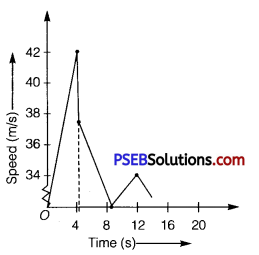
A ball is dropped from a height of 90 m on a floor. At each collision with the floor, the ball loses one tenth of its speed. Plot the speed-time graph of its motion between t = 0 to 12 s.
Solution:
Ball is dropped from a height, s = 90 m
Initial velocity of the ball, u = 0
Acceleration, a = g = 9.8 m/s2
Final velocity of the ball = υ
From second equation of motion, time (t) taken by the ball to hit the ground can be obtained as:
s = ut + \(\frac {1}{2}\)at2
90 = 0 + \(\frac {1}{2}\) × 9.8t2
t = \(\sqrt{18.38}\) = 4.29 s
From first equation of motion, final velocity is given as:
υ = u + at
= 0 + 9.8 × 4.29 = 42.04 m/s
Rebound velocity of the ball, ur = \(\frac {9}{10}\) υ = \(\frac {9}{10}\) × 42.04 = 37.84 m/s

Time (t) taken by the ball to reach maximum height is obtained with the help of first equation of motion as:
υ =ur + at’
0 = 37.84 + (-9.8) t’
t’ = \(\frac{-37.84}{-9.8}\) = 3.86s
Total time taken by the ball = t + t’ = 4.29 + 3.86 = 8.15 s
As the time of ascent is equal to the time of descent, the ball takes 3.86 s to strike back on the floor for the second time.
The velocity with which the ball rebounds from the floor
= \(\frac {9}{10}\) × 37.84 = 34.05m/s
Total time taken by the ball for second rebound = 8.15 + 3.86 = 12.01 s The speed-time graph of the ball is represented in the given figure as :
PSEB 11th Class Physics Solutions Chapter 3 Motion in a Straight Line 5

Question 13.
Explain clearly, with examples, the distinction between the following:
(a) magnitude of displacement (sometimes called distance) over an interval of time, and the total length of path covered by a particle over the same interval;

(b) magnitude of average velocity over an interval of time, and the average speed over the same interval. [Average speed of a particle over an interval of time is defined as the total path length divided by the time interval].
Show in both (a) and (h) that the second quantity is either greater than or equal to the first.
When is the equality sign true? [For simplicity, consider one-dimensional motion only].
Solution:
(a) The magnitude of displacement over an interval of time is the shortest distance (which is a straight line) between the initial and final positions of the particle.
The total path length of a particle is the actual path length covered by the particle in a given interval of time.
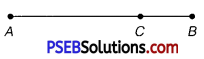
For example, suppose a particle moves from point A to point B and then, comes back to a point, C taking a total time t, as shown below. Then, the magnitude of displacement of the particle = AC.
PSEB 11th Class Physics Solutions Chapter 3 Motion in a Straight Line 6
Whereas, total path length = AB+BC
It is also important to note that the magnitude of displacement can never be greater than the total path length. However, in some cases, both quantities are equal to each other.

(b)PSEB 11th Class Physics Solutions Chapter 3 Motion in a Straight Line 7
For the given particle,
Average velocity = \(\frac{A C}{t}\)
PSEB 11th Class Physics Solutions Chapter 3 Motion in a Straight Line 8
= \(\frac{A B+B C}{t}\)
Since (AB + BC)> AC, average speed is greater than the magnitude of average velocity. The two quantities will be equal if the particle continues to move along a straight line.

PSEB 11th Class Physics Solutions Chapter 3 Motion in a Straight Line

Question 14.
A man walks on a straight road from his home to a market 2.5 km away with a speed of 5 km h-1. Finding the market closed, he instantly turns and walks back home with a speed of 7.5 km h-1. What is the
(a) magnitude of average velocity, and
(b) average speed of the man over the interval of time? (i) 0 to 30 min, (ii) 0 to 50 min, (iii) 0 to 40 min?
[Note: You will appreciate from this exercise why it is better to define average speed as total path length divided by time, and not as magnitude of average velocity. You would not like to tell the tired man on his return home that his average speed was zero.]
Solution:
(a) A man return his home, therefore total displacement of the man = 0
PSEB 11th Class Physics Solutions Chapter 3 Motion in a Straight Line 9

(b) Speed of man during motion from his home to the market υ1 = 5 km/h
Speed of man during from market his home υ2 =7.5 km/h
Distance between his home and market = 2.5 km
(i) Taking time interval 0 to 30 min.
Time taken by the man to reach the market from home,
t1 = \(\frac{2.5}{5}=\frac{1}{2}\) = h = 30 min
Hence, the man moves from his home to the market in t = 0 to 30 min.
PSEB 11th Class Physics Solutions Chapter 3 Motion in a Straight Line 10

(ii) Taking time interval 0 to 50 min.
Time taken by man in returning to his home from the market
PSEB 11th Class Physics Solutions Chapter 3 Motion in a Straight Line 11

(iii) Taking time interval 0 to 40 min.
Distance travelled in first 30 min = 2.5 km
Distance travelled by the man (from market to home) in the next 10 min
= 7.5 × \(\frac{10}{60}\) =1.25 km
Net displacement 2.5 -1.25 = 1.25 km
Total distance travelled = 2.5 +1.25 = 3.75 km
Average velocity = \(\frac{1.25}{\left(\frac{40}{60}\right)}\) = \(\frac{1.25 \times 3}{2}\) = 1.875 km/h
Average speed = \(\frac{3.75}{\left(\frac{40}{60}\right)}\) = 5.625 km/h

Question 15.
In questions 13 and 14, we have carefully distinguished between average speed and magnitude of average velocity. No such distinction is necessary when we consider instantaneous speed and magnitude of velocity. The instantaneous speed is always equal to the magnitude of instantaneous velocity. Why?
Solution:
Instantaneous velocity is given by the first derivative of distance with respect to time i. e.,
υm = \(\frac{d x}{d t}\)
Here, the time interval dt is so small that it is assumed that the particle does not change its direction of motion. As a result, both the total path length and magnitude of displacement become equal is this interval of time.
Therefore, instantaneous speed is always equal to instantaneous velocity.

PSEB 11th Class Physics Solutions Chapter 3 Motion in a Straight Line

Question 16.
Look at the graphs (a) to (d) carefully and state, with reasons, which of these cannot possibly represent one-dimensional motion of a particle.
PSEB 11th Class Physics Solutions Chapter 3 Motion in a Straight Line 12
Solution:
(a) The given x – t graph, shown in (a), does not represent one-dimensional motion of the particle. This is because a particle cannot have two positions at the same instant of time.
(b) The given υ – t graph, shown in (b), does not represent one-dimensional motion of the particle. This is because a particle can never have two values of velocity at the same instant of time.
(c) The given υ – t graph, shown in (c), does not represent one-dimensional motion of the particle. This is because speed being a scalar quantity cannot be negative.
(d) The given total path length-time graph, shown in (d), does not represent one dimensional motion of the particle. This is because the total path length travelled by the particle cannot decrease with time.

Question 17.
Figure shows the x – t plot of one-dimensional motion of a particle. Is it correct to say from the graph that the particle’ moves in a straight line for t< 0 and on a parabolic path for t > 0 ? If not, suggest a suitable physical context for this graph.
PSEB 11th Class Physics Solutions Chapter 3 Motion in a Straight Line 13
Solution:
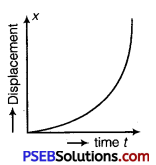
No; The x – t graph of a particle moving in a straight line for t < 0 and on a parabolic path for t > 0 cannot be shown as the given graph. This is because, the given particle does not follow the trajectory of path followed by the particle as t = 0, x = 0. A physical situation that resembles the above graph is of a freely falling body held for sometime at a height.

PSEB 11th Class Physics Solutions Chapter 3 Motion in a Straight Line

Question 18.
A police van moving on a highway with a speed of 30 km h-1 fires a bullet at a theifs car speeding away in the same direction with a speed of 192 km h-1. If the muzzle speed of the bullet is 150 m s-1, with what speed does the bullet hit the thief’s car ?
(Note: Obtain that speed which is relevant for damaging the thief’s car).
Solution:
Speed of the police van, υp = 30 km/h = 8.33 m/s
Muzzle speed of the bullet, υb = 150 m/s
Speed of the thief s car, υt =192 km/h = 53.33 m/s
Since the bullet is fired from a moving van, its resultant speed can be obtained as:
= 150 +8.33 = 158.33 m/s
Since, both the vehicles are moving in the same direction, the velocity with which the bullet hits the thief s car can be obtained as:
υbt = υb – υt
= 158.33 – 53.33 = 105 m/s

Question 19.
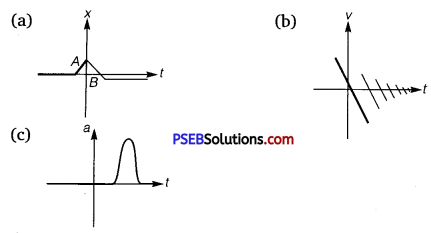
Suggest a suitable physical situation for each of the following graphs:
PSEB 11th Class Physics Solutions Chapter 3 Motion in a Straight Line 14
Solution:
(a) The given x – t graph shows that initially a body was at rest. Then, its velocity increases with time and attains an instantaneous constant value. The velocity then reduces to zero with an increase in time. Then, its velocity increases with time in the opposite direction and acquires a constant value. A similar physical situation arises when a football (initially kept at rest) is kicked and gets rebound from a rigid wall so that its speed gets reduced. Then, it passes from the player who has kicked it and ultimately gets stopped after sometime.

(b) In the given v-t graph, the sign of velocity changes and its magnitude decreases with a passage of time. A similar situation arises when a ball is dropped on the hard floor from a height. It strikes the floor with some velocity and upon rebound, its velocity decreases by a factor. This continues till the velocity of the ball eventually becomes zero.

(c) The given a – t graph reveals that initially the body is moving with a certain uniform velocity. Its acceleration increases for a short interval of time, which again drops to zero. This indicates that the body again starts moving with the same constant velocity. A similar physical situation arises when a hammer moving with a uniform velocity strikes a nail.

PSEB 11th Class Physics Solutions Chapter 3 Motion in a Straight Line

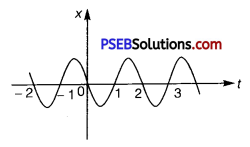
Question 20.
Figure gives the x – t plot of a particle executing one-dimensional simple harmonic motion. (You will learn about this motion in more detail in Chapter 14). Give the signs of position, velocity and acceleration variables of the particle at t = 0.3 s, 1.2 s,-1.2 s.
PSEB 11th Class Physics Solutions Chapter 3 Motion in a Straight Line 15
Solution:
For simple harmonic motion (SHM) of a particle, acceleration (a) is given by the relation:
a = -ω2x ……. (i)
where, ω → angular frequency
At t = 0.3 s
In this time interval, x is negative. Thus, the slope of the x – t plot will also be negative. Therefore, both position and velocity are negative. However, using equation (i), acceleration of the particle will be positive.
At t = 1.2s
In this time interval, x is positive. Thus, the slope of the x – t plot will also be positive. Therefore, both position and velocity are positive. However, using equation (i), acceleration of the particle comes to be negative.
t = -1.2s
In this time interval, x is negative. Thus, the slope of the x – t plot will also be negative. Since both x and t are negative, the velocity comes to be positive. From equation (i), it can be inferred that the acceleration of the particle will be positive.

Question 21.
Figure gives the x – t plot of a particle in one-dimensional motion. Three different equal intervals of time are shown. In which interval is the average speed greatest, and in which is it the least? Give the sign of average velocity for each interval.
PSEB 11th Class Physics Solutions Chapter 3 Motion in a Straight Line 16
Solution:
The average speed of a particle shown in the x – t graph is obtained from the slope of the graph in a particular interval of time.
It is clear from the graph that the slope is maximum and minimum restively in intervals 3 and 2 respectively. Therefore, the average speed of the particle is the greatest in interval 3 and is the least in interval 2. The
sign of average velocity is positive in both intervals 1 and 2 as the slope is positive in these intervals. However, it is negative in interval 3 because the slope is negative in this interval.

PSEB 11th Class Physics Solutions Chapter 3 Motion in a Straight Line

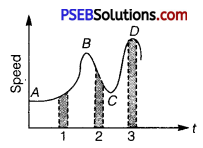
Question 22.
Figure gives a speed-time graph of a particle in motion along a constant direction. Three equal intervals of time are shown. In which interval is the average acceleration greatest in magnitude? In which interval is the average speed greatest? Choosing the positive direction as the constant direction of motion, give the signs of v and a in the three intervals. What are the accelerations at the points A, B, C and D?
PSEB 11th Class Physics Solutions Chapter 3 Motion in a Straight Line 17
Solution:
Acceleration is given by the slope of the speed-time graph. In the given case, it is given by the slope of the speed-time graph within the,given interval of time.

Since the slope of the given speed-time graph is maximum in interval 2, average acceleration will be the greatest in this interval.
Height of the curve from the time-axis gives the average speed of the particle. It is clear that the height is the greatest in interval 3. Hence, . average speed of the particle is the greatest in interval 3.

In interval 1: The slope of the speed-time graph is positive. Hence, acceleration is positive. Similarly, the speed of the particle is positive in this interval.

In interval 2: The slope of the speed-time graph is negative. Hence, acceleration is negative in this interval. However, speed is positive because it is a scalar quantity.

In interval 3: The slope of the speed-time graph is zero. Hence, acceleration is zero in this interval. However, here the particle acquires some uniform speed. It is positive in this interval.

Points A, B, C and D are all parallel to the time-axis. Hence, the slope is zero at these points. Therefore, at points A, B, C and D, acceleration of the particle is zero.

Question 23.
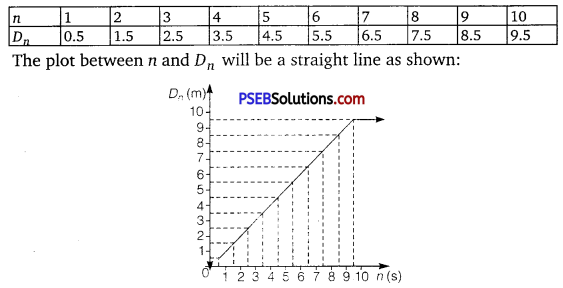
A three-wheeler starts from rest, accelerates uniformly with 1 m s-2 on a straight road for 10 s, and then moves with uniform velocity. Plot the distance covered by the vehicle during the nth second (n = 1, 2, 3,…)versus n. What do you expect this plot to be during accelerated motion: a straight line or a parabola?
Solution:
Distance covered by a body in nth second is given by the relation
Dn = u + \(\frac{a}{2}\)(2n – 1) ……………(i)
where, u = Initial velocity, a = Acceleration, n = Time = 1, 2, 3, …. , n
In the given case,
u = 0 and a = 1 m/s2
.-. Dn = \(\frac {1}{2}\)(2n – 1) ……………… (ii)
This relation shows that
Dn ∝ n ………………(iii)
Now, substituting different values of n in equation (ii), we get the following table:
PSEB 11th Class Physics Solutions Chapter 3 Motion in a Straight Line 18
Since the three-wheeler acquires uniform velocity after 10 s, the line , will be parallel to the time-axis after n = 10 s.

PSEB 11th Class Physics Solutions Chapter 3 Motion in a Straight Line

Question 24.
A boy standing on a stationary lift (open from above) throws a ball upwards with the maximum initial speed he can, equal to 49 m/s. How much time does the ball take to return to his hands? If the lift starts moving up with a uniform speed of 5 m/s and the boy again throws the ball up with the maximum speed he can, how long does the ball take to return to his hands?
Solution:
Initial velocity of the ball, u = 49 m/s
Acceleration, a = -g = – 9.8 m/s2
Case I:
When the lift was stationary, the boy throws the ball.
Taking upward motion of the ball,
Final velocity, υ of the ball becomes zero at the highest point.
From first equation of motion, time of ascent (t) is given as
υ = u + at
t = \(\frac{v-u}{a}\)
\(\frac{-49}{-9.8}\) = 5s
But, the time of ascent is equal to the time of descent.
Hence, the total time taken by the ball to return to the boy’s hand
= 5 + 5 = 10 s
Motion in a Straight Line 53

Case II:
The lift was moving up with a uniform velocity of 5 m/s. In this case, the relative velocity of the ball with respect to the boy remains the same i. e., 49 m/s. Therefore, in this case also, the ball will return back to the boy’s hand after 10 s.

Question 25.
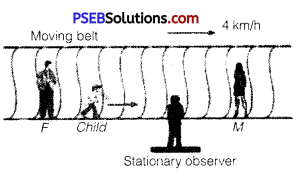
On a long horizontally moving belt (see figure) a child runs to and fro with a speed 9 km h-1 (with respect to the belt) between his father and mother located 50 m apart on the moving belt. The belt moves with a speed of 4 km h-1. For an observer on a stationary platform outside, what is the
(a) speed of the child running in the direction of motion of the belt?
(b) speed of the child running opposite to the direction of motion of the belt?
(c) time taken by the child in (a) and (b) ?
Which of the answers alter if motion is viewed by one of the parents?
PSEB 11th Class Physics Solutions Chapter 3 Motion in a Straight Line 19
Solution:
Speed of the belt, υB = 4 km/h
Speed of the child, υC = 9 km/h

(a) Since the child is running in the same direction of the motion of the belt, his speed (as observed by the stationary observer) can be obtained as
υCB = υC + υB = 9 + 4 = 13 km/h

(b) Since the child is running in the direction opposite to the direction of the motion of the belt, his speed (as observed by the stationary observer) can be obtained as
υCB = υC + (-υB) = 9 – 4 = 5 km/h

(c) Distance between the child’s parents = 50 m
As both parents are standing on the moving belt, the speed of the child in either direction as observed by the parents will remain the same i. e.,
9 km/h = 9 x \(\frac{5}{18}\) m/s = 2.5 m/s.
18
Hence, the time taken by the child in case (a) and (b) is given by
\(\frac{\text { Distance }}{\text { Speed }}=\frac{50}{2.5}\) = 20 s.
If the motion is viewed by any one of the parents, answers obtained in (a) and (b) get altered. This is because the child and his parents are standing on the same belt and hence, are equally affected by the motion of the belt. Therefore, for both parents (irrespective of the direction of motion) the speed of the child remains the same i.e., 9 km/h.

For this reason, it can be concluded that the time taken by the child to reach any one of his parents remains unaltered.

PSEB 11th Class Physics Solutions Chapter 3 Motion in a Straight Line

Question 26.
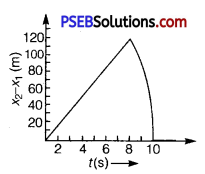
Two stones are thrown up simultaneously from the edge of a cliff 200 m high with initial speeds of 15 m/s and 30 m/s. Verify that the graph shown in figure correctly represents the time variation of the relative position of the second stone with respect to the first. Neglect air resistance and assume that the stones do not rebound after hitting the ground. Take g = 10 m/s2. Give the equations for the linear and curved parts of the plot.
PSEB 11th Class Physics Solutions Chapter 3 Motion in a Straight Line 20
Solution:
For first stone:
Initial velocity, u1 =15 m/s
Acceleration, a = -g = -10 m/s2
Using the relation,
x1 = x0 + u1t + \(\frac {1}{2}\)at2
where, x0 = Height of the cliff = 200 m
x1 =200 + 15t – 5t2 ………………. (i)
When this stone hits the ground, x1 = 0
-5t2 +15t + 200 = 0
t2 – 3t – 40 =0
t2 – 8t + 5t – 40 = 0
t(t – 8) + 5(t – 8) = 0
(t – 8)(t + 5) = 0
t = 8 s or t = -5s
Since the stone was projected at time t = 0, the negative sign before time is meaningless.
∴ t = 8s

For second stone:
Initial velocity, u2 = 30 m/s
Acceleration, a = -g = -10 m/s2
Using the relation,
x2 = x0 + u2t + \(\frac {1}{2}\)at2
= 200 + 30t – 5t2 ……………. (ii)
At the moment when this stone hits the ground; x2 = 0
-5t2 + 30t + 200 = 0
t2 – 6t – 40 = 0
t2 -10t + 4t + 40 = 0
t(t – 10) + 4(t – 10) = 0
(t – 10)(t + 4) = 0
t = 10 s or t = -4 s
Here again, the negative sign before time is meaningless.
∴ t = 10 s
Subtracting eq. (i) from eq. (ii), we get
x2 – x1 = (200 +30t – 5t2) – (200 + 15t – 5t2)
x2 – x1 = 15t …………….. (iii)
Equation (iii) represents the linear path of both stones. Due to this linear relation between
(x2 – x1) and t, the path remains a straight line till 8 s.
Maximum separation between the two stones is at t = 8 s.
(x2 – x1] )max = 15 × 8 = 120 m
This is in accordance with the given graph.
After 8 s, only second stone is in motion whose variation with time is given by the quadratic equation :
x2 – x1 = 200 + 30t – 5t2
Hence, the equation of linear and curved path is given by
x2 – x1 = 15t (Linear path)
x2 – x1 = 200 + 30t – 5t2 (Curved path)

Question 27.
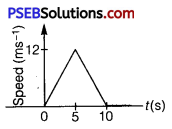
The speed-time graph of a particle moving along a fixed direction is shown in figure given below. Obtain the distance traversed by the particle between (a) t = 0 s to 10 s, (b) t = 2 s to 6 s.
PSEB 11th Class Physics Solutions Chapter 3 Motion in a Straight Line 21
What is the average speed of the particle over the intervals in (a) and (b)?
Solution:
(a) Distance travelled by the particle = Area under the given graph
= \(\frac{1}{2}\) × (10 – 0) × (12 – 0) = 60 m
Average speed = \(\frac{\text { Distance }}{\text { Time }}\) = \(\frac{60}{10}\) = 6 m/s

(b) Let s1 and s2 be the distances covered by the particle between time t = 2 s to 5 s and t = 5 s to 6 s respectively.
Total distance (s) covered by the particle in time t = 2 s to 6 s
S = S1 + s2 ……………… (i)

For distance S1:
Let u’ be the velocity of the particle after 2 s and a’ be the acceleration of the particle in t = 0 to t = 5 s.
Since the particle undergoes uniform acceleration in the interval t = 0 to t = 5 s, from first equation of motion, acceleration can be obtained as:
υ = u + at
Where, υ = Final velocity of the particle
12. = 0 + a’ × 5
a’ = \(\frac{12}{5}\) = 2.4 m/s2 .
Again, from first equation of motion, we have
υ = u + at
= 0 + 2.4 × 2 = 4.8 m/s
Distance travelled by the particle between time 2 s and 5 s i. e., in 3 s
S1 = u’t + \(\frac{1}{2}\) a’t2
= 4.8 × 3 + \(\frac{1}{2}\) × 2.4 × (3)2
= 25.2 m ……………… (ii)

For distance S2:
Let a” be the acceleration of the particle between time t = 5 s and t = 10s.
From first equation of motion,
υ = u + at (where υ = 0 as the particle finally comes to rest)
0 = 12 + a” × 5
a” = \(\frac{-12}{5}\)
= -2.4 m/s2
Distance travelled by the particle in Is (i. e., between t = 5 s and t = 6 s)
S2 = u”t + \(\frac{1}{2}\) at2
= 12 × a + \(\frac{1}{2}\)(-2.4) × (1)2
= 12 – 1.2 = 10.8 m ……………… (iii)
From equations (i), (ii), and (iii), we get
S = 25.2 + 10.8 = 36 m
∴ Average speed = \(\frac{36}{4}\) = 9 m/s

PSEB 11th Class Physics Solutions Chapter 3 Motion in a Straight Line

Question 28.
The velocity-time graph of a particle in one-dimensional motion is shown in figure.
PSEB 11th Class Physics Solutions Chapter 3 Motion in a Straight Line 22
Which of the following formulae are correct for describing the motion of the particle over the time-interval t1 to t2 ?
(a) x(t2) = x(t1) + υ(t1)(t2 – t1) + \(\frac {1}{2}\) a(t2 – t1)2
(b) υ(t2) = υ(t1)+a(t2 – t1)
(c) Average = [x(t2) – x(t1)] /(t2 – t1)
(d) Average = [(t2 ) – υ(t1)] / (t2 – t1)
(e) x(t2) = x(t1) + υAverage (t2 – t1) + (\(\frac {1}{2}\)) aAverage (t2 – t1)2
(f) x (tsub>2) – x (tsub>1) = area under the υ – t curve bounded by the t-axis and the dotted line shown.
Solution:
The slope of the given graph over the time interval tsub>1 to tsub>2 is not constant and is not uniform. It means acceleration is not constant and is not uniform, therefore, relation (a), (b) and (e) are not correct which is for uniform accelerated motion, but relations (c), (d) and (f) are correct, because these relations are true for both uniform or non-uniform accelerated motion.

PSEB 11th Class Physics Important Questions Chapter 14 Oscillations

Punjab State Board PSEB 11th Class Physics Important Questions Chapter 14 Oscillations Important Questions and Answers.

PSEB 11th Class Physics Important Questions Chapter 14 Oscillations

Very Short Answer Type Questions

Question 1.
What are the basic properties required by a system to oscillate?
Answer:
Inertia and elasticity are the properties which are required by a system to oscillate.

Question 2.
All oscillatory motions are periodic and vice-versa. Is it true?
Answer:
No, there are other types of periodic motions also. Circular motion and rotatory motion are periodic but non-oscillatory.

Question 3.
Give three important characteristics of a SHM.
Answer:
Three important characteristics of an SHM are amplitude, time period (or frequency) and phase.

Question 4.
What is the force equation of a SHM?
Answer:
According to force equation of SHM, F = -kx,
where k is a constant known as force constant.

PSEB 11th Class Physics Important Questions Chapter 14 Oscillations

Question 5.
Under what condition is the motion of a simple pendulum be simple harmonic? (NCERT Exemplar)
Answer:
When the displacement amplitude of the pendulum is extremely small as compared to its length.

Question 6.
A simple pendulum is transferred from earth to the surface of Moon. How will its time period be affected?
Answer:
As value of g on Moon is less than that on earth, in accordance with the relation T = \(2 \pi \sqrt{l / g}\) , the time period of oscillations of a simple pendulum on Moon will be greater.

Short Answer Type Questions

Question 1.
A girl is swinging in the sitting position. How will the period of the swing be changed if she stands up?
Solution:
This can be explained using the concept of a simple pendulum. We know that the time period of a simple pendulum is given by
T = \(2 \pi \sqrt{\frac{l}{g}} \text { i.e., } T \propto \sqrt{l}\)
When the girl stands up, the distance between the point of suspension and the center of mass of the swinging body decreases i.e., I decreases, so T will also decrease.

Question 2.
A particle is subjected to two simple harmonic motions
x1 = A1 sinωt
And
x2 = A2 sin \(\left(\omega t+\frac{\pi}{\mathbf{3}}\right)\)
Find (i) the displacement at t = 0
(ii) the maximum speed of the particle and
(iii) the maximum acceleration of the particle
Solution:
(i) At t = 0, x1 = A1 sin ωt = 0
And
x2 = A2 sin \(\left(\omega t+\frac{\pi}{3}\right)=\frac{A_{2} \sqrt{3}}{2}\)
Thus the resultant displacement at t = 0 is
PSEB 11th Class Physics Important Questions Chapter 14 Oscillations 1

PSEB 11th Class Physics Important Questions Chapter 14 Oscillations

Question 3.
The maximum acceleration of a simple harmonic oscillator Is a0 and the maximum velocity is v0. What is the displacement amplitude?
Solution:
Let A be the displacement amplitude and o be the angular frequency of the simple harmonic oscillator.
Then, a0 = ω2A ……………………………. (i)
and v0 = ωA …………………………………………………. (ii)
Squaring eq. (ü) and dividing from eq. (j), we get
\(\frac{v_{0}^{2}}{a_{0}}=\frac{\omega^{2} A^{2}}{\omega^{2} A}\) = A or A = \(\frac{v_{0}^{2}}{a_{0}}\)

Question 4.
A particle performs SHM on a rectilinear path. Starting from rest, it travels x1 distance in first second, and in the next second, it travels x2 distance. Find out the amplitude of this SHM.
Solution :
Because the particle starts from rest, so its starting point will be extreme position.
Thus, the displacement of the particle from the mean position after one second
A-x1 = A cos ωt = A cos ω ……………………………… (i) [puttingt =1 s]
where A is the amplitude of the SHM and for next second
A – (x1 + x2) = Acosωt
= Acos2ω = A[2cos2ω-1]
[putting t = 2s]
[ ∵ cos 2 ω =
2 [cos2 ω -1] ……………………………………………. (ii)
From eqs. (i) and (ii), we have
PSEB 11th Class Physics Important Questions Chapter 14 Oscillations 2

Question 5.
Apartide is executing SHM. If ν1 and ν2 are the speeds of the particle at distance x1 and x2 from the equilibrium position, show that the frequency of oscillations is
f = \(\frac{1}{2 \pi}\left(\frac{v_{1}^{2}-v_{2}^{2}}{x_{2}^{2}-x_{1}^{2}}\right)^{1 / 2} \)
Solution:
The displacement of a particle executing SHM is given by
x = Acosωt
\(\frac{d x}{d t}\) = – ωAsin ωt
∴ velocity,ν = \(\frac{d x}{d t}\)
or ν2=A2ω2sin2ωt
PSEB 11th Class Physics Important Questions Chapter 14 Oscillations 3
Subtracting eq. (ii) from eq. (i), we get
PSEB 11th Class Physics Important Questions Chapter 14 Oscillations 4
PSEB 11th Class Physics Important Questions Chapter 14 Oscillations 5

Question 6.
Define the restoring force and it characteristics in case of an oscillating body.
Answer:
A force which takes the body back towards the mean position in oscillation is called restoring force. Characteristic of Restoring force: The restoring force is always directed towards the mean position and its magnitude of any instant is directly proportional to the displacement of the particle from its mean position of that instance.

PSEB 11th Class Physics Important Questions Chapter 14 Oscillations

Long Answer Type Questions

Question 1.
A person normally weighing 50 kg stands on a massless platform which oscillates up and down harmonically at a frequency of 2.0 s-1 and an amplitude 5.0 cm. A weighing machine on the platform gives the persons weight against time.
(i) Wifi there be any change in weight of the body, during the oscillation?
(ii) If answer to part (i) is yes, what will be the maximum and minimum reading In the machine and at which position? (NCERT Exemplar)
Solution:
This is a case of variable acceleration. In accelerated motion, weight of body depends on the magnitude and direction of acceleration for upward or downward motion.
(i) Hence, the weight of body changes.
(ii) Considering the situation in two extreme positions, as their acceleration is maximum in magnitude.
PSEB 11th Class Physics Important Questions Chapter 14 Oscillations 6
Wehave mg-N=ma
Note at the highest point, the platform is accelerating downward.
⇒ N=mg – ma

But a = ω2A (in magnitude)
∴ N = mg – mω2A
where, A = amplitude of motion
Given, m = 50 kg, frequency v = 2 s-1
∴ ω = 2πv = 4πrad/s
A = 5cm = 5 x 10⁻² m
∴ N = 50 x 9.8 – 50 x (4π2) X 5 x 10-2
= 50 [9.8-16π2 x 5 x 10-2]
= 50 [9.8 – 7.89] = 50 x 1.91 = 95.5N

When the platform is at the lowest position of its oscillation,
PSEB 11th Class Physics Important Questions Chapter 14 Oscillations 7
It is accelerating towards mean position that is vertically upwards. Writing the equation of motion
N – mg = ma = mω2A
or N = mg + mat2A = m [g + ω2A]
Putting the data
PSEB 11th Class Physics Important Questions Chapter 14 Oscillations 8
Now, the machine reads the normal reaction.
It is clear that maximum weight = 884 N (at lowest point)
minimum weight = 95.5 N (at top point)

PSEB 11th Class Physics Solutions Chapter 14 Oscillations

Punjab State Board PSEB 11th Class Physics Book Solutions Chapter 14 Oscillations Textbook Exercise Questions and Answers.

PSEB Solutions for Class 11 Physics Chapter 14 Oscillations

PSEB 11th Class Physics Guide Oscillations Textbook Questions and Answers

Question 1.
Which of the following examples represent periodic motion?
(a) A swimmer completing one (return) trip from one bank of a river to the other and back.
(b) A freely suspended bar magnet displaced from its N-S direction and released.
(c) A hydrogen molecule rotating about its center of mass.
(d) An arrow released from a bow.
Solution:
(b) and (c)
Explanations :
(a) The swimmer’s motion is not periodic. The motion of the swimmer between the banks of a river is back and forth. However, it does not have a definite period. This is because the time taken by the swimmer during his back and forth journey may not be the same.

(b) The motion of a freely-suspended magnet, if displaced from its N-S direction and released, is periodic. This is because the magnet oscillates about its position with a definite period of time.

(c) When a hydrogen molecule rotates about its center of mass, it comes to the same position again and again after an equal interval of time. Such motion is periodic.

(d) An arrow released from a bow moves only in the forward direction. It does not come backward. Hence, this motion is not a periodic.

Question 2.
Which of the following examples represent (nearly) simple harmonic motion and which represent periodic but not simple harmonic motion?
(a) the rotation of earth about its axis.
(b) motion of an oscillating mercury column in a 17-tube.
(c) motion of a ball bearing inside a smooth curved bowl, when released from a point slightly above the lowermost point.
(d) general vibrations of a polyatomic molecule about its equilibrium position.
Solution:
(b) and (c) are SHMs; (a) and (d) are periodic, but not SHMs
Explanations :
(a) During its rotation about its axis, earth comes to the same position again and again in equal intervals of time. Hence, it is a periodic motion. However, this motion is not simple harmonic. This is because earth does not have a to and fro motion about its axis.

(b) An oscillating mercury column in a [/-tube is simple harmonic. This is because the mercury moves to and fro on the same path, about the fixed position, with a certain period of time.

(c) The ball moves to and fro about the lowermost point of the bowl when released. Also, the ball comes back to its initial position in the same period of time, again and again. Hence, its motion is periodic as well as simple harmonic.

(d) A polyatomic molecule has many natural frequencies of oscillation. Its vibration is the superposition of individual simple harmonic motions of a number of different molecules. Hence, it is not simple harmonic, but periodic.

PSEB 11th Class Physics Solutions Chapter 14 Oscillations

Question 3.
Figure depicts four x-t plots for linear motion of a particle. Which of the plots represents periodic motion? What is the period of motion (in case of periodic motion)?
(a)
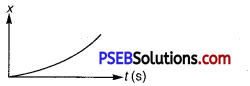
PSEB 11th Class Physics Solutions Chapter 14 Oscillations 1
(b)
PSEB 11th Class Physics Solutions Chapter 14 Oscillations 2
(c)
PSEB 11th Class Physics Solutions Chapter 14 Oscillations 3
(d)
PSEB 11th Class Physics Solutions Chapter 14 Oscillations 4
Solution:
(b) and (d) are periodic
Explanation :
(a) It is not a periodic motion. This represents a unidirectional, linear uniform motion. There is no repetition of motion in this case.
(b) In this case, the motion of the particle repeats itself after 2 s. Hence, it is a periodic motion, having a period of 2 s.
(c) It is not a periodic motion. This is because the particle repeats the motion in one position only. For a periodic motion, the entire motion of the particle must be repeated in equal intervals of time. In this case, the motion of the particle repeats itself after 2 s. Hence, it is a periodic motion, having a period of 2 s.

Question 4.
Which of the following functions of time represent (a) simple ‘ harmonic, (b) periodic but not simple harmonic, and (c) non¬periodic motion? Give period for each case of periodic motion (a is any positive constant):
(a) sin ωt – cos ωt
(b) sin 3ωt
(c) 3cos(\(\pi / 4 \) -2ωt)
(d) cos ωt +cos 3 ωt+cos 5ωt
(e) exp(-ω2t2)
(f) 1+ ωt+ω2t
Solution:
(a) SHM
The given function is:
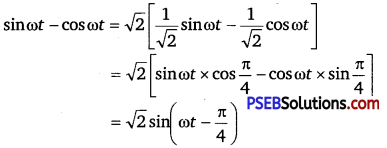
PSEB 11th Class Physics Solutions Chapter 14 Oscillations 5
This function represents SHM as it can be written in the form: a sin (ωt +Φ)
Its period is: \(\frac{2 \pi}{\omega}\)

(b) Periodic, but not SHM The given function is:
sin3 ωt = \(\frac{1}{4}\) [3sinωt -sin3ωt] (∵ sin3θ = 3sinθ – 4sin3 θ)
The terms sin cot and sin 3 ωt individually represent simple harmonic motion (SHM). However, the superposition of two SHM is periodic and not simple harmonic.

Period of\(\frac{3}{4}\)sin ωt = \(\frac{2 \pi}{\omega}\) = T
Period of\(\frac{1}{4}\)sin3ωt = \(\frac{2 \pi}{3 \omega}\) = T’ = \(\frac{T}{3}\)
Thus, period of the combination
= Minimum time after which the combined function repeats
= LCM of T and \(\frac{T}{3}\) = T
Its period is 2 \(\pi / \omega\)

(c) SHM
The given function is:
3 cos \(\left[\frac{\pi}{4}-2 \omega t\right]\) = 3 cos \(\left[2 \omega t-\frac{\pi}{4}\right]\)
This function represents simple harmonic motion because it can be written in the form:
acos(ωt +Φ)

Its period is :
\(\frac{2 \pi}{2 \omega}=\frac{\pi}{\omega}\)

(d) Periodic, but not SHM
The given function is cosωt +cos3ωt +cos5ωt. Each individual cosme function represents SHM. However, the superposition of threc simple harmonic motions is periodic, but not simple harmonic.

cosωt represents SHM with period = \(\frac{2 \pi}{\omega}\) T (say)
cos 3ωt represents SHM with period = \(\frac{2 \pi}{3 \omega}=\frac{T}{3}\)
cos 5ωt represents SHM with period = \(\frac{2 \pi}{5 \omega}=\frac{T}{5}\)
The minimum time after which the combined function repeats its value is T. Hence, the given function represents periodic function but not SHM, with period T.

(e) Non-periodic motion: .
The given function exp(- ω2t2) is an exponential function. Exponential functions do not repeat themselves. Therefore, it is a non-periodic motion.

(f) Non-periodic motion
The given function is 1+ ωt + ω2t2
Here no repetition of values. Hence, it represents non-periodic motion.

PSEB 11th Class Physics Solutions Chapter 14 Oscillations

Question 5.
A particle Is in linear simple harmonic motion between two points, A and B, 10 cm apart Take the direction from A to B as the positive direction and give the signs of velocity, acceleration and force on the particle when It Is
(a) at the end A,
(b) at the end B,
(c) at the midpoint of AB going towards A,
(d) at 2 cm away from B going towards A,
(e) at 3 cm away from A going towards B, and
(f) at 4 cm away from B going towards A.
Solution:
The given situation is shown in the following figure. Points A and B are the two endpoints, with AB =10cm. 0 is the midpoint of the path.

PSEB 11th Class Physics Solutions Chapter 14 Oscillations 6
A particle is in linear simple harmonic motion between the endpoints
(a) At the extreme point A, the particle is at rest momentarily. Hence, its velocity is zero at this point.
Its acceleration is positive as it is directed along with AO.
Force is also positive in this case as the particle is directed rightward.

(b) At the extreme point B, the particle is at rest momentarily. Hence, its velocity is zero at this point.
Its acceleration is negative as it is directed along B.
Force is also negative in this case as the particle is directed leftward.

(c) PSEB 11th Class Physics Solutions Chapter 14 Oscillations 7

The particle is extending a simple harmonic motion. O is the mean position of the particle. Its velocity at the mean position O is the maximum. The value for velocity is negative as the partide Is directed leftward. The acceleration and force of a particle executing SHM is zero at the mean position.

(d) PSEB 11th Class Physics Solutions Chapter 14 Oscillations 8

The particle is moving towards point O from the end B. This direction of motion is opposite to the conventional positive direction, which is from A to R. Hence, the particle’s velocity and acceleration, and the force on it are all negative.

(e)

PSEB 11th Class Physics Solutions Chapter 14 Oscillations 9
The particle is moving towards point O from the end A. This direction of motion is from A to B, which is the conventional positive direction. Hence, the value for velocity, acceleration, and force are all positive.

(f)

PSEB 11th Class Physics Solutions Chapter 14 Oscillations 10
This case is similar to the one given in (d).

Question 6.
Whi ch of the following relationships between the acceleration a and the displacement x of a particle involves simple harmonic motion?
(a) a=0.7x
(b) a=-200x2
(c) a= – 10 x (d) a=100x3
Solution:
A motion represents simple harmonic motion if it is governed by the force law:
F=-kx
ma’= -kx
∴ a = – \(\frac{k}{m}\) x

where F is the force
m is the mass (a constant for a body)
x is the displacement
a is the acceleration.
k is a constant
Among the given equations, only equation a = -10 x is written in the
above form with \( \frac{k}{m}\) =10. Hence, this relation represents SHM.

PSEB 11th Class Physics Solutions Chapter 14 Oscillations

Question 7.
The motion of a particle executing simple harmonic motion is described by the displacement function,
x(t) = A cos (ωt+Φ)
If the initial (t = 0) position of the particle is 1 cm and its initial velocity is ω cm/s, what are its amplitude and initial phase angle? The angular frequency of the particle is πs-1. If instead of the cosine function, we choose the sine function to describe the SHM:x = B sin(ωt + α), what are the amplitude and initial phase of the particle with the above initial conditions.
Solution:
Initially, at t = 0:
Displacement, x = 1 cm Initial velocity, ν = ω cm/s.
Angular frequency, ω = π rad s-1
It is given that:
x(t) = Acos (ωt+Φ)
1 = Acos(ω x 0 +Φ) = AcosΦ
AcosΦ =1 ……………………………….. (i)

Velocity, ν = \(\frac{d x}{d t}\)
ω = -Aω sin(ωt +Φ)
1 = -Asin(ω x 0 +Φ) = -AsinΦ
Asin Φ = -1 ………………………… (ii)
Squaring and adding equations (i) and (ii), we get
A2(sin2Φ +cos2Φ) = 1+1
A2 = 2
∴ A = \(\sqrt{2}\) cm

Dividing equation (ii) by equation (i), we get
tanΦ = -1
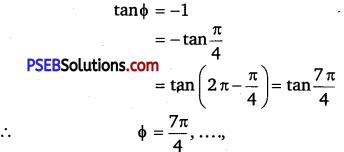
PSEB 11th Class Physics Solutions Chapter 14 Oscillations 11
SHM is given as
x = Bsin(ωt + α)
Putting the given values in this equation, we get 1 =B sin (ωt + α)
B sin α =1 …………………………… (iii)

Velocity, ν = \(\frac{d x}{d t}\)
ω =(ωB cos (ωt + a)
1 =B cos (ω x 0+α ) = B cos α …………………………………… (iv)
Squaring and adding equations (iii) and (iv), we get
B2 [sin2α +cos2 α] =1+1
B2 =2
B = \(\sqrt{2}\) cm
Dividing equation (iii) by equation (iv), we get
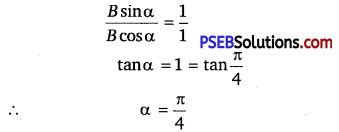
PSEB 11th Class Physics Solutions Chapter 14 Oscillations 12

Question 8.
A spring balance has a scale that reads from 0 to 50kg. The length of the scale is 20 cm. A body suspended from this balance, when displaced and released, oscillates with a period of 0.6 s. What is the weight of the body?
Solution:
Maximum mass that the scale can read, M = 50 kg
Maximum displacement of the spring = Length of the scale, l = 20 cm = 0.2 m Time period, T =0.6s
Maximum force exerted on the spring, F = Mg where,
g = acceleration due to gravity = 9.8 m/s2
F = 50 × 9.8 = 490 N
∴ Spring constant , K = \(\frac{F}{l}=\frac{490}{0.2}\) = 2450Nm-1

Mass m, is suspended from the balance,
Time period, T = \(2 \pi \sqrt{\frac{m}{k}}\)
∴ m = \(\left(\frac{T}{2 \pi}\right)^{2} \times k=\left(\frac{0.6}{2 \times 3.14}\right)^{2} \times 2450 \) = 22.36 kg
∴ Weight of the body = mg = 22.36 x 9.8 = 219.167N
Hence, the weight of the body is about 219 N.

Question 9.
Aspringhavingwith aspiring constant 1200Nm-1 is mounted on a horizontal table as shown in figure. A mss of 3kg is attached to the free end of the spring. The mass is then pulled sideways to a distance of 2.0cm and released.

PSEB 11th Class Physics Solutions Chapter 14 Oscillations 13
Determine (i) the frequency of oscillations,
(ii) maximum acceleration of the mass, and
(iii) the maximum speed of the mass.
Solution:
Spring constant, k = 1200 Nm-1
mass,m = 3 Kg
Displacement,A = 2.0 cm = 0.02 m
(i) Frequency of oscillation y, is gyen by the relation
V = \(\frac{1}{T}=\frac{1}{2 \pi} \sqrt{\frac{k}{m}}\)
where, T is the time period
∴ v = \(\frac{1}{2 \times 3.14} \sqrt{\frac{1200}{3}}\) = 3.18 s-1
Hence, the frequency of oscillations is 3.18 s-1.

(ii) Maximum acceleration a is given by the relation:
a = ω2A
where,
ω = Angular frequency = \(\sqrt{\frac{k}{m}}\)
A = Maximum displacement
∴ a = \(\frac{k}{m} A=\frac{1200 \times 0.02}{3}\) = 8 ms-2
Hence, the maximum acceleration of the mass is 8.0 ms2

(iii) Maximum speed, νmax = Aω
= \(A \sqrt{\frac{k}{m}}=0.02 \times \sqrt{\frac{1200}{3}}\) = 0.4 m/s
Hence, the maximum speed of the mass is 0.4 m/s.

Question 10.
In question 9, let us take the position of mass when the spring is unstretched as x =0, and the direction from left to right as the positive direction of x-axis. Give x as a function of time t for the oscillating massif at the moment we start the stopwatch (t = 0), the mass is
(a) at the mean position,
(b) at the maximum stretched position, and
(c) at the maximum compressed position.
In what way do these functions for SHM differ from each other, in frequency, in amplitude br the initial phase?
Solution:
(a) The functions have the same frequency and amplitude, but different initial phases.
Distance travelled by the mass sideways, A = 2.0 cm
Force constant of the spring, k =1200 N m-1
Mass, m =3kg
Angular frequency of oscillation,
ω = \(\sqrt{\frac{k}{m}}=\sqrt{\frac{1200}{3}} \) = \(\sqrt{400}\) = 20 rad s-1
When the mass is at the mean position, initial phase is 0.
Displacement,
x = A sinωt = 2 sin20 t

(b) At the maximum stretched position, the mass is toward the extreme right. Hence, the initial phase is \(\frac{\pi}{2}\)
Displacement, x = Asin \(\left(\omega t+\frac{\pi}{2}\right)\)
=2sin\(\left(20 t+\frac{\pi}{2}\right)\)
= 2 cos 20t

(c) At the maximum compressed position, the mass is toward the extreme left. Hence, the initial phase is \(\frac{3 \pi}{2}\)
Displacement, x = A sin \(\left(\omega t+\frac{3 \pi}{2}\right)\)
= 2sin \(\left(20 t+\frac{3 \pi}{2}\right)\) = -2cos 20t
The functions have the same frequencyl \(\left(\frac{20}{2 \pi} \mathrm{Hz}\right)\) land amplitude (2cm),
but different initial phases \(\left(0, \frac{\pi}{2}, \frac{3 \pi}{2}\right)\)

PSEB 11th Class Physics Solutions Chapter 14 Oscillations

Question 11.
Figures correspond to two circular motions. The radius of the circle, the period of revolution, the initial position, and the sense of revolution (i. e., clockwise or anti-clockwise) are indicated on each figure.
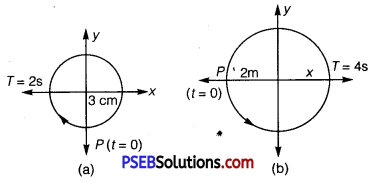
PSEB 11th Class Physics Solutions Chapter 14 Oscillations 14
Obtain the corresponding simple harmonic motions of the x-projection of the radius vector of the revolving particle P, in each case.
solution:
Time period,T =2s
Amplitude, A = 3cm
At time, t = O, the radius vector OP makes an angle \(\frac{\pi}{2}\) with the positive x -axis, i.e., phase angle Φ = + \(\frac{\pi}{2}\)
Therefore, the equation of simple harmonic motion for the x —projection of OP, at time t, is given by the displacement equation
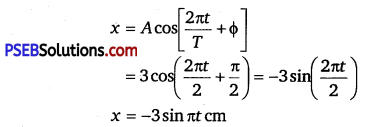
PSEB 11th Class Physics Solutions Chapter 14 Oscillations 15

(b) Time period, T = 4s
Amplitude, a =2 m
At time t = 0, OP makes an angle ir with the x-axis, in the anticlockwise direction. Hence, phase angle, Φ = +π
Therefore, the equation of simple harmonic motion for the x -projection of OP, at time t, is given as

PSEB 11th Class Physics Solutions Chapter 14 Oscillations 16

Question 12.
Plot the corresponding reference circle for each of the following simple harmonic motions. Indicate the initial (t = 0) position of the particle, the radius of the circle, and the angular speed of the rotating particle. For simplicity, the sense of rotation may be fixed to be anticlockwise in every case: (x is in cm and t is in s).
(a) x= – 2sin(3t+\(\pi / \mathbf{3}\) )
(b) x=cos (\(\pi / 6\) – t)
(c) x=3 sin (2πt + \(\pi / 4 \) )
(d) x=2 cos πt
Solution:
(a) x = -2 sin \(\left(3 t+\frac{\pi}{3}\right)=+2 \cos \left(3 t+\frac{\pi}{3}+\frac{\pi}{2}\right)=2 \cos \left(3 t+\frac{5 \pi}{6}\right) \)

If this equation is compared with the standard SHM equation,
x =A cos \(\left(\frac{2 \pi}{T} t+\phi\right)\) then we get
Amplitude, A = 2cm
Phase angle, Φ = \(\frac{5 \pi}{6}\) =150°
Angular velocity, ω = \(\frac{2 \pi}{T}\) =3 rad/sec
The motion of the particle can be pokted as shown in the following figure.
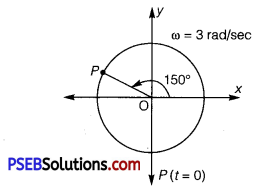
PSEB 11th Class Physics Solutions Chapter 14 Oscillations 17

(b) x=cos \(\left(\frac{\pi}{6}-t\right)\) =cos \(\left(t-\frac{\pi}{6}\right)\)
If this equation is compared with the standard SHM equation,
x = A cos \(\left(\frac{2 \pi}{T} t+\phi\right)\) then we get
Amplitude, A = 1 cm
Phase angle, Φ = \(-\frac{\pi}{6} \) = – 30°
Angular velocity, ω = \(\frac{2 \pi}{T}\) =1 rad/s
The motion of the particle can be plotted as shown in the following figure.
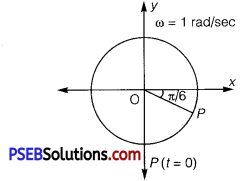
PSEB 11th Class Physics Solutions Chapter 14 Oscillations 18

(c) x =3sin \(\left(2 \pi t+\frac{\pi}{4}\right)\)

PSEB 11th Class Physics Solutions Chapter 14 Oscillations 19
If this equation is compared with the standard SHM equation
x = Acos \(\left(\frac{2 \pi}{T} t+\phi\right)\) then we get
Amplitude, A = 3cm
Phase angle, Φ = \(-\frac{\pi}{4}\)
Angular velocity, ω = \(\frac{2 \pi}{T}\) = 2π rad/s
The motion of the particle can be plotted as shown in the following figure.
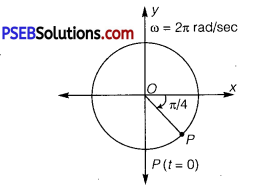
PSEB 11th Class Physics Solutions Chapter 14 Oscillations 20

(d) x=2cosπt
If this equation is compared with the standard SHM equation,
x = A cos \(\left(\frac{2 \pi}{T} t+\phi\right) \) then we get
Amplitude, A = 2cm
Phase angle, Φ = 0
Angular velocity, ω = π rad/s
The motion of the particle can be plotted as shown in the following figure.
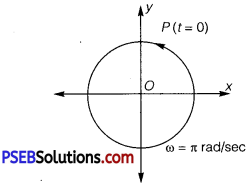
PSEB 11th Class Physics Solutions Chapter 14 Oscillations 21

Question 13.
Figure (a) shows a spring of force constant k clamped rigidly at one end and a mass m attached to its free end. A force F applied at the free end stretches the spring. Figure (b) shows the same spring with both ends free and attached to a mass m at either end. Each end of the spring in figure (b) is stretched by the same force F.
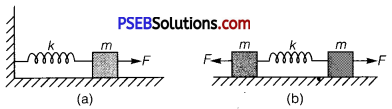
PSEB 11th Class Physics Solutions Chapter 14 Oscillations 22

(a) What is the minimum extension of the spring in the two cases?
(b) If the mass in Fig. (a) and the two masses in Fig. (b) are released, what is the period of oscillation in each case?
Solution:
(a) For the one block system:
When a force F, is applied to the free end of the spring, an extension l, is produced. For the maximum extension, it can be written as:
F=kl
where k is the spring constant
Hence, the maximum extension produced in the spring, l = \(\frac{F}{k}\)
For the two blocks system:
The displacement (x) produced in this case is:
x = \(\frac{l}{2}\)
Net force, F = +2kx =2k \(\frac{l}{2}\)
∴ l = \(\frac{F}{k}\)

(b) For the one blocks system:
For mass (m) of the block, force is written as
F = ma = m \(\frac{d^{2} x}{d t^{2}}\)
where, x is the displacement of the block in time t
∴ m \(\frac{d^{2} x}{d t^{2}}\) = -kx
It is negative because the direction of elastic force is opposite to the direction of displacement.
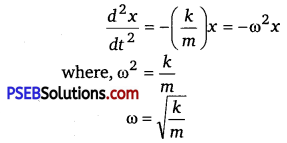
PSEB 11th Class Physics Solutions Chapter 14 Oscillations 23
where, ω is angular frequency of the oscillation
∴ Time period of the oscillation,
T= \(\frac{2 \pi}{\omega}=\frac{2 \pi}{\sqrt{\frac{k}{m}}}=2 \pi \sqrt{\frac{m}{k}}\)

For the two blocks system:
F=m \(\frac{d^{2} x}{d t^{2}}\)
m \(\frac{d^{2} x}{d t^{2}}\) =-2kx

It is negative because the direction of elastic force is opposite to the direction of displacement.
\(\frac{d^{2} x}{d t^{2}}\) = \(-\left[\frac{2 k}{m}\right] x \) = – ω2x
where, Angular frequency, ω = \(\sqrt{\frac{2 k}{m}}\)
∴ Time period T = \(\frac{2 \pi}{\omega}=2 \pi \sqrt{\frac{m}{2 k}} \)

PSEB 11th Class Physics Solutions Chapter 14 Oscillations

Question 14.
The piston in the cylinder head of a locomotive has a stroke (twice the amplitude) of 1.0 in. If the piston moves with simple harmonic motion with an angular frequency of 200 rad/min, what is its maximum speed?
Solution:
Angular frequency of the piston, ω = 200 rad/min.
Stroke =1.0 m
Amplitude, A = \(\frac{1.0}{2}\) = 0.5m
The maximum speed (νmax) of the piston is given by the relation
νmax =Aω = 200 x 0.5=100 m/min

Question 15.
The acceleration due to gravity on the surface of moon is 1.7 ms-2. What is the time period of a simple pendulum on the surface of moon If Its time period on the surface of earth is 3.5 s? (gon the surface of earth is 9.8 ms-2)
Solution:
Acceleration due to gravity on the surface of moon, g’ = 1.7m s-2
Acceleration due to gravity on the surface of earth, g = 9.8 ms-2
Time period of a simple pendulum on earth, T = 3.5 s
T= \(2 \pi \sqrt{\frac{l}{g}}\)

where l is the length of the pendulum
∴ l = \(\frac{T^{2}}{(2 \pi)^{2}} \times g=\frac{(3.5)^{2}}{4 \times(3.14)^{2}} \times 9.8 \mathrm{~m} \)

The length of the pendulum remains constant.
On Moon’s surface, time period,
T’ = \(2 \pi \sqrt{\frac{l}{g^{\prime}}}=2 \pi \sqrt{\frac{(3.5)^{2}}{\frac{4 \times(3.14)^{2}}{1.7}} \times 9.8} \) = 8.4 s
Hence, the time period of the simple pendulum on the surface of Moon is 8.4 s.

Question 16.
Answer the following questions:
(a) Time period of a particle in SHM depends on the force constant k and mass m of the particle:
T = \(2 \pi \sqrt{\frac{m}{k}}\) A simple pendulum executes SHM approximately. Why then is the time period of a pendulum independent of the mass of the pendulum?

(b) The motion of a simple pendulum is approximately simple harmonic for small-angle oscillations. For larger angles of oscillation a more involved analysis shows that T is greater than \(2 \pi \sqrt{\frac{l}{g}}\) Think of a qualitative argument to appreciate this result.

(c) A man with a wristwatch on his hand falls from the top of a tower. Does the watch give correct time during the free fall?

(d) What is the frequency of oscillation of a simple pendulum mounted in a cabin that is freely falling under gravity?
Solution :
(a) The time period of a simple pendulum, T = \(2 \pi \sqrt{\frac{m}{k}}\)
For a simple pendulum, k is expressed in terms of mass m, as
k ∝ m
\(\frac{m}{k}\) = Constant
Hence, the time period T, of a simple pendulum is independent of the mass of the bob.

(b) In the case of a simple pendulum, the restoring force acting on the bob of the pendulum is given as
F = -mg sinθ
where, F = Restoring force; m = Mass of the bob; g = Acceleration due to
gravity; θ = Angle of displacement
For small θ, sinθ ≈ θ
For large 0,sin0 is greater than 0.
This decreases the effective value of g.
Hence, the time period increases as
T = \(2 \pi \sqrt{\frac{l}{g}}\)
where, l is the length of the simple pendulum

(c) The time shown by the wristwatch of a man falling from the top of a tower is not affected by the fall. Since a wristwatch does not work on the principle of a simple pendulum, it is not affected by the acceleration due to gravity during free fall. Its working depends on spring action.

(d) When a simple pendulum mounted in a cabin falls freely under gravity, its acceleration is zero. Hence the frequency of oscillation of this simple pendulum is zero.

Question 17.
A simple pendulum of length l and having a bob of mass M is suspended in a car. The car is moving on a circular track of radius R with a uniform speed v. If the pendulum makes small f oscillations in a radial direction about its equilibrium position, what will be its time period?
Solution:
The bob of the simple pendulum will experience the acceleration due to gravity and the centripetal acceleration provided by the circular motion of the car.
Acceleration due to gravity = g
Centripetal acceleration = \(\frac{v^{2}}{R}\)
where, v is the uniform speed of the car R is the radius of the track
Effective acceleration (aeff) is given as
aeff = \(\sqrt{g^{2}+\left(\frac{v^{2}}{R}\right)^{2}}\)

Time period, T = \( 2 \pi \sqrt{\frac{l}{a_{e f f}}}\)
where, l is the length of the pendulum
∴ Time period, T = \(2 \pi \sqrt{\frac{l}{g^{2}+\frac{v^{4}}{R^{2}}}} \)

Question 18.
A cylindrical piece of cork of density of base area A and height h floats in a liquid of density ρl. The cork is depressed slightly and then released. Show that the cork oscillates up and down simple harmonically with a period
T = \(2 \pi \sqrt{\frac{\boldsymbol{h} \rho}{\rho_{\boldsymbol{l}} \boldsymbol{g}}}\)
where ρ is the density of cork. (Ignore damping due to viscosity of the liquid).
Solution:
Base area of the cork = A
Height of the cork = h
Density of the liquid = ρl
Density of the cork = ρ

In equilibrium:
Weight of the cork = Weight of the liquid displaced by the floating cork Let the cork be depressed slightly by x. As a result, some extra water of a certain volume is displaced. Hence, an extra up-thrust acts upward and provides the restoring force to the cork.
Up-thrust = Restoring force, F = Weight of the extra water displaced
F = -(Volume x Density x g)
Volume = Area x Distance through which the cork is depressed Volume = Ax
∴ F = -Ax ρlg ………………………… (i)
According to the force law,
F = kx
k = \(\frac{F}{x}\)

where k is a constant
k = \(\frac{F}{x}\) = -Aρlg ………………………………. (ii)
The time period of the oscillations of the cork,
T = \(2 \pi \sqrt{\frac{m}{k}} \) …………………………………… (iii)

where,
m = Mass of the cork
= Volume of the cork x Density
= Base area of the cork x Height of the cork x Density of the cork = Ahρ
Hence, the expression for the time period becomes
T = \(2 \pi \sqrt{\frac{A h \rho}{A \rho_{l} g}}\) = 2\(\pi \sqrt{\frac{h \rho}{\rho_{l} g}} \)

Question 19.
One end of a U-tube containing mercury is connected to a suction pump and the other end to atmosphere. A small pressure difference is maintained between the two columns. Show that, when the suction pump is removed, the column of mercury in the U-tube executes simple harmonic motion.
Solution:
Area of cross-section of the U-tube = A
Density of the mercury column = ρ
Acceleration due to gravity = g
Restoring force, F = Weight of the mercury column of a certain height
F = -(Volume x Density x g)
F = -(A x 2h x ρ x g) = -2Aρgh = -k x Displacement in one of the arms (h)

where, 2h is the height of the mercury column in the two arms
k is a constant, given by k = \(-\frac{F}{h}\) = 2Aρg
Time period = \(2 \pi \sqrt{\frac{m}{k}}=2 \pi \sqrt{\frac{m}{2 A \rho g}}\)
where, m is the mass of the mercury column
Let l be the length of the total mercury in the U-tube.
Mass of mercury, m = Volume of mercury x Density of mercury = Alρ
∴ T = \(2 \pi \sqrt{\frac{A l \rho}{2 A \rho g}}=2 \pi \sqrt{\frac{l}{2 g}} \)

Hence the mercury column executes simple harmonic motion with time period \(2 \pi \sqrt{\frac{l}{2 g}} \)

Additional Exercises

Question 20.
An air chamber of volume V has a neck area of cross-section a into which a ball of mass m just fits and can move up and down without any friction (see figure). Show that when the ball is pressed down a little and released, it executes SHM. Obtain an expression for the time period of oscillations assuming pressure-volume variations of air to be isothermal.

PSEB 11th Class Physics Solutions Chapter 14 Oscillations 24
Solution:
Volume of the air chamber = V
Area of cross-section of the neck = a
Mass of the ball = m
The pressure inside the chamber is equal to the atmospheric pressure. Let the ball be depressed by x units. As a result of this depression, there would be a decrease in the volume and an increase in the pressure inside the chamber.
Decrease in the volume of the air chamber, ΔV = ax
Volumetric strain =PSEB 11th Class Physics Solutions Chapter 14 Oscillations 25
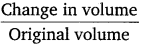
⇒ \(\frac{\Delta V}{V}=\frac{a x}{V}\)

Bulk Modulus of air, B = \(\frac{\text { Stress }}{\text { Strain }}=\frac{-p}{\frac{a x}{V}}\)
In this case, stress is the increase in pressure. The negative sign indicates that pressure increases with a decrease in volume.
p = \(\frac{-B a x}{V}\)
The restoring force acting on the ball,
F = p × a = \(\frac{-B a x}{V} \cdot a=\frac{-B a^{2} x}{V}\) ……………………………. (i)
In simple harmonic motion, the equation for restoring force is
F = -kx …………………………………….. (ii)
where, k is the spring constant Comparing equations (i) and (ii), we get
k = \(\frac{B a^{2}}{V}\)
Time period, T = \(2 \pi \sqrt{\frac{m}{k}}=2 \pi \sqrt{\frac{V m}{B a^{2}}}\)

PSEB 11th Class Physics Solutions Chapter 14 Oscillations

Question 21.
You are riding in an automobile of mass 3000kg. Assuming that you are examining the oscillation characteristics of its suspension system. The suspension sags 15 cm when the entire automobile is placed on it. Also, the amplitude of oscillation decreases by 50% during one complete oscillation. Estimate the values of (a) the spring constant k and (6) the damping constant b for the spring and shock absorber system of one wheel, assuming that each wheel supports 750 kg.
Solution:
Mass of the automobile, m = 3000 kg
Displacement in the suspension system, x = 15cm = 0.15 m
There are 4 springs in parallel to the support of the mass of the automobile.
The equation for the restoring force for the system:
F = -4 kx = mg

where, k is the spring constant of the suspension system
Time period, T = \(2 \pi \sqrt{\frac{m}{4 k}}\)
and, k = \(\frac{m g}{4 x}=\frac{3000 \times 10}{4 \times 0.15}\) = 50000 = 5 x 10 4N/m
Spring constant, k = 5 x 10⁴ N/m

Each wheel supports a mass, M = \(\frac{3000}{4}\) = 750 kg
For damping factor b, the equation for displacement is written as:
x = x0e-bt/2M

The amplitude of oscillation decreases by 50%
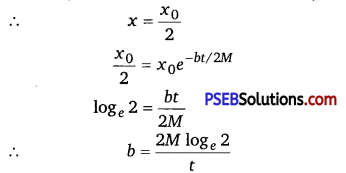
PSEB 11th Class Physics Solutions Chapter 14 Oscillations 26
where, Time petiod,t =\(2 \pi \sqrt{\frac{m}{4 k}}=2 \pi \sqrt{\frac{3000}{4 \times 5 \times 10^{4}}}\) =0.7691s
∴ b =\(\frac{2 \times 750 \times 0.693}{0.7691}\) =1351.58kg/s
Therefore, the damping constant of the spring is 1351.58 kg/s.

Question 22.
Show that for a particle in linear SHM the average kinetic energy over a period of oscillation equals the average potential energy over the same period.
Solution:
The equation of displacement of a particle executing SHM at an instant t is given as
x = Asinωt
where,
A = Amplitude of oscillation
ω = Angular frequency = \(\sqrt{\frac{k}{M}}\)
The velocity of the particle is
ν = \(\frac{d x}{d t}\) = Aωcosωt

The kinetic energy of the particle is
Ek = \(\frac{1}{2} M v^{2}=\frac{1}{2} M A^{2} \omega^{2} \cos ^{2} \omega t \)
The potential energy of the particle is
Ep = \( \frac{1}{2} k x^{2}=\frac{1}{2} M \omega^{2} A^{2} \sin ^{2} \omega t\)

For time period T, the average kinetic energy over a single cycle is given as
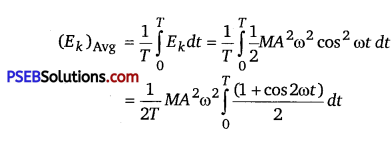
PSEB 11th Class Physics Solutions Chapter 14 Oscillations 27
PSEB 11th Class Physics Solutions Chapter 14 Oscillations 28
And, average potential energy over one cycle is given as
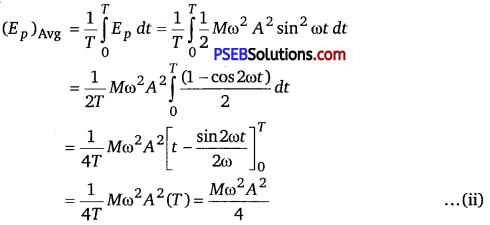
PSEB 11th Class Physics Solutions Chapter 14 Oscillations 29
It can be inferred from equations (i) and (ii) that the average kinetic energy for a given time period is equal to the average potential energy for the same time period.

Question 23.
A circular disc of mass 10 kg is suspended by a wire attached to its center. The wire is twisted by rotating the disc and released. The period of torsional oscillations is found to be 1.5s. The radius of the disc is 15 cm. Determine the torsional spring constant of the wire. (Torsional spring constant a is defined by the relation J = -αθ, where J is the restoring couple and 0 the angle of twist).
Solution:
Mass of the circular disc, m = 10 kg
Radius of the disc, r = 15cm = 0.15 m
The torsional oscillations of the disc has a time period, T = 1.5 s The moment of inertia of the disc is
I = \(\frac{1}{2}\) mr2 = \(\frac{1}{2} \times(10) \times(0.15)^{2}\) = 0.1125kg-m2

Time period, T = \(2 \pi \sqrt{\frac{I}{\alpha}}\)
where, α is the torsional constant.
An21 4 x(3.14)2x 0.1125 , M
α = \(\frac{4 \pi^{2} I}{T^{2}}=\frac{4 \times(3.14)^{2} \times 0.1125}{(1.5)^{2}} \) = 1.972 N-m/rad
Hence, the torsional spring constant of the wire is 1.972 N-m rad-1.

Question 24.
A body describes simple harmonic motion with amplitude of 5 cm and a period of 0.2 s. Find the acceleration and velocity of the body when the displacement is (a) 5 cm, (b) 3 cm, (c) 0 cm.
Solution:
Amplitude, A = 5 cm = 0.05m
Time period, T = 0.2 s
(a) For displacement, x = 5 cm = 0.05m
Acceleration is given by
a = -ω2x = \(-\left(\frac{2 \pi}{T}\right)^{2} x=-\left(\frac{2 \pi}{0.2}\right)^{2} \times 0.05\)
Velocity is given by
ν = ω \(\sqrt{A^{2}-x^{2}}=\frac{2 \pi}{T} \sqrt{(0.05)^{2}-(0.05)^{2}}\) = 0
When the displacement of the body is 5 cm, its acceleration is -5π2 m/s2 and velocity is 0.

(b) For displacement, x =3 cm = 0.03 m
Acceleration is given by
a = – ω2x = – \(\left(\frac{2 \pi}{T}\right)^{2}\)x = \(\left(\frac{2 \pi}{0.2}\right)^{2}\) 0.03 = -3π2 m/s2
Velocity is given by
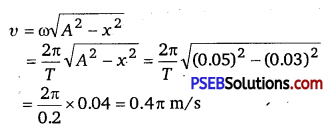
PSEB 11th Class Physics Solutions Chapter 14 Oscillations 30
When the displacement of the body is 3 cm, its acceleration is -3π m/s2 and velocity is 0.4π m/s.

(c) For displacement, x = 0
Acceleration is given by
a = – ω2x = 0
Velocity is given by
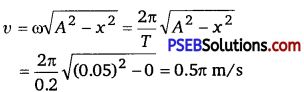
PSEB 11th Class Physics Solutions Chapter 14 Oscillations 31
When the displacement of the body is 0, its acceleration is 0, and velocity is0.5π m/s.

PSEB 11th Class Physics Solutions Chapter 14 Oscillations

Question 25.
A mass attached to a spring is free to oscillate, with angular velocity ω, in a horizontal plane without friction or damping. It is pulled to a distance x0 and pushed towards the center with a velocity v0 at time t = 0. Determine the amplitude of the resulting oscillations in terms of the parameters ω, x0, and v0. [Hint: Start with the equation x = a cos(ωt + θ) and note that the initial velocity is negative.]
Solution:
The displacement equation for an oscillating mass is given by
x = Acos(ωt + θ) …………………………… (i)
where A is the amplitude
x is the displacement
θ is the phase constant
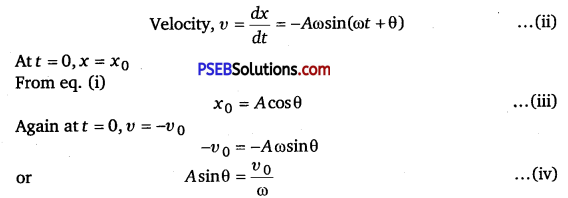
PSEB 11th Class Physics Solutions Chapter 14 Oscillations 32
Squaring and adding equations (iii) and (iv), we get
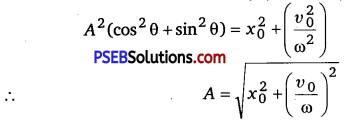
PSEB 11th Class Physics Solutions Chapter 14 Oscillations 33
Hence, the amplitude of the resulting oscillation is \(\sqrt{x_{0}^{2}+\left(\frac{v_{0}}{\omega}\right)^{2}}\)

PSEB 11th Class Physics Important Questions Chapter 2 Units and Measurements

Punjab State Board PSEB 11th Class Physics Important Questions Chapter 2 Units and Measurements Important Questions and Answers.

PSEB 11th Class Physics Important Questions Chapter 2 Units and Measurements

Very short answer type questions

Question 1.
Is it possible to have length and velocity both as fundamental quantities? Why?
Answer:
No, since length is fundamental quantity and velocity is the derived quantity.

Question 2.
Which of these is largest: astronomical unit, light year and par sec?
Answer:
Par sec is larger than light year which in turn is larger than an astronomical unit.

PSEB 11th Class Physics Important Questions Chapter 2 Units and Measurements

Question 3.
Define one Bam. How it is related with metre?
Answer:
One bam is a small unit of area used to measure area of nuclear cross-section.
∴ 1 barn = 10-28 m2

Question 4.
What is meant by angular diameter of moon?
Answer:
Angular diameter of moon is the angle subtended at a point on the earth, by two diameterically opposite ends of the moon. Its value is about 0.5°.

Question 5.
Name the device used for measuring the mass of atoms and molecules. (NCERT Exemplar)
Answer:
Spectrograph.

Question 6.
Write the dimensional formula of wavelength and frequency of a wave.
Answer:
Wavelength [λ] = [L]
Frequency [v] = [T-1]

PSEB 11th Class Physics Important Questions Chapter 2 Units and Measurements

Question 7.
Obtain the dimensional formula for coefficient of viscosity.
Answer:
Coefficient of viscosity (η) = \(\frac{F d x}{A \cdot d v}\)
= \(\frac{\left[\mathrm{MLT}^{-2}\right][\mathrm{L}]}{\left[\mathrm{L}^{2}\right]\left[\mathrm{LT}^{-1}\right]}\) = [M1L-1T-1]

Question 8.
Write three pairs of physical quantities, which have same dimensional formula.
Answer:

  • Work and energy
  • Energy and torque
  • Pressure and stress

Short answer type questions

Question 1.
Does AU and Å represent the same unit of length?
Answer:
No, AU and Å represent two different units of length.
1 AU = 1 astronomical unit = 1.496 x 10¹¹ m
1Å = 1 angstrom = 10-10 m

Question 2.
What is common between bar and torr?
Solution:
Both bar and torr are the units of pressure.
1 bar =1 atmospheric pressure = 760 mm of Hg column .
= 105 N/m2
1 torr = 1 mm of Hg column
bar 760 torr

Question 3.
Why has second been defined in term of periods of radiations from cesium-133?
Answer:
Second has been defined in terms of periods of radiation, because

  • this period is accurately defined.
  • this period is not affeced by change of physical conditions like temperature, pressure and volume etc.
  • the unit is easily reproducible in any good laboratoty.

PSEB 11th Class Physics Important Questions Chapter 2 Units and Measurements

Question 4.
Why parallax method cannot be used for measuring distances of stars more than 100 light ýears away?
Answer:
When a star is more than loo light years away, then the parallax angle is so small that it cannot be measured accurately.

Question 5.
What is the technique used for measuring large time intervals?
Answer:
For measuring large time intervals, we use the technique of radioactive dating. Large time intervals are measured by studying the ratio of number of radioactive atoms decayed to the number of surviving atoms in the
specimen.

Question 6.
Using the relation E = hv, obtain the dimensions of Planck’s constant.
Answer:
We know that dimensional formula of energy E of photon is [M1L2T-2
and dimensional formula of frequency is y is [T-1].
The given relation is E = hv
[h] = \(\frac{[E]}{[v]}=\frac{\left[M^{1} \mathrm{~L}^{2} \mathrm{~T}^{-2}\right]}{\left[\mathrm{T}^{-1}\right]}\) = M1L2T-1

Question 7.
The rotational kinetic energy of a body is given by E = \(\frac {1}{2}\)Iω2, where ω is the angular velocity of the body. Use the equation to obtain dimensional formula for moment of inertia I. Also write
its SI unit.
Solution:
The given relation is E = \(\frac {1}{2}\)Iω2
PSEB 11th Class Physics Important Questions Chapter 2 Units and Measurements 1
Its SI unit is Joule.

PSEB 11th Class Physics Important Questions Chapter 2 Units and Measurements

Question 8.
Distinguish between dimensional variables and dimensional constants. Give example too.
Answer:
Dimensional variables are those quantities which have dimensions and whose numerical value may change. Speed, velocity, acceleration etc. are dimensional variables.

Dimensional constants are quantities having dimensions but having a constant value, e.g., gravitation constant (G), Planck’s constant (H), Stefan’s constant (σ) etc.

Question 9.
Dow will you convert a physical quantity from one unit system to another by method of dimensions?
Solution:
If a given quantity is measured in two different unit system, then Q = n1u1 = n2u2.
Let the dimensional formula of the quantity be [MaLbTc], then we have n1 [M1aL1bT1c ] = n2 [M2aL2bT2c]
Here M1, L1, T1 are the fundamental units of mass, length and time in
first unit system and M2, L2, T2
PSEB 11th Class Physics Important Questions Chapter 2 Units and Measurements 2
This relation helps us to convert a physical quantity from one unit system to another.

Question 10.
The displacement of a progressive wave is represented by y = A sin (ωt – kx), where x is distance, and t is time. Write the dimensional formula of (i) ω and (ii) k. (NCERT Exemplar)
Solution:
Now, by the principle of homogeneity, i. e., dimensions of LHS and RHS should be equal, hence
[LHS] = [RHS]
⇒ [L] = [A] = L
As ωt – kx should be dimensionless,
[ωt] [kx] = 1
⇒ [ω]T = [k]L= 1
⇒ [ω] = T-1 and [k] = L-1

PSEB 11th Class Physics Important Questions Chapter 2 Units and Measurements

Question 11.
Which of the following time measuring devices is most precise?
(a) A wall clock
(b) A stop watch
(c) A digital watch
(d) An atomic clock
Give reason for your answer. (NCERT Exemplar)
Solution:
A wall clock can measure time correctly upto one second. A stop watch can measure time correctly upto a fraction of a second. A digital watch can measure time up to a fraction of second. An atomic clock can measure time most precisely as its precision is 1 s in 1013 s.

Long answer type questions

Question 1.
A large fluid star oscillates in shape under the influence of its own gravitational field. Using dimensional analysis, find the expression for period of oscillation (T) in terms of radius of star (R), Mean density of fluid (ρ) and universal gravitational constant (G).
Solution:
Suppose period of oscillation T depends on radius of star R, mean density of fluid p and universal gravitational constant (G) as
T = kRa ρb Gc,where kis a dimensionless constant
Writing dimentions on both sides of the equation, we have
[M0L0T1]=[L]a[ML-3]b[M-1L3T-2]c
= Mb – cLa – 3b + 3cT-2c
Comparing powers of M, L and T, we have
b – c = 0;
a – 3b + 3c = 0 and -2c = 1
On simplifying these equations, we get
c = -1/2,b = -1/2, a = 0
Thus, we have T = kρ-1/2G-1/2 = \(\frac{k}{\sqrt{\rho G}}\)

PSEB 11th Class Physics Important Questions Chapter 2 Units and Measurements

Question 2.
Find an expression for viscous force F acting on a tiny steel ball of radius,r,moving in a viscous liquid of viscosity q with a constant speed υ by the niethod of dimensional analysis.
Solution:
It is given that viscous force F depends on (i) radius r of steel ball, (ii) coefficient of viscosity η of viscous liquid (iii), Speed υ of the ball i.e.,F = kraηbυc,where kis dimensionless constant
Writing dimensions on both sides of equation, we have
[MLT-2] = [L]a[M1L-1T-1]b[LT-1]c
= [MaLa – b + cT-b -c]
Comparing powers of M, L and T on two sides of equation, we get
a = 1
a – b + c = 1
-b -c =-2
On solving, these above equations, we get ,
a = 1, b = 1 and c = 1
Hence, the relation becomes
F = krηυ

PSEB 11th Class Physics Solutions Chapter 2 Units and Measurements

Punjab State Board PSEB 11th Class Physics Book Solutions Chapter 2 Units and Measurements Textbook Exercise Questions and Answers.

PSEB Solutions for Class 11 Physics Chapter 2 Units and Measurements

PSEB 11th Class Physics Guide Units and Measurements Textbook Questions and Answers

Question 1.
Fill in the blanks:
(a) The volume of a cube of side 1 cm is equal to …………………….. m3.
(b)The surface area of a solid cylinder of radius 2.0 cm and height 10.0 cm is equal to ………………….. (mm)2.
(b) A vehicle moving with a speed of 18 km h-1 covers ………………………. m in 1 s.
(c) The relative density of lead is 11.3. Its density is ………………………… g cm-3 or . ………………….. kg m3
Solution:
(a) 1 cm = \(\frac {1}{100}\)m
Volume of the cube = 1 cm3
But 1 cm3 = 1cm × 1cm × 1cm
= (\(\frac {1}{100}\))m × (\(\frac {1}{100}\))m × (\(\frac {1}{100}\))m
∴1 cm3 = 10-6 m3
Hence, the volume of a cube of side 1 cm is equal to 10-6 m3

(b) The total surface area of a cylinder of radius r and height h is
S = 2πr(r + h).
Given that,
r = 2cm =2 × 1 cm = 2 × 10 mm = 20 mm
h =10 cm = 10 × 10 mm = 100 mm .
∴ S = 2 × 3.14 × 20 × (20 +100) mm2
= 15072 mm2 = 1.5072 × 104mm2
= 1.5 × 104 mm2

(c) Using the conversion,
1 km/h = \(\frac {5}{18}\) m/s
18 km/h = 18 × \(\frac {5}{18}\) = 5 m/s
Therefore, distance can be obtained using the relation
Distance = Speed × Time = 5 × 1 = 5 m
Hence, the vehicle covers 5 m in 1 s.

(d) Relative density of a substance is given by the relation,
Relative density \(=\frac{\text { Density of substance }}{\text { Density of water }}\)
Density of water = 1 g/cm3
Density of lead = Relative density of lead × Density of water
= 11.3 × 1 = 11.3 g/cm3
Density of water in SI system = 103 kg/m3
∴ Density of lead =11.3 × 10³ kg/m 3
= 1.13 × 10⁴ kg/m3

PSEB 11th Class Physics Solutions Chapter 2 Units and Measurements

Question 2.
Fill in the blanks by suitable conversion of units :
(a) 1 kg m2s-2 = ………………….. g cm2 s-2
(b) 1 m = ………………………….. ly
(c) 3.0 ms-2 = …………………… km h-2
(d) G = 6.67 × 10⁻¹¹ N m2 (kg)-2 = ………………………. (cm)3 s-2 g-1.
Solution:
(a) 1 kg = 103 g
1 m2 = 104 cm2
1 kg m2 s-2 = 1 kg × 1 m2 × 1 s-2
= 103 g × 104 cm2 × 1 s-2
= 107 g cm2 s-2

(b) Light year is the total distance travelled by light in one year.
1 ly = Speed of light × One year
= (3 × 10⁸ m/s) × (365 × 24 × 60 × 60 s)
= 9.46 × 10¹⁵ m
1 m = \(\frac{1}{9.46 \times 10^{15}}\) = 1.057 × 10 -16 ly

(c) 1 m = 10-3 km
Again, 1 s = \(\frac{1}{3600}\) h

1 s-1 = 3600 h-1
1 s-2 = (3600)2 h-2
3 m s-2 = (3 × 10⁻³ km) × ((3600)2 h-2)
= 3.88 × 10⁴ kmh-2

(d) 1 N = 1 kgm s-2
1 kg = 10-3 g-1
1 m3 =106 cm3
∴ 6.67 × 10⁻¹¹ N-m2 kg-2
= 6.67 × 10-11 × (1 kg m s-2) (1 m2) (1 s-2) ,
= 6.67 × 10-11 × (1 kg × 1 m3 × 1 s-2)
= 6.67 × 10-11 × (10-3 g-1) × (106 cm3) × (1 s-2)
= 6.67 × 10⁻⁸ cm3 s-2 g-1

Question 3.
A calorie is a unit of heat or energy and it equals about 4.2 J where 1 J = 1 kgm2 s-1.
Suppose we employ a system of units in which the unit of mass equals a kg, the unit of length equals β m, the unit of time is y s. Show that a calorie has a magnitude 4.2 α-1β-2γ2 in terms of the new units.
Solution:
Given that,

1 calorie =4.2 (1 kg) (1 m2) (1 s-2)
New unit of mass = α kg
Hence, in terms of the new unit, 1 kg = \(\frac{1}{\alpha}\) = α-1
In terms of the new unit of length,
1 m = \(\frac{1}{\beta}\) = β-1 or 1 m2 = β-2

And, in terms of the new unit of time,
1 s = \(\frac{1}{\gamma}\) = γ-1
1 s2 = γ-2
1 s-2 = γ2
1 calorie =4.2 (1 α-1) (1 β-2) (1 γ2) = 4.2α-1β-2γ2

PSEB 11th Class Physics Solutions Chapter 2 Units and Measurements

Question 4.
Explain this statement clearly:
“To call a dimensional quantify Targe’ or ‘small’ is meaningless without specifying a standard for comparison”. In view of this, reframe the following statements wherever necessary:
(a) atoms are very small objects
(b) a jet plane moves with great speed
(c) the mass of Jupiter is very large
(d) the air inside this room contains a large number of molecules
(e) a proton is much more massive than an electron
(f) the speed of sound is much smaller than the speed of light.
Answer:
The given statement is true because a dimensionless quantity may be large or small in comparision to some standard reference. For example, the coefficient of friction is dimensionless. The coefficient of sliding friction is greater than the coefficient of rolling friction, but less than static friction.

(a) An atom is a very small object in comparison to a soccer ball.
(b) A jet plane moves with a speed greater than that of a bicycle.
(c) Mass of Jupiter is very large as compared to the mass of a cricket ball.
(d) The air inside this room contains a large number of molecules as compared to that present in a geometry box.
(e) A proton is more massive than an electron.
(f) Speed of sound is less than the speed of light.

Question 5.
A new unit of length is chosen such that the speed of light in vacuum is unity. What is the distance between the Sun and the Earth in terms of the new unit if light takes 8 min and 20 s to cover this distance?
Solution:
Distance between the Sun and the Earth:
= Speed of light × Time taken by light to cover the distance
Given that in the new unit, speed of light = 1 unit
Time taken, t = 8 min 20 s = (8 × 60 + 20) s = 500 s
Distance between the Sun and the Earth = Speed of light × Time
= 1 × 500 = 500 units

Question 6.
Which of the following is the most precise device for measuring length:
(a) a vernier callipers with 20 divisions on the sliding scale
(b) a screw gauge of pitch 1 mm and 100 divisions on the circular scale
(c) an optical instrument that can measure length to within a wavelength of light?
Solution:
A device with minimum count is the most suitable to measure length.
(a) Least count of vernier callipers
= 1 standard division (SD) -1 vernier division (VD)
= 1 – \(\frac {19}{20}\) = \(\frac {1}{20}\) mm = \(\frac {1}{200}\) cm = 0.005 cm
Least count of screw gauge = PSEB 11th Class Physics Solutions Chapter 2 Units and Measurements 1
= \(\frac {1}{1000}\) = 0.001 cm

(c) Least count of an optical device = Wavelength of light ~10-5 cm
= 0.00001 cm
Hence, it can be inferred that an optical instrument is the most suitable device to measure length.

PSEB 11th Class Physics Solutions Chapter 2 Units and Measurements

Question 7.
A student measures the thickness of a human hair by looking at it through a microscope of magnification 100. He makes 20 observations and finds that the average width of the hair in the field of view of the microscope is 3.5 mm. What is the estimate on the thickness of hair?
Solution:
Magnification of the microscope = 100
Average width of the hair in the field of view of the microscope=3.5 mm
Actual thickness of the hair = \(\frac{\text { Observed width }}{\text { Magnification }}\) = \(\frac{3.5}{100}\) = 0.035m

Question 8.
Answer the following
(a) You are given a thread and a metre scale. How will you estimate the diameter of the thread?

(b) A screw gauge has a pitch of 1.0 mm and 200 divisions on the circular scale. Do you think it is possible to increase the accuracy of the screw gauge arbitrarily by increasing the number of divisions on the circular scale?

(c) The mean diameter of a thin brass rod is to be measured by vernier callipers. Why is a set of 100 measurements of the diameter expected to yield a more reliable estimate than a set of 5 measurements only?
Answer:
(a) Wrap the thread on a uniform smooth rod in such a way that the coils thus formed are very close to each other. Measure the length of the thread using a metre scale. The diameter of the thread is given by the relation,
Diameter = \(\frac{\text { Length of thread }(l)}{\text { Number of turns }(n)}\)

(b) It is not possible to increase the accuracy of a screw gauge by increasing the number of divisions of the circular scale. Increasing the number divisions of the circular scale will increase its accuracy to a certain extent only.

(c) A set of 100 measurements is more reliable than a set of 5 measurements because random errors involved in the former are very less as compared to the latter.

Question 9.
The photograph of a house occupies an area of 1.75 cm2 on a 35 mm slide. The slide is projected oh to a screen, and the area of the house on the screen is 1.55 m2. What is the linear magnification of the projector-screen arrangement?
Solution:
Area of the house on the slide = 1.75 cm2
Area of the image of the house formed on the screen = 1.55 m2
= 1.55 × 104 cm2
Arial magnification, ma = \(\frac{\text { Area of image }}{\text { Area of object }}\) = \(\frac{1.55}{1.75}\) × 104 = 8857.1
.-. Linear magnification, ml = \(\sqrt{m_{a}}=\sqrt{8857.1}\)
= 94.11

PSEB 11th Class Physics Solutions Chapter 2 Units and Measurements

Question 10.
State the number of significant figures in the following:
(a) 0.007 m2
(b) 2.64 × 1024 kg
(c) 0.2370 g cm-3
(d) 6.320 J
(e) 6.032 N m-2
(f) 0.0006032 m2
Solution:
(a) The given quantity is 0.007 m2.
If the number is less than one, then all zeros on the right of the decimal point (but left to the first non-zero) are insignificant. This means’ that here, two zeros after the decimal are not significant. Hence, only 7 is a significant figure in this quantity.

(b) The given quantity is 2.64 × 10 24 kg
Here, the power of 10 is irrelevant for the determination of significant figures. Hence, all digits i. e.,2,6 and 4 are significant figures.

(c) The given quantity is 0.2370 g cm-3.
For a number with decimals, the trailing zeroes sire significant. Hence, besides digits 2, 3 and 7, 0 that appears after the decimal point is also a significant figure.

(d) The given quantity is 6.320 J.
For a number with decimals, the trailing zeroes are significant. Hence, all four digits appearing in the given quantity are significant figures.

(e) The given quantity is 6.032 Nm-2.
All zeroes between two non-zero digits are always significant.

(f) The given quantity is 0.0006032 m2
If the number is less than one, then the zeroes on die right of the decimal point (but left to the first non-zero) are insignificant. Hence, all three zeroes appearing before 6 are not significant figures. All zeros between two non-zero digits are always significant. Hence, the remaining four digits are significant figures.

Question 11.
The length, breadth and thickness of a rectangular sheet of metal are 4.234 m, 1.005 m, and 2.01 cm respectively. Give the area and volume of the sheet to correct significant figures.
Solution:
Length of sheet, l = 4.234 m
Breadth of sheet, b = 1.005 m
Thickness of sheet, h = 2.01 cm = 0.0201 m
The given table lists the respective significant figures:

Quantity Number Significant Figure
l

b

h

4.234
1.005
2.01 3
4
4
3

Hence, area and volume both must have least significant figures be., 3.
Surface area of the sheet = 2(1 × b + b × h + h × l)
= 2 (4.234 × 1.005 + 1.005 × 0.0201 + 0.0201 × 4.234)
= 2 (4.25517 + 0.02620 + 0.08510)
= 2 × 4.360 = 8.72 m2
Volume of the sheet = l × b × h
= 4.234 × 1.005 × 0.0201
= 0.0855 m3
This number has only 3 significant figures t. e., 8, 5, and 5.

Question 12.
The mass of a box measured by a grocer’s balance is 2.300 kg. Two gold pieces of masses 20.15 g and 20.17 g are added to the box. What is (a) the total mass of the box, (b) the difference in .. the masses of the pieces to correct significant figures?
Solution:
Mass of grocer’s box = 2.300 kg
Mass of gold piece I = 20.15g = 0.02015 kg
Mass of gold piece II = 20.17 g = 0.02017 kg

(a) Total mass of the box = 2.3 + 0.02015 + 0.02017 = 2.34032 kg
In addition, the final result should retain as many decimal places as there are in the number with the least decimal places. Hence, the total mass of the box is 2.3 kg.

(b) Difference in masses = 20.17 – 20.15 = 0.02 g
In subtraction, the final result should retain as many decimal places as there are in the number with the least decimal places.

Question 13.
A physical quantity P is related to four observables a, 6, c and d as follows:
P = \(\frac{a^{3} b^{2}}{(\sqrt{c} d)}\)
The percentage errors of measurement in o, b, c and d are 1%, 3%, 4% and 2%, respectively. What is the percentage error in the quantity P ? If the value of P calculated using the above relation turns out to be 3.763, to what value should you round off the result?
Solution:
Given, P = \(\frac{a^{3} b^{2}}{(\sqrt{c} d)}\)
PSEB 11th Class Physics Solutions Chapter 2 Units and Measurements 2
As the result has two significant figures, therefore the value of P = 3.763 should have only two significant figures. Rounding off the value of P up to two significant figures we get P = 3.8.

PSEB 11th Class Physics Solutions Chapter 2 Units and Measurements

Question 14.
A book with many printing errors contains four different formulas for the displacement y of a particle undergoing a certain periodic motion:
(a) y = a sin (\(\frac{\mathbf{2} \pi t}{T}\))
(b) y = a sin vt
(c) y = (\(\frac{a}{T}\)) sin \(\frac{t}{a}\)
(d) y = (a2) (sin \(\frac{2 \pi t}{T}\)+ cos \(\frac{2 \pi t}{T}\))

Solution:
(a) y = asin\(\frac{2 \pi t}{T}\)
Dimension of y = M0 L1 T0
Dimension of a =M0 L1 T0
Dimension of sin \(\frac{2 \pi t}{T}\) = M0 L0 T0
∵ Dimension of L.H.S = Dimension of R.H.S
Hence, the given formula is dimensionally correct.

(b) y = a sin υt
Dimension of y = M0 L1 T0
Dimension of a = M0 L1 T0
Dimension of vt = M0 L1 T-1 x M0 L0 T1 =M0 L1 T0
But the argument of the trigonometric function must be dimensionless, which is not so in the given case. Hence, the given formula is dimensionally incorrect.

(c) y = (\(\frac{a}{T}\)) sin(\(\frac{t}{a}\))
Dimension of y = M0 L1 T0
Dimension of \(\frac{a}{T}\) = M0 L1 T-1
Dimension of \(\frac{t}{a}\) = M0 L-1 T1

But the argument of the trigonometric function must be dimensionless, which is not so in the given case. Hence, the formula is dimensionally incorrect.

(d) y = (a√2)(sin2π\(\frac{t}{T}\) + cos2π\(\frac{t}{T}\))
Dimension of y = M0 L1 T0
Dimension of a = M0 L1 T0
Dimension of \(\) = M0 L0 T0

Since the argument of the trigonometric function must be dimensionless (which is true in the given case), the dimensions of y and a are the same. Hence, the given formula is dimensionally correct.

Question 15.
A famous relation in physics relates ‘moving mass’ m to the ‘rest mass’ m0 of a particle in terms of its speed v and the speed of light, c. (This relation first arose as a consequence of special relativity due to Albert Einstein). A boy recalls the relation almost correctly but forgets where to put the constant c. He writes:
m = \(\frac{m_{0}}{\left(1-v^{2}\right)^{\frac{1}{2}}}\)

Guess where to put the missing c.
Solution:
Given the relation,
m = \(\frac{m_{0}}{\left(1-v^{2}\right)^{\frac{1}{2}}}\)
Dimension of m = M1 L0 T0
Dimension of m0 = M1 L0 T0
Dimension of υ = M0 L1 T-1
Dimension of υ2 = M0 L2 T-2
Dimension of c = M0 L1 T-1

The given formula will be dimensionally correct only when the dimension of L.H.S is the same as that of R.H.S. This is only possible when the factor, (1 – υ2 )1/2 is dimensionless i. e., (1 – υ2) is dimensionless. This is only possible if v2 is divided bye2. Hence, the correct relation is
m = \(\frac{m_{0}}{\left(1-\frac{v^{2}}{c^{2}}\right)^{1 / 2}}\)

Question 16.
The unit of length convenient on the atomic scale is known as an angstrom and is denoted by Å : 1Å = 10-10 m. The size of a . hydrogen atom is about 0.5 Å. What is the total atomic volume in m3 of a mole of hydrogen atoms?
Solution:
Radius of hydrogen atom, r = 0.5 Å = 0.5 × 10⁻¹⁰ m
Volume of hydrogen atom = \(\frac {4}{3}\)πr3
= \(\frac {4}{3}\) × \(\frac {22}{7}\) × (0.5 × 10⁻¹⁰)3
= 0.524 × 10⁻³⁰ m3
1 mole of hydrogen contains 6.023 × 10²³ hydrogen atoms.
∴ Volume of 1 mole of hydrogen atoms = 6.023 × 1023 × 0.524 × 10-30
= 3.16 × 10⁻⁷ m3

PSEB 11th Class Physics Solutions Chapter 2 Units and Measurements

Question 17.
One mole of an ideal gas at standard temperature and pressure occupies 22.4 L (molar volume). What is the ratio of molar volume to the atomic volume of a mole of hydrogen? (Take the size of hydrogen molecule to be about 1 Å). Why is this ratio so large?
Solution:
Diameter of hydrogen molecule (d) = l Å = 10-10 m
∴ Radius of hydrogen molecule (r) = \(\frac{d}{2}=\frac{10^{-10}}{2}\) = 0.5 × 10⁻¹⁰m
Volume of hydrogen atom = \(\frac {4}{3}\)πr3
= \(\frac {4}{3}\) × \(\frac {22}{7}\) × (0.5 × 10⁻¹⁰)3
= 0.524 × 10⁻³⁰ m3

Now, 1 mole of hydrogen contains 6.023 × 10²³ hydrogen atoms.
∴ Volume of 1 mole of hydrogen atoms,
Va = 6.023 × 1023 × 0.524 × 10-30
= 3.16 × 10⁻⁷ m3
Molar volume of 1 mole of hydrogen atoms at STP,
Vm = 22.4 L = 22.4 ×10⁻³ m3
∴ \(\frac{V_{m}}{V_{a}}=\frac{22.4 \times 10^{-3}}{3.16 \times 10^{-7}}\) = 7.08 × 10⁴

Hence, the molar volume is 7.08 × 10⁴ times higher than the atomic volume. For this reason, the inter-atomic separation in hydrogen gas is much larger than the size of a hydrogen atom.

Question 18.
Explain this common observation clearly: If you look out of the window of a fast moving train, the nearby trees, houses etc. seem to move rapidly in a direction opposite to the train’s motion, but the distant objects (hill tops, the Moon, the stars etc.) seem to be stationary. (In fact, since you are aware that you are moving, these distant objects seem to move with you).
Answer:
Line of sight is defined as an imaginary line joining an object and an observer’s eye.

When we observe nearby stationary objects such as trees, houses, etc. while sitting in a moving train, they appear to move rapidly in the opposite direction because the line of sight changes very rapidly.

On the other hand, distant objects such as trees, stars, etc. appear stationary because of the large distance. As a result, the line of sight does not change its direction rapidly.

Question 19.
The principle of ‘parallax’ is used in the determination of distances of very distant stars. The baseline AB is the line joining the Earth’s two locations six months apart in its orbit around the Sun. That is, the baseline is about the diameter of the Earth’s orbit ≈ 3 × 10¹¹ m. However, even the nearest stars are so distant that with such a long baseline, they show parallax only of the order of 1″ (second) of arc or so. A parsec is a convenient unit of length on the astronomical scale. It is the distance of an object that will show a parallax of 1″ (second) of arc from opposite ends of a baseline equal to the distance from the Earth to the Sun. How much is a parsec in terms of metres?
Solution:
The parallax (θ) of a star is the angle made by semi-major axis of the Earth’s orbit ⊥ to the direction of the star as shown figure.
b = AB = Base line
= Diameter of Earth’s orbit
= 3 × 10¹¹ m
PSEB 11th Class Physics Solutions Chapter 2 Units and Measurements 3
parallex angle (θ) = 1s = \(\frac{1}{60}\) min
= \(\frac{1^{\circ}}{60 \times 60}=\frac{1}{60 \times 60} \times \frac{\pi}{180}\) rad
= 4.85 × 10⁻⁶ rad
From parallex method (l) = \(\frac{b}{2 \theta}\)
= \(\frac{3 \times 10^{11}}{2 \times 4.85 \times 10^{-6}}\)
= 3.08 × 10¹⁶ m
∴ 1 parsec = 3.08 × 10¹⁶ m

PSEB 11th Class Physics Solutions Chapter 2 Units and Measurements

Question 20.
The nearest star to our solar system is 4.29 light years away. How much is this distance in terms of parsecs? How much parallax would this star (named Alpha Centauri) show when viewed from two locations of the Earth six months apart in its orbit around the Sun?
Solution:
Distance of the star from the solar system = 4.29 ly
1 light year is the distance travelled by light in one year. .
1 light year = Speed of light × 1 year
= 3 × 108 × 365 × 24 × 60 × 60 = 94608 × 1011 m
∴ 4.29 ly = 405868.32 × 1011 m
∵ 1 parsec = 3.08 × 10¹⁶ m
∴ 4.29 ly = \(\frac{405868.32 \times 10^{11}}{3.08 \times 10^{16}}\) = 1.32 parasec

Question 21.
Precise measurements of physical quantities are a need of science. For example, to ascertain the speed of an aircraft, one must have an accurate method to find its positions at closely separated instants of time. This was the actual motivation behind the discovery of radar in World War H. Think of different examples in modern science where precise measurements of length, time, mass etc. are needed. Also, wherever you can, give a quantitative idea of the precision needed.
Solution:
Precise measurement of physical quantities such as length, time, mass etc. is a basic requirement of development of astronomy, nuclear physics, medical sciences, crystallography etc.

In the measurement of astronomical distances such as the distance of moon from earth by laser beam, an accurate measurement of time is required. A very small mistake in the measurement of that time can produce a large mistake in the accurate distance of moon from the earth which can be a cause of failure to reach the moon. This time is of the order of 10-9 s.
In atomic or nuclear reactions, in nuclear weapons and in nuclear power plants a precise measurement of mass and time is required which is of the order of 10-9 kg and 10-9s. A small mistake can be a cause of an accident such as take place in Japan recently.

In medical sciences a precise measurement of length is required to find location, size and mass of tumor in body (it is of the order of 10-9 m). A small mistake in the measurement of its location, size or mass can be a cause of damaging any body part in laser therapy.

PSEB 11th Class Physics Solutions Chapter 2 Units and Measurements

Question 22.
Just as precise measurements are necessary in science, it is equally important to be able to make rough estimates of quantities using rudimentary ideas and common observations. Think of ways by which you can estimate the following (where an estimate is difficult to obtain, try to get an upper bound on the quantity):
(a) the total mass of rain-bearing clouds over India during the Monsoon
(b) the mass of an elephant
(c) the wind speed during a storm
(d) the number of strands of hair on your head
(e) the number of air’molecules in your classroom.
Solution:
(a) The total mass of rain-bearing clouds over India during the monsoon:
If meteorologist record 10 cm of average rain fall during monsoon then Height of average rain fall (h) = 10 cm = 0.1 m
Area of India (A) = 3.3 million square km
= 3.3 × 10⁶ square km (∵ 1 million = 106)
= 3.3 × 10⁶ (103 m)2 (∵ 1 km = 103 m)
= 3.3 × 106 × 106 m2
= 3.3 × 10¹² m2
Volume of rain water (V) = Area × Height
= A × h
= 3.3 × 10¹² m2 × 0.1 m
= 3.3 × 10¹¹ m3
Density of water (ρ) = 103 kg/m3
∴ Mass of rain water (m) = Volume × Density
m = V × ρ kg/m3
= 3.3 × 10¹¹ m3 × 103 kg/m3 [∵ Density = \(\frac{\text { Mass }}{\text { Volume }}\)]
= 3.3 × 10¹⁴ kg
Therefore, total mass of rain bearing clouds over India during the monsoon is 3.3 × 10¹⁴ kg.

(b) Consider a ship of known base area floating in the sea. Measure its depth in sea (say d1).
Volume of water displaced by the ship, Vb = A d1
Now, move art elephant on the ship and measure the depth of the ship (d2) in this case.
Volume of Water displaced1 by the ship with the elephant on board, Vbe =Ad2

Volume of water displaced by the elephant = Vb – Vbe = Ad2 – Ad1
Density of water = ρ
Mass of elephant = Aρ (d2 – d1)

(c) Wind speed during a storm can be measured by an anemometer. As wind blows, it rotates. The rotation made by the anemometer in one second gives the value of wind speed.

(d) If we assume a uniform distribution of strands of hair on our head then,
PSEB 11th Class Physics Solutions Chapter 2 Units and Measurements 4
d = 5 × 10⁻⁵ m = 5 × 10⁻³ cm
The thickness of a strand of hair is measured by an appropriate instrument, if it is obtaind

Then, area of cross-section of human hair
PSEB 11th Class Physics Solutions Chapter 2 Units and Measurements 5
Average radius of human head (r) = 8 cm
∴ Area of human head = nr2
= 3.14 × (8)2
= 3.14 × 64 cm2
∴ The number of strands of hair = \(\frac{3.14 \times 64}{3.14 \times \frac{25}{4} \times 10^{-6}}\)
≈ 10 × 106 = 107

(e) Let the volume of the room be V.
One mole of air at NTP occupies 22.4 L i.e., 22.4 × 10⁻³ m3 volume.
Number of molecules in one mole = 6.023 × 10²³
Number of molecules in room of volume V
= \(\frac{6.023 \times 10^{23}}{22.4 \times 10^{-3}}\) × V = 0.2689 × 10²³ V
= 2.689 × 1025 V

Question 23.
The Sun is a hot plasma (ionized matter) with its inner core at a temperature exceeding 107 K, and its outer surface at a temperature of about 6000 K. At these high temperatures, no substance remains in a solid or liquid phase. In what range do you expect the mass density of the Sun to be, in the range of densities of solids and liquids or gases? Cheek if your guess is correct from the following data: mass of the Sun = 2.0 x 1030 kg, radius of the Sun = 7.0 × 10⁸ m.
Solution:
Given, Mass of the Sun, M = 2.0 × 1030 kg
Radius of the Sun, R = 7.0 × 10⁸ m
Volume of the Sun, V = \(\frac{4}{3}\) R3
= \(\frac{4}{3} \times \frac{22}{7}\) × (7.0 × 10⁸)3
= \(\frac{88}{21}\) × 343 × 1024 =1437.3 × 1024 m3
Mass density of the Sun \(=\frac{\text { Mass }}{\text { Volume }}\) = \(\frac{2.0 \times 10^{30}}{1437.3 \times 10^{24}}\) = 1.4 × 10³ kg/m3

The mass density of the Sun is in the density range of solids/liquids and not gases. This high density is attributed to the intense gravitational attraction of the inner layers on the outer layer of the Sun.

PSEB 11th Class Physics Solutions Chapter 2 Units and Measurements

Question 24.
When the planet Jupiter is at a distance of 824.7 million kilometers from the Earth, its angular diameter is measured to be 35.72″ of arc. Calculate the diameter of Jupiter.
Solution:
Distance of Jupiter from the Earth, d = 824.7 million km
= 824.7 × 10⁶ km
Angular diameter of Jupiter = 35.72″ = 35.72 × 4.85 × 10-6 rad
Let, diameter of Jupiter = D
Using the relation,
angular diameter, θ = \(\frac{D}{d}\)
D = θd = 824.7 × 106 × 35.72 × 4.85 × 10-6
=142873
= 1.429 × 10⁵ km

Question 25.
A man walking briskly in rain with speed υ must slant his umbrella forward making an angle 6 with the vertical. A student derives the following relation between θ and υ: tanθ = υ and checks that the relation has a correct limit: as υ → 0, θ → 0, as expected. (We are assuming there is no strong wind and that the rain falls vertically for a stationary man). Do you think this relation can be correct? If not, guess the correct relation.
Solution:
The relation is tanθ = υ.
Dimension of R.H.S. =M0L1T-1
Dimension of L.H.S. = M0 L0 T0
( ∵ The trigonometric function is considered to be a dimensionless quantity)
Dimension of R.H.S. is not equal to the dimension of L.H.S. Therefore, the given relation is not correct.
To make the given relation correct, the R.H.S. should also be dimensionless. One way to achieve this is by dividing the R.H.S. by the speed of rainfall u.
Therefore, the relation reduces to tanθ = \(\frac{v}{u}\) This relation is dimensionally correct.

Question 26.
It is claimed that two cesium clocks, if allowed to run for 100 years, free from any disturbance, may differ by only about 0.02 s. What does this imply for the accuracy of the standard cesium clock in measuring a time-interval of 1 s?
Solution:
Here, time interval = 100 years
= 100 × 365 × 24 × 60 × 60 s
= 3.155 × 10⁹ s
Difference in time = 0.2 s
∴ Fractional error = \(\frac{\text { Difference in time }(\mathrm{s})}{\text { Time interval }(\mathrm{s})}\)
= \(\frac{0.2}{3.155 \times 10^{9}}\) = 6.34 × 10-12
= 10 × 10-12 ≈ 10-11
∴ In 1s, the difference is 10-11 to 6.34 × 10⁻¹²
Hence degree of accuracy shown by the cesium clock in 1 s is 1 part in \(\frac{1}{10^{-11}}\) to \(\frac{1}{6.34 \times 10^{-12}}\) or 1011 to 1012.

PSEB 11th Class Physics Solutions Chapter 2 Units and Measurements

Question 27.
Estimate the average mass density of a sodium atom assuming its size to be about 2.5 Å. (Use the known values of Avogadro’s number and the atomic mass of sodium). Compare it with the density of sodium in its crystalline phase: 970 kg m-3. Are the two densities of the same order of magnitude? If so, why?
Solution:
Here, average radius of sodium atom, r = 2.5 Å = 2.5 × 10⁻¹⁰ m
Volume of sodium atom = \(\frac{4}{3}\) πr3
= \(\frac{4}{3}\) × 3.14 × (2.5 × 10-10)3
= 65.42 × 10⁻³⁰ m3.
Mass of a mole of sodium = 23 gram = 23 × 10-3 kg
Also we know that each mole contains 6.023 × 10²³ atoms, hence the
mass of sodium atom,
M = \(\frac{23 \times 10^{-3}}{6.023 \times 10^{23}}\) kg = 3.82 × 10⁻²⁶ kg
Average mass density of sodium atom
ρ = \(\frac{M}{V}\) = \(\frac{3.82 \times 10^{-26}}{65.42 \times 10^{-30}}\) kgm-3 = 0.64 × 10³ kgm-3
Density of sodium in crystalline phase = 970 kgm-3
= 0.970 × 10³ kgm-3
PSEB 11th Class Physics Solutions Chapter 2 Units and Measurements 6
Yes, both densities are of the same order of magnitude, i.e., of the orderof 103.
This is because in the solid phase atoms are tightly packed, so the atomic mass density is close to die mass density of the solid.

Question 28.
The unit of length convenient on the nuclear scale is a fermi: 1 f = 10-15 m. Nuclear sizes obey roughly the following empirical relation : r = r0A1/3
where r is the radius of the nucleus, A its mass number and r0 is a constant equal to about, 1.2 f. Show that the rule implies that nuclear mass density is nearly constant for different nuclei. Estimate the mass density of sodium nucleus. Compare it with the average mass density of a sodium atom obtained in question 27.
Solution:
Radius of nucleus r is given by the relation,
r = r0A1/3
r0 = 1.2 f = 1,2 × 10⁻¹⁵ m (∵ 1 f =10-15 m)
Volume of nucleus, V = \(\frac{4}{3}\) πr3
= \(\frac{4}{3}\) π(r0\(A^{\frac{1}{3}}\))3 = \(\frac{4}{3}\) πr03A
Now, the mass of a nuclei M is equal to its mass number i. e.,
M = A amu = A × 1.66 × 1027 kg.
Density of nucleus,
ρ = \(\frac{\text { Mass of nucleus }}{\text { Volume of nucleus }}\)
= \(\frac{A \times 1.66 \times 10^{-27}}{\frac{4}{3} \pi r_{0}^{3} A}\)
= \(\frac{3 \times 1.66 \times 10^{-27}}{4 \pi r_{0}^{3}}\) kg/m3

This relation shows that nuclear mass depends only on constant r0. Hence, the nuclear mass densities of all nuclei are nearly the same. Density of sodium nucleus is given by,
ρ sodium = \(\frac{3 \times 1.66 \times 10^{-27}}{4 \times 3.14 \times\left(1.2 \times 10^{-15}\right)^{3}}\)
= \(\frac{4.98}{21.71}\) × 1o18 = 2.29 × 10¹⁷ kg m-3
= 2.3 × 10¹⁷ kg m-3
= 0.23 × 10¹⁸ kg m-3

From equation (i), it is clear that p is independent of A, so nuclear mass density is constant for different nuclei and this must be the density of sodium nucleus also. Thus, density of sodium nucleus = 2.3 × 10¹⁷ kg m-3. From question 27, average mass density of sodium atom is ρ’ = 0.64 × 10³ kg m-3.
∴ \(\frac{\rho}{\rho^{\prime}}=\frac{2.3 \times 10^{17} \mathrm{~kg} \mathrm{~m}^{-3}}{0.64 \times 10^{3} \mathrm{~kg} \mathrm{~m}^{-3}}\)
= 3.59 × 1014 =0.36 × 10¹⁵ ≈ 1015
i.e., nuclear density is typically 1015 times the atomic density of matter.

PSEB 11th Class Physics Solutions Chapter 2 Units and Measurements

Question 29.
A LASER is a source of very intense, monochromatic, and unidirectional beam of light. These properties of a laser light can be exploited to measure long distances. The distance of the Moon from the Earth has been already determined very precisely using a laser as a source of light. A laser light beamed at the Moon takes 2.56 s to return after reflection at the Moon’s surface. How much is the radius of the lunar orbit around the Earth?
Solution:
Time taken by the laser beam to return to Earth after reflection from the Moon = 2.56 s
Speed of light = 3 × 10⁸ m/s
Time taken by the laser beam to reach Moon = \(\frac{T}{2}=\frac{1}{2}\) × 2.56 = 1.28 s
Radius of the lunar orbit = Distance between the Earth and the Moon
=1.28 × 3 × 108 = 3.84 × 10⁸ m
= 3.84 × 10⁵ km
Hence, the radius of lunar orbit around the earth is 3.84 × 10 5 km.

Question 30.
A SONAR (sound navigation and ranging) uses ultrasonic waves to detect and locate objects under water, in a submarine equipped with a SONAR the time delay between generation of a probe wave and the reception of its echo after reflection from an enemy submarine is found to be 77.0 s. What is the distance of the enemy submarine? (Speed of sound in water = 1450m s-1).
Solution:
Let the distance between the ship and the enemy submarine be ‘S’.
Speed of sound in water = 1450 m/s
Time lag between transmission and reception of Sonar waves = 77 s
In this time lag, sound waves travel a distance which is twice the distance between the ship and the submarine (2 S).
Time taken for the sound to reach the submarine = \(\frac {1}{2}\) × 77 = 38.5 s
∴ Distance between the ship and the submarine
(S) = 1450 × 38.5 = 55825 m = 55.8 km

Question 31.
The farthest objects in our Universe discovered by modern astronomers are so distant that light emitted by them takes billions of years to reach the Earth. These objects (known as quasars) have many puzzling features, which have not yet been satisfactorily explained. What is the distance in km of a quasar from which light takes 3.0 billion years to reach us?
Solution:
Time taken by quasar light to reach Earth = 3 billion years
= 3 × 10⁹ years
= 3 × 109 × 365 × 24 × 60 × 60 s
Speed of light = 3 × 10⁸ m/s
Distance between the Earth and quasar
= (3 × 108)× (3 × 109 × 365 × 24 × 60 × 60)
= 283824 × 1020 m = 2.84 × 10²² km

Question 32.
It is a well known fact that during a total solar eclipse the disk of the moon almost completely covers the disk of the Sun. From this fact and from the information you can gather from examples 2.3 and 2.4, determine the approximate diameter of the moon.
Solution:
The position of the Sun, Moon, and Earth during a lunar eclipse is shown in the given figure.
PSEB 11th Class Physics Solutions Chapter 2 Units and Measurements 7
Distance of the Moon from the Earth = 3.84 × 10⁸ m
Distance of the Sun from the Earth = 1.496 × 10¹¹ m
Diameter of the Sun = 1.39 × 10⁹ m
It can be observed that ∆TRS and ∆TPQ are similar. Hence, it can be written as :
PSEB 11th Class Physics Solutions Chapter 2 Units and Measurements 8
Hence, the diameter of the Moon is 3.57 × 10⁶ m.

PSEB 11th Class Physics Solutions Chapter 2 Units and Measurements

Question 33.
A great physicist of this century (PAM. Dirac) loved playing with numerical values of Fundamental constants of nature. This 1 led him to an interesting observation. Dirac found that from the basic constants of atomic physics (c, e, mass of electron, mass of proton) and the gravitational constant G, he could arrive at a number with the dimension of time. Further, it was a very large number, its magnitude being close to the present estimate on the age of the universe (~15 billion years). From the table of fundamental constants in this book, try to see if you too can construct this number (or any other interesting number you can think of). If its coincidence with the age of the universe were significant, what would this imply for the constancy of fundamental constants?
Solution:
Few basic constants of atomic physics are given below
e = Charge of electrons = 1.6 × 10⁻¹⁹C
ε0 = Absolute permittivity = 8.85 × 10⁻¹²N-m2/C2
mp = Mass of protons = 1.67 × 10⁻²⁷kg
me = Mass of electrons = 9.1 × 10⁻³¹ kg
c = Speed of light = 3 × 10⁸ m/s
G = Universal gravitational constant = 6.67 × 10⁻¹¹ N-m2 kg-2
One relation consists of some fundamental constants that give the age of the Universe by:
PSEB 11th Class Physics Solutions Chapter 2 Units and Measurements 9

PSEB 11th Class Physics Important Questions Chapter 15 Waves

Punjab State Board PSEB 11th Class Physics Important Questions Chapter 15 Waves Important Questions and Answers.

PSEB 11th Class Physics Important Questions Chapter 15 Waves

very Short Answer Type Questions

Question 1.
Why should the difference between the frequencies be less than 10 to produce beats?
Answer:
Human ear cannot identify any change in intensity is less than \(\left(\frac{1}{10}\right)^{\mathrm{th}} \)‘ of a second. So, difference should be less than 10.

Question 2.
Does a vibrating source always produce sound?
Answer:
A vibrating source produces sound when it vibrates in a medium and frequency of vibration lies within the audible range (10 Hz to 20 kHz).

Question 3.
What is the nature of water waves produced by a motorboat sailing in water? (NCERT Exemplar)
Answer:
Water waves produced by a motorboat sailing in water are both longitudinal and transverse.

Question 4.
In a hot summer day, pitch of an organ pipe will be higher or lower?
Solution:
The speed of sound in air is more at higher temperatures, as υ ∝ \(\sqrt{T}\) if. As we know frequency υ = \(\frac{v}{\lambda}\) as y is more, hence y will be more and accordingly pitch will be more.

Question 5.
When two waves of almost equal frequencies n1 and n2 reach at a point simultaneously. What is the time interval between successive maxima? (NCERT Exemplar)
Solution:
Number of beats/sec = (n1 – n2)
Hence, time interval between two successive beats time interval between two successive maxima = \(\frac{1}{n_{1}-n_{2}}\)

PSEB 11th Class Physics Important Questions Chapter 15 Waves

Short Answer Type Questions

Question 1.
Transverse waves are generated in two uniform steel wires A and B of diameters 10-3 m and 0.5 x 10⁻³ m respectively, by attaching their free end to a vibrating source of frequency 500 Hz. Find the ratio of the wavelengths if they are stretched with the same tension.
Solution:
The density ρ of a wire of mass M, length L and diameter ‘d’ is given by
ρ = \(\frac{4 M}{\pi d^{2} L}=\frac{4 m}{\pi d^{2}}\)

Now υA = \(\sqrt{\frac{T}{m_{A}}}\)
and
υB = \(\sqrt{\frac{T}{m_{B}}}\)
∴ \(\frac{v_{A}}{v_{B}}=\sqrt{\frac{m_{B}}{m_{A}}}=\frac{d_{B}}{d_{A}} \)
but υA = νλA and νB = νλB, n being the frequency of the source.
Hence, \(\frac{\lambda_{A}}{\lambda_{B}}=\frac{v_{A}}{v_{B}}=\frac{d_{B}}{d_{A}}=\frac{0.5 \times 10^{-3}}{10^{-3}} \) = 0.5

Question 2.
What are the uses of ultrasonic waves?
Answer:
Ultrasonic waves are used for the following purposes

  • They are used in SONAR for finding the range and direction of submarines.
  • They are used for detecting the presence of cracks and other inhomogeneities in solids.
  • They are used to kill the bacteria and hence for sterilising milk.
  • They are used for cleaning the surface of solid.

Question 3.
A progressive and a stationary wave have frequency 300 Hz and the same wave velocity 360 in/s. Calculate
(i) the phase difference between two points on the progressive wave which are 0.4 m apart,
(ii) the equation of motion of progressive wave if its amplitude is 0.02 m,
(iii) the equation of the stationary wave if its amplitude is 0.01 m and
(iv) the distance between consecutive nodes in the stationary wave.
Solution:
Wave velocity υ = 360 rn/s
Frequency,f= 300 Hz
∴ Wavelength, λ = \(\frac{v}{f}=\frac{360}{300}\) = 1.2 m

(i) The phase difference between two points at a distance one wavelength apart is 2π. Phase difference between points 0.4 m apart is given by
\(\frac{2 \pi}{\lambda} \times 0.4\) = \(\frac{2 \pi}{1.2} \times 0.4=\frac{2 \pi}{3}\) rad

(ii) The equation of motion of a progressive wave is
y=A sin 2π \(\left(\frac{t}{T}-\frac{x}{\lambda}\right)\)
In the case given
y=0.02sin2π\(\left(300 t-\frac{x}{1.2}\right)\)

(iii) The equation of the stationary wave is
y=2Acos\(\frac{2 \pi x}{\lambda} \sin \frac{2 \pi t}{T}\)
Here, 2A=2×0.01=0.02m
λ =1.2m
\(\frac{1}{T}\) =300Hz

∴ y=0.02 cos \(\frac{2 \pi x}{1.2} \sin 600 \pi t\)

(iv) The distance between the two consecutive nodes in the stationary wave is given by
\(\frac{\lambda}{2}=\frac{1.2}{2}\)m = 0.6m

PSEB 11th Class Physics Important Questions Chapter 15 Waves

Question 4.
Write basic conditions for formation õf stationary waves.
Answer:
The basic conditions for formation of stationary waves are listed below:

  • The direct and reflected waves must be traveling along the same line.
  • For stationary wave formation, the superposing waves should either be longitudinal or transverse. A longitudinal and a transverse wave cannot superposition.
  • For formation of stationary waves, there should not be any relative motion between the medium and oppositely traveling waves.
  • Amplitude and period of the superposing waves should be same.

Question 5.
The intensity of sound in a normal conversation at home is about 3 x 10⁻⁶ w m-2 and the frequency of normal human voice Is about 1000 Hz. Find the amplitude of waves, assuming that the air is at standard conditions.
Solution:
At standard conditions (STP)
density (ρ) of air = 129 kg m-3
velocity of sound,
v=332.5ms-1
Now, I= 2π2ρn2A2υ
where, n =1000 Hz,
I=3 x 10⁻⁶ Wm-2
∴ A= \(\frac{1}{\pi n} \sqrt{\frac{I}{2 \rho v}}\)
= \(\frac{1}{3.142 \times 1000} \times \sqrt{\frac{3 \times 10^{-6}}{2 \times 1.29 \times 332.5}}\)
= \(\frac{5.91 \times 10^{-5}}{3.142 \times 10^{3}}\)
=1.88 x 10⁻⁸ m
Note that the amplitude of sound waves in normal conversation is extremely small.

Question 6.
The Intensities due to two sources of sound are I0 and 4I0. What is the intensity at a point where the phase difference between two waves is (i) 00 (ii) \(\frac{\pi}{2}\) (iii) π?
Solution:
If a1 and a2 are the amplitudes of two waves, then the resultant amplitude is given by
A = \(\sqrt{a_{1}^{2}+a_{2}^{2}+2 a_{1} a_{2} \cos \phi}\)
where Φ is the phase difference between two waves.

Now, A2=a12 +a22 +2a1a2cos θ
Expressing this equation in terms of intensity.
I= I1+4I2+2\(\sqrt{I_{1}} \sqrt{I_{2}} \cos \phi\)
(j) I = I0 + 4I0 + 2 \(\sqrt{I_{1}} \sqrt{I_{2}}\) cos 0° = 9I0

(ii) I = I0 + 4I0 + 2\(\sqrt{I_{0}} \sqrt{4 I_{0}} \cos \frac{\pi}{2}\) = 5I0
(iii) I = I0 + 4I0 + 2 \(\sqrt{I_{0}} \sqrt{4 I_{0}} \cos \pi \) = I0

Question 7.
Compare the velocities of sound In hydrogen (H2) and carbon dioxide (CO2) The ratio (γ) of specific beats of H2 and CO2 are respectively 1.4 and 1.3.
Solution:
PSEB 11th Class Physics Important Questions Chapter 15 Waves 1
Since density of a gas is proportional to its molecular weight.
PSEB 11th Class Physics Important Questions Chapter 15 Waves 2

Question 8.
Two loudspeakers have been installed in an open space to listen to a speech. When both the loudspeakers are in operation, a listener sitting at a particular place receives a very feeble sound. Why? What will happen if one loudspeaker is kept off?
Solution:
When the distance between two loudspeakers from the position of listener is an odd multiple of \(\frac{\lambda}{2} \) then due to destructive interference between sound waves from two loudspeakers, a feeble sound is heard by the listener. When one loudspeaker is kept off, no interference will take place and the listener will hear the full sound of the operating loudspeaker.

Question 9.
The second overtone of an open pipe has the same frequency as the first overtone of a closed pipe 2m long. What is the length of the open pipe?
Solution:
Let L0 be the length of the open pipe. The fundamental frequency of the pipe is given by
ν0 = \(\frac{v}{\lambda_{f}}=\frac{v}{2 L_{0}}\)
where, ν = velocity of sound in air
The second overtone of the open pipe has a frequency
0 = \(\frac{3 v}{2 L_{0}} \) Hz

The length of the closed pipe
Lc = 2m
The frequency of the fundamental omitted by the closed pipe
vc = \(\frac{v}{\lambda}=\frac{v}{4 L_{C}} \)
The first overtone of the closed pipe has a frequency
3vc=\(\frac{3 v}{4 L_{c}}=\frac{3 v}{4 \times 2}=\frac{3 v}{8}\) Hz
Now, 3v0 = 3vc
or 2L0=8 or L0=4m

Question 10.
Calculate the number of beata heard per second is there are three sources of sound of frequencies 400, 401, and 402 of equal Intensity sounded together.
Solution:
Let us consider the case of three disturbances each of amplitude a and frequencies (n -1), and (n + 1)respectìvely. The resultant displacement is given by
y=a sin 2π(n-1)t +asin2πnt +asin2π(n +1)x
=2a sin 2πnrcos2πt +asin2π(n+1)t
=a(1 +2cos2πt)sin 2πtnt
So the resultant amplitude is a (1 + 2 cos 2πt)
which is maximum when cos2πt = + 1
∴ 2πt=2k where k=0,1,2,3 ………………..
t =0, 1,2, 3 ……………………

Thus the time interval between two consecutive maxima is one. This shows that the frequency of maxima is one.
Similarly, the amplitude is minimum when
1 +2 cos 2πt = 0
or
cos2πt= – \(\frac{1}{2}\)
or
2πt = 2kπ +\(\frac{2 \pi}{3}\)
(Where k 0,1,2 )
or
t= \(\left(k+\frac{1}{3}\right)=\frac{1}{3}, \frac{4}{3}, \frac{7}{3}, \frac{10}{3}\)
Thus the minima occurs after an interval of one second, i.e., the frequency of minima is also one. Hence, the frequency of beats is also one.
Thus, one beat is heard per second.

PSEB 11th Class Physics Important Questions Chapter 15 Waves

Long Answer Type Quèstions

Question 1.
Derive expressions for apparent frequency when
(i) source Is moving towards an observer at rest.
(ii) observer Is moving towards source at rest.
(iii) both source and observer are in motion.
Solution:
Let S and O be the positions of source and observer respectively.
ν = frequency of sound waves emitted by the source.
υ = velocity of sound waves.
PSEB 11th Class Physics Important Questions Chapter 15 Waves 3

Case (i) Source (S) ¡n motion and observer at rest: When S is at rest, it will emit waves in one second and these will occupy a space of length ν in one second.
If λ = wavelength of these waves, then
λ = \(\frac{v}{v}\)
Let υs = velocity of a source moving towards O at rest and let S reaches to S’ in one second. Thus the sound waves wifi be crowded in length (υ – υs).
So if λ’ be the new wavelength,
Then ,
λ’ = \(\frac{v-v_{S}}{v}\)
if v’ be the apparent frequency, then
v’ = \(\frac{v}{\lambda^{\prime}}=\frac{v}{v-v_{s}} v\)

∴ v’ > v i. e., when S moves towards O, the apparent frequency of sound waves is greater than the actual frequency.

(ii) If the observer moves towards the source at rest:
PSEB 11th Class Physics Important Questions Chapter 15 Waves 4
Let v0 = velocity of observer moving towards S at rest.
As the observer moves towards S at rest, so the velocity of sound waves w.r.t. the observer is v + v0.
If v’ = apparent frequency, then
v’ = \(\frac{v+v_{o}}{\lambda}=\frac{v+v_{o}}{v} v\)
Clearly v’ > v

(iii) If both S and O are moving
(a) towards each other : We know that when S moves towards stationary observer,
PSEB 11th Class Physics Important Questions Chapter 15 Waves 5
then v’ = \(\frac{v}{v-v_{s}}\)
When O moves towards S, then
v”= \(\left(\frac{v+v_{o}}{v}\right) \mathrm{v}^{\prime}=\left(\frac{v+v_{o}}{v-v_{S}}\right) \mathrm{v} \)

(b) If both S and O move in the direction of sound waves:
Then the apparent frequency is given by
PSEB 11th Class Physics Important Questions Chapter 15 Waves 6

(c) When both S and O are moving away from each other:
When source moves away from O at rest, then apparent frequency is given by
PSEB 11th Class Physics Important Questions Chapter 15 Waves 7
When observer is also moving away from the source, the frequency v’ will change to v” and is given by
PSEB 11th Class Physics Important Questions Chapter 15 Waves 8

PSEB 11th Class Physics Important Questions Chapter 15 Waves

Question 2.
Give the analytical treatment of beats.
Solution:
Consider two simple harmonic progressive waves traveling simultaneously in the same direction and in the same medium. Let
(i) A be the amplitude of each wave.
(ii) There is no initial phase difference between them.
(iii) Let v1 and v2 be their frequencies.
If y1 and y2 be displacements of the two waves, then
y1 =Asin2πv1t
and Y1 =Asin2πv2t
If y be the result and displacement at any instant, then
y = y1 + y2
= A (sin2πv2t) + Asin (2πv2t)
PSEB 11th Class Physics Important Questions Chapter 15 Waves 9
where R = 2Acos π (v1 – v2)t ……………………………… (ii)
is the amplitude of the resultant displacement and depends upon t. The following cases arise
(a) If R is maximum, then
cos π (v1 — v2 )t = max. = ± 1 = cos nπ
∴ π (v1 — v2 )t = n π
or t= \(\frac{n}{v_{1}-v_{2}}\) …………………………. (iii)

where, n =0,1,2, …
∴ Amplitude becomes maximum at times given by
t=0, \(\frac{1}{v_{1}-v_{2}}, \frac{2}{v_{1}-v_{2}}, \frac{3}{v_{1}-v_{2}}, \ldots \)
∴ Time interval between two consecutive maxima is
= \(\frac{1}{v_{1}-v_{2}} \)
∴ Beat period = \(\frac{1}{v_{1}-v_{2}}\)
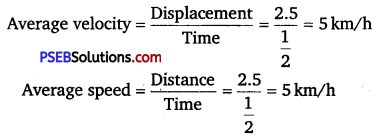
∴ Beat frequency = v1 — v2
∴ no. of beasts formed per sec = v1 — v2

(b) If R is minimum, then
cosπ (v1 – v2)t = min. = O = cos (2n +1) \(\frac{\pi}{2}\)
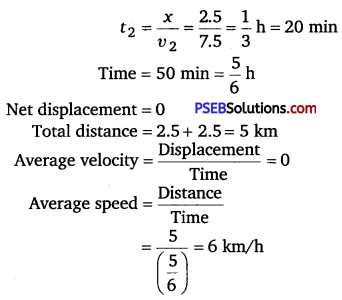
PSEB 11th Class Physics Important Questions Chapter 15 Waves 10
where, n 0,1, 2, …
∴ Amplitude becomes minimum at times given by
t = \(\frac{1}{2\left(v_{1}-v_{2}\right)}, \frac{3}{2\left(v_{1}-v_{2}\right)}, \frac{5}{2\left(v_{1}-v_{2}\right)}, \ldots \)
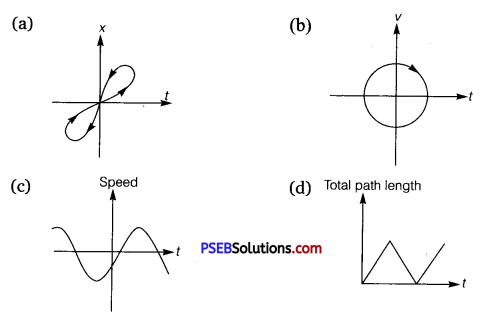
∴ Time interval between two consecutive minima is = \(\frac{1}{v_{1}-v_{2}}\)

∴ Beatperiod = \(\frac{1}{v_{1}-v_{2}}\)
∴ Beat frequency = v1 – v2
∴ No. of beats formed per sec = v1 – v2
Hence the number of beats formed per second is equal to the difference between the frequencies of two-component waves.

PSEB 11th Class Physics Solutions Chapter 15 Waves

Punjab State Board PSEB 11th Class Physics Book Solutions Chapter 15 Waves Textbook Exercise Questions and Answers.

PSEB Solutions for Class 11 Physics Chapter 15 Waves

PSEB 11th Class Physics Guide Waves Textbook Questions and Answers

Question 1.
A string of mass 50 kg is under a tension of 200 N. The length of the stretched string is 20.0 m. If the transverse jerk is struck at one end of the string, how long does the disturbance take to reach the other end?
Solution:
Mass of the string, M = 2.50 kg
Tension in the string, T = 200 N
Length of the string, l = 20.0 m
Mass per unit length, µ = \(\frac{M}{l}=\frac{2.50}{20} \) = 0.125 kg m-1
The velocity (υ) of the transverse wave in the string is given by the relation:
υ = \(\sqrt{\frac{T}{\mu}}=\sqrt{\frac{200}{0.125}}=\sqrt{1600} \) = 40 m/s

∴ Time taken by the disturbance to reach the other end, t = \(\frac{l}{v}=\frac{20}{40}\) = 0.5 s

Question 2.
A stone dropped from the top of a tower of height 300 m high splashes into the water of a pond near the base of the tower. When is the splash heard at the top given that the speed of sound in air is 340ms-1?(g=9.8ms-2)
Solution:
Height of the tower, s = 300 m
The initial velocity of the stone, µ = 0
Acceleration, a = g = 9.8 m/s2
Speed of sound in air = 340 rn/s

The time (t1) taken by the stone to strike the water in the pond can be calculated using the second equation of motion, as:
s=ut1+\(\frac{1}{2}\) gt12
300 = 0+ \( \frac{1}{2}\) × 9.8 × t12
∴ t1 =\( \sqrt{\frac{300 \times 2}{9.8}}\) = 7.82 s
Time taken by the sound to reach the top of the tower,
t2 =\(\frac{300}{340}\) = 0.88 s
Therefore, the time after which the splash is heard, t = t1 +t2
= 7.82+0.88= 8.7 s .

Question 3.
A steel wire has a length of 12.0 m and a mass of 2.10 kg. What should be the tension in the wire so that the speed of a transverse wave on the wire equals the speed of sound in dry air at 20°C = 343 ms-1.
Solution:
Length of the steel wire, l = 12 m
Mass of the steel wire, m = 2.10 kg
Velocity of the transverse wave, ν = 343 m/s
Mass per unit length, µ =\(\frac{m}{l}=\frac{2.10}{12}\) = 0.175 kg m-1
For tension T, velocity of the transverse wave can be obtained using the relation:
υ = \(\sqrt{\frac{T}{\mu}}\)
∴ T = υ2µ = (343)2 × 0.175 = 20588.575 ≈ 2.06 ×10⁴ N

Question 4.
Use the formula υ = \(\sqrt{\frac{\gamma \boldsymbol{P}}{\rho}}\) to explain why the speed of sound in
air
(a) is independent of pressure,
(b) increases with temperature,
(c) increases with humidity.
Solution:
(a) Given the relation:
υ = \( \sqrt{\frac{\gamma \boldsymbol{P}}{\rho}} \) ……………………………. (i)
Density, ρ = \(\frac{\text { Mass }}{\text { Volume }}=\frac{M}{V}\)
where, M = Molecular weight of the gas; V = Volume of the gas
Hence, equation ‘(i) reduces to:
υ = \(\sqrt{\frac{\gamma P V}{M}}\) …………………………………………. (ii)
Now, from the ideal gas equation for n = 1 :
PV = RT
For constant T, PV = Constant
Since both M and γ are constants, υ = Constant
Hence, at a constant temperature, the speed of sound in a gaseous
medium is independent of the change in the pressure of the gas.

(b) Given the relation:
υ = \( \sqrt{\frac{\gamma \boldsymbol{P}}{\rho}} \) …………………………………. (i)
For one mole of an ideal gas, the gas equation can be written as:
PV = RT
P = \(\frac{R T}{V}\)

Substituting equation (ii) in equation (i), we get:
υ = \(\sqrt{\frac{\gamma R T}{V \rho}}=\sqrt{\frac{\gamma R T}{M}}\) ……………………………… (iii)
where, M = mass = ρV is a constant; γ and R are also constants We conclude from equation (iii) that v ∝ \(\sqrt{T}\) .
Hence, the speed of sound in a gas is directly proportional to the square root of the temperature of the gaseous medium, i. e., the speed of the sound increases with an increase in the temperature of the gaseous medium and vice versa.

(c) Let υm and υd be the speeds of sound in moist air and dry air respectively.
Let ρm and ρd be the densities of moist air and dry air respectively.
Take the relation:
υ = \(\sqrt{\frac{\gamma P}{\rho}}\)
Hence, the speed of sound in moist air is:
υm = \(\sqrt{\frac{\gamma P}{\rho_{m}}}\) ………………………….. (i)
And the speed of sound in dry air is:
υd = \(\sqrt{\frac{Y P}{P_{d}}}\) ………………………………… (ii)

On dividing equations (i) and (ii), we get:
\(\frac{v_{m}}{v_{d}} \)
On dividing equations (i) and (ii), we get:
\(\frac{v_{m}}{v_{d}}=\sqrt{\frac{\gamma P}{\rho_{m}}} \times \frac{\rho_{d}}{\gamma P}=\sqrt{\frac{\rho_{d}}{\rho_{m}}} \)
However, the presence of water vapour reduces the density of air, i.e.,
ρdm
∴ υmd
Hence the speed of sound in moist air greater than it is in dry air.
Thus, in a gaseous medium, the speed of sound increase with humidity.

PSEB 11th Class Physics Solutions Chapter 15 Waves

Question 5.
You have learnt that a travelling wave in one dimension is represented by a function y = f(x, t) where x and t must appear
in the combination x-υt or x+υt, i.e., y=f(x±υt). Is the converse true? Examine if the following functions for y can
possibly represent a traveIliig wave:
(a) (x—υt)2 (b)log \(\left[\frac{x+v t}{x_{0}}\right] \) (c) \(\frac{1}{(x+v t)}\)
Solution:
No, the converse of the given statement is not true. The essential requirement for a function to represent a travelling wave is that it should
remain finite for all values of x and t.

(a) Does not represent a wave
Explanation :
For x = 0 and t = 0, the function (x – υt)2 becomes 0.
Hence, for x = 0 and t = 0, the function represents a point and not a wave,

(b) Represents a wave Explanation:
For x = 0 and t = 0, the function log \(\left(\frac{x+v t}{x_{0}}\right)\) = log 0 = ∞
Since the function does not converge to a finite value for x = 0 and t = 0, it represents a travelling wave.

(c) Does not represents a wave
Explanation :
For x = 0 and t = 0, the function
\(\frac{1}{x+v t}\) = log \(\frac{1}{0} \) = ∞
Since the function does not converge to a finite value for x = 0 and t = 0, it does not represent a travelling wave.

Question 6.
A bat emits the ultrasonic sound of frequency 1000 kHz in air. If the sound meets a water surface, what is the wavelength of (a) the reflected sound, (b) the transmitted sound? Speed of sound in air is 340 ms-1 and in water 1486 ms-1.
Solution:
(a) Frequency of the ultrasonic sound, υ = 1000 kHz = 106 Hz
Speed of sound in water, υa = 340 m/s
The wavelength (λr)of the transmitted sound is given as:
λr = \(\frac{v}{v}=\frac{340}{10^{6}}\) = 3.4 × 10⁻⁴ m

(b) Frequency of the ultrasonic sound, v = 1000 kHz = 106 Hz
Speed of sound in water, υw, =1486 m/s
The wavelength of the transmitted sound is given as:
λt= \(\frac{1486}{10^{6}}\) = 1.49 × 10⁻³ m

Question 7.
A hospital uses an ultrasonic scanner to locate tumours in a tissue. What is the wavelength of sound in the tissue in which the speed of sound is 1.7 km s-1? The operating frequency of the scanner is 4.2 MHz.
Solution:
Speed of sound in the tissue, υ = 1.7 km/s = 1.7 x 10 3 m/s
Operating frequency of the scanner, v = 4.2 MHz = 4.2 x 10⁶ Hz
The wavelength of sound in the tissue is given as:
λ = \(\frac{v}{v}=\frac{1.7 \times 10^{3}}{4.2 \times 10^{6}}\) = 4.1 x 10⁻⁴m.

Question 8.
A transverse harmonic wave on a string is described by y(x, t) = 3.0sin(36t+0.018x+\(\frac{\pi}{4}\))
where x and y are in cm and t in s. The positive direction of x is from left to right.
Is this a travelling wave or a stationary wave?
(a) If it is travelling, what are the speed and direction of its propagation?
(b) What are its amplitude and frequency?
(c) What is the initial phase at the origin?
(d) What is the least distance between two successive crests in the wave?
Solution:
(a) Yes.
The equation of a progressive wave travelling from right to left is given by the displacement function:
y(x,t) = a sin(ωt + kx + Φ) ……………………………………. (i)
The given equation is
y(x, t) = 3.0 sin( 36t +0.018x+\(\frac{\pi}{4}\)) …………………………………. (ii)
On comparing both the equations, we find that equation (ii) represents a travelling wave, propagating from right to left.
Now, using equations (i) and (ii), we can write:
ω = 36 rad/s and k = 0.018 cm-1
We know that
v = \(\frac{\omega}{2 \pi}\) and λ = \(\frac{2 \pi}{k}\)
Also,
υ = vλ
∴ υ = \(\left(\frac{\omega}{2 \pi}\right) \times\left(\frac{2 \pi}{k}\right)\) = \(\frac{\omega}{k}=\frac{36}{0.018} \) = 2000 cm/s = 20 m/s
Hence, the speed of the given travelling wave is 20 m/s.

(b) Amplitude of the given wave, a =3 cm (Given)
Frequency of the given wave:
v = \(\frac{\omega}{2 \pi}=\frac{36}{2 \times 3.14}\) = 5.73 Hz

(c) On comparing çquations (i) and (ii), we find that the initial phase angle, Φ = \(\frac{\pi}{4}\)

(d) The distance between two successive crests or troughs is equal to the
wavelength of the wave.
Wavelength is given by the relation:
k= \(\frac{2 \pi}{\lambda}\)
∴ λ = \(\frac{2 \pi}{k}=\frac{2 \times 3.14}{0.018}\) = 348.89 cm = 3.49 m.

PSEB 11th Class Physics Solutions Chapter 15 Waves

Question 9.
For the wave described in question 8, plot the displacement (y) versus (t) graphs for s =0,2 and 4 çm. What are the shapes of these graphs? In which aspects does the oscillatory motion in travelling wave differ from one point to another: amplitude, frequency or phase?
Solution:
All the waves have different phases. The given transverse harmonic wave is
y(x,t) = 3.0 sin (36t+0.018x + \(\frac{\pi}{4}\))
For x = 0, the equation reduces to
y(0,t) = 3.0 sin (36t+\(\frac{\pi}{4}\)) ………………………….. (i)
Also,
ω = \(\frac{2 \pi}{T}\) = 36 rad/s
∴ T = \(\frac{2 \pi}{\omega}=\frac{2 \pi}{36} \) = \(\frac{\pi}{18}\) s
For different values of t, we calculate y using eq. (i). These values are tabulated below
PSEB 11th Class Physics Solutions Chapter 15 Waves 1
On plotting y versus t graph, we obtain a sinusoidal curve as shown in figure below.
PSEB 11th Class Physics Solutions Chapter 15 Waves 2

Similar graphs are obtained for x = 2 cm and x = 4 cm.
The oscillatory motion in travelling wave differs from one point to another only in terms of phase. Amplitude and frequency of oscillatory motion remain the same in all the three cases.

Question 10.
For the travelling harmonic wave
y(x, t) = 2.0 cos 2π (10t – 0.0080x +0.35)
where, x and y are in cm and t in s. Calculate the phase difference between oscillatory motion of two points separated by a distance of
(a) 4m
(b) 0.5m
(c) \(\frac{\lambda}{2}\)
(d) \(\frac{3 \lambda}{4}\)
Solution:
Equation for a travelling harmonic wave is given as
y{x,t) = 2.0 cos 2π(10t -0.0080x +0.35)
= = 2.0 cos (20πt – 0.016πx+0.70π)

where, propagation constant, k = 0.0160π
Amplitude, a = 2 cm
Angular frequency, ω = 20 π rad/s
Phase difference is given by the relation:
Φ =kx=\(\frac{2 \pi}{\lambda} \)

(a)
For x=4m=400cm
Φ =0.016 π × 400 =6.4 π rad

(b) For 0.5 m=50cm
Φ = 0.1016 π × 50 = 0.8 π rad

(c) For x= \(\frac{\lambda}{2}\)
Φ = \(\frac{2 \pi}{\lambda} \times \frac{\lambda}{2}\) = π rad

(d) For x= \(\frac{3 \lambda}{4}\)
Φ = \(\frac{2 \pi}{\lambda} \times \frac{3 \lambda}{4} \) = 1.5π rad

Question 11.
The transverse displacement of a string (clamped at its both ends) is given by y(x,t) = 0.06 sin \(\frac{\mathbf{2} \pi}{\mathbf{3}}\) x cos (120πt) where x and y are in m and t in s. The length of the string is 1.5 m and its mass is 3.0 × 10⁻² Kg Answer the following
(a) Does the function represents a travelling wave or a stationary wave?
(b) Interpret the wave as a superposition of two waves travelling in opposite directions. What is the wavelength,
frequency, and speed of each wave?
(c) Determine the tension in the string.
Solution:
(a) The general equation representing a stationary wave is given by the displacement function:
y(x,t) = 2asinkxcosωt
This equation is similar to the given equation:
y(x,t)= 0.06 sin\(\left(\frac{2 \pi}{3} x\right)\) cos (120πt)
Hence, the given function represents a stationary wave.

(b) A wave travelling along the positive x -direction is given as
y1 =asin(ωt -kx)
The wave travelling along the negative x -direction is given as:
y2 = -asin(ωt +kx)
The superposition of these two waves yields:
y= y1+y2 = asin(ωt -kx)-asin(ωt +kr)
= asin(ωt)cos(kx) – asin(kx)cos(ωt)- asin(ωt)cos(kx) – asin(kx)cos(ωt)
= -2asin(kx)cos(ωt)
= – 2asin \(\left(\frac{2 \pi}{\lambda} x\right)\)cos (2πcvt) …………………………….. (i)

The transverse displacement of the string is given as y(x,t) = 0.06 sin \(\left(\frac{2 \pi}{3} x\right)\)cos (120πt) ………………………………. (ii)
Comparing equations (i) and (ii), we have
\(\frac{2 \pi}{\lambda}=\frac{2 \pi}{3}\)
∴ Wavelength, λ = 3 m
it is given that
120 π =2πv
Frequency, ν =60 Hz
Wave speed, υ = vλ
=60 × 3=180 m/s

(c) The velocity of a transverse wave travelling in a string is given by the relation
υ = \(\sqrt{\frac{T}{\mu}} \) ………………………… (iii)
where, µ = Mass per unit length of the string = \(\frac{m}{l}=\frac{3.0}{1.5} \times 10^{-2}\)
=2 x 10⁻² kgm-1
T = Tension in the string = T
From equation (iii), tension can be obtained as
T =ν2µ=(180)2 x 2 x 10-2 =648 N

PSEB 11th Class Physics Solutions Chapter 15 Waves

Question 12.
(i) For the wave on a string described in question 11, do all the points on the string oscillate with the same
(a) frequency,
(b) phase, (c) amplitude? Explain your answers.
(ii) What is the amplitude of a point 0.375 m away from one end?
Solution:
(I) (a) Yes, except at the nodes; All the points on the string oscillate with the same frequency, except at
the nodes which have zero frequency.

(b) Yes, except at the nodes;
All the points in any vibrating loop have the same phase, except at the nodes.

(C) No;
All the points in any vibrating loop have different amplitudes of vibration.

(ii) The given equation is .
y(x,t) = 0.06 sin \(\left(\frac{2 \pi}{3} x\right)\)cos (120πt)
For x = 0.375m and t =0
Amplitude = Displacement 0.06sin \(\left(\frac{2 \pi}{3} x\right) \cos 0^{\circ}\)
= 0.06 sin \(\left(\frac{2 \pi}{3} \times 0.375\right) \times 1\)
= 0.06 sin(0.25π) = 0.06 sin\(\left(\frac{\pi}{4}\right)\)
= 0.06 x \(\frac{1}{\sqrt{2}}\) = 0.042 m

Question 13.
Given below are some functions of x and t to represent the displacement (transverse or longitudinal) of an elastic wave. State which of these represent (i) a travelling wave, (ii) a stationary wave or (iii) none at all:
(a) y = 2cos(3x)sin(10t)
(b) y = 2\(\sqrt{x-v t}\)
(c) y = 3sin(5x – 0.5t) + 4cos(5x – 0.5t)
(d) Y = cos x sin t + cos 2x sin 2t
Solution:
(a) The given equation represents a stationary wave because the harmonic terms kx and cot appear separately in the equation.

(b) The given equation does not contain any harmonic term. Therefore, it does not represent either a travelling wave or a stationary wave.’

(c) The given equation represents a travelling wave as the harmonic terms kx and cot are in the combination of kx – cot.

(d) The given equation represents a stationary wave because the harmonic terms kx and cot appear separately in the equation. This equation actually represents the superposition of two stationary waves.

Question 14.
A wire stretched between two rigid supports vibrates in its fundamental mode with a frequency of 45 Hz. The mass of the wire is 3.5 x10⁻² kg and its linear mass density is 40 x 10-2 kgm-1. What is
(a) the speed of a transverse wave on the string, and
(b) the tension in the string?
Solution:
Mass of the wire, m = 3.5×10 -2 kg
Linear mass density, μ = \(\frac{m}{l}\) = 4.0 × 10⁻² kg m-1
Frequency of vibration, μ = 45 Hz
∴ Length of the wire, l = \(\frac{m}{\mu}=\frac{3.5 \times 10^{-2}}{4.0 \times 10^{-2}}\) =0.875 m
The wavelength of the stationary wave (λ,) is related to the length of the wire by the relation:
λ = \(\frac{2 l}{n}\)
where, n = Number of nodes in the wire For fundamental node, n = 1:
λ =2l
λ =2 x 0.875 = 1.75 m
(a) The speed of the transverse wave in the string is given as
υ = vλ = 45 x 1.75 = 78.75 m/s

(b) The tension produced in the string is given by the relation:
T =υ2 μ
= (78.75)2 x 4.0 x 10-2 =248.06 N

Question 15.
A metre-long tube open at one end, with a movable piston at the other end, shows resonance with a fixed frequency source (a tuning fork of frequency 340 Hz)when the tube length is 25.5 cm or 79.3 cm. Estimate the speed of sound in air at the temperature of the experiment. The edge effects may be neglected.
Solution:
Frequency of the turning fork, v = 340 Hz
Since the given pipe is attached with a piston at one end, it will behave as a pipe with one end closed and the other end open, as shown in the given figure.
PSEB 11th Class Physics Solutions Chapter 15 Waves 3
Such a system produces odd harmonics. The fundamental note in a closed pipe is given by the relation l1 = \(\frac{\lambda}{4}\)
where, length of the pipe, = 25.5 cm = 0.255 m
λ = 4l1 =4 x 0.255 = 1.02 m
The speed of sound is given by the relation:
υ = vλ = 340 x 1.02 = 346.8 m/s

Question 16.
A steel rod 100 cm long is clamped at its middle. The fundamental frequency of longitudinal vibrations of the rod is given to be 2.53 kHz. What is the speed of sound in steel?
Solution:
Length of the steel rod, l = 100 cm = lm
v Fundamental frequency of vibration, v = 2.53 kHz = 2.53 x 10³ Hz When the rod is plucked at its middle, an antinode (A) is formed at its centre, and nodes (N) are formed at its two ends, as shown in the given figure.
PSEB 11th Class Physics Solutions Chapter 15 Waves 4

The distance between two successive nodes is \(\frac{\lambda}{2}\)
l = \( \frac{\lambda}{2}\)
λ=2l=2 x l=2m
The speed of sound in steel is given by the relation:
v =vλ = 2.53 x 103 x 2
= 5.06 x 10 3 m/s = 5.06 km/s

Question 17.
A pipe 20 cm long is closed at one end. Which harmonic mode of the pipe is resonantly excited by a 430 Hz source? Will the same source be in resonance with the pipe if both ends are open? (Speed of sound in air is 340 ms-1).
Solution:
First (Fundamental); No
Length of the pipe, l = 20 cm = 0.2 m
Source frequency = nth normal mode of frequency, vn = 430 Hz Speed of sound, ν = 340 m/s
In a closed pipe, nth the rth normal mode of frequency is given by the relation
vn = (2n -1) \(\frac{v}{4 l}\) ; n is an integer = 0,1,2,3 ………………
430 = (2n -1) \(\frac{340}{4 \times 0.2} \)
2n-1 = \(\frac{430 \times 4 \times 0.2}{340}\) = 1.01
2n =1.01+1
2n = 2.01
n ≈ 1

Hence, the first mode of vibration frequency is resonantly excited by the given source.
In a pipe open at both ends, the nth mode of vibration frequency is given by the relation:
vn = \(\frac{n v}{2 l}\)
n = \(\frac{2 l v_{n}}{v}=\frac{2 \times 0.2 \times 430}{340}\) = 0.5
Since the number of the mode of vibration (n) has to be an integer, the given source does not produce a resonant vibration in an open pipe.

PSEB 11th Class Physics Solutions Chapter 15 Waves

Question 18.
Two sitar strings A and B playing the note ‘Ga’ are slightly out of tune and produce beats of frequency 6 Hz. The tension in string A is slightly reduced and the beat frequency is found to reduce to 3 Hz. If the original frequency of A is 324 Hz, what is the frequency of B?
Solution:
Frequency of string A, fA = 324 Hz
Frequency of string B = fB
Beat’s frequency, n = 6 Hz
Beat’s frequency is given as
n = |fA ±fB|
6 =324 ±fB
fB =330 Hz or 318 Hz

The frequency decreases with a decrease in the tension in a string. This is because the frequency is directly proportional to the square root of the tension. It is given as
v ∝ \(\sqrt{T}\)
Hence, the beat frequency cannot be 330 Hz.
∴ fB= 318 Hz

Question 19.
Explain why (or how):
(a) In a sound wave, a displacement node is a pressure antinode and vice versa,
(b) Bats can ascertain distances, directions, nature, and sizes of the obstacles without any “eyes”,
(c) A violin note and sitar note may have the same frequency, yet we can distinguish between the two notes,
(d) Solids can support both longitudinal and transverse waves, but only longitudinal waves can propagate in gases, and
(e) The shape of a pulse gets distorted during propagation in a dispersive medium.
Solution:
(a) A node is a point where the amplitude of vibration is the minimum and pressure is the maximum. On the other hand, an antinode is a point where the amplitude of vibration is the maximum and pressure is the minimum.
Therefore, a displacement node is nothing but a pressure antinode and vice versa.

(b) Bats emit very high-frequency ultrasonic sound waves. These waves get reflected back toward them by obstacles. A bat receives a reflected wave (frequency) and estimates the distance, direction, nature, and size of an obstacle with the help of its brain senses.

(c) The overtones produced by a sitar and a violin, and the strengths of these overtones, are different. Hence, one can distinguish between the notes produced by a sitar and a violin even if they have the same frequency of vibration.

(d) Solids have shear modulus. They can sustain shearing stress. Since fluids do not have any definite shape, they yield to shearing stress. The propagation of a transverse wave is such that it produces shearing *’ stress in a medium. The propagation of such a wave is possible only in solids, and not in gases. ‘
Both solids and fluids have their respective bulk moduli. They can sustain compressive stress. Hence, longitudinal waves can propagate through solids and fluids.

(e) A pulse is actually a combination of waves having different wavelengths. These waves travel in a dispersive medium with different velocities, depending on the nature of the medium. This results in the distortion of the shape of a wave pulse.

Question 20.
A train, standing at the outer signal of a railway station blows a whistle of frequency 400 Hz in still air
(i) What is the frequency of the whistle for a platform observer when the train
(a) approaches the platform with a speed of 10 ms-1,
(b) recedes from the platform with a speed of 10 ms-1?
(ii) What is the speed of sound in each case? The speed of sound in still air can be taken as 340 ms -1.
Solution:
(i)
(a) Frequency of the whistle, ν = 400 Hz
Speed of the train, υT = 10 m/s
Speed of sound, υ = 340 m/s
The apparent frequency (v’) of the whisde as the train approaches the platform is given by the relation
υ’ = \(=\left(\frac{v}{v-v_{T}}\right) \mathrm{v}=\left(\frac{340}{340-10}\right) \times 400\) = 412.12 Hz
(b) The apparent frequency (v”) of the whistle as the train recedes from the platform is given by the relation
v” = \(\left(\frac{v}{v+v_{T}}\right) \mathrm{v}=\left(\frac{340}{340+10}\right) \times 400\) = 388.57 Hz

(ii) The apparent change in the frequency of sound is caused by the relative motions of the source and the observer. These relative motions produce no effect on the speed of sound. Therefore, the speed of sound in air in both the cases remains the same, i.e.,340 m/s.

Question 21.
A train standing in a station yard blows a whistle of frequency 400 Hz in still air. The wind starts blowing in the direction from the yard to the station with at a speed of 10 ms-1. What are the frequency, wavelength, and speed of sound for an observer standing on the station’s platform? Is the situation exactly identical to the case when the air is still and the observer runs towards the yard at a speed of 10 ms-1? The speed of sound in still air can be taken as 340 ms-1.
Solution:
For the stationary observer:
Frequency of the sound produced by the whistle, v = 400 Hz
Speed of sound = 340 m/s
Velocity of the wind, ν = 10 m/s

As there is no relative motion between the source and the observer, the frequency of the sound heard .by the observer will be the same as that produced by the source, i. e., 400 Hz.
The wind is blowing toward the observer. Hence, the effective speed of the sound increases by 10 units, i.e.,
Effective speed of the sound, υe = 340 +10 = 350 m/s

The wavelength (λ) of the sound heard by the observer is given by the relation:
λ = \(\frac{v_{e}}{v}=\frac{350}{400}\) = 0.857 m

For the running observer:
Velocity of the observer, υ0 = 10 m/s
The observer is moving toward the source. As a result of the
motions of the source and the observer, there is a change in (v’).
This is given by the relation:
υ’ = \(\left(\frac{v+v_{o}}{v}\right) v=\left(\frac{340+10}{340}\right) \times 400\) = 411.76 Hz
Since the air is still, the effective speed of sound = 340 + 0 = The source is at rest. Hence, the wavelength of the sound will i. e., λ remains 0.875 m
Hence, the given two situations are not exactly identical.

Additional Exercises

Question 22.
A travelling harmonic wave on a string is described by
y(x,t) = 7.5 sin (0.0050x + 12t+\(\frac{\pi}{4}\))
(a) What are the displacement and velocity of oscillation of a point at x = 1 cm, and t = 1 s? Is this velocity equal to the velocity of wave propagation?
(b) Locate the points of the string which have the same transverse displacements and velocity as the x = 1 cm point at t = 2 s, 5 s and 11 s.
Solution:
(a) The given harmonic wave is
y(x,t) = 7.5sin(0.0050x + 12t+\(\frac{\pi}{4}\))
For x = 1 cm and t = 1 s,
y(1, 1) = 7.5sin(0.0050x + 12t+\(\frac{\pi}{4}\))
= 7.5 sin (12.0050+\(\frac{\pi}{4}\)) = 7.5sinθ
where, 0 = 12.0050 + \(\frac{\pi}{4}\) = 12.0050 + \( \) = 12.79 rad 4
= \(\frac{180}{3.14} \times 12.79\) = 732.810
∴ y(1,1) = 7.5 sin (732.810) = 7.5sin (90 × 8 +12.81°) = 7.5 sin 12.81°
= 7.5 × 0.2217
= 1.6229 ≈ 1.663 cm
The velocity of the oscillation at a given point and time is given as
PSEB 11th Class Physics Solutions Chapter 15 Waves 5
At x = 1 cm and t = 1 s
v = y(1, 1) = 90 cos(12.005 +\(\frac{\pi}{4}\))
= 90 cos (732.81 ° ) = 90 cos (90 x 8 +12.81 ° ) = 90cos(12.81°) = 90 x 0.975 = 87.75 cm/s

Now, the equation of a propagating wave is given by
y(x,t) = asin(kx +ωt +Φ)
where, k = \(\frac{2 \pi}{\lambda} \)
∴ λ = \(\frac{2 \pi}{k}\)
And ω = 2πv
∴ v = \(\frac{\omega}{2 \pi}\)
Speed, υ = vλ = \(\frac{\omega}{k}\)
where, ω = 12 rad/s
k = 0.0050 cm-1
∴ v = \(\frac{12}{0.0050}\) = 2400 cm/s
Hence, the velocity of the wave oscillation at x = 1 cm and t = 1 s is not equal to the velocity of the wave propagation.

(b) Propagation constant is related to wavelength as:
k = \(\frac{2 \pi}{\lambda}\)
∴ λ = \(\frac{2 \pi}{k}=\frac{2 \times 3.14}{0.0050}\) = 1256 cm = 12.56 cm
Therefore, all the points at distances nλ{n = ±1,±2… and so on), i.e., ±12.56 m, + 25.12m, … and so on for x =1 cm, will have the same displacement as the x = 1 cm points at t = 2 s, 5 s and 11s.

Question 23.
A narrow sound pulse (for example, a short pip by a whistle) is sent across a medium,
(a) Does the pulse have a definite
(i) frequency,
(ii) wavelength,
(iii) speed of propagation?
(b) If the pulse rate is 1 after every 20 s, (that is the whistle is blown for a split of second after every 20 s), is the frequency of the note
produced by the whistle equal to \(\frac{1}{20}\) or 0.05 Hz?
Solution:
(a) (i) No;
(ii) No;
(iii) Yes;
Explanation:
The narrow sound pulse does not have a fixed wavelength or frequency. However, the speed of the sound pulse remains the same, which is equal to the speed of sound in that medium.
(b) No;
The short pip produced after every 20 s does not mean that the frequency of the whistle is \(\frac{1}{20}\) or 0.05 Hz. It means that 0.05 Hz is the frequency of the repetition of the pip of the whisde.

Question 24.
One end of a long string of linear mass density 8.0 x 10⁻³ kg m-1 is connected to an electrically driven tuning fork of frequency 256 Hz. The other end passes over a pulley and is tied to a pan containing a mass of 90 kg. The pulley end absorbs all the incoming energy so that reflected waves at this end have negligible amplitude.

At t = 0, the left end (fork end) of the string x = 0 has zero transverse displacement (y = 0) and is moving along positive y-direction. The amplitude of the wave is 5.0 cm. Write down the transverse displacement y as a function of x and t that describes the wave on the string.
Solution:
The equation of a Gravelling wave propagating along the positive y-direction is given by the displacement equation
y(x, t) = a sin (cot – kx) ………………………. (i)
Linear mass density, μ = 8.0 x 10 -3 kg m-1
Frequency of the tuning fork, v = 256 Hz
The amplitude of the wave, a = 5.0 cm = 0.05 m ……………………………. (ii)
Mass of the pan, m = 90 kg
Tension in the string, T = mg = 90 x 9.8 = 882 N

The velocity of the transverse wave υ, is given by the relation:
υ = \(=\sqrt{\frac{T}{\mu}}=\sqrt{\frac{882}{8.0 \times 10^{-3}}}\) = 332 m/s
Angular Frequency, ω = 2πv
= 2 x 3.14 x 256
= 1607.68 = 16 x 103 rad/s ………………………….. (iii)
Wavelength λ = \(\frac{v}{v}=\frac{332}{256}\)m
∴ propagation constant, k = \(\frac{2 \pi}{\lambda}=\frac{2 \times 3.14}{\frac{332}{256}}\) = 4.84 m-1 ……….. (iv)
Substituting the values from equations (ii), (iii), and (iv) in equation (i), we get the displacement equation:
y(x,t) = 0.05sin(1.6 x 10³t -4.84 x)
where x and y are in and t in s.

Question 25.
A SONAR system fixed in a submarine operates at a frequency 40.0 kHz. An enemy submarine moves towards the SONAR with a speed of 360 km h-1. What is the frequency of sound reflected by the submarine? Take the speed of sound in water to be 1450 ms-1.
Solution:
Operating frequency of the SONAR system, v = 40 kHz
Speed of the enemy submarine, ve = 360 km/h = 100 m/s
Speed of sound in water, v = 1450 m/s
The source is at rest and the observer (enemy submarine) is moving toward it.

Hence, the apparent frequency (v’) received and reflected by the submarine is given by the relation:
The frequency (v”) received by the enemy submarine is given by the relation
v’ = \( =\left(\frac{v+v_{e}}{v}\right) v=\left(\frac{1450+100}{1450}\right) \times 40\) = 42.76 kHz
The frequency (V”) received by the enemy submarine is given by the relation
v” = \(\left(\frac{v}{v-v_{s}}\right) v^{\prime}\)
Where vs = 100 m/s
∴ v” = \(\left(\frac{1450}{1450-100}\right) \times 42.76 \) = 45.93 kHz

Question 28.
Earthquakes generate sound waves inside the Earth. Unlike a gas, the Earth can experience both transverse (S) and
longitudinal (P) sound waves. Typically the speed of S wave is about 4.0kms-1 , and that of P wave is 8.0 kms1. A
seismograph records P and S waves from an Earthquake. The first P wave arrives 4 min before the first S wave. Assuming the waves travel in straight line, at what distance does the Earthquake occur?
Solution:
Let νs and vp, be the velocities of S and P waves respectively.
Let L be the distance between the epicentre and the seismograph.
We have
L = νstsub>s ……………………….. (i)
L = νptsub>p …………………………(ii)

where ts and tp are the respective times taken by the S and P waves to
reach the seismograph from the epicentre
It is given that
νp =8km/s
νs =4km/s

From equations (i) and (ii), we have
υsts = υptp
4ts = 8tp
ts = 2tp …………………………..(iii)
It is also given that
ts – tp =4 min=240s
2tp-tp= 240
tp = 240
and = 2×240 =840 s
From equation (ii), we get

L =8×240=1920 km
Hence, the Earthquake occurs at a distance of 1920 km from the seismograph.

Question 27.
A bat is flitting about in a cave, navigating via ultrasonic beeps. Assume that the sound emission frequency of the bat is 40 kHz. During one fast swoop directly toward a flat wall surface, the bat is moving at 0.03 times the speed of sound hi air. What frequency does the bat hear reflected off the wall?
Solution:
Ultrasonic beep frequency emitted by the bat, ν = 40 kHz
The velocity of the bat, νb = 0.03 ν
where, ν = velocity of sound in air
The appartment frequency of the sound strìking the wall is given as
v’ = \(\left(\frac{v}{v-v_{b}}\right) v=\left(\frac{v}{v-0.03 v}\right) \times 40 \) = \(\frac{40}{0.97}\) kHz
This frequency is reflected by the stationary wall (νs = 0) toward the bat.
The frequency (ν”) of the received sound is given by the relation:
ν” = \(\left(\frac{v+v_{b}}{v}\right) \mathrm{v}^{\prime}=\left(\frac{v+0.03 v}{v}\right) \times \frac{40}{0.97}=\frac{1.03 \times 40}{0.97}\) = 42.47 kHz