PSEB 8th Class Maths Solutions Chapter 12 Exponents and Powers Ex 12.1

Punjab State Board PSEB 8th Class Maths Book Solutions Chapter 12 Exponents and Powers Ex 12.1 Textbook Exercise Questions and Answers.

PSEB Solutions for Class 8 Maths Chapter 12 Exponents and Powers Ex 12.1

1. Evaluate:

Question (i)
3-2
Solution:
= \(\frac{1}{3^{2}}\)
= \(\frac{1}{3 \times 3}\)
= \(\frac {1}{9}\)

PSEB 8th Class Maths Solutions Chapter 12 Exponents and Powers Ex 12.1

Question (ii)
(-4)-2
Solution:
= \(\frac{1}{(-4)^{2}}\)
= \(\frac{1}{(-4) \times(-4)}\)
= \(\frac {1}{9}\)

Question (iii)
(\(\frac {1}{2}\))-5
Solution:
= \(\frac{1}{2} \times \frac{1}{2} \times \frac{1}{2} \times \frac{1}{2} \times \frac{1}{2}\)
= \(\frac{1}{\frac{1}{32}}\)
= 32

2. Simplify and express the result in power notation with positive exponent:

Question (i)
(-4)5 ÷ (-4)8
Solution:
= (-4)5 – 8 (∵ am ÷ an = am-n)
= (-4)– 3
= \(\frac{1}{(-4)^{3}}\)

PSEB 8th Class Maths Solutions Chapter 12 Exponents and Powers Ex 12.1

Question (ii)
\(\left(\frac{1}{2^{3}}\right)\)2
Solution:
= \(\frac{(1)^{2}}{\left(2^{3}\right)^{2}}\) [∵ \(\left(\frac{a}{b}\right)^{m}=\frac{a^{m}}{b^{m}}\)]
= \(\frac{1}{2^{3 \times 2}}\) [∵ (am)n = amn
= \(\frac{1}{2^{6}}\)

Question (iii)
(-3)4 × (\(\frac {5}{3}\))4
Solution:
= [(-3) × \(\frac {5}{3}\)]4 [∵ am × bm = (ab)m]
= [(-1) × 5]4
= (-1)4 × 54
= 1 × 54
= 54

Question (iv)
(3-7 ÷ 3-10) × 3-5
Solution:
= (3(-7)-(-10)) × 3-5 (∵ am ÷ an = am-n)
= (3-7+10 × 3-5
= 33 × 3-5
= 33 + (-5) (∵ am × an = am+n)
= 3-2
= \(\frac{1}{3^{2}}\)

PSEB 8th Class Maths Solutions Chapter 12 Exponents and Powers Ex 12.1

Question (v)
2-3 × (-7)-3
Solution:
= [2 × (-7)]-3 [∵ am × bm = (ab)m
= (-14)-3
= \(\frac{1}{(-14)^{3}}\)

3. Find the value of:

Question (i)
(30 + 4-1) × 22
Solution:
= (1 + \(\frac {1}{4}\)) × 22
= (\(1 \frac{1}{4}\)) × 22
= (\(\frac {5}{4}\)) × 4
= 5

Question (ii)
(2– 1 × 4-1) ÷ 22
Solution:
= (\(\frac {1}{2}\) × \(\frac {1}{4}\)) ÷ \(\frac{1}{2^{2}}\)
= (\(\frac {1}{8}\)) ÷ \(\frac {1}{4}\)
= \(\frac {1}{8}\) × \(\frac {4}{1}\)
= \(\frac {1}{2}\)

Question (iii)
(\(\frac {1}{2}\))– 2 + (\(\frac {1}{3}\))– 2 + (\(\frac {1}{4}\))– 2
Solution:
=\(\frac{1}{\left(\frac{1}{2}\right)^{2}}+\frac{1}{\left(\frac{1}{3}\right)^{2}}+\frac{1}{\left(\frac{1}{4}\right)^{2}}\)
= \(\frac{1}{\frac{1}{4}}+\frac{1}{\frac{1}{9}}+\frac{1}{\frac{1}{16}}\)
= 4 + 9 + 16
= 29

PSEB 8th Class Maths Solutions Chapter 12 Exponents and Powers Ex 12.1

Question (iv)
(3– 1 + 4– 1 + 5– 1)0
Solution:
(3-1 + 4-1 + 5-1)0
∴ [3-1 + 4-1 + 5-1]0 = 1
[∵ a0 = 1]

Question (v)
\(\left\{\left(\frac{-2}{3}\right)^{-2}\right\}\)2
Solution:
= \(\left(\frac{-2}{3}\right)^{(-2) \times 2}\) [∵ (am)m = amn]
= (\(\frac {-2}{3}\))-4
= \(\frac{(-2)^{-4}}{(3)^{-4}}\) [∵ \(\left(\frac{a}{b}\right)^{m}=\frac{a^{m}}{b^{m}}\)]
= \(\frac{3^{4}}{(-2)^{4}}\)
= \(\frac{3 \times 3 \times 3 \times 3}{(-2) \times(-2) \times(-2) \times(-2)}\)
= \(\frac {81}{16}\)

4. Evaluate:

Question (i)
\(\frac{8^{-1} \times 5^{3}}{2^{-4}}\)
Solution:
= \(\frac{2^{4} \times 5^{3}}{8}\)
= \(\frac{2^{4} \times 5^{3}}{2^{3}}\)
= 24-3 × 53
= 2 × 125
= 250

Question (ii)
(5-1 × 2-1) × 6-1
Solution:
= (\(\frac {1}{5}\) × \(\frac {1}{2}\)) × \(\frac {1}{6}\)
= (\(\frac {1}{10}\)) × \(\frac {1}{6}\)
= \(\frac {1}{60}\)

Another method:
= 5-1 × 2-1 × 6-1
= (5 × 2 × 6)-1
= (60)-1
= \(\frac {1}{60}\)

PSEB 8th Class Maths Solutions Chapter 12 Exponents and Powers Ex 12.1

5. Find the value of m for which 5m ÷ 5-3 = 55.
Solution:
∴ 5m-(-3) = 55.
∴ 5m + 3 = 55
∴ m + 3 = 5 (∵ am = an then m = n)
∴ m = 5 – 3
∴ m = 2
Thus, value of m is 2.

6. Evaluate:

Question (i)
\(\left\{\left(\frac{1}{3}\right)^{-1}-\left(\frac{1}{4}\right)^{-1}\right\}^{-1}\)
Solution:
= {\(\frac{3}{1}-\frac{4}{1}\)}-1 (∵ a-m = \(\frac {1}{am}\))
= {3 – 4}-1
= {-1}-1
= \(\frac {1}{-1}\)
= -1

Question (ii)
(\(\frac {5}{8}\))-7 × (\(\frac {8}{5}\))-4
Solution:
(\(\frac {5}{8}\))-7 × (\(\frac {5}{8}\))4
(∵ a-m = \(\frac{1}{a^{m}}\))
= (\(\frac {5}{8}\))-7+4 (∵ am × an = am+n)
= (\(\frac {5}{8}\))-3
= (\(\frac {8}{5}\))3
= \(\frac{8 \times 8 \times 8}{5 \times 5 \times 5}\)
= \(\frac {512}{125}\)

PSEB 8th Class Maths Solutions Chapter 12 Exponents and Powers Ex 12.1

7. Simplify:

Question (i)
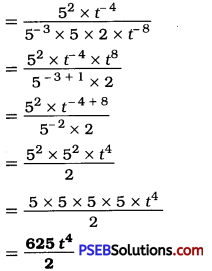
\(\frac{25 \times t^{-4}}{5^{-3} \times 10 \times t^{-8}}\) (t ≠ 0)
Solution:
PSEB 8th Class Maths Solutions Chapter 12 Exponents and Powers Ex 12.1 1

Question (ii)
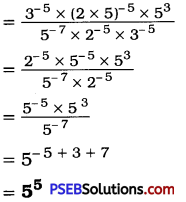
\(\frac{3^{-5} \times 10^{-5} \times 125}{5^{-7} \times 6^{-5}}\)
Solution:
PSEB 8th Class Maths Solutions Chapter 12 Exponents and Powers Ex 12.1 2

PSEB 8th Class Maths Solutions Chapter 4 Practical Geometry Ex 4.5

Punjab State Board PSEB 8th Class Maths Book Solutions Chapter 4 Practical Geometry Ex 4.5 Textbook Exercise Questions and Answers.

PSEB Solutions for Class 8 Maths Chapter 4 Practical Geometry Ex 4.5

Draw the following.

Question 1.
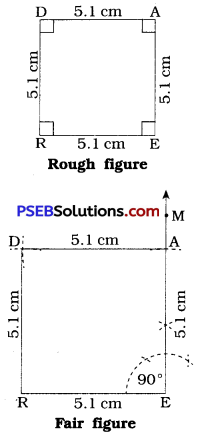
The square READ with RE = 5.1 cm.
Solution:
PSEB 8th Class Maths Solutions Chapter 4 Practical Geometry Ex 4.5 1
Steps of construction :

  • Draw a line segment RE = 5.1 cm.
  • At E, draw \(\overrightarrow{\mathrm{EM}}\), such that ∠REM = 90°.
  • With E as centre and radius =5.1 cm, draw an arc intersecting \(\overrightarrow{\mathrm{EM}}\) at A.
  • With R as centre and radius = 5.1 cm, draw an arc.
  • With A as centre and radius = 5.1 cm, draw an arc which intersect the previous arc at D.
  • Draw \(\overline{\mathrm{RD}}\) and \(\overline{\mathrm{AD}}\).

Thus, READ is the required square.

PSEB 8th Class Maths Solutions Chapter 4 Practical Geometry Ex 4.5

Question 2.
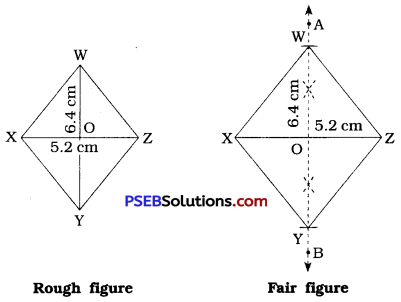
A rhombus whose diagonals are 5.2 cm and 6.4 cm long.
Solution:
PSEB 8th Class Maths Solutions Chapter 4 Practical Geometry Ex 4.5 2
[Note : The diagonals of a rhombus bisect each other at right angle.]
Here, in rhombus XYZW, YW 6.4 cm.
∴ OW = OY = 3.2 cm

Steps of construction:

  • Draw a line segment XZ = 5.2 cm.
  • Draw \(\overleftrightarrow{\mathrm{AB}}\), the perpendicular bisector of \(\overline{\mathrm{XZ}}\), which intersect \(\overline{\mathrm{XZ}}\) at O.
  • With O as centre and radius = 3.2 cm, draw an arc intersecting \(\overleftrightarrow{\mathrm{AB}}\) above \(\overline{\mathrm{XZ}}\) at W.
  • With O as centre and radius = 3.2 cm, draw another arc which intersects \(\overleftrightarrow{\mathrm{AB}}\) below \(\overline{\mathrm{XZ}}\) at Y.
  • Draw \(\overline{\mathrm{XY}}\), \(\overline{\mathrm{YZ}}\), \(\overline{\mathrm{ZW}}\) and \(\overline{\mathrm{XW}}\).

Thus, XYZW is the required rhombus.

Question 3.
A rectangle with adjacent sides of lengths 5 cm and 4 cm.
Solution:
PSEB 8th Class Maths Solutions Chapter 4 Practical Geometry Ex 4.5 3
[Note: Each angle of a rectangle is a right angle.]
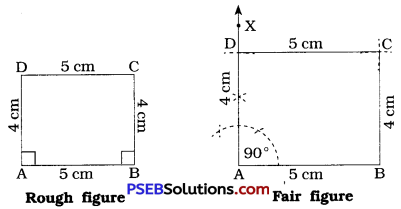
Steps of construction :

  • Draw a line segment AB = 5 cm.
  • At A, draw \(\overrightarrow{\mathrm{AX}}\), such that ∠XAB = 90°.
  • With A as centre and radius = 4 cm, draw an arc intersecting \(\overrightarrow{\mathrm{AX}}\) at D.
  • With B as centre and radius = 4 cm, draw an arc.
  • With D as centre and radius = 5 cm, draw an arc which intersects the previous arc at C.
  • Draw \(\overline{\mathrm{BC}}\) and \(\overline{\mathrm{CD}}\).

Thus, ABCD is the required rectangle.

PSEB 8th Class Maths Solutions Chapter 4 Practical Geometry Ex 4.5

Question 4.
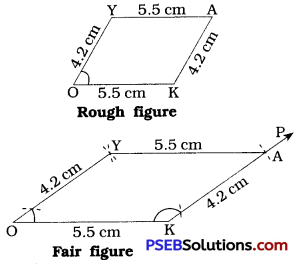
A parallelogram OKAY where OK = 5.5 cm and KA = 4.2 cm. Is it unique ?
Solution:
PSEB 8th Class Maths Solutions Chapter 4 Practical Geometry Ex 4.5 4
A parallelogram cannot be constructed as sufficient measurements are not given. It is not unique as angles may vary in parallelogram drawn by given measurements.

PSEB 10th Class Maths Solutions Chapter 13 Surface Areas and Volumes Ex 13.5

Punjab State Board PSEB 10th Class Maths Book Solutions Chapter 13 Surface Areas and Volumes Ex 13.5 Textbook Exercise Questions and Answers.

PSEB Solutions for Class 10 Maths Chapter 13 Surface Areas and Volumes Ex 13.5

Question 1.
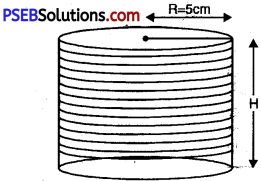
A copper wire 3 mm in diameter is wound about a cylinder whose length is 12 cm, and diameter 10 cm, so as to cover the curved surface of the cylinder. Find the length and mass of the wire, assuming the density of copper to 8.88 g per cm3.
Solution:
Diametcr of wire (d) = 3 mm
∴ Radius of wire (r) = \(\frac{3}{2}\) mm = \(\frac{3}{20}\) cm

PSEB 10th Class Maths Solutions Chapter 13 Surface Areas and Volumes Ex 13.5 1

Diameter of cylinder = 10 cm
Radius of cylinder (R) = 5 cm
Height of cylinder (H) = 12 cm
Circumference of cylinder = length of wire used in one turn
2πR = length of wire used in one turn
2 × \(\frac{22}{7}\) × 5 = length of wire used in one turn
\(\frac{220}{7}\) = length of wire used in one turn
Number of turn used = \(\frac{\text { Height of cylinder }}{\text { Diameter of wire }}\)
= \(\frac{12 \mathrm{~cm}}{3 \mathrm{~mm}}=\frac{12}{3} \times 10\) [1 mm = \(\frac{1}{10}\) cm]
= \(\frac{120}{3}\) = 40

∴ length of wire used = Number of turns × length of wire used in one turn
H = 40 × \(\frac{220}{7}\) = 1257.14 cm
Volume of wire used = πr2H
= \(\frac{22}{7} \times \frac{3}{20} \times \frac{3}{20} \times 1257.14\) = 88.89 cm3
Mass of 1 cm3 = 8.88 gm
Mass of 88.89 cm3 = 8.88 × 88.89 = 789.41 gm
Hence, length of wire is 1257.14 cm
and mass of wire is 789.41 gm.

PSEB Solutions PSEB 10th Class Maths Solutions Chapter 13 Surface Areas and Volumes Ex 13.5

Question 2.
A right triangle, whose sides are 3 cm and 4 cm (other than hypotenuse) is made to revolve about its hypotenuse. Find the volume and surface area the double cone so formed. (Choose value of t as found
appropriate.)
Solution:
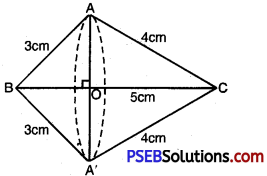
Let ∆ABC be the right triangle right angled at A whose sides AB and AC measure 3 cm and 4 cm respectively.
The length of the side BC (hypotenuse) = \(\sqrt{3^{2}+4^{2}}=\sqrt{9+16}\) = 5 cm
Here, AO (or A’O) is the radius of the common base of the double cone formed revolving the right triangle about BC.
Height of the cone BAA’ is BO and slant height is 3 cm.
Height of the cone CAA’ is CO and slant height is 4 cm.
Now, ∆AOB ~ ∆CAB (AA similarity)

PSEB 10th Class Maths Solutions Chapter 13 Surface Areas and Volumes Ex 13.5 2

∴ \(\frac{\mathrm{AO}}{4}=\frac{3}{5}\)

⇒ AO = \(\frac{4 \times 3}{5}=\frac{12}{5}\) cm

Also \(\frac{\mathrm{BO}}{3}=\frac{3}{5}\)

⇒ BO = \(\frac{\mathrm{BO}}{3}=\frac{3}{5}\) cm
Thus CO = BC – OB
= 5 – \(\frac{9}{5}\) = \(\frac{16}{5}\) cm
Now, Volume of double cone = [Volume of Cone ABA’] + [Volume of cone ACA’]

PSEB 10th Class Maths Solutions Chapter 13 Surface Areas and Volumes Ex 13.5 3

∴ Volume of double cone = 30 cm3.
Also, surface area of double cone = [Surface area of Cone ABA’] + [surface area of Cone ACA’]
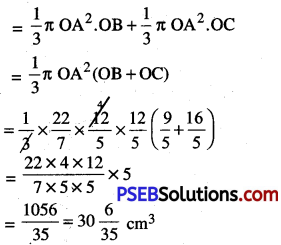
= π .AO.AB + π. AO.A’C
= \(\left(\frac{22}{7} \times \frac{12}{5} \times 3\right)+\left(\frac{22}{7} \times \frac{12}{5} \times 4\right)\)

= \(\left(\frac{792}{35} \times \frac{1056}{35}\right)\)
= \(\frac{1848}{35}\) = 52.75 cm2

PSEB Solutions PSEB 10th Class Maths Solutions Chapter 13 Surface Areas and Volumes Ex 13.5

Question 3.
A cistern, Internally measuring 150 cm × 120 cm × 110 cm, has 129600 cm3 of water in it. Porous bricks are placed in the water until the cistern is full to the brim. Each brick absorbs one-seventeenth of its own volume of water. How many bricks can be put in without the water overflowing, each brick being 22.5 cm × 7.5 cm × 6.5 cm?
Solution:
Volume of one brick = 22.5 × 7.5 × 6.5 cm3 = 1096.87 cm3
Volume of cistern = 150 × 120 × 110 cm3 = 1980000 cm3
Let number of bricks used = n
Total volume of n bricks = n (volume of one brick) = n [1096.871] cm3
Volume of water = 129600 cm3
Volume of water available for bricks = 1980000 – 129600 = 1850400 cm3

Each bricks absorb \(\frac{1}{17}\)th of its volume in water
Volume of water available for bricks = \(\frac{17}{16}\) × volume of water available for bricks
= \(\frac{17}{10}\) × 1850400
Volume of water available for bricks = 1966050 cm3
Total volume of n bricks = Volume of water available for bricks
n[1096.87] cm3 = 1966050 cm3

n = \(\frac{1966050}{1096.87}\)
n = 1792.42
Hence, Number of bricks used = 1792.

PSEB Solutions PSEB 10th Class Maths Solutions Chapter 13 Surface Areas and Volumes Ex 13.5

Question 4.
In one fortnight of a given month, there was a rainfall of 10 cm in a river valley. If the area of the valley is 97280 km2, show that the total rainfall was approximately equivalent to the addition to the normal water of three rivers each 1072 km long, 75 m wide and 3 m deep.
Solution:
Area of valley = 97280 km2
Rainfall in valley = 10 cm
∴ Volume of total rainfall = 97280 × \(\frac{10}{100}\) × \(\frac{1}{1000}\) km3
= 9.728 km3

PSEB Solutions PSEB 10th Class Maths Solutions Chapter 13 Surface Areas and Volumes Ex 13.5

Question 5.
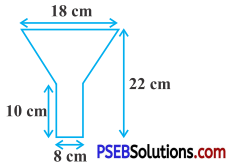
An oil funnel made of tin sheet consists of a cylindrical portion 10 cm long attached to a frust.un of a cone. if the total height is 22 cm, diameter of the cylindrical portion is 8 cm and the diameter of the top of the funnel is 18 cm, find the area of the tin sheet required to make the funnel.

PSEB 10th Class Maths Solutions Chapter 13 Surface Areas and Volumes Ex 13.5 4

Solution:
Diameter of top of funnel = 18 cm
∴ Radius of top of funnel (R) = \(\frac{18}{2}\) cm = 9 cm
Diameter of bottom of funnel = 8 cm
Radius of bottom of funnel (r) = 4 cm
Height of cylindrical portion (h) = 10 cm
Height of frustum (H) = (22 – 10) = 12 cm
Slant height of frustum (l)
= \sqrt{\mathrm{H}^{2}+(\mathrm{R}-r)^{2}}\(\)

= \(\sqrt{(12)^{2}+(9-4)^{2}}\)

= \(\sqrt{144+(5)^{2}}\)

= \(\sqrt{144+25}\) = \(\sqrt{169}\)
Slant height of frustum (l) = 13 cm
Area of metal sheet required curved
surface area of cylindrical base + curved surface of frustum = 2πrh + πL [R + r]
= 2 × \(\frac{22}{7}\) × 4 × 10 + \(\frac{212}{7}\) × 13 [9 + 4] cm2
= 251.42 + 531.14 = 782.56 cm2

PSEB Solutions PSEB 10th Class Maths Solutions Chapter 13 Surface Areas and Volumes Ex 13.5

Question 6.
Derive the formula for the curved surface area and total surface area of a frustum of a cone, given to you in Section 13.5, using the symbols as explamed.
Solution:
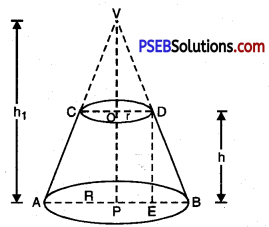
A frustum of a right circular cone has two unequal flat circular bases and a curved surface. Let ACDB be the frustum of the cone obtained by removing the portion VCÐ. The line-segment OP joining the centres of two bases is called the height of the frustum. Each of the line-segments AC and BD of frustum ACDB is called its slant height.

PSEB 10th Class Maths Solutions Chapter 13 Surface Areas and Volumes Ex 13.5 5

Let R and r be the radii of the circular end faces (R > r) of the frustum ACDB of the cone (V, AB). We complete the conical part VCD. Let h and l be the vertical height and slant height respectively. Then OP = h and AC = BD = l.

The frustum of the right circular cone can be viewed as the difference of the two right circular VAB and VCD.
Let the height of the cone VAB be h1 and its slant height l1 i.e. VP = h1 and VA = VB = l1.

Now from right ∆DEB, we have
DB2 = DE2 + BE2

⇒ l2 = h2 + (R – r)2
⇒ l = \(\sqrt{h^{2}+(\mathrm{R}-r)^{2}}\)
Again ∆VOD ~ ∆VPB

⇒ \(\frac{V D}{V B}=\frac{O D}{P B}\)

⇒ \(\frac{l_{1}-l}{l_{1}}=\frac{r}{R}\)

⇒ 1 – \(\frac{l}{l_{1}}=\frac{r}{\mathrm{R}}\)

⇒ \(\frac{l}{l_{1}}=1-\frac{r}{\mathrm{R}}=\frac{\mathrm{R}-r}{\mathrm{R}}\)

⇒ l1 = \(\frac{l \mathrm{R}}{\mathrm{R}-r}\)

⇒ Now, l1 – l1 = \(\frac{l \mathrm{R}}{\mathrm{R}-r}-l=\frac{l r}{\mathrm{R}-r}\)

Curved surface area of the frustum of cone = πRl1 – πr(l1 – l)
[Curved surface area of a cone = π × r × 1]

= πR. \(\frac{l R}{R-r}\) – πr. \(\frac{l r}{\mathrm{R}-r}\)

= πl (\(\frac{\mathrm{R}^{2}-r^{2}}{\mathrm{R}-r}\)) = \(\frac{\pi l(\mathrm{R}-r)(\mathrm{R}+r)}{(\mathrm{R}-r)}\)
= πl (R + r) sq. units.
∴ Curved snafaue area of the frustum of right circular cone = πl (R + r) sq. units,
where l = \(\sqrt{h^{2}+(\mathrm{R}-r)^{2}}\)
and total surface area of frustum of right circular cone = Curved surface area + Area of base + Area of top
= πl (R + r) + πR2 + πr2
∴ π [R2 + r2 + l (R + r)] sq. units.

PSEB Solutions PSEB 10th Class Maths Solutions Chapter 13 Surface Areas and Volumes Ex 13.5

Question 7.
Derive the formula for the volume of the frustum of a cone, given to you in section 13.5, using the symbols as explained.
Solution:
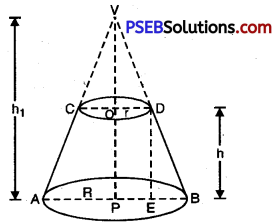
A frustum of a right circular cone has two unequal flat circular bases and a curved surface. Let ACDB be the frustum of the cone obtained by removing the portion VCD. The line-segment OP joining the centres of two bases is called the height of the frustum. Each of the line-segments AC and BD of frustum ACDB is called its slant height.

PSEB 10th Class Maths Solutions Chapter 13 Surface Areas and Volumes Ex 13.5 6

Ler R and r be the radii of the circular end faces (R > r) of the fnistum ACDB of the cone (V, AB). We complete the conical part VCD. Let h and l be the vertical height and slant height respectively. Then OP = h and AC = BD = l. The frustum of the right circular cone can be viewed as the difference of the two right circular VAB and VCD.
Let theheight of the cone VAB be h1 and its slant height l1 i.e.VP = h1 and VA = VB = l1.
∴ The height of the cone VCD = VP – OP = h1 – h
Since right ∆s VOD and VPB are similar
⇒ \(\frac{\mathrm{VO}}{\mathrm{VP}}=\frac{\mathrm{OD}}{\mathrm{PB}}=\frac{h_{1}-h}{h_{1}}=\frac{r}{\mathrm{R}}\)

⇒ 1 – \(\frac{h}{h_{1}}=\frac{r}{\mathrm{R}}\)

⇒ \(\frac{h}{h_{1}}=1-\frac{r}{\mathrm{R}}=\frac{\mathrm{R}-r}{\mathrm{R}}\)

⇒ h1 = \(\frac{h \mathrm{R}}{\mathrm{R}-r}\)

⇒ Height of the cone VCD = \(\frac{h \mathrm{R}}{\mathrm{R}-r}-h=\frac{h \mathrm{R}-h \mathrm{R}+h r}{\mathrm{R}-r}=\frac{h r}{\mathrm{R}-r}\)

Volume of the frustrum ACDB of the cone (V,AB) = Volume of the cone (V, AB) – Volume of the cone (V, CD)
= \(\)

= \(\frac{\pi}{3}\left(\mathrm{R}^{2} \cdot \frac{h \mathrm{R}}{\mathrm{R}-r}-r^{2} \cdot \frac{h r}{\mathrm{R}-r}\right)\)

= \(\frac{\pi h}{3}\left(\frac{\mathrm{R}^{3}-r^{3}}{\mathrm{R}-r}\right)\)

= \(\frac{1}{3} \pi h \times \frac{(\mathrm{R}-r)\left(\mathrm{R}^{2}+\mathrm{R} r+r^{2}\right)}{(\mathrm{R}-r)}\)

= \(\frac{1}{3}\) πh (R2 + Rr + r2)
Hence, volume of the frustum of cone is \(\frac{1}{3}\) πh (R2 + Rr + r2).

Again if A1 and A2 (A1 > A2) are the surface areas of the two circular bases, then A1 = πR2 andA2 = πr2

Now volume of the frustum of cone,

= \(\frac{1}{3}\) πh (R2 + r2 + Rr)

= \(\frac{h}{3}\) (πR2 + πr2 + \(\sqrt{\pi \mathrm{R}^{2}} \sqrt{\pi r^{2}}\))

= \(\frac{h}{3}\) (A1 + A2 + \(\sqrt{A_{1} A_{2}}\))

PSEB 8th Class Maths Solutions Chapter 4 Practical Geometry Ex 4.4

Punjab State Board PSEB 8th Class Maths Book Solutions Chapter 4 Practical Geometry Ex 4.4 Textbook Exercise Questions and Answers.

PSEB Solutions for Class 8 Maths Chapter 4 Practical Geometry Ex 4.4

1. Construct the following quadrilaterals:

Question (i).
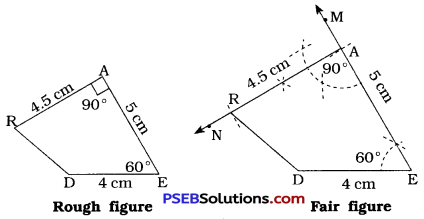
Quadrilateral DEAR
DE = 4 cm
EA = 5 cm
AR = 4.5 cm
∠E = 60°
∠A = 90°
Solution:
PSEB 8th Class Maths Solutions Chapter 4 Practical Geometry Ex 4.4 1
Steps of construction:

  • Draw a line segment DE = 4 cm.
  • At E, draw \(\overrightarrow{\mathrm{EM}}\) such that ∠DEM = 60°.
  • With E as centre and radius = 5 cm, draw an arc intersecting \(\overrightarrow{\mathrm{EM}}\) at A.
  • At A, draw \(\overrightarrow{\mathrm{AN}}\) such that ∠EAN = 90°.
  • With A as centre and radius = 4.5 cm, draw an arc intersecting \(\overrightarrow{\mathrm{AN}}\) at R.
  • Draw \(\overline{\mathrm{DR}}\).

Thus, DEAR is the required quadrilateral.

PSEB 8th Class Maths Solutions Chapter 4 Practical Geometry Ex 4.4

Question (ii).
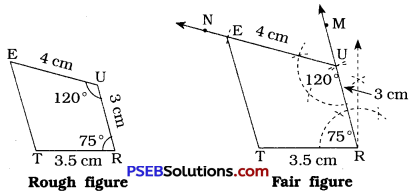
Quadrilateral TRUE
TR = 3.5 cm
RU = 3 cm
UE = 4 cm
∠R = 75°
∠U = 120°
Solution:
PSEB 8th Class Maths Solutions Chapter 4 Practical Geometry Ex 4.4 2
Steps of construction :

  • Draw a line segment TR = 3.5 cm.
  • At R, draw a \(\overrightarrow{\mathrm{RM}}\) such that ∠TRM = 75°.
  • With R as centre and radius = 3 cm, draw an arc intersecting \(\overrightarrow{\mathrm{RM}}\) at U.
  • At U, draw \(\overrightarrow{\mathrm{UN}}\) such that ∠RUN = 120°.
  • With U as centre and radius = 4 cm, draw an arc intersecting \(\overrightarrow{\mathrm{UN}}\) at E.
  • Draw \(\overline{\mathrm{ET}}\).

Thus, TRUE is the required quadrilateral.

PSEB 8th Class Maths Solutions Chapter 4 Practical Geometry Ex 4.3

Punjab State Board PSEB 8th Class Maths Book Solutions Chapter 4 Practical Geometry Ex 4.3 Textbook Exercise Questions and Answers.

PSEB Solutions for Class 8 Maths Chapter 4 Practical Geometry Ex 4.3

1. Construct the following quadrilaterals:

Question (i).
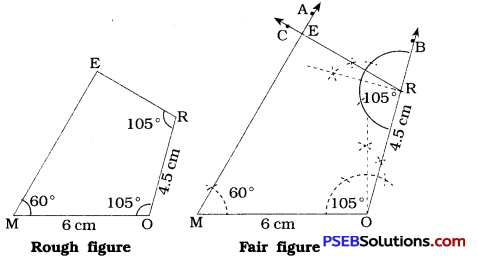
Quadrilateral MORE
MO = 6 cm
OR = 4.5 cm
∠M = 60°
∠O = 105°
∠R = 105°
Solution:
PSEB 8th Class Maths Solutions Chapter 4 Practical Geometry Ex 4.3 1

  • Draw a line segment MO = 6 cm.
  • At M, draw \(\overrightarrow{\mathrm{MA}}\), such that ∠OMA = 60°
  • At O, draw \(\overrightarrow{\mathrm{OB}}\) such that ∠MOB = 105°.
  • With O as centre and radius = 4.5 cm, draw an arc intersecting \(\overrightarrow{\mathrm{OB}}\) at R.
  • At R, draw \(\overrightarrow{\mathrm{RC}}\) such that ∠ORC = 105°.
  • Locate E at intersection of \(\overrightarrow{\mathrm{RC}}\) and \(\overrightarrow{\mathrm{MA}}\).

Thus, MORE is the required quadrilateral.

PSEB 8th Class Maths Solutions Chapter 4 Practical Geometry Ex 4.3

Question (ii).
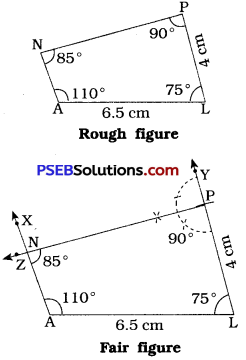
Quadrilateral PLAN
PL = 4 cm
LA = 6.5 cm
∠P = 90°
∠A = 110°
∠N = 85°
Solution:
PSEB 8th Class Maths Solutions Chapter 4 Practical Geometry Ex 4.3 2
[Note : In □ PLAN, m∠P = 90°, m∠A = 110° and m∠N = 85°)
∴ m∠L = 360°- (m∠P + m∠A + m∠N)
= 360° – (90° + 110° + 85°)
= 360° – 285°
= 75°

Steps of construction:

  • Draw a line segment AL = 6.5 cm.
  • At A, draw \(\overrightarrow{\mathrm{AX}}\) such that ∠XAL = 110°. (Use protractor)
  • At L, draw \(\overrightarrow{\mathrm{LY}}\) such that ∠YLA = 75°. (Use protractor)
  • With L as centre and radius = 4 cm, draw an arc intersecting \(\overrightarrow{\mathrm{LY}}\) at P.
  • At P, draw \(\overrightarrow{\mathrm{PZ}}\) such that ∠ZPL = 90°. (∵ ∠ ZPY = 90°)
  • Locate N at intersection of \(\overrightarrow{\mathrm{AX}}\) and \(\overrightarrow{\mathrm{PZ}}\).

Thus, PLAN is the required quadrilateral.

PSEB 8th Class Maths Solutions Chapter 4 Practical Geometry Ex 4.3

Question (iii).
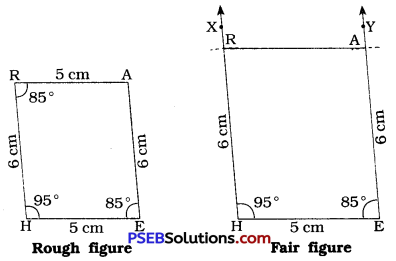
Parallelogram HEAR
HE = 5 cm
EA = 6 cm
∠R = 85°
Solution:
PSEB 8th Class Maths Solutions Chapter 4 Practical Geometry Ex 4.3 3
[Note : □ HEAR is a parallelogram.
Opposite sides of parallelogram are of equal lengths.]
HE = 5 cm, ∴ AR = 5 cm, EA = 6 cm, ∴ HR = 6 cm
Adjacent angles of a parallelogram arc supplementary.
m∠R = 85° (given)
∴ m∠H = 180° – 85° = 95°
Opposite angles of a parallelogram are of equal measures,
m ∠ R = 85°
∴ m ∠ E = 85°

Steps of construction:

  • Draw a line segment HE = 5 cm.
  • At H, draw \(\overrightarrow{\mathrm{HX}}\), such that ∠ XHE = 95°. (Use protractor)
  • With H as centre and radius = 6 cm, draw an arc intersecting \(\overrightarrow{\mathrm{HX}}\) at R.
  • At E, draw \(\overrightarrow{\mathrm{EY}}\) such that ∠ HEY = 85°. (Use protractor)
  • With E as centre and radius = 6 cm, draw an arc intersecting \(\overrightarrow{\mathrm{EY}}\) at A.
  • Draw \(\overline{\mathrm{AR}}\).

Thus, HEAR is the required parallelogram.

PSEB 8th Class Maths Solutions Chapter 4 Practical Geometry Ex 4.3

Question (iv).
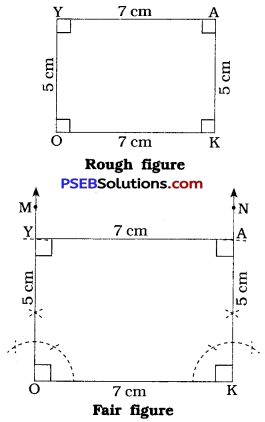
Rectangle OKAY
OK = 7 cm
KA = 5 cm
Solution:
PSEB 8th Class Maths Solutions Chapter 4 Practical Geometry Ex 4.3 4
[Note: Here, OKAY is a rectangle. Opposite sides of a rectangle are of equal lengths.]
OK = 7 cm, ∴ AY = 7 cm and KA = 5 cm, ∴ OY = 5 cm
Moreover, all angles of a rectangle are right angles.

Steps of construction:

  • Draw a line segment OK = 7 cm.
  • At O, draw \(\overrightarrow{\mathrm{OM}}\) such that ∠ MOK = 90°.
  • With O as centre and radius = 5 cm, draw an arc intersecting \(\overrightarrow{\mathrm{OM}}\) at Y.
  • At K, draw \(\overrightarrow{\mathrm{KN}}\) such that ∠ NKO = 90°.
  • With K as centre and radius = 5 cm, draw an arc intersecting \(\overrightarrow{\mathrm{KN}}\) at A.
  • Draw \(\overline{\mathrm{AY}}\).

Thus, OKAY is the required rectangle.

PSEB 8th Class Maths Solutions Chapter 13 Direct and Inverse Proportions InText Questions

Punjab State Board PSEB 8th Class Maths Book Solutions Chapter 13 Direct and Inverse Proportions InText Questions and Answers.

PSEB 8th Class Maths Solutions Chapter 13 Direct and Inverse Proportions InText Questions

Try These : [Textbook Page No. 204]

1. Observe the following tables and find if x and y are directly proportional.

Question (i)

X 20 17 14 11 8 5 2
y 40 34 28 22 16 10 4

Solution:
\(\begin{aligned}
&\frac{20}{40}=\frac{1}{2}, \frac{17}{34}=\frac{1}{2}, \frac{14}{28}=\frac{1}{2}, \frac{11}{22}=\frac{1}{2}, \frac{8}{16}=\frac{1}{2} \\
&\frac{5}{10}=\frac{1}{2}, \frac{2}{4}=\frac{1}{2}
\end{aligned}\)
The value of \(\frac{\text {x}}{\text {y}}\) is same for different values of x and y. So these values x and y are directly proportional.

PSEB 8th Class Maths Solutions Chapter 13 Direct and Inverse Proportions InText Questions

Question (ii)

X 6 10 14 18 22 26 30
y 4 8 12 16 20 24 28

Solution:
\(\begin{aligned}
&\frac{6}{4}=\frac{3}{2}, \frac{10}{8}=\frac{5}{4}, \frac{14}{12}=\frac{7}{6}, \frac{18}{16}=\frac{9}{8}, \frac{22}{20}=\frac{11}{10}, \\
&\frac{26}{24}=\frac{13}{12}, \frac{30}{28}=\frac{15}{14}
\end{aligned}\)
The values of \(\frac{\text {x}}{\text {y}}\) are different for different values of x and y respectively. So these values of x and y are not directly proportional.

Question (iii)

X 5 8 12 15 18 20
y 15 24 36 60 72 100

Solution:
The values of \(\frac{\text {x}}{\text {y}}\) are different for different values of x and y respectively.
So these values of x and y are not directly proportional.

PSEB 8th Class Maths Solutions Chapter 13 Direct and Inverse Proportions InText Questions

2. Principal = ₹ 1000, Rate = 8 % per annum. Fill in the following table and find which type of interest (simple or compound) changes in direct proportion with time period.

Time Period 1 year 2 years 3 years
Simple Interest (in ₹)
Compound Interest (in ₹)

Solution:
Simple interest : SI = \(\frac{P \times R \times T}{100}\)
For calculation:
P = ₹ 1000, R = 8 %, T = …………….

Time (T) → 1 year: T = 1 2 years : T = 2 3 years : T = 3
Simple interest SI = \(\frac{P \times R \times T}{100}\) ₹ \(\frac{1000 \times 8 \times 1}{100}\)
= ₹ 80
₹ \(\frac{1000 \times 8 \times 2}{100}\)
= ₹ 160
₹ \(\frac{1000 \times 8 \times 3}{100}\)
= ₹ 240
\(\frac{\text { SI }}{\text { T }}\) \(\frac {80}{1}\) = 80 \(\frac {160}{2}\) = 80 \(\frac {240}{3}\) = 80

Here, the ratio of simple interest with time period is same for every year.
Hence, simple interest changes in direct proportion with time period.
Compound interest:
For calculation:
P = ₹ 1000, R = 8 %, T = ……………

Time → 1 year : n = 1
A = P(1 + \(\frac {R}{100}\))n
CI = A – P
A = 1000(1 + \(\frac {8}{100}\))1
= 1000 × \(\frac {108}{100}\) = 1080
∴ CI = 1080 – 1000 = ₹ 80
\(\frac{\text { CI }}{\text { T }}\) \(\frac {80}{1}\)
Time → 2 years : n = 2
A = P(1 + \(\frac {R}{100}\))n
CI = A – P
A = 1000(1 + \(\frac {8}{100}\))2
= 1000 × \(\frac {108}{100}\) × \(\frac {108}{100}\) = ₹ 1166.40
∴ CI = ₹ 1166.40 – 1000 = ₹ 166.40
\(\frac{\text { CI }}{\text { T }}\) \(\frac {166.40}{2}\)
Time → 3 years : n = 3
A = P(1 + \(\frac {R}{100}\))n
CI = A – P
A = 1000(1 + \(\frac {8}{100}\))3
= 1000 × \(\frac {108}{100}\) × \(\frac {108}{100}\) × \(\frac {108}{100}\) = ₹ 1259.712
∴ CI = ₹ 1259.712 – ₹ 1000 = ₹ 259.712
\(\frac{\text { CI }}{\text { T }}\) \(\frac {259.712}{3}\)

Here, the ratio of CI and T is not same.
Thus, compound interest is not proportional with time period.

PSEB 8th Class Maths Solutions Chapter 13 Direct and Inverse Proportions InText Questions

Think, Discuss and Write: [Textbook Page No. 204]

1. If we fix time period and the rate of interest, simple interest changes proportionally with principal. Would there be a similar relationship for compound interest? Why?
Solution:
Time period (T) and rate of interest (R) are fixed, then
Simple interest = \(\frac {PRT}{100}\) = P × Constant
So simple interest depends on principal. Simple interest changes proportionally with principal.
Now, compound interest = P(1 + \(\frac {R}{100}\))T – P
i.e., A – P
= P [(1 + \(\frac {R}{100}\)T – 1]
= P × Constant
So compound interest depends on principal.
If principal increases or decreases, then compound interest will also increases or decreases.
Thus, compound interest changes with principal.

Think, Discuss and Write : [Textbook Page No. 209]

1. Take a few problems discussed so far under ‘direct variation’. Do you think that they can be solved by ‘unitary method’?
Solution:
Yes, each problem can be solved by unitary method.
e.g. Question 4 of Exercise: 13.1
Number of bottles filled in 6 hours = 840
∴ The number of bottles filled in 1 hour = \(\frac {840}{6}\) = 140
The number of bottles filled in 5 hours = 140 × 5 = 700
Thus, 700 bottles will it fill in five hours.

PSEB 8th Class Maths Solutions Chapter 13 Direct and Inverse Proportions InText Questions

Try These : [Textbook Page No. 211]

1. Observe the following tables and find which pair of variables (here x and y) are in inverse proportion.

Question (i)

X 50 40 30 20
y 5 6 7 8

Solution:
x1 = 50 and y1 = 5
∴ x1y1 = 50 × 5
∴ x1y1 = 250

x2 = 40 and y2 = 6
∴ x2y2 = 40 × 6
∴ x2y2 = 240

x3 = 30 and y3 = 7
∴ x3y3 = 30 × 7
∴ x3y3 = 210

x4 = 20 and y4 = 8
∴ x4y4 = 20 × 8
∴ x4y4 = 160
Now 250 ≠ 240 ≠ 210 ≠ 160
∴ x1y1 ≠ x2y2 ≠ x3y3 ≠ x4y4
∴ x and y are not in inverse proportion.

Question (ii)

X 100 200 300 400
y 60 30 20 15

Solution:
x1 = 100 and y1 = 60
∴ x1y1 = 100 × 60
∴ x1y1 = 6000

x2 = 200 and y2 = 30
∴ x2y2 = 200 × 30
∴ x2y2 = 6000

x3 = 300 and y3 = 20
∴ x3y3 = 300 × 20
∴ x3y3 = 6000

x4 = 400 and y4 = 15
∴ x4y4 = 400 × 15
∴ x4y4 = 6000
Now x1y1 = x2y2 = x3y3 = x4y4
∴ x and y are in inverse proportion.

PSEB 8th Class Maths Solutions Chapter 13 Direct and Inverse Proportions InText Questions

Question (iii)

X 90 60 45 30 20 5
y 10 15 20 25 30 35

Solution:
x1 = 90 and y1 = 10
∴ x1y1 = 90 × 10
∴ x1y1 = 900

x2 = 60 and y2 = 15
∴ x2y2 = 60 × 15
∴ x2y2 = 900

x3 = 45 and y3 = 20
∴ x3y3 = 45 × 20
∴ x3y3 = 900

x4 = 30 and y4 = 25
∴ x4y4 = 30 × 25
∴ x4y4 = 750

x5 = 20 and y5 = 30
∴ x5y5 = 20 × 30
∴ x5y5 = 600

x6 = 30 and y6 = 35
∴ x6y6 = 5 × 35
∴ x6y6 = 175

Now x1y1 = x2y2 = x3y3 ≠ x4y4 ≠ x5y5 ≠ x6y6
∴ x and y are in inverse proportion.

PSEB 10th Class Maths Solutions Chapter 13 Surface Areas and Volumes Ex 13.4

Punjab State Board PSEB 10th Class Maths Book Solutions Chapter 13 Surface Areas and Volumes Ex 13.4 Textbook Exercise Questions and Answers.

PSEB Solutions for Class 10 Maths Chapter 13 Surface Areas and Volumes Ex 13.4

Question 1.
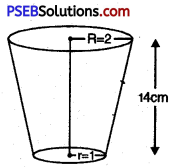
A drinking glass is in the shape of a frustum of a cone of height 14 cm. The diameters of its two circular ends are 4 cm and 2 cm. Find the capacity of the glass.
Solution:

PSEB 10th Class Maths Solutions Chapter 13 Surface Areas and Volumes Ex 13.4 1

Radius of upper end (R) = 2 cm
Radius of lower end (r) = 1 cm
Height of glass (H) = 14 cm
Glass is in the shape of frustum
Volume of frustum = \(\frac{1}{3}\) π [R2 + r2 +Rr]H

= \(\frac{1}{3}\) × \(\frac{22}{7}\) [(2)2 + (1)2 + 2 × 1] 14

= \(\frac{1}{3}\) × \(\frac{22}{7}\) [4 + 1 + 2] 14

= \(\frac{1}{3}\) × \(\frac{22}{7}\) × 7 × 14

= \(\frac{22 \times 14}{3}\)
Hence, Volume of glass = 102.67 cm3.

PSEB Solutions PSEB 10th Class Maths Solutions Chapter Surface Areas and Volumes Ex 13.4

Question 2.
The slant height of a frustum of a cone is 4 cm and the perimeters (circumference) of its circular ends are 18 cm and 6 cm. Find the curved surface area of the frustum.
Solution:
Slant height of frustum = 4 cm

PSEB 10th Class Maths Solutions Chapter 13 Surface Areas and Volumes Ex 13.4 2

Let radius of upper end and lower ends are R and r
Circumference of upper end = 18 cm
2πR = 18
R = \(\frac{18}{2 \pi}=\frac{9}{\pi}\) cm
Circumference of lower end = 6 cm
2πr = 6 cm
r = \(\frac{6}{2 \pi}=\frac{3}{\pi}\) cm
Curved surface area of frustum = π [R + r] l
= π \(\left[\frac{9}{\pi}+\frac{3}{\pi}\right]\) 4
= π \(\left[\frac{9+3}{\pi}\right]\) 4
= 12 × 4 = 48 cm2
Hence, Curved surface area of frustum = 48 cm2.

PSEB Solutions PSEB 10th Class Maths Solutions Chapter Surface Areas and Volumes Ex 13.4

Question 3.
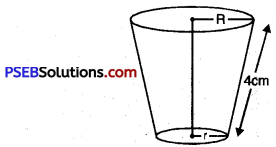
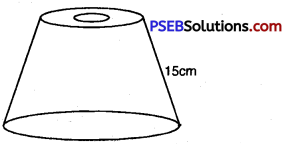
A fez, the cap used by the Turks, is shaded like the frustum of a cone. If its radius on the open side is 10 cm, radius at the upper base is 4 cm and its slant height is 15 cm, find the area of material used for making it.

PSEB 10th Class Maths Solutions Chapter 13 Surface Areas and Volumes Ex 13.4 3

Solution:

PSEB 10th Class Maths Solutions Chapter 13 Surface Areas and Volumes Ex 13.4 4

Radius of lower end of frustum (R) = 10 cm
Radius of upper end of frustum (r) = 4 cm
Slant height of frustum (l) = 15 cm
Curved surface area of frustum = πL [R+ r]
= \(\frac{22}{7}\) × 15 [10 + 4]
= \(\frac{22}{7}\) × 15 × 14
= 22 × 15 × 2 = 660 cm2
Area of the closed side = πr2 = \(\frac{22}{7}\) × (4)2
= \(\frac{22}{7}\) × 4 × 4 = \(\frac{352}{7}\) cm2
Total area of the material used = Curved surface area of frustum + Area of the closed side
= 660 + 50.28 = 710.28 cm2
Hence, Total material used = 710.28 cm2.

Question 4.
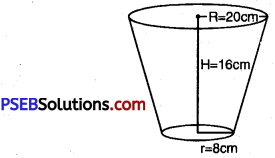
A container opened from the top is made up of a metal sheet ¡s in the form of a frustum of a cone of height 16 cm with radii of its lower and upper ends as 8 cm and 20 cm, respectively. Find the cost of the milk which can completely fill the container, at the rate, of ₹ 20 per litre. Also fmd the cost of metal sheet used to make the container, If it costs ₹ 8 per 100 cm2. (Take π = 3:14.)
Solution:

PSEB 10th Class Maths Solutions Chapter 13 Surface Areas and Volumes Ex 13.4 5

Radius of upper end of container (R) = 20 cm
Radius of lower end of container (r) = 8 cm
Height of container (H) = 16 cm
Slant height (l) = \(\sqrt{\mathrm{H}^{2}+(\mathrm{R}-r)^{2}}\)
= \(\sqrt{(16)^{2}+(20-8)^{2}}\) = \(\sqrt{256+144}\)
Slant height (l) = \(\sqrt{400}=\sqrt{20 \times 20}\) = 20 cm

Capacity of the container = \(\frac{1}{3}\) πH[R2 + r2 + Rr]
= \(\frac{1}{3}\) × 3.14 × 16 [(20)2 + (8)2 + 20 × 8]
= \(\frac{3.14 \times 16}{3}\) [400 + 64 + 100]
= 3.14 × 16 × 624 = 10449.92 cm3
Milk in the container = 10449.92 cm3
= \(\frac{10449.92}{1000}\) litres [∵ 1 cm3 = \(\frac{1}{1000}\) litres]
∴ Milk in the container = 10.45 litres
Cost of 1 it. milk = ₹ 20
∴ Cost of 10.45 litre = ₹ 20 × 10.45
Total cost of milk = ₹ 209
Curved surface area of frustum = πL [R + r]
= 3.14 × 20[20 + 8]
= 3.14 × 20 × 28 cm2 = 1758.4 cm2
Area of base of container = πr2
= 3.14 × (8)π = 3.14 × 64 = 200.96 cm2

Total metal used to make coniainer = curved surface area of frustum + area of base
= (1758. 4 + 200.96) cm2 = 1959.36 cm2
Cost of 100 cm2 metal sheet used = ₹ 8
Cost of 1 cm2 metal sheet used = ₹ \(\frac{8}{100}\)
Cost of 1959.36 cm2 metal sheet used = ₹ \(\frac{8}{100}\) × 1959.36
= ₹ 156.748 = ₹ 156.75
Hence, Total cost of sheet used = ₹ 156.75
and Total cost of milk is ₹ 209.

Question 5.
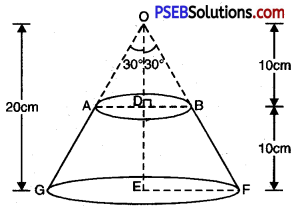
A metallic right circular cone 20 cm high and whose vertical angle Ls 600 is cut into two parts at the middle of its height by a plane parallel to Its base. If the frustum so obtained be drawn into a wire of diameter \(\frac{4}{4}\) cm, find the length of the wire.
Solution:
Vertical angle of cone = 60°
Altitude of cone divide vertical angle ∠EOF = 30°

PSEB 10th Class Maths Solutions Chapter 13 Surface Areas and Volumes Ex 13.4 6

In ∆ODB,
\(\frac{\mathrm{BD}}{\mathrm{OD}}\) = tan 30°

\(\frac{r}{10}=\frac{1}{\sqrt{3}}\)

r = \(\frac{10}{\sqrt{3}}\) cm

In ∆OEF,

\(\frac{E F}{O E}\) = tan 30°

\(\frac{\mathrm{R}}{20}=\frac{1}{\sqrt{3}}\)

R = \(\frac{20}{\sqrt{3}}\) cm

Volume of frustum = \(\frac{\pi}{3}\)h[R2 + r2 + Rr]
= \(\frac{22}{73} \times \frac{10}{3}\left[\left(\frac{20}{\sqrt{3}}\right)^{2}+\left(\frac{10}{\sqrt{3}}\right)^{2}+\frac{20}{\sqrt{3}} \times \frac{10}{\sqrt{3}}\right]\)

= \(\frac{22}{7} \times \frac{10}{3}\left[\frac{400}{3}+\frac{100}{3}+\frac{200}{3}\right]\)

= \(\frac{22}{7} \times \frac{10}{3}\left[\frac{400+100+200}{3}\right]\)

Volume of frustum = \(\frac{22}{7} \times 10 \times \frac{700}{9}\) cm3

= \(\frac{22}{7} \times \frac{7000}{9}\) cm3
Frustum is made into wiie, which is in shape of cylinder having diameter \(\frac{1}{16}\) cm
∴ Radius of cylinderical wire (r1) = \(\frac{1}{2} \times \frac{1}{16} \mathrm{~cm}=\frac{1}{32} \mathrm{~cm}\)

Let height of cylinder so formed be H cm
On recasting volume remain same
Volume of frustum = Volume of cylindrical wire

\(\frac{22}{7} \times \frac{7000}{9}\) = πr12H

\(\frac{22}{7} \times \frac{7000}{9}=\frac{22}{7} \times\left(\frac{1}{32}\right)^{2} \times \mathrm{H}\)

H = \(\frac{\frac{22}{7} \times \frac{7000}{9}}{\frac{22}{7} \times \frac{1}{32} \times \frac{1}{32}}\)

= \(\frac{7000}{9}\) × 32 × 32

H = 796444.44 cm

H = \(\) = 7964.44 m
Hence, Length of cylindrical wire (H) = 7964.44 m

PSEB 8th Class Maths Solutions Chapter 13 Direct and Inverse Proportions Ex 13.2

Punjab State Board PSEB 8th Class Maths Book Solutions Chapter 13 Direct and Inverse Proportions Ex 13.2 Textbook Exercise Questions and Answers.

PSEB Solutions for Class 8 Maths Chapter 13 Direct and Inverse Proportions Ex 13.2

1. Which of the following are in inverse proportion?

Question (i)
The number of workers on a job and the time to complete the job.
Solution:
If the number of workers on a job increases, then time to complete the job decreases. So, it is the case of inverse proportion.

PSEB 8th Class Maths Solutions Chapter 13 Direct and Inverse Proportions Ex 13.2

Question (ii)
The time taken for a journey and the distance travelled in a uniform speed.
Solution:
Here, the speed is uniform.
∴ The time taken for a journey is directly proportional to the speed. So, it is not the case of inverse proportion.

Question (iii)
Area of cultivated land and the crop harvested.
Solution:
For more area of cultivated land, more crops would be harvested. So, it is not the case of inverse proportion.

Question (iv)
The time taken for a fixed journey and the speed of the vehicle.
Solution:
If speed of vehicle is more, then time to cover the fixed journey would be less. So, it is the case of inverse proportion.

Question (v)
The population of a country and the area of land per person.
Solution:
For more population, less area per person would be in the country. So, it is a case of inverse proportion.

PSEB 8th Class Maths Solutions Chapter 13 Direct and Inverse Proportions Ex 13.2

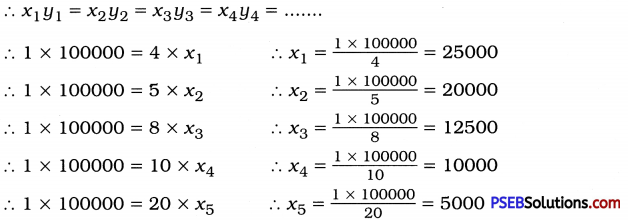
2. In a Television game show, the prize money of ₹ 1,00,000 is to be divided equally amongst the winners. Complete the following table and find whether the prize money given to an individual winner is directly or inversely proportional to the number of winners?

Number of winners 1 2 4 5 8 10 20
Prize for each winner (in ₹) 1,00,000 50,000

Solution:
Here, more the number of winners, less is the prize money for each winner.
∴ This is a case of inverse proportion.
PSEB 8th Class Maths Solutions Chapter 13 Direct and Inverse Proportions Ex 13.2 1
Now, the table is as follows:

Number of winners 1 2 4 5 8 10 20
Prize for each winner (in ₹) 1,00,000 50,000 25,000 20,000 12,500 10,000 5,000

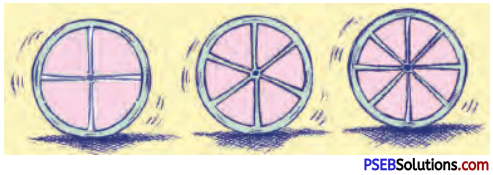
3. Rehman is making a wheel using spokes. He wants to fix equal spokes in such a way that the angles between any pair of consecutive spokes are equal. Help him by completing the following table:
PSEB 8th Class Maths Solutions Chapter 13 Direct and Inverse Proportions Ex 13.2 2

Number of spokes 4 6 8 10 12
Angle between a pair of consecutive spokes 90° 60°

PSEB 8th Class Maths Solutions Chapter 13 Direct and Inverse Proportions Ex 13.2

Question (i)
Are the number of spokes and the angles formed between the pairs of consecutive spokes in inverse proportion?
Solution:
Here, more the number of spokes, less the measure of angle between a pair of consecutive spokes.
∴ This is a case of inverse proportion.
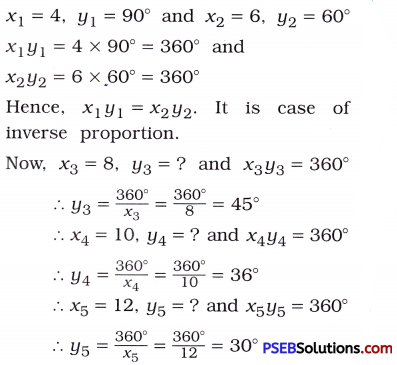
Here,
PSEB 8th Class Maths Solutions Chapter 13 Direct and Inverse Proportions Ex 13.2 3.1
Now, the table is as follows:

Number of spokes 4 6 8 10 12
Angle between a pair of consecutive spokes
90° 60° 45° 36° 30°

Question (ii)
Calculate the angle between a pair of consecutive spokes on a wheel with 15 spokes.
Solution:
Let the measure of angle be x°.
∴ 15 × x° = 4 × 90°
∴ x° = \(\frac{4 \times 90^{\circ}}{15}\) = 24°
Hence, this angle should be 24°.

Question (iii)
How many spokes would be needed, if the angle between a pair of consecutive spokes is 40°?
Solution:
Let the number of spokes be n.
∴ n × 40° = 4 × 90°
∴ n = \(\frac{4 \times 90^{\circ}}{40^{\circ}}\) = 9
Thus, 9 spokes would be needed.

4. If a box of sweets is divided among 24 children, they will get 5 sweets each. How many would each get, if the number of the children is reduced by 4?
Solution:

Number of children x Number of sweets y
x1 = 24 y1 = 5
x2 = 24 – 4 = 20 y2 = (?)

Here, if the number of children decreases, then the number of sweets received by each child will increase.
∴ This is a case of inverse proportion.
x1 × y1 = x2 × y2
∴ 24 × 5 = 20 × y2
∴ y2 = \(\frac{24 \times 5}{20}\) = 6
Thus, each child will get 6 sweets.

PSEB 8th Class Maths Solutions Chapter 13 Direct and Inverse Proportions Ex 13.2

5. A farmer has enough food to feed 20 animals in his cattle for 6 days. How long would the food last if there were 10 more animals in his cattle?
Solution:

Number of animals x Number of days y
x1 = 20 y1 = 6
x2 = 20 + 10 = 20 y2 = (?)

Here, the number of animals increases, so the number of days to feed them will decrease.
∴ This is a case of inverse proportion.
∴ x1 × y1 = x2 × y2
∴ 20 × 6 = 30 × y2
∴ y2 = \(\frac{20 \times 6}{30}\) = 4
Thus, the food will last for 4 days.

6. A contractor estimates that 3 persons could rewire Jasminder’s house in 4 days. If, he uses 4 persons instead of three, how long should they take to complete the job?
Solution:

Number of persons x Number of days y
x1 = 42 y1 = 63
x2 = (?) y1 = 63

Here, more the number of persons, less will be the time required to complete the job.
∴ This is a case of inverse proportion.
∴ x1 × y1 = x2 × y2
∴ 3 × 4 = 4 × y2
∴ y2 = \(\frac{3 \times 4}{4}\) = 3
Thus, 3 days will be required to complete the job.

PSEB 8th Class Maths Solutions Chapter 13 Direct and Inverse Proportions Ex 13.2

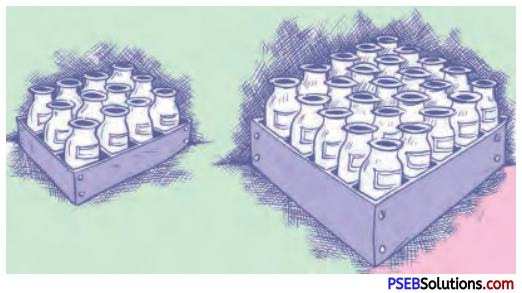
7. A batch of bottles were packed in 25 boxes with 12 bottles in each box. If the same batch is packed using 20 bottles in each box, how many boxes would be filled?
PSEB 8th Class Maths Solutions Chapter 13 Direct and Inverse Proportions Ex 13.2 4.1
Solution:

Number of bottles in a box x Number of boxes y
x1 = 12 y1 = 25
x2 = 20 y2 = (?)

Here, more the number of bottles in a box, less would be the number of boxes.
∴ This is a case of inverse proportion.
∴ x1 × y1 = x2 × y2
∴ 3 × 4 = 4 × y2
∴ y2 = \(\frac{3 \times 4}{4}\) = 3
Thus, 15 boxes would be filled.

8. A factory requires 42 machines to produce a given number of articles in 63 days. How many machines would be required to produce the same number of articles in 54 days?
Solution:

Number of machines x Number of days y
x1 = 42 y1 = 63
x2 = (?) y2 = 54

Here, if the number of days will be less, the number of machines required will be more.
∴ This is a case of inverse proportion.
∴ x1 × y1 = x2 × y2
∴ 42 × 63 = x2 × 54
∴ x2 = \(\frac{42 \times 63}{54}\) = 49
Thus, 49 machines would be required.

PSEB 8th Class Maths Solutions Chapter 13 Direct and Inverse Proportions Ex 13.2

9. A car takes 2 hours to reach a destination by travelling at the speed of 60 km/h. How long will it take when the car travels at the speed of 80 km/h?
Solution:

Speed (km/h) x Number of hours y
x1 = 60 y1 = 2
x2 = 80 y2 = (?)

Here, if the speed of car increases, then the time taken to cover the same distance will decrease.
∴ This is a case of inverse proportion.
∴ x1 × y1 = x2 × y2
∴ 60 × 2 = 80 × y2
∴ y2 = \(\frac{60 \times 2}{80}=\frac{3}{2}=1 \frac{1}{2}\) h
Thus, car would take 1\(\frac {1}{2}\) hours.

10. Two persons could fit new windows in a house in 3 days.

Question (i)
One of the persons fell ill before the work started. How long would the job take now?
Solution:

Number of persons x Number of days y
x1 = 2 y1 = 3
x2 = 2 – 1 = 1 y2 = (?)

Here, less the number of persons, more would be the number of days to complete the job.
∴ This is a case of inverse proportion.
∴ x1 × y1 = x2 × y2
∴ 2 × 2 = 1 × y2
∴ y2 = \(\frac{2 \times 3}{1}\) = 6
Thus, it would take 6 days to complete the job.

Question (ii)
How many persons would be needed to fit the windows in one day?
Solution:

Number of days x Number of persons y
x1 = 3 y1 = 2
x2 = 1 y2 = (?)

Here, less the number of days, more will be the number of persons needed.
∴ This is a case of inverse proportion.
∴ y2 = ? and x2 = 1
∴ x1 × y1 = x2 × y2
∴ 3 × 2 = 1 × y2
∴ y2 = \(\frac{3 \times 2}{1}\) = 6
Thus, 6 persons would be needed.

PSEB 8th Class Maths Solutions Chapter 13 Direct and Inverse Proportions Ex 13.2

11. A school has 8 periods a day each of 45 minutes duration. How long would each period be, if the school has 9 periods a day, assuming the number of school hours to be the same?
Solution:

Number of periods x Length of each period (in minute) y
x1 = 8 y1 = 45
x2 = 9 y2 = (?)

Here, the number of periods is more, then the length of each period will be less.
∴ This is a case of inverse proportion.
∴ x1 × y1 = x2 × y2
∴ 8 × 45 = 9 × y2
∴ y2 = \(\frac{8 \times 45}{9}\) = 40
Thus, each period would be of 40 minutes.

PSEB 10th Class Maths Solutions Chapter 13 Surface Areas and Volumes Ex 13.3

Punjab State Board PSEB 10th Class Maths Book Solutions Chapter 13 Surface Areas and Volumes Ex 13.3 Textbook Exercise Questions and Answers.

PSEB Solutions for Class 10 Maths Chapter 13 Surface Areas and Volumes Ex 13.3

Question 1.
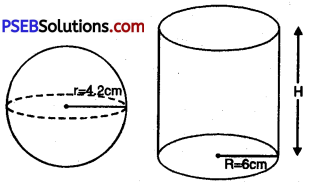
A metallic sphere of radius 4.2 cm is melted and recast into the shape of cylinder of radius 6 cm. Find the height of the cylinder.
Solution:

PSEB 10th Class Maths Solutions Chapter 13 Surface Areas and Volumes Ex 13.3 1

Radius of sphere (r) = 4.2 cm
Radius of cylinder (R) = 6 cm
Let height of cylinder be H cm
On recasting volume remain same
Volume of sphere = Volume of cylinder
\(\frac{4}{3}\) πR3 = πR2H

\(\frac{4}{3}\) × \(\frac{22}{7}\) × 4.2 × 4.2 × 4.2 = \(\frac{22}{7}\) × 6 × 6 × H
∴ H = \(\frac{\frac{4}{3} \times \frac{22}{7} \times 4.2 \times 4.2 \times 4.2}{\frac{22}{7} \times 6 \times 6}\)

= \(\frac{4}{3} \times \frac{42}{10} \times \frac{42}{10} \times \frac{42}{10} \times \frac{1}{6 \times 6}\)

= \(\frac{2744}{1000}\) = 2.744 cm

Hence, Height of cylinder (H) = 2.744 cm.

PSEB Solutions PSEB 10th Class Maths Solutions Chapter Surface Areas and Volumes Ex 13.3

Question 2.
Metallic spheres of radii 6 cm, 8 cm and 10 cm, respectively, are melted to form a single solid sphere. Find the radius of the resulting sphere.
Solution:

PSEB 10th Class Maths Solutions Chapter 13 Surface Areas and Volumes Ex 13.3 2

Radius of first sphere (r1) = 6 cm
Radius of second sphere (r2) = 8 cm
Radius of third sphere (r3) = 10 cm
Let radius of new sphere formed be R cm
On recasting volume remain same
Volume of all three spheres = Volume of big sphere

\(\frac{4}{3}\) πr13 + \(\frac{4}{3}\) πr23 + \(\frac{4}{3}\) πr33 = \(\frac{4}{3}\) πR3

\(\frac{4}{3}\) π[(6)3 + (8)3 + (10)3] = \(\frac{4}{3}\) πR3

R3 = \(\frac{\frac{4}{3} \pi[216+512+1000]}{\frac{4}{3} \pi}\)

R3 = 1728
R = \(\sqrt[3]{1728}\) = \(\sqrt[3]{2 \times 2 \times 2 \times 2 \times 2 \times 2 \times 3 \times 3 \times 3}\)

= 2 × 2 × 3
R= 12 cm
Hence, Radius of sphere = 12 cm.

PSEB Solutions PSEB 10th Class Maths Solutions Chapter Surface Areas and Volumes Ex 13.3

Question 3.
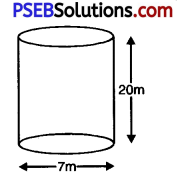
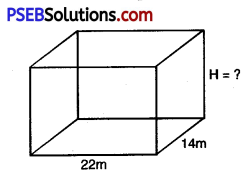
A 20 m deep well with-diameter 7 m is dug and the earth from digging is evenly spread out to form of platform 22 m by 14 m. Find the height of the platform.
Solution:
Diameter of well = 7 m
Radius of well (cylinder) R = \(\frac{7}{2}\) m
Height of well (H) = 20 m
Length of Platform (L) =22 m
Width of Platform (B) = 14 m
Let height of Platform be H m

PSEB 10th Class Maths Solutions Chapter 13 Surface Areas and Volumes Ex 13.3 2

Volume of earth dug out from well = Volume of platform formed

PSEB 10th Class Maths Solutions Chapter 13 Surface Areas and Volumes Ex 13.3 4

πR2H = L × B × H
× × × 20 = 22 × 14 × H
∴ H = \(\frac{\frac{22}{7} \times \frac{7}{2} \times \frac{7}{2} \times 20}{22 \times 14}\)
H = 2.5 cm
Hence, Height of Platform H = 2.5 cm.

PSEB Solutions PSEB 10th Class Maths Solutions Chapter Surface Areas and Volumes Ex 13.3

Question 4.
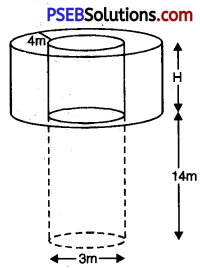
A well of diameter 3 m is dug 14 m deep. The earth taken out of ¡t has been spread evenly all around it in the shape of a circular ring of width 4 m to form an embankment. Find the height of the embankment.
Solution:
Depth of well (h) = 14 m
Radius of well (r) = \(\frac{3}{2}\) m

PSEB 10th Class Maths Solutions Chapter 13 Surface Areas and Volumes Ex 13.3 5

Embankment is in the shape of hollow cylinder whose inner radius is same as radius of well and width of embañkment 4 m
Timer radius of embankment = Radius of well(r) = \(\frac{3}{2}\) m
Outer radius of embankment (R) = (\(\frac{3}{2}\) + 4) m
R = \(\frac{11}{2}\) = 5.5 m
Volume of earth dug out = Volume of embankment (so formed)
πR2h = volume of outer cylinder – volume of inner cylinder
πr2h = πR2H – πr2H
= πH[R2 – r2]

\(\frac{22}{7} \times \frac{3}{2} \times \frac{3}{2} \times 14\) = \(\frac{22}{7}\) × H[(5.5)2 – (1.5)2]

H = \(\frac{\frac{22}{7} \times \frac{3}{2} \times \frac{3}{2} \times 14}{\frac{22}{7} \times(5.5-1.5)(5.5+1.5)}\)

= \(\frac{1.5 \times 1.5 \times 14}{4 \times 7}\) = 1.125 m.

Hence, Height of embankment H = 1.125 m.

PSEB Solutions PSEB 10th Class Maths Solutions Chapter Surface Areas and Volumes Ex 13.3

Question 5.
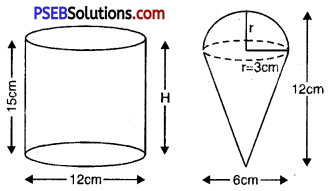
A container shaped like a right circular cylinder having 4iameter 12 cm and height 15 cm Is full of ice-cream. The ice cream is to be filled into cones of height 12 cm and diameter 6 cm, having a hemispherical shape on the top. Find the number of such cones which can be tilled with ice-cream.

PSEB 10th Class Maths Solutions Chapter 13 Surface Areas and Volumes Ex 13.3 6

Dinieter of cvlrnder (D) = 12 cm
.. Radius of cylinder (R) = 6 cm
Height of cylinder (H) = 15 cm
Diameter of cone = 6 cm
Radius of cone (r) = 3 cm
Radius of hemisphere (r) = 3 cm
Height of cone (h) = 12 cm
Let us suppose number of cones used to fill the ice-cream = n
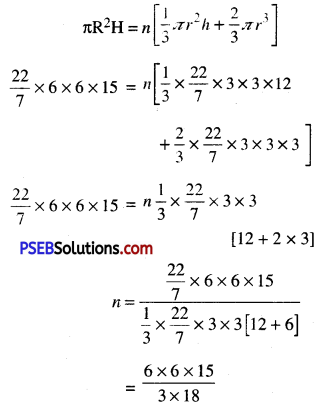
Volume of ice cream in container = n [Volume of ice cream in one cone]

PSEB 10th Class Maths Solutions Chapter 13 Surface Areas and Volumes Ex 13.3 7

n = 10
Hence, Number of cones formed = 10.

PSEB Solutions PSEB 10th Class Maths Solutions Chapter Surface Areas and Volumes Ex 13.3

Question 6.
How many silver coins 1.75 cm in diameter and of thickness 2 mm, must be melted to form a cuboid of dimensions
5.5 cm × 10 cm × 3.5 cm.
Solution:
Silver coin is in the form of cylinder
Diameter of silver coin = 1.75 cm
∴ Radius of silver coin (r) = \(\frac{1.75}{2}\) cm
Thickness of silver coin = Height of cylinder (H) = 2 mm

PSEB 10th Class Maths Solutions Chapter 13 Surface Areas and Volumes Ex 13.3 8

i.e., h = \(\frac{2}{10}\) cm.
Length of cuboid (L) = 5.5 cm
Width of cuboid (B) = 10 cm
Height of cuboid (H) = 3.5 cm
Let number of coins melted to form cuboid = n
∴ Volume of cuboid = n [volume of one silver coin]
= n[πr2h]
5.5 × 10 × 3.5 = n × \(\frac{22}{7} \times \frac{1.75}{2} \times \frac{1.75}{2} \times \frac{2}{10}\)

\(\frac{\frac{55}{10} \times 10 \times \frac{35}{10}}{\frac{22}{7} \times \frac{175}{200} \times \frac{175}{200} \times \frac{2}{10}}\) = n
n = 400
Hence, Number of corns so formed = 400.

PSEB Solutions PSEB 10th Class Maths Solutions Chapter Surface Areas and Volumes Ex 13.3

Question 7.
A cylindrical bucket, 32 cm high and with radius of base 18 cm, is filled with sand. This bucket is emptied on the ground and a conical heap of sand is formed. If the height of the conical heap is 24 cm, find the radius and slant height of the heap.
Solution:

PSEB 10th Class Maths Solutions Chapter 13 Surface Areas and Volumes Ex 13.3 9

Radius of cylindrical bucket (R) = 18 cm
Height of cylindrical bucket (H) = 32 cm
Height of conical heap (h) = 24 cm
Let ‘r’ cm and ‘l’ cm be the radius and slant height of cone
Volume of sand in bucket = Volume of sand in cone
πR2H = \(\frac{1}{3}\) πr2h

\(\frac{22}{7}\) × 18 × 18 × 32 = \(\frac{1}{3}\) × \(\frac{22}{7}\) × r2 × 24
\(\frac{\frac{22}{7} \times 18 \times 18 \times 32}{\frac{1}{3} \times \frac{22}{7} \times 24}\) = r2
r2 = \(\frac{18 \times 18 \times 32}{8}\)
r2 = 1296
r = \(\sqrt{1296}\)
r = 36
∴ Radius of cone (r) = 36 cm
As we know,
(Slant height)2 = (Radius)2 + (Height)2
l = r2 + h2
l = \(\sqrt{(36)^{2}+(24)^{2}}\)

= \(\sqrt{1296+576}\) = \(\sqrt{1872}\)

= \(\sqrt{12 \times 12 \times 13}\)

l = 12\(\sqrt{13}\) cm

∴ Slant height of cone (1) = 12\(\sqrt{13}\) cm.

PSEB Solutions PSEB 10th Class Maths Solutions Chapter Surface Areas and Volumes Ex 13.3

Question 8.
Water in a canal 6m wide and 1.5m deep is flowing with a speed of 10 km/k How much area will it irrigate in 30 minutes, If 8 cm of standing water is needed?
Solution:
Width of canal = 6 m
Depth of water in canal = 1.5 m
Velocity at which water is flowing = 10km/hr
Volume of water discharge in one hour = (Area of cross section) velocity
= (6 × 1.5m2) × 10 km
= 6 × 1.5 × 10 × 6 × 1.5 × 10 × 1000 × 1000 m3
∴ Volume of water discharge in \(\frac{1}{2}\) hour = \(\frac{1}{2}\) × \(\frac{6 \times 15}{10}\) × 1000 = 45000 m3
Let us suppose area to be irrigate = (x) m2

According to question, 8 cm standing water is required in field
∴ Volume of water discharge by canal in \(\frac{1}{2}\) hours = Volume of water in field 45000 m3 = (Area of field) × Height of water
45000 m3 = x × (\(\frac{8}{100}\) m)
\(\frac{4500}{8}\) × 100 = x
x = 562500 m2
x = \(\frac{562500}{10000}\) hectares
[1 m2 = \(\frac{1}{10000}\) hectares]
x = 56.25 hectares
Hence, Area of field = 56.25 hectares.

PSEB Solutions PSEB 10th Class Maths Solutions Chapter Surface Areas and Volumes Ex 13.3

Question 9.
A farmer connects a pipe of Internal diameter 20 cm from a canal into a cylindrical tank in her field, which is 10 m in diameter and 2 m deep. If water flows through the pipe at the rate 0f 3km/h, in how much time will the tank be filled?
Solution:
Velocity of water = 3 km/hr
Diameter of pipe = 20 cm
Radius of pipe (r) = 10 cm = \(\frac{10}{100}\) m = \(\frac{1}{10}\) m
Diameter of tank = 10 m
Radius of tank (R) = 5 m
Depth of tank (H) = 2 m
Let us suppose pipe filled a tank in n minutes
Volume of water tank = Volume of water through the pipe in n minutes
πR2H = n[Area of cross section × Velocity of water]

πR2H = n[(πr2) × 3 km/h]

\(\frac{22}{7}\) × (5)2 × 2 = n[latex]\frac{22}{7} \times \frac{1}{10} \times \frac{1}{10} \times \frac{3 \times 1000}{60}[/latex]

25 × 2 × \(\frac{22}{7}\) = \(\frac{11}{7}\) n

n = \(\frac{25 \times 2 \times 22 \times 7}{11 \times 7}\)
n = 100 minutes
Hence, Time taken to fill the tank = 100 minutes.

PSEB 7th Class English Grammar Determiners

Punjab State Board PSEB 7th Class English Book Solutions English Grammar Determiners Exercise Questions and Answers, Notes.

PSEB 7th Class English Grammar Determiners

Determiners वे शब्द हैं जो संज्ञा (noun) से पूर्व उसके अर्थ को किसी-न-किसी रूप में स्पष्ट करने या निश्चित करने के लिए प्रयुक्त होते हैं। यहां पर हम Determiners की एक सूची दे रहे हैं-

  1. Demonstratives. this, that, these, those.
  2. Possessives. my, your, his, her, its, our, their.
  3. Cardinal numbers. one, two, three, etc.
  4. Ordinal numbers. first, second, third, etc.
  5. Articles. a, an, the.

Miscellaneous. Some, any, both, certain, enough, few, every, least, less, little, more, most, much, next; other, own, plenty, several, such, many, another, each, no, a few, a large number of, a small number of, a great deal of, a good deal of, a large quantity of, a small quantity of, all, etc.

PSEB 7th Class English Grammar Determiners

(i) Demonstratives (निर्देशक शब्द). This, that, these, those ऐसे शब्द हैं जो वस्तुओं की ओर संकेत करते हैं। अतः वे निर्देशक कहलाते हैं और इनसे Determiners की एक श्रेणी बनती है; जैसे,

  • This book was purchased by me.
  • That book was purchased by me.
  • These girls are singing.
  • Those girls are dancing.

Note. This और that एकवचन हैं जबकि these और those बहुवचन हैं।

(ii) Possessives (सम्बन्धवाचक शब्द). My, her, your, his its, our, their सम्बन्धवाचक सर्वनाम हैं और – इनका प्रयोग एकवचन और बहुवचन दोनों प्रकार की संज्ञाओं के साथ किया जाता है; जैसे
1. (a) I like my book. (Singular)
(b) I kept my books in order. (Plural)

2. (a) He told his story in tears. (Singular)
(b) People tell his stories in tears. (Plural)

3. (a) Let me see your note-book. (Singular)
(b) Teacher will check your note-books. (Plural)

Note. सम्बन्धवाचक शब्द अगणनीय संज्ञाओं से पूर्व भी प्रयुक्त किए जा सकते हैं; जैसे,

  • I took my bath. (uncountable)
  • His courage failed him. (uncountable)
  • We cannot doubt their patriotism: (uncountable)

(iii) and (iv) Cardinal and Ordinal Numbers. Cardinal and Ordinal संख्याएं भी Determiners का एक भाग हैं।

  • Two miles are left to be covered.
  • I am reading the third chapter now.
  • I need fifty rupees for this.

(v) The Articles. a, an तथा the को अंग्रेजी व्याकरण में articles के नाम से पुकारा जाता है। ये वास्तव में Adjective determiners हैं।

A तथा An का प्रयोग
1. सभी एकवचन Countable Nouns से पूर्व a या an का प्रयोग होता है। यदि शब्द के पहले letter की आवाज़ स्वर (Vowel) से मेल खाये तो an और यदि व्यंजन (Consonant) से मेल खाये तो a का प्रयोग होता है; जैसे,

  • I saw a man.
  • He saw an elephant.
  • A bench is lying there.
  • An ox was eating grass.
  • There is a lion in the forest.
  • He needs an inkpot now.

2. कुछ शब्द vowel से आरम्भ होते हैं, परन्तु उनकी आवाज़ व्यंजन (Consonants) की होती है। ऐसे एकवचन Countable nouns से पूर्व a लगता है; जैसे,-

  • He is a European.
  • He is a one-eyed person.
  • She is a university student.

3. कुछ शब्द आरम्भ तो h से होते हैं, परन्तु यदि h मौन होने के कारण उनकी आवाज़ स्वर (Vowel) से मेल खाती है तो ऐसे h वाले एकवचन (Countable nouns) शब्दों से पूर्व an का प्रयोग होता है; जैसे,

  • He reached an hour earlier.
  • He is an honest man.

यदि एकवचन संज्ञा (Countable Noun) से पूर्व कोई adjective आ जाये तो a तथा an उस Adjective से पहले स्वर या व्यंजन की ध्वनि के आधार पर लगाया जाता है; जैसे,

  • He is an honourable man.
  • It is a useful medicine.
  • The doctor gave Pratap a glass eye.

Note. 1. a या an का प्रयोग किसी वाक्य या paragraph में किसी शब्द के साथ एक बार ही होता है। दूसरी बार उसके साथ the का प्रयोग करना चाहिए; जैसे,-
I saw a lion in a forest. The forest was thick. The lion was unable to find his way through the forest.
2. Uncountable Nouns (milk, water, rice, paper) से पूर्व a या an का प्रयोग नहीं होता।

The का प्रयोग

The का प्रयोग निम्नलिखित शब्दों के साथ किया जाता है-
1. विशेष वस्तु के साथ; जैसे,
I have spent the money that my father sent me.
This is the house where my childhood passed.

2. किसी एकवचन Noun से पूर्व जब Noun किसी जाति की जानकारी के लिए प्रयोग किया जाता हो; जैसे,-
The cow is a gentle animal.
The dog is a faithful animal.

3. किसी Adverb से पूर्व जब उसका प्रयोग यूं किया जाए; जैसे,-
The higher we go the cooler it is. The more the merrier.

4. नदियों, पर्वत श्रृंखलाओं तथा द्वीप-समूहों से पूर्व; जैसे,
The Ganga, The Himalayas, The British Isles.

5. महासागरों, समुद्रों तथा खाड़ियों से पूर्व; जैसे,
The Indian Ocean, The Red Sea, The Bay of Bengal, The Persian Gulf.

6. कुछ प्रान्तों तथा देशों के नाम से पूर्व; जैसे,
The Punjab (The land of five rivers), The United States.

7. कुछ प्रसिद्ध ग्रन्थों के नाम से पूर्व; जैसे,
The Ramayana, The Mahabharata, The Vedas, The Bible.

8. Adjective की Superlative degree से पहले; जैसे,
He is the best boy of our class.

9. ऐसे Proper Noun से पहले जिसके लिए किसी विशेषण का प्रयोग हो। यदि कोई Phrase या Clause भी विशेषण के रूप में प्रयोग की गई हो तो भी The का प्रयोग किया जाता है; जैसे,
The Great Nehru, The Famous Napoleon, The Immortal Mahatma Gandhi.

PSEB 7th Class English Grammar Determiners

10. Adjectives से पूर्व भी ‘The’ का प्रयोग किया जाता है; जैसे,
The rich should help the poor.

11. समाचार-पत्रों, पत्रिकाओं, ऐतिहासिक भवनों और कुछ विशेष संस्थाओं के नामों से पहले; जैसे,
The Tribune, The Illustrated Weekly, The Taj, The Sharma Dramatic Club.

12. जातियों तथा दशाओं से पूर्व; जैसे,
The Hindus, The east, The west.

13. कुछ ऐसे Proper Nouns के साथ जो Common Nouns के रूप में प्रयोग किये जाते हैं; जैसे,
He is the Manoj Kumar of our class.

14. कुछ Abstract Nouns से पूर्व; जैसे,
The bravery of the Rajputs is known all over the world.

Filling the Blanks with Blanks

1. Ram is ………. honest man. (an)
2. ………. book you gave me is lost. (The)
3. ………. cow is a useful animal. (The)
4. ………. Himalayas have many ranges. (The)
5. Gardening is ………. useful hobby. (a)
6. I have been waiting for you for ………. hour. (an)
7. I saw ………. Sri Harmandar Sahib. (the)
8. Who is ………. head of your family ? (the)
9. He is ………. boy who stole my pen. (the)
10. Our Principal is ………. intelligent man. (an)
11. ………. stitch in time saves nine. (A)
12. Do not make ………. noise (a)
13. My brother is ………. M.A., you are ………. B.A. (an, a)
14. New Delhi is ………. capital of India. (the)
15. This is …….. interesting story. (an)
16. He has ……… lot of money. (a)
17. He has ………. monthly income of Rs. 7000. (a)
18. ………. stars are a beautiful sight. (The)
19. Give me ………. apple or ……… orange. (an, an)
20. You should always show sympathy to ……… poor. (the)
21. Get me ………. nice cup of tea. (a)
22. This is ………. excellent watch. (an)
23. ………. rose smells sweet. (The)
24. Where is ……… book which I gave you ? (the)
25. He is ………. able student but not ……… ablest. (an, the)
26. Why are you in ………. hurry ? (a)
27. I hate ……… dishonest servant. (a)
28. He is ………. idiot. (an)
29. ………. rich are not always happy. (The)
30. ………. moon has risen. (The)
31. There was ………. army of monkeys near ………. temple. (an, the)
32. This is quite ………. new idea. (a)
33. He is ……… hardworking boy. (a)
34. I need ……… pen and ………. inkpot. (a, an)
35. I read ………. Hindustan Times everyday. (the)
36. I have not seen ………. Taj as yet. (the)
37. ………. bad workman quarrels with his tools. (A)
38. ………. apple ………. day keeps ………. doctor away. (An, a, the)
39. ………. Ganga is ………. sacred river. (The, a)

Exercises for Practice

I. 1. You are ……… intelligent student.
2. Is not he ……… school teacher ?
3. I drank all ………. milk.
4. Who invented ………. radio ?
5. There was once ……… king called Ashoka.
6. I saw ……… accident on my way to school.
7. Do you ever read …….. Gita ?
8. He is ………. best boy in the class.
9. He is ………. Napoleon of India.
10. I had ………. busy time in Mumbai.

II. 1. Believe in God and do ………. right.
2. He is ……………. S.D.O.
3. ……… stitch in time saves nine.
4. Is not he ……….. foolish person ?
5. Do not laugh at ……….. poor.
6. Child is ……….. father of man.
7. ………. apple …………day keeps………. doctor away.
8. Marconi invented ……….. machine called radio.
9. Kapil Dev is ………. cricketer.
10. ……….. rose is beautiful.

III. 1. He is ……….. fair-weather friend.
2. Both ………. teams were equally strong.
3. Kalidas is ……….. Shakespeare of India.
4. Rabindranath wrote ………. national anthem.
5. ……….. hen lays eggs.
6. ……….. sun rises in ………. east.
7. I saw ……… one-eyed man.
8. ……….. Bible is ……….. sacred book of ………….. Christians.
9. ……….. Hindus and the Sikhs should live together.
10. Lord Rama was ……….. eldest son of Dashratha.

IV. 1. He is ……… best boy in the class.
2. ……….. Ganges is ………. sacred river of ……….. Hindus.
3. ……….. Himalayas are ……….. highest mountains in ………..world.
4. Mahatma Gandhi is………father of………..nation.
5. ………dog is……..faithful animal.
6. Your brother is ……….. honest man.
7. …………. rich should help ………. poor.
8. I want ……….. orange and not ………. apple.
9. She stood first in ……….. examination.
10. My school is at ……….. stone’s throw from my house.

V. 1. He held him by ………. ear.
2. She is ………. actress.
3. He is ……….. film actor.
4. What ……….. fool he is !
5. This is ……….. old temple of Amritsar.
6. This city is situated on ……… bank of ……….. Yamuna.
7. I met ……. old man yesterday.
8. Delhi is ……….. capital of India.
9. Gurdaspur is ………. district in the Punjab.
10. Giani Zail Singh was ……….. President of India.

Miscellaneous

1. Some, any
(i) दोनों मात्रा और संख्या का ज्ञान कराते हैं। some का प्रयोग positive (सकारात्मक) तथा any का प्रयोग Negative (नकारात्मक) वाक्यों में होता है; जैसे,
I have some money.
They have some books.
He did not lend me any book.
They did not buy any book.

(ii) प्रश्नवाचक वाक्यों में some और any दोनों ही प्रयोग हो सकते हैं; जैसे,
Will you give me any money ?
Will you give me some money ?

2. Much, many
much मात्रा तथा many संख्या के लिए प्रयोग किया जाता है; जैसे,
I have many books.
I have much money.

3. Each, everyone
Each दो या अधिक व्यक्तियों या चीजों के लिए प्रयोग होता है; परन्तु वर्णित व्यक्तियों या चीजों की संख्या निश्चित होती है; जैसे,
Each player was given a prize.
There were two books in the picture. Each book had a red cover.
Every का प्रयोग दो से अधिक व्यक्तियों या चीज़ों के लिए उस समय किया जाता है जबकि व्यक्तियों या चीजों की संख्या निश्चित नहीं होती है; जैसे,
Every man and every boy should do his duty.

4. Little, a little, the little
(i) Little का अर्थ है ‘न’ के बराबर; जैसे,
Mohan is a fool and has little sense.

(ii) A little का अर्थ है ‘कुछ’; जैसे,
I am in need of a little water.

(iii) The little का अर्थ है ‘अधिक तो नहीं, परन्तु वह (थोड़ा) सारे का सारा’, जैसे,
I have spent the little money that I had.

5. Few, a few, the few.
(i) Few का अर्थ ‘कोई नहीं’ अथवा कठिनता से कोई; जैसे,
Few persons can keep a secret.

(ii) A few का अर्थ है ‘बहुत थोड़े’; जैसे,
A few persons were present at the magic show.

(iii) The few का अर्थ है ‘बहुत तो नहीं, परन्तु वे (कुछ) सभी’, जैसे,
I bought the few books that I needed.

Use of Some Other Determiners

1. He has enough money in the bank.
2. Every man wishes to be happy.
3. I have never seen such persons.
4. I want to help that man.
5. He met several people on the way.
6. He lives in his own house.
7. Those girls were absent from the class.
8. Ram has less money than I have.
9. She lives next door to me.
10. Don’t show it to other people.
11. There are certain people who can work day and night.
12. Both men were sent to prison.
13. They have plenty of money.
14. A lot of people came to see the match.
15. Most of the boys were absent yesterday.
16. You can select either book.
17. What is the latest news of the war ?
18. Mumbai is farther than Delhi.
19. I have no further information.
20. This is the last lesson of the book.

PSEB 7th Class English Grammar Determiners

Exercises

I. Fill up the blanks with the Articles (a, an, the):

1. He can read ………. Vedas.
2. She is ………. intelligent girl.
3. ………. sun shines brightly.
4. Life is not ………. bed of roses.
5. …….. higher you climb …….. colder it gets.
6. In ………. park I saw ……… one-eyed beggar.
7. Mumbai is ………. Manchester of India.
8. ………. Sikhs are a brave nation.
9. ……… Owl cannot see during day time.
10. He became ……… doctor.
11. Mangoes are sold by ………. kilo.
12. Everest is ………. highest mountain in ………. world.
13. I caught him by ………. ear.
14. Do not make ………. noise.
15. The more, ………. merrier.
16. He is ………. one-eyed person.
17. …….. Ganges is ……… sacred river.
18. We started late in ………. afternoon.
19. ………. rose smells sweet.
20. He reads ………… Bible everyday.
21. Kalidas was ………… Shakespeare of India.
22. Einstein was ………. Newton.
23. …….. camel is ………… ship of ………. desert.
24. Can ………. leopard change its spots ?
25. ………. lotus is a lovely flower.
26. ……… rich must help ……….. poor.
27. ……… more you speak, ……….. less I understand.
28. Tagore was ………… truly great poet.
29. ………. more they get, ……… more they want.
30. This is ………. historic occasion.
31. ……………… black and white cow is grazing in the field.
32. He is ………… real Mahatma.
33. I read ………… Tribune daily.
34. I am in ………… hurry.
35. Help ………. poor.
36. Both ………. robbers were arrested.
37. Keep to ………. left.
38. ……… housemaid pulls up ………. blind.
39. What ………. lovely girl !
40. What ………. ripe apple !
41. Not ………. word was said.
42. Help ……… poor, ………. needy and ………. miserable.
43. Who is ………. cleverer of ………. two cheats ?
44. He is ………. better mechanic than clerk.
45. Read ………. third and ……. fourth chapters.
Hints:
1. the
2. an
3. The
4. a
5. The, the
6. the, a
7. the
8. The
9. An
10. a
11. the
12. the, the
13. the
14. a
15. the
16. a
17. The, a
18. the
19. The
20. the
21. the
22 the
23. The, the, the
24. a
25. The
26. The, the
27. The, the
28. a
29. The, the
30. a
31. A
32. a
33. the
34. a.
35. the
36. the
37. the
38. The, the
39. a
40. a
41. a
42. the, the, the
43. the, the
44. a
45. the, the.

II. Correct the following sentences:

1. Only few men are honest.
2. The man is mortal.
3. He acted like man.
4. Beas flows in Punjab.
5. You are in wrong but he is in right.
6. He is by far ablest boy.
7. Nobody likes a person with bad temper.
8. The iron is useful metal.
9. Not word was said.
10. He has too high a opinion of you.
11. Learn this poem by the heart.
12. Never tell lie.
Answer:
1. Only a few men are honest.
2. Man is mortal.
3. He acted like a man.
4. The Beas flows in the Punjab.
5. You are in the wrong but he is in the right.
6. He is by far the ablest boy.
7. Nobody likes a person with a bad temper.
8. Iron is a useful metal.
9. Not a word was said.
10. He has too high an opinion of you.
11. Learn this poem by heart.
12. Never tell a lie.

PSEB 7th Class English Grammar Determiners

III. Fill in the blanks with suitable determiners:

1. I went to ………. window which commanded a large green garden.
2. I have heard so ………. about your school.
3. Look out of the window for ……… minute.
4. It is really something of ……… joke.
5. There you have …….. essential part of our system.
6. I asked her by way of ………. opening.
7. But I had ……. idea of all this.
8. Come down into …….. garden.
9. Having ………. arm tied up is troublesome.
10. It educates both ……… blind and the helpers.
Hints:
1. the
2. much
3. a
4. a
5. an
6. an
7. an
8. the
9. an
10. the.

IV. Fill in the blanks with suitable determiners:

1. We should look into ………. depth of the problem.
2. It was ………. daring idea.
3. He took the saliva from the jaws of ………. mad bulldog.
4. This is ………. good home for him.
5. ………. people had been bitten by the mad wolf.
6. He held one finger over ………. top of the tube.
7. Besides them stood Pasteur, holding a narrow tube in …….. hand.
8. They took samples from ………. brain of a dog that had died.
9. ………. little knowledge is ………. dangerous thing.
10. Your old place in ………. laboratory is waiting for you.
Hints:
1. the
2. a
3. a
4. a
5. Some
6. the
7. his
8. the
9. A, a
10. the.

V. Fill in the blanks with suitable determiners:

1. He turned to look at ………. parents.
2. ……… old banyan tree outstretched its powerful arms over other trees.
3. I want ……… pen.
4. His parents would refuse to buy him ………. flowers.
5. He was carried away by……….. rainbow glory of their colours.
6. At ………. distance, he could see men and women talking.
7. I saw ………. curious look in ………. eyes.
8. I want ………. garland.
9. I borrowed ……… books from him.
10. Is there ………. milk in the pot ?
Hints:
1. his
2. An
3. a
4. any
5. the
6. a
7. a, his
8. a
9. these
10. any.

VI. (a) Insert the determiners ‘this, that, these, those in the blanks:

1. ………. shirt is costly but …….. shirt is cheap.
2. Would you like to take ………. book or ………. one ?
3. ………. sum cannot be solved by ……. silly boys.
4. ………. flowers are beautiful but ………. flowers are ordinary ones.
5. He likes this pair of trousers but he does not like ………. One.
Hints:
1. This, that
2. this, that
3. This, those
4. These, those
5. that.

(b) Insert ‘a few’ or ‘the few’ whichever is suitable:

1. ………. books she had were all lost.
2. It is a question of spending ………. rupees.
3. ………. suggestions she gave were all carried out.
4. ……… hints on essay-writing are quite to the point.
5. …….. boys attended the class.
Hints:
1. The few
2. a few
3. The few
4. A few
5. A few

(c) Insert ‘little’, ‘a little’, or ‘the little whichever is suitable:

1. ……… knowledge is a dangerous thing.
2. There is ………. hope of his recovery.
3. He has ………. money with him.
4. ………. strength he had in him proved useless.
5. He takes ……… interest in me.
Hints:
1. A little
2. little
3. a little
4. The little
5. little.

(d) Fill in the blanks with determiners ‘each, every, either or neither:

1. ……… pen costs ten rupees.
2. He comes here on ………. Sunday.
3. ………. of you may take this book.
4. ………. man wants to rise in the world.
5. ……… seat in the hall was occupied.
Hints:
1. Each
2. every
3. Either
4. Every
5. Every.

PSEB 7th Class English Grammar Determiners

(e) Fill in the blanks with determiners ‘much, many, some, any’:

1. Will you please give me ………. Water ?
2. There is ………. sugar in the pot.
3. Is there ………. elderly person in the house ?
4. He did not make ………. mistakes in the essay.
5. She hasn’t ……… money.
Hints:
1. some
2. much
3, any
4. any
5. any.

(f) Fill in the blanks with ‘farther, further, latter, latest, last’:

1. What is the ………. information?
2. The man in the ………. row was my uncle.
3. The old man could not go ………. without a rest.
4. The college will be closed until ………. notice.
5. Of the two, the majority accepted the ………. proposal.
Hints:
1. latest
2. last
3. farther
4. further
5. latter.

Exercises For Practice

Fill in the blanks with determiners:

1. (i) He is ………. One-eyed man.
(ii) ……….. higher you go, ……….. cooler it is.

2. (i) I want ……….. more sugar in the tea.
(ii) This is ……… boy who stood first in the class.

3. (i) How ……….. feet make one yard ?
(ii) A ……….. knowledge is a dangerous thing.

4. (i) There is ……….. slip between ………….. cup and……..lip.
(ii) How ……….. milk do you buy daily ?

5. (i) He is every inch ……….. honest man.
(ii) ……….. umbrella you brought was ……… imported one.

6. (i) Is this ……….. dog which had bitten you ?
(ii) This book contains ……….. pictures.

7. (i) There is ……….. salt, but there is not ………. chillies.
(ii) How ……….. water is there in the jug?

8. (i) He was late for school by ……… hour and …….. half.
(ii) He is ……… university professor.

9. (i) ……….. trees fell down during cyclone.
(ii) One goes to ……….. theatre to have entertainment.

10. (i) ……….. boy you met just now is my cousin.
(ii) How ………. sugar do you consume in a month ?

11. (i) ………. book was purchased by me.
(ii) Does he need ……….. kind of assistance ?

12. (i) He did not make ……….. provi’ ion for his future.
(ii) How ……….. boys failed in th: examination ?

13. (i) This is ……….. last time that i have taken meat.
(ii) Do you have ……….. book to spare ?

14. (i) Would you lend me ………. money ?
(ii) He spent ……….. little money he had.
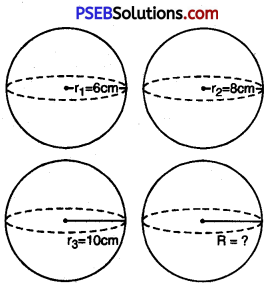
15. (i) How ………. boys are there in the class ?
(ii) How ………. milk is there in the pot ?

16. (i) I saw …………. Sri Harmandar Sahib
(ii) Sohan is ……………… honest man.

17. (i) Do not make …………… noise.
(ii) New Delhi is ……………… capital of India.

18. (i) ……………… rich are not always happy.
(ii) He is ………….. idiot.

19. (i) Do not make ……….. noise.
(ii) She is ………… intelligent girl.

20. (i) He can read …………. Vedas.
(ii) It was ………… daring idea.

21. (i) I am in ……………. hurry.
(ii) ……………… rose smells sweet.

22. (i) Look out of the window for ………. minute.
(ii) Your old place in ………………. laboratory is waiting for you.

23. (i) I have heard so ……………… about your school.
(ii) He takes …………….. interest in me.

24. (i) Is there …………… milk in the pot ?
(ii) ……………… seat in the hall was occupied.
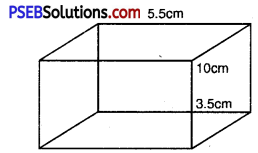
PSEB 7th Class English Grammar Determiners

25. (i) She is ………….. intelligent girl.
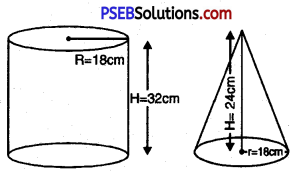
(ii) Do not make …………. noise.

26. (i) He is ………… one-eyed man.
(ii) He lost ……….. books he had.