PSEB 8th Class Maths Solutions Chapter 5 Data Handling Ex 5.1

Punjab State Board PSEB 8th Class Maths Book Solutions Chapter 5 Data Handling Ex 5.1 Textbook Exercise Questions and Answers.

PSEB Solutions for Class 8 Maths Chapter 5 Data Handling Ex 5.1

Question 1.
For which of these would you use a histogram to show the data?
(a) The number of letters for different areas in a postman’s bag.
(b) The height of competitors in an athletics meet.
(c) The number of cassettes produced by 5 companies.
(d) The number of passengers boarding trains from 7:00 a.m. to 7:00 p.m. at a station.
Give reasons for each.
Solution:
We represent those data by a histogram which can be grouped into class intervals. Obviously, for (b) and (d), the data can be represented by histograms.

Question 2.
The shoppers who come to a departmental store are marked as: man (M), woman (W), boy (B) or girl (G). The following list gives the shoppers who came during the first hour in the morning:
W W W G B W W M G G M M W W W W G B M W B G G M W W M M W W W M W B W G M W W W W G W M M W W M W G W M G W M M B G G W
Make a frequency distribution table using tally marks. Draw a bar graph to illustrate it.
Solution:
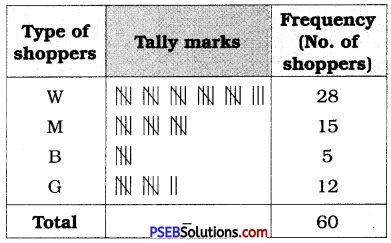
The frequency distribution table for the above data can be done as follows :
PSEB 8th Class Maths Solutions Chapter 5 Data Handling Ex 5.1 1
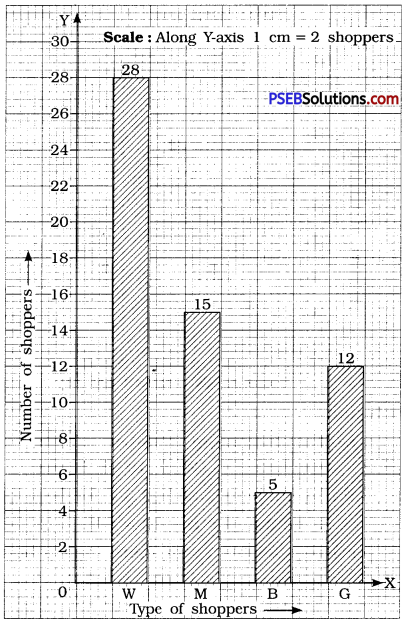
We can represent the above data by a bar graph as given below:
PSEB 8th Class Maths Solutions Chapter 5 Data Handling Ex 5.1 2

PSEB 8th Class Maths Solutions Chapter 5 Data Handling Ex 5.1

Question 3.
The weekly wages (in ₹) of 30 workers in a factory are:
830, 835, 890, 810, 835, 836, 869, 845, 898, 890, 820, 860, 832, 833, 855, 845, 804, 808, 812, 840, 885, 835, 835, 836, 878, 840, 868, 890, 806, 840
Using tally marks make a frequency table with intervals as 800-810, 810-820 and so on.
Solution:
The lowest observation = 804
The highest observation = 898
The classes are 800-810, 810-820, etc.
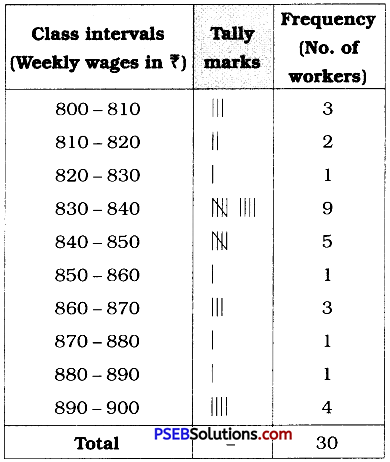
∴ The frequency distribution table is
PSEB 8th Class Maths Solutions Chapter 5 Data Handling Ex 5.1 3

Question 4.
Draw a histogram for the frequency table made for the data in Question 3, and answer the following questions:
(i) Which group has the maximum number of workers?
(ii) How many workers earn ₹ 850 and more ?
(iii) How many workers earn less than ₹ 850 ?
Solution:
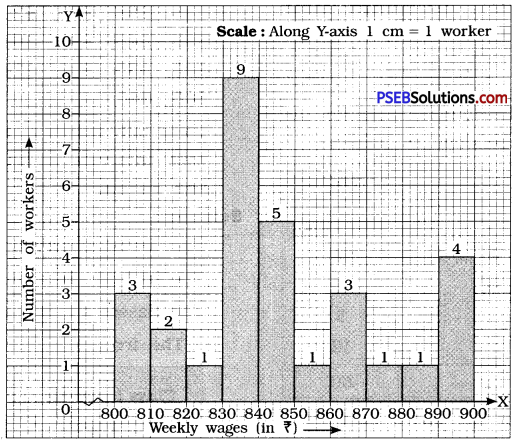
The histogram from the above frequency table is given below.
Here we have represented the class intervals along X-axis and frequencies of the class intervals along the Y-axis.
PSEB 8th Class Maths Solutions Chapter 5 Data Handling Ex 5.1 4
(i) The group 830 – 840 has the maximum number of workers.
(ii) Number of workers earning ₹ 850 or more = 1 + 3 + 1 + 1 – 1 – 4 = 10
(iii) Number of workers earning less than ₹ 850 = 3 + 2 + 1 + 9 + 5 = 20

PSEB 8th Class Maths Solutions Chapter 5 Data Handling Ex 5.1

Question 5.
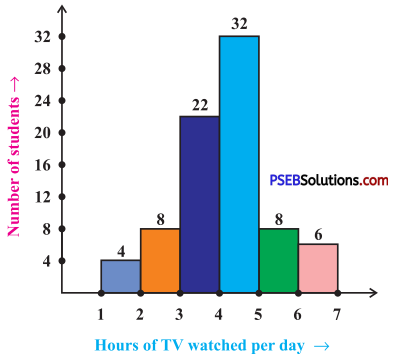
The number of hours for which students of a particular class watched television during holidays is shown through the given graph.
Answer the following:
(i ) For how many hours did the maximum number of students watch TV ?
(ii) How many students watched TV for less than 4 hours ?
(iii) How many students spent more than 5 hours in watching TV ?
PSEB 8th Class Maths Solutions Chapter 5 Data Handling Ex 5.1 5
Solution:
(i) The maximum number of students watched TV for 4 to 5 hours.
(ii) 34 students watched TV for less than 4 hours (4 + 8 + 22 = 34).
(iii) 14 students spent more than 5 hours in watching TV (8 + 6 = 14).

PSEB 8th Class Maths Solutions Chapter 11 Mensuration Ex 11.1

Punjab State Board PSEB 8th Class Maths Book Solutions Chapter 11 Mensuration Ex 11.1 Textbook Exercise Questions and Answers.

PSEB Solutions for Class 8 Maths Chapter 11 Mensuration Ex 11.1

1. A square and a rectangular field with measurements as given in the figure have the same perimeter. Which field has a larger area?

Question (a)
PSEB 8th Class Maths Solutions Chapter 11 Mensuration Ex 11.1 1
Solution:
Side of a square field = 60 m
∴ Perimeter of a square field = 4 × side
= 4 × 60 = 240 m
Area of a square field = (side)2
= (60)2
= 60 × 60
= 3600m2

PSEB 8th Class Maths Solutions Chapter 11 Mensuration Ex 11.1

Question (b)
PSEB 8th Class Maths Solutions Chapter 11 Mensuration Ex 11.1 2
Solution:
Perimeter of a rectangular field = Perimeter of square field
∴ Perimeter of a rectangular held = 240
∴ 2 (length + breadth) = 240
∴ 2 (80 + breadth) = 240
∴ 80 + breadth = \(\frac {240}{2}\)
∴ 80 + breadth =120
∴ breadth = 120 – 80
∴ breadth = 40
Breadth of rectangular field = 40 m
∴ Area of rectangular field = length × breadth
= (80 × 40)
= 3200 m2
Area of square field > Area of rectangular field
Thus, area of square field (a) is larger.

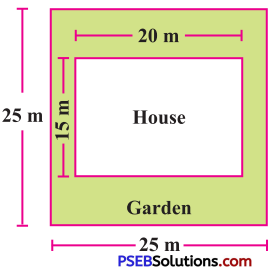
2. Mrs. Kaushik has a square plot with the measurement as shown g in the figure. She wants to construct a house in the middle of the plot. A garden is developed around the house. Find the total cost of developing a garden around the house at the rate of ₹ 55 per m2.
PSEB 8th Class Maths Solutions Chapter 11 Mensuration Ex 11.1 3
Solution:
Side of the square plot = 25 m
∴ Area of the square plot = (side)2
= (25 × 25) m2
= 625 m2
In square plot, a rectangular-shaped house is to be constructed.
∴ Area of the constructed house
= length × breadth
= (20 × 15) m2
= 300 m2
∴ Area of the garden = Area of square plot – Area of constructed house
= 625 – 300 = 325 m2
Cost of developing garden of 1 m2 is ₹ 55
∴ Cost of developing garden of 325 m2
= ₹ (55 × 325)
= ₹ 17,875
Thus, total cost of developing garden is ₹ 17,875.

PSEB 8th Class Maths Solutions Chapter 11 Mensuration Ex 11.1

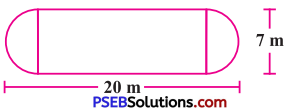
3. The shape of a garden is rectangular in the middle and semicircular at the ends as shown in the diagram. Find the area and the perimeter of this garden [Length of rectangle is 20 – (3.5+ 3.5) metres].

PSEB 8th Class Maths Solutions Chapter 11 Mensuration Ex 11.1 4
Solution:
[Note: Here 2 semicircles at the ends of a rectangular garden makes a whole circle. So first find area of a circle and then area of a rectangle. Sum of these two areas is total area. Follow same pattern to find perimeter too. For perimeter of a garden, take only length as rectangle is between two semicircles. Diameter of a circle = Breadth of a rectangle = 7 m]
For semicircle:
∴ Radius = \(\frac{\text { diameter }}{\text { 2 }}\) = \(\frac {7}{2}\)m
Area of circle = πr²
Area of a semicircle = \(\frac {1}{2}\)πr²
∴ Area of 2 semicircles = 2(\(\frac {1}{2}\)πr²)
= \(\frac{22}{7} \times \frac{7}{2} \times \frac{7}{2}\)m2
= 38.5 m2
Circumference of two semicircles = 2πr
= 2 × \(\frac {22}{7}\) × \(\frac {7}{2}\)
= 22 m

For rectangle:
length = 20 – (3.5 + 3.5) = 20 – 7 = 13 m
breadth = 7 m
Area of the rectangle = length × breadth
= 13 × 7 = 91 m2
Perimeter of the rectangle
= 2 (length × breadth)
= 2 (13 + 0)
= 2 × 13 = 26 m
∴ Total area of the garden = (38.5 + 91) m2
= 129.5 m2
∴ Perimeter of the garden = (22 + 26) m
= 48 m
Thus, area of the garden is 129.5 m2 and the perimeter is 48 m.

PSEB 8th Class Maths Solutions Chapter 11 Mensuration Ex 11.1

4. A flooring tile has the shape of a parallelogram whose base is 24 cm and the corresponding height is 10 cm. How many such tiles are required to cover a floor of area 1080 m2? (If required you can split the tiles in whatever way you want to fill up the corners.)
Solution:
[Note : To find number of tiles, divide the area of the floor by area of a tile. Let us do it in a simple way. Unit of floor area and tile area should be same.] Here, tile is parallelogram shaped.
So it’s area = base × corresponding height
Area of a floor = 1080 m2
Base of a tile = 24 cm = \(\frac {24}{100}\) m
Corresponding height of a tile = 10 cm = \(\frac {10}{100}\) m
Number of tiles = \(\frac{\text { Area of a floor }}{\text { Area of a title }}\)
= \(\frac{1080}{\frac{24}{100} \times \frac{10}{100}}\)
= \(\frac{1080 \times 100 \times 100}{24 \times 10}\)
= 45,000
Thus, 45,000 tiles are required to cover the given floor.

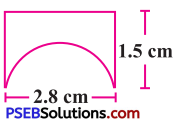
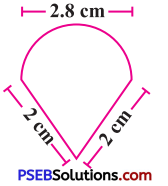
5. An ant is moving around a few food pieces of different shapes scattered on the floor. For which food piece would the ant have to take a longer round? Remember, circumference of a circle can be obtained by using the expression c = 2 πr, where r is the radius of the circle.

Question (a)
PSEB 8th Class Maths Solutions Chapter 11 Mensuration Ex 11.1 5
Solution:
Here, the shape is semi-circular.
Diameter = 2.8 cm
Radius = \(\frac{\text { Diameter }}{2}=\frac{2.8}{2}\) = 1.4 cm
Circumference of a semicircle = πr
Perimeter of the given figure
= πr + diameter
= (\(\frac {22}{7}\) × 1.4) + 2.8
= 4.4 + 2.8
= 7.2 cm

Question (b)
PSEB 8th Class Maths Solutions Chapter 11 Mensuration Ex 11.1 6
Solution:
Here, given shape is semicircular at one side, (radius = \(\frac {2.8}{2}\) = 1.4 cm)
So perimeter of semicircular region (circumference) = πr
= \(\frac {22}{7}\) × 1.4
= \(\frac {22}{7}\) × \(\frac {14}{10}\)
= 4.4 cm … (i)
Perimeter of the other portion
= breadth + length + breadth
= (1.5 + 2.8 + 1.5) cm
= 5.8 cm … (ii)
∴ Perimeter of the given figure
= (4.4 + 5.8) cm [from (i) and (ii)]
= 10.2 cm

PSEB 8th Class Maths Solutions Chapter 11 Mensuration Ex 11.1

Question (c)
PSEB 8th Class Maths Solutions Chapter 11 Mensuration Ex 11.1 7
Solution:
Perimeter of a given part
(semi circular circumference) = πr
= \(\frac {22}{7}\) × 1.4
= 4.4 cm
∴ Perimeter of the given figure
= (4.4 + 2 + 2) cm
= 8.4 cm
Thus, 7.2 cm < 8.4 cm < 10.2 cm.
Thus, the ant would has to take a longer round for food piece (b), as it has a larger perimeter.

PSEB 10th Class Maths Solutions Chapter 14 Statistics Ex 14.2

Punjab State Board PSEB 10th Class Maths Book Solutions Chapter Statistics Ex 14.2 Textbook Exercise Questions and Answers.

PSEB Solutions for Class 10 Maths Chapter 14 Statistics Ex 14.2

Question 1.
The following table shows the ages of the patients admitted in a hospital during a year:

PSEB 10th Class Maths Solutions Chapter 14 Statistics Ex 14.2 1

Find the mode and the mean of the data given above. Compare and interpret the two measures of central tendency.

Solution:
For mode:
In the given data, Maximum frequency is 23 and it corresponds to the class interval 35 – 45
Modal class = 35 – 45
So, l = 35; f1 = 23; f0 = 21; f2 = 14 and h = 10
Using fonnula, Mode l = l + \(\left(\frac{f_{1}-f_{0}}{2 f_{1}-f_{0}-f_{2}}\right)\) × h
Mode = 35 + \(\left[\frac{23-21}{2(23)-21-14}\right]\) × 10
= 35 + \(\frac{2}{46-35}\) × 10
= 35 + \(\frac{20}{11}\) = 35 + 1.8 = 36.8.

For Mean:

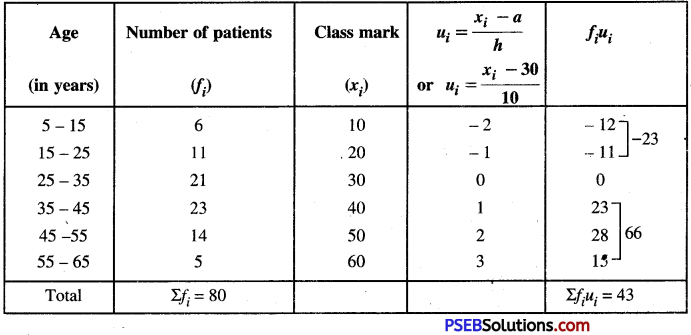
PSEB 10th Class Maths Solutions Chapter 14 Statistics Ex 14.2 2

From above data,
Assumed mean (a) = 30
Width of class (h) = 10
∴ \(\bar{u}=\frac{\Sigma f_{i} u_{i}}{\Sigma f_{i}}=\frac{43}{80}\) = 0.5375
Using formula, Mean \((\overline{\mathrm{X}})=a+h \bar{u}\)
\(\bar{X}\) = 30 + 10 (0.5375)
= 30 + 5.375 = 35.375 = 35.37
Hence, mode of given data is 36.8 years and mean of the given data is 35.37 years. Also, it is clear from above discussion that average age of a patient admitted in the hospital is 35.37 years and maximum number of patients admitted in the hospital are of age 36.8 years.

PSEB Solutions PSEB 10th Class Maths Solutions Chapter 14 Statistics Ex 14.2

Question 2.
The following data gives the information on the observed lifetimes (in hours) of 225 electrical components:

PSEB 10th Class Maths Solutions Chapter 14 Statistics Ex 14.2 3

Determine the ¡nodal lifetimes of the components.
Solution:
In the given data.
Maximum frequency is 61 and it corresponds to the class interval 60 – 80.
∴ Model class = 60 – 80
So, l = 60; f1 = 61 ; f0 = 52; f2 = 38 and h = 20
Using formula, Mode = l + \(\left(\frac{f_{1}-f_{0}}{2 f_{1}-f_{0}-f_{2}}\right)\) × h

Mode = 60 + \(\left(\frac{61-52}{2(61)-52-38}\right)\) × 20

= 60 + \(\frac{9}{122-52-38}\) × 20

= 60 + \(\frac{9}{32}\) × 20

= 60 + \(\frac{180}{32}\)

= 60 + 5.625 = 65.625
Hence, modal Lifetimes of the components is 65.625 hours.

PSEB Solutions PSEB 10th Class Maths Solutions Chapter 14 Statistics Ex 14.2

Question 3.
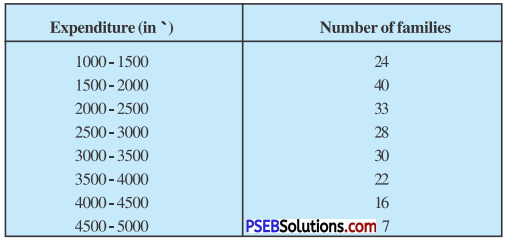
The following data gives the distribution of total monthly household expenditure of 200 families of a village. Find the modal monthly expenditure of the families. Also, find the mean monthly expenditure:

PSEB 10th Class Maths Solutions Chapter 14 Statistics Ex 14.2 4

Solution:
For Mode: In the given data.
Maximum frequency is 40, and it corresponds to the class interval 1500 – 2000.
∴ Model class = 1500 – 2000
So, l = 1500; f1 = 40; f0 = 24; f2 = 33 and h = 500
Using formula, Mode = l + \(\left(\frac{f_{1}-f_{0}}{2 f_{1}-f_{0}-f_{2}}\right)\) × h

= 1500 + \(\left\{\frac{40-24}{2(40)-24-33}\right\}\) × 500

= 1500 + \(\left\{\frac{16}{80-24-33}\right\}\) × 500

= 1500 + \(\frac{16 \times 500}{23}\)

= 1500 + \(\frac{8000}{23}\) = 1500 + 347.83 = 1847.83

For Mean:

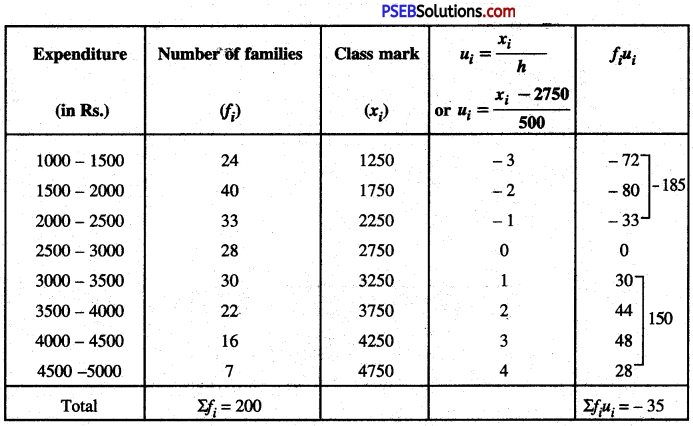
PSEB 10th Class Maths Solutions Chapter 14 Statistics Ex 14.2 5

From above data,

Assumed Mean (a) = 2750
Length of width (h) = 500
\(\bar{u}=\frac{\Sigma f_{i} u_{i}}{\Sigma f_{i}}=-\frac{35}{200}\) = – 0.175
Using formula, Mean \((\overline{\mathrm{X}})=a+h \bar{u}\)
\(\overline{\mathbf{X}}\) = 2750 + 500 (- 0.175)
= 2750 – 87.50 = 2662.50
Hence, the modal monthly expenditure of family is 1847.83 and the mean monthly expenditure is 2662.50.

PSEB Solutions PSEB 10th Class Maths Solutions Chapter 14 Statistics Ex 14.2

Question 4.
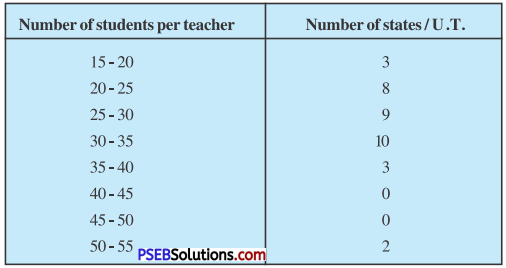
The following distribution gives the slate-wise teacher-student ratio in higher secondary schools of India. Find the mode and mean of this data. Interpret the two measures.

PSEB 10th Class Maths Solutions Chapter 14 Statistics Ex 14.2 6

Solution:
For Mode:
In the given data,
Maximum frequency is 10 and it corresponds to the class interval is 30 – 35.
∴ Modal class = 30 – 35.
So, l = 30; f1 = 10; f0 = 9; f2 = 3 and h = 5
using formula, Mode = l + \(\left(\frac{f_{1}-f_{0}}{2 f_{1}-f_{0}-f_{2}}\right)\) × h
Mode = 30 + \(\left(\frac{10-9}{2(10)-9-3}\right)\) × 5
= 30 + \(\frac{1}{20-12}\) × 5
= 30 + \(\frac{5}{8}\) = 30 + 0.625 = 30.625 = 30.63 (approx.)

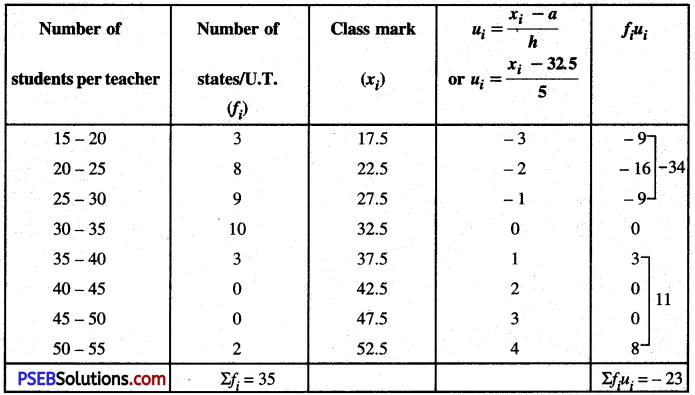
For mean:

PSEB 10th Class Maths Solutions Chapter 14 Statistics Ex 14.2 7

From above data, Assumed Mean (a) = 32.5
Width of class (h) = 5
∴ \(\bar{u}=\frac{\Sigma f_{i} u_{i}}{\Sigma f_{i}}=-\frac{23}{35}\) = – 0.65

Using formula, Mean \((\overline{\mathrm{X}})=a+h \bar{u}\)
\(\overline{\mathbf{X}}\) = 32.5 + 5 (- 0.65)
= 32..5 – 3.25 = 29.25 (approx.)
Hence, mode and mean of given data is 30.63 and 29.25. Also, from above discussion, it clear that states/U.T. have student per teacher is 30.63 and on average, this ratio is 29.25.

PSEB Solutions PSEB 10th Class Maths Solutions Chapter 14 Statistics Ex 14.2

Question 5.
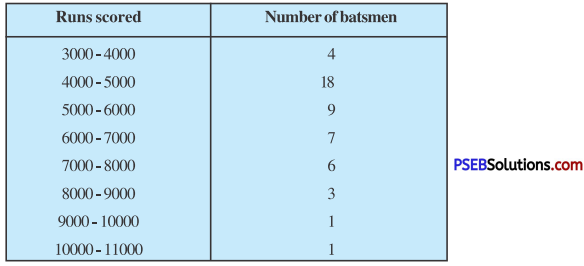
The given distribution shows the number of runs scored by some top batsmen of the world in one-day international cricket matches

PSEB 10th Class Maths Solutions Chapter 14 Statistics Ex 14.2 8

Find the mode of the data.
Solution:
In the given data,
Maximum frequency is 18 and it corresponds to the class interval 4000 – 5000.
∴ Modal class = 4000 – 5000
So, l = 4000; f1 = 18; f0 = 4; f2 = 9 and h = 1000
Using formula, Mode = l + \(\left(\frac{f_{1}-f_{0}}{2 f_{1}-f_{0}-f_{2}}\right)\) × h

Mode = 4000 + \(\left(\frac{18-4}{2(18)-4-9}\right)\) × 1000

= 4000 + \(\frac{14}{36-13}\) × 1000

= 4000 + \(\frac{14000}{23}\) = 4000 + 608.6956

= 4000 + 608.7 = 4608.7 (approx.)
Hence, mode of the given data is 4608.7.

PSEB Solutions PSEB 10th Class Maths Solutions Chapter 14 Statistics Ex 14.2

Question 6.
A student noted the number of cars passing through a spot on a road for 100 periods each of 3 minutes and summarised It in the table given below. Find the mode of the data:

PSEB 10th Class Maths Solutions Chapter 14 Statistics Ex 14.2 9

Solution:
In the given data,
Maximum frequency is 20 and it corresponds to the class interval 40 – 50
∴ Modal Class = 40 – 50
So, l = 40; f1 = 20; f0 = 12; f2= 11 and h = 10
Using formula, Mode = l + \(\left(\frac{f_{1}-f_{0}}{2 f_{1}-f_{0}-f_{2}}\right)\) × h

Mode = 40 + \(\left(\frac{20-12}{2(20)-12-11}\right)\) × 10

= 40 + \(\frac{8}{40-23}\) × 10

= 40 + \(\frac{80}{17}\) = 40 + 4.70588

= 40 + 4.7 = 44.7 (approx.)
Hence, mode of the given data is 44.7 cars.

PSEB 8th Class Maths Solutions Chapter 12 Exponents and Powers InText Questions

Punjab State Board PSEB 8th Class Maths Book Solutions Chapter 12 Exponents and Powers InText Questions and Answers.

PSEB 8th Class Maths Solutions Chapter 12 Exponents and Powers InText Questions

Try These : [Textbook Page No. 194]

1. Find the multiplicative inverse of the following:

Question (i)
2-4
Solution:
Multiplicative inverse of 2-4 = 24

PSEB 8th Class Maths Solutions Chapter 12 Exponents and Powers InText Questions

Question (ii)
10-5
Solution:
Multiplicative inverse of 10-5 = 105

Question (iii)
7-2
Solution:
Multiplicative inverse of 7-2 = 72

Question (iv)
5-3
Solution:
Multiplicative inverse of 5-3 = 53

Question (v)
10-100
Solution:
Multiplicative inverse of 10-100 =10100

PSEB 8th Class Maths Solutions Chapter 12 Exponents and Powers InText Questions

Try These : [Textbook Page No. 194]

1. Expand the following numbers using exponents:
(i) 1025.63
(ii) 1256.249
Solution:

Number Expanded form
(i) 1025.63 (1 × 1000) + (0 × 100) + (2 × 10) + (5 × 1) + (6 × \(\frac {1}{10}\)) + (3 × \(\frac {1}{100}\))
OR
(1 × 10³) + (2 × 101) + (5 × 100) + (6 × 10⁻¹) + (3 × 10⁻²)
(ii) 1256.249 (1 × 1000) + (2 × 100) + (5 × 10) + (6 × 1) + (2 × \(\frac {1}{10}\))+ (4 x \(\frac {1}{100}\)) + (9 × \(\frac {1}{1000}\))
OR
(1 × 10³) + (2 × 10²) + (5 × 101) + (6 × 100) + (2 × 10⁻¹) + (4 × 10⁻²) + (9 × 10⁻³)

Try These : [Textbook Page No. 195]

1. Simplify and write in exponential form:

Question (i)
(- 2)-3 × (- 2)-4
Solution:
= (-2)-3+(-4)
= (-2)-3-4
= (-2)-7 or \(\frac{1}{(-2)^{7}}\)

Question (ii)
p3 × p-10
Solution:
= p3+(-10)
= p3-10
= (p)-7 or \(\frac{1}{(p)^{7}}\)

PSEB 8th Class Maths Solutions Chapter 12 Exponents and Powers InText Questions

Question (iii)
32 × 3-5 × 36
Solution:
= 32+(-5)+6
= 32-5+6
= 32+6-5
= 33

Try These : [Textbook Page No. 199]

1. Write the following numbers in standard form:

Question (i)
0.000000564
Solution:
= \(\frac{564}{1000000000}\)
(The decimal point is shifted to nine places to the right.)
= \(\frac{5.64}{10^{9}}\)
= \(\frac{5.64}{10^{7}}\)
= 5.64 × 10⁻⁷
∴ 0.000000564 = 5.64 × 10⁻⁷

Question (ii)
0.0000021
Solution:
\(\frac{21}{10000000}\)
= \(\frac{2.1 \times 10}{10000000}\)
= \(\frac{2.1}{10^{6}}\)
= 2.1 × 10⁻⁶
∴ 0.0000021 = 2.1 × 10⁻⁶

PSEB 8th Class Maths Solutions Chapter 12 Exponents and Powers InText Questions

Question (iii)
21600000
Solution:
= 216 × 100000
= 216 × 105
= 2.16 × 102 × 105
= 2.16 × 10⁷
∴ 21600000 = 2.16 × 10⁷

Question (iv)
15240000
Solution:
= 1524 × 10000
= 1.524 × 1000 × 10000
= 1.524 × 103 × 104
= 1.524 × 10⁷
∴ 15240000 = 1.524 × 10⁷

2. Write all the facts given in the standard form. Observe the following facts: [Textbook Page No. 198 ]

Question 1.
The distance from the Earth to the Sun is 150,600,000,000 m.
Solution:
150,600,000,000 m
= 1.506 × 10¹¹ m

PSEB 8th Class Maths Solutions Chapter 12 Exponents and Powers InText Questions

Question 2.
The speed of light is 300,000,000 m/sec.
Solution:
300,000,000 m / sec
= 3 × 10⁸m/sec

Question 3.
Thickness of Class VII Mathematics book is 20 mm.
Solution:
20 = 2 × 101 mm

Question 4.
The average diameter of a Red Blood Cell is 0.000007 m.
Solution:
0.000007 = 7 × 10⁻⁶ m

PSEB 8th Class Maths Solutions Chapter 12 Exponents and Powers InText Questions

Question 5.
The thickness of human hair is in the range of 0.005 cm to 0.01 cm.
Solution:
0.005 = 5 × 10⁻³cm and
0.01 = 1 × 10⁻² cm

Question 6.
The distance of moon from the Earth is 384,467,000 m (approx).
Solution:
384,467,000 = 3.84467 × 10⁸ m

Question 7.
The size of a plant cell is 0.00001275 m.
Solution:
0.00001275 = 1.275 × 10⁻⁵m

Question 8.
Average radius of the Sun is 695000 km.
Solution:
695000 = 6.95 × 10⁵ km

PSEB 8th Class Maths Solutions Chapter 12 Exponents and Powers InText Questions

Question 9.
Mass of propellant in a space shuttle solid rocket booster is 503600 kg.
Solution:
503600 = 5.036 × 10⁵ kg

Question 10.
Thickness of a piece of paper is 0.0016 cm.
Solution:
0.0016 = 1.6 × 10⁻³ cm

Question 11.
Diameter of a wire on a computer chip is 0.000003 m.
Solution:
0.000003 = 3 × 10⁻⁶ cm

PSEB 8th Class Maths Solutions Chapter 12 Exponents and Powers InText Questions

Question 12.
The height of Mount Everest is 8848 m.
Solution:
8848 = 8.848 × 10³ m

PSEB 6th Class English Vocabulary Punctuation

Punjab State Board PSEB 6th Class English Book Solutions English Vocabulary Punctuation Exercise Questions and Answers, Notes.

PSEB 6th Class English Vocabulary Punctuation

Punctuation means putting full stops, commas, question marks etc. into a piece of writing. Punctuation helps to clarify the meaning of the sentence or passage.
लिखते समय उचित विराम चिन्हों, अर्थात् full stops (.), commas (,), question marks (?) आदि का प्रयोग करना Punctuation कहलाता है। ये चिन्ह वाक्य अथवा लेख के अर्थ को स्पष्ट करने में सहायता करते हैं।

The important Marks of Punctuation are-

  1. Full Stop (.)
  2. Comma (,)
  3. Question Mark (?)
  4. Exclamation Mark (!)
  5. Apostrophe (’)
  6. Quotation Mark (“ ”)

PSEB 6th Class English Vocabulary Punctuation 1

1. Full Stop is used:
to make the end of an assertive or imperative sentence; as-
1. The children are laughing.
2. Don’t run after the dog.

PSEB 6th Class English Vocabulary Punctuation

→ to make abbreviations and initials; as-
Sat. Dec. Ltd. Mr. A. Chandra
M.A. M.L.A. M.P. Mrs. N. Roy

2. Comma is used:
→ to separate words from each other; as-
1. His sister is a tall, lovely mid gentle girl.
2. She has pens, pencils, notebooks and books.
3. He did his homework neatly, quickly and correctly.
Note : A comma is generally not used before and.

→ to separate a reporting verb from the reported speech.
1. She says, “I like my school very much.
2. The saint said, “God is good and gracious.

3. Question Mark is used:
→ after a direct question; as-
1. What is your name ?
2. Have you got a car ?

PSEB 6th Class English Vocabulary Punctuation 2

→ after a tag question; as-
1. She is happy; isn’t she ?
2. He didn’t go to school, did he ?

4. Exclamation Mark is used:
→ after expressions of surprise or strong feeling.
1. How hot it is !
2. What a lovely rose !

PSEB 6th Class English Vocabulary Punctuation 3

→ after an inteijection; as-
1. O !
2. Oh !
3. Alas !
4. Hurray !
5. Pooh !

5. Apostrophe (a raised comma) is used:
→ to show that some letters or numbers have been omitted; as-
1. I’m = I am.
2. hasn’t = has not
3. ’tis = it is
4. don’t = do not

PSEB 6th Class English Vocabulary Punctuation 4

→ to show the possessive form of nouns; as-
1. man’s hat
2. girls’ hostel
3. Principal’s office
4. Mohan’s bag.

PSEB 6th Class English Vocabulary Punctuation

6. Quotation Marks are used:
→ to show the actual words of a speaker; as-
1. The teacher said, “Stop writing.”
2. “I can’t help you,” said my friend.

PSEB 6th Class English Vocabulary Punctuation 5

→ to show the titles of songs, poems, books, magazines, etc.
1. “The Blind Beggar” is a beautiful poem.
2. Do you read ‘The Hindustan Times’ daily ?
Note : (i) Quotation Marks are also called Inverted Commas.
(ii) In place of double commas, we can use single commas also.

7. Capital letters are used in the following cases:
1. The first letter of the first word of a sentence.
2. The speech in inverted commas begins with a capital letter.
3. The pronoun ‘P is always written in the capital form.
4. All Proper Nouns begin with a capital letter.
(Manpreet, Punjab, the Gita, the Himalayas, etc.)

Exercises (Solved)

I. Punctuate the following sentences using capital letters where necessary:

1. Shes a good dancer
2. is neeru a good dancer
3. isn’t richa a good dancer
4. madhus sister isnt a good dancer
5. richa said madhu is a good dancer
6. preeti is a good dancer said richas sister
7. what are the children doing there in the street
8. they are pulling the little dogs tail and the dog is crying
PSEB 6th Class English Vocabulary Punctuation 6
Answer:
1. She’s a good dancer.
2. Is Neeru a good dancer ?
3. Isn’t Richa a good dancer ?
4. Madhu’s sister isn’t a good dancer.
5. Richa said,“ Madhu is a good dancer.”
6. ‘‘Preeti is a good dancer,” said Richa’s sister.
7. What are the children doing there in the street ?
8. They are pulling the little dog’s tail, and the dog is crying.

PSEB 6th Class English Vocabulary Punctuation

II. Punctuate the following sentences using capital letters where necessary:

1. do you have a pet
2. the ladys purse was stolen
3. mrs Indu jain taught us hindi
4. this is our classroom said tony
5. what a great man gandhiji was
6. reema will sing a song said neha
7. well you may go and play outside
8. j c bose was a famous indian scientist
PSEB 6th Class English Vocabulary Punctuation 7
Answer:
1. Do you have a pet ?
2. The lady’s purse was stolen.
3. Mrs. Indu Jain taught us Hindi.
4. ‘‘This is our classroom,” said Tony.
5. What a great man Gandhiji was !
6. ‘‘Reema will sing a song,” said Neha.
7. Well ! you may go and play outside.
8. J.C. Bose was a famous Indian scientist.

PSEB 6th Class English Vocabulary Antonyms

Punjab State Board PSEB 6th Class English Book Solutions English Vocabulary Antonyms Exercise Questions and Answers, Notes.

PSEB 6th Class English Vocabulary Antonyms

An Antonym is a word which is opposite in meaning (विपरीतार्थक) to another word; as-

Word – Antonym
absent – present
active – passive
above – below
accept – reject
before – after
bitter – sweet

PSEB 6th Class English Vocabulary Antonyms

blunt – sharp
bold – timid
beautiful – ugly
bright – dim
cheap – costly
clean – dirty
clever – stupid
dark – bright
defeat – victory
difficult – easy
death – life
early – late
empty – full
enemy – friend
far – near
foolish – wise
fresh – stale
good – bad
great – small
happy – sad
high – low
hot – cold
in – out
import – export
increase – decrease
joy – sorrow
Word – Antonym
junior – senior
kind – cruel
lend – borrow
light – heavy
love – hate
long – short
old – young/new
oral – written
night – day
peace – war
poor – rich
profit – loss
right – wrong
shallow – deep
slow – fast
stale – fresh

PSEB 6th Class English Vocabulary Antonyms

strong – weak
summer – winter
thick – thin
top – bottom
tall – short
up – down
warm – cool
wide – narrow
wise – silly

PSEB 6th Class English Vocabulary Sounds of Animals

Punjab State Board PSEB 6th Class English Book Solutions English Vocabulary Sounds of Animals Exercise Questions and Answers, Notes.

PSEB 6th Class English Vocabulary Sounds of Animals

Animal – Sound
Ass – Brays
Bee – hum
Cat/Kitten – mew
Chicks – cheep
Cows – low, moo

PSEB 6th Class English Vocabulary Sounds of Animals

Crows – caw
Cuckoos – cuckoo
Cock – Crow
Deers – bell
Dogs – barks
Dolphins – click
Donkeys – hee-haw
Doves – coo
Ducks – quack
Eagles – scream
Elephants – trumpet, roar
Fly – buzz
Foxes – bark, yelp.
Frogs – croak
Geese – cackle/quack
Grasshoppers – chirp
Goat – baah
Hare – squeak
Horse – neigh
Lions – roar, growl
Monkey – scream, chatter
Owl – hoot
Parrot – talk
Sparrow – chirrup, chirp
Snakes – hiss

PSEB 6th Class English Vocabulary Sounds of Animals

Sheep – bleat
Tiger – roar, growl
Tortoise – grunt.

PSEB 8th Class Maths Solutions Chapter 4 Practical Geometry InText Questions

Punjab State Board PSEB 8th Class Maths Book Solutions Chapter 4 Practical Geometry InText Questions and Answers.

PSEB 8th Class Maths Solutions Chapter 4 Practical Geometry InText Questions

Think, Discuss and Write (Textbook Page No. 58)

Question 1.
Arshad has five measurements of a quadrilateral ABCD. These are AB = 5 cm, ∠A = 50°, AC = 4 cm, BD = 5 cm and AD = 6 cm. Can he construct a unique quadrilateral ? Give reasons for your answer.
Solution:
No, the quadrilateral ABCD cannot be constructed with the given combination of measurements. If the length of side BC or DC is given, then only □ ABCD can be constructed.

Think, Discuss and Write (Textbook Page No. 60)

Question (i).
We saw that 5 measurements of a quadrilateral can determine a quadrilateral uniquely. Do you think any five measurements of the quadrilateral can do this ?
Solution:
No, any 5 measurements can’t determine a s quadrilateral. To construct a quadrilateral, specific combination of measurements should be needed such as :

  • Four sides and one diagonal
  • Four sides and one angle
  • Three sides and two diagonals
  • Two adjacent sides and three angles
  • Three sides and two included angles
  • Some special properties should be given,

Question (ii).
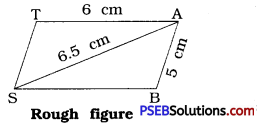
Can you draw a parallelogram BATS where BA = 5 cm, AT = 6 cm and AS = 6.5 cm? Why?
Solution:
PSEB 8th Class Maths Solutions Chapter 4 Practical Geometry InText Questions 1
Here, to draw a parallelogram BATS, BA = 5 cm, AT = 6 cm and AS = 6.5 cm are given. In parallelogram length of opposite sides are equal. So ST = AB = 5 cm and SB = AT = 6 cm. First we can draw A ASB where SB = 6 cm, AB = 5 cm and AS = 6.5 cm. Then draw ΔATS where AT = 6 cm, ST = 5 cm.
Thus, we can draw a parallelogram from given measurements.

PSEB 8th Class Maths Solutions Chapter 4 Practical Geometry InText Questions

Question (iii).
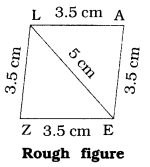
Can you draw a rhombus ZEAL where ZE = 3.5 cm, diagonal EL = 5 cm ? Why?
Solution:
PSEB 8th Class Maths Solutions Chapter 4 Practical Geometry InText Questions 2
Here, to draw a rhombus ZEAL, ZE = 3.5 cm and EL = 5 cm are given. All of rhombus are equal to each other. So ZE = EA = AL = LZ = 3.5 cm. Moreover, diagonal EL = 5 cm Is given.
So We know all necessary measurements to draw rhombus. Yes, we can draw a rhombus ZEAL.

Question (iv).
A student attempted to draw a quadrilateral PLAY where PL = 3 cm, LA = 4 cm, AY = 4.5 cm, PY = 2 cm and LY = 6 cm, but could not draw it. What is the reason?
[Hint: Discuss it using a rough sketch. ]
Solution :
Here, to draw a quadrilateral PLAY,
PL = 3 cm, LA = 4 cm, AY = 4.5 cm, PY = 2 cm and LY = 6 cm are given.
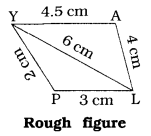
PSEB 8th Class Maths Solutions Chapter 4 Practical Geometry InText Questions 3
Now, let us look at measurements of
ΔPLY. PL + PY = 3 cm + 2 cm = 5 cm while YL = 6 cm.
We know that the sum of the lengths of any two sides of triangle is always greater than the length of the third side.
So point P cannot be determined even after constructing ΔLAY. Thus, a student failed s due to this reason.

Think, Discuss and Write (Textbook Page No. 62)

Question 1.
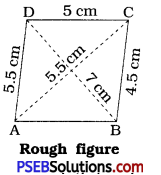
In the above example, can we draw the quadrilateral by drawing ΔABD first and then find the fourth point C ?
Solution:
Since, the measurement of AB is not given, we cannot draw ΔABD, so question does not arise to find the foruth point C.
PSEB 8th Class Maths Solutions Chapter 4 Practical Geometry InText Questions 4
Thus, we cannot draw the quadrilateral

Question 2.
Can you construct a quadrilateral PQRS with PQ = 3 cm, RS = 3 cm, PS = 7.5 cm, PR = 8 cm and SQ = 4 cm ? Justify your answer.
Solution:
No, the quadrilateral PQRS cannot be constructed as in ΔQSP, SQ + PQ ≯ SP

PSEB 8th Class Maths Solutions Chapter 4 Practical Geometry InText Questions

Think, Discuss and Write (Textbook Page No. 64)

Question 1.
Can you construct the above quadrilateral MIST if we have 100° at M instead of 75° ?
Solution:
Yes. The quadrilateral MIST can be constructed with ∠M = 100° instead of 75°.
[Note : Only size of quadrilateral is changed.]

Question 2.
Can you construct the quadrilateral PLAN if PL = 6 cm, LA = 9.5 cm, ∠P = 75°, ∠L = 150° and ∠A = 140° ?
[Hint: Recall angle sum property.]
Solution:
Here, ∠P + ∠L + ∠A + ∠N
= 75° + 150° + 140° + ∠N
= 365° + ∠N
∴ Construction of quadrilateral PLAN is not possible as according to angle sum property. The sum of all the angles of a quadrilateral is 360°. Here, 365° + N > 360°.

Question 3.
In a parallelogram, the lengths of adjacent sides are known. Do we still need measures of the angles to construct as in the example above?
Solution :
In a parallelogram, the opposite sides are parallel and of equal length. Here, we know the lengths of adjacent sides, so measures of the angles are not needed.
If we know the length of a diagonal the quadrilateral can be drawn.

PSEB 8th Class Maths Solutions Chapter 4 Practical Geometry InText Questions

Think, Discuss and Write (Textbook Page No. 66)

Question 1.
In the above example, we first drew BC. Instead, what could have been be the other starting points?
Solution :
Instead of drawing BC, we can start with \(\overline{\mathrm{AB}}\) or \(\overline{\mathrm{CD}}\).

Question 2.
We used some five measurements to draw quadrilaterals so far. Can there be different sets of five measurements (other than seen so far) to draw a quadrilateral ? The following problems may help you in answering the question.
(i) Quadrilateral ABCD with AB = 5 cm, BC = 5.5 cm, CD = 4 cm, AD = 6 cm and ∠B = 80°.
(ii) Quadrilateral PQRS with PQ = 4.5 cm, ∠P = 70°, ∠Q = 100°, ∠R = 80° and ∠S = 110°.
Construct a few more examples of your own to find sufficiency/insufficiency of the data for construction of a quadrilateral.
Solution:
(i) Here, four sides and one angle are given. So given data is sufficient to construct quadrilateral ABCD.
(ii) We cannot locate the points R and S with the help of given data. So given data is insufficient to construct quadrilateral PQRS.

Few examples of sufficient data to construct quadrilaterals :

  • Quadrilateral PQRS in which RS = 6 cm, QR = 5 cm, PQ = 5 cm, ∠Q = 135°, ∠R = 90°. (three sides and two angles)
  • Quadrilateral ABCD in which AB = 5 cm, BC = 4 cm, ∠B = 60°, ∠A = 90° and ∠C = 135°. (two sides and three angles)

Try these (Textbook Page No. 67)

Question 1.
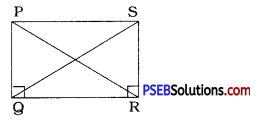
How will you construct a rectangle PQRS if you know only the lengths PQ and QR?
Solution:
PSEB 8th Class Maths Solutions Chapter 4 Practical Geometry InText Questions 5
Each angle of a rectangle is a right angle. Rectangle has opposite sides of equal lengths. Here, PQ is given, So PQ = RS.
ΔPQR can be drawn using PQ, QR and ∠Q = 90°.
ΔQRS can be drawn using QR, RS and ∠R = 90°.
Thus, the required rectangle PQRS can be constructed.

PSEB 8th Class Maths Solutions Chapter 4 Practical Geometry InText Questions

Question 2.
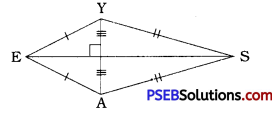
Construct the kite EASY if AY = 8 cm, EY = 4 cm and SY = 6 cm. Which properties of the kite did you use in the process ?
Solution:
PSEB 8th Class Maths Solutions Chapter 4 Practical Geometry InText Questions 6
Diagonals intersect each other at right angle. ? In kite pairs of consecutive sides are of equal lengths.
While constructing, E cannot be located.
∴ Kite EASY cannot be constructed
(∵ For Δ EYA, the sum of lengths of two sides EY + EA (4 + 4) is not greater than length of third side AY (8).

PSEB 8th Class Maths Solutions Chapter 12 Exponents and Powers Ex 12.2

Punjab State Board PSEB 8th Class Maths Book Solutions Chapter 12 Exponents and Powers Ex 12.2 Textbook Exercise Questions and Answers.

PSEB Solutions for Class 8 Maths Chapter 12 Exponents and Powers Ex 12.2

1. Express the following numbers in standard form:

Question (i)
0.0000000000085
Solution:
= \(\frac{85}{10000000000000}\)
= \(\frac{85}{10^{13}}\)
= \(\frac{8.5 \times 10}{10^{13}}\)
= 8.5 × 10 × 10-13
= 8.5 × 10⁻¹²

PSEB 8th Class Maths Solutions Chapter 12 Exponents and Powers Ex 12.2

Question (ii)
0.00000000000942
Solution:
= \(\frac{942}{100000000000000}\)
= \(\frac{942}{10^{14}}\)
= \(\frac{9.42 \times 10^{2}}{10^{14}}\)
= 9.42 × 102 × 10-14
= 9.42 × 10⁻¹²

Question (iii)
6020000000000000
Solution:
= 602 × 10000000000000
= 602 × 1013
= 6.02 × 102 × 1013
= 6.02 × 10¹⁵

Question (iv)
0.00000000837
Solution:
= \(\frac{837}{100000000000}\)
= \(\frac{837}{10^{11}}\)
= \(\frac{8.37 \times 10^{2}}{10^{11}}\)
= 8.37 × 102 × 10-11
= 8.37 × 10²+(-11)
= 8.37 × 10⁻⁹

PSEB 8th Class Maths Solutions Chapter 12 Exponents and Powers Ex 12.2

Question (v)
31860000000
Solution:
= 3186 × 10000000
= 3186 × 107
= 3.186 × 103 × 107
= 3.186 × 10³ + 7
= 3.186 × 10¹⁰

2. Express the following numbers in usual form:

Question (i)
3.02 × 10⁻⁶
Solution:
= 302 × 10-2 × 10-6
= 302 × 10-8
= \(\frac{302}{100000000}\)
= 0.00000302

Question (ii)
4.5 × 10⁴
Solution:
= \(\frac {45}{10}\) × 10000
= 45 × 1000
= 45000

PSEB 8th Class Maths Solutions Chapter 12 Exponents and Powers Ex 12.2

Question (iii)
3 × 10⁻⁸
Solution:
= \(\frac{3}{100000000}\)
= 0.00000003

Question (iv)
1.0001 × 10⁹
Solution:
= \(\frac{10001}{10000}\) × 1000000000
= 10001 × 100000
= 1000100000

Question (v)
5.8 × 10¹²
Solution:
= \(\frac {58}{10}\) × 100000000000
= 58 × 10000000000
= 5800000000000

Question (vi)
3.61492 × 10⁶
Solution:
= \(\frac{361492}{100000}\) × 1000000
= 361492 x 10
= 3614920

PSEB 8th Class Maths Solutions Chapter 12 Exponents and Powers Ex 12.2

3. Express the number appearing in the following statements in standard form:

Question (i)
1 micron is equal to \(\frac{1}{1000000}\) m.
Solution:
1 micron = \(\frac{1}{1000000}\)m
= \(\frac{1}{10^{6}}\)m
∴ 1 micron = 1 × 10⁻⁶ m

Question (ii)
Charge of an electron is 0.000,000,000,000,000,000,16 coulomb.
Solution:
Charge of an electron
= 0.000,000,000,000,000,000,16 coulomb
= \(\frac{16}{100000000000000000000}\) coulomb
= \(\frac{1.6 \times 10}{10^{20}}\) coulomb
= \(\frac{1.6}{10^{19}}\) coulomb
= 1.6 × 10⁻¹⁹ coulomb
∴ Charge of an electron = 1.6 × 10⁻¹⁹ coulomb

Question (iii)
Size of a bacteria is 0.0000005 m.
Solution:
Size of a bacteria = 0.0000005 m
= \(\frac{5}{10000000}\)m
= \(\frac{5}{10^{7}}\)m
= 5 × 10⁻⁷ m
∴ Size of a bacteria = 5 × 10⁻⁷ m

PSEB 8th Class Maths Solutions Chapter 12 Exponents and Powers Ex 12.2

Question (iv)
Size of a plant cell is 0.00001275 m.
Solution:
Size of a plant cell = 0.00001275 m
= \(\frac{1275}{100000000}\)m
= \(\frac{1275}{10^{8}}\)m
= \(\frac{1.275 \times 10^{3}}{10^{8}}\) m
= 1.275 × 10³-8
= 1.275 × 10⁻⁵
∴ Size of a plant cell
= 1.275 × 10⁻⁵ m

Question (v)
Thickness of a thick paper is 0.07 mm.
Solution:
Thickness of a thick paper = 0.07 mm
= \(\frac {7}{100}\) mm
= \(\frac{7}{10^{2}}\) mm
= 7 × 10⁻² mm
∴ Thickness of a thick paper
= 7 × 10⁻² mm

PSEB 8th Class Maths Solutions Chapter 12 Exponents and Powers Ex 12.2

4. In a stack there are 5 books each of thickness 20 mm and 5 paper sheets each of thickness 0.016 mm. What is the total thickness of the stack.
Solution:
Thickness of a book = 20 mm
∴ Thickness of 5 books = (5 × 20) mm
= 100 mm
Thickness of a paper sheet = 0.016 mm
∴ Thickness of 5 paper sheets
= (5 × 0.016) mm
= 0.08 mm
∴ Total thickness of a stack = Thickness of books + Thickness of paper sheets
= (100 + 0.08) mm
= 100.08 mm
In standard form 100.08 is written as 1.0008 × 10².
Thus, the total thickness of the stack is 1.0008 × 102 mm.

PSEB 10th Class Maths Solutions Chapter 14 Statistics Ex 14.1

Punjab State Board PSEB 10th Class Maths Book Solutions Chapter Statistics Ex 14.1 Textbook Exercise Questions and Answers.

PSEB Solutions for Class 10 Maths Chapter 14 Statistics Ex 14.1

Question 1.
A survey was conducted by a group of students as a part of their enviroment awareness programme, in which they collected the following data regarding the number of plants in 20 houses in a locality. Find the mean number of plants per house.

PSEB 10th Class Maths Solutions Chapter 14 Statistics Ex 14.1 1

Which method did you use for finding the mean, and why?
Solution:
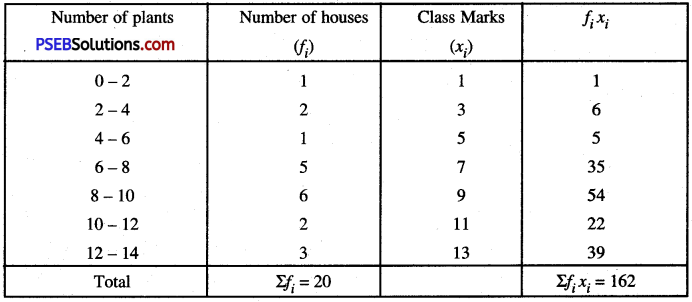
Since, number of plants and houses are small in their values; so we must use direct method

PSEB 10th Class Maths Solutions Chapter 14 Statistics Ex 14.1 2

Mean X = \(\overline{\mathrm{X}}=\frac{\Sigma f_{i} x_{i}}{\Sigma f_{i}}\)

\(\frac{162}{20}\) = 8.1

Hence, mean number of plants per house is 8.1.

PSEB Solutions PSEB 10th Class Maths Solutions Chapter 14 Statistics Ex 14.2

Question 2.
Consider the following distribution of daily wages of 50 workers of a factory.

PSEB 10th Class Maths Solutions Chapter 14 Statistics Ex 14.1 3

Find the mean daily wages of the workers of the factory by using an appropriate method.
Solution:

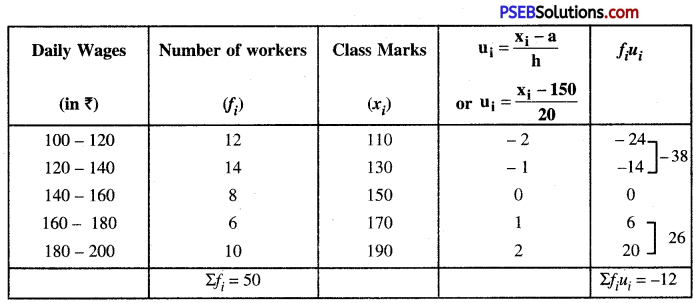
PSEB 10th Class Maths Solutions Chapter 14 Statistics Ex 14.1 4

From given data,
Assumed Mean (a) = 150
and width of the class (h) = 20
∴ \(\bar{u}=\frac{\Sigma f_{i} u_{i}}{\Sigma f_{i}}\)
= \(\frac{-12}{50}\) = – 0.24

Using formula, Mean \((\overline{\mathrm{X}})=a+h \bar{u}\)
= 150 + (20) (- 0.24)
= 150 – 4.8 = 145.2
Hence,mean daily wages of the workers of factory is ₹ 145.20.

PSEB Solutions PSEB 10th Class Maths Solutions Chapter 14 Statistics Ex 14.2

Question 3.
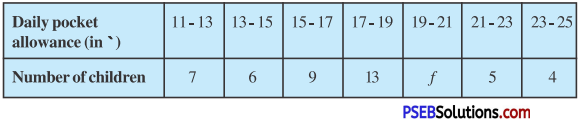
The following distribution shows the daily pocket allowance of children of a locality. The mean pocket allowance is 18. Find the missing frequency f.

PSEB 10th Class Maths Solutions Chapter 14 Statistics Ex 14.1 5

Solution;

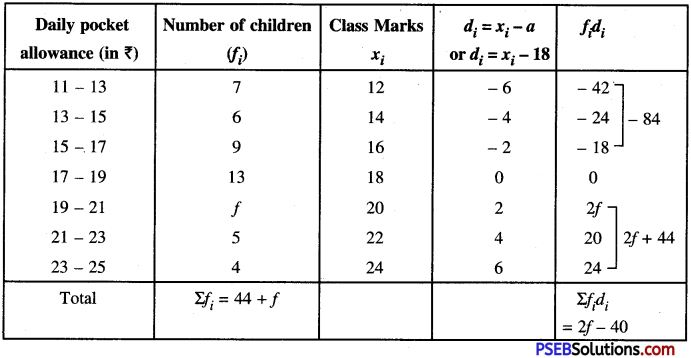
PSEB 10th Class Maths Solutions Chapter 14 Statistics Ex 14.1 6

From the above data,
Assumed mean (a) = 18
Using formula, Mean \((\overline{\mathrm{X}})=a+\frac{\sum f_{i} d_{i}}{\Sigma f_{i}}\)

\(\bar{X}=18+\frac{2 f-40}{44+f}\)
But. Mean of data \((\bar{x})\) = 18 …(Given)
∴ 18 = 18 + \(\frac{2 f-40}{44+f}\)
or \(\frac{2 f-40}{44+f}\) = 18 – 18 = 0
or 2f – 40 = 0
or 2f = 40
or f = \(\frac{40}{2}\) = 20
Hence, missing frequency f is 20.

PSEB Solutions PSEB 10th Class Maths Solutions Chapter 14 Statistics Ex 14.2

Question 4.
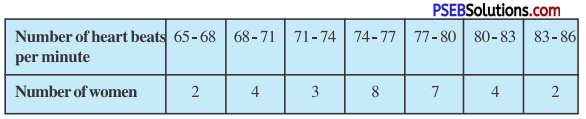
Thirty women were examined in a hospital by a doctor and the number of heart beats per minute were recorded and summarised as follows. Find the mean heart beats per minute for these women, choosing a suitable method.

PSEB 10th Class Maths Solutions Chapter 14 Statistics Ex 14.1 7

Solution:

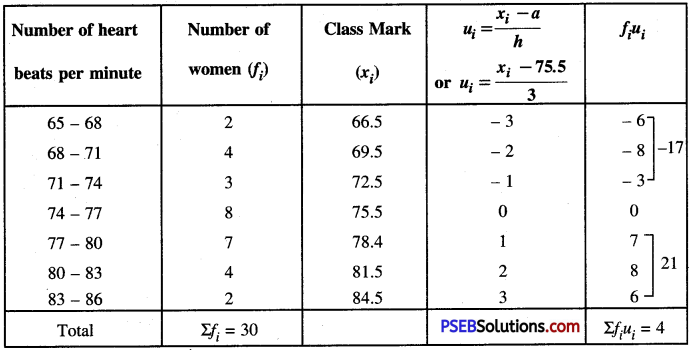
PSEB 10th Class Maths Solutions Chapter 14 Statistics Ex 14.1 8

From above data,
Assumed Mean (a) = 75.5
Width of Class (h) = 3
∴ \(\bar{u}=\frac{\sum f_{i} u_{i}}{\sum f_{i}}\)
= \(\frac{4}{30}\) (approx.)
Using formula,
Mean \((\overline{\mathrm{X}})=a+h \bar{u}\)
= 75.5 + 3 (0.13) = 75.5 + 0.39
\(\overline{\mathrm{X}}\) = 75.89
Hence, mean heart beats per minute for women is 75.89.

PSEB Solutions PSEB 10th Class Maths Solutions Chapter 14 Statistics Ex 14.2

Question 5.
In a retail market, fruit vendors were selling mangoes kept in packing boxes. These boxes contained varying number mangoes. The following was the distribution of mangoes according to the number of boxes.

PSEB 10th Class Maths Solutions Chapter 14 Statistics Ex 14.1 9

Find the mean number of mangoes kept in a packing box. Which method of finding the mean did you choose?
Solution:
Since, values of number of mamgoes and number of boxes are large numerically. So, we must use step-deviation method.

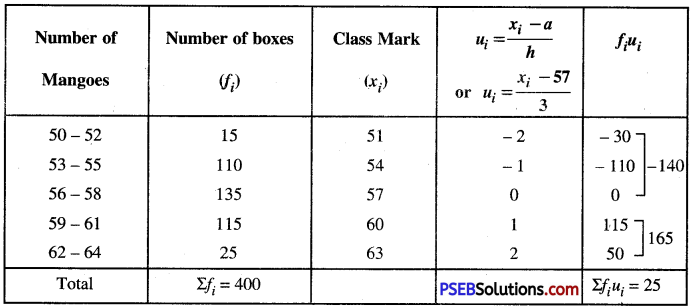
PSEB 10th Class Maths Solutions Chapter 14 Statistics Ex 14.1 10

From above data,
Assumed Mean (a) = 57
Width of class (h) = 3
∴ \(\bar{u}=\frac{\sum f_{i} u_{i}}{\sum f_{i}}\)

\(\bar{u}=\frac{25}{400}\) = 0.0625

Using formula, Mean \((\overline{\mathrm{X}})=a+h \bar{u}\)
\(\bar{X}\) = 57 + 3(0.0625)
= 57 + 0.1875 = 57.1875 = 57.19.
Hence, mean number of mangoes kept in a packing box is 57.19.

PSEB Solutions PSEB 10th Class Maths Solutions Chapter 14 Statistics Ex 14.2

Question 6.
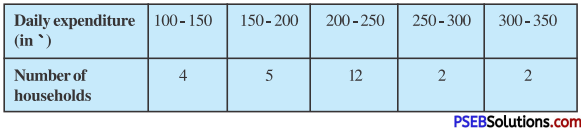
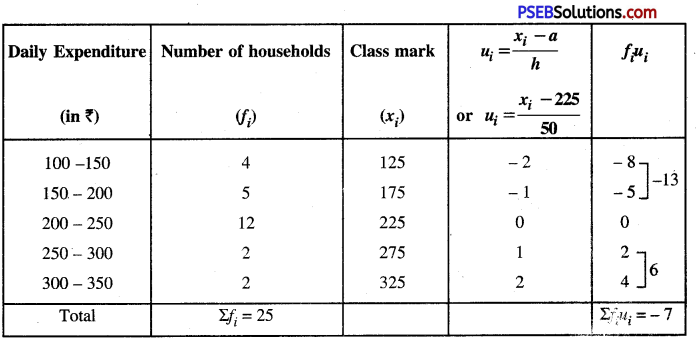
The table below shows the daily expenditure on food of 25 households in a locality.

PSEB 10th Class Maths Solutions Chapter 14 Statistics Ex 14.1 11

Find the mean daily expenditure on food by a suitable method.

Solution:

PSEB 10th Class Maths Solutions Chapter 14 Statistics Ex 14.1 12

From above data,
Assumed mean (a) = 225
Width of class (h) = 50
∴ \(\bar{u}=\frac{\Sigma f_{i} u_{i}}{\Sigma f_{i}}\)

\(\bar{u}=-\frac{7}{25}\) = 0.28
Using formula,
Mean \((\overline{\mathrm{X}})=a+h \bar{u}\)
\(\bar{X}\) = 225 + 50 (- 0.28)
\(\bar{X}\) = 225 – 14
\(\bar{X}\) = 211
Hence, mean daily expenditure on food is ₹ 211.

PSEB Solutions PSEB 10th Class Maths Solutions Chapter 14 Statistics Ex 14.2

Question 7.
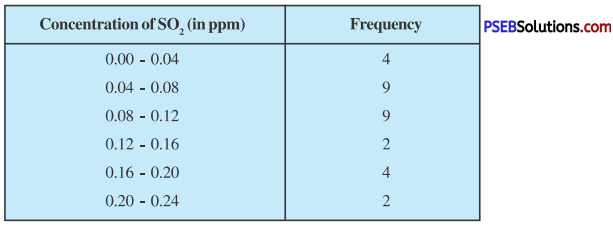
To find out the concentration of SO2 in the air (in parts per million, e., ppm), the data was collected for 30 localities in a certain city and is presented below:

PSEB 10th Class Maths Solutions Chapter 14 Statistics Ex 14.1 13

Find the mean concentration of SO2 in the air.
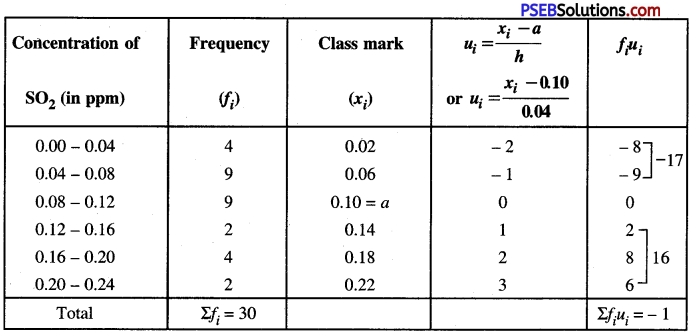
Solution:

PSEB 10th Class Maths Solutions Chapter 14 Statistics Ex 14.1 14

From above data,
Assumed mean (a) = 0.10
Width of class (h) = 0.04
∴ \(\bar{u}=\frac{\Sigma f_{i} u_{i}}{\Sigma f_{i}}\)

\(\bar{u}=-\frac{1}{30}\) = – 0.33(approx.)
Using formula, Mean \((\overline{\mathrm{X}})=a+h \bar{u}\)
\(\bar{X}\) = 0.10 + 0.04 (- 0.33)
= 0.10 – 0.0013 = 0.0987 (approx.)
Hence, mean concentration of SO2 in the air is 0.0987 ppm.

PSEB Solutions PSEB 10th Class Maths Solutions Chapter 14 Statistics Ex 14.2

Question 8.
A class teacher has the folloing absentee record of 40 students of a class for the whole term. Find the mean number of days a student was absent.

PSEB 10th Class Maths Solutions Chapter 14 Statistics Ex 14.1 15

Solution:

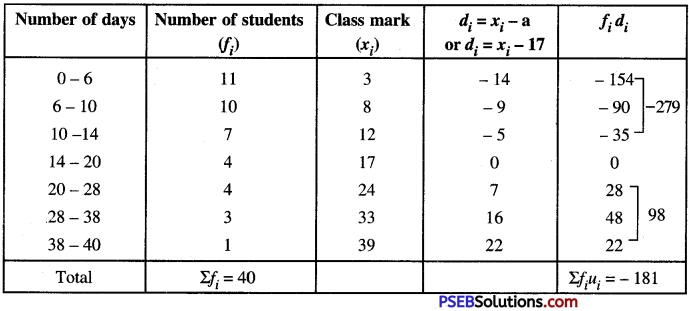
PSEB 10th Class Maths Solutions Chapter 14 Statistics Ex 14.1 16

From above data,
Assumed Mean (a) = 17
Using formula, Mean(\(\bar{X}\)) = a + \(\frac{\Sigma f_{i} d_{i}}{\Sigma f_{i}}\)
\(\bar{X}\) = 17 + \(-\frac{181}{40}\)
= 17 – 4.52 = 12.48.
Hence, mean 12.48 number of days a student was absent.

PSEB Solutions PSEB 10th Class Maths Solutions Chapter 14 Statistics Ex 14.2

Question 9.
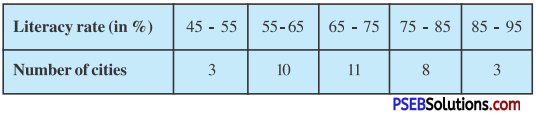
The following table gives the literacy rate (in percentage) of 35 citIes. Find the mean literacy rate.

PSEB 10th Class Maths Solutions Chapter 14 Statistics Ex 14.1 17

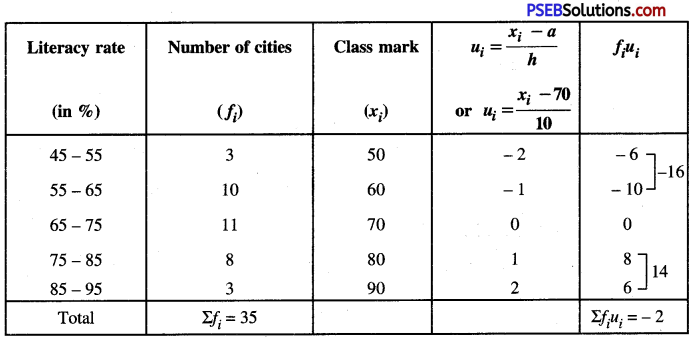
Solution:

PSEB 10th Class Maths Solutions Chapter 14 Statistics Ex 14.1 18

From the above data,
Assumed Mean (a) = 70
Width of class (h) = 10
∴ \(\bar{u}=\frac{\Sigma f_{i} u_{i}}{\Sigma f_{i}}=\frac{-2}{35}\) = – 0.057

Using formula, Mean \((\overline{\mathrm{X}})=a+h \bar{u}\)
\(\bar{X}\) = 70 + 10 (- 0.057)
= 70 – 0.57 = 69.43
Hence, mean literacy rate is 69.43%.