PSEB 9th Class Maths Solutions Chapter 11 Constructions Ex 11.1

Punjab State Board PSEB 9th Class Maths Book Solutions Chapter 11 Constructions Ex 11.1 Textbook Exercise Questions and Answers.

PSEB Solutions for Class 9 Maths Chapter 11 Constructions Ex 11.1

Question 1.
Construct an angle of 90° at the initial point of a given ray and justify the construction.
Answer:
PSEB 9th Class Maths Solutions Chapter 11 Constructions Ex 11.1 1

Steps of construction :

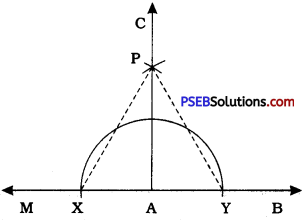
  1. Ray AB is given. Produce ray AB on the side of A to get line MAB.
  2. Taking A as centre and some radius, draw an arc of a circle to intersect line MAB at X and Y.
  3. Taking X and Y as centres and radius more than \(\frac{1}{2}\)XY, draw arcs to intersect at P on one side of line MAB.
  4. Draw ray AC passing through E
    Thus, ∠CAB is the required angle of 90°.

Justification:
Draw PX and PY.
In ∆ PAX and ∆ PAY,
AX = AY (Radii of same arc)
PX = PY (Radii of congruent arcs)
PA = PA (Common)
∴ By SSS rule, ∆ PAX ≅ ∆ PAY
∴ ∠PAX = ∠PAY (CPCT)
But, ∠PAX + ∠PAY = 180° (Linear pair)
∴ ∠PAY = \(\frac{180^{\circ}}{2}\) = 90°
∴ ∠CAB = 90°

PSEB 9th Class Maths Solutions Chapter 11 Constructions Ex 11.1

Question 2.
Construct an angle of 45° at the initial point of a given ray and justify the construction.
Answer:
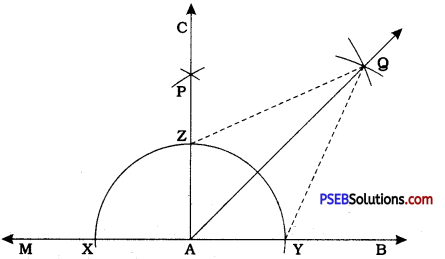
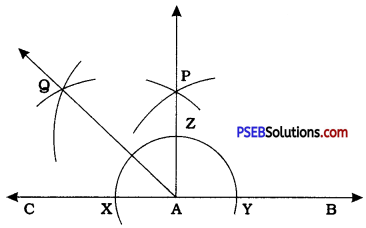
PSEB 9th Class Maths Solutions Chapter 11 Constructions Ex 11.1 2

Steps of construction:

  1. Ray AB is given. Produce ray AB on the side of A to get line MAB.
  2. Taking A as centre and some radius, draw an arc of a circle to intersect line MAB at X and Y.
  3. Taking X and Y as centres and radius more than \(\frac{1}{2}\)XY, draw arcs to intersect at P on one side of line MAB.
  4. Draw ray AC passing through E Thus, ∠CAB of 90° is received.
  5. Name the point of intersection of the arc with centre A and ray AC as Z.
  6. Taking Y and Z as centres and radius more than \(\frac{1}{2}\)YZ, draw arcs to intersect each other at Q.
  7. Draw ray AQ.
    Thus, ∠QAB is the required angle of 45°.

Justification:
In example 1, we have already justified that ∠CAB = 90°. So, we do not repeat that part’ here.
Draw QZ and QY.
In ∆ AYQ and ∆ AZQ,
AY = AZ (Radii of same arc)
YQ = ZQ (Radii of congruent arcs)
AQ = AQ (Common)
∴ By SSS rule, ∆ AYQ ≅ ∆ AZQ
∴ ∠QAY = ∠QAZ (CPCT)
But, ∠QAY + ∠QAZ = ∠ZAY = ∠CAB = 90°
∴ ∠QAY = \(\frac{90^{\circ}}{2}\) = 45°
∴ ∠QAB = 45°

PSEB 9th Class Maths Solutions Chapter 11 Constructions Ex 11.1

Question 3.
Construct the angles of the following measurements:
(i) 30°
Answer:
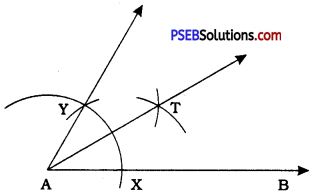
PSEB 9th Class Maths Solutions Chapter 11 Constructions Ex 11.1 3

Steps of construction:

  1. Draw any ray AB. With centre A and any radius, draw an arc to intersect AB at X.
  2. With centre X and the same radius [as in step (1)], draw an arc to intersect the previous arc at Y. Draw ray AY. Then, ∠YAB = 60°.
  3. Draw ray AT, the bisector of ∠YAB.
    Thus, ∠TAB is the required angle of 30°.

(ii) 22\(\frac{1}{2}\)°
Answer:
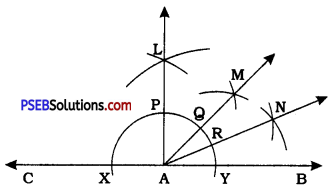
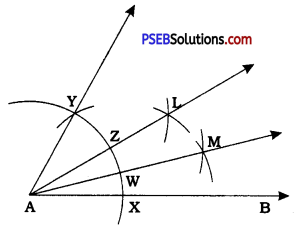
PSEB 9th Class Maths Solutions Chapter 11 Constructions Ex 11.1 4

Steps of construction:

  1. Draw any ray AB. Produce AB on the side of A to get line CAB.
  2. Taking A as centre and any radius, draw an arc of a circle to intersect line CAB at X and Y.
  3. Taking X and Y as centres and radius more than \(\frac{1}{2}\)XY, draw arcs to intersect each other at L on one side of line CAB. Draw ray AL. Then, ∠LAB = 90°.
  4. Draw ray AM, the bisector of ∠LAB. Then, ∠MAB = 45°.
  5. Draw ray AN, the bisector of ∠MAB. Then, ∠NAB = 22\(\frac{1}{2}\)°.
    Thus, ∠NAB is the required angle of 22\(\frac{1}{2}\)°.

PSEB 9th Class Maths Solutions Chapter 11 Constructions Ex 11.1

(iii) 15°
Answer:
PSEB 9th Class Maths Solutions Chapter 11 Constructions Ex 11.1 5

Steps of construction:

  1. Draw any ray AB. Taking A as centre and any radius, draw an arc of a circle to intersect AB at X.
  2. Taking X as centre and the same radius as before, draw an arc to intersect the previous arc at Y. Draw ray AY. Then, ∠YAB = 60°.
  3. Draw ray AL, the bisector of ∠YAB. Then, ∠LAB = 30°.
  4. Draw ray AM, the bisector of ∠LAB. Then, ∠MAB = 15°.
    Thus, ∠MAB is the required angle of 15°.

Question 4.
Construct the following angles and verify by measuring them by a protractor:
(i) 75° and (ii) 105°
Answer:
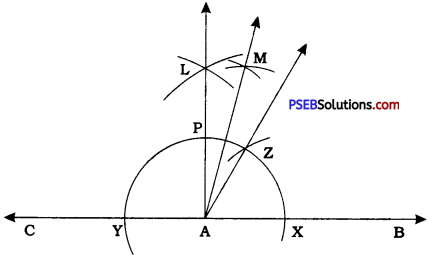
PSEB 9th Class Maths Solutions Chapter 11 Constructions Ex 11.1 6
Steps of construction:

  1. Draw any ray AB and produce it on the side of A to get line CAB. Taking A as centre and any radius draw an arc of a circle to intersect line CAB at X and Y.
  2. Taking X and Y as centres and radius more than \(\frac{1}{2}\)XY, draw arcs to intersect each other at point L on one side of line CAB. Draw ray AL. Then, ∠LAB = 90°.
  3. Taking X as centre and radius AX, draw an arc of a circle to Intersect the first arc (arc XY) with centre A at Z.
  4. Draw ray AZ. Then, ∠ZAB = 60°.
  5. Now, draw ray AM, the bisector of ∠LAZ. Then, ∠MAB = 75° and ∠MAC = 105°.
    Thus, ∠MAB and ∠MAC are the required angles of measure 75° and 105° respectively.

PSEB 9th Class Maths Solutions Chapter 11 Constructions Ex 11.1

(iii) 135°
Answer:
PSEB 9th Class Maths Solutions Chapter 11 Constructions Ex 11.1 7

Steps of construction:

  1. Draw line CAB. Taking A as centre and any radius, draw an arc of a circle to Intersect line CAB at X and Y.
  2. Taking X and Y as centres and radius more them \(\frac{1}{2}\)XY, draw arcs to intersect each other at P on one side of line CAB.
  3. Draw ray AP Then, ∠PAB = ∠PAC = 90°.
  4. Draw ray AQ, the bisector of ∠PAC.
  5. Then, ∠QAB = 135°.
    Thus, ∠QAB is the required angle of 135°.

PSEB 9th Class Maths Solutions Chapter 11 Constructions Ex 11.1

Question 5.
Construct an equilateral triangle, given its side and justify the construction.
Answer:
Line segment XY is given. We have to construct an equilateral triangle with each side being equal to XY.
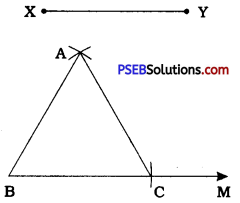
PSEB 9th Class Maths Solutions Chapter 11 Constructions Ex 11.1 8

Steps of construction:

  1. Draw any ray BM.
  2. With centre B and radius XY, draw an arc of a circle to intersect BM at C.
  3. Taking B and C as centres and rhdius XY, draw arcs to intersect each other at A on one side of line AC.
  4. Draw AB and AC.
    Thus, ∆ ABC is the required equilateral triangle with each side being equal to XY.

Justification:
The arc drawn with centre B and radius XY intersects ray BM at C. ∴ BC = XY. The arcs drawn with centres B and C and radius XY intersect at A.
∴ AB = XY and AC = XY.
Thus, in ∆ ABC, AB = BC = AC = XY.
Hence, ∆ ABC is an equilateral triangle in which all sides are equal to XY.
Note: If the measure of sides are given numerically, e.g., 4 cm, 5 cm, etc., then we have to use graduated scale instead of straight edge.
PSEB 10th Class Maths Solutions Chapter 6 Triangles Ex 6.4

Punjab State Board PSEB 10th Class Maths Book Solutions Chapter 6 Triangles Ex 6.4 Textbook Exercise Questions and Answers.

PSEB Solutions for Class 10 Maths Chapter 6 Triangles Ex 6.4

Question 1.
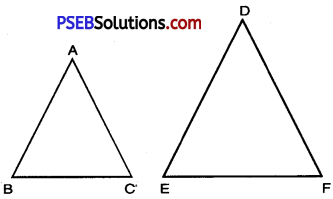
Let △ABC ~ △DEF and their areas be respectively 64 cm2 and 121 cm2. If EF = 15.4 cm, find BC.
Solution:
△ABC ~ △DEF ;
area of △ABC = 64 cm2;
area of △DEF = 121 cm2;
EF= 15.4 cm

PSEB 10th Class Maths Solutions Chapter 6 Triangles Ex 6.4 1

△ABC ~ △DEF

∴ \(\frac{\text { ar. }(\Delta \mathrm{ABC})}{\text { ar. }(\Delta \mathrm{DEF})}=\frac{\mathrm{AB}^{2}}{\mathrm{DE}^{2}}=\frac{\mathrm{AC}^{2}}{\mathrm{DF}^{2}}=\frac{\mathrm{BC}^{2}}{\mathrm{EF}^{2}}\)
(If two traingles are similar, ratio of their area is square of corresponding sides }

\(\frac{64}{121}=\frac{\mathrm{BC}^{2}}{\mathrm{EF}^{2}}\) \(\left(\frac{8}{11}\right)^{2}=\left(\frac{\mathrm{BC}}{15.4}\right)^{2}\)

⇒ \(\frac{8}{11}=\frac{\mathrm{BC}}{15.4}\)

BC = \(\frac{8 \times 15.4}{11}\)
BC = 8 × 1.4
BC = 11.2 cm.

PSEB Solutions PSEB 10th Class Maths Solutions Chapter 6 Triangles Ex 6.4

Question 2.
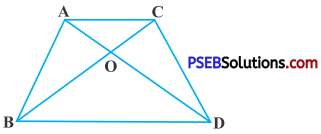
Diagonals of a trapezium ABCD with AB || DC intersect each other at the point O. If AB = 2 CD. Find the ratio of the areas of traingles AOB and COD.
Solution:
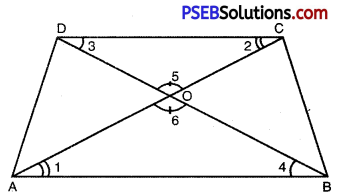
ABCD is trapezium AB || DC. Diagonals AC and BD intersects each other at the point O. AB = 2 CD

PSEB 10th Class Maths Solutions Chapter 6 Triangles Ex 6.4 2

In △AOB and △COD,
∠1 = ∠2 (alternate angles)
∠3 = ∠4 (alternate angles)
∠5 = ∠6 (vertically opposite angle)
∴ △AOB ~ △COD [AA, A similarity criterion]

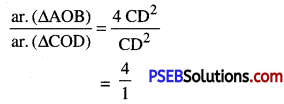
PSEB 10th Class Maths Solutions Chapter 6 Triangles Ex 6.4 10

(If two triangles are similar ratio of their areas is square of corresponding sides)

= \(\frac{(2 \mathrm{CD})^{2}}{\mathrm{CD}^{2}}\) [∵ AB = 2 CD] (Given)

PSEB 10th Class Maths Solutions Chapter 6 Triangles Ex 6.4 11

∴ Required ratio of ar △AOB and △COD = 4 : 1.

PSEB Solutions PSEB 10th Class Maths Solutions Chapter 6 Triangles Ex 6.4

Question 3.
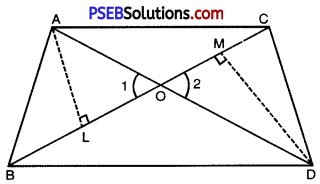
In the fig., △ABC and △DBC are two triangles on the same base BC. If AD intersects BC at O show that

PSEB 10th Class Maths Solutions Chapter 6 Triangles Ex 6.4 12

PSEB 10th Class Maths Solutions Chapter 6 Triangles Ex 6.4 3

Solution:
Given. ∆ABC and ∆DBC are the triangles on same base BC. AD intersects BC at O

PSEB 10th Class Maths Solutions Chapter 6 Triangles Ex 6.4 4

To Prove: PSEB 10th Class Maths Solutions Chapter 6 Triangles Ex 6.4 12
Construction: Draw AL ⊥ BC, DM ⊥ BC
Proof: In ∆ALO and ∆DMO.
∠1 = ∠2 (vertically opposite angle)
∠L = ∠M (each 90°)
∴ ∆ALO ~ ∆DMO [AA similarity criterion]
∴ \(\frac{\mathrm{AL}}{\mathrm{DM}}=\frac{\mathrm{AO}}{\mathrm{DO}}\) ……………(1)
[If two triangles are similar, corrosponding sides are proportional

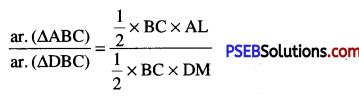
PSEB 10th Class Maths Solutions Chapter 6 Triangles Ex 6.4 13

[∵ ∆ = \(\frac{1}{2}\) × b × p]

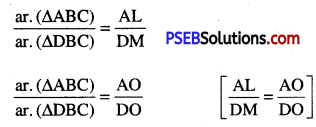
PSEB 10th Class Maths Solutions Chapter 6 Triangles Ex 6.4 14

Hence proved.

PSEB Solutions PSEB 10th Class Maths Solutions Chapter 6 Triangles Ex 6.4

Question 4.
If the areas of two similar triangles are equal, prove that they are congruent.
Solution:
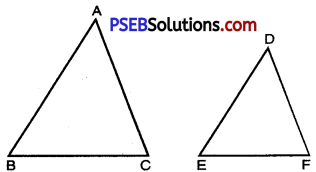
Given: Two ∆s ABC and DEF are similar and equal in area.
To Prove : ∆ABC ≅ ∆DEF

PSEB 10th Class Maths Solutions Chapter 6 Triangles Ex 6.4 5

Proof: Since ∆ABC ~ ∆DEF,
∴ \(\frac{\text { area }(\Delta \mathrm{ABC})}{\text { area }(\Delta \mathrm{DEF})}=\frac{\mathrm{BC}^{2}}{\mathrm{EF}^{2}}\)

⇒ \(\frac{\mathrm{BC}^{2}}{\mathrm{EF}^{2}}=1\) [∵ area (∆ABC) = area (∆DEF)]
⇒ BC2 = EF2
⇒ BC = EF.
Also, since ∆ABC ~ ∆DEF,
therefore they are equiangular and hence
∠B = ∠E
and ∠C = ∠F.
Now in ∆s ABC and DEF,
∠B = ∠E, ∠C = ∠F
and BC = EF
∴ ∆ABC ≅ ∆DEF (ASA congruence).

PSEB Solutions PSEB 10th Class Maths Solutions Chapter 6 Triangles Ex 6.4

Question 5.
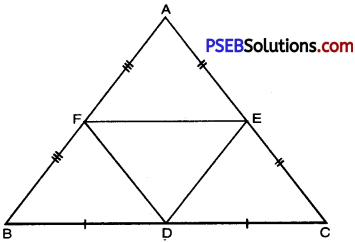
D, E and F are respectively the mid points of the sides BC, CA and AB of ∆ABC. Determine the ratio of the areas of triangles DEF and ABC.
Solution:

PSEB 10th Class Maths Solutions Chapter 6 Triangles Ex 6.4 6

Given. D, E, F are the mid-point of the sides BC, CA and AB respectively of a tABC.
To find : ar (∆DEE) : ar (∆ABC)
Proof: In ∆ABC,
F is the mid-point of AB …(given)
E is the mid-point of AC …(given)
So, by the Mid-Foint Theorem
FE || BC and FE = \(\frac{1}{2}\) BC
⇒ FE || BD and FE = BD [∵ BD = \(\frac{1}{2}\) BC]
∴ BDEF is a || gm.
(∵ Opp. sides are || and equal)
In △s FBD and DEF,
FB = DE (opp. sides of || gm BDEF)
FD = FD .. .(common)
BD = FE
. ..(opp. sides of || gm BDEF)
∴ △FBD ≅ △DEF … (SSS Congruency Theorem)

Similary we can prove that:
△AFE ≅ △DEF
and △EDC ≅ △DEF
if △s are , then they are equal in area.
∴ ar (∆FBD) = ar. (∆DEF) ……………(1)
ar (∆AFE) = ar (∆DEF) ……………(2)
ar (∆EDC) = ar (∆DEF) ……………(3)
Now ar ∆ (ABC)
= ar (∆FBD) + ar (∆DEF) + ar (∆AFE) + ar (∆EDC)
= ar.(∆DEF) + ar (∆DEF) + ar (∆DEF) + ar. (∆DEF) [Using (1), (2) and (3)]
= 4 ar (∆DEF)
⇒ (∆DEF) = \(\frac{1}{4}\) ar(∆ABC)
⇒ \(\frac{{ar} .(\Delta \mathrm{DEF})}{{ar} .(\Delta \mathrm{ABC})}=\frac{1}{4}\)
∴ ar (∆DEF) : ar (∆ABC) = 1 : 4.

PSEB Solutions PSEB 10th Class Maths Solutions Chapter 6 Triangles Ex 6.4

Question 6.
Prove that the ratio of the areas of two similar triangles is equal to the square of the ratio of their corresponding medians.
Solution:
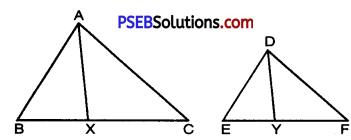
Given: ∆ABC ~ ∆DEF.
AX and DY are the medians to the side BC and EF respectively.

PSEB 10th Class Maths Solutions Chapter 6 Triangles Ex 6.4 7

To prove: \(\frac{{ar} .(\Delta \mathrm{ABC})}{{ar} .(\Delta \mathrm{DEF})}=\frac{\mathrm{AX}^{2}}{\mathrm{DY}^{2}}\)
Proof: ∆ABC ~ ∆DEF (Given)
∴ \(\frac{\mathrm{AB}}{\mathrm{DE}}=\frac{\mathrm{BC}}{\mathrm{EF}}=\frac{2 \mathrm{BX}}{2 \mathrm{EY}}\)
[∵ AX and DY are medians
∴ BC = 2BX and EF = 2EY]

⇒ \(\frac{\mathrm{AB}}{\mathrm{DE}}=\frac{\mathrm{BX}}{\mathrm{EY}}\) ………………(1)
In ∆ABX and ∆DEY, [∵ ∆ABC ~ ∆DEF]
\(\frac{\mathrm{AB}}{\mathrm{DE}}=\frac{\mathrm{BX}}{\mathrm{EY}}\) [Prove in (1)]
∴ ∆ABC ~ ∆DEY [By SAS criterion of similarity]
∴ \(\frac{\mathrm{AB}}{\mathrm{DE}}=\frac{\mathrm{AX}}{\mathrm{DY}}\) …………(2)
As the areas of two similar triangles are proportional to the squares of the corresponding sides, so
∴ \(\frac{{ar} .(\Delta \mathrm{ABC})}{{ar} .(\Delta \mathrm{DEF})}=\frac{\mathrm{AB}^{2}}{\mathrm{DE}^{2}}=\frac{\mathrm{AX}^{2}}{\mathrm{D} \mathrm{Y}^{2}}\)
Hence proved.

PSEB Solutions PSEB 10th Class Maths Solutions Chapter 6 Triangles Ex 6.4

Question 7.
Prove that the areas of the equilateral triangle described on the side of a square Is half the area of the equilateral triangle described on its diagonal.
Solution:
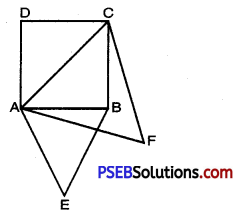
Given: ABCD is a square. Equilateral ∆ABE is described on the side AB of the square and equilateral ∆ACF is desribed on the diagonal AC.
PSEB 10th Class Maths Solutions Chapter 6 Triangles Ex 6.4 8

To prove: \(\frac{{ar} .(\Delta \mathrm{ABE})}{{ar} .(\Delta \mathrm{ACF})}=\frac{1}{2}\)
Proof: In rt. ∆ABC,
⇒ AB2 + BC2 = AC2 [By Pathagoras theorem]
= AB2 + AB2 = AC2 [∵ AB = BC, being the sides of the same square]
⇒ 2AB2 = AC2 ………….(1)
Now each of ∆ABE and ∆ACF are equilateral and therefore equiangular and hence similar.
i.e., ∆ABE ~ ∆ACF.
Here any side of one ∆ is proportional to any side of other.
∴ \(\frac{\text { ar. }(\Delta \mathrm{ABE})}{\text { ar. }(\Delta \mathrm{ACF})}=\frac{\mathrm{AB}^{2}}{\mathrm{AC}^{2}}\)

[∵ The ratio of the areas of two similar∆s is equal to their corresponding sides]
= \(\frac{\mathrm{AB}^{2}}{2 \mathrm{AB}^{2}}=\frac{1}{2}\) [Using (1)]

PSEB Solutions PSEB 10th Class Maths Solutions Chapter 6 Triangles Ex 6.4

Question 8.
Tick the correct answer and justify: ABC and BDE are two equilateral triangles such that D is the mid point of BC. Ratio of the areas of triangles ABC and BDE is
(A) 2 : 1
(B) 1 : 2
(C) 4 : 1
(D) 1 : 4.
Solution:
∆ABC and ∆BDE are two equilateral thangles. D is mid point of BC.
∴ BD = DC = \(\frac{1}{2}\) BC,
Let each side of triangles are 2a
∴ ∆ABC ~ ∆BDE
∴ \(\frac{\text { ar. }(\Delta \mathrm{ABC})}{\text { ar. }(\triangle \mathrm{BDE})}=\frac{\mathrm{AB}^{2}}{\mathrm{BD}^{2}}\)

= \(\frac{(2 a)^{2}}{(a)^{2}}\)
= \(\frac{4 a^{2}}{a^{2}}\)
= \(\frac{4}{1}\) = 4 : 1
∴ Correct option is (C).

PSEB Solutions PSEB 10th Class Maths Solutions Chapter 6 Triangles Ex 6.4

Question 9.
Tick the correct answer and justify: Sides of two similar triangles are in the ratio 4 : 9. Areas of these triangles are ¡n the ratio
(A) 2 : 3
(B) 4 : 9
(C) 81 : 16
(D) 16 : 81.
Solution:

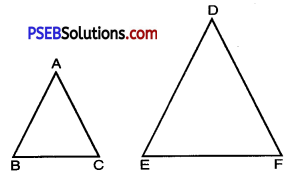
PSEB 10th Class Maths Solutions Chapter 6 Triangles Ex 6.4 9

∆ABC ~ ∆DEF (given)

\(\frac{\mathrm{AB}}{\mathrm{DE}}=\frac{\mathrm{AC}}{\mathrm{DF}}=\frac{\mathrm{BC}}{\mathrm{EF}}=\frac{4}{9}\)

∴ \(\frac{\text { ar. }(\Delta \mathrm{ABC})}{\text { ar. }(\Delta \mathrm{DEF})}=\frac{\mathrm{AB}^{2}}{\mathrm{DE}^{2}}\)

[If two triangles are similar ratio of their areas is equal to square of corresponding sides]
\(\frac{{ar} .(\Delta \mathrm{ABC})}{{ar} .(\Delta \mathrm{DEF})}=\left(\frac{4}{9}\right)^{2}\) = \(\frac{16}{81}\) = 16 : 81
∴ Correct option is (D).

PSEB 9th Class Maths MCQ Chapter 10 Circles

Punjab State Board PSEB 9th Class Maths Book Solutions Chapter 10 Circles MCQ Questions with Answers.

PSEB 9th Class Maths Chapter 10 Circles MCQ Questions

Multiple Choice Questions and Answer

Answer each question by selecting the proper alternative from those given below each question to make the statement true:

Question 1.
In a circle with centre P, AB and CD are congruent chords. If ∠PAB = 40°, then ∠CPD = ………………..
A. 40°
B. 80°
C. 100°
D. 50°
Answer:
C. 100°

PSEB 9th Class Maths MCQ Chapter 10 Circles

Question 2.
In a circle with radius 5 cm, the length of a chord lying at distance 4 cm from the centre is …………………. cm.
A. 3
B. 6
C. 12
D. 15
Answer:
B. 6

Question 3.
In a circle with radius 13 cm, the length of a chord is 24 cm. Then, the distance of the chord from the centre is ……………….. cm.
A. 10
B. 5
C. 12
D. 6.5
Answer:
B. 5

PSEB 9th Class Maths MCQ Chapter 10 Circles

Question 4.
In a circle with radius 7 cm, the length of a minor arc is always less than ………………… cm.
A. 11
B. 22
C. 15
D. π
Answer:
B. 22

Question 5.
In a circle with centre P, AB is a minor arc. Point R is a point other than A and B on major arc AB. If ∠APB = 150°, then ∠ARB = …………… .
A. 150°
B. 75°
C. 50°
D. 100°
Answer:
B. 75°

PSEB 9th Class Maths MCQ Chapter 10 Circles

Question 6.
In a circle with centre P, AB is a minor arc. Point R is a point other than A and B on major arc AB. If ∠ARB = 80°, then ∠APB = ……………. .
A. 40°
B. 80°
C. 160°
D. 60°
Answer:
C. 160°

Question 7.
In cyclic quadrilateral ABCD, ∠A – ∠C = 20°.
Then, ∠A = ………………. .
A. 20°
B. 80°
C. 100°
D. 50°
Answer:
C. 100°

PSEB 9th Class Maths MCQ Chapter 10 Circles

Question 8.
In cyclic quadrilateral PQRS, 7∠P = 2∠R.
Then, ∠P = ………………….. .
A. 20°
B. 40°
C. 140°
D. 100°
Answer:
B. 40°

Question 9.
The measures of two angles of a cyclic quadrilateral are 40° and HOP. Then, the measures of other two angles of the quadrilateral are ……………….. .
A. 40° and 110°
B. 50° and 100°
C. 140° and 70°
D. 20° and 120°
Answer:
C. 140° and 70°

PSEB 9th Class Maths MCQ Chapter 10 Circles

Question 10.
In cyclic quadrilateral PQRS, ∠SQR = 60° and ∠QPR = 20°. Then, ∠QRS = ……………… .
A. 40°
B. 60°
C. 80°
D. 100°
Answer:
D. 100°

Question 11.
In cyclic quadrilateral ABCD, ∠CAB = 30° and ∠ABC = 100°. Then, ∠ADB =
A. 50°
B. 100°
C. 75°
D. 60°
Answer:
A. 50°

PSEB 9th Class Maths MCQ Chapter 10 Circles

Question 12.
Equilateral ∆ ABC is inscribed in a circle with centre P. Then, ∠BPC = ……………. .
A. 60°
B. 90°
C. 120°
D. 75°
Answer:
C. 120°

Question 13.
∆ ABC is inscribed in a circle with centre O and radius 5 cm and AC is a diameter of the circle. If AB = 8 cm, then BC = ………………… cm.
A. 10
B. 8
C. 6
D. 15
Answer:
C. 6

PSEB 9th Class Maths MCQ Chapter 10 Circles

Question 14.
In cyclic quadrilateral ABCD, ∠A = 70° and ∠B + ∠C = 160°. Then, ∠B = ………………. .
A. 35°
B. 25°
C. 50°
D. 130°
Answer:
C. 50°

PSEB 9th Class Maths Solutions Chapter 10 Circles Ex 10.6

Punjab State Board PSEB 9th Class Maths Book Solutions Chapter 10 Circles Ex 10.6 Textbook Exercise Questions and Answers.

PSEB Solutions for Class 9 Maths Chapter 10 Circles Ex 10.6

Question 1.
Prove that the line segment joining the centres of two intersecting circles subtends equal angles at the two points of intersection.
Answer:
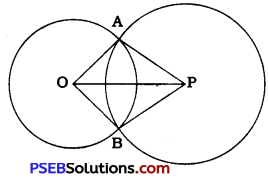
PSEB 9th Class Maths Solutions Chapter 10 Circles Ex 10.6 1
Circles with centres O and P intersect each other at points A and B.
In ∆ OAP and ∆ OBR
OA = OB (Radii of circle with centre O)
PA = PB (Radii of circle with centre P)
OP = OP (Common)
∴ By SSS rule, ∆ OAP = ∆ OBP
∴ ∠OAP = ∠OBP (CPCT)
Thus, OP subtends equal angles at A and B. Hence, the line segment joining the centres of two intersecting circles subtends equal angles at the two points of intersection.

PSEB 9th Class Maths Solutions Chapter 10 Circles Ex 10.6

Question 2.
Two chords AB and CD of lengths 5 cm and 11 cm respectively of a circle are parallel to each other and are on opposite sides of its centre. If the distance between AB and CD is 6 cm, find the radius of the circle.
Answer:
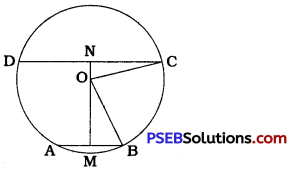
PSEB 9th Class Maths Solutions Chapter 10 Circles Ex 10.6 2
Draw the perpendicular bisector of AB to intersect AB at M and draw the perpendicular bisector of CD to intersect CD at N.
Both these perpendicular bisectors pass through centre O and since AB || CD; M, O and N are collinear points.
Now, MB = \(\frac{1}{2}\)AB = \(\frac{5}{2}\) = 2.5 cm,
CN = \(\frac{1}{2}\)CD = \(\frac{11}{2}\) = 5.5 cm and MN = 6 cm.
Let ON = x cm s
∴ OM = MN – ON = (6 – x) cm
Suppose the radius of the circle is r cm.
∴ OB = OC = r cm
In ∆ OMB, ∠M = 90°
∴OB2 = OM2 + MB2
∴ r2 = (6 – x)2 + (2.5)2
∴ r2 = 36 – 12x + x2 + 6.25 ………….. (1)
In ∆ ONC, ∠N = 90°
∴ OC2 = ON2 + CN2
∴ r2 = (x)2 + (5.5)2
∴ r2 = x2 + 30.25 ………………. (2)
From (1) and (2),
36 – 12x + x2 + 6.25 = x2 + 30.25
∴ – 12x = 30.25 – 6.25 – 36
∴- 12x = – 12
∴x = 1
Now, r2 = x2 + 30.25
∴ r2 = (1)2 + 30.25
∴ r2 = 31.25
∴ r = √31.25 (Approximately 5.6)
Thus, the radius of the circle is √31.25 (approximately 5.6) cm.
Note: If the calculations are carried out in simple fractions, then MB = \(\frac{5}{2}\) cm, CN = \(\frac{11}{2}\) cm and radius is \(\frac{5 \sqrt{5}}{2}\) (approximately 5.6) cm.

PSEB 9th Class Maths Solutions Chapter 10 Circles Ex 10.6

Question 3.
The lengths of two parallel chords of a circle are 6 cm and 8 cm. If the smaller chords is at distance 4 cm from the cehtre, what is the distance of the other chord from the centre?
Answer:
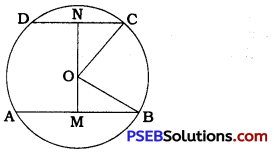
PSEB 9th Class Maths Solutions Chapter 10 Circles Ex 10.6 3
In a circle with centre O, chord AB is parallel to chord CD, AB = 8 cm and CD = 6 cm.
Draw OM ⊥ AB, ON ⊥ CD, radius OB and radius OC.
Then, MB = \(\frac{1}{2}\)AB = \(\frac{1}{2}\) × 8 = 4 cm,
NC = \(\frac{1}{2}\)CD = \(\frac{1}{2}\) × 6 = 3cm and ON = 4cm.
In ∆ ONC, ∠N = 90°
∴ OC2 = ON2 + NC2 = 42 + 32 = 16 + 9 = 25
∴ OC = 5 cm
∴ OB = 5 cm (OB = OC = Radius)
In ∆ OMB, ∠M = 90°
∴ OB2 = OM2 + MB2
∴ 52 = OM2 + 42
∴ 25 = OM2 + 16
∴ OM2 = 9
∴ OM = 3 cm
Thus, the distance of the other chord from the centre is 3 cm.

PSEB 9th Class Maths Solutions Chapter 10 Circles Ex 10.6

Question 4.
Let the vertex of an angle ABC be located outside a circle and let the sides of the angle intersect equal chords AD and CE with the circle. Prove that ∠ABC is equal to half the difference of the angles subtended by the chords AC and DE at the centre.
Answer:
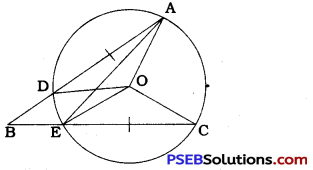
PSEB 9th Class Maths Solutions Chapter 10 Circles Ex 10.6 4
In ∆ ABE, ∠AEC is an exterior angle.
∴ ∠AEC = ∠ABE + ∠BAE
∴ ∠ABE = ∠AEC – ∠BAE
∴ ∠ABC = ∠AEC – ∠DAE ……………. (1)
Now, ∠AEC = \(\frac{1}{2}\) ∠AOC (Theorem 10.8)
and ∠ DAE = \(\frac{1}{2}\) ∠DOE (Theorem 10.8)
Substituting above values in (1),
∠ABC = \(\frac{1}{2}\) ∠AOC – \(\frac{1}{2}\)∠DOE
∴ ∠ABC = \(\frac{1}{2}\) (∠AOC – ∠DOE)
Here, ∠AOC is the angle subtended by chord AC at the centre and ∠DOE is the angle subtended by chord DE at the centre.
Thus, ∠ABC is equal to half the difference of the angles subtended by the chords AC and DE at the centre.
Note: There is no need for chords AD and CE to be equal.

PSEB 9th Class Maths Solutions Chapter 10 Circles Ex 10.6

Question 5.
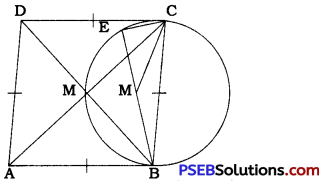
Prove that the circle drawn with any side of a rhombus as diameter passes through the point of intersection of its diagonals.
Answer:
PSEB 9th Class Maths Solutions Chapter 10 Circles Ex 10.6 5
ABCD is a rhombus and its diagonals intersect at M.
∴ ∠BMC is a right angle.
A circle is drawn with diameter BC.
There are three possibilities for point M:
(1) M lies in the interior of the circle,
(2) M lies in the exterior of the circle.
(3) M lies on the circle.
According to (1), if M lies in the interior of the circle, then BM produced will intersect the circle at E. Then, ∠BEC is an angle in a semicircle and hence a right angle, i.e.,
∠MEC = 90°.
In ∆ MEC, ∠ BMC is an exterior angle.
∴ ∠ BMC > ∠ MEC, i.e., ∠ BMC > 90°. In this situation, ∠ BMC is an obtuse angle which contradicts that ∠ BMC = 90°.
Similarly, according to (2), if M lies in the exterior of the circle, then ∠BMC is an acute angle which contradicts that ∠BMC 90°. Thus, possibilities (1) and (2) cannot be true.
Hence, only possibility (3) is true, i.e., M lies on the circle.
Thus, the circle drawn with any side of a rhombus as diameter passes through the point of intersection of its diagonals.

PSEB 9th Class Maths Solutions Chapter 10 Circles Ex 10.6

Question 6.
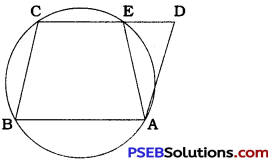
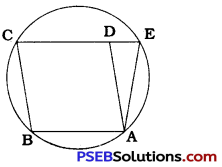
ABCD is a parallelogram. The circle through A, B and C intersects CD (produced if necessary at) E. Prove that AE = AD.
Answer:
PSEB 9th Class Maths Solutions Chapter 10 Circles Ex 10.6 6
Here, the circle through A, B and C intersects CD at E.
∴ Quadrilateral ABCE is cyclic.
ABCD is a parallelogram.
∴ ∠ABC = ∠ADC
∴ ∠ABC = ∠ADE
In cyclic quadrilateral ABCE,
∠ABC + ∠AEC = 180°
∴ ∠ADE + ∠AEC = 180° ……………… (1)
Moreover, ∠AEC and ∠AED form a linear pair.
∴ ∠AED + ∠AEC = 180° ………………. (2)
From (1) and (2),
∠ADE + ∠AEC = ∠AED + ∠AEC
∴ ∠ ADE = ∠ AED
Thus, in ∆ AED, ∠ADE = ∠AED.
∴ AE = AD (Sides opposite to equal angles)
Note: If the circle intersect CD produced, l then also the result can be proved in similar way.
PSEB 9th Class Maths Solutions Chapter 10 Circles Ex 10.6 7

PSEB 9th Class Maths Solutions Chapter 10 Circles Ex 10.6

Question 7.
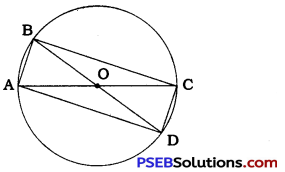
AC and BD are chords of a circle which bisect each other. Prove that (i) AC and BD are diameters, (ii) ABCD is a rectangle.
Answer:
PSEB 9th Class Maths Solutions Chapter 10 Circles Ex 10.6 8
Chords AC and BD of a circle bisect each other at point O.
Hence, the diagonals of quadrilateral ABCD bisect each other.
∴ Quadrilateral ABCD Is a parallelogram.
∴ ∠BAC = ∠ACD (Alternate angles formed by transversal AC of AB || CD)
Moreover, ∠ACD = ∠ABD (Angles in same segment)
∴ ∠BAC = ∠ABD
∴ ∠BAO = ∠ABO
∴ In A OAB, OA = OB.
But, OA = OC and OB = OD
∴ OA = OB = OC = OD
∴ OA + OC = OB + OD
∴ AC = BD
Thus, the diagonals of parallelogram ABCD are equal.
∴ ABCD is a rectangle.
∴ ∠ABC = 90°
Hence, ∠ABC is an angle in a semicircle and AC is a diameter.
Similarly, ∠BAD = 90°.
Hence, ∠BAD is an angle in a semicircle and BD is a diameter.

Question 8.
Bisectors of angles A, B and C of a triangle ABC intersect its circumcircle at D, E and F respectively. Prove that the angles of the triangle DEF are 90° – \(\frac{1}{2}\)A, 90° – \(\frac{1}{2}\)B and 90° – \(\frac{1}{2}\)C.
Answer:
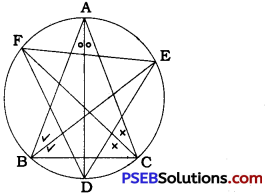
PSEB 9th Class Maths Solutions Chapter 10 Circles Ex 10.6 9
The bisectors of ∠A, ∠B and ∠ C of ∆ ABC intersect the circumcircle of ∆ ABC at D, E and F respectively. .
∠FDE = ∠FDA + ∠EDA (Adjacent angles)
= ∠ FCA + ∠ EBA (Angles in same segment)
= \(\frac{1}{2}\)∠C + \(\frac{1}{2}\)∠B (Bisector of angles in ∆ ABC)
= \(\frac{1}{2}\)(∠ B + ∠ C)
= \(\frac{1}{2}\)(180° – ∠A) [∠A + ∠B + ∠C = 180°)
= 90° – \(\frac{1}{2}\) ∠A
Thus, ∠FDE = 90° – \(\frac{1}{2}\) ∠A.
Similarly, ∠ DEF = 90° – \(\frac{1}{2}\) ∠B and
∠ EFD = 90° – \(\frac{1}{2}\) ∠C.

PSEB 9th Class Maths Solutions Chapter 10 Circles Ex 10.6

Question 9.
Two congruent circles intersect each Other at points A and B. Through A any line segment PAQ is drawn so that P 9 lie-on. , the two circles. Prove that BP = BQ.
Answer:
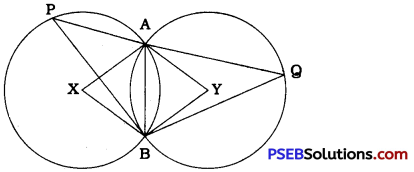
PSEB 9th Class Maths Solutions Chapter 10 Circles Ex 10.6 10
Two congruent circles with centres X and Y intersect at A and B.
Hence, AB is their common chord.
In congruent circles, equal chords subtend equal angles at the centres.
∴ ∠AXB = ∠AYB
In the circle with centre X, ∠AXB = 2∠APB and in the circle with centre Y, ∠AYB = 2∠AQB.
∴ 2∠ APB = 2∠ AQB
∴ ∠APB = ∠AQB
∴ ∠QPB = ∠PQB
Thus, in ∆ BPQ, ∠QPB = ∠PQB
∴ QB = PB (Sides opposite to equal angles)
Hence, BP = BQ.

PSEB 9th Class Maths Solutions Chapter 10 Circles Ex 10.6

Question 10.
In any triangle ABC, if the angle bisector of ∠A and perpendicular bisector of BC intersect, prove that they intersect on the circumcircle of the triangle ABC.
Answer:
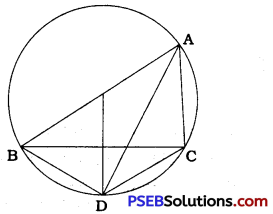
PSEB 9th Class Maths Solutions Chapter 10 Circles Ex 10.6 11
In ∆ ABC, the bisector of ∠A intersects the circumcircle of ∆ ABC at D.
∴∠BAD = ∠CAD
Aso, ∠BAD = ∠BCD and ∠CAD = ∠CBD (Angles in same segment)
∴ ∠BCD = ∠CBD
Thus, in ∆ BCD, ∠BCD = ∠CBD
∴BD = CD (Sides opposite to equal angles)
Thus, point D is equidistant from B and C.
Hence, D is a point on the perpendicular bisector of BC.
Thus, the bisector of ∠ A and the perpendicular bisector of side BC intersect at D and D is a point on the circumcircle of ∆ ABC.
Thus, in ∆ ABC, if the angle bisector of ∠A and the perpendicular bisector of side BC intersect, they intersect on the circumcircle of ∆ ABC.
Note: In ∆ ABC, if AB = AC, then the bisector of ∠A and the perpendicular bisector of side BC will coincide , and would not intersect in a single point.

PSEB 6th Class Maths Solutions Chapter 7 Algebra Ex 7.4

Punjab State Board PSEB 6th Class Maths Book Solutions Chapter 7 Algebra Ex 7.4 Textbook Exercise Questions and Answers.

PSEB Solutions for Class 6 Maths Chapter 7 Algebra Ex 7.4

1. Write the following statements as algebraic equations:

Question (i)
The sum of x and 3 gives 10.
Solution:
The sum of x and 3 = x + 3
It gives 10.
∴ The algebraic equation is x + 3 = 10

PSEB 6th Class Maths Solutions Chapter 7 Algebra Ex 7.4

Question (ii)
5 less than a number ‘a’ is 12.
Solution:
5 less than a number ‘a’ = a – 5
It is 12
∴ The algebraic equation is a – 5 = 12

Question (iii)
2 more than 5 times of p gives 32.
Solution:
2 more than 5 times of p = 5p + 2
It gives 32
∴ The algebraic equation is 5p + 2 = 32

Question (iv)
Half of a number is 10.
Solution:
Let Half of a number x = \(\frac {x}{2}\)
It is 10
∴ The algebraic equations is
\(\frac {x}{2}\) = 10

Question (v)
Twice of a number added to 3 gives 17.
Solution:
Let the number be x
Twice of a number added to 3 = 2x + 3
It gives 17
∴ The algebraic equation is 2x + 3 = 17

2. Write the L.H.S. and R.H.S. for the following equations:

Question (i)
l + 5 = 8
Solution:
L.H.S. = l + 5, R.H.S. = 8

PSEB 6th Class Maths Solutions Chapter 7 Algebra Ex 7.4

Question (ii)
13 = 2m + 3
Solution:
L.H.S. = 13, R.H.S. = 2m + 3

Question (iii)
\(\frac {t}{4}\) = 6
Solution:
L.H.S. = \(\frac {t}{4}\), R.H.S. = 6

Question (iv)
2h – 5 = 13
Solution:
L.H.S. = 2h – 5, R.H.S. = 13

Question (v)
\(\frac {5x}{7}\) = 15.
Solution:
L.H.S. = \(\frac {5x}{7}\), R.H.S. = 15.

3. Solve the following equations by trial and error method:

Question (i)
x + 2 = 7
Solution:
x + 2= l
We try different values of x to make L.H.S. = R.H.S.

Value of JC L.H.S. = x + 2 R.H.S. = 7 L.H.S. = R.H.S.
1 1+ 2 = 3 7 No
2 2 + 2 = 4 7 No
3 3 + 2 = 5 7 No
4 4 + 2 = 6 7 No
5 5 + 2 = 7 7 Yes

From the above table we find that L.H.S. = R.H.S. When x = 5

PSEB 6th Class Maths Solutions Chapter 7 Algebra Ex 7.4

Question (ii)
5p = 20
Solution:
5p = 20
We try different values of p to make L.H.S. = R.H.S.

Value of p L.H.S. = 5p R.H.S. = 20 L.H.S. = R.H.S.
1 5 × 1 = 5 20 No
2 5 × 2 = 10 20 No
3 5 × 3 = 15 20 No
4 5 × 4 = 20 20 Yes

From the above table we find that L.H.S. = R.H.S. When p = 4

Question (iii)
\(\frac {a}{5}\) = 2
Solution:
We try different values of a to make L.H.S. = R.H.S.
image
From the above table we find that L.H.S. = R.H.S. When a = 10

Question (iv)
2l – 4 = 8
Solution:
21-4 = 8
We try different values of l to make L.H.S. = R.H.S.

Value of a L.H.S. R.H.S. = 8 L.H.S. ff R.H.S.
1 2 × 1 – 4 = 2 – 4 = – 2 8 No
2 2 × 2 – 4 = 4 – 4 = 0 8 No
3 2 × 3 – 4 = 6 – 4 = 2 8 No
4 2 × 4 – 4 = 8 – 4 = 4 8 No
5 2 × 5 – 4 = 10 – 4 = 6 8 No
6 2 × 6 – 4  = 12 – 4 = 8 8 Yes

From the above table we find that L.H.S. = R.H.S. When l = 6

PSEB 6th Class Maths Solutions Chapter 7 Algebra Ex 7.4

Question (v)
3x + 2 = 11.
Solution:
3x + 2 = 11
We try different values of x to make L.H.S. = R.H.S.

Value of p L.H.S. = 3x + 2 R.H.S. = 11 L.H.S. = R.H.S.
1 3 × 1 + 2 = 3 + 2 = 5 11 No
2 3 × 2 + 2 = 6 + 2 = 8 11 No
3 3 × 3 + 2 = 9 + 2 = 11 11 Yes

From the above table we find thatL.H.S. = R.H.S. When x = 3

4. Solve the following equations by systematic method.

Question (i)
z – 4 = 10
Solution:
Given Equation is z – 4 = 10 Adding 4 on both sides, we get
2 – 4 + 4 = 10 + 4
⇒ z = 14 is the required solution.

Question (ii)
a + 3 = 15
Solution:
Given equation is a + 3 = 15
Subtracting 3 from both sides, we get
a + 3- 3 = 15 – 3
⇒ a = 12 is the required solution.

Question (iii)
4m = 20
Solution:
Given equation is 4m = 20
Dividing both sides by 4, we get
\(\frac{4 m}{4}=\frac{20}{4}\)
⇒ m = 5 is the required solution.

PSEB 6th Class Maths Solutions Chapter 7 Algebra Ex 7.4

Question (iv)
3x – 3 = 15
Solution:
Given equation is 3x – 3 = 15
Adding 3 on both sides, we get
3x – 3 + 3 = 15 + 3
⇒ 3x = 18
Dividing both sides by 3, we get
\(\frac{3x}{3}=\frac{18}{3}\)
⇒ x = 6 is the required solution.

Question (v)
4x + 5 = 13.
Solution:
Given equation is 4x + 5 = 13
Subtracting 5 from both sides, we get
4x + 5 – 5 = 13 – 5
⇒ 4x = 8
Dividing both sides by 4, we get
\(\frac{4 x}{4}=\frac{8}{4}\)
⇒ x = 2 is the required solution.

5. Solve the following equation by transposition:

Question (i)
x – 5 = 6
Solution:
Given equation : x – 5 = 6
∴ x = 6 + 5
(Transposing – 5 to other side, it becomes + 5)
⇒ x = 11 is the required solution.

PSEB 6th Class Maths Solutions Chapter 7 Algebra Ex 7.4

Question (ii)
y + 2 = 3
Solution:
Given equation : y + 2 = 3
⇒ y = 3 – 2
(Transposing + 2 to other side, it becomes – 2)
∴ y = 1 is the required solution.

Question (iii)
5x = 10
Solution:
Given equation : 5x = 10
⇒ x = \(\frac {10}{5}\)
(Transposing ‘multiplication’, it becomes ‘division’)
∴ x = 2 is the required solution.

Question (iv)
\(\frac {a}{6}\) = 4
Solution:
Given equation : \(\frac {a}{6}\) = 4
⇒ a = 4 × 6
(Transposing ‘division’, it becomes ‘multiplication’)
∴ a = 24 is the required solution.

Question (v)
4y – 2 = 30.
Solution:
Given equation : 4y – 2 = 30
⇒ 4y = 30 + 2
(Transposing – 2, it becomes + 2)
⇒ 4y = 32
⇒ y = \(\frac {32}{4}\)
(Transposing ‘multiplication’, it becomes division)
∴ y = 8 is the required solution.

PSEB 6th Class Maths Solutions Chapter 7 Algebra Ex 7.4

6. Solve the following equations:

Question (i)
x + 7 = 11
Solution:
Given equation :
x + 7 = 11
⇒ x = 11 – 7
(Transposing 7 to R.H.S.)
⇒ x = 4 is the required solution.

Question (ii)
x – 3 = 15
Solution:
Given equation : x – 3 = 15
⇒ x = 15 + 3
(Transposing – 3 to L.H.S. it becomes + 3)
∴ x = 18 is the required solution

Question (iii)
x – 2 = 13
Solution:
Given equation : x – 2 = 13
⇒ x = 13 + 2
(Transposing – 2 to L.H.S.)
∴ x = 15 is the required solution.

PSEB 6th Class Maths Solutions Chapter 7 Algebra Ex 7.4

Question (iv)
6x = 18
Solution:
Given equation is 6x = 18
Dividing both sides by 6 we get
\(\frac{6x}{6}=\frac{18}{6}\)
∴ x = 3 is the required solution.

Question (v)
3x = 24
Solution:
Given equation 3x = 24
Dividing both sides by 3, we get
\(\frac{3x}{3}=\frac{24}{3}\)
∴ x = 8 is the required solution.

Question (vi)
\(\frac {x}{4}\) = 7
Solution:
Given equation :
\(\frac {x}{4}\) = 7
Multiplying both sides by 4, we get
4 × \(\frac {x}{4}\) = 4 × 7
∴ x = 28 is the required solution.

Question (vii)
\(\frac {x}{8}\) = 5
Solution:
Given equation : \(\frac {x}{8}\) = 5
Multiplying both sides by 8, we get
8 × \(\frac {x}{8}\) = 8 × 5
∴ x = 40 is the required solution.

PSEB 6th Class Maths Solutions Chapter 7 Algebra Ex 7.4

Question (viii)
2x – 5 = 17
Solution:
Given equation : 2x – 5 = 17
⇒ 2x = 17 – 5
(Transposing – 5 to R.H.S.)
⇒ 2x = 22
⇒ x = \(\frac {22}{2}\)
(Dividing both sides by 2)
∴ x = 11 is the required solution.

Question (ix)
4x + 5 = 21
Solution:
Given equation : 4x + 5 = 21
⇒ 4x = 21 + 5
(Transposing 5 to R.H.S.)
⇒ 4x = 16
⇒ x = \(\frac {16}{4}\)
(Dividing both sides by 4)
∴ x = 4 is the required solution.

Question (x)
5x – 2 = 13.
Solution:
Given equation : 5x – 2 = 13
⇒ 5x = 13 + 2
(Transposing – 2 to R.H.S.)
⇒ 5x = 15
⇒ x = \(\frac {15}{5}\)
(Dividing both sides by 5)
∴ x = 3 is the required solution.

PSEB 7th Class Maths Solutions Chapter 13 Exponents and Powers Ex 13.1

Punjab State Board PSEB 7th Class Maths Book Solutions Chapter 13 Exponents and Powers Ex 13.1 Textbook Exercise Questions and Answers.

PSEB Solutions for Class 7 Maths Chapter 13 Exponents and Powers Ex 13.1

1. Fill in the blanks :

(i) In the expression 37, base = …………….. and exponent = ……………..
(ii) In the expression \(\left(\frac{2}{5}\right)^{11}\), base = …………….. and exponent = ……………..
Solution:
(i) 3, 7
(ii) \(\frac {2}{5}\), 11

2. Find the value of the following :
(i) 26
(ii) 93
(iii) 55
(iv) (-6)4
(v) \(\left(-\frac{2}{3}\right)^{5}\)
Solution:
(i) 26 = 2 × 2 × 2 × 2 × 2 × 2
= 64

(ii) 93 = 9 × 9 × 9
= 729

(iii) 55 = 5 × 5 ×5 × 5 × 5
= 3125

(iv) (-6)4 = -6 × -6 × -6 × -6
= 1296

(v) \(\left(-\frac{2}{3}\right)^{5}\) = \(\frac{-2}{3} \times \frac{-2}{3} \times \frac{-2}{3} \times \frac{-2}{3} \times \frac{-2}{3}\)
= \(-\frac{32}{243}\)

PSEB 7th Class Maths Solutions Chapter 13 Exponents and Powers Ex 13.1

3. Express the following in the exponential form :
(i) 6 × 6 × 6 × 6
(ii) b × b × b × b
(iii) 5 × 5 × 7 × 7 × 7
Solution:
(i) 6 × 6 × 6 × 6 = 64
(ii) b × b × b × b = b4
(iii) 5 × 5 × 7 × 7 × 7 = 52 × 73

4. Simplify the following :

(i) 2 × 10³
Solution:
2 × 103 = 2 × 10 × 10 × 10
= 2000

(ii) 52 × 32
Solution:
52 × 32 = 5 × 5 × 3 × 3
= 25 × 9
= 225

(iii) 32 × 104
Solution:
32 × 104 = 3 × 3 × 10000
= 90000

PSEB 7th Class Maths Solutions Chapter 13 Exponents and Powers Ex 13.1

5. Simplify :
(i) (-3) × (-2)3
Solution:
(-3) × (-2)3 = -3 × -2 × -2 × -2
= -3 × -8
= 24

(ii) (-4)3 × 52
Solution:
(-4)3 × 52= -4 × -4 × -4 × 5 × 5
= 64 × 25
= -1600

(iii) (-1)99
Solution:
(-1)99 = -1
[(-1)odd number = -1]

(iv) (-3)2 × (-5)2
Solution:
(-3)2 × (-5)2 = -3 × -3 × – 5 × -5
= 9 × 25
= 225

(v) (-1)132
Solution:
(-1)132 = 1
[(-1)even number = +1]

PSEB 7th Class Maths Solutions Chapter 13 Exponents and Powers Ex 13.1

6. Identify the greater number in each of the following :

(i) 43 or 34
Solution:
43 = 4 × 4 × 4 = 64
34 = 3 × 3 × 3 × 3 = 81
81 > 64
∴ 34 > 43.

(ii) 53 or 32
Solution:
53 = 5 × 5 × 5 = 125
32 = 3 × 3 = 9
125 > 9
∴ 53 > 32.

(iii) 23 or 82
Solution:
23 = 2 × 2 × 2 = 8
82 = 8 × 8 = 64
64 > 8
∴ 82 > 23.

(iv) 45 or 54
Solution:
45 = 4 × 4 × 4 × 4 × 4 = 1024
54 = 5 × 5 × 5 × 5 = 625
1024 > 625
∴ 45 > 54.

(v) 210 or 102
Solution:
210 = 2 × 2 × 2 × 2 × 2 × 2 × 2 × 2 × 2 × 2
= 1024
102 = 10 × 10 = 100
1024 > 100
∴ 210 > 102

PSEB 7th Class Maths Solutions Chapter 13 Exponents and Powers Ex 13.1

7. Write the following numbers as power of 2 :

(i) 8
Solution:
8 = 2 × 2 × 2
\(\begin{array}{c|c}
2 & 8 \\
\hline 2 & 4 \\
\hline 2 & 2 \\
\hline & 1
\end{array}\)
= 23

(ii) 128
Solution:
128 = 2 × 2 × 2 × 2 × 2 × 2 × 2
= 27
\(\begin{array}{l|l}
2 & 128 \\
\hline 2 & 64 \\
\hline 2 & 32 \\
\hline 2 & 16 \\
\hline 2 & 8 \\
\hline 2 & 4 \\
\hline 2 & 2 \\
\hline & 1
\end{array}\)

(iii) 1024
Solution:
1024 = 2 × 2 × 2 × 2 × 2 × 2 × 2 × 2 × 2 × 2
=210
\(\begin{array}{l|l}
2 & 1024 \\
\hline 2 & 512 \\
\hline 2 & 256 \\
\hline 2 & 128 \\
\hline 2 & 64 \\
\hline 2 & 32 \\
\hline 2 & 16 \\
\hline 2 & 8 \\
\hline 2 & 4 \\
\hline 2 & 2 \\
\hline & 1
\end{array}\)

PSEB 7th Class Maths Solutions Chapter 13 Exponents and Powers Ex 13.1

8. Write the following numbers as power of 3 :

(i) 27
Solution:
27 = 3 × 3 × 3
= 33
\(\begin{array}{l|l}
3 & 27 \\
\hline 3 & 9 \\
\hline 3 & 3 \\
\hline & 1
\end{array}\)

(ii) 2187
Solution:
2187 = 3 × 3 × 3 × 3 × 3 × 3 × 3
= 37
\(\begin{array}{l|l}
3 & 2187 \\
\hline 3 & 729 \\
\hline 3 & 243 \\
\hline 3 & 81 \\
\hline 3 & 27 \\
\hline 3 & 9 \\
\hline 3 & 3 \\
\hline & 1
\end{array}\)

9. Find the value of x in each of the following:

(i) 7x = 343
Solution:
343 =7 × 7 × 7 = 73
7x = 343
7x = 73
∴ x = 3

(ii) 9x = 729
Solution:
729 =9 × 9 × 9
= 93
9x = 729
9x = 93
∴ x = 3.

(iii) (-8)x = -512
Solution:
512 = 8 × 8 × 8
= 83
(-8)x = -512
(-8)x = (-8)3
∴ x = 3.

PSEB 7th Class Maths Solutions Chapter 13 Exponents and Powers Ex 13.1

10. To what power (-2) should be raised to get 16 ?
Solution:
Let power raised be x
16 = 2 × 2 × 2 × 2
= 24
(-2)x = 24
(-2)x = (-2)4
[(-1)even number = +1]
∴ x = 4.

11. Write the prime factorization of the following numbers in the exponential form :

(i) 72
Solution:
72 = 2 × 2 × 2 × 3 × 3
= 23 × 32
\(\begin{array}{l|l}
2 & 72 \\
\hline 2 & 36 \\
\hline 2 & 18 \\
\hline 3 & 9 \\
\hline 3 & 3 \\
\hline & 1
\end{array}\)

(ii) 360
Solution:
360 = 2 × 2 × 2 × 3 × 3 × 5
= 23 × 32 × 51
\(\begin{array}{c|c}
2 & 360 \\
\hline 2 & 180 \\
\hline 2 & 90 \\
\hline 3 & 45 \\
\hline 3 & 15 \\
\hline 5 & 5 \\
\hline & 1
\end{array}\)

(iii) 405
Solution:
405 = 3 × 3 × 3 × 3 × 5
= 34 × 51
\(\begin{array}{l|l}
3 & 405 \\
\hline 3 & 135 \\
\hline 3 & 45 \\
\hline 3 & 15 \\
\hline 5 & 5 \\
\hline & 1
\end{array}\)

(iv) 648
Solution:
648 = 2 × 2 × 2 × 3 × 3 × 3 × 3
= 23 × 34
\(\begin{array}{c|c}
2 & 648 \\
\hline 2 & 324 \\
\hline 2 & 162 \\
\hline 3 & 81 \\
\hline 3 & 27 \\
\hline 3 & 9 \\
\hline 3 & 3 \\
\hline & 1
\end{array}\)

(v) 3600
Solution:
3600 = 2 × 2 × 2 × 2 × 3 × 3 × 5 × 5
= 24 × 32 × 52
\(\begin{array}{c|c}
2 & 3600 \\
\hline 2 & 1800 \\
\hline 2 & 900 \\
\hline 2 & 450 \\
\hline 3 & 225 \\
\hline 3 & 75 \\
\hline 5 & 25 \\
\hline 5 & 5 \\
\hline & 1
\end{array}\)

PSEB 10th Class Maths Solutions Chapter 6 Triangles Ex 6.2

Punjab State Board PSEB 10th Class Maths Book Solutions Chapter 6 Triangles Ex 6.2 Textbook Exercise Questions and Answers.

PSEB Solutions for Class 10 Maths Chapter 6 Triangles Ex 6.2

Question 1.
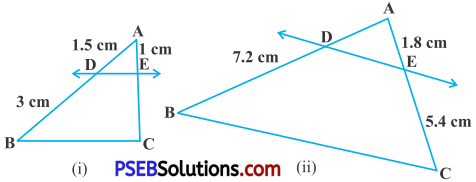
In fig. (i) and (ü), DE U BC. Find EC in (i) and AD in (ii).

PSEB 10th Class Maths Solutions Chapter 6 Triangles Ex 6.2 1

Solution:
(i) In ∆ABC, DE || BC ……………(given)
∴ \(\frac{\mathrm{AD}}{\mathrm{BD}}=\frac{\mathrm{AE}}{\mathrm{EC}}\)
[By using Basic Proportionality Theorem]
\(\frac{1.5}{3}=\frac{1}{\mathrm{EC}}\)
EC = \(\frac{3}{1.5}\)
EC = \(\frac{3 \times 10}{15}\) = 2
∴ EC = 2 cm.

(ii) In ∆ABC,
DE || BC ……………(given)
∴ \(\frac{\mathrm{AD}}{\mathrm{BD}}=\frac{\mathrm{AE}}{\mathrm{EC}}\)
[By using Basic Proportionality Theorem]
\(\frac{\mathrm{AD}}{7.2}=\frac{1.8}{5.4}\)
AD = \(\frac{1.8 \times 7.2}{5.4}\)
= \(\frac{1.8}{10} \times \frac{72}{10} \times \frac{10}{54}=\frac{24}{10}\)
AD = 2.4
∴ AD = 2.4 cm.

PSEB Solutions PSEB 10th Class Maths Solutions Chapter 6 Triangles Ex 6.2

Question 2.
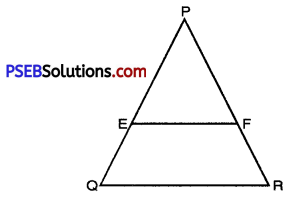
E and F are points on the sides PQ and PR respectively of a APQR. For each of the following cases, state whether EF || QR :
(i) PE = 3.9 cm, EQ = 3 cm, PF = 3.6 cm and FR = 2.4 cm
(ii) PE =4 cm, QE = 4.5 cm, PF =8 cm and RF = 9cm.
(iii) PQ = 1.28 cm, PR = 2.56 cm, PE = 0.18 cm and PF = 0.36 cm.
Solution:
In ∆PQR, E and F are two points on side PQ and PR respectively.

PSEB 10th Class Maths Solutions Chapter 6 Triangles Ex 6.2 2

(i) PE = 3.9 cm, EQ = 3 cm
PF = 3.6 cm, FR = 2.4 cm
\(\frac{\mathrm{PE}}{\mathrm{EQ}}=\frac{3.9}{3}=\frac{39}{30}=\frac{13}{10}=1.3\)

\(\frac{P F}{F R}=\frac{3.6}{2.4}=\frac{36}{24}=\frac{3}{2}=1.5\) \(\frac{\mathrm{PE}}{\mathrm{EQ}} \neq \frac{\mathrm{PF}}{\mathrm{FR}}\)

∴ EF is not parallel to QR.

(ii) PE = 4 cm, QE = 4.5 cm,
PF = 8 cm, RF = 9 cm.
\(\frac{\mathrm{PE}}{\mathrm{QE}}=\frac{4}{4.5}=\frac{40}{45}=\frac{8}{9}\) ………….(1)
\(\frac{P F}{R F}=\frac{8}{9}\) ……………..(2)
From (1) and (2),
\(\frac{\mathrm{PE}}{\mathrm{QE}}=\frac{\mathrm{PF}}{\mathrm{RF}}\)
∴ By converse of Basic Proportionality theorem EF || QR.

(iii) PQ = 1.28 cm, PR = 2.56 cm
PE = 0.18 cm, PF = 0.36 cm.
EQ = PQ – PE = 1.28 – 0.18 = 1.10 cm
ER = PR – PF = 2.56 – 0.36 = 2.20 cm
Here \(\frac{\mathrm{PE}}{\mathrm{EQ}}=\frac{0.18}{1.10}=\frac{18}{110}=\frac{9}{55}\) …………..(1)

and \(\frac{\mathrm{PF}}{\mathrm{FR}}=\frac{0.36}{2.20}=\frac{36}{220}=\frac{9}{55}\) …………….(2)

From (1) and (2), \(\frac{\mathrm{PE}}{\mathrm{EQ}}=\frac{\mathrm{PF}}{\mathrm{FR}}\)
∴ By converse of Basic Proportionality Theorem EF || QR.

PSEB Solutions PSEB 10th Class Maths Solutions Chapter 6 Triangles Ex 6.2

Question 3.
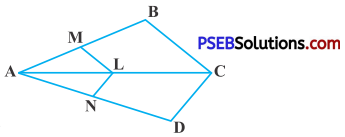
In fig., LM || CB; and LN || CD. Prove that \(\frac{\mathbf{A M}}{\mathbf{A B}}=\frac{\mathbf{A N}}{\mathbf{A D}}\).

PSEB 10th Class Maths Solutions Chapter 6 Triangles Ex 6.2 3

Solution:
In ∆ABC,
LM || BC (given)
∴ \(\frac{\mathrm{AM}}{\mathrm{MB}}=\frac{\mathrm{AL}}{\mathrm{LC}}\) ………..(1)
(By Basic Proportionality Theorem)
Again, in ∆ACD
LN || CD (given)
∴ \(\frac{A N}{N D}=\frac{A L}{L C}\) …………..(2)
(By Basic Proportionality Theorem)
From (1) and (2),
\(\frac{\mathrm{AM}}{\mathrm{MB}}=\frac{\mathrm{AN}}{\mathrm{ND}}\)

or \(\frac{\mathrm{MB}}{\mathrm{AM}}=\frac{\mathrm{ND}}{\mathrm{AN}}\)

or \(\frac{\mathrm{MB}}{\mathrm{AM}}+1=\frac{\mathrm{ND}}{\mathrm{AN}}+1\)
or \(\frac{\mathrm{MB}+\mathrm{AM}}{\mathrm{AM}}=\frac{\mathrm{ND}+\mathrm{AN}}{\mathrm{AN}}\)

or \(\frac{\mathrm{AB}}{\mathrm{AM}}=\frac{\mathrm{AD}}{\mathrm{AN}}\)

or \(\frac{\mathrm{AM}}{\mathrm{AB}}=\frac{\mathrm{AN}}{\mathrm{AD}}\)
Hence, \(\frac{\mathrm{AM}}{\mathrm{AB}}=\frac{\mathrm{AN}}{\mathrm{AD}}\) is the required result.

PSEB Solutions PSEB 10th Class Maths Solutions Chapter 6 Triangles Ex 6.2

Question 4.
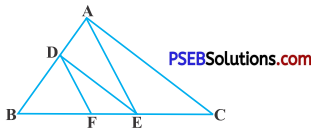
In Fig. 6.19, DE || AC and DF || AE. Prove that \(\frac{\mathrm{BF}}{\mathrm{FE}}=\frac{\mathrm{BE}}{\mathrm{EC}}\).

PSEB 10th Class Maths Solutions Chapter 6 Triangles Ex 6.2 4

Solution:
In ∆ABC, DE || AC(given)

PSEB 10th Class Maths Solutions Chapter 6 Triangles Ex 6.2 4

∴ \(\frac{B D}{D A}=\frac{B E}{E C}\) …………….(1)
[By Basic Proportionality Theorem]
In ∆ABE, DF || AE
\(\frac{\mathrm{BD}}{\mathrm{DA}}=\frac{\mathrm{BF}}{\mathrm{FE}}\) …………….(2)
[By Basic Proportionality Theorem]
From (1) and (2),
\(\frac{\mathrm{BE}}{\mathrm{EC}}=\frac{\mathrm{BF}}{\mathrm{FE}}\)
Hence proved.

PSEB Solutions PSEB 10th Class Maths Solutions Chapter 6 Triangles Ex 6.2

Question 5.
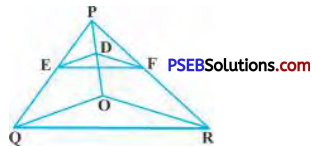
In fig. DE || OQ and DF || OR. Show that EF || QR.

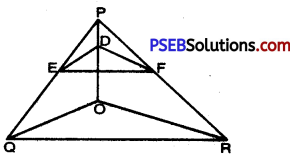
PSEB 10th Class Maths Solutions Chapter 6 Triangles Ex 6.2 5

Solution:
Given:
In ∆PQR, DE || OQ DF || OR.
To prove: EF || QR.
Proof: In ∆PQO, ED || QO (given)

PSEB 10th Class Maths Solutions Chapter 6 Triangles Ex 6.2 6

∴ \(\frac{P D}{D O}=\frac{P E}{E Q}\)

[By Basic Proportionality Theorem]
Again in ∆POR,
DF || OR (given)
∴ \(\frac{P D}{D O}=\frac{P F}{F R}\) ………….(2)
[By Basic Proportionality Theorem]
From (1) and (2),
\(\frac{\mathrm{PE}}{\mathrm{EQ}}=\frac{\mathrm{PF}}{\mathrm{FR}}\)
In ∆PQR, by using converse of Basic proportionaIity Theorem.
EF || QR,
Hence proved.

PSEB Solutions PSEB 10th Class Maths Solutions Chapter 6 Triangles Ex 6.2

Question 6.
In flg., A, B and C points on OP, OQ and OR respectively such that AB || PQ and AC || PR. Show thatBC || QR.

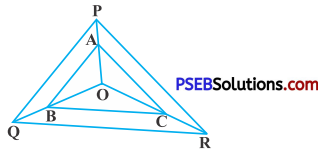
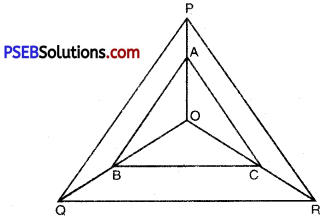
PSEB 10th Class Maths Solutions Chapter 6 Triangles Ex 6.2 7

Solution:
Given : ∆PQR, A, B and C are points on OP, OQ and OR respectively such that AB || PQ, AC || PR.

PSEB 10th Class Maths Solutions Chapter 6 Triangles Ex 6.2 8

To prove: BC || QR.
Proof: In ∆OPQ, AB || PQ (given)
∴ \(\frac{\mathrm{OA}}{\mathrm{AP}}=\frac{\mathrm{OB}}{\mathrm{BQ}}\) …………….(1)
[BY using Basic Proportionality Theorem]
Again in ∆OPR.
AC || PR (given)
∴ \(\frac{\mathrm{OA}}{\mathrm{AP}}=\frac{\mathrm{OC}}{\mathrm{CR}}\) ……………….(2)
[BY using Basic Proportionality Theorem]
From (1) and (2),
\(\frac{\mathrm{OB}}{\mathrm{BQ}}=\frac{\mathrm{OC}}{\mathrm{CR}}\)
∴ By converse of Basic Proportionality Theorem.
In ∆OQR, BC || QR. Hence proved.

PSEB Solutions PSEB 10th Class Maths Solutions Chapter 6 Triangles Ex 6.2

Question 7.
Using Basic Proportionality theorem, prove that a line drawn through the mid-point of one side of a triangle parallel to another side bisects the third side. (Recall that you have proved ¡t in class IX).
Solution:
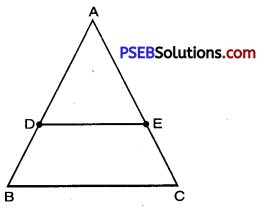
Given: In ∆ABC, D is mid point of AB, i.e. AD = DB.
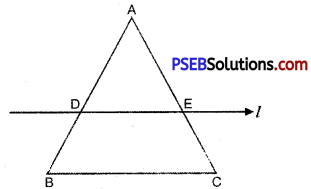
A line parallel to BC intersects AC at E as shown in figure. i.e., DE || BC.

PSEB 10th Class Maths Solutions Chapter 6 Triangles Ex 6.2 9

To prove: E is mid point of AC.
Proof: D is mid point of AB.
i.e.. AD = DB (given)
Or \(\frac{\mathrm{AD}}{\mathrm{BD}}\) = 1 ……………..(1)
Again in ∆ABC DE || BC (given)
∴ \(\frac{\mathrm{AD}}{\mathrm{DB}}=\frac{\mathrm{AE}}{\mathrm{EC}}\)
[By Basic Proportionality Theorem]
∴ 1 = \(\frac{\mathrm{AE}}{\mathrm{EC}}\) [From (1)]
∴ AE = EC
∴ E is mid point of AC. Hence proved.

PSEB Solutions PSEB 10th Class Maths Solutions Chapter 6 Triangles Ex 6.2

Question 8.
Using converse of Basic Proportionality theorem prove that the line joining the mid-points of any two sides of a triangle is parallel to the third side. (Recall that you have done ¡tin Class IX).
Solution:
Given ∆ABC, D and E are mid points of AB and AC respectively such that AD = BD and AE = EC, D and Eare joined

PSEB 10th Class Maths Solutions Chapter 6 Triangles Ex 6.2 10

To Prove, DE || BC
Proof. D is mid point of AB (Given)
i.e., AD = BD
Or \(\frac{\mathrm{AD}}{\mathrm{BD}}\) = 1 ………………(1)
E is mid point of AC (Given)
∴ AE = EC
Or \(\frac{\mathrm{AE}}{\mathrm{EC}}\) = 1 ………………(2)
From (1) and (2),
By using converse of basic proportionality Theorem
DE || BC Hence Proved.

Question 9.
ABCD is a trapeiiumin with AB || DC and its diagonals Intersect each other at the point O. Show that \(\frac{A O}{B O}=\frac{C O}{D O}\).
Solution:
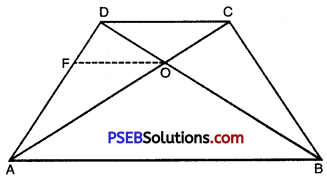
Given. ABCD is trapezium AB || DC, diagonals AC and BD intersect each other at O.

PSEB 10th Class Maths Solutions Chapter 6 Triangles Ex 6.2 11

To Prove. \(\frac{\mathrm{AO}}{\mathrm{BO}}=\frac{\mathrm{CO}}{\mathrm{DO}}\)
Construction. Through O draw FO || DC || AB
Proof. In ∆DAB, FO || AB (construction)
∴ \(\frac{\mathrm{DF}}{\mathrm{FA}}=\frac{\mathrm{DO}}{\mathrm{BO}}\) ……………..(1)
[By using Basic Proportionality Theorem]
Again in ∆DCA,
FO || DC (construction)
\(\frac{\mathrm{DF}}{\mathrm{FA}}=\frac{\mathrm{CO}}{\mathrm{AO}}\)
[By using Basic Proportionality Theorem]
From (1) and (2),
\(\frac{\mathrm{DO}}{\mathrm{BO}}=\frac{\mathrm{CO}}{\mathrm{AO}} \quad \frac{\mathrm{AO}}{\mathrm{BO}} \quad \frac{\mathrm{CO}}{\mathrm{DO}}\)
Hence Proved.

Question 10.
The diagonals of a quadrilateral ABCD Intersect each other at the point O such that \(\frac{\mathrm{AO}}{\mathrm{BO}}=\frac{\mathrm{CO}}{\mathrm{DO}}\).Show that ABCD is a
trapezium.
Solution:
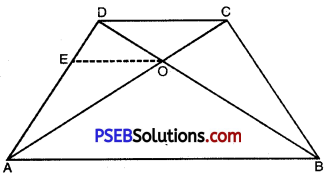
Given: Quadrilateral ABCD, Diagonal AC and BD intersects each other at O
such that = \(\frac{\mathrm{AO}}{\mathrm{BO}}=\frac{\mathrm{CO}}{\mathrm{DO}}\)

PSEB 10th Class Maths Solutions Chapter 6 Triangles Ex 6.2 12

To Prove. Quadrilateral ABCD is trapezium.
Construction. Through ‘O’ draw line EO || AB which meets AD at E.
Proof. In ∆DAB,
EO || AB [Const.]
∴ \(\frac{\mathrm{DE}}{\mathrm{EA}}=\frac{\mathrm{DO}}{\mathrm{OB}}\) ………………(1)
[By using Basic Proportionality Theoremj
But = \(\frac{\mathrm{AO}}{\mathrm{BO}}=\frac{\mathrm{CO}}{\mathrm{DO}}\) (Given)

or \(\frac{\mathrm{AO}}{\mathrm{CO}}=\frac{\mathrm{BO}}{\mathrm{DO}}\)

or \(\frac{\mathrm{CO}}{\mathrm{AO}}=\frac{\mathrm{DO}}{\mathrm{BO}}\)

⇒ \(\frac{\mathrm{DO}}{\mathrm{OB}}=\frac{\mathrm{CO}}{\mathrm{AO}}\) …………….(2)
From (1) and (2),
\(\frac{\mathrm{DE}}{\mathrm{EA}}=\frac{\mathrm{CO}}{\mathrm{AO}}\)
∴ By using converse of basic
proportionlity Theorem,
EO || DC also EO || AB [Const]
⇒ AB || DC
∴ Quadrilateral ABCD is a trapezium with AB || CD.

PSEB 6th Class Maths Solutions Chapter 6 Decimals Ex 6.4

Punjab State Board PSEB 6th Class Maths Book Solutions Chapter 6 Decimals Ex 6.4 Textbook Exercise Questions and Answers.

PSEB Solutions for Class 6 Maths Chapter 6 Decimals Ex 6.4

1. Solve the following:

Question (i)
12.15 + 4.87
Solution:
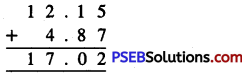
We have 12.15 + 4.87
PSEB 6th Class Maths Solutions Chapter 6 Decimals Ex 6.4 1
Hence 12.15 + 4.87 = 17.02

PSEB 6th Class Maths Solutions Chapter 6 Decimals Ex 6.4

Question (ii)
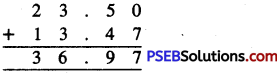
23.5 + 13.47
Solution:
We have 23.5 + 13.47
PSEB 6th Class Maths Solutions Chapter 6 Decimals Ex 6.4 2
Hence 23.5 + 13.47 = 36.97

Question (iii)
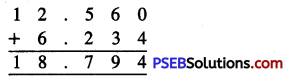
12.56 + 6.234
Solution:
We have 12.56 + 6.234
PSEB 6th Class Maths Solutions Chapter 6 Decimals Ex 6.4 3
Hence 12.56 + 6.234 = 18.794

Question (iv)
24.25 – 13.12
Solution:
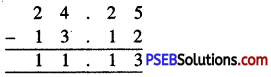
We have 24.25 – 13.12
PSEB 6th Class Maths Solutions Chapter 6 Decimals Ex 6.4 4
Hence 24.25 – 13.12 = 11.13

Question (v)
18.8 – 4.26
Solution:
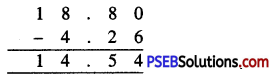
We have 18.8 – 4.26
PSEB 6th Class Maths Solutions Chapter 6 Decimals Ex 6.4 5.1
Hence 18.8 – 4.26 = 14.54

PSEB 6th Class Maths Solutions Chapter 6 Decimals Ex 6.4

Question (vi)
42.34 – 5.256
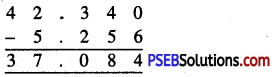
Solution:
We have 42.34 – 5.256
PSEB 6th Class Maths Solutions Chapter 6 Decimals Ex 6.4 6
Hence 42.34 – 5.256 = 37.084

Question (vii)
45.4 + 13.25 + 28.68
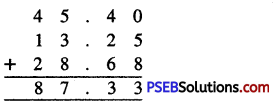
Solution:
We have 45.4 + 13.25 + 28.68
PSEB 6th Class Maths Solutions Chapter 6 Decimals Ex 6.4 7
Hence 45.4 + 13.25 + 28.68 = 87.33

Question (viii)
52.9 + 26.893 + 13.62
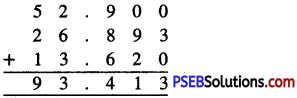
Solution:
We have 52.9 + 26.893 + 13.62
PSEB 6th Class Maths Solutions Chapter 6 Decimals Ex 6.4 8
Hence 52.9 + 26.893 + 13.62 = 93.413

Question (ix)
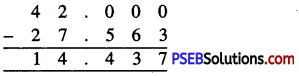
42 – 27.563
Solution:
We have 42 – 27.563
PSEB 6th Class Maths Solutions Chapter 6 Decimals Ex 6.4 9
Hence 42 – 27.563 = 14.437

PSEB 6th Class Maths Solutions Chapter 6 Decimals Ex 6.4

Question (x)
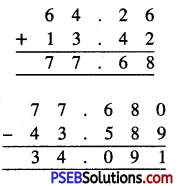
64.26 – 43.589 + 13.42
Solution:
We have 64.26 – 43.589 + 13.42
PSEB 6th Class Maths Solutions Chapter 6 Decimals Ex 6.4 10
Hence 64.26 – 43.589 + 13.42
= 34.091

Question (xi)
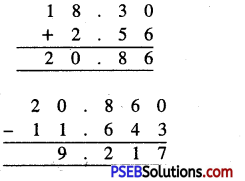
18.3 + 2.56 – 11.643
Solution:
We have 18.3 + 2.56 – 11.643
PSEB 6th Class Maths Solutions Chapter 6 Decimals Ex 6.4 11
Hence 18.3 + 2.56 – 11.643
= 9.217

Question (xii)
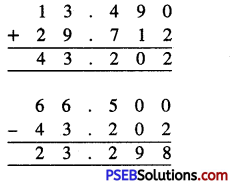
66.5 – 13.49 – 29.712.
Solution:
We have 66.5 – 13.49 – 29.712
= 66.5 – (13.49 + 29.712)
= 66.5 – 43.202 = 23.298
PSEB 6th Class Maths Solutions Chapter 6 Decimals Ex 6.4 12

2.

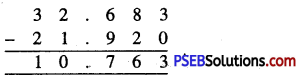
Question (i)
Subtract 21.92 from 32.683
Solution:
PSEB 6th Class Maths Solutions Chapter 6 Decimals Ex 6.4 13

PSEB 6th Class Maths Solutions Chapter 6 Decimals Ex 6.4

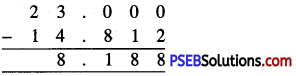
Question (ii)
Subtract 14.812 from 23.
Solution:
Subtract 14.812 from 23.
PSEB 6th Class Maths Solutions Chapter 6 Decimals Ex 6.4 14

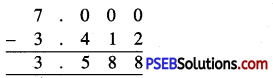
3. What should be added to 3.412 to get 7?
Solution:
Let x should be added to 3.412 to get 7
3.412 + x = 7
x = 7 – 3.412
= 3.588
PSEB 6th Class Maths Solutions Chapter 6 Decimals Ex 6.4 15
Hence, 3.588 should be added to 3.412 to get 7

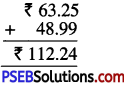
4. Khan spent ₹ 63.25 for Maths book and ₹ 48.99 for English book. Find the total amount spent by Khan.
Solution:
Amount spent for Maths book = ₹ 63.25
Amount spent for English book = 48.99
Total amount spent by khan = ₹ 112.24
PSEB 6th Class Maths Solutions Chapter 6 Decimals Ex 6.4 16

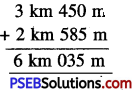
5. Samar walked 3 km 450 m in morning and 2 km 585 m in evening. How much distance did he walk in all ?
Solution:
Distance walked in morning = 3 km 450 m
Distance walked in evening = 2 km 585 m
Distance Samar Walked in all = 6 km 035 m
PSEB 6th Class Maths Solutions Chapter 6 Decimals Ex 6.4 17

PSEB 6th Class Maths Solutions Chapter 6 Decimals Ex 6.4

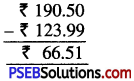
6. Sheetal has ₹ 190.50 in her pocket. She buys a school bag for ₹ 123.99. How much money is left with her now?
Solution:
Total amount Sheetal has = ₹ 190.50
Amount spent on school bag = – ₹ 123.99
Money left with her = ₹ 66.51
PSEB 6th Class Maths Solutions Chapter 6 Decimals Ex 6.4 18

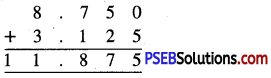
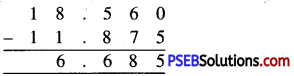
7. A piece of 18.56 m long ribbon is cut into three pieces. If the length of two pieces are 8.75 m and 3.125 m respectively. Find the length of the third piece.
Solution:
Total length of ribbon = 18.56 m
Length of two pieces = 8.75 m + 3.125 m
PSEB 6th Class Maths Solutions Chapter 6 Decimals Ex 6.4 19
Length of the third piece = 18.56 m – 11.875 m
= 6.685 m
PSEB 6th Class Maths Solutions Chapter 6 Decimals Ex 6.4 20

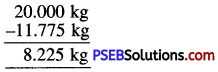
8. Veerpal bought vegetables weighing 20 kg. Out of this 6 kg 750 g are onions, 5 kg 25 g are potatoes and rest are tomatoes. What is the weight of the tomatoes?
Solution:
Total weight of vegetables
Veerpal bought = 20 kg
Weight of onions = 6 kg 750 g = 6.750 kg
Weight of potatoes = 5 kg 25 g = 5.025 kg
Weight of onions and potatoes = 11.775 kg
PSEB 6th Class Maths Solutions Chapter 6 Decimals Ex 6.4 21
Total weight of vegetable = 20.000 kg
Weight of onions and potatoes = -11.775 kg
Weight of tomatoes = 8.225 kg
PSEB 6th Class Maths Solutions Chapter 6 Decimals Ex 6.4 22

PSEB 6th Class Maths Solutions Chapter 6 Decimals Ex 6.4

9. Ashish’s school is 28 km far from his house. He covers 14 km 250 m by bus, 12 km 650 m by car and the remaining distance by foot. How much distance does he cover on foot?
Solution:
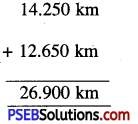
Distance covered by bus 14 km 250 m = 14.250 km
Distance covered by car 12 km 650 m = 12.650 km
Distance covered by bus and car = 26.900 km
PSEB 6th Class Maths Solutions Chapter 6 Decimals Ex 6.4 23

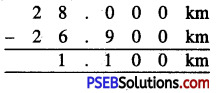
Total distance of school form Ashish house = 28 km
Distance covered by bus and car = 26.900 km
Distance covered on foot = 28 km – 26.900 km
= 1 km 100 m
PSEB 6th Class Maths Solutions Chapter 6 Decimals Ex 6.4 24

PSEB 10th Class Maths Solutions Chapter 6 Triangles Ex 6.1

Punjab State Board PSEB 10th Class Maths Book Solutions Chapter 6 Triangles Ex 6.1 Textbook Exercise Questions and Answers.

PSEB Solutions for Class 10 Maths Chapter 6 Triangles Ex 6.1

Question 1.
Fill in the blanks using the correct word given in brackets:
(i) All circles are ………………. (congruent, similar).
Solution:
All circles are similar.

(ii) All squares are ………………. (similar, congruent).
Solution:
MI squares are similar.

(iii) All ………………. triangles are similar. (isosceles, equilateral).
Solution:
All equilateral triangles are similar.

(iv) Two polygons of the same number of sides are similar, if
(a) their corresponding angles are __________ and
Solution:
equal

(b) their corresponding sides are ………………. (equal, proportional).
Solution:
proportional.

PSEB Solutions PSEB 10th Class Maths Solutions Chapter 6 Triangles Ex 6.1

Question 2.
Give two different examples of pair
(i) similar figures
(ii) non-similar figures.
Solution:
(i) 1. Pair of equilateral triangle are similar figures.
2. Pair of squares are similar figures.

(ii) 1. A triangle and quadrilateral form a pair of non-similar figures.
2. A square and rhombus form pair of non – similar figures.

PSEB Solutions PSEB 10th Class Maths Solutions Chapter 6 Triangles Ex 6.1

Question 3.
State whether the following quadrilaterals are similar or not :-

PSEB 10th Class Maths Solutions Chapter 6 Triangles Ex 6.1 1

Solution:
The two quadrilaterals in the figure are not similar because their corresponding angles are not equal.

PSEB 10th Class Maths Solutions Chapter 5 Arithmetic Progressions Ex 5.4

Punjab State Board PSEB 10th Class Maths Book Solutions Chapter 5 Arithmetic Progressions Ex 5.4 Textbook Exercise Questions and Answers.

PSEB Solutions for Class 10 Maths Chapter 5 Arithmetic Progressions Ex 5.4

Question 1.
Which term of the A.P. 121, 117, 113, …………. is its first negative term?
Solution:
Given A.P is 121, 117, 113, …
Here a = T1 = 121 ;T2 = 117; T3 = 113
d = T2 – T1 = 117 – 121 = – 4
Using formula, Tn = a + (n – 1) d
Tn = 121 + (n – 1) (- 4)
= 121 – 4n + 4
= 125 – 4n.
According to question :—
Tn < 0
or 125 – 4n < 0
or 125 < 4n or 4n > 125.
or n > \(\frac{125}{4}\)
or n > 31\(\frac{1}{4}\).
But n must be integer, for first negative term.
∴ n = 32.
Hence, 32nd term be the first negative term of given A.P.

PSEB Solutions PSEB 10th Class Maths Solutions Chapter 5 Arithmetic Progressions Ex 5.4

Question 2.
The sum of the third and the seventh term of an A.P. is 6 and their product ¡s 8. Find the sum of first sixteer
terms of an A.P.
Solution:
Let ‘a’ and ‘d’ be the first term and common diftèrence of given A.P.
According to 1st condition
T3 + T7 = 6
[a + (3 – 1)d] + [a + (7 – 1) d] = 6
∵ [Tn = a + (n – 1) d]
or a + 2d + a + 6d = 6
or 2a + 8d = 6
or a + 4d = 3 …………….(1)
According to 2nd condition
T3 (T7) = 8
[a + (3 – 1) d] [a + (7 – 1)d] = 8
∵ [Tn = a + (n – 1) d]
or (a + 2d) (a + 6d) = 8
or [3 – 4d + 2d] [3 – 4d + 6d] = 8
[Using (1), a = 3 – 4d]
or (3 – 2d) (3 + 2d) = 8
or 9 – 4d2 = 8
or 4d2 = 98
or d2 = \(\frac{1}{4}\)
d = ± \(\frac{1}{2}\)

PSEB Solutions PSEB 10th Class Maths Solutions Chapter 5 Arithmetic Progressions Ex 5.4

Case I:
When d = \(\frac{1}{2}\)
Putting d = \(\frac{1}{2}\) in (1), we get:
a + 4 (\(\frac{1}{2}\)) = 3
or a + 2 = 3
or a = 3 – 2 = 1
Using formula, Sn = \(\frac{n}{2}\) [2a + (n – 1) d]
S16 = \(\frac{16}{2}\) [2 (1) + (16 – 1) \(\frac{1}{2}\)].

Case II:
Putting d = – \(\frac{1}{2}\) in (1), we get,
When d = – \(\frac{1}{2}\)
a + 4 (-\(\frac{1}{2}\)) = 3
a – 2 = 3
or a = 3 + 2 = 5
Using formula,
Sn = \(\frac{n}{2}\) [2a + (n – 1)d]
S16 = \(\frac{16}{2}\) [2(5) + (16 – 1) (-\(\frac{1}{2}\))]
= 8[10 – \(\frac{15}{2}\)]
= 8 \(\left[\frac{20-15}{2}=\frac{5}{2}\right]\)
S16 = 20.

PSEB Solutions PSEB 10th Class Maths Solutions Chapter 5 Arithmetic Progressions Ex 5.4

Question 3.
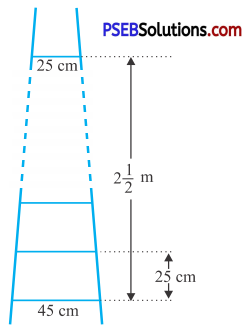
A ladder has rungs 25 cm apart (see fig.) The rungs decrease uniformly in length from 45 cm at the bottom to 25 cm at the top. If the top and bottom rungs are 2 latex]\frac{1}{2}[/latex] m apart, what is the length of the wood required for the rungs?

PSEB 10th Class Maths Solutions Chapter 5 Arithmetic Progressions Ex 5.4 1

[Hint: Number of rungs = \(\frac{250}{25}\) + 1]
Solution:
Total length of rungs = 2 \(\frac{1}{2}\) m = \(\frac{5}{2}\) m
= (\(\frac{5}{2}\) × 100) cm = 250 cm
Length of each rung = 25 cm
∴ Number of rungs = \(\frac{\text { Total length of rungs }}{\text { Length of each rung }}\) + 1
= \(\frac{250}{25}\) + 1 = 10 + 1 = 11
Length of first rung =45 cm
Here a = 45; l = 25; n = 11
Length of the wood for rungs
= S11
= \(\frac{n}{2}\) [a + l]
= \(\frac{11}{2}\) [45 + 25]
= \(\frac{1}{2}\) × 70
= 11 × 35 = 385
Hence, length of the wood for rungs has 385 cm.

PSEB Solutions PSEB 10th Class Maths Solutions Chapter 5 Arithmetic Progressions Ex 5.4

Question 4.
The houses of a row are numbered consecutively from 1 to 49. Show that there is a value of x such that the sum of the numbers of the houses preceding the house numbered x is equal to the sum of the numbers of the houses following it and find this value of x.
[Hint: Sx – 1 = S49 – S1]
Solution:
Let ‘x’ denotes the number of any house.
Here a = T1 = 1 ;d = 1
According to question,
Sx – 1 = S49 – Sx
= \(\frac{x-1}{2}\) [2 (1) + (x – 1 – 1) (1)]
= \(\frac{49}{2}\) [1 + 49] – \(\frac{x}{2}\) [2 (1) + (x – 1) (1)]
[Using Sn = \(\frac{n}{2}\) [2a + (n – 1) d] and Sn = \(\frac{n}{2}\) (a + l) ]
or \(\frac{x-1}{2}\) [2 + x – 2] = \(\frac{49}{2}\) (50) – \(\frac{x}{2}\) [2 + x – 1]
or \(\frac{x(x-1)}{2}=49(25)-\frac{x(x+1)}{2}\)
or \(\frac{x}{2}\) [x – 1 + x + 1] = 1225
\(\frac{x}{2}\) × 2x = 1225
or x2 = 1225
or x = 35.

PSEB Solutions PSEB 10th Class Maths Solutions Chapter 5 Arithmetic Progressions Ex 5.4

Question 5.
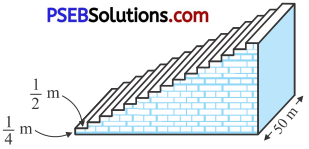
A small terrace at a football ground comprises of 15 step each of which is 50 m long and built of solid concrete. Each step has a rise of \(\frac{1}{4}\) m and a tread of \(\frac{1}{2}\) m (see fig.) Calculate the total volume of concrete required to build the terrace.
[Hint: Volume of concrete required to build of the first step \(\frac{1}{4}\) × \(\frac{1}{2}\) × 50 m3].

PSEB 10th Class Maths Solutions Chapter 5 Arithmetic Progressions Ex 5.4 2

Solution:
Volume of concrete required to build the first step \(\frac{1}{4}\) × \(\frac{1}{2}\) × 50 m3]
= [latex]\frac{25}{4}[/latex] m3
Volume of concrete required to build the second step = [\(\frac{25}{4}\) × \(\frac{1}{2}\) × 50] m3

= \(\frac{75}{2}\) m3
Volume of concrete required to build the third step = [\(\frac{3}{4}\) × \(\frac{1}{2}\) × 50] m3 and so on upto 15 steps.

Here a = T1 = \(\frac{25}{4}\);
T2 = \(\frac{25}{2}\);
T3 = \(\frac{75}{4}\); and n = 15.
d = T2 – T1 = \(\frac{25}{2}\) – \(\frac{25}{4}\)
= \(\frac{50-25}{4}\) = \(\frac{25}{4}\).

Total volume of concrete required to buld the terrace = S15
= \(\frac{n}{2}\) [2a + (n – 1)d]
= \(\frac{15}{2}\left[2\left(\frac{25}{4}\right)+(15-1) \frac{25}{4}\right]\)
= \(\left[\frac{25}{4} \times \frac{14 \times 25}{4}\right]\)
= \(\frac{15}{2}\left[\frac{25}{2} \times \frac{175}{2}\right]\)
= \(\frac{15}{2} \times \frac{200}{2}\) = 750
Hence, total volume of concrete required to build the terrace is 750 m3.