PSEB 6th Class Social Science Notes Chapter 13 The Mauryas and The Sungas

This PSEB 6th Class Social Science Notes Chapter 13 The Mauryas and The Sungas will help you in revision during exams.

PSEB 6th Class Social Science Notes Chapter 13 The Mauryas and The Sungas

→ The Mauryan Empire: The Mauryan Empire came into being in the last quarter of 600 B.C.

→ It was established by Chandragupta Maurya in Magadha.

→ Alexander: Alexander was a great Greek conqueror from Macedonia. He invaded India in 326 B.C.

→ Chanakya: Chanakya is popularly known as Kautilya. He was the Prime Minister of Chandragupta Maurya.

PSEB 6th Class Social Science Notes Chapter 13 The Mauryas and The Sungas

→ He was a great teacher, scholar, and the author of the famous book ‘Arthasastra’.

→ Megasthenes: Megasthenes was the Greek Ambassador of Seleucus Nikator. He wrote the book ‘Indica’.

→ Bindusara: Bindusara was the son of Chandragupta Maurya. He ruled India for about 25 years.

→ Ashoka, the Great: Ashoka, the Great was a son of Bindusara. He is known as one of the greatest rulers in the world.

→ Edicts: Edicts are orders proclaimed by an authority.

→ Dhamma: Dhamma was a code of morality enacted by Ashoka for his people to lead a peaceful and virtuous life.

→ Sarnath: Sarnath is a place near Varanasi in Uttar Pradesh.

→ The capital of Ashoka’s pillar at Sarnath has been adopted as India’s National Emblem.

PSEB 6th Class Social Science Notes Chapter 13 The Mauryas and The Sungas

→ The Sunga Empire: The Sunga Empire was founded by Pushyamitra Sunga.

→ He was the commander-in-chief of the Mauryan army.

→ He killed the last Mauryan king Brihadratha and himself became the king in 184 B.C.

PSEB 6th Class Social Science Notes Chapter 12 India: From 600 B.C. – 400 B.C.

This PSEB 6th Class Social Science Notes Chapter 12 India: From 600 B.C. – 400 B.C. will help you in revision during exams.

PSEB 6th Class Social Science Notes Chapter 12 India: From 600 B.C. – 400 B.C.

→ Janapadas: Janapadas were the republican or monarchical states established in Northern India around 600 B.C.

→ Republic: Republic, in the form of government in which power is held by the people or a group of elected persons or an elected chief.

PSEB 6th Class Social Science Notes Chapter 12 India: From 600 B.C. - 400 B.C.

→ Monarchy: Monarchy is the form of government in which power is held by a hereditary king or queen.

→ Mahajanapadas: The more powerful Janapadas were known as Mahajanapadas. There were sixteen Mahajanapadas around 600 B.C.

→ Among them, Magadha, Kosala, Vatsa, and Avanti were the most powerful.

→ Ashramas: Life was divided into four stages, called Ashramas. These Ashramas were Brahmacharya, Grihastha, Vanaprastha, and Sanyasa.

→ Barter System: Exchange of goods for goods is called the barter system.

→ Shrenis: Persons following the same profession organized themselves into unions or guilds. These unions or guilds were known as Shrenis.

PSEB 6th Class Social Science Notes Chapter 12 India: From 600 B.C. - 400 B.C.

→ Tirthankaras: Teachers of the Jains were known as the Tirthankaras. There were twenty-four Tirthankaras.

→ Nirvana: Nirvana means a state in which individuality merges into the Supreme Spirit and one becomes free from the cycle of birth and death.

→ Samgha: The supreme body of the Buddhist monks was known as Samgha.

PSEB 6th Class Social Science Notes Chapter 11 The Vedic Age

This PSEB 6th Class Social Science Notes Chapter 11 The Vedic Age will help you in revision during exams.

PSEB 6th Class Social Science Notes Chapter 11 The Vedic Age

→ The Vedic Civilization The Vedic Civilization is the period of Indian history, reconstruction of which is based on using the Vedic texts as a source.

→ The Aryans The people of Vedic Civilization are known as the Aryans. They were the people who came to India from North-Eastern Iran or Central Asia.

→ The Vedas The Vedas are the sacred books of the Hindus. These are the hymns composed in praise of the gods whom the Aryans worshipped. There are four Vedas Rigveda, Samaveda, Yajurveda and Atharvaveda.

PSEB 6th Class Social Science Notes Chapter 11 The Vedic Age

→ The Epics The Epics are poems narrating continuously great events of one or more heroes, about their bravery and the battles which they fought. The Ramayana and the Mahabharata are the two great Indian Epics.

→ Sabha and Samiti Sabha and Samiti were the assemblies of people with whom the king discussed very important matters.

→ Varna System: Varna system was the division of society into four groups according to their occupation and activities in society. There were four varnas: Brahmanas, Kshatriyas, Vaisyas, and slaves.

→ Vish and Jana: “Vish’ means a clan. It was a group of families. The people of the tribe were called ‘Jana’.

→ Sura: Sura was an intoxicating drink consumed by a few ancient Aryans. It was considered bad and was condemned.

PSEB 6th Class Maths Solutions Chapter 7 Algebra Ex 7.3

Punjab State Board PSEB 6th Class Maths Book Solutions Chapter 7 Algebra Ex 7.3 Textbook Exercise Questions and Answers.

PSEB Solutions for Class 6 Maths Chapter 7 Algebra Ex 7.3

1. Pick the algebraic expressions and the arithmetic expressions from the following:

Question (i)
(i) 2l – 3
(ii) 5 × 3 + 8
(iii) 6 – 3x
(iv) 51
(v) 2 × (21 – 18) + 9
(vi) \(\frac {6a}{5}\) + 2
(vii) 7 × 20 + 5 + 3
(viii) 8.
Solution:
Algebraic Expressions :
2l – 3, 6 – 3x, 51, \(\frac {6a}{5}\) + 2
Arithmetic Expressions :
5 × 3 + 8, 2 × (21 – 18) + 9, 7 × 20 + 5 + 3, 8.

PSEB 6th Class Maths Solutions Chapter 7 Algebra Ex 7.3

2. Write the terms for the following expressions:

Question (i)
2y + 5z
Solution:
Terms of 2y + 5z = 2y, 5z

Question (ii)
6x – 3y + 8
Solution:
Terms of 6x – 3y + 8 = 6x, -3y, 8

Question (iii)
7a
Solution:
Terms of 7a = 7a

Question (iv)
3l – 5m + 2n
Solution:
Terms of 31 – 5m + 2n = 31, -5m, 2n

Question (v)
\(\frac {2l}{3}\) + x.
Solution:
Terms of = \(\frac {2l}{3}\) + x = \(\frac {2l}{3}\), x

3. Tell how the following expressions are formed.

Question (i)
a + 11
Solution:
a + 11 = a is increased by 11

PSEB 6th Class Maths Solutions Chapter 7 Algebra Ex 7.3

Question (ii)
12 – x
Solution:
12 – x = x is subtracted from 12

Question (iii)
3z + 8
Solution:
3z + 8 = Three time of z is increased by 8

Question (iv)
6 – 5l
Solution:
6 – 5l = 5 times of l is subtracted from 6

Question (v)
\(\frac {5a}{4}\)
Solution:
\(\frac {5a}{4}\) = 5 times a is divided by 4.

4. Give expressions for the following:

Question (i)
10 is added to p
Solution:
10 is added to p = p + 10

PSEB 6th Class Maths Solutions Chapter 7 Algebra Ex 7.3

Question (ii)
5 is subtracted from y
Solution:
S is subtracted from y = y – 5

Question (iii)
d is divided by 3
Solution:
d is divided by 3 = \(\frac {d}{3}\)

Question (iv)
l is multiplied by – 6
Solution:
l is multiplied by – 6 = – 6l

Question (v)
m is subtracted from l
Solution:
m is subtracted from 1 = 1 – m

Question (vi)
11 is added to 3x
Solution:
11 is added to 6x = 6x + 11

PSEB 6th Class Maths Solutions Chapter 7 Algebra Ex 7.3

Question (vii)
y is divided by -2 and then 2 is added to the result
Solution:
y is multiplied by – 2 and then 2 is added to the result = – 2y + 2

Question (viii)
c is divided by 5 and then 7 is multiplied to the result
Solution:
c is divided by 5 and thus 7 is multiplied to the result = \(\frac {7c}{5}\)

Question (ix)
x is multiplied by 3 then subtracted this result from y
Solution:
x is multiplied by 3 then subtracted this result from y = y – 3x

Question (x)
a is added to b then c is multiplied with this result.
Solution:
a is added to b then c is multiplied by this result = (a + b) c

PSEB 6th Class Maths Solutions Chapter 7 Algebra Ex 7.3

5. Write the number which is 15 less than y.
Solution:
The number which is 15 less than y = y – 15

6. Write the number which is 3 more than a.
Solution:
The number which is 3 more than a = a + 3

7. Find the number which is 1 more than twice of x.
Solution:
The number which is 1 more than twice of x = 2x + 1

8. Find the number which is 7 less than 5 times of y.
Solution:
The number which is 7 less than 5 times of y = 5y – 7

PSEB 6th Class Maths Solutions Chapter 7 Algebra Ex 7.3

9. Somi’s present age is ‘a’ years. Express the following in algebraic form:

Question (i)
Her age after 15 years.
Solution:
Somi’s present age = ‘a’ years
Her age after 15 years = (a + 15) years

Question (ii)
Her age 2 years ago.
Solution:
Her age 2 years ago = (a – 2) years

Question (iii)
If Somi’s father’s age is 5 more than twice of her present age, express her father’ age.
Solution:
Somi’s father’s age is 5 more than twice of her present age
∴ Her father’s age = (2a + 5) years.

Question (iv)
If Somi’s sister is 4 years younger to her. Express her sister’s age.
Solution:
Somi’s sister is 4 years younger to her
∴ Her sister’s age = (a – 4) years

Question (v)
If Somi’s mother is 3 less than 3 times her present age. Express her mother’s age.
Solution:
Somi’s mother is 3 less than 3 times her present age
∴ Her mother’s age = (3a – 3) years.

PSEB 6th Class Maths Solutions Chapter 7 Algebra Ex 7.3

10. The length of a floor is 10 more than two times of breadth what is the length if breadth is l meters?
Solution:
The breadth of floor = l metres
The length of the floor is 10 more than two times of its breadth
∴ Length of floor = (2l + 10) metres.

PSEB 6th Class Maths Solutions Chapter 7 Algebra Ex 7.2

Punjab State Board PSEB 6th Class Maths Book Solutions Chapter 7 Algebra Ex 7.2 Textbook Exercise Questions and Answers.

PSEB Solutions for Class 6 Maths Chapter 7 Algebra Ex 7.2

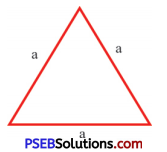
1. Each side of equilateral triangle is denoted by ‘a’ then express the perimeter of the triangle using ‘a’.
PSEB 6th Class Maths Solutions Chapter 7 Algebra Ex 7.2 1
Solution:
Each triangle of equilateral triangle = a
∴ Perimeter of equilateral triangle
= a + a + a = 3a

PSEB 6th Class Maths Solutions Chapter 7 Algebra Ex 7.2

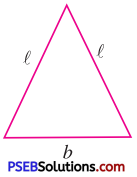
2. An isosceles triangle is shown. Express its perimeter in terms of ‘l’ and ‘b’.
PSEB 6th Class Maths Solutions Chapter 7 Algebra Ex 7.2 2
Solution:
Perimeter of isosceles triangle = l + l + b
= 21 + b

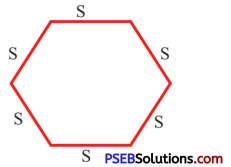
3. Each side of regular hexagon is denoted by ‘S’ then express the perimeter of the regular hexagon using ‘S’.
PSEB 6th Class Maths Solutions Chapter 7 Algebra Ex 7.2 3
Solution:
Each side of regular hexagon = S
Perimeter of regular hexagon
=S + S + S + S + S + S
= 6S

PSEB 6th Class Maths Solutions Chapter 7 Algebra Ex 7.2

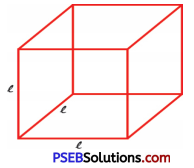
4. The cube has 6 faces and all of them are identify squares. If l is the length of an edge of a cube, find the total length of all edges of the cube in terms of ‘l’?
PSEB 6th Class Maths Solutions Chapter 7 Algebra Ex 7.2 4
Solution:
Length of each edge of a cube = l
There are 12 edges of a cube
Total length of all edges of the cube
= 12 × l = 12l

5. Write commutative property of addition using variables x and y.
image
Solution:
According to commutative property of addition.
If the order of numbers, in addition, is changed it does not change their sum.
∴ x + y = y + x

PSEB 6th Class Maths Solutions Chapter 7 Algebra Ex 7.2

6. Write associative property of multiplication using variables l, m and n.
Solution:
According to associative property of multiplication.
If three numbers can be multiplied in any order, it does not change their product.
∴ l × (m × n) = (l × m) × n

7. Write distributive property of multiplication over addition in terms of variables p, q and r respectively.
Solution:
According to Distributive property of multiplication over addition
p × (q + r) = p × q + p × r

PSEB 6th Class Maths Solutions Chapter 7 Algebra Ex 7.1

Punjab State Board PSEB 6th Class Maths Book Solutions Chapter 7 Algebra Ex 7.1 Textbook Exercise Questions and Answers.

PSEB Solutions for Class 6 Maths Chapter 7 Algebra Ex 7.1

1. Find the rule which gives the number of matchsticks required to make the following ‘it’ matchstick patterns. Use a variables to write the rule:

Question (i)
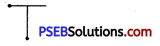
A pattern of letter T as
PSEB 6th Class Maths Solutions Chapter 7 Algebra Ex 7.1 1
Solution:
Number of matchsticks required in a pattern of letter T = 2
Number of matchsticks required in ‘n’ patterns = 2n
PSEB 6th Class Maths Solutions Chapter 7 Algebra Ex 7.1 2

PSEB 6th Class Maths Solutions Chapter 7 Algebra Ex 7.1

Question (ii)
A pattern of letter E as
PSEB 6th Class Maths Solutions Chapter 7 Algebra Ex 7.1 3
Solution:
Number of matchsticks required in a pattern of letter E = 4
PSEB 6th Class Maths Solutions Chapter 7 Algebra Ex 7.1 4
Number of matchsticks required in V patterns of letter E = 4n

Question (iii)
A pattern of letter F as
PSEB 6th Class Maths Solutions Chapter 7 Algebra Ex 7.1 4
Solution
Number of matchsticks required in a pattern of letter F = 3
PSEB 6th Class Maths Solutions Chapter 7 Algebra Ex 7.1 6
Number of matchsticks required in ‘n’ patterns of letter F = 3 n

Question (iv)
A pattern of letter C as
PSEB 6th Class Maths Solutions Chapter 7 Algebra Ex 7.1 7
Solution:
Number of matchsticks required in a pattern of letter C = 3
PSEB 6th Class Maths Solutions Chapter 7 Algebra Ex 7.1 8
Number of matchsticks required in ‘n’ patterns of letter C = 3n

PSEB 6th Class Maths Solutions Chapter 7 Algebra Ex 7.1

Question (v)
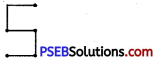
A pattern of letter S as
PSEB 6th Class Maths Solutions Chapter 7 Algebra Ex 7.1 9
Solution:
Number of matchsticks required in a pattern of letter S = 5
PSEB 6th Class Maths Solutions Chapter 7 Algebra Ex 7.1 10
Number of matchsticks required in V patterns of letter S = 5 n

2. Students are sitting in rows. There are 12 students in row. What is the rule which gives the number of students in ‘n’ rows? (Represent by table)
Solution:
Let us make a table for the number of students in ‘n’ rows.

Number of Rows 1 2 3 4 ….. 10 …… n
Number of Students 12 24 36 48 …… 120 …… 12 n

It is observed from the table that
Total number of students in ‘n’ number of rows
= (Number of Students) × (Number of rows)
= 12 × n = 12n

PSEB 6th Class Maths Solutions Chapter 7 Algebra Ex 7.1

3. The teacher distributes 3 pencils to a student What is the rule which gives the number of pencils, if there are ‘a’ number of students?
Solution:
We know
Total number of pencils
= Number of pencils × Number of students
= 3 × a = 3a

4. There are 8 pens in a pen stand. What is the rule that gives the total cost of the pens if the cost of each pen is represented by a variable ‘c’?
Solution:
We know
Total cost of the pens in ₹
= Number of pens × cost of 1 pen
= 8 × c = 8c

5. Gurleen is drawing pictures by joining dots. To make one picture,’she has to join 5 dots. Find the rule that gives the number of dots, if the number of pictures is represented by the symbol ‘p’.
Solution:
We know
Total number of dots = Number of dots × Number of pictures
= 5p

PSEB 6th Class Maths Solutions Chapter 7 Algebra Ex 7.1

6. The cost of a dozen bananas is ₹ 50. Find the rule of total cost of bananas if there are ‘d’ dozens bananas.
Solution:
We know
Total cost of bananas in ₹
= Cost of one dozen × Number of bananas
= 50 × d
= 50d

7. Look at the following matchsticks patterns of squares given below. The squares are not separate as there are two adjoined adjacent squares have a common match stick. Observe the patterns and find the rule that gives the number of matchsticks in terms of the number of squares.
PSEB 6th Class Maths Solutions Chapter 7 Algebra Ex 7.1 11
(Hint: If you remove the vertical stick at the end you will get a patterns of C)
Solution:

Fig. No. No. of Squares Number of matchsticks Pattern
(i) 1 4 3 x 1+ 1
(ii) 2 7 3 × 2 + 1
(iii) 3 10 3 × 3 + 1

Thus, we get the rule the number of matchsticks = 3x + 1 or 1 + 3x where x is the number of squares.

PSEB 6th Class Maths MCQ Chapter 6 Decimals

Punjab State Board PSEB 6th Class Maths Book Solutions Chapter 6 Decimals MCQ Questions with Answers.

PSEB 6th Class Maths Chapter 6 Decimals MCQ Questions

Multiple Choice Questions

Question 1.
3 + \(\frac {2}{10}\) = ………….
(a) 302
(b) 3.2
(c) 3.02
(d) 30.2.
Answer:
(b) 3.2

PSEB 6th Class Maths MCQ Chapter 6 Decimals

Question 2.
200 + 4 + \(\frac {5}{10}\) = …………
(a) 24.5
(b) 204.05
(c) 204.5
(d) 24.05.
Answer:
(c) 204.5

Question 3.
\(\frac {7}{100}\) = …………..
(a) .07
(b) 700
(c) .007
(d) 7.
Answer:
(a) .07

Question 4.
50 + \(\frac {3}{1000}\) = ………….
(a) 50.3
(b) 503000
(c) 50.0003
(d) 50.003.
Answer:
(d) 50.003.

Question 5.
Seventy and four thousandths = …………….
(a) 74000
(b) 70.004
(c) .00074
(d) .074.
Answer:
(b) 70.004

PSEB 6th Class Maths MCQ Chapter 6 Decimals

Question 6.
2.03 in expanded form = ……….
(a) 2 + \(\frac {3}{10}\)
(b) 20 + \(\frac {3}{10}\)
(c) 2 + \(\frac {3}{100}\)
(d) 20 + \(\frac {3}{100}\)
Answer:
(c) 2 + \(\frac {3}{100}\)

Question 7.
2.5 = ……….. .
(a) \(\frac {5}{2}\)
(b) \(\frac {25}{2}\)
(c) \(\frac {5}{10}\)
(d) \(\frac {1}{4}\)
Answer:
(a) \(\frac {5}{2}\)

Question 8.
\(\frac {13}{2}\) = …………….
(a) 6
(b) 6.1
(c) 1.3
(d) 6.5.
Answer:
(d) 6.5.

Question 9.
Which of the following decimals is largest?
(a) 0.5
(b) 0.05
(c) 0.51
(d) 0.005.
Answer:
(c) 0.51

Question 10.
Which of the following decimals is smallest?
(a) 2.13
(b) .213
(c) 21.3
(d) 213.
Answer:
(b) .213

PSEB 6th Class Maths MCQ Chapter 6 Decimals

Question 11.
75 g = ……. kg.
(a) .075 kg
(b) .75 kg
(c) 7.5 kg
(d) 75 kg.
Answer:
(a) .075 kg

Question 12.
27 mm = ………….. cm.
(a) .27 cm
(b) 27 cm
(c) 2.7 cm
(d) .027 cm.
Answer:
(c) 2.7 cm

Question 13.
2.5 + 4.23 = ……………
(a) 4.48
(b) 6.73
(c) 4.73
(d) 6.48.
Answer:
(b) 6.73

Question 14.
15 + 3.84 = ………… .
(a) 3.99
(b) 18.99
(c) 3.84
(d) 18.84
Answer:
(d) 18.84

Question 15.
13.5 – 4.23 = …………….
(a) 2.87
(b) 7.29
(c) 9.27
(d) 9.37.
Answer:
(c) 9.27

PSEB 6th Class Maths MCQ Chapter 6 Decimals

Question 16.
20 – 12.56 = …………..
(a) 7.44
(b) 8.44
(c) 9.44
(d) 6.44.
Answer:
(a) 7.44

Question 17.
14.8 + 2.62 – 8.4 = …………….. .
(a) 8.02
(b) 9.12
(c) 9.02
(d) 6.44.
Answer:
(c) 9.02

Question 18.
517 ml = …………… l.
(a) 5.07 l
(b) 5.7 l
(c) 5.70 l
(d) 5.007 l.
Answer:
(d) 5.007 l

Question 19.
12 kg 85 g = ……………. kg.
(a) 12.085 kg
(b) 12.85 kg
(c) 128.5 kg
(d) 12.0085 kg.
Answer:
(a) 12.085 kg

Question 20.
235 paise = …………..
(a) ₹ 235
(b) ₹ 23.5
(c) ₹ 2.35
(d) ₹ .235.
Answer:
(c) ₹ 2.35

PSEB 6th Class Maths MCQ Chapter 6 Decimals

Question 21.
Express 88 m as km using decimals:
(a) 0.88 km
(b) 8.8 km
(c) 0.088 km
(d) 0.0088 km.
Answer:
(c) 0.088 km

Question 22.
In the following lists which numbers are in the descending order?
(a) 0.355, 0.4, 0.43, 0.355
(b) 0.4, 0.43, 0.444, 0.355
(c) 0.43, 0.355, 0.444, 0.4
(d) 0.444, 0.43, 0.4, 0.355.
Answer:
0.444, 0.43, 0.4, 0.355.

Question 23.
In the following lists which numbers are in the descending order?
(a) 19.4, 0.3, 10.6, 205.9
(b) 205.9, 10.6, 0.3, ,19.4
(c) 205.9, 19.4, 10.6, 0.3
(d) 0.3, 10.6, 19.4, 205.9.
Answer:
205.9, 19.4, 10.6, 0.3

Question (iv)
In the following lists which numbers are in the ascending order?
(a) 0.7, 20.9, 14.6, 600.8
(b) 0.7, 14.6, 20.9, 600.8
(c) 600.8, 14.6, 20.9, 0.7
(d) 14.6,20.9,0.7,600.8.
Answer:
0.7, 14.6, 20.9, 600.8

Question (v)
Express 30 mm as cm using decimals:
(a) 3,0 cm
(b) 0.30 cm
(c) 0.03 cm
(d) 0.003 cm.
Answer:
3,0 cm

PSEB 6th Class Maths MCQ Chapter 6 Decimals

Fill in the blanks:

Question (i)
15 cm as m using decimals is …………… m.
Answer:
0.15

Question (ii)
75 paise as ₹ using decimals is ₹ ………….. .
Answer:
₹ 0.75

Question (iii)
9 cm 8 mm as cm using decimals is …………… m.
Answer:
0.98

Question (iv)
27 m = ………….. cm.
Answer:
2.7

Question (v)
15 + 3.84 = ……………… .
Answer:
18.84

Write True/False:

Question (i)
The word decimal comes from Latin word “Decem.” (True/False)
Answer:
True

PSEB 6th Class Maths MCQ Chapter 6 Decimals

Question (ii)
\(\frac {1}{10}\) is read as one tenth. (True/False)
Answer:
True

Question (iii)
10 + 3 + \(\frac{2}{10}=\frac{15}{10}\) (True/False)
Answer:
False

Question (iv)
Seven and three-tenths is written as 7.3. (True/False)
Answer:
True

Question (v)
Twenty-four point five is written as 24.5. (True/False)
Answer:
True

PSEB 10th Class Maths Solutions Chapter 6 Triangles Ex 6.3

Punjab State Board PSEB 10th Class Maths Book Solutions Chapter 6 Triangles Ex 6.3 Textbook Exercise Questions and Answers.

PSEB Solutions for Class 10 Maths Chapter 6 Triangles Ex 6.3

Question 1.
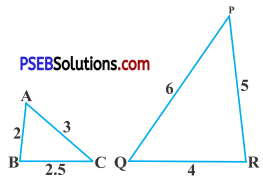
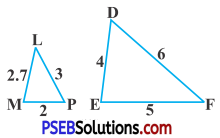
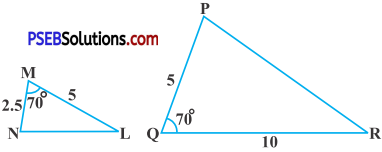
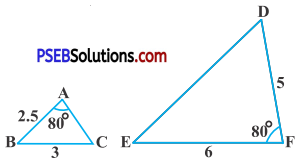
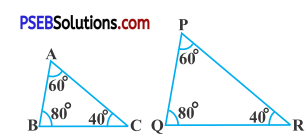
State which pairs of triangles in Fig. are similar. Write the similarity criterion used by you for answering the queStion and also write the pairs of similar triangles in the symbolic form:

(i) PSEB 10th Class Maths Solutions Chapter 6 Triangles Ex 6.3 1
(ii) PSEB 10th Class Maths Solutions Chapter 6 Triangles Ex 6.3 2

(iii) PSEB 10th Class Maths Solutions Chapter 6 Triangles Ex 6.3 3

(iv) PSEB 10th Class Maths Solutions Chapter 6 Triangles Ex 6.3 4

(v) PSEB 10th Class Maths Solutions Chapter 6 Triangles Ex 6.3 5

(vi) PSEB 10th Class Maths Solutions Chapter 6 Triangles Ex 6.3 6

PSEB Solutions PSEB 10th Class Maths Solutions Chapter 6 Triangles Ex 6.3

Solution:
(i) In ∆ABC and ∆PQR,
∠A = ∠P (each 60°)
∠B = ∠Q (each 80°)
∠C = ∠R (each 40°)
∴ ∆ABC ~ PQR [AAA Similarity criterion]

(ii) In ∆ABC and ∆PQR,
\(\frac{\mathrm{AB}}{\mathrm{RQ}}=\frac{2}{4}=\frac{1}{2}\) …………….(1)

\(\frac{\mathrm{AC}}{\mathrm{PQ}}=\frac{3}{6}=\frac{1}{2}\) ……………..(2)

\(\frac{\mathrm{BC}}{\mathrm{PR}}=\frac{2.5}{5}=\frac{1}{2}\) ……………(3)
From (1), (2) and (3),
\(\frac{\mathrm{AB}}{\mathrm{RQ}}=\frac{\mathrm{AC}}{\mathrm{PQ}}=\frac{\mathrm{BC}}{\mathrm{PR}}=\frac{1}{2}\)

∴ ΔABC ~ ΔQRP [By SSS similarity criterion]

(iii) In ΔLMP and ΔDEF,
\(\frac{\mathrm{MP}}{\mathrm{DE}}=\frac{2}{4}=\frac{1}{2}\)

\(\frac{\mathrm{PL}}{\mathrm{DF}}=\frac{3}{6}=\frac{1}{2}\) \(\frac{\mathrm{LM}}{\mathrm{EF}}=\frac{2.7}{5}=\frac{27}{50}\)

\(\)
∴ Two Triangles are not similar.

PSEB Solutions PSEB 10th Class Maths Solutions Chapter 6 Triangles Ex 6.3

(iv) In ΔMNL and ΔPQR,
\(\frac{\mathrm{ML}}{\mathrm{QR}}=\frac{5}{10}=\frac{1}{2}\)

∠M = ∠Q (each 70°)

\(\frac{\mathrm{MN}}{\mathrm{PQ}}=\frac{2.5}{5}=\frac{1}{2}\)

∴ ΔMNL ~ ΔPQR [By SAS similarity cirterion]

(v) In ΔABC and ΔDEF,
\(\frac{\mathrm{AB}}{\mathrm{DF}}=\frac{2.5}{5}=\frac{1}{2}\)

\(\frac{\mathrm{BC}}{\mathrm{EF}}=\frac{3}{6}=\frac{1}{2}\)

But ∠B ≠ ∠F
∴ ΔABC and ΔDEF are not similar.

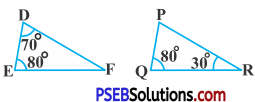
(vi) In ΔDEF, ∠D = 70°, ∠E = 80°
∠D + ∠E + ∠F = 180°
70° + 80° + ∠F = 180° [Angle Sum Propertyl
∠F= 180° – 70° – 80°
∠F = 30°
In ΔPQR,
∠Q = 80°, ∠R = 30°
∠P + ∠Q + ∠R = 180°
(Sum of angles of triangle)
∠P + 80° + 30° = 180°
∠P = 180° – 80° – 30°
∠P = 70°
In ΔDEF and ΔPQR,
∠D = ∠P (70° each)
∠E = ∠Q (80° each)
∠F = ∠R (30° each)
∴ ΔDEF ~ ΔPQR (AAA similarity criterion).

PSEB Solutions PSEB 10th Class Maths Solutions Chapter 6 Triangles Ex 6.3

Question 2.
In Fig., ΔODC ~ ΔOBA, ∠BOC = 125° and ∠CDO = 70°. FInd ∠DOC, ∠DCO and ∠OAB.
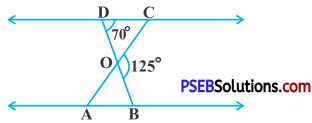
PSEB 10th Class Maths Solutions Chapter 6 Triangles Ex 6.3 7

Solution:
Given that: ∠BOC = 125°
∠CDO = 70°
DOB is a straight line
∴ ∠DOC + ∠COB = 180°
[Linear pair Axiom]
∠DOC + 125° = 180°
∠DOC = 180°- 125°
∠DOC = 55°
∠DOC = ∠AOB = 55°
[Vertically opposite angle]
But ΔODC ~ ΔOBA
∠D = ∠B = 70°
In ΔDOC, ∠D + ∠O + ∠C = 180°
70° + 55° + ∠C = 180°
∠C= 180° – 70° – 55°
∠C = 55°
∠C = ∠A = 55°
Hence ∠DOC = 55°
∠DCO = 55°
∴ ∠OAB = 55°.

PSEB Solutions PSEB 10th Class Maths Solutions Chapter 6 Triangles Ex 6.3

Question 3.
Diagonals AC and BD of a trapezium ABCD with AB || DC intersect each other at the point O. Using a similarity criterion for two triangles, show that \(\frac{\mathbf{O A}}{\mathbf{O C}}=\frac{\mathbf{O B}}{\mathbf{O D}}\).
Solution:
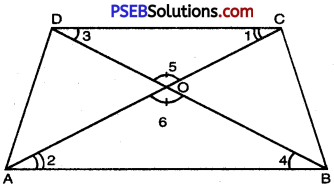
PSEB 10th Class Maths Solutions Chapter 6 Triangles Ex 6.3 8

Given: In Trapezium ABCD, AB || CD, and diagonal AC and BD intersects each other at O.
To Prove = \(\frac{\mathrm{OA}}{\mathrm{OC}}=\frac{\mathrm{OB}}{\mathrm{OD}}\) (Given)
Proof: AB || DC (Given)
In ΔDOC and ΔBOA,
∠1 = ∠2 (alternate angle)
∠5 = ∠6 (vertical opposite angle)
∠3 = ∠4 (alternate angle)
∴ ΔDOC ~ ΔBOA [AAA similarity criterion]
∴ \(\frac{\mathrm{DO}}{\mathrm{BO}}=\frac{\mathrm{OC}}{\mathrm{OA}}\)
[If two triangle are similar corresponding sides are Proportional }
⇒ \(\frac{\mathrm{OA}}{\mathrm{OC}}=\frac{\mathrm{BO}}{\mathrm{DO}}\)
Hence Proved.

PSEB Solutions PSEB 10th Class Maths Solutions Chapter 6 Triangles Ex 6.3

Question 4.
In Fig., \(\) and ∠1 = ∠2. Show that ∆PQS ~ ∆TQR.
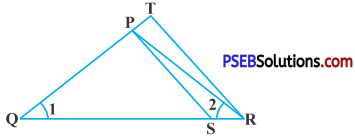
PSEB 10th Class Maths Solutions Chapter 6 Triangles Ex 6.3 9

Solution:
Given that,
\(\frac{\mathrm{QR}}{\mathrm{QS}}=\frac{\mathrm{QT}}{\mathrm{PR}}\) and
∠1 = ∠2
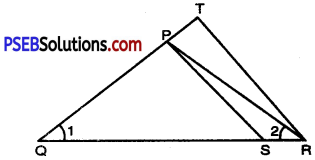
PSEB 10th Class Maths Solutions Chapter 6 Triangles Ex 6.3 10

To Prove. PQS – ITQR
Proof: In ΔPQR,
∠1 = ∠2 (given)
∴ PR = PQ
[Equal angle have equal side opposite to it]
and = \(\frac{\mathrm{QR}}{\mathrm{QS}}=\frac{\mathrm{QT}}{\mathrm{PR}}\) (given)
or \(\frac{\mathrm{QR}}{\mathrm{QS}}=\frac{\mathrm{QT}}{\mathrm{PQ}}\) [PR = PQ]
⇒ \(\frac{\mathrm{QS}}{\mathrm{QR}}=\frac{\mathrm{PQ}}{\mathrm{QT}}\)
In ΔPQS and ΔTQR,
\(\frac{\mathrm{QS}}{\mathrm{QR}}=\frac{\mathrm{PQ}}{\mathrm{QT}}\)
∠1 = ∠1 (common)
∴ ∆PQS ~ ∆TQR [SAS similarity criterion]
Hence proved.

PSEB Solutions PSEB 10th Class Maths Solutions Chapter 6 Triangles Ex 6.3

Question 5.
S and T are points on skies PR and QR of ∆PQR such that ∠P = ∠RTS. Show that ∆RPQ ~ ∆RTS.
Solution:
S and T are the points on side PR and QR such that ∠P = ∠RTS.
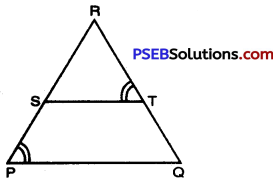
PSEB 10th Class Maths Solutions Chapter 6 Triangles Ex 6.3 11

To Prove. ∆RPQ ~ ∆RTS
Proof: In ∆RPQ and ∆RTS
∠RPQ = ∠RTS (given)
∠R = ∠R [common angle]
∴ RPQ ~ ARTS
[By AA similarity critierion which is the required result.]

Question 6.
In figure ∆ABE ≅ ∆ACD show that ∆ADE ~ ∆ABC.
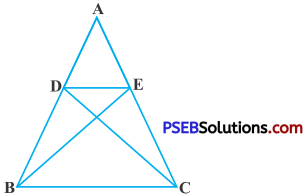
PSEB 10th Class Maths Solutions Chapter 6 Triangles Ex 6.3 12

Solution:
Given. ∆ABC in which ∆ABE ≅ ∆ACD
To Prove. ∆ADE ~ ∆ABC
Proof. ∆ABE ≅ ∆ACD (given)
AB = AC (cpct) and AE = AD (cpct)
\(\frac{A B}{A C}=1\) ……………..(1)
\(\frac{A E}{A D}=1\) …………….(2)
From (1) and (2).
\(\frac{\mathrm{AB}}{\mathrm{AC}}=\frac{\mathrm{AD}}{\mathrm{AE}}\)
In ∆ADE and ∆ABC,
\(\frac{\mathrm{AD}}{\mathrm{AE}}=\frac{\mathrm{AB}}{\mathrm{AC}}\)
∠A = ∠A (common)
∴ ∆ADE ~ ∆ABC [By SAS similarity criterion].

PSEB Solutions PSEB 10th Class Maths Solutions Chapter 6 Triangles Ex 6.3

Question 7.
In Fig., altitudes AD and CE of ∆ABC intersect each other at the point P.
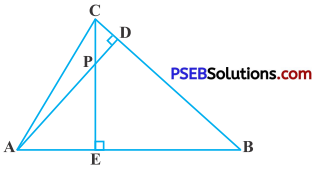
PSEB 10th Class Maths Solutions Chapter 6 Triangles Ex 6.3 13
Show that:
(i) ∆AEP ~ ∆CDP
(ii) ∆ABD ~ ∆CBE
(iii) ∆AEP ~ ∆ADB
(iv) ∆PDC ~ ∆BEC
Solution:
Given. ∆ABC, AD ⊥ BC CE⊥AB,
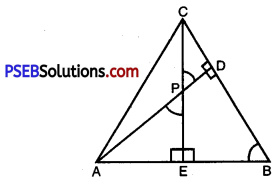
PSEB 10th Class Maths Solutions Chapter 6 Triangles Ex 6.3 24

To Prove. (i) ∆AEP ~ ∆CDP
(ii) ∆ABD ~ ∆CBE
(iii) ∆AEP ~ ∆ADB
(iv) ∆PDC ~ ∆BEC
Proof:
(i) In ∆AEP and ∆CDP,
∠E = ∠D (each 90°)
∠APE = ∠CPD (vertically opposite angle)
∴ ∆AEP ~ ∆CDP [By AA similarity criterion].

(ii) In ∆ABD and ∆CBE,
∠D = ∠E (each 90°)
∠B = ∠B (common)
∴ ∆ABD ~ ∆CBE [AA Similarity criterion]

(iii) In ∆AEP and ∆ADB.
∠E = ∠D (each 90°)
∠A = ∠A (common)
∴ ∆AEP ~ ∆ADB [AA similarity criterion].

(vi) In ∆PDC and ∆BEC,
∠C = ∠C
∠D = ∠E
∴ ∆SPDC ~ ∆BEC [AA similarity criterion].

PSEB Solutions PSEB 10th Class Maths Solutions Chapter 6 Triangles Ex 6.3

Question 8.
E is a point on the side AD produced of a parallelogram ABCD and BE Intersects CD at F. Show that AABE – &CFB.
Solution:
Given. Parallelogram ABCD. Side AD is produced to E, BE intersects DC at F.
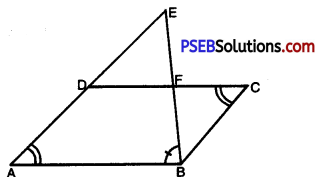
PSEB 10th Class Maths Solutions Chapter 6 Triangles Ex 6.3 14

To Prove. ∆ABE ~ ∆CFB
Proof. In ∆ABE and ∆CFB.
∠A = ∠C (opposite angle of || gm)
∠ABE = ∠CFB (alternate angle)
∴ ∆ABE ~ ∆CFB (AA similarity criterion)

Question 9.
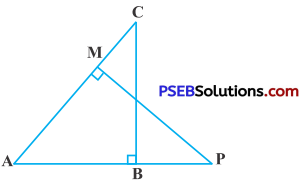
In Fig., ABC and AMP are two right triangles, right angled at B and M respectively. Prove that:
(i) ∆ABC ~ ∆AMP
(ii) \(\frac{\mathbf{C A}}{\mathbf{P A}}=\frac{\mathbf{B C}}{\mathbf{M P}}\)
PSEB 10th Class Maths Solutions Chapter 6 Triangles Ex 6.3 15

Solution:
Given. ∆ABC and ∆AMP are two right triangles right angled at B and M.
To Prove. (i) ∆ABC ~ ∆AMP
(ii) \(\frac{\mathbf{C A}}{\mathbf{P A}}=\frac{\mathbf{B C}}{\mathbf{M P}}\)
Proof. In ∆ABC and ∆AMP,
∠A = ∠A (common)
∠B = ∠M (each 90°)
(i) ∴ ∆ABC ~ ∆AMP (AA similarity criterion)

(ii) ∴ \(\frac{\mathrm{AC}}{\mathrm{AP}}=\frac{\mathrm{BC}}{\mathrm{MP}}\)
[If two triangles are similar corresponding sides]
\(\frac{\mathrm{CA}}{\mathrm{PA}}=\frac{\mathrm{BC}}{\mathrm{MP}}\)
Hence Proved.

PSEB Solutions PSEB 10th Class Maths Solutions Chapter 6 Triangles Ex 6.3

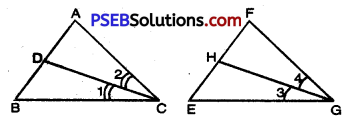
Q. 10.
CD and GH are respectively the vectors of ∠ACB and ∠EGF such that D and H lie on sides AB and FE of ∆ABC and
∆EFG respectively. If ∆ABC ~ ∆FEG, show
(i) \(\frac{\mathbf{C D}}{\mathbf{G H}}=\frac{\mathbf{A C}}{\mathbf{F G}}\)
(ii) ∆DCB ~ ∆HGE
(iii) ∆DCA ~ ∆HGF
PSEB 10th Class Maths Solutions Chapter 6 Triangles Ex 6.3 16

Given. In ∆ABC and ∆EFG, CD and OH are bisector of ∠ACB and ∠EGF
i.e. ∠1 = ∠2
and ∠3 = ∠4
and ∆ABC ~ ∆FEG
To Prove. (i) = \(\frac{\mathbf{C D}}{\mathbf{G H}}=\frac{\mathbf{A C}}{\mathbf{F G}}\)
(ii) ∆DCB ~ ∆HGE
(iii) ∆DCA ~ ∆HGF
Proof.
(i) Given that, ∆ABC ~ ∆FEG
∴ ∠A = ∠F; ∠B = ∠E
and ∠C = ∠C
[∵ The corresponding angles of similar triangles are equal]
Consider, ∠C = ∠C [Proved above]
\(\frac{1}{2}\) ∠C = \(\frac{1}{2}\) ∠G
∠2 = ∠4 or ∠1 = ∠3
Now, in ∆ACD and ∆FGH
∠A = ∠F [Proved above]
∠2 = ∠4 [Proved above]
∴ ∠ACD ~ ∠FGH [∵ AA similarity creterion]
Also, \(\frac{\mathrm{CD}}{\mathrm{GH}}=\frac{\mathrm{AC}}{\mathrm{FG}}\)
[∵ Corresponding sides are in proportion].

(ii) In ∆DCB and ∆HGE,
∠B = ∠E [Proved above]
∠1 = ∠3 [Proved above]
∴ ∆DCB ~ ∆HGE [∵ AA similarity criterion]

(iii) In ∆DCA and ∆HGF
∠A = ∠F [Proved above]
∠2 = ∠4 [Proved above]
∴ ∆DCA ~ ∆HGF [∵ AA similarity criterion].

PSEB Solutions PSEB 10th Class Maths Solutions Chapter 6 Triangles Ex 6.3

Question 11.
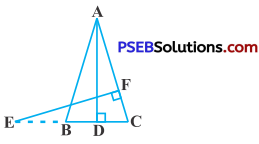
In Fig., E is a point on side CB produced of an Isosceles triangle ABC with AB = AC. IfAD ⊥BC and EF ⊥ AC, prove that ∆ABD ~ ∆ECF.
PSEB 10th Class Maths Solutions Chapter 6 Triangles Ex 6.3 17

Solution:
Given. ∆ABC, isosceles triangle with AB = AC AD ⊥ BC, side BC is produced to E. EF ⊥ AC
To Prove. ∆ABD ~ ∆ECF
Proof. ∆ABC is isosceles (given)
AB = AC
∴ ∠B = ∠C [Equal sides have equal angles opposite to it)
In ∆ABD and ∆ECF,
∠ABD = ∠ECF (Proved above)
∠ADB = ∠EFC (each 90°)
∴ ∠ABD – ∠ECF [AA similarity).

Question 12.
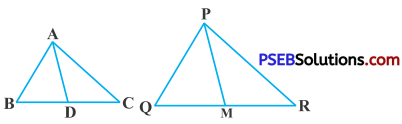
Sides AB and BC and median AD of a triangle ABC are respectively proportional to sides PQ and QR and median PM of ∆PQR (see Fig.). Show that ∆ABC ~ ∆PQR.
PSEB 10th Class Maths Solutions Chapter 6 Triangles Ex 6.3 18

Solution:
Given. ∆ABC and ∆PQR, AB, BC, and median AD of ∆ABC are proportional to side PQ; QR and median PM of ∆PQR,
i.e., \(\frac{\mathrm{AB}}{\mathrm{PQ}}=\frac{\mathrm{AC}}{\mathrm{PR}}=\frac{\mathrm{AD}}{\mathrm{PM}}\)
PSEB 10th Class Maths Solutions Chapter 6 Triangles Ex 6.3 23

To prove: ∆ABC ~ ∆PQR
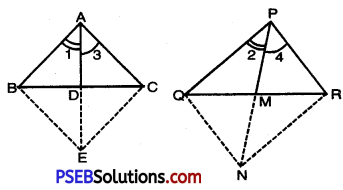
Construction: Produce AD to E such that AD = DE and Produce PM to N such that PM = MN join BE, CE, QN and RN
Proof: \(\frac{\mathrm{AB}}{\mathrm{PQ}}=\frac{\mathrm{AC}}{\mathrm{PR}}=\frac{\mathrm{AD}}{\mathrm{PM}}\) (given) …………..(1)
BD = DC (given)
AD = DE (construction)
Diagonal bisects each other ¡n quadrilateral ABEC
∴ Quadrilateral ABEC is parallelogram
Similarly PQNR is a parallelogram
∴ BE = AC (opposite sides of parallelogram) and QN = PR
\(\frac{\mathrm{BE}}{\mathrm{AC}}=1\) ……………(i)
\(\frac{\mathrm{QN}}{\mathrm{PR}}=1\) …………..(ii)
From (i) and (ii),
\(\frac{\mathrm{BE}}{\mathrm{AC}}=\frac{\mathrm{QN}}{\mathrm{PR}}\)
⇒ \(\frac{\mathrm{BE}}{\mathrm{QN}}=\frac{\mathrm{AC}}{\mathrm{PR}}\)
But \(\frac{A B}{P Q}=\frac{A C}{P R}\) (Given)
∴ \(\frac{B E}{Q N}=\frac{A B}{P Q}\) …………..(2)
\(\frac{\mathrm{AB}}{\mathrm{PQ}}=\frac{\mathrm{AD}}{\mathrm{PM}}\) From (1)
= \(\frac{2 \mathrm{AD}}{2 \mathrm{PM}}\)
\(\frac{\mathrm{AB}}{\mathrm{PQ}}=\frac{\mathrm{AE}}{\mathrm{PN}}\) …………..(3)
From (2) and (3),
\(\frac{\mathrm{AB}}{\mathrm{PQ}}=\frac{\mathrm{BE}}{\mathrm{QN}}=\frac{\mathrm{AE}}{\mathrm{PN}}\)
∴ ∆ABE ~ ∆PQN [Sides are Proportional]
∴ ∠1 = ∠2 …………….(4) [Corresponding angle of similar triangle]
|| ly ∆ACE ~ ∆PRN ……….(5) [Corresponding angle of similar triangle]
Adding (4) and (5).
∠1 + ∠3 = ∠2 + ∠4
∠A = ∠P
Now in ∆ABC and ∆PQR,
∠A = ∠P (Proved)
\(\frac{\mathrm{AB}}{\mathrm{PQ}}=\frac{\mathrm{AC}}{\mathrm{PR}}\) (given)
∴ ∆ABC ~ ∆PQR [By using SA similarity criterion]
Hence Proved.

PSEB Solutions PSEB 10th Class Maths Solutions Chapter 6 Triangles Ex 6.3

Question 13.
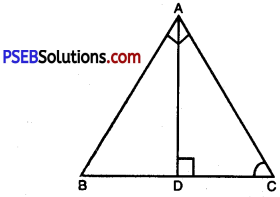
D is a point on the side BC of a triangle ABC such that ∠ADC = ∠BAC. Show that CA2 = CB. CD.
Solution:
Given. ∆ABC, D is a point on side BC such that ∠ADC = ∠BAC
To Prove. CA2 = BC × CD
Proof. In ABC and ADC,
PSEB 10th Class Maths Solutions Chapter 6 Triangles Ex 6.3 19

∠C = ∠C (common)
∠BAC = ∠ADC (given)
∴ ∆ABC ~ ∆DAC [by AA similarity criterion]
∴ \(\frac{\mathrm{AC}}{\mathrm{DC}}=\frac{\mathrm{BC}}{\mathrm{AC}}\)
[If two triangles are similar corresponding sides are proportional]
AC2 = BC. DC Hence Proved.

Question 14.
Sides AB and AC and median AD of a triangle ABC are proportional to sides PQ and PR and median PM of another
triangle PQR. Prove that ∆ABC ~ ∆PQR.
Solution:
PSEB 10th Class Maths Solutions Chapter 6 Triangles Ex 6.3 20

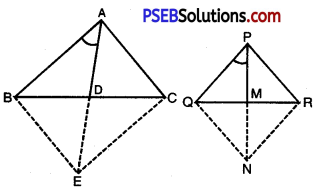
Given: Two ∆s ABC and PQR. D is the mid-point of BC and M is the mid-point of QR. and \(\frac{\mathrm{AB}}{\mathrm{PQ}}=\frac{\mathrm{AC}}{\mathrm{PR}}=\frac{\mathrm{AD}}{\mathrm{PM}}\) ………..(1)
To Prove: ∆ABC ~ ∆PQR
Construction:
Produce AD to E such that AD = DE
Join BE and CE.
Proof. In quad. ABEC, diagonals AE and
BC bisect each other at D.
∴ Quad. ABEC is a parallelogram.
Similarly it can be shown that quad PQNR is a parallelogram.
Since ABEC is a parallelogram
∴. BE = AC ………….(2)
Similarly since PQNR is a || gm
∴ QN = PR ………….(3)
Dividing (2) by (3), we get:
\(\frac{B E}{Q N}=\frac{A C}{P R}\) …………….(4)
Now \(\frac{\mathrm{AD}}{\mathrm{PM}}=\frac{2 \mathrm{AD}}{2 \mathrm{PM}}=\frac{\mathrm{AE}}{\mathrm{PN}}\)
∴ ∠BAE = ∠QPN ………….(5)
From (1), (4) and (5), we get:
\(\frac{A D}{P Q}=\frac{B E}{Q N}=\frac{A E}{P N}\)
Thus in ∆s ABE and PQN, we get:
\(\frac{\mathrm{AB}}{\mathrm{PQ}}=\frac{\mathrm{BE}}{\mathrm{QN}}=\frac{\mathrm{AE}}{\mathrm{PN}}\)
∴ ∆ABC ~ ∆PQN
∴ ∠BAE = ∠QPN ………..(6)
Similarly it can be proved that
∆AEC ~ ∆PNR
∴ ∠EAC = ∠NPR …………..(7)
Adding (6) and (7), we get:
∠BAE + ∠EAC = ∠QPN + ∠NPR
i.e., ∠BAC = ∠QPR
Now in ∆ABC and ∆PQR.
\(\frac{A B}{P Q}=\frac{A C}{P R}\)
and included ∠A = ∠P
∴ ∆ABC ~ ∆QPR (By SAS criterion of similarity).

PSEB Solutions PSEB 10th Class Maths Solutions Chapter 6 Triangles Ex 6.3

Question 15.
A vertical pole of length 6 m casts a shadow 4 m long on the ground and at the same time a tower casts a shadow 28 m long. Find the height of the tower.
Solution:
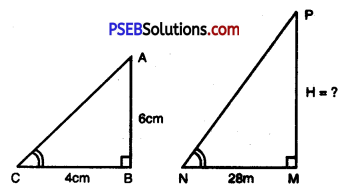
PSEB 10th Class Maths Solutions Chapter 6 Triangles Ex 6.3 21

Length of vertical stick = 6 m
Shadow of stick = 4 m
Let height of tower be H m
Length of shadow of tower = 28 m
In ∆ABC and ∆PMN,
∠C = ∠N (angle of altitude of sun)
∠B = ∠M (each 90°)
∴ ∆ABC ~ ∆PMN [AA similarity criterion]
∴ \(\frac{\mathrm{AB}}{\mathrm{PM}}=\frac{\mathrm{BC}}{\mathrm{MN}}\)
[If two triangles are similar corresponding sides are proportional]
∴ \(\frac{6}{\mathrm{H}}=\frac{4}{28}\)
H = \(\frac{6 \times 28}{4}\)
H = 6 × 7
H = 42 m.
Hence, Height of Tower = 42 m.

Question 16.
If AD and PM are medians of triangles ABC and PQR, respectively where ∆ABC ~ ∆PQR, prove that \(\frac{\mathbf{A B}}{\mathbf{P Q}}=\frac{\mathbf{A D}}{\mathbf{P M}}\).
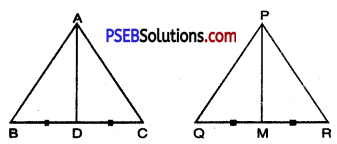
PSEB 10th Class Maths Solutions Chapter 6 Triangles Ex 6.3 22

Solution:
Given: ∆ABC and ∆PQR, AD and PM are median and ∆ABC ~ ∆PQR
To Prove: \(\frac{\mathrm{AB}}{\mathrm{PQ}}=\frac{\mathrm{AD}}{\mathrm{PM}}\)
Proof. ∆ABC ~ ∆PQR (given)
∴ \(\frac{A B}{P Q}=\frac{B C}{Q R}=\frac{A C}{P R}\)
(If two triangles are similar corrosponding sides are Proportional)
∠A = ∠P
(If two triangles are similar corrosponding angles are equal)
∠B = ∠Q
∠C = ∠R
D is mid Point of BC
∴ BD = DC = \(\frac{1}{2}\) BC ……………..(2)
M is mid point of OR
∴ QM = MR = \(\frac{1}{2}\) QR …………….(3)
\(\frac{A B}{P Q}=\frac{B C}{Q R}\)
\(\frac{\mathrm{AB}}{\mathrm{PQ}}=\frac{2 \mathrm{BD}}{2 \mathrm{QM}}\) (from(2)and(3))
\(\frac{A B}{P Q}=\frac{B D}{Q M}\)
∠ABD = ∠PQM (given)
∆ABC ~ ∆PQM (By SAS similarity criterion)
\(\frac{\mathrm{AB}}{\mathrm{PQ}}=\frac{\mathrm{AD}}{\mathrm{PM}}\)
[If two triangles are similar corresponding sides are proportional].

PSEB 7th Class Maths MCQ Chapter 12 Algebraic Expressions

Punjab State Board PSEB 7th Class Maths Book Solutions Chapter 12 Algebraic Expressions MCQ Questions with Answers.

PSEB 7th Class Maths Chapter 12 Algebraic Expressions MCQ Questions

Multiple Choice Questions :

Question 1.
On subtracting 9 from -q, we get:
(a) 9 – q
(b) q – 9
(c) 9 + q
(d) 9 – q
Answer:
(b) q – 9

Question 2.
The numerical coefficient of variable in expression 5 – 3t2 is :
(a) 3
(b) -3
(c) – 32
(d) 2
Answer:
(b) -3

Question 3.
In the expression 5y2 + 7x, the coefficient of y2 is :
(a) 5
(b) 7
(c) -5
(d) 2
Answer:
(a) 5

Question 4.
The sum of 3mn, -5mn, 8mn, -4mn is :
(a) 10 mn
(b) – 8 mn
(c) 12 mn
(d) 2 mn.
Answer:
(d) 2 mn.

PSEB 7th Class Maths MCQ Chapter 12 Algebraic Expressions

Question 5.
If m = 2, the value of 3m – 5 is :
(a) 6
(b) 1
(c) 11
(d) -1.
Answer:
(b) 1

Question 6.
If m = 2, the value of 9 – 5m is :
(a) -1
(b) 1
(c) 19
(d) 13
Answer:
(a) -1

Question 7.
If p = – 2, the value of 4p + 7 is :
(a) 15
(b) 18
(c) 20
(d) -1.
Answer:
(d) -1.

Question 8.
If a = 2, b = – 2, the value of a2 + b2 is :
(a) 0
(b) 4
(c) 8
(d) 10
Answer:
(c) 8

PSEB 7th Class Maths MCQ Chapter 12 Algebraic Expressions

Fill in the blanks :

Question 1.
On subtracting 5 from x we get ……………
Answer:
x – 5

Question 2.
The vable of 4x + 7 for x = 2 is ……………
Answer:
15

Question 3.
The sum of -4xy, 2xy, 3xy is ……………
Answer:
xy

Question 4.
A symbol having a fixed numerical value is called ……………
Answer:
constant

Question 5.
Binomial has …………… terms.
Answer:
two

PSEB 7th Class Maths MCQ Chapter 12 Algebraic Expressions

Write True or False :

Question 1.
Every number is a constant. (True/False)
Answer:
True

Question 2.
A symbol which takes on various numerical value is called a variable (True/False)
Answer:
True

Question 3.
Expressions are formed by addition of terms. (True/False)
Answer:
False

Question 4.
7 and 12xy are like terms. (True/False)
Answer:
False

Question 5.
The coefficient of x in 2x + 3y = 6 is 3. (True/False)
Answer:
False

PSEB 7th Class Maths Solutions Chapter 13 Exponents and Powers Ex 13.2

Punjab State Board PSEB 7th Class Maths Book Solutions Chapter 13 Exponents and Powers Ex 13.2 Textbook Exercise Questions and Answers.

PSEB Solutions for Class 7 Maths Chapter 13 Exponents and Powers Ex 13.2

1. Using laws of exponents, simplify and write the following in the exponential form :

(i) 27 × 24
(ii) p5 × p3
(iii) (-7)5 × (-7)11
(iv) 2015 ÷ 2013
(v) (-6)7 ÷ (-6)3
(vi) 7x × 73
Solution:
(i) 27 × 24 = 27+4 = 211
(ii) p5 × p3 = p5+3 = p8
(iii) (-7)5 × (-7)11 = (-7)5+11 = (-7)16
(iv) 2015 ÷ 2013 = 2015-13 = 202
(v) (-6)7 ÷ (-6)3 = (-6)7-3 = (-6)4
(vi) 7x × 73 = 7x+3

2. Simplify and write the following in exponential form.

(i) 53 × 57 × 512
Solution:
53 × 57 × 512 = 53+7+12
= 522

(ii) a5 × a3 × a7
Solution:
a5 × a3 × a7 = a5+3+7
= a15

PSEB 7th Class Maths Solutions Chapter 13 Exponents and Powers Ex 13.2

3. Simplify and write the following in the exponential form :

(i) (22)100
Solution:
(22)100 = 22 × 100
= 2200

(ii) (53)7
Solution:
(53)7 = 53 × 7
= 521

4. Simplify and write in the exponential form:

(i) (23)4 ÷ 25
Solution:
(23)4 ÷ 25 = 212 ÷ 25
= 212-5
= 27

(ii) 23 × 22 × 55
Solution:
23 × 22 × 55 = 23+2 × 55
= 25 × 55
= (2 × 5)5
= 105

(iii) [(22)3 × 36] × 56
Solution:
[(22)3 × 36] × 56 = [22×3 × 36] × 56
= [26 × 36] × 56
= 66 × 56
= (6 × 5)6
= 306.

PSEB 7th Class Maths Solutions Chapter 13 Exponents and Powers Ex 13.2

5. Simplify and write in the exponential form:

(i) 54 × 84
Solution:
54 × 84 = (5 × 8)4
= 404

(ii) (-3)6 × (-5)6
Solution:
(-3)6 × (-5)6 = (-3 × -5)6
= (+15)6

6. Simplify and express each of the following in the exponential form :

(i) \(\frac{\left(3^{2}\right)^{3} \times(-2)^{5}}{(-2)^{3}}\)
Solution:
\(\frac{\left(3^{2}\right)^{3} \times(-2)^{5}}{(-2)^{3}}=\frac{3^{2 \times 3} \times(-2)^{5}}{(-2)^{3}}\)
= 36 × (-2)5-3
= 36 × (-2)2
= 36 × 22

(ii) \(\frac{3^{7}}{3^{4} \times 3^{3}}\)
Solution:
\(\frac{3^{7}}{3^{4} \times 3^{3}}=\frac{3^{7}}{3^{4+3}}=\frac{3^{7}}{3^{7}}\)
= 37-7
= 30
= 11

(iii) \(\frac{2^{8} \times a^{5}}{4^{3} \times a^{3}}\)
Solution:
\(\frac{2^{8} \times a^{5}}{4^{3} \times a^{3}}=\frac{2^{8}}{\left(2^{2}\right)^{3}} \times \frac{a^{5}}{a^{3}}\)
= \(\frac{2^{8}}{2^{6}} \times a^{5-3}\)
= \(2^{8-6} \times a^{5-3}\)
= \(2^{2} \times a^{2}\)
= (2a)2

(iv) 30 × 40 × 50
Solution:
30 × 40 × 50
= 1 × 1 × 1
= 1

PSEB 7th Class Maths Solutions Chapter 13 Exponents and Powers Ex 13.2

7. Express each of the following rational number in the exponontial form :

(i) \(\frac {25}{64}\)
Solution:
\(\frac {25}{64}\) = \(\frac{5 \times 5}{8 \times 8}=\frac{5^{2}}{8^{2}}\)
= \(\left(\frac{5}{8}\right)^{2}\)

(ii) \(\frac {-64}{125}\)
Solution:
\(\frac {-64}{125}\) = \(\frac{-4 \times 4 \times 4}{5 \times 5 \times 5}\)
= \(\frac{(-4)^{3}}{5^{3}}\)
= \(\left(-\frac{4}{5}\right)^{3}\)

(iii) \(\frac {-125}{216}\)
Solution:
\(\frac {-125}{216}\) = \(\frac{-5 \times 5 \times 5}{6 \times 6 \times 6}\)
= \(\frac{(-5)^{3}}{6^{3}}\)
= \(\left(-\frac{5}{6}\right)^{3}\)

(iv) \(\frac {-343}{729}\)
Solution:
\(\frac {-343}{729}\) = \(\frac{-7 \times 7 \times 7}{9 \times 9 \times 9}\)
= \(\frac{(-7)^{3}}{9^{3}}\)
= \(\left(-\frac{7}{9}\right)^{3}\)

8. Simplify :

(i) \(\frac{\left(2^{5}\right)^{2} \times 7^{3}}{8^{3} \times 7}\)
Solution:
\(\frac{\left(2^{5}\right)^{2} \times 7^{3}}{8^{3} \times 7}\) = \(\frac{2^{5 \times 2} \times 7^{3}}{\left(2^{3}\right)^{3} \times 7}\)
= \(\frac{2^{10} \times 7^{3}}{2^{9} \times 7}\)
= 210-9 × 73-1
= 21 × 72
= 2 × 7 × 7
= 98

(ii) \(\frac{2 \times 3^{4} \times 2^{5}}{9 \times 4^{2}}\)
Solution:
\(\frac{2 \times 3^{4} \times 2^{5}}{9 \times 4^{2}}\) = \(\frac{2 \times 2^{5} \times 3^{4}}{3 \times 3 \times\left(2^{2}\right)^{2}}\)
= \(\frac{2^{1+5} \times 3^{4}}{3^{2} \times 2^{4}}\)
= 26-4 × 34-2
= 22 × 32
= 2 × 2 × 3 × 3
= 36.

PSEB 7th Class Maths Solutions Chapter 13 Exponents and Powers Ex 13.2

9. Express each of the following as a product of prime factors in the exponential form

(i) 384 × 147
Solution:
384 × 147
384 = 2 × 2 × 2 × 2 × 2 × 2 × 2 × 3
= 27 × 31
147 = 7 × 7 × 3
= 72 × 31
\(\begin{array}{l|l}
2 & 384 \\
\hline 2 & 192 \\
\hline 2 & 96 \\
\hline 2 & 48 \\
\hline 2 & 24 \\
\hline 2 & 12 \\
\hline 2 & 6 \\
\hline 3 & 3 \\
\hline & 1
\end{array}\)

\(\begin{array}{l|l}
7 & 147 \\
\hline 7 & 21 \\
\hline 3 & 3 \\
\hline & 1
\end{array}\)

384 × 147 = 27 × 31 × 72 × 31
= 27 × 32 × 72

(ii) 729 × 64
Solution:
729 × 64
729 = 3 × 3 × 3 × 3 × 3 × 3
= 36
\(\begin{array}{l|l}
3 & 729 \\
\hline 3 & 243 \\
\hline 3 & 81 \\
\hline 3 & 27 \\
\hline 3 & 9 \\
\hline 3 & 3 \\
\hline & 1
\end{array}\)
64 = 2 × 2 × 2 × 2 × 2 × 2
= 26
\(\begin{array}{l|l}
2 & 64 \\
\hline 2 & 32 \\
\hline 2 & 16 \\
\hline 2 & 8 \\
\hline 2 & 4 \\
\hline 2 & 2 \\
\hline & 1
\end{array}\)
= 729 × 64 = 36 × 26

(iii) 108 × 92
Solution:
108 = 2 × 2 × 3 × 3 × 3
= 22 × 33
\(\begin{array}{c|c}
2 & 108 \\
\hline 2 & 54 \\
\hline 3 & 27 \\
\hline 3 & 9 \\
\hline 3 & 3 \\
\hline & 1
\end{array}\)
92 = 2 × 2 × 23
= 22 × 23
\(\begin{array}{l|l}
2 & 92 \\
\hline 2 & 46 \\
\hline & 23
\end{array}\)
108 × 92 = 23 × 33 × 22 × 231
= 24 × 33 × 231

PSEB 7th Class Maths Solutions Chapter 13 Exponents and Powers Ex 13.2

10. Simplify and write the following in the exponential form :

(i) 33 × 22 + 22 × 50
Solution:
33 × 22 + 22 × 50
= 3 × 3 × 3 × 2 × 2 + 2 × 2 × 5°
= 27 × 4 + 4 × 1
= 108 + 4
= 112
\(\begin{array}{c|c}
2 & 112 \\
\hline 2 & 56 \\
\hline 2 & 28 \\
\hline 2 & 14 \\
\hline 7 & 7 \\
\hline & 1
\end{array}\)
= 2 × 2 × 2 × 2 × 7
= 24 × 71

(ii) \(\left(\frac{3^{7}}{3^{2}}\right) \times 3^{5}\)
Solution:
\(\left(\frac{3^{7}}{3^{2}}\right) \times 3^{5}\) = (37-2) × 35
= 35 × 35
= 35+5
= 310

(iii) 82 ÷ 23
Solution:
82 ÷ 23 = (23)2 ÷ 23
= 26 ÷ 23
= 26-3
= 23

PSEB 7th Class Maths Solutions Chapter 13 Exponents and Powers Ex 13.2

Multiple Choice Questions :

11. \(\left(\frac{-5}{8}\right)^{0}\) is equal to :
(a) 0
(b) 1
(c) \(\frac {-5}{8}\)
(d) \(\frac {-8}{5}\)
Answer:
(b) 1

12. (52)3 is equal to :
(a) 56
(b) 55
(c) 59
(d) 103
Answer:
(b) 55

13. a × a × a × b × b × b is equal to :
(a) a3b2
(b) a2b3
(c) (ab)3
(d) a6b6
Answer:
(c) (ab)3

14. (-5)2 × (-1)1 is equal to :
(a) 25
(b) -25
(c) 10
(d) -10
Answer:
(b) -25