PSEB 8th Class Science Solutions Chapter 5 Coal and Petroleum

Punjab State Board PSEB 8th Class Science Book Solutions Chapter 5 Coal and Petroleum Textbook Exercise Questions and Answers.

PSEB Solutions for Class 8 Science Chapter 5 Coal and Petroleum

PSEB 8th Class Science Guide Coal and Petroleum Textbook Questions and Answers

Exercises

Question 1.
What are the advantages of using CNG and LPG as fuels?
Answer:
Advantages of LPG:

LPG is considered to be a better fuel because of the following reasons:

  1. LPG has a high calorific value. Its calorific value is about 50 kJ/g. This means that when 1 gram of LPG burns in a gas stove, it produces about 50 kilo-joules of heat energy.
  2. It burns with a smokeless flame and so does not cause pollution.
  3. LPG does not produce any poisonous gases on burning.
  4. LPG is easy to handle and convenient to store.
  5. It undergoes complete combustion.
  6. LPG is a very neat and clean domestic fuel.

Advantage of CNG:
It does not cause air pollution.

Question 2.
Name the petroleum product used for surfacing of roads.
Answer:
Bitumen.

PSEB 8th Class Science Solutions Chapter 5 Coal and Petroleum

Question 3.
Describe how coal is formed from dead vegetation. What is this process called ?
Answer:
Formation of coal from dead vegetation:
About 300 million years ago, the forests got buried under the soil. They were compressed by soil deposits and temperature also rose as they sank deeper and deeper. Due to this high temperature and pressure coal was formed from dead vegetation by process of carbonisation.

Question 4.
Fill in the blanks.
(a) Fossil fuels are …………….. , …………… and ……………
(b) Process of separation of different constituents from petroleum is called ………………… .
(c) Least polluting fuel for vehicle is ………………..
Answer:
(a) Coal, petroleum, natural gas.
(b) refining.
(c) CNG (Compressed natural gas).

Question 5.
Tick True/False against the following statements.
(a) Fossil fuels can be made in the laboratory.
Answer:
False

(b) CNG is more polluting fuel than petrol.
Answer:
False

(c) Coke is almost pure form of carbon.
Answer:
True

(d) Coal tar is a mixture of various substances.
Answer:
True

(e) Kerosene is not a fossil fuel.
Answer:
True

Question 6.
Explain why fossil fuels are exhaustible natural resources.
Answer:
Fossil fuels are formed from remains of dead organisms and it took million of years to get these organisms converted into fuels. The known reserves of these fuels are limited and so, these are exhaustible fuels.

Question 7.
Describe the characteristics and uses of coke.
Answer:
Characteristics of Coke:

  1. It is tough, porous and black substance.
  2. It is pure form of carbon.

Uses of Coke:

  1. It is used to manufacture artificial graphite.
  2. It is used in manufacture of calcium carbide required for manufacture of acetylene gas. Acetylene gas is the basic raw material for manufacture of acetic acid and P.V.C.
  3. It is used in manufacture of water gas and producer gas used as an important fuel.
    • Water gas is not single gas. It is a mixture of equal volumes of carbon monoxide and hydrogen.
    • Producer gas is produced by passing controlled amount of air over red hot coke. Producer gas is in fact a mixture of one part of carbon monoxide and two parts of nitrogen by volume.
  4. It is used to extract metals like copper, iron, zinc, lead, tin etc., from their ores.
  5. Since coke does not produce any smoke, hence it is used as a household fuel.

Question 8.
Explain the process of the formation of petroleum.
Answer:
Formation of Petroleum.
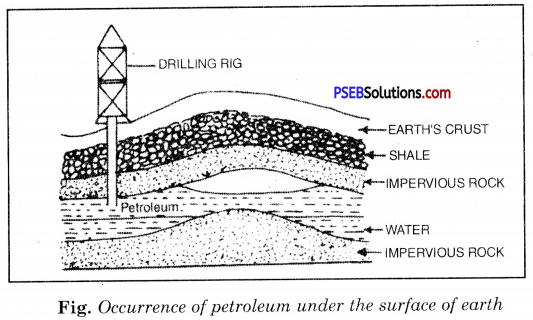
Petroleum is formed from the bacterial decomposition of the remains of animals and plants which got buried under the sea millions of years ago. When these organisms died, they sank to the bottom and got covered by sand and clay. Over a period of millions of years, these remains got converted into petroleum oil by heat, pressure and catalytic action. The hydrocarbons formed rose through porous rocks until they were trapped by impervious rocks forming an oil trap. Natural gas is found above the surface of petroleum oil.

PSEB 8th Class Science Solutions Chapter 5 Coal and Petroleum

Question 9.
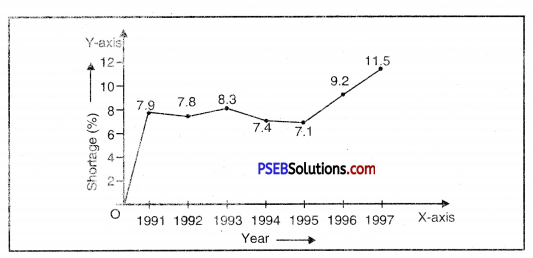
The following table shows the total power shortage in India from 1991-1997. Show the data in the form of a graph. Plot shortage percentage for the years on the Y-axis and the year on the X-axis.

S. No. Year Shortage %
1 1991 7.9
2 1992 7.8
3 1993 8.3
4 1994 7.4
5 1995 7.1
6 1996 9.2
7 1997 11.5

Answer:
PSEB 8th Class Science Solutions Chapter 5 Coal and Petroleum 1

PSEB Solutions for Class 8 Science Coal and Petroleum Important Questions and Answers

Multiple Choice Questions

Question 1.
Gurmeet’s mother uses cylinder to cook chapatti on gas burner at home. Name the gas in cylinder.
(a) Air
(b) Oxygen
(c) L.P.G.
(d) C.N.G.
Answer:
(c) L.P.G.

Question 2.
Monika read in a newspaper that a man became unconscious because of burning coal in a closed room. The teacher told her that during burning coal, a gas is produced which causes death of a person. Name
this gas.
(a) Oxygen
(b) Nitrogen
(c) Carbon-monoxide
(d) Hydrogen.
Answer:
(c) Carbon-monoxide.

Question 3.
The example of fossil fuel is:
(a) Air
(b) Sunlight
(c) Water
(d) Coal
Answer:
(d) Coal

Question 4.
Which out of the following is used as fuel in households ?
(a) Diesel
(b) Petrol
(c) Kerosene oil
(d) Bitumen.
Answer:
(c) Kerosene oil.

Question 5.
The purest form of carbon is:
(a) Coaltar
(b) Coal gas
(c) Diamond
(d) None of the above.
Answer:
(c) Diamond.

Question 6.
Which out of the following is the least pollution causing fuel ?
(a) Petrol
(b) Coal
(c) Kerosene oil
(d) C.N.G.
Answer:
(d) C.N.G.

PSEB 8th Class Science Solutions Chapter 5 Coal and Petroleum

Question 7.
Which is the natural solid fuel ?
(a) Coal
(b) Coke
(c) L.P.G.
(d) Coal tar
Answer:
(a) Coal.

Question 8.
Which among the following is the best domestic fuel ?
(a) Petrol
(b) Coal
(c) Kerosene oil
(d) C.N.G.
Answer:
(d) C.N.G.

Question 9.
Which of the following is the fossil fuel ?
(a) Air
(b) Hydrogen gas
(c) Water
(d) Coal.
Answer:
(d) Coal.

Question 10.
Which out of the following is the non renewable source of energy ?
(a) Air
(b) Sunlight
(c) Coal
(d) Forests
Answer:
(c) Coal

Question 11.
Which out of the following is called black gold ?
(a) Diesel
(b) Coal
(c) Bitumen
(d) Petroleum.
Answer:
(d) Petroleum.

Question 12.
Which out of the following is limited natural resource ?
(a) Air
(b) Sunlight
(c) Natural gas
(d) None of the above.
Answer:
(c) Natural gas.

Very Short Answer Type Questions

Question 1.
Name some natural materials.
Answer:
Air, water, soil, forests, minerals etc.

PSEB 8th Class Science Solutions Chapter 5 Coal and Petroleum

Question 2.
Name some man-made materials.
Answer:
Glass, cement, clothes, houses etc.

Question 3.
Define the term fossil fuel. Name three fossil fuels.
Answer:
Fossil fuels.
These are the fuels which are formed in nature from the dead remains of organisms over millions of years ago.
Examples. Coal, natural gas, petroleum etc.

Question 4.
How is coke prepared ?
Answer:
Coke is prepared by the destructive distillation of coal. The gases, and other substances present in coal are given off on heating. The black residue left behind is coke.

Question 5.
Name two products formed by Destructive distillation of Coal.
Answer:

  1. Coal gas
  2. Coal tar.

Question 6.
Name some products formed as a result of Fractional distillation of Petroleum.
Answer:
Asphalt, petrol, diesel oil, paraffin wax, fuel oil, kerosene oil.

Question 7.
Name three products of petroleum.
Answer:
Fertilizer, Insecticide, Artificial rubber.

Question 8.
What will happen if fossil fuels are used up at a fast rate ? Give reasons.
Answer:
Fossil fuel will get exhausted because the earth cannot recreate them rapidly.

PSEB 8th Class Science Solutions Chapter 5 Coal and Petroleum

Question 9.
Coal, petroleum, natural gas are example of which type of fuel ?
Answer:
Fossil fuel.

Question 10.
What is petroleum ?
Answer:
Petroleum. Petroleum is thick viscous crude oil with an unpleasant odour.

Question 11.
Which type of rocks store petroleum in them ?
Answer:
Impervious (non-porous) rocks.

Question 12.
Which process is used for refining petroleum ?
Answer:
Fractional distillation.

Question 13.
How is petroleum gas produced ?
Answer:
It is produced in the form of uncondensed gas during fractional distillation of crude petroleum oil.

Question 14.
What is the use of bitumen ?
Answer:
Road surfacing.

Question 15.
Which liquid fuel is used in stoves, lamps and jet air-crafts ?
Answer:
Kerosene oil.

Question 16.
Which product of petroleum is used for dry cleaning ?
Answer:
Petrol.

PSEB 8th Class Science Solutions Chapter 5 Coal and Petroleum

Question 17.
Name few exhaustible natural resources.
Answer:
Forests, wild life, minerals, coal etc.

Question 18.
Give examples of in-exhaustible natural resources.
Answer:
Air, water, sunlight etc.

Question 19.
Which natural material is available at a blacksmith’s place ?
Answer:
Coal.

Question 20.
What is main component of coal ?
Answer:
Carbon.

Question 21.
Which process converts dead vegetation into coal ?
Answer:
Carbonisation.

Question 22.
What happens when coal is heated or burn in air ?
Answer:
Carbondioxide gas is released.

Question 23.
Which condition is necessary for destructive distillation ?
Answer:
Absence of oxygen.

Question 24.
What is the latest use of coal-gas ?
Answer:
As a source of heat energy.

PSEB 8th Class Science Solutions Chapter 5 Coal and Petroleum

Question 25.
What is destructive distillation ?
Answer:
Destructive Distillation – The process of heating coal in the absence or limited supply of air is called destructive distillation.

Question 26.
What are hydrocarbons ?
Answer:
Hydrocarbons. The compounds of carbon and hydrogen are called Hydrocarbons.

Question 27.
What are Petrochemicals ?
Answer:
Petrochemicals.
These are the substances obtained from Petrol and Natural gas. These are largely used for the manufacture of detergents, synthetic fibres and plastics etc.

Short Answer Type Questions

Question 1.
Write two differences between Exhaustible and In-exhaustible Resources.
Answer:
Differences between Exhaustible and In-exhaustible Natural Resources.

Exhaustible Natural Resources In-exhaustible Natural Resources
1. Limited quantity in nature. 1. Limitless or unlimited quantity in nature.
2. Gets exhausted on consumption.

Examples: Forests, wild life.

2. Cannot exhaust on consumption i.e. can be retrieved back.

Examples: Air, Sun energy.

Question 2.
Where is petroleum found in India ?
Answer:
In India, petroleum is found in the states of Gujarat and Assam. It is also obtained from reservoirs buried deep under the sea bed near Mumbai. This oil-bearing region is called Bombay-High. Recently, oil has also been discovered in Godavari and Kaveri basins.

Question 3.
What are the major products of Petroleum refining ?
Answer:
During refining of petroleum following fractions are produced:

  1. Natural gas, Petrol,
  2. Naphtha,
  3. Kerosene oil,
  4. Gas oil (diesel),
  5. Lubricating oil/waxes,
  6. Fuel oil and
  7. Bitumen.

Question 4.
What are the products of coal ?
Answer:
Coal on heating in the absence of air gives coal gas, coal tar, and coke. Coal gas is also a good fuel. Coal tar gives important chemicals such as benzene, toluene, naphthalene, anthracene etc.

PSEB 8th Class Science Solutions Chapter 5 Coal and Petroleum

Question 5.
What is coal gas ? How is it formed ? Give its uses.
Answer:
Coal Gas. Coal gas is a mixture of methane, hydrogen and carbon monoxide.
When coal is heated in the absence of air, coal gas is formed.
Uses.

  1. It is used as a fuel.
  2. It is used for providing reducing atmosphere in metallurgical operations.

Question 6.
Give few uses of coal.
Answer:
Uses of Coal:

  1. As a fuel to cook food.
  2. To produce steam to run an engine.
  3. To produce electricity in Thermal Power plants.
  4. As a fuel in industry.

Question 7.
What is coal tar ? What are its uses ?
Answer:
Coal Tar. Coal tar is a black thick liquid with unpleasant smell. It is a mixture of about 200 substances, which are used as starting materials for the manufacturing of various daily need ithins such as paints, dyes, plastics, films, perfumes, explosives, drugs etc.
Coal tar is also used for road surfacing.

Question 8.
Name at least three constituents of petroleum and give their uses.
Answer:
Constituents of Petroleum

  1. Petrol
  2. Paraffin wax
  3. Diesel.

Uses of Petroleum:

  1. Petrol is used as a motor fuel and aviation fuel. It is also used for dry cleaning.
  2. Paraffin wax is used for making ointments, candles, vaseline etc.
  3. Diesel is used as a fuel for heavy motor vehicles and electric generators.

Question 9.
Define natural resource.
Answer:
Natural Resource. The resource that is obtained from nature is called natural resource.

Question 10.
What are the characteristics of a good fuel ?
Answer:
Characteristics of Good Fuel:

  1. It should be easily available.
  2. It should be cheap.
  3. It should be clean and should not produce poisonous gases and ash after burning.
  4. It should produce more energy.
  5. It should be easy to transport and store.

PSEB 8th Class Science Solutions Chapter 5 Coal and Petroleum

Question 11.
What is the difference between coal and coke ?
Answer:
Differences between Coal and Coke

Coal Coke
1. It is a non-crystalline form of carbon 1. It is an amorphous form of carbon.
2. It is obtained bj? death and decay of plants which remain buried under the earth for years together. 2. It is obtained by heating soft coal in the absence or limited siuply of air.

Long Answer Type Questions

Question 1.
What are fossil fuels ? How are they formed ? Why are they called non¬renewable sources of energy ?
Answer:
Petroleum, natural gas, coal etc., are main forms of fossil fuels. Millions of years ago, remains of animals, plants got buried under the earth before dinosaurs. These remains are called fossils. They remained inside the earth under huge pressure and high temperature in the absence of oxygen, these remains got converted into fossil fuel.

Fossils as a source of non-renewable source of energy.
Fossils were formed several hundred years ago under the earth. Man uses these for his various activities. These cannot be regained after use. So they are called non-renewable source of energy.

Question 2.
Describe the formation of
(a) Coal
(b) Petroleum.
Answer:
(a) Coal Formation.
Coal is believed to be formed from fossils which got buried inside the earth during earthquakes, volcanic eruptions etc., which occurred about 300 million years ago. These fossils were covered with sand, clay and water. In the absence of air and under high temperature and high pressure inside the earth, the fossils got converted into coal. This process of conversion of plants and animals buried inside the earth under high temperature and pressure to coal is called carbonisation. It is a very slow process and may have taken thousands of years.

(b) Formation of Petroleum.
It is believed that petroleum was formed and preserved in its crude state in the earth from the remains of dead microscopic marine plants (phytoplankton) which settled in muddy sediments at the bottom of sea millions of years ago. Prolonged sedimentation and cooking of these organic debris under pressure in the presence of natural catalysts, converted them into petroleum . For this reason, petroleum is also called fossil fuel.
PSEB 8th Class Science Solutions Chapter 5 Coal and Petroleum 2

Question 3.
What is petroleum? How does it occur? How is it mined?
Answer:
Petroleum.
It is dark coloured viscous, foul-smelling, oily liquid. It is a complex mixture of several solid, liquid, and gaseous hydrocarbons mixed with water, salt, and earth particles.

Occurrence of Petroleum.
Petroleum occurs deep down under the earth between two impervious rocks (non-porous rocks) as shown in Fig. Natural gas occurs above the petroleum oil trapped under rocks.

The crude petroleum is obtained by drilling a hole into the earth’s crust and sinking pipes into it. When the pipe reaches the oil deposit, natural gas comes out with great pressure. After the pressure has subsided, the crude oil is pumped out of the oil well. This process of obtaining crude oil from its sources is called mining.

PSEB 8th Class Social Science Solutions Chapter 4 Our Agriculture

Punjab State Board PSEB 8th Class Social Science Book Solutions Geography Chapter 4 Our Agriculture Textbook Exercise Questions and Answers.

PSEB Solutions for Class 8 Social Science Geography Chapter 4 Our Agriculture

SST Guide for Class 8 PSEB Our Agriculture Textbook Questions and Answers

I. Answer the following questions in 1-15 words:

Question 1.
What do you understand by Agriculture?
Answer:
Agriculture includes raising crops, cattle rearing, and other agricultural activities. It also includes dairy farming, poultry, bee-hiving, fishing, floriculture, gur production, flour mills, etc.

Question 2.
Which factors affect Agriculture?
Answer:
The following factors affect agriculture:

  1. Climate
  2. Relief
  3. Type of soil
  4. Irrigation
  5. Method of cultivation
  6. Marketing
  7. Means of transportation and
  8. Banking facilities.

Question 3.
Write a brief note on plantation farming.
Answer:
It includes the cultivation of single crop on large farms.

Question 4.
Write the names of cereal crops.
Answer:
Main cereal crops are Rice, Wheat, Maize, Jowar, Bajra, Pulses and Oilseeds.

PSEB 8th Class Social Science Solutions Chapter 4 Our Agriculture

Question 5.
What is puddling?
Answer:
For rice cultivation, seeds are planted in the fields. The field is levelled and filled with water. This is called puddling the field where rice plants are transplanted.

Question 6.
What products are prepared from Maize?
Answer:
Glucose, starch, alcohol and vegetable oil is prepared from Maize.

Question 7.
How many types of cotton are there on the basis of the length of staple?
Answer:

  1. Long staple cotton (Best Type)
  2. Medium staple cotton
  3. Short staple cotton.

Question 8.
Which are the things that can be made from jute?
Answer:
Bags, ropes, strings, etc. and shoes are prepared from jute.

Question 9.
How does the tea plant look like?
Answer:
Tea plant is a bush. Its leaves provide tea.

Question 10.
Write the names of three types of coffee.
Answer:

  1. Arabica
  2. Robusta
  3. Liberica.

PSEB 8th Class Social Science Solutions Chapter 4 Our Agriculture

Question 11.
What is the percentage of people engaged in agriculture in U.S.A. and Punjab?
Answer:

  • U.S.A.-More than 30% people
  • Punjab-58% people.

II. Answer the following questions in 50-60 words :

Question 1.
After writing the types of Agriculture differentiate between intensive and extensive agriculture.
Answer:
Types of Agriculture :

  1. Sedentary Agriculture
  2. Shifting Agriculture
  3. Dry Farming
  4. Wet Farming
  5. Intensive Farming
  6. Extensive Farming
  7. Mixed Farming
  8. Horticulture
  9. Individual Agriculture
  10. Co-operative Farming
  11. Collective Farming
  12. Plantation Agriculture
  13. Subsistence Agriculture
  14. Commercial Farming.

The distinction between Intensive and Extensive Farming :

  • Intensive farming is done on small farms while extensive farming is done on large farms.
  • Irrigation and fertilizers are used in intensive farming while machines are used in extensive farming.
  • Intensive farming is done in Punjab while extensive farming is done in U.S.A.

Question 2.
Differentiate between subsistence and commercial type of farming.
Answer:
1. Subsistence Farming: Majority of farmers in the country practise subsistence farming. It is characterised by small and scattered land-holdings and use of primitive tools. As the farmers are poor, they do not use fertilisers and high yielding variety of seeds in their fields to the extent they should do. These result into low productivity. Important cash crops like sugarcane, oilseeds, cotton and jute are grown. The subsistence agriculture has given way to commercial agriculture to some extent.

2. Extensive Farming: Extensive farming is bush or tree farming. It is a single crop farming of rubber, tea, coffee, cocoa, spices, coconut and fruit crops. It is capital-intensive and demands good managerial ability, technical know-how, sophisticated machinery, fertilisers, irrigation and transport facilities. Extensive farming is done in U.S.A. and Canada.

PSEB 8th Class Social Science Solutions Chapter 4 Our Agriculture

Question 3.
Which are main Rice producing areas?
Answer:
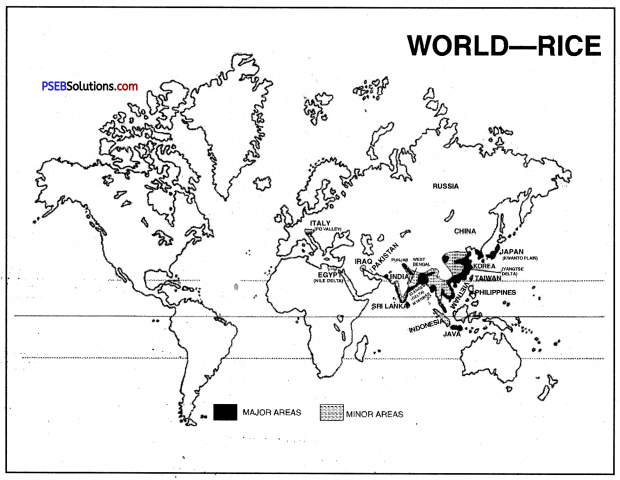
Cultivation of Rice. Rice is grown in deltas, flood-plains, coastal-plains and some terraced fields in the mountainous areas as well. It is one of the crops for which a lot of human labour is required. All operations including the preparation of seedling beds, ploughing, planting, weeding, harvesting and separation of grain are done by human labour.

Rice requires high temperature of over 20°C to germinate, bloom and mature. Rainfall of 100 cm to 150 cm is required. Paddy is cultivated mainly in India, China, Japan, Bangladesh, Indonesia, Thailand and Myanmar.

In India rice is cultivated most widely in Uttar Pradesh, West Bengal and Andhra Pradesh. Other producers are Assam, Tamil Nadu, Orissa and Punjab.

In Punjab, rice is grown in districts of Amritsar, Gurdaspur, Ferozepur, Jalandhar, Patiala and Ludhiana.
PSEB 8th Class Social Science Solutions Chapter 4 Our Agriculture 1

Question 4.
Explain the conditions required for cultivation of cotton and jute.
Answer:
Cotton. Cotton requires cloud free sunny days and uniformly high temperature. It grows best in areas where the temperature is between 30°C to. 40°C. Cotton plants require rainfall of 60 to 100 cm. Alluvial and black soils are best suited for cotton plants.

Jute. Jute fibre is obtained from the bark of the jute plant stem.
The jute plant originated in the Indian subcontinent. It grows best in well drained sandy loam and requires warm and humid climate. Jute plant requires temperature of more than 25°C and rainfall of over 150 cm per year.

Question 5.
Write a note on cotton production in Punjab.
Answer:
Punjab and Haryana together produce 25% cotton of India. The major producers are Ferozepur and Sangrur districts. B.T. cotton has been successfully grown in Punjab. Malwa region is also called white gold.

Question 6.
Write about protection of tea and coffee plants.
Answer:
Tea. Tea plants are planted on cleared slope. So that on well drained slopes, water should not stand in the roots of plants. Fertilizers are used for growth of tea plants. Tea plant needs pruning for its proper growth.

Coffee. Coffee saplings are grown in Nursery and then transplanted in the fields. The plants require use of fertilizers, pruning, and irrigation. Sunny weather is required during growth. The tree is pruned to keep it upto a height of 8 feet.

Question 7.
Write a note on the uses of machines in agricultural operations in U.SA.
Answer:
Two types of farms are functioning in the United States viz.,

  1. specialized farms and
  2. mixed farms.

PSEB 8th Class Social Science Solutions Chapter 4 Our Agriculture 2

A specialized farm concentrates on a particular type of crop or livestock, whereas a mixed farm raises a variety of crops. About 95 per cent of farms in the USA are specialized farms. Mostly cereal grains such as corn, wheat, sorghum, rice, barley, oats and rye are grown in specialized farms. However, specialized farms also produce crops such as cotton, groundnut, sugarcane, tobacco, vegetables and fruits. Nearly half the specialized farms in the USA are livestock farms. These livestock farms rear meat animals, raise milk cows, chickens and turkeys. In the mixed farms, farmers produce a variety of crops and rear livestock. The United States is the world’s leader in international agricultural goods market.

III. Answer the following questions in about 125-130 words :

Question 1.
After writing about conditions for the growth of wheat explain the areas of wheat production. (P.B. 2009)
Answer:
Geographical conditions of growth. Wheat needs a cool and wet climate during growing season and a warm dry climate during harvesting season. It requires a rainfall of 50 cm to 75 cm. It is a rabi crop. It grows best in winter due to winter rainfall and regular irrigation. It does not depend on destiny like rice crop. Wheat grows best on loamy soils. Mechanisation and use of chemical fertilizers give higher yields.

Production. Wheat is one of the oldest cereal crops cultivated in the world. Wheat is grown in temperate regions with rainfall ranging between 30 cm to 80 cm.

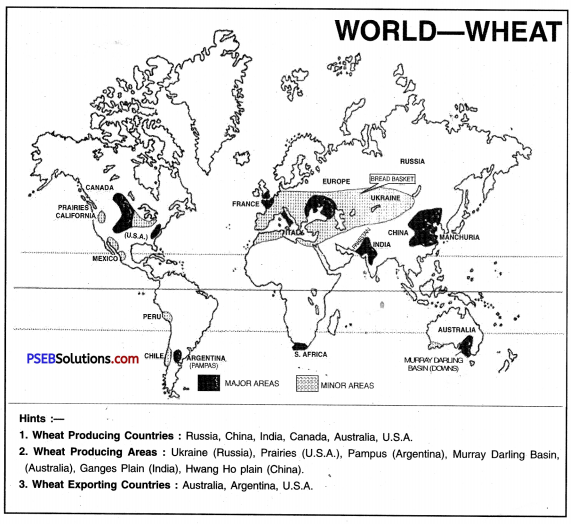
Three countries: the United States of America, Russia and China are the major producers of wheat. The world’s largest producer is China. Other leading producers are India, Ukraine, France, Canada, Pakistan and Argentina. Winter wheat and spring wheat belts of USA and Canada are quite famous.

Wheat cultivation is mainly carried on in fertile soils or loamy soils. Different climatic conditions and sowing seasons across the world have led to harvesting of wheat in every month of the year in one or the other part of the world. It is grown in Punjab, Haryana, Uttar Pradesh, Madhya Pradesh, Maharashtra and Bihar. India is the second largest producer of wheat in the world. The production and yield in Punjab has increased due to Green Revolution, Better seeds, fertilizers and irrigation is used. ,

Question 2.
What are the conditions required for the growth of Tea and Coffee? Explain the main areas of tea and coffee production in India.
Answer:
Geographical Conditions of Growth of Tea. Tea is a plant of both tropical and temperate areas.

  1. Temperature. Tea requires uniformly high temperatures (20° – 30°C) throughout the year. Frost is harmful for tea leaves.
  2. Rainfall. An annual rainfall of 150 cm is essential for the growth of tea.
  3. Soil. Tea requires a deep acidic and fertile soil.
  4. Land. Tea is grown on gently sloping, well drained hill slopes and valley-sides.
  5. Labour. Tea is a labour intensive crop. It requires cheap, skilled labour for picking tea-leaves.

Conditions for Growth of Coffee. One-third of the world population drinks coffee, the second largest beverage after tea. There are two types of coffee plants. Coffee Arabica or Mocha and Coffee Robusta. Robusta is the main variety produced in the world.

The coffee plant requires warm climate and moderate rainfall. Both strong sunshine and snowfall are harmful to the plant. During its growth, coffee plant requires rainfall of 100 cm to 150 cm and temperatures between 15°C and 25°C. Irrigation is required where the annual rainfall is less than 100 cm.

Areas of Cultivation of Tea. More tea is produced in Northern India than Southern India. Tea is grown on an area of 4.21 lakh hectares.

The average yield is 1540 kg per hectare. Assam produces about 50% tea of India.
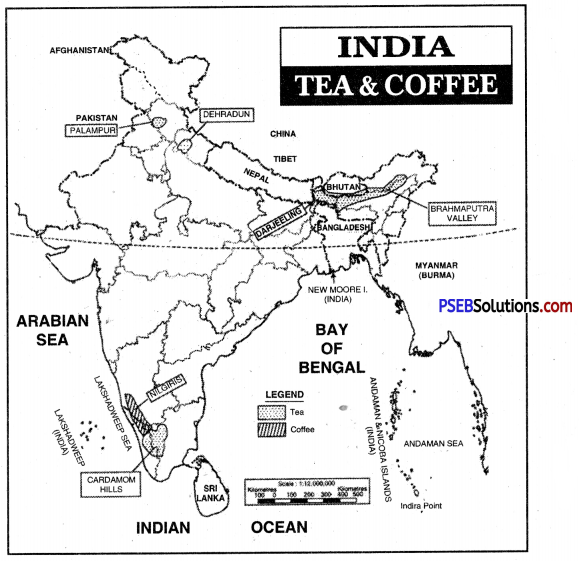
1. Assam. Assam is the largest producer of tea in India. Tea is grown on the valley sides of Brahmaputra and Duar region.
PSEB 8th Class Social Science Solutions Chapter 4 Our Agriculture 3

2. West Bengal. Tea is grown in Darjeeling and Jalpaiguri districts in West Bengal. Darjeeling tea has a special flavour. This flavour is due to slow growth under high humidity and low temperature.

3. Southern India. Tea is grown on the slopes of Nilgiris, Cardamom and Anamalai hills, Coimbatore (Tamil Nadu), Malabar coast (Kerala), Coorg region (Karnataka) and Ratnagiri (Maharashtra) are important areas of tea production. Areas of Cultivation of Coffee.

Karnataka is the largest coffee producing state of India.
(а) Karnataka. Coffee is grown in the districts of Chikamanglur, Coorg, Hassan, Shimoga (Nilgiris) in Karnataka state. High rainfall, sunshine, protected slopes, well- drained soils favour the cultivation of coffee.
(b) Arcot, Tinevelley, Madurai, Coimbatore districts of Tamil Nadu grow coffee.
(c) In Kerala, Cardamom hills covering the districts of Palghat and Thiruvananthapuram.

PSEB 8th Class Social Science Solutions Chapter 4 Our Agriculture

Question 3.
Write down the process involved in Jute production. Write in detail the uses and distribution of Jute in the world.
Answer:
Jute: Jute is an industrial fibre. It is the cheapest fibre. It has commercial importance. It is also called ‘golden fibre’. It is used in the making of carpets, ropes, covers and linoleum. It is used for packing many agricultural commodities. Jute is called ‘Brown Paper of Whole-sale trade’. Jute fibre has softness, strength and length.

Conditions of Growth: Jute is a plant of hot-wet tropical areas.

  1. Temperature. It requires uniformly high temperature (27°C) throughout the year.
  2. Rainfall. Jute requires well distributed heavy rainfall (150 cm).
  3. Soil. It is grown on flood plains and deltas. Fertilizers are also used.
  4. Clean Water. Jute needs an ample supply of clean water for washing.

Area and Production: The jute is grown on an area of about 8 lakh hectares. The total production is about 93 lakh bales (each bale = 180 kg). The average yield is 2014 kg per hectare.

India is the largest producer of jute in the world. Due to partition of India 75% of jute producing areas remained in East Pakistan (now Bangladesh). There was shortage of raw jute for jute mills in India. Now India is self-sufficient in jute production. Coarse jute called Mesta is also grown.

Areas of Cultivation

  1. West Bengal. West Bengal is the largest producer of jute in India. Jute is grown in Ganges delta. Murshidabad, Burdwan, Nadiad, Hooghly are the main jute producing districts.
  2. Assam. Jute is grown in Goalpara, Kamrup and Tezpur districts in Brahmaputra valley.
  3. Bihar. Jute is grown in Terai districts of Purnea and Champaran. The major producers of Jute in the world are China, India, Bangladesh, Thailand and Brazil.

Question 4.
What are the similarities and variations in the agriculture of Punjab and the U.S.A.?
Answer:
(A) Agriculture in the U.S.A.-A Glance :

  • Agriculturally, the U.S.A. is a developed country. About 3% of the total population is engaged in agriculture,
  • The main reason behind this is that all the activities of agriculture are carried on by machines and. not by men.
  • Agricultural activities are carried on about 20% part of the land,
  • The main agricultural areas include North-West, North-East, interior plains and coastal plains of the country. Different types of crops are grown in different parts of the country,
  • The farmers of the U.S.A. have large landholdings as compared to that of India. The farm size is very big. The average farm size in U.S.A. is 700 acres. Due to the large size of the fields, extensive type of agriculture is practised.
  • Machines are used at a very large scale. It is almost impossible to work in farms without machines,
  • In a farm, only one type of crop is cultivated. From the sowing of crop to the taking of the crop to markets or stores, every work is done with the help of machines,
  • Insecticides and pesticides are properly utilized. The farmer of U.S.A. practice agriculture like a businessman and not like a mere farmer.

(B) Agriculture in Punjab (India)-A Glance :

  • Punjab in comparison to other states of India, is much advanced in agriculture. The agriculture sector contributes 35% to the total income of the country. About 58% population of the state is engaged in agriculture,
  • The soils here are fertile in nature. To maintain the fertility of the soils, the farmer also uses fertilisers,
  • The farmers of Punjab do not have too much of land. Landholding mostly range between 5 to 25 acres. Some farmers possess even less land. Six percent farmers of the state have more than 25 acres of land.
  • The farmer grows, different types of crops in his fields. The variations in crops mainly depend on climate, size of landholding, type of soil, irrigation facilities and requirements of the farmer.
  • According to the size of the land holding the farmer uses tractor or combine harvester,
  • Almost all the net sown area comes under irrigation. The farmer of Punjab also uses insecticides and pesticides at a large scale to get more production. Though the farmer of Punjab uses the machines, even then the contribution of labourers is too much. This we can estimate from the number of people working in the agricultural sector. In U.S.A. only 3% of population is engaged in agriculture whereas in Punjab 58% people are working in the agriculture sector,
  • The farmer of Punjab (except a few big farmers) does not practice agriculture like a businessmen. He sows a number of crops in his fields. Two-2 crops are taken at the same time,
  • The agriculture of Punjab is an intensive type of agriculture. Therefore, the yield per acre is more than that of the U.S.A.

IV. Map Skill

Question 1.
Show two place’s each of following crops on outline map of India. Tea, Wheat, Rice, Cotton, Jute.
Answer:
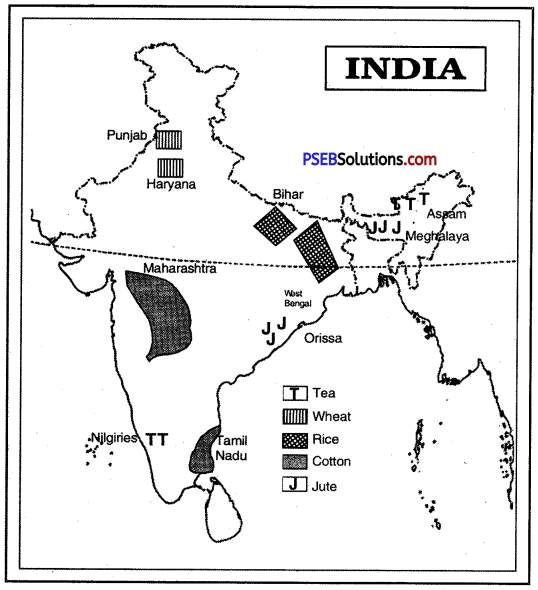
PSEB 8th Class Social Science Solutions Chapter 4 Our Agriculture 4

PSEB 8th Class Social Science Solutions Chapter 4 Our Agriculture

V. Activity

Question 1.
Name three each of Kharif and Rabi crops mentioning geographical conditions need for each.
Answer:

Crop Temp Rainfall Soils
1. Wheat 10°-20°C 50-100 cm Clay soil
2. Rice 20°-30°C 100-200 cm Alluvial soil
3. Maize 18°-27°C 50-100 cm Levelled plain
4. Cotton 20°-30° 50-100 cm Simple slope
5. Tea 20°-30°C 150-300 cm Sloping
6. Jute 29°-35°C 120-150 cm Alluvial soil

PSEB 8th Class Social Science Guide Our Agriculture Important Questions and Answers

Multiple Choice Questions :

Question 1.
Commercial rearing of silkworm is called
(a) Commercial farming
(b) Pisciculture
(c) Sericulture
(d) Viticulture.
Answer:
(c) Sericulture.

Question 2.
Farming in which the produce is consumed by the farmer’s household is called :
(a) Subsistence
(b) Extensive
(c) Intensive
(d) None of the above.
Answer:
(a) Subsistence.

Question 3.
What does golden filament means?
(a) Cotton
(b) Jute
(c) Silk
(d) Wool.
Answer:
(b) Jute.

PSEB 8th Class Social Science Solutions Chapter 4 Our Agriculture

Question 4.
Which country is the largest producer of rice in the world?
(a) India
(b) Brazil
(c) China
(d) U.S.A.
Answer:
(c) China.

Question 5.
India is largest producer of _________
(a) Tea
(b) Coffee
(c) Rice
(d) Cotton.
Answer:
(a) Tea.

Question 6.
For what purpose the following machine is used?

PSEB 8th Class Social Science Solutions Chapter 4 Our Agriculture 5
(а) For drilling
(b) For showing wheat / rice
(c) For harvesting
(d) For growing vegetables.
Answer:
(c) For harvesting.

Question 7.
In the following picture a plant is shown, name the areas in which plant is found.

PSEB 8th Class Social Science Solutions Chapter 4 Our Agriculture 6
(а) Tropical
(b) Temperate
(c) Tropical & temperate
(d) None of these.
Answer:
(c) Tropical & Temperate.

Question 8.
What is the name of farming of fruit shown in this picture?

PSEB 8th Class Social Science Solutions Chapter 4 Our Agriculture 7
(а) Horticulture
(b) Sericulture
(c) Pisciculture
(d) Viticulture.
Answer:
(d) Viticulture.

Question 9.
Which of the following crops does this picture resemble?
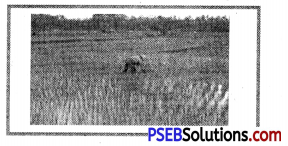
PSEB 8th Class Social Science Solutions Chapter 4 Our Agriculture 8
(a) Paddy (Rice)
(b) Wheat
(c) Maize
(d) Cotton.
Answer:
(a) Paddy (Rice).

PSEB 8th Class Social Science Solutions Chapter 4 Our Agriculture

Question 10.
What type of crops can be grown on the part of land with plenty of black soil?
(a) Sugarcane
(b) Wheat
(c) Cotton
(d) Jute.
Answer:
(c) Cotton.

Fill in the Blanks :

Question 1.
_________ agriculture is done with machines in sparsely populated areas.
Answer:
Extensive

Question 2.
_________ is called cultivation of grapes.
Answer:
Viticulture

Question 3.
Shifting cultivation is also called _________
Answer:
Slash and burn

Question 4.
Coarse grain are also called _________
Answer:
Millets

PSEB 8th Class Social Science Solutions Chapter 4 Our Agriculture

Question 5.
Agricultural activity in India is a _________
Answer:
primary activity.

True/False :

Question 1.
Production of fruit and flower is called viticulture.
Answer:
False

Question 2.
Punjab state is the largest producer of wheat.
Answer:
False

Question 3.
Arabica is a variety of coffee.
Answer:
True

Question 4.
Flax is a fibre crop.
Answer:
True

PSEB 8th Class Social Science Solutions Chapter 4 Our Agriculture

Question 5.
Russia is a leading producer of coffee.
Answer:
False.

Very Short Answer Type Questions

Question 1.
What is meant by agriculture?
Answer:
The word ‘agriculture’ is derived from the Latin words ‘ager’ or ‘agri’ and ’culture’. Ager means soil and culture means cultivation or tilling the soil. Agriculture, thus, means cultivation of soil. But in broader sense, agriculture is growing crops and rearing of livestock. Livestock include animals (cattle, sheep and goat) and birds that are reared for human use.

Question 2.
What are the different forms of the word ‘culture’?
Answer:
The word cuture has many variants like :

  1. Agriculture. Science and art of cultivation on soil, raising crops or livestock.
  2. Sericulture. Commercial rearing of silkworms.
  3. Pisciculture. Breeding of fish for commercial gains.
  4. Viticulture. Cultivation of grapes.
  5. Horticulture. Growing of vegetables, fruits or flowers for commercial use.

Question 3.
What is Sedentary Agriculture?
Answer:
When a farmer practises settled agriculture at a fixed place, it is called sedentary agriculture. Crops can be grown every year at the same field. Organic fertilizers and chemical fertilizers are used to increase the fertility of the soil.

Question 4.
What is mixed farming?
Answer:
In mixed farming, foodgrains, fruit, vegetables are grown along with cattle farming. Fisheries and. bee-hiving is also done. It increases the income of farmers.

PSEB 8th Class Social Science Solutions Chapter 4 Our Agriculture

Question 5.
What is the main characteristic of plantation farming?
Answer:
Crops are grown on large farms. Tea, coffee, rubber are plantation crops which give yield for many years.

Question 6.
Enlist the fibre crops and the beverage crops.
Answer:
Fibre Crops. Cotton, jute, flax.
Beverage Crops. Tea, coffee, cocoa.

Question 7.
Why the people of rich countries prefer wheat to rice?
Answer:
Wheat contains protein, carbohydrate and vitamins. Therefore, wheat is preferred to rice.

Question 8.
State the conditions of growth, temperature, rainfall and land required for maize.
Answer:

  • Temperature: 18°C – 27°C, Frost free season.
  • Rainfall: 50 cm to 100 cm.
  • Land: Level or rolling.

PSEB 8th Class Social Science Solutions Chapter 4 Our Agriculture

Question 9.
What are oilseeds? What is their importance?
Answer:
The seeds which provide oil are called oilseeds. These include til, sunflower, rapeseed, etc. These provide us food and meet our daily needs.

Question 10.
Which sources provide fibre? For which purpose fibre from sheep is used?
Answer:
Fiber is obtained from plants and animals. Wool from sheep is used for woollen clothes.

Question 11.
What is the use of cotton fibre?
Answer:
Cotton fibre is used as a raw material for textile industry. It makes fight and strong clothes.

Question 12.
Explain the term ‘farm system’.
Answer:
Agriculture or farming or cultivation is s system called farm system.

  • Inputs. Include seeds, fertilisers, water, machinery, and labour.
  • Operations. Ploughing, sowing, irrigation, weeding, and harvesting.
  • Outputs. Crops, wool, dairy, products, poultry, etc.

Question 13.
Name the main states producing cotton. Account for large production in these states.
Answer:
Maharashtra, Gujarat and Andhra Pradesh produce more than 60% cotton of India. The large production is due to fertile black soils in these states.

Question 14.
Why is tea grown on hill slopes?
Answer:
Tea needs uniform supply of water throughout the year. Water should not stagnate in the roots of tea bush. Hill slopes are well-drained.

Question 15.
How is coffee powder prepared? Which element of it produces excitement in our bodies?
Answer:
Coffee seeds are dried, roasted and grinded to make powder. It contains Caffeine which produces excitement in our bodies.

Question 16.
How is coffee plant grown?
Answer:
Coffee plant is grown in nurseries. After six months, it is transplanted in fields. It starts giving fruit after 3-4 years.

Question 17.
Agricultural development is uneven in different parts. Give one example.
Answer:
Many parts of Africa are not agriculturally developed. But in U.S.A., agriculture is a commercial and profitable occupation.

PSEB 8th Class Social Science Solutions Chapter 4 Our Agriculture

Question 18.
What is Green Revolution?
Answer:
The increase in agricultural production by introducing scientific methods like; new varieties of seeds, use of fertilizers and good water supply is called green revolution. The increase was in the yields of certain crops like wheat and rice.

Question 19.
Which activities are included in Agriculture?
Answer:
Dairy farming, poultry, honey bee keeping, pisciculture, gur making, flour milks, floriculture all occupations are a part of agriculture.

Question 20.
State two characteristics of Extensive farming.
Answer:

  1. Size of farms is very large.
  2. Yield per acre is less and machines are used for agriculture.

Question 21.
What is the position of Punjab in production of rice?
Answer:
Per hectare yield of rice in Punjab is the highest in India. Punjab produces about 12.2 per cent of total rice of the country. Punjab ranks second in rice production.

Question 22.
If a person has cultivated crops like Tea, Coffee and Cocoa, then identify the types of these crops.
Answer:
Beverage crops.

Short Answer Type Questions

Question 1.
Discuss the main characteristics of shifting cultivation.
Answer:
Shifting Agriculture. In this type of agriculture, first of all, a piece of forest land is cleared by felling trees and burning of trunks and branches. After the land is cleared, crops are grown for two to three years and then the land is abandoned as the fertility of the soil decreases. The farmers then move to new areas and the process is repeated. Dry paddy maize, millets and vegetables are the crops commonly grown in this type of farming. The per hectare yield is low.

Question 2.
Distinguish between dry land farming and wetland farming.
Answer:
Dry land farming. It is practised in areas where the rainfall is low and irrigation facilities are inadequate. Here, emphasis is laid on the conservation of moisture and on crops like jowar, bajra and pulses, which need less water. In dry farming, only one crop is grown in the kharif season.

Wet land farming. It is practised in the areas where rainfall is more than 200 cm per year. It is mostly practised in S.E. Asia. In India, it is practised in West Bengal, Orissa and coastal areas. The main crop is Rice, Sugarcane. Multiple Cropping is done in different seasons.

Question 3.
Distinguish between Individual and Cooperative farming.
Answer:
Individual farming. In this farming, the farmer is the owner of the land. The use of tools, fertilizers and management is in the hands of the farmer. The total income is the personal income of the farmer.

Co-operative farming. In this, the Govt, is the owner of the land. A part of the income goes to the government as tax. The rest of income is divided among the labourers and farmers. This type of agriculture was practised in U.S.S.R.

Question 4.
Write a note on Collective farming.
Answer:
In this type, the farmers join together to form a collective organisation. All the farmers cultivate their own land. The accounts of production is in the hands of the organisation. The decisions are taken for the benefit of farmers. All the profit is distributed among farmers in the ratio of their lands. In India, this type of farming is encouraged by the government.

PSEB 8th Class Social Science Solutions Chapter 4 Our Agriculture

Question 5.
Describe the favourable conditions for growth of Rice.
Answer:

  • Temperature: 20°C to 30°C.
  • Rainfall: 100-200 cm (Irrigation in dry areas)
  • Soils: Alluvial, clay, loamy and delta or black soils.
  • Land: Level land suitable for irrigation.
  • Labour: Cheap and skilled labour.

Question 6.
Describe the cultivation of maize in India and world.
Answer:
Maize: Maize is known as Makka in India, corn in the United States of America, India and Europe. It originated from the American continent. It was introduced in Europe by Columbus and other explorers. It was Native Americans who taught colonizers how to grow maize.

Maize is used as foodgrains and as fodder. It is grown mainly in Russia, Canada and parts of South America. The United States of America is the largest producer. China is the second-largest producer followed by Brazil, Mexico, Argentina and India.

India: Most of Maize is grown in Madhya Pradesh, Andhra Pradesh, Karnataka and Rajasthan. U.P, Himachal Pradesh, J & K, Maharashtra, Punjab and Gujarat are also the producers of Maize. In Punjab, Rupnagar, Amritsar, Hoshiarpur, Jalandhar produce maize.

Question 7.
Write a note on the agricultural development of Punjab.
Answer:
Punjab is one of the leading states of India in agriculture. This is due to :

  • 58% people are engaged in agriculture. 35% of income comes from agriculture.
  • Soils are fertile. Fertilizers are used.
  • Mulitple cropping is done. Better seeds are used. Tractors and Harvesters are used.
  • Irrigation is the basis of agriculture.
  • Pesticides are used to protect crops.
  • Machines are used on large farms.

Question 8.
Why agriculture is called the main stay of the Indian Economy?
Answer:
Indian’s main occupation is agriculture. Two-thirds of India’s population is engaged in agriculture. Agriculture is the main stay of the Indian Economy. Agriculture provides food to the teeming millions in India. It sustains 2/3 of our population. It provides raw material to agro-based industries. Agriculture along with forests and fisheries form 45% of our total national income. Our industrial structure is being built on the broad foundation of Indian agriculture. It is also a great earner of foreign exchange.

Question 9.
What are the main features of Agricultural development in India?
Answer:

  • India is a vast country. More than 70% of its population is dependent upon agriculture for livelihood.
  • The major foodgrains produced in India are rice and wheat.
  • Most of farms are not more than one hectare of land.
  • India is self-sufficient in the production of foodgrains .
  • In India, half of the total cultivable land is irrigated.

Question 10.
What has been the impact of mechanisation on agriculture?
Answer:
The earlier farmers used simple tools. Gradually on-driven ploughs were introduced. But, now in modern times the techniques have been changed. Now in developed countries all farm operations have been mechanised. It has reduced the number of people engaged in agricultural work. Many people can now work in industries and services.

PSEB 8th Class Social Science Solutions Chapter 4 Our Agriculture

Question 11.
What is Agriculture?
Answer:
The word Agriculture is derived from two Latin words ‘agri’ and ‘culture’. ‘Agri’ means’soil and ‘culture’ means cultivation or tilling. Agriculture hence refers to the cultivation of soil for growing crops and rearing of livestocks.

Question 12.
Name the factors influencing agriculture.
Answer:
The factors which influence agriculture are :

  1. Relief
  2. Soil conditions
  3. Temperature
  4. Rainfall.

Question 13.
What is plantation agriculture?
Answer:
It is special type of commercial farming which requires large amount of labour, technical efficiency, very large estates and capital. In this type of agriculture a simple crop of tea, rubber, coffee, sugarcane, cashew, banana or cotton is grown. The produce may be processed on the farm itself or in nearby factories. A well developed transport . network is also required.

Tropical regions of the world are major plantation areas. Rubber in Malayasia, coffee in Brazil, tea in India and Sri Lanka are some examples.

Question 14.
Name the different varieties or crops in India.
Answer:

  1. Cereals
  2. pulses and oilseeds
  3. Fibre crops
  4. Beverage crops
  5. Cash crops

Question 15.
Discuss the different types of fibres.
Answer:
Vegetable fibers are obatained from seeds, barks, leaves and fruit cases.
Animals fibres are produced from insects; such as silkworm and animals such as camels, sheep, goats, yaks, Hamas, rabbits, guanacos, alpacas, vicunas and reindeers.

Mineral fibres such as glass is made from silica sand.
Synthetic fibres are derived from chemical treatment of natural cellulose, which is i made from wood pulp.

Question 16.
What do you know about commercial agriculture?
Answer:
In this type of agriculture the main aim is to produce the crop for sale in the market. It can be intensive or extensive agriculture. The farmers try to keep the cost of production low. The framework is done by machines. This type of agriculture is practised in the prairies of North America, Pampas of South America, Steppes of Russia, Western Europe and in some parts of India.

Question 17.
Write the features of Intensive Subsistence Agriculture.
Answer:
It is a type of subsistence agriculture and its features are :

  • Intensive subsistence agriculture is done on small plot with simple tools.
  • Done by farmer and his family as labour.
  • Produce is used mainly by farmer so food grains are grown.
  • Rice is the main crop. Other crops are wheat, maize, pulses etc are cultivated.
  • Done mainly in thickly populated areas of south, southeast and east Asia.

PSEB 8th Class Social Science Solutions Chapter 4 Our Agriculture

Question 18.
Describe the main characteristics of shifting agriculture.
Answer:

  • In shifting agriculture, a plot of land is cleared by felling trees and burning them.
  • The ashes are then mixed with soil which works as a fertilizer.
  • After the soil loses its fertility, the land is abandoned. Cultivators move to a new plot.
  • It is practised in areas of heavy rainfall and quick generation of vegetation.
  • It is mainly done in Amazon basin, Tropical Africa, Southeast Asia and northeast India.
  • Crops like maize, yam, potatoes, and cassava are grown. This is also known as the ‘slash and burn’ agriculture.

Question 19.
Distinguish between :
(i) Subsistence farming and Commercial farming
Answer:

Subsistence Farming Commercial Farming
1. The practice of farming in which the crops are grown for home consumption by the farmer. 1. The practice of farming in which crops are grown for sale in the market or trade.
2. It is practised on small farms with simple tools and old technology. 2. It is practised on large farms with modern technology.
3. For example The production of wheat in some parts of country. 3. For example The production of sugarcane in U.P.

(ii) Intensive farming and Extensive farming.
Answer:

Intensive Farming Extensive Farming
1. Production is increased by using higher inputs and better agricultural techniques. 1.            Production is increased by bringing more and more land under cultivation.
2. This is practised in areas which are thickly populated. 2. This is practised in areas which are thinly populated.
3. This is practised in areas where there is less land available. 3.            This is done in areas where abundant land is easily available.
4. Livestock farming is little developed due to poor pastures. 4.            Livestock farming Supplements agriculture due to availability of grasslands.
5. Farms are small in size. 5. Farms are very large in size.

Fill in the blanks :

Question 1.
Shifting agriculture is also known as _________
Answer:
Slash and burn

Question 2.
_________, soil and climate are vital factors for agricultural activities.
Answer:
Topography

Question 3.
Advertising is an example of _________ activities.
Answer:
Tertiary

PSEB 8th Class Social Science Solutions Chapter 4 Our Agriculture

Question 4.
Jute is grown intensively in _________ and _________
Answer:
India, Bangladesh

Question 5.
Coarse grains are also called _________
Answer:
Millets.

Long Answer Type Questions

Question 1.
What is the importance of cotton? Explain the conditions of growth and areas of production of cotton and jute in India.
Answer:
Cotton. Cotton has been called ‘the universal fibre’. It is one of the most important fibres of all the fibres. It forms the basis of cotton textile industry. Cotton is the leading fibre crop of India. It is known from the writings of Herodotus that cotton has been in use in India since 3000 B.C.

Geographical Conditions of Growth

  • Temperature. Cotton needs uniformly high summer temperature between 22°C to 32°C. It requires a warm climate with bright sunshine. Frost is harmful to cotton plants.
  • Rainfall. Cotton needs light to moderate rainfall between 50 to 100 cm.
  • Irrigation. In arid treas, irrigation is used. It increases the yield per hectare as in Punjab.
  • Soils. Cotton grows best on rich, well-drained loamy soils or lava soils.

Types of Cotton:

  • The long-staple cotton. This cotton has a length of 25 mm and above.
  • The medium staple cotton. This cotton has a staple length between 18 mm to 25 mm.
  • The short-staple cotton. This cotton has a fibre length of less than 18 mm.

Area of Cultivation
Southern India produces more cotton than Northern India. Gujarat is the leading
producer of cotton in India with a production of 25% of the total production in the country.
1. Black cotton soil region. This is the chief cotton-growing area of India on the ‘lava soil’ of N.W. Deccan Plateau. Gujarat, Maharashtra, and Madhya Pradesh are the major cotton-producing states.

2. Red soil region. Medium staple cotton is grown in the red soil areas including the states of Tamil Nadu, Karnataka, and Andhra Pradesh. The yield is low.

3. Alluvial soil region. Long-staple cotton is grown on the alluvial soils of Northern Plains. The states of Punjab, Haryana, and Rajasthan are the important producers. Punjab has the highest yield per hectare due to its warm climate, fertile soils, and facilities of irrigation.

World Production. The U.S.A. is the leading producer of cotton in the world. China ranks second. India ranks third. Other main producers are Russia, Mexico, Egypt, Sweden, and Pakistan. Egypt is known for long-staple cotton. In the U.S.A., cotton production is decreasing.

PSEB 8th Class Social Science Solutions Chapter 4 Our Agriculture

Question 2.
Describe the different types of Farming.
Answer:
1. Shifting Agriculture. This farming method is practised by primitive people living in dense forests. The land is prepared by felling trees and burning the trees. People move from one area to another when the soil loses its fertility.

2. Subsistence Farming. In this method, farmers use primitive tools to cultivate their lands. Farmers in these regions produce agricultural goods, which are just sufficient to satisfy their own needs.

3. Commercial Farming. When farmers use modern tools and equipment such as tractors, threshers, winnowers, etc., and produce crops mainly to sell them in the market, it is called commercial farming.

4. Extensive Farming. This method is practised in countries where the population is sparse and the availability of land is more. Farmers use machines to a great extent, as the size of land holdings is large.

5. Intensive Farming. In this method of farming, the same piece of land is used throughout the year continuously. The soil is also very fertile. Farmers use more labourers, seeds that can yield more, better manures, and ensure a regular water supply.

6. Irrigation Farming. It is the type of farming, which mainly depends on irrigation through canals, wells, and tanks. Farmers cultivate their lands throughout the year.

Some of the important river valleys of the world where this method is followed are, the Ganga valley and the Indus valley in India, the Nile valley in Egypt, the Xi Jiang valley in China, Missouri, and San Joaquin valley in the United States of America.

7. Rainfed Farming. In the regions where the rainfall is not only seasonal but also scanty, farmers use different measures to cultivate their lands and use the scarce amount of rainwater efficiently. This is known as rainfed farming.

8. Mono-crop Farming. When the farmers specialize in the production of a single crop or if the soil and other natural factors allow farmers to cultivate only one crop that farming is known as one-crop or mono-crop farming.

9. Double and Multi-crop Farming. When two or more crops are cultivated in a plot of land, it is known as double or multi-crop farming. In this method, farmers apply scientific methods—use seeds that can give high yield, and apply manures in an appropriate manner.

PSEB 8th Class Social Science Solutions Chapter 1 Resources – Types and Conservation

Punjab State Board PSEB 8th Class Social Science Book Solutions Geography Chapter 1 Resources – Types and Conservation Textbook Exercise Questions and Answers.

PSEB Solutions for Class 8 Social Science Geography Chapter 1 Resources – Types and Conservation

SST Guide for Class 8 PSEB Resources – Types and Conservation Textbook Questions and Answers

I. Answer the following questions in 1-15 words :

Question 1.
What do you understand by the term ‘resources’?
Answer:
All the useful elements of the environment which satisfy human needs are called resources. Resources are called ‘Gifts of nature’ such as rocks, minerals, soil, rivers, plants, and animals. These are valuable for mankind. Man’s surroundings provide him with resources.

Question 2.
Which are the Natural Resources and who provides us?
Answer:
Forests, minerals, soil, and solar energy are natural resources. These make our environment or surroundings. These natural surroundings provide rsesources.

Question 3.
List all the types of resources.
Answer:
The three categories of resources are :

  1. Natural Resources
  2. Human Resources
  3. Human Made Resources.

PSEB 8th Class Social Science Solutions Chapter 1 Resources – Types and Conservation

Question 4.
Define ‘soil’.
Answer:
The loose and unconsolidated material which forms the upper layer of the crust is called soil. Soil is formed by the breaking of parent rock.

Question 5.
What do we get from Seas?
Answer:
The big water bodies are called seas. Seas provide us organic minerals and power resources, fish, pearls, diamonds, etc. At some places, petroleum is also obtained from sea.

Question 6.
How can you conserve the resources properly?
Answer:
The proper and planned use of resources help in the conservation of resources. These should not be misused.These should not be wasted or destroyed.

II. Answer the following questions in 50-60 words :

Question 1.
Differentiate between Biotic and Abiotic resources.
Answer:

Biotic Resources Abiotic Resources
1. These are obtained from living things. 1. These are obtained from non-living things.
2. Plants and animals are its examples. 2. Minerals and rocks are examples.
3. These are found in Biosphere and provide food, energy (coal and petroleum) and raw materials. 3. These are found on lithosphere and provide raw materials for industries.

Land: Land is the basis of human activities. It helps in agriculture, setting up of industries, means of transportation, sports, tourism, etc. Houses are built on land.Question 2.
Write a short note on the importance of Land and Soil Resources.
Answer:
The following is the importance of Land and Soil :

  1. Soil: Man grows crops on soils. It provides food and other raw materials to man. Fertile soils support dense population.

Question 3.
From where do we get the minerals and where they used?
Answer:
Minerals are obtained from the interior of earth from rocks. These are metallic and non-metallic. Metallic minerals include iron, copper, gold, silver, aluminium. Non- metallic minerals include coal, mica, manganese and oil. These are used in industries. Before use, these are smelted to make pure.

PSEB 8th Class Social Science Solutions Chapter 1 Resources – Types and Conservation

Question 4.
Explain the Developed and Potential resources with examples.
Answer:

Potential Resources

Developed Resources

1. These are total quantity of a resource found existing in nature. 1. These are only those resources, which have been judged good for use.
2. These have not been put to use. 2. They are put to use fully for economic gain.
3. These are found everywhere. 3. These are not found everywhere.
4. Africa has 40% potential water power resources of world due to large rivers. 4. Africa has only 1% of developed water power resources of world due to lack of technology.

Question 5.
Why should we use the exhaustible resources wisely and with hesitation?
Answer:
The modern civilisation depends upon products—natural as well as man made. With the help of technology, resources are being utilised on a large scale. The exhaustible resources will not last long. 80% of the fossil fuels will be finished in one century With the exhaustion of resources, the civilisation will come to an end. Therefore conservation of resources is necessary. A balance should be maintained between population growth and utilisation of resources so that the continuity of modern civilisation goes on. The natural resources are common heritage. We have to share these with future generations.

Question 6.
What is the contribution of human resources to the development of other resources ?
Answer:
Resources are the elements of Bio-physical environment. But these become resources only when humans preserve these. Coal was always there, but it became a resource only when man used it as a source of energy. So it has been rightly said that the resources are not, they become so. Man uses technology and skill to develop resources. Machines and tools are used. Japan is a very good example where in spite of non existence of resources, the country has progressed to a great extent.

III. Answer the following questions in about 125-130 words :

Question 1.
What do you understand by the resources ? Name their types and explain their importance and methods of conservation.
Answer:
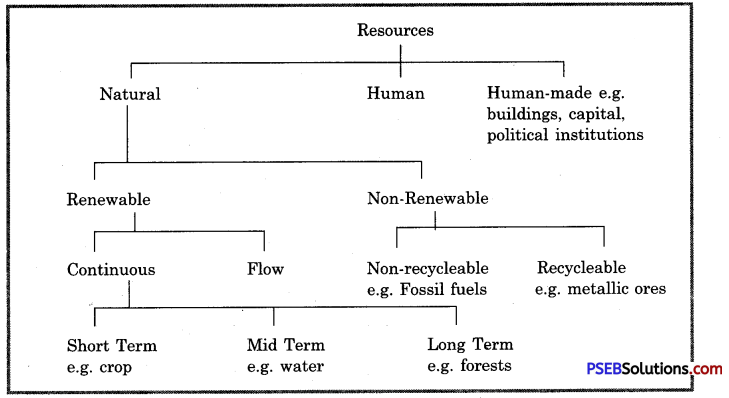
Type of Resources: Resources are generally classified into three types :

  1. natural
  2. human and
  3. human-made.

Natural or man-made resources are of various types. On the bases of life, existence, availability, level of development and utilization these resources can be divided into the following types :

  • Biotic and Abiotic Resources
  • Developed and Potential Resources
  • Exhaustible and Inexhaustible Resources
  • Soil and Land Resources
  • Marine-and Mineral Resources
  • Human Resources

PSEB 8th Class Social Science Solutions Chapter 1 Resources – Types and Conservation 3
Resource Types

1. Biotic and Abiotic Resources. Biotic resources are those basic resources which originate from the living things. Approximately 85% of the world’s total food depend upon these biotic resources. Plants and other living creatures are included in these types of resources. These resources provide raw material for our industries. Coal and petroleum are also included in the category of biotic resources as they are produced from the plants and animals.
The non-living products like minerals, water etc., which are provided by the nature are called ‘Abiotic Resources’. The minerals are the base of our industry. If we do not use the minerals with care, these will exhaust very soon.

2. Developed and Potential Resources. The resources which are used for some economic gain are termed as ‘Developed resources’. On the other hand, the resources which are available but are not being used or can be used in the future are called ‘Potential Resources’. The rivers descending the mountains can be used to produce electricity and are included in the category of potential resources. When the water of these rivers is used to produce electricity then this water is known as a developed resources. The coal lying underneath the earth is a potential resource whereas the coal which is being used is considered as a developed resource.

3. Exhaustible and Inexhaustible Resources. The resources which are being depleted very fast .because of their continuous and excess use are called exhaustible resources, as petroleum products are being used very fast. The time is not very far away when there will be shortage or non-existence of these resources. Therefore, the exhaustible resources should be used wisely and carefully. ‘

The resources which get renewed as we use them are called inexhaustible resources. For example : We are using sun energy, wind energy, water and forests but these resources do not get depleted rather get renewed. These types resources are being made available continuously. ‘

4. Soil and Land Resources. Soil is a small and uppermost layer of the earth which is formed by breaking of parent rock, due to climate effect and decomposition of plants and animals. Soil is a very important resource for man. It plays an important role in the growth of plants and crops. The soils are of different types like sandy soil, clayey soil, loamy soil, alluvial soil, mountain soil, red soil, black soil etc. Man gives preference to fertile soil for growing crops. The areas with fertile soil are densely populated and are full of economic activities.
Land means the earth’s surface where man carries on his economic or other activities. Man had been using the land resource for a very long time. The land resource is being used for the purpose of agriculture, industry, to develop means of transport, sports, tourism etc. Man uses the land, keeping in view its relief, slope, type of soil, drainage or his requirements.

5. Marine and Mineral Resources Marine Resources. Water is a basic and a very important resource for man. Approximately 71% part of the earth is water. Big water bodies are called ‘seas’. These water bodies provide many biotic, mineral and energy resources. It is believed that the life on the earth started from the seas and oceans. 75% of the total land creatures originated from the water bodies. We get fish, pearls, shells, diamonds etc. from the seas in large quantities. At some places we get petroleum substances from the sea coasts. The fish provide food to the large part of the World’s population.

Mineral Resources: Mineral resources are the substances which are taken from the earth. Basically these are of two types-Metallic and non-metallic minerals. Metallic minerals include iron, copper, silver, gold, aluminium etc.

Petroleum, coal, mica, manganese etc. are some of the non-metallic minerals. The minerals are taken from different types of rocks. The minerals are the bases for our industries, therefore, much significance is attached to them.

6. Human Resources: Man has been awarded the best status of all the creatures produced by the nature. With his intelligence and ability to work, man himself is a very huge resource. Man’s capability plays an important role in the use of all other resources. The development of human resources is reflected from the development of any area. Japan is a very good example where inspite of the deficiency or non-existence of resources, the country has progressed to a great extent. The development of all other resources is incomplete till the human resource is fully developed. Man’s qualities, capacity, educational and technical qualification etc. play an important role in the development.

PSEB 8th Class Social Science Solutions Chapter 1 Resources – Types and Conservation

IV. Activity

Question 1.
Make a list of Hydroelectricity producing dams related to Punjab. Note down the names of rivers on which these dams are situated and names of districts in which these dams have been constructed.
Answer:

Dams

Rivers

Districts

1. Bhakra Sutlej Himachal Pradesh
2. Ganguwal Nangal Hydel Channel Ropar
3. Kotla Nangal Hydel Channel Ropar
4. Pong Dam Beas Hoshiarpur
5. Thein Daam Ravi Gurdaspur
6. Mukerian Beas Hoshiarpur

PSEB 8th Class Social Science Guide Resources – Types and Conservation Important Questions and Answers

I. Multiple Choice Questions :

Question 1.
Which are the biotic resources?
(a) rocks
(b) minerals
(c) plants
(d) hills
Answer:
(c) plants.

Question 2.
What are the basis of classifying resources?
(a) life
(b) achievement
(c) use
(d) all of the above.
Answer:
(d) all of the above.

PSEB 8th Class Social Science Solutions Chapter 1 Resources – Types and Conservation

Question 3.
Which is not termed of human resource?
(a) knowledge
(b) efficiency
(c) intelligence
(d) transparency.
Answer:
(d) transparency.

Question 4.
Which of the following are the ubiquitous resource?
(a) air, water
(b) coal, copper
(c) iron, ore
(d) uranium.
Answer:
(a) air, water.

Question 5.
Nager coil is famous for __________
(a) coal mining
(b) windmills
(c) solar energy
(d) oil refinery.
Answer:
(b) windmills.

Question 6.
In this picture some resources are shown these resources are :
PSEB 8th Class Social Science Solutions Chapter 1 Resources – Types and Conservation 1
(a) Abiotic resources
(b) Biotic resources
(c) Ubiquitous resources
(d) Human resources.
Answer:
(b) Biotic resources.

Question 7.
We enjoy a lot the beauty of waterfalls mountains, sea etc. Thus, they are natural resources which have ______value.
(a) Ethical Value
(b) Artistic Value
(c) Aesthetic Value
(d) Economic Value.
Answer:
(c) Aesthetic Value.

PSEB 8th Class Social Science Solutions Chapter 1 Resources – Types and Conservation

Question 8.
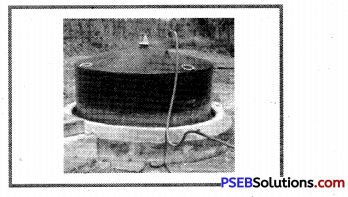
The following picture shows a specific type of plant. Identify the name of this plant :
PSEB 8th Class Social Science Solutions Chapter 1 Resources – Types and Conservation 2
(a) Thermal Plant
(b) Nuclear Plant
(c) Biogas Plant
(d) Hydro electric plant
Answer:
(c) Biogas Plant.

Fill in the Blanks :

Question 1.
_______ resources are derived from living things.
Answer:
Biotic

Question 2.
Localised resources are found only in _______ place.
Answer:
certain

Question 3.
The example of human resource is _______
Answer:
people

Question 4.
Anything that satisfy human needs is called _______
Answer:
resource

Question 5.
Non living resources are called _______ resources.
Answer:
Abiotic.

True/False :

Question 1.
Solar and wind energy is an example of renewable resources.
Answer:
True

Question 2.
Environment means set of surroundings.
Answer:
True

Question 3.
Resources are generally classified into two types.
Answer:
False.

PSEB 8th Class Social Science Solutions Chapter 1 Resources – Types and Conservation

Question 4.
Land use depend upon relief, slope, soil etc.
Answer:
True

Question 5.
Coal and petroleum are not biotic resource.
Answer:
False.

Very Short Answer Type Questions

Question 1.
How does something become a resource?
Answer:
That thing which has a value and utility become a resource.

Question 2.
Why is modern man dependent on resources?
Answer:
In early times, human needs were limited. But now-a-days the needs have increased. So man has to depend upon many resources.

Question 3.
Explain, with examples, that the proper use of resources is real development of resources.
Answer:
Before the invention of coal, petroleum, and aeroplane, man was not aware of the Aluminium. Due to utility of Aluminium, its use increased. So we can say that proper use has led to the development of resources.

Question 4.
What are the four basis of classifying resources?
Answer:

  1. life
  2. achievement
  3. stage of development
  4. use.

Question 5.
Which resources are most important to obtain food-resources?
Answer:
To get food resources, agriculture is the most important source as it provides 85% of food resources.

Question 6.
Why coal and petroleum are biotic resources?
Answer:
Coal and petroleum are formed by organic and living plants and animals. So these are grouped as biotic resources.

Question 7.
How can you assess a country as a rich country?
Answer:
The wealth of a country is measured by its resources. The more developed resources make a country richer.

Question 8.
Why are fertile soil areas densely populated with large economic activities?
Answer:
Fertile soils help in growing crops. In fertile soils agriculture is developed. It leads to dense population and many economic activities.

Question 9.
On what factors does the landuse depend?
Answer:
Landuse depends upon relief, slope, soils, drainage and human needs.

Question 10.
What is human resource?
Answer:
Man made resources include machinery, transportation, industries. Human intelligence, knowledge and efficiency is termed as human resource.

Question 11.
Concept of Resource is changing. Why?
Answer:
The concept of resource is changing. It may expand or contract with the development of knowledge and technology.

Question 12.
Name the important types of soil.
Answer:
Sandy soil, Clayey soil, Loamy soil, Alluvial soil, Red soil, Black soil.

PSEB 8th Class Social Science Solutions Chapter 1 Resources – Types and Conservation

Question 13.
Classify resources on the basis of their source of origin.
Answer:
Based on their origin, resources can be biotic or abiotic. For example plants, animals, rocks, minerals, soils etc.

Question 14.
How can we conserve the resources?
Answer:
We can conserve resources by reducing consumption, recycling and reusing things.

Question 15.
What is technology?
Answer:
Technology is human made resource. It is the application of latest knowledge and skill in doing or making things.

Question 16.
The population of India is lesser than only one country. Name that country.
Answer:
China.

Short Answer Type Questions

Question 1.
What is a resource?
Answer:
All the useful elements of environment which satisfy the human needs are called resources. Resources are called ‘Gifts of nature’ such as soils, rivers, plants, animals, rocks and minerals. These are valuable for mankind.

Question 2.
Why are humans also called a resource?
Answer:
They are called a resource because by developing the human skills only the resources can be developed. Resources are not, but they become due to man.

PSEB 8th Class Social Science Solutions Chapter 1 Resources – Types and Conservation

Question 3.
What do you understand by the statement “natural resources have utility and value”?
Answer:
Natural resources have utility and value is true. All the materials that are available in nature have some use or value and that’s what makes them valuable.

  1. Water, air vegetation all have utility or usability, they may or may not have economic value.
  2. Metals have economic value but a landscape may not have; but both are important to satisfy human need.
  3. Time and technology makes them a resource.

Question 4.
What leads to creation of new resources?
Answer:
The knowledge, ideas, inventions and discoveries by people leads to creation of more resources. The discovery of fire led to idea of cooking and other related processes. Invention of wheels led to changes in modes of transport.

Question 5.
Discuss the role of technology in the utilisation of resources.
Answer:
Technology helps to develop the means of production. It increases the value of natural resources. Technology depends upon the human skill and technical knowledge. Mechanism helps in the better utilisation of natural resources. A resource is no resource until it is used.

Question 6.
Distinguish between Natural Resources and Human-made Resources.
Answer:

Natural Resources

Human made Resources

1. They are free gifts of nature. 1. They are not free gifts of nature.
2. They are both renewable and non-renewable. 2. They are non-renewable.
3. They help in the economic development of the country. 3. They help in economic and social development.

Question 7.
Distinguish between Exhaustible and Inexhaustible Resources.
Answer:

Exhaustible Resources

Inexhaustible Resources

1. These resources get exhausted after use. 1. These resources do not get exhausted after use.
2. These resources are regenerated after a very long time. 2. These are renewable or flow resources.
3. Minerals and metals are exhaustible resources. 3. Forests, water power are inexhaustible resources.

Question 8.
What do we mean by a reserve?
Answer:
It refers to that portion of resource which<can be developed profitably with the help of available technology.
For example : High quality iron is used for steel making. But sometimes a low grade iron ore or coal (lignite—Less than 40% carbon content) is used for steel making. Lignite coal in Neyvelli (Tamilnadu) is an example of a reserve resource.

Question 9.
What is meant by human-made resources?
Answer:
They are those resources which are created by human being with the help of machines. Some of the examples are buildings, tools etc.

Question 10.
Give two examples of human made resources.
Answer:
The human made resources are those resources which are created by human beings.

Some examples are :

  1. Buildings,
  2. Machines.

PSEB 8th Class Social Science Solutions Chapter 1 Resources – Types and Conservation

Question 11.
Give an account of natural resources.
Answer:
Natural Resources:
Resouces drawn from (nature) and used without much modification are called natural resources.

  • Water, soils, minerals are all natural resources.
  • Many of the resources are free gift of nature.
  • They can be used directly.
  • In some cases tools and technology are needed to use a natural resource in the best way.

Question 12.
How are natural resources classified?
Answer:
Natural resources are classified into different groups :

  • Level of development and use
  • origin
  • stock
  • distribution.

Question 13.
Why natural resources are important?
Answer:

  • These are important for the economic development of a region or a country.
  • They are the main sources of our agricultural activities.
  • They provide raw materials for the industry.
  • All activities depend on them directly or indirectly.
  • They help in maintaining the ecological balance of nature. Thus they should be used carefully.

Question 14.
What is meant by conservation?
Answer:
It means the use of the natural resources carefully without any wastage. They are important to us, so they should be used wisely so that they are not exhausted and we may have to face their scarcity.

PSEB 8th Class Social Science Solutions Chapter 1 Resources – Types and Conservation

Question 15.
‘Resources are not resources, they become so.’ Explain.
Answer:
Resources are elements of Bio-physical environment. But these become resources only when humans preserve these. Coal was always there, but it became a resource only when man used it as a source of energy. So it has been rightly said that resources are not resources, they become so.

Question 16.
What are the ill effects of overuse of resdUrces? What are the measures to make the earth habitate? ”
Answer:
Ill effects :
Degradation of resources: The rising demand for various resources has caused degradation or depletion of many valuable resources.

Example :

  • Overuse of soil has caused infertility in many areas.
  • Similarly widespread deforestation and killing of birds and animals have endangered many plants and animal species.
  • The quality of air, water and land resources has also been affected badly due to misuse or overuse of resources.

Question 17.
Distinguish between Renewable and Non-renewable resources.
Answer:

Renewable Resources

Non-renewable Resources

1. These have the capacity to regenerate. 1. These cannot regenerate that quickly.
2. These are free gifts of nature. 2. These are not free gifts of nature.
3. These are those resources which can be used again. 3. These cannot be used again.
4. For example air, water, etc. 4. For example coal, natural oil.

Question 18.
Future of our planet is linked with life support system. Discuss.
Answer:
Our earth is the only planet where life has been found till today. Future of our planet and its people, is linked with our ability to maintain and preserve the life support system that nature provides. This makes it our duty to ensure that the natural environment is preserved and properly managed.

Question 19.
What is sustainable development?
Answer:
By sustainable development, we mean that resources are utilised carefully so that besides meeting the present requirement it also takes care of the future generations.

Question 20.
What is our duty regarding resources?
Answer:
It is our duty to ensure that

  • The diversity of life on the earth is conserved.
  • All uses of renewable resources are sustainable.
  • The damage to natural environment system is minimised.

PSEB 8th Class Social Science Solutions Chapter 1 Resources – Types and Conservation

Question 21.
Distinguish between Natural Resources and Human Resources.
Answer:

Natural Resources

Human Resources

1. They are free gifts of nature. 1. They are not free gifts of nature.
2. They are both renewable and non renewable. 2. They are non renewable.
3. They help in the economic development of the country. 3. They help in the economic and social development.

Question 22.
In how many ways man uses his environment?
Answer:
Environment means set of surroundings. It provides many resources to get food, shelter and clothing. Man uses land for crops, houses, factories,- construction of transport network. Man uses minerals for industries. He uses forests for timber, herbs and shrubs. Man gets fish and other benefits from seas and oceans.

Question 23.
How are development and resources interdependent?
Answer:
Development is possible through resources. Resources are the foundations of development. These have economic significance for human beings. Land, water and air are basic requirements for agriculture. We can’t do agriculture without these resources. Minerals are basic requirement for industries. Industries cannot run without minerals. Thus development and resources are inter-dependent.

Question 24.
Distinguish between actual resources and reserve resources.
Answer:
Actual Resources. Actual resources depend upon physical conditions of environment. These are surveyed. Their quantity is determined and are actually used. Their quantity is known.

Reserve resources are a part of actual resources. These can be made useful with technology. A low grade coal-lignite is a reserved resource in some areas.

PSEB 8th Class Social Science Solutions Chapter 1 Resources – Types and Conservation

Question 25.
Give one example each of developed and potential resources.
Answer:
When the water of river is used to produce electricity, it is called a developed resource. The coal underlying the earth is a potential resource.

Fill in the blanks :

Question 1.
_______ resources are derived from living things.
Answer:
Biotic

Question 2.
Localised resources are found only in places.
Answer:
certain

Question 3.
The example of human resource is _______
Answer:
people

Question 4.
Solar and wind energy is an example of _______
Answer:
Renewable resources

Question 5.
Anything that is used to satisfy a need is called a _______
Answers :
resource

PSEB 8th Class Social Science Solutions Chapter 1 Resources – Types and Conservation

Question 6.
Petroleum in _______ is an example of actual resource.
Answer:
West Asia

Question 7.
_______ is the application of latest knowledge and skill is doing or making things.
Answer:
Technology.

Long Answer Type Questions

Question 1.
Write a detailed note on the conservation of resources with special reference to marine and mineral resources.
Answer:
Conservation of Resources. Man depends upon his environment to meet his needs. He uses water, land, soil, vegetation, etc. to satisfy his needs. Man is using these resources at such an alarming rate that there will be a serious shortage of these resources in the near future. Natural resources are of a very limited supply. So conservation of resources is essential for the survival of man.

To some people, conservation means that the available resources should not be used. These should be held back. But conservation of resources means a careful and rational utilization of resources. These resources should be used intelligently for the welfare of mankind. It means careful control and management of resources so that these may be used for the benefit of future generations also. These should be preserved from reckless exploitation and wanton destruction. These resources should not be wasted in a short time. The resources should be maintained in a healthy condition for their use so as to achieve a high standard of living for mankind.

Importance:
Conservation of all resources has an economic, scientific, and aesthetic value for mankind :

  • Conservation of resources is necessary as these are the basis of the economic activities of man.
  • Resources must be conserved to meet the different human needs.
  • Conservation of resources is essential as life depends on these useful elements of the environment such as air, water, soil, rocks, forests, and water bodies.
  • Many areas of the world are still under-developed because the resources of these areas have not been used in a planned and rational manner.
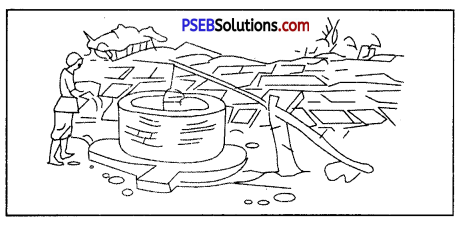
PSEB 8th Class Science Solutions Chapter 4 Materials: Metals and Non-Metals

Punjab State Board PSEB 8th Class Science Book Solutions Chapter 4 Materials: Metals and Non-Metals Textbook Exercise Questions and Answers.

PSEB Solutions for Class 8 Science Chapter 4 Materials: Metals and Non-Metals

PSEB 8th Class Science Guide Materials: Metals and Non-Metals Textbook Questions and Answers

Exercises

Question 1.
Which of the following can be beaten into thin sheets?
(a) Zinc
(b) Phosphorus
(c) Sulphur
(d) Oxygen.
Answer:
(a) Zinc.

Question 2.
Which of the following statements is correct?
(а) All metals are ductile.
(b) All non-metals are ductile.
(c) Generally, metals are ductile.
(d) Some non-metals are ductile.
Answer:
(a) All metals are ductile.

PSEB 8th Class Science Solutions Chapter 4 Materials: Metals and Non-Metals

Question 3.
Fill in the blanks.
(a) Phosphorus is very ……………… non-metal.
(b) Metals are …………. conductor of heat and ……………… .
(c) Iron is ……………… reactive than copper.
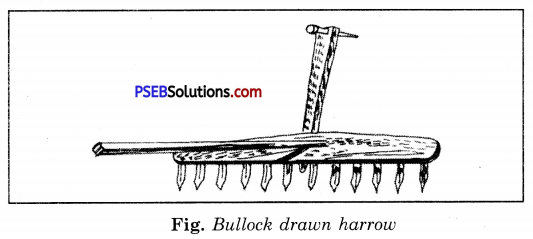
(d) Metals react with acids to produce ……………………. gas.
Answer:
(a) reactive.
(b) good, electricity.
(c) more.
(d) Hydrogen.

Question 4.
Mark ‘T’ if the statement is true and ‘F’ if it is false.
(а) Generally, non-metals react with acids.
(b) Sodium is a very reactive metal.
(c) Copper displaces zinc from zinc sulphate solution.
(d) Coal can be drawn into wires.
Answer:
(a) True
(b) True
(c) False
(d) False

Question 5.
Some properties are listed in the following Table. Distinguish between metals and non-metals on the basis of these properties. (From Board M.Q.P.)

Properties Metals Non-metals
1. Appearance
2. Hardness
3. Malleability
4. Ductility
5. Heat Conduction
6. Conduction of electricity

Answer:
Differences between metals and non-metals.

Properties Metals Non-metals
1. Appearance Silvery or grey in colour. Different coloured non-metals.
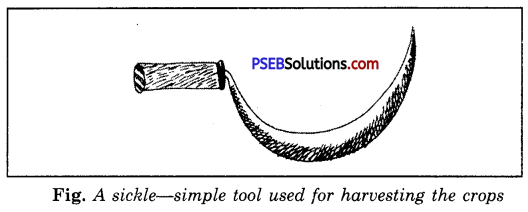
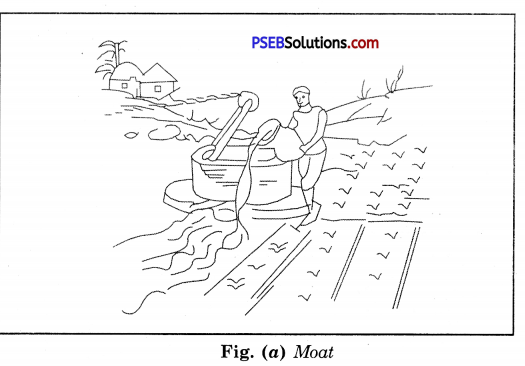
2. Hardness Solid at room temperature. Solid, liquid or gas at room temperature and brittle.
3. Malleability Can be beaten into sheets. Non-malleable.
4. Ductility Can be drawn into wires. Non-ductile.
5. Heat Conduction Present. Absent.
6. Conduction of electricity Possible. Not Possible.

Question 6.
Give reasons for the following :
(a) Aluminium foils are used to wrap food items.
(b) Immersion rods for heating liquids are made up of metallic substances.
(c) Copper cannot displace zinc from its salt solution.
(d) Sodium and potassium are stored in kerosene.
Answer:
(a) Aluminium foils are used to wrap food items because aluminium is malleable and less reactive to air and water.

(b) Immersion rods for heating liquids are made of metallic substances because metals are good conductors of heat and electricity.

(c) Copper is less reactive than zinc. As a result it cannot replace zinc from its salt solution.

(d) Sodium and potassium are very reactive metals. They react with air and water to form respective oxides and hydroxides. So, they are kept in kerosene.

Question 7.
Can you store lemon pickle in aluminium utensil ? Explain.
Answer:
No. Lemon pickle cannot be stored in aluminium utensils because acid present in lemon pickle reacts with aluminium to produce poisonous chemicals, which can cause food poisoning or other health hazards.

Question 8.
Match the substances given in Column A with their uses given in Column B.

Column A Column B
(i) Gold (a) Thermometers
(ii) Iron (b) Electric wire
(iii) Aluminium (c) Wrapping food
(iv) Carbon (d) Jewellery
(v) Copper (e) Machinery
(vi) Mercury (f) Fuel

Answer:

Column A Column B
(i) Gold (d) Jewellery
(ii) Iron (e) Machinery
(iii) Aluminium (c) Wrapping food
(iv) Carbon (f) Fuel
(v) Copper (b) Electric wire
(vi) Mercury (a) Thermometers.

PSEB 8th Class Science Solutions Chapter 4 Materials: Metals and Non-Metals

Question 9.
What happens when
(a) Sulphuric acid is poured on a copper plate ?
(b) Iron nails are placed in copper sulphate solution ?
Write word equations of the reactions involved. (From Board M.Q.P.)
Answer:
(a) When sulphuric acid is poured on copper plate, Hydrogen gas is given out.
PSEB 8th Class Science Solutions Chapter 4 Materials Metals and Non-Metals 1

(b) When iron nails are placed in copper sulphate solution, iron displaces copper from its salt to form iron sulphate
PSEB 8th Class Science Solutions Chapter 4 Materials Metals and Non-Metals 2

Question 10.
Saloni took a piece of burning charcoal and collected the gas evolved in a test tube.
(а) How will she find the nature of the gas ?
(b) Write down word equations of all the reactions taking place in this process.
Answer:
(a) To test the nature of the gas:
1. Take blue/red litmus solution turnwise into the jar of gas collected. It will turn blue litmus red while red litmus will remain unaffected. This shows that gas is acidic in nature.
2. Add some water to the jar. The liquid for turns blue litmus red showing acidic nature of the gas.

(b) When a charcoal is burnt, it reacts with oxygen to form an acidic oxide called
carbon dioxide.
PSEB 8th Class Science Solutions Chapter 4 Materials Metals and Non-Metals 3

The acidic oxide, carbondioxide, dissolves in water to form an acid called Carbonic acid
PSEB 8th Class Science Solutions Chapter 4 Materials Metals and Non-Metals 4

Question 11.
One day Reeta went to a jeweller’s shop with her mother. Her mother gave an old gold jewellery to the goldsmith to polish. Next day when they brought the jewellery back, they found that there was a slight loss in its weight. Can you suggest a reason for the loss in weight ?
Answer:
Jewellers usually use a chemical solution named aquaregia for cleansing the jewellery. This solution is capable of dissolving gold in it. So, loss in weight is found.

Multiple Choice Questions

Question 1.
In order to keep the flow of electricity continue in circuit, which of the following items should be used in place of iron nail in the given circuit. (From Board M.Q.P.)
PSEB 8th Class Science Solutions Chapter 4 Materials Metals and Non-Metals 5
(a) Graphite
(b) Plastic
(c) Wood
(d) Rubber.
Answer:
(a) Graphite.

Question 2.
Sodium metal is stored ………………….
(a) In water
(b) In kerosene oil
(c) In Air
(d) None of these.
Answer:
(b) In kerosene oil.

Question 3.
When strip of iron is placed in moist air then after some days a layer is deposited over it which has colour:
(a) Green
(b) Red
(c) Dirty
(d) None of these.
Answer:
(b) Red.

Question 4.
Which of the following statements is correct ?
(a) All metals are ductile
(b) All non-metals are ductile.
(c) Generally metals are ductile
(d) Some non-metals are ductile.
Answer:
(c) Generally metals are ductile.

PSEB 8th Class Science Solutions Chapter 4 Materials: Metals and Non-Metals

Question 5.
Which of the following is a non-metal ?
(a) Iron
(b) Carbon.
(c) Gold
(d) Calcium.
Answer:
(b) Carbon.

Question 6.
Phosphorus is stored in:
(a) Water
(b) Air
(c) Oil
(d) None of the above.
Answer:
(a) Water

Question 7.
The metal which is found in liquid form is:
(a) Copper
(b) Silver
(c) Mercury
(d) Sodium.
Answer:
(c) Mercury.

Question 8.
Which metal is a good conductor of electricity and heat ?
(a) Sodium
(b) Potassium
(c) Copper
(d) None of the above.
Answer:
(c) Copper.

Question 9.
The best conductor of electricity is:
(a) Copper
(b) Lead
(c) Aluminium
(d) Silver.
Answer:
(d) Silver

Question 10.
Red colour makes the solution of litmus blue because of:
(a) Metal oxide
(b) Sulphur dioxide
(c) Carbondioxide i
(d) None of the above.
Answer:
(a) Metal oxide.

Question 11.
Non-metal on the base of hardness is:
(a) Iron
(b) Aluminium
(c) Copper
(d) Coal.
Answer:
(d) Coal.

PSEB 8th Class Science Solutions Chapter 4 Materials: Metals and Non-Metals

Question 12.
Which of the following gas is released when a metal react with acids ?
(a) Oxygen
(b) Hydrogen
(c) Sulphur dioxide
(d) Nitrogen
Answer:
(b) Hydrogen.

Very Short Answer Type Questions

Question 1.
Name the property because of which metals can be beaten into thin layers or sheets.
Answer:
Malleability.

Question 2.
What is ductility ?
Answer:
Ductility. The property by which metals can be drawn into wires, is called ductility.

Question 3.
Name the most ductile metal.
Answer:
Silver.

Question 4.
Name the metal which exists in the liquid state.
Answer:
Mercury.

Question 5.
Name one metal which is poor conductor of electricity.
Answer:
Lead.

Question 6.
Which metal is used in thermometer ?
Answer:
Mercury.

PSEB 8th Class Science Solutions Chapter 4 Materials: Metals and Non-Metals

Question 7.
Which metal and non-metal is liquid at ordinary temperature ?
Answer:
Metal – Mercury
Non-Metal – Bromine.

Question 8.
Write two properties of metals.
Answer:
Malleability and Ductility.

Question 9.
Name two metals which are good conductors of both heat and electricity.
Answer:
Copper and Aluminium are good conductors of both heat and electricity.

Question 10.
Name three metals which occur in the native state.
Answer:

  1. Silver
  2. Gold
  3. Platinum occur in the native state.

Question 11.
List two metals which are easy to cut.
Answer:

  1. Sodium
  2. Potassium.

Question 12.
What is that property, which allows metals to be drawn into wires, called ?
Answer:
Ductility.

Question 13.
Which metals are used to make electric wires ?
Answer:
Copper and Aluminium.

PSEB 8th Class Science Solutions Chapter 4 Materials: Metals and Non-Metals

Question 14.
Which metal is constituent of haemoglobin ?
Answer:
Iron.

Question 15.
Write a chemical reaction of Iron with Oxygen.
Answer:
PSEB 8th Class Science Solutions Chapter 4 Materials Metals and Non-Metals 6

Question 16.
Write the chemical equation for the reaction of Zn with Oxygen.
Answer:
PSEB 8th Class Science Solutions Chapter 4 Materials Metals and Non-Metals 7

Question 17.
The set of metals in order of their increasing chemical reactivity is given below:
Silver, copper, lead, iron, zinc, magnesium and sodium.
(a) Which of the above metals is stored in kerosene ?
(b) Which metals will react with cold water ?
(c) Which gas will be liberated when metals react with cold water ?
(d) Which of the metals will react with oxygen when heated ?
(e) Which of the metals becomes black in the presence of hydrogen sulphide, H2S ?
(f) Which of the metals burns with white bright flame in oxygen ?
Answer:
(a) Sodium
(b) Sodium and Magnesium
(c) Hydrogen
(d) Magnesium
(e) Silver
(f) Magnesium.

Question 18.
Name five metals which are used in daily life.
Answer:
Metals used in daily life.

  1. Aluminium
  2. Iron
  3. Copper
  4. Zinc
  5. Tin.

Question 19.
Name five metals which are used in our industrial processes.
Answer:
Metals used in Industrial Processes.

  1. Aluminium
  2. Iron
  3. Copper
  4. Nickel
  5. Zinc.

Question 20.
Why do Sodium, Zinc, Magnesium and Aluminium not occur in their pure state ?
Answer:
Because these react with air, water and acids.

PSEB 8th Class Science Solutions Chapter 4 Materials: Metals and Non-Metals

Question 21.
Name atleast two metals which do not react with air, water and acids.
Answer:

  1. Gold
  2. Platinum.

Question 22.
Of what property, are metals used in jewellery ?
Answer:
Metallic lustre.

Question 23.
What is the colour of copper metal ?
Answer:
Eeddish-brown colour.

Question 24.
Of Iron, Copper and Magnesium, which metal can be cut easily ?
Answer:
Magnesium.

Short Answer Type Questions

Question 1.
What is the difference between a metal and a non-metal ? What is the total number of naturally occurring elements ?
Answer:
Metals have metallic lustre, are malleable, ductile, good conductors of heat and electricity, hard and combine with oxygen to form basic oxides.

Non-metals have dull lustre, not malleable and non-ductile, bad conductors of heat and electricity, brittle and combine with oxygen to form acidic oxides. The total number of naturally occurring elements is 92.

Question 2.
Why is Potassium metal not stored in water ?
Answer:
Potassium is a reactive metal. It reacts with air even at room temperature. Also it reacts with water at room temperature and catches fire. Hence, it is not stored in water but kept under kerosene oil.
PSEB 8th Class Science Solutions Chapter 4 Materials Metals and Non-Metals 8

Question 3.
State two physical properties on the basis of which metals may be distinguished from non-metals.
Answer:

  1. Metals are good conductors of heat and electricity. Non-metals are bad conductors of heat and electricity.
  2. Metals have a shiny appearance, that is, they show a metallic lustre. Nonmetals have a dull lusture. They generally do not reflect light well.

PSEB 8th Class Science Solutions Chapter 4 Materials: Metals and Non-Metals

Question 4.
State one chemical property which may be used to distinguish a metal from a non-metal.
Answer:
Metals when burn, combine with oxygen to form metallic oxides which are basic in nature, whereas non-metals combine with oxygen to form acidic oxides. This property can be used to distinguish a metal from a non-metal.

Question 5.
Why is sodium stored in kerosene oil ?
Answer:
Sodium is highly reactive metal. It readily combines with oxygen when exposed to air and sometimes it even catches fire. It also reacts with water forming its hydroxide. To prevent its oxidation, sodium is stored under kerosene oil.

Question 6.
Explain the following:
(а) Acidic oxides
(b) Basic oxides.
Answer:
(a) Acidic Oxides. These are the oxides of non-metals and give acids when dissolved in water.
Examples : CO2, SO2 etc.

(b) Basic Oxides. These are the oxides of metals and give alkaline or basic solutions in water.
Examples : Sodium oxide, Calcium oxide etc.

Question 7.
Explain the occurrence of metals in nature.
Answer:
Occurrence of Metals in Nature. Metals occur in the nature in free as well as in combined state.
1. Free or Native State. The metals which are not attacked by air and moisture generally occur in the free or native state e.g. metals like gold, platinum etc.

2. Combined State. Metals generally occur in nature in the form of compounds
such as oxides, sulphides etc. These metals are said to occur in the combined state, e.g. Aluminium oxide.

Question 8.
What do you understand by ductility and malleability of a metal ? Give examples of two metals which are both ductile and malleable.
Answer:
Ductility.
It is the property of metals by virtue of which metals can be drawn into thin unbroken wires. Metals exhibiting this property are called ductile.
Examples : Copper, Aluminium, Silver, Gold.

Malleability. It is the property of metals by virtue of which Metals which can be beaten into thin sheets and twisted or bent without breaking. Metals showing this property are called malleable.
Examples : Gold, Silver, Aluminium.
Examples of two metals which are both malleable and ductile :
Aluminium and Gold.

Question 9.
Silver does not combine easily with oxygen but silver jewellery tarnishes after some time. How ?
Answer:
Silver does not combine easily with oxygen of the air. But it readily combines with sulphur compounds such as hydrogen sulphide present in the air to form a black coating of silver sulphide. Therefore, silver jewellery tarnishes after some time.

Question 10.
Why do gold ornaments look new even after several years of use ?
Answer:
Gold does not tarnish. That is, it never corrodes as it is non-reactive. It is unaffected by air, water and acids. This is why gold ornaments look new even after several years of use.

PSEB 8th Class Science Solutions Chapter 4 Materials: Metals and Non-Metals

Question 11.
Magnesium and copper metals are heated directly over a flame. Which of these will burn in air ? Which is more reactive ?
Answer:
When magnesium and copper are heated directly over a flame, magnesium will burn in air. Magnesium is more reactive.

Question 12.
CuSO4 + Fe → FeSO4 + Cu
FeSO4 + Zn → ZnSO4 + Fe
On the basis of the above reactions, indicate which is the most reactive and which is the least reactive metal out of zinc, copper and iron ?
Answer:
In the first reaction, iron displaces copper from copper sulphate solution, therefore, iron is more reactive than copper. In the second reaction zinc displaces iron from iron sulphate, therefore, zinc is more reactive than iron. Therefore, zinc is the most reactive metal while copper is the least reactive.

Question 13.
Why are pickles, chutney and citrus fruits not stored in iron and aluminium utensils ?
Answer:
Certain foodstuffs, particularly citrus fruits, chutney, pickles and curd, which contain acids tend to attack kitchen utensils made of aluminium and iron forming poisonous salts. Iron and aluminium utensils are, therefore, not used to store pickles, chutney and citrus fruits.

Question 14.
What would you observe when a strip of zinc is dipped in the solution of copper sulphate ?
Answer:
Zinc being more reactive would replace copper from its salt solution i.e. copper sulphate.
Zn + CuSO4 → ZnSO4 + Cu

Question 15.
Can copper displace iron from iron sulphate solution ? Give reasons.
Answer:
No, because copper is less reactive than iron. As a result, it can’t replace iron from its salt solution i.e. iron sulphate. Only more reactive metals can replace less reactive metals from their salt solutions. Vice-versa is not possible i.e., less reactive metals cannot replace more reactive metals from their salt solutions.

Question 16.
Why does aluminium vassel lose its lusture after sometime ?
Answer:
Aluminium is a reactive metal. During its use, it comes in contact with air and water when it forms dull coating of aluminium oxide on its surface. Hence the vessel loses its shine.

PSEB 8th Class Science Solutions Chapter 4 Materials: Metals and Non-Metals

Question 17.
Why aluminium metal is preferred to copper for making cooking utensils ? Give two reasons.
Answer:
Because of the following two reasons, aluminium is preferred to copper for making cooking utensils.

  1. It is very light and is a good conductor of heat.
  2. It is not readily attacked by acids present in the food materials to be cooked.

Question 18.
What is corrosion ? What are the different ways to reduce corrosion ?
Answer:
Corrosion. Metals when exposed to moist air get covered with dull layer.
This layer can be easily removed giving place to the next such layer to be formed. In this way, metal is eaten up or corroded and the process is called corrosion.
Ways to reduce corrosion:

  1. By covering the metal with paint
  2. By applying oil or grease on the surface of metal.
  3. By coating the metal with some other metal which is not easily corroded by passing electricity.
  4. By making an alloy.

Question 19.
Sodium occurs in the combined state where as Gold in its native state, why ?
Answer:
Sodium is the most reactive metal. It readily combines with air and water to form its compounds. So it occurs as compound. On the other hand Gold is the noble metal and is not attacked by air, water or acids so it exists in its native form.

Question 20.
Does copper rust ? What will happen if copper is exposed to moist air ?
Answer:
Copper does not rust. When copper is exposed to moist air for long, it acquires a dull green coating. The green material so formed is a mixture of Copper hydroxide [CU(OH)2] and Copper carbonate [CuCO3], The following reaction takes place:
PSEB 8th Class Science Solutions Chapter 4 Materials Metals and Non-Metals 9

Question 21.
Give reasons for the following:
(i) Aluminium is used in making parts of aeroplane.
(ii) Copper is used in making electric wires.
(iii) Silver is used in making mirrors.
(iv) Graphite is used as an electrode in the Dry cell.
(v) Iron is used in constructing bridges and dams.
Answer:
(i) Aluminium being light and strong metal is used in making parts of aeroplanes.
(ii) Copper is a good conductor of electricity. So, it is used for making electric wires.
(iii) Silver is very shining white metal and has, therefore, high reflecting power.
(iv) Graphite is a good conductor, so it used for making electrode in dry cells.
(v) Iron being strong and rigid metal is used in the construction of bridges and dams.

PSEB 8th Class Science Solutions Chapter 4 Materials: Metals and Non-Metals

Long Answer Type Questions

Question 1.
Give general physical properties of metals.
Answer:
General physical properties of metals:

  1. Metals have a shiny appearance, i.e. they show metallic lustre.
  2. Metals are generally hard and their hardness varies from metal to metal.
  3. Most metals are malleable, i.e. they can be hammered into thin sheets.
  4. Metals are ductile and, therefore, can be drawn into wires.
  5. Metals are good conductors of heat and electricity. Electricity flows most readily through gold, silver, copper and aluminium.
  6. Metals are generally sonorous i.e. metals make sound when hit with an object.
  7. All metals except mercury exist in solid form at room temperature.
  8. Metals have high melting points.

Question 2.
Give general physical properties of non-metals.
Answer:
General physical properties of non-metals:

  1. Lustre. Non-metals possess dull lustre, i.e., they do not reflect light well. Exceptions are graphite and diamond.
  2. Conductivity. Non-metals are poor conductors of heat and electricity. Exception is graphite.
  3. State. Non-metals may occur as solids or liquids or gases at room temperature. For example Sulphur, Carbon and Iodine are solids. Bromine is a liquid. Chlorine and nitrogen are gases.
  4. Malleability. Non-metals are not malleable but they are brittle. Non-metals break into small pieces when hammered.
  5. Hardness. Non-metals are generally not hard but diamond is exception. Diamond is the hardest known substance.
  6. Ductility. Non-metals cannot be drawn into wires and are, therefore, not ductile
  7. Melting and Boiling Point. Non-metals have low melting and boiling points. A majority of non-metals are gases. Exception is graphite which has a high melting point.

Question 3.
How do metals react with acids ?
Answer:
Reaction of metals with acids :
1. Active metals like zinc, magnesium, iron etc. which lie above hydrogen in the electrochemical series or activity series can displace hydrogen from dilute mineral acids such as hydrochloric acid and sulphuric acid.
PSEB 8th Class Science Solutions Chapter 4 Materials Metals and Non-Metals 10

2. The metals which lie below hydrogen don’t displace hydrogen from dilute mineral acids such as hydrochloric acid, sulphuric acid etc.
For example, copper does not react with dil. HCl.

Question 4.
How do metals react with water ?
Answer:
Reaction of metals with water. Different metals have different reactivities with water. All metals react with water under different conditions to produce hydrogen gas.
1. Active metals like Na, K react with water at room temperature.
PSEB 8th Class Science Solutions Chapter 4 Materials Metals and Non-Metals 11
The reaction is so violent and exothermic that the evolved hydrogen catches fire.

2. Less active metals like Mg, Zn, Al, react with boiling water.
PSEB 8th Class Science Solutions Chapter 4 Materials Metals and Non-Metals 12
3. Metals like Fe, Ni react very mildly with steam
PSEB 8th Class Science Solutions Chapter 4 Materials Metals and Non-Metals 13

PSEB 8th Class Science Solutions Chapter 4 Materials: Metals and Non-Metals

Question 5.
Which of the following displacement reaction cannot occur ?
(a) CUSO4(aq) + Fe → FeSO4(aq) + Cu
(b) FeSO4(aq) + Zn → ZnSO4(aq) + Fe
(c) ZnSO4(aq) + Pb → PbSO4(aq) + Zn
(d) 2AgNO3(aq) + Cu → Cu(NO3)2 + 2Ag
(e) MgSO4(aq) + Cu → CuSO4 + Mg
Answer:
A more reactive metal (placed higher in the activity series) can displace the less reactive metal from its solution. Out of the above five reactions.
(c) cannot occur because zinc is more reactive than lead.
(e) cannot occur because magnesuim is more reactive than copper.

Question 6.
Name three metals that you come across in your daily life and also give their uses.
Answer:
We come across directly or indirectly the following metals in our daily life:

  1. Iron
  2. Copper
  3. Aluminium

1. Uses of Iron :

  • Iron mixed with other metals is largely used in making trains, automobiles and other machine parts.
  • Iron mixed with cement is used in constructing big buildings and dams.
  • Iron is used in making bridges and boilers for industry.

2. Uses of Copper:

  • It is used for making cooking utensils,
  • It is used in making photoframes, coins and statues.
  • It is used for making electrical wires.

3. Uses of Aluminium:

  • It is used for making aeroplanes
  • It is used for making electric wires and parts of electric gadgets.
  • Aluminium foils are used as packing material.

Question 7.
Distinguish between metals and non-metals on the basis of their chemical properties.
Answer:
Distinction between Metals and Non-metals

Property Metals Non-Metals
Chemical Properties-

1. Nature of Ions

Metals are electr-opositive elements and lose electrons to become electro-positive ions. Non-metals are electro-negative elements and gain electrons to form negative ions.
2. Nature of Oxides Form basic oxides Form acidic oxides.
3. Reaction with Water Mostly displace hydrogen. Do not react with water.
4. Reaction with Acids Metals above hydrogen in the activity series displace hydrogen from Non-metals do not react with dilute acids.
5. Nature of Hydrides Metals react with hydrogen to form ionic hydrides. Form covalent hydrides.
6. Nature of Chlorides Metals combine with chlorine to form solid ionic chlorides which conduct electricity. Non-metals combine with chlorine to form covalent chlorides which do not conduct electricity.

Question 8.
Give general chemical properties of non-metals.
Answer:
1. Reaction with Air or Oxygen. Non-metals react with air or oxygen to form their corresponding oxides which are acidic in nature. These oxides turn blue litmus red.
PSEB 8th Class Science Solutions Chapter 4 Materials Metals and Non-Metals 14

2. Reaction with Hydrogen. Non-metals like carbon, Nitrogen, and Phosphorous react with Hydrogen to form different compounds.
PSEB 8th Class Science Solutions Chapter 4 Materials Metals and Non-Metals 15

3. Reaction with other non-metals. Non-metals react with other non-metals to form compounds
PSEB 8th Class Science Solutions Chapter 4 Materials Metals and Non-Metals 16

4. Reaction with Acids. Non-metals react with acids to form corresponding oxyacids.
PSEB 8th Class Science Solutions Chapter 4 Materials Metals and Non-Metals 17

PSEB 8th Class Science Solutions Chapter 1 Crop Production and Management

Punjab State Board PSEB 8th Class Science Book Solutions Chapter 1 Crop Production and Management Textbook Exercise Questions and Answers.

PSEB Solutions for Class 8 Science Chapter 1 Crop Production and Management

PSEB 8th Class Science Guide Crop Production and Management Textbook Questions and Answers

Exercises

Question 1.
Select the correct word from the following list and fill in the blanks:
float, water, crop, nutrients, preparation
(a) The same kind of plants grown and cultivated on a large scale at a place is called ……………..
Answer:
crop

(b) The first step before growing crops is …………………. of the soil.
Answer:
preparation

(c) Damaged seeds would ………………… on top of water.
Answer:
float

(d) For growing of crop, sufficient sunlight, ……………… and ……………… from the soil are essential.
Answer:
water, nutrients

Question 2.
Match items in colun,.n ‘A’ with those in column ‘B’:

(A) (B)
(i) Kharif crops (a) Food for cattle
(ii) Rabi crops (b) Urea and super phosphate
(iii) Chemical fertilizers (c) Animal excreta, cow dung, urine and plant waste
(iv) Organic manure (d) Wheat, gram and pea
(e) Paddy and maize

Answer:

(A) (B)
(i) Kharif crops (e) Paddy and maize
(ii) Rabi crops (d) Wheat, gram and pea
(iii) Chemical fertilizers (b) Urea and super phosphate
(iv) Organic manure (c) Animal excreta, cow dung, urine and plant waste

PSEB 8th Class Science Solutions Chapter 1 Crop Production and Management

Question 3.
Give two examples of each.
(a) Kharif Crop
(b) Rabi Crop
Answer:
(a) Kharif Crop – (i) Paddy (ii) Maize.
(6) Rabi Crop – (i) Wheat (ii) Gram.

Question 4.
Write a paragraph in your own words on each of the following:
(a) Preparation of soil
(b) Sowing
(c) Weeding
(d) Threshing.
Answer:
(a) Preparation of Soil.
Soil is loosened and overturned to make it better ventilated and suitable for the growth of tiny organisms living in it. The entire process is called tillage and ploughing.

Soil if ploughed in dry season gets into big mud pieces or crumbs. These are broken down by plying a soil plank.
The ploughed soil is liable to be removed by wind and water. Wooden leveller is used to press the soil.

(b) Sowing.
The process of putting seeds in the soil is called sowing. It is the most important part of crop production. Before sowing, good quality of seeds are selected. The seeds are sown in the fields by hand (broadcasting) and by seed drill.

(c) Weeding.
It is a process of removal of unwanted plants i.e. weeds from the fields. It is necessary to remove the weeds since they compete with the main crop for water, nutrients, sunlight etc. The weeds may be removed manually by uprooting or cutting. The best time to remove them is before they produce flowers and seeds. It is done with a khurpi and a tractor driven harrow. Some chemicals called weedicides are used to control the weeds. They are sprayed in the fields for killing the weeds e.g. linazine, dalapon, etc.

(d) Threshing.
The separation of grains from the chaff in the harvested plants is called threshing. Animals are used on a large scale for threshing. In large farms, a machine called ‘thresher’ or a motorized machine called ‘combine’ are used for both harvesting and threshing.

Question 5.
Explain how fertilizers are different from manure.
Answer:
Differences between Manure and Fertilizers

Fertilizers Manure
1. These are mixtures of chemical compounds rich in nitrogen, phosphorus, potassium and manufactured in factories. 1. These are organic substances prepared from the decomposition of plant and animal wastes.
2. Chemical fertilizers are nutrients specific i.e. nitrogenous, phosphatic, etc. 2. They contain a mixture of various nutrients recycled from biomass wastes.
3. They are in a concentrated form. 3. They are not in a concentrated form.
4. They are easy to store or transport. 4. They are not easy to store or transport.
5. They are harmful if used in excess. 5. They are never harmful to the soil.

Question 6.
What is irrigation ? Describe two methods of irrigation which conserve water.
Answer:
Irrigation. Giving water to the fields at different intervals is called irrigation. The time and frequency of irrigation varies from crop to crop, soil to soil and season to season.

The latest irrigation methods help us to use water economically. The main methods used which conserve water are as follows:

1. Sprinkler System.
This system is more useful on the uneven lands where water is available in smaller quantity. The perpendicular pipes, having rotating nozzles on the top, are joined to the main pipe line at regular intervals. The water is allowed to flow through it with the help of a pump. The water escapes from the rotating nozzles. It is sprinkled on the crop as if it is raining. Sprinkler method is very useful for the sandy soil.

2. Drip System.
In this system, the water falls drop by drop just at the position of the roots. So it is called drip system.
Fig. Sprinkler System.
PSEB 8th Class Science Solutions Chapter 1 Crop Production and Management 1
It is the best technique of watering fruit plants, gardens and trees. Drip system consists of a main pipe to which lateral pipes are joined. The specially prepared nozzles are attached to these lateral pipes. It provides water to plants drop by drop. In this way, water is not wasted. So, it is a boon in regions where availability of water is poor.
PSEB 8th Class Science Solutions Chapter 1 Crop Production and Management 2

Question 7.
If wheat is sown in the Kharif season, what would happen ? Discuss.
Answer:
Wheat is a Rabi crop i.e. it is grown in winter season where there is low temperature and needs less water. So, if wheat is sown in Kharif season during rainy season, it gets more water which is harmful to the crop. The wheat crop droops down. It would not grow healthy.

PSEB 8th Class Science Solutions Chapter 1 Crop Production and Management

Question 8.
Explain how soil gets affected by the continuous plantation of crops in a field.
Answer:
For the continuous plantation and better growth of crops, manure and fertilizers are added regularly in the field. Manure and fertilizers are the nutrients like nitrogen, phosphorus, potassium etc. They can change the nature of the soil. The soil may become more alkaline or acidic with addition of the nutrients.

Question 9.
What are weeds ? How can we control them ?
Answer:
Weeds. Weeds are undesirable plants that may grow naturally along with the crop. The removal of weeds is called weeding.

Methods to Control Weeds. Following methods are used to control the weeds:

  • Tilling. The process of loosening and turning of the soil is called tilling or ploughing. This is done by using plough. Tilling helps in uprooting and killing of weeds.
  • Manual Removal. This method includes the physical removal of weeds by uprooting or cutting them close to the ground. This is done with the help of Khurpa or Harrow.
  • Chemical Method. In this method weeds are controlled by using some chemicals, called weedicides like 2, 4-D. The weedicides are sprayed in the fields with a sprayer.

PSEB 8th Class Science Solutions Chapter 1 Crop Production and Management 3

Question 10.
Arrange the following boxes in proper order to make a flow chart of sugarcane crop production.
PSEB 8th Class Science Solutions Chapter 1 Crop Production and Management 4
Answer:
PSEB 8th Class Science Solutions Chapter 1 Crop Production and Management 5

Question 11.
Complete the following word puzzle with the help of clues given below.
Down
1. Providing water to the crops.
2. Keeping crop grains for a long time under proper conditions.
5. Certain plants of the same kind grown on a large scale.

Across
3. A machine used for cutting the matured crop.
4. A rabi crop that is also one of the pulses.
6. A process of separating the grain from chaff.
PSEB 8th Class Science Solutions Chapter 1 Crop Production and Management 6
Answer:
PSEB 8th Class Science Solutions Chapter 1 Crop Production and Management 7

PSEB Solutions for Class 8 Science Crop Production and Management Important Questions and Answers

Multiple Choice Questions

Question 1.
The following implement is related to which agriculture practice.
PSEB 8th Class Science Solutions Chapter 1 Crop Production and Management 8
(a) Irrigation
(b) Sowing
(c) Weeding
(d) Harvesting.
Answer:
(d) Harvesting.

Question 2.
The figure given below represents which conventional method of irrigation ?
PSEB 8th Class Science Solutions Chapter 1 Crop Production and Management 9
(a) Pulley
(b) Chain Pump
(c) Dhekli
(d) Rahat.
Answer:
(c) Dhekli.

Question 3.
Mohan is sprinkling chemical solution to destroy weed plants growing along with main crops in his field. What is this chemical solution called ?
(a) Fertilizer
(b) Weedicides
(c) Yeast
(d) None of the above.
Answer:
(b) Weedicides.

PSEB 8th Class Science Solutions Chapter 1 Crop Production and Management

Question 4.
The mother of Naresh collects the waste material of living beings in an open space. According to her, after a few days, micro-organisms break the waste material of living beings and turn it into fertilizers. What is this fertilizer called ?
(a) Fertilizer
(b) Chemical fertilizer
(c) Manure
(d) None of the above.
Answer:
(c) Manure.

Question 5.
Jasbeer saw some weeds (unwanted plants) growing in his field along with main crops. What is this process called in which these weeds are removed from the field ?
(a) Sowing
(b) Irrigating
(c) Weeding
(d) Cutting.
Answer:
(c) Weeding.

Question 6.
In which season Kharif crops are grown ?
(a) Rainy season
(b) Autumn season
(c) Winter season
(d) None of the above.
Answer:
(a) Rainy season.

Question 7.
The process of loosening and overturning the soil is called:
(a) Ploughing
(b) Sowing
(c) Irrigation
(d) Weeding.
Answer:
(a) Ploughing.

Question 8.
The roots of bean plants have nodules and the microorganism which lives inside them is called:
(a) Virus
(b) fungi
(c) Rhizobium bacterium
(d) Algae
Answer:
(c) Rhizobium bacterium.

Question 9.
Which weedicides are used to remove weeds from the crops ?
(a) 2.4 D
(b) B.H.C.
(c) DDT
(d) All of the above.
Answer:
(a) 2.4 D.

Question 10.
What percentage of water is in plants ?
(a) 70%
(b) 80%
(c) 60%
(d) 90%
Answer:
(d) 90%.

Question 11.
Weeds are:
(a) Unwanted plants growing along with main crops
(b) Crop plants
(c) Bean plants
(d) Useful plants
Answer:
(a) Unwanted plants growing along with main plants.

PSEB 8th Class Science Solutions Chapter 1 Crop Production and Management

Question 12.
Which of the following is not the source of irrigation ?
(a) Well
(b) Sea
(c) River
(d) All of the above.
Answer:
(b) Sea.

Question 13.
The modern method of irrigation is
(a) Dhekli
(b) Chain pump
(c) Rahat
(d) Sprinkle system.
Answer:
(d) Sprinkle system.

Very Short Answer Type Questions

Question 1.
Define agriculture.
Answer:
Agriculture. The word agriculture consists of two Latin words – ager means field and culture means cultivate. So, agriculture is defined as to cultivate the fields.

Question 2.
What is staple Food ?
Answer:
Staple food. The food which forms the main part of our diet is called staple food e.g. rice and wheat. These are grown on a large scale in vast fields as they are consumed in large amounts.

Question 3.
What time does a crop take to mature ?
Answer:
It normally takes about 3-4 months for a good crop to mature.

Question 4.
What are weedicides ?
Answer:
Weedicides. Those chemicals which are sprayed over the field to check the growth of the weeds are known as weedicides.

Question 5.
What is animal husbandry ?
Answer:
Animal Husbandry. The study of all aspects such as food, shelter, health care of domesticated animals is called animal husbandry.

Question 6.
What is crop ?
Answer:
Crop. The plants of the same kind grown at a place is referred to as crop.

PSEB 8th Class Science Solutions Chapter 1 Crop Production and Management

Question 7.
Name two main crops of our country.
Answer:
Main crops of country. Wheat and Paddy are two main crops of India.

Question 8.
Define Produce.
Answer:
Produce. The crops are grown on ground or in water and what we obtain from the crop is called produce.

Question 9.
What are Kharif crops ?
Answer:
Kharif Crops. The crops grown during June-October are called Kharif crops, for example, paddy, maize.

Question 10.
What are Rabi crops ?
Answer:
Rabi Crops. The crops grown during November-April are called Rabi crops. These are not based on monsoon.
Example. Wheat, legumes like clover.

Question 11.
Name three crops sown by sowing seeds.
Answer:
Wheat, maize and millet.

Question 12.
Define irrigation.
Answer:
Irrigation. The supply of water at different levels is called irrigation.

Question 13.
Name two legume crops.
Answer:
Clover (barseem) and Gram.

PSEB 8th Class Science Solutions Chapter 1 Crop Production and Management

Question 14.
What is weeding ?
Answer:
Weeding. The removal of weeds is called weeding.

Question 15.
What is crop rotation ?
Answer:
Crop rotation. Sowing of different crops alternately in the field is called crop rotation.

Short Answer Type Questions

Question 1.
Why is soil turned and loosened before seeds are sown ?
Answer:
Soil is turned and loosened before seeds are sown because of following reasons:

  1. It allows the roots to penetrate freely and deeper.
  2. It allows the roots to breathe easily.
  3. The plant is secured more firmly.
  4. It aids the growth of worms and microbes present in the soil.

Question 2.
What are broadcasting and transplanting ?
Answer:
Broadcasting.
After the soil has been prepared, seeds of crop plants are sown in it. There are two methods of sowing them. Sowing by land or by using seed drill is called broadcasting.

Transplanting.
It is a process of taking out young plants or seedlings from nursery beds and transfer them to fields with required spacing, water and minerals for adequate growth.
PSEB 8th Class Science Solutions Chapter 1 Crop Production and Management 10

Question 3.
What are insecticides ?
Answer:
Insecticides.
The special chemicals which selectively kill the pests or harmful insects as well as their eggs and larvae, but do not affect the plants are called insecticides or pesticides.

Question 4.
Why should the harvested grains be protected from moisture ?
Answer:
Moisture and humidity promotes the growth of fungi or moulds on grains. Some of these microorganisms are poisonous also. So, it is very important to store harvested grains dry.

Question 5.
How does a farmer rotate crops in the fields ?
Answer:
Crop rotation involves the change of crop every year as alternate sowing of crops so that pathogen is killed in absence of suitable host.

Repeated growing of the same plant however may deplete the soil severely of specific nutrients. To prevent this it is advisable to cultivate two different types of plants alternately. For example, maize and wheat are grown alternately with groundnut. The groundnut plant, with its nitrogen fixing, bacteria enriches the soil with some nutrients, which are beneficial for wheat. Rotating different crops in this manner thus replenishes the soil naturally.

PSEB 8th Class Science Solutions Chapter 1 Crop Production and Management

Question 6.
How are pests controlled in a crop field ?
Answer:
Pests are living organisms which cause diseases or kill or destroy the crop plants. In order to control the pests, pesticides such as Malathion, Disyston, B.H.C. etc. are used. They are sprayed on the crops. They kill the microbes without causing harm to plants and human beings who consume them.
PSEB 8th Class Science Solutions Chapter 1 Crop Production and Management 11

Question 7.
What are the harms of excess of water in the fields ?
Answer:
Harms of excess of water

  1. It can destroy crops.
  2. Continued water logging increases the amount of salt in the soil and can damage it permanently.
    Excess water can be drained off by providing a suitable outlet.

Question 8.
Why is it important to wash off fruits, grains or vegetables before being consumed ?
Answer:
It is important to wash off fruits, grains or vegetables because these when brought from fields to the market often have a coating of pesticides. Otherwise they prove to be harmful.

Question 9.
What is field fallow ? Why is it important ?
Answer:
Field Fallow.
Some fields are allowed to rest and regenerate for at least a season to support a crop. This is called field fallow.

Importance.
The growth of humus picks up which in turn promotes the growth of soil micro-organisms during such undisturbed periods. It leads to a rich replenishment of nutrients.

Question 10.
How are the stored grains damaged ?
Answer:
Rats and other rodents damage the stored grains. The amount of grain eaten by rats and rodents is estimated to be over 25% of the total produce.
Stored grains are also damaged by insects and worms. Such infested grains if consumed by people, cause many diseases.

Question 11.
What are weeds ? How are they removed ?
Answer:
Weeds. Weeds are undesirable plants that may grow naturally along with the crop. The removal of weeds is called weeding.

Methods to Control Weeds. Following methods are used to control the weeds:
1. Tilling. The process of loosening and turning of the soil is called tilling or ploughing. This is done by using plough. Tilling helps in uprooting and killing of weeds.
2. Manual Removal. This method includes the physical removal of weeds by uprooting or cutting them close to the ground. This is done with the help of Khurpa or Harrow.
3. Chemical Method. In this method weeds are controlled by using some chemicals, called weedicides like 2, 4-D. The weedicides are sprayed in the fields with a sprayer.
PSEB 8th Class Science Solutions Chapter 1 Crop Production and Management 3

Question 12.
Give the structure of harrow. What is its main use ?
Answer:
PSEB 8th Class Science Solutions Chapter 1 Crop Production and Management 12
Structure of Harrow. It has small pointed iron rods or wooden rods. A strong, broad plate of iron is fixed to one of its ends and works like a blade. It uproots the weeds when moved in a crop field just like a plough.

Uses. It is used to remove the weeds of the field.
PSEB 8th Class Science Solutions Chapter 1 Crop Production and Management 13

PSEB 8th Class Science Solutions Chapter 1 Crop Production and Management

Question 13.
Why is ploughing of soil necessary before sowing seeds or crop plants ?
Answer:

  1. Ploughing tills the soil deeply. It may involve partial or complete turning over of soil.
  2. Ploughing clears land of the preceding crop and leaves the soil loosened.
  3. Repeated ploughing eliminates all weeds.
  4. Harmful insects are destroyed by ploughing.
  5. Ploughing makes the soil porous.
  6. Ploughing makes the soil soft, clean and suitable for sowing.

Question 14.
Why are fields manured ?
Answer:
Manuring of Fields.
Plants get their nutrients from the soil. If crops are grown continuously, they use all the nutrients present in the soil. To make up this deficiency of soil, manures are added to the soil.

Question 15.
What do you mean by harvesting and threshing ?
Answer:
Harvesting.
The cutting of the crop when it matures is called harvesting. Most of the crops are harvested with help of a sickle or huge combines.
PSEB 8th Class Science Solutions Chapter 1 Crop Production and Management 14

Threshing.
The separation of grains from the chaff is called threshing. Animals are used on a large scale for threshing.

Question 16.
What are the types of crops on the basis of seasons ? Give examples of each type.
Answer:
Crops are of two kinds on the basis of season:

  1. Kharif Crops. The crops which are grown during the monsoon season are called Kharif Crops.
    Examples. Maize, Bajra and Cotton etc.
  2. Rabi Crops. Those crops which are grown during the winter season are called Rabi Crops.
    Examples. Wheat, Gram and Mustard etc.
  3. Summer Crops. Those crops which are grown during summer seasons are called Summer Crops.
    Examples. Moong, Water melon, Cucumber, gourd etc.

Question 17.
What is mixed cropping ? Give an example.
Answer:
Mixed Cropping.
The practice of cultivating two crops simultaneously is done to economise the time and energy. This is called mixed cropping.
Example. The crop of groundnut is grown in the fields along with cotton.

Question 18.
Why is it necessary to sow seeds at an appropriate depth ?
Answer:
It is necessary to sow seeds at an appropriate depth because if the seeds are sown too deep, they will not be able to germinate. On the other hand, if they are sown at a shallow depth, then they will be eaten away by birds or animals.

Question 19.
How is the crop produce stored ?
Answer:
The crop produce is stored in godowns by agencies like Food Corporation of India and State Warehousing Corporations. Grains are sun dried before storing to reduce moisture contents of grains. This prevents the attack of pests. Large scale storing of grains is done in granaries and silos to protect grains from pests like rats and insects.

PSEB 8th Class Science Solutions Chapter 1 Crop Production and Management

Question 20.
Define Fertilizer.
Answer:
Fertilizers.
These are the chemical substances that are man-made and are rich in nitrogen, phosphorus and potassium, i.e. they are rich in organic macronutrients which are needed by plants.

Question 21.
Why should we use organic manures ?
Answer:
We should use organic manure because it helps in replenishing the soil nutrients without causing any harm to the soil. This manure is considered much better than the fertilizers. Crops like vegetables and fruits grown by organic manure are considered safe as compared to the crops grown by using chemical fertilizers. Therefore, we should use organic manure in growing vegetables and fruits.

Question 22.
Some seeds are given to you to grow. What factors will you keep in mind ?
Answer:
We will keep the following factors in mind. These are:

  1. We would sow them at the correct depth.
  2. We would water them regularly and check the amount of water that we are putting.
  3. We would use manure at the proper time.
  4. We would ensure that no weeds grow with the plant.
  5. We would also spray pesticides.
  6. We would also ensure that the plant gets adequate sunlight.

Question 23.
Why should we discourage the use of chemical fertilizers ?
Answer:
Chemical fertilizers are harmful in the following ways thus the use of such fertilizers be discouraged:

  1. They damage the soil by reducing its natural recomposting ability.
  2. They change the chemical nature of soil.
  3. These chemicals are leached in the soil and are again absorbed by crop plants and enter food chain and damage the plants and animals.

Question 24.
How do we store grains ? What is cold storage ?
Answer:
Storage of Grains.

  1. Farmers make small boxes of metal or mud to store dried grains. These are called granaries.
  2. Dried grains are transferred to properly ventilated cemented halls. These cemented halls are called godowns.
  3. The storage of some fruits and vegetables at a low temperature is called cold storage.

Question 25.
What are the basic requirements for growing a crop in an area ?
Answer:
The basic requirements for growing a crop in an area are as follows:

  1. Proper type of soil
  2. Use of manures
  3. Irrigation
  4. Better varieties of seeds
  5. Agricultural tools
  6. Chemicals to prevent diseases of the plant crop.

Question 26.
Why all the crops do not grow in the same season ?
Answer:
All crops do not grow in the same season because every crop has its own specific requirements of soil and climatic conditions like light, temperature and air at the various stages of its growth and development.

Question 27.
Do all the crops have identical requirements of manures and fertilizers ?
Answer:
No, every crop has specific requirements of manures and fertilizers for growth and development of the plants. Farmyard manure is useful for paddy crops. The groundnut plants have nodulated roots. These nodulated roots contain nitrogen-fixing bacteria which convert the atmospheric nitrogen into the compounds of nitrites and nitrates. For the crop of wheat, farmyard manure and green manure of sunhemp plants are mixed in the soil.

PSEB 8th Class Science Solutions Chapter 1 Crop Production and Management

Question 28.
Write any two points of difference between Insecticides and Weedicides.
Answer:
Differences between insecticides and weedicides

Insecticides Weedicides
1. These are the chemicals used to kill the plant pests i.e. organisms attacking plants. 1. These are the chemicals used to kill the weeds i.e. unwanted plants.
2. These affect human life. 2. These enter food chain.
3. Examples : DDT, BHC etc. 3. Examples : Bulachlor 2-4D. Linazine, Dalapon etc.

Question 29.
What is transplanting ?
Answer:
Transplanting.
It is a process of taking out young plants or seedlings from nursery beds and transfer them to fields with required spacing, water and minerals for adequate growth.

Question 30.
Discuss the various tranditional ways of irrigation diagramatically.
Answer:
The various traditional ways are :
(a) Moat (Pulley system) (b) Chain pump (c) “Dhekli” (Lever system) (d) “Rahat” [Fig. (a) to (d)]. ‘
PSEB 8th Class Science Solutions Chapter 1 Crop Production and Management 15
PSEB 8th Class Science Solutions Chapter 1 Crop Production and Management 16
PSEB 8th Class Science Solutions Chapter 1 Crop Production and Management 17
PSEB 8th Class Science Solutions Chapter 1 Crop Production and Management 18
For lifting water, pumps are commonly used. Diesel, biogas, electricity and solar energy are used to run the pumps. The pumps of various power are available. They are selected according to the requirement of the particular field.

Long Answer Type Questions

Question 1.
Explain the main agricultural practices.
Answer:
Main agricultural practices. The main agricultural practices are as follows:

1. Ploughing.
The process of loosening and turning the soil is called ploughing. This is done by using a plough. Ploughs are made of wood or iron. The ploughed land is then levelled so that the soil is not blown off by wind or drained off by water.

2. Sowing.
After the preparation of the soil, the seeds are sown in the fields by hand (broadcasting) or by seeds drill.

3. Irrigation.
Crop plants absorb water from the soil by roots. Water is essential for the growth of plants. Irrigation is done by various ways like lift irrigation, water wheel, swinging baskets, sprinklers and tubewells.

4. Manuring.
Every crop uses substantial amount of nutrients present in the soil. Soil is replenished with nutrients by adding manures to it.

5. Weeding.
Many unwanted plants also germinate and grow in the field. These plants compete with the crop for water, sunlight and nutrients. Therefore, it is necessary to remove these plants to get better crops. This is called weeding.

6. Protection of Crops.
Crops are spoiled by insects, fungi, bacteria and rodents etc. Chemicals like insecticides and weedicides are used to kill them.

7. Harvesting and Storage.
When the crop is ready, it is harvested at proper time. Crops are harvested by hand, using a sickle or by a harvester. The grains are separated from the chaff in the harvested plant. Then the grains are stored in big store houses. The amount of moisture in the grains should not be more than 14%.

Question 2.
What are the practices adopted to improve crop production ?
Answer:
The practices adopted to improve crop production are as follows:
1. Addition of fertilizers to the soil.
2. Selective breeding.
3. Weed control.
4. Control of plant diseases.

1. Fertilizers.
These are the chemical compounds which are added to the soil to increase the fertility. They make up for the deficiency of the required nutrients and help in increasing the crop production.

2. Selective Breeding.
Disease resistant seeds are produced by selective breeding. Regular use of high yield variety results in better crop production.

3. Weed Control.
The unwanted plants or weeds are controlled by using certain chemicals called weedicides.

4. Control of Plant Diseases.
Crops should be protected from insects, fungi, animals and other diseases. It is very useful practice for increasing crop production. Insects are very harmful to crops. So insecticides should be used to kill insects.

Question 3.
What are fertilizers ? What are mixed fertilizers ? Why do farmers add fertilizer to the soil ? How should we store fertilizers ?
Answer:
Fertilizers. Fertilizers are the chemical substances which maintain the fertility of soil.

Mixed Fertilizers. The fertilizers which supply many elements are known as mixed fertilizers.
Example.
1. NPK has nitrogen, phosphorus and potassium.
2. CAN is a mixed fertilizer of calcium, ammonium, nitrate.

Importance of Fertilizers.
The fertilizers and mixed fertilizers are added to the soil to make up for the deficiency for mineral elements like nitrogen, phosphorus and potassium. This deficiency is produced in the soil by growing the crops in succession. That is why farmers add fertilizers to the soil to improve crop-production.

Storing of Fertilizers.
Some fertilizers are moisture lover i.e. they are hygroscopic. If the fertilizers are stored in moist places, it is difficult to apply them in the fields. Some fertilizers spoil the bags in which they are stored. They should be stored in dry places.

Question 4.
Explain the various tools used for ploughing.
Answer:
Main tools used for ploughing. The tools used for ploughing are plough, hoe and cultivator.

1. Plough.
This is being used for tilling of soil, adding fertilizers to the crop, removing the weeds, scrapping of soil, etc. It is made of wood and drawn by a pair of bulls. It contains a strong triangular iron strip called ploughshare. The main part of the plough is a long log of wood which is called a plough shaft. There is a handle on one end. The other end is attached to a beam which is hung on the neck of bulls. One pair of bulls and a man can easily operate the plough.
PSEB 8th Class Science Solutions Chapter 1 Crop Production and Management 19

2. Hoe.
Hoe is a simple tool which is used for removing weeds and for loosening the soil. It has a long rod of wood or iron. A strong, broad and bent plate of iron is fixed to one of its ends and works like a blade. The other end of plough shaft is pulled by a pair of bulls.
PSEB 8th Class Science Solutions Chapter 1 Crop Production and Management 20

3. Cultivator.
Nowadays ploughing is done by tractor driven cultivator. Cultivator saves labour and time.
PSEB 8th Class Science Solutions Chapter 1 Crop Production and Management 21

PSEB 8th Class Social Science Solutions Chapter 8 Disaster Management

Punjab State Board PSEB 8th Class Social Science Book Solutions Geography Chapter 8 Disaster Management Textbook Exercise Questions and Answers.

PSEB Solutions for Class 8 Social Science Geography Chapter 8 Disaster Management

SST Guide for Class 8 PSEB Disaster Management Textbook Questions and Answers

I. Answer the following questions in 1-15 words:

Question 1.
What is meant by the disasters?
Answer:
Any natural or man-made happening that causes loss of life and property in a region is called a disaster.

Question 2.
What are the main natural disasters?
Answer:
Earthquakes, volcanoes, tsunamis, floods, drought, cyclones, landslides, and icebergs slide.

Question 3.
What is included in the subject of Disaster Management?
Answer:
Disaster Management includes steps to reduce the damage from disasters. It includes :

  1. Preparedness before disaster
  2. Protection at the time of disaster
  3. To maintain the social life after disaster.

Question 4.
What is an earthquake? How is it measured?
Answer:
The sudden shaking of part of the earth is called an earthquake. Its intensity is measured on Richter Scale. This instrument is called Seismograph.

Question 5.
What is a volcano? Write its types.
Answer:
The interior of earth consists of hot magma. It comes out of the earth through openings. It is called a volcano. It has three types:

  1. Active
  2. Dormant
  3. Extinct volcanoes.

PSEB 8th Class Social Science Solutions Chapter 8 Disaster Management

Question 6.
How does the Tsunamis originate?
Answer:
Tsunamis are high tidal waves. These are caused due to sub-marine earthquakes. These are very destructive.

Question 7.
What are the main causes of floods?
Answer:

  1. Heavy rainfall
  2. Cyclones
  3. Cloud burst
  4. Absence of proper drainage
  5. Dam burst
  6. Deposition on river beds,
  7. Settlements in the river course.

Question 8.
What is a cyclone? By what other names is it called?
Answer:
Cyclones are violent wind system with a wind velocity of more than 63 km per hour. These are called hurricanes in North America, Typhoons in S.E. Asia and Depressions in India.

Question 9.
What can be the cause of Landslides?
Answer:
Landslides are caused due to :

  1. Internal forces of earth
  2. Heavy rainfall
  3. Volcanic activity
  4. Mining.

Question 10.
What do you mean by human disasters?
Answer:
Human disasters are related with human activities. Bomb-blasts and Terrorism are its examples.

Question 11.
What do you understand from the term ‘epidemic’?
Answer:
When a disease breaks out on a large scale and attacks people, it is called an epidemic. Dysentery, Dengu, Yellow fever, Cholera are called epidemics.

II. Answer the following questions in 50-60 words :

Question 1.
How do the disasters affect man?
Answer:
Disasters affect man in the following ways :

  • There is a loss of life and property.
  • The civic facilities are disrupted and disturbed.
  • People get separated from their families.
  • Crops and cattle are swept away.
  • Epidemics break out due to decayed corpses.
  • Progress made in years is destroyed in minutes.

PSEB 8th Class Social Science Solutions Chapter 8 Disaster Management

Question 2.
Mention causes of earthquakes and the major earthquake regions of the world.
Answer:
Earthquakes are caused due to internal movements. Tectonic plates drift and earthquake waves are caused. The earth shakes and an earthquake occurs.
PSEB 8th Class Social Science Solutions Chapter 8 Disaster Management 1
Zones :

  • About 2/3 of earthquakes occurs in Ring of Fire along Pacific coast.
  • Earthquakes occur in Himalayas and Alps.
  • In India, Jammu & Kashmir, Western Himalayas, Central Himachal, N.E. India, Ganga- Sutlej plain, Rajasthan, Gujarat and group of islands are earthquake zones.

Question 3.
Which precautions should be taken into consideration at the time of the earthquake?
Answer:
The suitable measures to be taken to protect oneself from the damage caused by earthquakes are :

  • Earthquake-resistant buildings need to be constructed in both the highest and high-risk zone areas.
  • The buildings should be flexible and strong.
  • The building plan should have the building codes which have been prescribed.
  • Existing buildings which are not earthquake resistant must be strengthened structurally.
  • Even individuals should be taught how to protect themselves during an earthquake in schools and colleges by giving them daily drills about it.
  • There should be no confusion and fear.
  • People should nor rush out.
  • People should help the victims.

Question 4.
What protective measures should be taken to save ourselves from Volcanoes and Tsunamis?
Answer:
Safety from Volcanoes:

  • There should be no building near volcanq.es.
  • Move away from a volcanic area. Use fast means of transport.
  • Govt, should be prepared for every help.

Safety from Tsunami:

  • Do not go towards sea when you come to know about Tsunami.
  • The boats and ships should return to coast.
  • Fishermen should go into the ocean only when waves are subdued.
  • If the Tsunami waves travel with a high velocity, people should leave the coastal area.
  • All should help the victims.
  • Govt should make prepared to meet any emergency.

PSEB 8th Class Social Science Solutions Chapter 8 Disaster Management

Question 5.
Which (steps) should be taken for protection from droughts?
Answer:

  • Water resources should be properly used.
  • Harvesting of rainwater must be popularised among the people.
  • Small dams for collecting water should be built.
  • Trees should be grown.
  • Farmers should be encouraged to join crops and insurance schemes.
  • Such crops should be grown which need small amount of water.
  • Water from other areas be supplied.
  • Water should be collected in tanks.

Question 6.
Which measures can save us from disasters like epidemics?
Answer:

  • The best way to save one self from epidemics is to save oneself from disasters; pure water and clear environment helps one in it.
  • Proper medical help be provided. There should be treatment facilities in Hospitals.
  • Slums should not develop near towns.
  • Regular medical check up be done in schools, villages and towns.

III. Answer the following questions in about 125-130 words :

Question 1.
Which protective measures should we adopt to save ourselves from disasters like floods and cyclones? Write in detail.
Answer:
Floods:

  • To avoid residing on river banks and slopes on riversides and the sides of gorges.
  • To build at least 250 meters away from the sea coast/river banks.
  • To provide a proper, drainage system in all flood prone areas, so that the water can be drained off quickly to prevent accumulation.
  • To construct the building with a plinth level higher than the known high flood level.
  • To construct the whole village or settlement on a raised platform higher than the high flood level.
  • To construct buildings on stilts or columns with wall-free space at ground level.
  • People should get weather forecasting from the meteorological deptt. from time to time.

Cyclones:

  • Huts and houses should not be built near coastal areas.
  • People should be shifted to schools, buildings
  • Fishermen, sailors, ships should not go into oceans.
  • Strong wind-resistant houses be built.
  • Flood control measures be taken.
  • Trees should be planted to check winds.
  • Govt, should provide information about the coming of cyclones.

PSEB 8th Class Social Science Solutions Chapter 8 Disaster Management

Question 2.
What are human disasters? Explain the disaster management of any two human disasters in detail.
Answer:
Human disasters are related to human activities and industries—man causes these unintentionally. Bomb explosion, terrorist attacks and dam burst are examples.
1. Bomb explosion and Terrorist attack. Bombs are made to be used during war. But some people cause confusion and fear among people by bomb explosion. Many innocent people die and mostly hurt. These hinder the development of a country. On 11 September, 2001 Bomb attacks were made in New York on World Trade Tower buildings.

Precautions during a Bomb Scare

  • Do not touch any doubtful packet.
  • Beware of the objects that are left on their own in public areas: suitcases, boxes, packages, etc.
  • Do not approach the objects yourself.
  • Do not allow people to touch doubtful articles.
  • Inform the police and after their arrival leave the area.
  • Avoid panic.

2. Dam Burst: Dams are used to store water. When a dam bursts, serious damage is done. In case of a big dam, it becomes a disaster. Life is disrupted. Cattle and crops are swept away. Flood control measures be used. Special precautions be used to save life and property.

IV. Activity

Question 1.
Prepare a report of 3-4 pages on natural disaster faced by India in Uttarakhand in June 2013.
Answer:
The recent flash floods in Uttarakhand have caused huge damages.

Torrential Rainfall. The torrential rainfall in the Uttarakhand Himalayas of June, 2013 resulted into huge death and destruction. It left hundreds dead; thousand marooned and washed away scores of villages, inundated the eight century Kedarnath temple. The famous Manikarinika tfemple on the banks of Bhagirathi was swept away by swirling waters of the river. Houses and small apartment blocks on the banks of Bhagirathi, Alaknanda and Mandakini have been toppled into the rushing, swollen waters and been swept away along with cars and trucks.

The extent of damage due to flash floods in many parts of the seven districts of Uttarakhand is mind-numbing. Single-story houses simply disappeared, many double-storey houses crumbled due to the weakening of its foundation. The disaster stuck when the Chardham Yatra was going on with congregation of around 75,000 pilgrims from all over the country. The Central Government, along with Indian Army, Indian Air Force (IAF), Indo-Tibetan Border Police (ITBP) and Border Road Organisation (BRO) rescued around 33,000 stranded pilgrims, The flooding was so fierce and disastrous that people named it Himalayan Tsunami.

A Man-Made Disaster. Many environmentalists termed this event as a man-made disaster. According to them human action leading to environmental altercations aggravated the problem and reduced the natural defense system. In the last three decades the region has witnessed demographic changes, deforestation, rapid urbanisation and expansion of roads. The environmentalists emphasised that mountains have a certain carrying capacity that should never be exceeded at any cost. Uttarakhand and Himachal Pradesh are the two Himalayan states that were worst hit by monsoonal flash floods in June 2013. Man-made factors compounded the scale of the disaster.

Unabated expansion of hydroelectricity power projects and construction of roads to accommodate ever increasing tourism, specially religious tourism, are the main reasons of unprecedented devastation. Mindless illegal construction of resorts, guest house, roads has taken place in this ecoSgically fragile region to accommodate tourists. Buildings have been constructed over flood ways, old drains and streams blocking the natural pathway of the water. On June 15-16, 2013, the Alaknanda River and its tributary Mandakini occupied their flood ways and started flowing along the old courses where human habitation has come up with the passage of time.

The Mandakini changed its course to the west. The sediment-loaded river washed away shops, guest houses/lodges etc., killing people who were present at the time.

Kedarnath Dham, a place of serenity and devotion, which was dotted by only few huts in 1882 was mushroomed by haphazard illegal constructions of buildings, shops, hotels/ lodges etc,, blocking the natural flow of the Alaknanda river.

Ganga and its tributaries like Alaknanda, Mandakini, Bhagirathi, Kali Ganga, Gauri Ganga, were swept away or excessively damaged due to flash floods.

Due to increased anthropogenic activities and terrain instability, Uttarakhand had always remained prone to landslides. Even during August and September 2010, Uttarakhand. Himalayas witnessed large scale slope destabilisation.

The June, 2013 Uttarakhand disaster, also known as Himalayan Tsunami was actually triggered by very heavy rainfall during June 16-18 and unusual behaviour of monsoon this year in India.

Rainfall measurement for June 16 and 17, 2013, at the Dehradun station was 220 millimeters and 370 millimeters respectively. It Indicates the severity of the rainfall. Haridwar received 107 mm and 218 mm of rainfall in two days. Uttarkashi received 122 mm and 207 mm. While Mukteshwar (at the altitude of 2000 m) received 237 mm and 183 mm respectively on June 17 and 18, Nainital, on the very same day, received 170 mm rainfall.

Rescue Work:
It was the army personnel who worked tirelessly and put their lives in danger to help and rescue stranded lbcals and pilgrims affected by flash floods. They provided people essential materials such as food, blankets and medicines. The Indian Air Force (IAF) put to use some of the best military skills to help people in flood ravaged zones of Uttarakhand and rescued hundreds of fatigued and exhausted, stranded pilgrims and locals. Operation ‘Rahat’ was the biggest ever helicopter based rescue operation in history. 45 choppers made sorties day in and day out despite bad weather and hazardous conditions. It mobilized the resources, evacuated people to relief and base camps and carried out extensive search and rescue operations creating a world record. The unusual advance of summer monsoon, combined with cloudbursts (still not confirmed) and geophysical dynamics (loose soil, landslides and lake bursts) had channeled huge devastation through massive flash flooding in Uttarakhand, which turned into a major disaster due to the combined impact of anthropogenic activities and breaching of the carrying capacity due to irresponsible tourism.

PSEB 8th Class Social Science Guide Disaster Management Important Questions and Answers

Multiple Choice Questions :

Question 1.
Which one of the following is not a zone of high earthquake intensity?
(a) N.E. India
(b) Gujarat
(c) the Himalayas
(d) Haryana
Answer:
(d) Haryana.

PSEB 8th Class Social Science Solutions Chapter 8 Disaster Management

Question 2.
Which temple was affected by the Uttarakhand disaster?
(a) Kedarnath temple
(b) Sun temple
(c) Mandakani temple
(d) Vaishno Devi temple.
Answer:
(a) Kedarnath temple.

Question 3.
On which scale shows damage done by earthquake?
(a) Richter scale
(b) Marcoli scale
(c) Ritcher scale
(d) None of the above.
Answer:
(b) Marcoli scale.

Question 4.
When was World Trade Centre attacked?
(a) 12 ,Sept. 2011
(b) 11, Sept. 2001
(c) 12, Sept. 2001
(d) 13, Sept. 2001.
Answer:
(b) 11, Sept. 2001.

Question 5.
Which one of the following Disaster Management Institute not in Delhi?
(a) Indira Gandhi Open University
(b) Central Board of Secondary Education
(c) Disaster Management National Centre
(d) Disaster Management Institute.
Answer:
(d) Disaster Management Institute.

Question 6.
Look at the following picture and write the name of the disaster shown in the picture.
PSEB 8th Class Social Science Solutions Chapter 8 Disaster Management 2
(a) Earthquake
(b) Floods
(c) Cyclones
(d) Accident.
Answer:
(b) Floods.

Question 6.
On 26th December, 2004 Maninder went to the seashore with his parents to enjoy. Suddenly high waves started appearing in the sea. What should they do in this situation?
(a) They shout loudly.
(b) They need to stand under a tree.
(c) Stay at the same place.
(d) Move away from the sea to a secure place.
Answer:
(d) Move away from the sea to a secure place.

Question 7.
You are having a class test. Suddenly the fans and the doors of the room start shaking. Tell What type of natural disaster is it?
(a) Droughts
(b) Earthquake
(c) Floods
(d) None of these
Answer:

Fill in the Blanks:

Question 1.
_________ hazard does not occur frequently.
Answer:
Natural

Question 2.
Earthquake information centre, I.I.T. is in _________
Answer:
Kanpur

PSEB 8th Class Social Science Solutions Chapter 8 Disaster Management

Question 3.
_________ is the cause of road accidents.
Answer:
Drunk driving

Question 4.
Volcano is a _________ in the earth’s crust through which molten rocks out to the surface of the earth.
Answer:
vent

Question 5.
_________ are sliding mass of rocks down the slope.
Answer:
Landslides.

True/False :

Question 1.
Bomb explosions are natural resources.
Answer:
False

Question 2.
Dams are used to store water.
Answer:
True.

Question 3.
Hits and houses should not be built near coastal areas.
Answer:
True.

Question 4.
On intensity Richter scale-7 earthquakes are considered dangerous.
Answer:
False

PSEB 8th Class Social Science Solutions Chapter 8 Disaster Management

Question 5.
Alaknanda and Mandakani are two river which are overflowed.
Answer:
True.

Very Short Answer Type Questions

Question 1.
What are the ill-effects of a disaster?
Answer:
Loss of life, property and cause damage to a large number of people.

Question 2.
Which intensity, earthquakes are considered dangerous?
Answer:
On Richter Scale-8.

Question 3.
On which two buildings was a major Terrorist attack made in U.SA?
Answer:
On 11 Sept., 2001 in New York-Tower buildings and Pentagon.

Question 4.
Define Focus and Epicentre.
Answer:
Focus is the origin of Earthquake waves, Epicentre is the place on the surface of the earth directly above focus.

PSEB 8th Class Social Science Solutions Chapter 8 Disaster Management

Question 5.
What damage is done due to earthquake?
Answer:

  1. Cracks appear in buildings. Houses, roads, bridges, railways are disrupted. People die.
  2. Water, gas, electricity supply is closed.

Question 6.
On 26th December, 2004. How many countries were affected by Tsunamis? How many people were killed?
Answer:
11 countries of Asia and Africa were affected by Tsunami. About 10 lakh people were killed

Question 7.
What is a flood?
Answer:
When the river water spreads beyond its bank it is called a flood.

Question 8.
What are cyclones and tropical cyclones? How are these caused?
Answer:
Cyclones are whirlwind of high speed winds. Their velocity is more than 63 km per hour. These are caused due to pressure. These mostly occur between 5°-206 latitudes

Question 9.
What is a drought?
Answer:

  1. It is prolonged period of dry weather in a region, where some rain might be expected.
  2. Droughts last for years.
  3. They are caused because of changes in climate and human activities.
  4. It leads to acute shortage of water, food and fodder.

Question 10.
Which temple was affected by the Uttarakhand disaster?
Answer:
Kedamath temple.

Question 11.
Name the two rivers which overflowed.
Answer:
Alaknanda and Mandakani.

PSEB 8th Class Social Science Solutions Chapter 8 Disaster Management

Question 12.
Name a major chemical disaster which occurred in India.
Answer:
Bhopal Gas tragedy.

Question 13.
According to the device that measures the intensity of earthquake, 12 means complete destruction. What is this device called?
Answer:
Richter Scale.

Short Answer Type Questions

Question 1.
Distinguish between Richter scale and Marcoli scale.
Answer:
Richter Scale. It is a scale used to measure intensity of earthquakes. It shows intensity of tremors on Richter scale, an earthquake with intensity of 8 is considered dangerous.
Marcoli scale shows damage done by earthquakes. It shows 0 to 12 as the damage increases.

Question 2.
Name the different type of volcanoes.
Answer:
Types of volcanoes
1. Active volcanoes. The volcanoes that erupt frequently and are always emitting lava are called active volcanoes. Mauna Loa in Hawaii is islands the largest active volcano in the world. There are about 150 active volcanoes in the world.

2. Dormant volcanoes. Dormant volcanoes are also called sleeping volcanoes. These volcanoes have been active in the past; stopped ejecting lava now, but can erupt any time. The Vesuvius of Italy is such a dormant volcano.

3. Extinct volcanoes. The volcanoes which have never erupted in human history are called extinct or dead volcanoes, such as Kilimanjaro in Africa.

PSEB 8th Class Social Science Solutions Chapter 8 Disaster Management

Question 3.
How do cyclones become a disaster? Describe the damage done by these.
Answer:
In a cyclone, when winds move with a velocity of 100 kms per hour it becomes a disaster. These damage the adjoining areas.

Damages:

  1. They are intense storms that develop over warm and tropical oceans between 5° and 20° North and South of Equator.
  2. The velocity of winds exceeds 10 km per hour which cause large-scale destruction in its path.
  3. The crops are damaged, trees are uprooted.
  4. They destroy telephone and electricity lines.
  5. They blow away weak structures like; roofs, etc.
  6. It also destroys houses and other settlements which effects human lives

Question 4.
Describe the disaster and precautions for Dam Burst.
Answer:
Dams are used for reservoirs to store more water. Dam burst causes floods. When there is a big dam, it is a disaster. Whole life is disrupted. Govt, should take measures to save life and property.

Question 5.
What do you know about disaster caused by Industrial accidents?
Answer:
Industries have big machines and plants. Many gases are used in these. Sometimes accidents occur due to leakage of gases like Bhopal Gas Tragedy. There ill-effects are :

  • The fire causes huge loss of life and property
  • Temperature increases
  • Poisonous gases kill people
  • Various respiratory diseases spread
  • People become unemployed
  • Environment is degraded.

PSEB 8th Class Social Science Solutions Chapter 8 Disaster Management

Question 6.
What measures are taken for safety during industrial accidents?
Answer:
The following precautions should be taken against fire:

  • Do not keep flammable liquids in the house.
  • In case of fire, the evacuation route should be used.
  • Install a fire extinguisher on a wall in your house.
  • All electrical and gas appliances should be shut when you are going out of the house.
  • Do not create a panic.

Long Answer Type Question

Question 1.
Describe the disasters caused due to landslides and avalanches. Suggest measures to reduce the risk.
Answer:
Landslides. Groundwater increases the weight of the rock or the soil which contains it. Sometimes a mass of earth saturated with water slides down a hill slope causing landslides.

Causes: One or more causes such as lubrication by rains or melting snow, steep slopes and unusual structures, earthquakes, removal of support, or gravity may produce landslides. Lubrication of rocks takes place by means of rains or melting snows as in many parts of the Himalayas. Rocks become slippery and slide down. Steep slopes may be caused by the sliding of rocks straight through faulting or by quarries made by man. The sides of these may collapse on accounts of other factors.

Effects of landslides. Landslides and rock slides are of frequent occurrence in many mountains. National highways are closed. Cattle and vehicles suffer a lot.

Measures to reduce the risk during the landslides :

  • Cutting down of trees must be stopped on mountain slopes.
  • Avoiding construction of buildings on steep slopes.
  • Building codes have to be followed strictly.
  • Drainage should be proper.
  • Afforestation on slopes is done.
  • Retaining walls along roads are built.

Avalanches: The. sliding of ice along the slope leads to avalanches downwards. These cause a lot of damage to roads, cattle, human beings, buildings, etc. When the pressure of ice increases, it slides down the slopes.

Measures:

  • Knowledge of avalanches is provided to people.
  • Afforestation can check it.
  • Barriers should be built to check the movement of avalanches.
  • Ice-breaking machines are used to clear ice on roads.
  • Relief is given to victims.

PSEB 8th Class Welcome Life Solutions Chapter 4 हमारे बहुमूल्य जीवन की सुरक्षा

Punjab State Board PSEB 8th Class Welcome Life Book Solutions Chapter 4 हमारे बहुमूल्य जीवन की सुरक्षा Textbook Exercise Questions and Answers.

PSEB Solutions for Class 8 Welcome Life Chapter 4 हमारे बहुमूल्य जीवन की सुरक्षा

Welcome Life Guide for Class 8 PSEB हमारे बहुमूल्य जीवन की सुरक्षा InText Questions and Answers

बहुत छोटे उत्तरों वाले प्रश्न

प्रश्न 1.
यातायात से आपका क्या अभिप्राय है?
उत्तर-
यातायात का अर्थ है सड़क पर वाहनों की आवाजाही।

प्रश्न 2.
यातायात नियम हमारे लिए महत्त्वपूर्ण हैं।
उत्तर-
क्योंकि हम सड़क पर अपने जीवन और दूसरों के जीवन को बचाने में हमारी मदद कर सकते हैं।

प्रश्न 3.
क्या पैदल यात्रियों को भी यातायात नियमों का पालन करना चाहिए?
उत्तर-
हां, पैदल यात्रियों को भी यातायात नियमों का पालन करना चाहिए।

प्रश्न 4.
यदि हम यातायात नियमों का पालन नहीं करेंगे तो क्या होगा?
उत्तर-
यदि हम यातायात नियमों का पालन नहीं करते हैं तो दुर्घटनाओं की संभावना बढ़ जाती है।

प्रश्न 5.
क्या केवल वाहन चलाने वाले लोगों को यातायात नियमों का ध्यान रखना चाहिए?
उत्तर-
नहीं, सड़क पर हर किसी को यातायात नियमों का ध्यान रखना चाहिए।

PSEB 8th Class Welcome Life Solutions Chapter 4 हमारे बहुमूल्य जीवन की सुरक्षा

प्रश्न 6.
भारत में सड़क के किस तरफ हमें चलना चाहिए?
उत्तर-
हमें हमेशा सड़क के बायीं ओर चलना चाहिए।

प्रश्न 7.
क्या हमें सड़क या फुटपाथ पर अपनी साइकिल चलानी चाहिए?
उत्तर-
हमें हमेशा फुटपाथ पर साइकिल चलानी चाहिए।

प्रश्न 8.
पैदल चलने वालों द्वारा उपयोग की जाने वाली सड़क के क्षेत्र को किस नाम से जाना जाता है?
उत्तर-
फुटपाथ या पैदल यात्री क्षेत्र।

प्रश्न 9.
क्या जीवन प्रकृति द्वारा हमें दिया गया सबसे अनमोल उपहार है?
उत्तर-
हाँ जीवन प्रकृति द्वारा हमें दिया गया सबसे अनमोल उपहार है।

प्रश्न 10.
क्या सड़कों को पार करते समय दौड़ना चाहिए?
उत्तर-
नहीं, हमें सड़क पार करते समय नहीं दौड़ना चाहिए।

प्रश्न 11.
क्या हमें सड़क पार करते समय बहुत धीमी गति से चलना चाहिए?
उत्तर-
नहीं, हमें सड़क पार करते समय बहुत धीमी गति से नहीं चलना चाहिए।

प्रश्न 12.
निम्नलिखित में से कौन सड़क पार करने का एक बेहतर तरीका है? (क) ज़ेबरा क्रॉसिंग पर सड़क पार करना। (ख) दौड़कर सड़क पार करना।
उत्तर-
ज़ेबरा क्रॉसिंग पर सड़क पार करना।

प्रश्न 13.
क्या हमें सड़क के पास खेलना चाहिए?
उत्तर-
नहीं, हमें सड़क के पास नहीं खेलना चाहिए।

प्रश्न 14.
कौन-सी बेहतर बात है? (क) सड़क के पास खेलना (ख) खेल के मैदान में खेलना।
उत्तर-
खेल के मैदान में खेलना एक बेहतर चीज़ है।

प्रश्न 15.
हम सड़क पर कैसा समय बिताते हैं?
उत्तर-
हम सड़क पर काफी अच्छा समय बिताते हैं।

प्रश्न 16.
सड़क पर अपनी साइकिल लेने से पहले आपको क्या जाँच करनी चाहिए?
उत्तर-
हमें यह जाँचना चाहिए कि सड़क पर ले जाने से पहले हमारी साइकिल अच्छी स्थिति में है।

प्रश्न 17.
यह सलाह क्यों दी जाती है कि सड़क पर रहते हुए हमें सावधान और सतर्क रहना चाहिए?
उत्तर-
ऐसा इसलिए है क्योंकि हम सड़क पर रहते हुए अपनी सुरक्षा सुनिश्चित करेंगे।

प्रश्न 18.
ट्रैफिक नियम क्यों बनाए जाते हैं?
उत्तर-
ट्रैफिक नियम हमें दुर्घटनाओं से सुरक्षित रखने के लिए बनाए गए हैं।

प्रश्न 19.
सड़क पर चलने वाले लोगों को क्या कहते हैं?
उत्तर-
सड़क या फुटपाथ पर चलने वाले व्यक्ति को पैदल यात्री के रूप में जाना जाता है।

प्रश्न 20.
सड़क पर दुर्घटना से बचने का सबसे अच्छा तरीका क्या है?
उत्तर-
यातायात नियमों का पालन करना सड़क पर दुर्घटनाओं से बचने का सबसे अच्छा तरीका है।

छोटे उत्तरों वाले प्रश्न

प्रश्न 1.
यातायात नियमों का क्या मतलब है?
उत्तर-
यातायात नियम वे नियम हैं जो यातायात को नियंत्रित करते हैं और वाहन को नियंत्रित करते हैं। ये कानून और अनौपचारिक नियमों के रूप में हैं। हमने यातायात के क्रमबद्ध और समयबद्ध पालन की सुविधा के लिए इन नियमों को विकसित किया है।

प्रश्न 2.
यातायात के महत्त्वपूर्ण नियम क्या हैं?
उत्तर-
महत्त्वपूर्ण यातायात नियम हैं:

  1. हमेशा सड़क पर दौड़ने से बचें।
  2. ज़ेबरा क्रॉसिंग पर सड़क पार करने की कोशिश करें।
  3. हमेशा फुटपाथ पर चलें।

प्रश्न 3.
यातायात नियमों और हमारे बहुमूल्य जीवन के बीच क्या संबंध है?
उत्तर-
यातायात नियमों और हमारे अनमोल जीवन के बीच सीधा संबंध है। यदि हम यातायात नियमों का पालन करते हैं तो हमारे जीवन की रक्षा होगी। हम दुर्घटनाओं से बचे रहेंगे। जीवन को बचाना बहुत महत्त्वपूर्ण है क्योंकि यह न केवल हमारे लिए बल्कि हमारे परिवारों के लिए भी अनमोल है।

PSEB 8th Class Welcome Life Solutions Chapter 4 हमारे बहुमूल्य जीवन की सुरक्षा

प्रश्न 4.
बहुत बार हम जो बुरी खबर सुनते हैं, वह क्या है?
उत्तर-
हम सभी लोगों ने सड़क दुर्घटनाओं में जान गंवाने की बुरी खबरें बहुत बार सुनी हैं। भारत में प्रतिदिन लगभग 500 लोग सड़क दुर्घटनाओं में मारे जाते हैं। इसका मतलब है कि हर घंटे लगभग 20 लोग मारे जाते हैं।

प्रश्न 5.
सड़क पर रहते हुए हमें बहुत सतर्क और सावधान क्यों होना चाहिए?
उत्तर-
हमें सड़क पर बहुत सतर्क और सावधान रहना चाहिए क्योंकि सड़क पर एक छोटी सी लापरवाही भी हमारे अमूल्य जीवन पर भारी पड़ सकती है, इसीलिए कहा जाता है कि ‘आज सावधान, कल जीवित’।

प्रश्न 6.
सड़क दुर्घटनाओं के मुख्य कारण क्या हैं?
उत्तर-
सड़क दुर्घटनाओं के मुख्य कारण हैं

  1. बहुत तेज़ गति से वाहन चलाना।
  2. लाल बत्ती पार करना।
  3. ड्राइवर का ध्यान भंग करना।
  4. सीट बेल्ट और हेलमेट का उपयोग नहीं करना।

प्रश्न 7.
हम सड़क दुर्घटनाओं को कैसे रोक सकते हैं?
उत्तर-
हम सड़क दुर्घटनाओं को रोकने के लिए निम्नलिखित सावधानियां रख सकते हैं

  1. वाहन चलाते समय शांत रहें।
  2. फुटपाथ या सड़क के किनारे पर चलना।
  3. जब आप सड़क पर हों तो मोबाइल फोन, हेडफ़ोन का उपयोग कभी न करें।
  4. हमेशा ज़ेबरा क्रॉसिंग पर सड़क पार करें।
  5. सड़क पर कभी भी दौड़ मत लगाएं।

बड़े उत्तरी वाले प्रश्न

प्रश्न 1.
कुछ महत्त्वपूर्ण नियमों को सूचीबद्ध करें जो सड़क पर यात्रा करते समय हमारे जीवन को बचा सकते हैं।
उत्तर-
निम्नलिखित कुछ महत्त्वपूर्ण नियम हैं जो सड़क पर यात्रा करते समय हमारे जीवन को बचा सकते हैं। प्यारे बच्चों आपकी जरा-सी लापरवाही आपकी मूल्यवान जिंदगी ले सकती है। आपका जीवन आपके लिए, आपके परिवार, समाज और राष्ट्र के लिए बहुत कीमती है। आपकी सुरक्षा आपके हाथ में है।

  1. सड़क पार करते समय हमें हमेशा सतर्क रहना चाहिए।
  2. हमें अपने पास आने वाले वाहन की गति पर पूरा ध्यान देना चाहिए।
  3. यदि आप देखते हैं कि कोई वाहन तेजी से आ रहा है या आपके करीब है, तब तक सड़क पार न करें।
  4. हमेशा जेबरा क्रॉसिंग पर ही सड़क पार करें।
  5. हमें अपने घरों के करीब और सड़क से दूर खेलना चाहिए।
  6. जब तक हम सड़क पर होते हैं तब तक हमें सतर्क और सावधान रहना चाहिए।
  7. हमें सड़क पर पैदल चलने वाले फुटपाथों पर खेलने से दूर रहना चाहिए।
  8. सड़क पार करते समय हमें न तो दौड़ना चाहिए और न ही बहुत धीरे-धीरे चलना चाहिए।
  9. सड़क पर यात्रा करते समय हमें मोबाइल फोन या हेडफोन का उपयोग नहीं करना चाहिए।
  10. साइकिल चलाते समय हमें अपनी साइकिल को अच्छी स्थिति में रखना चाहिए। यदि साइकिल की हालत ठीक नहीं है तो हमें इसे सड़क पर नहीं उतारना चाहिए।
  11. साइकिल चलाते समय हमें साइकिल लेन का उपयोग करना चाहिए। साइकिल लेन के अभाव में, बायीं ओर फुटपाथ पर या फुटपाथ के पास साइकिल चलाएं। सतर्क रहें और आपके पास आने वाले वाहन की आवाज़ पर ध्यान दें।

प्रश्न 2.
सड़कों पर दुर्घटनाओं को कम करने के लिए आप क्या कदम उठाएंगे?
उत्तर-
हम सड़क पर दुर्घटनाओं को कम करने के लिए निम्नलिखित कदम उठाएंगे

  1. रात में सड़क पर चलते समय, हमें चमकीले रंग के कपड़े पहनना चाहिए जैसे गुलाबी, सफेद, नारंगी, सुनहरा आदि। यह इसलिए है क्योंकि ये रंग दूर से दिखाई देते हैं। यह ड्राइवर को आपको दूर से देखने में सक्षम करेगा और कोई भी दुर्घटना होने से बचा सकता है।
  2. सड़क पार करते समय हमें धैर्य और सावधानी बरतनी चाहिए। यह महत्त्वपूर्ण है क्योंकि ऐसी संभावनाएं हैं कि दूसरा व्यक्ति गाड़ी चलाते समय लापरवाह हो।
  3. हमें हमेशा खेल के मैदान में खेलना चाहिए न कि सड़क पर।
  4. हमें यातायात नियमों का पालन करना चाहिए।
  5. सड़क पार करते समय हमें बाएं और दाएं और देखना चाहिए और अपनी तरफ आने वाले हर वाहन पर ध्यान रखना चाहिए।
  6. हमें हमेशा जेबरा क्रॉसिंग पर ही सड़क पार करनी चाहिए।

प्रश्न 3.
निम्नलिखित में सुरक्षित और असुरक्षित की पहचान करें।

  1. सड़क पर खेलना।
  2. सड़क से दूर एक पार्क में खेलना।
  3. चौकस होकर सड़क पार करना।
  4. चलती बस में चढ़ना व उतरना।
  5. फुटपाथ पर चलना।
  6. वाहन चलाते समय हेलमेट पहनें।
  7. सड़क पर यातायात नियमों का पालन करना।
  8. सड़क पर चलते समय या साइकिल चलाते समय फोन व हेडफोन का प्रयोग करना।

उत्तर-
सुरक्षित व असुरक्षित कथन इस प्रकार हैं

  1. सड़क पर खेलना। असुरक्षित
  2. सड़क से दूर एक पार्क में खेलना। सुरक्षित
  3. चौकस होकर सड़क पार करना। सुरक्षित
  4. चलती बस में चढ़ना व उतरना। असुरक्षित
  5. फुटपाथ पर चलना। सुरक्षित
  6. वाहन चलाते समय हेलमेट पहनें। सुरक्षित
  7. सड़क पर यातायात नियमों का पालन करना। सुरक्षित
  8. सड़क पर चलते समय या साइकिल चलाते समय फोन व हेडफोन का प्रयोग करना। असुरक्षित

PSEB 8th Class Welcome Life Solutions Chapter 4 हमारे बहुमूल्य जीवन की सुरक्षा

प्रश्न 4.
सड़क सुरक्षा के बारे में लोगों को जागरूक करने वाले कुछ नारे लिखें।
उत्तर-
सड़क सुरक्षा के कुछ नारे हैं

  1. देर आए दुरुस्त आए।
  2. वाहन धीमा चलाएं, जीवन को सुरक्षित बनाएं।
  3. सड़कों पर सावधानी हटी, फिर निश्चित ही दुर्घटना घटी।
  4. घर सुरक्षित जाना है तो यातायात नियम को अपनाना है।
  5. नज़र हटी, दुर्घटना घटी।
  6. सतर्क रहें, सुरक्षित रहे।
  7. यदि सड़क में सुरक्षित रहना है, तो हेलमेट भी पहनना है।
  8. सड़क सुरक्षा नियम को अपनाओ, अपने साथ सभी का जीवन सुरक्षित बनाओ।
  9. सावधानी अपनाना है, सड़क दुर्घटना को दूर भगाना है।
  10. जो रखते हैं वाहन रफ्तार का ध्यान, उनके जीवन की नहीं रुकती है कभी रफ़्तार।
  11. मोबाइल पर तभी बात करना, जब वाहन रोककर साइड करना।
  12. जो करे हेलमेट का उपयोग, वही करे यातायात नियम में सहयोग।
  13. वाहन धीमा चलाना है जीवन को सुरक्षित बनाना है।
  14. जीवन है अनमोल, तो क्यों करें यातायात नियमों से खेल।
  15. नशा नाश से जोड़े, इसलिए वाहन चलाते समय इससे मुख मोड़ें।
  16. इससे पहले दुर्घटना आपको रोके, नियम तोड़ने से पहले खुद को रोके।
  17. जो करे ट्रैफिक नियमों का सम्मान, उसी के चेहरे पर दिखे प्यारी सी मुस्कान।
  18. मानवता करना सीखाता है जो सड़क सुरक्षा नियम को अपनाता है।
  19. अपने सुरक्षा से मत करे बगावत, दुर्घटना को मत दे दावत।
  20. सड़क पर आप करें खुद की सुरक्षा, जिससे हो आपके परिवार की रक्षा।

प्रश्न 5.
सड़क सुरक्षा के बारे में कुछ सुझाव लिखें जो आप एक शिक्षक के रूप में दे सकते हैं।
उत्तर-
सड़क सुरक्षा के बारे में कुछ सुझाव जो मैं एक शिक्षक के रूप में दूंगा-

  1. दाएं और बाएं की ओर देखें बिना कभी सड़क पार न करें।
  2. सड़क पर चलते या पार करते समय हमें बहुत शांत और सतर्क रहना चाहिए।
  3. कभी चलते हुए वाहन से उतरे या चढ़े नहीं।
  4. हमें यातायात नियमों का पालन करना चाहिए भले ही हमें लगे कि वे प्रकृति में निवारक हैं।
  5. हमें यह विचार करना चाहिए कि मानव जीवन बहुत कीमती है और हमें इसे किसी भी कीमत पर खतरे में नहीं डालना चाहिए।
  6. हमें सभी ट्रैफिक संकेतों को सीखना चाहिए। इन नियमों को सीखना कुछ और सीखने से ज्यादा महत्त्वपूर्ण

वस्तुनिष्ठ प्रश्न

बहविकल्पीय प्रश्न:

प्रश्न 1.
हमें ज़रूर करना चाहिए
(क) हमेशा यातायात नियमों का पालन करना चाहिए
(ख) जब हमारे पास समय हो तो यातायात नियमों का पालन करें
(ग) केवल दूसरों को प्रदर्शित करने के लिए यातायात नियमों का पालन करें
(घ) कभी भी ट्रैफिक नियमों का पालन नहीं करना चाहिए।
उत्तर-
(क) हमेशा यातायात नियमों का पालन करना चाहिए।

प्रश्न 2.
निम्नलिखित यातायात नियमों का पालन करना …………. है।
(क) अच्छी आदत।
(ख) साबित करता है कि हम जानवरों से बेहतर हैं
(ग) हमारे कीमती जीवन को बचाना
(घ) सभी सही हैं।
उत्तर-
(घ) सभी सही हैं।

प्रश्न 3.
यातायात नियमों का पालन न करके, हम
(क) हमारे जीवन को खतरे में डालता
(ख) दूसरों की जान खतरे में डालना
(ग) दूसरे का समय और जीवन बचाता है
(घ) (क) और (ख) दोनों।
उत्तर-
(घ) (क) और (ख) दोनों।

प्रश्न 4.
सड़क दुर्घटनाएं ज्यादातर इसी वजह से होती हैं।
(क) यातायात नियमों की पालना करके
(ख) यातायात नियमों का उल्लंघन करके
(ग) दोनों सही हैं
(घ) कोई भी सही नहीं है।
उत्तर-
(ख) यातायात नियमों का उल्लंघन करके।

प्रश्न 5.
सड़क पर चलने वाले लोगों को क्या कहा जाता है?
(क) ड्राइवर
(ख) पायलट
(ग) पैदल यात्री
(घ) क्लीनर।
उत्तर-
(ग) पैदल यात्री।

PSEB 8th Class Welcome Life Solutions Chapter 4 हमारे बहुमूल्य जीवन की सुरक्षा

प्रश्न 6.
सड़क पार करते समय …………….. का उपयोग करें।
(क) ज़ेबरा क्रॉसिंग
(ख) यू टर्न
(ग) दोनों सही हैं
(घ) कोई भी सही नहीं है।
उत्तर-
(क) ज़ेबरा क्रॉसिंग।

प्रश्न 7.
सड़क पार करते समय हमें करना चाहिए
(क) सड़क पार करते समय हमेशा सतर्क रहना चाहिए
(ख) अपने पास आने वाले वाहन की गति पर पूरा ध्यान चाहिए
(ग) ट्रैफिक सिग्नल का पालन करें
(घ) ऊपर के सभी।
उत्तर-
(घ) ऊपर के सभी।

प्रश्न 8.
आपकी थोड़ी सी ………….. आपका बहुमूल्य जीवन ले सकती है।
(क) लापरवाही
(ख) सतर्कता
(ग) दोनों
(घ) कोई नहीं।
उत्तर-
(क) लापरवाही।

प्रश्न 9.
सड़कों से ……….., अपने घर के ……… खेलें।
(क) दूर, करीब
(ख) करीब, करीब
(ग) दूर, दूर
(घ) करीब, दूर।
उत्तर-
(क) दूर, करीब।

प्रश्न 10.
कथन (क) : हमें सड़क पर यात्रा करते समय मोबाइल फोन या हेडफोन का उपयोग करना चाहिए।
कथन (ख): सड़क पार करते समय हमें वाहनों के गुज़रने या रुकने का इंतजार करना चाहिए। निम्नलिखित में से कौन-सा विकल्प सही है? निम्न में से कौन सा विकल्प सही है?
(क) कथन क सही है। कथन ख गलत है।
(ख) कथन क गलत है। कथन ख सही है।
(ग) दोनों कथन सही हैं।
(घ) इन में से कोई नहीं।
उत्तर-
(ख) कथन क गलत है। कथन ख सही है।

प्रश्न 11.
सड़क पार करते समय …………. और …………… बरतें। हो सकता है कि दूसरा व्यक्ति गाड़ी चलाते समय ………… हो।
(क) धैर्य, सावधानी, लापरवाह
(ख) सावधानी, लापरवाह, धैर्य
(ग) लापरवाह, धैर्य, सावधानी
(घ) ऊपर के सभी।
उत्तर-
(क) धैर्य, सावधानी, लापरवाह।

प्रश्न 12.
मोबाइल फोन या हेडफोन का उपयोग करने से बचें।
(क) साइकिल चलाते
(ख) कार चलाते वक्त
(ग) सड़क पर चलते वक्त
(घ) सभी विकल्प।
उत्तर-
(घ) सभी विकल्प।

PSEB 8th Class Welcome Life Solutions Chapter 4 हमारे बहुमूल्य जीवन की सुरक्षा

रिक्त स्थान भरा:

  1. जब तक आप सड़क पर हैं …………. और ………… रहें।
  2. रात को सड़क पर चलते समय ………….. रंग के कपड़े पहनें जो दूर से दिखाई दें जैसे कि गुलाबी सफेद संतरी पीला इत्यादि।
  3. सड़क पार करते समय धैर्य और ……….. बरतें।
  4. साइकिल चलाते समय …………… का उपयोग करने से बचें।
  5. आपका जीवन आपके लिए, आपके परिवार, समाज और राष्ट्र के लिए बहुत ………….
  6. अपने पास आने वाले वाहन की गति पर पूरा ………… दें।
  7. आपकी सुरक्षा आपके ……………. में है।
  8. यदि वाहन तेज़ गति से चल रहा है या आपके करीब है तो सड़क पार न करें, जब तक कि कोई उपलब्ध न हो।
  9. साइकिल या स्कूटर चलाते समय ……….. का प्रयोग ज़रूर करें।
  10. साइकिल लेन की अनुपस्थिति में साइकिल हमेशा ………….. के बाएं और चलाएं।

उत्तर –

  1. सतर्क, सावधान
  2. चमकीले
  3. सावधानी
  4. मोबाइल फोन या हेडफोन
  5. कीमती
  6. ध्यान
  7. हाथ
  8. ज़ेबरा क्रॉसिंग
  9. हेलमेट
  10. फुटपाथ।

सही/ग़लत:

  1. सड़क किनारे फुटपाथ या सड़क पर खेलना बिल्कुल भी हानिकारक नहीं है।
  2. यदि कोई वाहन आपकी तरफ आ रहा है उस वक्त सड़क पार करना अपनी जान को खतरे में डालना है।
  3. यदि सड़क की हालत ठीक नहीं है तो अपनी साइकिल को सड़क पर न ले जाएं।
  4. हमें साइकिल चलाते समय वाहन की आवाज़ पर ध्यान देना चाहिए।
  5. हमें सड़क पार करने के लिए ज़ेबरा क्रॉसिंग का उपयोग नहीं करना चाहिए।
  6. हमें दिन के समय ही यातायात नियमों का पालन करना चाहिए।
  7. सड़क पर चलते हुए हम संगीत बजा सकते हैं और सुन सकते हैं।
  8. दो पहिया वाहन चलाते समय हेलमेट पहनें।
  9. जब तक हम सड़क पर हैं सतर्क और सतर्क रहना चाहिए।
  10. हमें यातायात नियमों का पालन करना चाहिए, भले ही कोई भी हमारी जाँच क्यों न कर रहा हो।

उत्तर-

  1. ग़लत
  2. सही
  3. सही
  4. सही
  5. ग़लत
  6. ग़लत
  7. ग़लत
  8. सही
  9. सही
  10. सही।

PSEB 8th Class Social Science Solutions Chapter 16 शिक्षा तथा अंग्रेजी राज्य

Punjab State Board PSEB 8th Class Social Science Book Solutions History Chapter 16 शिक्षा तथा अंग्रेजी राज्य Textbook Exercise Questions and Answers.

PSEB Solutions for Class 8 Social Science History Chapter 16 शिक्षा तथा अंग्रेजी राज्य

SST Guide for Class 8 PSEB शिक्षा तथा अंग्रेजी राज्य Textbook Questions and Answers

I. नीचे दिए गए प्रश्नों के उत्तर लिखो :

प्रश्न 1.
नई शिक्षा प्रणाली से क्या भाव है ?
उत्तर-
नई शिक्षा प्रणाली में अंग्रेज़ी भाषा में पश्चिमी साहित्य की शिक्षा दी जाती थी। इसके लिए नए स्कूल, कॉलेज तथा विश्वविद्यालय खोले गए। बाद में तकनीकी शिक्षा की ओर भी ध्यान दिया गया।

प्रश्न 2.
वुड डिस्पैच से क्या भाव है ?
उत्तर-
1854 ई० में बोर्ड ऑफ़ कन्ट्रोल के प्रधान चार्ल्स वुड ने शिक्षा के विकास के लिए महत्त्वपूर्ण सिफ़ारिशें की। इन्हीं सिफ़ारिशों को वुड डिस्पैच कहा जाता है।

प्रश्न 3.
मुस्लिम ऐंग्लो-ओरिएंटल कालेज की स्थापना कब तथा कहां हुई ?
उत्तर-
मुस्लिम ऐंग्लो-ओरिएंटल कालेज की स्थापना 1875 ई० में अलीगढ़ में हुई।

प्रश्न 4.
सर सैय्यद अहमद खां को ‘सर’ की उपाधि कब मिली तथा उनका देहान्त कब हुआ ?
उत्तर-
सर सैय्यद अहमद खां को ‘सर’ की उपाधि 1898 ई० में मिली। इसी वर्ष अर्थात् 1898 ई० में ही उनका देहान्त हो गया।

PSEB 8th Class Social Science Solutions Chapter 16 शिक्षा तथा अंग्रेजी राज्य

प्रश्न 5.
राजा राममोहन राय कौन-सी भाषाओं के विद्वान् थे ?
उत्तर-
राजा राममोहन राय बंगाली, फारसी, संस्कृत, उर्दू, अंग्रेज़ी तथा ग्रीक (यूनानी) भाषाओं के विद्वान थे।

प्रश्न 6.
ईश्वरचन्द्र विद्यासागर ने कौन-सी पुस्तक लिखी ?
उत्तर-
ईश्वरचन्द्र विद्यासागर ने बंगाली भाषा में ‘प्राईमर वर्णा परिचय’ नामक पुस्तक लिखी।

प्रश्न 7.
आधुनिक शिक्षा प्रणाली के उद्देश्य लिखो।
उत्तर-
आधुनिक शिक्षा प्रणाली निम्नलिखित उद्देश्यों से आरम्भ की गई-

  • अंग्रेजों को भारत में अपना शासन चलाने के लिए पढ़े-लिखे लोगों की ज़रूरत थी।
  • उन्हें भारतीयों की कठिनाइयां जानने के लिए ऐसे लोगों की ज़रूरत थी जो अंग्रेजी भाषा में बातचीत कर सकें।
  • अंग्रेजों का विचार था कि अंग्रेजी शिक्षा प्राप्त भारतीयों को आसानी से ईसाई बनाया जा सकता है।

प्रश्न 8.
हंटर कमीशन की शिक्षा सम्बन्धी सिफ़ारिशें लिखें।
उत्तर-
हंटर कमीशन की नियुक्ति 1882 ई० में हुई। इसकी शिक्षा सम्बन्धी मुख्य सिफ़ारिशें निम्नलिखित थीं

  • प्राइवेट स्कूलों को बहुत-सी ग्रांटें दी जायें।
  • सैकेंडरी स्कूलों में सुधार किए जाएं।
  • स्त्री शिक्षा का विशेष प्रबन्ध किया जाए।
  • विद्यार्थियों को शारीरिक तथा मानसिक शिक्षा दी जाए।
  • स्कूलों तथा कॉलेजों में सरकारी हस्तक्षेप अधिक न हो।

प्रश्न 9.
पश्चिमी शिक्षा प्रणाली के प्रभाव लिखो।
उत्तर-
पश्चिमी शिक्षा प्रणाली के निम्नलिखित प्रभाव पड़े –

  • शिक्षा प्रणाली महंगी होने के कारण अधिकतर लोग अनपढ़ ही रहे।
  • अंग्रेजी सरकार ने उच्च शिक्षा की ओर कोई ध्यान न दिया। परिणामस्वरूप भारतीय भाषाओं का विकास न हो सका जिससे भारतीयों का उच्च शिक्षा से सम्पर्क टूट गया।
  • पश्चिमी शिक्षा प्राप्त भारतीयों को विदेशी इतिहास पढ़ने का अवसर मिला।
  • पश्चिमी शिक्षा के प्रसार से भारत में अन्धविश्वासों को समाप्त करने में सहायता मिली।
  • पश्चिमी शिक्षा ने भारतीयों में राष्ट्रीय जागति उत्पन्न की। अतः वे दासता से मुक्ति पाने में सफल रहे।

प्रश्न 10.
आधुनिक शिक्षा प्रणाली के क्षेत्र में निम्नलिखित विद्वानों के योगदान के बारे में लिखो
(क) राजा राममोहन राय
(ख) स्वामी दयानन्द सरस्वती
(ग) स्वामी विवेकानन्द
(घ) ईश्वर चन्द्र विद्यासागर।
उत्तर-
(क) राजा राममोहन राय का योगदान-राजा राममोहन राय भारतीयों को पश्चिमी शिक्षा दिलाने के पक्ष में थे। उन्होंने समाचार-पत्र निकाले तथा बंगाली भाषा में भूगोल, खगोल-विज्ञान, व्याकरण, बीज गणित आदि विषयों पर पुस्तकें लिखीं। शिक्षा के विकास के लिए उन्होंने शिक्षा संस्थाएं खोलीं। उन्होंने अपने ही खर्चे पर कलकत्ता में एक अंग्रेजी स्कूल तथा एक वेदान्त कॉलेज स्थापित किया।

(ख) स्वामी दयानन्द सरस्वती-स्वामी दयानन्द सरस्वती संस्कृत तथा वैदिक शिक्षा के साथ-साथ पश्चिमी शिक्षा के भी समर्थक थे। उन्होंने भारत के विभिन्न भागों, विशेष रूप से पंजाब तथा उत्तर प्रदेश में बहुत-से स्कूलों, कॉलेजों तथा गुरुकुलों की स्थापना की। 1886 ई० में उनके देहान्त के बाद लाहौर में दयानन्द ऐंग्लो-वैदिक स्कूल खोला गया। 1889 ई० में इस स्कूल के साथ दयानन्द ऐंग्लो-वैदिक कॉलेज की स्थापना भी की गई। यहां विद्यार्थियों को हिन्दू साहित्य, संस्कृत भाषा तथा वेदों की शिक्षा दी जाती थी। बाद में होशियारपुर, जालन्धर तथा कानपुर में भी डी० ए० वी० स्कूल तथा कॉलेज खोले गए। मेरठ में स्वामी दयानन्द जी की याद में कन्या महाविद्यालय स्थापित किया गया।

(ग) स्वामी विवेकानन्द-स्वामी विवेकानन्द जी ने रामकृष्ण मिशन की स्थापना की थी। इस संस्था ने समाज सुधार के लिए अनेक स्कूल, कॉलेज, पुस्तकालय तथा अस्पताल खोले। स्वामी जी ने भारतीय संस्कृति का अमेरिका तथा यूरोप में प्रचार किया।

(घ) ईश्वर चन्द्र विद्यासागर-ईश्वर चन्द्र विद्यासागर एक प्रसिद्ध विद्वान् थे। उन्होंने बंगाली भाषा में ‘प्राईमर वर्णा परिचय’ नाम की पुस्तक लिखी। इस ने भाषा सीखने की कला को सरल बना दिया। ईश्वर चन्द्र विद्यासागर एक संस्कृत कॉलेज के प्रिंसीपल थे। उन्होंने संस्कृत सिखाने का नया तरीका अपनाया। उन्होंने लड़कियों की शिक्षा के क्षेत्र में विशेष योगदान दिया था।

PSEB 8th Class Social Science Solutions Chapter 16 शिक्षा तथा अंग्रेजी राज्य

II. सही जोड़े बनाओ :

1. राजा राम मोहन राय — 1. बंगाली भाषा में ‘प्रीयर वरना प्रीचिआ’ नामक पुस्तक की रचना की।
2. ईश्वर चंद्र विद्यासागर — 2. रामकृष्ण मिशन की स्थापना की।
3. स्वामी विवेकानंद — 3. बंगाली, फारसी, संस्कृत, उर्दू, अंग्रेज़ी तथा ग्रीक भाषाओं के विद्वान् थे।
उत्तर-

  1. राजा राम मोहन राय  – बंगाली, फारसी, संस्कृत, उर्दू, अंग्रेज़ी तथा ग्रीक भाषाओं के विद्वान थे।
  2. ईश्वर चंद्र विद्यासागर – बंगाली भाषा में ‘प्रीयर वरना प्रीचिआ’ परिचय नामक पुस्तक की रचना की।
  3. स्वामी विवेकानंद ने – रामकृष्ण मिशन की स्थापना की।

III. रिक्त स्थानों की पूर्ति करें :

1. सर सैय्यद अहमद खां ने अलीगढ़ में मोहम्डन ऐंग्लो ओरियंटल …………. की स्थापना की।
2. 1898 ई० में (सर सैय्यद अहमद खां) को ………… की उपाधि दी गई।
3. स्वामी दयानंद सरस्वती जी के समय दौरान ……………. में कन्या महाविद्यालय की स्थापना की गई।
उत्तर-

1. कॉलेज
2. सर
3. मेरठ।

PSEB 8th Class Social Science Guide शिक्षा तथा अंग्रेजी राज्य Important Questions and Answers

वस्तुनिष्ठ प्रश्न (Multiple Choice Questions)

(क) सही विकल्प चुनिए :

प्रश्न 1.
वुड डिस्पैच किस वर्ष प्रकाशित हुई ?
(i) 1813 ई०
(ii) 1833 ई०
(iii) 1854 ई०
(iv) इनमें से कोई नहीं।
उत्तर-
1854 ई०

प्रश्न 2.
भारतीय विश्व विद्यालय कानून 1904 ई० किसने पारित किया ?
(i) लार्ड कार्नवालिस
(ii) लार्ड कर्जन
(iii) वारेन हेस्टिंग्ज़
(iv) जोनाथम डंकन।
उत्तर-
लार्ड कर्जन

प्रश्न 3.
रामकिशन मिशन की स्थापना किसने की ?
(i) स्वामी विवेकानंद
(ii) स्वामी दयानंद सरस्वती
(iii) ईश्वर चन्द्र विद्यासागर
(iv) राजा राममोहन राय।
उत्तर-
स्वामी विवेकानंद

प्रश्न 4.
ईश्वरचन्द्र विद्यासागर ने बंगाली भाषा में पुस्तक लिखी-
(i) इन्दूलेखा
(ii) गोदान
(iii) प्राईमर वर्णा परिचय
(iv) मणि रत्नम्।
उत्तर-
प्राईमर वर्णा परिचय

प्रश्न 5.
राजा राममोहन रान निम्न भाषा के विद्वान् थे-
(i) उर्दू
(ii) संस्कृत
(iii) ग्रीक (यूनानी)
(iv) उपरोक्त सभी।
उत्तर-
उपरोक्त सभी

प्रश्न 6.
भारतीय यूनिवर्सिटी एक्ट, 1904 ने पास किया-
(i) लार्ड कर्जन
(ii) लार्ड डलहौज़ी
(iii) लार्ड मैकाले
(iv) लार्ड वारेन हेस्टिंग्ज़।
उत्तर-
लार्ड कर्जन

प्रश्न 7.
बेसिक शिक्षा का सुझाव (1937 ई०) ने दिया-
(i) राजा राममोहन राय
(ii) महात्मा गांधी
(iii) स्वामी विवेकानन्द
(iv) ईश्वर चन्द्र विद्यासागर।
उत्तर-
महात्मा गांधी

PSEB 8th Class Social Science Solutions Chapter 16 शिक्षा तथा अंग्रेजी राज्य

प्रश्न 8.
रामकृष्ण मिशन की स्थापना की
(i) राजा राम मोहन राय
(ii) ईश्वर चन्द्र विद्यासागर
(iii) स्वामी विवेकानन्द
(iv) महात्मा गांधी।
उत्तर-
स्वामी विवेकानन्द।

(ख) सही कथन पर (✓) तथा गलत कथन पर (✗) का निशान लगाएं :

1. 1875 में अलीगढ़ में मुस्लिम विश्व विद्यालय की स्थापना हुई।
2. महात्मा गांधी जी ने विद्यालयों में व्यावहारिक और रोज़गार द्वारा शिक्षा देने पर बल दिया।
3. महात्मा गांधी तथा रवीन्द्र नाथ टैगोर पश्चिमी शिक्षा के विरुद्ध थे।
उत्तर-

  1. ✗,
  2. ✓,
  3. ✓.

अति छोटे उत्तर वाले प्रश्न

प्रश्न 1.
अंग्रेजों के आने से पूर्व भारत में महाजनी स्कूल क्या थे ?
उत्तर-
महाजनी स्कूल वे स्कूल थे जहां विद्यार्थियों को व्यापार तथा दस्तकारी की शिक्षा दी जाती थी।

प्रश्न 2.
लॉर्ड मैकाले कौन था ? उसने पश्चिमी शिक्षा के पक्ष में अपना निर्णय कब दिया ?
उत्तर-
लॉर्ड मैकाले शिक्षा समिति का अध्यक्ष था। उसने 1835 ई० में पश्चिमी शिक्षा के पक्ष में अपना फ़ैसला दिया।

प्रश्न 3.
बम्बई, कलकत्ता तथा मद्रास में विश्वविद्यालय तथा मेडिकल कॉलेज कब स्थापित किए गए ?
उत्तर-
1857 ई० में।

प्रश्न 4.
भारतीय यूनिवर्सिटी एक्ट 1904 किस ने पास किया ? इसका क्या दोष था ?
उत्तर-
भारतीय यूनिवर्सिटी एक्ट, 1904 लॉर्ड कर्जन ने पास किया। इसका दोष यह था कि इससे यूनिवर्सिटियों पर सरकारी नियन्त्रण बढ़ गया।

प्रश्न 5.
बेसिक शिक्षा का सुझाव काब और किसने दिया ?
उत्तर-
बेसिक शिक्षा का सुझाव 1937 ई० में महात्मा गांधी ने दिया।

प्रश्न 6.
राजा राममोहन राय ने किस उद्देश्य से शिक्षा के विकास के लिए प्रयत्न किए ?
उत्तर-
राजा राममोहन राय ने भारतीय समाज में प्रचलित झूठे रीति-रिवाजों तथा अन्ध-विश्वासों को समाप्त करने के लिए शिक्षा के विकास के लिए प्रयत्न किए।

प्रश्न 7.
स्वामी दयानन्द सरस्वती ने मुख्यतः किन दो राज्यों में स्कूल, कॉलेज तथा गुरुकुलों की स्थापना की ?
उत्तर-
उत्तर प्रदेश तथा पंजाब में।

प्रश्न 8.
बड़ौदा शहर किंस राज्य में है और यह मुख्य रूप से किस शिक्षा संस्था के कारण प्रसिद्ध है?
उत्तर-
बड़ौदा शहर गुजरात राज्य में है। यह मुख्य रूप से महाराजा सियाजीराव विश्वविद्यालय के कारण प्रसिद्ध है।

PSEB 8th Class Social Science Solutions Chapter 16 शिक्षा तथा अंग्रेजी राज्य

प्रश्न 9.
रामकृष्ण मिशन की स्थापना किसने की थी ? इस संस्था ने समाज सुधार के लिए क्या किया ?
उत्तर-
रामकृष्ण मिशन की स्थापना स्वामी विवेकानन्द जी ने की। इस संस्था ने समाज सुधार के लिए कई स्कूल, कॉलेज तथा पुस्तकालय खोले।

प्रश्न 10.
सर सैय्यद अहमद खां कौन थे ? उन्होंने अलीगढ़ आन्दोलन की नींव क्यों रखी ? .
उत्तर-
सर सैय्यद अहमद खां पहले मुस्लिम समाज सुधारक थे। उन्होंने इस्लामी समाज तथा धर्म में सुधार लाने के लिए अलीगढ़ आन्दोलन की नींव रखी।

प्रश्न 11.
अलीगढ़ मोहम्मडन ऐंग्लो ओरियंटल कॉलेज का पहला प्रिंसीपल कौन था ? उसने किस काम में सर सैय्यद अहमद खां को सहायता दी ?
उत्तर-
अलीगढ़ मोहम्मडन ऐंग्लो ओरियंटल कॉलेज का पहला प्रिंसीप. मि० बैक था। उसने मुसलमानों को अंग्रेजी सरकार के निकट लाने में सर सैय्यद अहमद खां को सहायता दी।

छोटे उत्तर वाले प्रश्न

प्रश्न 1.
अंग्रेजों के भारत आगमन से पूर्व भारत में शिक्षा की क्या व्यवस्था थी? (P.B. 2006)
उत्तर-
अंग्रेजों के आने से पूर्व भारत में प्रारम्भिक शिक्षा मस्जिदों, मन्दिरों तथा गुरुद्वारों में दी जाती थी।

  • मस्जिद के स्कूलों को मकतब कहते थे तथा मन्दिरों और गुरुद्वारों के स्कूलों का नाम पाठशाला था। ये सारे धार्मिक स्कूल थे, क्योंकि इनमें अपने-अपने धर्म की पुस्तकें पढ़ाई जाती थीं तथा भाषा भी अपने-अपने धर्म की होती थी।
  • मकतब में उर्दू, फ़ारसी और अरबी, गुरुद्वारे में गुरुमुखी अक्षरों में पंजाबी तथा मन्दिर की पाठशाला में हिन्दी और संस्कृत में शिक्षा दी जाती थी। शिक्षा देने वाले भी धार्मिक नेता होते थे।
  • उच्च शिक्षा के लिये बड़े स्कूल होते थे। ये साधारणतया धार्मिक स्थानों से पृथक् होते थे। इनमें पढ़ाने वाले विद्वान् लोग होते थे।
  • जिन स्कूलों में अरबी, फ़ारसी पढ़ाई जाती थी, उनको मदरसे कहा जाता था। यहां सब धर्मों के विद्यार्थी शिक्षा पा सकते थे।
  • हिन्दी तथा संस्कृत की उच्च शिक्षा के लिये बनारस जैसे बड़े-बड़े नगरों में प्रबन्ध था। (6) इन स्कूलों के अतिरिक्त भारत में व्यापार तथा दस्तकारी के कामों में प्रशिक्षण के लिए विशेष स्कूल होते थे जिनको महाजनी स्कूल कहा जाता था।

प्रश्न 2.
अलीगढ़ आन्दोलन पर एक नोट लिखो।
उत्तर-
अलीगढ़ आन्दोलन एक मुस्लिम आन्दोलन था। यह आन्दोलन सर सैय्यद अहमद खां ने मुसलमानों में जागृति लाने के लिए चलाया था। उनका विचार था कि जब तक मुसलमान अंग्रेज़ी शिक्षा प्राप्त नहीं करते, तब तक मुस्लिम समाज का उत्थान नहीं हो सकता। इसलिए उन्होंने मुसलमानों को अंग्रेज़ी शिक्षा प्राप्त करने की प्रेरणा दी। उन्होंने 1875 ई० में अलीगढ़ में मोहम्मडन ऐंग्लो-ओरियंटल कॉलेज की स्थापना की। यही कॉलेज आगे चलकर मुस्लिम विश्वविद्यालय बना। इस विश्वविद्यालय ने अपने विद्यार्थियों में आधुनिक दृष्टिकोण पैदा करने में योगदान दिया। 1898 ई० में सर सैय्यद अहमद खां की मृत्यु हो गई, परन्तु इनके द्वारा स्थापित अलीगढ़ विश्वविद्यालय आज भी काफ़ी उन्नति कर रहा है।

प्रश्न 3.
सैडलर कमेटी की नियुक्ति कब हुई ? इसकी शिक्षा सम्बन्धी सिफ़ारिशें क्या थीं ?
उत्तर-
सैडलर कमेटी की नियुक्ति 1917 में हुई। इस कमेटी ने शिक्षा के विकास के लिए निम्नलिखित सिफ़ारिशें की

  • स्कूल स्तर पर शिक्षा का माध्यम पहले भारतीय भाषाएं तथा बाद में अंग्रेज़ी भाषा हो।
  • परीक्षा प्रणाली में सुधार किया जाये।
  • विश्वविद्यालयों पर सरकारी नियन्त्रण कम किया जाये।
  • तकनीकी शिक्षा पर विशेष ध्यान दिया जाये।
  • प्रत्येक विश्वविद्यालय में वाइस चांसलर नियुक्त किया जाये।

प्रश्न 4.
हरटोग कमेटी की शिक्षा सम्बन्धी सिफ़ारिशें क्या थीं ? .
उत्तर-
शिक्षा क्षेत्र के विस्तार तथा सुधार के लिए 1928 ई० में हरटोग कमेटी की स्थापना की गई। इस कमेटी ने निम्नलिखित सिफ़ारिशें की

  • प्राथमिक (प्राइमरी) शिक्षा अनिवार्य की जाये।
  • अध्यापकों के वेतन बढ़ाये जाएं।
  • शिक्षा पर व्यर्थ का खर्चा न किया जाए।

प्रश्न 5.
सार्जेंट स्कीम (योजना) की सिफारिशें लिखो।
उत्तर-
सार्जेंट ने 1943 ई० में शिक्षा के विकास के लिए कुछ सिफ़ारिशें की जिन्हें सार्जेंट स्कीम कहा जाता है। ये सिफ़ारिशें निम्नलिखित थीं

  • प्राइमरी शिक्षा देने से पहले नर्सरी स्कूलों में शिक्षा दी जाए।
  • 6 से 15 वर्ष तक के विद्यार्थियों को निःशुल्क (मुफ्त) शिक्षा दी जाये।
  • प्रौढ़ शिक्षा दी जाये।
  • कॉलेजों में सीमित विद्यार्थियों को दाखिला दिया जाये।

प्रश्न 6.
ऐनी बेसेंट द्वारा शिक्षा के क्षेत्र में योगदान के बारे में लिखें।
उत्तर-
ऐनी बेसेंट ने भारत में कई स्थानों पर लड़कों तथा लड़कियों के लिए स्कूल स्थापित किये। उन्होंने बनारस में केन्द्रीय हाई स्कूल की स्थापना की। यह स्कूल बाद में हिन्दू विश्वविद्यालय बना। इस प्रकार ऐनी बेसेंट का शिक्षा के क्षेत्र में महत्त्वपूर्ण योगदान रहा।

प्रश्न 7.
अलीगढ़ विश्वविद्यालय के बारे में लिखो।
उत्तर-
अलीगढ़ उत्तर प्रदेश का प्रसिद्ध शहर है। यहां 18750 में सर सैय्यद अहमद खां ने मोहम्मडन एंग्लो ओरियंटल कॉलेज की स्थापना की थी। इसका उद्देश : लमानों को अग्रेज़ी भाषा तथा पश्चिमी साहित्य की शिक्षा देना था, क्योंकि सर सैय्यद अहमद खां तथा हिदायतुल्ला खां जैसे मुस्लिम नेताओं का विचार था कि मुसलमानों के सर्वपक्षीय विकास के लिए उन्हें अंग्रेजी भाषा तथा पश्चिमी साहित्य की शिक्षा देना ज़रूरी है। मुहम्मडन ऐंग्लो ओरियंटल कॉलेज की स्थापना तथा इसके द्वारा शिक्षा के प्रसार को ‘अलीगढ़ आन्दोलन’ का नाम भी दिया जाता है। 1920 ई० में यहां अलीगढ़ विश्वविद्यालय की स्थापना की गई।

अलीगढ़ विश्वविद्यालय की पहली चांसलर सुल्तान जहां बेगम थी। टस विश्वविद्यालय का धीरे-धीरे विस्तार होता गया। इसने बहुत-से मेडिकल तथा इंजीनियरिंग कॉलेजों की स्थापना को। आजकल इस विश्वविद्यालय में 80 शिक्षा विभाग हैं। यहां शिक्षा पाने वाले विद्यार्थियों की संख्या लगभग 30,000 है।

निबन्धात्मक प्रश्न

प्रश्न 1.
सर सैय्यद अहमद खां तथा अलीगढ़ आन्दोलन पर एक नोट लिखो।
उत्तर-
सर सैय्यद अहमद खां पहले मुस्लिम समाज सुधारक थे। उन्होंने 19वीं शताब्दी में इस्लामी समाज तथा इस्लाम धर्म में सुधार के लिए अलीगढ़ आन्दोलन चलाया।

महत्त्वपूर्ण कार्य-

  • उन्होंने भारतीय मुसलमानों में प्रचलित अन्ध-विश्वासों तथा झूठे रीति-रिवाजों को समाप्त करने के लिए इस्लाम धर्म के सिद्धान्तों की व्याख्या की।
  • उनका विचार था कि मुसलमानों में जागृति लाने के लिए पश्चिमी शिक्षा का विकास करना आवश्यक है। इसलिए उन्होंने मुसलमानों को पश्चिमी शिक्षा प्राप्त करने तथा पश्चिमी साहित्य का अध्ययन करने के लिए प्रेरित किया।
  • 1875 ई० में उन्होंने अलीगढ़ में मोहम्मडन ऐंग्लो ओरियंटल कॉलेज की स्थापना की। यहां मुस्लिम विद्यार्थियों को पश्चिमी शिक्षा दी जाती थी। बाद में यह कॉलेज अलीगढ़ आन्दोलन की गतिविधियों का केन्द्र बन गया। 1920 : में इस कॉलेज ने अलीगढ़ विश्वविद्यालय का रूप धारण कर लिया।
  • सर सैय्यद अहमद खां मुसलमानों के हित के लिए उन्हें अंग्रेज़ी सरकार के निकट लाना चाहते थे ताकि सरकार की सहायता से मुसलमानों के हितों की रक्षा की जा सके। इस काम में मोहम्मडन ऐंग्लो ओरियंटल कॉलेज के पहले प्रिंसीपल मि० बेक ने उनकी बहुत सहायता की।

1878 ई० में सर सैय्यद अहमद खां को लोक सेवा आयोग का सदस्य बना दिया गया। 1882 ई० में उन्हें वायसराय की परिषद् का सदस्य नियुक्त किया गया। 1898 में उन्हें ‘सर’ की उपाधि प्रदान की गई। इसी वर्ष उनका देहान्त हो सर सैय्यद अहमद खां गया।

अलीगढ़ आन्दोलन-अलीगढ़ आन्दोलन सर सैय्यद अहमद खां द्वारा मुसलमानों में जागृति लाने के लिए चलाया गया था। इसे अलीगढ़ आन्दोलन इसलिए कहा जाता है, क्योंकि इसका केन्द्र अलीगढ़ था। इस आन्दोलन के नेताओं ने मुसलमानों को कुरान के सिद्धान्त अपनाने तथा झूठे रीति-रिवाज छोड़ने के लिए प्रेरित किया। उन्होंने मुसलमानों द्वारा पश्चिमी शिक्षा प्राप्त करने पर भी बल दिया।

PSEB 8th Class Social Science Solutions Chapter 16 शिक्षा तथा अंग्रेजी राज्य

प्रश्न 2.
आधुनिक शिक्षा प्रणाली के विकास का वर्णन करें।
उत्तर-
भारत में आधुनिक शिक्षा प्रणाली की नींव अंग्रेज़ों ने रखी। 1715 ई० में ईस्ट इण्डिया कम्पनी ने मद्रास में सेंट मेरी चैरिटी स्कूल खोला। 1718 ई० में लॉर्ड वारेन हेस्टिंग्ज़ ने कलकत्ता मदरसा की स्थापना की। यहां उच्च घराने के मुसलमान विद्यार्थी शिक्षा पाते थे। तत्पश्चात् जोनाथन डंकन के प्रयत्नों से बनारस में एक संस्कृत कॉलेज की स्थापना की गई जो हिन्दू शिक्षा का केन्द्र था। इसके बाद शिक्षा के विकास की कहानी 1813 ई० से आरम्भ होती है।

1. 1813 ई० से 1854 ई० तक शिक्षा का विकास शिक्षा का माध्यम-अंग्रेज़ी सरकार ने 1813 ई० के चार्टर एक्ट द्वारा भारत में शिक्षा के विकास के लिए हर साल एक लाख रुपये खर्च करने की योजना बनाई। परन्तु सरकार की शिक्षा के सम्बन्ध में कोई स्पष्ट नीति न होने के कारण इस धन को खर्च न किया जा सका। 1823 ई० में शिक्षा नीति पर विचार करने के लिए एक कमेटी (समिति) बनाई गई। परन्तु इस कमेटी के सदस्यों में मतभेद थे। इसके कुछ सदस्य अंग्रेजी भाषा के माध्यम से पश्चिमी शिक्षा देने के पक्ष में थे। इसके विपरीत अन्य सदस्य संस्कृत, फारसी, अरबी आदि स्थानीय भाषा को शिक्षा का माध्यम बनाना चाहते थे। 1835 ई० में लॉर्ड मैकाले शिक्षा कमेटी का प्रधान बना। उसने पश्चिमी शिक्षा के पक्ष में अपना फैसला दिया। राजा राममोहन राय ने भी पश्चिमी शिक्षा प्रणाली अपनाने पर बल दिया।

वुड डिस्पैच-भारत में आधुनिक शिक्षा के प्रसार के लिए 1854 ई० में चार्ल्स वुड के नेतृत्व में एक समिति बनाई गई।
चार्ल्स वुड की सिफारिशों को वुड डिस्पैच कहा जाता है। इस समिति ने शिक्षा सुधार के लिए अग्रलिखित सिफ़ारिशें की

  • भारत के हर प्रान्त में शिक्षा विभाग की स्थापना की जाए।
  • कलकत्ता, मुम्बई, मद्रास आदि बड़े-बड़े नगरों में विश्वविद्यालय स्थापित किए जाएं।
  • प्रत्येक जिले में एक सरकारी स्कूल खोला जाए।
  • शिक्षा के स्तर को उन्नत करने के लिए अध्यापकों के प्रशिक्षण की व्यवस्था की जाए।
  • स्त्रियों के लिए अलग स्कूल खोले जाएं।

चार्ल्स वुड की सिफारिशों के आधार पर 1857 ई० में कलकत्ता, मुम्बई तथा मद्रास में विश्वविद्यालय स्थापित किए ___ गए। इसी वर्ष इन नगरों में मेडिकल कॉलेज भी स्थापित किये गये। 1864 ई० में लाहौर में गवर्नमैंट कॉलेज की स्थापना
की गई।

2. 1854 के बाद शिक्षा का विकास हंटर कमीशन-हंटर कमीशन की नियुक्ति 1882 ई० में हुई। इसकी शिक्षा सम्बन्धी मुख्य सिफ़ारिशें निम्नलिखित थीं•

  • प्राइवेट स्कूलों को बहुत-सी ग्रांटें दी जायें।
  • सैकेंडरी स्कूलों में सुधार किए जाएं।।
  • स्त्री शिक्षा का विशेष प्रबन्ध किया जाए।
  • विद्यार्थियों को शारीरिक तथा मानसिक शिक्षा दी जाये।
  • स्कूलों तथा कॉलेजों में सरकारी हस्तक्षेप अधिक न हो।

सरकार ने हंटर कमीशन की सिफारिशों को मान लिया जो आधुनिक शिक्षा प्रणाली का आधार बनीं।
भारतीय यूनिवर्सिटी एक्ट 1904-1904 ई० में लॉर्ड कर्जन ने भारतीय यूनिवर्सिटी एक्ट पास किया। इस एक्ट के कारण यूनिवर्सिटियों में सरकारी हस्तक्षेप काफ़ी बढ़ गया। इसलिए राष्ट्रवादियों ने इस एक्ट का विरोध किया।

सैडलर कमेटी-1917 में सरकार ने सैडलर कमेटी की नियुक्ति की। इस कमेटी ने शिक्षा के विकास के लिए निम्नलिखित सिफ़ारिशें की

  • स्कूल स्तर पर शिक्षा का माध्यम पहले भारतीय भाषाएं हों तथा बाद में अंग्रेजी भाषा हो।
  • परीक्षा प्रणाली में सुधार किया जाये।
  • विश्वविद्यालयों पर सरकारी नियन्त्रण कम किया जाये।
  • तकनीकी शिक्षा पर विशेष ध्यान दिया जाये।
  • प्रत्येक विश्वविद्यालय में वाइस चांसलर नियुक्त किया जाये।

हरटोग कमेटी 1928-शिक्षा क्षेत्र के विस्तार तथा सुधार के लिए 1928 ई० में हरटोग कमेटी की स्थापना की गई। इस कमेटी ने निम्नलिखित सिफ़ारिशें की-

  • प्राथमिक (प्राइमरी) शिक्षा अनिवार्य की जाये।
  • अध्यापकों के वेतन बढाये जायें।
  • शिक्षा पर व्यर्थ का खर्चा न किया जाए।

बेसिक शिक्षा 1937 ई०-1937 ई० में महात्मा गांधी ने बेसिक शिक्षा लागू करने का सुझाव दिया। उनका कहना था कि 14 वर्ष तक के बच्चों के लिए शिक्षा निःशुल्क तथा अनिवार्य हो। उन्हें दस्तकारी की शिक्षा भी दी जानी चाहिए।

सार्जेंट योजना-सार्जेंट ने 1943 ई० में शिक्षा के विकास के लिए कुछ सिफ़ारिशें की जिन्हें सार्जेंट योजना कहा जाता है। ये सिफ़ारिशें निम्नलिखित थीं-

  • प्राइमरी शिक्षा देने से पहले नर्सरी स्कूलों में शिक्षा दी जाए।
  • 6 से 15 वर्ष तक के विद्यार्थियों को निःशुल्क (मुफ्त) शिक्षा दी जाये।
  • प्रौढ़ शिक्षा दी जाये।
  • कॉलेजों में सीमित विद्यार्थियों को दाखिला दिया जाये।

प्रश्न 3. बड़ौदा के स्थान परं महाराजा सियाजीराव विश्वविद्यालय के बारे में संक्षिप्त वर्णन करो।
उत्तर-बड़ौदा गुजरात राज्य का एक महत्त्वपूर्ण शहर है। यह शहर महाराजा सियाजीराव विश्वविद्यालय के कारण प्रसिद्ध है। इस विश्वविद्यालय की स्थापना 1948 ई० में महाराजा सियाजीराव तीसरे ने की थी।

महाराजा के कार्य-महाराजा सियाजीराव एक प्रसिद्ध विद्वान् थे। उन्होंने शिक्षा के क्षेत्र में महत्त्वपूर्ण योगदान दिया। सामाजिक तथा आर्थिक क्षेत्र में भी उन्होंने महत्त्वपूर्ण कार्य किये

  • उन्होंने समाज में प्रचलित जात-पात तथा छुआछूत आदि बुराइयों की कड़ी निन्दा की।
  • उन्होंने राज्य की सहायता से अनेक स्कूल, पुस्तकालय तथा अस्पताल खोले।
  • 1881 ई० में उन्होंने बड़ौदा में एक कॉलेज खोला जो बाद में एक विश्वविद्यालय बन गया। इस विश्वविद्यालय में भारत के साथ विदेशों से भी विद्यार्थी शिक्षा प्राप्त करने के लिए आते थे।

बड़ौदा के महाराजा सियाजीराव विश्वविद्यालय के साथ 20 पब्लिक स्कूल तथा 100 से भी अधिक प्राइवेट स्कूल जुड़े हैं। इस विश्वविद्यालय में केवल अंग्रेजी माध्यम में ही शिक्षा दी जाती है। यहां देश-विदेश के लगभग 3000 विद्यार्थी शिक्षा प्राप्त करते हैं।

PSEB 8th Class Social Science Solutions Chapter 16 शिक्षा तथा अंग्रेजी राज्य

शिक्षा तथा अंग्रेजी राज्य PSEB 8th Class Social Science Notes

  • भारत में शिक्षा का प्रसार – 1853 ई० के बाद ब्रिटिश सरकार ने शिक्षा के प्रसार पर अधिक बल देना शुरू कर दिया। उन्होंने शिक्षा केन्द्रों पर सरकारी नियन्त्रण बढ़ाने का प्रयास भी किया।
  • 1854 ई० की वुड्ज़ रिपोर्ट – 1854 ई० में चार्ल्स वुड द्वारा दी गई रिपोर्ट में ये सुझाव दिये गये –
  • (1) भारत में लन्दन जैसे विश्वविद्यालय खोले जाएं, (2) विश्वविद्यालय के अधीन कॉलेज खोले जाएं। (3) हर प्रान्त में एक शिक्षा विभाग स्थापित किया जाए, (4) स्त्री-शिक्षा की ओर विशेष ध्यान दिया जाए।
  • हंटर कमीशन – 1882 ई० में लॉर्ड रिपन के काल में हंटर कमीशन नियुक्त किया गया। इस कमीशन के सुझाव थे(1) सरकार उच्च शिक्षा में कोई हस्तक्षेप न करे, (2) आर्थिक सहायता प्राप्त स्कूलों का प्रबन्ध स्थानीय संस्थाओं को सौंप दिया जाए, (3) स्कूलों में फीस कम कर दी जाए।
  • लॉर्ड कर्जन के प्रयास – 1904 ई० में लॉर्ड कर्जन ने विश्वविद्यालयों पर एक कानून पास किया। इसके अनुसार विश्वविद्यालयों पर सरकार का नियन्त्रण बढ़ गया।
  • सैडलर कमीशन कलकत्ता (कोलकाता) विश्वविद्यालय में सुधार लाने के लिए 1917 ई० में सैडलर कमीशन की नियुक्ति की गई। इस कमीशन के सुझावों पर इलाहाबाद तथा लखनऊ विश्वविद्यालयों के गठन में बहुत-से परिवर्तन किए गए।
  • सार्जेन्ट योजना 1943 ई० में सार्जेन्ट योजना बनाई गई। इस योजना के अनुसार 50 वर्षों के अन्दर अन्दर पूरी तरह से शिक्षा का प्रसार किया जाना था।
  • अलीगढ़ आन्दोलन | यह आन्दोलन मुस्लिम समाज तथा धर्म सुधार के लिए सर सैय्यद अहमद खां ने चलाया।
  • शिक्षा के क्षेत्र में योगदान – शिक्षा के क्षेत्र में योगदान देने वाले मुख्य भारतीय नेता राजा राममोहन राय, ईश्वर चन्द्र विद्यासागर, स्वामी दयानन्द सरस्वती, स्वामी विवेकानन्द आदि थे।

PSEB 8th Class Welcome Life Solutions Chapter 5 पशु नैतिकता

Punjab State Board PSEB 8th Class Welcome Life Book Solutions Chapter 5 पशु नैतिकता Textbook Exercise Questions and Answers.

PSEB Solutions for Class 8 Welcome Life Chapter 5 पशु नैतिकता

Welcome Life Guide for Class 8 PSEB पशु नैतिकता InText Questions and Answers

बहुत छोटे उत्तरों वाले प्रश्न

प्रश्न 1.
जानवरों का क्या महत्त्व है ?
उत्तर-
जानवर हमेशा रक्षक, सहकर्मी और कभी-कभी उनके सबसे अच्छे दोस्त के रूप में मानव जीवन के लिए उपलब्ध रहे हैं।

प्रश्न 2.
क्या जानवर इंसानों से हीन या श्रेष्ठ हैं?
उत्तर-
नहीं, वे न तो नीच हैं और न ही मनुष्यों से श्रेष्ठ हैं।

PSEB 8th Class Welcome Life Solutions Chapter 5 पशु नैतिकता

प्रश्न 3.
क्या हमें जानवरों से कुछ लाभ पाने के लिए जानवरों को नुकसान पहुंचाना चाहिए?
उत्तर-
नहीं, हमें जानवरों से लाभ प्राप्त करने के लिए जानवरों को नुकसान नहीं पहुंचाना चाहिए।

प्रश्न 4.
जब जानवर अपने परिवारों से अलग हो जाते हैं तो क्या जानवरों को दर्द होता है?
उत्तर-
हां, जानवरों को दर्द तब होता है जब वे अपने परिवारों से अलग हो जाते हैं।

प्रश्न 5.
क्या मशीनें जानवरों के लिए अच्छा विकल्प हैं?
उत्तर-
नहीं, मशीनें जानवरों के लिए अच्छा विकल्प नहीं हैं।

प्रश्न 6.
जानवरों की भलाई के लिए भारत ने किन कानूनों को लागू किया है?
उत्तर-
जानवरों के प्रति क्रूरता की रोकथाम अधिनियम 1960 और वन्यजीव संरक्षण अधिनियम 1972.

प्रश्न 7.
प्रत्येक एक जानवर का नाम बताएं जिसे हम ऊन, दूध और अंडे प्राप्त करने के लिए रखते हैं?
उत्तर-
हम ऊन के लिए भेड़, दूध के लिए गाय और अंडे के लिए मुर्गियाँ रखते हैं।

प्रश्न 8.
क्या जानवरों के खिलाफ क्रूरता दंडनीय अपराध है?
उत्तर-
हां, जानवरों के खिलाफ गुणवत्ता एक दंडनीय अपराध है।

प्रश्न 9.
क्या जानवरों को अपने प्राकृतिक वातावरण में रहने का अधिकार होना चाहिए?
उत्तर-
हां, जानवरों को अपने प्राकृतिक वातावरण में रहने का अधिकार होना चाहिए।

प्रश्न 10.
क्या जानवरों को भी जीने की तीव्र इच्छा होती है?
उत्तर-
हाँ जानवरों को भी जीने की तीव्र इच्छा होती है।

PSEB 8th Class Welcome Life Solutions Chapter 5 पशु नैतिकता

प्रश्न 11.
वेल्फेयर और जानवरों की सुरक्षा के लिए काम करने वाले एक संगठन का नाम।
उत्तर-
पी०ई०टी०ए० (जानवरों के नैतिक उपचार के लोग), PETA (People of Ethical Treatment of Animals)।

प्रश्न 12.
जानवर हमारे लिए महत्त्वपूर्ण क्यों हैं?
उत्तर-
क्योंकि हम भोजन, कपड़ा, श्रम और साहचर्य के लिए उन पर निर्भर हैं।

प्रश्न 13.
जानवरों के अधिकार क्यों महत्त्वपूर्ण हैं?
उत्तर-
जानवरों के अधिकार महत्त्वपूर्ण हैं क्योंकि यह मनुष्यों को निर्दयता से व्यवहार करने से रोकेगा।

प्रश्न 14.
जानवरों को सम्मान क्यों मिलता है?
उत्तर-
क्योंकि वे हमारे जैसे जीवित प्राणी हैं।

प्रश्न 15.
क्या जानवरों में भी भावनाएँ होती हैं?
उत्तर-
हां, जानवरों में खुशी, निष्पक्षता, प्रेम, निराशा और दुःख जैसी भावनाएँ हैं।

प्रश्न 16.
पालतू जानवर हमारे जीवन में महत्त्वपूर्ण क्यों हैं?
उत्तर-
पालतू जानवर महत्त्वपूर्ण हैं क्योंकि वे हमें साहचर्य, भावनात्मक सहारा प्रदान करते हैं। हमारे तनाव के स्तर को कम करते हैं, अकेलेपन की भावना और हमें अपनी सामाजिक गतिविधियों को बढ़ाने में मदद करते हैं।

प्रश्न 17.
हम जानवरों की रक्षा कैसे कर सकते हैं?
उत्तर-
हम पृथ्वी पर रहने और उनके भोजन की देखभाल के अधिकार का सम्मान करके जानवरों की रक्षा कर सकते हैं।

प्रश्न 18.
क्या हम जानवरों के बिना जीवित रह सकते हैं?
उत्तर-
नहीं, क्योंकि हमारे जीवित रहने के लिए आवश्यक प्राकृतिक प्रणाली जानवरों के बिना ढह जाएगी।

प्रश्न 19.
मनुष्य और जानवरों के बीच मुख्य अंतर क्या है?
उत्तर-
इंसान और जानवर में बड़ा अंतर यह है कि इंसान स्वार्थी है जबकि जानवर स्वार्थी नहीं है।

छोटे उत्तरों वाले प्रश्न

प्रश्न 1.
क्या यह उचित है कि जानवर और इंसान कई पहलुओं में समान हैं?
उत्तर-
इंसान और जानवरों में कई समानताएं हैं जैसे कि दोनों खाते हैं, सोते हैं, सोचते हैं और आपस में बात करते हैं दोनों में भावनाएं भी होती हैं दोनों दुख-सुख महसूस करते हैं, दर्द महसूस करते हैं और यदि दोनों ही अपने परिवारों से अलग होते हैं तो दोनों ही दुखी होते हैं।

PSEB 8th Class Welcome Life Solutions Chapter 5 पशु नैतिकता

प्रश्न 2.
क्या यह सही है कि जानवर और इंसान कई पहलुओं में अलग-अलग हैं?
उत्तर-
जानवरों और इंसानों में कुछ महत्त्वपूर्ण अन्तर इस प्रकार हैं

  1. इंसान स्वार्थी है जबकि जानवर स्वार्थी नहीं हैं।
  2. इंसान लालची है जबकि जानवर लालची नहीं हैं।
  3. इंसान जानवरों को मज़े के लिए मार सकता है जबकि जानवर ऐसा कभी नहीं करते।
  4. मनुष्य प्रकृति के नियम का पालन नहीं करते हैं जबकि जानवर हमेशा प्रकृति के नियमों का पालन करते हैं।

प्रश्न 3.
किन तरीकों से जानवर हमसे हीन हैं?
उत्तर-
पशु निम्न तरीकों से हमसे हीन हैं

  1. वे तार्किक रूप से नहीं सोच सकते।
  2. उनके पास नैतिकता नहीं है।
  3. वे अपनी भावनाओं को नियन्त्रित नहीं कर सकते।
  4. विभिन्न परिस्थितियों के बीच में अन्तर नहीं कर पाते।
  5. अपनी भावनाओं के बारे में नहीं बोल सकते।

प्रश्न 4.
जानवरों में ऐसे कौन-से गुण हैं जो इंसानों के पास नहीं होते।
उत्तर-
विभिन्न जानवरों में अलग-अलग गुण होते हैं जो मनुष्य के पास नहीं होते हैं। इनमें से कुछ हैं

  1. कुत्ते बहुत कमज़ोर आवाज़ सुन सकते हैं।
  2. कई जानवर मौसम के बदलाव को समझ सकते हैं।
  3. कई जानवर अंधेरे में देख सकते हैं।

प्रश्न 5.
क्या जानवरों को मनुष्यों द्वारा उनके उपयोग से लाभ या हानि पहुंचाई जा रही है? अपने उत्तर के लिए तर्क दें।
उत्तर-
सामान्य तौर पर, जानवरों को मनुष्यों द्वारा उनके उपयोग से नुकसान पहुंचाया गया है। इंसानों ने कई जानवरों की प्रजातियों को पृथ्वी से गायब कर दिया है। कई अन्य विलुप्त होने का सामना कर रहे हैं। हालाँकि, कई मनुष्यों ने इस नुकसान का एहसास किया है और कई संगठन हैं जो जानवरों की बेहतरी और भलाई के लिए काम कर रहे हैं। हमारे पास इतनी समझ है कि हम सभी यह समझ सकें कि इस धरती पर जानवरों को रहने का समान अधिकार है और बहुत जल्द एक पूर्ण सामंजस्य होगा।

प्रश्न 6.
जानवरों के लिए भारत सरकार ने क्या किया है?
उत्तर-
भारत सरकार ने जानवरों की सुरक्षा के लिए कानून बनाए हैं। इनमें से सबसे महत्त्वपूर्ण हैं जानवरों की क्रूरता की रोकथाम अधिनियम 1960 और वन्य संरक्षण अधिनियम 1972। इन कानूनों के साथ यह जानवरों से सम्बन्धित दंडनीय अपराध घोषित किया गया है। इसके अलावा विश्व पशु दिवस हमारे समाज में जानवरों की स्थिति बढ़ाने के लिए हर साल 4 अक्तूबर को मनाया जाता है।

प्रश्न 7.
प्रत्येक प्राणी विशेष है। इस कथन को सही ठहराते हैं।
उत्तर-
यह सच है कि प्रत्येक प्राणी विशेष और अद्वितीय है। इसका कारण यह है कि प्रकृति में सन्तुलन बनाए रखने के लिए उनकी उपस्थिति, विशेषताएं और भूमिकाएँ अलग-अलग होती हैं। यदि बाकी सभी जीव मारे गए तो हम जीवित नहीं रह सकते। हमें विभिन्न उद्देश्यों और उत्पादों के लिए जानवरों और पौधों की आवश्यकता है। हम भोजन प्राप्त नहीं कर सकते क्योंकि हम अपना भोजन स्वयं तैयार नहीं कर सकते। हमें ऊनी जानवरों और रेशम के कीड़ों के बिना ऊन और रेशमी जैसे फाइबर नहीं मिलेंगे। इसलिए, सभी जीव विशेष अद्वितीय और महत्त्वपूर्ण हैं।

बड़े उत्तरों वाले प्रश्न

प्रश्न 1.
अपने आसपास आप जितने भी जानवर देखते हैं उनमें से आपको कौन-सा जानवर पसंद और नापसंद है। हर एक का कारण बताते हुए लिखें।
उत्तर-
हम अपने आसपास कई जानवरों को देखते हैं। हम इन सभी को एक ही तरह से नहीं देखते हैं। हमें कुछ जानवर पसंद हैं और हम कुछ जानवरों से डरते हैं।
कुछ जानवर जिन्हें हम प्यार करते हैं इस प्रकार हैं

  1. कुत्ता-हम कुत्तों से प्यार करते हैं क्योंकि वे बहुत अच्छे पालतू जानवर हैं। वे हमारे घरों की रखवाली करते हैं और बहुत अच्छे साथी हैं। वे हमें वफादारी भी सिखाते हैं।
  2. पक्षी-हम पक्षियों को पसंद करते हैं क्योंकि वे बहुत अच्छे पालतू जानवर हैं और हमें उनकी उपस्थिति खुश और आकर्षक रखती हैं। मोर को उनकी सुंदरता और नृत्य के कारण पसंद करेंगे। मोर हमारा राष्ट्रीय पक्षी है।
  3. पालतू पशु-हम पालतू जानवरों से प्यार करते हैं क्योंकि वे हमें बहुत-सी चीजें देते हैं जो हमारे अस्तित्व के लिए आवश्यक हैं। उदाहरण के लिए गाय और बकरी हमें दूध देते हैं, खरगोश और भेड़ हमें ऊन, मुर्गियाँ और बत्तखें हमें अंडे देती हैं।

कुछ जानवर जिन्हें हम नफ़रत करते हैं

  1. साँप-हम साँपों से नफ़रत इसलिए करते हैं क्योंकि जब सांप हमें काटते हैं तो हम मर सकते हैं। परन्तु वे हमारी फसलें चूहों और छचुंदरों से बचाकर हमारी सहायता भी करते हैं। वे हमें केवल तभी काटते हैं जब हम उन्हें नुकसान पहुंचाने या चोट पहुंचाने का काम करते हैं। इस लिए यह सही कहा गया है कि सांप शत्रु की अपेक्षा मित्र अधिक हैं।
  2. मच्छर, मक्खी और मकड़ी-हम इन्हें पसंद नहीं करते क्योंकि ये डर, बेअरामी और कई प्रकार की बीमारियां फैलाते हैं।
  3. जंगली जानवर-हम कई जंगली जानवरों जैसे शेर चीता, लकड़बग्घा आदि से नफ़रत करते हैं। हम इनसे इसलिए नफ़रत करते हैं क्योंकि ये जानवर हमारे लिए खतरनाक हैं और हमें मार सकते हैं।

प्रश्न 2.
एक संक्षिप्त कहानी लिखो जिसमें यह बताया गया हो कि कुत्ता आपके प्रति वफ़ादार रहता है यदि आप उसकी देखभाल करते हो।
उत्तर-
हरि एक गेहूं का व्यापारी था। उसका एक बड़ा गोदाम था। उसने एक दिन एक बीमार कुत्ता अपने गोदाम के नज़दीक देखा। वह कुत्ते को डॉक्टर के पास ले गया। डॉक्टर ने कुत्ते का इलाज करवाया। कुछ दिनों बाद कुत्ते की सेहत ठीक हो गई। कुत्ते ने हरि की दयालुता याद रखी। कुत्ते ने गोदाम के पास रहना शुरू कर दिया और हरि ने कुत्ते को खिलाना शुरू कर दिया। एक रात, दो चोर गेहूं चोरी करने के लिए गेहूं के गोदाम में घुसे। हरि अकेला था इसलिए चोर आश्वस्त थे वे आसानी से चोरी कर सकेंगे। हरि सहायता के लिए चिल्लाया। कुत्ते ने हरि की चीखें सुनीं और गोदाम की तरफ भागता हुआ आ गया। हरि की आँखों में डर को देखकर कुत्ता सब कुछ समझ गया। उसने एक चोर हर हमला किया और उसके हाथ को काट लिया। चोर डर गया और भाग गया। हरी की जिंदगी और गोदाम बच गए। हरि कुत्ते का धन्यवादी था।

यह कहानी यह बताती है कि कुत्ता उसके लिए किए गए उपकार को कभी नहीं भूलता और उस व्यक्ति के लिए वफादारी दिखाता है जिसने उसके प्रति दयालुता दिखाई हो और उसका ध्यान रखा हो।

PSEB 8th Class Welcome Life Solutions Chapter 5 पशु नैतिकता

प्रश्न 3.
जानवरों को नुकसान पहुंचाने का अर्थ है स्वयं को नुकसान पहुंचाना। इस कथन को सिद्ध करो।
उत्तर-
कुछ व्यक्तियों को देखा गया है कि वे दूसरे जानवरों को नुकसान पहुंचाते हैं। यह अधिकतर हमारे लालच और डर का परिणाम है। जानवरों के प्रति क्रूरता के लिए कुछ मिथ्य विचार भी ज़िम्मेदार हैं। मनुष्य कुछ चीजें पाने के लिए जानवरों का शिकार भी करते आए हैं। इस क्रूरता भरे काम से कई जानवर समाप्त होते जा रहे हैं। कुदरत ने जानवरों को बचाने के लिए एक सन्तुलन बनाया हुआ है। प्रत्येक जीवित प्राणी इस सन्तुलन को बनाए रखने के लिए महत्त्वपूर्ण है। यदि हम एक ही जाति के सभी जानवरों को मार देंगे तो यह सन्तुलन खराब हो जाएगा। ऐसी स्थिति में, हम खुशी के साथ सही ढंग से रहने के योग्य नहीं होंगे। यदि बहुत-सी श्रेणियों के जानवर विलुप्त हो जाएंगे तो सन्तुलन इस कद्र बिगड़ जाएगा कि वह हमारे उत्तर-जीवन में सहायता करने के योग्य नहीं रहेगा। अतः हमारे अस्तित्व पर भी संकट आ जाएगा। इसलिए हमें पशुओं को हानि नहीं पहुंचानी चाहिए क्योंकि यह अप्रत्यक्ष तौर पर हमारे स्वयं को हानि है।

प्रश्न 4.
उन चार संस्थाओं के नाम बताओ जो पशु अधिकार की रक्षा के लिए कार्य कर रही हैं।
उत्तर-
पशुओं के अधिकारों की रक्षा के लिए कार्यरत कुछ संस्थाएं ये हैं

  1. पशुओं के नैतिक उपचार के लिए जनता (PETA)
  2. भारतीय पशु कल्याण बोर्ड (AWBI)
  3. राष्ट्रीय पशु कल्याण संस्थान (NIAW)
  4. भारत का ब्लू क्रास (BCI)
  5. जंगली जीव बचाव एवं पुनर्वास केन्द्र (WRRC)
  6. पशु कल्याण के लिए बुद्ध समाज (BSAW)
  7. पशु प्रेमियों का समूह (GOAL)
  8. भारतीय पशु रक्षा संगठन का संघ (FIAPU)
  9. आओ मिल कर रहें (LLT)।

प्रश्न 5.
पशुओं पर दवाइयों के प्रयोग पर प्रतिबन्ध होना चाहिए। इस प्रतिबन्ध के कारण बताओ।
अथवा पशुओं पर प्रयोग को क्यों रोका जाना चाहिए ?
उत्तर-
हमें पशुओं पर दवाइयों को प्रयोग क्यों नहीं करने चाहिए इसके कुछ कारण ये हैं

  1. पशुओं पर प्रयोग पूर्ण रूप से खत्म होना चाहिए क्योंकि यह पशुओं के अधिकारों का हनन है।
  2. यह प्रयोग किए जा रहे पशुओं के दर्द व कष्ट का कारण है।
  3. हमारे पास उत्पादों की विषाकतता को परखने के अन्य साधन उपलब्ध हैं।
  4. जो पशुओं के लिए अच्छा है वह मनुष्यों के लिए भी अच्छा नहीं हो सकता। इस ढंग से हम अपने भले के लिए पशुओं को कष्ट का कारण बनाते हैं।
  5. पशुओं पर प्रयोग बहुत-से मामलों में महंगा साबित होता है और यह प्रयोग का बेकार ढंग है।
  6. यह पशुओं में बहुत-से परिवर्तन ला सकता है जो उन्हें बहुत खतरनाक जीवों में विकसित कर सकता है।

प्रश्न 6.
पशुओं के विरुद्ध क्रूरता के कुछ कार्य बताओ।
अथवा
आप कैसे परिभाषित करेंगे कि कुछ मानवीय कार्य बहुत क्रूर हैं और पशुओं के अधिकारों का हनन है?
उत्तर-
कुछ मानवीय कार्य जो पशुओं के लिए बहुत क्रूर हैं और पशुओं के अधिकारों का हनन है वे निम्नलिखित हैं

  1. मानवीय जीवन को बढ़िया बनाने के लिए विभिन्न उत्पादों की जांच।
  2. जनता के मनोरंजन के लिए या सर्कस में पशुओं के करतब दिखाना।
  3. पशुओं को जंजीरों में या पिंजरे में कैद रखना।
  4. खाने या कपड़ों के लिए या दवाइयों के लिए पशुओं को पालना और मारना।
  5. मनोरंजन के लिए पशुओं को मारना और उनके शरीर से कुछ प्राप्त करने के लिए उनका वध।
  6. पशुओं को पालतू बनाने के लिए पीटना।

वस्तुनिष्ठ प्रश्न

बहुविकल्पीय प्रश्न:

प्रश्न 1.
निम्नलिखित में से कौन सबसे पुराना सम्बन्ध है?
(क) मानव और मशीनों के बीच सम्बन्ध
(ख) मानव और प्रौद्योगिकी के बीच सम्बन्ध
(ग) विभिन्न देशों में रहने वाले मनुष्यों के बीच सम्बन्ध
(घ) मनुष्य और जानवरों के बीच सम्बन्ध।
उत्तर-
(घ) मनुष्य और जानवरों के बीच सम्बन्ध।

प्रश्न 2.
जानवर मनुष्यों के लिए महत्त्वपूर्ण हैं क्योंकि वे
(क) रक्षक के रूप में कार्य कर सकते हैं
(ख) सहायक के रूप में कार्य कर सकता है
(ग) सबसे अच्छे दोस्त के रूप में कार्य कर सकता है
(घ) सभी सही हैं।
उत्तर-
(घ) सभी सही हैं।

PSEB 8th Class Welcome Life Solutions Chapter 5 पशु नैतिकता

प्रश्न 3.
एक सभ्य मानव के रूप में हमें ध्यान रखना चाहिए
(क) अन्य मनुष्य का
(ख) जानवर का
(ग) पेड़ का
(घ) सभी सही हैं।
उत्तर-
(घ) सभी सही हैं।

प्रश्न 4.
जानवर हैं
(क) कुछ गुणों में मनुष्यों से हीन
(ख) कुछ गुणों में मानव से श्रेष्ठ
(ग) दोनों सही
(घ) कोई भी सही नहीं है।
उत्तर-
(ग) दोनों सही।

प्रश्न 5.
हम मदद लेते हैं
(क) अन्य मनुष्य से
(ख) मशीनों से
(ग) कुछ पशु से
(घ) सब सही हैं।
उत्तर-
(घ) सब सही हैं।

प्रश्न 6.
जो जानवर हमारे साथ रहते हैं और हमारे लिए फायदेमंद होते हैं उन्हें कहा जाता है
(क) जंगली जानवर
(ख) पाले गए पशु
(ग) दोनों सही हैं
(घ) कोई भी सही नहीं है।
उत्तर-
(ख) पाले गए पशु।

प्रश्न 7.
वन्यजीव संरक्षण अधिनियम बनाया गया
(क) 1972
(ख) 1960
(ग) 1945
(घ) 1985
उत्तर-
(क) 1972.

प्रश्न 8.
पशुओं के लिए क्रूरता की रोकथाम अधिनियम बनाया गया
(क) 1970
(ख) 1960
(ग) 1945
(घ) 1985.
उत्तर-
(ख) 1960.

प्रश्न 9.
हमें समझना चाहिए जानवर भी यह महसूस करते हैं
(क) हमारे द्वारा उनके बच्चों की देखभाल
(ख) दरद
(ग) खुशी
(घ) सभी सही हैं।
उत्तर-
(घ) सभी सही हैं।

प्रश्न 10.
कथन (क): घरेलू जानवर अपने भोजन और आश्रय के लिए मनुष्य पर निर्भर करते हैं।
कथन (ख): शाकाहारी जानवर पौधों और पौधों के उत्पादों को खाते हैं। निम्न में से कौन-सा विकल्प सही है?
(क) कथन क सही है और कथन ख गलत है।
(ख) कथन क गलत है और कथन ख सही है।
(ग) दोनों कथन सही हैं।
(घ) कोई भी सही नहीं।
उत्तर-
(ग) दोनों कथन सही हैं।

प्रश्न 11.
जानवरों को नुकसान पहुँचाए बिना निम्नलिखित में से कौन-सा प्राप्त किया जा सकता है?
(क) ऊन
(ख) दूध
(ग) अंडे
(घ) सभी सही हैं।
उत्तर-
(घ) सभी सही हैं।

प्रश्न 12.
हमारे समाज में जानवरों की स्थिति बढ़ाने के लिए हर साल 4 अक्तूबर को कौन-सा दिन मनाया जाता है?
(क) वर्ल्ड पीकॉक डे (विश्व सिंह दिवस)
(ख) वर्ल्ड हेल्थ डे (विश्व स्वास्थ्य दिवस)
(ग) वर्ल्ड प्लांट डे (विश्व पौधा दिवस)
(घ) वर्ल्ड लॉयन डे (विश्व सिंह दिवस)।
उत्तर-
(ख) वर्ल्ड हेल्थ डे (विश्व स्वास्थ्य दिवस)।

PSEB 8th Class Welcome Life Solutions Chapter 5 पशु नैतिकता

रिक्त स्थान भरो:

  1. …………….. हमेशा मानव जीवन के लिए रक्षक, सह-कार्यकर्ता और कभी-कभी उनके सबसे अच्छे दोस्त के रूप में उपलब्ध रहे हैं।
  2. पृथ्वी पर सभी जीवों का सम्मान करना और उनकी देखभाल करना हमारा ……….. है।
  3. आज की ………………. वह काम करती हैं जिसके लिए हम अतीत में जानवरों पर सीधे निर्भर रहते थे।
  4. हमें याद रखना चाहिए कि जानवर भी …………… और …………… महसूस करते हैं।
  5. गायों और भैंसों को नुकसान पहुंचाए बिना हम ………… पा सकते हैं।
  6. हम ………….. को नुकसान पहुँचाए बिना ऊन पा सकते हैं।
  7. ……………. में जानवरों पर क्रूरता को रोकने के लिए भारतीय कानून लागू किया गया।
  8. भारत ने ………….. में वन्यजीव संरक्षण अधिनियम बनाया।
  9. जानवरों के लिए करता एक दंडनीय ………….. है।
  10. हमारे समाज में जानवरों की स्थिति बढ़ाने के लिए हर साल ………….. को विश्व स्वास्थ्य दिवस मनाया जाता है।

उत्तर-

  1. जानवर
  2. कर्त्तव्य
  3. मशीनें
  4. सुख, दुःख
  5. दूध
  6. भेड़
  7. 1960
  8. 1972
  9. अपराध
  10. 4 अक्तूबर।

सही/ग़लत:

  1. यदि हम पृथ्वी पर सभी जीवित प्राणियों की देखभाल करते हैं, तो हम खुश हो सकते हैं।
  2. जानवरों का शिकार करना एक मजेदार बात है।
  3. जानवरों का सम्मान करने और उनकी देखभाल करने से हमें कई फायदे मिलते हैं।
  4. जानवरों के अधिकारों की सुरक्षा के लिए कई कानून हैं।
  5. जानवर सभी मामलों में हमारे लिए नीच हैं।
  6. हम जानवरों को नुकसान पहुंचाए बिना कई उपयोगी चीजें जैसे दूध, ऊन, अंडे आदि प्राप्त कर सकते हैं।
  7. कुत्ता एक रक्षक जानवर है।
  8. जानवरों को खुशी और दुःख महसूस नहीं होता है। 9. जानवरों पर दवाओं के परीक्षण पर प्रतिबन्ध नहीं लगाया जाना चाहिए।
  9. हमें सभी जानवरों को मारना चाहिए ताकि मनुष्यों को कोई खतरा न हो।

उत्तर-

  1. सही
  2. ग़लत
  3. सही
  4. सही
  5. ग़लत
  6. सही
  7. सही
  8. ग़लत
  9. ग़लत
  10. ग़लत।

PSEB 8th Class Social Science Solutions Chapter 13 बस्तीवाद तथा कबिलाई समाज

Punjab State Board PSEB 8th Class Social Science Book Solutions History Chapter 13 बस्तीवाद तथा कबिलाई समाज Textbook Exercise Questions and Answers.

PSEB Solutions for Class 8 Social Science History Chapter 13 बस्तीवाद तथा कबिलाई समाज

SST Guide for Class 8 PSEB बस्तीवाद तथा कबिलाई समाज Textbook Questions and Answers

I. नीचे लिखे प्रश्नों के उत्तर लिखें :

प्रश्न 1.
आदिवासी समाज के लोग अधिक संख्या में कौन-से राज्यों में रहते हैं ?
उत्तर-
आदिवासी समाज के लोग राजस्थान, गुजरात, बिहार तथा उड़ीसा में अधिक संख्या में रहते हैं।

प्रश्न 2.
आदिवासी समाज के लोगों के मुख्य व्यवसाय कौन-से हैं ?
उत्तर-
आदिवासी समाज के लोगों के मुख्य व्यवसाय पशु पालना, शिकार करना, मछली पकड़ना, भोजन इकट्ठा करना तथा खेती करना है।

प्रश्न 3.
आदिवासी समाज के लोगों ने कौन-कौन से राज्यों में अंग्रेजों के विरुद्ध विद्रोह किया ?
उत्तर-
आदिवासी समाज के लोगों ने मध्य प्रदेश, बिहार, उड़ीसा, मेघालय, बंगाल आदि राज्यों में अंग्रेज़ों के विरुद्ध विद्रोह किये।

प्रश्न 4.
खासी कबीले का मुखिया कौन था ?
उत्तर-
खासी कबीले का मुखिया तिरुत सिंह था।

प्रश्न 5.
छोटा नागपुर के क्षेत्र में सबसे पहले किस कबीले ने अंग्रेजों के विरुद्ध विद्रोह किया ?
उत्तर-
छोटा नागपुर के क्षेत्र में सबसे पहले 1820 ई० में कोल कबीले के लोगों ने अंग्रेज़ों के विरुद्ध विद्रोह किया।

PSEB 8th Class Social Science Solutions Chapter 13 बस्तीवाद तथा कबिलाई समाज

प्रश्न 6.
अंग्रेजों द्वारा किस व्यक्ति को खरोधा लोगों का मुखिया बनाया गया ?
उत्तर-
खरोधा कबीले में एक व्यक्ति को देश निकाला दिया गया था। अंग्रेजों ने उसे वापस बुला कर उसे खरोधा लोगों का मुखिया बनाया।

प्रश्न 7.
आदिवासी समाज पर नोट लिखें।
उत्तर-
आदिवासी समाज अथवा आदिवासी लोग भारत की आबादी का एक महत्त्वपूर्ण भाग हैं। 1991 की जनगणना के अनुसार इनकी जनसंख्या लगभग 1600 लाख थी। इन कबीलों का एक बड़ा भाग राजस्थान, गुजरात, बिहार, उड़ीसा तथा मध्य प्रदेश में रहता था। मध्य प्रदेश की जनसंख्या का 23.22% भाग इन्हीं कबीलों के लोग थे। कुछ आदिवासी कबीले छोटे-छोटे राज्यों तथा केन्द्र-शासित प्रदेशों में भी रहते थे, जैसे-सिक्किम, गोवा, मिज़ोरम, दादरा-नगर हवेली तथा लक्षद्वीप आदि। इन आदिवासी लोगों में से अधिकतर का सम्बन्ध गोंड, भील, संथाल, मिज़ो आदि कबीलों से था।

प्रश्न 8.
बिरसा मुण्डा पर नोट लिखें।
उत्तर-
बिरसा मुण्डा बिहार (छोटा नागपुर क्षेत्र) के मुण्डा कबीले के विद्रोह का नेता था। वह एक शक्तिशाली व्यक्ति था। उसे परमात्मा का दूत माना जाता था। उसने उन गैर-कबिलाई लोगों के विरुद्ध धरना दिया जिन्होंने मुण्डा लोगों की ज़मीने छीन ली थीं। मुण्डा लोग साहूकारों तथा ज़मींदारों से भी घृणा करते थे क्योंकि वे उनके साथ बुरा व्यवहार करते थे। बिरसा मुण्डा ने मुण्डा किसानों से कहा कि वे ज़मींदारों का किराया चुकाने से इन्कार कर दें।

छोटा नागपुर प्रदेश में मुण्डा लोगों ने अंग्रेज़ अधिकारियों, मिशनरियों तथा पुलिस स्टेशनों को अपना निशाना बनाया। परन्तु अंग्रेजों ने बिरसा मुण्डा को गिरफ्तार कर लिया और उसके विद्रोह को दबा दिया।

प्रश्न 9.
मुण्डा कबीले द्वारा किए गए विद्रोह के प्रभाव लिखें।
उत्तर-
मुण्डा विद्रोह एक शक्तिशाली विद्रोह था। अतः विद्रोह को दबा देने के बाद सरकार मुण्डा लोगों की समस्याओं की ओर ध्यान देने लगी। कुल मिलाकर इस विद्रोह के निम्नलिखित परिणाम निकले

  • अंग्रेज़ी सरकार ने छोटा नागपुर एक्ट 1908 पास किया। इसके अनुसार छोटे किसानों को ज़मीनों के अधिकार मिल गए।
  • छोटा नागपुर प्रदेश के लोगों में सामाजिक तथा धार्मिक जागृति आई। अनेक लोग बिरसा मुण्डा की पूजा करने लगे।
  • अनेक नये सामाजिक-धार्मिक आन्दोलन शुरू हो गए। (4) कबिलाई लोग अपने अधिकारों के लिए संघर्ष करने लगे।

प्रश्न 10.
उत्तर-पूर्वी क्षेत्र में आदिवासी समाज द्वारा किए गए विद्रोहों का वर्णन करो।
उत्तर-
खासी विद्रोह-उत्तर-पूर्वी क्षेत्र में सबसे पहला विद्रोह खासी कबीले ने किया। पूर्व में जैंतिया की पहाड़ियों से लेकर पश्चिम में गारो की पहाड़ियों तक उनका अधिकार था। तिरुत सिंह इस कबीले का संस्थापक था। उसके नेतृत्व में खासी लोग अपने प्रदेश से बाहरी लोगों को भगाना चाहते थे। 5 मई, 1829 ई० को खासी कबीले के लोगों ने गारो लोगों की सहायता से बहुत से यूरोपियों तथा बंगालियों को मार डाला। यूरोपीय कॉलोनियों को आग लगा दी गई। तिरुत सिंह भोटस, सिंगफोस आदि कुछ अन्य पहाड़ी कबीलों को भी विदेशी शासन से मुक्त करवाना चाहता था। अत: उसने अपने 10,000 साथियों की सहायता से ब्रिटिश शासन के विरुद्ध विद्रोह कर दिया। दूसरी ओर अंग्रेज़ सैनिकों ने खासीस गांवों को एक-एक करके आग लगा दी। अन्त में 1833 ई० में तिरुत सिंह ने ब्रिटिश सेना के आगे हथियार डाल दिए।

सिंगफोस विद्रोह-जिस समय अंग्रेज़ सैनिक खासी कबीले के विद्रोह को दबाने में व्यस्त थे, उसी समय सिंगफोस नामक पहाड़ी कबीले ने विद्रोह कर दिया। इन दोनों कबीलों ने खपती, गारो, नागा आदि कबायली कबीलों को विद्रोह में शामिल होने का निमन्त्रण दिया। सभी ने मिलकर असम में ब्रिटिश सेना पर आक्रमण कर दिया और कई अंग्रेज़ों को मार डाला। परन्तु अन्त में उन्हें हथियार डालने पड़े क्योंकि वे अंग्रेजों के आधुनिक शस्त्रों का सामना न कर सके।

अन्य विद्रोह-

  • 1839 ई० में खासी कबीले ने फिर से विद्रोह कर दिया। उन्होंने अंग्रेज़ों के राजनीतिक दूत कर्नल वाइट तथा अन्य कई अंग्रेजों की हत्या कर दी।
  • 1844 में नागा नामक एक अन्य उत्तर-पूर्वी कबीले ने विद्रोह कर दिया। यह विद्रोह दो-तीन साल तक चलता रहा।
  • मणिपुर के पहाड़ी प्रदेशों में कुकियों का विद्रोह भी लम्बे समय तक चला। उनकी संख्या 7000 के लगभग थी। उन्होंने 1826, 1844 तथा 1849 ई० में अंग्रेजों के विरुद्ध विद्रोह किए। उन्होंने कई अंग्रेज़ अधिकारियों को मौत के घाट उतार दिया। परन्तु अन्त में अंग्रेज़ी सरकार ने उनके विद्रोह को दबा दिया। पकड़े गए कुकियों को तरह-तरह की यातनाएं दी गईं।

PSEB 8th Class Social Science Solutions Chapter 13 बस्तीवाद तथा कबिलाई समाज

II. रिक्त स्थानों की पूर्ति करो :

1. आदिवासी समाज भारत की जनसंख्या का एक ………… भाग है।।
2. आदिवासी समाज ……….. या …………. कमरों वाली झोंपड़ियों में रहते थे।
3. पूर्व में जयंतिया पहाड़ियों से लेकर पश्चिम में गारो पहाड़ियों तक के क्षेत्र में ………… कबीले का अधिकार
(शासन) था।
4. जब बर्तानवी सैनिक खासी कबीले के विद्रोह का मुकाबला कर रहे थे, तब उसी समय ही एक अन्य पहाड़ी
कबीले ………….. ने बगावत कर दी।
उत्तर-

  1. महत्त्वपूर्ण
  2. एक, दो
  3. खासी
  4. सिंगफोस।

III. प्रत्येक वाक्य के आगे ‘सही’ (✓) या ‘गलत’ (✗) का चिन्ह लगाओ :

1. आदिवासी कबीलों में गोंड कबीले की संख्या सबसे कम है। – (✗)
2. दिवासी समाज के लोगों की सबसे प्रारंभिक सामाजिक इकाई परिवार है। – (✓)
3. बर्तानवी शासकों ने अफीम तथा नील की खेती करने के लिए आदिवासी क्षेत्रों की जमीन पर कब्जा कर – (✓)
लिया।
4. बिरसा मुण्डा ने किसानों से कहा कि वे ज़मींदारों को टैक्स (कर) दे दें। – (✗)

PSEB 8th Class Social Science Guide बस्तीवाद तथा कबिलाई समाज Important Questions and Answers

वस्तुनिष्ठ प्रश्न (Multiple Choice Questions)

(क) सही विकल्प चुनिए:

प्रश्न 1.
बिरसा मुंडा ने विद्रोह किया-.
(i) कोरोमंडल में
(ii) छोटा नागपुर में
(iii) गुजरात में
(iv) राजस्थान में।
उत्तर-
छोटा नागपुर में

प्रश्न 2.
छोटा नागपुर एक्ट कब पास हुआ ?
(i) 1906 ई०
(ii) 1846 ई०
(iii) 1908 ई०
(iv). 1919 ई०।
उत्तर-
1908 ई०

प्रश्न 3.
अंग्रेजों के विरुद्ध किस कबीले ने विद्रोह किया ?
(i) नागा
(ii) सिंगफोस
(iii) कूकी
(iv) उपरोक्त सभी।
उत्तर-
उपरोक्त सभी।

(ख) सही जोड़े बनाइए :

1. खरोध कबीले का विद्रोह – 1855 ई०
2. संथाल कबीले का विद्रोह – 1846 ई०
3. मुण्डा विद्रोह – 1899-1900 ई०
4. कोल विद्रोह – 1820 ई०
उत्तर-

  1. 1846 ई०
  2. 1855 ई०
  3. 1899-1900 ई०
  4. 1820 ई० ।

PSEB 8th Class Social Science Solutions Chapter 13 बस्तीवाद तथा कबिलाई समाज

अति छोटे उत्तर वाले प्रश्न

प्रश्न 1.
कबिलाई समाज से क्या भाव है ?
उत्तर-
कबिलाई समाज से भाव भारत के आदिवासी लोगों से है।

प्रश्न 2.
भारत में आदिवासी लोग मुख्य रूप से किन-किन कबीलों से सम्बन्ध रखते हैं ? उनके नाम लिखो।
उत्तर-
गोंड, भील, संथाल, मिज़ो आदि।

प्रश्न 3.
कबिलाई लोगों का क्षेत्रीय वितरण बताओ।
उत्तर-
आदिवासी लोगों में से 63% लोग पहाड़ी भागों में, 2.2% लोग द्वीपों में तथा 1.6% लोग अर्द्ध खण्ड के ठण्डे प्रदेशों में रहते हैं। अन्य लोग विभिन्न शहरी तथा ग्रामीण प्रदेशों में बिखरे हुए हैं।

प्रश्न 4.
उन्नीसवीं शताब्दी में अंग्रेजी शासन के विरुद्ध कबिलाई लोगों के विद्रोहों का मूल कारण क्या था ?
उत्तर-
19वीं शताब्दी में अंग्रेज़ी शासन के विरुद्ध कबायली लोगों के विद्रोहों का मूल कारण अंग्रेज़ी सरकार की गलत नीतियां थीं। उनकी ज़मीन हथिया ली गई थी और उनकी आजीविका के साधन चौपट कर दिए गए थे।

प्रश्न 5.
उत्तर-पूर्वी क्षेत्र में नागा विद्रोह कब हुआ ? यह कब तक चलता रहा ?
उत्तर-
उत्तर-पूर्वी क्षेत्र में नागा विद्रोह 1844 ई० में हुआ। यह दो-तीन साल तक चलता रहा।

प्रश्न 6.
अंग्रेज़ी सरकार ने कबिलाई लोगों की जमीनें क्यों हथिया ली थीं ?
उत्तर-
फ़सलों के वाणिज्यीकरण के कारण अंग्रेज़ किसानों से अफ़ीम तथा नील की खेती करवाना चाहते थे। इसलिए सरकार ने कबिलाई लोगों की जमीनें हथिया ली थीं।

प्रश्न 7.
विभिन्न कबिलाई विद्रोहों के किन्हीं चार नेताओं के नाम बताओ।
उत्तर-
तिरुत सिंह (खासीस), सिंधु तथा कान्ह (संथाल) और बिरसा मुण्डा (मुण्डा कबीला)।

PSEB 8th Class Social Science Solutions Chapter 13 बस्तीवाद तथा कबिलाई समाज

छोटे उत्तर वाले प्रश्न

प्रश्न 1.
कबिलाई लोगों के घरों तथा काम-धन्धों का संक्षिप्त वर्णन कीजिए।
उत्तर-
कबिलाई लोग बिना किसी योजना के बनी एक-दो कमरों वाली झोंपड़ियों में रहते हैं। ये झोंपड़ियां दो या चार लाइनों में एक-दूसरे के सामने बनी होती हैं। इन झोंपड़ियों के आसपास वृक्षों के झुण्ड होते हैं। ये लोग भेड़बकरियां तथा पालतू पशु पालते हैं। ये स्थानीय प्राकृतिक तथा भौतिक साधनों पर निर्भर हैं। इनके अन्य काम-धन्धों में शिकार करना, मछली पकड़ना, भोजन इकट्ठा करना तथा बैलों की सहायता से हल चलाना आदि शामिल हैं। .

प्रश्न 2.
कबिलाई समाज के परिवार पर एक नोट लिखो।
उत्तर-
कबिलाई लोगों की सबसे पहली सामाजिक इकाई परिवार है। परिवार के घरेलू कामकाज में स्त्रियां महत्त्वपूर्ण भूमिका निभाती हैं। स्त्रियों के मुख्य कार्य खाना बनाना, लकड़ियां इकट्ठी करना, सफ़ाई करना तथा कपड़े धोना है। वे खेती के कार्यों में पुरुषों का हाथ बंटाती हैं। इन कामों में भूमि को समतल करना, बीज बोना, फसल काटना आदि शामिल हैं। पुरुषों के मुख्य कार्य जंगल काटना, भूमि को समतल करना तथा हल चलाना है। क्योंकि स्त्रियां आर्थिक कार्यों में पुरुष की सहायता करती हैं, इसलिए कबिलाई समाज में बहुपत्नी प्रथा प्रचलित है। .

प्रश्न 3.
देश के उत्तर-पूर्वी क्षेत्र में खासीस कबीले के विद्रोह पर एक नोट लिखो।
उत्तर-
देश के उत्तर-पूर्वी क्षेत्र में सबसे पहला विद्रोह खासीस कबीले ने किया। पूर्व में जैंतिया पहाड़ियों से लेकर पश्चिम में गारो की पहाड़ियों तक उनका अधिकार था। तिरुत सिंह इस कबीले का संस्थापक (मोढी) था।

उसके नेतृत्व में खासी लोग अपने प्रदेश से बाहरी लोगों को भगाना चाहते थे। 5 मई, 1829 ई० को खासीस कबीले के लोगों ने गारो लोगों की सहायता से बहुत से यूरोपियों तथा बंगालियों को मार डाला। यूरोपीय कॉलोनियों को आग लगा दी गई। तिरुत सिंह कुछ अन्य पहाड़ी कबीलों को भी विदेशी शासन से मुक्त करवाना चाहता था। अतः उसने अपने 10,000 साथियों की सहायता से ब्रिटिश शासन के विरुद्ध विद्रोह कर दिया। दूसरी ओर अंग्रेज़ सैनिकों ने खासीस गांवों को एक-एक करके आग लगा दी। अन्त में 1833 ई० में तिरुत सिंह ने ब्रिटिश सेना के आगे हथियार डाल दिए।

निबन्धात्मक प्रश्न

प्रश्न 1.
कबिलाई समाज तथा उसकी आर्थिक दशा में हुए परिवर्तनों का वर्णन करो। (P.B. 2009 Set-A)
उत्तर-
कबिलाई समाज-कबिलाई समाज अथवा आदिवासी लोग भारत की आबादी का एक महत्त्वपूर्ण भाग हैं। इनकी जनसंख्या 1600 लाख से भी अधिक थी। इन कबीलों का एक बड़ा भाग राजस्थान, गुजरात, बिहार, उड़ीसा तथा मध्य प्रदेश में रहता था। मध्य प्रदेश की जनसंख्या का 23.22% भाग इन्हीं कबीलों के लोग थे। कुछ आदिवासी कबीले छोटे-छोटे राज्यों तथा केन्द्र-शासित प्रदेशों में भी रहते थे, जैसे-सिक्किम, गोवा, मिज़ोरम, दादरा-नगर हवेली तथा लक्षद्वीप आदि। इन आदिवासी लोगों में से अधिकतर का सम्बन्ध गोंड, भील, संथाल, मिज़ो आदि कबीलों से था।
इन आदिवासी लोगों में से 63% लोग पहाड़ी भागों, 2.2% लोग द्वीपों में तथा 1.6% लोग अर्द्ध खण्ड के ठण्डे प्रदेशों में रहते थे। अन्य लोग विभिन्न शहरी तथा ग्रामीण प्रदेशों में बिखरे हुए हैं। ये लोग बिना किसी योजना के बनी एकदो कमरों वाली झोंपड़ियों में रहते हैं। ये झोंपड़ियां दो या चार लाइनों में एक-दूसरे के सामने बनी होती हैं। इन झोंपड़ियों के आसपास वृक्षों के झुण्ड होते हैं। ये लोग भेड़-बकरियां तथा पालतू पशु पालते हैं। ये स्थानीय प्राकृतिक तथा भौतिक साधनों पर निर्भर हैं। इनके अन्य काम-धन्धों में शिकार करना, मछली पकड़ना, भोजन इकट्ठा करना तथा बैलों की सहायता से हल चलाना आदि शामिल हैं।

परिवार-कबिलाई लोगों की सबसे पहली सामाजिक इकाई परिवार है। परिवार के घरेलू कामकाज में स्त्री महत्त्वपूर्ण भूमिका निभाती है। स्त्रियों के मुख्य कार्य खाना बनाना, लकड़ियां इकट्ठी करना, सफ़ाई करना तथा कपड़े धोना है। वे खेती के कार्यों में पुरुषों का हाथ बंटाती हैं। इन कामों में भूमि को समतल करना, बीज बोना, फसल काटना आदि शामिल हैं। पुरुषों के मुख्य कार्य जंगल काटना, भूमि को समतल करना तथा हल चलाना है। क्योंकि स्त्रियां आर्थिक कार्यों में पुरुष की सहायता करती हैं, इसलिए कबिलाई समाज में बहपत्नी प्रथा प्रचलित है। ___ कबिलाई समाज की आर्थिक दशा में परिवर्तन-19वीं शताब्दी में ब्रिटिश शासन के समय कबिलाई समाज के लोग सबसे ग़रीब थे। ब्रिटिश शासन ने इन लोगों के जीवन पर और भी बुरा प्रभाव डाला। अंग्रेजों द्वारा पुराने सामाजिक तथा आर्थिक ढांचे को बदल दिया गया। इसका सबसे बुरा प्रभाव कबिलाई समाज तथा उनकी आर्थिकता पर पड़ा। अंग्रेज़ी सरकार ने अपने आर्थिक हितों के कारण फ़सलों का व्यापारीकरण (वाणिज्यीकरण) कर दिया। सरकार ने अफ़ीम तथा नील की खेती करने के लिए कबिलाई लोगों की जमीन हथिया ली। फलस्वरूप कबिलाई लोग मजदूरी करने के लिए विवश हो गए। परन्तु उन्हें बहुत कम मजदूरी दी जाती थी। अतः उन्हें अपना गुजारा करने के लिए पैसा उधार लेना पड़ा। इसका परिणाम यह हुआ कि उनकी आर्थिक दशा बहुत ही खराब हो गई।

कबिलाई लोग इन सामाजिक तथा आर्थिक परिवर्तनों के विरुद्ध थे। अत: उनमें ब्रिटिश शासन के विरुद्ध असंतोष फैला हुआ था।

प्रश्न 2.
कबिलाई समाज के लोगों द्वारा छोटा नागपुर क्षेत्र में किए गए विद्रोहों का वर्णन करो।
उत्तर-
अंग्रेज़ी शासन के विरुद्ध छोटा नागपुर प्रदेश के विद्रोह काफ़ी महत्त्वपूर्ण थे। इनमें से मुण्डा जाति के विद्रोह का विशेष महत्त्व है। इन विद्रोहों का संक्षिप्त वर्णन इस प्रकार है :

1. कोल कबीले का विद्रोह-छोटा नागपुर प्रदेश में सबसे पहले 1820 ई० में कोल कबीले के लोगों ने अंग्रेजों के विरुद्ध विद्रोह किया। उन्हें अपने प्रदेश में अंग्रेज़ी राज्य का विस्तार सहन नहीं था। विद्रोहियों ने कई गांव जला दिए। कोल विद्रोही भी बड़ी संख्या में मारे गए। इसलिए उन्हें 1827 ई० में अंग्रेज़ों के आगे हथियार डालने पड़े।

2. मुण्डा कबीले का विद्रोह-1830-31 में छोटा नागपुर क्षेत्र में मुण्डा कबीले ने अंग्रेजों के विरुद्ध विद्रोह का झण्डा फहरा दिया। कोल कबीले के लोग भी इस विद्रोह में शामिल हो गए। शीघ्र ही यह विद्रोह रांची, हज़ारी बाग, पलामू तथा मनभूम तक फैल गया। अंग्रेज़ी सेना ने लगभग 1000 विद्रोहियों को मार डाला, फिर भी वह विद्रोह को पूरी तरह से न दबा सकी। अंततः अनेक सैनिक कार्रवाइयों के पश्चात् 1832 ई० में इस विद्रोह को कुचला जा सका, फिर भी मुण्डा तथा कोल लोगों की सरकार विरोधी गतिविधियां जारी रहीं।

3. खोड़ अथवा खरोधा कबीले का विद्रोह-छोटा नागपुर क्षेत्र में 1846 ई० में खरोधा कबीले ने अंग्रेजों के विरुद्ध विद्रोह कर दिया। उन्होंने अंग्रेज़ कैप्टन मैकफ़र्सन के कैम्प पर धावा बोल दिया और उसे अपने 170 साथियों सहित हथियार डालने पर मजबूर कर दिया। अन्य पड़ोसी कबीलों के लोग भी खरोधा लोगों के साथ आ मिले। परन्तु अंग्रेजों ने उसी वर्ष इस विद्रोह को कुचल दिया। उन्होंने देश-निकाला प्राप्त एक खरोधा नेता को वापस बुलाया और उसे खरोधा लोगों का मुखिया बना दिया। इस प्रकार खरोधा लोग शान्त हो गए।

4. संथाल विद्रोह-संथालों ने 1855 ई० में अंग्रेजों के विरुद्ध विद्रोह किया। इनकी संख्या लगभग 10,000 थी। इनका नेतृत्व सिंधु तथा कान्ह नामक दो भाइयों ने किया। संथालों ने भागलपुर तथा राजमहल के पहाड़ी प्रदेश के बीच रेल सेवाएं ठप कर दीं। उन्होंने तलवारों तथा ज़हरीले तीरों से अंग्रेजों के बंगलों पर आक्रमण किए। रेलवे तथा पुलिस के कई अंग्रेज़ कर्मचारी उनके हाथों मारे गए। अंग्रेज़ी सेना ने उनका पीछा किया। परन्तु वे जंगलों में छिप गए। उन्होंने 1856 ई० तक अंग्रेज़ सैनिकों का सामना किया। अन्त में विद्रोही नेताओं को गिरफ्तार कर लिया गया और उन्हें कड़ी यातनाएं दी गईं।

5. मुण्डा जाति का दूसरा विद्रोह-मुण्डा कबीला बिहार का एक प्रसिद्ध कबीला था। ब्रिटिश काल में बहुत से गैर-कबिलाई लोग कबायली प्रदेशों में आकर बस गये थे। उन्होंने कबिलाई लोगों से उनकी ज़मीन छीन ली थी। इसलिए इन लोगों को गैर-कबिलाई लोगों के पास मज़दूरी करनी पड़ती थी। तंग आकर मुण्डा लोगों ने अपने नेता बिरसा मुण्डा के अधीन विद्रोह कर दिया। प्रमुख विद्रोह 1899-1900 ई० में रांची के दक्षिणी प्रदेश में शुरू हुआ। इस विद्रोह का मुख्य उद्देश्य वहां से अंग्रेज़ों को भगाकर मुण्डा राज्य स्थापित करना था।
बिरसा मुण्डा ने उन गैर-कबिलाई लोगों के विरुद्ध धरना दिया जिन्होंने मुण्डा लोगों की जमीनें छीन ली थीं। मुण्डा लोग साहूकारों तथा ज़मींदारों से घृणा करते थे, क्योंकि वे उनके साथ बुरा व्यवहार करते थे। बिरसा मुण्डा ने मुण्डा किसानों से कहा कि वे ज़मींदारों का किराया चुकाने से इन्कार कर दें।

मुण्डा लोगों ने अंग्रेज़ अधिकारियों,मिशनरियों  तथा पुलिस स्टेशनों को अपना निशाना बनाया। परन्तु अंग्रेज़ों ने बिरसा मुण्डा को गिरफ्तार कर लिया और उसके विद्रोह को दबा दिया।

PSEB 8th Class Social Science Solutions Chapter 13 बस्तीवाद तथा कबिलाई समाज

बस्तीवाद तथा कबिलाई समाज PSEB 8th Class Social Science Notes

  • कबिलाई समाज – कबिलाई समाज से अभिप्राय देश के आदिवासी लोगों से है। ये मुख्यत: राजस्थान, गुजरात, बिहार, उड़ीसा तथा मध्य प्रदेश के पहाड़ी प्रदेशों में रहते हैं।
  • प्रमुख कबीले – भारत के प्रमुख आदिवासी कबीले गोंड, भील, संथाल, मिज़ो आदि हैं।
  • कबिलाई लोगों के विद्रोह -19वीं शताब्दी में अनेक कबिलाई लोगों ने ब्रिटिश सरकार की नीतियों का विरोध किया। इसलिए देश के अनेक भागों में कबिलाई विद्रोह हुए। मध्य प्रदेश में भीलों ने, बिहार में मुण्डा लोगों ने, उड़ीसा में गोंडों ने तथा बिहार-बंगाल में संथालों ने भारी विद्रोह किये।
  • बिरसा मुण्डा – बिरसा मुण्डा, मुण्डा कबीले का नेता था। वह एक शक्तिशाली व्यक्ति था।
  • संथालों का विद्रोह – राजमहल की पहाड़ियों में रहने वाले संथाल कबीले के लोगों ने सिंधु और कान्ह नामक
    दो व्यक्तियों के नेतृत्व में 1855 में विद्रोह कर दिया। उन्होंने कम्पनी के शासन का अन्त करके स्वयं को स्वतन्त्र घोषित कर दिया। सैनिक कार्यवाही के बाद अंग्रेज़ 1856 में स्थिति पर नियन्त्रण कर पाये। सरकार ने संथाल लोगों को प्रसन्न करने के लिए संथाल परगना नामक एक अलग ज़िला स्थापित किया।
  • कबिलाई लोगों के विद्रोहों के परिणाम – इन विद्रोहों के परिणामस्वरूप कबिलाई लोग सामाजिक तथा धार्मिक रूप से जागरूक हुए।