The Tiger in the Tunnel Question Answer Class 11 English Literature Book Chapter 2 PSEB Solutions

Punjab State Board PSEB 11th Class English Book Solutions Supplementary Chapter 2 The Tiger in the Tunnel Textbook Exercise Questions and Answers.

Class 11th English Literature Book Chapter 2 The Tiger in the Tunnel Question Answers

The Tiger in the Tunnel Class 11 Questions and Answers

Short Answer Type Questions

Question 1.
What were the sounds that broke the silence of the night ?
Answer:
The sounds that broke the silence of the night were of a cicada and a woodpecker. The shrill cry of a cicada and the hollow hammering of a woodpecker created noise in the pindrop silence of the lonely area where Baldeo lived with his family.

PSEB 11th Class English Solutions Supplementary Chapter 2 The Tiger in the Tunnel

जिन आवाजों ने रात की खामोशी को भंग कर दिया, वह किसी रइयां नामक कीड़े की तथा किसी कठफोड़वे की आवाजें थी। रइयां नामक कीड़े की तीखी चीख तथा कठफोड़वे की खोखली ठक-ठक की आवाज़ ने उस एकान्त जगह की पूर्ण खामोशी में शोर पैदा कर दिया था, जहां बलदेव अपने परिवार के साथ रहता था।

Question 2.
What duties had Baldeo to perform ?
Answer:
Baldeo worked at a small railway station. He did the job of giving signals whether the tunnel next to the station was clear or not. At night, it was his duty to see that the lamp at the signal post was burning and that the overland mail passed through safely.

बलदेव एक छोटे-से रेलवे स्टेशन पर काम करता था। वह यह सिग्नल देने का काम किया करता था कि स्टेशन के बाद आने वाली सुरंग का रास्ता साफ़ था या नहीं। रात के समय यह देखना उसका काम होता था कि सिग्नल पोस्ट पर लैम्प जलता रहे और लम्बी दूरी की डाक-गाड़ी सुरक्षित रूप से निकल जाए।

Question 3.
Why had Baldeo to work as a Khalasi ?.
Answer:
Baldeo lived in a small tribal village. He was a poor man. He belonged to a family of farmers. He had small rice fields which could not fulfil the needs of his family. So he had to work as a Khalasi at a small railway station.

बलदेव एक छोटे-से आदिवासी गांव का रहने वाला था। वह एक गरीब आदमी था। वह किसानों के परिवार से संबंध रखता था। उसके पास धान उगाने वाले छोटे-छोटे खेत थे जो उसके परिवार की ज़रूरतों को पूरा नहीं कर पाते थे। इसलिए उसे एक छोटे-से रेलवे स्टेशन पर एक चौकीदार के रूप में काम करना पड़ा।

Question 4.
What were the factors that contributed to the eeriness of the place ?
Answer:
Next to that small railway station, there was a deep cutting that led to the tunnel. The cutting had sheer rock walls towering high above the rails. The cutting and the entrance to the tunnel looked very horrible at night. The most frightening thing was it was believed that the wild animals visited that place frequently.

उस छोटे-से रेलवे स्टेशन से आगे वहां चट्टानों के बीच में से बना एक गहरा तंग रास्ता था जो एक सुरंग की ओर जाता था। उस तंग रास्ते में रेलवे लाइनों के दोनों तरफ तीखी चट्टानों वाली ऊँची दीवारें थीं। वह चट्टानों वाला तंग रास्ता तथा सुरंग का प्रवेश-द्वार रात के समय बहुत भयानक दिखाई देता था। सबसे भयावह बात यह थी – ऐसा माना जाता था कि जंगली जानवर अक्सर उस स्थान पर आते-जाते रहते थे।

PSEB 11th Class English Solutions Supplementary Chapter 2 The Tiger in the Tunnel

Question 5.
What was Baldeo’s axe like ?
Answer:
Baldeo’s axe was small and fragile to look at. But it was quite deadly when used. With this axe, Baldeo could cut down a tree in just three or four swift strokes only. He had once killed a young boar with this axe.

बलदेव की कुल्हाड़ी देखने में छोटी और कमज़ोर-सी प्रतीत होती थी। परन्तु प्रयोग में यह बहुत खतरनाक थी। । इस कुल्हाड़ी से बलदेव सिर्फ तीन या चार तीव्र प्रहारों से ही किसी पेड़ को काट सकता था। एक बार उसने इस कुल्हाड़ी से एक युवा सूअर को मार दिया था।

Question 6.
How did Baldeo know that a tiger was nearby and later it had sprung into the cutting ?
Answer:
Baldeo heard a low grunt from the top of the cutting. He at once understood that a tiger was nearby because only a tiger could emit such a sound. Then he heard a thump and the rattle of small stones. It made him sure that the tiger had sprung into the cutting.

बलदेव ने चट्टानों के बीच में से बनाए गए तंग रास्ते के ऊपर से घुरघुराहट की एक धीमी आवाज़ आवाज़ सुनी। वह एकदम समझ गया कि नजदीक ही कहीं कोई बाघ था क्योंकि सिर्फ एक बाघ ही ऐसी आवाज़ निकाल सकता था। फिर उसने एक धम्म की आवाज़ सुनी और छोटे-छोटे पत्थरों का खड़खड़ाना सुना। इससे उसे विश्वास हो गया कि बाघ उन चट्टानों के बीच बने तंग रास्ते में कूद आया था।

Question 7.
Why did Baldeo not run away from the tiger ?
Answer:
Baldeo did not run away from the tiger because there was no shelter for him. At that time, he was standing in the cutting at the entrance of the tunnel. And the tiger was coming rapidly towards him from the opposite side. Flight was impossible in such a situation.

बलदेव बाघ से दूर नहीं भागा क्योंकि वहां उसके लिए बचने की कोई जगह नहीं थी। उस समय वह चट्टानों के बीच बने तंग रास्ते में सुरंग के प्रवेश-द्वार के पास खड़ा था। और बाघ विपरीत दिशा से उसकी ओर तेज़ी से बढ़ता चला आ रहा था। ऐसी स्थिति में वहां से भागना असंभव था।

Question 8.
Describe the fight between Baldeo and the tiger.
Answer:
A tiger attacked Baldeo when he went to the signal post. Baldeo jumped to one side to save himself and hit the tiger with his axe. The tiger roared loudly with pain. He sprang upon Baldeo and tore him to pieces. Baldeo had hit the tiger so badly that the tiger couldn’t get out of the way when the train arrived there. Thus he too was killed eventually.

एक बाघ ने बलदेव पर हमला कर दिया जब वह सिग्नल पोस्ट पर गया। अपने आप को बचाने के लिए बलदेव उछल कर एक ओर हो गया और उसने अपनी कुल्हाड़ी से बाघ पर वार किया। बाघ दर्द के कारण ज़ोर से दहाड़ा। वह बलदेव पर झपट पड़ा और उसे टुकड़ों में फाड़ डाला। बलदेव ने बाघ को इतनी बुरी तरह से जख्मी कर दिया था कि जब गाड़ी वहां पहुँची तो बाघ उस रास्ते से बाहर नहीं निकल पाया। इस प्रकार अन्ततः वह भी मारा गया।

Question 9.
How did the tiger die ?
Answer:
The tiger was badly wounded during his encounter with Baldeo at the signal post. After killing Baldeo, the tiger sat down on the track roaring with pain. He didn’t notice that the train was coming. But when he realized, he couldn’t get out of the way immediately and was cut in half by the engine.

सिग्नल पोस्ट पर बलदेव के साथ हुई अपनी मुठभेड़ के दौरान बाघ बुरी तरह घायल हो गया था। बलदेव को मारने के बाद बाघ पटरी पर बैठा दर्द से चिल्लाने लगा। उसे गाड़ी के आने का पता ही नहीं चला। परन्तु जब उसे अहसास हुआ, वह तुरन्त उस रास्ते से बाहर न निकल पाया और इंजन ने उसके दो टुकड़े कर दिए।

Question 10.
How did his father’s death affect Tembu ?
Answer:
Tembu was filled with grief over his father’s death. But he did not allow grief to emasculate him. He decided to face life bravely. All the responsibility of the family had now fallen on him. So he decided to work in his father’s place.

अपने पिता की मृत्यु पर तेम्बू दुख से भर गया था। परन्तु उसने दुख को उसे कमजोर बनाने की इजाजत नहीं दी। उसने जिन्दगी का सामना बहादुरी से करने का निश्चय किया। परिवार की पूरी जिम्मेदारी अब उस पर आ गई थी। इसलिए उसने अपने पिता की जगह काम करने का फैसला किया।

PSEB 11th Class English Solutions Supplementary Chapter 2 The Tiger in the Tunnel

Question 11.
Where did Baldeo’s family live ? Did his son always stay with him at the station ?
Answer:
Baldeo’s family lived in a small tribal village at the outskirts of the forest. His village was about three miles away from the station. His son Tembu who was twelve years old, didn’t always stay with his father at the station. He lived with his mother and sister in the village.

बलदेव का परिवार जंगल के बाहरी छोर पर स्थित एक आदिवासी गांव में रहता था। उसका गांव स्टेशन से लगभग तीन मील की दूरी पर था। उसका पुत्र तेम्बू, जिसकी उम्र लगभग बारह वर्ष थी, हमेशा अपने पिता के साथ स्टेशन पर रहता था। वह अपनी मां तथा बहन के साथ गांव में रहता था।

Question 12.
Why was Baldeo not afraid of moving in the jungle ? What did he carry with him ?
Answer:
Being a tribal himself, Baldeo was used to the jungle and its ways. So he walked confidently. Like his forefathers, he carried a small axe with him. That axe was very simple to look at, but it was deadly when in use.

स्वयं एक आदिवासी होने के कारण, बलदेव जंगल तथा इसके रास्तों से अच्छी तरह परिचित था। इसलिए वह आत्मविश्वास के साथ चलता रहा। अपने पूर्वजों की भांति वह एक छोटी-सी कुल्हाड़ी अपने साथ रखता था। वह कुल्हाड़ी दिखने में तो बहुत साधारण-सी थी, परन्तु प्रयोग में यह बहुत घातक थी।

Question 13.
Describe the scenario, three nights after the death of Baldeo.
Answer:
Three nights after his father’s death, he was at the cutting, lighting the signal lamp for the overland mail. Now there was nothing to be afraid of. His father had killed the tiger and besides, now he had the axe with him, his father’s axe.

पिता की मौत की तीन रातों के बाद वह चट्टानों के बीच से गुजरने वाले तंग रास्ते पर मौजूद था, लम्बी दूरी वाली डाक-गाड़ी के लिए सिग्नल पोस्ट पर लैम्प जलाते हुए। अब वहां डरने वाली कोई बात नहीं थी। उसके पिता ने बाघ को मार डाला था और इसके अतिरिक्त अब उसके पास वह कुल्हाड़ी थी, उसके पिता की कुल्हाड़ी।

Long Answer Type Questions

Question 1.
Write a brief character-sketch of Baldeo.
Answer:
Baldeo belonged to a small tribal village. He had small rice fields which could not fulfil the needs of his family. So he started working as a Khalasi at a small railway station. The station had a thick forest at its back.

Next to the station, there was a deep cutting that led to the tunnel. Baldeo’s job was to give the signal whether the tunnel was clear or not. At night, it was also his duty to see that the lamp at the signal post was burning and that the overland mail passed through safely. At night hours, the cutting and the entrance of the tunnel looked very horrible.

Moreover, it was believed that wild animals often came there. But Baldeo didn’t believe in such stories. Baldeo was very brave and courageous. When he was attacked by a tiger at the signal post, he didn’t lose his courage. He faced the tiger bravely. Though he himself was killed in the encounter, he injured the tiger also very badly with his axe.

बलदेव एक छोटे-से आदिवासी गांव का रहने वाला था। उसके पास धान के छोटे-छोटे खेत थे जिनसे उसके परिवार की जरूरतें पूरी नहीं होती थीं। इसलिए उसने एक छोटे-से रेलवे स्टेशन पर एक चौकीदार का काम करना शुरू कर दिया। उस स्टेशन के पीछे घना जंगल था।

PSEB 11th Class English Solutions Supplementary Chapter 2 The Tiger in the Tunnel

स्टेशन के आगे चट्टानों के बीच से बना एक तंग रास्ता था जो एक सुरंग की ओर जाता था। बलदेव का काम होता था इस बात का सिग्नल देना कि सुरंग का रास्ता साफ था या नहीं। रात के समय यह देखना भी उसका काम होता था कि सिग्नल पोस्ट पर लैम्प जलता रहे और लम्बी दूरी की गाड़ी सुरक्षित रूप से निकल जाए। रात के समय चट्टानों के बीच का तंग रास्ता तथा सुरंग का प्रवेश-द्वार बहुत भयानक दिखाई देते थे।

इसके अतिरिक्त यह भी माना जाता था कि जंगली जानवर वहां अक्सर आ जाया करते थे। परन्तु बलदेव ऐसी कहानियों पर विश्वास नहीं करता था। बलदेव बहुत बहादुर तथा हौसले वाला था। सिग्नल पोस्ट पर जब बाघ ने उस पर हमला कर दिया, तो उसने अपना हौसला नहीं छोड़ा। उसने बहुत बहादुरी से बाघ का सामना किया। यद्यपि उस मुठभेड़ में वह स्वयं भी मारा गया, परन्तु उसने बाघ को भी अपनी कुल्हाड़ी से बुरी तरह घायल कर दिया था।

Question 2.
Describe Baldeo’s encounter with the tiger.
Answer:
One night Baldeo, as usual, went to the signal post to see that the lamp was burning. There he heard the thump and soon he saw a tiger moving towards him. Flight was impossible at that time. Baldeo grasped his axe firmly that he always carried with him.

Soon the tiger reached there and attacked Baldeo with his right paw. Baldeo hit the tiger’s shoulder with his axe. The tiger roared loudly with pain. Baldeo again threw his axe at the tiger with full force. This time the axe caught the tiger on the shoulder, almost severing his legs. Unluckily, the axe got stuck in the bone of the tiger. Now Baldeo had no weapon.

The tiger sprang upon Baldeo and tore him to pieces in a few minutes. Then the tiger sat down. He roared with pain now and then. He couldn’t notice that the train was coming. When he realized, he tried to run on his wounded leg. But it was too late. And the tiger was cut in half by the engine.

एक रात को बलदेव हमेशा की तरह सिग्नल पोस्ट पर देखने के लिए गया कि लैम्प जल रहा था या नहीं। वहां उसे धड़ाम की आवाज़ सुनाई दी और फिर शीघ्र ही उसे एक बाघ अपनी ओर आता दिखाई दिया। उस समय वहां से भागना असंभव था। बलदेव ने अपनी कुल्हाड़ी कस कर पकड़ ली जिसे वह सदा अपने साथ लेकर चलता था।

शीघ्र ही बाघ वहां पहुंच गया और उसने बलदेव पर अपने दाएं पंजे से हमला किया। बलदेव ने अपनी कुल्हाड़ी से बाघ के कंधे पर वार किया। बाघ दर्द के कारण ज़ोर से दहाड़ा। बलदेव ने फिर से पूरी ताकत लगा कर अपनी कुल्हाड़ी बाघ पर दे मारी। इस बार कुल्हाड़ी उसकी टांगों को लगभग चीरती हुई उसके कंधे पर जा लगी। दुर्भाग्यवश, कुल्हाड़ी बाघ की हड्डी में फंस कर रह गई। अब बलदेव के पास कोई हथियार नहीं था।

बाघ बलदेव पर झपट पड़ा और कुछ ही पलों में उसे टुकड़ों में फाड़ डाला। फिर बाघ बैठ गया। वह दर्द से जब-तब दहाड़ने लगता। उसे गाड़ी के आने का पता ही नहीं चला। जब उसे इसका अहसास हुआ तो उसने अपनी जख्मी टांग के बल वहां से भागने की कोशिश की। परन्तु बहुत देर हो चुकी थी। और इंजन ने बाघ के दो हिस्से कर दिए।

Question 3.
Write a note on the message contained in the story, ‘The Tiger in the Tunnel’.
Answer:
The message contained in this story is that whatever adversities may befall, life has to go on. The main character of the story, Baldeo, works as a watchman at a small railway station. One night, when he goes on his duty at the signal post, a tiger attacks him and kills him.

Baldeo’s wife, his son and his daughter all are plunged in grief for two whole days. But then his son, who is only twelve years old, realizes the hardness of the fact. Whatever may come, a living has to be made for the family. Now all the responsibility of the family has fallen on him.

So he does not allow grief to emasculate him. He decides to face life bravely and fulfil his duty towards his family. And three nights later, he is at the cutting, lighting the signal lamp for the overland mail.

PSEB 11th Class English Solutions Supplementary Chapter 2 The Tiger in the Tunnel

इस कहानी में यही संदेश है कि कैसी भी कठिनाई चाहे क्यों न आ जाए, जिंदगी को तो चलते ही रहना होता है। कहानी का मुख्य पात्र, बलदेव, एक छोटे-से रेलवे स्टेशन पर एक चौकीदार का काम करता है। एक रात जब वह सिग्नल पोस्ट पर अपनी ड्यूटी देने जाता है तो एक बाघ उस पर हमला कर देता है और उसे मार डालता है।

बलदेव की पत्नी, उसका बेटा और उसकी बेटी पूरे दो दिन तक दुःख में डूबे रहते हैं। किंतु तभी उसके बेटे को, जो कि केवल बारह साल का है, वास्तविकता की कठोरता का एहसास होता है। जो चाहे हो जाए, परिवार के लिए जीविका तो कमानी ही पड़ेगी। अब परिवार की सारी जिम्मेदारी उसके कंधों पर आ जाती है।

इसलिए वह दुःख को इजाजत नहीं देता कि वह उसे कमजोर कर दे। वह जिंदगी का मुकाबला बहादुरी से करने तथा परिवार के प्रति अपने कर्त्तव्य को पूरा करने का फैसला कर लेता है और तीन रातों के पश्चात् वह चट्टानों के बीच वाले तंग रास्ते पर हाजिर होता है – लंबी दूरी की गाड़ी के लिए लैम्प जलाते हुए।

Question 4.
Describe, in brief, the scene and the setting of the place where Baldeo worked.
Answer:
Baldeo was a watchman at a small railway station which was about three miles away from his village. The station was in the form of a small hut. It had a thick forest at its back. Next to this station, there was a deep cutting that led to the tunnel.

The cutting had sheer rock walls towering high above the rails. Baldeo did the job of giving signal whether the tunnel was clear or not. At night, it was his duty to see that the lamp at the signal post was burning and that the overland mail passed through safely.

There prevailed the deathly stillness of the surrounding jungle. The cutting and the entrance of the tunnel looked horrible in the darkness of the night. Wild animals were believed to visit that place frequently. Such things contributed to the eeriness of that place.

बलदेव एक छोटे-से रेलवे स्टेशन पर एक चौकीदार था जो कि उसके गांव से लगभग तीन मील दूर था। स्टेशन एक छोटी-सी झोंपड़ी के रूप में था। इसके पीछे की तरफ एक घना जंगल था। इस स्टेशन के आगे चट्टानों के बीच बना एक तंग रास्ता था जो कि सुरंग की ओर जाता था।

चट्टानों के बीच वाले तंग रास्ते पर पटरियों के ऊपर बहुत ऊंचाई तक चट्टानी दीवारें थी। बलदेव इस बात का सिगनल देने का काम करता था कि सुरंग का रास्ता साफ था या नहीं। रात के समय यह देखना उसका काम था कि सिग्नल पोस्ट पर लैम्प जल रहा है या नहीं जिससे लम्बी दूरी की गाड़ी सुरक्षित रूप से गुजर जाए।

वहां आस-पास के जंगल की भयानक शांति पसरी रहती थी। चट्टानों के बीच वाला तंग रास्ता तथा सुरंग का प्रवेश-द्वार रात के अंधेरे में भयानक प्रतीत होते। यह माना जाता था कि वहां जंगली जानवर अक्सर आया-जाया करते थे। ऐसी बातें उस जगह की भयानकता को बढ़ा देती थीं।

Question 5.
Describe the situation before the tiger attacked Baldeo.
Answer:
The train was late. Sitting huddled up, Baldeo started dozing and soon forgot about his surroundings. In the meantime, a low grunt resounded on the top of the cutting. Baldeo woke up with a start. Only a tiger could emit such a sound, he thought.

He grasped his axe firmly. He tried to make out the direction from which the animal was coming. Just then, he heard a thump and then the rattle of stones. It told him that the tiger had sprung into the cutting. Baldeo tried to listen to the footsteps of the tiger. He wanted to know if the tiger was coming towards the tunnel or going towards the hut where Tembu was alone.

But soon, he found that the huge animal was trotting towards him steadily. Flight was impossible at that time. With his back to the signal post, Baldeo stood there motionless, staring at the tiger who was moving rapidly towards him. And very soon, the tiger attacked Baldeo with his right paw.

उस दिन गाडी लेट थी। अपने में सिमट कर बैठा बलदेव ऊंघने लगा और शीघ्र ही वह अपने इर्द-गिर्द के बारे में सब भूल गया। उसी समय चट्टानों के बीच के तंग रास्ते के ऊपर से एक हल्की-सी घुरघुराहट की आबाज़ सुनाई दी। बलदेव एकदम से उठ बैठा। ऐसी आवाज़ सिर्फ एक बाघ की ही हो सकती थी, उसने सोचा।

उसने अपनी कुल्हाड़ी को कस कर पकड़ लिया। वह यह पता लगाने की कोशिश करने लगा कि बाघ किस दिशा से आ रहा था। उसी समय उसे पत्थरों के धम से गिरने तथा फिर उनकी खड़खड़ाहट सुनाई दी। इससे उसे पता चल गया कि कोई बाघ चट्टानों के बीच बने उस रास्ते में कूद पड़ा था।

PSEB 11th Class English Solutions Supplementary Chapter 2 The Tiger in the Tunnel

बलदेव ने बाघ के कदमों की आहट को सुनने की कोशिश की। वह जानना चाहता था कि बाघ सुरंग की ओर आ रहा था या फिर उस झोंपड़ी की तरफ जा रहा था जहां तेम्बू अकेला था। परन्तु शीघ्र ही उसे पता चल गया कि वह विशाल जानवर दुलकी चाल चलता हुआ निरन्तर उसकी ओर बढ़ रहा था।

उस समय वहां से भाग जाना असंभव था। सिग्नल पोस्ट की ओर अपनी पीठ किए बलदेव उस बाघ को घूरता वहीं निश्चल हुआ खड़ा रहा। बाघ तेजी से उसकी ओर बढ़ रहा था। और बहुत शीघ्र ही बाघ ने बलदेव पर अपने दाएं पंजे से हमला कर दिया।

Objective Type Questions

Question 1.
Who wrote the story, ‘The Tiger in the Tunnel ?
Answer:
Ruskin Bond.

Question 2.
Who was Baldeo ?
Answer:
A watchman at a small railway station.

Question 3.
What was there at the back of that small railway station ?
Answer:
There was a thick forest at its back.

Question 4.
What was there next to that small railway station ?
Answer:
Next to that station, there was a deep cutting that led to the tunnel.

Question 5.
What job did Baldeo do at the station ?
Answer:
He did the job of giving signals whether the tunnel was clear or not.

Question 6.
Who was Tembu ?
Answer:
He was Baldeo’s son.

Question 7.
How old was Tembu ?
Answer:
He was twelve years old.

Question 8.
Who took over the responsibility of Baldeo’s family after his death ?
Answer:
His son Tembu.

PSEB 11th Class English Solutions Supplementary Chapter 2 The Tiger in the Tunnel

Question 9.
What work did Tembu do to earn his living after his father’s death?
Answer:
He started working in place of his father at the same station.

Question 10.
What did Baldeo pride himself in ?
Answer:
He prided himself in wielding his axe against the animals.

Question 11.
What did Baldeo always carry with him ?
Answer:
A small axe that was deadly in use.

Question 12.
What was Baldeo’s axe like ?
Answer:
It looked very fragile, but it was quite deadly when used.

Question 13.
What were the sounds that broke the silence of the night ?
Answer:
The shrill cry of a cicada and the hollow hammering of a woodpecker.

The Tiger in the Tunnel Summary in English

The Tiger in the Tunnel Introduction in English:

This story tells us about a man named Baldeo who worked as a watchman at a small railway station. This station was, in fact, a small hut which had a thick forest at its back. Next to this station there was a deep cutting that led to the tunnel.

The trains stopped at this station for only a few seconds before entering the deep cutting. Baldeo did the job of giving signals whether the tunnel was clear or not. At night, it was his duty to see that the lamp was burning at the signal post and that the overland mail passed through safely.

One night, as usual, he went to the tunnel to see if the lamp at the signal post was still alight. There he was attacked by a tiger. Baldeo faced the tiger bravely, but he was killed in this encounter. However, he had hit the tiger with his axe so hard that the tiger could hardly walk.

He could not get out of the tunnel quickly when the train arrived there. And eventually, the tiger too was killed. Baldeo’s family was plunged in grief. But his son who was only twelve years old did not allow grief to emasculate him. He decided to face the life bravely and took over the responsibility of his family.

The Tiger in the Tunnel Summary in English:

Baldeo was a watchman at a small railway station. This station was, in fact, a small hut which had a thick forest at its back. Next to this station, there was a deep cutting that led to the tunnel. The cutting had sheer rock walls towering high above the rails.

This station was a station in name only. The trains stopped there only for a few seconds before entering the deep cutting. Baldeo did the job of giving signals whether the tunnel was clear or not. At night it was his duty to see that the lamp at the signal post was burning and that the overland mail passed through safely.

Baldeo’s family lived in a small tribal village at the outskirts of the forest. His village was about three miles away from the station. His son Tembu who was twelve years old, didn’t always stay with his father at the station. He lived with his mother and sister in the village. But that night, Tembu slept with his father at the station. It was a dark winter night.

PSEB 11th Class English Solutions Supplementary Chapter 2 The Tiger in the Tunnel

Baldeo got up at midnight to go to the signal post to see if the lamp was still alight or not. Tembu asked him sleepily, “Shall I come too, father ?” “No, it is cold tonight,” said Baldeo. Tembu fell asleep again.

Baldeo lighted his lamp, wrapped himself in the shawl and moved towards the signal post. When he entered the cutting, he could not help thinking about the wild animals. It was said that wild animals often visited that spot. But Baldeo hardly believed these stories.

No doubt, he had occasionally heard the sawing of a panther calling to its mate. But he had never seen them near the tunnel or the shed. Being a tribal himself, Baldeo was used to the jungle and its ways. So he walked confidently.

Like his forefathers, he carried a small axe with him. That axe was very simple to look at, but it was deadly when in use. With it, Baldeo could cut down a tree in three or four strokes only. Baldeo prided himself in wielding it against animals. Once he had killed a young boar with it. His father had made this axe over a charcoal fire. Baldeo always kept it with him.

The cutting and the entrance to the tunnel looked horrible in the darkness. The signal light was out. Baldeo hauled the lamp down by its chain. If the oil had finished, he would have to return to the hut for more. And the mail was also due in five minutes.

So he decided to light the lamp. Just then, he heard the loud cry of a deer and then a crushing sound in the undergrowth. Baldeo hurriedly lit the lamp at the signal post. He took his own lamp and walked quickly down the tunnel. Having made sure that the line was clear, he came back to the entrance. He sat there and started waiting for the train.

PSEB 11th Class English Solutions Supplementary Chapter 2 The Tiger in the Tunnel

The train was late. Sitting huddled up, Baldeo started dozing and soon forgot about his surroundings. And, back in his hut, Tembu woke up when he felt the trembling of the ground. He understood that the train was approaching.

He rubbed his eyes in sleep and said, “Father it’s time to light the lamp.” And realizing that his father had gone already, he lay down again. But now he was awake. He was waiting for the train to pass and for his father’s return.

In the meantime, a low grunt resounded on the top of the cutting. Baldeo woke up with a start. Only a tiger could emit such a sound, he thought. He grasped his axe firmly. He tried to make out the direction from which the animal was coming.

Just then, he heard a thump and then the rattle of stones. It told him that the tiger had sprung into the cutting. Baldeo tried to listen to the footsteps of the tiger. He wanted to know if the tiger was coming towards the tunnel or going towards the hut where Tembu was alone.

But soon, he found that the huge animal was trotting towards him steadily. Flight was impossible at that time. With his back to the signal post, Baldeo stood there motionless, staring at the tiger who was moving rapidly towards him. And very soon, the tiger attacked Baldeo with his right paw.
However, Baldeo was already prepared.

He jumped to one side and saved himself from the tiger’s paw. He hit the tiger’s shoulder with his axe. The. tiger roared loudly and tried to come close. But Baldeo again threw his axe at the tiger. This time, the axe caught the tiger on the shoulder almost severing his leg.

Unluckily, the axe remained stuck in the tiger’s bone. Baldeo was left with no .weapon. The tiger, roaring with pain, sprang upon Baldeo and tore him to pieces in a few minutes.

Then the tiger sat down and started licking his wound, roaring away now and then with pain. He didn’t notice the faint rumble that shook the earth. The overland mail was approaching. When the train entered the cutting, the engine whistled loudly.

The tiger raised his head and slowly got to his feet. He found himself trapped like the man (Baldeo). At that time flight along the cutting was impossible. So the tiger entered the tunnel and started running as fast as his wounded leg could carry him.

Soon the train also entered the tunnel. The noise in that confined space was defeaning. But when the train came out in the open, there was once again silence on the other side of the tunnel. At the next station, the driver stopped his train to water the engine.

He got down to stretch his legs and examine the headlamps. He was shocked when he saw the major portion of the tiger lying just above the cowcatcher. The tiger’s body was cut in half by the engine. Baldeo’s family was plunged in grief. All the responsibility of the family had fallen on Tembu. Now he had to earn living for his family.

So Tembu started working in his father’s place. Three nights later, he was at the cutting, lighting the signal lamp for the Overland Mail. Now there was nothing to be afraid of. His father had killed the tiger and besides, now he had the axe with him, his father’s axe.

The Tiger in the Tunnel Summary in Hindi

The Tiger in the Tunnel Introduction in Hindi:

यह कहानी हमें बलदेव नामक एक आदमी के बारे में बताती है जो एक छोटे से स्टेशन पर एक चौकीदार का काम करता था। यह स्टेशन, वास्तव में, एक छोटी सी झोंपड़ी सा ही था जिसके पीछे एक घना जंगल था। स्टेशन से थोड़ा आगे चट्टानों को काट कर बनाया गया एक तंग रास्ता था जो एक सुरंग की ओर जाता था।

गाड़ियां इस स्टेशन पर कुछ ही सैकेण्डों के लिए रुकती थीं, चट्टानों वाले उस गहरे रास्ते में से गुजरने से पहले। बलदेव यहां सिग्नल देने का काम किया करता था कि सुरंग का रास्ता साफ था या नहीं। रात के समय यह देखना उसका काम था कि सिग्नल पोस्ट पर का लैम्प जलता रहे और लम्बी दूरी की डाक-गाड़ी सुरक्षित रूप से निकल जाए। एक रात को वह सुरंग के पास हमेशा की तरह यह देखने के लिए गया कि क्या सिग्नल पोस्ट वाला लैम्प अभी भी जल रहा था।

PSEB 11th Class English Solutions Supplementary Chapter 2 The Tiger in the Tunnel

वहां उस पर एक बाघ ने हमला कर दिया। बलदेव ने बहुत बहादुरी से बाघ का सामना किया परन्तु वह इस मुठभेड़ में मारा गया। लेकिन उसने बाघ पर अपनी कुल्हाड़ी से इतना जोरदार प्रहार किया था कि बाघ के लिए चलना मुश्किल हो गया। वह उस समय सुरंग से जल्दी बाहर न निकल सका, जब गाड़ी वहां आ पहुंची।

और अन्ततः वह बाघ भी मारा गया। बलदेव का परिवार दुख में डूब गया। परन्तु उसका बेटा जो अभी सिर्फ बारह वर्ष का था, उसने दुख को उसे कमजोर करने की इजाजत नहीं दी। उसने जिंदगी का सामना बहादुरी से करने का फैसला किया और परिवार की जिम्मेदारी का बोझ अपने ऊपर ले लिया।

The Tiger in the Tunnel Summary in Hindi:

बलदेव एक छोटे से रेलवे स्टेशन पर एक चौकीदार का काम करता था। यह स्टेशन, वास्तव में, एक छोटी सी झोंपड़ी सा ही था जिसके पीछे घना जंगल था। स्टेशन से थोड़ा आगे चट्टानों को काटकर बनाया गया एक तंग रास्ता था जो एक सुरंग की ओर जाता था। चट्टानों को काट कर बनाए गए रेलगाड़ी के उस रास्ते के दोनों तरफ ऊँचीऊँची चट्टानें थीं।

यह रेलवे स्टेशन सिर्फ नाम का ही स्टेशन था। गाड़ियां कुछ ही सैकेण्डों के लिए वहां रुकती थीं, चट्टानों वाले उस गहरे रास्ते में से गुजरने से पहले। बलदेव यह सिग्नल देने का काम किया करता था कि सुरंग का रास्ता साफ था। रात के समय यह देखना उसका काम था कि सिग्नल पोस्ट पर का लैम्प जलता रहे और लम्बी दूरी की डाक-गाड़ी सुरक्षित रूप से निकल जाए।

बलदेव का परिवार जंगल के बाहरी छोर पर स्थित एक आदिवासी गांव में रहता था। उसका गांव स्टेशन से लगभग तीन मील की दूरी पर था। उसका पुत्र तेम्बू, जिसकी उम्र लगभग बारह वर्ष थी, हमेशा अपने पिता के साथ स्टेशन पर नहीं रुकता था। वह अपनी मां तथा बहन के साथ गांव में रहता था।

परन्तु उस रात तेम्बू अपने पिता के साथ स्टेशन पर सोया हुआ था। यह सर्दियों की काली रात थी। आधी रात को बदलेव उठा, सिग्नल पोस्ट पर जाकर यह देखने के लिए कि लैम्प अभी तक जल रहा था या नहीं। तेम्बू ने नींद में ही उससे पूछा, “मैं भी आ जाऊं, पिता जी ?” “नहीं, आज रात बहुत ठंड है,” बलदेव बोला। यह सुनकर तेम्बू फिर सो गया।

बलदेव ने अपना लैम्प जलाया, स्वयं को शाल में लपेटा और सिग्नल पोस्ट की ओर चल पड़ा। जब उसने चट्टानों को काट कर बनाए रास्ते में प्रवेश किया तो वह खुद को जंगली जानवरों के बारे में सोचने से रोक नहीं पाया। ऐसा कहा जाता था कि जंगली जानवर उस जगह पर आते-जाते रहते थे।

परन्तु बलदेव को इन कहानियों पर विश्वास मुश्किल से ही होता था। निस्सन्देह उसने जब-तब किसी चीते द्वारा अपने साथी को बुलाने के लिए विशेष किस्म की आवाज़ करते अवश्य सुना था। परन्तु उसने उन्हें सुरंग अथवा शेड के निकट कभी नहीं देखा था। स्वयं एक आदिवासी होने के कारण, बलदेव जंगल तथा इसके रास्तों से अच्छी तरह परिचित था। इसलिए वह आत्मविश्वास के साथ चलता रहा।

अपने पूर्वजों की भांति वह एक छोटी सी कुल्हाड़ी अपने साथ रखता था। वह कुल्हाड़ी दिखने में तो बहुत साधारण सी थी, परन्तु प्रयोग में यह बहुत घातक थी। इसके प्रयोग से बलदेव पेड़ को सिर्फ तीन या चार प्रहारों में ही काट डालता था। बलदेव जानवरों के विरुद्ध इसको इस्तेमाल करने की अपनी निपुणता पर गर्व करता था। एक बार उसने इससे एक छोटे जंगली सूअर को मार डाला था।

इस कुल्हाड़ी को उसके पिता ने काठ कोयले की आग के ऊपर तपाकर बनाया था। बलदेव इसे हमेशा अपने पास रखता था। चट्टानों के बीच में से बनाया रास्ता तथा सुरंग का प्रवेश द्वार अन्धेरे में बहुत भयानक दिखाई दे रहे थे। सिग्नल पर की रोशनी बुझ चुकी थी। बलदेव ने लैम्प की जंजीर खींच कर इसे नीचे उतारा। यदि तेल खत्म हो गया हुआ तो उसे और तेल लाने के लिए झोंपड़ी में जाना पड़ेगा, उसने सोचा।

परन्तु लैम्प में अभी थोड़ा तेल बाकी था। और गाड़ी भी पांच मिनट में वहां पहुंचने वाली थी। इसलिए उसने लैम्प जलाने का निश्चय किया। उसी समय उसे किसी हिरण की ऊँची चीख सुनाई दी और फिर झाड़ियों में धम से गिरने की आवाज़ सुनाई दी। बलदेव ने जल्दीजल्दी सिग्नल पोस्ट का लैम्प जलाया। उसने अपना लैम्प लिया और शीघ्रतापूर्वक सुरंग के अंदर चल पड़ा। यह सुनिश्चित करने के बाद कि लाइन साफ थी, वह प्रवेश द्वार को लौट आया। वह वहां नीचे बैठ गया और गाड़ी की प्रतीक्षा करने लगा।

PSEB 11th Class English Solutions Supplementary Chapter 2 The Tiger in the Tunnel

उस दिन गाड़ी देरी से आने वाली थी। अपने में सिमट कर बैठा बलदेव ऊंघने लगा और शीघ्र ही वह अपने इर्द-गिर्द के बारे में सब भूल गया। और उधर वहां उसकी झोंपड़ी में, तेम्बू जाग पड़ा जब उसे ज़मीन थरथराती महूसस हुई। वह समझ गया कि गाड़ी आने वाली थी।

उसने नींद में अपनी आंखों को मला और बोला, “पिता जी, लैम्प को जलाने का समय हो गया है।” और इस बात का अहसास होने पर कि उसका पिता पहले ही जा चुका था, वह दोबारा लेट गया। परन्तु अब वह जागा हुआ था। वह गाड़ी के वहां से निकलने की तथा अपने पिता के वापस आने की प्रतीक्षा कर रहा था।

उसी समय चट्टानों के बीच के तंग रास्ते के ऊपर से एक हल्की-सी घुरघुराहट की आवाज़ सुनाई दी। बलदेव एकदम से उठ बैठा। ऐसी आवाज़ सिर्फ एक बाघ की ही हो सकती थी, उसने सोचा। उसने अपनी कुल्हाड़ी को कस कर पकड़ लिया। वह यह पता लगाने की कोशिश करने लगा कि बाघ किस दिशा से आ रहा था।

उसी समय उसे छोटे पत्थरों के धम से गिरने तथा फिर उनकी खड़खड़ाहट सुनाई दी। इससे उसे पता चल गया कि कोई बाघ चट्टानों के बीच बने उस रास्ते में कूद पड़ा था। बलदेव ने बाघ के कदमों की आहट को सुनने की कोशिश की। वह जानना चाहता था कि बाघ सुरंग की ओर आ रहा था या फिर उसकी झोंपड़ी की तरफ जा रहा था जहां तेम्बू अकेला था।

परन्तु शीघ्र ही उसे पता चल गया कि वह विशाल जानवर दुलकी चाल चलता हुआ निरन्तर उसकी ओर बढ़ रहा था। उस समय वहां से भाग जाना असंभव था। सिग्नल पोस्ट की ओर अपनी पीठ किए बलदेव उस बाघ को घूरता वहीं निश्चल हुआ खड़ा रहा। बाघ तेज़ी से उसकी ओर बढ़ रहा था। और बहुत शीघ्र ही बाघ ने बलदेव पर अपने दाएं पंजे से झपट्टा मारा।

लेकिन बलदेव इसके लिए पहले से ही तैयार खड़ा था। वह एक ओर कूद पड़ा और इस तरह उसने स्वयं को बाघ के पंजे से बचा लिया। उसने बाघ के कंधे पर अपनी कुल्हाड़ी से ज़ोरदार प्रहार किया। बाघ जोर से दहाड़ा तथा और निकट आने की कोशिश करने लगा। परन्तु बलदेव ने दोबारा बाघ पर अपनी कुल्हाड़ी दे मारी।

इस बार कुल्हाड़ी बाघ के कंधे में जा लगी, उसकी टांगों को लगभग काटती हुई। दुर्भाग्य से कुल्हाड़ी बाघ की हड्डी में ही फंसी रह गई। बलदेव के पास कोई हथियार न रहा। दर्द से दहाड़ता बाघ बलदेव पर झपट पड़ा और कुछ ही पलों में उसने बलदेव के शरीर को फाड़ डाला।

फिर वह बाघ नीचे बैठ गया और अपने घाव को चाटने लगा, रह-रह कर पीड़ा से चिल्लाता हुआ। उसने उस मद्धिम-सी थरथराहट की ओर ध्यान नहीं दिया जिसने धरती को हिला दिया था। लम्बी दूरी वाली डाक-गाड़ी आ रही थी। जब गाड़ी ने चट्टानों के बीच बने तंग रास्ते में प्रवेश किया तो इसके इंजन ने जोरदार सीटी बजाई। बाघ ने अपना सिर उठाया और धीरे से अपनी टांगों पर खड़ा हो गया।

उसने खुद को उस आदमी (बलदेव) की तरह ही जाल में फंसा हुआ महसूस किया। उस समय चट्टानों के बीच वाले तंग रास्ते से भागना असम्भव था। इसलिए बाघ सुरंग में दाखिल हो गया और उसने भागना शुरू कर दिया, जितनी तेज़ी से उसकी जख्मी टांग उसे उठाकर भाग सकती थी। उस बंद जगह से आने वाला शोर कानों को बहरा कर देने वाला था। परन्तु जब गाड़ी बाहर खुले में आई तो सुरंग के दूसरी ओर दोबारा शांति फैल गई।

अगले स्टेशन पर चालक ने इंजन में पानी डालने की खातिर गाड़ी रोक दी। वह अपनी टांगें सीधी करने तथा (गाड़ी के) आगे लगी बत्तियों का निरीक्षण करने के लिए नीचे उतरा। वह दंग रह गया जब उसने इंजन के छज्जे के ऊपर बाघ के शरीर के अधिकांश हिस्से को पड़े देखा। इंजन ने बाघ के शरीर के दो हिस्से कर दिए थे।

PSEB 11th Class English Solutions Supplementary Chapter 2 The Tiger in the Tunnel

बलदेव का परिवार दुःख में डूब गया था। परिवार की पूरी जिम्मेदारी तेम्बू के कंधों पर आ गई थी। अपने परिवार के लिए रोजी-रोटी कमाने का काम अब उसे करना था। इसलिए तेम्बू ने अपने पिता के स्थान पर काम करना शुरू कर दिया। पिता की मौत की तीन रातों के बाद वह चट्टानों के बीच से गुजरने वाले तंग रास्ते पर मौजूद था, लम्बी दूरी वाली डाक-गाड़ी के लिए सिग्नल पोस्ट पर लैम्प जलाते हुए। अब वहां डरने वाली कोई बात नहीं थी। उसके पिता ने बाघ को मार डाला था और इसके अतिरिक्त अब उसके पास वह कुल्हाड़ी थी, उसके पिता की कुल्हाड़ी।

सरल हिन्दी में कहानी की विस्तृत व्याख्या

उस रात चाँद चमक नहीं रहा था, तथा चारों तरफ फैले जंगल की भयानक शांति यदा-कदा झींगुर की तीखी आवाज़ से भंग हो जाती थी। कई बार मद्धिम हवा के साथ दूर से कठफोड़वा पंछी की हल्की ठक-ठक करने की आवाज़ आती थी। परंतु ये आवाजें बहुत ही कम आती थीं, तथा जंगल की शांति दोबारा आकर उन्हें मिटा देती थी।

बलदेव, जो कि एक पहरेदार था, जाग रहा था। उसने अंगड़ाई ली, भारी शाल को धीरे-धीरे उतारते हुए जिसने उसे एक कफ़न की भांति ढक रखा था। यह लगभग मध्यरात्रि का समय था और ठंडी हवा ने उसके शरीर में कंपकंपी छेड़ दी। स्टेशन, जो कि एक छोटी झोंपड़ी सा ही था तथा जिसके पीछे भारी जंगल था, सिर्फ नाम का ही स्टेशन था; क्योंकि रेलगाड़ियां अगर कभी रुकती भी थीं तो सिर्फ कुछ पल के लिए, सुरंग में जाने के लिए चट्टानों में से होकर गुजरने वाले तंग रास्ते में प्रवेश करने से पहले।

ज्यादातर रेलगाड़ियां तंग रास्ते से पहले सिर्फ तीखा मोड़ काटने के लिए थोड़ा ही धीमी होती थीं। . सुरंग बाधा या रुकावट से मुक्त थी या नहीं, इसका सिगनल (संकेत) देना बलदेव की जिम्मेवारी थी तथा उसका हाथ से चलने वाला सिगनल प्रवेश द्वार के बिल्कुल पहले लगा हुआ था। रात को यह देखना उसका काम था कि दीया जलता रहे तथा लम्बी दूरी की डाक-गाड़ी सुरक्षित रूप से गुज़र जाए।

‘मैं भी आ जाऊं, पिता जी ?’ तेम्बु ने नींद में ही पूछा, जो कि अभी भी झोंपड़ी के एक कोने में सिमट कर लेटा हुआ था। ‘नहीं, आज रात ठंड है। उठना मत।’ तेम्ब, जिसकी उम्र बारह वर्ष थी, हमेशा अपने पिता के साथ स्टेशन पर नहीं सोता था, क्योंकि उसे घर पर काम में हाथ बंटाना होता था जहां उसकी मां तथा छोटी बहन अक्सर अकेले रहते थे।

वे जंगल के बाहरी किनारे पर एक छोटे से आदिवासी गाँव में रहते थे, जो कि स्टेशन से करीब तीन मील दूर था। उनके छोटे चावल के खेत उन्हें साधारण गुजर-बसर से अधिक आमदनी नहीं देते थे और बलदेव अपने आप को भाग्यशाली समझता था कि उसे रास्ते के किनारे बने इस छोटे से सिग्नल स्टाप पर खलासी (पल्लेदार) की नौकरी मिल गई थी।

बलदेव, जो कि अभी भी नींद में ही था, ने अंधेरे में अपनी लालटेन ढूंढने के लिए और फिर माचिस ढूंढने के लिए इधर-उधर हाथ मारा। जब वह लालटेन जला चुका, तो वह झोंपड़ी से बाहर आया, अपने पीछे दरवाजा बन्द किया, और रेलवे लाइन के साथ-साथ चल पड़ा। तेम्बु दोबारा सो गया था।

बलदेव को संदेह हुआ कि सिगनल के खम्भे के ऊपर रखा दीया अभी भी जल रहा था या नहीं। अपनी शाल . को अपने गिर्द और भी कस कर लपेटते हुए वह लड़खड़ाता-सा आगे बढ़ता रहा। कई बार वह रेल की पटरी के ऊपर चलता तो कभी गिट्टियों के ऊपर। वह अपनी झोंपड़ी के गरम कोने में वापस चले जाने को उतावला था, जो कि मुख्य लाइन के ऊपर तक खतरनाक रूप से फैली हुई थी।

चट्टानों के बीच से गुजरने वाले तंग रास्ते, जिसके दोनों तरफ ऊंची-ऊंची चट्टाने थीं, में प्रवेश करने के बाद बलदेव उन जानवरों के बारे में सोचने से खुद को रोक न पाया जिनका सामना उससे हो सकता था तथा जिनसे आशा की जाती थी कि वे उस जगह अक्सर आते-जाते रहते थे ; लेकिन इन कहानियों के सच होने का विश्वास उसे मुश्किल से ही होता था, जब से वह इस जगह एक महीने पहले आया था।

वहां, निश्चय ही, चीते रहते थे, और सिर्फ कुछ दिन पहले ही गांव वालों ने अपने भालों तथा कुल्हाड़ियों से एक चीते को मौत के घाट उतार दिया था। कभी-कभी बलदेव को किसी चीते को अपने साथी को बुलाने के लिए विशेष किस्म की आवाज़ करना सुनाई देता था, लेकिन वे सुरंग अथवा सड़क के नज़दीक कभी नहीं आए थे। बलदेव आत्म-विश्वास के साथ चल रहा था क्योंकि खुद एक आदिवासी होने के कारण वह जंगल तथा इसके रास्तों का जानकार था।

PSEB 11th Class English Solutions Supplementary Chapter 2 The Tiger in the Tunnel

अपने पूर्वजों की भांति वह एक छोटी-सी कुल्हाड़ी लेकर रखता था; जो कि देखने में नाजुकसी लगती थी लेकिन इस्तेमाल करने पर घातक थी। इससे वह तीन या चार चोटों में ही किसी भी पेड़ को इतनी सफाई से काट सकता था मानो वह आरी से काटा गया हो; और जानवरों के विरुद्ध इसे इस्तेमाल करने में अपनी निपुणता पर उसे गर्व था। एक बार उसने इससे एक छोटे जंगली सुअर को मार डाला था, और उसके परिवार ने तीन दिन तक उसके मांस की दावत उड़ाई थी।

शुद्ध फौलाद से बनी कुल्हाड़ी पतली थी, लेकिन यह बिल्कुल एक घंटी के जैसी बजती थी, जिसे उसके पिता के द्वारा काठकोयले की आग के ऊपर तपाकर बनाया गया था। यह कुल्हाड़ी उसका एक अंग थी, और वह जहां भी जाता, चाहे वह सात मील दूर स्थानीय बाज़ार हो, या कोई आदिवासी नृत्य हो, कुल्हाड़ी उसके हाथ में हमेशा ही होती।

कई बार एक अधिकारी जो कि स्टेशन पर आया होता था ने इस हथियार के लिए अच्छे-खासे पैसों की पेशकश की थी, लेकिन बलदेव का इसे अपने से जुदा करने का कोई इरादा न था। चट्टानों के बीच से गुजरने वाले तंग रास्ते में तीखा मोड़ था, और अँधेरे में सुरंग का काला प्रवेश द्वार डरावनासा प्रतीत होता था।

सिगनल की बत्ती बुझ गई थी। बलदेव दीए को इसकी जंजीर के द्वारा खींचकर उतारने में जुट गया। यदि तेल खत्म हो गया होता तो और तेल लाने के लिए उसे वापस झोपड़ी में जाना पड़ता। डाक-गाड़ी पाँच मिनट के अंदर आने वाली थी।
एक बार फिर उसने माचिस के लिए टटोला तभी अचानक वह शांत होकर खड़ा हो गया और सुनने लगा।

शोर करते हुए हिरण की डर भरी चीख, उसके बाद झाड़ियों में धम से गिरने की आवाज ने बलदेव को अपना काम जल्दीजल्दी करने को विवश कर दिया। दीए में अभी भी थोड़ा-सा तेल बचा हुआ था, और एक क्षण की हिचकिचाहट के बाद उसने दीए को दोबारा जला दिया और इसे वापस इसकी जगह पर खींच कर ऊपर कर दिया।

यह कर चुकने के बाद, वह तेजी से सुरंग के अंदर चलने लगा, अपनी लालटेन झुलाते हुए ताकि कालिख-लगी हुई दीवारों पर परछाइयां ऊपर-नीचे हों और यह सुनिश्चित करने के बाद कि लाइन साफ थी, वह प्रवेश द्वार पर वापस आ गया और बैठकर डाक-गाड़ी के आने की प्रतीक्षा करने लगा।

रेलगाड़ी देरी से आने वाली थी। लगभग ऊंघते हुए वह इकट्ठा-सा होकर बैठ गया, शीघ्र वह अपने इर्द-गिर्द के बारे में भूल गया और (नींद से) सिर झुलाने लगा। पीछे झोंपड़ी में जमीन की थरथराहट ने रेलगाड़ी के आने का संकेत दे दिया, तथा धीमी, दूर कहीं होने वाली गड़गड़ाहट ने लड़के को जगा दिया, जो कि नींद से अपनी आँखें मलता हुआ उठ बैठा।

‘पिता जी, दीया जलाने का समय हो गया है, ‘ वह बड़बड़ाया, और फिर इस बात का अहसास करते हुए कि उसका पिता तो कुछ समय पहले ही चला गया था, वह दोबारा लेट गया, किन्तु अब वह पूरी तरह जाग रहा था, रेलगाड़ी के गुज़रने की प्रतीक्षा करते हुए, और अपने पिता के वापस आते हुए कदमों की आवाज़ सुनने के लिए।

चट्टानों के बीच के तंग रास्ते के ऊपर से एक हल्की-सी घुरघुराहट की आवाज़ गूंजी। एक ही सैकिंड में बलदेव जाग चुका था, उसकी सभी इन्द्रियां चौकन्नी थीं। इस प्रकार की आवाज़ तो सिर्फ एक बाघ ही निकाल सकता था।
बलदेव के लिए कोई वहां शरणस्थल नहीं था, लेकिन उसने अपनी कुल्हाड़ी को मज़बूती से पकड़ लिया और अपना शरीर अकड़ा लिया, उस दिशा को समझने की कोशिश करते हुए जिस तरफ से जानवर आ रहा था। कुछ

देर तक तो चुप्पी सी ही छाई रही, यहां तक कि जंगल से अक्सर आने वाली आवाजें भी बिल्कुल बंद सी हो गई प्रतीत हुईं। तभी छोटे-छोटे पत्थरों के धम्म से गिरने तथा उनकी खड़खड़ाहट की आवाज़ ने बतला दिया कि बाघ चट्टान वाले तंग रास्ते में कूदा था। बलदेव, इस प्रकार से सुनते हुए जैसे कि उसने पहले कभी न सुना हो, को आश्चर्य हुआ कि यह (बाघ) सुरंग की तरफ जा रहा था या इसकी विपरीत दिशा में ………

झोंपड़ी की दिशा में, जिसमें तेम्बु असुरक्षित लेटा हुआ होगा। उसे ज़्यादा देर तक आश्चर्य नहीं करना पड़ा। एक मिनट के गुजरने से भी पहले उसने दुलकी चाल से अपनी तरफ आते हुए बाघ के भारी-भरकम शरीर को देख लिया। सिगनल की बत्ती की रोशनी में उसकी चमकीली हरे रंग की आंखें चमक रही थीं। भागना व्यर्थ था, क्योंकि अंधेरे में बाघ बलदेव से भी ज़्यादा निश्चिंत होता और पीछे से तुरंत उसके ऊपर झपट पड़ता।

PSEB 11th Class English Solutions Supplementary Chapter 2 The Tiger in the Tunnel

बलदेव सिगनल वाले खम्भे की तरफ पीठ किए हुए खड़ा था, बिल्कुल स्थिर, उस विशालकाय जानवर को घूरता हुआ जो कि तेज़ी से उसकी तरफ आ रहा था। बाघ, जो कि इंसानों के तौरतरीकों से परिचित था, क्योंकि वह कई वर्षों से उनका शिकार करता आ रहा था, निर्भीक होकर आगे बढ़ा और तेजी से भागते हुए तथा दहाड़ते हुए उसने अपने दाएं पंजे से प्रहार किया, इस छोटे से कमजोर आदमी को टक्कर मारकर गिरा देने की उम्मीद करते हुए जिसने उसके रास्ते में खड़े होने का दुस्साहस किया था।

लेकिन बलदेव भी तैयार था। एक अजूबे की भांति फुर्तीली छलांग लगाकर उसने उसके पंजे से अपना बचाव किया और अपनी कुल्हाड़ी जानवर के कंधे पर दे मारी। बाघ दहाड़ा और नजदीक आने की कोशिश की। एक बार फिर सही निशाना साधकर बलदेव ने अपनी कुल्हाड़ी चला दी, लेकिन यह देखकर उसका दिल दहल गया कि जानवर घूम गया, और कुल्हाड़ी लगभग उसकी टांगों को काटती हुई, उसके कंधे पर लगी।

बुरी बात यह हुई कि कुल्हाड़ी हड्डियों में ही फंसी ‘रह गई, और बलदेव बिना हथियार के हो गया। बाघ दर्द से दहाड़ता हुआ अब बलदेव के ऊपर कूदा, उसे गिरा दिया और उसके टूटे हुए शरीर को फाड़ डाला। कुछ ही मिनटों में कहानी खत्म हो गई और उसके ऊपर अंधकार तथा रात्रि हमेशा के लिए छा गए। बाघ पीछे हटा और बैठकर अपनी जख़्मी टांग को चाटने लगा, रह-रहकर पीड़ा से चिल्लाता हुआ।

जिस मद्धिम थरथराहट ने धरती को हिला दिया था, उसकी तथा उसके बाद एक तेज़ी से बढ़े आ रहे इंजन की छुक-छुक की दूर से आ रही आवाज़ की तरफ उसने ध्यान न दिया। लम्बी दूरी वाली डाक-गाड़ी आ रही थी। चट्टान वाले तंग रास्ते के उस पार, पेड़ों के बीच में से, जैसे-जैसे रेलगाड़ी आगे बढ़ी, भट्ठी की चमक देखी जा सकती थी, और चिंगारियों की बरसात दीवाली की रोशनी की भांति जंगल के ऊपर गिरी। जैसे ही रेलगाड़ी ने चट्टानों के बीच से गुजरने वाले तंग रास्ते में प्रवेश किया, उसने एक बार ऊंची तथा कान फाड़ देने वाली सीटी मारी।

बाघ ने अपना सिर उठाया, फिर अपनी टांगों पर खड़ा हो गया। उसने खुद को उस मानव (बलदेव) की तरह ही जाल में फंसा हुआ महसूस किया। चट्टानों के बीच वाले तंग रास्ते के ऊपर भागना असंभव था। उसने सुरंग में प्रवेश किया, जितनी तेज़ी से उसकी जख़्मी टांग उसे उठाकर भाग सकती थी वह भागा। और फिर गर्जना तथा चिंगारियों की बौछार करती हुई रेलगाड़ी जंभाई ले रही सुरंग में दाखिल हो गई।

उस बंद जगह के अंदर का शोर कानों को बहरा कर देने वाला था, लेकिन जब रेलगाड़ी बाहर आ गई, तो दूसरी तरफ जंगल तथा सुरंग में फिर से शांति वापस आ गई। अगले स्टेशन पर चालक ने गाड़ी धीमी की और इंजन में पानी डालने के लिए उसने गाड़ी रोक दी। वह अपनी टांगें सीधी करने के लिए नीचे उतरा और उसने आगे लगी बत्तियों का निरीक्षण करने का फैसला किया।

उसे अपने जीवन का सबसे बड़ा अचम्भा हुआ; क्योंकि इंजन के छज्जे के बिल्कुल ऊपर बाघ के शरीर का मुख्य हिस्सा पड़ा हुआ था, इंजन के द्वारा काटकर दो हिस्सों में किया हुआ। स्टेशन पर भारी सनसनी थी और अटकलबाजियां चल रही थी, लेकिन पीछे चट्टानों के बीच से गुज़रने वाले तंग रास्ते पर लड़के की सिसकारियों के अलावा और कोई शोर न था क्योंकि वह अपने पिता के शव के पास बैठा हुआ था।

वह वहां अंधेरे से बिना डरे, गीदड़ों, तथा लकड़बग्घों से शव की रक्षा करता हुआ बहुत देर तक बैठा रहा, जब तक कि सुबह की पहली मद्धिम रोशनी अपने साथ सहायता करने वाले पहरेदार को न ले आई। तेम्बु उसकी बहन और मां पूरे दो दिनों तक शोक में डूबे रहे; लेकिन जिंदगी को तो जारी रहना ही था, तथा जीविका तो कमानी ही पड़नी थी, और अब सारी जिम्मेवारी तेम्बू के कन्धों पर आन पड़ी।

PSEB 11th Class English Solutions Supplementary Chapter 2 The Tiger in the Tunnel

तीन रातों के बाद वह चट्टानों के बीच से गुजरने वाले तंग रास्ते पर मौजूद था, लम्बी दूरी की डाक-गाड़ी के लिए सिगनल का दीया जलाते हुए। वह रेलगाड़ी का इंतजार करने के लिए अंधेरे में ही बैठ गया, और धीमी आवाज में खुद को गाना सुनाने लगा। डरने के लिए अब वहाँ कुछ न था उसके पिता ने बाघ को मार डाला था, जंगल के देवता प्रसन्न थे; तथा इसके अलावा, उसके पास कुल्हाड़ी थी; उसके पिता की कुल्हाड़ी, और उसे पता था कि इसे कैसे इस्तेमाल किया जाता है।

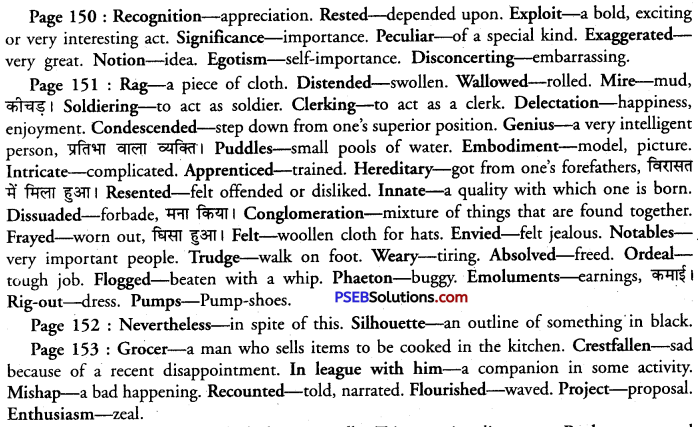
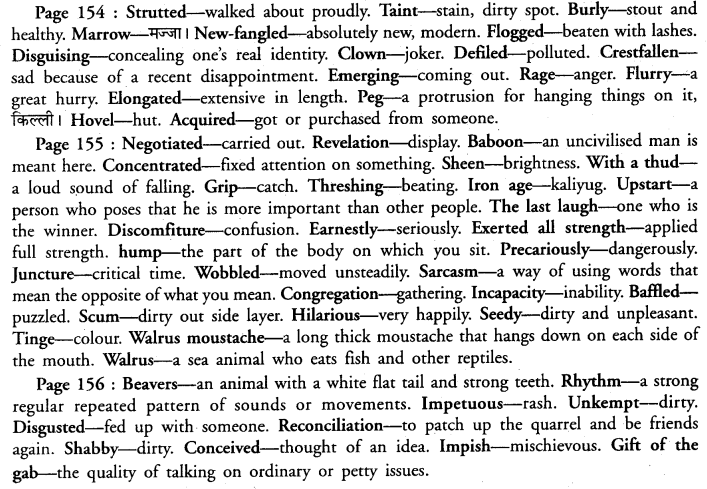
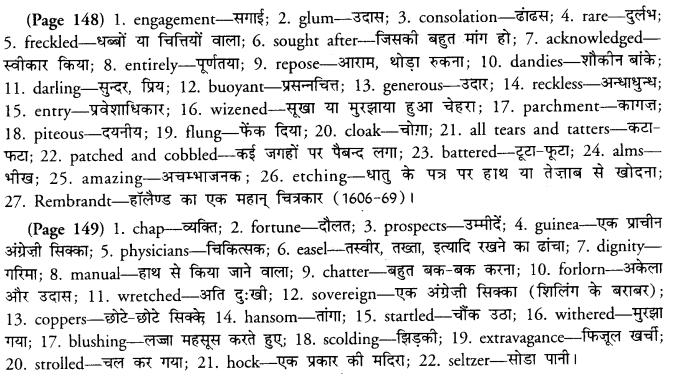
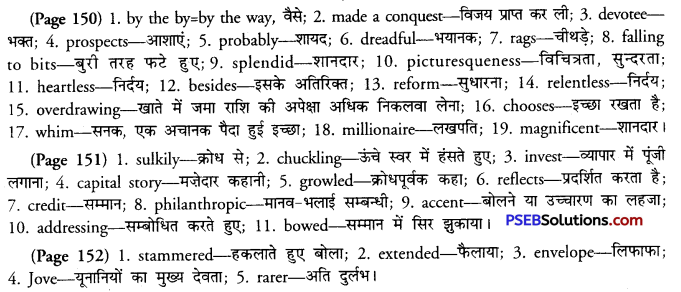
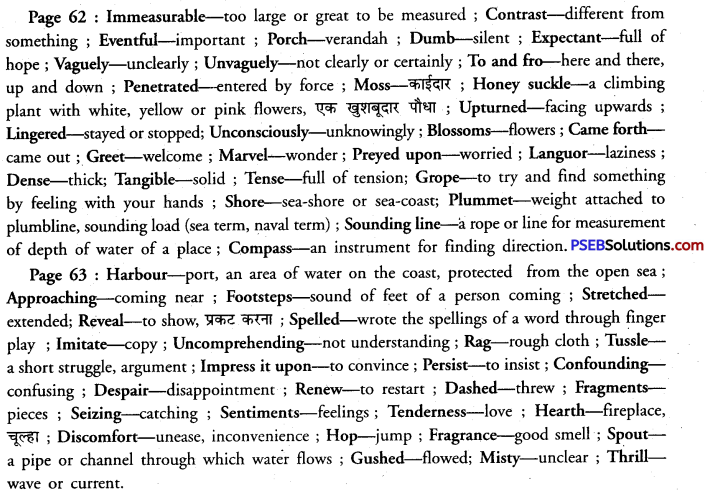
Word Meaning

PSEB 11th Class English Solutions Supplementary Chapter 2 The Tiger in the Tunnel 4
PSEB 11th Class English Solutions Supplementary Chapter 2 The Tiger in the Tunnel 2

Class 11 General English Guide PSEB Pdf Supplementary Reading

Bholi Question Answer Class 12 English Supplementary Chapter 3 PSEB Solutions

Punjab State Board PSEB 12th Class English Book Solutions Supplementary Chapter 3 Bholi Textbook Exercise Questions and Answers.

Class 12th English Supplementary Chapter 3 Bholi Question Answers

Bholi Class 12 Questions and Answers

Short Answer Type Questions

Question 1.
Ramlal was not worried about his children except Bholi. Why? (Feb. 2017)
रामलाल को भोली के सिवा किसी और बच्चे की चिन्ता नहीं थी। क्यों ?
Answer:
Ramlal had seven children. They were three sons and four daughters. Bholi was the youngest of the four. Ramlal was a prosperous farmer. All the children except Bholi were healthy and strong. The sons had been sent to the city to study in schools and later in colleges.

The eldest daughter Radha had already been married. The second daughter Mangla’s marriage had also been settled. After Mangla’s marriage, he would think of the third Champa. They were good-looking and healthy girls. It was not difficult to find bridegrooms for them. But Ramlal was worried about Bholi. She was neither good-looking nor intelligent. He felt that it would be very difficult to find a bridegroom for Bholi.

PSEB 12th Class English Solutions Supplementary Chapter 3 Bholi

रामलाल के सात बच्चे थे। वे थे तीन बेटे और चार बेटियां। भोली चारों बेटियों में से सबसे छोटी थी। रामलाल एक समृद्ध किसान था। भोली के सिवा सब बच्चे स्वस्थ और हष्ट-पुष्ट थे। लड़कों को शहर भेज दिया गया ताकि पहले वे स्कूल में पढ़ें और फिर कॉलिज में। सबसे बड़ी लड़की राधा की पहले ही शादी हो चुकी थी।

दूसरी लड़की मंगला की शादी भी तय हो चुकी थी। मंगला की शादी के बाद, वह तीसरी बेटी चम्पा के बारे विचार करेगा। वे सुन्दर और स्वस्थ लड़कियाँ थीं। उनके लिए दूल्हे ढूंढ लेना कोई मुश्किल नहीं था। परन्तु रामलाल को भोली के बारे बहुत चिन्ता थी। उसने महसूस किया कि भोली के लिए दूल्हा ढूंढ़ लेना बहुत कठिन होगा।

Question 2.
Write in brief a character-sketch of Bholi’s teacher. (V. Imp.) (Feb. 2017)
संक्षेप में भोली की अध्यापिका का चरित्र-चित्रण करें।
Answer:
Bholi’s teacher was a kind lady. She asked Bholi her name. Being a stammerer Bholi said BHO…BHO…BHO. She could not go further than Bho. The school bell rang. Her teacher again called her in a very soothing voice. The kind teacher asked Bholi her name again. For the sake of this kind teacher she decided to make an effort. Bholi knew that she would not laugh at her.

She began to stammer. The teacher encouraged her. She asked Bholi to tell her. full name. At last with the teacher’s sympathetic encouragement, she was able to say her name. She was an ideal teacher.

भोली की टीचर एक दयालु महिला थी। उसने Bholi को उसका नाम पूछा। एक हकलाने वाली होने के नाते Bholi ने Bho…Bho…Bho रुककर कहा। वह Bho कहने के बाद आगे न जा सकी। स्कूल की घंटी बजी। टीचर ने फिर भोली को बुलाया। उसने सन्तोष देने वाली आवाज़ में उसको बुलाया। दयालु टीचर ने भोली को फिर उसका नाम पूछा।

दयालु टीचर की खातिर भोली ने प्रयत्न करने की कोशिश की। भोली जानती थी कि वह उस पर नहीं हंसेगी। टीचर उसको हिम्मत देती थी। टीचर भोली की हिम्मत बढ़ाती थी। यह वह टीचर थी जिसने भोली को आत्मनिर्भर, विश्वस्त और दलेर बनने के लिए तैयार किया जोकि पहले एक गूंगी गाय थी।

वह अपना नाम साफ-2 बोलने में सक्षम हो गई। उसने एक लालची, कमीने, कायर और घृणा योग्य पति के साथ शादी करने से इन्कार कर दिया। उसने उसी स्कूल में टीचर बन कर पढ़ाने का मन बना लिया। उसने इस टीचर से बहुत कुछ सीखा था। वह भी लड़कियों में जागृति पैदा करेगी।

PSEB 12th Class English Solutions Supplementary Chapter 3 Bholi

Question 3.
Write in brief a character-sketch of Bishamber.
संक्षेप में बिशम्बर का चरित्र-चित्रण करें।
Answer:
Bishamber was a greedy man. His greed came to be known to Bholi on their wedding day. He had to garland Bholi in the marriage mandap. He sair pockmarks on her face. He asked his friend if he had seen pock-marks on her face.

His friend told him that he was not young either. But he said that Bholi’s father must give him five thousand rupees. Ramlal had to give him the demanded amount. Bishamber felt victorious. Bholi refused to marry such a greedy man. Bishamber had to go back with his marriage party.

बिशम्बर लालची आदमी था। भोली को बिशम्बर के लालच का ज्ञान उनकी शादी के दिन ही पता चल गया। उसको शादी के मंडप में भोली को हार पहनाना था। उसने उसके चेहरे पर चेचक के धब्बे देख लिये। उसने अपने मित्र को पूछा क्या उसने भोली के चेहरे पर चेचक के धब्बे देखे थे।

उसके मित्र ने उसको उत्तर दिया कि वह भी तो नौजवान नहीं था। लेकिन उसने कहा कि भोली के पिता को उसे 5 हज़ार रुपये अवश्य देने चाहिए। रामलाल को उसे मांगी गई धन-राशि देनी पड़ी। बिशम्बर ने अपने आपको विजयी समझा। भोली ने ऐसे लालची आदमी से शादी करने से इन्कार कर दिया। बिशम्बर को अपनी बारात के साथ वापस लौटना पड़ा।

PSEB 12th Class English Solutions Supplementary Chapter 3 Bholi

Long Answer Type Questions

Question 1.
Describe, in brief, the early childhood of Bholi.
संक्षेप में Bholi के बचपन के प्रारम्भिक दिनों का वर्णन करे।
Answer:
Her real name was Sulekha. But since her childhood everyone had been calling her Bholi, the simpleton. She was the fourth daughter of Numberdar Ramlal. When she was ten months old, she had fallen off the cot on her head. This had damaged some part of her brain. She became a mentally retarded child. So she was called Bholi, the simpleton.

At birth, she was very pretty and fair. At the age of two, she had an attack of smallpox. Her eyes were safe but her entire body got permanently disfigured by deep black pock marks. She could not speak till she was five. Then she used to stammer. The other children often made fun of her. So she talked very little. She was one of the seven siblings.

She had three sisters and three brothers. Her brothers had gone to the city to study in schools and later in colleges. Her sisters were healthy and good-looking. Bholi was neither good-looking nor intelligent.

PSEB 12th Class English Solutions Supplementary Chapter 3 Bholi

उसका असली नाम सुलेखा था। लेकिन उसके बचपन से ही सब उसको भोली कह कर बुलाते थे, भोली बुद्ध। वह नम्बरदार रामलाल की चौथी बेटी थी। जब वह दस महीने की हुई तो वह अपनी चारपाई से अपने सिर के बल गिर गई। इसने उसके दिमाग के किसी भाग में क्षति पहुँचाई थी। वह दिमागी तौर पर एक पिछड़ा हुआ बच्चा बन गई।

इस लिए उसको बुद्ध Bholi कहकर पुकारा जाने लगा। अपने जन्म के समय वह बहुत गोरी-चिट्टी थी। दो साल की आयु में उसे चेचक का आक्रमण हो गया। उसकी आँखें तो सुरक्षित रहीं लेकिन सारा शरीर काले चेचक के धब्बों से स्थाई तौर पर बदशक्ल हो गया। पाँच वर्ष की आयु से पहले वह बोल भी नहीं सकती थी।

फिर वह हकलाती थी। दूसरे बच्चे प्रायः उसका मजाक उड़ाते थे। इसलिए वह बहुत कम बातें करती थी। वह सात भाई-बहनों में एक थी। उसके तीन भाई और तीन बहनें थीं। उसके भाई शहर में पहले स्कूल और फिर कॉलिज में पढ़ने के लिए चले गये थे। उसकी बहनें स्वस्थ और देखने में सुन्दर थीं। Bholi न देखने में सुन्दर थी न बुद्धि वाी थी।

Objective Type Questions

This question will consist of 3 objective type questions carrying one mark each. These objective questions will include questions to be answered in one word to one sentence or fill in the blank or true/false or multiple choice type questions.

Question 1.
How many siblings did Bholi have ?
Answer:
Bholi had six siblings-three brothers and three sisters.

Question 2.
Why was Sulekha called Bholi ?
Answer:
Because of damage to her brain, she became a backward child and so was called Bholi, the simpleton.

PSEB 12th Class English Solutions Supplementary Chapter 3 Bholi

Question 3.
What was the effect of small-pox on Bholi ?
Answer:
Her body was permanently disfigured.

Question 4.
Why did children make fun of Bholi ?
Answer:
They made fun of her because of her stammering.

Question 5.
Why was Ramlal worried about Bholi ?
Answer:
He was worried about Bholi because she had neither good looks nor intelligence for getting married.

Question 6.
Why did the Tehsildar come to the village ?
Answer:
He came to the village to perform the opening ceremony of the primary school.

Question 7.
Why did the Tehsildar want Ramlal to send his daughters to the school ?
Answer:
He wanted Ramlal to do this as he must set an example to the villagers being an agent of the government in the village.

Question 8.
Why did Ramlal’s wife agree to send Bholi, but not other daughters to school ? (V.V. Imp.)
Answer:
She agreed to send Bholi to school because she had no chance of getting married with her ugly face and lack of sense ; other beautiful daughters had no chance of getting married, if they went to school.

PSEB 12th Class English Solutions Supplementary Chapter 3 Bholi

Question 9.
Why was Bholi glad to see so many girls of her own age at school ?
Answer:
She was glad because she hoped that one of these girls would become her friend.

Question 10.
What happened when the teacher asked Bholi her name?
Answer:
Sweat broke out over her whole body but then she stammered her name Bho-Bho Bho.

Question 11.
Why did Bholi’s parents agree to Bishamber’s proposal for Bholi ?
Answer:
They agreed to the proposal fearing if they did not accept it, she may remain unmarried all her life.

Question 12.
How did Bishamber come to wed Bholi ?
Answer:
Bishamber came to wed Bholi with a big party of friends and relatives on a decorated horse and led by a band.

Question 13.
Why did Bishamber demand five thousand rupees as dowry?
Answer:
He wanted five thousand rupees as dowry as his would-be wife Bholi had pock marks on her face.

Question 14.
Why did Bholi refuse to marry Bishamber?
Answer:
She did not want to marry a mean, greedy and hateful coward as Bishamber.

Question 15.
Bishamber was a heartless man. (True/False)
Answer:
True.

PSEB 12th Class English Solutions Supplementary Chapter 3 Bholi

Question 16.
An old woman said that Bholi was a ………… girl. (Fill up the blank with a suitable word) (shameless/proud)
Answer:
shameless.

Question 17.
Bishamber demanded a dowry of 5000 rupees from Bholi’s father. (True/False)
Answer:
True.

Question 18.
Bholi’s school teacher felt the satisfaction of …… (Choose the correct option)
(i) a singer
(ii) a dancer
(iii) an artist.
Answer:
(iii) an artist.

Question 19.
Write how Bholi used three pauses in telling her name.
Answer:
Bho-Bho-Bho-Bholi.

Question 20.
Bholi had neither beauty nor intelligence. (True/False)
Answer:
True.

Question 21.
Bishamber was a …………… by profession. (labourer/dancer/grocer)
Answer:
grocer.

Question 22.
Pick up the correct word for Bholi’s trouble in speaking. (stuttering, lisping,stammering).
Answer:
Stammering.

Bholi Summary in English

Bholi Introduction:

This story tells us about a girl named Sulekha who was called Bholi because she was a simpleton. She was a neglected child. She used to stammer. She was disliked and neglected by everyone. So she had an inferiority complex. She was guided by her primary school teacher properly.

PSEB 12th Class English Solutions Supplementary Chapter 3 Bholi

Her education gave her the courage and capability to fight against her weakness. She refused to marry an elderly man Bishamber Nath who was a greedy person. Her education helped her to be independent. Her right decision made her respectable in her society.

Bholi Summary in English:

She was called Bholi, the simpleton although her name was Sulekha. She was fourth daughter of Numberdar Ramlal. When she was ten months old, she fell off her cot and received an injury on some part of her brain. She remained a backward child.

She came to be known as Bholi, the simpleton. At her birth, she was very fair and pretty. At the age of two she had an attack of small-pox. Only her eyes were saved. Her entire body was permanently disfigured by deep black pock-marks.

She could not speak till she was five. When she learnt to speak, she stammered. The other children often made fun of her and mimicked her. As a result, she talked very little. She had three brothers and three sisters. She was the youngest of them all.

Her father was a wealthy farmer. All the children except Bholi were healthy. The brothers had been sent to the city to study in schools and later in colleges. Radha, the eldest girl, was already married.

PSEB 12th Class English Solutions Supplementary Chapter 3 Bholi

The second daughter Mangla’s marriage had also been settled. The third daughter Champa was waiting to be married. They were good looking girls. They would easily get bridegrooms. Ramlal was worried about Bholi. She had neither good looks nor intelligence.

Mangla was married when Bholi was seven. The same year a primary school was opened in their village. The Tehsildar performed the opening ceremony of the school. He told Ramlal, the Numberdar, to send his daughters to school. His wife did not like this idea.

She was of the view if girls went to school, nobody would marry them. But Ramlal did not have the courage to disobey the Tehsildar. Ramlal and his wife sent Bholi to school as she had no chance to get married. He told his wife to dress Bholi in good clothes and send her to school. Previously she used to wear old clothes worn by her sisters.

Ramlal and. Bholi went to school. She was handed over to the headmistress. Bholi was glad to find so many girls of her own age present there. Bholi saw some pictures in the classroom. She felt fascinated by the colours. The teacher stood by her side.

She was smiling. The teacher asked her name. Since Bholi was a stammerer, she could not go further than Bh-Bh-Bho. She began to cry and tears began to flow from her eyes. She kept her head down. She saw the girls were laughing at her.

The school bell rang. All the girls ran out of their classes. The teacher called her in a very soft voice. She asked her to tell her name. She again said Bho-Bho-Bho-Bho. At last she was able to say Bholi. The teacher patted her affectionately and told her that she had done well.

She told Bholi to put the fear out of her heart and then she would be able to speak like everyone else. Bholi said that she would come to school every day. The teacher then told her to take the book.

The book was full of nice pictures and the pictures were in colour—dog, cat, goat, horse, parrot, tiger and a cow. She assured Bholi that she will be given a bigger book. After finishing she will get a still bigger one. In time she will be learned. Then nobody will laugh at her. She told her to come to school every day.

Bholi feit happy. She thought that she was having a new life. Thus the years passed. The village became a small town. Ramlal and his wife settled the marriage of Bholi with one Bishamber Nath who was an old man. He was a well-to do grocer.

His marriage party came in village. Bishamber told his friend in the marriage mandap that his would-be wife had pock marks on her face. His friend told him that it should not matter as he himself was quite old.

But Bishamber told Bholi’s father if he was to marry Bholi, her father must give him five thousand rupees. Ramlal begged Bishamber Nath not to humiliate him. He offered him two thousand rupees. He told him to be merciful. Bishamber told him to give him five thousand rupees.

PSEB 12th Class English Solutions Supplementary Chapter 3 Bholi

Bholi threw a garland of her neck into the fire. She told her father that she was not going to marry this greedy old man who was lame. The guests began to say that she was shameless. Ramlal shouted at Bholi not to disgrace her family. Bholi said that for the sake of her father’s izzat she was willing to marry this lame old man. But now she will not marry such a mean, greedy and hateful coward.

An old woman said that she is a shameless girl. They all thought that she was a dumb cow. She said that the auntie was all right. That is why they had decided to hand her over to that heartless creature. Bishamber. Nath, the grocer, started to go back with his party. Ramlal stood rooted to the ground. His head was bowed low. The flames of the sacred fire slowly died down. Ramlal told Bholi that nobody would marry her.

She told her father not to worry. She said that she will serve her father in her old age. She will teach in the same school. Her teacher was present there. In her smiling eyes there was the light of a deep satisfaction that an artist feels when he sees the completion of his work.

Bholi Summary in Hindi

Bholi Introduction:

यह कहानी हमें एक लड़की के बारे में बताती है जिसका नाम सुलेखा था। उसको Bholi कह कर पुकारते थे क्योंकि वह बुद्ध थी। वह हकलाती थी। वह उपेक्षित बच्ची थी। उसको कोई पसन्द नहीं करता था। इसलिए उसमें हीन भावना थी। उसके प्राईमरी स्कूल की अध्यापिका ने उसको ठीक ढंग से मार्गदर्शन किया।

इसलिए उसकी शिक्षा ने उसको उत्साह और योग्यता प्रदान की ताकि वह अपनी कमज़ोरी के विरुद्ध लड़ सके। उसने एक वृद्ध व्यक्ति बिशम्बर नाथ से विवाह करने से इन्कार कर दिया। वह बहुत लालची आदमी था। उसकी शिक्षा ने उसको अपने पाँव पर खड़ा होने में सहायता की। उसके ठीक निर्णय ने उसको अपनी सोसाईटी में सम्मानित बना दिया।

Bholi Summary in Hindi:

उसको भोली कहते थे, वह बुद्ध थी यद्यपि उसका नाम सुलेखा था। वह नम्बरदार रामलाल की चौथी बंटी थी। जब वह दस मास की थी, वह अपनी चारपाई से गिर गई और उसके दिमाग के किसी भाग में चोट लग गई। वह एक पिछड़ी हुई बच्ची बन गई। उसको भोली, बुद्ध कह कर पुकारा जाने लगा। अपने जन्म के समय वह गोरी चिट्टी थी।

दो साल की आयु में उस पर चेचक का आक्रमण हो गया। केवल उसकी आंखें बची और उसका बाकी शरीर स्थाई तौर पर चेचक के काले निशानों के कारण बदशक्ल हो गया। पाँच साल की आयु तक तो वह बोल भी न सकी। जब वह बोलने लगी तो वह हकलाती थी। दूसरे बच्चे उसका मज़ाक उड़ाते थे और उसकी नकल भी करते थे।

PSEB 12th Class English Solutions Supplementary Chapter 3 Bholi

इसका नतीजा यह हुआ कि वह बहुत कम बातें करती थी। उसके तीन भाई और तीन बहनें थीं। वह आयु में सबसे छोटी थी। उसका बाप एक धनी ज़मींदार था। भोली को छोड़कर उसके सब बच्चे स्वस्थ थे। उसके भाइयों को स्कूल में पढ़ने के लिए शहर में भेजा गया और स्कूल के बाद college में।

सबसे बड़ी लड़की राधा की पहले ही शादी हो चुकी थी। दूसरी बेटी मंगला की शादी भी तय हो चुकी थी। तीसरी बेटी चम्पा शादी होने की प्रतीक्षा कर रही थी। वे सुन्दर दिखने वाली लड़कियाँ थीं। उनको आसानी से दूल्हे मिल जाने थे। रामलाल को भोली के बारे में बड़ी चिन्ता थी। न तो उसकी रूपरेखा अच्छी थी और न ही वह बुद्धिमान थी। जब भोली 7 वर्ष की थी तो मंगला की शादी हो गई। उसी वर्ष उनके गांव में एक प्राईमरी स्कूल खुल गया।

स्कूल का उदघाटन समारोह तहसीलदार ने किया। तहसीलदार ने रामलाल नम्बरदार को कहा कि वह अपनी बेटियों को स्कूल भेजे। उसकी पत्नी को यह राय अच्छी नहीं लगी। उसका विचार था कि यदि लड़कियाँ स्कूल पढ़ने जायेंगी तो उनसे कोई विवाह नहीं करेगा। लेकिन रामलाल में इतनी हिम्मत नहीं थी कि वह तहसीलदार का कहना न माने। रामलाल और उसकी पत्नी ने भोली को स्कूल भेज दिया क्योंकि उसके शादी होने का अवसर नहीं था। उसने अपनी पत्नी को कहा कि भोली को अच्छे कपड़े पहनाकर स्कूल भेजे। इससे पहले वह अपनी बहनों के पहने हुए पुराने कपड़े पहना करती थी।

रामलाल और भोली स्कूल गये। उसे headmistress के हवाले कर दिया गया। भोली अपनी आयु की बहुतसी लड़कियां वहां देखकर बहुत खुश हुई। उसने class-room में बहुत से चित्र देखे। वह रंगों को देखकर मन्त्रमुग्ध हो गई। उसकी teacher भी उसके पास खड़ी थी। वह मुस्करा रही थी। Teacher ने उसका नाम पूछा।

चूँकि वह हकलाती थी इसलिए वह अपने नाम को साफ ढंग से बोल नहीं सकी। वह Bho- के आगे न जा सकी। फिर उसने रोना आरम्भ कर दिया और उसकी आंखों से आंसू बहने लगे। उसने अपना सिर नीचे झुका लिया। उसने देखा कि दूसरी लड़कियाँ उस पर हंस रही थीं। इतने में स्कूल की घंटी बजी। सब लड़कियां अपनी classes से बाहर आ गई। भोली की teacher ने उसको बड़ी कोमल आवाज़ में बुलाया। उसने उसको अपना नाम बताने को कहा।

Bho-Bho-Bholi अन्त में वह Bholi कहने में सफल हो गई। टीचर ने बड़े प्यार से उसको थपकी दी और उसको उत्साहित भी किया। टीचर ने भोली को कहा कि वह अपने हृदय से भय को निकाल दे। तब वह सब की तरह साफ-साफ बोल सकेगी। भोली ने यह भी कहा कि वह प्रतिदिन स्कूल आयेगी। Teacher ने उसको कहा कि वह किताब को ले ले।

किताब में अच्छी-अच्छी तस्वीरें थीं और वे सब चित्र रंगीन थे-कुत्ता, बिल्ली, बकरी, घोड़ा, बाघ और गाय। उसने भोली को कहा कि इस किताब को समाप्त करने के बाद उसे इससे बड़ी पुस्तक मिलेगी। उसको समाप्त करने पर उससे भी बड़ी किताब मिलेगी। समय बीतने पर वह काफ़ी कुछ सीख जायेगी। तब कोई भी उसकी हंसी नहीं उड़ायेगा। उसने भोली को कहा कि उसे प्रतिदिन स्कूल आना चाहिए।

PSEB 12th Class English Solutions Supplementary Chapter 3 Bholi

भोली प्रसन्न हो गई। उसने सोचा कि उसका नया जीवन आरम्भ हो रहा है। इस प्रकार वर्ष बीतते गये। गांव एक छोटा नगर बन गया। Ramlal ने भोली की शादी वहां के किरयाने के दुकानदार बिश्म्बरनाथ से कर देने का निर्णय कर लिया। शादी के दिन मंडप में बैठे हुए बिश्म्बरनाथ ने देखा कि उसकी होने वाली पत्नी के चेहरे पर चेचक के दाग हैं। बिश्म्बरनाथ के एक मित्र ने उसको बताया कि भोली के चेहरे पर चेचक के दाग थे।

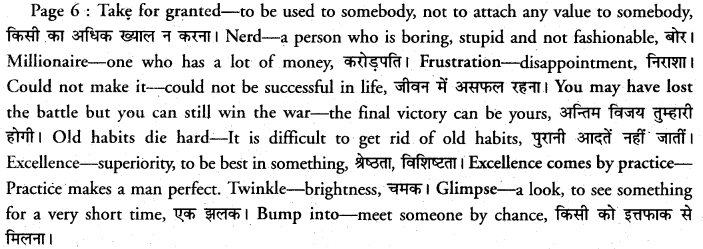
Word Meanings:
PSEB 12th Class English Solutions Supplementary Chapter 3 Bholi 1

Class 12 PSEB Solutions Supplementary Reading
A President Speaks Question Answer Class 11 English Book Chapter 5 PSEB Solutions

Punjab State Board PSEB 11th Class English Book Solutions Chapter 5 A President Speaks Textbook Exercise Questions and Answers.

Class 11th English Book Chapter 5 A President Speaks Question Answers

A President Speaks Class 11 Questions and Answers

Short Answer Type Questions

Question 1.
Who have come and invaded India in 3000 years of its history?
Answer:
In 3000 years of India’s history, people from all over the world have looted her. From Alexander onwards, many nations have invaded our country. They included the Greeks, the Turks, the Moguls, the Portuguese, the British, the French and the Dutch. They all came and looted us. They took over what was ours.

भारत के तीन हजार सालों के इतिहास में सारे संसार के लोगों ने आकर इसे लूटा है। सिकन्दर से लेकर अनेकों देशों ने हमारे देश पर आक्रमण किया है। उनमें यूनानी, तुर्क, मुग़ल, पुर्तगाली, अंग्रेज़, फ्रांसीसी और हालैण्डवासी शामिल हैं। उन सबने आकर हमें लूटा। उन्होंने उस पर अधिकार कर लिया जो हमारा था।

PSEB 11th Class English Solutions Chapter 5 A President Speaks

Question 2.
When, according to Kalam, did India get its first vision of Freedom ?
Answer:
According to Kalam, India got its first vision of Freedom in 1857 when the war of independence was started. The British had ruled India for a long period. But now Indian people wanted to get rid of their slavery. They wanted to free their land from the clutches of the British rule.

कलाम के अनुसार भारत को स्वतन्त्रता का पहला स्वप्न 1857 में आया था जब स्वतन्त्रता-संग्राम शुरू हुआ था। अंग्रेजों ने भारत पर बहुत लम्बे समय तक शासन किया था। परन्तु अब भारतवासी उनकी गुलामी से छुटकारा पाना चाहते थे। वे अंग्रेजी शासन के पंजों से अपने देश को आजाद करवाना चाहते थे।

Question 3.
What is Kalam’s second vision for India ?
Answer:
Kalam’s second vision for India is development. He wants India to be a developed nation. He says that we are among the 5 top nations of the world in terms of GDP. We have 10 percent growth rate in most areas. Our achievements are being globally recognized. Yet we don’t see ourselves as a developed nation. It is because we lack self-confidence.

भारत के लिए कलाम का दूसरा स्वप्न विकास का है। वह चाहता है कि भारत एक विकसित देश बने। वह कहता है कि सकल घरेलू उत्पाद की दृष्टि से हम संसार के पांच चोटी के देशों में हैं। अधिकतर क्षेत्रों में हमारी विकास दर दस प्रतिशत है। हमारी उपलब्धियों का पूरे विश्व में सम्मान हो रहा है। फिर भी हम स्वयं को एक विकसित राष्ट्र के रूप में नहीं देखते हैं। इसका कारण है – हममें आत्म-विश्वास की कमी।

PSEB 11th Class English Solutions Chapter 5 A President Speaks

Question 4.
Why does Kalam want India to be a strong military and economic power ?
Answer:
For fifty years, India has been a developing nation. Now Kalam wants to see India as a developed nation. Kalam believes that unless India stands up to the world, no one will respect us. That is why he wants India to be a strong military and economic power.

पचास वर्षों से भारत एक विकासशील देश रहा है। अब कलाम भारत को एक विकसित राष्ट्र के रूप में देखना चाहता है। कलाम का विश्वास है कि जब तक भारत संसार के मुकाबले में खड़ा नहीं होगा, कोई हमारा सम्मान नहीं करेगा। इसीलिए कलाम चाहता है कि भारत सैनिक शक्ति तथा आर्थिक शक्ति के रूप में मज़बूत बने।

Question 5.
What is India’s position regarding milk production and remote sensing satellites in the world?
Answer:
India is number one in milk production and remote sensing satellites in the world.
भारत दूध के उत्पादन तथा दूर-संवेदी उपग्रहों में संसार भर में नम्बर एक पर है।

Question 6.
What is India’s position in respect of the production of wheat and rice ?
Answer:
India is the second largest producer of wheat and rice.
भारत गेहूं तथा चावल का दूसरा सबसे बड़ा उत्पादक है।

Question 7.
How do we behave while in Singapore ?
Answer:
While we are in Singapore, we don’t litter the roads or eat standing in the stores. We behave there in a very civilized manner. We become very responsible and law-abiding.

जिस समय हम सिंगापुर में होते हैं, हम सड़कों पर कचरा नहीं फेंकते हैं, अथवा हम दुकानों में खड़े होकर नहीं खाते हैं। हम वहां बहुत सभ्य ढंग से व्यवहार करते हैं। हम बहुत जिम्मेदार और कानून का पालन करने वाले बन जाते हैं।

PSEB 11th Class English Solutions Chapter 5 A President Speaks

Question 8.
How do we behave while in Dubai ?
Answer:
While we are in Dubai, we don’t dare to eat in public during Ramadan. We become very responsible and law-abiding in our behaviour. We don’t dare to do anything that is not acceptable there.

जिस समय हम दुबई में होते हैं, हम रमजान के दौरान किसी सार्वजनिक जगह पर खाने की हिम्मत नहीं करते हैं। हम अपने व्यवहार में बहुत जिम्मेदार तथा कानून का पालन करने वाले बन जाते हैं। हम ऐसा कुछ भी करने की हिम्मत नहीं करते जिसकी वहां इजाजत न हो।

Question 9.
What did the ex-municipal commissioner of Bombay (Mumbai) tell Kalam ?
Answer:
He told Kalam that in India, rich people’s pets are taken out into the streets to leave their droppings all over the place. And then the same people blame the authorities for dirty pavements. In countries like America and Japan, every dog owner has to clean the droppings of his pet. “Will the Indian citizens do that here ?” he asked.

उसने कलाम को बताया कि भारत में अमीर लोगों के कुत्तों को बाहर गलियों में घुमाया जाता है, ताकि वे हर तरफ अपनी गन्दगी फैला सकें। और फिर वही लोग इन गंदी पटरियों के लिए अधिकारियों को दोषी ठहराते हैं। अमेरिका तथा जापान जैसे देशों में प्रत्येक कुत्ते के मालिक को अपने पालतू कुत्ते की गन्दगी को खुद साफ करना पड़ता है। “क्या भारतीय नागरिक यहां ऐसा करेंगे ?” उसने पूछा।

Question 10.
What has every dog owner in America and Japan to do ?
Answer:
In countries like America and Japan, every dog owner has to clean the droppings of his pet. The natives of these countries love cleanliness and they contribute in keeping their land clean and beautiful.

अमरीका तथा जापान जैसे देशों में प्रत्येक कुत्ते के मालिक को अपने पालतू कुत्ते की गन्दगी को खुद साफ करना पड़ता है। इन देशों में रहने वाले सफाई को बहुत पसंद करते है और वे अपने देश को साफ तथा सुन्दर बनाए रखने में अपना योगदान देते हैं।

PSEB 11th Class English Solutions Chapter 5 A President Speaks

Question 11.
What do we expect from railways and airlines ?
Answer:
We expect the railways to provide clean bathrooms. But we ourselves never learn the proper use of these bathrooms. We want airlines to provide the best of food and toiletries. But we ourselves don’t hesitate to pilfer at the least opportunity.

हम रेल विभाग से आशा करते हैं कि वह स्वच्छ शौचालय प्रदान करे। परन्तु हम स्वयं कभी इन शौचालयों का उचित ढंग से प्रयोग करना नहीं सीखते। हम चाहते हैं कि एयरलाइन्ज उत्तम भोजन और शृंगार प्रसाधन प्रदान करें। परन्तु हम स्वयं ज़रा-सा भी अवसर मिलने पर चोरी करने से नहीं झिझकते।

Question 12.
What is our attitude towards burning social issues ?
Answer:
We show great concern about burning social issues. Women, dowry, girl child, etc. are hot subjects for us. We make a show of loud protests in public. But in our own home, we do the reverse. Then we say that the whole system has to be changed.

हम ज्वलन्त सामाजिक विषयों के बारे में अपनी बड़ी भारी चिन्ता व्यक्त करते हैं। औरतें, दहेज, छोटी बच्चियां, आदि हमारे लिए रुचिकर विषय होते हैं। हम लोगों के सामने जोरदार विरोध-प्रदर्शन करते हैं। किन्तु स्वयं अपने घर में हम इसके बिल्कुल विपरीत करते हैं। फिर हम कहने लगते हैं कि पूरी प्रणाली को बदलना होगा।

Question 13.
How do we behave while in foreign countries?
Answer:
In a foreign country, we behave like a responsible and law-abiding citizen. If we are in Singapore, we don’t throw garbage on the road. In Dubai, we don’t dare to eat in public during Ramadan. In Washington, we don’t dare to speed beyond 55 mph. In foreign countries, we behave in a very civilized manner.

विदेश में हम एक ज़िम्मेदार तथा कानून का पालन करने वाले नागरिक की तरह व्यवहार करते हैं। यदि हम सिंगापुर में हों, तो हम सड़कों पर कूड़ा नहीं फेंकते। दुबई में हम रमजान के दौरान सार्वजनिक जगहों पर कुछ खाने की हिम्मत नहीं करते। वाशिंगटन में हम 55 मील प्रति घंटा से ज्यादा रफ्तार पर गाड़ी चलाने की हिम्मत नहीं करते। विदशों में हम बहुत सभ्य ढंग से व्यवहार करते हैं।

Question 14.
Why does Kalam say, “India must stand up to the world.” ?
Answer:
Kalam says that India must become strong. It must stand up to the world. Only then can we win respect. Kalam says that only strength respects strength. So we must be strong. We should be strong not only as a military power, but also as an economic power. Both must go hand-in-hand.

कलाम कहता है कि भारत को शक्तिशाली बनना ही चाहिए। इसे संसार के मुकाबले में अवश्य खड़ा होना चाहिए। केवल तभी हमें सम्मान प्राप्त हो सकता है। कलाम कहता है कि केवल ताकत ही ताकत का सम्मान करती है। इसलिए हमें अवश्य ताकतवर बनना चाहिए। हमें न केवल एक सैनिक शक्ति के रूप में ताकतवर बनना चाहिए, अपितु एक आर्थिक शक्ति के रूप में भी। दोनों को साथ-साथ चलना होगा।

PSEB 11th Class English Solutions Chapter 5 A President Speaks

Question 15.
According to Kalam, how do we behave when we are in Australia, New Zealand or Boston ?
Answer:
Kalam says that we behave very differently when we are in another country. For example, when we are in Australia or New Zealand, we would not throw our empty coconut shell on the beach. We don’t throw it anywhere other than the garbage pail. And in Boston, we shall never try to buy false certificates from an employee in the examination department. But in our own country, we shall do all these things without any fear or sense of shame.

कलाम कहता है कि जब हम किसी अन्य देश में होते हैं, तो हमारा व्यवहार बहुत भिन्न होता है। उदाहरण के लिए, जब हम आस्ट्रेलिया या न्यूजीलैण्ड में हों तो हम अपने नारियल के खाली खोल को समुद्र-तट पर नहीं फेंकते हैं। हम इसे कूड़े वाले ड्रम के अतिरिक्त और किसी अन्य जगह पर नहीं फेंकते हैं। तथा बोस्टन में हम परीक्षा विभाग के किसी कर्मचारी से नकली प्रमाण-पत्र खरीदने की कोशिश नहीं करेंगे। किन्तु अपने देश में हम यह सारे काम बिना किसी भय या लज्जा की भावना से करेंगे।

Question 16.
What is Kalam’s third vision for India ?
Answer:
Kalam’s third vision is to see India as a strong nation. He wants India to stand up to the world. No one will respect us unless we are strong. Only strength respects strength. Kalam says that we must be strong as a military power and also as an economic power.

कलाम का तीसरा स्वप्न भारत को एक शक्तिशाली राष्ट्र के रूप में देखना है। वह चाहता है कि भारत संसार के सामने तन कर खड़ा हो जाए । हमारा कोई सम्मान नहीं करेगा यदि हम शक्तिशाली नहीं होंगे। केवल शक्ति ही शक्ति का सम्मान करती है। कलाम कहता है कि हमें एक सैनिक शक्ति के रूप में और एक आर्थिक शक्ति के रूप में भी ताकतवर होना चाहिए।

Question 17.
What does Kalam say about our obssession with foreign goods ? How does, according to him, self-respect come ?
Answer:
Kalam says that India has made wonderful success in many fields. Yet we run after foreign goods. He is unable to understand this obssession with everything imported. He says that selfrespect comes with self-reliance. We must become self-reliant instead of running after foreign goods.

कलाम कहता है कि भारत ने अनेक क्षेत्रों में शानदार सफलता प्राप्त की है। फिर भी हम विदेशी चीजों के पीछे भागते हैं। वह हर विदेशी चीज़ के लिए इस जुनून को समझ पाने में असमर्थ है। वह कहता है कि आत्म-सम्मान, आत्म-निर्भरता के आने से प्राप्त होता है। हमें विदेशी चीजों के पीछे भागने की बजाए आत्म-निर्भर बनना चाहिए।

Question 18.
How does Kalam react in despair at the end of this essay ?
Answer:
In great despair, Kalam says that everybody is out to abuse and rape the country. Nobody thinks of feeding the system. We have mortgaged our conscience to money. Kalam calls upon every Indian to do what the country needs from us.

बहुत निराश होकर कलाम कहता है कि हर कोई देश का ग़लत इस्तेमाल करने और इसका बलात्कार करने पर तुला हुआ है। कोई भी आदमी प्रणाली में अपना योगदान देने की बात नहीं सोचता। हमने अपनी आत्मा को पैसे के पास गिरवी रख दिया है। कलाम प्रत्येक भारतीय से आह्वान करता है कि वह देश के लिए वह काम करे जिसकी देश को हमसे जरूरत है।

Long Answer Type Questions

Question 1.
What is Kalam’s vision for India ?
Answer:
Kalam has three visions for India. His first vision is that of freedom. He says that India had its first vision of freedom in 1857. We must protect this freedom. Kalam’s second vision for India is of development. He wants India to be a developed nation.

He says that we are among the five top nations of the world in terms of GDP. Our achievements are being globally recognized. Yet we don’t see ourselves as a developed nation. It is because we lack self-confidence. We must have self-confidence.

PSEB 11th Class English Solutions Chapter 5 A President Speaks

Kalam’s third vision is to see India as a strong nation. He wants India to stand up to the world. He says that we must be strong as a military power and also as an economic power.

भारत के सम्बन्ध में कलाम के तीन स्वप्न हैं। उसका पहला स्वप्न स्वतन्त्रता का स्वप्न है। वह कहता है कि भारत को स्वतन्त्रता का पहला स्वप्न 1857 में आया था। हमें इस स्वतन्त्रता की रक्षा अवश्य करनी है। भारत के लिए कलाम का दूसरा स्वप्न विकास का है। वह चाहता है कि भारत एक विकसित देश बने।

वह कहता है कि सकल घरेलू उत्पाद की दृष्टि से हम संसार के पांच चोटी के देशों में हैं। हमारी उपलब्धियों का सम्मान पूरे विश्व में हो रहा है। फिर भी हम स्वयं को एक विकसित राष्ट्र के रूप में नहीं देखते हैं। इसका कारण है – हममें आत्म-विश्वास की कमी। हममें आत्म-विश्वास अवश्य होना चाहिए।

कलाम का तीसरा स्वप्न भारत को एक शक्तिशाली राष्ट्र के रूप में देखना है। वह चाहता है कि भारत संसार के सामने तन कर खड़ा हो जाए। वह कहता है कि हमें एक सैनिक शक्ति के रूप में और एक आर्थिक शक्ति के रूप में भी ताकतवर होना चाहिए।

Question 2.
What does he say about our behaviour in a foreign country ?
Answer:
Kalam says that in a foreign country, we behave like a responsible and law-abiding citizen. We never do anything that is unlawful or unworthy. If we are in Singapore, we don’t litter on the road. In Dubai, we don’t dare to eat in public during Ramadan. In Jeddah, we don’t dare to go out with our head uncovered.

In London, we do not try to bribe an employee of the telephone exchange to bill our calls to someone else. In Washington, we don’t dare to speed beyond 55 mph. Similarly, in Australia or New Zealand, we don’t throw an empty coconut shell on the beach. And in Tokyo, we don’t spit paan on the streets. Kalam means to say that in a foreign country, we are at our international best.

कलाम कहता है कि किसी अन्य देश में हम एक ज़िम्मेदार और कानून का पालन करने वाले व्यक्ति के जैसा व्यवहार करते हैं। हम कभी कोई ऐसा काम नहीं करते जो गैर-कानूनी हो या अशोभनीय हो। यदि हम सिंगापुर में हों, तो हम सड़क पर कचरा नहीं फेंकते हैं। दुबई में हम रमज़ान के दौरान सार्वजनिक जगह पर खाने की हिम्मत नहीं करते सकते हैं। जैद्दा में हम नंगे-सिर बाहर जाने की हिम्मत नहीं करते हैं।

लंदन में हम टेलीफोन एक्सचेंज के किसी कर्मचारी को घूस देने की हिम्मत नहीं करेंगे कि वह हमारी काल किसी दूसरे के खाते में डाल दे। हम वाशिंगटन में 55 मील प्रति घण्टा से ज्यादा गति पर गाड़ी चलाने की हिम्मत नहीं करते हैं। इसी प्रकार ऑस्ट्रेलिया या न्यूज़ीलैंड में हम नारियल के खाली खोल को समुद्र-तट पर नहीं फेंकते हैं। और टोक्यो में हम सड़कों पर पान नहीं थूकते हैं। कलाम के कहने का भाव है कि विदेश में हम सर्वोत्तम अन्तर्राष्ट्रीय व्यवहार का नमूना बन जाते हैं।

Question 3.
What does he (Kalam) say about our behaviour in our own country ?
Answer:
Kalam says that we behave very differently when we are in another country. We become very responsible and law-abiding. We never do anything that is thought unlawful or unworthy there. But the moment we come back and step on the Indian soil, we start throwing paper and garbage on the road. We expect the railways to provide clean bathrooms.

But we ourselves never use these bathrooms properly. Kalam wonders why we can’t behave like a good citizen in India also. We willingly follow a foreign system, but don’t care a fig for our own.

कलाम कहता है कि जब हम किसी अन्य देश में होते हैं, तब हम बहुत भिन्न रूप से व्यवहार करते हैं। हम बहुत जिम्मेदार तथा कानून का पालन करने वाले बन जाते हैं। हम कभी कोई ऐसा काम नहीं करते जिसे वहां गैर कानूनी या अशोभनीय समझा जाता हो। परन्तु जैसे ही हम वापिस आते हैं और भारत की धरती पर पांव रखते हैं, हम सड़क पर कागज़ और कूड़ा फेंकने लगते हैं। हम रेल विभाग से उम्मीद करते हैं कि वह साफ़ शौचालय प्रदान करे।

परन्तु हम स्वयं उन शौचालयों का सही प्रयोग करने की परवाह नहीं करते। कलाम को हैरानी होती है कि हम भारत में भी एक अच्छे नागरिक के जैसा व्यवहार क्यों नहीं कर सकते। हम किसी विदेशी प्रणाली को तो स्वेच्छा से स्वीकार कर लेते हैं, किन्तु स्वयं अपनी प्रणाली की तनिक भी परवाह नहीं करते हैं।

PSEB 11th Class English Solutions Chapter 5 A President Speaks

Question 4.
Write, in brief, the idea conveyed in this lesson.
Answer:
The idea conveyed in this lesson is that we Indians are very strange people. We are full of praise for everything that is foreign. We are full of contempt for everything that is Indian. In a foreign country, we behave like a law-abiding citizen. But in our own country, we hardly ever care for any law. We blame the government for all ills.

We find fault with the law. We say that the system is rotten. But we very easily forget that we are also a part of the system. We go to the polls and choose a government. Then we sit back comfortably and expect the government to do everything for us. But we ourselves never fulfill our duties to the nation.

इस पाठ में प्रस्तुत किया गया विचार यही है कि हम भारतीय बहुत अजीब लोग हैं। हम हर उस चीज के लिए तारीफ से भरे होते हैं जो विदेशी हो। हम हर उस चीज के लिए घृणा से भरे होते हैं जो भारतीय हो। किसी अन्य देश में हम कानून का पालन करने वाले व्यक्ति के जैसा व्यवहार करते हैं। परन्तु अपने ही देश में हम मुश्किल से ही कभी किसी कानून की परवाह करते हैं। हम सभी बुराइयों के लिए सरकार को दोषी ठहराते हैं।

हम प्रणाली में दोष निकालते हैं। हम कहते हैं कि प्रणाली गल-सड़ गई है। परन्तु हम बड़ी आसानी से भूल जाते हैं कि हम स्वयं भी इसी प्रणाली का ही एक हिस्सा हैं। हम वोट डालने जाते हैं और सरकार चुनते हैं। फिर हम आराम से बैठ जाते हैं और सरकार से आशा करते हैं कि वह हमारे लिए सब काम करे। परन्तु हम स्वयं राष्ट्र के प्रति अपने कर्तव्यों को कभी पूरा नहीं करते हैं।

Question 5.
Write a note on ‘Social Responsibility’.
Answer:
Social Responsibility’ means our responsibility as individuals towards the society in which we live. To maintain the peace and order in the society is not only our duty, but our responsibility also. So we should be law-abiding and disciplined.

We should never do anything that is unlawful and unworthy. We shouldn’t blame the government or the system for all the ills. Rather we should perform our duties towards the system because we are also a part of the system. We should be true patriots and noble sons of our motherland.

‘सामाजिक जिम्मेदारी’ का अर्थ है, व्यक्ति के रूप में उस समाज के प्रति हमारी ज़िम्मेदारी जिसमें हम रहते हैं। समाज में शांति तथा व्यवस्था बनाए रखना हमारा कर्तव्य ही नहीं, बल्कि हमारी ज़िम्मेदारी भी है। इसलिए हमें कानून का पालन करने वाले तथा अनुशासित होना चाहिए।

हमें कुछ भी ऐसा नहीं करना चाहिए जो गैरकानूनी तथा अशोभनीय हो। हमें सभी बुराइयों के लिए सरकार तथा प्रणाली को दोषी नहीं ठहराना चाहिए। बल्कि हमें प्रणाली के प्रति अपने कर्तव्य निभाने चाहिएं क्योंकि हम स्वयं भी इसी प्रणाली का ही एक हिस्सा हैं। हमें सच्चे देशभक्त तथा अपनी मातृभूमि की नेक सन्तान बनना चाहिए।

Question 6.
What is it about the Indian people that Kalam doesn’t like ?
Or
“Everybody is out to abuse and rape the country.” What makes Kalam to say this about the Indian people ?
Answer:
Indians are very strange people. They are full of praise for everything that is foreign. They are full of contempt for everything that is Indian. They blame the government for all the ills. They say that the laws are bad. They say that the system is rotten. But they very easily forget that they are also a part of the system. They never think of their own duty to the system. Their own contribution to the system is totally negative.

Kalam gives some examples to show how we are responsible for corrupting the system. He says that we expect the railways to provide clean bathrooms. But we never learn the proper use of these bathrooms. We want the Airlines to provide the best food and toiletries.

But we don’t hesitate to pilfer at the least opportunity. We make loud protestations against social evils like dowry. But at our own home, we do the reverse. All this distresses Kalam very much. In deep disgust he says, “Everybody is out to abuse and rape the country. Nobody thinks of feeding the system. Our conscience is mortgaged to money.”

PSEB 11th Class English Solutions Chapter 5 A President Speaks

भारतीय लोग बहुत अजीब किस्म के लोग हैं। वे हर उस चीज़ के लिए तारीफ़ से भरे होते हैं जो विदेशी हो। वे हर उस चीज़ के प्रति घृणा से भरे होते हैं जो भारतीय हो। वे सभी बुराइयों के लिए सरकार को दोषी ठहराते हैं। वे कहते हैं कि कानून घटिया हैं। वे कहते हैं कि प्रणाली गल-सड़ गई है।

किन्तु वे बड़ी आसानी से भूल जाते हैं कि वे स्वयं भी इसी प्रणाली का ही एक हिस्सा हैं। वे प्रणाली के प्रति अपने स्वयं के कर्त्तव्यों के बारे में कभी नहीं सोचते। प्रणाली के प्रति उनका अपना योगदान पूरी तरह नकारात्मक होता है। कलाम यह बात स्पष्ट करने के लिए कुछ उदाहरण देता है कि प्रणाली को प्रदूषित करने के लिए किस तरह हम स्वयं जिम्मेदार हैं।

वह कहता है कि हम रेल विभाग से आशा करते हैं कि वह साफ़ शौचालय प्रदान करे। किन्तु इन शौचालयों
का सही इस्तेमाल हम कभी नहीं सीख पाते हैं। हम चाहते हैं कि एयरलाइन्ज़ उत्तम भोजन और श्रृंगार प्रसाधन जुटाए। किन्तु तनिक-सा भी अवसर मिलने पर भी हम चोरी करने से नहीं झिझकते।

हम दहेज जैसी सामाजिक बुराइयों के विरुद्ध ज़ोरदार विरोध-प्रदर्शन करते हैं। किन्तु अपने घर के अन्दर हम बिल्कुल विपरीत काम करते हैं। यह सब देखकर कलाम को बहुत दुःख होता है। गहरी घृणा की भावना से वह कहता है, “हर कोई देश का शोषण करने और इसका बलात्कार करने पर तुला हुआ है। कोई भी प्रणाली के लिए कुछ योगदान देने की बात नहीं सोचता है। हमने अपनी आत्मा को पैसे के पास गिरवी रख दिया है।”

Objective Type Questions

Question 1.
Who wrote the chapter, ‘A President Speaks” ?
Answer:
Dr A.P.J. Abdul Kalam.

Question 2.
How many visions does Dr Kalam have for India ?
Answer:
Three visions – Freedom, Development and Strength.

Question 3.
What is Dr Kalam’s third vision for India ?
Answer:
India must stand up to the world.

Question 4.
When did India get its first vision of freedom ?
Answer:
In 1857 when the war of independence was started.

Question 5.
Dr Kalam got the opportunity to work with three great minds’. Give their names.
Answer:
Dr Vikram Sarabhai, Dr Brahm Prakash and Prof. Satish Dhawan.

Question 6.
What has every dog owner in America and Japan to do?
Answer:
They themselves have to clean the droppings of their pets.

Question 7.
What do we expect from the railways ?
Answer:
To provide us clean bathrooms.

PSEB 11th Class English Solutions Chapter 5 A President Speaks

Question 8.
Why do we run to the foreign countries ?
Answer:
To enjoy a secure and prosperous life.

Question 9.
Who said, “Our conscience is mortgaged to money.” ?
Answer:
Dr A.P.J. Abdul Kalam.

Question 10.
What does Dr Kalam say about self-respect ?
Answer:
He says that self-respect comes with self-reliance.

Question 11.
How do we behave when we are in another country?
Answer:
We become very responsible and law-abiding.

Vocabulary And Grammar

1. Match the words under A with their meanings under B.

А. — В

1. vision — craze, extreme liking
2. nurture — foreign, not native
3. remote — love or praise abnormally
4. obsession — voice of the soul
5. absolute — self-analysis
6. alien — complete
7. pamper — bring up
8. rescue — distant
9. conscience — dream picture
10. introspection — save
Answer:
1. vision = dream picture
2. nurture = bring up
3. remote = distant
4. obsession = craze, extreme liking
5. absolute = complete
6. alien = foreign, not native
7. pamper = love or praise abnormally
8. rescue = save
9. conscience = voice of the soul
10. introspection = self-analysis.

2. Form verbs from the following words. 

Word — Verb

1. conquest — conquer
2. development — develop
3. growth — grow
4. achievement — achieve
5. strength — strengthen
6. success — succeed
7. production — produce
8. examination — examine
9. choice — choose
10. government — govern

PSEB 11th Class English Solutions Chapter 5 A President Speaks

3. Fill in each blank with a suitable modal.

1. A leader ………………. be ready to accept responsibilities and self-discipline. (should / may)
2. She ……………. not help me with my lessons. (could / ought)
3. Take an umbrella with you; it ………….. rain. (can / might)
4. …………… I come in, sir? (may / might)
5. ………… that I were a king! (should I would)
Answer:
1. should
2. could
3. might
4. May
5. Would.

4. Change the voice.

1. I cannot accept your offer.
2. The panel asked me technical questions.
3. Alas! We shall hear her voice no more.
4. When will you pay your fees?
5. Crafty men condemn studies.
Answer:
1. Your offer cannot be accepted by me.
2. I was asked technical questions by the panel.
3. Alas ! Her voice will be heard no more.
4. When will your fees be paid by you ?
5. Studies are condemned by crafty men.

5. Fill in the blanks with the correct form of the verbs given in the brackets.

1. Lions ………….. (not live) on fruits. (simple present tense)
2. A stitch in time ……………. (save) nine. (simple present tense)
3. My grandmother …………… (accept) her seclusion with resignation. (simple past tense)
4. Mohan does not have much money, so he …………… (not buy) a car yet. (present perfect tense)
5. The old man always ………………… (carry) an umbrella with him. (simple past tense)
Answer:
1. Lions do not live on fruits.
2. A stitch in time saves nine.
3. My grandmother accepted her seclusion with resignation.
4. Mohan does not have much money, so he has not bought a car yet.
5. The old man always carried an umbrella with him.

A President Speaks Summary & Translation in English

A President Speaks Summary in English:

In this essay, Kalam says that from Alexander onwards, many nations have invaded our country and looted us. They took over what was ours. Yet India has not done this to any other nation. We have not conquered anyone. We have not snatched their land, their culture, and their history. We have not tried to enforce our way of life on them. It was because we love freedom.

Then Kalam talks about his three visions for India. He says that his first vision for India is of freedom. India got its first vision of freedom in 1857 when the war of independence was started. It is this freedom that we must protect. We must nurture it and build future of India on it. If we are not free, no one will respect us. Kalam’s second vision for India is of development. For fifty, years we have been a developing nation.

PSEB 11th Class English Solutions Chapter 5 A President Speaks

It is time we saw ourselves as a developed nation. We are among top 5 nations of the world in terms of GDP. Our poverty levels are falling. Our achievements are being globally recognized today. Yet we lack the self-confidence to see ourselves as a developed and self-reliant nation. Kalam’s third vision for India is of strength.

Kalam says that India must become strong. It must stand up to the world. Only then can we win respect. Kalam says that only strength respects strength. So we must be strong. We should be strong not only as a military power, but also as an economic power.

Kalam refers to our obsession with foreign goods. He says that India has made wonderful success in many fields. Yet we run after foreign goods. We want foreign TVs, foreign shirts and foreign technology. Kalam is unable to understand this obsession with everything imported. He says that self-respect comes with self-reliance. We must realize this truth. We must become self-reliant and not run after imported things.

We are never tired of finding fault with our government, our laws, and all the things that are related with the government. But we never ask ourselves as to what we do about it. We behave very differently when we are in another country. There, we become very responsible and law-abiding in our behaviour. We don’t dare to do anything that is not acceptable there.

For example, in Dubai we would not dare to eat in public in Ramadan. In Jeddah, we would not dare to go out without covering our head. In London, we would not dare to bribe an employee of the telephone exchange to have our calls billed to someone else. When we are in Australia or New Zealand, we would not throw our empty coconut shell on the beach.

We don’t throw it anywhere other than the garbage pail. Similarly, we would never spit paan on the streets of Tokyo. And in Boston, we shall never try to buy false certificates from an employee in the examination department.

But in our own country, we shall do all these things without any fear or sense of shame. Kalam wonders why we can’t behave like a good citizen in India also. We willingly follow a foreign system, but don’t care a fig for our own. How strange !

We blame the government for everything and never care about our own duty. Often people take their dog for a walk on the road. The dog leaves its droppings all over the place. And then we blame the government for dirty pavements.

Kalam says that in countries like America and Japan, every dog owner has to clean the droppings of his pet. But the people in India would never do it. They will only blame the government.

We expect the government to do everything for us. We go to the polls and choose a government. Then we think that our responsibility is finished. We sit back comfortably and expect the government to do everything for us.

We expect the government to clean up the roads and streets. But we don’t stop throwing the garbage all over the place. We never stop to pick up a stray piece of paper and throw it into the bin. We expect the railways to provide clean bathrooms.

PSEB 11th Class English Solutions Chapter 5 A President Speaks

But we never care to make a proper use of them. We want Indian Airlines and Air India to provide the best of food and toiletries. But we shall not stop our habit of pilfering. Surely, we are the strangest of people.

Kalam says that we are in the habit of finding fault with the government. We find fault with our laws, and our system. We show great concern about burning social issues. Women, dowry, girl child, etc. are not subjects for us.

We make a show of loud protests in public. We blame the system but when it comes to us, we behave most selfishly. We begin to say, “How will it matter if I alone give up my son’s right to dowry ?” We fail to realize that we are also a part of the system.

How will the system change if we don’t change ourselves ? In great despair, Kalam says that everybody is out to abuse and rape the country. Nobody thinks of feeding the system. We have mortgaged our conscience to money. Kalam calls upon every Indian to do what the country needs from us.

A President Speaks Translation in English:

This inspiring speech was delivered by President A. P.J. Abdul Kalam (1931-2015), a scholar and scientist of world renown, in Hyderabad. He was a human being with a keen perception and sensitivity, to human want and suffering.

Various distinctions? and awards form the various milestones of his outstanding life. In 1997, he was awarded BHARAT RATNA, the highest civilian honour of the country. His stay in the Rashtrapati Bhawan was marked by a childlike indifference to conventions.

It is interesting to note that his site on the Internet is dedicated to mother, father, teacher, and Almighty. One can learn a great deaf from his other speeches too.

I have three visions for India. In 3000 years of our history, people from all over the world have come and invaded us, captured our lands, conquered our minds. From Alexander onwards, the Greeks, the Turks, the Moguls, the Portuguese, the British, the French, the Dutch, all of them came and looted us, took over what was ours.

Yet we have not done this to any other nation. We have not conquered anyone. We have not grabbed their land, their culture, and their history and tried to enforce our way of life on them. Why This is because we respect the freedom of others.

That is why my first vision is that of FREEDOM. I believe that India got its first vision of this in 1857 when we started the war of independence. It is this freedom that we must protect and nurture and build on. If we are not free, no one will respect us.

My second vision for India is of DEVELOPMENT. For fifty years we have been a developing nation. It is time we saw ourselves as a developed nation. We are among top 5 nations of the world in terms of GDP. We have 10 percent growth rate in most areas.

Our poverty levels are falling. Our achievements are being globally recognized today. Yet we lack the self-confidence to see ourselves as a developed nation, self-reliant and self-assured. Isn’t this incorrect ? I have a third vision.

India must STAND UP to the world. Because I believe that, unless India stands up to the world, no one will respect us. Only strength respects strength. We must be strong not only as a military power but also as an economic power. Both must go hand-in- hand.

My good fortune was to have worked with three great minds. Dr Vikram Sarabhai of the Deptt. of Space, Prof. Satish Dhawan, who succeeded him and Dr Brahm Prakash, the father of nuclear materials. I was lucky to have worked with all three of them closely and consider this the great opportunity of my life.

We have so many amazing success stories but we refuse to acknowledge them. Why ? We are the first in milk production. We are number one in remote sensing satellites. We are the second largest producer of wheat. We are the second largest producer of rice. Another question : why are we, as a nation so obsessed with foreign things ?

Why do we want foreign TVs ? Why do we want foreign shirts? Why do we want foreign technology? Why this obsession with everything imported? Do we not realize that self-respect comes with self-reliance ?

I was in Hyderabad giving this lecture, when a 14-year-old girl asked me for my autograph. I asked her what her goal in life was. She replied : ‘I want to live in a developed India.’ For her, you and I will have to build this developed India. You must proclaim: India is not an under developed nation; it is a highly developed nation. Do you have 10 minutes ? Allow me to take you with a vengeance.

Give 10 minutes for your country, and read on :
YOU say that our government is inefficient.
YOU say that our laws are too old.
YOU say that the municipality does not pick up the garbage’.
YOU say that the phones don’t work, the railways are a joke, the airline is the worst in the world.
YOU say that mails never reach their destination.
YOU say that our country has been fed to the dogs and is the absolute pits.
YOU say, say and say. What do YOU do about it ?

Take a person on his way to Singapore. Give him a name – YOURS. Give him a face – YOURS. YOU walk out of the airport and you are at your international best. In Singapore you don’t throw litter on the roads or eat in the stores. YOU are as proud.

of their underground links as they are. You pay $5 to drive through Orchard Road (equivalent of Mahim Causeway or Pedder Road) between 5 p.m. and 8 p.m.

YOU come back to the parking lot to punch your parking ticket if you have overstayed in a restaurant or a shopping mall irrespective of6 your status identity. In Singapore you don’t say anything, DO YOU ?

YOU wouldn’t dare to eat in public during Ramadan, in Dubai, YOU would not dare to go out without your head covered in Jeddah. YOU would not dare to buy an employee of the telephone exchange in London at 10 pounds a month to, “see to it that my STD and ISD calls are billed to someone else.”

YOU would not dare to speed beyond7 55 mph (88 km/h) in Washington and then tell the traffic cop, “Jaanta hai mai kaun boon ? (Do you know who I am ?) / am so and so’s son. Take your tivo bucks and get lost. ”

You wouldn’t chuck an empty coconut shell9 anywhere other than the garbage pail on the beaches in Australia and New Zealand. Why don’t YOU spit paan on the streets of Tokyo ? Why don’t YOU use examination jockeys or buy fake certificates in Boston ?

We are still talking of the same YOU. YOU who can respect and conform to a foreign system in other countries but cannot in your own. You who will throw papers and garbage on the road the moment you touch Indian ground.

If you can be an involved and appreciative citizen in an alien country, why cannot you be the same here in India ? Once in an interview, the famous ex-municipal commissioner of Bombay (Mumbai), Mr Tinaikar had a point to make.

“Rich people’s dogs are walked on the streets to leave their affluent droppings all over the place,” he said. “And then the same people turn around to criticize and blame the authorities for inefficiency and dirty pavements.

PSEB 11th Class English Solutions Chapter 5 A President Speaks

What do they expect the officers to do ? Go down with a broom every time their dog feels the pressure in his bowels. In America every dog owner has to clean up after his pet has done the job. Same in Japan. Will the Indian citizen do that here ?” He’s right. We go to the polls to choose a government and after that forfeit all responsibility.

We sit back wanting to be pampered and expect the government to do everything for us whilst our contribution is totally negative. We expect the government to clean up but we are not going to stop chucking garbage all over the place, nor are we going to stop to pick up a stray piece of paper and throw it in the bin.

We expect the railways to provide clean bathrooms but we are not going to learn the proper use of bathrooms. We want Indian Airlines and Air India to provide the best of food and toiletries but we are not going to stop pilfering at the least opportunity.

This applies even to the staff that is known not to pass on the service to the public. When it comes to burning social issues like those related to women, dowry, girl child and others, we make loud drawing-room protestations and continue to do the reverse at home. Our excuse ? “It’s the whole system

which has to change, how will it matter if I alone forego my son’s rights to a dowry ?” So who’s going to change the system ? What does a system consist of ? Very conveniently for us it consists of our neighbours, other households, other cities, other communities and the government.

But definitely not me and YOU ! When it comes to us actually making a positive contribution to the system we lock ourselves along with our families into a safe cocoon’ and look into the distance at countries far away and wait for a Mr Clean to come along and work miracles for us with a majestic sweep of his hand or we leave the country and run away.

Like lazy cowards hounded by our fears we run to America to bask in their glory and praise their system. When New York becomes insecure we run to England. When England experiences unemployment, we take the next flight out to the Gulf.

When Gulf is war-struck, we demand to be rescued and brought home by the Indian government. Everybody is out to abuse and rape the country. Nobody thinks of feeding the system. Our conscience is mortgaged to money.

Dear Indians, the article is highly thought inductive. It calls for a great deal of introspection and pricks one’s conscience too. I am echoing J.F. Kennedy’s words to his fellow Americans to relate to Indians. “Ask What We Can Do For India And Do What Has To Be Done To Make ”

A President Speaks Summary & Translation in Hindi

A President Speaks Summary in Hindi:

इस लेख में कलाम कहता है कि सिकन्दर से लेकर अनेक कौमों ने हमारे देश पर आक्रमण किया है और हमें लूटा है। उन्होंने उस पर अधिकार कर लिया जो हमारा था। फिर भी भारत ने ऐसा किसी अन्य राष्ट्र के साथ नहीं किया है। हमने किसी को नहीं जीता है। हमने उनकी जमीन, उनकी संस्कृति और उनके इतिहास को नहीं छीना है।

हमने उन पर अपनी जीवन-शैली को ठोंसने की कोशिश नहीं की है। ऐसा इसलिए था क्योंकि हम स्वतन्त्रता से प्रेम करते हैं।फिर कलाम भारत के बारे में अपने तीन स्वप्नों के बारे में बात करता है। वह कहता है कि भारत के बारे में उसका पहला स्वप्न स्वतन्त्रता संबंधी है।

भारत को अपना स्वतन्त्रता-सम्बन्धी पहला स्वप्न 1857 में प्राप्त हुआ जब स्वतन्त्रता संग्राम का आरम्भ हुआ था। यही स्वतन्त्रता है जिसकी रक्षा हमें करनी है। हमें इसका पोषण करना है और इसके ऊपर भारत के भविष्य का निर्माण करना है। यदि हम स्वतन्त्र नहीं होंगे तो कोई हमारा सम्मान नहीं करेगा। भारत के संबंध में कलाम का दूसरा स्वप्न विकास का है। पचास वर्ष तक हम एक विकासशील राष्ट्र बने रहे हैं।

PSEB 11th Class English Solutions Chapter 5 A President Speaks

अब समय आ गया है कि हम स्वयं को एक विकसित राष्ट्र के रूप में देखें। कुल राष्ट्रीय उत्पादन की दृष्टि से हम संसार के चोटी के पांच राष्ट्रों में से एक हैं। हमारा ग़रीबी का स्तर कम हो रहा है। हमारी उपलब्धियों को संसार भर में सराहा जा रहा है। फिर भी हममें आत्म-विश्वास की कमी है तथा हम स्वयं को एक विकसित और आत्म-निर्भर राष्ट्र के रूप में नहीं देखते हैं।

भारत के सम्बन्ध में कलाम का तीसरा स्वप्न ताकत का है। कलाम कहता है कि भारत को अवश्य ताकतवर बनना चाहिए। इसे संसार के मुकाबले में खड़ा होना चाहिए। केवल तभी हमें सम्मान प्राप्त हो सकता है। कलाम कहता है कि केवल ताकत ही ताकत का सम्मान करती है। इसलिए हमें अवश्य ताकतवर बनना चाहिए। हमें न केवल एक सैनिक शक्ति के रूप में ताकतवर बनना चाहिए, अपितु एक आर्थिक शक्ति के रूप में भी।

कलाम विदेशी चीज़ों के लिए हमारे जुनून की बात करता है। वह कहता है कि भारत ने अनेक क्षेत्रों में अद्भुत सफलता प्राप्त की है। फिर भी हम विदेशी चीजों के पीछे भागते हैं। हम विदेशी टी० वी०, विदेशी कमीजें और विदेशी टेक्नोलोजी चाहते हैं। कलाम हर विदेशी चीज़ के लिए इस जुनून को समझ नहीं पाता है। वह कहता है आत्म-सम्मान, आत्म-निर्भरता के आने से प्राप्त होता है। हमें इस तथ्य को समझना होगा। हमें आत्म-निर्भर बनना चाहिए और विदेशी चीजों के पीछे नहीं भागना चाहिए।

हम अपनी सरकार, अपने कानूनों और शासन से सम्बन्धित सभी चीज़ों के दोष निकालने में कभी थकते नहीं हैं। किन्तु हम स्वयं से कभी यह नहीं पूछते हैं कि हम इसके बारे में क्या करते हैं।

हम बहुत भिन्न रूप से व्यवहार करते हैं जब हम किसी अन्य देश में होते हैं। वहां हम अपने व्यवहार में बहुत ज़िम्मेदार और कानून का पालन करने वाले बन जाते हैं। हम कोई भी ऐसी चीज़ करने की हिम्मत नहीं करेंगे जिसकी वहां इजाज़त न हो। उदाहरण के रूप में, हम दुबई में रमज़ान के दौरान किसी सार्वजनिक जगह पर खाने की हिम्मत नहीं करेंगे।

जैद्दा में हम नंगे सिर बाहर जाने की हिम्मत नहीं करेंगे। लन्दन में हम टैलीफोन एक्सचेंज के किसी कर्मचारी को घूस देने की हिम्मत नहीं करेंगे कि वह हमारे कॉल किसी दूसरे के खाते में डाल दे। जब हम ऑस्ट्रेलिया या न्यूजीलैण्ड में हों तो हम अपने नारियल के खाली खोल को समुद्र-तट पर नहीं फेंकते हैं। हम इसे कूड़े वाले ढोल के अतिरिक्त और किसी अन्य जगह पर नहीं फेंकते हैं।

इसी तरह हम टोक्यो की सड़कों पर पान कभी नहीं थूकेंगे, तथा बोस्टन में हम परीक्षा विभाग के किसी कर्मचारी से नकली सर्टिफिकेट खरीदने की कोशिश नहीं करेंगे। किन्तु अपने देश में हम यह सब काम बिना किसी भय या लज्जा की भावना से करेंगे। कलाम को हैरानी होती है कि हम भारत में भी एक अच्छे नागरिक के जैसा व्यवहार क्यों नहीं कर सकते हैं।

हम किसी विदेशी प्रणाली को स्वेच्छा से स्वीकार करते हैं, किन्तु स्वयं अपनी प्रणाली की तनिक भी परवाह नहीं करते हैं। कितनी अजीब बात है ! हम हर बात के लिए सरकार को दोषी ठहराते हैं और अपने कर्तव्य की कभी परवाह नहीं करते हैं। प्रायः लोग अपने कुत्ते को सैर के लिए सड़क पर ले जाते हैं।

PSEB 11th Class English Solutions Chapter 5 A President Speaks

कुत्ता सभी जगह अपनी गन्दगी बिखेर देता है, और फिर हम गन्दी पटरियों के लिए सरकार को दोषी ठहराते हैं। कलाम कहता है कि अमरीका और जापान जैसे देशों में प्रत्येक कुत्ते के मालिक को अपने पालतू कुत्ते की गन्दगी को साफ करना होता है, किन्तु भारत में लोग ऐसा कभी नहीं करेंगे। वे केवल सरकार के दोष निकालेंगे।

हम सरकार से आशा करते हैं कि वह हमारे लिए सब काम करे। हम वोट देने जाते हैं और एक सरकार चुन लेते हैं। फिर हम समझते हैं कि हमारी ज़िम्मेदारी समाप्त हो गई है। हम आराम से हाथ पर हाथ रखकर बैठ जाते हैं और आशा करते हैं कि सरकार हमारे लिए सब कुछ करे। हम आशा करते हैं कि सरकार गलियां और सड़कें साफ़ रखे।

किन्तु हम सभी जगह कूड़ा फेंकना बन्द नहीं करते। हम इधर-उधर पड़ा हुआ कोई कागज़ का टुकड़ा उठाने के लिए कभी नहीं रुकते हैं और इसे कूड़ादान में नहीं डालते हैं। हम रेल-विभाग से आशा करते हैं कि वह साफ़ शौचालय प्रदान करे। किन्तु हम उनका उपयुक्त इस्तेमाल करने की परवाह कभी नहीं करते हैं। हम चाहते हैं कि इण्डियन एयरलाइन्ज़ और एयर इण्डिया उत्तम भोजन और श्रृंगार प्रसाधन प्रदान करे।

किन्तु हम अपनी चोरी की आदत को रोकने के लिए तैयार नहीं होते। निश्चय ही हम बहुत अजीब किस्म के लोग हैं। कलाम कहता है कि हमें सरकार के दोष निकालने की आदत है। हम अपने कानूनों के दोष निकालते हैं और अपनी प्रणाली के दोष निकालते हैं। हम ज्वलन्त सामाजिक विषयों के बारे में अपनी बड़ी चिन्ता व्यक्त करते हैं।

औरतें, दहेज, छोटी बच्चियां, आदि हमारे लिए गर्म विषय होते हैं। हम लोगों के सामने ज़ोरदार विरोध प्रदर्शन करते हैं। हम प्रणाली को दोष देते हैं, परन्तु जब हमारी बात आती है तो हम अत्यन्त स्वार्थी बन जाते हैं। फिर हम कहने लगते हैं, “इससे क्या अन्तर पड़ेगा यदि अकेला मैं अपने बेटे के दहेज के अधिकार को त्याग दूं ?” हम यह महसूस करने में चूक जाते हैं कि हम स्वयं भी प्रणाली का ही एक हिस्सा हैं।

प्रणाली कैसे बदलेगी यदि हम स्वयं को नहीं बदलेंगे? बहुत निराश होकर कलाम कहता है कि हर कोई देश का ग़लत इस्तेमाल करने और इसका बलात्कार करने पर तुला हुआ है। कोई भी आदमी प्रणाली में अपना योगदान देने की बात नहीं सोचता। हमने अपनी आत्मा को पैसे के पास गिरवी रख दिया है। कलाम प्रत्येक भारतीय से आह्वान करता है कि देश के लिए वह काम किया जाए जिसकी देश को हमसे जरूरत है।

A President Speaks Translation in Hindi:

यह प्रेरणादायक व्याख्यान राष्ट्रपति ए०पी०जे० अब्दुल कलाम (1931-2015), जो कि एक विद्वान तथा विश्व विख्यात वैज्ञानिक था, के द्वारा हैदराबाद में दिया गया था। वह तीक्ष्ण बुद्धि वाला तथा मानवों के अभावों तथा कष्टों के प्रति तीक्ष्ण संवेदनशीलता रखने वाला इंसान था। विभिन्न इनाम तथा पुरस्कार उसकी शानदार जिंदगी के विभिन्न मील के पत्थर हैं। वर्ष 1997 में उसे देश का सर्वोच्च नागरिक सम्मान, भारत रत्न, प्रदान किया गया।

उसके राष्ट्रपति भवन में निवास का समय रिवाजों के प्रति उसकी बाल-सुलभ उदासीनता से भरपूर था। यह जानना बहुत रोचक है कि इंटरनेट पर उसकी साइट उसके माता, पिता, अध्यापक, तथा ईश्वर को समर्पित है। उसके अन्य व्याख्यानों से भी हम बहुत-कुछ सीख सकते हैं। भारत के बारे में मेरे तीन स्वप्न हैं। इतिहास के तीन हज़ार वर्षों में पूरी दुनिया से लोगों ने आकर हमारे ऊपर आक्रमण किए, हमारी धरती को जीता, हमारे मनों के ऊपर अधिकार जमाया।

सिकंदर से लेकर यूनानियों, तुर्को, मुग़लों, पुर्तगालियों, अंग्रेज़ों, फ्रांसीसियों, हालैण्ड वासियों तक सभी ने हमें लूटा है, जो कुछ भी हमारा था उस पर कब्जा कर लिया। फिर भी हमने ऐसा किसी अन्य राष्ट्र के साथ नहीं किया है। हमने किसी को नहीं जीता है। हमने उनकी ज़मीन नहीं छीनी है, उनकी संस्कृतियों, तथा उनके इतिहास पर अधिकार नहीं किया है और अपनी जीवन-शैली को उनके ऊपर ठोंसने की कोशिश नहीं की है।

PSEB 11th Class English Solutions Chapter 5 A President Speaks

क्यों ?ऐसा इसलिए है क्योंकि हम दूसरों की स्वतंत्रता का सम्मान करते हैं। इसीलिए मेरा पहला स्वप्न स्वतंत्रता का स्वप्न है। मेरा मानना है कि भारत ने इसका पहला स्वप्न 1857 में देखा था जब हमने स्वतन्त्रता संग्राम शुरू किया। यही वह स्वतंत्रता है जिसकी हमें रक्षा करनी है तथा जिसे हमें पोषित करना है और सशक्त बनाना है। यदि हम स्वतंत्र नहीं होंगे, कोई भी हमारा सम्मान नहीं करेगा।

भारत के सम्बन्ध में मेरा दूसरा स्वप्न विकास का पचास वर्षों तक हम एक विकासशील देश बने रहे हैं। अब समय आ गया है कि हम स्वयं को एक विकसित राष्ट्र के रूप में देखें। हम कुल राष्ट्रीय उत्पादन की दृष्टि से दुनिया के पाँच चोटी के देशों में 10 per आते हैं। ज्यादातर क्षेत्रों में हमारी विकास दर दस प्रतिशत है।

हमारी गरीबी का स्तर कम हो रहा है। आज हमारी उपलब्धियों को विश्व भर में सराहा जा रहा है। फिर भी हममें आत्म-विश्वास की कमी है तथा हम स्वयं को एक विकसित, आत्म-निर्भर तथा आत्म-विश्वासी राष्ट्र के रूप में नहीं देखते हैं। क्या यह गलत बात नहीं है ?

मेरा एक तीसरा स्वप्न है। भारत को दुनिया के सामने सीना तान कर खड़ा हो जाना चाहिए। क्योंकि मेरा मानना है कि जब तक भारत दुनिया के मुकाबले में खड़ा नहीं होगा, कोई हमारा सम्मान नहीं करेगा। केवल ताकत ही ताकत का सम्मान करती है। हमें न केवल एक सैनिक शक्ति के रूप में ताकतवर बनना है, अपितु एक आर्थिक शक्ति के रूप में भी। दोनों को साथ-साथ चलना होगा।

मेरा अच्छा भाग्य था कि मैंने तीन महान् व्यक्तियों के साथ काम किया। अंतरिक्ष विभाग के डा० विक्रम साराभाई, प्रो० सतीश धवन, जो उनके उत्तराधिकारी बने तथा डा० ब्रह्म प्रकाश, जो कि नाभिकीय पदार्थों के पितामह थे। मैं भाग्यवान था कि मैने उन तीनों के बहुत नज़दीक रहकर काम किया और मैं इसे अपने जीवन का महान् अवसर समझता हूँ। हमारे पास बहुत सारी सफलता की कहानियां हैं, लेकिन हम उन्हें पहचानने से इन्कार कर देते हैं।

क्यों ? दूग्ध उत्पादन में हम पहले. नंबर पर हैं। दूर संवेदी उपग्रहों में हम पहले नंबर पर हैं। हम गेहूँ काम उत्पादन करने में दूसरे नंबर पर हैं। हम चावल के उत्पादन में दूसरे नंबर पर हैं। एक और प्रश्न : एक राष्ट्र के रूप में हमारे ऊपर विदेशी चीजों का भूत इतना सवार क्यों रहता है ?

हम विदेशी टी० वी० क्यों चाहते हैं ? हम विदेशी कमीजें क्यों चाहते हैं ? हम विदेशी तकनीक क्यों चाहते हैं ? हरेक आयातित चीज़ के लिए यह जुनून क्यों ? क्या हमें इस बात का एहसास नहीं है कि आत्म निर्भर होने से ही आत्म-सम्मान प्राप्त होता है ? मैं यह व्याख्यान हैदराबाद में दे रहा था, जब एक चौदह-वर्षीय लड़की ने मेरा हस्ताक्षर (आटोग्राफ) मांगा।

मैंने उससे पूछा कि जीवन में उसका लक्ष्य क्या था। उसने उत्तर दिया : ‘मैं एक विकसित भारत में रहना चाहती हूँ।’ उसके लिए आपको और मुझे इस विकसित भारत का निर्माण करना पड़ेगा। आपको घोषणा कर देनी होगी भारत एक अल्प-विकसित देश नहीं है; यह एक अति विकसित देश है।

क्या आपके पास दस मिनट हैं ? मुझे आज्ञा दीजिए कि मैं आपको पूरी तरह से अपने साथ शामिल कर लूं। अपने देश को दस मिनट दीजिए और पढ़ते जाइए : आप कहते हैं कि हमारी सरकार नालायक है। आप कहते हैं कि हमारे कानून बहुत पुराने हैं। आप कहते हैं कि नगरपालिका कूड़ा नहीं उठाती है।

आप कहते हैं कि फोन काम नहीं करते, रेलवे केवल एक मज़ाक है; हमारी हवाई सेवा दुनिया की सबसे घटिया हवाई सेवा है। आप कहते हैं हमारे डाक-पत्र अपने पते पर कभी भी नहीं पहुंचते हैं। आप कहते हैं कि हमारे देश को कुत्तों के हवाले कर दिया गया है तथा अब यह तबाही के कगार पर है।

आप कहते हैं, कहते चले जाते हैं और कहते ही रहते हैं। किन्तु आप इसके बारे में करते क्या हैं ? एक आदमी का उदाहरण लीजिए जोकि सिंगापुर जा रहा है। उसे नाम दे दीजिए – आपका। उसे एक चेहरा दे दीजिए – आपका। आप हवाई अड्डे से बाहर निकलते हैं और सर्वोत्तम अन्तर्राष्ट्रीय व्यवहार का नमूना बन जाते सिंगापुर में आप सड़कों पर गंदगी नहीं डालते हैं या दुकानों में खड़े होकर नहीं खाते हैं। हमें उनकी

PSEB 11th Class English Solutions Chapter 5 A President Speaks

अण्डरग्राउण्ड (भूमिगत) सड़कें और रेलमार्ग देखकर उतना ही गर्व होता है जितना उन लोगों को होता है। आप ऑरचर्ड रोड (जोकि माहिम कॉजवे (नदी का पुल) या पेडर रोड के जैसा ही है) पर शाम के 5 बजे से लेकर 8 बजे तक गाड़ी चलाने के लिए 5 डॉलर अदा करते हैं।

यदि आप अपनी पद प्रतिष्ठा के बारे में सोचे बगैर किसी रेस्तरां या शॉपिंग मॉल में ज्यादा समय तक रुकते हैं तो आप अपनी पार्किंग टिकट को फिर से पंच करवाने के लिए पार्किंग स्थल में जाते हैं। सिंगापुर में आप कुछ भी नहीं कहते हैं, कहते हैं क्या ? दुबई में रमजान के दिनों में आप लोगों के बीच खाने का साहस नहीं करते हैं।

आप जैदा में अपना सिर ढके बगैर बाहर जाने का साहस नहीं करते हैं। आप लंदन में टेलीफोन एक्सचेंज के कर्मचारी को दस पौंड में खरीदने का साहस नहीं करेंगे यह कहते हुए : “इस बात का ध्यान रखना कि मेरे एस० टी० डी० तथा आई० एस० डी० कालों का बिल किसी और के नाम पर चढ़ जाए।”

आप वॉशिंगटन में 55 मील प्रति घंटा (88 कि.मी/घंटा) से ज़्यादा की रफ्तार से गाड़ी चलाने का तथा ट्रैफिक पुलिस के सिपाही से यह कहने का साहस नहीं कर सकते, “जानता है मैं कौन हूं? मैं फलां-फलां का बेटा हूं। ये ले अपने दो टके और दफा हो जा।” ऑस्ट्रेलिया तथा न्यूजीलैंड में आप समुन्दर के किनारे पर रखे कूड़ेदान के अलावा कहीं और नारियल का खाली खोल फेंकने का साहस नहीं करते हैं।

आप टोक्यो की सड़कों पर पान खाकर क्यों नहीं थूकते हैं? बोस्टन में आप परीक्षा में बाहर से सहायता करने वाले का इस्तेमाल क्यों नहीं करते हैं या जाली सर्टीफिकेट क्यों नहीं खरीदते हैं? अभी भी हम उसी ही ‘आप’ की बात कर रहे हैं। आप जो कि दूसरे देशों में विदेशी प्रणालियों का सम्मान कर सकते हैं तथा उनके अनुसार चल सकते हैं, लेकिन अपने देश में नहीं। आप सड़क पर कागज तथा कचरा will फेंक देते हैं जैसे ही आपके कदम भारत की जमीन को छूते हैं। यदि आप एक बेगाने देश में एक समर्पित तथा  कदरदान नागरिक बन सकते हैं तो आप वैसे ही बनकर यहां भारत में क्यों नहीं रह सकते हैं ?

एक बार एक इंटरव्यू में बंबई (मुंबई) के प्रसिद्ध भूतपूर्व निगम आयुक्त मिस्टर तिनायकर ने एक भेंटवार्ता के दौरान एक खास बात कही थी। “अमीर लोगों के कुत्तों को सड़कों पर सैर करवाई जाती है ताकि वे अपनी अमीरी वाली लीद सभी जगह पर छोड़ सकें,” उसने कहा। “और फिर वही लोग मुंह घुमाकर अधिकारियों की आलोचना करते हैं तथा इस नालायकी के लिए तथा गन्दी पटरियों के लिए सरकार को दोषी ठहराते हैं।

वे अधिकारियों से क्या करने की आशा करते हैं ? क्या वह यह आशा करते हैं कि हर बार जब उनके कुत्ते के पेट में दबाव महसूस हो तो वे हाथ में झाड़ लिए उनके पीछे पीछे घूमें। अमरीका में हरेक कुत्ते के मालिक को स्वयं सफाई करनी पड़ती है जब उनका कुत्ता अपना काम खत्म कर चुका होता है। ऐसा ही जापान में है। क्या भारतीय नागरिक यहां भी वही काम करेंगे?” उसका कहना सही है।

हम सरकार चुनने के लिए मतदान करते हैं और उसके बाद सारी जिम्मेवारी त्याग देते हैं। हम चुपचाप बैठ जाते हैं प्यार-दुलार करवाने के लिए तथा सरकार से उम्मीद करते हैं कि वह हमारे लिए सब कुछ करे जबकि हमारा योगदान पूरी तरह नकारात्मक रहता है। हम चाहते हैं किसरकार सफाई का काम करे लेकिन हम सभी जगह कचरा फेंकने से बाज आने वाले नहीं हैं, न ही हम रुक कर इधर-उधर पड़े कागज के टुकड़ों को उठाकर कचरा

पेटी में डालने का कष्ट करने वाले हैं। हम रेल-विभाग से आशा करते हैं कि वह साफ सुथरे शौचालय उपलब्ध करवाए लेकिन हम शौचालय का उचित प्रयोग करना सीखने वाले नहीं हैं। हम इंडियन एयरलाइन्ज तथा एयर इंडिया से चाहते हैं कि वह उत्तम भोजन तथा श्रृंगार प्रसाधन का सामान (साबुन, स्पंज, टूथपेस्ट, इत्यादि) उपलब्ध करवाए लेकिन हम मौका मिलते ही चीजों पर हाथ साफ करने से बाज आने वाले नहीं हैं।

यह बात कर्मचारी वर्ग पर भी लागू होती है जोकि सेवाओं को जनता तक न पहुंचाने के लिए जाना जाता है। जब ज्वलंत सामाजिक मुद्दों की बात आती है जैसे कि स्त्रियों, दहेज, कन्याओं से संबंधित मुद्दे तथा अन्य मुद्दे, तो हम अपनी बैठक वाले कमरे में बैठे ऊंचे स्वर में बनावटी विरोध प्रदर्शन करते रहते हैं और अपने घर में उसके बिल्कुल विपरीत करते रहते हैं।

PSEB 11th Class English Solutions Chapter 5 A President Speaks

हमारा बहाना क्या होता है ? “पूरी की पूरी प्रणाली को बदलने की जरूरत है अगर मैं अकेला ही अपने बेटे के दहेज लेने के अधिकार को छोड़ दूं तो इससे क्या फर्क पड़ेगा?” तो फिर कौन ‘प्रणाली’ को बदलने वाला है ? प्रणाली किन चीज़ों से मिलकर बनती है ? हमारे लिए यह कहना बहुत आसान है कि यह हमारे पड़ोसियों, दूसरे घर-परिवारों, दूसरे शहरों, दूसरे समुदायों तथा सरकार से मिलकर बनती है।

लेकिन निश्चित तौर पर मुझसे और आपसे तो नहीं! जब हमारे द्वारा प्रणाली में कोई सकारात्मक योगदान देने की बात आती है तो हम खुद को अपने परिवारों के साथ एक सुरक्षित स्थान में बंद कर लेते हैं और दूर स्थित देशों की तरफ देखने लगते हैं और किसी मिस्टर क्लीन का इंतजार करते हैं कि वह आए और अपने हाथ के जादुई स्पर्श से हमारे लिए कोई चमत्कार कर दे या फिर हम देश छोड़कर भाग जाते हैं।

अपने डरों से घिरे निकम्मे कायरों की भांति उनके गौरव का आनन्द लेने के लिए हम अमरीका भाग जाते हैं और उनकी प्रणाली के कसीदे पढ़ते हैं। जब न्यूयार्क असुरक्षित हो जाता है तो हम इंग्लैंड भाग जाते हैं। जब इंग्लैंड बेरोजगारी का सामना करता है तो हम अगली उड़ान पकड़कर खाड़ी (दुबई, आदि) चले जाते हैं।

जब वह खाड़ी देश युद्ध-ग्रस्त हो जाता है तो हम भारत सरकार से विनती करते हैं कि हमें बचाया जाए और घर वापस लाया जाए। हर कोई देश का गलत इस्तेमाल करने तथा इसका बलात्कार करने में लगा हुआ है। प्रणाली को पोषित करने के बारे में कोई नहीं सोचता।

हमने अपनी अन्तरात्मा को पैसे के पास गिरवी रख दिया है। प्यारे भारतवासियो, यह लेख गंभीरतापूर्वक सोचने के लिए मजबूर कर देने वाला है। यह बहुत ज्यादा आत्मनिरीक्षण तथा अपनी अन्तरात्मा को झिंझोड़ने की मांग करता है………….. मैं इसका सम्बन्ध भारतीयों के साथ जोड़ने के लिए जे० एफ० कैनेडी द्वारा अपने अमरीकी साथियों से कहे गए शब्दों को दोहरा रहा हूं। “यह पूछो कि हम भारत के लिए क्या कर सकते देश आज हैं।” आइए, हम वह करें जो भारत हमसे चाहता है।

A Panorama of Life PSEB Solutions Class 11

On Friendship Question Answer Class 12 English Book Poem Chapter 2 PSEB Solutions

Punjab State Board PSEB 12th Class English Book Solutions Poem 2 On Friendship Textbook Exercise Questions and Answers.

Class 12th English Book Poem Chapter 2 On Friendship Question Answers

On Friendship Class 12 Questions and Answers

1. A friend is a gift of God. He’s God’s way of answering our needs.
We nurture a bond of friendship with love and in return we get gratitude
and thanksgiving.
A friend acts like a board that provides strong support in all times.
He is like a fireside that provides us warmth in cold or turbulent times.

PSEB 12th Class English Solutions Poem 2 On Friendship

Word-Notes. Nurture–develop or grow. Bond—a strong connection or feeling of friendship between two people. Gratitude-thankfulness. Board-a medium of support. Like a fireside-like a sympathiser. Cold-not pleasant. Turbulent-disturbed.

Explanation. In these lines the poet says that a friend is a gift given by God to man. God meets our requirements through a friend. We receive a connection of friendship with love and in return we get gratitude or the expression of thanks to God. A friend acts like a platform which is a source of great support to us in all times. As a fireplace gives us comfort in the cold winter nights, similarly a friend provides us warmth or sympathy in all times.

इन पंक्तियों में कवि कहता है कि एक मित्र भगवान का दिया हुआ उपहार है। परमात्मा एक मित्र के साधन से हमारी आवश्यकताओं को पूरा करता है। हमें मित्रता का सम्बन्ध बड़े प्यार से प्राप्त होता है और उसके बदले हमें कृतज्ञता प्राप्त होती है या परमात्मा के शुक्राने की अभिव्यक्ति प्राप्त होती है। एक मित्र एक ऐसे प्लेटफार्म की तरह होता है जो हमारे लिए हर समय सहायता का साधन होता है। चूल्हा सर्दी की रातों को हमें आराम पहुंचाता है। इसी प्रकार एक मित्र हमें हर समय सहानुभूति उपलब्ध करता है।

2. One does not fear to say ‘no’ or ‘yes’ to a friend.
So one can either agree or disagree with friends without any fear
of upsetting them.
One does not need to proclaim one’s love for a friend.
A friend will be able to read thoughts, even if we do not express them.

Word-Notes : Upsetting-making you feel unhappy, angry or annoyed.

Explanation. The poet says that a man says ‘yes’ or ‘no’ boldly to his friend. One may agree or disagree with one’s friend. Friends would never feel angry or annoyed. One does not have to declare one’s love for a friend in so many words. A friend can always read our thoughts even if we do not express them freely or frankly.

कवि कहता है कि आदमी अपने मित्र को बडी दलेरी से हां या न कह देता है। आदमी अपने मित्र से सहमत हो सकता है या असहमत। मित्र किसी भी हालत में नाराज़ या क्रुद्ध नहीं होते। हमें मित्रों के लिए अपने प्रेम को घोषित करने की आवश्यकता नहीं होती। कोई भी मित्र हमारे विचारों को जान सकता है चाहे हम उनको स्वतन्त्र तौर पर या स्पष्ट रूप से व्यक्त नहीं करते।

PSEB 12th Class English Solutions Poem 2 On Friendship

3. We can open our heart to them and share our joys and sorrows with them.
This is what can refresh our hearts like the morning dew.

Word-Notes : Imagery-mental pictures expressed in words. Similes-comparisons. Conveying-communicating. Befitting-suitable.

Explanation. The poet says that friends can talk frankly and openly with friends. They can share joys and sorrows with one another. This exchange of conversation can refresh their hearts like the fresh dew drops. The poet has used very fine imagery. With the help of suitable similes the poet has been able to convey his thoughts and ideas on the subject of friendship.

कवि कहता है कि मित्र आपस में स्पष्टता से और खुलमखुल्ला बातें कर सकते हैं। वे आपस में अपने सुखदुःख की बातें कर सकते हैं। इस वार्तालाप के आदान-प्रदान से वे एक -दूसरे के दिलों को ताज़ा दम बना सकते हैं जिस प्रकार ओस के बिन्दू आदमी को ताज़ा कर देते हैं। कवि ने बहुत अच्छी प्रतिकृति प्रयोग की है। उपयुक्त अलंकारों के प्रयोग से कवि ने अपने विचारों का मित्रता का विषय बड़े उचित ढंग से प्रस्तुत किया है।

4. And a youth said, “Speak to us of Friendship.”
Your friend is your needs answered.
He is your field which you sow with love and reap with thanksgiving,
And he is your board and your fireside.
For you come to him with your hunger and you seek him for peace.
When your friend speaks his mind you fear not the ‘nay’ in your own mind.
Nor do you withhold the ‘yes’.

Word-Notes : Needs-requirements. Answered-fulfilled or met. Sow with loveyou grow with all the care. Reap with thanksgiving—you get the benefits of friendship by the gratitude of your friends.

Explanation. Here the poet says that a young man wanted to be told about the subject of friendship. He gets the answer that friends are there to meet your requirements. Friendship is made and nurtured with love. You get its benefits by the gratitude of friends. A friend is one’s support and provider of sympathy to one’s friends with some requirements. You also go to your friend for consolation. When a friend speaks to you and tells you what is there in his mind, you are not afraid if he says ‘no’. If you have to say ‘yes’, you will not withhold it but you will say ‘yes’ promptly.

यहां कवि कहता है कि एक नवयुवक मित्रता के विषय के बारे जानना चाहता था। उसको यह उत्तर मिलता है कि मित्र इस लिए होते हैं कि तुम्हारी आवश्यकताओं को पूरा किया जा सके। मैत्री प्यार से आरम्भ होती है और प्यार से ही वह फलती-फूलती है। इसका लाभ मित्रों की कृतज्ञता से मिलता है। एक मित्र दूसरे मित्र की सहायता करता है। और वह दूसरे मित्र को सहानुभूति के रूप में उसकी आवश्यकताओं को पूरा करता है। हम सान्त्वना के लिए मित्रों के पास जाते हैं। जब कोई मित्र तुमसे बात करता है और अपने मन की बात करता है, तब तुम्हें यह डर नहीं रहता कि उसका उत्तर ‘न’ में होगा। यदि तुमने ‘yes’ में उत्तर देना है तब भी तुम शीघ्र ही ‘yes’ कह दोगे।

5. And when he is silent your heart ceases not to listen to his heart ;
For without words, in friendship, all thoughts; all desires, all
expectations are born and shared, with joy that is unclaimed.

Word-Notes : Ceases not-does not stop. Expectations-hopes. Unclaimed – not declared.
Explanation. If your friend is silent, it does not mean that you do not listen to what is going on in his heart. When we are friends, all thoughts, desires and hopes are born and shared with undeclared joy even without words.

यदि तुम्हारा मित्र खामोश हो, इसका यह अर्थ नहीं निकलता कि तुम उसको नहीं सुन रहे जो उसके मन में हो रहा हो। जब हम मित्र हों, तब सब विचार, इच्छाएं और आशाएं जन्म लेती हैं और शब्दहीन अघोषित खुशी से सांझेदारी में होती है।

PSEB 12th Class English Solutions Poem 2 On Friendship

6. When you part from your friend, you grieve not.
For that which you love most in him may be clearer in his absence as the mountain to the climber is clearer from the plain.
And let there be no purpose in friendship save the deepening of the spirit.

Word-Notes : Part from-to be away from. Grieve-do not feel sorrowful. Clearerbe more vivid. Plain-flat ground. Save-except. Deepening-strengthening.

Explanation. It is a special feature or characteristic of friendship that we do not feel sad or sorrowful, when we part from our friend. We love our friend for certain qualities. That quality of the friend becomes more prominent when we are away from him. A mountain becomes clearer to a mountain climber from the level ground. Moreover, according to the poet, there is no purpose in friendship except strengthening the spiritual bond between the friends.

मित्रता का यह विशेष लक्षण होता है कि जब हम अपने मित्र से जुदा होते हैं तो हम न तो उदास होते हैं और न ही हमें कोई दुःख होता है। हम अपने मित्रों से उनके गुणों के कारण प्यार करते हैं। हमारे मित्र का गुण अधिक सुप्रकट हो जाता है जब हम उस से दूर हो जाते हैं। एक पर्वत आरोही को मैदान के स्तर से पर्वत. अधिक साफ दिखाई देता है। इसके अतिरिक्त, कवि के अनुसार मित्रता का मंतव्य नहीं होता सिवाये इसके कि दोनों मित्रों के बीच आध्यात्मिक बन्धन को मजबूत करना होता है।

7. For love that seeks aught but the disclosure of its own mystery is not love
but a net cast forth and only the unprofitable is caught.
And let your best be for your friend.
If he must know the ebb of your tide, let him know its flood also.
For what is your friend that you should seek him with hours to kill ?
Seek him always with hours to live.
For it is his to fill your need, but not your emptiness.
And in the sweetness of friendship let there be laughter and sharing of pleasures.
For in the dew of little things, the heart finds its morning and is refreshed.

Word-Notes : Seeks-looks for. Aught—anything. Disclosure—the act of making something known or public. Mystery something that is difficult to understand or to explain. Ebb-the period of time when the sea flows away from the land.

Explanation. The poet talks about the important features of friendship. That friendship cannot be called friendship or love if it is interested in trying to know anything except the mystery of love. In that case it is nothing but a net thrown about. Nothing useful is caught by such a thrown net. You must try to do the best for your friend. If he comes to know the shallowest part of your depth in love, he must also know the peak point of your love.

You should not try to look for your friend only with a view to killing your time. You must seek your friend in order to pass your time with him. Your friend has to meet your requirements. He does not have to do anything to engage you in your idleness. You experience sweetness in the company of your friend. The sweetness of friendship brings us laughter and pleasure. The heart feels refreshed in the sweetness of friendship.

PSEB 12th Class English Solutions Poem 2 On Friendship

कवि मित्रता के महत्त्वपूर्ण लक्षणों के बारे बात करता है। उस मित्रता को मित्रता नहीं कह सकते यदि हम दूसरे मित्र की मित्रता के केवल रहस्य को ही जानना चाहते हैं। उस स्थिति में यह एक फैंका हुआ जाल ही होता है। इस तरह फैंके हुए जाल से कोई लाभदायक चीज़ नहीं मिलती। तुम्हें अपने मित्र के लिए सर्वोत्तम प्रयत्न करना चाहिये। यदि वह तुम्हारे प्यार की कम से कम गहराई को जान सके तो उसे अपने प्यार का शिखर भी दिखाना चाहिये।

तुम्हें अपना मित्र इसलिए नहीं ढूंढना चाहिए ताकि तुम उसके साथ अपना समय नष्ट कर सको। तुम्हें अपने मित्र के साथ अच्छी तरह से समय व्यतीत करना चाहिए। तुम्हारे मित्र ने तुम्हारी मांगों को पूरा करना होता है। उसने तुम्हें अपने पास इसलिए नहीं रखना होता कि वह तुम्हारा समय फजूल ही व्यतीत कर दे। तुम अपने मित्र की संगति में मिठास का अनुभव करते हो। मित्रता की मिठास हमें हंसी और प्रसन्नता उपलब्ध कराती है। मैत्री की मिठास दिलों को ताज़गी देती है।

Comprehension Of Stanzas

1. Read the lines given below and answer the questions that follow :

He is your field which you sow with love and reap with thanksgiving.
And he is your board and your fireside.
For you come to him with your hunger, and you seek him for peace.
When your friend speaks his mind you fear not the ‘nay’ in your own mind.
Nor do you withhold the ‘yes’.

Questions :
(a) Name the poem and its poet.
(b) What is the most important thing that one can give to a friend ?
(c) What do we earn in return when we shower our friend with love ?
(d) How is a friend our fireside ?
Or
Give the figure of speech in the line ……………… He is your field which you sow with love.
Answers:
(a) The name of the poem is ‘On Friendship and its poet is Kahlil Gibran.
(b) Love is the most important thing which we can give to a friend.
(c). When we shower our friend with love, he also responds.
(d) By showing sympathy, our friend acts as our fireside.
Or.
A. The figure of speech used is a metaphor.

PSEB 12th Class English Solutions Poem 2 On Friendship

2. Read the lines given below and answer the questions that follow :

For that which you love most in him may be clearer in his absence as the mountain to the climber is clearer from the plain.
And let there be no purpose in friendship save the deepening of the spirit.
For love that seeks aught but the disclosure of its own mystery is not love but a net
cast forth and only the unprofitable is caught.

Questions :
(a) A mountain appears more clear when one is on the plain, at some distance away. How does the poet relate this statement to understand the value of a friend ?
(b) What should be the main purpose of friendship?
(c) List all the qualities a true friend should have, according to Kahlil Gibran.
(d) A true friend is one with whom we can share our :
(i) Wealth and property.
(ii) Fame and pleasures.
(iii) Joys and sorrows.
Answers :
(a) We love our friend for some great quality. We miss him for this quality when he is away from us. In the same way, a mountain climber can see the mountain more
clearly when he stands on a flat plain at some distance.
(b) The main purpose of friendship is strengthening the spiritual bond between two friends.
(c) A true friend is loving, grateful, supportive, sympathetic, helpful, candid.
(d) Joys and sorrows.

On Friendship Summary in English

On Friendship Introduction:

This is a simple poem. It has been taken from the book ‘The Prophet’. It was written in 1923. The publication of this poem made the writer famous and popular. In this poem, the poet praises the virtues and advantages of having friends.

On Friendship Summary in English:

A friend is God’s gift to us. God meets our requirements through a friend. We develop a bond of friendship with love. Such a bond is accepted by our friend with gratitude. A friend is very dependable and he gives us support in all times. He provides us warmth in cold and disturbed times.

We can be frank and candid with our friends. One does not have any fear while accepting or rejecting a friend’s suggestion about some thing. We do not have to declare our love for our friend every now and then. A friend can easily read the thoughts of a friend even if we do not express them.

We can open our hearts to our friends. We can also share our joys and sorrows with them. By doing so we can refresh our hearts like the morning dew. It has been rightly said that joy shared is joy doubled and sorrow shared is sorrow halved. The poet has used excellent images in the poem. The use of proper similes helps him in conveying his thoughts and ideas in a suitable manner.

A youth wanted to be told about friendship. We have to understand that a friend meets our needs. One develops friendship with love and our love is properly reciprocated by gratitude. A friend is our strong support and he provides us warmth. We go to our friends when we need something. We also go to our friends for peace and consolation. When our friend speaks his mind we do not feel afraid if he says ‘no’ to something. He actually speaks what we have in our mind. If you have something by saying ‘yes’, you promptly say ‘yes’. You do not delay it.

Even when our friend is silent, our heart does not stop listening to what goes on in his mind. Between friends, all thoughts, desires and expectations are born and shared even when they are not openly expressed. When we part from our friends, we do not feel sad or sorrowful.

Because when a friend is absent from us, we remember him for the quality that we like in him the most just as the mountain to the climber is clearer from the plain. The purpose of friendship is after all the deep relationship of two friendly spirits. Love that seeks anything except its own mystery is not love but is a net thrown about. Nothing profitable is caught in the throw of a net for this purpose.

PSEB 12th Class English Solutions Poem 2 On Friendship

A friend always wants to get the best for the sake of his friend. If a friend comes to know that there has been a fall in the intensity of your love, he should also know its peak. That friendship is of no use when you seek your friend to kill your time. You should always seek your friend to live with him. You must seek the company of your friend. It is your friend’s duty to meet your requirement. He does not make you feel idle. Friendship is sweet. There should be sweetness of friendship. There is laughter and sharing of mutual pleasure. Friends feel refreshed if they share the little things of life by being together.

On Friendship Summary in Hindi

On Friendship Introduction:

यह एक सरल सी कविता है। इस को ‘The Prophet’ नामक पुस्तक से लिया गया है। यह 1923 में लिखी गई थी। इस पुस्तक के छपने के बाद लेखक बहुत प्रसिद्ध और लोकप्रिय हो गया। इस सरल कविता में कवि मित्रता के गुणों और लाभों की प्रशंसा करता है।

On Friendship Summary in Hindi:

एक मित्र हमें ईश्वर का दिया हुआ उपहार होता है। परमात्मा मित्र के द्वारा हमारी आवश्यकताओं को पूरा करता है। हम प्रेम द्वारा मैत्री का बन्धन बनाते हैं। हमारा मित्र ऐसे बन्धन को कृतज्ञता से स्वीकार कर लेता है। मित्र पर निर्भर किया जा सकता है और वह हमें हर समय में सहायता करता है। एक मित्र कठिनाई के समय हमें सहानुभूति दिखाता है। हम अपने मित्रों के साथ स्पष्टवादी और निष्कपट हो सकते हैं। अपने मित्र की किसी चीज़ के बारे सलाह को स्वीकार करने या रद्द करने में कोई डर नहीं होता। हमें अपने मित्र के लिए अपने प्रेम को बार-बार घोषित करने की आवश्यकता नहीं होती। एक मित्र दूसरे मित्र के विचारों के बिना व्यक्त करने के समझ सकता है।

हम अपने मित्र के साथ अपने मन की बात कर सकते हैं। हम अपने मित्रों के साथ खुशियों और दुःखों की बातें बांट सकते हैं। ऐसा करने से प्रातः की ओस की तरह हम अपने हृदयों को ताज़ा कर सकते हैं। ठीक ही कहा गया है कि खुशी बांटने से खुशी दुगनी हो जाती है और दुःख बांटने से आधा रह जाता है। कवि ने कविता में विशिष्ट अंलकार प्रयोग किए हैं। उपयुक्त उपमाओं के प्रयोग द्वारा अपने विचारों को व्यक्त करने में उसने सहायता ली है।

एक नवयुवक मित्रता के बारे जानना चाहता था। हमें यह समझना चाहिए कि एक मित्र हमारी आवश्कताओं को पूरा करता है। हम प्यार द्वारा मैत्री पैदा करते हैं और हमारे प्रेम का उपयुक्त आदान-प्रदान कृतज्ञता से होता है। एक मित्र हमारा बड़ा तगड़ा सहायक होता है और वह हमारा सहानुभूति वाला मददगार बन जाता है। हम अपने मित्रों के पास तब जाते हैं जब हमें किसी चीज़ की आवश्यकता होती है। हम अपने मित्रों के पास तब भी जाते है जब हमें शान्ति और सांत्वना (दिलासा) की आवश्यकता होती है।

जब हमारा मित्र अपने मन की बात कहता है हमें कोई डर नहीं लगता यदि वह किसी चीज़ के लिए न कह दे। वास्तव में वह वही बात कहता है जो हमारे दिल में होती है। यदि तुम्हें ‘yes’ वाला उत्तर चाहिए तो वह भी ‘yes’ ही कहता है। तुम देर नहीं करते। जब हमारा मित्र खामोश भी हो तब भी हमारा हृदय उस बात को सुन लेना बन्द नहीं करता जो उसके दिल में हो। मित्रों के बीच सारे विचार, इच्छाएं और आशायें उत्पन्न होती हैं और साझी होती हैं चाहे वे व्यक्त न की गई हों।

PSEB 12th Class English Solutions Poem 2 On Friendship

जिस प्रकार पर्वत आरोही को पर्वत मैदान से अधिक साफ दिखाई देता है, इसी प्रकार मित्रता का प्रयोजन है दो मैत्रीभाव वाले मनुष्यों का घनिष्ठ सम्बन्ध होता है। वह प्यार जो अपने रहस्य को छोड़कर और कुछ ढूंढता है वह प्यार नहीं होता बल्कि वह एक जाल होता है। जाल के फैंकने से कोई लाभदायक वस्तु नहीं पकड़ी जा सकती। एक मित्र अपने मित्र के लिए सर्वोत्तम चीज़ प्राप्त करना चाहता है।

यदि किसी मित्र को यह आभास होता है कि उसके मित्र के प्यार की प्रगाढ़ता में अन्तर आ गया है, तो उसे प्यार के शिखर स्तर पर होने का ज्ञान भी होना चाहिए। वह मित्रता किसी काम की नहीं होती जिसमें एक मित्र अपना समय गुजारने के लिए दूसरे मित्र के पास जाता है। तुम्हें अपने मित्र के साथ रहने के लिए उसके पास जाना चाहिए। तुम्हें अपने मित्र की संगति तलाशनी चाहिए। यह तुम्हारे मित्र का कर्तव्य है कि वह आपकी मांगों को पूरा करे। वह तुम्हें बेकार नहीं रहने देगा। मित्रता एक मधुर वस्तु है। मित्रता में मिठास होनी चाहिए। यह तब हो सकता है जब हंसीमज़ाक की साझेदारी हो। मित्र ताज़ा दम हो जाते हैं यदि वे जीवन की छोटी-छोटी बातों को साझा कर लें।

On Friendship Cental Idea

This poem tells us about friendship by praising its virtues and advantages. A friend is a God’s gift to us. A friend is a God’s way of meeting our requirements. He supports us at all times. He shows us sympathy whenever we need it. A friend is free to agree or disagree with us on any point. We do not have to declare our love for our friend. He can read our thoughts even if we do not express them. We can open our heart to a friend and a friend can share our joys and sorrows. When our friend is away from us, we remember him for his best quality. Friendship enables us to strengthen our spiritual bond.

On Friendship Cental Idea in Hindi

यह कविता मित्रता के गुणों और लाभों का गुणगान करते हुए हमें दोस्ती के बारे बताती है। एक मित्र हमें परमात्मा का दिया हुआ उपहार होता है। एक मित्र ऐसा साधन होता है जिसके जरिये परमात्मा हमारी आवश्यकताओं को पूरा करता है। हमारा मित्र हर समय हमारा समर्थन करता है। जब हमें आवश्यकता होती है तो हमारा मित्र हमें सहानुभूति दिखलाता है। एक मित्र हमारे साथ सहमत या असहमत हो सकता है। हमें अपने मित्र के प्रति प्रेम की घोषणा नहीं करनी होती है। हमारा मित्र हमारे विचारों को यूँ ही जान लेता है चाहे हम उनको व्यक्त न भी करें। एक मित्र के सामने हम अपना दिल खोल सकते हैं और मित्र हमारे सुखों और दुःखों का सांझेदार हो सकता है। जब हमारा मित्र हमसे दूर होता है तब भी हम उसको उसके सर्वोत्तम गुण के लिए याद रखते हैं। मित्रता हमारे आध्यात्मिक बन्धन को मजबूत बनाती है।

A Rainbow of English 12 Class Solutions PSEB Poetry

Prayer of the Woods Question Answer Class 12 English Book Poem Chapter 1 PSEB Solutions

Punjab State Board PSEB 12th Class English Book Solutions Poem 1 Prayer of the Woods Textbook Exercise Questions and Answers.

Class 12th English Book Poem Chapter 1 Prayer of the Woods Question Answers

Prayer of the Woods Class 12 Questions and Answers

1. I am the heat of your hearth on the cold winter nights, the friendly shade
Screening you from the summer sun and my fruits are refreshing draughts
quenching your thirst as you journey on.
I am the beam that holds your house, the board of your table, the bed on
Which you lie, and the timber that built your boat.

PSEB 12th Class English Solutions Poem 1 Prayer of the Woods

Word-Notes:
Heat-fire that gives heat or warmth. Hearth – fireplace, चूल्हा | Friendly soothing. Shade – the area that is dark and cool under a tree. Screening – hiding or keeping one away from. Refreshing – making one feel less tired. Quenching – satisfying. Journey on-travel onwards, go forward. Draughts – liquid drops. Beam – long piece of timber……. .

Explanation:
The tree says that its wood burns the fire in the fireplaces of men. When the fire burns, the cold of the winter season keeps off. The tree also provides pleasant shade to human beings and keeps the heat of the summer season away. As the travellers move on during their travel in the summer season, the juice from the juicy fruits of trees keeps them refreshed and less tired. Timber of the trees supports the roofs of houses. It makes boards for tables. Beds on which we sleep are also made from wood. Wood is also used in making boats.

वृक्ष कहता है कि उसकी लकड़ी आदमियों के चूल्हों में आग जलाती है। जब आग जलती है तो सर्दी के मौसम की सर्दी दूर रहती है। गर्मी के मौसम में जब यात्री चलते जाते हैं तो रसदार फलों वाले वृक्षों का रस यात्रियों को ताजा दम और कम थकान वाले बना देता है। वृक्षों की लकड़ी मकानों की छतों को पूरा सहारा देती है। पेड़ों की लकड़ी से मेज़ों के फट्टे बनते हैं, लकड़ी से सोने के लिए Beds और नौकाएं बनती हैं।

2. I am the handle of your hoe, the door of your homestead, the wood of your
cradle and the shell of your coffin.
I am the bread of kindness and the flower of beauty. Ye, who pass by, listen to my prayer :
Harm me not.

Word-Notes:
Hoe-an instrument for breaking the soil, a garden tool, फावड़ा, कुदाली, गोड़ने के लिए। Ye-you.

PSEB 12th Class English Solutions Poem 1 Prayer of the Woods

Explanation:
The speaker here tells the human being that he is the wooden handle of his garden tools with which the soil is broken. He also serves the purpose of the door of his house. He provides wood for the cradle for the new born baby and coffin for the dead. He also teaches the lesson of kindness and beauty. So he requests human beings not to harm the trees grown in the forest.

वक्ता (जंगल का वृक्ष) यहां मानव को कहता है कि वह उसके औजारों (फावड़े या कुदाली) के लिए handle बनाने के लिए लकड़ी देता है। उसके घर का दरवाज़ा भी लकड़ी से बनता है। वह नये पैदा होने वाले बच्चे के पालने के लिए लकड़ी देता है और मरे हुए व्यक्ति के कफन के कवच के लिए लकड़ी देता है। वह मेहरबानी और सुन्दरता का भी पाठ सिखलाता है। अतः वह मानवों से विनती करता है कि उन्हें जंगल में उगे हुए वृक्षों को हानि नहीं पहुंचानी चाहिए।

Comprehension Of Stanza

1. Read the lines given below and answer the questions that follow :

I am the heat of your hearth on the cold winter nights, the friendly shade
screening you from the summer sun, and my fruits are refreshing draughts
quenching your thirst as you journey on.

Questions :
(a) Name the poet and the poem.
(b) Name the figure of speech used in the line …………. the friendly shade screening you from the summer sun.
(c) How can the woods give us heat as well as coldness ?
(d) Who is the narrator in the lines ?
Answers :
(a) The name of the poem is Prayer of the Woods and the name of the poet is not known (anonymous).
(b) The friendly shade …………. (Personification). Screening you from the summer sun ………… (Alliteration).
(c) Wood burnt in the fireplace on cold winter nights gives us warmth or heat and the friendly shade gives us coldness in summer.
(d) The wood is the narrator.

PSEB 12th Class English Solutions Poem 1 Prayer of the Woods

2. I am the beam that holds your house, the board of your table, the bed on

which you lie, and the timber that built your boat.
I am the handle of your hoe, the door of your homestead, the wood of
your cradle and the shell of your coffin.
I am the bread of kindness and the flower of beauty. Ye, who pass by, listen to my prayer :
Harm me not.

Questions :
(a) Write down the line in the poem that explains the statement :
The wood accompanies us from birth to death.
(b) I am the bread of kindness and the flower of beauty. This means the woods give us : .
(i) Business and love.
(ii) Food and decoration.
(iii) Kind feelings and loveliness.
(c) Who is the speaker in the poem ?
(d) What is the prayer of the woods to the human beings ?
Answers :
(a) The line is : I am the wood of your cradle, and the shell of your coffin.
(b) Kind feelings and loveliness.
(c) The wood or the tree is the speaker in the poem.
(d) The woods pray to the human beings not to harm them.

Prayer of the Woods Summary in English

Prayer of the Woods Introduction:

It is a simple poem. Its poet is not known. It is a prayer by trees to human beings. The trees say that they are very useful for human beings. On winter nights, wood from trces burns in the fireplaces and provides heat to people. Shade is provided by trees in the summer season. They provide juicy fruit to travellers to satisfy their thirst. Long pieces of timber support roofs of buildings. Wood from trees is used for making tables and boats. The handles of garden tools are also built from wood. Hollows for coffins are also made from wood. Trees teach the value of kindness and beauty. Trees appeal to human beings not to harm them.

PSEB 12th Class English Solutions Poem 1 Prayer of the Woods

Prayer of the Woods Summary in English:

In this poem trees of the woods make an appeal to human beings not to harm them. They say that they are very useful for human beings in several ways. Wood from trees is burnt in the fireplaces and this provides warmth to human beings on cold winter nights. They also protect man from the summer sun by giving shade. They provide juicy fruits to travellers and satisfy their thirst. Wood from the forest is also used as beams to support the houseroofs. Wood is also used for making boards for tables and the covers for coffins of dead persons. Wood from the trees is also used for making handles of garden tools such as spade, hoe, doors for homes and cradles. Woods inspire people with feelings of kindness and enjoyment of beauty. In other words, woods are very useful for men. So woods appeal to human beings not to harm them in any way.

Prayer of the Woods Summary in Hindi

Prayer of the Woods Introduction:

यह एक सरल कविता है। इसके कवि के नाम का पता नहीं है। यह वृक्षों द्वारा इन्सानों को याचना या विनती है। वृक्ष कहते हैं कि वे इंसानों के कई काम आते हैं। जाड़ें की रातों में चूल्हों में लकड़ी जलती है और लोगों को जाड़े से राहत मिलती है। गर्मी के मौसम में वृक्षों से छाया उपलब्ध होती है। अपनी प्यास बुझाने के लिए यात्रियों को रसदार फल मिलते हैं। लकड़ी के शहतीरों के लम्बे-लम्बे टुकड़े मकानों की छत बनाने के काम आते हैं। मेज़ों के लिए लकड़ी भी वृक्षों से मिलती है और नौकाएं भी लकड़ी से बनती हैं। बागों के लिए औज़ारों के हैन्डलस लकड़ी से बनते हैं। कफनों के लिए कवच भी लकड़ी द्वारा बनाये जाते हैं। वृक्ष हमें दयालुता और सुन्दरता का पाठ भी सिखलाते हैं। वृक्ष मानवों से प्रार्थना करते हैं कि वे उनको कोई हानि न पहुंचायें।

Prayer of the Woods Summary in Hindi:

इस कविता में जंगलों के वृक्ष मानवों से याचना करते हैं कि वे उनको हानि न पहुंचायें। वे कहते हैं कि वे कई तरह इंसानों के बहुत काम आते हैं। वृक्षों की लकड़ी चूल्हों में जलाई जाती है और जाड़े की रातों में गर्मी उपलब्ध होती है। वे गर्मी के मौसम में इंसानों को अपनी छाया देकर उनको आराम पहुंचाते हैं। यात्रियों को रस-भरे फलों द्वारा उनकी प्यास को दूर करते हैं। वन की लकड़ी से घर बनाने के लिए शहतीर प्रयोग किए जाते हैं, मेजें बनाने के लिए फट्टे बनाये जाते है और मरे हुए व्यक्तियों को दफनाने के लिए खोल या कवच बनाये जाते हैं। वृक्षों की लकड़ी बाग के औज़ार फावड़ा और कुदाली, घरों के लिए दरवाज़े बनाने के काम आती है। लकड़ी के वन लोगों को दयालुता की भावनाओं से प्रेरित करते हैं और सुन्दरता की प्रसन्नता देते हैं। इस लिए वन मनुष्यों से याचना करते हैं कि वे उनको हानि न पहुंचायें।

PSEB 12th Class English Solutions Poem 1 Prayer of the Woods

Prayer of the Woods Central Idea.

This poem is based on the idea that trees serve man in various ways. The wood from trees is used in winter for warmth. Trees provide shade in summer and juicy fruits to travellers to satisfy thirst. Buildings, boats, and furniture use wood. Wood is used by mạn from birth to death. Trees also teach us the value of kindness and beauty. Trees appeal very humbly to men not to harm them.

Prayer of the Woods Central Idea In Hindi

यह कविता इस विचार पर आधारित है कि वृक्ष मनुष्य के लिए भिन्न-भिन्न तरीकों से काम में आते हैं। वृक्षों से उपलब्ध लकड़ी को सर्दी के मौसम में गर्मी प्राप्त करने के लिए इस्तेमाल किया जाता है। गर्मियों में वृक्षों से छाया प्राप्त होती है और यात्रियों को रसदार फलों से प्यास बुझा कर तसल्ली होती है। इमारतें, नौकाएं और – फर्नीचर बनाने के लिए लकड़ी प्रयोग की जाती है। जन्म से लेकर मृत्यु तक लकड़ी आदमी के काम आती रहती है। वृक्ष हमें दयालुता और सौन्दर्य का पाठ भी सिखलाते हैं। वृक्ष बड़ी विनम्रता से मानवों को अपील करते हैं कि वे वृक्षों को कोई हानि न पहुंचाये।

A Rainbow of English 12 Class Solutions PSEB Poetry

On Giving Advice Question Answer Class 12 English Book Chapter 5 PSEB Solutions

Punjab State Board PSEB 12th Class English Book Solutions Chapter 5 On Giving Advice Textbook Exercise Questions and Answers.

Class 12th English Book Chapter 5 On Giving Advice Question Answers

On Giving Advice Class 12 Questions and Answers

Short Answer Type Questions

Question 1.
Explain the writer’s views about advising others.
दूसरों को नसीहत देने के बारे में लेखक की राय का स्पष्टीकरण करें।
Answer:
Addison says that we are unwilling to receive advice from others. We think that the person advising us is insulting us. A man advising us thinks that others are 51 idiots or less intelligent. The advising person thinks that he is more intelligent than others. Advice to others must be made pleasant. The best way to do so is to advise others through a fable. A fable is a story with a moral. When we get advice through a fable, we think that we are advising ourselves.

PSEB 12th Class English Solutions Chapter 5 On Giving Advice

Addison कहता है कि हम दूसरों से नसीहत लेने या सलाह लेने के लिए रजामन्द नहीं होते। हम यह सोचते हैं कि हमें नसीहत देने वाला व्यक्ति हमारा अपमान कर रहा है। जो व्यक्ति हमें सलाह देता है वह समझता है कि दूसरे मूर्ख हैं या कम बुद्धिमान हैं। दूसरों को नसीहत सुखद या मनोहर बना देनी चाहिए। दूसरों को नसीहत देने का बेहतरीन तरीका है नीति कथा के माध्यम से नसीहत का पाठ देना। एक नीति कथा एक कहानी होती है जिसमें नैतिक शिक्षा दी होती है। जब हम नीति कथा के माध्यम से शिक्षा लेते हैं तो हम महसूस करते हैं कि हम स्वयं अपने आप को नसीहत दे रहे हैं।

Long Answer Type Questions

Question 1.
What is the theme of the chapter ‘On Giving Advice’ ? Discuss briefly. (V.V. Imp.)
‘On Giving Advice’ अध्याय का क्या कथावस्तु है ? संक्षेप में लिखें।
Answer:
The theme of the chapter is that people do not like to be advised by others. People think that those who seek to advise think that others are foolish or less intelligent. Besides, a person who advises thinks that he is more intelligent than the persons receiving advice. Some people who are advised by others think that : the adviser is arrogant or rude.

We must make advice pleasant to be received by others gladly. That is why most writers make use of wit, nicely chosen words, proverbs and even good poetic language. Addison feels that a fable is the best method of advising others. The lesson given in a fable is acceptable. People listening to fables think that they are advising themselves. They feel that they are quite enlightened in their own wisdom.

इस chapter का कथावस्तु यह है कि लोग दूसरों से सलाह दिए जाना पसन्द नहीं करते। वे सोचते हैं कि, जो सलाह देते हैं,समझते हैं कि दूसरे मूर्ख हैं या कम बुद्धि वाले हैं। कुछ लोग जिनको सलाह दी जाती है, सोचते हैं कि नसीहत देने वाला घमंडी या अक्खड़ है। हमें सलाह को सुखद और मनोहर बनाना चाहिए ताकि सुनने वाले इसको खुशी से ग्रहण कर लें।

इसीलिए बहुत से लेखक अपने लेखों में अपनी बुद्धि या हाज़िरजवाबी, अच्छी तरह चुने हुए शब्दों, मुहावरों और अच्छी कवियों वाली भाषा का प्रयोग करते हैं। Addison महसूस करता है कि एक fable (नीति कथा) दूसरों को नसीहत देने का सर्वोत्तम तरीका होता है। Fable में दिया हुआ पाठ स्वीकार्य होता है। Fables को सुनने वाले लोग महसूस करते हैं कि वे स्वयं अपने आप को नसीहत दे रहे हैं। वे सोचते हैं कि वे अपनी ही अक्ल में जानकारी रखते हैं।

PSEB 12th Class English Solutions Chapter 5 On Giving Advice

Question 2.
How did the vizier manage to change the mindset of cruel King Mahmoud ? Explain in your own words. ·
वज़ीर क्रूर सुल्तान Mahmoud के मन को बदलने में किस प्रकार सफल हो गया ? अपने शब्दों में वर्णन करें।
Answer:
Sultan Mahmoud was a cruel ruler. He had killed many people in wars. He was very cruel at home. He had filled his kingdom with ruin, and desolation. He had unpeopled half the Persian empire. One day his vizier was returning from hunting with the Sultan.

On the way he heard two owls talking. The vizier could understand the language of birds. The Sultan asked him what the owls talked. He told the Sultan that one of the owls had a son and the other had a daughter.

They were on a treaty of marriage. The father of the son agreed to the marriage provided the father of the daughter would settle upon his daughter fifty ruined villages in dowry. The father of the daughter was willing to give 500 villages in place of fifty.

The father of the son said that he would never want 500 ruined villages.The Sultan was touched by the fable. He had a change of heart. He started working for the welfare of his people and rebuilt ruined towns and villages.

सुल्तान महमूद एक क्रूर बादशाह था। उसने युद्ध में कई व्यक्तियों को मारा था। वह अपने राज्य में भी बहुत क्रूर था। उसने अपने राज्य को भी तबाही और सूनेपन से भर दिया था। एक दिन उसका वज़ीर और सुल्तान शिकार से लौट रहे थे। रास्ते में वज़ीर ने दो उल्लुओं को बातें करते सुना। वजीर पक्षियों की बोली समझ सकता था। सुल्तान ने उससे पूछा कि उल्लू क्या बातें कर रहे थे। वजीर ने Sultan को बताया कि एक उल्लू का बेटा था, दूसरे की बेटी थी।

वे दोनों की शादी के बारे समझौता करने वाले थे। बेटे का बाप दूसरे उल्लू की बेटी से अपने बेटे की शादी करने पर सहमत था यदि वह अपनी बेटी को दहेज में 50 तबाह हो गये गांव दे दे। लड़की का बाप 500 तबाह हो गये गांव देने को तैयार था। बेटे के बाप ने कहा कि वह तबाह हुए 500 गांव कभी नहीं लेगा। नीति कथा को सुनकर सुल्तान द्रवित हो गया। उसके दिल में परिवर्तन आ गया। उसने अपने लोगों की भलाई के लिए काम करना आरम्भ कर दिया और उजड़े हुए गांवों और शहरों का पुनर्निमाण शुरु कर दिया।

PSEB 12th Class English Solutions Chapter 5 On Giving Advice

Objective Type Questions

This question will consist of 3 objective type questions carrying one mark each. These objective questions will include questions to be anşwered in one word to
one sentence or fill in the blank or true/false or multiple choice type questions.

Question 1.
Why does one feel reluctant to receive an advice ?
Answer:
We are reluctant to receive it because we think the person advising us is insulting our intelligence.

Question 2.
Why are people eager to advise others ?
Answer:
They are eager because they think they are wiser than others.

Question 3.
How do the writers distinguish themselves from one another in the matter of advising or instructing others ?
Answer:
They do so by instructions in the best chosen words, by writing sweet poetic words, some by wit and short proverbs.

Question 4.
According to the narrator which method is the most appropriate one to give a counsel?
Answer:
Fable is the most appropriate method for giving advice.

Question 5.
How is the fable best suited amongst the various ways of instruction?
Answer:
In a fable, we advise ourselves and the writer’s moral lessons are our own and there is nothing insulting.

Question 6.
How can an advice be inoffensive ?
Answer:
The indirect method of advice is inoffensive in a fable.

Question 7.
Why did Mahmoud want to know about the conversation of the owls ?
Answer:
The Sultan did not like the vizier telling him that he dare not tell but the Sultan would be satisfied only by knowing it.

PSEB 12th Class English Solutions Chapter 5 On Giving Advice

Question 8.
What made Mahmoud change his old tyrannical ways ?
Answer:
He was moved by the words of the girl’s father and he changed his cruel ways.

Question 9.
Name the author of the essay ‘On Giving Advice’.
Answer:
Joseph Addison.

Question 10.
We take advice gladly. (True/False)
Answer:
False.

Question 11.
A person advising us insults our ………….(Fill in the blank)
Answer:
understanding.

Question 12.
Advice given for our welfare is actually a piece of ……. (Fill in the blank)
Answer:
rudeness.

Question 13.
The adviser thinks that he is superior to the receiver of advice. (True or False)
Answer:
True.

Question 14.
Choose the correct option :
(i) We feel that we are advising ourselves on reading a fable.
(ii) While reading a fable we feel that we are advising others.
(iii) When we read a fable we do not get any advice.
Answer:
(i) We feel that we are advising ourselves on reading a fable.

Question 15.
The Sultan Mahmoud of Turkey was very cruel/very kind/at home. (Write the correct answer)
Answer:
very cruel.

Question 16.
Being touched by the fable, the Sultan of Turkey destroyed the towns and villages. (True/False)
Answer:
False.

Question 17.
The Sultan decided to work for the welfare of the people. (True/False)
Answer:
True.

Question 18.
What were the owls discussing with each other ?
Answer:
They were talking about setting the marriage of one’s son with the daughter of the other.

PSEB 12th Class English Solutions Chapter 5 On Giving Advice

Question 19.
One of the given ways is the best way of giving advice :
(a) Grandmother’s tales
(b) Fables
(c) Comedies
(d) Hymns.
Answer:
(b) Fables.

Question 20.
The name of the Sultan in the lesson ‘On Giving Advice’ was :
(a) Omar Khayyam
(b) Saddam Hussain
(c) Mahmoud
(d) Fanney Khan
Answer:
(c) Mahmoud.

Question 21.
The Sultan was walking through the jungle with one of these :
(a) His begum
(b) His vizier
(c) His bodyguard .
(d) His secretary.
Answer:
(b) His vizier.

Question 22.
Fill in the blank :
…………. is the author of the essay ‘On Giving Advice
Answer:
Joseph Addison.

On Giving Advice Summary in English

On Giving Advice Introduction:

This essay has been written by Joseph Addison who was an essayist of the eighteenth century. He tried to improve the morality of his readers with his wit. He wrote in a simple and easy to understand language. In this essay he tells us that most people are unwilling to be advised by others. They think that the man who gives them advice is insulting their intelligence.

He also thinks that he is superior to the receiver of advice. The giver of advice thinks that the receiver of advice is inferior in understanding. So advice has to be made pleasant. All the writers of the modern times and olden days have tried their best to make their advice pleasant through humour, wit and in the best-chosen words.

PSEB 12th Class English Solutions Chapter 5 On Giving Advice

Addison thinks that the best method of making advice acceptable is by means of a fable. A fable is a made-up story. It gives a moral lesson. Readers think that they are advising themselves. So they do not mind being given such an advice.

On Giving Advice Summary in English:

We are generally unwilling to receive advice from others. We think that the man who is giving us advice is insulting our understanding and treating us like children or idiots. We consider the advice that we are given for our welfare is actually a piece of rudeness. The person who advises us thinks that he is superior to us. The advice giver thinks that the receiver of advice is defective either in conduct or understanding.

There is nothing so difficult as making the giving of advice pleasant. All the writers of the olden days and the modern times try their level best to make their advice agreeable. Many writers use several ways to make their advice pleasant. Some give us their instructions in the best chosen words, others do so in sweet words of poetry, still others make use of proverbs to give their advice.

Addison thinks that the best way of giving advice is through a made-up story or fable. Giving advice by telling a fable is the best way of giving advice. By listening to advice, in a fable, no body feels insulted. It does not shock the receiver of advice. He does not feel insulted.

On reading a fable, we feel that we are advising ourselves. We read the author for the sake of the story. We consider his moral lesson in the fable as our own conclusion. We do not think that the writer is giving us any advice. We are unable to see or feel the advice in the fable. We are taught by surprise. We become wiser and better without knowing that we are getting wiser and better. By this method, the man feels that he is directing himself.

If we try to examine ourselves we shall find that the mind is pleased when it takes part in any action. It gives the human mind an idea of her own perfections and abilities. This natural pride and ambition of the soul is very much satisfied in the reading of a fable.

In the reading of a fable, the reader is involved in half of the performance. Everything appears to him like a discovery of his own. He is busy all the while in applying characters and circumstances. In olden days, wise men gave advice to their kings through fables. Birbal used to advise Akbar by fables. There is one good example of this nature in a Turkish tale.

PSEB 12th Class English Solutions Chapter 5 On Giving Advice

The Sultan Mahmood of Turkey had fought many wars with other kings. He was very cruel at home. He filled his kingdom with ruin and desolation. Half of the Persian population was destroyed. The vizier of this great Sultan had pretended to have learned to understand the language of birds. One day the vizier was returning from hunting with his Sultan.

They saw a group of owls. The Sultan wanted to know what the two owls were saying to each other. He ordered his vizier to listen to their talk and give him an account of it. The vizier went near the tree on which the owls sat. He pretended to be very attentive to the owls.

He then came to the Sultan and told him that he had heard a part of the conversation between the two owls. One of these owls had a son and the other had a daughter. They wanted to settle à marriage between the son and the daughter. The father of the son told the father of the daughter that he would consent to the marriage if he would settle upon his daughter fifty ruined villages for her dowry.

The father of the daughter said in his reply that he would give her five hundred villages in place of fifty. The father of the son did .. not want ruined villages.The fable tells us that the Sultan was so touched by the fable. He rebuilt the towns and villages which had been destroyed. From that time, he always worked for the welfare; of his people.

On Giving Advice Summary in Hindi

On Giving Advice Introduction:

यह लेख (निबन्ध) Joseph Addison ने लिखा है। वह 18वीं शताब्दी का essayist (निबन्धकार) था। उसने अपने पाठकों की नैतिकता में अपनी समझ या हाज़िर-जवाबी से सुधार लाने का प्रयास किया। वह बड़ी सरल और आसानी से समझ आने वाली भाषा में निबन्ध लिखता था। इस निबन्ध में वह कहता है कि बहुत से लोग दूसरों द्वारा नसीहत दिए जाने को पसन्द नहीं करते। वे सोचते हैं कि जो आदमी उनको नसीहत करता है वह उनकी बुद्धि का अपमान करता है।

वह यह भी सोचता है कि वह नसीहत लेने वाले से वरिष्ठ है। नसीहत करने वाला यह भी समझता है कि नसीहत लेने वाला अपनी समझ में घटिया है। इस लिए नसीहत को सुखकर या मनोहर बना कर देना पड़ता है। वर्तमान और पुराने जमाने के लेखकों ने अपने लेखों को सुखकर और मनोहर बनाने के लिए हास्य रस, हाज़िर-जवाबी और सर्वोत्तम शब्दों के प्रयोग के द्वारा प्रयास किया है।

Addison का विचार है कि नसीहत को स्वीकार्य बनाने के लिए एक नीति कथा का प्रयोग करना चाहिए। एक नीति कथा बनाई हुई कहानी होती है। यह एक नैतिक पाठ भी देती है। पाठक यह समझते हैं कि वे स्वयं अपने आपको नसीहत दे रहे हैं। इसलिए वे ऐसी नसीहत को बुरा नहीं मानते।

PSEB 12th Class English Solutions Chapter 5 On Giving Advice

On Giving Advice Summary in Hindi:

हम दूसरों से परामर्श या सलाह या नसीहत लेने में रज़ामन्द नहीं होते। हम सोचते हैं कि जो आदमी हम को नसीहत दे रहा है वह हमारी समझ या बुद्धि का अपमान कर रहा है और हमारे साथ ऐसे व्यवहार कर रहा है जैसे हम बच्चे हों या मूर्ख हों। जो नसीहत हमको हमारी भलाई के लिए दी जा रही है वास्तव में देने वाले की गुस्ताखी दिखाती है। जो व्यक्ति हमें नसीहत देता है वह यह समझता है कि वह हम से श्रेष्ठतर है।

नसीहत देने वाला यह सोचता है कि नसीहत लेने वाला अपने आचरण में या समझ में दोषपूर्ण या मन्द बुद्धि है। – नसीहत देने को सुखद बनाने से और कोई काम अधिक कठिन नहीं होता। पुराने समय के और वर्तमान ज़माने के लेखक अपनी नसीहत को सुखद बनाने का पूरा प्रयास करते हैं। बहुत से लेखक अपने लेखों को सुखद बनने के लिए कई तरीके अपनाते हैं। उनमें से कुछ अपने अनुदेशों को बहुत अच्छी तरह चुने हुए शब्दों में देते हैं। कुछ लेखक कविता के मधुर शब्दों में अपने अनुदेशों को देते हैं। कुछ ऐसे भी हैं जो मुहावरों के प्रयोग से अपने आप को सुखद बनाते हैं।

Addison का विचार है कि नसीहत देने का बेहतरीन तरीका है कि इसको मनगढन्त कहानी से दिया जाये। मनगढन्त कहानी के माध्यम से दी हुई कहानी में नसीहत देना, नसीहत देने का बेहतरीन तरीका है। किसी मनगढन्त कहानी में नसीहत को सुनकर कोई अपमानित महसूस नहीं करता। नसीहत पाने वाले को कोई सदमा नहीं होता।

वह अपमानित भी महसूस नहीं करता। मनगढन्त कहानी को पढ़ते समय हम महसूस करते हैं कि हम अपने आपको सलाह दे रहे हैं। हम उस लेखक को उसकी कहानी के लिए पढ़ते हैं। कहानी में दी हुई उसकी नैतिक शिक्षा को हम अपना ही उपसंहार समझते हैं। हम यह कभी नहीं सोचते कि लेखक हमें अपना परामर्श दे रहा है।

हमें इस fable में कोई नसीहत दिखाई नहीं देती । हमें अनजाने में नसीहत मिल जाती है। हम यह जाने बिना कि हम अधिक बुद्धिमान और बेहतर बन रहे हैं, इस तरीके से मनुष्य यह महसूस करता है कि वह अपने आपको अनुदेश देता है। यदि हम अपना निरीक्षण करें कि आदमी का मस्तिष्क उस समय प्रसन्न होता है जब वह किसी action में भाग लेता है, तो इससे आदमी के mind को अपनी पूर्णताओं और योग्यताओं का पता लग जाता है।

आत्मा के इस प्राकृतिक अभिमान की उच्चाकांक्षा किसी fable के पढ़ने से बहुत अधिक संतुष्ट हो जाती है। Fable के पढ़ने से पाठक action के आधे भाग का भागीदार बन जाता है। पाठक को ऐसे प्रतीत होता है कि यह उसकी अपनी ही खोज है। वह पूरा समय चरित्रों और परिस्थितियों को लागू करने में व्यस्त हो जाता है। पुराने समय में बुद्धिमान व्यक्ति अपने राजाओं को मनगढन्त कहानियों (fables) के साधन से शिक्षा दिया करते थे। बीरबल अकबर को fables के साधन से शिक्षा देता था। इस प्रकार का उदाहरण तुर्की की एक कहानी में है।

PSEB 12th Class English Solutions Chapter 5 On Giving Advice

तुर्की के सुलतान महमूद ने दूसरे बादशाहों के साथ कई लड़ाईयां लड़ी थीं। वह अपने देश में बहुत क्रूर था। उसने अपने राज्य को तबाही और निर्जनता से भर दिया। ईरान की आधी जनसंख्या तबाह हो गई। इस बड़े सुलतान के वज़ीर ने बहाना किया था कि उसने जानवरों की भाषाएँ सीख ली हैं।

एक दिन वज़ीर अपने सुलतान के साथ शिकार से वापस लौट रहा था। उन्होंने उल्लुओं का एक समूह देखा। सुलतान जानना चाहता था कि दोनों उल्लू आपस में क्या बातें कर रहे थे। उसने अपने वज़ीर को आदेश दिया कि वह उल्लुओं की वार्तालाप सुने और उसे उसका अर्थ आकर बताये। वज़ीर उस पेड़ के पास गया जिस पर पक्षी बैठे हुए थे। उसने पक्षियों की ओर ध्यान देने का बहाना किया।

फिर वज़ीर सुलतान के पास आया और उसने कहा कि उसने दोनों उल्लओं की बातों को आंशिक तौर पर सुना था। एक उल्लू का एक बेटा था और दूसरे उल्लू की एक बेटी थी। वे बेटे और बेटी को शादी के बंधन में बाँधना चाहते थे। लड़के के बाप ने लड़की के बाप को कहा कि वह इस शादी के लिए सहमत है यदि वह अपनी बेटी के दहेज़ के लिए 50 उजड़े हुए गाँव दे दे। लड़की के बाप ने कहा कि वह उसको 50 की जगह यह कहानी हमें बताती है कि सुलतान इस वृत्तान्त को सुनकर द्रवित हो गया। उसने उजड़े हुए गाँवों और शहरों को पुनः आबाद कर दिया। उस समय से वह अपनी प्रजा की भलाई करने लगा।

Word Meanings:

PSEB 12th Class English Solutions Chapter 5 On Giving Advice 1
PSEB 12th Class English Solutions Chapter 5 On Giving Advice 2

A Rainbow of English 12 Class Guide Prose

Water- A True Elixir Question Answer Class 11 English Book Chapter 8 PSEB Solutions

Punjab State Board PSEB 11th Class English Book Solutions Chapter 8 Water- A True Elixir Textbook Exercise Questions and Answers.

Class 11th English Book Chapter 8 Water- A True Elixir Question Answers

Water- A True Elixir Class 11 Questions and Answers

Short Answer Type Questions

Question 1.
Why is only one percent of the water available on our planet fit for drinking ?
Answer:
97 percent of the water available on our planet is salty ocean water. The remaining 3 percent water is fresh water, but 2 percent of it is frozen in glaciers and polar ice caps. This is the reason why only one percent of the water available on our planet is fit for drinking.

PSEB 11th Class English Solutions Chapter 8 Water- A True Elixir

हमारे ग्रह पर उपलब्ध पानी का सत्तानबे प्रतिशत पानी समुद्र का खारा पानी है। बचा हुआ तीन प्रतिशत साफ पानी है, लेकिन इसका भी दो प्रतिशत हिमनदियों में तथा ध्रुवीय बर्फीली चोटियों पर जमा पड़ा है। यही कारण है कि हमारे ग्रह पर उपलब्ध पानी का सिर्फ एक प्रतिशत हिस्सा ही पीने योग्य है।

Question 2.
Why should we preserve the quality of water available to us ?
Answer:
Only one percent of the water available on our planet is fit for drinking. And moreover, the Earth’s water supply is also fixed. No new water is being made. So we must preserve the quality of water available to us.

हमारे ग्रह पर उपलब्ध पानी का सिर्फ एक प्रतिशत पानी ही पीने योग्य है। और इसके अतिरिक्त धरती की जलआपूर्ति सीमित है। कोई नया पानी पैदा नहीं हो रहा है। इसलिए हमें इसकी गुणवत्ता को अवश्य ही बनाए रखना होगा।

Question 3.
Why did civilizations generally grow on the banks of big rivers ?
Answer:
The most vital thing in our life is water. We cannot live without it. This is the reason that the civilizations generally grew on the banks of big rivers to fulfill their need of water. They did so to have easy access to water.

हमारे जीवन में सबसे महत्वपूर्ण चीज पानी है। हम इसके बिना जीवित नहीं रह सकते। यही कारण है कि अपनी पानी की आवश्यकता को पूरा करने के लिए सभ्यताएं प्राय: बड़ी नदियों के किनारों पर फली-फूलीं। उन्होंने ऐसा इसलिए किया ताकि पानी तक आसानी से पहुंचा जा सके।

Question 4.
What type of water supply and sewerage system prevailed during the Indus Valley Civilization period ?
Answer:
The Indus Valley Civilization flourished about 5000 years ago. The Indus Valley Civilization period had one of the most sophisticated urban water supply and sewerage systems in the world.

सिन्धु घाटी की सभ्यता लगभग 5000 वर्ष पहले विकसित हुई। सिन्धु घाटी की सभ्यता के काल में नगरीय जल आपूर्ति तथा गन्दे पानी के निकास की प्रणाली दुनिया की सबसे अत्याधुनिक प्रणालियों में से एक थी।

Question 5.
What role do forests play in the conservation of water ?
Answer:
Forests play a big role in the conservation of water. In the forests, water seeps gently into the ground as vegetation breaks the flow of water. This groundwater in turn feeds wells, lakes and rivers.

पानी के संरक्षण में जंगल बहुत बड़ी भूमिका निभाते हैं। जंगलों में पानी आसानी से धरती में रिस जाता है क्योंकि पेड़-पौधे पानी के बहाव को रोक देते हैं। बदले में यह ज़मीन का पानी कुओं, झीलों तथा नदियों को पानी की आपूर्ति करता है

Question 6.
Why is water conservation the need of the day?
Answer:
In the forests, water seeps gently into the ground as vegetation breaks the flow of water. This groundwater in turn feeds wells, lakes and rivers. Since the absence of water can turn fertile lands into dry, barren lifeless tracts of death, water conservation has become the need of the day. Forests play a big role in the conservation of water.

जंगलों में पानी आसानी से धरती में रिस जाता है क्योंकि पेड़-पौधे पानी के बहाव को रोक देते हैं। बदले में यह ज़मीन का पानी कुओं, झीलों तथा नदियों को पानी की आपूर्ति करता है। क्योंकि पानी का उपलब्ध न होना उपजाऊ भूमियों को सूखे, मौत के जीवन-रहित बंजर क्षेत्रों में परिवर्तित कर सकता है, इसलिए पानी को बचा कर रखना समय की ज़रूरत बन गई है। जंगल जल-सरंक्षण में बहुत बड़ी भूमिका निभाते हैं।

PSEB 11th Class English Solutions Chapter 8 Water- A True Elixir

Question 7.
What did the Punjab Agriculture Minister admit on the floor of the house ?
Answer:
The writer says that the level of water is falling very fast in Punjab. It is estimated that there will be a great shortage of water in Punjab. The Punjab Agriculture Minister also admitted that the groundwater was continuously declining in 85% of areas of the state.

लेखक कहता है कि पंजाब में पानी का स्तर बहुत तेजी से गिर रहा है। यह अनुमान है कि पंजाब में पानी की बहुत कमी हो जाएगी। पंजाब के कृषि मंत्री ने भी स्वीकार किया कि राज्य के पचासी प्रतिशत इलाकों में जमीन के नीचे का पानी लगातार कम होता जा रहा है।

Question 8.
What is the result of the excessive decline in water table in the state ?
Answer:
Due to the excessive decline in water table in the Punjab state, nitrate presence in water has gone up by 10 times in the past four decades. It has increased to 5 mg/litre. The technologies related to soil and agronomic management can be used to save water.

पंजाब के राज्य में जल-स्तर में आई अत्यधिक गिरावट के कारण पिछले चार दशकों में पानी में नाइट्रेट की मौजूदगी दस गुणा ज्यादा बढ़ गई है। यह बढ़कर पांच मिलीग्राम प्रति लीटर हो गई है। भूमि तथा कृषि विज्ञान प्रबंधन से संबंधित तकनीकों का इस्तेमाल पानी को बचाने के लिए किया जा सकता है।

Question 9.
What technology can be used to save water?
Answer:
The water level is falling at very fast rate. So there is a great need to save water. The technologies related to soil and agronomic management can be used to save water. Planting and transplanting of crops, use of sprinklers, drip irrigation and furrow can help a lot in saving water.

पानी का स्तर बहुत तेजी से गिर रहा है। इसलिए पानी को बचाने की बहुत जरूरत है। भूमि तथा कृषि-विज्ञान प्रबंधन से संबंधित तकनीकों का इस्तेमाल पानी को बचाने के लिए किया जा सकता है। फसलों को लगाना और बदलना, स्प्रिंक्लरों (छिड़काव करने वाले यन्त्र), ड्रिप सिंचाई तथा फरो का प्रयोग पानी को बचाने में बहुत मदद कर सकता है।

Question 10.
How do the rural communities and the poor urban classes suffer due to the shortage of water?
Answer:
The rural communities and the poor urban classes suffer from a lack of clean and safe water. They have to bear the pain of walking miles at a time to gather water from ponds and streams. Thus they have to face a great suffering due to the shortage of water.

ग्रामीण समुदायों तथा गरीब शहरी वर्ग साफ तथा सुरक्षित पानी की कमी से पीड़ित हैं। उन्हें तालाबों तथा नदीनालों से पानी इकट्ठा करने के लिए लगातार मीलों पैदल चलने का कष्ट उठाना पड़ता है। इस प्रकार उन्हें पानी की कमी के कारण बहुत कष्ट उठाने पड़ते हैं।

PSEB 11th Class English Solutions Chapter 8 Water- A True Elixir

Question 11.
How does the cropping pattern affect the water table ?
Answer:
The present cropping pattern is continually lowering the groundwater levels. It is a grave danger to mankind since water is the elixir of life. No life is possible without water. And in the absence of water, no cropping would be possible. The lands would become dry, barren lifeless tracts of death. So it is the need of the present situation that the traditional cropping pattern should be changed immediately.

वर्तमान फसल-प्रणाली जमीन के पानी के स्तर को निरंतर गिराती जा रही है। यह मानव-जाति के लिए एक गंभीर खतरा है क्योंकि पानी जीवन का अमृत है। पानी के बिना कोई जीवन संभव नहीं है। और पानी के उपलब्ध न होने से कोई फसल उगाना भी संभव नहीं होगा। ज़मीनें सूखे हुए, मौत के जीवन-रहित बंजर प्रदेश बन जाएंगी। इसलिए यह वर्तमान स्थिति की मांग है कि पारंपरिक फसल-प्रणाली को तुरंत बदल दिया जाए।

Question 12.
When did the Indus Valley Civilization flourish ? What type of water supply and sewerage system prevailed during the Indus Valley Civilization period ?
Answer:
The Indus Valley Civilization period had one of the most sophisticated urban water supply and sewerage systems in the world. The covered drains running beneath the streets of the ruins at both Mohenjodaro and Harappa show that the people were well acquainted with hygiene.

सिन्धु घाटी की सभ्यता में विश्व की सबसे अत्याधुनिक नगरीय जल आपूर्ति प्रणाली तथा गन्दे पानी की निकासी प्रणाली थी। मोहनजोदड़ो तथा हड़प्पा, दोनों ही शहरों के खण्डहरों की गलियों के नीचे से गुजरने वाली नालियां दर्शाती हैं कि लोग स्वास्थ्य-विज्ञान से भली भांति परिचित थे।

Question 13.
What comparison does a great writer and scientist draw between ‘water in a landscape and the eyes in a human face’ ?
Answer:
Eyes reflect the state of human mind. Their brightness reflects the joy and their shadows reflect the gloom of the human heart. Similarly, water seems to be bright and gay when the sun shines, But when it gets dark, water looks dull and gloomy.

आंखे मानवीय मन की स्थिति को प्रतिबिंबित करती हैं। उनकी चमक प्रसन्नता को प्रतिबिंबित करती हैं और उनकी छायाएं मानवीय हृदय की उदासी को प्रतिबिंबित करती हैं । उसी प्रकार जब सूर्य चमकता है, तो पानी शोख तथा प्रसन्न प्रतीत होता है। किंतु जब अंधेरा छा जाता है, तो पानी बेरंग और उदास प्रतीत होता है।

Question 14.
Water conservation has become the need of the day. Why?
Answer:
Water level is sinking year after year. If this continues, one day life would become impossible on this earth. To prevent that, every drop of water must be conserved.

जल स्तर वर्ष-प्रति-वर्ष गिरता जा रहा है। यदि यह जारी रहा, तो एक दिन इस धरती पर जीवन असंभव हो जाएगा। ऐसा होने से रोकने के लिए पानी की प्रत्येक बूंद को बचाना बहुत आवश्यक है।

Question 15.
How has cutting down of forests affected the water cycle and what should be done in this regard ?
Answer:
Cutting down of forests has disturbed the water cycle. Because of this, the water level is going down year after year. If this continues, a day will come when life on this earth will become impossible. To prevent such a situation, we should conserve every drop of water.

वनों की कटाई ने जल-चक्र को असंतुलित कर दिया है। इसके कारण जल-स्तर वर्ष-प्रति-वर्ष गिरता जा रहा है। यदि यह जारी रहा, तो एक दिन ऐसा आएगा जब धरती पर जीवन असंभव हो जाएगा। ऐसी स्थिति को रोकने के लिए हमें पानी की प्रत्येक बूंद को बचाना पड़ेगा।

Question 16.
What does C.V. Raman compare water to ?
Answer:
The great writer as well as scientist, C.V. Raman, compares water to the eyes in a human face. Eyes lend a unique beauty to the human face. Similarly, water in a landscape adds a unique beauty to the landscape.

महान् लेखक और वैज्ञानिक, सी० वी० रमन, किसी प्राकृतिक दृश्य में पानी की तुलना मानवीय चेहरे पर लगी आंखों से करता है। आंखें मानवीय चेहरे को अद्वितीय सुन्दरता प्रदान करती हैं। उसी प्रकार, पानी किसी प्राकृतिक दृश्य में एक अनोखी सुंदरता जोड़ देता है।

Long Answer Type Questions

Question 1.
How is water a source of beauty and joy ? Explain.
Answer:
Water is, no doubt, a source of beauty and joy. Little streams trickling down the rocks or big waterfalls give joy to our soul. Brooks or rivers present to our eyes a great feast. In other words, water presents a joy to our eyes and a freshening breath of beauty to our mind.

A great writer and scientist, C. V. Raman, compares water in a landscape to the eyes in a human face. Eyes lend a unique beauty to the human face. Similarly water in a landscape adds a unique beauty to the landscape.

पानी नि:संदेह सुन्दरता तथा प्रसन्नता का एक स्रोत है। चट्टानों तथा बड़े-बड़े झरनों से नीचे बहता हुआ पानी हमारी आत्मा को प्रसन्नता प्रदान करता है। छोटी-छोटी सरिताएँ और नदियां हमारी आँखों को भारी आनन्द प्रदान करती हैं। अन्य शब्दों में, पानी हमारी आंखों को सुख तथा हमारे मन को सुन्दरता की तरोताज़ा कर देने वाली सांस (हवा) प्रदान करता है।

एक महान् लेखक तथा वैज्ञानिक, सी० वी० रमन, प्राकृतिक दृश्य में पानी की तुलना मनुष्य के चेहरे पर लगी आँखों से करता है। आँखें मानवीय चेहरे को एक अद्वितीय सुन्दरता प्रदान करती हैं। उसी प्रकार, पानी किसी प्राकृतिक दृश्य में एक अद्वितीय सुन्दरता को जोड़ देता है।

PSEB 11th Class English Solutions Chapter 8 Water- A True Elixir

Question 2.
Write a note on the necessity of conserving water.
Answer:
Today, there is great necessity of conserving water. Rising populations, growing industrialization and expanding agriculture have, no doubt, increased the consumption of water. But besides consuming, we are also wasting water. We are using it for wasteful purposes.

Moreover, by cutting down our forests, we have disturbed the water cycle also. As a result, the water level is sinking year after year. And if this continues, à day will come when life would become impossible on this earth. So to prevent that, we will have to conserve every drop of water.

आज पानी को बचाने की बहुत ज़्यादा ज़रूरत है। बढ़ती हुई जनसंख्या, बढ़ता हुआ औद्योगीकरण तथा विस्तृत होती खेतीबाड़ी ने नि:सन्देह पानी की खपत को बढ़ा दिया है। लेकिन पानी की खपत करने के अलावा हम पानी को बर्बाद भी कर रहे हैं। हम इसे फिजूल के उद्देश्यों के लिए इस्तेमाल कर रहे हैं।

इसके अलावा, अपने जंगलों को काटकर हमने जल-चक्र को असंतुलित कर दिया है। परिणामस्वरूप, जल-स्तर वर्ष-प्रति-वर्ष गिरता जा रहा है। अगर ऐसा ही चलता रहा, तो एक दिन ऐसा आएगा जब इस धरती पर जीवन असंभव हो जाएगा। इसलिए उस स्थिति को रोकने के लिए हमें पानी की हर एक बूंद को बचाना होगा।

Question 3.
How and why is the groundwater level falling in Punjab with every passing year ? Explain.
Answer:
In Punjab, the groundwater level is falling due to overexploitation of water resources. It is going down by 60 cm every year. In less than 30 years, our state has used up groundwater reserves built up over the last 105 years.

Besides this, a major share of water is taken by rice-wheat cropping system in Punjab. It may be noticed that 1 kilogram of rice consumes about 3500 litres of water for its growth. Now in order to reach the water table, the farmers have to dig deeper and deeper into the ground and use more power to pump out water.

पंजाब में जलसंसाधनों के ज़रूरत से ज़्यादा इस्तेमाल के कारण ज़मीन के पानी का स्तर गिरता जा रहा है। यह प्रत्येक वर्ष साठ सेंटीमीटर नीचे जा रहा है। तीस से भी कम वर्षों में ही हमने पिछले एक सौ पांच वर्षों में बने ज़मीन के पानी के भण्डार को इस्तेमाल कर लिया है।

इसके अलावा पंजाब में पानी का ज़्यादातर हिस्सा चावल-गेहूं की फसल-प्रणाली की भेंट चढ़ जाता है। यह बात ध्यान देने लायक है कि एक किलोग्राम चावल को उगाने के लिए करीब 3500 लीटर पानी की खपत होती है। अब पानी के स्तर तक पहुंचने के लिए किसानों को ज़मीन के नीचे अधिक और अधिक गहराई तक खुदाई करनी पड़ती है तथा पानी को पम्प की सहायता से बाहर निकालने के लिए और ज्यादा बिजली का इस्तेमाल करना पड़ता है।

Question 4.
How does the cropping pattern affect the water table ?
Answer:
The present cropping pattern is continually lowering the groundwater levels. It is a grave danger to mankind since water is the elixir of life. No life is possible without water. And in the absence of water, no cropping would be possible also. The lands would become dry, barren lifeless tracts of death. So it is the need of the present situation that the traditional cropping pattern should be changed immediately.

वर्तमान फसल-प्रणाली ज़मीन के पानी के स्तर को निरंतर गिराती जा रही है। यह मानव-जाति के लिए एक गंभीर खतरा है क्योंकि पानी जीवन का अमृत है। पानी के बिना कोई जीवन संभव नहीं है। और पानी के उपलब्ध न होने से कोई फसल उगाना भी संभव नहीं होगा। ज़मीनें सूखे, मौत के जीवन-रहित बंजर प्रदेश बन जाएंगी। इसलिए यह वर्तमान स्थिति की मांग है कि पारंपरिक फसल-प्रणाली को तुरंत बदल दिया जाए।

PSEB 11th Class English Solutions Chapter 8 Water- A True Elixir

Question 5.
Write a short paragraph on : ‘Water — a True Elixir”.
Answer:
Water is, no doubt, a true elixir of life. It is the basis of all life. We can live without food for a number of days, but we can’t do without water for a day even. But sadly, we are wasting and polluting this very source of life. We have disturbed the water cycle. Water keeps evaporating into the air. There are no trees to bring it back as rain because we have cut down our forests.

This is the reason that the water level is sinking year after year. And if this continues, a day will come when life would be impossible on this earth. To prevent that, we shall have to take urgent steps. We must conserve every drop of water to keep this earth liveable for our coming generations.

पानी नि:संदेह जीवन का सच्चा अमृत है। यह सारे जीवन का आधार है। हम भोजन के बिना कई दिनों तक जीवित रह सकते हैं। लेकिन पानी के बिना हम एक दिन भी काम नहीं चला सकते। किंतु दुःख की बात है कि हम जीवन के इस स्त्रोत को बर्बाद तथा प्रदूषित कर रहे हैं। हमने जल-चक्र को असंतुलित कर दिया है। पानी वाष्प बन कर हवा में उड़ता रहता है। इसे वर्षा के रूप में वापस लाने के लिए कोई पेड़ नहीं हैं क्योंकि हमने अपने जंगलों को काट डाला है।

यही कारण है कि जल-स्तर वर्ष-प्रति-वर्ष गिरता जा रहा है। यदि ऐसा ही चलता रहा, तो एक दिन ऐसा आएगा जब इस धरती पर जीवन असंभव हो जाएगा। उस स्थिति को रोकने के लिए हमें शीघ्र ही उपयुक्त कदम उठाने पड़ेंगे। आने वाली पीढ़ियों के लिए इस धरती को रहने लायक बनाए रखने के लिए हमें पानी की प्रत्येक बूंद को बचाना चाहिए।

Question 6.
Why does the author say that the food bowl of India, the state of Punjab, is fast drying up ?
Answer:
Punjab is on the verge of an economical disaster. The number of tubewells has grown up from 1.2 lakh in 1970 to about 13 lakh now. So the groundwater decline rate has reached an alarming level. And due to the excessive decline in the water table, presence of nitrate in water has gone up by 10 times in the past four decades.

In 1972, it was 0.5 mg/litre. But now it has increased to 5 mg/litre. And the excessive use of pesticides and insecticides by the farmers is multiplying the problem. And in the coming 20-25 years, water in Punjab will not remain fit for drinking.

पंजाब एक आर्थिक संकट की कगार पर खड़ा है। ट्यूबवेलों की गिनती 1970 में एक लाख बीस हजार से बढ़कर आज लगभग तेरह लाख हो गई है। इसलिए ज़मीन के पानी की गिरावट चिंताजनक स्तर पर पहुंच गई है। और जल-स्तर में अत्यधिक गिरावट के कारण पिछले चार दशकों में पानी में नाइट्रेट की मात्रा दस गुणा बढ़ गई है।

1972 में यह 0.5 मिलीग्राम प्रति लीटर थी। लेकिन अब यह बढ़कर पांच मिलीग्राम प्रति लीटर हो गई है। और किसानों के द्वारा कीटनाशक तथा कीड़ेमार दवाइयों का अत्यधिक इस्तेमाल समस्या को और ज्यादा बढ़ा रहा है और आने वाले बीस से पच्चीस वर्षों में पंजाब का पानी पीने लायक नहीं रह जाएगा।

Question 7.
How is the present cropping pattern lowering the groundwater levels ? What steps should be taken to save water ?
Answer:
The major share of water is taken by rice-wheat cropping system. It may be noticed that 1 kilogram of rice consumes about 3500 litres of water for its growth. So there is a great need to change the present cropping pattern which is continually lowering the groundwater levels.

The technologies related to soil and agronomic management should be adopted to save water. For using available water resources properly, water users’ associations should be constituted. Various technologies for enhancing artificial groundwater recharge should also be adopted.

पानी का एक बड़ा हिस्सा चावल-गेहूं फसल-प्रणाली की भेंट चढ़ जाता है। यह बात ध्यान देने लायक है कि एक किलोग्राम चावल को उगाने के लिए लगभग 3500 लीटर पानी की खपत होती है। इसलिए वर्तमान फसलप्रणाली को तुरंत बदल देने की ज़रूरत है जोकि ज़मीन के पानी के स्तर को लगातार गिराती जा रही है।

पानी की बचत करने के लिए भूमि तथा कृषि विज्ञान प्रबंधन से संबंधित तकनीकों को अपनाया जाना चाहिए। उपलब्ध जलसंसाधनों का उचित तरीके से इस्तेमाल करने के लिए पानी के उपभोक्ताओं की सभाओं का निर्माण किया जाना चाहिए। ज़मीन के पानी को कृत्रिम तरीके से दोबारा पूरा करने के लिए विभिन्न तकनीकों के इस्तेमाल को बढ़ावा देना चाहिए।

Objective Type Questions

Question 1.
Who wrote the chapter, ‘Water – a True Elixir’?
Answer:
Dr D.V. Jindal.

Question 2.
How much of the water available on earth is salty ocean water?
Answer:
Ninety-seven percent.

Question 3.
What has man sought in vain for ages ?
Answer:
The divine Amrita.

Question 4.
What is the basis of all life?
Answer:
Water.

PSEB 11th Class English Solutions Chapter 8 Water- A True Elixir

Question 5.
What great role do forests play in case of water ?
Answer:
They help in the conservation of water.

Question 6.
What did the people in ancient India believe about the forests ?
Answer:
They believed that forests were the mothers of rivers.

Question 7.
What has increased the consumption of water ?
Answer:
Rising population, growing industrialisation and expanding agriculture.

Question 8.
What is known as the ‘food bowl of India’?
Answer:
The state of Punjab.

Question 9.
What is the true elixir of life?
Answer:
Water.

Question 10.
When did the Indus Valley Civilization flourish ?
Answer:
About 5000 years ago.

Question 11.
What provides freshening breath of beauty to the mind ?
Answer:
Water.

Question 12.
In the matter of water, which are the worst affected districts of Punjab ?
Answer:
Sangrur and Moga.

Question 13.
What takes the major share of water in Punjab ?
Answer:
Rice-wheat cropping system.

Question 14.
What technologies are related to soil and agronomic management ?
Answer:
Planting and transplanting time of crops, irrigation scheduling and new irrigation methods.

Vocabulary And Grammar

1. Match the words under column A with their meanings under column B :

А — в

1. plentiful — understanding
2. draught — sad
3. insight — twisting and turning
4. flourish — threatening, dangerous
5. acquainted — fall, decrease
6. gloomy — reach
7. serpentine — familiar with
8. alarming — prosper
9. decline — a small amount
10. access — sufficiently large with in quantity
Answer:
1. plentiful = sufficiently large in quantity
2. draught = a small amount
3. insight = understanding
4. flourish = prosper
5. acquainted with = familiar with
6. gloomy = sad
7. serpentine = twisting and turning
8. alarming = threatening, dangerous
9. decline = fall, decrease
0. access = reach.

2. Use prefixes to form the antonyms of the following words :

discipline, dependence, developed, secure, directly.
Answer:
1. discipline → indiscipline
2. dependence → independence
3. developed → underdeveloped
4. secure → insecure;
5. directly → indirectly.

3. Fill in each blank with a suitable modal :

1. The teacher said that he ……. be punished for his mistake. (will / would)
2. You …….. impose discipline on yourself first. (can / must)
3. Some of us are worrying about whether the stock market ……. crash. (will / should)
4. You …… be careful while driving. (must / need)
5. We …. preserve our forests. (must I need)
Answer:
1. would
2. must
3. will
4. must
5. must.

4. Change the form of narration :

1. Barb shouted, “Malcolm, hold on. I am going for help.”
2. I said, “What a mean act !”
3. “Most of you will be leaving school within six months,” said the teacher to his pupils.
4. I asked my guest, “Did you have a bad night ?”
5. She said, “I sold my car myself.”
Answer:
1. Barb shouted to Malcolm to hold on. She further told him that she was going for help.
2. I exclaimed that the act was very mean.
3. The teacher told his pupils that most of them would be leaving school within six months.
4. I asked my guest if he had a bad night.
5. She said that she had sold her car herself.

5. Use each of the following words as a noun and a verb :

treasure, order, attack, water, table, encounter.
Answer:
1. Treasure
(noun) – Good health is a valuable treasure that a man can possess.
(verb) – I treasure his friendship.

2. Order
(noun) – We must obey the orders of our seniors.
(verb) – I ordered him to leave my house.

3. Attack
(noun) – We are ready to face any attack.
(verb) – He attacked his enemy.

4. Water
(noun) – We cannot live without water.
(verb) – The gardener is watering the plants.

PSEB 11th Class English Solutions Chapter 8 Water- A True Elixir

5. Table
(noun) – This is my office table
(verb) – He tabled the agenda for the meeting.

6. Encounter
(noun) – The criminal was shot dead in an encounter.
(verb) – She is the most beautiful woman I have ever encountered.

Water- A True Elixir Summary & Translation in English

Water- A True Elixir Summary in English:

This essay underlines the need of water conservation. Ninety-seven percent of water available on earth is salty ocean water. The remaining three percent water is fresh water, but most of it is frozen in glaciers and polar ice caps. Only one percent of water is available which is fit for drinking.

Besides this, the Earth’s water supply is fixed. No new water is being made. So we must preserve the quality of water available to us. Water is the basis of all life. We can live without food for a number of days. But we cannot live without water for a day even.

A great writer and scientist, C.V. Raman, has truly said that water is the real elixir of life available on earth. Without it, no life is possible. Today there is a great necessity of conserving water.
Forests play à vital role in the conservation of water.

In the forests, water seeps gently into the ground as vegetation breaks the flow of water. This groundwater in turn feeds wells, lakes and rivers. In ancient India, people believed that the forests were the ‘mothers of rivers. So they worshipped the forests. But modern man, in his greed, has cut down the trees and the forests.

Water is not only the real elixir of life, it is also a source of beauty and joy. Little streams trickling down the rocks give joy to our soul. And big rivers dancing down the hills present beautiful scenes to our eyes. Various water bodies like lakes, brooks, rivers, waterfalls, oceans have received rich tributes from many writers and poets.

The great writer and scientist, C.V. Raman, compares water in a landscape to the eyes in a human face. Eyes lend a unique beauty to the human face. Similarly, water in a landscape adds a unique beauty to the landscape.

However, this precious gift is in danger today. Rising populations, growing industrialization and expanding agriculture have, no doubt, increased the consumption of water. But besides consuming, we are also wasting it. We are using it for wasteful purposes.

Moreover, by cutting down our forests, we have disturbed the water cycle also. As a result, the water level is sinking year after year. And if this continues, a day will come when life would become impossible on this earth. To prevent that, we will have to conserve every drop of water.

The food bowl of India, the state of Punjab, is drying up very fast. It is on the verge of an economical disaster. The number of tubewells has grown up from 1.2 lakh in 1970 to about 13 lakh now. So the ground water decline rate has reached an alarming level.

And due to the excessive decline in water table, nitrate presence in water has gone up by 10 times in the past four decades. In 1972, it was 0.5 mg / litre. But now it has increased to 5 mg/litre. And the excessive use of pesticides and insecticides by the farmers is multiplying the problem. And in the coming 20-25 years, water in Punjab will not remain fit for drinking.

PSEB 11th Class English Solutions Chapter 8 Water- A True Elixir

The groundwater level in Punjab is, no doubt, falling due to over-exploitation of water resources. It is going down by 60 cm every year. But besides this, the major share of water is taken by rice-wheat cropping system. It may be noticed that 1 kilogram of rice consumes about 3500 litres of water for its growth. So there is a great need to change the present cropping pattern which is continually lowering the groundwater levels.

The technologies related to soil and agronomic management should be adopted to save water. For using available water resources properly, water users’ associations should be constituted. Various technologies for enhancing artificial groundwater recharge should also be adopted. In short, we should conserve every drop of water to make this earth liveable for our coming generations.

Water- A True Elixir Translation in English:

Water is one of the most important gifts of Nature to Man. It is as essential to life as air. Life is not possible without air or water. But with the advation of civilization, it sometimes goes unnoticed that air and water, the two lifelines of this universe, are being polluted every day.

A day might come when this level of pollution increases so much that life becomes impossible. In that situation, air would become toxic to be breathed in and water would become poisonous.

Are we not thus robbing or disinheriting’ our future generations from their legitimate right to live We must set things right before it is too late. If the present generation does not read the writing on the waif, it would be willfully closing its eyes and pushing the future of mankind into jeopardy and extinction.

The author, Dr D. V. Jindal, is a senior lecturer, PES (I), retired from SCD Govt. College, Ludhiana. Having been a member of various academic bodies at various levels, he is presently a member of the External Faculty, English and Foreign Languages University, Hyderabad. A Ph.D. in Phonetics from Panjab University, Chandigarh, he is an author of several books on language and literature.

Water covers about 75 percent of our planet, so it appears plentiful. However, 97 percent of that water is salty ocean water, which we cannot drink. Of the 3 percent that is fresh water, most is frozen in glaciers and polar ice caps. As a result, only 1 percent of the Earth’s water may be available for drinking.

Moreover, the Earths water supply is fixed : no new water is being made. We have the same amount of water now as there was when the earth was created. This is the water we have, and we must preserve its quality. Water is the foundation of food and life. Next to air, water is our most precious resource. We cannot live without water.

C. V. Raman has rightly said, “’Man has through the ages sought in vain the imaginary elixir of life, the divine amrita, a draught of which was thought to confer immortality. But the true elixir of life lies near to our hands.

For it is the commonest of all liquids, plain water !” That is why most of our civilizations and important cities grew on the banks of big rivers only. Our ancient religious texts and epics give a good insight into the water storage and conservation systems that prevailed in those days.

The Indus Valley Civilization, that flourished along the banks of the river Indus and other parts of western and northern India about 5,000 years ago, had one of the most sophisticated urban water supply and sewerage systems in the world. The fact that the people were well acquainted with hygiene can be seen from the covered drains running beneath the streets of the ruins at both Mohenjodaro and Harappa.

In the forests, water seeps gently into the ground as vegetation breaks the flow of water. This groundwater in turn feeds wells, lakes, and rivers. Protecting forests means protecting water ‘catchments’. In ancient India, people believed that forests were the ‘mothers’ of rivers and worshipped the sources of these water bodies.

Water is a source of beauty and joy. It adds to the beauty of nature. It may be a little stream trickling down the rocks or a waterfall, big or small. It is a joy to the eyes and a freshening breath of beauty to the mind. Brooks and rivers dancing down the hills on their majestic journey to the sea in their serpentine ways add a touch of novelty to the scene.

Small tanks, lakes or big oceans earn rich tributes from sensitive poets. A great writer wrote : “Water in a landscape may be compared to the eyes in a human face. It reflects the mood of the hour, being bright and gay9 when the sun shines, turning to dark and gloomy when the sky is overcast.”

Over the years, rising populations, growing industrialization, and expanding agriculture have pushed up the demand for water. Efforts have been made to collect water by building dams and reservoirs and digging wells.

PSEB 11th Class English Solutions Chapter 8 Water- A True Elixir

Some countries have also tried to recycle and desalinate (remove salts) water. Water conservation has become the need of the day. While the availability of water can turn millions of acres of uncultivated land into areas teeming with life and vegetation, the absence of water can convert fertile lands into dry, barren lifeless tracts of death.

Conservation of water in the agricultural sector is essential but depleting water table and a rise in salinity due to overuse of chemical fertilizers and pesticides is something serious. The food bowl of India, the state of Punjab, is fast drying up. It is on the verge of an ecological disaster.

The number of tubewells has grown up from 1.2 lakh in 1970 to about 13 lakh now and the groundwater decline rate has reached an alarming level. The worst affected districts are Sangrur and Moga where the water table is below 50 feet.

The Punjab Irrigation Minister admitted on the floor of the house in the Punjab Vidhan Sabha (29.06.12) that groundwater was continuously declining in 85% areas of the state. Worse, nitrate presence in water has gone up by 10 times in the past four decades. Another M.L.A. said, “The quality of water in 1972 was such that it had 0.5mg / litre of nitrate.

As of now, it has increased to 5mg / litre. And going by the excessive use of insecticides and pesticides by our farmers, it is expected to reach 10 mg / litre in the next 20 years. This means that water in the Punjab will cease to be potable for humans and animals in the next 20-25 years. Presence of nitrate up to 10 mg / litre renders it unfit for drinking.”

High levels of arsenic, nitrates and heavy metals in water are causing severe health problems across the whole of the Punjab. High nitrate levels in water can result in a reduced oxygen supply to vital tissues such as the brain. The state should, therefore, make a comprehensive policy on the issue on a top-priority basis. Departments of soil conservation, irrigation, electricity and agriculture should work in cohesion to meet this challenge.

According to the findings of the National Geophysical Research Institute, due to the over exploitation of water resources, the groundwater levels are going down by 60 cm every year.

The Punjab has, in less than 30 years, used up groundwater reserves built up over the last 105 years. In order to reach the water table, farmers are forced to dig deeper and deeper into the ground and use more power to pump out water. Even residents in cities using hand pump water are having to dig deeper than they did, say, 10 years ago.

The excessive decline in the water table is resulting in low discharge of tubewells, deepening of pits and tubewells, replacement of low-cost centrifugal pumps with costlier submersible pumps and increased energy cost, thereby affecting the socio-economic condition of small and marginal farmers of the state.

In the state, major share of water is taken by rice-wheat cropping system. It may be noticed that 1 kilogram of rice consumes 3500-4000 litres of water for its growth (depending upon its variety, sowing time, area, etc.). Therefore, it is the requirement of the present situation that the traditional cropping pattern should be changed immediately.

Moreover, there is a need to strictly switch over to the technologies related to soil and agronomic management that save water without a loss in crop yields leading to higher productivity per unit use of water. These technologies include planting and transplanting time of crops, irrigation scheduling and new irrigation methods, (e. g. sprinkler, drip, furrow, etc.) For using available water resources effectively and efficiently , water users’ associations / societies should be constituted.

Various measures technologies for enhancing artificial-5 groundwater recharge should also be adopted. We must hear the warning bells and act before it is too late. Every drop of water is precious and needs to be saved wherever and in whatever way it is possible.

Every day in rural communities and poor urban centres throughout India, hundreds of millions of people suffer from a lack of access to clean, safe water. Women and girls especially bear the burden of walking miles at a time to gather water from streams and ponds full of water-borne diseases that are making them and their families sick.

PSEB 11th Class English Solutions Chapter 8 Water- A True Elixir

What each of us does in the world, how we live, does make a difference. We should learn the value of clean, safe water. We should take steps to protect it and to get it to the people who lack access to it today.

Water- A True Elixir Summary & Translation in Hindi

Water- A True Elixir Summary in Hindi:

लेख का विस्तृत सार यह लेख जल-संरक्षण की ज़रूरत को रेखांकित करता है । धरती पर उपलब्ध सत्तानबे प्रतिशत पानी समुद्र का खारा पानी है। बाकी तीन प्रतिशत साफ पानी है, लेकिन उसका भी अधिकतर भाग हिमनदियों में तथा ध्रुवीय बर्फीली चोटियों पर जमा पड़ा है। केवल एक प्रतिशत पानी ही पीने लायक है।

इसके अलावा, धरती का जलभण्डार सीमित है। कोई नया पानी नहीं बन रहा है। इसलिए हमारे पास जो पानी उपलब्ध है, हमें उसकी गुणवत्ता को बनाए रखना चाहिए। पानी सारे जीवन का आधार है। भोजन के बिना हम कई दिनों तक जीवित रह सकते हैं, लेकिन पानी के बिना हम एक दिन भी नहीं रह सकते।

एक महान लेखक तथा वैज्ञानिक, सी० वी० रमन, ने सच ही कहा है कि पानी धरती पर उपलब्ध जीवन का वास्तविक अमृत है। इसके बिना कोई जीवन संभव नहीं है। आज पानी को बचाने की बहुत अधिक आवश्यकता है।

जंगल जल-संरक्षण में एक महत्त्वपूर्ण भूमिका निभाते हैं। जंगलों में पानी आसानी से धरती में रिस जाता है क्योंकि पेड़-पौधे पानी के बहाव को रोक देते हैं। ज़मीन का यह पानी फिर कुओं, झीलों और नदियों को पानी की आपूर्ति करता है। प्राचीन भारत में लोगों का मानना था कि जंगल नदियों की ‘माताएं’ होते हैं। इसलिए वे जंगलों की पूजा किया करते थे। लेकिन आधुनिक मानव ने अपने लालच में पेड़ों और जंगलों को काट डाला है।

पानी सिर्फ जीवन का वास्तविक अमृत ही नहीं है, बल्कि सुन्दरता एवम् प्रसन्नता का स्रोत भी है। चट्टानों से नीचे बहते छोटे-छोटे झरने हमारी आत्मा को खुशी प्रदान करते हैं और पहाड़ों से नीचे नृत्य करती जाती बड़ीबड़ी नदियां हमारी आँखों के सामने खूबसूरत दृश्य पेश करती हैं। विभिन्न जल-स्रोत जैसे झीलें, नाले, नदियां, झरने, समुद्र, इत्यादि ने बहुत से लेखकों तथा कवियों से प्रशंसा बटोरी है।

महान् लेखक तथा वैज्ञानिक, सी० वी० रमन, किसी प्राकृतिक दृश्य में पानी की तुलना मानवीय चेहरे पर लगी आँखों से करता है। आँखें मनुष्य के चेहरे को अद्वितीय सुन्दरता प्रदान करती हैं। बिल्कुल उसी तरह ही किसी प्राकृतिक दृश्य में पानी प्राकृतिक दृश्य में अद्वितीय सुन्दरता को जोड़ देता है।

परंतु यह खूबसूरत उपहार आज खतरे में है। बढ़ती जनसंख्या, विकसित होते उद्योग तथा विस्तृत होती कृषि ने नि:संदेह पानी की खपत को बढ़ा दिया है। किन्तु इसकी खपत करने के अलावा हम इसे बर्बाद भी कर रहे हैं। हम इसे बेकार के कामों के लिए इस्तेमाल कर रहे हैं। इसके अलावा हमने जंगलों को काटकर जल-चक्र के संतुलन को बिगाड़ दिया है।

परिणामस्वरूप, वर्ष प्रति वर्ष जल-स्तर गिरता जा रहा है। अगर ऐसा ही चलता रहा तो एक दिन ऐसा आएगा जब इस धरती पर जीवन असंभव हो जाएगा। उस स्थिति को टालने के लिए हमें पानी की एकएक बूंद बचानी पड़ेगी।भोजन का कटोरा कहलाने वाला पंजाब का राज्य तेज़ी से सूखता जा रहा है। यह एक आर्थिक संकट की कगार पर खड़ा है।

PSEB 11th Class English Solutions Chapter 8 Water- A True Elixir

ट्यूबवेलों की गिनती 1970 में एक लाख बीस हजार से बढ़कर आज लगभग तेरह लाख हो गई है। इसलिए ज़मीन के पानी की गिरावट चिंताजनक स्तर पर पहुंच गई है और जल-स्तर में अत्यधिक गिरावट के कारण पिछले चार दशकों में पानी में नाइट्रेट की मात्रा दस गुणा बढ़ गई है। 1972 में यह 0.5 मिलीग्राम प्रति लीटर थी।

लेकिन अब यह बढ़कर पांच मिलीग्राम प्रति लीटर हो गई है। और किसानों के द्वारा कीटनाशक तथा कीड़ेमार दवाइयों का अत्यधिक इस्तेमाल समस्या को और ज्यादा बढ़ा रहा है और आने वाले बीस से पच्चीस वर्षों में पंजाब का पानी पीने लायक नहीं रह जाएगा।

पंजाब में जमीन के पानी का स्तर निःसंदेह जल-संसाधनों के अत्यधिक इस्तेमाल के कारण गिर रहा है। यह प्रतिवर्ष साठ सेन्टीमीटर नीचे जा रहा है। लेकिन इसके अलावा, पानी का एक बड़ा हिस्सा चावल-गेहूं फसल प्रणाली की भेंट चढ़ जाता है।

यह ध्यान देने लायक बात है कि एक किलोग्राम चावल को उगाने के लिए लगभग 3500 लीटर पानी की खपत होती है। इसलिए वर्तमान फसल प्रणाली को तुरंत बदल देने की ज़रूरत है जोकि ज़मीन के पानी के स्तर को लगातार गिराती जा रही है। पानी की बचत करने के लिए भूमि तथा कृषि विज्ञान प्रबंधन से संबंधित तकनीकों को अपनाया जाना चाहिए।

उपलब्ध जल-संसाधनों का उचित तरीके से इस्तेमाल करने के लिए पानी के उपभोक्ताओं की सभाओं का निर्माण किया जाना चाहिए। ज़मीन के पानी को कृत्रिम तरीके से दोबारा पूरा करने के लिए विभिन्न तकनीकों के इस्तेमाल को बढ़ावा देना चाहिए। संक्षेप में, हमें इस धरती को अपनी आने वाली पीढ़ियों के रहने लायक बनाने के लिए पानी की हरेक बूंद को बचाना चाहिए।

Water- A True Elixir Translation in Hindi:

पानी प्रकृति के द्वारा मानव को दिए गए सबसे महत्त्वपूर्ण उपहारों में से एक है। यह जीवन के लिए उतना ही महत्त्वपूर्ण है, जितनी कि हवा। हवा अथवा पानी के बिना जीवन संभव नहीं है। लेकिन सभ्यता के विकास के साथ, कई बार इस ओर ध्यान ही नहीं दिया जाता कि हवा तथा पानी, जोकि इस दुनिया की दो जीवन-रेखाएं हैं, दिन प्रति दिन प्रदूषित हो रहे हैं। शायद एक दिन ऐसा भी आए जब प्रदूषण का यह स्तर इतना अधिक हो जाए कि जीवन ही असंभव हो जाए।

उस स्थिति में हवा इतनी विषैली हो जाएगी कि सांस भी नहीं ली जा सकेगी और पानी जहरीला हो जाएगा। इस तरह से क्या हम अपनी आने वाली पीढ़ियों को उनके जीने के न्यायसंगत अधिकार से वंचित अथवा बेदखल नहीं कर रहे हैं ? इससे पहले कि बहुत देर हो जाए, हमें सुधार कर लेना चाहिए। यदि वर्तमान पीढ़ी इस प्रत्यक्ष चेतावनी की तरफ ध्यान नहीं देगी तो इसका अर्थ होगा, अपनी आँखें जान-बूझ कर बन्द कर लेना और मानव-जाति के भविष्य को खतरे तथा विलुप्तीकरण के अंदर धकेल देना।

लेखक डा० डी० वी० जिन्दल जोकि एक वरिष्ठ प्राध्यापक, पी० ई० एस० (आई) है, वह ऐस० सी० डी० राजकीय कॉलेज, लुधियाना से रिटायर हुआ। विभिन्न स्तरों पर विभिन्न शैक्षणिक संस्थाओं के सदस्य के रूप में काम करने के बाद वर्तमान में वह इंग्लिश एण्ड फॉरेन लैंग्वेजिस युनिवर्सिटी, हैदराबाद के एक्स्टर्नल फैकल्टी का सदस्य है। उसने स्वर-विज्ञान के विषय में पंजाब विश्वविद्यालय, चंडीगढ़ से पी० एच० डी० को है, तथा वह भाषा तथा साहित्य पर लिखी गई कई पुस्तकों का लेखक है।

पानी ने हमारे ग्रह के 75 प्रतिशत भाग को ढक रखा है, इसलिए यह बहुत ज़्यादा मात्रा में प्रतीत होता है। किन्तु, उस पानी का 97 प्रतिशत भाग समुद्र का नमकीन (खारा) पानी है जिसे हम पी नहीं सकते हैं। जो तीन प्रतिशत ताज़ा पानी है उसमें से अधिकतर हिमनदियों तथा ध्रुवीय बफीर्ली चोटियों पर जमा पड़ा है।

PSEB 11th Class English Solutions Chapter 8 Water- A True Elixir

परिणामस्वरूप, धरती का केवल एक प्रतिशत पानी ही शायद पीने के लिए उपलब्ध है। इसके अलावा. धरती की जल आपति सीमित है-कोई नया पानी उत्पन्न नहीं हो रहा है। हमारे पास अब भी पानी की उतनी ही मात्रा है जितनी तब थी जब इस धरती का निर्माण हुआ था। हमारे पास यही पानी है, और हमें इसकी गुणवत्ता को अवश्य ही बनाए रखना होगा। पानी भोजन एवम् जीवन का आधार है। हवा के पश्चात् पानी ही हमारी सबसे कीमती सम्पत्ति है।

हम पानी के बिना जीवित नहीं रह सकते।सी० वी० रमन ने ठीक ही कहा है, “मनुष्य कई युगों से व्यर्थ ही जीवन के काल्पनिक अमृत की तलाश करता रहा है, जोकि ईश्वरीय अमृत है, जिसकी एक बूंट भी, ऐसा सोचा जाता था कि, अमरता प्रदान करती थी।

लेकिन जीवन का वास्तविक अमृत तो हमारे हाथों के बिल्कुल समीप ही पड़ा है। क्योंकि यह सभी द्रवों में सबसे साधारण है, सादा जल !’ इसीलिए हमारी अधिकतर सभ्यताएं तथा महत्त्वपूर्ण नगर बड़ी नदियों के किनारे ही विकसित हुए।

हमारी प्राचीन धार्मिक पुस्तकें तथा महाकाव्य उन दिनों प्रचलित जल भण्डारण तथा संरक्षण प्रणालियों के बारे में अच्छी-खासी जानकारी देते हैं। सिन्धु घाटी की सभ्यता जोकि लगभग पाँच हजार वर्ष पूर्व सिन्धु नदी तथा भारत के अन्य पश्चिमी तथा उत्तरी भाग में फली फूली, में विश्व की सबसे अत्याधुनिक नगरीय जल आपूर्ति प्रणाली तथा गन्दे पानी की निकासी प्रणाली थी। इस सच्चाई को जानने के लिए कि लोगों को स्वास्थ्य विज्ञान की अच्छी-खासी जानकारी थी, मोहनजोदड़ो तथा हड़प्पा दोनों ही शहरों के खण्डहरों की गलियों के नीचे से गुजरने वाली ढकी हुई नालियों को देखा जा सकता है।

जंगलों में पानी आसानी से जमीन में रिस जाता है क्योंकि पेड़-पौधे पानी के बहाव को रोक देते हैं। फलस्वरूप ज़मीन का पानी कुओं, झीलों तथा नदियों को भरता है। जंगलों को बचाने का अर्थ है, जल ‘आवाह क्षेत्रों’ को बचाना। प्राचीन भारत में लोगों का मानना था कि जंगल नदियों की ‘मांऐं’ हैं और वे पानी के इन स्रोतों की पूजा किया करते थे।|

पानी सुन्दरता तथा प्रसन्नता का स्रोत है। यह प्रकृति की सुन्दरता में चार चांद लगाता है। यह किसी चट्टान या झरने, चाहे वह बड़ा हो अथवा छोटा, से नीचे बहकर आती हुई कोई छोटी धारा हो सकती है। यह आँखों को खुशी प्रदान करता है तथा दिमाग को तरोताज़ा कर देने वाली सुन्दर सांस (वायु) प्रदान करता है। अपने टेढ़े-मेढ़े रास्तों से होकर समुद्र में मिल जाने के लिए अपनी शाही यात्रा के लिए पहाड़ों से नीचे नृत्य करते हुए उतरते झरने तथा नदियां दृश्य को नवीनता प्रदान करते हैं। छोटे सरोवर, झीलें या विशाल समुद्र संवेदनशील कवियों की ्रशंसा के हकदार बनते हैं।

एक महान् लेखक ने लिखा “किसी प्राकृतिक दृश्य में जल की तुलना मनुष्य के चेहरे पर लगी आँखों से की जा सकती है। सूर्य के चमकने पर शोख तथा भड़कीला हो जाना, आकाश के बादलों से ढके होने पर गहरे रंग का तथा धुंधला-सा हो जाना, समय के

मिज़ाज को प्रतिबिंबित करता है।” कई सालों से, बढ़ती हुई जनसंख्या, बढ़ते हुए औद्योगीकरण तथा विस्तृत होती खेतीबाड़ी ने पानी की मांग को बढ़ा दिया है। बांध बनाकर तथा जलाशयों का निर्माण करके तथा कुएं खोदकर पानी का संग्रह करने की कोशिशें की गई हैं। कुछ देशों ने पानी को दोबारा प्रयोग के लायक बनाने की तथा इसमें से नमक को अलग करने की कोशिश भी की है।

पानी का संरक्षण आज के समय की जरूरत बन गया है। जबकि पानी की उपलब्धता लाखों एकड़ बंजर भूमि को जीवन तथा हरियाली से भरपूर क्षेत्रों में बदल सकती है, पानी की अनुपस्थिति उपजाऊ जमीनों को सूखे, मौत के जीवन-विहीन बंजर क्षेत्रों में बदल सकती है।

खेतीबाड़ी वाले इलाकों में पानी का संरक्षण आवश्यक है लेकिन कम होता जल-स्तर तथा रासायनिक खादों तथा कीटमार दवाइयों के अत्यधिक प्रयोग से खारेपन में बढ़ौतरी कुछ गंभीर किस्म की बात है। भारत का भोजन का कटोरा कहलाने वाला पंजाब का राज्य तेज़ी से सूखता जा रहा है। यह पर्यावरण आपदा की कगार पर खड़ा है।

PSEB 11th Class English Solutions Chapter 8 Water- A True Elixir

ट्यूबवलों की संख्या जोकि 1970 में एक लाख बीस हजार थी, अब बढ़कर तेरह लाख हो गई है और ज़मीनी पानी की गिरावट की दर चौंका देने वाले स्तर पर पहुंच गई है। सबसे अधिक प्रभावित ज़िले संगरूर तथा मोगा हैं जहां जल-स्तर पचास फीट से भी नीचे है।

पंजाब के सिंचाई मन्त्री ने पंजाब विधान सभा के सदन के मंच पर स्वीकार किया कि धरती के नीचे का पानी राज्य के 85 प्रतिशत इलाकों में लगातार कम होता जा रहा है। इससे भी बुरी बात यह है कि पिछले चार दशकों में पानी में नाइट्रेट की मात्रा दस गुणा / तक बढ़ गई है। एक अन्य विधायक ने कहा, मे पानी की गुणवत्ता ऐसी थी कि इसमें 0.5 मिलीग्राम प्रति लीटर नाइट्रेट थी।

अब यह बढ़कर 5 मिलीग्राम प्रति लीटर हो गई है और अगर हमारे किसानों द्वारा की मार तथा खरपतवारनाशक दवाइयों के हद से ज्यादा इस्तेमाल को देखें तो अगले बीस वर्षों में इसके 10 मिलीग्राम प्रति लीटर तक पहुंच जाने की उम्मीद है। इसका अर्थ यह.हुआ कि अगले बीस से पच्चीस वर्षों में पंजाब का पानी मनुष्यों और पशुओं के पीने लायक नहीं रहेगा। मिलीग्राम प्रति लीटर तक नाइट्रेट की मौजूदगी इसे पीने के लिए अनुपयुक्त कर देती है।” पानी में संखिया, नाइट्रेट तथा भारी धातुओं की भारी मात्रा समूचे पंजाब में सेहत से संबंधित विकट समस्याओं का कारण बन रही है।

पानी में नाइट्रेट की भारी मात्रा हमारे महत्त्वपूर्ण तन्तुओं, जैसे कि दिमाग़, आदि में आक्सीजन की आपूर्ति को कम कर सकती है। इसलिए राज्य को इस विषय में उच्च प्राथमिकता के आधार पर एक विस्तृत नीति का निर्माण करना चाहिए। इस चुनौती का सामना करने के लिए भूमि-संरक्षण, सिंचाई, बिजली तथा खेतीबाड़ी विभागों को मिलकर काम करना चाहिए।

नैशनल जियोफिजीकल रिसर्च इंस्टिच्यूट की जांच पड़ताल के नतीजों के अनुसार, जल स्रोतों के अत्यधिक इस्तेमाल के कारण जमीन के नीचे का जल-स्तर सेंटीमीटर प्रतिवर्ष की दर से नीचे जा रहा है। पंजाब ने तीस से भी कम वर्षों में ही जमीन के पानी के उतने भण्डार को इस्तेमाल कर लिया है, जिसे बनने में पिछले 105 वर्ष लगे थे।

जल-स्तर तक पहुंचने के लिए किसान लोग जमीन को ज़्यादा से ज्यादा गहराई तक खोदने तथा पम्पों के द्वारा पानी बाहर निकालने के लिए अधिक बिजली इस्तेमाल करने के लिए मजबूर हैं। यहां तक कि शहरों के लोगों को हाथ का नल इस्तेमाल करने के लिए उससे भी अधिक गहराई तक खुदाई करनी पड़ रही है जितनी वे पहले करते थे, कह लीजिए दस वर्ष पहले।

जल-स्तर में अत्यधिक गिरावट का नतीजा यह निकला है-ट्यूबवेलों का कम पानी देना, गड्ढों तथा ट्यूबवेलों का और गहरा होना, कम लागत वाले अपकेन्द्री (सेन्ट्रीफ्यूगल) पंपों की जगह महंगे सबमर्सिबल पम्पों का आ जाना तथा बिजली की बढ़ी हुई कीमतें, और इसके कारण राज्य के छोटे तथा हाशिए पर बैठे (ग़रीब)

किसानों की सामाजिक-आर्थिक स्थिति का प्रभावित होना। राज्य में पानी का एक बड़ा हिस्सा चावल-गेहूं फसल प्रणाली की भेंट चढ़ जाता है। इस बात की तरफ ध्यान दिया जाए कि एक किलोग्राम चावल उगाने के लिए लीटर पानी की खपत होती है (यह इस बात पर निर्भर करता है कि इसकी किस्म, बिजाई का ) समय, इलाका, इत्यादि क्या हैं)।

इसलिए, वर्तमान स्थिति की मांग है कि पारंपरिक फसल उगाने वाले ढांचे को तुरंत बदल दिया जाए। इसके अलावा, इस बात की आवश्यकता है कि निश्चित तौर पर पुराने तौर-तरीकों को बदलकर भूमि तथा कृषि विज्ञान प्रबंधन से संबंधित तकनीकों को अपना लिया जाए जिससे फसल उत्पादन में बिना किसी नुक्सान के पानी की बचत होती है, जिसका परिणाम होता है पानी के प्रति यूनिट इस्तेमाल द्वारा पहले से अधिक उत्पादन।

इन तकनीकों में शामिल हैं – फसलों को बीजने तथा उनकी जगह दूसरी फसलों को बोने का समय, सिंचाई का समय नियत करना तथा नई सिंचाई प्रणालियों (जैसे-स्प्रिंकलर, ड्रिप, फरो, इत्यादि) का प्रयोग। उपलब्ध जल संसाधनों के प्रभावशाली तथा कुशलतापूर्ण इस्तेमाल के लिए पानी इस्तेमाल करने वालों की संस्थाओं/सभाओं का निर्माण किया जाना चाहिए।

ज़मीन के पानी को बनावटी तरीके से दोबारा पूरा करने के काम में तेजी लाने के लिए विभिन्न उपायों / तकनीकों को भी अपनाया जाना चाहिए। हमें खतरे की घंटियों को सुन लेना चाहिए और उसके अनुसार काम करना चाहिए इससे पहले कि बहुत देर हो जाए।

पानी की हर बूंद कीमती है और इसे बचाए जाने की आवश्यकता है-जहां भी और जैसे भी संभव हो। प्रतिदिन समूचे भारत में ग्रामीण समुदायों तथा ग़रीब शहरी केन्द्रों में सैंकड़ों-हज़ारों लोग साफ तथा सुरक्षित पानी तक पहुंच न हो पाने की कमी से ग्रस्त हैं। औरतों, तथा विशेष रूप से लड़कियों, को लगातार मीलों पैदल चलने का कष्ट उठाना पड़ता है, नदी-नालों तथा पानी से पैदा होने वाली बीमारियों से भरे तालाबों से पानी लाने के लिए, जो कि उन्हें तथा उनके परिवारों को बीमार बना रहा है।

PSEB 11th Class English Solutions Chapter 8 Water- A True Elixir

हम में से हर कोई क्या करता है, हम कैसे रहते हैं, इन सब से फर्क पड़ता है। हमें साफ, सुरक्षित पानी के महत्त्व को जानना चाहिए। हमें, इसे बचाने के लिए तथा इसे उन लोगों तक पहुंचाने के लिए जिनकी आज इस तक पहुंच नहीं है, कदम उठाने चाहिएं।

A Panorama of Life PSEB Solutions Class 11

An Astrologer’s Day Question Answer Class 11 English Literature Book Chapter 1 PSEB Solutions

Punjab State Board PSEB 11th Class English Book Solutions Supplementary Chapter 1 An Astrologer’s Day Textbook Exercise Questions and Answers.

Class 11th English Literature Book Chapter 1 An Astrologer’s Day Question Answers

An Astrologer’s Day Class 11 Questions and Answers

Short Answer Type Questions

Question 1.
What was the astrologer’s professional equipment?
Answer:
The astrologer knew nothing of his profession. But he had all the professional equipment with him. His articles included a dozen cowrie shells, a square piece of cloth with a strange chart on it, a notebook and some other little things.

PSEB 11th Class English Solutions Supplementary Chapter 1 An Astrologer’s Day

ज्योतिषी अपने व्यवसाय के बारे में कुछ नहीं जानता था। परन्तु उसके पास इस व्यवसाय से संबंधित सामान की हर चीज़ थी। उसकी चीज़ों में एक दर्जन कौड़ियां, एक चौरस आकार का कपड़ा जिस पर एक अजीब-सा चार्ट बना हुआ था, एक कॉपी तथा कुछ अन्य छोटी-छोटी चीजें शामिल होती थीं।

Question 2.
How did he give his face the look of an astrologer ?
Answer:
The astrologer knew nothing of his profession. But he gave himself the look of a perfect astrologer. His forehead was marked with sacred ash and vermilion. He wore a saffron-colored turbán round his head. This colour scheme never failed. People were attracted to him as bees are attracted to flowers.

ज्योतिषी को अपने व्यवसाय के बारे में कुछ नहीं पता था। परन्तु वह स्वयं को एक श्रेष्ठ ज्योतिषी के जैसा दिखाता था। उसके माथे पर पवित्र भस्म तथा सिन्दूर का लेप लगा होता। वह अपने सिर के गिर्द केसरी रंग की पगड़ी बांधता। रंगों का यह मेल कभी व्यर्थ न जाता। लोग उसकी ओर ऐसे आकर्षित हो जाते जैसे मधुमक्खियां फूलों की ओर आकर्षित होती हैं।

Question 3.
Where did he sit every day ?
Answer:
The astrologer would sit under a tree on a public road. It was a busy road. A crowd of people always kept moving up and down, from morning till night. All kinds of people passed that way. Among them were magicians, medicine-sellers, sellers of stolen goods, etc.

ज्योतिषी एक सार्वजनिक सड़क पर एक पेड़ के नीचे बैठा करता था। यह एक व्यस्त सड़क थी। लोगों की भीड़ सुबह से लेकर रात तक निरन्तर वहां आती-जाती रहती थी। उस रास्ते से हर किस्म के लोग गुजरते थे। उन लोगों में जादूगर, दवाइयां बेचने वाले तथा चोरी का सामान बेचने वाले लोग, आदि होते थे।

Question 4.
Who were the other professionals on the road where the astrologer carried on his business?
Answer:
The astrologer carried on his business under a tree on a public road. Besides him, the other professionals on that road were – medicine-sellers, magicians, sellers of stolen goods, a seller of cheap cloth and a vendor of fried groundnut.

ज्योतिषी अपना व्यवसाय एक सार्वजनिक सड़क पर एक पेड़ के नीचे चलाता था। उसके अतिरिक्त उस सड़क पर अन्य व्यावसायिक लोग थे – दवाइयां बेचने वाले, जादू दिखाने वाले, चोरी की चीजें बेचने वाले, सस्ता कपड़ा बेचने वाला एक आदमी और भुनी हुई मूंगफली बेचने वाला एक छाबड़ी वाला।

PSEB 11th Class English Solutions Supplementary Chapter 1 An Astrologer’s Day

Question 5.
What were the different names given by the vendor of fried groundnuts to his groundnuts ?
Answer:
Every day, the vendor would give his groundnuts fancy names to attract the customers. He would call it ‘Bombay ice-cream’ one day. The next day, he would call it ‘Delhi almond. On the third day he would call it ‘Raja’s delicacy and so on.

ग्राहकों को आकर्षित करने के लिए छाबड़ी वाला अपनी मूंगफली को प्रतिदिन कोई न कोई सुन्दर नाम दिया करता। एक दिन वह इसे ‘बम्बई की आइस क्रीम’ कहता। अगले दिन वह इसे ‘दिल्ली के बादाम कहता। तीसरे दिन वह इसे ‘राजा की मिठाई कहता और इसी तरह से चलता रहता।

Question 6.
What was the source of light used by the astrologer during the evening hours?
Answer:
The astrologer had no light arrangement of his own. There was a groundnut vendor sitting near him. The groundnut vendor had a light above the heap of his groundnut. The astrologer would do his work by this light. Besides this, the lights from the nearby shops also helped him.

ज्योतिषी का रोशनी का अपना कोई प्रबंध नहीं था। उसके निकट एक मूंगफली बेचने वाला बैठा करता था। मूंगफली बेचने वाले ने अपनी मूंगफली के ढेर के ऊपर एक बत्ती जलाई होती। ज्योतिषी अपना काम इसी बत्ती की रोशनी में किया करता। इसके अतिरिक्त आस-पास की दुकानों की रोशनी से भी उसे मदद मिल जाती थी।

Question 7.
How does Narayan describe the astrologer’s knowledge of astronomy ?
Answer:
The astrologer had no knowledge of astrology or astronomy. He knew as little of it as his customers. He did his job through guesswork and through common understanding of human psychology. First he would let a customer speak for at least ten minutes. It gave him enough stuff for the answers.

ज्योतिषी को ज्योतिष अथवा खगोलशास्त्र का कोई ज्ञान नहीं था। उसे इसके बारे में उतना ही कम ज्ञान था जितना उसके ग्राहकों को था। वह अटकलबाजी तथा मनुष्य की मानसिकता की आम समझ से ही अपना काम चलाता था। पहले वह किसी ग्राहक को कम-से-कम दस मिनट तक बोलने देता। इससे उसे उत्तर देने के लिए पर्याप्त सामग्री मिल जाती।

PSEB 11th Class English Solutions Supplementary Chapter 1 An Astrologer’s Day

Question 8.
What would the astrologer have done if he had continued to live in his old village ?
Answer:
The astrologer had to leave his village due to some reason. But if he had continued to live there, he would have carried on the work of his forefathers – namely, tilling the land, living, marrying and ripening in his cornfield and ancestral home.

ज्योतिषी को किसी कारणवश अपना गांव छोड़ना पड़ा था। परन्तु यदि उसने वहीं रहना जारी रखा होता तो उसने अपने पूर्वजों वाला काम ही करना था – जैसे भूमि को जोतना, वहां रहना, विवाह करना तथा अपने अनाज के खेतों तथा पूर्वजों के घर में रहता हुआ बूढ़ा हो जाना।

Question 9.
How could the astrologer ‘guess’ his clients’ problems ?
Answer:
The astrologer did not know anything of the stars or astrology. It was only a matter of practice and guesswork for him. He would always say things which pleased his customers. First, he would let a customer speak for at least ten minutes. It gave him enough stuff for the answers.

ज्योतिषी सितारों अथवा ज्योतिष के बारे में कुछ नहीं जानता था। यह उसके लिए सिर्फ अभ्यास तथा अनुमान का काम था। वह हमेशा ऐसी बातें कहता जो उसके ग्राहकों को अच्छी लगतीं। पहले वह किसी ग्राहक को कम-से-कम दस मिनट तक बोलने देता। इससे उसे उत्तर देने के लिए पर्याप्त सामग्री मिल जाती।

Question 10.
What was the challenge thrown by the client to the astrologer ?
Answer:
The client said to the astrologer that he had to ask some questions and that he was ready to pay the price he wanted. But he challenged the astrologer that if he was found bluffing, he would have to return his money with interest.

ग्राहक ने ज्योतिषी को कहा कि उसने कुछ प्रश्न पूछने थे और यह कि जो कीमत वह चाहता था, वह देने के लिए तैयार था। परन्तु उसने ज्योतिषी को चुनौती देते हुए कहा कि यदि उसके उत्तर गलत हुए तो उसे उसके (ग्राहक के) पैसे ब्याज समेत लौटाने होंगे।

PSEB 11th Class English Solutions Supplementary Chapter 1 An Astrologer’s Day

Question 11.
How could the astrologer rightly guess the past of the client ?
Answer:
The astrologer already knew that client. He was the same man Guru Nayak whom the astrologer had stabbed a few years ago in his village. He had pushed the man into a well and left him for dead. That was why he could rightly guess the past of that client.

ज्योतिषी उस ग्राहक को पहले से ही जानता था। वह वही आदमी गुरु नायक था जिसे ज्योतिषी ने गांव में कुछ वर्ष पहले छुरा घोंप दिया था। उसने उस आदमी को एक कुएं में धकेल दिया और उसे मरा हुआ समझ कर छोड़ दिया था। यही कारण था कि वह उस ग्राहक के अतीत के बारे में सही अनुमान लगा पाया था।

Question 12.
What did the astrologer tell his wife ?
Answer:
He told his wife that a great load was gone from him. All these years, he had thought that he had the blood of a man on his hands. And it was for this reason that he had run away from his village. “He is alive !” he said.

उसने अपनी पत्नी को बताया कि उस पर से एक भारी बोझ उतर गया था। इन सभी वर्षों में वह यही सोचता रहा था कि उसके हाथ एक आदमी के खून से रंगे हुए थे। और यही कारण था कि वह अपने गांव से भाग आया था। “वह आदमी जीवित है!” उसने बताया।

Question 13.
What professional equipment would the astrologer spread out ?
Answer:
The astrologer had all the professional equipment with him. A dozen cowrie shells, a square piece of cloth with a strange chart on it, a notebook, and some other little things were included in his articles. He would spread out all these things to attract the attention of the people passing that way.

PSEB 11th Class English Solutions Supplementary Chapter 1 An Astrologer’s Day

ज्योतिषी के पास इस व्यवसाय से संबंधित सामान की हर चीज़ थी। उसकी चीज़ों में एक दर्जन कौड़ियां, एक चौरस आकार का कपड़ा जिस पर एक अजीब-सा चार्ट बना हुआ था, एक कॉपी तथा कुछ अन्य छोटी-छोटी चीजें शामिल होती थीं। वह उस रास्ते से गुजरते लोगों का ध्यान आकर्षित करने के लिए यह सारी चीजें फैला कर रखता था।

Question 14.
Describe the street where the astrologer sat for his business.
Answer:
He would sit under a tree on a public road which was a busy road. A crowd of people always kept moving up and down, from morning till night. All kinds of people passed that way. Among them were magicians, medicine-sellers, sellers of stolen goods, etc.

वह एक सार्वजनिक सड़क पर एक पेड़ के नीचे बैठा करता था जो कि एक व्यस्त सड़क थी। लोगों की भीड़ सुबह से लेकर रात तक निरन्तर वहां आती-जाती रहती थी। उस रास्ते से हर किस्म के लोग गुजरते थे। उन लोगों में जादूगर, दवाइयां बेचने वाले तथा चोरी का सामान बेचने वाले लोग, आदि होते थे।

PSEB 11th Class English Solutions Supplementary Chapter 1 An Astrologer’s Day

Question 15.
Why had the astrologer run away from his village ?
Answer:
The astrologer was a young man when he had to leave his village. He was then a silly youth. One day he drank, gambled and quarrelled badly. He stabbed a man named Guru Nayak. He pushed the man into a well and left him for dead. For fear of being arrested for murder, he ran away from his village.

ज्योतिषी एक युवा आदमी था जब उसे अपना गांव छोडना पडा। उस समय वह एक मर्ख नौजवान था। एक दिन उसने खूब शराब पी, जुआ खेला और बुरी तरह लड़ाई की। उसने गुरु नायक नामक एक आदमी को छुरा घोंप दिया। उसने उस आदमी को एक कुएँ में धकेल दिया और उसे मरा हुआ समझ कर छोड़ कर चला गया। हत्या के लिए गिरफ्तार किए जाने के डर से वह गांव छोड़ कर भाग गया।

Question 16.
How was the astrologer able to answer all the questions of the stranger correctly ?
Answer:
When the stranger lit a cheroot, the astrologer saw his face by the match light. He found that the stranger was the same man he had stabbed some years ago in his village and left him for dead. Naturally, he knew all about the man and answered all his questions correctly.

जब अजनबी ने चुरुट जलाया, तो ज्योतिषी को माचिस की रोशनी में उसका चेहरा दिखाई पड़ गया। उसने देखा कि वह अजनबी वही आदमी था जिसे उसने अपने गांव में कुछ वर्ष पहले चाकू घोंप दिया था और उसे मरा हुआ समझ कर छोड़ दिया था। स्वाभाविक रूप से वह उस आदमी के बारे में सब कुछ जानता था और उसने उसके सभी प्रश्नों के उत्तर सही-सही दिए।

Question 17.
How can you say that the astrologer was very tactful ?
Answer:
The astrologer always said things that pleased his customers. He would look at the palm of his customer and say, “You are not getting the fullest results of your efforts,” or “It is not your fault, but that of your stars.” Such answers at once endeared the astrologer to his customers. Thus we can say that he was a very tactful person.

PSEB 11th Class English Solutions Supplementary Chapter 1 An Astrologer’s Day

ज्योतिषी हमेशा वह बातें कहता था जो उसके ग्राहकों को खुश कर देती थीं। वह अपने ग्राहक की हथेली को देखता और कहता, “तुम्हें अपनी कोशिशों का पूरा फल नहीं मिल रहा है,” अथवा “यह तुम्हारा दोष नहीं, बल्कि तुम्हारे सितारों का दोष है।” ऐसे उत्तर उसे तुरन्त उसके ग्राहकों का प्रिय बना देते। इस प्रकार हम कह सकते हैं कि वह एक बहुत चतुर आदमी था।

Long Answer Type Questions

Question 1.
Write, in brief, a character-sketch of the astrologer.
Answer:
The astrologer belonged to a village. His forefathers were farmers. He too would have become a farmer if he had continued living in the village. He was then a silly youth. One day he drank, gambled and quarrelled badly. He stabbed a man and left him for dead. He ran away to the town. There he became an astrologer.

However, he had no knowledge of astrology. He did his job through guesswork only, yet he was very successful. He wore such a dress that he at once attracted the eyes of others. His forehead was marked with sacred ash and vermilion. He wore a saffron-coloured turban round his head. The astrologer was very clever and tactful also.

PSEB 11th Class English Solutions Supplementary Chapter 1 An Astrologer’s Day

He always said things that pleased his customers. First, he would let a customer speak for at least ten minutes. It gave him enough stuff for the answers. He would look at the palm of his customer and say, “You are not getting the fullest result of your efforts,” or “There is a woman in your family, who is not well-disposed towards you,” or “It is not your fault, but that of your stars.” Such answers at once endeared the astrologer to his customers.

ज्योतिषी एक गांव का रहने वाला था। उसके बाप-दादा किसान थे। वह भी एक किसान बन गया होता यदि उसने गांव में रहना जारी रखा होता। तब वह एक मूर्ख युवक हुआ करता था। एक दिन उसने शराब पी, जुआ खेला और बुरी तरह झगड़ा कर लिया। उसने एक आदमी को चाकू घोंप दिया और मरा हुआ जान कर उसे छोड़ कर चला गया।

वह शहर को भाग गया। वहां वह एक ज्योतिषी बन गया, परन्तु उसे ज्योतिष का कोई ज्ञान नहीं था। वह सिर्फ अटकलबाजी से ही अपना काम चलाता था, फिर भी वह बहुत सफल था। वह ऐसे कपड़े पहनता था कि वह तुरन्त दूसरों की आँखों को आकर्षित कर लेता। उसके माथे पर पवित्र भस्म और सिन्दूर लगा होता। उसने अपने सिर के गिर्द केसरी रंग की पगड़ी बांधी होती। ज्योतिषी बहुत चालाक तथा व्यवहारकुशल भी था।

वह सदा ऐसी बातें कहता जो ग्राहकों को अच्छी लगतीं। सबसे पहले वह किसी ग्राहक को कम-से-कम दस मिनट बोलने देता। इससे उसे अपने उत्तरों के लिए पर्याप्त सामग्री मिल जाती। वह अपने ग्राहक की हथेली को देखता और कहता, “तुम्हें अपनी मेहनत का पूरा-पूरा फल नहीं मिल रहा है,” अथवा “तुम्हारे परिवार में कोई औरत है जो तुम्हें अच्छा नहीं समझती है,” अथवा “यह तुम्हारा दोष नहीं है, बल्कि तुम्हारे ग्रहों का है।” इस तरह के उत्तर तुरन्त ही ज्योतिषी को उसके ग्राहकों का प्रिय बना देते थे।

Question 2.
Explain briefly the sting-in-the-tail’ contained in the story.
Answer:
‘A sting in the tail is an idiom that means an unpleasant feature or event that comes at the end of the story and spoils it. From this point of view, I don’t think there is any ‘sting in the tail’ in this story. Rather at the end of the story, its main character is filled with relief.

He has been relieved of a great burden. Yes, there is an unexpected event in the story when the astrologer was encountered with Guru Nayak. Guru Nayak was the same man whom the astrologer had stabbed a few years ago. It had become quite dark when a man came to the astrologer. As the man lit a cheroot, the astrologer saw his face by the match light. He tried to get rid of him. But the man didn’t let him go.

Finding himself helpless, the astrologer agreed to answer his questions. He told the man how he was once stabbed and left for dead. He warned the man that there was again a great danger to his life and so he should never travel away from his home. He also told him that the man, who had stabbed him, had been crushed to death under a lorry. The man gave the astrologer a handful of coins and went away satisfied.

PSEB 11th Class English Solutions Supplementary Chapter 1 An Astrologer’s Day

‘अ स्टिंग इन दि टेल’ एक मुहावरा है जिसका अर्थ होता है – कहानी के अन्त में होने वाली कोई असुखद चीज़ अथवा घटना जो कहानी का मज़ा खराब कर देती है। इस नजरिए से मुझे नहीं लगता कि इस कहानी में कोई ‘स्टिंग इन दि टेल’ है। बल्कि कहानी के अन्त में तो इसका मुख्य पात्र सुकून से भरा होता है। उस पर से एक भारी बोझ उतर गया है। हां, कहानी में एक अप्रत्याशित घटना अवश्य होती है जब ज्योतिषी का सामना गुरु नायक से होता है।

गुरु नायक वही आदमी था जिसे कुछ साल पहले ज्योतिषी ने छुरा घोंपा था। काफ़ी अन्धेरा हो चुका था जब एक आदमी ज्योतिषी के पास आया। जैसे ही आदमी ने एक चुरुट जलाया, ज्योतिषी ने माचिस की रोशनी में उसका चेहरा देख लिया। उसने उससे छुटकारा पाने की कोशिश की। परन्तु उस आदमी ने उसे जाने नहीं दिया। स्वयं को बेबस पा कर ज्योतिषी उसके प्रश्नों के उत्तर देने को तैयार हो गया। उसने उस आदमी को बताया कि किस तरह उसे चाकू घोंप दिया गया था और मरा हुआ समझ कर छोड़ दिया गया था।

उसने आदमी को चेतावनी दी कि उसके जीवन को फिर से एक बड़ा भारी खतरा था और इसलिए उसे कभी भी घर से दूर सफ़र नहीं करना चाहिए। उसने उसे यह भी बताया कि वह आदमी जिसने उसे चाकू मारा था, उसकी मृत्यु लॉरी के नीचे कुचले जाने से हो गई थी। उस आदमी ने ज्योतिषी को मुट्ठी-भर सिक्के दिए और सन्तुष्ट हो कर वहां से चला गया।

Question 3.
How did the astrologer finally have his day ? Explain.
Answer:
It had become quite dark when a man came to the astrologer. He was Guru Nayak whom the astrologer had stabbed a few years ago. The astrologer took him for a common customer. But when the man lit a cheroot, the astrologer saw his face by the match light.

He at once knew who that man was. He tried to get rid of him saying that he was getting late. But the man did not let him go. He said that the astrologer would have to answer his questions. Finding himself helpless, the astrologer agreed to answer the man’s questions. But he said that he would charge one rupee for it. The man agreed to it. Now the astrologer told the man how he was once stabbed and left for dead.

The astrologer addressed the man by his name and said that he knew everything about him. He added that there was once again a grave danger to his life and so he must go back to his village at once and never travel southward. He also said that the man who had stabbed him had been crushed to death under a lorry. The man felt satisfied, gave the astrologer a handful of coins and went away in the night. Thus the astrologer finally had his day.

काफ़ी अन्धेरा हो चुका था जब एक आदमी ज्योतिषी के पास आया। वह गुरु नायक था जिसे ज्योतिषी ने कुछ वर्ष पूर्व छुरा घोंप दिया था। ज्योतिषी ने उसे एक साधारण ग्राहक समझा। किन्तु जब उस आदमी ने एक चुरुट जलाया, तो ज्योतिषी ने माचिस की रोशनी में उसका चेहरा देख लिया। वह तुरन्त जान गया कि वह आदमी कौन था। उसने उससे यह कह कर छुटकारा पाने की कोशिश की कि उसे देर हो रही थी।

किन्तु उस आदमी ने उसे जाने न दिया। उसने कहा कि ज्योतिषी को उसके प्रश्नों का उत्तर देना होगा। स्वयं को बेबस पाकर ज्योतिषी उस आदमी के प्रश्नों का उत्तर देने को सहमत हो गया। किन्तु उसने कहा कि वह उसके लिए एक रुपया वसूल करेगा। वह आदमी इसके लिए सहमत हो गया। जब ज्योतिषी ने उस आदमी को बताया कि किस तरह उसे एक बार चाकू घोंप दिया गया था और उसे मरा हुआ जान कर छोड़ दिया गया था। ज्योतिषी ने उस आदमी को उसका नाम लेकर सम्बोधित किया और कहा कि वह उसके बारे में सब कुछ जानता था।

उसने फिर यह कहा कि उसके जीवन को एक बार फिर बड़ा भारी खतरा था और इसलिए उसे अपने गांव को तुरन्त वापस चले जाना चाहिए और फिर कभी भी दक्षिण की तरफ यात्रा नहीं करनी चाहिए। उसने यह भी बताया कि वह आदमी, जिसने उसे चाकू घोंपा था, उसकी मृत्यु लॉरी के नीचे कुचले जाने से हो गई थी। वह आदमी सन्तुष्ट हो गया, उसने ज्योतिषी को मुट्ठी-भर सिक्के दिए और रात के अन्धेरे में वहां से चला गया। इस प्रकार अन्ततः वही हुआ जैसा ज्योतिषी चाहता था।

Question 4.
Summarise the relationship between the astrologer and his clients.
Answer:
The astrologer did not know anything of the stars or astrology. He knew as little of it as his clients. It was only a matter of practice and guesswork for him. He would always say things which pleased his clients. First he would let a client speak for at least ten minutes.

It gave him enough stuff for the answers. He would gaze at the palm of his customers and say : “In many ways, you are not getting the fullest results of your efforts.” It is a thing that each one feels to be true. When he said this, nine out of the ten clients agreed with him. Or he would try to hold some woman in the client’s family responsible for his troubles.

PSEB 11th Class English Solutions Supplementary Chapter 1 An Astrologer’s Day

He would say, “Is there a woman in your family, maybe a distant relative, who is not welldisposed towards you ?” Sometimes, he would put the blame on the man’s stars. He would say, “It is not your fault, but that of your stars.” Such answers would at once endear the astrologer to his clients.

ज्योतिषी को सितारों और ज्योतिष के बारे में कुछ पता नहीं था। उसे इसके बारे में उतना ही कम पता था जितना कि उसके ग्राहकों को। यह उसके लिए मात्र अभ्यास और अन्दाज़ा लगाने वाली बातें थीं। वह सदा ऐसी बातें कहा करता जो उसके ग्राहकों को अच्छी लगा करतीं। वह किसी ग्राहक को पहले कम से कम दस मिनट तक बोलने देता।

इससे उसे उत्तर देने के लिए पर्याप्त सामग्री मिल जाती। वह अपने ग्राहक की हथेली देखता और कहता, “कई तरह से तुम्हें अपने यत्नों का पूरा-पूरा फल नहीं मिलता है।” यह एक ऐसी बात है जिसे लगभग प्रत्येक आदमी सच्ची महसूस करता है। जब वह यह बात कहता तो दस में से नौ ग्राहक उससे सहमत हो जाते। अथवा वह ग्राहक के परिवार में किसी औरत को उसकी मुसीबतों के लिए जिम्मेदार ठहराने की कोशिश करता।

वह कहता, “क्या तुम्हारे परिवार में कोई औरत है – हो सकता है दूर की कोई सम्बन्धी ही हो- जो तुम्हारे प्रति ठीक नहीं सोचती है ?” कई बार वह दोष को मनुष्य के सितारों पर डाल देता। वह कहता, “यह तुम्हारा दोष नहीं है, बल्कि तुम्हारे सितारों का दोष है।” इस तरह के उत्तर तुरन्त ज्योतिषी को उसके ग्राहकों का प्रिय बना देते।

Question 5.
Write a few lines on : An Astrologer by the Roadside.
Answer:
We often see some astrologers sitting on the roadside near the public places. These roadside astrologers are not the astrologers in the true sense, but quacks. They, as we all know, do not know anything about the stars or astrology.

They know as little of it as their customers. An astrologer by the roadside does his job through guesswork and through common understanding of human psychology. He is very tactful also. He always says such things which please his customers. First, he lets his customers speak for some time. It gives him enough stuff for the answers.

Then he gazes at the palm of his customers and tells his usual stuff. He says : “In many ways, you are not getting the fullest results of your efforts.” It is a thing that each one feels to be true. Or he holds some woman in the customer’s family responsible for his troubles.

Sometimes, he puts the blame on the man’s stars. Such answers at once endear him to his customers. And thus an astrologer by the roadside carries on his job very successfully though he knows as little of it as his customers.

हम अक्सर सार्वजनिक स्थानों पर सड़क के किनारे बैठे कुछ ज्योतिषी देखते हैं। ये सड़क-छाप ज्योतिषी सही मायनों में ज्योतिषी नहीं होते, अपितु ढोंगी होते हैं। जैसा कि हम सब जानते हैं, वे ग्रहों या ज्योतिष विद्या के बारे में कुछ नहीं जानते हैं। वे इसके बारे में अपने ग्राहकों जितना ही जानते हैं।

एक सड़क-किनारे वाला ज्योतिषी अपना काम अनुमान और मानवीय मनोविज्ञान की साधारण समझ से करता है। पहले वह अपने ग्राहकों को कुछ समय के लिए बोलने देता है। उससे उसे अपने उत्तरों के लिए पर्याप्त सामग्री मिल जाती है। फिर वह अपने ग्राहकों के हाथ को देख कर अपनी आमतौर वाली बातें कहने लग जाता है। वह कहता है : “कई प्रकार से तुम्हें अपने प्रयासों का पूरा फल नहीं मिल रहा है।”

यह एक ऐसी बात है जो हर कोई अनुभव करता है कि ठीक है। और कई बार वह ग्राहक के परिवार में किसी स्त्री को उसकी समस्याओं के लिए ज़िम्मेदार ठहराता है। कई बार वह इसका दोष व्यक्ति के ग्रहों को देता है। इस प्रकार के उत्तर तुरन्त उसके ग्राहकों को प्रसन्न कर देते हैं। और इस प्रकार सड़क किनारे वाला ज्योतिषी अपना धंधा बड़ी सफलतापूर्वक चलाता है यद्यपि वह इसके बारे में अपने ग्राहकों जितना ही कम ज्ञान रखता है।

Question 6.
What pact was agreed upon by the astrologer and the stranger ?
Answer:
It had become dark and the astrologer prepared to bundle up. Just then, a man came and stood before the astrologer. The astrologer took him for a customer and started giving him the usual answers. But the man at once stopped him.

“Tell me something worthwhile,” he said. The astrologer felt cut up. He said that he would charge three pies per question. The man took out an anna and threw it to the astrologer. But he said that the astrologer would have to return it with interest if the answers were wrong.

At this, the astrologer said to the man, “If you find my answers satisfactory, will you give me five rupees ?” The man refused to give this much amount. However, after much argument, it was agreed that the man would give eight annas if the answers were correct. And if the answers were wrong, the astrologer would have to return twice as much.

PSEB 11th Class English Solutions Supplementary Chapter 1 An Astrologer’s Day

अन्धेरा हो गया था और ज्योतिषी ने अपना सामान बांधना शुरू कर दिया। तभी एक आदमी आया और ज्योतिषी के सामने खड़ा हो गया। ज्योतिषी ने उसे एक ग्राहक समझा और उसे अपने साधारण उत्तर देने शुरू कर दिए। किन्तु उस आदमी ने उसे तुरन्त रोक दिया। “मुझे कोई काम की बात बताओ,” उसने कहा।

ज्योतिषी तिलमिला गया। उसने कहा कि वह प्रति प्रश्न तीन पाई वसूल करेगा। उस आदमी ने एक आना निकाला और इसे ज्योतिषी के सामने फेंक दिया। किन्तु उसने कहा कि ज्योतिषी को इसे ब्याज-सहित लौटाना होगा यदि उत्तर ग़लत हुए।

इस बात पर ज्योतिषी ने उस आदमी से कहा, “यदि तुम मेरे उत्तरों से सन्तुष्ट हो गए तो क्या तुम मुझे पांच रुपए दोगे ?” आदमी ने इतने पैसे देने से इन्कार कर दिया। फिर भी बहुत बहस के बाद यह तय हो गया कि वह आदमी आठ आने देगा यदि उत्तर ठीक हुए। तथा यदि उत्तर ग़लत हुए तो ज्योतिषी को दुगने लौटाने पड़ेंगे।

Question 7.
How did the astrologer answer the question of the stranger ?
Answer:
It had become quite dark when Guru Nayak came to the astrologer. The astrologer took him for a common customer. But when Guru Nayak lit a cheroot, the astrologer saw his face by the match light. He at once knew who that man was.

He tried to get rid of him saying that he was getting late. But the man did not let him go. He said that the astrologer would have to answer his questions. Finding himself helpless, the astrologer agreed to answer the man’s questions. But he said that he would charge one rupee for it. The man agreed to it.

PSEB 11th Class English Solutions Supplementary Chapter 1 An Astrologer’s Day

Now the astrologer told the man how he was once stabbed and left for dead. The astrologer addressed the man by his name and said that he knew everything about him. He added that there was once again a grave danger to his life and so he must go back to his village at once and never travel southward.

He also said that the man who had stabbed him had been crushed to death under a lorry. The man felt satisfied, gave the astrologer a handful of coins and went away in the night.

काफी अन्धेरा हो चुका था जब गुरु नायक ज्योतिषी के पास आया। ज्योतिषी ने उसे एक साधारण ग्राहक समझा। किन्तु जब गुरु नायक ने एक चुरुट जलाया, तो ज्योतिषी ने माचिस की रोशनी में उसका चेहरा देख लिया। वह तुरन्त जान गया कि वह आदमी कौन था। उसने उससे यह कह कर छुटकारा पाने की कोशिश की कि उसे देर हो रही थी। किन्तु उस आदमी ने उसे जाने न दिया। उसने कहा कि ज्योतिषी को उसके प्रश्नों का उत्तर देना होगा।

स्वयं को बेबस पाकर ज्योतिषी उस आदमी के प्रश्नों का उत्तर देने को सहमत हो गया। किन्तु उसने कहा कि वह इसके लिए एक रुपया वसूल करेगा। वह आदमी इसके लिए सहमत हो गया। अब ज्योतिषी ने उस आदमी को बताया कि किस तरह उसे एक बार चाकू घोंप दिया गया था और उसे मरा हुआ जान कर छोड़ दिया गया था। ज्योतिषी ने उस आदमी को उसका नाम लेकर सम्बोधित किया और कहा कि वह उसके बारे में सब कुछ जानता था।

उसने फिर यह कहा कि उसके जीवन को एक बार फिर बडा भारी खतरा था और इसलिए उसे अपने गांव को तुरन्त वापस चले जाना चाहिए और फिर कभी भी दक्षिण की तरफ़ यात्रा नहीं करनी चाहिए। उसने यह भी बताया कि वह आदमी, जिसने उसे चाकू घोंपा था, उसकी मृत्यु लॉरी के नीचे कुचले जाने से हो गई थी। वह आदमी सन्तुष्ट हो गया, उसने ज्योतिषी को मुठ्ठी-भर सिक्के दिए और रात के अन्धेरे में वहां से चला गया।

Question 8.
What made the astrologer leave his village all of a sudden ?
Why had the astrologer run away from his village ?
Answer:
The astrologer belonged to a village. His forefathers were farmers. He, too, would have become a farmer if he had continued living in the village. But that was not to be. In his youth, he fell into bad ways. One day, he drank, gambled and quarrelled badly.

He stabbed a man named Guru Nayak. He pushed the man into a well and left him for dead. Now he feared that he would be arrested for murder. He could be hanged for it. So without telling anyone, he ran away from his village. He went to a far-off city and started living there. To earn his living, he became an astrologer though he knew nothing of this profession.

ज्योतिषी एक गांव का रहने वाला था। उसके बाप-दादा किसान थे। वह भी एक किसान बन गया होता यदि उसने गांव में रहना जारी रखा होता। किन्तु ऐसा होना लिखा नहीं था। अपनी युवावस्था में वह बुरी आदतों में फंस गया। एक दिन उसने शराब पी, जुआ खेला और बुरी तरह से झगड़ा कर लिया। उसने गुरु नायक नाम के एक आदमी को चाकू घोंप दिया। उसने उस आदमी को एक कुंए में धकेल दिया और मरा हुआ जान कर उसे छोड़ कर चला गया।

अब उसे भय हो गया कि उसे हत्या करने के दोष में गिरफ्तार कर लिया जाएगा। इस के लिए उसे फांसी भी दी जा सकती थी। इसलिए किसी को भी बताए बिना वह गांव से भाग गया। वह एक दूर-स्थित नगर में चला गया और वहां रहने लगा। अपनी आजीविका कमाने के लिए वह एक ज्योतिषी बन गया यद्यपि वह इस धन्धे के बारे में कुछ नहीं जानता था।

Objective Type Questions

Question 1.
Who wrote the story, ‘An Astrologer’s Day’ ?
Answer:
R.K. Narayan.

Question 2.
Where did the astrologer carry on his job?
Answer:
Under a tree on a busy public road.

Question 3.
What did the astrologer wear round his head ?
Answer:
A saffron-coloured turban.

PSEB 11th Class English Solutions Supplementary Chapter 1 An Astrologer’s Day

Question 4.
What did he mark his forehead with ?
Answer:
With sacred ash and vermilion.

Question 5.
What did the vendor sell who passed the way where the astrologer carried on his work ?
Answer:
He sold fried groundnuts.

Question 6.
How did the vendor attract the customers ?
Answer:
He would give his nuts some fancy names to attract the customers.

Question 7.
The astrologer had to leave his village without telling anyone. Why?
Answer:
Because he had stabbed a man.

Question 8.
Who had the astrologer stabbed in his village ?
Answer:
He was Guru Nayak.

Question 9.
Could Guru Nayak recognize the astrologer ?
Answer:
No.

Question 10.
What did the astrologer tell his wife when he came back home that night?
Answer:
He told her that he had been relieved of a great burden.

An Astrologer’s Day Summary in English

An Astrologer’s Day Introduction in English:

The story begins with the description of an astrologer sitting in the market. He counsels people about their day-to-day problems. He knows nothing of astrology. He does his job through guesswork and through common understanding of human psychology.

One day, when it is already dark and the astrologer has prepared to bundle up, a person approaches him with a query. He wants to know whether he would succeed in his search for the man who attempted to kill him. Ironically, the man he has been searching for is none other than the astrologer himself.

The astrologer recognizes him in a slight streak of light in the street. Instead of being perplexed, he cleverly answers the man’s query. He asks him to stay in his village and avoid visiting the city for better fortune and long life. The man goes away quite satisfied. Thus very cleverly, the astrologer prevents the possibility of any future encounter with this man.

PSEB 11th Class English Solutions Supplementary Chapter 1 An Astrologer’s Day

In his youth, the astrologer had got into a scuffle with this man in his village. He had stabbed him and then taking him as dead had pushed him into a well. Then he ran away for fear of being hanged for murder and settled in a far-off town.

An Astrologer’s Day Summary in English:

An astrologer carried on his job under a tree on a busy public road. He would start his work at midday and continue till there was enough light from the adjoining shops or vendors. He counselled people about their day-to-day problems.

The astrologer knew nothing of astrology or stars because he had never intended to be an astrologer in life. He had to leave his village without telling anyone and could not rest till the village had been left behind a few hundred miles.

Though he knew nothing of astrology, yet he was quite successful with his customers. He wore such a dress that he at once attracted the eyes of others. His forehead was marked with sacred ash and vermilion. He wore a saffron-coloured turban round his head.

This colour never failed to attract the people. The astrologer was very tactful also. He always said things which pleased and astonished everyone. He did his job through guesswork and through common understanding of human psychology.

One day, it had become quite dark and the astrologer was preparing to bundle up. All other vendors had already left. Just then, the astrologer saw a man standing near him. He took him for a customer and invited him to sit down.

The astrologer started telling his usual stuff, but the man stopped him at once. “Tell me something worthwhile …….,” he said. The astrologer felt offended, “I charge only three pies per question,” he said in a rough voice. The man threw one anna before the astrologer and said that he wanted to ask some questions.

“If I prove you are bluffing, you must return that anna to me with interest,” he said.Then the astrologer sent up a prayer to heaven as usual. In the meanwhile, the man lit a cheroot for himself. The astrologer had a glimpse of his face by the matchlight.

He began to feel very uncomfortable. “Here take your anna back. I am not used to such challenges,” said the astrologer. But the man held on the astrologer’s wrist and said that he could not go back on the pact that had been made.

The astrologer shivered in his grip and said, “Leave me today. I will speak to you tomorrow.” But the man didn’t let him go and asked him to answer his question. He asked the astrologer if he would succeed in his present search or not. “Answer this and go.

PSEB 11th Class English Solutions Supplementary Chapter 1 An Astrologer’s Day

Otherwise I will not let you go till you disgorge all your coins,” said the man. At this, the astrologer said that if what he said was satisfactory, he would charge one rupee. “Otherwise I will not open my mouth and you may do what you like,” he said. The man agreed after a lot of haggling.

Then the astrologer said, “You were left for dead. Am I right ?” “Ah, tell me more.” “A knife has. passed through you once ?” said the astrologer. “Good fellow !” He bared his chest to show the scar. “What else ?” “And then you were pushed into a well nearby in the field.

You were left for dead.” “I should have been dead if some passer-by had not chanced to peep into the well,” exclaimed the other. “When shall I get at him ?” he asked, clenching his fist.The astrologer told him that the man, who had stabbed him, had been crushed to death under a lorry. Then he addressed the man by his name, Guru Nayak.

He told him that he knew everything about him. He added that there was once again a grave danger to his life. So he must go back to his village at once and never travel southward.It was nearly midnight when the astrologer reached home.

He told his wife how he had been relieved of a great burden. He said to her, “I thought I had the blood of a man on my hands all these years. That was the reason why I ran away from home, settled here and married you. He is alive !”.

An Astrologer’s Day Summary in Hindi

An Astrologer’s Day Introduction in Hindi:

यह कहानी बाज़ार में बैठे एक ज्योतिषी के वर्णन से शुरू होती है। वह लोगों को उनकी रोज-रोज की समस्याओं के बारे में सलाह देता है। वह ज्योतिष के बारे में कुछ नहीं जानता। वह अटकलबाजी तथा मनुष्य की मानसिकता की आम समझ से ही अपना काम चलाता है।

एक दिन जब पहले ही काफी अन्धेरा हो चुका होता है और ज्योतिषी अपना सामान बांधने के लिए तैयार होता है, एक व्यक्ति उसके पास अपना एक प्रश्न लेकर आता है। वह यह जानना चाहता है कि क्या वह उस आदमी को ढूंढ पाने में सफल होगा जिसने उसे मारने की कोशिश की थी। बड़ी विडम्बना की बात है कि वह जिस आदमी की खोज कर रहा होता है, वह और कोई नहीं बल्कि स्वयं वह ज्योतिषी ही होता है।

PSEB 11th Class English Solutions Supplementary Chapter 1 An Astrologer’s Day

गली में रोशनी की हल्की सी किरण में वह उसे पहचान लेता है। परन्तु घबराने की बजाए वह बहुत चतुराई से उस आदमी के प्रश्नों के उत्तर देता है। वह उससे कहता है कि यदि वह अच्छी किस्मत और लम्बी उम्र चाहता है तो उसे अपने गांव में ही रहना चाहिए और शहर आना हमेशा के लिए छोड़ देना चाहिए। वह आदमी पूरी तरह सन्तुष्ट होकर वहां से चला जाता है।

इस तरह बहुत चतुराईपूर्वक ज्योतिषी भविष्य में उसके साथ होने वाली किसी भी मुठभेड़ की संभावना को ही खत्म कर देता है। अपनी युवावस्था में उस आदमी के साथ ज्योतिषी का झगड़ा हो गया था। उसने उसे छुरा घोंप दिया था और उसे मरा समझ कर एक कुएं में धकेल दिया था। फिर हत्या के लिए फांसी दिए जाने के डर से वह वहां से भाग गया था और बहुत दूर के एक नगर में बस गया था।

An Astrologer’s Day Summary in Hindi:

एक ज्योतिषी एक व्यस्त सार्वजनिक सड़क पर एक पेड़ के नीचे बैठ कर अपना धन्धा चलाया करता था। वह अपना काम दोपहर में शुरू करता और तब तक बैठा रहता जब तक उसे पड़ोस की दुकानों या छाबड़ी वालों से पर्याप्त प्रकाश मिलता रहता। वह लोगों को उनकी रोज-रोज की समस्याओं के बारे में सलाह देता।

ज्योतिषी को ज्योतिष या ग्रहों, आदि के बारे में बिल्कुल भी ज्ञान नहीं था क्योंकि उसने अपने जीवन में ज्योतिषी बनने का इरादा कभी नहीं किया था। उसे बिना किसी को बताए अपना गांव छोड़ना पड़ा था। और वह तब तक आराम नहीं कर सका था जब तक उसका गांव कुछ सौ मील पीछे नहीं रह गया था।

यद्यपि उसे ज्योतिष के बारे में कुछ ज्ञान नहीं था, फिर भी वह अपने ग्राहकों के साथ बहुत कामयाब रहता था। वह ऐसी पोशाक पहनता कि वह तुरन्त दूसरों की आँखों को आकर्षित कर लेता। उसके माथे पर पवित्र भस्म और सिन्दूर लगा होता। उसने अपने सिर के गिर्द केसरी रंग की पगड़ी पहनी होती।

यह रंग लोगों को आकर्षित करने से न चूकता। वह बहुत व्यवहारकुशल भी था। वह सदा ऐसी बातें कहता जो सभी को अच्छी लगतीं और चकित कर देतीं। वह अटकलबाजी तथा मनुष्य की मानसिकता की आम समझ से ही अपना काम चलाता था। एक दिन काफी अन्धेरा हो गया था और ज्योतिषी अपना सामान समेटने की तैयारी कर रहा था। बाकी सभी छाबड़ी वाले पहले ही जा चुके थे।

उस समय उसने अपने निकट एक आदमी को खड़े देखा। ज्योतिषी ने सोचा कि वह कोई ग्राहक था और उसने उसे बैठ जाने के लिए आमन्त्रित किया। ज्योतिषी ने पहले वाली अपनी अनापशनाप बातें कहनी शुरू कर दीं किन्तु उस आदमी ने तुरन्त उसे रोक दिया। “मुझे कोई काम की बात बताओ….,” उस आदमी ने कहा।

ज्योतिषी तिलमिला उठा। “मैं प्रत्येक प्रश्न की तीन पाई लेता हूं,” उसने तीखे स्वर में कहा। आदमी ने ज्योतिषी के आगे एक आना फेंका और कहा कि वह कुछ प्रश्न पूछना चाहता था। ‘यदि मैं साबित कर दूं कि तुम्हारे जवाब ग़लत हैं तो तुम्हें मुझे वह आना ब्याज समेत लौटाना होगा,’ उसने कहा।

फिर हमेशा की तरह ज्योतिषी ने ऊपर आकाश की तरफ देख कर कुछ प्रार्थना की। उसी समय उस आदमी ने अपने लिए एक चुरुट जलाई। दियासलाई की रोशनी में ज्योतिषी को उसके चेहरे की एक झलक दिखाई पड़ गई। अचानक उसे बहुत बेचैनी महसूस होने लगी।

PSEB 11th Class English Solutions Supplementary Chapter 1 An Astrologer’s Day

“अपना यह आना वापस लो। मैं ऐसी चुनौतियों का आदी नहीं हूं,” ज्योतिषी ने कहा। किन्तु उस आदमी ने ज्योतिषी की कलाई पकड़ ली और कहा कि वह उस समझौते से पीछे नहीं हट सकता था जो तय हो चुका था। ज्योतिषी उसकी पकड़ में कांप उठा और बोला, “आज मुझे जाने दो। मैं तुम से कल बात करूंगा।”

परन्तु उस आदमी ने उसे जाने नहीं दिया और उसने अपने प्रश्नों के उत्तर देने के लिए कहा। उसने ज्योतिषी से पूछा कि क्या वह अपनी वर्तमान खोज में कामयाब होगा या नहीं। “इसका उत्तर दो और जाओ। अन्यथा मैं तुम्हें तब तक नहीं जाने दूंगा जब तक तुम मुझे अपने सभी सिक्के नहीं दे दोगे,” उस आदमी ने कहा। इस बात पर ज्योतिषी बोला कि यदि उसने जो कहा वह सन्तोषजनक हुआ तो वह एक रुपया लेगा।

“अन्यथा मैं अपना मुंह नहीं खोलूँगा और तुम जो चाहो कर सकते हो,” वह बोला। बहुत सौदेबाजी के बाद वह आदमी सहमत हो गया। फिर ज्योतिषी ने कहा, “तुम्हें मरा जान कर छोड़ दिया गया था। क्या मेरी बात सही है?” “वाह, मुझे और बताओ।” “एक बार तुम्हें चाकू घोंपा जा चुका है?” “बहुत खूब!” उसने घाव का निशान दिखाने के लिए अपनी छाती नंगी कर ली। “और कोई बात ?” “और फिर तुम्हें नज़दीक ही एक खेत में कुएं में धकेल दिया गया। तुम्हें मरा हुआ समझ कर छोड़ दिया गया।”

“मैं मर ही गया होता, अगर किसी राहगीर ने अचानक कुएँ के अन्दर की तरफ झांका न होता,” उस आदमी ने कहा। “वह मेरे हाथ कब लगेगा ?” उसने अपनी मुट्ठी को कसते हुए पूछा। _ज्योतिषी ने उसे बताया कि जिस आदमी ने उसे चाक घोंपा था, उसकी मृत्यु एक लॉरी के नीचे कुचले जाने से हो गई थी।

फिर उसने उस आदमी को उसके नाम से सम्बोधित किया, “गुरु नायक।” उसने उसे बताया कि वह उसके बारे में सब कुछ जानता था। उसने यह भी बताया कि उसके जीवन पर एक बार फिर बड़ा भारी खतरा था और इसलिए उसे वापस अपने गांव को तुरन्त चले जाना चाहिए और कभी भी दक्षिण की ओर यात्रा नहीं करनी चाहिए। उस आदमी ने ज्योतिषी को मुट्ठी-भर सिक्के दिए और सन्तुष्ट होकर वहां से चला गया।

लगभग आधी रात हो गई थी जब ज्योतिषी घर पहंचा। उसने अपनी पत्नी को बताया कि किस तरह उसे एक भारी बोझ से मुक्ति मिल गई थी। उसने उससे कहा, “इतने वर्षों से मैं समझता रहा था कि मेरे हाथ किसी आदमी के खून से रंगे हैं। यही कारण था कि मैं घर से भाग आया था, यहां बस गया और तुमसे विवाह कर लिया। वह आदमी तो जीवित है !”

सरल हिन्दी में कहानी की विस्तृत व्याख्या

ज्योतिषी दोपहर के समय आ पहुंचा। वह सदा ठीक समय पर पहुंच जाया करता था। उसने अपना थैला खोला और अपनी चीज़ों को ज़मीन पर तरतीब से बिछा दिया। एक दर्जन कौड़ियां, एक चौरस आकार का कपड़ा जिस पर एक अजीब सा चार्ट बना हुआ था, एक कापी तथा कुछ अन्य छोटी-छोटी चीजें। उसने अपने माथे पर भस्म और सिन्दूर का लेप किया हुआ था। उसकी आंखें ग्राहकों की खोज करती हुई प्रतीत हो रही थीं।

उसने अपने सिर पर केसरी रंग की एक पगड़ी पहन रखी थी। रंगों का यह मेल अपना असर दिखाने में कभी असफल नहीं रहता था। लोग उसकी तरफ़ ऐसे खिंचे चले आते जैसे मधुमक्खियां फूलों की तरफ़ खिंची चली आती हैं। वह एक सार्वजनिक सड़क पर पेड़ के नीचे बैठा करता था। यह एक व्यस्त सड़क थी तथा लोगों की भीड़ प्रातः से रात तक निरन्तर वहां से आती-जाती रहती थी।

PSEB 11th Class English Solutions Supplementary Chapter 1 An Astrologer’s Day

सभी तरह के लोग वहां से गुज़रते थे – दवाइयां बेचने वाले, चोरी की चीजें बेचने वाले, जादू दिखाने वाले, और सबसे बढ़ कर वहां एक सस्ती किस्म का कपड़ा बेचने वाला आदमी आता था जो दिन भर इतना शोर किया करता कि उससे पूरा नगर आकर्षित हुआ चला आता। शोर के विचार से उससे दूसरे नम्बर पर एक छाबड़ी वाला था जो तली हुई मूंगफली बेचा करता था। वह प्रतिदिन अपनी मूंगफली को एक बढ़िया सा नाम दिया करता।

एक दिन वह इसे ‘बम्बई की आइसक्रीम’ कहता, दूसरे दिन ‘दिल्ली के बादाम’, तीसरे दिन ‘राजा के रसगुल्ले’ और इस तरह चलता रहता। लोगों की भीड़ उसके पास जमा हो जाती। इस भीड़ का काफी बड़ा हिस्सा ज्योतिषी के पास बैठ कर समय बिताया करता। ज्योतिषी अपना काम उस मशाल की रोशनी में किया करता जो समीप ही मूंगफली के ढेर के ऊपर पड़ी होती थी।

इस जगह का आधा आकर्षण इस बात में था कि वहां निगम की तरफ से रोशनी का कोई प्रबन्ध नहीं था। उस जगह पर केवल दुकानों पर जलने वाले दीपकों का ही प्रकाश होता था। एक या दो के पास गैस से जलने वाले दीपक थे। कुछ-एक ने डंडों के ऊपर जलती हुई मशालें लगा रखी होती थीं। कुछ जगह साइकलों पर लगाने वाले पुराने लैम्प जलाए गए होते थे। ज्योतिषी जैसे एक या दो लोग अपने किसी निजी लैम्प के बिना ही अपना काम चला लेते थे।

यह सब ज्योतिषी के लिए बहुत ठीक था क्योंकि उसने अपने जीवन में ज्योतिषी बनने का विचार कभी नहीं किया था। उसे तो इतना भी नहीं पता था कि उसके अपने जीवन में अगले पल क्या होने वाला है। ग्रहों, आदि के बारे में वह स्वयं उतना ही अनजान था जितने कि उसके भोले-भाले ग्राहक। फिर भी वह उनसे ऐसी बातें कहा करता जिससे वे सभी प्रसन्न हो जाते और चकित भी होते। यह मात्र कुछ पढ़ कर सीखने, कुछ अभ्यास द्वारा जानने और कुछ समझदारी-भरे अनुमान लगाने की बात होती थी।

फिर भी यह एक ईमानदार आदमी वाली मेहनत का काम था और वह उस कमाई का सच्चा हकदार होता था जो वह दिन समाप्त होने पर अपने साथ घर ले जाया करता था। वह किसी पूर्व विचार अथवा योजना के बिना ही अपना गांव छोड़ कर चला आया था। यदि उसने वहीं रहना जारी रखा होता, तो उसने अपने पूर्वजों वाला काम ही करना था। वह भूमि को जोतता, वहीं रहता, विवाह रचाता, तथा अपने अनाज के खेतों और पूर्वजों के घर में रहता हुआ बूढ़ा हो जाता।

किन्तु ऐसा होना नहीं लिखा था। उसे किसी को बताए बिना ही अपना घर छोड़ना पड़ा, और वह तब तक आराम से न बैठ सका जब तक कि वह अपना गांव कुछ सौ मील पीछे नहीं छोड़ आया था। एक गांव के आदमी के लिए यह बड़ा भारी फ़ासला था, मानो उन दोनों जगहों के बीच एक समुद्र पड़ता हो।

ज्योतिषी को मानव-जाति की समस्याओं के बारे में काम चलाने लायक ज्ञान था। वह जानता था कि मनुष्य की साधारण समस्याएं विवाह, पैसा, नौकरी, तबादला, तरक्की तथा मानवीय सम्बन्धों की अन्य उलझनें होती हैं। लम्बे अभ्यास की वजह से उसकी सूझबूझ तेज़ हो गई थी। पांच मिनट में वह समझ जाता था कि व्यक्ति की परेशानी क्या है। वह प्रति प्रश्न तीन पाई वसूल किया करता था।

(पाई एक पुराना भारतीय सिक्का होता था जो एक रुपये का 192वां भाग होता था। एक रुपये में 16 आने, एक आने में 4 पैसे और एक पैसे में 3 पाइयां होती थीं।) ज्योतिषी तब तक अपना मुंह नहीं खोलता था जब तक दूसरा व्यक्ति कम से कम दस मिनट तक बोल नहीं चुका होता था। इससे उसे एक दर्जन उत्तर देने के लिए पर्याप्त सामग्री मिल जाती थी।

वह अपने सामने बैठे हुए आदमी की हथेली को देखता और कहता, “कई तरह से तुम्हें अपनी मेहनत का पूरा-पूरा फल प्राप्त नहीं हो रहा है।” दस में से नौ लोग इस बात से सहमत होते थे। अथवा वह उनसे यह प्रश्न पूछता, “क्या तुम्हारे परिवार में कोई औरत है, शायद

PSEB 11th Class English Solutions Supplementary Chapter 1 An Astrologer’s Day

कोई दूर की सम्बन्धी हो, जो तुम्हें अच्छा नहीं समझती है ?” अथवा वह यह कहते हुए ग्राहक के चरित्र का विश्लेषण करने लगता, “तुम्हारी अधिकतर समस्याएं तुम्हारे अपने स्वभाव की वजह से हैं। इससे भिन्न हो भी कैसे सकता है जबकि शनि इस जगह पर बैठा हो जहां यह बैठा हुआ है ? यह तुम्हारा दोष नहीं; अपितु तुम्हारे ग्रहों का है।” इस तरह की बातों से वह तुरन्त अपने ग्राहकों का दिल जीत लिया करता, क्योंकि हम में से प्रत्येक व्यक्ति यही सोचना पसन्द करता है कि वह अपनी मुसीबतों के लिए खुद ज़िम्मेदार नहीं है।

मूंगफली बेचने वाले ने अपनी मशाल बुझाई और घर जाने के लिए उठ खड़ा हुआ। यह ज्योतिषी के लिए एक इशारा था कि वह भी अपना सामान समेट ले क्योंकि वह अन्धेरे में रह जाता था। केवल हरी रोशनी की एक छोटीसी किरण कहीं से आ रही थी और उसके सामने की तरफ़ ज़मीन पर पड़ रही थी। ज्योतिषी ने अपनी कौड़ियां उठाई और इन्हें वापस अपने थैले में डालने लगा।

तभी उसने ऊपर को नज़र उठाई और एक आदमी को अपने सामने खड़े हुए देखा। उसने समझ लिया कि यह कोई ग्राहक था और उससे बोला, “तुम बहुत उदास लग रहे हो। तुम्हें इससे राहत मिलेगी अगर तुम थोड़ी देर यहां बैठ जाओ और मेरे साथ बातचीत करो।” वह आदमी उत्तर में कुछ शब्द बड़बड़ाया। जब ज्योतिषी ने उसे बैठने के लिए दोबारा आग्रह किया तो उस आदमी ने अपनी हथेली उसकी नाक के नीचे को घुसेड़ दी, और कहा, “तुम अपने आप को एक ज्योतिषी कहते हो ?” ज्योतिषी को ऐसा लगा जैसे उसे ललकारा गया हो। उस आदमी की हथेली को हरी रोशनी की तरफ़ हटाते हुए वह कहने लगा, “तुम्हारा स्वभाव कुछ ऐसा है………. ।”

“बन्द करो ये बातें,” उस आदमी ने कहा। “मुझे कोई काम की बात बताओ।”
ज्योतिषी तिलमिला उठा। “मैं प्रत्येक प्रश्न के तीन पाई लेता हूं,” उसने तीखे स्वर में कहा। इस पर उस आदमी ने अपना बाजू पीछे को खींचा, एक आने का सिक्का निकाला, और उसके सामने फेंकते हुए कहा, “मुझे कुछ प्रश्न पूछने हैं। अगर मैं साबित कर दूँ कि तुम्हारे जवाब ग़लत हैं, तो तुम्हें मुझे वह आना ब्याज समेत लौटाना होगा।” “और अगर तुम मेरे उत्तरों से सन्तुष्ट हो गए, तो क्या तुम मुझे पांच रुपए दोगे ?” “नहीं।” “क्या तुम मुझे आठ आने दोगे ?”

“ठीक है। लेकिन तुम्हें मुझे दोगुने लौटाने होंगे, यदि तुम्हारे उत्तर ग़लत हुए,” उस अजनबी ने कहा। थोड़ी बहस के बाद यह सौदा तय हो गया। ज्योतिषी ने ऊपर आकाश की तरफ देख कर कुछ प्रार्थना की जबकि उस आदमी ने एक चुरुट जला लिया। ज्योतिषी

को दियासलाई की रोशनी में उस आदमी का चेहरा दिखलाई दे गया। ज्योतिषी को बहुत बेचैनी महसूस होने लगी। “अपना यह आना वापस ले लो। मैं इस तरह की चुनौतियों का आदी नहीं हूं। मुझे पहले ही बहुत देर हो गई है।” और उसने अपना सामान बांधने की तैयारी शुरू कर दी।

उस आदमी ने ज्योतिषी को उसकी कलाई से पकड़ लिया, और कहने लगा, “तुम अब इससे बच नहीं सकते हो। मैं तो यहां से गुजर रहा था, तुमने ही मुझे इसमें घसीटा है।” ज्योतिषी उसकी पकड़ में कांप उठा। उसकी आवाज़ लड़खड़ाने लगी और कमजोर पड़ गई। “आज मुझे जाने दो,” उसने कहा। “मैं तुमसे कल बात करूंगा।” किन्तु उस आदमी ने अपनी हथेली ज्योतिषी के चेहरे के सामने धकेल दी, और बोला, “चुनौती तो चुनौती होती है। अब आगे बढ़ो।” अपने सूखे कण्ठ के साथ ज्योतिषी कहने लगा, “एक औरत है……….।”

PSEB 11th Class English Solutions Supplementary Chapter 1 An Astrologer’s Day

“बन्द करो,” उस आदमी ने कहा। “मुझे यह सब नहीं चाहिए। क्या मैं अपनी वर्तमान खोज में कामयाब हूंगा या नहीं ? इसका उत्तर दे दो और फिर तुम जा सकते हो। अन्यथा मैं तुम्हें जाने नहीं दूंगा जब तक तुम मुझे अपने सभी सिक्के नहीं दे दोगे।”

“ठीक है,” ज्योतिषी ने कहा। “लेकिन क्या तुम मुझे एक रुपया दोगे अगर मेरी कही हुई बात सच हुई ? नहीं तो मैं अपना मुंह नहीं खोलूंगा। तुम जो चाहो, कर सकते हो।” बहुत ज्यादा सौदेबाज़ी के बाद वह आदमी सहमत हो गया। ज्योतिषी ने कहा, “तुम्हें मरा जान कर छोड़ दिया गया था। क्या मेरी बात सही है ?”

“वाह, मुझे और बताओ।” “एक बार तुम्हें चाकू घोंपा जा चुका है ?” ज्योतिषी ने कहा। “बहुत खूब!” उसने घाव का निशान दिखाने के लिए अपनी छाती नंगी कर ली। “और कोई बात ?”

“और फिर तुम्हें नज़दीक ही एक खेत के कुएं में धकेल दिया गया। तुम्हें मरा हुआ समझ कर छोड़ दिया गया।”
“मैं मर ही गया होता अगर किसी राहगीर ने अचानक कुएँ के अन्दर की तरफ झांका न होता,” उस आदमी ने कहा। “वह मेरे हाथ कब लगेगा ?” उसने अपनी मुट्ठी को कसते हुए पूछा। “अगले संसार में,” ज्योतिषी ने उत्तर दिया। “चार महीने पूर्व एक दूर-स्थित नगर में उसकी मृत्यु हो गई है। अब तुम उसे कभी देख नहीं पाओगे।” यह सुन कर वह आदमी कराह उठा। ज्योतिषी ने अपनी बात कहनी जारी रखते हुए कहा “गुरु नायक……….”

“तुम मेरा नाम जानते हो!” उस आदमी ने चकित होते हुए कहा। “हां, जैसे मैं बाकी सब बातें भी जानता हूं। गुरु नायक, जो मुझे कहना है, वह ध्यान से सुनो। तुम्हारा गांव इस नगर से उत्तर की तरफ है और वहां जाने में दो दिन लगते हैं। अगली ही गाड़ी पकड़ो और यहां से चले जाओ। मुझे एक बार फिर तुम्हारे जीवन के लिए भारी ख़तरा दिखाई दे रहा है, अगर तुम अपने घर से कहीं दूर जाओगे।” ज्योतिषी ने पवित्र भस्म की एक चुटकी निकाली और उस आदमी को पकड़ाते हुए कहा, “इसे अपने माथे पर मलो और घर चले जाओ। दोबारा कभी दक्षिण की तरफ यात्रा मत करना, और तुम सौ वर्ष तक जीवित रहोगे।”

“मैं दोबारा घर छोड़ कर भला क्यों जाऊँगा ?” उस आदमी ने कहा। “मैं केवल कभी-कभी उसकी खोज में निकल पड़ता था। मेरे मन में था कि मैं उसे जान से मार दूंगा यदि वह मुझे मिल जाए।” उसने दुःखपूर्वक अपना सिर झटक दिया। “मेरे हाथों से वह बच गया है। मुझे उम्मीद है कि कम-से-कम वह उसी तरह मरा होगा जिसका वह पात्र था।”
“हां,” ज्योतिषी ने कहा। “वह एक लॉरी के नीचे कुचला गया था।”

यह सुन कर वह आदमी प्रसन्न हुआ प्रतीत हुआ। इस समय तक वह जगह सुनसान हो गई थी। ज्योतिषी ने अपनी चीजें उठाईं और उन्हें अपने थैले में डाल लिया। वह रोशनी भी बुझ चुकी थी। वह जगह पूर्ण अन्धेरे और खामोशी में डूब गई। वह आदमी ज्योतिषी को एक मुट्ठीभर सिक्के देने के बाद रात के अन्धेरे में वहां से चला गया। लगभग आधी रात हो चुकी थी जब ज्योतिषी घर पहुंचा। उसकी पत्नी दरवाजे पर खड़ी उसकी प्रतीक्षा कर रही थी।

PSEB 11th Class English Solutions Supplementary Chapter 1 An Astrologer’s Day

उसने उससे पूछा कि उसे देरी किस लिए हो गई थी। ज्योतिषी ने उसकी तरफ सिक्के फेंकते हुए कहा, “इन्हें गिनो। यह सब एक ही आदमी ने दिए हैं।” “साढ़े बारह आने,’ पत्नी ने गिनते हुए कहा। वह अति प्रसन्न हो उठी। “कल मैं चीनी और नारियल खरीद पाऊँगी। बच्ची कई दिनों से मिठाई की मांग कर रही है। अब मैं उसके लिए कोई बढ़िया चीज़ तैयार करूँगी।”

“सुअर ने मुझे धोखा दिया है ! उसने मुझे एक रुपया देने का वायदा किया था,” ज्योतिषी ने कहा। पत्नी ने उसकी तरफ देखा और कहा, “आप चिन्तित दिखाई देते हैं। क्या बात है ?” – “कुछ नहीं।”

भोजन करने के बाद चारपाई पर बैठते हुए उसने अपनी पत्नी को बताया, “क्या तुम जानती हो आज मेरे मन से एक भारी बोझ उतर गया है ? मैं सोचता था कि इतने वर्षों से मेरे हाथों पर एक आदमी का खून लगा हुआ था। इसी कारण मैं घर से भाग आया था, यहां आकर बस गया और तुमसे शादी कर ली। वह आदमी तो जीवित है!”

“आपने किसी को मारने की कोशिश की थी !” उसने हाँफते हुए कहा।
“हां, हमारे गांव में, जब मैं एक मूर्ख युवक हुआ करता था। एक दिन हमने शराब पी, जुआ खेला और बुरी तरह से लड़ पड़े। लेकिन अब उसके बारे में क्यों सोचा जाए ? सोने का वक्त हो गया है,” उसने जम्भाई लेते हुए कहा, और फिर चारपाई पर लेट गया।

Word Meanings

PSEB 11th Class English Solutions Supplementary Chapter 1 An Astrologer’s Day 1
PSEB 11th Class English Solutions Supplementary Chapter 1 An Astrologer’s Day 2

Class 11 General English Guide PSEB Pdf Supplementary Reading

A Chameleon Question Answer Class 12 English Supplementary Chapter 2 PSEB Solutions

Punjab State Board PSEB 12th Class English Book Solutions Supplementary Chapter 2 A Chameleon Textbook Exercise Questions and Answers.

Class 12th English Supplementary Chapter 2 A Chameleon Question Answers

A Chameleon Class 12 Questions and Answers

Short Answer Type Questions

Question 1.
Why did Otchumyelov’s statement keep on changing regarding Hryukin’s complaint ?
Otchumyelov का वक्तव्य Hryukin की सिकायत के बारे क्यों बदलता रहता है
Answer:
Otchumyelov was a police officer with a wavering mind. Hryukin complained about his being bitten by a dog. He wanted compensation. Otchumyelov said that he would teach a lesson to those who let loose their dogs. He was told that the dog belonged to the General or the General’s brother. He changed his mind out of fear.

Otchumyelov अस्थिर मन वाला पुलिस अफ़सर था। Hryukin ने स्वयम् को कुत्ते द्वारा काटे जाने के बारे में शिकायत की। वह मुआवज़ा चाहता था। Otchumyelov ने उन लोगों को सबक सिखाने के लिए कहा जो अपने कुत्तों को खुला छोड़ देते थे। उसे बताया गया कि कुत्ता General अथवा General के भाई का था। उसने डर कर अपना मन बदल लिया।

Long Answer Type Questions

Question 1.
Why did Otchumyelov’s statement keep on changing regarding Hryukin’s complaint ?
Hryukin की शिकायत के बारे Otchumyelov का बयान क्यों बदलता
Answer:
Otchumyelov was not a resolute officer. He had a wavering mind. Hryukin made a complaint about his having been bitten by a dog. He wanted compensation because he had to stay away from his work. The S.P. heard his complaint very attentively.

He threatened to teach a lesson to those people who allowed their dogs to run all over the place. He felt that such dogs should be throttled. He wanted to find out the name of the owner. He wanted a report to be prepared about it.

PSEB 12th Class English Solutions Supplementary Chapter 2 A Chameleon

It was known that the dog belonged to General Zhigalov. The S.P. felt nervous. Then he started questioning Hryukin how a heavy and tall man could be bitten by a weak and small dog. Then the General’s cook came on the scene. He said that the dog was that of the General’s brother.

This again made him nervous. He was willing to send the dog to the General. In the mean while the cook took away the dog. The S.P. had no definite views. He was lacking firmness. He had a wavering mind. A chameleon could not help changing his mind depending on the situation.

Otchumyelov कृतसंकल्प अधिकारी नहीं था। उसका मन विचलित होने वाला था। Hryukin ने SP. से शिकायत की कि उसको कुत्ते ने काटा था। उसे कुछ मुआवजा चाहिए था क्योंकि उसे अपना काम बन्द करना होगा। S.P. ने उसकी शिकायत को बड़े ध्यान से सुना। उसने उन लोगों को सबक सिखाने की धमकी दी जो अपने कुत्तों को हर स्थान पर बिना रोक-टोक जाने देते थे। उसका विचार था कि ऐसे कुत्तों का गला घोंट देना चाहिए।

वह कुत्ते के मालिक का नाम जानना चाहता था। वह इस बारे रिपोर्ट भी तैयार करना चाहता था। पता चला कि यह कुत्ता General zhigalov का था। S.P. घबरा गया। फिर उसने Hryukin को प्रश्न करना आरम्भ कर दिया कि एक भारी-भरकम और लम्बे आदमी को एक कमजोर और छोटा कुत्ता कैसे काट सकता था।

तब General का खानसामा वहाँ आ पहुंचा। उसने कहा कि यह कुत्ता General के भाई का था। वह कुत्ते को General के पास भेजना चाहता था। इतने में खानसामा कुत्ते को ले गया। S.P. की कोई निश्चित राय नहीं थी। उसमें दृढ़ता की कमी थी। उसका मन अस्थिर था। वह स्थिति के अनुसार गिरगिट की तरह अपनी राय बदल लेने वाला व्यक्ति था।

Question 2.
Justify the title of the story. (V. V. Imp.)
कहानी के शीर्षक को उचित सिद्ध करो।
Answer:
The title of a story should be appropriate. It should throw light on the main events of the story and capture its theme. Chameleon is the title of the story. The Superintendent of Police represents the title. He changes his opinion from time to time.

He is walking across the market square. A goldsmith is bitten by a dog. He makes a complaint to the Superintendent of Police. He listens to him attentively. The Superintendent of Police threatens to teach a lesson to those who allow their dogs to run all over the place. He even says that stray dogs must be throttled. He seems to be serious in redressing the complaint of Hryukin.

He wants to know the name of the owner of the dog. Soon he comes to know that General Zhigalov is the owner of the dog. This makes him nervous. He starts snubbing Hryukin. He questions him how a tall and heavy man like him was bitten by a small and weak looking dog.

It is decided to send the dog to the General. Then the General’s cook comes on the spot. He says that the dog belongs to the General’s brother. He takes away the dog. Obviously the complaint of Hryukin is forgotten by the chameleon of a Superintendent of Police. The title is quite apt.

PSEB 12th Class English Solutions Supplementary Chapter 2 A Chameleon

कहानी का शीर्षक उचित होना चाहिए। इसे कहानी की मुख्य घटनाओं पर प्रकाश डालना चाहिए और इसके विषय को भी दर्शाना चाहिए। Chameleon इस कहानी का शीर्षक है। Police Superintendent इस शीर्षक का प्रतिनिधित्व करता है। वह market square में चलता जा रहा है। एक सुनार को कुत्ता काट लेता है। वह अपनी शिकायत S.P. के पास लेकर आता है। वह उसकी बातों को ध्यान से सुनता है।

वह उन लोगों को सबक सिखाने का मन बनाता है जो अपने कुत्ते को इधर-उधर आवारागर्दी करने के लिए छोड़ देते हैं। वह यहां तक कह देता है कि आवारा कुत्तों का गला घोट कर उन्हें मार देना चाहिए। वह Hryukin की शिकायत दूर करने के लिए गम्भीर है। वह कुत्ते के मालिक का नाम जानना चाहता है। शीघ्र ही उसे पता चलता है कि General Zhigalov इसका मालिक है। वह यह सुनकर घबरा जाता है।

वह Hryukin की बेइज्जती करना शुरु कर देता है। वह उससे प्रश्न करता है कि उस जैसे लम्बेचौड़े और भारी-भरकम मनुष्य को एक छोटे से और कमज़ोर कुत्ते ने कैसे काटा। वह निर्णय करता है कि कुत्ते को General के यहां भेज दिया जाये। तब General का खानसामा वहां आ जाता है। वह कहता है कि यह तो General के भाई का कुत्ता है। वह कुत्ते को ले जाता है। स्पष्टतया Hryukin की शिकायत को गिरगिट जैसे Police Superintendent के द्वारा नज़रअन्दाज़ कर दिया जाता है। शीर्षक बिल्कुल उचित है।

Question 3.
Give a character sketch of Otchumyelov. (V. Imp.)
Otchumyelov का चरित्र-चित्रण करो।
Answer:
Otchumyelov is the Police Superintendent in a Russian town. When the story begins, he is walking across the market square. He is wearing a new. overcoat. He is bothered by a man named Hryukin, a goldsmith by profession. He says that he has been bitten by a dog without reason. He wants to be compensated for the injury caused to his finger by the dog.

Otchumyelov poses to be strict. As he hears the goldsmith’s complaint, he threatens to teach a lesson to those people who let their dogs run all over the place. He tells the policeman to find out the name of the owner of the dog. He wants the dog to be throttled.

Otchumyelov is a chameleon. He changes his stand every now and then. When he comes to know that the dog belongs to General Zhigalov, he feels nervous. He begins to feel hot and asks the constable to remove his coat. He questions Hryukin as to how a small dog could bite a big man like him. In the meantime, the General’s cook comes on the scene.

PSEB 12th Class English Solutions Supplementary Chapter 2 A Chameleon

He tells Otchumyelov that the dog belongs to the General’s brother. Otchumyelov wants the dog to be sent back to the General. The General’s cook Prohor takes away the dog. The Superintendent of Police is a comic figure. His handling of the case produces fun. His use of his overcoat to cover his nervousness makes us laugh.

Otchumyelov रूस के किसी नगर में Police Superintendent है। जब कहानी शुरू होती है तो वह किसी market square में चलता जा रहा है। उसने नया overcoat पहना हुआ है। उसे एक व्यक्ति जिसका नाम Hryukin है और जो व्यवसाय से सुनार है उसको परेशान कर रहा है। वह कहता है कि उसको बिना कारण एक कुत्ते ने काट लिया है। उसकी ऊंगली पर कुत्ते ने काट कर जख्म कर दिया है और वह उसके लिए मुआवजा माँगता है।

Otchumyelov कठोर होने का दिखावा करता है। ज्यों ही वह सुनार की शिकायत सुनता है, वह उन लोगों को सबक सिखाने की धमकी देता है जो अपने कुत्ते खुले छोड़ देते हैं। वह पुलिसमैन को कहता है कि वह कुत्ते के मालिक के नाम का पता लगाये। वह कहता कि ऐसे कुत्ते का गला घोंट कर मार दिया जाना चाहिए। Otchumyelov एक गिरगिट की तरह रंग बदलता है। वह बार-बार अपना stand बदल लेता है।

जब उसे पता चलता है कि कुत्ते का मालिक General Zhigalov है, वह घबरा जाता है। उसको गर्मी लगनी शुरु हो जाती है। वह सिपाही को कहता है कि वह उसका कोट उतार दे। वह Hryukin को पूछता है कि एक छोटे-से कुत्ते ने उस जैसे भारी-भरकम व्यक्ति को कैसे काट लिया। इतने में जनरल का खानसामा उस स्थान पर पहुँच जाता है। वह Otchumyelov को कहता है कि यह कुत्ता तो जनरल के भाई का है।

Otchumyelov चाहता है कि कुत्ते को जनरल के पास भेज दिया जाये। जनरल का खानसामा जिसका नाम Prohor है, कुत्ते को ले जाता है। Police Superintendent एक हास्यस्पद व्यक्ति है। उसके case का निपटारा करने पर हंसी आती है। उसके द्वारा अपनी घबराहट को Overcoat के प्रयोग से काबू पाने पर भी हमें हंसी आती है।

Question 4.
Give a character sketch of Hryukin.
Hryukin का चरित्र-चित्रण करो।
Answer:
Hryukin is the second important character in the story. According to the Superintendent of Police, he is a goldsmith by profession. He claims that he does fine work on gold. He has a fertile brain. He wants to make easy money. He complains to the Superintendent of Police that a dog bit him without any reason.

Since he is a fine craftsman, he claims to get compensation from the Superintendent of Police. At first the S.P. listens to him carefully and begins to think over his claim. He plans to teach a lesson to those people who allow their dogs to run all over the place. People in the crowd say that Hryukin is a liar.

PSEB 12th Class English Solutions Supplementary Chapter 2 A Chameleon

The dog did not bite him. It is he who tried to burn the dog’s face with a cigarette. The dog took revenge by biting his finger. He is a victim of the chameleon S.P. In the beginning, the S.P. heard his complaint carefully. But when he comes to know that the owner of the dog is a General, then the S.P. questions him how a heavy and tall man like him (Hryukin) could be bitten by a small dog.

Hryukin becomes a butt of the people. The General’s cook comes and takes the dog away, because the dog belongs to the General’s brother. The crowd of people laugh at Hryukin the liar. They laugh at his being deprived of the compensation.

Hryukin कहानी में दूसरा महत्त्वपूर्ण पात्र है। S.P के अनुसार, वह अपने व्यवसाय से सुनार है। वह अपने आपको सोने का बढ़िया कारीगर समझता है। उसका दिमाग़ बड़ा उपजाऊ है। वह सुगम तरीके से पैसे बनाना चाहता है। वह S.P को शिकायत करता है कि एक कुत्ते ने उसे बिना कारण काट लिया। पहले तो S.P. उसकी बात को ध्यान से सुनता है और उसके दावे के बारे विचार करता है। वह उन लोगों को सबक सिखाने की योजना बनाता है जो अपने कुत्तों को हर स्थान पर आवारा घूमने देते हैं। जनसमूह (भीड़) में लोग कहते हैं कि Hryukin झूठा व्यक्ति है।

उनके अनुसार कुत्ते ने उसको नहीं काटा। वास्तव में Hryukin ने सिगरेट से कुत्ते के चेहरे को जलाने का प्रयत्न किया। कुत्ते ने बदला लेने के लिए उसकी ऊंगली को काटा। वह गिरगिट S.P. का शिकार बन गया। शुरू में S.P. ने उसकी शिकायत को ध्यान से सुना। परन्तु S.P. को पता लगा कि कुत्ते का मालिक एक General है।

फिर S.P. उसको प्रश्न पूछता है कि छोटा-सा दुबला कुत्ता Hryukin जैसे एक भारी-भरकम आदमी को कैसे काट सकता है। Hryukin लोगों के मज़ाक का पात्र बन जाता है। General का खानसामा आता है और वह कुत्ते को ले जाता है क्योंकि यह कुत्ता General के भाई का है। जनसमूह झूठे Hryukin पर हंसता है। वे इसलिए हंसते है क्योंकि वह मुआवज़े से वंचित रह जाता है। .

Objective Type Questions

This question will consist of 3 objective type questions carrying one mark each. These objective questions will include questions to be answered in one word to one sentence or fill in the blank or true/false or multiple choice type questions.

Question 1.
What does the author tell us about Miss Beam ?
Answer:
He tells us that Miss Beam was a middle-aged, kindly, understanding and impressive lady.

Question 2.
What was the real aim of Miss Beam’s school ?
Answer:
Its real aim was to make the students thoughtful, helpful and sympathetic citizens.

PSEB 12th Class English Solutions Supplementary Chapter 2 A Chameleon

Question 3.
Why did the author feel sorry for some of the children ?
Answer:
He felt sorry for some children because they seemed to be handicapped.

Question 4.
Were the children playing in the ground really physically handicapped ?
Answer:
They were not really handicapped.

Question 5.
Why were the children acting to be blind, deaf or lame ?
Answer:
The children were acting to be blind, lame and deaf to have experience of misfortune.

Question 6.
What is the educative value of a blind, deaf or lame day?
Answer:
Students get an idea of the discomfort of handicapped persons and then they have sympathy for the handicapped.

Question 7.
Which day is the most difficult for children ?
Answer:
The blind day is the most difficult for children.

Question 8.
Who did Miss Beam lead the author to ?
Answer:
Miss Beam led the author to the girl whose eyes were bandaged.

Question 9.
How did the girl with bandaged eyes feel on her blind day?
Answer:
All the time she feared that she was going to be hit by something.

PSEB 12th Class English Solutions Supplementary Chapter 2 A Chameleon

Question 10.
What does the girl with the bandaged eyes tell the author about her guides ?
Answer:
She tells the author that the guides were very good.

Question 11.
What, according to the girl with the bandaged eyes, is almost a fun ?
Answer:
According to her, hopping about with a crutch is almost a fun.

Question 12.
Why does the girl with the bandaged eyes say that her head aches all the time on her blind day?
Answer:
She says that her head aches all the time just from dodging things that are not there.

Question 13.
What does the girl, with the bandaged eyes, tell the author about the head girl ?
Answer:
She says that she is very decent.

Question 14.
What does the girl with the bandaged eyes say about the gardener ?
Answer:
She says that he is hundreds of years old.

Question 15.
What made Miss Beam think that there was something in her system?
Answer:
Miss Beam was right to think so because her school had taught the author to share the sorrows of others.

Question 16.
Choose the correct option:
(i) Miss Beam was a cruel lady.
(ii) Miss Beam was a young lady, teaching in a school.
(iii) Miss Beam was a middle aged, kindly and impressive lady.
Answer:
(iii) Miss Beam was a middle aged, kindly and impressive lady.

PSEB 12th Class English Solutions Supplementary Chapter 2 A Chameleon

Question 17.
Choose the correct option :
(i) The aim of Miss Beam’s school was to make the students thoughtful, helpful and sympathetic citizens.
(ii) The object of Miss Beam’s school was to make the students bookworms.
(iii) Miss Beam’s school made the students into good sportspersons.
Answer:
(i) The aim of Miss Beam’s school was to make the students thoughtful, helpful and sympathetic citizens.

Question 18.
Choose the correct option :
The author was sorry for some children of Miss Beam’s school because they were :
(i) poor.
(ii) handicapped.
(iii) sick.
Answer:
(ii) handicapped.

Question 19.
Write True or False as appropriate :
(i) The children in Miss Beam’s school were handicapped.
(ii) They were acting to be handicapped.
(iii) They were being treated for being handicapped.
Answer:
(i) False
(ii) True
(iii) False.

Question 20.
Write True or False as appropriate :
The most difficult day for the students in Miss Beam’s school was the lame day.
Answer:
False.

Question 21.
Write True or False as appropriate :
The most difficult day for the students in Miss Beam’s school was the deaf day.
Answer:
False.

PSEB 12th Class English Solutions Supplementary Chapter 2 A Chameleon

Question 22.
Write True or False as appropriate :
The most difficult day for the students in Miss Beam’s school was the blind day.
Answer:
True.

Question 23.
The writer had heard of the ……….. of the system of Miss Beam’s school. (Fill up the blank)
Answer:
originality

Question 24.
The bandaged girl tells the writer that the gardener was …………. of years old. (Fill in the blank)
Answer:
hundreds

Question 25.
What was the name of the bandaged girl ?
Answer:
Millie.

A Chameleon Summary in English

A Chameleon Introduction:

The dictionary meaning of chameleon is a small lizard that can change colour according to the surroundings. It also stands for a person who changes his behaviour or opinion according to the situation. In Hindi and Punjabi a chameleon is a ‘girgit’. The story is about a Superintendent of Police. He is bothered by a man looking for easy money.

We come to know the man when he chases down a dog in front of the Superintendent. He shows the Superintendent his bleeding finger. He says that the dog has bitten him for no reason. He demands to be compensated for his pain. But the crowd complained that the man had burned the dog with a cigarette. So the dog had hit him back.

The Superintendent changes his stand like a chameleon in handling the case. The story goes on. It is asked whose dog it is. It comes to be known that the dog belongs to the General’s brother. Being friends with the General, the Superintendent sends the dog back to its owner.

A Chameleon Summary in English:

The Police Superintendent whose name is Otchumyelov is walking across a market square. He is wearing a new overcoat. He carries a parcel under his arm. A red-haired policeman walks after him with a sieve full of gooseberries in his hands. There is silence all around. The doors of shops and inns are open. There is not even a beggar near them.

PSEB 12th Class English Solutions Supplementary Chapter 2 A Chameleon

A dog is barking. Otchumyelov looks in the direction of the sound. He sees a dog. The dog is moving on three legs out of a timber-yard. A man is chasing him. While chasing him, he falls. The dog barks. The man catches him by his hind legs.

Soon a crowd of people gathers round the timber-yard. The policeman tells the Superintendent that it is a noisy quarrel. The Police Superintendent walks towards the crowd. He sees a man in an unbuttoned waist-coat.

He is Hryukin, the goldsmith. It is he who has created the sensation. A dog is sitting on the ground. It is trembling all over. The Police Superintendent asks the man Hryukin about the problem. He says that this dog has bitten his finger. He explains and further says that he is a working man.

He does fine work. His finger has been bitten by the dog without any reason. He must have damages. He regrets to say that he would not be able to use his finger for a week. The Police Superintendent wants to know who the owner of the dog is.

He would not allow such a thing to happen. He would teach a lesson to those who let their dogs run all over the place. He seems to be stern and is determined to teach a lesson to the owner of the dog.

He tells the policeman to find out the name of the owner of the dog and make a report. He orders that such a dog must be throttled. Such a dog is likely to be mad. Someone in the crowd says that the dog is General Zhigalov’s.

On hearing this, the Superintendent feels hot in his overcoat. He thinks that it is going to rain. He is not able to understand how the dog happened to bite Hryukin. He wonders how the little dog could reach. Hyrukin’s finger. Hryukin is a heavy man. He says that Hryukin must have scratched his finger with a nail. And then the idea came to him to claim compensation for it.

Someone from the crowd told the Police Superintendent that Hyrukin had put a cigarette in the dog’s face and the dog had hit him back. He added Hyrukin is a stupid person. Hyrukin said that it was a lie. He added that the honourable Police Superintendent could easily make out who was telling a lie and who was speaking the truth.

PSEB 12th Class English Solutions Supplementary Chapter 2 A Chameleon

He said that his own brother is in the police. The policeman said that it was not the General’s dog. The Police Superintendent began to feel cold. He told the policeman to help him on with his overcoat. He ordered him to take the dog to the General. He should be told that his dog should not be in the street. It may be a valuable dog. He told Hryukin to put his hand down. He should not display his finger. It was his own fault.

In the mean time Prohor, the General’s cook came on the scene. He was asked if it was the General’s dog. The Police Superintendent himself said that it was no use wasting time talking about the dog. Since it is a stray dog, he must be destroyed.

Prohor said that the dog belongs to the General’s brother. Prohor calls the dog and walks away from there. The crowd laughs at Hryukin. The Police Superintendent threatens Hyrukin. He puts on his overcoat and then tells. Hyrukin that he will set him right.

A Chameleon Summary in Hindi

A Chameleon Introduction:

Chameleon (कैमिलियन) शब्द का dictionary अर्थ है एक छोटी छिपकली जो कि अपने वातावरण के . अनुसार अपना रूप बदल लेती है। यह शब्द एक ऐसे व्यक्ति का प्रतिनिधित्व भी करता है जो स्थिति के अनुसार अपनी राय बदल लेता है। हिन्दी और पंजाबी में Chameleon को बहुरुपी ‘गिरगिट’ कहते हैं।

यह कहानी एक पुलिस Superintendent के बारे है। उसको एक ऐसा आदमी परेशान करता है जो आसानी से पैसे बनाना चाहता है। हमें ऐसे आदमी से तब सामना होता है जब वह Superintendent के सामने कुत्ते का पीछा करता है। वह Superintendent को अपनी ऊंगली दिखाता है जिससे रक्त बह रहा है। वह कहता है कि कुत्ते ने उसको बिना कारण काट लिया है। लेकिन लोग शिकायत करते हैं कि इस व्यक्ति ने कुत्ते को सिगरेट से जलाया था।

PSEB 12th Class English Solutions Supplementary Chapter 2 A Chameleon

इसलिए कुत्ते ने इससे बदला लेने के लिए उसको काटा था। केस से निपटने के लिए Superintendent अपना stand गिरगिट की तरह बदल लेता है। पूछा जाता है कि यह कुत्ता किसका है। पता चलता है कि कुत्ता General के भाई का है। General का मित्र होने के नाते Superintendent कुत्ते को मालिक के पास भेज देता है।

A Chameleon Summary in Hindi:

Police Superintendent जिसका नाम Otchumyelov है एक Market Square में जा रहा है। उसने नया overcoat पहना हुआ है। उसने अपने बाजू के नीचे एक पार्सल उठा रखा है। लाल बालों वाला एक पुलिस का सिपाही उसके पीछे-पीछे चल रहा है, उसके हाथों में एक छलनी है जिसमें gooseberry (काक बदरी) के फल हैं। चारों और खामोशी है। दुकानों और Pubs (शराबघरों) के दरवाजे खुले है लेकिन उनके समीप कोई भिखारी भी नहीं है।

एक कुत्ता भौंक रहा है। (वास्तव में यह एक कुतिया है।) Otchumyelov कुत्ते के भौंकने की दशा में देखता है। उसे एक कुत्ता दिखाई देता है। कुत्ता लकड़ी (Timber) के आंगन से तीन टांगों पर भागता बाहर आ रहा है। एक आदमी उसके पीछे भागता आ रहा है। उसके (कुत्ते के) पीछे भागते-भागते वह गिर जाता है।

कुत्ता भौंकता है। आदमी उसको उसकी पिछली टाँगों से पकड़ लेता है। शीघ्र ही timber-yard के पास लोगों की भीड़ इकट्ठी ही जाती है। पुलिसमैन Police Superintendent को बताता है कि कोई शोर भरा झगड़ा हो रहा है। Police Superintendent भीड़ की ओर जाता है। वह एक आदमी को वहां देखता है जिसने खुले बटनों वाली वासकिट पहनी हुई है।

उसका नाम है Hryukin सुनार। यह वह व्यक्ति है जिसने यहां सारा गुलपाड़ा पैदा कर दिया है। एक कुत्ता ज़मीन पर बैठा हुआ है। यह पूरी तरह से कांप रहा है। Police Superintendent Hryukin को पूछता है कि क्या माजरा है। वह कहता है कि इस कुत्ते ने उसकी ऊंगली को काट दिया है। वह और स्पष्टीकरण करता है और कहता है कि वह काम करने वाला आदमी है। वह सुन्दर काम करने वाला कारीगर है। बिना किसी कारण कुत्ते ने उसकी ऊंगली काट दी है। उसे मुआवज़ा मिलना चाहिए। वह खेद से कहता है कि वह सात दिन तक काम नहीं कर सकेगा।

PSEB 12th Class English Solutions Supplementary Chapter 2 A Chameleon

Police Superintendent जानना चाहता है कि कुत्ते का मालिक कौन है। वह ऐसी घटना कभी भी घटित नहीं होने देगा। वह उन लोगों को सबक सिखायेगा जो अपने कुत्तों को हर जगह जाने देते हैं। वह कठोर दिखाई देता है और उसने पक्का इरादा किया हुआ है कि वह कुत्ते के मालिक को सबक सिखायेगा। वह पुलिसमैन को आदेश देता है कि कुत्ते के मालिक के नाम का पता करे और उसकी रिपोर्ट तैयार करे। वह आदेश देता है कि ऐसे कुत्ते का गला घोंट देना चाहिये। हो सकता है कि यह कुत्ता पागल हो।

भीड़ में से एक आदमी कहता है कि कुत्ता General Zhigalov का है। यह सुनकर Police Superintendent को अपने Overcoat में गर्मी लगनी शुरू हो जाती है। उसका विचार है कि अब वर्षा होगी। उसको यह समझ नहीं आती कि कुत्ते ने Hryukin सुनार को कैसे काट दिया। वह यह देखकर हैरान रह जाता है कि एक छोटा सा कुत्ता Hryukin जैसे भारी-भरकम आदमी की ऊंगली को कैसे काट सकता है। वह कहता है कि Hryukin ने किसी कील से अपनी ऊंगली को खरोच लिया हो। और उसको बाद में यह विचार आ गया कि उसे इसका मुआवज़ा मांगना चाहिये।

भीड़ में से किसी ने Police Suprintendent को कहा कि Hryukin ने कुत्ते के चेहरे को सिगरेट से जलाया था और फिर कुत्ते ने बदला लेने के लिए काटा था। उसने यह कहा कि Hryukin एक मूर्ख व्यक्ति था। Hryukin ने कहा कि झूठ है। उसने यह भी कहा कि माननीय Police Superintendent यह बात आसानी से समझ सकते थे कि कौन झूठ बोल रहा है और सच कौन बोल रहा था। उसने कहा कि उसका अपना भाई भी Police में है। Policeman ने कहा कि यह General का कुत्ता नहीं था। Police Superintendent को सर्दी लगनी शुरु

Word Meanings:
PSEB 12th Class English Solutions Supplementary Chapter 2 A Chameleon 1

Class 12 PSEB Solutions Supplementary Reading
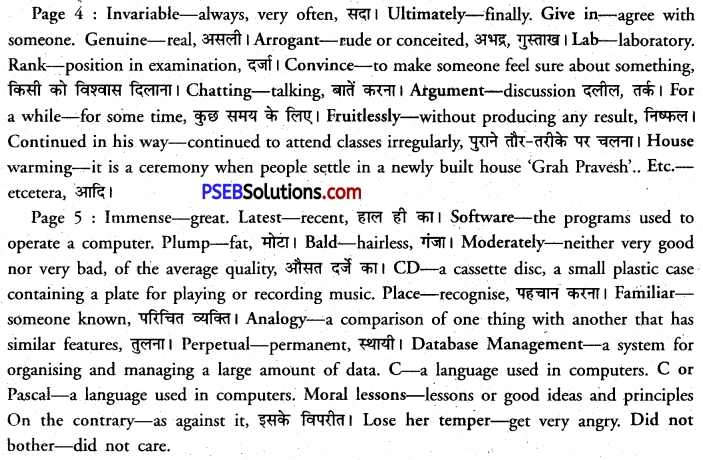
Mother’s Day Question Answer Class 11 English Book Poem Chapter 2 PSEB Solutions

Punjab State Board PSEB 11th Class English Book Solutions Poem 2 Mother’s Day Textbook Exercise Questions and Answers.

Class 11th English Book Poem Chapter 2 Mother’s Day Question Answers

Mother’s Day Class 11 Questions and Answers

Question 1.
What is the significance of ‘Chinese house of dreams’?
Answer:
‘Chinese house of dreams’ means a world of imagination. The poet uses this phrase to ridicule the foreign custom of presenting colourful poems to one’s mother on Mother’s Day. According to the poet, they present their mother a string of spurious poems kept safely in a bouquet which is shaped like a Chinese house of dreams. In simple words, they honour their mothers merely with fake words that have no real value. In the manner of a world of imagination, their magic too goes off in no moment.

PSEB 11th Class English Solutions Poem 2 Mother’s Day

‘सपनों का चीनी घर’ का अर्थ है कल्पना का संसार । कवि इस वाक्यांश का प्रयोग विदेशी लोगों के उस रिवाज की खिल्ली उड़ाने के लिए करता है जिसमें व्यक्ति ‘मदर्स डे’ पर अपनी मां को उपहार स्वरूप रंग-बिरंगी कविताएं भेंट करता है। कवि के अनुसार, वे नकली गीतों की एक कड़ी एक ऐसे गुलदस्ते में सजा कर भेंट करते हैं जो सपनों के घर जैसा बना होता है। सरल शब्दों में, वे नकली शब्दों में अपनी मांओं का सम्मान करते हैं, जिनका कोई वास्तविक मूल्य नहीं होता। कल्पना के संसार की भांति उनका जादू ग़ायब होते भी देर नहीं लगती।

Question 2.
In what way is ‘my mother’ more demanding ?
Answer:
In this poem, ‘my mother’ refers to an Indian mother. In India, children consider their mother as their God. Mother too loves her children very dearly. She always worries for the welfare of her children. She wants to keep all ills away from her children.

She wants her children to pay her obeisance at each sunrise. She wants them to touch her feet and take her blessings before starting their new day. She believes that her blessings would make their life safe and sound. Only this much more ‘my mother’ demands.

इस कविता में ‘मेरी मां’ एक भारतीय मां की ओर संकेत करती है। भारत में बच्चे अपनी मां को अपना भगवान मानते हैं। मां भी अपने बच्चों से अत्यधिक प्रेम करती है। वह हमेशा अपने बच्चों की भलाई की चिन्ता करती रहती है। वह अपने बच्चों से हर बुराई को दूर रखना चाहती है।

इसलिए वह चाहती है कि वे प्रत्येक दिन सुबह उसे नमन करें। वह चाहती है कि वे उसके पांवों को छुएं और अपने नए दिन की शुरुआत करने से पहले उसका आशीर्वाद लें। उसका विश्वास है कि उसका आशीर्वाद उनके जीवन को सुगम तथा सुरक्षित कर देगा। सिर्फ इतना ही अधिक चाहती है ‘मेरी मां’।

PSEB 11th Class English Solutions Poem 2 Mother’s Day

Question 3.
What, according to the poet, amounts to desecrating a mother?
Answer:
Dedicating just one day in the whole year to one’s mother amounts to desecrating the mother.
व्यक्ति द्वारा अपनी मां को पूरे वर्ष में सिर्फ एक दिन समर्पित करना उस मां का अपमान करने के बराबर होता है।

Question 4.
How often does the poet invoke his deity ?
Answer:
The poet invokes his deity sometimes twice a day. The poet’s mother is his deity.
कवि कभी-कभी दिन में दो बार अपने ईश्वर के आगे आह्वान करता है (अर्थात् उसे पुकारता है)। कवि की मां ही उसका ईश्वर है।

Question 5.
Write a short note on ‘how we Indians celebrate the mother’s day’.
Answer:
In India, mothers are held in high esteem. They are adored like a goddess. It is in keeping with the tradition that India has been symbolized as Mother India. We Indians believe that the mother is a blessing for life. She brought us in this world. So we owe our whole life to her. Then how can we dedicate to her just one day of the year ? In fact, each day of the year is mother’s day for us.

And we celebrate it by paying obeisance to our mother at sunrise daily. We touch her feet and with her blessing start our new day. However, the modern ‘Mother’s Day has been adopted in India also. It is celebrated on the second Sunday of May every year. It is celebrated mostly in urban areas. People perform special acts to honour their mothers and their contribution to the family.

भारत में मांओं को बहुत सम्मान दिया जाता है। एक देवी की भांति उनकी पूजा की जाती है। इस परम्परा के चलते ही भारत को भारत मां का प्रतीक माना गया है। हम भारतीयों का मानना है कि मां जीवन के लिए एक वरदान है। वह हमें इस संसार में ले कर आई। इसलिए हमारा पूरा जीवन उसका ऋणी है।

PSEB 11th Class English Solutions Poem 2 Mother’s Day

फिर हम वर्ष में उसे सिर्फ एक ही दिन समर्पित कैसे कर सकते हैं? वास्तव में, हमारे लिए तो वर्ष का हर दिन ‘मदर्स डे’ है। और हम इसे प्रतिदिन मनाते हैं, सुबह होने पर अपनी मां को नमन करके। हम उसके पाँव छूते हैं और उसके आशीर्वाद से अपने दिन की शुरुआत करते हैं।

किन्तु आधुनिक ‘मदर्स डे’ को भारत में भी स्वीकार कर लिया गया है। इसे प्रति वर्ष मई के महीने के दूसरे रविवार को मनाया जाता है। इसे अधिकतर शहरी क्षेत्रों में मनाया जाता है। लोग अपनी माताओं को तथा परिवार के प्रति उनके योगदान को सम्मानित करने के लिए विशेष कार्य करते हैं।

Question 6.
Match the words in column A with their meanings in column B :.
A — B
obeisance — violate / show disrespect
slouch — inherited
invoke — goddess
ancestral — courtesy, respect
deity — appeal to / call up
spurious — stoop (to move forward)
desecrate — false
Answer:
1. obeisance = courtesy, respect
2. slouch = stoop (to move forward)
3. invoke = appeal to / call up
4. ancestral = inherited
5. deity = goddess
6. spurious = false
7. desecrate = violate / show disrespect.

Question 7.
Read the following lines and mention the figures of speech used in each of them

(simile, metaphor, personification) :

1. ‘Like a devotee throwing a handful of yellow rice to the birds:
2. ‘T invole my deity.
3. Bouquet shaped like a Chinese house of dreams.
4. ‘Hear ancestral voices in a wind’s howl’
Answer:
1. Simile
2. Personification
3. Simile
4. Metaphor.

Important Stanzas For Comprehension

Note : A complete Answer Key has been given at the end of the stanzas.

Stanza 1.

We do it differently
in this dark continent.
Not just once a year
a string of spurious verses
ensconced in a bouquet
shaped like a Chinese house of dreams.

Questions
1. Give the name of the poet and the poem from which this stanza has been taken.
2. Who does the word ‘We refer to in this stanza ?
3. What do ‘We do differently ?
4. Write the figure of speech used in the following line : ……. a bouquet shaped like a Chinese house of dreams’.
Answers:
1. This stanza has been taken from the poem, Mother’s Day, written by Shiv K. Kumar.
2. It refers to Indian people.
3. We too honour our mothers and their contribution to the family. But we do it in a different way.
4. Simile.

PSEB 11th Class English Solutions Poem 2 Mother’s Day

Stanza 2.

My mother is more demanding
an obeisance at each sunrise,
like a devotee throwing a handful
of yellow rice to the birds.
Holding a candelabrum before an idol,
just once a year
is desecrating it.

Questions
1. Give the name of the poet and the poem from which this stanza has been taken.
2. What does ‘my mother’ demand ?
3. List the two things, mentioned by the poet, we are supposed to do at sunrise.
4. Write the figure of speech used in the line : ……..like a devotee throwing a handful of yellow rice to the birds.’
Answers:
1. This stanza has been taken from the poem, Mother’s Day, written by Shiv K. Kumar.
2. She wants her son to touch her feet with respect at sunrise every day.
3. At each sunrise, we should touch our mother’s feet with respect. We should also throw a handful of yellow rice to the birds.
4. Simile.

Stanza 3.

Whenever I see a caterpillar slouching
towards a pansy’s eye,
or hear ancestral voices in a wind’s howl,
I invoke my diety —
sometimes twice a day.

Questions
1. Give the name of the poet and the poem from which this stanza has been taken.
2. What is a pansy?
3. Who does the poet call upon whenever he hears the loud noise of the wind ?
4. Give an example of metaphor in the given stanza.
Answers:
1. This stanza has been taken from the poem, Mother’s Day, written by Shiv K. Kumar.
2. A ‘pansy’ is a small garden plant which has brightly coloured flowers.
3. He calls upon his mother whenever he hears the loud noise of the wind.
4. ……….. hear ancestral voices in a wind’s howl.

Mother’s Day Poem Summary in English

Mother’s Day Introduction:

In this poem, the poet describes his views about the Mother’s Day which is celebrated all over the world once a year. It is celebrated to honour the mother by showing gratitude for her contribution to the family. The poet says that dedicating a single day in the whole year to one’s mother is of no use. It is nothing but disrespect to the mother.

Dedicating to her only one day of the year leaves a question on the rest of 364 days of the year. In fact, mother is a blessing for life. She gave us life and brought us in this world. So we owe our whole life to her. Then how can we dedicate to her just one day of the year ? The poet is against this new tradition. In this poem, he expresses his views in this regard.

Mother’s Day Summary in English:

इस कविता में, कवि Mother’s Day के बारे में अपने विचार प्रस्तुत करता है, जिसे साल में एक बार पूरे विश्व भर में मनाया जाता है। इस दिन को मां का सम्मान करने के लिए मनाया जाता है, परिवार को दिए गए उसके योगदान की खातिर उसके प्रति कृतज्ञता प्रकट करके। कवि कहता है कि पूरे साल में सिर्फ एक दिन मां को समर्पित करने का कोई फायदा नहीं है। यह मां के अनादर के अतिरिक्त और कुछ नहीं है।

PSEB 11th Class English Solutions Poem 2 Mother’s Day

साल में सिर्फ एक दिन मां को समर्पित करना साल के बाकी बचे तीन सौ चौंसठ दिनों पर प्रश्न लगा देता है। वास्तव में, मां तो जीवन के लिए एक वरदान होती है। उसने हमें जीवन दिया तथा हमें इस दुनिया में लाई। इसलिए हमारा संपूर्ण जीवन उसका ऋणी है। फिर हम साल में सिर्फ एक ही दिन उसे कैसे समर्पित कर सकते हैं ? कवि इस नई परंपरा के विरुद्ध है। इस कविता में वह इसी के संबंध में अपने विचार प्रकट करता है।

Mother’s Day Poem Summary in Hindi

Mother’s Day Introduction:

In this poem, the poet says that people in India celebrate the Mother’s Day, but in a different way. They don’t celebrate it just once a year like the people of other countries. They don’t adore their mothers in false words. They don’t present their mothers a string of spurious poems kept safely in a bouquet shaped like a Chinese house of dreams.

A Chinese house of dreams means a world of imagination. Here the poet ridicules the foreign custom of honouring the mother. He wants to say that Indian people don’t honour their mothers with words only. They honour their mothers through their actions. Then the poet says that his mother is a bit more demanding.

She wants her son to pay her obeisance at each sunrise. Here the poet’s mother refers to an Indian mother. An Indian mother loves her children very dearly. She always worries about the welfare of her children. She believes that her blessings would keep all the ills away from her children.

So she wants them to touch her feet every morning and take her blessings before starting a new day. Then the poet says that his mother wants him to throw a handful of yellow rice to the birds regularly. She asks him to do it like a devotee. In other words, an Indian mother wants to make her children kind to the birds and animals. She demands only this much from her children.

Then the poet says that worshipping an idol just once a year by holding a candelabrum to it is all useless. It is nothing but showing disrespect to it. In the same way, honouring one’s mother once a year is nothing but showing disrespect to her. The poet says that whenever he sees a caterpillar moving towards a pansy plant, he calls upon his deity, i.e. his mother.

And whenever he hears the fearful noise of the long loud sound of the strong wind, he calls upon his deity. He says that sometimes he calls upon his deity twice a day. Whether he is amazed to see anything or he is frightened, mother comes to his mind first.

PSEB 11th Class English Solutions Poem 2 Mother’s Day

And he calls upon her – no matter, how many times a day. The poet concludes the poem with the idea that at all times, either in joy or sorrow, we call upon our mothers to be with us. Then how can we dedicate just one day in a year to her ?

Mother’s Day Summary in Hindi:

इस कविता में, कवि कहता है कि भारत में लोग Mother’s Day मनाते हैं, लेकिन एक अलग तरीके से। वे इसे दूसरे देशों के लोगों की भांति साल में सिर्फ एक बार नहीं मनाते। वे अपनी माँओं की झूठे शब्दों में आराधना नहीं करते हैं। वे अपनी माँओं को बनावटी कविताओं की लड़ी भेंट नहीं करते हैं जिसे सपनों के चीनी घर वाले आकार के गुलदस्ते में संभाल कर रखा जाता है।

सपनों के एक चीनी घर का अर्थ है, कल्पना की एक दुनिया। यहां कवि मां को सम्मानित करने की विदेशी परंपरा का मज़ाक उड़ाता है। वह कहना चाहता है कि भारतीय लोग अपनी माँओं का सम्मान सिर्फ शब्दों के द्वारा नहीं करते। वे अपनी मां का सम्मान उनके लिए कुछ कर्म करके करते हैं। फिर कवि कहता है कि उसकी मां कुछ ज्यादा आशाएं रखती है। वह चाहती है कि उसका पुत्र प्रत्येक दिन सूर्योदय के समय उसको प्रणाम करे।

यहां कवि की मां एक भारतीय मां की ओर संकेत करती है। एक भारतीय मां अपने बच्चों से अत्यधिक प्रेम करती है। वह हमेशा अपने बच्चों की भलाई के बारे में चिंता करती रहती है। वह मानती है कि उसका आशीर्वाद सभी बुराइयों को उसके बच्चों से दूर रखेगा। इसलिए वह चाहती है कि प्रत्येक सुबह अपने दिन की शुरुआत करने से पहले उसके बच्चे उसके पांव छूकर उसका आशीर्वाद लें।

फिर कवि कहता है कि उसकी मां चाहती है कि वह नियमित रूप से पक्षियों के सामने मुट्ठीभर पीले चावल फेंके। वह उसे ऐसा एक श्रद्धालु की भांति करने के लिए कहती है। अन्य शब्दों में, एक भारतीय मां चाहती है कि उसके बच्चे पक्षियों तथा जानवरों के प्रति दयाल बनें। वह अपने बच्चों से सिर्फ इतना सा ही चाहती है।

फिर कवि कहता है कि साल में सिर्फ एक बार हाथ में दीपवृक्ष पकड़कर किसी (देवी-देवता की) मूर्ति की पूजा करना व्यर्थ है। यह उस मूर्ति का अनादर करने के सिवाए और कुछ नहीं है। बिल्कुल उसी तरह ही साल में सिर्फ एक बार अपनी माँ का सम्मान करना उसके प्रति अनादर प्रकट करने के सिवाए और कुछ नहीं है। कवि कहता है कि जब कभी भी वह किसी इल्ली को पैन्ज़ी के पौधे की तरफ बढ़ता देखता है, तो वह अपने ईश्वर अर्थात् अपनी माँ को याद करता है।

और जब कभी भी वह तेज़ चल रही हवा के भयानक शोर को सुनता है तो वह अपने ईश्वर को याद करता है। वह कहता है कि कई बार वह अपने ईश्वर को दिन में दो बार याद करता है। चाहे वह किसी चीज़ को देखकर चकित हो जाता हो अथवा वह डर जाता हो, मां का ख्याल उसके मन में सबसे पहले आता है और वह उसे पुकारता है इससे कोई फर्क नहीं पड़ता, दिन में कितनी बार वह उसे पुकारता है।

PSEB 11th Class English Solutions Poem 2 Mother’s Day

कवि इस विचार के साथ कविता का अंत करता है कि सभी समय, चाहे वह खुशी का समय हो अथवा दुःख का समय, हम इच्छा करते हैं कि हमारी माँएं हमारे पास हों। फिर हम वर्ष में उसे सिर्फ एक ही दिन समर्पित कैसे कर सकते हैं ?

Mother’s Day Poem Translation in Hindi

(Lines 1-6)

We do it differently
in this dark continent.
Not just once a year
a string of spurious verses
ensconced in a bouquet
shaped like a Chinese house of dreams.

Explanation : In these lines, the poet says that people in India celebrate the Mother’s Day, but in a different way. They don’t celebrate it just once a year. They don’t adore their mothers in false words. They don’t present their mothers a string of spurious poems kept safely in a bouquet which is shaped like a Chinese House of dreams.

A Chinese House of dreams means a world of imagination. Here the poet wants to say that Indian people don’t show their gratitude towards their mothers in imaginary words only and that also just once a year. Rather they give honour to their mothers by serving them all their life.

इन पंक्तियों में कवि कहता है कि भारत में लोग Mother’s Day मनाते हैं, लेकिन एक अलग तरह से। वे इसे साल में सिर्फ एक बार नहीं मनाते। वे अपनी माँओं की झूठे शब्दों में आराधना नहीं करते। वे अपनी माँओं को बनावटी कविताओं की लड़ी उपहारस्वरूप नहीं देते हैं जिसे सपनों के चीनी घर वाले आकार के बने गुलदस्ते में संभाल कर रखा गया हो। सपनों के एक चीनी घर का अर्थ है, कल्पना की एक दुनिया।

यहां कवि यह कहना चाहता है कि भारतीय लोग अपनी माँओं के प्रति कृतज्ञता काल्पनिक शब्दों में प्रकट नहीं करते और वह भी साल में सिर्फ एक ही बार। बल्कि वे तो अपनी माँओं के प्रति अपना सम्मान पूरा जीवन उनकी सेवा करके व्यक्त करते हैं।

(Lines 7-13)

My mother is more demanding
an obeisance at each sunrise,
like a devotee throwing a handful
of yellow rice to the birds.
Holding a candelabrum before an idol,
just once a year
is desecrating it.

Explanation : The poet says that his mother is a bit more demanding. She wants him to pay her obeisance at each sunrise. Here ‘my mother’ refers to an Indian mother. An Indian mother wants to keep all the ills away from her children. So she wants her children to touch her feet every morning and take her blessings before starting a new day.

Then the poet says that his mother wants him to throw a handful of yellow rice to the birds regularly. In other words, an Indian mother wants to make her children kind to the birds and animals. She demands only this much from her children.

The poet says that worshipping an idol just once a year by holding a candelabrum to it is all useless. It is nothing but showing disrespect to it. In the same way, honouring one’s mother once a year is nothing but showing disrespect to her.

PSEB 11th Class English Solutions Poem 2 Mother’s Day

कवि कहता है कि उसकी मां थोड़ी-सी ज़्यादा आशाएं रखती है। वह चाहती है कि वह प्रत्येक सुबह सूरज निकलने पर उसे नमन करे। यहां ‘my mother’ भारतीय मां की ओर संकेत करता है। एक भारतीय मां सभी बुराइयों
को अपने बच्चों से दूर रखना चाहती है। इसलिए वह चाहती है कि उसके बच्चे प्रत्येक सुबह उसके पांव छुएं तथा नया दिन शुरू करने से पहले उसका आशीर्वाद लें।

फिर कवि कहता है कि उसकी मां चाहती है कि वह नियमित रूप से पक्षियों को मुट्ठी-भर पीले चावल डाले। अन्य शब्दों में, एक भारतीय मां चाहती है कि उसके बच्चे पक्षियों तथा जानवरों के प्रति दयालु बनें। वह अपने बच्चों से सिर्फ इतना ही चाहती है। कवि कहता है कि साल में सिर्फ एक बार ही हाथ में दीपाधार थाम कर किसी मूर्ति की पूजा करना व्यर्थ है। यह उस मूर्ति का अनादर करने के अतिरिक्त और कुछ नहीं है। बिल्कुल उसी प्रकार, साल में सिर्फ एक बार अपनी मां का सम्मान करना उसका अनादर करने के अलावा और कुछ नहीं है।

(Lines 14-18)

Whenever I see a caterpillar slouching
towards a pansy’s eye,
or hear ancestral voices in a wind’s howl,
I invoke my deity –
sometimes twice a day.

Explanation : In these lines, the poet says that whenever he sees a caterpillar moving towards a pansy plant, he calls upon his deity. And whenever he hears ancestral voices in the long loud sound of the strong wind, he calls upon his deity. And sometimes he calls upon her twice a day. Here the poet’s deity is his mother.

In these lines, the poet wants to say that whether he is amazed to see anything or he is frightened, his mother comes to his mind first. Whether it is his pleasure or his pain, he wants to share everything with his mother. And he calls upon herno matter, how many times a day even.

इन पंक्तियों में कवि कहता है कि जब कभी भी वह एक इल्ली को पैन्ज़ी के पौधे की तरफ बढ़ता हुआ देखता है तो वह अपने ईश्वर को याद करता है। और जब कभी भी वह तेज़ हवा के भयानक शोर में पूर्वजों की आवाज़ों को सुनता है तो वह अपने ईश्वर को याद करता है।

और कई बार वह अपने ईश्वर को दिन में दो बार याद करता है। यहां कवि का ईश्वर उसकी मां है। इन पंक्तियों में कवि कहता है कि चाहे वह किसी चीज़ को देखकर चकित हो गया हो या डर गया हो, सबसे पहले उसकी मां का ख्याल उसके मन में आता है। चाहे यह उसका सुख हो या उसका दु:ख, वह सब कुछ अपनी मां के साथ बांटना चाहता है। वह उसे याद करता है – इससे कोई फर्क नहीं पड़ता कि दिन में कितनी बार।

Mother’s Day Central Idea Of The Poem in English

In this poem, the poet wants to convey the idea that dedicating just one day in the whole year to one’s mother is useless. It is nothing but showing disrespect towards the mother. Mother is a blessing for life. She brought us in this world.

So we owe our whole life to her. Then how can we dedicate to her just one day of the year ? If we want to show our gratitude towards our mother, we should not indulge in such useless celebrations. Rather, we should honour our mothers by serving them.

PSEB 11th Class English Solutions Poem 2 Mother’s Day

Mother’s Day Central Idea Of The Poem in Hindi

इस कविता में कवि यह विचार प्रस्तुत करना चाहता है कि व्यक्ति द्वारा अपनी मां को पूरे वर्ष में से सिर्फ एक दिन समर्पित करना व्यर्थ है। यह और कुछ नहीं, बल्कि उस मां के प्रति असम्मान प्रकट करना है। मां जीवन के लिए एक वरदान है। वह हमें इस दुनिया में लेकर आई। इसलिए हमारा पूरा जीवन उसका ऋणी है।

फिर हम उसे वर्ष में सिर्फ एक ही दिन कैसे समर्पित कर सकते हैं ? यदि हम अपनी मां के प्रति अपना आभार प्रकट करना चाहते हैं, तो हमें इन व्यर्थ के समारोहों के चक्कर में नहीं पड़ना चाहिए। बल्कि हमें अपनी मांओं का सम्मान उनकी सेवा करके करना चाहिए।

A Panorama of Life PSEB Guide Pdf Poetry