PSEB 12th Class Physics Solutions Chapter 1 Electric Charges and Fields

Punjab State Board PSEB 12th Class Physics Book Solutions Chapter 1 Electric Charges and Fields Textbook Exercise Questions and Answers.

PSEB Solutions for Class 12 Physics Chapter 1 Electric Charges and Fields

PSEB 12th Class Physics Guide Electric Charges and Fields Textbook Questions and Answers

Question 1.
What is the force between two small charged spheres having charges of 2 × 10⁻⁷ C and 3 × 10⁻⁷ C placed 30 cm apart in air?
Answer:
Charge on the first sphere, q1 = 2 × 10⁻⁷ C
Charge on the second sphere, q2 = 3 × 10⁻⁷ C
Distance between the spheres, r = 30 cm = 0.3 m
Electrostatic force between the spheres is given by the relation,
F = \(\frac{1}{4 \pi \varepsilon_{0}} \frac{q_{1} q_{2}}{r^{2}}\)
where, ε0 = Permittivity of free space
F = \(\frac{9 \times 10^{9} \times 2 \times 10^{-7} \times 3 \times 10^{-7}}{(0.3)^{2}}\)
= 6 × 10⁻³ N
Hence, force between the two small charged spheres is 6 × 10⁻³ N. The charges are of same nature. Hence, force between them will be repulsive.

Question 2.
The electrostatic force on a small sphere of charge
0.4 μC due to another small sphere of charge -0.8 μC in air is 0.2 N.
(a) What is the distance between the two spheres?
(b) What is the force on the second sphere due to the first?
Answer:
Electrostatic force on the first sphere, F = 0.2 N
Charge on this sphere, q1 = 0.4 μC = 0.4 × 10⁻⁶C
Charge on the second sphere, q2 = -0.8 μC = -0.8 × 10⁻⁶C

(a) Electrostatic force between the spheres is given by the relation,
F = \(\frac{1}{4 \pi \varepsilon_{0}} \frac{q_{1} q_{2}}{r^{2}}\)
where, ε0 = Permittivity of free space
r2 = \(\frac{1}{4 \pi \varepsilon_{0}} \frac{q_{1} q_{2}}{F}\)
= \(=\frac{0.4 \times 10^{-6} \times 0.8 \times 10^{-6} \times 9 \times 10^{9}}{0.2}\)
= 16 × 9 × 10-4 = 144 × 10-4
= \(\sqrt{144 \times 10^{-4}}\) = 0.12 m
The distance between the two spheres is 0.12 m.

(b) Force on q2 due to q1= ?
We know that electrostatic forces always, appear in priors and follow Newton’s 3rd law of motion.
∴ \(\left|\vec{F}_{21}\right|\) = Force on q2 due to q1
= 0.2 N and it is attractive in nature
We now that,
F21 = \(\frac{1}{4 \pi \varepsilon_{0}} \frac{q_{1} q_{2}}{r_{21}^{2}}\)

On substituting the values, we get
F21 = 9 × 10⁹ × \(\frac{\left(0.4 \times 10^{-6}\right) \times\left(0.8 \times 10^{-6}\right)}{(0.12)^{2}}\)
= 0.2 N

PSEB 12th Class Physics Solutions Chapter 1 Electric Charges and Fields

Question 3.
Check that the ratio ke2 / Gmemp is dimensionless. Look up a
table of physical constants and determine the value of this ratio. What does the ratio signify?
Answer:
The given ratio is \(\frac{k e^{2}}{G m_{e} m_{p}}\)
where, G = Gravitational constant
Its unit is Nm2kg-2.
mp and mp = Masses of electron and proton
Their unit is kg.
e = Electric charge Its unit is C.
k = A constant = \(=\frac{1}{4 \pi \varepsilon_{0}}\)
Its unit is N m2C-2.
Therefore, unit of the given ratio
\(\frac{k e^{2}}{G m_{e} m_{p}}\) = \(\frac{\left[\mathrm{Nm}^{2} \mathrm{C}^{-2}\right]\left[\mathrm{C}^{-2}\right]}{\left[\mathrm{Nm}^{2} \mathrm{~kg}^{-2}\right][\mathrm{kg}][\mathrm{kg}]}\) = M0L0T0
Hence, the given ratio is dimensionless.
e = 1.6 × 10⁻¹⁹ C
G = 6.67 × 10⁻¹¹ N m2kg-2
me = 9.1 × 10⁻³¹ kg
mp = 1.67 × 10⁻²⁷ kg
Hence, the numerical value of the given ratio is
\(\frac{k e^{2}}{G m_{e} m_{p}}\) = \(\frac{9 \times 10^{9} \times\left(1.6 \times 10^{-19}\right)^{2}}{6.67 \times 10^{-11} \times 9.1 \times 10^{-31} \times 1.67 \times 10^{-27}}\)
≈ 2.3 × 1039
This is the ratio of electric force to the gravitational force between a proton and an electron, keeping distance between them constant.

Question 4.
(a) Explain the meaning of the statement ‘electric charge of a body is quantised’.
(b) Why can one ignore quantisation of electric charge when dealing with macroscopic i. e., large scale charges?
Answer:
(a) Electric charge of a body is quantised. This means that only integral (1, 2 …………,n) number of electrons can be transferred from one body to the other. Charges are not transferred in fraction. Hence, a body possesses total charge only in integral multiples of electric charge.

(b) In macroscopic or large scale charges, the charges used are huge as compared to the magnitude of electric charge. Hence, quantisation of electric charge is of no use on macroscopic scale. Therefore, it is ignored and it is considered that electric charge is continuous.

Question 5.
When a glass rod is rubbed with a silk cloth, charges appear on both. A similar phenomenon is observed with many other pairs of bodies. Explain how this observation is consistent with the law of conservation of charge.
Answer:
Rubbing produces charges of equal magnitude but of opposite nature on the two bodies because charges are created in pairs. This phenomenon of charging is called charging by friction. The net charge on the system of two rubbed bodies is zero. This is because equal amount of opposite charges annihilate each other. When a glass rod is rubbed with a silk cloth, opposite natured charges appear on both the bodies. This phenomenon is in consistence with the law of conservation of energy. A similar phenomenon is observed with many other pairs of bodies.

PSEB 12th Class Physics Solutions Chapter 1 Electric Charges and Fields

Question 6.
Four point charges qA = 2 μC, qB = -5 μC, qC = 2 μC and qD) = -5 μC are located at the comers of a square ABCD of side 10 cm. What is the force on a charge of 1 μC placed at the centre of the square?
Answer:
Consider the square ABCD of each side 10 cm and centre O. The charge of 1 μC is placed at O.
Now clearly, OA = OB =OC = OD
AB = BC – 10 cm = 0.1 m
AO = \(\frac{1}{2}\) AC = \(\frac{1}{2} \sqrt{A B^{2}+B C^{2}}\) = \(\frac{1}{2}\) × √2 AB
= \(\frac{1}{\sqrt{2}}\) × 0.1 m = OB = OC = OD
PSEB 12th Class Physics Solutions Chapter 1 Electric Charges and Fields 1
Here,qA = 2μC, qB = -5μC,qC = 2 μC,qD = -5μC
Clearly qA = qC = 2μC = 2 × 10⁻⁶C
and qB = qD = -5 μC = -5 × 10⁻⁶C
Since qA = qC, the charge of 1 μC will experience equal and opposite forces due to the charges qA and qC i. e., along OC and OA respectively. Their magnitudes are
FA = FC = \(\frac{1}{4 \pi \varepsilon_{0}} \times \frac{q_{A} \times 1 \mu \mathrm{C}}{A O^{2}}\)
\(\frac{9 \times 10^{9} \times 2 \times 10^{-6} \times 10^{-6}}{\left(\frac{1}{\sqrt{2}} \times 0.1\right)^{2}}\) = 3.6N
∴ \(\vec{F}_{A}=-\vec{F}_{C}\)
Similarly FB = FD, the charge of 1 μC will experience equal and opposite forces due to the charge qB and qD i. e., along OB and OD respectively, thus
\(\overrightarrow{F_{B}}=-\overrightarrow{F_{D}}\).
Thus the net force on the charge ofl μC due to the given arrangement of charges is zero i.e.,
\(\vec{F}=\vec{F}_{A}+\vec{F}_{B}+\vec{F}_{C}+\vec{F}_{D}\) = 0

Question 7.
(a) An electrostatic field line is a continuous curve. That is, a field line cannot have sudden breaks. Why not?
Explain why two field lines never cross each other at any point?
Answer:
(a) An electrostatic field line is a continuous curve because a charge experiences a continuous force when traced in an electrostatic field. The field line cannot have sudden breaks because the charge moves continuously and does not jump from one point to the other.

(b) If two field lines cross each other at a point, then electric field intensity will show two directions at that point. This is not possible. Hence, two field lines never cross each other.

Question 8.
Two point charges qA = 3 μC and qB = -3 μC are located 20 cm apart in vacuum.
(a) What is the electric field at the midpoint O of the line AB joining the two charges?
(b) If a negative test charge of magnitude 1.5 × 10⁻⁹C is placed at this point, what is the force experienced by the test charge?
Answer:
(a) The situation is represented in the given figure. O is the mid-point of line AB.
PSEB 12th Class Physics Solutions Chapter 1 Electric Charges and Fields 2
Distance between the two charges, AB = 20 cm
∴ AO = OB =10 cm
Net electric field at point O = E
Magnitude of electric field at point 0 caused by + 3 μC charge,
PSEB 12th Class Physics Solutions Chapter 1 Electric Charges and Fields 3
[Since the values of E1 and E2 are same, the value is multiplied with 2]
= 5.4 × 10⁶ N/C along OB
Therefore, the electric field at mid-point O is 5.4 × 10⁶ NCT-1 along OB.

(b) A test charge of amount 1.5 × 10⁻⁹ C is placed at mid-point O.
According to question, q = -1.5 × 10⁻⁹ C
Force experienced by the test charge = F
F = qE
= -1.5 × 10-9 × 5.4 × 106
= -8.1 × 10⁻³ N
The force is directed along line QA. This is because the negative test charge is repelled by the charge placed at point B but attracted towards point A.

PSEB 12th Class Physics Solutions Chapter 1 Electric Charges and Fields

Question 9.
A system has two chargesg qA = 2.5 × 10⁻⁷C andqA = -2.5 × 10⁻⁷ located at points A : (0, 0, -15 cm) and B: (0, 0, +15 cm), respectively. What are the total charge and electric dipole moment of the system?
Answer:
Both the charges can be located in a coordinate frame of reference as shown in the given figure At A, amount of charge,
qA =2.5 × 10⁻⁷C
At B, amount of charge,
qB = -2.5 × 10⁻⁷C
PSEB 12th Class Physics Solutions Chapter 1 Electric Charges and Fields 4
Total charge of the system,
q = qA + qB
= 2.5 × 10⁻⁷ C-2.5 × 10⁻⁷C
= 0
Distance between two charges at points A and B,
d. =15 + 15 = 30 cm = 0.3 m
Electric dipole moment of the system is given by,
p = qA × d = qB × d.
= 2.5 × 10-7 × 0.3
= 7.5 × 10⁻⁸ Cm along positive z-axis
Therefore, the electric dipole moment of the system is 7.5 × 10⁻⁸C m along positive z-axis.

Question 10.
An electric dipole with dipole moment 4 × 10⁻⁹ C m is aligned at 30° with the direction of a uniform electric field of magnitude 5 × 10⁴NC-1. Calculate the magnitude of the torque acting on the dipole.
Answer:
Electric dipole moment, p = 4 × 10⁻⁹ C m
Angle made by p with a uniform electric field, 0 = 30°
Electric field, E = 5 × 10⁴NC-1
Torque acting on the dipole is given by the relation,
τ = pE sinθ
= 4 × 10-9 × 5 × 104 × sin30
= 20 × 10-5 \(\frac{1}{2}\)
= 10-4 Nm
Therefore, the magnitude of the torque acting on the dipole is 10-4 N m.

Question 11.
A polythene piece rubbed with wool is found to have a negative charge of 3 × 10⁻⁷C.
(a) Estimate the number of electrons transferred (from which to which?)
(b) Is there a transfer of mass from wool to polythene?
Answer:
(a) When polythene is rubbed with wool, a number of electrons get transferred from wool to polythene. Hence, wool becomes positively charged and polythene becomes negatively charged.
Amount of charge on the polythene piece, q = -3 × 10⁻⁷ C
Amount of charge on an electron, e = -1.6 × 10⁻¹⁹C
Number of electrons transferred from wool to polythene = n
n can be calculated using the relation,
> q = ne
n = \(\frac{q}{e}\)
= \(\frac{-3 \times 10^{-7}}{-1.6 \times 10^{-19}}\)
= 1.87 × 10¹²
Therefore, the number of electrons transferred from wool to polythene is 1.87 × 10¹².

(b) Yes.
There is a transfer of mass taking place. This is because an electron has mass,
me = 9.1 × 10⁻³¹ kg
Total mass transferred to polythene from wool,
m = me × n
= 9.1 × 10-31 × 1.87 × 1012
= 1.706 × 10⁻¹⁸ kg
Hence, a negligible amount of mass is transferred from wool to polythene.

PSEB 12th Class Physics Solutions Chapter 1 Electric Charges and Fields

Question 12.
(a) Two insulated charged copper spheres A and B have their centres separated by a distance of 50 cm. What is the mutual force of electrostatic repulsion if the charge on each is 6.5 × 10⁻⁷ C ? The radii of A and B are negligible compared to the distance of separation.
(b) What is the force of repulsion if each sphere is charged double the above amount, and the distance between them is halved?
Answer:
(a) Charge on sphere A, qA = Charge on sphere B, qB = 6.5 × 10⁻⁷ C
Distance between the spheres, r = 50 cm = 0.5 m
Force of repulsion between the two spheres,
F = \(\frac{1}{4 \pi \varepsilon_{0}} \frac{q_{A} q_{B}}{r^{2}}\)
∴ F = \(=\frac{9 \times 10^{9} \times\left(6.5 \times 10^{-7}\right)^{2}}{(0.5)^{2}}[latex]
= 1.52 × 10⁻² N
Therefore, the force between the two spheres is 1.52 × 10⁻² N.

(b) After doubling the charge, charge on sphere A, qA = charge on sphere
B, qB = 2 × 6.5 × 10-7 C = 1.3 × 10<>-6 C
The distance between the spheres is halved
∴ r = [latex]\frac{0.5}{2}\) = 0.25 m
Force of repulsion between the two spheres,
F = \(\frac{1}{4 \pi \varepsilon_{0}} \frac{q_{A} q_{B}}{r^{2}}\)
∴ F = \(\frac{9 \times 10^{9} \times 1.3 \times 10^{-6} \times 1.3 \times 10^{-6}}{(0.25)^{2}}\)
= 16 × 1.52 × 10-2 = 0.243 N Therefore, the force between the two spheres is 0.243 N.

Question 13.
Suppose the spheres A and B in exercise 1.12 have identical sizes. A third sphere of the same size but uncharged is brought in contact with the first, then brought in contact with the second, and finally removed from both. What is the new force of repulsion between A and B ?
Answer:
Distance between the spheres, A and B,r = 0.5 m
Initially, the charge on each sphere, q = 6.5 × 10 -7 C
When sphere A is touched with an uncharged sphere C, \(\frac{q}{2}[latex] amount of
charge from A will transfer to sphere C. Hence, charge on each of the spheres, A and C is [latex]\frac{q}{2}\).
When sphere C with charge \(\frac{q}{2}\) is brought in contact with sphere B with
charge q, total charges on the system will divide into two equal halves given as,
\(\frac{\frac{q}{2}+q}{2}=\frac{3 q}{4}\)
Each sphere will each half. Hence, charge on each of the spheres, C and B, is \(\frac{3 q}{4}\).
Force of repulsion between sphere A having charge \(\frac{q}{2}\) and sphere B having
charge \(\frac{3 q}{4}\)
PSEB 12th Class Physics Solutions Chapter 1 Electric Charges and Fields 5
= 5.703 × 10⁻³ N
Therefore, the force of attraction between the two spheres is 5.703 × 10⁻³ N.

Question 14.
Figure 1.33 shows tracks of three charged particles in a uniform electrostatic field. Give the signs of the three charges. Which particle has the highest charge to mass ratio?
PSEB 12th Class Physics Solutions Chapter 1 Electric Charges and Fields 6
Answer:
Opposite charges attract each other and same charges repel each other. It can be observed that particles 1 and 2 both move towards the positively charged plate and repel away from the negatively charged plate. Hence, these two particles are negatively charged. It can also be observed that particle 3 moves towards the negatively charged plate and repels away from the positively charged plate. Hence, particle 3 is positively charged. The charge to mass ratio (emf) is directly proportional to the displacement or amount of deflection for a given velocity. Since the deflection of particle 3 is the maximum, it has the highest charge to mass ratio.

PSEB 12th Class Physics Solutions Chapter 1 Electric Charges and Fields

Question 15.
Consider a uniform electric field E = 3 × 10³ î N/C. (a) What is the flux of this field through a square of 10 cm on a side whose plane is parallel to the yz plane? (b) What is the flux through the same square if the normal to its plane makes a 60° angle with the x-axis?
Answer:
Here, \(\overrightarrow{\vec{E}}\) = 3 × 10³ î NC-1 i.e., the electric field acts along positive direction of x-axis.
Side of square = 10 cm
∴ Its surface area, ΔS = (10 cm)2 = 10-2 m2
or Δ\(\overrightarrow{\vec{S}}\) = 10-2 î m2
as normal to the square is along x-axis.

(a) If Φ be the electric flux through the square, then
PSEB 12th Class Physics Solutions Chapter 1 Electric Charges and Fields 7
Φ = \(\vec{E} \cdot \Delta \vec{S}\)
= (3 × 10³î) .(10-2)
= 3 × 103 × 10-2 î .î
= 3 × 10 = 30 Nm2C-1

(b) Here, angle between normal to the square i.e., area vector and the electric field is 60°. i.e.,
θ = 60°
∴ Φ = \(\overrightarrow{\vec{E}}\). Δ \(\overrightarrow{\vec{S}}\) = E. Δ S cos60°
= 3 × 103 × 10-2 × \(\frac{1}{2}\)
= 15Nm2C-1
PSEB 12th Class Physics Solutions Chapter 1 Electric Charges and Fields 8

Question 16.
What is the net flux of the uniform electric field of exercise 1.15 through a cube of side 20 cm oriented so that its faces are parallel to the coordinate planes?
Answer:
All the faces of a cube are parallel to the coordinate axes. Therefore, the number of field lines entering the cube is equal to the number of field lines piercing out of the cube. As a result, net flux through the cube is zero.

Question 17.
Careful measurement of the electric field at the surface of a black box indicates that the net outward flux through the surface of the box is 8.0 × 10³ N m2 / C. (a) What is the net charge inside the box? (b) If the net outward flux through the surface of the box were zero, could you conclude that there were no charges inside the box? Why or Why not?
Answer:
(a) Net outward flux through the surface of the box Φ = 8.0 × 10³ N m2 / C
For a body containing net charge q, flux is given by the relation,
Φ = \(\)
q = ε0Φ)
= 8.854 × 10-12 × 8.0 × 103
(∵ ε0 = 8.854 × 10⁻¹²N-1C2m-2) = 7.08 × 10-8
= 0.07 µC
Therefore, the net charge inside the box is 0.07 pC.

(b) No.
Net flux piercing out through a body depends on the net charge contained in the body. If net flux is zero, then it can be inferred that net charge inside the body is zero. The body may have equal amount of positive and negative charges.

PSEB 12th Class Physics Solutions Chapter 1 Electric Charges and Fields

Question 18.
A point charge +10 µC is a distance 5 cm directly above the centre of a square of side 10 cm, as shown in Fig. 1.34. What is the magnitude of the electric flux through the square? (Hint : Think of the square as one face of a cube with edge 10 cm.)
PSEB 12th Class Physics Solutions Chapter 1 Electric Charges and Fields 9
Answer:
The square can be considered as one face of a cube of edge 10 cm with a centre where charge q is placed. According to Gauss’s theorem for a cube, total electric flux is through all its six faces.
Φ total = \(\frac{q}{\varepsilon_{0}}\)
PSEB 12th Class Physics Solutions Chapter 1 Electric Charges and Fields 10
Hence, electric flux through one face of the cube i. e., through the square,
Φ = \(\frac{\phi_{\text {Total }}}{6}=\frac{1}{6} \frac{q}{\varepsilon_{0}}\)
ε0 = 8.854 × 10⁻¹² N-1C2m-2
q = 10 µC =10 × 10-6C
Φ = \(\frac{1}{6} \times \frac{10 \times 10^{-6}}{8.854 \times 10^{-12}}\)
= 1.88 × 10⁵ N m2 C-1
Therefore, electric flux through the square is 1.88 × 10⁵ N m2 C-1.

Question 19.
A point charge of 2.0 µC is at the centre of a cubic Gaussian surface 9.0 cm on edge. What is the net electric flux through the surface?
Answer:
Net electric flux (Φ Net) through the cubic surface is given by,
Φ Net = \(\frac{q}{\varepsilon_{0}}\)
ε0 = 8.854 × 10⁻¹² N-1C2m-22 q q = Net charge contained inside the cube
= 20 µC = 2 × 10⁻⁶C
∴ Φ Net = \(\frac{2 \times 10^{-6}}{8.854 \times 10^{-12}}\)
= 2.26 × 10⁵ Nm2C-1
The net electric flux through the surface is = 2.26 × 10⁵ Nm2C-1

Question 20.
A point charge causes an electric flux of -1.0 × 10³ Nm2 /C to pass through a spherical Gaussian surface of 10.0 cm radius centred on the charge, (a) If the radius of the Gaussian surface were doubled, how much flux would pass through the surface? (b) What is the value of the point charge?
Answer:
Electric flux, Φ = -1.0 × 10³ Nm2/C
Radius of the Gaussian surface,
r = 10.0 cm

(a) Electric flux piercing out through a surface depends on the net charge enclosed inside a body. It does not depend on the size of the body. If the radius of the Gaussian surface is doubled, then the flux passing through the surface remains the same i. e., -1.0 × 10³ 

(b) Electric flux is given by the relation,
Φ = \(\frac{q}{\varepsilon_{0}}\)
q = Φε0
= -1.0 × 103 × 8.854 × 10-12
= -8.854 × 10⁻⁹ C
= -8.854 nC
Therefore, the value of the point charge is -8.854 nC.

PSEB 12th Class Physics Solutions Chapter 1 Electric Charges and Fields

Question 21.
A conducting sphere of radius 10 cm has an unknown charge. If the electric field 20 cm from the centre of the sphere is 1.5 × 10³ N/C and points radially inward, what is the net charge on the sphere?
Answer:
Here R = radius of the conducting sphere = 10 cm = 0.10 m
r = distance of the point from centre of sphere = 20 cm = 0.20 m Clearly
r > R
E = electric field at a point at a distance of 20 cm from the sphere = 1.5 × 10³ NC -1acting inward.
q = net charge on the sphere = ?
Using the formula, E = \(\frac{1}{4 \pi \varepsilon_{0}} \cdot \frac{q}{r^{2}}\) We get
q = 4πε0Er2 = \(\frac{1}{9 \times 10^{9}}\) × 1.5 × 10<>3 × (0.20)2
= 6.67 × 10⁻⁹C =6.67 nC
Also as E acts in the inward direction, so charge on the sphere is negative.
q = -6.67 × 10⁻⁹C -6.67nC

Question 22.
A uniformly charged conducting sphere of 2.4 m diameter has a surface charge density of 80.0 μC / m2. (a) Find the charge on the sphere, (b) What is the total electric flux leaving the surface of the sphere?
Answer:
Diameter of the sphere, d = 2.4 m
Radius of the sphere, r = 1.2 m
Surface charge density, σ = 80.0 μC / m2 = 80 × 10 -6C / m2

(a) Total charge on the surface of the sphere,
q = Charge density × Surface area = σ × 4πr2
= 80 × 10-6 × 4 × 3.14 × (1.2)2 = 1.447 × 10⁻³ C
Therefore, the charge on the sphere is 1.447 × 10⁻³ C.

(b) Total electric flux (Φ Total) leaving out the surface of a sphere containing net charge q is given by the relation,
Φ Total = \(\frac{q}{\varepsilon_{0}}\)
ε0 = 8.854 × 10⁻¹² N-1C2m-2
q = 1.447 × 10⁻³ C
Φ Total = \(\frac{1.44 \times 10^{-3}}{8.854 \times 10^{-12}}\)
= 1.63 × 10⁸ NC-1 m2
Therefore, the total electric flux leaving the surface of the sphere is 1.63 × 10⁸ NC-1 m2.

Question 23.
An infinite line charge produces a field of 9 × 10⁴ N/C-1 at a distance of 2 cm. Calculate the linear charge density.
Answer:
Here E = electric field produced by infinite line charge = 9 × 10⁴ NC-1.
r = distance of the point where E is produce = 2 cm = 0.02 m.
λ = linear charge density = ?
PSEB 12th Class Physics Solutions Chapter 1 Electric Charges and Fields 11

PSEB 12th Class Physics Solutions Chapter 1 Electric Charges and Fields

Question 24.
Two large, thin metal plates are parallel and close to each other. On their inner faces, the plates have surface charge densities of opposite signs and of magnitude 17.0 × 10⁻²² C/m2. What is E : (a) in the outer region of the first plate, (b) in the outer region of the second plate, and (c) between the plates?
Answer:
The situation is represented in the following figure:
PSEB 12th Class Physics Solutions Chapter 1 Electric Charges and Fields 12
A and B are two parallel plates close to each other. Outer region of plate A is labelled as I, outer region of plate B is labelled as III, and the region between the plates, A and B is labelled as II.

(a) Charge density of plate A,
σ = 17.0 × 10⁻²² C/m2
Charge density of plate B,
σ = -17.0 × 10⁻²² C/ m2
In the regions, I and III, electric field E is zero. This is because charge is not enclosed by the respective plates.

(b) Electric field E in region II is given by the relation,
E = \(\frac{\sigma}{\varepsilon_{0}}\)
where, ε0 = Permittivity of free space
= 8.854 × 10⁻¹²N-1C2m-2
E = \(\frac{17.0 \times 10^{-22}}{8.854 \times 10^{-12}}\)
= 1.92 × 10⁻¹⁰ N/C
Therefore, electric field between the plates is 1.92 × 10⁻¹⁰ N/C.

Question 25.
An oil drop of 12 excess electrons is held stationary under a constant electric field of 2.55 × 10⁴ NC-1 in Millikan’s oil drop experiment. The density of the oil is 1.26 g cm-3. Estimate the radius of the drop. (g = 9.81 ms-2, e = 1.60 × 10⁻⁹ C).
Answer:
Here, E = constant electric field = 2.55 × 10⁴ NC-1, e = charge of an electron = 1.6 × 10⁻¹⁹ C, n = no. of electrons = 12
If q = charge on the drop, then
q = ne = 12 × 1.6 × 10-19 C = 19.2 × 10⁻¹⁹ C
If Fe be the electrostatic force on the oil drop due to electric field, then
Fe = qE = 19.2 × 10-19 × 2.55 × 104 …………..(1)
Also let Fg = Force on the drop due to gravity, then
Fg = mg = \(\frac{4}{3}\) πr3ρg …………… (2)
Here ρ = density of oil = 1.26 g cm-3
= 1.26 × 10⁻³ kg(10-2 m)-3
= 1.26 × 10³ kg m-3 g
g = 9.81 ms-2
r = radius of the drop = ?
Putting these values in equation (2), we get
PSEB 12th Class Physics Solutions Chapter 1 Electric Charges and Fields 13

Question 26.
Which among the curves shown in Fig. 1.35 cannot possibly represent electrostatic field lines?
PSEB 12th Class Physics Solutions Chapter 1 Electric Charges and Fields 14
PSEB 12th Class Physics Solutions Chapter 1 Electric Charges and Fields 15
Answer:
(a) The field lines showed in (a) do not represent electrostatic field lines because field lines must be normal to the surface of the conductor.
(b) The field lines showed in (b) do not represent electrostatic field lines because the field lines cannot emerge from a negative charge and cannot terminate at a positive charge.
(c) The field lines showed in (c) represent electrostatic field lines. This is because the field lines emerge from the positive charges and repel each other.
(d) The field lines showed in (d) do not represent electrostatic field lines because the field Hnes should not intersect each other.
(e) The field lines showed in (e) do not represent electrostatic field lines because closed loops are not formed in the area between the field lines.

PSEB 12th Class Physics Solutions Chapter 1 Electric Charges and Fields

Question 27.
In a certain region of space, electric Held is along the z-direction throughout. The magnitude of electric field is, however, not constant but increases uniformly along the positive z-direction, at the rate of 105 NC-1 per metre. What are the force and torque experienced by a system having a total dipole moment equal to 10-7 Cm in the negative z-direction?
Answer:
Dipole moment of the system, p = q × dl = -10-7Cm
Rate of increase of electric field per unit length,
\(\frac{d E}{d l}\) = 10+5 NC-1
Force (F) experienced by the system is given by the relation,
F = qE
F = q\(\frac{d E}{d l}\) × dl
= p × \(\frac{d E}{d l}\)
= -10-7 × 10⁵ .
= -10-2 N
The force is -10-2 N in the negative z-direction i.e., opposite to the direction of electric field. Hence, the angle between electric field and dipole moment is 180°.
Torque (τ) is given by the relation,
τ = pEsin180°
= 0
Therefore, the torque experienced by the system is zero.

Question 28.
(a) A conductor A with a cavity as shown in Fig. 1.36 (a) is given a charge Q. Show that the entire charge must appear on the outer surface of the conductor.

(b) Another conductor B with charge q is inserted into the cavity keeping B insulated from A. Show that the total charge on the outside surface of A is Q q [Fig. 1.36 (b)].

(c) A sensitive instrument is to be shielded from the strong electrostatic fields in its environment. Suggest a possible way.
PSEB 12th Class Physics Solutions Chapter 1 Electric Charges and Fields 16
Answer:
(a) Let us consider a Gaussian surface that is lying wholly within a conductor and enclosing the cavity. The electric field intensity E inside the charged conductor is zero.
Let q is the charge inside the conductor and e 0 is the permittivity of free space.
According to Gauss’s law,
Flux, Φ = \(\vec{E} \cdot \overrightarrow{d s}\) = \(\frac{q}{\varepsilon_{0}}\)
Here, E = 0
\(\frac{q}{\varepsilon_{0}}\) = 0
∵ ε0 ≠ 0
∴ q = 0
Therefore, charge inside the conductor is zero.
The entire charge Q appears on the outer surface of the conductor.

The outer surface of conductor A has a charge of amount Q. Another conductor B having charge +q is kept inside conductor A and it is insulated from A. Hence, a charge of amount -q will be induced in the inner surface of conductor A and + q is induced on the outer surface of conductor A. Therefore, total charge on the outer surface of conductor A is Q + q.

A sensitive instrument can be shielded from the strong electrostatic field in its environment by enclosing it fully inside a metallic surface. A closed metallic body acts as an electrostatic shield.

Question 29.
A hollow charged conductor has a tiny hole cut into its surface. Show that the electric field in the hole is (\(\)) n̂, where n̂ is the unit vector in the outward normal direction and a is the surface charge density near the hole.
Answer:
Let us consider a conductor with a cavity or a hole. Electric field inside the cavity is zero.

Let E is the electric field just outside the conductor, q is the electric charge, σ is the charge density, and ε0 is the permittivity of free space.
Charge \(|q|=\vec{\sigma} \times \overrightarrow{d s}\)
According to Gauss’s law,
Flux Φ = \(\vec{E} \cdot \overrightarrow{d s}\) = \(\frac{|q|}{\varepsilon_{0}}\)
Eds = \(\frac{\vec{\sigma} \times \overrightarrow{d s}}{\varepsilon_{0}}\)
∴ E = \(\frac{\sigma}{\varepsilon_{0}} \hat{n}\)

Therefore, the electric field just outside the conductor is \(\frac{\sigma}{\varepsilon_{0}} \hat{n}\) . This field is

a superposition of field due to the cavity (\(\vec{E}\)) and the field due to the rest of the charged conductor (E). These fields are equal and opposite inside the conductor, and equal in magnitude and direction outside the conductor.
∴ E’ + E’ = E
E’ = \(=\frac{E}{2}=\frac{\sigma}{2 \varepsilon_{0}} \hat{n}\)
Therefore, the field due to the rest of the conductor is \(\frac{\sigma}{\varepsilon_{0}} \hat{n}\) .
Hence, proved.

PSEB 12th Class Physics Solutions Chapter 1 Electric Charges and Fields

Question 30.
Obtain the formula for the electric field due to a long thin wire of uniform linear charge density λ without using Gauss’s law. [Hint: Use Coulomb’s law directly and evaluate the necessary integral.]
Answer:
Take a long thin wire XY (as shown in the figure) of uniform linear charge density λ.
PSEB 12th Class Physics Solutions Chapter 1 Electric Charges and Fields 17
Consider a point A at a perpendicular distance l from the mid-point O of the wire, as shown in the following figure:
PSEB 12th Class Physics Solutions Chapter 1 Electric Charges and Fields 18
Let E be the electric field at point A due to the wire, XY.
Consider a small length element dx on the wire section with OZ = x
Let q be the charge on this piece.
∴ q = λ dx
Electric field due to the piece,
dE = \(\frac{1}{4 \pi \varepsilon_{0}} \frac{\lambda d x}{(A Z)^{2}}\)
However, AZ = \(\sqrt{\left(l^{2}+x^{2}\right)}\)
∴ dE = \(\frac{\lambda d x}{4 \pi \varepsilon_{0}\left(l^{2}+x^{2}\right)}\)

The electric field is resolved into two rectangular components. dE cos θ is the perpendicular component and dE sin0 is the parallel component. When the whole wire is considered, the component dE sin0 is cancelled. Only the perpendicular component dE cosO affects point A.

Hence, effective electric field at point A due to the element dx is dE1.
∴ dE1 = \(\frac{\lambda d x \cos \theta}{4 \pi \varepsilon_{0}\left(x^{2}+l^{2}\right)}\) ……………. (1)
In Δ AZO, tanθ = \(\frac{x}{l}\)
x = ltanθ ……………. (2)

On differentiating equation (2), we obtain
\(\frac{d x}{d \theta}\) = l sin2θ
dx = lsin2θ dθ ……………… (3)
PSEB 12th Class Physics Solutions Chapter 1 Electric Charges and Fields 19

Question 31.
It is now believed that protons and neutrons (which constitute nuclei of ordinary matter) are themselves built out of more elementary units called quarks. A proton and a neutron consist of three quarks each. Two types of quarks, the so called ‘up* quark (denoted by u) of charge (+2/3)e, and the ‘down’ quark (denoted by d) of charge (-1/3) e, together with electrons build up ordinary matter. (Quarks of other types have also been found which give rise to different unusual varieties of matter.) Suggest a possible quark composition of a proton and neutron.
Answer:
A proton has three quarks. Let there be n up quarks in a proton, each having a charge of + \(\frac{2}{3}\) e.
Charge due to n up quarks = (\(\frac{2}{3}\)e)n
Number of down quarks in a proton = 3 – n
Each down quark has a charge of – \(\frac{1}{3}\) e.
Charge due to (3 – n) down quarks = (-\(\frac{1}{3}\)e) (3 – n)
Total charge on a proton = + e
e = (\(\frac{2}{3}\)e)n + (-\(\frac{1}{3}\)e) (3 – n)
e = (\(\frac{2 \text { ne }}{3}\)) – e + \(\frac{n e}{3}\)
2e = ne
n = 2
Number of up quarks in a proton, n = 2
Number of down quarks in a proton = 3 – n = 3 – 2 = 1
Therefore, a proton can be represented as ‘uud’.
A neutron also has three quarks. Let there be n up quarks in a neutron,
each having a charge of + \(\frac{2}{3}\) e.
Charge on a neutron due to n up quarks (+\(\frac{2}{3}\)e) n

Number of down quarks is 3 -n, each having a charge of (-\(\frac{1}{3}\))e
Charge on a neutron due to (3 – n) down quarks = (-\(\frac{1}{3}\)e) (3 – n)
Total charge on a neutron = 0
0 = (\(\frac{2}{3}\)e)n + (-\(\frac{1}{3}\)e) (3 – n)
0 = \(\frac{2}{3}\) en – e + \(\frac{n e}{3}\)
e = ne
n = 1
Number of up quarks in a neutron, n = 1
Number of down quarks in a neutron = 3 – n = 3 – 1 = 2
Therefore, a neutron can be represented as ‘udd’.

PSEB 12th Class Physics Solutions Chapter 1 Electric Charges and Fields

Question 32.
(a) Consider an arbitrary electrostatic field configuration. A small test charge isplaced at a null point (i. e., where E = 0) of the configuration. Shew that the equilibrium of the test charge is necessarily unstable.
(b) Verify this result for the simple configuration of two charges of the same magnitude and sign placed a certain distance apart.
Answer:
(a) An arbitrary electrostatic configuration consists of two charges of unequal charges of unequal magnitude and of same sign. e. g., consider a system of two fixed charges + ve and + e separated by a distance r placed at point A and B respectively. Let a test charge q0 be placed at a point C at a distance x from + 4 e. C is the point is resultant field or force on 90 is zero.
PSEB 12th Class Physics Solutions Chapter 1 Electric Charges and Fields 20
or 4(r – x)2 = x2 or 2(r – x) = ±x
∴ x = \(\frac{2 r}{3}\) or 2r
For equilibrium, the charge q0 can be either + ve or – ve.

Case I: If q0 is – ve, then it experiences equal attractive force due to both the charges. When it is displaced on either side along the line joining the two charges from its equilibrium position, the attractive force due to one charge gets increased while due to the other, it is decreased. As a result of this, charge -q0 no longer returns to its equilibrium position i.e., equilibrium of – ve charge is necessarily unstable.

Case II: If q0 is the + ve but displaced perpendicular to line joining the two charges, then resultant force tends to displace it further more i.e., it will not come back to its equilibrium position i. e., equilibrium will be unstable.

(b) Let the simple configuration consists of two equal charges +q at point A and B. As now the two charges are of same nature and have same magnitude hence their resultant \(\vec{E}\) will be zero at the mid-point O of the line joining them being equal and opposite and system will be unstable if the charge is slightly displaced, it executes S.H.M.
PSEB 12th Class Physics Solutions Chapter 1 Electric Charges and Fields 21

Question 33.
A particle of mass m and charge (~q) enters the region between the two charged plates initially moving along x-axis with speed vx (like particle 1 in Fig. 1.33). The length of plate is L and an uniform electric field E is maintained between the plates. Show that the vertical deflection of the particle at the far edge of the plate is q EL2 (2m v2x).
Compare this motion with motion of a projectile in gravitational field discussed in section 4.10 of Class XI Textbook of Physics.
Answer:
Charge on a particle of mass m = -q
Velocity of the particle = vx
Length of the plates = L
Magnitude of the uniform electric field between the plates = E
Mechanical force,F = Mass (m) x Acceleration (a)
a = \(\frac{F}{m}\)
However, electric force, F = qE
Therefore, acceleration, a = \(\frac{q E}{m}\) …………. (1)
Time taken by the particle to cross the field of length L is given by,
= \(\frac{\text { Length of the plate }}{\text { Velocity of the particle }}=\frac{L}{v_{x}}\) …………… (2)

Velocity of the particle vx In the vertical direction, initial velocity, u = 0
According to the third equation of motion, vertical deflection s of the particle can be obtained as,
s = ut + \(\frac{1}{2}\)at2
s = 0 + \(\frac{1}{2}\) (\(\frac{q E}{m}\))(\(\frac{L}{v_{x}}\))2
s = \(\frac{q E L^{2}}{2 m v_{x}^{2}}\) ……………. (3)

Hence, vertical deflection of the particle at the far edge of the plate is qEL2 / (2m vx2). This is similar to the motion of horizontal projectiles under gravity.

PSEB 12th Class Physics Solutions Chapter 1 Electric Charges and Fields

Question 34.
Suppose that the particle in Exercise in 1.33 is an electron projected with velocity vx = 2.0 x 10⁶ ms-1. If E between the plates separated by 0.5 cm is 9.1 x 10² N/C, where will the electron strike the upper plate? (|e| = 1.6 x 10⁻¹⁹ C, me = 9.1 x 10⁻³¹ kg.)
Answer:
Velocity of the particle, vx = 2.0 x 10⁶ m/ s
Separation of the two plates, d = 0.5 cm = 0.005 m
Electric field between the two plates, E = 9.1 x 10² N / C
Charge on an electron, q = 1.6 x 10⁻¹⁹ C
Mass of an electron, me = 9.1 x 10⁻³¹ kg
Let the electron strike the upper plate at the end of plate L, when deflection is s. Therefore,
PSEB 12th Class Physics Solutions Chapter 1 Electric Charges and Fields 22
Therefore, the electron will strike the upper plate after travelling 1.6 cm.

PSEB 12th Class Physics Solutions Chapter 14 Semiconductor Electronics: Materials, Devices, and Simple Circuits

Punjab State Board PSEB 12th Class Physics Book Solutions Chapter 14 Semiconductor Electronics: Materials, Devices, and Simple Circuits Textbook Exercise Questions and Answers.

PSEB Solutions for Class 12 Physics Chapter 14 Semiconductor Electronics: Materials, Devices, and Simple Circuits

PSEB 12th Class Physics Guide Semiconductor Electronics: Materials, Devices, and Simple Circuits Textbook Questions and Answers

Question 1.
In an n-type silicon, which of the following statement is true:
(a) Electrons are majority carriers and trivalent atoms are the dopants.
(b) Electrons are minority carriers and pentavalent atoms are the dopants.
(c) Holes are minority carriers and pentavalent atoms are the dopants.
(d) Holes are majority carriers and trivalent atoms are the dopants.
Answer:
The correct statement is (c).
In an n-type silicon, the electrons are the majority carriers, while the holes are the minority carriers.
An n-type semiconductor is obtained when pentavalent atoms, such as phosphorus, are doped in silicon atoms.

Question 2.
Which of the statements given in Exercise 14.1 is true for p-type semiconductors.
Answer:
The correct statement is (d).
In a p-type semiconductor, the holes are majority carriers, while the electrons are the minority carriers.
A p-type semiconductor is obtained when trivalent atoms, such as aluminum, are doped in silicon atoms.

Question 3.
Carbon, silicon, and germanium have four valence electrons each.
These are characterized by valence and conduction bands separated by energy bandgap respectively equal to (Eg)C, (Eg) si, and (Eg)Ge Which of the following statements is true?
(a) (Eg)si<(Eg)Ge<(Eg)C
(b) (Eg)C<(Eg)Ge>(Eg)Si
(c) (Eg)C > (Eg)Si > (Eg)Ge
(d) (Eg)C =(Eg)Si = (Eg)Ge
Answer:
The correct statement is (c).
Out of the three given elements, the energy band gap of carbon is the maximum and that of germanium is the least.
The energy band gap of these elements are related as (Eg)C > (Eg)Si > (Eg)Ge.

PSEB 12th Class Physics Solutions Chapter 14 Semiconductor Electronics: Materials, Devices, and Simple Circuits

Question 4.
In an unbiased p-n junction, holes diffuse from the p-region to n-region because
(a) free electrons in the n-region attract them.
(b) they move across the junction by the potential difference.
(c) hole concentration in p-region is more as compared to n-region.
(d) All of the above.
Answer:
The correct statement is (c).
The diffusion of charge carriers across a junction takes place from the region of higher concentration to the region of lower concentration. In this case, the p-region has greater concentration of holes than the n-region. Hence, in an unbiased p-n junction, holes diffuse from the p-region to the n-region.

Question 5.
When a forward bias is applied to a p-n junction, it
(a) raises the potential barrier,
(b) reduces the majority carrier current to zero,
(c) lowers the potential barrier.
(d) None of the above.
Answer:
The correct statement is (c).
When a forward bias is applied to a p-n junction, it lowers the value of potential barrier.
In the case of a forward bias, the potential barrier opposes the applied voltage.
Hence, the potential barrier across the junction gets reduced.

Question 6.
For transistor action which of the following statements are correct:
(a) Base, emitter and collector regions should have similar size and doping concentrations.
(b) The base region must be very thin and lightly doped.
(c) The emitter junction is forward biased and collector junction is reverse biased.
(d) Both the emitter junction as well as the collector junction are forward biased.
Answer:
The correct statements are (b) and (c).
For a transistor action, the junction must be lightly doped so that the base region is very thin.
Also, both the emitter junction must be forward-biased and collector junction should be reverse-biased.

Question 7.
For a transistor amplifier, the voltage gain
(a) remains constant for all frequencies.
(b) is high at high and low frequencies and constant in the middle-frequency range.
(c) is low at high and low frequencies and constant at mid frequencies.
(d) None of the above.
Answer:
The correct statement is (c).
The voltage gain of a transistor amplifier is constant at mid-frequency range only. It is low at high and low frequencies.

PSEB 12th Class Physics Solutions Chapter 14 Semiconductor Electronics: Materials, Devices, and Simple Circuits

Question 8.
In half-wave rectification, what is the output frequency if the input frequency is 50 Hz.
What is the output frequency of a full-wave rectifier for the same input frequency.
Answer:
Input frequency = 50 Hz
For a half-wave rectifier, the output frequency is equal to the input frequency.
∴ Output frequency = 50 Hz
For a full-wave rectifier, the output frequency is twice the input frequency
∴ Output frequency = 2 x 50 = 100 Hz

Question 9.
For a CE-transistor amplifier, the audio signal voltage across the collected resistance of 2 kΩ is 2V.
Suppose the current amplification factor of the transistor is 100, find the input signal voltage and base current, if the base resistance is 1 kΩ.
Answer:
Given, Rc = 2 kΩ, RB = 1 kΩ,
V0 = 2V, input voltage Vi = ?
β = \(\frac{I_{C}}{I_{B}}\) = 100
V0=ICRC= 2V
ic = \(\frac{2 V}{R_{C}}=\frac{2 \mathrm{~V}}{2 \times 10^{3} \Omega}\) = 1.0-3 A.
PSEB 12th Class Physics Solutions Chapter 14 Semiconductor Electronics Materials, Devices, and Simple Circuits 1

Base current,
IB = \(\frac{I_{C}}{\beta}=\frac{10^{-3}}{100}\) = 10 x 10-6 A = 10 μA
Base current, RB = \(\frac{V_{B B}}{I_{B}}\)
Input Voltage, Vi = RB x IB
= 1 x 103 x 10 x 10-6
= 0.01 V

Question 10.
Two amplifiers are connected one after the other in series (cascaded). The first amplifier has a voltage gain of 10 and the second has a voltage gain of 20. If the input signal is 0.01 volt, calculate the output ac signal.
Answer:
Voltage gain of the first amplifier, V1 = 10
Voltage gain of the second amplifier; V2 = 20
Input signal voltage, Vi = 0.01V
Output AC signal voltage = V0
The total voltage gain of a two-stage cascaded amplifier is given by the product of voltage gains of both the stages, Le.,
V = V1 x V2=10 x 20 =200
We have the relation
V0 =V x Vi= 200 x 0.01 = 2 V
Therefore, the output AC signal of the given amplifier is 2 V.

Question 11.
A p-n photodiode is fabricated from a semiconductor with bandgap of 2.8 eV. Can it detect a wavelength of 6000 nm?
Answer:
Energy band gap of the given photodiode, Eg = 2.8 eV
Wavelength, λ = 6000 nm= 6000 x 10-9m
The energy of a signal is given by the relation
E = \(\frac{h c}{\lambda}\)
where, h = Planck’s constant = 6.63 x 10⁻³⁴ Js
c = Speed of light = 3 x 10⁸ m/s
E = \(\frac{6.63 \times 10^{-34} \times 3 \times 10^{8}}{6000 \times 10^{-9}}\) = 3.313 x 10⁻²⁰ J
But 1.6 x 10⁻¹⁹ J = 1 eV
E = \(\frac{3.313 \times 10^{-20}}{1.6 \times 10^{-19}}\) = 0.207 eV

Additional Exercises

Question 12.
The number of silicon atoms per m3 is 5 x 1028.
This is doped simultaneously with 5 x 10²² atoms per m3 of Arsenic and 5 x 10²⁰ per m3 atoms of Indium.
Calculate the number of electrons and holes. Given that ni= 1.5 x 10¹⁶m-3. Is the material n-type or p-type?
Answer:
Arsenic is n-type impurity and indium is p-type impurity.
Number of electrons, ne = nD – nA
= 5 x 10²² – 5 x 1020 = 4.95 x10²² m-3
Also, ni = nenh
Given, ni =1.5 x 10¹⁶ m-3
Number of holes, nh=\(\frac{n_{i}^{2}}{n_{e}}\) = \(\frac{\left(1.5 \times 10^{16}\right)^{2}}{4.95 \times 10^{22}} \)
⇒ nh =4.54 x 10⁹ m-3
As ne > nh. so the material is an n-type semiconductor.

PSEB 12th Class Physics Solutions Chapter 14 Semiconductor Electronics: Materials, Devices, and Simple Circuits

Question 13.
In an intrinsic semiconductor, the energy gap Eg is 1.2 eV. Its hole mobility is much smaller than electron mobility and independent of temperature. What is the ratio between conductivity at 600K and that at 300K?  Assume that the temperature dependence of intrinsic carrier concentration ni is given by ni = n0 exp\(\left[-\frac{E_{g}}{2 k_{B} T}\right]\) where n0 is a constant.
Answer:
Energy gap of the given intrinsic semiconductor, E = 1.2 eV
The temperature dependence of the intrinsic carrier-concentration is written as
ni = n0 exp\(\left[-\frac{E_{g}}{2 k_{B} T}\right]\)

where, kB = Boltzmann constant = 8.62 x 10⁻⁵eV/K
T = Temperature, n0 = Constant
Initial temperature, T1 = 300 K
The intrinsic carrier-concentration at this temperature can be written as
ni1 =n0exp \(\left[-\frac{E_{g}}{2 k_{B} \times 300}\right]\)
………………………….. (1)
Final temperature, T2 = 600 K
The intrinsic carrier-concentration at this temperature can be written as
ni1 = n0exp \(\left[-\frac{E_{g}}{2 k_{B} \times 600}\right]\)
………………………………… (2)

The ratio between the conductivities at 600 K and at 300 K is equal to the ratio between the respective intrinsic carrier- concentrations at these temperatures.
PSEB 12th Class Physics Solutions Chapter 14 Semiconductor Electronics Materials, Devices, and Simple Circuits 2
Therefore, the ratio between the conductivities is 1.09 x 10⁵.

Question 14.
In a p.n junction diode, the current I can be expressed as
I = I0exp\(\left(\frac{\mathrm{eV}}{2 k_{B} T}-1\right)\) where I0 is called the reverse saturation current, V is the voltage across the diode and is positive for forward bias and negative for reverse bias, and I is the current through the diode, kB is the Boltzmann constant (8.6 x 10⁻⁵ eV/K) and T is the absolute temperature. if for a given diode I0 = 5 x 10-12 A and T = 300K, then
(a) What will be the forward current at a forward voltage of 0.6V?
(b) What will be the increase in the current if the voltage across the diode is increased to 0.7 V?
(c) What is the dynamic resistance?
(d) What will be the current if reverse bias voltage changes from 1V to 2 V?
Answer:
Given, I0 = 5 x 10-12 A, T = 300 K
kB =8.6 x 10⁻⁵ eV/K
= 8.6 x 10-5 x 1.6 x 10-19J/K
(a) Given, voltage V = 0.6 V
∴ \(\frac{e V}{k_{B} T}=\frac{1.6 \times 10^{-19} \times 0.6}{8.6 \times 10^{-5} \times 1.6 \times 10^{-19} \times 300}\) = 23.26
The current I through a junction diode is given by
PSEB 12th Class Physics Solutions Chapter 14 Semiconductor Electronics Materials, Devices, and Simple Circuits 3
(b) Given, voltage V = 0.7 V
∴ \( \frac{e V}{k_{B} T}=\frac{1.6 \times 10^{-19} \times 0.7}{8.6 \times 10^{-5} \times 1.6 \times 10^{-19} \times 300}\) = 27.14
Now,
PSEB 12th Class Physics Solutions Chapter 14 Semiconductor Electronics Materials, Devices, and Simple Circuits 4
Change in current ΔI = 3.035 — 0.063 = 2.9 A
(c) ΔI =2.9 A, voltage ΔV=0.7—0.6=0.1 V
Dynamic resistance Rd =\(\frac{\Delta V}{\Delta I}=\frac{0.1}{2.9}\) = 0.0336 Ω
(d) As the voltage changes from 1 V to 2 V, the current I will be almost
equal to I0 = 5 x 10-12 A.
It is due to that the diode possesses practically infinite resistance in the reverse bias.

Question 15.
You are given the two circuits as shown in Fig. 14.44. Show that
circuit (a) acts as OR gate while the circuit (b) acts as AND gate.
PSEB 12th Class Physics Solutions Chapter 14 Semiconductor Electronics Materials, Devices, and Simple Circuits 5
Answer:
(a) A and B are the inputs and Y is the output of the given circuit. The left half of the given figure acts as the NOR Gate, while the right half acts as the NOT Gate. This is shown in the following figure
PSEB 12th Class Physics Solutions Chapter 14 Semiconductor Electronics Materials, Devices, and Simple Circuits 6
Hence, the output of the NOR Gate = \(\overline{A+B}\)
This will be the input for the NOT Gate. Its output will be \(\overline{\overline{A+B}}\) = A+B
∴ Y = A + B
Hence, this circuit functions as an OR Gate.

(b) A and B are the inputs and Y is the output of the given circuit. It can be observed from the following figure that the inputs of the right half NOR Gate are the outputs of the two NOT Gates.
PSEB 12th Class Physics Solutions Chapter 14 Semiconductor Electronics Materials, Devices, and Simple Circuits 7
Hence, the output of the given circuit can be written as
Y = \(\overline{\bar{A}+\bar{B}}=\overline{\bar{A}} \cdot \overline{\bar{B}}= \) = A.B
Hence, the circuit functions as an AND Gate.

Question 16.
Write the truth table for a NAND gate connected as given in Fig. 14.45. Hence identify the exact logic operation carried out by this circuit.
PSEB 12th Class Physics Solutions Chapter 14 Semiconductor Electronics Materials, Devices, and Simple Circuits 8
Answer:
A acts as the two inputs of the NAND gate and Y is the output, as shown in the following figure
PSEB 12th Class Physics Solutions Chapter 14 Semiconductor Electronics Materials, Devices, and Simple Circuits 9
Hence, the output can be written as
Y =\(\overline{A \cdot A}=\bar{A}+\bar{A}=\bar{A}\) ……………………… (1)
The truth table for equation (1) can be drawn as

A Y = \(\bar{A}\)
0 1
1 0

This circuit functions as a NOT gate. The symbol for this logic circuit is shown as
PSEB 12th Class Physics Solutions Chapter 14 Semiconductor Electronics Materials, Devices, and Simple Circuits 10

PSEB 12th Class Physics Solutions Chapter 14 Semiconductor Electronics: Materials, Devices, and Simple Circuits

Question 17.
You are given two circuits as shown in Fig. 14.46, which consist of NAND gates. Identify the logic operation carried out by the two circuits.
PSEB 12th Class Physics Solutions Chapter 14 Semiconductor Electronics Materials, Devices, and Simple Circuits 11
Answer:
In both the given circuits, A and B are the inputs and Y is the output
(a) The output of the left NAND gate will be A. B, as shown in the following figure
PSEB 12th Class Physics Solutions Chapter 14 Semiconductor Electronics Materials, Devices, and Simple Circuits 12
Hence, the output of the combination of the two NAND gates is given as
Y= \(\overline{(\overline{A \cdot B}) \cdot(\overline{A \cdot B})}=\overline{\overline{A B}}+\overline{\overline{A B}}\) =AB
Hence, this circuit functions as an AND gate.

(b) \(\bar{A}\) is the output of the upper half of the NAND gate and B is the output of the lower half of the NAND gate, as shown in the following figure
PSEB 12th Class Physics Solutions Chapter 14 Semiconductor Electronics Materials, Devices, and Simple Circuits 13
Hence, the output of the combination of theNAND gates will be given as
Y = \(\bar{A} \cdot \bar{B}=\overline{\bar{A}}+\overline{\bar{B}}\) =A + B
Hence, this circuit functions as an OR gate.

Question 18.
Write the truth table for circuit given in Fig 14.47 below consisting of NOR gates and identify the logic operation (OR, AND, NOT) which this circuit is performing.
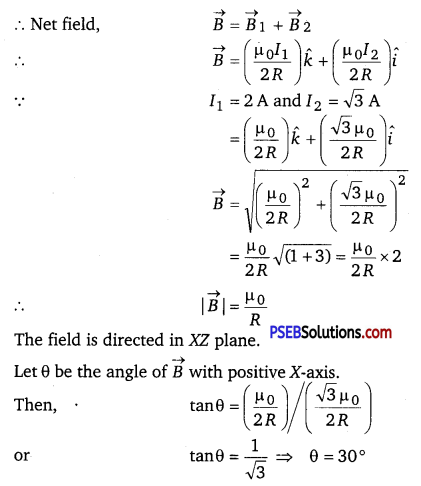
PSEB 12th Class Physics Solutions Chapter 14 Semiconductor Electronics Materials, Devices, and Simple Circuits 14
(Hint: A = 0, B = 1 then A and B inputs of second NOR gate will be 0 and hence Y = 1. Similarly, work out the values of Y for other combinations of A and B. Compare with the truth table of OR, AND, NOT gates and find the correct one.)
Answer:
A and B are the mputs of the given circuit The output of the first NOR gate ’ is \(\overline{A+B}\) .
It can be observed from the following figure that the inputs of the second NOR gate become the out put of the first one
PSEB 12th Class Physics Solutions Chapter 14 Semiconductor Electronics Materials, Devices, and Simple Circuits 15
Hence, the output of the combination is given as
Y= \(\overline{\overline{A+B}+\overline{A+B}}\)
= \(\overline{\bar{A}+\bar{B}}+\overline{\bar{A} \cdot \bar{B}}\)
= \(\overline{\bar{A} \cdot \bar{B}}=\overline{\bar{A}}+\overline{\bar{B}}\) = A+B
The truth table for this operation is given as

A B Y(= A+B)
0 0 0
0 1 1
1 0 1
1 1 1

This is the truth table of an OR gate. Hence, this circuit functions as an OR gate.

Question 19.
Write the truth table for the circuits given in Fig.14.48 consisting of NOR gates only. Identify the logic operations (OR, AND, NOT) performed by the two circuits.
PSEB 12th Class Physics Solutions Chapter 14 Semiconductor Electronics Materials, Devices, and Simple Circuits 16
Answer:
(a) A acts as the two inputs of the NOR gate and Y is the output, as shown in the following figure.
Hence, the output of the circuit is \(\overline{A+A}\)
PSEB 12th Class Physics Solutions Chapter 14 Semiconductor Electronics Materials, Devices, and Simple Circuits 17
The truth table for the same is given as

A Y = \(\bar{A}\)
0 1
1 0

This is the truth table of a NOT gate. Hence, this circuit functions as a NOT gate.

(b) A and B are the inputs and Y is the output of the given circuit. By using the result obtained in solution
(a), we can infer that the outputs of the
first two NOR gates are \(\bar{A}\) and \(\bar{B}\), as shown in the following figure
PSEB 12th Class Physics Solutions Chapter 14 Semiconductor Electronics Materials, Devices, and Simple Circuits 18
\(\bar{A}\) and \(\bar{B}\) are the inputs for the last NOR gate.
Hence, the output for the circuit can be written as
Y = \(\overline{\bar{A}+\bar{B}}=\overline{\bar{A}} \cdot \overline{\bar{B}}\) = A.B
The truth table for the same can be written as

A B Y(=A.B)
o o o
o 1 o
1 0 0
1 1 1

This is the truth table of an ANL) gate. Hence, this circuit functions as an AND gate.

PSEB 12th Class Physics Important Questions Chapter 15 Communication Systems

Punjab State Board PSEB 12th Class Physics Important Questions Chapter 15 Communication Systems Important Questions and Answers.

PSEB 12th Class Physics Important Questions Chapter 15 Communication Systems

Very short answer type questions

Question 1.
Name the essential components of a communication system.
Answer:
Transmitter, medium or channel, and receiver.

Question 2.
What is the function of a transducer used in a communication system?
Answer:
Transducer used as a sensor or detector in communication system. It converts the physical signal into electrical signal.

Question 3.
What is the function of a repeater in a communication system?
Answer:
Repeater pick up the signals from the transmitter, amplifies it and transmits it to the receiver. Thus, repeater comprises up of receiver, transmitted and amplifier. Its function is to extend the range of communication.

Question 4.
Define bandwidth and describe briefly its importance in communicating signals.
Answer:
It is defied as the frequency range over which given equipment operates.
Importance: To design the equipment used in communication system for distinguishing different message signals.

Question 5.
Which basic mode of communication is used for telephonic communication?
Answer:
Point to point is a basic mode of communication, which is used for telephonic conversation. In this mode of communication, communication takes place over a link between a single transmitter and a receiver.

PSEB 12th Class Physics Important Questions Chapter 15 Communication Systems

Question 6.
How are microwaves produced?
Answer:
A type of electromagnetic wave is microwave whose wavelength ranging from as long as metre to as short as millimeter and having the frequency range 3000 MHz to 300 GHz. This also includes UHF, EHF and various sources with different boundaries.

Question 7.
What is sky wave propagation?
Answer:
Skywave propagation is a mode of propagation in which communication of radiowaves in frequency range 2 MHz-20 MHz takes place due to reflection from the ionosphere.

Question 8.
Would sky waves be suitable for transmission of TV signals of 60 MHz frequency? (NCERT Exemplar)
Answer:
A signal to be transmitted through sky waves must have a frequency range of 1710 kHz to 40 MHz. But, here the frequency of TV signals are 60 MHz which is beyond the required range. So, sky waves will not be suitable for transmission of TV signals of 60 MHz frequency.

Question 9.
How are sidebands produced?
Answer:
Sidebands are produced due to the superposition of carrier wave of frequency ωc over modulating or audio signal of frequency ωm. The frequency of lower sideband is ωcm and the upper side band is ωcm

Question 10.
Why are broadcast frequencies (carrier waves) sufficiently spaced in amplitude modulated wave?
Answer:
To avoid mixing up of signals from different transmitters. This can be done by modulating the signals on high-frequency carrier waves, e.g., frequency band for satellite communication is 5.925 – 6.425 GHz.

Question 11.
Why is the amplitude of modulating signal kept less than the amplitude of carrier wave?
Answer:
The amplitude of modulating signal is kept less than the amplitude of carrier wave to avoid distortion.

Question 12.
What is the function of a bandpass filter used in a modulator for obtaining AM signal?
Answer:
Bandpass filter rejects DC and sinusoid of frequency ωm, 2ωm, and 2ωc and retains frequencies ωc + ωm.
Thus, it allows only the desired frequencies to pass through it.

Question 13.
On radiating (sending out) and AM modulated signal, the total radiated power is due to energy carried by ωc, ωcm and ωcm. Suggest ways to minimise cost of radiation without compromising on information. (NCERT Exemplar)
Answer:
In amplitude modulated signals, only sideband frequencies contain information.
Thus only (ωcm) and (ωc – ωm) contain information.

Now, according to question, the total radiated power is due to energy carried by
ωc, (ωc – ωm) and (ωcm)
Thus to minimize the cost of radiation without compromising on information, ωc can be left and transmitting
cm), (ωc – ωm) or both (ωcm) and (ωc – ωm).

PSEB 12th Class Physics Important Questions Chapter 15 Communication Systems

Question 14.
Two waves A and B of frequencies %MHz and 3 MHz, respectively are beamed in the sartie direction for communication via skywave. Which one of these is likely to travel longer distance in the ionosphere before suffering total internal reflection? (NCERT Exemplar)
Answer:
As the frequency of wave B is more than wave A, it means the refractive index of wave B is more than refractive index of wave A (as refractive index increases with frequency increases). For higher frequency wave (i.e., higher refractive index) the angle of refraction is less i.e., bending is less. So, wave B travels longer distance in the ionosphere before suffering total internal reflection.

Short answer type questions

Question 1.
Draw a block diagram of a generalized communication system. Write the functions of each of the following:
(a) Transmitter
(b) Channel
(c) Receiver
Answer:
The block diagram of a generalized communication system is shown in figure
PSEB 12th Class Physics Important Questions Chapter 15 Communication Systems 1
Functions are as follows :
(a) Transmitter: It comprises of message signal source, modulator and transmitting antenna. Transmitter makes signals compatible for communication channel via modulator and antenna.
(b) Channel: It is a link for propagating the signal from transmitter to receiver.
(c) Receiver: It recovers the desired original message signals from the received signals at the end of channel.

Question 2.
Explain the terms
(i) Attenuation and
(ii) Demodulation used in communication system.
Answer:
Attenuation: The loss in strength of a signal while propagating through a medium is known as attenuation.
Demodulation: The process of retrieval of information, from the carrier wave at the receiver end. This is the reverse process of modulation.

Question 3.
(a) Distinguish between ‘Analog and Digital signals’.
(b) Explain briefly two commonly used applications of the Internet.
Answer:
(a) A signal that varies continuously with time (e. g., sine waveform) is called an analog signal.
A signal that is discrete is called a digital signal. The presence of signal is denoted by digit 1 and absence is denoted by digit 0.
PSEB 12th Class Physics Important Questions Chapter 15 Communication Systems 2
(b) Uses of Internet: email, e-banking, e-shopping, e-ticketing, charting, surfing, file transfer, etc.

Question 4.
What is ground wave communication? Explain why this mode cannot be used for long-distance communication using high frequencies.
Answer:
The mode of wave propagation in which wave guided along the surface of the earth is called ground wave communication.
The maximum range of propagation in this mode depends on
(i) transmitted power and
(ii) frequency (less than a few MHz)
At high frequencies, the rate of energy dissipation of the signal increases and the signal gets attenuated over a short distance.

PSEB 12th Class Physics Important Questions Chapter 15 Communication Systems

Question 5.
Define the term modulation. Draw a block diagram of a simple modulator for obtaining AM signals.
Or
Draw a block diagram of a simple modulator to explain how the AM wave is produced. Can the modulated signal be transmitted as such? Explain.
Answer:
Modulation is the process in which low-frequency message signal is superimposed on high-frequency carrier wave so that they can be transmitted over long distances. The block diagram for a simple modulator for obtaining AM signal is shown as below :
PSEB 12th Class Physics Important Questions Chapter 15 Communication Systems 3

Question 6.
Define modulation index. Why is it kept low? What is the role of a bandpass filter? Give its physical significance.
Answer:
Modulation index is the ratio of the amplitude of modulating signal to that of carrier wave. Mathematically,
µ = \(\frac{A_{m}}{A_{c}}\)
Reason: It is kept low to avoid distortion.
Role: A bandpass filter rejects low and high frequencies and allows a band of desired frequencies to pass through it.
Physical Significance: It signifies the level of distortion or noise. A lower value of modulation index indicates a lower distortion in the transmitted signal.

Question 7.
State the concept of mobile telephony and explain its working.
Answer:
Concept of mobile telephony is to divide the service area into a suitable number of cells centered on an office MTSO (Mobile Telephone Switching Office). Mobile telephony means that you can talk to any person from anywhere.
Explanation:

  • Entire service area is divided into smaller parts called cells or cell zones.
  • Each cell has a base station to receive and send signals to all the mobile phones present inside that cell.
  • Each base station is linked to MTSO. MTSO coordinates between base station and TCO (Telephone Control Office).

Question 8.
What is space wave propagation? State the factors which limit its range of propagation. Derive an expression for the maximum line of sight distance between two antennas for space wave propagation.
Answer:
Space Wave Propagation
The mode of propagation in which radio waves travel, along a straight line, from the transmitting to the receiving antenna.
Limiting Factors
(i) Curvature of the earth
(ii) Insufficient height of the receiving antenna
(iii) LOS distance (> 40 MHz) travel in straight line
PSEB 12th Class Physics Important Questions Chapter 15 Communication Systems 4
Derivation : In right angled triangle BOD, ∠BDO =90°
∴BO2 = (OD)2 +(BD)2
le., (Re+h)2 =Re2 +(BD)2 ………………. (1)
As height h of the tower is very small as compared to radius (Re) of earth the point B will be very close to A, so that
BD ≈AD = d(say)
∴ Equation (1) given (Re + h)2 = Re2 + d2
PSEB 12th Class Physics Important Questions Chapter 15 Communication Systems 5
or height of transmitting antenna, h =\(\frac{d^{2}}{2 R_{e}}\)
or covering range of TV transmitting tower, d = \(\sqrt{2 R_{e} h}\)
Thus, covering range of TV signal can be increased by increasing the height of transmission antenna.
For a transmitting antenna of height hT, and a receiving antenna of height hR, the maximum line of sight distance
becomes
dM= \(\sqrt{2 R h_{T}}+\sqrt{2 R h_{R}}\)

Question 9.
(a) Explain any two factors which justify the need of modulating a low-frequency signal.
(b) Write two advantages of frequency modulation over amplitude modulation
Answer:
(a) (i) If λ is the wavelength of the signal then the antenna should have a length at least \(\frac{\lambda}{4}\)
For an electromagnetic wave of frequency 20 kHz, the wavelength λ is 15 km. Such a long antenna is not possible to construct and operate. So, there is need to modulate the wave in order to reduce the height of antenna to a reasonable height.

(ii) The power radiated by a linear antenna (length l) is proportional to \(\left(\frac{l}{\lambda}\right)^{2}\).
This shows that power radiated increases with decreasing λ. So, for effective power radiation by antenna, there is need to modulate the wave.
(b)

  • High frequency
  • Less noise
  • Maximum use of transmitted power

Question 10.
Given reasons for the following :
(i) For ground wave transmission, size of antenna (l) should the comparable to wavelength (λ) of signal, i.e. I = \(\frac{\lambda}{4}\)
(ii) Audio signals converted into an electromagnetic wave are not directly transmitted.
(iii) The amplitude of a modulating signal is kept less than the amplitude of carrier wave.
Answer:
(i) To radiate the signals with high efficiency.
(ii) Because they are of large wavelength and power radiated by antenna is very small as
P ∝ \(1 / \lambda^{4}\)
(iii) It is so to avoid making over modulated carrier wave. In that situation, the negative half cycle of the modulating signal is dipped and distortion occurs in reception.

PSEB 12th Class Physics Important Questions Chapter 15 Communication Systems

Question 11.
Which of the following would produce analog signals and which would produce digital signals?(NCERT Exemplar)
(a) A vibrating tuning fork
(b) Musical sound due to a vibrating sitar string
(c) Light pulse
(d) Output of NAND gate
Answer:
Analog and digital signals are used to transmit information, usually through electric signals. In both these technologies, the information such as any audio or video is transformed into electric signals. The difference between analog and digital technologies is that in analog technology, information is translated into electric pulses of varying amplitude. In digital technology, translation of information is into binary formal (zero or one) where each bit is representative of two distinct 4 amplitudes. Thus, (a) and (b) would produce analog signals and (c) and (d) would produce digital signals.

Question 12.
Why is AM signal likely to be more noisy than a FM signal upon transmission through a channel? (NCERT Exemplar)
Answer:
In case of AM, the instantaneous voltage of carrier waves is varied by the modulating wave voltage. So, during the transmission, noise signals can also be added and receiver assumes noise a part of the modulating signal.
In case of FM, the frequency of carrier waves is changed as the change in the instantaneous voltage of modulating waves. This can be done by mixing and not while the signal is transmitting in channel. So, noise does not affect FM signal.

Long answer type questions

Question 1.
What does the term LOS communication mean? Name the types of waves that are used for this communication. What is the range of their frequencies? Give typical, examples, with the help of suitable figure of communication systems that use space wave mode propagation.
Answer:
LOS Communication: It means “Line of sight communication”. Space wave are used for LOS communication.
In this communication, the space waves (radio or microwaves) travel directly from transmitting antenna to receiving antenna. Frequency for LOS communication must be more than 40 MHz.
PSEB 12th Class Physics Important Questions Chapter 15 Communication Systems 6
If transmitting antenna and receiving antenna have heights hT and hR respectively, then radio horizon of transmitting antenna.
dT = \( \sqrt{2 R_{e} h_{T}}\)
where Re is radius of earth and radius horizon of receiving antenna,
dR = \(\sqrt{2 R_{e} h_{R}}\)
∴ Maximum line of sight distance,
dM = dT + dR = \(\sqrt{2 R_{e} h_{T}}+\sqrt{2 R_{e} h_{R}}\)
PSEB 12th Class Physics Important Questions Chapter 15 Communication Systems 7
Television, broadcast, microwave links and satellite communication.
The satellite communication is shown in figure. The space wave used is microwave.

Question 2.
(a) Distinguish between sinusoidal and pulse-shaped signals,
(b) Explain, showing graphically, how a sinusoidal carrier wave is superimposed on a modulating signal to obtain the resultant amplitude modulated (AM) wave.
Answer:
(a) In the process of modulation, some specific characteristics of the carrier wave is varied in accordance with the information or message signal. The carrier wave maybe
(i) Continuous (sinusoidal) wave, or
(ii) Pulse, which is discontinuous.
A continuous sinusoidal carrier wave can be expressed as,
E = Eo sin (ωt +Φ)
Three distinct characteristics of such a wave are amplitude (E0), angular frequency (ω) and phase angle fcj)).
Any one of these three characteristics can be varied in accordance with the modulating baseband (AF) signal, giving rise to the respective Amplitude Modulation;
Frequency Modulation and Phase Modulation.

Again, the significant characteristics of a pulse are Pulse Amplitude, Pulse Duration or Pulse Width and Pulse Position (representing the time of rise or fall of the pulse amplitude). Any one of these characteristics can be varied in accordance with the modulating baseband (AF) signal, giving rise to the respective. Pulse Amplitude
Modulation (PAM), Pulse Duration Modulation (PDM), Pulse Width Modulation (PWM) and Pulse Position Modulation (PPM).

(b) Amplitude Modulation: When a modulating AF wave is superimposed on a high-frequency carrier wave in a manner that the frequency of modulated wave is same as that of the carrier wave, but its amplitude is made proportional to the instantaneous amplitude of the audio, frequency modulating voltage, the process is called amplitude modulation (AM).

PSEB 12th Class Physics Important Questions Chapter 15 Communication Systems

Let the instantaneous carrier voltage (ec) and modulating voltage (em) be represented by,
ec = Ec sinωc t …………………… (1)
em = Em sinωmt …………………….. (2)
Thus, in amplitude modulation, amplitude A of modulated wave is made proportional to the instantaneous modulating voltage em i.e.,
A = Ec+kem ……………………….. (3)
where k is a constant of proportionality.
In amplitude modulation, the proportionality constant k is made equal to unity. Therefore, maximum positive amplitude of AM wave is given
by.
A = Ec +em =Ec +Em sinωm t …………………….. (4)
It is called top envelope.
The maximum negative amplitude of AM wave is given by,
-A = – Ec – em
= – (Ec +Em sinωm t) …………………………. (5)
PSEB 12th Class Physics Important Questions Chapter 15 Communication Systems 8

PSEB 12th Class Physics Solutions Chapter 15 Communication Systems

Punjab State Board PSEB 12th Class Physics Book Solutions Chapter 15 Communication Systems Textbook Exercise Questions and Answers.

PSEB Solutions for Class 12 Physics Chapter 15 Communication Systems

PSEB 12th Class Physics Guide Communication Textbook Questions and Answers

Question 1.
Which of the frequencies will be suitable for beyond-the-horizon communication using sky waves?
(a) 10 kHz
(b) 10 MHz
(C) 1 GHz
(d) 1000 GHz
Answer:
(b) 10 MHz.
For beyond-the-horizon communication, it is necessary for the signal waves to travel a large distance. 10 kHz signals cannot be radiated efficiently because of the antenna size. The high-energy signal waves (1 GHz – 1000 GHz) penetrate the ionosphere. 10 MHz frequencies get reflected easily from the ionosphere. Hence, signal waves of such frequencies are suitable for beyond-the-horizon communication.

Question 2.
Frequencies in the UHF range normally propagate by means of:
(a) Ground waves
(b) Sky waves
(c) Surface waves
(d) Space waves
Answer:
(d) Space waves
Owing to its high frequency, an ultra-high frequency (UHF) wave can neither travel along the trajectory of the ground nor can it get reflected by the ionosphere. The signals having UHF are propagated through line-of-sight communication, which is nothing but space wave propagation.

Question 3.
Digital signals
(i) do not provide a continuous set of values,
(ii) represent values as discrete steps,
(iii) can utilize binary system, and
(iv) can utilize decimal as well as binary systems.
Which of the above statements are true?
(a) (i) and (ii) only
(b) (ii) and (iii) only
(c) (i), (ii) and (iii) but not (iv)
(d) All of (i), (ii), (iii) and (iv)
Answer:
(c) A digital signal uses the binary (0 and 1) system for transferring message signals. Such a system cannot utilize the decimal system (which corresponds to analogue signals). Digital signals represent discontinuous values.

PSEB 12th Class Physics Solutions Chapter 15 Communication Systems

Question 4.
Is it necessary for a transmitting antenna to be at the same height as that of the receiving antenna for line-of-sight communication? A TV transmitting antenna is 81 m tall. How much service area can it cover if the receiving antenna is at the ground level?
Answer:
Line-of-sight communication means that there is no physical obstruction between the transmitter and the receiver.
In such communications, it is not necessary for the transmitting and receiving antennas to be at the same height.
Height of the given antenna, h = 81 m
Radius of earth, R = 6.4 x 10⁶ m

For range, d = 2Rh, the service area of the antenna is given by the relation
A = πd2 = π(2Rh)
= 3.14 x 2 x 6.4 x 106 x 81
= 3255.55 x 106 m2
= 3255.55 ~ 3256 km2.

Question 5.
A carrier wave of peak voltage 12 V is used to transmit a message signal.
What should be the peak voltage of the modulating signal in order to have a modulation index of 75%?
Answer:
Amplitude of the carrier wave, Ac =12,
Modulation index, m = 75% = 0.75
Amplitude of the modulating wave = Am

Using the relation for modulation index,
m = \(\frac{A_{m}}{A_{c}}\)
∴ Am =mAc
= 0.75 x 12 = 9 V
Hence, amplitude of the modulating wave is 9 V.

Question 6.
A modulating signal is a square wave, as shown in Fig. 15.14.
The carrier wave is given by c(t) = 2 sin (8πt) volts.
PSEB 12th Class Physics Solutions Chapter 15 Communication Systems 1
(i) Sketch the amplitude modulated waveform.
(ii) What is the modulation index?
Answer:
Given, the equation of carrier wave
c(t) = 2sin(8πt) ……………………………… (i)
(i) According to the diagram.
Amplitude of modulating signal, Am = 1V
Amplitude of carrier wave,
Ac = 2V [By eq.(1)]
Tm = 1s (From diagram)
From eq.(1) ωm = \(\frac{2 \pi}{T_{m}}=\frac{2 \pi}{1}\) = 2π rad/s ………………. (2)
c(t) = 2sin8πt = Ac sinωc t
ωc =8π
So,
From Eq.(2)
So, ωc = 4ωm
Amplitude of modulated wave
A = Am +Ac =2+1 =3V
The sketch of the amplitude modulated waveform is shown below :
For carrier signal, ω = 8π,T = \(\frac{2 \pi}{\omega}=\frac{2}{8}=\frac{1}{4}\) = 0.25s
PSEB 12th Class Physics Solutions Chapter 15 Communication Systems 2
(ii) Modulation index, µ = \(\frac{A_{m}}{A_{c}}=\frac{1}{2}\) = 0.5

Question 7.
For an amplitude modulated wave, the maximum amplitude is found to be 10 V while the minimum amplitude is found to be 2 V. Determine the modulation index, p.
What would be the value of p if the minimum amplitude is zero volts?
Answer:
Maximum amplitude, Amax = 10 V
Minimum amplitude, Amin = 2 V
Modulation index µ, is given by the relation
µ = \(\frac{A_{\max }-A_{\min }}{A_{\max }+A_{\min }}\)
= \(\frac{10-2}{10+2}=\frac{8}{12} \) = 0.67
If Amin=0,
Then µ = \(\frac{A_{\max }}{A_{\max }}=\frac{10}{10}\) = 1
Hence, µ = 1, if the minimum amplitude is zero volts.

PSEB 12th Class Physics Solutions Chapter 15 Communication Systems

Question 8.
Due to economic reasons, only the upper sideband of an AM wave is transmitted, but at the receiving station, there is a facility for generating the carrier. Show that if a device is available which can multiply two signals, then it is possible to recover the modulating signal at the receiver station.
Answer:
Let ωc be the angular frequency of carrier waves and com by the angular frequency of signal waves.
Let the signal received at the receiving station be
e = E1 cos(ωcm )t
Let the instantaneous voltage of carrier wave
ec = Ec cosωc t
is available at receiving station.
Multiplying these two signals, we get
e x ec = E1Ec coscωc t cos(ωcm)t
PSEB 12th Class Physics Solutions Chapter 15 Communication Systems 3
Now, at the receiving end as the signal passes through filter, it will pass the high frequency (2ωc + ωm) but obstruct the frequency ωm. So, we can \(\frac{E_{1} E_{c}}{2} \cos \omega_{m_{s}} t\) record the modulating signal frequency ωm.

PSEB 12th Class Biology Solutions Chapter 13 Organisms and Populations

Punjab State Board PSEB 12th Class Biology Book Solutions Chapter 13 Organisms and Populations Textbook Exercise Questions and Answers.

PSEB Solutions for Class 12 Biology Chapter 13 Organisms and Populations

PSEB 12th Class Biology Guide Organisms and Populations Textbook Questions and Answers

Question 1.
How is diapause different from hibernation?
Answer:
Diapause is a stage of suspended development to cope with unfavourable conditions. Many species of Zooplankton and insects exhibit diapause to tide over adverse climatic conditions during their development. Hibernation or winter sleep is a resting stage wherein animals escape winters of cold) by hiding themselves in their shelters. They escape the winter season by entering a state of inactivity by slowing their metabolism. The phenomenon of hibernation is exhibited by bats, squirrels, and other rodents.

Question 2.
If a marine fish is placed in a freshwater aquarium, will the fish be able to survive? Why or why not?
Answer:
If a marine fish is placed in a freshwater aquarium, then its chances of survival will diminish. This is because their bodies are adapted to high salt concentrations of the marine environment. In freshwater conditions, they are unable to regulate the water entering their body (through osmosis). Water enters their body due to the hypotonic environment outside. This results in the swelling up of the body, eventually leading to the death of the marine fish.

Question 3.
Define phenotypic adaptation. Give one example.
Answer:
Phenotypic adaptation involves changes in the body of an organism in response to genetic mutation or certain environmental changes. These responsive adjustments occur in an organism in order to cope with environmental conditions present in their natural habitats. For example, desert plants have thick cuticles and sunken stomata on the surface of their leaves to prevent transpiration. Similarly, elephants have long ears that act as thermoregulators.

PSEB 12th Class Biology Solutions Chapter 13 Organisms and Populations

Question 4.
Most living organisms cannot survive at temperatures above 45°C. How are some microbes able to live in habitats with temperatures exceeding 100°C?
Answer:
Archaebacteria (Thermophiles) are ancient forms of bacteria found in hot water springs and deep-sea hydrothermal vents. They are able to survive in high temperatures (which far exceed 100°C) because their bodies have adapted to such environmental conditions. These organisms contain specialised thermo-resistant enzymes, which carry out metabolic functions that do not get destroyed at such high temperatures.

Question 5.
List the attributes that populations but not individuals possess.
Answer:
A population can be defined as a group of individuals of the same species residing in a particular geographical area at a particular time and functioning as a unit. For example, all human beings living at a particular place at a particular time constitute the population of humans.

The main attributes or characteristics of a population residing in a given area are as follows :
(a) Birth Rate (Natality): It is the ratio of live births in an area to the population of an area. It is expressed as the number of individuals added to the population with respect to the members of the population.

(b) Death Rate (Mortality): It is the ratio of deaths in an area to the population of an area. It is expressed as the loss of individuals with respect to the members of the population.

(c) Sex Ratio: It is the number of males or females per thousand individuals.

(d) Age Distribution: It is the percentage of individuals of different ages in a given population. At any given time, the population is composed of individuals that are present in various age groups. The age distribution pattern is commonly represented through age pyramids.

(e) Population Density: It is defined as the number of individuals of a population present per unit area at a given time.

Question 6.
If a population growing exponentially double in size in 3 years, what is the intrinsic rate of increase (r) of the population?
Answer:
A population grows exponentially if sufficient amounts of food resources are available to the individual. Its exponential growth can be calculated by the following integral form of the exponential growth equation:
Nt = N0ert
where,
Nt = Population density after time t
N0= Population density at time zero
r = Intrinsic rate of natural increase
e = Base of natural logarithms (2.71828)

From the above equation, we can calculate the intrinsic rate of increase (r) of a population.
Now, as per the question,
Present population density = x
Then, population density after two years = 2x
t = 3 years
Substituting these values in the formula, we get
⇒ 2x = x e3r
⇒ 2 = e3r

Applying log on both sides,
⇒ log2 = 3r log e
⇒ \(\frac{\log 2}{3 \log e}\) = r
PSEB 12th Class Biology Solutions Chapter 13 Organisms and Populations 1
Hence, the intrinsic rate of increase for the above-illustrated population is 0.2311.

PSEB 12th Class Biology Solutions Chapter 13 Organisms and Populations

Question 7.
Name important defence mechanisms in plants against herbivory.
Answer:
Several plants have evolved various defence mechanisms both morphological and chemical to protect themselves against herbivory,
(1) Morphological Defence Mechanisms

  • Cactus leaves (Opuntia) are modified into sharp spines (thorns) to deter herbivores from feeding on them.
  • Sharp thorns along with leaves are present in Acacia to deter herbivores.
  • In some plants, the margins of their leaves are spiny or have sharp edges that prevent herbivores from feeding on them.

(2) Chemical Defence Mechanisms

  • All parts of Calotropis weeds contain toxic cardiac glycosides, which can prove to be fatal if ingested by herbivores.
  • Chemical substances such as nicotine, caffeine, quinine, and opium are produced in plants as a part of self-defence.

Question 8.
An orchid plant is growing on the branch of mango tree. How do you describe this interaction between the orchid and the mango t tree?
Answer:
An orchid plant growing on the branch of a mango tree is an epiphyte. f Epiphytes are plants growing on other plants which however, do not derive nutrition from them. Therefore, the relationship between a mango tree and an orchid is an example of commensalisms, where one species gets benefited while the other remains unaffected. In the above interaction, the orchid is benefited as it gets support while the mango tree remains unaffected.

Question 9.
What is the ecological principle behind the biological control method of managing with pest insects?
Answer:
The basis of various biological control methods is on the concept of predation. Predation is a biological interaction between the predator and the prey, whereby the predator feeds on the prey. Hence, the predators regulate the population of preys in a habitat, thereby helping in the management of pest insects.

Question 10.
Distinguish between the following:
(a) Hibernation and Aestivation
(b) Ectotherms and Endotherms
Answer:
(a) Hibernation and Aestivation

Hibernation Aestivation
1. Hibernation is a state of reduced activity in some organisms to escape cold winter conditions. Aesrivarion is a state of reduced activity in some organisms to escape desiccation due to heat in summers.
2. Bears and squirrels inhabiting cold regions are examples of animals that hibernate during winters. Fishes and snails are examples of organisms aestivating during summers.

(b) Ectotherms and Endotherms

Ectotherms Endotherms
1. Ectotherms ate cold-blooded animals. Their temperature varies with their surroundings. Endotherms are warm-blooded animals. They maintain a constant body temperature.
2. Fishes, amphibians, and reptiles are ectothermic animals. birds and mammals are endothermal animals.

Question 11.
Write a short note on
(a) Adaptations of Desert Plants and Animals
(b) Adaptations of plants to water scarcity
(c) Behavioural adaptations in animals
(d) Importance of light to plants
(e) Effect of temperature or water scarcity and the adaptations of animals.
Answer:
(a) Adaptations of Desert Plants and Animals
(i) Adaptations of Desert Plants: Plants found in deserts are well adapted to cope with harsh desert conditions such as water scarcity and scorching heat. Plants have an extensive root system to tap underground water. They bear thick cuticles and sunken stomata o.i the surface of their leaves to reduce transpiration.

In Opuntia, the leaves are entirely modified into spines and photosynthesis is carried out by green stems. Desert plants have special pathways to synthesise food, called CAM (C4 pathway). It enables the stomata to remain closed during the day to reduce the loss of water through transpiration.

(ii) Adaptations of Desert Animals: Animals found in deserts such as desert kangaroo rats, lizards, snakes, etc. are well adapted to their habitat. The kangaroo rat found in the deserts of Arizona never drinks water in its life. It has the ability to concentrate its urine to conserve water. Desert lizards and snakes bask in the sun during early morning and burrow themselves in the sand during afternoons to escape the heat of the day. These adaptations occur in desert animals to prevent the loss of water.

(b) Adaptations of Plants to Water Scarcity: Plants found in deserts are well adapted to cope with water scarcity and scorching heat of the desert. Plants have an extensive root system to tap underground water. They bear thick cuticles and sunken stomata on the, surface of their leaves to reduce transpiration. In Opuntia, the leaves are modified into
spines and the process of photosynthesis is carried out by green stems. Desert plants have special pathways to synthesise food, called CAM. (C4 pathway). It enables their stomata to remain closed during the day to reduce water loss by transpiration.

(c) Behavioural Adaptations in Animals: Certain organisms are affected by temperature variations. These organisms undergo adaptations such as hibernation, aestivation, migration, etc. to escape environmental stress to suit their natural habitat. These adaptations in the behaviour of an organism are called behavioural adaptations. For example, ectodermal animals and certain endotherms exhibit behavioural adaptations. Ectotherms are cold-blooded animals such as fish, amphibians, reptiles, etc.

Their temperature varies with their surroundings. For example, the desert lizard basks in the sun during early hours when the temperature is quite low. However, as the temperature begins to rise, the lizard burrows itself inside the sand to escape the scorching sun. Similar burrowing strategies are exhibited by other desert animals. Certain endotherms (warm-blooded animals) such as birds and mammals escape cold and hot weather conditions by hibernating during winters and aestivating during summers. They hide themselves in shelters such as caves, burrows, etc. to protect against temperature variations.

(d) Importance of Light to Plants: Sunlight acts as the ultimate source of energy for plants. Plants are autotrophic organisms, which need light for carrying out the process of photosynthesis. Light also plays an important role in generating photoperiodic responses! occurring in plants. Plants respond to changes in intensity of light
during various seasons to meet their photoperiodic requirements for flowering. Light also plays an important role in aquatic habitats for ‘ vertical distribution of plants in the sea.
(e) Effect of Temperature or Water Scarcity and the Adaptations of Animals: Temperature is the most important
ecological factor. Average temperature on the Earth varies from one place to another. These variations in temperature affect the distribution of animals on the Earth. Animals that can tolerate a wide range of temperature are called eurythermal. Those which can tolerate a narrow range of temperature are called stenothermal animals.

Animals also undergo adaptations to suit their natural habitats. For example, animals found in colder areas have shorter ears and limbs that prevent the loss of heat from their body. Also, animals found in Polar regions have thick layers of fat below their skin and thick coats of fur to prevent the loss of heat.

Some organisms exhibit various behavioural changes to suit their natural habitat. These adaptations present in the behaviour of an organism to escape environmental stresses are called behavioural adaptations. For example, desert lizards are ectotherms. This means that they do not have a temperature regulatory mechanism to escape temperature variations.

PSEB 12th Class Biology Solutions Chapter 13 Organisms and Populations

Question 12.
List the various abiotic environmental factors.
Answer:
All non-living components of an ecosystem form abiotic components. It includes factors such as temperature, water, light, and soil.

Question 13.
Give an example for:
(a) An endothermic animal
(b) An ectothermic animal
(c) An organism of benthic zone
Answer:
(a) Endothermic Animal: Birds such as crows, sparrows, pigeons, cranes, etc. and mammals such as bears, cows, rats, rabbits, etc. are endothermic animals.

(b) Ectothermic Animal: Fishes such as sharks, amphibians such as frogs, and reptiles such as tortoises, snakes, and lizards are ectothermic animals.

(c) Organism of Benthic Zone: Decomposing bacteria is an example of an organism found in the benthic zone of a water body.

Question 14.
Define population and community.
Answer:
Population: A population can be defined as a group of individuals of the same species residing in a particular geographical area at a particular time and functioning as a unit. For example, all human beings living at a particular place at a particular time constitute the population of humans.

Community: A community is defined as a group of individuals of different species, living within a certain geographical area. Such individuals can be similar or dissimilar, but cannot reproduce with the members of other species.

Question 15.
Define the following terms and give one example for each:
(a) Commensalism
(b) Parasitism
(c) Camouflage
(d) Mutualism
(e) Interspecific competition
Answer:
(a) Commensalism: Commensalism is an interaction between two species in which one species gets benefited while the other remains unaffected. An orchid growing on the branches of a mango tree and barnacles attached to the body of whales are examples of commensalisms.

(b) Parasitism: It is an interaction between two species in which one species (usually smaller) gets positively affected, while the other species (usually larger) is negatively affected. An example of this is liver fluke. Liver fluke is a parasite that lives inside the liver of the host body and derives nutrition from it. Hence, the parasite is benefited as it derives nutrition from the host, while the host is negatively affected as the parasite reduces the host fitness, making its body weak.

(c) Camouflage: It is a strategy adopted by prey species to escape their predators. Organisms are cryptically coloured so that they can easily mingle in their surroundings and escape their predators. Many species of frogs and insects camouflage in their surroundings and escape their predators.

(d) Mutualism: It is an interaction between two species in which both species involved are benefited. For example, lichens show a mutual symbiotic relationship between fungi and blue-green algae, where both are equally benefited from each other.

(e) Interspecific Competition: It is an interaction between individuals of different species where both species get negatively affected. For example, the competition between flamingoes and resident fishes in South American lakes for common food resources i.e., zooplankton.

PSEB 12th Class Biology Solutions Chapter 13 Organisms and Populations

Question 16.
With the help of suitable diagram describe the logistic population growth curve.
Answer:
The logistic population growth curve is commonly observed in yeast cells that are grown under laboratory conditions. It includes five phases: the lag phase, positive acceleration phase, exponential phase, negative acceleration phase, and stationary phase.
(a) Lag Phase: Initially, the population of the yeast cell is very small. This is because of the limited resource present in the habitat.

(b) Positive Acceleration Phase: During this phase, the yeast cell adapts to the new environment and starts increasing its population. However, at the beginning of this phase, the growth of the cell is very limited.

(c) Exponential Phase: During this phase, the population of the yeast cell increases suddenly due to rapid growth. The population grows exponentially due to the availability of sufficient food resources, constant environment, and the absence of any interspecific competition. As a result, the curve rises steeply upwards.

(d) Negative Acceleration Phase: During this phase, the
environmental resistance increases and the growth rate of the population decreases. This occurs due to an increased competition among the yeast cells for food and shelter.

(e) Stationary Phase: During this phase, the population becomes stable. The number of cells produced in a population equals the number of cells that die. Also, the population of the species is said to have reached nature’s carrying capacity in its habitat.
PSEB 12th Class Biology Solutions Chapter 13 Organisms and Populations 2
A Verhulst-pearl logistic curve is also known as an S-Shaped growth curve.

Question 17.
Select the statement which explains best parasitism.
(a) One organism is benefited.
(b) Both the organisms are benefited.
(c) One organism is benefited, other is not affected.
(d) One organism is benefited, other is affected.
Answer:
(d) One organism is benefited, other is affected.
Parasitism is an interaction between two species in which one species (parasite) derives benefit while the other species (host) is harmed. For example, ticks and lice (parasites) present on the human body represent this interaction wherein the parasites receive benefit (as they derive nourishment by feeding on the blood of humans). On the other hand, these parasites reduce host fitness and cause harm to the human body.

Question 18.
List any three important characteristics of a population and explain.
Answer:
A population can be defined as a group of individuals of the same species, residing in a particular geographical area at a particular time and functioning as a unit. For example, all human beings living at a particular place at a particular time constitute the population of humans.
Three important characteristics of a population are as follows :
(a) Birth Rate (Natality): It is the ratio of live births in an area to the population of an area. It is expressed as the number of individuals added to the population with respect to the members of the population.

(b) Death Rate (Mortality): It is the ratio of deaths in an area to the population of an area. It is expressed as the loss of individuals with respect to the members of the population.

(c) Age Distribution: It is the percentage of individuals of different ages in a given population. At any given time, a population is composed of individuals that are present in various age groups. The age distribution pattern is commonly represented through a^e pyramids.

PSEB 12th Class Biology Important Questions Chapter 14 Ecosystem

Punjab State Board PSEB 12th Class Biology Important Questions Chapter 14 Ecosystem Important Questions and Answers.

PSEB 12th Class Biology Important Questions Chapter 14 Ecosystem

Very Short Answer Type Questions

Question 1.
How is ‘stratification’ represented in a forest ecosystem?
Answer:
Stratification is the vertical distribution of species at different levels. Trees occupy top vertical strata or layer, shrubs the second layer and herbs/grasses occupy the bottom layers.

Question 2.
Write a difference between net primary productivity and gross primary productivity.
Answer:
Gross primary productivity (GPP) is the rate of production of organic matter during photosynthesis. Net primary productivity (NPP) is the available biomass for the consumption by heterotrophs.
GPP – R = NPP.

Question 3.
Why is the rate of assimilation of energy at the herbivore level called secondary productivity? [NCERT Exemplar]
Answer:
It is because the biomass available to the consumer for consumption is a resultant of the primary productivity from plants.

Question 4.
Why is an earthworm called a detritivore?
Answer:
This is because earthworm breaks down detritus into smaller particles.

PSEB 12th Class Biology Important Questions Chapter 14 Ecosystem

Question 5.
Justify the pitcher plant as a producer. [NCERT Exemplar]
Answer:
Pitcher plant is chlorophyllous and is thus capable of photosynthesis and act as producer.

Question 6.
Name any two organisms which occupy more than one trophic level in an ecosystem? [NCERT Exemplar]
Answer:
Man and sparrow.

Question 7.
What is common to earthworm, mushroom, soil mites, and dung beetle in an ecosystem? [NCERT Exemplar]
Answer:
They are all detritivores, i.e., decomposing organisms which feed on dead remains of plants and animals.

Question 8.
“Man can be a primary as well as a secondary consumer.” Justify this statement.
Answer:
Man has a varied diet. When on a vegetarian diet, they are primary consumers, and when on a non-vegetarian diet, they are secondary consumers.

Question 9.
Name an omnivore which occurs in both grazing food chain and the decomposer food chain. [NCERT Exemplar]
Answer:
Sparrow/crow.

Question 10.
Differentiate between standing state and standing crop in an ecosystem.
Answer:
In an ecosystem, standing crop is the mass of living material in each trophic level at a particular time. Whereas standing state refers to the amount- of nutrients in the soil at any given time.

Question 11.
Under what conditions would a particular stage in the process of succession revert back to an earlier stage? [NCERT Exemplar]
Answer:
Natural or human-induced disturbances like fire, deforestation, etc.

Question 12.
Climax stage is achieved quickly in secondary succession as compared to primary succession. Why? [NCERT Exemplar]
Answer:
The rate of succession is much faster in secondary succession as the substratum (soil) is already present as compared to primary succession where the process starts from a bare area (rock).

PSEB 12th Class Biology Important Questions Chapter 14 Ecosystem

Short answer type questions

Question 1.
What is an incomplete ecosystem? Explain with the help of a suitable example. [NCERT Exemplar]
Answer:
An ecosystem is a functional unit with biotic and abiotic factors interacting with one another resulting in a physical structure. Absence of any component will make an ecosystem incomplete as it will hinder the functioning of the ecosystem. Examples of such an ecosystem can be a fish tank or deep aphotic zone of the oceans where producers are absent.

Question 2.
Justify the importance of decomposers in an ecosystem.
Answer:
Decomposers which are heterotrophic organisms, mainly fungi and bacteria break down complex organic matter into inorganic substances like carbon dioxide, water, and nutrients. They meet their energy and nutrient requirements by degrading dead organic matter or detritus. These are also known as saprotrophs. Decomposers secrete digestive enzymes that break down dead and waste into simple, inorganic materials, which are subsequently absorbed by them.

Question 3.
“In a food chain, a trophic level represents a functional level, not a species.” Explain.
Answer:
Trophic level in a food chain is a level at which organisms obtain their food. Each trophic level has a specific mode of obtaining food. Thus, trophic level represents the mode of obtaining food and not the species. The species has no significance in the food chain. In the food chain, there are generally four trophic levels-producers or autotrophs, the first trophic level; primary consumer/herbivore secondary trophic level; secondary consumer/carnivore third trophic level and finally tertiary consumers (top carnivores) representing fourth trophic level. Thus, in a food chain, trophic levels represent a functional level and which species represent the trophic level, does not matter.

Question 4.
How does primary succession start in water to the climax community? Explain.
Answer:
In primary succession in water, the pioneers are the small phytoplanktons. They are replaced with time by free-floating angiosperms, then by rooted hydrophytes; sedges, grasses, and finally the trees. The climax again would be a forest. With time the water body is converted into land.

Question 5.
Why are nutrient cycles in nature called biogeochemical cycles? [NCERT Exemplar]
Answer:
Nutrient cycles are called biogeochemical cycles because ions/molecules of a nutrient are transferred from the environment (rocks, air and water) to organisms (life) and then brought back to the environment in a cyclic pathway.
The literal meaning of biogeochemical is bio-living organisms and geo-rocks, air, and water.

PSEB 12th Class Biology Important Questions Chapter 14 Ecosystem

Question 6.
(a) State any two differences between phosphorus and carbon cycles in nature.
(b) Write the importance of phosphorus in living organisms.
Answer:
(a)

Phosphorus cycle Carbon cycle
1. It is a sedimentary cycle. It is a gaseous cycle.
2. Atmospheric inputs through rainfall are much smaller. Atmospheric inputs through rainfall are more.
3. Gaseous exchange of phosphorus between organism and environment is nil. Gaseous exchange of carbon between organism and environment is much more.

(b) Phosphorus is a major constituent of biological membranes, nucleic acids, and cellular energy transfer systems.

Long answer type questions

Question 1.
Explain succession of plants in xerophytic habitat until it reaches climax community.
Answer:
Xerarch Succession:

  • It starts in primary bare, dry area such as rocks or sand dunes, etc.
  • The pioneer species on the rock are usually lichens and blue-green algae under humid conditions.
  • They secrete acids to dissolve rocks, help in weathering and soil formation.
  • Little soil formation makes the way to the appearance of small plants like bryophytes (mosses). They accumulate more soil and organic matter.
  • With time, they are succeeded by bigger plants; perennial grasses and shrubs.
  • After several more stages, ultimately a stable climax forest community is formed.
  • Climax community remains stable as long as environment remains unchanged.
  • With time, the xerophytic habitat gets converted into mesic habitat.

Question 2.
Describe the advantages for keeping the ecosystems healthy.
Answer:
An healthy ecosystem is stable and have a functional balance amongst different populations found in ecosystem. Ecosystem advantages are benefits provided by ecosystem processes to environment in its cleaning and maintenance, enhancing aesthetic beauty, maintenance of biodiversity, protection of soil, water and land sources besides providing a habitat to wildlife, tribals and grazing areas. The important advantages are given ahead :

(i) Oxygen Release : (Purify air) Suspended particulate matter is intercepted by vegetation and made to settle down. Air is thus removed of its pollutants. It is further purified by removal of carbon dioxide and release of oxygen during photosynthetic activity of vegetation.

(ii) Water: Most of rainwater is held over the soil by plant litter like a sponge. It slowly percolates down and becomes the source of all springs, rivulets and rivers. The water is clean and fresh.

PSEB 12th Class Biology Important Questions Chapter 14 Ecosystem

(iii) Prevention of Floods: As there is little runoff, flood water is not formed.

(iv) Protection of Soil: Maintenance of soil fertility depends upon a good soil cover and optimum nutrient cycling. Soil cover also protects the soil from air and water erosion. Soil particles remain bound together by plant roots. Landslides are rare.
(v) Biodiversity: Natural ecosystems are a source of biodiversity with a variety of genes, gene pools, species and habitats.

(vi) Climate: Ecosystems, especially forests, maintain good climatic conditions by increasing humidity, reducing extremes of temperature and increasing periodicity of rainfall.

(vii) Nutrient Cycling: It is one of the most important ecosystem services which maintains the continuity of life on earth. Through cycling, biogenetic nutrients are made available all the time for absorption.

(viii) Pollination: Insects, especially bees, and birds visit areas around the forests for pollination of crop plants, bushes, and trees.

(ix) Pest Control: In natural ecosystem, pests are kept under control by their natural predators. Maintenance of natural ecosystems will allow the predators to free the nearby areas of pests.

(x) Wildlife: Ecosystems provide habitats to wildlife.

(xi) Aesthetic Value: Ecosystems also provide aesthetic, cultural, and spiritual value.

PSEB 12th Class Biology Solutions Chapter 14 Ecosystem

Punjab State Board PSEB 12th Class Biology Book Solutions Chapter 14 Ecosystem Textbook Exercise Questions and Answers.

PSEB Solutions for Class 12 Biology Chapter 14 Ecosystem

PSEB 12th Class Biology Guide Ecosystem Textbook Questions and Answers

Question 1.
Fill in the blanks.
(a) Plants are called as ……………………………. because they fix carbon dioxide.
(b) In an ecosystem dominated by trees, the pyramid (of numbers) is ………………….. type.
(c) In aquatic ecosystems, the limiting factor for the productivity is ………………………. .
(d) Common detritivores in our ecosystem are …………………………. .
(e) The major reservoir of carbon on earth is …………………………….. .
Answer:
(a) autotrophs
(b) inverted
(c) light
(d) earthworms
(e) oceans.

Question 2.
Which one of the following has the largest population in a food chain?
(a) Producers
(b) Primary consumers
(c) Secondary consumers
(d) Decomposers
Answer:
(a) Producers (decomposers can be maximum but they are excluded from the food chain ).

Question 3.
The second trophic level in a lake is
(a) Phytoplankton
(b) Zooplankton
(c) Benthos
(d) Fishes
Answer:
(b) Zooplankton
Zooplankton are primary consumers in aquatic food chains that feed upon phytoplankton. Therefore, they are present at the second trophic level in a lake.

PSEB 12th Class Biology Solutions Chapter 14 Ecosystem

Question 4.
Secondary producers are
(a) Herbivores
(b) Producers
(c) Carnivores
(d) None of the above
Answer:
(d) None of the above
Plants are the only producers. Thus, they are called primary producers. There are no other producers in a food chain.

Question 5.
What is the percentage of photosynthetically active radiation (PAR) in the incident solar radiation?
(a) 100%
(b) 50 %
(c) 1-5%
Answer:
(b) 50%
Out of total incident solar radiation, about fifty percent of it forms photosynthetically active radiation or PAR.

Question 6.
Distinguish between
(a) Grazing food chain and detritus food chain
(b) Production and decomposition
(c) Upright and inverted pyramid
(d) Food chain and Food web
(e) Litter and detritus
(f) Primary and secondary productivity
Answer:
(a) Grazing food chain and detritus food chain

Grazing food chain Detritus food chain
1. In this food chain, energy is derived from the Sun. In this food chain, energy comes from organic matter (or detritus) generated in trophic levels of the grazing food chain.
2. It begins with producers, present at the first trophic level. The plant biomass is then eaten by herbivores, which in turn are consumed by a variety of carnivores. begins with detritus such as dead bodies of animals or fallen leaves, which are then eaten by decomposers or detrivores. These detritivores are in turn consumed
by their predators.
3. This food chain is usually large. It is usually smaller as compared to the grazing food chain.

(b) Production and decomposition

Production Decomposition
1. It is the rare of producing organic matter (food) by producers. It is the process of breaking down of complex organic matter or biomass from the body of dead plants and animals with the help of decomposers into organic raw material such as CO2, H2O and other nutrients.
2. It depends on the photosynthetic cápacity of the producers. It occurs with the help of decomposers.
3. Sunlight is required by plants for primary production. Sunlight is not required for decomposition by clecomposers.

PSEB 12th Class Biology Solutions Chapter 14 Ecosystem

(c) upright and inverted pyramid

Upright pyramid Inverted pyramid
1. The pyramid of energy is upright. always The pyramid of biomass and the pyramid of, numbers can be inverted.
2. In the upright pyramid, the number and biomass of organisms in the producer level of an ecosystem is the highest, which keeps on decreasing at each trophic level in a food chain. In an inverted pyramid, the number and biomass of organisms in the producer level of an ecosystem is the lowest, which keeps on increasing at each tropic level.

(d) Food chain and food web

Food chain Food web
1. The transfer of energy from producers to top consumers through a series of organisms is called food chain. A number of food chain inter-connected with each other forming a web-like pattern is called food web.
2. One organism holds only one position. One organism can hold more than one position.
3. The flow of energy can be easily calculated. The flow of energy is very difficult to calculate.
4. It is always straight and proceed in a progressive straight line. Instead of straight line, it is a series of branching lines.
5. Competition is limited to members of same trophic level. Competition is amongst members of same and different trophic levels.

(e) Litter and detritus

Litter Detritus
l. It is made of dried fallen plant matter. It is freshly deposited organic matter, i. e. remains of plants and animals.
2. It is found above the ground. It is found both above and below the ground.

(f) Primary and secondary productivity

Primary productivity Secondary_productivity
1. Primary productivity is the amount of energy accumulation or amount of biomass produced per unit area over a time period. Secondary productivity is the rate of formation of new organic matter by consumer.
2.  It is of two types, gross primary productivity (GPP) and net primary productivity (NPP). They are
related as: GPP – R = NPP, where R is respiratory losses.
It is also of two types gross secondary productivity (GSP) and net secondary productivity (NSP). They are related as: NSP = GSP – R
Where R is respiratory losses.

Question 7.
Describe the components of an ecosystem.
Answer:
An ecosystem is defined as an interacting unit that includes both the biological community as well as the non-living components of an area. The living and the non-living components of an ecosystem interact amongst themselves and function as a unit, which gets evident during the processes of nutrient cycling, energy flow, decomposition, and productivity. There are many ecosystems such as ponds, forests, grasslands, etc.

The two components of an ecosystem are as follows :
(a) Biotic Component: It is the living component of an ecosystem that includes biotic factors such as producers, consumers, decomposers, etc. Producers include plants and algae. They contain chlorophyll pigment, which helps them carry out the process of photosynthesis in the presence of light.

Thus, they are also called converters or transducers. Consumers or heterotrophs are organisms that are directly (primary consumers) or indirectly (secondary and tertiary consumers) dependent on producers for their food. Decomposers include micro-organisms such as bacteria and fungi. They obtain nutrients by breaking down the remains of dead plants and animals.

(b) Abiotic Component: They are the non-living component of an ecosystem such as light, temperature, water, soil, air, inorganic nutrients, etc.

PSEB 12th Class Biology Solutions Chapter 14 Ecosystem

Question 8.
Define ecological pyramids and describe with examples, pyramids of number and biomass.
Answer:
An ecological pyramid is a graphical representation of various ecological parameters such as the number of individuals present at each trophic level, the amount of energy, or the biomass present at each trophic level.
Ecological pyramids represent producers at the base, while the apex represents the top-level consumers present in the ecosystem.
There are three types of pyramids:

  1. Pyramid of numbers
  2. Pyramid of energy
  3. Pyramid of biomass

1. Pyramid of Numbers: It is a graphical representation of the number of individuals present at each trophic level in a food chain of an ecosystem. The pyramid of numbers can be upright or inverted depending on the number of producers. For example, in a grassland ecosystem, the pyramid of numbers is upright.

In this type of a food chain, the number of producers (plants) is followed by the number of herbivores (mice), which in turn is followed by the number of secondary consumers (snakes) and tertiary carnivores (eagles). Hence, the number of individuals at the producer level will be the maximum, while the number of individuals present at top carnivores will be least.
PSEB 12th Class Biology Solutions Chapter 14 Ecosystem 1
On the other hand, in a parasitic food chain, the pyramid of numbers is inverted. In this type of a food chain, a single tree (producer) provides food to several fruit-eating birds, which in turn support several insect species.

2. Pyramid of Biomass: A pyramid of biomass is a graphical representation of the total amount of living matter present at each trophic level of an ecosystem. It can be upright or inverted. It is upright in grasslands and forest ecosystems as the amount of biomass present at the producer level is higher than at the top carnivore level.
The pyramid of biomass is inverted in a pond ecosystem as the biomass of fishes far exceeds the biomass of zooplankton (upon which they feed).
PSEB 12th Class Biology Solutions Chapter 14 Ecosystem 2

Question 9.
What is primary productivity? Give brief description of factors that affect primary productivity.
Answer:
It is defined as the amount of organic matter or biomass produced by producers per unit area over a period of time. Primary productivity of an ecosystem depends on the variety of environmental factors such as light, temperature, water, precipitation, etc. It also depends on the availability of nutrients and the availability of plants to carry out photosynthesis.

Question 10.
Define decomposition and describe the processes and products of decomposition.
Answer:
Decomposition is the process that involves the breakdown of complex organic matter or biomass from the body of dead plants and animals with the help of decomposers into inorganic raw materials such as carbon dioxide, water, and other nutrients. The various processes involved in decomposition are as follows :
1. Fragmentation: It is the first step in the process of decomposition. It involves the breakdown of detritus into smaller pieces by the action of detritivores such as earthworms.

2. Leaching: It is a process where the water-soluble nutrients go down into the soil layers and get locked as unavailable salts.

3. Catabolism: It is a process in which bacteria and fungi degrade detritus through various enzymes into smaller pieces.

4. Humification: The next step is humification which leads to the formation of a dark-colored colloidal substance called humus, which acts as reservoir of nutrients for plants.

5. Mineralisation: The humus is further degraded by the action of microbes, which finally leads to the release of inorganic nutrients into the soil. This process of releasing inorganic nutrients from the humus is known as mineralization.

Decomposition produces a dark-colored, nutrient-rich substance called humus. Humus finally degrades and releases inorganic raw materials such as C02, water, and other nutrients in the soil.

PSEB 12th Class Biology Solutions Chapter 14 Ecosystem

Question 11.
Give an account of energy flow in an ecosystem.
Answer:
Energy enters an ecosystem from the Sun. Solar radiations pass through the atmosphere and are absorbed by the Earth’s surface. These radiations help plants in carrying out the process of photosynthesis.
Also, they help maintain the Earth’s temperature for the survival of living organisms. Some solar radiations are reflected by the Earth’s surface.

Only 2-10% of solar energy is captured by green plants (producers) during photosynthesis to be converted into food.
The rate at which the biomass is produced by plants during photosynthesis is termed as ‘gross primary productivity.
When these green plants are consumed by herbivores, only 10% of the stored energy from producers is transferred to herbivores. The remaining 90 % of this energy is used by plants for various processes such as respiration, growth, and reproduction. Similarly, only 10% of the energy of herbivores is transferred to carnivores. This is known as ten percent law of energy flow.
PSEB 12th Class Biology Solutions Chapter 14 Ecosystem 3

Question 12.
Write important features of a sedimentary cycle in an ecosystem.
Answer:
Sedimentary cycles have their reservoirs in the Earth’s crust or rocks. Nutrient elements are found in the sediments of the Earth. Elements such as sulphur, phosphorus, potassium, and calcium have sedimentary cycles.
Sedimentary cycles are very slow. They take a long time to complete their circulation and are considered as less perfect cycles. This is because during recycling, nutrient elements may get locked in the reservoir pool, thereby taking a very long time to come out and continue circulation. Thus, it usually goes out of circulation for a long time.

Question 13.
Outline salient features of carbon cycling in an ecosystem.
Answer:
The carbon cycle is an important gaseous cycle which has its reservoir pool in the atmosphere.
All living organisms contain carbon as a major body constituent. Carbon is a fundamental element found in all living forms. All biomolecules such as carbohydrates, lipids, and proteins required for life processes are made of carbon.
Carbon is incorporated into living forms through a fundamental process called ‘photosynthesis’.

Photosynthesis uses sunlight and atmospheric carbon dioxide to produce a carbon compound called ‘glucose’.
This glucose molecule is utilised by other living organisms. Thus, atmospheric carbon is incorporated in living forms.
Now, it is necessary to recycle this absorbed carbon dioxide back into the atmosphere to complete the cycle.

There are various processes by which carbon is recycled back into the atmosphere in the form of carbon dioxide gas.
The process of respiration breaks down glucose molecules to produce carbon dioxide gas. The process of decomposition also releases carbon dioxide from dead bodies of plants and animals into the atmosphere. Combustion of fuels, industrialization, deforestation, volcanic eruptions and forest fires act as other major sources of carbon dioxide.
PSEB 12th Class Biology Solutions Chapter 14 Ecosystem 4

PSEB 12th Class Biology Important Questions Chapter 12 Biotechnology and its Applications

Punjab State Board PSEB 12th Class Biology Important Questions Chapter 12 Biotechnology and its Applications Important Questions and Answers.

PSEB 12th Class Biology Important Questions Chapter 12 Biotechnology and its Applications

Very short answer type questions

Question 1.
State the role of transposons in silencing of mRNA in eukaryotic cells.
Answer:
Transposons or mobile genetic elements in viruses are the sources of the complementary dsRNA, which in turn bind to specific mRNA and cause RNA interference of the parasite.

Question 2.
How do interferons protect us?
Answer:
Interferons protect non-infected cells from further viral infections, by creating cytokine barriers.

PSEB 12th Class Biology Important Questions Chapter 12 Biotechnology and its Applications

Question 3.
State the role of C peptide in human insulin.
Answer:
C-peptide (extra stretch of polypeptide) makes the insulin inactive.

Question 4.
How are two short polypeptide chains of insulin linked [ together?
Answer:
Two short polypeptide chains of insulin are limced together by disulphide bridges.

Question 5.
How can bacterial DNA be released from the bacterial cell for biotechnology experiments?
Answer:
The bacterial cell wall is digested by the enzyme lysozyme to release 1 DNA from the cell.

Question 6.
Suggest any two possible treatments that can be given to a patient exhibiting adenosine deaminase deficiency.
Answer:

  • Enzyme replacement therapy (in which functional ADA is injected)
  • Bone marrow transplantation
  • Gene therapy/Culturing the lymphocytes followed by introduction of functional ADA cDNA into it and returning it into the patient’s body. (Any two)

Question 7.
Name a molecular diagnostic technique to detect the presence
of a pathogen in its early stage of infection.
Answer:
ELISA (Enzyme Linked Immunosorbent Assay)

PSEB 12th Class Biology Important Questions Chapter 12 Biotechnology and its Applications

Question 8.
What are transgenic animals. Uive an example.
Answer:
The transgenic animals are those that have their DNA manipulated to possess and express/foreign genes e.g.. transgenic cow-Rosie, rats, pigs fish, rabbits and mice.

Question 9.
What was the speciality of the milk produced by the transgenic cow, Rosie?
Answer:
The first transgenic cow, Rosie, produced milk with human alpha-lactalbumin which was nutritionally, more balanced product for human babies than natural cow milk.

Question 10.
What is biopiracy?
Answer:
Biopiracy refers to the use of bioresources by multinational companies and other organisations without proper authorisation from the country and people without compensatory payment.

Question 11.
Name the following:
(a) The semi-dwarf variety of wheat which is high-yielding and disease-resistant.
(b) Any one inter-specific hybrid mammal.
Answer:
(a) Kalyan Sona/Sonalika
(b) Mule/Hinny/Liger/Tigon

Question 12.
For which variety of Indian rice, patent was filed by a USA Company? [NCERT Exemplar]
Answer:
Indian Basmati was crossed with semi-dwarf variety and was claimed as a new variety for which the patent was filed by a USA company.

PSEB 12th Class Biology Important Questions Chapter 12 Biotechnology and its Applications

Question 13.
Name the enzymes that are used for the isolation of DNA from bacterial and fungal cells for recombinant DNA technology.
Answer:
Bacteria: lysozyme; fungi : chitinase.

Question 14.
Bt cotton is resistant to pest, such PS lepidopteran, dipterans and coleopter&ns. Is Bt cotton resistant to other pests as well? [NCERT Exemplar]
Answer:
Bt cotton is made resistant to only certain specific taxa of pests. It is quite likely that in future, some other pests may infest the Bt cotton plants. It is similar to immunisation against small-pox which does not provide immunity against other pathogens like those that cause cholera, typhoid, etc.

Short answer type questions

Question 1.
Explain the application of biotechnology in producing Bt-cotton.
Or One of the major contributions of biotechnology is to develop pest-resistant varieties of cotton plants. Explain how it has been made possible.
Or One of the main objectives of biotechnology is to minimise the use of insecticides on cultivated crops. Explain with the help of a suitable example how insect resistant crops have been developed using techniques of biotechnology.
Answer:
Production of Bt-cotton, a Pest Resistant Crop : Soil bacterium Bacillus thuringiensis possess gene called Cry-gene which synthesises an endotoxin protein called Cry-protein. Now, by biotechnology technique, the Cry gene from B. thuringiensis have been isolated, cloned, introduced and incorporated into cotton-plant using recombinant DNA technology. In the genetically modified cotton crop plants, the Cry or Bt-toxin gene expresses to produce a toxic insecticidal protein in an inactive form called prototoxin in crystalline state.

As an insect feeds over the plant, the inactive prototoxin crystals pass into the gut where alkaline pH and digestive enzymes solubilise the crystals and convert the prototoxin into an active toxin. The activated toxin creates pores in the midgut epithelial cells by lysing that cause death of the insect. Thus, the GM cotton plants do not require protection of expensive insecticides as they themselves act as bioinsecticides.

Since there are a number of Cry genes and Cry IAc and Cry II Ab controls the cotton bollworms while Cry IAb controls corn borer.

Question 2.
Write the functions of
(a) cry lAc gene
(b) RNA interference (RNAi)
Or Explain the process of RNA interference.
Answer:
(a) Cry IAc gene is present in Bacillus thuringiensisThe gene encodes for a toxic insecticidal protein during a particular phase of their growth. Cry genes are isolated and incorporated in the crop plant. The insect feeding on transgenic crop die because of the presence of toxin protein. Cry IAc produces Bt-toxins specific for cotton bollworm insect group.

(b) RNAi involves the silencing of a specific m-RNA due to the complementary ds-RNA molecule that binds to and prevents translation of m-RNA. As a result, parasite a favourable protein are not produced
and it could not infest, multiply and survive in a transgenic host expressing specific RNA interference. The transgenic plant, therefore, gets itself protected from the parasite such as nematode.

PSEB 12th Class Biology Important Questions Chapter 12 Biotechnology and its Applications

Question 3.
How did Eli Lilly synthesise the human insulin? Mention one difference between this insulin and the one produced by the human pancreas.
Or How did Eli Lilly Company go about preparing the human insulin? How is the insulin thus produced different from that produced by the functional human insulin gene?
Or How did an American Company, Eli Lilly use the knowledge of r-DNA technology to produce human insulin?
Or Explain how Eli Lilly, an American Company, Produced insulin by Recombinant DNA technology?
Answer:
Eli Lilly prepared two DNA sequences corresponding to A and B chains of human insulin and introduced them in plasmids of E. coli to produce insulin chains. Chains A and B were produced separately, extracted and combined by creating disulphide bonds to form human insulin.

Insulin in human pancreas is synthesised as a pro-hormone containing the C peptide, which is removed to form mature hormone. The synthesised insulin did not contain C peptide and was directly prepared
in mature form.

Question 4.
How is a mature functional insulin hormone different from its pro-hormone form? [NCERT Exemplar]
Answer:
Mature functional insulin is obtained by processing of pro-hormone which contains extra peptide called C-peptide. This C-peptide is removed during maturation of pro-insulin to insulin.

Question 5.
How does a transgenic organism differ from the rest of its population? Give any two examples of such organism for human advantage.
Answer:
A transgenic organism contains foreign gene, hence it differs from the rest of the population in having one or more extra genes apart from the gene pool of that population showing an additional phenotype. Example, (i) Transgenic E. coli, with gene for human insulin, (ii) Transgenic mouse with gene for human growth hormone.

Question 6.
What is GEAC and what are its objectives? [NCERT Exemplar]
Or Mention two objectives of setting up GEAC by our Government.
Or State the purpose for which the Indian Government has set up GEAC.
Or Describe the responsibility of GEAC, set up by the Indian Government.
Answer:
GEAG (Genetic Engineering Approval Committee) is an Indian government organisation. Its objective are to:
(a) examine the validity of GM (Genetic modification of organism) research.
(b) inspect the safety of introducing GM for public services.

PSEB 12th Class Biology Important Questions Chapter 12 Biotechnology and its Applications

Long answer type questions

Question 1.
List the disadvantages of insulin obtained from the pancreas of slaughtered cow and pigs. [NCERT Exemplar]
Answer:

  • Insulin being a hormone is produced in very little amounts in the body. Hence, a large number of animals need to be sacrificed for obtaining small quantities of insulin. This makes the cost of insulin very high, demand being manyfold higher than supply.
  • Slaughtering of animal is also not ethical.
  • There is potential of immune response in humans against the administered insulin which is derived from animals.
  • There is possibility of slaughtered animals being infested with some infectious micro-organism which may contaminate insulin.

PSEB 12th Class Biology Solutions Chapter 12 Biotechnology and its Applications

Punjab State Board PSEB 12th Class Biology Book Solutions Chapter 12 Biotechnology and its Applications Textbook Exercise Questions and Answers.

PSEB Solutions for Class 12 Biology Chapter 12 Biotechnology and its Applications

PSEB 12th Class Biology Guide Biotechnology and its Applications Textbook Questions and Answers

Question 1.
Crystals of Bt toxin produced by some bacteria do not kill the bacteria themselves because
(a) bacteria are resistant to the toxin,
(b) toxin is immature,
(c) toxin is inactive,
(d) bacteria encloses toxin in a special sac.
Answer:
Toxin is inactive: In bacteria, the toxin is present in an inactive form, called prototoxin, which gets converted into active form when it enters the body of an insect.

Question 2.
What are transgenic bacteria? Illustrate using any one example.
Answer:
Transgenic bacteria contain foreign gene that is intentionally introduced into its genome. They are manipulated to express the desirable gene for the production of various commercially important products.

An example of transgenic bacteria is E.coli. In the plasmid of E.coli, the two DNA sequences corresponding to A and B chain of human insulin are inserted, so as to produce the respective human insulin chains. Hence, after the insertion of insulin gene into the bacterium, it becomes transgenic and starts producing chains of human insulin. Later on, these chains are extracted from E.coli and combined to form human insulin.
PSEB 12th Class Biology Solutions Chapter 12 Biotechnology and its Applications 1

PSEB 12th Class Biology Solutions Chapter 12 Biotechnology and its Applications

Question 3.
Compare and contrast the advantages and disadvantages of production of genetically modified crops.
Answer:
The production of genetically modified (GM) or transgenic crops has several advantages.

  • Most of the GM crops have been developed for pest resistance, which increases the crop productivity and therefore, reduces the reliance on chemical pesticides.
  • Many varieties of GM food crops have been developed, which have enhanced nutritional quality. For example, golden rice is a transgenic variety of rice, which is rich in vitamin A.
  • These plants prevent the loss of fertility of soil by increasing the ‘
    efficiency of mineral usage.
  • They are highly tolerant to unfavourable abiotic conditions.
  • The use of GM crops decreases the post harvesting loss of crops.

However, there are certain controversies regarding the use of genetically modified crops around the world. The use of these crops can affect the native biodiversity in an area. For example, the use of Bt toxin to decrease the amount of pesticide is posing a threat for beneficial insect pollinators such as honey bee. If the gene expressed for Bt toxin gets expressed in the pollen, then the honey bee might be affected. As a result, the process of pollination by honey bees would be affected. Also, genetically modified crops are affecting human health. They supply allergens and certain antibiotic resistance markers in the body. Also, they can cause genetic pollution in the wild relatives of the crop plants. Hence, it is affecting our natural environment.

Question 4.
What are Cry proteins? Name an organism that produce it. How has man exploited this protein to his benefit?
Answer:
Cry proteins are encoded by cry genes. These proteins are toxins, which are produced by Bacillus thuringiensis bacteria. This bacterium contains these proteins in their inactive form. When the inactive toxin protein is ingested by the insect, it gets activated by the alkaline pH of the gut. This results in the lysis of epithelial cell and eventually the death of the insect. Therefore, man has exploited this protein to develop certain transgenic crops with insect resistance such as Bt cotton, Bt corn, etc.

Question 5.
What is gene therapy? Illustrate using the example of adenosine deaminase (ADA) deficiency.
Answer:
Gene therapy is a technique for correcting a defective gene through gene manipulation. It involves the delivery of a normal gene into the individual to replace the defective gene, for example, the introduction of gene for adenosine deaminase (ADA) in ADA deficient individual. The adenosine deaminase enzyme is important for the normal functioning of the immune system. The individual suffering from this disorder can be cured by transplantation of bone marrow cells. The first step involves the extraction of lymphocyte from the patient’s bone marrow. Then, a functional gene for ADA is introduced into lymphocytes with the help of retrovirus. These treated lymphocytes containing ADA gene are then introduced into the patient’s bone . marrow. Thus, the gene gets activated producing functional T-lymphocytes and activating the patient’s immune system.

PSEB 12th Class Biology Solutions Chapter 12 Biotechnology and its Applications

Question 6.
Diagrammatically represent the experimental steps in cloning and expressing an human gene (say the gene for growth hormone) into a bacterium like E. coli ?
Answer:
DNA cloning is a method of producing multiple identical copies of specific template DNA. It involves the use of a vector to carry the specific foreign DNA fragment into the host cell. The mechanism of cloning and transfer of gene for growth hormone into E.coli is represented below:
PSEB 12th Class Biology Solutions Chapter 12 Biotechnology and its Applications 2

Question 7.
Can you suggest a method to remove oil (hydrocarbon) from seeds based on your understanding of rDNA technology and chemistry of oil?
Answer:
Recombinant DNA technology (rDNA) is a technique used for manipulating the genetic material of an organism to obtain the desired result. For example, this technology is used for removing oil from seeds. The constituents of oil are glycerol and fatty acids. Using rDNA, one can obtain oilless seeds by preventing the synthesis of either glycerol or fatty acids. This( is done by removing the specific gene responsible for the synthesis.

Question 8.
Find out from internet what is golden rice.
Answer:
Golden rice is a genetically modified variety of rice, Oryza sativa, which has been developed as a fortified food for areas where there is a shortage of dietary vitamin A. It contains a precursor of pro-vitamin A, called beta-carotene, which has been introduced into the rice through genetic engineering. The rice plant naturally produces beta-carotene pigment in its leaves. However, it is absent in the endosperm of the seed. This is because beta-carotene pigment helps in the process of photosynthesis while photosynthesis does not occur in endosperm.
Since beta-carotene is a precursor of pro-vitamin A, it is introduced into the rice variety to fulfil the shortage of dietary vitamin A. It is simple and a less expensive alternative to vitamin supplements. However, this variety of rice has faced a significant opposition from environment activists. Therefore, they are still not available in market for human consumption.

PSEB 12th Class Biology Solutions Chapter 12 Biotechnology and its Applications

Question 9.
Does our blood have proteases and nucleases?
Answer:
No, human blood does not include the enzymes, nucleases and proteases. In human beings, blood serum contains different types of protease inhibitors, which protect the blood proteins from being broken down by the action of proteases. The enzyme, nucleases, catalyses the hydrolysis of nucleic acids that is absent in blood.

Question 10.
Consult internet and find out how to make orally active protein pharmaceutical. What is the major problem to be encountered?
Answer:
Orally active protein pharmaceutical can be made by lining it with a substance that will dissolve after it has passed through the stomach.
The major problem encountered is that the stomach enzymes and acids may denature the therapeutic protein and render it ineffective.

PSEB 12th Class Biology Important Questions Chapter 11 Biotechnology: Principles and Processes

Punjab State Board PSEB 12th Class Biology Important Questions Chapter 11 Biotechnology: Principles and Processes Important Questions and Answers.

PSEB 12th Class Biology Important Questions Chapter 11 Biotechnology: Principles and Processes

Very short answer type questions

Question 1.
Write the two components of the first artificial recombinant DNA molecule constructed by Cohen and Boyer.
Answer:

  • Antibiotic resistance gene and
  • Plasmid vector of Salmonella typhimurium.

Question 2.
Suggest a technique to a researcher who needs to separate fragments of DNA.
Answer:
Gel Electrophoresis.

Question 3.
Mention the uses of cloning vector in biotechnology.
Answer:
Cloning vectors are used for transferring fragments of foreign DNA into a suitable host. They are also used to select recombinants from non-recombinants.

PSEB 12th Class Biology Important Questions Chapter 11 Biotechnology: Principles and Processes

Question 4.
Why is it not possible for an alien DNA to become part of a chromosome anywhere along its length and replicate normally?
Answer:
Alien DNA must be linked to ori or origin of replication site to start replication.

Question 5.
Why is it essential to have a ‘selectable marker’ in a cloning vector?
Answer:
Selectable markers are essential to identify and eliminate non-transformants, by selectively permitting the growth of the transformant.

Question 6.
Biotechnologists refer to Agrobacterium tumifaciens as a natural genetic engineer of plants. Give reasons to support the statement.
Answer:
This is because A. tumifaciens can transfer genes naturally by delivering a piece of T-DNA to plant cells. It has a tumour inducing plasmid.

Question 7.
Name the host cells in which micro-injection technique is used to introduce an alien DNA.
Answer:
Animal cells.

Question 8.
How does an alien DNA gain entry into a plant cell by ‘biolistics’ method?
Answer:
In biolistics method cells are bombarded with high velocity micro-particles of gold or tungsten coated with DNA.

PSEB 12th Class Biology Important Questions Chapter 11 Biotechnology: Principles and Processes

Question 9.
What is the host called that produces a foreign gene product? What is this product called?
Answer:
The host that produces a foreign gene product is called competent host. The product is called recombinant protein.

Question 10.
Give any two microbes that are useful in biotechnology. [NCERT Exemplar]
Answer:
E. coli and Saccharomyces cerevisiae.

Question 11.
What is EcoRI? How does EcoRI differ from an exonuclease?
Answer:
EcoRI is restriction endonuclease enzyme. Exonuclease removes nucleotides from the ends of DNA while EcoRI makes cut at specific position within the DNA.

Question 12.
What is the significance of adding proteases at the time of isolation of genetic material (DNA)? [NCERT Exemplar]
Answer:
Role of proteases is to degrade the proteins present inside a cell (from which DNA is being isolated). If the proteins are not removed from DNA preparation then they could interfere with any downstream treatment of DNA.

Question 13.
While doing a PCR, ‘denaturation’ step is missed. What will be its effect on the process? [NCERT Exemplar]
Answer:
If denaturation of double-stranded DNA does not take place, then primers will not be able to anneal to the template, no extension will take place, hence no amplification will occur.

PSEB 12th Class Biology Important Questions Chapter 11 Biotechnology: Principles and Processes

Question 14.
What would happen when you grow a recombinant in a bioreactor but forget to add antibiotic to the medium in which the recombinant is growing? [NCERT Exemplar]
Answer:
In the absence of antibiotic, there will be no pressure on recombinants to retain the plasmid (containing the gene of your interest). Since, maintaining a high copy number of plasmids is a metabolic burden to the microbial cells, it will thus tend to lose the plasmid.

Short answer type questions

Question 1.
What is meant by gene cloning? [NCERT Exemplar]
Answer:
Gene cloning refers to a process in which a gene of interest is ligated to a vector. The recombinant DNA thus produced is introduced in a host cell by transformation. Each cell gets one DNA molecule and when the transformed cell grows to a bacterial colony, each cell in the colony has a copy of the gene.

Question 2.
List the key tools used in recombinant DNA technology.
Answer:
The key tools used in recombinant DNA technology are as follows:

  • Restriction enzymes
  • Polymerase enzyme
  • Ligase enzyme ‘
  • Vectors
  • Host organism/cell.

Question 3.
(a) What are “molecular scissors”? Give one example.
(b) Explain their role in recombinant DNA technology.
Or Why are molecular scissors so called? Write their use in biotechnology.
Answer:
(a) The restriction endonucleases are called molecular scissors, as they cut the DNA segments at particular locations, e.g., EcoRI. They are so called because they cut DNA at specific points.

(b) The restriction enzymes cut the DNA strands a little away from the centre of the palindromic sites, but between the same two bases on the opposite strands. This leaves single stranded portions with overhanging stretches called sticky ends on each strand as they form hydrogen bonds with their complementary cut counterparts. This stickiness at the ends facilitates the action of the enzyme DNA ligase.

PSEB 12th Class Biology Important Questions Chapter 11 Biotechnology: Principles and Processes

Question 4.
Name the natural source of agarose. Mention one role of agarose in biotechnology.
Answer:
The natural source of agarose is sea weed. Agarose is a natural polymer. It is used to develop the matrix for gel electrophoresis. It helps in the separation of DNA fragments based on their size.

Question 5.
For producing a recombinant protein (for therapeutic purpose) in large scale, which vector would you choose – a low copy number or high-copy number? [NCERT Exemplar]
Answer:
High-copy number, because higher the copy number of vector plasmid, higher the copy number of gene and consequently, protein coded by the gene is produced in high amount.

Question 6.
What modification is done in the Ti plasmid of Agrobacterium tumefaciens to convert it into a cloning vector? [NCERT Exemplar]
Answer:
T-DNA is the only essential part required to make Ti plasmid a cloning vector. The plasmid is disarmed by deleting the tumour inducing genes in the plasmid so that it becomes an effective cloning vector and remove it harmful effect.

Question 7.
Describe the role of CaCl2 in preparation of competent cells.
[NCERT Exemplar]
Answer:
CaCl2 is known to increase the efficiency of DNA uptake to produce transformed bacterial cells. The divalent Ca+2 ions create transient pores in the bacterial cell wall, by which the entry of foreign DNA is facilitated into the bacterial cells.

Question 8.
(a) Why must a cell be made ‘competent’ in biotechnology experiments? How does calcium ion help in doing so?
(b) State the role of ‘biolistic gun’ in biotechnology experiments?
Answer:
(a) A recombinant DNA transfer into the host cell, needs that the recipient cell must be made competent in order to receive and absorb the DNA, present in the surrounding. The calcium ions in the medium increase the efficiency with which DNA enters the bacterium through the pores in the cell wall.

(b) Biolistic or Gene Gun : It is a vectorless method in which DNA is directly introduced in the nucleus of plant cell. Plant cells are bombarded with high velocity micro particles of gold or tungsten coated with DNA.

PSEB 12th Class Biology Important Questions Chapter 11 Biotechnology: Principles and Processes

Long answer type questions

Question 1.
(a) Name the selectable markers in the cloning vector pBR322? Mention the role they play. ‘
(b) Why is the coding sequence of an enzyme β-galactosidase a preferred selectable marker in comparison to the ones nam£d above?
Answer:
(a) In pBR322, ampR and TetR, the two antibiotic resistant genes act as selectable markers. If an alien DNA ligates at the Bam HI site of tetracycline resistant gene in the vector pBR322, the recombinant loses the tetracycline resistance. Non-recombinant will grow on both the media containing tetracycline/ampicillin whereas recombinant will grow on ampicillin medium but not on medium containing tetracycline. In this case, one antibiotic resistance gene helps in selecting the transformants and the other antibiotic gene gets inactivated due to insertion of alien DNA.

Thus, selectable markers (ampR) help in indentifying and eliminating non-transformants and help in selecting those host cells which contain the recombinant vector i.e., transformants.

(b) The selection of recombinant by the inactivation of one of the antibiotic resistance gene is a cumbersome, complicated, time consuming technique involving plating both the recombinant and non-recombinant on the ampicillin medium and then on tetracycline containing medium. In insertional inactivation, the DNA inserted in the coding sequence of an enzyme p-galactosidase results in inactivation of the enzyme and the bacterial colony, with insert shows no colouration while those without inserted plasmid, form blue colour colonies. This is a simple, less cumbersome technique.