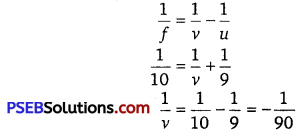
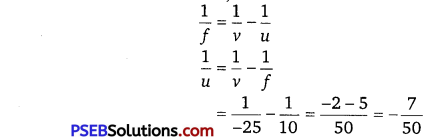
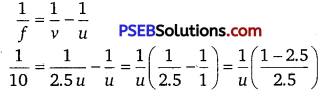
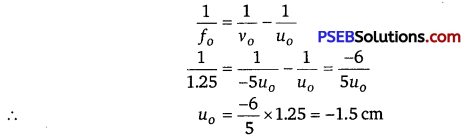
PSEB 12th Class Physics Important Questions Chapter 12 Atoms

Punjab State Board PSEB 12th Class Physics Important Questions Chapter 12 Atoms Important Questions and Answers.

PSEB 12th Class Physics Important Questions Chapter 12 Atoms

Very short answer type questions

Question 1.
Why is the classical (Rutherford) model for an atom of electron orbiting around the nucleus not able to explain the atomic structure?
Answer:
The classical method could not explain the atomic structure as the electron revolving around the nucleus are accelerated and emit energy as the result, the radius of the circular paths goes on decreasing. Ultimately electrons fall into the nucleus, which is not in practice.

Question 2.
Consider two different hydrogen atoms. The electron in each atom is in an excited state. Is it possible for the electrons to have different energies but the same orbital angular momentum according to the Bohr model? (NCERT Exemplar)
Answer:
According to Bohr model electrons having different energies belong to different levels having different values of n. So, their angular momenta will be different, as.
L = \(\frac{n h}{2 \pi} \text { or } L \propto n\)

Question 3.
State Bohr’s quantization condition for defining stationary orbits.
Answer:
According to Bohr’s quantization condition, electrons are permitted to revolve in only those orbits in which the angular momentum of electron is an integral multiple of \(\frac{h}{2 \pi}\) i.e.,
mvr = \(\frac{n h}{2 \pi}\) ,Where n = 1,2,3, ………………
m, y, rare mass, speed, and radius of electron respectively and h being Planck’s constant.

PSEB 12th Class Physics Important Questions Chapter 12 Atoms

Question 4.
Define ionization energy. What Is Its value for a hydrogen atom?
Answer:
Ionisation Energy: The minimum amount of energy required to remove an electron from the ground state of the atom is known as ionization energy.
Ionisation energy for hydrogen atom =E – E1 = – (-13.6 eV) = 13.6 eV

Question 5.
When an electron falls from a higher energy to a lower energy level, the difference in the energies appears in the form of electromagnetic radiation. Why cannot it be emitted as other forms of energy? (NCERT Exemplar)
Answer:
The transition of an electron from a higher energy to a lower energy level can appear in the form of electromagnetic radiation because electrons interact only electromagnetically.

Question 6.
Where is H a -line of the Balmer series in the emission spectrum of hydrogen atom obtained?
Answer:
Hα -line of the Balmer series in the emission spectrum of hydrogen atom is obtained in visible region.

Question 7.
Imagine removing one electron from He4 and He3. Their energy levels, as worked out on the basis of Bohr model will be very close. Explain why. (NCERT Exemplar)
Answer:
This is because both the nuclei are very heavy as compared to electron mass.

Question 8.
The mass of H-atom is less than the sum of the masses of a proton and electron. Why is this so? (NCERT Exemplar)
Answer:
Einstein’s mass-energy equivalence gives E – mc2.
Thus the mass of an H-atom is mp + me – \(\frac{B}{C^{2}}\)
where B ≈ 13.6 eV is the binding energy. It is less than the sum of masses of a proton and an electron.

Question 9.
Assume that there is no repulsive force between the electrons in an atom but the force between positive and negative charges is given by Coulomb’s law as usual. Under such circumstances, calculate the ground state energy of a He-atom. (NCERT Exemplar)
Answer:
For a He-nucleus with charge 2 e and electrons of charge -e, the energy level in ground state is -En = Z2\(\frac{-13.6 \mathrm{eV}}{n^{2}}=2^{2} \frac{-13.6 \mathrm{eV}}{1^{2}}\)= -54.4eV
Thus, the ground state will have two electrons each of energy E and the total ground state energy would be -(4 x 13.6) eV = -54.4 eV.

Question 10.
Would the Bohr formula for the H-atom remain unchanged if proton had a charge (+ 4/3)e and electron a charge (-3/4)e, where e = 1.6 x 10⁻¹⁹ C ? Give reasons for your answer. (NCERT Exemplar)
Answer:
Yes, since the Bohr formula involves only the product of the charges.

Short answer type questions

Question 1.
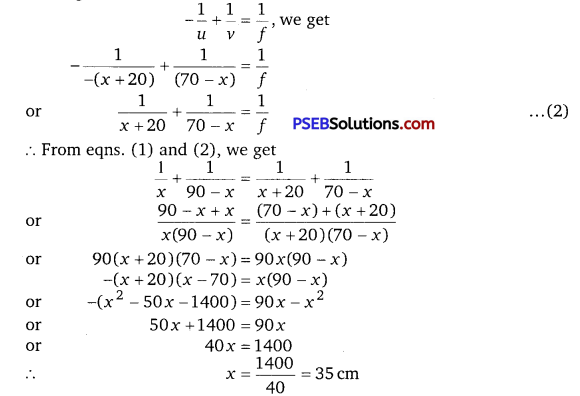
In an experiment of α-particle scattering by a thin foil of gold, draw a plot showing the number of particles scattered versus the scattering angle θ. Why is it that a very small fraction of the particles are scattered at θ > 90°?
PSEB 12th Class Physics Important Questions Chapter 12 Atoms 1
Answer:
A small fraction of the alpha particles scattered at angle θ > 90° is due to the reason. That if impact parameter ‘b’ reduces to zero, coulomb force increases, hence alpha particles are scattered at angle θ>9O°, and only one alpha particle is scattered at angle 180°.

Question 2.
(i) State Bohr postulate of hydrogen atom that gives the relationship for the frequency of emitted photon in a transition,
(ii) An electron jumps from fourth to first orbit in an atom. How many maximum number of spectral lines can be emitted by the atom? To which series these lines correspond?
Answer:
(i) Bohr’s Third Postulate: It states that an electron might make a transition from one of its specified non-radiating orbits to another of lower energy. When it does so, a photon is emitted having energy equal to the energy difference between the initial and final states. The frequency of the emitted photon is given by
hv = Ei – Ef
Where Ei and Ef are the energies of the initial and final states and Ei > Ef.
(ii) Electron jumps from fourth to first orbit in an atom
PSEB 12th Class Physics Important Questions Chapter 12 Atoms 2
∴ Maximum number of spectral lines can be
4c2 = \(\frac{4 !}{2 ! 2 !}=\frac{4 \times 3}{2}\) = 6
The line responds to Lyman series (e jumps to 1st orbit), Balmer series (e jumps to 2nd orbit), Paschen series (e jumps to 3rd orbit).

PSEB 12th Class Physics Important Questions Chapter 12 Atoms

Question 3.
Using de Broglie’s hypothesis, explain with the help of a suitable diagram, Bohr’s second postulate of quantization of energy levels in a hydrogen atom.
Answer:
According to de Broglie’s hypothesis.
λ = \(\frac{h}{m v}\) ……………………….. (i)
According to de Broglie’s condition of stationary orbits, the stationary orbits are those which contain complete de Broglie wavelength.
2πr = nλ ………………………….. (2)

Substituting value of λ from eq. (2) in eq. (1), we get
2πr = n \(\frac{h}{m v}\)
⇒ mvr = n \(\frac{h}{2 \pi}\) ………………………… (3)
This is Bohr’s postulate of quantisation of energy levels.
PSEB 12th Class Physics Important Questions Chapter 12 Atoms 3

Question 4.
In the study of Geiger-Marsden experiment on scattering of α-particles by a thin foil of gold, draw the trajectory of a-particles in the coulomb field of target nucleus. Explain briefly how one gets the information on the size of the nucleus from this study. From the relation R = R0 A1/3, where, R0 is constant and A is the mass number of the nucleus, show that nuclear matter density is independent of A.
Answer:
PSEB 12th Class Physics Important Questions Chapter 12 Atoms 4
From this experiment, the following is observed :
1. Most of the α-particles pass straight through the gold foil. It means that they do not suffer any collision with gold atoms.
2. About one α-particle in every 8000 α-particles deflects by more than 90°. As most of the a-particles gounder flected and only a- few get deflected, this shows that most of the space in an atom is empty and at the center of the atom, there exists a nucleus.

By the number of a-particles get deflected, the information regarding size of the nucleus can be known.
If m is the average mass of the nucleus and R is the nuclear radius, then mass of nucleus = mA, where A is the mass number of the element. Volume of the nucleus,
PSEB 12th Class Physics Important Questions Chapter 12 Atoms 5
This shows that the nuclear density is independent of A.

Question 5.
Show that the first few frequencies of light that is emitted when electrons fall to nth level from levels higher than n, are approximate harmonics (L e., in the ratio 1: 2: 3,…) when n>> 1. (NCERTExempiar)
Answer:
The frequency of any line in a series in the spectrum of hydrogen-like atoms corresponding to the transition of electrons from (n + p) level to nth level can be expressed as a difference of two terms:
Vmn = \(c R Z^{2}\left[\frac{1}{(n+p)^{2}}-\frac{1}{n^{2}}\right] \)
where, m=n+p,(p=1,2,3,…………………………..)
and R is Rydberg constant.
For p << n

Vmn = \(c R Z^{2}\left[\frac{1}{n^{2}}\left(1+\frac{p}{n}\right)^{-2}-\frac{1}{n^{2}}\right]\)
PSEB 12th Class Physics Important Questions Chapter 12 Atoms 6
Thus, the first few frequencies of light that is emitted when electrons fall to the nth level from levels higher than n, are approximate harmonic (i. e., in the ratio 1:2:3,…) when n>>1.

PSEB 12th Class Physics Important Questions Chapter 12 Atoms

Long answer type questions

Question 1.
Using the postulates of Bohr’s model of hydrogen atom, obtain an expression for the frequency of radiation emitted when atom make a transition from the higher energy state with quantum number n1 to the lower energy state with quantum number nf (nf < ni).
Or
Using Bohr’s postulates, obtain the expression for the total energy of the electron in the stationary states of the hydrogen atom. Hence draw the energy level diagram showing how the line spectra corresponding to Balmer series occur due to transition between energy levels.
Or
Using Rutherford model of the atom, derive the expression for the total energy of the electron in hydrogen atom. What is the significance of total negative energy possessed by the electron?
Answer:
Suppose m be the mass of an electron and v be its speed in nth orbit of radius r. The centripetal force for revolution is produced by electrostatic attraction between electron and nucleus.
\(\frac{m v^{2}}{r}=\frac{1}{4 \pi \varepsilon_{0}} \frac{(Z e)(e)}{r^{2}}\) …………………… (1) [Form rutherford Model]
or mv2 = \(\frac{1}{4 \pi \varepsilon_{0}} \frac{Z e^{2}}{r}\)
So, Kinetic energy Ek = \(\frac{1}{2} m v^{2}\)
Ek = \(\frac{1}{4 \pi \varepsilon_{0}} \frac{Z e^{2}}{2 r}\)
Potential energy (PE) = \(\frac{1}{4 \pi \varepsilon_{0}} \frac{(Z e)(-e)}{r}=-\frac{1}{4 \pi \varepsilon_{0}} \frac{Z e^{2}}{r}\)
Total energy E = \(E_{K}+P E=\frac{1}{4 \pi \varepsilon_{0}} \frac{Z e^{2}}{2 r}+\left(-\frac{1}{4 \pi \varepsilon_{0}} \frac{Z e^{2}}{r}\right)\)
= \(-\frac{1}{4 \pi \varepsilon_{0}} \frac{Z e^{2}}{2 r}\)

For nth orbit, E can be written as En
so,En = \(-\frac{1}{4 \pi \varepsilon_{0}} \frac{Z e^{2}}{2 r_{n}}\) …………………. (2)
Negative sign indicates that the electron remains bound with the nucleus (or electron-nucleus form an attractive system) From Bohr’s postulate for quantisation of angular momentum.
mvr = \(\frac{n h}{2 \pi}\)
⇒ v = \(\frac{n h}{2 \pi m r} \)
Substituting this value of v in equation (1), we get
PSEB 12th Class Physics Important Questions Chapter 12 Atoms 7

For Bohr’s radius, n = 1
Substituting value of rn in equation (2), we get
En = \(\frac{1}{4 \pi \varepsilon_{0}} \frac{Z e^{2}}{2\left(\frac{\varepsilon_{0} h^{2} n^{2}}{\pi m Z e^{2}}\right)}=-\frac{m Z^{2} e^{4}}{8 \varepsilon_{0} h^{2} n^{2}}\)
R is called Rydberg constant.

PSEB 12th Class Physics Important Questions Chapter 12 Atoms

For hydrogen atom Z =1, En = \(\frac{-R c h}{n^{2}}\)
If ni and nf are the quantum numbers of initial and final states and Ei and
Ef are energies of electrons in H-atoms in initial and final state, we have
PSEB 12th Class Physics Important Questions Chapter 12 Atoms 8
For Balmer series, nf=2, while ni =3, 4, 5, …… ∞.

PSEB 12th Class Physics Solutions Chapter 12 Atoms

Punjab State Board PSEB 12th Class Physics Book Solutions Chapter 12 Atoms Textbook Exercise Questions and Answers.

PSEB Solutions for Class 12 Physics Chapter 12 Atoms

PSEB 12th Class Physics Guide Atoms Textbook Questions and Answers

Question 1.
Choose the correct alternative from the clues given at the end of the each statement:
(a) The size of the atom in Thomson’s model is ………………….. the atomic size in Rutherford’s model, (much greater than/no different from/much less than.)
(b) In the ground state of ………………………………… electrons are in stable equilibrium, while in …………………….. electrons always experience a net force. (Thomson’s model/Rutherford’s model.)
(c) A classical atom based on ……………………………. is doomed to collapse. (Thomson’s model/Rutherford’s model.)
(d) An atom has a nearly continuous mass distribution in a ………………………… but has a highly non-uniform mass distribution in …………………….. (Thomson’s model/Rutherford’s model.)
(e) The positively charged part of the atom possesses most of ………………………. the mass in ………………….. (Rutherford’s model/both the models.)
Answer:
(a) The size of the atom in Thomson’s model is no different from the atomic size in Rutherford’s model.
(b) In the ground state of Thomson’s model, electrons are in stable equilibrium while, in Rutherford’s model, electrons always experience a net force.
(c) A classical atom based on Rutherford’s model is doomed to collapse.
(d) An atom has a nearly continuous mass distribution in Thomson’s model but has a highly non-uniform mass distribution in Rutherford’s model.
(e) The positively charged part of the atom possesses most of the mass in both the models.

Question 2.
Suppose you are given a chance to repeat the alpha-particle scattering experiment using a thin sheet of solid hydrogen in place of the gold foil. (Hydrogen is a solid at temperatures below 14 K.) What results do you expect?
Answer:
The basic purpose of scattering experiment is not completed because solid hydrogen will be a much lighter target as compared to the alpha particle acting as a projectile. By using the conditions of elastic collisions, the hydrogen will move much faster as compared to alpha after the collision. We cannot determine the size of hydrogen nucleus.

PSEB 12th Class Physics Solutions Chapter 12 Atoms

Question 3.
What is the shortest wavelength present in the Paschen series of spectral lines?
Answer:
Rydberg’s formula is given as
\(\frac{h c}{\lambda}\) = \(21.76 \times 10^{-19}\left[\frac{1}{n_{1}^{2}}-\frac{1}{n_{2}^{2}}\right]\)
where, h = Planck’s constant = 6.63 x 10⁻³⁴ Js
c=Speed oflight=3 x 10⁸ m/s (n1 and n2 are integers)
The shortest wavelength present in the Paschen series of the spectral lines
is given for values n1 = 3 and n2 = ∞
PSEB 12th Class Physics Solutions Chapter 12 Atoms 1
= 822.65 nm

Question 4.
A difference of 2.3 eV separates two energy levels in an atom. What is the frequency of radiation emitted when the atom makes a transition from the upper level to the lower level?
Answer:
According to Bohr’s postulate
E2 – E1 = hv
∴ Frequency of emitted radiation
PSEB 12th Class Physics Solutions Chapter 12 Atoms 2

Question 5.
The ground state energy of hydrogen atom is -13.6 eV. What are the kinetic and potential energies of the electron in this state?
Answer:
Given, the ground state energy of hydrogen atom
E=-13.6eV
We know that,
Kinetic Energy, EK = -E = 13.6 eV
Potential Energy Ep = -2KE =-2 x 13.6 = -27.2eV

Question 6.
A hydrogen atom initially In the ground level absorbs a photon, which excites it to the n = 4 level. Determine the wavelength and frequency of photons.
Answer:
The energy levels of H-atom are given by
En = \(-\frac{R h c}{n^{2}}\)
For given transition n1 =1, n2 = 4
∴ E1 = \(-\frac{R h c}{1^{2}}\) ,E2= \(-\frac{R h c}{4^{2}}\)
∴ Energy of absorbed photon
ΔE=E2 -E1 =Rhc \(\left(\frac{1}{1^{2}}-\frac{1}{4^{2}}\right)\)
or
ΔE = \(\frac{15}{16}\) Rhc ………………………….. (1)
∴ The wavelength of absorbed photon λ is given by
PSEB 12th Class Physics Solutions Chapter 12 Atoms 3

Question 7.
(a) Using the Bohr’s model, calculate the speed of the electron in a hydrogen atom in the n =1, 2, and 3 levels.
(b) Calculate the orbital period in each of these levels.
Answer:
(a) Let y1 be the orbital speed of the electron in a hydrogen atom in the ground state level, n1 =1.
For charge (e) of an electron, v1 is given by the relation,
v1 = \(\frac{e^{2}}{n_{1} 4 \pi \varepsilon_{0}\left(\frac{h}{2 \pi}\right)}=\frac{e^{2}}{2 \varepsilon_{0} h} \)
where, e=1.6 x 10⁻¹⁹ C
\(\varepsilon_{0}\) = Permittivity of free space = 8.85 x 10⁻¹² N-1 C2m2
h = Planck’s constant = 6.63 x 10⁻³⁴ Js
∴ v1 = \(\frac{\left(1.6 \times 10^{-19}\right)^{2}}{2 \times 8.85 \times 10^{-12} \times 6.63 \times 10^{-34}}\)
= 0.0218 x 108 =2.18 x 10⁶ m/s

For level n2 =2, we can write the relation for the corresponding orbital speed as
v2 = \(\frac{e^{2}}{n_{2} 2 \varepsilon_{0} h}\) = \(\frac{\left(1.6 \times 10^{-19}\right)^{2}}{2 \times 2 \times 8.85 \times 10^{-12} \times 6.63 \times 10^{-34}}\) = 1.09 x 10⁶ m/s
And, for n3 =3, we can write the relation for the corresponding orbital speed as
PSEB 12th Class Physics Solutions Chapter 12 Atoms 4
PSEB 12th Class Physics Solutions Chapter 12 Atoms 5
Hence, the speed of the electron in a hydrogen atom in n = 1, n = 2 and n = 3 is 2.18 x 10⁶ m/s,
1.09 x 10⁶ m/s, 7.27 x 10⁵ m/s respectively.

(b) Orbital period of electron is given by
T = \(\frac{2 \pi r}{v}\)
Radius of nth orbit
rn = \(\frac{n^{2} h^{2}}{4 \pi^{2} K m e^{2}}\)
∴ r1 = \(\frac{(1)^{2} \times\left(6.63 \times 10^{-34}\right)^{2}}{4 \times 9.87 \times\left(9 \times 10^{9}\right) \times 9 \times 10^{-31} \times\left(1.6 \times 10^{-19}\right)}\)
= 0.53 x 10⁻¹⁰ m
For n=1, T1 = \(\frac{2 \pi r_{1}}{v_{1}}\)
= \(\frac{2 \times 3.14 \times 0.53 \times 10^{-10}}{2.19 \times 10^{6}}\) = 1.52 x 10⁻¹⁶s

For n = 2, radius rn = n2r1
∴ r2 =’22.r1 =4 x0.53 x 10-10
and velocity vn, = \(\frac{v_{1}}{n}\)
∴ v2 = \(\frac{v_{1}}{2}=\frac{2.19 \times 10^{6}}{2}\)
Time period T2 = \(\frac{2 \times 3.14 \times 4 \times 0.53 \times 10^{-10} \times 2}{2.19 \times 10^{6}}\)
=1216 x 10-15 s
For n=3,radius r3 =32,r1 =9r1 =9 x 0.53 x 10-10m and velocity v3 = \(\frac{v_{1}}{3}=\frac{2.19 \times 10^{6}}{3}\) m/s
Time period T3 = \(\frac{2 \pi r_{3}}{v_{3}}=\frac{2 \times 3.14 \times 9 \times 0.53 \times 10^{-10} \times 3}{2.19 \times 10^{6}}\) = 4.1 x 10⁻¹⁵ s

PSEB 12th Class Physics Solutions Chapter 12 Atoms

Question 8.
The radius of the innermost electron orbit of a hydrogen atom is 5.3 x 10⁻¹¹ m. What are the radii of the n = 2 and n = 3 orbits?
Answer:
The radius of the innermost electron orbit of a hydrogen atom, r1 = 5.3 x 10⁻¹¹ m.
Let r2 be the radius of the orbit at n = 2.
It is related to the radius of the innermost orbit as r2 = (n)2r1 = (2)2 x 5.3 x 10-11
= 4 x 5.3 x 10-11 = 2.12 x 10⁻¹⁰m
For n = 3, we can write the corresponding electron radius as
r3 =(n)2r1 = (3)2 x 5.3 x 10-11
n = 9 x 5.3 x 10-11 = 4.77 x 10⁻¹⁰m
Hence, the radii of an electron for n = 2 and n = 3 orbits are 2.12 x 10⁻¹⁰ m and 4.77 x 10⁻¹⁰ m respectively.

Question 9.
A 12.5 eV electron beam is used to bombard gaseous hydrogen at room temperature. What series of wavelengths will be emitted?
Answer:
It is given that the energy of the electron beam used to bombard gaseous hydrogen at room temperature is 12.5 eV. Also, the energy of the gaseous hydrogen in its ground state at room temperature is -13.6 eV. When gaseous hydrogen is bombarded with an electron beam, the energy of the gaseous hydrogen becomes -13.6 + 12.5 eV i. e., -1.1 eV.

Orbital energy is related to orbit level (n) as
E = \(\frac{-13.6}{(n)^{2}}\)eV
For n=3, E = \(\frac{-13.6}{(3)^{2}}=\frac{-13.6}{9}\) = -1.5 eV
This energy is approximately equal to the energy of gaseous hydrogen. it can be concluded that the electron has jumped from n I to n = 3 level.

During its de-excitation, the electrons can jump from n = 3 to n = 1 directly, which forms a line of the Lyman series of the hydrogen spectrum.
We have the relation for wave number for Lyman series as
\(\frac{1}{\lambda}=R_{y}\left(\frac{1}{1^{2}}-\frac{1}{n^{2}}\right)\)
where, Ry =Rydberg constant = 1.097 x 10⁷ m-1,
λ = Wavelength of radiation emitted by the transition of the electron for
n =3,
We can obtain λ as
\(\frac{1}{\lambda}\) = 1.097 x 10⁷\(\left(\frac{1}{1^{2}}-\frac{1}{3^{2}}\right)\)
= 1.097 x 10⁷ \(\left(1-\frac{1}{9}\right)\) = 1.097 x 10⁷x \(\frac{8}{9}\)

λ = \(\frac{9}{8 \times 1.097 \times 10^{7}}\) = 102.55nm
If the electron jumps from n = 2 to n = 1, then the wavelength of the radiation is given as
\(\frac{1}{\lambda}\) = 1.097 x 10⁷ \(\left(\frac{1}{1^{2}}-\frac{1}{2^{2}}\right)\)
= 1.097 x 10⁷\(\left(1-\frac{1}{4}\right)\) = 1.097 x 10⁷x \(\frac{3}{4}\)
λ = \(\frac{4}{1.097 \times 10^{7} \times 3}\) = 121.54 nm

If the transition takes place from n = 3 to n = 2, then the wavelength of the radiation is given as
PSEB 12th Class Physics Solutions Chapter 12 Atoms 6
This radiation corresponds to the Balmer series of the hydrogen spectrum. Hence, in Lyman series, two wavelengths i. e., 102.54 nm, and 121.55 nm are emitted. And in the Balmer series, one wavelength i. e., 656.33 nm is emitted.

Question 10.
In accordance with the Bohr’s model, find the quantum number that characterizes the earth’s revolution around the sun in an orbit of radius 1.5 x 10¹¹ m with orbital speed 3 x 10⁴ m/s. (Mass of earth = 6.0 x 1024 kg.)
Answer:
Radius of the orbit of the Earth around the Sun, r = 1.5 x 10¹¹ m
Orbital speed of the Earth, v = 3 x 10⁴ m/s
Mass of the Earth, m = 6.0 x 1024 kg
According to Bohr’s model, angular momentum is quantized and given as
mvr = \(\frac{n h}{2 \pi}\)

where, h = Planck’s constant = 6.63 x 10⁻³⁴ Js
n = Quantum number
∴ n = \(\frac{m v r 2 \pi}{h}\)
= \(\frac{2 \pi \times 6 \times 10^{24} \times 3 \times 10^{4} \times 1.5 \times 10^{11}}{6.63 \times 10^{-34}} \) = 25.61 x 1073 = 2.6 x 1074
Hence, the quanta number that characterizes the Earth’s revolution is 2.6 x 1074.

PSEB 12th Class Physics Solutions Chapter 12 Atoms

Additional Exercises

Question 11.
Answer the following questions, which help you to understand the difference between Thomson’s model and Rutherford’s model better.
(a) Is the average angle of deflection of α-particles by a thin gold foil predicted by Thomson’s model much less, about the same, or much greater than that predicted by Rutherford’s model?

(b) Is the probability of backward scattering (i. e., scattering of α-particles at angles greater than 90°) predicted by Thomson’s model much less, about the same, or much greater than that predicted by Rutherford’s model?

(c) Keeping other factors fixed, it is found experimentally that for small thickness t, the number of α-particles scattered at moderate angles is proportional to t. What clue does this linear dependence on t provide?

(d) In which model is it completely wrong to ignore multiple scattering for the calculation of average angle of scattering of α-particles by. a thin foil?
Answer:
(a) The average angle of deflection of α-particles by a thin gold foil predicted by Thomson’s model is about the same size as predicted by Rutherford’s model. This is because the average angle was taken in both models.

(b) The probability of scattering of α-particles at angles greater than 90° predicted by Thomson’s model is much less than that predicted by Rutherford’s model. This is because there is no such massive central core called the nucleus in Rutherford’s model.

(c) Scattering is mainly due to single collisions. The chances of a single collision increase linearly with the number of target atoms. Since the number of target atoms increases with an increase in thickness, the collision probability depends linearly on the thickness of the target.

(d) It is wrong to ignore multiple scattering in Thomson’s model for the calculation of average angle of scattering of α-particles by a thin foil. This is because a single collision causes very little deflection in this model. Hence, the observed average scattering angle can be explained only by considering multiple scattering.

Question 12.
The gravitational attraction between electron and proton in a hydrogen atom is weaker than the Coulomb attraction by a factor of about 10-40. An alternative way of looking at this fact is to estimate the radius of the first Bohr orbit of a hydrogen atom if the electron and proton were bound by gravitational attraction. You will find the answer interesting.
Answer:
Radius of the first Bohr orbit is given by the relation,
r1 = \(\frac{4 \pi \varepsilon_{0}\left(\frac{h}{2 \pi}\right)^{2}}{m_{e} e^{2}}\) ……………….. (i)
where, ε0 = Permittivity of free space
h = Planck’s constant = 6.63 x 10⁻³⁴ Js
me = Mass of an electron = 9.1 x 10⁻³¹ kg
e = Charge of an electron = 1.9x 10⁻¹⁹C
mp = Mass of a proton = 1.67 x 10⁻²⁷ kg
r = Distance between the electron and the proton Coulomb attraction between an electron and a proton is given as
FC = \(\frac{e^{2}}{4 \pi \varepsilon_{0} r^{2}} \) ………………………….. (2)

Gravitational force of attraction between an electron and a proton is
FG = \(\frac{G m_{p} m_{e}}{r^{2}}\) ……………………………………. (3)
where, G = Gravitational constant = 6.67 x 10⁻¹¹ N m2/kg2
If the electrostatic (Coulomb) force and the gravitational force between an electron and a proton are equal, then we can write
∴ FG = FC
\(\frac{G m_{p} m_{e}}{r^{2}}\) = \(\frac{e^{2}}{4 \pi \varepsilon_{0} r^{2}}\)
\(\frac{e^{2}}{4 \pi \varepsilon_{0} r^{2}}\) = Gmpme …………………………. (4)
Putting the value of equation (4) in equation (1), we get
PSEB 12th Class Physics Solutions Chapter 12 Atoms 7

Question 13.
Obtain an expression for the frequency of radiation emitted when a hydrogen atom de-excites from level n to level (n -1). For large n, show that this frequency equals the classical frequency of revolution of the electron in the orbit.
Answer:
It is given that a hydrogen atom de-excites from an upper level (n) to a lower level (n —1). We have the relation for energy (E1) of radiation at level n as
E1 = hv1 = \(\frac{h m e^{4}}{(4 \pi)^{3} \varepsilon_{0}^{2}\left(\frac{h}{2 \pi}\right)^{3}} \times\left(\frac{1}{n^{2}}\right)\)
where, v1 = Frequency of radiation at level n
h = Planck’s constant
m = Mass of hydrogen atom
e = Charge on an electron
εo = Permittivity of free space

Now, the relation for energy (E2) of radiation at level (n -1) is given as
E2 = hv2 = \(\frac{h m e^{4}}{(4 \pi)^{3} \varepsilon_{0}^{2}\left(\frac{h}{2 \pi}\right)^{3}} \times \frac{1}{(n-1)^{2}}\) ………………………… (2)
where, v2 = Frequency of radiation at level (n -1)
Energy (E) released as a result of de-excitation
E = E2 – E1 hv= E2 – E 1 ………………….. (3)
where, v = Frequency of radiation emitted
Putting values from equations (1) and (2) in equation (3), we get
PSEB 12th Class Physics Solutions Chapter 12 Atoms 8
For large n, we can write (2 n -1) ≈ 2 n and (n-1) ≈ n.
V = \(\frac{m e^{4}}{32 \pi^{3} \varepsilon_{0}^{2}\left(\frac{h}{2 \pi}\right)^{3} n^{3}} \)
∵ v = \(\frac{m e^{4}}{32 \pi^{3} \varepsilon_{0}^{2}\left(\frac{h}{2 \pi}\right)^{3} n^{3}}\) ………………….. (4)
Classical relation of frequency of revolution of an electron is given as
Vc = \(\frac{v}{2 \pi r}\) ……………………………….. (5)
where, velocity of the electron in the nth orbit is given as
v = \(\frac{e^{2}}{4 \pi \varepsilon_{0}\left(\frac{h}{2 \pi}\right) n}\) ……………………………… (5)
And, radius of the nth orbit is given as
v = \(\frac{e^{2}}{4 \pi \varepsilon_{0}\left(\frac{h}{2 \pi}\right) n}\) ………………………………(6)
Putting the values of equations (6) and (7) in equation (5), we get
Vc = \( \frac{m e^{4}}{32 \pi^{3} \varepsilon_{0}^{2}\left(\frac{h}{2 \pi}\right)^{3} n^{3}}\)
Hence, the frequency of radiation emitted by the hydrogen atom is equal to its classical orbital frequency.

Question 14.
Classically, an electron can be in any orbit around the nucleus of an atom. Then what determines the typical atomic size? Why is an atom not, say, a thousand times bigger than its typical size? The question had greatly puzzled Bohr before he arrived at his famous model of the atom that you have learnt in the text.

To simulate what he might well have done before his discovery, let us play as follows with the basic constants of nature and see if we can get a quantity with the dimensions of length that is roughly equal to the known size of an atom (~10-10 m).

(a) Construct a quantity with the dimensions of length from the fundamental constants e, me and c. Determine its numerical value.

(b) You will find that the length obtained in (a) is many orders of magnitude smaller than the atomic dimensions. Further, it involves c. But energies of atoms are mostly in non-relativistic domain where c is not expected to play any role. This is what may have suggested Bohr to discard c and look for ‘something else’ to get the right atomic size. Now, the Planck’s constant h had already made its appearance elsewhere. Bohr’s great insight lay in recognizing that h, me, and e will yield the right atomic size.

Construct a quantity with the dimension of length from h, me, and e and confirm that its numerical value has indeed the correct order of magnitude.
Answer:
(a) Charge on an electron, e = 1.6 x 10⁻¹⁹ C
Mass of an electron, me = 9.1 x 10⁻³¹ kg
Speed of light, c = 3 x 10⁸ m/s
Let us take a quantity involving the given quantities as \(\left(\frac{e^{2}}{4 \pi \varepsilon_{0} m_{e} c^{2}}\right)\)
where, ε0 = Permittivity of free space and, \(\frac{1}{4 \pi \varepsilon_{0}}\) = 9 x 10⁹ Nm2C-2 .
The numerical value of the taken quantity will be
PSEB 12th Class Physics Solutions Chapter 12 Atoms 9
Hence, the numerical value of the taken quantity is much smaller than the typical size of an atom.

(b) Charge on an electron, e = 1.6 x 10⁻¹⁹ C
Mass of an electron, me = 9.1 x 10⁻³¹ kg
Planck’s constant, h = 6.63 x 10⁻³⁴ Js
Let us take a quantity involving the given quantities as \(\frac{4 \pi \varepsilon_{0}\left(\frac{h}{2 \pi}\right)^{2}}{m_{e} e^{2}}\)
where, ε0 = Permittivity of free space
and, \(\frac{1}{4 \pi \varepsilon_{0}}\) = 9 x 10⁹Nm2C-2

The numerical value of the taken quantity will be
\(\frac{1}{4 \pi \varepsilon_{0}} \times \frac{\left(\frac{h}{2 \pi}\right)^{2}}{m_{e} e^{2}}=9 \times 10^{9} \times \frac{\left(\frac{6.63 \times 10^{-34}}{2 \times 3.14}\right)^{2}}{9.1 \times 10^{-31} \times\left(1.6 \times 10^{-19}\right)^{2}} \)
= 0.53 x 10⁻¹⁰ m
Hence, the value of the quantity taken is of the order of the atomic size.

PSEB 12th Class Physics Solutions Chapter 12 Atoms

Question 15.
The total energy of an electron in the first excited state of the hydrogen atom is about -3.4 eV.
(a) What is the kinetic energy of the electron in this state?
(b) What is the potential energy of the electron in this state?
(c) Which of the answers above would change if the choice of the zero of potential energy is changed?
Answer:
(a) Total energy of the electron, E = -3.4 eV ’
Kinetic energy of the electron is equal to the negative of the total energy.
⇒ K = -E
= -(-3.4) = + 3.4 eV
Hence, the kinetic energy of the electron in the given state is + 3.4 eV.

(b) Potential energy (JJ) of the electron is equal to the negative of twice of its kinetic energy.
⇒ U = -2 K
= -2 x 3.4 = -6.8 eV
Hence, the potential energy of the electron in the given state is -6.8 eV.

(c) The potential energy of a system depends on the reference point taken. Here, the potential energy of the reference point is taken as zero. If the reference point is changed, then the value of the potential energy of the system also changes. Since total energy is the sum of kinetic and potential energies, total energy of the system will also change.

Question 16.
If Bohr’s quantization postulate (angular momentum = nh/2π) is a basic law of nature, it should be equally valid for the case of planetary motion also. Why then do we never speak of quantization of orbits of planets around the sun?
Answer:
We never speak of quantization of orbits of planets around the Sun because the angular momentum associated with planetary motion is largely relative to the value of Planck’s constant (h).
The angular momentum of the Earth in its orbit is of the order of 1070h. This leads to a very high value of quantum levels n of the order of 1070.
For large values of n, successive energies and angular momenta are relatively very small. Hence, the quantum levels for planetary motion are considered continuous.

Question 17.
Obtain the first Bohr’s radius and the ground state energy of a muonic hydrogen atom an atom in which a negatively
charged muon (μ ) of mass about 207 me orbits around a proton.
Answer:
Muonic hydrogen is the atom in which a negatively charged muon of mass about 207 me revolves around a proton.
In Bohr’s atom model, r ∝ \(\frac{1}{m}\)
∵ \(\frac{r_{\text {muon }}}{r_{\text {electron }}}=\frac{m_{e}}{m_{\mu}}=\frac{m_{e}}{207 m_{e}}=\frac{1}{207}\) [ ∵mμ = 207 me]
Here, re is radius of orbit of electron in hydrogen atom is 0.53 Å.

PSEB 12th Class Physics Important Questions Chapter 3 Current Electricity

Punjab State Board PSEB 12th Class Physics Important Questions Chapter 3 Current Electricity Important Questions and Answers.

PSEB 12th Class Physics Important Questions Chapter 3 Current Electricity

Very short answer type questions

Question 1.
Two identical cells, each of emf E, having negligible internal resistance, are connected in parallel with each other across an external resistance R. What is the current through this resistance?
Answer:
PSEB 12th Class Physics Important Questions Chapter 3 Current Electricity 1
⇒ I = \(\frac{E_{\text {eq. }}}{R+r_{\text {eq. }}}\)
Given,internal resistance, r = 0
∴ I = \(\frac{E_{\mathrm{eq} .}}{R}\)

Question 2.
Define mobility of a charge carrier. What is its relation with relaxation time?
Answer:
It is defined as how fast electron moves from one place to another.
It is also defined as drift velocity per unit electric field. The SI unit of mobility is m2/V-sec and it is denoted as μ.
μ = \(\frac{\left|v_{d}\right|}{E}=\frac{e E \tau}{m E}=\frac{e \tau}{m}\)
⇒ μ ∝ τ

PSEB 12th Class Physics Important Questions Chapter 3 Current Electricity

Question 3.
Define the term ‘relaxation time’ in a conductor.
Answer:
The average time between successive collisions of electrons conductor is known as relaxation time.

Question 4.
Write the expression for the drift velocity of charge carriers in a conductor of length ‘L’ across which a potential difference ‘V’ is applied.
Answer:
vd = \(\frac{e V}{m L}\)τ

Question 5.
For household electrical wiring, one uses Cu wires or Al wires. What considerations are kept in mind? (NCERT Exemplar)
Answer:
Two considerations are required: (i) cost of metal, and (ii) good conductivity of metal. Cost factor inhibits silver. Cu and Al are the next best conductors.

Question 6.
Define the current sensitivity of a galvanometer. Write its SI unit.
Answer:
Ratio of deflection produced in the galvanometer and the current flowing through it is called current sensitivity.
Current sensitivity Si = \(\frac{\theta}{I}\)
SI unit of current sensitivity Si is division/ampere or radian/ampere.

PSEB 12th Class Physics Important Questions Chapter 3 Current Electricity

Question 7.
Nichrome and Copper wires of same length and same radius are connected in series. Current I is passed through them. Which wire gets heated up more? Justify your answer.
Answer:
Nichrome, since its resistance is high.

Question 8.
Why are alloys used for making standard resistance coils?
(NCERT Exemplar)
Answer:
Alloys have:

  • low value of temperature coefficient and the resistance of the alloy does not vary much with rise in temperature.
  • high resistivity, so even a smaller length of the material is sufficient to design high standard resistance.

Question 9.
What is the advantage of using thick metallic strips to join wires in a potentiometer? (NCERT Exemplar)
Answer:
The metal strips have low resistance and need not be counted in the potentiometer length l of the null point. One measures only their lengths along the straight segments (of length 1 metre each). This is easily done with the help of centimeter rulings or meter ruler and leads to accurate measurements.

Question 10.
Is the motion of a charge across junction momentum conserving? Why or why not? (NCERT Exemplar)
Answer:
When an electron approaches a junction, in addition to the uniform electric field E facing it normally, it keep the drift velocity fixed as drift velocity depend on E by the relation
Vd = \(\frac{e E \tau}{m}\)
This result into accumulation of charges on the surface of wires at the junction. These produce additional field. These fields change the direction of momentum.
Thus, the motion of a charge across junction is not momentum conserving.

PSEB 12th Class Physics Important Questions Chapter 3 Current Electricity

Short answer type questions

Question 1.
Sketch a graph showing the variation of resistivity of carbon with temperature.
Or Plot a graph showing temperature dependence of resistivity for a typical semiconductor. How is this behaviour explained?
Answer:
The resistivity of a typical semiconductor (carbon) decreases with increase of temperature. The graph is shown in figure.
PSEB 12th Class Physics Important Questions Chapter 3 Current Electricity 2
Explanation: In semiconductor the number density of free electrons (n) increases with increase in temperature (T) and consequently the relaxation period decreases. But the effect of increase in n has higher impact than decrease of τ. So, resistivity decreases with increase in temperature.

Question 2.
Two cells of emf ε1 and ε2 having internal resistances r1 and r2 respectively are connected in parallel as shown. Deduce the expressions for the equivalent emf and equivalent internal resistance of a cell which can replace the combination between the points B1 and B2.
PSEB 12th Class Physics Important Questions Chapter 3 Current Electricity 3
Answer:
Consider a parallel combination of the cells. I1 and I2 are the currents leaving the positive electrodes of the cells. At point B1, I1 and I2 flow in whereas current I flows out. Therefore, we have
I = I1 + I2 …………….. (1)
Let V(B1) and V(B2) be the potentials at B1 and B2 respectively.
Then, considering the first cell, the potential difference across its terminals is V(B1) – V(B2). Hence, from equation V = E – Ir we have
V = V(B1) – V(B2) = E1 – I1r1 …………… (2)
Points B1 and B2 are connected exactly Similarly to the second cell. Hence, considering the second cell, we also have
V = V(B1) – V(B2)
= E2 – I2r2 …………… (3)
Combining equations (1), (2) and (3), we have
PSEB 12th Class Physics Important Questions Chapter 3 Current Electricity 4
If we want to replace the combination by a single cell, between Bl and B2, of emf Eeq and internal resistance req, we would have
V = Eeq – Ireq
PSEB 12th Class Physics Important Questions Chapter 3 Current Electricity 5

PSEB 12th Class Physics Important Questions Chapter 3 Current Electricity

Question 3.
State Kirchhoff s rules of current distribution in an electrical network.
Or State KirchhofPs rules. Explain briefly how these rules are justified.
Answer:
Junction Rule: In an electric circuit, the algebraic sum of currents at any junction is zero.
At any junction, the sum of the currents entering the junction is equal to the sum of currents leaving the junction.
ΣI = 0
Justification: This rule is based on the law of conservation of charge.
Loop Rule: The algebraic sum of changes in potential around any closed loop involving resistors and cells in the loop must be zero.
ΣΔV = 0
or The algebraic sum of emf s in any loop of a circuit is equal to the
sum of products of currents and resistances in it.
ΣΔE = ΣIR
Justification: This rule is based on the law of conservation of energy,

Question 4.
Define the term current density of a metallic conductor. Deduce the relation connecting current density (J) and the conductivity σ of the conductor, when an electric field E, is applied to it.
Answer:
Current density at a point in a conductor is defined as the amount of current flowing per unit area of the conductor around that point provided the area is held in a direction normal to the current,
J = \(\frac{I}{A}\)
Current density is a vector quantity. Its direction is the direction of motion of positive charge. The unit of current density is ampere/metre2 or [Am-2].
Relation between J, σ and E
PSEB 12th Class Physics Important Questions Chapter 3 Current Electricity 6

PSEB 12th Class Physics Important Questions Chapter 3 Current Electricity

Question 5.
What is Wheatstone bridge? Deduce the condition for which Wheatstone bridge is balanced.
Or The given figure shows a network of resistances R1, R2, R3 and R4.
PSEB 12th Class Physics Important Questions Chapter 3 Current Electricity 7
Using Kirchhoffs laws, establish the balance condition for the network.
Or Use Kirchhoffs law to obtain the balance Wheatstone’s bridge.
Answer:
PSEB 12th Class Physics Important Questions Chapter 3 Current Electricity 8
The Wheatstone bridge is an arrangement of four resistances. In this bridge, four resistances are connected on four arms of quadrilateral. In one diagonal, a battery and a key are connected. In second diagonal a galvanometer is connected as shown in fig. Consider P,Q,R and S four resistances are connected on the sidesAB,BC, AD and DC of the quadrilateral respectively.

Galvanometer G is connected between points B and D and a battery E is connected between A and C. Now in balance condition, when the deflection in a galvanometer is zero in closed mesh ABDA, then by applying Kirchhoffs law,
I1p – IR = 0
or I1P = I2R ………….. (1)
In closed mesh CBDC,
I1Q = I2S ……………… (2)
Dividing (1) by (2) \(\frac{P}{Q}=\frac{R}{S}[latex]
This is the balanced condition of the Wheatstone bridge.

Question 6.
First a set of n equal resistors of R each are connected in series to a battery of emf E and internal resistance R. A current I is observed to flow. Then the n resistors are connected in parallel to the same battery. It is observed that the current is increased 10 times. What is n ? (NCERT Exemplar)
Answer:
When n resistors are in series, I = [latex]\frac{E}{R+n R}\) ;
When n resistors are in parallel, \(\frac{E}{R+\frac{R}{n}}\) 10I
\(\frac{1+n}{1+\frac{1}{n}}\) = 10 ⇒ \(\frac{1+n}{n+1}\) n = 10
∴ n = 10

PSEB 12th Class Physics Important Questions Chapter 3 Current Electricity

Question 7.
Two cells of same emf E but internal resistance r and r1 and r2 are connected in series to an external resistor R (Fig.). What should be the value of R so that the potential difference across the terminals of the first cell becomes zero. NCERT Exemplar)
Answer:
I = \(\frac{E+E}{R+r_{1}+r_{2}}\)
V1 = E – Ir1 = E – \(\frac{2 E}{r_{1}+r_{2}+R}\) r1 = 0
PSEB 12th Class Physics Important Questions Chapter 3 Current Electricity 9

Long answer type questions

Question 1.
(i) Find the magnitude and direction of current in 1Ω resistor in given circuit.
PSEB 12th Class Physics Important Questions Chapter 3 Current Electricity 10

(ii)Two students X and Y perform an experiment on potentiometer separately using the circuit diagram shown below.
Keeping other things unchanged (a) X increases the value of resistance R, (b) Y decreases the value of resistance S in the set up. How will these changes affect the position of null point in each case and why?
PSEB 12th Class Physics Important Questions Chapter 3 Current Electricity 11
Answer:
(i) For the mesh APQBA
-6 -1 (I2 – I1) + 3I1 = 0
or -I2 + 4I1 = 6 …………… (1)
PSEB 12th Class Physics Important Questions Chapter 3 Current Electricity 12
For the mesh PCDQP
2I2 – 9 + 3I2 + 1(I2 – I1) = 0
or 6I2 – I1 = 9 …………… (2)
Solving eqs. (1) and (2), we get
I = \(\frac{45}{23}\) A
I= \(\frac{42}{23}\) A
∴ Current through the 1Ω resistor = (I2 – I1) = \(\) A

(ii) (a) By increasing resistance R, the current in main circuit decreases, so potential gradient decreases. Hence, a greater length of wire would be needed for balancing the same potential difference. So, the null point would shift towards right (i.e., towards B).
PSEB 12th Class Physics Important Questions Chapter 3 Current Electricity 13
(b) By decreasing resistance S, the terminal potential difference V = \(\frac{E}{1+\frac{r}{S}}\) across cell decreases, so balance is obtained at small length i.e., point will be obtained at smaller length. So, the null point would shift towards left (i.e., towards A).

PSEB 12th Class Physics Important Questions Chapter 3 Current Electricity

Question 2.
A room has AC run for 5 hours a day at a voltage of 220 V. The wiring of the room consists of Cu of 1 mm radius and a length of 10m. Power consumption per day is 10 commercial units. What fraction of it goes in the joule heating in wires? What would happen if the wiring is made of aluminium of the same dimensions? [ρCu = 1.7 × 10⁻⁸Ωm, ρAL = 2.7 × 10⁻⁸Ωm] (NCERT Exemplar)
Answer:
Power consumption in a day i.e., in 5 hours = 10 units
Or power consumption per hour = 2 units
Or power consumption = 2 units = 2 kW = 2000 W
Also, we know that power consumption in resistor,
P = V × I
⇒ 2000 W = 220 V × I
or I = 9 A
Now, the resistance of wire is given by R = ρ \(\frac{l}{A}\)
where, A is cross-sectional area of conductor. Power consumption in first current carrying wire is given by
P = I2 . R
ρ \(\frac{l}{A}\) I2 = 1.7 × 10⁻⁸ × \(\frac{10}{\pi \times 10^{-6}}\) × 81 = 4J/s A
The fractional loss due to the joule heating in first wire
= \(\frac{4}{2000}\) × 100 = 0.2%
Power loss in Al wire = 4\(\frac{\rho_{A l}}{\rho_{C u}}\) = 1.6 × 4 = 6.4 J/s
The fractional loss due to the joule heating in second wire
= \(\frac{6.4}{2000}\) × 100 =0.32%

PSEB 12th Class Physics Solutions Chapter 3 Current Electricity

Punjab State Board PSEB 12th Class Physics Book Solutions Chapter 3 Current Electricity Textbook Exercise Questions and Answers.

PSEB Solutions for Class 12 Physics Chapter 3 Current Electricity

PSEB 12th Class Physics Guide Current Electricity Textbook Questions and Answers

Question 1.
The storage battery of a car has an emf of 12 V. If the internal resistance of the battery is 0.4 Ω, what is the maximum current that can be drawn from the battery?
Answer:
Emf of the battery, E = 12 V
Internal resistance of the battery, r = 0.4 Ω
Maximum current drawn from the battery = I
According to Ohm’s law,
E = Ir
I = \(\frac{12}{0.4}\) = 30
The maximum current drawn from the given battery is 30 A.

Question 2.
A battery of emf 10 V and internal resistance 3 Ω is connected to a resistor. If the current in the circuit is 0.5 A, what is the resistance of the resistor? What is the terminal voltage of the battery when the circuit is closed?
Answer:
Emf of the battery, E = 10 V
Internal resistance of the battery, r = 3 Ω
Current in the circuit, I = 0.5 A
Resistance of the resistor = R
The relation for current using Ohm’s law is,
I = \(\frac{E}{R+r}\)
R + r = \(\frac{E}{I}\)
= \(\frac{10}{0.5}\) = 20Ω
∴ R = 20 – 3 = 17Ω
Terminal voltage of the battery = V
According to Ohm’s law,
V = IR
= 0.5 × 17 = 8.5 V
Therefore, the resistance of the resistor is 17 Ω and the terminal voltage of the battery is 8.5 V.

PSEB 12th Class Physics Solutions Chapter 3 Current Electricity

Question 3.
(a) Three resistors 1Ω, 2 Ω and 3 Ω are combined in series. What is the total resistance of the combination?
(b) If the combination is connected to a battery of emf 12 V and negligible internal resistance, obtain the potential drop across each resistor.
Answer:
(a) r1 = 1Ω, r2 = 2Ω, r3 = 3Ω
RS = ?
RS = r1 + r2 + r3 = 6Ω
PSEB 12th Class Physics Solutions Chapter 3 Current Electricity 1

(b) ∵ V = 12 V
RS = 6Ω
I = ?
∵ V = IRS
⇒ I = \(\) = 2A
Let V1,V2, V3 be the potential drops across r1 r2, r3. Then,
> V = V1 + V2 + V3
V1 = =Ir1 = 2 × 1 = 2V
V2 =Ir2 = 2 × 2 = 4 V
V3 = Ir3 = 2 × 3 = 6V

Question 4.
(a) Three resistors 2 Ω, 4 Ω and 5 Ω are combined in parallel. What is the total resistance of the combination?
(b) If the combination is connected to a battery of emf 20 V and negligible internal resistance, determine the current through each resistor and the total current drawn from the battery.
Answer:
(a) r1 = 2Ω,r2 = 4Ω,r3 = 5Ω
PSEB 12th Class Physics Solutions Chapter 3 Current Electricity 2
PSEB 12th Class Physics Solutions Chapter 3 Current Electricity 3

Question 5.
At room temperature (27.0°C) the resistance of a heating element is 100 Ω. What is the temperature of the element if the resistance is found to be 117 Ω, given that the temperature coefficient of the material of the resistor is 1.70 × 10⁻⁴ C-1.
Answer:
Room temperature, T = 27°C
Resistance of the heating element at T, R = 100 Ω
Let Ti is the increased temperature of the element.
Resistance of the heating element at T1,R1 = 117 Ω
Temperature co-efficient of the material of the element,
α = 1.70 × 10⁻⁴°C-1
α is given by the relation,
α = \(\frac{R_{1}-R}{R\left(T_{1}-T\right)}\)
T1 – T = \(\frac{R_{1}-R}{R \alpha}\)
T1 – 27 = \(\frac{117-100}{100\left(1.7 \times 10^{-4}\right)}\)
T1 – 27 = 1000
T1 = 1000 + 27
T1 = 1027°C
Therefore, at 1027°C the resistance of the element is 117 Ω.

Question 6.
A negligibly small current is passed through a wire of length 15 m and uniform cross-section 6.0 × 10⁻⁷ m2, and its resistance is measured to be 5.0 Ω. What is the resistivity of the material at the temperature of the experiment?
Answer:
Length of the wire, l = 15 m
Area of cross-section of the wire, A = 6.0 × 10⁻⁷ m2
Resistance of the material of the wire, R = 5.0 Ω
Resistivity of the material of the wire = ρ
Resistance is related with the resistivity as
R = ρ\(\frac{l}{A}\)
ρ = \(\frac{R A}{l}\)
= \(\frac{5 \times 6 \times 10^{-7}}{15}\) = 2 × 10⁻⁷Ωm
Therefore, the resistivity of the material is 2 × 10⁻⁷ Ωm.

Question 7.
A silver wire has a resistance of 2.1 Ω at 27.5°C, and a resistance of 2.7Ω at 100°C. Determine the temperature coefficient of resistivity of silver.
Answer:
Temperature, T1 = 27.5°C
Resistance of the silver wire at T1, R1 = 2.1 Ω
Temperature, T2 = 100 °C
Resistance of the silver wire at T2, R2 = 2.7 Ω
Temperature coefficient of resistivity of silver = a It is related with temperature and resistance as
α = \(\frac{R_{2}-R_{1}}{R_{1}\left(T_{2}-T_{1}\right)}\)
= \(\frac{2.7-2.1}{2.1(100-27.5)}\) = 0.0039°C-1
Therefore, the temperature coefficient of resistivity of silver is 0.0039 °C-1.

Question 8.
A heating element using nichrome connected to a 230 V supply draws an initial current of 3.2 A which settles after a few seconds to a steady value of 2.8 A. What is the steady temperature of the heating element if the room temperature is 27.0°C? Temperature coefficient of resistance of nichrome averaged over the temperature range involved is 1.70 x 10⁻⁴°C-1.
Answer:
Supply voltage, V = 230 V
Initial current drawn, I1 = 3.2 A
Initial resistance = R1, which is given by the relation,
R1 = \(\frac{V}{I_{1}}=\frac{230}{3.2}\) = 71.87 Ω
Steady state value of the current, I2 = 2.8 A
Resistance at the steady state = R2, which is given as
R2 = \(\frac{230}{2.8}\) = 82.14 Ω
Temperature coefficient of resistance of nichrome, α = 1.70 × 10⁻⁴°C-1
Initial temperature of nichrome, T1 = 27.0 °C
Steady state temperature reached by nichrome = T2
T2 can be obtained by the relation for α,
α = \(\frac{R_{2}-R_{1}}{R_{1}\left(T_{2}-T_{1}\right)}\)
T2 – 27°C = \(\frac{82.14-71.87}{71.87 \times 1.7 \times 10^{-4}}\) = 840.5
T2 = 840.5 + 27 = 867.5°C
Therefore, the steady temperature of the heating element is 867.5°C.

Question 9.
Determine the current in each branch of the network shown in ‘ Fig. 3.30.
PSEB 12th Class Physics Solutions Chapter 3 Current Electricity 4
Let I be the total current in the circuit.
I1 = Current flowing through AB.
∴ I – I1 = Current flowing through AD.
I2 = Current flowing through BD.
∴ I1 – I2 = Current flowing through BC.
and I1 – I1 + I2 = Current flowing through DC.
Applying loop law to ABDA, we get

10I1 + 5I2 – 5(I – I1) = 10
or 3I1 + I2 – I = 0 …………….. (1)
Again applying loop law to BCDB, we get
5(I1 – I2) – 10(I – I1 + I2) -5I2 = 0 or 15I1 – 20I2 – 10I = 0
or 3I1 – 4I2 – 2I = 0 …………….. (2)
Applying loop law to ABCEFA, we get
10I + 10I1 + 5(I1 – I2) = 10
or 3F1 – I2 + 2I = 2 ………….. (3)
Eqn. (2) + (3) gives, 6I1 – 5I2 = 2 …………… (4)
Multiplying eqn. (1) by 2 and then adding to eqn. (4), we get
9I1 + I2 = 2 …………… (5)
Eqn. (4) + 5 x eqn. (5) gives,
6I1 – 5I2 + 45I1 +5I2 = 2 + 10
or 51I1 = 12
or I1 = \(\frac{4}{17}\) A …………….. (6)
∴ Current in branch AB,I1 = \(\frac{4}{17}\)A
∴ From eqns. (5) and (6), we get
I2 = 2 – 9 x \(\frac{4}{17}\) = –\(\frac{2}{17}\)A
-ve sign shows that 12 is actually from D to B. Now from eqn. (1), we get
PSEB 12th Class Physics Solutions Chapter 3 Current Electricity 5

Question 10.
(a) In a metre bridge [Fig. 3.27], the balance point is found to be at 39.5 cm from the end A, when the resistor Y is of 12.5 Ω. Determine the resistance of X. Why are the connections between resistors in a Wheatstone or meter bridge made of thick copper strips?
(b) Determine the balance point of the bridge above if X and Y are interchanged.
(c) What happens if the galvanometer and cell are interchanged at the balance point of the bridge? Would the galvanometer show any current?
Answer:
(a) A metre bridge with resistors X and Y is represented in the given figure.
PSEB 12th Class Physics Solutions Chapter 3 Current Electricity 6
Balance point from end A,l1 = 39.5 cm
Resistance of the resistor Y = 12.5 Ω
Condition for the balance is given as,
PSEB 12th Class Physics Solutions Chapter 3 Current Electricity 7

Therefore, the resistance of resistor X is 8.2 Ω.
The connection between resistors in a Wheatstone or metre bridge is made of thick copper strips to minimize the resistance, which is not taken into consideration in the bridge formula.

(b) If X and Y are interchanged, then l1 and 100 – l1 get interchanged.
The balance point of the bridge will be 100 – l1 from A.
100 – l1 =100 – 39.5 = 60.5 cm
Therefore, the balance point is 60.5 cm from A.

(c) When the galvanometer and cell are interchanged at the balance point of the bridge, the galvanometer will show no deflection. Hence, no current would flow through the galvanometer.

Question 11.
A storage battery of emf 8.0 V and internal resistance 0.5 Ω is being charged by a 120 V dc supply using a series resistor of 15.5 Ω. What is the terminal voltage of the battery during charging? What is the purpose of having a series resistor in the charging circuit?
Answer:
Emf of the storage battery, E = 8.0 V
Internal resistance of the battery, r = 0.5 Ω
DC supply voltage, V = 120 V
Resistance of the resistor, R = 15.5 Ω
Effective voltage in the circuit = V’
R is connected to the storage battery in series. Hence, it can be written as
V’ = V – E
V’= 120 – 8 = 112 V
Current flowing in the circuit = I, which is given by the relation,
I = \(\frac{V^{\prime}}{R^{\prime}+r}\)
= \(\frac{112}{15.5+0.5}=\frac{112}{16}\) = 7A
15.5 + 0.5 16
Voltage across resistor R given by the product, IR = 7 × 15.5 = 108.5 V
∵ DC supply voltage = Terminal voltage of battery+Voltage drop across R
∴ Terminal voltage of battery = 120 -108.5 = 11.5 V
A series resistor in a charging circuit limits the current drawn from the external source. The current will be extremely high in its absence. This is very dangerous.

Question 12.
In a potentiometer arrangement, a cell of emf 1.25 V gives a balance point at 35.0 cm length of the wire. If the cell is replaced by another cell and the balance point shifts to 63.0 cm, what is the emf of the second cell?
Answer:
Emf of the cell, E1 = 1.25 V
Balance point of the potentiometer,l1 = 35 cm
The cell is replaced by another cell of emf E2.
New balance point of the potentiometer, l2 = 63 cm
The balance condition is given by the relation,
\(\frac{E_{1}}{E_{2}}=\frac{l_{1}}{l_{2}}\)
E2 = E1 × \(\frac{l_{2}}{l_{1}}\) = 1.25 × \(\frac{63}{35}\) = 2.25V
Therefore, emf of the second cell is 2.25 V.

Question 13.
The number density of free electrons in a copper conductor estimated in Example 3.1 is 8.5 × 1028 m-3. How long does an electron take to drift from one end of a wire 3.0 m long to its other end? The area of cross-section of the wire is 2.0 × 10⁻⁶ m2 and it is carrying a current of 3.0 A.
Answer:
Here, n = number density of free electrons = 8.5 × 1028 m-3
l = length of wire = 3m
A = Area of cross-section of wire = 2.0 × 10⁻⁶ m2
I = current in the wire = 3.0 A
e = 1.6 × 10⁻¹⁹C
Let t = time taken by electron to drift from one end to another of the wire = ?
Using the relation, I – neA vd, we get
vd = I/neA
= \(\frac{3}{8.5 \times 10^{28} \times 1.6 \times 10^{-19} \times 2.0 \times 10^{-6}}\) ms-1
= 1.103 × 10⁻⁴ ms-1
∴ t = \(\frac{l}{v_{d}}\) = \(\frac{3}{1.103 \times 10^{-4}}\) = 2.72 × 10⁴ s = 7 h 33 min.

Question 14.
The earth’s surface has a negative surface charge density of 10-9 Cm-2. The potential difference of 400 kV between the top of the atmosphere and the surface results (due to the low conductivity of the lower atmosphere) in a current of only 1800 A over the entire globe. If there were no mechanism of sustaining atmospheric electric field, how much time (roughly) would be required to neutralise the earth’s surface? (This never happens in practice because there is a mechanism to replenish electric charges, namely the continual thunderstorms and lightning in different parts of the globe.) (Radius of earth = 6.37 × 10⁶m.)
Answer:
Surface charge density of the earth, σ = 10-9 Cm -2
Current over the entire globe, I = 1800 A .
Radius of the earth, r = 6.37 × 10⁶ m
Surface area of the earth,
A = 4πr2
= 4π × (6.37 × 106)2
= 5.09 × 10¹⁴ m2
Charge on the earth surface,
q = σ × A
= 10-9 × 5.09 × 1014
= 5.09 × 10⁵ C
Time taken to neutralise the earth’s surface = t
Current, I = \(\frac{q}{t}\)
t = \(\frac{q}{I}\)
= \(\frac{5.09 \times 10^{5}}{1800}\) = 282.77 s
Therefore, the time taken to neutralize the earth’s surface is 282.77 s.

Question 15.
(a) Six lead-acid type of secondary cells each of emf 2.0 V and internal resistance 0.015 Ω are joined in series to provide a supply to a resistance of 8.5 Ω. What are the current drawn from the supply and its terminal voltage?
(b) A secondary cell after long use has an emf of 1.9 V and a large internal resistance of 380 Ω. What maximum current can be drawn from the cell? Could the cell drive the starting motor of a car?
Answer:
(a) Number of secondary cells, n = 6
Emf of each secondary cell, E = 2.0 V
Internal resistance of each cell, r = 0.015 Ω
Series resistor is connected to the combination of cells.
Resistance of the resistor, R – 8.5 Ω
Current drawn from the supply = I, which is given by the relation,
I = \(\frac{n E}{R+n r}\)
= \(\frac{6 \times 2}{8.5+6 \times 0.015}\)
= \(\frac{12}{8.59}\) = 1.39 A
Terminal voltage, V = IR = 1.39 × 8.5 =11.87 A
Therefore, the current drawn from the supply is 1.39 A and terminal voltage is 11.87 A.

(b) After a long use, emf of the secondary cell, E = 1.9 V
Internal resistance of the cell, r = 380 Ω
Hence, maximum current, Imax = \(\frac{E}{r}=\frac{1.9}{380}\) = 0.005 A

Therefore, the maximum current drawn from the cell is 0.005 A. Since a large current is required to start the motor of a car, the cell cannot be used to start a motor.

Question 16.
Two wires of equal length, one of aluminium and the other of copper have the same resistance. Which of the two wires is lighter? Hence explain why aluminium wires are preferred for overhead power cables. (ρAl = 2.63 × 10⁻⁸ Ω m, ρCu = 1.72 × 10⁻⁸ Ω m, Relative density of A1 = 2.7, of Cu = 8.9.)
Answer:
Resistivity of aluminium, ρAl = 2.63 × 10⁻⁸ Ωm
Relative density of aluminium, d1 = 2.7
Let l1be the length of aluminium wire and 1 be its mass.
Resistance of the aluminium wire = R1
Area of cross-section of the aluminium wire = A1
Resistivity of copper, ρCu = 1.72 × 10⁻⁸ Ωm
Relative density of copper, d2 = 8.9
Let l2 be the length of copper wire and m2 be its mass.
Resistance of the copper wire = R2
Area of cross-section of the copper wire = A2
R1 = ρ1\(\frac{l_{1}}{A_{1}}\) …………… (1)
R2 = ρ2\(\frac{l_{2}}{A_{2}}\) …………… (2)
It is given that,
PSEB 12th Class Physics Solutions Chapter 3 Current Electricity 8
It can be inferred from this ratio that m1 is less than m2. Hence, aluminium is lighter than copper.
Since aluminium is lighter, it is preferred for overhead power cables over copper.

Question 17.
What conclusion can you draw from the following observations on a resistor made of alloy manganin?
PSEB 12th Class Physics Solutions Chapter 3 Current Electricity 9
Answer:
It can be inferred from the given table that the ratio of voltage with current is a Constant, which is equal to 19.7. Hence, manganin is an ohmic conductor i. e., the alloy obeys Ohm’s law. According to Ohm’s law, the ratio of voltage with current is the resistance of the conductor. Hence, the resistance of manganin is 19.7 Ω.

Question 18.
Answer the following questions :
(a) A steady current flows in a metallic conductor of non-uniform cross-section. Which of these quantities is constant along the conductor : current, current density, electric field, drift speed?
(b) Is Ohm’s law universally applicable for all conducting elements?
If not, give examples of elements which do not obey Ohm’s law.
(c) A low voltage supply from which one needs high currents must have very low internal resistance. Why?
(d) A high tension (HT) supply of, say 6 kV must have a very large internal resistance. Why?
Answer:
(a) When a steady current flows in a metallic conductor of non-uniform cross-section, the current flowing through the conductor is constant. Current density, electric field, and drift speed are inversely proportional to the area of cross-section. Therefore, they are not constant.

(b) No, Ohm’s law is not universally applicable for all conducting elements. Vacuum diode semi-conductor is a non-ohmic conductor. Ohm’s law is not valid for it.

(c) According to Ohm’s law, the relation for the potential is V = IR
Voltage (V) is directly proportional to current (I).
R is the internal resistance of the source.
I = \(\frac{V}{R}\)
If V is low, then R must be very low, so that high current can be drawn from the source.

(d) In order to prohibit the current from exceeding the safety limit, a high tension supply must have a very large internal resistance. If the internal resistance is not large, then the current drawn can exceed the safety limits in case of a short circuit.

Question 19.
Choose the correct alternative:
(a) Alloys of metals usually have (greater/less) resistivity than that of their constituent metals.
(b) Alloys usually have much (lower/higher) temperature coefficients of resistance than pure metals.
(c) The resistivity of the alloy manganin is nearly independent of/increases rapidly with increase of temperature.
(d) The resistivity of a typical insulator (e. g., amber) is greater than that of a metal by a factor of the order of (1022 /103).
Answer:
(a) Alloys of metals usually have greater resistivity than that of their constituent metals.
(b) Alloys usually have much lower temperature coefficients of resistance than pure metals.
(c) The resistivity of the alloy, manganin, is nearly independent of increase of temperature.
(d) The resistivity of a typical insulator is greater than that of a metal by a factor of the order of 1022.

Question 20.
(a) Given n resistors each of resistance R, how will you combine them to get the (i) maximum (ii) minimum effective resistance? What is the ratio of the maximum to minimum resistance?
(b) Given the resistances of 1 Ω, 2 Ω, 3 Ω, how will be combine them to get an equivalent resistance of (i) (11/3) Ω (ii) (11/5) Ω, (iii) 6 Ω, (iv) (6/11) Ω?
(c) Determine the equivalent resistance of networks shown in Fig. 3.31.
PSEB 12th Class Physics Solutions Chapter 3 Current Electricity 10
Answer:
(a) For maximum resistance, we shall connect all the resistors in series. Maximum resistance
Rmax = nR
For minimum resistance, we shall connect all the resistors in parallel. Minimum resistance,
Rmin = \(\frac{R}{n}[latex]
Ratio, [latex]\frac{R_{\max }}{R_{\min }}=\frac{n R}{R / n}\) = n2

(b) The combinations are shown in figure.
PSEB 12th Class Physics Solutions Chapter 3 Current Electricity 11
(c) (a) It can be observed from the given circuit that in the first small loop, two resistors of resistance 1 Ω each are connected in series.
Hence, their equivalent resistance = (1 + 1) = 2Ω
It can also be observed that two resistors of resistance 2Ω each,are
connected in series.
Hence, their equivalent resistance = (2 + 2) = 4Ω.
Therefore, the circuit can be redrawn as:
PSEB 12th Class Physics Solutions Chapter 3 Current Electricity 12
It can be observed that 2 Ω and 4 Ω resistors are connected in parallel in all the four loops. Hence, equivalent resistance (R’) of each loop is given by,
R’ = \(\frac{2 \times 4}{2+4}=\frac{8}{6}=\frac{4}{3}\)Ω
The circuit reduces to,
PSEB 12th Class Physics Solutions Chapter 3 Current Electricity 13
All the four resistors are connected in series.
Hence, equivalent resistance of the given circuit is \(\frac{4}{3}\) × 4 = \(\frac{16}{3}\) Ω

(b) It can be observed from the given circuit that five resistors of resistance R each are connected in series.
Hence, equivalent resistance of the circuit = R + R + R + R + R
= 5 R

Question 21.
Determine the current drawn from a 12 V supply with internal resistance 0.5 Ω by the infinite network shown in Fig. 3.32. Each resistor has 1Ω resistance.
PSEB 12th Class Physics Solutions Chapter 3 Current Electricity 14
Answer:
Let X be the equivalent resistance of the network. Since network is infinite adding one more set of three resistances each of value R = 1 Ω across the terminals will not affect the total resistance i.e., it should still remain equal to X. Thus this network can be represented as :
PSEB 12th Class Physics Solutions Chapter 3 Current Electricity 15

Let Req be the equivalent resistance of this network, then
Req = R + equivalent resistance of parallel combination of X and R + R
= R + \(\frac{X R}{X+R}\) + R
= 2 R + \(\frac{X R}{X+R}\)
Addition of 3 resistances to resistance X of infinite network should not alter the total resistance of the infinite network. Thus
Req =X
or 2R + \(\frac{X R}{X+R}\) = X
or 2 × 1 + \(\frac{X \times 1}{X+1}\) = 1 (∵ R = 1Ω)
or 2(X + 1) + X = X(X + 1)
or X2 – 2X – 2 = 0
PSEB 12th Class Physics Solutions Chapter 3 Current Electricity 16

Question 22.
Figure 3.33 shows a potentiometer with a cell of 2.0 V and internal resistance 0.40 Ω maintaining a potential drop across the resistor wire AB. A standard cell which maintains a constant emf of 1.02 V (for very moderate currents upto a few mA) gives a balance point at 67.3 cm length of the wire. To ensure very low currents drawn from the standard cell, a very high resistance, of 600 kΩ is put in series with it, which is shorted close to the balance point. The standard cell is then replaced by a cell of unknown emf e and the balance point found similarly, turns out to be at 82.3 cm length of the wire.
PSEB 12th Class Physics Solutions Chapter 3 Current Electricity 17
(a) What is the value of e ?
(b) What purpose does the high resistance of 600 kΩ have?
(c) Is the balance point affected by this high resistance?
(d) Is the balance point affected by the internal resistance of the driver cell?
(e) Would the method work in the above situation if the driver cell of the potentiometer had an emf of 1.0 V instead of 2.0 V?
(f) Would the circuit work well for determining an extremely small emf, say of the order of a few mV (such as the typical emf of thermo-couple)? If not, how will you modify the circuit?
Answer:
Constant emf of the given standard cell, E1 = 1.02 V
Balance point on the wire, l1 = 67.3 cm
A cell of unknown emf, ε, replaced the standard cell. Therefore, new balance point on the wire, l = 82.3 cm.
(a) The relation between connecting emf and balance point is,
\(\frac{E_{1}}{l_{1}}=\frac{\varepsilon}{l}\)
ε = \(\frac{l}{l_{1}}\) × E1
= \(\frac{82.3}{67.3}[latex] × 1.02 = 1.247 V
The value of unknown emf is 1.247 V.

(b) The purpose of using the high resistance of 600 kΩ is to reduce the current through the galvanometer when the movable contact is far from the balance point.

(c) The balance point is not affected by the presence of high resistance.

(d) The balance point is not affected by the internal resistance of the driver cell.

(e) The method would not work if the driver cell of the potentiometer had an emf of 1.0 V instead of 2.0 V. This is because if the emf of the driver cell of the potentiometer is less than the’ emf of the other cell, then there would be no balance point on the wire.

(f) The circuit would not work well for determining an extremely small emf. As the circuit would be unstable, the balance point would be close to end A. Hence, there would be a large percentage of error.
The given circuit can be modified if a series resistance is connected with the wire AB. The potential drop across AB is slightly greater than the emf measured. The percentage error would be small.

Question 23.
Figure 3.34 shows a potentiometer circuit for comparison of two resistances. The balance point with a standard resistor R = 10.0 Ω is found to be 58.3 cm, while that with the unknown resistance X is 68.5 cm. Determine the value of X. What might you do if you failed to find a balance point with the given cell of emf ε?
PSEB 12th Class Physics Solutions Chapter 3 Current Electricity 18
Answer:
Resistance of the standard resistor, R = 10.0 Ω
Balance point for this resistance, l1 = 58.3 cm
Current in the potentiometer wire = i
Hence, potential drop across R,E1 = iR
Resistance of the unknown resistor = X
Balance point for this resistor, l2 = 68.5 cm
Hence, potential drop across X, E2 = iX
The relation between connecting emf and balance point is,
[latex]\frac{E_{1}}{E_{2}}=\frac{l_{1}}{l_{2}}\)
\(\frac{i R}{i X}=\frac{l_{1}}{l_{2}}\)
X = \(\frac{l_{2}}{l_{1}}\) x R = \(\frac{68.5}{58.3}\) x 10 = 11.749 Ω
Therefore, the value of the unknown resistance, X is 11.75 Ω.
If we fail to find a balance point with the given cell of emf, ε, then the potential drop across R and X must be reduced by putting a resistance in series with it. Only if the potential drop across R or X is smaller than the potential drop across the potentiometer wire AB, a balance point is
obtained.

Question 24.
Figure 3.35 shows a 2.0 V potentiometer used for the determination of internal resistance of a 1.5 V cell. The balance point of the cell in open circuit is 76.3 cm. When a resistor of 9.5 Ω is used in the external circuit of the cell, the balance point shifts to 64.8 cm length of the potentiometer wire. Determine the internal resistance of the cell.
PSEB 12th Class Physics Solutions Chapter 3 Current Electricity 19
Internal resistance of the cell = r
Balance point of the cell in open circuit, l1 = 76.3 cm
An external resistance (JR) is connected to the circuit with R = 9.5 Ω.
New balance point of the circuit, l2 = 64.8 cm
Current flowing through the circuit = I
The relation connecting resistance and emf is,
r = (\(\frac{l_{1}-l_{2}}{l_{2}}\))R
= \(\frac{76.3-64.8}{64.8}\) x 9.5 = 1.68 Ω.
Therefore, the internal resistance of the cell is 1.68 Q.

PSEB 12th Class Physics Important Questions Chapter 13 Nuclei

Punjab State Board PSEB 12th Class Physics Important Questions Chapter 13 Nuclei Important Questions and Answers.

PSEB 12th Class Physics Important Questions Chapter 13 Nuclei

Very short answer type questions

Question 1.
Write the relationship between the size of a nucleus and Its mass number (A).
Answer:
The relationship is R = RoA1/3
where, R = radius of nucleus, A = mass number.

Question 2.
Define the activity of a given radioactive substance. Write its SI unit.
Answer:
The activity of a sample is defined as the rate of disintegration taking place in the sample of radioactive substances.
SI unit of activity is Becquerel (Bq).
1 Bq = 1 disintegration/second

Question 3.
Why is it found experimentally difficult to detect neutrinos in nuclear p-decay?
Answer:
Neutrinos are difficult to detect because they are massless, have no charge, and do not interact with nucleons.

Question 4.
A nucleus undergoes p-decay. How does its :
(i) mass number
(ii) atomic number change?
Answer:
During p-decay,
(i) no change in mass number.
(ii) atomic number increases by 1.

PSEB 12th Class Physics Important Questions Chapter 13 Nuclei

Question 5.
In pair annihilation, an electron and a positron destroy each other to produce gamma radiations. How is the momentum conserved? (NCERT Exemplar)
Answer:
In pair annihilation, an electron and a positron destroy each other to produce 2γ photons which move in opposite directions to conserve linear momentum.
The annihilation is shown below 0e+1 + 0 e+1 →2γ ray photons.

Question 6.
Which one of the following cannot emit radiation and why? Excited nucleus, excited electron. (NCERT Exemplar)
Answer:
Excited electrons cannot emit radiation because energy of electronic energy levels is in the range of eV and not MeV (mega electron volt). y-radiations have energy of the order of MeV.

Question 7.
He23 and He13 nuclei have the same mass number.
Do they have the same binding energy? (NCERT Exemplar)
Answer:
Nuclei He23 and He13 have the same mass number.
He23 has two protons and one neutron. He13 has one proton arid two neutrons.
The repulsive force between protons is missing in 1He3, so the binding energy of 1He3 is greater than that of 2He3.

Question 8.
Which sample, A or B as shown in figure has shorter mean-life? (NCERT Exemplar)
PSEB 12th Class Physics Important Questions Chapter 13 Nuclei 1
Answer:
B has shorter mean life as λ is greater for B.

Short answer type questions

Question 1.
(i) Define the terms (a) half-life (b) average life. Find out the relationship with the decay constant (λ).
(ii) A radioactive nucleus has a decay constant ) λ = 0.346 (day)-1
How long would it take the nucleus of decay to 75% of Its Initial amount?
Answer:
(i)
(a) Half-life of a radioactive element is defined as the time during which half number of atoms present initially in the sample of the element decay or it is the time during which number of atoms left undecayed in the sample is half the total number of atoms present in the sample.
it is represented by T1/2.
From the equation N = N0e-λt ,
At half-life, t = T1/2,N = \(\frac{N_{0}}{2}\)
PSEB 12th Class Physics Important Questions Chapter 13 Nuclei 2
On taking log both sides, we get
λT1/2 = log e2
T 1/2 = \(\frac{\log _{e} 2}{\lambda}=\frac{\log _{10} 2 \times 2.303}{\lambda}\)
= \(\frac{0.3010 \times 2.303}{\lambda}\)
After n half-life, the number of atoms left undecayed is given by
N = N0\(\left(\frac{1}{2}\right)^{n}\)
T1/2 = \(\frac{0.6932}{\lambda}\)

(b) Average life of a radioactive element can be obtained by calculating the total life time of all atoms of the element and dividing it by the total number of atoms present initially in the sample of the element.
Average life or mean life of radioactive element is
τ = \(\frac{\text { Total life of all atoms }}{\text { Total number of atoms }}\)
τ = \(=\int_{0}^{N_{0}} \frac{t d N}{N_{0}}=\int_{\infty}^{0-\lambda N_{0} e^{-\lambda t} d t \times t}{N_{0}}\)
[when N =N0,t = 0 and when N = 0, t = ∞] [∵dN =-λ(N0eλt)dt]
= λ0 te -λtdt
PSEB 12th Class Physics Important Questions Chapter 13 Nuclei 3

(ii) Given, λ = 0.3465 (day)
According to the radioactive decay law, we have
R = R0e-λt
PSEB 12th Class Physics Important Questions Chapter 13 Nuclei 4
⇒ t = 0.830 s

PSEB 12th Class Physics Important Questions Chapter 13 Nuclei

Question 2.
(i) Write three characteristic properties of nuclear force.
(ii) Draw a plot of potential energy of a pair of nucleons as a function of their separation. Write two important conclusions that can be drawn from the graph.
Answer:
(i) Characteristic Properties of Nuclear Force
(a) Nuclear force act between a pair of neutrons, a pair of protons and also between a neutron-proton pair, with the same strength. This shows that nuclear forces are independent of charge.
(b) The nuclear forces are dependent on spin or angular momentum of nuclei.
(c) Nuclear forces are non-central forces. This shows that the distribution of nucleons in a nucleus is not spherically symmetric. From the plot, it is concluded that
PSEB 12th Class Physics Important Questions Chapter 13 Nuclei 5
(ii)
(a) The potential energy is minimum at a distance r0(=0.8fm) which means that the force is attractive for distance larger than 0.8 fm and repulsive for the distance less than 0.8 fm between the nucleons.
(b) Nuclear forces are negligible when the distance between the nucleons is more than 10 fm.

Question 3.
Explain giving necessary reaction, how energy is released during:
(i) fission
(ii) fusion
Answer:
(i) Nuclear Fission: The phenomenon of splitting of heavy nuclei (mass number > 120) into smaller nuclei of nearly equal masses is known as nuclear fission. In nuclear fission, the sum of the masses of the product is less than the sum of masses of the reactants. This difference of mass gets converted into energy E = me and hence sample amount of energy is released in a nuclear fission.
e.g., 92235 U + 01n → 56141Ba + 3692Kr + 3 01 + Q
Masses of reactant = 235.0439 amu + 1.0087 amu
= 236.0526 amu
Masses of product = 140.9139 + 91.8973 + 3.0261
= 235.8373 amu
Mass defect = 236.0526 -235.8373
= 0.2153 amu
∵ 1 amu = 931MeV
⇒ Energy released = 0.2153 x 931
⇒ 200 MeV nearly

(ii) Nuclear Fusion: The phenomenon of conversion of two lighter nuclei into a single heavy nucleus is called.nuclear fusion. Since the mass of the heavier product nucleus is less than the sum of masses of reactant nuclei and therefore certain mass defect occurs which converts into energy as per Einstein’s mass-energy relation. Thus, energy is released during nuclear fusion.
e.g., 1H1 + 1H11H2 + e+ + v + 0.42 MeV
Also, 1H2 + 1H21H3 + 1H1 + 4.03 MeV

Question 4.
Give reasons for :
(a) Lighter elements are better moderators for a nuclear reactor than heavier elements.
(b) In a natural uranium reactor, heavy water is preferred moderator as compared to ordinary water.
(c) Cadmium rods are provided in a reactor.
(d) Very high temperatures as those obtained in the interior of the sun are required for fusion reaction.
Answer:
(a) A moderator slows down fast neutrons released in a nuclear reactor. The basic principle of mechanics is that the energy transfer in a collision is the maximum when the colliding particles have equal masses. As lighter elements have mass close to that of neutrons, lighter elements are better moderators than heavier elements.

(b) Ordinary water has hydrogen nuclei (11H) which have greater absorption capture for neutrons; so ordinary water will absorb neutrons rather than slowing them; on the other hand, the heavy hydrogen nuclei (21H) have negligible absorption capture for neutrons, so they share energy with neutrons and neutrons are slowed down.

(c) Cadmium has high absorption capture for neutrons; so cadmium rods are used to absorb extra neutrons; so nuclear fission in a nuclear reactor is controlled; therefore cadmium rods are called control rods.

(d) In nuclear fusion, two positively charge nuclei fuse together. When two positively charged nuclei come near each other to fuse together, strong electrostatic repulsive force acts between them.
To overcome this repulsive force, extremely high temperatures of the order of 108 K are required.
This may be calculated as follows: For fusion of H-nuclei,
PSEB 12th Class Physics Important Questions Chapter 13 Nuclei 6
The temperature in the interior of sun is about 2 x 10⁷ K.
Therefore, very high temperatures of the order 107 K are required for fusion reaction to take place.

PSEB 12th Class Physics Important Questions Chapter 13 Nuclei

Question 5.
Deuteron is a bound state of a neutron and a proton with a binding energy B 2.2 Mev. A γ-ray of energy E is aimed at a deuteron nucleus to try to break it into a (neutron + proton) such that the n and p move in the direction of the incident y-ray. If E = B, show that this cannot happen. Hence, calculate how much bigger than B must be E be for such a process to happen. (NCERT Exemplar)
Answer:
Given binding energy B = 2.2 MeV
From the energy conservation law,
E-B=Kn+Kp = \(\frac{p_{n}^{2}}{2 m}+\frac{p_{p}^{2}}{2 m}\) ………………….. (1)
From conservation of momentum,
Pn +Pp = \(\frac{E}{c}\)
As E = B,Eq. (1) pn2+ Pp2 =0 ……………………………. (2)
It only happen if pn = pp = 0

So, the Eq. (2) cannot satisfied and the process cannot take place.
Let E = B +X, when X<< B for the process to take place.
Put value of p1 from Eq. (2) in Eq. (1), we get
X = \(\frac{\left(\frac{E}{c}-p_{p}\right)}{2 m}+\frac{p_{p}^{2}}{2 m}\)
or 2pp2 – \(\frac{2 E p_{p}}{c}+\frac{E^{2}}{c^{2}}\) – 2mx = 0

Using the formula of quadratic equation, we get
Pp = \(\frac{\frac{2 E}{c} \pm \sqrt{\frac{4 E^{2}}{c^{2}}-8\left(\frac{E^{2}}{c^{2}}-2 m X\right)}}{4}\)
For the real value pp, the discriminant is positive
PSEB 12th Class Physics Important Questions Chapter 13 Nuclei 7

Long answer type questions

Question 1.
Define the term: Half-life period and decay constant of a radioactive sample. Derive the relation between these terms.
Answer:
Half-life Period: The half-life period of an element is defined as the time in which the number of radioactive nuclei decay to half of its initial value.
Decay Constant: The decay constant of a radioactive element is defined as the reciprocal of time in which the number of undecayed nuclei of that radioactive element falls to times of its initial value. Relation between Half-life and Decay Constant:
The radioactive decay equation is N = N0e-λt …………………………. (i)
When t = T,N= \(\frac{N_{0}}{2}\)
∴ \(\frac{N_{0}}{2}\) = N0e-λT or e-λT = \(\frac{1}{2}\)
……………………. (2)
Taking log on both sides, we get
PSEB 12th Class Physics Important Questions Chapter 13 Nuclei 8
PSEB 12th Class Physics Important Questions Chapter 13 Nuclei 9

PSEB 12th Class Physics Important Questions Chapter 13 Nuclei

Question 2.
Draw the graph showing the variation of binding energy per nucleon with the mass number for a large number of nuclei 2 < A < 240. What are the main inferences from the graph? How do you explain the constancy of binding energy in the range 30<A<170 using the property that the nuclear force is short-ranged? Explain with the help of this plot the release of energy in the processes of nuclear fission and fusion.
Answer:
The variation of binding energy per nucleon versus mass number is shown in figure.
PSEB 12th Class Physics Important Questions Chapter 13 Nuclei 10
Inferences from Graph
1. The nuclei having mass numbers below 20 and above 180 have relatively small binding energy and hence they are unstable.
2. The nuclei having mass numbers 56 and about 56 have maximum binding energy – 5.8 MeV and so they are most stable.
3. Some nuclei have peaks, e.g., 2He4, 6C12, 8O16; this indicates that these nuclei are relatively more stable than their neighbors.
(i) Explanation of constancy of binding energy: Nuclear force is short-ranged, so every nucleus interacts with its neighbors only, therefore binding energy per nucleon remains constant.

(ii) Explanation of nuclear fission: When a heavy nucleus (A ≥ 235 say) breaks into two lighter nuclei (nuclear fission), the binding energy per nucleon increases i.e., nucleons get more tightly bound. This implies that energy would be released in nuclear fission,

(iii) Explanation of nuclear fusion: When two very light nuclei (A ≤ 10) join to form a heavy nucleus, the binding energy per nucleon of fused heavier nucleus is more than the binding energy per nucleon of lighter nuclei, so again energy would be released in nuclear fusion.

PSEB 12th Class Physics Solutions Chapter 13 Nuclei

Punjab State Board PSEB 12th Class Physics Book Solutions Chapter 13 Nuclei Textbook Exercise Questions and Answers.

PSEB Solutions for Class 12 Physics Chapter 13 Nuclei

PSEB 12th Class Physics Guide Nuclei Textbook Questions and Answers

Question 1.
(a) Two stable isotopes of lithium 36Li and 37Li have respective
abundances of 7.5% and 92.5%. These isotopes have masses 6.01512 u and 7.01600 u, respectively. Find the atomic mass of lithium.
Boron has two stable isotopes, 510B and 511B. Their respective masses are 10.01294 u and 11.00931 u, and the atomic mass of boron is 10.811 u. Find the abundances of 510B and 511B.
Answer:
(a) Mass of 36Li lithium isotope, m1 = 6.01512 u
Mass of 37Li lithium isotope, m2 = 7.01600 u
Abundance of 36Li, n1 = 7.5%
Abundance of 37Li, n2 = 92.5%
The atomic mass of lithium atom is given as
m = \(\frac{m_{1} n_{1}+m_{2} n_{2}}{n_{1}+n_{2}}\)
= \(\frac{6.01512 \times 7.5+7.01600 \times 92.5}{7.5+92.5}\) = 6.940934 u
Mass of boron isotope 510B, m1=10.01294 u
Mass of boron isotope 511B, m2 = 11.00931 u
Abundance of 510B,n1 = x%
Abundance of 511B, n2 = (100 – x)%

Atomic mass of boron, m = 10.811 u.
The atomic mass of boron atom is given as
m = \(\frac{m_{1} n_{1}+m_{2} n_{2}}{n_{1}+n_{2}}\)
10.811 = \(\frac{10.01294 \times x+11.00931 \times(100-x)}{x+100-x}\)
1081.11 = 10.01294 x + 1100.931 – 11.00931 x
∴ x = \(\frac{19.821}{0.99637}\) = 19.89%
And 100 – x = 100 -19.89 = 80.11%
Hence, the abundance of 510B is 19.89% and that of 511B is 80.11%.

Question 2.
The three stable isotopes of neon: 1020Ne, 1021Ne and 1022Ne have respective abundances of 90.51%, 0.27%, and 9.22%. The atomic masses of the three isotopes are 19.99 u, 20.99 u, and 21.99 u, respectively. Obtain the average atomic mass of neon.
Answer:
Atomic mass of 1020Ne,m1 = 19.99%u
Abundance of 1020Ne,n1 = 90.51%
Atomic mass of 1021Ne, m2 = 20.99u
Abundance of 1021Ne,n2 = 0.27%
Atomic mass of 1022Ne,m3 = 21.99u
Abundance of 1022Ne,n3 = 9.22%
m = \(\frac{m_{1} n_{1}+m_{2} n_{2}+m_{3} n_{3}}{n_{1}+n_{2}+n_{3}} \)
= \(\frac{19.99 \times 90.51+20.99 \times 0.27+21.99 \times 9.22}{90.51+0.27+9.22}\)
= 20.1771 u

PSEB 12th Class Physics Solutions Chapter 13 Nuclei

Question 3.
Obtain the binding energy (in MeV) of a nitrogen nucleus (714 N), given m (714 N) = 14.00307 u.
Answer:
Atomic mass of (7N14) nitrogen, m = 14.00307 u
A nucleus of 7N14 nitrogen contains 7 protons and 7 neutrons.
Hence, the mass defect of this nucleus, Δ m = 7 mH +7mn -m
where, Mass of a proton, mH = 1.007825 u (∵ mp = mH)
Mass of a neutron, mn = 1.008665 u
∴ Δm = 7 x 1.007825 + 7 x 1.008665 -14.00307
= 7.054775 + 7.06055 -14.00307
= 0.112255 u
But 1 u = 931.5 MeV/c2

Δm = 0.112255 x 931.5 MeV/c2
Hence, the binding energy of the nucleus is given as
Eb = Δ mc2 .
where, c = speed of light
∴ Eb = 0.112255 x 93.15 \(\left(\frac{\mathrm{MeV}}{\mathrm{c}^{2}}\right)\) x c2
= 104.565532 MeV
Hence, the binding energy of a nitrogen nucleus is 104.565532 MeV.

Question 4.
Obtain the binding energy of the nuclei 5626Fe and 83209Bi in units of MeV from the following data : m (5626Fe) = 55.934939 u, m (83209Bi) = 208.980388 u
Answer:
Atomic mass of 5626Fe, m1 = 55.934939 u
5626Fe nucleus has 26 protons and (56 -26) = 30 neutrons
Hence, the mass defect of the nucleus, Δ m = 26 x mH +30 x mn – m1
where, mass of a proton, mH = 1.007825 u
Mass of a neutron, mn = 1.008665 u
∴Δm = 26 x 1.007825 + 30 x 1.008665 – 55.934939
= 26.20345 + 30.25995 – 55.934939
= 0.528461 u
But 1u = 931.5 MeV/c2
∴ Δm = 0.528461×931.5 MeV/c2

The binding energy of this nucleus is given as
Eb1 = Δmc2
Where, c = speed of light
∴ Eb1 = 0.528461 x 931.5 \(\left(\frac{\mathrm{MeV}}{\mathrm{c}^{2}}\right)\) x c2
= 492.26 MeV
Average binding energy per nucleon = \(\frac{492.26}{56}\) = 8.79 MeV

Atomic mass of 83209Bi, m2 = 208.980388 u
83209Bi nucleus has 83 protons and (209 -83) 126 neutrons.
Hence, the mass defect of this nucleus is given as
Δm’ = 83 x mH +126 x mn -m2
where, mass of a proton, mH = 1.007825 u
Mass of a neutron, mn = 1.008665 u
∴Δm’ = 83 x 1.007825 +126 x 1.008665 – 208.980388
= 83.649475 + 127.091790 – 208.980388
= 1.760877 u

But 1u = 931.5 MeV/c2
∴Δm’=1.760877×931.5 MeV/c2
Hence, the binding energy of this nucleus is given as
Eb2 =Δ m’c2
∴ Eb2 =1.760877 x 931.5 \(\left(\frac{\mathrm{MeV}}{\mathrm{c}^{2}}\right)\) x c2
= 1640.26 MeV
Average binding energy per nucleon = \(\frac{1640.26}{209}\) =7.848 MeV.

Question 5.
A given coin has a mass of 3.0 g. Calculate the nuclear energy that would be required to separate all the neutrons and protons from each other. For simplicity assume that the coin is entirely made of 2963Cu atoms (of mass 62.92960 u).
Answer:
Mass of the copper coin, m’ = 3 g
Atomic mass of 29 Cu63 atom, m = 62.92960 u
The total number of 29Cu63 atoms in the coin, N = \(\frac{N_{A} \times m^{\prime}}{\text { Mass number }}\)
where, NA = Avogadro’s number = 6.023 x 10²³ atoms/g
Mass number =63 g
∴N = \(\frac{6.023 \times 10^{23} \times 3}{63}\) = 2.868 x 10²² atoms

29Cu63 nucleus has 29 protons and (63 -29)34 neutrons
∴ Mass defect of this nucleus, Δ m’ = 29 x mH +34 x mn -m
where, mass of a proton, mH = 1.007825 u
Mass of a neutron, mn = 1.008665 u
∴Δ m’ = 29 x 1.007825 + 34 x 1.008665 – 62.92960
= 29.226925 + 34.29461 – 62.92960 = 0.591935 u

Mass defect of all the atoms present in the coin,
Δm = 0.591935 x 2.868 x 1022
= 1.69766958 x 10²² u
But 1 u = 931.5MeV/c2
∴ Δm =1.69766958 x 1022 x 931.5MeV/c2

Hence, the binding energy of the nuclei of the coin is given as
Eb = Δmc2
Eb = 1.69766958 x 1022 x 93.15 \(\left(\frac{\mathrm{MeV}}{\mathrm{c}^{2}}\right)\) x c2
= 1.581 x 1025 MeV
But 1 MeV =1.6 x 10⁻¹³ J
Eb= 1.581 x 1025 x 1.6x 10-13
= 2.53026 x 10¹² J
This much energy is required to separate all the neutrons and protons from the given coin.

PSEB 12th Class Physics Solutions Chapter 13 Nuclei

Question 6.
Write nuclear reaction equations for
(i) α-decay of 88226Ra
(ii) α-decay of \(\frac{242}{94}\) Pu
(iii) β – decay of 1532P
(iv) β -decay of 83210Bi
(y) β+ -decay of 611C
(vi) β+ -decay of 4397 Tc
(vii) Electron capture of 54120 Xe
Answer:
PSEB 12th Class Physics Solutions Chapter 13 Nuclei 1

Question 7.
A radioactive isotope has a half-life of T years. How long will it take the activity to reduce to (a) 3.125% (b) 1% of its original value?
Answer:
Half-life of the radioactive isotope = T years
Original amount of the radioactive isotope = N0
(a) After decay, the amount of the radioactive isotope = N
It is given that only 3.125% of N0 remains after decay. Hence, we can write
\(\frac{N}{N_{0}}\) = 3.125% = \(\frac{3.125}{100}=\frac{1}{32}\)
But \(\frac{N}{N_{0}}=e^{-\lambda t}\)
where, λ = Decay constant t = Time
PSEB 12th Class Physics Solutions Chapter 13 Nuclei 2
Hence, the isotope will take about 5T years to reduce to 3.125% of its original value.

(b) After decay, the amount of the radioactive isotope = N
It is given that only 1% of N0 remains after decay. Hence, we can write
PSEB 12th Class Physics Solutions Chapter 13 Nuclei 3
Hence, the isotope will take about 6.645 T years to reduce to 1% of its original value.

Question 8.
The normal activity of living carbon-containing matter is found to be about 15 decays per minute for every gram of carbon. This activity arises from the small proportion of radioactive 614C present with the stable carbon isotope 614C. When the organism is dead, its interaction with the atmosphere (which maintains the above equilibrium activity) ceases and its activity begins to drop. From the known half-life (5730 years) of 612C, and the measured activity, the age of the specimen can be approximately estimated. This is the principle of dating 612C used in archaeology. Suppose a specimen from Mohenjodaro gives an activity of 9 decays per minute per gram of carbon. Estimate the approximate age of the Indus-Valley civilization.
Answer:
Decay rate of living carbon-containing matter, R = 15 decays/min
Let N be the number of radioactive atoms present in a normal carbon-containing matter.
Half-life of 612C, T1/2 = 5730 years
The decay rate of the specimen obtained from the Mohenjodaro site
R’ = 9 decays/min
Let N be the number of radioactive atoms present in the specimen during the Mohenjodaro period.
Therefore, we can relate the decay constant, λ and time, t as
PSEB 12th Class Physics Solutions Chapter 13 Nuclei 4
Hence, the approximate age of the Indus-Valley civilization is 4223.5 years.

Question 9.
Obtain the amount of 2760Co necessary to provide a radioactive source of 8.0 mCi strength.
The half-life of 2760Co is 5.3 years.
Answer:
The strength of the radioactive source is given as
\(\frac{d N}{d t}\) = 8.0 mCi
= 8 x 10-3 x 3.7 x 1010
= 29.6 x 10⁷ decay/s
where, N = Required number of atoms
Half-life of 2760Co, T1/2 = 5.3 years
= 5.3 x 365 x 24 x 60 x 60
= 1.67 x 10⁸ s
For decay constant λ, we have the rate of decay as \(\frac{d N}{d t}\) =λN
Where λ = \(\frac{0.693}{T_{1 / 2}}=\frac{0.693}{1.67 \times 10^{8}} \mathrm{~s}^{-1}\)
∴ N = \(\frac{1}{\lambda} \frac{d N}{d t} \)
= \(\frac{\frac{29.6 \times 10^{7}}{0.693}}{1.67 \times 10^{8}}\) = 7.133 x 10¹⁶ atoms
For 27Co60
Mass of 6.023 x 10²³ (Avogadro’s number) atoms = 60 g
∴ Mass of 7.133 x 10¹⁶ atoms = \(\frac{60 \times 7.133 \times 10^{16}}{6.023 \times 10^{23}}\) = 7.106 x 10⁻⁶g
Hence, the amount of 27Co60 necessary for the purpose is 7.106 x 10⁻⁶g.

Question 10.
The half-life of 3890Sr is 28 years. What is the disintegration rate of 15 mg of this isotope?
Answer;
Half-life of 3890Sr, t1/2 = 28 years
= 28 x 365 x 24 x 60 x 60
= 8.83 x 10⁸s
Mass of the isotope, m = 15 mg
90 g of 3890Sr atom contains 6.023 x 10²³ (Avogadro’s number) atoms.
Therefore 15 mg of 3890 Sr contains \(\frac{6.023 \times 10^{23} \times 15 \times 10^{-3}}{90}\)
i. e.,1.0038 x 1020 number of atoms
Rate of disintegration, = \(\frac{d N}{d t}=\lambda N\)
where, λ = Decay constant = \(\frac{0.693}{8.83 \times 10^{8}} \mathrm{~s}^{-1}\)
∴ \(\frac{d N}{d t}=\frac{0.693 \times 1.0038 \times 10^{20}}{8.83 \times 10^{8}}\)
= 7.878 x 10¹⁰ atoms/s
Hence, the disintegration rate of 15 mg of the given isotope is 7.878 x 10¹⁰ atoms/s.

Question 11.
Obtain approximately the ratio of the nuclear radii of the gold isotope 79197Au and the silver isotope 47107Ag.
Answer:
Nuclear radius of the gold isotope 79197Au = RAu
Nuclear radius of the silver isotope 47107Ag =RAg
Mass number of gold, AAU = 197
Mass number of silver, AAg =107
The ratio of the radii of the two nuclei is related with their mass numbers as
\(\frac{R_{\mathrm{Au}}}{R_{\mathrm{Ag}}}=\left(\frac{A_{\mathrm{Au}}}{A_{\mathrm{Ag}}}\right)^{1 / 3}\)
= \(=\left(\frac{197}{107}\right)^{1 / 3}\) = 1.2256
Hence, the ratio of the nuclear radii’of the gold and silver isotopes is about 1.23.

PSEB 12th Class Physics Solutions Chapter 13 Nuclei

Question 12.
Find the Q- value and the kinetic energy of the emitted α-particle in the a-decay of
(a) 88226 Ra and (b) 86220 Rn.
Given m (88226Ra) = 226.02540u, m (86222Rn) = 222.01750u,
m(86226Rn) = 220.01137 u, (84216Po) = 216.00189 u.
Answer:
(a) Alpha particle decay of 88226Ra emits a helium nucleus. As a result, its
mass number reduces to (226 – 4) 222 and its atomic number reduces to (88 – 2) 86.
This is shown in the following nuclear reaction
88226Ra → 86222Rn+ 24He

Q-value of emitted α-particle
= (Sum of initial mass – Sum of final mass) c2
where c = speed of light It is given that
m (88226Ra) =226.02540 u
m (86222Rn) = 222.01750 u
m (24He) = 4.002603 u
Q-value =[226.02540 – (222.01750 + 4.002603)] u c2
= 0.005297 u c2
But 1 u = 931.5 MeV/c2
∴ Q = 0.005297 x 931.5 ≈ 4.94 MeV
I Mass number after decay
Kinetic energy of the α -particle = \(\left(\frac{\text { Mass number after decay }}{\text { Mass number before decay }}\right)\) x Q
=\(\frac{222}{226}\) x 4.94=4.85MeV ,

(b) Alpha particle decay of (86222Rn)
86222Rn + 84216Po + 24He
It is given that
Mass of (86220Rn) = 220.01137 u
Mass of (84216P0) = 216.00189 u
∴ Q-value =[220.01137 – (216.00189 + 4.002603)] x 931.5 ≈ 641 MeV
Kinetic energy of the α -particle = \(\left(\frac{220-4}{220}\right)\) x 6.41 = 6.29 MeV

Question 13.
The radionuclide 11C decays according to 611C → 511B + e+ + v: T1/2 = 20.3 min
The maximum energy of the emitted positron is 0.960 MeV. Given the mass values.
m (611C) = 11.011434 u and (511B) = 11.009305 u,
calculate Q and compare it with the maximum energy of the positron emitted.
Answer:
Mass difference Δm = mN(611C) – {mN(511B) + me}
where, mN denotes that masses of atomic nuclei.
If we take the masses of atoms, then we have to add 6me for 11C and 5me
for 11B, then Mass difference
= m(611C -6me) -{m(511B – 5me + me)}
= {m(11C)-m(611B)-2me}
= 11.011434 -11.009305 – 2 x 0.000548
= 0.001033 u
Q = 0.001033 x 931.5 MeV
= 0.962 MeV
This energy is nearly the same as energy carried by positron (0.960 MeV). The reason is that the daughter nucleus is too heavy as compared to e+ and v, so it carries negligible kinetic energy. Total kinetic energy is shared by positron and neutrino; here energy carried by neutrino (Ev) is minimum so that energy carried by positron (Ee) is maximum (practically, Ee ≈ Q).

Question 14.
The nucleus 1023Ne decays by β emission. Write down the β decay equation and determine the maximum kinetic energy of the electrons emitted. Given that: m (1023Ne) = 22.994466 u m (1123Na) = 22.089770 u
Answer:
In β emission, the number of protons increases by 1, and one electron and an antineutrino are emitted from the parent nucleus. β emission of the nucleus 1023Ne
1023Ne → 1123Na +e+\(\bar{v}\) +Q
It is given that
Atomic mass m of (1023Ne) = 22.994466 u
Atomic mass m of (1123 Na) = 22.089770 u
Mass of an electron, me = 0.000548 u
Q-value of the given reaction is given as
Q = [m(1023Ne)-{m(1123Na) + me}]c2
There are 10 electrons in 1023Ne and 11 electrons in 1123Na.
Hence, the mass of the electron is cancelled in the Q-value equation.
∴ Q = [22.994466 -22.089770] c2
= 0.004696 uc2
But 1 u = 981.5 MeV/c2
∴ Q = 0.004696 uc2 x 931.5 = 4.374 MeV
The daughter nucleus is too fifeavy as compared to e and \(\bar{v}\).
Hence, it carries negligible energy. The kinetic energy of the antineutrino is nearly zero.
Hence, the maximum kinetic energy of the emitted electrons is almost equal to the Q-value, i. e., 4.374 MeV.

Question 15.
The Q value of a nuclear reaction A + b → C + d is defined by Q = [mA + mb -mc -md]c2
where the masses refer to the respective nuclei. Determine from the given data the Q-value of the following reactions and state whether the reactions are exothermic or endothermic.
(i) 11H + 13H → 12H + 12H
(ii) 612 C + 612 C → 1020Ne + 2He
Atomic masses are given to be
m (12H) = 2.014102 u
m(13H) = 3.016049 u
m(612C) = 12.000000 u
m(1020Ne) = 19.992439 u
Answer:
(i) The given nuclear reaction is
11H + 13H → 12H + 12H
It is given that
Atomic mass m of (11H) = 1.007825 u
Atomic mass m of (13H) = 3.016049 u
Atomic mass m of (12H) = 2.014102 u

According to the question, the Q-value of the reaction can be written as
Q = [m (11H) + m (13H) -2m (12H)] c2
= [1.007825 + 3.016049 – 2 x 2.014102] c2
Q = (-0.00433 c2)u
But 1 u = 931.5MeV/c2
∴ Q = -0.00433 x 931.5 = -4.0334 MeV
The negative Q-value of the reaction shows that the reaction is endothermic.

(ii) The given nuclear reaction is
126C + 126C → 1020Ne + 24He
It is given that
Atomic mass m of (126C) = 12.0 u
Atomic mass m of (1020Ne) = 19.992439 u
Atomic mass m of (24He) = 4.002603 u
The Q-value of this reaction is given as
Q = [2m (126C) – m (1020Ne) – m (24He)] c2
= [2 x 12.0 -19.992439 – 4.002603] c2
= (0.004958 c2) u
But 1 u = 931.5 MeV/c2
Q = 0.004958 x 931.5 = 4.618377 MeV
The positive Q-value of the reaction shows that the reaction is exothermic.

PSEB 12th Class Physics Solutions Chapter 13 Nuclei

Question 16.
Suppose, we think of fission of a 2656Fe nucleus into two equal fragments, 1328Al. Is the fission energetically possible? Argue by working out Q of the process. Given m (2656Fe) = 55.93494 u and m(1328Al) = 27.98191 u.
Answer:
The fission of 2656Fe can be given as
2656 Fe →2 1328Al
It is given that
Atomic mass m of (2656Fe) = 55.93494 u
Atomic mass m of (1328Al) = 27.98191 u
The Q-value of this nuclear reaction is given as
Q = [m (2656Fe) -2m (1328Al)] c2
= [55.93494 – 2 x 27.98191] c2
= (-0.02888 c2) u
Butl u = 931.5 MeV/c2
∴ Q =-0.02888 x 931.5 =-26.902 MeV
The Q-value of the fission is negative. Therefore, the fission is not possible energetically. For an energetically-possible fission reaction, the Q-value must be positive.

Question 17.
The fission properties of 94239Pu are very similar to those of 94239U. The average energy released per fission is 180 MeV. How much energy, in MeV, is released if all the atoms in 1 kg of pure 94239Pu undergo fission?
Answer:
Average energy released per fission of 94239Pu, Eav = 180 MeV
Amount of pure 94Pu239, m = 1 kg = 1000 g
NA = Avogadro number = 6.023 x 10²³
Mass number of 94239Pu = 239 g

1 mole of 94Pu239 contains NA atoms
∴ 1 kg of 94Pu239 contains \(\left(\frac{N_{A}}{\text { Mass number }} \times m\right)\) atoms
= \(\frac{6.023 \times 10^{23}}{239} \times 1000\) = 2.52 x 1024 atoms
∴ Total energy released during the fission of 1 kg of 94239 Pu is calculated as
E = Eav x 2.52 x1024
= 180 x 2.52 x 1024
= 4.536 x 1026 MeV
Hence, 4.536 x1026 MeV is released if all the atoms in 1 kg of pure 94Pu239 undergo fission.

Question 18.
A 1000 MW fission reactor consumes half of its fuel in 5.00 y. How much 92235U did it contain initially? Assume that the reactor operates 80% of the time, that all the energy generated arises from the fission of 92235U, and that this nuclide is consumed only by the fission process.
Answer:
Half-life of the fuel of the fission reactor, t1/2 =5 years.
= 5 x 365 x 24 x 60 x 60 s
We know that in the fission of 1 g of 92235 U nucleus, the energy released is equal to 200 MeV.
1 mole, i. e., 235 g of 92235 U contains 6.023 x 10²³ atoms.
∴ 1 g of 92235 U= \(\frac{6.023 \times 10^{23}}{235} \) atoms

The total energy generated per gram of 92235U is calculated as
E= \(\frac{6.023 \times 10^{23}}{235} \times 200 \mathrm{MeV} / \mathrm{g}\)
= \(\frac{200 \times 6.023 \times 10^{23} \times 1.6 \times 10^{-19} \times 10^{6}}{235}\)
= 8.20 x 10¹⁰ J/g
The reactor operates only 80% of the time.

Hence, the amount of 92235 U consumed in 5 years by the 1000 MW fission
reactor is calculated as
= \(\frac{5 \times 80 \times 60 \times 60 \times 365 \times 24 \times 1000 \times 10^{6}}{100 \times 8.20 \times 10^{10}} \mathrm{~g}\)
≈1538 kg
∴ Initial amount of 92235U = 2 x 1538 = 3076 kg.

Question 19.
How long can an electric lamp of 100 W be kept glowing by fusion of 2.0 kg of deuterium? Take the fusion reaction as The given fusion reaction is 12H + 12H → 23He+n +3.27 MeV
Answer:
The given fusion reaction is
12H + 12H → 23He+n +3.27 MeV
Amount of deuterium, m = 2 kg
1 mole, i.e., 2 g of deuterium contains 6.023 x 10²³ atoms.
∴ 2.0 kg of deuterium contains = \(\frac{6.023 \times 10^{23}}{2} \times 2000\)
= 6.023 x 10 26 atoms

It can be inferred from the given reaction that ‘when two atoms of deuterium fuse, 3.27 MeV energy is released. ” ‘
∴ Total energy per nucleus released in the fusion reaction
E = \(\frac{3.27}{2} \times 6,023 \times 10^{26} \mathrm{MeV}\)
= \(\frac{3.27}{2} \times 6.023 \times 10^{26} \times 1.6 \times 10^{-19} \times 10^{6}\)
= 1.576 x 10¹⁴ J
Power of the electric lamp, P = 100 W = 100 J/s
Hence, the energy consumed by the lamp per second = 100 J
The total time for which the electric lamp will glow is calculated as \(\frac{1.576 \times 10^{14}}{100 \times 60 \times 60 \times 24 \times 365}\)
≈ 4.9 x 10⁴ years

Question 20.
Calculate the height of the potential harrier for a head-on collision of two deuterons. (Hint: The height of the potential barrier is given by the Coulomb repulsion between the two deuterons when they just touch each other. Assume that they can be taken as hard spheres of radius 2.0 fm).
Answer:
When two deuterons collide head-on, the distance between their centres, d is given as Radius of 1st deuteron + Radius of 2 nd deuteron
Radius of a deuteron nucleus = 2 fm =2 x 10-15 m
∴ d = 2x 10-15 +2 x 10-15
=4 x 10-15 m
Charge on a deuteron nucleus = Charge on an electron = e =1.6 x 10⁻¹⁹C
Potential energy of the two-deuteron system
V = \(\frac{e^{2}}{4 \pi \varepsilon_{0} d} \)
where, \(\varepsilon_{0}\) = permittivity of free space
PSEB 12th Class Physics Solutions Chapter 13 Nuclei 5
PSEB 12th Class Physics Solutions Chapter 13 Nuclei 6
= 360 keV
Hence, the height of the potential barrier of the two-deuteron system is 360 keV.

Question 21.
From the relation R = R0A1/3, where R0 is a constant and A is the mass number of a nucleus, show that the nuclear matter density is nearly constant (i. e., independent of A).
Answer:
We have the expression for nuclear radius as
R=R0A1/3
where, R0 = Constant.
Nuclear matter density, ρ = \(\frac{\text { Mass of the nucleus }}{\text { Volume of the nucleus }}\)
Let m be the average mass of the nucleus.
Hence, mass of the nucleus = mA
PSEB 12th Class Physics Solutions Chapter 13 Nuclei 7
Hence, the nuclear matter density is independent; of A. It is nearly constant.

Question 22.
For the β+ (positron) emission from a nucleus, there is another competing process known as electron capture (electron from an inner orbit, say, the K-shell, is captured by the nucleus, and a neutrino is emitted.)
e+ + AZ X → z-1AY+ u
Show that if β+ emission is energetically allowed, electron capture is necessarily allowed but not vice-Versa.
Answer:
Let the amount of energy released during the electron capture process be Q1.
The nuclear reaction can be written as
e+ + AZ X → z-1Y+ v+ Q1 …………..(1)
Let the amount of energy released during the positron capture process be Q2.
The nuclear reaction can be written as
e+ + AZ X → z-1Y+e++ v+ Q2 ……………………..(2)
mN (zAX) = Nuclear mass of zA X
mN (z-1AY) = Nuclear mass of z-1AY
m(ZA
X) = Atomic mass of ZA X
m (z-1A Y) = Atomic mass of z-1AY
me = Mass of an electron
c = Speed of light
Q-value of the electron capture reaction is given as
PSEB 12th Class Physics Solutions Chapter 13 Nuclei 8
PSEB 12th Class Physics Solutions Chapter 13 Nuclei 9
It can be inferred that if Q2 > 0, then Q1 > 0; Also, if Q1> 0, it does not necessarily mean that Q2 > 0.
In other words, this means that if β+ emission is energetically allowed, then the electron capture process is necessarily allowed, but not vice-versa. This is because the Q-value must be positive for an energetically-allowed nuclear reaction.

PSEB 12th Class Physics Solutions Chapter 13 Nuclei

Additional Exercises

Question 23.
In a periodic table the average atomic mass of magnesium is given as 24.312 u. The average value is based on their relative natural abundance on earth. The three isotopes and their masses are 1224 Mg (23.98504 u), 1225Mg (24.98584 u) and 1226Mg (25.98259 u). The natural abundance of 1224Mg is 78.99% by mass. Calculate the abundances of other two isotopes.
Answer:
Average atomic mass of magnesium, m = 24.312 u
Mass of magnesium 1224Mg isotope, m1 = 23.98504 u
Mass of magnesium 1225Mg isotope, m2 = 24.98584 u
Mass of magnesium 1226 Mg isotope, m3 = 25.98259 u
Abundance of 1224Mg, n1 = 78.99%
Abundance of 1225Mg, n2 = x%
Hence, abundance of 1226 Mg, n3 = 100 – x- 78.99% = (21.01 – x)%

We have the relation for the average atomic mass as
m = \(\frac{m_{1} n_{1}+m_{2} n_{2}+m_{3} n_{3}}{n_{1}+n_{2}+n_{3}}\)
243.12 = \(\frac{23.98504 \times 78.99+24.98584 \times x+25.98259 \times(21.01-x)}{100}\)
2431.2 = 1894.5783096 + 24.98584x + 545.8942159- 25.98259 x
0.99675x =9.2725255
∴ x ≈ 9.3%
and 21.01-x =11.71%
Hence, the abundance of 1225Mg is 9.3% and that of 1226 Mg is 11.71%.

Question 24.
The neutron separation energy is defined as the energy required to remove a neutron from the nucleus.
Obtain the neutron separation energies of the nuclei 2041Ca and 1327Al from
the following data:
m(2040Ca) = 39-962591u
m (2041 Ca) = 40.962278 u
m (2613Al) = 25.986895 u
m (2713Al) = 26.981541 u
Answer:
For 2041Ca : Separation energy = 8.363007 MeV
For 2713 A1: Separation energy = 13.059 MeV
(on1) is removed from a 2041Ca.

Thus, the corresponding nuclear reaction can be written as
2041Ca → 2040Ca + 01n
It is given that
m(2040Ca) = 39.962591 u
m(2041Ca )= 40.962278 u
m(on1) = 1.008665 u
The mass defect of this reaction is given as
Δm = m(2040Ca) + (01n )-m(2041Ca)
= 39.962591 +1.008665 – 40.962278
= 0.008978 u

But 1 u = 931.5 MeV/c2
∴ Δm = 0.008978×931.5 MeV/c2
Hence, the energy required for neutron removal is calculated as
E = Δmc2
= 0.008978 x 931.5 = 8.363007 MeV
For 1327 Al, the neutron removal reaction can be written as
1327Al → 1326 Al + 01n
It is given that
m (1327Al) = 26.981541 u
m (1326 Al) = 25.986895 u
The mass defect of this reaction is given as
Δm = m (1326 Al) + m (01n) – m (1327 Al)
= 25.986895 +1.008665 – 26.981541
= 0.014019 u

But 1 u = 931.5 MeV/c2
∴ Δm = 0.014019 x 931.5 MeV/c2
Hence, the energy required for neutron removal is calculated as
E = Δmc2
= 0.014019 x 931.5 = 13.059 MeV

Question 25.
A source contains two phosphorous radio nudides 1532P (TM1/2 =14.3d)
and 1533P (T1/2 =253d). Initially, 10% of the
decays come from 1533P. How long one must wait until 90% do so?
Answer:
Let radionuclide be represented as P1 (T1/2 =14.3 days) and
P2(T1/2 = 25.3 days).
Initial decay is 90% from P1 and 10% from P2. With the passage of rime,
amount of P1 will decrease faster than that of P2.

As rate of disintegration ∝ N or mass M. Initial ratio of P1 to P2 is 9: 1. Let mass of P1 be 9x and that of P2 be x. Let after t days mass of P1 become y and that of P2 become 9y.
Using half-life formula, \(\frac{M}{M_{0}}=\left(\frac{1}{2}\right)^{n}\) , where n is number of half lives,
n = \(\frac{t}{T_{1}}\)
\( \frac{y}{9 x}=\left(\frac{1}{2}\right)^{n_{i}}\) ……………………. (1)
Where, n1 = \(\frac{t}{T_{2}}\)
\(\frac{9 y}{x}=\left(\frac{1}{2}\right)^{n_{2}}\) …………………………… (2)
On dividing eq.(1) by eq(2), we get
PSEB 12th Class Physics Solutions Chapter 13 Nuclei 10
log 1- log 81 = t\(\left(\frac{1}{T_{1}}-\frac{1}{T_{2}}\right)\) \((\log 1-\log 2)\)
PSEB 12th Class Physics Solutions Chapter 13 Nuclei 11

Question 26.
Under certain circumstances, a nucleus can decay by emitting a particle more massive than an a-particle. Consider the following decay processes:
88223Ra → 82209Pb+ 614C
88223Ra → 86219Rn + 24He
Calculate the Q-values for these decays and determine that both are energetically allowed.
Answer:
Take a 614C emission nuclear reaction
88223Ra → 82209Pb+ 614C
We know that
Mass of 88223Ra, m1 = 223.01850 u
Mass of 82209 Pb, m2 = 208.98107 u
Mass of 614C, m3 = 14.00324 u
Hence, the Q-value of the reaction is given as
Q = (m1-m2-m3‘)c2
= (223.01850 -208.98107-14.00324)c2
= (0.03419 c2)u
But 1u = 931.5 MeV/c2
∴ Q = 0.03419 x 931.5 = 31.848 MeV

Hence, the Q-value of the nuclear reaction is 31.848 MeV. Since the value is positive, the reaction is energetically allowed.
Now take a 24He emission nuclear reaction
88223Ra → 86219Rn + 24He
We know that
Mass of 88223Ra, m1 = 223.01850
Mass of 86219Rn, m2 = 219.00948
Mass of 24He, m3 = 4.00260
Q-value of this nuclear reaction is given as
Q = (m1-m2-m3)c2
= (223.01850 -219.00948-4.00260)c2
= (0.00642 c2)u
= 0.00642 x 931.5 = 5.98 MeV
Hence, the Q value of the second nuclear reaction is 5.98 MeV. Since the value is positive, the reaction is energetically allowed.

PSEB 12th Class Physics Solutions Chapter 13 Nuclei

Question 27.
Consider the fission of 92238U by fast neutrons. In one fission event, no neutrons are emitted and the final end products, after the beta decay of the primary fragments, are 58140Ce and 4499Ru.
Calculate Q for this fission process. The relevant atomic and particle masses are .
m = ( 92238U) = 238.05079 u
m = ( 58140Ce) = 139.90543 u
m = ( 4499Ru) = 98.90594 u
Answer:
In the fission of 92238U, 10β particles decay from the parent nucleus. The nuclear reaction can be written as
92238U +01n → 58140Ce+4499Ru+10-10e

It is given that
Mass of a nucleus, m1(92238U) = 238.05079 u
Mass of a nucleus, m2(58140Ce) = 139.90543 u
Mass of a nucleus,m3 (4499Ru) = 98.90543 u
Mass of a neutron,m4 (01n) = 1.008665 u
Q-value of the above equation,
Q = [m'(92238U) + m(01n) – m'(58140Ce) – m'(4499Ru) -10 me]c2
Where, m’ represents the corresponding atomic masses of the nuclei,
m'(92238U) = m1 – 92 me
m’ (58140Ce) = m2 – 58me
m’ (4499Ru) = m2 – 44 me
m(01n) = m4
PSEB 12th Class Physics Solutions Chapter 13 Nuclei 12
But 1u = 931.5 MeV/c2
∴ Q = 0.247995 x 931.5 = 231.007 MeV
Hence, the Q-value of the fission process is 231.007 MeV.

Question 28.
Consider the D-T reaction (deuterium-tritium fusion)
12H +H 1324He + n
(a) Calculate the energy released in MeV in this reaction from the data
m (12H) = 2.014102 u
m(H 13) = 3.016049 u

(b) Consider the radius of both deuterium and tritium to be approximately 2.0 fm. What is the kinetic energy needed to overcome the coulomb repulsion between the two nuclei? To what temperature must the gas be heated to initiate the reaction? (Hint: Kinetic energy required for one fusion event = average thermal kinetic energy available with the interacting particles =2(3kT/2);k = Boltzman’s constant, T = absolute temperature.)
Answer:
(a) Take the D-T nuclear reaction :
12H +H 1324He + n
It is given that
Mass of 12H, m1 = 2.014102 u
Mass of H 13, m2 = 3.016049 u
Mass of 24He, m3 = 4.002603 u
Mass of 01n, m4 = 1.008665 u
Q-value of the given D-T reaction is
Q = [m1 + m2 – m3 – m4]c2
= [2.014102 + 3.016049 – 4.002603 -1.008665]c2
= [0.018883 c2]u
But 1 u = 931.5 MeV/c2
∴ Q = 0.018883 x 931.5 = 17.59 MeV

(b) Radius of deuterium and tritium, r ≈ 2.0 fm = 2 x 10-15 m
Distance between the two nuclei at the moment when they touch each other,
d = r + r = 4 x 10-15 m
Charge on the deuterium nucleus = e
Charge on the tritium nucleus = e
Hence, the repulsive potential energy between the two nuclei is given as
V = \(\frac{e^{2}}{4 \pi \varepsilon_{0}(d)}\)
Where, \(\varepsilon_{0}\) = Permittivity of free space
PSEB 12th Class Physics Solutions Chapter 13 Nuclei 13

Hence, 5.76 x 10⁻¹⁴ J or 360 key of kinetic energy (KE) is needed to overcome the Coulomb repulsion between the two nuclei.
However, it is given that
K.E = 2 x \(\frac{3}{2}\) kt
where, k = Boltzmann constant = 1.38 x 10⁻²³ m2 kg s-2 K-1
T = Temperature required for triggering the reaction
T = \(\frac{K E}{3 K}\)
= \(\frac{5.76 \times 10^{-14}}{3 \times 1.38 \times 10^{-23}}\)
= 1.39 x 10⁹ K
Hence, the gas must be heated to a temperature of1.39 x 109 K to initiate the reaction.

Question 29.
Obtain the maximum kinetic energy of β-particles, and the radiation frequencies of y decays in the decay scheme shown in Fig. 13.6. You are given that
PSEB 12th Class Physics Solutions Chapter 13 Nuclei 14
It can be observed from the given γ-decay diagram that γ1 decays from 1.088 MeV
energy level to the O’MeV energy level.
Hence, the energy corresponding to γ1-decay is given as
E1 =1.088-0 =1.088 MeV
hv1 = 1.088 x 1.6 x 10-19 x 106
where, h = Planck’s constant = 6.63 x 10⁻³⁴ Js
v1 = frequency of radiation radiated by γ1 -decay.
∴ v1 = \(\frac{E_{1}}{h}\)
= \(\frac{1.088 \times 1.6 \times 10^{-19} \times 10^{6}}{6.63 \times 10^{-34}}\)
= 2.637 x 10²⁰ Hz
It can be observed from the given γ-decay diagram that γ2 decays from 0.412 MeV energy level to the 0 MeV energy level.
Hence, the energy corresponding to γ2-decay is given as :
E2 =0.412-0 =0.412 MeV
hv2 = 0.412 x 1.6 x 10-19 x 106 J
where, v2 = frequency of radiation radiated by γ2-decay
PSEB 12th Class Physics Solutions Chapter 13 Nuclei 15
It can be observed from the given γ-decay diagram that γ2 decays from the 1.088 MeV energy level to the 0.412 MeV energy level.
Hence, the energy corresponding to γ3 -decay is given as
E3 =1.088- 0.412 = 0.676 MeV
hv3 = 0.676 x 1.6 x 10 -19 J

where, v3 = frequency of radiation radiated by γ3-decay
∴ v3 = \(\frac{E_{3}}{h}=\frac{0.676 \times 1.6 \times 10^{-19} \times 10^{6}}{6.63 \times 10^{-34}}\)
= 1.639 x 10²⁰ Hz
Mass of m (79198 Au) = 197.968233 u
Mass of m (80198Hg) = 197.966760 u
1 u = 931.5 MeV/c2
Energy of the highest level is given as
E =[ (79198 Au) – m (80198Hg)]
= 197.968233 -197.966760
= 0.001473 u
= 0.001473 x 931.5 = 1.3720995 MeV
β1 decays from the 1.3720995 MeV level to the 1.088 MeV level
Maximum kinetic energy of the β1 particle = 1.3720995 – 1.088
= 0.2840995 MeV
β2 decays from the 1.3720995.MeV level to the 0.412 MeV level ,
∴ Maximum kinetic energy of the β2 particle = 1.3720995-0.412
= 0.9600995 MeV

Questions 30.
Calculate and compare the energy released by
(a) fusion of 1.0 kg of hydrogen deep within Sun and
(b) the fission of 1.0 kg of 92235U in a fission reactor.
Answer:
(a) Amount of hydrogen, m = 1 kg = 1000 g
1 mole, i. e, 1 g of hydrogen (11H) contains 6.023 x 10²³ atoms.
∴ 1000 g of 11H contains 6.023 x 1023 x 1000 atoms.
Within the sun, four 11H nuclei combine and form one 24He nucleus. In this process 26 MeV of energy is released.
Hence, the energy released from the fusion of 1 kg 11H is
E1 = \(\frac{6.023 \times 10^{23} \times 26 \times 10^{3}}{4}\)
= 39.1495 x 1026MeV

(b) Amount of 92235U = 1 kg = 1000 g
1 mole, i. e., 235 g of 92235U contains 6.023 x 10²³ atoms.
∴1000 g of 92235U contains \(\frac{6.023 \times 10^{23} \times 1000}{235}\)atoms
It is known that the amount of energy released in the fission of one atom of 92235U is 200 MeV.
Hence, energy released from the fission of 1 kg of 92235U is
E2 = \(\frac{6.023 \times 10^{23} \times 1000 \times 200}{235}\)
= 5.106 x 1026 MeV
∴ \(\frac{E_{1}}{E_{2}}=\frac{39.1495 \times 10^{26}}{5.106 \times 10^{26}}\) = 7.67 ≈ 8
Therefore, the energy released in the fusion of 1 kg of hydrogen is nearly 8 times the energy released in the fission of 1 kg of uranium.

PSEB 12th Class Physics Solutions Chapter 13 Nuclei

Question 31.
Suppose India had a target of producing by 2020 AD, 200,000 MW of electric power, ten percent of which was to be obtained from nuclear power plants. Suppose we are given that, on an average, the efficiency of utilization (i. e., conversion to electric energy) of thermal energy produced in a reactor was 25%. How much amount of fissionable uranium would our country need per year by 2020? Take the heat energy per fission of 235U to be about 200 MeV.
Answer:
Amount of electric power to be generated, P = 2 x10⁵ MW
10% of this amount has to be obtained from nuclear power plants.
P1 = \(\frac{10}{100}\) x 2 x 10⁵
∴ Amount of nuclear power,
= 2 x 10⁴ MW
= 2x 104 x 106 J/s
= 2 x 1010 x 60 x 60 x 24 x 365 J/y
Heat energy released per fission of a 235 U nucleus, E = 200 MeV
Efficiency of a reactor = 25%
Hence, the amount of energy converted into the electrical energy per fission is calculated as
\(\frac{25}{100} \times 200=50 \mathrm{MeV}=50 \times 1.6 \times 10^{-19} \times 10^{6}=8 \times 10^{-12} \mathrm{~J} \)
Number of atoms required for fission per year
\(\frac{2 \times 10^{10} \times 60 \times 60 \times 24 \times 365}{8 \times 10^{-12}}\) = 78840 x 1024 atoms
1 mole, i. e., 235 g of U235 contains 6.023 x 10²³ atoms.
∴ Mass of 6.023 x 10²³ atoms of U235 = 235 g = 235 x 10-3 kg
∴ Mass of 78840×1024 atoms of U235 = \(\frac{235 \times 10^{-3}}{6.023 \times 10^{23}} \times 78840 \times 10^{24}\)
= 3.076 x10⁴ kg
Hence, the mass of uranium needed per year is 3.076 x 10⁴ kg.

PSEB 12th Class Physics Solutions Chapter 2 Electrostatic Potential and Capacitance

Punjab State Board PSEB 12th Class Physics Book Solutions Chapter 2 Electrostatic Potential and Capacitance Textbook Exercise Questions and Answers.

PSEB Solutions for Class 12 Physics Chapter 2 Electrostatic Potential and Capacitance

PSEB 12th Class Physics Guide Electrostatic Potential and Capacitance Textbook Questions and Answers

Question 1.
Two charges 5 × 10⁻⁸ C and -3 × 10⁻⁸ C are located 16 cm apart. At what point(s) on the line joining the two charges is the electric potential zero? Take the potential at infinity to be zero.
Answer:
There are two charges,
q 1 = 5 × 10⁻⁸ C
q2 = -3 × 10⁻⁸ C
Distance between the two charges, d =16 cm = 0.16 m
Consider a point P on the line joining the two charges, as shown in the given figure
PSEB 12th Class Physics Solutions Chapter 2 Electrostatic Potential and Capacitance 1
r = Distance of point P from charge q1
Let the electric potential (V) at point P be zero. r.
Potential at point P is the sum of potentials caused by charges q1 and q2 respectively.
PSEB 12th Class Physics Solutions Chapter 2 Electrostatic Potential and Capacitance 2
∴ r = 0.1m = 10 cm
Therefore, the potential is zero at a distance of 10 cm from the positive charge between the charges.

Suppose point P is outside the system of two charges at a distance s from the negative charge, where potential is zero, as shown in the following figure:
PSEB 12th Class Physics Solutions Chapter 2 Electrostatic Potential and Capacitance 3
For this arrangement, potential is given by,
PSEB 12th Class Physics Solutions Chapter 2 Electrostatic Potential and Capacitance 4
∴ s = 0.4 m = 40 cm
Therefore, the potential is zero at a distance of 40 cm from the positive charge outside the system of charges.

PSEB 12th Class Physics Solutions Chapter 2 Electrostatic Potential and Capacitance

Question 2.
A regular hexagon of side 10 cm has a charge 5 μC at each of its vertices. Calculate the potential at the centre of the hexagon.
Answer:
The given figure shows six equal amount of charges q, at the vertices of a regular hexagon.
PSEB 12th Class Physics Solutions Chapter 2 Electrostatic Potential and Capacitance 5
where, charge, q = 5μC = 5 × 10⁻⁶C
Side of the hexagon,
l = AB = BC = CD = DE = EF = FA = 10 cm
Distance of each vertex from centre, O, d = 10 cm = 0.1 m
Electric potential at point O,
V = \(\frac{6 \times q}{4 \pi \varepsilon_{0} d}\)
∴ \(\frac{1}{4 \pi \varepsilon_{0}}\) = 9 × 10⁹NC-2m-2
∴ V = \(\frac{6 \times 9 \times 10^{9} \times 5 \times 10^{-6}}{0.1}\) = 2.7 × 10⁶ V
Therefore, the potential at the centre of the hexagon is 2.7 × 10⁶ V.

Question 3.
Two charges 2 μC and -2μC are placed at points A and B 6 cm apart.
(a) Identify an equipotential surface of the system.
(b) What is the direction of the electric field at every point on this surface?
Answer:
(a) Here, two charges 2 μC and -2μC are situated at points A and B.
∴ AB = 6 cm = 0.06 m

For the given system of two charges, the equipotential surface is a plane normal to the line joining points A and B. The plane passes through the mid point C of the line AB. The potential at C is
PSEB 12th Class Physics Solutions Chapter 2 Electrostatic Potential and Capacitance 6
Thus potential at all points lying on this plane is equal and is zero, so it is an equipotential surface.

(b) We know that the electric field always acts from +ve to -ve charge, thus here the electric field acts from point A (having +ve charge) to point B (having -ve charge) and is normal to the equipotential surface.
PSEB 12th Class Physics Solutions Chapter 2 Electrostatic Potential and Capacitance 7

Question 4.
A spherical conductor of radius 12 cm has a charge of 1.6 x 10⁻⁷ C distributed uniformly on its surface. What is the electric field
(a) inside the sphere
(b) just outside the sphere
(c) at a point 18 cm from the centre of the sphere?
Answer:
Radius of the spherical conductor, r = 12cm = 0.12m
Charge is uniformly distributed over the conductor, q = 1.6 x 10⁻⁷C
(a) Electric field inside a spherical conductor is zero. This is because if there is field inside the conductor, then charges will move to neutralize it.

(b) Electric field E just outside the conductor is given by the relation,
E = \(\frac{q}{4 \pi \varepsilon_{0} r^{2}}\)
\(=\frac{1.6 \times 10^{-7} \times 9 \times 10^{5}}{(0.12)^{2}}[latex] = 105 NC -1
(0.12) 2
Therefore, the electric field just outside the sphere is 105 NC-1

(c) Electric field at a point 18 m from the centre of the sphere = E1
Distance of the point from the centre, d=18cm = 0.18m
E1 = [latex]\frac{q}{4 \pi \varepsilon_{0} d^{2}}\)
= \(\frac{9 \times 10^{9} \times 1.6 \times 10^{-7}}{\left(18 \times 10^{-2}\right)^{2}}\)
= 4.4 × 10⁴ N/C
Therefore, the electric field at a point 18 cm from the centre of the sphere is 4.4 × 10⁴N/C.

PSEB 12th Class Physics Solutions Chapter 2 Electrostatic Potential and Capacitance

Question 5.
A parallel plate capacitor with air between the plates has a capacitance of 8 pF (1 pF = 10-2 F). What will be the capacitance if the distance between the plates is reduced by half, and the space between them is filled with a substance of dielectric constant 6?
Answer:
Capacitance between the parallel plates of the capacitor, C = 8 pF
Initially, distance between the parallel plates was d and it was filled with air. Dielectric constant of air, k = 1
Capacitance, C is given by the formula,
C = \(\frac{k \varepsilon_{0} A}{d}[latex]
= [latex]\frac{\varepsilon_{0} A}{d}\) …………… (1)

If distance between the plates is reduced to half, then new distance,
d’ = \(\frac{d}{2}\)
Dielectric constant of the substance filled in between the plates, k’ Hence, capacitance of the capacitor becomes
C’ = \(\frac{k^{\prime} \varepsilon_{0} A}{d^{\prime}}=\frac{6 \varepsilon_{0}^{*} A}{\frac{d}{2}}\) …………….. (2)
Taking ratios of equations (1) and (2), we obtain
C’ = 2 × 6C
= 12C
= 12 × 8 = 96 pF
Therefore, the capacitance between the plates is 96 pF.

Question 6.
Three capacitors each of capacitance 9 pF are connected in series.
(a) What is the total capacitance of the combination?
(b) What is the potential difference across each capacitor if the combination is connected to a 120 V supply?
Answer:
(a) Given C1 = C2 = C3 = 9 pF
When capacitors are connected in series, the equivalent capacitance Cs is given by
\(\frac{1}{C_{S}}=\frac{1}{C_{1}}+\frac{1}{C_{2}}+\frac{1}{C_{3}}=\frac{1}{9}+\frac{1}{9}+\frac{1}{9}=\frac{3}{9}=\frac{1}{3}\)
CS 3PF

(b) In series charge on each capacitor remains the same, so charge on each capacitor.
q = CSV = (3 × 10-12 F) × (120 V)
= 3.6 × 10⁻¹⁰ coulomb
Potential difference across each capacitor, q 3.6 × 10⁻¹⁰
V = \(\frac{q}{C_{1}}=\frac{3.6 \times 10^{-10}}{9 \times 10^{-12}}\) = 40V

Question 7.
Three capacitors of capacitances 2 pF, 3 pF and 4pF are connected in parallel
(a) What is the total capacitance of the combination?
(b) Determine the charge on each capacitor if the combination is connected to a 100 V supply.
Answer:
C1 = 2 pF, C2 = 3 pF, C3 = 4 pF
(a) Total capacitance when connected in parallel,
Cp = C1 + C2 + C3 = 2 + 3 + 4 = 9 pF,

(b) In parallel, the potential difference across each capacitor remains the same, i.e.,
V = 100 V.
Charge on C1 = 2 pF,
q1 = C1V = 2 × 10-12 × 100
= 2 × 10 -10C

Charge on C2 = 3pF,
q2 = C2V = 3 × 10-10 × 100
= 3 × 10⁻¹⁰ C

Charge on C3 = 4 pF,
q3 = C3V = 4 × 10-12 × 100
= 4 × 10⁻¹⁰C

PSEB 12th Class Physics Solutions Chapter 2 Electrostatic Potential and Capacitance

Question 8.
In a parallel plate capacitor with air between the plates, each plate has an area of 6 × 10⁻³ m2 and the distance between the plates is 3 mm. Calculate the capacitance of the capacitor. If this capacitor is connected to a 100 V supply, what is the charge on each plate of the capacitor?
Answer:
Area of each plate of the parallel plate capacitor, A = 6 10-3m2
Distance between the plates, d = 3 mm = 3 × 10⁻³ m
Supply voltage, V = 100 V
Capacitance C of a parallel plate capacitor is given by,
C = \(\frac{\varepsilon_{0} A}{d}\)
where, ε0 = 8.854 × 10⁻¹² N-1m-2C-2
C = \(\frac{8.854 \times 10^{-12} \times 6 \times 10^{-3}}{3 \times 10^{-3}}\)
= 17.71 × 10⁻¹²F
= 17.71 pF or 18 pF

Potential V is related with the charge q and capacitance C as
V = \(\frac{q}{C}\)
∴ q = VC = 100 × 17.71 × 10-12
= 1.771 × 10⁹C
Therefore, capacitance of the capacitor is 17.71 pF and charge on each plate is 1.771 × 10⁻⁹ C.

Question 9.
Explain what would happen if in the capacitor given in Exercise 2.8, a 3 mm thick mica sheet (of dielectric constant = 6) were inserted between the plates,
(a) while the voltage supply remained connected.
(b) after the supply was disconnected.
Answer:
(a) Here C0 = Capacitance of the capacitor with air as medium = 18 pF
d = distance between the plates = 3 × 10⁻³ m
t = thickness of mica sheet = 3 × 10⁻³ m = d
K = dielectric constant of the mica sheet = 6

As the mica sheet completely fills the space between the plates, thus the capacitance of the capacitor (C) is given by
C =KC0 = 6 × 18 × 10-12 F
= 108 × 10-12 F = 108 pF
Thus the capacitance of the capacitor increases by K times on inserting the mica sheet.
Potential difference across this capacitor, V = 100 V
∴ Charge q’ on the capacitor with mica sheet as medium is given by
q’ = CV= 108 × 10-12 × 100
= 108 × 10-8 C
Now clearly q’ = KC0V = Kq = 6 × 1.8 × 10-9
= 1.08 × 10⁻⁸C

Clearly charge becomes K times the charge on the plates with air as medium, i.e., charge on the plates increases when supply remains connected and mica sheet is inserted.

(b) Here, capacitance of capacitor with mica as medium C = KC0 108 × 10-12F
When supply is disconnected, i. e., mV = 0,
The potential difference across on the plates of the reduces by K times.
i.e., V’ = \(\frac{100}{6}\) 16.67V
C-becomes 6 times.
Thus if qi be the charge on its plates after disconnecting the supply,
Then q1 = CV’ = KC0 × \(\frac{100}{6}\)
= 6 × 18 × 10-12 × \(\frac{100}{6}\)
= 18 × 10-10C
q0 = 1.8 × 10⁻⁹C =1.8 nC
i.e., the charge on the capacitor with mica as medium remains same as with air medium.

Question 10.
A 12 pF capacitor is connected to a 50 V battery. How much electrostatic energy is stored in the capacitor?
Answer:
Given, C = 12 pF = 12 × 10-12 F and V = 50 V, U = ?
Using the relation U = \(\frac{1}{2}\) CV2, we have
U = \(\frac{1}{2}\)CV2 = \(\frac{1}{2}\) × 12 × 10-12(50)2
= 1.5 × 10⁸ J

PSEB 12th Class Physics Solutions Chapter 2 Electrostatic Potential and Capacitance

Question 11.
A 600 pF capacitor is charged by a 200 V supply. It is then disconnected from the supply and is connected to another uncharged 600 pF capacitor. How much electrostatic energy is lost in the process?
Answer:
Given, C1 = C2 = 600 pF = 600 × 10-12F, V = 200 V, ∆U = ?
Using the relation ∆U = \(\frac{C_{1} C_{2}\left(V_{1}-V_{2}\right)^{2}}{2\left(C_{1}+C_{2}\right)}\) , we get
∆U = \(\frac{600 \times 600 \times 10^{-24}(200-0)^{2}}{2(600+600) \times 10^{-12}}[latex] = 6 × 10⁻⁶ j

Question 12.
A charge of 8 mC is located at the origin. Calculate the work done in taking a small charge of -2 × 10⁻⁹ C from a point P(0, 0, 3 cm) to a point Q (0, 4 cm, 0), viaa point R (0,6 cm, 9 cm). Answer:
Charge located at the origin, q = 8 mC = 8 × 10⁻³ C
Magnitude of a small charge, which is taken from a point P to point R to point Q, = -2 × 10⁻⁹ C
All the points are represented in the given figure
PSEB 12th Class Physics Solutions Chapter 2 Electrostatic Potential and Capacitance 8
Point P is at a distance, d1 = 3 cm, from the origin along z-axis.
Point Q is at a distance, d2 = 4 cm, from the origin along y-axis.
PSEB 12th Class Physics Solutions Chapter 2 Electrostatic Potential and Capacitance 9
Therefore, work done during the process is 1.27 J.

Question 13.
A cube of side b has a charge q at each of its vertices. Determine the potential and electric field due to this charge array at the centre of the cube.
Answer:
Length of the side of a cube = b
Charge at each of its vertices = q
A cube of side b is shown in the following figure:
PSEB 12th Class Physics Solutions Chapter 2 Electrostatic Potential and Capacitance 10
is the distance between the centre of the cube and one of the eight vertices.

The electric potential (V) at the centre of the cube is due to the presence of eight charges at the vertices.
V = [latex]\frac{8 q}{4 \pi \varepsilon_{0} r}\)
= \(\frac{8 q}{4 \pi \varepsilon_{0}\left(b \frac{\sqrt{3}}{2}\right)}\)
= \(\frac{4 q}{\sqrt{3} \pi \varepsilon_{0} b}\)
Therefore, the potential at the centre of the cube is \(\frac{4 q}{\sqrt{3} \pi \varepsilon_{0} b}\)
The electric field at the centre of the cube, due to the eight charges, gets cancelled. This is because the charges are distributed symmetrically with respect to the centre of the cube. Hence, the electric field is zero at the centre.

PSEB 12th Class Physics Solutions Chapter 2 Electrostatic Potential and Capacitance

Question 14.
Two tiny spheres carrying charges 1.5 μC and 2.5 μC are located 30 cm apart. Find the potential and electric field :
(a) at the mid-point of the line joining the two charges, and
(b) at a point 10 cm from this midpoint in a plane normal to the line and passing through the mid-point.
Answer:
Two charges placed at points A and B are represented in the given figure. O is the mid-point of the line joining the two charges.
PSEB 12th Class Physics Solutions Chapter 2 Electrostatic Potential and Capacitance 11
Magnitude of charge located at A, q1 = 1.5 μC
Magnitude of charge located at B, q2 = 2.5 μC
Distance between the two charges, d = 30 cm = 0.3 m

(a) Let V1 and E1 are the electric potential and electric field respectively at O.
V1 = Potential due to charge at A + Potential due to charge at B
PSEB 12th Class Physics Solutions Chapter 2 Electrostatic Potential and Capacitance 12
PSEB 12th Class Physics Solutions Chapter 2 Electrostatic Potential and Capacitance 13
Therefore, the potential at mid-point is 2.4 x 10⁵ V and the electric field at mid-point is 4 x 10⁵Vm-1. The field is directed from the larger charge to the smaller charge.

(b) Consider a point Z such that normal distance OZ =10 cm = 0.1 m, as shown in the following figure:
PSEB 12th Class Physics Solutions Chapter 2 Electrostatic Potential and Capacitance 14
V2 and E2 are the electric potential and electric field respectively at Z. It can be observed from the figure that distance,
PSEB 12th Class Physics Solutions Chapter 2 Electrostatic Potential and Capacitance 15
θ = cos-1 (0.5556) = 56.25
∴ 2θ = 112.5°
cos 2θ = -0.38
PSEB 12th Class Physics Solutions Chapter 2 Electrostatic Potential and Capacitance 16
E = 6.6 × 10⁵ Vm-1
Therefore, the potential at a point 10 cm (perpendicular to the mid point) is 2.0 × 10⁵ V and electric field is 6.6 × 10⁵ Vm-1.

PSEB 12th Class Physics Solutions Chapter 2 Electrostatic Potential and Capacitance

Question 15.
A spherical conducting shell of inner radius and r1outer radius r2 has a charge Q.
(a) A charge q is placed at the centre of the shell. What is the surface charge density on the inner and outer surfaces of the shell?
(b) Is the electric field inside a cavity (with no charge) zero, even if the shell is not spherical, but has any irregular shape? Explain.
Answer:
(a) Charge placed at the centre of a shell is+q. Hence, a charge of magnitude -q will be induced to the inner surface of the shell. Therefore, total charge on the inner surface of the shell is -q.
Surface charge density at the inner surface of the shell is given by the relation,
σ1 = \(\frac{\text { Total charge }}{\text { Inner surface area }}=\frac{-q}{4 \pi r_{1}^{2}}\) ……………… (1)

A charge of + q is induced on the outer surface of the shell. A charge of magnitude Q is placed on the outer surface of the shell. Therefore, total charge on the outer surface of the shell is Q + q. Surface charge density at the outer surface of the shell,
σ2 = \(=\frac{\text { Total charge }}{\text { Outer surface area }}=\frac{Q+q}{4 \pi r^{2}}\) …………… (2)

(b) Yes.
The electric field intensity inside a cavity is zero, even if the shell is not spherical and has any irregular shape. Take a closed loop such that a part of it is inside the cavity along a field line while the rest is inside the conductor. Net work done by the field in carrying a test charge over a closed loop is zero because the field inside the conductor is zero.
Hence, electric field is zero, whatever is the shape.

Question 16.
(a) Show that the normal component of electrostatic field has a discontinuity from one side of a charged surface to another given by
(E2 – E1)n̂ = \(\frac{\sigma}{\varepsilon_{0}}\)
where n is a unit vector normal to the surface at a point ando is the surface charge density at that point. (The direction of n is from side 1 to side 2.) Hence show that just outside a conductor, the electric field is σ = n̂ ε0.

(b) Show that the tangential component of electrostatic field is continuous from one side of a charged surface to another.
[Hint : For (a), use Gauss’s law. For, (b) use the fact that work done by electrostatic field on a closed loop is zero.]
Answer:
(a) Let AB be a charged surface having two sides as marked in the figure.
A cylinder enclosing a small area element ∆ S of the charged surface is the , Gaussian surface.
PSEB 12th Class Physics Solutions Chapter 2 Electrostatic Potential and Capacitance 17
Let σ = surface charge density
∴ q = charge enclosed by the Gaussian cylinder = σ . ∆ S.
∴ According to Gauss’s Theorem,
PSEB 12th Class Physics Solutions Chapter 2 Electrostatic Potential and Capacitance 18
where \(\overrightarrow{E_{1}}+\overrightarrow{E_{2}}\) are the electric fields through circular cross-sections of cylinder at II and III respectively.
PSEB 12th Class Physics Solutions Chapter 2 Electrostatic Potential and Capacitance 19

It is clear from the figure that \(\overrightarrow{E_{1}}\) lies inside the conductor. Also we know that the electric field inside the conductor is zero.
∴ \(\overrightarrow{E_{1}}\) = 0
Thus from eq. (1)
\(\overrightarrow{E_{2}} \cdot \hat{n}=\frac{\sigma}{\varepsilon_{0}}[latex]
or [latex]\left(\overrightarrow{E_{2}} \cdot \hat{n}\right) \cdot \hat{n}=\frac{\sigma}{\varepsilon_{0}} \hat{n}\)
or \(\overrightarrow{E_{2}}=\frac{\sigma}{\varepsilon_{0}} \hat{n}\)
or electric field just outside the conductor = \(\frac{\sigma}{\varepsilon_{0}} \hat{n}\) Hence proved

(b) Let AaBbA be a charged surface in the field of a point charge q lying at origin.
Let \(\overrightarrow{r_{A}}\) and \(\overrightarrow{r_{B}}\) be its position vectors at points A and B respectively.
PSEB 12th Class Physics Solutions Chapter 2 Electrostatic Potential and Capacitance 20
Let \(\vec{E}\) be the electric field at point P, thus E cosG is the tangential component of electric field \(\vec{E}\).
PSEB 12th Class Physics Solutions Chapter 2 Electrostatic Potential and Capacitance 21

PSEB 12th Class Physics Solutions Chapter 2 Electrostatic Potential and Capacitance

Question 17.
A long charged cylinder of linear charged density λ is surrounded by a hollow co-axial conducting cylinder. What is tihe electric field in the space between the two cylinders?
Answer:
Charge density of the long charged cylinder of length L and radius r is λ. Another cylinder of same length surrounds the previous cylinder. The radius of this cylinder is R.
Let £ be the electric field produced in the space between the two cylinders.
Electric flux through the Gaussian surface is given by Gauss’s theorem as,
Φ = E (2πd)L
where d = Distance of a point from the common axis of the cylinders Let q be the total charge on the cylinder.
It can be written as
Φ = E (2πdL) = \(\frac{q}{\varepsilon_{0}}\)
where, q = Charge on the inner sphere of the outer cylinder, ε0 = Permittivity of free space
E (2πdL) = \(\frac{\lambda L}{\varepsilon_{0}}\)
E = \(\frac{\lambda}{2 \pi \varepsilon_{0} d}\)
Therefore, the electric field in the space between the two cylinders is \(\frac{\lambda}{2 \pi \varepsilon_{0} d}\)

Question 18.
In a hydrogen atom, the electron and proton are bound at a distance of about 0.53 Å.
(a) Estimate the potential energy of the system in eV, taking the zero of the potential energy at infinite separation of the electron from proton.
(b) What is the minimum work required to free the electron, given that its kinetic energy in the orbit is half the magnitude of potential energy obtained in (a)?
(c) What are the answers to (a) and (b) above if the zero of potential energy is taken as 1.06 A separation?
Answer:
The distance between electron-proton of a hydrogen atom, d = 0.53 Å
Charge on an electron,q1 = -1.6 × 10⁻¹⁹ C
Charge on a proton, q2 = +1.6 × 10⁻¹⁹ C
(a) Potential energy at infinity is zero.
Potential energy of the system,
P.E. = P.E. at ∞ – P.E. at d
= 0 – \(\frac{q_{1} q_{2}}{4 \pi \varepsilon_{0} d}\)
∴ P.E 0 = – \(\frac{9 \times 10^{9} \times\left(1.6 \times 10^{-19}\right)^{2}}{0.53 \times 10^{-10}}\)
= -43.47 × 10⁻¹⁹J
Since 1.6 × 10⁻¹⁹ J = 1eV
∴ P.E. = -43.47 × 10-19

= \(\frac{-43.47 \times 10^{-19}}{1.6 \times 10^{-19}}\) = -27.2 eV
Therefore, the potential energy of the system is -27.2 eV.

(b) Kinetic energy is half of the magnitude of potential energy
Kinetic energy = \(\frac{1}{2}\) × (-27.2) = 13.6 eV
[v K.E. of the system is always +ve]
Total energy = 13.6 – 27.2 = 13.6 eV
Therefore, the minimum work required to free the electron is 13.6 eV.

(c) When zero of potential energy is taken, d1 = 1.06 A
Potential energy of the system = P.E. at – P.E. at d1 – P.E. at d
= \(\frac{q_{1} q_{2}}{4 \pi \varepsilon_{0} d_{1}}\) -27.2 eV
= \(\frac{9 \times 10^{9} \times\left(1.6 \times 10^{-19}\right)^{2}}{1.06 \times 10^{-10}}\) -27.2 eV
= 21.73 × 10⁻¹⁹ J -27.2 eV
= 13.58 eV- 27.2 eV .
= -13.6 eV

PSEB 12th Class Physics Solutions Chapter 2 Electrostatic Potential and Capacitance

Question 19.
If one of the two electrons of aH2 molecule is removed, we get a hydrogen molecular ion H2+. In the ground state of an H2+ the two protons are separated by roughly 1.5 Å, and the electron is roughly 1 Å from each proton. Determine the potential energy of the system. Specify your choice of the zero of potential energy.
Answer:
The system of two protons and one electron is represented in the given figure
PSEB 12th Class Physics Solutions Chapter 2 Electrostatic Potential and Capacitance 22
Charge on proton 1, q1 = 1.6 × 10⁻¹⁹ C
Charge on proton 2, q2 = 1.6 × 10⁻¹⁹ C
Charge on electron, q3 = -1.6 × 10⁻¹⁹ C
Distance between protons 1 and 2, dj = 1.5 × 10⁻¹⁰ m
Distance between proton 1 and electron, d2 = 1 × 10⁻¹⁰ m
Distance between proton 2 and electron, d3 = 1 × 10⁻¹⁰ m The potential energy at infinity is zero.
Potential energy of the system,
V = \(\frac{q_{1} q_{2}}{4 \pi \varepsilon_{0} d_{1}}\) + \(\frac{q_{2} q_{3}}{4 \pi \varepsilon_{0} d_{3}}\) + \(\frac{q_{3} q_{1}}{4 \pi \varepsilon_{0} d_{2}}\)
Substituting \(\frac{1}{4 \pi \varepsilon_{0}}\) = 9 × 10⁹ Nm2C-2, we obtain
PSEB 12th Class Physics Solutions Chapter 2 Electrostatic Potential and Capacitance 23
= -30.7 × 10⁻¹⁹ J
= -19.2 eV
Therefore, the potential energy of the system is -19.2 eV.

Question 20.
Two charged conducting spheres of radii a and b are connected to each other by a wire. What is the ratio of electric fields at the surfaces of the two spheres? Use the result obtained to explain why charge density on the sharp and pointed ends of a conductor is higher than on its flatter portions.
Answer:
Let a be the radius of a sphere A, QA be the charge on the sphere, and CA be the capacitance of the sphere. Let b be the radius of a sphere B, QB be the charge on the sphere, and CB be the capacitance of the sphere. Since the two spheres are connected with a wire, their potential (V) will become equal.
Let EA be the electric field of sphere A and EB be the electric field of sphere B. Therefore, their ratio,
PSEB 12th Class Physics Solutions Chapter 2 Electrostatic Potential and Capacitance 24
Putting the value of eqn. (2) in eqn. (1), we obtain
\(\frac{E_{A}}{E_{B}}=\frac{a b^{2}}{b a^{2}}=\frac{b}{a}\)
Therefore, the ratio of electric fields at the surface is b/a.
A flat portion may be taken as a spherical surface of large radius and a pointed portion may be taken as a spherical surface of small radius.
As ε ∝ \(\frac{l}{\text { radius }}\),
thus pointed portion has larger fields than the flat one. Also we know that
E = \(\frac{\sigma}{\varepsilon_{0}}\)
i.e., E ∝ σ,
thus clearly the surface charge density on the sharp and pointed ends will be large.

PSEB 12th Class Physics Solutions Chapter 2 Electrostatic Potential and Capacitance

Question 21.
Two charges -q and +q are located at points (0, 0, – a) and (0, 0, a), respectively.
(a) What is the electrostatic potential at the points (0, 0, z) and (x, y, 0)?
(b) Obtain the dependence of potential on the distance r of a point from the origin when r/ a >> 1.
(c) How much work is done in moving a small test charge from the point (5, 0, 0) to (-7, 0, 0) along the x-axis? Does the answer change if the path of the test charge between the same points is not along the x-axis?
Answer:
(a) Here -q and + q are situated at points A (0, 0, -a) and B (0, 0, a) respectively.
PSEB 12th Class Physics Solutions Chapter 2 Electrostatic Potential and Capacitance 25
∴ Dipole length = 2a
If p be the dipole moment of the dipole, then
p = 2aq
Let P1 (0, 0, z) be the point at which V is to be calculated. It lies on the axial line of the dipole.
PSEB 12th Class Physics Solutions Chapter 2 Electrostatic Potential and Capacitance 26

Now point P2 (x, y, O’) lies in XY plane which is normal to the axis of the dipole, i. e., lies on the line parallel to the equitorial line on which potential due to the dipole is zero as given below:
PSEB 12th Class Physics Solutions Chapter 2 Electrostatic Potential and Capacitance 27
PSEB 12th Class Physics Solutions Chapter 2 Electrostatic Potential and Capacitance 28

(b) Let r = distance of the point P from the centre (O) of the dipole at which
V is to be calculated. Let ∠POB = θ, i.e., OP makes an angle θ with \(\).
Also let r1 and r2 be the distances of the point P from -q and +q respectively. To find r1 and r2, draw AC and BD ⊥ arc to OP.
PSEB 12th Class Physics Solutions Chapter 2 Electrostatic Potential and Capacitance 29
∴ In Δ ACO, OC = a cos θ
and in Δ BDO, OD = a cos θ
Thus, if V1 and V2 be the potentials at P due to – q and + q respectively, then total potential V at P is given by
V = V1 + V2
PSEB 12th Class Physics Solutions Chapter 2 Electrostatic Potential and Capacitance 30
Thus,V = \(=\frac{1}{4 \pi \varepsilon_{0}} \cdot \frac{p \cos \theta}{r^{2}}\) ………….. (2)
Thus, we see that the dependence of V on r is of \(\frac{1}{r^{2}}\) type, i.e.,V ∝ \(\frac{1}{r^{2}}\).

(c) Let W1 and W2 be the work done in moving a test charge q0 from E(5,0,0) to F(-7, 0,0) in the fields of + q(0, 0, a) and -q(0, 0,-a) respectively.
PSEB 12th Class Physics Solutions Chapter 2 Electrostatic Potential and Capacitance 31
PSEB 12th Class Physics Solutions Chapter 2 Electrostatic Potential and Capacitance 32
No, because work done in moving a test charge in an electric field between two points is independent of the path connecting the two point.

PSEB 12th Class Physics Solutions Chapter 2 Electrostatic Potential and Capacitance

Question 22.
Figure 2.34 shows a charge array known as an electric quadrupole. For a point on the axis of the quadrupole, obtain the dependence of potential on r for r/a >> 1, and contrast your results with that due to an electric dipole, and an electric monopole (i. e., a single charge).
PSEB 12th Class Physics Solutions Chapter 2 Electrostatic Potential and Capacitance 33
Answer:
Four charges of same magnitude are placed at points X, Y, Y and Z respectively, as shown in the following figure:
PSEB 12th Class Physics Solutions Chapter 2 Electrostatic Potential and Capacitance 34
A point is located at P, which is r distance away from point Y.
The system of charges forms an electric quadrupole.
It can be considered that the system of the electric quadrupole has three charges.
Charge + q placed at point X
Charge -2q placed at point Y
Charge + q placed at point Z
XY = YZ = a
YP = r
PX = r + a
PZ = r – a
Electrostatic potential caused by the system of three charges at point P is given by,
PSEB 12th Class Physics Solutions Chapter 2 Electrostatic Potential and Capacitance 35
It can be inferred that potential, V ∝ \(\frac{1}{r^{3}}\).
However, it is known that for a dipole, V ∝ \(\frac{1}{r^{2}}\). and, for monopole V ∝ \(\frac{1}{r}\)

Question 23.
An electrical technician requires a capacitance of 2 μF in a circuit across a potential difference of 1 kV. A large number of 1 μF capacitors are available to him each of which can withstand a potential difference of not more than 400 V. Suggest a possible arrangement that requires the minimum number of capacitors.
Answer:
Total required capacitance, C = 2 μF
Potential difference, V = 1 kV = 1000 V
Capacitance of each capacitor, C = 1 μF
Each capacitor can withstand a potential difference, V1 = 400 V
Suppose a number of capacitors are connected in series and these series circuits are connected in parallel (row) to each other. The potential difference across each row must be 1000 V and potential difference across each capacitor must be 400 V. Hence, number of capacitors in each row is given as
\(\frac{1000}{400}\) = 25 .
Hence, there are three capacitors in each row.
Capacitance of each row = \(\frac{1}{1+1+1}=\frac{1}{3}\) μF
Let there are n rows, each having three capacitors, which are connected in parallel.
Hence, equivalent capacitance of the circuit is given as
\(\frac{1}{3}+\frac{1}{3}+\frac{1}{3}\) + ….. + n terms = \(\frac{n}{3}\)
However, capacitance of the circuit is given as 2 μF.
∴ \(\frac{n}{3}\) = 2
n = 6
Hence, 6 rows of three capacitors are present in the circuit. A minimum of 6 × 3, i.e., 18 capacitors are required for the given arrangement.

Question 24.
What is the area of the plates of a 2 F parallel plate capacitor, given that the separation between the plates is 0.5 cm? [You will realize from your answer why ordinary capacitors are in the range of μF or less. However, electrolytic capacitors do have a much larger capacitance (0.1 F) because of very minute separation between the conductors.]
Answer:
Capacitance of a parallel capacitor, C = 2 F
Distance between the two plates, d = 0.5 cm = 0.5 × 10⁻² m
Capacitance of a parallel plate capacitor is given by the relation,
C = \(\frac{\varepsilon_{0} A}{d}\)
A = \(\frac{C d}{\varepsilon_{0}}\)
Where ε0 = 8.85 × 10⁻¹²C2N-1m-2
∴ A = \(\frac{2 \times 0.5 \times 10^{-2}}{8.85 \times 10^{-12}}\) = 1130 km2
Hence, the area of the plates is too large. To avoid this situation, the capacitance is taken in the range of μF.

PSEB 12th Class Physics Solutions Chapter 2 Electrostatic Potential and Capacitance

Question 25.
Obtain the equivalent capacitance of the network in Fig. 2.35. For a 300 V supply, determine the charge and voltage across each capacitor.
PSEB 12th Class Physics Solutions Chapter 2 Electrostatic Potential and Capacitance 36
Answer:
PSEB 12th Class Physics Solutions Chapter 2 Electrostatic Potential and Capacitance 37
PSEB 12th Class Physics Solutions Chapter 2 Electrostatic Potential and Capacitance 38

Question 26.
he plates of a parallel plate capacitor have an area of 90 cm2 each and are separated by 2.5 nun. The capacitor is charged by connecting it to a 400 V supply.
(a) How much electrostatic energy is stored by the capacitor?
(b) View this energy as stored in the electrostatic field between the plates, and obtain the energy per unit volume u. Hence arrive at a relation between u and the magnitude of electric field E between the plates.
Answer:
Area of the plates of a parallel plate capacitor,
A = 90 cm2 = 90 × 10-4 m2
Distance between the plates, d = 2.5mm 2.5 × 10⁻³ m
Potential difference across the plates, V = 4OO V
Capacitance of the capacitor is given by the relation,
C = \(\)
(a) Electrostatic energy stored in the capacitor is given by the relation,
PSEB 12th Class Physics Solutions Chapter 2 Electrostatic Potential and Capacitance 39
Hence, the electrostatic energy stored by the capacitor is 2.55 × 10⁻⁶ J

(b) Volume of the given capacitor,
V’= A × d
= 90 × 10-4 × 2.5 × 10-3
= 2.25 × 10⁻⁵ m3
Energy stored in the capacitor per unit volume is given by,
PSEB 12th Class Physics Solutions Chapter 2 Electrostatic Potential and Capacitance 40

Question 27.
A 4 μF capacitor is charged by a 200 V supply. It is then disconnected from the supply, and is connected to another uncharged 2 μF capacitor. How much electrostatic energy of the first capacitor is lost in the form of heat and electromagnetic radiation?
Answer:
PSEB 12th Class Physics Solutions Chapter 2 Electrostatic Potential and Capacitance 41

PSEB 12th Class Physics Solutions Chapter 2 Electrostatic Potential and Capacitance

Question 28.
Show that the force on each plate of a parallel plate capacitor has a magnitude equal to (\(\frac{1}{2}\)) QE, where Q is the charge on the capacitor, and E is the magnitude of electric field between the plates. Explain the origin of the factor \(\frac{1}{2}\).
Answer:
Let F be the force applied to separate the plates of a parallel plate capacitor by a distance of Δx. Hence, work done by the force to do so = FΔx
As a result, the potential energy of the capacitor increases by an amount given as uA Δx.
where, u = Energy density
A = Area of each plate
The work done will be equal to the increase in the potential energy, i. e.,
FΔx = uA Δx
PSEB 12th Class Physics Solutions Chapter 2 Electrostatic Potential and Capacitance 42
The physical origin of the factor, 1/2 in the force formula lies in the fact that just outside the conductor, field is E and inside it is zero. Hence, it is the averge value, E/2 of the field that contributes to the force.

Question 29.
A spherical capacitor consists of two concentric spherical conductors, held in position by suitable insulating supports (Fig. 2.36). Show that the capacitance of a spherical capacitor is given by
C = \(\frac{4 \pi \varepsilon_{0} r_{1} r_{2}}{r_{1}-r_{2}}\)
where r 1and r2 are the radii of outer and inner spheres, respectively.
PSEB 12th Class Physics Solutions Chapter 2 Electrostatic Potential and Capacitance 43
Answer:
Radius of the outer shell = r1
Radius of the inner shell = r2
The inner surface of the outer shell has charge +Q
The outer surface of the inner shell has induced charge -Q.
Potential difference between the two shells is given by,
PSEB 12th Class Physics Solutions Chapter 2 Electrostatic Potential and Capacitance 44

Question 30.
A spherical capacitor has an inner sphere of radius 12 cm and an outer sphere of radius 13 cm. The outer sphere is earthed and the inner sphere is given a charge of 2.5 µC. The space between the concentric spheres is filled with a liquid of dielectric constant 32.
(a) Determine the capacitance of the capacitor.
(b) What is the potential of the inner sphere?
(c) Compare the capacitance of this capacitor with that of an isolated sphere of radius 12 cm. Explain why the latter is much smaller.
Answer:
Radius of the inner sphere, r2 = 12 cm = 0.12m
Radius of the outer sphere, r1 = 13 cm = 0.13m
Charge on the inner sphere, q = 2.5 µC = 2.5 × 10⁻⁶ C
Dielectric constant of the liquid, εr = 32
Capacitance of the capacitor is given by the relation,
C = \(\frac{4 \pi \varepsilon_{0} \varepsilon_{r} r_{1} r_{2}}{r_{1}-r_{2}}\)
C = \(\frac{32 \times 0.12 \times 0.13}{9 \times 10^{9} \times(0.13-0.12)}\)
≈ 5.5 × 10⁻⁹ F
Hence, the capacitance of the capacitor is approximately 5.5 × 10⁻⁹ F.

(b) Potential of the inner sphere is given by,
V = \(\frac{q}{C}=\frac{2.5 \times 10^{-6}}{5.5 \times 10^{-9}}\) = 4.5 × 10²V
Hence, the potential of the inner sphere is 4.5 × 10² V

(c) Radius of an isolated sphere, r = 12cm = 12 × 10-2m
Capacitance of the sphere is given by the relation,
C’ = 4πε0r
= 4π × 8.85 × 10-12 × 12 × 10-12
= 1.33 × 10⁻¹¹F
The capacitance of the isolated sphere is less in comparison to the concentric spheres. This is because the outer sphere of the concentric spheres is earthed. Hence, the potential difference is less and the capacitance is more than the isolated sphere.

PSEB 12th Class Physics Solutions Chapter 2 Electrostatic Potential and Capacitance

Question 31.
Answer carefully:
(a) Two large conducting spheres carrying charges Q1 and Q2 are brought close to each other. Is the magnitude of electrostatic force between them exactly given by Q1Q2 / πε0 r2, where r is the distance between their centres?
(b) If Coulomb’s law involved 1/r3 dependence (instead of 1/r2), would Gauss’s law be still true?
(c) A small test charge is released at rest at a point in an electrostatic field configuration. Will it travel along the field line passing through that point?
(d) What is the work done by the field of a nucleus in a complete circular orbit of the electron? What if the orbit is elliptical?
(e) We know that electric field is discontinuous across the surface of a charged conductor. Is electric potential also discontinuous there?
(f) What meaning would you give to the capacitance of a single conductor?
(g) Guess a possible reason why water has a much greater dielectric constant (= 80) than say, mica (= 6).
Answer:
(a) The force between two conducting spheres is not exactly given by the expression,Q1Q2 / πε0 r2, because there is a non-uniform charge distribution on the spheres.

(b) Gauss’s law will not be true, if Coulomb’s law involved 1/r3 dependence, instead of 1/r2, on r.

(c) Yes, If a small test charge is released at rest at a point in an electrostatic field configuration, then it will travel along the field lines passing through the point, only if the field lines are straight. This is because the field lines give the direction of acceleration and not of velocity.

(d) Whenever the electron completes an orbit, either circular or elliptical, the work done by the field of a nucleus is zero.

(e) No, electric field is discontinuous across the surface of a charged conductor. However, electric potential is continuous.

(f) The capacitance of a single conductor is considered as a parallel plate capacitor with one of its two plates at infinity.

(g) Water has an unsymmetrical space as compared to mica. Since it has a permanent dipole moment, it has a greater dielectric constant than mica.

Question 32.
A cylindrical capacitor has two co-axial cylinders of length 15 cm and radii 1.5 cm and 1.4 cm. The outer cylinder is earthed and the inner cylinder is given a charge of 3.5 μC. Determine the capacitance of the system and the potential of the inner cylinder. Neglect end effects (i. e., bending of field lines at the ends).
Answer:
Length of a co-axial cylinder, l = 15 cm = 0.15 m
Radius of outer cylinder, r1 = 1.5 cm = 0.015 m
Radius of inner cylinder, r2 = 1.4 cm = 0.014 m
Charge on the inner cylinder, q = 3.5 μC = 3.5 × 10⁻⁶ C

Capacitance of a co-axial cylinder of radii r1 and r2 is given by the relation,
PSEB 12th Class Physics Solutions Chapter 2 Electrostatic Potential and Capacitance 45

Question 33.
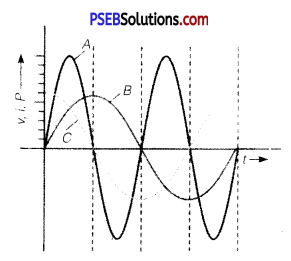
A parallel plate capacitor is to be designed with a voltage rating 1 kV, using a material of dielectric constant 3 and dielectric strength about 107 Vm-1. (Dielectric strength is the maximum electric field a material can tolerate without breakdown, i. e., without starting to conduct electricity through partial ionisation.) For safety, we should like the field never to exceed, say 10% of the dielectric strength. What minimum area of the plates is required to have a capacitance of 50 pF?
Answer:
Potential rating of the parallel plate capacitor, V = 1 kV = 1000 V
Dielectric constant of the material, εr = 3
Dielectric strength = 107 V/m
For safety, the field intensity never exceeds 10% of the dielectric strength.
Hence, electric field intensity, E = 10% of 107 =106V/m
Capacitance of the parallel plate capacitor C = 50 pF = 50 × 10-12F
Distance between the plates is given by,
d = \(\frac{V}{E}=\frac{1000}{10^{6}}\) = 10-3 m
Capacitance is given by the relation,
C = \(\frac{\varepsilon_{0} \varepsilon_{r} A}{d}\)
∴ A = \(\frac{C d}{\varepsilon_{0} \varepsilon_{r}}\) = \(\frac{50 \times 10^{-12} \times 10^{-3}}{8.85 \times 10^{-12} \times 3}\) ≈ 19cm 2
Hence, the area of each plate is about 19 cm2 .

PSEB 12th Class Physics Solutions Chapter 2 Electrostatic Potential and Capacitance

Question 34.
Describe schematically the equipotential surfaces corresponding to
(a) a constant electric field in the z-direction,
(b) a field that uniformly increases in magnitude but remains in a constant (say, z) direction,
(c) a single positive charge at the origin, and
(d) a uniform grid consisting of long equally spaced parallel charged wires in a plane.
Answer:
Equipotential surface is a surface having the same potential at each of its points. In the given cases the equipotential surface are

(a) The planes are parallel to XY plane. For same potential difference, the planes are equidistant.
PSEB 12th Class Physics Solutions Chapter 2 Electrostatic Potential and Capacitance 46
(b) The planes are parallel to XY plane, but for the same potential difference, the separation between the planes decreases.
PSEB 12th Class Physics Solutions Chapter 2 Electrostatic Potential and Capacitance 47
(c) Concentric spheres centred at the origin.
PSEB 12th Class Physics Solutions Chapter 2 Electrostatic Potential and Capacitance 48
(d) A periodically varying shape near the grid which gradually attains the shape of planes parallel to grid at far distances.
PSEB 12th Class Physics Solutions Chapter 2 Electrostatic Potential and Capacitance 49

Question 35.
In a Van de Graff type generator a spherical metal shell is to be a 15 × 106 V electrode. The dielectric strength of the gas surrounding the electrode is 5 × 10⁷ Vm-1. What is the minimum radius of the spherical shell required? (You will learn from this exercise why one cannot build an electrostatic generator using a very small shell which requires a small charge to acquire a high potential.)
Answer:
PSEB 12th Class Physics Solutions Chapter 2 Electrostatic Potential and Capacitance 50

Question 36.
A small sphere of radius r1and charge q1 is enclosed by a spherical shell of radius r2 and charge q2. Show that if q1 is positive, charge will necessarily flow from the sphere to the shell (when the two are connected by a wire) no matter what the charge q2 on the shell is.
Answer:
Here r1, r2 are the radii of small sphere and the spherical shell respectively. The shell surrounds the sphere +q1 is the charge on the sphere +q2 is the charge on the shell. We know that the electric field
inside a conductor is zero, i.e.,\(\vec{E}\) = 0. Thus according to Gauss’s Theorem
PSEB 12th Class Physics Solutions Chapter 2 Electrostatic Potential and Capacitance 51
Hence q2 must reside on the outer surface of the spherical shell.
Now the sphere having +q1 charge is enclosed inside the spherical shell. So – q1 charge will be induced on the inside side and +q1 charge will be induced on the outer surface the spherical shell.

∴ Total charge on the outer surface of the shell = q2 + q1.
As the charge always resides on the outer surface, thus charge q1 from the outer surface of sphere will flow to the other surface of spherical shell when connected with a wire.

PSEB 12th Class Physics Solutions Chapter 2 Electrostatic Potential and Capacitance

Question 37.
Answer the following:
(a) The top of the atmosphere is at about 400 kV with respect to the surface of the earth, corresponding to an electric field that decreases with altitude. Near the surface of the earth, the field is about 100 Vm-1. Why then do we not get an electric shock as we step out of our house into the open? (Assume the house to be a steel cage so there is no field inside.)

(b) A man fixes outside his house one evening a two metre high insulating slab carrying on its top a large aluminium sheet of area 1 m2. Will he get an electric shock if he touches the metal sheet next morning?

(c) The discharging current in the atmosphere due to the small conductivity of air is known to be 1800 A on an average over the globe. Why then does the atmosphere not discharge itself completely in due course and become electrically neutral? In other words, what keeps the atmosphere charged?

(d) What are the forms of energy into which the electrical energy of the atmosphere is dissipated during a lightning? (Hint : The earth has an electric field of about 100 Vm-1 at its surface in the downward direction, corresponding to a surface charge density = -10-9 Cm-2. Due to the slight conductivity of the atmosphere up to about 50 km (beyond which it is good conductor), about +1800 C is pumped every second into the earth as a whole. The earth, however, does not get discharged since thunderstorms and lightning occurring continually all over the globe pump an equal amount of negative charge on the earth.)
Answer:
(a) We do not get an electric shock as we step out of our house because the original equipotential surfaces of open air changes, keeping our body and the ground at the same potential.

(b) Yes, the man will get an electric shock if he touches the metal slab next morning. The steady discharging current in the atmosphere charges up the aluminium sheet. As a result, its voltage rises gradually. The raise in the voltage depends on the capacitance of the capacitor formed by the aluminium slab and the ground.

(c) The occurrence of thunderstorms and lightning charges the atmosphere continuously. Hence, even with the presence of discharging current of 1800 A, the atmosphere is not discharged completely. The two opposing currents are in equilibrium and the atmosphere remains electrically neutral.

(d) During lightning and thunderstorm, light energy, heat energy and sound energy are dissipated in the atmosphere.

PSEB 12th Class Physics Important Questions Chapter 2 Electrostatic Potential and Capacitance

Punjab State Board PSEB 12th Class Physics Important Questions Chapter 2 Electrostatic Potential and Capacitance Important Questions and Answers.

PSEB 12th Class Physics Important Questions Chapter 2 Electrostatic Potential and Capacitance

Very short answer type questions

Question 1.
A charge ‘q’ is moved from a point A above a dipole of dipole moment ‘p’ to a point B below the dipole in equatorial plane without acceleration. Find the work done in the process.
PSEB 12th Class Physics Important Questions Chapter 2 Electrostatic Potential and Capacitance 1
Answer:
Work done in the process is zero. Because, equatorial plane of a dipole is equipotential surface and work done in moving charge oh equipotential surface is zero.
W = qVAB = q × 0 = 0

Question 2.
A point charge Q is placed at point O as shown in the figure. Is the potential difference (VA – VB) positive, negative or zero if Q is
(i) positive
(ii) negative
PSEB 12th Class Physics Important Questions Chapter 2 Electrostatic Potential and Capacitance 2
Answer:
Let the distance of points A and B from charge Q be rA and rB, respectively.
∴ Potential difference between points A and B
VA – VB = \(\frac{q}{4 \pi \varepsilon_{0}}\left[\frac{1}{r_{A}}-\frac{1}{r_{B}}\right]\)
As rA = OA, rB = rB = OB
and rA < rB, \(\frac{1}{r_{A}}>\frac{1}{r_{B}}\)
There,[latex]\frac{1}{r_{A}}-\frac{1}{r_{B}}[/latex] has positive value.
(VA – VB) depends on the nature of charge q.
(VA – VB) is positive when Q > 0
(VA – VB ) is negative when Q < 0

PSEB 12th Class Physics Important Questions Chapter 2 Electrostatic Potential and Capacitance

Question 3.
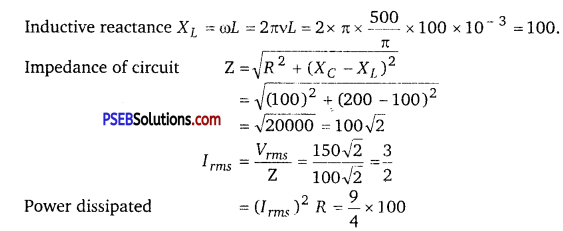
A hollow metal sphere of radius 5 cm is charged such that potential on its surface is 10 V. What is the potential at the centre of the sphere?
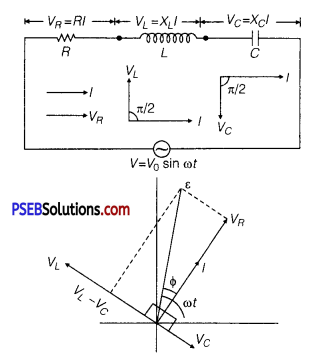
Answer:
The electric potential at every point inside the charged spherical shell is same and equal to the electric potential on its surface.
The electric potential at the centre of sphere is 10 V.

Question 4.
Can two equipotential surfaces intersect each other? Justify your answer.
No, two equipotential surfaces cannot intersect each other because

  1. Two normals can be drawn at intersecting point on two surfaces which gives two directions of E at the same point which is impossible.
  2. Also two values of potential at the same point is not possible.

Question 5.
Why electrostatic potential is constant throughout the volume of the conductor and has the same value as on its surface?
Since, electric field intensity inside the conductor is zero. So, electrostatic potential is a constant.
But, E = –\(\frac{\Delta V}{\Delta r}\)
∴ E = 0, ΔV = 0
or V2 – V1 =0, V2 – V1
The potential at every point inside the conductor remains same.

Question 6.
In a certain 0.5 cm3 of space, electric potential is found to be 7 V throughout. What is the electric field in this region?
Answer:
Zero, because electric potential is same throughout as
E = \(\frac{d V}{d r}\)

PSEB 12th Class Physics Important Questions Chapter 2 Electrostatic Potential and Capacitance

Question 7.
Distinguish between a dielectric and a conductor.
Answer:
Dielectrics are non-conductors and do not have free electrons at all. While conductor has free electrons in its any volume which makes it able to pass the electricity through it.

Question 8.
The given graph shows the variation of charge q versus potential difference V for two capacitors C1 and C2. Both the capacitors have same plate separation but plate area of C2 is greater than that C1. Which line (A or B) corresponds to C1 and why?
PSEB 12th Class Physics Important Questions Chapter 2 Electrostatic Potential and Capacitance 3
Answer:
Line B corresponds to Q because slope (q/V) of B is less than slope of A.

Question 9.
Do free electrons travel to region of higher potential or lower potential? (NCERT Exemplar)
Answer:
Free electrons would travel to regions of higher potentials as they are negatively charged.

Question 10.
Can there be a potential difference between two adjacent conductors carrying the same charge? (NCERT Exemplar)
Answer:
Yes, if the sizes are different.

PSEB 12th Class Physics Important Questions Chapter 2 Electrostatic Potential and Capacitance

Question 11.
Prove that, if an insulated, uncharged, conductor is placed near a charged conductor and no other conductors are present, the uncharged body must intermediate in potential between that of the charged body and that of infinity. (NCERT Exemplar)
Answer:
Let us take any path from the charged conductor to the uncharged conductor along the direction of electric field. Therefore, the electric potential decrease along this path.
Now, another path from the uncharged conductor to infinity will again continually lower the potential further. This ensures that the uncharged body must be intermediate in potential between that of the charged body and that of infinity.

Question 12.
A test charge q is made to move in the electric field of a point charge Q along two different closed paths [figure]. First path has sections along and perpendicular to lines of electric field.
Second path is a rectangular loop of the same area as the first loop. How does the work done compare in the two cases? (NCERT Exemplar)
PSEB 12th Class Physics Important Questions Chapter 2 Electrostatic Potential and Capacitance 4
Answer:
As electric field is conservative, work done will be zero in both the cases.

Short answer type questions

Question 1.
What is electrostatic shielding? How is this property used in actual practice? Is the potential in the cavity of a charged conductor zero?
Answer:
Whatever be the charge and field configuration outside, any cavity in a conductor remains shielded from outside electric influence. The field inside a conductor is zero. This is known as electrostatic shielding.

  • Sensitive instruments are shielded from outside electrical influences by enclosing them in a hollow conductor.
  • During lightning it is safest to sit inside a car, rather than near a tree. The metallic body of a car becomes an electrostatic shielding from lightening.

Potential inside the cavity is not zero. Potential is constant.

Question 2.
Two capacitors of unknown capacitances C1 and C2 are connected first in series and then in parallel across a battery of 100 V. If the energy stored in the two combinations is 0.045 J and 0.25 J respectively, determine the value of C1 and C2. Also calculate the charge on each capacitor in parallel combination.
Answer:
Energy stored in a capacitor,
PSEB 12th Class Physics Important Questions Chapter 2 Electrostatic Potential and Capacitance 5
Q1 = C1V = 38.2 × 10-6 × 100 = 38.2 × 10⁻⁴ C
Q2 = C2V = 11.8 × 10-6 × 100 = 11.8 × 10⁻⁴C

PSEB 12th Class Physics Important Questions Chapter 2 Electrostatic Potential and Capacitance

Question 3.
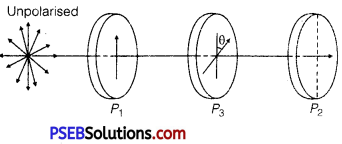
Calculate the equivalent capacitance between points A and B in the circuit below. If a battery of 10 V is connected across A and B, calculate the charge drawn from the battery by the circuit.
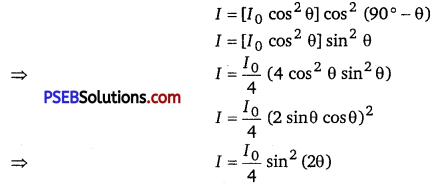
PSEB 12th Class Physics Important Questions Chapter 2 Electrostatic Potential and Capacitance 6
Answer:
PSEB 12th Class Physics Important Questions Chapter 2 Electrostatic Potential and Capacitance 7
PSEB 12th Class Physics Important Questions Chapter 2 Electrostatic Potential and Capacitance 8

Question 4.
A parallel plate capacitor is charged by a battery to a potential. The battery is disconnected and a dielectric slab is inserted to completely fill the space between the plates.
How will
(a) its capacitance
(b) electric field between the plates and
(c) energy stored in the capacitor be affected? Justify your answer giving necessary mathematical expression for each case.
Answer:
On introduction of dielectric slab in a isolated charged capacitor.
(a) The capacitance (C’) becomes K times of original capacitor as
C = \(\frac{\varepsilon_{0} A}{d}\)
and C ‘ = \(\frac{K \varepsilon_{0} A}{d}\)

(b) The total charge on the capacitor remains conserved on introduction of dielectric slab. Also, the capacitance of capacitor increases to K times of original values.
∴ CV = C’V’
CV = (KC)V’
⇒ V’ = \(\frac{V}{K}\)
∴ New electrical field,
E’ = \(\frac{V^{\prime}}{d}=\left(\frac{V / K}{d}\right)=\left(\frac{V}{d}\right) \frac{1}{K}=\frac{E}{K}\)
∴ On introduction of dielectric medium new electric field E’ becomes \(\) times of its original value.
(c) Energy stored initially,
U = \(\frac{q^{2}}{2 C}\)
Energy stored later,
U’ = \(\frac{q^{2}}{2(K C)}\) [< C’ = KG]
where, K = dielectric constant of medium
⇒ U’ = \(\frac{1}{K}\left(\frac{q^{2}}{2 C}\right)\)
⇒ U’ = \(\frac{1}{K}\) × U
The energy stored in the capacitor decreases and becomes \(\frac{1}{K}\) times of original energy.

PSEB 12th Class Physics Important Questions Chapter 2 Electrostatic Potential and Capacitance

Question 5.
Two identical parallel plate capacitors A and B are connected to a battery of V volts with the switch S closed. The switch is now opened and the free space between the plates of the capacitors is filled with a dielectric of dielectric constant K. Find the ratio of the total electrostatic energy stored in both capacitors before and after the introduction of the dielectric.
PSEB 12th Class Physics Important Questions Chapter 2 Electrostatic Potential and Capacitance 9
Answer:
Let C be the capacitance of each capacitor.
With switch S closed, the two capacitor are in parallel.
∴ Equivalent capacitance is 2 C.
∴ Energy stored = \(\frac{1}{2}\)(2C)V2
U1 = CV2 …………… (1)
PSEB 12th Class Physics Important Questions Chapter 2 Electrostatic Potential and Capacitance 10
Now, when switch is opened and then free space of capacitors are filled with dielectric, the capacitance of each capacitor will be KC. For capacitor B, the charge will remain as before and for A, the potential difference will remain same.

Charge on each capacitor in the previous case will be CV.
∴ Energy stored in capacitor A in circuit case is
PSEB 12th Class Physics Important Questions Chapter 2 Electrostatic Potential and Capacitance 11
PSEB 12th Class Physics Important Questions Chapter 2 Electrostatic Potential and Capacitance 12

Question 6.
Consider two conducting spheres of radii R1 and R2 with R1 > R2. If the two are at the same potential, the larger sphere has more charge than the smaller sphere. State whether the charge density of the smaller sphere is more or less than that of the larger one. (NCERT Exemplar)
Answer:
PSEB 12th Class Physics Important Questions Chapter 2 Electrostatic Potential and Capacitance 13

PSEB 12th Class Physics Important Questions Chapter 2 Electrostatic Potential and Capacitance

Question 7.
Calculate potential on the axis of a ring due to charge Q uniformly distributed along the ring of radius R.
(NCERT Exemplar)
Answer:
Let us take point P to be at a distance x from the centre of the ring, as shown in figure. The charge element dq is at a distance x from point P. Therefore, V can be written as
PSEB 12th Class Physics Important Questions Chapter 2 Electrostatic Potential and Capacitance 14
PSEB 12th Class Physics Important Questions Chapter 2 Electrostatic Potential and Capacitance 15

Long answer type questions

Question 1.
(i) Explain using suitable diagrams, the difference in the behaviour of a
(a) conductor and
(b) dielectric in the presence of external electric field. Define the terms polarisation of a dielectric and write its relation with susceptibility.

(ii) A thin metallic spherical shell of radius R carries a charge Q on its surface. A point charge \(\frac{Q}{2}\) is placed at its centre C and an other charge +2Q is placed outside the shell at a distance x from the centre as shown in the figure. Find (a) the force on the charge at the centre of shell and at the point A, (b) the electric flux through the shell.
PSEB 12th Class Physics Important Questions Chapter 2 Electrostatic Potential and Capacitance 16
Answer:
(i) When a capacitor is placed in an external electric field, the free charges present inside the conductor redistribute themselves in such a manner that the electric field due to induced charges opposes the external field within the conductor. This happens until a static- situation is achieved, i.e., when the two fields cancels each other and the net electrostatic field in the conductor becomes zero.

In contrast to conductors, dielectrics are non- conducting substances, i.e., they have no charge carriers. Thus, in a dielectric, free movement of charges is not possible. It turns out that the external field induces dipole moment by stretching molecules of the dielectric. The collective effect of all the molecular dipole moments is the net charge on the surface of the dielectric which produces a field that opposes the external field. However, the opposing field is so induced does not exactly cancel the external field, ft only reduces it. The extent of the effect depends on the nature of dielectric.

Both polar and non-polar dielectric develop net dipole moment in the presence of an external field. The dipole moment per unit volume is called polarisation and is denoted by P for linear isotropic dielectrics.
P = %E

(a) At point C, inside the shell.
The electric field inside a spherical shell is zero. Thus, the force experienced by charge at the centre C will also be zero.
PSEB 12th Class Physics Important Questions Chapter 2 Electrostatic Potential and Capacitance 17

PSEB 12th Class Physics Important Questions Chapter 2 Electrostatic Potential and Capacitance

Question 2.
(a) Find the ratio of the potential differences that must he applied across the parallel and series combination of two capacitors C 1and C2 with their capacitances in the ratio 1:2 so that the energy stored in the two cases becomes the same.

(b) Show that the potential energy of a dipole making angle θ with the direction of the field is given by u(θ) = – p \(\). Hence find out the amount of work done in rotating it from the position of unstable equilibrium to the stable equilibrium.
PSEB 12th Class Physics Important Questions Chapter 2 Electrostatic Potential and Capacitance 18
PSEB 12th Class Physics Important Questions Chapter 2 Electrostatic Potential and Capacitance 19

(b) As charges +q and -q traverse equal distance under equal and opposite forces; therefore, net work done in bringing the dipole in the region of electric field perpendicular to field-direction will be zero, i.e.,W1 = 0.
PSEB 12th Class Physics Important Questions Chapter 2 Electrostatic Potential and Capacitance 20
Now, the dipole is rotated and brought to orientation making an angle θ with the field direction (i.e., θ0 = 90° and θ1 = θ°), therefore, work done
W2 = pE (cosθ0 – cosθ 1)
= pE (cos 90° – cos θ) = -pE cos θ

∴Total work done in bringing the electric dipole from infinity, i.e., electric potential energy of electric dipole. Thus, work done by external torque in rotating a dipole in uniform electric field is stored as the potential energy of the system.

U = W1 + W2 = 0 – pEcosθ
= -pE cosθ
In vector form
U = – \(\vec{p} \cdot \vec{E}\)
For rotating dipole from position of unstable equilibrium (θ0 =180°) to the stable equilibrium (θ = 0°)
∴W = pE (cos 180° – cos0°)
= pE (-1 -1) = -2 pE

PSEB 12th Class Physics Important Questions Chapter 14 Semiconductor Electronics: Materials, Devices and Simple Circuits

Punjab State Board PSEB 12th Class Physics Important Questions Chapter 14 Semiconductor Electronics: Materials, Devices and Simple Circuits Important Questions and Answers.

PSEB 12th Class Physics Important Questions Chapter 14 Semiconductor Electronics: Materials, Devices and Simple Circuits

Very short answer type questions

Question 1.
The graph shown in the figure represents a plot of current versus voltage for a given semiconductor. Identify the region at which 5 the semiconductor has a negative resistance.
Answer:
Resistance of a material can be found out by the slope of the curve V versus I. Part BC of the curve u shows the negative resistance as with the increase in current and decrease in voltage.
PSEB 12th Class Physics Important Questions Chapter 14 Semiconductor Electronics Materials, Devices and Simple Circuits 1

Question 2.
Sn, C, SI and Ge are all group 14 elements, Yet, Sn is a conductor, C is an insulator while Si and Ge are semiconductors. Why? (NCERT Exemplar)
Answer:
If the valence and conduction bands overlap (no energy gap), the substance is referred as a conductor. For insulators the energy gap is large and for semiconductors, the energy gap is moderate. The energy gap of Sn is O eV, for C is 5.4 eV, for Si is 1.1 eV and for Ge is 0.7 eV. Accordingly, their electrical conductivity varies.

Question 3.
Why are elemental dopants for Silicon or Germanium usually chosen from group 13 or group 15? (NCERTExemplar)
Answer:
The size of dopant atoms should be such as not to distort the pure semiconductor lattice structure and yet easily contribute a charge camer on forming covalent bonds with Si or Ge.

Question 4.
What happens to the width of depletion Layer of a p.n junction when it is
(i) forward biased,
(ii) reverse biased
Answer:
(i) When forward biased, the width of depletion layer decreases.
(ii) When reverse biased, the width of depletion layer increases.

PSEB 12th Class Physics Important Questions Chapter 14 Semiconductor Electronics: Materials, Devices and Simple Circuits

Question 5.
In a transistor, doping level in base is increased slightly. How will it affect
(i) collector current and
(ii) base current?
Answer:
When doping level in base is increased slightly;
(i) Collector current decreases slightly and
(ii) Base current increases slightly.

Question 6.
Can the potential barrier across a p-n junction be measured by simply connecting a voltmeter across the junction (NCERT Exemplar)
Answer:
No, because the voltmeter must have a resistance very high compared to the junction resistance, the latter being nearly infinite.

Question 7.
Explain why elemental semiconductors cannot be used to make visible LEDs.(NCERT Exemplar)
Answer:
Elemental semiconductor’s band-gap is such that’ electromagnetic emissions are in infrared region.

Question 8.
Draw the logic circuit of a NAND gate and write its truth table.
Answer:
Logic circuit of a NAND gate
PSEB 12th Class Physics Important Questions Chapter 14 Semiconductor Electronics Materials, Devices and Simple Circuits 2
Truth table

A B Y = A.B
0 0 1
0 1 1
1 0 1
1 1 0

Short answer type questions

Question 1.
Write any two distinguishing features between conductors, semiconductors and insulators on the basis of energy band diagrams.
or
Draw the necessary energy band diagrams to distinguish between conductors, semiconductors and insulators. How does the change in temperature affect the behaviour of these materials? Explain briefly.
Answer:
PSEB 12th Class Physics Important Questions Chapter 14 Semiconductor Electronics Materials, Devices and Simple Circuits 3
Distinguishing Features
(a) In conductors: Valence band and conduction band overlap each other.
In semiconductors: Valence band and conduction band are separated by a small energy gap.
In insulators: Valence band and conduction band are separated by a large energy gap.
(b) In conductors: Large number of free electrons are available in conduction band.
In semiconductors: A very small number of electrons are available for electrical conduction.
In insulators: Conduction band is almost empty i.e., no electron is available for conduction.

Effect of temperature

  • In conductors: At high temperature, the collision of electrons become more frequent with the atoms/molecules at lattice site in the metals as a result the conductivity decreases (or resistivity increases).
  • In semiconductors: As the temperature of the semiconducting material increases, more electron-hole pairs becomes available in the conduction band and valence band, and hence the conductivity increases or the resistivity decreases.
  • In insulators: The energy band between conduction band and valence band is very large, so it is unsurpassable for small temperature rise. So, there is no change in their behaviour.

Question 2.
Distinguish between ‘intrinsic’ and ‘extrinsic’ semiconductors?
Answer:

Intrinsic semiconductor Extrinsic semiconductor
1. It is a pure semiconductor material with no impurity atoms in it. It is prepared by doping a small quantity of impurity atoms to the pure semiconductor.
2. The number of free electrons in the conduction band and the number of holes in valence band is exactly equal. The number of free electrons and holes is never equal. There is an excess of electrons in n-type semicoñductors and excess of holes in p-tpe semiconductors.

Question 3.
The circuit shown in the figure has two oppositely connected ‘ ideal diodes connected in parallel. Find the current flowing through each diode in the circuit.
PSEB 12th Class Physics Important Questions Chapter 14 Semiconductor Electronics Materials, Devices and Simple Circuits 4
Answer:
(i) Diode D1 is reverse biased, so it offers an infinite resistance. So, no current flows in the branch of diode D1.
(ii) Diode D2 is forward biased and offers no resistance in the circuit. So, current in the branch,
I = \(\frac{V}{R_{e q}}=\frac{12 \mathrm{~V}}{2 \Omega+4 \Omega}=\frac{12 \mathrm{~V}}{6 \Omega}\) = 2A.

PSEB 12th Class Physics Important Questions Chapter 14 Semiconductor Electronics: Materials, Devices and Simple Circuits

Question 4.
A Zener of power rating 1W is to be used as a voltage regulator. If Zener has a breakdown of 5V and it has to regulate voltage which fluctuated between 3V and 7 V, what should be the value of Rs for safe operation (see figure)? (NCERT Exemplar)
PSEB 12th Class Physics Important Questions Chapter 14 Semiconductor Electronics Materials, Devices and Simple Circuits 5
Answer:
Here, P =1W, Vz = 5 V
Vs = 3V to 7 V
IZmax = \(\frac{P}{V_{Z}}=\frac{1}{5}=0.2 \mathrm{~A}\) = 200 mA
Rs = \(\frac{V_{s}-V_{z}}{I_{Z_{\max }}}=\frac{7-5}{0.2}=\frac{2}{0.2}\) = 10Ω

Question 5.
Draw V-I characteristics of a p-n junction diode. Answer the following questions, giving reasons:
(i) Why is the current under reverse bias almost independent of the applied potential upto a critical voltage?
(ii) Why does the reverse current show a sudden increase at the critical voltage?
Name any semiconductor device which operates under the reverse bias in the breakdown region.
Answer:
PSEB 12th Class Physics Important Questions Chapter 14 Semiconductor Electronics Materials, Devices and Simple Circuits 6
(i) In the reverse biasing, the current of order of μA is due to movement/drifting of minority charge carriers from one region to another through the junction. A small applied voltage is sufficient to sweep the minority charge carriers through the junction. So, reverse current is almost independent of critical voltage.

(ii) At critical voltage (or breakdown voltage), a large number of covalent bonds break, resulting in the increase of large number of charge carriers. Hence, current increases at critical voltage. Semiconductor device that is used in reverse biasing, is Zener diode.

Question 6.
How is a light-emitting diode fabricated? Briefly state its working. Write any two important advantages of LEDs over the conventional incandescent low power lamps.
Answer:
LED is fabricated by:
(i) heavy doping of both the p and n regions.
(ii) providing a transparent cover so that light can come out.

Working: When the diode is forward biased, electrons are sent from n →b p and holes from p → n. At the junction boundary, the excess minority carriers on either side of junction recombine with majority carriers. This releases energy in the form of photon hv = Eg
Advantages:

  • Low operational voltage and less power consumption.
  • Fast action and no warm-up time required.
  • Long life and ruggedness.
  • Fast on-off switching capability.

Question 7.
Explain, with the help of a circuit diagram, the working of a photodiode. Write briefly how it is used to detect the optical signals.
Or
(a) How is photodiode fabricated?
(b) Briefly explain its working. Draw its VI characteristics for two different intensities of illumination.
Or
With what considerations in view, a photodiode is fabricated?
State its working with the help of a suitable diagram.
Even though the current in the forward bias is known to be
more than in the reverse bias, yet the photodiode works in reverse bias. What is the reason?
Answer:
A photodiode is fabricated using photosensitive semiconducting material with a transparent window to allow light to fall on the junction of the diode.
PSEB 12th Class Physics Important Questions Chapter 14 Semiconductor Electronics Materials, Devices and Simple Circuits 7
Working: In diode (any type of diode), an electric field ‘E’ exists across the junction from n-side to p-side, when light with energy hv greater than energy gap E2 (hv> Eg ) illuminate the junction, then electron-hole pairs are generated due to absorption of photons, in or near the depletion region of the diode. Due to existing electric fIeld, electrons are collected on n-side and holes are collected on p-side, giving rise to an emf. Due to the generated emf, an electric current of μA order flows through the external resistance.

Detection of Optical Signals: It is easier to observe the change in the current with change in the light intensity if a reverse bias is applied. Thus, photodiode can be used as a photodetector to detect optical signals. The characteristic curves of a photodiode for two different illuminations I1 and I2 (I2 > I1)are shown below
PSEB 12th Class Physics Important Questions Chapter 14 Semiconductor Electronics Materials, Devices and Simple Circuits 8

Question 8.
Describe briefly using the necessary circuit diagram, the three basic processes which take place to generate the emf in a solar cell when light falls on it. Draw the V-I characteristics of a solar cell. Write two important criteria required for the selection of a material for solar cell fabrication.
Answer:
The three basic processes which take place to generate the emf in a solar cell are generation, separation and collection.
(i) Generation of electron-hole pairs due to the light incident (with hv>Eg) close to the junction.
(ii) Separation of electrons and holes due to the electric field of the depletion region.
(iii) Collection of electrons and holes by n-side and p-side, respectively.
PSEB 12th Class Physics Important Questions Chapter 14 Semiconductor Electronics Materials, Devices and Simple Circuits 9
Important criteria for the selection of a material for solar cell fabrication are:
(i) bandgap (~ 1.0 to 1.8 eV).
(ii) high optical absorption (-10 4 cm-1),
(iii) electrical conductivity.
(iv) availability of the raw material, and
(v) cost

PSEB 12th Class Physics Important Questions Chapter 14 Semiconductor Electronics: Materials, Devices and Simple Circuits

Long answer type questions

Question 1.
(a) State briefly the process involved in the formation of p-n junction explaining clearly how the depletion region is formed.
(b) Using the necessary circuit diagrams, show how the V-I characteristics of a p-n junction are obtained in:
(i) Forward biasing
(ii) Reverse biasing
How are these characteristics made use of in rectification?
Or
Draw the circuit arrangement for studying the V-I characteristics of a p-n junction diode
(i) in forward bias and
(ii) in reverse bias. Draw the typical V-I characteristics of a silicon diode.
Describe briefly the following terms:
(i) “minority carrier injection” in forward bias
(ii) “breakdown voltage” in reverse bias.
Answer:
(a) Two processes occur during the formation of a p-n junction are diffusion and drift. Due to the concentration gradient across p and n-sides of the junction, holes diffuse from p-side to n-side (p → n) and electrons diffuse from n-side to p-side (n → p). This movement of charge carriers leaves behind ionised acceptors (negative charge Φ -immobile) on the p-side and donors (positive charge immobile) on the n-side of the junction. This space charge region on either side of the junction together is known as depletion region.
PSEB 12th Class Physics Important Questions Chapter 14 Semiconductor Electronics Materials, Devices and Simple Circuits 10
(b) The circuit arrangement for studying the V-I characteristics of a diode are shown in figure (a) and (b). For different values of voltages, the value of current is noted. A graph between V and I is obtained as in figure (c). From the V-I characteristic of a junction diode, it is clear that it allows current to pass only when it is forward biased. So, if an alternative voltage is applied across a diode, the current flows only in that part of the cycle when the diode is forward biased. This property is used to rectify alternating voltages.
PSEB 12th Class Physics Important Questions Chapter 14 Semiconductor Electronics Materials, Devices and Simple Circuits 11
PSEB 12th Class Physics Important Questions Chapter 14 Semiconductor Electronics Materials, Devices and Simple Circuits 12
(i) Minority Carrier Injection: Due to the applied voltage, electrons from n-side cross the depletion region and reach p-side (where they are minority carriers). Similarly, holes from p-side cross this junction and reach the n-side (where they are minority carriers). This process under forward bias is known as minority carrier injection.

(ii) Breakdown Voltage: It is critical reverse bias voltage at which current is independent of applied voltage.

Question 2.
State the principle of working of p-n diode as a rectifier. Explain with the help of a circuit diagram, the use of p-n diode as a full-wave rectifier. Draw a sketch of the input and output waveforms.
Or
Draw a circuit diagram of a full-wave rectifier. Explain the working principle. Draw the input/output waveforms indicating clearly, the functions of the two diodes used.
Or
With the help of a circuit diagram, explain the working of a junction diode as a full-wave rectifier. Draw its Input and output waveforms. Which characteristic property makes the junction diode suitable for rectification?
Answer:
Rectification: Rectification means conversion of AC into DC. A p-n diode acts as a rectifier because an AC changes polarity periodically and a p-n diode allows the current to pass only when it is forward biased. This makes the diode suitable for rectification.
PSEB 12th Class Physics Important Questions Chapter 14 Semiconductor Electronics Materials, Devices and Simple Circuits 13
Working: The AC input voltage across secondary s1 and s2 changes polarity after each half cycle. Suppose during the first half cycle of input AC signal, the terminal S1 is positive relative to centre tap O and s2 is negative relative to O. Then diode D1 is forward biased and diode D2 is reverse biased. Therefore, diode D1 conducts while diode D2 does not. The direction of current (i1) due to diode D1 in load resistance RL is direction from A to B. In next half cycle, the terminal s1 is negative and s2 is positive relative to centre tap O.

The diode D1 is reverse biased and diode D2 is forward biased. Therefore, diode D2 conducts while D1 does not.
The direction of current (i2) due to diode D2 in load resistance RL is still from A to B. Thus, the current in load resistance RL is in the same direction for both half cycles of input AC voltage. Thus for input AC signal the output current is a continuous series of unidirectional pulses. In a full-wave rectifier, if input frequency is f hertz, then output frequency, will be 2f hertz because for each cycle of input, two positive half cycles of output are obtained.

Question 3.
Why is a Zener diode considered as a special purpose semiconductor diode? Draw the I-V characteristics of Zener diode and explain briefly, how reverse current suddenly Increase at the breakdown voltage? Describe briefly with the help of a circuit diagram, how a Zener diode works to obtain a constant DC voltage from the unregulated DC output of a rectifier.
Answer:
Zener diode works only in reverse breakdown region that is why it is, considered as a special purpose semiconductor. I – V characteristics of Zener diode is given below.
PSEB 12th Class Physics Important Questions Chapter 14 Semiconductor Electronics Materials, Devices and Simple Circuits 14
Reverse current is due to the flow of electrons from n → p and holes from p → n. As, the reverse-biased voltage increase the electric field across the junction, increases significantly and when reverse bias voltage V = VZ, then the electric field strength is high enough to pull the electrons from p-side and accelerated it to n-side. These electrons are responsible for the high current at the breakdown.
PSEB 12th Class Physics Important Questions Chapter 14 Semiconductor Electronics Materials, Devices and Simple Circuits 15
Voltage regulator converts an unregulated DC output of rectifier into a constant regulated DC voltage, using Zener diode. The unregulated voltage is connected to the Zener diode through a series resistance Rs such that the Zener diode is reverse biased. If the input voltage increase, then-current through Rs and Zener diode increases.

Thus, the voltage drop across Rs increase without any change in the voltage drop across zener diode. This is because of the breakdown region, Zener voltage remains constant even though the current through Zener diode changes.
Similarly, if the input voltage decreases, the current through Rs and Zener diode decreases. The voltage drop across Rs decreases without any change in the voltage across the Zener diode. Now, any change in input voltage results the change in voltage drop across Rs, without any changes; in voltage across the Zener diode. Thus, Zener diode acts as a voltage regulator.

PSEB 12th Class Physics Important Questions Chapter 14 Semiconductor Electronics: Materials, Devices and Simple Circuits

Question 4.
(a) Differentiate between three segments of a transistor on the basis of their size and level of doping.
(b) How is a transistor biased to be in active state?
(c) With the help of necessary circuit diagram, describe briefly how n-p-n transistor in CE configuration amplifies a small sinusoidal input voltage. Write the expression for AC current gain.
Or
Explain with the help of a circuit diagram the working of n-p-n transistor as a common emitter amplifier.
Or
Draw the circuit diagram of a common-emitter amplifier using an n-p-n transistor. What is the phase difference between the input signal and output voltage? Draw the input and output waveforms of the signal. Write the expression for its voltage gain. State two reasons why a common emitter amplifier is preferred to a common base amplifier.
Answer:
(a) Emitter: It is of moderate size and heavily doped.
Base: It is very thin and lightly doped.
Collector: The collector side is moderately doped and larger in size as compared to the emitter.

(b) Transistor is said to be inactive state when its emitter-base junction is suitably forward biased and base-collector junction is suitably reverse biased.
(c) The circuit of common emitter amplifier using n-p-n transistor is shown below :
PSEB 12th Class Physics Important Questions Chapter 14 Semiconductor Electronics Materials, Devices and Simple Circuits 16
Working: If a small sinusoidal voltage, with amplitude VS is superposed on DC basic bias (by connecting the sinusoidal voltage in series with base supply VBB), the base current will have sinusoidal variations superimposed on the base current IB.

As a consequence the collector current is also sinusoidal variations superimposed on the value of collector current Ic, this will produce corresponding amplified changes in the value of output voltage V0.
The AC variations across input and output terminals may be measured by blocking the DC voltage by large capacitors. The phase difference between input signal and output voltage is 180°. The input and output waveforms are shown in figure.
PSEB 12th Class Physics Important Questions Chapter 14 Semiconductor Electronics Materials, Devices and Simple Circuits 17
Voltage gain,
Av = \(\beta \frac{R_{L}}{R_{i}}\)
AC current gain, βAC = \(\left(\frac{\Delta I_{C}}{\Delta I_{B}}\right)_{V_{C E}}\)
Reasons for Using a Common Emitter Amplifier
(i) Voltage gain is quite high.
(ii) Voltage gain is uniform over a wider frequency range or power gain is high.

PSEB 12th Class Physics Important Questions Chapter 1 Electric Charges and Fields

Punjab State Board PSEB 12th Class Physics Important Questions Chapter 1 Electric Charges and Fields Important Questions and Answers.

PSEB 12th Class Physics Important Questions Chapter 1 Electric Charges and Fields

Very short answer type questions

Question 1.
Define electrostatics.
Answer:
Electrostatics deals with the study of forces, fields and potentials arising from static charges.

Question 2.
Define charge.
Answer:
It is defined as the basic and characteristic property of elementary particles of matter in the form of which certain force of interaction energies may be explained.

PSEB 12th Class Physics Important Questions Chapter 1 Electric Charges and Fields

Question 3.
What are the behaviour of charges?
Answer:
Like charges repel and unlike charges attract each other.

Question 4.
Define the polarity of charge.
Answer:
The property which differentiates the two kinds of charges is called the polarity of charge.

Question 5.
Who first assigned the positive and negative signs to charge?
Answer:
Benjamin Franklin

Question 6.
What are conductors?
Answer:
The substances which allow electricity to pass through them easily are called conductors e.g., metals, human, earth etc.

Question 7.
What are insulators?
Answer:
Most of the non-metals like glass, porcelain, plastic, nylon, wood offer high resistance to the passage of electricity through them, they are called insulators.

PSEB 12th Class Physics Important Questions Chapter 1 Electric Charges and Fields

Question 8.
Define the semiconductors.
Answer:
The substances which offer resistance to the movement of charges are called semiconductors. They are intermediate between conductors and insulators,

Question 9.
What are point charges?
Answer:
If the sizes of charged bodies are very small as compared to the distances between them, they are called point charges.

Question 10.
Write the law of conservation of charges.
Answer:
“The total charge of the isolated system is always conserved.” It is not possible to create or destroy net charge carried by isolated system although the charge carrying particles may be created or destroyed in a process.

Question 11.
The dimensions of an atom are of the order of an Angstrom. Thus there must be large electric fields between the protons and electrons. Why then is the electrostatic field inside a conductor zero? (NCERT Exemplar)
Answer:
The electric fields bind the atoms to neutral entity. Fields are caused by excess charges. There can be no excess charge on the inner surface of an isolated conductor. So, the electrostatic field inside a conductor is zero.

Question 12.
An arbitrary surface encloses a dipole. What is the electric flux through this surface? (NCERT Exemplar)
Answer:
Net charge on a dipole = -q + q = 0. According to Gauss’s theorem, electric flux through the surface,
PSEB 12th Class Physics Important Questions Chapter 1 Electric Charges and Fields 1

PSEB 12th Class Physics Important Questions Chapter 1 Electric Charges and Fields

Question 13.
Sketch the electric field lines for a uniformly charged hollow cylinder shown in figure. (NCERT Exemplar)
PSEB 12th Class Physics Important Questions Chapter 1 Electric Charges and Fields 2
Answer:
PSEB 12th Class Physics Important Questions Chapter 1 Electric Charges and Fields 3

Short answer type questions

Question 1.
Describe the gold-leaf electroscope.
Question
A simple apparatus to detect charge on a body is the gold-leaf electroscope. It consists of a vertical metal rod housed in a box, with two thin gold leaves attached to its bottom end. When a charged object touches the metal knob at the top of the rod, charge flows on to the leaves and they diverge. The degree of divergence is an indicator of the amount of charge.

Question 2.
Define the grounding or earthing.
Answer:
When we bring a charged body in contact with the earth, all the excess charge on the body disappears by causing a momentary current to pass to the ground through the connecting conductor (such as our body). This process of sharing the charges with the earth is called grounding or earthing.

Question 3.
What is the importance of earthing in buildings?
Answer:
Earthing provides a safety measure for electrical circuits and appliances. A thick metal plate is buried deep into the earth and thick wires are drawn from this plate; these are used in buildings for the purpose of earthing near the mains supply. The electric wiring in our houses has three wires; live, neutral and earth. The first two carry electric current from the power station and the third is earthed by connecting it to the buried metal plate. Metallic bodies of the electric appliances such as electric iron, refrigerator, TV are connected to the earth wire. When any fault occurs or live wire touches the metallic body the charge flows to the earth without damaging the appliance and without causing any injury to the humans; this would have otherwise been unavoidable since the human body is a conductor of electricity.

PSEB 12th Class Physics Important Questions Chapter 1 Electric Charges and Fields

Question 4.
Describe the additivity of charges in brief.
Answer:
If a system contains two point charges q1 and q2, the total charge of the system is obtained simply by adding algebraically qi and q2, i. e., charges add up like real numbers or they are scalars like the mass of a body. If a system contains n charges q1, q2, q3,……, qn, then the total charge of the system is q1 + q2 + q3 + … + qn. Charge has magnitude but no direction, similar to the mass. However, there is one difference between mass and charge. Mass of a body is always positive whereas a charge can be either positive or negative. Proper signs have to be used while adding the charges in a system. For example, the total charge of a system containing five charges +1, +2, -3, +4 and -5, in some arbitrary unit, is (+1) + (+2) + (-3) + (+4) + (-5) = -1 in the same unit.

Question 5.
(a) Define electric flux. Write its SI unit.
(b) A small metal sphere carrying charge +Q is located at the centre of a spherical cavity inside a large uncharged metallic spherical shell as shown in the figure. Use Gauss’s law to find the expressions for the electric field at points P1 and P2.
PSEB 12th Class Physics Important Questions Chapter 1 Electric Charges and Fields 4
(c) Draw the pattern of electric field lines in this arrangement.
Answer:
(a) Electric flux over an area in an electric field represents the total number of electric field lines crossing this area and is given by the product of surface area and the component of electric field intensity normal to the area.
The SI unit of flux is Nm2C-1.

(b) Let point P1 is at distance R from the centre 0.
S1 is the Gaussian surface, then according to Gauss’s theorem
PSEB 12th Class Physics Important Questions Chapter 1 Electric Charges and Fields 5
Inside the shell the charge is zero, so the field is also zero
PSEB 12th Class Physics Important Questions Chapter 1 Electric Charges and Fields 6
(c) The direction of electric field is shown in figure.

Question 6.
A metallic spherical shell has an inner radius R1 and outer radius R2– A charge Q is placed at the centre of the spherical cavity. What will be surface charge density on (i) the inner surface, and (ii) the outer surface? (NCERT Exemplar)
Answer:
When a charge +Q is placed at the centre of spherical cavity,
PSEB 12th Class Physics Important Questions Chapter 1 Electric Charges and Fields 7
The charge induced on the inner surface = -Q
The charge induced on the outer surface = +Q
∴ Surface charge density on the inner surface = \(\frac{-Q}{4 \pi R_{1}^{2}}\)
Surface charge density on the outer surface = \(\frac{+Q}{4 \pi R_{2}^{2}}\)

PSEB 12th Class Physics Important Questions Chapter 1 Electric Charges and Fields

Question 7.
Two charges q and -3q are placed fixed on x-axis separated by distance id\ Where should a third charge 2q be placed such that it will not experience any force? (NCERT Exemplar)
Answer:
PSEB 12th Class Physics Important Questions Chapter 1 Electric Charges and Fields 8
Let the charge 2q be placed at point P as shown. The force due to q is to the left and that due to -3q is to the right.
PSEB 12th Class Physics Important Questions Chapter 1 Electric Charges and Fields 9

Long answer type questions

Question 1.
How can you charge a metal sphere positively without touching it?
Answer:
Figure (a) shows an uncharged metallic sphere on an insulating metal stand. Bring a negatively charged rod close to the metallic sphere, as shown in Fig. (b). As the rod is brought close to the sphere, the free electrons in the sphere move away due to repulsion and start piling up at the farther end. The near end becomes positively charged due to deficit of electrons. This process of charge distribution stops when the net force on the free electrons inside the metal is zero. Connect the sphere to the ground by a conducting wire. The electrons will flow to the ground while the positiye charges at the near end will remain held there due to the attractive force of the negative charges on the rod, as shown in Fig. (c). Disconnect the sphere from the ground. The positive charge continues to be held at the near end [Fig.(d)]. Remove the electrified rod. The positive charge will spread uniformly over the sphere as shown in Fig. (e).
PSEB 12th Class Physics Important Questions Chapter 1 Electric Charges and Fields 10
In this experiment, the metal sphere gets charged by the process of induction and the rod does not lose any of its charge.

Similar steps are involved in charging a metal sphere negatively by induction, by bringing a positively charged rod near it. In this case the electrons will flow from the ground to the sphere when the sphere is connected to the ground with a wire.

PSEB 12th Class Physics Important Questions Chapter 1 Electric Charges and Fields

Question 2.
Define electric dipole moment. Is it a scalar or a vector? Derive the expression for the electric field of a dipole at a point on the equatorial plane of the dipole.
Answer:
Electric Dipole Moment : The strength of an electric dipole is measured by the quantity electric dipole moment. Its magnitude is equal to the product of the magnitude of either charge and the distance between the two charges.
Electric dipole moment,
p = q × d
It is a vector quantity.
In vector form it is written as \(\), where the direction of \(\) is from negative charge to positive charge.
Electric field of dipole at points on the equatorial plane:
PSEB 12th Class Physics Important Questions Chapter 1 Electric Charges and Fields 11
The magnitudes of the electric field due to the two charges + q and – q are given by,
PSEB 12th Class Physics Important Questions Chapter 1 Electric Charges and Fields 12