No Men are Foreign Question Answer Class 9 English Main Course Book Poem Chapter 2 PSEB Solutions

Punjab State Board PSEB 9th Class English Book Solutions English Main Course Book Poem 2 No Men are Foreign Textbook Exercise Questions and Answers.

Class 9th English Main Course Book Poem Chapter 2 No Men are Foreign Question Answers

No Men are Foreign Class 9 Questions and Answers

Question 1.
What is the theme or central idea of the poem ?
(इस कविता का उद्देश्य अथवा केन्द्रीय भाव क्या है ?)
Answer:
All men are the same. They have the same kind of body. They breathe in the same way. Thus no men are strange or foreign. We should never hate others. They are all our brothers. By hating others, we lose their love. Thus the poet gives the message of love and brotherhood.

सब लोग एक ही प्रकार के होते हैं। वे एक ही प्रकार का शरीर रखते हैं। वे एक ही प्रकार से सांस लेते हैं। इसलिए कोई भी आदमी बेगाने या विदेशी नहीं हैं। हमें कभी भी दूसरों से घृणा नहीं करनी चाहिए। वे सब हमारे भाई हैं। दूसरों से घृणा करके हम उनके प्यार को खो बैठते हैं। इस प्रकार कवि प्यार और भाईचारे का सन्देश देता है।

PSEB 9th Class English Main Course Book Solutions Poem 2 No Men are Foreign

Question 2.
Write the summary of the poem in your own words.
(कविता का सार अपने शब्दों में लिखें।)
Answer:
The poet says that no men are foreign and no countries are strange. Men all over the world have the same kind of body. Similarly, no countries are strange or foreign. It is the same earth everywhere. When there is war, fire and dust pollute the air all around. So the poet says that we should not heed those who tell us to hate others.

कवि कहता है कि कोई मनुष्य बेगाने नहीं होते और कोई देश बाहरी नहीं होते। संसार-भर के लोग एक जैसा ही शरीर रखते हैं। उसी प्रकार हम किसी देश को भी बेगाना या बाहरी नहीं कह सकते हैं। सब जगह वही धरती है। जब लड़ाई होती है, तो आग और धूल पूरी धरती के गिर्द की हवा को दूषित कर देती है। इसलिए कवि कहता है कि हमें उन लोगों की ओर ध्यान नहीं देना चाहिए जो हमें दूसरों से नफरत करने के लिए कहते हों।

Question 3.
What inspiration do we derive from this poem ?
(इस कविता से हमें क्या प्रेरणा मिलती है ?)
Answer:
The poet inspires us to look upon the people of all countries as our brothers. No men are foreign. No countries are strange. Everywhere there are men who live and die in the same manner. Therefore, we should love all and hate none.

यह कविता हमें प्रेरित करती है कि हम सभी देशों के लोगों को अपने भाई समझें। कोई आदमी विदेशी नहीं हैं। कोई देश बेगाने नहीं हैं। हर जगह लोग हैं जो एक ही तरह से जीवन बिताते हैं और मरते हैं। इसलिए हमें सभी से प्रेम करना चाहिए और किसी से घृणा नहीं करनी चाहिए।

Question 4.
What will happen if we hate our fellow beings ?
(यदि हम अपने साथियों से घृणा करने लगें तो क्या होगा ?)
Answer:
If we hate our fellow beings, we shall lose their love. All men are our brothers. Thus when we hate others, we hate ourselves only.
यदि हम अपने साथी जीवों से घृणा करेंगे तो हम उनका प्यार खो बैठेंगे। सभी लोग हमारे भाई हैं। इस प्रकार जब हम दूसरों से घृणा करते हैं तो हम स्वयं अपने से ही घृणा करते हैं।

PSEB 9th Class English Main Course Book Solutions Poem 2 No Men are Foreign

Question 5.
How are all men similar to one another?
(सभी लोग एक-दूसरे के जैसे किस तरह हैं ?)
Answer:
All people have the same kind of body. They breathe the same air. They sleep and wake up in the same way. They eat in the same way. After their death, they lie under the same earth. Thus all men are similar to one another.

सभी लोग एक ही किस्म का शरीर रखते हैं। वे एक ही किस्म की हवा में श्वास लेते हैं। वे एक ही तरह से सोते हैं और जागते हैं। वे एक ही तरह से खाते हैं। अपनी मृत्यु के पश्चात् वे एक ही धरती के नीचे पड़े होते हैं। इस प्रकार सभी मनुष्य एक-दूसरे के जैसे ही होते हैं।

Question 6.
Write True or False against the following sentences :
(a) No men are strange and no countries are foreign.
(b) People are different from one another.
(c) We should hate our brothers.
(d) We should not defile our earth.
Answer:
(a) True
(b) False
(c) False
(d) True

Question 7.
This poem is an attempt to create ‘brotherhood’ amongst people. Discuss.
(यह कविता लोगों के मध्य ‘भ्रातृभाव’ पैदा करने का एक यत्न है। विवेचना करें।)
Answer:
This poem tries to create a feeling of brotherhood among all people. It says that no men or countries are foreign. All men have the same kind of body. They breathe in the same way. They eat, sleep and wake up in the same manner. After their death, they lie under the same earth. Thus all men are brothers.

यह कविता सभी लोगों में भ्रातृत्व की एक भावना पैदा करने का यत्न करती है। यह कहती है कि कोई भी लोग या देश बेगाने नहीं होते। सभी मनुष्यों का एक जैसा शरीर होता है। वे एक ही ढंग से श्वास लेते हैं। वे एक ही ढंग से खाते, सोते और जागते हैं। अपनी मृत्यु के पश्चात् वे एक ही धरती के नीचे पड़े होते हैं। इस तरह सभी लोग हमारे भाई हैं।

Stanzas For Comprehension

Stanza -1

Remember, no men are strange, no countries foreign
Beneath all uniforms, a single body breathes
Like ours; the land our brothers walk upon
Is earth like this, in which we all shall lie.

Questions
1. Name the poem and the poet.
2. What should we remember?
3. What are all men to us?
4. Where do we all walk upon?
5. Where shall we all lie in the end?
Answer
1. The name of the poem is ‘No Men Are Foreign’. The name of the poet is James Kirkup.
2. We should remember that no men are strange and no countries are foreign.
3. All men are brothers to us.
4. We all walk upon the same earth.
5. We shall all lie in the same land.

PSEB 9th Class English Main Course Book Solutions Poem 2 No Men are Foreign

Stanta – 2

They, too, aware of sun and air and water
Are fed by peaceful harvests, by war’s long winter starved.
Their hands are ours, and in their lives we read
A labour not different from our own.

Questions
1. Who does ‘They’ refer to in these lines ?
2. What do they all make use of ?
3. What are they fed by ?
4. What is meant by
(a) ‘peaceful harvests’
(b) ‘war’s long winter’?
5. What do we read in their lives?
Answer:
1. “They’ here refers to all men of the world.
2. They all make use of the same sun and air.
3. They are fed by the harvests that they grow.
4.
(a) ‘Peaceful harvests’ means the crops that we can grow in times of peace.
(b) ‘War’s long winter’ means the painful days when we have to stay in and can have nothing to feed ourselves.
5. We read in their lives that they do the same labour that we have to do.

Stanza – 3

Remember they have eyes like ours that wake
Or sleep, and strength that can be won
By love. In every land is common life
That all can recognize and understand.

Questions
1. Who does ‘they’ here refer to ?
2. What kind of eyes do they have ?
3. How can we win their strength ?
4. What is there in every land ?
5. What can all recognize and understand ?
Answer::
1. The word ‘they’ here refers to all men of the world.
2. They have eyes like ours.
3. We can win it by love.
4. In every land, there is the same kind of life.
5. All can recognize and understand that there is the same kind of life everywhere.

Stanza – 4

Let us remember, whenever we are told
To hate our brothers, it is ourselves
That we shall dispossess, betray, condemn.
Remember we who take arms against each other,
It is the human earth that we defile,
Our hells of fire and dust outrage the innocence
Of air that is everywhere our own.
Remember, no men are foreign, and no countries strange.

Questions
1. Who have been called “our brothers’ ?
2. Who should we not hate and why ?
3. What shall happen if we take up arms against each other?
4. What is everywhere our own ?
5. What message does the poet want to convey in these lines ?
Answer:
1. All men of the world have been called our brothers.
2 We should not hate others because they are all our brothers.
3. We shall defile this earth of ours.
4. The pure and fresh air is everywhere our own.
5. The poet means to say that all men of the world are our brothers. No men are foreign and no countries are strange.

PSEB 9th Class English Main Course Book Solutions Poem 2 No Men are Foreign

Objective Type Questions

Answer the following in one word / phrase / sentence :

Question 1.
Who has written the poem, ‘No Men Are Foreign’ ?
Answer:
James Kirkup.

Question 2.
What type of a poem this poem is ?
Answer:
It is an anti-war poem.

Question 3.
Where do all men move ?
Answer:
They move on the same earth.

Question 4.
Who shouldn’t be heeded, according to the poet ?
Answer:
Those who tell us to hate others.

Question 5.
What will we be doing if we hate others ?
Answer:
We will be robbing ourselves.

Complete the following :

1. The poet ‘says that no men are ……….
2. According to the poet, no …………………. are foreign.
3. By taking up arms against others, we will be defiling the …….
Answer:
1. strange
2. countries
3. earth.

Write True or False against each statement :

1. All other countries are foreign, according to the poet.
2. We should not hate anybody.
3. War pollutes the air that we all breathe.
Answer:
1. False
2. True
3. True.

Choose the correct option for each of the following :

Question 1.
According to the poem, no countries are
(a) developed
(b) developing
(c) bad
(d) foreign
Answer:
(d) foreign

PSEB 9th Class English Main Course Book Solutions Poem 2 No Men are Foreign

Question 2.
The poem is ………….
(a) an anti-war poem
(b) a sonnet
(c) an elegy
(d) a hymn.
Answer:
(a) an anti-war poem

No Men are Foreign Poem Summary in English

No Men are Foreign Introduction:

This poem contains a very noble idea. It advocates the unity of mankind. No men are strange, and no countries are foreign. All men live on the same earth and breathe the same air. If we hate others, it is like hating ourselves because there is no difference between us and others. Love is the best weapon to win others. By taking up arms against one another, we defile the human earth itself. So we should always remember that no men are foreign and no countries are strange.

No Men are Foreign Summary in English:

This is an anti-war poem that teaches the basic oneness of mankind and folly of going to war. The poet says that no men are strange and no countries are foreign. Under the outward superficial differences, the inner essence is everywhere the same. Under all kinds of different dresses, all men have the same kind of body. The bodies of all men breathe in the same way as our body does. All men move on the same earth. And after death, all men lie under the same earth. Everywhere it is the same sun, air and water that people enjoy. Everywhere people are fed on the crops that are grown during times of peace. And everywhere they have to starve when there is a long winter of war.

Everywhere men have the same kind of hands. They do the same kind of labour. They have the same kind of eyes that wake and sleep. They have the same kind of strength that can be won by love. Everywhere, the same kind of life is lived which can be understood and recognized easily.

PSEB 9th Class English Main Course Book Solutions Poem 2 No Men are Foreign

Therefore, the poet says that we shouldn’t heed those who tell us to hate others. We should remember that by hating others, it is only ourselves that we rob, deceive and criticize. By taking up arms against others, we only defile this earth that belongs to all of us. The fire and destruction of war pollutes the air that we all breathe. So, the poet asks us to remember that no men are foreign and no countries are strange.

No Men are Foreign Poem Summary in Hindi

No Men are Foreign Introduction:

कविता का संक्षिप्त परिचय इस कविता में एक बहुत ही महान विचार भरा हुआ है। यह मानवता की एकता की वकालत करती है। कोई भी मनुष्य भिन्न नहीं होते और कोई भी देश पराए नहीं होते। सब लोग एक ही धरती के ऊपर रहते हैं और एक ही हवा में सांस लेते हैं। यदि हम दूसरों से घृणा करेंगे, तो यह खुद अपने से घृणा करने के समान होगा क्योंकि हमारे में और दूसरों में कोई अन्तर नहीं है। दूसरों को जीतने के लिए प्यार सबसे बढ़िया हथियार होता है। एक-दूसरे के विरुद्ध घातक हथियार उठाकर हम मानव धरती को दूषित करते हैं। इसलिए हमें सदा याद रखना चाहिए कि कोई मनुष्य विदेशी नहीं होते और कोई देश बेगाने नहीं होते हैं।

No Men are Foreign Summary in Hindi:

यह एक युद्ध-विरोधी कविता है जो मनुष्य-जाति की मौलिक एकता और युद्ध करने की मूर्खता के बारे में शिक्षा देती है। कवि कहता है कि कोई लोग बेगाने नहीं होते और कोई देश बाहरी नहीं होते। बाहरी दिखावे के अन्तरों के नीचे अन्दरूनी वास्तविकता सब जगह एक जैसी ही होती है। भिन्न-भिन्न प्रकार की सब पोशाकों के नीचे सब लोगों का एक ही प्रकार का शरीर होता है। सब लोगों के शरीर उसी प्रकार सांस लेते हैं जिस . प्रकार हमारा शरीर साँस लेता है। सब लोग एक ही धरती के ऊपर चलते-फिरते हैं और मरने के बाद एक ही धरती के नीचे सोते हैं।

हर जगह वही सूरज, हवा और पानी है जिसका लोग आनन्द उठाते हैं। हर जगह लोग उन फसलों से भोजन प्राप्त करते हैं जो शान्ति के समय के दौरान उगाई जाती हैं। और हर जगह उनको भूखों मरना पड़ता है जब युद्ध-रूपी लम्बी सर्दी आ जाती है। हर जगह लोगों के एक ही प्रकार के हाथ होते हैं और वे एक ही प्रकार की मेहनत करते हैं। उनकी एक ही प्रकार की आँखें होती हैं जो जागती हैं और सोती हैं। उनके पास एक ही प्रकार की ताकत होती है जिसको प्यार से जीता जा सकता है। हर जगह एक ही प्रकार का जीवन गुज़ारा जाता है जिसको आसानी से समझा जा सकता है, और पहचाना जा सकता है।

इसलिए कवि कहता है कि हमें उन लोगों की ओर कोई ध्यान नहीं देना चाहिए जो हमें दूसरों से घृणा करने के लिए कहते हों। हमें याद रखना चाहिए कि दूसरों से नफ़रत करने से हम सिर्फ खुद को ही लूट रहे होते हैं, धोखा दे रहे होते हैं और बुरा-भला कह रहे होते हैं। दूसरे लोगों के विरुद्ध हथियार उठा कर हम केवल इस धरती को गन्दी और अपवित्र बनाते हैं जो हमारी सब की सांझी है। युद्ध की अग्नि और विनाश उसी हवा को दूषित करते हैं जिसमें हम साँस लेते हैं। इसीलिए कवि हमें याद रखने के लिए कहता है कि कोई लोग बेगाने नहीं होते और कोई देश बाहरी नहीं होते।

No Men are Foreign Poem Translation in Hindi

(Lines 1-4)

Remember, no men are strange, no countries foreign
Beneath all uniforms, a single body breathes
Like ours; the land our brothers walk upon
Is earth like this, in which we all shall lie.

कठिन शब्दार्थ-1. strange – पराए ; 2. beneath – के नीचे; 3. uniform – पोशाक ; 4. breathes – श्वास लेती है।

अनुवाद-
याद रखो कि कोई भी मनुष्य पराए नहीं होते; कोई देश बेगाने नहीं होते।
सभी प्रकार की पोशाकों के नीचे उसी प्रकार का शरीर होता है जिस प्रकार का हमारा है ।
सभी शरीर उसी प्रकार साँस लेते हैं जिस प्रकार हमारा शरीर साँस लेता है।
वह जमीन जिसके ऊपर हमारे भाई चलते हैं वैसी ही है, जिसके ऊपर हम चलते-फिरते हैं।
हम सब उसी धरती के नीचे पड़े होंगे जब हम मरेंगे।

PSEB 9th Class English Main Course Book Solutions Poem 2 No Men are Foreign

(Lines 5 – 8)

They, too, aware of sun and air and water,
Are fed by peaceful harvests, by war’s long winter starvd.
Their hands are ours, and in their lives we read
A labour not different from our own.

कठिन शब्दार्थ-1. aware of – ज्ञान होना, प्रयोग करना ; 2. are fed -भोजन प्राप्त करते हैं ; 3. peaceful harvests – शान्ति के समय पैदा की जा सकने वाली फसलें ; 4. starved – भूखे मरना ; 5. labour – परिश्रम ।

अनुवाद- दूसरे सब लोग उसी धूप, हवा और पानी का उपयोग करते हैं जिसका हम करते हैं। वे सब हमारे समान ही शान्ति के समय के दौरान फसलों से भोजन प्राप्त करते हैं और जब युद्ध रूपी लम्बी सर्दी आती है तो सब को समान रूप में भूखों मरना पड़ता है। उनके हाथ उसी तरह के हैं जैसे हमारे पास हैं, तथा उनकी जीवनियों में हम पढ़ सकते हैं वैसी ही मेहनत जो हमें हमारे जीवन में करनी पड़ती है।

(Lines 9-12)

Remember they have eyes like ours that wake
Or sleep, and strength that can be won
By love. In every land is common life
That all can recognize and understand.

कठिन शब्दार्थ-1. wake – जागना ; 2. common life – एक जैसा जीवन ; 3. recognize – पहचानना ।

अनुवाद-
याद रखो, उनकी आंखें हमारी आँखों के समान ही हैं।
उनकी आँखें उसी प्रकार सोती-जागती हैं
जिस प्रकार हमारी आँखें सोती-जागती हैं।
उनके अन्दर उसी प्रकार की ताकत होती है जिस प्रकार की ताकत हमारे अन्दर होती है
ऐसी ताकत जिसको प्यार के द्वारा जीता जा सकता है। .
प्रत्येक देश में एक ही प्रकार की ज़िन्दगी गुजारी जाती है।
जीवन के उस सांझे तरीके को हम सब पहचान सकते हैं और समझ सकते हैं।

(Lines 13-20)

Let us remember, whenever we are told
To hate our brothers, it is ourselves
That we shall dispossess, betray, condemn.
Remember, we who take arms against each other,
It is the human earth that we defile,
Our hells of fire and dust outrage the innocence
Of air that is everywhere our own.
Remember, no men are foreign, and no countries strange.

कठिन शब्दार्थ
-1. dispossess – खो देना, लूटना ; 2. betray – धोखा देना ; 3. condemn – लोचना करना ; 4 defile – गन्दा और अपवित्र बनाना ; 5. human earth – धरती जिसके ऊपर मनुष्य रहते हैं ; 6. outrage – नष्ट करना ; 7. innocence – शुद्धता।

PSEB 9th Class English Main Course Book Solutions Poem 2 No Men are Foreign

अनुवाद-
जब कभी हमें अपने ही भाइयों से घृणा करने के लिए कहा जाए, तो हमें याद रखना चाहिए कि
यह हम खुद ही होंगे जो खुद को (उनके प्यार से) लूट रहे होंगे।
दूसरों से घृणा करके हम केवल खुद को ही धोखा दे रहे होंगे और केवल खुद की ही
आलोचना कर रहे होंगे।
याद रखो कि जब हम एक-दूसरे के विरुद्ध हथियार उठा लेते हैं,
तो हम केवल इस मानव धरती को ही दूषित कर रहे होते हैं।
युद्ध के दौरान आग और धूल के जो नर्क पैदा हो जाते हैं,
वे उसी हवा को दूषित करते हैं ।
जो सब जगह हमारी अपनी ही है।
इसलिए हमें याद रखना चाहिए कि कोई लोग बाहरी नहीं होते,
और कोई देश बेगाने नहीं होते।

Class 9th English Main Course Book Solutions PSEB Poetry

My Furry Friend Question Answer Class 6 English Solutions Poem Chapter 1 PSEB Solutions

Punjab State Board PSEB 6th Class English Book Solutions Poem 1 My Furry Friend Textbook Exercise Questions and Answers.

Class 6th English Solutions Poem Chapter 1 My Furry Friend Question Answers

My Furry Friend Class 6 Questions and Answers

Activity 1.

Look up the following words in a dictionary. You should seek the following information about the words and put them in your WORDS notebook.
1. Meaning of the word as used in the Lesson (Adjective/Noun/Verb, etc.)
2. Pronunciation (The teacher may refer to the dictionary or the mobile phone for correct pronunciation.)
3. Spellings

tummy nibbles tear down conversation quick on feet
fuss growls frown treat

PSEB 6th Class English Solutions Poem 1 My Furry Friend

Vocabulary Expansion

Activity 2.

Give the rhyming words of the following words :

PSEB 6th Class English Solutions Poem 1 My Furry Friend 1

Activity 3.

Read the following words/phrases and use them in meaningful sentences :

1. conversation : I was listening to their funny conversation.
2. frown : A frown on her face shows that she is angry.
3. tear down : The baby girl torn down her doll.
4. quick on feet : My servant is very quick on his feet.

Learning to Read and Comprehend

Activity 4.

Read the poem and answer the following question :
Write a few things about the furry friend of the poet.
Answer:
1. The furry friend of the poet is a little puppy.
2. He is black and white.
3. He sleeps day and night.
4. His tummy is very fat.
5. His eyes are soft brown.

Activity 5.

Read and answer :

1. I brought home a puppy
He looked very happy!

Q. What did the poet bring home ?
कवि घर में क्या लाया ?
Answer:
The poet brought a puppy home.

2. Nibbles like a mouse
Eats whatever he finds in the house.

Q. What does the puppy nibble at ?
पिल्ला क्या कुतरता/चबाता है ?
Answer:
The puppy nibbles at whatever he finds in the house.

PSEB 6th Class English Solutions Poem 1 My Furry Friend

3. You ask him to go
he growls loudly to say NO.

Q. Why does the puppy growl ?
पिल्ला क्यों गुर्राता है?
Answer:
The puppy growls to say ‘No’ to go.

4. He is quick on his feet
When you give him a treat.

Q. When is the puppy quick on his feet ?
पिल्ला तेजी कृब दिखाता है ?
Answer:
The puppy is quick on his feet when you give him a treat. (विशेष भोजन)

Learning Language

The Noun-Number

Study the following words in the table :

Singular Noun (one) Plural Noun (many)
doll dolls
bat bats
baby babies
city cities
orange oranges

PSEB 6th Class English Solutions Poem 1 My Furry Friend 2

Now let us look at the following sentences :
1. Radhika has one doll. Rita has three dolls.
2. Amrit got two chocolates on his birthday.
3. I have an orange in my bag.
Nouns Singular भी हो सकते हैं Plural भी। किसी एक वस्तु को व्यक्त करने वाले Nouns Singular तथा एक से अधिक वस्तुओं का बोध कराने वाले Nouns Plural होते हैं।

PSEB 6th Class English Solutions Poem 1 My Furry Friend

Examples :
1. one orange, three oranges
2. one bird, two birds
3. one star, many stars
4. one puppy, four puppies

PSEB 6th Class English Solutions Poem 1 My Furry Friend 3

Making Plural
Singular Nouns से Plural बनाने के कई नियम हैं। मुख्य रूप से हम Singular के साथ ‘-s’, ‘-es’ या ‘-ies’ जोड़ते हैं। कई अन्य नियम भी हैं। इन सबका अध्ययन कीजिए
To make plural from singular we add ‘-s’, ‘-es’, ‘-ies’. Also, -becomes ‘-ves’ (self-selves, knife-knives). Some nouns remain the same in their plural form too. For example : sheep, fish, deer.

Let us look at some examples :
(i) By adding ‘s’

Singular Plural Singular Plural
cat cats ball balls
flag flags lion lions
horse horses sister sisters
goat goats owl owls

(ii) Nouns ending in -S, -X, -sh, -ch, take “-es’ after them.

bunch bunches brush brushes
dish dishes bush bushes
tax taxes box boxes
dress dresses class classes

(iii) Nouns ending in -y with a consonant letter before it take-ies’ after replacing ‘y’.

city cities baby babies
story stories lady ladies
family families sky skies
puppy puppies country countries

PSEB 6th Class English Solutions Poem 1 My Furry Friend

(iv) Nouns ending in -y with a vowel letter before -y take only ‘-s’ after them.

key keys storey storeys
boy boys holiday holidays
play plays monkey monkeys
day days valley valleys

(v) Nouns ending in -f or -fe change by replacing -f, -fe with -ves.

calf calves knife knives
thief thieves half halves

Rule ( नियम) (v) का अपवाद

roof roofs proof proofs
chief chiefs hoof hoofs

(vi) Nouns ending in -o with a consonant before -o take ‘-es’ after them.

echo echoes hero heroes
potato potatoes mango mangoes

अपवाद photo—photos; piano—pianos (‘-s’ only).

(vii) Nouns ending in -o with a vowel letter before -o take ‘-s’ after them.

radio radios bamboo bamboos
cuckoo cuckoos video videos

(viii) Compound nouns change by taking ‘-s’ after the main noun.

daughter-in-law daughters-in-law son-in-law sons-in-law
step-daughter step-daughters step-son step-sons

(ix) Some irregular plurals (अनियमित रूप से बदलने वालो Nouns)

man men woman women
foot feet goose geese
mouse mice child children
ox oxen tooth teeth
person people louse lice

PSEB 6th Class English Solutions Poem 1 My Furry Friend

(x) Some compound nouns take double plural. (दोनों भागों में change)

man-servant men-servants woman-servant women-servants

(xi) Others – No change :

fish fish deer deer
cattle cattle dozen dozen
sheep sheep furniture furniture

Activity 6.

Solve the crossword given below. You have to make plurals of the words given.
For example :
1 down is given – baby-babies :

PSEB 6th Class English Solutions Poem 1 My Furry Friend 4

Activity 7.

Make a list of action words used for the furry friend of the poet in the table given below.

S.No. Verbs
1. fights, loves, listens
2. bites, spoils, sleeps
3. nibbles, finds
4: eats
5. makes, comes, sits
6. tears, growls.

Such words that show action are called Verbs.
क्रिया को व्यक्त करने वाले शब्द Verbs कहलाते हैं।

PSEB 6th Class English Solutions Poem 1 My Furry Friend

Comprehension Of Stanzas

Read stanzas given below and answer the questions that follow each :

(1) I brought home a puppy
He looked very happy!
Soft brown eyes !
Is very small in size

Black and white
Sleeps day and night
As small as a rat.
But has a tummy so fat !

1. What did the poet bring home ?
कवि घर में क्या लाया ?

2. What was his colour ?
इसका रंग क्या था ?

3. How were his eyes ?
इसकी आँखें कैसी थी?

4. What does the poet compare him with ?
कवि इसकी तुलना किससे करता है?
Or
Name the poem and the poet.
कविता तथा कवि का नाम बताओ।
Answer:
1. The poet brought home a small puppy.
2. His colour was black and white.
3. His eyes were soft brown.
4. The poet compares him with a mouse.
Or
The name of the poem is ‘My Furry Freind and that of the poet (poetess) is Vandana Lunyal.

(2) He makes a funny noise
When he tears down his toys
He loves to be part of the fun
And listens to our conversation.

He comes and sits between us.

And makes a fuss
You ask him to go
He growls loudly to say No.

1. When does the poet’s puppy make a funny noise ?
कवि का पिल्ला अजीब (मज़ेदार) शोर कब करता है?

2. What does he enjoy listening to ?
उसे क्या चीज़ सुनने में आनंद आता है?

3. Who makes a fuss ?
शोर – शराबा कौन करता है?

PSEB 6th Class English Solutions Poem 1 My Furry Friend

4. How does he behave to say “No’?
‘No’
Or
Write the rhyming words in the stanzas. Two or three pairs. दो या तीन जोड़े
Answer:
The poet’s puppy makes a funny noise when he tears his toys.
2. He enjoys listening to the conversation between the poet and his family.
3. The poet’s puppy makes a fuss.
4. He growls (Txfa) loudly to say ‘No’
Or
noise-toys; us—fuss ; gono.
Now fully grown His forehead has a frown If you touch his food He spoils his mood. He loves to eat
Answer:
1. The poet brought home a small puppy.
2. His colour was black and white.
3. His eyes were soft brown.
4. The poet compares him with a mouse.
Or
The name of the poem is ‘My Furry Freind and that of the poet (poetess) is Vandana Lunyal.
He makes a funny noise When he tears down his toys He loves to be part of the fun And listens to our conversation.
He comes and sits between us. And makes a fuss You ask him to go
He growls loudly to say No.

PSEB 6th Class English Solutions Poem 1 My Furry Friend

1. When does the poet’s puppy make a funny noise ?
कवि का पिल्ला अजीब (मज़ेदार) शोर कब करता है?

2. What does he enjoy listening to ?
उसे क्या चीज़ सुनने में आनंद आता है?

3. Who makes a fuss ?
शोर – शराबा कौन करता है।

4. How does he behave to say “No’?
‘No’ करने के लिए वह कैसा व्यवहार करता है।
Or
Write the rhyming words in the stanzas. Two or three pairs.
दो या तीन जोड़े
Answer:
1. The poet’s puppy makes a funny noise when he tears his toys.
2. He enjoys listening to the conversation between the poet and his family.
3. The poet’s puppy makes a fuss.
4. He growls (गुर्राता) loudly to say ‘No’
Or
noise – toys; us – fuss ; go – no.

(3) Now fully grown
His forehead has a frown
If you touch his food
He spoils his mood.
He loves to eat

Always hungry for meat
He is quick on his feet
When you give him a treat.

1. Name the poem and the poet.
कविता और कवि का नाम लिखें।

Write the words that rhyme together.
वे शब्द लिखें जिनकी लय एक जैसी है।

2. Who is now fully grown ?
अब पूरी तरह बड़ा कौन हो चुका है?

3. What does he love to eat most ?
वह सबसे ज्यादा क्या चीज़ खाना पसंद करता है?

4. What is his reaction when you give him a treat ?
विशेष आहार/खाना मिलने पर उसकी क्या प्रतिक्रिया होती है?
Answer:
The name of the poem is ‘My Furry Friend’ and the poet is Vandana Lunyal.
Or
grown – frown, food – mood, eat – meat, feet – treat.
2. The poet’s puppy is now fully grown.
3. He loves to eat meat most.
4. He is quick on his feet.

PSEB 6th Class English Solutions Poem 1 My Furry Friend

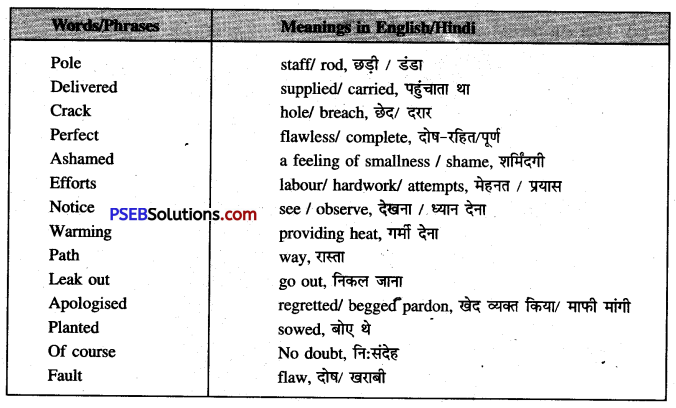
Word Meanings
PSEB 6th Class English Solutions Poem 1 My Furry Friend 5

My Furry Friend Poem Summary in English

My Furry Friend Summary in English

The poet brought a furry puppy in home. He was black and white in colour. His eyes were soft brown. He looked very happy and slept day and night. Though the puppy was small in size, his tummy was very fat. He nibbled at everything it found in the house.

He tore down his toys and made a funny noise. He enjoyed family talks and growled when he was asked to go away. Next he was fully grown and always looked angry. He would not allow you to touch his food. Meat was his favourite food. He was always hungry for it and ate it greedily.

PSEB 6th Class English Solutions Poem 1 My Furry Friend

My Furry Friend Summary in Hindi

कवि एक छोटा सा रोएंदार (फर वाला) पिल्ला घर ले आया। देखने में यह एक चूहे जितना लगता था। इसका रंग काला और सफेद था। इसकी हल्की-भूरी आंखें थीं और इसका पेट मोटा था। यह हर समय सोया रहता था और बहुत ही खुश दिखाई देता था।

पिल्ले की आदतें अजीब थीं और वह अजीब हरकतें करता था। वह चूहे की तरह चीज़ों को कुतरता था और उसे जो कुछ भी मिलता था खा जाता था। वह बहुत ही फुर्तीला था और हर समय लड़ने को तैयार रहता था। वह अपने खिलौने तोड़-फोड़ देता था और अजीब शोर करता था।

पिल्ले को कवि तथा परिवार की बातचीत सुनने में आनंद आता था। इसलिए वह उनके बीच आ बैठता था। भगाने पर भी वह नहीं जाता था और गुर्राने लगता था। अब पिल्ला कुत्ता बन चुका था और हर समय गुस्से में रहता था। वह खाने का बहुत शौकीन था और हर समय मांस खाने को मांगता था। जब भी उसे उसका मनपसंद खाना दिया जाता था, वह तेज़ी से उठ खड़ा होता था। उसके बाद वह अपने खाने को हाथ भी नहीं लगाने देता था।

Class 6th English Book Solutions PSEB Poetry

Open Thy Eyes and see Thy God Question Answer Class 9 English Main Course Book Poem Chapter 1 PSEB Solutions

Punjab State Board PSEB 9th Class English Book Solutions English Main Course Book Poem 1 Open Thy Eyes and see Thy God Textbook Exercise Questions and Answers.

Class 9th English Main Course Book Poem Chapter 1 Open Thy Eyes and see Thy God Question Answers

Open Thy Eyes and see Thy God Class 9 Questions and Answers

Question 1.
Write the central idea of the poem.
(कविता का केन्द्रीय भाव लिखें।)
Answer:
Tagore says that we can’t find God in temples. We can’t find Him by chanting and singing. We can’t find Him by telling beads. He lives among poor labourers. So we should go and work with the poor if we want to find God.”

टैगोर कहता है कि हम ईश्वर को मन्दिरों में नहीं ढूंढ सकते हैं। हम उसे भजन बोल कर और गा कर नहीं ढूंढ सकते हैं। हम उसे माला फेर कर नहीं ढूंढ सकते हैं। वह ग़रीब मजदूरों के मध्य रहता है। इसलिए हमें ग़रीबों के साथ जा कर काम करना चाहिए यदि हम ईश्वर को ढूंढना चाहते हैं।

PSEB 9th Class English Main Course Book Solutions Poem 1 Open Thy Eyes and see Thy God

Question 2.
Why does the poet say that we should leave chanting, singing and telling of beads ?
(कवि यह क्यों कहता है कि हमें भजन बोलना, गाना और माला फेरना छोड़ देना चाहिए ?)
Answer:
The poet believes that God does not live in temples. We cannot find him by chanting, singing and telling beads. So the poet says that we should leave chanting and telling beads.

कवि मानता है कि ईश्वर मन्दिरों में नहीं रहता है। हम उसे भजन बोलकर, गाकर और माला फेरकर प्राप्त नहीं कर सकते। इसलिए कवि कहता है कि हम भजन बोलना और माला फेरना छोड़ दें।

Question 3.
Where can God be found ?
(ईश्वर को कहां पाया जा सकता है ?)
Answer:
We can find God where the tiller is tilling the hard land. We can find Him where the pathmaker is breaking stones. In other words, God lives among the poor hardworking people.

हम ईश्वर को उस जगह पा सकते हैं जहां किसान सख्त ज़मीन पर हल चला रहा होता है। हम उसे वहां देख सकते हैं जहां सड़कें बनाने वाला पत्थर तोड़ रहा होता है। अन्य शब्दों में, ईश्वर कठोर परिश्रम करने वाले ग़रीब लोगों के मध्य रहता है।

Question 4.
What does the poet suggest regarding the presence of God ?
(कवि ईश्वर की उपस्थिति के बारे में क्या सुझाव देता है ?)
Answer:
The poet says that God doesn’t live in temples. He lives among the poor hard working people.
कवि कहता है कि ईश्वर मन्दिरों में नहीं रहता है। वह कठिन परिश्रम करने वाले निर्धन लोगों के मध्य रहता है।

Question 5.
Write ‘True’ or ‘False’ against the following statements :
(a) God lives in temples.
(b) By chanting, singing and telling of beads we can reach God.
(c) God is there where the tiller is tilling the land.
(d) We should not work hard.
Answer:
(a) False
(b) False
(c) True
(d) False.

PSEB 9th Class English Main Course Book Solutions Poem 1 Open Thy Eyes and see Thy God

Question 6.
Do you agree with Tagore’s contention in his poem, ‘Open Thy Eyes and See Thy God’ ? Why?
(क्या आप इस कविता में टैगोर के विचारों से सहमत हैं ? क्यों ?)
Answer:
I fully agree with Tagore’s contention. True worship does not mean chanting and telling beads. It does not mean going to temples. It means working hard and helping the poor.

मैं टैगोर के विचारों से पूरी तरह सहमत हूं। सच्ची पूजा का अर्थ भजन बोलना और माला फेरना नहीं होता है। इसका अर्थ मन्दिरों को जाना नहीं होता है। इसका अर्थ होता है – कठिन परिश्रम करना और ग़रीबों की मदद करना।

Stanzas For Comprehension

Stanza 1

Leave this chanting and
singing and telling of beads !
Whom dost thou worship in this
lonely dark corner of a temple
with doors all shut ? Open thine
eyes and see thy God is not
before thee !

Questions
1. What does the poet want us to leave? Why?
2. The poet in this stanza asks a question. What is the question?
3. Our eyes are open. Why does the poet say ‘Open thine eyes”?
4. Who are these lines addressed to?
5. What does the poet want the worshipper of God to do?
Answer:
1. The poet wants us to leave chanting and telling beads in temples. He says that God doesn’t live in temples. We can’t find him there by the singing of hymns and telling of beads.
2. The poet asks whom we are worshipping in the lonely dark corner of the temple with doors all shut.
3. Our physical eyes are open but our eyes of the mind are closed. That is why the poet asks us to open our eyes.
4. The poet imagines someone singing hymns and telling beads in a dark corner of a temple. He addresses these lines to such a worshipper of God.
5. He wants the worshipper to open his eyes and see that God whom he is worshipping is not there before him.

Stanza 2

He is there where the tiller is
tilling the hard ground and where
the pathmaker is breaking stones.
He is with them in sun and in
shower, and His garment is covered
with dust. Put off thy holy mantle
and even like Him come
down on the dusty soil !

Questions

1. ‘Thy God is not before thee. Where can we find him?
2. Why are His garments covered with dust?
3. What is the tiller doing?
4. What is the pathmaker doing?
5. How does the poet think we can seek God?
Answers
1. We can find God where the tiller is tilling the hard land and where the pathmaker is breaking stones.
2. His garments are covered with dust because He lives among those who till the hard land and break stones.
3. He is tilling the hard land.
4. He is breaking stones.
5. The poet thinks we can seek God by working among the poor people such as the tillers and pathmakers.

PSEB 9th Class English Main Course Book Solutions Poem 1 Open Thy Eyes and see Thy God

Stanza 3

Deliverance ? Where is this deliverance
to be found ? ‘Our master himself
has joyfully taken upon him the bonds
of creation; He is bound with us all
for ever.

Question
1. What is meant by ‘deliverance’ ?
2. Does the poet think of deliverance to be a desirable thing?
3. Who is our master ?
4. What bonds has our master taken upon himself ?
5. How is He bound with us all for ever?
Answer:
1. ‘Deliverance’ means freedom from a life of toil.
2. The poet doesn’t think of deliverance to be a desirable thing.
3. God is our master.
4. He has taken upon himself the bonds of creation.
5. We all are God’s creation. Thus God is bound with us for ever.

Stanza 4

Come out of thy meditations and
leave aside thy flowers and incense !
What harm is there if thy clothes
become tattered and stained ? Meet
him and stand by him in toil and in the
sweat of thy brow.

Question
1. What does the poet say about our meditations ?
2. What does he want us to leave aside ? Why?
3. How will our clothes become tattered and stained ?
4. Does the poet see any harm if our clothes become tattered and torn ?
5. ‘Meet him ………’ Who does ‘him’ here refer to ?’
Answer:
1. The poet says that we can’t find God through our meditations. So we should give them up.
2. He wants us to leave aside the flowers and the incense. He says this because he feels that we can’t please God by offering any flowers or incense.
3. Our clothes will become tattered and torn if we go to work with tillers and pathmakers.
4. No, he doesn’t see any harm in this.
5. The word ‘him’ here refers to God.

Objective Type Questions

Answer the following in one word / phrase / sentence :

Question 1.
Name the poet of the poem, ‘Open Thy Eyes ….
Answer:
Rabindranath Tagore.

Question 2.
Where is the devotee, as given in the poem ?
Answer:
In a dark corner of a temple.

Question 3.
Who is there with the devotee ?
Answer:
He is sitting there all alone.

Question 4.
Where does God live ?
Answer:
He lives where tiller tills the hard ground.

Question 5.
Where can God be found ?
Answer:
He can be found where the poor people work hard.

PSEB 9th Class English Main Course Book Solutions Poem 1 Open Thy Eyes and see Thy God

Complete the following :

1. The devotee is sitting ……………….. in ………………
2. We can’t find God by …………………. and …………..
3. God lives where the poor people …………… hard and shed ………..
Answer:
1. all alone, a temple
2. chanting hymns, telling beads
3. work / labour, sweat.

Write True or False against each statement :

1. The devotee was sitting in his home, doing Pooja.
2. God cannot be found in temples.
3. God has taken upon himself the task of creation.
Answer:
1. False
2. True
3. True.

Choose the correct option for each of the following:

Question 1.
God can be found by ……………….
(a) chanting hymns
(b) telling the beads
(c) praising him day and night
(d) none of the above.
Answer:
(d) none of the above.

Question 2.
The garment of God, in this poem, is ……..
(a) studded with gems
(b) covered with dust
(c) shining brightly
(d) colourful.
Answer:
(b) covered with dust

Open Thy Eyes and see Thy God Poem Summary in English

Open Thy Eyes and see Thy God Introduction:

In this poem, Tagore says that the worship of idols is useless. He says that God can never be found in places of worship. He can be found where the tillers are tilling land. He can be found where the workers are sweating in the sun. Anyone who wants to find God, should go and work with the tillers and the pathmakers.

PSEB 9th Class English Main Course Book Solutions Poem 1 Open Thy Eyes and see Thy God 1

Moksha cannot be achieved through empty rituals. In fact, the very desire for deliverance is unholy. Even God has not given Himself deliverance. He always remains busy in the task of creation. A true devotee of God should also work tirelessly. He should work for the poor and the downtrodden.

Character of a Happy Man Summary in English:

The poet sees a devotee in a dark corner of a temple. The devotee is sitting all alone. All the doors of the temple are shut. The devotee is chanting hymns. He is telling beads. The poet asks the devotee whom he is worshipping. He asks him to open his eyes. He asks him to see that his God is not there before him. The poet means to say we can’t find God by chanting hymns. We can’t find Him by telling beads. God does not live in temples.

The poet says that God lives where the tiller tills the hard ground. He lives where the path maker is breaking stones. He lives with the poor labouring people. He lives with them in sun and shower. His garment is covered with dust. So the poet asks the devotee to put off his mantle of worship. Like God Himself, he should go and work with the poor. The poet means to say that God cannot be found in temples. He can be found in places where the poor work hard and shed their sweat.

Then the poet talks of deliverance or moksha. Deliverance means the freedom from labour. The poet says that there is no deliverance for anyone. Even God has no deliverance. He has to do hard labour. He has taken upon Himself the difficult job of creation. He performs this task joyfully.

PSEB 9th Class English Main Course Book Solutions Poem 1 Open Thy Eyes and see Thy God

So the poet asks the devotee to come out of the dark corner of his meditations. He should leave aside his flowers and incense. He should go and work among the poor. No harm would come if his clothes get stained. Rather he would be able to fulfil his desire. He would be able to meet God and stand by Him.

Open Thy Eyes and see Thy God Poem Summary in Hindi

Open Thy Eyes and see Thy God Introduction:

कविता का संक्षिप्त परिचय इस कविता में टैगोर निरर्थक मूर्ति-पूजा की आलोचना करता है। वह कहता है कि ईश्वर को कभी भी पूजास्थलों में ढूंढा नहीं जा सकता। उसे वहां ढूंढा जा सकता है, जहां किसान भूमि जोत रहे होते हैं और जहां मज़दूर लोग धूप में पसीना बहा रहे होते हैं। कोई भी व्यक्ति जो ईश्वर की तलाश करना चाहता है उसे किसानों के साथ और सड़कें बनाने वालों के साथ जा कर काम करना चाहिए। मोक्ष खोखले रीति-रिवाजों द्वारा प्राप्त नहीं किया जा सकता। वास्तव में मोक्ष की इच्छा करना ही एक अपवित्र बात है। स्वयम् ईश्वर ने भी अपने आप को मुक्ति प्रदान नहीं की है। वह सदा रचना के काम में लगा रहता है। ईश्वर के सच्चे भक्त को भी अथक रूप से काम करना चाहिए। उसे गरीबों और दलितों के लिए काम करते रहना चाहिए।

Open Thy Eyes and see Thy God Summary in Hindi:

कवि को किसी मन्दिर के एकान्त और अन्धेरे कोने में बैठा एक भक्त दिखलाई देता है। मन्दिर के सभी दरवाजे बन्द हैं। भक्त भजन गा रहा है और माला फेर रहा है। कवि उससे पूछता है कि वह किसकी पूजा कर रहा है। वह भक्त से कहता है कि वह अपनी आंखें खोले और देखे कि वहां उसके सामने ईश्वर नहीं है। कवि के कहने का भाव यह है कि ईश्वर को भजन गा कर अथवा माला फेर कर प्राप्त नहीं किया जा सकता है। ईश्वर मन्दिरों में नहीं रहता है। कवि कहता है कि ईश्वर उस जगह पर रहता है जहां खेतिहर मजदूर धरती जोत रहा है। वह उस जगह पर रहता है जहां सड़कें बनाने वाला मज़दूर पत्थर तोड़ रहा है। वह मेहनत करने वाले इन लोगों के साथ धूप तथा वर्षा में खड़ा रहता है। उसके वस्त्र मजदूरों के वस्त्रों की भान्ति धूल से भरे रहते हैं।

इसलिए कवि भक्त से कहता है कि वह अपने पूजा वाले वस्त्र उतार दे। स्वयं ईश्वर की भान्ति उसे गरीब लोगों के साथ जा कर काम करना चाहिए। कवि के कहने का भाव है कि ईश्वर को मन्दिरों में नहीं खोजा जा सकता है। उसे उस स्थान पर देखा जा सकता है जहां निर्धन लोग परिश्रम करते हैं और अपना पसीना बहाते हैं। कवि मुक्ति की बात करता है। मुक्ति का अर्थ होता है कि कठिन परिश्रम करने से छूट। कवि कहता है कि मुक्ति कहीं नहीं मिलती है। स्वयं ईश्वर को भी मुक्ति प्राप्त नहीं है। उसे भी परिश्रम करना पड़ता है। उसने अपने ऊपर संसार की रचना करने का कठिन काम लिया हुआ है। वह उस काम को खुशी-खुशी करता रहता है।

PSEB 9th Class English Main Course Book Solutions Poem 1 Open Thy Eyes and see Thy God

इसलिए कवि भक्त से कहता है कि वह अपनी समाधि को छोड़ दे। उसे अपने फूल और धूपबत्ती एक तरफ रख देने चाहिएं। उसे निर्धन लोगों के मध्य जा कर काम करना चाहिए। कोई हानि नहीं होगी यदि उसके वस्त्र फट जाएंगे अथवा गंदे हो जाएंगे। इसके विपरीत उसे अपनी इच्छा की प्राप्ति हो जाएगी। वह ईश्वर से मिलने और उसके साथ खड़ा होने के योग्य हो जाएगा।

Open Thy Eyes and see Thy God Translation in Hindi

Stanza 1

Leave this chanting and
singing and telling of beads !
Whom dost thou worship in this
lonely dark corner of a temple
with doors all shut ? Open thine
eyes and see thy God is not
before thee !

कठिन शब्दार्थ-1. chanting-भजन गाना ; 2. telling of beads—माला फेरना ; 3. dost – do ; 4. thine-your, तुम्हारी ; 5. thee-you, तुम।

अनुवाद

छोड़ो यह भजन बोलना
और गाना तथा माला का फेरना !
किसकी पूजा कर रहे हो तुम इस
एकान्त अन्धेरे कोने में एक मन्दिर के
जिसके सब दरवाजे हैं बंद ? खोलो अपनी
आँखें और देखो तुम्हारा ईश्वर नहीं है
तुम्हारे सामने !

Stanza 2

He is there where the tiller is
tilling the hard ground and where
the pathmaker is breaking stones.
He is with them in sun and in
shower, and His garment is covered
with dust. Put off thy holy mantle
and even like Him come
down on the dusty soil !

कठिन शब्दार्थ-
1. tiller-खेती करने वाला मजदूर ; 2. tilling-खेती कर रहा, हल चला रहा ; 3. sun-धूप ; 4. garment-वस्त्र ; 5. mantle-ओढ़न।

PSEB 9th Class English Main Course Book Solutions Poem 1 Open Thy Eyes and see Thy God

अनुवाद
वह उस जगह है जहां किसान
चला रहा है हल, सख्त ज़मीन पर और जहां
सड़कें बनाने वाला, तोड़ रहा है पत्थर !
वह उनके साथ है, धूप और वर्षा में,
और उसका वस्त्र भरा हुआ है ।।
धूल से। उतार दो अपना पवित्र ओढ़न .
और आ जाओ उसी की भांति
नीचे धूल-भरी मिट्टी में !

Stanza 3

Deliverance ? Where is this deliverance
to be found ? Our master himself
has joyfully taken upon him the bonds
of creation; He is bound with us all
for ever.

कठिन शब्दार्थ-1. deliverance-मुक्ति, मोक्ष ; 2. bonds—बन्धन ; 3. creation-संसार की रचना।

अनुवाद

मुक्ति ? यह मुक्ति कहां
मिलती है ? स्वयं हमारे स्वामी ने
प्रसन्नतापूर्वक लिया हुआ है बन्धन |
संसार की रचना का; वह बन्धा हुआ है हम सबसे
सदा के लिए।

Stanza 4

Come out of thy meditations and
leave aside thy flowers and incense !
What harm is there if thy clothes
become tattered and stained ? Meet
him and stand by him in toil and in the
sweat of thy brow.

कठिन शब्दार्थ-1. meditations-समाधि, चिन्तन ; 2. aside-एक तरफ ; 3. incenseधूपबत्ती ; 4. tattered—कटे-फटे ; 5. stained—दाग-भरे ; 6. sweat of the brow-माथे (अर्थात् कड़ी मेहनत) का पसीना।

PSEB 9th Class English Main Course Book Solutions Poem 1 Open Thy Eyes and see Thy God

अनुवाद
जागो अपनी समाधि से और
रख दो एक तरफ अपने फूल और धूपबत्ती !
क्या होगा नुक्सान अगर तुम्हारे वस्त्र
हो जाएंगे कटे-फटे और दाग-भरे ? मिलो
उसे और उसकी मदद करो, अपनी मेहनत और
अपने माथे के पसीने के द्वारा।

Class 9th English Main Course Book Solutions PSEB Poetry

A Letter to God Question Answer Class 9 English Literature Book Solutions Chapter 4 PSEB Solutions

Punjab State Board PSEB 9th Class English Book Solutions English Literature Book Solutions Chapter 4 A Letter to God Textbook Exercise Questions and Answers.

Class 9th English Literature Book Solutions Chapter 4 A Letter to God Question Answers

A Letter to God Class 9 Questions and Answers

Question 1.
Where was Lencho’s house located ? Did he have any neighbours ?
(लैंको का घर कहां स्थित था? क्या उसके कोई पड़ोसी थे?)
Answer:
Lencho’s house was on the top of a low hill. It was the only house in the valley. Thus Lencho had no neighbours.
लैंको का मकान एक कम ऊंची पहाड़ी की चोटी पर था। घाटी में यह एकमात्र मकान था। इस प्रकार लैंको का कोई पड़ोसी नहीं था।

Question 2.
When did it start raining ?
(वर्षा होनी कब शुरू हुई?)
Answer:
It started raining when Lencho and his family were having dinner.
वर्षा तब शुरू हुई जब लैंको और उसका परिवार रात का भोजन कर रहे थे।

PSEB 9th Class English Literature Book Solutions Chapter 4 A Letter to God

Question 3.
What was Lencho’s family doing when it started raining ?
(जब वर्षा होनी शुरू हुई तो लैंको का परिवार क्या कर रहा था?)
Answer:
They were having dinner.
(वे रात्रिभोज कर रहे थे।)

Question 4.
Why did Lencho go out ? What did he observe ?
(लैंको बाहर क्यों गया? उसने क्या देखा?)
Answer:
It had started raining. Lencho went out to have the pleasure of feeling of rain on his body. He observed the raindrops falling from the sky. He called them new coins. He said, “The big drops are ten-cent pieces and the little ones are fives.”

वर्षा होनी शुरू हो गई थी। लैंको अपने शरीर पर वर्षा को महसूस करने का आनन्द लेने के लिए बाहर गया। उसने आकाश से गिर रही वर्षा की बूंदों को देखा। उसने उन्हें नए सिक्कों का नाम दिया। उसने कहा, “बड़ी बूंदे दस-सेन्ट के सिक्के हैं और छोटी बूंदे पांच-सेन्ट के सिक्के हैं।”

Question 5.
Why did Lencho’s sons run out ? Were they happy ? How do you know?
(लैंको के बेटे भागते हुए बाहर क्यों गए? क्या वे प्रसन्न थे? आप कैसे कह सकते हैं ?)
Answer:
It had started hailing. The sons went out to collect the hailstones. They were very happy. The hailstones seemed to them like frozen pearls. And they ran out to collect them.

ओले पड़ने लगे थे। पुत्र ओले इकट्ठे करने के लिए बाहर गए। वे बहुत प्रसन्न थे। उन्हें ओले जमे हुए मोतियों के जैसे लग रहे थे। और वे उन्हें बटोरने के लिए बाहर को भागे।

Question 6.
Why did Lencho become unhappy after the storm ? What did he say?
(लैंको तूफान के बाद उदास क्यों हो गया ? उसने क्या कहा ?)
Answer:
After the storm, the field was all covered with hailstones. Not a leaf remained in the trees. The corn was totally destroyed. The flowers were gone from the plants. All this made Lencho very unhappy. He said that the hail had left nothing. They would have no corn that year.

तूफ़ान के बाद पूरा खेत ओलों से ढक गया था। पेड़ों पर एक भी पत्ता नहीं रहा था। अनाज पूरा नष्ट हो गया था। पौधों पर से फूल जाते रहे थे। इस सब से लैंको बहुत दुःखी हो गया। उसने कहा कि ओलों ने कुछ नहीं छोड़ा था। उस वर्ष उन्हें कोई अनाज प्राप्त नहीं होगा।

PSEB 9th Class English Literature Book Solutions Chapter 4 A Letter to God

Question 7.
What did Lencho think throughout the night ?
(लैंको पूरी रात क्या सोचता रहा?)
Answer:
Lencho thought only of help from God. This was his only hope. He believed that God sees everything. He believed that God sees even what is deep in one’s heart.

लैंको केवल ईश्वर से सहायता के बारे में सोचता रहा। यह उसकी एकमात्र आशा थी। उसका विश्वास था कि ईश्वर हर चीज़ देखता है। उसका विश्वास था कि ईश्वर वह भी देख लेता है जो आदमी के गहरे दिल में होता है।

Question 8.
Who did Lencho write to for help ? What did he write in his letter ?
(लैंको ने सहायता के लिए किसे लिखा? अपने पत्र में उसने क्या लिखा?) ”
Answer:
Lencho wrote to God for help. In his letter, he wrote, “God, if you don’t help me, my family and I will go hungry this year. I need a hundred pesos in order to sow my field again.”

लैंको ने सहायता के लिए ईश्वर को लिखा। अपने पत्र में उसने लिखा, “ईश्वर, यदि तुम मेरी सहायता नहीं करोगे, तो इस वर्ष मेरे परिवार को और मुझे भूखा रहना पड़ेगा। अपने खेत को फिर से बोने के लिए मुझे एक सौ पेसो की ज़रूरत है।”

Question 9.
How did Lencho address the envelope ? What did he do after that ?
(लिफ़ाफ़े के ऊपर लैंको ने पता कैसे लिखा? इसके बाद उसने क्या किया?)
Answer:
Lencho wrote on the envelope only two words : ‘To God’. He put his letter inside the envelope and went to the town. There he got a stamp at the post office. He put the stamp on the envelope and dropped it into the mailbox.

लैंको ने लिफ़ाफ़े के ऊपर केवल दो शब्द लिखे : ‘ईश्वर को’। उसने अपना पत्र लिफ़ाफ़े में डाला और नगर को गया। वहां उस ने डाकघर से एक टिकट लिया। उसने टिकट को लिफ़ाफ़े के ऊपर लगाया और इसे डाक बक्से में डाल दिया।

Question 10.
Who took the letter to the postmaster?
(पोस्टमास्टर के पास पत्र को कौन ले कर गया?)
Answer:
It was a postman who took the letter to the postmaster.
यह एक डाकिया था जो पोस्टमास्टर के पास पत्र ले कर गया।

PSEB 9th Class English Literature Book Solutions Chapter 4 A Letter to God

Question 11.
What did the postmaster do after reading Lencho’s letter ? Why did he do so?
(लैंको का पत्र पढ़ने के बाद पोस्टमास्टर ने क्या किया? उसने ऐसा क्यों किया?)
Answer:
The postmaster was struck by Lencho’s faith in God. He thought of sending God’s reply to Lencho’s letter. He collected money from his employees. He himself gave a part of his salary. Thus he collected seventy pesos. The money was handed to Lencho in the form of a letter.

पोस्टमास्टर ईश्वर में लैंको की आस्था पर चकित रह गया। उसने लैंको के पत्र का ईश्वर द्वारा उत्तर भेजने का विचार बनाया। उसने अपने कर्मचारियों से पैसे इकट्ठा किए। उसने स्वयं अपने वेतन का कुछ भाग दिया। इस तरह उसने सत्तर पेसो इकट्ठे कर लिए। ये पैसे एक पत्र के रूप में लैंको को दे दिए गए।

Question 12.
When did Lencho receive the letter from ‘God’ ? Who gave it to him and where ?
(लैंको को ‘ईश्वर’ की तरफ से आया पत्र कब प्राप्त हुआ? यह पत्र उसे किसने दिया और कहां दिया?)
Answer:
It was a Sunday morning. Lencho went to the post office to ask if there was a letter for him. The postman handed a letter to him. Lencho thought it was a letter from God. But it was the same letter which the post office people had sent for Lencho.

रविवार की प्रातः थी। लैंको डाकघर में यह पूछने गया कि क्या वहां उसके लिए कोई पत्र था। डाकिए ने उसे एक पत्र दिया। लैंको ने समझा कि यह ईश्वर की ओर से आया हुआ पत्र था। किन्तु यह वही पत्र था जो डाक-घर के लोगों ने लैंको के लिए भेजा था।

Question 13.
Was Lencho surprised to receive the money ? Why?
(क्या पैसे प्राप्त करने के बाद लैंको को हैरानी हुई ? क्यों ?)
Answer:
Lencho was not at all surprised to receive the money. He was certain that God would reply his letter and send him the money.
लैंको को पैसे प्राप्त करके बिल्कुल भी हैरानी नहीं हुई। उसे पूरा विश्वास था कि ईश्वर उसके पत्र का उत्तर देगा और उसे पैसे भेजेगा।

Question 14.
Why was Lencho angry after counting the money ?
(पैसे गिनने के बाद लैंको को क्रोध क्यों आया?)
Answer:
Lencho had asked God for a hundred pesos. But he found only seventy pesos in the envelope. He thought that the post-office people had taken out the rest of money. That was why he was angry.

लैंको ने ईश्वर से एक सौ पेसो मांगे थे। किन्तु उसे लिफ़ाफ़े में केवल सत्तर पेसो मिले। उसने सोचा कि बाकी के पैसे डाकघर के लोगों ने निकाल लिए थे। इसी कारण से वह क्रोधित था।

Question 15.
Did Lencho write back to God ? Why did he do so ?
(क्या लैंको ने ईश्वर को वापस पत्र लिखा? उसने ऐसा क्यों किया?)
Answer:
Lencho did write back to God. He had asked God for a hundred pesos. But he got only seventy pesos. He thought the post-office people had taken out the money. So he wrote back to God to send him the rest of money.

लैंको ने ईश्वर को वापस पत्र अवश्य लिखा। उसने ईश्वर से एक सौ पेसो मांगे थे किन्तु उसे केवल सत्तर पेसो प्राप्त हुए। उसने सोचा कि डाकघर के लोगों ने पैसे निकाल लिए थे। इसलिए उसने ईश्वर को वापस पत्र लिखा कि वह उसे बाकी के पैसे भेजे।

PSEB 9th Class English Literature Book Solutions Chapter 4 A Letter to God

Question 16.
What did Lencho write in his second letter to God ?
(लैंको ने ईश्वर को अपने दूसरे पत्र में क्या लिखा?)
Answer:
Lencho had asked God for a hundred pesos. But he got only seventy. He thought the post-office people had taken out his money. So he asked God to send him the other thirty pesos. But he asked Him not to send the money through mail. He said that the post-office employees were a bunch of crooks.

लैंको ने ईश्वर से एक सौ पेसो मांगे थे। किन्तु उसे केवल सत्तर पेसो प्राप्त हुए। उसने सोचा कि डाक-घर के लोगों ने उसके पैसे निकाल लिए थे। इसलिए उसने ईश्वर से कहा कि वह उसे शेष तीस पेसो भेज दे परन्तु उसने उससे (ईश्वर से) यह भी कहा कि वह पैसे डाक से न भेजे। उसने कहा कि डाकखाने के कर्मचारी मक्कारों का टोला थे।

A Letter to God Summary in English

A Letter to God Introduction:

Lencho was, a poor farmer. He was very hard-working. Once there was a hailstorm. It destroyed his crops completely. Lencho had great faith in God. He wrote a letter to God. He asked God to send him money. The postmaster saw this letter. He decided to help Lencho. He collected some money. He put it inside an envelope. Lencho came to the post office to check his mail. The post office people gave him the envelope. Lencho opened the envelope. He took out the money and counted it. He found that it was less than he had asked for. He wrote another letter to God. He asked God to send him the rest of the money. But he wanted Him not to send the money through the mail. He said that the post office people were a bunch of crooks.

A Letter to God Summary in English

Lencho was a poor farmer. He was very hard-working. He was expecting a good harvest after the rains. Lencho waited expectantly for the rains. The rain did come but it came with hailstorm and destroyed his crop completely. Lencho’s soul was filled with sadness. He had firm faith in God. He believed that God would not let him starve. He, therefore, wrote a letter to God, asking Him to send one hundred pesos. (Peso is a unit of money in many Latin American countries and the Philippines.) Lencho then went to the post-office. He fixed a stamp on the letter and put it in the mail-box.

One of the postmen laughed to find in the mail a letter addressed to God. He showed it to the postmaster. The postmaster also laughed on seeing the letter. But immediately he became serious. He admired the faith of the man and decided to help him. He asked for contribution from his employees. He himself also gave a part of his salary. Though he could not collect one hundred pesos, yet he was able to send the farmer a little more than half of it. The postmaster put the money inside an envelope and addressed it to Lencho. He also put into the envelope a letter. But his letter had only one single word written on it. The word was in the form of a signature — God.

PSEB 9th Class English Literature Book Solutions Chapter 4 A Letter to God

The next Sunday Lencho went to the post-office to ask if there was any letter for him. The postman took out a letter and handed it over to Lencho. Lencho was not surprised on seeing the money in the envelope. He was rather angry when he counted the money. There were only seventy pesos in the envelope. Lencho was sure God could not have made a mistake. So he wrote another letter to God asking him to send him the rest of the money. He also wrote to God not to send the money through the mail because he thought that the post-office employees were a bunch of crooks.

A Letter to God Summary in Hindi

A Letter to God Introduction:

लैंको एक ग़रीब किसान था। वह बहत परिश्रम किया करता था। एक बार भारी ओले पड़े। इससे उसकी पूरी फ़सल नष्ट हो गई। लैंको को ईश्वर में बहुत भरोसा था। उसने ईश्वर को एक पत्र लिखा। उसने ईश्वर से कहा कि वह उसे पैसे भेज दे। पोस्टमास्टर ने लैंको का यह पत्र देख लिया। उसने लैंको की सहायता करने का निश्चय किया। उसने कुछ पैसे एकत्रित किए। उसने ये पैसे एक लिफ़ाफ़े में डाल दिए। लैंको अपनी डाक देखने के लिए डाकघर में आया। डाकघर के लोगों ने उसे लिफ़ाफ़ा दे दिया। लैंको ने लिफ़ाफ़ा खोला। उसने पैसे निकाले और इन्हें गिना। उसने देखा कि पैसे उस से कम थे, जितने उसने मांगे थे। उसने ईश्वर को एक अन्य पत्र लिखा। उसने ईश्वर से कहा कि वह उसे बाकी पैसे भेज दे। किन्तु वह ईश्वर से चाहता था कि वह उसे पैसे डाक द्वारा न भेजे। उसने कहा कि डाकघर के लोग धोखेबाज़ों का एक टोला थे।

A Letter to God Summary in Hindi

कहानी का विस्तृत सार लैंको एक निर्धन किसान था। वह बहुत परिश्रम किया करता था। उसे आशा थी कि वर्षा होने के बाद उसकी फ़सल अच्छी होगी। लैंको ने वर्षा की प्रतीक्षा की। वर्षा तो आई किन्तु यह ओलों के साथ आई। लैंको की फ़सल पूरी तरह नष्ट हो गई। उसकी आत्मा उदासी से भर गई किन्तु उसे ईश्वर में विश्वास था। उसे विश्वास था कि ईश्वर उसे भूखा नहीं मरने देगा। इसलिए उसने ईश्वर को एक पत्र लिखा कि वह उसे एक सौ पेसो भेज दे। (पेसो अनेक लेटिन अमरीकी देशों और फिलीपीन्ज़ में मुद्रा की इकाई का नाम है।) पत्र लिखने के बाद लैंको डाकघर को गया। वहां उसने पत्र पर एक टिकट लगाई और इसे डाक-पेटी में डाल दिया।

डाकियों में से एक डाकिया भगवान् को सम्बोधन किए उस पत्र को देखकर हंस दिया। उसने यह पत्र पोस्टमास्टर को दिखाया। पोस्टमास्टर भी पत्र देखकर हंस दिया। परन्तु तुरन्त ही वह गम्भीर हो गया। उसने पत्र लिखने वाले द्वारा भगवान् में व्यक्त विश्वास की सराहना की और उसकी सहायता करने का निश्चय किया। उसने अपने साथी कर्मचारियों से कुछ धन एकत्रित किया। उसने अपने वेतन का भी कुछ भाग दिया। यद्यपि वह एक सौ पेसो एकत्रित न कर सका, वह किसान को आधे से कुछ अधिक पैसे भेजने के योग्य हो गया। पोस्टमास्टर ने यह धन एक लिफ़ाफ़े में डाल दिया जिस पर लैंकों का पता लिखा था। उसने इस लिफाफे के अन्दर एक पत्र भी डाला किन्तु इस पर केवल एक ही शब्द लिखा था। वह शब्द हस्ताक्षर के रूप में था-ईश्वर।

अगले रविवार के दिन लैंको डाकघर में यह पूछने गया कि क्या उसका कोई पत्र आया था। डाकिए ने एक पत्र निकाला और इसे लैंको को दे दिया। लैंको लिफ़ाफ़े में पड़े पैसे देखकर चकित न हुआ क्योंकि उसे विश्वास था कि ईश्वर उसकी सहायता अवश्य करेगा। किन्तु जब उसने पैसों को गिना तो वहां केवल 70 पेसो ही निकले। लैंको क्रोध से भर गया। उसे विश्वास था कि ईश्वर ग़लती नहीं कर सकता था। इसलिए उसने ईश्वर के नाम एक और पत्र लिखा तथा उसे शेष पैसे भेजने के लिए कहा। उसने ईश्वर को यह भी लिखा कि वह डाक द्वारा पैसे न भेजे क्योंकि उसके अनुसार डाकघर के कर्मचारी धोखेबाज़ लोगों का एक टोला था।

A Letter to God Translation in Hindi

(Page 35-36)

कठिन शब्दार्थ-1. entire—पूरी ; 2. crest-चोटी ; 3. dotted—इधर-उधर बिखरा हुआ, छिटका हुआ ; 4. harvest—पकी हुई फसल ; 5. downpour_भारी वर्षा ; 6. intimately-पूरी तरह से ; 7. supper – सायंकाल का भोजन ; 8. predicted-पहले ही बता दिया था ; 9. approaching-नजदीक आते हुए ; 10. pleasure-खुशी।

अनुवाद-वह मकान-जो उस पूरी घाटी में एकमात्र ही था-एक निचली पहाड़ी की चोटी पर खड़ा था। इस ऊंचाई पर से आदमी नदी को तथा पके हुए अनाज के उस खेत को देख सकता था जो हर जगह ऐसे फूलों, से भरा हुआ था जो सदा एक अच्छी फसल के होने का भरोसा दिलाते थे।

एकमात्र चीज़ जिसकी धरती को ज़रूरत थी, वह थी-एक मूसलाधार वर्षा अथवा कम-से-कम एक बौछार। उस पूरी प्रातः के दौरान लैंको-जो अपने खेतों को पूरी तरह से जानता था–ने उत्तर-पूर्व से आकाश को देखने के अतिरिक्त अन्य कोई काम नहीं किया था।

“ए औरत, हमें अब सचमुच कुछ पानी मिलने वाला है।” उस औरत ने, जो सायंकाल का भोजन तैयार कर रही थी, उत्तर दिया, “हां, यदि ईश्वर की इच्छा हुई।” जो लड़के आयु में बड़े थे, वे खेत में काम कर रहे थे, जबकि छोटे लड़के घर के नज़दीक खेल रहे थे, और अन्त में औरत ने उन सब को यह कहते हुए बुलाया, “रात्रि-भोजन के लिए आ जाओ……………।”

इस भोजन के दौरान ही, जैसा कि लैंको ने पहले ही अनुमान लगा लिया था, वर्षा की बड़ी-बड़ी बूंदें गिरने लगीं। उत्तर-पूर्वी दिशा में बड़े-बड़े पहाड़ों के जैसे बादल आते दिखाई दिये। हवा ताजी तथा सुहावनी लग रही थी। वह आदमी बाहर चला गया, तथा इसके अतिरिक्त इसका अन्य कोई कारण नहीं था कि वह अपने शरीर पर वर्षा के अनुभव का आनन्द लेना चाहता था, तथा जब वह वापस आया तो उसने खुशी से चिल्लाते हुए कहा “ये आकाश से गिरती हुई वर्षा की बूंदे नहीं हैं; ये तो नये सिक्के हैं। बड़ी बूंदें दस-दस सेन्ट के सिक्के हैं, तथा छोटी बूंदे पांच-पांच सेन्ट के सिक्के।”

(Page 36)

कठिन शब्दार्थ-1. expression-चेहरे पर का भाव ; 2. regarded—सन्तोष के भाव से निरन्तर देखता रहा ; 3. draped—ढके हुए ; 4. hailstones-ओले ; 5. resemble-के जैसे लगना ; 6. exposing बिना ढके हुए छोड़ देना ; 7. passes—समाप्त हो जाएगा ; 8. cornfield-अनाज का खेत ; 9. plague-बड़ा भारी दल ; 10. locusts-पंखदार, कीड़े, टिड्डियां ; 11. solitary-एकान्त ; 12. upset-चिन्तित ; 13. instructed—सिखाया ; 14. conscience—दिल, आत्मा।

अनुवाद-संतोष की भावना सहित उसने पके अनाज के उस खेत को देखा जो फूलों से भरा हुआ था तथा जो वर्षा रूपी चादर से ढका हुआ था। किन्तु अचानक एक तेज़ हवा चलने लगी और वर्षा के साथ-साथ बहुत बड़े-बड़े ओले गिरने लगे। ये सचमुच ही चांदी के नए सिक्कों के जैसे लगते थे। वर्षा में भीगने की परवाह न करते हुए लड़के उन जमे हुए मोतियों को इकट्ठा करने के लिए बाहर को भाग लिए। “अब मौसम सचमुच खराब होता जा रहा है,” लैंको ने दु:खी होते हुए कहा, “मुझे आशा है कि यह (ओले पड़ना) शीघ्र ही समाप्त हो जाएगा।”

किन्तु यह शीघ्र समाप्त न हुआ। लगातार एक घण्टा भर ओले बरसते रहे-घर के ऊपर, बाग़ में, पहाड़ी की ढलान पर, अनाज के खेत में और पूरी घाटी के ऊपर। खेत सफ़ेद हो गया, मानो यह नमक से ढका हुआ हो। पेड़ों के ऊपर एक पत्ता भी न रहा। अनाज पूरी तरह से नष्ट हो गया। पौधों पर से फूल जाते रहे। लैंको की आत्मा उदासी से भर गई। जब तूफ़ान समाप्त हो गया तो वह खेत के मध्य में जा खड़ा हुआ, और अपने बेटों से कहने लगा,

“एक बड़ा टिड्डी-दल भी इससे ज्यादा शेष छोड़ जाता ओले तो कुछ भी बाकी नहीं छोड़ गए हैं। इस वर्ष हमारे पास कोई अनाज नहीं होगा ………….” वह रात एक दुःख की रात थी।
“हमारी सब मेहनत बेकार गई है।” “कोई नहीं है. जो हमारी मदद कर सके।”
“इस वर्ष हम सब को भूखे रहना होगा …..” किन्तु उन सभी लोगों के दिलों में, जो घाटी के मध्य उस एकान्त घर में रहते थे, वहां एक-मात्र आशा अब भी थी-ईश्वर से मदद की आशा।
“इतना दुःखी मत बनो, यद्यपि ऐसा लगता है कि सब लुट गया है। याद रखो, भूख से कोई नहीं मरता है।”
“कहते तो ऐसा ही हैं-भूख से कोई नहीं मरता।” (अर्थात् ईश्वर किसी को भूख से नहीं मरने देता)।
पूरी रात भर लैंको अपनी एकमात्र आशा के विषय में सोचता रहा-उस ईश्वर की सहायता के बारे में जिस की आंखें, जैसा कि उसे सिखाया गया था, सब-कुछ देखती हैं, उस चीज़ को भी जो मनुष्य के गहरे अन्तर्मन में होती है।

(Page 37-38)

कठिन शब्दार्थ-1. an ox of a man-बैल की भाँति काम करने वाला ; 2. following-अगले ; 3. daybreak-प्रभात ; 4. pesos-अनेक लातीनी अमरीकी देशों का सिक्का ; 5. troubled- चिन्तित ; 6. dropped—डाल दिया ; 7. employees—कर्मचारी ; 8. boss—अधिकारी ; 9. heartily-बहुत ज्यादा ; 10. career-काम, नौकरी ; 11. amiable-मैत्रीपूर्ण ; 12. broke out-शुरू हो गया ; 13. tapping—टपटपाते हुए ; 14. commented—टिप्पणी की ; 15. correspondence-पत्र-व्यवहार ;16. shake-कमज़ोर बनाना ; 17. evident-स्पष्ट ; 18. goodwill-सद्भावना ; 19. stuck-दृढ़-निश्चय बना रहा ; 20. resolution-निश्चय ; 21. obliged—बाध्य हो गए ; 22. charity-दया ; 23. the following–अगले ; 24. a bit थोड़ा सा ; 25. handed—दिया ; 26. experiencing-महसूस करते हुए ; 27. contentment-सन्तोष ; 28. performed—किया होना।

अनुवाद-लैंको बैल की भाँति काम करने वाला व्यक्ति था। वह खेतों में एक पशु की भाँति काम करता था, किन्तु फिर भी उसे लिखना आता था। आगामी रविवार के दिन प्रातः होते ही वह एक पत्र लिखने लगा जिसे वह स्वयं नगर ले जा कर डाक में डालना चाहता था। यह पत्र ईश्वर को लिखे गए पत्र से कोई कम पत्र नहीं था।

“प्रभु,” उसने लिखा, “यदि आप मेरी सहायता नहीं करोगे तो मुझे तथा मेरे परिवार को इस वर्ष भूखा रहना होगा। मुझे अपने खेत को फिर से बोने के लिए अपना गुजारा चलाने के लिए एक सौ पेसो की ज़रूरत है जब तक कि (अगली) फसल नहीं आती क्योंकि ओलों ने ……”

Class 9 English Literature Book PSEB Supplementary Reader

Playing Kabaddi Question Answer Class 6 English Solutions Chapter 5 PSEB Solutions

Punjab State Board PSEB 6th Class English Book Solutions Chapter 5 Playing Kabaddi Textbook Exercise Questions and Answers.

Class 6th English Solutions Chapter 5 Playing Kabaddi Question Answers

Playing Kabaddi Class 6 Questions and Answers

Activity 1

Look up the following words in a dictionary. You should seek the following information about the words and put them in your WORDS notebook.
1. Meaning of the word as used in the lesson (Adjective/Noun/Verb, etc.)
2. Pronunciation (The teacher may refer to the dictionary or the mobile phone for correct pronunciation.)
3. Spellings

repeat formed breath
touched international tournament

Activity 2.

Read the meanings and sentences of the following words. Make one sentence of your own and write in the given space.

PSEB 6th Class English Solutions Chapter 5 Playing Kabaddi

1. breath (n): the air that goes in and out of mouth/nose
He took a deep breath and jumped into the water.
He could not hold his breath.

2. member (n): a person who belongs to a group or a team
He is a member of the football team.
I am a member of School Science Club.

3. touch (v): to put one’s hand on or against something
Don’t touch that pot; it is very hot.
He touched the tree and won the race.

4. Continued (v): something that goes on and on
The game continued for two hours.
The fair continued for two days.

Learning to Read and Comprehend

Activity 3.

Read and Write Answers.

Question 1.
What qualities are needed to play kabaddi ?
कबड्डी खेलने के लिए किन गुणों की आवश्यकता होती है ?
Answer:
We need to be strong, quick and able to hold our breath.

Question 2.
When is a person out in kabaddi ?
कबड्डी में खिलाड़ी आऊट ह्यकब होता है?
Answer:
When a visitor touches a player of the other team and comes back to his side holding his breath, the player touched is out.

PSEB 6th Class English Solutions Chapter 5 Playing Kabaddi

Question 3.
How many players are needed in a kabaddi team ?
कबड्डी की टीम में कितने खिलाड़ियों की जरूरत होती है ?
Answer:
Seven players are needed in a Kabaddi team.

Question 4.
Which team wins the game ?
कौन – सी टीम खेल जीतती है?
Answer:
The team that is able to get all the players of the opposite team out, wins.

Question 5.
Is kabaddi a local or an international game ?
क्या कबड्डी एक स्थानीय अथवा अन्तर्राष्ट्रीय खेल है ?
Answer:
Now kabaddi is becoming an international game.

Question 6.
When did the game start as an international event ?
अन्तर्राष्ट्रीय खेल के रूप में कबड्डी का आरंभ कब हुआ ?
Answer:
It was in 2004 World Cup.

Activity 4.

Select the correct word from the box given below and write in the given space.
draw, court, stands, referee, pitch, coach, whistle, spectator, umpire, pavillion
Answer:
1. This is where you bat and bowl in cricket. — pitch
2. This is where you can play basketball. — court
3. This person watches a game or a match. — spectator
4. This is something that makes a loud noise. — whistle
5. This is the result of a match in which neither side wins. — draw
6. This is someone who judges the performance of the players. — selector
7. This is where you sit or stand to watch a match. — stands
8. This is someone who teaches you how to play a sport. — coach
9. This person makes sure that rules are followed on the cricket ground. — umpire
10. This is the place where players rest and get ready for the game. — pavillion

Learning Language

Articles

‘A’, “an’ and ‘the’ are called Articles. They are used before noun.
Articles किसी Noun से पूर्व प्रयोग होने वाले शब्द होते हैं। ये तीन हैं-‘A’, ‘an’ तथा ‘the’.

1. Words/Nouns that begin with a consonant sound such as ‘dog’, ‘man’ take ‘a’
e.g.a dog, a cat, etc. आरंभ में किसी व्यंजन (जैसे- घ, ब, ड, आदि) की आवाज़ देने वाले शब्दों से पहले ‘a’ का प्रयोग होता

2. Words that begin with a vowel sound such as ‘apple’, ‘ant’, ‘umbrella’ take ‘an’
e.g., an apple, an ant, an umbrella etc. आरम्भ में किसी स्वर (जैसे-अ, ए. ई आदि) की आवाज़ देने वाले शब्दों से पहले ‘an’ का प्रयोग होता

PSEB 6th Class English Solutions Chapter 5 Playing Kabaddi

3. Particular person or thing take ‘the’ such as the sun’, ‘the black dog’, ‘the yellow car
etc. विशेष वस्तुओं से पहले ‘the’ लगाया जाता है।

Activity 4.

Select the correct word from the box given below and write in the given space.
draw, court, stands, referee, pitch, coach, whistle, spectator, umpire, pavillion
Answer:
1. This is where you bat and bowl in cricket. — pitch
2. This is where you can play basketball. — court
3. This person watches a game or a match. — spectator
4. This is something that makes a loud noise. — whistle
5. This is the result of a match in which neither side wins. — draw
6. This is someone who judges the performance of the players. — selector
7. This is where you sit or stand to watch a match. — stands
8. This is someone who teaches you how to play a sport. — coach
9. This person makes sure that rules are followed on the cricket ground. — umpire
10. This is the place where players rest and get ready for the game.– pavillion

Learning Language

Articles

‘A’, “an’ and ‘the’ are called Articles. They are used before noun. Articles किसी Noun से पूर्व प्रयोग होने वाले शब्द होते हैं। ये तीन हैं-‘A’, ‘an’ तथा ‘the’.

1. Words/Nouns that begin with a consonant sound such as ‘dog’, ‘man’ take ‘a’
e.g.a dog, a cat, etc. आरंभ में किसी व्यंजन (जैसे- घ, ब, ड, आदि) की आवाज़ देने वाले शब्दों से पहले ‘a’ का प्रयोग होता

2. Words that begin with a vowel sound such as ‘apple’, ‘ant’, ‘umbrella’ take ‘an’
e.g., an apple, an ant, an umbrella etc. आरम्भ में किसी स्वर (जैसे-अ, ए. ई आदि) की आवाज़ देने वाले शब्दों से पहले ‘an’ का प्रयोग होता

PSEB 6th Class English Solutions Chapter 5 Playing Kabaddi

3. Particular person or thing take ‘the’ such as the sun’, ‘the black dog’, ‘the yellow car
etc. विशेष वस्तुओं से पहले ‘the’ लगाया जाता है।PSEB 6th Class English Solutions Chapter 5 Playing Kabaddi 1

Activity 5.

Fill in the blanks with “a’/ ‘an’.

PSEB 6th Class English Solutions Chapter 5 Playing Kabaddi 2
Answer:
1. an
2. a
3. An, an
4. an
5. A, an
6. An, a
7. A, a
8. An, a

PSEB 6th Class English Solutions Chapter 5 Playing Kabaddi

Activity 6.

Fill in the blanks with ‘a’, ‘an’ or ‘the’.

Sanjay lives in __ 1__ small house. It is __ 2__ old house, but Sanjay is very happy there. __3__ house has ___4__ nice garden with __5__ mango tree in __6__ centre.
Answer:
1. a
2. an
3. The
4. a
5. a
6. the

Using ‘The

1. We use ‘the‘ for unique things (when there is only one of the kind).
(अपनी किस्म की एक ही वस्तु से पहले)
Examples : the sun, the moon, the earth/the library, the bank, etc.

2. We use ‘the‘ when the noun before which the article has to be used comes the second time in the same passage.
(किसी अनुच्छेद में किसी वस्तु का दोबारा उल्लेख होने पर)
For example : I saw a movie last night. The movie was so boring that I fell asleep.

Activity 7.

Select the right article and underline it.

1. My mother is a/an/the doctor and my father is a/an/the author.
2. Raghav recommended a/an/the good dentist, but a/an/the dentist doesn’t have time for alan/the next two months.
3. Mt. Everest is alan/the highest peak in the world. It is a/an/the very beautiful mountain.
4. Uma recommended a/an/the book to Babli. She didn’t like a/an/the book at all.
5. Do you have a/an/the vacuum cleaner ? I dropped a/an/the piece of cake on my carpet,and I need to clean it up.
6. Rosy, where’s alan/the leash ? I have to take a/an/the dog for a walk. I can’t find it. It was in a/an/the balcony, but now it’s not there.
7. Where is alan/the dictionary ? I need to look up a/an/the word in it.
8. Do you have a/an/the passport ? You need a/an/the passport to travel outside a/an/the country.
9. There’s a/an/the big dog in a/an/the lawn. I think alan/the dog wants something to eat. 10. Do you have alan/the laptop ? Yes, I have alm/the laptop and a/an/the iPad.
Answer:
1. a, an
2. a, the, the
3. the , a
4. a, the
5. a, a
6. the, the, the
7. the, a
8. a, the, the
9. a, the, the
10. a, a, the.

PSEB 6th Class English Solutions Chapter 5 Playing Kabaddi

Activity 8.

Pick out suitable words from the lesson for the following expressions..

1. a shape like an egg — Oval
2. someone who visits a person or place — visitor
3. group of people playing together — team

Activity 9.

Based on your reading of the chapter, complete the following sentences.
1. In Kabaddi a line is drawn ………….
2. Kabaddi can be played …………
3. A Kabaddi player needs to be quick and fast ……………
Answer:
1………….. on the ground.
2………… anywhere/both by men and women.
3. ………… on his feet.

Learning to Listen

Activity 10.

(Refer To Appendix 1 At Page No. 122)

Teacher will speak some words. Find them in the grid below. Each word will be spoken twice with a pause of 5 second.

Cricket Referee Soccer
Gully Penalty Century
Score Kabaddi
Pitch Comer Rich

PSEB 6th Class English Solutions Chapter 5 Playing Kabaddi 3

नोट : विद्यार्थी इन शब्दों की Spellings याद करें और इन्हें लिखने का अभ्यास करें।

PSEB 6th Class English Solutions Chapter 5 Playing Kabaddi

Activity 11.

Rohit and his father go to a zoo. There are a lot of animals there. Read the conversation between Rohit and his father at the zoo.

Conversation 1

Rohit : papa, is that a lion ?
Father : No, Rohit. It is not. Look Again.
A lion does not have spots on it.
It has a mane.

PSEB 6th Class English Solutions Chapter 5 Playing Kabaddi 4

Rohit : Oh, I know what it is.
It is a leopard.
Father : You are right, Rohit.
It is a leopard.

Rewrite the above conversation. Replace the words in bold with words from the box.

a fox , a wolf , a bushy tail

Conversation 2

Rohit : Papa, is that a wolf ?
Father : No, Rohit. It is not. Look again.
A wolf does not have a bushy tail.
Rohit : I know what it is.
It is a fox.
Father : That’s right, Rohit.
It is a fox.

Activity 12.

Guided Composition
Write 5 sentences on ‘The Game I Love to Play.’ You can use some of the following words and phrases.

1. hobby
2. enjoyment
3. health and fitness
4. energy/stamina
5. strength/strong
6. team-game
7. field/ground/court
8. concentration
The game I love to play
1. I love to play hockey.
2. It is a team game.
3. It is played on an open ground.
4. Some play it for enjoyment.
5. But I play it for health and fitness.
6. It gives new energy to the body.
7. It makes us active and quick on feet.

Learning to use Language

Activity 13.

Read the following information about Kabaddi.

1. one of the favourite games of punjab
2. seven members in each team
3. requires strength and energy
4. one needs to be quick
5. one has to come back to the team without being touched.

PSEB 6th Class English Solutions Chapter 5 Playing Kabaddi

Using the above information, write 60-70 words on Kabaddi. Write neatly. Leave space between each word.

Kabaddi

Kabaddi is an interesting game. It is one of the favourite games of Punjab. There are two teams. Each team has seven players. A player requires strength and energy to play the game. He should be quick at feet. The players of the opposite side come and go across the line one by one saying ‘Kabaddi-kabaddi’. One has to come back to the team without being touched. The players touched are declared out.

Comprehension Of Passages

Read the given passages and answer the questions that follow each.

(1) Sports are very important in our lives. If we play sports, we keep young and healthy. In our villages, many sports and games are played. One game is very popular, which is Kabąddi.Kabaddi is a team game. It is very entertaining game. Players of Kabaddi need to be strong and quick on their feet. They should be able to control their breath and hold it for a long time. A line to divide the two teams is drawn on the ground. Each team has seven players.

(i) What is the importance of sports in our lives?
हमारे जीवन में खेलों का क्या महत्त्व है ?

(ii) Give two qualities needed for a kabaddi player.
कबड्डी के खिलाड़ी के लिए आवश्यक दो गुण बताओ।

(iii) Choose true or false statements and write them in your answer book :
(a) Kabaddi is a team game.
(b) In Kabaddi each team has 11 players.

(iv) Complete the following sentences according to the meaning of the passage :
(a) A line ………… is drawn on the ground.
(b) In our villages, many sports and ………
Or
Match the words with their meanings.

(a) quick strong
(b) drawn fast
marked

Answer:
(i) The sports keep us young and healthy.
(ii) He/She needs to be strong and quick on his/her feet.
(iii)
(a) True
(b) False.
(iv)
(a) A line to divide the two teams is drawn on the ground.
(b) In our villages, many sports and games are played.
Or
(a) quick – fast
(b) drawn – marked.

PSEB 6th Class English Solutions Chapter 5 Playing Kabaddi

(2) The two teams stand opposite to each other with the line between them. A member of one team crosses the line and goes into the opposing camp, saying ‘Kabaddi’, ‘Kabaddi’ while also holding the breath. If she/he is able to touch one or two persons while saying the word ‘Kabaddi’ and holding breath and runs. back to their side, the person who is touched is declared ‘out’.

Then another team member crosses the line. However, if she/he is caught on the opposite side and is not able to get back to the team while saying ‘Kabaddi’ and holding breath, she/he is decalred out. When all the members of a team are out, the other team wins the game.

(i) How do the two teams stand ?
दोनों टीमें कैसे खड़ी होती हैं ?

(ii) Which person (Player) is given out ?
किस खिलाड़ी को आऊट दे दिया जाता है ?

(iii) Choose true or false statements and write them in your answer book :
(a) When all the players of a team are out, it wins.
(b) The player says ‘Kabaddi’, ‘Kabaddi’ while holding his breath.

(iv) Complete the following sentences accroding to the meaning of the passage :
(a) A member of one team crosses the line and ………….
(b) Then another team member crosses ……………
Or
Match the words with their meanings :

(a) Declared go to other side
(b) Cross given/announced
win

Answer:
(i) The two teams stand opposite to each other with the line between them.
(ii) The person touched by the player of the opposite side is given out.
(iii)
(a) False.
(b) True.
(iv)
(a) A member of one team crosses the line and goes into the opposite camp.
(b) Then another team member crosses the line.
Or
(a) declared – given/announced
(b) cross – go to other side.

(3) ‘Kabaddi’ is very popular all over Punjab. Slowly, it is becoming popular internationally also. The Kabaddi World Cup is an indoor international Kabaddi competition. It is organized by the International Kabaddi Federation.

Both men’s and women’s national teams participate in this competition. The competition started in 2004 World Cup. It has countinued since then. India has done very well in these tournaments. Most tournaments have been won by India.

(i) Which game is popular all over Punjab ?
कौन सा खेल पंजाब भर में लोकप्रिय है ?

PSEB 6th Class English Solutions Chapter 5 Playing Kabaddi

(ii) Who organizes the Kabaddi World Cup ?
कबड्डी विश्व कप का आयोजन कौन करता है?

(iii) Choose true or false statements and write them in your answer book :
(a) Women cannot take part in Kabaddi competiton.
(b) Most international Kabaddi tournaments have been won by India.

(iv) Complete the following sentences according to the meaning of the passage :
(a) The Kabaddi World Cup is an ………
(b) India has done well in ……………..
Or
Match the words with their meanings :

(a) Organised continued
(b) Participate held
take part

Answer:
(i) Kabaddi is popular all over the Punjab.
(ii) It is organized by the International Kabaddi Fedration.
(iii)
(a) False
(b) True
(iv)
(a) The Kabaddi World Cup is an indoor international kabaddi competition.
(b) India has done very well in these tournaments.
(v)
(a) organised — held
(b) participate — take part.

Use Of Words/Phrases In Sentences

1. Important (significant, having worth) —
Games are as important as our studies.
खेलें उतनी ही महत्त्वपूर्ण हैं, जितनी हमारी पढ़ाई।

2. Declared (announced lout) —
Our result was declared yesterday.
कल हमारा परिणाम घोषित किया गया।

3. Competition (contest) —
I won the race competition.
मैंने दौड़ का मुकाबला जीत लिया।

4. Drawn (marked) —
A line was drawn before Sita’s hut.
सीता की कुटिया के आगे एक लाईन खींच दी गई।

5. Breath (air that goes in through nose) —
I cannot hold my breath for long.
मैं ज्यादा देर तक सांस नहीं रोक सकता।

6. Popular (favoured) —
He is a very popular leader.
वह एक बहुत लोकप्रिय नेता है।

7. All over (throughout) —
Corona has spread all over the world.
कोरोना पूरी दुनिया में फैल गया है।

PSEB 6th Class English Solutions Chapter 5 Playing Kabaddi

8. Opposite (in front of) —
There is a big tree on the opposite side of my house.
मेरे घर के सामने की तरफ एक बड़ा पेड़ है।

9. Entertaining (full of amusement) —
Cricket is an entertaining sport.
क्रिकेट एक मनोरंजक खेल है।

Word Meanings:
PSEB 6th Class English Solutions Chapter 5 Playing Kabaddi 5

Playing Kabaddi Summary in Hindi

Sports are very ………………… wins the game.

खेलों का हमारे जीवन में बहुत महत्त्व है। यदि हम खेल खेलें तो हम स्वस्थ तथा युवा रहते हैं। हमारे गांवों में बहुत से खेल तथा क्रीड़ाएं होती हैं। एक क्रीड़ा बहुत ही लोकप्रिय है जिसे कबड्डी कहते हैं। कबड्डी एक सामूहिक क्रीड़ा (खेल) है। यह बहुत ही रोमांचक क्रीड़ा है। कबड्डी के खिलाड़ियों को मजबूत तथा तेजी से पैर चलाने वाला होना चाहिए।

उन्हें अपने सांस (श्वास) पर नियंत्रण होना चाहिए और इसे लम्बे समय तक रोक कर रखने की क्षमता होनी चाहिए। दो टीमों को बांटने के लिए मैदान में एक रेखा खींची जाती है। प्रत्येक टीम में सात खिलाड़ी होते हैं। दोनों टीमें एक-दूसरे के सामने खड़ी होती हैं और उनके बीच में रेखा होती है।

एक टीम का एक सदस्य (खिलाड़ी) रेखा के पार विपक्षी टीम के पाले में सांस रोक कर ‘कबड्डी, कबड्डी’ बोलते जाता है। यदि वह उस टीम के एक अथवा दो व्यक्तियों (खिलाड़ियों) को छू कर अपनी सांस रोके कबड्डी, कबड्डी कहते हुए अपने पाले में वापिस आ जाए तो उस टीम के छुए गए खिलाड़ी को आऊट घोषित कर दिया जाता है।

तब दूसरी टीम का सदस्य (खिलाड़ी) रेखा पार करता है। यद्यपि, वह विपक्षी टीम द्वारा पकड़ा जाए और सांस रोककर ‘कबड्डी-कबड्डी’ कहता हुआ वापिस अपने पाले में न आ पाए तो उसे आउट (बाहर) कर दिया जाता है। जब एक दल के सभी खिलाड़ी आउट हो जाते हैं तो दूसरी टीम गेम (खेल) जीत जाती है।

PSEB 6th Class English Solutions Chapter 5 Playing Kabaddi

Kabaddi is ……………….. won by India.

कबड्डी पंजाब भर में लोकप्रिय है। धीरे-धीरे यह अन्तर्राष्ट्रीय स्तर पर लोकप्रिय हो रही है। कबड्डी विश्व कप घर में खेली जाने वाली एक अंतर्राष्ट्रीय कबड्डी प्रतियोगिता है। इसका आयोजन अंतर्राष्ट्रीय कबड्डी महासंघ द्वारा किया जाता है। पुरुष तथा महिलाएं दोनों की राष्ट्रीय टीमें इस प्रतियोगिता में भाग लेती हैं। यह प्रतियोगिता विश्व कप 2014 में आरम्भ हुई। तभी से यह लगातार चल रही है। भारत ने इन खेल-प्रतियोगिताओं में अच्छा प्रदर्शन किया है। अधिकतर खेल प्रतियोगिताएं भारत ने जीतीं हैं।

Retranslation Of Isolated Sentences

1. Sports are very important in our lives.
खेलों का हमारे जीवन में बहुत महत्त्व है।

2. Kabaddi is a team game.
कबड्डी एक सामूहिक खेल है।

3. Players of Kabaddi need to be strong.
कबड्डी के खिलाड़ियों का मजबूत होना ज़रूरी है।

4. A member of one team crosses the line.
टीम का एक सदस्य रेखा को पार करता है।

5. The person, who is touched is declared out .
जिस व्यक्ति को छू लिया जाता है उसे आउट घोषित कर दिया जाता है।

6. Kabaddi is very popular all over Punjab.
कबड्डी पंजाब भर में अत्याधिक लोकप्रिय है।

7. It is organized by the International Kabaddi Federation.
इसका आयोजन अंतर्राष्ट्रीय कबड्डी महासंघ द्वारा किया जाता है।

8. Each team has seven players.
प्रत्येक टीम में सात खिलाड़ी होते हैं।

PSEB 6th Class English Solutions Chapter 5 Playing Kabaddi

9. India has done very well in these tournaments.
भारत ने इन खेल-प्रतियोगिताओं में बहुत अच्छा प्रदर्शन किया है।

10. Most tournaments have been won by India.
अधिकतर खेल प्रतियोगिताएं भारत ने जीतीं हैं।

English Class 6 Solutions PSEB Prose

Grooming of a Boy Question Answer Class 9 English Main Course Book Chapter 1 PSEB Solutions

Punjab State Board PSEB 9th Class English Book Solutions English Main Course Book Chapter 1 Grooming of a Boy Textbook Exercise Questions and Answers.

Class 9th English Main Course Book Chapter 1 Grooming of a Boy Question Answers

Grooming of a Boy Class 9 Questions and Answers

Answer the following questions in your own words:

Question 1.
All men are not just and true. Why is the author still hopeful?
(सभी मनुष्य न्यायवान और सच्चे नहीं होते। लेखक फिर भी आशावान क्यों है ?)
Answer:
The author is hopeful because for every bad person, there is a good one also.
लेखक आशावान इसलिए है क्योंकि प्रत्येक बुरे मनुष्य के साथ-साथ वहां एक अच्छा आदमी भी है।

PSEB 9th Class English Main Course Book Solutions Chapter 1 Grooming of a Boy

Question 2.
What should Lincoln’s son be steered away from ?
(लिंकन के पुत्र को किस बात से दूर ले जाया जाना चाहिए ?)
Answer:
He should be steered away from envy.
उसे ईर्ष्या से दूर ले जाया जाना चाहिए।

Question 3.
What should one never sell ?
(व्यक्ति को क्या कभी नहीं बेचना चाहिए ?)
Answer:
One should never sell one’s heart and soul.
व्यक्ति को अपने हृदय और अपनी आत्मा को कभी नहीं बेचना चाहिए।

Question 4.
Why does Lincoln not want his son to be cuddled ?
(लिंकन क्यों नहीं चाहता कि उसके बेटे को ज्यादा छाती से लगाया जाए.?)
Answer:
According to Lincoln, one becomes tough only by passing through the difficulties of life. So that is why he doesn’t want his son to be cuddled.
लिंकन के अनुसार, कोई व्यक्ति जीवन की कठिनाइयों में से गुज़र कर ही कठोर बनता है। इसी कारण से वह नहीं चाहता कि उसके पुत्र को ज़्यादा छाती से लगा कर रखा जाए।

Question 5.
How can one gain sublime faith in mankind ?
(व्यक्ति मनुष्य-जाति में उत्कृष्ट विश्वास कैसे रख सकता है ?)
Answer:
It can be done by having sublime faith in oneself also.
ऐसा स्वयं में उत्कृष्ट विश्वास रखने से भी किया जा सकता है।

PSEB 9th Class English Main Course Book Solutions Chapter 1 Grooming of a Boy

Question 6.
What should one ponder about ?
(व्यक्ति को किस विषय में सोच-विचार करना चाहिए ?)
Answer:
One should ponder about the mystery of all the objects of nature.
व्यक्ति को प्रकृति के सभी पदार्थों के रहस्य के बारे में सोच-विचार करना चाहिए।

Question 7.
After listening to all the men, what should one do ?
(सभी लोगों को सुनने के पश्चात् व्यक्ति को क्या करना चाहिए ?)
Answer:
One should accept only that which is good and true.
व्यक्ति को केवल उन बातों को स्वीकार करना चाहिए जो अच्छी और सच्ची हों।

Question 8.
What should one beware of ?
(व्यक्ति को किससे बचना चाहिए ?)
Answer:
One should beware of the flatterers.
व्यक्ति को चापलूसों से बचना चाहिए।

Answer the following questions in your own words:

Question 1.
List the qualities which make a good human being.
(ऐसे गुणों की सूची बनाइए जो किसी व्यक्ति को अच्छा मानव बनाती हैं।)
Answer:
The following qualities make one a good human being : honesty, courage, patience, truthfulness, faith in oneself and faith in the goodness of mankind.
निम्नलिखित गुण व्यक्ति को एक अच्छा मानव बनाते हैं – ईमानदारी, साहस, धैर्य, सच्चाई, अपने ऊपर विश्वास तथा मानव-जाति की अच्छाई में विश्वास।

Question 2.
Make a list of the qualities you have in yourself.
(ऐसे गुणों की सूची बनाइए जो आप अपने में रखते हैं।)
Answer:
My motto of life is – ‘Do good, find good’. So I never think ill of others. I hate cruelty and dishonesty in any form.
मेरे जीवन का आदर्श उसूल है-‘कर भला, हो भला’। इसलिए मैं कभी दूसरों का बुरा नहीं सोचता हूं। मैं किसी भी रूप में निर्दयता और बेईमानी से घृणा करता हूं।

Tick (✓) the correct statements as found in the lesson text :

Question 1.
Lincoln’s son will learn that
a. all men are not just.
b. all men are not true.
Answer:
(a) ✓
(b) ✓

PSEB 9th Class English Main Course Book Solutions Chapter 1 Grooming of a Boy

Question 2.
He should be taught that
a. for every scoundrel there is a hero.
b. for every selfish politician there is a dedicated leader.
c. for every success there is a failure.
d. for every enemy there is a friend.
Answer:
(a) ✓
(b) ✓
(c) ✗
(d) ✓

Question 3.
He should have faith in–
a. everyone.
b. himself.
c. his own ideas.
d. mankind.
Answer:
(a) ✗
(b) ✓
(c) ✓
(d) ✓

Textual Vocabulary & Grammar

Match the words in column A with their meanings in column B :
Answer:
1. selfish — One who is interested in self only.
2. dedicated — One who performs his duty with devotion.
3. scoundrel — One who shows no moral conscience.
4. honourable — One who is respected by all.
5. impatient – One who has no patience.
6. cynic – One who believes that everyone is bad.
7. just — One who is reasonable and fair.

Fill in the blanks with adjective forms of the following words :

honour; courage; enjoy; wonder; faith; envy

1. Mr. Satish is an ………………. man; everyone in the town respects him.
2. Do not be jealous; be ………………
3. The dog is a ………………… animal.
4. Swimming through Palk Straits was a challenge for Mihir Sen, but he was ……………… enough to attempt it.
5. The sunset in the sea presented a ………. sight.
6. Our trip was really …………….. ; we had a lot of fun.
Answer:
1. honourable
2. envious
3. faithful
4. courageous
5. wonderful
6. enjoyable.

Fill in the blanks with the words given in the box :

education; educating; little; called; demanded; requested; amount; buy; cost.

There lived a man who was very rich. He was always worried about the ………. of his son. He ……………….. a philosopher and ……………… him to take upon himself the task of educating his son. The philosopher ………………. one hundred pieces of gold for this. The rich man was surprised at the ………….. demanded and said he could …… a slave for a far smaller amount. The philosopher replied he could get a slave free of ………………. by not …………. his son, for a man without ……………. is ………………. better than a slave.
Answer:
education
called
requested
demanded
amount
buy
cost
educating
education
little.

PSEB 9th Class English Main Course Book Solutions Chapter 1 Grooming of a Boy

Fill in the blanks with the passive form of the verbs to complete the following sentences :

1. There is a thief in the house; the police ……… (inform)
2. It is getting dark; the light …….. (switch on)
3. The patient is getting worse; let the doctor ……. (call)
4. We are already getting late; this letter …….. today.
5. He is in trouble; he …….. to the doctor. (take)
Answer:
1. have been informed
2. must be switched on
3. be called
4. must be posted
5. must be taken.

Fill in the blanks with the articles

a, an, the :

1. ……. small tear becomes ….. big hole in ……. same way as ……. small illness grows into ……. big disease. …… good mother does not allow ………. tear that appears on her child’s shirt to grow big. She stitches it in time. Unnecessary labour is spared if it is done before it is too late.
Answer:
A, a, the, a; a; A, the.

2. Most of us have read ……. story of ……… hare and ……. tortoise. ……. steady worker makes his mark sooner than …….. one who works by fits and starts.
Answer:
the, a, a; A, the.

3. ……. apple ……. day keeps …… doctor away. But if ……. doctor is smart, he keeps ……. apple away from you.
Answer:
An, a, the; the, the.

Put proper punctuation marks in the following passage and use capital letters wherever necessary :

After the midday meal, it was suggested that we went for a picnic to another Maori village nearby called Whatarewarewa. “What a tongue- twister !” I could not help saying. “Oh ! we call it Whaka for short,” said my host.

Fill in the blanks with suitable prepositions :

1. Here is the book that you had asked ……
2. The emperor ruled ……… a vast empire.
3. The clock is lying ……. the table.
4. Act according ……. my instructions.
5. Don’t loiter ……. the street.
Answer:
1. for 2. over 3. on 4. to 5. in.

Pronunciation Practice

Note the different spellings for the same sound / i: / in the following words:
PSEB 9th Class English Main Course Book Solutions Chapter 1 Grooming of a Boy 1

Thus one can notice that there is no one-to-one correspondence between sounds and spellings in English.
Spellings (orthographic representation), therefore, are not a proper guide to correct pronunciation of words.

Now, say these words aloud:

conceive – knee – feel – each – keep
police – ski – piece – siege – beat

Creative Writing and Extended Reading

(i) Have you read any of the letters written by Pandit Jawahar Lai Nehru to his daughter indira Gandhi? Do read at least one such letter, What does Nehru want to convey in this letter?

(ii) What type of a boy or girl would you like to become? Write ten sentences in the light of your study of this lesson.

(iii) As a citizen of the world, make a list of five things you would never do.

Use Of Textual Words / Phrases

1. Scoundrel – Some students are real scoundrels.
2. Dedicated – Mrs. Raman is a dedicated teacher.
3. Bully – He was a bully; he was asked to mend his ways or leave the school.
4. Lick – He was quite tough, but we did lick him without much effort.
5. Ponder – My father pondered over the problem, but could not find a solution.
6. Eternal – True love is eternal; it never dies.
7. Scoff at – He scoffed at our foolish answers.
8. Howl – Wolves were howling in the forest.
9. Cuddle – The child cuddled her doll to her chest.
10. Courage – The soldiers showed great courage in the battlefield.
11. Sublime – The food was absolutely sublime.

PSEB 9th Class English Main Course Book Solutions Chapter 1 Grooming of a Boy

Objective Type Questions

Answer the following in one word / phrase / sentence :

Question 1.
Who is the writer of the letter on which the chapter, Grooming of a Boy’, is based ?
Answer.
Abraham Lincoln.

Question 2.
Who was the letter written to ?
Answer.
To the teacher of Abraham Lincoln’s son.

Question 3.
What does Lincoln want from his son ?
Answer.
He wants him to learn good things of life.

Question 4.
What does Lincoln tell his son about victory and defeat ?
Answer.
He tells him to take both in an honourable fashion.

Question 5.
What does Lincoln think about bullies ?
Answer.
He says that the bullies are the easiest to defeat.

Question 6.
What does he say about envy ?
Answer.
He advises his son to keep away from envy.

Question 7.
Does Lincoln think that the good qualities can be learned quickly ?
Answer.
No, he says that it will take its own reasonable time.

Question 8.
What does Lincoln say about the crowd ?
Answer.
He tells his son not to follow the crowd blindly.

Question 9.
What should the son do when he is sad ?
Answer.
He should laugh away his sadness.

Question 10.
How should the boy deal with cynics ?
Answer.
The son will do well to scoff at them.

Complete the following :

1. All men are not ……………….. and ……………
2. For every enemy, there is a …………
3. For every ………………., there is a hero.
4. A dollar …………………. is better than five found.
5. The bullies are the …………………. to defeat.
6. The son should have faith in ……………….. ideas.
Answer.
1. just, true
2. friend
3. scoundrel
4. earned
5. easiest
6. his own.

Write True or False against each statement :

1. The bullies are the most difficult to defeat.
2. Envy is to be kept away from.
3. For every selfish politician, there is a dedicated leader.
4. It is much more honourable to cheat than to fail.
5. The boy should learn that there is no shame in honest tears.
6. The boy should be friends to those who speak very sweetly.
Answer.
1. False
2. True
3. True
4. False
5. True
6. False.

Choose the correct option for each of the following:

Question 1.
Abraham Lincoln wrote the letter to ……
(a) his son
(b) his daughter
(c) his son’s teacher
(d) his friend.
Answer.
(c) his son’s teacher

Question 2.
Lincoln wants the teacher to teach his son to …….
(a) learn the ways of the world
(b) to cheat when necessary
(c) to speak sweetly
(d) to become a politician.
Answer.
(a) learn the ways of the world

PSEB 9th Class English Main Course Book Solutions Chapter 1 Grooming of a Boy

Question 3.
A dollar earned is better than five ….
(a) as pocket money
(b) as a prize
(c) found somewhere
(d) pounds.
Answer.
(c) found somewhere

Question 4.
There is no …………….. in honest tears.
(a) pride
(b) ego
(c) happiness
(d) shame.
Answer.
(d) shame.

Grooming of a Boy Summary in English

Grooming of a Boy Introduction:

This chapter is an extract from a letter. It was written by Abraham Lincoln to his son’s teacher. In this letter, Lincoln wants the teacher to instill some special qualities in his son. He lists those qualities in this letter. He wants the teacher to teach his son how to behave in different situations. He wants his son to be respectful to others. Lincoln wants that his son should grow into a wise, intelligent, brave and patient person. He wants that his son should be able to decide his own path instead of following the crowd.

Grooming of a Boy Summary in English:

This chapter is an extract from a letter. The letter was written by Abraham Lincoln to his son’s teacher. In this letter, Lincoln lists some of the things he wants the teacher to teach his son :

PSEB 9th Class English Main Course Book Solutions Chapter 1 Grooming of a Boy 2

The boy should be taught that all men are not just, and all men are not true. But it is also true that for every scoundrel, there is a hero. For every selfish politician, there is a dedicated leader. For every enemy, there is a friend. He should learn that a dollar earned is of far more value than five found. He should learn to take his defeat as well as victory in an honourable fashion. He should keep away from envy.  He should learn the secret of soft laughter. He should learn that the bullies’ are the easiest to defeat.

He should learn about the wonderful world of books, but he should also find time to think about the beauties and mysteries of nature. He should learn that it is far more honourable to fail than to cheat. He should have faith in his own ideas, even if everyone tells him they are wrong. He should learn to be gentle with the gentle, and tough with the tough. He should not follow the crowd or the beaten path of success. He should have the strength to decide his own path. He should listen to all men, but should be able to sift the good from the bad. He should accept only what is good.

He should learn to laugh even when he is sad. He should learn that there is no shame in honest tears. He should learn to scoff at cynics and to beware of those who speak too sweetly. He should learn that he could charge the highest price for his body and mind, but he should never sell his heart and soul. He should not listen to the howling mob. If he thinks he is right, he should stand firmly and fight bravely.

He should always have sublime faith in himself because only then he can have sublime faith in mankind. He should have the courage to be impatient and the patience to be brave. At the end, Lincoln tells the teacher that he should treat his son gently, but he shouldn’t cuddle him. He says that only the test of fire makes fine steel. Lincoln calls his son a fine little fellow’. Lincoln knows that it is a big task for the teacher to make his son what he wants him to be. But he requests the teacher to do what he can in this respect.

PSEB 9th Class English Main Course Book Solutions Chapter 1 Grooming of a Boy

Grooming of a Boy Summary in Hindi

Grooming of a Boy Introduction:

यह पत्र अब्राहम लिंकन ने अपने पुत्र के अध्यापक को लिखा था। इस पत्र में लिंकन कुछ विशेष गुणों का उल्लेख करता है जो वह चाहता है कि उसके पुत्र का अध्यापक लड़के में भर दे। वह चाहता है कि अध्यापक उसके पुत्र को विभिन्न परिस्थितियों में और विभिन्न व्यक्तियों के प्रति उपयुक्त व्यवहार करना सिखाए। लिंकन चाहता है कि उसका पुत्र बड़ा होकर बुद्धिमान, योग्य, वीर, धीर और पारखी व्यक्ति बने। वह चाहता है कि उसका पुत्र भीड़ के पीछे चलने की बजाय अपना रास्ता स्वयम् ही बनाए।

Grooming of a Boy Summary in Hindi:

पाठ का विस्तृत सार इस लेख में वह पत्र दिया गया है जो अब्राहम लिंकन ने अपने पुत्र के अध्यापक को लिखा था। इस पत्र में लिंकन उन कुछ बातों का उल्लेख करता है जो वह चाहता है कि अध्यापक ‘उसके पुत्र को सिखलाए

लड़के को यह सिखाया जाए कि सभी लोग न्यायवान् नहीं होते तथा सभी लोग सच्चे नहीं होते। किन्तु यह भी सत्य है कि प्रत्येक दुष्ट व्यक्ति के बदले एक सज्जन भी होता है, एक स्वार्थी राजनीतिज्ञ के बदले एक समर्पित नेता भी होता है, तथा एक शत्रु के बदले एक मित्र भी होता है। उसे यह सीखना चाहिए कि मेहनत से कमाए गए एक डॉलर की कीमत उन पाँच डॉलरों से कहीं अधिक होती है जो वैसे ही मिल गए हों। उसे अपनी हार तथा विजय दोनों को ही एक सम्मानपूर्ण ढंग से लेना सीखना चाहिए। उसे ईर्ष्या से दूर रहना चाहिए।

उसे कोमलतापूर्वक हँसने का रहस्य सीखना चाहिए। उसे सीखना चाहिए कि धौंसिया लोगों को हराना सबसे आसान होता है। उसे पुस्तकों के अद्भुत संसार के बारे में जानना चाहिए किन्तु उसे प्रकृति की सुन्दरताओं अथवा रहस्यों के बारे में सोचने का समय भी निकालना चाहिए।

उसे यह सीखना चाहिए कि धोखा देने की अपेक्षा हारना कहीं अधिक सम्मानपूर्ण होता है। उसे अपने विचारों में विश्वास रखना सीखना चाहिए यद्यपि हर कोई यह कह रहा हो कि उसके विचार गलत हैं।

Grooming of a Boy Translation in Hindi

(Page 1) Abraham Lincoln’s ……. he is right.

कठिन शब्दार्थ-1. scoundrel – दुष्ट व्यक्ति ; 2. dedicated – वफ़ादार ; 3. steer – मार्गदर्शन करना ; 4. envy – ईर्ष्या ; 5. bullies – धौंसिया लोग ; 6. lick – हराना ; 7. ponder – ध्यानपूर्वक सोचना ; 8. eternal – अनन्त, शाश्वत ; 9. getting on the bandwagon – सफल होने की आशा में दूसरों के पीछेपीछे चल पड़ना ; 10. scoff – उपहास करना ; 11. cynics – मानव-द्वेषी ; 12. brawn – शक्तिशाली शरीर ; 13. howling – शोर मचाती हुई, चीखती-चिल्लाती हुई।

Text

[Abraham Lincoln’s son is at school. Lincoln writes a letter to his son’s teacher requesting him to mould the boy in such a way that he grows up to be a good human being. What are the qualities which make one a good human being ?]

The Letter

He will have to learn, I know, that all men are not just, all men are not true. But teach him also that for every scoundrel,’ there is a hero; that for every selfish politician, there is a dedicated leader. Teach him that for every enemy there is a friend. It will take time, I know; but teach him, if you can, that a dollar earned is of far more value than five found. Teach him to learn to lose and also to enjoy winning. Steer him away from envy; if you can, teach him the secret of quiet laughter.

Let him learn early that the bullies are the easiest to lick. Teach him, if you can, the wonder of books. But also give him quiet time to ponder the eternal mystery of birds in the sky, bees in the sun, and flowers on a green hillside.

In school, teach him it is far more honourable to fail than to cheat. Teach him to have faith in his own ideas, even if everyone tells him they are wrong. Teach him to be gende with the gende, and tough with the tough. ’

Try to give my son the strength not to follow the crowd when everyone is getting on the bandwagon. Teach him to listen to all men; but teach him also to filter all that he hears on a screen of truth, and take only the good that comes through. Teach him, if you can, how to laugh when he is sad. Teach him there is no shame in tears.

Teach him to scoff at cynics and to beware of too much sweetness. Teach him to sell his brawn and brain to the highest bidders, but never to put a price tag on his heart and soul. Teach him to close his ears to a howling mob and to stand and fight, if he thinks he is right

PSEB 9th Class English Main Course Book Solutions Chapter 1 Grooming of a Boy

अनुवाद

[अब्राहम लिंकन का बेटा एक स्कूल में पढ़ता है। लिंकन अपने बेटे के अध्यापक को यह प्रार्थना करते हुए एक पत्र लिखता है कि वह उसके लड़के को ऐसे रूप में ढाल दे कि वह बड़ा होकर एक अच्छा इन्सान बने। वे कौन से गुण हैं जो मनुष्य को एक अच्छा इन्सान बनाते हैं|

पत्र

मैं जानता हूँ उसे यह जानना सीखना होगा, कि सभी लोग न्यायप्रिय नहीं होते, सभी लोग सच्चे नहीं होते। किन्तु उसे यह भी सिखाइए कि प्रत्येक दुष्ट के मुकाबले में एक सज्जन व्यक्ति भी होता है; कि प्रत्येक स्वार्थी राजनीतिज्ञ के बदले वहाँ एक समर्पित नेता भी होता है। उसे यह सिखाइए कि प्रत्येक शत्रु के मुकाबले में वहाँ एक मित्र भी होता है। मैं जानता हूँ कि ऐसा करने में समय लगेगा किन्तु यदि आप ऐसा कर सकें तो उसे यह सिखाइए कि अर्जित किए गए एक डॉलर की कीमत कहीं मिले हुए पाँच डॉलरों से कहीं अधिक होती है। उसे हारना सिखाइए और जीत में से आनन्द प्राप्त कर लेना भी। उसे ईर्ष्या से दूर ले जाइए; यदि आप ऐसा कर सकें तो उसे शान्तिपूर्ण हँसी का रहस्य सिखाइए।

उसे यह शुरू में ही सिखा दीजिए कि धौसिया लोगों को हराना सबसे आसान होता है। यदि आप ऐसा कर सकें, तो उसे सिखाइए कि पुस्तकों का संसार कितना अद्भुत होता है। किन्तु उसे आकाश में उड़ने वाले पक्षियों, सूर्य की रोशनी में चमकने वाली मधुमक्खियों तथा हरी-हरी पहाड़ियों की ढलानों पर उगे हुए फूलों के शाश्वत् रहस्य के बारे में सोचने के लिए भी शान्तिपूर्ण समय दीजिए।

स्कूल में उसे यह सिखाइए कि धोखा देने की बजाए फेल होना कहीं अधिक सम्मान की बात होती है। उसे अपने विचारों में भरोसा रखना सिखाइए, यद्यपि उसे हर कोई यह कह रहा हो कि वे (विचार) गलत हैं। उसे विनम्र लोगों के प्रति विनम्र और कठोर लोगों के प्रति कठोर बनना सिखाइए। मेरे पुत्र को यह शक्ति देने का यत्न कीजिए कि वह भीड़ के पीछे न चले जब हर कोई सफलता की गाड़ी पर चढ़ने की कोशिश कर रहा हो। उसे सभी लोगों की बात सुनना सिखाइए; किन्तु उसे यह भी सिखाएं कि वह अपने द्वारा सुनी गई सब बातों को सत्य-रूपी छलनी में से छानकर देखे तथा उसमें से जो अच्छाई निकल कर आए, केवल उसे ही ग्रहण करे।

यदि आप ऐसा कर सकें, तो उसे यह सिखाइए कि कैसे हँसा जाता है जब वह उदास हो। उसे सिखाइए कि आँसुओं में कोई लज्जा वाली बात नहीं होती है। उसे मानव-द्वेषियों की खिल्ली उड़ाना तथा अत्यन्त मीठे लोगों से बचकर रहना सिखाइए। उसे कहिए कि अपना दिमाग और बाहुबल सबसे ऊंची बोली लगाने वालों को बेचे, किन्तु अपने दिल और आत्मा की कभी कोई कीमत न रखे। उसे चीखने-चिल्लाने वाली भीड़ के प्रति अपने कान बन्द रखना सिखाइए तथा खड़े रहकर मुकाबला करना सिखाइए, यदि वह यह समझे कि वह न्याय के रास्ते पर है।

(Page 2) Treat him gently… ………. my son !

कठिन शब्दार्थ-1. cuddle – गले लगाना ; 2. courage – साहस ; 3. impatient – अधीर, व्यग्र ; 4. sublime – उत्तम ; 5. order – मांग।

Treat him gently, but do not cuddle him, because only the test of fire makes fine steel. Let him have the courage to be impatient; let him have the patience to be brave. Teach him always to have sublime faith in himself, because then he will always have sublime faith in mankind. This is a big order, but see what you can do. He is such a fine little fellow, my son !

PSEB 9th Class English Main Course Book Solutions Chapter 1 Grooming of a Boy

अनुवाद
उसके साथ कोमलतापूर्वक व्यवहार कीजिए परन्तु उसे ज्यादा छाती से लगाकर मत रखिए क्योंकि केवल | आग में से गुजरने से ही बढ़िया फौलाद बनता है। उसे अधीर बने रहने का साहस दीजिए; उसे वीर बने रहने का धैर्य दीजिए। उसे यह सिखाइए कि स्वयं | में सदा उत्कृष्ट विश्वास रखे क्योंकि तब वह मानव जाति में सदा उत्कृष्ट विश्वास रखेगा।, यह एक बहुत ऊँची माँग है किन्तु आप देख लें कि आप इस सम्बन्ध में क्या कर सकते हैं। वह एक कितना बढ़िया छोटा-सा बालक है, मेरा पुत्र !

English Main Course Book Class 9 Solutions PSEB Prose

Journey by Night Question Answer Class 9 English Main Course Book Chapter 4 PSEB Solutions

Punjab State Board PSEB 9th Class English Book Solutions English Main Course Book Chapter 4 Journey by Night Textbook Exercise Questions and Answers.

Class 9th English Main Course Book Chapter 4 Journey by Night Question Answers

Journey by Night Class 9 Questions and Answers

Answer the following questions in brief:

Question 1.
Who was Sher Singh Bahadur ?
(शेर सिंह बहादुर कौन था ?)
Answer:
He was a famous hunter. He lived in Laldwani village. His name was Sher Singh. The word ‘Bahadur’ was added to his name like a medal.

वह एक प्रसिद्ध शिकारी था। वह लालदवानी गांव में रहता था। उसका नाम शेर सिंह था। ‘बहादुर’ शब्द उसके नाम के साथ एक तमगे की भांति जुड़ गया था।

PSEB 9th Class English Main Course Book Solutions Chapter 4 Journey by Night

Question 2.
Where did he get the big scar from?
(उसे घाव का बड़ा निशान कहां से प्राप्त हुआ ?)
Answer:
Once Sher Singh Bahadur tried to save a comrade from a tiger. The tiger attacked Sher Singh Bahadur also, and tore his flesh to the bone. Thus Sher Singh Bahadur got

एक बार शेर सिंह बहादुर ने एक साथी को एक बाघ से बचाने का यत्न किया। बाघ ने शेर सिंह बहादुर पर भी आक्रमण कर दिया और उसकी चमड़ी को हड्डी तक फाड़ दिया। इस प्रकार शेर सिंह बहादुर की खोपड़ी, उसकी पीठ और कन्धे पर घाव का एक बड़ा निशान बन गया।

Question 3.
Why were there no men in the village?
(गांव में कोई आदमी क्यों नहीं था ?)
Answer:
All men of the village had gone to the jungle with a hunting party. That was why there were no men in the village.
गांव के सभी आदमी एक शिकारी-टोली के साथ जंगल गए हुए थे। इसी कारण से गांव में कोई आदमी नहीं था।

Question 4.
What had happened to the other children ?
(अन्य बच्चों को क्या हुआ था ?)
Answer:
They all had died. It was cholera and influenza that had taken their lives.
वे सभी मर गए थे। यह हैज़ा और फ़्लू था जिसने उनकी जाने ले ली थीं।

Question 5.
Why could Sher Singh’s mother not take her son to the hospital ?
(शेर सिंह की मां अपने बेटे को अस्पताल क्यों नहीं ले जा सकती थी ?)
Answer:
Sher Singh’s father had gone to the jungle with a hunting party. His mother could not leave home. She had to look after the cattle and attend to the field. So she could not take her son to the hospital.

शेर सिंह का पिता शिकार करने वाली एक टोली के साथ जंगल गया हुआ था। उसकी माता घर छोड़कर नहीं जा सकती थी। उसे पशुओं की देखभाल करनी थी और खेत का भी ध्यान रखना था। इसलिए वह अपने बेटे को अस्पताल नहीं ले जा सकती थी।

PSEB 9th Class English Main Course Book Solutions Chapter 4 Journey by Night

Question 6.
How did Sher Singh carry his brother ?
(शेर सिंह अपने भाई को कैसे उठा कर ले गया ?)
Answer:
Sher Singh’s mother took one of her two saris. She made a sling with it. Sher Singh put it round his forehead and down his back. It was in this sling that he carried his brother.

शेर सिंह की मां ने अपनी दो साड़ियों में से एक साड़ी ली। उसने इसके साथ एक गलपट्टी बनाई। शेर सिंह ने इसे अपने माथे के साथ टिका कर अपनी पीठ की तरफ लटका लिया। इसी झूले में वह अपने भाई को उठा कर ले गया।

Question 7.
What happened at the first river ?
(पहली नदी पर क्या हुआ ?)
Answer:
The first river was very shallow. Sher Singh was able to cross it without much difficulty. He had to go very slowly because the stones were slimy.

पहली नदी बहुत कम गहरी थी। शेर सिंह इसे अधिक कठिनाई के बिना ही पार करने में सफल हो गया। उसे बहुत धीरे-धीरे जाना पड़ा क्योंकि पत्थर बहुत फिसलन वाले थे।

Question 8.
What was the condition of the second river ? What had happened to the bridge ?
(दूसरी नदी की क्या दशा थी ? पुल को क्या हुआ था ?)
Answer:
The second river was in flood. It had a bamboo bridge. But now the bridge was gone. It lay broken in the flooded river.
दूसरी नदी में बाढ़ आई हुई थी। इस पर बांस का बना एक पुल था। किन्तु अब पुल जा चुका था। यह बाढ़ आई नदी में टूटा पड़ा था।

Question 9.
How did Sher Singh cross the second river ?
(शेर सिंह ने दूसरी नदी कैसे पार की ?)
Answer:
Sher Singh made a rope from grass. He tied it round himself and his brother. Then he moved forward inch by inch through the flooded river. It was only his courage that helped him to cross the river.

शेर सिंह ने घास से एक रस्सा बनाया। उसने इसे अपने तथा अपने भाई के गिर्द बांध लिया। फिर वह बाढ़ वाली नदी में एक-एक इंच करके आगे बढ़ने लगा। यह केवल उसका साहस ही था जिसने नदी को पार करने में उसकी सहायता की।

PSEB 9th Class English Main Course Book Solutions Chapter 4 Journey by Night

Question 10.
How did they reach the hospital after crossing the rivers ?
(नदियों को पार करने के बाद वे अस्पताल कैसे पहुंचे ?)
Answer:
Sher Singh was too tired to walk. He went crawling some distance. Then he did not know what happened. After that, he only knew he and his brother were in a bullock cart and then a truck. Thus they reached the hospital.

शेर सिंह इतना थक गया था कि चल नहीं सकता था। वह कुछ दूरी तक रेंगते हुए चलता गया। फिर उसे पता न रहा कि क्या हुआ। उसके बाद केवल उसे इतना ही पता चला कि वह और उसका भाई एक बैलगाड़ी में थे और फिर एक ट्रक में। इस तरह वे अस्पताल पहुंच गए।

Question 11.
What did the doctor say?
(डाक्टर ने क्या कहा ?)
Answer:
The doctor called Sher Singh a brave boy. He called him Sher Singh Bahadur. He said, “Your brother will live. Come and see.”
डाक्टर ने शेर सिंह को एक वीर लड़का कहा। उसने उसे शेर सिंह बहादुर कह कर बुलाया। उसने कहा, “तुम्हारा भाई जीवित रहेगा। आओ और देखो।”

Answer the following questions in your own words:

Question 1.
Explain the circumstances in which Kunwar was carried to the hospital.
(उन परिस्थितियों का वर्णन कीजिए जिनमें कंवर को अस्पताल ले जाया गया था।)
Answer:
Kunwar had severe pain in his stomach. The pain was getting worse and worse. So the boy had to be taken to hospital. Sher Singh’s father was not at home. There was no other man also in the village. His mother, too, could not leave home. Thus there was none but Sher Singh to carry Kunwar to the hospital. And he did it like a hero.

कंवर के पेट में सख्त दर्द था। पीड़ा अति भयंकर होती जा रही थी। इसलिए लड़के को अस्पताल ले जाना पड़ना था। शेर सिंह का पिता घर पर नहीं था। गांव में कोई दूसरा पुरुष भी नहीं था। उसकी मां भी घर छोड़ कर नहीं जा सकती थी। इस प्रकार कंवर को अस्पताल ले जाने के लिए वहां शेर सिंह के अतिरिक्त और कोई नहीं था। तथा उसने यह काम एक योद्धा की भांति किया।

Question 2.
Write a few lines about the character-sketch of Sher Singh.
(शेर सिंह के चरित्र-चित्रण के बारे में कुछ पंक्तियां लिखें।)
Answer:
Sher Singh was only twelve but had the courage of a lion. He carried his sick brother to the Kalaghat hospital. It was eighty kilometres from the village. Sher Singh had to face many dangers on the way. But he did not lose courage. At last, he was able to reach the Kalaghat hospital. He saved the life of his brother.

शेर सिंह केवल बारह वर्ष का था किन्तु उसमें एक शेर जैसा हौसला था। वह अपने बीमार भाई को कालाघाट अस्पताल तक उठा कर ले गया। यह गांव से अस्सी किलोमीटर की दूरी पर था। शेर सिंह को रास्ते में बहुत से खतरों का सामना करना पड़ा। किन्तु उसने हौसला न छोड़ा। अन्त में वह कालाघाट अस्पताल पहुंचने में सफल हो गया। उसने अपने भाई का जीवन बचा लिया।

PSEB 9th Class English Main Course Book Solutions Chapter 4 Journey by Night

Question 3.
Describe Sher Singh’s father.
Answer:
Sher Singh’s father was a famous hunter. He was very brave and fearless. He was known far and wide. The word ‘Bahadur’ was added to his name like a medal. Once he tried to save a comrade from a tiger. The tiger gave him a big scar on his skull, back and shoulder.

शेर सिंह का पिता एक प्रसिद्ध शिकारी था। वह बहुत वीर तथा निडर था। वह दूर-दूर तक प्रसिद्ध था। उसके नाम के साथ ‘बहादुर’ शब्द एक तमगे की भांति जुड़ गया था। एक बार उसने एक साथी को एक बाघ से बचाने की कोशिश की। बाघ ने उसे उसकी खोपड़ी, पीठ और कन्धे पर एक बड़ा घाव का निशानं दे दिया।

Textual Vocabulary & Grammar

Identify and match the sounds made by the animals under column A to the sounds in column B :

1. bees — buzz
2. birds — chirp
3 cats — mew
4. cocks — crow
5. cows — low or moo
6. dogs — bark
7. donkeys — bray
8. frogs — croak
9. horses — neigh
10. lions — roar
11. owls — hoot
12. snakes — hiss
13. wolves — howl

Add the correct suffixes to the words given in the brackets, choosing from the list given below :

-dom ; -ness ; -hood.

1. We salute the (wise) and (martyr) of those who fought for the (free) of our country.
2. His journey from (child) to (man) was full of struggle.
3. (Good) and (sweet) of behaviour are of no avail if one lacks in (bold) of character.
4. (Parent) brings responsibilities.
5. He lost his (king) to the enemy.
6. (Happy) is a state of mind.
Answer:
1. wisdom, martyrdom, freedom
2. childhood, manhood
3. Goodness, sweetness, boldness
4. Parenthood
5. kingdom
6. Happiness.

Fill in the following blanks with the words given in the box :

cursed; passed by; written; remove; middle; stone; lazy; attempted; lesson; road ; stumbled

Once upon a time there lived a king who believed in hard work. But he was distressed because his people had become lazy. One day, to teach them a lesson, he put a big stone in the middle of the road. One of his ministers passed by in his carriage. He did not even ask his servants to remove the stone. Then some merchants came. They saw the stone and cursed the government for this and went away. Many people came and went, but no one attempted to remove it. A child was going to school. He stumbled and fell down. He got up and pushed the stone away from the road. There lay a box full of gold under it, on which was written : “This gold is meant for the one who removes the stone.”

Fill in the blanks with the correct verb forms of the italicized words :

1. It is an old belief; you may …………….. it or not. (belief)
2. Why don’t you …………….. your dog properly ? (food)
3. Researches have shown that plants also ……………. . (breath)
4. Don’t let the liquid ……………… (drop)
5. The cattle …….. ……. on these fields. (grass)
6. Pray to God to …………….. all. (bliss)
7. You can ……………… your dress. (choice)
8. …. and let live. (life) .
9. The lawyer tried his best to ……………. him guilty. (proof)
10. On every festival day, he went to the village to ……………… the poor. (cloth)
Answer:
1. believe
2. feed
3. breathe
4. drip
5. graze
6. bless
7. choose
8. Live
9. prove
10. clothe.

PSEB 9th Class English Main Course Book Solutions Chapter 4 Journey by Night

Correct the following sentences :

1. The football match ended to a draw.
2. Our Principal is a honest lady.
3. He is senior than me.
4. She is a M.A., B.Ed.
5. Mr. Sharma is a honourable man.
6. He is an European.
7. He is an one-eyed man.
8. I read Tribune every day.
9. This is an useful article.
10. A lion is the king of forest.
Answer:
1. The football match ended in a draw.
2. Our Principal is an honest lady.
3. He is senior to me.
4. She is an M.A., B.Ed.
5. Mr. Sharma is an honourable man.
6. He is a European.
7. He is a one-eyed man.
8. I read The Tribune every day.
9. This is a useful article.
10. The lion is the king of the forest.

Fill in the blanks with correct Prepositions :

1. All mothers look …………….. their children.
2. Do not look ……………. upon the poor.
3. My teacher asked me to look ……… the word in the dictionary.
4. The officer promised to look …. the matter.
5. Shiela looks ………………. him as her son.
6. Prices are looking …………
Answer:
1. after
2. down
3. up
4. into
5. upon
6. up.

Pronunciation Practice

Say the following words aloud:

PSEB 9th Class English Main Course Book Solutions Chapter 4 Journey by Night 1

Creative Writing and Extended Reading

1. Read sorne books on the stories of brave children who received awards for bravery on the Republic Day. Discuss these with your friends.
2. Imagine that you are Sher Singh. What would you do in a similar situation?
3. Write a paragraph on : A Village without a Hospital.
4. Have you ever performed any great act of social service in your life? Describe it in a few lines.

Objective Type Questions

Answer the following in one word / phrase / sentence :

Question 1.
Where did Sher Singh live ?
Answer:
He lived in a hilly village.

Question 2.
Who is the writer of the story, ‘Journey by Night ?
Answer:
Norah Burke.

Question 3.
How old was Sher Singh ?
Answer:
He was about 12 years old.

Question 4.
What was Sher Singh’s father known as ?
Answer:
He was known as ‘Sher Singh Bahadur’.

Question 5.
What was Sher Singh’s father an expert in ?
Answer:
In hunting wild animals.

Question 6.
What seemed trophies to Sher Singh’s father?
Answer:
The wound marks on his body.

Question 7.
Who was Kunwar ?
Answer:
The younger brother of Sher Singh.

PSEB 9th Class English Main Course Book Solutions Chapter 4 Journey by Night

Question 8.
How far was the hospital where Kunwar was to be taken?
Answer:
About 80 kilometres away.

Question 9.
Who was to take Kunwar to the hospital ?
Answer:
Sher Singh, his elder brother.

Question 10.
Did Sher Singh’s efforts bear fruit ?
Answer:
Yes, his brother’s life was saved.

Complete the following :

1. Kunwar was Sher Singh’s ………..
2. Sher Singh’s father was an …………………. in hunting ……….
3. Sher Singh’s father went on a ………….. expedition.
4. Sher Singh carried Kunwar on his back to the
5. Sher Singh had to save himself from ……………… on the way.
6. Kunwar would ……………… but for the efforts made by Sher Singh.
Answer:
1. younger brother
2. expert, wild animals
3. hunting
4. hospital
5. wild beasts
6. have died.

Write True or False, against each statement :

1. Kunwar was the elder brother of Sher Singh.
2. Sher Singh was an expert Shikari.
3. Sher Singh carried his younger brother all the way to the hospital.
4. The hospital was in the nearest town.
5. The entire distance to the hospital was frequented by wild beasts.
6. In spite of his efforts, Sher Singh could not save his younger brother.
Answer:
1. False
2. False
3. True
4. False
5. True
6. False.

Choose the correct option for each of the following:

Question 1.
Sher Singh lived in ………………….
(a) a jungle
(b) a big town
(c) an ashrama
(d) a hilly village.
Answer:
(d) a hilly village.

Question 2.
Sher Singh and Kunwar were …………..
(a) cousins
(b) classmates
(c) real brothers
(d) fast, friends.
Answer:
(c) real brothers

Question 3.
Kunwar had been struck with ………………..
(a) a severe headache
(b) flu
(c) a severe pain in the stomach pain in the stomach
(d) malaria.
Answer:
(c) a severe pain in the stomach pain in the stomach

Question 4.
Sher Singh proved himself a …….
(a) brave boy
(b) responsible person
(c) loving brother
(d) all the above.
Answer:
(d) all the above.

PSEB 9th Class English Main Course Book Solutions Chapter 4 Journey by Night

Use Of Textual Words / Phrases

1. Several – There are several places of worship on the banks of the Holy Ganges.
2. Resort – Gandhiji took to fasting as a last resort.
3. Doomed – He is doomed to die if he does not give up drinking.
4. Expedition – Army men went on the Himalayan expedition.
5. Scar – Even the scar on her face did not spoil her beauty.
6. Trodden – The child got trodden under the feet of the huge animal.
7. Glazed – The school compound had a border of glazed tiles.
8. Decimated – The hurricane decimated the national property.
9. Mauled – The mountain bear mauled her face.
10. Cliff – We went on a picnic by the side of a cliff.
11. Jostle – The rowdy boys jostled in the crowd of ladies.
12. Squeal – The children in the train got afraid of the squeal of the engine.
13. Snort – We snorted with laughter on hearing his joke.
14. Plod – The old man plodded along the hilly path.
15. Delirious – The drunkard ran into a delirious state of mind.
16. Maelstrom- All the fishermen along with their boats were caught in the maelstrom.
17. Deluge – People are still talking about the Mumbai deluge.
18. Stumble – He stumbled over a stone and fell down.
19. Poach – Poaching of animals is banned in this state.

Journey by Night Summary in English

Journey by Night Introduction:

It is a story of rare courage shown by a 12-year-old boy. His name was Sher Singh. His younger brother had fallen ill. His father was not at home. His mother was not in a position to leave home. The city hospital was many miles away. So, Sher Singh carried his little brother on his back and set out for the city. He had to pass through a hilly area that was full of many dangers. A thick forest and two hilly rivers fell on the way. But Sher Singh braved all these dangers with great courage. The only thought in his mind was to reach the city hospital as soon as possible. At last, Sher Singh was able to reach the hospital with his brother. Everybody was surprised to hear the story of his great courage. The doctor at once gave first aid to Sher Singh’s brother. The doctor said that the boy was out of danger. Sher Singh was really a Sher, a lion. He had saved the life of his brother at a great risk to his own life.

Journey by Night Summary in English:

Sher Singh lived in a hilly village. He was about twelve years old. His father was known far and wide as Sher Singh Bahadur since he was a very brave and famous shikari. The father was an experienced hunter. He usually went out to help the hunting expeditions into the jungle and remained away from home for many days together. He was an expert in hunting wild animals. His body bore a number of wound-marks, which he took as the trophies of his various fights with several dangerous jungle beasts.

Sher Singh had a little brother named Kunwar. He was several years younger to Sher Singh. The two brothers lived with their parents in Laldwani village near a jungle. One day, Sher Singh Bahadur had gone with a hunting expedition. All the men of Laldwani village had also gone as beaters (men employed to drive animals towards those waiting to shoot or photograph them). In his father’s absence, the little boy, Kunwar, fell seriously ill. He had a severe pain in the stomach. His condition was getting from bad to worse.

The child did not respond to home remedies. The helpless mother said that Kunwar must be taken to hospital at Kalaghat, which was 80 kilometres away. Seeing the fear of death in Kunwar’s eyes, Sher Singh at once decided to do the job of taking his brother to the Kalaghat hospital. His mother made a sling with one of her two saris. She put it around Sher Singh’s forehead and down his back. She then put the sick Kunwar into the sling.

It was evening when Sher Singh set off on his difficult and dangerous journey to Kalaghat. Soon it was night and the moon appeared in the sky. Sher Singh continued to walk on and on. He saw the marks of a bear’s paw in the dust. It made him quicken his steps. Presently, he climbed on to a cliff above a river bed. He felt tired, and put his sick brother down. All of a sudden, he heard the squeal of elephants. Luckily, the elephants moved on and disappeared into the forest. Relieved of this fresh fear, Sher Singh got ready to restart his journey. However, his difficulties were not yet over.

Sher Singh was to cross two rivers on the way. The first river was a shallow one. There was not much water in it. He crossed it easily. But the second river was in flood. It was midnight and the flooded river was making a roaring sound as it flowed. Sher Singh hoped to cross this river by the bridge over it. But when he came closer, he found that the bamboo bridge over this river had broken and was submerged into water.

Sher Singh was disappointed but he kept up his courage. Making a rope of grass, he tied it round his brother and himself. He then entered the river. At first he found it impossible to move. But his firm determination and his courage enabled him to cross the river. He went on slowly but determinedly. He was thoroughly drenched in the ice-cold water.

PSEB 9th Class English Main Course Book Solutions Chapter 4 Journey by Night

At last, Sher Singh reached the metalled road that led to Kalaghat. He got a lift first in a bullock cart, then in a truck. Soon the brave boy was dropped at the hospital of Kalaghat. He put his sick brother under the treatment of the doctor there. After some time, the doctor came out in the verandah. He told Sher Singh that his brother was out of danger. He said that Sher Singh was a brave boy. He took him in so that he could see his sick brother.

Journey by Night Summary in Hindi

Journey by Night Introduction:

यह कहानी एक 12-वर्षीय शेर सिंह नामक लड़के के अद्वितीय साहस की कहानी है। उसका छोटा भाई अति बीमार पड़ गया और उसका पिता घर पर नहीं था। उसकी मां बच्चे को उठा कर अनेक मील दूर शहर के अस्पताल में नहीं ले जा सकती थी। इसलिए शेर सिंह अपने छोटे भाई को अपनी पीठ पर उठा कर शहर के लिए चल दिया। दुर्गम पहाड़ी रास्ते में उसे अनेक खतरों का सामना करना पड़ा। रास्ते में एक जंगल और दो नदियां भी पड़ती थीं। नदियों में बाढ़ आई हुई थी और उन्हें बिना किसी नाव के पार करना असम्भव बात थी।

किन्तु शेर सिंह ने किसी भी खतरे की परवाह न की। उसके मन में एक ही लक्ष्य था कि वह अपने भाई को जल्दी से जल्दी शहर के अस्पताल में पहुंचा सके। जब घोर कष्ट झेलने के बाद शेर सिंह अपने भाई सहित अस्पताल पहुंचा तो उसके साहस को देख कर सभी लोग चकित रह गए। डॉक्टर ने प्राथमिक उपचार के बाद शेर सिंह से कहा कि उसका भाई अब खतरे से बाहर था। शेर सिंह वास्तव में ही एक शेर (अथवा सिंह) की भांति बहादुर था। उसने अपने भाई के जीवन को बचा लिया। यदि वह साहस न दिखलाता तो उसके भाई की अवश्य ही मृत्यु हो जानी थी।

Journey by Night Summary in Hindi:

कहानी का विस्तृत सार बारह-वर्षीय शेर सिंह एक पहाड़ी गांव में रहता था। उसका पिता शेर सिंह बहादुर के नाम से दूर-दूर तक प्रसिद्ध था। वह एक तजुरबेकार साहसी शिकारी था। अनेक शिकारी टोलियां उसकी सहायता लिया करती थीं। इसलिए शेर सिंह बहादुर कई-कई दिनों तक घर से बाहर रहा करता था। उसके शरीर पर अनेक घावों के निशान थे जो एक प्रकार से जंगली जानवरों के साथ उसकी लड़ाई के पदक थे।

शेर सिंह का एक छोटा भाई था जिसका नाम कंवर था। वह शेर सिंह से कई वर्ष छोटा था। दोनों भाई अपने माता-पिता के साथ एक जंगल के समीप लालदवानी नामक गांव में रहते थे। एक दिन शेर सिंह बहादुर एक शिकारी टोली के साथ गया हुआ था। लालदवानी गांव के अन्य पुरुष भी इस टोली की सहायता के लिए उनके साथ गए हुए थे। पिता की अनुपस्थिति में कंवर सख्त बीमार हो गया। उसके पेट में बहुत ज़ोर का दर्द था। घर में कई देसी ढंगों का उस पर प्रयोग किया गया किन्तु उसकी हालत बिगड़ती ही गई।

बेबस होकर मां ने शेर सिंह से कहा कि वह कंवर को कालाघाट के अस्पताल में ले जाए। कालाघाट का यह अस्पताल लालदवानी से अस्सी किलोमीटर की दूरी पर था। शेर सिंह ने जब पीड़ा से भरी हुई अपने भाई की आंखों को देखा तो उसे ऐसा लगा मानो कंवर मर रहा हो। शेर सिंह ने तुरन्त निश्चय कर लिया कि वह कंवर को ले कर कालाघाट के अस्पताल में अवश्य जायेगा। उसकी मां ने अपनी दो साड़ियों में से एक साड़ी ली और इससे एक झूला-सा बना दिया जिसे शेर सिंह ने अपने माथे के साथ टिका कर अपनी पीठ की तरफ लटका लिया। फिर उसकी मां ने इस लटकते हुए कपड़े में बीमार कंवर को डाल दिया।

जब शेर सिंह ने कालाघाट के लिए अपनी कठिन यात्रा आरम्भ की तो सांझ हो चुकी थी। शीघ्र ही रात हो गई और चांद निकल आया। शेर सिंह चलता गया। उसने धूल में रीछ के पैरों के निशान देखे। शेर सिंह ने अपनी गति कुछ तेज कर दी क्योंकि वह जानता था कि वह रीछ कहीं समीप ही इधर-उधर होगा। शीघ्र ही, वह नदी के तल के ऊपर की ओर स्थित चट्टान पर पहुंच गया।

चट्टान की चढ़ाई में वह बहुत थक गया। इसलिए थोड़ा आराम करने के लिए वह नीचे बैठ गया। उसने अपने बीमार भाई को नीचे ज़मीन पर लिटा दिया। अचानक उसे हाथियों की आवाजें सुनाई दीं। वे एक-दूसरे को धक्के लगाते हुए और चिंघाड़ते हुए चले जा रहे थे। भाग्यवश, वे दूसरी चट्टान पर थे और शेर सिंह से कुछ दूरी पर थे। वे उसी चट्टान पर चलते गए और शीघ्र ही नज़र से ओझल हो गए। जब हाथियों का भय समाप्त हो गया तो शेर सिंह फिर से चलने के लिए तैयार हो गया। और अगले ही पल वह अपनी पीठ पर कंवर को उठाए हुए चलने लगा।

PSEB 9th Class English Main Course Book Solutions Chapter 4 Journey by Night

शेर सिंह ने अभी दो नदियां पार करनी थीं। पहली नदी छोटी थी जिसमें अधिक पानी नहीं था। यह उसने आसानी से पार कर ली। किन्तु दूसरी नदी में बाढ़ आई हुई थी। शेर सिंह को आशा थी कि वह इस नदी को पुल द्वारा पार कर लेगा किन्तु उसकी आशा निराशा में बदल गई जब उसने देखा कि नदी पर बना हुआ बांस का वह पुल पानी में डूबा हुआ था। शेर सिंह बहुत निराश हुआ किन्तु उसने साहस न छोड़ा। उसने घास की एक रस्सी बनाई और यह अपने भाई के चारों और इस तरह बांध ली कि वह उसकी पीठ से न गिर सके। फिर वह पानी में घुस गया। आरम्भ में पानी के तेज़ वेग के कारण उसे अपने पांव उखड़ते हुए प्रतीत होते थे, किन्तु धीरे-धीरे अद्वितीय साहस के द्वारा उसने नदी को पार कर लिया। नदी के बर्फीले पानी में वह पूरी तरह भीग गया था और सर्दी से कांपने लगा था।

धीरे-धीरे चलता हआ शेर सिंह कालाघाट को जाने वाली सडक तक पहुंच गया। पहले एक बैलगाडी वाले ने तथा फिर एक ट्रक चालक ने उसे अपने वाहन में बिठा लिया। शीघ्र ही इस वीर बालक को उसके भाई सहित कालाघाट अस्पताल में पहुंचा दिया गया। शेर सिंह के भाई का डॉक्टर ने तुरन्त इलाज शुरू कर दिया। कुछ समय के बाद डॉक्टर ने बाहर आकर ‘शेर सिंह-बहादुर’ पुकारते हुए आवाज़ लगाई। उसने शेर सिंह को बतलाया कि अब उसका भाई खतरे से बाहर था। फिर वह शेर सिंह को अन्दर ले गया ताकि वह वहां अपने छोटे भाई को देख सके।

Journey by Night Translation in Hindi

(Page 39) Sher Singh’s little brother …….. you find him.

कठिन शब्दार्थ-1. cheerful-प्रसन्नचित्त ; 2. carried off-(मृत्यु द्वारा) ले जाया गया ; 3. wring outनिचोड़ना ; 4. rags-~-चीथड़े ; 5. resort-आश्रय, ठिकाना ; 6. doomed—दुर्भाग्य को प्राप्त।

Text

Sher Singh’s little brother, Kunwar, lay in the hut with a pain in his stomach that was getting worse. Sher Singh himself was only 12 years old, small and cheerful, a child of the jungle, and his brother was several years younger. There had been other children of course, but they were dead, carried off by cholera and influenza. “I will wring out rags in boiling water and lay them on his stomach,” said mother.

She did not weep. She had lived through everything. The steaming clothes did nothing. After a while, Sher Singh’s mother said, “He must be carried to the hospital at Kalaghat.” Then Sher Singh knew that his brother was dying, for all jungle people know that the hospital is the last resort of the doomed. “I will run for my father,” he cried. “It may be days before you find him.”

अनुवाद

शेर सिंह का छोटा भाई कंवर झोंपड़ी में अपने पेट में पीड़ा की वजह से पड़ा हुआ था जो अधिकाधिक भयंकर होती जा रही थी। शेर सिंह स्वयं केवल बारह वर्ष का था, छोटे से शरीर वाला प्रसन्नचित्त, जंगल में रहने वाला बच्चा, और उसका भाई उससे कई वर्ष छोटा था। वहां निस्सन्देह अन्य बच्चे भी हुए थे, किन्तु वे मर चुके थे, हैजा और इन्फ्लु एंजा ने उनकी जाने ले ली थीं।। “मैं उबलते हुए पानी में चीथड़ों को निचोड़ कर निकालूंगी और उसके पेट के ऊपर रखूगी,” मां ने कहा वह रोई नहीं थी। वह हर चीज़ भोग चुकी थी।

भाप निकलते हुए कपड़ों का कोई असर न हुआ। कुछ देर के बाद शेर सिंह की मां ने कहा, “उसे कालाघाट के अस्पताल ले जाना होगा।” तब शेर सिंह समझ गया कि उसका भाई मर रहा था, क्योंकि जंगल में रहने वाले सभी लोग जानते है कि दुर्भाग्यग्रस्त लोगों का अन्तिम सहारा अस्पताल होता “मैं भाग कर बापू को बुला लाता हूँ,” उसने ऊंचे स्वर में कहा। “इस से पहले कि तुम उसे ढूंढ पाओ, कई दिन लग सकते हैं।”

PSEB 9th Class English Main Course Book Solutions Chapter 4 Journey by Night

(Page 39-41) sher singh’s father ………….. eyes shut, recovering.

कठिन शब्दार्थ-1. cultivating-खेती करते हुए; 2. expedition-किसी विशेष उद्देश्य के लिए साहसपूर्ण यात्रा; 3. game-शिकार किए जाने वाले जानवर; 4. skull-खोपड़ी; 5. scar-घाव का निशान; 6. comradeसाथी; 7. beater-ढोल आदि पीट-पीट कर जंगली जानवरों को उनके छिपने के स्थान से बाहर भगाने वाला व्यक्ति; 8. glazed-शीशे जैसे चमकते हुए आवरण वाला; 9. starve-भूखे मरना; 10. sling-गलपट्टी; 11. immediately-तुरन्त; 12. whispered-धीमी आवाज़ में बोली; 13. despair-निराशा; 14. get there-वहां पहुंचना; 15. set off-रवाना हुआ; 16. track-तंग रास्ता; 17. poached-चोरी से शिकार करते; 18. decimated-दसवां भाग नष्ट करना; 19. beasts of prey-शिकार किए जाने वाले जानवर; 20. domestic-घरेलू: 21. blazed-चमक रहा था ; 22. shaggy-खुरदरा; 23. glance round-इधरउधर नज़र घुमाना; 24. uneasily-बेचैनी से; 25. mauled-बुरी तरह से घायल; 26. cliff-खड़ी ढलान वाली चट्टान; 27. thrilled-फड़कने लगीं।

Text

Sher Singh’s father was known far and wide as Sher Singh Bahadur-the Brave-a famous hunter, with the title ‘Bahadur’ added to his name like a medal because of all he had done. He lived his life here in Laldwani village, grazing his animals, cultivating his bit of land. But whenever an expedition entered the jungle in search of big game, they sent for Bahadur, the Brave. All along his skull and back and shoulder went a scar where claws had opened his flesh to the bone when he was pulling a comrade away from a tiger.

Now he was away in the jungle with an expedition. All the men of Laldwani village too were away, as beaters. In this mud and grass hut, upon the floor of trodden earth, Kunwar lay crying sometimes,but mostly glazed and silent. Sher Singh saw death in his young brother’s eyes.

“There are no men in the village,” he said. “I will take him.” His mother must stay behind to mind the cattle and work on the land without which they would all starve; and he and she both understood this without saying so. She took one of her two saris and, making a sling for Sher Singh, lifted up Kunwar, and put him into it. Sher Singh could feel immediately the heat of the boy’s body burning through the cotton cloth on his back. He felt the weight, too, and wondered how he was going to manage.

“He is too big for you,” his mother whispered in despair. “You will never get there.Sher Singh said nothing. He set off into the jungle in the orange glow of evening. Kalaghat was 80 kilometres away, but Sher Singh hoped that if he could get through the jungle and cross the two rivers in between, he might get a lift in a bullock cart or perhaps even a broken-down truck, for the last part of his journey.

He was alone on the track that wound into the forest, into night. Not quite alone, though. Around him lay the forest in which the struggle of life continued as it had done since the beginning of the world. The deer were now so poached and decimated that the beasts of prey had to kill domestic animals for food. Sometimes even men.

Night fell. The sky blazed with stars. Presently, the moon rose. The sight of bear tracks in the dust – the square front paw and long back one, with the shaggy claws – made him glance round uneasily. He had once seen a man who had been mauled by a bear, all his face torn away. He quickened his steps. Soon, on a cliff above a river-bed, Sher Singh knew he could go no further without rest. He set Kunwar down gently. Suddenly all Sher Singh’s muscles, shrinking back to their natural positions, thrilled with piercing pain. He layagainst a tree with his eyes shut, recovering.

अनुवाद

शेर सिंह का पिता दूर-दूर तक शेर सिंह बहादुर के नाम से प्रसिद्ध था – बहादुर अर्थात् वीर – एक मशहूर शिकारी, जिसके नाम के साथ बहादुर का खिताब एक तमगे की भांति जुड़ गया था, उन सब कामों की वजह से जो वह कर चुका था। उसने अपना जीवन यहां लालदवानी गांव में बिताया था, अपने जानवरों को चराते हुए, अपनी थोड़ी-सी ज़मीन पर खेती करते हुए। किन्तु जब कभी कोई दल जंगल में किसी बड़े शिकार की खोज में प्रवेश करता, तो वे बहादुर अर्थात् उस वीर को बुलवा भेजते।

उसकी पूरी खोपड़ी तथा पीठ और कन्धे के ऊपर घाव का एक निशान बना हुआ था जहां पंजों ने उसकी चमड़ी को हड्डियों तक फाड़ दिया था जब वह एक साथी को एक बाघ से बचा कर खींचने की कोशिश कर रहा था। अब वह एक दल के साथ जंगल में गया हुआ था। लालदवानी गांव के सभी पुरुष भी ढोल पीटने वालों के रूप में गए हुए थे। गीली मिट्टी और घास की बनी इस झोंपड़ी में, पैरों से कुचली मिट्टी के फर्श के ऊपर कंवर लेटा हुआ था, कभी-कभी चिल्ला उठता, किन्तु अधिकतर समय सफेद पड़ा हुआ तथा शान्त।

शेर सिंह को अपने छोटे भाई की ‘आंखों में मौत दिखलाई पड़ गई। “गांव में कोई आदमी नहीं है,” उसने कहा। “मैं उसे ले जाऊंगा।” उसकी मां को पशुओं की देखभाल करने के लिए पीछे रहना पड़ना था और ज़मीन का काम करना था, अन्यथा जिसके बिना वे सभी भूखों मर जाते; तथा वह और उसकी मां दोनों इस बात को बिना कहे समझते थे। उसने अपनी दो साड़ियों में से एक ली, शेर सिंह के लिए एक गलपट्टी बना दी, कंवर को उठाया, और उसे इसमें डाल दिया। शेर सिंह तुरन्त लड़के के शरीर की गर्मी को महसूस कर सकता था, जो सूती कपड़े में से उसकी गर्दन के ऊपर तपता हुआ लग रहा था। उसे बोझ भी महसूस हुआ और हैरानी में सोचने लगा कि इसको कैसे संभाल पायेगा। “वह तुम्हारे लिए ज्यादा ही बड़ा है,”

उसकी मां निराशा में फुसफुसा दी। “तुम वहां कभी पहुंच नहीं पाओगे।” शेर सिंह ने कुछ न कहा। वह सांझ की संतरई चमक में जंगल के अन्दर को चल दिया। कालाघाट वहां से 80 किलोमीटर दूर था, किन्तु शेर सिंह को आशा थी कि यदि वह जंगल में से निकल गया और बीच की दो नदियों को पार कर गया, तो हो सकता है उसे अपनी यात्रा के अन्तिम भाग के लिए किसी बैलगाड़ी में सवारी मिल जाए, अथवा रास्ते में बिगड़ा हुआ कोई ट्रक मिल जाए। वह उस रास्ते पर अकेला था जो घूमता हुआ जंगल के अन्दर को जा रहा था, और रात के जैसा अन्धेरा होता जा रहा था। तो भी वह बिल्कुल अकेला नहीं था। उसके गिर्द वह जंगल था जिसमें जीवन का संघर्ष वैसे ही जारी था जैसे यह संसार के आरम्भ से चलता आ रहा था।

मृगों का अब चोरी-चोरी इतना शिकार होने लगा था और उनकी गिनती इतनी कम हो गई थी कि शिकारी जानवरों को अब अपने भोजन के लिए घरेलू जानवरों को मारना पड़ रहा था। कई बार आदमियों को भी। रात हो गई। आकाश तारों से चमक उठा। थोड़े ही समय में चांद चढ़ आया। धूल में किसी रीछ के पैरों के निशान – आगे वाले वर्गाकार पंजे और पीछे वाले लम्बे-लम्बे, खुरदरे पंजों सहित इन्हें देखकर वह बेचैनी सहित चारों तरफ नज़र दौड़ाने लगा।

एक बार उसने एक आदमी देखा था जिसे एक रीछ ने बुरी तरहघायल कर दिया था, उसका पूरा चेहरा चिरा पड़ा था। शेर सिंह ने अपने कदम तेज़ कर लिए। शीघ्र ही एक नदी-तल के ऊपर की तरफ एक खड़ी ढलान वाली चट्टान पर पहुंचने के बाद शेर सिंह जान गया कि वह आराम किए बिना और आगे नहीं जा सकता था। उसने कंवर को धीरे से नीचे डाल दिया। अचानक शेर सिंह की सभी मांसपेशियां सिकुड़ कर अपनी पहले वाली स्वाभाविक स्थिति में आ गईं और तीखी पीडाकरती हुईं फड़कने लगीं। वह एक पेड़ से टेक लगाकर अपनी आंखें बन्द करके पड़ा रहा, अपनी शक्ति फिर से प्राप्त करता हुआ।

(Page 41) It was then ………….. in his hands.

कठिन शब्दार्थ-1. jostle-धक्के लगाना; 2. squeal-तीखी चीख; 3. trunk-हाथी की सूंड; 4. chilled-अति ठण्डा पड़ गया; 5. fright-भय; 6. snorted—नाक से कर्कश शब्द निकाला; 7. trumpetedचिंघाड़ा; 8. scrambled—संघर्ष किया; 9. slime—कीचड़; 10. thanks goodness-ईश्वर का शुक्र है; 11. impermanent-अस्थाई; 12. swashed up–कोलाहलपूर्ण गति की; 13. twinkled-टिमटिमाया; 14. glitter-चमक; 15. plodded—भारी कदमों के साथ कठिनाईपूर्वक चला; 16. panted—हांफने लगा; 17. fierce भयानक; 18, crest-चोटी; 19. submerged-पानी में डूबा हुआ; 20. churning-ज़ोर-ज़ोर से घूमता हुआ; 21. crashed-ज़ोर से टकराते हुए।

Text

It was then he heard the jostle and squeal of elephants. Below him on each side of the shallow river-bed, the elephants travelled. He could see the cows and the babies, and one great old tusker. He was playing his trunk to and fro to learn whatever the breeze could tell him; and suddenly he hesitated. The trunk came round towards the boys.

Sher Singh chilled with fright. With Kunwar to carry, he could neither climb nor run. Prayer after prayer fled up from his frightened spirit. The tusker snorted, trumpeted, shook his head. Suddenly he hurried on angrily up the river-bed, and all the herd with him. They disappeared. Sher Singh breathed another prayer, of thanks this time, and made ready to move with Kunwar on his back once again.

He scrambled down into the river-bed. Though the water was only waist-deep, he had to go slowly because of slime on the stones. Thanks goodness there was a bridge at the second river, he thought. That bridge was an impermanent thing made of bamboo poles, stones and thick grass. But it was at least a bridge As Sher Singh swashed up on to the shore, water twinkled in his footprints before sinking into the sand. Coming up out of the river were another set of prints – a tiger’s, and there was glitter in them too. Even as he looked, they dried. He plodded steadily on, and his body panted and sobbed.

Towards midnight, he heard the second river from far away, a steady roar of flood. When he came out on the shore, he saw it. A big head of snow must have melted yesterday, because from bank to bank, the river foamed. He looked for the bridge. It was not there. Only a fierce crest of water showed where it lay, submerged .

He could hear the river grinding its teeth. Then a tree, churning over and over, crashed against the drowned bridge, which heeled and broke, throwing up its bamboo ribs like a fan. Sher Singh set Kunwar down and brought him water from the river in his hands.

अनुवाद

तभी उसे हाथियों की चीखों और एक-दूसरे को धक्के लगाने की आवाज़ सुनाई दी। उसके नीचे की तरफ कम गहराई वाले नदी-तल के दोनों तरफ हाथी चलते हुए जा रहे थे। वह हथिनियों, उनके बच्चों और एक बहुत बड़े बूढ़े हाथी को देख सकता था। वह अपनी सूंड को इधर-उधर घुमा रहा था, जानने के लिए, जो भी मन्द पवन उसे बता सकती थी, और अचानक वह रुक गया। उसकी सूंड घूम कर लड़कों की तरफ आई। शेर सिंह भय से अति ठण्डा पड़ गया। जबकि उसके पास उठाने को कंवर था, वह न तो ऊपर को चढ़ सकता था और न ही भाग सकता था। उसकी भयभीत आत्मा

में से एक-के-बाद एक करके प्रार्थनाएं निकलने लगीं। हाथी ने आवाज़ करते हुए नाक में से फुफकारा लगाया, चिंघाड़ लगाई, और अपना सिर झटकाया। अचानक वह नदी-तल के ऊपर की तरफ को क्रोधपूर्वक भाग लिया, तथा उसके साथ-साथ पूरा झुंड भाग लिया। वे ओझल हो गए। शेर सिंह ने अपने श्वासों में एक अन्य प्रार्थना पढ़ी, इस बार धन्यवाद के रूप में, और अपनी पीठ पर कंवर

को फिर से उठाए हुए तैयार हो गया। वह ज़ोर लगाता हुआ नीचे की तरफ नदी-तल के अन्दर की तरफ़ चल दिया। यद्यपि पानी केवल कमर तक ही गहरा था, उसे |,धीरे-धीरे जाना पड़ा, क्योंकि पत्थरों के ऊपर कीचड़ जमा हुआ था। ईश्वर का शुक्र है कि वहां दूसरी नदी के ऊपर एक पुल था, उसने ऐसा अपने मन में सोचा। वह पुल एक अस्थाई चीज़ था जो बांस के खम्भों, पत्थरों और घनी घास का बना हुआ था। किन्तु कम से कम यह एक पुल तो था। जब शेर सिंह कठिनाईपूर्वक तट पर चढ़ कर गया, तो पानी उसके पांवों से बने निशानों में टिमटिमा रहा था, रेत में सोखे जाने से पूर्व। नदी से बाहर आने के बाद पैरों के निशानों का वहां एक अन्य जोड़ा था एक बाघ के पांव, और वहां उनमें भी चमक थी। जब वह अभी उन्हें देख ही रहा था कि वे सूख गए। वह भारी कदमों के साथ धीरे-धीरे चलता गया, तथा उसका शरीर हांफ रहा था और सिसक रहा था।

को फिर से उठाए हुए तैयार हो गया। वह ज़ोर लगाता हुआ नीचे की तरफ नदी-तल के अन्दर की तरफ़ चल दिया। यद्यपि पानी केवल कमर तक ही गहरा था, उसे ,धीरे-धीरे जाना पड़ा, क्योंकि पत्थरों के ऊपर कीचड़ जमा हुआ था। ईश्वर का शुक्र है कि वहां दूसरी नदी के ऊपर एक पुल था, उसने ऐसा अपने मन में सोचा। वह पुल एक अस्थाई चीज़ था जो बांस के खम्भों, पत्थरों और घनी घास का बना हुआ था।

किन्तु कम से कम यह एक पुल तो था। जब शेर सिंह कठिनाईपूर्वक तट पर चढ़ कर गया, तो पानी उसके पांवों से बने निशानों में टिमटिमा रहा था, रेत में सोखे जाने से पूर्व। नदी से बाहर आने के बाद पैरों के निशानों का वहां एक अन्य जोड़ा था एक बाघ के पांव, और वहां उनमें भी चमक थी। जब वह अभी उन्हें देख ही रहा था कि वे सूख गए। वह भारी कदमों के साथ धीरे-धीरे चलता गया, तथा उसका शरीर हांफ रहा था और सिसक रहा था।

आधी रात के लगभग उसे दूसरी नदी की आवाज़ दूर से ही सुनाई दी, बाढ़ के पानी की निरन्तर आती हुई आवाज़। जब वह जंगल से बाहर इसके किनारे पर पहुंचा तो उसे यह दिखाई पड़ गई। बर्फ का एक विशाल स्रोत अवश्य ही कल के दिन पिघल आया होगा, क्योंकि एक किनारे से दूसरे किनारे तक नदी झाग से भरी हुई थी। उसने पुल को ढूंढने की कोशिश की।

यह वहां नहीं था। केवल पानी की एक भयानक चोटी से पता चल रहा था कि यह कहां पर था, पानी में डूबा हुआ। अपने दान्त पीसती हुई नदी की आवाज़ को वह सुन सकता था। फिर एक पेड़ जो ज़ोर-ज़ोर से घूमता हुआ आ रहा था, डूबे हुए पुल के साथ आकर टकराया, जो एक तरफ को झुक गया और टूट गया, इसके बांस की बनी कमानियां एक पंखे की भांति ऊपर को उठ आईं। शेर सिंह ने कंवर को नीचे डाला और उसके लिए नदी में से पानी अपने हाथ में लेकर आया।

(Page 42-43) “My brother ……… Come and see.”

कठिन शब्दार्थ-1. delirious-बेसुध, तेज़ बुखार में बड़बड़ाता हुआ; 2. whispered—धीमी आवाज़ में बोला; 3. plaiting-गूंथना; 4. flattened-चपटा किया; 5. maelstrom-भंवर; 6. split-टूटा हुआ; 7. deluge-बड़ी बाढ़; 8. deafened—बहरा कर दिया; 9. banged—चोट लगाई; 10. bruised—खरोंच आ गई; 11. spray-बौछार; 12. gasping-हांफते हुए; 13. stumbled—ठोकर खा गया; 14. tremblingकांपते हुए; 15. crawling-रेंगते हुए; 16. heralding-पूर्व-सूचना देते हुए; 17. bullock cart-बैलगाड़ी।

Text

“My brother -” the delirious little boy whispered, and drank.Sher Singh gathered grass and, plaiting it into a rope, tied it round his brother and himself so they would keep together. Then he entered the water just above the bridge. The river seized them and flattened them against the wreck. Unable to move at first, he edged forward into the maelstrom, feeling for the split ends of bamboo.

The deluge deafened him, timber banged and bruised him. It was so cold he could hardly keep his hold. He could not get his breath in the spray, and he did not know if his brother lived or died. But he kept the child’s head above water, and moved slowly. Gasping in mortal struggle, he was deaf, blinded, frozen, drowned.

Gradually, the river seemed to lose power.They were through. After that, Sher Singh did not know what happened. He was wet and ice-cold but he stumbled on, his knees bent and trembling. They gave way. He was crawling. Then there was a road and the barking of the dogs, heralding a village.

PSEB 9th Class English Main Course Book Solutions Chapter 4 Journey by Night

Suddenly, somehow — people.After that, the next he knew they were in a bullock cart, then a truck.

“Where have you come from, boy?” “Laldwani.”“You carried him alone ? Across the river in flood ?”
They were at the hospital.
Sher Singh felt shy of the big building. He did not go in. Much later, the doctor came out on the verandah.
“Sher Singh Bahadur, are you there ?” he called out. . …
“My father is not here,” replied the boy, going up to the verandah. “But I am Sher Singh.”
“You are the boy who brought the child Kunwar in from Laldwani ?”
“Yes.”
Then a smile broke all over the doctor’s great gentle face.
“Then you are Sher Singh Bahadur – the Brave !” he said. “Your brother will live. Come and see.”

अनुवाद

‘मेरे भाई-‘ तेज़ बुखार में बड़बड़ाते हुए नन्हें लड़के ने कहा, और इसे पी गया।शेर सिंह ने घास इकट्ठी की और गूंथ कर एक रस्से के रूप में बनाते हुए इसे अपने भाई के गिर्द और स्वयंअपने गिर्द इस तरह बांध लिया जिससे वे साथ-साथ रह सकें। फिर वह पुल के बिल्कुल ऊपर वाली तरफ से पानी में प्रवेश कर गया। नदी ने उन्हें पकड़ कर टूटे हुए पुल के साथ दे मारा। पहले तो वह हिलने में असमर्थ हो गया, किन्तु फिर वह धीरे-धीरे आगे भंवर के अन्दर की तरफ बढ़ने लगा, बांस के टूटे हुए सिरों को महसूस करने की कोशिश करता हुआ। प्रलयकारी बाढ के शोर से वह बहरा हो रहा था, लकड़ियां उसके साथ टकरा रही थीं और उसे खरोंच रही थीं।

बाढ़ का पानी इतना ठण्डा था कि वह अपनी पकड़ मुश्किल से ही बना पा रहा था। पानी की बौछार में वह मुश्किल से ही सांस ले पा रहा था, तथा उसे इस बात का कोई पता नहीं था कि उसका भाई जीवित था या मर गया था। किन्तु उसने बच्चे का सिर पानी के ऊपर किए रखा, और धीरे-धीरे चलता गया। इस घातक संघर्ष में हांफता हुआ, ‘वह बहरा हो रहा था, अन्धा हो रहा था, बर्फ की भांति जम रहा था और डूब रहा था। धीरे-धीरे नदी की शक्ति कम होती हुई प्रतीत हुई। वे इसे पार कर चुके थे। इसके बाद शेर सिंह को पता न चला कि क्या हुआ था।

वह गीला हुआ पड़ा था और बर्फ की तरह ठण्डा किन्तु वह लड़खड़ाता हुआ चलता गया, उसके घुटने झुकने लगे थे और कांप रहे थे। वे जवाब दे गए। वह घुटनों के बल रेंगने लगा। फिर वहां एक सड़क आ गई, और कुत्तों का भौंकना सुनाई दिया, यह सूचित करते हुए कि वहां कोई गांव था। अचानक, किसी तरह-आदमी दिखाई दिए। इसके बाद, अगली बात जो वह जान पाया यह थी कि वे एक बैलगाड़ी में सवार थे, और फिर एक ट्रक में।

PSEB 9th Class English Main Course Book Solutions Chapter 4 Journey by Night

“अरे लड़के, तुम कहां से आए हो ?” “लालदवानी से।” “तुम उसे अकेले ही उठा कर लाए हो ? उस बाढ़ वाली नदी के पार से ?” वे अस्पताल में पहुंच चुके थे। शेर सिंह उस बड़ी इमारत को देखकर झिझक गया। वह अन्दर न गया। इसके बहुत देर बाद डाक्टर बाहर बरामदे में आया। “शेर सिंह बहादुर, क्या तुम वहां हो ?” उसने पुकारते हुए कहा। “मेरा बापू यहां नहीं है,” लड़के ने उत्तर दिया,ऊपर बरामदे तक जाते हुए। “किन्तु मैं शेर सिंह यहां “क्या तुम वही लड़के हो जो बच्चे कंवर को लालदवानी से यहां लेकर आए हो ?” “जी।” फिर डाक्टर के विशाल कोमल चेहरे पर एक मुस्कान खिल आई। “तब तुम ही शेर सिंह बहादुर हो – वीर शेर कहा। “तुम्हारा भाई खतरे से बाहर है। आओ और देख लो।”

English Main Course Book Class 9 Solutions PSEB Prose

The Death of Abhimanyu Question Answer Class 9 English Main Course Book Chapter 7 PSEB Solutions

Punjab State Board PSEB 9th Class English Book Solutions English Main Course Book Chapter 7 The Death of Abhimanyu Textbook Exercise Questions and Answers.

Class 9th English Main Course Book Chapter 7 The Death of Abhimanyu Question Answers

The Death of Abhimanyu Class 9 Questions and Answers

Answer the following questions in brief:

Question 1.
Why did Karna decline to be the Commander-in-Chief of the Kaurava army?
(कर्ण ने कौरव सेना का मुख्य सेनापति बनने से इन्कार क्यों कर दिया ?)
Answer:
Drona was older and more experienced than Karna. That was why Karna refused to be the Commander-in-Chief of the Kaurava army.
द्रोण कर्ण की अपेक्षा आयु में अधिक बड़ा था तथा अधिक अनुभवी था। इसी कारण से कर्ण ने कौरव सेना का मुख्य सेनापति बनने से इन्कार कर दिया।

Question 2.
What request did Duryodhana make to Drona ?
(दुर्योधन ने द्रोण से क्या प्रार्थना की ?)
Answer:
He requested Drona to make the plan of war in such a way that Yudhishthira could
be arrested. उसने द्रोण से प्रार्थना की कि वह युद्ध की योजना इस तरह बनाए कि युधिष्ठिर को बन्दी बनाया जा सके।

PSEB 9th Class English Main Course Book Solutions Chapter 7 The Death of Abhimanyu

Question 3.
What happened on the eleventh day of the war?
(युद्ध के ग्यारहवें दिन क्या हुआ ?)
Answer:
Drona had planned to capture Yudhishthira. Arjuna wanted to keep near his brother and help him. But Susharma’s sons made it impossible for Arjuna to help Yudhishthira. Drona made his greatest attempt to capture Yudhishthira. But just then Bhima came to the help of his elder brother. Thus this day was saved by the Pandavas.

द्रोण ने युधिष्ठिर को बन्दी बनाने की योजना बनाई हुई थी। अर्जुन अपने भाई के पास ही बने रहना चाहता था और उसकी मदद करना चाहता था। किन्तु सुशर्मा के पुत्रों ने युधिष्ठिर की सहायता करना अर्जुन के लिए असम्भव बना दिया। द्रोण ने युधिष्ठिर को बन्दी बनाने के लिए अपना सबसे बड़ा यत्न किया। किन्तु तभी भीम अपने बड़े भाई की सहायता के लिए आ गया। इस प्रकार यह दिन पाँडवों ने बचा लिया।

Question 4.
Who came to the rescue of Yudhishthira when Drona tried to capture him ?
(युधिष्ठिर के बचाव के लिए कौन आ गया जब द्रोण ने उसे बन्दी बनाने की कोशिश की ?)
Answer:
It was Bhima who came there.
यह भीम था जो वहां आ गया।

Question 5.
What is a Chakravyuh ?
(चक्रव्यूह क्या होता है ?)
Answer:
It is a form of arranging an army during the war. The arrangement is in the shape of a wheel. That is why it is called Chakravyuh.
यह वह व्यवस्था होती है जो युद्ध के दौरान सेना को दी जाती है। यह व्यवस्था एक पहिए के आकार में होती है। इसी कारण से इसे चक्रव्यूह कहा जाता है।

Question 6.
Who knew how to pierce through Chakravyuh ?
(चक्रव्यूह को भेद कर अंदर जाना कौन जानता था ?)
Answer:
Only Arjuna, Krishna, Pradyumna and Abhimanyu knew this.
केवल अर्जुन, कृष्ण, प्रद्युम्न और अभिमन्यु इसे जानते थे।

Question 7.
What was Arjina’s vow ?
(अर्जुन की शपथ क्या थी ?)
Answer:
His vow was to kill Jayadrati by sunset the next day or die himself.
उसकी शपथ थी कि वह अगले दिन सूर्यास्त होने तक जयद्रथ को मार देगा अथवा स्वयं मर जाएगा।

PSEB 9th Class English Main Course Book Solutions Chapter 7 The Death of Abhimanyu

Question 8.
Who killed Jayadratha and how ?
(जयद्रथ को किसने मारा तथा कैसे ?)
Answer:
It was Arjuna who killed Jayadratha. He shot his arrows at Jayadratha with a terrific speed. Thus he slashed Jayadratha’s head from his body.
यह अर्जुन था जिसने जयद्रथ को मारा। उसने अपने तीर जयद्रथ पर भयानक गति से छोड़े। इस तरह उसने जयद्रथ का सिर उसके शरीर से काट कर अलग कर दिया।

Answer the following questions in your own words:

Question 1.
Who was Abhimanyu ? How did he pierce through the Chakravyuh ? Who killed him and how?
(अभिमन्यु कौन था ? वह चक्रव्यूह को बींध कर कैसे प्रवेश कर गया ? उसे किसने मारा तथा कैसे ?)
Answer:
Abhimanyu was Arjuna’s son. Drona formed a Chakravyuh in order to capture Yudhishthira. Abhimanyu pierced through the Chakravyuh. The Kauravas surrounded him on all sides. The brave boy kept fighting all alone. But at last the Kauravas disarmed him, and killed him. Jayadratha was the most cruel of them. He cut off Abhimanyu’s limbs from his trunk.

अभिमन्य अर्जन का पुत्र था। द्रोण ने युधिष्ठिर को बन्दी बनाने के लिए एक चक्रव्यूह की रचना की। अभिमन्यु चक्रव्यूह को बींधता हुआ प्रवेश कर गया। कौरवों ने उसे सभी तरफ से घेर लिया। वीर बालक बिल्कुल अकेला लड़ता रहा। किन्तु अन्त में कौरवों ने उसे निहत्था कर दिया और उसे मार दिया। जयद्रथ उनमें सबसे निर्दय था। उसने अभिमन्यु के धड़ से उसके अंग काट कर अलग कर दिए।

Question 2.
How did Arjuna avenge his son’s death ?
(अर्जुन ने अपने पुत्र की मृत्यु का बदला कैसे लिया ?)
Answer:
Jayadratha had killed Abhimanyu in a very cruel manner. Arjuna vowed to kill Jayadratha by sunset the next day or die himself. Jayadratha tried to hide himself among the Kauravas. But Arjuna pierced through the heart of the enemy. His arrows slashed Jayadratha’s head from his body. Thus Arjuna avenged the death of his beloved son.

जयद्रथ ने अभिमन्यु को बहुत निर्दयतापूर्वक मार दिया था। अर्जुन ने शपथ ली कि वह अगले दिन सूर्यास्त होने तक जयद्रथ को मार देगा अथवा स्वयं मर जाएगा। जयद्रथ ने स्वयं को कौरवों के मध्य छिपाने की कोशिश की। किन्तु अर्जुन शत्रु को बींध कर मध्य तक पहुंच गया। उसके तीरों ने जयद्रथ का सिर उसके धड़ से अलग कर दिया। इस प्रकार अर्जुन ने अपने प्रिय पुत्र की मृत्यु का बदला ले लिया।

Tick (✓) the correct choice :

Question 1.
Abhimanyu was ………….
a. a coward
b. an ignorant young boy
c. a brave warrior
d. a leader.
Answer:
c. a brave warrior

Question 2.
Jayadratha was ………….
a. an honest man
b. a divine power
c. cruel and unprincipled
d. a true soldier.
Answer:
c. cruel and unprincipled

Question 3.
…………. played the most unscrupulous and mischievous role in the death of Abhimanyu.
a. Arjuna
b. Duryodhana
c. Jayadratha
d. Yudhishthira
Answer:
c. Jayadratha

PSEB 9th Class English Main Course Book Solutions Chapter 7 The Death of Abhimanyu

Textual Vocabulary & Grammar

Match the words in column A with their antonyms in column B :

1. declined → accepted
2 older → younger
3. attack → defend
4. difficult → easy
5. disadvantage → advantage
6. careful → careless
7. standing → sitting
8. war → peace.

Match the words in column A with their meanings in column B :

1. avenge = to take revenge for a wrong or harmful act
2. unscrupulous = not based on principles or honesty
3. pierced = penetrated
4. armour = a protective shield or covering
5. fray = a fight or battle
6. arrested = taken into custody
7. severed = cut off or separated
8. incredible = which cannot be believed.

Fill in the following blanks with the words given in the box :

bubbling, crucial, appreciated, incredible, chosen, brave, enthusiasm , saved
Answer:
John was a brave boy. He was always bubbling with enthusiasm. He was chosen as the leader by his friends. He helped them in their crucial times. One day, he saved a boy from drowning in the river. His incredible courage was appreciated by all.

PSEB 9th Class English Main Course Book Solutions Chapter 7 The Death of Abhimanyu

Change the following sentences from Direct to Indirect Speech :

1. She says “I have done my duty.”
2. He said, “I know her.”
3. You said, “I have got a prize.”
4. The teacher said, “Two and two make four.”
5. Seema said, “I am all right.”
6. You said to me, “She knows me very well.”
7. She said to me, “Is your brother intelligent ?”
8. The teacher said to the student, “Do not waste time.”
Answer:
1. She says that she has done her duty.
2. He said that he knew her.
3. You said that you had got a prize.
4. The teacher said that two and two make four.
5. Seema said that she was all right.
6. You told me that she knew you very well.
7. She asked me if my brother was intelligent.
8. The teacher advised the student not to waste time.

Correct the following sentences :

1. The class has less boys today.
2. I prefer milk than tea.
3. Do you have a five rupees note ?
4. Please lay down.
5. He has no informations.
6. He is angry at me.
7. I have written a poetry.
8. What is the time in your watch ?
Answer:
1. The class has fewer boys today.
2. I prefer milk to tea.
3. Do you have a five-rupee note ?
4. Please lie down.
5. He has no information.
6. He is angry with me.
7. I have written a poem.
8. What is the time by your watch?

Fill in the blanks with suitable pronouns :

1. Seema tried to save ………….. younger sister.
2. ……….. were sitting in the garden.
3. We shall always do …………. duty.
4. She lost ………….. purse in the fair.
5. This book is not
6. Only ………… students who work hard will get through.
7. You must behave ………… in the class.
8. They did not learn ………….. lessons.
Answer.
1. her
2. They
3. our
4. her
5. mine
6. those
7. yourself
8. their.

PSEB 9th Class English Main Course Book Solutions Chapter 7 The Death of Abhimanyu

Write comparative and superlative degrees of the following adjectives :

PSEB 9th Class English Main Course Book Solutions Chapter 7 The Death of Abhimanyu 1

Answer:

PSEB 9th Class English Main Course Book Solutions Chapter 7 The Death of Abhimanyu 4

Pronunciation Practice

Note the silent letter in the words given below. Say each word aloud.
PSEB 9th Class English Main Course Book Solutions Chapter 7 The Death of Abhimanyu 2
PSEB 9th Class English Main Course Book Solutions Chapter 7 The Death of Abhimanyu 3

Creative Writing and Extended Reading

1. Abhimanyu was an intelligent, brave and fearless young boy. What inspiration do you derive from such
a character ? Write in 8-10 lines.
2. Some girls are very bold and determined. Read the book The Diary of a Young Girl (Anne Frank), Bantam Books, USA.
3. Relate the story of Anne’s life to your class- fellows.

PSEB 9th Class English Main Course Book Solutions Chapter 7 The Death of Abhimanyu

Use Of Textual Words / Phrases

1. Declined – She declined my invitation.
2. Strategy – Let us work out a new strategy to achieve success.
3. Intention – He is humble and honest; his intentions are not bad.
4. Rescue — Nobody rescued the drowning boy.
5. Crucial — It is very crucial to decide what you want to be in your life.
6. Chariot – Chariots were used in ancient times by royal families.
7. Charioteer – Sri Krishna was Arjuna’s charioteer in the war of Mahabharata.
8. Entrap – He got entrapped into his cunningness.
9. Bubbling with enthusiasm — The students were going on a trip; they were bubbling with enthusiasm.
10. Pounce – The cat pounced upon the rat.
11. Incredible – I can’t believe this incredible story.
12. Subdue – All efforts were made to subdue the rebels.
13. Sever – His leg was severed into two pieces in the accident.
14. Unscrupulous.- He is using unscrupulous methods to succeed in his business.
15. Pierced – The arrow pierced his chest and he died on the spot.
16. Resistance – Our forces didn’t have to face any resistance from the enemy.
17. Impregnable – The country’s defence should be made impregnable.
18. Duel – The youth challenged his opponent to a duel.
19. Truce – Pakistan has signed a truce with the extremists.

objective type questions

Answer the following in one word / phrase / sentence :

Question 1.
Who wrote the chapter, ‘The Death of Abhimanyu’ ?
Answer:
S.B. Srivastava.

Question 2.
Who was Abhimanyu ?
Answer:
Arjuna’s son.

Question 3.
Who was Commander-in-Chief of the Kaurava army?
Answer:
Guru Drona.

Question 4.
What did Duryodhana request Drona to do ?
Answer:
To make the plan of war in such a way that Yudhishthira could be captured.

Question 5.
What did Drona do to capture Yudhishthira?
Answer:
He formed a Chakravyuh.

Question 6.
Who pierced through the ‘Chakravyuh’ ?
Answer:
It was Abhimanyu.

Question 7.
What did the Kauravas do when Abhimanyu entered the ‘Chakravyuh’ ?
Answer:
They surrounded him from all sides.

Question 8.
What did cruel Jayadratha do to Abhimanyu ?
Answer:
He cut off Abhimanyu’s limbs from his trunk.

Question 9.
What did Arjuna vow to avenge his son’s death?
Answer:
He vowed to kill Jayadratha by sunset the next day or die himself.

PSEB 9th Class English Main Course Book Solutions Chapter 7 The Death of Abhimanyu

Question 10.
Who was Jayadratha ?
Answer:
The king of the Sindhus.

Complete the following:

1. ……………….. is a form of arranging an army during the war.
2. It was ……………… who killed Jayadratha.
3. ……………… made it impossible for Arjuna to help Yudhishthira.
4. ………….. came to the rescue of Yudhishthira.
5. Arjuna vowed to avenge.
6. ………………. and ……………… knew about the vow of Arjuna.
Answer:
1. Chakravyuh
2. Arjuna
3. Susharma’s sons
4. Bhima
5. his son’s death
6. Jayadratha,Kauravas.

Write True or False against each statement :

1. Jayadratha was given all care and protection by the Kauravas.
2. The Kauravas captured Yudhishthira in the Chakravyuh.
3. Arjuna pierced through the Kaurava army to kill Karna.
4. Arjuna was not aware of the time of the truce.
5. On the thirteenth day of the battle, Arjuna decided to bring the attack of his enemies to an end.
6. Arjuna was Abhimanyu’s father.
Answer:
1. True
2. False
3. False
4. False
5. True
6. True.

Choose the correct option for each of the following:

Question 1.
…… declined to be the Commander-in-Chief of the Kaurava army.
(a) Duryodhana
(b) Drona
(c) Karna
(d) Dushashna.
Answer:
(c) Karna

Question 2.
Drona formed a ‘Chakravyuh’ to capture ………..
(a) Arjuna
(b) Bhima
(c) Yudhishthira
(d) Krishna.
Answer:
(c) Yudhishthira

Question 3.
Jayadratha was the King of ………………
(a) Pandavas
(b) Sindhus
(c) Kauravas
(d) Yadavas.
Answer:
(b) Sindhus

Question 4.
The most cruel, unprincipled and decisive blow to Abhimanyu was given by ……………….
(a) Karna
(b) Duryodhana
(c) Drona
(d) Jayadratha.
Answer:
(d) Jayadratha.

The Death of Abhimanyu Summary in English

The Death of Abhimanyu Introduction:

This chapter gives an account of Abhimanyu’s death in the war of Mahabharata. Abhimanyu was a brave young boy. He was Arjuna’s son. Drona was the commander of the Kaurava forces. In order to trap Yudhishthira, he arranged his army in the form of a wheel. This formation was known as Chakravyuh. Yudhishthira did not know how to pierce through it. So he called Abhimanyu for help. Abhimanyu at once pierced through the rings of the Chakravyuh. There he was surrounded by the Kauravas. He was disarmed. Then he was killed mercilessly by Jayadratha who was the husband of Duryodhana’s sister. When Arjuna came to know of this, he was filled with deep, grief. He swore to kill Jayadratha by sunset the next day. He was able to do this with the help of Shri Krishna. Thus the death of Abhimanyu was avenged.

The Death of Abhimanyu Summary in English:

After the fall of Bhishma, Drona was made the Commander-in-Chief of the Kaurava army. It was the eleventh day of the war. Duryodhana asked Drona to have Yudhishthira arrested in some way. In order to keep Arjuna away from Yudhishthira, Susharma’s sons were sent to make a powerful attack on Arjuna. Now Drona made a great attempt to capture Yudhishthira. But just then Bhima came to the help of his elder brother. Thus the day was saved for the Pandavas.

On the thirteenth day of the battle, Arjuna decided to put an end to the attack of his enemies. He asked Krishna to drive his chariot to the place where Susharma’s sons had assembled. Seeing this, Drona arranged his army in the shape of a wheel. This arrangement was known as Chakravyuh. Drona wanted to trap Yudhishthira in his Chakravyuh and have him arrested. Now Yudhishthira did not know how to pierce through a Chakravyuh.

So he called Arjuna’s son, Abhimanyu for help. The brave boy at once pierced through the rings of the Chakravyuh. Now the Kauravas surrounded him from all sides. The brave boy kept fighting all alone. At last, the Kauravas disarmed him. He was killed mercilessly by Jayadratha who was the husband of Duryodhana’s sister. Now the sun had set, and all the warriors returned to their camps.

When Arjuna came to know of his son’s cruel death, he was in deep grief. He took a vow to kill Jayadratha by sunset the next day or die himself. When Jayadratha came to know of Arjuna’s vow, he was filled with terror. He wanted to run away but Duryodhana assured him of all protection. Duryodhana was certain that they would be able to protect Jayadratha the next day, and then Arjuna would end his life as he had vowed. And without Arjuna, there would be a sure victory for the Kauravas.

PSEB 9th Class English Main Course Book Solutions Chapter 7 The Death of Abhimanyu

The next day came. The Kauravas surrounded Jayadratha from all sides so that Arjuna could never reach him. Arjuna made a fierce attack on the Kauravas. With great difficulty, he advanced step by step. At last, he pierced through the heart of the army. He was very close to the place where Jayadratha was. But suddenly Duryodhana sprang up before him and challenged him to a duel.

Arjuna directed his arrows towards Duryodhana. But his arrows seemed to have no effect on Duryodhana. It was because Duryodhana was wearing a magic armour. Now Arjuna started aiming his arrows at the unprotected limbs of Duryodhana. Duryodhana was soon tired. But by now the sun was going to set and then it would be the time of truce. Krishna knew this. With the help of his divine power, he covered the sun with mist. Thus none could know when the sun set that day.

With fresh courage, Arjuna continued to fight. At last, he was able to reach the place where Jayadratha was hiding in terror. Arjuna shot his arrows with terrific speed. His arrows slashed Jayadratha’s head from his body. Thus Arjuna avenged Abhimanyu’s death and fulfilled his vow.

The Death of Abhimanyu Summary in Hindi

The Death of Abhimanyu Introduction:

पाठ का संक्षिप्त परिचय यह पाठ महाभारत के युद्ध में अभिमन्यु की मृत्यु का वर्णन करता है। अभिमन्यु एक वीर बालक था। वह अर्जुन का पुत्र था। द्रोण कौरव सेनाओं का कमांडर था। युधिष्ठिर को घेरने के लिए उसने अपनी सेना को एक पहिए के आकार में व्यवस्थित कर लिया। इस व्यवस्था को चक्रव्यूह कहा जाता था। युधिष्ठिर इसमें से बींध कर निकलना नहीं जानता था। इसलिए उसने अभिमन्यु को सहायता के लिए बुलाया। अभिमन्यु तुरन्त चक्रव्यूह के घेरों को बींधता हुआ निकल गया। वहां उसे कौरवों ने घेर लिया। उसे निहत्था कर दिया गया। फिर उसका जयद्रथ जो दुर्योधन की बहन का पति था के द्वारा बेरहमी से वध कर दिया गया। जब अर्जुन को इसका पता चला तो वह गहरे दुःख से भर गया। उसने शपथ ली कि वह अगले दिन सूर्यास्त होने तक जयद्रथ को मार देगा। वह श्री कृष्ण की मदद से ऐसा करने के योग्य हो गया। इस प्रकार अभिमन्यु की मृत्यु का बदला ले लिया गया।

The Death of Abhimanyu Summary in Hindi:

पाठ का विस्तृत सार भीष्म के घायल हो जाने के बाद द्रोण को कौरव सेना का मुख्य सेनापति बना दिया गया। युद्ध का यह ग्यारहवां दिन था। दुर्योधन ने द्रोण से कहा कि वह किसी-न-किसी तरह युधिष्ठिर को बन्दी बना ले। अर्जुन को युधिष्ठिर से दूर किए रखने के लिए सुशर्मा के पुत्रों को अर्जुन पर एक शक्तिशाली आक्रमण करने के लिए भेजा गया। अब द्रोण ने युधिष्ठिर को बन्दी बनाने का एक भारी यत्न किया। किन्तु तभी भीम अपने बड़े भाई की सहायता के लिए आ गया। इस प्रकार पांडवों के लिए वह दिन सुरक्षा से निकल गया। युद्ध के तेरहवें दिन अर्जुन ने अपने शत्रुओं के आक्रमण का अन्त करने का निश्चय कर लिया। उसने कृष्ण

से कहा कि वह उसका रथ उस स्थान पर ले चले जहां सुशर्मा के पुत्र एकत्र हुए थे। यह देखकर द्रोण ने अपनी सेना को एक चक्र के रूप में व्यवस्थित कर लिया। इस व्यवस्था को चक्रव्यूह के नाम से जाना जाता था। द्रोण युधिष्ठिर को अपने चक्रव्यूह में फांसना चाहता था और उसे बन्दी बनाना चाहता था। अब युधिष्ठिर नहीं जानता था कि चक्रव्यूह को कैसे भेदा जाता है। इसलिए उसने अर्जुन के पुत्र अभिमन्यु को सहायता के लिए बुलाया। वीर पुत्र उसी क्षण चक्रव्यूह के घेरों को भेदता हुआ इसके अन्दर पहुंच गया। अब कौरवों ने उसे चारों ओर से घेर लिया। वीर पुत्र अकेला युद्ध करता रहा। अन्त में कौरवों ने उसे निहत्था कर दिया। उसे जयद्रथ ने निर्दयतापूर्वक मार गिराया जो दुर्योधन की बहन का पति था। सूर्य डूब चुका था और सभी योद्धा अपने-अपने शिविरों को वापस लौट गए।

जब अर्जुन को अपने पुत्र की निर्मम हत्या का पता चला तो वह अत्यन्त दुःखी हुआ। उसने शपथ ली कि अगले दिन सूर्यास्त से पहले वह जयद्रथ को मार डालेगा अन्यथा वह आत्महत्या कर लेगा। जब जयद्रथ को अर्जुन की शपथ का पता चला तो वह भय से भर गया। वह वहां से भाग जाना चाहता था परन्तु दुर्योधन ने उसे पूर्ण सुरक्षा का आश्वासन दिया। दुर्योधन निश्चित था कि वे अगले दिन जयद्रथ को बचाने में सफल रहेंगे और फिर अर्जुन अपनी जीवन-लीला समाप्त कर लेगा जैसी कि उसने शपथ ली थी। और अर्जुन के बिना कौरवों की जीत निश्चित होगी।

अगला दिन आया। कौरवों ने जयद्रथ को चारों ओर से घेर लिया ताकि अर्जुन उस तक कभी न पहुंच सके। अर्जुन ने कौरवों पर भयंकर आक्रमण कर दिया। बड़ी मुश्किल से वह कदम दर कदम आगे बढ़ा। अन्त में वह सेना को भेदता हुआ इसके अन्दर तक पहुंच गया। वह उस स्थान के बहुत निकट था जहां जयद्रथ छुपा बैठा था। परन्तु अचानक ही दुर्योधन उछल कर उसके सामने आ खड़ा हुआ और उसे द्वन्द्व युद्ध के लिए चुनौती देने लगा।

अर्जन ने अपने तीरों का रुख दुर्योधन की ओर मोड़ लिया। परन्तु उसके तीर दुर्योधन पर कोई प्रभाव डालते दिखाई नहीं दे रहे थे। ऐसा इसलिए था क्योंकि दुर्योधन एक जादुई कवच पहने हुए था। अब अर्जुन ने दुर्योधन के अरक्षित अंग अपने तीरों का निशाना बनाने शुरू कर दिए। दुर्योधन जल्दी ही थक गया। परन्तु इस समय सूर्य अस्त होने जा रहा था और फिर यह अस्थायी युद्ध विश्राम का समय होता। कृष्ण इस बात को जानते थे। अपनी दिव्य शक्ति की सहायता से उन्होंने सूर्य को धुंध से ढक दिया। इसलिए कोई न जान सका कि उस दिन सूर्य कब अस्त हुआ।

नये जोश के साथ अर्जुन ने युद्ध जारी रखा। अन्त में वह उस स्थान पर पहुंच गया जहां जयद्रथ डर कर छुपा बैठा था। अर्जुन ने अत्यन्त तीव्र गति से अपने तीर चलाए। उन्होंने जयद्रथ के सिर को उसके धड़ से अलग कर दिया। इस प्रकार अर्जुन ने अभिमन्यु की मौत का बदला ले लिया और अपनी शपथ पूरी की।

The Death of Abhimanyu Translation in Hindi

(Page 136-137) when Bhishma fell ………………. Duryodhana’s sister.

कठिन शब्दार्थ-1. declined—अस्वीकार कर दिया; 2. offer-पेशकश, प्रस्ताव; 3. war strategy-युद्ध की योजना; 4. capture-बंदी बनाना; 5. launched—छोड़ दिया; 6. reckless-अन्धाधुंध; 7. desperateभयंकर; 8. crucial-अति महत्त्वपूर्ण; 9. rescue-बचाव; 10. chariot-रथ; 11. pierce-(चक्रव्यूह) भेद कर अन्दर घुसना; 12. bubbling with-से भरपूर; 13. enthusiasm-उत्साह, जोश; 14. charioteerसारथी; 15. pounced upon-टूट पड़ा; धावा बोल दिया; 16. fury-क्रोध; 17. eminent—निपुण; 18. incredible-अविश्वसनीय; 19. subdue-हराना, वश में करना; 20. disarming-निहत्था करना; 21. decisive–निर्णयकारी; 22. blow-प्रहार।

Text

When Bhishma fell, Kama was chosen to take his place as the Commander-in-Chief of the Kaurava army. But he declined the offer in favour of Drona, who was older and more experienced. Duryodhana requested Drona to plan the war strategy in such a way that Yudhishthira might be arrested. On the eleventh day of the war, Drona went to the battlefield, determined to capture Yudhishthira.

Arjuna was informed about the intentions of Drona, and he was fully cautious. In order to engage Arjuna away from Yudhishthira,’Susharma’s sons launched a mighty and reckless attack on Arjuna. Arjuna that day fought on two fronts. His attention and energy Were divided. The enemy made a desperate attack on Arjuna to keep him engaged. Arjuna found it difficult to divert his attention from the daring attack. Drona took advantage of this situation and made a most determined attempt to capture , Yudhishthira. At this crucial time Bhima came to the rescue of his elder brother. Somehow, the day was saved by the Pandavas.

On the thirteenth day of the battle, Arjuna decided to bring the attack of his enemies to an end. Arjuna, therefore, requested Krishna to drive his chariot to the place where Susharma’s sons had assembled. While Arjuna went to fight them, Drona arranged his army in the shape of a wheel. This was known as Chakravyuh. Only Arjuna, Krishna, Pradyumna and Abhimanyu knew how to pierce through it. Since, Arjuna and Pradyumna were fighting far away and Krishna would not fight, Drona tried to entrap Yudhishthira.

PSEB 9th Class English Main Course Book Solutions Chapter 7 The Death of Abhimanyu

Yudhishthira called Abhimanyu and asked him if he would be of any help at this moment. A brave young boy, bubbling with enthusiasm, Abhimanyu immediately agreed to lead the army and pierce through the Chakravyuh. Abhimanyu knew only the art of entering the Chakravyuh but he knew nothing about carving his way out of it. Abhimanyu immediately asked his charioteer to drive towards the Chakravyuh at the gate of which Drona was standing.

Yudhishthira sent others to help Abhimanyu. The young lad pounced upon the enemies with great fury and broke the rings of the Chakravyuh. He pierced through the rings one after another. No sooner had he entered the Chakravyuh than the Kauravas surrounded him and stopped the other warriors of the Pandava army from reaching the place where Abhimanyu was fighting alone. Surrounded from all sides by such eminent warriors as Drona, Kama, Duryodhana, Dushahsana and Jaydratha, Abhimanyu, without the least sign of nervousness, fought with incredible courage and skill. The Kaurava warriors found it difficult – to subdue the lonely Abhimanyu.

At last they thought of disarming him first. His bow was cut into pieces, his sword was broken and his club was shattered. Now left with no weapon, he fought with the wheel of his chariot. At last, the wheel was also torn into pieces. Unarmed as he was, the Kaurava warriors killed him. The most cruel, unprincipled and decisive blow was given by Jayadratha, the king of the Sindhus and the husband of Duryodhana’s sister.

अनुवाद

जब भीष्म युद्ध में धराशायी हो गया तो कौरव सेना के सेनाधिपति के रूप में उसकी जगह लेने के लिए कर्ण को चुना गया। परन्तु उसने द्रोण के पक्ष में इस प्रस्ताव को अस्वीकार कर दिया जो उम्र में बड़ा और ज़्यादा अनुभवी था। दुर्योधन ने द्रोण से प्रार्थना की कि वह युद्ध नीति की योजना कुछ इस प्रकार से बनाए कि युधिष्ठिर को बंदी बना लिया जाए। युद्ध के ग्यारहवें दिन द्रोण युधिष्ठिर को बंदी बना लेने के दृढनिश्चय के साथ युद्ध के मैदान में गया। अर्जुन को द्रोण के इरादों की जानकारी मिल गई थी और वह परी तरह से सतर्क था।

अर्जन को यधिष्ठिर से दर यद्ध में व्यस्त रखने के लिए सशर्मा के पुत्रों ने अर्जुन पर एक शक्तिशाली और अन्धाधुंध आक्रमण कर दिया। अर्जुन उस दिन दो मोर्चों पर युद्ध करता रहा। उसका ध्यान और उसकी शक्ति बंट गए थे।शत्रु ने अर्जुन को व्यस्त रखने के लिए उस पर भयंकर आक्रमण कर दिया।

इस दुस्साहसी आक्रमण से अपना ध्यान हटा पाना अर्जुन को बहुत कठिन लगा। द्रोण ने इस स्थिति का लाभ उठाया और उसने युधिष्ठिर को बंदी बनाने का एक अत्यन्त दृढ़निश्चयी यत्न किया। इस नाजुक समय में अपने बड़े भाई को बचाने के लिए भीम आगे आया। किसी तरह पांडवों ने इस दिन को बचा लिया। युद्ध के तेरहवें दिन अर्जुन ने अपने शत्रुओं के आक्रमण का अन्त करने का निश्चय कर लिया। इसलिए अर्जुन ने कृष्ण से प्रार्थना की कि वह उसका रथ उस जगह ले चले जहां सुशर्मा के पुत्र एकत्रित हुए थे। जब अर्जुन उनसे युद्ध करने के लिए गया तो द्रोण ने अपनी सेना को एक चक्र के रूप में व्यवस्थित कर लिया।

इसे चक्रव्यूह कहा जाता था। केवल अर्जुन, कृष्ण, प्रद्युम्न और अभिमन्यु इसे भेदना जानते थे। क्योंकि अर्जुन और प्रद्युम्न बहुत दूर कहीं युद्ध कर रहे थे और कृष्ण ने युद्ध में भाग नहीं लेना था, द्रोण ने युधिष्ठिर को फंसाने का यत्न किया। युधिष्ठिर ने अभिमन्यु को बुलाया और उससे पूछा कि क्या वह इस समय कोई सहायता कर सकता था।

एक वीर नौजवान लड़का, अभिमन्यु जो जोश से भरपूर था, तुरन्त ही सेना का नेतृत्व करने और चक्रव्यूह को भेदने के लिए तैयार हो गया। अभिमन्यु केवल चक्रव्यूह में घुसने की कला जानता था परन्तु उसे इससे बाहर निकलने के लिए अपना रास्ता बनाना नहीं आता था। अभिमन्यु ने तुरन्त ही अपने सारथी से उस चक्रव्यूह की ओर रथ ले जाने के लिए कहा जिसके द्वार पर द्रोण खड़ा था। युधिष्ठिर ने अन्यों को अभिमन्यु की सहायता करने के लिए भेजा। वह नौजवान लड़का बहुत क्रोध के साथ शत्रुओं पर टूट पड़ा और उसने चक्रव्यूह के घेरे तोड़ दिए। वह एक के बाद एक घेरे को तोड़ता हुआ अंदर घुस गया।

PSEB 9th Class English Main Course Book Solutions Chapter 7 The Death of Abhimanyu

अभी उसने चक्रव्यूह में प्रवेश किया ही था कि कौरवों ने उसे चारों ओर से घेर लिया और पांडवों की सेना के अन्य योद्धाओं को उस जगह पर पहुँचने से रोक दिया जहां अभिमन्यु अकेला युद्ध कर रहा था। चारों ओर से द्रोण, कर्ण, दुर्योधन, दुशासन और जयद्रथ जैसे निपुण योद्धाओं से घिरा अभिमन्य, घबराहट का तनिक भी चिन्ह प्रकट किए बिना, अविश्वसनीय साहस और निपुणता के साथ युद्ध करता रहा। कौरव योद्धाओं को एक अकेले अभिमन्यु को वश में करना मुश्किल लग रहा था। अन्त में उन्होंने पहले उसे निहत्था करने की योजना बनाई।

उसके धनुष को टुकड़ों में काट दिया गया, उसकी तलवार को तोड़ दिया गया और उसकी गदा को छिन्न भिन्न कर दिया गया। अब जब उसके पास कोई शस्त्र नहीं बचा था, वह अपने रथ के पहिए के साथ युद्ध करने लगा। अन्ततः पहिया भी टुकड़े टुकड़े कर दिया गया। क्योंकि वह निहत्था था, कौरव योद्धाओं ने उसे मार गिराया। सबसे अधिक क्रूर, सिद्धान्तहीन और निर्णयकारी प्रहार जयद्रथ द्वारा किया गया जो दुर्योधन की बहन का पति था और सिन्ध प्रदेश का राजा था।

(Page 137-138) The sun set………….. could not be saved.

कठिन शब्दार्थ-1. truce – अस्थायी युद्धविराम; 2. trunk – धड़; 3. severed – कट कर अलग हुए; 4. heart-piercing – हृदय-विदारक; 5. unscrupulous – अनैतिक; 6. mischievous – शरारतपूर्ण; 7. vow – शपथ, सौगन्ध; 8. panic – भगदड़ मचना; 9. terror-stricken – आतंकित; 10. assured – विश्वास दिलाया; 11. victory – विजय; 12. fiercely – भयंकर रूप से; 13. pierced. – चीरता हुआ; 14. impregnable – अभेद्य; 15. sprang up – उछला; 16. duel – द्वन्द्व युद्ध, दो योद्धाओं के बीच लड़ा जाने वाला युद्ध; 17. mist – धुन्ध, कोहरा; 18. fray – युद्ध; 19. slashed – काट कर अलग कर दिया।

Text

The sun set. Truce was announced. All the warriors returned to their camps. Arjuna also came back after destroying Susharma’s sons. When the dead body of Abhimanyu, with limbs severed from the trunk, was brought, there were heart-piercing cries in the Pandava camp. Arjuna wept bitterly, so did other Pandavas and Krishna. Arjuna came to know that in the death of his son, the most unscrupulous and mischievous role was played by Jayadratha. He took a vow to kill Jayadratha next day by sunset or die himself.

When Jayadratha and the Kauravas knew about the vow of Arjuna, there was panic in the Kaurava camp. Jayadratha was so terror- stricken that he wanted to run away. Duryodhana assured him all protection. He made it clear that the entire. forces of the Kauravas would be dedicated to protect Jayadratha that day. If they succeeded in protecting Jayadratha that day, Arjuna would commit suicide.

This would mean a sure victory for the Kauravas in the war. Consequently, Jayadratha was so surrounded and protected by the Kauravas that Arjuna could never reach him. Arjuna fiercely attacked the Kauravas that day. He pierced through the Kaurava army through the lines of their elephants. Warriors of the Kauravas ran to and fro in great confusion. With whole-hearted devotion to the cause of finding out Jayadratha, Arjuna advanced ahead. He met with tough resistance at every step.

opposition of the Kauravas. With very great difficulty, he managed to pierce through the heart of the army. But suddenly Duryodhana sprang up and challenged him to a duel. Arjuna made repeated attacks on Duryodhana, but it appeared to him that his arrows had lost effectiveness. The fact was that Duryodhana was fighting with a magic armour on his body. He then started aiming his arrows at the unprotected limbs of Duryodhana. Duryodhana was soon exhausted. It was the time when the shades of evening started spreading over the battlefield.

PSEB 9th Class English Main Course Book Solutions Chapter 7 The Death of Abhimanyu

Arjuna was aware of the time of truce. Krishna was watching everything carefully. He knew that the sun was to set soon. But before the hour of sunset drew near, Krishna, with the help of his power, covered the sun with a mist so thick that none could know when the sun set that day. The fighting continued. With fresh courage and strength, he jumped into the fray, and at last managed to reach the centre of the army formation where Jayadratha hid in great terror. Sighting Jayadratha there, Arjuna shot his arrows with terrific speed. They slashed the head of Jayadratha from his body. Thus the death of Abhimanyu was avenged, and Arjuna fulfilled

अनुवाद

सूर्य अस्त हो गया। अस्थायी युद्धविराम की घोषणा कर दी गई। सभी योद्धा अपने-अपने शिविर में लौट गए। अर्जुन भी सुशर्मा के पुत्रों का नाश करके लौट आया। जब अभिमन्यु का मृत शरीर उसके धड़ से कट कर अलग हुए अंगों के साथ लाया गया तो पांडवों के शिविर में हृदय-विदारक चीखो-पुकार मच गई। अर्जुन फूट-फूट कर रोने लगा। अन्य पांडवों और कृष्ण ने भी ऐसा ही किया। अर्जुन को पता चला कि उसके पुत्र की मृत्यु में सबसे अधिक अनैतिक और शरारतपूर्ण भूमिका जयद्रथ ने निभाई थी। उसने अगले दिन सूर्यास्त से पहले जयद्रथ को मार डालने या फिर स्वयं आत्महत्या कर लेने की शपथ ली।

जब जयद्रथ और कौरवों को अर्जुन की शपथ का पताचला तो कौरवों के शिविर में भगदड़ मच गई। जयद्रथ इतना ज्यादा आतंकित हो गया कि वह वहां से भाग जाना चाहता था। दुर्योधन ने उसे पूर्ण सुरक्षा का आश्वासन दिया। उसने यह बात स्पष्ट कर दी कि उस दिन कौरवों की सम्पूर्ण सेना जयद्रथ की रक्षा करने में जुटी रहेगी। यदि वे उस दिन जयद्रथ को बचा लेंगे तो अर्जुन आत्महत्या कर लेगा। इसका अर्थ होगा-युद्ध में कौरवों की निश्चित विजय। परिणामस्वरूप जयद्रथ कौरवों से इस प्रकार घिरा था और ऐसी उसकी रक्षा की जा रही थी कि अर्जुन उस तक कभी पहुंच ही नहीं सकता था। अर्जुन ने उस दिन कौरवों पर भयंकर आक्रमण किया।

वह कौरवों की सेना में उनके हाथियों की पंक्तियों को चीरता हुआ घुस गया। कौरवों के योद्धा भारी उलझन में इधर-उधर भागने लगे। जयद्रथ को ढूंढ निकालने के अपने उद्देश्य के लिए पूरे दिल से समर्पित अर्जुन आगे बढ़ता गया। हर कदम पर उसे कठोर विरोध का सामना करना पड़ा। कौरवों के अभेद्य विरोध के कारण वह बहुत परेशान था। बहुत कठिनाई के साथ वह कौरवों की सेना को भेदता हुआ उनके मध्य तक पहुँच गया। परन्तु

English Main Course Book Class 9 Solutions PSEB Prose

The Farmhouse Cows Question Answer Class 6 English Solutions Chapter 1 PSEB Solutions

Punjab State Board PSEB 6th Class English Book Solutions Chapter 1 The Farmhouse Cows Textbook Exercise Questions and Answers.

Class 6th English Solutions Chapter 1 The Farmhouse Cows Question Answers

The Farmhouse Cows Class 6 Questions and Answers

Activity 1.

Look up the following words in a dictionary. You should seek the following information about the words and put them in your WORDS notebook.
1. Meaning of the word as used in the lesson (Adjective/Noun/Verb, etc)
2. Pronunciation (The teacher may refer to the dictionary or the mobile phone for correct pronunciation)
3. Spellings

appreciate loaf lump creature
moving cheese delicious underneath

नोट :-
1. विद्यार्थी Lesson के आरंभ में दिए गए Word-Meanings पढ़ें।
2. Pronunciation के लिए अपने अध्यापक से निर्देश लें।
3. दिए गए शब्दों की spellings याद करें और इन्हें बार-बार लिखने का अभ्यास करें।

PSEB 6th Class English Solutions Chapter 1 The Farmhouse Cows

Vocabulary Expansion

Activity 2.

Choose sounds of animals from the given box. Write in the given blank.
Two examples are given below.
a cow moos
a lion roars.
neigh, quack, croak, bray, bleat, caw, hoot, talk
PSEB 6th Class English Solutions Chapter 1 The Farmhouse Cows 1
Answer:
1. a horse —- neighs
2. an owl —- hoots
3. a goat —- bleats
4. a crow —- caws
5. a parrot —- talks
6. a frog —- croaks
7. a donkey —- brays
8. a duck —- quacks

Activity 3.

Fill in the blanks. Select suitable words from the story.
1. Rajinder was ……………… because his parents had moved to the village.
2. Cows moo and lions ……..
3. Cows send us a lot of …………….
4. Rajinder pours …………… on his apples.
5. Mother eats a piece of …………… at teatime.
Answer:
1. happy
2. roar
3. gifts
4. all the cream
5. cheese.

PSEB 6th Class English Solutions Chapter 1 The Farmhouse Cows

Learning to Read and Comprehend

Activity 4

Read each sentence. If it is correct, write ‘yes’ or if it is not correct then write ‘no’ in the given space:

1. Rajinder’s family moved from country to town. No
2. A cow moos. Yes
3. A cow gives us a lot of presents. Yes
4. Rajinder appreciates the cows in the end. Yes
5. Rajinder’s mother says that cheese is a delicious thing. Yes

Activity 5

Read the story and answer the following questions :

Question 1.
What is the name of the boy in the story?
कहानी में लड़के का क्या नाम है ?
Answer:
His name is Rajinder.

Question 2.
Where did the boy and his family come from ?
लड़का और उसका परिवार कहां से आये (के रहने वाले) थे ?
Answer:
They came from a city.

Question 3.
Where does the milk come from ?
दूध कहां से आता है ?
Answer:
Milk comes from cows and some other cattle.

Question 4.
What present does the Mother get from the cow ?
मां गाय से कौन सा उपहार प्राप्त करती है ?
Answer:
She gets cheese.

Question 5.
What does the boy say about the cow at the end of the story?
कहानी के अंत में लड़का गायों के बारे में क्या कहता है ?
Answer:
At the end, he says, “I did not know they were so kind !”

Learning Language

The Noun
A noun is a naming word. It may be a person, place, animal, thing etc.
Noun किसी व्यक्ति, स्थान, पशु, वस्तु आदि का नाम होता है।
PSEB 6th Class English Solutions Chapter 1 The Farmhouse Cows 2
Let us look at some sentences.
1. Manpreet is a good boy.
2. Chandigarh is a clean city.
3. Snakes are friends of farmers.
The words in bold are nouns.
They are the names of a person, place, animal or a thing

PSEB 6th Class English Solutions Chapter 1 The Farmhouse Cows

Activity 6.

Look at the table given below. All the words are nouns. Add some more to the table.

Place Person Thing Animal
India Raghav toy dog
Punjab Divyam flowers Cat
Delhi Amit oranges snake
park boys bat fox
class girls tree wolf
Amritsar men bag lion
Jalandhar women books cow
bus-stand player shirt buffalo
city singer turban monkey

Kinds of Nouns There are different kinds of nouns. They are :
1. Common noun
2. Proper noun
3. Concrete noun
4. Abstract noun
5. Collective noun.

Common Noun

A common noun is the name of people or things in general, e.g. boy, country, river, bridge, city, evening. Common nouns do not begin with a capital letter if the word is in the middle of a sentence. Let us look at some sentences.
PSEB 6th Class English Solutions Chapter 1 The Farmhouse Cows 3
Common Noun आम लोगों तथा वस्तुओं के नाम होते है | लिखते समय वाक्य के अंदर यें ताम Capital Letters (A,B,C……..) से आरंभ नहीं किए जाते
1. Men are playing.
2. Women are running.
3. These fruits are sweet.
4. Animals are beautiful.
All the words in bold are common nouns

Activity 7.

Write common nouns in the space given and make small sentences.

1. Common Noun : book
Sentence : I have many books.

2. Common Noun : bag
Sentence : I have bought a new bag.

3. Common Noun : fruit
Sentence : Mango is a sweet fruit.

4. Common Noun : City
Sentence : Ludhiana is a big city.

5. Common Noun : toys
Sentence : Toys are playthings.

Proper Noun

A proper noun is the name of a particular person, place or thing, e.g. India, Delhi, Monday, Jamuna, Aman. In written English, proper nouns begin with capital letters.
किसी विशेष व्यक्ति, स्यान, वस्तु आदि का नाम बताने वाले Nouns, Proper Nouns कहलाते है| proper Noun अंग्रेजी में Capital Letter से आरम्भ होते हैं।

PSEB 6th Class English Solutions Chapter 1 The Farmhouse Cows 4
Let us look at some sentences :
1. Radha is playing.
2. Mr. Sen and Mrs. Sen are running.
3. Mumbai is beautiful.
4. Gopal slipped in the class. All the words in bold are proper nouns.

PSEB 6th Class English Solutions Chapter 1 The Farmhouse Cows

Activity 8.

Underline proper nouns and encircle common nouns in the story given below :

Story Amit sells ice-cream in the Atal park. His ice-creams are of different flavours strawberry, vanilla, chocolate and many more. Harjot wants some ice-cream. He tells his mother, “I want to go to the park to buy ice-cream.” Harjot’s sister Joyti laughs and claps her hands. She also loves ice-cream. Mother says, “I have to go to the grocer’s and also to the supermarket. So let’s go by our jeep. We will go to the park by Gandhi Road. There is less traffic there. We will reach the park soon and then we can buy ice-cream there.” Harjot and Jyoti are very happy.

Activity 9.

Look at the picture given and list the common and proper nouns in the table given below :
PSEB 6th Class English Solutions Chapter 1 The Farmhouse Cows 5
Answer:

Common Nouns Proper Nouns
Cap Jamuna
Clock Tajmahal
Chair Gurinder
Watch Babli
Road Delhi
Building Raghav
People Joyti
Tiger Hyderabad
Petrol Divyam
Cauliflower Earth
Forest Rosy
Blanket Kamlesh

Reading a short passage

The Right Way to Brush Not many of us know how to brush out teeth properly. Proper burshing takes at least two minutes twice a day. Brushing should be gentle. Use small headed tooth brush beacuse it can reach all the areas of the mouth. You must clean the outer surfaces of your upper teeth and then your lower teeth. You must clean the inner surfaces of your upper teeth and then your lower teeth. Also clean the chewing surfaces. You must not forget to brush your tongue too. Brushing of tongue removes bacteria and freshens the breath. You must replace your toothbrush every three months. You must also change your toothbrush if you have had a cold or any other form of mouth infection. It is because the bristles can collect germs that can lead to the same infections once again.

Activity 10.

Choose the correct option :

Question 1.
Brushing must be done at least :
(a) three times a day
(b) once a day
(c) twice a day
(d) twenty minutes a day.
Answer:
(c) twice a day.

Question 2.
We should change our toothbrush every ……………. months.
(a) five
(b) three
(c) four
(d) six.
Answer:
(b) three.

Question 3.
We should use large-headed toothbrush.
(a) true
(b) false
(c) not given
(d) none of these.
Answer:
(b) false.

PSEB 6th Class English Solutions Chapter 1 The Farmhouse Cows

Question 4.
We should brush our teeth for about ………..
(a) two minutes
(b) 2 hours
(c) 15 minutes
(d) 30 seconds.
Answer:
(a) two minutes.

Question 5.
Brushing of tongue removes :……….
(a) virus
(b) bacteria
(c) saliva
(d) none of these.
Answer:
(b) bacteria.

Learning to Listen

Activity 11 (Pairwork)

The teacher will read out the story to the students. Listen to the story carefully and write the names of the people/animals from the story . The first letter of each word is given.
Examples :
(a) C ………….. cow.
(b) h ………… hen.
1. I …………… lion
2. ………….. goat
3. …………. horse
4. r ………… rabbit
5. k ………..kids
6. d ………….duck
7. m ……….. mother
Now say them aloud to your partner.

Learning to Speak

Activity 12.

Speak five sentences about cow in your group using the following hints :
milk, cream, butter, moo, kind animal, delicious things, horns.
Answer:
1. The cow is a kind animal.
2. It has big horns.
3. It moos.
4. It gives us milk
5. We get many delicious things like cream, butter etc from a cow.

Activity 13.

Fill in the blanks using the information given in Activity 12.

1. A cow is a kind animal.
2. Cow gives us a lot of milk.
3. It gives us other gifts too.
4. We can make many delicious things from cow’s milk like custard and cream and butter.
5. Though it has big horns we should not be afraid of it.
6. It is a friendly animal.
Now remove the numbers and put the sentences above in a paragraph form.
Answer:
Cow
A cow is a kind animal. It gives us a lot of milk. It gives us other gifts too. We can make many delicious things from cow’s milk like custard and cream and butter. Though it has big horns, we should not be afraid of it. It is a friendly animal.

Learning to Use Language

Activity 14.

Have you seen a buffalo ? How does it look like? Write 5 sentences on a buffalo of your own.
MY BUFFALO
Answer:
1. My buffalo is black.
2. Most buffaloes are black or dark grey in colour.
3. A buffalo is a big animal. It looks like a bison.
4. It has four feet and a bushy tail. (गुच्छेदार पूंछ)
5. It has big horns which are bent. (झुके हुए)
6. It gives us a lot of delicious milk.
7. We make many things like curd (दही), cream, butter etc. from its milk.

PSEB 6th Class English Solutions Chapter 1 The Farmhouse Cows

Comprehension Of Passages

(1) Read the given passages and answer the questions that follow each :
Rajinder got very happy that his parents had bought a farm in a village, where they were moving from a city. It was so different ! There were small green lanes instead of busy streets, big trees instead of tall buildings, and a lot of animals and birds.

Rajinder counted the animals and said to his mother, “There are thirty two goats in the fields and six little kids. Mom !” said Rajinder to his mother, “and there are nine horses at the farm, and I saw two rabbits this morning and about twelve ducks. I could not count them properly because they would not stay still in one place. The hens would also not stay still”.

(i) Where were Rajinder’s parents moving to ?
राजेंद्र के माता-पिता घर बदल कर कहां जा रहे थे ?

(ii) Name two things in the village which were not in the city,
गांव की दो चीजों के नाम बताओ जो शहर में नहीं थीं ।

(iii) Choose true or false statements and write them in your answer book.
(a) There were thirty-two goats in the field.
(b) The hens were staying still.

(iv) Complete the following sentences according to the meaning of the passage.
(a) Rajinder could not count the ducks properly because ……..
(b) There were six little kids in ……….
Or
Match the words with their meanings.

(a) Still young one
(b) kids motionless stay
stay

Answer:
(i) Rajinder’s parents were moving to a farm in a village.
(ii)
(a) Small green lanes
(b) a lot of animals and birds.
(iii)
(a) True
(b) False.
(iv)
(a) Rajinder could not count the ducks properly because they would not stay still in one place.
(b) There were six little kids in the fields.
Or
(a) still – motionless
(b) kid – young one.

(2) “No, they are very good friends ! They give us delicious gifts,” said mother. She took down a jug of milk. She poured it into a mug and gave it to Rajinder. He drank it. “So, did that come from the cow ?” he asked. Mother nodded, “Well, it was simply delicious !” At lunch time mother put down a dish of sweetened apples for Rajinder.

PSEB 6th Class English Solutions Chapter 1 The Farmhouse Cows

He looked around for the custard that mother usually made for him with this dish. There was none. “The cow has sent you this gift instead !” said mother and she gave Rajinder a little jug full of thick cream. How lovely it was ! Rajinder poured it all over his apples.

They tasted much nicer than usual. “So that comes from the cow too !” said the little boy, “Well, it must be a very kind animal !” “Yes it is. All these things are made of cow milk.” said mother. Rajinder was surprised to know that cows give so much milk that his mother could make so many things out of it.

(i) Who gives us delicious gifts ? Name the two gifts.
हमें स्वादिष्ट उपहार कौन देता है ? दो उपहारों के नाम बताओ।

(ii) What increased the taste of Rajinder’s apples ?
राजेन्द्र के सेबों का स्वाद किस चीज़ ने बढ़ाया ?

(iii) Choose true or false statements and write them in your answer book :
(a) Mother usually made custard for herself.
(b) Rajinder did not know that milk is delicious.

(iv) Complete the following sentences according to the meaning of the passage :
(a) At lunch time mother gave Rajinder a ……………….
(b) Rajinder was surprised to know that cows give …………
Or
Match the words with their meanings :

(a) delicious tasty
(b) nicer usual
better

Answer:
(i) Cows give us delicious gifts. Two of them are-milk and cream.
(ii) Thick cream increased the taste of Rajinder’s apples.
(iii)
(a) False
(b) True.
(iv)
(a) At lunch time, mother gave Rajinder a dish of sweetened apples.
(b) Rajinder was surprised to know that cows give so much milk.
Or
(a) delicious — tasty
(b) nicer — better.

Use Of Words/ Phrases In Sentences

1. Afraid of (frightened) —
I am not afraid of this dog.
मैं इस कुत्ते से नहीं डरता।

2. Instead of (in place of) —
Instead of tea I drank milk.
चाय की बजाय मैंने दूध पिया।

3. Lead to (take in the direction of) —
This road leads to Khanna.
यह सड़क खन्ना जाती है।

4. Delicious (tasty) —
This mango is very delicious.
यह आम बहुत ही स्वादिष्ट है।

5. Creature (animal) —
Ant is a small creature.
चींटी एक छोटा सा जीव है।

6. Appreciate (admire) —
I appreciate him for his good act.
मैं उसके अच्छे काम के लिए उस की प्रशंसा करता हूँ।

PSEB 6th Class English Solutions Chapter 1 The Farmhouse Cows

7. Serve (lay) —
Who will serve food ?
भोजन कौन परोसेगा?

8. Lump (chunk) —
I broke the lump of salt.
मैंने नमक का ढेला तोड़ा।

9. Lift up (pick up) —
I lifted up my coins from the ground.
मैंने ज़मीन से अपने सिक्के उठाये।

10. Reason (cause) —
What is the reason ? You are late today.
क्या कारण है आज आप देर से आये हैं ?

Word Meanings

PSEB 6th Class English Solutions Chapter 1 The Farmhouse Cows 6

The Farmhouse Cows Summary in Hindi

Rajinder got very ………………………. simply delicious !”

राजिन्दर के माता पिता ने शहर से गांव में जाने के लिए गांव में एक खेत (फार्म) खरीदा था, इसलिए वह बहुत खुश था। यहाँ सब कुछ भिन्न था। यहाँ पर व्यस्त सड़कों के विपरीत छोटी-छोटी हरी-भरी गलियां (सड़कें), ऊँची इमारतों के विपरीत बड़े-बड़े पेड़ और ढेर सारे पशु-पक्षी थे।

राजिन्दर ने जानवरों को गिना और अपनी माता से कहा, “माँ, खेतों में बत्तीस बकरियां और छ: छोटे-छोटे बच्चे हैं। खेत पर नौ घोड़े हैं और मैंने सुबह दो खरगोश तथा लगभग बारह बत्तखें भी देखी हैं। मैं उन्हें ठीक ढंग से नहीं गिन पाया क्योंकि वे एक स्थान पर नहीं टिक पा रही थीं। मुर्गियां भी नहीं टिक रही थीं।” माता ने पूछा, “गायों के बारे में क्या?” “क्या तुमने उन्हें गिना है?”

राजिन्दर ने कहा, “मुझे गाय पसन्द नहीं हैं। उनके सींग बड़े-बड़े होते हैं और वे मुझ पर गरजती (गुस्सा करती) हैं। माता ने कहा, “अरे, नहीं। शेर गरजते हैं। गाय तो केवल भाएं-भाएं (Moo) करती हैं।” राजिन्दर ने कहा, “ठीक है, मुझे तो यह शेर की आवाज जैसी लगती है।” “मैं गायों को बिल्कुल भी पसंद नहीं करता ।

वे बुरी होती हैं।” माता ने कहा, ” नहीं, वे बहुत अच्छी मित्र होती हैं। वे हमें स्वादिष्ट उपहार देती हैं।” उन्होंने एक दूध का जग नीचे उतारा। उन्होंने उसे एक प्याले में डालकर राजिन्दर को दिया। वह उसे पी गया। उसने सिर हिलाकर मां से पूछा, “तो, क्या यह गाय से मिला है? अच्छा, पर यह तो स्वादिष्ट था।”

PSEB 6th Class English Solutions Chapter 1 The Farmhouse Cows

At lunch time …………………………. out of it.

दोपहर के भोजन के सश्चश्चमय माता जी ने राजिन्दर को सेब वाला एक मीठा पकवान खाने को दिया। उसने कसटर्ड के लिए, इधर-उधर देखा जो साधारणतया उसकी माँ उसके लिए इस पकवान के साथ बनाती थी। वह नहीं था। माता ने राजिन्दर को मोटी गाढ़ी मलाई से भरा एक छोटा सा जग दिया और कहा, “गाय ने तुम्हारे लिए यह उपहार भेजा है।” कितना प्यारा था यह। राजिन्दर ने इसे अपने सेबों पर डाल लिया।

ये पहले से अधिक स्वादिष्ट लग रहे थे। छोटे बच्चे ने कहा, “तो ये भी गाय से मिलती है! अच्छा, तो यह एक दयालु जानवर होगा।” माता जी ने कहा, “हाँ, यह तो है। ये सभी चीजें गाय के दूध से बनती हैं।” राजिन्दर यह जानकर हैरान था कि गाय हमें इतना सारा दूध देती है जिससे उसकी मां इतनी सारी चीजें बना लेती है। चाय के समय माता जी ने ब्रैड के एक पीस घर का बना जैम लगाकर मेज़ पर परोसा। सामान्यत: यहाँ पर ब्रेड के स्लाइस (टुकड़े) और मक्खन होता था। राजिन्दर देखो, “गाय ने मेरे लिए भी एक उपहार भेजा है।”

माता जी ने यह कहते हुए पनीर वाले बर्तन का ढक्कन उठाया। राजिन्दर ने उसके अंदर घर में बने पनीर का बड़ा सा ढेर देखा। माँ ने अपने लिए पनीर का एक टुकड़ा काटा और कहा यह बहुत स्वादिष्ट है। राजिन्दर ने कहा, “क्या मैं अपने ब्रेड पर भी थोड़ा सा लगा सकता हूँ।” राजिन्दर ने कहा, “ओह! मेरे भगवान ! कितना अच्छा मित्रों जैसा जीव है गाय ! अब न तो मैं इससे घृणा करूँगा और न ही इससे डरूँगा।”

माँ ने कहा, “इसका कोई कारण भी नहीं है।” राजिन्दर ने कहा, “मैं गायों के खेतों की ओर जाने वाले गेट पर जाऊँगा और वहाँ खड़े होकर गायों का धन्यवाद करूँगा। मैं नहीं जानता था कि वे इतनी दयालु होती हैं !” और अब राजिन्दर गायों से बिल्कुल भी भयभीत नहीं है और वह उन्हें बहुत पसंद करता है। वह कहता है कि ये उसकी मित्र हैं। आप क्या कहते हैं ?

Retranslation Of Isolated Sentences

1. There were small green lanes instead of busy streets.
यहाँ पर व्यस्त सड़कों की बजाय छोटी-छोटी सी गलियां थीं।

2. There are thirty two goats in the fields and six little kids.
खेतों में बत्तीस बकरियां तथा छ: छोटे बच्चे हैं।

3. I could not count them properly.
मैं उन्हें ठीक से नहीं गिन पाया।

4. They have big horns.
उनके सींग बड़े-बड़े होते हैं।

5. They roar at me.
वे मुझ पर गरजती हैं।

6. They give us delicious gifts.
ये हमें स्वादिष्ट उपहार देती हैं।

7. She poured it into a mug.
उन्होंने उसे एक प्याले में उंडेला।

8. The cow has sent you this gift instead.
इसकी बजाय गाय ने तुम्हारे लिए यह उपहार भेजा है।

9. Well, it must be very kind animal.
अच्छा तो यह बहुत दयालु जानवर होगा।

10. Rajinder poured it all over his apples.
राजिन्दर ने इसे पूरी तरह अपने सेबों पर डाल दिया।

PSEB 6th Class English Solutions Chapter 1 The Farmhouse Cows

11. Rajinder was surprised to know that cows give so much milk.
राजिन्दर यह जानकर हैरान रह गया कि गाय इतना सारा दूध देती है।

12. What a nice friendly creature the cow is !
कितना अच्छा मित्रों जैसा जीव है गाय!

13. I did not know they were so kind.
मैं नहीं जानता था कि वे इतनी दयालु होती हैं।

14. They tasted much nicer than usual.
उनका स्वाद पहले से अधिक अच्छा हो गया।

English Class 6 Solutions PSEB Prose

In the Flood Question Answer Class 9 English Literature Book Solutions Chapter 3 PSEB Solutions

Punjab State Board PSEB 9th Class English Book Solutions English Literature Book Solutions Chapter 3 In the Flood Textbook Exercise Questions and Answers.

Class 9th English Literature Book Solutions Chapter 3 In the Flood Question Answers

In the Flood Class 9 Questions and Answers

Question 1.
Where did the villagers take shelter? Why?
(गांव वालों ने आश्रय कहां लिया ? क्यों ?)
Answer:
They took shelter in the temple. The village was flooded and the temple was the highest point in the village. That was why the villagers took shelter there.

गांव वालों ने एक मन्दिर में आश्रय लिया। गांव में बाढ आई हई थी और मन्दिर गांव में सबसे ऊंची जगह पर था। इसी कारण से गांव वालों ने वहां आश्रय ले लिया।

Question 2.
Why did Chenna Paraya not want to leave lis hut?
(चेन्ना परया झोंपड़ी छोड़कर जाना क्यों नहीं चाहता था ?)
Answer:
There were a few banana trees in the plot. There was also a haystack. Chenna did not want to leave them at the mercy of thieves.
वहां कुछ केले के पेड़ थे। वहां सूखी घास का एक ढेर भी था। चेना उन्हें चोरों की दया पर नहीं छोड़ना चाहता था।

PSEB 9th Class English Literature Book Solutions Chapter 3 In the Flood

Question 3.
Why did Chenna leave his hut ?
(चेन्ना अपनी झोंपड़ी छोड़ कर क्यों चला गया ?)
Answer:
Chenna faced the flood for two nights and a day. But the flood water continued rising. The hut could go down the water any time. Chenna’s pregnant wife and his four kids were also with him. That was why he left the cottage.

चेन्ना ने दो रातों और एक दिन तक बाढ़ का मुकाबला किया। किन्तु बाढ़ का पानी चढ़ता रहा। झोंपड़ी किसी भी समय पानी में डूब सकती थी। चेन्ना की गर्भवती पत्नी और उसके चार बच्चे भी उसके साथ थे। इसी कारण से वह झोंपड़ी छोड़ कर चला गया।

Question 4.
How did Chenna leave the village ?
(चेन्ना गांव कैसे छोड़ कर गया ?)
Answer:
Chenna saw a boat at some distance. He cried aloud to the boatmen. Luckily, they heard him and came to his help. Chenna, his wife and the kids quickly got on to the boat. Thus they left the village.

चेन्ना को कुछ दूरी पर एक किश्ती दिखाई दी। उसने ऊंचे स्वर में किश्ती वालों को पुकारा। सौभाग्यवश उन्होंने उसकी आवाज़ सुन ली तथा उसकी सहायता को आ गए। चेन्ना, उसकी पत्नी और बच्चे जल्दी से किश्ती में सवार हो गए। इस तरह वे गांव से चले गए।

Question 5.
Who went with Chenna ?
(चेन्ना के साथ कौन-कौन गया ?)
Answer:
Chenna’s wife, his four kids and the cat went with him.
चेन्ना की पत्नी, उसके चार बच्चे तथा बिल्ली उसके साथ गए।

Question 6.
Why did the dog cry continuously ?
(कुत्ता निरन्तर क्यों भौंकता रहा ?)
Answer:
The dog was hungry and alone. That was why he kept crying. He hoped that some boatman would hear him and rescue him from the flooded place.

कुत्ता भूखा और अकेला था। इसी कारण से वह चिल्लाता रहा। उसे आशा थी कि कोई किश्ती वाला उसकी आवाज़ सुन लेगा और उसे उस बाढ़ आई जगह से बचा लेगा।

Question 7.
How long was the dog alone in the hut ?
(कुत्ता कितनी देर झोंपड़ी में अकेला रहा ?)
Answer:
He was alone for two days and two nights.
कुत्ता दो दिन और दो रात अकेला रहा।

Question 8.
Did anyone help the dog ?
(क्या किसी ने कुत्ते की मदद की ?)
Answer:
Nobody helped the dog.
(कुत्ते की मदद किसी ने नहीं की।)

PSEB 9th Class English Literature Book Solutions Chapter 3 In the Flood

Question 9.
Why did the two men come to the hut ?
(दो आदमी झोंपड़ी की ओर क्यों आए ?)
Answer:
The two men were thieves. They came to steal hay, coconuts and bananas from the plot.
वे दो आदमी चोर थे। वे उस जगह से सूखी घास, नारियल और केले चुराने के लिए आए थे।

Question 10.
Why did the two men hit the dog ?
(उन दोनों आदमियों ने कुत्ते को चोट क्यों पहुंचाई ?)
Answer:
The two men were thieves. The dog bit one of them hard in the leg. He cried in pain. The other man picked up a pole and hit the dog on the belly.

वे दोनों आदमी चोर थे। कुत्ते ने उनमें से एक को उसकी टांग में ज़ोर से काट लिया। वह दर्द से चिल्ला उठा। दूसरे आदमी ने एक बल्ली उठाई और कुत्ते के पेट में मार दी।

Question 11.
What happened to the dog in the end ?
(अन्त में कुत्ते का क्या हुआ ?)
Answer:
A crocodile caught the dog and killed him. When the flood water receded, his dead : body was found under a coconut tree. One ear was bitten off. The colour of the body had changed. It was all rotten.

एक मगरमच्छ ने कुत्ते को पकड़ कर मार दिया। जब बाढ़ का पानी कम हुआ तो उसका मृत शरीर नारियल के. एक पेड़ के नीचे पड़ा हुआ मिला। एक कान काट खाया हुआ था। शरीर का रंग बदल गया था। यह पूरी तरह गल-सड़ गया था।

Question 12.
Was Chenna Paraya unkind to his dog ? Discuss.
(क्या चेन्ना परया अपने कुत्ते के प्रति निर्दय था ? विवेचना करें।)
Answer:
Chenna was really unkind to the dog. He left the cottage with his wife and kids. He took no notice of the dog. The poor dog was left alone. He was hungry. He guarded the cottage till the end of his life. But Chenna had no thought of him. He came back only when the flood water had receded.

चेन्ना सचमुच कुत्ते के प्रति निर्दय था। वह अपनी पत्नी और बच्चों को लेकर झोंपड़ी से चला गया। उसने कुत्ते का कोई विचार न किया। बेचारा कुत्ता अकेला रह गया। वह भूखा था। उसने अपने जीवन के अन्त तक झोंपड़ी की रखवाली की। किन्तु चेन्ना को उसका कोई विचार न आया। वह केवल तब वापस आया जब बाढ़ का पानी कम हो चुका था।

PSEB 9th Class English Literature Book Solutions Chapter 3 In the Flood

Objective Type Questions

Answer the following in one word / phrase / sentence :

Question 1.
Name the writer of the story.
Answer:
Thakazhi Sivasankara Pillai.

Question 2.
Where had many of the villagers gone for shelter ?
Answer:
To the village temple.

Question 3.
Why did Chenna not leave his cottage?
Answer:
For fear of thieves.

Question 4.
How did Chenna manage to come out of his cottage ?
Answer:
By breaking a part of the thatched roof.

Question 5.
What happened when the heavy rain started again?
Answer:
A huge crocodile came near the hut.

Question 6.
How long did the hungry dog keep crying in the night?
Answer:
For a long time.

PSEB 9th Class English Literature Book Solutions Chapter 3 In the Flood

Question 7.
What did the dog do in the sunlight ?
Answer:
He dozed off.

Question 8.
Two men came in a boat. Who were they?
Answer:
They were thieves.

Question 9.
What was the fate of the thief who climbed onto the rooftop?
Answer:
The dog bit him hard.

Question 10.
What happened to the dog in the end ?
Answer:
He was caught and killed by a crocodile.

Complete the following:

1. The temple was the highest …………. in the village.
2. Chenna Paraya had made a ………………. platform in his cottage.
3. The kids were getting on to the ……………..
4. In the afternoon, two men came that way in a small …………
5. The night was terrible with ………………… and storm.
6. There was no sound except that of the …………..
Answer:
1. point
2. raised
3. catamaran
4. boat
5. rain
6. storm.

Write True or False against each statement :

1. During the flood, the villagers went to the palace for shelter.
2. There was water and water everywhere.
3. Chenna Paraya lived alone in his hut.
4. The dog climbed on to the roof and kept growling.
5. The thieves picked all the mangoes from the trees.
6. After a few days, the flood water started receding.
Answer:
1. False
2. True
3. False
4. True
5. False
6. True.

Choose the correct option for each of the following:

Question 1.
Where did the villagers go for safety ?
(a) To the palace.
(b) To the village school.
(c) To the fields.
(d) To the village temple.
Answer:
(d) To the village temple.

Question 2.
There were a few ……………… trees in the plot.
(a) mango
(b) old
(c) banana
(d) jamun.
Answer:
(c) banana

PSEB 9th Class English Literature Book Solutions Chapter 3 In the Flood

Question 3.
Chenna lived with his wife and …………………. children.
(a) two
(b) four
(c) six
(d) three.
Answer:
(b) four

Question 4.
How many children were huddled up in one room of the temple ?
(a) Sixty-seven.
(b) Twenty
(c) Thirty children.
(d) One hundred.
Answer:
(a) Sixty-seven.

In the Flood Summary in English

In the Flood Introduction:

It is a touching story of a dog who guards his master’s house till the end of his life. But his master doesn’t care for him when there are floods. He leaves with his wife and children and has no thought of the poor dog. The dog keeps waiting for two nights. But nobody comes to his rescue. Two thieves come there in a boat. The dog barks at them and tries to frighten them away. He even bites one of the thieves. The other thief hits him in his belly with a pole. The poor animal cries in pain. At night, he is caught by a crocodile and pulled into the water.

The flood water begins to recede after a few days. The master comes there looking for the dog. He finds the dog dead under a coconut tree. The dog is all rotten. One of his ears has been bitten off. The master turns the dog over with his toe. He is not certain whether it is his dog.

In the Flood Summary in English

There were floods and the villagers had left for dry land. Many of them had gone to the temple which was the highest point in the village. Even this temple was neck-deep in water. There was water and water everywhere.

PSEB 9th Class English Literature Book Solutions Chapter 3 In the Flood 1

Chenna Paraya was yet in his cottage. He had been braving the flood for two nights and a day. He had no boat to escape. His landlord had left three days ago. Chenna had made a raised platform in his hut. He had been staying there with his wife and kids. A cat and a dog were also with them. Chenna had not left for fear of thieves. In the plot around his cottage, chere were a few banana trees and a haystack. He could not leave them at the mercy of thieves.

Chenna felt that their end was near. For three days, it had been raining heavily and continuously. Their hut could go under water any time. Chenna broke open a part of the thatched roof. He came out through it and looked around. At some distance there was a boat. He cried aloud to the boatmen. Luckily, they heard him and came to his help. Chenna, his wife and the kids came upon the rooftop. They got into the boat. The cat also jumped in. But no one took notice of the dog. He was still sniffing around in one corner of the hut. The boat started moving. It was soon in mid-water.

Heavy rain started again. A huge crocodile came near the hut. The dog lowered his tail in fear. But the crocodile went away without doing any harm. The hungry dog kept crying for a long time in the night. Then he was too tired to cry. He heard a man chanting the Ramayana. Again the dog started crying. Soon there was no sound of chanting. The only sound was the sound of the waves and the roar of the wind. Then it was morning. The sun shone for some time. The dog dozed off in the sunlight.

The dog woke up. Dead animals were floating around. A small boat came moving fast. It was a little away from the hut. The dog stood up and started wagging his tail. But the boat soon disappeared. It started drizzling again. The dog looked helpless. After some time the drizzle stopped. Another boat came that way. It stopped at the coconut tree. The dog wagged his tail and made noises. But the boatman picked a coconut and rowed away.

PSEB 9th Class English Literature Book Solutions Chapter 3 In the Flood

In the afternoon, there was a third boat. The dog barked gratefully and wagged his tail. But the two men in the boat didn’t take much notice of the dog and went away. The dog climbed onto the roof and kept growling. Perhaps he was trying to say that never again he would love a human being.

Again there was night. It started raining heavily. A terrible storm was blowing. The roof of the hut started moving. A long head appeared from under the water. It was that of a crocodile. The dog started barking in great fear.

Just then two men came in a boat. They heard the dog barking in the dark. The dog at once knew they were thieves. He jumped down from the rooftop. One of the men got frightened. He fell into the water. The other man pulled him out. The dog swam back to the roof. He continued barking. The thieves picked all the bananas from the trees.

Then they loaded the boat with hay from the haystack. The dog kept barking wildly. One of the thieves climbed on to the rooftop. The dog bit him hard. The man cried in pain. The other thief picked up a pole and hit the dog in the belly. The dog cried in pain. The two thieves left the place.

No one heard the groan of the dog after that. Here and there, rotten corpses floated on the water. Crows were eating them. There was no sound at all. The thieves were having a nice time. The hut stayed above water until the dog was caught by a crocodile and pulled down into the water. And then the hut too went down and sank in the water.

After a few days, the flood water had started receding. Chenna came back swimming in search of the dog. He found the dog dead under a coconut tree. He turned it from side to side with his toe. He was not sure if it was his dog. One ear was bitten off. The body was all rotten. Its colour had changed.

In the Flood Summary in Hindi

In the Flood Introduction:

यह एक कुत्ते के बारे में मर्मस्पर्शी कहानी है जो अपने जीवन के अन्त तक अपने स्वामी के घर की रखवाली करता रहता है। किन्तु स्वामी उसकी कोई परवाह नहीं करता जब बाढ़ आ जाती है। वह अपनी पत्नी और बच्चों को लेकर चला जाता है और उसे बेचारे कुत्ते का कोई विचार नहीं आता है। कुत्ता दो रात तक प्रतीक्षा करता रहता है। किन्तु उसे बचाने कोई नहीं आता। दो चोर एक किश्ती में सवार हुए वहां आ जाते हैं। कुत्ता उन पर भौंकता है और उन्हें डरा कर भगाने की कोशिश करता है। वह एक चोर को काट भी लेता है।

दूसरा चोर एक बल्ली उसके पेट में मार देता है। बेचारा जानवर पीड़ा में कराह देता है। रात को एक मगरमच्छ उसे पकड़ लेता है और पानी के अन्दर को घसीट लेता है। कुछ दिनों के बाद बाढ़ का पानी उतरने लगता है। कुत्ते का मालिक कुत्ते की खोज करता हुआ वहां आ जाता है। नारियल के एक पेड़ के नीचे वह कुत्ते को मरा पड़ा हुआ देखता है। कुत्ता पूरा सड़ चुका होता है। उसका एक कान काट खाया गया होता है। मालिक कुत्ते को अपने पैर के पंजे के साथ पलट कर देखता है। उसे निश्चय नहीं हो पाता कि यह उसका कुत्ता है अथवा नहीं।

In the Flood Summary in Hindi

बाढ़ आ गई थी और गांव वाले सूखी जगहों पर चले गए थे। उनमें से अनेक मन्दिर में थे जो गांव के सब से ऊंचे बिन्दु पर था। यह मन्दिर भी गर्दन तक पानी में डूबा हुआ था। वहां सभी जगह पानी ही पानी था। चेन्ना परया अभी भी अपनी झोंपड़ी में था। वह दो रातों और एक दिन से बाढ़ का मुकाबला कर रहा था। उसके पास बच कर निकलने के लिए कोई किश्ती नहीं थी। उसका ज़मींदार तीन दिन पहले चला गया था। चेन्ना ने अपनी झोपड़ी में एक ऊंचा चबूतरा बना रखा था। वह वहां अपनी पत्नी और बच्चों के साथ ठहरा हुआ था। एक बिल्ली और एक कुत्ता भी उनके साथ थे। चेन्ना चोरों के डर की वजह से छोड़ कर नहीं गया था। उसकी झोंपड़ी के गिर्द वाले प्लाट में वहां कुछ केले के पेड़ और सूखी घास का एक ढेर था। वह इन्हें चोरों की दया पर छोड़ कर नहीं जा सकता था।

PSEB 9th Class English Literature Book Solutions Chapter 3 In the Flood

चेन्ना को महसूस हुआ कि उनका अन्त समीप आ गया था। तीन दिन से निरन्तर जोरदार वर्षा हो रही थी। उनकी झोंपड़ी कभी भी पानी में डूब सकती थी। चेन्ना ने घास-फूस की बनी छत का एक कोना तोड़ा। वह इसमें से बाहर को आया और चारों तरफ देखा। कुछ दूरी पर वहां एक किश्ती थी। उसने सहायता के लिए नाविकों को ऊंचे स्वर में पुकारा। सौभाग्यवश उन्होंने उसकी आवाज़ सुन ली तथा उसकी सहायता के लिए आ गए। चेन्ना, उसकी पत्नी और बच्चे छत के ऊपर आ गए। वे किश्ती में सवार हो गए। बिल्ली भी कूद कर इसमें आ गई। किन्तु किसी ने भी कुत्ते की तरफ़ ध्यान न दिया। वह अब भी झोंपड़ी के एक कोने में सूंघता फिर रहा था। किश्ती ने चलना शुरू कर दिया। शीघ्र ही यह पानी के मध्य में पहुंच गई।

भारी वर्षा फिर से शुरू हो गई। एक विशाल मगरमच्छ झोंपड़ी के समीप आया। कुत्ते ने भय के मारे अपनी पूंछ नीचे को कर ली। किन्तु मगरमच्छ बिना कोई हानि पहुंचाए वहां से चला गया। भूखा कुत्ता रात को लम्बे समय तक चिल्लाता रहा। फिर वह इतना थक गया कि चिल्ला भी न पाया। उसे रामायण का पाठ करते हुए एक आदमी की आवाज़ सुनाई दी। कुत्ते ने फिर से चिल्लाना शुरू कर दिया। शीघ्र ही वहां पाठ करने की कोई आवाज़ नहीं थी। केवल एकमात्र आवाज़ लहरों की आवाज़ और तेज़ हवा का शोर था। फिर सुबह हो गई। कुछ समय के लिए सूर्य चमका। धूप में पड़ा कुत्ता ऊंघता हुआ सो गया।

कुत्ता जाग उठा। मरे हुए जानवर इर्द-गिर्द तैर रहे थे। एक छोटी-सी किश्ती तेजी से चलती हुई आई। यह झोंपड़ी से कुछ दूरी पर थी। कुत्ता उठ खड़ा हुआ और अपनी पूंछ हिलाने लगा। किन्तु किश्ती शीघ्र ही ओझल हो गई। फिर से बूंदा-बांदी होने लगी। कुत्ता असहाय दिखाई दे रहा था। कुछ समय के बाद बूंदा-बांदी रुक गई। एक अन्य किश्ती उधर. को आई। यह नारियल के पेड़ के पास आ कर रुकी। कुत्ते ने अपनी पूंछ हिलाई और शोर करने लगा। किन्तु किश्ती वाले ने एक नारियल तोड़ा और वहां से चला गया। तीसरे पहर वहां एक तीसरी किश्ती आई। कुत्ता कृतज्ञता व्यक्त करने के रूप में भौंकने और अपनी पूंछ हिलाने

लगा। किन्तु किश्ती में सवार दो लोगों ने कुत्ते की तरफ कोई ज्यादा ध्यान न दिया और वहां से चले गए। कुत्ता छत के ऊपर को चढ़ आया और गुर्राता रहा। शायद वह यह कहने की कोशिश कर रहा था कि वह फिर कभी किसी मानव से प्यार नहीं करेगा। फिर से रात हो गई। जोरदार वर्षा शुरू हो गई। भयानक तूफ़ान चल रहा था। झोंपड़ी की छत हिलने लगी। पानी के नीचे से एक लम्बा सिर दिखाई दिया। यह एक मगरमच्छ का सिर था। कुत्ता अति भय के मारे भौंकने लगा।

उसी समय दो आदमी एक किश्ती में आए। उन्होंने कुत्ते को अन्धेरे में भौंकते हुए सुना। कुत्ता तुरन्त जान गया कि वे चोर थे। वह छत पर से नीचे कूद आया। उनमें से एक आदमी डर गया। वह पानी में जा गिरा। दूसरे आदमी ने उसे खींच कर बाहर निकाला। कुत्ता तैर कर वापस छत को आ गया। वह भौंकता रहा। चोरों ने पेड़ों पर से सभी केले तोड़ लिए। फिर उन्होंने घास के ढेर पर से घास उठा कर किश्ती में लाद ली। कुत्ता ज़ोर-ज़ोर से भौंकता रहा। चोरों में से एक छत के ऊपर चढ़ आया। कुत्ते ने उसे ज़ोर से काट लिया। दूसरे चोर ने एक बल्ली उठाई और कुत्ते के पेट में दे मारी। कुत्ता दर्द से कराह दिया। दोनों चोर वहां से चले गए।

इसके बाद किसी ने भी कुत्ते के कराहने की आवाज़ न सुनी। इधर-उधर गले-सड़े शव पानी पर तैर रहे थे। कौवे उन्हें खा रहे थे। वहां बिल्कुल कोई आवाज़ नहीं थी। चोरों के लिए बड़े मज़े का समय था। झोंपड़ी तब तक पानी से ऊपर बनी रही,जब तक एक मगरमच्छ ने कुत्ते को पकड़ कर पानी के अन्दर को घसीट न लिया और फिर झोंपड़ी भी ढह गई और पानी में डूब गई।

कुछ दिनों के बाद बाढ़ का पानी उतरने लगा। चेन्ना कुत्ते की खोज में तैरता हुआ वापस आया। उसने कुत्ते को नारियल के एक पेड़ के नीचे मरा हुआ पाया। उसने अपने पंजे के साथ इसे इधर-उधर पलट कर देखा। उसे निश्चित नहीं था कि यह उसी का कुत्ता था। एक कान काट खाया हुआ था। पूरा शरीर गल-सड़ गया था। इसका रंग बदल गया था।

In the Flood Translation in Hindi

(Page 15-16)

कठिन शब्दार्थ-1. huddled—एक दूसरे के साथ सट कर बैठे हुए; 2. artic-अटारी; 3. fowls-मुर्गेमुर्गियां; 4. braving—मुकाबला कर रहा; 5. husk— भूसा; 6. recede—नीचे आना, कम होना; 7. at the mercy of—किसी के भरोसे; 8. pregnant-गर्भवती; 9. submerged-डूब गई; 10. thatched roof—घास फूस की बनी छत; 11. catamaran-लट्ठों से बनी किश्ती।

अनुवाद-मन्दिर गांव में सब से ऊंचा बिन्दु था। किन्तु यह पानी में गर्दन तक डूबा हुआ था। सब जगह पानी ही पानी था। सभी गांव वाले सूखी जगह की ओर चले गए थे। वहां 67 बच्चे थे जो मन्दिर के सब से ऊपर वाले एक कमरे में ढेर की भांति एक दूसरे से सटे पड़े थे। वहां 367 पुरुष तथा स्त्रियां भी थे; कुत्ते, बकरियां और मुर्गियां भी। ये सभी एक साथ रह रहे थे। कोई झगड़ा नहीं हो रहा था।

PSEB 9th Class English Literature Book Solutions Chapter 3 In the Flood

दो रातों तथा एक दिन तक चेन्ना परया अकेला ही बाढ़ का मुकाबला करता रहा था। उसके पास कोई किश्ती नहीं थी। उस जमीन के मालिक को गए हुए तीन दिन हो गए थे। चन्ना परया ने झोंपड़ी के अन्दर नारियल के भूसे और बल्लियों की मदद से एक चबूतरा बना रखा था। वह दो दिन तक झोंपड़ी के अन्दर ही ठहरा रहा, यह आशा करते हुए कि पानी उतर जाएगा। वह उस जगह को इतनी जल्दी कैसे छोड़ सकता था ! भूमि के उस टुकड़े में कुछ केले के पेड़ थे और एक सूखी घास का ढेर था, तथा उस जगह को छोड़ कर जाने का निश्चय ही यह अर्थ होना था कि उन्हें चोरों की दया पर छोड़ जाना।

अब पानी चबूतरे के ऊपर को आ गया था। इसने झोंपड़ी के एक हिस्से को भी डुबो दिया था। चेन्ना ने झोंपड़ी के अन्दर से आवाज़ लगाई। किन्तु वहां उसे सुनने वाला कौन था ? उसकी औरत जो गर्भवती थी, चार बच्चे, एक बिल्ली, एक कुत्ता केवल ये ही थे जो वहां रह गए थे। तथा वह जानता था कि उसका तथा उनका अन्त नज़दीक आ गया था क्योंकि पूरी झोंपड़ी के पानी में डूब जाने को कुछ घण्टे से ज्यादा नहीं लगने थे। तीन दिन से बहुत ज़ोर से तथा निरन्तर वर्षा होती रही थी।

चेन्ना घास-फूस की बनी छत की एक पंक्ति को तोड़ कर बाहर को निकला और चारों तरफ नजर दौड़ाई। कुछ दूरी पर वहां एक लट्ठों की बनी नाव थी। चेन्ना ने ऊंचे स्वर में किश्ती वालों को आवाज़ लगाई। सौभाग्यवश उन्होंने उसकी आवाज़ सुन ली तथा उसकी सहायता को आ गए। उसने जल्दी से अपनी औरत तथा बच्चों तथा बिल्ली और कुत्ते को भी दीवार की दरार में से खींच कर बाहर निकाल लिया।

बच्चे किश्ती में सवार हो रहे थे। ‘चन्ना-चा, पूहे,’ चेन्ना ने पश्चिम की तरफ से किसी को ऊंची आवाज़ लगाते हुए सुना। उसने मुड़ कर देखा। ‘इधर आ जाओ।’ यह मदियाथारा कुनहप्पा था जो अपनी छत की चोटी पर से आवाज़ लगा रहा था। चेन्ना की पत्नी भी किश्ती में सवार हो गई। बिल्ली भी सवार हो गई। कुत्ते की तरफ किसी ने ध्यान न दिया जो झोंपड़ी के एक कोने में अभी भी सूंघता फिर रहा था। किश्ती ने चलना शुरू कर दिया। अब यह फिर से पानी के मध्य में पहुंच गई थी।

भारी वर्षा फिर से शुरू हो गई। तब तक उसका मालिक रात हुए अम्बलपुजहा पहुंच चुका था। एक विशाल मगरमच्छ मकान के नज़दीक आया। कुत्ते ने डर के मारे अपनी पूंछ नीचे को कर ली और भौंकना शुरू कर दिया। किन्तु मगरमच्छ (बिना कोई हानि किए) वहां से चला गया।

(Page 16-17)

कठिन शब्दार्थ-1. rooftop—छत के ऊपर; 2. sniffing-सूंघ रहा; 3. howled-ज़ोर से भौंका; 4. chanting-गा रहा; 5. groaning-पीड़ा से चिल्ला रहा; 6. amazed—आश्चर्यचकित रह गए; 7. fleas-पिस्सू; 8. dozed—ऊंघा; 9. stirred—हिलाया; 10. carcass-शव (जानवर का) ; 11. drizzling-बूंदा-बांदी हो रही; 12. rowed off—नाव द्वारा चला गया।

अनुवाद-भूखा कुत्ता छत के ऊपर से गुर्राया, काले और बादलों वाले आकाश में देखता हुआ। उसकी चीखें दूर-दूर की जगहों में पहुंच रही थी। तथा ऐसे लोग जो अब भी अपने घरों की रखवाली कर रहे थे, कहने लगे, “अय्यो, छत के ऊपर एक कुत्ता अकेला रह गया है !” कुत्ता लम्बे समय तक निरन्तर चिल्लाता रहा। फिर वह इतना थक गया कि वह चीख भी न सका। उत्तर की दिशा में किसी मकान में एक आदमी रामायण का पाठ कर रहा था। कुछ समय तक कुत्ता उस आवाज़ की तरफ मुंह किए रहा, मानो वह उस भजन को सुन रहा हो।

PSEB 9th Class English Literature Book Solutions Chapter 3 In the Flood

उसने फिर से चिल्लाना शुरू कर दिया। शीघ्र ही पवन के शोर तथा लहरों की आवाज़ के अतिरिक्त कुछ भी सुनाई नहीं देता था। प्रातः के आरम्भ का समय था। कुत्ते ने गुर्राना शुरू कर दिया। मेंढक हैरान हुए उसकी तरफ देखने लगे। उसने घास-फूस की बनी छतों की तरफ देखा। वही उसकी एकमात्र आशा थीं। कहीं भी कोई आग नहीं जल रही थी। पिस्सू उसे काट रहे थे तथा वह उन्हें अपने पंजे मार-मार कर भगा रहा था।

सूर्य कुछ समय के लिए चमका। वह सूर्य की धूप में ऊंघता हुआ सो गया। वह कूदने और भौंकने लगा जब उसने केले के पत्ते की छाया छत के ऊपर देखी। फिर बादल छा गए। एक बार फिर से अन्धेरा हो गया। पवन के वेग से पानी हिलने लगा। जानवरों के शव पानी में इधर-उधर तैर रहे थे। कुत्ता लालसा पूर्वक उनकी तरफ देखने लगा। घर से कुछ दूरी पर एक छोटी-सी किश्ती तेजी के साथ जा रही थी। कुत्ते ने इसे देखा, और अपनी पूंछ को हिलाता हुआ खड़ा हो गया। वह देखता रहा जब तक यह ओझल न हो गई। फिर से बूंदा-बांदी होने लगी। कुत्ता अपनी पीछे वाली टांगों के बल खड़ा हो गया। वह असहाय प्रतीत हो रहा था।

बंदा-बांदी रुक गई। उत्तर की दिशा में स्थित एक घर की तरफ से एक नाव आई तथा नारियल वाले पेड़ के समीप आ कर रुक गई। कुत्ते ने अपनी पूंछ को हिलाया और शोर करने लगा। नाव वाले व्यक्ति ने पेड़ पर से एक नारियल तोड़ा, तथा इसे फोड़ कर इसके रस को पी लिया। तब वह वहां से चला गया। कुछ दूरी पर एक पेड़ पर बैठा हुआ कौवा उड़ कर नीचे आया और एक बड़े भारी बैल के शव पर बैठ गया। यद्यपि कुत्ता इस पर भौंकता रहा, कौवे ने मरे हुए जानवर का मांस खाना शुरू कर दिया। इसने कुत्ते की तरफ कोई ध्यान न दिया। कुछ समय के बाद यह उड़ कर वहां से चला गया।

तीसरे पहर दो आदमी एक छोटी-सी किश्ती में बैठे हुए उस रास्ते आए। कुत्ता धन्यवादपूर्वक भौंका और अपनी पूंछ हिलाने लगा। वह किश्ती में चला जाना चाहता था। ‘देखो, वहां एक कुत्ता है,’ उनमें से एक ने कहा। कुत्ता कराह दिया। ‘इसे उधर ही रहने दो,’ दूसरे ने कहा। कुत्ते ने अपना मुंह खोला और कराहने के जैसी आवाज़ की। उसने कूद कर किश्ती के अन्दर आने की कोशिश की। किन्तु किश्ती वहां से चल दी। कुत्ता एक बार फिर कराह दिया। नौका वालों में से एक ने घूम कर देखा।

(Page 17-18)

कठिन शब्दार्थ-1. farewell-अलविदा; 2. terrible—भयानक; 3. wailing-पीड़ा से चिल्ला रहा; 4. hay-भूसा; 5. leap-उछलना; 6. frightened-डर गया; 7. loaded-भर ली; 8. belly-पेट; 9. rotten-गले सड़े; 10. corpse-शव।

अनुवाद-‘अय्यो।’ यह आवाज़ किश्ती वाले की तरफ से नहीं आई थी। यह कुत्ते की तरफ से आई थी। इसके बाद लहरों की आवाज़ के अतिरिक्त कोई भी आवाज़ सुनाई देने को नहीं थी। इसके बाद किसी ने भी घूम कर न देखा। केवल वहां कुत्ता रह गया था, नाव की तरफ देखता हुआ, जब तक यह ओझल न हो गई। वह एक बार फिर से छत के ऊपर चढ़ आया, गुर्राता हुआ, मानो संसार को विदा कह रहा हो। शायद वह यह कहने की कोशिश कर रहा था कि वह दोबारा किसी मानव से प्यार नहीं करेगा।।

वर्षा तथा आन्धी की वजह से रात बहुत भयानक हो गई थी। छत लहरों में हिलने लगी। कुत्ता दो बार छत पर से गिर ही पड़ा था। फिर पानी के नीचे से एक लम्बा सिर प्रकट हुआ। यह एक मगरमच्छ का था। कुत्ता बहुत भय में भौंकने लगा। कहीं नज़दीक से वहां, मुर्गे-मुर्गियों के विलाप भरी आवाज़ भी आ रही थी।

PSEB 9th Class English Literature Book Solutions Chapter 3 In the Flood

‘वह कुत्ता कहां से भौंक रहा है ? क्या वहां के लोग छोड़ कर नहीं गए हैं ?’ किसी ने किश्ती में से कहा जो सूखी घास, नारियल और केले लिए जा रही थी, ‘ओह! कुत्ता नीचे को छलांग लगाने जा रहा है।’ और फिर कुत्ते ने छत से नीचे को छलांग लगा दी। उनमें से एक डर गया और वह पानी में जा गिरा, किन्तु दूसरे आदमी ने उसे खींच कर बाहर निकाल लिया। तब तक कुत्ता तैर कर वापस छत्त तक पहुंच गया था और उसने भौंकना जारी रखा। चोर उस जगह में लगे हुए. सभी केले ले गए। ‘बाद में तुम्हें ऐसा करने पर पश्चात्ताप होगा,’ उन्होंने कुत्ते से कहा जो ज़ोर-ज़ोर से भौंक रहा था।

फिर उन्होंने किश्ती में और अधिक सूखी घास लाद ली। अन्त में उनमें से एक छत के ऊपर चढ़ आया। कुत्ते ने उसकी टांग पर ज़ोर से काट दिया और वह दर्द से चिल्ला दिया। दूसरे आदमी ने एक बल्ली कुत्ते के पेट में ज़ोर से दे मारी। कुत्ता बिलखने लगा। कुत्ते के द्वारा काटा हुआ आदमी किश्ती में पड़ा चिल्ला रहा था। ‘खामोश रहो,’ दूसरे आदमी ने कहा।

वे दोनों उस जगह से चल दिए। काफी समय हो गया था कि जब कुत्ता दोबारा भौंका। वह बहुत पीड़ा में था। वहां तूफ़ान के अतिरिक्त अन्य कोई आवाज़ नहीं थी। उसके बाद किसी ने भी कुत्ते की कराह न सुनी। सड़ रहे शव इधर-उधर पानी में तैर रहे थे। कौवे उन्हें खा रहे थे। वहां बिल्कुल कोई आवाज़ नहीं थी। चोरों के लिए बहुत मज़े का समय था।

(Page 18)

कठिन शब्दार्थ-1. loyal-वफ़ादार; 2. guarded—रखवाली की; 3. toe-पैर की अंगुली।

अनुवाद-कुछ समय के पश्चात् झोंपड़ी ढह गई और डूब गई। पानी के ऊपर कुछ भी दिखाई नहीं दे रहा था। वफ़ादार कुत्ता अन्त तक अपने स्वामी के घर की रखवाली करता रहा। अब वह भी जा चुका था। मकान पानी के ऊपर तब तक दिखाई देता रहा जब तक एक मगरमच्छ ने कुत्ते को दबोच न लिया, मानो उसी की खातिर मकान पहले नहीं डूबा था। अब बाढ़ का पानी कम होने लगा था। चेन्ना वापस आ गया, कुत्ते की खोज में तैर कर अपनी झोंपड़ी की ओर आता हुआ। उसे नारियल के एक पेड़ के नीचे मरे हुए कुत्ते का शव मिल गया। उसने अपने पैर के अग्रभाग से इसे इधर-उधर लुढ़काया और उसकी जांच की। उसे ऐसा निश्चित नहीं था कि यह उसी का कुत्ता था। एक कान कटा हुआ था और गायब था। रंग भी बदल गया था क्योंकि शरीर पूरा सड़ चुका था।

Class 9 English Literature Book PSEB Supplementary Reader