The Giving Tree Question Answer Class 6 English Solutions Chapter 3 PSEB Solutions
Punjab State Board PSEB 6th Class English Book Solutions Chapter 3 The Giving Tree Textbook Exercise Questions and Answers.

Class 6th English Solutions Chapter 3 The Giving Tree Question Answers

The Giving Tree Class 6 Questions and Answers

Activity 1.

Look up the following words in a dictionary. You should seek the following information about the words and put them in your WORDS notebook.
1. Meaning of the word as used in the lesson (Adjective/Noun/Verb, etc.)
2. Pronunciation (The teacher may refer to the dictionary or the mobile phone for correct pronunciation.)
3. Spellings

Swing (verb) trunk branches
business sail resource

Vocabulary Expansion

Activity 2.

Read the following phrases. Find out their meaning by reading the story again. Write two meaningful sentences using each phrase.

1. climb up
(a) He climbed up a tall tree.
(b) We climbed up a hill.

PSEB 6th Class English Solutions Chapter 3 The Giving Tree

2. Cut off
(a) Our village was cut off from the city during rains.
(b) I cut off the spoiled part of the mango.

3. cut down
(a) He cut down the old neem tree.
(b) Many trees were cut down by the villagers

4. Stay away
(a) stay away from the bad people.
(b) I stay away from the crowd of people.

5. Take away
(a) Drinking took away his life.
(b) The thief took away my purse.

Learning to Read and Comprehend

Activity 3.

Read the story carefully and answer the following questions in “Yes”/“No’. For example :

Question : Did the boy love the tree when he was a child ?
Answer : Yes, he did.

Question 1.
Did the tree love the little boy ?
Answer:
Yes, she did.

Question 2.
Did the tree have money to give the boy ?
Answer:
No, she didn’t.

Question 3.
Did the boy want to go to a nearby village ?
Answer:
No, he didn’t.

Question 4.
Did the boy get married ?
Answer:
Yes, he did.

PSEB 6th Class English Solutions Chapter 3 The Giving Tree

Question 5.
Did the tree allow the boy to sit down on the stump ?
Answer:
Yes, she did.

Activity 4.

Answer the following questions.

Question 1.
Who would come and play with the tree ?.
वृक्ष के साथ कौन आकर खेलता था ?
Answer:
A little boy would come and play with the tree.

Question 2.
Who was too big to climb and play ?
कौन इतना बड़ा था कि ऊपर चढ़ कर खेल नहीं सकता था ?
Answer:
The boy was too big to climb up the tree and play.

Question 3.
Why did the boy want a boat ?
लड़के को नाव क्यों चाहिए थी ?
Answer:
The boy wanted a boat to sail him away to another city.

Question 4.
Why did the boy want to go to another city ?
लड़का किसी दूसरे शहर क्यों जाना चाहता था ?
Answer:
The boy wanted to go to another city for business.

Question 5.
What did the tree say in the end ?
अंत में वृक्ष ने क्या कहा ?
Answer:
In the end the tree asked the boy to sit on her stump and rest.

Activity 5.

Fill in the blanks with the words given below. You can use each word twice, if necessary.
sailed, tree, stump, grew, happy, climb up, swing, house, tired, apples

1. Once there was a boy and a ……………….
2. The boy played with the ……………………
3. The tree asked the boy to …………………… and ………………….. from her branches.
4. The boy ………………….. older.
5. The tree asked the boy to sell-off …………………… to get money.
6. The boy cut off the branches to make a …….
7. The boy made a boat from the trunk of the tree and …………………. away.
8. The tree was not ……………
9. The boy came back to the tree. He said that he was
10. The boy sat on the ………………….. to rest.
Answer:
1. tree
2. tree
3. climb up, swing
4. grew
5. apples
6. house
7. sailed
8. happy
9. tired
10. stump.

PSEB 6th Class English Solutions Chapter 3 The Giving Tree

Activity 6.

Give opposites of the given words in the given space.

Word — Opposite
1. happy — sad
2. give — take
3. sell — buy
4. come — go
5. quiet — noisy
6. climb up — climb down

Activity 7.

Add ‘ed to the following words and write a meaningful sentence.
Example: Stay: I stayed in Jammu for a week.
PSEB 6th Class English Solutions Chapter 3 The Giving Tree 1
Answer:
1. want – He wanted to take rest.
2. climb – He climbed up a hill.
3. play – We played football,
4. sail – The ship sailed away to U.S.A.
5. rest – We rested under a tree.

Learning Language

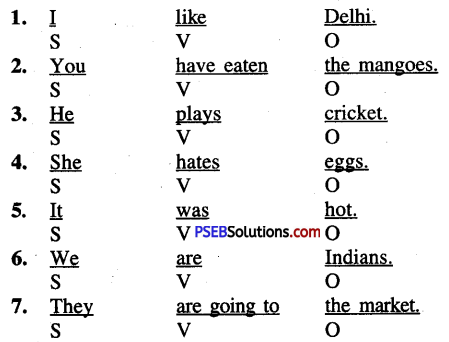
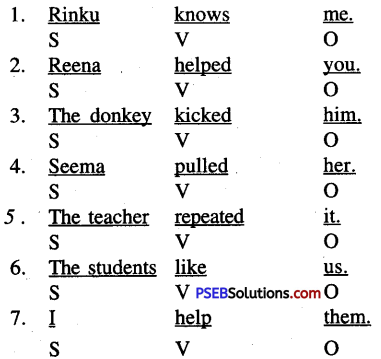
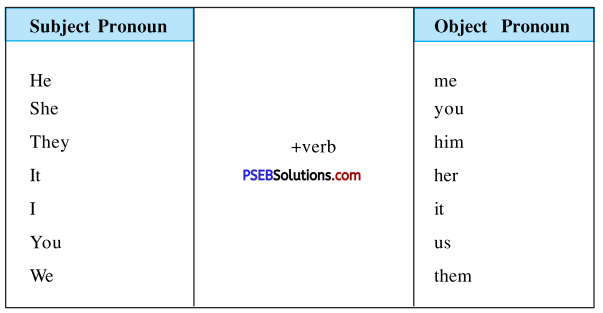
Pronoun

A pronoun is a word used in place of a noun.
Noun (संज्ञा) के स्थान पर प्रयोग होने वाला शब्द Pronoun (सर्वनाम) कहलाता है|
The words ‘they’ ; ‘she’; ‘her’; ‘he’; ‘it are used in place of nouns.
We call them Pronouns. There are three main kinds of pronouns :
Pronouns मुख्य रूप से तीन प्रकार के होते हैं —
1. Personal Pronoun
2. Demonstrative pronoun
3. Interrogative pronoun

1. Personal Pronoun :
Pronouns which are used in place of proper nouns to avoid repetition are called personal pronouns. ये Pronouns वाक्य में Proper Noun की बारम्बारता से बचने के लिए प्रयोग में लाये जाते हैं।
For example :
My mother is very tired because my mother has been working the whole day.
My mother is very tired because she has been working for the whole day.

PSEB 6th Class English Solutions Chapter 3 The Giving Tree

There are three kinds of personal pronouns.

1. Pronouns of the First Person
Singular — Plural
I, my, mine, me, myself — We, our, ours, us, ourselves

2. Pronouns of the Second Person
Singular — Plural
you, yours, yourselves, your — you, yours, yourself, your

3. Pronouns of the Third Person
Singular — Plural
he, she, it, him, her — them, their, theirs

Activity 8.

Fill in the blanks using personal pronouns.

Question 1.
……………. often reads until late at night.
(a) he
(b) Aman
(c) Meena
(d) they
Answer:
(a) he

Question 2.
…………….. is running up and down the stairs.
(a) the cat
(b) she
(c) my brother
(d) you
Answer:
(b) she

PSEB 6th Class English Solutions Chapter 3 The Giving Tree 2

Question 3.
……………….. is from Mumbai.
(a) Rosy
(b) my friend
(c) he
(d) this statue
Answer:
(c) he

Question 4.
Have ……………….. got a dog, Meena ?
(a) anyone
(b) they
(c) someone
(d) it
Answer:
(b) they

Question 5.
We enjoy the roses so much. ………………. really make the garden beautiful.
(a) they
(b) its
(c) someone
(d) flowers
Answer:
(a) they

PSEB 6th Class English Solutions Chapter 3 The Giving Tree

Question 6.
Aman isn’t an architect. ……………. . is an engineer
(a) he
(b) they
(c) it
(d) she
Answer:
(a) he

Question 7.
Are …………. friends or not ?
(a) he
(b) she
(c) we
(d) it
Answer:
(c) we

Question 8.
My doctor was born in London. …. ………….. teaches language lessons in his spare time.
(a) they
(b) it
(c) she
(d) he
Answer:
(d) he

Question 9.
All my teachers are from Europe. …………….. come from all over the continent.
(a) she
(b) we
(c) they
(d) them
Answer:
(c) they

Question 10.
Our friends are athletes. All of ………………. are either strong, fast, or both.
(a) we
(b) they
(c) them
(d) you
Answer:
(c) them

2. Demonstrative Pronoun

A demonstrative pronoun is a pronoun that is used to point to something within a sentence. These pronouns can indicate items in space or time and they can be either singular or plural.
TE Pronoun aice À force on ha ca as forgeim H GIRT GIGI ITE Singular Haal Plural fti
नीचे दिए गए वाक्यों में italicized शब्द Demonstrative Pronouns हैं : This was my mother’s purse. That looks like the car I used to drive. These are nice shoes, but they look uncomfortable. Those look like riper than the apples on my tree.

PSEB 6th Class English Solutions Chapter 3 The Giving Tree

Activity 9.

Fill in the blanks using demonstrative pronouns. Choose the best answer to complete each sentence.

Question 1.
……………… was such an interesting experience.
(a) that
(b) these
(c) those
(d) such
Answer:
(a) that

Question 2.
Are ……………. your shoes ?
(a) that
(b) them
(c) those
(d) this
Answer:
(c) those

Question 3.
You’ll have to get your own pen. ……… is mine.
(a) that
(b) those
(c) such
(d) this
Answer:
(d) this

Question 4.
There is no end to ……..
(a) such
(b) those
(c) this
(d) none
Answer:
(c) this

Question 5.
Because of their bad behaviour, ……….. ……… of the children were given allowances.
(a) none
(b) that
(c) those
(d) them
Answer:
(a) none

Question 6.
………………. of them had seen it before.
(a) those
(b) neither
(c) such
(d) this
Answer:
(b) neither

Question 7.
Is …………… yours ?
(a) this
(b) those
(c) these
(d) such
Answer:
(a) this

Question 8.
Everyone ate early. When we arrived ……………… was left.
(a) that
(b) such
(c) none
(d) neither
Answer:
(c) none

Question 9.
Please give me one of .
(a) that
(b) those
(c) this
(d) such
Answer:
(b) those

PSEB 6th Class English Solutions Chapter 3 The Giving Tree

Question 10.
……………….. are nice looking.
(a) this
(b) that
(c) these
(d) such.
Answer:
(c) these

3. Interrogative (प्रशनवाचक) Pronoun

An interrogative pronoun is used to make asking questions easy. There are just five interrogative pronouns. ये Pronoun प्रश्न पूछने के लिए प्रयोग किए जाते हैं और प्रायः प्रश्नवाचक शब्द से आरंभ होते हैं।

The five interrogative pronouns are what, which, who, whom, and whose.
What is used to ask questions about people or objects.
(लोगों तथा वस्तुओं के बारे में प्रश्न)
What do you want for dinner ?
What is your name ?

Which is used to ask questions about people or objects.
Which seat would you like?
Which of these ice cream flavours is you favourite ?

Who is used to ask questions about people.
(व्यकतियों के बारे में प्रशन)
Who is that man over there ?
Who is the strongest in the class ?

Whom is used to ask questions about people.
With whom did you go to the class ?

Whose is used to ask questions about people or objects, always related to possession.
Whose sweater is this?
I wonder whose dog is digging our lawn ?

Activity 10.

Fill in the blanks with an interrogative pronoun.

Question 1.
……………….. threw the football ?
(a) who
(b) what
(c) which
(d) whose
Answer:
(a) who

Question 2.
…… Would you prefer, coffee or tea ?
(a) who
(b) whom
(c) which
(d) whose
Answer:
(c) which

PSEB 6th Class English Solutions Chapter 3 The Giving Tree

Question 3.
………………. time do we need to be at the station?
(a) which
(b) what
(c) whose
(d) whom
Answer:
(b) what

Question 4.
…………….. bike is that ?
(a) whom
(b) whose
(c) what
(d) who
Answer:
(b) whose

Question 5.
……………. is your brother’s name?
(a) who
(b) whom
(c) what
(d) whose
Answer:
(c) what

Question 6.
……………. did you tell ?
(a) whom
(b) what
(c) whose
(d) which
Answer:
(b) what

Question 7.
……………. of these books have you read ?
(a) what
(b) whom
(c) whose
(d) which
Answer:
(d) which

Question 8.
…………….. wants ice-cream ?
(a) what
(b) whom
(c) who
(d) whose
Answer:
(c) who

Learning to Write

Activity 11.

Did you like the story ? Talk to your partner and discuss two things you liked and one thing you did not like in the story. After discussion, add another paragraph to change the ending of the story.
Answer:
The boy sat there thinking. He thought of trees who give something to man all through their lives. They gift their all happily and become a stump. They give the message : “Real happiness lies in giving’. But it is a pity that man cuts down trees unwisely. He has no regard for their usefulness and selflessness.

Learning to Use Language

Activity 12.

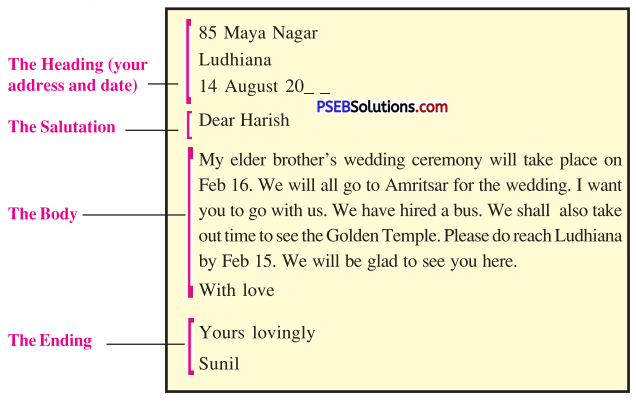
Write a letter to your friend inviting him for the birthday party.

Kailash Colony
…………. City
March 12, 20…
My dear Vinod
You will be glad to know that my birthday falls on March 20. I am planning to celebrate it at home. There will be a programme of dance and music. A dinner will also be served. All our friends are coming to the party. I hope you will also join us. I am sure you will enjoy yourself.
Yours sincerely
Prem

PSEB 6th Class English Solutions Chapter 3 The Giving Tree

Learning to Listen

Activity 13.

The teacher will read the story to the students again. Listen to the story carefully. Write whether the statements are ‘True’ or ‘False’ in the given space.

1. The tree loved the little boy. — (True)
2. The tree liked the boy to swing from the branches of the tree. — (True)
3. The tree became sad whenever the boy came back. — (False)
4. The tree gave the boy a lot of money. — (False)
5. The tree asked the boy to cut off her branches and make a house. — (True)
6. The boy wanted a ship to go to another city. — (False)
7. The tree allowed the boy to cut down her trunk. — (True)
8. At last, the boy wanted a quiet place to sit and rest. — (True)
9. The tree refused the boy from sitting on her old stump. — (False)
10. The story shows that the boy is selfish. — (True)

Learning to Speak.

Activity 13 (Role Play)

The children will work in pairs.
Practise speaking the following sentences with your partner. One of you will become the tree and one will become the boy. After practice, all the pairs will speak in front of the class.
1. The tree: Come, boy, come. Climb up my trunk, swing from my branches, eat apples and be happy.
2. The boy: I am too big to climb and play. I want some money to buy things and have fun. Can you give me some money ?
3. The tree: I have no money but you can take my apples and sell them in the city. Then you will have some money and you will be happy.
4. The tree: Come, boy, come. Climb up my trunk, swing. from my branches, eat apples and be happy.
5. The boy: I am too busy to climb trees. I want to get married. I need a house. Can you give me a house ?
6. The trees : You may cut off my branches. Build a house and be happy.

Comprehension Of Passages

Read the given passages and answer the questions that follow each.

(1) Once there was a tree and she loved a little boy. Every day the boy would come, eat applies and play with her. He would swing from her branches and eat apples. The boy loved the tree very much. And the tree was very happy.

The time went by. The boy grew older. The tree was often alone. One day the boy came to the tree. The tree said, “Come, boy, come. Climb up my trunk, swing from my branches, eat apples and be happy.” “I am too big to climb and play,” said the boy. “I want some money to buy things and have fun. Can you give me some money ?” The tree said, “I have no money but you can take my apples and sell them in the city. Then you will have some money and you will be happy.” The boy did so and went away. The tree was happy.

(i) What made the tree very happy ?
वृक्ष को क्या बात बहुत अधिक खुशी देती थी ?

(ii) Why did the tree give the boy her apples ?
वृक्ष ने लड़के को अपने सेब क्यों दिए ?

(iii) Choose true or false statements.
(a) The boy grew younger.
(b) The boy wanted money to buy things for fun.

(iv) Complete the following sentences according to the meaning of the passage.
(a) The tree was often ————
(b) The tree loved ————
Or
Match the words with their meanings :

(a) alone go down
(b) climb lonely
go up

Answer:
(i) The boy’s love for her made the tree very happy.
(ii) She gave the boy her apples to sell and get money.
(iii)
(a) False
(b) True
(iv)
(a) The tree was often alone.
(b) The tree loved a little boy.
Or
(a) alone – lonely
(b) climb – go up

PSEB 6th Class English Solutions Chapter 3 The Giving Tree

(2) The boy again stayed away for a long time. One day he came back. The tree was very happy and said, “Come, boy, come. Climb up my trunk, swing from my branches, eat apples and be happy.” The boy said, “I am too sad to play. I want to go to another city for business.

Can you give me a boat that will take me away to another city.” The tree said, “Cut down my trunk and make a boat. Then you can sail away and be happy. The boy did so and sailed away. The tree was very happy, but not really.

After a long time, the boy who was now an old man came back again. “I am sorry, boy. I have nothing to give you,” said the tree. I wish I could give you something. I am just an old stump.” “I don’t need anything now. I just want a quiet place to sit and rest.

I am very tired,” said the boy. “Well, an old stump is good for sitting and resting. Come, boy, sit down and rest.” The boy sat on the stump to rest. And the tree was very happy.

(i) Why was the boy sad ?
लड़का क्यों उदास था ?

(ii) What was the only thing that the boy wanted in the end ?
अंत में लड़का कौन-सी एक मात्र चीज़ चाहता था ?

(iii) Choose true or false statements and write them in your answer book :
(a) The boy had grown old.
(b) He was too sad to play.

(iv) Complete the following sentences according to the meaning of the passage.
(a) Cut down my trunk and ……………..
(b) An old stump is good for ……………
Or
Match the words with their meanings :

(a) business calm
(b) quiet trade
sad

Answer:
(i) The boy was sad because he wanted to go to another city for business, but he had no boat.
(ii) In the end, he just wanted a quiet place to sit and rest.
(iii)
(a) True
(b) True
(iv)
(a) Cut down my trunk and make a boat.
(b) An old stump is good for sitting and resting.
Or
(a) business – trade
(b) quiet – calm

PSEB 6th Class English Solutions Chapter 3 The Giving Tree

Use Of Words/Phrases In Sentences

1. Swing (Verb)(move to and fro on a swing) –
The girls are swinging in the park.
लड़कियां पार्क में झूला झूल रही हैं।

2. Branches (off-shoots) –
A big tree has many branches.
बड़े वृक्ष की कई शाखाएं होती हैं।

3. Business (trade) –
He has gone out for a business.
वह व्यापार के लिए बाहर गया हुआ है।

4. Climb (go up) –
I can’t climb this wall,
मैं इस दीवार पर नहीं चढ़ सकता।

5. Stump (remaining part of a chopped tree) –
The stump of tree was very hard.
वृक्ष का ढूंठ बहुत ही कठोर था।

6. Another (one more). –
Please give me another pen.
कृपया मुझे एक और पेन दीजिए।

7. Build (make, construct) –
We are building a new house.
हम एक नया मकान बना रहे हैं। .

8. Carry away (take away) –
Carry away your books from here.
अपनी पुस्तकें यहां से ले जाओ।

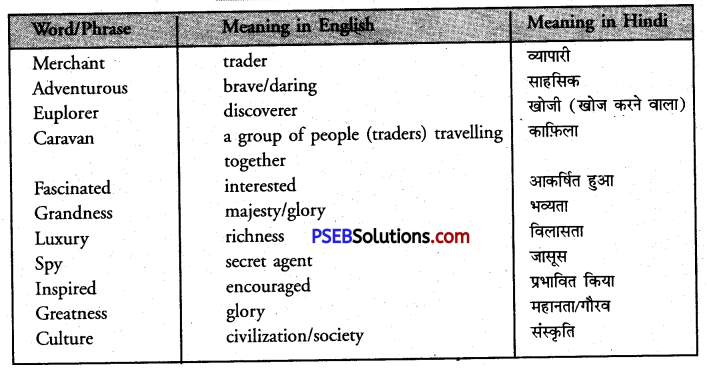
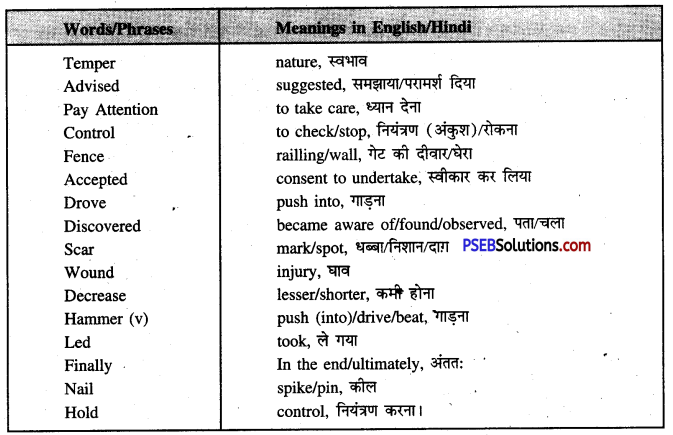
Word Meanings

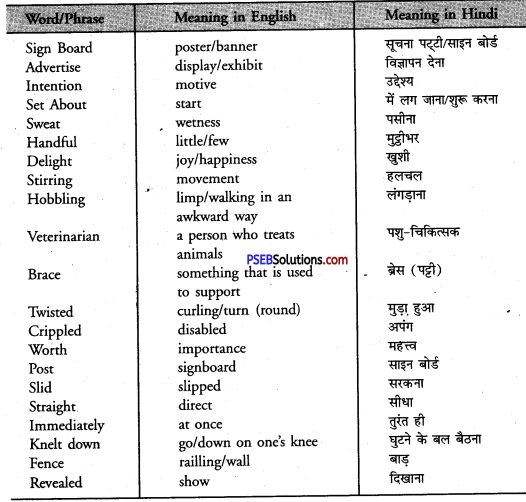
PSEB 6th Class English Solutions Chapter 3 The Giving Tree 3

The Giving Tree Summary in Hindi

Once there was ……………. tree was happy.

एक बार एक मादा वृक्ष था और वह एक छोटे से बच्चे को प्यार/दुलार करता था। बच्चा प्रतिदिन आता था, सेब खाता था और उसके साथ खेलता था। वह उसकी टहनियों पर झूलता था और सेब खाता था। बच्चा वृक्ष को बहुत प्यार करता था। इसलिए वृक्ष खुश था।

समय बीतता गया। बच्चा बड़ा हो गया। वृक्ष प्रायः अकेला रहता था। एक दिन बच्चा वृक्ष के पास आया। वृक्ष ने कहा, “आओ, बच्चे, आओ। मेरे तने पर चढ़ जाओ, मेरी टहनियों पर झूलो, सेब खाओ और खुश रहो।” बच्चे ने कहा, “मैं इतना बड़ा हो गया हूँ कि मैं चढ और खेल नहीं सकता।

PSEB 6th Class English Solutions Chapter 3 The Giving Tree

मुझे मनोरंजन के लिए कुछ चीजें खरीदने के लिए कुछ पैसे चाहिएं। क्या तुम मुझे कुछ पैसे दे सकते हो ?” वृक्ष ने कहा, “मेरे पास पैसे नहीं है परन्तु तुम मेरे सेब ले सकते हो और उन्हें ले जाकर शहर में बेच सकते हो तब तुम्हारे पास कुछ पैसा आ जायेगा और तुम खुश रहोगे।”

बच्चे ने वैसा ही किया और चला गया। वृक्ष खुश था। बच्चा लम्बे समय तक वापिस नहीं आया। वृक्ष उदास था। एक दिन बच्चा वापिस आया। वृक्ष ने खुशी से कहा, “आओ, बच्चे, आओ। मेरे तने पर चढ़ जाओ, मेरी टहनियों पर झूलो, सेब खाओ और खुश रहो।” बच्चे ने कहा, “मैं इतना व्यस्त हूँ कि मैं वृक्षों पर नहीं चढ़ सकता।

मैं शादी करना चाहता हूँ। मुझे एक घर चाहिए। क्या तुम मुझे एक घर दे सकते हो ?” वृक्ष ने कहा, “तुम मेरी शाखाओं को काट . सकते हो। घर बना लो और खुश रहो। “बच्चे ने उसकी शाखाओं को काटा और ले जाकर अपना घर बना लिया। वृक्ष खुश था।

The boy again ……… was very happy.

बच्चा फिर से एक लम्बे समय तक दूर रहा। एक दिन वह वापिस आया। वृक्ष बहुत खुश हुआ और कहा, “आओ, बच्चे, आओ। मेरे तने पर चढ़ जाओ, मेरी टहनियों पर झूलो, सेब खाओ और खुश रहो।” बच्चे ने कहा, “मैं इतना उदास हूँ कि मैं खेल नहीं सकता। मैं व्यापार के लिए दूसरे शहर जाना चाहता हूँ।

क्या तुम मुझे एक नाव दे सकते हो जो मुझे दूसरे शहर ले जाये ?” वृक्ष ने कहा, “मेरा तना काट लो और नाव बना लो। तब तुम नाव चला कर दूर जा सकते हो और खुश रह सकते हो।” बच्चे ने वही किया और नाव पर चला गया। वृक्ष खुश हो गया परन्तु वास्तव में वह खुश नहीं था।

बहुत समय बाद वह बच्चा जो अब बूढ़ा आदमी बन चुका था वापिस लौट आया। वृक्ष ने कहा, “बच्चे, मुझे खेद है, मेरे पास तुम्हें देने के लिए कुछ नहीं है। काश! मैं तुम्हें कुछ दे पाता। मैं केवल एक पुराना ढूंठ हूँ।” बालक (बूढ़ा आदमी) ने कहा, “मुझे अब कुछ नहीं चाहिए।

मैं तो केवल बैठने और आराम करने के लिए एक शांत जगह चाहता हूँ। मैं बहुत थक चुका हूँ।” “अच्छा, एक पुराना लूंठ बैठने और आराम करने के लिए अच्छी जगह है। आओ, बच्चे बैठ जाओ और आराम करो।” बालक आराम करने के लिए ढूंठ पर बैठ गया। इससे वृक्ष बहुत ही खुश हो गया।

Retranslation Of Isolated Sentences

1. She loved a little boy.
वह एक छोटे से बालक से प्रेम करती थी।

2. The boy grew older.
लड़का बड़ा हो गया।

3. The tree was often alone.
वृक्ष प्राय: अकेला रहता था।

4. I am too big to climb and play.
मैं इतना बड़ा हो गया हूं कि चढ़ (ऊपर) और खेल नहीं सकता।

5. The tree was happy.
वृक्ष खुश था।

6. The boy did not come back for a long time.
लड़का लम्बे समय तक वापिस नहीं आया।

PSEB 6th Class English Solutions Chapter 3 The Giving Tree

7. I want to get married.
मैं शादी करना चाहता हूँ।

8. You may cut off my branches.
तुम मेरी शाखाएं काट सकते हो।

9. I want to go to another city for business.
मैं व्यापार के लिए किसी दूसरे शहर जाना चाहता

10. Cut down my trunk and make a boat.
मेरा तना काट कर नाव बना लो।

11. I wish I could give you something.
काश! मैं तुम्हें कुछ दें पाती/पाता।

12. I just want a quiet place to sit and rest.
मुझे केवल बैठने और आराम करने के लिए एक शांत जगह चाहिए।

English Class 6 Solutions PSEB Prose

The Cracked Pot Tree Question Answer Class 6 English Solutions Chapter 7 PSEB Solutions

Punjab State Board PSEB 6th Class English Book Solutions Chapter 7 The Cracked Pot Tree Textbook Exercise Questions and Answers.

Class 6th English Solutions Chapter 7 The Cracked Pot Tree Question Answers

The Cracked Pot Tree Class 6 Questions and Answers

Activity 1.

Look up the following words in a dictionary. You should seek the following information about the words.
1. Meaning of the word as used in the lesson (Adjective/Noun/Verb, etc.)
2. Pronunciation (The teacher may refer in the dictionary or the mobile phone for correct pronunciation.)
3. Spellings

PSEB 6th Class English Solutions Chapter 7 The Cracked Pot

water-bearer delivered perfect
ashamed planted apologised

Vocabulary Expansion

Activity 2.

Look at the words given below. Write as many words as you can think of that may be related to the given words.

Example: Flowers –
yellow, beautiful, smell, lovely, soft, pretty bunch, bouquet, etc.

crack — big, small, leak, pot, earth etc..
planted — tree, flower, plants, seeds, flower-pot etc.
seeds — grow, plants, improved, wheat, saplings etc.
river — long, clean, slow, small, lovely, bath etc.
Pot — big, small, cracked, perfect, earthen, copper etc.
house — big, small, drawing room, beautiful, store, white-washed etc.

Learning to Read and Comprehend

Activity 3.

Read the story and answer the following questions.

Question 1.
How many pots did the water-bearer have ?
पनहारे के पास कितने बर्तन थे ?
Answer:
The water-bearer had two pots.

Question 2.
How did he carry the pots ?
वह बर्तन कैसे उठाता था?
Answer:
He carried the pots on his shoulders with the help of a pole.

PSEB 6th Class English Solutions Chapter 7 The Cracked Pot

Question 3.
Where did he live ?
वह कहां रहता था ?
Answer:
He lived in India.

Question 4.
What did he do with the pots ?
वह बर्तनों का क्या करता था ?
Answer:
He delivered water to his master in the pots.

Question 5.
What problem did one of the pots have ?
एक घड़े (बर्तन) में क्या खराबी थी ?
Answer:
One of the pots had a crack in it.

Activity 4.

Read the story and fill in the blanks in the passage given below.
One of the __1__ had a __2__ in it but the other pot __3__ perfect. The __4 __ pot was half filled but the other pot had __5__ water when the water-bearer reached his master’s house. For __6__ years, this went on __7__ The bearer __8__ only one and a half pots _ 9_ water to his master’s house. Of course, the perfect pot was __10 __ itself. It was perfect for what it was made. But the poor cracked pot was __11__ its crack.
Answer:
1. pots
2. crack
3. was
4. cracked
5. full
6. two
7. daily
8. delivered
9. of
10. proud of
11. ashamed of.

PSEB 6th Class English Solutions Chapter 7 The Cracked Pot

Activity 5.

Who said to whom ?

1. For these past two years. I delivered less water than the other pot because of this crack in my side.
2. My water leaks out all the way back in your master’s house.
3. You don’t get full value for your efforts because of my crack.
4. Today when we return to the master’s house, I want you to notice the beautiful flowers along the path.
5. Did you notice that there were flowers only on your side of the path ?
Answer:
1. The cracked pot to the water-bearer.
2. The cracked pot to the water-bearer.
3. The cracked pot to the water-bearer.
4. The water-bearer to the cracked pot.
5. The water-bearer to the cracked pot.

Activity 6.

Select the right option from the three given.

Question 1.
The water-bearer had ……….. perfect pot.
(a) two
(b) three
(c) one.
Answer:
(c) one

Question 2.
The water-bearer ………….. about the crack in the pot.
(a) did not know
(b) knew
(c) felt ashamed
Answer:
(b) knew

Question 3.
The cracked pot took notice of …………… on their return from the river.
(a) beautiful flowers
(b) water leaking from its crack
(c) the other pot.
Answer:
(a) beautiful flowers

PSEB 6th Class English Solutions Chapter 7 The Cracked Pot

Question 4.
The water-bearer had …………… on one side of the path.
(a) planted flower seeds
(b) planted vegetables
(c) planted small trees.
Answer:
(a) planted flower seeds

Question 5.
The pot …………… its fault.
(a) informed the water-bearer about
(b) apologised to the water-bearer for
(c) tried to hide from the water-bearer.
Answer:
(b) apologised to the water-bearer for

Learning Language

Tenses

The verb in a sentence shows time or state of action.
That is, the time when the action takes place or whether the action is habitual, has been completed or is in progress.

वाक्य में Verb समय या काम की स्थिति बताता है, जैसे कि काम कब होता है; क्या यह प्रतिदिन होता है; यह पूरा हो गया है अथवा अभी चल रहा है।

Present tense is used shows actions happening in the present time (वर्तमान में) and their state.

Examples :
1 She writes a letter.”
She is writing a letter.
She has written a letter.
She has been writing a letter.
In all the sentences, the verb form is in the present tense.

PSEB 6th Class English Solutions Chapter 7 The Cracked Pot

Present Tense
In English grammar, the simple present tense is used for the following four general situations.

1. To say facts, general statements of truth and common-sense ideas that everybody knows.
सत्य या साधारण ज्ञान से जुड़ी आम बातें तथा तथ्य।

2. To state habits, customs and events that happen from time to time.
आदतों, परम्पराओं तथा घटनाओं को समय-समय पर बताने के लिए। :

3. To describe future plans and events.
भविष्य की योजनाओं का वर्णन करने के लिए।

4. To tell jokes, stories and relate sporting events in real-time.
वर्तमान रूप में चुटकुले, कहानियां तथा खेल-घटनाएं सुनाने (बताने) के लिए (जैसे आंखो देखा हाल)
We use V1, and I, You and a Plural Subject.
1. We pray to God daily.
2. They buy milk from a dairy.
नोट : V1 = verb on की पहली फार्म
We use V1 + s/es for a singular subject.
1. She speaks the truth.
2. Meena cooks delicious food.

Fill in the blanks with simple present tense.

1. I …………….. bread. (likes / like)
2. We …………… our duty. (do / does)
3. Rahul …………….. the truth. (speak / speaks)
4. The sun …………. in the east. (rise / rises)
Answer:
1. like
2. do
3. speaks
4. rises.

PSEB 6th Class English Solutions Chapter 7 The Cracked Pot

Activity 7.

Write in the given space what you usually do every morning and evening. Start your sentences with “I”.

Morning Evening
I get up at 6 o’ clock every morning.
I go for a walk every morning.
I take my bath every morning.
I pray to God every morning.
I water the plants every morning.
I check my school bag every morning.
I play cricket every evening.
I do my homework every evening.
I water the plants every evening.
I revise my lessons every evening.
I study for two hours every evening.
I watch T.V. every evening.

Activity 8.

Fill in the blanks with the correct form of the verb (present simple).

1. She ………….. (read) the newspaper every day:
2. We …………….. (come) to school by bus.
3. You ……….. (work) very hard.
4. She …………….. (like) sitting in the sun.
5. We ……………… (play) in the park every day.
6. Neelam and I always …………… (try) to arrive in time.
7. Sanjiv always ……………….. (walk) to school.
8. The dog ……………… (chase) the cat all around the house.
9. We …………….. (eat) together every day.
10. Raju ………………… (speak) several foreign languages.

PSEB 6th Class English Solutions Chapter 7 The Cracked Pot 2
Answer:
1. reads
2. come
3. work
4. likes
5. play
6. try
7. walks
8. chases
9. eat
10. speaks.

Learning to Listen (Refer to Appendix 1 at page no. 122) The activity requires you to follow instructions.

PSEB 6th Class English Solutions Chapter 7 The Cracked Pot

Activity 9.

Each student takes a piece of paper and the teacher reads the instructions. As you hear the instructions, you will perform the task. For this you must

  • close you eyes
  • not ask questions.

At the end of the task, you will check if everyone’s paper looks similar.

Activity 10 (Group Work).

You will ask questions from members of your group. The answer to these questions should either be ‘Yes, I do’ or ‘No, I don’t.’ Teacher must monitor each group.
Example.
Question : Do you like biscuits ?
Answer : Yes, I do. / No, I don’t.
Question : Do you think India will win the game ?
Answer : Yes, I do. / No. I don’t.

Question : Do you get up early ?
Question : Do you like to play football ?
Question: Do you go to school in time ?
Question : Do you help your mother in the kitchen ?
Question : Do you waste your time ?

Learning to Write

Using the following format write an application for sick leave.

Addressed to
The Principal
[Name of the school]
[Address]
[Date]
Subject
Subject : Application for leave.
Salutation
Sir / Madam
Body of Application
I beg to say that I will not be able to attend the school as I am down with viral fever. I have been advised to rest by the doctor for at least [number of days] days. Therefore, kindly grant me leave for [number of days]. I shall be really thankful to you.
Closing
Thanking youYours obediently
[Your name]
[Class and section]
[Roll No.]

PSEB 6th Class English Solutions Chapter 7 The Cracked Pot

नोट: विघार्थी इस application और उसके format के अनुसार तरह – तरह की Applications लिखने का अभ्यास करें| Now, write an application to your Principal for

1. Remission of fine
2. Full fee concession Use the leave format given above.
Answer:
1. The Headmaster
Govt. High School
Moga
Subject : Application for remission of fine.
Sir
Our English teacher gave us a test on Sunday. My mother was ill. So I could not come to school.
I was fined ten rupees.
I am very poor. Kindly remit my fine and oblige.
Thanking You,
Yours obediently
Raman Kumar
VI C
April 18, 20 ………..
Answer:
2. The Headmaster
D.A.V. High School Amritsar
Subject : Application for fee concession.
Sir
I am a student of VI-B class. My father is a poor man. He is a peon. His pay is very small.
He cannot pay my school fee.
Kindly grant me full fee concession and oblige.
Thanking you
Yours obediently
Krishan Lal
VI B
March 8, 20………

Learning to Use Language

Activity 11 (Pairwork)

Work in pairs. Ask questions about the hobbies and interests of your partner. Then, introduce your partner to the rest of the class. Make notes while you are listening to your partner.
Note : Do it yourself.

Comprehension Of Passages

Read the given passages and answer the questions that follow each.

There was a water bearer in India. He had two large pots. Each pot hung on each end of a pole. He carried these pots on his shoulders. He delivered water to his master in these two pots.One of the pots had a crack in it but the other pot was perfect.

The cracked pot was always half filled but the other pot had full water at the end of the long walk from the river to his master’s house. For two years, this went on daily. The bearer delivered only one and a half pots full of water in his master’s house.

PSEB 6th Class English Solutions Chapter 7 The Cracked Pot

Of course, the perfect pot was proud of itself. It was perfect for what it was made. But the poor cracked pot was ashamed of its crack. It was sad that it could bring only half the water.

(i) What did the water-bearer do with his pots ?
पनहारा अपने बर्तनों का क्या करता था?

(ii) Describe the opposite feelings of the two pots.
दोनों बर्तनों की विरोधी मनोस्थिति का वर्णन करो।

Choose true or false statements and write them in your answer book.
(a) One pot had a crack in it.
(b) For two years he delivered full water.

(iv) Complete the following sentences according to the meaning of the passage.
(a) The …………….. was always half filled.
(b) The water-bearer carried the two pots ……….
Or
Match the words with their meanings.

(a) deliver hole
(b) crack supply
drown

Answer:
(i) The water-bearer supplied water in his pots to his master.
(ii) The perfect pot was proud of itself. But the cracked pot was ashamed of its crack.
(iii)
(a) True
(b) False
(iv)
(a) The cracked pot was always half filled.
(b) The water-bearer carried the two pots on his shoulders.
Or
(a) deliver — supply
(b) crack — hole.

PSEB 6th Class English Solutions Chapter 7 The Cracked Pot

(2) After two years, one day the cracked pot spoke to the water-bearer. “ I am ashamed of myself and I want to say sorry to you.” The water-bearer asked, “Why? What are you ashamed of ?” The pot replied, “For these past two years, I delivered less water than the other pot because of this crack in my side. My water leaks out all the way back to your master’s house. You don’t get full value for your efforts because of my crack.”

The water-bearer felt sorry for the old cracked pot. He said to the pot. “Today when we return to the master’s house. I want you to notice the beautiful flowers along the path.” As they returned from the river, the cracked pot took notice of the sun warming the beautiful wild flowers on his side of the path. It was happy to see the beautiful flowers. But at the end of the path, it still felt bad because it had again leaked out half the water. It apologized to the water-bearer for its fault.

(i) What was the cracked pot sorry for ?
दरार वाले बर्तन को किस बात का खेद था?

(ii) On which side of the path were there beautiful flowers ?
रास्ते के किस ओर सुंदर फूल थे?

(ii) Choose true or false statements and write them in your answer book.
(a) The water-bearer was angry with the cracked pot.
(b) The cracked pot apologized to the water-bearer for its fault.

(iv) Complete the following sentences according to the meaning of the passage.
(a) It was happy to see ……………..
(b) You don’t get full value for your efforts because ………….
Or
Match the words with their meanings :

(a) apologize say sorry
(b) fault effort
flaw

Answer:
(i) The cracked pot was sorry for delivering less water than the other pot.
(ii) The beautiful flowers were on the side of the cracked pot.
(iii)
(a) False
(b) True.
(iv)
(a) It was happy to see the beautiful flowers.
(b) You don’t get full value for your efforts because of my crack.
Or
(a) apologize — say sorry
(b) fault — flaw

PSEB 6th Class English Solutions Chapter 7 The Cracked Pot

(3) The bearer said to the pot, “Did you notice that there were flowers only on your side of the path. There were no flowers on the other pot’s side ? I knew about your crack. I planted flower seeds on your side of the path and every day while we walked back from the river, the leaked water fell on them. Without you being just the way you are, we would not have seen these beautiful flowers.”

(i) Where were the flowers ?
फूल कहां थे?

(ii) Who had planted flower seeds ?
फूलों के बीज किसने बोये थे?

(iii) Choose true or false statements and write them in your answer book.
(a) The leaked water fell on the seeds.
(b) The water-bearer did not know about the crack in the pot.

(iv) Complete the following sentences according to the meaning of the passage.
(a) There were no flowers on ………….
(b) Without you, we would not have seen ……
Or
Match the words with their meanings :

(a) notice planter
(b) bearer observe
carrier

Answer:
(i) The flowers were only on the side of the cracked pot.
(ii) The water-bearer had planted flower seeds.
(iii)
(a) True
(b) False
(iv)
(a) There were no flowers on the other side.
(b) Without you, we would not have seen these beautiful flowers.
Or
(a) notice – observe
(b) bearer carrier

Use Of Words / Phrases In Sentences

1. Perfect (Complete / flawless) —
He is perfect in his job.
वह अपने काम में पूर्ण है।

2. Proud of (pleased with, glad at) —
I am proud of my mother.
मुझे अपनी मां पर गर्व है।

3. Ashamed of (felt small) —
The boy was ashamed of his misdeed.
लड़का अपने बुरे काम पर शर्मिंदा था।

PSEB 6th Class English Solutions Chapter 7 The Cracked Pot

4. Deliver (carry, to take) —
Please deliver my message to your father.
कृप्या मेरा संदेश तुम्हारे पिता जी को दे दो।

5. Apologise (say sorry) —
He did not apologise for his fault.
उसने अपनी गलती के लिए क्षमा याचना नहीं की।

6. Fault (something wrong / mistake) —
There is fault in this bulb.
इस बल्ब में कोई खराबी है।

7. Planted (grew) —
We planted ten new trees yesterday.
कल हमने दस नये वृक्ष उगाए।

8. Of course (Undoubtedly) —
निः संदेह आप मेरे मित्र है।

Word Meanings.

PSEB 6th Class English Solutions Chapter 7 The Cracked Pot 3

The Cracked Pot Summary in Hindi

There was a water ………. of my crack.”

भारत में एक पनहारा (पानी लाने वाला) था। उसके पास दो बड़े बर्तन (घड़े) थे। प्रत्येक घड़ा एक डंडे के सिरे पर लटका रहता था। वह इन घड़ों को अपने कंधे पर उठाता था। वह इन दोनों घड़ों में अपने मालिक को पानी पहुँचाता था। इनमें से एक घड़े में एक दरार थी परन्तु दूसरा घड़ा बिल्कुल ठीक था। नदी से दूर उसके मालिक के घर तक चलतेचलते दरार वाला घड़ा सदा आधा (भरा) रह जाता था। परन्तु दूसरा घड़ा पानी से पूरा भरा रहता था।

नि:सदेह ठीक घड़े को अपने ऊपर गर्व था। वह उस कार्य के लिए पूर्ण था जिसके लिए उसे बनाया गया था। परन्तु बेचारा दरार वाला घड़ा अपनी दरार के लिए शर्मिंदा था। उसे इस बात का दुःख था कि वह केवल आधा पानी ही ला सकता है। दो साल तक प्रतिदिन ऐसे ही चलता रहा। पनहारा अपने मालिक के घर केवल डेढ़ घड़ा पानी ही पहुंचाता था।

दो वर्षों बाद, एक दिन दरार वाला घड़ा पनहारे से बोला, “मैं अपने आप से शर्मिंदा हूँ। और मैं आपसे माफी मांगना चाहता हूँ।” पनहारे ने कहा, “क्यों ? तुम्हें किस बात की शर्मिंदगी है।” घड़े ने उत्तर दिया, “इन दो सालों में मैंने दूसरे घड़े की अपेक्षा अपनी दरार की वजह से कम पानी दिया है। मेरा पानी तुम्हारे मालिक के घर तक बहता रहता है। तुम्हें मेरी दरार के कारण अपनी मेहनत का पूरा मूल्य नहीं मिल पाता।”

PSEB 6th Class English Solutions Chapter 7 The Cracked Pot

The water bearer ………………………… beautiful flowers.”

पनहारे ने दरार वाले पुराने घड़े के प्रति खेद प्रकट किया। उसने घड़े से कहा, “मैं चाहता हूँ कि आज जब हम वापिस मालिक के घर की ओर आएं तो तुम रास्ते के साथ-साथ सुन्दर फूलों की ओर ध्यान देना ।”
जब वे नदी से लौटे, दरार वाले घड़े ने रास्ते में सुन्दर जंगली फूलों को ध्यान से देखा जिन्हें धूप की गर्मी मिल रही थी। वह सुन्दर फूलों को देखकर खुश हुआ, परन्तु पंगडंडी के अंत में उसे अब भी बुरा महसूस हुआ क्योंकि उसका आधा पानी फिर से निकल गया था। उसने अपनी गलती के लिए पनहारे से माफ़ी मांगी।

पनहारे ने घड़े से कहा, “क्या तुमने ध्यान दिया कि पगडंडी के रास्ते में फूल केवल तुम्हारी ओर ही थे। दूसरे घड़े की ओर एक भी फूल नहीं था। मुझे तुम्हारी दरार के बारे में पता था। मैंने रास्ते पर तुम्हारी ओर ही फूलों के बीज बोये थे और प्रतिदिन नदी से वापिस आते हुए दरार से बहता हुआ पानी इन पर गिरता था। तुम्हारे बिना, जैसे कि तुम (छेद वाले) हो, हम इन सुन्दर फूलों को नहीं देख सकते थे।

Retranslation Of The Isolated Sentences

1. He had two large pots. — उसके पास दो बड़े बर्तन (घड़े) थे।
2. He carried these pots on his shoulders. — वह इन घड़ों को अपने कंधों पर उठाता था।
3. One of the pots had a crack in it. — घड़ों में से एक घड़े में दरार थी।
4. The perfect pot was proud of itself. — सही घड़े को अपने ऊपर गर्व था।
5. The poor cracked pot was ashamed of its crack. — बेचारा दरार वाला घड़ा अपनी दरार के लिए शर्मिंदा था।
6. I want to say sorry to you. — मैं आपसे माफी माँगना चाहता हूँ।
7. You don’t get full value for your efforts. — तुम्हें तुम्हारे प्रयत्नों का पूरा मूल्य नहीं मिलता।
8. I want you to notice the beautiful flowers along the path — मैं चाहता हूँ कि तुम रास्ते के साथ-साथ सुन्दर फूलों पर ध्यान दो।
9. There were no flowers on the other pot’s side. — दूसरे घड़े की ओर कोई भी फूल नहीं था।
10. I planted flower seeds on your side of the path.– मैंने रास्ते पर तुम्हारी ओर ही फूलों के बीज बोये थे।

English Class 6 Solutions PSEB Prose

The Bewitched Jacket Question Answer Class 9 English Literature Book Solutions Chapter 6 PSEB Solutions

Punjab State Board PSEB 9th Class English Book Solutions English Literature Book Solutions Chapter 6 The Bewitched Jacket Textbook Exercise Questions and Answers.

Class 9th English Literature Book Solutions Chapter 6 The Bewitched Jacket Question Answers

The Bewitched Jacket Class 9 Questions and Answers

Question 1.
Who did the author meet at a party ?
(लेखक पार्टी में किस से मिला ?)
Answer:
He met a man who looked handsome because of his clothes. The man was about forty years old.
वह एक आदमी से मिला जो अपने वस्त्रों की वजह से सुन्दर लग रहा था। उस आदमी की आयु लगभग चालीस वर्ष की थी।

Question 2.
Why was the author impressed by the man he met at the party ?
(लेखक उस आदमी से प्रभावित क्यों हुआ था जिसे वह पार्टी में मिला था ?)
Answer:
The man looked handsome because of his clothes. He seemed to be a gentle person. That was why the author was impressed by him.
वह आदमी अपने वस्त्रों की वजह से सुन्दर लगता था। देखने में वह एक भद्र पुरुष प्रतीत होता था। इसी कारण लेखक उस से प्रभावित हो गया।

PSEB 9th Class English Literature Book Solutions Chapter 6 The Bewitched Jacket

Question 3.
Where did the author get his suit made ?
(लेखक ने अपना सूट कहां से बनवाया ?)
Answer:
He got it made by a tailor named Alfonso Corticella. The tailor lived at via Ferrarà
उसने यह एलफान्सो कोर्टिसेला नामक दर्जी से बनवाया। वह दर्जी मध्यमार्ग फैरारा 17 में रहता था।

Question 4.
Why was the author not keen to wear the suit ?
(लेखक सूट पहनने को उत्सुक क्यों नहीं था ?)
Answer:
The author did not know the why of it. It was only an inner feeling. He did not feel like wearing the suit.
लेखक को इस का कारण पता नहीं था। यह केवल एक अन्दर की भावना थी। उसका सूट पहनने को मन नहीं करता था।

Question 5.
What did the author find in the right pocket of the jacket ? What happened after that ?
(लेखक को जैकट की दाईं जेब में क्या मिला। उसके बाद क्या हुआ ?)
Answer:
He found there a ten-thousand-lira note. He thought the tailor might have put it there and forgotten about it. But then he put his hand into the pocket again. This time he found there another ten-thousand-lira note. He turned as pale as death.

उसे वहां दस हज़ार लियर का एक नोट मिला। उसने सोचा कि दर्जी ने शायद इसे वहां रखा हो और फिर भूल गया हो। किन्तु फिर उसने दोबारा अपना हाथ जेब में डाला। इस बार उसे वहां दस हजार लियर का एक दूसरा नोट मिला। वह एक मरे हुए आदमी के जैसा पीला पड़ गया।

PSEB 9th Class English Literature Book Solutions Chapter 6 The Bewitched Jacket

Question 6.
Why did the author not return the money to the tailor ?
(लेखक ने दर्जी को पैसे वापस क्यों नहीं किए ?)
Answer:
The author soon realized that the money did not belong to the tailor. There was something magical about the jacket. Every time he put his hand into the right pocket, he found there a banknote of ten thousand lira. Thus there was no question of returning the money to the tailor.

लेखक को शीघ्र ही महसूस हो गया कि पैसे दर्जी के नहीं थे। जैकट में कोई जादुई बात थी। हर बार जब वह दाईं जेब में अपना हाथ डालता तो वहां उसे दस हजार लियर का नोट मिल जाता। इस प्रकार दर्जी को पैसे वापस करने का वहां कोई प्रश्न ही नहीं था।

Question 7.
What did the author do after coming home ?
(लेखक ने घर लौटने के बाद क्या किया ?)
Answer:
The author shut the doors and lowered the blinds. He started taking out notes from his jacket. The pocket was never empty. There was a heap of notes. The author counted them. They were: 58 million lire. He hid them in an old trunk.

लेखक ने दरवाज़े बन्द कर दिए और पर्दे नीचे गिरा दिए। उसने अपने जैकट में से नोट निकालने शुरू कर दिए। जेब कभी खाली न हुई। वहां नोटों का एक ढेर लग गया। लेखक ने उन्हें गिना। वे 58 मिलियन लियर थे। उसने इन्हें एक पुराने ट्रंक में छिपा दिया।

Question 8.
Why did the author buy another suit ?
(लेखक ने दूसरा सूट क्यों खरीदा ?)
Answer:
The author did not want his maid to know of the bewitched jacket. So he bought another suit of the same kind. He left it to the care of the maid.

लेखक नहीं चाहता था कि नौकरानी को जादुई जैकट का पता चले। इसलिए उसने उसी तरह का एक दूसरा सूट खरीद लिया। उसने यह नौकरानी की देख-रेख में छोड़ दिया।

Question 9.
What did the author do with the money ?
(लेखक ने पैसों का क्या किया ?)
Answer:
He hid it in an old trunk.
उसने ये एक पुराने ट्रंक में छिपा दिए।

Question 10.
Did the author know that there was a connection between the ill-gotten money and the bad happenings ?
(क्या लेखक जानता था कि बुरे ढंग से प्राप्त किए पैसे और बुरी घटनाओं के बीच कोई सम्बन्ध था ?)
Answer:
Yes, he did have such a feeling. Every time he drew money from the pocket, something bad happened in the world.
हां, लेखक को इस तरह की भावना अवश्य महसूस होती थी। हर बार जब वह जेब में से पैसे निकालता, तो संसार में कोई बुरी घटना घट जाती।

Question 11.
Why did the author still want more money ?
(लेखक अब भी और पैसे क्यों चाहता था ?)
Answer:
The more one has, the more one wants. It is a universal truth.
किसी आदमी के पास जितना ज़्यादा होता है, वह उतना ही और ज़्यादा चाहता है। यह एक स्थाई सच्चाई है।

Question 12.
Why did the author decide to destroy the jacket ? What happened when he was destroying it?
(लेखक ने जैकट को नष्ट क्यों किया ? तब क्या हुआ जब वह इसे नष्ट कर रहा था ?)
Answer:
Every time he drew money from the jacket, something bad happened in the world. The author could bear it no longer. That was why he decided to destroy the jacket. While he was destroying it, he heard a human voice. It said, “Too late, too late !” But he could see none there.

हर बार जब वह जैकट में से पैसे निकालता, संसार में कोई बुरी घटना हो जाती। लेखक इसे और अधिक सहन न कर सका। इसी कारण उसने जैकट को नष्ट करने का फैसला कर लिया। जब वह इसे नष्ट कर रहा था, तो उसे एक मानव आवाज़ सुनाई दी। यह कह रही थी, “अब बहुत देर हो गई है, बहुत देर !” किन्तु उसे वहां कोई भी दिखाई न दिया।

Question 13.
Do you think the author was a happy man after getting rid of the jacket ? Why ?
(क्या आप समझते हैं कि जैकट से छुटकारा पाने के बाद लेखक एक प्रसन्न व्यक्ति था ? क्यों ?)
Answer:
The author was still sad and worried. He feared that someday the tailor would come to his house and ask for the payment.
लेखक अब भी उदास और चिन्तित था। उसे भय था कि किसी दिन दर्जी उसके घर आ जाएगा और उससे पैसे के भुगतान की मांग करेगा।

Objective Type Questions

Answer the following in one word / phrase / sentence :

Question 1.
Who is the writer of the story, ‘The Bewitched Jacket’ ?
Answer:
Dino Buzzati.

PSEB 9th Class English Literature Book Solutions Chapter 6 The Bewitched Jacket

Question 2.
What kind of a story is ‘The Bewitched Jacket’ ?
Answer:
A mystery story.

Question 3.
What was the age of the man the author met at a party?
Ans:
About forty years.

Question 4.
Who made the author’s suit ?
Answer:
A cailor named Alfonso Corticella.

Question 5.
Did the author feel like wearing the suit ?
Answer:
No, he didn’t.

Question 6.
What is lira ?
Answer:
Lira used to be an Italian unit of money.

Question 7.
What was found in the right pocket of the jacket?
Answer:
A ten-thousand lira note.

Question 8.
Where did the writer hide the money ?
Answer:
In an old trunk.

Question 9.
What happened every time the writer drew money from the pocket of the jacket?
Answer:
Something bad happened in the world.

Question 10.
What happened when the author was destroying the jacket?
Answer:
A human voice was heard.

PSEB 9th Class English Literature Book Solutions Chapter 6 The Bewitched Jacket

Complete the following:

1. The author shut the door and …………………. the blinds.
2. There was news of a bank …… in the newspapers.
3. A bank’s ………………. car was carrying money to the main office.
4. An …………………. of 58 million lire was looted.
5. A terrible fire had destroyed a …………
6. The narrator took a car and went to a …………….. place.
Answer:
1. lowered
2. robbery
3. armoured
4. amount
5. warehouse
6. hilly.

Write True or False against each statement :

1. The writer went to a reception party in Rome.
2. The name of the tailor was Alfonso Corticella.
3. The tailor himself came to take the measurements.
4. The first time, narrator found 59 million lire.
5. The maid came in the morning.
6. In the morning papers, there was news of a bank inauguration.
Answer:
1. False
2. True
3. True
4. False
5. True
6. False.

Choose the correct option for each of the following:

Question 1.
Who did the narrator meet at a reception in Milan ?
(a) A film star.
(b) A doctor.
(c) A man of about forty.
(d) Bill Clinton.
Answer:
(c) A man of about forty.

PSEB 9th Class English Literature Book Solutions Chapter 6 The Bewitched Jacket

Question 2.
The tailor lived at ……………
(a) via Ferrara 18
(b) via Ferrara 17
(c) via Ferrara 19
(d) via Ferrara 15
Answer:
(b) via Ferrara 17

Question 3.
The author rang up his ……
(a) secretary
(b) sister
(c) brother
(d) teacher
Answer:
(a) secretary

Question 4.
The narrator arrived at a valley in ……….
(a) the Alps
(b) the Himalayas
(c) the Shivalik hills
(d) Dehradun.
Answer:
(a) the Alps

The Bewitched Jacket Summary in English

The Bewitched Jacket Introduction:

It is a mystery story. The narrator meets a stranger at a party. The stranger is wearing nicely tailored clothes. The narrator asks him the name of the tailor. He goes to the same tailor and orders a suit for himself. When the narrator asks him its price, the tailor says that there is no hurry. After three weeks, the narrator gets his suit.

It is a jacket, a pair of trousers and a vest. By chance, the narrator puts his hand in the right pocket of the jacket. He finds in it a ten thousand lira note. The narrator thinks that the tailor must have put it there and forgotten about it. But he is surprised when the same thing happens every time he puts his hand in the pocket. In one night, he collects 58 million lire.

But the next morning there is news of a bank robbery of 58 million. The narrator is filled with fear. Still he works the next night and collects 135 million. This time there is news of a big fire in which more than 135 million is lost in cash. The narrator notes that every time he collects money from his pocket, something bad happens in the world. However, he grows very rich. He buys a big villa and has big automobiles. He has a good amount of money in his bank also. But then one morning, it is found that an old woman has committed suicide.

PSEB 9th Class English Literature Book Solutions Chapter 6 The Bewitched Jacket

She lived in the same building in which the narrator had lived for a long time. She commits suicide because she had mislaid her monthly pension of 30 thousand lire. The same amount of money the narrator had collected from his pocket the day before. He can bear it no longer and doesn’t want to keep the jacket with him. He goes to a hilly place and burns the jacket. When he comes back, he finds that his car, his villa and his bank balance have all disappeard. Now he fears that someday the cursed tailor will come and ask for his bill.

Note : Lira used to be an Italian unit of money, the plural form of which was lire.

The Bewitched Jacket Summary in English

One night the narrator met a man about forty years old. The man looked handsome because of his clothes. The narrator did not know who he was. He had met him for the first time. But he praised him for his clothes. The man seemed to be a gentle person, but looked a little sad. The narrator liked his clothes so much that he asked him who his tailor was.

The man smiled curiously. He said that nearly no one knew that tailor, yet he was a great master. The narrator asked him if he was an expensive tailor. At this the stranger replied, “I don’t know. He made me this suit three years ago, and still he has not sent me the bill.” He told the narrator that the tailor’s name was Alfonso Corticella and that he lived at via Ferrara. The narrator found out the tailor’s house. He was a little old man. His hair was dyed black.

The narrator asked him to make him a suit. The tailor selected a piece of cloth for the narrator and took his measurements. He offered to come to the narrator’s house for the fitting. When the narrator asked him the price, the tailor said that there was no hurry. The narrator got the suit after three weeks. It was a masterpiece but he did not feel like wearing it. It was only after some weeks that he decided to wear it. It was a Tuesday in April and it was raining. The narrator says that he will never forget that day.

PSEB 9th Class English Literature Book Solutions Chapter 6 The Bewitched Jacket

The narrator was at his office. He put his hand into the pocket of his jacket. There was a piece of paper in it. The narrator thought it was the tailor’s bill. But when he took it out, it was a ten-thousand-lira note. The narrator thought the tailor might have put it there and then forgotten about it. So he called his secretary to write a letter to the tailor. But before the secretary came, he had felt another piece of paper in his pocket. He turned as pale as death.

In the meantime, the secretary came in. She asked the narrator if he was feeling ill. The narrator said it was just a little dizziness. He sent her back saying that he would dictate the letter later. When she had gone, he took out the piece of paper from his pocket. It was another ten-thousand-lira note. Then he tried a third time. And a third banknote came out.

The narrator left the office and went home. He shut the doors and lowered the blinds. He started taking out the notes. There was a heap of notes before him. He counted them. There were 58 million lire. He emptied an old trunk and hid the money in it.

The maid came in the morning. She saw the narrator in bed wearing a suit. She looked surprised. The narrator told her that he had drunk a little too much the night before. The maid asked the narrator to take off the suit so that she could brush it. But the narrator said that he had to go out immediately and had no time to change. He went to a garment store and bought another suit of the same kind. He decided to leave this one in the maid’s care, and hide the other one in a safe place.

But there was news in the morning papers which dampened his joy. There was news of a bank robbery. A bank’s car was carrying money to the main office. Four criminals stopped it and killed a man. They took away all the money. It was 58 million lire. This incident left the narrator a little confused. But the same evening he set to work again. He was already rich but he wanted to become richer. This time he got 135 million.

In the morning papers, there was again news. A terrible fire had destroyed a warehouse in which more than 135 million were lost in cash. Two firemen were also killed while putting out the fire. The narrator now knew that the money in his pocket was coming from crimes, blood and death. But he didn’t blame himself for it. He continued drawing more and more money from his jacket. He bought a huge villa and had big automobiles to drive around.

One morning, an old woman was found dead in the same building where the narrator had lived for many years. She had killed herself because she had mislaid her monthly pension of 30 thousand lire. The narrator had drawn the same amount from his jacket a day before. He realised that every time he drew money from his pocket, there was something bad in the world. He could bear it no longer. He decided to destroy his jacket.

PSEB 9th Class English Literature Book Solutions Chapter 6 The Bewitched Jacket

The narrator took his car and went to a hilly place. There he burnt the jacket to ashes. As the flames were dying out, he heard a human voice. It said, “Too late, too late !” The narrator tried to find who it was, but he could see none there.

However, he was happy that he had got rid of the jacket. But when he came back he saw that his car, his villa and his savings account had disappeared. There was nothing but dust in the old trunk. He became sad and worried. But no one took any notice of him. He had a constant fear that some day the cursed tailor would come and ask for the payment of his bill.

The Bewitched Jacket Summary in Hindi

The Bewitched Jacket Introduction:

कहानी का संक्षिप्त परिचय यह एक रहस्य-कथा है। वर्णनकर्ता एक पार्टी में किसी अजनबी से मिलता है। अजनबी सुन्दर ढंग से सिले वस्त्र पहने हुए है। वर्णनकर्ता उससे दर्जी का नाम पूछता है। वह उसी दर्जी के पास जाता है और अपने लिए एक सूट का आर्डर देता है। जब वह उसे इसकी कीमत पूछता है तो दर्जी कह देता है कि इसकी कोई जल्दी नहीं है। तीन सप्ताह के बाद वर्णनकर्ता को अपना सूट प्राप्त हो जाता है। यह एक जैकट, एक पतलून और एक वास्कट है।

अचानक वर्णनकर्ता अपना हाथ वास्कट की दाईं जेब में डालता है। उसे इसमें दस हजार लियर का एक नोट मिलता है। वर्णनकर्ता समझता है कि यह दर्जी ने वहां रखा होगा और फिर इसके बारे में भूल गया होगा। किन्तु वह चकित रह जाता जब हर बार वैसा ही होता है जब वह अपना हाथ जेब में डालता है। एक रात में वह जेब से 58 मिलियन लियर निकाल लेता है। किन्तु अगली प्रातः वहां 58 मिलियन लियर की बैंक डकैती का एक समाचार छपता है।

वर्णनकर्ता भय से भर जाता है। फिर भी वह अगली रात वही काम करता है और 135 मिलियन इकट्ठे कर लेता है। इस बार एक बड़ी आग लगने का समाचार मिलता है जिसमें 135 मिलियन से ज़्यादा की नगद राशि नष्ट हो जाती है। वर्णनकर्ता देखता है कि हर बार जब वह अपनी जेब से पैसे इकट्ठे करता है तो संसार में कोई बुरी घटना हो जाती है। तो भी वह बहुत धनी हो जाता है। वह एक बड़ा बंगला खरीद लेता है और उसके पास बड़ी-बड़ी गाड़ियां हो जाती हैं। उसके पास बैंक में भी भारी रकम जमा हो जाती है। किन्तु फिर एक प्रातः पता चलता है कि एक बूढ़ी औरत ने आत्महत्या कर ली है। वह उसी इमारत में रहती थी जिसमें वर्णनकर्ता एक लम्बे समय तक रहता रहा था।

PSEB 9th Class English Literature Book Solutions Chapter 6 The Bewitched Jacket

वह आत्महत्या कर लेती है क्योंकि वह तीस हज़ार लियर की अपनी मासिक पेन्शन कहीं रख कर भूल जाती है। उतनी ही धन-राशि लेखक ने एक दिन पहले अपनी जेब से इकट्ठी की थी। वह इसे और अधिक सहन नहीं कर पाता है। और अब वह जैकट अपने पास नहीं रखना चाहता है। वह एक पहाड़ी जगह पर चला जाता है और जैकट को जला देता है। जब वह वापस आता है तो देखता है कि उसकी कार, उसका बंगला और उसकी बैंक में बचत-राशि सब गायब हो गए हैं। अब उसे भय होने लगता है कि वह घृणित दर्जी एक दिन आ जाएगा और उससे अपने बिल की राशि मांगेगा। नोट-लियर इतालवी मुदा की एक इकाई होती थी, जिसका बहुवचन भी लियर ही होता था।

The Bewitched Jacket Summary in Hindi

एक रात वर्णनकर्ता एक चालीस वर्षीय आदमी से मिला। वह आदमी अपने वस्त्रों की वजह से सुन्दर लग रहा था। वर्णनकर्ता उसे नहीं जानता था। वह उससे पहली बार मिला था। परन्तु उसने उस आदमी के वस्त्रों की प्रशंसा की। वह आदमी एक भद्र पुरुष लगता था, परन्तु वह थोड़ा उदास प्रतीत होता था। वर्णनकर्ता को उसके वस्त्र इतने अच्छे लगे कि उसने उससे पूछा कि उसका दर्जी कौन था। वह आदमी अजीब ढंग से मुस्कराया। उसने कहा कि उस दर्जी के बारे में लगभग कोई नहीं जानता था, फिर भी वह एक महान् कारीगर था। वर्णनकर्ता ने पूछा कि क्या वह एक महंगा दर्जी था। इस पर उस अजनबी ने उत्तर दिया, “मुझे मालूम नहीं। उसने तीन वर्ष पूर्व मेरा यह सूट बनाया था, और उसने अभी तक मुझे बिल नहीं भेजा है।” उसने लेखक से कहा कि दर्जी का नाम एल्फान्सो कोर्टिसेला था और वह मध्य मार्ग फेरारा 17 में रहता था।

वर्णनकर्ता ने दर्जी का घर ढूंढ निकाला। वह छोटे कद का एक बूढ़ा आदमी था। उसने अपने बाल काले रंगे हुए थे। वर्णनकर्ता ने उससे कहा कि वह उसके लिए एक सूट बना दे। दर्जी ने वर्णनकर्ता के लिए एक कपड़ा चुना और उसका नाप लिया। उसने फिटिंग जांचने के लिए वर्णनकर्ता के घर आने की पेशकश की। जब वर्णनकर्ता ने उससे पैसों का पूछा तो उसने कहा उसकी कोई जल्दी नहीं थी।

वर्णनकर्ता को तीन सप्ताह बाद सूट मिल गया। यह एक अत्युत्तम कलाकृत्ति था परन्तु वर्णनकर्ता का उसे पहनने का मन न हुआ। यह कुछ सप्ताहों बाद ही हुआ कि उसने उसे पहनने का निश्चय किया। यह अप्रैल में मंगलवार का दिन था और उस दिन बरसात हो रही थी। वर्णनकर्ता कहता है कि उस दिन को वह कभी भूल नहीं पाएगा। वर्णनकर्ता अपने दफ्तर में था। उसने जैकट की जेब में अपना हाथ डाला। उसमें कागज़ का एक टुकड़ा

PSEB 9th Class English Literature Book Solutions Chapter 6 The Bewitched Jacket

था। वर्णनकर्ता ने सोचा कि यह दर्जी का बिल होगा। परन्तु जब उसने इसे बाहर निकाला तो यह एक दस हज़ार लियर का नोट था। वर्णनकर्ता ने सोचा कि शायद दर्जी ने उसे वहां डाल दिया होगा और फिर उसके बारे में भूल गया होगा। इसलिए दर्जी को पत्र लिखने के लिए उसने अपनी सेक्रेटरी को बुलाया। परन्तु इससे पहले कि सेक्रेटरी आती उसे अपनी जेब में कागज़ का एक अन्य टुकड़ा महसूस हुआ। उसका रंग एक मुर्दे के जैसा पीला पड़ गया। तभी सेक्रेटरी वहां आ गई। उसने वर्णनकर्ता से पूछा कि क्या वह स्वयम् को बीमार महसूस कर रहा था।

वर्णनकर्ता ने कहा कि वह थोड़ी थकावट अनुभव कर रहा था। उसने उसे यह कहकर वापस भेज दिया वह पत्र थोड़ी देर बाद लिखवा लेगा। जब वह चली गई तो उसने अपनी जेब से कागज़ का वह टुकड़ा निकाला। यह दस हज़ार लियर का एक और नोट था। फिर उसने ऐसा तीसरी बार किया और तीसरा नोट जेब से निकल आया। वर्णनकर्ता दफ़्तर से घर चला आया। उसने दरवाज़े बन्द कर लिए और पर्दे नीचे गिरा दिए। उसने नोट निकालने शुरू कर दिए। उसके सामने नोटों का ढेर लग गया। उसने उन्हें गिना। ये 58 मिलियन लियर थे। उसने एक पुराना ट्रंक खाली किया और पैसों को उसमें छिपा दिया।

प्रातः उसकी नौकरानी आ गई। उसने वर्णनकर्ता को बिस्तर में सूट पहने लेटा देखा। यह देखकर उसे हैरानी हुई। वर्णनकर्ता ने उसे कह दिया कि वह रात को कुछ ज्यादा ही पी गया था। नौकरानी ने वर्णनकर्ता से कहा कि वह सूट उतार कर उसे दे दे ताकि वह उस पर ब्रश मार दे। परन्तु वर्णनकर्ता ने उससे कहा कि उसे अभी बाहर जाना था और उसके पास कपड़े बदलने का समय नहीं था। वह एक कपड़ों की दुकान पर गया और उसी तरह का एक सूट खरीद लाया। उसने फैसला किया कि वह इसे नौकरानी की देखभाल में छोड़ देगा, और दूसरे को किसी सुरक्षित स्थान पर छिपा देगा।

परन्तु सुबह के समाचार-पत्रों में एक ऐसी खबर थी जिसने उसकी खुशी ठण्डी कर दी। यह एक बैंक डकैती की खबर थी। बैंक की एक गाड़ी मुख्य दफ्तर की ओर पैसे लेकर जा रही थी। चार अपराधियों ने उसे रोका और एक आदमी को मार डाला। वे सारा पैसा ले गए। यह 58 मिलियन लियर थे। इस घटना से वर्णनकर्ता थोड़ी दुविधा में पड़ गया। परन्तु उसी शाम वह दोबारा उसी काम पर लग गया। वह पहले ही धनी बन चुका था परन्तु वह और धनी बनना चाहता था। इस बार उसे 135 मिलियन प्राप्त हुए।

PSEB 9th Class English Literature Book Solutions Chapter 6 The Bewitched Jacket

सुबह के समाचार-पत्रों में फिर एक खबर आई। एक भयानक आग ने एक गोदाम को तबाह कर दिया था जिसमें 135 मिलियन से ज्यादा नगदी नष्ट हो गई। दो आग बुझाने वाले कर्मचारी भी आग बुझाते समय मारे गए थे। अब वर्णनकर्ता जान गया था कि उसकी जेब में पैसा अपराधों, खून और मृत्यु से आ रहा था। परन्तु उसके लिए उसने स्वयम् को दोषी न ठहराया। वह अपनी जेब से पैसे निकालता ही चला गया। उसने एक बड़ासा बंगला खरीदा और घूमने-फिरने के लिए बड़ी-बड़ी गाड़ियां ले ली।

एक प्रातः उसी इमारत में एक बूढ़ी औरत मरी हुई पाई गई जहां लेखक अनेक वर्षों तक रहा था। उसने आत्महत्या कर ली थी क्योंकि उसने अपनी 30 हज़ार लियर की अपनी मासिक पेंशन कहीं खो दी थी। वर्णनकर्ता ने उतनी ही रकम एक दिन पहले अपनी जैकट से निकाली थी। उसने अनुभव किया कि जब भी वह अपनी जेब से पैसे निकालता था तो संसार में कुछ बुरा हो जाता था। वह उसे और अधिक सहन नहीं कर सकता था। वर्णनकर्ता ने अपनी कार ली और एक पहाड़ी स्थान पर चला गया। वहां उसने जैकट को जलाकर राख कर दिया। जब ज्वालाएं शान्त हो रही थीं तो उसने एक मानव की आवाज़ सुनी। उसने कहा, “अब बहुत देर हो चुकी है।” वर्णनकर्ता ने यह जानने की कोशिश की कि यह किसकी आवाज़ थी, परन्तु उसे वहां कोई दिखाई न दिया।

फिर भी वह खुश था कि उसे जैकट से छुटकारा मिल गया था। परन्तु जब वह वापस घर आया तो उसने देखा कि उसकी कार, उसका बंगला और उसके सब बैंक खाते गायब हो चुके थे। उसके पुराने ट्रंक में धूल के अतिरिक्त और कुछ नहीं था। वह उदास और चिन्तित हो गया। परन्तु किसी ने उसकी कोई परवाह नहीं की। अब उसके मन में यह निरन्तर भय बना रहता था कि किसी दिन बह घृणित दर्जी आएगा और अपने बिल के पैसे मांगेगा।

The Bewitched Jacket Translation in Hindi

(Page 46)

कठिन शब्दार्थ-1. bewitched—जादुई, अभिशप्त; 2. unexpected—अप्रत्याशित; 3. reception–स्वागत पार्टी; 4. complimented—प्रशंसा की; 5. curiously-विचित्र ढंग से; 6. expensiveमहंगा; 7. imagineकल्पना करना, विचार से; 8. swear-कसम खाना।

अनुवाद-एक रात (इटली के नगर) मिलन में एक स्वागत समारोह के दौरान मैं लगभग चालीस वर्ष की आयु के एक आदमी से मिला जो अपने वस्त्रों की वजह से देखने में सुन्दर लगता था। मैं नहीं जानता कि वह कौन था, मैं उससे पहली बार मिल रहा था, तथा प्रारम्भ में, जैसा कि सदा होता है, उसका नाम जानना असम्भव था। किन्तु कुछ समय के बाद मैंने उसे अपने समीप पाया, और हम बातें करने लगे। वह एक भद्र पुरुष प्रतीत होता था, किन्तु वह कुछ उदास लगता था। मैंने उसके वस्त्रों के लिए उसकी प्रशंसा की, और मैंने उससे पूछा कि उसका दर्जी कौन था। वह अजीब ढंग से हंस दिया, मानो वह जानता ही था कि मैं उससे यह प्रश्न पूछूगा।

‘उसे लगभग कोई नहीं जानता है,’ उसने कहा। ‘फिर भी वह एक महान् कारीगर है।’ ‘क्या मैं……. ?’ ‘हां, कोशिश कर लीजिए। उसका नाम कोर्टिसेला है, एल्फान्सो कोर्टिसेला, मध्यमार्ग फेरारा 17 पर।’ ‘बहुत महंगा होगा, मेरे विचार से।’

‘ऐसा मानता हूं, किन्तु क़सम से मुझे पता नहीं है। उसने मेरा यह सूट तीन वर्ष पहले बनाया था, और अब तक उसने मुझे अपना बिल नहीं भेजा है,’ उसने उत्तर दिया। ‘कोर्टिसेला, मध्यमार्ग फेरारा 17, क्या आपने ऐसा ही कहा था ?’ मैंने पूछा। ‘बिल्कुल यही,’ अजनबी ने उत्तर दिया। और वह मुझे छोड़ कर लोगों के एक अन्य समूह से जा मिला।

PSEB 9th Class English Literature Book Solutions Chapter 6 The Bewitched Jacket

(Page 46-47)

कठिन शब्दार्थ-1. measurements – नाप; 2. vest—वास्कट; 3. masterpiece – सर्वोत्तम कलाकृत्ति; 4. lira – मुद्रा की एक भूतपूर्व इतालवी इकाई; 5. counterfier – जाली, नकली; 6. wallet-बटुआ।

अनुवाद-मध्य मार्ग फेरारा 17 पर मुझे वह मकान मिल गया। दर्जी स्वयं मुझे अन्दर ले जाने के लिए आया। वह छोटे कद का एक बूढ़ा आदमी था जिसने अपने बालों को काला रंग कर रखा था। मैंने उसे बताया कि उसका पता मुझे कैसे मालूम पड़ा था, उसकी कपड़ा-कटाई की मैंने प्रशंसा की, और उससे कहा कि मेरे लिए एक सूट बना दे। उसने सलेटी रंग का ऊनी कपड़ा चुना, फिर उसने मेरा नाप लिया, तथा स्वयं ही कहा कि वह फिटिंग को जांचने के लिए मेरे घर पर आ जाएगा।

मैंने उससे इसकी कीमत पूछी। ‘कोई जल्दी नहीं है,’ उसने ऐसा उत्तर दिया। ‘कितना अच्छा आदमी है!’ मैंने पहले ऐसा सोचा। किन्तु जब मैं घर लौट रहा था तो मुझे अनुभव हुआ कि उस बूढ़े आदमी ने मुझे बेचैन बना दिया था। (शायद उसकी बहुत ज्यादा स्नेहपूर्ण मुस्कराहटों की वजह से।) संक्षेप में उसे दोबारा मिलने की मेरी कोई इच्छा नहीं थी। किन्तु अब सूट का आर्डर दिया जा चुका था तथा तीन सप्ताह के पश्चात् यह तैयार हो गया।

जब वे इसे मेरे पास ले कर आए, तो मैंने इसे पहन कर देखा (जैकट, पतलून और वास्कट) शीशे के सामने खड़ा होकर। यह एक अत्युत्तम काम था। फिर भी, पता नहीं क्यों, इसे पहनने को मेरा मन नहीं था तथा कई सप्ताह बीत गए, इससे पहले कि मैं इसे पहनने का निर्णय कर पाता।

वह दिन मैं कभी नहीं भूलूंगा। यह अप्रैल महीने का एक मंगलवार का दिन था तथा वर्षा हो रही थी। जब मैंने सूट पहना तो मुझे प्रसन्नता हुई क्योंकि यह मुझे बहुत अच्छे तरह से ठीक बैठा था। नियमतः मैं वास्कट की दाईं जेब में कोई चीज़ नहीं डालता हूं; बाईं वाली जेब में मैं अपना कार्ड रखता हूं। दफ्तर में कुछ घण्टों के बाद मैंने दाईं जेब में अपना हाथ डाला। मैंने देखा कि वहां इसमें कागज़ का एक टुकड़ा था। क्या यह दर्जी का बिल था ?

नहीं। यह. दस हज़ार इतालवी लियर का एक नोट था। मैं चकित रह गया। निश्चय ही मैंने इसे वहां नहीं डाला था। मैंने उस नोट को ध्यानपूर्वक देखा। क्या यह कोई नकली नोट था ? मैंने इसे रोशनी में देखा। मैंने इसे दूसरे नोटों के साथ मिला कर देखा। वहां कोई अन्तर नहीं था। मैंने सोचा कि यह अवश्य ही कोर्टिसेला का होगा। शायद कोई ग्राहक भुगतान करने आया होगा। तब उस समय दर्जी के पास अपना बटुआ नहीं रहा होगा, इसलिए उसने पैसे मेरी जैकट में डाल दिए होंगे जो शायद समीप ही लटक रही थी। ऐसी बातें हो जाती हैं। मैंने अपने सेक्रेटरी को फोन किया। मैं कोर्टिसेला को एक पत्र लिखना चाहता था, वे पैसे वापस करने के .. लिए जो मेरे नहीं थे। फिर भी (और मैं कह नहीं सकता कि मैंने ऐसा क्यों किया) मैंने अपना हाथ दोबारा जेब में डाल दिया।

‘क्या कोई परेशानी है, श्रीमान् ? क्या आप अस्वस्थ महसूस कर रहे हैं ?’ मेरी सेक्रेटरी ने पूछा। मैं शायद एक मुर्दे के जितना पीला पड़ गया था। मेरी जेब में मेरी अंगुलियों ने कागज़ के एक दूसरे टुकड़े को छुआ – जो कुछ मिनट पहले वहां नहीं था।

PSEB 9th Class English Literature Book Solutions Chapter 6 The Bewitched Jacket

(Page 48-49)

कठिन शब्दार्थ-1. dizziness—चक्कर आना ; 2. dictate-लिखवाना ; 3. mysterious-रहस्यमय; 4. maid-नौकरानी ; 5. blinds-पर्दे ; 6. miracle-चमत्कार ; 7. diminished—कम हो गया।

अनुवाद-‘नहीं, नही, कोई बात नहीं है,’ मैने कह दिया, ‘थोड़ा सिर भारी हो रहा था। कभी-कभी मेरे साथ ऐसा हो जाता है। शायद मैं थोड़ा थक गया हूं। अब तुम जा सकती हो। प्रिय, मैं एक पत्र लिखवाना चाहता था, किन्तु हम इसे बाद में कर लेंगे।’ केवल अपनी सेक्रेटरी के चले जाने के बाद मैंने अपनी जेब में से कागज़ का वह टुकड़ा निकाला। यह एक अन्य एक हज़ार लियर का नोट था। फिर मैंने तीसरी बार करके देखा। और एक तीसरा नोट निकल आया। मेरा दिल ज़ोर-ज़ोर से धड़कने लगा। यह एक रहस्यमय बात थी।

एक परी-कथा की भांति, जिस पर विश्वास करना कठिन था। मैं दफ्तर छोड़ कर घर चला गया। मैं अकेले बैठना चाहता था। सौभाग्यवश मेरी नौकरानी पहले ही जा चुकी थी। मैंने दरवाजे बन्द कर दिए और पर्दे गिरा दिए। मैं एक-के-बाद-एक करके, नोट निकालने लगा, बहुत जल्दी-जल्दी। मेरी जेब कभी खाली नहीं होती थी। मैं ऐसा बार-बार करता गया, यह भय लिए हुए कि यह अजूबा कभी भी समाप्त हो सकता था। मैं इसे दिन-रात जारी रखना चाहता था, जब तक कि मेरे पास लाखों न हो जाते। किन्तु एक समय पर आ कर (नोटों के) प्रवाह की गति कम हो गई।

(Page 49)

कठिन शब्दार्थ-1. heap-ढेर ; 2. amazed-आश्चर्य-चकित ; 3. sigh of relief-राहत की सांस ; 4. incident-घटना ; 5. dampened-निराश कर दिया. ; 6. robbery-डाका ; 7. armouredबख्तरबंद ; 8. superstitious-अन्धविश्वासी।

अनवाद-मेरे सामने नोटों का एक ढेर पड़ा हुआ था। ज़रूरी बात यह थी कि उन्हें छिपा दिया जाए, ताकि किसी को भी उनकी कोई भनक न पड़े। मैंने कम्बलों से भरा हुआ पुराना ट्रंक खाली किया और इसमें पैसे डाल दिए, सब से नीचे अनेक तहों में लगा कर। फिर मैंने धीरे-धीरे गिनना गुरू कर दिया। वहां 58 मिलियन (पांच करोड़ 80 लाख) लियर थे।

अगली प्रातः मैं नौकरानी के आने के बाद जागा। वह मुझे सूट पहने हुए ही बिस्तर में लेटे देखे कर हैरान रह गई। मैंने हंसने की कोशिश की, यह समझाते हुए कि बीती रात मैं कुछ ज्यादा ही पी गया था। नौकरानी ने मुझे कहा कि मैं सूट उतार दूं, ताकि वह इसे कम से कम ब्रुश मार कर झाड़ दे।

मैंने उत्तर दिया कि मुझे तुरन्त बाहर जाना था और मेरे पास वस्त्र बदलने का समय नहीं था। फिर जल्दी से मैं सिले सिलाए वस्त्र बेचने वाली एक दुकान पर गया, उसी तरह का एक दूसरा सूट खरीदने के लिए; मैंने सोचा कि मैं इस नए सूट को नौकरानी की देखरेख में छोड़ दूंगा; और ‘अपने’ वाले कोट को एक सुरक्षित जगह में छिपा दूंगा।

मुझे पता नहीं चल रहा था कि क्या मैं किसी स्वप्न में से गुजर रहा था। गली में आने पर मैं निरन्तर अपने रेनकोट (बरसाती) के नीचे वाली अपनी जेब को टटोलता रहा। हर बार मैं राहत की सांस भर लेता। मुझे वहां कागज़ का नोट महसूस हो सकता था। किन्तु एक घटना से मेरा जोश ठण्डा पड़ गया। वहां प्रातः के समाचार-पत्रों में एक बैंक-डकैती का समाचार था।

एक बैंक की बख्तरबंद गाड़ी मुख्य कार्यालय की ओर पैसे ले जा रही थी कि जब चार अपराधियों द्वारा इसे मध्यमार्ग ली पाल्मनोवा पर रोक लिया गया और इस में से सब राशि साफ़ कर दी गई। जब उस मौके पर लोग इकट्ठे हो गए तो अपराधियों में से एक ने गोलियां चलानी शुरू कर दी और एक आदमी मारा गया। किन्तु सबसे बड़ी बात, लूटी गई राशि अचम्भा पहुंचाने वाली थी-यह 58 मिलियन लियर थी !

क्या अचानक मिली मेरी दौलत और इस चोरी में कोई सम्बन्ध था जो कि लगभग एक ही समय पर घटित हुई थीं ? क्या ऐसा सोचना मूर्खता की बात है ? इससे भी ज्यादा बड़ी बात यह है कि मैं अन्धविश्वासी (वहमी) नहीं हूं, किन्तु इस घटना ने मुझे थोड़ा उलझन में डाल दिया।

PSEB 9th Class English Literature Book Solutions Chapter 6 The Bewitched Jacket

(Page 50)

कठिन शब्दार्थ-1. warehouse-माल-गोदाम ; 2. villa—देहाती बंगला ; 3. abroad-विदेश ; 4. mislaid-खो दिया ; 5. get rid of-छुटकारा पाना।

अनुवाद-व्यक्ति को जितना ज्यादा मिलता जाता है, वह उतना ही ज्यादा चाहता है। मैं पहले ही धनी बन चुका था। किन्तु मैं और भी धनी होना चाहता था। तथा उसी सायं मैं दोबारा उसी काम में लग गया। इस बार 135 मिलियन हो गए।

उस रात मैं अपनी आंखे बन्द न कर पाया। मैं उलझन में था। प्रभात होने पर मैं उछल कर बिस्तर से बाहर आ गया, अपने वस्त्र पहने, तथा समाचार-पत्र लेने के लिए भागता हुआ बाहर गया। जब मैं पढ़ रहा था तो मेरी सांस रुक गई। एक भयानक आग जो एक गोदाम में लग गई थी, उससे मध्यमार्ग सैन क्लोरा के मुख्य बाज़ार में एक इमारत का आधा हिस्सा तबाह हो गया था। आग से ज़मीन-जायदाद का कारोबार करने वाली एक बड़ी कम्पनी की तिजोरियां नष्ट हो गई थीं जिनमें 135 मिलियन से ज़्यादा नगदी पड़ी हुई थी। आग को बुझाने के दौरान दो फायरमैन भी मारे गए थे।

अब मैं जान गया कि मेरी जेब वाला पैसा कहां से आता था। अपराधों से, खून बहाने से और मौत से। किन्तु इसके लिए मैं स्वयं को दोषी ठहराने को तैयार नहीं था। मैंने अपनी जेब में से पैसे निकालने का काम जारी रखा बहुत आसान काम था। मैं अपना हाथ जेब में डाल लेता और मेरी अंगुलियां हमेशा नोटों से छू जातीं। पैसे, ईश्वरीय पैसे! मैंने शीघ्र ही एक विशाल बंगला खरीद लिया (यद्यपि मुझे पुराने मकान में ही रहते रहना ठीक लगा), मैने पेन्टिंगें खरीदी, बड़ी-बड़ी गाड़ियों में घूमा करता, तथा ‘स्वास्थ्य कारणों की वजह से’ अपनी फ़र्म को छोड़ने के बाद, अति सुन्दर औरतों के साथ पूरे संसार की यात्रा की।

मैं जान गया था कि हर बार जब मैं अपनी जेब में से पैसे निकालता तो संसार में कोई दुःखदायक घटना हो जाती थी। किन्तु फिर भी मैंने वह काम करना जारी रखा। और वह दर्जी ? मैंने बिल जानने के लिए उसे टैलीफोन किया, किन्तु किसी ने उत्तर नहीं दिया। मध्यमार्ग फैरारा पर जब मैं उसकी तलाश करने गया, तो लोगों ने मुझे बताया कि वह विदेश चला गया था, उन्हें यह पता नहीं था कि वह कहां गया था। एक प्रातः उस इमारत में जहां मैं अनेक वर्ष रहा था, यह पता चला कि एक साठ वर्षीय रिटायर हुई औरत ने आत्महत्या कर ली थी क्योंकि वह 30 हज़ार लियर की अपनी मासिक पेन्शन किसी जगह रख कर भूल गई थी, जो उसने एक दिन पहले ही प्राप्त की थी। वे पैसे अब मेरे पास थे। ‘बहुत हो चुका, बहुत हो चुका !’ मैंने सोचा। मुझे उस जैकट से छुटकारा पाना था। मैंने इसे नष्ट करने का निश्चय कर लिया।

(Page 50-52)

कठिन शब्दार्थ-1. valley-घाटी ; 2. boulder-चट्टान ; 3. terrified—भयभीत ; 4. clearing-वह जगह जहां से पेड़ काट लिए गए हों ; 5. cursed—घृणित।।

अनुवाद-कार द्वारा मैं एल्पस पर्वत की एक घाटी में आया तथा जंगल की तरफ़ चल दिया। वहां कोई भी जीवित आदमी नहीं था। मैं जंगल को पार करके एक चट्टानी जगह पर पहुंचा। यहां से विशाल पत्थरों के मध्य खड़े हो कर मैंने अपने पिठूबैग में से वह जादुई जैकट खींच कर निकाली, और इसे आग लगा दी। कुछ ही मिनटों में इसकी केवल राख बची रह गई। किन्तु जब ज्वालाएं समाप्त हो रही थीं तो मुझे किसी मानव की आवाज़ सुनाई दी। यह केवल दो या तीन मीटर दूर से आई थी। “बहुत देर; बहुत देर हो गई है!” इसने कहा। भयभीत हुए मैंने घूम कर देखा। किन्तु मुझे कोई दिखाई नहीं दिया। मैं उस आदमी की तलाश करता हुआ एक चट्टान से कूद कर दूसरी पर गया। कुछ न मिला। वहां केवल चट्टानें थीं।

भय पर काबू पाने के बाद मैं घाटी को लौट आया। मैं प्रसन्न था कि जैकट अब मेरे पास नहीं थी। आखिर मैं मुक्त हो गया था। तथा सौभाग्य से धनी। किन्तु मेरी कार उस कटे हुए पेड़ों वाली घासदार जगह पर नहीं थी। तथा नगर को लौटने के बाद मैंने देखा कि मेरा बंगला गायब हो गया था, और इसकी जगह एक खेत था जिसमें एक नोटिस लगा हुआ था- ‘नगर-निगम की बिकाऊ जगह।’ मेरे बचत खाते में कोई पैसे नहीं बचे थे। तथा मेरे पुराने ट्रंक में केवल धूल थी, धूल के सिवाय और कुछ नहीं।

PSEB 9th Class English Literature Book Solutions Chapter 6 The Bewitched Jacket

मैं जानता हूं कि यह सब अभी समाप्त नहीं हुआ है। मैंने बहुत मुश्किल से उसी जगह फिर से काम करना शुरू कर दिया। मैं उदास और चिन्तित रहता हूं, किन्तु कोई भी मेरी हालत की तरफ ध्यान नहीं देता है। मैं जानता हूं कि किसी दिन मेरे दरवाज़े की घण्टी बजेगी। मैं इसका उत्तर दूंगा और वहां मेरे सामने वह घृणित दर्जी खड़ा होगा, अपने हिसाब को अन्तिम रूप से चुकता करवाने के लिए।

Class 9 English Literature Book PSEB Supplementary Reader

The Nightingale and the Glow-worm Question Answer Class 9 English Main Course Book Poem Chapter 3 PSEB Solutions

Punjab State Board PSEB 9th Class English Book Solutions English Main Course Book Poem 3 The Nightingale and the Glow-worm Textbook Exercise Questions and Answers.

Class 9th English Main Course Book Poem Chapter 3 The Nightingale and the Glow-worm Question Answers

The Nightingale and the Glow-worm Class 9 Questions and Answers

Question 1.
What did the nightingale do throughout the day ?
(बुलबुल दिन भर क्या करती रही ?)
Answer:
The nightingale sang throughout the day.
बुलबुल दिन भर गाती रही।

Question 2.
Why did it stop singing in the evening ?
(इसने शाम को गाना क्यों बन्द कर दिया ?)
Answer:
It felt very hungry in the evening. So it stopped singing.
इसे शाम को बहुत भूख महसूस हुई। इसलिए इसने गाना बन्द कर दिया।

PSEB 9th Class English Main Course Book Solutions Poem 3 The Nightingale and the Glow-worm

Question 3.
What is the central idea of the poem, ‘The Nightingale and the Glow-worm’?
(इस कविता का केन्द्रीय भाव क्या है ?)
Answer:
The poem ‘The Nightingale and the Glow-worm is based on the idea : ‘Live and let live’. Everyone has a talent. He should be free to make the world beautiful. Let no one be harmed..
यह कविता ‘जियो और जीने दो’ के विचार पर आधारित है। प्रत्येक में कोई न कोई गुण होता है। वह संसार को सुन्दर बनाने के लिए स्वतन्त्र होना चाहिए। किसी को हानि नहीं पहुंचानी चाहिए।

Question 4.
A nightingale beautifies and cheers the night. How does it do that?
(एक बुलबुल रात को सुन्दर और प्रसन्न बनाती है। यह ऐसा कैसे करती है ?)
Answer:
A nightingale beautifies and cheers the night with his sweet song.
एक बुलबुल अपने मधुर गीत से रात को सुन्दर और प्रसन्न बनाती है।

Question 5.
How does a glow-worm beautify and cheer the night ?
(एक जुगनू रात को सुन्दर और प्रसन्न कैसे बनाता है ?)
Answer:
A glow-worm beautifies and cheers the night with his light.
जुगनू अपने प्रकाश से रात को सुन्दर और प्रसन्न बना देता है।

PSEB 9th Class English Main Course Book Solutions Poem 3 The Nightingale and the Glow-worm

Question 6.
How does the glow-worm plead his case with the nightingale ? Say in your own words.
(जुगनू बुलबुल के साथ अपनी बात का तर्क कैसे देता है ? अपने शब्दों में लिखें।)
Answer:
The glow-worm speaks words of great wisdom. He says that both of them can beautify the world — one with music and the other with light. The nightingale feels impressed and lets the glow-worm go.

जुगनू बहुत बुद्धिमत्ता के शब्द बोलता है। वह कहता है कि दोनों संसार को सुन्दर बना सकते हैंएक अपने संगीत के साथ और दूसरा अपने प्रकाश के साथ। बुलबुल प्रभावित हो जाती है और जुगनू
को जाने देती है।

Question 7.
A synonym means a word with a similar meaning. Find synonyms of the following words from the poem :
hunger, speech, dinner, God.
Answer:
hunger = appetite
speech = oration dinner = supper
God = power divine

Question 8.
Antonyms are words opposite in meaning. Find antonyms for the following words from the poem :
arrested, sad, bright.
Answer:
arrested → released
sad → cheer
bright → dark

Stanzas For Comprehension

Stanza 1

A nightingale, that all day long?
Had cheered the village with his song.
Nor yet at eve his note suspended,
Nor yet when eventide was ended,
Began to feel as well he might,
The keen demands of appetite.

Question.
1. What did the nightingale do all day long ?
2. When did he stop singing ?
3. Where was the nightingale singing ?
4. What did he begin to feel ?
Answers
1. The nightingale sang the whole day long.
2. He stopped singing when it was dark.
3. The nightingale was singing in the village.
4. The nightingale began to feel very hungry.

PSEB 9th Class English Main Course Book Solutions Poem 3 The Nightingale and the Glow-worm

Stanza 2 (For Practice)

When, looking eagerly around,
He spied far off, upon the ground,
A something shining in the dark,
And knew the glow-worm by his spark ;
So, stooping down from hawthorn top,
He thought to put him in his crop.

Questions
1. Name the poem and the poet.
2. How was the nightingale looking around ?
3. What did he see in the dark ?
4. What did he do ?
5. Where was the nightingale sitting ?

Stanza 3

The worm, aware of his intent,
Harangued him thus, right eloquent
“Did you admire my lamp,” quoth he,
“As much as I your minstrelsy?
You would abhor to do me wrong,
As much as I to spoil your song:
For’t was the self-same power divines
Taught you to sing, and me to shine.”

Questions
1. Who does ‘his’ in the first line refer to ?
2. What was his intent ?
3. What worm has been referred to in these lines ?
4. Whose intent was the worm aware of ? What was the intent ?
5. How did the glow-worm beautify the night ?
Answer:
1. The word “his’ here refers to the nightingale.
2. His intent was to have the glow-worm for his food.
3. The worm is a glow-worm.
4. The worm was aware of the nightingale’s intent. His intent was to kill the worm and eat it.
5. The glow-worm beautified the night with his light.

Stanza 4 (For Practices)

“That you with music, I with light,
Might beautify and cheer the night.”
The songster heard his short oration,

And warbling out his approbation
Released him, as my story tells,
And found a supper somewhere else.

Questions
1. Who was the songster?
2. Whose oration did he hear?
3. Whom did he release ?
4. Who found his supper somewhere else ?
5. Which word in these lines means ‘approval or agreement ?

PSEB 9th Class English Main Course Book Solutions Poem 3 The Nightingale and the Glow-worm

Objective Type Questions

Answer the following in one word / phrase / sentence :

Question 1.
Who wrote the poem, “The Nightingale and the Glow-worm’ ?
Answer:
William Cowper.

Question 2.
Where was the nightingale singing ?
Answer:
In the village.

Question 3.
What did the nightingale see in the dark ?
Answer:
He saw a glow-worm.

Question 4.
What did the nightingale intend to do with the glow-worm ?
Answer:
He intended to eat the glow-worm.

Question 5.
What did the nightingale do after releasing the glow-worm ?
Answer:
He started finding his supper somewhere else.

Complete the following:

1. The nightingale ……………….. throughout the day.
2. The nightingale feels …………… with the glow-worm’s words.
3. A nightingale cheers the night with his ….
Answer:
1. sang
2. impressed
3. sweet song.

Write True or False against each statement :

1. The nightingale stopped singing when it was dawn.
2. The nightingle speaks words of great wisdom.
3. The glow-worm beautifies the night with his light.
Answer:
1. False
2. False
3. True.

The Nightingale and the Glow-worm Summary in English

The Nightingale and the Glow-worm Introduction:

PSEB 9th Class English Main Course Book Solutions Poem 3 The Nightingale and the Glow-worm 1

Once a nightingale was hungry. He saw a glow-worm in the dark. He wanted to eat the glow-worm. But the glow-worm was a good speaker. He said that both of them were useful for the world. The glow-worm cheered the world with his light. The nightingale cheered the world with his music. The same God had created both of them. The nightingale was impressed. He let the glow-worm go. He found his supper somewhere else.

The Nightingale and the Glow-worm Summary in English:

A nightingale had pleased the villagers with his music throughout the day. At night he felt hungry. He looked around for food. He saw a glow-worm. He came down to eat it. The glowworm requested him to spare his life. He said that both of them were precious creatures. The glow-worm cheered the world with his light while the nightingale cheered the world with his music. The same God had created both of them to fulfil their duties in the world. The glow-worm’s speech had a good effect on the nightingale. He let the glow-worm go. He found his supper somewhere else.

PSEB 9th Class English Main Course Book Solutions Poem 3 The Nightingale and the Glow-worm

The Nightingale and the Glow-worm Summary in Hindi

The Nightingale and the Glow-worm Introduction:

एक बार एक बुलबुल को भूख लगी हुई थी। उसने अन्धेरे में एक जुगनू को देखा। वह जुगनू को खाना चाहती थी। परन्तु जुगनू एक अच्छा वक्ता था। उसने कहा कि संसार के लिए वे दोनों ही लाभदायक हैं। वह अपने प्रकाश से संसार को प्रसन्न बनाता है। बुलबुल अपने गीतों से संसार को प्रसन्न करती है। दोनों को एक ही ईश्वर ने बनाया है। बुलबुल प्रभावित हो गई। उसने जुगनू को छोड़ दिया। उसने अपना भोजन कहीं और ढूंढ लिया।

The Nightingale and the Glow-worm Summary in Hindi:

कविता का विस्तृत सार एक बुलबुल ने अपने गीतों से सारा दिन गाँव वालों को प्रसन्न किया था। रात को उसे भूख लग गई। उसने भोजन की तलाश में चारों तरफ़ देखा। उसे एक जुगनू दिखाई दिया। वह उसे खाने के लिए नीचे आई। जुगनू उसके इरादे को जान गया। वह एक अच्छा वक्ता था। उसने बुलबुल से उसे न मारने की प्रार्थना की। उसने कहा कि वे दोनों अमूल्य जीव हैं। जुगनू अपने प्रकाश से संसार को रोशन करता था जबकि बुलबुल अपने गीतों से संसार को खुश करती थी। एक ही ईश्वर ने दोनों को संसार में अपने-अपने कर्तव्य निभाने के लिए बनाया था। जुगनू के उपदेश का बुलबुल पर अच्छा असर पड़ा। उसने जुगनू को मुक्त कर दिया। उसने अपना भोजन कहीं और तलाश कर लिया।

The Nightingale and the Glow-worm Translation in Hindi

(Line 1-6)

A nightingale, that all day long
Had cheered the village with his song,
Nor yet at eve his note suspended,
Nor yet when eventide was ended.
Began to feel as well he might,
The keen demands of appetite;

कठिन शब्दार्थ-
1. cheered – प्रसन्न किया ; 2. eve – शाम का समय ; 3. suspended – बन्द किया; 4. eventide – सायंकाल ; 5. keen – तीव्र ; 6. demands – माँगें ; 7. appetite – भूख। अनुवाद

एक बुलबुल,’ जो दिन भर
मनोरंजन करती रही थी गांव वालों का अपने गीत से
सायंकाल होने तक भी उसने अपना गीत बन्द नहीं किया था ।
तब भी नहीं जब सायंकाल समाप्त हो चुका था।
शुरू कर दिया था उसने महसूस करना जितना वो कर सकती थी,
भूख की तीव्र कसक को।

(Lines 7-12)

When, looking eagerly around,
He spied far off, upon the ground,
A something shining in the dark,
And knew the glow-worm by his spark;
So, stooping down from hawthorn top,
He thought to put him in his crop.

कठिन शब्दार्थ- 1. eagerly —- उत्सुकता से ; 2. around – चारों तरफ़ ; 3. spied – देखा ; 4. ground – ज़मीन, भूमि ; 5. shining – चमकता हुआ ; 6. dark – अन्धेरा ; 7. glow-worm – जुगनू ; 8. spark – चमक ; 9. stooping – झुकते हुए ; 10. crop – चिड़िया के गले में एक थैली जहां भोजन जमा होता है ; 11. hawthorn – कॉटेदार झाड़ी।

अनुवाद
जब देख रही थी वह उत्सुकतापूर्वक चारों ओर,
उसने देखी दूर, ज़मीन के ऊपर,
कोई चीज़ अन्धेरे में चमकती हुई,
और पहचान लिया उसने जुगनू को उसकी चमक से;
इसलिए झुकते हुए नीचे को काँटेदार झाड़ी से,
उसने सोची बात उसे अपने मुंह में डालने की।

PSEB 9th Class English Main Course Book Solutions Poem 3 The Nightingale and the Glow-worm

(Lines 13-20)

The worm, aware of his intent,
Harangued him thus, right eloquent
“Did you admire my lamp”, quoth he,
“As much as I your minstrelsy ?
You would abhor to do me wrong,
As much as I to spoil your song;
For’t was the self-same power divine,
Taught you to sing, and me to shine;

कठिन शब्दार्थ-1. intent – नीयत ; 2. harangued – लम्बा और सच्चाई भरा भाषण दिया ; 3. eloquent – भावपूर्ण ; 4. admire – प्रशंसा करना ; 5. quoth – कहना ; 6. minstrelsy – गाना ; 7. abhor – नफ़रत करना ; 8. spoil – बर्बाद करना ; 9. divine – दैविक।

अनुवाद

जुगनू ने, भांपते हुए उसकी नीयत को,
उसे दिया एक लम्बा सच्चा भावपूर्ण भाषण,
“क्या तुम मेरे प्रकाश की उतनी प्रशंसा करते हो,”
पूछा उसने, “जितनी करता हूं मैं तुम्हारे गीत की ? तुम्हें चाहिए घृणा करनी मुझे हानि पहुँचाने से,
जितनी करता हूं मैं तुम्हारे गीत को नष्ट करने से ;
क्योंकि वही एक थी अलौकिक शक्ति,
जिसने सिखाया था तुम्हें गाना और मुझे चमकना।

(Lines 21-26)

“That you with music, I with light,
Might beautify and cheer the night.”
The songster heard his short oration.
And warbling out his approbation
Released him, as my story tells,
And found a supper somewhere else.

कठिन शब्दार्थ-1. music – संगीत ; 2. light – प्रकाश ; 3. beautify – सुन्दर बनाना ; 4. cheer – खुश करना ; 5. oration — व्याख्यान, भाषण ; 6. warbling – विनम्र स्वर में गाना ; 7. approbation – समर्थन, अनुमोदन ; 8. released – मुक्त किया ; 9. supper – रात का भोजन।

PSEB 9th Class English Main Course Book Solutions Poem 3 The Nightingale and the Glow-worm

अनुवाद

“ताकि तुम संगीत से और मैं प्रकाश से,
बना सकें रात को सुन्दर और खुशी-भरा।”
इस गायक ने सुना उसका छोटा-सा भाषण।
और मीठा गाते हुए दिया अपना समर्थन
छोड़ दिया उसे, जैसा कि बताती है मेरी कहानी,
और खोज लिया कहीं और अपना रात का भोजन।

Class 9th English Main Course Book Solutions PSEB Poetry

How Beautiful is the Rain! Question Answer Class 6 English Solutions Poem Chapter 2 PSEB Solutions

Punjab State Board PSEB 6th Class English Book Solutions Poem 2 How Beautiful is the Rain! Textbook Exercise Questions and Answers.

Class 6th English Solutions Poem Chapter 2 How Beautiful is the Rain! Question Answers

How Beautiful is the Rain! Class 6 Questions and Answers

Activity 1.

Look up the following words in a dictionary. You should seek the following information about the words and put them in your words note book.
1. Meaning of the word as used in the lesson (Adjective/Noun/Verb etc.)
2. Pronunciation (the teacher may refer to the dictionary or the mobile phone for correct pronunciation.)
3. Spellings

fiery lane clatter gushes tramp
hoofs swift overflowing spout

PSEB 6th Class English Solutions Poem 2 How Beautiful is the Rain!

Vocabulary Expansion

Activity 2.

Pick up words from the text that match the rhyme of the following words.
Answer:
1. rain – lane
2. heat – street
3. roofs – hoofs
4. out – spout
5. lane – rain/window-pane
6. pours – roars
7. wide – tide

Learning to Read and Comprehend

Activity 3.

Read the poem and write answers to the following :

Question 1.
Why does the poet say that the rain is beautiful ?
कवि क्यों कहता है कि वर्षा सुंदर होती है ?
Answer:
The rain is beautiful as it presents a lovely sight. Its flow and sounds are lovely to watch and hear.

Question 2.
Which are the places where the rain falls ?
वर्षा कौन-कौन से स्थानों पर गिरती है ?
Answer:
The rain falls on street, lane, roof, window-pane etc.

Question 3.
Why does the poet repeat the first line ?
कवि पहली पंक्ति को क्यों दोहराता है ?
Answer:
The poet repeats the first line to lay stress on his point that the rain is beautiful.

Question 4.
What gushes and struggles out ?
क्या चीज तेजी से संघर्ष करती हुई बाहर निकलती है ?
Answer:
The rain gushes and struggles out.

Question 5.
Why is the rain like a tramp of hoofs ?
वर्षा खुरों के पुलिंदे जैसी क्यों लगती हैं ?
Answer:
The clattering sound of the rain on roofs makes it so.

PSEB 6th Class English Solutions Poem 2 How Beautiful is the Rain!

Activity 4.

Read the words in the following table and do as directed.

S. No. Word I know the word. Write the meaning. I don’t know, put a cross (x) Give yourself
1 mark if you know the meaning.
1. Beautiful lovely X 1
2. Dust fine earth particles X 1
3. Fiery burning X 1
4. Street lane X 1
5. Lane street X 1
6. Clatters clanks X 1
7. Tramp of hoofs a group of hoofs X 1
8. Gushes rushes X -1.
9. Overflowing running over the banks X 1
10. Swift fast X 1

Learning to Listen

Activity 5.

The teacher will read the following passage once. Students must complete the following blanks.

Rain …….1…… as a …..2….. relief after …..3…….. and dust of the ….4…… . Rain is a wonderful …..5……. of nature to all …..6………. If there is no ……7……. crops will not ….8……. . All vegetation will wither …….9……. We can not ……10…… of life in this … 11….. without ….12…..
Answer:
1. comes
2. great
3. heat
4. summer
5. gift
6. creatures
7. rain
8. grow
9. away
10. think
11. season
12. rain.

Learning to Speak

Activity 6 (Think Pair Share)

Students will work in pairs to do the following activity. You may take notes of what your partner says. Just write points.
1. Do you like the rain ? Why ? Why not ? Tell your partner about it.
2. Why is the rain like ‘tramp of hoofs’ ? Discuss with your partner.
Note : Do it yourself.

PSEB 6th Class English Solutions Poem 2 How Beautiful is the Rain!

Learning to write

Activity 7.

What words would you use to describe the rain ? Make a list.
Answer:
Beautiful, lovely, welcome, pouring, heavy, flooding, gushling, roaring, cooling, overflowing, clattering etc. Learning language Punctuation
Punctuation means putting full stops, commas, question marks etc. at the right places in a piece of writing. Punctuation helps to separate one sentence from another sentence, or one part of a sentence from another.

The important marks of punctuation are :
कुछ लिखते समय कुछ विशेष विराम चिन्हों का प्रयोग किया जाता है, इनके बिना अर्थ स्पष्ट नहीं होता। इन चिन्हों के प्रयोग को अंग्रेज़ी में Punctuation कहते हैं। इसके मुख्य विराम चिन्ह निम्नलिखित हैं।
Capital Letters (A, B, C ……..)
Full stop (.)
Comma (,)
Question Mark (?)
Exclamation Mark (!) etc.
In this lesson, we will concentrate on Capital Letters only.
इस पाठ में हम केवल Capital Letters के बारे में जानकारी प्राप्त करेंगे
There are different uses of capitals. We use capitals with :

1. The first word in a sentence :
(वाक्य का पहला अक्षर)
Examples :
(a) She was late for the film.
(b) She came back soon.

2. The word ‘I’ and people’s names :
(शब्द ‘I’ तथा लोगों के नाम)
Examples :
(a) Radhika likes to drive slow but I like to drive fast.
(b) Sheena likes apples.

3. The name of places, institutions and languages.
(स्थानों, संस्थाओं तया भाषाओं के नाम)
Examples :
(a) I studied in Kendriya Vidyalaya, Amritsar.
(B) Most people in the world speak Spanish language.

4. Product names :
Examples :
(a) I use Lux soap
(6) My Samsung phone was stolen.

PSEB 6th Class English Solutions Poem 2 How Beautiful is the Rain!

5. Calendar items :
(जत्री से जुड़े नाम)
Examples :
(a) I sent my friend a Diwali card while she sent me a Christmas Card.
(b) Seema does not like going to the office on Monday.
(c) My birthday falls in March.
However, the names of seasons are not written with a capital :
(ऋतुओं के नार्मों को बड़े अक्षर से शुरू करना ज़रूरी नहीं है।)
(d) Like cricket, baseball is played in summer.

6. Main words in titles :
(उपाधियों/ शीर्षकों के मुख्य शब्द)
Examples :
(a) The name of my doctor is Dr. Aggarwal.
(b) My favourite book is Five Run Away Together by Enid Blyton.

Activity 8.

Use Capital letters where needed in the following sentences.
1. she is a good singer.
2. are you a good singer ?
3. does pratima live in mumbai ?
4. saurabh lives in delhi but i live in chandigarh.
5. i went to the library to borrow books written by premchand.
6. do you have a samsung phone ?
7. why is february 29 important ?
8. albert einstein was a famous scientist.
9. jagdeesh chander bose was an indian scientist.
10. i will buy sony televesion from delhi.
Answer:
1. She is a good singer.
2. Are you a good singer ?
3. Does Pratima live in Mumbai ?
4. Saurabh lives in Delhi but I live in Chandigarh.
5. I went to the library to borrow books written by Premchand.
6. Do you have a Samsung phone ?
7. Why is February 29 important ?
8. Albert Einstein was a famous scientist.
9. Jagdeesh Chander Bose was an Indian scientist.
10. I will buy Sony television from Delhi.

Activity 9.

Look at the following sentences carefully and do as directed.
1. Ram plays like Dhoni.
2. Ram runs like a horse.
3. Ram eats like a sparrow.
4. Ram bats like Tendulkar.
5. Ram looks like his father.
What is common in these sentences ? ‘Ram’ is like someone else.
“Ram’ is like Dhoni, horse, sparrow. Tendulkar, his father. The qualities of these people are there in Ram.
ऊपर दिए गए वाक्यों में राम को किसी ‘अन्य’ की तरह बताया गया है। वास्तव में इन वाक्यों में राम के गुणों की तुलना अन्य लोगों से की गई है।
‘Like’ is used to compare two different people/things.
दो अलग-अलग लोगों या वस्तुओं की तुलना करने के लिए ‘Like’ शब्द का प्रयोग किया जाता है। Examples.
1. Like the tramp of hoofs (rain sounds like)
2. Like a river down the gutter roars

PSEB 6th Class English Solutions Poem 2 How Beautiful is the Rain!

Read the sentences given below and underline the two things that have the same quality. Also encircle the quality. For Example. (एक समान गुणों वाली दो चीज़ों को रेखांकित करें। गुण पर दायरा लगाएं।)
PSEB 6th Class English Solutions Poem 2 How Beautiful is the Rain! 1

Comprehension Of Stanzas

Read stanzas given below and answer the questions that follow each :

(1) How beautiful is the rain !
After the dust and heat,
In the broad and fiery street,
In the narrow lane,

How beautiful is the rain !
How it clatters along the roofs,
Like the tramp of hoofs.

1. What is beautiful ?
क्या चीज़ सुंदर लगती है

2. When is the rain welcome ?
वर्षा छतों पर किस प्रकार खटखटाति है।

3. How does it clatter along the roofs ?
वर्षा छतों पर किस प्रकार खटखटाती हैं ?

4. Name the poem and the poet.
कविता और कवि का नाम लिखें।
Or
Write two pairs of rhyming words.
लय वाले शब्दों के दो जोड़े लिखें।
Answer:
1. The rain is beautiful.
2. The rain is welcome after the dust and heat.
3. It clatters like the tramp of hoofs along the roofs.
4. The name of the poem is ‘How Beautiful is the Rain !’ Its poet is H.W. Longfellow.

PSEB 6th Class English Solutions Poem 2 How Beautiful is the Rain!

(2) How it gushes and struggles out
From the throat of the overflowing spout !
Across the window-pane
It pours and pours ;
And swift and wide,
With a muddy tide,
Like a river down the gutter roars
The rain, the welcome rain !

1. Write down the rhyming words in the stanza.
पद्य में से लयात्मक शब्द लिखें।

2. How does the rain fall across the window-pane ?
खिड़की के शीशे पर वर्षा कैसे पड़ती है ?

3. What is the rain compared to ?
वर्षा की तुलना किससे की गई है ?

4. When does it produce a roaring sound ?
यह गरजती हुई आवाज़ कब निकालती है ?
Or
Name the poem and the poet.
कविता और कवि का नाम लिखें।
Answer:
1. Out-spout; pane-rain, pours-roars; wide-tide.
2. It pours and pours across the window-pane.
3. The rain is compared to a river.
4. It produces a roaring sound while going down a gutter.
Or
The name of the poem is ‘How Beautiful is the Rain !’ and its poet is H.W. Longfellow.

Word Meanings 

PSEB 6th Class English Solutions Poem 2 How Beautiful is the Rain! 2

How Beautiful is the Rain Poem Summary in English

How Beautiful is the Rain Summary in English

The rain, with its sounds and sights, is very beautiful. It is most welcome after the dust and heat of the summer. It flows down the baked streets and presents a lovely sight. The rain clatters along the roofs like a group of hoofs. It struggles to drain out of the pipe and fell down.

It strikes the window-panes briskly and strongly. It becomes like a muddy river when it reaches the ground. It falls into some gutter producing a roaring sound. On the whole everybody welcomes, the summer rain.

PSEB 6th Class English Solutions Poem 2 How Beautiful is the Rain!

How Beautiful is the Rain Summary in Hindi

कवि कहता है कि गर्मियों की वर्षा बहुत ही सुंदर और सुहावनी होती है। यह सुंदर तथा दर्शनीय दृश्य प्रस्तुत करती है। धूल-मिटी के मौसम के बाद इसका पानी तपती हुई तंग तथा चौड़ी गलियों में बहने लगता है। वर्षा छतों पर खटखट की आवाज़ पैदा करती है। ऐसे लगता है जैसे बहुत से जानवर अपने खुर नीचे पटक रहे हों।

वर्षा का पानी तेज़ गति से संघर्ष करता हुआ छत की पाईप में से निकलता है। यह खिड़की के शीशों पर बड़ी ऊंची लहर की तरह नीचे की ओर बहता है। गड्ढों में से यह मटमैला होकर शोर करता (गरजता) हुआ निकलता है। ऐसे लगता है, जैसे कोई नदी की तेज़ धारा बह रही हो। ऐसी वर्षा स्वागत योग्य है।

Class 6th English Book Solutions PSEB Poetry

Plants also Breathe and Feel Question Answer Class 9 English Main Course Book Chapter 2 PSEB Solutions

Punjab State Board PSEB 9th Class English Book Solutions English Main Course Book Chapter 2 Plants also Breathe and Feel Textbook Exercise Questions and Answers.

Class 9th English Main Course Book Chapter 2 Plants also Breathe and Feel Question Answers

Plants also Breathe and Feel Class 9 Questions and Answers

Answer the following questions in your own words:

Question 1.
What was the event that surprised the world ?
(वह कौन-सी घटना थी जिसने सारे संसार को चकित कर दिया था ?)
Answer.
J.C. Bose had invented an instrument that could measure the growth of plants. He also proved that plants have hearts and can feel. He proved that plants can see. They can sense that a stranger is coming towards them. It was this discovery that surprised the world.

जे० सी० बोस ने एक ऐसे यन्त्र का आविष्कार किया था जो पौधों की वृद्धि को माप सकता था। उसने यह भी सिद्ध कर दिया कि पौधों का दिल होता है और वे महसूस कर सकते हैं। उसने सिद्ध कर दिया कि पौधे देख सकते हैं। वे भांप जाते हैं कि कोई अजनबी उनकी तरफ़ आ रहा है। यही खोज थी जिसने संसार को चकित कर दिया।

PSEB 9th Class English Main Course Book Solutions Chapter 2 Plants also Breathe and Feel

Question 2.
Name the instrument made by Jagdish Chandra Bose.
(जगदीश चन्द्र बोस द्वारा बनाए गए उपकरण का नाम बताएं।)
Answer.
Crescograph.
(क्रेस्कोग्राफ।)

Question 3.
What could the instrument measure ?
(यह उपकरण क्या माप सकता था ?)
Answer.
It could measure the growth of plants.
यह पौधों की वृद्धि को माप सकता था।

Question 4.
What was India known for in the nineteenth century ?
(उन्नीसवीं शताब्दी में भारत किस बात के लिए प्रसिद्ध था ?)
Answer.
India was known for its achievements in arts, literature and philosophy.
भारत कला, साहित्य और दर्शन-शास्त्र में अपनी प्राप्तियों के लिए प्रसिद्ध था।

Question 5.
Where did Bose go for higher studies ?
(उच्च शिक्षा प्राप्त करने के लिए बोस कहाँ गया ?)
Answer.
He went to England.
(वह इंग्लैंड गया।)

Question 6.
What did he have to struggle for ?
(उसे किस बात के लिए संघर्ष करना पड़ा ?)
Answer.
Bose worked as a Professor of Physics in Kolkata. But he was given only half of what was paid to a European Professor. Bose protested against it. In the end, he was given his due.

बोस कोलकाता में भौतिक विज्ञान के एक प्राध्यापक के रूप में काम करता था। परन्तु उसे उससे आधा वेतन मिलता था जितना एक यूरोपियन प्रोफेसर को दिया जाता था। बोस ने इसका विरोध किया। अन्त में उसे उसका अधिकार दे दिया गया।

PSEB 9th Class English Main Course Book Solutions Chapter 2 Plants also Breathe and Feel

Question 7.
What can plants feel ?
(पौधे क्या अनुभव कर सकते हैं ?)
Answer.
Plants can feel like human beings. They can feel tired, sad or happy.
पौधे मनुष्यों की तरह महसूस कर सकते हैं। वे थकान, उदासी या प्रसन्नता महसूस कर सकते हैं।

Question 8.
How can one be glorious ?
(व्यक्ति किस तरह यशस्वी बन सकता है ?)
Answer.
One can be glorious through one’s noble actions and hard work. Glory comes through action, not idleness.
व्यक्ति अपने अच्छे कामों और कठिन परिश्रम के द्वारा यशस्वी बन सकता है। यश क्रिया से प्राप्त होता है, निकम्मेपन से नहीं।

Write short notes on the following:

(निम्नलिखित पर नोट लिखिए)
1. Uses of crescograph
2. Jagdish Chandra Bose’s contribution to science
3. Jagdish Chandra Bose’s love for his country.
Answer.
1. Crescograph is a wonderful instrument. It can record the growth of plants. It shows how plants react to such things as light, noise and manures. It can show that plants feel like human beings. A crescograph can show that plants have a keen sight.

क्रेस्कोग्राफ एक अद्भुत यन्त्र है। यह पौधों की वृद्धि को माप सकता है। यह दिखाता है कि पौधे प्रकाश, शोर और खादों जैसी चीजों के प्रति कैसी प्रतिक्रिया करते हैं। यह दिखा सकता है कि पौधे मानव-जीवों की भांति महसूस करते हैं। एक क्रेस्कोग्राफ दिखा सकता है कि पौधों की नज़र तेज़ होती है।

2. J. C. Bose was a great scientist. He was interested in animal and plant life. He proved that all living things and lifeless objects behaved in the same way. He invented a wonderful instrument. It was called crescograph. With this instrument, he proved that plants can feel like human beings.

जे० सी० बोस एक महान वैज्ञानिक था। वह पशु और वनस्पति जीवन में रुचि रखता था। उसने सिद्ध कर दिया कि सभी जीव और निर्जीव चीजें एक ही तरह से व्यवहार करती हैं। उसने एक अद्भुत यन्त्र का आविष्कार किया। इसका नाम क्रेस्कोग्राफ था। इस यन्त्र के साथ उसने सिद्ध कर दिया कि पौधे मनुष्यों की भांति महसूस कर सकते हैं।

PSEB 9th Class English Main Course Book Solutions Chapter 2 Plants also Breathe and Feel

3. J. C. Bose was a great patriot. He was proud of his country. He was proud of India’s great past. And he had faith in the present generation also. He had faith in the intelligence of his countrymen. He was certain that they could do great things as their ancestors had done in the past.

जे० सी० बोस एक महान् देशभक्त था। उसे अपने देश पर गर्व था। उसे भारत के महान् अतीत पर गर्व था। तथा उसे वर्तमान पीढ़ी पर भी विश्वास था। उसे अपने देशवासियों की बुद्धिमानी पर विश्वास था। उसे विश्वास था कि वे महान् काम कर सकते थे जैसा कि उनके पूर्वज अतीत में किया करते थे।

Textual Vocabulary & Grammar

Question 1.
Match the persons listed in column A with their professions in column B :
Answer:
1. inventor — a person who makes things that did not exist before.
2. professor — a person who teaches in a college or a university.
3. artist — a person who makes things of art.
4. philosopher — a person who has a particular set of beliefs and ideas and is a lover of knowledge.
5. scientist — a person who does research in the field of science.
6. discoverer — a person who finds things that existed before.
7. follower — a person who supports someone else’s ideas and beliefs.
8. rebel — a person who fights against law.
9. writer — a person who writes books on various subjects.

Fill in the blanks with the words given in the box :

battle; cave; struggle; succeeded; reach; despair; defeated

Robert Bruce fought bravely but was ……….. He was hiding in a ………… and was lying in ………… He had been defeated many times. He was thinking of giving up the ………. On one of the walls of the cave, he noticed a spider trying to ………… its web. Eight times it fell down but ………. in the ninth attempt. On seeing this, Bruce also took heart again. He fought another …………. with his enemy and freed his country.
Answer:
defeated, cave, despair, struggle, reach, succeeded, battle.

Fill in the blanks with the words given in the box :

pleased; job; lying; threw; attention; disappointed; vacancy; seek; visited.

Once a smart-looking young man ………….. a business firm to …………. employment. The manager, though pleased, said, “There is no …………. in the firm right now.” As the man was ………….., he turned to leave. At the doorway, he saw a pin ………….. on the floor. He picked it up and …………. it into the dustbin. The manager was ……… with his habit of paying …………. to such small matters. He at once called him back and gave him a ………….
Answer:
visited, seek, vacancy, disappointed, lying, threw, pleased, attention, job.

State whether the words in italics are ‘adjectives’ or ‘nouns’:

1. She possesses a sound health. adjective
I hear a low sound coming from this side. noun

2. This ball is round in shape. adjective
I finished my fourth round only half a minute ago. noun

3. This colour is fast. adjective
I observe a fast every Monday. noun

4. She is wearing a very light dress. adjective
Please switch on the light. noun

5. He is a poor judge of people. adjective
Do not laugh at the poor and the needy. noun

Fill in the blanks by using the following conjunctions :

unless, while, although, when

1. We cannot get off the bus ………….. it slows down.
2. Make hay …………. the sun shines.
3. Mice will play …………… the cat is away.
4. He didn’t come to the party …………… we invited him.
5. ………….. he worked hard, he couldn’t succeed.
6. You cannot succeed ……………. you work hard.
7. Strike …………… the iron is hot.
8. The boat will sink …………… we bailout.
9. …………… the sun was shining, it wasn’t very warm.
10. The kidnappers told him that he would be killed …………… he cooperated.
Answer:
1. unless
2. while
3. when
4. although
5. Although
6. unless
7. while
8. when
9. Although
10. unless.

PSEB 9th Class English Main Course Book Solutions Chapter 2 Plants also Breathe and Feel

Fill in the blanks with the following determiners :

few, a few, the few, little, a little, the little

1. Asha said, “There is ………….. milk at home, so I cannot make tea for you.” Shiela said that she had ……………. milk in her kitchen with which they could make tea for both of them. When she went to her kitchen, she saw that her son had drunk ……………. milk she had.
Answer:
little, a little, the little.

2. The teacher noticed ………….. mistakes in Arjun’s assignment. He was surprised because Arjun usually made ……………. mistakes. The teacher corrected …. mistakes he had made.
Answer:
a few, few, the few.

Pronunciation Practice

Note the mismatch between sounds and spellings in the following words and say them aloud:
PSEB 9th Class English Main Course Book Solutions Chapter 2 Plants also Breathe and Feel 1

Extended Reading and Creative Writing

1. Make a list of the qualities of a gentleman. Discuss these with your classmate
2. How, according to you, should a teacher develop the personality of a child? Write your answer in 8-10 lines.

Use of textual words / phrases

1. Unique — Our Principal has a unique way of dealing with naughty students.
2. Approaching (adj) — Beware of the approaching danger.
3. Approaching (v) — The time is approaching when we will have to leave.
4. Amazed — I was amazed to see the jewellery she wore.
5. Victorious — The nation welcomed the victorious team home.
6. Temporary — She moved into some temporary accommodation.
7. Rebel — The rebels were dismissed from service.
8. Give up — You ought to give up smoking.
9. Stimulus — Praise always acts as a stimulus for little children.
10. Capable — Only human beings are capable of reason.
11. Glory — The glory of great men lasts for ever.
12. Undying — We have undying faith in God.

Objective Type Questions

Answer the following in one word/phrase / sentence :

Question 1.
Name the writer of the chapter.
Answer.
It is written by an anonymous writer.

Question 2.
What does the chapter talk about ?
Answer.
About plants.

Question 3.
According to the writer, what do the plants do like humans ?
Answer.
They also breathe and feel like them.

Question 4.
Who was Jagdish Chandra Bose ?
Answer.
He was a famous Indian scientist.

Question 5.
Where did Bose go for higher studies ?
Answer.
To England.

Question 6.
How was Bose as a man ?
Answer.
He was a man of principles.

PSEB 9th Class English Main Course Book Solutions Chapter 2 Plants also Breathe and Feel

Question 7.
Can plants feel tiredness, happiness, etc. ?
Answer.
Yes, they do have feelings like humans.

Question 8.
What machine did Bose build to prove his theory?
Answer.
It was Crescograph.

Question 9.
Where did he display his machine ?
Answer:
At the Paris Science Congress.

Question 10.
What confidence did he have about Indians ?
Answer:
He said that they were capable of great discoveries.

Complete the following :

1. Bose studied ……………….. at Calcutta University.
2. He went to …. for further studies.
3. Bose showed that the plants could also ……………. and
4. Bose found similarities between ………………. and non-living things.
5. People …………………. him when he first came out with his theory…….. was the name of the machine he had built.
Answer:
1. physics
2. England
3. breathe, feel
4. living
5. laughed at
6. Crescograph.

Write True or False against each statement :

1. Sir Jagdish Chandra Bose was born in England.
2. He received a salary equal to what a European got.
3. Bose was successful in proving his theory to the world.
4. Bose was interested in the plant life right from his boyhood.
5. He displayed his Crescograph at the English Convention.
6. He had a deep faith in the capability of all Indians.
Answer:
1. False
2. False
3. True
4. True
5. False
6. True

Choose the correct option for each of the following :

Question 1.
Bose graduated from ……………… university.
(a) Cambridge
(b) Oxford
(c) Paris
(d) Calcutta.
Answer:
(a) Cambridge

Question 2.
Bose was appointed as a professor of …………….
(a) Chemisty
(b) Physics
(c) General Science
(d) Higher Sciences.
Answer:
(b) Physics

Question 3.
Bose was interested in the plant life since …..
(a) his college
(b) his childhood.
(c) his boyhood
(d) his graduation.
Answer:
(c) his boyhood

PSEB 9th Class English Main Course Book Solutions Chapter 2 Plants also Breathe and Feel

Question 4.
According to Bose, plants could feel
(a) tiredness
(b) depression
(c) happiness
(d) all the above.
Answer:
(d) all the above.

Plants also Breathe and Feel Summary in English

Plants also Breathe and Feel Introduction:

Sir Jagdish Chandra Bose was a well-known Indian scientist. He studied animal and plant life. He proved that plants could feel and hear like human beings. To prove this, he designed and built a machine called ‘crescograph’. Scientists at the Paris Science Congress of 1900 were amazed to see this wonderful machine. Jagdish Chandra Bose made a name for himself and his country in the scientific world.

Plants also Breathe and Feel Summary in English:

Sir Jagdish Chandra Bose was a well-known Indian scientist. He was born in 1858 in a village in Bengal. He studied Physics at Calcutta (Kolkata) University. Then he went to England for further studies. He graduated from Cambridge and returned to India. He was appointed Professor of Physics in Presidency College, Calcutta (Kolkata).

In those days of British rule, an Indian usually received two-thirds of the salary paid to a European Professor. Jagdish Chandra Bose was given only half of a European Professor’s salary as his appointment was a temporary one. Sir J.C. Bose was a man of principles. He could not bear this injustice. He refused to touch any part of his salary for three years. In the three-year struggle between Bose and the government, Bose was victorious.

J. C. Bose now began his experiments. His work made him famous all over the world. He had been interested in animal and plant life since boyhood. He noticed that his wireless receiver showed signs of ‘tiredness’ after it had been in use for some time. But it regained its power after “rest”.

Jagdish Chandra Bose realised that there was a similarity in the behaviour of living and non-living things. He said that plants and animals had a life of their own and could become ‘tired’, ‘depressed or ‘happy’. People laughed at him. They did not take him seriously.

In order to prove that he was right, Jagdish Chandra Bose built a machine called ‘crescograph’. This machine proved that plants had hearts and were capable of feeling. It also indicated that plants had a keen sight. They reacted to rays of light and wireless waves. When J. C. Bose displayed this machine at the Paris Science Congress of 1900, the scientists were greatly amazed. Thus, through his invention, Bose made a name for himself and his country in the scientific world.

PSEB 9th Class English Main Course Book Solutions Chapter 2 Plants also Breathe and Feel

Plants also Breathe and Feel Summary in Hindi

Plants also Breathe and Feel Introduction:

सर जगदीश चन्द्र बोस एक प्रसिद्ध भारतीय वैज्ञानिक था। उसने पशु तथा वनस्पति जीवन का अध्ययन किया। उसने सिद्ध किया कि मनुष्यों की भान्ति पौधे भी अनुभव कर सकते हैं तथा सुन सकते हैं। इसे सिद्ध करने के लिए उसने ‘ऊस्कोग्राफ’ नामक मशीन का निर्माण किया। वर्ष 1900 के पैरिस विज्ञान सम्मेलन में शामिल हुए वैज्ञानिक इस शानदार मशीन को देखकर चकित रह गए। जगदीश चन्द्र बोस ने अपने आविष्कार के द्वारा विज्ञान जगत में अपना तथा अपने देश का नाम उज्जवल किया।

Plants also Breathe and Feel Summary in Hindi:

पाठ का विस्तृत सार सर जगदीश चन्द्र बोस एक महान् और प्रसिद्ध भारतीय वैज्ञानिक था। उसका जन्म 1858 ई० में बंगाल के एक गांव में हुआ था। उसने कलकत्ता (कोलकाता) विश्वविद्यालय में भौतिकी का अध्ययन किया। फिर वह उच्च शिक्षा के लिए इंग्लैण्ड चला गया। उसने कैम्ब्रिज से स्नातक की डिग्री प्राप्त की और भारत लौट आया। उसे कलकत्ता (कोलकाता) के प्रेसिडेन्सी कॉलेज में भौतिकी का प्राध्यापक नियुक्त किया गया। अंग्रेजी शासन के उन दिनों में एक भारतीय व्यक्ति को एक यूरोपियन प्राध्यापक के वेतन की अपेक्षा दोतिहाई वेतन मिलता था। जगदीश चन्द्र बोस को एक यूरोपियन प्राध्यापक के वेतन की अपेक्षा केवल आधा वेतन दिया गया था क्योंकि उसकी नियुक्ति अस्थायी तौर पर थी। सर जगदीश चन्द्र बोस एक सिद्धान्तवादी व्यक्ति था। वह इस अन्याय को सहन नहीं कर सकता था। उसने तीन वर्ष तक अपने वेतन को छुआ तक नहीं। आखिर सरकार तथा बोस के मध्य इस तीन-वर्षीय संघर्ष में बोस की विजय हुई।

जे० सी० बोस ने अब वह कार्य करना प्रारम्भ किया जिसके कारण उसकी ख्याति सारे विश्व में फैल गई। अपने लड़कपन से ही उसे पशुओं और पौधों के जीवन में रुचि थी। उसने देखा कि उसका वायरलेस रिसीवर कुछ समय चलने के पश्चात् ‘थकावट’ के लक्षण दर्शाता था, लेकिन थोड़े ‘विश्राम’ के बाद वह पुनः अपनी शक्ति प्राप्त कर लेता था। इससे बोस के विचारों को प्रेरणा मिली जिससे अनेक आविष्कारों का जन्म हुआ।

जगदीश चन्द्र बोस ने अनुभव किया कि निर्जीव तथा सजीव चीज़ों के व्यवहार में समानता होती है। उसने कहा कि पौधों और पशुओं का अपना जीवन होता है तथा वे ‘थक’ सकते हैं, ‘निराश’ हो सकते हैं या ‘प्रसन्न’ हो सकते हैं। लोगों ने बोस की इन बातों का मजाक उड़ाया और उसे गम्भीरता से न लिया।

स्वयं को सही सिद्ध करने के लिए जगदीश चन्द्र बोस ने ‘क्रेस्कोग्राफ’ नामक एक मशीन बनाई। इस मशीन ने सिद्ध कर दिया कि पौधों का हृदय होता है और वे अनुभव कर सकते हैं। इसने यह भी दिखलाया कि पौधों की दृष्टि और उनकी चेतना-शक्ति बहुत तेज़ होती है और वे प्रकाश की किरणों और वायरलैस तरंगों के प्रति सचेत होते हैं। जब जे० सी० बोस ने इस मशीन का प्रदर्शन 1900 में पैरिस के विज्ञान सम्मेलन में किया, तो वैज्ञानिक आश्चर्यचकित रह गए। इस तरह अपने आविष्कार के द्वारा बोस ने वैज्ञानिक संसार में अपना और अपने देश का नाम उज्जवल किया।

जगदीश चन्द्र बोस को भारतीयों की बुद्धिमता पर गहरा विश्वास था। उसका दृढ़ विश्वास था कि भारतीय लोग अपने पूर्वजों की भान्ति महान् आविष्कार कर सकते हैं। उसका यह विश्वास भी था कि एक अकेले व्यक्ति के लिए कोई प्रसन्नता नहीं हो सकती जब तक वह प्रसन्नता सब के लिए न हो।

PSEB 9th Class English Main Course Book Solutions Chapter 2 Plants also Breathe and Feel

Plants also Breathe and Feel Translation in Hindi

(Page 8) All of us know …………… the scientific world.

कठिन शब्दार्थ-1. event-घटना ; 2. surprised-चकित कर दिया ; 3. scientificवैज्ञानिक ; 4. unique-अनोखा ; 5. instrument-उपकरण ; 6. measure-नापना ; 7. sight-दृष्टि ; 8. sense-चेतना-शक्ति ; 9. stranger-अजनबी ; 10. inventor-आविष्कारक ; 11. literature-साहित्य ; 12. philosophy-दर्शन-शास्त्र ; 13. science-विज्ञान ; 14. progressed—प्रगति की ; 15. inventionआविष्कार।

Text

[All of us know that plants have life, but how many of us know that they have hearts, can fell and see ? This extract tells us something about the scientist who made this dramatic discovery.] It was an event that surprised the scientific world. It was an undreamt of thing. Here was a man who had built a unique instrument an instrument that could measure the growth of plants. Here was a man who had proved with this wonderful machine that plants have hearts and can feel. The machine showed that plants have sight and a sense which tells them that a stranger is approaching.

“Your instrument is a wonderful thing,”said the great men who had come to the Paris Congress of Science, 1900. They were amazed as the inventor showed them how to use the machine. “What do you call this instrument ?“ they asked. “A crescograph,” replied Jagdish Chancira Bose, the great scientist, who had built this wonderful machine.

अनुवाद

[हम सभी जानते हैं कि पौधों में जीवन होता है, परन्तु हम में से कितने लोग जानते हैं कि पौधों में दिल भी होता है, वे भी महसूस कर सकते हैं और देख सकते हैं ? यह अंश हमें उस वैज्ञानिक के बारे में कुछ बताता है जिसने यह नाटकीय खोज की।] यह एक ऐसी घटना थी जिसने वैज्ञानिक जगत को आश्चर्यचकित कर दिया। यह एक ऐसी बात थी जिसे स्वप्न में भी सोचा नहीं जा सकता था। यहां एक ऐसा व्यक्ति था जिसने एक अद्वितीय उपकरण का निर्माण किया एक ऐसा उपकरण जो पौधों की वृद्धि को माप सकता था। यहाँ एक ऐसा व्यक्ति था जिसने अपनी अद्भुत मशीन के द्वारा यह सिद्ध कर दिया कि पौधों के भी दिल होते हैं और वे अनुभव कर सकते हैं।

इस मशीन ने यह दिखा दिया कि पौधों की दृष्टि होती है और उनके पास ऐसी चेतना-शक्ति होती है जो उन्हें बता देती है कि कोई अजनबी नज़दीक आ रहा है।”आपका उपकरण एक शानदार चीज़ है,” उन महान् पुरुषों ने कहा जो 1900 के विज्ञान-सम्बन्धी पैरिस सम्मेलन में शामिल हुए थे। उन्हें आश्चर्य हुआ जब आविष्कारक ने उन्हें बताया कि मशीन को कैसे प्रयोग किया जाता है। “आप इस उपकरण को क्या कहते हैं ?” उन्होंने पूछा। “एक क्रेस्कोग्राफ,” जगदीश चन्द्र बोस ने उत्तर दिया, वह महान् वैज्ञानिक जिसने इस शानदार मशीन का निर्माण किया था। “और इसका निर्माण कहां हुआ था ? ने पूछा।

उत्तर प्राप्त हुआ-“भारत में।” इस उत्तर ने और ज्यादा हैरानी पैदा कर दी। कला, साहित्य तथा दर्शन के क्षेत्र में अपनी महानता के लिए प्रसिद्ध था। परन्तु विज्ञान के क्षेत्र में इसने कोई विशेष प्रगति नहीं की थी। सर जगदीश चन्द्र बोस ने अपने आविष्कार से वैज्ञानिक जगत में अपना और अपने ेश का नाम ऊंचा किया।

(Page 9) Bose was born …….. of science

कठिन शब्दार्थ-1. appointed—नियुक्त किया ; 2. struggle-संघर्ष ; 3. governmentसरकार ; 4. victorious—विजयी ; 5. usually-साधारणतया ; 6. received—प्राप्त किया ; 7. salaryवेतन ; 8. race—जाति ; 9. discoveries-आविष्कार, खोजें ; 10. faithful-वफ़ादार ; 11. followersशिष्य ; 12. rebel-विद्रोही, बाग़ी ; 13. refused—इन्कार किया ; 14. self-respect—आत्म-सम्मान ;19. interested-रुचि होना ; 20. tiredness-थकान ; 21. purpose-उद्देश्य ; 22. branch-शाखा ; 23. separately-अलग से ; 24. detail-विस्तार।

Text

Bose was born in 1858 in a village in Bengal. After studying physics at Calcutta University, he went to England for further studies. He graduated from Cambridge, then returned to India and was appointed Professor of Physics at Presidency College in Calcutta.

A three-year struggle began between Bose and the government, in which he was victorious. An Indian, in those days of British rule, usually received two-thirds of the salary paid to a European professor. Bose’s appointment was a temporary one, so he was given only half therate for a European. Bose was not the man to take this quietly.

He felt that people who did the same amount and same kind of work should be paid the same salary whatever race or nation they belonged to. It is worth remembering that discoveries do not come from the faithful followers and the yes-men of science; they come from the doubters and the rebels. Bose was, by nature, a rebel.

He refused to touch any part of his salary for three years. It was a question of his self-respect and he was not ready to give up his principles. In the end, victory was his. Bose now began the work which has made him famous all over the world. He had, from boyhood, been interested in animal and plant life, and now his work in physics led him back to his old love. He had noticed that his wireless receiver showed signs of ‘tiredness’ after it had been in use for some time, but, in some strange way, got back its power after being ‘rested’. Here was food for thought, the kind of thought from which great discoveries come.

PSEB 9th Class English Main Course Book Solutions Chapter 2 Plants also Breathe and Feel

Until the end of the Middle Ages, the world was looked on as one beautiful unit, created by God. Man believed that everything in the world, from man to rocks and stones, had its place and purpose. The discoveries of Galileo and Newton changed the world picture. Man began to study each branch of science separately with greater detail and there developed several different kinds of sciences. Bose, however, recognised a unity among all these different branches of science.

अनुवाद

बोस का जन्म 1858 में बंगाल के एक गांव में हुआ। कलकत्ता (कोलकाता) विश्वविद्यालय में भौतिकी के अध्ययन के पश्चात् वह आगे की पढ़ाई के लिए इंग्लैण्ड चला गया। उसने कैम्ब्रिज से स्नातक की परीक्षा पास की, फिर भारत लौट आया और कलकत्ता (कोलकाता) के प्रेसिडेन्सी कॉलेज में भौतिकी का प्राध्यापक नियुक्त हो गया। सरकार तथा बोस के मध्य एक तीन-वर्षीय संघर्ष शुरू हो गया जिसमें वह विजयी हुआ। अंग्रेज़ी शासन के उन दिनों में एक भारतीय को यूरोपियन प्राध्यापक के वेतन का दो-तिहाई प्राप्त होता था। बोस की नियुक्ति अस्थायी थी, इसलिए उसे यूरोपियन दर का केवल आधा दिया गया। बोस इसे चुपचाप सहन करने वाला व्यक्ति नहीं था। उसने महसूस किया कि जो लोग एक समान मात्रा में काम करते हैं और एक ही प्रकार का काम करते हैं, उन्हें बराबर वेतन मिलना चाहिए, भले ही वे किसी जाति या राष्ट्र से सम्बन्धित हों। यह बात याद रखने योग्य है कि आविष्कार वफ़ादार अनुयायियों तथा चापलूसवैज्ञानिकों द्वारा नहीं किए जाते; वे शंकालु एवं विद्रोही f वैज्ञानिकों द्वारा ही किए जाते हैं। बोस स्वभाव से ही विद्रोही था।

उसने तीन वर्ष तक अपने वेतन के किसी भी अंश को छूने से इन्कार कर दिया। यह उसके आत्म-सम्मान का प्रश्न था और वह अपने सिद्धान्तों को छोड़ने के लिए तैयार नहीं था। अन्त में विजय उसी की हुई। बोस ने अब वह काम आरम्भ किया जिसने उसे विश्व भर में प्रसिद्ध कर दिया है। वह लड़कपन से ही जीवों और पौधों के जीवन में रुचि रखता था और अब भौतिक शास्त्र में होने वाले उसके काम ने उसकी पुरानी रुचि को फिर से जगा दिया। उसने देखा कि उसके वायरलैस रिसीवर को ‘थकावट’ महसूस होने लगती थी जब इसे कुछ समय तक चलाए रखा जाता था, किन्तु विचित्र ढंग से यह ‘आराम’ करने के बाद अपनी पहले वाली शक्ति को फिर से प्राप्त कर लेता था। यहां सोचने की एक खुराक थी – ऐसी खुराक जिससे महान्

आविष्कार प्राप्त होते हैं। मध्यकाल के अन्त तक संसार को एक सुन्दर इकाई के रूप में देखा जाता था जिसकी रचना ईश्वर ने की। मनुष्य का विश्वास था कि विश्व की प्रत्येक वस्तु, इन्सान से लेकर चट्टानों और पत्थरों तक, अपना निजी स्थान और उद्देश्य रखती है। गैलिलियो तथा न्यूटन के आविष्कारों ने विश्व की तस्वीर को बदल दिया। मनुष्य ने विज्ञान की प्रत्येक शाखा का अलग-अलग तौर पर विस्तृत अध्ययन करना शुरू कर दिया और इस तरह कई प्रकार के विज्ञानों का विकास हुआ। किन्तु बोस ने विज्ञान की न सभी विभिन्न शाखाओं के बीच एकता को पहचाना।

(Page 10) He realized that …….. faith in the future.

कठिन शब्दार्थ-
1. realized-अहसास हुआ ; 2. similarity-समानता ; 3. behaviourव्यवहार ; 4. lifeless-निर्जीव ; 5. suggested—सुझाव दिया ; 6. kingdom-राज्य ; 7. depressed-उदास ; 8. happy-प्रसन्न ; 9. seriously-गम्भीरता से ; 10. proved—सिद्ध किया ; 11. built-बनाया, निर्माण किया; 12. maximum-अधिकतम ; 13. exactness-सटीकता ; 14. amazing-आश्चर्यजनक ; 15. instrument-उपकरण ; 16. manures-खादें ; 17. indicate-संकेत करना ; 18. keen—तीक्ष्ण, पैनी ; 19. approach-निकट पहुँचना ; 20. scientist-वैज्ञानिक ; 21. complete-पूर्ण, पूरा ; 22. mentionज़िक्र, चर्चा ; 23. concern-चिन्ता ; 24. faith—विश्वास ; 25. intelligence-बुद्धिमत्ता ; 26. countrymenदेशवासी ; 27. ancestors-पूर्वज ; 28. address-सम्बोधन, भाषण ; 29. convocation-दीक्षांत समारोह ; 30. glory-गौरव ; 31. idleness-निकम्मापन।

Text

He realized that there was a similarity in the behaviour of lifeless and living things. It was, however, not easy to convince others. People hold on to their old beliefs and do not like to change them. Bose suggested that the animal, vegetable and mineral kingdoms were one and had a great deal in common. He said that plants and metals had a life of their own and could become tired’, depressed’ or happy’. People laughed at him. They did not take him seriously.

Bose knew he was right and he proved it. To begin with, he designed and built a machine which recorded his findings- with maximum exactness. This was the ‘crescograph’, the amazing instrument which records the growth of plants. It magnifies the movement of plant tissues ten thousand times and can record the reaction of plants to manures, noise and other stimuli. The crescograph proved that Bose had not been wrong. It showed that plants have hearts and are capable of feeling. The crescograph indicated that plants have a keen sight and react to rays of light and wireless waves. The machine proved that plants have a special sense which tells them of the approach of a stranger.

PSEB 9th Class English Main Course Book Solutions Chapter 2 Plants also Breathe and Feel

The story of this great scientist will not be complete without some mention of his concern for India and her people. He had a deep faith in the intelligence of his countrymen. Bose was certain that they were as capable of doing great things today as their ancestors had done in the past. In an address at a convocation of the University of Mysore in November 1927, Sir Jagdish Chandra Bose spoke about India’s glory in the past and declared that it was action and not idleness that was responsible for that glory. He believed that there could be, no happiness for a single person unless it had been won for all. And this great scientist wanted his countrymen to have undying hope and faith in the future.

अनुवाद

उसे एहसास हुआ कि सजीव तथा निर्जीव वस्तुओं के व्यवहार में एक समानता होती है। फिर भी, दूसरों को सहमत करवाना आसान नहीं था। लोग अपने पुराने विश्वासों से चिपके रहते हैं और उन्हें बदलना नहीं चाहते हैं। बोस ने सुझाव दिया कि प्राणी, वनस्पति और खनिज जगत सब एक हैं और उनमें बहुत कुछ सांझा है। उसने कहा कि पौधों और धातुओं का अपना एक अलग जीवन होता है तथा वे ‘थकावट’, ‘उदासी’, या ‘प्रसन्नता’ महसूस कर सकते हैं। लोग उस पर हंस देते। उन्होंने उसकी बातों को गम्भीरता से नहीं लिया।

बोस जानता था कि वह सही है और उसने यह सिद्ध कर दिया। शुरू में उसने ऐसी मशीन का निर्माण किया जो उसकी खोजों को अधिकतम सटीकता से रिकार्ड कर सकती थी। यह ‘क्रेस्कोग्राफ’ था, एक आश्चर्यजनक उपकरण, जो पौधों की वृद्धि को रिकार्ड करता है। वह ौधों के तन्तुओं की गति को दस हज़ार गुणा बढ़ा कर बतलाता है तथा खादों, शोर और दूसरे उत्प्रेरक पदार्थों के प्रति पौधों की प्रतिक्रिया को रिकार्ड कर सकता है। क्रेस्कोग्राफ ने सिद्ध कर दिया कि बोस गलत नहीं था। इसने दिखा दिया कि पौधों का हृदय होता है और वे अनुभव करने की क्षमता रखते हैं। क्रेस्कोग्राफ ने दिखलाया कि पौधों की दृष्टि तेज़ होती है और वे प्रकाश की किरणों और बेतार तंरगों के प्रति प्रतिक्रिया करते हैं।

इस मशीन ने सिद्ध कर दिया कि पौधों में एक विशेष चेतना शक्ति होती है जो उन्हें निकट आते हुए किसी अजनबी के बारे में बता देती है। इस महान् वैज्ञानिक की कहानी उसकी भारत के प्रति और भारत के लोगों के प्रति चिन्ता की चर्चा किए बिना अधूरी रहेगी। उसे अपने देशवासियों की बुद्धिमत्ता पर पूरा विश्वास था। बोस को विश्वास था कि वे महान् कार्य करने में आज उतने ही समर्थ हैं जितने पुरातन काल में उनके पूर्वज हुआ करते थे। नवम्बर, 1927 में मैसूर विश्वविद्यालय के दीक्षान्त समारोह को सम्बोधित करते हुए जगदीश चन्द्र बोस ने भारत की प्राचीन ख्याति का वर्णन किया और घोषणा की कि उस ख्याति का

PSEB 9th Class English Main Course Book Solutions Chapter 2 Plants also Breathe and Feel

ज़िम्मेदार कर्म था न कि आलस्य। उसका विश्वास था कि जब तक प्रसन्नता सबके लिए जीती नहीं जाती, एक अकेला व्यक्ति प्रसन्न नहीं रह सकता था। और यह महान् वैज्ञानिक चाहता था कि उसके देशवासियों में भविष्य के लिए अनन्त आशा और विश्वास भरा रहे।

English Main Course Book Class 9 Solutions PSEB Prose

The Lake of the Moon Question Answer Class 6 English Solutions Chapter 2 PSEB Solutions

Punjab State Board PSEB 6th Class English Book Solutions Chapter 2 The Lake of the Moon Textbook Exercise Questions and Answers.

Class 6th English Solutions Chapter 2 The Lake of the Moon Question Answers

The Lake of the Moon Class 6 Questions and Answers

Activity 1.

Look up the following words in a dictionary. You should seek the following information about the words and put them in your WORDS notebook. :
1. Meaning of the word as used in the lesson (Adjective, Noun, Verb. etc.)
2. Pronunciation (The teacher may refer to the dictionary or the mobile phone for correct pronunciation.)
3. Spellings

majestic tusker severe drought prevent
messenger reflect protection disturb to and fro

PSEB 6th Class English Solutions Chapter 2 The Lake of the Moon

Vocabulary Expansion

Some animals live or move together. The group of animals have different names. Elephants move in herds, rabbits live in colonies and birds flock together. ‘Herds’ and ‘colonies’ are collective nouns. Collective nouns are names for a ‘collection’ or a ‘number’ of people or things.

कुछ पशु एक साथ समूह में रहते हैं। पशुओं या वस्तुओं के समूह को विभिन्न नाम दिए जाते हैं, जैसे – Herd of elephants (हाथियों का झुंड), Colony of rabbits (खरगोशों की बस्ती), flock of birds (पक्षियों का समूह) Collective Nouns कहलाते हैं।

Let us look at some more collective nouns.

1. Collection of horses – team of horses
2. group of ants – army of ants
3. group of vultures – wake of vultures
4. group of cards – pack of cards
5. group of ladies – bevy of ladies
PSEB 6th Class English Solutions Chapter 2 The Lake of the Moon 1

Activity 2.

Match the following things with their group name :
PSEB 6th Class English Solutions Chapter 2 The Lake of the Moon 4
Answer:
PSEB 6th Class English Solutions Chapter 2 The Lake of the Moon 2
PSEB 6th Class English Solutions Chapter 2 The Lake of the Moon 3

Learning to Read and Comprehend

Activity 3.

Choose the correct option and put a tick :

Question 1.
What happened in the area where the elephants lived ?
(a) there were floods
(b) there was no water
(c) there was fire in the jungle.
Answer:
(b) there was no water.

PSEB 6th Class English Solutions Chapter 2 The Lake of the Moon

Question 2.
The elephant king told the elephant to go to :
(a) different lakes
(b) the moon
(c) different directions
Answer:
(c) different directions

Question 3.
What was close to the lake ?
(a) a big forest
(b) a colony of rabbits
(c) the moon
Answer:
(b) a colony of rabbits.

Question 4.
Why did rabbits panic ?
(a) thousands of rabbits died
(b) elephants would drink all the water in the lake
(c) the moon would get angry
Answer:
(a) thousands of rabbits died.

Question 5.
What did the king of rabbits want other rabbits to find?
(a) water
(b) another place to go
(c) solution
Answer:
(c) solution

Question 6.
What did one little rabbit say?
(a) fight the elephants
(b) hide till the elephants go away
(c) make him a messenger to the elephant king
Answer:
(c) make him a messenger to the elephant king

Question 7.
What did the little rabbit climb?
(a) a mountain
(b) a huge rock
(c) on the back of the elephant king
Answer:
(b) a huge rock

Question 8.
What did the little rabbit say to the Elephant King ?
(a) that he was the messenger of the Moon
(b) he ordered the king to leave their area
(c) that the elephants should be ready for a fight
Answer:
(a) that he was the messenger of the Moon

Question 9.
What message does he give to the King?
(a) that the elephant herd had soiled the water of the holy lake
(b) rabbits, were under the special protection of the moon
(c) both ‘a’ and ‘b’
Answer:
(c) both ‘a’ and ‘b’.

PSEB 6th Class English Solutions Chapter 2 The Lake of the Moon

Question 10.
Where does the rabbit take the elephant king ?
(a) a lake
(b) another forest
(c) none of the above
Answer:
(a) a lake.

Activity 4.

Answer the following questions :

Question 1.
What happened to the place where the herd of elephants lived ?
उस स्थान को क्या हुआ जहां हाथियों का झुंड रहता था ?
Answer:
There was a severe drought (भीषण सुखा) and there was no water.

Question 2.
Where was the water found ?
पानी कहां मिला था ?
Answer:
The water was found in a lake in another jungle.

Question 3.
Who became the messenger ?
संदेशवाहक कौन बना?
Answer:
A little rabbit became the messenger.

Question 4.
Why did the water move to and fro ?
पानी इधर-उधर क्यों हिलने लगा ?
Answer:
The water moved to and fro because it was disturbed.

Question 5.
Why did the elephant king believe that the Moon had become angrier ?
राजा हाथी को इस बात का विश्वास क्यों हुआ कि चांद और अधिक क्रोधित हो उठा है ?
Answer:
It was so because the Moon had started moving to and fro.

Learning Language

Noun : Gender

Gender is a type of noun. There are four types of Genders.

1. Masculine Gender : The names of all male persons or animals (सभी नर व्यक्तियों या पशुओं के नाम) are of Masculine Gender. Example : man, uncle, lion, prince, master, etc.

2. Feminine Gender :
The names of all female persons or animals (सभी मादा व्यक्तियों या पशुओं के नाम) are of Feminine Gender. Example : woman, daughter, queen, lioness, etc.

3. Neuter Gender :
Things that do not have life (सभी निर्जीव वस्तुएं) are neither male or female. They belong to the Neuter Gender. Example : knife, computer, tree, chair, table, cycle, etc.

PSEB 6th Class English Solutions Chapter 2 The Lake of the Moon

4. Common Gender :
Names that can be used for both males and females (वे नाम जिनका प्रयोग नर तथा मादा दोनों के लिए किया जा सकता है) are of Common Gender. Example : child, teacher, student, parent, leader, etc.

Change of Gender

Activity 5.

Sometimes the word is slightly changed and-ess is added. Some examples are given in the table.
Complete the ones that have been left blank in the table. (teacher must help] :
PSEB 6th Class English Solutions Chapter 2 The Lake of the Moon 5

Activity 6.

Many nouns have different words for the Masculine and the Feminine. Some examples are done for you. Complete the ones that have been left blank in the table. [teacher must help] :
PSEB 6th Class English Solutions Chapter 2 The Lake of the Moon 6

PSEB 6th Class English Solutions Chapter 2 The Lake of the Moon

Activity 7.

Sometimes half the word that shows gender gets changed. Some examples are done for you. Complete the ones that have been left blank in the table. [teacher must help] :
Masculine milkman
PSEB 6th Class English Solutions Chapter 2 The Lake of the Moon 7

Activity 8.

Some words change but their patterns are different. Some examples are done for you. Complete the ones that have been left blank in the table. [teacher must help] :

PSEB 6th Class English Solutions Chapter 2 The Lake of the Moon 8

नोट :-Magician वास्तव में Common gender है।

Activity 9.

Some words are common to both genders. These words can be used for both males and females. Such words are called Common Gender. Some examples are done for you. Complete the ones that have been left blanks in the table, [teacher must help]:

pilot friend
bird parent
baby teacher
doctor member
child candidate
president shopkeeper
artist enemy
pupil player

Activity 10.

Some words have no gender. Such words are called Neuter gender. Some examples are done for you. Complete the ones that have been left blank in the table, [teacher must help]:

Neuter Gender
chair mountain
paper fan
book computer
school camera
pencil photo
map table
scooter rickshaw

PSEB 6th Class English Solutions Chapter 2 The Lake of the Moon

Activity 11.

Fill in the blanks using the correct option:
aunt, cow, queen, uncle, pilot, man, lady, hen, cock, duck
1. A ………………. wears a crown.
2. A …………… flies an aeroplane.
3. My grandmother is an old ……………
4. My father is a very kind and caring ……….
5. A ………….. gives us milk.
6. A ………….. lays eggs.
7. My father’s brother is my ………….
8. My mother’s sister is my
9. A ……………. quacks all day long in the pond.
0. A ………… says cock-a-doodle-doo.
Answer:
1. queen
2. pilot
3. lady
4. man
5. cow
6. hen
7. uncle
8. aunt
9. duck
10. cock

Activity 12

Write the opposite gender.
1. husband — wife
2. master — mistress
3. milkmaid — milkman
4. Peahen — peacock
5. nephew — niece
6. washer man — washer woman
7. president — president
8. queen — king
9. goose — gander
10. princess — prince

Reading a short passage

Activity 13

Read the story and do as directed :

The king was very angry. He ordered his guards to put his minister in prison. The minister had argued with the king on some law and order issue. The minister was put in prison. One day, the emperor went to the prison to see his minister. The king told him. “I will set you free on one condition. You must bring me a horse that is neither white nor black nor brown nor grey”.

The minister was surprised at this demand. However, he agreed to this condition. A week later, the minister came to the palace. “Have you found a horse ?” the King asked. “Yes, my lord”, the minister replied. “But I will show him to you only on a religious day.

The king agreed. Let me know the next religious day. The minister replied, “I will show you the horse on any day other than Sunday, Monday, Tuesday, Wednesday, Thursday, Friday or Saturday.”

The king started laughing. He was cleverly outsmarted by his minister. The minister was set free and promoted to the next higher position.

A. Write the meanings of :
(a) outsmart – outwit,पछाड़ देना
(b) issue – matter,मामला

B. Answer the following:

(a) Why was the King angry ?
Answer:
The King was angry because his minister had argued with him on some law and order issue.

(b) Why was the minister surprised at King’s demand ?
Answer:
The minister was surprised because there was no horse of the colour the king wanted.

PSEB 6th Class English Solutions Chapter 2 The Lake of the Moon

Choose the right option.

Question 1.
The argument between the king and the minister was about
(a) law and order issue
(b) religious issue
(c) war issue.
Answer:
(a) law and order issue.

Question 2.
The king ordered his guards to put his minister in prison because the minister had
(a) failed to reach the palace on time.
(b) not obeyed the king’s orders.
(c) argued with him on law and order issue.
Answer:
(c) argued with him on law and order issue.

Question 3.
The minister was surprised at the king’s demand because
(a) all horses are either black or brown or grey or white.
(b) there were no horses in the kingdom.
(c) there was no time to find a horse that the king wanted.
Answer:
(a) all horses are either black or brown or grey or white.

Activity 14(Pairwork):

Write as many words as you can think of that rhyme with the following words. One rhyming word is given for each word. And practise speaking them with your partner.

PSEB 6th Class English Solutions Chapter 2 The Lake of the Moon 9

नोट :- विद्यार्थी इन्हें बोलने का अभ्यास करें।

Learning to Write

Letter Writing (Informal)

Writing a letter is an art. It has a set format that must be followed. Given ahead is the format.
Answer:
PSEB 6th Class English Solutions Chapter 2 The Lake of the Moon 10

नोट-विद्यार्थी पत्र लिखते समय इस Format का प्रयोग करें।

PSEB 6th Class English Solutions Chapter 2 The Lake of the Moon

Activity 15

Write a letter to your uncle thanking him for the beautiful gift he has sent to you.
Answer:
28 Moti Nagar
Ludhiana
March 29, 20….
My dear Uncle,
Last Monday was my birthday. I received many other gifts too. But your gift was the best one. The watch had a silver dial and a golden chain. All praised this beautiful watch. I felt proud of you. The watch will be very useful to me. It will make my life regular and punctual. I shall never be late for school now. I shall keep this watch with great care. After all, this is a token of your love for me. I celebrated it at home. A big cake was cut. Most of our near and dear ones were present. But you were absent. I missed you very much. However, you did not forget the day. You have sent me a gift.
With regards
Yours lovingly
Ravi
Address :
Shri Manohar Lal
Prem Street
Joginder Nagar
Rohtak.

Comprehension Of Passages

Read the given passages and answer the questions that follow each :

(1) A severe drought hit the area. There was no rain for some years. All the rivers and ponds dried up. Birds and animals started dying of thirst. The wild elephants suffered too due to lack of water. The king of elephants understood that many of them would die of thirst if they did not get water soon. He had to find water for his herd as quick as possible. He told the elephants to go in different directions to look for water.

One of them found a large lake full of water in another jungle far away. The king was happy. He ordered all the elephants to start moving towards the lake. It was a beautiful lake. However close to the lake was a colony of rabbits. The elephants had to pass through that colony. Thousands of rabbits were crushed to death and thousands more were injured. The rabbits were in a state of panic.

(i) What was the effect of drought on birds and animals ?
पशु-पक्षियों पर सूखे का क्या प्रभाव पड़ा ?

(ii) Who found water ? Where was it ?
पानी किसे मिला ? यह कहां था?

(iii) Choose true or false statements and write them in your answer book :
(a) Close to the lake was a colony of rabbits.
(b) The elephants had to pass through the lake.

(iv) Complete the following sentences according to the meaning of the passage.
(a) Thousands of rabbits were crushed ……….
(b) The …………. were in a panic.
Or
Match the words with the meanings :

(a) panic wounded
(b) injured great fear
captured

Answer:
(i) The birds and animals started dying of thirst.
(ii) One of the elephants found water. It was in a large lake in another jungle far away.
(iii)
(a) True
(b) False.
(iv)
(a) Thousands of rabbits were crushed to death.
(b) The rabbits were in a panic.
Or
(a) panic — great fear
(b) injured — wounded.

PSEB 6th Class English Solutions Chapter 2 The Lake of the Moon

(2) The rabbits thought and thought. How could they stop the elephants ? One little rabbit stoop up. “Your Majesty,” he said, “if you send me as your messenger to the king of the elephants, I may be able to find a solution.” “Who said these words is not mentioned.”

The little rabbit hurried to the spot where elephants lived. He saw a group elephants returning from the lake. Right in the middle was the king of elephants. To get near him was impossible. “I will be crushed to death,” thought the rabbit. So he climbed up a huge rock.

“O king of the elephants,” he shouted, “Hear me, please.” The king heard his voice and turned towards him.“Who are you ?” he asked. “I am a messenger.” replied the rabbit. “A messenger ? From whom ?” “I am a messenger from the mighty Moon.”

(i) Why did the rabbit not go near the king of elephants ?
खरगोश हथियों के राजा के निकट क्यों न गया ?

(ii) What did he do instead ?
इसकी बजाय उसने क्या किया ?

(iii) Choose true. or false statements and write them in your answer book :
(a) The king did not hear the rabbit.
(b) The king of the elephants was in the middle of the group.

(iv) Complete the following sentences according to the meaning of the passage.
(a) The king heard his voice and ……..
(b) I am a messenger from ………..
Or
Match the words with the meanings :

(a) spot place/site
(b) huge far away
very big

Answer:
(i) The rabbit did not go near the king of elephants lest he should be crushed to death.
(ii) He climbed up a huge rock.
(iii)
(a) False
(b) True.
(iv)
(a) The king heard his voice and turned towards him.
(b) I am a messenger from the mighty Moon.
or
(a) spot — place/site
(b) huge – very big.

(3) “Sir, the Moon says,” said the little rabbit, “You, the king of the elephants, have brought your herd to my holy lake. You and your herd have soiled its water. You and your herd have killed thousands of rabbits on your way to the lake.

You must know that rabbits are under my special protection. Everyone knows that the king of the rabbits lives with me. I ask you not to kill any more rabbits. If you do not agree, something bad will happen to you and your herd.” The king of the elephants was shocked.

He looked at the little rabbit. “You are right,” he said. “We may have killed many rabbits on our way to the lake. I shall see that you do not suffer anymore. I shall request the Moon to forgive me for my sins. Please tell me what I should do.”

(i) What was the Moon’s message to the king of elephants ?
हाथियों के राजा के नाम चांद का क्या संदेश था ?

(ii) Who wanted the Moon to foregive him and for what ?
चांद से माफ़ी कौन चाहता था और किस बात के लिए ?

(iii) Choose true or false statements and write them in your answer book :
(a) The elephants had killed thousands of rabbits.
(b) The king of the elephants was happy.

(iv) Complete the following sentences according to the meaning of the passage.
(a) If you do not agree something bad will happen to ………..
(b) I shall see that ……
Or
Match the words with their meanings :

(a) protection punishment
(b) sins defence
bad deeds

PSEB 6th Class English Solutions Chapter 2 The Lake of the Moon

Answer:
(i) The Moon’s message was not to kill any more rabbits.
(ii) The king of elephants wanted the Moon to forgive him for his sins.
(iii)
(a) True
(b) False
(iv)
(a) If you do not agree something bad will happen to you and your herd.
(b) I shall see that you do not suffer anymore.
Or
(a) protection – defence
(b) sins – bad deeds.

Use Of Words/Phrases In Sentences

1. Huge (very big) —
A palace is a huge building.
महल एक बहुत बड़ा भवन होता है। I

2. Due to (because of —
could not attend the meeting due to illness.
बीमारी के कारण मैं मीटिंग में न जा सका।

3. Look for (search) —
We are looking for our lost bal.
हम अपनी गुम हुई गेंद ढूंढ रहे हैं।

4. Disturb (interrupt) —
Don’t disturb me. I am doing my homework.
मेरे काम में बाधा मत डालो। मैं घर का काम कर रहा हूँ।

5. Severe (acute) —
I have severe pain in my body.
मेरे शरीर में बहुत अधिक दर्द है।

6. To and fro (here and there) —
The swing was moving to and fro.
झूला इधर-उधर आ जा रहा था।

7. Majestic (grand) —
The Taj Mahal is a majestic building.
ताजमहल एक शानदार इमारत है।

8. Prevent (stop) —
I could not prevent him to soil his clothes.
मैं उसे अपने कपड़े गंदे करने से न रोक सका।

9. Reflect (cast back/give back) —
Water reflects light.
पानी प्रकाश को परावर्तित करता है

10. Injured (wounded) —
Many people were injured in the accident.
दुर्घटना में कई लोग घायल हो गए।

11. Occur to (strike one’s mind) —
It did not occur to me that I was running into danger.
मैं यह न समझ सका कि मैं खतरे में पड़ रहा हूं।

Word Meanings 

PSEB 6th Class English Solutions Chapter 2 The Lake of the Moon 11

The Lake of the Moon Summary in Hindi

Once upon a time …………………………. state of panic.

एक समय की बात है, जंगल में हाथियों का एक बहुत बड़ा झुंड रहता था। उनका राजा एक बहुत बड़ा राजसी हाथी था जो अपने झुंड से बहुत प्यार करता था। उस क्षेत्र में भयंकर सूखा पड़ा। कुछ वर्षों से वहाँ वर्षा नहीं हुई थी। सभी नदियां तथा तालाब सूख गए। पक्षी और जानवर प्यास से मरने लगे।

जंगली हाथियों को भी पानी की कमी के कारण मुसीबत का सामना करना पड़ा। हाथियों का राजा समझ गया यदि उन्हें शीघ्र ही पानी नहीं मिला तो उनमें से बहुत से मर जाएंगे। उसे जल्दी से जल्दी अपने झुंड के लिए पानी की तलाश करनी होगी। उसने हाथियों को अलग-अलग दिशा में जाकर पानी ढूंढने के लिए कहा।

उनमें से एक को दूर किसी दूसरे जंगल में पानी से भरी एक बड़ी झील मिली। राजा खुश हुआ। उसने सभी हाथियों को उस झील की ओर चलने का आदेश दिया।झील सुन्दर थी। परन्तु झील के निकट खरगोशों की एक बस्ती थी। हाथियों को उस बस्ती में से होकर जाना पड़ता था। हजारों खरगोश मारे जाते थे और उससे भी कई हजार अधिक खरगोश घायल हो जाते थे। खरगोश आतंकित थे।

PSEB 6th Class English Solutions Chapter 2 The Lake of the Moon

Thinking …………..not mentioned.

उनके राजा ने एक सभा बुलाई। उसने कहा, “जंगली हाथियों का एक झुंड हमारी बस्ती में से निकलता है। उन्होंने हमें हजारों की संख्या में पहले ही मार डाला है और कई हजार घायल हो गए हैं। हमें शीघ्र ही जरूरी कदम उठा कर और अधिक मौतों को रोकना होगा। मैं चाहता हूँ कि तुम सब अपनी जाति की सुरक्षा के लिए किसी तरीके पर विचार करो” खरगोशों ने बार-बार सोचा। हाथियों को कैसे रोका जाए? एक छोटा सा खरगोश उठ खड़ा हुआ। उसने कहा, “महाराज, यदि आप मुझे हाथियों के राजा के पास अपना दूत बनाकर भेजे तो मैं कोई समाधान निकाल पाऊँगा।”

The little Rabbit ………………………. I should do.”

छोटा खरगोश तेज़ी से उस स्थान की ओर गया जहाँ हाथी रहते थे। उसने हाथियों के एक समूह को झील से वापिस आते देखा। उनके बिल्कुल बीच हाथियों का राजा था। उसके पास पहुँचना असंभव था ( खरगोश ने सोचा, “मैं तो कुचलकर मारा जाऊँगा।” इसलिए वह एक बहुत बड़ी चट्टान पर चढ़ गया। वह चिल्लाया, ” ओ, हाथियों के राजा कृपया मेरी बात सुनें।” राजा ने आवाज़ सुनी और उसकी ओर मुड़ा। उसने कहा, “कौन हो तुम ?” खरगोश ने उत्तर दिया, “मैं एक दूत हूँ।” “एक दूत ? किसके यहाँ से ?” “मैं शक्तिशाली चंद्रमा का दूत हूँ।” “सच में ? तुम क्या चाहते हो? क्या मेरे लिए चंद्रमा का कोई संदेश है?”

“हाँ, हाँ महाराज, परन्तु तुम मुझसे क्रोधित मत होना। मैं तो केवल एक दूत हूँ। मैं तो केवल अपना कर्त्तव्य निभा रहा हूँ।” राजा हाथी ने कहा, “बिल्कुल ठीक, एक दूत को उसके कुछ भी कहने के लिए दण्डित नहीं किया जाता। तुम कहो जो भी कहने के लिए आए हो। मैं तुम्हें कोई हानि नहीं पहुँचाऊंगा। तुम तो केवल अपना कर्तव्य निभा रहे हो।” छोटे से खरगोश ने कहा, “श्री मानजी, चंद्रमा कहता है “हाथियों के राजा, तुम अपने झुंड को मेरी पवित्र झील पर लाए हो। तुमने और तुम्हारे झंड ने मेरे जल को गंदा कर दिया है। तुमने और तुम्हारे झंड ने झील की ओर जाते हुए हजारों खरगोशों को मार डाला है। तुम्हें पता होना चाहिए कि खरगोश मेरे विशेष संरक्षण में हैं। सभी जानते हैं कि खरगोशों का राजा मेरे साथ रहता है।

मैं तुम्हें कह रहा हूँ कि अव और खरगोशों को मत मारना। यदि तुम नहीं मानोगे तो तुम्हें और तुम्हारे झुंड के साथ कुछ बुरा होगा।” राजा को दुख पहुँचा। उसने छोटे से खरगोश की ओर देखा। “तुम ठीक कह रहे हो।” उसने कहा हो सकता है, “हमने झील के रास्ते में बहुत से खरगोशों को मार डाला हो। मैं इस बात का ध्यान रखूगा कि तुम्हें अब और अधिक कष्ट न उठाना पड़े। मैं चंद्रमा से निवेदन करूंगा कि वह मुझे मेरे पापों के लिए क्षमा कर दें। कृपया मुझे बताओ कि मुझे क्या करना चाहिए।”

“Come with me ………………….. fooled or befooled ?

खरगोश ने उत्तर दिया, “मेरे साथ अकेले आओ। आओ, मैं तुम्हें चंद्रमा के पास ले चलता हूँ।” छोटा खरगोश भारी भरकम हाथी को झील पर ले गया। वहाँ उन्होंने शांत (ठहरे हुए) जल में चांद का प्रतिबिंब (परछाईं) देखा। छोटे झील सुन्दर थी। परन्तु झील के निकट खरगोशों की एक बस्ती थी। हाथियों को उस बस्ती में से होकर जाना पड़ता था। हजारों खरगोश मारे जाते थे और उससे भी कई हजार अधिक खरगोश घायल हो जाते थे। खरगोश आतंकित थे।

Thinking …….. not mentioned.

उनके राजा ने एक सभा बुलाई। उसने कहा, “जंगली हाथियों का एक झुंड हमारी बस्ती में से निकलता है। उन्होंने हमें हजारों की संख्या में पहले ही मार डाला है और कई हजार घायल हो गए हैं। हमें शीघ्र ही जरूरी कदम उठा कर और अधिक मौतों को रोकना होगा। मैं चाहता हूँ कि तुम सब अपनी जाति की सुरक्षा के लिए किसी तरीके पर विचार करो” खरगोशों ने बार-बार सोचा। हाथियों को कैसे रोका जाए? एक छोटा सा खरगोश उठ खड़ा हुआ। उसने कहा, “महाराज, यदि आप मुझे हाथियों के राजा के पास अपना दूत बनाकर भेजे तो मैं कोई समाधान निकाल पाऊँगा।”

The little Rabbit …………. ……………. I should do.

” छोटा खरगोश तेज़ी से उस स्थान की ओर गया जहाँ हाथी रहते थे। उसने हाथियों के एक समूह को झील से वापिस आते देखा। उनके बिल्कुल बीच हाथियों का राजा था। उसके पास पहुँचना असंभव था ( खरगोश ने सोचा, “मैं तो कुचलकर मारा जाऊँगा।” इसलिए वह एक बहुत बड़ी चट्टान पर चढ़ गया।

वह चिल्लाया, ” ओ, हाथियों के राजा कृपया मेरी बात सुनें।” राजा ने आवाज़ सुनी और उसकी ओर मुड़ा। उसने कहा, “कौन हो तुम ?” खरगोश ने उत्तर दिया, “मैं एक दूत हूँ।” “एक दूत ? किसके यहाँ से ?” “मैं शक्तिशाली चंद्रमा का दूत हूँ।” “सच में ? तुम क्या चाहते हो? क्या मेरे लिए चंद्रमा का कोई संदेश है?”

“हाँ, हाँ महाराज, परन्तु तुम मुझसे क्रोधित मत होना। मैं तो केवल एक दूत हूँ। मैं तो केवल अपना कर्त्तव्य निभा रहा हूँ।” राजा हाथी ने कहा, “बिल्कुल ठीक, एक दूत को उसके कुछ भी कहने के लिए दण्डित नहीं किया जाता। तुम कहो जो भी कहने के लिए आए हो। मैं तुम्हें कोई हानि नहीं पहुँचाऊंगा। तुम तो केवल अपना कर्तव्य निभा रहे हो।

” छोटे से खरगोश ने कहा, “श्री मानजी, चंद्रमा कहता है “हाथियों के राजा, तुम अपने झुंड को मेरी पवित्र झील पर लाए हो। तुमने और तुम्हारे झंड ने मेरे जल को गंदा कर दिया है। तुमने और तुम्हारे झंड ने झील की ओर जाते हुए हजारों खरगोशों को मार डाला है। तुम्हें पता होना चाहिए कि खरगोश मेरे विशेष संरक्षण में हैं।

सभी जानते हैं कि खरगोशों का राजा मेरे साथ रहता है। मैं तुम्हें कह रहा हूँ कि अव और खरगोशों को मत मारना। यदि तुम नहीं मानोगे तो तुम्हें और तुम्हारे झुंड के साथ कुछ बुरा होगा।” राजा को दुख पहुँचा। उसने छोटे से खरगोश की ओर देखा। “तुम ठीक कह रहे हो।” उसने कहा हो सकता है, “हमने झील के रास्ते में बहुत से खरगोशों को मार डाला हो। मैं इस बात का ध्यान रखूगा कि तुम्हें अब और अधिक कष्ट न उठाना पड़े। मैं चंद्रमा से निवेदन करूंगा कि वह मुझे मेरे पापों के लिए क्षमा कर दें। कृपया मुझे बताओ कि मुझे क्या करना चाहिए।”

PSEB 6th Class English Solutions Chapter 2 The Lake of the Moon

“Come with me ………………….. fooled or befooled ?

खरगोश ने उत्तर दिया, “मेरे साथ अकेले आओ। आओ, मैं तुम्हें चंद्रमा के पास ले चलता हूँ।” छोटा खरगोश भारी भरकम हाथी को झील पर ले गया। वहाँ उन्होंने शांत (ठहरे हुए) जल में चांद का प्रतिबिंब (परछाईं) देखा। छोटे

खरगोश ने कहा, “महाराज, चांद से मिलें।” हाथी ने अपनी सूंड को जल में डुबोया और कहा, “कृपया मुझे चांद की पूजा करने दो।” जैसे ही पानी को छेड़ा गया पानी में चांद इधर-उधर हिलने लगा। खरगोश ने कहा, ” अब, चाँद पहले से भी अधिक क्रोधित है।” राजा हाथी ने पूछा, ” क्यों ? मैंने ऐसा क्या किया ?” खरगोश ने उत्तर दिया, “आपने झील के पवित्र जल को छुआ है।” हाथी ने अपना सिर झुका लिया।

“कृपया चंद्रमा से कहो मुझे माफ कर दें। हम आगे से कभी भी इस झील के पवित्र जल को नहीं छुएंगे न ही हम फिर कभी उन खरगोशों को हानि पहुँचाएंगे जो चांद के सबसे प्रिय हैं।” इस तरह राजा और उसका झुंड वहां से चले गए। शीघ्र ही वर्षा होने लगी और हाथी खुशी से रहने लगे। उन्हें यह कभी भी नहीं पता चला कि एक छोटे से खरगोश ने उन्हें मूर्ख बनाया है या चकमा दिया है।

Retranslation Of Isolated Sentences

1. Once upon a time, a large herd of elephants lived in a jungle. .
एक समय की बात है जंगल में हाथियों का एक बहुत बड़ा झुंड रहता था।

2. There was no rain for some years.
कुछ वर्षों से वर्षा नहीं हुई थी।

3. The wild elephants suffered too due to lack of water.
जंगली हाथियों को भी पानी की कमी के कारण मुसीबत का सामना करना पड़ा।

4. He had to find water for his herd as quickly as possible.
उसे जल्दी से जल्दी अपने झुंड के लिए पानी की तलाश करनी थी।

5. It was a beautiful lake.
झील सुंदर थी।

6. The rabbits were in a state of panic.
खरगोश आतंकित/भयभीत थे।

7. They have already killed thousands of us.
उन्होंने हमें हजारों की संख्या में पहले ही मार डाला है।

8. The rabbits thought and thought.
खरगोशों ने बार-बार सोचा।

9. Who said these words is not mentioned.
ये शब्द किसने कहे इसका कोई पता नहीं।

10. I will be crushed to death..
मैं तो कुचल (रौंद) कर मारा जाऊँगा।

11. I am a messenger from mighty moon.
मैं शक्तिशाली चंद्रमा का दूत हूँ।

12. You and your herd have soiled its water.
तुमने और तुम्हारे झुंड ने इसके जल को गंदा कर दिया है।

PSEB 6th Class English Solutions Chapter 2 The Lake of the Moon

13. The king of the elephants was shocked.
हाथियों का राजा दुखी हो उठा।

14. Please ask the Moon to forgive me.
कृपया चद्रंमा से कहो कि वह मुझे माफ कर दें।

English Class 6 Solutions PSEB Prose

The Discovery of Moon Question Answer Class 9 English Main Course Book Chapter 5 PSEB Solutions

Punjab State Board PSEB 9th Class English Book Solutions English Main Course Book Chapter 5 The Discovery of Moon Textbook Exercise Questions and Answers.

Class 9th English Main Course Book Chapter 5 The Discovery of Moon Question Answers

The Discovery of Moon Class 9 Questions and Answers

Answer the following questions in your own words:

Question 1.
Name the two astronauts who landed on the moon.
(उन दो अंतरिक्ष यात्रियों के नाम बताओ जो चांद पर उतरे थे।)
Answer:
Armstrong and Edwin.
(आर्मस्ट्रांग तथा एडविन।)

Question 2.
What was the name of their spacecraft?
(उनके अन्तरिक्षयान का क्या नाम था?)
Answer:
Apollo-11. (अपोलो-11)

PSEB 9th Class English Main Course Book Solutions Chapter 5 The Discovery of Moon

Question 3.
Which two countries had worked out programmes for the exploration of the moon ?
(चांद की खोज के लिए किन-किन देशों ने योजनाएँ तैयार की थी ?)
Answer:
The USA and the USSR.
(संयुक्त राज्य अमेरिका और सोवियत संघ ने।)

Question 4.
How did the Soviet Union feel about carrying on this exploration ?
(सोवियत संघ इस अभियान को जारी रखने के सम्बन्ध में क्या महसूस करता था ?)
Answer:
The Soviet Union did not feel it necessary to land man on the moon. It believed that scientific instruments were enough to carry on the exploration.
सोवियत संघ मनुष्य को चांद पर भेजना ज़रूरी नहीं मानता था। इसका विश्वास था कि खोज को जारी रखने के लिए वैज्ञानिक यन्त्र पर्याप्त थे।

Question 5.
Why have the scientists declared moon unfit for human habitation ?
(वैज्ञानिकों ने ऐसी घोषणा क्यों कर दी है कि चांद मानव के निवास के लिए उपयुक्त नहीं है ?)
Answer:
There is no air or water on the moon. There is no atmosphere. Cosmic dust keeps falling on it all the time. That is why scientists think it unfit for man’s living.

चांद पर कोई हवा या पानी नहीं है। वहां कोई वातावरण नहीं है। वहां पर हर समय अन्तरिक्षी धूल गिरती रहती है। इसी कारण वैज्ञानिक लोग समझते हैं कि यह मनुष्य के रहने के लिए उपयुक्त नहीं

Question 6.
According to the scientists, how can moon be made habitable for men ?
(वैज्ञानिकों के अनुसार चांद को मनुष्यों के लिए रहने योग्य कैसे बनाया जा सकता है?)
Answer:
The moon has some elements that contain oxygen. Scientists think that this oxygen should be separated from the elements. Then the moon can be made fit for man’s living.

चांद पर कुछ ऐसे तत्त्व हैं जिनमें ऑक्सीजन है। वैज्ञानिक समझते हैं कि इस ऑक्सीजन को तत्त्वों से अलग कर दिया जाना चाहिए। फिर चांद को मनुष्य के रहने के लिए उपयुक्त बनाया जा सकता है।

PSEB 9th Class English Main Course Book Solutions Chapter 5 The Discovery of Moon

Question 7.
Name the metals found on the moon.
(चांद पर मिलने वाली धातुओं के नाम लिखिए।)
Answer:
Aluminium, titanium and iron.
ऐल्युमिनियम, टायटेनियम तथा लोहा।

Question 8.
Have the traditional beliefs about moon proved true ?
(क्या चांद के बारे में पारम्परिक विचार सच्चे साबित हुए हैं?).
Answer:
The traditional beliefs have proved to be untrue. The information gathered about the moon has proved them wrong.
पारम्परिक विचार ग़लत साबित हुए हैं। चांद के बारे में इकट्ठी की गई जानकारी ने उन्हें ग़लत साबित कर दिया है।

Textual Vocabulary & Grammar

Match the words in column A with their meanings in column B.

1. Astronaut-a person who travels and works in spacecraft.
2. Spacecraft-a vehicle that travels in space.
3. Misconception—a belief not based on correct information.
4. Shatter—to destroy completely.
5. Desolate—a place that is empty or without people.
6. Traditional-older methods and ideas.
7. Element-chemical substance made of atoms.
8. Tempted—to get attracted.
9. Resources-something that can be used to help in achieving an aim.

Fill in the blanks with words given in the box.

planet; satellite; orbit; man-made; constant; face; rotate; phenomenon; heavenly

Answer:
The word ‘satellite’ comes from the Latin word ‘satellitis’ meaning attendant. The moon is Earth’s satellite. It is our planet’s constant companion in space. The moon takes exactly the same time to rotate round its axis once as the earth takes to rotate on its axis once. That is why we see the same face of the moon on earth. Scientists took an idea from this phenomenon and developed artificial satellites. Satellites are heavenly bodies that revolve round a planet. They are also called the moons of the planet. Artificial satellites are man-made objects which are put into orbit with the help of rockets.

Rewrite the following paragraph in the past tense.

There is a function at our school. The whole school is decorated with balloons, strips of coloured paper, flowers and blinking lights. All the students are excited. They do their best. The performers wait for their turn at the backstage.
Answer:
There was a function at our school. The whole school was decorated with balloons, strips of coloured paper, flowers and blinking lights. All the students were excited. They did their best. The performers waited for their turn at the backstage.

Fill in the blanks with the correct tense form of the verbs given in brackets :

1. Two U.S. astronauts …………. (land) on the moon on July 20, 1969.
2. The astronauts ………….. (bring) back samples of lunar rocks to earth.
3. These samples ………… (analyse) by the scientists. (passive)
4. The astronauts ………… (find) no evidence of life on the moon.
5. Some useful metals like aluminium and iron ………….. (find) on the moon. (passive)
Answer:
1. landed
2. brought
3. were analysed
4. found
5. were found.

PSEB 9th Class English Main Course Book Solutions Chapter 5 The Discovery of Moon

Pronunciation Practice

Say the following words aloud. Take care that you pronounce the cluster of consonants correctly.

PSEB 9th Class English Main Course Book Solutions Chapter 5 The Discovery of Moon 1

Creative Writing and Extended Reading

1. Read the chapter on Solar System in your General Science book. Write a brief note on it.
2. What do you know about India’s progress in the field of space travel ? Name the satellites put into the orbit by India.
3. Read the story of Kalpana Chawla, the space heroine who lost her life during a space exploration mission in the USA. Write 10-12 lines on her achievements.

Use Of Textual Words / Phrases

1. Astronaut – An astronaut has to go through tough training.
2. Avenues – Several avenues are open to us.
3. Exploration – We need to carry out a full exploration of all the alternatives.
4. Expedition – The Indian expedition to Mount Everest is leaving next month.
5. Misconception – Let me first deal with some common misconceptions.
6. Heavenly – The heavenly bodies are worshipped in certain countries.
7. Appropriate – Your dress is not appropriate for this function.
8. Robot – In some factories robots are used to assemble machinery.
9. Endangered – The giant panda is an endangered species.
10. Decade – I have been in this job for the last two decades.
11. Shattered – The vase hit the floor and shattered.
12. Desolate – He felt desolate when his only brother died in an accident.
13. Inhabitable – These islands are not inhabitable.

Objective Type Questions

Answer the following in one word / phrase / sentence :

Question 1.
Who wrote the chapter, ‘The Discovery of Moon’ ?
Answer:
The author is anonymous.

Question 2.
What does this chapter tell us ?
Answer:
It tells us about the various attempts that have been made to reach the moon and gain knowledge about it.

Question 3.
Name the first two men who landed on the moon ?
Answer:
Armstrong and Edwin.

Question 4.
What did Armstrong and Edwin do on the moon ?
Answer:
They collected samples of the lunar soil.

Question 5.
Which countries had made programmes for the exploration of the moon ?
Answer:
The USA and the USSR.

PSEB 9th Class English Main Course Book Solutions Chapter 5 The Discovery of Moon

Question 6.
Who was sitting in Eagle–2 waiting for the return of Armstrong and Edwin ?
Answer:
It was Michael Collins.

Question 7.
How, according to some scientists, can moon be made suitable for man’s living?
Answer:
By separating oxygen from the elements which contain oxygen.

Question 8.
Which is the only natural satellite of the earth ?
Answer:
Moon.

Question 9.
What is the age of the moon ?
Answer:
About 4600 million years.

Question 10.
What keeps falling on the moon all the time ?
Answer:
Solar dust.

Complete the following :

1. Two ……………… astronauts landed on the moon on July 20, 1969.
2. The ……………….. sent its astronauts and the ………………… sent its spaceships for the exploration of the moon.
3. The ……………… felt it unnecessary to land a man on the moon.
4. There is no ………………. on the moon.
5. The information gathered about the moon has proved the traditional beliefs
6. In the glare of the sun, lunar rocks reach a temperature of ………….
Answer:
1. American
2. USA, USSR
3. Soviet Union
4. air or water
5. wrong
6. 110 °C.

Write True or False against each statement :

1. The atmosphere at the moon is fit for man’s living.
2. The Soviet scientists sent a spacecraft called Apollo–11.
3. Moon is not a self-luminous body.
4. A robot was found to be as good as a man to carry out experiments on moon’s surface.
5. Mars is the Earth’s only natural satellite.
6. Poets and lovers compare the faces of their beloveds to the moon.
Answer:
1. False
2. False
3. True
4. True
5. False
6. True.

Choose the correct option for each of the following:

Question 1.
As Apoll-11 remained on the surface of the moon, ………………. revolved round the moon.
(a) Lunar Orbit
(b) Pioneer-1
(c) Luna-16
(d) Eagle-2.
Answer:
(d) Eagle-2.

Question 2.
The moon is ………… by the sun only.
(a) revolved
(b) lighted
(c) rotated
(d) glared.
Answer:
(b) lighted

Question 3.
The surface of the moon is pitted with craters caused by …
(a) planets
(b) satellites
(c) meteorites
(d) orbits.
Answer:
(c) meteorites

Question 4.
The metals found on the moon are
(a) aluminium
(b) iron
(c) titanium
(d) all of these three.
Answer:
(d) all of these three.

The Discovery of Moon Summary in English

The Discovery of Moon Introduction:

This chapter tells about the various attempts that have been made to reach the moon and gain knowledge about it. The USA and the USSR were the two countries that made these attempts. The first men to land on the moon were two Americans Armstrong and Edwin. They landed there on July 20, 1969. The Russians didn’t send any man. They sent a robot in September 1970. A lot of information has been gathered about the moon. This information has shattered many traditional beliefs about the moon. It is now known that the moon is a dead world. It has no air, water or atmosphere. Yet poets and lovers continue to compare the faces of their beloveds with the beauty of the moon.

The Discovery of Moon Summary in English:

Two American astronauts, Armstrong and Edwin, landed on the moon on July 20, 1969. They were the first men to set foot on the moon. They collected samples of the lunar soil. Then they came back with their spacecraft Apollo-11. They left on the moon some machines and instruments. These machines and instruments kept sending their observations about the moon. This great event opened new avenues in the field of space exploration.

After the successful expedition of Apollo-11, a number of other space flights were made to the moon. Thus very useful and wonderful information about the moon was collected. This new information removed all kinds of wrong beliefs about the moon. The USA and the USSR were two countries that made programmes for the exploration of the moon. The USA sent its astronauts. The USSR sent its spaceships. The Soviet Union thought it more appropriate to carry on exploration with the help of scientific instruments only. In September 1970, the Soviet scientists sent a spacecraft called Luna-16. It carried a robot that was placed on the surface of the moon. It was found that a robot was as good as a man to carry out experiments on the moon’s surface.

PSEB 9th Class English Main Course Book Solutions Chapter 5 The Discovery of Moon

Moreover, it was less expensive. Above all, human life was not endangered. Researches on the moon have shown that the moon is an absolutely desolate place. There is no atmosphere. There is no air or water. So it is not fit for man’s living. Of course, it has some useful metals like aluminium, titanium and iron. But men has not been tempted to use them so far. Some scientists feel that moon can be made suitable for man’s living by separating oxygen from the elements which contain oxygen.

Space flights have been made to other planets also. But moon is the only heavenly body where man has landed. Since the moon has been found to be a dead world, no programmes have been made for its further exploration. Today we know all the important facts about the moon. It is the only natural satellite of the earth. It is about one-fourth of the earth in its diameter. Its distance from the earth is 384,405 km. It orbits the earth once a month. It always keeps the same face turned towards the earth. The moon is the same age as the earth about 4600 million years. It is not a self-luminous body. It is lighted by the sun only. In the glare of the sun, it becomes as hot as 110°C. In the shadows it is as cold as -100°C.

Thus there are no attractive facts about the moon. It is a dead, dry and desolate world. Yet poets and lovers continue to compare the faces of their beloveds with the beauty of the moon.

The Discovery of Moon Summary in Hindi

The Discovery of Moon Introduction:

यह लेख उन विभिन्न यत्नों के बारे में बताता है जो चांद पर पहुंचने के लिए और इसके सम्बन्ध में ज्ञान प्राप्त करने के लिए किए गए हैं। अमरीका तथा रूस दो देश थे जिन्होंने ये यत्न किए। चांद पर पांव रखने वाले पहले दो आदमी थे-अमरीका के आर्मस्ट्रांग और एडविन। वे वहां 20 जुलाई 1969 को पहुंचे। रूसियों ने कोई आदमी न भेजा। उन्होंने सितम्बर 1970 में एक रोबोट भेजा। चांद के बारे में बहुत जानकारी प्राप्त कर ली गई है। इस जानकारी ने चांद के बारे में अनेकों पारम्परिक धारणाओं को छिन्न-भिन्न कर दिया है। अब पता चल गया है कि चांद एक मृत संसार है। वहां कोई पानी, हवा या वातावरण नहीं है। फिर भी कवि और प्रेमी लोग अपनी प्रेमिकाओं के चेहरों की तुलना चांद की सुन्दरता से करते रहते हैं।

The Discovery of Moon Summary in Hindi:

दो अमरीकी अन्तरिक्ष यात्री 20 जुलाई 1969 को चांद पर उतरे। चांद पर पांव रखने वाले वे पहले व्यक्ति थे। उन्होंने चांद की मिट्टी के नमूने एकत्रित किए। फिर वे अपने अन्तरिक्षयान अपोलो-11 के साथ वापस आ गए। वे चांद के ऊपर कुछ मशीनें और यन्त्र छोड़ आए। ये यन्त्र और मशीनें चांद के बारे में अपने अवलोकन भेजते रहे।

इस महान घटना ने अन्तरिक्ष खोज के क्षेत्र में नए मार्ग खोल दिए। अपोलो-11 के सफल अभियान के बाद अनेकों अन्य अन्तरिक्ष उड़ानें चांद तक की गईं। इस प्रकार चांद के बारे में बहुत लाभदायक और अद्भुत जानकारी इकट्ठी कर ली गई। इस नई जानकारी ने चांद के बारे में सभी ग़लत धारणाएं समाप्त कर दी। अमरीका और रूस दो देश थे जिन्होंने चांद की खोज-सम्बन्धी कार्यक्रम बनाए।

PSEB 9th Class English Main Course Book Solutions Chapter 5 The Discovery of Moon

अमरीका ने अपने अन्तरिक्ष यात्री भेजे। रूस ने अपने अन्तरिक्षयान भेजे। सोवियत संघ ने इस बात को अधिक उपयुक्त माना कि खोज का काम वैज्ञानिक यन्त्र के द्वारा जारी रखा जाए। सितम्बर 1970 में सोवियत वैज्ञानिकों ने लूना-16 नामक एक अन्तरिक्षयान भेजा। इसमें एक रोबेट था जिसे चांद के तल पर छोड़ दिया गया। ऐसा देखा गया कि चांद के तल पर प्रयोग करने के लिए एक रोबोट उतना ही ठीक था जितना कि कोई आदमी। इसके अतिरिक्त इसका खर्च कम पड़ता था। सब से बड़ी बात, मानव जीवन ख़तरे में नहीं पड़ता था।

चांद के ऊपर होने वाली खोजों ने यह बता दिया है कि चांद एक बिल्कुल वीरान जगह है। वहां कोई वातावरण नहीं है। वहां कोई पानी या हवा नहीं है। इसलिए यह मनुष्य के रहने के लिए उपयुक्त नहीं है। निस्सन्देह इस पर ऐल्युमिनियम, टायटेनियम और लोहे जैसी कुछ लाभदायक धातुएं हैं। किन्तु अभी तक मनुष्य उन्हें इस्तेमाल करने को आकर्षित नहीं हुआ है।

कुछ वैज्ञानिक ऐसा महसूस करते हैं कि चांद को आदमी के रहने के लिए उपयुक्त बनाया जा सकता है, यदि ऑक्सीजन को वहां पाए जाने वाले ऐसे तत्त्वों से अलग कर दिया जाए जिनमें ऑक्सीजन विद्यमान है। अन्य ग्रहों को भी अन्तरिक्ष उड़ानें की गई हैं। किन्तु केवल चांद ही ऐसा आकाशीय पिण्ड है जहां आदमी उतरा है। क्योंकि चांद एक मृत संसार पाया गया है, इसकी और अधिक खोज करने के लिए कोई आगे की योजनाएं नहीं बनाई गई हैं।

आज हम चांद के विषय में सभी महत्त्वपूर्ण तथ्यों को जानते हैं। यह धरती का एकमात्र प्राकृतिक उपग्रह है। अपने व्यास में यह धरती का लगभग एक-चौथाई है। इसकी धरती से दूरी 384,405 किलोमीटर है। यह महीने में एक बार धरती का चक्कर काटता है। यह सदा अपना वही पक्ष धरती की तरफ़ झुकाए रखता है। चांद की आयु उतनी ही है जितनी कि धरती की-लगभग 4,600 मिलीयन वर्ष।

यह आत्म-दीप्त पिण्ड नहीं है। इसे केवल सूर्य का प्रकाश ही मिलता है। सूर्य की तेज़ चमक में यह 110°C तक गर्म हो जाता है। छाया वाली जगहों में यह –100°C तक ठण्डा हो जाता है। इस प्रकार चांद के सम्बन्ध में कोई आकर्षक विशेषताएँ नहीं है। यह एक मृत, सूखा और वीरान संसार है। फिर भी कवि और प्रेमी लोग अपनी प्रेमिकाओं के चेहरों की तुलना चांद की सुन्दरता के साथ करते हैं।

The Discovery of Moon Translation in Hindi

(Page 115-116) On July 20, 1969 ……… his two companions.

कठिन शब्दार्थ-1. astronauts – अन्तरिक्ष यात्री ; 2. emerging – बाहर निकलते हुए ; 3. spacecraft – अन्तरिक्षयान ; 4. avenues – मार्ग 5. exploration. – खोज ; 6. lunar – चांद सम्बन्धी ; 7. observations – अवलोकन ; 8. observatories – वेधशालाएँ।

Text

On July 20, 1969, two American astronauts, Armstrong and Edwin, emerging from the spacecraft Apollo-11, became the first men to set foot on the moon. This great event opened new avenues in the field of space and moon exploration. After collecting samples of the lunar soil, these two astronauts returned to their spacecraft Apollo-11. However, they left such 11 instruments and machines on the moon which continued to send their observations about the moon to the observatories on the earth. Apollo 11 was locked with another space craft Eagle. As Apollo-ll remained on the surface of the moon, Eagle-2 revolved round the moon. Aboard the Eagle-2 was a third astronaut Michael Collins, who waited for the return of his two companions.

अनुवाद

20 जुलाई 1969 को दो अमरीकी अन्तरिक्षयात्री, आर्मस्ट्रांग और एडविन, अपोलो-11 नामक अन्तरिक्षयान में से बाहर निकलने पर ऐसे पहले व्यक्ति बन गए जिन्होंने चांद पर पांव रखा। इस महत्त्वपूर्ण घटना ने अन्तरिक्ष और चांद सम्बन्धी खोज के क्षेत्र में नए मार्ग खोल दिए। चांद की मिट्टी के नमूने एकत्रित करने के बाद, ये दोनों अन्तरिक्ष यात्री अपने अन्तरिक्षयान अपोलो को लौट आए। किन्तु वे चांद पर ऐसे यन्त्र और मशीनें छोड़ आए जो चांद के बारे में अपने अवलोकन धरती पर की वेधशालाओं को भेजते रहे। अपोलो-11 ईगल-2 नाम के एक अन्य अन्तरिक्षयान से जुड़ा हुआ था। जिस दौरान अपोलो-11 चांद की धरती पर रहा, ईगल-2 चांद के चक्कर काटता रहा। ईगल-2 में एक तीसरा अन्तरिक्ष यात्री माइकल कॉलिन्ज सवार था, जो अपने दो साथियों के लौटने की प्रतीक्षा करता रहा।

PSEB 9th Class English Main Course Book Solutions Chapter 5 The Discovery of Moon

(Page 116)

After this successful ………… which contain oxygen.

कठिन शब्दार्थ-1. expedition – अभियान ; 2. series – श्रृंखला ; 3. manned – मानव-संचालित ; 4. misconceptions – ग़लत धारणाएं ; 5. glimpse – नज़ारा ; 6. spaceship — अन्तरिक्षयान ; 7. planets – ग्रह ; 8. robot – यन्त्रमानव ; 9. decades – दशक ; 10. shattered – छिन्न-भिन्न कर दिए ; 11. absolutely – पूरी तरह से ; 12. desolate – निर्जन ; 13. inhabitation – निवास ; 14. tempted – आकर्षित ; 15. exploit – लाभ उठाना, काम में लाना ; 16. elements – तत्त्व।

Text

After this successful expedition, a series of Apollo spacecraft for making more manned space flights to moon was started. These flights made available extremely useful and wonderful information about the moon. This new information removed all kinds of mis-conceptions about the moon from the minds of the people the world over.

The discovery of moon formed an important part of the space programme. Besides earth, it was the only heavenly mass where man landed and had a glimpse of it. Spacecraft have been landed on other planets too, but man has yet to set his foot on any of these heavenly bodies. The USSR and the USA had worked out programmes for the exploration of moon. The USSR sent there its spaceships, whereas the USA sent its astronauts. The exploration of planets is still going on but there is no more any programme for further exploration of moon.

The Soviet Union did not feel it necessary to land man on the moon. It thought it more appropriate to send spaceships and to carry on exploration with the help of scientific instruments only. The Soviet scientists sent a spacecraft called Luna-16 on the moon in September, 1970. It carried a robot that was placed on the surface of the moon. A robot was found to be as good as a man to carry out experiments on moon’s surface. Moreover, it was also less expensive and above all, human life was not endangered.

PSEB 9th Class English Main Course Book Solutions Chapter 5 The Discovery of Moon

Researches on moon for over three decades have shattered many traditional beliefs about it. The moon is an absolutely desolate place where there is no water and air. The Soviet scientists have declared it unfit for human inhabitation. Of course some useful metals like aluminium, titanium and iron have been found on moon but man has not been tempted to exploit these metal resources of moon. However, some scientists still feel that moon can be made inhabitable for men by separating oxygen from elements which contain oxygen.

अनुवाद

इस सफल अभियान के बाद मानव-चालित अन्तरिक्ष उड़ानें करने के लिए अपोलो अन्तरिक्षयानों की एक श्रृंखला शुरू कर दी गई। इन उड़ानों ने चांद के बारे में अत्यन्त लाभदायक तथा अद्भुत जानकारी उपलब्ध करा दी। इस नई जानकारी ने पूरे संसार भर में लोगों के मनों से चांद के बारे में सभी तरह की ग़लत धारणाओं को दूर कर दिया।

चांद-सम्बन्धी खोज अन्तरिक्ष कार्यक्रम का एक महत्त्वपूर्ण हिस्सा थी। धरती के अतिरिक्त केवल यही एक आकाशीय पुंज था जहां मानव ने पांव रखा. हो और इसका नज़ारा लिया हो। अन्य ग्रहों पर भी अन्तरिक्षयान उतारे गए हैं।किन्तु इन आकाशीय पुंजों में से किसी के भी ऊपर मनुष्य ने अभी अपना कदम रखना है। सोवियत संघ तथा संयुक्त राज्य अमरीका ने चांद सम्बन्धी खोज करने के लिए योजनाएँ बनाई थीं।

सोवियत संघ ने अपने अन्तरक्षि यान भेजे, जबकि संयुक्त राज्य अमेरिका ने अपने अन्तरिक्ष यात्री भेजे। ग्रहों की खोज अब भी जारी है किन्तु चांद सम्बन्धी और अधिक खोज करने के लिए अब और कोई कार्यक्रम नहीं है।

सोवियत संघ ने मनुष्य को चांद पर भेजना ज़रूरी न समझा। इसने इस बात को अधिक उपयुक्त माना कि अन्तरिक्षयान भेजे जाएँ तथा केवल वैज्ञानिक यन्त्रों की सहायता से ही खोज का काम चलाया जाए। सोवियत वैज्ञानिकों ने लूना-16 नामक एक अन्तरिक्षयान सितम्बर 1970 को चांद पर भेजा। इसमें एक रोबोट था जिसे चांद के तल पर रख दिया गया।

चांद के तल पर प्रयोग करने के लिए एक रोबोट को उतना ही ठीक पाया गया जितना कि एक आदमी को। इसके अतिरिक्त यह कम खर्चीला भी था, और सब से बड़ी बात यह है कि मानव जीवन को ख़तरे में न डाला गया।तीन दशक से अधिक समय की खोजों ने इसके सम्बन्ध में अनेकों पारम्परिक विश्वासों को छिन्न-भिन्न कर दिया है। चांद एक पूरी तरह से बंजर जगह है जहां कोई पानी तथा हवा नहीं है। सोवियत वैज्ञानिकों ने इसे मानव के निवास के लिए अनुपयुक्त घोषित कर दिया है।

निस्सन्देह ऐल्युमिनियम, टायटेनियम, और लोहेजैसी कुछ लाभदायक धातुएं चांद पर पाई गई हैं किन्तु चांद के इन साधनों को इस्तेमाल में लाने के लिए मनुष्य लालायित नहीं हुआ है। तो भी कुछ वैज्ञानिक अब भी ऐसा महसूस करते हैं कि चांद को मनुष्यों के लिए रहने योग्य बनाया जा सकता है, ऐसे तत्त्वों से ऑक्सीजन को अलग करके जिनमें ऑक्सीजन विद्यमान है।

(Page 117) Today we know ………………….. this lovely satellite.

कठिन शब्दार्थ-1. satellite – उपग्रह ; 2. parent – मूल ; 3. orbits – के गिर्द घूमता है ; 4. pitted – गड्ढे बने होना ; 5. meteorites – उल्का -पिण्ड ; 6. self-luminous – आत्म-दीप्त ; 7. phases – कलाएँ ; 8. delay – देरी ; 9. cosmic – अन्तरिक्ष ; 10. glare – तेज़ चमक ; 11. dull – नीरस।

Text

Today we know all the important facts about the moon. It ¡s the Earth’s only natural satellite. Compared to satellites of other planets, it is very large in relation to its parent planet. It is a quarter of the earth’s diameter measuring 3476 km. Its distance from the earth is 384,405 km. It orbits the earth once a month, keeping the same face turned towards earth as it does so. Its surface is pitted with craters caused by meteorites.

The moon is the same age as the earth, about 4,600 million years. The moon is not a self-luminous body. The earth and the moon travel around a common centre of gravity in space. As the moon orbits the earth, different amounts of its sunlit surface are visible from the earth. This produces the cycle known as Phases of the moon. We can see the full-moon and no-moon once in a month, and for rest of the days it appears in its phases. The average daily delay in moon-rise and moon-set is about 50 minutes. The moon is lacking water and it

has no atmosphere. A very light ‘rain’ of cosmic dust continually falls here. In the glare of the sun, lunar rocks reach a temperature of 110°C more than the boiling point of water. But in shadows the temperature goes down to less than —100°C. In spite of the knowledge of these ‘dull’ facts about the moon, poets and lovers continue to sing of the beauties of this heavenly body and compare the faces of their beloveds to this lovely satellite.

अनुवाद

आज हम चांद के बारे में सभी महत्त्वपूर्ण बातों को जानते हैं। यह धरती का एक-मात्र प्राकृतिक उपग्रह है। अन्य ग्रहों के उपग्रहों की तुलना में, यह अपने मुख्य ग्रह के हिसाब से बहुत बड़ा है। यह धरती के व्यास का एक चौथाई है जो 3476 किलोमीटर है। इसकी 3476 km. धरती से दूरी 384,405 किलोमीटर है। यह महीने में एक बार धरती का चक्कर काटता है, तथा ऐसा करते समय यह धरती की तरफ़ अपना वही तल घुमाए रखता है। इसका तल बड़े-बड़े गड्ढों से भरा हुआ है जो उल्का-पिण्डों के द्वारा बने हैं।

चांद की आयु धरती की आयु जितनी ही है, लगभग 460 करोड़ वर्ष चांद एक आत्म-दीप्त पुंज नहीं है। धरती तथा चांद अन्तरिक्ष में एक सांझे गुरुत्व आकर्षण केन्द्र के गिर्द घूमते हैं। जब चांद धरती का चक्कर लगाता है, तो सूर्य के प्रकाश से रोशन हुए इसके तल की विभिन्न मात्राएं धरतीपर से दिखाई देती हैं। इससे एक चक्र पैदा हो जाता है जिसे चांद की कलाएँ कहा जाता है।

हम पूर्ण चांद तथा शून्य (अमावस का) चांद महीने में एक बार देख सकते हैं, तथा अन्य दिनों में यह अपने विभिन्न आकारों में दिखाई देता है। चांद के उदय और अस्त होने में 50 minutes. प्रतिदिन की औसतन देरी लगभग 50 मिनट की होती है। चांद पर कोई पानी नहीं है तथा वहां कोई वातावरण नहीं है। यहां अन्तरिक्षी धूल की बहुत हल्की वर्षा निरन्तर होती रहती है। सूर्य की तेज़ चमक में चांद पर की चट्टानें 110°C के तापमान पर पहुंच जाती हैं, जो पानी के उबाल बिन्दु से ज्यादा है।

PSEB 9th Class English Main Course Book Solutions Chapter 5 The Discovery of Moon

किन्तु छाया वाली जगहों में तापमान -100°C से कम हो जाता है। चांद के सम्बन्ध में इन रुचिहीन तथ्यों की जानकारी के बावजूद कवि और प्रेमी इस आकाशीय पुंज की सुन्दरता के बारे में गाते रहते हैं तथा अपनी प्रेमिकाओं के चेहरों की तुलना इस सुन्दर उपग्रह से करते रहते हैं।

English Main Course Book Class 9 Solutions PSEB Prose

The Last Leaf Question Answer Class 9 English Literature Book Solutions Chapter 5 PSEB Solutions

Punjab State Board PSEB 9th Class English Book Solutions English Literature Book Solutions Chapter 5 The Last Leaf Textbook Exercise Questions and Answers.

Class 9th English Literature Book Solutions Chapter 5 The Last Leaf Question Answers

The Last Leaf Class 9 Questions and Answers

Question 1.
Who were Sue and Johnsy? What happened to Johnsy?
(स्य और जॉह्नसी कौन थी? जॉह्नसी को क्या हुआ था?)
Answer:
Sue and Johnsy were two young artists. Johnsy was seriously ill. She had pneumonia.
स्यू और जॉह्नसी दो युवा चित्रकार थीं। जॉह्नसी भयानक रूप से बीमार थी। उसे न्यूमोनिया हो गया था।

Question 2.
What did Johnsy feel about her illness ?
(जॉह्रसी अपनी बीमारी के बारे में क्या महसूस करती थी?)
Answer:
She thought she was not going to get well. She thought she would die with the falling of the last ivy leaf.
वह समझती थी कि वह स्वस्थ नहीं होगी। वह समझती थी कि वह बेल के अन्तिम पत्ते के गिरने के साथ ही मर जाएगी।

PSEB 9th Class English Literature Book Solutions Chapter 5 The Last Leaf

Question 3.
What did Sue do to make her feel happy ?
(स्यू ने उसे प्रसन्न महसूस करवाने के लिए क्या किया?)
Answer:
She talked about
उसने वस्त्रों और फैशनों के बारे में बातें की। उसने अपनी पेन्टिंग पर काम करते हुए सीटियां बजानी शुरू कर दी।

Question 4.
Why did Johnsy look at the ivy leaves carefully ?
(जॉह्रसी ने बेल के पत्तों की तरफ़ ध्यान से क्यों देखा?)
Answer:
Johnsy thought she was nearing her death with the falling of each leaf. She kept looking at the leaves carefully to see how many of them were left.
जॉह्नसी समझती थी कि प्रत्येक पत्ते के गिरने के साथ वह अपनी मृत्यु के अधिकाधिक नज़दीक पहुंच रही थी। वह पत्तों की तरफ ध्यान से देखती रही, यह जानने के लिए कि वे कितने बचे हुए थे।

Question 5.
Who was Behrman ?
(बरमैन कौन था?)
Answer:
He was an old painter. He was sixty years old. He had always desired to paint a masterpiece. But he could never begin it.
वह एक बूढ़ा पेन्टर था। वह साठ वर्ष की आयु का था। उसने सदा एक श्रेष्ठ रचना बनाने की इच्छा की थी। किन्तु वह इसे कभी शुरू न कर पाया।

PSEB 9th Class English Literature Book Solutions Chapter 5 The Last Leaf

Question 6.
Why did Sue call Behrman to her room ?
(स्यू ने बरमैन को अपने कमरे में क्यों बुलाया ?)
Answer:
An ivy creeper went up the wall opposite Johnsy’s window. Only one leaf was left on the creeper. Johnsy thought she would die when this last leaf fell. Sue wanted Behrman to paint a similar leaf on the wall. That was why she took Behrman to her room. She wanted to show him how the last leaf looked from there.

जॉह्नसी की खिडकी के सामने वाली दीवार पर सिरपेंचे की एक बेल चढ़ी हुई थी। बेल पर केवल एक ही पत्ता रह गया था। जॉह्नसी समझती थी कि वह मर जाएगी जब यह अन्तिम पत्ता गिर जाएगा। स्यू चाहती थी बरमैन इसी तरह का एक पत्ता दीवार के ऊपर चित्रित कर दे। इसी कारण वह बरमैन को अपने कमरे में ले गई। वह उसे दिखाना चाहती थी कि अन्तिम पत्ता देखने में वहां से कैसे लगता था।

Question 7.
How was Johnsy saved ?
(जॉह्रसी को कैसे बचाया गया?)
Answer:
Johnsy thought she would die when the last leaf fell. Sue thought of an idea. She asked an old painter to paint an ivy leaf on the wall. When Johnsy woke up the next morning, she saw one last leaf on the ivy. She regained her will to live. Thus she was saved.

जॉह्नसी सोचती थी कि जब आखिरी पत्ता गिरेगा, तो वह मर जाएगी। स्यू को एक विचार सूझ आया। उसने एक बूढ़े पेन्टर को दीवार पर सिरपेंचे का एक पत्ता चित्रित करने को कहा। जब जॉह्रसी अगली सुबह जागी, उसने बेल पर एक आखिरी पत्ता देखा। उस को जीने की इच्छा-शक्ति फिर से प्राप्त हो गई। इस तरह वह बच गई।

PSEB 9th Class English Literature Book Solutions Chapter 5 The Last Leaf

Question 8.
What happened to Behrman and why?
(बरमैन का क्या हुआ तथा क्यों ?)
Answer:
In order to save Johnsy, Behrman painted an ivy leaf on the wall. He worked in the night. It was a cold and windy night. It was raining also. Behrman got pneumonia. He died after two days.

जॉह्नसी को बचाने के लिए बरमैन ने दीवार के ऊपर सिरपेंचे का एक पत्ता चित्रित किया। वह रात में काम करता रहा। यह एक ठण्डी और तेज़ हवा वाली रात थी। वर्षा भी हो रही थी। बरमैन को न्यूमोनिया हो गया। वह दो दिन बाद मर गया।

Question 9.
What was Behrman’s masterpiece ?
(बरमैन की श्रेष्ठ कृति क्या थी?)
Answer:
It was the ivy leaf he had painted on the wall. It looked so real that Johnsy could not know it. She regained her will to live. Thus the painting proved Behrman’s masterpiece.

यह सिरपेंचे का वह पत्ता था जो उसने दीवार पर चित्रित किया था। यह इतना वास्तविक लगता था कि जॉह्नसी को इस का पता न चल पाया। उसने अपनी जीने की इच्छा फिर से प्राप्त कर ली। इस तरह वो पेन्टिंग बरमैन की श्रेष्ठ कृति साबित हुई।

Question 10.
Do you think Behrman was right in sacrificing his life ? Why?
(क्या आप समझते हैं कि बरमैन अपने जीवन का बलिदान करने में ठीक था? क्यों?)
Answer:
Behrman painted an ivy leaf on the wall. It looked so real that Johnsy could not know it. She regained her will to live. Thus she was saved. But Behrman got pneumonia and died. His sacrifice was not in vain. He had painted a masterpiece and also saved a life.

PSEB 9th Class English Literature Book Solutions Chapter 5 The Last Leaf

बरमैन ने दीवार के ऊपर सिरपेंचे का एक पत्ता चित्रित कर दिया। यह इतना वास्तविक लगता था कि जॉह्नसी जान न पाई। उसने जीवित रहने की अपनी इच्छा फिर से प्राप्त कर ली। इस तरह वह बच गई। किन्तु बरमैन को न्यूमोनिया हो गया और वह मर गया। उसका बलिदान व्यर्थ न गया। उसने एक श्रेष्ठ कृति चित्रित कर दी थी और एक जीवन भी बचा दिया था।

Objective Type Questions

Answer the following in one word / phrase / sentence :

Question 1.
Which great writer has written the story, ‘The Last Leaf”?
Answer:
O. Henry.

Question 2.
In which month had Johnsy fallen seriously ill?
Answer:
In the month of November.

Question 3.
What was the name of Johnsy’s friend ?
Answer:
Sue.

Question 4.
What did Sue hear suddenly ?
Answer:
She heard Johnsy whisper something.

Question 5.
Where was Johnsy’s bed in the room ?
Answer:
Near the window.

Question 6.
Name the vine that climbed the brick wall.
Answer:
Ivy.

PSEB 9th Class English Literature Book Solutions Chapter 5 The Last Leaf

Question 7.
Who was Behrman ?
Answer:
An old painter.

Question 8.
How did the leaf painted by Behrman look like?
Answer:
Exactly like the real leaf.

Question 9.
What did the unfallen leaf fill Johnsy with ?
Answer:
With a new hope.

Question 10.
What had Behrman desired all his life?
Answer:
To paint a masterpiece.

Complete the following:

1. Johnsy and Sue were two ………..
2. The window …………….. the brick wall of the opposite house.
3. The last ivy leaf fell during the …………..
4. Behrman painted a …………………. in green colour.
5. Sue couldn’t ……………….. the curtain as she needed the light.
6. Johnsy was running a high
Answer:
1. friends
2. overlooked
3. night
4. leaf
5. draw
6. temperature.

Write True or False against each statement :

1. It was summer and ivy leaves were falling.
2. Johnsy’s condition worsened with the falling of each ivy leaf.
3. Sue talked about films and fashions to amuse Johnsy.
4. Behrman was a very famous painter.
5. Behrman worked in rain and caught pneumonia.
6. Sue poured out her worries to David.
Answer:
1. False
2. True
3. False
4. False
5. True
6. False

PSEB 9th Class English Literature Book Solutions Chapter 5 The Last Leaf

Choose the correct option for each of the following:

Question 1.
What did Johnsy suffer from ?
(a) Pneumonia.
(b) Cancer.
(c) Jaundice.
(d) Cold.
Answer:
(a) Pneumonia.

Question 2.
Sue sent for the ………….
(a) painter
(b) carpenter
(c) chauffeur
(d) doctor.
Answer:
(d) doctor.

Question 3.
“I can’t draw the curtain for I need the light.” Who said these words ?
(a) Behrman.
(b) Sue.
(c) Johnsy.
(d) Lencho.
Answer:
(b) Sue.

Question 4.
The next morning, Sue came and sat on Johnsy’s ………..
(a) lap
(b) chair
(c) bed
(d) table.
Answer:
(c) bed

The Last Leaf Summary in English

The Last Leaf Introduction:

This story is based on the idea that our way of thinking has a deep effect on our life. If we have a positive approach towards life, we remain happy and enjoy good health. But if our way of thinking is negative, it always results in misery, unhappiness and even death. If a patient thinks positively and hopefully, it can help the doctor a great deal in curing him. Otherwise, he can’t hope to get well in spite of the best efforts on the part of the doctor.

The Last Leaf Summary in English

A girl named Johnsy catches pneumonia. Her bed was near the window which overlooked the brick wall of the opposite house. A very old ivy vine climbed half-way up the brick wall. It was winter and its leaves were falling. A strange idea took hold of Johnsy’s mind. She began to think that when the last ivy leaf fell, she would also pass away.

PSEB 9th Class English Literature Book Solutions Chapter 6 The Bewitched Jacket 1

Her condition went from bad to worse with the falling of each leaf from the ivy. Her friend, Sue, tried her best to get this foolish idea out of Johnsy’s mind but in vain. When only one leaf was left on the ivy, Johnsy began to prepare herself for death. Then Sue thought of a plan to save the life of her friend. When Johnsy was asleep at night. Sue went to an old painter named Behrman. It was raining hard and the last ivy leaf fell during the night. Behrman painted a leaf in green colour, which looked exactly like the real leaf.

PSEB 9th Class English Literature Book Solutions Chapter 5 The Last Leaf

Next morning when Johnsy woke up, she began to wait for the last leaf to fall. But the leaf didn’t fall even after two days and two nights. It filled Johnsy with a new hope. Her condition began to improve. When she was completely out of danger, Sue told her that the last leaf was not the real leaf, but a mere painting by Behrman. She also told her that Behrman worked in rain during the night and caught pneumonia. He died the next day. Behrman had desired all his life to paint a masterpiece but had never been able to begin it. But the last leaf that he painted before his death, really proved a masterpiece.

The Last Leaf Summary in Hindi

The Last Leaf Introduction:

यह कहानी इस विचार पर आधारित है कि हमारे सोचने के ढंग का हमारे जीवन पर गहरा प्रभाव पड़ता है। यदि हम जीवन के प्रति सकारात्मक दृष्टिकोण रखेंगे तो हम प्रसन्न और स्वस्थ रहेंगे। किन्तु यदि हमारे सोचने का ढंग नकारात्मक है तो इसका परिणाम दुःख और यहां तक कि मृत्यु भी हो सकता है। यदि एक रोगी सकारात्मक और आशापूर्ण ढंग से सोचता है तो डॉक्टर को उसका इलाज करने में बहुत मदद मिल सकती है। अन्यथा, डॉक्टर के पूरे प्रयत्नों के बावजूद वह अच्छा होने की आशा नहीं कर सकता है।

The Last Leaf Summary in Hindi

कहानी का विस्तृत सार ‘ जॉह्नसी नाम की एक लड़की को न्यूमोनिया हो जाता है। उसका बिस्तर उस खिड़की के पास था जो सामने वाले घर की ईंट की दीवार की दिशा में खुलती थी। एक बहुत पुरानी सिरपेंचे की लता ईंट की दीवार की आधी दूर ऊपर तक चढ़ी हुई थी। शरद ऋतु थी और उसके पत्ते झड़ रहे थे। जॉह्नसी के दिमाग में एक अजीब विचार आया। वह सोचने लगी कि जब सिरपेंचे का आखिरी पत्ता गिरेगा तो वह भी मर जाएगी। सिरपेंचे से प्रत्येक पत्ते के गिरने के साथ उसकी हालत बद से बदतर होती गई।

उसकी सहेली स्यू ने जॉह्नसी के दिमाग से यह मूर्खतापूर्ण विचार निकालने की बहुत कोशिश की किन्तु सब व्यर्थ गया। जब सिरचे पर केवल एक पत्ता रह गया तो जॉह्नसी स्वयं को मृत्यु के लिए तैयार करने लगी। तब स्यू ने अपनी सहेली की जान बचाने के लिए एक योजना सोची। रात को जब जॉह्नसी सोई हुई थी तो स्यू बरमैन नाम के एक बूढ़े चित्रकार के पास गई। जोरों की वर्षा हो रही थी और रात को सिरपेंचे का आखिरी पत्ता गिर गया। बरमैन ने एक पत्ते को हरे रंग में रंगा जो बिल्कुल असली पत्ते की भान्ति प्रतीत होता था। अगली सुबह जॉह्नसी जागी तो वह आखिरी पत्ते के गिरने की प्रतीक्षा करने लगी। परन्तु दो दिन और दो रातों के बाद भी पत्ता नहीं गिरा।

इसने जॉह्नसी के मन में एक नई आशा भर दी। उसकी हालत सुधरने लगी। जब वह पूरी तरह से खतरे से बाहर हो गई तो स्यू ने उसे बताया कि वह आखिरी पत्ता असली पत्ता नहीं था बल्कि मात्र बरमैन के द्वारा की हुई चित्रकारी थी। उसने उसे यह भी बताया कि रात को बरमैन ने वर्षा में काम किया और उसे न्यूमोनिया हो गया। अगले दिन वह मर गया। बरमैन ने जीवन भर एक उत्तम चित्र बनाने की इच्छा की थी लेकिन वह उसे कभी आरम्भ नहीं कर पाया था। किन्तु अपनी मृत्यु के पहले उसने जो आखिरी पत्ते की चित्रकारी की थी, वास्तव में वही उसकी अति उत्तम कलाकृति सिद्ध हुई।

The Last Leaf Translation in Hindi

(Page 40)

कठिन शब्दार्थ-1. artist – कलाकार; 2. worried – चिन्तित; 3. respond – जवाब देना; 4. whispered – फुसफुसाई, धीरे से बोली; 5. anxiously – उत्सुकतापूर्वक; 6. creeper – लता, बेल; 7. shedding-झड़ रहे।

अनुवाद-स्यू और जॉहसी, दो युवा कलाकार, एक छोटे घर में इकट्ठी रहती थीं। उनका घर एक पुराने मकान की तीसरी मंजिल पर था। नवम्बर के महीने में जॉह्नसी काफ़ी गम्भीर रूप से बीमार पड़ गयी। उसे न्यूमोनिया हुआ था। वह बिना हिले बिस्तर पर पड़ी खिड़की के बाहर देखती रहती। उसकी सहेली स्यू बहुत चिन्तित हो गयी। उसने एक डॉक्टर को बुलवा भेजा। हालांकि डॉक्टर रोज़ उसको देखने आता था पर उसकी हालत में कोई सुधार नहीं था। एक दिन डॉक्टर जॉह्रसी को देखने के लिए आया, तो वह स्यू को एक तरफ ले गया और उससे पूछा, “क्या जॉह्नसी को कोई बात परेशान कर रही है?” “नहीं,” स्यू ने जवाब दिया। “पर आप क्यों पूछ रहे हैं ?”

PSEB 9th Class English Literature Book Solutions Chapter 5 The Last Leaf

डॉक्टर ने कहा, “ऐसा प्रतीत होता है कि जॉह्नसी के दिमाग़ में यह बात बैठ गयी है कि वह दोबारा स्वस्थ नहीं हो पायेगी। अगर वह जीना नहीं चाहती तो दवाओं से उसे कोई लाभ नहीं होगा।” । स्यू अपनी तरफ से पूरी कोशिश करती, कि जॉह्नसी अपने आसपास की चीज़ों में दिलचस्पी ले। वह फैशन और परिधानों के बारे में बातें करती, पर जॉह्नसी कोई जवाब नहीं देती। वह बस बिस्तर पर निश्चल लेटी रहती। स्यू अपना ड्राइंग-बोर्ड लेकर जॉह्नसी के कमरे में आ गयी और चित्र बनाने लगी। जॉह्रसी का ध्यान उसकी बीमारी से हटाने के लिए, वह चित्र बनाते हुए सीटी बजाने लगी।

अचानक स्यू ने जॉह्नसी को धीरे से कुछ कहते हुए सुना। वह जल्दी से उसके बिस्तर के पास गयी और उसको उलटी गिनती करते हुए सुना। वह खिड़की के बाहर देख रही थी और कह रही थी, ‘बारह!’ थोड़ी देर बाद वह बुदबुदाई ‘ग्यारह’, फिर ‘दस’, फिर ‘नौ’, फिर ‘आठ’, ‘सात’। स्यू ने उत्सुकतापूर्वक खिड़की से बाहर देखा। उसने उनकी खिड़की के सामने वाली दीवार पर आधी ऊँचाई तक चढ़ी सिरपेंचे की एक पुरानी लता देखी। बाहर की ठण्डी हवा में उस लता के पत्ते झड़ कर गिर रहे थे।

(Page 41 – 42)

कठिन शब्दार्थ-1. autumn – पतझड़; 2. finality – निश्चयात्मकता, निर्णयात्मकता; 3. nonsense – बकवास, मूर्खतापूर्ण बात; 4. soup-शोरबा; 5. curtain – परदा; 6. begged—प्रार्थना की।

अनुवाद-“क्या बात है प्रिय?” स्यू ने पूछा।
“छ:,” जॉह्रसी धीरे से बुदबुदायी। “अब वे पहले से तेज़ गति से गिर रहे हैं। तीन दिन पहले वहां लगभग सौ थे।
अब केवल पाँच शेष रह गए हैं।”
“पतझड़ का मौसम है,” स्यू बोली, “और पत्ते तो गिरेंगे ही।”
“जब आखिरी पत्ता गिरेगा, तब मैं मर जाऊंगी,” जॉह्नसी ने विश्वास से कहा।
“मुझे तो यह बात तीन दिन पहले से ही पता है।”
“ओह, कितनी मुर्खता भरी बात है!” स्यू ने जवाब दिया।
“उन पुराने सिरपेंचे के पत्तों का तुम्हारे स्वस्थ होने से क्या सम्बन्ध हो सकता है? डॉक्टर को विश्वास है कि तुम अच्छी हो जाओगी।”
जॉह्रसी ने कुछ नहीं कहा। स्यू गयी और उसके लिए एक कटोरा शोरबा ले आयी।
“मुझे शोरबा नहीं चाहिए,” जॉह्नसी ने कहा। “मुझे भूख नहीं लगी अब केवल चार पत्ते शेष रह गए हैं।
मैं अंधेरा होने से पहले अन्तिम पत्ते को गिरता हुआ देखना चाहती हूं। फिर मैं हमेशा के लिए सो जाऊंगी।”
स्यू जॉह्रसी के बिस्तर पर बैठ गयी, उसे चूमा और बोली, “तुम नहीं मरोगी। मैं पर्दा नहीं कर सकती क्योंकि मुझे रोशनी की ज़रूरत है। मैं चित्र को पूरा करके हमारे लिए थोड़े पैसे प्राप्त करना चाहती हूँ। मेरी प्यारी सहेली,” उसने जॉह्रसी से प्रार्थना की, “कृपया वादा करो कि जब तक मैं चित्र बना रही हूँ तब तक तुम खिड़की से बाहर नहीं देखोगी।”

PSEB 9th Class English Literature Book Solutions Chapter 5 The Last Leaf

(Page 42-43)

कठिन शब्दार्थ-1. peacefully-शान्तिपूर्वक; 2. miner-खनिक; 3. masterpiece-सर्वश्रेष्ठ कलाकृति; 4. poured out-उंडेल दी, पूरी बात बता दी; 5. convinced—विश्वास होना; 6. stupid-मूर्ख; 7. tiptoed-चुपके से अंदर गए; 8. peeped out-बाहर झांक कर देखा; 9. icy-बहुत ठण्डा ; 10. feebleकमजोर; 11. nervous-घबराई हुई; 12. reluctantly–अनिच्छा से; 13. exclaimed—विस्मयपूर्वक कहा; 14. vine–बेल; 15. fierce – भयंकर, तेज़।

अनवाद-“ठीक है,” जॉह्नसी ने कहा। “अपना चित्र जल्दी पुरा करो क्योंकि मैं अन्तिम पत्ते को गिरता देखना चाहती हूँ। मैं इन्तज़ार करते-करते थक चुकी हूं। मुझे मरना है, इसलिए उन बेचारे, थके हुए पत्तों की तरह शान्ति से चले जाने दो।”

“सोने की कोशिश करो,” स्यू ने कहा। “मुझे एक बूढ़े खनिक की तस्वीर बनानी है। मैं बरमैन को अपना मॉडल बनने के लिए बुला लेती हूँ।”वह जल्दी से नीचे चली गयी। बरमैन मकान की सबसे नीचे वाली मंजिल पर रहता था। वह साठ वर्ष की आयु का एक बूढ़ा पेंटर था। जीवन भर उसका सपना रहा था कि वह कोई श्रेष्ठ कृति बनाये, परन्तु यह अभी तक एक सपना ही था। स्यू ने अपनी सारी व्यथा बरमैन को बता दी। उसने उसे बताया कि किस प्रकार जॉह्नसी को यह विश्वास था कि आखिरी पत्ते के गिरने के साथ ही उसकी मृत्यु हो जाएगी।

“क्या वह मूर्ख है?” बरमैन ने पूछा। “वह इतनी नासमझ कैसे हो सकती है?” “उसे काफ़ी तेज़ बुखार है,” स्यू ने शिकायत की। “वह खाने-पीने से इन्कार कर रही है और मुझे इस बात की बहुत चिन्ता है।” “मैं तुम्हारे साथ चलकर जॉह्नसी को देखुंगा,” बरमैन ने कहा। वे चुपचाप जॉह्रसी के कमरे में गए। जॉह्नसी सो रही थी। स्यू ने पर्दा कर दिया और वे दूसरे कमरे में चले गए। उसने खिड़की के बाहर झांका। लता पर केवल एक ही पत्ता था। बड़ी तेज़ वर्षा हो रही थी और बर्फीली हवा चल रही थी। ऐसा प्रतीत हो रहा था मानो यह पत्ता अब किसी भी पल गिर जाएगा। बरमैन ने एक शब्द भी नहीं कहा। वह वापस अपने कमरे में चला गया।

जॉह्रसी अगली सुबह सोकर उठी। दुर्बल आवाज़ में उसने स्यू को पर्दा हटाने के लिए कहा। स्यू घबराई हुई थी। उसने बड़ी अनिच्छा से पर्दा हटा दिया। “ओह,” लता को देखते ही स्यू विस्मय से बोली। “देखो, उस लता पर अब भी एक पत्ता है। यह काफ़ी हरा और स्वस्थ प्रतीत हो रहा है। आंधी और तेज़ हवाओं के बावजूद यह गिरा नहीं।” “मैंने रात को तेज़ हवाओं की आवाज़ सुनी थी,” जाह्नसी ने कहा, “मैंने सोचा कि यह रात को गिर गया होगा। यह आज ज़रूर गिर जाएगा, फिर मैं मर जाऊंगी।”

(Page 43-44)

कठिन शब्दार्थ-1. lovingly – प्यार से; 2. cooperated – सहयोग दिया; 3. depressed – निराश; 4. gloomy – उदास; 5. wicked-दुष्ट; 6. sin – पाप; 7. hugged – गले से लगाया; 8. brightly – खुशी से; 9. confident-विश्वस्त; 10. janitor-चौकीदार; 11. paints – चित्रकारी के रंग; 12. flutter – फड़फड़ाना; 13. masterpiece – श्रेष्ठ-कृति, सर्वोत्तम रचना।

अनुवाद-“तुम नहीं मरोगी,” स्यू ने जोश से कहा। “तुम्हें अपने दोस्तों के लिए जीना है। अगर तुम मर गयी तो मेरा क्या होगा?” जॉह्नसी धीरे से मुस्करायी और उसने अपनी आँखें बन्द कर ली। हर एक घण्टे के बाद वह खिड़की से बाहर देखती और पत्ते को वहीं पाती। वह लता से चिपका हुआ प्रतीत होता था। शाम को फिर से आंधी आयी, पर वह पत्ता नहीं गिरा। जॉह्नसी लेटे हुए काफ़ी देर तक पत्ते को देखती रही। फिर उसने स्यू को बुलाया।

“मैं एक बरी लडकी बन गयी थी। तुमने इतने प्यार से मेरी देखभाल की पर मैंने तुम्हें सहयोग नहीं दिया। मैं दुःखी और उदास थी। उस आखिरी पत्ते ने मुझे दिखा दिया कि मैंने कितना बुरा व्यवहार किया है। मुझे पता चल गया है कि मृत्यु की इच्छा करना पाप है।”

स्यू ने जॉह्रसी को गले लगा लिया। फिर उसे बहुत सारा गर्म शोरबा और एक दर्पण लाकर दिया। जॉह्नसी ने अपने बालों में कंघी की और प्रफुल्लता से मुस्कुरायी। दोपहर को डॉक्टर आया। अपने मरीज़ का परीक्षण करने के बाद उसने स्यू ने कहा, “अब जॉह्नसी के पास जीने की इच्छा है। मुझे विश्वास है कि वह जल्दी ही अच्छी हो जाएगी। अब मुझे नीचे जाकर बरमैन को देखना चाहिए। वह भी न्यूमोनिया से ग्रस्त है। पर मुझे उसके बचने की कोई आशा नहीं है।”

PSEB 9th Class English Literature Book Solutions Chapter 5 The Last Leaf

अगली सुबह स्यू जॉह्नसी के बिस्तर पर आकर बैठ गयी। जॉह्नसी का हाथ अपने हाथों में लेते हुए उसने कहा, “मेरे पास तुम्हें बताने के लिए कुछ है। बरमैन महोदय की आज सुबह न्यूमोनिया से मृत्यु हो गयी। वह केवल दो दिन बीमार रहा। पहले दिन चौकीदार ने उसे उसके बिस्तर पर पाया। उसके कपड़े और जूते गीले थे और वह कांप रहा था। वह उस तूफ़ानी रात को घर से बाहर रहा था।” “फिर उन्हें उसके बिस्तर के पास एक सीढ़ी और एक जलती हुई लालटेन मिली। फर्श पर सीढ़ी के पास कुछ ब्रुश और हरा और पीला रंग भी था। प्रिय जॉह्नसी,” स्यू ने कहा, “खिड़की के बाहर देखो। उस सिरपेंचे के पत्ते को देखो। क्या तुम्हें यह हैरानी नहीं हुई कि इतनी तेज़ हवा के चलने के बावजूद भी यह फड़फड़ाता क्यों नहीं है? यह बरमैन की श्रेष्ठ-कृति है। उसने इसे उस रात चित्रित किया था जब बेल का आखिरी पत्ता गिर गया था।”

Class 9 English Literature Book PSEB Supplementary Reader

Kabuliwala Tree Question Answer Class 6 English Solutions Chapter 6 PSEB Solutions

Punjab State Board PSEB 6th Class English Book Solutions Chapter 6 Kabuliwala Tree Textbook Exercise Questions and Answers.

Class 6th English Solutions Chapter 6 Kabuliwala Tree Question Answers

Kabuliwala Tree Class 6 Questions and Answers

Activity 1.

Look up the following words in a dictionary. You should seek the following information about the words.
1. Meaning of the word as used in the lesson (Adjective/Noun/Verb, etc.
2. Pronunciation. (The teacher may refer to the dictionary or the mobile phone for correct pronunciation.)
3. Spellings

worried quieten conversation lively clouds
crime recognise ceremonies terror chatterbox
sack tenderly chatter expenses

PSEB 6th Class English Solutions Chapter 6 Kabuliwala

Vocabulary Expansion

Activity 2.

In the following table, you will see some words with their meanings. Make one sentence of each word.

S.No. Word Meaning Sentence
1. chatting (v) talking in a friendly way My friend and I sat on a bench chatting for hours.
2. conversation (n) talk between people The two friends were lost in a funny conversation.
3. lively (adj) full of life Plants look lively after the rain.
4. crime (n) an act for which you can be punished by law Stealing is a crime.
5. ceremony (n) an important religious or social event-wedding, birthdays, etc. Ceremonies of his wedding were going on.
6. afford (v) to have enough money to pay for something I can’t afford a new car.

Activity 3.

Choose the correct option to answer the following questions :

Question 1.
Why was Mini afraid of the Kabuliwala ?
मिनी काबुलीवाला से क्यों डरती थी ?
(a) Kabuliwala looked very horrible.
(b) She had heard that Kabuliwala caught the children.
Answer:
(b) She had heard that the Kabuliwala caught the children.

Question 2.
What was Kabuliwala’s name?
काबुलीवाला का क्या नाम था ?
(a) Rehman.
(b) Armaan.
Answer:
(a) Rehman.

PSEB 6th Class English Solutions Chapter 6 Kabuliwala

Question 3.
Why was the Kabuliwala arrested ?
काबुलीवाला को क्यों गिरफ्तार किया गया ?
(a) He had stolen money from Mini’s house.
(b) He had stabbed a man.
Answer:
(b) He had stabbed a man.

Question 4.
What did Mini’s father give to the Kabuliwala ?
मिनी के पिता ने काबुलीवाला को क्या दिया ?
(a) Some clothes and food
(b) Some money
Answer:
(b) Some money

Question 5.
Mini’s father could not afford the military band on her marriage. Why?
मिनी के पिता उसकी शादी पर मिल्ट्री बैंड की व्यवस्था न कर सके। क्यों ?
(a) Because he had given some money to the Kabuliwala.
(b) Because he had suffered a huge loss in his business.
Answer:
(a) Because he had given some money to the Kabuliwala.

Activity 4

Put a tick (✓) or a cross (✗) against each sentence :

1. Little Mini was three years old. — (✗)
2. Rehman was a big bearded pathan. — (✓)
3. The Kabuliwala was hanged to death. — (✗)
4. Mini could not forget the Kabuliwala. — (✗)
5. Mini’s father helped Rehman with some money. — (✓)

Activity 5.

Complete the following sentences :

1. Mini could not live…………
2. The Kabuliwala and Mini would sit and………
3. There was a terrible……………..
4. Mini had grown……………. .
5. Mini’s father had to cut down…………….
Answer:
1. without chatting
2. chat for hours
3. noise in the street
4. into a beautiful woman
5. the expenses on the wedding.

PSEB 6th Class English Solutions Chapter 6 Kabuliwala

Learning Language Conjunction

A conjunction is a word which joins two words, phrases or sentences.
दो शब्दों, शब्द-समूहों या वाक्यों को आपस में जोड़ने वाला शब्द conjunction कहलाता है। Some common conjunctions are : and, but, so, because. Let us see how they are used.

1. I missed the train.
I was late.
We can combine these two sentences by using ‘because’
I missed the train because I was late.

2. She wants coffee.
I want tea.
We can combine these two sentences by using ‘but’.
She wants coffee but I want tea.

Activity 6.

Underline the conjunctions in the following sentences :
1. Slow and steady wins the race.
2. Caesar and Pebble are friendly dogs.
3. I went out and had ice-cream.
4. I missed my flight because I was late.
5. Yesterday, it rained but today it is sunny.
6. I remember his name but not his mobile number.
7. He bought a book because he loves reading.
8. They went to the restaurant and had dinner.
Answer:
1. and
2. and
3. and
4. because
5. but
6. but
7. because
8 and.

Activity 7.

Fill in the blanks with but/and/so.

1. I can read _____ write English.
2. Nisha can swim _____ Rani can’t.
3. Tom _____ Lucy came to my house.
4. He didn’t work hard _____ he failed.
5. I have a bat, _____ I don’t have a ball.
6. It was a holiday _____ we did not go to school.
Answer:
1. and
2. but
3. and
4. so
5. but
6. so.

PSEB 6th Class English Solutions Chapter 6 Kabuliwala

Activity 8.

Match the Columns to make meaningful sentences.

Column A ___ Column B
1. He worked hard — but not tea.
2. Amrit likes coffee — so he passed.
3. I went to see my mother — because she was ill.
4. Run fast — and rested for a while.
5. Tanu and Manu came home — or you will miss the bus.
Answer:
1. He worked hard so he passed.
2. Amrit likes coffee but not tea.
3. I went to see my mother because she was ill.
4. Run fast or you will miss the bus.
5. Tanu and Manu came home and rested for a while.

Activity 9.

Look at the bar graph chart below. It is about 4 cereals that children like. Read and understand the number of votes each cereal has got.

PSEB 6th Class English Solutions Chapter 5 Playing Kabaddi 6
Answer the following questions :

Question 1.
What are the names of 4 cereals that children like in the bar graph ?
Answer:
Names of four cereals are : Corn Flakes, Cherries, Life and Kix.

Question 2.
Which cereal is the most favourite of children ?
Answer:
Life is the most favourite cereal of children.

Question 3.
How many votes has it got ?
Answer:
Six votes.

PSEB 6th Class English Solutions Chapter 6 Kabuliwala

Question 4.
How many votes has Corn flakes got ?
Answer:
Four votes.

Question 5.
How many votes has Kix got ?
Answer:
Kix has got three votes.

Question 6.
Which cereal has got the least number of votes ?
Answer:
Cherries has got the least number of votes.

Learning to Listen

Activity 10.

Your teacher will tell you a story. Listen to the story carefully and put the sentences given below in the correct order i.e. as they happen in the story. Write the numbers in the given bracktes. The first is done for you.

1. One day, he told them to bring him a bundle of sticks. ___ ( 6 )
2. The father gave the bundle to each one of his sons. ___ ( 7 )
3. The sons tried to break the bundle of sticks. ___ ( 8 )
4. He failed to make them understand. ___ ( 4 )
5. The sons always fought with one another. ___ ( 2 )
6. The father advised them to live in peace. ___ ( 3 )
7. He thought of using another way. ___ ( 5 )
8. The sons could not break the bundle. ___ ( 9 )
9. He opened the bundle and separated the sticks. ___ ( 10 )
10. Within no time the sons broke the separated sticks. ___ ( 12 )
11. One by one he gave the sticks to his sons. ___ ( 11 )
12. The father then told his sons the importance of standing with one another. ___ ( 13 )
13. A father had three sons. ___ ( 1 )

Activity 11.

Get into pairs and tell each other a joke or a short story in English. After listening to the story, you must ask each other some questions. The questions will be on something that you do not understand in the story. You must write those questions in the space given below for your teacher to check. You will also write the answers your partner gives you.

PSEB 6th Class English Solutions Chapter 6 Kabuliwala

1. Once there was a wise crow. He was very thirsty. He flew in search of water. But he could not get water anywhere. At last he reached a garden. There he saw a pitcher of water. But the water was very low. His beak could not reach it. He saw some small stones near the pitcher. He put them into the pitcher. The water came up. He drank the water and flew away.

Moral : Where there is a will, there is a way.

2. Once a fox was very hungry. It went here and there in search of food. But it did not get food anywhere. At last it reached a garden. There it saw a crow sitting in a tree. The crow had a piece of cheese in his beak.

The fox said to the crow, “Your voice is very sweet. Please sing me a song.” The crow was happy. He opened his beak to sing. The piece of cheese fell down. The fox ate it up and went away.

Moral : Beware of flatterers.

My Questions
1. The crow is a wise bird. Then why did he opened his beak ?
2. How did the fox know the art of flattery and its power ?

My Partner’s answers
1. The words of flattery are more powerful.
2. It knew this as she is a very clever animal.

Activity 12.

Look at the following words. Learn to pronounce them by repeating after the teacher.
1. quieten — क्वाइटन
2. conversation — कन्वसेशन
3. lively — लिवलि
4. clouds — क्लाउड्स
5. crime — काइम
6. recognise — रैकाग्नाइज़
7. ceremonies — सेरेमनीज़
8. terror — टेरर
9. chatterbox — चैटरबाक्स
10. tenderly — टेंड्अली

Comprehension Of Passages

Read the given passages and answer the questions that follow each.

(1) Little Mini was five years old and a great chatterbox. She simply could not live without chatting all the time. Her mother was often worried about this non-stop chatter of Mini and tried to quieten her. But no one could think of Mini being quiet.

(i) How old was Mini ?
मिनी की कितनी आयु थी ?

(ii) Who was worried about her non-stop talking ?
उसके लगातार बोलते जाने से कौन चिन्तित था ?

(ii) Complete the following sentences according to the meaning of the passage :
(a) Mini was a great ……….
(b) No one could think of Mini

PSEB 6th Class English Solutions Chapter 6 Kabuliwala

(iv) Choose ‘True’ and ‘False’ statements :
(a) Mini could not live without chatting
(b) No one could try to question Mini.
Or
Match the words in column A with their opposites in column B.
Column A — Column B
(a) quiet — start
(b) stop — loud
Answer:
(i) Mini was five years old.
(ii) Mini’s mother was worried about her non-stop talking.
(iii)
(a) Mini was a great chatterbox.
(b) No one could think of Mini being quiet.
(iv)
(a) True
(b) False
or
(a) quiet — loud
(b) stop — start

(2) Mini called out to the Kabuliwala but when he looked at her, she was in terror and ran to her father. She had heard that Kabuliwalas caught children, put them in their sacks and took them away. The Kabuliwala came to Mini’s house and her father made sure that Mini came out and met him.

(i) Who did Mini call out to ?
मिनी ने किसको पुकारा ?

(ii) Why did she run to her father in terror ?
वह आतंकित होकर अपने पिता के पास क्यों भाग गई ?

(iii) Choose true or false statements and write them in your answer book.
(a) The Kabuliwala did not come to Mini’s house.
(b) In terror Mini ran to her father.

(iv) Complete the following sentences according to the meaning of the passage :
(a) Mini had heard that Kabuliwalas caught children ………..
(b) Mini’s father wanted to make sure that …………..
Or
Write the meanings of the following words in English :
(a) terror
(b) sack
Answer:
(i) Mini called out to the Kabuliwala.
(ii) She had heard that Kabuliwalas caught children, put them in their sacks and took them away.
(iii)
(a) False
(b) True.
(iv)
(a) Mini had heard that Kabuliwalas caught children, put them in their sacks and took them away.
(b) Mini’s father wanted to make sure that Man come out and met him.
Or
(a) great fear
(b) bag

PSEB 6th Class English Solutions Chapter 6 Kabuliwala

(3) Mini’s father could not control his tears. He realised that the poor Kabuliwala was also a father. He called Mini who came out dressed as a bride. The Kabuliwala was shocked to see that Mini, the little girl he had known, had grown into a beautiful woman. He suddenly realised that his own daughter would have grown up too and broke into tears.

(i) Why could Mini’s father not control his tears ?
मिनी का पिता अपने आंसू क्यों न रोक सका ?

(ii) How was Mini dressed ?
मिनी ने कैसी पोशाक पहन रखी थी ?

(iii) Choose true or false statements and write them in your answer-book :
(a) Mini’s father laughed at the Kabuliwala’s plight.
(b) The Kabuliwala was shocked to see Mini.

(iv) Complete the following sentences according to the meaning of the passage :
(a) He realized that his own daughter would have grown up ….
(b) Mini had grown …..
or
Match the words with their meanings :
(a) dressed — felt
(b) realised — clothed/clad
Answer:
(i) Because he realized that the Kabuliwala was also a father.
(ii) Mini was dressed as a bride.
(iii)
(a) False
(b) True
(iv)
(a) He realized that his own daughter would have grown up too and broke into tears.
(b) Mini had grown into a beautiful woman.
Or
(a) dressed — clothed/ clad felt
(b) realised — felt

Use Of Words/Phrases In Sentences

1. Chatting (v): (talking in a friendly manner) —
They were chatting and laughing.
वे बातें कर रहे थे और हंस रहे थे।

2. Worried (v) : (to be anxious) —
Why do you seem worried ?
तुम परेशान क्यों दिख रहे हो ?

3. Lively (adj.): (full of life) —
She sang a lively song.
उसने रोचक गाना गाया।

4. Terror (n) : (great fear) —
The people ran in terror to see a lion.
लोग शेर को देखकर डर से भागे।

PSEB 6th Class English Solutions Chapter 6 Kabuliwala

5. Owe (v) : (to be indebted) —
I owe him twenty rupees.
मैंने उसे बीस रुपये ऋण में दिए।

6. Crime (n) : (a punishable act) —
Killing people is a crime.
लोगों को मारना जुर्म है।

7. Recognize (n) : (to be able to identify) —
I recognized my old friend when I met him after 25 years.
मैंने अपने पुराने मित्र को पहचान लिया जब मैं उसे 25 वर्षों बाद मिला |

8. Ceremonies (n) : (rituals/religious events) —
The wedding ceremomies are going on.
विवाह के रीति-रिवाज चल रहे हैं।

9. Afford (v): (to be able to have) —
We can’t afford a car.
हम कार नहीं रख सकते।

Word Meanings

PSEB 6th Class English Solutions Chapter 5 Playing Kabaddi 7

Kabuliwala Summary in Hindi

Little Mini ……………………….. five-year-old.

छोटी मिनी पाँच वर्ष की थी और बड़ी बातूनी थी। उसका हर समय बात किए बिना गुजारा नहीं था। उसकी माँ प्राय: मिनी की कभी न रुकने वाली बातों से परेशान रहती थी और उसे चुप कराने का प्रयास करती थी। परंतु कोई सोच भी नहीं सकता था कि मिनी चुप हो जाएगी। अपने पिता जी के साथ उसकी बातचीत सदा बहुत ही सजीव होती थी।

एक दिन मिनी दौड़ती हुई अपने पिता के अध्ययन कक्ष में आई। वह अपने पिता को बाजुओं में भरकर बोली, “पिता जी, आप क्या सोचते हैं ? भोला कहता है कि बादलों में एक हाथी है जो अपनी सूंड से पानी बिखेरता है, इसलिए वर्षा होती है।” इससे पहले कि उसके पिता उत्तर देते वह “ए काबुलीवाला ए काबुलीवाला” चिल्लाते हुई खिड़की की ओर दौड़ी।

मिनी ने काबुलीवाला को आवाज़ दी, परंतु जब उसने (काबुलीवाला ने) उसकी ओर देखा तो वह डर गई और दौड़ कर अपने पिता के पास चली आई। उसने सुन रखा था कि काबुलीवाले बच्चों को पकड़ लेते हैं और उन्हें अपने थैले में डाल कर ले जाते है। काबुलीवाला मिनी के घर आया। मिनी का पिता इस बात से विश्वस्त होना चाहता था कि मिनी बाहर जा कर उससे मिले। शीघ्र ही मिनी को उसका डर जाता रहा। उन्हें लम्बी दाढ़ी वाले बड़े पठान को पांच वर्षीय बच्ची से मीठी-मीठी बातें करते देख बहुत खुशी हो रही थी।

PSEB 6th Class English Solutions Chapter 6 Kabuliwala

The Kabuliwala was…………………..dors long ego.

काबुलीवाला अब हर रोज़ मिनी के घर आने लगा। वे कई घंटे बातें करते और एक-दूसरे के साथ मज़ाक करते। “काबुलीवाला, ओ काबुलीवाला ! तुम्हारे थैले में क्या है ?” मिनी पूछती। “एक हाथी,” काबुलीवाला उत्तर देता और दोनों ठहाका मार कर हंसने लगते। वर्ष में एक बार रहमान जो काबुलीवाले का नाम था, अपने देश वापिस चला जाता था। जाने से पहले वह लोगों से उधार के पैसे इकट्ठे करता था। यद्यपि रहमान व्यस्त रहता था, फिर भी वह मिनी से मिलने के लिए सदा समय निकाल लेता।

एक दिन गली में बहुत अधिक शोर मच गया। रहमान ने एक आदमी को जिसने उसके पैसे देने थे, छुरा मार दिया था। इस अपराध में उसे जेल भेज दिया गया। समय गुजरता गया और मिनी शीघ्र ही अपने पुराने मित्र, काबुलीवाला को भूल गई। वह एक बहुत ही सुन्दर स्त्री के रूप में बड़ी हो रही थी।

उसके पिता ने मिनी के विवाह का प्रबन्ध किया। मिनी का उस रात विवाह हो रहा था। जब उसके पिता अपने अध्ययन कक्ष में बैठे थे, एक आदमी आया और उसने उनको आदरपूर्वक सलाम किया। पहले तो वह उस व्यक्ति को पहचान नहीं पाये। शीघ्र ही उन्हें यह महसूस हुआ कि वह काबुलीवाला रहमान है। मिनी के पिता ने उसे बताया कि घर में कुछ रस्में चल रही हैं, इसलिए वह किसी और दिन आए।

जाते-जाते वह मुड़ा और बोला, ” श्रीमान् जी, क्या मैं छोटी बच्ची से मिल सकता हूँ ?” . वह अब भी मिनी को छोटी-सी बच्ची समझ रहा था जो “काबुलीवाला, ओ काबुलीवाला” पुकारती हुई उसके पास दौड़ी चली आती थी। वह सोच रहा था कि वह बहुत पहले की तरह बातें करेंगे और हंसेंगें।

Mini’s father told him …………….. once again.

मिनी के पिता ने एक बार फिर उसे बताया कि घर में रस्में चल रही हैं। तब काबुलीवाले ने उन्हें मिनी के लिए सूखी किशमिश, अखरोट और बादामों का एक छोटा-सा पैकेट देते हुए कहा, “ये छोटी बच्ची को दे दें। मेरी भी उस जैसी एक बच्ची है, मैं उसके बारे में सोच कर आपके पास ये मेवे लाया हूँ।”

मिनी के पिता अपने आंसू न रोक पाए। उन्होंने महसूस किया कि गरीब काबुलीवाला भी पिता है। उन्होंने मिनी को बुलाया जो दुल्हन की पोशाक में बाहर आई। काबुलीवाला यह देख कर स्तब्ध रह गया कि वह जि छोटी सी मिनी को जानता था वह बड़ी हो कर एक सुन्दर स्त्री बन गई है।

PSEB 6th Class English Solutions Chapter 6 Kabuliwala

अचानक उसने महसूस किया कि उसकी अपनी पुत्री भी बड़ी हो गई होगी और वह रोने लगा। मिनी के पिता ने कुछ पैसे निकाले और रहमान को देते हुए बोले, “जाओ, जाकर अपनी पुत्री से मिलो। भगवान करे तुम्हें हर खुशी प्राप्त हो।” मिनी के पिता को विवाह के खर्चे घटाने पड़े। वह अब मिल्ट्री बैंड या बिजली की व्यवस्था नहीं कर सकते थे परन्तु उन्हें इस बात की प्रसन्नता थी कि उनके धन से बहुत समय पहले अपनी इकलौती बच्ची से जुदा हुआ पिता पुनः उससे मिल जाएगा।

Retranslation Of Isolated Sentences

1. Little Mini was five years old. — छोटी मिनी पांच साल की थी।
2. What do you think father ? — पिता जी आप क्या सोचते हैं ?
3. She ran to the window. — वह खिड़की की ओर दौड़ी।
4. She was in terror. — वह बहुत भयभीत थी।
5. They would sit and talk for hours. — वे बैठकर घंटों तक बातें करते रहते थे।
6. What have you got in your bag ? — तुमने थैले में क्या रखा हुआ है ?
7. Mini was getting married that night.– उस रात मिनी की शादी हो रही थी।
8. Give these to the little ones. — ये छोटे बच्चों को दे देना।
9. Mini’s father took out some money. — मिनी के पिता ने कुछ पैसे बाहर निकाले।
10. Mini soon forgot her old friend.– मिनी शीघ्र ही अपने पुराने मित्र को भूल गई।

English Class 6 Solutions PSEB Prose