PSEB 9th Class SST Solutions Geography Chapter 1a भारत : आकार व स्थिति

Punjab State Board PSEB 9th Class Social Science Book Solutions Geography Chapter 1a भारत : आकार व स्थिति Exercise Questions and Answers.

PSEB Solutions for Class 9 Social Science Geography Chapter 1a भारत : आकार व स्थिति

SST Guide for Class 9 PSEB भारत : आकार व स्थिति Textbook Questions and Answers

(क) नक्शा कार्य (Map Work) :

प्रश्न 1.
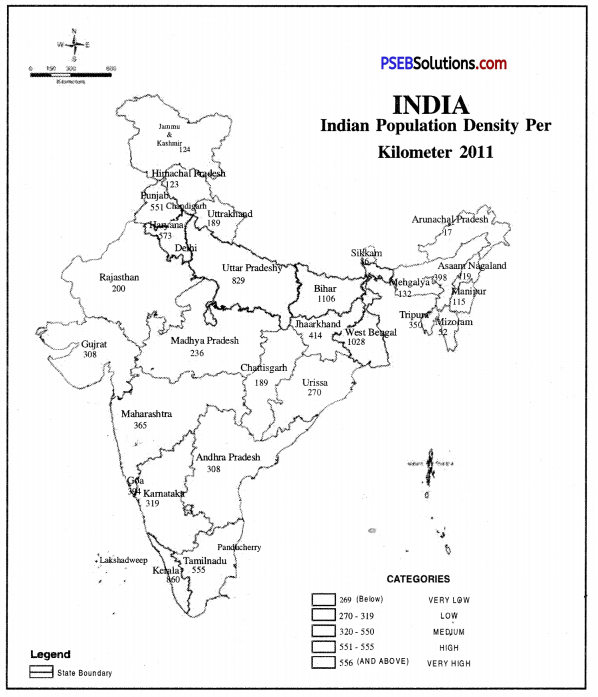
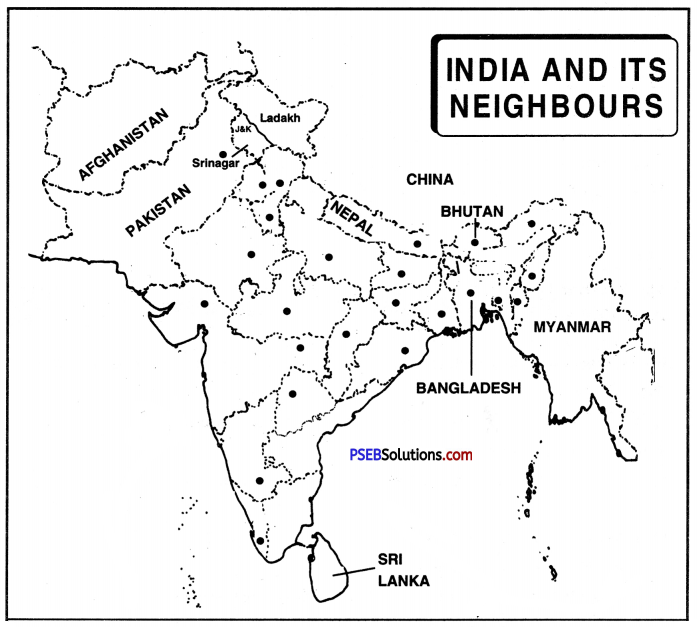
भारत के रेखा मानचित्र में अंकित करें:
उत्तर-
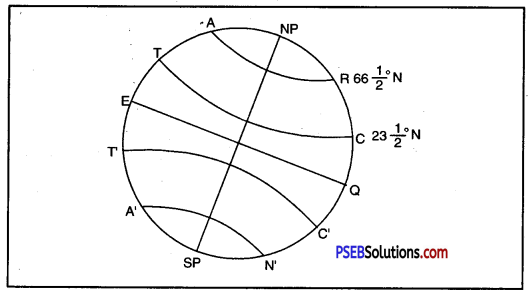
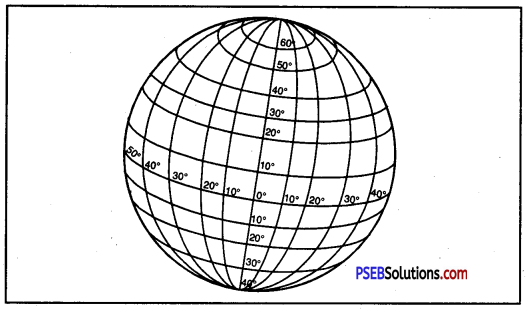
(i) भारतीय मानक देशांतर (821/2° पू०)
(ii) कर्क रेखा
(iii) पंजाबी भाषा बोलने वाले राज्य तथा क्षेत्र
(iv) दो पड़ोसी देश जिन्हें सागर नहीं छूता
(v) भारत का पड़ोसी द्वीपीय देश।
संकेत :
(iii) पंजाब, जम्मू-कश्मीर, दिल्ली तथा चंडीगढ़
(iv) नेपाल, भूटान
(vi) श्रीलंका।
नोट : मानचित्र कार्य अध्याय में दिए गए मानचित्रों की सहायता से स्वयं करें।
PSEB 9th Class SST Solutions Geography Chapter 1a भारत आकार व स्थिति (1)

PSEB 9th Class SST Solutions Geography Chapter 1a भारत : आकार व स्थिति

प्रश्न 2.
कक्षा क्रिया (Class Activity) :
(i) भारत के पड़ोसी सार्क (SAARC) देशों को अलग-अलग रंगों से अंकित करें और कक्षा में लगायें।
(ii) भारत के 28 राज्यों तथा 8 केंद्रीय शासित प्रदेशों को राजधानियों सहित दो रेखाचित्रों में भरें।
नोट : विद्यार्थी अपने अध्यापक की सहायता से स्वयं करें।

(ख) निम्नलिखित प्रश्नों के उत्तर एक-दो शब्दों से एक वाक्य में दें:

प्रश्न 1.
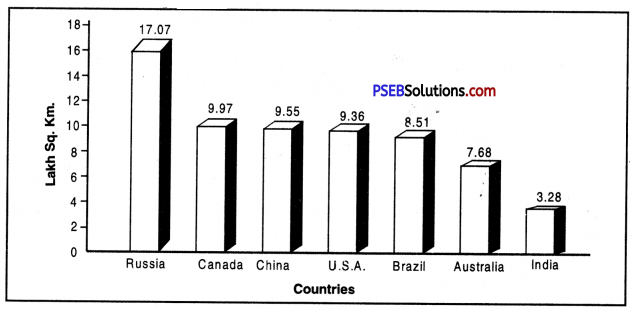
क्षेत्रफल के आधार पर विश्व का तृतीय स्थान का देश कौन-सा है ?
उत्तर-
चीन (China).

प्रश्न 2.
कौन-सा देश क्षेत्रफल और आबादी, दोनों पक्षों से ही विश्व में पांचवां स्थान रखता है ?
उत्तर-
ब्राज़ील।

प्रश्न 3.
सौराष्ट्र, निम्न में से कौन-से राज्य का हिस्सा है ?
(i) मनीपुर
(ii) गुजरात
(iii) महाराष्ट्र
(iv) नागालैंड।
उत्तर-
(i) गुजरात।

प्रश्न 4.
कौन-सा शहर किसी राज्य की राजधानी नहीं है ?
(i) रायपुर
(ii) अहमदाबाद
(iii) रांची
(iv) पणजी।
उत्तर-
(ii) अहमदाबाद।

प्रश्न 5.
भारत का कौन-सा अक्षांशीय प्रसार सही है ?
(i) 8°4′ उत्तर से 37°6′ उत्तर तक
(ii) 6°2′ उत्तर से 35°2′ उत्तर तक
(iii) 8°4′ दक्षिण से 37°6′ दक्षिण तक
(iv) 6°2′ दक्षिण से 35°2′ उत्तर तक।
उत्तर-
(i) 8°4′ उत्तर से 37°6′ उत्तर तक।।

प्रश्न 6.
भारत का संवैधानिक नाम क्या है ?
उत्तर-
भारत गणराज्य/गणतंत्र।

(ग) निम्नलिखित प्रश्नों के संक्षेप उत्तर दें :

प्रश्न 1.
भारत के उत्तरी, दक्षिणी, पूर्वी व पश्चिमी किनारों के नाम लिखें।
उत्तर-
उत्तरी सिरा – दफ़दार (Dafdar)
दक्षिणी सिरा – कन्याकुमारी (कोप केमोरिन) पूर्वी सिरा – किबिथू (Kibithu)
पश्चिमी सिरा – गुहार मोती (कच्छ)।

प्रश्न 2.
भारत के मानक देशांतर पर एक नोट लिखें।
उत्तर-
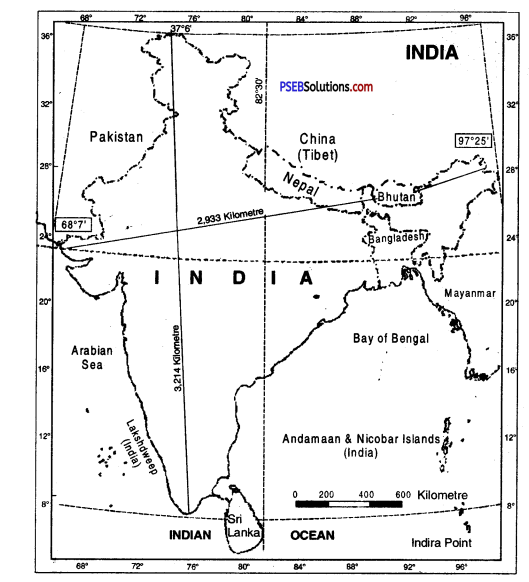
भारत का मानक देशांतर 82%° पू० है। यह देशांतर रेखा उत्तर प्रदेश में इलाहाबाद के निकट मिर्जापुर से गुजरती है। सारे भारत में समय की गणना इसी रेखा के आधार पर होती है। इस रेखा का समय ग्रीनविच के समय से 5.30 घंटे आगे है। इसके अनुसार जब ग्रीनविच में दोपहर के 12 बजते हैं उस समय भारत में शाम के 5.30 बजे होते हैं।

PSEB 9th Class SST Solutions Geography Chapter 1a भारत : आकार व स्थिति

प्रश्न 3.
अरुणाचल प्रदेश और गुजरात के समय में 2 घंटे का अंतर क्यों है ?
उत्तर-
अरुणाचल प्रदेश भारत के पूर्व तथा गुजरात पश्चिम में स्थित है। सूर्य सबसे पहले पूर्व में उदय होता है। पूर्व से पश्चिम की ओर जाते हुए समय 4° (मिनट) प्रति देशांतर की दर से घटता जाता है। इसलिए अरुणाचल का समय गुजरात से आगे रहता है जो लगभग 2 घंटे है। जब अरुणाचल में सूर्य अस्त हो रहा होता है गुजरात में शाम की धूप खिली होती है। इस बात को हम यूं भी कह सकते हैं कि जब अरुणाचल प्रदेश में सूर्य निकल रहा होता है, उस समय गुजरात में अभी रात होती है।

प्रश्न 4.
जम्मू-कश्मीर और तेलंगाना में कौन-कौन सी भाषाएं प्रयोग होती हैं ?
उत्तर-
जम्मू-कश्मीर-उर्दू, कश्मीरी, डोगरी, गुजरी, दादरी तथा पंजाबी। तेलंगाना-तेलुगु तथा उर्दू।

प्रश्न 5.
सार्क (SAARC) के विषय में संक्षिप्त नोट लिखें।
उत्तर-
सार्क (SAARC) दक्षिण एशिया के देशों का एक संगठन है जो आपसी सहयोग के लिए बनाया गया है। इसका पूरा नाम दक्षिण एशियाई क्षेत्रीय सहयोग संगठन (South Asian Association for Regional Co-operation) है। इसमें देश-भारत, पाकिस्तान, अफ़गानिस्तान, बांग्लादेश, भूटान, मालद्वीप, नेपाल तथा श्रीलंका शामिल हैं। इसमें भारत को सबसे महत्त्वपूर्ण स्थान प्राप्त है।

(घ) निम्नलिखित प्रश्नों के विस्तृत उत्तर दें:

प्रश्न 1.
भारत के अंतर्राष्ट्रीय व्यापार का विषय विस्तृत रूप में लिखें।
उत्तर-
अंतर्राष्ट्रीय व्यापार की दृष्टि से भारत की स्थिति बहुत ही अनुकूल है। निम्नलिखित तथ्य इस बात की पुष्टि करते हैं :
PSEB 9th Class SST Solutions Geography Chapter 1a भारत आकार व स्थिति (2)

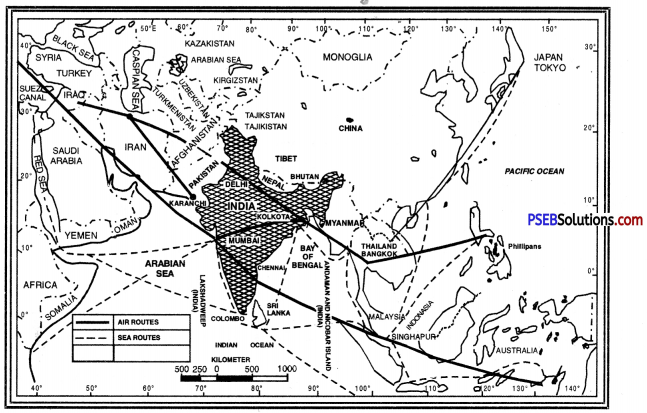
चित्र-व्यापार और वाणिज्य के अंतर्राष्ट्रीय महामार्ग पर भारत की स्थिति
1. दक्षिण भारत तीनों ओर से समुद्र से घिरा है। इसलिए देश का 96 प्रतिशत अंतर्राष्ट्रीय व्यापार समुद्री मार्ग से होता है।
2. पूर्व एवं दक्षिण एशिया तथा ऑस्ट्रेलिया को जाने वाले समुदी – भी हिंद महासागर से होकर गुज़रते हैं।
3. भारत स्वेज़ मार्ग तथा आशा अंतरीप मार्ग द्वारा यूरोप, उत्तरी अमेरिका तथा दक्षिणी अमेरिका से जुड़ा हुआ है।
4. भारत के लगभग सभी देशों से व्यापारिक संबंध हैं। हमारा देश संयुक्त राज्य अमेरिका, कनाडा, यूरोप महाद्वीप, दक्षिण अमेरिका तथा दक्षिण-पूर्वी एशिया के लगभग सभी देशों से व्यापार करता है।
5. 1869 में स्वेज नहर के खुलने से यूरोप तथा अमेरिकी देशों के साथ भारत के व्यापारिक संबंध और भी गहरे हो गए।

प्रश्न 2.
भारत के कोई 10 राज्यों तथा 5 केंद्रीय शासित प्रदेशों व राजधानियों के नाम लिखें।
उत्तर-
भारत के 10 राज्यों तथा 5 केंद्रीय शासित प्रदेशों की सूची निम्नलिखित है :

राज्य राजधानियां
1. अरुणाचल प्रदेश ईटानगर
2. असम  दिसपुर
3. बिहार पटना
4. गुजरात गांधीनगर
5. हरियाणा चंडीगढ़
6. हिमाचल प्रदेश शिमला
7. महाराष्ट्र मुंबई
8. कर्नाटक बंगलुरु
9. पंजाब चंडीगढ़
10. राजस्थान जयपुर

PSEB 9th Class SST Solutions Geography Chapter 1a भारत : आकार व स्थिति

केंद्र शासित प्रदे राजधानियां
1. अंडमान व निकोबार द्वीप समूह पोर्ट ब्लेयर
2. चंडीगढ़ चंडीगढ़
3. दादरा व नगर हवेली तथा दमन-दीव दमन
4. लक्षद्वीप कवारत्ति
5. दिल्ली (N.C.T.) दिल्ली

प्रश्न 3.
भारत को राजनीतिक पक्ष से बांटें और क्षेत्रफल के आधार पर सबसे बड़े और छोटे राज्यों पर नोट लिखें।
उत्तर-
भारत राज्यों का संघ है। राजनीतिक अथवा प्रशासनिक दृष्टि से इसे दो मुख्य भागों में बांटा गया है :

  1.  राज्य
  2.  केन्द्र शासित क्षेत्र।

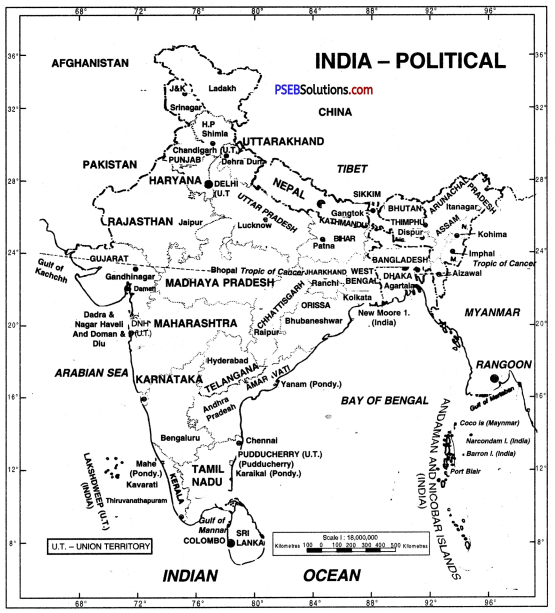
राज्यों की संख्या 28 और केंद्र शासित क्षेत्रों की संख्या 8 है। इन राज्यों की राजधानियों तथा क्षेत्रफल की तालिका नीचे दी गई है
1. भारत के राज्य
PSEB 9th Class SST Solutions Geography Chapter 1a भारत आकार व स्थिति (3) PSEB 9th Class SST Solutions Geography Chapter 1a भारत आकार व स्थिति (4) PSEB 9th Class SST Solutions Geography Chapter 1a भारत आकार व स्थिति (5) PSEB 9th Class SST Solutions Geography Chapter 1a भारत आकार व स्थिति (6)

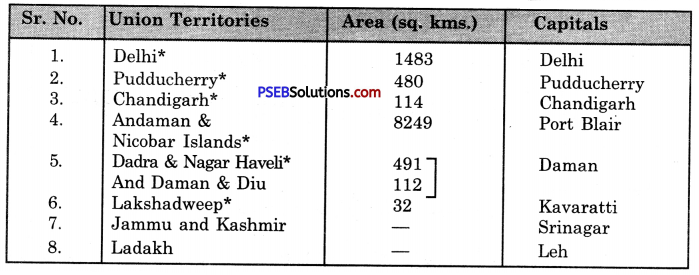
2. केंद्रीय शासित क्षेत्र

क्षेत्र राजधानी
1. अंडमान तथा निकोबार द्वीप समूह पोर्ट ब्लेयर
2. चंडीगढ़ चंडीगढ़
3. चंडीगढ़ दादरा, नगर हवेली तथा दमन-दीव दमन
4. दिल्ली (नैशनल कैपीटल टैरीटरी) दिल्ली
5. लक्षद्वीप कवारत्ति
6. पांडिचेरी (पुड्डुचेरी) पांडिचेरी (पुड्डुचेरी)
7. जम्मू-कश्मीर श्रीनगर
8. लद्दाख लेह

सबसे बड़ा राज्य-क्षेत्रफल की दृष्टि से भारत का सबसे बड़ा राज्य राजस्थान है। देश के उत्तर-पश्चिम में स्थित इसका क्षेत्रफल लगभग 3 लाख 42 हज़ार वर्ग कि०मी० है। इसकी राजधानी जयपुर है। इसका अधिकतर भाग मरुस्थलीय/रेतीला है।
सबसे छोटा राज्य-क्षेत्रफल की दृष्टि से भारत का सबसे छोटा राज्य गोआ (गोवा) है। इसका क्षेत्रफल 3702 कि०मी० है। इस तटीय राज्य की राजधानी पणजी है।
लेह

PSEB 9th Class SST Solutions Geography Chapter 1a भारत : आकार व स्थिति

PSEB 9th Class Social Science Guide भारत : आकार व स्थिति Important Questions and Answers

बहु-विकल्पीय प्रश्न :

प्रश्न 1.
अक्षांशीय दृष्टि से भारत स्थित है
(क) दक्षिणी गोलार्द्ध में
(ख) पूर्वी गोलार्द्ध में
(ग) उत्तरी गोलार्द्ध में
(घ) पश्चिमी गोलार्द्ध में।
उत्तर-
(ग) उत्तरी गोलार्द्ध में

प्रश्न 2.
भारत का सबसे दक्षिणी सिरा क्या कहलाता है ?
(क) मलक्का
(ख) इंदिरा प्वाइंट
(ग) केरल तट
(घ) इनमें से कोई नहीं।
उत्तर-
(ख) इंदिरा प्वाइंट

प्रश्न 3.
भारत का कुल क्षेत्रफल है-
(क) 42.87 लाख वर्ग कि० मी०
(ख) 22.87 लाख वर्ग कि० मी०
(ग) 30.87 लाख वर्ग कि० मी०
(घ) 32.87 लाख वर्ग कि० मी०।
उत्तर-
(घ) 32.87 लाख वर्ग कि० मी०

प्रश्न 4.
क्षेत्रफल की दृष्टि से भारत का विश्व में स्थान है-
(क) चौथा
(ख) पांचवां
(ग) छठा
(घ) सातवां।
उत्तर-
(घ) सातवां।

प्रश्न 5.
भारत भू-भाग एशिया महाद्वीप के जिस भाग में स्थित है
(क) पूर्वी
(ख) उत्तरी
(ग) दक्षिणी
(घ) पश्चिमी।
उत्तर-
(ग) दक्षिणी

प्रश्न 6.
उस राज्य का नाम बताओ जो अंतर्राष्ट्रीय सीमा तथा समुद्र को स्पर्श नहीं करता-
(क) मध्य प्रदेश
(ख) राजस्थान
(ग) उत्तर प्रदेश
(घ) पश्चिम बंगाल।
उत्तर-
(क) मध्य प्रदेश

प्रश्न 7.
भारत के दक्षिण में स्थित द्वीपीय देश है-
(क) नेपाल
(ख) लक्षद्वीप समूह
(ग) मालदीव
(घ) बांग्लादेश।
उत्तर-
(ग) मालदीव

प्रश्न 8.
स्वेज नहर खुली थी-
(क) 1869 ई० में
(ख) 1852 ई० में
(ग) 1937 ई० में
(घ) 1879 ई० में।
उत्तर-
(क) 1869 ई० में

प्रश्न 9.
मिजोरम की राजधानी है-
(क) इंफाल
(ख) कोहिमा
(ग) अगरतला
(घ) आइजोल।
उत्तर-
(घ) आइजोल।

PSEB 9th Class SST Solutions Geography Chapter 1a भारत : आकार व स्थिति

प्रश्न 10.
क्षेत्रफल के आधार पर भारत का सबसे छोटा राज्य है-
(क) गोवा
(ख) त्रिपुरा
(ग) राजस्थान
(घ) हरियाणा।
उत्तर-
(क) गोवा

प्रश्न 11.
भारत का सबसे उत्तरी अक्षांश है-
(क) 37°6′ उ०
(ख) 97025′ उ०
(ग) 6807′ उ०
(घ) इनमें से कोई नहीं।
उत्तर-
(क) 37°6′ उ०

प्रश्न 12.
तेलंगाना राज्य की राजधानी है-
(क) चंडीगढ़
(ख) बेंगलुरु
(ग) हैदराबाद
(घ) इटानगर।
उत्तर-
(ग) हैदराबाद

रिक्त स्थानों की पूर्ति :

1.जनसंख्या के हिसाब से विश्व में ………………. को पहला स्थान प्राप्त है।
2.भारत को ……………. रेखा दो समान भागों में बांटती है। .
3. क्षेत्रफल की दृष्टि से …………. संसार का सबसे बड़ा देश है।
4. भारत ………………. महाद्वीप में स्थित है।
5. ……………….. उत्तराखंड की राजधानी है।
6. जम्मू-कश्मीर, पंजाब, राजस्थान और …………. राज्यों की सीमा पाकिस्तान से लगती है।
7. ………….. तेलंगाना की राजधानी है।
8. …………….. पंजाब तथा हरियाणा की राजधानी है। |
उत्तर-

  1. चीन
  2. कर्क
  3. रूस
  4. एशिया
  5. देहरादून
  6. गुजरात
  7. हैदराबाद
  8. चंडीगढ़

अति लघु उत्तरों वाले प्रश्न।

प्रश्न 1.
2011 की जनगणना के अनुसार विश्व की कितने प्रतिशत जनसंख्या भारत में निवास करती है ?
उत्तर-
17.5%

प्रश्न 2.
भारत के कौन-से उपजाऊ मैदान भारत को अनाज की सुरक्षा प्रदान करते हैं ?
उत्तर-
गंगा, ब्रह्मपुत्र के मैदान।

प्रश्न 3.
क्षेत्रफल की दृष्टि से संसार का सबसे बड़ा देश कौन-सा है ?
उत्तर-
रूस। प

प्रश्न 4.
भारत का कुल क्षेत्रफल कितना है ?
उत्तर-
लगभग 32.87 लाख वर्ग कि०मी०।

प्रश्न 5.
भारत का कौन-सा भू भाग खनिजों का भंडार है ?
उत्तर-
प्रायद्वीपीय पठार।

प्रश्न 6.
अरब सागर तथा बंगाल की खाड़ी में स्थित द्वीप समूहों के नाम बताइए।
उत्तर-
अरब सागर में लक्षद्वीप समूह तथा बंगाल की खाड़ी में अंडमान-निकोबार द्वीप समूह।

प्रश्न 7.
उन देशों के नाम बताइए जो क्षेत्रफल में भारत से बड़े हैं।
उत्तर-
ऑस्ट्रेलिया, ब्राजील, चीन, संयुक्त राज्य अमेरिका, कनाडा तथा रूस।

प्रश्न 8.
भारत के तीनों ओर स्थित सागरों के नाम बताओ।
उत्तर-
भारत के पूर्व में बंगाल की खाड़ी, पश्चिम में अरब सागर तथा दक्षिण में हिंद महासागर स्थित है।
PSEB 9th Class SST Solutions Geography Chapter 1a भारत आकार व स्थिति (7)

प्रश्न 9.
भारत को कौन-सा अक्षांश वृत्त अथवा कौन-सी अक्षांश रेखा लगभग दो समान भागों में बांटती है ? इसका अक्षांश कितना है ?
उत्तर-
भारत को कर्क वृत्त अथवा कर्क रेखा लगभग दो समान भागों में बांटती है। इसका अक्षांश 23°30′ उ० है।

PSEB 9th Class SST Solutions Geography Chapter 1a भारत : आकार व स्थिति

प्रश्न 10.
दक्षिण भारत के दो पड़ोसी द्वीपीय राज्यों के नाम लिखिए।
उत्तर-
भारत के दो पड़ोसी द्वीपीय राज्य श्रीलंका तथा मालदीव हैं।

प्रश्न 11.
पूर्व में स्थित भारत के दो पड़ोसी देश कौन-कौन से हैं ?
उत्तर-
भारत के पूर्व में स्थित दो पड़ोसी देश बंगलादेश तथा म्यानमार हैं।

प्रश्न 12.
उत्तर में भारत की सीमा किन-किन देशों से लगती है ?
उत्तर-
उत्तर में भारत की सीमा चीन, नेपाल तथा भूटान से लगती है।

प्रश्न 13.
उपमहाद्वीप किसे कहते हैं ?
उत्तर-
एक बड़ी भौगोलिक इकाई जो शेष महाद्वीप से स्पष्ट रूप से अलग दिखाई पड़ती है, उसे उपमहाद्वीप कहते हैं। हिमालय पर्वत भारतीय उपमहाद्वीप को शेष एशिया से अलग करता है।

प्रश्न 14.
भारत में कितने राज्य तथा केंद्रशासित क्षेत्र हैं ?
उत्तर-
28 राज्य और 8 केंद्र शासित क्षेत्र।

प्रश्न 15.
भारत के किन्हीं चार प्रांतों के नाम बताओ जिनकी सीमा दूसरे देशों के साथ लगती है।
उत्तर-
पंजाब, उत्तर प्रदेश, जम्मू और कश्मीर तथा पश्चिमी बंगाल चार ऐसे प्रांत हैं जिनकी सीमा दूसरे देशों के साथ लगती है।

प्रश्न 16.
भारत के पूर्वी तट पर स्थित चार राज्यों के नाम बताएं।
उत्तर-
भारत के पूर्वी तट पर स्थित चार राज्य हैं-तमिलनाडु, आंध्र प्रदेश, उड़ीसा तथा पश्चिमी बंगाल।

प्रश्न 17.
इंदिरा प्वाइंट किस द्वीप समूह में स्थित है ?
उत्तर-
इंदिरा प्वाइंट अंडमान-निकोबार द्वीप समूह में स्थित है।

प्रश्न 18.
भारत की स्थलीय सीमा की लंबाई कितनी है ?
उत्तर-
भारत की स्थलीय सीमा की लंबाई लगभग 15,200 कि०मी है।

प्रश्न 19.
भारत की तटरेखा की कुल लंबाई कितनी है ?
उत्तर-
भारत की तटरेखा की कुल लंबाई 7516 कि०मी० है।

प्रश्न 20.
क्षेत्रफल की दृष्टि से भारत का संसार में कौन-सा स्थान है ?
उत्तर-
क्षेत्रफल की दृष्टि से भारत का संसार में सातवां स्थान है।
PSEB 9th Class SST Solutions Geography Chapter 1a भारत आकार व स्थिति (8)

चित्र-विश्व के सात सबसे बड़े देश

प्रश्न 21.
भारत के पूर्व तथा पश्चिम में स्थित सागरों के नाम बताओ।
उत्तर-
क्रमशः बंगाल की खाड़ी तथा अरब सागर।

प्रश्न 22.
भारत की सबसे अधिक तथा सबसे कम स्थल सीमा क्रमशः किस-किस देश के साथ लगती है ?
उत्तर-
सबसे अधिक (4096 कि.मी.) बंगला देश के साथ तथा सबसे कम (80 कि.मी.) अफ़गानिस्तान के साथ।

प्रश्न 23.
भारत का मानक समय ग्रीनविच के समय से कितना आगे है ?
उत्तर-
साढ़े पांच घंटे।

प्रश्न 24.
अरब सागर से लगते चार भारतीय राज्यों के नाम बताओ।
उत्तर-

  1. गुजरात
  2. महाराष्ट्र
  3. कर्नाटक
  4. केरल।

प्रश्न 25.
बंगलादेश की सीमा से मिलते किन्हीं चार भारतीय राज्यों के नाम लिखो।
उत्तर-

  1. पश्चिमी बंगाल
  2. असम
  3. मेघालय
  4. मिज़ोरम।

प्रश्न 26.
उत्तराखंड, छत्तीसगढ़ तथा झारखंड की राजधानियों के नाम बताओ।
उत्तर-
उत्तराखंड की राजधानी देहरादून, छत्तीसगढ़ की राजधानी रायपुर तथा झारखंड की राजधानी रांची है।

PSEB 9th Class SST Solutions Geography Chapter 1a भारत : आकार व स्थिति

लघु उत्तरों वाले प्रश्न

प्रश्न 1.
“भारत का अक्षांशीय और देशांतरीय विस्तार लगभग 30° है, फिर भी भारत का उत्तर-दक्षिण विस्तार पूर्व-पश्चिम के विस्तार से अधिक है।” कारण बताइए।
उत्तर-
इसमें कोई संदेह नहीं कि भारत का उत्तर-दक्षिण अक्षांशीय विस्तार 30° है और इतना ही इसका पूर्वपश्चिम देशांतरीय विस्तार है। परंतु जब इस विस्तार को किलोमीटर में मापते हैं तो.वह दूरी बराबर नहीं आती। देश का पूर्व-पश्चिम विस्तार लगभग 2933 किलोमीटर और उत्तर-दक्षिण विस्तार लगभग 3214 किलोमीटर है। इसका कारण यह है कि देशांतर रेखाएं अक्षांश रेखाओं की भांति एक-दूसरे के समानांतर नहीं हैं। सभी देशांतर रेखाएं ध्रुवों पर आकर आपस में मिल जाती हैं और जैसे-जैसे विषुवत् रेखा से दूर होते जाते हैं देशांतर रेखाओं के बीच की दूरी घटती जाती है। परिणामस्वरूप भारत का पूर्व-पश्चिम विस्तार (भूमध्य) (किलोमीटरों में) कम है।

प्रश्न 2.
भारत को उपमहाद्वीप का दर्जा क्यों दिया जाता है ? भारतीय उपमहाद्वीप किन देशों से मिलकर बनता है ?
उत्तर-
भारत एशिया महाद्वीप के दक्षिण में स्थित है। एशिया का भाग होते हुए भी यह एक विशिष्ट भौगोलिक इकाई है। इसे हिमालय पर्वत शेष एशिया से अलग करते हैं। भारत की इसी विशेषता के कारण भारत को उपमहाद्वीप का दर्जा दिया गया है।
भारतीय उप-महाद्वीप भारत के अतिरिक्त पाकिस्तान, नेपाल, भूटान, बंगलादेश, श्रीलंका, मालदीव आदि देशों से मिलकर बनता है।

प्रश्न 3.
कर्क वृत्त भारत को लगभग दो समान भागों में बाँटता है। इन भागों की संक्षिप्त भौतिक जानकारी दीजिए।
उत्तर-
कर्क वृत्त भारत को लगभग दो समान भागों में बाँटता है-उत्तरी भाग तथा दक्षिणी भाग।
उत्तरी भाग-कर्क वृत्त के उत्तर में फैला भू-भाग एक विशाल क्षेत्र है। यह पूर्व से पश्चिम की ओर फैला हुआ है। इसमें ऊंचे पर्वत तथा विशाल मैदान स्थित हैं।
दक्षिणी भाग-कर्क वृत्त के दक्षिण में फैला भू-भाग त्रिभुजाकार है। इस त्रिभुज का आधार उत्तर की ओर है। दक्षिण की ओर जाते हुए यह भू-भाग तंग होता जाता है। इसमें मुख्य रूप से प्रायद्वीप पठार तथा पूर्वी एवं पश्चिमी तटीय मैदान सम्मिलित हैं।

प्रश्न 4.
भारत के लिए हमें एक मानक मध्याह्न रेखा (देशांतर रेखा) की आवश्यकता क्यों है ? बताइए।
उत्तर-
मानक मध्याह्न रेखा अथवा मानक देशांतर किसी देश के मानक समय को निर्धारित करती है। पूरे देश में सभी कार्य इसी रेखा के समय के अनुसार होते हैं। यदि ऐसा न हो तो देश की परिवहन एवं संचार व्यवस्था, कार्यालयों में होने वाले कार्य तथा अन्य सभी गतिविधियों में गड़बड़ी उत्पन्न हो जाएगी। अतः भारत के लिए भी मानक देशांतर रेखा का होना अनिवार्य है। हमारे देश में 82°30 पू० की देशांतर रेखा को मानक देशांतर निर्धारित किया गया है।

प्रश्न 5.
बताइए कि अहमदाबाद तथा कोलकाता में मध्याहून (दोपहर) का सूर्य वर्ष में दो बार ठीक सिर के ऊपर क्यों होता है जबकि दिल्ली में ऐसा नहीं होता ?
उत्तर-
अहमदाबाद तथा कोलकाता कर्क वृत्त के निकट दक्षिण में स्थित हैं। इसके विपरीत दिल्ली कर्क वृत्त से दूर उत्तर में स्थित है। कर्क वृत्त पर वर्ष में दो बार मध्याह्न का सूर्य सीधा सिर के ऊपर होता है, परंतु इसके उत्तर में एक बार भी ऐसा नहीं होता। यही कारण है कि अहमदाबाद तथा कोलकाता में मध्याह्न का सूर्य वर्ष में दो बार ठीक सिर के ऊपर होता है जबकि दिल्ली में ऐसा नहीं होता है।

प्रश्न 6.
भारत का देशांतरीय विस्तार कितना है ? इसका क्या महत्त्व है ?
उत्तर-
भारत का देशांतरीय विस्तार लगभग 30° है। इसका सबसे बड़ा महत्त्व यह है कि इस देश में सूर्य उदय के समय में काफ़ी अंतर पाया जाता है, अर्थात् देश के सभी भागों में सूर्य एक ही समय पर उदय नहीं होता। उदाहरण के लिए अरुणाचल प्रदेश और गुजरात क्रमशः भारत के पूर्व और पश्चिम में स्थित हैं। दोनों राज्यों में 30° देशांतर का अंतर है। प्रत्येक दो देशांतरों के बीच चार मिनट के समय का अंतर होता है। इस प्रकार अरुणाचल प्रदेश तथा गुजरात के समय में दो घंटे का अंतर आ जाता है।

प्रश्न 7.
कन्याकुमारी की अपेक्षा कश्मीर में दिन रात की अवधि में अधिक अंतर क्यों है ?
उत्तर-
देश का उत्तर-दक्षिणी विस्तार भारत के विभिन्न भागों में दिन-रात की लंबाई में अंतर डालता है। कन्याकुमारी (लगभग 8° उ० अक्षांश) भूमध्य रेखा के निकट है। यहाँ दिन-रात लगभग समान अवधि के होते हैं। परंतु कश्मीर (लगभग 37° उ० अक्षांश) भूमध्य रेखा से दूर है। यहाँ सारा वर्ष सूर्य की किरणें तिरछी पड़ती हैं, परिणामस्वरूप यहाँ दिन रात की अवधि में पाँच घंटे का अंतर होता है। पृथ्वी के अक्ष के झुकाव के कारण भी भूमध्य रेखा से दूर स्थित भागों में दिन और रात अवधि में अंतर आ जाता है।

दीर्घ उत्तरों वाले प्रश्न

प्रश्न 1.
भारत के आकार एवं विस्तार की मुख्य विशेषताएँ बताओ।
उत्तर-
भारत एक विशाल देश है। क्षेत्रफल की दृष्टि से यह विश्व में सातवें स्थान पर आता है। इसकी स्थिति एवं विस्तार की मुख्य विशेषताओं का वर्णन इस प्रकार है

  1. भारत की मुख्यभूमि 8°4′ उ० से 37°6′ उ० अक्षांशों के बीच फैली हुई है। इसका देशांतरीय विस्तार 68°7′ पू० से 97°25′ पू० देशांतरों के बीच है। ___ इस प्रकार देश का अक्षांशीय तथा देशांतरीय विस्तार लगभग समान (30°) है। फिर भी किलोमीटरों में देश का उत्तरदक्षिणी विस्तार इसके पूर्वी-पश्चिमी विस्तार से अधिक है।
  2. विषुवत् वृत्त के संदर्भ में भारत उत्तरी गोलार्द्ध में तथा प्रधान देशांतर (मध्याह्न) रेखा के संदर्भ में पूर्वी गोलार्द्ध में स्थित है।
  3. कर्क वृत्त (23°30′ उ०) भारत को लगभग दो समान भागों में बाँटता है। देश का उत्तरी भाग पर्वतीय तथा मैदानी है, जबकि दक्षिणी भाग पठारी है।
  4. भारत का क्षेत्रफल लगभग 32.7 लाख वर्ग किलोमीटर है। यह विश्व के कुल भू-भाग का 2.4 प्रतिशत है।

PSEB 9th Class SST Solutions Geography Chapter 1a भारत : आकार व स्थिति

भारत : आकार व स्थिति PSEB 9th Class Geography Notes

  • भारत गणतंत्र एक विशाल देश है। क्षेत्रफल की दृष्टि से यह संसार का सातवां बड़ा देश है।
  • संसार के कुल क्षेत्रफल का 2.4% भाग भारत भूमि का निर्माण करता है।
  • जनसंख्या की दृष्टि से भारत चीन के बाद संसार का दूसरा बड़ा देश है।
  • हिमालय पर्वत का विस्तार तथा तीन ओर से समुद्र भारत को ‘उपमहाद्वीप’ का दर्जा प्रदान करते हैं।
  • भारत एक सुस्पष्ट भौगोलिक इकाई है जिसमें एक विशिष्ट संस्कृति का विकास हुआ है।।
  • भारत का उत्तर-दक्षिण विस्तार 3214 कि०मी० और पूर्व-पश्चिम विस्तार 2933 कि०मी० है।
  • 82° 30° पू० देशांतर के समय को भारत का मानक समय माना गया है। यह ग्रीनविच (इंग्लैंड) के समय से साढ़े पांच घंटे आगे है।
  • जब किसी देश में किसी देशांतर के स्थानीय समय को पूरे देश का समय मान लिया जाता है, तो उसे मानक समय कहते हैं।
  • किसी महाद्वीप का वह भाग जो पर्वतों एवं नदियों जैसे प्राकृतिक लक्षणों द्वारा शेष महाद्वीप से अलग दिखाई देता है, उप-महाद्वीप कहलाता है। भारत भी एक उपमहाद्वीप है।
  • भारत की सीमाएं 7 देशों की सीमाओं को छूती हैं।
  • देश का धरातलीय विस्तार 15200 कि०मी० और तट रेखा 7516-कि०मी० है।
  • SAARC (सार्क) का अर्थ है South Asian Association for Regional Co-operation । भारत … को सार्क देशों में सबसे महत्त्वपूर्ण स्थान प्राप्त है।
  • भारत में 28 राज्य तथा 8 केंद्र शासित प्रदेश हैं।
  • चंडीगढ़ (हरियाणा तथा पंजाब) और हैदराबाद (आंध्र प्रदेश तथा तेलंगाना) दो ऐसे शहर हैं जो एक से अधिक राज्यों की राजधानियां हैं।
  • दिल्ली राष्ट्रीय राजधानी क्षेत्र है। इसका नई दिल्ली क्षेत्र पूरे देश की राजधानी है।
  • हिन्दमहासागर के शीर्ष पर स्थित होने के कारण अन्तर्राष्ट्रीय व्यापार की दृष्टि से भारत की स्थिति अनुकूल है।

PSEB 6th Class Social Science Solutions Chapter 4 How Maps Help Us

Punjab State Board PSEB 6th Class Social Science Book Solutions Geography Chapter 4 How Maps Help Us Textbook Exercise Questions and Answers.

PSEB Solutions for Class 6 Social Science Geography Chapter 4 How Maps Help Us

SST Guide for Class 6 PSEB How Maps Help Us Textbook Questions and Answers

I. Answer the following questions in brief:

Question 1.
What is a map?
Answer:
A map is the representation of the earth or a portion of the earth, drawn to a scale on a flat surface.

Question 2.
What is a Globe?
Answer:
A Globe is a true representation of the earth or a model of the earth.

Question 3.
Write the difference between a Map and a Globe.
Answer:

A Map A Globe
1. A map is the representation of the earth’s surface or a part of it on a flat surface according to a scale. 1. A globe is the true model of the earth. It shows the earth in its true shape. It is a correct replica of the round shape of the earth.
2. A map is convenient to handle. It is very easy to carry a map from one place to the other. 2. A globe is not convenient to handle. We find it difficult to carry a Globe from one place to the other.
3. Every feature can be shown in detail in a map. 3. Every feature cannot be shown in detail on a globe.

PSEB 6th Class Social Science Solutions Chapter 4 How Maps Help Us

Question 4.
Why were maps made? Give their importance.
Answer:
Undoubtedly, a Globe is a true model of the earth. But globes occupy a lot of space and they are difficult to be carried everywhere. A need was felt to carry something handy, something that can be carried in one’s pocket and also included in a book. So maps were made.

Importance of Maps:

  • Maps help us in learning the different aspects of Geography.
  • They show us the position of the places in relation to latitudes and longitudes that are drawn on the map.
  • They help us in locating the distance from one place to another, time and location.
  • They help us in locating the trade centres, routes, slope of the land, rivers, etc.
  • They are used by the government for administrative purposes.
  • They guide the travellers and also are useful for the army.

Question 5.
Enlist the different types of maps.
Answer:
The different types of maps are:

  1. Physical maps,
  2. Historical maps,
  3. Distributional maps,
  4. Topographical maps,
  5. Atlas maps,
  6. Wall maps.

Question 6.
What are the pillars of maps and why?
Answer:
Distance, direction and conventional signs are the pillars of maps. These are also known as the most essential components of maps. These are the pillars of maps because, without knowledge of them, we won’t be able to read the map correctly.

Question 7.
What do you understand by the conventional symbols?
Answer:
It is not possible to show on the map the actual shape of features such as a building, a well or a tree. So symbols are used to represent various features in maps. With their help, it is easier and quicker to read and understand the maps. They also make the map clearer and easier to be read. As there has been a common agreement all over the world regarding the use of these symbols, they are called conventional symbols.

PSEB 6th Class Social Science Solutions Chapter 4 How Maps Help Us

Question 8.
Make a chart of the conventional symbols.
Answer:
PSEB 6th Class Social Science Solutions Chapter 4 How Maps Help Us 1

Question 9.
In coloured maps, with which colour we show mountains, uplands, plains, rivers, forest and snow-covered hills.
Answer:

Physical Features Colour
1. Mountains Brown
2. Uplands Yellow
3. Plains Green
4. Rivers Blue
5. Forest Green
6. Snow covered Hills White

Question 10.
What is the use of directions in the maps?
Answer:
In the upper right-hand margin of the maps we see an arrow. The tip of the arrow is marked with the letter ‘N’
It means that the arrow is pointing northwards. The arrow is, therefore, called the North Line.
PSEB 6th Class Social Science Solutions Chapter 4 How Maps Help Us 2
Direction

PSEB 6th Class Social Science Solutions Chapter 4 How Maps Help Us

Question 11.
How does scale of the map help us to study the maps?
Answer:
Scale of the map is a measuring line with the help of which correct distance between various points on a map can be measured. In a scale, there is always a proportion between the dimensions of the map and the actual areas they represent on the earth. It can be a millimetre, a centimetre or an inch to represent a kilometre, a hundred kilometre or even still larger distances.
PSEB 6th Class Social Science Solutions Chapter 4 How Maps Help Us 3
Scale

Question 12.
What is the importance of the key in a map?
Answer:
The key in a map tells us what each symbol used in the map stands for. In other words, key explains symbols.

PSEB 6th Class Social Science Guide How Maps Help Us Important Questions and Answers

Multiple Choice Questions :

Question 1.
Thick blue line on map is usually used to show :
(A) Electricity power station
(B) Stream
(C) River
(D) Dam.
Answer:
(C) River.

Question 2.
A large scale drawing showing greater details is called :
(A) Plan
(B) Sketch
(C) Map
(D) Compose.
Answer:
(A) Plan.

Question 3.
Element of map that shows relationship between actual distance and length on map is
(A) Grid line
(B) Key line
(C) Legend line
(D) Scale.
Answer:
(D) Scale.

Question 4.
Maps that represent a particular theme are called :
(A) Physical
(B) Thematic
(C) Historical
(D) Wall maps.
Answer:
(B) Thematic.

PSEB 6th Class Social Science Solutions Chapter 4 How Maps Help Us

Question 5.
Survey maps are also called :
(A) Topographical maps
(B) Physical maps
(C) Thematic maps
(D) Historical maps.
Answer:
(A) Topographical maps.

Fill in the Blanks :

Question 1.
________ is an instrument used to find the directions.
Answer:
Compass

Question 2.
There are ________ cardinal directions.
Answer:
Four

Question 3.
Blue colour is used for showing ________
Answer:
Water bodies

Question 4.
________ is the true model of the earth.
Answer:
Globe

PSEB 6th Class Social Science Solutions Chapter 4 How Maps Help Us

Question 5.
________ colour is used for showing mountain.
Answer:
Brown.

True/False :

Question 1.
Maps are tools of geography.
Answer:
True

Question 2.
Every feature can be shown in detail on a globe.
Answer:
False

Question 3.
The tip of the arrow is marked with the letter ‘N’
Answer:
True

Question 4.
Topographical maps are the only which show only physical features.
Answer:
False

PSEB 6th Class Social Science Solutions Chapter 4 How Maps Help Us

Question 5.
Colours are mostly used in maps.
Answer:
True.

Very Short Answer Type Questions

Question 1.
What is Geography?
Answer:
Geography is that branch of science which deals with the earth, its surroundings and the people who live on it.

Question 2.
What is a physical map?
Answer:
A physical map is one which shows different features of land-forms.

Question 3.
For what are historical maps used?
Answer:
Historical maps are used to explain historical events.

Question 4.
What is a political map?
Answer:
A map showing different countries and states of the world with their boundaries is called a political map.

Question 5.
For what purpose are wall maps used?
Answer:
Wall maps are used for demonstration and lecture purpose.

Question 6.
What is a scale?
Answer:
The relation between the distance of two points in the map and the two corresponding points on the land is known as a scale.

PSEB 6th Class Social Science Solutions Chapter 4 How Maps Help Us

Question 7.
What does the tip of arrow in the right hand margin of map show?
Answer:
The tip of arrow shows northwards.

Question 8.
What are the four cardinal points of a compass?
Answer:
The four cardinal points of a compass are North, South, East and West.

Question 9.
What does the term ‘one centimetre to one kilometre’ indicate in a map?
Answer:
It indicates that one centimetre on the map represents one kilometre on the ground.

Short Answer Type Questions

Question 1.
Why can’t maps be as accurate as globes?
Answer:
Maps can’t be as accurate as globes because the maps are drawn on flat surfaces. They show the earth’s surface or a part of it according to some scale. It is impossible to flatten a round shape completely. As a result, the northern and the southern parts of the earth are stretched out of proportion. But the globes are very accurate because the shapes and sizes of continents and oceans are shown accurately on them.
Question 2.
How are maps helpful in our daily life?
Answer:
Maps provide us great help in our daily life. They help us in locating places and reaching wherever we want. People travel all around the world with the help of maps.

Question 3.
What are Topographical Maps?
Answer:
Topographical maps are the ones which show natural features as well as man-made features like roads, railways, etc. They are prepared by the survey department of each country. They are helpful for town planning, for use by the army and for various study purposes.

PSEB 6th Class Social Science Solutions Chapter 4 How Maps Help Us

Question 4.
Distinction between a map and a plan.
Answer:

Map Plan
1. The map shows a large area on a sheet of paper such as world, continents, countries etc. 1. It shows a small area on a sheet of paper such as a room, a garden, school building etc.
2. The map is drawn on a small scale such as 1 centimetre = 1 kilometre etc. 2. The plan is drawn on a large scale such as 1 centimetre = 1 metre.
3. Colours are mostly used in maps. 3. The plans are mostly simple.
4. Only the important features can be shown in brief on a map. 4. Even details of small and unimportant areas can be shown on a plan.

Question 5.
What are the components of maps?
Answer:
(a) Distance
(b) Direction and
(c) Symbol.

Distance: Distance is measured with the help of a scale.

Direction:

  • Direction is known by the arrow marked with ‘N’ on the map.
  • It is also known as an instrument called a compass.

Symbol: Universally accepted marks or icons to depict information on the maps are known as symbols.

Long Answer Type Question

Question 1.
Describe the various types of maps.
Answer:
Maps are very useful in modern life. Therefore, various types of maps are drawn according to the purpose of the study. Some important types of them are given as under :

  1. Physical Maps: Maps showing physical features of the earth such as landforms of different elevations, i.e. mountains, plateaus, plains, rivers, oceans, etc. are called physical maps.
  2. Political Maps: Political maps are the maps that show different countries and states of the world with their boundaries.
  3. Historical Maps: Historical maps show historical events such as war, the spread of civilization, an important voyage, etc.
  4. Distributional Maps: Distributional maps are also called commodity maps. They are used to show the distribution of various commodities such as crops, population, minerals, etc.
  5. Topographical Maps: Topographical maps are used to show natural as well as man-made features such as roads, railways, etc.
  6. Atlas Maps: Atlas maps are in the form of a book. They are easy to carry and are useful for students. They are small-scale maps.
  7. Wall Maps: Wall maps are used for the purpose of demonstration and lecture. These are bigger than atlas maps.

PSEB 7th Class Social Science Solutions Chapter 2 The Internal and External Face of the Earth

Punjab State Board PSEB 7th Class Social Science Book Solutions Geography Chapter 2 The Internal and External Face of the Earth Textbook Exercise Questions and Answers.

PSEB 7th Class Social Science Solutions Geography Chapter 2 The Internal and External Face of the Earth

SST Guide for Class 7 PSEB The Internal and External Face of the Earth Textbook Questions and Answers

I. Give answers to the following questions approximately in 1-15 words.

Question 1.
How many shells of the earth are there? Name them.
Answer:
Lithosphere, Mantle and Core. These are called Sial, Sima and Nife in that order.

Question 2.
How many types of Rocks are found on the earth?
Answer:
Igneous rocks, Sedimentary rocks, Metamorphic rocks.

Question 3.
Write down about the Mantle part of the Earth.
Answer:
Below the earth’s crust is Mantle. Its normal thickness is 2900 kms deep down to earth’s interior.

Question 4.
By which name the inner most part of the earth is called? What are the components of this part?
Answer:
The core of the earth is called ‘Nife’. It is made up of Nikel and Iron (Ferrous).

PSEB 7th Class Social Science Solutions Chapter 2 The Internal and External Face of the Earth

Question 5.
How can we avoid soil erosion?
Answer:

  • By planting more and more trees.
  • By adopting developed means of agriculture.
  • By decreasing the grazing area of cattle.

II. Give answers to the following questions approximately in 50-60 words.

Question 1.
What are igneous rocks? How many types are there of these rocks? Write about the Intrusive rocks.
Answer:
Igneous shell is the shell which is made up by cooling of Magma and Lava. These rocks are of two types: Intrusive/Extrusive.
Sometimes Magma get cold and slowly solidifies inside the earth’s surface, these are called Intrusive Igneous Rocks. While sometimes Magma gets cold and solidifies near the earth’s surface then these rocks are called Extrusive Igneous Rocks.

Question 2.
What are the sedimentary rocks? How many types are there of these rocks?
Answer:

  1. They are called secondary rocks.
  2. They form from deposits or sediments obtained from weathering and erosion of other rocks.
  3. They contain fossils.
  4. They are always layered.
  5. Sandstone, shale, gravel and conglomerate are examples of these rocks.
  6. On the basis of construction, layered rocks are of two types:
    (i) Fossil layered rocks.
    (ii) Non-fossil layered rocks.

PSEB 7th Class Social Science Solutions Chapter 2 The Internal and External Face of the Earth 1

Question 3.
Write about Metamorphic rocks, give specific example of these rocks.
Answer:
Metamorphic Rocks: These rocks are formed by ‘metamorphism’ or change of form of igneous and sedimentary rocks. The change takes place in hardness, colour, texture and composition of minerals in rocks deep inside the earth due to pressure and temperature. Thus original igneous rock like mica may be changed to schist, granite to gneiss and sedimentary rocks like limestone to marble, sandstone to quartzite and peat to coal.

Characteristics:

  • They are very hard.
  • They contain useful materials and minerals like building materials, marbles, gems, rubies and sapphires. Taj Mahal is made of white marble.

Question 4.
What kind of mineral is mica, for what purpose is it used?
Answer:
Mica is a non-metallie mineral: It has a great importance. This mineral is very useful in manufacturing eletromic goods. It is also used in making other things like lamps, chimneys, paints, radars, rubber, poper, transparent sheets and aeroplanes.

PSEB 7th Class Social Science Solutions Chapter 2 The Internal and External Face of the Earth

Question 5.
Which material is called as ‘Liquid Gold’? Give brief introduction.
Answer:
Mineral oil is known as Liquid Gold. This name has been given because of its increasing use and importance. It, is also called Petroleum or driving energy. It is also extracted from earth like other minerals. It is made up of two words- Petra and Oliuin. In Latin language Petra means rock and Olium means oil i.e. oil received from rocks. It is a fossil fuel which is made up of animals leftovers being pressed inside Sedimentary rocks.

Question 6.
Write down the importance of the soil on the earth.
Answer:
Soil is a valuable natural resource. Its importance is in its fertility. Many human and economic activities depend upon soil. Most of the civilizations have flourished near the fertile soil beds of Nile and Indus rivers, Tigris, Euphrates and Yangste valleys. Even today fertile valleys and rivers attract dense population. India has been able to produce foodgrains for its large population on the strength of its fertile soil.

III. Write the answers to the following questions approximately in 125-130 words.

Question 1.
Write in detail about the rocks available on the earth.
Answer:
On the basis of their formation rocks are of three chief types as shown in the diagram, namely— Igneous, Sedimentary and Metamorphic.
PSEB 7th Class Social Science Solutions Chapter 2 The Internal and External Face of the Earth 2

1. Igneous: These rocks are formed from cooling and solidification of molten material rising from interior of the earth called magma. When cooling and solidification happens just near the ground or above the ground they are called Extrusive Igneous Rocks. If cooling and solidification happens inside the earth, these rocks are called Instrusive Igneous Rocks. Basalt and Rhyolite are examples of extrusive igneous rocks and granite and gabro are examples of intrusive igneous rocks.

PSEB 7th Class Social Science Solutions Chapter 2 The Internal and External Face of the Earth 3
Igneous Rocks

Characteristics:

  • When igneous rocks are exposed on the surface of the earth they are weathered and provide materials for other types of rocks. As a result the igneous rocks are called Primary Rocks.
  • These rocks contain crystals whose size depends on rate of cooling.

2. Sedimentary Rocks: The material for sedimentary rocks may be derived from weathering and erosion of all types of rocks- igneous, metamorphic or old sedimentary rocks. They may contain fossils formed from remains of dead plants and animals.

There are two types of sedimentary rocks: inorganic and organic,
(a) Organic Sedimentary rocks are formed from organic matter derived from plant and animal remains, shell and skeletons of dead marine animals, decayed and decomposed plant and animal life as well as direct precipitation of minerals in solution of water.
(b) Inorganic Sedimentary rocks are formed due to weathering and erosion of all types of old rocks, clay, sand and mud deposited in oceans and lakes.

Characteristics:

  • They have a layering arrangement.
  • They may contain fossils.
  • They may have ripple marks left by water.
  • They are softer than any other rock.
  • They are pervious or water can easily enter.
  • There are no crystals in sedimentary rocks.
  • Secondary ores of bauxite, manganese and other minerals are found in secondary rocks. Only sedimentary rocks are sources of fossil fuels. They also provide rich soils and materials for building and construction industry.

3. Metamorphic Rocks: Igneous and sedimentary when subjected to pressure and heat form sedimentary rocks. Examples- sandstone, granite, gnesis. Metamorphic rocks are made up by two ways and are found deep inside the surface of the earth.

The two ways are:

  1. Transformation by heat. It happens because of hot magma, which solidifies the rocks that comes into its contact.
  2. Transformation by pressure. Sometimes the pressure of upper rocks transforms the structure of lower rocks.

PSEB 7th Class Social Science Solutions Chapter 2 The Internal and External Face of the Earth

Question 2.
What are minerals? Which minerals are available on the earth? Classify them and write about the metallic minerals.
Answer:
The substances that create rocks are known as minerals. These are extracted through mining. The classification is”as follows :

  1. Metallic minerals: It contains the particles of metals. It includes iron, copper, tin, aluminium, gold, silver, etc.
  2. Non-metallic minerals: These don’t contain the particles of metals. These are sulphur, gypsum, abhrak, phosphorus, potassium, etc.
  3. Power minerals: These minerals give us energy, which helps us to run our factories and motor vehicles. Coal, petroleum, natural gas are main power minerals.

Metallic minerals :
1. Iron: The iron ore is used from a small nail to a very big ship. The whole industrial machinery, motor vehicles, rails, agriculture machinery all are based on iron ore. The iron and steel has brought revolution in the industrial sector. In India it is produced mainly in Orissa, Jharkhand, Bihar, Madhya Pradesh, Chhattisgarh, Karnataka and Goa.

2. Copper: Copper is the earliest found metal in the human history. From the industrial point of view, after iron comes the place of copper. The metallic age started with the use of copper. Many utensils are made of copper. In today’s age its importance has increased. It is a good conductor of electricity so, it is used for making electric cables. Telephone cables, railway engines, aeroplane and watches, etc. contain the use of copper. Chile, in South America, is the biggest producer of copper in the world followed by USA. In African continent there are maximum stores of copper. India, Japan, Australia also produces copper. In India, Jharkhand, Madhya Pradesh, Rajasthan are known for copper.

3. Bauxite: It is derived from aluminium. It is a light metal and is used in making aeroplanes. Moreover trains, motor vehicles, buses and electric cables also contain bauxite. The products made up of this metal do not get rusty. So, these products can be used for fairly long time.

Maximum bauxite is available in Australia. In India it is found in Maharashtra, Madhya Pradesh, Chhattisgarh, Jharkhand.

Question 3.
What are mineral fuels? Give details of any mineral fuel.
Answer:
These minerals give us energy and required ignition run factories and motor vehicles. Main power minerals are coal, mineral oil and natural gas.

Out of this coal and mineral oil have special importance the description is as follow :
1. Coal: Coal is the main power mineral. These days the use of coal has decreased. Now it is used in thermal plants for producing electricity. The coal used for this purpose is stone coal. This coal was made in the sedimentary rocks deep inside the earth. It took crores of years in this process. Most of the coal stock in the world is found in 35° to 65° latitude. 90% of world coal is found in China, USA, Russia and European countries. Besides there are large stocks of coal in South America, Africa, North America and Asian sub-continent. Japan and Thailand also have stock of coal.

India produces 5% of coal. Damodar Valley is the main coal-production belt. Madhya Pradesh and West Bengal are coal-rich states.

2. Mineral Oil: It is known as Liquid Gold. Its name has been given because of its use and importance. Its called petroleum or driving force. Because it is extracted from earth like other minerals so it is called mineral oil. It is given the name of petroleum because it is made up of two words— Petra+Olium. Petra stands for rocks and olium means oil. So the literal meaning of Petroleum is oil received from rocks. It is fossil fuel. Most of the Petroleum that we get from inside the earth is in raw form. After refinement of thfs unrefined raw form, we get many products like Petrol, diesel, kerosene oil, gas, grease, wax, etc.

Most of the oil stock in the world is in South-west Asia, which includes areas like Saudi Arab, Iran, Iraq, Kuwait and United Arab Emirates.

PSEB 7th Class Social Science Solutions Chapter 2 The Internal and External Face of the Earth

Question 4.
Write in detail about the soils available in India.
Answer:
Soil is an important resource that becomes the basis of agriculture and foodgrains production. In India, six types of soils are found of which the following four types are major :

  1. Alluvial soil
  2. Black soil
  3. Red soil
  4. Laterite soil.

1. Alluvial Soil: This soil is derived from sediments of rivers and is confined to river basins and coastal plains. Alluvium is very fertile because it is renewed every year during floods or deposition work of rivers. It contributes enormously to growth and development of agriculture in India. It is found in the states of Punjab, Haryana, Uttar Pradesh, Bihar, Orissa, Bengal, Rajasthan and coastal areas of Brahmaputra valley and Peninsular India.

2. Black Soil: This lava soil is also known as Regur soil or Black Cotton soil. It is black because it is formed in its place of origin. It is found in parts of Gujarat, Madhya Pradesh, North Karnataka, Southern Tamil Nadu and parts of Madhya Pradesh.

3. Red Soil: The presence of iron oxide is responsible for reddish colour. When fertilisers are added these soil become very productive for growing crops like rice, millets, cotton and sugarcane. Red soils are found in Malwa region, Chhotanagpur plateau, parts of Chhattisgarh, Tamil Nadu, Karnataka, Andhra Pradesh and Orissa.
PSEB 7th Class Social Science Solutions Chapter 2 The Internal and External Face of the Earth 4

4. Laterite Soils. These are not very fertile soils. They occur in high places of plateau region where rainfall leaches nutrients in the soil. Laterite rock is best suited for building purposes rather than for agriculture. These soils are found in parts of Tamil Nadu, Karnataka, Andhra Pradesh. Orissa, Bengal and Summits of Western and Eastern Ghats.

IV. Activities:

Question 1.
Make a model of the earth showing its layers.
Answer:
Do it yourself.

PSEB 7th Class Social Science Solutions Chapter 2 The Internal and External Face of the Earth

Question 2.
Is soil erosion a serious problem? Discuss it in your class.
Answer:
Soil erosion is a global problem. Deforestauon, overgrazing bv animals are the main causes. The rate of soil erosion in India is the highest. It takes a long time to form fertile soils, but in a short time soil erosion removes the soil.

PSEB 7th Class Social Science Guide The Internal and External Face of the Earth Important Questions and Answers

I. Multiple Choice Questions :

Question 1.
The rock which is made up of molten magma is :
(a) Igneous
(b) Sedimentary
(c) Metamorphic
(d) Sedentary.
Answer:
(a) Igneous.

Question 2.
Which of the following is an example of sedimentary rocks?
(a) Basalt
(b) Granite
(c) Gabro
(d) Sandstone.
Answer:
(d) Sandstone.

Question 3.
Deccan plateau is made up of :
(a) Basalt
(b) Gabro
(c) Slate
(d) Granite.
Answer:
(a) Basalt.

PSEB 7th Class Social Science Solutions Chapter 2 The Internal and External Face of the Earth

Question 4.
Where is the deepest mine found on earth?
(a) In South Africa
(b) In North Africa
(c) In South America
(d) In Australia.
Answer:
(a) In South Africa.

Question 5.
Laterite soils are found :
(a) Karnataka
(b) Punjab
(c) U.P.
(d) Bihar.
Answer:
(a) Karnataka.

Fill in the Blanks :

Question 1.
__________ is a dark substance formed in soils.
Answer:
Humus

Question 2.
__________ rocks have more sand.
Answer:
Porous

Question 3.
Limestone is changed into __________ under great heat and pressure of the above layers of the rocks.
Answer:
Marble

PSEB 7th Class Social Science Solutions Chapter 2 The Internal and External Face of the Earth

Question 4.
When magma reaches earth surface, it is called __________
Answer:
Lava

Question 5.
Sedimentary rocks are called __________ rocks .
Answer:
Secondary.

True / False :

Question 1.
The innermost layer of the earth is called core.
Answer:
True

Question 2.
The combined form of natural minerals is called rocks.
Answer:
True

Question 3.
Sial made up of Silica and Alumina.
Answer:
False

Question 4.
Sulphur, Gypsum are non-metallic minerals.
Answer:
True

PSEB 7th Class Social Science Solutions Chapter 2 The Internal and External Face of the Earth

Question 5.
Coal, Petrol, Natural gas etc. are considered power resources.
Answer:
True.

Very Short Answer Type Questions

Question 1.
How is volcanic mountain formed? Give an example.
Answer:
In the lower layers of earth, there is so much heat which results in cuts on earth’s surface, and the hot substance from deep inside earth comes out in the form of . ‘Lava’. When after cooling and solidifying, this lava takes the shape of a mountain then it is called a volcanic mountain. The example is Fugeyama volcanic mountain of Japan.

Question 2.
What is the difference between Porous and Non-porous rocks?
Answer:
Porous rocks have more sand while Non-porous rocks have more of soil in these.

Question 3.
Classify rocks on the basis of absorption.
Answer:
Two types of Rocks: Absorbing and Non-absorbing. While Absorbing rocks easily soak water but non-absorbing rocks don’t easily absorb water.

PSEB 7th Class Social Science Solutions Chapter 2 The Internal and External Face of the Earth

Question 4.
Name two classifications of rocks on the basis of chemical structure.
Answer:

  1. Acidic Rocks
  2. Base Rocks.

Question 5.
What is difference between Lava and Magma?
Answer:
Inside the earth’s surface: Molten substance is called Magma. When it comes outside through pores/cutting in earth’s surface, it is called Lava.

Question 6.
What do you mean by primary rocks? Write their features.
Answer:
Igneous rocks are formed by the solidification of lava. Lava cools rapidly and solidifies on the surface of earth. Crystals are formed due to the cooling of lava. These rocks are intrusive as well as extrusive. It is believed that the earth was in a molten state in the beginning. Igneous rocks were the first rocks to be formed due to cooling and solidification of molten matter. Hence, these are called Primary rocks.

The importance of Igneous rocks
Igneous rocks supply different types of minerals. Granite is used for house-building and idol-making. Basalt is used for road-making. Monuments are made from these hard rocks.

Question 7.
What are the factors on which the qualities of metamorphatic rocks depend?
Answer:
The quality depends on the base rocks i.e. if the metamorphatic rocks are made up of igneous rocks then their qualities are like igneous rocks, and if these are made up of sedimentary rocks then these are like sedimentary rocks.

Question 8.
What is soil?
Answer:
The uppermost layer of the earth’s crust is called soil. It consists of a thin layer of loose material of rock waste. The soil consists of mineral particles, organic matter (humus), water, air and living organisms (bacteria).

PSEB 7th Class Social Science Solutions Chapter 2 The Internal and External Face of the Earth

Question 9.
What are the two elements in soil?
Answer:
The soil has two elements minerals and excreta. The soil contains minerals in good quality and these are derived from basic rocks. The excreta comes from the dead animals. It increase the fertility of soil.

Question 10.
Which soil is known as cotton soil?
Answer:
Black soil is known as cotton soil. It is ideal for cotton agriculture.

Question 11.
Name the types of soils found in India.
Answer:
Alluvial soil, black soil, red soil, laterite soil, dry soil, mountain soil.

Question 12.
Write two features of Alluvial soil.
Answer:

  1. This soil contains potassium, phosphoric acid and lime.
  2. It contains less of nitrogen and bio substance.

Question 13.
Write two features of black soil.
Answer:

  1. It is made up of the flow of lava.
  2. It is useful for cotton agriculture.

Question 14.
Write the names of places in India where black soil is found.
Answer:
It is found in the deccan pleateu as well as Maharashtra, Sourastra, Malwa and Southern Madhya Pradesh Plateau.

Question 15.
Write two features of Laterite soil.
Answer:

  1. Laterite soil is less fertile.
  2. It is only useful for grass and bushes.

PSEB 7th Class Social Science Solutions Chapter 2 The Internal and External Face of the Earth

Question 16.
How can the acid soil be made useful for agriculture?
Answer:
By putting together the irrigation facilities.

Question 17.
What is meant by tectonic plate movements?
Answer:
The earth’s interior is very dynamic. The lithosphere is broken into seven very large and several small plates. This deformation in the earth’s crust and structures produced by this deformation are called tectonics. This model or theory that explains this distribution, evolution and causes of earth’s crustal features is known as the theory of plate tectonics.

Question 18.
What are kqown as rocks? Name the rock-forming materials.
Answer:
Bocks are the chief materials of earth’s crust. Rock-forming materials are known as minerals.

Question 19.
How can we identify mineral which form the rocks?
Answer:
We can identify minerals in rocks by their colour, texture, lustre and hardness. Some minerals like salt can also be identified by tasting but it is not a good method. It can endanger human life.

Question 20.
Name the three groups of rocks on the basis of their formation.
Answer:
The three groups of rocks on the basis’ of their formation are igneous, sedimentary and metamorphic.

PSEB 7th Class Social Science Solutions Chapter 2 The Internal and External Face of the Earth

Question 21.
Why are the Igneous rocks called Primary Rocks?
Answer:
It is believed that the earth was in a molten state in the beginning.’Igneous rocks were the first rocks to be formed due to cooling and solidification of molten matter. Hence, these are called Primary rocks.

Question 22.
Why are fossils preserved in Sedimentary and not in Igneous, rocks?
Answer:
Fossils are remains of vegetation and animals buried under the sediments. The sedimentary rocks are stratified rocks and are found in layers. These fossils are preserved in between these layers. But in Igneous rocks, the fossils are destroyed due to high temperature of lava.

Question 23.
What part do rocks play in Geography?
Answer:
Rocks influence different types of landforms. Different types of minerals are found in rocks. Rocks are used for building purposes. Rocks are the basis of soil formation.

Question 24
How are Igneous rocks formed?
Answer:
Igneous rocks are formed by the solidification of lava. Lava cools rapidly and solidifies on the surface of earth. Crystals are formed due to the cooling of lava. These rocks are intrusive as well as extrusive.

PSEB 7th Class Social Science Solutions Chapter 2 The Internal and External Face of the Earth

Question 25.
What is the importance of Igneous rocks?
Answer:
Igneous rocks supply different types of minerals. Granite is used for house-building and idol-making. Basalt is used for road-making. Monuments are made from these hard rocks.

Question 26.
What do you mean by ‘Deccan trap’?
Answer:
Deccan trap is an extensive area in the N.W. part of India covering about 5 lakh sq. km. It has been formed by lava flows. Lava has solidified to form Basalt. It is useful for cotton cultivation.

Question 27.
Why are sedimentary rocks classfied as belonging to secondary group? How are these rocks formed?
Answer:
The secondary rocks are those which are derived from other rocks. The sedimentary rocks are formed from weathering and erosion of igneous, metamorphic and even other sedimentary rocks.

Question 28.
What are known as fossils? In which types of rocks can fossils be found?
Answer:
Fossils are the remains of dead plants and animals trapped in rocks. They are found in sedimentary type of rocks.

PSEB 7th Class Social Science Solutions Chapter 2 The Internal and External Face of the Earth

Question 29.
Why the ‘Sial’ layer is known by this name?
Answer:
Sial has more of Silicon and Aluminium, That is why it is called Sial (Si+Al).

Short Answer Type Questions

Question 1.
What is humus? How is it formed? What is its significance in soil formation?
Answer:
Humus. Humus is a dark substance formed in soils. It is a dead organic matter formed by decay of animals and plants. Trees, shrubs, grass and bacteria help in the formation of humus. In warmer climates, humus is destroyed by countless bacteria. In colder areas soils are rich in humus and it is collected in the soil. Tropical humid soils are poor in humus because it is consumed by bacteria.

Humus is vital to the fertility of soils. It provides nitrogen, phosphorus and calcium to the soils. It sustains other forms of life. It helps the weathering of minerals to add to fertility of soils. It increases water holding capacity of soils.

Question 2.
What is a bad land topography?
Answer:
A highly dissected land surface is known as bad larid. In sloping areas, gully erosion results in soil erosion. These gullies develop a ravine land a bad land topography. This topography consists of ridges, earth pillars, ravines, escarpments, etc. This topography is found in Chambal Valley of Madhya Pradesh in India.

Question 3.
What is soil-erosion?
Answer:
Soil-erosion. It is the destruction and removal of top soil by running water, wind, etc. So erosion has become a serious problem in many areas Soil formation is a slow process and takes thousands of years to develop, but it may be removed in the matter of a few years.

PSEB 7th Class Social Science Solutions Chapter 2 The Internal and External Face of the Earth

Question 4.
What is soil erosion? Name its types.
Answer:
Soil erosion. Soil erosion is the destruction and removal of top soil by running water, wind, etc. Soil formation is a slow process and takes thousands of years to develop soil; but it may be removed in a matter of few years.

Types of Soil Erosion :
Soil erosion is of three types :

  1. Sheet erosion: When the surface soil is washed away by rain or blown away by the wind.
  2. Gully erosion: When torrential rain forms deep gullies on sloping land.
  3. Wind erosion: When strong winds blow away fine soil in arid areas.

Question 5.
What are the causes of soil erosion?
Answer:
Causes of Soil Erosion :

  1. Steep slopes: Steep slopes increase the rapidity and intensity of soil erosion.
  2. Torrential rainfall: Heavy rainfall forms gullies and ravines leading to a bad land topography.
  3. Strong winds: Winds, through the process of deflation, blow away layers of fine soil.
  4. Overgrazing: Overcropping and shifting cultivation renders the soil infertile.
  5. Deforestation: Deforestation exposes the area to soil erosion. Reckless cutting of trees has resulted in soil erosion by chos of the Shiwaliks.

Question 6.
State the method of soil management.
Answer:
Various methods are being practised for soil management :

  • Afforestation” Reforestation in old areas and afforestation in new areas are required to hold the soil. Surface run-off can be checked. Advance of deserts can be checked by planting trees along the margins of deserts.
  • Controlled grazing” This number of animals to be grazed on slopes should be according to the carrying capacity of the pastures. It gives time for the grass to grow again.
  • Terraced agriculture” Terraced cultivation on slopes should be practised to check the flow oT rain water.
  • Contour ploughing” Contour ploughing, terracing and bunding is done to check soil erosion on slopes. Ploughing is done at right angles to the slopes.

PSEB 7th Class Social Science Solutions Chapter 2 The Internal and External Face of the Earth

Question 7.
Distinguish between Sial and Sima.
Answer:
The distinction between Sial and Sima :

Sial Sima
1. Sial is the uppermost layer on the Earth. 1. Sima is the layer found below sial.
2. It consists of silica and aluminium. 2. It consists of silica and magnesium.
3. It is a lighter layer with a density of 2.75. 3. It is a havier layer with a density of 5.
4. Continents are made of sial. 4. Ocean floors are made of sima.

Question 8.
How are rocks useful to man?
Answer:

  • Building materials: Rocks like granite, sandstone, slate and limestone are used in building roads and houses. Marble is used in more expensive building decoration.
  • Fossils: Fossils are found in sedimentary rocks. They are very useful to us because they tell us about the past environment, about animals and plants that are no longer found on earth.
  • Tools and implements: Since early civilization, rocks and stone have been used to make tools and implements. Clay bricks have been used for house construction and stones for the construction of pyramids, temples and buildings.
  • Fertilizers: Potash, nitrates and phosphates found in sedimentary rocks are used in the manufacturing of fertilizers.

Question 9.
Classify the minerals available in the earth’s crust.
Answer:
Three classifications are there:

  1. Metallic Minerals: These have particles of metals like iron, copper, aluminium, gold, silver, etc.
  2. Non-Metallic Minerals: These don’t contain particles of metal like Sulphur, Abhrak, Gypsum, Potassium, etc.
  3. Power Minerals: We get power and energy from such minerals which drive vehicles and run factories for us. Coal, Petrol, Natural gas, etc. are considered power minerals.

PSEB 7th Class Social Science Solutions Chapter 2 The Internal and External Face of the Earth

Question 10.
In which category Mica is classified, for what purpose is it used?
Answer:
It is a non-metallic mineral. It has many uses:

  1. Used in electric goods making industry.
  2. Used mostly in lamp chimneys, colours, rubber, paper, medicines, vehcies and transparent sheet industry, etc.
  3. Slim sheets of this mineral are put in electric motors as insulator.

Comparison Type Questions

Question 1.
Distinguish between Rocks and Minerals.
Answer:
The distinction between rocks and minerals :

Rock Minerals
1. They are solid materials that make up earth’s crust. 1. They are solid and crystalline materials that for m the rocks.
2. Rocks have physical properties but do not have any definite chemical make-up. 2. They have physical properties and chemical make-up.
3. Rocks differ from each other on the basis of mineral content arid mode of formation. 3. Minerals differ from each other on the basis of elements or compounds of which they are constituted.
4. Based on formation, rocks can be divided into 3 main groups: igneous, sedimentary and metamorphic. 4. Based on formation there are above 2000 minerals that combine in different ways .to form rocks.

Question 2.
Distinguish between Igneous and Sedimentary rocks.
Answer:
The distinction between Igneous and Sedimentary rocks :

Igneous Rocks Sedimentary Rocks
1. They are called primary rocks. 1. They are called secondary rocks.
2. They are formed from the cooling and solidification of lava. 2. They form from deposits or sediments obtained from weathering and erosion of other rocks.
3. They do not contain any fossils. 3. They contain fossils.
4. They are rarely layered. 4. They are always layered.
5. Basalt, rhyolite, granite and gabbro are examples of these rocks. 5. Sandstone, shale, gravel and conglomerate are examples of these rocks.

Long Answer Type Questions

Question 1.
Describe the process of soil formation and the factors influencing it.
Answer:
The physical, chemical and organic changes that take place in the exposed rock over a long period of time lead to formation of soils.

Following factors influence this process of soil formation :

  1. Climate: Weathering depends on and is influenced by climate. It is the climate that causes disintegration of rock on account of differences in temperature and moisture.
  2. Rock Types: Parent rock and its type determines the rate of weathering and erosion. For example, sedimentary rock may be disintegrated quickly as well as cause form ation of soil and be a source of humus content in soil,
  3. Vegetation: Roots of plants help in weathering. The vegetation also provide materials for decomposition and formation of soils.
  4. Slope of land: Slope of land and general topography affect deposition and erosion of materials oi weathering. They may also form transported and residual soils.
  5. Time: The changes that lead to formation of soil are spread over thousands to millions of years. -The soils also undergo drastic changes with the passage of time.

PSEB 7th Class Social Science Solutions Chapter 2 The Internal and External Face of the Earth

Question 2.
With the help of a diagram, describe the interior of the earth.
Answer:
A diagram showing the interior of the earth is given ahead :
PSEB 7th Class Social Science Solutions Chapter 2 The Internal and External Face of the Earth 5
From the diagram it will be noticed that density goes on increasing towards the interior of the earth. Three main divisions of the interior of the earth are crust, mantle and core. Each of these three divisions has upper and lower part. Like density, temperature and pressure increase with the increase in depth inside the earth.

Crust: The thickness of the crust is 4-7 km below the seafloor and about 35 km below the continents. Beneath the mountain, the crust is 70 km thick. Continents are however made of a lighter material and rise above the oceanic crust.
Mantle: It extends upto 2900 km. The upper part is only about 100 km thick forming part of the lithosphere. The lower Mental is in a semi-plastic state.
Core: It has a radius of 3470 km and its upper part is in a liquid state and the lower part has enormous heat and is highly compressed, therefore at a solid rate. Iron and nickel are said to be the constituents of the Inner Core.

PSEB 8th Class Social Science Solutions Chapter 8 Disaster Management

Punjab State Board PSEB 8th Class Social Science Book Solutions Geography Chapter 8 Disaster Management Textbook Exercise Questions and Answers.

PSEB Solutions for Class 8 Social Science Geography Chapter 8 Disaster Management

SST Guide for Class 8 PSEB Disaster Management Textbook Questions and Answers

I. Answer the following questions in 1-15 words:

Question 1.
What is meant by the disasters?
Answer:
Any natural or man-made happening that causes loss of life and property in a region is called a disaster.

Question 2.
What are the main natural disasters?
Answer:
Earthquakes, volcanoes, tsunamis, floods, drought, cyclones, landslides, and icebergs slide.

Question 3.
What is included in the subject of Disaster Management?
Answer:
Disaster Management includes steps to reduce the damage from disasters. It includes :

  1. Preparedness before disaster
  2. Protection at the time of disaster
  3. To maintain the social life after disaster.

Question 4.
What is an earthquake? How is it measured?
Answer:
The sudden shaking of part of the earth is called an earthquake. Its intensity is measured on Richter Scale. This instrument is called Seismograph.

Question 5.
What is a volcano? Write its types.
Answer:
The interior of earth consists of hot magma. It comes out of the earth through openings. It is called a volcano. It has three types:

  1. Active
  2. Dormant
  3. Extinct volcanoes.

PSEB 8th Class Social Science Solutions Chapter 8 Disaster Management

Question 6.
How does the Tsunamis originate?
Answer:
Tsunamis are high tidal waves. These are caused due to sub-marine earthquakes. These are very destructive.

Question 7.
What are the main causes of floods?
Answer:

  1. Heavy rainfall
  2. Cyclones
  3. Cloud burst
  4. Absence of proper drainage
  5. Dam burst
  6. Deposition on river beds,
  7. Settlements in the river course.

Question 8.
What is a cyclone? By what other names is it called?
Answer:
Cyclones are violent wind system with a wind velocity of more than 63 km per hour. These are called hurricanes in North America, Typhoons in S.E. Asia and Depressions in India.

Question 9.
What can be the cause of Landslides?
Answer:
Landslides are caused due to :

  1. Internal forces of earth
  2. Heavy rainfall
  3. Volcanic activity
  4. Mining.

Question 10.
What do you mean by human disasters?
Answer:
Human disasters are related with human activities. Bomb-blasts and Terrorism are its examples.

Question 11.
What do you understand from the term ‘epidemic’?
Answer:
When a disease breaks out on a large scale and attacks people, it is called an epidemic. Dysentery, Dengu, Yellow fever, Cholera are called epidemics.

II. Answer the following questions in 50-60 words :

Question 1.
How do the disasters affect man?
Answer:
Disasters affect man in the following ways :

  • There is a loss of life and property.
  • The civic facilities are disrupted and disturbed.
  • People get separated from their families.
  • Crops and cattle are swept away.
  • Epidemics break out due to decayed corpses.
  • Progress made in years is destroyed in minutes.

PSEB 8th Class Social Science Solutions Chapter 8 Disaster Management

Question 2.
Mention causes of earthquakes and the major earthquake regions of the world.
Answer:
Earthquakes are caused due to internal movements. Tectonic plates drift and earthquake waves are caused. The earth shakes and an earthquake occurs.
PSEB 8th Class Social Science Solutions Chapter 8 Disaster Management 1
Zones :

  • About 2/3 of earthquakes occurs in Ring of Fire along Pacific coast.
  • Earthquakes occur in Himalayas and Alps.
  • In India, Jammu & Kashmir, Western Himalayas, Central Himachal, N.E. India, Ganga- Sutlej plain, Rajasthan, Gujarat and group of islands are earthquake zones.

Question 3.
Which precautions should be taken into consideration at the time of the earthquake?
Answer:
The suitable measures to be taken to protect oneself from the damage caused by earthquakes are :

  • Earthquake-resistant buildings need to be constructed in both the highest and high-risk zone areas.
  • The buildings should be flexible and strong.
  • The building plan should have the building codes which have been prescribed.
  • Existing buildings which are not earthquake resistant must be strengthened structurally.
  • Even individuals should be taught how to protect themselves during an earthquake in schools and colleges by giving them daily drills about it.
  • There should be no confusion and fear.
  • People should nor rush out.
  • People should help the victims.

Question 4.
What protective measures should be taken to save ourselves from Volcanoes and Tsunamis?
Answer:
Safety from Volcanoes:

  • There should be no building near volcanq.es.
  • Move away from a volcanic area. Use fast means of transport.
  • Govt, should be prepared for every help.

Safety from Tsunami:

  • Do not go towards sea when you come to know about Tsunami.
  • The boats and ships should return to coast.
  • Fishermen should go into the ocean only when waves are subdued.
  • If the Tsunami waves travel with a high velocity, people should leave the coastal area.
  • All should help the victims.
  • Govt should make prepared to meet any emergency.

PSEB 8th Class Social Science Solutions Chapter 8 Disaster Management

Question 5.
Which (steps) should be taken for protection from droughts?
Answer:

  • Water resources should be properly used.
  • Harvesting of rainwater must be popularised among the people.
  • Small dams for collecting water should be built.
  • Trees should be grown.
  • Farmers should be encouraged to join crops and insurance schemes.
  • Such crops should be grown which need small amount of water.
  • Water from other areas be supplied.
  • Water should be collected in tanks.

Question 6.
Which measures can save us from disasters like epidemics?
Answer:

  • The best way to save one self from epidemics is to save oneself from disasters; pure water and clear environment helps one in it.
  • Proper medical help be provided. There should be treatment facilities in Hospitals.
  • Slums should not develop near towns.
  • Regular medical check up be done in schools, villages and towns.

III. Answer the following questions in about 125-130 words :

Question 1.
Which protective measures should we adopt to save ourselves from disasters like floods and cyclones? Write in detail.
Answer:
Floods:

  • To avoid residing on river banks and slopes on riversides and the sides of gorges.
  • To build at least 250 meters away from the sea coast/river banks.
  • To provide a proper, drainage system in all flood prone areas, so that the water can be drained off quickly to prevent accumulation.
  • To construct the building with a plinth level higher than the known high flood level.
  • To construct the whole village or settlement on a raised platform higher than the high flood level.
  • To construct buildings on stilts or columns with wall-free space at ground level.
  • People should get weather forecasting from the meteorological deptt. from time to time.

Cyclones:

  • Huts and houses should not be built near coastal areas.
  • People should be shifted to schools, buildings
  • Fishermen, sailors, ships should not go into oceans.
  • Strong wind-resistant houses be built.
  • Flood control measures be taken.
  • Trees should be planted to check winds.
  • Govt, should provide information about the coming of cyclones.

PSEB 8th Class Social Science Solutions Chapter 8 Disaster Management

Question 2.
What are human disasters? Explain the disaster management of any two human disasters in detail.
Answer:
Human disasters are related to human activities and industries—man causes these unintentionally. Bomb explosion, terrorist attacks and dam burst are examples.
1. Bomb explosion and Terrorist attack. Bombs are made to be used during war. But some people cause confusion and fear among people by bomb explosion. Many innocent people die and mostly hurt. These hinder the development of a country. On 11 September, 2001 Bomb attacks were made in New York on World Trade Tower buildings.

Precautions during a Bomb Scare

  • Do not touch any doubtful packet.
  • Beware of the objects that are left on their own in public areas: suitcases, boxes, packages, etc.
  • Do not approach the objects yourself.
  • Do not allow people to touch doubtful articles.
  • Inform the police and after their arrival leave the area.
  • Avoid panic.

2. Dam Burst: Dams are used to store water. When a dam bursts, serious damage is done. In case of a big dam, it becomes a disaster. Life is disrupted. Cattle and crops are swept away. Flood control measures be used. Special precautions be used to save life and property.

IV. Activity

Question 1.
Prepare a report of 3-4 pages on natural disaster faced by India in Uttarakhand in June 2013.
Answer:
The recent flash floods in Uttarakhand have caused huge damages.

Torrential Rainfall. The torrential rainfall in the Uttarakhand Himalayas of June, 2013 resulted into huge death and destruction. It left hundreds dead; thousand marooned and washed away scores of villages, inundated the eight century Kedarnath temple. The famous Manikarinika tfemple on the banks of Bhagirathi was swept away by swirling waters of the river. Houses and small apartment blocks on the banks of Bhagirathi, Alaknanda and Mandakini have been toppled into the rushing, swollen waters and been swept away along with cars and trucks.

The extent of damage due to flash floods in many parts of the seven districts of Uttarakhand is mind-numbing. Single-story houses simply disappeared, many double-storey houses crumbled due to the weakening of its foundation. The disaster stuck when the Chardham Yatra was going on with congregation of around 75,000 pilgrims from all over the country. The Central Government, along with Indian Army, Indian Air Force (IAF), Indo-Tibetan Border Police (ITBP) and Border Road Organisation (BRO) rescued around 33,000 stranded pilgrims, The flooding was so fierce and disastrous that people named it Himalayan Tsunami.

A Man-Made Disaster. Many environmentalists termed this event as a man-made disaster. According to them human action leading to environmental altercations aggravated the problem and reduced the natural defense system. In the last three decades the region has witnessed demographic changes, deforestation, rapid urbanisation and expansion of roads. The environmentalists emphasised that mountains have a certain carrying capacity that should never be exceeded at any cost. Uttarakhand and Himachal Pradesh are the two Himalayan states that were worst hit by monsoonal flash floods in June 2013. Man-made factors compounded the scale of the disaster.

Unabated expansion of hydroelectricity power projects and construction of roads to accommodate ever increasing tourism, specially religious tourism, are the main reasons of unprecedented devastation. Mindless illegal construction of resorts, guest house, roads has taken place in this ecoSgically fragile region to accommodate tourists. Buildings have been constructed over flood ways, old drains and streams blocking the natural pathway of the water. On June 15-16, 2013, the Alaknanda River and its tributary Mandakini occupied their flood ways and started flowing along the old courses where human habitation has come up with the passage of time.

The Mandakini changed its course to the west. The sediment-loaded river washed away shops, guest houses/lodges etc., killing people who were present at the time.

Kedarnath Dham, a place of serenity and devotion, which was dotted by only few huts in 1882 was mushroomed by haphazard illegal constructions of buildings, shops, hotels/ lodges etc,, blocking the natural flow of the Alaknanda river.

Ganga and its tributaries like Alaknanda, Mandakini, Bhagirathi, Kali Ganga, Gauri Ganga, were swept away or excessively damaged due to flash floods.

Due to increased anthropogenic activities and terrain instability, Uttarakhand had always remained prone to landslides. Even during August and September 2010, Uttarakhand. Himalayas witnessed large scale slope destabilisation.

The June, 2013 Uttarakhand disaster, also known as Himalayan Tsunami was actually triggered by very heavy rainfall during June 16-18 and unusual behaviour of monsoon this year in India.

Rainfall measurement for June 16 and 17, 2013, at the Dehradun station was 220 millimeters and 370 millimeters respectively. It Indicates the severity of the rainfall. Haridwar received 107 mm and 218 mm of rainfall in two days. Uttarkashi received 122 mm and 207 mm. While Mukteshwar (at the altitude of 2000 m) received 237 mm and 183 mm respectively on June 17 and 18, Nainital, on the very same day, received 170 mm rainfall.

Rescue Work:
It was the army personnel who worked tirelessly and put their lives in danger to help and rescue stranded lbcals and pilgrims affected by flash floods. They provided people essential materials such as food, blankets and medicines. The Indian Air Force (IAF) put to use some of the best military skills to help people in flood ravaged zones of Uttarakhand and rescued hundreds of fatigued and exhausted, stranded pilgrims and locals. Operation ‘Rahat’ was the biggest ever helicopter based rescue operation in history. 45 choppers made sorties day in and day out despite bad weather and hazardous conditions. It mobilized the resources, evacuated people to relief and base camps and carried out extensive search and rescue operations creating a world record. The unusual advance of summer monsoon, combined with cloudbursts (still not confirmed) and geophysical dynamics (loose soil, landslides and lake bursts) had channeled huge devastation through massive flash flooding in Uttarakhand, which turned into a major disaster due to the combined impact of anthropogenic activities and breaching of the carrying capacity due to irresponsible tourism.

PSEB 8th Class Social Science Guide Disaster Management Important Questions and Answers

Multiple Choice Questions :

Question 1.
Which one of the following is not a zone of high earthquake intensity?
(a) N.E. India
(b) Gujarat
(c) the Himalayas
(d) Haryana
Answer:
(d) Haryana.

PSEB 8th Class Social Science Solutions Chapter 8 Disaster Management

Question 2.
Which temple was affected by the Uttarakhand disaster?
(a) Kedarnath temple
(b) Sun temple
(c) Mandakani temple
(d) Vaishno Devi temple.
Answer:
(a) Kedarnath temple.

Question 3.
On which scale shows damage done by earthquake?
(a) Richter scale
(b) Marcoli scale
(c) Ritcher scale
(d) None of the above.
Answer:
(b) Marcoli scale.

Question 4.
When was World Trade Centre attacked?
(a) 12 ,Sept. 2011
(b) 11, Sept. 2001
(c) 12, Sept. 2001
(d) 13, Sept. 2001.
Answer:
(b) 11, Sept. 2001.

Question 5.
Which one of the following Disaster Management Institute not in Delhi?
(a) Indira Gandhi Open University
(b) Central Board of Secondary Education
(c) Disaster Management National Centre
(d) Disaster Management Institute.
Answer:
(d) Disaster Management Institute.

Question 6.
Look at the following picture and write the name of the disaster shown in the picture.
PSEB 8th Class Social Science Solutions Chapter 8 Disaster Management 2
(a) Earthquake
(b) Floods
(c) Cyclones
(d) Accident.
Answer:
(b) Floods.

Question 6.
On 26th December, 2004 Maninder went to the seashore with his parents to enjoy. Suddenly high waves started appearing in the sea. What should they do in this situation?
(a) They shout loudly.
(b) They need to stand under a tree.
(c) Stay at the same place.
(d) Move away from the sea to a secure place.
Answer:
(d) Move away from the sea to a secure place.

Question 7.
You are having a class test. Suddenly the fans and the doors of the room start shaking. Tell What type of natural disaster is it?
(a) Droughts
(b) Earthquake
(c) Floods
(d) None of these
Answer:

Fill in the Blanks:

Question 1.
_________ hazard does not occur frequently.
Answer:
Natural

Question 2.
Earthquake information centre, I.I.T. is in _________
Answer:
Kanpur

PSEB 8th Class Social Science Solutions Chapter 8 Disaster Management

Question 3.
_________ is the cause of road accidents.
Answer:
Drunk driving

Question 4.
Volcano is a _________ in the earth’s crust through which molten rocks out to the surface of the earth.
Answer:
vent

Question 5.
_________ are sliding mass of rocks down the slope.
Answer:
Landslides.

True/False :

Question 1.
Bomb explosions are natural resources.
Answer:
False

Question 2.
Dams are used to store water.
Answer:
True.

Question 3.
Hits and houses should not be built near coastal areas.
Answer:
True.

Question 4.
On intensity Richter scale-7 earthquakes are considered dangerous.
Answer:
False

PSEB 8th Class Social Science Solutions Chapter 8 Disaster Management

Question 5.
Alaknanda and Mandakani are two river which are overflowed.
Answer:
True.

Very Short Answer Type Questions

Question 1.
What are the ill-effects of a disaster?
Answer:
Loss of life, property and cause damage to a large number of people.

Question 2.
Which intensity, earthquakes are considered dangerous?
Answer:
On Richter Scale-8.

Question 3.
On which two buildings was a major Terrorist attack made in U.SA?
Answer:
On 11 Sept., 2001 in New York-Tower buildings and Pentagon.

Question 4.
Define Focus and Epicentre.
Answer:
Focus is the origin of Earthquake waves, Epicentre is the place on the surface of the earth directly above focus.

PSEB 8th Class Social Science Solutions Chapter 8 Disaster Management

Question 5.
What damage is done due to earthquake?
Answer:

  1. Cracks appear in buildings. Houses, roads, bridges, railways are disrupted. People die.
  2. Water, gas, electricity supply is closed.

Question 6.
On 26th December, 2004. How many countries were affected by Tsunamis? How many people were killed?
Answer:
11 countries of Asia and Africa were affected by Tsunami. About 10 lakh people were killed

Question 7.
What is a flood?
Answer:
When the river water spreads beyond its bank it is called a flood.

Question 8.
What are cyclones and tropical cyclones? How are these caused?
Answer:
Cyclones are whirlwind of high speed winds. Their velocity is more than 63 km per hour. These are caused due to pressure. These mostly occur between 5°-206 latitudes

Question 9.
What is a drought?
Answer:

  1. It is prolonged period of dry weather in a region, where some rain might be expected.
  2. Droughts last for years.
  3. They are caused because of changes in climate and human activities.
  4. It leads to acute shortage of water, food and fodder.

Question 10.
Which temple was affected by the Uttarakhand disaster?
Answer:
Kedamath temple.

Question 11.
Name the two rivers which overflowed.
Answer:
Alaknanda and Mandakani.

PSEB 8th Class Social Science Solutions Chapter 8 Disaster Management

Question 12.
Name a major chemical disaster which occurred in India.
Answer:
Bhopal Gas tragedy.

Question 13.
According to the device that measures the intensity of earthquake, 12 means complete destruction. What is this device called?
Answer:
Richter Scale.

Short Answer Type Questions

Question 1.
Distinguish between Richter scale and Marcoli scale.
Answer:
Richter Scale. It is a scale used to measure intensity of earthquakes. It shows intensity of tremors on Richter scale, an earthquake with intensity of 8 is considered dangerous.
Marcoli scale shows damage done by earthquakes. It shows 0 to 12 as the damage increases.

Question 2.
Name the different type of volcanoes.
Answer:
Types of volcanoes
1. Active volcanoes. The volcanoes that erupt frequently and are always emitting lava are called active volcanoes. Mauna Loa in Hawaii is islands the largest active volcano in the world. There are about 150 active volcanoes in the world.

2. Dormant volcanoes. Dormant volcanoes are also called sleeping volcanoes. These volcanoes have been active in the past; stopped ejecting lava now, but can erupt any time. The Vesuvius of Italy is such a dormant volcano.

3. Extinct volcanoes. The volcanoes which have never erupted in human history are called extinct or dead volcanoes, such as Kilimanjaro in Africa.

PSEB 8th Class Social Science Solutions Chapter 8 Disaster Management

Question 3.
How do cyclones become a disaster? Describe the damage done by these.
Answer:
In a cyclone, when winds move with a velocity of 100 kms per hour it becomes a disaster. These damage the adjoining areas.

Damages:

  1. They are intense storms that develop over warm and tropical oceans between 5° and 20° North and South of Equator.
  2. The velocity of winds exceeds 10 km per hour which cause large-scale destruction in its path.
  3. The crops are damaged, trees are uprooted.
  4. They destroy telephone and electricity lines.
  5. They blow away weak structures like; roofs, etc.
  6. It also destroys houses and other settlements which effects human lives

Question 4.
Describe the disaster and precautions for Dam Burst.
Answer:
Dams are used for reservoirs to store more water. Dam burst causes floods. When there is a big dam, it is a disaster. Whole life is disrupted. Govt, should take measures to save life and property.

Question 5.
What do you know about disaster caused by Industrial accidents?
Answer:
Industries have big machines and plants. Many gases are used in these. Sometimes accidents occur due to leakage of gases like Bhopal Gas Tragedy. There ill-effects are :

  • The fire causes huge loss of life and property
  • Temperature increases
  • Poisonous gases kill people
  • Various respiratory diseases spread
  • People become unemployed
  • Environment is degraded.

PSEB 8th Class Social Science Solutions Chapter 8 Disaster Management

Question 6.
What measures are taken for safety during industrial accidents?
Answer:
The following precautions should be taken against fire:

  • Do not keep flammable liquids in the house.
  • In case of fire, the evacuation route should be used.
  • Install a fire extinguisher on a wall in your house.
  • All electrical and gas appliances should be shut when you are going out of the house.
  • Do not create a panic.

Long Answer Type Question

Question 1.
Describe the disasters caused due to landslides and avalanches. Suggest measures to reduce the risk.
Answer:
Landslides. Groundwater increases the weight of the rock or the soil which contains it. Sometimes a mass of earth saturated with water slides down a hill slope causing landslides.

Causes: One or more causes such as lubrication by rains or melting snow, steep slopes and unusual structures, earthquakes, removal of support, or gravity may produce landslides. Lubrication of rocks takes place by means of rains or melting snows as in many parts of the Himalayas. Rocks become slippery and slide down. Steep slopes may be caused by the sliding of rocks straight through faulting or by quarries made by man. The sides of these may collapse on accounts of other factors.

Effects of landslides. Landslides and rock slides are of frequent occurrence in many mountains. National highways are closed. Cattle and vehicles suffer a lot.

Measures to reduce the risk during the landslides :

  • Cutting down of trees must be stopped on mountain slopes.
  • Avoiding construction of buildings on steep slopes.
  • Building codes have to be followed strictly.
  • Drainage should be proper.
  • Afforestation on slopes is done.
  • Retaining walls along roads are built.

Avalanches: The. sliding of ice along the slope leads to avalanches downwards. These cause a lot of damage to roads, cattle, human beings, buildings, etc. When the pressure of ice increases, it slides down the slopes.

Measures:

  • Knowledge of avalanches is provided to people.
  • Afforestation can check it.
  • Barriers should be built to check the movement of avalanches.
  • Ice-breaking machines are used to clear ice on roads.
  • Relief is given to victims.

PSEB 6th Class Social Science Solutions Chapter 3 Motions of the Earth

Punjab State Board PSEB 6th Class Social Science Book Solutions Geography Chapter 3 Motions of the Earth Textbook Exercise Questions and Answers.

PSEB Solutions for Class 6 Social Science Geography Chapter 3 Motions of the Earth

SST Guide for Class 6 PSEB Motions of the Earth Textbook Questions and Answers

I. Answer the following questions in brief :

Question 1.
What is rotation of Earth?
Answer:
The earth rotates on its axis. It completes its round along its axis in twenty-four hours, from west to east. This is called Rotation of the Earth.

Question 2.
What is meant by “Inclination of the Earth’s axis”?
Answer:
The tilting of the Earth’s axis at an angle of 23%° from a perpendicular to the orbital plane is called “Inclination of the Earth’s axis”.
PSEB 6th Class Social Science Solutions Chapter 3 Motions of the Earth 1
The Inclination of the Earth’s Axis

Question 3.
What causes the cycle of seasons?
Answer:
The cycle of seasons is caused mainly by the revolution of the earth around the sun and the inclination of the earth’s axis at an angle of 66 1/2° to the plane of its orbit which constantly points to the same direction.

Question 4.
Where do the vertical rays of the sun fall on June 21?
Answer:
The vertical rays of the sun fall on the Tropic of Cancer on June 21.

PSEB 6th Class Social Science Solutions Chapter 3 Motions of the Earth

Question 5.
On September 23, which season is experienced in the Northern Hemisphere?
Answer:
On September 23, autumn season is experienced in the Northern Hemisphere.

Question 6.
When is winter solastice?
Answer:
In Southern Hemisphere in summer season when the sun shines vertically on the Tropic of Capricorn, it is winter solstice.

Question 7.
On September 23, which season is experienced in the Southern Hemisphere?
Answer:
On September 23, spring season is experienced in the Southern Hemisphere.

II. Distinguish between the following :

Question 1.
Summer Solstice and Winter Solstice.
Answer:
On 21st June, when the sun shines vertically on the Tropic of Cancer, it is called Summer Solstice. On the other hand, on 22nd December, when the sun shines vertically on the Tropic of Capricorn, it is known as Winter Solstice.

Question 2.
Spring Equinox and Autumn Equinox.
Answer:
On March 21 and September 23, days and nights are equal throughout the world. On March 21, spring season starts in the Northern Hemisphere. So this day is known as Spring Equinox.’On the other hand, on September 23, autumn season begins in the Northern Hemisphere. So this day is called Autumn Equinox.

PSEB 6th Class Social Science Solutions Chapter 3 Motions of the Earth

Question 3.
Rotation and Revolution.
Answer:
The continuous spinning of the earth on its axis is called rotation. The earth takes twenty-four hours to complete one rotation on its axis. Days and nights are caused by the rotation of the earth.

Revolution, on the other hand, is the movement of the earth around the sun. The earth takes 36544 days to make a complete round of the sun, while rotating along its axis. Cycle of seasons is caused by the revolution of the earth.

III. Give reasons :

Question 1.
The sun rises in the east and sets in the west.
Answer:
The sun is stationary and the earth moves from west to east. Due to this movement of the earth, the sun appears to rise in the east and set in the west.

Question 2.
Days and nights are not always equal.
Answer:
On the equator, the rays of the sun fall vertically. So days and nights are equal there. But as we move away from the equator towards north or south, the rays of the sun fall slantingly. As a result, the length of days and nights increases or decreases. That is why days and nights are not equal.

Question 3.
On June 21, the South Pole is in continuous darkness.
Answer:
On June 21, the sun is away from the South Pole. So on this day, the South Pole is in continuous darkness.

Question 4.
Why do the sun, the moon and the stars appear moving round the earth, from east to west?
Answer:
The earth moves from west to east. It is because of this movement of the earth that the sun, the moon and the stars appear moving round the earth, from east to west.

IV. Fill in the blanks :

Question 1.
The earth rotates from __________ to __________
Answer:
west, east

PSEB 6th Class Social Science Solutions Chapter 3 Motions of the Earth

Question 2.
The __________ is the line around which the earth turns.
Answer:
axis

Question 3.
The path along which earth travels around the sun is called the __________
Answer:
planetary path, (orbit)

Question 4.
The __________ areas experience six months long day and six months long night.
Answer:
polar.

PSEB 6th Class Social Science Guide Motions of the Earth Important Questions and Answers

Multiple Choice Questions :

Question 1.
Movement of the earth on its axis is called :
(A) Revolution
(B) Rotation
(C) Resolution
(D) Cycle.
Answer:
(B) Rotation.

Question 2.
The axis of the earth which is an imaginary line makes an angle of with its orbital plane.
(A) 90°
(B) 60°
(C) 45°
(D) 66°
Answer:
(D) 66°.

Question 3.
The plane formed by the axis of earth and orbit is called __________
(A) Spherical plane
(B) Orbital plane
(C) Symmetric plane
(D) None of these.
Answer:
(B) Orbital plane.

PSEB 6th Class Social Science Solutions Chapter 3 Motions of the Earth

Question 4.
Earth has __________ types of motions.
(A) 2
(B) 3
(C) 4
(D) 5.
Answer:
(A) 2.

Question 5.
When the earth is farthest from the sun, it is called :
(A) Aphelion
(B) Perihelion
(C) Solistices
(D) Equinoxes.
Answer:
(A) Aphelion.

Fill in the Blanks:

Question 1.
The earth mainly receives light from __________
Answer:
The sun

Question 2.
Period of rotation is called the __________
Answer:
Earthday

Question 3.
Australia lies in _____________ Hemisphere.
Answer:
Southern

Question 4.
Revolution of the earth causes change in_______________
Answer:
Seasons

PSEB 6th Class Social Science Solutions Chapter 3 Motions of the Earth

Question 5.
Earth is in shape.
Answer:
Spherical.

True/False :

Question 1.
Earth takes 24 hrs to complete one rotation around its axis.
Answer:
True

Question 2.
On 23rd March rays of the sun fall on the equator.
Answer:
False

Question 3.
Seasons change due to the change in the position of the sun around the earth.
Answer:
False

Question 4.
Day and night on the earth occurs due to rotation of the earth.
Answer:
True

PSEB 6th Class Social Science Solutions Chapter 3 Motions of the Earth

Question 5.
Every fourth year, month February is of 29 days.
Answer:
True

Very Short Answer Type Questions

Question 1.
How much time does the earth take to complete one rotation?
Answer:
The earth takes twenty-four hours to complete one rotation.

Question 2.
On what days do we have equal days and nights all over the world?
Answer:
We have equal days and nights all over the world on 21st March and 23rd September.

Question 3.
In which season is Christmas celebrated in Australia?
Answer:
Christmas in Australia is celebrated in summer season.

Question 4.
How much time does the earth take to complete one revolution?
Answer:
The earth takes 365 days and 6 hours to complete one revolution.

PSEB 6th Class Social Science Solutions Chapter 3 Motions of the Earth

Question 5.
What causes days and nights?
Answer:
Rotation of the earth causes days and nights.

Question 6.
How much is the earth’s axis tilted from a perpendicular to the orbital plane?
Answer:
The earth’s axis is tilted at an angle of 23Vi° from a perpendicular to the orbital plane.

Question 7.
When the Northern Hemisphere is inclined towards the sun, which hemisphere will have the longer days and shorter nights?
Answer:
The Northern Hemisphere will have the longer days and shorter nights.

Question 8.
Which place on the earth has. days and nights of equal length throughout the year?
Answer:
The equator has days and nights of equal length throughout the year.

Question 9.
What is the position of the earth on 21st June?
Answer:
The North Pole remains inclined towards the sun, while the South Pole is away from it.

Question 10.
When is the autumn season in the Southern Hemisphere?
Answer:
The autumn season in the Southern Hemisphere is on 21st March.

Question 11.
On what days do we have days and nights equal in the Tropic of Cancer and the Tropic of Capricorn?
Answer:
On 21st March and 23rd September.

PSEB 6th Class Social Science Solutions Chapter 3 Motions of the Earth

Question 12.
Why does the sun at noon give more heat?
Answer:
The sun at noon gives more heat because its rays on the earth’s surface are vertical.

Question 13.
“The earth is not a perfect sphere.” Explain.
Answer:
The earth is a spheroid. It is flattened at the Poles. It has a bulge in the middle. Its shape is that of a Geoid. It is due to the centrifugal force acting on earth.

Question 14.
‘The real earth has no needle.’ Explain.
Answer:
If a needle is fixed through the globe in a tilted manner, it is called axis. The points of the needle on the globe are north pole and south pole. The globe can be moved around the needle. But the real earth has no such needle because the axis is an imaginary line.

Question 15.
The sun never sets or rises. Discuss.
Answer:
The sun seems to be rising or setting due to Rotation. Actually it is the earth that movps. The sun is stationary. It does not set or rise.

Question 16.
What is a planetary path?
Answer:
All the planets move along an elliptical path called orbit. It is also called planetary path.

PSEB 6th Class Social Science Solutions Chapter 3 Motions of the Earth

Question 17.
What is Ferral’s law?
Answer:
All the winds and ocean currents move towards the right in the northern hemisphere and towards left in the southern hemisphere. It is called Ferral’s law.

Short Answer Type Questions

Question 1.
Distinguish between Morning and Evening.
Answer:

Morning Evening
1. It is the time of sunrise. 1. It is the time of sunset.
2. The rays of the sun appear on the horizon in the east. 2. The rays of the sun appear to be descending to the horizon in the west.
3. It is the time between the day break and noon. 3. It is the time between the noon and sunset.

Question 2.
Distinguish between Rotation and Revolution.
Answer:
The distinction between rotation and revolution is as under :

Rotation Revolution
1. The spinning of the Earth on its axis is called rotation. 1. Annual motion of the Earth round the Sun is called revolution.
2. The time of rotation is about 24 hours. 2. The time of revolution is 365 days 6 hours.
3. Days and nights follow each other in regular succession in all parts of the Earth due to rotation. 3. The change of season takes place because of the revolution of the Earth.

Question 3.
Why do people experience more heat during noon than in the morning or evening?
Answer:
The rays of the sun are vertical at noon and slanting in the morning and evening. The great amount of heat is received by the earth when the sun’s rays fall vertical over it. Hence, people experience more heat during noon. Since the sun’s rays fall slanting in the morning and evening, they scatter over the greater area and hence they are comparatively cool.

Question 4.
Why do we have longer days and shorter nights in the Northern Hemisphere during summers?
Answer:
The earth’s axis is inclined by 23 1/2° to one side. Due to .this inclination, the Northern Hemisphere remains inclined towards the sun during one half of the year. Hence, the days are fonger and nights are shorter. In contrast, the Southern Hemisphere is always away from the sun during this half of the year.

Question 5.
What is a leap year? Why does a leap year have an extra day than an ordinary year?
Answer:
A leap year is one which has 366 days. It comes after a cycle of four years.

The earth moves around the sun and takes 365 days and 6 hours to make a complete round of it. We take 365 days in a year and ignore six hours. But these six hours make a day in four years. Hence, one day is added to every fourth year. Thus, every fourth year is called a leap year because it has 366 days. The extra day is added to the month of February. In an ordinary year, February has 28 days while in a leap year, it has 29 days.

PSEB 6th Class Social Science Solutions Chapter 3 Motions of the Earth

Question 6.
How are days and nights caused?
Answer:
Days and nights are caused due to rotation. The earth rotates on its axis from West to East. When it rotates, one half of the earth turns towards light and has therefore day. The other half turns away
PSEB 6th Class Social Science Solutions Chapter 3 Motions of the Earth 2
Day and Night

from the sun and remains in darkness and has night. During 24 hours, every part of the earth comes in turn before the sun and then goes into darkness. Therefore, the position of day and night keeps on changing. When it is day in one hemisphere, it is night in the other. The circle that divides the day from night on the globe is called circle of illumination (circle of light). This circle does not coincide with the inclined axis of the earth.

Question 7.
Make Difference between Summer and Winter Solstice.
Answer:

Summer Solstice Winter Solstice
1. Summer solstice occurs on 22nd June in Northern hemisphere. 1. Winter solstice occurs on 22nd December in the Northern hemisphere.
2. The whole Northern hemisphere experiences more heat and light. 2. Northern hemisphere exper¬iences less heat and light.
3. It is summer in the Northern hemisphere. 3. It is winter in the Northern hemisphere.
4. Days are longer, nights are shorter. 4. Days are shorter, nights are longer.
5. Reverse conditions prevail in the Southern hemisphere. 5. Reverse conditions prevail in the Southern hemisphere.

Question 8.
What would happen if the Earth did not rotate?
Answer:
If the earth did not rotate :

  • The portion before the sun would have remained the same and continued to experience day regularly.
  • On the other hand the portion of the Earth away from the sun would have experienced night continuously.
  • Life would have not been possible on the Earth in such a situation.

Long Answer Type Questions

Question 1.
(a) Define Rotation.
Answer:
Rotation: The spinning of the earth on its axis from West to East is called rotation.

(b) What is the period of rotation?
Answer:
The earth takes about 24 hours (23 hours 56 minutes 4 seconds) to complete one rotation. It is also known as daily motion of the earth.

(c) What are its effects?
Answer:
Effects:

  • Rotation causes days and nights.
  • All bodies like sun, moon, planets appear to move from East to West.
  • Tides occur regularly twice a day.
  • Winds and ocean currents change their directions.
  • The four main directions (North, South, East, West) can.be determined with the help of rotation.
  • We get a measure of time. A day consists of 24 hours-one complete rotation.
  • The different times of a day like sunrise, noon, sunset, midnight can be determined due to rotation.

PSEB 6th Class Social Science Solutions Chapter 3 Motions of the Earth

Question 2.
(a) What is a revolution?
Answer:
Revolution: The spinning of the earth around the sun, along an elliptical orbit from West to East is known as revolution.

(b) What is period of revolution?
Answer:
It takes a year or 36514 days to complete one revolution. Hence it is also known as annual motion of the earth. The earth’s axis is always inclined at a fixed angle of 66/4° to the plane of the ecliptic,

(c) What are aphelion and perihelion?
Answer:
When the earth is farthest from the sun (152 million kms) it is aphelion. When the earth is nearest the sun (147 million km) it is perihelion,

(d) What are its effects?
Answer:
Effects:

  • Due to revolution, the lengths of days and nights vary at a place at different times of the year.
  • Revolution causes a change of seasons.
  • It helps in the location of Tropic of Cancer and Tropic of Capricorn due to the fact that the sun’s rays fall vertical here.
  • Altitude of the mid-day sun changes.
  • It gives us a measure of time for one year.
  • Poles have days and nights of 6 months duration.
  • It determines the distribution of solar energy on the earth.

PSEB 6th Class Social Science Solutions Chapter 3 Motions of the Earth 3
Rotation and Revolution

Question 3.
(a) How many seasons are there in a year?
Answer:
Normally, four seasons are experienced during a year- spring, summer, autumn, and winter.

(b) What are the causes of seasons?
Answer:
The change of seasons is due to the following reasons :

  1. Rotations of the earth.
  2. The inclination of the earth’s axis at 66 1/2° to the plane of the orbit.
  3. The axis remains always in the same direction.
  4. Revolution of the earth.

(c) Describe the conditions in each position.
Answer:
Due to the four seasons, the earth keeps on changing its position at different times of the year or during one revolution. These are seasonal positions. Each position of the earth with relation to the sun changes and explains different seasons.

Seasonal Positions :
1. Position on 21 June:

  • North pole is inclined towards the sun and the South pole is tilted away from the sun.
  • The larger part of the northern hemisphere is in daylight, while the larger part of the southern hemisphere is in darkness.
  • Days are longer than nights in northern hemisphere while nights are longer in the southern hemisphere.
  • The Sun shines vertical on the Tropic of Cancer (2314°N), but the southern hemisphere has slanting rays.
    Hence the Northern hemisphere, with vertical rays and longer days has summer season. The southern hemisphere with slanting rays and shorter days has winter season. This position is also called the Summer Solstice. 21st June is the longest day and the shortest night in the northern hemisphere.

2. Position on 22 December: This position of the earth comes six months after the first position.

  • The South pole is inclined towards the sun and the north pole turns away from the soil.
  • The major part of the southern hemisphere is in light, while the major part of the northern hemisphere is in darkness.
  • Days are shorter than nights in the northern hemisphere while days are longer in the southern hemisphere.
  • The sun shines vertically on the Tropic of Capricorn (2314 °S) and the northern hemisphere gets slanting rays.
    Hence the southern hemisphere with perpendicular rays and longer days has the summer season. This is the season of the southern summer and of the northern winter. It is also called the Winter Solstice. December 22 is the longest day and shortest night in the southern hemisphere.

3. Positions of 21st March, 23rd September:

  • In these positions, the sun shines vertically on the equator.
  • The circle of light passage through the poles dividing the globe into equal parts.
  • Neither of the poles is inclined towards the sun.
  • Every parallel has one half in darkness and the other half in light, with the result, the days and nights are equal all over the world.
  • Both the hemispheres have similar seasons. It is autumn on 23rd September in the northern hemisphere and spring in the southern hemisphere.
  • It is spring on 21st March in the northern hemisphere and autumn in the southern hemisphere. These positions are called Equinoxes (meaning equal nights).

PSEB 9th Class Science Important Questions Chapter 2 Is Matter Around Us Pure

Punjab State Board PSEB 9th Class Science Important Questions Chapter 2 Is Matter Around Us Pure Important Questions and Answers.

PSEB 9th Class Science Important Questions Chapter 2 Is Matter Around Us Pure

Long Answer Type Questions:

Question 1.
(a) Define mixture. Give examples.
(b) What are the types of mixtures?
Answer:
(a) Mixture. It is a product obtained by mixing two or more substances (elements and / or compounds) in any proportion. For example,

  1. Air is a mixutre of nitrogen, oxygen, carbon dioxide, water vapour etc.
  2. Smoke is a mixture of carbon particles and air.
  3. Gun Powder is a mixture of nitre, sulphur and charcoal.
  4. Brass is a mixture of copper and zinc.

(b) Types of mixtures. Mixtures are of two types:
1. Homogeneous mixtures and
2. Heterogeneous mixtures.
1. Homogeneous mixtures: A mixture in which the different constitutents are mixed uniformly and has the uniform composition throughout is called homogeneous mixture, e.g. Brass is a homogeneous mixture of copper and zinc, an aqueous solution of sodium chloride is a homogeneous mixture of sodium chloride and water.
2. Heterogeneous mixtures: A mixture in which the different constitutents are not mixed uniformly is called heterogeneous mixture, e.g. soil is a heterogeneous mixture, a mixture of common salt, sand and sulphur is a heterogeneous mixture.

PSEB 9th Class Science Important Questions Chapter 2 Is Matter Around Us Pure

Question 2.
Give important characteristics of a mixture.
Answer:
The important characteristics of a mixure are:

  1. In a mixture, the components, elements or compounds are present in no fixed ratio.
  2. A mixture is formed from its components as a result of physical change.
  3. The properties of a mixture lie between those of its constituents.
  4. A mixture may be homogeneous or heterogeneous.
  5. The constituents of a mixture can be separated by physical methods only.
  6. The formation of a mixture from its constituents does not involve any energy change.

Question 3.
What are the various types of binary solutions based upon the physical states
of solute and solvent?
Answer:
These are of nine types:

Solute Solvent Type of solution Example
1. Solid Solid Solution of solid in solid Brass
2. Solid Liquid Solution of solid in liquid Sugar in water
3. Solid Gas Solution of solid in gas Iodine in air
4. Liquid Solid Solution of liquid in solid CuS04. 5H20
5. Liquid Liquid Solution of liquid in liquid Ethyl alcohol in water
6. Liquid Gas Solution of liquid in gas Moisture in air
7. Gas Solid Solution of gas in solid Hydrogen in palladium
8. Gas Liquid Solution of gas in liquid Carbon dioxide dissolved in water
9. Gas Gas Solution of gas in gas Air

PSEB 9th Class Science Important Questions Chapter 2 Is Matter Around Us Pure

Question 4.
State briefly how would you separate or name the process use to separate:

  1. Common salt from a solution of common salt and water.
  2. Alcohol from a mixture of alcohol and water.
  3. Sulphur from a mixture of carbon particles and powdered roll sulphur.
  4. The coloured dyes in black ink.

Answer:

  1. The solution containing common salt in water is concentrated and is then cooled. The crystals of common salt are formed which can be separated by filtration.
  2. Alcohol can be separated from water by fractional distillation as the two liquids differ much in their boiling points.
  3. The mixture is treated with carbon disulphide which dissolves powdered sulphur in it. It is filtered to separate carbon particles. The filtrate upon concentration and cooling gives crystals of sulphur which can be separated by the process of filtration.
  4. The coloured dyes in black ink can be separated by the process of paper chromatography.

Question 5.
Give important differences between a compound and a mixture.
Answer:

Compound Mixture
1. A compound is formed from its constituent elements as a result of chemical reaction.

2. A compound is always homoge­neous in nature.

3. In a compound the elements are present in a fixed ratio by weight.

4. The components of a compound can’t be separated by physical methods but can be separated by chemical methods only.

5. The properties of a compound are different from that of its elements.

6. The formation of a compound from its elements is accompanied by energy changes.

1. A mixture is obtained from its (elements, compounds) components as a result of physical change.

2. The mixtures can be homogeneous or heterogeneous.

3. In a mixture the components can be present in any ratio.

4. The components of a mixture can be separated by physical methods only.

5. The properties of a mixture lie between those of its components.

6. The formation of a mixture from its constituents is not accompanied by energy changes.

Question 6.
How are mixtures classified on the basis of their physical states?
Answer:
On the basis of their physical states, the mixtures are of the following types

Constituents of mixture Nature of mixture Example
1. Solid-Solid mixture Homogeneous Brass
2. Solid-Solid mixture Heterogeneous Common salt and sand
3. Solid-Liquid mixture Homogeneous Sugar in water
4. Solid-Liquid mixture Heterogeneous Sulphur in water
5. Liquid-Liquid mixture Homogeneous Water and alcohol
6. Liquid mixture Heterogeneous Carbon tetrachloride and water
7. Liquid-gas mixture Homogeneous Carbon dioxide dissolved in water
8. Gas-Gas mixture Heterogeneous A mixture of Nitrogen and Oxygen

PSEB 9th Class Science Important Questions Chapter 2 Is Matter Around Us Pure

Question 7.
Explain the following:
(a) Fractional crystallisation
(b) Sublimation
(c) Filtration
Answer:
(a) Fractional Crystallisation. The process of separation of components of a mixture having different solubilities in the same solvent is called fractional crystallisation. This method is used for the separation of components of a mixture which are soluble in the same solvent on heating but have different solubilities.
For example, a mixture of potassium nitrate and sodium chloride can be separated by this method.

This can be explained as follows:
The mixture is dissolved in water. The solid is concentrated to the crystallisation point. On cooling the crystals of less slouble component i.e., sodium chloride appear first. These are separated. On further cooling the crystals of more soluble component i.e., of potassium nitrate will appear. The pure crystals can be obtained by recrystallisation from the same solvent i.e, water.

(b) Sublimation: This method is used for the separation of the components of a mixture in which one component undergoes sublimation whereas other does not. For example, a mixture of ammonium chloride and common salt can be separated by this purpose take the mixture of ammonium chloride and common salt in a china dish. Cover it with an inverted funnel and its open end is to be closed with cotton wool. The walls of china dish are kept booled. On heating, ammonium chloride sublimes and condenses on the cooler parts whereas common salt is left behind. The fine powder of ammonium chloride deposited on the funnel is scrapped with the help of a knife.
PSEB 9th Class Science Important Questions Chapter 2 Is Matter Around Us Pure 1
Similarly, the mixture of iodine and sand can be separated by this method in which iodine sublimes whereas sand does not.

(c) Filtration. In this method, the mixutre is dissolved in a suitable solvent in which one component dissolves whereas other does not.

For example, a mixture of charcoal and sulphur can be separated by this method. The mixture is treated with carbon disulphide which dissloves sulphur whereas charcoal is left behind. The insoluble charcoal is separated by filtration and is dried. From the filtrate, sulphur can be obtained by evaporating carbon disulphide.

Question 8.
Explain the process of:
1. Distillation
2. Evaporation
Answer:
1. Distillation: The process of converting a liquid into gaseous state by heating to boiling point and condensing the vapour to get the pure liquid is called distillation.
For example, salt can be separated from sea water by this method. For this purpose the apparatus is fitted as shown below:
PSEB 9th Class Science Important Questions Chapter 2 Is Matter Around Us Pure 2
The mixture of solid and liquid is taken in a distillation flask. On heating vapour of liquid (water) are produced. These are condensed in water condenser and collected in a receiver. The non-volatile sodium chloride is left behind. Similar, a mixture of methyl alcohol and iodine i an be separated by this method.

2. Evaporation: Evaporation is a process of changing a liquid into its gaseous state by heating it at a temperature below its boiling point. For example, common salt can be obtained from a mixture of common salt and water by evaporation.
PSEB 9th Class Science Important Questions Chapter 2 Is Matter Around Us Pure 3
The mixture is heated in a china dish using sand bath when water vaporises whereas common salt is left behind.

Question 9.
What is chromatography? Why is it regarded as superior method of purification?
Answer:

  • Chromatography. The process of separation of different components of a mixture by adsorbing them over a suitable material (called adsorbent) is called chromatography.
  • Originally, this technique was used to separate coloured mixtures but now-a-days this method can be used for colourless as well as coloured substances.

The main advantages of this technique are:

  1. It can be applied to separate the mixture even if very small amount of mixture of the substances is available.
  2. The components of a mixture don’t get wasted during separation.
  3. It also helps in estimating the constituents of a mixture apart from separation.

PSEB 9th Class Science Important Questions Chapter 2 Is Matter Around Us Pure

Question 10.
What is the principle of chromatographic separation? Name the different types of chromatography commonly used.
Answer:
Chromatography is based upon the distribution of the mixture of the components between the two phases i.e. a stationary phase and a moving phase. The moving phase consists of mixture of the substances to be separated. The moving phase is applied over a solid or liquid i.e., a stationary phase. The stationary phase separates the components of the mixture by the phenomenon of either partition, adsorption or ion exchange. The different chromatographic techniques are:
(a) Column chromatography
(b) Thin layer chromatography
(c) Ion exchange chromatography
(d) Paper chromatography.

Question 11.
How will you separate gas-gas mixtures?
Answer:
The gas-gas mixtures can be separated by the following method:
Fractional evaporation of mixture of liquefied gases. The mixture of two gases is liquefied by applying high pressure and then allowing it to expand. For example, when air is liquefied under high pressure and allowed to stand, both oxygen and nitrogen get liquefied.

The above liquid mixture is maintained at a temperature of -196°C (b.pt. of liquid N2), nitrogen boils off. For example, a mixture of carbon dioxide and hydrogen can be separated by passing through porous partitions as showm below.
PSEB 9th Class Science Important Questions Chapter 2 Is Matter Around Us Pure 4
In this case, H2 being lighter diffuses at a faster rate as compared to CO2.

Question 12.
What are the various types of colloidal solutions based upon the physical states of dispersed phase and dispersion medium? Give one example in each case.
Answer:
These are of eight types:

Dispersed Phase Dispersion Medium Type or name of colloidal solution Examples
1. Solid Solid Solid sol Some coloured glasses
2. Liquid Solid Gel Cheese, butter
3. Gas Solid Solid foam Sponge, rubber foam
4. Solid Liquid Sol Mud, milk of magnesia
5. Liquid Liquid Emulsion Milk, hair cream
6. Gas Liquid Foam Froth, whipped cream
7. Solid Gas Solid aerosol Smoke
8. Liquid Gas Liquid aerosol Fog, mist

PSEB 9th Class Science Important Questions Chapter 2 Is Matter Around Us Pure

Question 13.
Define concentration of a solution. How is concentration of a solution expressed?
Answer:
Concentration of a solution. It indicates the amount of solute dissolved per unit mass or volume of solvent or solution.
The concentration of a solution can be expressed as
PSEB 9th Class Science Important Questions Chapter 2 Is Matter Around Us Pure 6

Question 14.
Describe how you would separate the constituents of the following mixtures in a reasonably pure state:
(a) Sand and iodine
(b) Water and sugar
(c) Ingredients of gun powder
(d) Sulphur, sand and common salt
(e) Carbon dioxide and carbon monoxide.
Answer:
(a) Sand and iodine. The mixture can be separated by sublimation when iodine sublimes whereas sand is left behind.

(b) Water and sugar. Sugar and water can be separated by evaporation when water evaporates and sugar is left behind.

(c) Ingredients of gun powder. Gun powder is a mixture of sulphur, nitre and charcoal. Shake the mixture with water. Nitre passes into solution separated by filtration. Evaporate the filtrate. We get pure nitre.
Shake the residue obtained above with carbon disulphide when sulphur dissolves while charcoal is separated by filtration. From filtration sulphur is obtained by evaporating carbon disulphide.

(d) Sulphur, sand and common salt. Shake the mixture with water and filter. Common salt passes into solution. The filtrate is evaporated to get common salt.
Shake the residue obtained above with carbon disulphide and filter sulphur goes into the filtrate. Evaporate it when sulphur is left behind. Sand is left behind insoluble in carbon disulphide.

(e) Carbon dioxide and carbon monoxide. The mixture can be separated by diffusion through a porous pot when carbon monoxide differ faster than carbon dioxide and thus get separated.

Question 15.
What is paper chromatography? How will you separate the coloured constituents present in a mixture of ink and water?
Answer:
The process of separation of different dissolved components of a mixture by adsorbing them on a suitable material (called adsorbent) is called chromatography. The adsorbent can be solid or liquid. For example, alumina, magnesium oxide, special filter paper.
The components of a mixture are generally dissolved in a solvent like water, alcohol etc. If a filter paper is used as an adsorbent for the separation of components of a mixture, this technique is called paper chromatography.

The process of separation of coloured constituents present in a mixture of ink and water is described ahead:
1. Take a special filter paper about 25 cm long and 4 cm broad and stick it to a glass rod at its one end with the help of gum as shown below. Mark a line at a distance of 3 cm from the lower end with the help of pencil. Put a drop of ink at the centre of this line with the help of a fine capillary.
2. Dip this end in water taken in a beaker upto 2 cm.
3. Suspend this filter paper in a tall cylinder and allow it to stand undisturbed for one hour. The water rises up the filter paper and reaches the ink drop, dissolves its components and rise upwards along with water. The different components of ink are adsorbed upto different extents on the filter paper, therefore, they travel different distances on the filter paper.
4. After one hour, the filter paper is taken out and dried. Different of colours corresponding to the components of ink are produced on the filter paper. This filter paper is called chromatograph.
PSEB 9th Class Science Important Questions Chapter 2 Is Matter Around Us Pure 7

Question 16.
Briefly describe simple methods of separating the following mixtures:
(a) Powdered chalk and sugar
(b) Nitre and common salt
(c) Iron and copper filings
(d) Ammonium chloride, sand and common salt
(e) Ammonia and hydrogen.
Answer:
(a) Powdered chalk and sugar can be separated by using water which dissolves sugar and chalk is insoluble. It is separated by filtration. From sugar solution, sugar is obtained by evaporating water.

(b) Nitre and common salt. The mixture can be separated by fractional crystallisation from the solutions in water because they have different solubilities in water.

(c) Iron and copper filings can be separated by using a magnet when iron filings cling to magnet whereas copper filings don’t.

(d) Ammonium chloride, sand and common salt. Ammonium chloride is separated by sublimation. Sand and common salt are separated by using water when sand remains insoluble and is separated by filtration, From aqueous solution, sodium chloride can be separated by evaporation.

(e) Ammonia and hydrogen can be separated by diffusion through porous pot. Ammonia and hydrogen have different rates of diffusion due to different densities.

PSEB 9th Class Science Important Questions Chapter 2 Is Matter Around Us Pure

Question 17.
How will you separate liquid-liquid mixture or immiscible liquids?
Answer:
The liquid-liquid mixtures can be separated by using :
1. Separating funnel.
2. Fractional distillation.
1. Separation of liquid-liquid mixture by using separating funnel. This method is used when the two liquids are immiscible. For example, a mixture of carbon disulphide and wrater can be separated by this method.
PSEB 9th Class Science Important Questions Chapter 2 Is Matter Around Us Pure 8
The mixture is taken in a separating funnel. The funnel is allowed to stand for sometime. On standing, the liquid having higher density forms the lower layer whereas the liquid having lower density forms the upper layer. The two liquids are taken out from the separating funnel in separate conical flask.

2. Separation of liquid-liquid mixture using fractional distillation:

The process of separating the mixture of two immiscible liquids by using distillation carried out with the help of a long fractionating column is called fractional distillation.
For example, a mixture of ethyl alcohol and water can be separated by this method. The apparatus is fitted as shown below:
PSEB 9th Class Science Important Questions Chapter 2 Is Matter Around Us Pure 9
The mixture of ethyl alcohol anci water is heated in a distillation flask fitted with a fractionating column. On heating the vapour of liquid having lower boiling point are produced first and condensed in the water condenser and collected in a receiver. When the temperature of thermometer begins to rise, the vapour of other liquid are produced and these are condensed and collected in a separate receiver.

Question 18.
How will you separate the solid-liquid mixtures?
Answer:
The solid-liquid mixtures can be separated by the following methods:
1. By sedimentation and decantation. In this method, the mixture is allowed to stand when the solid particles settle down as sediment whereas clear liquid is left behind which is poured out carefully. This process is called decantation e.g. mixture of sand and water can be separated by this method. By this method, the complete separation is not possible.

2. By filtration. In this method, the mixture can be separated by using filter paper when the insoluble solid is left on the filter paper whereas the clear liquid passes out from the filter paper and is collected. For example, a mixture of chalk and water can be separated by this method.
PSEB 9th Class Science Important Questions Chapter 2 Is Matter Around Us Pure 10

Short Answer Type Questions:

Question 1.
Give three characteristics of a pure substance.
Answer:

  1. It is homogeneous.
  2. It has a definite set of properties.
  3. A pure substance cannot be separated into other kinds of matter by any known physical method.

PSEB 9th Class Science Important Questions Chapter 2 Is Matter Around Us Pure

Question 2.
Give three examples each of two classes of pure substances.
Answer:
Pure substances are of two types:
(a) Elements e.g. carbon, nitrogen, oxygen etc.
(b) Compounds e.g. ammonium, water, carbon dioxide etc.

Question 3.
Give three characteristics of a mixture.
Answer:
(a) The components of a mixture are present in any ratio.
(b) It can be homogeneous or heterogeneous.
(c) The mixture can be separated with its constituents by physical or mechanical methods only.

Question 4.
Name the methods commonly used for separation of components of a mixture.
Answer:
These are:

  1. Evaporation
  2. Crytallisation
  3. Centrifugation
  4. Using separating funnel
  5. Simple distillation
  6. Fractional distillation
  7. Chromatography
  8. Sublimation

Question 5.
Define colloidal solution.
Answer:
It is a heterogeneous mixture or solution in which the particles having size 1 to 100 11m are suspended in a suitable solvent or dispersion medium. For example, starch solution.

Question 6.
Define dispersed phase and dispersion medium.
Answer:

  • Dispersed phase: In the colloidal solution colloidal particles constitute dispersed phase.
  • Dispersion medium: In the colloidal solution the medium in which colloidal particles are dispersed in called dispersion medium.
  • e.g. in the colloidal solution of starch in water, starch particles constitutes dispersed phase and water constitutes dispersion medium.

PSEB 9th Class Science Important Questions Chapter 2 Is Matter Around Us Pure

Question 7.
From the methods (or techniques) of distillation, filtration, fractional distillation, chromatography, crystallisation, select and write down the technique you would use to separate:

  1. Constituents of colouring matter in ink.
  2. Hydrated copper (II) sulphate or blue vitriol from its aqueous solution.
  3. Nitrogen from liquid air.
  4. Unused zinc after the reaction of excess of zinc with dilute sulphuric acid.

Answer:

  1. Chromatography
  2. Crystallisation
  3. Fractional distillation
  4. Filtration.

Question 8.
Name the technique which could be used to separate:
1. Iodine crystals from sand
2. Petrol from crude oil.
Answer:
1. Iodine crystals can be separated from sand by sublimation.
2. Petrol can be separated from crude oil by fractional distillation.

Question 9.
How will you separate:
1. Pure water from sea water?
2. Kerosene oil from a mixture of kerosene oil and petrol?
Answer:
1. It can be obtained by the process of distillation. When sea water is distilled, water distils, and vapour are condensed in a receiver whereas common salt is left behind in the retort.
2. Kerosene oil can be separated from a mixture of kerosene oil and petrol by fractional distillation when petrol distils off first and then kerosene oil distils off. .

Question 10.

  1. Name the kind of change of state when naphthalene changes into gaseous state.
  2. Name one element which undergoes similar change as in (i).
  3. Name a common substance which exists in all the three states of matter.

Answer:

  1. Sublimation
  2. Ammonium chloride
  3. Water.

PSEB 9th Class Science Important Questions Chapter 2 Is Matter Around Us Pure

Question 11.
Define electrophoresis.
Answer:
Electrophoresis is the process of migration of colloidal particles towards oppositely charged electrode under the influence of an electric field is called electrophoresis. The electrophoresis is due to the charge present on the colloidal particles.

Question 12.
Explain Brownian movement.
Answer:
Brownian movement. When colloidal solutions are viewed with the help of ultra-microscope, it is observed that colloidal particles follow zig-zig path. This is called brownian movement. This effect is due to the unequal impacts of the particles of dispersion medium with colloidal particles.
PSEB 9th Class Science Important Questions Chapter 2 Is Matter Around Us Pure 11

Question 13.
Explain Tyndall effect.
Answer:
Tyndall effect. If a bright, narrow and convergent beam of light is passed through a colloidal solution and is viewed at right angles with the help of a microscope, the path of light becomes visible and a bright cone of light called Tyndall cone is produced. This luminosity of path of a beam of light in a colloidal solution is called Tyndall effect.
PSEB 9th Class Science Important Questions Chapter 2 Is Matter Around Us Pure 12

Question 14.
Define physical change and chemical change.
Answer:

  • Physical Change. It is a temporary change in which only the physical properties of substances change and it can be easily reversed.
  • Examples: Glowing of an electric bulb, evaporation of water.
  • Chemical Change: It is a permanent change in which the chemical properties of substances change and there is a change in composition and cannot be reversed.
  • Examples: Baking of a cake, Drying of a paint etc.

Question 15.
Classify the following substances into elements, compounds and mixtures:

  1. Cane sugar
  2. Zinc
  3. Oxygen
  4. Marble
  5. Bronze
  6. Nitre
  7. Air
  8. Milk
  9. Iron
  10. Stainless steel

Answer:

  1. Cane sugar – Compound
  2. Zinc – Element
  3. Oxygen – Element
  4. Marble – Mixture
  5. Bronze – Mixture
  6. Nitre – Compound
  7. Air – Mixture
  8. Milk – Mixture
  9. Iron – Element
  10. Stainless steel – Mixture

PSEB 9th Class Science Important Questions Chapter 2 Is Matter Around Us Pure

Question 16.
1. Name the process used to separate the constituents liquefied air.
2. State how will you remove carbon dioxide from a mixture of carbon dioxide and carbon monoxide.
Answer:
1. Fractional evaporation.
2. Pass the mixture through potassium hydroxide solution. Carbon dioxide is absorbed by KOH solution.
2KOH + C02 → K2C03 + H20
Carbon monoxide is left behind and is collected over water by downward displacement of water.

Question 17.
How would you separate:
(a) Benzene (b.pt. 80°C) from toluene, methylbenzene (b.pt. 111°C) with which it is miscible?
(b) Kerosene oil from a mixture of kerosene oil and petrol?
(c) Lead sulphate from a mixture of lead sulphate and lead chloride?
Answer:
(a) By using simple distillation when benzene distils off first and its vapours are condensed and collected in a receiver.

(b) Kerosene oil from a mixture of kerosene oil and petrol can be obtained by using separating funnel when kerosene oil forms upper layer.

(c) Lead sulphate from a mixture of lead sulphate and lead chloride can be obtained by boiling with water which dissolves lead chloride and insoluble lead sulphate is separated by filtration.

PSEB 9th Class Science Important Questions Chapter 2 Is Matter Around Us Pure

Question 18.
A molecule can be formed by an element as well as by a compound. Explain.
Answer:
A molecule is the smallest particle of a substance i.e. an element or a compound which can exist freely. It has all the properties of that substance, e.g. a molecule of hydrogen (H2), a molecule of methane (CH4).

Question 19.
Can a mixture of chloroform (b.pt. 61°C) and carbon tetrachloride (b.pt. 77°C) be satisfactorily separated by the process you use for separating the various fractions of petroleum?
Answer:
Yes, a mixture of chloroform and carbon tetrachloride can be separated by using fractional distillation as used for the separation of various fractions of petroleum. The heating should be carried out slowly on a sand bath and vapours are condensed in a Liebig condenser and collected in separate receivers.

Question 20.
Name a mixture used:

  1. by all living beings
  2. in the construction of buildings
  3. as a food

Answer:

  1. Air
  2. Cement
  3. Milk

Question 21.
Give two advantages of paper chromatography.
Answer:
1. It can be applied even to a very small amount of the mixture of the substances.
2. The components of a mixture don’t get wasted during separation.

PSEB 9th Class Science Important Questions Chapter 2 Is Matter Around Us Pure

Question 22.
How would you obtain a sample of sulphur from a mixture of sulphur and carbon?
Answer:
Shake the mixture of sulphur and carbon with carbon disulphide and filter. Sulphur will be present in the filtrate and the residue is carbon. The filtrate is evaporated when carbon disulphide vaporises while sulphur is left behind.

Question 23.
How would you obtain pure ammonium chloride when it contains potassium chloride as an impurity?
Answer:
The mixture is heated. Ammonium chloride sublimes and its vapour are condensed in an inverted funnel. Potassium chloride is left behind. From the funnel ammonium chloride is scrapped with a knife.

Question 24.
Name three metals which are liquids at room temperature.
Answer:
These are mercury, cesium and gallium.

Question 25.
Name the various noble gases.
Answer:
The various noble gases are: Helium (He), Neon (Ne), Argon (Ar), Krypton (Kr), Xenon (Xe) and Radon (Rn).

PSEB 9th Class Science Important Questions Chapter 2 Is Matter Around Us Pure

Question 26.
Which of the following statements are correct and which are incorrect?

  1. Milk is a mixture.
  2. Smoke is a mixture of solids and gases.
  3. Ice cream is a mixture.
  4. Mercury is a solid
  5. Thums up is a homogeneous mixture.

Answer:

  1. True
  2. True
  3. True
  4. False
  5. True.

Question 27.
If you are given a mixture of hydrogen and carbon dioxide, how would you remove the carbon dioxide gas?
Answer:
The carbon dioxide gas can be removed by passing the gaseous mixture through potassium hydroxide solution which absorbs carbon dioxide and hydrogen gas is set free.

Question 28.
Give two pieces of evidence that sodium chloride is a compound.
Answer:
Sodium chloride is a compound because:
1. in sodium chloride, sodium and chlorine are combined chemically in a fixed ratio by mass.
2. the formation of sodium chloride from sodium and chlorine is accompanied by loss of energy.

Question 29.
Give reasons to show that ammonia is a compound.
Answer:

  1. The properties of ammonia are different from those of its components i.e. nitrogen and hydrogen.
  2. When ammonia is formed from nitrogen and hydrogen, energy is given out.
  3. In ammonia, N and H are present in fixed ratio of 14 : 3 by mass.

Question 30.
Give three reasons why air is considered a mixture and not a compound.
Answer:
In air:

  1. the components are not present in any fixed ratio.
  2. the properties of air are average of the properties of its components.
  3. the components can be separated by physical methods.

PSEB 9th Class Science Important Questions Chapter 2 Is Matter Around Us Pure

Question 31.
Define crystallisation. Give its importance.
Answer:
It is a process in which a pure solid in the form of crystals is separated by cooling its hot saturated solution in a suitable solvent.
Importance:
1. For the purification of salt obtained from sea water.
2. To get crystals of alum from impure samples.

Question 32.
1. Some reduced iron filings and powdered roll sulphur are well mixed and heated in a test tube. Describe all what you observe.
2. Name the grey mass which is formed in test tube at the end of reaction.
3. Would you call the above reaction: exothermic or endothermic?
Answer:
1. When iron filings and powdered roll sulphur are well mixed and heated in a test tube, iron (II) sulphide is produced
PSEB 9th Class Science Important Questions Chapter 2 Is Matter Around Us Pure 13
2. Grey mass of iron (II) sulphide is produced.
3. The above reaction is endothermic, because heat energy is absorbed.

Question 33.
What are exothermic and endothermic reactions?
Answer:
1. Exothermic reaction: It is a chemical reaction in which heat energy is evolved. e.g. burning of candle.
2. Endothermic reaction: It is a chemical reaction in which heat energy is absorbed e.g. decomposition of calcium carbonate to give calcium oxide and carbon dioxide.

Question 34.
What is the importance of evaporation?
Answer:
It is used to separate the non-volatile component from volatile solvent component from a mixture e.g. dye can be obtained from blue-black ink.

Question 35.
What are the applications of centrifugation?
Answer:

  1. It is used in diagnostic laboratories to test blood and urine.
  2. It is used in diaries and homes to separate butter from cream.
  3. It is used in washing machines to squeeze out water from wet clothes.

PSEB 9th Class Science Important Questions Chapter 2 Is Matter Around Us Pure

Question 36.
How will you separate a mixture of:
(a) Iodine and sand?
(b) Ammonium chloride and common salt?
(c) Chloroform and water?
(d) Carbon disulphide and water?
Answer:
(a) By sublimation
(b) By sublimation
(c) By using a separating funnel
(d) By using a separating funnel.

Question 37.
A solution contains 40 g of NaCl in 320 g of water. Calculate its concentration in terms of mass percentage of solution.
Answer:

  • Mass of NaCl = 40g
  • Mass of water = 320g
  • Total Mass of solution = 40 + 320 = 360g
  • Mass percentage of solution = 40 / 360 × 100 = 100 / 9 = 11.1

Question 38.
What are the advantages of crystallisation over evaporation?
Answer:

  • Some solids decompose on heating to dryness.
  • Some solids like sugar may get charred on heating.
  • Some impurities may be present in the solution on dissolving the impure solid in a solvent.

Question 39.
Name the separation technique to separate:

  1. Insoluble solid insolvent.
  2. Solution of solid in liquid.
  3. Miscible mixture of liquids.
  4. Immiscible mixture of liquids.
  5. Mixture of two solids, one of which sublimes

Answer:

  1. Filtration, centrifugation
  2. Evaporation, crystallisation, distillation
  3. Distillation, fractional distillation
  4. Separating funnel
  5. Sublimation

PSEB 9th Class Science Important Questions Chapter 2 Is Matter Around Us Pure

Question 40.
What is fractional distillation? Give its importance.
Answer:
Fractional distillation. It is the process of separation of a mixture of two or more miscible liquids having very close boiling points (differing by less than 25°C). In this case, distillation is carried out using a fractionating column.
Importance:
1. This process is ised in the separation of petroleum products.
2. It is used to get component gases from air.

Question 41.
A solution of acetone in water contains 5 ml is 50 ml of its aqueous solution. Calculate the volume percentage of the solution.
Answer:

  1. Volume of solute = 8ml
  2. Volume of solution = 50ml
  3. Volume percentage of solution 5/50 × 100 = 10

Question 42.
Define distillation and give its importance.
Answer:
The conversion of a liquid into vapour and condensing the vapours back into liquid is known as distillation.
Importance:
1. To separate two miscible liquids which boil without decomposition and have sufficient differences in their boiling points (more than 30°C).
2. To separate a volatile component of a solution from a non-volatile component.

Question 43.
How are elements classified?
Answer:
The elements can be classified as:
(a) Metals e.g. Cu, Ag etc.
(b) Non-metals e.g. C, S etc.
(c) Metalloids e.g. As, Sb etc.
(d) Noble gases e.g. He, Ne etc.

PSEB 9th Class Science Important Questions Chapter 2 Is Matter Around Us Pure

Question 44.
Which of the following are pure substances and which are mixtures?

  1. Air
  2. Milk
  3. Graphite
  4. Gasoline
  5. Distilled water
  6. Ice
  7. Iodised table salt
  8. Diamond
  9. Oxygen
  10. One rupee coin
  11. 22 Carat gold
  12. 24 Carat gold
  13. Steel
  14. Iron
  15. Solid Iodine

Answer:

  1. Air – Mixture
  2. Milk – Mixture
  3. Graphite – Pure substance
  4. Gasoline – Mixture
  5. Distilled water – Pure substance
  6. Ice – Pure substance
  7. Iodised table salt – Mixture
  8. Diamond – Pure substance
  9. Oxygen – Pure substance
  10. One rupee coin – Mixture
  11. 22 carat gold – Mixture
  12. 24 carat gold – Pure substance
  13. Steel – Mixture
  14. Iron – Pure substance
  15. Solid Iodine – Pure substance

Question 45.
Which one of the substances given ahead is an element, a mixture or a chemical compound. Give one reason in each case:
(a) chlorine
(b) milk
(c) honey
(d) flowers of sulphur
(e) seawater
(f) gun powder
(g) brine
(h) sulphur
(i) apple juice
(j) carbon dioxide
(k) air
(Z) syrup.
Answer:
(a) Chlorine. It is an element made up of only one kind of atom.
(b Milk. It is a mixture of fat, water etc.
(c )Honey. It is a mixture of carbohydrates.
(d Flowers of sulphur. It is an element made up of only sulphur molecules (S8).
(e )Sea Water. It is a mixture of water and dissolved salts.
(f) Gun powder. It is a mixture of sulphur, nitre and charcoal.
(g) Brine. It is a mixture of water and sodium chloride.
(h) Sulphur. It is an element made up of sulphur molecules (S8).
(i) Apple juice. It is a mixture.
(j) Carbon dioxide. It is a compound of carbon and oxygen combined together in the fixed ratio 3 : 8 by mass.
(k) Air. It is a mixture of oxygen, nitrogen and other gases.
(Z) Syrup. It is a mixture.

PSEB 9th Class Science Important Questions Chapter 2 Is Matter Around Us Pure

Question 46.
(a) Name a chemical technique which could be used successfully to separate
1. Iodine crystals from sand.
2. Petrol from kerosene oil.
(b) A pupil decides to separate powdered calcium carbonate from powdered calcium chloride by shaking the mixture with water and filtering. Would this procedure succeed? Explain your answer.
(c) Mixtures are usually heterogeneous, but sometimes homogeneous also.
Give one example each of two different types of mixtures.
Answer:
(a) 1. Sublimation
2. Fractional distillation
(b) Yes, when a mixture of calcium carbonate and calcium chloride is treated with water, calcium chloride dissolves whereas calcium carbonate does not. It is separated by filtration.
(c) Homogeneous mixture, e.g. Brass is a homogeneous mixture of copper and zinc.
Heterogeneous mixture, e.g. common salt and sand.

Question 47.
From the following techniques:
Distillation, filtration, fractional distillation, chromatography, crystallisation, sublimation, evaporation, decantation, sedimentation. Select the method you will use to separate:
(a) the constituents of the colouring matter of ink.
(b) hydrated CuS04 from its aqueous solution.
(c) Grass stains.
(d) Common salt from sea-water.
(e) Petrol from crude oil.
Answer:
(a) Chromatography
(b) Crystallisation
(c) Chromatography
(d) Evaporation
(e) Fractional distillation.

Question 48.
How will you separate a mixtu funnel? Explain with an activity.
Answer:
Take a clean separating funnel and take a mixture of mustard oil and water in it. Allow it to stand for sometime. On standing, two separate layers appears. The lower layer is of water (heavier) and the upper layer is of mustard oil (lighter).
PSEB 9th Class Science Important Questions Chapter 2 Is Matter Around Us Pure 14
Open the stop cock of the separating funnel and pour out the lower layer of water carefully. Close the stop cock when the water has been removed. Mustard oil is left in the separating funnel.

PSEB 9th Class Science Important Questions Chapter 2 Is Matter Around Us Pure

Very Short Answer Type Questions:

Question 1.
Define pure substance.
Answer:
It is a material containing particles of only one kind having a definite set of properties.

Question 2.
Define mixture.
Answer:
It is a material obtained by mixing two or more elements and or compounds in any ratio.

Question 3.
How will you separate the components of an aqueous solution of sodium chloride?
Answer:
By simple distillation.

Question 4.
Give two examples of homogeneous mixture.
Answer:
Sodium chloride dissolved in water, sugar dissolved in water.

PSEB 9th Class Science Important Questions Chapter 2 Is Matter Around Us Pure

Question 5.
Give two examples of homogeneous mixtures.
Answer:
Iron filings and common salt, common salt and sulphur.

Question 6.
Is the mixture of oil and water, homogeneous or heterogeneous?
Answer:
Heterogeneous.

Question 7.
What is solution?
Answer:
It is a homogeneous mixture of two or more substances whose composition can be changed within certain fixed limits.

Question 8.
Give examples of solid solution.
Answer:
Brass, Bronze.

Question 9.
Give one example of gaseous solution.
Answer:
Air.

Question 10.
Name the components of Brass.
Answer:
Zinc and copper.

Question 11.
Define solute.
Answer:
It is the component of a solution which is present in small amount and which is dissolved in another component called solvent.

PSEB 9th Class Science Important Questions Chapter 2 Is Matter Around Us Pure

Question 12.
Define solvent.
Answer:
It is the component of solution which is present in large amount and in which solute is dissolved.

Question 13.
Name the solute and solvent in an aqueous solution of sugar.
Answer:
Water-Solvent, Sugar-Solute.

Question 14.
In tincture of Iodine, name solute and solvent.
Answer:
Solute-Iodine, Solvent-Alcohol.

Question 15.
In soda water, name solute and solvent.
Answer:
Solute-Carbon dioxide, Solvent-water.

Question 16.
What is the type of air mixture?
Answer:
Homogeneous.

Question 17.
In air name solute and solvent?
Answer:
Solvent-Nitrogen, Solute-Oxygen and other gases.

Question 18.
What is the size of particles of solutions?
Answer:
Less than lnm (10-9m).

PSEB 9th Class Science Important Questions Chapter 2 Is Matter Around Us Pure

Question 19.
What is saturated solution?
Answer:
It is a solution in which no more of solute can be dissolved at the given temperature and pressure.

Question 20.
What is unsaturated solution?
Answer:
It is a solution in which more of solute can be dissolved at the given temperature and pressure.

Question 21.
What is the concentration of a solution?
Answer:
It gives us the exact amount of solute dissolved in an exact amount of solvent or solution.

Question 22.
What is a suspension?
Answer:
It is a heterogeneous mixture in which small particles of a solid don’t dissolve but remain suspended in the liquid (or gas).

Question 23.
Why is suspension temporary?
Answer:
This is because components of suspension can be saparated by filtration.

PSEB 9th Class Science Important Questions Chapter 2 Is Matter Around Us Pure

Question 24.
Suspended particles in a suspension can be seen with naked eye, why?
Answer:
This is because their sizes are more than 100 run.

Question 25.
What is Tyndall effect?
Answer:
It is the scattering of light by colloidal particles.

Question 26.
How will you prove that milk is a colloidal solution?
Answer:
It shows Tyndall effect.

Question 27.
What is the size of colloidal particles?
Answer:
1 to 100 nm.

Question 28.
How will you separate colloidal particles from solution?
Answer:
By ultra centrifugation.

Question 29.
When do we don’t use filtration?
Answer:
If the solid particles present in solution have very small sizes and can pass through pores of filter paper.

PSEB 9th Class Science Important Questions Chapter 2 Is Matter Around Us Pure

Question 30.
What is the principle of centrifugation of mixtures?
Answer:
Heavier particles settle down and lighter particles float over them.

Question 31.
Where do we use centrifugal machine?
Answer:
In diagnostic laboratory to study urine and blood, in dairies to separate butter and cream from milk, to squeeze water from clothes in washing machine.

Question 32.
On the basis of what principle, two immiscible liquids can be separated?
Answer:
Based upon density.

Question 33.
How can a mixture of sodium chloride and ammonium chloride separated?
Answer:
By sublimation.

Question 34.
Name four substances which undergo sublimations.
Answer:
Ammonium chloride, comphor, naphthalene, anthracene.

Question 35.
How many colours are mixed in a dye?
Answer:
Two or more colours.

Question 36.
Define chromatography.
Ans.wer:
It is the separation of coloured components of a mixture based upon adsorption.

PSEB 9th Class Science Important Questions Chapter 2 Is Matter Around Us Pure

Question 37.
What are the uses of chromatography?
Answer:
1. To separate components of a dye.
2. To separate colours from natural colours, to separate sugar from urine and to separate medicine from blood.

Question 38.
Which type of liquid mixture solutions can be separated by simple distillation?
Answer:
Liquids having large differences in their boiling points.

Question 39.
Which type of liquid mixture solutions are separated by fractional distillation?
Answer:
Liquids whose boiling points differ by less than 25 K.

Question 40.
Give two examples where fractional distillation is used to separate the components of a mixture.
Answer:
Air, petroleum.

Question 41.
What is the function of glass beads in fractionating column?
Answer:
These provide surface for cooling and condensing vapours.

Question 42.
Which type of mixture air is?
Answer:
It is a homogeneous mixture.

PSEB 9th Class Science Important Questions Chapter 2 Is Matter Around Us Pure

Question 43.
What is the boiling point of oxygen?
Answer:
183°C.

Question 44.
What is the boiling point of Argon.
Answer:
186°C.

Question 45.
What is the boiling point of nitrogen?
Answer:
196°C.

Question 46.
When do we use crystallisation for purification?
Answer:
To purify solids.

Question 47.
How will you get pure copper sulphate?
Answer:
By crystallisation.

Question 48.
Why is crystallisation better than simple distillation?
Answer:
In simple distillation, some substances decompose or are burnt and some impurities are left.

Question 49.
How will you get pure water from sea water?
Answer:
By evaporation and simple crystallisation.

Question 50.
How is alum purified?
Answer:
By crystallisation.

PSEB 9th Class Science Important Questions Chapter 2 Is Matter Around Us Pure

Question 51.
What are the changes during chemical change?
Answer:
Chemical decomposition and change of chemical properties.

Question 52.
Name the type of change of combustion?
Answer:
Chemical change.

Question 53.
How is matter classified on the basis of chemical decomposition?
Answer:
Elements and compounds.

Question 54.
Which French scientist proved that element is a fundamental or basic particle of matter?
Answer:
Antonie Lorentz Lavosier.

Question 55.
Which is the basic unit of matter?
Answer:
Element.

PSEB 9th Class Science Important Questions Chapter 2 Is Matter Around Us Pure

Question 56.
Define an element.
Answer:
It is the smallest particle of an element which can’t be decomposed into still smaller particles by chemical reaction.

Question 57.
How are elements classified?
Answer:
Metals, non-metals and metalloids.

Question 58.
Name the metal which is liquid at room temperature.
Answer:
Mercury.

Question 59.
What is metalloid?
Answer:
It shows the properties of both metals and non-metals.

Question 60.
Give two examples of metalloids.
Answer:
Arsenic, antimony.

PSEB 9th Class Science Important Questions Chapter 2 Is Matter Around Us Pure

Question 61.
Give examples of non-metals.
Answer:
Carbon, hydrogen, oxygen, chlorine, bromine etc.

Question 62.
Give examples for metals.
Answer:
Sodium, potassium, copper, iron, gold, silver etc.

Question 63.
How many elements are known till today?
Answer:
112.

Question 64.
How many elements occur in nature?
Answer:
There are 92 natural elements.

Question 65.
How many elements are gases at room temperature?
Answer:
11.

PSEB 9th Class Science Important Questions Chapter 2 Is Matter Around Us Pure

Question 66.
Name five methods to separate mixtures.
Answer:

  1. Filtration
  2. Crystallisation
  3. Sublimation
  4. Evaporation
  5. Distillation.

Question 67.
How are sugar crystals separated in a sugar factory?
Answer:
By centrifugation process.

Question 68.
The size of colloidal particals is in the range …………….. .
Answer:
1 to 100 run.

Question 69.
Tyndall effect is shown by ……………. .
Answer:
Colloidal particles.

PSEB 9th Class Science Important Questions Chapter 2 Is Matter Around Us Pure

Question 70.
He and Ne are ……………….. gases.
Answer:
Noble.

Question 71.
FeS + H2S04 → …………..
Answer:
FeS + H2S04 → FeS04 + H2S

Question 72.
In a refinery, petrol is obtained from crude oil by the process of …………… .
Answer:
Fractional distillation

Question 73.
Grass stains are removed from the clothing by using ……………. as solvent.
Answer:
Methylated spirit

Question 74.
Common salt is obtained from sea water by the process of ……………. .
Answer:
Evaporation

PSEB 9th Class Science Important Questions Chapter 2 Is Matter Around Us Pure

Question 75.
When caustic soda solution is added to an aqueous solution of copper sulphate, a blue precipitate of copper hydroxide is obtained. The copper hydroxide can be separated from the mixture by the process of ……………….. .
Answer:
Filtration.

PSEB 9th Class Science Solutions Chapter 3 Atoms and Molecules

Punjab State Board PSEB 9th Class Science Book Solutions Chapter 3 Atoms and Molecules Textbook Exercise Questions and Answers.

PSEB Solutions for Class 9 Science Chapter 3 Atoms and Molecules

PSEB 9th Class Science Guide Atoms and Molecules Textbook Questions and Answers

Question 1.
A 0.24 g sample of a compound of oxygen and boron was found by analysis to contain 0.096 g of boron and 0.144 g of oxygen. Calculate the percentage composition Of the compound by weight.
Answer:
Weight of compound = 0.24 g
Weight of Boron = 0.096 g
Weight of oxygen = 0.144 g
∴ % age of B = \(\frac{0.096}{0.24}\) × 100
= \(\frac{96}{240}\) × 100 = 40
% age of O = \(\frac{0.144}{0.240}\) × 100 = 60

PSEB 9th Class Science Solutions Chapter 3 Atoms and Molecules

Question 2.
When 3.0 g of carbon is burnt in 8.00 g oxygen, 11.00 g of carbon dioxide is produced. What mass of carbon dioxide will be formed when 3.00 g of carbon is burnt in 50.00 g of oxygen? Which law of chemical combination will govern your answer?
Answer:
3.00 g of carbon combines with 8.00 g of oxygen to produce 11.00 g of carbon dioxide
C + O2 → CO2
When 3.00 g of carbon is burnt in 50.00 g of oxygen, 11.00 g of carbon dioxide is produced. This is based upon the law of constant compositions.

Question 3.
What are polyatomic ions? Give examples.
Answer:
Polyatomic ions. A group of atoms carrying a charge (+ve or -ve) is called a polyatomic ion.
Examples: \(\mathrm{SO}_{4}^{2-}\), \(\mathrm{SO}_{3}^{2-}\), \(\mathrm{NH}_{4}^{+}\) etc.

Question 4.
Write the chemical formulae of the following :
(a) Magnesium chloride
(b) Calcium oxide
(c) Copper nitrate
(d) Aluminium chloride
(e) Calcium carbonate
Answer:
PSEB 9th Class Science Solutions Chapter 3 Atoms and Molecules 1

PSEB 9th Class Science Solutions Chapter 3 Atoms and Molecules

Question 5.
Give the names of the elements present in the following compounds:
(a) Quick lime
(b) Hydrogen bromide
(c) Baking powder
(d) Potassium sulphate
Answer:
(a) Quick lime (CaO). The elements present in it are calcium and oxygen.
(b) Hydrogen bromide (HBr). The elements present in it are hydrogen and bromine.
(c) Baking powder (NaHC03). The elements present in it are sodium, hydrogen, carbon and oxygen.
(d) Potassium sulphate (K2S04). The elements present in it are Potassium, Sulphur and Oxygen.

Question 6.
Calculate the molar mass of the following substances:
(a) Ethyne, C2H2
(b) Sulphur molecule, S8
(c) Phosphorus molecule, P4 (Atomic mass of phosphorus is 31)
(d) Hydrochloric acid, HCl
(e) Nitric acid, HNO3
Answer:
(a) Molar mass of ethyne, C2H2 = 2 × 12 + 2 × 1 = 24 + 2 = 26 g
(b) Molar mass of sulphur molecule, S8 = 8 × 32 = 256 g
(c) Molar mass of Phosphorus molecule, P4 = 4 × 31 = 124 g
(d) Molar mass of hydrochloric acid, HCl = 1 + 35.5 g = 36.5 g
(e) Molar mass of nitric acid, HNO3 = 1 + 14 + 3 × 16 = 1 + 14 + 48 = 63g

Question 7.
What is the mass of:
(a) 1 mole of nitrogen atoms?
(b) 4 moles of aluminium atoms (Atomic mass of aluminium = 27)?
(c) 10 moles of sodium sulphite (Na2S03)?
Answer:
(a) Mass of 1 mole of Nitrogen atoms = 14 g
(b) Mass of 1 mole of A1 atoms = 27 g
Mass of 4 moles of A1 atoms = 4 × 27 = 108 g
(c) Mass of 1 mole of sodium sulphite, Na2SO3
= 2 × 23 + 32 + 3 × 16
= 46 + 32 + 48 = 126 g
∴ Mass of 10 moles of Na2SO3 = 10 × 126 = 1260 g

PSEB 9th Class Science Solutions Chapter 3 Atoms and Molecules

Question 8.
Convert into moles:
(a) 12 g of oxygen gas
(b) 20 g of water
(c) 22 g of carbon dioxide
Answer:
PSEB 9th Class Science Solutions Chapter 3 Atoms and Molecules 2

Question 9.
What is the mass of:
(a) 0.2 mole of oxygen atoms?
(b) 0.5 mole of water molecules?
Answer:
(a) 0.2 mole of oxygen atoms:
Mass of 1 mole of oxygen atoms = 16 g
Mass of 0.2 mole of oxygen atoms = 0.2 × 16 = 3.2 g
(b) 0.5 mole of water molecules:
Mass of 1 mole of water molecule (H2O) = 18 g
∴ Mass of 0.5 mole of water molecules = 0.5 × 18 = 9 g

Question 10.
Calculate the number of molecules of sulphur(S8) present in 16 g of solid sulphur.
Answer:
Mass of solid sulphur (S8) = 16 g
Mass of 1 mole of sulphur (S8) = 8 × 32 = 256 g
No. of molecules in 16 g of solid sulphur = 16/256 × 6. 023 × 1023
= 3.76 × 10²² molecules

PSEB 9th Class Science Solutions Chapter 3 Atoms and Molecules

Question 11.
Calculate the number of aluminium ions present in 0.051 g of aluminium oxide.
(Hint: The mass of an ion is the same as that of an atom of the same element.
The atomic mass of Al = 27 u)
Answer:
Mass of 1 mole of aluminium oxide (Al2O3) = 2 × 27 + 3 × 16 = 54 + 48 = 102 g
1 mole of Al2O3 contains Al3+ ions = 2 × 27 = 54 g
or 102 g of Al2O3 contains Al3+ contains = 54 g
PSEB 9th Class Science Solutions Chapter 3 Atoms and Molecules 3

Science Guide for Class 9 PSEB Atoms and Molecules InText Questions and Answers

Question 1.
In a reaction, 5.3 g of sodium carbonate reacted with 6 g of ethanoic acid. The products were 2.2 g of carbon dioxide, 0.9 g water and 8.2 g of sodium ethanoate. Show that these observations are in agreement with the law of conservation of mass.
Sodium carbonate + ethanoic acid → sodium ethanoate + carbon dioxide + water.
Answer:
Sodium carbonate + ethanoic acid → sodium ethanoate + carbon dioxide + water.

  • Mass of sodium carbonate = 5.3 g
  • Mass of ethanoic acid = 6.0 g
  • Total mass of the reactants = 5.3 + 6.0 = 11.3g
  • Mass of carbon dioxide = 2.2 g
  • Mass of water = 0.9 g
  • Mass of sodium ethanoate = 8.2 g
  • Total mass of the products = 2.2 + 0.9 + 8.2 = 11.3 g

Since total mass of the reactants = Total mass of the products
Hence, the Law of Conservation of Mass is true.

Question 2.
Hydrogen and oxygen combine in the ratio of 1:8 by mass to form water. What mass of oxygen gas would be required to react completely with 3 g of hydrogen?
Answer:
One g of hydrogen gas reacts with oxygen = 8 g
3 g of hydrogen gas will react with oxygen = 3 × 8 = 24 g

PSEB 9th Class Science Solutions Chapter 3 Atoms and Molecules

Question 3.
Which postulate of Dalton’s atomic theory is the result of the law of cosnervation of mass?
Answer:
Law of conservation of mass is based upon the postulate that atoms are indivisible particles and can neither be created nor destroyed during any chemical reaction.

Question 4.
Which postulate of Dalton’s atomic theory can explain the law of definite proportions?
Answer:
Atoms of various elements combine in simple whole-number but the fixed ratio to form compound atoms (molecules).

Question 5.
Define the atomic mass unit.
Answer:
One atomic mass unit is a mass unit and it is equal to 1/12th of the mass of an atom of carbon-12.
1 a.m.u. = 1.66 × 10⁻²⁷ kg

Question 6.
Why is it not possible to see an atom with naked eyes?
Answer:
This is because atoms are very-very small. The radius of an atom is of the order of 10-10 m.

Question 7.
Write down the formulae of
1. Sodium oxide
2. Aluminium chloride
3. Sodium sulphide
4. Magnesium hydroxide.
Answer:
PSEB 9th Class Science Solutions Chapter 3 Atoms and Molecules 4

Question 8.
Write down the names of the compounds represented by the following formulae,

  1. Al2 (S04)3
  2. CaCl2
  3. K2S04
  4. KN03
  5. CaCO3

Answer:

  1. Aluminium sulphate
  2. Calcium chloride
  3. Potassium sulphate
  4. Potassium nitrate
  5. Calcium carbonate.

PSEB 9th Class Science Solutions Chapter 3 Atoms and Molecules

Question 9.
What is meant by the term chemical formula?
Answer:
Chemical formula. The chemical formula of a substance indicates its constituent elements and number of atoms of each combining element present in One molecule of it.

Question 10.
How many atoms are present in ;
1. H2S molecule
2. \(\mathrm{PO}_{4}^{3-}\) ion
Answer:
1. An H2S molecule represents
(a) two atoms of hydrogen and
2. A \(\mathrm{PO}_{4}^{3-}\) ion represents
(a) one atom of P
(b) three atoms of O.

Question 11.
Calculate the molecular masses of H2, O2, Cl2, CO2, CH4, C2H6, C2H4, NH3, CH3OH.
Answer:

  • Molecular mass of H2 = 2 × 1 = 2u
  • Molecular mass of 02 = 2 × 16 = 32 u
  • Molecular mass of Cl2 = 2 × 35.5 = 71.0 u
  • Molecular mass of C02 = 1 × 12 + 2 × 16 = 12 + 32 = 44 u
  • Molecular mass of CH4 = 12 + 4 × 1 = 12 + 4 = 16 u
  • Molecular mass of C2H6 = 2 × 12 + 6 × 1 = 24 + 6 = 30 u
  • Molecular mass of C2H4 = 2 × 12 + 4 × 1 = 24 + 4 = 28 u
  • Molecular mass of NH3 = 14 + 3 × 1 = 14 + 3 = 17 u
  • Molecular mass of CH3OH = 12 + 3 × 1 + 16 + 1 = 12 + 3 + 16 + 1 = 32 u

Question 12.
Calculate the formula unit masses of ZnO, Na2O, K2C03.
(Given atomic masses of Zn = 65 u, Na = 23 u, C = 12u and O = 16 u)
Answer:

  • Formula unit mass of ZnO = 65 + 16 = 81 u
  • Formula unit mass of Na2O = 2 × 23 + 16 = 46 + 16 = 62 u
  • Formula unit mass of K2C03 = 2 × 39 + 12 + 3 × 16 = 78 + 12 + 48 = 138 u

PSEB 9th Class Science Solutions Chapter 3 Atoms and Molecules

Question 13.
If one mole of carbon atoms weigh 12 gram. What is the mass (in grams) of 1 atom of carbon?
Answer:
1 mole of carbon has mass = 12 g
Mass of 1 atom of carbon = \(\frac{12}{6.023 × 10}\)
= 1.99 × 10– 23g

Question 14.
Which has more number of atoms, 100 grams of sodium or 100 grams of ion (given atomic mass of Na = 23 u, Fe = 56 u)?
Answer:
Atomic mass of sodium = 23 u
1 mole of sodium has mass = 23 g
No. of moles of sodium in 100 g = \(\frac{100}{23}\)
∴ No. of atoms of sodium in 100 g
PSEB 9th Class Science Solutions Chapter 3 Atoms and Molecules 5
∴ 100 g of sodium has more atoms.

PSEB 9th Class Science Solutions Chapter 2 Is Matter Around Us Pure

Punjab State Board PSEB 9th Class Science Book Solutions Chapter 2 Is Matter Around Us Pure Textbook Exercise Questions and Answers.

PSEB Solutions for Class 9 Science Chapter 2 Is Matter Around Us Pure

PSEB 9th Class Science Guide Is Matter Around Us Pure Textbook Questions and Answers

Question 1.
Which separation techniques will you apply for the separation of the following?
(a) Sodium chloride from its solution in water.
(b) Ammonium chloride from a mixture containing sodium chloride and ammonium chloride.
(c) Small pieces of metal in the engine oil of a car.
(d) Different pigments from an extract of flower petals.
(e) Butter from curd
(f) Oil from water
(g) Tea leaves from tea
(h) Iron pins from sand
(i) Wheat grains from husk
(j) Fine mud particles suspended in water.
Answer:
(a) Evaporation
(b) Sublimation
(c) Filtration
(d) Chromatography
(e) Centrifugation
(f) Separating funnel
(g) Filtration
(h) Magnetic separation
(i) Gravity separation
(j) Centrifugation

PSEB 9th Class Science Solutions Chapter 2 Is Matter Around Us Pure

Question 2.
Write the steps you would use for making tea. Use the words0solution, solvent, solute, dissolve, soluble, insoluble, filtrate and residue.
Answer:
Step 1: Boil some solvent (water ) in a pan.
Step 2: Put some solute (tea leaves) in a tea pot.
Step 3: Pour the boiling water into the tea pot and let it soak for a few minutes to form a solution.
Step 4: Stir the solution in the tea pot.
Step 5: Take some solute (sugar) into a cup.
Step 6: Filter the above solution obtained in step 4 using strainer and take this solution (filtrate) in the cup. Pour two tea-spoons of milk into the cup and stir it with a spoon. This gives us tea which is ready for drinking. The residue is left on the strainer because these are insoluble whereas sugar and milk are soluble solutes.

Question 3.
Pragya tested the solubility of three different substances at different temperatures and collected the data as given below (results are given in the following table, as grams of substance dissolved in 100 grams of water to form a saturated solution).

Substances Dissolved Temperature in K
283 293 313 333 353
Potassium nitrate 21 32 62 106 167
Sodium chloride 36 36 36 37 37
Potassium chloride 35 35 40 46 54
Ammonium chloride 2.4 37 41 55 66

(a) What mass of potassium nitrate would be needed to produce a saturated solution of potassium nitrate in 50 grams of water at 313 K?
(b) Pragya makes a saturated solution of potassium chloride in water at 353 K and leaves the solution to cool at room temperature. What would she observe as the solution cools? Explain.
(c) Find the solubility of each salt at 293 K. Which salt has the highest solubility at this temperature?
(d) What is the effect of change of temperature on the solubility of a salt?
Answer:
(a) Solubility of KN03 in water at 313 K = 62 g / 100 g of water
100 g of water contains KN03 at 313 K = 62 g
∴ 50 g of water will contains KN03 at 313 K = \(\frac{62}{100}\) × \(\frac{50}{1}\) = 31 g
∴ Amount of potassium nitrate needed to produce a saturated solution of potassium nitrate in 50 g of water at 313 K = 31 g

(b) On cooling the saturated solution of potassium chloride in water at 353 K to room temperature, the solution will become supersaturated at room temperature and some potassium chloride will settle down.

(c) Solubility of potassium nitrate at 293 K = 32g/100g of water
Solubility of sodium chloride at 293 K = 36g/100g of water
Solubility of potassium chloride at 293 K = 35g/100g of water
Solubility of ammonium chloride at 293 K = 37g/100g of water
Ammonium chloride has highest solubility at 293 K.

(d) (1) If the process of dissolution of salt in water is exothermic, its solubility decreases with the increase in temperature.
(2) If the process of dissolution of salt in water is endothermic, its solubility increases with the increase in temperature.

PSEB 9th Class Science Solutions Chapter 2 Is Matter Around Us Pure

Question 4.
Explain the following giving examples:
(a) saturated solution
(b) pure substance
(c) colloid
(d) suspension.
Answer:
(a) Saturated Solution: A solution in which no more of the solute can be dissolved at the given temperature is said to be saturated at that temperature. For example 50 g of NaCl added to 100 ml of water.

(b) Pure substance: A pure substance is made of only one type of atoms or molecules. Pure substances have the same colour, taste, texture at the given temperature and presure. Pure substance has a fixed melting or boiling point at the constant pressure. Pure substance includes elements and compounds. For example, hydrogen gas, sodium chloride, water etc.

(c) Colloid: A substance is said to be in the colloidal state if its particle size lies between 1 to 100 nm. The colloidal solution is heterogeneous and consist of two phases i.e. dispersed phase or colloidal particles and dispersion medium in which colloidal particles are suspended e.g. colloidal solution of starch in water.

(d) Suspension: It is a heterogeneous mixture in which the particles of the solute don’t dissolve but remain suspended throughout the bulk of the material and the size of particles is more than 10-7 m. The particles can be seen with naked eye.

Question 5.
Classify each of the following as a homogeneous or heterogeneous mixture: soda water, wood, air, soil, vinegar, filtered tea.
Answer:

  1. Soda Water – Homogeneous mixture
  2. Wood – Heterogeneous mixture
  3. Air – Homogeneous mixture
  4. Soil – Heterogeneous mixture
  5. Vineger – Homogeneous mixture
  6. Filtered tea – Homogeneous mixture.

Question 6.
How would you confirm that a colourless liquid given to you is pure water?
Answer:
Determine the boiling point of the given liquid. If its boiling point is 100°C at 1 atmosphere pressure it is pure water and if boiling point is above 100°C, it is impure water.

Question 7.
Which of the following materials fall in the category of a “pure substance”?
(a) Ice
(b) Milk
(c) Iron
(d) Hydrochloric acid
(e) Calcium oxide
(f) Mercury
(g) Brick
(h) Wood
(i) Air
Answer:
(a) Ice
(b) Iron
(c) Hydrochloric acid
(d) Calcium oxide
(f) Mercury

PSEB 9th Class Science Solutions Chapter 2 Is Matter Around Us Pure

Question 8.
Identify the solutions among the following mixtures:
(a) soil
(b) sea water
(c) air
(d) coal
(e) soda water
Answer:
(b) sea water
(c) air and
(e) soda water

Question 9.
Which of the following will show “Tyndall effect”?
(a) Salt solution
(b) Milk
(c) Copper sulphate solution
(d) Starch solution.
Answer:
(b) Milk and (d) Starch solution because these are colloidal solutions.

Question 10.
Classify the following into elements, compounds and mixtures:
(a) sodium
(b) soil
(c) sugar solution
(d) silver
(e) calcium carbonate
(f) tin
(g) silicon
(h) coal
(i) air
(j) soap
(k) methane
(l) carbon dioxide
(m) blood
Answer:
(a) Sodium – Element
(b) Soil – Mixture
(c) Sugar solution – Mixture
(d) Silver – Elemei
(e) Calcium carbonate – Compound
(f) Tin – Element
(g) Silicon – Element
(h) Coal – Mixture
(i) Air – Mixture
(j) Soap – Mixture
(k) Methane – Compound
(l) Carbon dioxide – Compound
(m) Blood – Mixture

Question 11.
Which of the following are chemical changes?
(a) Growth of a plant
(b) Rusting of iron
(c) Mixing of iron filings and sand
(d) Cooking of food
(e) Digestion of food
(f) Freezing of water
(g) Burning of a candle.
Answer:
(a) Growth of a plant
(b) Rusting of iron
(d) Cooking of food
(e) Digestion of food
(f) Burning of a candle.

Science Guide for Class 9 PSEB Is Matter Around Us Pure InText Questions and Answers

Question 1.
What is meant by a pure substance?
Answer:
It is a material containing particles of only one kind having a definite set of properties. Pure substances include elements and compounds.

PSEB 9th Class Science Solutions Chapter 2 Is Matter Around Us Pure

Question 2.
List the points of differences between homogeneous and heterogeneous mixtures.
Answer:

Homogeneous mixture Heterogeneous mixture
1. It consists a single phase.

2. It has a uniform composition throughout.

3. It has the same properties throughout the bulk.

4. There are no visible boundaries between its components.

5. Examples:
Sodium chloride dissolved in water, ethyl alcohol dissolved in water.

1. It consists two or more phases.

2. It does not have a uniform composition thoughout.

3. It does not have same properties throughout the bulk.

4. There are visible boundaries of separation between its components.

5. Examples:
Air, gun powder, iron filings, sand and sulphur.

Question 3.
Differentiate between homogeneous and heterogeneous mixtures with examples.
Answer:
Same as given above.

Question 4.
How are true solution, colloidal solution and suspension different from each other?
Answer:

Property True Solution Colloidal solution Suspension
1. Nature Homogeneous Heterogeneous Heterogeneous
2. Particle size Less than 1 am 1 to 100 nm More than 100 nm
3. Diffusion Diffuse rapidly Diffuse slowly Don’t diffuse
4. Filtrability Paritcles can pass through ordinary filter paper as well as semipermeable membrane Particles can pass through ordinary filter paper but not through semi-per­meable membrane Particles can’t pass through filter paper as well as semi­permeable mem­brane
5. Appearance Clear and transparent Generally clear and transparent Opaque
6. Tyndall effect Don’t show Show May or may not show
7. Visibility Particles are not visible Particles can be seen only with ultrami­croscope Particles can be seen with naked eye or microscope.

Question 5.
To make a saturated solution, 36 g of sodium chloride is dissolved in 100 g of water at 293 K. Find its concentration at this temperature.
Answer:
Mass of sodium chloride (solution) = 36g
Mass of water (solvent) = 100g
Total mass of solution = 100 + 36 = 136g
Mass percentage of solution = Mass of solute / Mass of solution × 100
= 36 / 136 × 100
= 26.47

PSEB 9th Class Science Solutions Chapter 2 Is Matter Around Us Pure

Question 6.
How will you separate a mixture containing kerosene and petrol (difference in their boiling points is more than 25°C), which are miscible with each other?
Answer:
By distillation.

Question 7.
Name the technique to separate:

  1. Butter from curd
  2. Salt from seawater
  3. Comphor from salt.

Answer:

  1. By centrifugation.
  2. By evaporation.
  3. By sublimation.

Question 8.
What types of mixture are separated by the technique of crystallisation?
Answer:
The mixtures in which the substance is soluble in a suitable hot solvent whereas the impurities are insoluble.

Question 9.
Classify the following as chemical or physical changes:
(a) cutting of trees.
(b) melting of butter in a pan.
(c) rusting of almirah.
(d) boiling of water to form steam.
(e) passing of electric current through water and the water breaking down into hydrogen and oxygen gases.
(f) dissolving common salt in water.
(g) making a fruit salad with raw fruits.
(h) burning of paper and wood.
Answer:
(a) Cutting of trees-Chemical change
(b) Melting of butter in a pan-Physical change
(c) Rusting of almirah-Chemical change
(d) Boiling of water to form steam-Physical change
(e) Passing of electric current through water and the water breaking down into hydrogen and oxygen gases-Chemical change
(f) Dissolving common salt in water-Physical change
(g) Making a fruit salad with raw fruits-Chemical change
(h) Burning of paper and wTood- Chemical change

PSEB 9th Class Science Solutions Chapter 2 Is Matter Around Us Pure

Question 10.
Try segregating the things around you as pure substances or mixtures.
Answer:
Some examples are:

  1. Water – Pure substance
  2. Milk – Mixture
  3. LPG – Mixture
  4. Bread – Mixture
  5. Kerosene oil – Mixture
  6. Air – Mixture
  7. Paper – Mixture
  8. Ink – Mixture
  9. Curd – Mixture
  10. Wood – Mixture
  11. Ice – Pure substance
  12. Soda Water – Mixture
  13. Ice cream – Mixture
  14. Butter – Mixture
  15. Vanaspati ghee – Mixture
  16. Lemon juice – Mixture

PSEB 8th Class Welcome Life Solutions Chapter 4 हमारे बहुमूल्य जीवन की सुरक्षा

Punjab State Board PSEB 8th Class Welcome Life Book Solutions Chapter 4 हमारे बहुमूल्य जीवन की सुरक्षा Textbook Exercise Questions and Answers.

PSEB Solutions for Class 8 Welcome Life Chapter 4 हमारे बहुमूल्य जीवन की सुरक्षा

Welcome Life Guide for Class 8 PSEB हमारे बहुमूल्य जीवन की सुरक्षा InText Questions and Answers

बहुत छोटे उत्तरों वाले प्रश्न

प्रश्न 1.
यातायात से आपका क्या अभिप्राय है?
उत्तर-
यातायात का अर्थ है सड़क पर वाहनों की आवाजाही।

प्रश्न 2.
यातायात नियम हमारे लिए महत्त्वपूर्ण हैं।
उत्तर-
क्योंकि हम सड़क पर अपने जीवन और दूसरों के जीवन को बचाने में हमारी मदद कर सकते हैं।

प्रश्न 3.
क्या पैदल यात्रियों को भी यातायात नियमों का पालन करना चाहिए?
उत्तर-
हां, पैदल यात्रियों को भी यातायात नियमों का पालन करना चाहिए।

प्रश्न 4.
यदि हम यातायात नियमों का पालन नहीं करेंगे तो क्या होगा?
उत्तर-
यदि हम यातायात नियमों का पालन नहीं करते हैं तो दुर्घटनाओं की संभावना बढ़ जाती है।

प्रश्न 5.
क्या केवल वाहन चलाने वाले लोगों को यातायात नियमों का ध्यान रखना चाहिए?
उत्तर-
नहीं, सड़क पर हर किसी को यातायात नियमों का ध्यान रखना चाहिए।

PSEB 8th Class Welcome Life Solutions Chapter 4 हमारे बहुमूल्य जीवन की सुरक्षा

प्रश्न 6.
भारत में सड़क के किस तरफ हमें चलना चाहिए?
उत्तर-
हमें हमेशा सड़क के बायीं ओर चलना चाहिए।

प्रश्न 7.
क्या हमें सड़क या फुटपाथ पर अपनी साइकिल चलानी चाहिए?
उत्तर-
हमें हमेशा फुटपाथ पर साइकिल चलानी चाहिए।

प्रश्न 8.
पैदल चलने वालों द्वारा उपयोग की जाने वाली सड़क के क्षेत्र को किस नाम से जाना जाता है?
उत्तर-
फुटपाथ या पैदल यात्री क्षेत्र।

प्रश्न 9.
क्या जीवन प्रकृति द्वारा हमें दिया गया सबसे अनमोल उपहार है?
उत्तर-
हाँ जीवन प्रकृति द्वारा हमें दिया गया सबसे अनमोल उपहार है।

प्रश्न 10.
क्या सड़कों को पार करते समय दौड़ना चाहिए?
उत्तर-
नहीं, हमें सड़क पार करते समय नहीं दौड़ना चाहिए।

प्रश्न 11.
क्या हमें सड़क पार करते समय बहुत धीमी गति से चलना चाहिए?
उत्तर-
नहीं, हमें सड़क पार करते समय बहुत धीमी गति से नहीं चलना चाहिए।

प्रश्न 12.
निम्नलिखित में से कौन सड़क पार करने का एक बेहतर तरीका है? (क) ज़ेबरा क्रॉसिंग पर सड़क पार करना। (ख) दौड़कर सड़क पार करना।
उत्तर-
ज़ेबरा क्रॉसिंग पर सड़क पार करना।

प्रश्न 13.
क्या हमें सड़क के पास खेलना चाहिए?
उत्तर-
नहीं, हमें सड़क के पास नहीं खेलना चाहिए।

प्रश्न 14.
कौन-सी बेहतर बात है? (क) सड़क के पास खेलना (ख) खेल के मैदान में खेलना।
उत्तर-
खेल के मैदान में खेलना एक बेहतर चीज़ है।

प्रश्न 15.
हम सड़क पर कैसा समय बिताते हैं?
उत्तर-
हम सड़क पर काफी अच्छा समय बिताते हैं।

प्रश्न 16.
सड़क पर अपनी साइकिल लेने से पहले आपको क्या जाँच करनी चाहिए?
उत्तर-
हमें यह जाँचना चाहिए कि सड़क पर ले जाने से पहले हमारी साइकिल अच्छी स्थिति में है।

प्रश्न 17.
यह सलाह क्यों दी जाती है कि सड़क पर रहते हुए हमें सावधान और सतर्क रहना चाहिए?
उत्तर-
ऐसा इसलिए है क्योंकि हम सड़क पर रहते हुए अपनी सुरक्षा सुनिश्चित करेंगे।

प्रश्न 18.
ट्रैफिक नियम क्यों बनाए जाते हैं?
उत्तर-
ट्रैफिक नियम हमें दुर्घटनाओं से सुरक्षित रखने के लिए बनाए गए हैं।

प्रश्न 19.
सड़क पर चलने वाले लोगों को क्या कहते हैं?
उत्तर-
सड़क या फुटपाथ पर चलने वाले व्यक्ति को पैदल यात्री के रूप में जाना जाता है।

प्रश्न 20.
सड़क पर दुर्घटना से बचने का सबसे अच्छा तरीका क्या है?
उत्तर-
यातायात नियमों का पालन करना सड़क पर दुर्घटनाओं से बचने का सबसे अच्छा तरीका है।

छोटे उत्तरों वाले प्रश्न

प्रश्न 1.
यातायात नियमों का क्या मतलब है?
उत्तर-
यातायात नियम वे नियम हैं जो यातायात को नियंत्रित करते हैं और वाहन को नियंत्रित करते हैं। ये कानून और अनौपचारिक नियमों के रूप में हैं। हमने यातायात के क्रमबद्ध और समयबद्ध पालन की सुविधा के लिए इन नियमों को विकसित किया है।

प्रश्न 2.
यातायात के महत्त्वपूर्ण नियम क्या हैं?
उत्तर-
महत्त्वपूर्ण यातायात नियम हैं:

  1. हमेशा सड़क पर दौड़ने से बचें।
  2. ज़ेबरा क्रॉसिंग पर सड़क पार करने की कोशिश करें।
  3. हमेशा फुटपाथ पर चलें।

प्रश्न 3.
यातायात नियमों और हमारे बहुमूल्य जीवन के बीच क्या संबंध है?
उत्तर-
यातायात नियमों और हमारे अनमोल जीवन के बीच सीधा संबंध है। यदि हम यातायात नियमों का पालन करते हैं तो हमारे जीवन की रक्षा होगी। हम दुर्घटनाओं से बचे रहेंगे। जीवन को बचाना बहुत महत्त्वपूर्ण है क्योंकि यह न केवल हमारे लिए बल्कि हमारे परिवारों के लिए भी अनमोल है।

PSEB 8th Class Welcome Life Solutions Chapter 4 हमारे बहुमूल्य जीवन की सुरक्षा

प्रश्न 4.
बहुत बार हम जो बुरी खबर सुनते हैं, वह क्या है?
उत्तर-
हम सभी लोगों ने सड़क दुर्घटनाओं में जान गंवाने की बुरी खबरें बहुत बार सुनी हैं। भारत में प्रतिदिन लगभग 500 लोग सड़क दुर्घटनाओं में मारे जाते हैं। इसका मतलब है कि हर घंटे लगभग 20 लोग मारे जाते हैं।

प्रश्न 5.
सड़क पर रहते हुए हमें बहुत सतर्क और सावधान क्यों होना चाहिए?
उत्तर-
हमें सड़क पर बहुत सतर्क और सावधान रहना चाहिए क्योंकि सड़क पर एक छोटी सी लापरवाही भी हमारे अमूल्य जीवन पर भारी पड़ सकती है, इसीलिए कहा जाता है कि ‘आज सावधान, कल जीवित’।

प्रश्न 6.
सड़क दुर्घटनाओं के मुख्य कारण क्या हैं?
उत्तर-
सड़क दुर्घटनाओं के मुख्य कारण हैं

  1. बहुत तेज़ गति से वाहन चलाना।
  2. लाल बत्ती पार करना।
  3. ड्राइवर का ध्यान भंग करना।
  4. सीट बेल्ट और हेलमेट का उपयोग नहीं करना।

प्रश्न 7.
हम सड़क दुर्घटनाओं को कैसे रोक सकते हैं?
उत्तर-
हम सड़क दुर्घटनाओं को रोकने के लिए निम्नलिखित सावधानियां रख सकते हैं

  1. वाहन चलाते समय शांत रहें।
  2. फुटपाथ या सड़क के किनारे पर चलना।
  3. जब आप सड़क पर हों तो मोबाइल फोन, हेडफ़ोन का उपयोग कभी न करें।
  4. हमेशा ज़ेबरा क्रॉसिंग पर सड़क पार करें।
  5. सड़क पर कभी भी दौड़ मत लगाएं।

बड़े उत्तरी वाले प्रश्न

प्रश्न 1.
कुछ महत्त्वपूर्ण नियमों को सूचीबद्ध करें जो सड़क पर यात्रा करते समय हमारे जीवन को बचा सकते हैं।
उत्तर-
निम्नलिखित कुछ महत्त्वपूर्ण नियम हैं जो सड़क पर यात्रा करते समय हमारे जीवन को बचा सकते हैं। प्यारे बच्चों आपकी जरा-सी लापरवाही आपकी मूल्यवान जिंदगी ले सकती है। आपका जीवन आपके लिए, आपके परिवार, समाज और राष्ट्र के लिए बहुत कीमती है। आपकी सुरक्षा आपके हाथ में है।

  1. सड़क पार करते समय हमें हमेशा सतर्क रहना चाहिए।
  2. हमें अपने पास आने वाले वाहन की गति पर पूरा ध्यान देना चाहिए।
  3. यदि आप देखते हैं कि कोई वाहन तेजी से आ रहा है या आपके करीब है, तब तक सड़क पार न करें।
  4. हमेशा जेबरा क्रॉसिंग पर ही सड़क पार करें।
  5. हमें अपने घरों के करीब और सड़क से दूर खेलना चाहिए।
  6. जब तक हम सड़क पर होते हैं तब तक हमें सतर्क और सावधान रहना चाहिए।
  7. हमें सड़क पर पैदल चलने वाले फुटपाथों पर खेलने से दूर रहना चाहिए।
  8. सड़क पार करते समय हमें न तो दौड़ना चाहिए और न ही बहुत धीरे-धीरे चलना चाहिए।
  9. सड़क पर यात्रा करते समय हमें मोबाइल फोन या हेडफोन का उपयोग नहीं करना चाहिए।
  10. साइकिल चलाते समय हमें अपनी साइकिल को अच्छी स्थिति में रखना चाहिए। यदि साइकिल की हालत ठीक नहीं है तो हमें इसे सड़क पर नहीं उतारना चाहिए।
  11. साइकिल चलाते समय हमें साइकिल लेन का उपयोग करना चाहिए। साइकिल लेन के अभाव में, बायीं ओर फुटपाथ पर या फुटपाथ के पास साइकिल चलाएं। सतर्क रहें और आपके पास आने वाले वाहन की आवाज़ पर ध्यान दें।

प्रश्न 2.
सड़कों पर दुर्घटनाओं को कम करने के लिए आप क्या कदम उठाएंगे?
उत्तर-
हम सड़क पर दुर्घटनाओं को कम करने के लिए निम्नलिखित कदम उठाएंगे

  1. रात में सड़क पर चलते समय, हमें चमकीले रंग के कपड़े पहनना चाहिए जैसे गुलाबी, सफेद, नारंगी, सुनहरा आदि। यह इसलिए है क्योंकि ये रंग दूर से दिखाई देते हैं। यह ड्राइवर को आपको दूर से देखने में सक्षम करेगा और कोई भी दुर्घटना होने से बचा सकता है।
  2. सड़क पार करते समय हमें धैर्य और सावधानी बरतनी चाहिए। यह महत्त्वपूर्ण है क्योंकि ऐसी संभावनाएं हैं कि दूसरा व्यक्ति गाड़ी चलाते समय लापरवाह हो।
  3. हमें हमेशा खेल के मैदान में खेलना चाहिए न कि सड़क पर।
  4. हमें यातायात नियमों का पालन करना चाहिए।
  5. सड़क पार करते समय हमें बाएं और दाएं और देखना चाहिए और अपनी तरफ आने वाले हर वाहन पर ध्यान रखना चाहिए।
  6. हमें हमेशा जेबरा क्रॉसिंग पर ही सड़क पार करनी चाहिए।

प्रश्न 3.
निम्नलिखित में सुरक्षित और असुरक्षित की पहचान करें।

  1. सड़क पर खेलना।
  2. सड़क से दूर एक पार्क में खेलना।
  3. चौकस होकर सड़क पार करना।
  4. चलती बस में चढ़ना व उतरना।
  5. फुटपाथ पर चलना।
  6. वाहन चलाते समय हेलमेट पहनें।
  7. सड़क पर यातायात नियमों का पालन करना।
  8. सड़क पर चलते समय या साइकिल चलाते समय फोन व हेडफोन का प्रयोग करना।

उत्तर-
सुरक्षित व असुरक्षित कथन इस प्रकार हैं

  1. सड़क पर खेलना। असुरक्षित
  2. सड़क से दूर एक पार्क में खेलना। सुरक्षित
  3. चौकस होकर सड़क पार करना। सुरक्षित
  4. चलती बस में चढ़ना व उतरना। असुरक्षित
  5. फुटपाथ पर चलना। सुरक्षित
  6. वाहन चलाते समय हेलमेट पहनें। सुरक्षित
  7. सड़क पर यातायात नियमों का पालन करना। सुरक्षित
  8. सड़क पर चलते समय या साइकिल चलाते समय फोन व हेडफोन का प्रयोग करना। असुरक्षित

PSEB 8th Class Welcome Life Solutions Chapter 4 हमारे बहुमूल्य जीवन की सुरक्षा

प्रश्न 4.
सड़क सुरक्षा के बारे में लोगों को जागरूक करने वाले कुछ नारे लिखें।
उत्तर-
सड़क सुरक्षा के कुछ नारे हैं

  1. देर आए दुरुस्त आए।
  2. वाहन धीमा चलाएं, जीवन को सुरक्षित बनाएं।
  3. सड़कों पर सावधानी हटी, फिर निश्चित ही दुर्घटना घटी।
  4. घर सुरक्षित जाना है तो यातायात नियम को अपनाना है।
  5. नज़र हटी, दुर्घटना घटी।
  6. सतर्क रहें, सुरक्षित रहे।
  7. यदि सड़क में सुरक्षित रहना है, तो हेलमेट भी पहनना है।
  8. सड़क सुरक्षा नियम को अपनाओ, अपने साथ सभी का जीवन सुरक्षित बनाओ।
  9. सावधानी अपनाना है, सड़क दुर्घटना को दूर भगाना है।
  10. जो रखते हैं वाहन रफ्तार का ध्यान, उनके जीवन की नहीं रुकती है कभी रफ़्तार।
  11. मोबाइल पर तभी बात करना, जब वाहन रोककर साइड करना।
  12. जो करे हेलमेट का उपयोग, वही करे यातायात नियम में सहयोग।
  13. वाहन धीमा चलाना है जीवन को सुरक्षित बनाना है।
  14. जीवन है अनमोल, तो क्यों करें यातायात नियमों से खेल।
  15. नशा नाश से जोड़े, इसलिए वाहन चलाते समय इससे मुख मोड़ें।
  16. इससे पहले दुर्घटना आपको रोके, नियम तोड़ने से पहले खुद को रोके।
  17. जो करे ट्रैफिक नियमों का सम्मान, उसी के चेहरे पर दिखे प्यारी सी मुस्कान।
  18. मानवता करना सीखाता है जो सड़क सुरक्षा नियम को अपनाता है।
  19. अपने सुरक्षा से मत करे बगावत, दुर्घटना को मत दे दावत।
  20. सड़क पर आप करें खुद की सुरक्षा, जिससे हो आपके परिवार की रक्षा।

प्रश्न 5.
सड़क सुरक्षा के बारे में कुछ सुझाव लिखें जो आप एक शिक्षक के रूप में दे सकते हैं।
उत्तर-
सड़क सुरक्षा के बारे में कुछ सुझाव जो मैं एक शिक्षक के रूप में दूंगा-

  1. दाएं और बाएं की ओर देखें बिना कभी सड़क पार न करें।
  2. सड़क पर चलते या पार करते समय हमें बहुत शांत और सतर्क रहना चाहिए।
  3. कभी चलते हुए वाहन से उतरे या चढ़े नहीं।
  4. हमें यातायात नियमों का पालन करना चाहिए भले ही हमें लगे कि वे प्रकृति में निवारक हैं।
  5. हमें यह विचार करना चाहिए कि मानव जीवन बहुत कीमती है और हमें इसे किसी भी कीमत पर खतरे में नहीं डालना चाहिए।
  6. हमें सभी ट्रैफिक संकेतों को सीखना चाहिए। इन नियमों को सीखना कुछ और सीखने से ज्यादा महत्त्वपूर्ण

वस्तुनिष्ठ प्रश्न

बहविकल्पीय प्रश्न:

प्रश्न 1.
हमें ज़रूर करना चाहिए
(क) हमेशा यातायात नियमों का पालन करना चाहिए
(ख) जब हमारे पास समय हो तो यातायात नियमों का पालन करें
(ग) केवल दूसरों को प्रदर्शित करने के लिए यातायात नियमों का पालन करें
(घ) कभी भी ट्रैफिक नियमों का पालन नहीं करना चाहिए।
उत्तर-
(क) हमेशा यातायात नियमों का पालन करना चाहिए।

प्रश्न 2.
निम्नलिखित यातायात नियमों का पालन करना …………. है।
(क) अच्छी आदत।
(ख) साबित करता है कि हम जानवरों से बेहतर हैं
(ग) हमारे कीमती जीवन को बचाना
(घ) सभी सही हैं।
उत्तर-
(घ) सभी सही हैं।

प्रश्न 3.
यातायात नियमों का पालन न करके, हम
(क) हमारे जीवन को खतरे में डालता
(ख) दूसरों की जान खतरे में डालना
(ग) दूसरे का समय और जीवन बचाता है
(घ) (क) और (ख) दोनों।
उत्तर-
(घ) (क) और (ख) दोनों।

प्रश्न 4.
सड़क दुर्घटनाएं ज्यादातर इसी वजह से होती हैं।
(क) यातायात नियमों की पालना करके
(ख) यातायात नियमों का उल्लंघन करके
(ग) दोनों सही हैं
(घ) कोई भी सही नहीं है।
उत्तर-
(ख) यातायात नियमों का उल्लंघन करके।

प्रश्न 5.
सड़क पर चलने वाले लोगों को क्या कहा जाता है?
(क) ड्राइवर
(ख) पायलट
(ग) पैदल यात्री
(घ) क्लीनर।
उत्तर-
(ग) पैदल यात्री।

PSEB 8th Class Welcome Life Solutions Chapter 4 हमारे बहुमूल्य जीवन की सुरक्षा

प्रश्न 6.
सड़क पार करते समय …………….. का उपयोग करें।
(क) ज़ेबरा क्रॉसिंग
(ख) यू टर्न
(ग) दोनों सही हैं
(घ) कोई भी सही नहीं है।
उत्तर-
(क) ज़ेबरा क्रॉसिंग।

प्रश्न 7.
सड़क पार करते समय हमें करना चाहिए
(क) सड़क पार करते समय हमेशा सतर्क रहना चाहिए
(ख) अपने पास आने वाले वाहन की गति पर पूरा ध्यान चाहिए
(ग) ट्रैफिक सिग्नल का पालन करें
(घ) ऊपर के सभी।
उत्तर-
(घ) ऊपर के सभी।

प्रश्न 8.
आपकी थोड़ी सी ………….. आपका बहुमूल्य जीवन ले सकती है।
(क) लापरवाही
(ख) सतर्कता
(ग) दोनों
(घ) कोई नहीं।
उत्तर-
(क) लापरवाही।

प्रश्न 9.
सड़कों से ……….., अपने घर के ……… खेलें।
(क) दूर, करीब
(ख) करीब, करीब
(ग) दूर, दूर
(घ) करीब, दूर।
उत्तर-
(क) दूर, करीब।

प्रश्न 10.
कथन (क) : हमें सड़क पर यात्रा करते समय मोबाइल फोन या हेडफोन का उपयोग करना चाहिए।
कथन (ख): सड़क पार करते समय हमें वाहनों के गुज़रने या रुकने का इंतजार करना चाहिए। निम्नलिखित में से कौन-सा विकल्प सही है? निम्न में से कौन सा विकल्प सही है?
(क) कथन क सही है। कथन ख गलत है।
(ख) कथन क गलत है। कथन ख सही है।
(ग) दोनों कथन सही हैं।
(घ) इन में से कोई नहीं।
उत्तर-
(ख) कथन क गलत है। कथन ख सही है।

प्रश्न 11.
सड़क पार करते समय …………. और …………… बरतें। हो सकता है कि दूसरा व्यक्ति गाड़ी चलाते समय ………… हो।
(क) धैर्य, सावधानी, लापरवाह
(ख) सावधानी, लापरवाह, धैर्य
(ग) लापरवाह, धैर्य, सावधानी
(घ) ऊपर के सभी।
उत्तर-
(क) धैर्य, सावधानी, लापरवाह।

प्रश्न 12.
मोबाइल फोन या हेडफोन का उपयोग करने से बचें।
(क) साइकिल चलाते
(ख) कार चलाते वक्त
(ग) सड़क पर चलते वक्त
(घ) सभी विकल्प।
उत्तर-
(घ) सभी विकल्प।

PSEB 8th Class Welcome Life Solutions Chapter 4 हमारे बहुमूल्य जीवन की सुरक्षा

रिक्त स्थान भरा:

  1. जब तक आप सड़क पर हैं …………. और ………… रहें।
  2. रात को सड़क पर चलते समय ………….. रंग के कपड़े पहनें जो दूर से दिखाई दें जैसे कि गुलाबी सफेद संतरी पीला इत्यादि।
  3. सड़क पार करते समय धैर्य और ……….. बरतें।
  4. साइकिल चलाते समय …………… का उपयोग करने से बचें।
  5. आपका जीवन आपके लिए, आपके परिवार, समाज और राष्ट्र के लिए बहुत ………….
  6. अपने पास आने वाले वाहन की गति पर पूरा ………… दें।
  7. आपकी सुरक्षा आपके ……………. में है।
  8. यदि वाहन तेज़ गति से चल रहा है या आपके करीब है तो सड़क पार न करें, जब तक कि कोई उपलब्ध न हो।
  9. साइकिल या स्कूटर चलाते समय ……….. का प्रयोग ज़रूर करें।
  10. साइकिल लेन की अनुपस्थिति में साइकिल हमेशा ………….. के बाएं और चलाएं।

उत्तर –

  1. सतर्क, सावधान
  2. चमकीले
  3. सावधानी
  4. मोबाइल फोन या हेडफोन
  5. कीमती
  6. ध्यान
  7. हाथ
  8. ज़ेबरा क्रॉसिंग
  9. हेलमेट
  10. फुटपाथ।

सही/ग़लत:

  1. सड़क किनारे फुटपाथ या सड़क पर खेलना बिल्कुल भी हानिकारक नहीं है।
  2. यदि कोई वाहन आपकी तरफ आ रहा है उस वक्त सड़क पार करना अपनी जान को खतरे में डालना है।
  3. यदि सड़क की हालत ठीक नहीं है तो अपनी साइकिल को सड़क पर न ले जाएं।
  4. हमें साइकिल चलाते समय वाहन की आवाज़ पर ध्यान देना चाहिए।
  5. हमें सड़क पार करने के लिए ज़ेबरा क्रॉसिंग का उपयोग नहीं करना चाहिए।
  6. हमें दिन के समय ही यातायात नियमों का पालन करना चाहिए।
  7. सड़क पर चलते हुए हम संगीत बजा सकते हैं और सुन सकते हैं।
  8. दो पहिया वाहन चलाते समय हेलमेट पहनें।
  9. जब तक हम सड़क पर हैं सतर्क और सतर्क रहना चाहिए।
  10. हमें यातायात नियमों का पालन करना चाहिए, भले ही कोई भी हमारी जाँच क्यों न कर रहा हो।

उत्तर-

  1. ग़लत
  2. सही
  3. सही
  4. सही
  5. ग़लत
  6. ग़लत
  7. ग़लत
  8. सही
  9. सही
  10. सही।

PSEB 9th Class Home Science Solutions Chapter 14 कढ़ाई के टांके प्रयोगी

Punjab State Board PSEB 9th Class Home Science Book Solutions Chapter 14 कढ़ाई के टांके प्रयोगी Textbook Exercise Questions and Answers.

PSEB Solutions for Class 9 Home Science Chapter 14 कढ़ाई के टांके प्रयोगी

PSEB 9th Class Home Science Guide कढ़ाई के टांके प्रयोगी Textbook Questions and Answers

वस्तुनिष्ठ प्रश्न

प्रश्न 1.
कढ़ाई के दो टांकों के नाम लिखो।
उत्तर-
डण्डी टांका, जंजीरी टांका, लेज़ी डेज़ी टांका, साटन टांका, कम्बल टांका।

प्रश्न 2.
दसूती टांके के लिए किस प्रकार का कपड़ा सही रहता है?
उत्तर-
इस टांके का प्रयोग दसूती वस्त्र पर होता है । जाली वाले वस्त्रों पर इस टांके से कढ़ाई की जाती है।

प्रश्न 3.
नमूने का हाशिया आमतौर पर किस टांके के द्वारा बनाया जाता है और नमूने को किस टांके के द्वारा भरा जाता है?
उत्तर-
नमूने का हाशिया साधारणतः डंडी टांके से बनाया जाता है। कई बार नमूने में भरने का कार्य भी इसी टांके से किया जाता है। नमूनों को साटन स्टिच से भी भरा जाता है।

PSEB 9th Class Home Science Solutions Chapter 14 कढ़ाई के टांके प्रयोगी

प्रश्न 4.
कढ़ाई के लिए कौन-कौन सी किस्म के धागे प्रयोग किये जाते हैं?
उत्तर-
कढ़ाई के लिए निम्नलिखित धागे प्रयोग किये जाते हैं
सूती धागे, रेशमी, ऊनी, ज़री के धागे।

लघु उत्तरीय प्रश्न

प्रश्न 5.
स्टिच के बारे में जानकारी दें।
उत्तर-
देखें अन्य महत्त्वपूर्ण प्रश्न।

प्रश्न 6.
कम्बल टांके के बारे में नोट लिखें।
उत्तर-
देखें अन्य महत्त्वपूर्ण प्रश्न।

निबन्धात्मक प्रश्न

प्रश्न 7.
कढ़ाई के लिए प्रयोग किए जाने वाले विभिन्न प्रकार के धागों के बारे में आप क्या जानते हैं?
उत्तर-
देखें अन्य महत्त्वपूर्ण प्रश्नों में।

प्रश्न 8.
कढ़ाई के नमूने को कपड़ों पर कैसे ट्रेस किया जा सकता है?
उत्तर-
देखें अन्य महत्त्वपूर्ण प्रश्नों में।

Home Science Guide for Class 9 PSEB कढ़ाई के टांके प्रयोगी Important Questions and Answers

वस्तुनिष्ठ प्रश्न

ठीक/ग़लत बताएं

  1. लेज़ी डेज़ी टांका, जंजीरी टांके की किस्म है।
  2. साटन स्टिच एक भरवां टांका है।
  3. जालीदार कपड़े पर दसूती टांका प्रयोग किया जाता है।
  4. दसूती टांके में छोटे-छोटे फंदे बनते हैं।

उत्तर-

  1. ठीक,
  2. ठीक,
  3. ठीक,
  4. गलत।

PSEB 9th Class Home Science Solutions Chapter 14 कढ़ाई के टांके प्रयोगी

रिक्त स्थान भरो

  1. डंडी टांके का प्रयोग ……………. बनाने के लिए किया जाता है।
  2. नमूने को ……………. स्टिच से भी भरा जाता है।
  3. ज़री के धागे को …………… भी कहा जाता है।
  4. कंबल टांके को ………….. स्टिच भी कहा जाता है।

उत्तर-

  1. हाशिया,
  2. साटन,
  3. सलमा,
  4. लूप।

बहुविकल्पीय प्रश्न

प्रश्न 1.
ऊनी धागे का प्रयोग …….. टांकों के लिए होता है।
(A) दसूती
(B) डंडी
(C) चेन
(D) सभी ठीक।
उत्तर-
(D) सभी ठीक

प्रश्न 2.
नमूने का हाशिया प्रायः ………. टांके से बनाया जाता है।
(A) दसूती
(B) डंडी
(C) कंबल
(D) कोई नहीं।
उत्तर-
(B) डंडी

प्रश्न 3.
……… टांके में छोटे-छोटे फंदे बनते हैं।
(A) जंजीरी
(B) कंबल
(C) डंडी
(D) कोई नहीं।
उत्तर-
(A) जंजीरी

दीर्घ उत्तरीय प्रश्न

प्रश्न 1.
कढ़ाई के विभिन्न टांकों के बारे में जानकारी दो।
उत्तर-
डंडी टांका (Stem Stich) कढ़ाई के नमूने में फूल पत्तियों की डंडियां बनाने के । लिए इस टांके का प्रयोग किया जाता है। यह टांके बाएं से दाएं तिरछे होते हैं तथा एक-दूसरे से मिले हुए लगते हैं। जहां एक टांका समाप्त होता है वहीं से दूसरा शुरू होता है।
PSEB 9th Class Home Science Solutions Chapter 14 कढ़ाई के टांके प्रयोगी (1)
भराई का टांका अथवा साटन स्टिच-इस टांके को गोल कढ़ाई भी कहा जाता है। इस द्वारा छोटे-छोटे गोल फूल तथा पत्तियां बनती हैं। आजकल एप्लीक कार्य भी इसी टांके से तैयार किया जाता है। कट वर्क, नैट वर्क भी इसी टांके द्वारा बनाये जाते हैं। छोटेछोटे पंछी आदि भी इसी टांके से बहुत सुन्दर लगते हैं । इसको फैंसी टांका भी कहा जाता है। इसमें अधिक छोटी फुल पत्तियों (जो गोल होती हैं) का प्रयोग होता है। यह टांका भी दाईं तरफ से बाईं ओर लगाया जाता है। रेखा से ऊपर जहां से नमूना शुरू करना है, सूई वहीं लगनी चाहिए। यह टांका देखने में दोनों तरफ एक सा लगता है।
PSEB 9th Class Home Science Solutions Chapter 14 कढ़ाई के टांके प्रयोगी (2)
जंजीरी टांका-इस टांके को प्रत्येक जगह प्रयोग कर लिया जाता है। इसको डंडियां, पत्तियां, फूलों तथा पक्षियों आदि सभी में प्रयोग किया जाता है। ऐसे टांके दाईं तरफ से बाईं ओर तथा दाईं तरफ से बाईं ओर लगाये जाते हैं । वस्त्र पर सूई एक बिन्दु से निकालकर सूई पर यह धागा लपेटते हुए दोबारा उसी जगह पर सूई लगाकर आगे की ओर लपेटते हुए यह टांका लगाया जाता है। इस प्रकार क्रम से एक गोलाई में दूसरी गोलाई बनाते हुए आगे की ओर टांका लगाते जाना चाहिए।
PSEB 9th Class Home Science Solutions Chapter 14 कढ़ाई के टांके प्रयोगी (3)
लेज़ी डेज़ी टांका-इस टांके का प्रयोग छोटे-छोटे फूल तथा बारीक पत्ती की हल्की कढ़ाई के लिए किया जाता है। ये टांके एक-दूसरे के साथ लगातार गुंथे नहीं रहते बल्कि अलग-अलग रहते हैं। फूल के बीच से धागा निकालकर सूई उसी जगह पहुंचाते हैं। इस प्रकार पत्ती सी बन जाती है। पत्ती को अपनी जगह पर स्थिर करने के लिए दूसरी तरफ गांठ लगा देते हैं।
PSEB 9th Class Home Science Solutions Chapter 14 कढ़ाई के टांके प्रयोगी (4)
दसती टांका-यहा टांका उसी वस्त्र पर ही बन सकता है जिसकी बुनाई खुली हो ताकि कढ़ाई करते समय धागे आसानी से गिने जा सकें। यदि तंग बुनाई वाले वस्त्र पर यह कढ़ाई करनी हो तो वस्त्र पर पहले नमूना छाप लो तथा फिर नमूने के ऊपर ही बिना वस्त्र के धागे गिने कढ़ाई करनी चाहिए। यह टांका दो बार बनाया जाता हैं। पहली बार एक एकहरा टांका बनाया जाता है, ताकि टेढ़े (/) टांकों की एक लाइन बन जाये तथा दूसरी बार में इस लाइन के टांकों पर दूसरी लाइन बनाई जाती है। इस तरह दसूती टांका (✕) बन जाता है। सूई को दाएं हाथ के कोने से टांके के निचले सिरे पर निकालते हैं। उसी टांके के ऊपरी बाएं कोने में डालते हैं तथा दूसरे टांके के निचले दाएं कोने से निकालते हैं। इस तरह करते जाओ ताकि पूरी लाइन टेढ़े टांकों की बन जाये। अब सूई आखिरी टांके के बाईं ओर निचले कोने से निकली हुई होनी चाहिए। अब सूई को उसी टांके के दाएं ऊपरी कोने से डालें तथा अगले टांके से निचले बाएं कोने से निकालो ताकि (✕) पूरा बन जाए।
PSEB 9th Class Home Science Solutions Chapter 14 कढ़ाई के टांके प्रयोगी (5)
कंबल टांका-इस टांके का प्रयोग कंबलों के सिरों पर किया जाता है। रूमालों, मेज़ पोश, तुरपाई, कवर, आदि के किनारों पर भी इसको सजावट के लिए प्रयोग किया जाता है। इस टांके को लूप-स्टिच भी कहा जाता है। इसको बनाने के लिए सूई को वस्त्र से निकालकर सूई वाले धागे से दाईं ओर सूई से नीचे करो तथा सूई को खींचकर वस्त्र से बाहर निकालो। फिर 1/8″-1/9″ स्थान छोड़कर टांका लगाओ तथा इस तरह आखिर तक करते जाओ।

PSEB 9th Class Home Science Solutions Chapter 14 कढ़ाई के टांके प्रयोगी

प्रश्न 2.
कढ़ाई के लिए धागों की किस्मों के बारे में तुम क्या जानते हो ?
उत्तर-
कढ़ाई के लिए सूती, रेशमी, ऊनी तथा जरी के धागे प्रयोग किये जाते हैं।

  1. सूती धागे-इन धागों का प्रयोग हर किस्म की कढ़ाई के लिए होता है तथा यह हर जगह से मिल भी जाते हैं। यह तारकशी छ: तारों वाले हो सकते हैं तथा कटे हुए अथवा गुच्छों में मिलते हैं।
  2. रेशमी धागे-यह सूती धागों से कम मज़बूत होते हैं। परन्तु यह भी हर तरह की कढ़ाई के लिए प्रयोग किये जाते हैं। यह सिलवटों वाले बड़े धागे गुच्छों तथा रीलों में मिलते हैं। बिना सिलवटें पड़े धागे भी मिलते हैं। इन्हें पट का धागा भी कहा जाता है। पुरानी फुल्कारियों में असली रेशमी पट का ही प्रयोग होता था। अब आर्ट सिल्क (रेयॉन) की रीलें भी मिलती हैं। इस धागे का प्रयोग फुल्कारी तथा सिन्धी कढ़ाई के लिए किया जाता है।
  3. ऊनी धागे-इसका प्रयोग दसूती, डंडी टांके, चेन स्टिच, भरवी चोप आदि टांकों के लिए होता है। इन्हें मोटे वस्त्र जैसे केसमैंट, ऊनी मैटी आदि पर प्रयोग किया जाता है। यह धागे ऊन वाली दुकानों से गोलियों अथवा लच्छों में मिल सकते हैं।
  4. जरी के धागे-यह तिल्ले के धागे सीधे अथवा सिलवटों वाले होते हैं। इनको सलमा भी कहा जाता है। पहले इन धागों पर असली सोने तथा चांदी की झाल फिरी होती थी, परन्तु आजकल एल्यूमीनियम तथा नायलॉन के पॉलिश किये धागे मिलते हैं। कुछ समय पश्चात् यह पॉलिश उतर जाती है। इस धागे का प्रयोग साटन, शनील, सिल्क बनावटी रेशों से बने कपड़ों पर किया जाता है। इनको मुनियारी की दुकान से खरीदा जा सकता है।

प्रश्न 3.
कढ़ाई के नमूने को वस्त्र पर कैसे छापा जा सकता है?
उत्तर-

  1. कार्बन पेपर से छपाई-कार्बन पेपर को कढ़ाई वाले वस्त्र पर रखा जाता है। कार्बन पेपर ऊपर नमूना रख कर नमूने पर पैंसिल फेरी जाती है। इस तरह नमूना वस्त्र पर छप जाती है।
  2. मशीन से छपाई-मशीन को तेल देकर वस्त्र पर नमूने वाला कागज़ रख कर, नमूने पर खाली (बिना धागे) मशीन चलाएं। इस तरह वस्त्र पर नमूने के निशान आ जाएंगे।
  3. ट्रेसिंग पेपर में छेद करके छपाई-ट्रेसिंग पेपर पर नमूना उतार लिया जाता है और छपाई वाले स्थान पर बिना धागे के मशीन चलाई जाती है। जिससे पेपर में छेद हो जाते हैं। अब इस पेपर को वस्त्र पर रखकर छेद वाले स्थान पर तेल या नील के घोल से भीगा हुआ छोटा-सा कपड़ा फेरा जाता है। इससे नमूना वस्त्र पर छप जाता है। इस ढंग का प्रयोग तब किया जाता है जब एक ही नमूने को बार-बार छापना हो।

प्रश्न 4.
नमूने को कपड़े पर कैसे देस किया जाता है?
उत्तर-
कढ़ाई करने के लिए निम्नलिखित तरीकों से छापा जाता हैकार्बन पेपर से छपाई, मशीन से, ट्रेसिंग पेपर में छिद्र करके छपाई।

प्रश्न 5.
कढ़ाई के लिए धागों की दो किस्मों के बारे में लिखें।
उत्तर-

  1. सूती धागे-इन धागों का प्रयोग हर किस्म की कढ़ाई के लिए होता है तथा यह हर जगह से मिल भी जाते हैं। यह तारकशी छः तारों वाले हो सकते हैं तथा कटे हुए अथवा गुच्छों में मिलते हैं।
  2. रेशमी धागे-यह सूती धागों से कम मज़बूत होते हैं। परन्तु यह भी हर तरह की कढ़ाई के लिए प्रयोग किये जाते हैं। यह सिलवटों वाले बड़े धागे गुच्छों तथा रीलों में मिलते हैं। बिना सिलवटें पड़े धागे भी मिलते हैं। इन्हें पट का धागा भी कहा जाता है। पुरानी फुल्कारियों में असली रेशमी पट का ही प्रयोग होता था। अब आर्ट सिल्क (रेयॉन) की रीलें भी मिलती हैं। इस धागे का प्रयोग फुल्कारी तथा सिन्धी कढ़ाई के लिए किया जाता है।

PSEB 9th Class Home Science Solutions Chapter 14 कढ़ाई के टांके प्रयोगी

कढ़ाई के टांके प्रयोगी PSEB 9th Class Home Science Notes

  • कढ़ाई से पोशाकों अथवा घर में प्रयोग होने वाले अन्य वस्त्रों की सुन्दरता बढ़ाई जा सकती है।
  • कढ़ाई के विभिन्न टांके हैं डंडी टांका, जंजीरी टांका, लेज़ी डेज़ी टांका, साटन स्टिच, कंबल टांका, दसूती टांका।
  • डंडी टांका बखीए के उलटी तरफ जैसा होता है तथा बखीए के विपरीत इसकी कढ़ाई बाईं तरफ से दाईं तरफ की जाती है।
  • डण्डी टांके का प्रयोग हाशिया बनाने के लिए किया जाता है।
  • जंजीरी टांके में छोटे-छोटे फंदे होते हैं जो आपस में जुड़-जुड़ कर जंजीर बनाते
  • लेज़ी डेज़ी टांका, जंजीरी टांके की ही एक किस्म है।
  • साटन स्टिच भरवां टांका है, इससे कढ़ाई के नमूनों में फूल, पत्ती अथवा दूसरे नमूने भरे जाते हैं।
  • दसूती टांके का प्रयोग जाली वाले वस्त्रों पर किया जाता है।
  • कढ़ाई के लिए सूती, रेशमी, ऊनी, ज़री के धागों का प्रयोग किया जाता है।
  • कढ़ाई के नमूने की वस्त्र पर कार्बन पेपर से, मशीन से तथा ट्रेसिंग पेपर में छिद्र करके छपाई की जाती है।