PSEB 7th Class Maths Solutions Chapter 11 Perimeter and Area Ex 11.1

Punjab State Board PSEB 7th Class Maths Book Solutions Chapter 11 Perimeter and Area Ex 11.1 Textbook Exercise Questions and Answers.

PSEB Solutions for Class 7 Maths Chapter 11 Perimeter and Area Ex 11.1

1. Find the perimeter and the area of a rectangle having :
(i) Length = 28 cm, Breadth = 15 cm
(ii) Length = 9.4 cm Breadth = 2.5 cm
Solution:
(i) Given length of rectangle = 28 cm
Breadth of rectangle = 15 cm
Perimeter of rectangle = 2 [length + Breadth]
= 2 [28 + 15]
= 2 × 43
= 86 cm

Area of rectangle = length × Breadth
= 28 × 15
= 420 cm2

(ii) Perimeter of rectangle = 2 [9.4 + 2.5]
= 2 × 11.9
= 23.8 cm
Area of rectangle = 9.4 × 2.5
= 23.5 cm2

2. Find the perimeter and the area of a square whose side measures
(i) 29 cm
(ii) 8.3 cm
Solution:
(i) Given side of square = 29 cm
Perimeter of square = 4 × side
= 4 × 29
= 116 cm
Area of square = (side)2
= (29)2
= 841 cm2

(ii) Perimeter of square = 4 × 8.3
= 33.2 cm
Area of square = 8.3 × 8.3
= 68.89 cm2

PSEB 7th Class Maths Solutions Chapter 11 Perimeter and Area Ex 11.1

3. The perimeter of a square park is 148 m. Find its area.
Solution:
Given the perimeter of square park = 148 m
Side of the square park = \(\frac{perimeter}{4}\)
= \(\frac {148}{4}\)
Area of the square park = (side)2
= (37)2
= 1369 m2

4. The area of a rectangle is 580 cm2. Its length is 29 cm. Find its breadth and also, the perimeter.
Solution:
Given area of rectangle = 580 cm2
Length of the rectangle = 29 cm
Let breadth of the rectangle = b cm
Area of the rectangle = length × breadth
580 = 29 × b
\(\frac {580}{29}\) = b
b = 20 cm
Perimeter of rectangle = 2 [length + breadth]
= 2 [29 + 20]
= 2 × 49
= 98 cm

5. A wire is in the shape of a rectangle. Its length is 48 cm and breadth is 32 cm. If the same wire is rebent into the shape of a square, what will be the measure of each side. Also, find which shape encloses more area and by how much ?
Solution:
Given length of the rectangle = 48 cm
Breadth of the rectangle = 32 cm
Perimeter of the rectangle = 2 [length + breadth]
= 2 [48 + 32]
= 2 × 80
= 160 cm
Let side of square = a cm
Perimeter of the square = 4 × a
Since wire is rebent into the shape of a square
Perimeter of square = Perimeter of rectangle
4 a = 160
Therefore, a = \(\frac {160}{4}\)
= 40 cm
Area of square = (side)2
= 40 × 40
= 1600 cm2
Area of rectangle = length × breadth
= 48 × 32
= 1536 cm2
∴ Square encloses more area by 64 cm2

PSEB 7th Class Maths Solutions Chapter 11 Perimeter and Area Ex 11.1

6. The area of a square park is the same as that of a rectangular park. If the side of the square park is 75 m and the length of the rectangular park is 125 m, find the breadth of the rectangular park. Also, find the perimeter of rectangular park.
Solution:
Given side of square park = 75 m
Area of square park = (75)2
= 75 × 75
= 5625 m2
Length of rectangular park = 125 m
Let breadth of rectangular park = b m
Area of rectangular park = length × breadth
= 125 × b m2
Given that
Area of rectangular park = Area of square park
125 × b = 5625
= 45 m
Perimeter of rectangular park = 2 [length + breadth]
= 2 [125 + 45]
= 2 × 170
= 340 m

7. A door of length 2.5 m and breadth 1.5 m is fitted in a wall. The length of wall, is 9 m and breadth is 6 m. Find the cost of painting the wall, if the rate of painting the wall is ₹ 30 per m2.
PSEB 7th Class Maths Solutions Chapter 11 Perimeter and Area Ex 11.1 1
Solution:
Length of door = 2.5 m
Breadth of door = 1.5 m
Area of door = length × breadth
= 2.5 × 1.5
= 3.75 m2
Area of wall = 9 × 6
= 54 m2
Area of wall painting = Area of wall including door – Area of door
= 54 – 3.75
= 50.25 m2
Cost of painting 1 m2 of wall = ₹ 30
Cost of painting 50.25 m2 of wall = ₹ 50.25 × 30
= ₹ 1507.50

PSEB 7th Class Maths Solutions Chapter 11 Perimeter and Area Ex 11.1

8. A door of dimensions 3 m × 2 m and a window of dimensions 2.5 m × 1.5 m is fitted in a wall. The length of the wall is 7.8 m and breadth is 3.9 m. Find the cost of painting the wall, if the rate of painting the wall is ₹ 25 per m2.
Solution:
Area of door = 3 × 2 = 6 m2
Area of window = 2.5 m × 1.5 m
= 3.75 m2
Area of wall = 7.8 m × 3.9 m
= 30.42 m2
Area of painting the wall = Area of wall – Area of door – Area of window
= 30.42 – 6 – 3.75
= 20.67 m2
Cost of painting the wall = ₹ 25 × 20.67
= ₹ 516.75

9. Find the area and the perimeter of the following figures.
PSEB 7th Class Maths Solutions Chapter 11 Perimeter and Area Ex 11.1 2
Solution:
(i) Perimeter of the given figure
= AB + BC + CD + DE + EF + FG + GH + HA
= 2 + 3.5 + 3 + 2 + 5 + 3.5 + 10 + 9
= 38 cm2
Area of the figure = Area of rectangle ABCJ + Area of rectangle JDEI + Area of rectangle IFGH
= 2 × 3.5 + 5 × 2 + 10 × 3.5
= 7 + 10 + 35
= 52 cm2

(ii) Perimeter of the given figure
= 8cm + 5 cm + 1.5 cm + 2.5 cm + 2.5 cm + 1.5 cm + 1.5 cm + 1.5 cm + 2.5 cm + 1.5 cm
= 29 cm
Area of the given figure = Area of rectangle I + Area of rectangle II + Area of rectangle III
= 8 cm × 1.5 cm + 3.5 cm × 1.5 cm + 1.5 cm × 1.5 cm
= 12 cm2 + 5.25 cm2 + 2.25 cm
= 19.5 cm2

PSEB 7th Class Maths Solutions Chapter 11 Perimeter and Area Ex 11.1

10. Multiple Choice Questions :

Question (i).
What is the area of a rectangle of dimensions 12 cm × 10 cm ?
(a) 44 cm2
(b) 120 cm2
(c) 1200 cm2
(d) 1440 cm2
Answer:
(b) 120 cm2

Question (ii).
Find the breadth of a rectangle whose length is 12 cm and perimeter is 36 cm.
(a) 6 cm
(b) 3 cm
(c) 9 cm
(d) 12 cm
Answer:
(a) 6 cm

Question (iii).
If each side of a square is 1 m then its area is ?
(a) 10 cm2
(b) 100 cm2
(c) 1000 cm2
(d) 10000 cm2
Answer:
(d) 10000 cm2

Question (iv).
Find the area of a square whose perimeter is 96 cm.
(a) 576 cm2
(b) 626 cm2
(c) 726 cm2
(d) 748 cm2.
Answer:
(a) 576 cm2

Question (v).
The area of a rectangular sheet is 500 cm2. If the length of the sheet is 25 cm, what is its breadth ?
(a) 30 cm
(b) 40 cm
(c) 20 cm
(d) 25 cm.
Answer:
(c) 20 cm

Question (vi).
What happens to the area of a square, if its side is doubled ?
(a) The area becomes 4 times, the area of original square.
(b) The area becomes \(\frac {1}{4}\) times, the area of original square.
(c) The area becomes 16 times, the area of original square.
(d) The area becomes \(\frac {1}{6}\) times, 6 the area of original square.
Answer:
(a) The area becomes 4 times, the area of original square.

PSEB 6th Class Maths Solutions Chapter 4 Integers Ex 4.2

Punjab State Board PSEB 6th Class Maths Book Solutions Chapter 4 Integers Ex 4.2 Textbook Exercise Questions and Answers.

PSEB Solutions for Class 6 Maths Chapter 4 Integers Ex 4.2

1. Using number line write the integer which is:

Question (a)
5 less than -1
Solution:
5 less than -1 = ?
We need to find the integer which is 5 less than -1.
So, we shall start with ‘-1 ’ and proceed 5 steps to the left of -1 as shown below:
PSEB 6th Class Maths Solutions Chapter 4 Integers Ex 4.2 1
Therefore 5 less than -1 is -6

PSEB 6th Class Maths Solutions Chapter 4 Integers Ex 4.2

Question (b)
5 more than -5
Solution:
5 more than -5 = ?
We need to find the integer which is 5 more than -5.
So, we shall start with -5 and proceed 5 steps to the right of -5 as shown below:
PSEB 6th Class Maths Solutions Chapter 4 Integers Ex 4.2 2
Therefore 5 more than -5 is zero.

Question (c)
2 less than 5
Solution:
2 less than 5 = ?
We need to find the integer which is 2 less than 5.
So, we shall start with 5 and proceed
2 steps to the left of 5 as shown below:
PSEB 6th Class Maths Solutions Chapter 4 Integers Ex 4.2 3
Therefore 2 less than 5 is 3.

Question (d)
3 less than -2.
Solution:
3 less than – 2 = ?
We need to find the integer which is 3 less than -2.
So, we shall start with -2 and proceed 3 steps to the left of -2 as shown below:
PSEB 6th Class Maths Solutions Chapter 4 Integers Ex 4.2 4
Therefore 3 less than -2 is -5.

PSEB 6th Class Maths Solutions Chapter 4 Integers Ex 4.2

2. Using number line, add the following integers:

Question (a)
9 + (-3)
Solution:
On number line we shall start from 0 and move 9 steps to the right of zero. Then we shall move three steps to the left of ‘+9’. We finally reach at +6. Thus, +6 is the answer.
PSEB 6th Class Maths Solutions Chapter 4 Integers Ex 4.2 5
Hence, 9 + (-3) = +6

Question (b)
5 + (-11)
Solution:
On number line we shall start from 0 and move 5 steps to the right of zero. Then we shall move eleven steps to the left of ‘+5’. We finally reach at ‘-6’. Thus, -6 is the answer.
PSEB 6th Class Maths Solutions Chapter 4 Integers Ex 4.2 6
Hence, 5 + (-11) = -6

Question (c)
(-1) + (-4)
Solution:
On number line we first move 1 step to the left of zero. Then we moved ahead 4 steps to the left of ‘-1\ We finally reaches at -5. Thus -5 is the answer.
PSEB 6th Class Maths Solutions Chapter 4 Integers Ex 4.2 7
Hence, (-1) + (-4) = -5

Question (d)
(-5) + 12
Solution:
On number line we shall move 5 steps to the left of zero. Then we shall move 12 steps to the right of ‘-5’ and finally reach at ‘+7’. Thus +7 is the answer.
PSEB 6th Class Maths Solutions Chapter 4 Integers Ex 4.2 8
Hence, (-5) + 12 = +7

PSEB 6th Class Maths Solutions Chapter 4 Integers Ex 4.2

Question (e)
(-1) + (-2) + (-4)
Solution:
Step I: On number line we shall move one step to the left of zero suggested by minus sign of ‘-1’.
Step II: Then we shall move 2 steps to the left of -1 suggested by minus sign of -2 and we reach at ‘-3’.
Step III: Then again we shall move 4 steps to the left of ‘-3’ suggested by minus sign of -4 and finally we reach at-7.
PSEB 6th Class Maths Solutions Chapter 4 Integers Ex 4.2 9
Hence, (-1) + (-2) + (-4) = -7

Question (f)
(-2) + 4 + (-5)
Solution:
Step I: On number line we shall move 2 steps to the left of zero suggested by minus sign of ‘-2’.
Step II: Then we shall move 4 steps to the right of ‘-2’ suggested by plus sign of ‘44’ and we reach at +2.
Step III: Then we shall move 5 steps to the left of ‘+2’ as suggested by minus sign of ‘-5’ and finally we reach at -3. Thus answer is ‘-3’.
PSEB 6th Class Maths Solutions Chapter 4 Integers Ex 4.2 10
Hence, (-2) + 4 + (-5) = -3

Question (g)
(-3) + (5) + (-4).
Solution:
Step I: On number line we shall move 3 steps to the left of zero as suggested by minus sign of ‘-3’.
Step II: Then we shall move 5 steps to the right of ‘-3’ as suggested by plus sign of ‘+5’ and we reach at ‘+2’.
Step III: Then we shall move 4 steps to the left of ‘+2’ as suggested by minus sign of ‘4’ and finally we reach at ‘-2’. Thus ‘-2’ is the answer.
PSEB 6th Class Maths Solutions Chapter 4 Integers Ex 4.2 11
Hence, (-3) + (5) + (-4) = -2

3. Add without using number line:

Question (a)
18 + 13
Solution:
18 + 13 = 31

PSEB 6th Class Maths Solutions Chapter 4 Integers Ex 4.2

Question (b)
18 + (- 13)
Solution:
18 + (- 13) = + (18 – 13) = +5

Question (c)
(-18) + 13
Solution:
(-18) + 13 = – (18 – 13) = -5

Question (d)
(-18) + (-13)
Solution:
(-18) + (-13) = -(18 + 13) = -31

Question (e)
180 + (-200)
Solution:
180 + (-200) = -(200 – 180) = -20

PSEB 6th Class Maths Solutions Chapter 4 Integers Ex 4.2

Question (f)
111 + (-67)
Solution:
111 + (-67) = (777 – 67) = 710

Question (g)
1262 + (-366) + (-962)
Solution:
1262 + (-366) + (-962)
= 1262 – (366 + 962)
= 1262 – 1328
= -(1328 – 1262) = -66

Question (h)
30 + (-27) + 21 + (-19) + (-3) + 11 + (-9)
Solution:
30 + (-27) + 21 + (-19) + (-3) + 11 + (-9)
= 30 + 21 + 11 + (-27) + (-19) + (-3) + (-9)
= 62 + (-58) = 62 – 58 = 4

Question (i)
(-7) + (-9) + 4 + 16
Solution:
(-7) + (-9) + 4+16 = (-16) + 20 = 4

PSEB 6th Class Maths Solutions Chapter 4 Integers Ex 4.2

Question (j)
37 + (-2) + (-65) + (-8).
Solution:
37 + (-2) + (-65) + (-8)
= 37 – (2 + 65 + 8)
= 37 – 75 = -38

4. Write the successor and predecessor of the following:

Question (a)
-15
Solution:
Successor of -15 = -15 + 1 = -14
Predecessor of -15 = -15 – 1 = -16

Question (b)
27
Solution:
Successor of 27 = 27 + 1 = 28
Predecessor of 27 = 27 – 1 = 26

Question (c)
-79
Solution:
Successor of -79 = -79 + 1 = -78
Predecessor of -79 = -79- 1 = -80

PSEB 6th Class Maths Solutions Chapter 4 Integers Ex 4.2

Question (d)
0
Solution:
Successor of 0 = 0+ 1 = 1
Predecessor of 0 = 0 – 1 = -1

Question (e)
29
Solution:
Successor of 29 = 29 + 1 = 30
Predecessor of 29 = 29 – 1 = 28

Question (f)
-18
Solution:
Successor of -18 = -18 + 1 = -17
Predecessor of -18 = -18 – 1 = -19

Question (g)
-21
Solution:
Successor of -21 = -21 + 1 = -200
Predecessor of -21 = -21 – 1 = -22

Question (h)
99
Solution:
Successor of 99 = 99 + 1 = 100
Predecessor of 99 = 99 – 1 = 98

Question (i)
-1
Solution:
Successor of-1 = -1 + 1 = 0
Predecessor of -1 = -1 – 1 = -2

Question (j)
-13.
Solution:
Successor of -13 = -13 + 1 = -12
Predecessor of -13 = -13 – 1 = -14

PSEB 6th Class Maths Solutions Chapter 4 Integers Ex 4.2

5. Complete the following addition table:

+ -3 -4 -2 +1 +2 +3
-2
-3
0
+1
+2

Solution:

+ -3 -4 -2 + 1 +2 +3
-2 -5 -6 -4 -1 0 + 1
-3 -6 -7 -5 -2 -1 0
0 -3 -4 -2 + 1 +2 +3
+ 1 -2 -3 -1 +2 +3 +4
+2 -1 -2 0 +3 +4 +5

PSEB 9th Class Maths Solutions Chapter 7 Triangles Ex 7.3

Punjab State Board PSEB 9th Class Maths Book Solutions Chapter 7 Triangles Ex 7.3 Textbook Exercise Questions and Answers.

PSEB Solutions for Class 9 Maths Chapter 7 Triangles Ex 7.3

Question 1.
∆ ABC and ∆ DBC are two isosceles triangles on the same base BC and vertices A and D are on the same side of BC (see the given figure). If AD is extended to intersect BC at D show that,
PSEB 9th Class Maths Solutions Chapter 7 Triangles Ex 7.3 1
(i) ∆ ABD ≅ ∆ ACD
(ii) ∆ ABP ≅ ∆ ACP
(iii) AP bisects ∠ A as well as ∠ D.
(iv) AP is the perpendicular bisector of BC.
Answer:
∆ ABC and ∆ DBC are isosceles triangles on the same base BC.
∴ In ∆ ABC, AB = AC and in ∆ DBC, DB = DC.
In ∆ ABD and ∆ ACD,
AB = AC
DB = DC
and AD = AD (Common)
∴ ∆ ABD s ∆ ACD (SSS rule) [Result (i)]
∴ ∠ BAD = ∠ CAD (CPCT)
In ∆ ABP and ∆ ACP
AB = AC
∠ BAP = ∠ CAP (∵ ∠ BAD = ∠ CAD)
and AP = AP (Common)
∴ ∆ ABP ≅ ∆ ACP (SAS rule) [Result (ii)]
∴ BP = CP (CPCT)
In ∆ DBP and ∆ DCR
DB = DC
BP = CP
and DP = DP (Common)
∴ ∆ DBP ≅ ∆ DCP (SSS rule)
From ∆ ABP ≅ ∆ ACR ∠ BAP = ∠ CAP (CPCT)
∴ AP bisects ∠A.
From ∆ DBP ≅ ∆ DCR ∠BDP = ∠ CDP (CPCT)
∴ DP bisects ∠D.
Thus, AP bisects ∠A as well as ∠D. [Result (iii)]
∆ A ABP ≅ ∆ ACP
∴ BP = CP and ∠ APB = ∠ APC (CPCT)
But, ∠ APB + ∠ APC = 180° (Linear pair)
∴ ∠ APB = ∠ APC = \(\) = 90°
Thus, BP = CP and AP ⊥ BC.
∴ AP is the perpendicular bisector of BC. [Result (iv)]

PSEB 9th Class Maths Solutions Chapter 7 Triangles Ex 7.3

Question 2.
AD is an altitude of an isosceles triangle ABC in which AB = AC. Show that:
(i) AD bisects BC
(ii) AD bisects ∠ A
PSEB 9th Class Maths Solutions Chapter 7 Triangles Ex 7.3 2
Answer:
AD is an altitude of A ABC.
∴ ∠ ADB = ∠ ADC = 90°
In ∆ ADB and ∆ ADC,
hypotenuse AB = hypotenuse AC (Given)
∠ ADB = ∠ ADC (Right angles)
AD = AD (Common)
∴ ∆ ADB ≅ ∆ ADC (RHS rule)
∴ BD = CD and ∠ BAD = ∠ CAD (CPCT)
Now, BD = CD means D is the midpoint of BC.
Hence, AD bisects BC. [Result (i)]
Moreover, ∠ BAD = ∠ CAD and
∠ BAD + ∠ CAD = ∠ BAC.
Hence, AD bisects ∠A. [Result (ii)]

PSEB 9th Class Maths Solutions Chapter 7 Triangles Ex 7.3

Question 3.
Two sides AB and BC and median AM of one triangle ABC are respectively equal to sides PQ and QR and median PN of ∆ PQR (see the given figure). Show that:
(i) ∆ ABM ≅ ∆ PQN
(ii) ∆ ABC ≅ ∆ PQR
PSEB 9th Class Maths Solutions Chapter 7 Triangles Ex 7.3 3
Answer:
In ∆ ABC, AM is a median.
∴ BM = CM = \(\frac{1}{2}\) BC
In ∆ PQR, PN is a median.
∴ QN = RN = \(\frac{1}{2}\) QR
Now, BC = QR (Given)
∴ \(\frac{1}{2}\) BC = \(\frac{1}{2}\) QR
∴ BM = QN
In ∆ ABM and ∆ PQN,
AB = PQ (Given)
AM = PN (Given)
BM = QN (Proved)
∴ ∆ ABM ≅ ∆ PQN (SSS rule) [Result (i)]
∴ ∠ ABM = ∠ PQN (CPCT)
∴ ∠ ABC = ∠ PQR
Now, in ∆ ABC and ∆ PQR,
AB = PQ
∠ ABC = ∠ PQR
BC = QR .
∴ ∆ ABC ≅ ∆ PQR (SAS rule) [Result (ii)]

PSEB 9th Class Maths Solutions Chapter 7 Triangles Ex 7.3

Question 4.
BE and CF are two equal altitudes of a triangle ABC. Using RHS congruence rule, prove that the triangle ABC is isosceles.
PSEB 9th Class Maths Solutions Chapter 7 Triangles Ex 7.3 4
Answer:
In ∆ FBC and ∆ ECB,
CF = BE (Given)
∠ CFB = ∠ BEC = 90° (Given)
BC = CB (Common)
∴ A FBC ≅ A ECB (RHS rule)
∴ ∠ FBC = ∠ ECB (CPCT)
∴ ∠ ABC = ∠ ACB
Now, in ∆ ABC, ∠ ABC = ∠ ACB
∴ AC = AB (Theorem 7.3)
Hence, ∆ ABC is an isosceles triangle.

PSEB 9th Class Maths Solutions Chapter 7 Triangles Ex 7.3

Question 5.
ABC is an isosceles triangle with AB = AC. Draw AP ⊥ BC to show that ∠ B = ∠ C.
Answer:
PSEB 9th Class Maths Solutions Chapter 7 Triangles Ex 7.3 5
In ∆ ABC, AP is an altitude.
∴ ∠ APB = ∠ APC = 90°
In ∆ APB and ∆ APC,
∠ APB = ∠ APC = 90°
AB = AC (Given)
AP = AP (Common)
∴ ∆ APB ≅ ∆ APC (RHS rule)
∴ ∠ ABP = ∠ AGP (CPCT)
∴ ∠ ABC = ∠ ACB
Thus, in ∆ ABC, ∠ B = ∠ C.

PSEB 9th Class Maths Solutions Chapter 7 Triangles Ex 7.2

Punjab State Board PSEB 9th Class Maths Book Solutions Chapter 7 Triangles Ex 7.2 Textbook Exercise Questions and Answers.

PSEB Solutions for Class 9 Maths Chapter 7 Triangles Ex 7.2

Question 1.
In an isosceles triangle ABC, with AB = AC, the bisectors of ∠ B and ∠ C intersect each other at O. Join A to O. Show that:
(i) OB = OC
(ii) AO bisects ∠ A
Answer:
PSEB 9th Class Maths Solutions Chapter 7 Triangles Ex 7.2 1
In ∆ ABC, AB = AC
∴ ∠ ABC = ∠ ACB (Theorem 7.2)
∴ \(\frac{1}{2}\) ∠ ABC = \(\frac{1}{2}\) ∠ ACB
∴ ∠ OBC = ∠ OCB (BO bisects ∠ ABC and CO bisects ∠ ACB)
Now, in ∆ OBC, ∠ OBC = ∠ OCB
∴ OB = OC (Theorem 7.3)
Similarly, ∠ ABC = ∠ ACB gives
∴ \(\frac{1}{2}\) ∠ ABC = \(\frac{1}{2}\) ∠ ACB
∴ ∠ ABO = ∠ ACO
Now, in ∆ ABO and ∆ ACO,
AB = AC (Given)
∠ ABO = ∠ ACO
and OB = OC
∴ ∆ ABO ≅ ∆ ACO (SAS rule)
∴ ∠ BAO = ∠ CAO (CPCT)
But, ∠ BAO + ∠ CAO = ∠ BAC (Adjacent angles)
∴ ∠ BAO = ∠ CAO = \(\frac{1}{2}\) ∠ BAC
Thus, AO bisects ∠ A.

PSEB 9th Class Maths Solutions Chapter 7 Triangles Ex 7.2

Question 2.
In ∆ ABC, AD is the perpendicular bisector of BC (see the given figure). Show that ∆ ABC is an isosceles triangle in which AB = AC.
PSEB 9th Class Maths Solutions Chapter 7 Triangles Ex 7.2 2
Answer:
In ∆ ABC, AD is the perpendicular bisector of BC.
∴ BD = CD and ∠ ADB = ∠ ADC = 90°
In ∆ ADB and ∆ ADC,
AD = AD (Common)
∠ ADB = ∠ ADC (Right angles)
and BD = CD
∴ ∆ ADB ≅ ∆ ADC (SAS rule)
∴ AB = AC (CPCT)
Now, in ∆ ABC, AB = AC.
Hence, ∆ ABC is an isosceles triangle in which AB = AC.

PSEB 9th Class Maths Solutions Chapter 7 Triangles Ex 7.2

Question 3.
ABC is an isosceles triangle in which altitudes BE and CF are drawn to equal sides AC and AB respectively (see the given figure). Show that these altitudes are equal.
PSEB 9th Class Maths Solutions Chapter 7 Triangles Ex 7.2 3
Answer:
In ∆ ABC, AC = AB
∴ ∠ ABC = ∠ ACB
∴ ∠ FBC = ∠ ECB
Now, in ∆ FBC and ∆ ECB,
∠ FBC = ∠ ECB
∠ BFC = ∠ CEB (Right angles)
BC = CB (Common)
∴ ∆ FBC ≅ ∆ ECB (AAS rule)
∴ CF = BE (CPCT)
Thus, the altitudes CF and BE on equal sides AB and AC respectively of ∆ ABC are equal.

PSEB 9th Class Maths Solutions Chapter 7 Triangles Ex 7.2

Question 4.
ABC is a triangle in which altitudes BE and CF to sides AC and AB are equal (see the given figure). Show that
(i) ∆ ABE ≅ ∆ ACF
(ii) AB = AC, i.e., ABC is an isosceles triangle.
PSEB 9th Class Maths Solutions Chapter 7 Triangles Ex 7.2 4
Answer:
In ∆ ABE and ∆ ACF,
∠ AEB = ∠ AFC (Right angles)
∠ A = ∠ A (Common)
BE = CF (Given)
∴ ∆ ABE ≅ ∆ ACF (AAS rule)
∴ AB = AC (CPCT)
Thus, ∆ ABC is an isosceles triangle.

Question 5.
ABC and DBC are two isosceles triangles on the same base BC (see the given figure). Show that ∠ ABD = ∠ ACD.
PSEB 9th Class Maths Solutions Chapter 7 Triangles Ex 7.2 5
Answer:
∠ ABC and ∠ DBC are adjacent angles.
∴ ∠ ABC + ∠ DBC = ∠ ABD ………… (1)
∠ ACB and ∠ DCB are adjacent angles.
∴ ∠ ACB + ∠ DCB = ∠ ACD ………….. (2)
In ∆ ABC, AB = AC.
∴ ∠ ABC = ∠ ACB (Theorem 7.2)
In ∆ DBC, DB = DC.
∴ ∠ DBC = ∠ DCB (Theorem 7.2)
∴ ∠ ABC + ∠ DBC = ∠ ACB + ∠ DCB
∴ ∠ ABD = ∠ ACD [From (1) and (2))

PSEB 9th Class Maths Solutions Chapter 7 Triangles Ex 7.2

Question 6.
∆ ABC is an isosceles triangle in which AB = AC. side BA is produced to D such that AD = AB (see the given figure). Show that ∠ BCD is a right angle.
PSEB 9th Class Maths Solutions Chapter 7 Triangles Ex 7.2 6
Answer:
AB = AC and AD = AB
∴ AC = AD
In ∆ ABC, AB = AC
∴ ∠ ACB = ∠ ABC (Theorem 7.2) ……………… (1)
In A ADC, AC = AD
∴ ∠ ACD = ∠ ADC (Theorem 7.2) ……………… (2)
Adding (1) and (2),
∠ ACB + ∠ ACD = ∠ ABC + ∠ ADC
∴ ∠ BCD = ∠ DBC + ∠ BDC
(Adjacent angles and A lies on BD)
In ∆ BCD,
∠ DBC + ∠ BDC + ∠ BCD = 180°
∴ ∠ BCD + ∠ BCD = 180° (from (3)]
∴ 2 ∠ BCD = 180°
∴ ∠ BCD = 90°
Thus, ∠ BCD is a right angle.

PSEB 9th Class Maths Solutions Chapter 7 Triangles Ex 7.2

Question 7.
ABC is a right angled triangle in which ∠A = 90° and AB = AC. Find ∠ B and ∠ C.
Answer:
PSEB 9th Class Maths Solutions Chapter 7 Triangles Ex 7.2 7
In ∆ ABC, AB = AC
∴ Z C = Z B (Theorem 7.2)
In ∆ ABC,
∠ A + ∠ B + ∠ C = 180°
∴ 90° + ∠ B + ∠ B = 180° (Given and ∠ C = ∠ B)
∴ 2 ∠ B = 90°
∴ ∠ B = 45°
∴ ∠ C = 45°

PSEB 9th Class Maths Solutions Chapter 7 Triangles Ex 7.2

Question 8.
Show that the angles of an equilateral triangle are 60° each.
Answer:
PSEB 9th Class Maths Solutions Chapter 7 Triangles Ex 7.2 8
∆ ABC is an equilateral triangle.
∴ AB = BC = AC
In ∆ ABC, AB = BC
∴ ∠ C = ∠ A (Theorem 7.2)
In ∆ ABC, AB = AC
∴ ∠ C = ∠ B (Theorem 7.2)
Hence, ∠ A = ∠B = ∠ C.
Now, in ∆ ABC, ∠ A + ∠ B + Z C = 180°
∴ ∠ A = ∠ B = ∠ C = \(\frac{180^{\circ}}{3}\) = 60°
Thus, the angles of ah equilateral triangle are 60° each.

PSEB 7th Class Maths Solutions Chapter 10 Practical Geometry Ex 10.4

Punjab State Board PSEB 7th Class Maths Book Solutions Chapter 10 Practical Geometry Ex 10.4 Textbook Exercise Questions and Answers.

PSEB Solutions for Class 7 Maths Chapter 10 Practical Geometry Ex 10.4

1. Construct ΔABC, given AB = 6 cm, ∠A = 30° and ∠B = 75°.
Solution:
Given. One side of ΔABC as AB = 6 cm, m∠A = 30° and m∠B = 75°.
To construct: A triangle with one side and these two angles.
Steps of Construction :
Step 1. We first draw a rough sketch of ΔABC and indicate the measures of side and two angles.
PSEB 7th Class Maths Solutions Chapter 10 Practical Geometry Ex 10.4 1
Step 2. Draw a ray AB of length 6 cm.
PSEB 7th Class Maths Solutions Chapter 10 Practical Geometry Ex 10.4 2
Step 3. At A; draw a ray AX making an angle 30° with AB.
PSEB 7th Class Maths Solutions Chapter 10 Practical Geometry Ex 10.4 3
Step 4. With the help of compass. At B; draw a ray BY making an angle of 75° with AB.
PSEB 7th Class Maths Solutions Chapter 10 Practical Geometry Ex 10.4 4
Step 5. Both rays AX and BY intersect, at a point. So the point of intersection of the two rays is C Then. ΔABC is now obtained.
PSEB 7th Class Maths Solutions Chapter 10 Practical Geometry Ex 10.4 5

PSEB 7th Class Maths Solutions Chapter 10 Practical Geometry Ex 10.4

2. Construct an isosceles ΔABC such that AB = 5.3 cm and each base angle = 45°.
Solution:
Given : Isosceles ΔABC with AB = 5.3 cm each base angle = 45°.
To Construct: A triangle with one side and two base angles.
Steps of construction :
Step 1. Draw a rough sketch of ΔABC with given measures
PSEB 7th Class Maths Solutions Chapter 10 Practical Geometry Ex 10.4 6
Step 2. Draw a line segment AB = 5.3 cm.
PSEB 7th Class Maths Solutions Chapter 10 Practical Geometry Ex 10.4 7
Step 3. Taking A as centre with the help of compass. Draw a ray AX making an angle 45° with AB.
PSEB 7th Class Maths Solutions Chapter 10 Practical Geometry Ex 10.4 8
Step 4. With the help of compass and taking B as a centre. Draw a ray BY making an angle 45° with the line segment AB.
PSEB 7th Class Maths Solutions Chapter 10 Practical Geometry Ex 10.4 9
Step 5. Rays AX and BY intersect, at a point say C, then ABC is the required triangle.
PSEB 7th Class Maths Solutions Chapter 10 Practical Geometry Ex 10.4 10

PSEB 7th Class Maths Solutions Chapter 10 Practical Geometry Ex 10.4

3. Construct ΔXYZ if XY = 4 cm, ∠X = 45° and ∠Z = 60°.
[Hint : ∠Y = 180° – 45° – 60° = 75°]
Solution:
One side of ΔXYZ as
XY = 4 cm,
∠X = 45°
and ∠Z = 60°.
As we know that by angle-sum property of a triangle; sum of all three angles of a triangle is equal to 180°.
∴ ∠X + ∠Y + ∠Z = 180°
⇒ 45° + ∠Y + 60° = 180°
⇒ 105° + ∠Y = 180°
⇒ ∠Y = 75°.
Now it will be easy to construct triangle with side
XY = 4 cm,
∠X = 45°
and ∠Y = 75°.
Steps of Construction :
Step 1. We first draw a rough sketch of ΔXYZ and indicate the measure of side and two angles.
PSEB 7th Class Maths Solutions Chapter 10 Practical Geometry Ex 10.4 11
Step 2. Draw a ray XY of length 4 cm.
PSEB 7th Class Maths Solutions Chapter 10 Practical Geometry Ex 10.4 12
Step 3. At X draw a ray XA making an angle of 45° with XY.
PSEB 7th Class Maths Solutions Chapter 10 Practical Geometry Ex 10.4 13
Step 4. At Y; draw a ray YB making an angle of 75° with XY.
PSEB 7th Class Maths Solutions Chapter 10 Practical Geometry Ex 10.4 14
Step 5. Z has to lie on both rays XA and YB. So, the point of intersection of two rays is Z.
ΔXYZ is now obtained.
PSEB 7th Class Maths Solutions Chapter 10 Practical Geometry Ex 10.4 15

PSEB 7th Class Maths Solutions Chapter 10 Practical Geometry Ex 10.4

4. Examine whether you can construct ΔPQR such that ∠P = 100°, ∠Q = 90° and PQ = 4.3 cm If not possible given reason.
Solution:
No, we cannot construct given ΔPQR.
Reason :
As we know that by angle sum property of a triangle; sum of all three angles a triangle is equal to 180°. But in given question sum of two angles;
m∠P + m∠Q
= 100° + 90°
= 190°
The sum of these two angles should be less than 180°. So triangle with given measures cannot be constructed as it violates the angle sum property of a triangle.

5. Question (i).
In which of the following cases a unique triangle can be drawn ?
(a) BC = 5 cm, ∠B = 90° and ∠C = 100°
(b) AB = 4 cm, BC = 7 cm and CA = 2 cm
(c) XY = 5 cm, ∠X = 45°, ∠Y = 60°
(d) An isosceles triangle with length of each equal side equal to 5 cm.
Answer:
(c) XY = 5 cm, ∠X = 45°, ∠Y = 60°

Question (ii).
A triangle can be constructed by taking two of its angles as.
(a) 110°, 40°
(b) 70°, 115°
(c) 135°, 45°
(d) 90°, 90°
Answer:
(a) 110°, 40°

PSEB 6th Class Maths Solutions Chapter 4 Integers Ex 4.1

Punjab State Board PSEB 6th Class Maths Book Solutions Chapter 4 Integers Ex 4.1 Textbook Exercise Questions and Answers.

PSEB Solutions for Class 6 Maths Chapter 4 Integers Ex 4.1

1. Write two examples from day-to-day life in which we can use positive and negative integers.
Solution:
1. If positive represents above sea level, then negative represents below sea level.
2. If positive represents a deposit, negative represents a withdrawal.

PSEB 6th Class Maths Solutions Chapter 4 Integers Ex 4.1

2. Write the opposite of the following:

Question (a)
A profit of ₹ 500
Solution:
A loss of ₹ 500

Question (b)
A withdrawal of ₹ 70 from bank account
Solution:
Deposit of ₹ 70 in bank account

Question (c)
A deposit of ₹ 1000
Solution:
Withdrawal of ₹ 1000

Question (d)
326 B.C
Solution:
326 AD

PSEB 6th Class Maths Solutions Chapter 4 Integers Ex 4.1

Question (e)
500 m below sea level
Solution:
500 m above sea level

Question (f)
25° above 0°C.
Solution:
25° below 0°C.

3. Represent the situations mentioned in integers.
Solution:
(a) + 500
(b) – 70
(c) + 1000
(d) – 326
(e) – 500 m
(f) + 25.

4. Represent the following situations in integers.

Question (a)
A deposit of ₹ 500.
Solution:
+ 500

PSEB 6th Class Maths Solutions Chapter 4 Integers Ex 4.1

Question (b)
An Aeroplane is flying at a height two thousand metre above the sea level.
Solution:
+ 2000

Question (c)
A withdrawal of ₹ 700 from Bank Account.
Solution:
– 700

Question (d)
A diver dives to a depth of 6 feet below ground level.
Solution:
– 6.

5. Represent the following numbers on number line.

Question (i)
(a) – 5
(b) + 6
(c) o
(d) + 1
(e) – 9
(f) – 4
(g) + 8
(h) + 3.
Solution:
PSEB 6th Class Maths Solutions Chapter 4 Integers Ex 4.1 1
PSEB 6th Class Maths Solutions Chapter 4 Integers Ex 4.1 2

PSEB 6th Class Maths Solutions Chapter 4 Integers Ex 4.1

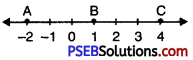
6. Integers are represented on a horizontal number line as shown where A represents – 2. With reference to the number line, answer the following questions:
PSEB 6th Class Maths Solutions Chapter 4 Integers Ex 4.1 3
(a) Which point represent – 3?
(b) Locate the point which represents the opposite of B and name it P.
(c) Write integers for the points C and E.
(d) Which point marked on the number line has the least value?
Solution:
PSEB 6th Class Maths Solutions Chapter 4 Integers Ex 4.1 4
(a) Point B represents – 3.
(b) Point P represents + 3.
(c) Point C represents -7 and Point E represents + 4.
(d) Point C has the least value – 7.

7. In each of the following pairs, which number is to the right of other on the number line?

Question (i)
(a) 2 9
(b) -3, -8
(c) 0, -5
(d) -11, 10
(e) -9, 9
(f) 2, – 200.
Solution:
(a) 9
(b) – 3
(c) 0
(d) 10
(e) 9
(f) 2

PSEB 6th Class Maths Solutions Chapter 4 Integers Ex 4.1

8. Write all the integers between the given pairs (write them in increasing order)

Question (a)
0 and -6
Solution:
-5, -4, -3, -2, -1

Question (b)
-6 and +6
Solution:
-5, -4, -3, -2, -1, 0, 1, 2, 3, 4, 5

Question (c)
-9 and -17
Solution:
-16, -15, -14, -13, -12, -11, -10

Question (d)
-19 and -5.
Solution:
-18, -17, -16, -15, -14, -13, -12, -11, -10, -9, -8, -7, -6.

9.

Question (a)
Write five negative integers greater than ‘-15’.
Solution:
Five negative integers greater than ‘-15’ are:
-14, -13, -12, -11, -10

PSEB 6th Class Maths Solutions Chapter 4 Integers Ex 4.1

Question (b)
Write five integers smaller than ‘-20’.
Solution:
Five integers smaller than ‘-20’ are:
-21, -22, -23, -24, -25

Question (c)
Write five integers greater than 0.
Solution:
Five integers greater than 0 are:
1,2, 3, 4, 5

Question (d)
Write five integers smaller than 0.
Solution:
Five integers smaller than 0 are:
-1, -2, -3, -4, -5.

10. Encircle the greater integer in each given pair.

(a) -5, -7
(b) 0,-3
(e) 5, 7
(d) -9, 0
(e) -9, -11
(f) -4, 4
(g) -10, -100
(h) 10, 100.
Solution:
(a) -5
(b) 0
(c) 7
(d) 0
(e) -9
(f) 4
(g) -10
(h) 100.

PSEB 6th Class Maths Solutions Chapter 4 Integers Ex 4.1

11. Arrange the following integers in ascending order:

Question (a)
0, -7, -9, 5, -3, 2, -4
Solution:
Ascending order of given integers is:
-9, -7, -4, -3, 0, 2, 5

Question (b)
8, -3, 7, 0, -9, -6.
Solution:
Ascending order of given integers is:
-9, -6, -3, 0, 7, 8.

12. Arrange the following integers in descending order:

Question (a)
-9, 3, 4, -6, 8, -3
Solution:
8, 4, 3, -3 -6, -9

PSEB 6th Class Maths Solutions Chapter 4 Integers Ex 4.1

Question (b)
4, 8,-3,-2, 5, 0.
Solution:
8, 5, 4, 0, -2, -3.

PSEB 9th Class Maths Solutions Chapter 7 Triangles Ex 7.1

Punjab State Board PSEB 9th Class Maths Book Solutions Chapter 7 Triangles Ex 7.1 Textbook Exercise Questions and Answers.

PSEB Solutions for Class 9 Maths Chapter 7 Triangles Ex 7.1

Question 1.
In quadrilateral ACBD. AC = AD and AB bisects ∠ A (see the given figure). Show that ∆ ABC ≅ ∆ ABD. What can you say about BC and BD?

PSEB 9th Class Maths Solutions Chapter 7 Triangles Ex 7.1 1

Answer:
In ∆ ABC and ∆ ABD,
AC = AD (Given)
∠ BAC = ∠ BAD (AB bisects ∠ A)
AB = AB (Common)
∴ ∆ ABC ≅ ∆ ABD (SAS rule)
∴ BC = BD (CPCT)
Thus, BC and BD are equal.

PSEB 9th Class Maths Solutions Chapter 7 Triangles Ex 7.1

Question 2.
ABCD is a quadrilateral in which AD = BC and ∠ DAB = ∠ CBA (see the given figure). Prove that (i) ∆ ABD ≅ ∆ BAC, (ii) BD = AC and (iii) ∠ ABD = ∠ BAC

PSEB 9th Class Maths Solutions Chapter 7 Triangles Ex 7.1 2

Answer:
In ∆ ABD and ∆ BAC,
AD = BC (Given)
∠ DAB = ∠ CBA (Given)
AB = BA (Common)
∴ ∆ ABD ≅ ∆ BAC (SAS rule)
∴ BD = AC (CPCT)
∴ ∠ ABD = ∠ BAC (CPCT)

Question 3.
AD and BC are equal perpendiculars to a line segment AB (see the given figure). Show that CD bisects AB.

PSEB 9th Class Maths Solutions Chapter 7 Triangles Ex 7.1 3

Answer:
AD and BC are equal perpendiculars to line segment AB.
∴ AD = BC and ∠ OAD = ∠ OBC = 90°.
Now, in ∆ ADO and ∆ BCO,
AD = BC
∠ OAD = ∠ OBC
∠ AOD = ∠ BOC (Vertically opposite angles)
∴ ∆ ADO ≅ ∆ BCO (AAS rule)
∴ OA = OB (CPCT)
CD intersects AB at O and OA = OB.
Hence, CD bisects AB.

PSEB 9th Class Maths Solutions Chapter 7 Triangles Ex 7.1

Question 4.
l and m are two parallel lines intersected by another pair of parallel lines p and q (see the given figure). Show that:
∆ ABC ≅ ∆ CDA.

PSEB 9th Class Maths Solutions Chapter 7 Triangles Ex 7.1 4

Answer:
l || m and AC is their transversal.
∴ ∠ BCA = ∠ DAC (Alternate angles)
p l| q and AC is their transversal.
∴ ∠ BAC = ∠ DCA (Alternate angles)
Now, in ∆ ABC and ∆ CDA,
∠ BCA = ∠ DAC
∠ BAC = ∠ DCA
AC = CA (Common)
∴ ∆ ABC ≅ ∆ CDA (ASA rule)

Question 5.
Ray l is the bisector of an angle ∠ A and B is any point on l. BP and BQ are perpendiculars from B to the arms of ∠ A (see the given figure). Show that:
(i) ∆ APB ≅ ∆ AQB
(ii) BP = BQ or B is equidistant from the arms of ∠ A.

PSEB 9th Class Maths Solutions Chapter 7 Triangles Ex 7.1 5

Answer:
l is the bisector of ∠ PAQ and B is any point on l.
∴ ∠ PAB = ∠ QAB
BP and BQ are perpendiculars from B to AP and AQ.
∴ ∠ BPA = ∠ BQA = 90°.
Now, in ∆ APB and ∆ AQB,
∠ PAB = ∠ QAB
∠ BPA = ∠ BQA
AB = AB (Common)
∴ ∆ APB ≅ ∆ AQB (AAS rule)
∴ BP = BQ (CPCT)
BP and BQ are perpendiculars from B to arms AP and AQ of ∠ A.
∴ BP is the distance of B from AP and BQ is the distance of B from AQ.
Thus, B is equidistant from the arms of ∠ A.

PSEB 9th Class Maths Solutions Chapter 7 Triangles Ex 7.1

Question 6.
In the given figure, AC = AE, AB = AD and ∠ BAD = ∠ EAC. Show that BC = DE

PSEB 9th Class Maths Solutions Chapter 7 Triangles Ex 7.1 6
Answer:
∠ BAD = ∠ EAC
∴ ∠ BAD + ∠ DAC = ∠ EAC + ∠ DAC
∴ ∠ BAC = ∠ DAE (Adjacent angles)
Now, in ∆ BAC and ∆ DAE,
AC = AE (Given)
AB = AD (Given)
∠ BAC = ∠ DAE
∴ ∆ BAC ≅ ∆ DAE (SAS rule)
∴ BC = DE (CPCT)

Question 7.
AB is a line segment and P is its midpoint. D and E are points on the same side of AB such that ∠ BAD = ∠ ABE and ∠ EPA = ∠ DPB (see the given figure). Show that:
(i) ∆ DAP ≅ ∆ EBP
(ii) AD = BE

PSEB 9th Class Maths Solutions Chapter 7 Triangles Ex 7.1 7
Answer:
∠ BAD = ∠ ABE
∴ ∠ PAD = ∠PBE (∵ P lies on AB.)
∠ EPA = ∠ DPB
∴ ∠ EPA + ∠ EPD = ∠ DPB + ∠ EPD
∴ ∠ APD = ∠ BPE (Adjacent angles)
P is the midpoint of AB.
∴ AP = BP
Now, in ∆ DAP and ∆ EBP
∠ PAD = ∠ PBE
∠ APD = ∠ BPE
AP = BP
∴ ∆ DAP ≅ ∆ EBP (ASA rule)
∴ AD = BE (CPCT)

PSEB 9th Class Maths Solutions Chapter 7 Triangles Ex 7.1

Question 8.
In right triangle ABC, right angled at C, M is the midpoint of hypotenuse AB. C is joined to M and produced to a point D such that DM = CM. Point D is joined to point B (see the given figure). Show that:
(i) ∆ AMC ≅ ∆ BMD
(ii) ∠ DBC is a right angle
(iii) ∆ DBC ≅ ∆ ACB
(iv) CM = \(\frac{1}{2}\) AB

PSEB 9th Class Maths Solutions Chapter 7 Triangles Ex 7.1 8
Answer:
In ∆ AMC and ∆ BMD,
AM = BM (∵ M is the midpoint of AB.)
CM = DM (Given)
∠ AMC = ∠ BMD (Vertically opposite angles)
∴ By SAS rule, ∆ AMC ≅ ∆ BMD [Result (i)]
∴ ∠ MCA = ∠ MDB (CPCT)
∠ MCA and ∠ MDB are alternate angles formed by transversal CD of lines AC and BD and they are equal.
∴ AC || BD
Now, ∠ DBC and ∠ ACB are interior angles on the same side of transversal BC of AC || BD.
∴ ∠ DBC + ∠ ACB = 180°
∴ ∠ DBC + 90° = 180° (Given : ∠ C = 90°)
∴ ∠ DBC = 90°
Thus, ∠ DBC is a right angle. [Result (ii)]
Now, ∆ AMC ≅ ∆ BMD
∴ AC = BD
In ∆ DBC and ∆ ACB,
BD = CA
∠ DBC = ∠ ACB (Right angles)
BC = CB (Common)
∴ ∆ DBC ≅ ∆ ACB [Result (iii)]
∴ DC = AB (CPCT)
DM = CM and M lies on line’ segment CD.
∴ DC = 2 CM
∴ AB = 2CM
∴ \(\frac{1}{2}\)AB = CM
∴ CM = \(\frac{1}{2}\)AB

PSEB 7th Class Maths Solutions Chapter 10 Practical Geometry Ex 10.3

Punjab State Board PSEB 7th Class Maths Book Solutions Chapter 10 Practical Geometry Ex 10.3 Textbook Exercise Questions and Answers.

PSEB Solutions for Class 7 Maths Chapter 10 Practical Geometry Ex 10.3

1. Construct ΔABC such that AB = 4 cm, ∠B = 30°, BC = 4 cm. Also name the type of triangle on the basis of sides.
Solution:
Given : Two sides of ΔABC as AB = 4 cm, BC = 4 cm and ∠B = 30°.
To construct: A triangle with these two sides and included angle.
Step of Construction :
Step 1. We first draw a rough sketch of the ΔABC and indicate the measure of these two sides and included angle.
PSEB 7th Class Maths Solutions Chapter 10 Practical Geometry Ex 10.3 1
Step 2. Draw a line segment BC of length 4 cm.
PSEB 7th Class Maths Solutions Chapter 10 Practical Geometry Ex 10.3 2
Step 3. At B draw BX making an angle of 30° with BC (The point A must be somewhere on this ray of the angle).
PSEB 7th Class Maths Solutions Chapter 10 Practical Geometry Ex 10.3 3
Step 4. (To fix A, the distance AB has been given) With B as centre, draw an arc of radius 3 cm. It cuts BX at the point A.
PSEB 7th Class Maths Solutions Chapter 10 Practical Geometry Ex 10.3 4
Step 5. Join AC.
ΔDEF is now obtained.
PSEB 7th Class Maths Solutions Chapter 10 Practical Geometry Ex 10.3 5
Since two sides of triangle are equal.
Therefore ΔABC is an isosceles triangle.

PSEB 7th Class Maths Solutions Chapter 10 Practical Geometry Ex 10.3

2. Construct ΔABC with AB = 7.5 cm, BC = 5 cm and ∠B = 30°.
Solution:
Given. Two sides of ΔABC as AB = 7.5 cm,
BC = 5 cm
and ∠B = 30°
To construct A triangle with these two sides and included angle.
Steps of Construction.
Step 1. We first draw a rough sketch of the ΔABC and indicate the measures of these two sides and included angle.
PSEB 7th Class Maths Solutions Chapter 10 Practical Geometry Ex 10.3 6
Step 2. Draw a line segment BC of length 5 cm.
PSEB 7th Class Maths Solutions Chapter 10 Practical Geometry Ex 10.3 7
Step 3. At B draw BX making an angle of 30° with BC. (The point A must be somewhere on this ray of the angle)
PSEB 7th Class Maths Solutions Chapter 10 Practical Geometry Ex 10.3 8
Step 4. (To fix A; the distance BC has been given) With B as centre draw an arc of radius 7.5 cm. It cuts CX at the point A.
PSEB 7th Class Maths Solutions Chapter 10 Practical Geometry Ex 10.3 9
Step 5 : Join AC.
ΔABC is now obtained.
PSEB 7th Class Maths Solutions Chapter 10 Practical Geometry Ex 10.3 10

PSEB 7th Class Maths Solutions Chapter 10 Practical Geometry Ex 10.3

3. Construct a triangle XYZ, such that XY = 6 cm, YZ = 6 cm and ∠Y = 60°. Also name the type of this triangle.
Solution:
Step 1. Draw a rough sketch of XYZ with given measures.
PSEB 7th Class Maths Solutions Chapter 10 Practical Geometry Ex 10.3 11
Step 2. Draw a line segment XY of length 6 cm.
PSEB 7th Class Maths Solutions Chapter 10 Practical Geometry Ex 10.3 12
Step 3. With the help of compass, at Y, draw a ray YA making an angle 60°
PSEB 7th Class Maths Solutions Chapter 10 Practical Geometry Ex 10.3 13
Step 4. With Y as centre and radius 6 cm. draw an arc intersecting the ray YX at point Z.
PSEB 7th Class Maths Solutions Chapter 10 Practical Geometry Ex 10.3 14
Step 5. Join XZ.ΔXYZ is required triangle, Measure the third side. We see that ZX = 6 cm
∴ In Δ XYZ
XY = YZ = ZX = 6 cm
Therefore XYZ is an equilateral triangle.
PSEB 7th Class Maths Solutions Chapter 10 Practical Geometry Ex 10.3 15

PSEB 7th Class Maths Solutions Chapter 10 Practical Geometry Ex 10.3

4. Which of the following triangle can be constructed using SAS criterion.
(a) AB = 5 cm, BC = 5 cm, CA = 6 cm
(b) AB = 5 cm, BC = -5 cm, ∠B = 40°
(c) ∠A = 60°, ∠B = 60°, ∠C = 60°
(d) BC = 5 cm, ∠B = ∠C = 45°
Answer:
(b) AB = 5 cm, BC = -5 cm, ∠B = 40°

PSEB 7th Class Maths Solutions Chapter 10 Practical Geometry Ex 10.2

Punjab State Board PSEB 7th Class Maths Book Solutions Chapter 10 Practical Geometry Ex 10.2 Textbook Exercise Questions and Answers.

PSEB Solutions for Class 7 Maths Chapter 10 Practical Geometry Ex 10.2

1. Construct ΔABC in which AB = 3.5 cm, BC = 5 cm and CA = 7 cm.
Solution:
Given : Three sides of a triangle as AB = 3.5 cm, BC = 5 cm and CA = 7 cm.
To construct : A triangle with these three sides.
Step 1. We first draw a rough sketch of the triangle ABC and indicate the lengths of the three sides.
PSEB 7th Class Maths Solutions Chapter 10 Practical Geometry Ex 10.2 1
Step 2. Draw a line segment BC = 5 cm.
PSEB 7th Class Maths Solutions Chapter 10 Practical Geometry Ex 10.2 2
Step 3 : From B; point A is at a distance 3.5 cm. So, with B as centre, draw an arc of radius
3.5 cm (Now point A will be some where on this arc. Our job is to find where exactly A is.)
PSEB 7th Class Maths Solutions Chapter 10 Practical Geometry Ex 10.2 3
Step 4. From C, point A is at a distance of 7 cm. So, with C as centre; draw an arc of radius 7 cm. (A will be some where on this arc. We have to fix it).
PSEB 7th Class Maths Solutions Chapter 10 Practical Geometry Ex 10.2 4
Step 5. A has to be on both the arcs drawn. So it is the point of intersection of arcs.
Mark the point of intersection of arcs as A. Join AB and AC.
Thus we obtain ΔABC.
PSEB 7th Class Maths Solutions Chapter 10 Practical Geometry Ex 10.2 5

PSEB 7th Class Maths Solutions Chapter 10 Practical Geometry Ex 10.2

2. Construct a triangle ABC in which AB = BC = 6.5 cm and CA = 4 cm. Also name the kind of triangle drawn.
Solution:
Given : Three sides of triangle as AB = BC = 6.5 cm. and CA = 4 cm.
To construct : A triangle with these three sides.
Steps of Construction :
Step 1. We first draw a rough sketch of the triangle ABC and indicate the lengths of the three sides.
PSEB 7th Class Maths Solutions Chapter 10 Practical Geometry Ex 10.2 6
Step 2. Draw a line segment AC = 4 cm.
PSEB 7th Class Maths Solutions Chapter 10 Practical Geometry Ex 10.2 7
Step 3. From A; point B is at a distance of 6.5 cm. So, with A as centre, draw an arc of radius 6.5 cm. (Now point B will be somewhere on this arc. Our job is to find where exactly A is.)
PSEB 7th Class Maths Solutions Chapter 10 Practical Geometry Ex 10.2 8
Step 4. From C; point B is at a distance of 6.5 cm. So; with C as centre; draw an arc of radius 6.5 cm. (B will be some where on this arc. We have to fix it.)
PSEB 7th Class Maths Solutions Chapter 10 Practical Geometry Ex 10.2 9
Step 5. B has to be on both the arcs drawn. So it is the point of intersection of arcs. Mark the point of intersection of arcs as B. Join AB and BC.
PSEB 7th Class Maths Solutions Chapter 10 Practical Geometry Ex 10.2 10
We observe that AB = BC = 6.5 cm.
Since two sides are of equal length. Thus we obtain an isosceles ΔABC.

PSEB 7th Class Maths Solutions Chapter 10 Practical Geometry Ex 10.2

3. Construct a triangle XYZ such that length of each side is 5 cm. Also name the kind of triangle drawn.
Solution:
Given : A triangle XYZ in which XY = YZ = ZX = 5 cm..
To Construct. A triangle XYZ with each side 5 cm.
Steps of Construction :
Step 1. We first draw a rough sketch of the triangle XYZ and indicate the lengths of the three sides.
PSEB 7th Class Maths Solutions Chapter 10 Practical Geometry Ex 10.2 11
Step 2. Draw a line segment YZ = 5 cm.
PSEB 7th Class Maths Solutions Chapter 10 Practical Geometry Ex 10.2 12
Step 3. From Y; point X is at a distance of 5 cm. So, with Y as centre, draw an arc of radius 5 cm. (Now point X will be somewhere on this arc. Our job is to find where exactly X is.)
PSEB 7th Class Maths Solutions Chapter 10 Practical Geometry Ex 10.2 13
Step 4. From Z, point X is at a distance of 5 cm. So, with Z as centre, draw an arc of radius 5 cm. (X will be somewhere oh this arc. We have to fix it.)
PSEB 7th Class Maths Solutions Chapter 10 Practical Geometry Ex 10.2 14
Step 5. Point X has to be on both the arcs drawn. So, it is the point of intersection of arcs.
Mark the point of intersection of arcs as X. Join XY and XZ.
PSEB 7th Class Maths Solutions Chapter 10 Practical Geometry Ex 10.2 15
Thus we obtain an equilateral ΔXYZ each of whose side is 5 cm.

PSEB 7th Class Maths Solutions Chapter 10 Practical Geometry Ex 10.2

4. Construct a triangle PQR such that PQ = 2.5 cm, QR = 6 cm and RP = 6.5 cm. Measure ∠PQR and also name the kind of triangle drawn.
Solution:
Given. Three sides of triangle as PQ = 2.5 cm, QR = 6 cm and RP = 6.5 cm.
To construct. A triangle with these three sides.
Steps of Construction :
Step 1. We first draw a rough sketch of the triangle PQR and indicate the lengths of the three sides.
PSEB 7th Class Maths Solutions Chapter 10 Practical Geometry Ex 10.2 16
Step 2. Draw a line segment QR of length 6 cm.
PSEB 7th Class Maths Solutions Chapter 10 Practical Geometry Ex 10.2 17
Step 3. From Q; point P is at a distance of 2.5 cm. So, with Q as centre, draw an arc of radius 2.5 cm. (Now point P will be some where on this arc. Our job is to find where exactly P is.)
PSEB 7th Class Maths Solutions Chapter 10 Practical Geometry Ex 10.2 18
Step 4. From R; point P is at a distance of 6.5 cm. So; with R as centre; draw an arc of radius 6.5 cm. (P will be somewhere on this arc. We have to fix it.)
PSEB 7th Class Maths Solutions Chapter 10 Practical Geometry Ex 10.2 19
Step 5. Point P has to be on both the arcs drawn. So, it is the point of intersection of arcs. Mark a point of intersection of arcs as P. Join PQ and PR.
PSEB 7th Class Maths Solutions Chapter 10 Practical Geometry Ex 10.2 20
Thus we obtain ΔPQR; on measuring ∠PQR, we observe that ∠PQR = 90° so it is a right angled triangle.

PSEB 7th Class Maths Solutions Chapter 10 Practical Geometry Ex 10.2

5. Construct a triangle ABC, in which AB = 6 cm, BC = 2 cm, CA = 3 cm. (If possible). If not possible give the reason.
Solution:
Since AB = 6 cm, BC = 2 cm, CA = 3 cm
Here BC + CA = 2 cm + 3 cm
= 5 cm < 6 cm < AB
Which is not possible because the sum of two sides of a triangle is always greater than third side of the triangle.

6. Question (i).
Which of the following can be used to construct a triangle ?
(a) The lengths of the three sides
(b) The perimeter of the triangle
(c) The measures of three angles
(d) The name of three vertices
Answer:
(a) The lengths of the three sides

Question (ii).
A triangle can be constructed by taking its sides as :
(a) 1.8 cm, 2.6 cm, 4.4 cm
(b) 3 cm, 4 cm, 8 cm
(c) 4 cm, 7 cm, 2 cm
(d) 5 cm, 4 cm, 4 cm.
Answer:
(d) 5 cm, 4 cm, 4 cm.

PSEB 6th Class Maths Solutions Chapter 3 Playing with Numbers Ex 3.5

Punjab State Board PSEB 6th Class Maths Book Solutions Chapter 3 Playing with Numbers Ex 3.5 Textbook Exercise Questions and Answers.

PSEB Solutions for Class 6 Maths Chapter 3 Playing with Numbers Ex 3.5

1. Find LCM of following numbers by prime factorization method:

Question (i)
45, 60
Solution:
PSEB 6th Class Maths Solutions Chapter 3 Playing with Numbers Ex 3.5 1
∴ 45 = 3 × 3 × 5
60 = 2 × 2 × 3 × 5
We find that in these prime factorizations, 2 occurs maximum two times, 3 occurs maximum two times and 5 occurs maximum once
∴ L.C.M. of 45 and 60
= 2 × 2 × 3 × 3 × 5 = 180

PSEB 6th Class Maths Solutions Chapter 3 Playing with Numbers Ex 3.5

Question (ii)
52, 56
Solution:
PSEB 6th Class Maths Solutions Chapter 3 Playing with Numbers Ex 3.5 2
We find that in these prime fatorisation, 2 occurs maximum 3 times, 13 and 7 occurs maximum once.
∴ L.C.M. of 52 and 56
= 2 × 2 × 2 × 13 × 7 = 728

Question (iii)
96, 360
Solution:
PSEB 6th Class Maths Solutions Chapter 3 Playing with Numbers Ex 3.5 3
∴ 96 = 2 × 2 × 2 × 2 × 2 × 3
360 = 2 × 2 × 2 × 3 × 3 × 5
We find that in these prime factorisation, 2 occurs maximum 5 times, 3 occurs maximum 2 times and 5 occurs maximum once.
∴ L.C.M. of 96 and 360
= 2 × 2 × 2 × 2 × 2 × 3 × 3 × 5 = 1440

Question (iv)
36, 96, 180
Solution:
PSEB 6th Class Maths Solutions Chapter 3 Playing with Numbers Ex 3.5 4
∴ 36 = 2 × 2 × 3 × 3
96 = 2 × 2 × 2 × 2 × 2 × 3
and 180 = 2 × 2 × 3 × 3 × 5
We find that in these factorisation, 2 occurs maximum 5 times, 3 occurs maximum 2 times and 5 occurs maximum once.
∴ L.C.M. of 36, 96 and 182
= 2 × 2 × 2 × 2 × 2 × 3 × 3 × 5 = 1440

Question (v)
18, 42, 72.
Solution:
PSEB 6th Class Maths Solutions Chapter 3 Playing with Numbers Ex 3.5 5
∴ 18 = 2 × 3 × 3
42 = 2 × 3 × 7
72 = 2 × 2 × 2 × 3 × 3
We find that in these factorization 2 occurs maximum 3 times, 3 occurs maximum 2 times and 7 occurs maximum once.
∴ L.C.M. of 18, 42 and 72
= 2 × 2 × 2 × 3 × 3 × 7 = 504

PSEB 6th Class Maths Solutions Chapter 3 Playing with Numbers Ex 3.5

2. Find LCM of the following by common division method:

Question (i)
24, 64
Solution:
PSEB 6th Class Maths Solutions Chapter 3 Playing with Numbers Ex 3.5 6
∴ L.C.M. of 24, 64
= 2 × 2 × 2 × 3 × 8 = 192

Question (ii)
42, 63
Solution:
PSEB 6th Class Maths Solutions Chapter 3 Playing with Numbers Ex 3.5 7
∴ L.C.M. of 42 and 63
= 3 × 7 × 2 × 3 = 126

Question (iii)
108, 135, 162
Solution:
PSEB 6th Class Maths Solutions Chapter 3 Playing with Numbers Ex 3.5 8
∴ L.C.M. of 108, 135 and 162
= 2 × 3 × 3 × 3 × 2 × 5 × 3 = 1620

Question (iv)
16, 18, 48
Solution:
PSEB 6th Class Maths Solutions Chapter 3 Playing with Numbers Ex 3.5 9
∴ L.C.M. of 16, 18 and 48
= 2 × 2 × 2 × 2 × 3 × 3 = 144

PSEB 6th Class Maths Solutions Chapter 3 Playing with Numbers Ex 3.5

Question (v)
48, 72, 108
Solution:
PSEB 6th Class Maths Solutions Chapter 3 Playing with Numbers Ex 3.5 10
∴ L.C.M. of 48, 72 and 108
= 2 × 2 × 2 × 3 × 3 × 2 × 3 = 144

3. Find the smallest number which is divisible by 6, 8 and 10.
Solution:
We know that the smallest number divisible by 6, 8 and 10 is their L.C.M.
So, we calculate L.C.M. 6, 8 and 10
PSEB 6th Class Maths Solutions Chapter 3 Playing with Numbers Ex 3.5 11
∴ L.C.M. = 2 × 3 × 4 × 5 = 120
Hence, required number =120

4. Find the least number when divided by 10,12 and 15 leaves remainder 7 in each case.
Solution:
We know that the least number divisible by 10, 12 and 15 is their L.C.M.
PSEB 6th Class Maths Solutions Chapter 3 Playing with Numbers Ex 3.5 12
So, the required number will be 7 more than their L.C.M.
We calculate their L.C.M.
L.C.M of 10, 12 and 15 = 2 × 3 × 5 × 2 = 60
Hence, Required number = 60 + 7 = 67

PSEB 6th Class Maths Solutions Chapter 3 Playing with Numbers Ex 3.5

5. Find the greatest 4-digit number exactly divisible by 12, 18 and 30.
Solution:
First find the L.C.M. of 12, 18, 30
PSEB 6th Class Maths Solutions Chapter 3 Playing with Numbers Ex 3.5 13
∴ L.C.M. of 12, 18, 30
= 2 × 3 × 2 × 3 × 5 = 180
Now the greatest 4 digit number = 9999
We find that when 9999 is divided by 180, the remainder is 99.
Hence, the greatest number of 4 digits which is exactly divisible by 12, 18, 30
= 9999 – 99 = 9900

6. Find the sandiest 4-digit number exactly divisible by 15, 24 and 36.
Solution:
First find L.C.M. of 15, 24, 36
PSEB 6th Class Maths Solutions Chapter 3 Playing with Numbers Ex 3.5 14
L.C.M. of 15, 24, 36
= 2 × 2 × 3 × 5 × 2 × 3 = 360 Now, 4 digit smallest number is 1000 We find that when 1000 is divided by 360, the remainder is 280.
∴ Smallest 4 digits number, which is exactly divisible by 15, 24 and 36
= 1000 + (360 – 280) = 1000 + 80 = 1080.
Hence, required number = 1080

PSEB 6th Class Maths Solutions Chapter 3 Playing with Numbers Ex 3.5

7. Four bells toll at intervals of 4, 7, 12 and 14 seconds. The bells toll together at 5 a.m. When will they again toll together?
Solution:
The bells will toll together at a time which is multiple of four intervals 4, 7, 12 and 14 seconds
So, first we find L.C.M. of 4, 7, 12 and 14
PSEB 6th Class Maths Solutions Chapter 3 Playing with Numbers Ex 3.5 15
∴ L.C.M. = 2 × 2 × 7 × 3 = 84
Thus the bells will toll together after 84 seconds or 1 minute 24 seconds.
First they toll together at 5 a.m., then they will toll together after 1 minutes 24 seconds i.e. 5 : 01 : 24 a.m.

8. Three boys step off together from the same spot their steps measures 56 cm, 70 cm and 63 cm respectively. At what distance from the starting point will they again step together?
Solution:
The distance covered by each one of them has to be same as well as minimum walk So, the minimum distance each should their steps will be L.C.M. of the distances L.C.M. of the measure of their steps.
PSEB 6th Class Maths Solutions Chapter 3 Playing with Numbers Ex 3.5 16
∴ L.C.M. = 2 × 7 × 4 × 5 × 9 = 2520cm
Hence, the will again step to gether after a distance of 2520 cm.

9. Can two numbers have 15 as their HCF and 65 as their LCM. Give reasons in support of your answer.
Solution:
We know that H.C.F. of given numbers is a factor of their L.C.M.
But 15 is not a factor of 65
So, there can not be two numbers with H.C.F. 15 and L.C.M. 65.

PSEB 6th Class Maths Solutions Chapter 3 Playing with Numbers Ex 3.5

10. Can two numbers have 12 as their HCF and 72 as their LCM. Give reasons in support of your answer.
Solution:
We know that H.C.F. of given numbers is a factor of their L.C.M.
Here, 12 divides 72 exactly. So 12 is a factor of 72
Hence, there can be two numbers with H.C.F. 12 and L.C.M 72.

11. The HCF and LCM of two numbers are 13 and 182 respectively. If one of the numbers is 26. Find other numbers.
Solution:
H.C.F. = 13 and L.C.M. = 182,
1st number = 25
Now, 1st number × 2nd number = H.C.F. × L.C.M.
26 × 2nd number = 13 × 182
∴ 2nd number = \(\frac {13×182}{26}\)
= 91

12. The LCM of two co-prime numbers is 195. If one number is 15 then find the other number.
Solution:
L.C.M. of two co-prime numbers = 195
H.C.F. of two co-prime numbers = 1
One number = 15
1st number × 2nd number = H.C.F. × L.C.M.
15 × 2nd number= 1 × 195
∴ 2nd number = \(\frac {1×195}{15}\)
= 13

PSEB 6th Class Maths Solutions Chapter 3 Playing with Numbers Ex 3.5

13. The H.C.F. of two numbers is 6 and product of two numbers is 216. Find their L.C.M.
Solution:
H.C.F. of two numbers = 6
Product of two numbers = 216
We know that
H.C.F. × L.C.M. = Product of two numbers
∴ 6 × L.C.M. = 216
∴ L.C.M. = \(\frac {216}{6}\) = 36