PSEB 12th Class Hindi रचना सूचना लेखन

Punjab State Board PSEB 12th Class Hindi Book Solutions Hindi Rachana soochna lekhan सूचना लेखन Exercise Questions and Answers, Notes.

PSEB 12th Class Hindi रचना सूचना लेखन

सूचना को अंग्रेजी में नोटिस कहा जाता है। प्रत्येक स्कूल और कॉलेज में सूचना पट्ट लगे या बने होते हैं जिन पर विद्यार्थियों की जानकारी के लिए अनेक प्रकार की सूचनाएँ चाक से लिखकर या टाइप करके चिपकाई जाती हैं.।

ऐसे सूचना पट्ट बस स्टैंड, रेलवे स्टेशन, किसी कार्यालय-सरकारी व गैर-सरकारी या बैंक में भी देखे जा सकते हैं। इन सूचना पट्टों पर आम लोगों की जानकारी के लिए कुछ सूचनाएँ प्रसारित की जाती हैं।

PSEB 12th Class Hindi रचना सूचना लेखन

समाचार-पत्रों में भी प्रतिदिन अनेक प्रकार की सार्वजनिक सूचनाएँ प्रकाशित की जाती हैं। जैसे-निविदा सूचना या नीलामी सूचना या आयकर विभाग या डाक विभाग की ओर से जारी सूचनाएँ।
सूचना लिखते समय इन बातों का ध्यान रखना चाहिए-
(1) सूचना संक्षिप्त होनी चाहिए।

(2) सूचना में तिथि, समय, स्थान सम्बन्धी पूरी जानकारी होनी चाहिए।

(3) समाचार-पत्रों में प्रकाशित किए जाने वाले वर्गीकृत विज्ञापन के अन्तर्गत सूचना कम-से-कम शब्दों में अधिक-से-अधिक जानकारी के साथ लिखी जानी चाहिए।

(4) वर्गीकृत विज्ञापन के अन्तर्गत छपवाई जाने वाली सूचना का शीर्षक अवश्य लिखना चाहिए। जैसे-गुमशुदा की तलाश, खोया/पाया, मित्र बनाओ, ड्राइवर चाहिए।

(5) सूचना यदि पैनल में छपवानी हो तो सैंटीमीटर और कॉलम का ध्यान रखना चाहिए क्योंकि 0.1 सैंटीमीटर अधिक बड़ा विज्ञापन होने पर 1 सैंटीमीटर की दर चार्ज की जाएगी।

यहाँ कुछ सूचनाओं के उदाहरण दिए जा रहे हैं। विद्यार्थी प्रश्न-पत्र में दिए गए नाम और विषय ही लिखें।
(i) विद्यालयों के सूचना पट्ट पर लिखी जाने वाली सूचनाएँ।
उदाहरण- 1
सूचना

विद्यालय के सभी विद्यार्थियों को सूचित किया जाता है कि विद्यालय का वार्षिक पुरस्कार वितरण समारोह 14 फरवरी सन् ……. को होना निश्चित हुआ है। माननीय शिक्षा मन्त्री इस समारोह की अध्यक्षता करेंगे और अपने करकमलों से पुरस्कार बाँटेंगे।

कार्यक्रम ठीक प्रात: दस बजे आरम्भ हो जाएगा। इससे पूर्व ही सभी विद्यार्थी अपनी-अपनी जगह पर बैठ जाएं। पुरस्कार पाने वाले विद्यार्थी जिनका नाम घोषित किया जा चुका है। 13 फरवरी 3 बजे बाद दोपहर पूर्वाभ्यास के लिए अवश्य आएँ। रिहर्सल में अनुपस्थित रहने वाले विद्यार्थी को पुरस्कार नहीं दिया जाएगा।

विद्यार्थी अपने माता-पिता या अभिभावकों को भी साथ ला सकते हैं।

तिथि …………
हस्ताक्षर
…………
मुख्याध्यापक
राजकीय उच्चतर विद्यालय
………… शहर का नाम

उदाहरण- 2
सूचना

सभी दसवीं एवं बारहवीं कक्षा के विद्यार्थियों को सूचित किया जाता है कि उनके वार्षिक परीक्षा के बोर्ड के प्रवेशप्रपत्र दिनांक 12-11-……. को अंग्रेज़ी की घंटी में अंग्रेज़ी अध्यापक द्वारा भरवाए जाएँगे। सभी विद्यार्थी अपने साथ उस दिन अपनी पासपोर्ट साइज़ फोटो की तीन प्रतियां साथ लाएँ। इस दिन से पहले-पहले सभी विद्यार्थी अपनी प्रवेश शुल्क विद्यालय के कार्यालय में जमा करवा दें। उसकी रसीद का नं० प्रवेश-प्रपत्र में भरा जाना है।
किसी कारणवश उस दिन अनुपस्थित रहने वाले विद्यार्थी अपने-अपने अंग्रेज़ी अध्यापक से सम्पर्क करें।

हस्ताक्षर
प्राचार्य,
राजकीय वरिष्ठ माध्यमिक विद्यालय,
……… (शहर का नाम)
दिनांक : 10-11-…..

उदाहरण- 3
सूचना

सभी विद्यार्थियों को सूचित किया जाता है कि विद्यालय की अर्द्धवार्षिक परीक्षा 18 दिसम्बर ……. से शुरू हो रही है। डेट-शीट अलग से सूचना पट्ट पर लगा दी गई है।

इस परीक्षा में अनुपस्थित रहने वाले विद्यार्थी को पचास रुपए दंड किया जाएगा तथा उनके लिए किसी अलग से परीक्षा का प्रबन्ध भी नहीं किया जाएगा।

हस्ताक्षर ……….
प्राचार्य,
खालसा वरिष्ठ माध्यमिक विद्यालय,
(शहर का नाम)
दिनांक : 16 दिसम्बर ………

PSEB 12th Class Hindi रचना सूचना लेखन

उदाहरण-4
सूचना

सभी विद्यार्थियों को सूचित किया जाता है कि विद्यालय परिसर में 14 नवम्बर को बाल दिवस मनाया जाएगा। इस अवसर पर जिलाधीश महोदय मुख्य मेहमान होंगे। कार्यक्रम ठीक दस बजे आरम्भ होगा। विद्यार्थियों से अनुरोध है कि वे साफ़-सुथरे कपड़े पहन कर स्कूल आएं।

हस्ताक्षर ………..
…………. मुख्याध्यापक
विद्यालय एवं शहर का नाम
दिनांक : 12 नवम्बर …..

उदाहरण-5
सूचना

सभी विद्यार्थियों को सूचित किया जाता है कि वे फरवरी मास की पन्द्रह तारीख से पूर्व विद्यालय के पुस्तकालय से निकलवाई गई सभी पुस्तकों को वापस कर दें और इस सम्बन्ध में पुस्तकालय अध्यक्ष से प्रमाण-पत्र प्राप्त कर लें अन्यथा उन्हें रोल नं० जारी नहीं किए जाएंगे।

उदाहरण-6
पंजाब स्कूल शिक्षा बोर्ड, मोहाली प्रवेश सचना

मैट्रिक परीक्षा सन् 2004-05 के लिए प्रवेश की तिथियाँ और शुल्क का विवरण निम्नलिखित है-
15 जुलाई से 31 अगस्त तक – 260 रुपए
1 सितम्बर से 15 सितम्बर तक – 310 रुपए
15 सितम्बर से 15 अक्तूबर तक – 360 रुपए
बोर्ड की मैट्रिक परीक्षा में अनुतीर्ण होने वाले परिणाम घोषित होने के दस दिन के भीतर प्रवेश ले सकेंगे।

हस्ताक्षर ………..
सचिव
नोट-समाचार-पत्रों में छपवाई जाने वाली सूचनाओं के कुछ उदाहरण।

उदाहरण-7
नीलामी सूचना का उदाहरण नीलामी सूचना

सर्वसाधारण को यह सूचित किया जाता है कि दिनांक 17 अक्तूबर, 20…… को बाद दोपहर राजकीय वरिष्ठ माध्यमिक विद्यालय के मैदान में लोहे की लगभग दो सौ कुर्सियां नीलाम की जाएंगी।

बोली की समाप्ति पर पूरी राशि नकद जमा करवानी होगी और और माल 24 घण्टों के भीतर उठाना होगा।

हस्ताक्षर ……..
प्राचार्य,
राजकीय वरिष्ठ माध्यमिक विद्यालय
………… (शहर का नाम)
दिनांक : 10 अक्तूबर, 20…….

उदाहरण-8
निविदा सूचना

राजकीय वरिष्ठ माध्यमिक विद्यालय …………… (शहर का नाम)
विद्यालय की कैंटीन के लिए अनुभवी व्यक्तियों/संस्थाओं से सीलबन्द निविदाएं आमन्त्रित हैं। निविदा पत्रक दिनांक 25 फरवरी……..को बाद दोपहर 2 बजे तक विद्यालय के कार्यालय में पहुँच जाने चाहिए। उसी दिन बाद दोपहर 3.00 बजे निविदा कर्ताओं की उपस्थिति में निविदाएँ खोली जाएँगी। कैण्टीन में मेज़ कुर्सियाँ स्कूल की ओर से दी जाएँगी।

बिना कारण बताएं किसी भी निविदा को रद्द करने का अधिकार अधोहस्ताक्षर को होगा।

प्राचार्य
राजकीय वरिष्ठ माध्यमिक विद्यालय
………… (शहर का नाम)
दिनांक : 5 फरवरी, 20…….

उदाहरण-9
सूचना मैं घसीटाराम सुपुत्र राम दित्ता निवासी 549-A करीमपुरा, जालन्धर शहर आज से अपना नाम बदल कर ईश्वर दत्त रख रहा हूँ। सभी सम्बन्धित कृपया नोट करें।

उदाहरण-10
सूचना

मैं नरेश कुमार सुपुत्र दिनेश कुमार वासी रहीमपुरा ज़िला मोगा हर खास आम को सूचित करता हूं कि मेरा लड़का प्रदीप कुमार मेरे कहने में नहीं है। वह बुरी संगति में पड़ गया है। मैं उसे अपनी चल-अचल सम्पत्ति से बेदखल करता हूँ। उससे लेन-देन करने वाला स्वयं उत्तरदायी होगा।

उदाहरण-11
सूचना
पंजाब स्कूल शिक्षा बोर्ड अन्तिम तिथि में वृद्धि

संदर्भ इस समाचार-पत्र में दिनांक ………. को प्रकाशित विज्ञापन जिसमें मैट्रिक की वार्षिक परीक्षा के लिए प्रवेश शुल्क भेजने की अन्तिम तिथि 15 नवम्बर, 20……. घोषित की गई थी अब यह तिथि बढ़ा कर 30 नवम्बर, 20……. कर दी गई है।

सचिव

PSEB 12th Class Hindi रचना सूचना लेखन

उदाहरण-12
बैंकिंग लोकपाल योजना-2002 सूचना

पंजाब नैशनल बैंक आयोजक होने के नाते आपको श्री गोबिन्दराजन, बैंकिंग लोकपाल, पंजाब, हरियाणा, हिमाचल प्रदेश और चण्डीगढ़ के आगमन पर उनसे भेंट करने के लिए लुधियाना में आमन्त्रित हैं।
आप अपनी शिकायतें (किसी भी बैंक के विरुद्ध) निम्नलिखित पते पर प्रस्तुत कर सकते हैं

तिथि : 23-3- ……
समय : 12 से 3.00 PM
स्थान : पंजाब नैशनल बैंक निकट मंजू सिनेमा लुधियाना।
शिकायत-प्रपत्र हमारी शाखा पर उपलब्ध होंगे।
आयोजक
पंजाब नैशनल बैंक
कार्यालय, फिरोज गांधी मार्कीट
लुधियाना।

उदाहरण-13
एस० डी० कॉलेज, लुधियाना भूतपूर्व विद्यार्थी सम्मेलन

कॉलेज के सभी भूतपूर्व विद्यार्थियों को सूचित किया जाता है कि दिनांक 4 अप्रैल, 2004 को एक सम्मेलन का आयोजन किया जा रहा है। इस सम्मेलन में मुख्य मेहमान राज्य के शिक्षा मन्त्री श्री हरनामदास जौहर होंगे। कार्यक्रम ठीक दस बजे प्रातः आरम्भ हो जाएगा।

अस्सी वर्ष से ऊपर भूतपूर्व विद्यार्थियों को सम्मानित किया जाएगा। ऐसे सभी भूतपूर्व विद्यार्थी एक सप्ताह पूर्व तक अपना पूर्ण बायोडाटा अधोहस्ताक्षर को भेज दें।

सचिव,
भूतपूर्व विद्यार्थी संघ।

उदाहरण-14
सूचना
मैक्स न्यूयार्क इन्शोयरंस कं० लि.

आम लोगों की सुविधा का ध्यान रखते हुए विश्व की सर्वश्रेष्ठ बीमा कम्पनी ने लुधियाना में 120 फिरोज़ गांधी मार्कीट में अपनी शाखा खोल दी है जो दिनांक ………. से अपना काम शुरू कर रही है। व्यक्तिगत वित्तीय समस्याओं के समाधान के लिए और अपने भविष्य को ध्यान में रखते हुए हमारे अधिकृत एजेंटों से सम्पर्क करें।
प्रबन्धक

उदाहरण-15
सूचना
सर्वश्री राकेश कुमार एण्ड सन्ज़

हर खास आम को सूचित किया जाता है कि श्री ……. हमारे संस्थान से पदमुक्त कर दिए गए हैं। अब संस्थान से उनका कोई लेना-देना नहीं है। जो भी व्यक्ति उनसे हमारे संस्थान के नाम पर लेन-देन करेगा वह स्वयं उत्तरदायी होगा।

प्रबन्धक

बोर्ड परीक्षा में पूछे गए प्रश्न

1. एलीका हन्टरनेशनल पब्लिक स्कूल, चंडीगढ़ की प्रिंसिपल की ओर से स्कूल के नोटिस बोर्ड के लिए एक सूचना तैयार कीजिए जिसमें स्कूल में समय पर न उपस्थित होने वाले विद्यार्थियों के प्रति अनुशासनिक कार्यवाही की बात कही गयी हो।

2. सरकारी सीनियर सैकेण्डरी स्कूल, अबोहर के प्रिंसिपल की ओर से स्कूल के नोटिस बोर्ड के लिए एक सूचना तैयार कीजिए जिसमें 1 दिसम्बर, 2011 को ‘विश्व एड्स दिवस’ के उपलक्ष्य में आयोजित की जाने वाली निबन्ध तथा भाषण प्रतियोगिता के बारे में कहा हो।

3. आप का नाम मेधावी है। आप रियान इन्टरनेशनल स्कूल, सेक्टर 49, चंडीगढ़ में पढ़ती हैं। आप छात्र संघ की मुख्य सचिव हैं। अम्बाला में आई बाढ़ से पीड़ित लोगों की मदद के लिए अनुदान राशि का संग्रह आपके स्कूल की तरफ से किया जा रहा है। छात्र संघ की मुख्य सचिव होने के नाते इस सम्बन्ध में एक नोटिस (सूचना) तैयार कीजिए।

4. बाल विद्यालय, पठानकोट के अध्यापक दसवीं कक्षा के विद्यार्थियों को शैक्षिक भ्रमण हेतु लाला किला दिखाने दिल्ली ले जा रहे हैं। इस सन्दर्भ में कक्षा अध्यापक की ओर से एक नोटिस (सूचना) तैयार कीजिए।

5. आपका नाम अमरनाथं है। आप सरस्वती पब्लिक स्कूल, पानीपत के प्रिंसिपल हैं। आपके स्कूल में दिनांक 14 सितम्बर, 2011 को विज्ञान प्रदर्शनी लग रही है। आप अपनी ओर से एक सूचना तैयार कीजिए जिसमें स्कूल के विद्यार्थियों को इसमें भाग लेने के लिए कहा गया हो।

6. सरकारी सीनियर सैकेण्डरी स्कूल, नोएडा के प्रिंसिपल की ओर सूचनापट्ट (नोटिस बोर्ड) के लिए एक सूचना तैयार करें। जिसमें प्रिंसिपल की ओर से सभी अध्यापकों और छात्रों को 2 अक्तूबर, 2011 को गांधी जयंती के उपलक्ष्य में सुबह 9.00 बजे स्कूल आना अनिवार्य रूप से कहा गया हो।

7. विद्यालय के सूचना-पट्ट के लिए एक सूचना तैयार करें जिसमें वार्षिक खेल-कूद प्रतियोगिता के बारे में सूचना दी गई हो।

8. आप अपने विद्यालय के एन. एस. एस, यूनिट (राष्ट्रीय सेवा योजना) के सचिव हैं। एक सूचना तैयार करें जिसमें ‘रक्तदान’ शिविर के लिए विद्यार्थियों से अनुग्रह किया गया हो।

9. विद्यालय के सूचनापट्ट के लिए अपने विद्यालय के प्रधानाचार्य की ओर से एक सूचना तैयार करें जिसमें स्कूल परिसर में ’14 नवम्बर’ बाल दिवस मनाये जाने की सूचना दी गई हो।

PSEB 12th Class Hindi रचना सूचना लेखन

10. विद्यालय के सूचनापट्ट के लिए अपने विद्यालय के प्रधानाचार्य की ओर से एक सूचना तैयार करें जिसमें स्कूल परिसर में खेल के सामान की बोली किये जाने की सूचना दी गई हो।

11. सरकारी सीनियर सेकेण्डरी स्कूल, नकोदर के प्रिंसीपल की ओर से हर साल की तरह इस बार भी 26 जनवरी को सुबह 8.00 बजे गणतन्त्र दिवस का भव्य आयोजन किया जा रहा है। सभी अध्यापकों व छात्रों का समय पर आना अनिवार्य है। सूचनापट्ट के लिए एक सूचना तैयार करें।

12. सरकारी हाई फूलपुर ग्रेवाल के मुख्याध्यापक की ओर से स्कूल के सूचनापट्ट के लिए सूचना तैयार कीजिए जिसमें स्कूल के सभी कक्षाओं के विद्यार्थियों को सेक्शन बदलने की अंतिम तिथि 19.7.11 की सूचना दी गई हो।

13. सतलुज पब्लिक स्कूल जगाधरी में ‘मातृभाषा’ विषय पर एक निबन्ध प्रतियोगिता का आयोजन 30.05.2013 को किया जा रहा है। स्कूल के प्रिंसिपल की ओर से एक सूचना तैयार करके लिखिए जिसमें विद्यार्थियों को इस प्रतियोगिता में भाग लेने के लिए कहा गया हो।

14. ज्ञानोदय पब्लिक स्कूल मेरठ में यूथ क्लब, मेरठ द्वारा दिनांक 24.5.2013 को ‘रक्तदान शिविर’ का आयोजन किया जा रहा है। स्कूल के प्रिंसिपल की ओर से एक सूचना तैयार करके लिखिए जिनमें विद्यार्थियों को स्वेच्छा से रक्तदान करने के लिए कहा गया है।

15. आपका नाम राम सिंह है। आप सरकारी सीनियर सेकण्डरी स्कूल हैदराबाद के ड्रामा क्लब के डायरेक्टर हैं। आपके स्कूल में 25 दिसम्बर को एक ऐतिहासिक नाटक का मंचन किया जाना है जिसका नाम है ‘रानी लक्ष्मीबाई।’ आप इस सम्बन्ध में एक सूचना तैयार करें जिसमें विद्यार्थियों को उपर्युक्त नाटक में भाग लेने के लिए नाम लिखवाने के लिए कहा गया हो।

16. आपका नाम मनीषा है। आपको घर के कामकाज के लिए एक-नौकरानी की आवश्यकता है। आपका फोन नम्बर 9654532183 है। वर्गीकृत विज्ञापन के अन्तर्गत ‘नौकरानी की आवश्यकता है’ का प्रारूप तैयार करके लिखें।

17. आपका नाम मनोज कुमार है। आप सरकारी सीनियर सेकेण्डरी स्कूल पालमपुर में इतिहास के लेक्चरार हैं। आप शैक्षिक भ्रमण के लिए 10+2 के विद्यार्थियों का एक दल आगरा तथा फतेहपुर सीकरी लेकर जा रहे हैं। इस सम्बन्ध में एक सूचना तैयार करें, जिसमें छात्रों को इस शैक्षिक भ्रमण में भाग लेने के लिए कहा गया हो।

18. आपका नाम सुन्दल लाल है। आपकी सेक्टर 18 डी, चंडीगढ़ में बिजली की दुकान है, जिसका बूथ नं० 2 है। आपको बिजली के उपकरणों की मुरम्मत करने के लिए कारीगर चाहिए। ‘कारीगर की आवश्यकता है’ शीर्षक के अन्तर्गत विज्ञापन का प्रारूप तैयार कीजिए।

19. सरिता पब्लिक स्कूल, शहीद भगत सिंह नगर के मुख्याध्यापक की ओर से एक सूचना तैयार करें, जिसमें स्कूल के विद्यार्थियों को दिनांक 15.10.2013 को ‘कविता पठम प्रतियोगिता’ में भाग लेने के लिए कहा गया हो।

20. आपका नाम सुरेन्द्र सिंह है। आपका मोबाइल नम्बर 9899999999 है। आपकी सेक्टर-14, भवानीगढ़ में एक स्टेशनरी की दुकान है। आपको दुकान के लिए एक सेल्समैन की आवश्यकता है। वर्गीकृत विज्ञापन के अन्तर्गत ‘सेल्समैन की आवश्यकता है’, का प्रारूप तैयार करके लिखिए।

21. आपका नाम राज कपूर है। आप संत कबीर पब्लिक स्कूल, हैदराबाद में पढ़ते हैं। आप स्कूल की हिन्दी साहित्य परिषद् के सचिव हैं। स्कूल की हिन्दी साहित्य परिषद् स्कूल में कवि-सम्मेलन आयोजित करने जा रही है। परिषद् के सचिव होने के नाते आप स्कूल के विद्यार्थियों के लिए एक सूचना तैयार करके लिखिए।

22. आपका नाम सुरेश है। आपका सेक्टर-14, पंचकूला में एक आठ मरले का मकान है। आप इसे बेचना चाहते हैं। आपका मोबाइल नम्बर 9417794262 है, जिस पर मकान खरीदने के इच्छुक आपसे सम्पर्क कर सकते हैं। वर्गीकृत विज्ञापन के अन्तर्गत ‘मकान बिकाऊ है’ का प्रारूप तैयार करके लिखिए।

23. आपका नाम प्रताप सिंह है। आप सरस्वती पब्लिक स्कूल, समराला के डायरेक्टर हैं। आपके स्कूल में दिनांक 9 जुलाई, 2015 को विज्ञान प्रदर्शनी लग रही है। आप अपनी ओर से एक सूचना तैयार कीजिए जिसमें स्कूल के विद्यार्थियों को इसमें भाग लेने के लिए कहा गया हो।

24. गुजरात इलेक्ट्रॉनिक्स, गुजराज, मोबाइल नम्बर 8466224500 को इलेक्ट्रॉनिक इंजीनियरों की आवश्यकता है। ‘इलेक्ट्रॉनिक इंजीनियरों की आवश्कता है’ शीर्षक के अन्तर्गत एक वर्गीकृत विज्ञापन का प्रारूप तैयार करके लिखिए।

25. आपका नाम विनोद मेहरा है। आप ‘सरस्वती विद्या मन्दिर’ स्कूल में पढ़ाते हैं। आप स्कूल के क्लब के सांस्कृतिक सचिव हैं। आपके स्कूल द्वारा एक युवा उत्सव का आयोजन किया जा रहा है। आप सचिव होने के नाते विद्यालय के विद्यार्थियों को इस युवा उत्सव में भाग लेने के लिए एक सूचना तैयार करके लिखिए।

26. आपका नाम गुरनाम सिंह है। आप प्रकाश नगर, लुधियाना में रहते हैं। आपका. फोन नम्बर 9463699995 है। आपकी दस मरले की कोठी है। आप इस कोठी के दो कमरे, किचन, बाथरूम सहित किराये पर देना चाहते हैं। वर्गीकृत विज्ञापन के अन्तर्गत ‘किराये के लिए खाली’ का प्रारूप तैयार करके लिखिए।

27. आपके सरकारी सीनियर सेकेण्डरी स्कूल, मानसा में वार्षिक उत्सव पर ‘भांगड़ा’ का आयोजन किया जा रहा है। स्कूल के सांस्कृतिक कार्यक्रमों के अध्यक्ष श्री अजीत सिंह द्वारा एक सूचना तैयार कीजिए, जिसमें इच्छुक विद्यार्थियों को इनमें भाग लेने के लिए आमंत्रित किया गया हो।

28. सरकारी सीनियर सैकण्डरी स्कूल, रामनगर के प्रिंसीपल की ओर से सूचनापट्ट के लिए एक सूचना तैयार करें जिसमें प्रिंसीपल की ओर से सभी अध्यापकों व छात्रों को 15 अगस्त, 2015 को स्वतंत्रता दिवस के उपलक्ष्य में सुबह 8 बजे स्कूल आना अनिवार्य रूप से कहा गया हो।

29. आपका नाम रोशनी कुमारी है। आप सरकारी सीनियर सैकेण्डरी स्कूल जींद में पढ़ती हैं। आप छात्र-संघ की सचिव है। आपके स्कूल की ओर से जम्मू-कश्मीर में आई भयंकर बाढ़ के लिए अनुदान राशि का संग्रह किया जा रहा है। छात्र-संघ की सचिव होने के नाते इस संबंध में एक सूचना तैयार करके लिखिए।

30. सरकारी हाई स्कूल सेक्टर-14, चण्डीगढ़ के मुख्याध्यापक की ओर से स्कूल के सूचनापट्ट (नोटिस बोर्ड) के लिए एक सूचना तैयार कीजिए। जिसमें स्कूल के सभी कक्षाओं के विद्यार्थियों के लिए सैक्शन बदलने की अंतिम तिथि 18.4.2015 दी गई हो।

PSEB 12th Class Hindi रचना सूचना लेखन

31. आपका नाम निधि है। आप सरकारी सेकेण्डरी स्कूल जींद में पढ़ती हैं। आप छात्र संघ की सचिव हैं। आपके स्कूल की और से बिहार में आए भयंकर भूकम्प के लिए अनुदान राशि का संग्रह किया जा रहा है। छात्र संघ की सचिव होने के नाते इस संबंध में एक सूचना तैयार कीजिए।

32. आपका नाम मनोज कुमार है। आप सरकारी सीनियर सैकेंडरी स्कूल पालमपुर में इतिहास के प्राध्यापक हैं। आप आगरा तथा फतेहपुर सीकरी के भ्रमण के लिए विद्यार्थियों का एक दल लेकर जा रहे हैं। इस संबंध में एक सूचना तैयार करें, जिसमें छात्रों को इस भ्रमण में भाग लेने के लिए कहा गया हो।

33. आपका नाम विशाल कुमार है। आप सरकारी हाई स्कूल जगाधरी में पढ़ते हैं। आप एन० एस० एस० यूनिट के मुख्य सचिव हैं। आपके स्कूल में दिनांक 30 मार्च, 2017 को रक्तदान शिविर का आयोजन किया जा रहा है। आप अपनी तरफ से सूचना तैयार करें, जिसमें स्कूल के विद्यार्थियों से रक्तदान के लिए अनुग्रह किया जाये।

34. आपका नाम विनोद मेहरा है। आप ‘सरस्वती विद्या मंदिर’ स्कूल में पढ़ते हैं। आप स्कूल के क्लब के सांस्कृतिक सचिव हैं। आपके स्कूल द्वारा एक युवा उत्सव का आयोजन किया जा रहा है। आप सचिव होने के नाते विद्यालय के विद्यार्थियों को इस उत्सव में भाग लेने के लिए एक सूचना तैयार करके लिखिए।

35. आप का नाम दीपक साराभाई है। आप सरकारी कॉलेज सूरत में पढ़ते हैं एवं छात्र संघ के प्रधान हैं। असम राज्य में आई भयंकर बाढ़ हेतु अनुदान राशि का संग्रह किया जा रहा है। छात्र संघ का प्रधान होने के नाते इस सम्बन्ध में एक सूचना का प्रारूप तैयार करें।

36. आपका नाम जगदीश सिंह है। आप सरकारी सीनियर सेकेण्डरी स्कूल रोपड़ के ड्रामा क्लब के डायरेक्टर हैं। आपके स्कूल में 25 मई, 2020 को एक ऐतिहासिक नाटक का मंचन किया जाना है जिसका नाम है ‘रानी लक्ष्मीबाई’। आप इस सम्बन्ध में एक सूचना तैयार करें जिसमें विद्यार्थियों को उपर्युक्त नाटक में भाग लेने के लिए नाम लिखवाने के लिए कहा गया हो।
PSEB 6th Class Maths MCQ Chapter 5 Fractions

Punjab State Board PSEB 6th Class Maths Book Solutions Chapter 5 Fractions MCQ Questions with Answers.

PSEB 6th Class Maths Chapter 5 Fractions MCQ Questions

Multiple Choice Questions

Question 1.
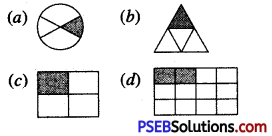
Which of the following does not represent any fraction?
PSEB 6th Class Maths MCQ Chapter 5 Fractions 1.1
Answer:
PSEB 6th Class Maths MCQ Chapter 5 Fractions 1

PSEB 6th Class Maths MCQ Chapter 5 Fractions

Question 2.
Which of the following is a proper fraction?
(a) \(\frac {5}{5}\)
(b) \(\frac {12}{11}\)
(c) \(\frac {7}{9}\)
(d) 7
Answer:
(c) \(\frac {7}{9}\)

Question 3.
Which of the following is an improper fraction?
(a) \(\frac {5}{8}\)
(b) \(2\frac {3}{4}\)
(c) \(\frac {7}{11}\)
(d) \(\frac {15}{16 }\)
Answer:
(b) \(2\frac {3}{4}\)

Question 4.
The fractions having las numerator are called …………. fractions.
(a) Like
(b) Unlike
(c) Unit
(d) Proper.
Answer:
(c) Unit

Question 5.
The fractions having same denominators are called …………. fractions.
(a) Proper
(b) Unit
(c) Improper
(d) Like.
Answer:
(d) Like.

Question 6.
The fraction having different denominators are called ……………. fractions.
(a) Unlike
(b) Like
(c) Improper
(d) Unit.
Answer:
(a) Unlike

PSEB 6th Class Maths MCQ Chapter 5 Fractions

Question 7.
Express 8 hours as a fraction of 1 day.
(a) \(\frac {2}{3}\)
(b) \(\frac {1}{3}\)
(c) \(\frac {8}{1}\)
(d) \(\frac {1}{8}\)
Answer:
(b) \(\frac {1}{3}\)

Question 8.
Find : \(\frac {2}{5}\) of ₹ 20.
(a) ₹ 8
(b) ₹ 10
(c) ₹ 12
(d) ₹ 40.
Answer:
(a) ₹ 8

Question 9.
Write \(\frac {19}{4}\) as mixed fraction.
(a) \(3\frac {4}{5}\)
(b) \(4\frac {4}{3}\)
(c) \(4\frac {3}{4}\)
(d) \(5\frac {1}{4}\)
Answer:
(c) \(4\frac {3}{4}\)

Question 10.
\(7\frac {2}{3}\) = ……………….
(a) \(\frac {17}{3}\)
(b) \(\frac {23}{3}\)
(c) \(\frac {13}{3}\)
(d) \(\frac {42}{3}\)
Answer:
(b) \(\frac {23}{3}\)

PSEB 6th Class Maths MCQ Chapter 5 Fractions

Question 11.
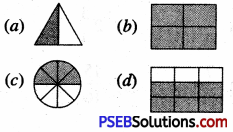
Which of the following represents an improper fraction?
PSEB 6th Class Maths MCQ Chapter 5 Fractions 2.1
Answer:
PSEB 6th Class Maths MCQ Chapter 5 Fractions 2

Question 12.
Which of the following is an equivalent of \(\frac {5}{7}\)?
(a) \(\frac {25}{49}\)
(b) \(\frac {20}{35}\)
(c) \(\frac {35}{49}\)
(d) \(\frac {35}{28}\)
Answer:
(c) \(\frac {35}{49}\)

Question 13.
PSEB 6th Class Maths MCQ Chapter 5 Fractions 3.1
(a) 32
(b) 24
(c) 40
(d) 16
Answer:
(a) 32

Question 14.
Which of the following are in ascending order?
(a) \(\frac{2}{3}, \frac{2}{7}, \frac{2}{5}\)
(b) \(\frac{2}{3}, \frac{2}{5}, \frac{2}{7}\)
(c) \(\frac{2}{7}, \frac{2}{3}, \frac{2}{5}\)
(d) \(\frac{2}{7}, \frac{2}{5}, \frac{2}{3}\)
Answer:
(d) \(\frac{2}{7}, \frac{2}{5}, \frac{2}{3}\)

PSEB 6th Class Maths MCQ Chapter 5 Fractions

Question 15.
Which of the following are in descending order?
(a) \(\frac{1}{8}, \frac{1}{3}, \frac{1}{9}\)
(b) \(\frac{1}{3}, \frac{1}{8}, \frac{1}{9}\)
(c) \(\frac{1}{8}, \frac{1}{9}, \frac{1}{3}\)
(d) \(\frac{1}{3}, \frac{1}{9}, \frac{1}{8}\)
Answer:
(b) \(\frac{1}{3}, \frac{1}{8}, \frac{1}{9}\)

Question 16.
\(\frac{4}{6}+\frac{3}{6}\) = …………. .
(a) \(\frac {7}{12}\)
(b) \(\frac {7}{8}\)
(c) \(1\frac {1}{6}\)
(d) \(1\frac {1}{12}\)
Answer:
(c) \(1\frac {1}{6}\)

Question 17.
\(\frac{4}{9}+\frac{5}{9}-\frac{2}{9}\) = ……………. .
(a) \(\frac {7}{9}\)
(b) \(\frac {7}{18}\)
(c) \(\frac {11}{9}\)
(d) \(\frac {5}{9}\)
Answer:
(a) \(\frac {7}{9}\)

Question 18.
\(\frac{2}{3}+\frac{1}{6}\) = ………………
(a) \(\frac {3}{9}\)
(b) \(\frac {5}{6}\)
(c) \(\frac {7}{6}\)
(d) \(\frac {5}{9}\)
Answer:
(b) \(\frac {5}{6}\)

PSEB 6th Class Maths MCQ Chapter 5 Fractions

Question 19.
4 – \(\frac {1}{3}\) = …………….
(a) \(4\frac {1}{3}\)
(b) \(3\frac {1}{3}\)
(c) \(4\frac {2}{3}\)
(d) \(3\frac {2}{3}\)
Answer:
(d) \(3\frac {2}{3}\)

Question 20.
Divide \(\frac {1}{6}\) by 2
(a) \(\frac {1}{3}\)
(b) \(\frac {1}{12}\)
(c) \(\frac {1}{18}\)
(d) 12
Answer:
(b) \(\frac {1}{12}\)

Question 21.
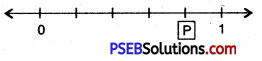
Which fraction is represented by point P on the adjoining number line?
PSEB 6th Class Maths MCQ Chapter 5 Fractions 3
(a) \(\frac {4}{5}\)
(b) \(\frac {5}{6}\)
(c) \(\frac {3}{4}\)
(d) \(\frac {3}{5}\)
Answer:
(a) \(\frac {4}{5}\)

Question 22.
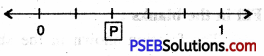
Which fraction is represented by point P on the adjoining number line?
PSEB 6th Class Maths MCQ Chapter 5 Fractions 4
(a) \(\frac {1}{2}\)
(b) \(\frac {3}{5}\)
(c) \(\frac {4}{5}\)
(d) \(\frac {2}{5}\)
Answer:
(d) \(\frac {2}{5}\)

PSEB 6th Class Maths MCQ Chapter 5 Fractions

Question 23.
Which of the following fractions are in ascending order?
(a) \(\frac{1}{2}, \frac{1}{3}, \frac{1}{4}\)
(b) \(\frac{5}{10}, \frac{5}{11}, \frac{5}{12}\)
(c) \(\frac{1}{10}, \frac{1}{100}, \frac{1}{1000}\)
(d) \(\frac{3}{10}, \frac{4}{10}, \frac{7}{10}\)
Answer:
(d) \(\frac{3}{10}, \frac{4}{10}, \frac{7}{10}\)

Question 24.
Which of the following fractions are in descending order?
(a) \(\frac{1}{3}, \frac{1}{4}, \frac{1}{5}\)
(b) \(\frac{4}{11}, \frac{4}{12}, \frac{4}{13}\)
(c) \(\frac{1}{10}, \frac{1}{100}, \frac{1}{1000}\)
(d) \(\frac{7}{10}, \frac{9}{10}, \frac{11}{10}\)
Answer:
(a) \(\frac{1}{3}, \frac{1}{4}, \frac{1}{5}\)

Question 25.
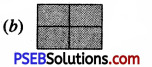
Which of the following fraction is shown in the shaded portion of the figure?
PSEB 6th Class Maths MCQ Chapter 5 Fractions 5
(a) \(\frac {1}{3}\)
(b) \(\frac {2}{4}\)
(c) \(\frac {3}{4}\)
(d) \(\frac {2}{5}\)
Answer:
(b) \(\frac {2}{4}\)

Fill in the blanks:

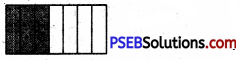
Question (i)
The fraction shown in the shaded portion of the figure is ……………..,
PSEB 6th Class Maths MCQ Chapter 5 Fractions 6
Answer:
\(\frac {1}{4}\)

PSEB 6th Class Maths MCQ Chapter 5 Fractions

Question (ii)
The fraction of the shaded portion shown by the following figure is …………. .
PSEB 6th Class Maths MCQ Chapter 5 Fractions 7
Answer:
\(\frac {1}{8}\)

Question (iii)
The fraction of the shaded portion shown by the given figure is …………… .
PSEB 6th Class Maths MCQ Chapter 5 Fractions 8
Answer:
\(\frac {3}{7}\)

Question (iv)
The upper part of the fraction is called ……………. .
Answer:
numerator

Question (v)
The lower part of the fraction is called ……………. .
Answer:
denominator

Write True/False:

Question (i)
The fraction \(\frac {3}{5}\) is read as three fifth. (True/False)
Answer:
True

PSEB 6th Class Maths MCQ Chapter 5 Fractions

Question (ii)
The fraction whose numerator is less than the denominator is called the proper fraction. (True/False)
Answer:
True

Question (iii)
\(\frac {7}{8}\) is an improper fraction. (True/False)
Answer:
False

Question (iv)
Mixed fraction is a combination of a whole number and a proper fraction. (True/False)
Answer:
True

Question (v)
Fraction with the same denominator are called unlike fractions. (True/False)
Answer:
False

PSEB 7th Class Maths MCQ Chapter 11 Perimeter and Area

Punjab State Board PSEB 7th Class Maths Book Solutions Chapter 11 Perimeter and Area MCQ Questions with Answers.

PSEB 7th Class Maths Chapter 11 Perimeter and Area MCQ Questions

Multiple Choice Questions :

Question 1.
Out of the following figures which has the greatest perimeter ?
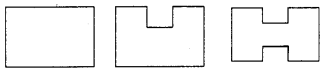
(The length and breadth of each rectangle is equal)
(i) (ii) (iii)
PSEB 7th Class Maths MCQ Chapter 11 Perimeter and Area 1
(a) (i)
(b) (ii)
(c) (iii)
(d) (iv).
Answer:
(c) (iii)

Question 2.
Perimeter of a rectangle = 2 (…………)
(a) Length + Breadth
(b) Length × Breadth
(c) Length ÷ Breadth
(d) Length – Breadth.
Answer:
(a) Length + Breadth

Question 3.
Area of rectangle = …………….
(a) Length + Breadth
(b) Length × Breadth
(c) Length – Breadth
(d) Length ÷ Breadth.
Answer:
(b) Length × Breadth

Question 4.
Circumference of a circle = …………….
(a) πr
(b) 2πr
(c) πr2
(d) 2πr2.
Answer:
(b) 2πr

Question 5.
Area of a circle =
(a) 2πr
(b) πr
(c) πr2
(d) 2πr2
Answer:
(c) πr2

PSEB 7th Class Maths MCQ Chapter 11 Perimeter and Area

Question 6.
The area of a square park whose perimeter is 320 m will be :
(a) 3200 m2
(b) 640 m2
(c) 6400 m2
(d) 6400 m
Answer:
(c) 6400 m2

Question 7.
The area of a rectangular plot is 440 m2 and its length is 22 m. Its breadth will be :
(a) 20 m
(b) 40 m
(c) 44 m
(d) 21 m.
Answer:
(a) 20 m

Question 8.
The radius ofa circle is 14 cm. Its area will be:
(a) 88 cm2
(b) 616 cm2
(c) 196 cm2
(d) 56 cm2
Answer:
(b) 616 cm2

Fill in the blanks :

Question 1.
Perimeter of a rectangle = 2 (………….)
Answer:
Length + Breadth

Question 2.
Area of rectangle = ………….
Answer:
Length × Breadth

PSEB 7th Class Maths MCQ Chapter 11 Perimeter and Area

Question 3.
Perimeter of a square = ………….
Answer:
4 × side

Question 4.
Area of a square = ………….
Answer:
(side)2

Question 5.
Area of a triangle = ………….
Answer:
\(\frac {1}{2}\) × Base × height

Write True/False :

Question 1.
Area of a square with side 10 cm is 20 cm2 (True/False)
Answer:
False

Question 2.
One are has 100 m2 (True/False)
Answer:
True

PSEB 7th Class Maths MCQ Chapter 11 Perimeter and Area

Question 3.
One hectare has 1000 m2 (True/False)
Answer:
False

Question 4.
Area of circle is πr2 square unit (True/False)
Answer:
True

Question 5.
Brahmgupta gave the formule for the area of a cyclic quadrilateral (True/False)
Answer:
True

PSEB 9th Class Maths Solutions Chapter 9 Areas of Parallelograms and Triangles Ex 9.3

Punjab State Board PSEB 9th Class Maths Book Solutions Chapter 9 Areas of Parallelograms and Triangles Ex 9.3 Textbook Exercise Questions and Answers.

PSEB Solutions for Class 9 Maths Chapter 9 Areas of Parallelograms and Triangles Ex 9.3

Question 1.
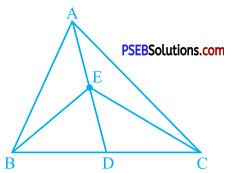
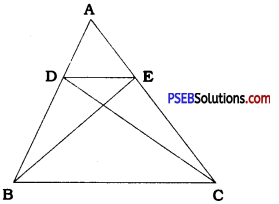
In the given figure, E is any point on median AD of a ∆ ABC. Show that ar (ABE) = ar (ACE).
PSEB 9th Class Maths Solutions Chapter 9 Areas of Parallelograms and Triangles Ex 9.3 1
Answer:
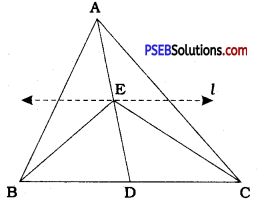
PSEB 9th Class Maths Solutions Chapter 9 Areas of Parallelograms and Triangles Ex 9.3 2
As AD is a median of ∆ ABC, it divides ∆ ABC into two triangles with equal areas.
∴ ar (ADB) = ar (ADC) …………… (1)
In ∆ ABC, AD is a median.
∴ BD = CD
Draw a line l through E and parallel to BC. Then, ∆ EDB and ∆ EDC are on the equal bases and between the same parallels l and BC.
∴ ar (EDB) = ar (EDC) ……………… (2)
Subtracting (2) from (1),
ar (ADB) – ar (EDB) = ar (ADC) – ar (EDC)
∴ ar (ABE) = ar (ACE)

PSEB 9th Class Maths Solutions Chapter 9 Areas of Parallelograms and Triangles Ex 9.3

Question 2.
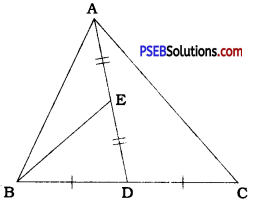
In a triangle ABC, E is the midpoint of median AD. Show that ar (BED) = \(\frac{1}{4}\)ar (ABC).
Answer:
PSEB 9th Class Maths Solutions Chapter 9 Areas of Parallelograms and Triangles Ex 9.3 3
In ∆ ABC, AD is a median
∴ ar (ADB) = ar (ADC) = \(\frac{1}{2}\)ar (ABC)
Now, in ∆ ABD, E is the midpoint of AD.
∴ BE is a median of ∆ ABD.
∴ ar (BED) = ar (BEA) = \(\frac{1}{2}\)ar (ABD)
Thus, ar (BED) = \(\frac{1}{2}\)ar (ABD) and
ar (ABD) = \(\frac{1}{2}\)ar (ABC)
∴ ar (BED) = \(\frac{1}{2}\) × \(\frac{1}{2}\)ar (ABC)
∴ ar (BED) = \(\frac{1}{4}\)

PSEB 9th Class Maths Solutions Chapter 9 Areas of Parallelograms and Triangles Ex 9.3

Question 3.
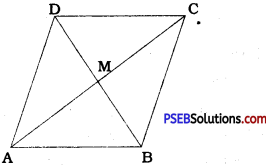
Show that the diagonals of a parallelogram divide it into four triangles of equal area.
Answer:
PSEB 9th Class Maths Solutions Chapter 9 Areas of Parallelograms and Triangles Ex 9.3 4
The diagonals of a parallelogram bisect each other.
Hence, in parallelogram ABCD, diagonals AC and BD bisect each other at M. Thus, M is the midpoint of AC as well as BD.
In ∆ ABC, BM is a median.
∴ ar (ABM) = ar (CBM) ……………. (1)
In ∆ BCD, CM is a median.
∴ ar (CBM) = ar (CDM) ……………. (2)
In ∆ ABD, AM is a median.
∴ ar (ABM) = ar (DAM) ……………. (3)
From (1), (2) and (3),
ar (ABM) = ar (CBM) = ar (CDM) = ar (DAM)
Thus, the diagonals of a parallelogram divide it into four triangles of equal areas.

PSEB 9th Class Maths Solutions Chapter 9 Areas of Parallelograms and Triangles Ex 9.3

Question 4.
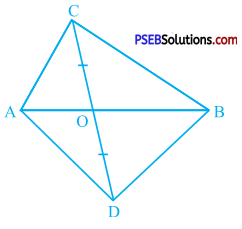
In the given figure, ABC and ABD are two triangles on the same base AB. If line segment CD is bisected by AB at O, show that ar (ABC) = ar (ABD).
PSEB 9th Class Maths Solutions Chapter 9 Areas of Parallelograms and Triangles Ex 9.3 5
Answer:
Drawing a line through A and parallel to CD, ∆ AOC and A AOD are on the equal bases and between the same parallels.
∴ ar (AOC) = ar (AOD) ……………… (1)
Similarly, drawing a line through B and parallel to CD, A BOC and A BOD are on the equal bases and between the same parallels.
∴ ar (BOC) = ar (BOD) ……………. (2)
Adding (1) and (2),
ar (AOC) + ar (BOC) = ar (AOD) + ar (BOD)
∴ ar (ABC) = ar (ABD)

PSEB 9th Class Maths Solutions Chapter 9 Areas of Parallelograms and Triangles Ex 9.3

Question 5.
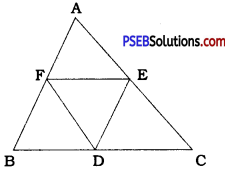
D, E and F are respectively the midpoints of the sides BC, CA and AB of a A ABC. Show that:
(i) BDEF is a parallelogram.
(ii) ar (DEF) = \(\frac{1}{4}\)ar (ABC)
(iii) ar (BDEF) = \(\frac{1}{2}\)ar (ABC)
Answer:
PSEB 9th Class Maths Solutions Chapter 9 Areas of Parallelograms and Triangles Ex 9.3 7
In ∆ ABC, F and E are the midpoints of AB and AC respectively.
∴ FE || BC
∴ FE || BD
In ∆ ABC, E and D are the midpoints of AC and BC respectively.
∴ ED || AB
∴ ED || FB
In quadrilateral BDEF, FE || BD and ED || FB.
∴ Quadrilateral BDEF is a parallelogram. …… Result (i)
Similarly, quadrilaterals AFDE and FDCE are parallelograms.
In parallelogram BDEF, FD is a diagonal.
∴ ar (BDF) = ar (DEF) ……………….. (1)
In parallelogram AFDE, EF is a diagonal.
∴ ar (AFE) = ar (DEF) ……………….. (2)
In parallelogram FDCE, ED is a diagonal.
∴ ar (DCE) = ar (DEF) ………………. (3)
∆ ABC is made up of four non-overlapping triangles, ∆ BDF, ∆ AFE, ∆ DCE and ∆ DEF.
∴ ar (ABC)
= ar (BDF) + ar (AFE) + ar (DCE) + ar (DEF)
∴ ar (ABC)
= ar (DEF) + ar (DEF) + ar (DEF) + ar (DEF) [From (1), (2) and (3)]
∴ ar (ABC) = 4ar (DEF)
∴ ar (DEF) = \(\frac{1}{4}\)ar (ABC) …………. Result (ii)
Now, ar (BDEF) = ar (BDF) + ar (DEF)
∴ ar (BDEF) = ar (DEF) + ar (DEF)
∴ ar (BDEF) = 2ar (DEF)
∴ ar (BDEF) = 2 × \(\frac{1}{4}\)ar (ABC)
∴ ar (BDEF) = \(\frac{1}{2}\)ar (ABC) ……. Result (iii)

PSEB 9th Class Maths Solutions Chapter 9 Areas of Parallelograms and Triangles Ex 9.3

Question 6.
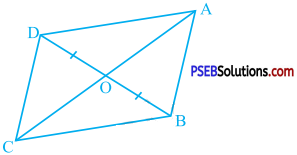
In the given figure, diagonals AC and BD of quadrilateral ABCD intersect at O such that OB = OD. If AB = CD, then show that:
(i) ar (DOC) = ar (AOB)
(ii) ar (DCB) = ar (ACB)
(iii) DA || CB and ABCD is a parallelogram. [Hint: From D and B, draw perpendiculars to AC.]
PSEB 9th Class Maths Solutions Chapter 9 Areas of Parallelograms and Triangles Ex 9.3 6
Answer:
Draw DM ⊥ AC and BN ⊥ AC, where M and N are points on AC.
In ∆ DMO and ∆ BNO,
DO = BO (Given)
∠ DOM = ∠ BON (Vertically opposite angles)
∠ DMO = ∠ BNO (Right angles)
∴ ∆ DMO ≅ ∆ BNO (AAS rule)
∴ DM = BN (CPCT)
Now, in ∆ DMC and ∆ BNA,
DM = BN
hypotenuse DC = hypotenuse BA (Given)
∠ DMC = ∠ BNA (Right angles)
∴ ∆ DMC = ∆ BNA (RHS rule)
∴ ar (DMC) = ar (BNA) ……………… (1)
Moreover, ar (DMO) = ar (BNO) (∵ ∆ DMO ≅ ∆ BNO) ………………… (2)
Adding (1) and (2),
ar (DMC) + ar (DMO) = ar (BNA) + ar (BNO)
∴ ar (DOC) = ar (AOB) (Non-overlapping triangles) … Result (i)
Now, adding ar (COB) on both the sides,
ar (DOC) + ar (COB) = ar (AOB) + ar (COB)
∴ ar (DCB) = ar (ACB) ……… Result (ii)
∆ DCB and ∆ ACB are on the same base BC and their areas are equal.
∴ ∆ DCB and ∆ ACB are between the same parallels DA and CB.
∴ DA || CB ……………… (3)
∆ DMO = ∆ BNO gives OM = ON
∆ DMC = ∆ BNA gives CM = AN
∴ OM + CM = ON + AN
∴ OC = OA
Also, OD = OB (Given)
Thus, in quadrilateral ABCD, diagonals AC and BD bisect each other at O.
∴ ABCD is a parallelogram. ……………….. (4)
Taking (3) and (4) together,
DA || CB and ABCD is a parallelogram. ………. Result (iii)

PSEB 9th Class Maths Solutions Chapter 9 Areas of Parallelograms and Triangles Ex 9.3

Question 7.
D and E are points on sides AB and AC respectively of ∆ ABC such that ar (DBC) = ar (EBC). Prove that DE || BC.
Answer:
PSEB 9th Class Maths Solutions Chapter 9 Areas of Parallelograms and Triangles Ex 9.3 8
ar (DBC) = ar (EBC)
∴ ∆ DBC and ∆ EBC have equal areas.
Here, ∆ DBC and ∆ EBC are on the same base BC and their areas are equal.
∴ ∆ DBC and ∆ EBC are between the same parallels DE and BC.
∴ DE || BC

Question 8.
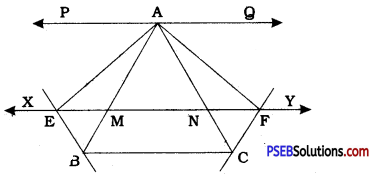
XY is a line parallel to side BC of a ‘triangle ABC. If BE II AC and CF II AB meet ( XY at E and F respectively, show that ar (ABE) = ar (ACF).
Answer:
PSEB 9th Class Maths Solutions Chapter 9 Areas of Parallelograms and Triangles Ex 9.3 9
Suppose line XY drawn parallel to BC intersects AB and AC at M and N respectively.
In quadrilateral EBCN, EN || BC and BE || CN.
∴ EBCN is a parallelogram.
In quadrilateral MBCF, MF || BC and BM || CF.
∴ MBCF is a parallelogram.
Parallelograms EBCN and MBCF are on the same base BC and between the same parallels BC and EF
∴ ar (EBCN) = ar (MBCF)
∴ ar (BME) + ar (MBCN) = ar (MBCN) + ar (CFN)
∴ ar (BME) = ar (CFN) ……………….. (1)
Now, ∆ BME and ∆ CFN are between the same parallels EF and BC and their areas are equal.
∴ Their bases are equal.
∴ EM = NF
Through A, draw line PQ parallel to EF.
Then, ∆ AEM and ∆ ANF are on equal bases s and between the same parallels PQ and EF. !>
∴ ar (AEM) = ar (ANF) ……………… (2)
Adding (1) and (2),
ar (BME) + ar (AEM) = ar (CFN) + ar (ANF)
∴ ar (ABE) = ar (ACF)

PSEB 9th Class Maths Solutions Chapter 9 Areas of Parallelograms and Triangles Ex 9.3

Question 9.
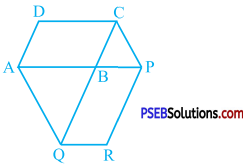
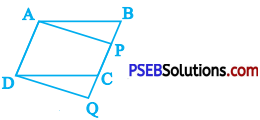
The side AB of a parallelogram ABCD is ‘produced to any point P. A line through A and parallel to CP meets CB produced at and then parallelogram PBQR is completed (see the given figure). Show that: ar (ABCD) = ar (PBQR)
[Hint: Join AC and PQ. Now compare ar (ACQ) and ar (APQ).]
PSEB 9th Class Maths Solutions Chapter 9 Areas of Parallelograms and Triangles Ex 9.3 10
Answer:
Join AC and PQ.
∆ CAQ and ∆ PAQ are on the same base AQ and between the same parallels CP and AQ.
∴ ar (CAQ) = ar(PAQ)
∴ ar (ACB) + ar (ABQ) = ar (PBQ) + ar (ABQ) (Non-overlapping triangles)
∴ ar (ACB) = ar (PBQ) ……………. (1)
In parallelogram ABCD, AC is a diagonal.
∴ ar (ACB) = \(\frac{1}{2}\)ar (ABCD) ……………… (2)
In parallelogram PBQR, PQ is a diagonal.
∴ ar (PBQ) = \(\frac{1}{2}\)ar (PBQR) ………………. (3)
From (1), (2) and (3),
\(\frac{1}{2}\)ar (ABCD) = \(\frac{1}{2}\)ar (PBQR)
∴ ar (ABCD) = ar (PBQR)

PSEB 9th Class Maths Solutions Chapter 9 Areas of Parallelograms and Triangles Ex 9.3

Question 10.
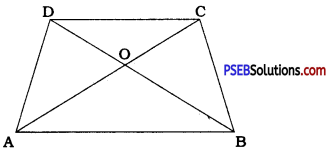
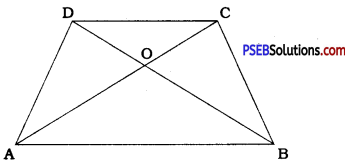
Diagonals AC and BD of a trapezium ABCD with AB || DC intersect each other at O. Prove that ar (AOD) = ar (BOC).
PSEB 9th Class Maths Solutions Chapter 9 Areas of Parallelograms and Triangles Ex 9.3 11
Answer:
∆ DAB and ∆ CBA are on the same base AB and between the same parallels AB and CD.
∴ ar (DAB) = ar (CBA)
∆ DAB and ∆ CBA are both formed by two non-overlapping triangles.
∴ ar (DAB) = ar (AOD) + ar (OAB) and
ar (CBA) = ar (BOC) + ar (OAB)
∴ ar (AOD) + ar (OAB) = ar (BOC) + ar (OAB)
∴ ar (AOD) = ar (BOC)

PSEB 9th Class Maths Solutions Chapter 9 Areas of Parallelograms and Triangles Ex 9.3

Question 11.
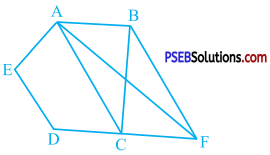
In the given figure, ABCDE is a pentagon. A line through B parallel to AC meets DC produced at F. Show that
(i) ar (ACB) = ar (ACF)
(ii) ar (AEDF) = ar (ABCDE)
PSEB 9th Class Maths Solutions Chapter 9 Areas of Parallelograms and Triangles Ex 9.3 12
Answer:
∆ ACB and ∆ ACF are on the same base AC and between the same parallels AC and BF.
∴ ar (ACB) = ar (ACF)
Adding ar (AEDC) on both the sides,
ar (ACF) + ar (AEDC) = ar (ACB) + ar (AEDC)
∴ ACF and quadrilateral AEDC are two non-overlapping figures and they form quadrilateral AEDF.
Similarly, ∆ ACB and quadrilateral AEDC are two non-overlapping figures and they form pentagon ABCDE.
∴ ar (AEDF) = ar (ABCDE)

Question 12.
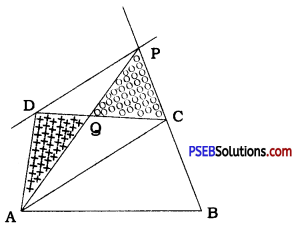
A villager Itwaari has a plot of land of the shape of a quadrilateral. The Gram Panchayat of the village decided to take over some portion of his plot from one of the comers to construct a Health Centre. Itwaari agrees to the above proposal with the condition that he should be given equal amount of land in lieu of his land adjoining his plot so as to form a triangular plot. Explain how this proposal will be implemented.
Answer:
PSEB 9th Class Maths Solutions Chapter 9 Areas of Parallelograms and Triangles Ex 9.3 13
Suppose, quadrilateral ABCD is the plot of Itwaari in the shape of a quadrilateral.
Draw diagonal AC. Through D draw a line parallel to AC to intersect BC produced at P
Join PA to intersect CD at Q.
Here, ∆ DAC and ∆ PAC are on the same base AC and between the same parallels DP and AC.
∴ ar (DAC) = ar (PAC)
∴ ar (DAQ) + ar (QAC) = ar (PQC) + ar (QAC)
∴ ar (DAQ) = ar (PQC)
Thus, we get two triangles – ∆ DAQ and ∆ PQC of equal areas.
So, the Gram Panchayat should take triangular region DAQ from the plot of Itwaari and in exchange give him triangular region PQC. Then, the plot of Itwaari will be of the triangular shape PAB and its area will be the same as the area of original plot ABCD.

PSEB 9th Class Maths Solutions Chapter 9 Areas of Parallelograms and Triangles Ex 9.3

Question 13.
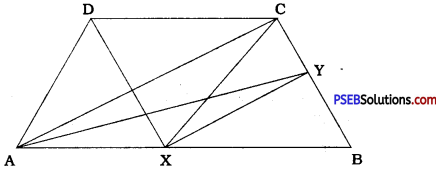
ABCD is a trapezium with AB || DC. A line parallel to AC intersects AB at X and BC at Y. Prove that ar (ADX) = ar (ACY).
[Hint: Join CX.)
Answer:
PSEB 9th Class Maths Solutions Chapter 9 Areas of Parallelograms and Triangles Ex 9.3 14
Join CX.
∆ ADX and ∆ ACX are on the same base AX and between the same parallels AB and CD.
∴ ar (ADX) = ar (ACX) …………… (1)
A ACX and A ACY are on the same base AC and between the same parallels AC and XY.
∴ ar (ACX) = ar (ACY) ……………. (2)
From (1) and (2),
ar (ADX) = ar (ACY)

Question 14.
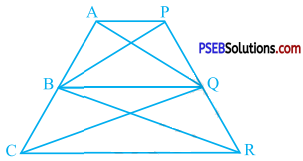
In the given figure, AP || BQ || OR. Prove that ar (AQC) = ar (PBR).
PSEB 9th Class Maths Solutions Chapter 9 Areas of Parallelograms and Triangles Ex 9.3 15
Answer:
∆ CBQ and ∆ RBQ are on the same base BQ and between the same parallels BQ and CR.
∴ ar (CBQ) = ar (RBQ) ……. (1)
∆ ABQ and ∆ PBQ are on the same base BQ and between the same parallels BQ and AE
∴ ar (ABQ) = ar (PBQ) ……… (2)
Adding (1) and (2),
ar (CBQ) + ar (ABQ) = ar (RBQ) + ar (PBQ)
∴ ar (AQC) = ar(PBR) (Non-overlapping triangles)

PSEB 9th Class Maths Solutions Chapter 9 Areas of Parallelograms and Triangles Ex 9.3

Question 15.
Diagonals AC and BD of a quadrilateral ABCD intersect at O in such a way that ar (AOD) = ar (BOC). Prove that ABCD is a , trapezium.
Answer:
PSEB 9th Class Maths Solutions Chapter 9 Areas of Parallelograms and Triangles Ex 9.3 16
ar (AOD) = ar (BOC)
Adding ar (OAB) on both the sides,
ar (AOD) + ar (OAB) = ar (BOC) + ar (OAB)
∴ ar (DAB) = ar (CAB)
Thus, ∆ DAB and ∆ CAB are on the same base AB and their areas are equal.
Hence, by theorem 9.3, ∆ DAB and ∆ CAB are between the same parallel.
∴ DC || AB
In quadrilateral ABCD, DC || AB.
Hence, ABCD is a trapezium.

PSEB 9th Class Maths Solutions Chapter 9 Areas of Parallelograms and Triangles Ex 9.3

Question 16.
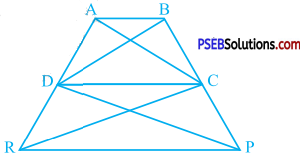
In the given figure, ar (DRC) = ar (DPC) and ar (BDP) = ar (ARC). Show that both the quadrilaterals ABCD and DCPR are trapeziums.
PSEB 9th Class Maths Solutions Chapter 9 Areas of Parallelograms and Triangles Ex 9.3 17
Answer:
ar (DRC) = ar (DPC)
Thus, ∆ DRC and ∆ DPC are on the same base DC and their areas are equal.
Hence, by theorem 9.3, they are between the same parallels.
∴ DC || RP
In quadrilateral DCPR, DC || RE .
∴ Quadrilateral DCPR is a trapezium.
Now, ar (BDP) = ar (ARC)
∴ ar (DPC) + ar (BDC) = ar (DRC) + ar (ADC) (Non-overlapping triangles)
But, ar (DPC) = ar (DRC)
∴ ar (BDC) = ar (ADC)
Thus, ∆ BDC and ∆ ADC are on the same base DC and their areas are equal.
Hence, by theorem 9.3, they are between the same parallels.
∴ AB || DC
In quadrilateral ABCD, AB || DC.
∴ Quadrilateral ABCD is a trapezium.

PSEB 6th Class Maths Solutions Chapter 5 Fractions Ex 5.6

Punjab State Board PSEB 6th Class Maths Book Solutions Chapter 5 Fractions Ex 5.6 Textbook Exercise Questions and Answers.

PSEB Solutions for Class 6 Maths Chapter 5 Fractions Ex 5.6

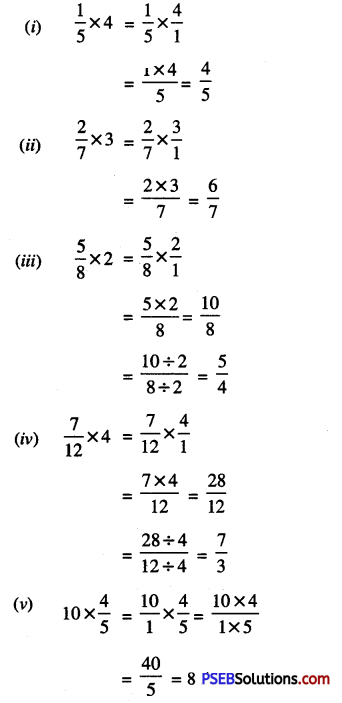
1. Multiply:

Question (i)
(i) \(\frac {1}{5}\) × 4
(ii) \(\frac {2}{7}\) × 3
(iii) \(\frac {5}{8}\) × 2
(iv) \(\frac {7}{12}\) × 4
(iv) 10 × \(\frac {4}{5}\)
Solution:
PSEB 6th Class Maths Solutions Chapter 5 Fractions Ex 5.5 1

PSEB 6th Class Maths Solutions Chapter 5 Fractions Ex 5.6

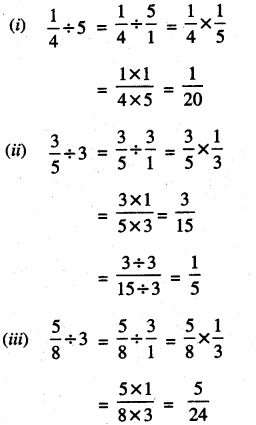
2. Divide:

Question (ii)
(i) \(\frac {1}{4}\) ÷ 5
(ii) \(\frac {3}{5}\) ÷ 3
(iii) \(\frac {5}{8}\) ÷ 3
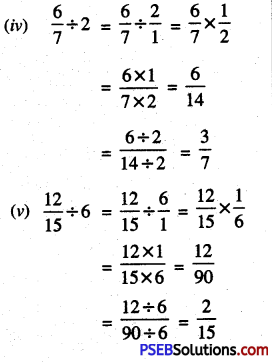
(iv) \(\frac {6}{7}\) ÷ 2
(iv) \(\frac {12}{15}\) ÷ 6.
Solution:
PSEB 6th Class Maths Solutions Chapter 5 Fractions Ex 5.5 2
PSEB 6th Class Maths Solutions Chapter 5 Fractions Ex 5.5 3

PSEB 6th Class Maths Solutions Chapter 5 Fractions Ex 5.5

Punjab State Board PSEB 6th Class Maths Book Solutions Chapter 5 Fractions Ex 5.5 Textbook Exercise Questions and Answers.

PSEB Solutions for Class 6 Maths Chapter 5 Fractions Ex 5.5

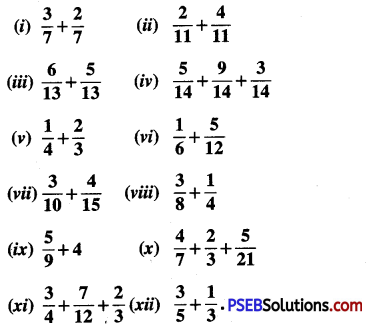
1. Add the following:

Question (i)
PSEB 6th Class Maths Solutions Chapter 5 Fractions Ex 5.5 1
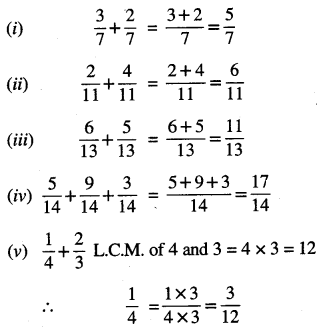
Solution:
PSEB 6th Class Maths Solutions Chapter 5 Fractions Ex 5.5 2
PSEB 6th Class Maths Solutions Chapter 5 Fractions Ex 5.5 3
PSEB 6th Class Maths Solutions Chapter 5 Fractions Ex 5.5 4
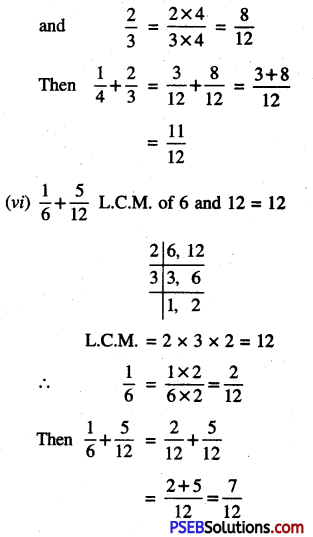
PSEB 6th Class Maths Solutions Chapter 5 Fractions Ex 5.5 5
PSEB 6th Class Maths Solutions Chapter 5 Fractions Ex 5.5 6
PSEB 6th Class Maths Solutions Chapter 5 Fractions Ex 5.5 7

PSEB 6th Class Maths Solutions Chapter 5 Fractions Ex 5.5

2. Subtract the following:

Question (i)
PSEB 6th Class Maths Solutions Chapter 5 Fractions Ex 5.5 8
Solution:
PSEB 6th Class Maths Solutions Chapter 5 Fractions Ex 5.5 9
PSEB 6th Class Maths Solutions Chapter 5 Fractions Ex 5.5 10
PSEB 6th Class Maths Solutions Chapter 5 Fractions Ex 5.5 11
PSEB 6th Class Maths Solutions Chapter 5 Fractions Ex 5.5 12
PSEB 6th Class Maths Solutions Chapter 5 Fractions Ex 5.5 13
PSEB 6th Class Maths Solutions Chapter 5 Fractions Ex 5.5 14

PSEB 6th Class Maths Solutions Chapter 5 Fractions Ex 5.5

3. Simplify the following:

Question (i)
PSEB 6th Class Maths Solutions Chapter 5 Fractions Ex 5.5 15
Solution:
PSEB 6th Class Maths Solutions Chapter 5 Fractions Ex 5.5 16
PSEB 6th Class Maths Solutions Chapter 5 Fractions Ex 5.5 17
PSEB 6th Class Maths Solutions Chapter 5 Fractions Ex 5.5 18
PSEB 6th Class Maths Solutions Chapter 5 Fractions Ex 5.5 19
PSEB 6th Class Maths Solutions Chapter 5 Fractions Ex 5.5 20
PSEB 6th Class Maths Solutions Chapter 5 Fractions Ex 5.5 21
PSEB 6th Class Maths Solutions Chapter 5 Fractions Ex 5.5 22
PSEB 6th Class Maths Solutions Chapter 5 Fractions Ex 5.5 23
PSEB 6th Class Maths Solutions Chapter 5 Fractions Ex 5.5 24
PSEB 6th Class Maths Solutions Chapter 5 Fractions Ex 5.5 25
PSEB 6th Class Maths Solutions Chapter 5 Fractions Ex 5.5 26

PSEB 6th Class Maths Solutions Chapter 5 Fractions Ex 5.5

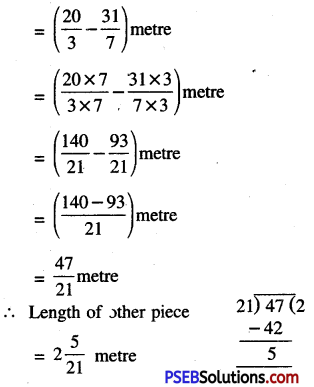
4. An iron pipe of length \(6 \frac{2}{3}\) metres long was cut into two pieces. One piece is \(4 \frac{3}{7}\) metre long. What is the length of other pieces?
Solution:
Total length of an iron pipe
= \(6 \frac{2}{3}\) m = \(\frac{20}{3}\) metre
Length of one piece
= \(4 \frac{3}{7}\) metre = \(\frac{31}{7}\) metre
∴ Length of other piece
PSEB 6th Class Maths Solutions Chapter 5 Fractions Ex 5.5 27

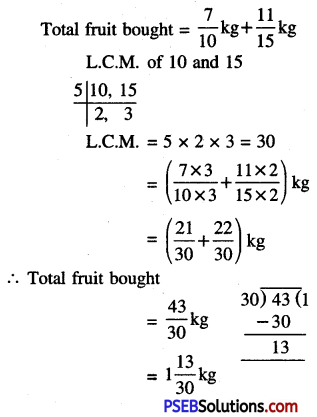
5. Ashok bought \(\frac{7}{10}\)kg of mangoes and Taran \(\frac{11}{15}\)kg of apples. How much fruit did he buy in all?
Solution:
PSEB 6th Class Maths Solutions Chapter 5 Fractions Ex 5.5 28

6. Avi did \(\frac{3}{5}\) of his homework on Saturday and \(\frac{1}{10}\) of the same homework on Sunday. How much of the homework did he do over the weekend?
Solution:
Homework he did weekend
\(\frac{3}{5}+\frac{1}{10}=\frac{3 \times 2}{5 \times 2}+\frac{1}{10}=\frac{6}{10}+\frac{1}{10}\)
∴ Home work done in weekend
\(\frac{6+1}{10}=\frac{7}{10}\)

PSEB 6th Class Maths Solutions Chapter 5 Fractions Ex 5.5

7. Charan spent \(\frac {1}{4}\) of his pocket money on a movie and \(\frac {3}{8}\) on a new pen and \(\frac {1}{8}\) on a pencil. What fraction of his pocket money did he spend?
Solution:
Total money he spent
= \(\frac{1}{4}+\frac{3}{8}+\frac{1}{8}=\frac{1}{4} \times \frac{2}{2}+\frac{3}{8}+\frac{1}{8}\)
= \(\frac{2}{8}+\frac{3}{8}+\frac{1}{8}=\frac{2+3+1}{8}\)
= \(\frac{6}{8}=\frac{3}{4}\)
So, pocket money spent = \(\frac {3}{4}\)

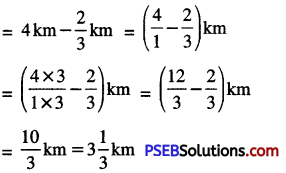
8. Simar lives at a distance of 4 km from the school. Prabhjot lives at a distance of \(\frac {2}{3}\) km less than Simar’s distance from the school. How far does Prabhjot live from the school?
Solution:
Distance of Simar from school = 4 km Distance of Prabhjot from school
PSEB 6th Class Maths Solutions Chapter 5 Fractions Ex 5.5 29

PSEB 7th Class Maths Solutions Chapter 11 Perimeter and Area Ex 11.3

Punjab State Board PSEB 7th Class Maths Book Solutions Chapter 11 Perimeter and Area Ex 11.3 Textbook Exercise Questions and Answers.

PSEB Solutions for Class 7 Maths Chapter 11 Perimeter and Area Ex 11.3

1. Find the circumference of circle whose
(i) Radius (r) = 21 cm
(ii) Radius (r) = 3.5 cm
(iii) Diameter = 84 cm
Solution:
(i) Given radius (r) = 21 cm
circumference of circle = 2πr
= 2 × \(\frac {22}{7}\) ×21
= 132 cm

(ii) Given radius (r) = 3.5 cm
Circumference = 2πl
= 2 × \(\frac {22}{7}\) × 3.5
= 22 cm

(iii) Given Diameter (d) = 84 cm
radius (r) = \(\frac{d}{2}=\frac{84}{2}\)
= 42 cm
Circumference = 2πr
= 2 × \(\frac {22}{7}\) × 42
= 264 cm

2. If the circumference of a circular sheet is 176 m, find its radius.
Solution:
Given circumference of circular sheet = 176 m
Let radius = r
So 2πr = 176
r = \(\frac{176}{2 \pi}\)
\(\frac{176}{2 \times \frac{22}{7}}\)
= 28 m

PSEB 7th Class Maths Solutions Chapter 11 Perimeter and Area Ex 11.3

3. A circular disc of diameter 8.4 cm is divided into two parts what is the perimeter of each semicircular part ?
Solution:
Given diameter of a circular disc = 8.4 cm
radius (r) = \(\frac{8.4}{2}\) = 4.2 cm
Perimeter of semicircular part = πr + 2r
= \(\frac {22}{7}\) × 4.2 + 2 × 4.2
= 22 × 0.6 + 8.4
= 21.6 cm

4. Find the area of the circle having
(i) Radius r = 49 cm
(ii) Radius r = 2.8 cm
(iii) Diameter = 4.2 cm
Solution:
(i) Given radius (r) = 49 cm
Area of circle = πr2
= \(\frac {22}{7}\) × 49 × 49
= 7546 cm2

(ii) Given radius (r) = 2.8 cm
Area of circle = πr2
= \(\frac {22}{7}\) × 2.8 × 2.8
= 24.64 cm2

(iii) Given diameter (d) = 4.2 cm
radius (r) = \(\frac{d}{2}=\frac{4.2}{2}\)
Area of circle = πr2
= \(\frac {22}{7}\) × 2.1 × 2.1
= 13.86 cm2

5. A gardener wants to fence a circular garden of radius 15 m. Find the length of wire, if he makes three rounds offense. Also, find the cost of wire if it costs ₹ 5 per meter (Take π = 3.14).
Solution:
Given radius of circular garden (r) = 15 m
Circumference of the circular garden = 2πr
= 2 × 3.14 × 15
= 94.2 m
So, length of the wire to make three rounds offense
= 3 × 94.2
= 282.6 cm
Cost of wire= ₹ 5 × 282.6
= ₹ 1413

PSEB 7th Class Maths Solutions Chapter 11 Perimeter and Area Ex 11.3

6. Which of the following has larger area and by how much ?
(a) Rectangle with length 15 cm and breadth 5.4 cm
(b) Circle of diameter 5.6 cm.
Solution:
(a) Given length of rectangle = 15 cm
breadth = 5.4 cm
Area of rectangle = length × breadth
= 15 × 5.4
= 81 cm2

(b) Given diameter of circle (d) = 5.6 cm
radius (r) = \(\frac{d}{2}=\frac{5.6}{2}\)
= 2.8 cm
Area of the circle = πr2
= \(\frac {22}{7}\) × (2.8)2
= 24.64 cm2
Hence, Rectangle has more area = 81 – 24.64
= 56.36 cm2

7. From a rectangular sheet of length 15 cm and breadth 12 cm a circle of radius 3.5 cm is removed. Find the area of remaining sheet.
Solution:
Given length of rectangular sheet = 15 cm
Breadth of rectangle sheet = 12 cm
Area of rectangular sheet = length × breadth
= 15 × 12
= 180 cm2
Given radius of circle (r) = 3.5 cm
Area of circle = πr2
= \(\frac {22}{7}\) × (3.5)2
= 38.5 cm2
Since circle is removed from rectangular sheet.
So, area of remaining sheet = Area of rectangular Sheet – Area of circle
= 180 – 38.5
= 141.5 cm2

8. From a circular sheet of radius 7 cm, a circle of radius 2.1 cm is removed, find the area of remaining sheet.
Solution:
Radius of the circular sheet = 7 cm
Area of the circular sheet = 1 cm
= πr2 = \(\frac {22}{7}\) × 7 × 7 cm2
=154 cm2
Radius of the circle = 2.1 cm
Area of the circle
\(\frac {22}{7}\) × 2.1 × 1.1 = \(\frac{22}{7} \times \frac{21}{10} \times \frac{21}{10}\)
= \(\frac {1386}{100}\)
= 13.86 cm2
Area of the remaining sheet = 154 cm2 – 13.86 cm2
= 140.14 cm2

PSEB 7th Class Maths Solutions Chapter 11 Perimeter and Area Ex 11.3

9. Smeep took a wire of length 88 cm and bent it into the shape of a circle, find the radius and area of the circle. If the same wire is bent into a square, what will be the side of the square ? Which figure encloses more area ?
Solution:
Given length of wire = 88 cm
The wire is bent into the shape of circle.
Circumference of circle = length of the
2πr = 88
r = \(\frac{88}{2 \pi}=\frac{44}{\pi} \mathrm{cm}\)
= 14 cm
Area of the circle = πr2
= π × (14)2
= \(\frac {22}{7}\) × 14 × 14
= 616 cm2
If the same wire is bent into the square
Let side of the square = a
Perimeter of square = length of the wire
4 × a = 88
a = \(\frac {88}{4}\)
= 22 cm
Area of the square = (side)2
= (22)2
= 484 cm2
Hence circle enclosed more area.

10. A garden is 120 m long and 85 m broad. Inside the garden, there is a circular pit of diameter 14 m. Find the cost of planting the remaining part of the garden at the rate of ₹ 5.50 per square meter.
Solution:
Given length of garden = 120 m
Breadth of garden = 85 m
Area of garden = length × breadth
= 120 × 85
= 10200 m2
Given diameter of circular pit (d) = 14 m
radius (r) = \(\frac{d}{2}=\frac{14}{2}\)
= 7 m
Area of circular pit = πr2
= \(\frac {22}{7}\) × 7 × 7
= 154 m2
Remaining part of garden = Area of garden for planting – Area of circular pit
= 10200 – 154
= 10046 m2
Cost of planting the remaining part of the garden
= ₹ 5.50 × 10046
= ₹ 55243

PSEB 7th Class Maths Solutions Chapter 11 Perimeter and Area Ex 11.3

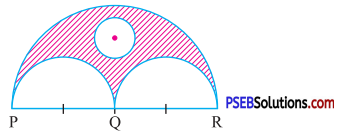
11. In the figure PQ = QR and PR = 56 cm. The radius of inscribed circle is 7 cm. Q is centre of semicircle. What is the area of shaded region ?
PSEB 7th Class Maths Solutions Chapter 11 Perimeter and Area Ex 11.3 1
Solution:
Given PQ = QR
PR = 56 cm
Radius of inscribed circle = 7 cm
So PR = PQ + QR
= PQ + PQ = 2PQ
Hence, PQ = \(\frac{\mathrm{PR}}{2}=\frac{56}{2}\)
= 28 cm
So QR = PQ = 28 cm
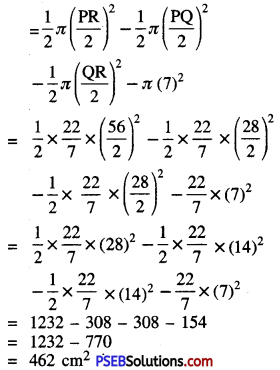
Area of shaded region = Area of semicircle of diameter PR – Area of semicircle of diameter PQ – Area of semicircle of diameter QR – Area of inscribe circle
PSEB 7th Class Maths Solutions Chapter 11 Perimeter and Area Ex 11.3 2

12. The minute hand of a circular clock is 18 cm long. How far does the tip of minute hand move in one hour ?
Solution:
Given minute hand of a circular clock = 18 cm
Distance covered by minute hand in 1 hour = 2πr
= 2 × 3.14 × 18
= 2 × \(\frac {314}{100}\) × 18
= \(\frac {11304}{100}\)
= 113.04 cm.

13. Multiple choice questions :

Question (i).
The circumference of a circle of diameter 10 cm is :
(a) 31.4 cm
(b) 3.14 cm
(c) 314 cm
(d) 35.4 cm
Answer:
(a) 31.4 cm

Question (ii).
The circumference of a circle with radius 14 cm is :
(a) 88 cm
(b) 44 cm
(c) 22 cm
(d) 85 cm
Answer:
(a) 88 cm

PSEB 7th Class Maths Solutions Chapter 11 Perimeter and Area Ex 11.3

Question (iii).
What is the area of the circle of radius 7 cm ?
(a) 49 cm
(b) 22 cm2
(c) 154 cm2
(d) 308 cm2
Answer:
(c) 154 cm2

Question (iv).
Find the diameter of a circle whose area is 154 cm2 ?
(a) 4 cm
(b) 6 cm
(c) 14 cm
(d) 12 cm
Answer:
(c) 14 cm

Question (v).
A circle has area 100 times the area of another circle. What is the ratio of their circumferences ?
(a) 10 : 1
(b) 1 : 10
(c) 1 : 1
(d) 2 : 1
Answer:
(a) 10 : 1

Question (vi).
Diameter of a circular garden is 9.8 cm. Which of the following is its area ?
(a) 75.46 cm2
(b) 76.46 cm2
(c) 74.4 cm2
(d) 76.4 cm2
Answer:
(a) 75.46 cm2

PSEB 6th Class Maths Solutions Chapter 5 Fractions Ex 5.3

Punjab State Board PSEB 6th Class Maths Book Solutions Chapter 5 Fractions Ex 5.3 Textbook Exercise Questions and Answers.

PSEB Solutions for Class 6 Maths Chapter 5 Fractions Ex 5.3

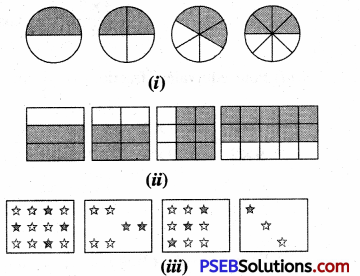
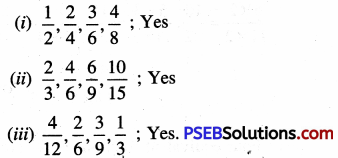
1. Write the fraction for the shaded part and check whether these fractions are equivalent or not?

Question (i)
PSEB 6th Class Maths Solutions Chapter 5 Fractions Ex 5.3 1
Solution:
PSEB 6th Class Maths Solutions Chapter 5 Fractions Ex 5.3 2

PSEB 6th Class Maths Solutions Chapter 5 Fractions Ex 5.3

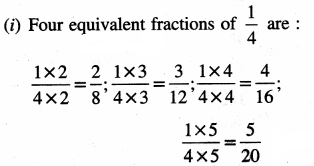
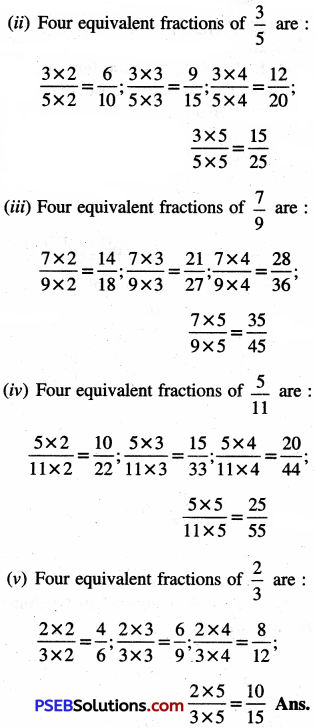
2. Find four equivalent fractions of the followings:

Question (i)
(i) \(\frac {1}{4}\)
(ii) \(\frac {3}{5}\)
(iii) \(\frac {7}{9}\)
(iv) \(\frac {5}{11}\)
(v) \(\frac {2}{3}\)
Solution:
PSEB 6th Class Maths Solutions Chapter 5 Fractions Ex 5.3 3
PSEB 6th Class Maths Solutions Chapter 5 Fractions Ex 5.3 4

PSEB 6th Class Maths Solutions Chapter 5 Fractions Ex 5.3

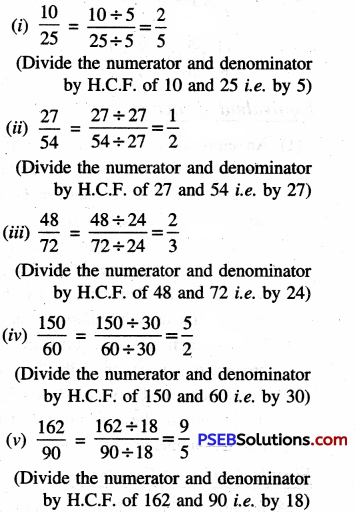
3. Write the lowest equivalent fraction (simplest form) of :

Question (i)
(i) \(\frac {10}{25}\)
(ii) \(\frac {27}{54}\)
(iii) \(\frac {48}{72}\)
(iv) \(\frac {150}{60}\)
(v) \(\frac {162}{90}\)
Solution:
PSEB 6th Class Maths Solutions Chapter 5 Fractions Ex 5.3 5

4. Are the following fractions equivalent or not?

Question (i)
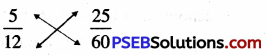
\(\frac{5}{12}, \frac{25}{60}\)
Solution:
We have
PSEB 6th Class Maths Solutions Chapter 5 Fractions Ex 5.3 6
By cross product,
5 × 60 = 300 and 12 × 25 = 300
Since two cross products are same
So, the given fractions are equivalent.

PSEB 6th Class Maths Solutions Chapter 5 Fractions Ex 5.3

Question (ii)
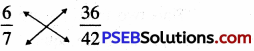
\(\frac{6}{7}, \frac{36}{42}\)
Solution:
We have
PSEB 6th Class Maths Solutions Chapter 5 Fractions Ex 5.3 7
By cross product,
6 × 42 = 252 and 7 × 36 = 252
Since two cross products are same
So, the given fractions are equivalent.

Question (iii)
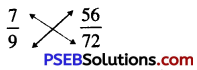
\(\frac{7}{9}, \frac{56}{72}\)
Solution:
We have
PSEB 6th Class Maths Solutions Chapter 5 Fractions Ex 5.3 8
By cross product,
7 × 72 = 504 and 9 × 56 = 504
Since two cross products are same
So, the given fractions are equivalent.

5. Replace [ ] 1 in each of the following by the correct number.

Question (i)
\(\frac{2}{7}\) = 12 / [ ]
Solution:
Observe the numerators we have 12 ÷ 2 = 6
So, we multiply both numerator and denominator of \(\frac {2}{7}\) by 6
We get \(\frac{2}{7}=\frac{2 \times 6}{7 \times 6}=\frac{12}{42}\)
Hence, the correct number in [ ] 1 is 42

Question (ii)
\(\frac{5}{8}\) = 35 / [ ]
Solution:
Observe the numerators we have 35 ÷ 5 = 7
So, we multiply both numerator and denominator of \(\frac {5}{8}\) by 7
We get \(\frac{5}{8}=\frac{5 \times 7}{8 \times 7}=\frac{35}{56}\)
Hence, the correct number in [ ] is 56.

Question (iii)
\(\frac{24}{36}\) = 6 / [ ]
Solution:
Observe the numerators we have 24 ÷ 6 = 4
So, we divide both numerator and denominator of \(\frac {24}{36}\) by 4
We get \(\frac{24}{36}=\frac{24 \div 4}{36 \div 4}=\frac{6}{9}\)
Hence, the correct number in [ ] is 9

PSEB 6th Class Maths Solutions Chapter 5 Fractions Ex 5.3

Question (iv)
\(\frac{30}{48}\) = 8 / [ ]
Solution:
Observe the denominators we have 48 ÷ 8 = 6
So, we divide both numerator and denominator of \(\frac {30}{48}\) by 6
We get \(\frac{30}{48}=\frac{30 \div 6}{48 \div 6}=\frac{5}{8}\)
Hence, the correct number in ⊇ is 5

Question (v)
\(\frac{7}{4}\) = 42 / [ ]
Solution:
Observe the numerators we have 42 ÷ 7 = 6
So, we multiply both numerator and denominator of \(\frac {7}{4}\) by 6
We get \(\frac{7}{4}=\frac{7 \times 6}{7 \times 6}=\frac{42}{24}\)
Hence, the correct number in [ ] is 24

6. Find the equivalent fraction of \(\frac {3}{5}\), having

Question (i)
numerator 18
Solution:
(i) Equivalent fraction of \(\frac {3}{5}\), having numerator 18 is
\(\frac{3}{5}\) = 18 / [ ]
Observe the numerators, we have 18 ÷ 3=6
So, we multiply both numerator and denominator of \(\frac {3}{5}\) by 6
∴ \(\frac{3}{5}=\frac{3 \times 6}{5 \times 6}=\frac{18}{30}\)
Thus, required equivalent fraction of \(\frac{3}{5}=\frac{18}{30}\)

PSEB 6th Class Maths Solutions Chapter 5 Fractions Ex 5.3

Question (ii)
denominator 20
Solution:
Equivalent fraction of \(\frac {3}{5}\), having denominator 20 is \(\frac{3}{5}\) = [ ] / 20
Observe the denominators, we have 20 ÷ 5 = 4
So, we multiply both numerator and denominator of \(\frac {3}{5}\) by 4
Thus, required equivalent fraction of \(\frac{3}{5}=\frac{12}{20}\)
∴ \(\frac{3}{5}=\frac{3 \times 4}{5 \times 4}=\frac{12}{20}\)
Thus, required equivalent fraction of
\(\frac{3}{5}=\frac{12}{20}\)

Question (iii)
numerator 24.
Solution:
Equivalent fraction of \(\frac {3}{5}\) , having numerator 24 is
\(\frac{3}{5}\) = 24 / [ ]
Observe the numerators, we have 24 ÷ 3 = 8
So, we multiply both numerator and denominator of \(\frac {3}{5}\) by 8
∴ \(\frac{3}{5}=\frac{3 \times 8}{5 \times 8}=\frac{24}{40}\)
Thus, required equivalent fraction of
\(\frac{3}{5}=\frac{24}{40}\)

7. Find the equivalent fraction of \(\frac {24}{40}\), having

Question (i)
(i) numerator 6
(ii) numerator 48
(iii) denominator 20
Solution:
(i) Equivalent fraction of \(\frac {24}{40}\), numerator 6 is
\(\frac{24}{40}\) = 6 / [ ]
Observe the numerators, we have 24 ÷ 6 = 4
So, we divide both numerator and denominator of \(\frac {24}{40}\) by 4
∴ \(\frac{24}{40}=\frac{24 \div 4}{40 \div 4}=\frac{6}{10}\)
Thus, required equivalent fraction of
\(\frac{24}{40}=\frac{6}{10}\)

PSEB 6th Class Maths Solutions Chapter 5 Fractions Ex 5.3

Question (ii)
numerator 48
Solution:
Equivalent fraction of \(\frac {24}{40}\), having numerator 48 is
\(\frac{24}{40}\) = 48 / [ ]
Observe the numerators, we have 48 ÷ 24 = 2
So, we multiply both numerator and denominator of \(\frac {24}{40}\) by 2
∴ \(\frac{24}{40}=\frac{24 \times 2}{40 \times 2}=\frac{48}{80}\)
Thus, required equivalent fraction of
\(\frac{24}{40}=\frac{48}{80}\)

Question (iii)
denominator 20
Solution:
Equivalent fraction of \(\frac {24}{40}\), having denominator 20 is
\(\frac{24}{40}\) = [ ] / 20
Observe the denominators, we have 40 ÷ 20 = 2
So, we divide both numerator and denominator of \(\frac {24}{40}\) by 2
\(\frac{24}{40}=\frac{24 \div 2}{40 \div 2}=\frac{12}{20}\)
∴ Thus, required equivalent fraction of
\(\frac{24}{40}=\frac{12}{20}\)

PSEB 9th Class Maths Solutions Chapter 9 Areas of Parallelograms and Triangles Ex 9.1

Punjab State Board PSEB 9th Class Maths Book Solutions Chapter 9 Areas of Parallelograms and Triangles Ex 9.1 Textbook Exercise Questions and Answers.

PSEB Solutions for Class 9 Maths Chapter 9 Areas of Parallelograms and Triangles Ex 9.1

Question 1.
Which of the following figures lie on the same base and between the same parallels. In such a case, write the common base and the two parallels.

(i)
PSEB 9th Class Maths Solutions Chapter 9 Areas of Parallelograms and Triangles Ex 9.1 1
Answer:
In figure (i), trapezium ABCD and ∆ PDC lie on the same base and between the same parallels.
Here, DC is the common base and DC and AB are two parallels.

PSEB 9th Class Maths Solutions Chapter 9 Areas of Parallelograms and Triangles Ex 9.1

(ii)
PSEB 9th Class Maths Solutions Chapter 9 Areas of Parallelograms and Triangles Ex 9.1 2
Answer:
In figure (ii), no two figures lie on the same base and between the same parallels.

(iii)
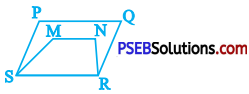
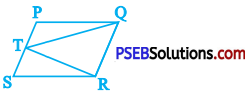
PSEB 9th Class Maths Solutions Chapter 9 Areas of Parallelograms and Triangles Ex 9.1 3
Answer:
In figure (iii), parallelogram PQRS and ∆ TQR lie on the same base and between the same parallels.
Here, QR is the common base and QR and PS are two parallels.

PSEB 9th Class Maths Solutions Chapter 9 Areas of Parallelograms and Triangles Ex 9.1

(iv)
PSEB 9th Class Maths Solutions Chapter 9 Areas of Parallelograms and Triangles Ex 9.1 4
Answer:
In figure (iv), no two figures lie on the same base and between the same parallels.

(v)
PSEB 9th Class Maths Solutions Chapter 9 Areas of Parallelograms and Triangles Ex 9.1 5
Answer:
In figure (v), parallelograms ABCD and APQD as well as trapeziums ABQD and APCD, all the four figures, lie on the same base and between the same parallels.
Here, AD is the common base and AD and BQ are two parallels.

PSEB 9th Class Maths Solutions Chapter 9 Areas of Parallelograms and Triangles Ex 9.1

(vi)
PSEB 9th Class Maths Solutions Chapter 9 Areas of Parallelograms and Triangles Ex 9.1 6
Answer:
In figure (vi), no two figure lie on the same base and between the same parallels.

PSEB 12th Class Hindi Vyakaran अलंकार

Punjab State Board PSEB 12th Class Hindi Book Solutions Hindi Grammar alankar अलंकार Exercise Questions and Answers, Notes.

PSEB 12th Class Hindi Grammar अलंकार

प्रश्न-पत्र में अलंकारों के लक्षण तथा उदाहरण भी पूछे जाएँगे। अलंकारों के भेदोपभेद अथवा उन पर तुलनात्मक प्रश्न पूछे जाएँगे। यहाँ प्रत्येक अलंकार का लक्षण, उदाहरण तथा स्पष्टीकरण दिया गया है।

‘अन्य उदाहरण’ शीर्षक के अन्तर्गत कुछ और उदाहरण भी दिए गए हैं। विद्यार्थी अपनी सुविधा एवं रुचि के अनुसार कोई भी उदाहरण कंठस्थ कर सकता है।

PSEB 12th Class Hindi Vyakaran अलंकार

आरम्भ में अलंकार का महत्त्व, लक्षण तथा उसके भेदों का भी उल्लेख कर दिया गया है। अलंकार का महत्व-अलंकार का साधारण अर्थ है-अलंकृत करना, शोभा बढ़ाना। लोक-भाषा में अलंकार का अर्थ गहना अथवा आभूषण है। जिस प्रकार स्त्रियाँ अपने सौन्दर्यवर्द्धन के लिए भिन्न-भिन्न प्रकार के गहनों का प्रयोग करती हैं उसी प्रकार कवि भिन्न-भिन्न प्रकार के अलंकारों के प्रयोग द्वारा कविता-कामिनी की शोभा बढ़ाते हैं। कंगन से हाथ की, कुण्डल से कान की और हार से गले की शोभा बढ़ती है और ये मिलकर कामिनी के शरीर को सौन्दर्य और आकर्षण प्रदान करते हैं। ठीक इसी प्रकार अनुप्रास, उपमा आदि अलंकारों का प्रयोग कविता को आकर्षक और प्रभावशाली बना देता है। कभी शब्द-विशेष का प्रयोग कविता को चमत्कार प्रदान करता है तो कभी अर्थ का प्रयोग कविता के भाव में उत्कर्ष ला देता है।

उपर्युक्त संक्षिप्त विवेचन के उपरान्त अलंकार की परिभाषा इस प्रकार दी जा सकती है-
परिभाषा-“शब्द और अर्थ में चमत्कार उत्पन्न कर कविता की शोभा बढ़ाने वाले तत्त्व को अलंकार कहते है।

अलंकार के भेद-अलंकार के मुख्य रूप में दो भेद हैं-
1. शब्दालंकार
2. अर्थालंकार

1. शब्दालंकार-जहाँ शब्दों के कारण किसी रचना में चमत्कार उत्पन्न हो, वहाँ शब्दालंकार होता है। अनुप्रास, यमक, श्लेष, वक्रोक्ति आदि शब्दालंकार हैं।

2. अर्थालंकार-जहाँ अर्थों के कारण किसी रचना में चमत्कार उत्पन्न हो वहाँ अर्थालंकार होता है। उपमा, रूपक आदि प्रसिद्ध अर्थालंकार हैं।

शब्दालंकार और अर्थालंकार में अन्तर

स्पष्ट किया जा चुका है कि शब्द के कारण चमत्कार उत्पन्न होने पर शब्दालंकार और अर्थ के कारण चमत्कार उत्पन्न होने पर अर्थालंकार होता है।

शब्दालंकार में शब्द-विशेष के निकाल देने पर चमत्कार समाप्त हो जाता है अर्थात् शब्द-विशेष के स्थान पर समानार्थी शब्द भी चमत्कार को बनाए रखने में असमर्थ हैं।

जैसे–’पानी के बिना मोती का कोई महत्त्व नहीं’ यहाँ मोती के पक्ष में ‘पानी’ का अर्थ ‘चमक’ है। अब इसके स्थान पर समानार्थी शब्द जल, नीर, अम्बु, तोय आदि शब्दों को रख दें तो अलंकार समाप्त हो जाएगा, क्योंकि केवल ‘पानी’ का अर्थ ही चमक है। शेष कोई भी शब्द इस अर्थ को प्रकट नहीं करता।

उसका मुख ‘चन्द्रमा’ के समान सुंदर है। इस कथन में चमत्कार का कारण अर्थ है- ‘चाँद’ भी सुंदर है और उसका मुख भी सुंदर है। यहाँ चाँद का कोई भी समानार्थी शब्द राकेश, इन्दु, शशि आदि रख देने से अर्थ का चमत्कार बना रहता है।

(क) शब्दालंकार

1. अनुप्रास

अनुप्रास अलंकार की परिभाषा और उदाहरण लिखें।
लक्षण-जहाँ व्यंजनों की बार-बार आवृति के कारण चमत्कार उत्पन्न हो, वहाँ अनुप्रास अलंकार होता है।
उदाहरण- चारू चंद्र की चंचल किरणें
खेल रही थीं जल थल में।

यहाँ ‘च’ की आवृति के कारण चमत्कार है।
अतः यहाँ अनुप्रास अलंकार है। विशेष- व्यंजनों की आवृति के साथ स्वर कोई भी आ सकता है अर्थात् जहाँ स्वरों की विषमता होने पर भी व्यंजनों की एक क्रम में आवृति हो, वहाँ ‘अनुप्रास’ अलंकार होता है। जैसे-
क्या आर्यवीर विपक्ष वैभव देखकर डरते कहीं?
उपरोक्त पंक्ति में ‘व’ की आवृति है।
इस प्रकार
1. तरनि-तनूजा तट तमाल तरुवर बहु छाय। इस पंक्ति में ‘त’ की आवृति है।
2. तजकर तरल तरंगों को, इन्द्रधनुष के रंगों को॥ (‘त’ की आवृति)
3. सत्य स्नेह सील सुख सागर उपरोक्त पंक्ति में (स) की आवृति है।
4. कल-कल कोमल कुसुम कुंज पर मधु बरसाने वाला कौन?
उपरोक्त पंक्ति में ‘क’ की आवृति है।

PSEB 12th Class Hindi Vyakaran अलंकार

2. यमक

प्रश्न-यमक अलंकार की परिभाषा उदाहरण सहित लिखें।
उत्तर:
परिभाषा-जहाँ एक शब्द अथवा शब्द-समूह का एक से अधिक बार प्रयोग हो परन्तु प्रत्येक बार उसका अर्थ भिन्न-भिन्न हो, वहाँ यमक अलंकार होता है।
उदाहरण- कनक कनक ते सौगुनी मादकता अधिकाय।
या खाए बौराय जग, वा पाए बौराय॥

कनक का अर्थ यहाँ पर सोना तथा धतूरा है। यहाँ कनक शब्द का प्रयोग दो बार हुआ है और दोनों ही बार उनके अर्थ भिन्न-भिन्न हैं अतः यहाँ यमक अलंकार है।
उदाहरण- तों पर बारों उरबसी, सुनो राधिके सुजान।
तू मोहन के उरबसी, है उरबसी समान॥

‘उरबसी’ शब्द का प्रयोग तीन बार हुआ है। (i) उर्वशी नामक अप्सरा। (ii) उर में बसी हुई। (iii) गले में पहना जाने वाला आभूषण।
(2) ऊँचे घोर मन्दर के अन्दर रहन वारी,
ऊँचे घोर मन्दर के अन्दर रहाती है।
(i) मन्दर = महल (ii) मन्दर = गुफा।

(3) आँखें ये निगोड़ी खूब ऊधम मचाती आली,
आप कलपाती नहीं, हमें कलपाती हैं।
(i) कल्पाती = चैन पाती (ii) कलपाती = बेचैन करती, व्याकुल करती।

(4) रहिमन उतरे पार भार झोंकि सब भार में।
(i) भार = बोझा (ii) भार = भाड़।

(ख) अर्थालंकार

1. उपमा

उपमा अलंकार के चार अंग हैं-
1. उपमेय 2. उपमान 3. वाचक शब्द 4. साधारण धर्म।

1. उपमेय-जिसकी समता की जाती है, उसे उपमेय कहते हैं।
2. उपमान-जिससे ममता की जाती है, उसे उपमान कहते हैं।
3. वाचक शब्द-उपमेय और उपमान की समता प्रकट करने वाले शब्द को वाचक शब्द कहते हैं।

साधारण धर्म-उपमेय और उपमान में गुण (रूप, गुण आदि) की समानता को साधारण धर्म कहते हैं।
लक्षण-जहाँ रूप, रंग या गुण के कारण उपमेय की उपमान से तुलना की जाए, वहाँ उपमा अलंकार होता है।
उदाहरण-
पीपर पात सरिस मन डोला।
(पीपल के पत्ते के समान मन डोल उठा)
उपमेय-मन
उपमान–पीपर-पात
वाचक शब्द-सरिस (समान)
साधारण धर्म-डोला

PSEB 12th Class Hindi Vyakaran अलंकार

जिस उपमा के चारों अंग होते हैं, उसे पूर्णोपमा कहते हैं। इनमें से किसी एक अथवा अधिक के लुप्त होने से लुप्तोपमा अलंकार होता है। अतः उपमा दो प्रकार की होती है
1. पूर्णोपमा 2. लुप्तोपमा।

अन्य उदाहरण-
1. हो क्रुद्ध उसने शक्ति छोड़ी एक निष्ठुर नाग-सी।
(उसने क्रोध से भरकर एक शक्ति (बाण) छोड़ी जो साँप के समान भयंकर थी।
(यहाँ ‘शक्ति’ उपमेय की ‘नाग’ उपमान से तुलना होने के कारण उपमा अलंकार है।)

2. वह किसलय के से अंग वाला कहाँ ?
(यहाँ अंग’ उपमेय की ‘किसलय’ उपमान से तुलना है) .

3. राम कीर्ति चाँदनी-सी, गंगाजी की धारा-सी,
सुपचपला की चमक से सुशोभित अपार है।
(धर्म लुप्त है, अतः यहाँ लुप्तोमा अलंकार है।)

4. भारत के सम भारत है।

5. सीमा-रहित अनंत गगन-सा विस्तृत उसका प्रेम हुआ।

6. हँसने लगे तब हरि अहा ! पूणेन्दु-सा मुख खिल गया।

7. कर लो नभ-सा शुचि जीवन को,
नर हो, न निराश करो मन को।
8. मांगन मरन समान है मत कोई मांगो भीख।
2. रूपक

लक्षण-उपमेरु उपमान जहँ एकै रूप कहायें।
अर्थात्-जहाँ उपमान पर उपमेय का आरोप किया जाए वहाँ रूपक अलंकार होता है। इस अलंकार में लक्षणा से चमत्कार उत्पन्न होता है।
‘रूपक’ का अर्थ है-‘रूप धारण करना।’ इस अलंकार में उपमेय उपमान का रूप धारण करता है।
उदाहरण-
उदित उदय-गिरि मंच पर रघुवर बाल पतंग।
विकसे संत-सरोज सब हरषे लोचन भंग॥

स्पष्टीकरण-
मंच पर श्रीराम के आने पर संतजनों को हर्ष हुआ। प्रस्तुत चौपाई में इतना ही कहा गया है किन्तु उदयगिरी (पर्वत यहाँ से सूर्योदय होता है) और मंच, रघुवर और बाल पतंग (सूर्य) संत और सरोज (कमल) लोचन और भृग (भंवरा) में एकरूपता दिखाकर सुन्दर रूपक बाँधा गया है।

दूसरा उदाहरण-
अम्बर-पनघट में डुबो रही
ताराघट उषा-नगरी : -जय शंकर प्रसाद

स्पष्टीकरण-
यहाँ अम्बर में पन घट, तारा में घट (घड़ा) और उषा में नागरी (सुन्दर स्त्री) का आरोप किया गया है। अत: यहाँ रूपक अलंकार है।

3. श्लेष

लक्षण-जहाँ पर एक ही शब्द के एक से अधिक अर्थ निकलें वहाँ श्लेष अलंकार होता है।
उदाहरण-
रहिमन पानी राखिये, बिन पानी सब सून।
पानी गये न ऊबरै, मोती, मानुस, चून॥

(रहीम कवि कहते हैं कि मनुष्य को पानी अर्थात् अपनी इज्जत अथवा मान-मर्यादा की रक्षा करनी चाहिए। बिना पानी के सब सूना है, व्यर्थ है। पानी के चले जाने से मोती का, मनुष्य का और चूने का कोई महत्त्व नहीं।)
यहाँ ‘पानी’ शब्द के तीन अर्थ हैं-
1. मोती के पक्ष में ‘पानी’ का अर्थ है ‘चमक’
2. मनुष्य के पक्ष में ‘पानी’ का अर्थ ‘इज्जत’.
3. चूने के पक्ष में ‘पानी’ का अर्थ है पानी (जल)
क्योंकि पानी के बिना चूने की सफेदी नहीं उभरती।
यहाँ ‘पानी’ शब्द के एक से अधिक अर्थ निकलते हैं। अतः यहाँ श्लेष अलंकार है।

अन्य उदाहरण-
(क) विपुल धन अनेकों रत्न हो साथ लाये।
प्रियतम बतला दो लाल मेरा कहाँ है॥
लाल-1. पुत्र 2. मणि।

PSEB 12th Class Hindi Vyakaran अलंकार

(ख) को घटि ये वृषभानुजा।
वे हलधर के वीर।
वृषभानुजा-
1. वृषभानु की पुत्री अर्थात् राधिका।
2. वृष की अनुजा अर्थात् बैल की बहन।
हलधर-1. बलराम 2. हल को धारण करने वाला।

(ग) जो रहीम गति दीप की, कुल कपूत गति तोई।
बारे उजियारो करै, बढ़े अंधेरो होई॥

(दीपक की और कपूत की एक-सी गति होती है। दीपक के जलने पर प्रकाश होता है और उसके बुझने पर अन्धेरा हो जाता है। इसी प्रकार कपूत बचपन में कुल को उज्ज्वल करता है, परन्तु बड़ा होने पर अन्धेरा करता है, कुल को बदनाम करता है।)

‘बारे’ और ‘बढ़े’ के दो अर्थ हैं और दोनों अभीष्ट होने से श्लेष अलंकार होता है।
श्लेष अलंकार दो प्रकार का होता है-
(क) शब्द-श्लेष (ख) अर्थ-श्लेष।

ऊपर के उदाहरण में चमत्कार ‘बारे’ और ‘बढ़े’ के दो अर्थ होने के कारण हैं। यदि इनके बदले इनके पर्यायवाची शब्द रख दिए जाएं तो चमत्कार न रहेगा। यह चमत्कार शब्द-विशेष के प्रयोग के कारण है, अतः यहाँ शब्द-श्लेष है। अर्थ-श्लेष में श्लिष्ट शब्द को उसके पर्याय से बदल देने पर भी चमत्कार बना रहता है। अर्थ-श्लेष में शब्द का अर्थ तो प्राय: एक ही होता है, परन्तु वह दो पक्षों में उसी अर्थ के द्वारा भिन्न तात्पर्य देता है।

बोर्ड परीक्षा में पूछे गए प्रश्न

प्रश्न 1.
निम्नलिखित कथन की तुलना किसी दूसरी वस्तु के साथ की जाए, वह ……. अलंकार होता है।
उत्तर:
उपमा अलंकार।

प्रश्न 2.
जहां उपमान पर उपमेय का आरोप किया जाए, वहां …….. अलंकार होता है।
उत्तर:
रूपक अलंकार।

प्रश्न 3.
जिस रचना में व्यंजनों की आवृत्ति के कारण चमत्कार उत्पन्न हो, वहाँ ……… अलंकार होता है ।
अथवा
जिस रचना में वर्गों की बार-बार आवृत्ति के कारण चमत्कार उत्पन्न हो, वहाँ ……… अलंकार होता है।
उत्तर:
अनुप्रास।

प्रश्न 4.
जहाँ एक वस्तु की तुलना किसी दूसरी प्रसिद्ध वस्तु के साथ की जाये, वहाँ ……. अलंकार होता
उत्तर:
उपमा।

बहुविकल्पीय प्रश्नोत्तर

प्रश्न 1.
अलंकार का प्रमुख कार्य होता है?
(क) शोभा बढ़ाना
(ख) शोभा खोना
(ग) शोभा लेना
(घ) नष्ट करना।
उत्तर:
(क) शोभा बढ़ाना

PSEB 12th Class Hindi Vyakaran अलंकार

प्रश्न 2.
अलंकार के प्रमुख भेद होते हैं?
(क) एक
(ख) दो
(ग) तीन
(घ) चार।
उत्तर:
(ख) दो

प्रश्न 3.
‘काली घटा का घमंड घटा’ में निहित अलंकार है
(क) अनुप्रास
(ख) यमक
(ग) श्लेष
(घ) रूपक।
उत्तर:
(ख) यमक

प्रश्न 4.
‘रघुपति राघव राजा राम’ पंक्ति में निहित अलंकार है
(क) यमक
(ख) श्लेष
(ग) अनुप्रास
(घ) रूपक।
उत्तर:
(ग) अनुप्रास,

प्रश्न 5.
‘आए महंत बसंत’ में निहित अलंकार का नाम लिखिए
(क) रूपक
(ख) उपमा
(ग) अनुप्रास
(घ) यमक।
उत्तर:
(क) रूपक

प्रश्न 6.
‘पीपर पात सरिस.मन डोला’ पंक्ति में उपमेय क्या है?
(क) मन
(ख) पीपर
(ग) पात
(घ) डोला।
उत्तर:
(क) मन

PSEB 12th Class Hindi Vyakaran अलंकार

प्रश्न 7.
जहां एक ही शब्द के अनेक अर्थ प्रकट हों वहां कौन-सा अलंकार होता है?
(क) अनुप्रास
(ख) रूपक
(ग) यमक
(घ) श्लेष।
उत्तर:
(घ) श्लेष।