The Magic Violin Question Answer Class 9 English Literature Book Solutions Chapter 1 PSEB Solutions

Punjab State Board PSEB 9th Class English Book Solutions English Literature Book Solutions Chapter 1 The Magic Violin Textbook Exercise Questions and Answers.

Class 9th English Literature Book Solutions Chapter 1 The Magic Violin Question Answers

The Magic Violin Class 9 Questions and Answers

Question 1.
Why did the boy go to the farmer ?
(लड़का किसान के पास क्यों गया ?)
Answer:
The boy was very poor. He was in search of work. That was why he went to the farmer.
लड़का बहुत ग़रीब था। वह काम की तलाश में था। इसी कारण से वह किसान के पास गया।

PSEB 9th Class English Literature Book Solutions Chapter 1 The Magic Violin

Question 2.
What did the farmer ask the boy to do ?
(किसान ने लड़के से क्या करने को कहा ?)
Answer:
The farmer asked the boy to look after his goats.
किसान ने लड़के से कहा कि वह उसकी बकरियों की देखभाल किया करे।

Question 3.
How much did the farmer pay him and when ?
(किसान ने उसे कितने पैसे दिए और कब दिए ?)
Answer:
The farmer paid him only three copper coins. After three years, the boy wanted to leave the farmer. He asked for his wages. Then the farmer gave him three copper coins as his wages for three years.

किसान ने उसे सिर्फ तांबे के तीन सिक्के दिए। तीन वर्ष के बाद लड़का किसान को छोड़ कर जाना चाहता था। उसने अपना वेतन मांगा। तब किसान ने उसे उसके तीन वर्षों के वेतन के रूप में तांबे के तीन सिक्के दिए।

Question 4.
Who did the boy give his three coins and why ?
(लड़के ने अपने तीन सिक्के किसे दिए और क्यों ?)
Answer:
The boy gave them to an old beggar. The beggar said that he was very hungry. He asked the boy if he had any spare coins. The boy gave him all the three coins he had.

लड़के ने वे एक बढे भिखारी को दे दिए। भिखारी ने कहा कि उसे बहुत भूख लगी हुई थी। उसने लड़के से पूछा कि क्या उसके पास कोई फालतू सिक्के थे। लड़के ने उसे तीनों सिक्के दे दिए जो उसके पास थे।

PSEB 9th Class English Literature Book Solutions Chapter 1 The Magic Violin

Question 5.
What did the old man give to the boy ?
(बूढ़े आदमी ने लड़के को क्या दिया ?)
Answer:
The old man was, in fact, an angel. He gave the boy a magic violin and a gun. The music of the violin could make all men dance. The magic gun never missed its aim.

बूढ़ा आदमी वास्तव में एक फरिश्ता था। उसने लड़के को एक जादुई वायलिन और एक बन्दूक दी। वायलिन का संगीत सभी लोगों को नचा सकता था। जादुई बन्दूक अपने निशाने से कभी नहीं चूकती थी।

Question 6.
Where did the boy go with his violin and gun ? What happened there ?
(लड़का अपनी वॉयलिन और बन्दूक लेकर कहां गया ? वहां क्या हुआ ?)
Answer:
The boy went back to the farmer’s house. As he reached the gate, a bird flew up from the field. The boy hit the bird with his gun. The farmer said that the bird was his. The boy began to play on his magic violin. The farmer danced and danced while the boy played. The farmer requested the boy to stop playing. He said that he would give him a thousand silver coins.

लड़का वापस किसान के घर को चला गया। जब वह दरवाजे पर पहुंचा तो एक पक्षी खेत में से उड़ कर ऊपर को उठा। लड़के ने पक्षी को अपनी बन्दूक से निशाना लगाया। किसान ने कहा कि पक्षी उसका था। लड़का अपनी जादुई वायलिन को बजाने लगा। किसान नाचता रहा जबकि लड़का बजाता रहा। किसान ने लड़के से प्रार्थना की कि वह बजाना बन्द कर दे। उसने कहा कि वह उसे चांदी के एक हजार सिक्के देगा।

Question 7.
Why did the magistrate punish the boy ? What was the punishment ?
(मैजिस्ट्रेट ने लड़के को दण्ड क्यों दिया ? दण्ड क्या था ?)
Answer:
The farmer said that the boy was a thief. The police arrested him. They found a thousand silver coins with him. The magistrate believed the farmer’s story. He ordered to hang the boy at once.

किसान ने कहा कि लड़का एक चोर था। पुलिस ने उसे बन्दी बना लिया। उन्हें उसके पास एक हजार चांदी के सिक्के मिले। मैजिस्ट्रेट ने किसान की कहानी पर विश्वास कर लिया। उसने आदेश दिया कि लड़के को तुरन्त फांसी पर लटका दिया जाए।

Question 8.
How did the boy get the silver coins and his freedom back ?
(लड़के को चांदी के सिक्के और अपनी स्वतन्त्रता वापस कैसे प्राप्त हुए ?)
Answer:
The magistrate had ordered to hang the boy. The boy requested the magistrate to let him play his violin before he was hanged. The magistrate allowed him to do so. The boy began to play. The magistrate, the hangman and the farmer had to keep dancing while the boy played. At last, the farmer said that he would give him the silver coins. The magistrate said that he would give him his freedom. Thus the boy got both these things.

मैजिस्ट्रेट ने लड़के को फांसी पर लटकाने का आदेश दिया था। लड़के ने मैजिस्ट्रेट से प्रार्थना की कि उसे फांसी पर लटकाए जाने से पहले अपनी वायलिन बजाने की इजाजत दी जाए। मैजिस्ट्रेट ने उसे ऐसा करने की इजाजत दे दी। लड़का बजाने लगा। मैजिस्ट्रेट, जल्लाद और किसान को नाचते रहना पड़ा, जब लड़का बजा रहा था। आखिर किसान ने कहा कि वह उसे चांदी के सिक्के दे देगा। मैजिस्ट्रेट ने कहा कि वह उसे उसकी आजादी दे देगा। इस तरह लड़के को ये दोनों चीजें मिल गईं।

PSEB 9th Class English Literature Book Solutions Chapter 1 The Magic Violin

Objective Type Questions

Answer the following in one word / phrase / sentence :

Question 1.
Who is the writer of the story, ‘The Magic Violin’ ?
Answer:
Dr. Anand Malik.

Question 2.
Where did the poor boy in the story live ?
Answer:
In Sicily.

Question 3.
Why did the boy go about the country?
Answer:
He went there in search of work.

Question 4.
Where did the boy stay for three years ?
Answer:
At a farm.

Question 5.
What kind of a person was the farmer ?
Answer:
A miser and a very mean person.

Question 6.
How much did the farmer pay to the boy as wages ?
Answer:
Only three copper coins.

Question 7.
Who did the boy give all his money to ?
Answer:
To an old beggar.

Question 8.
Who was the old beggar actually ?
Answer:
An angel.

Question 9.
Why did the police arrest the boy ?
Answer:
The farmer had told the police that the boy was a thief.

Question 10.
What request was made to the magistrate by the boy?
Answer:
To let him play his violin before being hanged.

PSEB 9th Class English Literature Book Solutions Chapter 1 The Magic Violin

Complete the following:

1. The poor boy’s parents ……………….. when he was young.
2. Every day, the boy took the ………………. to the hill to graze.
3. The farmer gave three ………………. coins to the boy as wages.
4. The boy gave the …………………. all the three copper coins he had.
5. The boy began to play on his …………
6. The magistrate said the boy should be
Answer:
1. died
2. goats
3. copper
4. beggar
5. violin
6. hanged.

Write True or False against each statement :

1. The boy was rich and was always happy.
2. The boy asked the farmer for work.
3. The farmer gave three copper plates to the boy as wages.
4. The old beggar told the boy he could grant him two wishes.
5. The magistrate was a hard-hearted person.
6. The hangman went dancing and brought the boy’s things.
Answer:
1. False
2. True
3. False
4. True
5. False
6. True.

Choose the correct option for each of the following :

Question 1.
Who did the boy go to for work ?
(a) To the beggar.
(b) To the magistrate.
(c) To the hangman.
(d) To the farmer.
Answer:
(d) To the farmer.

Question 2.
The farmer asked the boy to look after ……….
(a) his buffaloes
(b) his cows
(c) his goats
(d) his horses.
Answer:
(c) his goats

Question 3.
The police found a thousand …….. coins with the boy.
(a) bronze
(b) silver
(c) brass
(d) metal.
Answer:
(b) silver

Question 4.
The magistrate had ordered to …………….. the boy.
(a) hang
(b) reward
(c) beat
(d) poison.
Answer:
(a) hang

The Magic Violin Summary in English

The Magic Violin Introduction:

It is the story of a little boy. He is very poor. Yet he is always happy. His parents die when he is very young. He goes to work with a farmer. He works there for three years. But the farmer is a miser and a mean person. He gives the boy only three copper coins as his wages for three years.

The boy takes the coins and goes away. On his way he meets a beggar who is very hungry. The boy gives all the three copper coins to the beggar. The beggar is very pleased. He tells the boy that he is no beggar. He is, in fact, an angel. He gives the boy a magic gun and a violin. The magic gun never misses the aim.

The magic violin can make everyone dance. Now the boy goes back to the farmer again. The farmer says he is a thief and has him arrested. The magistrate orders that the boy should be hanged. The boy starts playing his magic violin. The magistrate, the hangman and the farmer have to keep dancing while the boy is playing it. He stops playing only when he has gone beyond their reach. The boy has a magic gun, so none dares to follow him.

PSEB 9th Class English Literature Book Solutions Chapter 1 The Magic Violin

The Magic Violin Summary in English

There once lived a boy in Sicily. He was poor but he was always happy. His parents died when he was young. However, he was always cheerful. In spite of all his troubles, he would keep laughing.

Once he went about the country, looking for work. He came to a farmhouse. He asked the farmer for work. He said that he would do any kind of work. The farmer was a miser and a very mean person. He thought he won’t have to pay the boy anything. So he told the boy that he could stay there and look after his goats.

The boy stayed at the farm for three years. Every day, he took the goats to the hills to graze. He had no companion to talk to. He felt very lonely. One day, he told his master that he wanted to leave. He asked for his wages of those three years.

At this the farmer became very angry. He said, “I never said anything about the wages when I gave you work.” Then he took out three copper coins and gave them to the boy as his wages for three years’ work. The boy looked at them and laughed. He put the coins in his pocket and went away.

That night he slept under a haystack. When he woke up in the morning, he saw an old beggar. The beggar said that he was very hungry. He said to the boy, “Can you spare me a copper coin or two ?” The boy gave the beggar all the three copper coins that he had.

The old beggar was very pleased. He told the boy that he was no beggar. He was an angel. He told the boy that he could grant him two wishes. The boy thought for a while. Then he asked for a violin the music of which could make all men dance. He also asked for a gun that never missed its aim. The old man smiled and gave the boy what he had asked for.

The boy went back to the farm where he had worked for three years. When he reached near the gate, he saw a bird flying up from the field. The boy, fired with his gun and the bird fell down. At once the farmer came out and said that the bird was his. And he ran to pick it up.

But before he could reach the bird, the boy began to play on his violin. It was a magic violin and the farmer had to dance to its music. He had to keep dancing because the boy would not stop playing. At last, he requested the boy to stop playing the violin and promised to give the boy a thousand silver coins. The boy asked the farmer to fetch the coins first. The farmer went dancing into the house. He came out with a thousand silver coins. He had hidden them under a board in the floor. The boy took the coins and went away.

Then the farmer went running into the village. He told the police that the boy was a thief. The boy was soon arrested. The silver coins were taken away from him. According to the laws of Sicily, the punishment for stealing was death. So the magistrate said that the boy · should be hanged.

The boy requested the magistrate to let him play the violin before he was hanged. The kind-hearted magistrate allowed him to do so. The farmer shouted in protest but the magistrate did not care. The boy began to play the violin. The magistrate, the hangman, the farmer and a large number of people who had gathered there, began to dance. They danced and danced while the boy played. They all became very tired, but they could not stop
dancing.

PSEB 9th Class English Literature Book Solutions Chapter 1 The Magic Violin

At last, the farmer declared that he would give the boy his one thousand silver coins. The magistrate said that he would give the boy his freedom. At this the boy said, “Very well, tell the hangman to fetch my gun and the silver pieces. Then I will stop.”

The hangman went dancing and brought the boy’s things. The boy said that he no longer trusted them. He asked them to tie the gun to his belt and to put the money in his pockets. They had to do as the boy wished. He still played on the violin because he would not trust them.
They all kept dancing until the sound of the violin died in the distance. Then they fell on the ground because they were all very tired.

The Magic Violin Summary in Hindi

The Magic Violin Introduction:

यह एक छोटे-से लडके की कहानी है। वह बहत निर्धन है। फिर भी वह सदा प्रसन्न रहता है। उसके मातापिता की मृत्यु हो जाती है जब वह अभी बहुत छोटी आयु का होता है। वह एक किसान के पास काम करने चला जाता है। वह वहां तीन वर्ष तक काम करता है। किन्तु किसान एक बहुत कंजूस और कमीना आदमी है। वह लड़के को उसके तीन साल के वेतन के लिए तांबे के केवल तीन सिक्के देता है। लड़का सिक्के ले कर चला जाता है। रास्ते में वह एक भिखारी से मिलता है जो बहुत भूखा है।

लड़का तांबे के तीनों सिक्के भिखारी को दे देता है। भिखारी बहुत प्रसन्न हो जाता है। वह लड़के को बताता है कि वह कोई भिखारी नहीं है। वह, वास्तव में, एक फरिश्ता है। वह लड़के को एक जादुई वायलिन और एक बन्दूक देता है। जादुई बन्दूक अपने निशाने से कभी नहीं चूकती। जादुई वायलिन हर किसी को नचा सकती है। अब लड़का उस किसान के पास वापस चला जाता है। किसान कहता है कि वह एक चोर है और उसे गिरफ्तार करवा देता है। मैजिस्ट्रेट आदेश देता है कि लड़के को फांसी पर चढ़ा दिया जाए।

किन्तु लड़का अपनी वायलिन बजाने लगता है। मैजिस्ट्रेट, जल्लाद और किसान को नाचते रहना पड़ता है जब वह (वायलिन) बजा रहा होता है। वह केवल तब बजाना बन्द करता है, जब वह उनकी पहुंच से बाहर निकल गया होता है। लड़के के पास एक जादुई बन्दूक है, इस लिए उसका पीछा करने की कोई हिम्मत नहीं करता है।

The Magic Violin Summary in Hindi

कहानी का विस्तृत सार एक बार सिसली में एक लड़का रहता था। वह ग़रीब था परन्तु वह सदा प्रसन्न रहता था। जब वह छोटा ही था तो उसके माता-पिता की मृत्यु हो गई थी। फिर भी वह सदा प्रसन्न रहता था। अपने सभी कष्टों के बावजूद वह हंसता रहता था। एक बार वह काम ढूंढता हुआ एक गांव में गया। वह एक फार्महाऊस में पहुंचा। उसने किसान से काम मांगा। उसने कहा वह कोई भी काम करने को तैयार था। वह किसान एक कंजूस और कमीना व्यक्ति था। उसने सोचा उसे लड़के को कुछ नहीं देना पड़ेगा। इसलिए उसने कहा कि वह वहां रहकर उसकी बकरियों की देखभाल कर सकता था।लड़का फार्म पर तीन वर्षों तक रहा। प्रतिदिन वह पहाड़ियों पर बकरियों को चराने के लिए ले जाता। बात करने के लिए वहां कोई उसका साथी नहीं था। वह बहुत अकेलापन महसूस करता था। एक दिन उसने अपने स्वामी से कहा कि वह वहां से जाना चाहता था। उसने अपने तीन वर्षों का वेतन मांगा।

इससे किसान बहुत क्रोधित हो गया। उसने कहा, “जब मैंने तुम्हें काम दिया था तो वेतन की कोई बात नहीं की थी।” फिर उसने तांबे के तीन सिक्के निकाले और उस लड़के को उसके तीन वर्षों के वेतन के रूप में दे दिए। लड़के ने उनकी तरफ देखा और हंस दिया। उसने सिक्के अपनी जेब में डाल लिए और वहां से चला गया।

उस रात वह एक घास के ढेर के नीचे सोया। जब वह प्रातः उठा तो उसने एक बूढ़ा भिखारी देखा। भिखारी ने कहा कि वह बहुत भूखा था। उसने लड़के से कहा, “क्या तुम मुझे तांबे के एक दो सिक्के दे सकते हो ?” लड़के ने भिखारी को वे तीनों सिक्के दे दिए जो उसके पास थे। बूढ़ा भिखारी बहुत प्रसन्न हुआ। उसने लड़के से कहा कि वह कोई भिखारी नहीं था। वह एक फरिश्ता था। उसने लड़के से कहा कि वह उसे दो वरदान दे सकता है। लड़के ने कुछ देर के लिए सोचा। फिर उसने एक ऐसी वायलिन मांगी जिसका संगीत सभी मनुष्यों को नचवा सकता हो। उसने ऐसी बन्दूक भी मांगी जिसका निशाना कभी चूकता न हो। वह बूढ़ा आदमी मुस्कराया और उसने लड़के को वह दे दिया जो उसने मांगा था। लड़का उस फार्म पर वापस गया जहां उसने तीन वर्षों तक काम किया था। जब वह गेट के नजदीक पहुंचा

PSEB 9th Class English Literature Book Solutions Chapter 1 The Magic Violin

तो उसने खेत के ऊपर एक पक्षी उड़ता हुआ देखा। लड़के ने अपनी बन्दूक से गोली चलाई और पक्षी नीचे गिर गया। तुरन्त किसान बाहर आया और बोला कि वह पक्षी उसका था। और वह भाग कर उसे उठाने गया। इससे पहले कि वह पक्षी तक पहुंचता, लड़के ने वायलिन बजानी शुरू कर दी। यह एक जादुई वायलिन थी तथा किसान को इसके संगीत पर नाचना पड़ा। उसे नाचते ही रहना पड़ा क्योंकि लड़का वायलिन बजानी बन्द नहीं कर रहा था। आखिर उसने लड़के से प्रार्थना की कि वह वायलिन बजानी बन्द कर दे और उसने लड़के को एक हजार चांदी के सिक्के देने का वायदा किया। लड़के ने किसान से कहा कि वह पहले सिक्के लेकर आए। किसान नाचता हुआ घर के अन्दर गया। वह एक हजार चांदी के सिक्के लेकर बाहर आया। उसने उन्हें फर्श में एक फट्टे के नीचे छिपा रखा था। लड़के ने सिक्के लिए और वहां से चला गया।

फिर किसान भागता हुआ गांव में आया। उसने पुलिस से कहा कि वह लड़का एक चोर था। लड़के को शीघ्र ही गिरफ्तार कर लिया गया। उससे चांदी के सिक्के ले लिए गए। सिसली के कानून के मुताबिक चोरी का दण्ड मृत्यु था। इसलिए मैजिस्ट्रेट ने कहा कि लड़के को फांसी पर लटका दिया जाए। लड़के ने मैजिस्ट्रेट से प्रार्थना की कि फांसी पर लटकाने से पहले उसे वायलिन बजाने दी जाए। दयालु मैजिस्ट्रेट ने उसे ऐसा करने की आज्ञा दे दी। किसान इसके विरोध में चिल्लाया परन्तु मैजिस्ट्रेट ने उसकी परवाह न की।

लड़के ने वायलिन बजानी शुरू की। मैजिस्ट्रेट, जल्लाद, किसान और भारी गिनती में लोग जो वहां एकत्रित हुए थे नाचने लगे। वे नाचते चले गए जबकि लड़का वायलिन बजाता गया। वे सभी बहुत थक गए, किन्तु वे नाचना बन्द न कर पाए। अन्त में किसान ने कहा कि वह लड़के को अपने एक हजार चांदी के सिक्के दे देगा। मैजिस्ट्रेट ने कहा कि वह लड़के को उसकी आजादी देगा। इस पर लड़के ने कहा, “अच्छी बात है, जल्लाद से कहो कि वह मेरी बन्दूक और चांदी के सिक्के लेकर आए। तभी मैं वायलिन बजाना बन्द करूंगा।”

जल्लाद नाचता हुआ गया और लड़के की चीजें ले आया। लड़के ने कहा कि वह अब उन पर विश्वास नहीं करता। उसने उनसे कहा कि वे बन्दूक उसकी पेटी से बांध दें और पैसों को उसकी जेबों में डाल दें। उन्हें लड़के की इच्छानुसार करना ही पड़ा। वह अभी भी वायलिन बजा रहा था क्योंकि वह उन पर विश्वास नहीं करता था। वे तब तक नाचते रहे जब तक दूर से वायलिन की आवाज़ आनी बन्द न हो गई। फिर वे ज़मीन पर गिर पड़े क्योंकि वे बहुत थक चुके थे।

The Magic Violin Translation in Hindi

(Page 1)

कठिन शब्दार्थ-1. orphan – अनाथ ; 2. graze – चराना ; 3. fortune—भाग्य ; 4. merrily—प्रसन्नता से ; 5. troubles-कष्ट, मुसीबतें ; 6. cheerful—प्रसन्न ; 7. country-ग्रामीण क्षेत्र ; 8. farm house – खलिहान के पास किसान का घर ; 9. knocked—खटखटाया ; 10. mean-घटिया, निर्दय ; 11. miser – कंजूस ; 12. wages-काम की मज़दूरी।।

अनुवाद-सिसली में एक बार एक लड़का रहता था जो सदा प्रसन्न रहता था, यद्यपि वह बहुत ग़रीब था। उसके माता-पिता की मृत्यु हो गई जब वह छोटी आयु का था, इसलिए वह अपने भाग्य की खोज में स्वयं अकेला ही निकल पड़ा। वह प्रत्येक बात पर खुशी से हंस देता तथा अपने सभी कष्टों के दौरान वह प्रसन्न और हंसमुख बना रहता। वह काम ढूंढता हुआ प्रदेश का चक्र काटता रहा तथा अन्त में एक दिन वह एक फ़ार्महाऊस पर आया। उसने दरवाजा खटखटाया तथा एक किसान बाहर आ गया। ‘तुम क्या चाहते हो ?’ किसान ने क्रोधपूर्वक पूछा। वह एक कमीना और कंजूस आदमी था, तथा उसने सोचा कि वह लड़का अवश्य एक भिखारी होगा।

‘मुझे काम चाहिए,’ लड़के ने मुस्कराते हुए कहा। ‘तथा किसी भी तरह का काम।” ‘मैं समझ गया,’ उस कंजूस ने पहले से कम क्रोध में कहा, तथा उसे एक ढंग नज़र आ गया, कुछ भी किए बिना कुछ प्राप्त करने का। ‘हां, तुम आ सकते हो और मेरी बकरियों की देखभाल कर सकते हो।’ इस प्रकार वह लड़का फ़ार्महाऊस में रहने के लिए चला गया, तथा प्रतिदिन वह बकरियों को चराने के लिए पहाड़ियों पर ले जाया करता।

तीन वर्ष बीतने पर वह लड़का उस काम में परिवर्तन चाहने लगा क्योंकि पहाड़ियों में वह बहुत अकेला महसूस करता था। जब रात हुए वह घर आया करता, तो उसे वहां उस बूढ़े किसान के अतिरिक्त कोई भी अन्य व्यक्ति बात करने के लिए दिखाई न दिया करता। एक सायं उसने अपने बूढ़े स्वामी से कहा कि वह उसे छोड़ कर जाना चाहता था। उसने अपना वेतन मांगा जो उसने फार्म पर उन तीन वर्षों के दौरान अर्जित किया था।

(Page 2)

कठिन शब्दार्थ-1. settle-तय करना ; 2. just-सच्चा ; 3. owe—देनदार होना ; 4. shabby-फटापुराना ; 5. haystack—घास का ढेर ; 6. spare—देना ; 7. rags—फटे-पुराने वस्त्र ; 8. appeared-आ गए ; 9. velvet-मखमल ; 10. cloak-चोगा ; 11. lad—लड़का ; 12. angel-फरिश्ता ; 13. deserve-. योग्य होना।

अनुवाद-‘
वेतन !’ किसान ने क्रोधपूर्वक चिल्लाते हुए कहा। ‘वेतन ! मैंने वेतन के बारे में कभी कोई बात नहीं कही थी जब मैंने तुम्हें काम दिया था।’ ‘वह तो ठीक है,’ लड़के ने उत्तर दिया, ‘किन्तु कोई भी आदमी कभी बेगार में काम नहीं करता है। मैंने तब वेतन तय नहीं किया था क्योंकि मैंने समझा कि आप एक इन्साफ-पसन्द आदमी हैं।’ ‘और मैं एक इन्साफ-पसन्द आदमी हूं,’ किसान ने गरजते हुए कहा। ‘मुझे कभी किसी ने नहीं कहा कि मैं ऐसा नहीं हूं। तुम जान जाओगे। मैं तुम्हारा वेतन दे दूंगा यद्यपि मैंने तुम्हारा कुछ नहीं देना है।’फिर उसने लड़के को तीन वर्षों के काम के बदले तांबे के तीन सिक्के दे दिए। लड़के ने उनकी तरफ देखा और हंस दिया। उसने सिक्के अपने जेब में डाल लिए, अपना भद्दा-सा टोप उठाया तथा सीटी बजाता हुआ वहां से चला गया।

उस रात वह घास के एक ढेर के नीचे सोया, तथा प्रातः जब वह जागा, तो उसे अपने सामने एक बूढ़ा भिखारी दिखाई दिया। लड़का मुस्करा दिया और बोला, ‘शुभ प्रातः, मेरे मित्र, तुम जल्दी ही जाग उठे हो।’

‘हां ऐसा ही है,’ भिखारी ने उत्तर दिया। ‘मैं इतना भूखा था कि मुझे नींद नहीं आ सकती थी यद्यपि मेरे पास लेटने के लिए कोमल मखमली शैय्या होती। क्या तुम्हारे पास मुझे देने के लिए एक या दो फालतू तांबे के सिक्के हैं ? मुझे बहुत भूख लगी हुई है।’

लड़के ने अपना हाथ अपनी जेब में डाला तथा वे तीन तांबे के सिक्के निकाले जो उसका तीन वर्षों का वेतन था। ‘ये लो,’ उसने प्रसन्नतापूर्वक कहा। ‘इन्हें कमाने में मुझे लम्बा समय लग गया था, किन्तु मैं फिर से बकरियों के पास वापस जा सकता हूं और कुछ कमा सकता हूं।’ जैसे ही भिखारी ने तांबे के तीन सिक्के लिए, उसके चीथड़े उसके शरीर पर से गिर गए, तथा उनकी जगह काले रंग का एक मखमली चोगा आ गया जिसके ऊपर चांदी (की कढ़ाई) का काम हो रखा था।

PSEB 9th Class English Literature Book Solutions Chapter 1 The Magic Violin

मैं जान गया हूं कि तुम एक अच्छे बालक हो,’ बूढ़े आदमी ने कहा। ‘मैं कोई भिखारी नहीं हूं। मैं एक फरिश्ता हूं। मैं तुम्हें दो इच्छाओं का वरदान दे सकता हूं। तुम क्या चाहते हो ? मैं ऐसे व्यक्तियों को उपहार दे सकता हूं जो इसके पात्र हों।’ लड़के ने एक पल सोचा और फिर कहा, ‘मैं एक ऐसी वायलिन प्राप्त करना चाहूंगा जो ऐसा संगीत निकाले कि सभी मनुष्य नाचने लगें, तथा एक बन्दूक चाहता हूं जो सदा उस चीज़ पर लगे जिस पर मैं निशाना साधूं।’

(Page 3) . कठिन शब्दार्थ-1. disappeared—गायब हो गया ; 2. certainly—निस्सन्देह ; 3. rudeness-धृष्टता ; 4. rascal दुष्ट ; 5. fetch-लाना ; 6. floor-फर्श ; 7. magistrate–न्यायाधीश ; 8. punishment-सजा ; 9. sentenced—सज़ा सुनाई गई।

अनुवाद-

बूढ़ा आदमी मुस्करा दिया और तुरन्त अपने चोगे के नीचे से उसने एक वायलिन और एक बन्दूक बाहर निकाली। उसने वे लड़के को दे दी। ‘ईश्वर करे वे तुम्हारे लिए प्रसन्नता ले कर आएं जिसके तुम पात्र हो,’ उसने कहा और अदृश्य हो गया। लड़के ने वापस उस फार्म की तरफ अपना रास्ता लिया जहां उसने तांबे के तीन सिक्कों के लिए तीन लम्बे . वर्षों तक काम किया था, तथा ज्योंही वह गेट के नज़दीक पहुंचा, खेत में से एक पक्षी उड़ कर ऊपर को आया। तुरन्त लड़के ने अपनी जादुई बन्दूक के साथ इस पर निशाना बांधा तथा निस्सन्देह यह पक्षी पर जा लगा। जब पक्षी नीचे गिरा तो वह किसान घर से बाहर आया और इसे उठाने के लिए गया।
‘वह मेरा है,’ उसने चिल्लाते हुए कहा।

‘निश्चय ही,’ लड़के ने उत्तर दिया, ‘लेकिन आप इसे केवल नाच कर ही प्राप्त कर सकते हैं।”अरे दुष्ट, मैं तम्हारी किसी गुस्ताख़ी को नहीं मानूंगा,’ किसान ने चिल्लाते हुए कहा। किन्तु इससे पहले कि वह पक्षी तक पहुंच पाता, लड़का अपनी वायलिन को बजाने लगा तथा किसान को नाचना पड़ा। वह नाचता रहा और लड़का बजाना बन्द ही नहीं कर रहा था। ‘बन्द करो!’ थके हुए किसान ने चिल्ला कर कहा। ‘बन्द करो, कृपया बन्द कर दो। मैं तुम्हें चांदी के एक हज़ार सिक्के दूंगा यदि तुम केवल इसे बन्द कर दो!’ ।

‘आओ चलते हैं और पहले उन्हें ले कर आते हैं,’ लड़के ने कहा। इस प्रकार, अब भी नाचता हुआ, वह किसान अपने घर के अन्दर चला गया तथा फर्श में लगे एक तख्ते के नीचे से चांदी के सिक्के निकाले जहां उसने उन्हें छिपा रखा था; वह लड़का वायलिन बजाता जा रहा था। केवल जब किसान ने चांदी के एक हज़ार सिक्के बाहर लड़के के सामने किए, तभी उसने वायलिन बजाना बन्द किया। फिर वह अपने रास्ते चला गया किन्तु किसान उससे पहले ही भाग कर गांव में पहुंच गया और पुलिस से कह दिया कि वह लड़का एक चोर था।

मैजिस्ट्रेट ने सिपाहियों को वहां भेजा और उन्होंने शीघ्र ही लड़के को चांदी के उन एक हज़ार सिक्कों के साथ पकड़ लिया जो किसान ने कहा कि उसने चुराए थे। .उन दिनों सिसली में चोरी करने का दण्ड मृत्यु था। ऐसा असम्भव प्रतीत होता था कि इस तरह के ग़रीब लड़के के पास धन की इतनी बड़ी राशि हो, इसलिए उसे तुरन्त फांसी पर लटकाने का दण्ड दे दिया गया।

PSEB 9th Class English Literature Book Solutions Chapter 1 The Magic Violin

(Page 4)

कठिन शब्दार्थ-1. alarm-डर कर ; 2. hangman-जल्लाद ; 3. gathered-इकट्ठा हुए ; 4. strength-शक्ति ; 5. freedom-आज़ादी ; 6. courthouse-न्यायालय ; 7. trust– भरोसा करना।

अनुवाद-
लड़के ने मैजिस्ट्रेट से कहा कि उसे वायलिन बजा लेने दी जाए, इससे पहले कि उसे फांसी पर लटकाया जाए। दयालु मैजिस्ट्रेट ने उसे ऐसा करने की इजाजत दे दी। वह किसान घबरा कर चिल्ला दिया जब उसने लड़के को वायलिन वापस देते हुए जल्लाद को देखा, तथा उसने चिल्ला कर मैजिस्ट्रेट से कहा,

‘उसे बजाने न दीजिए! उसे बजाने न दीजिए! ओह ! उसे बजाने मत दीजिए।’ किन्तु मैजिस्ट्रेट केवल मुस्करा दिया और बोला, ‘इससे कोई हानि नहीं हो सकती है। बेचारे बालक को कुछ मिनट वायलिन बजा लेने दो; वह मरने जा रहा है।’ इस तरह लड़का वायलिन बजाने लगा। तुरन्त मैजिस्ट्रेट तथा जल्लाद और किसान और सभी लोग जो चौराहे में लड़के को फांसी पर लटकाते हुए देखने के लिए एकत्रित थे, नाचने लगे। वे नाचते रहे और नाचते रहे तथा जब तक लड़का बजाता रहा, वे नाचना बन्द न कर पाए।

‘ओह! ओह! ओह!’ मैजिस्ट्रेट ने चिल्ला कर कहा। ‘मैं इसे जारी नहीं रख सकता हूं, नहीं रख सकता हूं।’ किन्तु उसे नाचना पड़ा क्योंकि वह रुक नहीं सकता था। _ ‘उसे रोको,’ किसान ने चिल्ला कर कहा। ‘उसे रोको! वह मेरे चांदी के एक हज़ार सिक्के रख सकता है यदि वह रुक जाए।’ ‘मैं मर जाऊंगा। मैं मर जाऊंगा,’ जल्लाद चिल्लाया। ‘मैं अब और अधिक नाच नहीं सकता हूं। उसे रोको।’

किन्तु लड़का बजाता चला गया तथा मैजिस्ट्रेट और जल्लाद तथा किसान ऐसे लग रहे थे जैसे मरे हुए आदमी नाच रहे हों क्योंकि उनमें कोई ताकत नहीं बची थी, किन्तु वे रुक न पाए। आखिर मैजिस्ट्रेट ने कहा, ‘रुक जाओ, लड़के, रुक जाओ! तुम्हें मुक्त कर दिया जाएगा। किसान तुम्हें चांदी के एक हज़ार सिक्के देता है और मैं तुम्हें तुम्हारी आज़ादी देता हूं।’ ‘ठीक है,’ लड़के ने कहा, ‘जल्लाद से कहो कि मेरी बन्दूक और चांदी के सिक्के ले कर आए तथा फिर मैं बन्द कर दूंगा।’

इसलिए जल्लाद नाचता हुआ न्यायालय भवन में गया जहां चांदी के सिक्के और बन्दूक रखे हुए थे। जब वह लड़के की चीजें अपने हाथों में लिए वापस आया, तो लड़के ने कहा, ‘बन्दूक को मेरी पेटी के साथ बांध दो और पैसे जेबों में डाल दो क्योंकि मैं किसी पर और ज्यादा विश्वास नहीं कर सकता हूं। मैं तब तक बजाना बंद नहीं करूंगा जब तक मुझे वह प्राप्त नहीं हो जाता जो मेरा अपना है और मैं तुम से इतनी दूर नहीं निकल जाता कि तुम मुझे दोबारा पकड़ न पाओ।’

PSEB 9th Class English Literature Book Solutions Chapter 1 The Magic Violin

(Page 5)
कठिन शब्दार्थ-1. died-(आवाज) आनी बन्द हो गई ; 2. distance-दूरी।

अनुवाद-जब बन्दूक उसकी पेटी के साथ बांध दी गई और पैसे उसकी जेबों में आ गए, तो वह वहां से चल कर जाने लगा, किन्तु वह अब भी वायलिन बजाता गया क्योंकि वह उन पर भरोसा करने को तैयार नहीं था। किसान और मैजिस्ट्रेट तथा जल्लाद चौराहे में नाचते चले गए जब तक वायलिन की आवाज़ दूर किसी स्थान से आनी बन्द नहीं हो गई। फिर वे ज़मीन पर गिर गए क्योंकि वे सब बहुत थक गए थे। किन्तु लड़का अपने भाग्य की खोज में चलता गया, अपनी वायलिन को अपनी बांह के नीचे लटकाए हुए, अपनी बन्दूक अपनी पीठ पर उठाए हुए और चांदी के एक हजार सिक्के अपनी जेबों में लिए हुए।

Class 9 English Literature Book PSEB Supplementary Reader

The King who Limped Question Answer Class 9 English Literature Book Solutions Chapter 7 PSEB Solutions

Punjab State Board PSEB 9th Class English Book Solutions English Literature Book Solutions Chapter 7 The King who Limped Textbook Exercise Questions and Answers.

Class 9th English Literature Book Solutions Chapter 7 The King who Limped Question Answers

The King who Limped Class 9 Questions and Answers

Question 1.
Why were the courtiers anxious ?
(दरबारी उत्सुक क्यों थे ?)
Answer:
They were anxious to meet the new King.
वे नए राजा से मिलने के लिए उत्सुक थे।

Question 2.
How did the King look like ?
(राजा देखने में कैसा लगता था?)
Answer:
When the King enters, he is wearing a bowler hat. And he walks with a big limp.
जब राजा प्रवेश करता है तो उसने एक काला टोप पहने होता है और वह बहुत लंगड़ा कर चलता

PSEB 9th Class English Literature Book Solutions Chapter 7 The King who Limped

Question 3.
Who did the King bring with him ? Why ?
(राजा अपने साथ किसे ले कर आया? क्यों?)
Answer:
The King brought with him two men. The two men were neighbours. They were fighting in the street over a dog. Each claimed to be the dog’s owner. The King brought them with him to decide their dispute.
राजा अपने साथ दो आदमी ले कर आया। वे दोनों आदमी पड़ोसी थे। वे गली में एक कुत्ते के बारे में लड़ रहे थे। उनमें से प्रत्येक कुत्ते का मालिक होने का दावा कर रहा था। राजा उनके झगड़े का फैसला करने के लिए उन्हें अपने साथ ले आया।

Question 4.
Why were the two men fighting ?
(वे दो आदमी क्यों लड़ रहे थे?)
Answer:
They were fighting over a dog. Each claimed to be the dog’s real owner.
वे एक कुत्ते के बारे में लड़ रहे थे। प्रत्येक कुत्ते का असली मालिक होने का दावा कर रहा था।

Question 5.
Why did the Chancellor and the Prime Minister walk with a limp ?
(राजपुरोहित और प्रधान मन्त्री लंगड़ा कर क्यों चल रहे थे?)
Answer:
They saw that the King had a limp. In order to please the King, they pretended that they too had a limp.
उन्होंने देखा कि राजा लंगड़ी चाल से चलता था। राजा को खुश करने के लिए वे नाटक करने लगे कि उनकी चाल भी लंगड़ी थी।

Question 6.
Who else did not walk properly ? Why?
(अन्य कौन था जो ठीक ढंग से न चला ? क्यों ?)
Answer:
One of the two Ladies-in-waiting did not walk properly. She said she had a sprained ankle. But in fact, she was only trying to walk like the King who had a limp. She thought she would thus please the King.

दो दरबारी-सेविकाओं में से एक ठीक ढंग से न चली। उसने कहा कि उसके टखने में मोच आ गई थी। किन्तु वास्तव में वह राजा की भांति चलने की कोशिश कर रही थी, जो लंगड़ा कर चलता था। वह समझती थी कि इस तरह वह राजा को खुश कर देगी।

PSEB 9th Class English Literature Book Solutions Chapter 7 The King who Limped

Question 7.
How did the King return the dog to the right owner ?
(राजा ने कुत्ता सही मालिक को कैसे लौटाया?)
Answer:
It was suggested that the dog should be divided in two. The two neighbours could then have half each. The first neighbour agreed to it at once. But the second one said, “It is a good little dog. I cannot see it harmed. Let him have the dog.” Thus the King saw that the second neighbour was the real owner of the dog. He gave the dog to this man and sent the other one to prison.

यह सुझाव दिया गया था कि कुत्ते को दो हिस्सों में बांट दिया जाए। दोनों पडोसी तब आधा-आधा ले सकते थे। पहला पड़ोसी इसके लिए तुरन्त सहमत हो गया। किन्तु दूसरे ने कहा, “यह एक छोटासा सुन्दर कुत्ता है। मैं इसे कोई हानि पहुंचते नहीं देख सकता। कुत्ता उसे ही दे दीजिए।” इस तरह राजा जान गया कि दूसरा पड़ोसी कुत्ते का असली मालिक था। उसने कुत्ता इस आदमी को दे दिया और दूसरे को जेल भेज दिया।

Question 8.
Why did the King send the first neighbour to prison ?
(राजा ने पहले पड़ोसी को जेल क्यों भेज दिया?)
Answer:
The first neighbour had told a lie. He had also shown how cruel he was. So the King sent him to prison.
पहले पड़ोसी ने झूठ बोला था। उसने यह भी दिखा दिया था कि वह कितना निर्दय था। इसलिए राजा ने उसे जेल भेज दिया।

Question 9.
Why was the King not pleased with the Chancellor and the Prime Minister ?
(राजा राजपुरोहित और प्रधान मन्त्री से प्रसन्न क्यों नहीं था ?)
Answer:
The King saw that both of them were sycophants. Their suggestions relating to the dispute between the two neighbours were also foolish ones. So the King was not pleased with them.
राजा ने देखा कि वे दोनों चापलूस थे। दो पड़ोसियों के मध्य झगड़े के सम्बन्ध में उनके सुझाव भी मूर्खतापूर्ण थे। इसलिए राजा उनसे प्रसन्न नहीं था।

PSEB 9th Class English Literature Book Solutions Chapter 7 The King who Limped

Question 10.
How was the first lady rewarded ?
(पहली औरत को कैसे पुरस्कृत किया गया?)
Answer:
She was made the chief Lady-in-waiting.
उसे मुख्य दरबारी-सेविका बना दिया गया।

Question 11.
Why were the courtiers amazed at the King’s behaviour ?
(दरबारी राजा के व्यवहार पर चकित क्यों रह गए?)
Answer:
The courtiers had thought the King to be a clownish fool. They were amazed when they saw how wise the King was.
दरबारियों ने राजा को एक पागल-सा मसखरा समझा था। वे चकित रह गए जब उन्होंने देखा कि राजा कितना बुद्धिमान था।

Objective Type Questions

Answer the following in one word / phrase / sentence :

Question 1.
Who is the writer of the play, ‘The King Who Limped’?
Answer:
Monica Thorne.

Question 2.
Where does the play open ?
Answer:
In the audience room of the king’s palace.

Question 3.
Who were the courtiers waiting for?
Answer:
They were waiting for the new king.

Question 4.
Why are the courtiers anxious to meet the new king ?
Answer:
Because none of them has seen the king before.

Question 5.
How does the king look when he enters the court ?
Answer:
He wears a bowler hat and walks with a big limp.

Question 6.
Who were the two men whom the king had brought ?
Answer:
They were the men who had been seen fighting in a street.

Question 7.
What does everyone stare at ?
Answer:
At the king’s bowler hat.

Question 8.
What did the previous king wear ?
Answer:
A crown.

PSEB 9th Class English Literature Book Solutions Chapter 7 The King who Limped

Question 9.
What happens to the officials in the end ?
Answer:
The king removes them from their posts.

Question 10.
Who becomes the new Prime Minister ?
Answer:
The Courtier.

Complete the following :

1. The play opens in …………………. of the palace.
2. All the officials have not seen …………… before.
3. The king enters with the blowing of ……………..
4. The Second Lady says that the king is wearing a ……………….. hat.
5. The two men accompanying the king had been ……………….. in a street.
6. The two men were charged with …………………. of peace.
Answer:
1. the audience room
2. the king
3. the trumpets
4. funny
5. fighting
6. breach.

Write True or False against each statement :

1. The king walked with a big limp.
2. The king was wearing a crown.
3. The two men were gossiping in the middle of a street.
4. Each of the neighbours was claiming the dog as his.
5. The Chancellor was promoted to a higher rank.
6. The Courtier was made the Prime Minister.
Answer:
1. True
2. False
3. False
4. True
5. False
6. True.

Choose the correct option for each of the following :

Question 1.
The king was …………
(a) very wise
(b) very kind
(c) justice-loving
(d) a big fool.
Answer:
(d) a big fool.

Question 2.
The officials behaved ….. before the king.
(a) foolishly
(b) wisely
(c) strangely
(d) arrogantly.
Answer:
(a) foolishly

Question 3.
The Prime Minister did not like ………………. sitting on the arm of the throne.
(a) the Chancellor
(b) the First Lady
(c) the Courtier
(d) one of the neighbours.
Answer:
(a) the Chancellor

PSEB 9th Class English Literature Book Solutions Chapter 7 The King who Limped

Question 4.
The king sees everybody staring at ……….
(a) the First Lady
(b) the neighbours
(c) his bowler hat
(d) the dog.
Answer:
(c) his bowler hat

The King who Limped Summary in English

The King who Limped Introduction:

It is a simple, humorous play. It makes fun of people who try to please others by flattery. They are sycophants. They have no worth of their own. Such people don’t deserve the position they hold. They use flattery as a tool to maintain their position. But a wise person at once sees through their cunning and keeps them at arm’s length. In this play, a new king comes to his court limping and wearing a funny hat. He wants to see if there are any sycophants in his court. In order to please the King, the Prime Minister, the Chancellor and a fat lady-in-waiting start limping. They also get the kind of hat the King is wearing. The King at once sees that these people have no worth at all. They don’t know how to decide even a simple case. The King removes these sycophants from their positions. He appoints those who really deserve it.

The King who Limped Summary in English

The play opens in the Audience Room of the King’s palace. The Prime Minister, the has ncellor, two Ladies-in-waiting and a Courtier are waiting for the new King. None of them – seen the new King before and they are anxious to meet him.From the way they behave in the King’s absence, we get an idea of what kind of people they are. Of the two ladies-in-waiting, the First Lady is tall and slim. The Second Lady is short and very fat. The Prime Minister starts talking foolishly. The First Lady calls him silly.

The Second Lady says that it does not matter how silly he is if he is the Prime Minister. The Chancellor is sitting on the arm of the King’s throne. The Prime Minister at once goes up the steps, pushes the Chancellor away, and sits on the throne. Seeing this, the courtier says meaningfully, “I expect the Prime Minister found the steps hard.” Then through the window, he says that it is raining outside, yet there are crowds of people in the street. Among them he sees the new King coming and says, “Well, that’s queer !”

Second Lady : What’s queer ?
Courtier : Never mind; you’ll soon see.
Second Lady : I do hope he is handsome.
Chancellor : Of course, he is handsome.
Prime Minister : I do hope he won’t want his own way too much.
Chancellor : Of course, he won’t want his own way too much.
Courtier : Why shouldn’t he want his own way

PSEB 9th Class English Literature Book Solutions Chapter 7 The King who Limped

The sound of a trumpet is heard. Both the Prime Minister and the Chancellor try to look important and take positions on either side of the throne. The King enters with the blowing of trumpets. He is wearing a bowler hat and walks with a big limp. Behind him is a Page carrying a dog on a cushion. Behind the Page, there are two Neighbours. Each of them is holding a chain attached to the dog’s collar. The King goes up to the throne. Everyone looks astonished at the King’s unusual appearance. The Second Lady says in a whisper that the King is wearing a funny hat. The Prime Minister whispers that the King limps.

The Prime Minister wants to know about the two meñ the King has brought with him. The King says that he had seen them fighting in the street and brought them with him to settle their dispute. The Chancellor says that it is unusual to bring common people into the · palace. At this the King says, “What did you expect me to do ? Let them go on fighting ?”

The King sees everyone staring at his bowler hat. He asks them what wrong is with his hat. The Chancellor says that their previous King used to wear a crown. The King says, “What ! In this blazing sun ?” He says that he was wearing a hat to save himself from sunstroke. At once the Chancellor takes off his coronet and hands it to a servant. Both the Prime Minister and the Chancellor get for themselves the bowler hats to wear. They start limping also like the King. The King asks them what trouble they have.

The Prime Minister says that he has got a cramp in his leg. The Chancellor says that he has rheumatism. The Second Lady is also seen limping. She says she has sprained her ankle. Both the First Lady and the Courtier behave in their normal, natural manner. The King asks them if there is nothing wrong with them. Both of them say that they have always been very healthy.

The Pointing to the two Neighbours, the King asks the Prime Minister what he should do w them. The Prime Minister says that both of them should be put in prison.

King : What for?
Chancellor : For causing a breach of peace.
Second Lady : What is a breach of peace ?
First Lady : Be quiet. You are one !
King : (To the Courtier) What would you do ?
Courtier : I would listen to what they have to say.

At this, the King asks the two Neighbours what they have to say for themselves. The First Neighbour says that he had found the dog starving in the street. He took the dog home and fed it for three months. The Second Neighbour calls the First Neighbour a liar. He says that the dog was his, and it was given to him by his brother. When the King asks him to go and fetch his brother, he says that his brother is dead. Thus it becomes difficult to decide who the real owner is.

King : What is to be done now?
Courtier : Keep the dog yourself, Your Majesty. Then no one can quarrel about it.
King : But I don’t care for dogs. I like cats better.
First Lady : Why not divide the dog in two and give them half each?

The First Neighbour at once agrees to it. But the Second one says, “Let him keep the dog, Your Majesty. It is a good little dog. I cannot bear to see it harmed. Let him have the dog.” The King at once knows the truth. He gives the dog to the Second Neighbour and sends the First one to prison. Then he gets up, takes off his bowler hat and puts it on the throne. Now he walks quite naturally and comes to the Chancellor.

PSEB 9th Class English Literature Book Solutions Chapter 7 The King who Limped

King : Have you still got rheumatism?
Chancellor : Your Majesty, the pain is going off.
King : Why are you wearing a bowler hat ? It looks funny.
Chancellor : Because it is a sunny day, as you yourself said, Your Majesty.
King : Rubbish ! You limped because I limped.

You wore a bowler hat because I wore one. It is raining outside, but you say it is a sunny day, because I said it was a sunny day. You are what they call a sycophant. ………… I put on a limp and wore a funny hat to find out, if there were any honest people in the court. I have found two.

The King removes the Chancellor, the Prime Minister and the Second Lady-in-waiting from the positions they are holding. He makes the Courtier his Prime Minister and the First Lady the chief Lady-in-waiting. And he orders his men to take the bowler hats to the town museum and put them there.

The King who Limped Summary in Hindi

The King who Limped Introduction:

यह एक साधारण-सा हास्यरस का नाटक है। यह ऐसे लोगों का मजाक उड़ाता है जो चापलूसी के द्वारा दूसरों को खुश करने की कोशिश करते हैं। उन्हें ‘जी-हजूर’ या ‘चमचे’ कहा जाता है। इस तरह के लोग उस पदवी के पात्र नहीं होते जहां वे लगे होते हैं। अपनी पदवी को बनाए रखने के लिए वे चापलूसी को एक हथियार के रूप में इस्तेमाल करते हैं। किन्तु एक बुद्धिमान व्यक्ति उनकी दुष्टता को तुरन्त समझ जाता है और उन्हें स्वयं से दूर रखता है। इस नाटक में एक नया राजा अपने दरबार में एक हास्यजनक टोप पहने हुए और लंगड़ाते हुए आता है। वह देखना चाहता है कि क्या उसके दरबार में कोई चापलूस किस्म के लोग हैं। राजा को प्रसन्न करने के लिए उसका प्रधान मंत्री, और प्रधान धर्माधिकारी (राजपुरोहित) और एक मोटी-सी दरबारी सेविका भी लंगड़ाने लगते हैं। वे उस तरह के टोप भी मंगवा लेते हैं जो कि राजा पहने हुए है। राजा को तुरन्त पता चल जाता है कि इन लोगों में बिल्कुल कोई योग्यता नहीं है। उन्हें एक साधारण-सी समस्या का समाधान करना भी नहीं आता है। राजा इन चापलूसों को उनके पदों से हटा देता है। वह उन लोगों को नियुक्त कर देता है जो वास्तव में ही इसके पात्र हैं।

PSEB 9th Class English Literature Book Solutions Chapter 7 The King who Limped

The King who Limped Summary in Hindi

नाटक का दृश्य शाही महल के भेंट-कक्ष में शुरू होता है। प्रधान मन्त्री, राजपुरोहित, दो दरबार-सेविकाएं और एक दरबारी नए राजा की प्रतीक्षा कर रहे होते हैं। उन में से किसी ने नए राजा को नहीं देखा है और वे उस से मिलने को उत्सुक हैं। दरबार-सेविकाओं में से पहली सेविका लम्बी और पतली है।

दूसरी नाटी और बहुत मोटी है। प्रधान मन्त्री मूर्खतापूर्ण ढंग से बातें करने लगता है। पहली सेविका उसे मूर्ख कहती है। दूसरी कहती है कि इस से कोई अन्तर नहीं पड़ता कि वह कितना मूर्ख है यदि वह प्रधान मन्त्री के पद पर है। राजपुरोहित सिंहासन के बाजू के ऊपर बैठा होता है। प्रधान मन्त्री तुरन्त सिंहासन की सीढ़ियों से ऊपर को जाता है, राजपुरोहित को धकेल कर परे कर देता है और सिंहासन पर बैठ जाता है। यह देख कर दरबारी अर्थपूर्ण ढंग से कह देता है, “मेरे विचार से प्रधान मन्त्री को सीढ़ियां चढ़नी कठिन महसूस हुई होंगी।” फिर खिड़की में से बाहर को देखते हुए. वह कहता है कि वहां वर्षा हो रही है फिर भी गली में लोगों की भीड़ इकट्ठी हो रही है। उनके मध्य उसे नया राजा दिखाई पड़ जाता है, और वह कह उठता है, “अरे, बड़ा अजीब है!”

दूसरी सेविका – क्या अजीब है ? दरबारी – चिन्ता मत करो; तुम्हें जल्दी पता चल जाएगा ? दूसरी सेविका – मैं समझती हूं कि वह सुन्दर होगा। राजपुरोहित – निश्चय ही वह सुन्दर होगा। प्रधान मन्त्री – मुझे आशा है कि वह अपनी ज्यादा इच्छा नहीं चलाना चाहेगा। राजपुरोहित – निश्चय ही वह अपनी ज़्यादा इच्छा नहीं चलाना चाहेगा। दरबारी – वह अपनी इच्छा क्यों न चलाना चाहे ढोल-नगाड़े की आवाज़ आती है। प्रधान मन्त्री और राजपुरोहित दोनों महत्त्वपूर्ण दिखलाई देने का यत्न करते हैं और सिंहासन के दोनों तरफ अपनी जगहों पर खड़े हो जाते हैं। ढोल-नगाड़ों के मध्य राजा प्रवेश करता है। वह एक काला टोप पहने हुए है और बहुत लंगड़ा कर चलता है।

उसके पीछे-पीछे एक द्वारपाल है जिसने एक गद्दे के ऊपर एक कुत्ता उठाया हुआ है। उसके पीछे दो आदमी हैं जो एक-दूसरे के पड़ोसी हैं। उन दोनों में से प्रत्येक ने एक जंजीर पकड़ी हुई है जो कुत्ते के पट्टे के साथ लगी हुई है। राजा ऊपर सिंहासन के पास चला जाता है। प्रत्येक व्यक्ति राजा के असाधारण वेश को देखता है और हैरान हुआ खड़ा रहता है। दूसरी सेविका दबी हुई आवाज़ में फुसफुसाते हुए कहती है कि राजा ने एक हास्यजनक टोप पहना हुआ है। प्रधान मन्त्री दबी हुई आवाज़ में कहता है कि राजा लंगड़ाता है।

प्रधान मन्त्री उन दो आदमियों के बारे में जानना चाहता है जिन्हें राजा अपने साथ लाया है। राजा कहता है कि उस ने उन्हें गली में लड़ते हुए देखा था और वह उनके झगड़े को निपटाने के लिए उन्हें अपने साथ ले आया था। राजपुरोहित कह देता है कि साधारण लोगों को महल में लाना एक असामान्य बात है। इस पर राजा कह देता है, “तो तुम मुझ से क्या करने की आशा करते थे? उन्हें वहां लड़ने के लिए छोड़ देता ?”

राजा देखता है कि सभी उसके काले टोप की तरफ आंखे फाड़े देख रहे हैं। वह उनसे पूछता है कि उसके टोप में क्या खराबी है। राजपुरोहित कहता है कि उनका पहला राजा एक ताज पहना करता था। राजा कहता है, “क्या ! इस कड़कती धूप में?” वह कहता है कि वह स्वयं को सूर्य के ताप से बचाने के लिए टोप पहने हुए था। तुरन्त राजपुरोहित अपना मुकुट उतार देता है और इसे एक नौकर को पकड़ा देता है। प्रधान मन्त्री तथा पुरोहित दोनों अपने लिए पहनने को काले टोप मंगवा लेते हैं। वे राजा की भांति लंगड़ाने भी लगते हैं।

राजा उनसे पूछता है कि उन्हें क्या तक़लीफ है। प्रधान मन्त्री कहता है कि उसकी टांग की नाड़ी खिंच गई है। राजपुरोहित कहता है कि उसे गठिया हुआ पड़ा है। दूसरे नम्बर वाली दरबार-सेविका (Second Lady) भी लंगड़ाती हुई दिखाई देती है वह कहती है कि उसके घुटने में मोच आ गई है। किन्तु पहले नम्बर वाली दरबार-सेविका (First Lady) और राजदरबारी (Courtier) दोनों अपने स्वाभाविक और सामान्य ढंग से व्यवहार करते रहते हैं। राजा उनसे पूछता है कि क्या उन्हें कोई तक़लीफ नहीं है। वे दोनों कहते हैं कि वे सदा ही स्वस्थ रहते हैं।

PSEB 9th Class English Literature Book Solutions Chapter 7 The King who Limped

दोनों पड़ोसियों की तरफ़ इशारा करते हुए राजा प्रधान मन्त्री से पूछता है कि वह उनका क्या करे। प्रधान मन्त्री कह देता है कि उन दोनों को जेल में डाल दिया जाए।

राजा : किस कारण से?
राजपुरोहित : शान्ति भंग करने की वजह से।
दूसरी सेविका : शान्ति भंग क्या होता है ?
पहली सेविका : चुप रहो। तुम शान्ति भंग ही हो!
राजा : (दरबारी से) तुम क्या करते?
दरबारी : मैं सुनता कि उन्हें क्या बात कहनी है।

इस पर राजा दोनों पड़ोसियों से पूछता है कि उन्हें अपने-अपने पक्ष में क्या कहना है। पहला पड़ोसी कहता है कि उसे कुत्ता गली में भूख से तड़पता हुआ मिला था। वह कुत्ता घर ले गया और तीन महीने तक खिलायापिलाया। दूसरा पड़ोसी पहले पड़ोसी को एक झूठा आदमी कहता है। वह कहता है कि कुत्ता उसका है, और यह उसे उसके भाई ने दिया था। जब राजा उसे कहता है कि वह जा कर अपने भाई को लाए, तो वह कहता है कि उसका भाई मर गया है। इस तरह यह फैसला करना कठिन हो जाता है कि कुत्ता किसका है।

राजा : अब क्या किया जाए ?
दरबारी : कुत्ता अपने पास रख लीजिए, महाराज। तब उन में से कोई भी इस के बारे में नहीं लड़ेगा।
राजा: लेकिन मुझे कुत्ते अच्छे नहीं लगते; मुझे बिल्लियां अच्छी लगती हैं।
पहली सेविका : कुत्ते को दो टुकड़ों में क्यों न बांट दिया जाए और उन दोनों को आधा-आधा दे दिया जाए।

पहला पड़ोसी तुरन्त इसके लिए सहमंत हो जाता है। किन्तु दूसरा कहता है, “महाराज, कुत्ता उसे ही रख लेने दीजिए। यह एक सुन्दर छोटा-सा कुत्ता है। मैं इसे कोई कष्ट पहुंचता नहीं देख सकता। उसे ही कुत्ता ले लेने दीजिए।” राजा को तुरन्त सच्चाई समझ आ जाती है। वह कुत्ता दूसरे पड़ोसी को दे देता है तथा पहले को जेल भेज देता है। फिर वह खड़ा हो जाता है। अपना काला टोप उतारता है और इसे सिंहासन के ऊपर रख देता है। अब वह बहुत साधारण ढंग से चलता है और राजपुरोहित के पास आ जाता है।

राजा : क्या तुम्हें अब भी गठिया है?
राजपुरोहित : महाराज, दर्द अब समाप्त होता जा रहा है।
राजा : तुम यह काला टोप क्यों पहने हुए हो? यह तो हास्यजनक लग रहा है।
राजपुरोहित : क्योंकि आज बहुत धूप वाला दिन है, जैसा कि, महाराज, आप ने स्वयं ही कहा था।
राजा बकवास! तुम लंगड़ाने लगे थे क्योंकि मैं लंगड़ा रहा था। तुम ने काला टोप पहन लिया क्योंकि मैंने काला टोप पहना हुआ था। बाहर वर्षा हो रही है, लेकिन तुम कहते हो कि आज धूप वाला दिन है, क्योंकि मैंने कह दिया था कि आज धूप वाला दिन है। तुम वह हो जिसे लोग ‘चमचा’ कहते हैं।

मैंने लंगड़ा होने का नाटक किया था और एक काला टोप पहन लिया था, यह जानने के लिए कि क्या यहां दरबार में कोई ईमानदार लोग हैं। मुझे दो ही मिले हैं। राजा प्रधान मन्त्री, राजपुरोहित और दूसरी दरबार-सेविका को उन की पदवियों से हटा देता है। वह दरबारी को अपना प्रधान मन्त्री बना लेता है तथा पहली सेविका को मुख्य दरबारी-सेविका बना देता है और वह अपने आदमियों को आदेश देता है कि वे काले टोपों को ले जा कर नगर के अजायबघर में रख दें।

PSEB 9th Class English Literature Book Solutions Chapter 7 The King who Limped

The King who Limped Translation in Hindi

(Page 54) 1. limped-लंगड़ा कर चलता था; 2. sycophant-चापलूस ; 3. courtier-दरबारी ; 4. Lady-in-waiting-राजदरबार में नौकरानी ; 5. page-सन्देशवाहक।

(Page 55) 1. chancellor-राज्य का उच्चाधिकारी; 2. anxious-उत्सुक; 3. plump—मोटा; 4. throneसिंहासन; 5. Excellency-किसी शाही पदवी वाले व्यक्ति को सम्मान सूचक सम्बोधन; 6. His Majesty – राजा को सम्बोधन; 7. tyrant-निर्दय शासक; 8. rice pudding-चावलों का पुलाव; 9. rude—गुस्ताख।

(Page 56) 1. trumpet-तुरही; 2. craning-गर्दन उठा कर देखना; 3. queer-विचित्र; 4. puff-अभिमान से भरे हुए; 5. smoothes-सिलवटें दूर करती है।

(Page 57) 1. heralds-उद्घोषक; 2. bowler hat-काला टोप; 3. pronounced limp—अत्यधिक लंगडा कर; 4. buzzफुसफुसाहट; 5. astonishment-आश्चर्य; 6. unusual-विचित्र; 7. appearance-आकृति; 8. bold—गुस्ताख; 9. arbitrate-झगड़े का निर्णय करना।

(Page 58) 1. stare-घूरना; 2. crown-ताज; 3. sunstroke-लू लगना; 4. coronet-छोटा मुकुट ।

(Page 59) 1. cramp—ऐंठन; 2. imitating-नकल उतारना; 3. rheumatism-गठिया; 4. sprainedमोच; 5. convalescent-स्वास्थ्य लाभ करना; 6. quarrelsome-झगड़ालू; 7. ribs—पसलियां।

(Page 60) 1. breach of peace-शान्ति भंग करना; 2. goodness sake-भगवान के लिए; 3. crushedलज्जित; 4. fetch-लाना; 5. witness-गवाह; 6. starving-भूखा मर रहा।

(Page 61) 1. remarkable-शानदार; 2. a man of few words-बहुत कम बोलने वाला व्यक्ति; 3. murmur-फुसफुसाना; 4. evidenceसबूत; 5. splendid-शानदार।

PSEB 9th Class English Literature Book Solutions Chapter 7 The King who Limped

(Page 62) 1. seize-पकड़ना; 2. innocent—निर्दोष; 3. struggling-यत्न कर रहा; 4. severelyसख्ती से; 5. still-चुप रहना; 6. rascal-दुष्ट, बदमाश; 7. rightful सही; 8. interrupting-बीच में बोलते हुए; 9. impatiently—अधीरता से; 10. nuisance-हो-हल्ला ; 11. meaningly-अर्थपूर्ण ढंग से।

(Page 63) 1. ridiculous—हास्यप्रद, बेढंगी; 2. rubbish-बकवास; 3. pouring with rain-मूसलाधार वर्षा; 4. flatter-चापलूसी करना; 5. sensible-तर्कपूर्ण; 6. snatches-छीन लेता है; 7. gossip—गप्पबाजी।

(Page 64) 1. amazement—हैरानी से।

Class 9 English Literature Book PSEB Supplementary Reader

PSEB 9th Class Maths Solutions Chapter 14 Statistics Ex 14.2

Punjab State Board PSEB 9th Class Maths Book Solutions Chapter 14 Statistics Ex 14.2 Textbook Exercise Questions and Answers.

PSEB Solutions for Class 9 Maths Chapter 14 Statistics Ex 14.2

Question 1.
The blood groups of 30 students of Class VIII are recorded as follows:
A, B, O, O, AB, O, A, O, B, A, O, B, A, O, O,
A, AB, O, A, A, O, O, AB, B, A, O, B, A, B, O.
Represent this data in the form of a frequency distribution table. Which is the most common, and which is the rarest, blood group among these students ?
Answer:
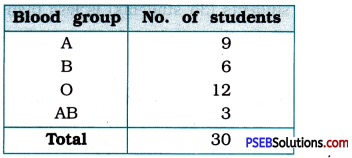
Frequency distribution table
PSEB 9th Class Maths Solutions Chapter 14 Statistics Ex 14.2 1
From the frequency distribution table, it is very clear that the most common blood group is O and the rarest blood group is AB.

PSEB 9th Class Maths Solutions Chapter 14 Statistics Ex 14.2

Question 2.
The distance (in km) of 40 engineers from their residence to their place of work were found as follows:
PSEB 9th Class Maths Solutions Chapter 14 Statistics Ex 14.2 2
Construct a grouped frequency distribution table with class size 5 for the data given above taking the first interval as 0-5 (5 not included). What main features do you observe from this tabular representation?
Answer:
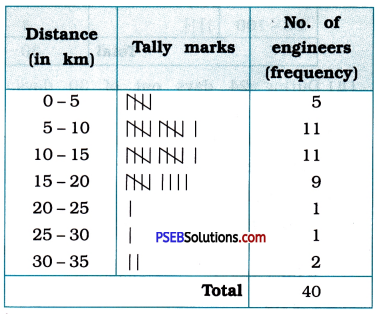
Grouped frequency distribution table
PSEB 9th Class Maths Solutions Chapter 14 Statistics Ex 14.2 3
From the frequency distribution table, we can conclude that for the majority of engineers, s i.e., 31 engineers, the distance from their residence to their place to work is 5 km or more than 5 km but less than 20 km. For some engineers, i.e., 5 engineers, this distance is less than 5 km. Still, for some engineers, i.e., 4 engineers, this distance is 20 km or more than 20 km but less than 35 km.

PSEB 9th Class Maths Solutions Chapter 14 Statistics Ex 14.2

Question 3.
The relative humidity (in %) of a certain city for a month of 30 days was as follows:
PSEB 9th Class Maths Solutions Chapter 14 Statistics Ex 14.2 4
(i) Construct a grouped frequency distribution table with classes 84-86, 86 – 88, etc.
Answer:
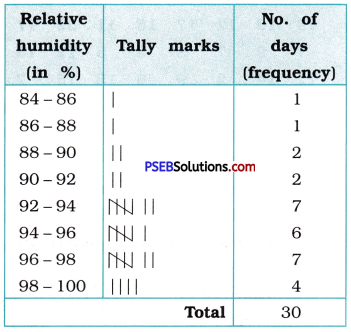
PSEB 9th Class Maths Solutions Chapter 14 Statistics Ex 14.2 5

(ii) Which month or season do you think this data is about ?
Answer:
During 24 days out of 30 days, the relative humidity is 92 % or more than 92 %. This suggests that the data must have been collected during Monsoon.

(iii) What is the range of this data ?
Answer:
Range of the data
= The greatest observation – The least observation
= 99.2 – 84.9
= 14.3

PSEB 9th Class Maths Solutions Chapter 14 Statistics Ex 14.2

Question 4.
The heights of 50 students, measured to the nearest centimetres, have been found to be as follows:
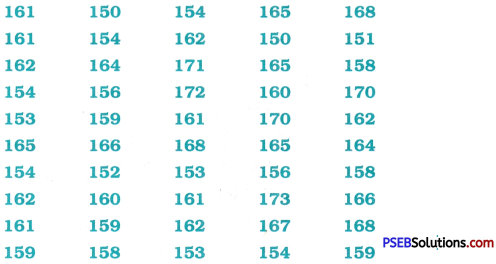
PSEB 9th Class Maths Solutions Chapter 14 Statistics Ex 14.2 6

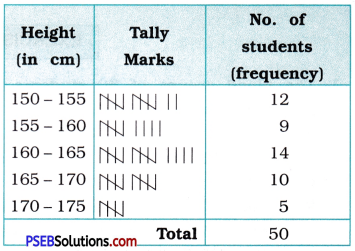
(i) Represent the data given above by grouped frequency distribution table, taking the class intervals as 160 – 165, 165-170, etc.
Answer:
Grouped frequency distribution table
PSEB 9th Class Maths Solutions Chapter 14 Statistics Ex 14.2 7

PSEB 9th Class Maths Solutions Chapter 14 Statistics Ex 14.2

(ii) What can you conclude about their heights from the table?
Answer:
From the above frequency distribution, we can conclude that the height of 70 % students (35 students) is less than 165 cm while the height of only 10 % students (5 students) is 170 cm or more than that.

Question 5.
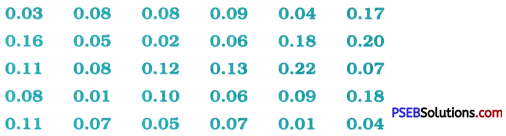
A study was conducted to find out the concentration of sulphur dioxide in the air in parts per million (ppm) of a certain city. The data obtained for 30 days is as follows :
PSEB 9th Class Maths Solutions Chapter 14 Statistics Ex 14.2 8

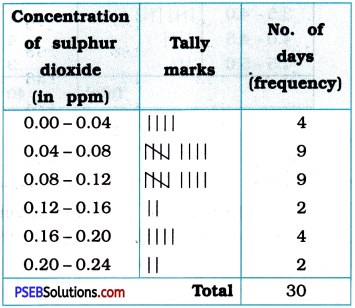
(i) Make a grouped frequency distribution table for this data with class intervals as 0.00-0.04, 0.04-0.08, and so on.
Answer:
PSEB 9th Class Maths Solutions Chapter 14 Statistics Ex 14.2 9

PSEB 9th Class Maths Solutions Chapter 14 Statistics Ex 14.2

(ii) For how many days, was the concentration of sulphur dioxide more than 0.11 parts per million?
Answer:
The concentration of sulphur dioxide was more than 0.11 ppm for 8 days (2 + 4 + 2).

Question 6.
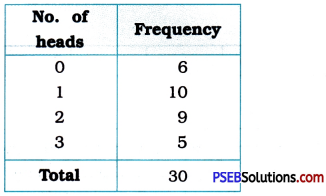
Three coins were tossed 30 times simultaneously. Each time the number of heads occurring was noted down as follows:
PSEB 9th Class Maths Solutions Chapter 14 Statistics Ex 14.2 10
Prepare a frequency distribution table for the data given above.
Answer:
PSEB 9th Class Maths Solutions Chapter 14 Statistics Ex 14.2 11

PSEB 9th Class Maths Solutions Chapter 14 Statistics Ex 14.2

Question 7.
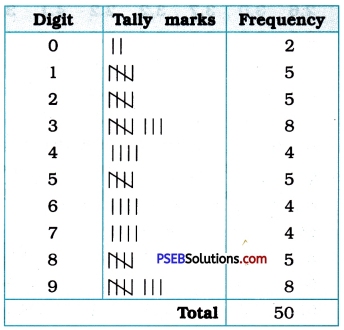
The value of π up to 50 decimal places is given below:
3.1415926535897932384626433832795028 8419716939937510
(i) Make a frequency distribution of the digits from 0 to 9 after the decimal point.
Answer:
Frequency distribution table
PSEB 9th Class Maths Solutions Chapter 14 Statistics Ex 14.2 12

(ii) Which are the most and the least frequently occurring digits?
Answer:
The most frequently occurring digits are 3 and 9 (8 times each) and the least occurring digit is 0 (2 times).

PSEB 9th Class Maths Solutions Chapter 14 Statistics Ex 14.2

Question 8.
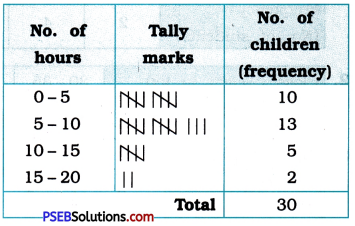
Thirty children were asked about the number of hours they watched TV programmes in the previous week. The results were found as follows:
PSEB 9th Class Maths Solutions Chapter 14 Statistics Ex 14.2 13
(i) Make a grouped frequency distribution table for this data, taking class width 5 and one of the class intervals as 5-10.
Answer:
PSEB 9th Class Maths Solutions Chapter 14 Statistics Ex 14.2 14

(ii) How many children watched television for 15 or more hours a week?
Answer:
Two children watched television for 15 or more hours a week.

PSEB 9th Class Maths Solutions Chapter 14 Statistics Ex 14.2

Question 9.
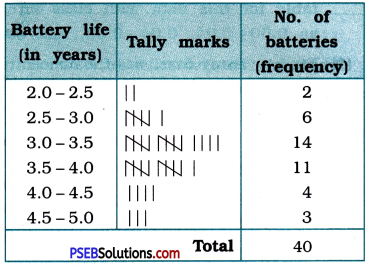
A company manufactures car batteries of a Grouped frequency distribution table particular type. The lives (in years) of 40 such batteries were recorded as follows
PSEB 9th Class Maths Solutions Chapter 14 Statistics Ex 14.2 15
Construct a grouped frequency distribution table for this data, using class intervals of size 0.5 starting from the interval 2 – 2.5.
Answer:
PSEB 9th Class Maths Solutions Chapter 14 Statistics Ex 14.2 16

PSEB 9th Class Maths Solutions Chapter 14 Statistics Ex 14.1

Punjab State Board PSEB 9th Class Maths Book Solutions Chapter 14 Statistics Ex 14.1 Textbook Exercise Questions and Answers.

PSEB Solutions for Class 9 Maths Chapter 14 Statistics Ex 14.1

Question 1.
Give five examples of data that you can collect from your day-to-day life.
Answer:
Five examples of data that can be collected from day-to-day life can be given as below:

  1. Election results obtained from newspapers or TV
  2. The number of different kinds of trees grown in our school.
  3. Amounts of invoices of electricity for last one year at our home.
  4. The number of students studying in different standards of our school.
  5. Percentage of marks scored at last examination by the students in our class.

PSEB 9th Class Maths Solutions Chapter 14 Statistics Ex 14.1

Question 2.
Classify the data in Q. 1 above as primary or secondary data.
Answer:
Among the five data given as the answer to Q. 1, data no.

Primary data:

  • The number of different kinds of trees grown in our school.
  • Amounts of invoices of electricity for last one year at our home.
  • Percentage of marks scored at last examination by the students in our class.
  • primary data which we can collect ourselves.

Secondary data:

  • Election results obtained from newspapers or TV
  • The number of students studying in different standards of our school.
  • Secondary data as they are received from the sources of the newspapers or TV or the office of our school.

PSEB 9th Class Maths MCQ Chapter 13 Surface Areas and Volumes

Punjab State Board PSEB 9th Class Maths Book Solutions Chapter 13 Surface Areas and Volumes MCQ Questions with Answers.

PSEB 9th Class Maths Chapter 13 Surface Areas and Volumes MCQ Questions

Multiple Choice Questions and Answer

Answer each question by selecting the proper alternative from those given below each question to make the statement true:

Question 1.
The total surface area of a cuboid with length 20 cm, breadth 15 cm and height 10 cm is
A. 1300
B. 650
C. 3000
D. 1500
Answer:
A. 1300

PSEB 9th Class Maths MCQ Chapter 13 Surface Areas and Volumes

Question 2.
The lateral surface area of a cuboid with length 15 cm, breadth 8 cm and height 5 cm is ………………. cm2.
A. 115
B. 230
C. 600
D. 300
Answer:
B. 230

Question 3.
The diameter of a cylinder is 7 cm and its curved surface area is 220 cm2. Then, its height is ……………….. cm.
A. 35
B. 10
C. 44
D. 20
Answer:
B. 10

PSEB 9th Class Maths MCQ Chapter 13 Surface Areas and Volumes

Question 4.
The total surface area of a closed cylinder with radius 3.5 cm and height 6.5 cm is ………………… cm2.
A. 110
B. 220
C. 330
D. 440
Answer:
B. 220

Question 5.
The curved surface area of a cone is 880 cm2. If its slant height is 20 cm, then its diameter is …………………… cm.
A. 14
B. 7
C. 3.5
D. 28
Answer:
D. 28

Question 6.
The curved surface area of a cone with diameter 14 cm and slant height 10 cm is ………………. cm2.
A. 220
B. 1540
C. 110
D. 440
Answer:
A. 220

PSEB 9th Class Maths MCQ Chapter 13 Surface Areas and Volumes

Question 7.
The height of a cone is 24 cm and its slant height is 25 cm. Then, its diameter is ………………. cm.
A. 14
B. 7
C. 4
D. 49
Answer:
A. 14

Question 8.
The circumference of the base of a cone is 44 cm and its slant height is 15 cm. Then, its curved surface area is ……………….. cm2.
A. 14
B. 154
C. 330
D. 115
Answer:
C. 330

PSEB 9th Class Maths MCQ Chapter 13 Surface Areas and Volumes

Question 9.
The diameter of a cone is 7 cm and its slant ! height is 16.5 cm. Then, its total surface area is …………………. cm2.
A. 110
B. 220
C. 105
D. 154
Answer:
B. 220

Question 10.
Total surface area of a hemisphere with radius 7 cm is ………………….. cm2.
A. 231
B. 115.5
C. 462
D. 154
Answer:
C. 462

Question 11.
Total surface area of a hemisphere is 72 cm2.
Then, its curved surface area is ………………….. cm2.
A. 24
B. 36
C. 48
D. 72
Answer:
C. 48

PSEB 9th Class Maths MCQ Chapter 13 Surface Areas and Volumes

Question 12.
The surface area of a sphere is 616 cm2.
Then, its radius is ……………. cm.
A. 6
B. 8
C. 7
D. 14
Answer:
C. 7

Question 13.
In a cuboid, the area of the face with sides length and breadth is 120 cm2. If the height of the cuboid is 5 cm, then its volume is …………………… cm3
A. 120
B. 240
C. 600
D. 300
Answer:
C. 600

PSEB 9th Class Maths MCQ Chapter 13 Surface Areas and Volumes

Question 14.
The volume of a cylinder is 2200 cm3 and its height is 7 cm. Then, the radius of the cylinder is ……………….. cm.
A. 5
B. 15
C. 10
D. 20
Answer:
C. 10

Question 15.
The radius and height of a cone are 7 cm and 3 cm respectively. Then, the volume of the cone is ……………… cm3.
A. 154
B. 168
C. 148
D. 462
Answer:
A. 154

PSEB 9th Class Maths MCQ Chapter 13 Surface Areas and Volumes

Question 16.
The volume of a sphere is 4.5 π cm3. Then, its diameter is …………………. cm.
A. 3
B. 2
C. 1.5
D. 4
Answer:
A. 3

Question 17.
The ratio of radii of two cones is 2 : 3 and the ratio of their heights is 9:4. Then, the ratio of their volumes is
A. 1 : 1
B. 3 : 2
C. 1 : 3
D. 2 : 3
Answer:
A. 1 : 1

PSEB 9th Class Maths MCQ Chapter 13 Surface Areas and Volumes

Question 18.
The circumference of the base of a cone is 44 cm and its height is 6 cm. Then, its volume is ………………… cm3.
A. 49
B. 98
C. 308
D. 154
Answer:
C. 308

PSEB 9th Class Maths Solutions Chapter 13 Surface Areas and Volumes Ex 13.8

Punjab State Board PSEB 9th Class Maths Book Solutions Chapter 13 Surface Areas and Volumes Ex 13.8 Textbook Exercise Questions and Answers.

PSEB Solutions for Class 9 Maths Chapter 13 Surface Areas and Volumes Ex 13.8

Question 1.
Find the volume of a sphere whose radius is
(i) 7 cm
Answer:
For the given sphere, radius r = 7 cm.
Volume of a sphere
= \(\frac{4}{3}\) πr3
= \(\frac{4}{3}\) × \(\frac{22}{7}\) × 7 × 7 × 7 cm3
= \(\frac{4312}{3}\) cm3
= 1437\(\frac{1}{3}\) cm3

PSEB 9th Class Maths Solutions Chapter 13 Surface Areas and Volumes Ex 13.8

(ii) 0.63 m.
Answer:
For the given sphere, radius r = 0.63 m.
Volume of a sphere
= \(\frac{4}{3}\) πr3
= \(\frac{4}{3}\) × \(\frac{22}{7}\) × 0.63 × 0.63 × 0.63 m3
= 1.05 m3 (approx.)

Question 2.
Find the amount of water displaced by a solid spherical ball of diameter
(i) 28 cm
(ii) 0.21 m
Answer:
Amount of water displaced by a solid spherical ball = Volume of spherical ball

(i) For the given spherical ball, diameter 28
radius r = \(\frac{\text { diameter }}{2}\) = \(\frac{28}{2}\) cm = 14 cm
Volume of spherical ball
= \(\frac{4}{3}\) πr3
= \(\frac{4}{3}\) × \(\frac{22}{7}\) × 14 × 14 × 14 cm3
= \(\frac{34496}{3}\) cm3
= 11498\(\frac{2}{3}\) cm3
Thus, the amount of water displaced by the given solid spherical ball is = 11498\(\frac{2}{3}\) cm3

PSEB 9th Class Maths Solutions Chapter 13 Surface Areas and Volumes Ex 13.8

(ii) For the given spherical ball, diameter 28
radius r = \(\frac{\text { diameter }}{2}\) = \(\frac{0.21}{2}\) m
Volume of spherical ball
= \(\frac{4}{3}\) πr3
= \(\frac{4}{3}\) × \(\frac{22}{7}\) × \(\frac{0.21}{2}\) × \(\frac{0.21}{2}\) × \(\frac{0.21}{2}\) m3
= 11 × 0.01 × 0.21 × 0.21 m3
= 0.004851 m3
Thus, the amount of water displaced by the given solid spherical ball is 0.004851 m3.

Question 3.
The diameter of a metallic ball is 4.2 cm. What is the mass of the ball, if the density of the metal is 8.9g per cm3?
Answer:
For the given spherical ball,
radius r = \(\frac{\text { diameter }}{2}\)
= \(\frac{4.2}{2}\) cm
= 2.1 cm
= \(\frac{21}{10}\) cm
Volume of a sphere
= \(\frac{4}{3}\) πr3
= \(\frac{4}{3}\) × \(\frac{22}{7}\) × \(\frac{21}{10}\) × \(\frac{21}{10}\) × \(\frac{21}{10}\) cm3
= 38.808 cm3
Now, the density of the metal of the ball is 8.9 g per cm3.
∴ Mass of the ball = Volume × Density
= 38.808 cm3 × 8.9 g/cm3
= 345.39 g (approx.)
Thus, the mass of the metallic ball is 345.39 g (approx.).

PSEB 9th Class Maths Solutions Chapter 13 Surface Areas and Volumes Ex 13.8

Question 4.
The diameter of the moon is approximately one-fourth of the diameter of the earth. What fraction of the volume of the earth is the volume of the moon ?
Answer:
As the diameter of the moon is one-fourth of the diameter of the earth, the radius of the moon is also one-fourth of the radius of the earth. In other words, the radius of the earth is four times the radius of the moon. Let, the radius of the moon be r and the radius of the earth be R.
Then, R = 4r
Now, \(=\frac{\text { volume of the moon }}{\text { volume of the earth }}\) = \(\frac{\frac{4}{3} \pi r^{3}}{\frac{4}{3} \pi R^{3}}\)
= \(\left(\frac{r}{R}\right)^{3}\)
= \(\left(\frac{r}{4 r}\right)^{3}\)
= \(\left(\frac{1}{4}\right)^{3}\)
= \(\frac{1}{64}\)
∴ Volume of the moon
= \(\frac{1}{64}\) × Volume of the earth
Thus, the volume of the moon is \(\frac{1}{64}\) times the volume of the earth.

Question 5.
How many litres of milk can a hemispherical bowl of diameter 10.5 cm hold?
Answer:
For the hemispherical bowl,
radius r = \(\frac{\text { diameter }}{2}\)
= \(\frac{10.5}{2}\) cm
= 5.25 cm
= \(\frac{21}{4}\) cm
Capacity of the hemispherical bowl
= Volume of a hemisphere
= \(\frac{2}{3}\) πr3
= \(\frac{2}{3} \times \frac{22}{7} \times \frac{21}{4} \times \frac{21}{4} \times \frac{21}{4}\) cm3
= 303.19 cm3 (approx.)
= \(\frac{303.19}{1000}\) liters (approx.)
= 0.303 liters (approx)
Thus, the given hemispherical bowl can hold 0. 303 litres (approx.) of milk.

PSEB 9th Class Maths Solutions Chapter 13 Surface Areas and Volumes Ex 13.8

Question 6.
A hemispherical tank is made up of an iron sheet 1 cm thick. If the inner radius is 1 m, then find the volume of the iron used to make the tank.
Answer:
For the hemispherical tank, inner radius r = 1 m and the thickness of the iron sheet = 1 cm = 0.01 m.
∴ For the hemispherical tank, outer radius
R = 1 + 0.01 m = 1.01 m.
Volume of the iron used in the tank
= Volume of outer hemisphere – Volume of Inner hemisphere
= \(\frac{2}{3}\) πR3 – \(\frac{2}{3}\) πr3
= \(\frac{2}{3}\) π (R3 – r3)
= \(\frac{2}{3}\) × \(\frac{22}{7}\) (1.013 – 13) m3
= \(\frac{44}{21}\) (1.030301 – 1) m3
Thus, the volume of the iron used to make the tank is 0.06349 m3 (approx.).

Question 7.
Find the volume of a sphere whose surface area is 154 cm2.
Answer:
For the given sphere, surface area = 154 cm2.
Surface area of a sphere = 4πr2
∴ 154 cm2 = 4 × \(\frac{22}{7}\) × r2cm2
∴ r2 = \(\frac{154 \times 7}{4 \times 22}\) cm2
∴ r2 = \(\frac{49}{4}\) cm2
∴ r = \(\frac{7}{2}\)
Thus, the radius of the given sphere is \(\frac{7}{2}\) cm.
Volume of a sphere
= \(\frac{4}{3}\) πr3
= \(\frac{4}{3} \times \frac{22}{7} \times \frac{7}{2} \times \frac{7}{2} \times \frac{7}{2}\) cm3
= \(\frac{539}{3}\) cm3
= 179\(\frac{2}{3}\) cm3
Thus, the volume of the given sphere is 179\(\frac{2}{3}\) cm3.

PSEB 9th Class Maths Solutions Chapter 13 Surface Areas and Volumes Ex 13.8

Question 8.
A dome of a building is in the form of a hemisphere. From inside, it was white washed at the cost of ₹ 4989.60. If the s cost of whitewashing is ₹ 20 per square metre, find the
(i) inside surface area of s the dome.
Answer:
(i) Area of the region whitewashed at the
cost of ₹ 20 = 1 m2
∴ Area of the region whitewashed at the cost of ₹ 4989.60 = \(\frac{4989.60}{20}\) m2 = 249.48 m2
Hence, the inner surface area of the dome is 249.48 m2

(ii) volume of the air inside the dome.
Answer:
Curved surface area of hemispherical dome = 2πr2
∴ 249.48 m2 = 2 × \(\frac{22}{7}\) × r2 m2
∴ r2 = \(\frac{249.48 \times 7}{2 \times 22}\) m2
∴ r2 = 39.69 m2
∴ r2 = \(\sqrt{39.69}\) m
∴ r = 6.3 m
Thus. the radius of the hemispherical dome is 6.3m.
Volume of air inside the hemispherical dome = Volume of a hemisphere
= \(\frac{2}{3}\) πr3
= \(\frac{2}{3}\) × \(\frac{22}{7}\) × 6.3 × 6.3 × 6.3 m3
= 523.908 m3
= 5239 m3 (approx.)
Thus, the volume of the air inside the dome is 523.9 m3 (approx.).

PSEB 9th Class Maths Solutions Chapter 13 Surface Areas and Volumes Ex 13.8

Question 9.
Twenty-seven solid iron spheres, each of radius r and surface area S are melted to form a sphere with surface area S’, Find the
(i) radius r’ of the new sphere,
Answer:
(i) 27 solid iron spheres of radius r are melted to form 1 iron sphere of radius r’.
∴ Volume of 1 sphere of radius r’
= Volume of 27 spheres of radius r
∴ \(\frac{4}{3}\) πr’3 = 27 × \(\frac{4}{3}\) πr’3
∴ r’3 = 27r3
∴ r’3 = (3r)3
∴ r’ = 3r

(ii) ratio of S and S’.
Answer:
The surface area of the sphere with radius r is S and the surface area of the sphere with radius r’ is S’.
Then,
\(\frac{\mathrm{s}}{\mathrm{S}^{\prime}}=\frac{4 \pi r^{2}}{4 \pi r^{\prime 2}}=\frac{r^{2}}{r^{\prime 2}}=\frac{r^{2}}{(3 r)^{2}}=\frac{r^{2}}{9 r^{2}}=\frac{1}{9}\) = 1 : 9
Thus, the ratio of S and S’ is 1 : 9.

PSEB 9th Class Maths Solutions Chapter 13 Surface Areas and Volumes Ex 13.8

Question 10.
A capsule of medicine is in the shape of a sphere of diameter 3.5 mm. How much medicine (in mm3) is needed to fill this capsule ?
Answer:
For the spherical capsule, radius r = \(\frac{\text { diameter }}{2}\)
= \(\frac{3.5}{2}\) mm
= 1.75 mm
Capacity of the spherical capsule
= Volume of a sphere
= \(\frac{4}{3}\) πr’3
= \(\frac{4}{3}\) × \(\frac{22}{7}\) × 1.75 × 1.75 × 1.75 mm3
= 22.46 mm3 (approx.)
Thus, 22.46 mm3 (approx.) medicine is needed to fill the given capsule.

PSEB 9th Class Maths Solutions Chapter 13 Surface Areas and Volumes Ex 13.7

Punjab State Board PSEB 9th Class Maths Book Solutions Chapter 13 Surface Areas and Volumes Ex 13.7 Textbook Exercise Questions and Answers.

PSEB Solutions for Class 9 Maths Chapter 13 Surface Areas and Volumes Ex 13.7

Question 1.
Find the volume of the right circular cone with
(i) radius 6 cm, height 7 cm
Answer:
For the given cone, radius r = 6 cm and height h = 7 cm.
Volume of a cone
= \(\frac{1}{3}\) πr2h
= \(\frac{1}{3}\) × \(\frac{22}{7}\) × 6 × 6 × 7 cm3
= 264 cm3

(ii) radius 3.5 cm, height 12 cm
Answer:
For the given cone, radius
r = 3.5 cm = \(\frac{7}{2}\) cm and height h = 12 cm.
Volume of a cone
= \(\frac{1}{3}\) πr2h
= \(\frac{1}{3}\) × \(\frac{22}{7}\) × \(\frac{7}{2}\) × \(\frac{7}{2}\) × 12 cm3
= 154 cm3

PSEB 9th Class Maths Solutions Chapter 13 Surface Areas and Volumes Ex 13.7

Question 2.
Find the capacity in litres of a conical vessel with
(i) radius 7 cm, slant height 25 cm
Answer:
For the given conical vessel, radius r = 7 cm and slant height l = 25 cm.
h = \(\sqrt{l^{2}-r^{2}}\)
= \(\sqrt{25^{2}-7^{2}}\)
= \(\sqrt{625-49}\)
= √576
∴ h = 24 cm
Capacity of conical vessel
= \(\frac{1}{3}\) πr2h
= \(\frac{1}{3}\) × \(\frac{22}{7}\) × 7 × 7 × 24 cm3
= 1232 cm3
= \(\frac{1232}{1000}\) liters
= 1.232 litres

(ii) height 12 cm, slant height 13 cm
Answer:
For the given conical vessel, height
h = 12 cm and slant height l = 13 cm.
r = \(\sqrt{l^{2}-h^{2}}\)
= \(\sqrt{13^{2}-12^{2}}\)
= \(\sqrt{169-144}\)
= \(\sqrt{25}\)
∴ r = 5 cm
Capacity of conical vessel
= \(\frac{1}{3}\) πr2h
= \(\frac{1}{3}\) × \(\frac{22}{7}\) × 5 × 5 × 12 cm3
= \(\frac{6600}{21}\)
= \(\frac{6600}{21 \times 1000}\) liters
= \(\frac{11}{35}\) liters

PSEB 9th Class Maths Solutions Chapter 13 Surface Areas and Volumes Ex 13.7

Question 3.
The height of a cone is 15 cm. If its volume is 1570 cm3, find the radius of the base. (Use π = 3.14.)
Answer:
For the given cone, height h = 15 cm and
volume = 1570 cm3.
Volume of a cone = \(\frac{1}{3}\) πr2h
∴ 1570 cm3 = \(\frac{1}{3}\) × 3.14 × r2 × 15 cm3
∴ 1570 cm3 = 15.7 × r2 cm3
∴ r2 = \(\frac{1570}{15.7}\) cm2
∴ r2 = 100 cm2
∴ r = 10 cm

Question 4.
If the volume of a right circular cone of height 9 cm is 48 πcm3, find the diameter of its base.
Answer:
For the given right circular cone, height h = 9 cm and volume = 48 πcm3
Volume of a cone = \(\frac{1}{3}\) πr2h
∴ 48π cm3 = \(\frac{1}{3}\) × π × r2 × 9 cm3
∴ r2 = \(\frac{48 \pi \times 3}{\pi \times 9}\) cm2
∴ r2 = 16 cm2
∴ r2 = 16 cm2
∴ r = 4 cm
Now, diameter = 2r = 2 × 4 cm = 8 cm
Thus, the diameter of the right circular cone is 8 cm.

PSEB 9th Class Maths Solutions Chapter 13 Surface Areas and Volumes Ex 13.7

Question 5.
A conical pit of top diameter 3.5 m is 12 m deep. What is its capacity in kiloliters ?
Answer:
For the given conical pit,
radius r = \(\frac{\text { diameter }}{\mathbf{2}}\) = \(\frac{3.5}{2}\) m = \(\frac{35}{2}\) m
and height (depth) h = 12 m
Capacity of the conical pit
= Volume of the cone
= \(\frac{1}{3}\) πr2h
= \(\frac{1}{3}\) × \(\frac{22}{7}\) × \(\frac{35}{20}\) × \(\frac{35}{20}\) × 12 m3
= 38.5 m3
= 38.5 kilioliters

Question 6.
The volume of a right circular cone is 9856 cm3. If the diameter of the base is 28 cm, find
(i) height of the cone,
(ii) slant height of the cone and
(iii) curved surface area of the cone.
Answer:
For the given right circular cone,
radius r = \(\frac{\text { diameter }}{2}\) = \(\frac{28}{2}\) cm = 14 cm and
volume = 9856 cm3.

(i) Volume of a cone = \(\frac{1}{3}\) πr2h
∴ 9856 cm3 = \(\frac{1}{3}\) × \(\frac{22}{7}\) × 14 × 14 × h
∴ h = \(\frac{9856 \times 3 \times 7}{22 \times 14 \times 14}\) cm
∴ h = 48 cm

(ii) l = \(\sqrt{h^{2}+r^{2}}\)
= \(\sqrt{48^{2}+14^{2}}\)
= \(\sqrt{2304+196}\)
= \(\sqrt{2500}\)
∴ l = 50 cm

PSEB 9th Class Maths Solutions Chapter 13 Surface Areas and Volumes Ex 13.7

(iii) Curved surface area of a cone
= πrl
= \(\frac{22}{7}\) × 14 × 50 cm2
= 2200 cm2

Question 7.
A right triangle ABC with sides 5 cm, 12 cm and 13 cm is revolved about the side 12 cm.. Find the volume of the solid so obtained.
Answer:
A right circular cone is received when ∆ ABC with sides 5 cm, 12 cm and 13 cm is revolved about the side 12 cm.
For the cone so obtained, radius r = 5 cm, height h = 12 cm and slant height l = 13 cm.
Volume of the cone obtained
= \(\frac{1}{3}\) πr2h
= \(\frac{1}{3}\) × π × 5 × 5 × 12 cm3
= 100π cm3

PSEB 9th Class Maths Solutions Chapter 13 Surface Areas and Volumes Ex 13.7

Question 8.
If the triangle ABC in the Question 7 above is revolved about the side 5 cm, then find the volume of the solid so obtained. Find also the ratio of the volumes of the two ‘solids obtained in Questions 7 and 8.
Answer:
Now, if ∆ ABC with sides 5 cm, 12 cm and 13 cm is revolved about the side 5 cm, again a right circular cone is received.
For the cone so obtained, radiqs r = 12cm; height h = 5 cm and slant height l = 13 cm.
Volume of the cone obtained
= \(\frac{1}{3}\) πr2h
= \(\frac{1}{3}\) × π × 12 × 12 × 5 cm3
= 240π cm3
Ratio of the volumes of two cones obtained in question 7 and 8 = \(\frac{100 \pi}{240 \pi}\) = \(\frac{5}{12}\) = 5 : 12.

PSEB 9th Class Maths Solutions Chapter 13 Surface Areas and Volumes Ex 13.7

Question 9.
A heap of wheat is in the form of a cone whose diameter is 10.5 m and height is 3 m. Find its volume. The heap is to be covered by canvas to protect it from rain. Find the area of the canvas required.
Answer:
For the conical heap of wheat,
radius r = \(\frac{\text { diameter }}{2}\) = \(\frac{10.5}{2}\) m = \(\frac{105}{2}\) m and
height h = 3 m
Volume of the conical heap of wheat
= \(\frac{1}{3}\) πr2h
= \(\frac{1}{3}\) × \(\frac{22}{7}\) × \(\frac{105}{20}\) × \(\frac{105}{20}\) × 3 m3
= 86.625 m3
To cover the heap with canvas, the area of the canvas required will be equal to the curved surface area of the heap.
Now, l = \(\sqrt{r^{2}+h^{2}}\)
= \(\sqrt{\left(\frac{105}{20}\right)^{2}+(3)^{2}}\)
= \(\sqrt{(5.25)^{2}+9}\)
= \(\sqrt{27.5625+9}\)
= \(\sqrt{36.5625}\)
= 6.05 m (approx.)
Curved surface area of the conical heap
= πrl
= \(\frac{22}{7}\) × \(\frac{105}{20}\) × 6.05 m2
= 99.825 m2
Thus, 99.825 m2 canvas is required to cover the conical heap of wheat to protect it from rain.

PSEB 9th Class Maths Solutions Chapter 13 Surface Areas and Volumes Ex 13.6

Punjab State Board PSEB 9th Class Maths Book Solutions Chapter 13 Surface Areas and Volumes Ex 13.6 Textbook Exercise Questions and Answers.

PSEB Solutions for Class 9 Maths Chapter 13 Surface Areas and Volumes Ex 13.6

Question 1.
The circumference of the base of a 7 cylindrical vessel is 132 cm and its height is 25 cm. How many litres of water can it hold? (1000 cm3 = 1l)
Answer:
For the given cylindrical vessel, height h = 25 cm and circumference of the base = 132 cm.
Circumference of base = 2πr
∴ 132 cm = 2 × \(\frac{22}{7}\) × r cm
∴ r = \(\frac{132 \times 7}{2 \times 22}\) cm
∴ r = 21 cm
Hence, for the cylindrical vessel, radius r = 21 cm
Capacity of cylindrical vessel
= Volume of cylinder
= πr2h
= \(\frac{22}{7}\) × 21 × 21 × 25 cm3
= 34650 cm3
= \(\frac{34650}{1000}\) liters
= 34.65 litres
Thus, the cylindrical vessel can hold 34.65 litres of water.

PSEB 9th Class Maths Solutions Chapter 13 Surface Areas and Volumes Ex 13.6

Question 2.
The inner diameter of a cylindrical wooden pipe is 24 cm and its outer diameter is 28 cm. The length of the pipe is 35 cm. Find the mass of the pipe, if 1 cm3 of wood has a mass of 0.6 g.
Answer:
For the cylindrical wooden pipe,
outer radius R = \(\frac{\text { diameter }}{2}\) = \(\frac{28}{2}\) cm = 14 cm,
inner radius r = \(\frac{\text { diameter }}{2}\) = \(\frac{24}{2}\) cm = 12 cm and
height (length) h = 35 cm.
Volume of the cylindrical wooden pipe
= Volume of outer cylinder – Volume of inner cylinder
= πR2h – πr2h
= πh (R2 – r2)
= πh (R + r) (R – r)
= \(\frac{22}{7}\) × 35 × (14 + 12) (14 – 12) cm3
= 110 × 26 × 2 cm3
= 5720 cm3
Now, mass of 1 cm3 of wood = 0.6 g
∴ Mass of 5720 cm3 of wood = 5720 × 0.6 g
= 3432 g
= 3.432 kg
Thus, the mass of the given pipe is 3.432 kg.

PSEB 9th Class Maths Solutions Chapter 13 Surface Areas and Volumes Ex 13.6

Question 3.
A soft drink is available in two packs
(i) a tin can with a rectangular base of length 5 cm and width 4 cm, having a height of 15 cm and
(ii) a plastic cylinder with circular base of diameter 7 cm and height 10 cm.
Which container has greater capacity and by how much?
Answer:
(i) For the cuboidal container with rectangular base, length l = 5 cm; breadth b = 4 cm and height h = 15 cm.
Capacity of the cuboidal container
= Volume of cuboid
= l × b × h
= 5 × 4 × 15 cm3
= 300 cm3

(ii) For the cylindrical container,
radius r = \(\frac{\text { diameter }}{2}\) = \(\frac{7}{2}\) cm and
height h = 10 cm.
Capacity of the cylindrical container = Volume of cylinder
= πr2h
= \(\frac{22}{7} \times \frac{7}{2} \times \frac{7}{2}\) × 10 cm3
= 385 cm3
Hence, the capacity of the cylindrical container is more than the cuboidal container by 385 – 300 = 85 cm3.

Question 4.
If the lateral surface area of a cylinder is 94.2 cm2 and its height is 5 cm, then find
(i) radius of its base and
(ii) its volume. (Use π = 3.14)
Answer:
(i) For the given cylinder, height h = 5 cm and lateral (curved) surface area = 94.2 cm2.
Curved surface area of a cylinder = 2 πrh
∴ 94.2 cm2 = 2 × 3.14 × r × 5 cm2
∴ r = \(\frac{94.2}{2 \times 3.14 \times 5}\) cm
∴ r = 3 cm
Thus, the radius of the cylinder is 3 cm.

PSEB 9th Class Maths Solutions Chapter 13 Surface Areas and Volumes Ex 13.6

(ii) Volume of a cylinder
= πr2h
= 3.14 × 3 × 3 × 5 cm3
= 141.3 cm3
Thus, the volume of the cylinder is 141.3 cm3.

Question 5.
It costs ₹ 2200 to paint the inner curved surface of a cylindrical vessel 10 m deep. If the cost of painting is at the rate of ₹ 20 per m2, find
(i) inner curved surface area of the vessel,
(ii) radius of the base and
(iii) capacity of the vessel.
Answer:
(i) Area of the region painted at the cost of ₹ 20 = 1 m2
∴ Area of the region painted at the cost of ₹ 2200 = \(\frac{2200}{20}\) m2 = 110m2
Thus, the inner curved surface area of the vessel is 110 m2.

(ii) For the cylindrical vessel, height (depth) h- 10 m and curved surface area = 110 m2.
Curved surface area of cylindrical vessel = 2πrh
∴ 110 m2 = 2 × \(\frac{22}{7}\) × r × 10 m2
∴ r = \(\frac{110 \times 7}{2 \times 22 \times 10}\) m
∴ r = \(\frac{7}{4}\) m
∴ r = 1.75 m
Thus, the radius of the cylindrical vessel is 1.75 m.

PSEB 9th Class Maths Solutions Chapter 13 Surface Areas and Volumes Ex 13.6

(iii) Capacity of the cylindrical vessel
= Volume of a cylinder
= πr2h
= \(\frac{22}{7}\) × 1.75 × 1.75 × 10 m3
= 96.25 m3
= 96.25 kilolitres
Thus, the capacity of the cylindrical vessel is 96.25 kilolitres.

Question 6.
The capacity of a closed cylindrical vessel of height 1 m is 15.4 litres. How many square metres of metal sheet would be needed to make it ?
Answer:
For the closed cylindrical vessel, height h = 1 m and capacity = 15.4 litres
∴ Volume of the vessel = 15.4 litres
= \(\frac{15.4}{1000}\) m3
= 0.0154 m3
Volume of cylindrical vessel = πr2h
∴ 0.0154 m3 = \(\frac{22}{7}\) × r2 × 1 m3
∴ r2 = \(\frac{154}{10000} \times \frac{7}{22}\) m2
∴ r2 = \(\frac{49}{10000}\) m2
∴ r2 = \(\frac{7}{100}\) m
∴ r = 0.07 m
Thus, the radius of the cylindrical vessel is 0. 07 m.
Area of the metal sheet required to make closed cylindrical vessel
= Total surface area of a cylinder
= 2πr (r + h)
= 2 × \(\frac{22}{7}\) × 0.07 (0.07 + 1) m2
= 0.44 × 1.07 m2
= 0.4708 m2
Thus, 0.4708 m2 of metal sheet would be needed to make the closed cylindrical vessel.

PSEB 9th Class Maths Solutions Chapter 13 Surface Areas and Volumes Ex 13.6

Question 7.
A lead pencil consists of a cylinder of wood with a solid cylinder of graphite filled in the interior. The diameter of the pencil is 7 mm and the diameter of the graphite is 1 mm. If the length of the pencil is 14 cm, find the volume of the wood and that of the graphite.
Answer:
For the solid cylinder of graphite,
radius r = \(\frac{\text { diameter }}{2}\) = \(\frac{1}{2}\) mm = \(\frac{1}{20}\) cm and
height h = 14 cm.
Volume of cylinder of graphite
= πr2h
= \(\frac{22}{7}\) × \(\frac{1}{20}\) × \(\frac{1}{20}\) × 14 cm3 = 011 cm3
For the hollow cylinder of wood,
outer radius R = \(\frac{\text { diameter }}{2}\) = \(\frac{7}{2}\) mm = \(\frac{7}{20}\) cm,
inner radius r = \(\frac{1}{20}\) cm and height h = 14 cm.
Volume of hollow cylinder of wood
= πR2h – πr2h
= πh (R2 – r2)
= πh (R + r) (R – r)
= \(\frac{22}{7}\) × 14 \(\left(\frac{7}{20}+\frac{1}{20}\right)\left(\frac{7}{20}-\frac{1}{20}\right)\) cm3
= 44 × \(\frac{8}{20}\) × \(\frac{8}{20}\) cm3
= \(\frac{528}{100}\) cm3
= 5.28 cm3
Thus, in the given pencil, the volume of wood is 5.28 cm3 and the volume of graphite is 0.11cm3.

PSEB 9th Class Maths Solutions Chapter 13 Surface Areas and Volumes Ex 13.6

Question 8.
A patient in a hospital is given soup daily in a cylindrical howl of diameter 7 cm. If the bowl is Oiled with soup to a height of 4 cm, how much soup the hospital has ‘ to prepare daily to serve 250 patients ?
Answer:
For the soup served in cylindrical bowl, radius r = \(\frac{\text { diameter }}{2}\) = \(\frac{7}{2}\) cm and height h = 4 cm.
Volume of soup served to one patient = Volume of a cylinder
= πr2h
= \(\frac{22}{7}\) × \(\frac{7}{2}\) × \(\frac{7}{2}\) × 4 cm3
= 154 cm3
Thus, the volume of soup served to 1 patient =154 cm3
∴ The volume of soup served to 250 patients
= 154 × 250 cm3
= 38500 cm3
= \(\frac{38500}{1000}\) litres
= 38.5 litres
Thus, the hospital has to prepare 38500 cm3, i.e., 38.5 litres of soup daily.

PSEB 9th Class Maths Solutions Chapter 13 Surface Areas and Volumes Ex 13.5

Punjab State Board PSEB 9th Class Maths Book Solutions Chapter 13 Surface Areas and Volumes Ex 13.5 Textbook Exercise Questions and Answers.

PSEB Solutions for Class 9 Maths Chapter 13 Surface Areas and Volumes Ex 13.5

Question 1.
A matchbox measures 4 cm × 2.5 cm × 1.5 cm. What will be the volume of a packet containing 12 such boxes ?
Answer:
For the cuboidal matchbox, length l = 4 cm; breadth b = 2.5 cm and height h = 1.5 cm.
Volume of a cuboidal matchbox
= l × b × h
= 4 × 2.5 × 1.5 cm3
= 15 cm3
Then, volume of 12 matchboxes = 12 × 15 cm3 = 180 cm3
Thus, the volume of a packet containing 12 matchboxes is 180 cm3.

PSEB 9th Class Maths Solutions Chapter 13 Surface Areas and Volumes Ex 13.5

Question 2.
A cuboidal water tank is 6 m long, 5 m wide and 4.5 m deep. How many litres of water can it hold? (1 m3 = 1000 l)
Answer:
For the cuboidal water tank, length l = 6m; breadth b = 5 m and height h = 4.5 m.
Capacity of the cuboidal tank = l × b × h
= 6 × 5 × 4.5 m3
= 135 m3
1 m3 = 1000 litres
∴ 135 m3 = 135000 litres
Thus, the given cuboidal water tank can hold 1,35,000 litres of water.

Question 3.
A cuboidal vessel is 10 m long and 8 m wide. How high must it be made to hold 380 cubic metres of a liquid?
Answer:
For the cuboidal vessel, length l = 10 m;
breadth b = 8 m and capacity = 380 m3.
Capacity of a cuboidal vessel = l × b × h
∴ 380 m3 = 10 m × 8 m × h m
∴ h = \(\frac{380}{10 \times 8}\) m
∴ h = 4.75 m
The height of the cuboidal vessel must be made 4.75 m.

PSEB 9th Class Maths Solutions Chapter 13 Surface Areas and Volumes Ex 13.5

Question 4.
Find the cost of digging a cuboidal pit 8 m long, 6 m broad and 3 m deep at the rate of ₹ 30 per m3.
Answer:
For the cuboidal pit, length l = 8m; breadth b = 6 m and height (depth) h = 3 m.
Volume of the earth to be dugout to make the cuboidal pit = Volume of a cuboid
= l × b × h
= 8 × 6 × 3 m3
= 144 m3
Cost of digging out 1 m3 of earth = ₹ 30
∴ Cost of digging out 144 m3 of earth
= ₹ (30 × 144)
= ₹ 4320
Thus, the cost of digging the cuboidal pit is ₹ 4320.

Question 5.
The capacity of a cuboidal tank is 50,000 litres of water. Find the breadth of the tank, if its length and depth are respectively 2.5 m and 10 m.
Answer:
For the cuboidal tank, length l = 2.5 m;
height (depth) h = 10 m and
capacity = 50,000 litres.
1000 litres = 1 m3
∴ 50,000 litres = \(\frac{50,000}{1000}\) m3 = 50 m3
Capacity of cuboidal tank = l × b × h
∴ 50 m3 = 2.5 m × b m × 10 m
∴ b = \(\frac{50}{2.5 \times 10}\) m
∴ b = 2 m
Thus, the breadth of the cuboidal tank is 2 m.

PSEB 9th Class Maths Solutions Chapter 13 Surface Areas and Volumes Ex 13.5

Question 6.
A village, having a population of 4000, requires 150 litres of water per head per day. It has a tank measuring 20 m × 15 m × 6 m. For how many days will the water of this tank last?
Answer:
Total requirement of water per day
= No. of people × daily requirement per person
= 4000 × 150 litres
= 6,00,000 litres
= \(\frac{6,00,000}{1000}\) m3
= 600 m3
For the cuboidal tank, length l = 20 m;
breadth b = 15 m and height h = 6 m
Capacity of the cuboidal tank = l × b × h
= 20 × 15 × 6 m3
= 1800 m3
600 m3 of water can last for 1 day in the village.
∴ 1800 m3 of water can last for \(\frac{1800}{600}\) = 3 days in the village.

Question 7.
A godown measures 40 m × 25 m × 15 m. Find the maximum number of wooden crates each measuring 1.5 m × 1.25 m × 0.5 m that can be stored in the godown.
Answer:
For the cuboidal godown, length l = 40 m;
breadth b = 25 m and height h = 15 m.
Capacity of cuboidal godown = l × b × h
= 40 × 25 × 15 m3
For the wooden cuboidal crate, length l = 1.5 m; breadth b = 1.25 m and height h = 0,5 m.
Volume of 1 cuboidal crate
= l × b × h
= 1.5 × 1.25 × 0.5 m3
∴The no. of crates that can be stored in the godown = \(\)
= \(\left(\frac{40}{1.25}\right) \times\left(\frac{25}{0.5}\right) \times\left(\frac{15}{1.5}\right)\)
= 32 × 50 × 10
= 16,000

PSEB 9th Class Maths Solutions Chapter 13 Surface Areas and Volumes Ex 13.5

Question 8.
A solid cube of side 12 cm is cut into eight cubes of equal volume. What will be the side of the new cube ? Also, find the ratio between their surface areas.
Answer:
For the original cube, edge a =12 cm.
Volume of original cube = a3 = 123 cm3
= 1728 cm3
8 cubes of equal volume are made from the original cube.
∴ Volume of each new cube = \(\frac{1728}{8}\) cm3
= 216 cm3
Let the edge of new cube be A cm.
Volume of new cube = A3
∴ 216 cm3 = A3
∴ A = \(\sqrt[3]{216}\) cm = 6 cm
Thus, the side of each new cube is 6 cm.
Total surface area of original cube
= 6a2
= 6 (12)2 cm2
Total surface area of a new cube = 6A2
= 6 (6)2 cm2
\(\frac{\text { Total surface area of original cube }}{\text { Total surface area of a new cube }}\) = \(\frac{6(12)^{2} \mathrm{~cm}^{2}}{6(6)^{2} \mathrm{~cm}^{2}}\)
= \(\left(\frac{12}{6}\right)^{2}\)
= 4
= 4:1
Thus, the required ratio of the total surface area of the original cube and the total surface area of a new cube is 4:1.
Note: If the ratio of TSA of the original ‘ cube and TSA of all the new cubes is required, then it will be 1 : 2.

PSEB 9th Class Maths Solutions Chapter 13 Surface Areas and Volumes Ex 13.5

Question 9.
A river 3 m deep and 40 m wide is flowing at the rate of 2 km per hour. How much water will fall into the sea in a minute?
Answer:
2 km = 2000 m and 1 hour = 60 minutes
Rate of flow of water in the river
= 2 km/hour
= \(\frac{2000}{60}\) m/min
Thus, during 1 minute, water of length will flow in the sea.
Then, the water falling in sea per minute takes cuboidal shape with length l = \(\frac{2000}{60}\) m,
breadth b = 40 m and height (depth) h = 3 m.
Volume of water falling in sea per minute
= l × b × h
= \(\frac{2000}{60}\) × 40 × 3 m3
= 4000 m3
Thus, 4000 m3 of water will fall into the sea in a minute.

PSEB 9th Class Maths Solutions Chapter 13 Surface Areas and Volumes Ex 13.4

Punjab State Board PSEB 9th Class Maths Book Solutions Chapter 13 Surface Areas and Volumes Ex 13.4 Textbook Exercise Questions and Answers.

PSEB Solutions for Class 9 Maths Chapter 13 Surface Areas and Volumes Ex 13.4

Note: Assume π = \(\frac{22}{7}\), unless stated otherwise.

Question 1.
Find the surface area of a sphere of radius:
(i) 10.5 cm
Answer:
For the given sphere,
radius r = 10.5 cm = \(\frac{21}{2}\) cm.
Surface area of a sphere
= 4πr2
= 4 × \(\frac{22}{7}\) × \(\frac{21}{2}\) × \(\frac{21}{2}\) cm2 = 1386 cm2

PSEB 9th Class Maths Solutions Chapter 13 Surface Areas and Volumes Ex 13.4

(ii) 5.6 cm
Answer:
For the given sphere, radius r = 5.6cm.
Surface area of a sphere
= 4πr2
= 4 × \(\frac{22}{7}\) × 5.6 × 5.6 cm2
= 394.24 cm2

(iii) 14 cm
Answer:
For the given sphere, radius r= 14 cm.
Surface area of a sphere
= 4πr2
= 4 × \(\frac{22}{7}\) × 14 × 14 cm2
= 2464 cm2

Question 2.
Find the surface area of a sphere of diameter:
(i) 14cm
Answer:
For the given sphere, diameter d = 14 cm.
Then, radius r = \(\frac{\text { diameter }}{2}\)
= \(\frac{14}{2}\) cm = 7 cm
Surface area of a sphere
= 4πr2
= 4 × \(\frac{22}{7}\) × 7 × 7 cm2
= 616 cm2

PSEB 9th Class Maths Solutions Chapter 13 Surface Areas and Volumes Ex 13.4

(ii) 21cm
Answer:
For the given sphere, diameter d = 21 cm.
Then, radius r = \(\frac{\text { diameter }}{2}\)
= \(\frac{21}{2}\) cm
Surface area of a sphere
= 4πr2
= 4 × \(\frac{22}{7}\) × \(\frac{21}{2}\) × \(\frac{21}{2}\) cm2
= 1386 cm2

(iii) 3.5 m
Answer:
For the given sphere, diameter d = 3.5 cm.
Then, radius r = \(\frac{\text { diameter }}{2}\)
= \(\frac{3.5}{2}\) m
= \(\frac{35}{20}\) m
Surface area of a sphere
= 4πr2
= 4 × \(\frac{22}{7}\) × \(\frac{35}{20}\) × \(\frac{35}{20}\) m2
= 38.5 m2

Note: We can also use the formula “Surface area of a sphere = πd2” as
4πr2 = π × 4r2 = π × (2r)2 = πd2, where r and d are radius and diameter of the sphere respectively.

Question 3.
Find the total surface area of a hemisphere of radius 10 cm. (Use π =3.14)
Answer:
For the given hemisphere, radius r = 10 cm.
Total surface area of a hemisphere
= 3πr2
= 3 × 3.14 × 10 × 10 cm2
= 942 cm2

PSEB 9th Class Maths Solutions Chapter 13 Surface Areas and Volumes Ex 13.4

Question 4.
The radius of a spherical balloon increases from 7 cm to 14 cm as air is being pumped into it. Find the ratio of surface areas of the balloon in the two cases.
Answer:
For the first case, radius r1 of the spherical balloon is 7 cm.
Surface area of the spherical balloon in the
first case = 4πr12
= 4 × \(\frac{22}{7}\) × 7 × 7cm2
For the second case, radius r2 of the spherical balloon is 14 cm.
Surface area of the spherical balloon in the second case = 4πr22
Then, the required ratio of surface areas in two cases
= \(\frac{4 \times \frac{22}{7} \times 7 \times 7}{4 \times \frac{22}{7} \times 14 \times 14}\)
= \(\frac{1}{4}\) = 1 : 4
Thus, the required ratio is 1 : 4.
Note: Here, the ratio of radii = 7 : 14 = 1 : 2
Hence, the ratio of surface areas = \(\left(\frac{1}{2}\right)^{2}\) = \(\frac{1}{4}\) = 1 : 4, because in the formula of surface area of sphere, the degree of r is 2.

PSEB 9th Class Maths Solutions Chapter 13 Surface Areas and Volumes Ex 13.4

Question 5.
A hemispherical bowl made of brass has inner diameter 10.5 cm. Find the cost of tin-plating it on the inside at the rate of ₹ 16 per 100 cm2.
For the given hemispherical bowl, diameter = 10.5 cm.
Then, the radius r of the bowl = \(\frac{\text { diameter }}{2}\)
= \(\frac{10.5}{2}\) cm
= \(\frac{\frac{21}{2}}{2}\) cm
= \(\frac{21}{4}\) cm
Inner curved surface area of the hemispherical bowl
= 2 πr2
= 2 × \(\frac{22}{7}\) × \(\frac{21}{4}\) × \(\frac{21}{4}\) cm2
= \(\) cm2
= 173.25 cm2
Cost of tin-plating 100 cm2 region = ₹ 16
∴ Cost of tin-plating 173.25 cm2 region
= ₹ \(\left(\frac{16 \times 173.25}{100}\right)\)
= ₹ 27.72
Thus, the cost of tin-plating on the inner surface of the bowl is ₹ 27.72.

PSEB 9th Class Maths Solutions Chapter 13 Surface Areas and Volumes Ex 13.4

Question 6.
Find the radius of a sphere whose surface area is 154 cm2.
Answer:
For the given sphere, surface area = 154 cm2.
Surface area of a sphere = 4 πr2
∴ 154 cm2 = 4 × \(\frac{22}{7}\) × r2 cm2
∴ r2 = \(\frac{154 \times 7}{4 \times 22}\) cm2
∴ r2 = \(\frac{49}{4}\) cm2
∴ r = \(\frac{7}{2}\) cm
∴ r = 3.5 cm
Thus, the radius of the given sphere is 3.5 cm.

Question 7.
The diameter of the moon is approximately one fourth of the diameter of the earth. Find the ratio of their surface areas.
Answer:
Suppose, the diameter of the moon = d1
The diameter of the earth = 4 × d1 = 4d1
Then, the radius of the moon r1 = \(\frac{d_{1}}{2}\) and
the radius of the earth r2 = \(\frac{4 d_{1}}{2}\) = 2d1.
Now, \(\frac{\text { The surface area of the moon }}{\text { The surface area of the earth }}\) = \(\frac{4 \pi r_{1}^{2}}{4 \pi r_{2}^{2}}\)
= \(\frac{r_{1}^{2}}{r_{2}^{2}}\)
= \(\frac{\left(\frac{d_{1}}{2}\right)^{2}}{\left(2 d_{1}\right)^{2}}\)
= \(\frac{d_{1}^{2}}{4} \times \frac{1}{4 d_{1}^{2}}\)
= \(\frac{1}{16}\)
= 1 : 16
Thus, the ratio of the surface area of the moon and the surface area of the earth is 1 : 16.

PSEB 9th Class Maths Solutions Chapter 13 Surface Areas and Volumes Ex 13.4

Question 8.
A hemispherical bowl is made of steel, 0.25 cm thick. The inner radius of the bowl is 5 cm. Find the outer curved surface area of the bowl.
Answer:
For the given hemispherical bowl, the inner radius is 5 cm and the thickness of steel is 0.25 cm.
∴ Outer radius r of the given hemispherical bowl = 5 + 0.25 cm = 5.25 cm.
Curved surface area of a hemisphere
= 2πr2
= 2 × \(\frac{22}{7}\) × 5.25 × 5.25 cm2
= 2 × \(\frac{22}{7}\) × \(\frac{525}{100}\) × \(\frac{525}{100}\) cm2
= \(\frac{693}{4}\) cm2
= 173.25 cm2
Thus, the outer curved surface area of the given hemispherical bowl is 173.25 cm2.

PSEB 9th Class Maths Solutions Chapter 13 Surface Areas and Volumes Ex 13.4

Question 9.
A right circular cylinder just encloses a sphere of radius r (see the given figure). Find :
(i) surface area of the sphere,
(ii) curved surface area of the cylinder,
(iii) ratio of the areas obtained in (i) and (ii).
PSEB 9th Class Maths Solutions Chapter 13 Surface Areas and Volumes Ex 13.4 1
Answer:
Here,
radius of the cylinder = radius of the sphere = r and height of the cylinder h
= 2 × radius of the sphere = 2r
(i) Surface area of the sphere = 4πr2

(ii) Curved surface area of the cylinder
= 2 πrh
= 2 × 1 × r × 2r
= 4 πr2

(iii) Ratio of areas obtained in ( i ) and (ii)
= \(\frac{4 \pi r^{2}}{4 \pi r^{2}}\)
= \(\frac{1}{1}\)
= 1 : 1