The Punjab: A Glimpse Question Answer Class 8 English Solutions Chapter 5 PSEB Solutions

Punjab State Board PSEB 8th Class English Book Solutions Chapter 5 The Punjab: A Glimpse Textbook Exercise Questions and Answers.

Class 8th English Solutions Chapter 5 The Punjab: A Glimpse Question Answers

The Punjab: A Glimpse Class 8 Questions and Answers

Activity 1.

Look up the following words in a dictionary. You should seek the following information about the words and put them in your WORDS notebook.

1. Meaning of the words as used in the lesson (adjective/noun / verb, etc.)
2. Pronunciation (The teacher may refer to the dictionary or a mobile phone for correct pronunciation.)
3. Spellings

recognize pavilion zest invasion
brutal procession irrigate melodious
shrine pilgrimage architect manufacture

PSEB 8th Class English Solutions Chapter 5 The Punjab: A Glimpse

Vocabulary Expansion

Activity 2

Match the words under column A with their antonyms (विपरीतार्थक) under column B.

S. No. A B
1 exit fail
2 lead south
3 raise lower
4 order follow
5 broad slavery
6 north narrow
7 famous request
8 succeed disperse
9 freedom entrance
10 assemble notorious

Answer:
1. exist – entrance
2. lend – follow
3. raise – lower
4. Order – request
5. broad – narrow
6. north-south
7. famous – notorious
8. succeed – fail
9. freedom – slavery
10. assemble – disperse.

Activity 3.

The sentences given below have two blanks each. Two words are given in the brackets after each sentence.

Fill in the blanks choosing the correct word from the brackets.

1. With a …………… face she said, “My purse is ………………. (empty, black)
2. ………….. children have …………… hands. (small, little)
3. That ……………. young man has a ……………. wife. (handsome, beautiful)
4. The …………….. old man spoke in a ……………..voice. (feeble, weak)
5. The of ………….. of our school is a man of …………….. (principal, principles)
6. You should live in ……………. because …………… is strength. (union, unity)
7. He is a …………….. man with a round face and a …………….. forehead. (tall, high)
Answer:
1. blank, empty
2. little, small
3. handsome, beautiful
4. weak, feeble
5. principal, principles
6. unity, union
7. tall, high.

Learning to Read and Comprehend

Activity 4.

Answer each question briefly.

a.. What is special about Bhangra ?
भांगड़ा नृत्य के बारे में विशेष क्या है ?
Answer:
The Bhangra dance is full of energy. It shows the great zest for life of the Punjabis.

b. Why do you think that the Punjabis are self-respecting people ?
आप ऐसे क्यों सोचते हैं कि पंजाबी लोग स्वाभिमानी लोग हैं ?
Answer:
We can say that because Punjabis would never beg or show their back in battle field.

PSEB 8th Class English Solutions Chapter 5 The Punjab: A Glimpse

c. What was Punjab’s role in the struggle for India’s Independence ?
भारत के स्वतन्त्रता संघर्ष में पंजाबियों का क्या योगदान था ?
Answer:
Lala Lajpat Rai, Bhagat Singh, Sukhdev, Udham Singh, Kartar Singh Sarabha and many other Punjabis sacrificed their lives for the sake of their motherland.

d. What did General O’Dwyer do at the Jallianwala Bagh in Amritsar ?
जनरल ओ’डायर ने अमृतसर के जलियांवाला बाग़ में क्या किया ?
Answer:
On April 13, 1919 about 20,000 people had gathered here for a public meeting.General Dyer ordered his riflemen to fire at the crowd.

e. Which states have benefitted from the Bhakra-Nangal Project ?
भाखड़ा-नंगल परियोजना से किन राज्यों को लाभ पहुंचा है ?
Answer:
Punjab, Haryana, Himachal Pradesh, Rajasthan and Gujarat have benefitted from this Project.

f. If. What is the religious importance of Anandpur Sahib ?
आनंदपुर साहिब का क्या धार्मिक महत्त्व है ?
Answer:
In Anandpur Sahib the Khalsa was founded by Guru Gobind Singh Ji. Lakhs of Sikhs gather here every year to celebrate the founding of the Khalsa.

g. Where is Chandigarh situated ? What is it known for ?
चंडीगढ़ कहां स्थित है ? यह किस लिए प्रसिद्ध है ?
Answer:
Chandigarh is situated at the foot of the Shivalik Hills. It is known for its “rose gardens.

h. What are Jalandhar and Ludhiana famous for ?
जालन्धर और लुधियाना किस बात के लिए प्रसिद्ध हैं ?
Answer:
Jalandhar is famous for its sports goods while Ludhiana is famous for its woollen hosiery industry.

PSEB 8th Class English Solutions Chapter 5 The Punjab: A Glimpse

i. Who compiled the holy Sri Guru Granth Sahib ?
पवित्र श्री गुरु ग्रंथ साहिब का संकलन किसने किया ?
Answer:
Sri Guru Arjun Dev Ji, the fifth Guru of the Sikhs, compiled Sri Guru Granth Sahib.

j. What do you know about the holiest shrine of the Sikhs ?
आप सिक्खों के सबसे पवित्र धार्मिक स्थल के विषय में क्या जानते हैं ?
Answer:
Golden Temple of Amritsar is the holiest shrine of Sikhs. It is built in the middle of a tank. It has a golden dome on the top.

Activity 5

Write ‘true’ or ‘false’ for the following statements in the given space.

a. General O’Dwyer lived in Jallianwala Bagh. — False
b. Le Corbusier was a great Indian architect. — False
c. Bhagat Singh was hanged on 13 April 1919. — False
d. The Golden Temple has a tank all around it. — True
e. India became an independent country in 1947. — True
f. The Punjabis have faced many foreign invasions. — True
g. Guru Gobind Singh founded the Khalsa in 1669.– False
h. Lala Lajpat Rai is known as Shaheed-e-Azam of India .– False
i. The Bhakra Dam is 518 feet high and 740 feet wide. — False
j. Fifty per cent of India’s hosiery industry is in Ludhiana. — False
k. Dr. Rajendra Prasad was the President of India in 1953. — True
I. Chandigarh is situated on the left bank of the Sutlej River.– False

Activity 6

Tick (√) the correct choice to complete each sentence.

Question 1.
The Jallianwala Bagh massacre took place in ……
(a) 1919
(6) 1928
(c) 1947
(d) 1926.
Answer:
(a) 1919. (√)

Question 2.
The reorganisation of Punjab took place in …….
(a) 1947
(b) 1950
(c) 1966
(d). 1953.
Answer:
(c) 1966. (√)

Question 3.
Kulu and Manali are parts of …
(a) Haryana
(b) Himachal Pradesh
(c) Jammu and Kashmir
(d) Punjab.
Answer:
(b) Himachal Pradesh. (√)

PSEB 8th Class English Solutions Chapter 5 The Punjab: A Glimpse

Question 4.
Sri Guru Arjun Dev was …………….. of the Sikhs.
(a) the fifth Guru
(b) the sixth Guru
(c) the fourth Guru
(d) the tenth Guru.
Hint :
(a) the fifth Guru. (√)

Learning Language

Subject-Verb Agreement

1. A verb must agree with its subject, number and person i.e. when the subject is singular, the verb must also be singular. When the subject is plural, the verb must be plural. For example :
1. He plays cricket.
2. They play cricket.
3. I am sad.
4. We are sad.
5. A girl is running.
6. Girls are running.
7. A list of boys was prepared.
8. One of my friends has gone to the USA.

Let us look at some more aspects of how the verb should agree with the subject in a sentence.

2. If the subject consists of two or more singular nouns or pronouns joined by ‘and, It take a plural verb.
For example :
(i) Jolly and John were two brothers.
(ii) The poet and the dramatist are being honoured. (Two separate persons).
(iii) Kolkata, Mumbai, Chennai and Delhi are the most important cities of India.
(iv) He and I were present.

Exceptions:
(a) If the nouns refer to the same person or thing or express one idea, the verb is singular.
For example :
(i) The poet and dramatist is being honoured. (same person – one only)
(ii) My friend, philosopher and guide was invited to preside over the function. (same person one only)
(iii) Rice and curry is his favourite dish.
(iv) Slow and steady wins the race.
(v) Bread and butter is wholesome food.

(b) If two singular subjects joined by ‘and are qualified by ‘each’ or ‘every they take a singular verb.
For example :
(i) Every man and every woman desires happiness.
(ii) Each hour and each minute is important.

PSEB 8th Class English Solutions Chapter 5 The Punjab: A Glimpse

3. Sigular subjects connected by ‘or’, ‘either – or’ and ‘neither – nor,’ are following by singular verb.
For example :
(a) No prize or trophy was given to him.
(b) Either Minesh or Parag has won the prize.
(c) Neither Sanjeev nor Amit has gone to school today.

4. When the subjects connected by ‘or’ or ‘nor are of different numbers, the plural subject should be written in the last and it is followed by a plural verb.
For example :
(a) Either Raghu or his parents are to blame.
(b) Neither Parul nor her friends have joined the college.
(c) Neither the headmaster nor the teachers were present there.

5. When the subjects connected by ‘nor’ or ‘or’ ate of different persons, the verb agrees in person with the subject nearest to it.
For example :
(a) Neither you nor Rosy is responsible for our defeat.
(b) Neither you not Rahul seems to be interested in this plan.
(c) Neither Neelu nor I have any money to buy a house.

6. When the subject consists of two nouns or pronouns joined by ‘with’ or ‘as well as’, the verb agrees with the first of them.
For examples :
(a) All the students with their teacher, were present at the show.
(b) He with all his friends, was ready to do or die.
(c) They as well as I are sick of his behaviour.
(d) Good leaders as well as a responsible public are essential for the success of democracy

7. When two subjects are connected by ‘not only … ‘but also’, the verb agrees with the second subject.
For example :
(a) Not only the master but his servants have also been badly wounded.
(b) Not only the soldiers but the captain has also been arrested.

8. When the subject is the formal ‘there’, the verb agrees with the real subject that follows it.
For example :
(a) There is no hope of his success.
(b) There were many difficulties to be removed.

PSEB 8th Class English Solutions Chapter 5 The Punjab: A Glimpse

9. ‘Either’, ‘neither’, ‘each, “.everyone’, ‘one of the take a singular verb.
For example :
(a) Neither of the two books was interesting.
(b) Everyone of these workers is an expert.
(c) One of the students is differently abled.
(d) Each of these two girls is intelligent.
(e) Either of these two boys is fit for this work.

10. Nouns which are plural. in form but singular in meaning should be followed by singular verbs.
For example :
(a) Mathematics is my favourite subject.
(b) Politics is a dirty game.
(c) The wages of sin is death.
(d) The news is too good to be true.
(e) Gulliver’s Travels’ is an interesting book.

11. Collective noun (crew, jury, committee) is followed by a singular verb when the group is thought of as a single unit. But when individual members of the group are referred to, the plural verb is used.
For example :
(a) A committee was appointed to suggest some reforms.
(b) The committee were divided on the issue.
(c) The jury was unanimous in its verdict.
(d) The jury were divided in their opinions.

12. When the subject of a verb is a relative pronoun, the verb agrees in number and person with the antecedent of the relative pronoun.
For example :
(a) The boy, who always stands first, is my son.
(b) The time, which is lost, is lost forever.
(c) I, who am your friend, will certainly help you.
(d) This is one of the most interesting books that have (not has) ever appeared.

PSEB 8th Class English Solutions Chapter 5 The Punjab: A Glimpse

13. When the subject is a sum of money considered as a whole, a singular verb is used. If the subject is a sum of money and it refers to the notes or coins considered separately, a plural verb is used.
For example :
(a) Hundred rupees is not a small amount.
(b) Hundred rupees were found in his purse.
(c) Five thousand rupees is a good price for this camera.
(d) There were fifty rupees in his pocket.
(e) There are ten silver rupees in my box.

Activity 7.

Select the correct verb from the brackets to fill in the blanks.

1. The tallest of these boys ………………. next door to me. (live, lives)
2. All the players in my team ……………… done well. (has, have)
3. The toys that were bought by Anil … ………….. really useful. (are, is)
4. He ……………… regularly. (walk, walks).
5. Slow and steady …… ………… the race. (win, wins)
6. Time and tide ……………… for none. (wait, waits)
7. Oil and water ……………. mix. (does not, do not).
8. Tobacco and alcohol ……………. injurious to health. (is, are)
9. Either Ashok or Rakesh ………………. done this mischief. (has, have)
10. Either you or he ……………… mistaken. (is, are)
11. Neither the judge nor the witnesses ……………… him. (believe, believes)
12. Neither the Captain nor the soldiers …………… been arrested. (has, have)
13. Either he or I …………….. wrong. (am, are)
14. He as well as you ………………. innocent. (is, are)
15. Each day and each hour …………….. its own importance. (has, have)
16. Either of these two proposals ………………. acceptable to me. (is, are)
17. The jury ………………. divided in their opinion. (was, were)
18. The assembly ………………. in session. (is, are).
19. I am the one who ……………. always stood for justice. (has, have)
20. This is one of the most difficult lessons that ……. …….. been taught. (has, have)
Answer:
1. lives
2. have
3. are
4. walks
5. wins
6. wait
7. do not
8. are
9. has
10. is
11. believe
12. been arrested
13. am
14. is
15. has
16. is
17. were
18. is
19. have
20. has.

PSEB 8th Class English Solutions Chapter 5 The Punjab: A Glimpse

Activity 8.

Listen to the words spoken by your teacher. Each word will be spoken twice. You will repeat after her/him. The teacher must check the pronunciation from the dictionary.
Answer:
1. February
2. Wednesday
3. Clothes
4. Desk
5. Library
6. Suite
7. April
8. Arithmetic
9. Bear
10. Plumber
11. Cleanliness
12. Creature
13. Debris
14. Depot
15. Develop
16. Hotel
17. Photography
18. Democracy
19. Police
20. Tortoise

Learning to Write

Paragraph Writing

A paragraph is a group of sentences that are written on a topic. It requires unity, order, coherence amnd completeness of an idea. When we write a paragraph, we should focus on one idea. Let us write a paragraph on a ‘A Picnic’ we went for.

A School Picnic
Picnic — Look forward to — all excited — woke up early – packed food — reached in time — teachers accompanied — bus started — enjoyed – reached the spot – took swings – high spirits —- took lunch — great fun — journey back — reached home – a day worth – remembering.

Picnic is one thing that we all always look forward to. This time, it was announced that we would go on a school picnic to the local city garden. We were all very excited.

On the day of the picnic, I woke up early. My mother packed a lot of food items for me and my friends. We reached school in time to board the bus. Our English teacher and sports teacher were accompanying us. The bus started at 8 a.m. We enjoyed the journey and had great fun singing songs.

PSEB 8th Class English Solutions Chapter 5 The Punjab: A Glimpse

Finally, we reached the garden. It was very peaceful there. The weather was also very pleasant. We got busy on swings and started running and playing. We were all in high spirits. In the afternoon, we had lunch. We shared our food with each other. After lunch, our teachers made us play many games. It was fun. We laughed and enjoyed ourselves. Soon it was evening and time to go back. We boarded the bus again and reached home by 7. It was a memorable day and I am going to cherish it forever.

Activity 9.

Write a paragraph on Our School Library using the hints given below :
Answer:
School a temple of learning–library the most useful place a big library in my school – more than 50,000 books – kept subjectwise – story books and comics-newspapers and magazines – librarian very helpful and kind – enjoy going to the library

Our School Library

A school is a temple of learning. A library is an altar in it. My school too has a big library. It is housed in a cornor. It has about 50,000 books in it. The books are kept subject-wise. They are kept in almirahs with glass-panes. The library has a number of newspapers and magazines too.

They are in Punjabi, Hindi and English. We can borrow books from the library. But no student can keep a book for more than fifteen days. The librarian is very helpful, kind and gentle. But he is very strict. He maintains perfect silence and discipline in the library. We go to the library thrice a week. We read newspapers and magazines. The library is really very useful to all of us.

Activity 10.

Write a paragraph on ‘An Indian Farmer’ looking at the hints given below :
Answer:
India land of villages–agriculture major profession-agriculture is lifeline of Indian economy-keeps the Indian economy prospering – the citizens with food-grows food grains, vegetables and fruits-grows cotton – works from morning to evening-provides employment – 40% of Indian farmers – requires a lot of labour – difficult task requires discipline and patience-grows crops for our country – crop is his wealth – important place in society – backbone of India – very useful member of the society

An Indian Farmer India is a land of villages. Most of the villagers are farmers. Therefore agriculture plays the most important role in the Indian economy. It is called the lifeline of Indian economy. It keeps the economy of the country prospering. Agriculture provides the citizens with food. About 40% of Indian farmers get their livehood. It provides employment directly through farming to many other people also. On the whole Indian farmer and farming together keep our economy alive. Farmers work hard (Hera) labour in their fields and grow various crops. Therefore, Indian farmer enjoys an important place in the society. He is the backbone of India.

Comprehension of Passage

Read the following passage and answer the questions given below each :

(1) According to the history of Punjab, the Punjabis have faced all the foreign invasions boldly. During the struggle for India’s freedom, Punjab gave the country great heroes. They included patriots such as Lala Lajpat Rai, Bhagat Singh, Sukhdev, Udham Singh, Kartar Singh Sarabha and many others. We call Lala Lajpat Rai Sher-e-Punjab and Bhagat Singh Shaheed-e-Azam. All these brave sons of Punjab sacrificed their lives for their country. Lala Lajpat Rai died as a result of the brutal lathi charge while he was leading a procession against the British in 1928. Bhagat Singh, Sukhdev and Rajguru were hanged for raising their voice against the British cruelties. Bhagat Singh was just 26 years old then.

1. What led to Lala Lajpat Rai’s death?
लाला लाजपत राय की मृत्यु किस कारण हुई ?

2. Name three freedom fighters who were hanged.
तीन स्वतंत्रता सेनानियों के नाम बताओ जिन्हें फांसी दी गई।

3. Choose true and false statements and write them in your answer-book :
(a) Bhagat Singh was 16 years old when he was hanged.
जब भगत सिंह को फांसी दी गई उस समय उनकी आयु केवल 16 साल थी।

PSEB 8th Class English Solutions Chapter 5 The Punjab: A Glimpse

(b) Lala Lajpat Rai died in 1928.
तीन स्वतंत्रता सेनानियों के नाम बताओ जिन्हें फांसी दी गई

4. Complete the following sentences according to the meaning of the passage :
(a) Lala Lajpat Rai was leading a procession
(b) Bhagat Singh, Sukhdev and Rajguru were hanged for ……….
Or
Match the words with their meanings :

(i) crueltics photographs
(ii) portraits patriots
atrocities

Answer:
1. The British lathi-charge on Lalaji led to his death.
2. Bhagat Singh, Sukhdev and Rajguru.
3.
(a) False
(b) True.
4.
(a) Lala Lajpat Rai was lending a procession against the British in 1928.
(b) Bhagat Singh, Sukhdev and Rajguru were hanged for raising voice against the British cruelties.
Or
(i) cruelties – atrocities
(ii) portraits – photographs.

(2) Mr Mathew told Chinta. ‘This is the famous Jallanwala Bagh of Amritsar and these are Bullet marks. On 31 April 1919, a crowd of around 20,000 people had gathered for a public meeting here. They included men, women and children. The British General O’Dwyer came there with his armed soliders. He blocked all the exit point. Then he ordered his men to start firing without giving any warning to the people gathered there. About 1000 people were killed and more than 1500 were wounded.”

1. What happened in Jalliandwala Bagh on April 13, 1919 ?
13 अप्रैल 1919 को जलियांवाला बाग में क्या घटना घटी

2. For what purpose had the people gathered in Jallianwala Bagh ?
लोग जलियांवाला बाग में किस उद्देश्य से इकट्ठे हुए थे ?

3. Choose true and false statements and write them in your answer-book :

(a) The park had no exit.
पार्क से बाहर जाने का कोई रास्ता नहीं था।

(b) The British General O’Dwyer came there with his riflemen.
ब्रिटिश जनरल डायर अपने बंदूकधारियों के साथ वहां आया।

4. Complete the following sentence according to the meaning of the passage :
(a) Dyer blocked …………
(b) The crowd gathered at the Bagh included ………….
Or
Match the words with their meanings :

(i) blocked injured
(ii) wounded closed
killed

Answer:
1. On 13 April, 1919, the British General O’Dwyer ordered his riflemen to fire at the crowd. About 1000 people were killed and more than 1500 were wounded.
2. The people had gathered for a public meeting.
3.
(a) False
(b) True
4.
(a) Dyer blocked all the exist points.
(b) The crowd gathered at the Bagh included men, women and children.
Or
(i) blocked – closed
(ii) wounded – injured.

PSEB 8th Class English Solutions Chapter 5 The Punjab: A Glimpse

(3) “Sir, they say this temple is surrounded by water”, said Chintu. “Yes, it is built in the middle of a square tank. To reach the temple, there is a 60-metre long marble path. This path has marble railings on both sides. The temple is double-storeyed. It has a golden dome on the top. The marble slabs used in the construction of the temple have on them fine artistic engravings. The inner walls are decorated with precious stones. They have on them priceless paintings and other works of art. On the ground floor, under the dome-shaped roof lies Sri Guru Granth Sahib. It is the holy book of the Sikhs.” explained Mr. Mathew. “Do you know it was Sri Guru Arjun Dev, the fifth Guru of the Sikhs, who compiled this holy book ?” asked Mr. Mathew.

1. How can the temple be reached ?
मंदिर तक कैसे पहुँचा जा सकता है ?

2. What lies on the ground floor, under the dome-shaped roof?
गुम्बदाकार छत के नीचे भूतल पर क्या विराजमान है ?

3. Choose true and false statements and write them in your answer-book
(a) Marble slabs have been used for the decoration of the temple.
मंदर की सजावट के लिए संगमरमर की पट्टिकाएं प्रयोग में लाई गई हैं।

(b) The path has a marble railing on one side.
मार्ग के एक ओर संगमरमर का जंगला है।

4. Complete the following sentences according to the meaning of the passage :
(a) Sri Guru Granth Sahib was compiled by ……..
(b) The inner walls of the temple are decorated with …………
Or
Match the words with their meanings :

(i) decorated destroyed
(ii) precious beautified
Costly

Answer:
1. It can be reached by a 60-metre long marble path.
2. Sri Guru Granth Sahib, the holy book of the Sikhs, lies on the ground floor under the dome-shaped roof.
3.
(a) True
(b) False
4.
(a) Sri Guru Granth Sahib was compiled by Sri Guru Arjun Dev, the fifth Guru of the Sikhs.
(b) The inner walls of the temple are decorated with precious stones.
Or
(i) decorated – beautified
(ii) precious – costly.

(4) Mr Mathew replied, “Yes, this is Chandigarh. This beautiful city is situated at the foot of the Shivalik Hills. It was designed by a famous French architect, Le Corbusier. Being very close to the hills, Chandigarh has a calm and pleasant atmosphere. The Rose Garden of Chandigarh is world famous. The city was formally declared open in October 1953 by Dr Rajendra Prasad, the former President of India.“

PSEB 8th Class English Solutions Chapter 5 The Punjab: A Glimpse

1. Where is Chandigarh situated ?
चण्डीगढ़ कहां स्थित है ?

2. When and by whom was it formally declared open ?
इसका औपचारिक रूप से शुभारम्भ कब और किसके द्वारा किया गया ?

3. Choose true and false statements and write them in your answer-book :
(a) Chandigarh has a calm and pleasant atmosphere.
चण्डीगढ़ का वातावाण शान्ति और सुटावाना है

(b) Stone gardens of Chandigarh are world famous. :
चण्डीगढ़ के पत्थर के बाग जगत् प्रसिद्ध हैं।

4. Complete the following sentences according to the meaning of the passage :
(a) Le Corbusier was
(b) Chandigarh is a ………….
Or
Match the words with their meanings :

(i) pleasant well-known
(ii) famous fine
helpful

Answer:
1. Chandigarh is situated at the foot of the Shivalik Hills.
2. It was formally declared open in October 1953 by the then President of India,Dr. Rajendra Prasad.
3.
(a) True
(b) False
4.
(a) Le Corbusier was a famous French architect.
(b) Chandigarh is a beautiful city.
Or
(i) pleasant-fine.
(ii) famous-well-known.

PSEB 8th Class English Solutions Chapter 5 The Punjab: A Glimpse

Use‌ ‌of‌ ‌Words‌ ‌and‌ ‌Phrases‌ ‌in‌ ‌Sentences‌ ‌

1. alms (charity, small, amounts received by way of begging) – The beggar stretched his hand out for alms.
2. celebrate – (engage in festivities) – I celebrated my birthday in a hotel.
3. compile – (to collect and arrange into a book) -Sri Guru Granth Sahib was compiled by Sri Guru Arjun Dev Ji.
4. curb (put control or check on, obstruct) – His arrest curbed his liberty in a big way.
5. distributary-(a narrow waterway to distribute canal or river water for irrigation, छोटी नदी/वितरिका A network of distributaries irrigates the fields in this state
6. executed – (done to death/hanged,) – The murderer was executed on Sunday.
7. exuberance (lively spirit, ) – The Bhangra shows the exuberance of the people of Punjab.
8. invasion – (attack) -India faced many invasions by the foreigners.
9. mowed down – (killed,) – Hundreds of freedom fighters were mowed down in the firing.
10. prominent – (well known) – My uncle is a prominent political figure.
11. precious – (of great value) – Gold is a precious metal.
12. recognize – (identify/know somebody again) – Do you recognize this picture ?
13. successive – (continuously/one after the other) – He had to keep awake for three successive nights.
14. vigorous – (fast and active/full of spirit and movement) – He made vigorous efforts to achieve his goal.
15. vitality – (liveliness) – The dance was full of life and vitality.

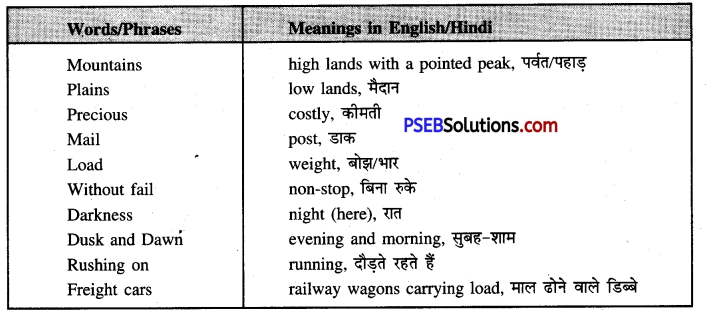
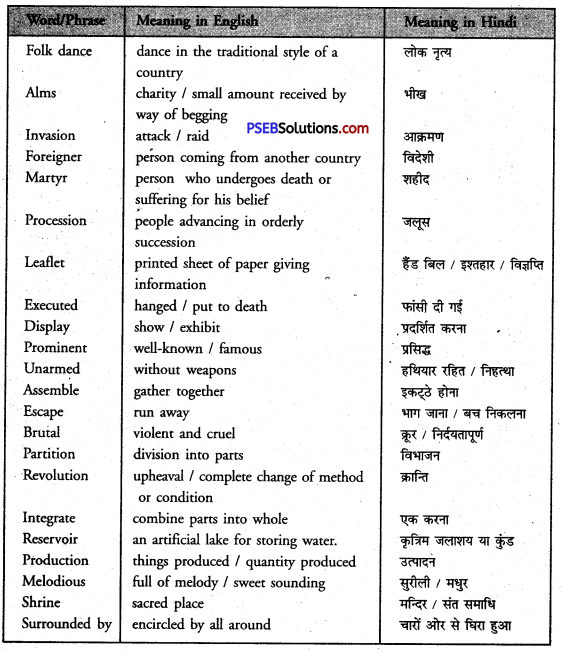
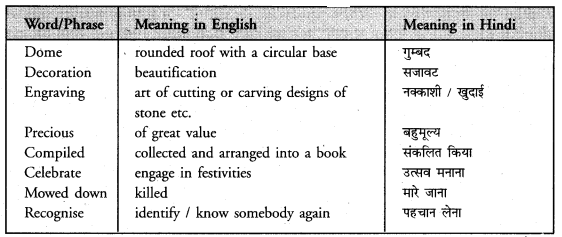
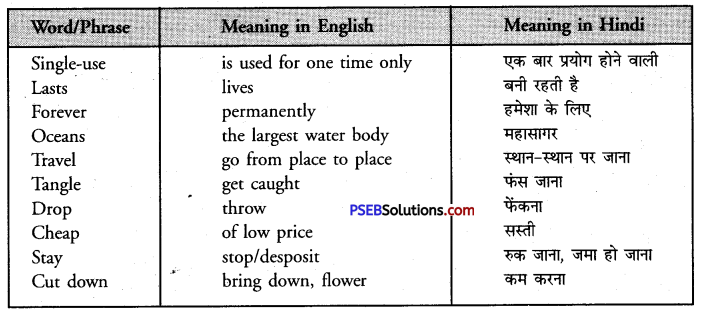
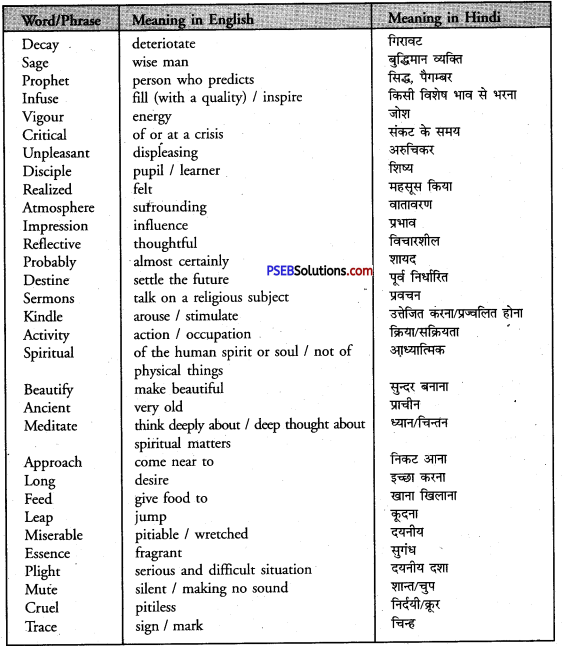
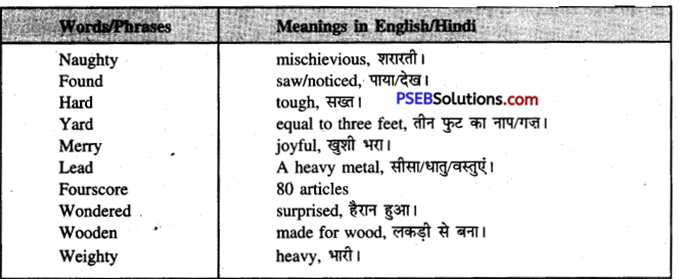
Word Meanings

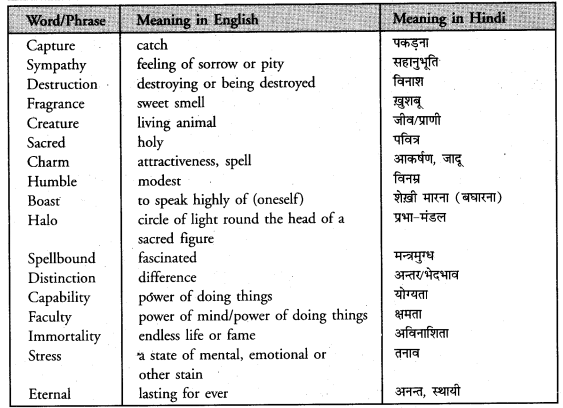
PSEB 8th Class English Solutions Chapter 5 The Punjab A Glimpse 1PSEB 8th Class English Solutions Chapter 5 The Punjab A Glimpse 2

The Punjab: A Glimpse Summary in Hindi

Balle, Balle ! …………… in the pavilion.

बल्ले, बल्ले ! ओह् बल्ले बल्ले ! मि० मैथ्यू अपने छात्रों को अमृतसर की यात्रा पर ले गए। मि० मैथ्यू ने पंजाब पैवेलियन (पंडाल) के सामने भांगड़ा नर्तकों की ओर इशारा करते हुए कहा, “बच्चो, तुम पंजाब के इस प्रसिद्ध लोकनृत्य को अवश्य पहचान गए होंगे।”
बच्चों ने उत्तर दिया, “हाँ, श्रीमान् जी, हम यह लोक नृत्य इस वर्ष के गणतंत्र दिवस के समारोह में देख चुके हैं।” मि० मैथ्यू ने कहा, “यह नृत्य जोश से भरा है। यह पंजाबियों के जीवन के प्रति अति उत्साह को दर्शाता है। पंजाबी स्वाभिमानी और बहुत ही परिश्रमी लोग होते हैं। तुम इन्हें गलियों में भीख माँगते नहीं देखोगे। वे बहुत बहादुर लड़ाई के मैदान में कभी भी अपनी पीठ नहीं दिखाते।

PSEB 8th Class English Solutions Chapter 5 The Punjab: A Glimpse

पंजाब के इतिहास के अनुसार पंजाब के लोगों ने सभी विदेशी आक्रमणकारियों का दृढ़ता से सामना किया । भारत के स्वतंत्रता संग्राम में पंजाब ने देश को महान नायक दिए। उनमें लाला लाजपत राय, भगत सिंह, सुखदेव, ऊधम सिंह, करतार सिंह सराभा जैसे तथा कई अन्य देशभक्त शामिल थे। हम लाला लाजपत राय को शेर-ए-पंजाब तथा भगत सिंह को शहीद-ए-आजम कहकर पुकारते हैं। पंजाब के इन सभी वीर पुत्रों ने अपनी मातृभूमि के लिए अपने प्राणों की आहुति दे दी। लाला लाजपत राय की मृत्यु 1928 में अंग्रेजों के विरुद्ध एक जलूस का नेतृत्व करते समय उन पर किए गए निर्दयतापूर्ण लाठीचार्ज के परिणामस्वरूप हुई। भगत सिंह, सुखदेव और राजगुरू को अंग्रेजों के अत्याचारों के विरुद्ध आवाज़ उठाने पर फांसी पर लटका दिया गया। भगत सिंह उस समय केवल 26 वर्ष के थे। बच्चो! तुम पंडाल में इन सभी स्वतंत्रता सेनानियों के चित्र देखोगे।”

“Sir, what is ….. work of the Punjabis.”

चिंटू ने पूछा, ” श्रीमान् जी, यह भवन, कौन सा है जिसकी दीवारें पूरी तरह निशानों से भरी पड़ी हैं ?” मि० मैथ्यू ने चिंटू को बताया, “यह अमृतसर का प्रसिद्ध जलियाँवाला बाग़ है और ये गोलियों के निशान हैं। यहाँ 13 अप्रैल, 1919 को लगभग 20,000 लोगों की एक भीड़ सार्वजनिक सभा के लिए यहां एकत्रित हुई थी। इसमें स्त्री, पुरुष तथा बच्चे शामिल थे। ब्रिटिश जनरल ओ’डायर अपने बन्दूकधारियों के साथ वहाँ पहुँचा। उसने बाहर निकलने के सभी रास्ते बंद कर दिए। बिना कोई चेतावनी दिए उसने अपने बंदूकधारियों को भीड़ पर गोली चलाने का आदेश दे दिया। लगभग एक हज़ार लोग मारे गए और पंद्रह सौ से अधिक लोग घायल हुए।”

मि० मैथ्यू ने अपने छात्रों को 1947 के बटवारे के बारे में बताया। उन्होंने बताया “पंजाब को 1947 में भारत की स्वतंत्रता की पूर्व संध्या के समय अनेक कष्ट उठाने पड़े। यहाँ भयंकर खून-खराबा हुआ। हज़ारों लोगों को अपने घरों को छोड़ना पड़ा और शरणार्थियों की तरह रहना पड़ा। फिर भी, वीर पंजाबियों ने कड़ा परिश्रम किया और जीवन की नये सिरे से शुरुआत की। उन्होंने राज्य के पुनर्निर्माण में एक महान् भूमिका निभाई। उन्होंने कड़ी मेहनत और कृषि कौशल से पंजाब को भारत का अन्न भण्डार बना दिया। वे देश में हरित क्रांति लाए। शीघ्र ही भारत एक विकासशील देश बन गया और इसका मुख्य कारण पंजाबियों का कड़ा परिश्रम है।

“Sir wasn’t Punjab. ………….. modern India.”

राजू ने पूछा, “श्रीमान् जी, क्या उस समय पंजाब का विभाजन फिर से नहीं किया गया था जब इसमें से हरियाणा राज्य का निर्माण किया गया था ?” मि० मैथ्यू ने बताया, “राजू, तुम ठीक कह रहे हो। 1966 में पंजाबी भाषा और हिन्दी भाषा के आधार पर पंजाब राज्य का पुनर्गठन किया गया। पंजाब के कुछ पहाड़ी क्षेत्र जैसे कि लाहौल-स्पीति, कुल्लू एवं मनाली की घाटियाँ, कांगड़ा, डल्हौज़ी और शिमला हिमाचल प्रदेश के साथ मिला दिए गए। चण्डीगढ़ को पंजाब एवं हरियाणा दोनों की सांझी राजधानी बना दिया गया। उसे केंद्र शासित प्रदेश घोषित कर दिया गया।”

“पुनर्गठित पंजाब नवंबर 1966 में अस्तित्व में आया। अब इसके पश्चिम में पाकिस्तान, उत्तर में जम्मू और कश्मीर, उत्तर-पूर्व में हिमाचल प्रदेश और दक्षिण में हरियाणा और राजस्थान हैं।”राजू ने कहा, “श्रीमान् जी, यहाँ एक बांध का मॉडल (नमूना) है। मेरे विचार से यह प्रसिद्ध भाखड़ा बांध है।”

मि० मैथ्यू ने कहा, “राजू, तुम ठीक कह रहे हो। यह बांध 740 फुट ऊँचा है। इसकी लम्बाई 518 मीटर है और यह 9 मीटर चौड़ा है। इसके जलाशय जिसे गोबिन्द सागर के नाम से जाना जाता है, इसमें 9 बिलियन क्यूषिक मीटर पानी इकट्ठा किया जा सकता है। इसका उपयोग हिमाचल प्रदेश, पंजाब तथा हरियाणा की 10 मिलियन एकड़ भूमि की सिंचाई के लिए किया जाता है। भाखड़ा और नंगल विद्युत केंद्रों में पैदा होने वाली बिजली को हिमाचल प्रदेश, पंजाब, हरियाणा, राजस्थान और गुजरात राज्यों को दिया जाता है। पंडित नेहरू ने भाखड़ा बांध को आधुनिक भारत का मंदिर कहा है।”

“Sir, I can ………………….. asked Mr. Mathew.?”

विक्की ने कहा, “श्रीमान् जी, मुझे गुरूवाणी के मधुर स्वर सुनाई दे रहे हैं। पास में अवश्य ही कोई गुरुद्वारा होगा।”मि० मैथ्यू ने कहा, “ठीक है, हम अमृतसर के श्री दरबार साहिब के निकट हैं। यह सिखों का सबसे पवित्र धार्मिक स्थल है।”
चिंटू ने कहा, “कहते हैं कि यह मंदर जल से घिरा हुआ है।” मि० मैथ्यू ने बताया, “हां, यह एक वर्गाकार सरोवर के बीच में बना है। मंदर में पहुँचने के लिए 60 मी० लम्बा संगमरमर का मार्ग बना हुआ है। इस मार्ग के दोनों ओर संगमरमर की रेलिंग (जंगला) है। मंदर दो मंजिला है। इसके शीर्ष पर एक सुनहरी गुंबद है। मंदर के निर्माण में लगाई गईं संगमरमर की पट्टिकाओं पर कलात्मक नक्काशी की गई है। अंदर की दीवारें कीमती पत्थरों से सुसज्जित हैं। उन पर अनमोल चित्रकारी और अन्य कलाकारियां की गई हैं। भूतल पर गुंबदाकार छत के नीचे ‘श्री गुरु ग्रंथ साहिब’ विराजमान हैं। यह सिक्खों का पवित्र ग्रंथ है। मि० मैथ्यू ने कहा, “क्या आप जानते हैं कि इस पवित्र पुस्तक का संकलन सिखों के पाँचवें गुरु अर्जुन देव जी ने किया था ?”

PSEB 8th Class English Solutions Chapter 5 The Punjab: A Glimpse

“Anandpur Sahib ……… President of India.”

“आनंदपुर साहिब सिखों का एक अन्य तीर्थ-स्थल है। इसकी स्थापना श्री गुरु तेग बहादुर जी ने की थी। यह सतलुज नदी के बायें किनारे पर स्थित एक छोटा सा शहर है। यहां हर साल लाखों सिख ‘खालसा’ जिसकी स्थापना 1699 में गुरु गोबिन्द सिंह जी ने की थी, का स्थापना दिवस मनाने के लिए इकट्ठे होते हैं।” राजू ने पूछा, “श्रीमान् जी, इधर देखो। यह सुन्दर ढंग से नियोजित एक शहर का नमूना है। इसमें बहुत से बाग़ हैं। क्या यह चण्डीगढ़ नहीं है ?”

मि० मैथ्यू ने उत्तर दिया, “हाँ, यह चण्डीगढ़ ही है। यह सुंदर शहर शिवालिक पहाड़ियों की तलहटी में स्थित है। इसका नमूना प्रसिद्ध फ्रांसीसी वास्तुकार ली कॉरबुज़िअर ने तैयार किया था। पहाड़ियों के बहुत अधिक निकट होने के कारण चण्डीगढ़ का वातावरण शांत और सुहावना है। चण्डीगढ़ के रोज़ गार्डन्ञ् संसार भर में प्रसिद्ध हैं। इस नगर का औपचारिक रूप से शुभारंभ भारत के तत्कालीन राष्ट्रपति डा. राजेन्द्र प्रसाद ने अक्तूबर 1953 में किया था।”

“Sir, there are …………………….. on their faces.

” विक्की ने कहा, “श्रीमान जी, यहाँ खेलों का सामान बेचने वाली कुछ दुकानें हैं। मैं क्रिकेट का बल्ला और गेंद खरीदना चाहता हूँ।” मि० मैथ्यू ने कहा, “परन्तु खरीदने से पहले, क्या तुम मुझे बता सकते हो कि पंजाब के किस शहर में यह सामान बनाया जाता है ?” विक्की ने उत्तर दिया, “नहीं, श्रीमान् जी।” मि० मैथ्यू ने कहा, “अच्छा, तो सुनो, यह जालंधर है। यह देश में खेलों का सामान बनाने वाले प्रमुख केंद्रों में से एक है। वहां, दूसरी दुकान में ऊनी हौजरी का सामान है। वह लुधियाना से है। हमारे हौजरी उद्योग का 95 प्रतिशत भाग लुधियाना में है। क्या तुम हौजरी का कुछ सामान भी खरीदना पसंद करोगे ?” चिंटू ने कहा, “नहीं, श्रीमान् जी, क्या खरीदा जाये, मैं उसका निर्णय नहीं ले सकता। ऐसी खरीददारी मेरे मातापिता करते हैं।” मि० मैथ्यू ने मिठाई की दुकान की ओर बढ़ते हुए कहा, “अच्छा, बच्चो, शायद तुम अमृतसर की यह जलेबियाँ चखना पसंद करोगे।” सभी बच्चे अपने चेहरों पर मुस्कान बिखेरे उनके पीछे-पीछे चलने लगे।

PSEB 8th Class English Solutions Chapter 5 The Punjab: A Glimpse

Retranslation From English to Hindi

1. This dance is full of energy. — यह नृत्य जोश से भरा हुआ है।
2. The country was partitioned. — देश का बंटवारा कर दिया गया।
3. About 1000 people were killed. — लगभग 1000 लोग मारे गए।
4. Punjab suffered a lot. — पंजाब को बहुत अधिक हानि उठानी पड़ी।
5. You are right. — आपकी बात ठीक है।
6. It is the holiest shrine of the Sikhs. — यह सिखों का सबसे पवित्र धार्मिक स्थल है।
7. This temple is surrounded by water. — यह मंदर जल से घिरा है।
8. It has a number of gardens. — इसमें कई बाग हैं।
9. The temple is double storeyed. — मंदर दो-मंजिला है।
10. They are from Ludhiana. — वे लुधियाना के रहने वाले हैं।
11. It is a small town. — यह एक छोटा सा शहर है।
12. I can hear the melodious strains of Gurbani.– मुझे गुरूवाणी के मधुर स्वर सुनाई दे रहे हैं।

English Guide for Class 8 PSEB Prose

The Home-Coming Question Answer Class 10 English Main Course Book Chapter 6 PSEB Solutions

Punjab State Board PSEB 10th Class English Book Solutions English Main Course Book Chapter 6 The Home-Coming Textbook Exercise Questions and Answers.

Class 10th English Main Course Book Chapter 6 The Home-Coming Question Answers

The Home-Coming Class 10 Questions and Answers

Short Answer Type Questions

Question 1.
Who was Phatik ?
Answer:
Phatik was a fourteen-year-old boy. He was the ringleader among the boys of his village. His fertile mind always thought of new mischiefs.

फटिक एक चौदह-वर्षीय लड़का था। वह अपने गाँव के लड़कों का मुखिया था। उसका उपजाऊ दिमाग़ हमेशा नई-नई शरारतें सोचता रहता था।

Question 2.
What was the new mischief Phatik thought of ?
Answer:
There was a log lying on the bank of the river. He planned to roll the log away with the help of the other boys. In this way, he wanted to annoy the owner and enjoy the fun.

नदी के किनारे लकड़ी का एक लट्ठा पड़ा हुआ था। उसने अन्य लड़कों की मदद से लटे को लुढ़का कर दूर ले जाने की योजना बनाई। इस प्रकार वह मालिक को परेशान करना और इसका आनन्द उठाना चाहता था।

PSEB 10th Class English Main Course Book Solutions Chapter 6 The Home-Coming

Question 3.
Why were Phatik and his friends annoyed with Makhan ?
Answer:
Phatik and the other boys wanted to roll the log away. But Makhan came and sat down on the log. This annoyed Phatik and his friends.

फटिक और दूसरे लड़के लट्ठ को लुढ़का कर दूर ले जाना चाहते थे। परन्तु माखन आया और लट्ठ पर बैठ गया। इससे फटिक और उसके मित्र नाराज़ हो गए।

Question 4.
What was Phatik’s ‘new manoeuvre’ ?
Answer:
Phatik asked his followers to roll the log with Makhan sitting over it. This, he thought, would give them added amusement.

फटिक ने अपने साथियों से कहा कि वे लढे को उसके ऊपर बैठे हुए माखन सहित ही लुढ़का दें। उसने सोचा कि इससे उन्हें और भी ज्यादा मज़ा आएगा।

Question 5.
Why did Phatik beat Makhan even in the presence of his mother ?
Answer:
Makhan lied to his mother that Phatik had beaten him. Phatik could not bear this. Therefore, he beat Makhan.

माखन ने अपनी मां से झूठ बोल दिया कि फटिक ने उसे पीटा था। फटिक से यह सहन न हुआ। इसलिए उसने माखन की पिटाई कर दी।

Question 6.
Was Makhan speaking the truth?
Answer:
No, he was not speaking the truth. Phatik had not beaten him. In fact, it was Makhan who had beaten Phatik.

नहीं, वह सच नहीं बोल रहा था। फटिक ने उसकी पिटाई नहीं की थी। वास्तव में, यह माखन था जिसने फटिक की पिटाई की थी।

Question 7.
Why did Phatik’s mother want to send him away to her brother’s house ?
Answer:
The mother had a prejudice against Phatik. She thought he would some day drown Makhan in the river, or break his head in a fight. Therefore, she wanted to send him away.

मां फटिक के प्रति एक ग़लत धारणा रखती थी। वह सोचती थी कि किसी दिन वह माखन को या तो नदी में डुबो देगा या लड़ाई में उसका सिर फोड़ देगा। इसलिए वह उसे वहां से भेज देना चाहती थी।

PSEB 10th Class English Main Course Book Solutions Chapter 6 The Home-Coming

Question 8.
How was Phatik received by his aunt ?
Answer:
The aunt was not at all pleased. She thought of Phatik as an unnecessary addition to her family.

(फटिक की) मामी तनिक भी प्रसन्न न हुई। वह फटिक को अपने परिवार में एक अनावश्यक वृद्धि मानती थी।

Question 9.
Why couldn’t Phatik do well at school ?
Or How did Phatik fare at his new school in Kolkata ?
Answer:
Phatik was ill-treated at his uncle’s house. He was always sad. He could not put his mind to his studies. Naturally, he could not do well at school.

फटिक के साथ उसके मामा के घर पर बहुत बुरा व्यवहार किया जाता था। वह सदा उदास रहता था। वह अपना ध्यान पढ़ाई में नहीं लगा पाता था। स्वाभाविक रूप से, वह स्कूल में अच्छा प्रदर्शन न कर पाया।

Question 10.
How did Phatik’s aunt behave on learning about the loss of his book ?
Answer:
The aunt called Phatik a country lout. She said that she couldn’t buy him new books five times a month.

मामी ने फटिक को गांव का एक गंवार कहा। उसने कहा कि वह उसे महीने में पांच बार नई पुस्तकें खरीद कर नहीं दे सकती।

Question 11.
What was the immediate reason for Phatik’s departure from his uncle’s house ?
Answer:
One day, Phatik had a bad headache and a shivering fit. He feared he would become a nuisance to his aunt. That was why he left the house.

एक दिन फटिक को भयानक सिर-दर्द हुआ और कंपकंपी छिड़ गई। उसे भय था कि वह अपनी मामी के लिए मुसीबत बन जाएगा। इसी कारण से उसने घर छोड़ दिया।

Question 12.
Why did Bishamber send for his sister ?
Answer:
Phatik was seriously ill. The doctor said that the boy’s condition was critical. That was why Bishamber sent for his sister.

फटिक गम्भीर रूप से बीमार हो गया। डाक्टर ने कहा कि लड़के की हालत नाजुक थी। इसी कारण से बिशम्बर ने अपनी बहन को बुला भेजा।

PSEB 10th Class English Main Course Book Solutions Chapter 6 The Home-Coming

Question 13.
What were Phatik’s last words ?
Answer:
Phatik’s last words were : ‘Mother, the holidays have come.’

फटिक के अन्तिम शब्द थे : ‘मां, छुट्टियां आ गई हैं।’

Long Answer Type Questions

Question 1.
How does Phatik feel when he is at Kolkata ?
Answer:
While at Kolkata, Phatik feels like a fish out of water. His aunt ill-treats him. His cousins mock at him. At school, his teachers cane him daily. All this makes Phatik’s life very miserable. He longs to go back to his village home.

कोलकाता में रहने के दौरान फटिक पानी से बाहर आई मछली की भांति महसूस करता है। उसकी मामी उससे बुरा व्यवहार करती है। उसके ममेरे भाई उसका मजाक उड़ाते हैं। स्कूल में उसके अध्यापक उसे प्रतिदिन बैंतों से मारते हैं। इन सबसे फटिक का जीवन बहुत दुःख-भरा हो जाता है। वह वापस अपने गांव के घर में जाने के लिए तड़पता रहता है।

Question 2.
Why does Bishamber want to take Phatik to Kolkata ?
Answer:
The mother is prejudiced against Phatik. She thinks of him as a big nuisance. She calls him lazy, wild and disobedient. Bishamber wants to help his widowed sister. So he offers to take Phatik with him to Kolkata. He says he will educate him there with his own children.

मां की फटिक के प्रति एक ग़लत धारणा बनी हुई है। वह उसे एक बड़ी सिरदर्दी मानती है। वह उसे निकम्मा, असभ्य और गुस्ताख कहती है। बिशम्बर अपनी विधवा बहन की मदद करना चाहता है। इसलिए वह फटिक को अपने साथ कोलकाता ले जाने की पेशकश करता है। वह कहता है कि वह वहां उसे अपने खुद के बच्चों के साथ शिक्षा दिलाएगा।

Question 3.
Who is responsible for Phatik’s death ?
Answer:
It is solely the cruel aunt who is responsible for Phatik’s death. She dislikesthe boy from the very beginning. She thinks of him as an unnecessary addition to her family. She ill-treats him all the time. Even when the poor boy is critically ill, she calls him a nuisance. We can say that the heartless witch causes the poor boy’s death in the end.

यह पूरी तरह से निर्दय मामी है जो फटिक की मृत्यु के लिए ज़िम्मेदार है। वह शुरू से ही लड़के को नापसन्द करती है। वह उसे अपने परिवार में एक अनावश्यक वृद्धि समझती है। वह उसके साथ हर समय बुरा व्यवहार करती है। जब वह बेचारा लड़का भयंकर रूप से बीमार भी होता है तो भी वह उसे एक सिरदर्दी कहती है। हम कह सकते हैं निर्दय चुडैल अन्त में बेचारे लड़के की मृत्यु का कारण बनती है।

Question 4.
Write a character-sketch of Bishamber.
Answer:
Bishamber is Phatik’s maternal uncle. He has a lot of love for his widowed sister. He finds that Phatik is a trouble for his sister. He offers to take him to Kolkata. He says he will educate him there with his own children. Truly, Bishamber is a loving brother. But he is not imaginative. He commits a blunder in taking Phatik to Kolkata.

बिशम्बर फटिक का मामा है। वह अपनी विधवा बहन से बहुत प्यार करता है। वह देखता है कि फटिक उसकी बहन के लिए एक मुसीबत है। वह उसे कोलकाता ले जाने की पेशकश करता है। वह कहता है कि वह उसे वहां अपने खुद के बच्चों के साथ पढ़ाएगा। सचमुच बिशम्बर एक प्यार करने वाला भाई है। किन्तु वह कल्पनाशील नहीं है। वह फटिक को कोलकाता ले जाने में बड़ी भारी ग़लती करता है।

Question 5.
Write a character-sketch of Makhan.
Answer:
Makhan is Phatik’s younger brother. He is the darling of his mother. She calls him as good as gold. But we see that Makhan is not that good. He is spoilsport. He comes and sits on the log when the other boys want to roll it away. He also tells lies to his mother about Phatik.

माखन फटिक का छोटा भाई है। वह अपनी मां का लाडला है। वह उसे सोने के जैसा अच्छा कहती है। किन्तु हम देखते हैं कि माखन इतना अच्छा नहीं है। वह रंग में भंग डालने वाला है। जब दूसरे लड़के लटे को लुढ़काना चाहते हैं तो वह आ कर इसके ऊपर बैठ जाता है। वह फटिक के बारे में अपनी मां के सामने झूठ भी बोलता है।

Question 6.
Write a character-sketch of Phatik’s aunt.
Answer:
Phatik’s aunt is a heartless witch. She dislikes Phatik from the very beginning. She thinks of him as an unnecessary addition to her family. She ill-treats him all the time. Even when the poor boy is critically ill, she calls him a nuisance. She has no womanly feelings in her heart. It is she who can be held solely responsible for Phatik’s death.

फटिक की मामी एक निर्दय चुडैल है। वह फटिक को शुरू से ही नापसन्द करती है। वह उसे अपने परिवार में एक अनावश्यक वृद्धि मानती है। वह हर समय उसके साथ दुर्व्यवहार करती है। जब बेचारा लड़का भयानक रूप से बीमार होता है, तब भी वह उसे एक सिरदर्दी कहती है। उसके दिल के अन्दर औरतों वाली कोई भावनाएं नहीं हैं। यह वही है जिसे फटिक की मृत्यु के लिए पूरी तरह से ज़िम्मेदार ठहराया जा सकता है।

Question 7.
Write a character-sketch of Phatik’s mother.
Answer:
Phatik’s mother is a simple-hearted lady. She is a widow and has two sons to bring up. She is prejudiced against Phatik, the elder one. But it does not mean she does not love him. She agrees to send him to Kolkata with her brother. But then she feels sad to see how anxious Phatik is to go. She is after all a mother !

फटिक की मां एक सरल हृदय वाली औरत है। वह एक विधवा है और उसके पास पालन-पोषण करने के लिए दो पुत्र हैं। उसे बड़े पुत्र, फटिक, के प्रति एक ग़लत धारणा है। किन्तु इसका अर्थ यह नहीं कि वह उससे प्यार नहीं करती है। वह उसे अपने भाई के साथ कोलकाता भेजने के लिए सहमत हो जाती है। किन्तु फिर वह यह देख कर उदास हो जाती है कि फटिक जाने के लिए कितना उत्सुक है। आखिर वह एक मां ही तो है!

PSEB 10th Class English Main Course Book Solutions Chapter 6 The Home-Coming

Question 8.
Give a pen-portrait of Phatik.
Answer:
Phatik is a fourteen-year-old boy. He is the ringleader among the boys of his village. He has a fertile mind. He keeps thinking of new mischiefs. His mother is fed up with him. She sends him away to Kolkata with her brother. Now Phatik begins to feel like a fish out of water. He longs to go back to his village home. But he has to wait until the holidays of his life come !

फटिक चौदह वर्ष की आयु का एक लड़का है। अपने गांव के लड़कों के मध्य वह एक मुखिया है। उसका एक उपजाऊ दिमाग है। वह नई-नई शरारतें सोचता रहता है। उसकी मां उससे तंग आई हुई है। वह उसे अपने भाई के साथ कोलकाता भेज देती है। अब फटिक बिना पानी की मछली की भान्ति महसूस करने लगता है। वह अपने गांव वाले घर को वापस चला जाना चाहता है। किन्तु उसे अपने जीवन की छुट्टियां शुरू होने का इन्तजार करना पड़ता है !

Question 9.
Describe the quarrel between Phatik and Makhan.
Answer:
Phatik and his friends want to roll a log away. But Makhan comes and sits on the log. He does not care for Phatik’s warning: Phatik asks the boys to roll the log. As they do so, Makhan falls down. Now Makhan gets up, falls upon Phatik and scratches his face. Then he goes home crying. He tells his mother that Phatik has beaten him. Phatik can’t bear this telling of lies. He rains on Makhan a shower of blows.

फटिक तथा उसके मित्र एक लटे को लुढ़का कर दूर ले जाना चाहते हैं। किन्तु माखन आ कर लटे के ऊपर बैठ जाता है। वह फटिक की चेतावनी की परवाह नहीं करता। फटिक लड़कों से कहता है कि वे लढे को लुढ़का दें। जब वे ऐसा करते हैं तो माखन नीचे गिर जाता है। अब माखन उठ खड़ा होता है, फटिक पर झपटता है और उसके चेहरे को नोच डालता है। फिर वह रोता हुआ घर चला जाता है। वह अपनी मां से कहता है कि फटिक ने उसे मारा है। फटिक इस झूठ बोलने को सहन नहीं कर पाता। वह माखन पर घूसों की बौछार कर देता है।

Vocabulary and Grammar

Question 1.
Fill in the blanks with adjective forms of the following words :
Answer:
1. fertile
2. dignified
3. futile
4. delirious
5. philosophical.

Question 2.
Match the words in Column A with their opposites in Column B :
Answer:
A — B
unanimously — individually
timidly — boldly
futile — useful
furious — calm
fertile — barren
earthly — heavenly
impotent — potent
exhausted — invigorated
bequeath — take, receive
despised — liked
jeer — applaud

Question 3.
Makhan was ‘as good as gold’. Complete the following expressions in the same way :
Answer:
1. as white as snow.
2. as black as coal.
3. as innocent as a baby.
4. as obstinate as a mule.
5. as gentle as, a lamb.

Question 4.
Fill in the blanks with the correct verb form of the italicized words :
Answer:
1. glorify
2. sulked
3. amused
4. distressed
5. exhausted
6. despised
7. lost.

Question 5.
Fill in the blanks with suitable articles :
Answer:
1. The Ganga is a sacred river.
2. He reads the Bible every day.
3. The man struck a match.
4. Where is the money to come from?
5. He began a series of experiments.
6. I was on an official visit.
7. There was an elephant on the road.

Question 6.
Fill in the blanks with the passive forms of the verbs given in italics to complete the following sentences :
Answer:
1. informed
2. be posted
3. should be taken
4. be helped
5. would be closed.

PSEB 10th Class English Main Course Book Solutions Chapter 6 The Home-Coming

Question 7.
Put proper punctuation marks in the following passage and use capital letters wherever necessary :
Answer:
The effect of books is twofold. Books preserve knowledge in time and spread it in space. Suppose, for example, that you think of an important idea or a beautiful poem. Unless you can write it down, your idea or poem will probably die.

Objective Type Questions

Question 1.
What was the name of Phatik’s brother ?
Answer:
Makhan

Question 2.
Phatik’s uncle lived in ………
(i) Mumbai
(ii) Dehradun
(iii) Calcutta
(iv) Chandigarh.
Answer:
(iii) Calcutta

Question 3.
Phatik’s aunt welcomed Phatik in her home. (True/False)
Answer:
False

Question 4.
Phatik’s …………….. did not like his ways.
(i) mother
(ii) sister
(iii) student
(iv) neighbours.
Answer:
(i) mother

Question 5.
Phatik wanted to move a ……………. from its place.
Answer:
log

Question 6.
Phatik’s last words were : ‘Mother, ………… have come.
(i) friends
(ii) aunt and uncle
(iii) brothers
(iv) holidays.
Answer:
(iv) holidays.

Answer each of the following in one word / phrase / sentence :

Question 1.
Name the author of the story, ‘The Home-coming’.
Answer:
Rabindranath Tagore.

Question 2.
Who was Makhan ?
Answer:
He was Phatik’s younger brother.

Question 3.
Did the mother of Phatik and Makhan treat them equally ?
Answer:
No, she loved Makhan much more than Phatik.

Question 4.
What offer did Bishamber make to Phatik’s mother ?
Answer:
He offered to take Phatik to his home in Kolkata.

Question 5.
Was Phatik happy in going to Kolkata ?
Answer:
Yes, he was extremely happy in going to the big city.

Question 6.
Was Phatik’s mother sad in parting from her son ?
Answer:
No, she felt greatly relieved to get rid of him.

Question 7.
How did Phatik’s aunt feel on seeing Phatik in her home ?
Answer:
She was unhappy to be burdened with an unwanted responsibility.

Question 8.
How did Phatik fare in his school in Kolkata ?
Answer:
He was considered a very stupid student.

Question 9.
Who brought Phatik back to his uncle’s house ?
Answer:
Two constables.

Question 10.
What were the last words murmured by Phatik ?
Answer:
“Mother, the holidays have come.”

PSEB 10th Class English Main Course Book Solutions Chapter 6 The Home-Coming

Complete the following :

1. Makhan was Phatik’s …………
2. The surname of Phatik’s family was ………..
3. Phatik was considered the ……. of the village boys.
4. On Makhan’s false complaint, the mother rained. …………….. on Phatik.
5. Bishamber had left ………………. and started living in …….
6. Phatik died while he was living with his
Answer:
1. younger brother
2. Chakravarti
3. ringleader
4. blows
5. Mumbai, Kolkata
6. uncle.

Write True or False against each statement :

1. Phatik and Makhan were cousins.
2. Makhan’s mother was Phatik’s stepmother.
3. Phatik’s mother readily agreed to her brother’s offer.
4. Phatik was a very brilliant student in Kolkata.
5. Phatik was brought back to home by his mother.
6. Phatik was very cruelly treated by his aunt.
Answer:
1. False
2. False
3. True
4. False
5. False
6. True.

Choose the correct option for each of the following :

Question 1.
Phatik was a …………………. in his village.
(a) brilliant student
(b) an obedient son
(c) well-behaved boy
(d) ringleader of the boys.
Answer:
(d) ringleader of the boys.

Question 2.
Bishamber was …………. of the Chakravartis.
(a) a close relative
(b) a neighbour
(c) a family friend
(d) the landlord.
Answer:
(a) a close relative

Question 3.
Phatik’s aunt behaved with Phatik very
(a) lovingly
(b) nobly
(c) cruelly
(d) none of the above.
Answer:
(c) cruelly

Question 4.
Phatik met his death …..
(a) after a long illness
(b) after a short illness
(c) at his hometown.
(d) in a hospital.
Answer:
(b) after a short illness

The Home-Coming Summary & Translation in English

The Home-Coming Introduction:
This is the story of a fourteen-year-old boy, Phatik. He is very mischievous. He is sent to Kolkata with his maternal uncle. But there, he is not treated well by his aunt as well as his cousins. He becomes seriously ill and dies in the end. The underlying idea of this story is that home is a place where we find love – a place that our feet may leave, but not our hearts. Though it rains gold and silver in another place and daggers and spears at home, yet it is better to be at home.

The Home-Coming Summary & Translation in English

(Page 84)

Phatik Chakravarti was the ring – leader amongst the boys of the village. One day a plan for new mischief entered his head. There was a heavy log lying on the mud-flat of the river, waiting to be shaped into a mast for a boat. His plan was that they should all work together to shift the log by main force from its place and roll it away. The owner of the log would be angry and surprised, while they would all enjoy the fun. Everyone supported the proposal, and it was carried unanimously .

But just as the fun was about to begin, Makhan, Phatik’s younger brother, sauntered up without a word and sat down on the log in front of them all. The boys were puzzled for a moment. One of them pushed him rather timidly, and told him to get up; but he remained quite unconcerned. He appeared like a young philosopher meditating on the futility of things. Phatik was furious. “Makhan,” he cried, “if you don’t get up this minute, I’ll thrash6 you !”

Makhan only moved to a more comfortable position. Now, if Phatik was to keep his regal dignity before the public, it was clear that he must carry out his threat. But his courage failed him at the crisis. His fertile brain, however, rapidly seized upon a new maneuver which would discomfit his brother and afford his followers added amusement. He gave the word and command to roll the log and Makhan over together. Makhan heard the order and made it a point of honour to stick on. But like those who attempt earthly fame in other matters, he overlooked the fact that there was peril in it.

PSEB 10th Class English Main Course Book Solutions Chapter 6 The Home-Coming

(Page 85)

The boys began to heave at the log with all their might calling out, “One, two, three, go !” At the word ‘go’ the log went; and with it went Makhan’s philosophy, glory and all. The other boys shouted themselves hoarse with delight. But Phatik was a little frightened. He knew what was coming. And he was not mistaken, for Makhan rose from Mother Earth blind as Fate and screaming like the Furies. He rushed at Phatik, scratched his face, beat him and kicked him, and then went crying home. The first act of the drama was over.

Phatik wiped his face, and sitting down on the edge of a sunken barge by the river bank, began to nibble at a piece of grass. A boat came up to the landing and a middle-aged man, with grey hair and dark moustache, stepped on to the shore. He saw the boy sitting there doing nothing and asked him where the Chakravartis lived. Phatik went on nibbling the grass and said : ‘Over there’; but it was quite impossible to tell where he pointed. The stranger asked him again. He swung his legs to and from on the side of the barge and said : ‘Go and find out’ and continued to nibble the grass.

But, at the moment, a servant came down from the house and told Phatik that his mother wanted him. Phatik refused to move. But on this occasion the servant was the master. He roughly took Phatik up and carried him, kicking and struggling in impotent rage. When Phatik entered the house, his mother saw him and called out angrily : ‘So you have been hitting Makhan again ?’

Phatik answered indignantly : ‘No, I haven’t ! Who told you that I had ?’
His mother shouted : ‘Don’t tell lies ! You have.’ Phatik said sullenly ‘I tell you, I haven’t. You ask Makhan !‘ But Makhan thought it best to stick to his previous statement. He said : ‘Yes, mother, Phatik did hit me.’

Page -86

Phatik’s patience was already exhausted. He could not bear this injustice. He rushed at Makhan and rained on him a shower of blows : ‘Take that,’ he cried, ‘and that, and that, for telling lies.’

His mother took Makhan’s side in a moment and pulled Phatik away, returning his blows with equal vigour. When Phatik pushed her aside , she shouted out: ‘What! You little villain ! Would you hit your own mother ?’

It was just at this critical moment that the grey-haired stranger arrived. He asked what had occurred. Phatik looked sheepish and ashamed. But when his mother stepped back and looked at the stranger, her anger was changed to surprise, for she recognized her brother and cried : ‘Why, Dada ! Where have you come from ?’ As she said these words, she bowed to the ground and touched his feet.

Her brother Bishamber had gone away soon after she had married, and had started business in Mumbai. She herself had lost her husband while he was there. Bishamber had now come back to Kolkata, and had at once made enquiries concerning his sister. As soon as he found out where she was, he had hastened to see her.

The next few days were full of rejoicing. The brother asked how the two boys were being brought up. He was told by his sister that Phatik was a perpetual nuisance. He was lazy, disobedient and wild. But Makhan was as good as gold, as quiet as a lamb, and very fond of reading. Bishamber kindly offered to take Phatik off his sister’s hands and educate him with his own children in Kolkata. The widowed mother readily agreed. When his uncle asked Phatik if he would like to go to Kolkata with him, his joy knew no bounds, and he said : ‘Oh, yes, uncle !’ in a way that made it quite clear that he meant it.

It was an immense relief to the mother to get rid of Phatik. She had a prejudice against the boy, and no love was lost between the two brothers. She was in daily fear that he would some day either drown Makhan in the river, or break his head in a fight, or urge him on into some danger. At the same time she was a little distressed to see Phatik’s extreme eagerness to leave his home.

PSEB 10th Class English Main Course Book Solutions Chapter 6 The Home-Coming

Page 87

Phatik, as soon as all was settled, kept asking his uncle every minute when they were to start. He was on pins all day long with excitement and lay awake most of the night. He bequeathed to Makhan, in perpetuity, his fishing-rod, his big kite, and his marbles. Indeed at this time of departure, his generosity towards Makhan was unbounded. When they reached Kolkata, Phatik met his aunt for the first time. She was by no means pleased with this unnecessary addition to her family. She found her own three boys quite enough to manage without taking anyone else. And to bring a village lad of fourteen into their midst was terribly upsetting1. Bishamber should really have thought twice before committing such an indiscretion.

In this world there is no worse nuisance than a boy at the age of fourteen. He is neither ornamental nor useful. It is impossible to shower affection on him as on a smaller ,boy; and he is always getting in the way. If he talks with a childish lisp he is called a baby, and if in a grown-up way he is called impertinent. In fact, “talk of any kind from him is resented. Then he is at the unattractive, growing age. He grows out of his clothes with indecent haste his face grows suddenly angular and unsightly.

It is easy to excuse the shortcomings of early childhood, but it is hard to tolerate even unavoidable lapses in a boy of fourteen. He becomes painfully self-conscious, and when he talks with elderly people he is either unduly forward, or else so unduly shy that he appears ashamed of his own existence. Yet, it is at this age that in his heart of hearts, a young lad most craves recognition and love; and he becomes the devoted slave of any one who shows him consideration. But none dare openly love him, for that would be regarded as undue indulgence and therefore bad for the boy. So, what with scolding and chiding, he becomes very much like a stray dog that has lost its master.

Page 88

His own home is the only paradise that a boy of fourteen can know. To live in a strange house with strange people is little short of torture; while it is the height of bliss to receive the kind looks of women and never to suffer their slights. It was an anguish to Phatik to be an unwelcome guest in his aunt’s house, constantly despised and slighted by this elderly woman.

If she ever asked him to do anything for her, he would be so overjoyed that his joy would seem exaggerated; and then she would tell him not to be so stupid, but to get on with his lessons. ’ There was no more backward boy in the whole school than Phatik. He gaped and remained silent when the teacher asked him a question, and like an overladen ass patiently suffered the many thrashings that were meted out to him. When other boys were out at play, he stood wistfully by the window and gazed at the roofs of the distant houses. And if by chance he espied children playing on the open terrace of a roof, his heart would ache with longing.

One day he summoned up all his courage, and asked his uncle, ‘Uncle, when can I go home ?’ His uncle and. ‘Wait till the holidays come.’ But the holidays would not come till October and there was still a long time to wait.

One day Phatik lost his lesson book. Even with the help of books he had found it very difficult to prepare his lesson. But, now, it became impossible. Day after day the teacher caned him unmercifully. He became so abjectly miserable that even his cousins were ashamed to own him. They began to jeer and insult him more than even the other boys did. At last he went to his aunt and told her that he had lost his book.

PSEB 10th Class English Main Course Book Solutions Chapter 6 The Home-Coming

Page 89

With an expression of the greatest contempt she burst out : ‘You great, clumsy, country lout ! How can I afford to buy you new books five times a month, when I have my own family to look after ?’ That night, on his way back from school, Phatik had a bad headache and a shivering fit. He felt that he was going to have an attack of malaria. His one great fear was that he might be a nuisance to his aunt.

The next morning Phatik was nowhere to be seen. Search in the neighbourhood proved futile. The rain had been pouring in torrents all night, and those who went out to look for the boy were drenched to the skin. At last Bishamber asked the police to help him. At nightfall a police van stopped at the door of the house. It was still raining and the streets were flooded. Two constables carried Phatik out in their arms and placed him before Bishamber. He was wet through from head to foot, covered with mud, while, his face and eyes were flushed with fever and his limbs were trembling. Bishamber carried him in his arms and took him inside the house. When his wife saw him, she exclaimed : ‘What a heap of trouble this boy has given us ! Hadn’t you better send him home ?’

Phatik heard her words and sobbed aloud : ‘Uncle, I was just going home; but they dragged me back again.’ The fever rapidly increased, and throughout the night.the boy was delirious. Bishamber brought in a doctor. Phatik opened his eyes, and looking up to the ceiling said vacantly ‘Uncle, have the holidays come yet ?’

Bishamber wiped the tears from his eyes and took Phatik’s thin burning hands in his own and sat by his side through the night. Again the boy began to mutter, till at last his voice rose almost to a shriek. ‘Mother !’ he cried, ‘don’t beat me like that Mother ! I am telling the truth.’

(Page 90)

The next day Phatik, for a short time, became conscious. His eyes wandered round the room as if he expected someone to come. At last, with an air of disappointment, his head sank back on the pillow. With a deep sigh he turned his face to the wall. Bishamber read his thoughts, and bending down his head whispered ‘Phatik, I have sent for your mother.

The day dragged on. The doctor said in a troubled voice that the boy’s condition was very critical. Phatik began to cry out: ‘By the mark three fathoms. By the mark four fathoms. By the mark.’ Many times had he heard the sailors on the river-steamers calling out the mark on the lead line. Now he was himself plumbing an unfathomable sea.

Later in the day Phatik’s mother burst into the room like a whirlwind and rocking herself to and fro from side to side, began to moan and cry. Bishamber tried to calm her, but she flung herself on the bed, and cried ‘Phatik, my darling, my darling.’Phatik stopped his restless movements for a moment. His hands ceased beating up and down. He said ‘Eh ?’ The mother cried again: ‘Phatik, my darling, my darling.’Very slowly Phatik’s eyes wandered, but he could no longer see the people around his bed. At last he murmured ‘Mother, the holidays have come.’

The Home-Coming Summary & Translation in Hindi

The Home-Coming Introduction:
यह कहानी एक चौदह-वर्षीय लड़के फटिक की है। वह बहुत शरारती है। उसे अपने मामा के साथ कोलकाता भेज दिया जाता है। परन्तु वहां न तो उसकी मामी और न ही उसके ममेरे भाई उसके साथ अच्छा व्यवहार करते हैं। वह गम्भीर रूप से बीमार हो जाता है और अन्त में उसकी मृत्यु हो जाती है। इस कहानी में दिया गया विचार यह है कि घर एक ऐसा स्थान होता है जहां हमें स्नेह मिलता है – एक ऐसा स्थान जिसे हमारे पैर तो छोड़ सकते हैं, परन्तु हमारा दिल नहीं। यद्यपि किसी अन्य जगह में सोने-चांदी की बरसात ही क्यों न हो रही हो और घर पर कटारों और भालों की, फिर भी घर पर होना बेहतर होता है। कठिन शब्दार्थ तथा सम्पूर्ण कहानी का हिन्दी अनुवाद

The Home-Coming Summary & Translation in Hindi

(Page 84)

फटिक चक्रवर्ती गांव के लड़कों का मुखिया था। एक दिन उसके दिमाग में किसी नई शरारत के लिए योजना सूझी। नदी की कीचड़दार तलहटी पर लकड़ी का एक भारी लट्ठा पड़ा हुआ था जिससे एक नाव का मस्तूल बनाया जाना था। उसकी योजना थी कि वे सभी मिलकर ज़ोर लगाएंगे और उस लट्टे को पूरी ताकत लगाकर उसकी जगह से हटा देंगे और इसे लुढ़का कर वहां से दूर ले जाएंगे। लट्टे का मालिक क्रोध से भर जाएगा और आश्चर्यचकित होगा जबकि वे सभी इस खेल का आनन्द लेंगे। प्रत्येक लड़के ने इस सुझाव का समर्थन किया और इसे एकमत से स्वीकार कर लियागया।

किन्तु जैसे ही खेल शुरू होने वाला था, फटिक का छोटा भाई माखन बिना कोई शब्द कहे टहलता हुआ आया और उन सब के सामने लट्टे के ऊपर बैठ गया। लड़के एक पल के लिए उलझन में पड़ गए। उनमें से एक ने उसे कुछ भीरुता के साथ धक्का दिया और उससे उठने को कहा; किन्तु वह बिल्कुल कोई परवाह किए बिना बैठा रहा। वह एक छोटे दार्शनिक के जैसा लग रहा था जो चीज़ों की व्यर्थता के बारे में चिन्तन कर रहा था। फटिक अत्यन्त क्रोधित हो गया। “माखन,” उसने चिल्लाते हुए कहा, “यदि तुम इसी पल नहीं उठोगे तो मैं तुम्हारी अच्छी पिटाई कर दूंगा।”

माखन केवल और अधिक आरामदायक स्थिति में हो गया। अब यदि फटिक ने जनता के सामने अपनी राजसी शान कायम रखनी थी तो यह स्पष्ट था कि वह अपनी धमकी को पूरा करे। किन्तु उस संकटपूर्ण स्थिति में उसकी हिम्मत जवाब दे गई। उसके आविष्कारी दिमाग़ ने तुरन्त ही एक नई तरकीब सोच ली जिससे उसका भाई परेशान भी हो जाए और उसके अनुयायियों को अतिरिक्त आनन्द भी मिल जाए। उसने उस लटे को और माखन दोनों को इकट्ठे ही लुढ़काने का आदेश दे दिया। माखन ने इस आदेश को सुना और डटे रहने को सम्मान की बात बना ली। परन्तु उन लोगों की तरह, जो अन्य विषयों में भौतिक ख्याति प्राप्त करने का यत्न करते हैं, उसने इस तथ्य की अनदेखी कर दी कि ऐसा करने में ख़तरा था।

PSEB 10th Class English Main Course Book Solutions Chapter 6 The Home-Coming

(Page 85)

लड़के अपनी पूरी शक्ति से लट्टे पर जोर लगाने लगे और कहने लगे, “एक, दो, तीन, चलो!” ‘चलो’ शब्द के साथ ही लट्ठा लुढ़कने लगा, और इसके साथ ही माखन का दर्शन, उसकी शान और सब कुछ जाता रहा। अन्य लड़कों का खुशी से चिल्लाते हुए गला बैठ गया। किन्तु फटिक अब थोड़ा-सा डर गया। वह नहीं था, क्योंकि माखन धरती माता पर से उठा, भाग्यदेव की भान्ति अन्धा बना हुआ और क्रोध की देवियों की भान्ति चिल्लाता हुआ। वह फटिक के ऊपर झपटा, उसके चेहरे को खरोंचा, उसे पीटा और ठोकरें मारी, और फिर रोता हुआ घर चला गया। नाटक का प्रथम अंक समाप्त हो गया। फटिक ने अपना मुंह पोंछा और नदी के किनारे पड़ी एक धंसी हुई नाव के छोर पर बैठकर घास के एक तिनके को कुतरने लगा।

घाट पर एक नाव आ कर रुकी और अधेड़ आयु का एक व्यक्ति, जिसके बाल सफेद थे और मूंछे काली थीं, उतर कर तट पर आया। उसने उस लड़के को वहां कुछ न करते हुए देखा और उससे पूछा कि चक्रवर्ती परिवार कहां रहता था। फटिक ने घास को कुतरना जारी रखा और कहा, “वहां पर,”, किन्तु यह बता पाना असम्भव था कि उसने किस तरफ इशारा किया था। अजनबी ने उससे दुबारा पूछा। फटिक ने अपनी टांगें नाव की साइड के साथ इधर-उधर झुलाई और बोला ‘जाओ और पता कर लो’ और घास को कुतरना जारी रखा।

किन्तु उसी समय एक नौकर घर की तरफ से आया और उसने फटिक से कहा कि उसकी मां उसे बुला रही थी। फटिक ने हिलने से इन्कार कर दिया। किन्तु इस अवसर पर नौकर मालिक बना हुआ था। उसने फटिक को कर्कश ढंग से पकड़ा और उसे उठाकर ले गया, जब कि वह टांगें इधर-उधर पटक रहा था और बेअसर क्रोध से संघर्ष कर रहा था। जब फटिक ने घर में प्रवेश किया तो उसकी मां ने
उसे देखा और क्रोध में बोली, ‘तो तुमने माखन को फिर से पीटा है ?’ फटिक ने क्रोधपूर्वक उत्तर दिया, ‘नहीं, मैंने नहीं पीटा। तुमसे किसने कहा मैंने पीटा था ?’ उसकी मां चिल्लाई : ‘झूठ मत बोलो ! तुमने पीटा है।’ फटिक ने चिड़चिड़े ढंग से कहा : ‘मैं तुम्हें कहता हूँ कि मैंने नहीं पीटा है। तुम माखन से पूछ लो!’ किन्तु माखन ने अपनी पहले वाली बात पर डटे रहना ही सबसे अच्छा समझा। उसने कहा : ‘हां, मां, फटिक ने मुझे पीटा था।’

Page -86

फटिक का धैर्य पहले ही समाप्त हो चुका था। वह इस अन्याय को सहन न कर सका। वह माखन की तरफ झपटा और उस पर घूसों की बौछार कर दी। यह लो,’ वह चिल्लाते हुए बोला, ‘और यह लो, और यह लो, झूठ बोलने के लिए।’ उसकी मां ने एक पल में माखन का पक्ष ले लिया, और फटिक को खींच कर हटा दिया, उसके बूंसों को उसी शक्ति से लौटाते हुए। जब फटिक ने उसे एक तरफ धकेल दिया तो वह चिल्ला पड़ी, ‘अरे क्या! छोटे दुष्ट! क्या तुम अपनी मां को भी मारोगे ?’ इसी नाजुक घड़ी में वह सफ़ेद बालों वाला अजनबी आ पहुँचा। उसने पूछा कि क्या हुआ था। फटिक लज्जित और मुंह छिपाता हुआ लगने लगा।

किन्तु जब उसकी मां ने पीछे कदम हटाया और उसने अजनबी की तरफ देखा तो उसका क्रोध आश्चर्य में बदल गया क्योंकि उसने अपने भाई को पहचान लिया और चिल्ला उठी, ‘अरे, दादा ! आप कहां से आए ये शब्द कहने के साथ ही, वह ज़मीन को झुकी और उसके पांव छुए। उसका भाई, बिशम्बर, उसके विवाह के तुरन्त बाद ही घर से चला गया था और उसने मुम्बई में अपना व्यापार शुरू कर लिया था। वह अपना पति खो बैठी थी जिस दौरान बिशम्बर मुम्बई में था। बिशम्बर अब वापस कोलकाता आ गया था और उसने आते ही अपनी बहन के बारे में पूछताछ शुरू कर दी थी। जैसे ही उसे पता चला कि वह कहां पर थी, वह जल्दी से उसे मिलने चल पड़ा था|

अगले कई दिन हंसी-खुशी में बीत गए। भाई ने पूछा कि लड़कों का पालन-पोषण कैसे चल रहा था। उसकी बहन ने उसे बताया कि फटिक निरन्तर एक परेशानी था। वह सुस्त, गुस्ताख और मनमर्जी करने वाला था। किन्तु माखन सोने के जैसा अच्छा और मेमने के जैसा शांत था और पढ़ने का बहुत शौकीन था। बिशम्बर ने कृपापूर्वक फटिक को अपनी बहन के घर से ले जाने और उसे अपने ही बच्चों के साथ कोलकाता में पढ़ाने की पेशकश की। विधवा मां तुरन्त सहमत हो गई। जब फटिक के मामा ने उससे पूछा कि क्या वह उसके साथ कोलकाता चलना पसन्द करेगा तो उसकी खुशी की कोई सीमा न रही और उसने ऐसे ढंग से कहा ‘ओह, हां, मामा जी !’ जिससे साफ़ पता चलता था कि वह ऐसा ही चाहता था।

फटिक से छुटकारा पाना मां के लिए एक बड़ी भारी राहत की बात थी। उस लड़के के प्रति उसमें एक पूर्वाग्रह बना हुआ था और दोनों भाइयों में कोई भी प्यार नहीं रहा था। उसे प्रतिदिन डर लगा रहता था कि फटिक किसी दिन माखन को या तो नदी में डुबो देगा, या लड़ाई में उसका सिर फोड़ देगा या उसे किसी खतरे में break his धकेल देगा। किन्तु साथ ही फटिक की अपना घर छोड़ने की तीव्र उत्सुकता को देख कर उसे थोड़ा दुःख भी हो रहा था।

Page 87

जब सब बात तय हो गई तो फटिक ने हर पल अपने मामा से पूछना शुरू कर दिया कि उन्होंने कब रवाना होना था। वह सारा दिन उत्तेजना से बेचैन बना रहा और रात को अधिकतर समय जागता पड़ा रहा। उसने माखन को अपनी मछली पकड़ने की कांटी. अपनी बडी पतंग और अपने कंचे सदा के लिए (वसीयत में) दे दिए। सचमुच प्रस्थान के इस समय पर माखन के प्रति उदारता असीमित थी।
जब वे कोलकाता पहुंचे तो फटिक अपनी मामी से पहली बार मिला। अपने परिवार में इस अनावश्यक वृद्धि से वह किसी भी तरह प्रसन्न न हुई।

अपने परिवार में किसी अन्य को लिए बिना उसे अपने ही तीन लड़के सम्भालने काफी लग रहे थे। तथा उनके मध्य चौदह साल के एक ग्रामीण लड़के को ले आना अत्यन्त विचलित करने वाली बात थी। ऐसी नासमझी करने से पहले बिशम्बर को सचमुच दो बार सोच लेना चाहिए था। इस दुनिया में चौदह साल के लड़के से बढ़ कर कोई अन्य परेशानी नहीं होती है। वह न तो देखने में सुन्दर लगता है, और न ही उपयोगी। एक छोटे बच्चे की भान्ति उस पर स्नेह की बौछार करना असम्भव होता है; और वह हमेशा बाधा बना रहता है। यदि वह बचकानी तुतलाहट में बोले तो उसे बच्चा कहा जाता है और यदि वह सयाने व्यक्तियों की तरह व्यवहार करे तो उसे गुस्ताख कहा जाता है। वास्तव में उसकी किसी भी बात का बुरा मनाया जाता है।

इसके अलावा वह एक अनाकर्षक और बढ़ती हुई उम्र में होता है। एक अभद्र तेजी के साथ उसके वस्त्र उस पर छोटे होने लगते हैं : उसका चेहरा अचानक ही कोणाकार और कुरूप हो जाता है। छोटे बचपन की कमियों को क्षमा कर देना आसान होता है,किन्तु एक चौदह साल के लड़के की अपरिहार्य कमियों को भी सहन करना मुश्किल हो जाता है। उसे पीड़ाजनक ढंग से आत्मचेतना हो जाती है, और जब वह बड़ी उम्र के लोगों से बात करता है तो वह या तो अनुचित रूप से बड़बोला लगता है, या अनुचित रूप से इतना शर्मीला बन जाता है कि वह अपने अस्तित्व पर ही शर्मिंदा प्रतीत होता है।

PSEB 10th Class English Main Course Book Solutions Chapter 6 The Home-Coming

फिर भी इसी उम्र में होता है कि चौदह साल का एक जवान लड़का अपने अन्तर्मन से पहचान और स्नेह की इच्छा अत्यधिक रखता है; और वह किसी भी ऐसे व्यक्ति का समर्पित गुलाम बन जाता है जो उसके प्रति ध्यान देता है। परन्तु कोई भी व्यक्ति खुल कर उससे प्यार नहीं कर सकता क्योंकि ऐसा करने को अनुचित लाड़-प्यार समझा जाता है और इसलिए लड़के के लिए बुरा माना जाता है। इसलिए डांट और झिड़क का मारा वह बहुत-कुछ उस आवारा कुत्ते के समान बन जाता है जो अपने मालिक को खो बैठा हो।

Page 88

उसका अपना घर ही एकमात्र स्वर्ग होता है जो एक चौदह वर्ष का लड़का जानता होता है। एक अजनबी घर में अजनबी लोगों के साथ रहना यातना से कोई कम नहीं होता है। जबकि स्त्रियों की कृपा-भरी दृष्टि ले पाना और उनकी उपेक्षा कभी न सहन करना सबसे बड़ा आनन्द होता है। फटिक के लिए अपनी मामी के घर पर एक अनचाहा मेहमान बन कर रहना, निरन्तर घृणा सहना और उस बुजुर्ग औरत के द्वारा अपमानित होते रहना एक व्यथापूर्ण बात थी। यदि वह उसे कभी कोई काम करने के लिए कहती तो वह इतनी ज्यादा खुशी से भर जाता कि उसकी खुशी ज़रूरत से ज्यादा प्रतीत होती; और फिर वह औरत उससे कहती कि वह इतना मूर्ख न बने और अपनी पढ़ाई पर ध्यान दे।

पूरे स्कूल में फटिक से ज़्यादा पिछड़ा लड़का कोई नहीं था। वह मुँह खोले देखता रहता और खामोश बना रहता जब अध्यापक उससे कोई प्रश्न पूछता, और एक अत्यधिक लदे गधे की भान्ति चुपचाप वह सब पिटाइयां सहन कर लेता जो उसे दी जातीं। जब अन्य लड़के बाहर खेल रहे होते, वह उदासीपूर्वक खिड़की की बगल में खड़ा हो जाता और दूर-स्थित मकानों की छतों को टकटकी लगाए देखता रहता। और यदि संयोग से वह खुली छत पर लड़कों को खेलते हुए देख लेता तो उसका दिल तीव्र इच्छा की पीड़ा से भर जाता। एक दिन उसने अपनी पूरी हिम्मत जुटाई और अपने मामा से पूछा, ‘मामा जी, मैं घर कब जा पाऊँगा ? उसके मामा ने उत्तर दिया, ‘छुट्टियां होने तक प्रतीक्षा करो।’

किन्तु छुट्टियां तो अक्तूबर तक नहीं होने वाली थीं, और अभी वहां प्रतीक्षा करने को लम्बा समय था। एक दिन फटिक अपनी पाठ्यपुस्तक खो बैठा। पुस्तकों की मदद से भी उसे अपना पाठ तैयार करना बहुत कठिन लगता था। किन्तु अब तो यह असंभव हो गया। दिन-प्रति-दिन अध्यापक उसे निर्दयतापूर्वक बैंतें मारता। वह इतने दयनीय रूप से दुःखी हो गया कि उसके ममेरे भाई भी उसे अपना कहने में शर्म महसूस करते थे। वे अन्य लड़कों से भी ज्यादा उसका मज़ाक उड़ाते और उसे अपमानित करते। अन्त में वह अपनी मामी के पास गया और उसे बताया कि उसकी पुस्तक खो गई थी।

Page 89

अत्यन्त तिरस्कार व्यक्त करते हुए वह फूट उठी, ‘अरे महा बेढंगे, गंवार लड़के ! मैं तुम्हें महीने में पांच बार नई पुस्तकें कैसे खरीद कर दे सकती हूं जबकि पास देखभाल करने के लिए मेरा अपना परिवार भी उस रात स्कूल से लौटते हुए फटिक को सख्त सिरदर्द हुआ और कंपकंपी छिड़ गई। उसे महसूस हुआ कि उसे मलेरिया होने जा रहा था। उसका एकमात्र मुख्य भय यह था कि वह अपनी मामी के लिए परेशानी बन जाएगा।

अगली प्रातः फटिक कहीं भी नज़र न आया। पड़ोस में की गई तलाश बेकार सिद्ध हुई। पूरी रात भर मूसलाधार वर्षा होती रही थी और वे लोग जो लड़के को ढूंढने गए थे, वे पूरी तरह भीग गए। अन्त में बिशम्बर ने पुलिस को उसकी सहायता करने के लिए कहा। रात होने पर पुलिस की एक गाड़ी घर के दरवाज़े पर आ कर रुकी। वर्षा अब भी हो रही थी और गलियों में पानी भरा हुआ था। दो सिपाहियों ने फटिक को अपनी

बांहों में लेकर बाहर निकाला और बिशम्बर के सामने लिटा दिया। वह सिर से पांव तक पूरी तरह भीगा हुआ था, कीचड़ से भरा हुआ था, जबकि उसका चेहरा और आंखें बुखार से लाल हो रहे थे, और उसके हाथ-पांव कांप रहे थे। बिशम्बर ने उसे बांहों में उठाया और घर के अन्दर ले गया। जब उसकी पत्नी ने उसे देखा तो वह कह उठी, ‘इस लड़के ने हमें कितना कष्टों का ढेर दिया क्या बेहतर न होता अगर तुम इसे घर भेज देते ?’ फटिक ने उसके शब्द सुने और ऊंची सिसकियां भरते हुए कहने लगा, ‘मामा जी, मैं घर ही जा रहा था; परन्तु वे मुझे घसीट कर वापस ले आए।’

बुखार तेजी से बढ़ता गया और रात भर लड़का बड़बड़ाता रहा। बिशम्बर एक डाक्टर को बुला लाया। फटिक ने अपनी आंखें खोली और ऊपर छत की तरफ़ देखते हुए शून्य भाव से बोला : ‘मामा जी, क्या छुट्टियां आ गई हैं ?’ बिशम्बर ने अपनी आंखों से आंसू पोंछे और फटिक के जलते हुए पतले हाथों को अपने हाथों में लिया, और पूरी रात उसकी बगल में बैठा रहा। लड़का फिर से बड़बड़ाने लगा और अंत में उसकी आवाज़ ऊंची हो कर लगभग एक चीख में बदल गई। ‘माँ!’ वह चीखा, ‘मुझे इस तरह न मारो …………मां ! मैं सच कह रहा हूँ।’

(Page 90)

अगले दिन थोड़ी देर के लिए फटिक को होश आया। उसकी नज़रें कमरे में चारों तरफ़ भटक रही थीं मानो वह किसी के आने की आशा कर रहा था। अन्त में निराशा की भावना में उसका सिर वापस तकिए पर गिर गया। गहरी आह भरते हुए उसने दीवार की तरफ़ अपना मुंह घुमा लिया। बिशम्बर उसके विचारों को भांप गया और अपना सिर झुकाते हुए फुसफुसाया : ‘फटिक, मैंने तुम्हारी मां को बुलवा भेजा है।’

दिन धीरे-धीरे घिसटता रहा। डॉक्टर ने दुःखी आवाज़ में कहा कि लड़के की हालत बहुत नाजुक थी। फटिक चिल्लाने लगा : ‘निशान के हिसाब से तीन फ़ैदम। निशान के हिसाब से – चार फ़ैदम। निशान के हिसाब से।’ कई बार उसने नदी में चलने वाले स्टीमरों के नाविकों को गहराई नापने वाली रस्सी पर के चिन्हों को ऊँचे स्वर में बोलते हुए सुना था। अब वह स्वयं एक अथाह सागर की गहराई को नाप रहा था। दिन के पिछले पहर, फटिक की मां एक चक्रवात की तरह कमरे के अन्दर पटाक से आई, और एक तरफ़ से दूसरी तरफ़ झूलती हुई कराहने और चिल्लाने लगी। बिशम्बर ने उसे शांत करने का यत्न किया, परन्तु उसने स्वयं को चारपाई पर पटक दिया और चिल्ला उठी : ‘फटिक, मेरे बच्चे, मेरे प्यारे।’

PSEB 10th Class English Main Course Book Solutions Chapter 6 The Home-Coming

फटिक ने एक पल के लिए अपनी बेचैनी-भरी गतियां रोक दी। उसके हाथों ने ऊपर-नीचे फड़फड़ाना बन्द कर दिया। उसने कहा, ‘क्या ?’ मां फिर से चिल्लाई : ‘फटिक, मेरे बच्चे, मेरे प्यारे।’ बहुत धीरे-धीरे फटिक की नज़रें इधर-उधर घूमी किन्तु अब वह अपनी चारपाई के गिर्द खड़े हुए लोगों को देख नहीं पा रहा था। अन्त में वह बड़बड़ाया : ‘मां, छुट्टियां आ गई हैं।’

English Main Course Book Class 10 Solutions PSEB Prose

A Ballad of Sir Pertab Singh Question Answer Class 10 English Main Course Book Poem Chapter 3 PSEB Solutions

Punjab State Board PSEB 10th Class English Book Solutions English Main Course Book Poem 3 A Ballad of Sir Pertab Singh Textbook Exercise Questions and Answers.

Class 10th English Main Course Book Poem Chapter 3 A Ballad of Sir Pertab Singh Question Answers

A Ballad of Sir Pertab Singh Class 10 Questions and Answers

Question 1.
Write a summary of the poem in your own words.
Answer:
Pertab Singh was the king of Jodhpore. He had a friend who was an Englishman. Suddenly, the friend died. Pertab Singh himself carried his friend’s bier. He did not care for the warning of priests who said that he would lose his caste by carrying the bier of an Englishman.

प्रताब सिंह जोधपुर का राजा था। उसका एक अंग्रेज़ मित्र था। अचानक मित्र की मृत्यु हो गई। प्रताब सिंह ने स्वयं अपने मित्र की अरथी उठाई। उसने पण्डितों की चेतावनी की परवाह न की जो कहते थे कि एक अंग्रेज़ की अरथी उठाने से वह अपनी जाति खो बैठेगा।

PSEB 10th Class English Main Course Book Solutions Poem 3 A Ballad of Sir Pertab Singh

Question 2.
What is the central idea of the poem ?
Answer:
This poem brings out the folly of the caste system. All men are equal in the eyes of God. No one is high or low by caste. Humanity is the only true caste. A caste that divides men from men can’t be called a true caste.

यह कविता जाति-प्रथा की मूर्खता को व्यक्त करती है। सभी लोग ईश्वर की दृष्टि में बराबर हैं। जाति से कोई बड़ा या छोटा नहीं होता। मानवता ही एकमात्र सच्ची जाति है। ऐसी जाति जो मनुष्यों को मनुष्यों से बांटती हो, उसे सच्ची जाति नहीं कहा जा सकता।

Question 3.
Who was Sir Pertab Singh ?
Answer:
Sir Pertab Singh was the king of Jodhpore. He lived in the Red-rose House. He was a true friend. He did not believe in the caste system. For him, the caste of a soldier was the only true caste.

सर प्रताब सिंह जोधपुर का राजा था। वह रेड-रोज हाऊस में रहता था। वह एक सच्चा मित्र था। वह जाति प्रथा में विश्वास नहीं रखता था। उसके अनुसार एक सैनिक की जाति एकमात्र सच्ची जाति होती है।

Question 4.
Why did Pertab Singh immediately like the English soldier ?
Answer:
The Englishman looked every inch a soldier. Pertab Singh himself was a true soldier. That was why he liked him immediately. He did not believe in any differences of caste. For him the caste of a soldier was the only true caste.

अंग्रेज़ पूरी तरह से एक सच्चा सैनिक दिखाई देता था। प्रताब सिंह स्वयं एक सच्चा सैनिक था। इस कारण से वह उसे तुरन्त पसन्द करने लगा। वह जाति के किसी भेद-भाव में विश्वास नहीं करता था। उसके लिए एक सैनिक की जाति ही एकमात्र सच्ची जाति थी।

Question 5.
How did the two comrades spend their days ?
Answer:
The two comrades spent their days together. They would go riding in the morning and in the evening. They told each other stories of love and adventure. Thus they passed their days happily. Then one day the English soldier died suddenly.

दोनों मित्र अपने दिन एक-साथ बिताया करते थे। वे प्रातः और सायं घुड़सवारी करने के लिए जाया करते थे। वे एक-दूसरे को प्यार और साहस की कहानियां सुनाया करते। इस तरह उन्होंने अपने दिन प्रसन्नतापूर्वक बिताए। फिर एक दिन अंग्रेज़ सैनिक की अचानक मृत्यु हो गई।

PSEB 10th Class English Main Course Book Solutions Poem 3 A Ballad of Sir Pertab Singh

Question 6.
Why was Pertab Singh asked to send a sweeper when the Englishman died ?
Answer:
Four men were needed to carry the Englishman’s bier. But in Jodhpore, they could find only three Englishmen. No one from the Hindu castes was supposed to carry the bier of a non-Hindu. So Pertab Singh was asked to send a sweeper. A sweeper has no caste to lose.

अंग्रेज़ आदमी की अरथी उठाने के लिए चार आदमियों की ज़रूरत थी। किन्तु जोधपुर में वे केवल तीन अंग्रेज़ ही ढूँढ पाये। हिन्दू जातियों में से कोई भी ऐसे आदमी की अरथी उठाने को तैयार नहीं होना था जो हिन्दू न हो। इसलिए प्रताब सिंह से कहा गया कि वह एक मेहतर को भेज दे। एक मेहतर की कोई जाति नहीं होती जिसे वह खो बैठे।

Question 7.
What was the problem that arose when the Englishman died ?
Answer:
Four men were needed to carry the Englishman’s bier. But in Jodhpore, they could find only three Englishmen. No one from the Hindu castes was supposed to carry the bier of a non-Hindu. Thus a problem arose to find the fourth bearer.

अंग्रेज़ की अरथी को उठाने के लिए चार आदमियों की ज़रूरत थी। किन्तु जोधपुर में वे केवल तीन अंग्रेज़ ही ढूँढ पाये। हिन्दू जातियों में से कोई भी ऐसे आदमी की अरथी उठाने को तैयार नहीं होना था जो हिन्दू न हो। इसलिए चौथे उठाने वाले को ढूंढने की समस्या पैदा हो गई।

Question 8.
What, according to the priests, had Pertab Singh lost ? Why?
Answer:
The priests said that Pertab Singh had lost his caste. He had carried the bier of a foreigner. Religion did not allow this. Pertab Singh had defied religion. He had made himself impure and thus lost his caste. However, Pertab Singh did not care what the priests said.

पुरोहितों ने कहा कि प्रताब सिंह अपनी जाति खो चुका था। उसने एक विदेशी की अरथी को उठाया था। धर्म इस की इजाजत नहीं देता था। प्रताब सिंह ने धर्म का उल्लंघन किया था। उसने स्वयं को अपवित्र बना लिया था और इस तरह अपनी जाति खो बैठा था। किन्तु प्रताब सिंह ने उस बात की परवाह न की जो पुरोहितों ने कही।

Objective Type Questions

Question 1.
Sir Pertab Singh lived in …………… House.
(i) Red-rose
(ii) Black-rose
(iii) Rose-red
(iv) Rose-blood.
Answer:
(iii) Rose-red

Question 2.
Sir Pertab Singh’s friend was ……………. soldier.
(i) an Indian
(ii) a Chinese
(iii) an English
(iv) a Pakistani.
Answer:
(iii) an English

Question 3.
According to the priests, Pertab Singh lost his caste forever. (True False)
Answer:
True.

Answer each of the following in one word / phrase / sentence :

Question 1.
Who wrote the poem, ‘A Ballad of Sir Pertab Singh’ ?
Answer:
Sir Henry Newbolt.

Question 2.
What was Sir Pertab Singh’s house called ?
Answer:
It was called Rose-red House.

Question 3.
Who came forward to carry the bier of Pertab’s English friend ?
Answer:
Sir Pertab Singh himself.

PSEB 10th Class English Main Course Book Solutions Poem 3 A Ballad of Sir Pertab Singh

Question 4.
What did the Brahmins tell Sir Pertab Singh when he carried his English friend’s bier ?
Answer:
They told Pertab Singh that he had lost his caste.

Question 5.
What does the poem, ‘A Ballad of Sir Pertab Singh’ bring out ?
Answer:
It brings out the folly of caste system.

Complete the following :

1. Sir Pertab Singh was the king of ……
2. ….. is the only true caste.
3. Sir Pertab Singh did not care about the warning of the …….
Answer:
1. Jodhpore
2. Humanity
3. priests.

Write True or False against each statement:

1. Sir Pertab Singh did not believe in the caste system.
2. Pertab’s friend was a German soldier.
3. No one is high or low by caste.
Answer:
1. True
2. False
3. True.

Choose the correct option for each of the following :

Question 1.
Sir Pertab Singh liked the English soldier because he looked every inch a …………
(a) lover
(b) soldier
(c) traitor
(d) joker.
Answer:
(b) soldier

Question 2.
The two comrades told each other the stories of ………
(a) saints and prophets
(b) kings and knights
(c) gods and goddesses
(d) love and adventure.
Answer:
(d) love and adventure.

Reading Comprehension

(1) In the first year of him that first
Was Emperor and King,
A rider came to the Rose-red House,
The House of Pertab Singh.

1. Name the poem and the poet.
2. Who came to Pertab Singh’s house ?
3. What was the house called ?
4. How long had Pertab Singh been the King ?
Answer:
1. The name of the poem is ‘A Ballad of Sir Pertab Singh’. The poet is Sir Henry
2. A young English rider came to Pertab Singh’s house.
3. The house was called Rose-red House.
4. He was yet in the first year of his rule

(2) Beneath the morning stars they rode,
Beneath the evening sun,
And their blood sang to them as they rode
That all good wars are one.

1. Who were the riders ?
2. How did they feel while riding together ?
3. How did they feel about wars ?
4. How long did the two continue riding together ?
Answer:
1. The two riders were Pertab Singh and an English soldier.
2. They felt very brave and happy.
3. They felt that all good wars are one.
4. They kept riding from early dawn till it was evening.

(3) So ran their joy the allotted days,
Till at the last day’s end
The shadow stilled the Rose-red House
And the heart of Pertab’s friend.

1. Who was Pertab’s friend ?
2. What happened to the friend ?
3. How did the two feel while living together ?
4. Explain : “The shadow stilled the Rose-red House.?
Answers ·
1. Pertab’s friend was an English soldier.
2. The friend died suddenly.
3. They felt very happy while living together.
4. Pertab’s heart was filled with sorrow over his friend’s death. The whole palace was covered in the shadow of grief.

(4) There were three of his race and creed,
Three only and no more :
They could not find to bear the dead
A fourth in all Jodhpore.
‘O Maharaj, of your good grace
Send us a sweeper here;
A sweeper has no caste to lose
Even by an alien bier.’

1. “There were three of his race and creed. Which race has been mentioned here ?
2. What could they not find in all Jodhpore ?
3. What did they request the king to do ?
Answers
1. The race and creed of the Englishman has been mentioned here.
2. They could not find a fourth one of the English race and creed in all Jodhpore to carry the bier of a foreigner:
3. They requested the king to send a sweeper to carry the bier of a foreigner.

(5) What need, what need ?’ said Pertab Singh,
And bowed his princely head.
‘I have no caste, for I myself
Am bearing forth the dead.’

1. What need does Pertab Singh refer to ?
2. Who came forward to carry the bier ?
3. Whose bier was it ?
4. Why did Pertab Singh say, “I have no caste.” ?
Answer:
1. It was the need of a fourth person to carry the bier.
2. Pertab Singh himself came forward to carry the bier.
3. It was the bier of an English soldier who was Pertab Singh’s friend.
4. He said this because he did not believe in the caste system

PSEB 10th Class English Main Course Book Solutions Poem 3 A Ballad of Sir Pertab Singh

(6) “God only knows,’ said Pertab Singh,
“That which I lose today :
And without me no hand of man,
Shall bear my friend away.’

1. Name the poem and the poet.
2. How did he feel over this loss ?
3. What did he decide to do ?
4. What did Pertab Singh say he had lost ?
Answer:
1. The name of the poem is ‘A Ballad of Sir Pertab Singh’. The poet is Sir Henry Newbolt.
2. He felt very unhappy over the loss.
3. He decided to carry his friend’s bier himself.
4. He said he had lost a very dear friend.

A Ballad of Sir Pertab Singh Poem Summary in English

A Ballad of Sir Pertab Singh Introduction:
Now there arose a problem. There were only three Englishmen in all Jodhpore. They could not find a fourth one to carry the dead man’s bier. Religion did not allow a Hindu to carry the dead body of a foreigner. So, the king was requested to send a sweeper. But the king himself came forward to carry his friend’s dead body to the grave. The king was warned that he would lose his caste by doing so.

Sir Pertab Singh paid no heed to it. Next morning the Brahmins came to Pertab Singh. They informed him that he had been declared an outcaste. Pertab Singh angrily told the Brahmins that there was a caste higher than any other caste in the world. It was the caste of a true soldier. The king belonged to this caste and had no fear of losing it.

A Ballad of Sir Pertab Singh Summary in English:

This ballad shows the folly of the Hindu caste system. Sir Pertab Singh was the king of Jodhpore. It was the first year of his rule when a rider came to his palace. This rider was a young Englishman. He was every inch a soldier. On seeing him Pertab’s heart lit up with joy. The two became fast friends.

Now the two friends spent most of their time together. They told each other their stories of love and adventure. Thus they passed their days joyfully. But unfortunately, after some days, Pertab’s friend died all of a sudden. The king’s heart was filled with sorrow. The shadow of grief spread over his palace.

Next morning the Englishman’s dead body was placed in a coffin. It was to be carried to the place of burial. But there arose a problem. There were only three men of his race and creed in all Jodhpore. They could not find a fourth one to carry the bier. Religion did not allow a Hindu to carry the bier of a foreigner. So they requested the king to send a sweeper. A sweeper, they said, had no caste to lose.

PSEB 10th Class English Main Course Book Solutions Poem 3 A Ballad of Sir Pertab Singh

But the king himself came forward to carry the bier of his friend. People were filled with surprise. They told the king that he would lose his caste if he did so. But the king paid no heed to what they said. No loss could be greater to him than the loss of his friend. Without caring for what the people said, he became the fourth pall-bearer. He carried the bier of his friend in the sight of all Jodhpore.

Next morning some Brahmins came to Pertab Singh. They said that a very fearful thing had happened. The king had lost his caste for what he had done. At this the king flew into a rage. He said that his caste was above the caste of any Brahmin or Rajput. It was immortal. It was wide as the world, free as the air, and pure as the pool of death. It was the caste of all noble hearts. It was the caste of a true soldier. Sir Pertab Singh had no fear of losing it.

A Ballad of Sir Pertab Singh Poem Summary in Hindi

A Ballad of Sir Pertab Singh Introduction:
यह गीत हिन्दू जाति-प्रथा की मूर्खता को नंगा करता है। सर प्रताब सिंह जोधपुर का राजा था। एक बार एक घुड़सवार उसके महल में आया। वह घुड़सवार एक अंग्रेज़ था। वह पूर्ण रूप से एक सैनिक प्रतीत होता था। दोनों पक्के मित्र बन गए। अब वे अपना अधिकतर समय इकट्ठे ही बिताया करते थे। एक दिन सर प्रताब सिंह के मित्र की अचानक मृत्यु हो गई। राजा का दिल दुःख से भर गया। अब एक समस्या पैदा हो गई। पूरे जोधपुर में केवल तीन अंग्रेज़ व्यक्ति थे। उन्हें मृत व्यक्ति की अरथी उठाने के लिए चौथा आदमी न मिल सका।

धर्म एक हिन्दू को इजाजत नहीं देता था कि वह किसी विदेशी के मृत शरीर को उठाकर ले जाए। इसलिए राजा से प्रार्थना की गई कि वह किसी मेहतर को भेज दे। किन्तु अपने मित्र के शव को उठा कर कब्र तक ले जाने के लिए राजा स्वयं आ गया। राजा को चेतावनी दी गई कि ऐसा करने से वह अपनी जाति खो बैठेगा। सर प्रताब सिंह ने इसकी ओर कोई ध्यान न दिया। अगली प्रातः ब्राह्मण प्रताब सिंह के पास आए। उन्होंने उसे सूचित किया कि उसे जाति में से निकाल दिया गया था। प्रताब सिंह ने क्रोधपूर्वक ब्राह्मणों से कहा कि एक जाति ऐसी थी जो प्रत्येक अन्य जाति से ऊंची थी। यह एक सच्चे सैनिक की जाति थी। राजा इसी जाति से सम्बन्ध रखता था तथा इसे खोने का उसे कोई भय नहीं था।

A Ballad of Sir Pertab Singh Summary in Hindi:

कविता का विस्तृत सार यह गीत हिन्दू जाति-प्रथा की मूर्खता को स्पष्ट करता है। सर प्रताब सिंह जोधपुर का राजा था। उसके राज्यकाल का पहला वर्ष था जब एक घुड़सवार उसके महल में आया। यह घुड़सवार एक युवा अंग्रेज़ था। वह पूरी तरह से एक सैनिक प्रतीत हो रहा था। उसे देखकर प्रताब का दिल खुशी से भर गया। दोनों पक्के मित्र बन गए। – दोनों मित्र अब अपना अधिकतर समय इकट्ठे ही गुजारा करते थे। वे एक-दूसरे को अपने प्यार और पराक्रम की कहानियां सुनाया करते थे। इस प्रकार वे अपने दिन खुशी-खुशी बिताते चले गए। किन्तु दुर्भाग्यवश कुछ दिनों के पश्चात् प्रताब के मित्र की अचानक मृत्यु हो गई। राजा का दिल दुःख से भर गया। दुःख की परछाईं महल के ऊपर छा गई।

अगली प्रातः उस अंग्रेज़ के शव को एक ताबूत में रख दिया गया। इसे दफनाने की जगह पर ले जाया जाना था। किन्तु एक समस्या पैदा हो गई। पूरे जोधपुर में उसकी जाति तथा धर्म के केवल तीन लोग थे। उन्हें अरथी उठाने के लिए चौथा व्यक्ति न मिल सका। धर्म एक हिन्दू को इस बात की इजाजत नहीं देता था कि वह किसी विदेशी की अरथी को उठाए। इसलिए उन्होंने राजा से प्रार्थना की कि वह किसी मेहतर को भेज दे। उन्होंने कहा कि एक मेहतर की कोई जाति नहीं होती थी जिसे वह खो सकता हो।

किन्तु राजा अपने मित्र की अरथी को उठाकर ले जाने के लिए स्वयं आगे आया। लोग हैरानी से भर गए। उन्होंने राजा से कहा कि वह अपनी जाति खो बैठेगा यदि उसने ऐसा किया। किन्तु राजा ने उनके द्वारा कही गई बात की तरफ कोई ध्यान न दिया। अपने मित्र की हानि (मृत्यु) से बड़ी हानि उसके लिए कोई अन्य नहीं हो सकती थी। इस बात की कोई परवाह किए बिना कि लोग क्या कह रहे थे वह अरथी उठाने वाला चौथा व्यक्ति बन गया। वह पूरे जोधपुर की आंखों के सामने अपने मित्र की अरथी को उठा कर ले गया।

PSEB 10th Class English Main Course Book Solutions Poem 3 A Ballad of Sir Pertab Singh

अगली प्रातः कुछ ब्राह्मण प्रताब सिंह के पास आए। उन्होंने उसे बतलाया कि एक बहुत भयानक बात हो गई थी। राजा ने जो किया था उसके कारण वह अपनी जाति खो बैठा था। यह सुनकर राजा क्रोध से भर गया। उसने कहा कि उसकी जाति किसी ब्राह्मण या राजपूत की जाति से अधिक ऊंची थी। यह कभी न मिट सकने वाली थी। यह संसार जितनी विशाल, पवन जितनी स्वतन्त्र और मृत्यु के सरोवर जितनी पवित्र थी। यह सभी सच्चे दिल वाले व्यक्तियों की जाति थी। सर प्रताब सिंह को इसके खो जाने का कोई भय नहीं था।

A Ballad of Sir Pertab Singh Poem Translation in Hindi

(1) (Lines 1-4)
In the first year of him that first
Was Emperor and King,
A rider came to the Rose-red House,
The House of Pertab Singh.

अनुवाद-उसे सम्राट् तथा राजा बने हुए अभी पहला ही वर्ष चल रहा था जब एक घुड़सवार प्रताब सिंह के लाल-गुलाबी महल में आया।

(2) (Lines 5 – 8)
Young he was and an Englishman,
And a soldier, hilt and heel,
And he struck fire in Pertab’s heart
As the steel strikes on steel.

अनुवाद-वह घुड़सवार जवान था तथा एक अंग्रेज़ था। वह सिर से पांव तक पूरा सिपाही था। उसे देखकर प्रताब सिंह के दिल से ऐसी ज्वाला उठी जो फौलाद के साथ फौलाद के टकराने पर निकलती है।

(3) (Lines 9-12)
Beneath the morning stars they rode,
Beneath the evening sun,
And their blood sang to them as they rode
That all good wars are one.

अनुवाद-वे प्रातःकाल के तारों की छांव में इकट्ठे घुड़सवारी किया करते। सायंकाल को सूर्य डूबने के समय भी वे इकटे घुड़सवारी किया करते तथा जब वे घुड़सवारी कर रहे होते तो उन्हें अपने खून में से यही संगीत सुनाई देता कि भले कामों के लिए लड़ी जाने वाली सभी लड़ाइयां एक जैसी होती हैं।

(4) (Lines 13-16)
They told their tales of the love of women,
Their tales of East and West,
But their blood sang that of all their loves
They loved a soldier best.

अनुवाद-वे एक-दूसरे को अपने-अपने प्यार की कहानियां सुनाते। वे पूर्व के देशों की तथा पश्चिम के देशों की कहानियां सुनाते। किन्तु उनके खून में से यही संगीतमय आवाजें आतीं कि वे सबसे अधिक एक सैनिक से ही प्यार करते थे।

(5) (Lines 17-20)
So ran their joy the allotted days,
Till at the last day’s end
The shadow stilled the Rose-red House
And the heart of Pertab’s friend.

अनुवाद-इस प्रकार उनका प्रसन्नतापूर्ण जीवन निश्चित दिनों तक चलता रहा। अन्त में मौत की परछाईं ने लाल-गुलाबी (पत्थर के बने हुए) महल को सुला दिया तथा प्रताब के मित्र के दिल को भी (अर्थात् प्रताब के उस अंग्रेज़ मित्र की मृत्यु हो गई)।

(6) (Lines 21-24)
When morning came, in narrow chest,
The soldier’s face they hid,
And over his fast-dreaming eyes
Shut down the narrow lid.

अनुवाद-जब प्रातः हुई तो उन्होंने एक तंग बक्से (ताबूत) में उस सैनिक के चेहरे को छिपा दिया तथा उसकी गहरी स्वप्नों से भरी आँखों से ऊपर ताबूत के तंग ढक्कन को बन्द कर दिया।

PSEB 10th Class English Main Course Book Solutions Poem 3 A Ballad of Sir Pertab Singh

(7) (Lines 25-28)
Three were there of his race and creed,
Three only and no more :
They could not find to bear the dead
A fourth in all Jodhpore.

अनुवाद-वहां उस अंग्रेज़ की अपनी कौम और जाति के तीन व्यक्ति थे। वे केवल तीन ही थे और कोई नहीं था। अरथी को उठाने के लिए पूरे जोधपुर में उन्हें कोई चौथा व्यक्ति न मिल सका।

(8) (Lines 29-32)
‘O Maharaj, of your good grace
Send us a sweeper here;
A sweeper has no caste to lose
Even by an alien bier.’

अनुवाद-“ओ महाराज, आपकी बड़ी कृपा होगी, यदि आप हमारे लिए यहां एक मेहतर भेज दें। एक मेहतर की जाति भ्रष्ट नहीं हो सकती है यद्यपि वह किसी विदेशी की (अथवा किसी अन्य जाति के व्यक्ति की) अरथी को भी कन्धा लगा दे।”

(9) (Lines 33-36)
‘What need, What need ?’ said Pertab Singh,
And bowed his princely head.
‘I have no caste, for I myself
Am bearing forth the dead.’

अनुवाद-“क्या ज़रूरत है, क्या ज़रूरत है ?” प्रताब सिंह ने कहा। यह कहते हुए उसने अपना शाही सिर झुकाया तथा फिर कहा, “मेरी कोई जाति नहीं है, क्योंकि मैं स्वयं मृतक को कन्धा देने जा रहा हूं।”

(10) (Lines 37-40)
O Maharaj, O passionate heart,
Be wise, bethink you yet :
That which you lose today is lost
Till the last sun shall set.’

अनुवाद-“ओ महाराज, ओ दया के सागर, बुद्धि से काम लीजिए। अभी भी आप विचार कर लीजिए। जो आप आज गंवा बैठेंगे वह अन्तिम सूर्य के डूबने तक (अर्थात् संसार के रहने तक) खो बैठेंगे।”

(11) (Lines 41-44)
‘God only knows,’ said Pertab Singh,
That which I lose today :
And without me no hand of man
Shall bear my friend away.

अनुवाद-प्रताब सिंह ने कहा, “वह तो केवल ईश्वर ही जानता है कि मैं आज क्या गंवा बैठा हूँ। तथा मेरे अतिरिक्त किसी भी अन्य व्यक्ति का हाथ मेरे मित्र (की अरथी) को उठा कर नहीं ले जाएगा।”

(12) (Lines 45-48)
Stately and slow and shoulder-high
In the sight of all Jodhpore,
The dead went down, by the rose-red steps
Upheld by bearers four.

अनुवाद-पूरे जोधपुर की आंखों के सामने शाही ढंग से धीरे-धीरे कन्धों पर उठाए गए मृत शरीर को लालगुलाबी (पत्थर की बनी) सीढ़ियों के नीचे ले जाया गया, जिसे चार व्यक्तियों ने उठाया हुआ था।

(13) (Lines 49-52)
When dawn relit the lamp of grief
Within the burning East
There came a word to Pertab Singh,
The soft word of a priest.

अनुवाद-जब अगली प्रातः होने पर जलती हुई पूर्व दिशा में सूर्य रूपी दुःख का दीपक फिर से चमकने लगा तो प्रताब सिंह को एक पुजारी की तरफ से नम्रतापूर्ण सन्देश प्राप्त हुआ।

(14) (Lines 53-56)
He woke, and even as he woke
He went forth all in white,
And saw the Brahmins bowing there
In the hard morning light.

अनुवाद-वह जाग उठा तथा जागते ही पूरे सफ़ेद वस्त्र पहने हुए बाहर आया। वहां उसने प्रातः की दुःखदायक रोशनी में ब्राह्मणों को सिर झुकाए हुए खड़े देखा।

(15) (Lines 57-60)
‘Alas ! O Maharaj, alas!
O noble Pertab Singh
For here in Jodhpore yesterday
Befell a fearful thing.

अनुवाद-“बहुत शोक की बात है ! ओ महाराज, बहुत शोक की बात है ! ओ भली आत्मा वाले प्रताब सिंह जी ! क्योंकि कल यहां जोधपुर में बहुत भयानक बात हो गई।”

(16) (Lines 61-64)
o here in Jodhpore yesterday
A fearful thing befell.’
‘A fearful thing,’ said Pertab Singh,
God and my heart know well.

अनुवाद-“हां, कल यहां जोधपुर में एक बहुत भयानक बात हो गई।” “हां, एक भयानक बात हो गई है,” प्रताब सिंह ने कहा, “यह तो ईश्वर और मेरा दिल अच्छी तरह से जानते हैं।”

(17) (Lines 65-68)
I lost a friend.’ ‘More fearful yet !
When down these steps you passed
In sight of all Jodhpore you lost
O Maharaj ! – your caste.

अनुवाद-“मैं एक मित्र खो बैठा हूँ।” “इससे भी अधिक भयानक बात हो गई है। जब पूरे जोधपुर की नज़रों के सामने इन सीढ़ियों से नीचे को आप चलकर गए थे, तब ओ महाराज, आप अपनी जाति खो बैठे थे।”

PSEB 10th Class English Main Course Book Solutions Poem 3 A Ballad of Sir Pertab Singh

(18) (Lines 69 – 72)
Then leapt the light in Pertab’s eyes
As the flame leaps in smoke,
“Thou priest ! thy soul hath never known
The word thy lips have spoke.

अनुवाद-तब प्रताब सिंह की आंखों में क्रोध की ज्वाला ऐसे चमक उठी जैसे धुएं में से आग चमक उठती है। “अरे पुजारी ! तुम्हारी आत्मा उन शब्दों के अर्थ को कभी समझ नहीं सकती है जो तुम्हारे होठों में से निकल रहे हैं।”

(19) (Lines 73-76)
‘My caste ! Know you there is a caste
Above my caste or thine,
Brahmin and Rajput are but dust
To that immortal line :

अनुवाद-“तुम मेरी जाति की बात करते हो ! तुम जान लो कि एक जाति ऐसी भी है जो मेरी जाति से तथा तुम्हारी जाति से भी ऊंची है। उस कभी न मिटने वाली जाति के सामने किसी ब्राह्मण अथवा राजपूत की जाति मात्र धूलि समान है।”

(20) (Lines 77—80)
“Wide as the world, free as the air,
Pure as the pool of death
The caste of all Earth’s noble hearts
Is the right soldier’s faith.

अनुवाद-“एक सच्चे सैनिक की जाति संसार जितनी विशाल, वायु जितनी स्वतन्त्र तथा मृत्यु के सरोवर के समान पवित्र होती है। तथा यह पूरी धरती के सज्जन पुरुषों की जाति होती है।”

Class 10th English Main Course Book Solutions PSEB Poetry

The Earth Needs You Question Answer Class 8 English Solutions Poem Chapter 1 PSEB Solutions

Punjab State Board PSEB 8th Class English Book Solutions Poem 1 The Earth Needs You Textbook Exercise Questions and Answers.

Class 8th English Solutions Poem Chapter 1 The Earth Needs You Question Answers

The Earth Needs You Class 8 Questions and Answers

Activity – 1

Look up the following words in a dictionary. You should seek the following information about the words and put them- in your WORDS notebook.
1. Meaning of the word as used in the poem (adjective/noun/verb, etc.)
2. Pronunciation (The teacher may refer to the dictionary or a mobile phone for correct pronunciation.)
3. Spellings.

single-use lasts forever
oceans tangles travel

PSEB 8th Class English Solutions Poem 1 The Earth Needs You

Vocabulary Expansion

Activity 2.

Given below is a table in which you will find one word for a statement or group of words/phrases. We substitute a group of words with only one word and that is why it is called one-word substitution.

S.No. Group of words/phrases Word
1. a disease that affects a large number of people in an area at the same time epidemic
2. a body of persons appointed to hear evidence or judge and give their verdict (decision) jury
3. a game in which no one wins draw
4. a list of books available in a library catalogue
5. a man who does not know how to read or write illiterate
6. an authors handwritten or typed text that has not yet been published manuscript
7. something is written by an unknown person anonymous
8. a person who can speak many languages polyglot
9. a person who does not take alcoholic drinks teetotaller
10. a person interested in reading books and doing nothing else bookworm
11. a person who pays a visit to sacred place pilgrim
12. a woman whose husband is dead widow
13. a thing likely to be broken easily brittle
14. one who practises one of the fine arts artist
15. a person who eats too much glutton
16. a place where clothes are kept wardrobe
17. one who loves or supports one’s country deeply patriot
18. one who is unable to pay one’s debt bankrupt
19. something that can be heard audible
20. the art of beautiful handwriting calligraphy

Activity 3.

Choose any ten words from the table above and write their meaningful sentences in your notebook. Sentences

1. Covid-19 is a dangerous epidemic.
2. The jury has given its decision.
3. The match ended in a draw.
4. I want to borrow a book. Please show me catalogue.
5. He is an illiterate. He can’t even write his name.
6. There are many mistakes in the manuscript.
7. The writer of this story is anonymous.
8. My brother is a polyglot. He can speak five languages.
9. A teetotaller does drink alcohol.
10. His younger brother is a book-worm. He is always reading something.
11. Many pilgrims are going to Haridwar.
12. A widow feels lonely after her husband’s death.
13. Glass is brittle.
14. My brother is a fine artist. He prints beautifully.
15. He eats like a glutton.
16. Please remove your clothes from my wardrobe.
17. Gandhiji was a great patriot.
18. He was declared a bankrupt after he suffered a big loss.
19. Your voice is not audible.
20. He is a master of calligraphy. He write very beautifully.

PSEB 8th Class English Solutions Poem 1 The Earth Needs You

Learning to Read and Comprehend

Activity 4.

Read the poem carefully and answer the following questions.

Question 1.
Who is ‘you’ in the first line?
Answer:
It is the reader.

Question 2.
What does the Earth want from human beings?
पृथ्वी मानव से क्या चाहती है ?
Answer:
The earth wants from human beings to change their ways, and thus, change the face of the earth.

Question 3.
What difference can you and I make to save the Earth?
आप और मैं धरती को बचाने के लिए क्या अंतर ला सकते हैं ?
Answer:
We can check pollution and change ways causing pollution.

Question 4.
What are some single-use plastic things that we buy and use ?
हम ‘single-use plastic’ की कौन – कौन सी चीजें खरीदते हैं और प्रयोग में लाते है
Answer:
Bags boxes, plate, spoons and many other things are made of single-use plastic.

Question 5.
But it’s not very clever’. What according to the poet is not very clever ?
‘But it is not very clever’. कवि के अनुसार क्या clever नहीं है ?
Answer:
Using single-use plastic is not very clever. It may be cheap and may last almost forever.

Question 6.
What happens to the single-use plastic after it is thrown ? When does it end up ?
फेंकने के बाद ‘single – use plastic’ का क्या होता है? यह कहां समाप्त होती है?
Answer:
It flows to oceans, rivers and seas and becomes a part of their water. Sometimes it is caught in trees.

PSEB 8th Class English Solutions Poem 1 The Earth Needs You

Question 7.
What harm does it do to the oceans, rivers and trees ?
यह महासागरों, नदियों तथा वृक्षों को क्या हानि पहुंचाती है ?
Answer:
It poisons their act in the water and hinders the flow of wind.

Question 8.
Does it stay where you throw it? Why?
क्या यह वहीं ठहरी रहती है, जहां इसे फैंका जाता है ? क्यों ?
Answer:
No, it does not. It travels around with the wind.

Question 9.
What does the poet want you to cut down?
कवि हमें किस चीज़ को कम करने के लिए कहता है ?
Answer:
The poet wants us to cut down the use of such things (single-use plastic) as are harmful for our Earth.

Activity 5

Think together and make a list of things that ‘you’ and ‘I can do to make a difference to save the Earth in the space given below. You must write complete sentences.

S.No. Things we must do every day to make a change to save the Earth
1. We must save water. We must not waste it.
2. We must not cut down trees unwisely.
3. We should plant new trees.
4. We should check soil pollution.
5. We should say ‘No’ to poly-bags.
6. We should use paper bags.

Learning Language

Revision of Parts of Speech

Let we revise parts of speech in this chapter. Look at the following table wherein you will find eight parts of speech with their functions and examples. Read and understand them carefully.

Parts of Speech
Parts of Speech Functions Sentences
Nouns name people, place, things, and ideas/concepts Meena loves flowers.
The girl decided to buy a car. I believe in democracy.
Pronouns substitute/replace nouns Why are you pushing me? I gave her a book.
Get me a glass of water.
Adjectives describe nouns and pronouns I saw an excellent film.
The girl in the red frock is happy. I plan to go on a long holiday.
Verbs express a physical action or a state I play basketball.
I am a girl.
Do your homework.
Adverbs modify verbs, adjectives and adverbs She walked slowly.
They are extremely rich. I ran fast.
Prepositions show relationships of words and phrases The book is on the table. The stone sank in the lake. I jumped into the water.
Conjunctions join words, phrases and clauses She is tall and slim.

I will wait untill she arrives. Jim is sick so he can’t come.

Interjections or Exclamations show strong feelings such as surprise or happiness Wow ! that’s beautiful. Ouch ! that hurts.
Oh ! That’s wonderful.

PSEB 8th Class English Solutions Poem 1 The Earth Needs You

Activity 6.

Given below are some words. Categorize them as nouns, pronouns, adjective, verbs, adverbs, preposition, conjunction or exclamations
PSEB 8th Class English Solutions Poem 1 The Earth Needs You 1
Answer:

Nouns

Pronouns Adjectives Verbs
pen
dog
music
teacher
John
town
London
you
she
your
we
some
I, they
big
red
good
well
interesting
work
have to be
to
like
sing
can
must
Adverbs Preposition Conjections

Interjection/
Exclamation

badly
quckly
silently
very
really
to
at
after
on
before
around
over, of, in, for,
with, from, beneath
throughout
and, but,
although
when
or
however
nevertheless
therefore, yet, so
ouch
hi
oh
wow

Activity 7.

Given below is a chart. Write three sentences for each part of speech in the given space. You must also underline the word that represents its category.
PSEB 8th Class English Solutions Poem 1 The Earth Needs You 2
Answer:
PSEB 8th Class English Solutions Poem 1 The Earth Needs You 3
PSEB 8th Class English Solutions Poem 1 The Earth Needs You 4

PSEB 8th Class English Solutions Poem 1 The Earth Needs You

Learning to Listen (Pairwork)

Activity 8

You will listen to your teacher. She will speak some words. You will write the words in the circles on the side. Spell the words correctly. Once you have written all the words, think about the word that should go in the middle cirele, read the followers. nurse, doctor, operation, medicine, X-ray, rooms, wards hospital Here the word ‘hospital will go in the middle and other words in the side circles because hospitals have nurses, doctors, operations, medicines, X-ray rooms and wards. You may say that ‘hospital is the head word.
PSEB 8th Class English Solutions Poem 1 The Earth Needs You 5
Answer:
PSEB 8th Class English Solutions Poem 1 The Earth Needs You 6

Learning to Speak (Groupwork)

Activity 9

You are a group of news reporters and you have to speak about people who have lost their homes due to an earthquake in a village where government help has not yet reached.
PSEB 8th Class English Solutions Safety Chapter 7 Safety While Driving 5

Work in groups for five minutes and make notes on what you would want to speak. All members of your group will speak at least one sentence on the topic. You may talk about their problems such as

  • no help has yet. reached from the government.
  • non-availability of hospitals for the injured.
  • no money in their pockets.
  • no place to sleep in winters.
  • nothing much to eat.
  • help available from gurudwaras and temples.
  • some people whose houses were not destroyed by the quake are providing food.

Note :

  • The earthquake has made them homeless.
  • The nights are very cold. People have no place to pass the chilly nights.
  • They have lost almost their everything. They have no food to eat.
  • Their pockets are empty, not a single penny in their pockets.
  • Only some gurudwaras and temples have come to their help. They are running ‘langars for the hungry people.

PSEB 8th Class English Solutions Poem 1 The Earth Needs You

Learning to Write

Letter Writing

Write a letter to your friend informing him about your brother’s marriage and inviting him.
Answer:
F2401 Bollywood
Greens Sector 113
SAS Nagar
May 1, 20 — —
Dear Sunil
I am extremely happy to inform you that my brother is getting married on May 10, 20……… . The functions will start from May 8, 20……… . I am inviting you to all the functions with your parents and sister. You all must come. My father is booking rooms for all the guests. I have asked him to book two rooms for you. I will be there at the station to receive you. I will send you the card soon.
Waiting to see you on May 8, 2020.
Yours sincerely
Sahil

Activity 10.

Write a letter to your friend telling him why it is important to stop using single-use plastic.

B2555 Indian Blues.
Sector 25
Chandigarh
April 13, 2020.
Dear Manmeet
I am going to tell you about a national rather international problem. It is world-wide use of single-use plastic. It is increasing day by day, A large quantity of single-use plastic is thrown out everyday. It chokes our drainage system. As it is not bio-degradable, it keeps lying in heaps here and there. Stray animals eat it up and die. It emits poisonous gases that pollute the air, water and soil. If we have to save our earth, we must stop the use of this plastic without delay. The government should ban its production immediately. I hope you fully agree with me.
Yours sincerely
Gurdeep.

Comprehension Of Stanzas

Read the following stanzas (extracts) and answer the questions given below each :

(1) The Earth needs you
To change your ways,
Month by month
And day by day

The changes are easy
Just look and you’ll see
The differences that can be made
By you and by me.

1. Why does the Earth need us?
धरती को हमारी ज़रूरत क्यों है ?

2. What should we think of ?
हमें क्या बात सोचनी चाहिए?

3. Name the poem and its poet.
कविता और इसके कवि का नाम लिखें।
Answer:
1. The Earth needs us to changes our ways regularly to save our earth.
2. We should think of differences that can be made.
3. The name of the poem is ‘The Earth Needs You’. Its poet is anonymous.

PSEB 8th Class English Solutions Poem 1 The Earth Needs You

(2) Single-use plastic
Lasts almost forever.
It might be cheap
But it’s not very clever.

It can end up in oceans, rivers and seas.
The wind sometimes carries it.
And it tangles in trees.

1. Why do most people use single-use plastic ?
अधिकतर लोग Single -Use plastic का प्रयोग क्यों करते हैं?

2. How is it harmful ? Mention only two points ?
यह किस प्रकार हानिकारक है ? कोई दो बिन्दु लिखिए।

3. Name the poem and its poet.
कविता और इसके कवि का नाम लिखें।
Answer:
1. Most people use single-use plastic because it is cheap and lasts long.
2. It does not break down and stays where it is. It chokes the flow of waters in rivers, seas and oceans.
3. The name of the poem is ‘The Earth Needs You’. It is written by some anonymous poet.

(3) When people drop it on the ground,
This is not where it stays,
It travels around.

If people used less,
The better place the world would be,
The future is in your hands :
Cut down and you’ll see.

1. What is it’ in the first stanza ? How does it spread ?
पहले stanza में it क्या है ? यह कैसी फैलती है ?

2. What can make the world better place ?
संसार को बेहतर स्थान क्या बात बना सकती है ?
3. Give the central idea of that poem.
कविता का मूल भाव लिखिए। .
Answer:
1. It’ in the first stanza is single-use plastic. It spreads as it does not stay at one place. It travels around.
2. Less use of single use plastic can make the world a better place.
3. इसके लिए कृप्या Topic-C Central Idea of the Poem पढ़ें।

Word Meanings

PSEB 8th Class English Solutions Safety Chapter 7 Safety While Driving 6

The Earth Needs You Poem Summary in English

The Earth Needs You Summary in English

The single-use plastic is a demon. Its increasing use can gulp down our earth any time. It may be cheap. But it does not decay easily. It travels from place to place and flows down to the seas, oceans and rivers. If gets tangled in trees. Thus marine life and the life on earth gets choked. It we want to save our Earth, we must lower the use of single-use plastic, otherwise, we will be heading toward a dark future.

The Earth Needs You Summary in Hindi

Single-use plastic एक राक्षस है। इसका बढ़ता हुआ प्रयोग हमारी धरती को किसी भी समय निगल सकता है। यह सस्ती हो सकती है, परन्तु यह आसानी से समाप्त नहीं होती। यह जगह-जगह जाती रहती है और समुद्रों, महासागरों तथा नदियों में पहुंच जाती है। यह वृक्षों में जाकर फंस जाती है। इस प्रकार जल-जीवन के साथ-साथ पृथ्वी का गला भी घुट जाता है अर्थात् सांस नहीं ले पाता। यदि हमें अपनी पृथ्वी को बचाना है तो हमें Single-use plastic का प्रयोग कम करना होगा। वरना हम अन्धकारमय भविष्य की ओर बढ़ते रहेंगे।

PSEB 8th Class English Solutions Poem 1 The Earth Needs You

Central idea of the poem

Our Earth is facing the danger of losing life on it. It is due to pollution mainly through the use of single-use plastic. Though cheap, it has choked the flow of life on Earth. The Earth is looking towards us for her survival. The earlier we stop the use of this plastic, the better it will be.

Class 8 PSEB Solutions Poetry

Saint Ravidas Ji Question Answer Class 8 English Solutions Chapter 3 PSEB Solutions

Punjab State Board PSEB 8th Class English Book Solutions Chapter 3 Saint Ravidas Ji Textbook Exercise Questions and Answers.

Class 8th English Solutions Chapter 3 Saint Ravidas Ji Question Answers

Saint Ravidas Ji Class 8 Questions and Answers

Activity 1:

Look up the following words in a dictionary. You should seek the following information about the words and put them in your WORDS notebook.
1. Meaning of the word as used in the lesson (adjective/noun/verb. etc.)
2. Pronunciation (The teacher may refer to the dictionary or a mobile phone for correct pronunciation.)
3. Spellings.

decay disciple impression sermons meditate
plight essence distinction stress eternal

Prefixes and suffixes

1. The prefixes such as pre-, dis-, un-, im-, in-, mis- generally mean the opposite of
the word they come before
(a) ‘Dishonest is used for a person who is not honest.
(b) ‘Impure’ is used for an object which is not pure.
(c) ‘Impossible’ is used for something that is not possible.

PSEB 8th Class English Solutions Chapter 3 Saint Ravidas Ji

2. The suffixes -er, -or, -ian and -ist mean a person who performs an action/ does something
(a) ‘Cobbler’ is a person who cobbles (mends shoes).
(b) Historian’ is a person who studies history.

Activity 2

Add the right prefix or suffix to the following words. (You may have to add a vowel or a consonant to complete the spellings.)
1. act —- enact/factor
2. scene —- scenery
3. pot —- potter
4. music —- musical
5. run —- runner
6. sculpt —- sculptor
7. vend —- vendor
8. report —- reporter
9. paint —- painter
10. electric —- electrical
11. happening —- mishappening
12. complete —- compeletion
13. correct —- incorrect
14. patient —- patience
15: possible —- impossibe
16. loyal —- disloyal/loyality
17. read —- reader
18. apper —- appearance
19. appear —- appearance
20. place —- placement

PSEB 8th Class English Solutions Chapter 3 Saint Ravidas Ji

Learning to Read and Comprehend

Activity 3.

Write answers to the following questions.

Question 1.
When and where was Ravidas ji born ?
रविदास जी का जन्म कब और कहाँ हुआ ?
Answer:
Ravidas Ji was born in the year 1377 at Banaras.

Question 2.
What did Saint Ravidas ji parents want ?
रविदास जी के माता-पिता क्या चाहते थे ?
Answer:
They wanted him to be educated.

Question 3.
Why could Ravidas ji not continue with his studies ?
रविदास जी अपनी पढ़ाई जारी क्यों नहीं रख सके ?
Answer:
Ravidas ji found an unfriendly atmosphere at school. So he could not put his heart into studies.

Question ‌4.‌
‌What‌ ‌did‌ ‌he‌ ‌understand‌ ‌at‌ ‌ school‌ ‌?‌ ‌
उन्होंने‌ ‌स्कूल‌ ‌में‌ ‌क्या‌ ‌अनुभव‌ ‌किया‌ ‌?‌
‌Answer:
‌He‌ ‌understood‌ ‌at‌ ‌school‌ ‌that‌ ‌a‌ ‌child‌ ‌ born‌ ‌in‌ ‌a‌ ‌low‌ ‌caste‌ ‌was‌ ‌not‌ ‌treated‌ ‌well‌ ‌in‌ ‌the‌ ‌society.‌ ‌

Question ‌5.‌ ‌
What‌ ‌was‌ ‌Ravidas‌ ‌ji‌ ‌in‌ ‌search‌ ‌of‌ ‌and‌ ‌why?‌ ‌
‌रविदास‌ ‌जी‌ ‌किसकी‌ ‌तलाश‌ ‌में‌ ‌थे‌ ‌और‌ ‌क्यों‌ ‌?‌
‌Answer:
Ravidas‌ ‌Ji‌ ‌was‌ ‌in‌ ‌search‌ ‌of‌ ‌some‌ ‌ spiritual‌ ‌teacher‌ ‌to‌ ‌show‌ ‌him‌ ‌the‌ ‌right‌ ‌path.‌ ‌

PSEB 8th Class English Solutions Chapter 3 Saint Ravidas Ji

Question 6.‌
‌What‌ ‌did‌ ‌Swami‌ ‌Ramanand‌ ‌ji‌ ‌do‌ ‌for‌ ‌Ravidas‌ ‌ji‌ ‌?‌ ‌
‌स्वामी‌ ‌रामानन्द.जी‌ ‌ने‌ ‌रविदास‌ ‌जी‌ ‌के‌ ‌लिए‌ ‌क्या‌ ‌किया‌ ‌?‌
‌Answer:
Swami‌ ‌ Ramanand‌ ‌ji‌ ‌kindled‌ ‌spiritual‌ ‌flame‌ ‌in‌ ‌Ravidas‌ ‌ji‌ ‌that‌ ‌changed‌ ‌his‌ ‌life.‌ ‌

Question ‌7.‌
‌When‌ ‌did‌ ‌Swami‌ ‌Ramanand‌ ‌ask‌ ‌Ravidas‌ ‌ji‌ ‌to‌ ‌go‌ ‌back‌ ‌home‌ ‌?‌ ‌
स्वामी‌ ‌रामानन्द‌ ‌जी‌ ‌ने‌ ‌रविदास‌ ‌जी‌ ‌को‌ ‌घर‌ ‌लौट‌ ‌जाने‌ ‌के‌ ‌लिए‌ ‌कब‌ ‌कहा‌ ‌?‌ ‌
Answer:
‌When‌ ‌Swami‌ ‌ Ramanand‌ ‌ji‌ ‌was‌ ‌satisfied‌ ‌that‌ ‌the‌ ‌spiritual‌ ‌flame‌ ‌had‌ ‌been‌ ‌kindled‌ permanently‌ ‌in‌ ‌Ravidas‌ ‌ji,‌ ‌he‌ ‌asked,‌ ‌him‌ ‌to‌ ‌go‌ ‌home.‌ ‌

Question ‌8.‌ ‌
Which‌ ‌place‌ ‌did‌ ‌Saint‌ ‌Ravidas‌ ‌ji‌ ‌choose‌ ‌for‌ ‌his‌ ‌meditation‌ ‌?‌ ‌
संत‌ ‌रविदास‌ ‌जी‌ ‌ने‌ ‌ध्यान‌ ‌लगाने‌ ‌के‌ ‌लिए‌ ‌कौन-सा‌ ‌स्थान‌ ‌चुना‌ ‌?‌ ‌
Answer:
‌He‌ ‌choose‌ ‌a‌ ‌peaceful‌ ‌place‌ ‌in‌ ‌the‌ ‌forest‌ ‌for‌ ‌his‌ ‌meditation.‌ ‌

Question ‌9.
How‌ ‌did‌ ‌Saint‌ ‌Ravidas‌ ‌ji‌ ‌save‌ ‌the‌ ‌deer‌ ‌ family‌ ‌from‌ ‌the‌ ‌hunter‌ ‌?‌ ‌
संत‌ ‌रविदास‌ ‌जी‌ ‌ने‌ ‌शिकारी‌ ‌से‌ ‌मृग‌ ‌परिवार‌ ‌की‌ ‌रक्षा‌ ‌कैसे‌ ‌की‌ ‌?‌ ‌
Answer:
Saint‌ ‌Ravidas‌ ‌ji‌ ‌saved‌ ‌the‌ ‌dear‌ ‌family‌ ‌from‌ ‌the‌ ‌cruel‌ ‌hunter‌ ‌with‌ ‌his‌ ‌words‌ ‌of‌ ‌wisdom‌ ‌and‌ ‌charming‌ ‌personality.‌ ‌

Question 10.‌ ‌
What‌ ‌change‌ ‌was‌ ‌seen‌ ‌in‌ ‌the‌ ‌hunter‌ ‌after‌ ‌his‌ ‌contact‌ ‌with‌ ‌Saint‌ ‌Ravidas‌ ‌ji‌ ‌?‌ ‌
संत‌ ‌रविदास‌ ‌जी‌ ‌के‌ ‌सम्पर्क‌ ‌में‌ ‌आने‌ ‌के‌ ‌बाद‌ ‌शिकारी‌ ‌में‌ ‌क्या‌ ‌परिवर्तन‌ ‌देखने‌ ‌को‌ ‌मिला‌ ‌?‌ ‌
Answer:
All‌ ‌the‌ ‌evil‌ ‌thoughts‌ ‌in‌ ‌the‌ ‌hunter’s‌ ‌mind‌ ‌were‌ ‌washed‌ ‌away.‌ ‌

Question 11.‌ ‌
What‌ ‌were‌ ‌the‌ ‌main‌ ‌points‌ ‌of‌ ‌Saint‌ ‌Ravidas’‌ ‌ji‌ ‌teachings‌ ‌?‌ ‌
‌संत‌ ‌रविदास‌ ‌जी‌ ‌की‌ ‌शिक्षा‌ ‌के‌ ‌मुख्य‌ ‌बिंदु‌ ‌क्या‌ ‌थे‌ ‌?‌ ‌
Answer:
The‌ ‌main‌ ‌points‌ ‌of‌ ‌Saint‌ ‌Ravidas‌ ‌ji’s‌ ‌teaching‌ ‌were‌ ‌:‌ ‌
(a)‌ ‌all‌ ‌are‌ ‌equal‌ ‌in‌ ‌the‌ ‌eyes‌ ‌of‌ ‌God.‌ ‌
(b)‌ ‌the‌ ‌distinctions‌ ‌of‌ ‌caste,‌ ‌colour‌ ‌and‌ ‌creed‌ ‌are‌ ‌meaningless.‌ ‌
(c)‌ ‌intouchability‌ ‌is‌ ‌a‌ ‌sin‌ ‌against‌ ‌humanity.‌ ‌

PSEB 8th Class English Solutions Chapter 3 Saint Ravidas Ji

Activity‌ ‌4‌

‌What‌ ‌do‌ ‌you‌ ‌understand‌ ‌about‌ ‌Saint‌ ‌Ravidas‌ ‌ji‌ ‌in‌ ‌the‌ ‌lesson‌ ‌?‌ ‌Write‌ ‌three‌ ‌to‌ ‌four‌ ‌sentences‌ ‌on‌ ‌Saint‌ ‌Ravidas‌ ‌ji.‌
‌Answer:
‌Ravidas‌ ‌ji‌ ‌was‌ ‌one‌ ‌of‌ ‌the‌ ‌great‌ ‌saints‌ ‌of‌ ‌India.‌ ‌He‌ ‌was‌ ‌very‌ ‌humble.‌ ‌He‌ ‌was‌ ‌completely‌ ‌different‌ ‌from‌ ‌the‌ ‌people‌ ‌of‌ ‌that‌ ‌time.‌ ‌His‌ ‌spiritual‌ ‌message‌ ‌appealed‌ ‌to‌ ‌every‌ ‌body.‌ ‌His‌ ‌charming‌ ‌personality‌ ‌even‌ ‌changed‌ ‌the‌ ‌cruel‌ ‌hunter.‌ ‌‌

Learning‌ ‌Languages‌ ‌
The‌ ‌Verb‌ ‌

Verbs‌ ‌are‌ ‌the‌ ‌words‌ ‌that‌ ‌show‌ ‌a‌ ‌person’s‌ ‌action‌ ‌or‌ ‌state‌ ‌of‌ ‌Verbs‌
‌वे‌ ‌शब्द‌ ‌होते‌ ‌हैं‌ ‌जो‌ ‌किसी‌ ‌व्यक्ति‌ ‌की‌ ‌क्रिया‌ ‌या‌ ‌उसके‌ ‌कुछ‌ ‌होने‌ ‌की‌ ‌स्थिति‌ ‌को‌ ‌दर्शाते‌ ‌हैं।‌
‌(a)‌ ‌Ashok‌ ‌runs.‌ ‌
(b)‌ ‌The‌ ‌dog‌ ‌jumps.‌ ‌
(c)‌ ‌I‌ ‌am‌ ‌eating.‌ ‌
In‌ ‌the‌ ‌examples,‌ ‌fruns’,‌ ‌’jumps’‌ ‌and‌ ‌’am‌ ‌eating‌ ‌are‌ ‌verbs.‌ ‌A‌ ‌verb‌ ‌may‌ ‌further‌ ‌be‌ ‌categorised‌ ‌into‌ ‌the‌ ‌Main‌ ‌verb‌ ‌(मुख्य‌ ‌क्रिया)‌ ‌and‌ ‌the‌ ‌helping‌ ‌verb‌ ‌(सहायक‌ ‌क्रिया)।‌ ‌

Look‌ ‌at‌ ‌the‌ ‌following‌ ‌sentences‌ ‌:‌ ‌

1.‌ ‌Radha‌ ‌is‌ ‌making‌ ‌tea.‌ ‌
2.‌ ‌Malika‌ ‌has‌ ‌made‌ ‌tea.‌ ‌
3.‌ ‌Seema‌ ‌is‌ ‌dancing.‌
‌4.‌ ‌The‌ ‌actors‌ ‌have‌ ‌finished‌ ‌their‌ ‌work.‌ ‌
In‌ ‌the‌ ‌sentences‌ ‌above‌ ‌,‌ ‌the‌ ‌verb‌ ‌is‌ ‌in‌ ‌two‌ ‌parts.‌ ‌In‌ ‌sentence‌ ‌1‌ ‌‘is’‌ ‌is‌ ‌the‌ ‌helping‌ ‌verb‌ ‌and‌ ‌
‘making’‌ ‌is‌ ‌the‌ ‌main‌ ‌verb.‌ ‌In‌ ‌Sentence‌ ‌2‌ ‌‘has’‌ ‌is‌ ‌the‌ ‌helping‌ ‌verb‌ ‌and‌ ‌‘made’‌ ‌is‌ ‌the‌ ‌main‌ ‌
verb.‌ ‌In‌ ‌Sentences‌ ‌3‌ ‌and‌ ‌4‌ ‌’is’‌ ‌and‌ ‌’have’‌ ‌are‌ ‌the‌ ‌helping‌ ‌verbs‌ ‌and‌ ‌dancing’‌ ‌and‌ ‌’finished‌ ‌
are‌ ‌the‌ ‌main‌ ‌verbs‌ ‌respectively.‌ ‌

The‌ ‌main‌ ‌verb‌ ‌expresses‌ ‌the‌ ‌nature‌ ‌of‌ ‌the‌ ‌action‌ ‌while‌ ‌the‌ ‌helping‌ ‌verb‌ ‌helps‌ ‌the‌ ‌main‌ ‌verb‌ ‌in‌ ‌telling‌ ‌the‌ ‌time‌ ‌of‌ ‌the‌ ‌action.‌ ‌For‌ ‌example‌ ‌:‌ ‌

नोट‌ ‌:‌ ‌Verb‌ ‌काम‌ ‌की‌ ‌स्थिति‌ ‌बताता‌ ‌है,‌ ‌जबकि‌ ‌Helping‌ ‌Verb‌ ‌काम‌ ‌का‌ ‌समय‌ ‌(Present,‌ ‌Past‌ ‌etc.)‌ ‌निश्चित‌ ‌करता है‌
(a)‌ ‌She‌ ‌is‌ ‌eating.‌ ‌(Action‌ ‌is‌ ‌being‌ ‌done‌ ‌in‌ ‌the‌ ‌present)‌ ‌
(b)‌ ‌She‌ ‌was‌ ‌eating.‌ ‌(Action‌ ‌was‌ ‌being‌ ‌done‌ ‌in‌ ‌the‌ ‌past)‌ ‌

Activity‌ ‌5: ‌

Underline‌ ‌the‌ ‌helping‌ ‌verb‌ ‌with‌ ‌a‌ ‌single‌ ‌line‌ ‌and‌ ‌encircle‌ ‌the‌ ‌main‌ ‌verb‌ ‌in‌ ‌the‌ ‌following‌ ‌sentences.‌ ‌
Example‌ ‌:‌ ‌I‌ ‌am‌ ‌eating‌ ‌an‌ ‌apple.‌ ‌
1.‌ ‌They‌ ‌were‌ ‌eating‌ ‌in‌ ‌a‌ ‌restaurant.‌
‌2.‌ ‌Rakhee‌ ‌had‌ ‌prepared‌ ‌food‌ ‌at‌ ‌home.‌ ‌
3.‌ ‌The‌ ‌guests‌ ‌were‌ ‌sleeping‌ ‌in‌ ‌the‌ ‌bedroom.‌ ‌
4.‌ ‌Sushant‌ ‌is‌ ‌sitting‌ ‌in‌ ‌the‌ ‌kitchen.‌ ‌
5.‌ ‌They‌ ‌have‌ ‌participated‌ ‌in‌ ‌the‌ ‌race.‌
‌6.‌ ‌Radhika‌ ‌has‌ ‌been‌ ‌playing‌ ‌basketball‌ ‌for‌ ‌several‌ ‌years
7. The‌ ‌will‌ ‌take‌ ‌tea.‌
8.‌ ‌He‌ ‌is‌ ‌practising‌ ‌the‌ ‌piano.‌
‌9.‌ ‌We‌ ‌go‌ ‌to‌ ‌the‌ ‌cinema‌ ‌every‌ ‌week.‌ ‌
10.‌ ‌Navika‌ ‌is‌ ‌reading‌ ‌the‌ ‌newspaper.‌ ‌

Transitive‌ ‌and‌ ‌Intransitive‌ ‌Verbs‌ ‌
Transitive‌ ‌Verb‌ ‌

A‌ ‌transitive‌ ‌verb‌ ‌shows‌ ‌an‌ ‌action‌ ‌that‌ ‌passes‌ ‌over‌ ‌from‌ ‌the‌ ‌subject‌ ‌to‌ ‌’something‌ ‌or‌ ‌somebody‌ ‌else‌ ‌called‌ ‌the‌ ‌”object”.‌ ‌For‌ ‌example‌ ‌:‌ ‌
(a)‌ ‌The‌ ‌policeman‌ ‌arrested‌ ‌the‌ ‌thief.‌
‌(b)‌ ‌The‌ ‌boys‌ ‌are‌ ‌eating‌ ‌apples.‌ ‌
In‌ ‌sentence‌ ‌a,‌ ‌the‌ ‌action‌ ‌denoted‌ ‌by‌ ‌the‌ ‌word‌ ‌’arrested‌ ‌passes‌ ‌over‌ ‌from‌ ‌the‌ ‌subject‌ ‌or‌ ‌doer‌ ‌’policeman’‌ ‌to‌ ‌the‌ ‌object‌ ‌’thief’.‌ ‌The‌ ‌verb‌ ‌’arrested’‌ ‌is‌ ‌therefore‌ ‌a‌ ‌Transitive‌ ‌Verb.‌ ‌In‌ ‌sentence‌ ‌’b’‌ ‌the‌ ‌verb‌ ‌’eating’‌ ‌is‌ ‌a‌ ‌transitive‌ ‌verb.‌

PSEB 8th Class English Solutions Chapter 3 Saint Ravidas Ji

Intransitive‌ ‌Verb‌ : ‌An‌ ‌Intransitive‌ ‌Verbʻis‌ ‌a‌ ‌word‌ ‌that‌ ‌denotes‌ ‌a‌ ‌state‌ ‌or‌ ‌an‌ ‌action‌ ‌that‌ ‌is‌ ‌complete‌ ‌in‌ ‌itself.‌ ‌It‌ ‌does‌ ‌not‌ ‌pass‌ ‌over‌ ‌to‌ ‌an‌ ‌object.‌ ‌For‌ ‌example‌ ‌:‌ ‌
(a)‌ ‌The‌ ‌bangles‌ ‌are‌ ‌green.‌ ‌
(b)‌ ‌Seema‌ ‌seems‌ ‌sad.‌ ‌
(c)‌ ‌Water‌ ‌boils‌ ‌at‌ ‌100‌ ‌degree‌ ‌centigrade.‌
‌(d)‌ ‌The‌ ‌child‌ ‌was‌ ‌crying.‌
‌(e)‌ ‌She‌ ‌travelled‌ ‌yesterday.‌ ‌

In‌ ‌the‌ ‌sentences‌ ‌above,‌ ‌the‌ ‌action‌ ‌is‌ ‌done‌ ‌by‌ ‌the‌ ‌subject‌ ‌and‌ ‌does‌ ‌not‌ ‌pass‌ ‌to‌ ‌the‌ ‌object.‌ ‌The‌ ‌action‌ ‌stops‌ ‌with‌ ‌the‌ ‌doer.‌ ‌The‌ ‌verbs‌ ‌are’,‌ ‌’seems’,‌ ‌’boils’,‌ ‌’was’‌ ‌and‌ ‌’travelled‌ ‌are‌ ‌therefore‌ ‌Intransitive‌ ‌verbs.‌ ‌
Some‌ ‌transitive‌ ‌verbs‌ ‌such‌ ‌as‌ ‌‘ask”,‌ ‌offer’,‌ ‌promise’,‌ ‌’tell‌ ‌etc.‌ ‌take‌ ‌two‌ ‌objects‌ ‌-‌ ‌Direct‌ ‌object‌ ‌and‌ ‌Indirect‌ ‌object.‌ ‌

नोट‌ ‌:‌ ‌Transitive‌ ‌Verb‌ ‌को‌ ‌Object‌ ‌की‌ ‌ज़रूरत‌ ‌होती‌ ‌है‌ ‌परन्तु‌ ‌Intransitive‌ ‌Verb‌ ‌को‌ ‌Object‌ ‌की‌ ‌ज़रूरत‌ ‌नहीं‌ ‌होती।‌ ‌वह‌ ‌अपने‌ ‌आप‌ ‌में‌ ‌पूर्ण‌ ‌होता‌ ‌है।‌ ‌
An‌ ‌Indirect‌ ‌Object‌ ‌denotes‌ ‌the‌ ‌person‌ ‌to‌ ‌whom‌ ‌something‌ ‌is‌ ‌given‌ ‌or‌ ‌for‌ ‌whom‌ ‌something‌ ‌is‌ ‌done.‌ ‌

A‌ ‌Direct‌ ‌Object‌ ‌is‌ ‌usually‌ ‌the‌ ‌name‌ ‌(a‌ ‌Proper‌ ‌noun‌ ‌or‌ ‌a‌ ‌Pronoun)‌ ‌of‌ ‌something.‌ ‌Usually,‌ ‌the‌ ‌indirect‌ ‌object‌ ‌comes‌ ‌before‌ ‌the‌ ‌direct‌ ‌object‌ ‌as‌ ‌in‌ ‌the‌ ‌examples‌ ‌given‌ ‌below.‌ ‌

S. No. Subject + Verb Indirect Object Direct Object
1 He gave me an apple
2 The teacher told us a story
3 Will you make me a cup of tea ?
4 He offered me a job

These‌ ‌sentences‌ ‌can‌ ‌be‌ ‌written‌ ‌in‌ ‌a‌ ‌different‌ ‌way‌ ‌also.‌ ‌The‌ ‌direct‌ ‌object‌ ‌comes‌ ‌before‌ ‌the‌ ‌indirect‌ ‌object‌ ‌but‌ ‌it‌ ‌will‌ ‌be‌ ‌followed‌ ‌by‌ ‌a‌ ‌preposition.‌ ‌

S. No. Subject + Verb Direct Object Preposition Indirect Object
1 He gave an apple to me.
2 The teacher told a story to us.
3 Will you make a cup of tea for me ?
4 He offered a job to me.

PSEB 8th Class English Solutions Chapter 3 Saint Ravidas Ji

Some‌ ‌verbs‌ ‌can‌ ‌be‌ ‌both‌ ‌transitive‌ ‌or‌ ‌intransitive‌ ‌without‌ ‌change‌ ‌in‌ ‌the‌ ‌form‌ ‌but‌ ‌with‌ ‌change‌ ‌in‌ ‌the‌ ‌meaning‌ ‌of‌ ‌the‌ ‌verb‌

S. No. Transitive Intransitive
1 The horse drew the cart. They drew near us.
2 The driver stopped the train. The train stopped suddenly.
3 The peon range the bell. The bell rang.

An‌ ‌intransitive‌ ‌verb‌ ‌may‌ ‌become‌ ‌transitive‌ ‌when‌ ‌combined‌ ‌with‌ ‌a‌ ‌preposition;‌ ‌as.‌

S. No. Transitive Intransitive
1 He burnt his hands. He burnt with rage.
2 He eats bread. We eat to live.
3 They opened the door. The story opens with a comedy

Activity‌ ‌6‌

‌State‌ ‌whether‌ ‌the‌ ‌verbs‌ ‌in‌ ‌the‌ ‌following‌ ‌sentences‌ ‌are‌ ‌Transitive‌ ‌or‌ ‌Intransitive.‌ ‌Also‌ ‌I‌ ‌write‌ ‌the‌ ‌verb‌ ‌and‌ ‌the‌ ‌object‌ ‌(if‌ ‌any)‌ ‌in‌ ‌the‌ ‌space‌ ‌given.‌ ‌

1.‌ ‌She‌ ‌has‌ ‌lost‌ ‌her‌ ‌bag.‌ ‌
(Transitive/Intransitive‌ ‌;‌ ‌Verb:‌ ‌lost;‌ ‌Object‌ ‌:‌ ‌her‌ ‌bag)‌ ‌

2.‌ ‌The‌ ‌wind‌ ‌is‌ ‌blowing‌ ‌strongly.‌ ‌
(Transitive/Intransitive‌ ‌;‌ ‌Verb‌ ‌:‌ ‌blowing‌ ‌;‌ ‌Object‌ ‌:‌ ‌…………)

3.‌ ‌Babli‌ ‌closed‌ ‌the‌ ‌window.‌ ‌
(Transitive/Intransitive‌ ‌;‌ ‌Verb:‌ ‌closed‌ ‌;‌ ‌Object‌ ‌:‌ ‌window)‌ ‌

4.‌ ‌Soon‌ ‌…….. the‌ ‌door‌ ‌opened.‌ ‌
(Transitive/Intransitive‌ ‌;‌ ‌Verb:‌ ‌opened‌ ‌; Object‌ ‌:‌ ……..)

‌5.‌ ‌He‌ ‌pulled‌ ‌open‌ ‌the‌ ‌……. door.‌ ‌
(Transitive/Intransitive‌ ‌;‌ ‌Verb:‌ ‌pulled‌ ‌open‌ ;‌Object‌ ‌:‌ ‌the‌ ‌door)‌ ‌

6.‌ ‌His‌ ‌novel‌ ‌is‌ ‌………… selling‌ ‌well.‌ ‌
(Transitive/Intransitive‌ ‌;‌ ‌Verb:‌ ‌selling‌ ; ‌Object‌ ‌:‌ ‌his‌ ‌novel)‌ ‌

PSEB 8th Class English Solutions Chapter 3 Saint Ravidas Ji

‌7.‌ ‌The‌ ‌teacher‌ ‌went‌ ‌to‌ ‌the‌ ‌school.‌ ‌
(Transitive/Intransitive‌ ‌;‌ ‌Verb‌ ‌:‌ ‌went‌ ‌; Object‌:…..)

‌8.‌ ‌He‌ ‌doesn’t‌ ‌like‌ ‌his‌ ‌table.‌……… ‌
(Transitive/Intransitive‌ ‌;‌ ‌Verb:‌ ‌doesn’t‌ ‌like‌ ;‌Object‌ ‌:‌ ‌table)‌ ‌

9.‌ ‌Tim‌ ‌likes‌ ‌climbing‌ ‌……..mountains.‌ ‌
(Transitive/Intransitive‌ ‌;‌ ‌Verb:‌ ‌likes‌ ‌;Object‌ ‌:‌ ‌climbing‌ ‌mountains)‌ ‌

10.‌ ‌Manju‌ ‌is‌ ‌………going‌ ‌to‌ ‌buy‌ ‌him‌ ‌a‌ ‌book.‌ ‌
(Transitive/Intransitive‌ ‌;‌ ‌Verb:‌ ‌going‌ ‌;Object‌ ‌:……)‌ ‌

11.‌ ‌She‌ ‌has‌ ‌invited‌ ‌her‌ ‌friends.‌ ‌
(Transitive/Intransitive‌ ‌;‌ ‌Verb:‌ ‌invited‌ ; ‌Object‌ ‌:‌ ‌her‌ ‌friends).‌ ‌

12.‌ ‌She‌ ‌didn’t‌ ‌sleep‌ ‌very‌ ‌…….. well.‌ ‌
‌(Transitive/Intransitive‌ ‌;‌ ‌Verb‌ ‌:‌ ‌didn’t‌ ‌sleep‌‌; ‌Object‌ ‌:‌ ‌…….)

13.‌ ‌She‌ ‌sat‌ ‌in‌ ‌the‌ ‌park.‌ ‌
(Transitive/Intransitive‌ ‌;‌ ‌Verb:‌ ‌sat‌ ‌ ,Object‌ ‌:‌ ……)

‌14.‌ ‌They‌ ‌have‌ ‌won.‌ ‌
(Transitive/Intransitive‌ ‌;‌ ‌Verb:‌ ‌won‌ ‌Object‌ ‌:‌ ……)‌

15.‌ ‌Their‌ ‌team‌ ‌won‌ ‌the‌ ‌match.‌ ‌..‌ ‌
(Transitive/Intransitive‌ ‌;‌ ‌Verb:‌ ‌won‌ ‌Object‌ ‌:‌ ‌the‌ ‌match)‌

‌16.‌ ‌The‌ ‌car‌ ‌needs‌ ‌a‌ ‌new‌ ‌battery.‌ ‌
(Transitive/Intransitive‌ ‌;‌ ‌Verb‌ ‌:‌ ‌needs‌ ‌.‌ ‌Object‌ ‌:‌ ‌a‌ ‌new‌ ‌battery)‌

‌17.‌ ‌We‌ ‌must‌ ‌see‌ ‌them‌ ‌this‌ ‌weekend.‌ ‌
(Transitive/Intransitive‌ ‌;‌ ‌Verb:‌ ‌see‌ ;‌Object‌ ‌: ‌them)‌ ‌

18.‌ ‌They‌ ‌should‌ ‌no‌ ‌longer‌ ‌wait.‌ ‌
(Transitive/Intransitive‌ ‌;‌ ‌Verb‌ ‌:‌ wait ‌; Object‌ ‌‌:‌ ‌…………)‌ ‌

19.‌ ‌Harpreet‌ ‌was‌ ‌upset.‌ ‌
(Transitive/Intransitive‌ ‌;‌ ‌Verb:‌ ‌was‌ ‌;‌ ‌Object‌ ‌‌:‌ ‌…………)

PSEB 8th Class English Solutions Chapter 3 Saint Ravidas Ji

‌20.‌ ‌It‌ ‌is‌ ‌snowing.‌ ‌
(Transitive/Intransitive;‌ ‌Verb:‌ ‌snowing;‌ ‌Object‌ ‌:‌ ‌…………)

Learning‌ ‌to‌ ‌Speak‌ ‌(Groupwork‌ ‌(Group‌ ‌of‌ ‌6)‌ ‌

Activity‌ 7:

Each‌ ‌student‌ ‌in‌ ‌all‌ ‌the‌ ‌groups‌ ‌will‌ ‌write‌ ‌a‌ ‌secret‌ ‌thing‌ ‌about‌ ‌himself/herself.‌ ‌The‌ ‌other‌ ‌group‌ ‌members‌ ‌will‌ ‌guess‌ ‌the‌ ‌secret‌ ‌in‌ ‌5‌ ‌questions.‌ ‌The‌ ‌answers‌ ‌will‌ ‌be‌ ‌in‌ ‌full‌ ‌sentences.‌ ‌

Questions‌ ‌you‌ ‌may‌ ‌ask‌ ‌:‌ ‌

1.‌ ‌What‌ ‌is‌ ‌the‌ ‌secret‌ ‌about‌ ‌-you,‌ ‌your‌ ‌friends‌ ‌or‌ ‌your‌ ‌family‌ ‌?‌ ‌
(The‌ ‌secret‌ ‌is‌ ‌about‌ ‌me/my‌ ‌friend/my‌ ‌family.)‌ ‌
2.‌ ‌Is‌ ‌it‌ ‌about‌ ‌something‌ ‌you‌ ‌do,‌ ‌or‌ ‌something‌ ‌you‌ ‌like‌ ‌or‌ ‌something‌ ‌you‌ ‌have‌ ‌or‌ ‌something‌ ‌you‌ ‌eat‌ ‌?‌ ‌
3.‌ ‌Is‌ ‌it‌ ‌about‌ ‌what‌ ‌you‌ ‌play/make/speak/read‌ ‌or‌ ‌have‌ ‌?‌ ‌
4.‌ ‌Do‌ ‌you‌ ‌play‌ ‌cricket/football/kabaddi/fly‌ ‌kite‌ ‌?‌ ‌
5.‌ ‌Well,‌ ‌what‌ ‌is‌ ‌your‌ ‌secret‌ ‌?‌ ‌
Answer:‌
‌1.‌ ‌The‌ ‌secret‌ ‌is‌ ‌about‌ ‌me.‌
‌2.‌ ‌It‌ ‌is‌ ‌about‌ ‌something‌ ‌I‌ ‌like.‌
‌3.‌ ‌It‌ ‌is‌ ‌about‌ ‌what‌ ‌I‌ ‌play.‌
‌4.‌ ‌I‌ ‌play‌ ‌cricket.‌ ‌
5.‌ ‌The‌ ‌secret‌ ‌is‌ ‌that‌ ‌I‌ ‌am‌ ‌weak‌ ‌against‌ ‌spin.‌ ‌

Learning‌ ‌to‌ ‌Write‌ ‌
Dialogue‌ ‌Writing‌ ‌

As‌ ‌you‌ ‌know‌ ‌that‌ ‌writing‌ ‌a‌ ‌dialogue‌ ‌is‌ ‌a‌ ‌very‌ ‌enriching‌ ‌activity.‌ ‌For‌ ‌converting‌ ‌a‌ ‌passage‌ ‌or‌ ‌a‌ ‌story‌ ‌into‌ ‌a‌ ‌dialogue,‌ ‌you‌ ‌need‌ ‌to‌ ‌follow‌ ‌a‌ ‌few‌ ‌steps‌ ‌:‌ ‌

1.‌ ‌Write‌ ‌the‌ ‌name‌ ‌of‌ ‌the‌ ‌characters‌ ‌in‌ ‌the‌ ‌passage‌ ‌followed‌ ‌by‌ ‌a‌ ‌colon‌ ‌(:) s‌ ‌
2.‌ ‌Do‌ ‌not‌ ‌use‌ ‌words‌ ‌such‌ ‌as‌ ‌’said,‌ ‌’asked,‌ ‌“replied,‌ ‌’told’,‌ ‌etc.‌ ‌
3.‌ ‌After‌ ‌the‌ ‌colon,‌ ‌write‌ ‌what‌ ‌the‌ ‌person‌ ‌has‌ ‌said‌ ‌without‌ ‌changing‌ ‌the‌ ‌words.‌ ‌Simply‌ ‌write‌ ‌it.‌ ‌
4.‌ ‌Do‌ ‌not‌ ‌use‌ ‌inverted‌ ‌commas‌ ‌(“‌ ‌”)‌ ‌for‌ ‌what‌ ‌the‌ ‌speaker‌ ‌has‌ ‌to‌ ‌say.‌
‌5.‌ ‌If‌ ‌the‌ ‌character‌ ‌is‌ ‌doing‌ ‌some‌ ‌action;‌ ‌write‌ ‌that‌ ‌after‌ ‌the‌ ‌name‌ ‌of‌ ‌the‌ ‌character‌ ‌but‌ ‌before‌ ‌the‌ ‌colon‌ ‌in‌ ‌brackets.‌ ‌
For‌ ‌example‌ ‌:‌ ‌Ram‌ ‌(wiping‌ ‌his‌ ‌forehead):‌ ‌Where‌ ‌is‌ ‌my‌ ‌geometry‌ ‌box‌ ‌?‌
‌Amar‌ :‌ ‌I‌ ‌think‌ ‌you‌ ‌have‌ ‌kept‌ ‌it‌ ‌on‌ ‌the‌ ‌desk.‌ ‌

PSEB 8th Class English Solutions Chapter 3 Saint Ravidas Ji

Activity‌ ‌8‌

‌Write‌ ‌the‌ ‌dialogue‌ ‌between‌ ‌Saint‌ ‌Ravidas‌ ‌and‌ ‌the‌ ‌hunter.‌

‌Saint‌ ‌Ravidas‌ ‌ji‌ ‌:‌ ‌Why‌ ‌do‌ ‌you‌ ‌kill‌ ‌poor‌ ‌animals‌ ‌?‌ ‌You‌ ‌must‌ ‌take‌ ‌pity‌ ‌on‌ ‌them.‌
Hunter‌ ‌:‌ ‌I‌ ‌eat‌ ‌their‌ ‌flesh.‌ ‌It‌ ‌is‌ ‌my‌ ‌food.‌ ‌Hunting‌ ‌gives‌ ‌me‌ ‌food‌ ‌for‌ ‌my‌ ‌family‌ ‌too.‌
‌Saint‌ ‌Ravidas‌ ‌ji‌ ‌:‌ ‌But‌ ‌it‌ ‌cruel‌ ‌to‌ ‌of‌ ‌you‌ ‌take‌ ‌away‌ ‌young‌ ‌ones‌ ‌from‌ ‌their‌ ‌mother.‌ ‌
Hunter‌ ‌‌:‌ ‌Your‌ ‌saved‌ ‌words‌ ‌have‌ ‌changed‌ ‌my‌ ‌heart.‌ ‌Now‌ ‌I‌ ‌am‌ ‌no‌ ‌more‌ ‌a‌ ‌killer.‌ ‌I‌ ‌love‌ ‌all‌ ‌the‌ ‌creatures‌ ‌of‌ ‌God.‌

‌Learning‌ ‌to‌ ‌use‌ ‌the‌ ‌language‌ ‌[Groupwork‌ ‌(Group‌ ‌of‌ ‌4-5)]‌ ‌

Activity‌ ‌9

‌A‌ ‌father‌ ‌is‌ ‌teaching‌ ‌his‌ ‌son‌ ‌how‌ ‌to‌ ‌make‌ ‌tea.‌ ‌Write‌ ‌a‌ ‌dialogue‌ ‌between‌ ‌the‌ ‌father‌ ‌and‌ ‌the‌ ‌son.‌ ‌
Father‌ ‌:‌ ‌I‌ ‌am‌ ‌badly‌ ‌tired‌ ‌today.‌ ‌Prepare‌ ‌a‌ ‌cup‌ ‌of‌ ‌hot‌ ‌tea‌ ‌for‌ ‌me.‌ ‌
Son‌ ‌:‌ ‌But‌ ‌I‌ ‌don’t‌ ‌know‌ ‌how‌ ‌to‌ ‌make‌ ‌tea.‌
Father:‌ ‌Not‌ ‌very‌ ‌difficult.‌ ‌Just‌ ‌follow‌ ‌the‌ ‌steps,‌ ‌I‌ ‌dictate‌ ‌you.‌ ‌
Son‌ ‌:‌ ‌Please‌ ‌start.‌ ‌I‌ ‌am‌ ‌going‌ ‌to‌ ‌the‌ ‌kitchen.‌
‌Father‌ ‌:‌ ‌Boil‌ ‌some‌ ‌water‌ ‌in‌ ‌a‌ ‌kettle.‌ ‌Put‌ ‌some‌ ‌tea‌ ‌leaves‌ ‌in‌ ‌it.‌ ‌When‌ ‌they‌ ‌start‌ ‌giving‌ ‌colour,‌ ‌remove‌ ‌the‌ ‌cattle‌ ‌from‌ ‌the‌ ‌gas‌ ‌burner.‌ ‌The‌ ‌tea‌ ‌is‌ ‌ready.‌ ‌I‌ ‌will‌ ‌add‌ ‌sugar‌ ‌and‌ ‌milk‌ ‌to‌ ‌it‌ ‌according‌ ‌to‌ ‌my‌ ‌taste.‌ ‌

Comprehension‌ ‌Of‌ ‌Passages‌ ‌

‌Read‌ ‌the‌ ‌following‌ ‌passage‌ ‌and‌ ‌answer‌ ‌the‌ ‌questions‌ ‌given‌ ‌below‌ ‌each‌ ‌:‌ ‌

(1)‌ ‌India‌ ‌has‌ ‌been‌ ‌a‌ ‌home‌ ‌for‌ ‌saints‌ ‌and‌ ‌sages.‌ ‌Whenever‌ ‌the‌ ‌moral‌ ‌or‌ ‌social‌ ‌life‌ ‌of‌ ‌people‌ ‌shows‌ ‌signs‌ ‌of‌ ‌decay,‌ ‌some‌ ‌saint‌ ‌or‌ ‌prophet‌ ‌appears‌ ‌on‌ ‌the‌ ‌scene.‌ ‌Ravidas‌ ‌was‌ ‌one‌ ‌such‌ ‌saint‌ ‌who‌ ‌infused‌ ‌new‌ ‌life‌ ‌and‌ ‌vitality‌ ‌into‌ ‌the‌ ‌Hindu‌ ‌social‌ ‌order.‌ ‌Ravidas‌ ‌was‌ ‌born‌ ‌in‌ ‌the‌ ‌year‌ ‌1377‌ ‌in‌ ‌Banaras,‌ ‌the‌ ‌holy‌ ‌city‌ ‌of‌ ‌the‌ ‌Hindus.‌ ‌He‌ ‌was‌ ‌the‌ ‌son‌ ‌of‌ ‌a‌ ‌cobbler.‌ ‌His‌ ‌parents‌ ‌wanted‌ ‌him‌ ‌to‌ ‌be‌ ‌educated.‌ ‌They‌ ‌sent‌ ‌him‌ ‌to‌ ‌school.‌ ‌Unluckily,‌ ‌he‌ ‌was‌ ‌unhappy‌ ‌at‌ ‌school‌ ‌and‌ ‌very‌ ‌soon‌ ‌he‌ ‌was‌ ‌out‌ ‌of‌ ‌it.‌ ‌The‌ ‌school‌ ‌life‌ ‌made‌ ‌him‌ ‌understand‌ ‌the‌ ‌ills‌ ‌of‌ ‌the‌ ‌society.‌ ‌Ravidas‌ ‌realized‌ ‌that‌ ‌a‌ ‌child‌ ‌born‌ ‌in‌ ‌the‌ ‌low‌ ‌caste‌ ‌was‌ ‌not‌ ‌treated‌ ‌well‌ ‌in‌ ‌the‌ ‌society.‌ ‌In‌ ‌such‌ ‌an‌ ‌unfriendly‌ ‌atmosphere,‌ ‌little‌ ‌Ravidas‌ ‌could‌ ‌not‌ ‌put‌ ‌his‌ ‌heart‌ ‌into‌ ‌studies.‌ ‌Often‌ ‌he‌ ‌would‌ ‌sit‌ ‌alone‌ ‌and‌ ‌think‌ ‌deeply.‌ ‌It‌ ‌would‌ ‌then‌ ‌appear‌ ‌as‌ ‌if‌ ‌he‌ ‌were‌ ‌in‌ ‌deep‌ ‌Samadhi.‌ ‌

1.‌ ‌When‌ ‌and‌ ‌where‌ ‌was‌ ‌Saint‌ ‌Ravidas‌ ‌Ji‌ ‌born‌ ‌?‌ ‌
संत‌ ‌रविदास‌ ‌जी‌ ‌का‌ ‌जन्म‌ ‌कब‌ ‌और‌ ‌कहां‌ ‌हुआ‌ ‌था‌ ‌?‌ ‌

2.‌ ‌What‌ ‌did‌ ‌his‌ ‌parents‌ ‌want‌ ‌to‌ ‌have‌ ‌him‌ ‌?‌ ‌
उनके‌ ‌माता-पिता‌ ‌उनसे‌ ‌क्या‌ ‌चाहते‌ ‌थे‌ ‌?‌ ‌

3.‌ ‌Choose‌ ‌true‌ ‌and‌ ‌false‌ ‌statements‌ ‌
and‌ ‌write‌ ‌them‌ ‌in‌ ‌your‌ ‌answer-book‌ ‌:‌ ‌
(a)‌ ‌Banaras‌ ‌is‌ ‌the‌ ‌holy‌ ‌city‌ ‌of‌ ‌the‌ ‌Hindus.‌ ‌
(b)‌ ‌Ravidas‌ ‌ji‌ ‌took‌ ‌great‌ ‌interest‌ ‌in‌ ‌his‌ ‌studies.‌

PSEB 8th Class English Solutions Chapter 3 Saint Ravidas Ji

‌4.‌ ‌Complete‌ ‌the‌ ‌following‌ ‌sentences‌ ‌according‌ ‌to‌ ‌the‌ ‌meaning‌ ‌of‌ ‌the‌ ‌passage‌ ‌:‌ ‌
(a)‌ ‌Often‌ ‌Ravidas‌ ‌Ji‌ ‌would‌ ‌sit‌ ‌alone‌ ‌……….‌
‌(b)‌ ‌It‌ ‌left‌ ‌a‌ ‌deep‌ ‌……………‌ ‌
Or‌ ‌Match‌ ‌the‌ ‌words‌ ‌with‌ ‌their‌ ‌meanings‌ ‌:‌

 (i)‌ ‌Purpose‌ common‌
‌(ii)‌ ‌ordinary‌ ‌ goal‌
unhappy‌

Answer: ‌
1.‌ ‌Saint‌ ‌Ravidas‌ ‌Ji‌ ‌was‌ ‌born‌ ‌at‌ ‌Banaras‌ ‌in‌ ‌1377‌ ‌A.D.‌
‌2.‌ ‌His‌ ‌parents‌ ‌wanted‌ ‌to‌ ‌have‌ ‌him‌ ‌educated.‌ ‌
3.‌
‌(a)‌ ‌True
(b)‌ ‌False.‌
‌4.‌ ‌(a) ‌Often‌ ‌Ravidas‌ ‌Ji‌ ‌would‌ ‌sit‌ ‌alone‌ ‌and‌ ‌think‌ ‌deeply.‌ ‌
(b)‌ ‌It‌ ‌left‌ ‌a‌ ‌deep‌ ‌and‌ ‌lasting‌ ‌scar‌ ‌on‌ ‌his‌ ‌mind.‌ ‌
Or‌ ‌
(i)‌ ‌purpose‌ ‌-‌ ‌goal‌ ‌
(ii)‌ ‌ordinary – ‌ ‌common.‌ ‌

PSEB 8th Class English Solutions Chapter 3 Saint Ravidas Ji

(2)‌ ‌Ravidas‌ ‌got‌ ‌up‌ ‌and‌ ‌looked‌ ‌around.‌ ‌A‌ ‌she‌ ‌deer‌ ‌had‌ ‌been‌ ‌caught‌ ‌in‌ ‌a‌ ‌net‌ ‌laid‌ ‌by‌ ‌a‌ ‌hunter‌ ‌The‌ ‌poor‌ ‌animal‌ ‌was‌ ‌struggling‌ ‌to‌ ‌get‌ ‌tree.‌ ‌As‌ ‌the‌ ‌hunter‌ ‌approached‌ ‌her,‌ ‌she‌ ‌looked‌ ‌at‌ ‌him‌ ‌with‌ ‌pleading‌ ‌eyes.‌ ‌It‌ ‌was‌ ‌as‌ ‌if‌ ‌she‌ ‌was‌ ‌begging‌ ‌for‌ ‌mercy.‌ ‌It‌ ‌was‌ ‌her‌ ‌time‌ ‌to‌ ‌feed‌ ‌her‌ ‌young‌ ‌ones.‌ ‌The‌ ‌three‌ ‌fawns‌ ‌came‌ ‌jumping‌ ‌to‌ ‌her‌ ‌joyfully‌ ‌but‌ ‌they‌ ‌were‌ ‌shocked‌ ‌when‌ ‌they‌ ‌saw‌ ‌their‌ ‌mother‌ ‌in‌ ‌a‌ ‌miserable‌ ‌plight.‌ ‌The‌ ‌mother‌ ‌and‌ ‌her‌ ‌young‌ ‌ones‌ ‌were‌ ‌a‌ ‌painful‌ ‌picture‌ ‌of‌ ‌misery‌ ‌and‌ ‌helplessness.‌ ‌Their‌ ‌silent‌ ‌prayers‌ ‌and‌ ‌their‌ ‌sad‌ ‌eyes‌ ‌could‌ ‌have‌ ‌melted‌ ‌even‌ ‌a‌ ‌heart‌ ‌of‌ ‌stone.‌ ‌But‌ ‌the‌ ‌cruel‌ ‌hunter‌ ‌remained‌ ‌unmoved.‌ ‌His‌ ‌eyes‌ ‌showed‌ ‌no‌ ‌truce‌ ‌of‌ ‌pity‌ ‌or‌ ‌kindness.‌ ‌He‌ ‌stepped‌ ‌forward‌ ‌to‌ ‌capture‌ ‌the‌ ‌animal‌ ‌and‌ ‌her‌ ‌young‌ ‌ones.‌ ‌

1.‌ ‌Who‌ ‌was‌ ‌begging‌ ‌for‌ ‌mercy‌ ‌and‌ ‌why?‌ ‌
दया‌ ‌की‌ ‌याचना‌ ‌कौन‌ ‌कर‌ ‌रहा‌ ‌था‌ ‌और‌ ‌क्यों‌ ‌?‌

‌2.‌ ‌When‌ ‌were‌ ‌the‌ ‌three‌ ‌fawns‌ ‌shocked‌ ‌?‌ ‌
तीन शावकों को दुःख कब पहुंचा

3.‌ ‌Choose‌ ‌true‌ ‌and‌ ‌false‌ ‌statements‌ ‌and‌ ‌write‌ ‌them‌ ‌in‌ ‌your‌ ‌answer-book‌ ‌:‌ ‌
(a)‌ ‌The‌ ‌hunter’s‌ ‌eyes‌ ‌showed‌ ‌no‌ ‌trace‌ ‌pity.‌ ‌
(b)‌ ‌The‌ ‌hunter‌ ‌did‌ ‌not‌ ‌try‌ ‌to‌ ‌capture‌ ‌the‌ ‌mother‌ ‌deer‌ ‌and‌ ‌her‌ ‌young‌ ‌ones.‌

‌4.‌ ‌Complete‌ ‌the‌ ‌following‌ ‌sentences‌ ‌according‌ ‌to‌ ‌the‌ ‌meaning‌ ‌of‌ ‌the‌ ‌passage‌ :
‌(a)‌ ‌The‌ ‌mother‌ ‌and‌ ‌her‌ ‌young‌ ‌ones‌ ‌were‌ ‌a‌ ‌painful‌ ‌picture‌ ‌of‌ ‌…………….‌
‌(b)‌ ‌Their‌ ‌sad‌ ‌eyes‌ ‌could‌ ‌have‌ ‌melted‌ ‌even‌ ‌…..‌ ‌
Or‌
‌Match‌ ‌the‌ ‌words‌ ‌with‌ ‌their‌ ‌meaning‌ ‌:‌ ‌

(i)‌ ‌Capture‌ difficult‌
‌(ii)‌ ‌plight‌ catch
sign

Answer:
1.‌ ‌A‌ ‌she-deer‌ ‌was‌ ‌begging‌ ‌for‌ ‌mercy‌ ‌because‌ ‌she‌ ‌was‌ ‌caught‌ ‌in‌ ‌hunter’s‌ ‌net.‌ ‌
2.‌ ‌The‌ ‌three‌ ‌fawns‌ ‌were‌ ‌shocked‌ ‌when‌ ‌they‌ ‌saw‌ ‌their‌ ‌mother‌ ‌in‌ ‌a‌ ‌difficult‌ ‌plight.‌ ‌
3.‌ ‌(a)‌ ‌True
(b)‌ ‌False.‌ ‌
4.‌ ‌(a)‌ ‌The‌ ‌mother‌ ‌and‌ ‌her‌ ‌young‌ ‌ones‌ ‌were‌ ‌a‌ ‌painful‌ ‌picture‌ ‌of‌ ‌misery‌ ‌and‌ ‌helplessness.‌
(b)‌ ‌Their‌ ‌sad‌ ‌eyes‌ ‌could‌ ‌have‌ ‌melted‌ ‌even‌ ‌a‌ ‌heart‌ ‌of‌ ‌stone.‌ ‌
Or‌
‌(i)‌ ‌Capture‌ ‌—‌ ‌catch‌ ‌
(ii)‌ ‌plight—‌ ‌difficult‌ ‌situation.‌ ‌

PSEB 8th Class English Solutions Chapter 3 Saint Ravidas Ji

(3)‌ ‌The‌ ‌hunter‌ ‌listened‌ ‌to‌ ‌the‌ ‌kind‌ ‌words‌ ‌of‌ ‌Saint‌ ‌Ravidas‌ ‌ji‌ ‌and‌ ‌felt‌ ‌deep‌ ‌respect‌ ‌for‌ ‌the‌ ‌Saint.‌ ‌The‌ ‌charm‌ ‌of‌ ‌the‌ ‌Saint’s‌ ‌personality‌ ‌and‌ ‌his‌ ‌words‌ ‌of‌ ‌wisdom‌ ‌washed‌ ‌away‌ ‌all‌ ‌evil‌ ‌thoughts‌ ‌from‌ ‌the‌ ‌hunter’s‌ ‌mind.‌ ‌It‌ ‌was‌ ‌a‌ ‌miracle‌ ‌for‌ ‌the‌ ‌hunter.‌ ‌A‌ ‌short‌ ‌meeting‌ ‌with‌ ‌the‌ ‌great‌ ‌saint‌ ‌had‌ ‌changed‌ ‌him‌ ‌completely.‌ ‌A‌ ‌killer’s‌ ‌heart‌ ‌was‌ ‌filled‌ ‌with‌ ‌love‌ ‌for‌ ‌God‌ ‌and‌ ‌all‌ ‌His‌ ‌creation.‌ ‌The‌ ‌hunter‌ ‌promised‌ ‌to‌ ‌lead‌ ‌a‌ ‌compassionate‌ ‌life‌ ‌and‌ ‌never‌ ‌to‌ ‌cause‌ ‌harm‌ ‌to‌ ‌anyone.‌ ‌

1.‌ ‌What‌ ‌washed‌ ‌away‌ ‌all‌ ‌evil‌ ‌thoughts‌ ‌from‌ ‌the‌ ‌hunter’s‌ ‌mind‌ ‌?‌ ‌
शिकारी‌ ‌के‌ ‌मन‌ ‌से‌ ‌संभी‌ ‌बुरे‌ ‌विचार‌ ‌किस‌ ‌चीज़‌ ‌ने‌ ‌दूर‌ ‌किये‌ ‌?‌

‌2.‌ ‌What‌ ‌contact‌ ‌changed‌ ‌the‌ ‌hunter‌ ‌completely‌ ‌?‌ ‌
किस‌ ‌सम्पर्क‌ ‌ने‌ ‌शिकारी‌ ‌को‌ ‌पूरी‌ ‌तरह‌ ‌बदल‌ ‌दिया‌ ‌?‌

‌3.‌ ‌Choose‌ ‌true‌ ‌and‌ ‌false‌ ‌statements‌ ‌and‌ ‌write‌ ‌them‌ ‌in‌ ‌your‌ ‌answer-book‌ ‌:‌ ‌
(a)‌ ‌The‌ ‌hunter‌ ‌listened‌ ‌to‌ ‌the‌ ‌sweet‌ ‌words‌ ‌in‌ ‌deep‌ ‌respect.‌ ‌
(b)‌ ‌The‌ ‌hunter‌ ‌felt‌ ‌as‌ ‌if‌ ‌a‌ ‌miracle‌ ‌had‌ ‌happened.‌

‌4.‌ ‌Complete‌ ‌the‌ ‌following‌ ‌sentences‌ ‌according‌ ‌to‌ ‌the‌ ‌meaning‌ ‌of‌ ‌the‌ ‌passage‌ ‌

(a)‌ ‌The‌ ‌killer‌ ‌was‌ ‌filled‌ ‌with‌ ‌love‌ ‌of‌ ‌God‌ ‌and‌ ‌………..‌
‌(b)‌ ‌The‌ ‌hunter‌ ‌promised‌ ‌to‌ ‌…..‌ ‌
Write‌ ‌the‌ ‌meanings‌ ‌of‌ ‌the‌ ‌following‌ ‌words‌ ‌in‌ ‌English‌ ‌:‌ ‌(Any‌ ‌two)‌
‌(i)‌ ‌momentary‌ ‌
(ii)‌ ‌charm‌ ‌
‌(iii)‌ ‌virtuous.‌ ‌
Answer:
1.‌ ‌The‌ ‌charm‌ ‌of‌ ‌Ravidas‌ ‌Ji’s‌ ‌spiritual‌ ‌personality‌ ‌and‌ ‌his‌ ‌words‌ ‌of‌ ‌deep‌ ‌wisdom‌ ‌washed‌ ‌away‌ ‌all‌ ‌evil‌ ‌thoughts‌ ‌from‌ ‌the‌ ‌hunter’s‌ ‌mind.‌
2.‌ ‌A‌ ‌momentary‌ ‌contact‌ ‌with‌ ‌the‌ ‌great‌ ‌saint‌ ‌Ravidas‌ ‌Ji‌ ‌changed‌ ‌the‌ ‌hunter‌ ‌completely.‌
3.‌ ‌(a)‌ ‌True‌ ‌
(b)‌ ‌True.‌ ‌
4.‌ ‌(a)‌ ‌The‌ ‌killer‌ ‌was‌ ‌filled‌ ‌with‌ ‌love‌ ‌of‌ ‌God‌ ‌and‌ ‌all‌ ‌His‌ ‌creation.‌ ‌
(b)‌ ‌The‌ ‌hunter‌ ‌promised‌ ‌to‌ ‌lead‌ ‌a‌ ‌Compassionate‌ ‌life.‌ ‌
Or‌ ‌
(i)‌ ‌of‌ ‌a‌ ‌very‌ ‌small‌ ‌time‌ ‌
(ii)‌ ‌attraction/spell‌ ‌
(iii)‌ ‌pure/morally‌ ‌good.‌

PSEB 8th Class English Solutions Chapter 3 Saint Ravidas Ji

(4)‌ ‌Saint‌ ‌Ravidas‌ ‌Ji‌ ‌was‌ ‌always‌ ‌very‌ ‌humble.‌ ‌He‌ ‌was‌ ‌different‌ ‌from‌ ‌most‌ ‌of‌ ‌the‌ ‌scholars‌ ‌and‌ ‌religious‌ ‌men‌ ‌of‌ ‌his‌ ‌time.‌ ‌He‌ ‌never‌ ‌boasted‌ ‌of‌ ‌his‌ ‌knowledge‌ ‌and‌ ‌wisdom.‌ ‌His‌ ‌divine‌ ‌knowledge‌ ‌came‌ ‌direct‌ ‌from‌ ‌within.‌ ‌He‌ ‌had‌ ‌a‌ ‌charming‌ ‌personality.‌ ‌His‌ ‌spiritual‌ ‌message‌ ‌appealed‌ ‌to‌ ‌every‌ ‌heart.‌ ‌People‌ ‌listened‌ ‌to‌ ‌him‌ ‌spellbound.‌ ‌He‌ ‌spoke‌ ‌in‌ ‌a‌ ‌simple‌ ‌and‌ ‌clear‌ ‌manner.‌ ‌He‌ ‌told‌ ‌people‌ ‌that‌ ‌all‌ ‌are‌ ‌equal‌ ‌in‌ ‌the‌ ‌eyes‌ ‌of‌ ‌God.‌ ‌

The‌ ‌distinctions‌ ‌of‌ ‌caste,‌ ‌colour‌ ‌and‌ ‌creed‌ ‌are‌ ‌meaningless.‌ ‌They‌ ‌are‌ ‌all‌ ‌man-made.‌ ‌Saint‌ ‌Ravidas‌ ‌Ji‌ ‌brought‌ ‌great‌ ‌hope‌ ‌for‌ ‌those‌ ‌who‌ ‌were‌ ‌poor,‌ ‌weak‌ ‌and‌ ‌backward.‌ ‌He‌ ‌filled‌ ‌them‌ ‌with‌ ‌hope,‌ ‌courage‌ ‌and‌ ‌confidence.‌ ‌He‌ ‌inspired‌ ‌them‌ ‌not‌ ‌to‌ ‌bow‌ ‌to‌ ‌the‌ ‌unjust‌ ‌demands‌ ‌of‌ ‌the‌ ‌high-caste‌ ‌people.‌ ‌He‌ ‌inspirerd‌ ‌them‌ ‌to‌ ‌recognize‌ ‌the‌ ‌strength‌ ‌of‌ ‌the‌ ‌spirit‌ ‌within‌ ‌them.‌ ‌He‌ ‌asked‌ ‌them‌ ‌to‌ ‌stay‌ ‌away‌ ‌from‌ ‌all‌ ‌weak‌ ‌thoughts.‌ ‌He‌ ‌always‌ ‌said,‌ ‌“Untouchability‌ ‌is‌ ‌a‌ ‌sin‌ ‌against‌ ‌humanity.”‌ ‌

1.‌ ‌Why‌ ‌did‌ ‌people‌ ‌listen‌ ‌to‌ ‌Ravidas‌ ‌Ji‌ ‌spellbound‌ ‌?‌
लोग‌ ‌रविदास‌ ‌जी‌ ‌के‌ ‌वचनों‌ ‌को‌ ‌मन्त्र-मुग्ध‌ ‌होकर‌ ‌क्यों‌ ‌सुनते‌ ‌थे‌ ‌?‌ ‌
2.‌ ‌How‌ ‌did‌ ‌he‌ ‌oppose‌ ‌the‌ ‌distinctions‌ ‌of‌ ‌caste‌ ‌or‌ ‌colour‌ ?‌ ‌
उन्होंने‌ ‌जाति‌ ‌अथवा‌ ‌रंग‌ ‌के‌ ‌भेदभाव‌ ‌का‌ ‌कैसे‌ ‌विरोध‌ ‌किया‌ ‌?‌ ‌
3.‌ ‌Choose‌ ‌true‌ ‌and‌ ‌false‌ ‌statements‌ ‌and‌ ‌write‌ ‌them‌ ‌in‌ ‌your‌ ‌answer-book‌ ‌:‌ ‌
(a)‌ ‌Ravidas‌ ‌Ji‌ ‌spoke‌ ‌in‌ ‌a‌ ‌simple‌ ‌and‌ ‌clear‌ ‌manner.‌ ‌
(b)‌ ‌He‌ ‌inspired‌ ‌them‌ ‌to‌ ‌bow‌ ‌to‌ ‌the‌ ‌unjust‌ ‌demands‌ ‌of‌ ‌the‌ ‌high‌ ‌caste‌ ‌people.‌
‌4.‌ ‌Complete‌ ‌the‌ ‌following‌ ‌sentences‌ ‌according‌ ‌to‌ ‌the‌ ‌meaning‌ ‌of‌ ‌the‌ ‌passage‌ ‌:‌ ‌
(a)‌ ‌Ravidas‌ ‌Ji‌ ‌brought‌ ‌a‌ ‌great‌ ‌hope‌ ‌for‌ ‌the‌ ‌…………‌ ‌
(b)‌ ‌According‌ ‌to‌ ‌Ravidas‌ ‌Ji,‌ ‌untouchability‌ ‌is‌ ‌………….‌ ‌
‌Or‌ ‌
Match‌ ‌the‌ ‌words‌ ‌with‌ ‌their‌ ‌meanings‌ ‌:‌ ‌

(i)‌ ‌inspired‌ hated‌ ‌
(ii)‌ ‌humanity‌ encouraged.‌ ‌
mankind‌ ‌

Answer:
1.‌ ‌People‌ ‌listened‌ ‌to‌ ‌Ravidas‌ ‌Ji‌ ‌spellbound‌ ‌because‌ ‌his‌ ‌spiritual‌ ‌message‌ ‌appealed‌ ‌to‌ ‌every‌ ‌heart.‌ ‌
2.‌ ‌He‌ ‌said‌ ‌that‌ ‌the‌ ‌distinctions‌ ‌of‌ ‌caste‌ ‌or‌ ‌colour‌ ‌are‌ ‌meaningless.‌ ‌They‌ ‌are‌ ‌all‌ ‌man‌ ‌made.‌
‌3.‌ ‌(a)‌ ‌True‌ ‌
(b)‌ ‌False.‌ ‌
4.‌ ‌(a)‌ ‌Ravidas‌ ‌Ji‌ ‌brought‌ ‌a‌ ‌great‌ ‌hope‌ ‌for‌ ‌the‌ ‌poor,‌ ‌weak‌ ‌and‌ ‌backward.‌ ‌
(b)‌ ‌According‌ ‌to‌ ‌Ravidas‌ ‌Ji,‌ ‌untouchability‌ ‌is‌ ‌a‌ ‌sin‌ ‌against‌ ‌humanity.‌ ‌
Or‌ ‌
(i)‌ ‌inspired – encouraged‌ ‌
(ii)‌ ‌humanity – mankind

PSEB 8th Class English Solutions Chapter 3 Saint Ravidas Ji

Use‌ ‌of‌ ‌Words‌ ‌and‌ ‌Phrases‌ ‌in‌ ‌Sentences‌ ‌

1.‌ ‌arrogance – His‌ ‌arrogance‌ ‌brought‌ ‌about‌ ‌his‌ ‌downfall.
‌2.‌ ‌exhort -‌ ‌The‌ ‌teacher‌ ‌exhorted‌ ‌him‌ ‌to‌ ‌work‌ ‌hard.‌
‌3.‌ ‌fragrance‌ ‌- The‌ ‌fragrance‌ ‌of‌ ‌the‌ ‌flowers‌ ‌attracts‌ ‌the‌ ‌bees.‌ ‌
4.‌ ‌humanity -‌ ‌We‌ ‌should‌ ‌serve‌ ‌the‌ ‌suffering‌ ‌humanity.‌
‌5.‌ ‌Impair -‌ ‌Direct‌ ‌sunlight‌ ‌can‌ ‌impair‌ ‌the‌ ‌eyesight.‌ ‌
6.‌ ‌long-desire ‌- She‌ ‌longed‌ ‌to‌ ‌have‌ ‌a‌ ‌son.‌ ‌
7.‌ ‌reflective – He‌ ‌went‌ ‌into‌ ‌a‌ ‌reflective‌ ‌mood‌ ‌after‌ ‌hearing‌ ‌the‌ ‌words‌ ‌of‌ ‌the‌ ‌saint.‌ ‌
8.‌ ‌spiritual -‌ ‌He‌ ‌leads‌ ‌a‌ ‌spiritual‌ ‌life.‌ ‌
9.‌ ‌sermon – ‌The‌ ‌priest‌ ‌was‌ ‌giving‌ ‌a‌ ‌sermon.‌ ‌
10.‌ ‌vigour – She‌ ‌worked‌ ‌with‌ ‌a‌ ‌renewed‌ ‌vigour.‌ ‌

Word-Meanings

PSEB 8th Class English Solutions Chapter 3 Saint Ravidas Ji 1
PSEB 8th Class English Solutions Chapter 3 Saint Ravidas Ji 3

PSEB 8th Class English Solutions Chapter 3 Saint Ravidas Ji

Saint Ravidas Ji Summary in Hindi

India has been…………..in deep smadhi.

भारत सदा से ही साधुओं और संतों का घर रहा है। जब कभी भी लोगों के नैतिक अथवा सामाजिक जीवन में गिरावट आती दिखती है, तो कोई-न-कोई संत अथवा पैगम्बर अवतरित होता है। रविदास जी भी ऐसे ही संत थे जिन्होंने हिंदू सामाजिक-व्यवस्था को नया जीवन और नई ऊर्जा प्रदान की। रविदास जी का जन्म 1377 ई० में हिन्दुओं के पवित्र शहर बनारस में हुआ।

उनके माता-पिता उन्हें शिक्षा दिलवाना चाहते थे। उन्होंने उन्हें स्कूल भेजा। दुर्भाग्यवश वह स्कूल में खुश नहीं थे और वह वहां से चले गए। स्कूल के जीवन से उन्हें समाज की बुराइयों का पता चला। संत रविदास जी ने यह अनुभव किया कि निम्न (कही जाने वाली) जाति वाले परिवार में पैदा होने वाले बच्चे से समाज में अच्छा व्यवहार नहीं किया जाता। ऐसे प्रतिकूल वातावरण में बालक रविदास जी पढ़ाई में मन न लगा सके। वह प्रायः अकेले बैठ जाते और गहरी सोच में डूब जाते थे। उस समय ऐसा लगता था मानों वह गहरी समाधि में हों।

Ravidas Ji had no ………….. in the bushes.

रविदास जी की भौतिक वस्तुओं में रुचि नहीं थी। उनकी रुचि आत्मा से जुड़े विषयों में थी। वह आध्यात्मिक ज्ञान प्राप्त करना चाहते थे। वह किसी आध्यात्मिक गुरु की तलाश में थे जो उन्हें सही मार्ग दिखा सके। शीघ्र ही वह स्वामी रामानन्दजी के शिष्य बन गए। संत रविदास जी स्वामी जी के पास कुछ समय रहे। अब उनका जीवन पूरी तरह बदल गया।

स्वामी रामानन्द जी के प्रवचनों ने उनके युवा मन पर गहरा प्रभाव डाला। इन प्रवचनों द्वारा वह जीवन की सच्चाई को समझने लगे। उन्हें प्राचीन भारतीय ज्ञान तथा संस्कृति के बारे में पता चला। भूमि तैयार थी, बीज बोया गया और फसल पकने में देर न लगी। जब गुरु जी सन्तुष्ट हो गए कि संत रविदास जी में आत्मा की ज्योति सदा के लिए पूरी तरह प्रज्वलित हो चुकी है तो उन्होंने रविदास जी को घर लौट जाने को कहा और उन्हें अपनी इच्छा से जीवन व्यतीत करने को कहा।

आध्यात्मिक प्रबुद्ध शिष्य ने अब अनुभव किया कि उन्हें एक दैवीय मिशन को पूरा करना है। उन्होंने अपनी भविष्य की गतिविधियों के लिए बनारस को चुना। रविदास जी ने अनुभव किया कि आध्यात्मिक जीवन में उनका प्रशिक्षण अभी पूरा नहीं हुआ। उनमें अधिक से अधिक आध्यात्मिक ज्ञान प्राप्त करने की जिज्ञासा थी। इसके लिए उन्होंने जंगल के एक क्षेत्र को सुन्दर बनाने का निश्चय किया जहां वह शांति से ध्यान लगा सके। एक दिन झाड़ियों में अचानक होने वाली हलचल से उनका ध्यान भंग हो गया।

PSEB 8th Class English Solutions Chapter 3 Saint Ravidas Ji

Ravidas Ji got up…………..as a human child.”

रविदास जी उठे और उन्होंने चारों ओर देखा। एक हिरणी एक शिकारी द्वारा बिछाए जाल में फंस गई थी। बेचारा पशु आजादी के लिए संघर्ष कर रहा था। जैसे ही शिकारी उसके पास पहुंचा, उसने याचना भरी दृष्टि से उसे देखा। ऐसे लग रहा था जैसे वह दया की भीख मांग रही हो। यह उसका अपने तीन बच्चों को दूध पिलाने का समय था।

तीन छोटे बच्चे खुशी-खुशी उछलते-कूदते उसके पास आए परन्तु वे अपनी मां की दयनीय दशा को देखकर घबरा गए। मां और छोटे बच्चे दया और लाचारी की एक दुःख भरी तस्वीर बने हुए थे। । उनकी मूक याचना और उनकी उदासी भरी आंखें किसी पत्थर दिल को भी पिघला सकती थीं। परन्तु क्रूर शिकारी का मन नहीं पिघला। उसकी आँखों में सहानुभूति अथवा उदारता का कोई भाव नहीं था। वह पशु और उसके बच्चों को पकड़ने के लिए आगे बढ़ा।

जैसे ही रविदास जी ने उन्हें देखा, उनका मन दया से पिघल उठा। उन्होंने अनुभव किया कि दुःखी और लाचार पशुओं को मौत से बचाना उनका कर्त्तव्य है। वह शिकारी के पास गए और इस प्रकार बोले : “हम सभी एक ही ईश्वर की संतान हैं। वह हमारे स्नेहशील पिता हैं। यह ईश्वरीय सुगन्ध ही है जो मनुष्य के सीने में प्रेम के रूप में धड़कती है।

यह ईश्वरीय सुगन्ध गुलाब में खुशबू के रूप में रहती है। यही ईश्वरीय सुगन्ध है जो इन्द्रधनुष को सुन्दरता से भर देती है। यह भी ईश्वरीय सुगन्ध है जो पक्षियों में आनन्द, सेबों में रस तथा वाणी में मधुरता भरती है। इसलिए हमें इस पृथ्वी पर रहने वाले सभी जीवों से प्यार करना चाहिए। सभी प्रकार का जीवन पवित्र होता है। मनुष्य का यह सबसे पवित्र कर्तव्य है कि वह दुःखी मन को शान्ति पहुंचाए।

हमें कभी भी किसी जीव को पीड़ा एवं कष्ट नहीं पहुंचाना चाहिए और न ही मारना चाहिए। हमें छोटी-बड़ी सभी वस्तुओं से प्रेम करना चाहिए। यहां तक कि घास में रहने वाला छोटा सा कीड़ा भी उतना ही पवित्र है जितना कि मनुष्य का बच्चा।”

The hunter listened………….all man-made.

शिकारी ने रविदास जी के दयापूर्ण शब्दों को सुना और संत के प्रति बड़ा आदर भाव दिखाया। संत रविदास जी के व्यक्तित्व के जादू और उनके गहरे ज्ञान से भरे शब्दों ने शिकारी के मन से सभी बुरे विचार निकाल दिए। एक महान संत के साथ केवल क्षण भर के सम्पर्क ने उसे पूरी तरह से बदल डाला। एक हत्यारे का मन प्रभु और उसकी रचना के प्रति प्रेम से भर गया।

PSEB 8th Class English Solutions Chapter 3 Saint Ravidas Ji

शिकारी ने वचन दिया कि वह दयापूर्ण जीवन व्यतीत करेगा और किसी को भी कष्ट नहीं पहुंचाएगा। संत रविदास जी एक विनम्र व्यक्ति थे। वह अपने समय के अधिकतर विद्वानों और धार्मिक व्यक्तियों से भिन्न थे। उन्होंने कभी भी अपने ज्ञान और बुद्धिमत्ता की शेखी नहीं बघेरी थी। उन्हें ईश्वरीय ज्ञान सीधा अपनी अात्मा से प्राप्त हुआ था। उनके आध्यात्मिक प्रवचन सभी को प्रभावित करते थे। लोग उन्हें मंत्रमुग्ध होकर सुनते थे। वह सरल और स्पष्ट भाषा में बोलते थे। उन्होंने लोगों को बताया कि परमात्मा की दृष्टि में सभी समान हैं। जाति, रंग और धर्म के भेदभाव व्यर्थ हैं। ये सब मनुष्य के बनाये हैं।

Saint Ravidas Ji………..the eternal soul.

संत रविदास जी उन लोगों के लिए बड़ी आशा लेकर आए जो निर्धन, कमज़ोर तथा पिछड़े हुए थे। उन्होंने उनके मन में आशा, साहस और भरोसा भरा। उन्होंने उन्हें उच्च जाति के लोगों की अन्यायपूर्ण मांगों के आगे न झुकने के लिए प्रेरित किया। उन्होंने उन्हें आत्मा की शक्ति पहचानने की प्रेरणा दी। उन्होंने उन्हें सभी कमज़ोर भावनाओं से दूर रहने के लिए कहा।

वह हमेशा कहते थे, “छुआछूत (अस्पृश्यता) मानवता के विरुद्ध पाप है।” संत रविदास जी जीवन भर अपने समय के समाज को सुधारने और उसका मार्गदर्शन करने में जुटे रहे। यहाँ तक कि वृद्धावस्था में भी उनके चेहरे पर दैवीय चमक (आभा) बनी रही। उनकी सभी मानसिक क्षमताएं सदैव सशक्त बनी रहीं। भौतिक संसार के तनावों से उनकी आत्मा अछूती रही। उन्होंने आध्यात्मिक जीवन बिताया। उनका अन्त शान्तिपूर्वक हुआ। इस संसार की एक महान् आत्मा परमात्मा में विलीन हो गई।

Retranslation From English to Hindi

1. India has been a home for saint and sages. — भारत साधु-संतों का घर रहा है।
2. They sent him to school. — उन्होंने उसे स्कूल भेजा।
3. The seed was sown. — बीज बो दिया गया।
4. The field was ready. — खेत तैयार था।
5. God is our loving Father. — ईश्वर हमारे स्नेहशील पिता हैं।
6. Saint Ravidas Ji was very humble. — संत रविदास जी बहुत ही विनम्र थे।
7. His end was peaceful. — उनका अंत शांतिमय था।
8. All forms of life are sacred. — जीवन के सभी रूप पवित्र हैं।
9. They are all men-made. — ये सब मनुष्य के बनाये हैं।
10. All are equal in the eyes of God.— ईश्वर की नज़र में सभी समान हैं।

English Guide for Class 8 PSEB Prose
Safety While Driving Question Answer Class 8 English Solutions Chapter 7 PSEB Solutions

Punjab State Board PSEB 8th Class English Book Solutions Chapter 7 Safety While Driving Textbook Exercise Questions and Answers.

Class 8th English Solutions Chapter 7 Safety While Driving Question Answers

Safety While Driving Class 8 Questions and Answers

Activity 1

Look up the following words in a dictionary. You should seek the following information about the words and put them in your WORDS notebook.

1. Meaning of the word as used in the lesson (adjective/noun/verb. etc.)
2. Pronunciation (The teacher may refer to the dictionary or a mobile phone for correct pronunciation.)
3. Spellings.

mischief itinerary sneak reverse mechanism
confidence impound counsel blunder reflexes

PSEB 8th Class English Solutions Safety Chapter 7 Safety While Driving

Vocabulary Expansion

Activity 2

Look at the grid. Encircle the words taken from the chapter which mean the following. The first one is done for you.
1. a person who walks on the road
2. alert and careful
3. when two vehicles get hit
4. to take into custody of the law
5. mistake
6. to turn in an opposite direction
7. eager and enthusiastic
8. the effect, result or outcome of something
9. advice ; opinion or instruction given
10. a person under the age of 18 in India.
PSEB 8th Class English Solutions Safety Chapter 7 Safety While Driving 1

Activity 3.

Match the words given in the table with their antonyms. Write the number of the word in the column given on the right hand side. The first one is done for you.

S. No. Word Antonym Number
1. above never 9
2. absent after 8
3. accept alive 12
4. advantage depart 7
5. before cruel 2
6. for light 13
7. agree disadvantage 10
8. dead present 3
9. always below 1
10. question disagree 11
11. appear answer 20
12. arrive decline 4
13. kind against 5
14. M careless 19
15. front ugly 16
16. beautiful back 15
17. below above 17
18. heavy sharp 6
19.   blunt empty 18
20. careful disappear 14

Answer:
1. above – below
2. absent – present
3. accept – decline
4. advantage – disadvantage
5. before – after
6. for – against
7. agree – disagree
8. dead – alive
9. always – never
10. question – answer
11. appear – disappear
12. arrive – depart
13. kind – cruel
14. full – empty
15. front – back
16. beautiful – ugly
17. below – above
18. heavy – light
19. blunt – sharp
20. careful – careless.

PSEB 8th Class English Solutions Safety Chapter 7 Safety While Driving

Learning to Read and Comprehend

Activity 4

Answer the following questions.

Question 1.
What does Seema love ?
सीम्त को क्या पसंद है ?
Answer:
Seema loves automobiles.

Question 2.
What does she read on the Internet ?
वह इंटरनेट पर क्या पढ़ती है ?
Answer:
She reads a lot about cars and their mechanism on the Internet.

Question 3.
Why did she call her friend Bhavya ?
उसने अपनी मित्र भावया को क्यों बुलाया ?
Answer:
She called Bhavya because she knew a lot about driving.

Question 4.
What did Seema and Bhavya decide ?
सीमा और भावया ने क्या निश्चय किया ?
Answer:
They decided to drive the car.

PSEB 8th Class English Solutions Safety Chapter 7 Safety While Driving

Question 5.
What was their itinerary?
उनकी यात्रा योजना क्या थी ?
Answer:
They planned to go to Sector-17.

Question 6.
Who did they meet at the end of the road ?
सड़क के अन्त में उन्हें कौन मिला ?
Answer:
They met the two traffic policemen at the end of the road.

Question 7.
What did the police do?
पुलिस ने क्या किया ?
Answer:
The police impounded the car and took them to the police station for writing the report.

Question 8.
How did the police counsel Seema and Bhavya ?
पुलिस ने सीमा और भावया को कैसे सलाह (समझाया) दी ?
Answer:
They advised them not to go for driving until they are 18. Otherwise, they may involve in serious accident. Driving for a minor is illegal too.

Question 9.
What did Seema and Bhavya decide after the counselling ?
सलाह के बाद सीमा और भावया ने क्या निर्णय लिया ?
Answer:
After the counselling they decided that they would never repeat such blunder.

Activity 5

Discuss (Groupwork)

A. What mistake did the two girls commit? Had the police not caught them near their home, what could have happened to them ?
B. What are the two most important traffic rules that we all should follow ? Why do you think it is important to follow traffic rules?
C. Why is it important for everyone on the road to be patient ?
Answer:
(A) The two girls were minor, still they planned to drive on the busy road. Had the police not caught them they might have done a very serious accident.

PSEB 8th Class English Solutions Safety Chapter 7 Safety While Driving
(B)

  • We should follow the traffic lights.
  • We should follow the traffic signals. Traffic rules are for the road safety so we must follow them.

(C) It is important to be patient on the road because impatience causes accidents and quarrels.

Learning Language

Active and Passive Voice Voice is the form of a verb that shows its connection with the subject. It is of two kinds:

  • Active Voice
  • Passive Voice

Active Voice : When the verb shows that the subject does something, it is said to be in the Active Voice.
Passive Voice : Passive Voice shows that something is done to the subject.

Example :
Ram eats an apple. (Active Voice)
An apple is eaten by Ram. (Passive Voice)

Need for changing from Active to Passive Voice :
Passive voice is generally used in the following cases :
1. Where the subject is obvious, for example :
(a) The letters were delivered. (by the postman).
(b) My tooth was extracted this morning only. (by the dentist)
(In these examples, the subjects in the active voice ‘the postman’ and ‘the dentist need not be mentioned as it is obvious who the doer is.)

2. Where the subject is not known, for example :
(a) My pen was stolen. (by someone)
(b) The window pane was broken. (by someone)
(In these examples, the identity of the subject in the active voice is not known.)

3. Where the identity of the subject is not meant to be revealed, for example
(a) Ratan was dismissed from his job. (passive)
[The boss/the management dismissed Ratan from his job. (active)]

(b) Rajan was killed. (passive)
[The goons killed Rajan. (active)]

4. In writing scientific procedures and reports, for example :
(a) Twenty millilitres of sulphuric acid was taken in a test-tube and heated.

5. Where the action is more important than the doer or the subject, for example :
(a) The repair work of the roads has been completed.

Rules to change the Voice :

  • The object of the verb takes the position of the subject.
  • The subject of the verb in the active voice becomes the object and is usually preceded by the preposition by’:
  • The tense of the verb in the passive voice remains the same as in the active voice.
  • In the passive voice, the third form of the verb is used.
  • Appropriate form of the verb to be [is, am, are, been, have been, had been, was, were, will be, shall be, etc.) is used with the past participle form (third form of the verb) in the passive voice.

Passive form of Negative Sentences :

Rule : The passive form of sentences is formed by putting ‘not’ between the auxiliary and the third form of the verb. The other rules remain the same.

Active : Tigers do not eat grass.
Passive : Grass is not eaten by tigers.
Active : He does not grow green vegetables.
Passive : Green vegetables are not grown by him.

Passive of Interrogative Sentences :

A. Interrogative sentences beginning with helping verbs :

Rules :
1. If the question begins with do/does/did, the passive form will be is/am/are/was/ were + subject + 3rd form of the verb.
Examples :
Active : Do many people watch this serial ?
Passive : Is this serial watched by many people ?
Active : Did you complete your work in time ?
Passive : Was your work completed by you in time ?

2. If the question is in continuous tense, the passive form will be is/am/are/was/ were + subject + being + 3rd form of the verb.
Examples :
Active : Is she making coffee?
Passive : Is coffee being made by her ?
Active : Were they playing hockey?
Passive : Was hockey being played by them?

3. If the question begins with has/have/had, the passive form will be has/havel had + subject + been + 3rd form of the verb.
Example :
Active : Has he written the letter?
Passive : Has the letter been written by him ?

PSEB 8th Class English Solutions Safety Chapter 7 Safety While Driving

4. If the question begins with modal auxiliary, the passive structure is modal auxiliary + subject + be + 3rd form of the verb.
Example : Active : Can you sing a song ?
Passive : Can a song be sung by you ?

A. Interrogative sentences beginning with ‘Wh’ words

Rules :
In the case of interrogative sentences beginning with Wh-words like ‘what’, ‘why’, ‘when’, etc. the question word is written in the beginning of the sentences. The rest of the rules are the same as in the case of other interrogative sentences.
Examples :
Active : Why did you cut down the tree ?
Passive : Why was the tree cut down by you?
Active : Where do you keep the books ?
Passive : Where are the books kept by you ?

In case of questions beginning with ‘who’, the passive form is ; by+whom+auxiliary + subject+ 3rd form of the verb. Examples :
Active : Who will make a kite ?
Passive : By whom will a kite be made ?
Active : Who will bell the cat ?
Passive : By whom will the cat be belled ?

Note : An interrogative sentence in the Active Voice remains an interrogative in the Passive form also.

Change of voice involving Tenses ·

1. Simple Present (Indefinite) Tense
Rule : is/am/are + 3rd form of the verb
Examples : Active : Mohan sings a song.
Passive : A song is sung by Mohan.
Active : Uncle Podger hangs a picture.
Passive : A picture is hung by Uncle Podger.

Activity 6.

Change the active voice of the following sentences to passive voice :
(a) Harish plays cricket.
Answer:
Cricket is played by Harish.

(b) She does not like singing.
Answer:
Singing is not liked by her.

(c) We fly kites.
Answer:
Kites are flown by us.

(d) Meera helps the poor.
Answer:
The poor are helped by Meera.

(e) I do my work.
Answer:
My work is done by me.

(f) Hamid does his homework.
Answer:
His home work is done by Hamid.

(g) The boys do not watch television.
Answer:
Television is not watched by the boys.

(h) Does the cobbler mend my shoes ?
Answer:
Are my shoes mended by the cobbler ?

(i) She hates liars.
Answer:
Liars are hated by her.

PSEB 8th Class English Solutions Safety Chapter 7 Safety While Driving

(j) Do children like sweets ?
Answer:
Are sweets liked by children ?

Simple Past (Indefinite) Tense

Rule : was/were + 3rd form of the verb
Examples :
Active : Kapil Dev broke the record.
Passive : The record was broken by Kapil Dev.
Active : The Principal punished the boys.
Passive : The boys were punished by the Principal.

Activity 7.

Change the active voice in following sentences to passive voice:

(a) Rama lost his book.
Answer:
His book was lost by Rama.

(b) They welcomed me.
Answer:
I was welcomed by them.

(c) Mina wrote a letter.
Answer:
A letter was written by Mina.

(d) Mohan did not sing a song.
Answer:
A song was not sung by Mohan.

(e) Radha did not drink coffee.
Answer:
Coffee was not drunk by Radha.

(f) Harish did not paint a picture
Answer:
A picture was not painted by Harish.

(g) Did the boys fly kites ?
Answer:
Were the kites flown by the boys ?

(h) Did you close the door ?
Answer:
Was the door closed by you ?

(i) Did Kavita help you ?
Answer:
Were you helped by Kavita ?

PSEB 8th Class English Solutions Safety Chapter 7 Safety While Driving

(j) The Prime Minister honoured Sachin Tendulkar.
Answer:
Sachin Tendulkar was honoured by the Prime Minister.

Future Indefinite Tense

Rule : will/shall + be + 3rd form of the verb
Examples :
Active : He will play two matches.
Passive : Two matches will be played by him.
Active : She will help me.
Passive : I shall be helped by her.

Activity 8

Change the active voice of the following sentences to passive voice :

(a) Manohar will solve the sums.
Answer:
The sums will be solved by Manohar.

(b) You will miss your bus.
Answer:
Your bus will be missed by you.

(c) The teacher will punish the boys.
Answer:
The boys will be punished by the teacher.

(d) The doctor will examine the patient.
Answer:
The patient will be examined by the doctor.

(e) The children will enjoy this game.
Answer:
This game will be enjoyed by the children.

(f) You will join the party.
Answer:
The party will be joined by you.

(g) He will not cook the food.
Answer:
The food will not be cooked by him.

(h) She will not wash the clothes.
Answer:
The clothes will not be washed by her.

(i) Will they elect the President ?
Answer:
Will the president be elected by them ?

(j) Will she speak the truth?
Answer:
Will the truth be spoken by her ?

Learning to Listen

Activity 9.

Your teacher will read a passage on road safety. She/he will read the passage twice with a gap of 5 minutes. The passage explains some points regarding DO’s and DON’TS while driving. Make a list of DO’s and DON’Ts (3-5 words only) while you listen to your teacher. Complete your points when you listen to her the second time. ..
(The teacher must read the passage very clearly and slowly. She/he must also pause a little after each sentence.)

YOU MUST AI WAY’S (Do’s) YOU MUST NEVER (Don’t)
Always stay alert. Never write text message while driving.
Wear your seat belt. Avoid distractions like changing CD or using cellphone.
Follow traffic signals. Never drink and drive.
Stop at red light. ’
Always give right of way.
Always share the rpad.

Activity 10.

It is very important for the people who ride two wheelers to wear good and strong helmets. Discuss with your partner why people should wear helmets. You may also give examples of people whom you know were hurt because they did not wear a helmet. You must make notes of what you will say in the space given below:
PSEB 8th Class English Solutions Safety Chapter 7 Safety While Driving 2
Answer:
PSEB 8th Class English Solutions Safety Chapter 7 Safety While Driving 3

Now tell about the importance of helmets to your partner based on notes you have made : (The teacher must encourage at least 5 pairs to speak in front of the class.)

PSEB 8th Class English Solutions Safety Chapter 7 Safety While Driving

नोट : विद्यार्थी इन Hints को Sentences में बदलकर एक paragraph में लिखें

Learning to Write

Activity 11.

Picture description.
Describe what you see in the given picture. You can write about.

The vechicles involved in the accident

  • What could have happened before the accident ?
  • What caused the accident? (Choose One.)
  • jumping the red light
  • overtaking at the wrong place.
  • taking a wrong turn
  • applying sudden-brakes by one of the persons involved in the accident
  • Whose fault was it ? Why do you say so ?

It is an accident scene at a busy crossing. Two cars collapsed against each other. The accident took place because one car driver crossed the red light. The second car driver
paid for his fault. The car was badly damaged. Thanks god his own life was saved !

Learning to use Language (Groupwork)

Activity 12.

Get into a group of 5 and write a dialogue among five people of a family-mother, father, daughter and son and a cousin who has come to visit your family. :

Scenario : Your family is planning to enjoy the day. Your mother and sister are interested in watching a cricket match at the stadium while your father is fond of cooking and wants to cook a good dinner for the family followed by watching a film on TV. The cousin wants to watch a film in the theatre.

Write a dialogue in which each of you will convince other members of the family that your plan is the best.
Once done, you will also practise speaking the same in your group. (The teacher will randomly select two groups to present the dialogue before the class.)
Answer:
Mother : I would like to watch a cricket match on TV. Dear sister is also interested in it. It is very entertaining. Besides, during these days of Covid-19, it is not wise to go out.

PSEB 8th Class English Solutions Safety Chapter 7 Safety While Driving

Father : I have a new book on cooking. It has a long list of recipes. I will do cooking for the family tomorrow. You will enjoy spicy and sweet crispy dishes-nons and Amritsari chholey Bhatoorey. In the evening we will watch a classical film on TV. It is a great movie Mughal-i-Aazam.

Cousin : What is all this. I am ready to pass my day at home. I would suggest seeing a film in a theatre. My plan is the best one.

Children : Be serious. It will be a blunder to go out. It is like spreading Corona or getting infected.

Giving and Responding to News:

It is important to understand how to break good or bad news to someone. There are different ways to do so. There are some set expressions that may be used to break the news. Knowing these expressions helps us to become more fluent.

Giving News
Good News Bad News
I’m really pleased to tell you … I’m afraid I’ve got some bad news for you …
I’ve got a bit of good news to tell you … I’m sorry I’ve got a bit of bad news to tell you …
I’ve got some good/brilliant/great/wonderful/splendid news for you … I really don’t know how to say it but….
You know what I’ve got a bit of great news for you …. I’m sorry to have to say this but …
Great news for you … I really feel bad to have to say this, but …

PSEB 8th Class English Solutions Safety Chapter 7 Safety While Driving

There are also ways and expressions of responding to news.

Responding to news
Good News Bad News
That’s great !/Great news ! I’m awfully sorry that…/I’m sorry to hear that…/I’m sorry to hear such terrible news.
How fantastic !/Oh, how wonderful ! Please, accept my deepest sympathy/ condolences.
What fantastic/good/brilliant/great won­derful/splendid news ! I know how you must be feeling.
That’s good/brilliant/great/wonderful/splendid news ! That must be awful.
Congratulations !/Superb ! Oh, dear !/Too bad !
That’s wonderful/Fantastic ! That’s awful/a pity/unfortunate !
I’m glad to hear that !

Activity 13:

Use five different expressions to break a piece of a good news and a bad news to your partner who will also respond in five different ways to the good news and the bad news. (Pairwork)
Some ideas for the news you may break :

  • Your friend has stood first in the test.
  • Rohit Sharma has scored a century.
  • India has won the cricket match against
  • Your father’s operation has been a success.
  • You have a new puppy at home.
  • Your friend’s sister is unwell.
  • You have failed in the test in spite of working very hard.
  • You have lost your wallet/necklace/suitcase.
  • Your laptop suddenly stopped responding.
  • You have lost your mobile phone.

Answer:
(For Each News) For Good News in the test

  • That’s great
  • What a good news
  • That’s good
  • Congratulations
  • I’m glad to hear that.

For a piece of Bad News

  • Very sad to hear that
  • Sorry you must be feeling bad !
  • That’s unfortunate
  • That must be awful!
  • Shocking

Comprehension of Pass

Read the following passages and answer the questions given below each :

(1) Seema is a fifteen year old girl. She loves automobiles and keeps dreaming about driving cars on the road. She reads a lot about cars and their mechanism on the internet. She feels that she knows everything about driving cars. Last year, Seema was just fourteen and she tried to take her mother’s car out on the road to drive without telling her mother. Here, Seema is telling her story of the day she planned this mischief.

1. What does Seema love to do?
सीमा को क्या करना पसंद है ?

2. What big mistake did she commit last year?
उसने पिछले साल क्या बड़ी गलती की ?

3. Choose true and false statements and write them in your answer-book :
(a) Last year seema was just fifteen.
(b) Seema reads a lot about cars on the internet.

PSEB 8th Class English Solutions Safety Chapter 7 Safety While Driving

4. Complete the following sentences according to the meaning of the passage :
(a) Seema feels that she knows everything …
(b) She reads about cars …………… on the internet…
Or
Match the words with their meaning :

(i) mischief pleasure
(ii) planned naughtiness
chalked out

Answer:
1. Seema loves automobiles and keeps dreaming about driving cars on the road.
2. Last year, seema tried to take her mother’s car out on the road to drive, when she was just 14.
3.
(a) False
(b) True.
4.
(a) Seema feels that she knows everything about driving cars.
(b) She reads about cars and their mechanism on the internet.
Or
(1) mischief — naughtiness
(ii) planned — chalked out

(2) I am seema. I am going to tell you a small incident of my life that taught me an important lesson. I love cars. I keep reading about cars on the Internet. After reading so much about cars and driving cars, I felt that I had understood everything about cars and would be able to safely drive on the road. I called my friend Bhavya who is equally interested in driving and also knows how to ride a mobike. I told her that my mother was going to Delhi and her car would be free. Bhavya also got excited and said that she would come to my house.

PSEB 8th Class English Solutions Safety Chapter 7 Safety While Driving

1. How did Seema feel after reading a lot about cars and driving cars ?
कारों तथा कार चलाने के बारे में बहुत कुछ पढ़ने के बाद सीमा को कैसा महसूस हुआ ?

2. Who is Bhavya ? What is she interested in ?
भावया कौन है ? उसको किस चीज़ में रुचि है ?

3. Choose true and false statements and write them in your answer-book :
(a) Bhavya’s mother was going to the internet.
(b) This incident is related to a lesson giving car driving experience.

4. Complete the following sentences according to the meaning of the passage :
(a) Bhavya also got ……………..
(b) Bhavya knows how to …………….
Or
Write the meanings of the following words in English : (Any two)
incident, excited, understood
Answer:
1. She felt that she had understood everything about cars and she would be able to drive safely on the road.
2. Bhavya is Seema’s friend. Like Seema, she is also interested in driving.
3.
(a) False
(b) True.
4.
(a) Bhavya also got excited.
(b) Bhavya knows how to ride a mobike.
Or
happening, thrilled, came to know.

PSEB 8th Class English Solutions Safety Chapter 7 Safety While Driving

(3) Bhavya started driving. Since she could ride a mobike and also helped her father many times in taking the car out of the gate, she knew the mechanism and drove with confidence. As we reached the end of the road, I asked her to stop the car. As she was trying to stop the car, two traffic policemen came out from behind the trees. They asked us to come out of the car and asked Bhavya to show them her driving licence. She was only foureen years old and like me she did not have a driving licence. The policemen asked us our names, our age and addresses. They also took our parents’ mobile number and called them. My mother was on her way to Delhi. When she received the phone, she immediately called my father and asked him to meet the police. Bhavya’s father came and the policemen told him that they would impound the car as two minors were sitting in the car and one of them was driving.

1. What happned when Bhavya tried to stop the car ?
जब भावया ने कार को रोकने की कोशिश की तो क्या हुआ ?

2. Who were the two minors sitting in the car ?
कार में बैठे दो नाबालिग कौन थे ?

3. Choose true and false statements and write them in your answer-book :
(a) Seema was driving the car.
(b) Bhavya did not have a driving licence.

4. Complete the following sentences according to the meaning of the passage :
(a) Bhavya knew the mechanism and drove ……..
(b) Seema’s mother asked seema’s father to ………
Or
Match the words with their meaning :

(i) immediately below 18
(ii) minor at once
took away

Answer:
1. Two traffic policemen came out from behind the trees, when Bhavya tried to stop the car.
2. They were Seema and Bhavya.
3.
(a) False
(b) True
4.
(a) Bhavya knew the mechanism and drove with confidence.
(b) Seema’s mother asked Seema’s father to meet the police.
Or
(i) immediately — at once
(ii) minor — below 18

PSEB 8th Class English Solutions Safety Chapter 7 Safety While Driving

(4) The car was impounded and the police took both of us to the police station for writing the report. They also counselled us on the consequences of what we were planning to do. They said that we could have met with an accident and we might have hurt ourselves badly. They also told us that we could have also injured someone on the road. Then they showed us picturės of some accidents. We both got very scared when we saw the pictures in which a child had died. We looked at each other and decided never to repeat such a blunder. We decided that we will learn how to drive from a driving school when we turn eighteen.

1. What did the police tell the two girls about the consequences of the incident ?
पुलिस ने दोनों लड़कियों को घटना के परिणामों के बारे में क्या बताया ?

2. What did they decide about learning driving?
ड्राइविंग सीखने के बारे में उन्होंने कया फैसला बताया?

3. Choose true the false statements and write them in your answer-book :
(a) We might have met with an accident.
(b) We were free after the car was impounded.

4. Complete the following sentences according to the meaning of the passage :
(a) They decided never to repeat …………
(b) The police took us to the police station for …………….
Or
Write the meanings of the following words in English : (Any two).
blunder, consequences, injured.
Answer:
1. The police told them that they could meet with a serious accident. They could hurt themselves badly. They might hurt someone else also.
2. They decided that they would learn driving from a driving school when they turn 18.
3.
(a) True
(b) False.
4.
(a) They decided never to repeat such a blunder.
(b) The police took us to the police station for writing the report.
Or
big mistake, results, wounded.

Use of words and phrases in Sentences

1. Blunder (a big mistake) -You have committed a blunder.
2. Excited (thrilled) – The players were excited when they scored the last goal.
3. Confidence (belief/trust) – He fights every battle with self confidence.
4. Mischief (misconduct) – Every mischief can’t be forgiven.
5. Received (got) – I received his phone early in the morning.
6. Minor (a person below 18) – A minor is not allowed to drive a car on the road.
7. Injured (wounded) – Ten persons were injured in the road accident.
8. Scared (got afraid) – We got scared to hear the story of her accident.
9. Skill (talent) – We need practice to learn every skill.
10. Cautious (alert) – Be cautious while driving.

PSEB 8th Class English Solutions Safety Chapter 7 Safety While Driving

Word Meanings

PSEB 8th Class English Solutions Safety Chapter 7 Safety While Driving 4

Safety While Driving Summary in Hindi

Seema is a fifteen year ……………come to my house.

सीमा पंद्रह वर्ष की लड़की है। उसे मोटर-गाड़ियों से प्यार है और वह सड़क पर कार चलाने के सपने देखती रहती है। वह कारों के बारे में और उनके कलपुर्जी की बनावट के बारे में इंटरनेट पर पढ़ती रहती है। उसे लगता है कि वह कार चलाने के बारे में सब जानती है। पिछले वर्ष सीमा जब चौदह वर्ष की थी तो उसने माँ को बताए बिना उसकी कार को सड़क पर ले जाने की कोशिश की। यहाँ सीमा अपनी उस दिन की कहानी बता रही है जिस दिन उसने यह शरारत करने की सोची थी। मैं सीमा हूँ। मैं आपको अपने जीवन की एक घटना बताने जा रही हूँ जिससे मुझे जीवन की महत्त्वपूर्ण सीख मिली। मुझे कारें पसंद हैं। मैं कारों के बारे में इंटरनेट पर पढ़ती रहती हूँ। कारों के बारे में तथा कार चलाने के बारे में इतना अधिक पढ़ने के बाद मुझे लगा मुझे कारों के बारे में सब कुछ पता चल चुका है और मैं सड़क पर सुरक्षित गाड़ी चला सकती हूं। मैंने अपनी मित्र भावया (Bhavya) को बुलाया जो कि ड्राइविंग की बराबर की शौकीन है और उसे पता है कि कैसे मोबाइक चलाई जाती है। मैंने उसे बताया कि मेरी मां दिल्ली जा रही है और उसकी कार फ्री है। भावया । भी रोमांचित हो उठी और उसने कहा कि वह मेरे घर आ जाएगी।

The next day …. turn to drive.

अगली सुबह मेरी मां दिल्ली चली गई और मैंने भावया को घर पर बुला लिया। भावया घर आ गई और हम अपने यात्रा कार्यक्रम की योजना बनाने लगे। हमने सैक्टर 17, जो कि एक बड़ा शापिंग कम्पलैक्स है, जाने की योजना बनाई। क्योंकि गाड़ी चलाने का यह मेरा पहला अनुभव था इसलिए मैंने भावया से कार को गैराज से निकालने के लिए कहा। __ हम कार की चाबियाँ लेकर छिपकर घर से बाहर निकल आए। भावया ड्राइवर की सीट पर बैठ गई और कार को पीछे की ओर चलाने लगी। भावया ने बहुत ही आत्मविश्वास से कार को बाहर निकाला। हम दोनों बहुत खुश थे। मैंने उसे सड़क के अंत तक कार को चलाते रहने के लिए कहा और उसके बाद कार चलाने की मैं अपनी बारी लूंगी।

PSEB 8th Class English Solutions Safety Chapter 7 Safety While Driving

Bhavya started .. …………… was driving.

भावया ने कार चलाना आरम्भ किया। क्योंकि वह मोबाइक चला सकती थी और उसने कार को गैराज से निकालने में अपने पिता की कई बार मदद की थी, उसे कार तंत्र की भी जानकारी थी, उसने बड़े आत्मविश्वास से गाड़ी चलाई। जैसे ही हम सड़क के अंतिम किनारे पर पहुंचे, मैंने उसे कार रोकने के लिए कहा। जैसे ही वह कार रोकने की कोशिश कर रही थी, दो ट्रैफिक पुलिस कर्मचारी पेड़ के पीछे से निकल आए। उन्होंने हमें कार से बाहर आने के लिए कहा और भावया को अपना ड्राइविंग लाइसेंस दिखाने के लिए कहा। वह चौदह वर्ष की थी और मेरी तरह उसके पास भी ड्राइविंग लाइसेंस नहीं था। पुलिस कर्मचारी ने हमारे नाम, आयु तथा पते पूछे। उन्होंने हमारे माता-पिता के मोबाइल नम्बर लेकर उनसे बात की। मेरी माँ दिल्ली के रास्ते में थी। जैसे ही उनके पास फोन पहुंचा उन्होंने तुरंत मेरे पिता जी को पुलिस से मिलने के लिए कहा। भावया के पिता आए और पुलिस कर्मचारी ने उन्हें बताया कि वे कार को इम्पाउंड करेंगे क्योंकि कार में दो नाबालिग बैठी थीं और उनमें से एक चला रही थी।

The car was ……. first when driving.

कार इम्पाउंड (जब्त) कर ली गई और पुलिस रिपोर्ट लिखने के लिए हमें पुलिस स्टेशन ले गई। उन्होंने हमें जो कुछ हम करने जा रहे थे, उनके परिणामों के बारे में सलाह भी दी। उन्होंने हमें बताया कि हमारी दुर्घटना हो सकती थी और हम बुरी तरह से घायल भी हो सकती थीं। उन्होंने हमें बताया कि हम किसी और को भी सड़क पर घायल कर सकते थे। उन्होंने हमें कुछ दुर्घटनाओं के चित्र भी दिखाए। हम दोनों उस समय बहुत डर गए जब हमने चित्रों में एक बच्चे को मरते हुए देखा। हमने एक दूसरे की ओर देखा और निश्चय किया कि ऐसी भयंकर गलती फिर से नहीं करेंगे। हमने निश्चय किया कि जब हम अठारह वर्ष की हो जाएंगी तो ड्राइविंग स्कूल से कार चलाने का प्रशिक्षण लेंगी। यही थी सीमा की कहानी।

कार तंत्रों की जानकारी होने से आप एक अच्छे ड्राइवर नहीं बन जाते। ड्राइविंग एक कौशल है जो कि बहुत अभ्यास से सीखा जाता है। सड़क के नियमों को जानना और ट्रैफिक संकेतों को समझना बहुत आवश्यक है। ट्रैफिक लाइट्स लोगों को दर्शाती हैं कि कब सड़क पार करना सुरक्षित है और कब रुकना। सड़क के नियम और ट्रैफिक संकेत सड़क का प्रयोग करने वालों की सुरक्षा के लिए हैं। सड़क पर निकलने के बाद हम सबको बहुत ही सावधान रहना चाहिए। ड्राइवरों को धैर्यवान, दूसरों का ध्यान रखने वाला और सजग होना चाहिए। पैदल चलने वालों को सहनशील, सावधान और सतर्क होना चाहिए। सदा याद रखें गाड़ी चलाते समय सुरक्षा पहली चीज़ होती है।

PSEB 8th Class English Solutions Safety Chapter 7 Safety While Driving

Retranslation from english to hindi

1. Seema is a fifteen year old girl. — सीमा पंद्रह वर्ष की लड़की है।
2. She reads a lot about cars. — वह कारों के बारे में पढ़ती रहती है।
3. Seema is telling her story of the day. — सीमा अपनी कहानी बता रही है।
4. I love cars. — मुझे कारें पसंद हैं।
5. I called my friend Bhavya. — मैंने अपनी मित्र भावया को बुलाया।
6. Bhavya also got excited. — भावया भी रोमांचित हो उठी।
7. We planned to go to sector 17. — हमने सेक्टर 17 में जाने की योजना बनाई।
8. We sneaked out of the house with the car keys. — हम कार की चाबियां लेकर छिपकर घर से बाहर आ गए।
9. Bhavya took out the car very confidently. — भावया ने बहुत ही आत्म-विश्वास से कार को बाहर निकाला।
10. I asked her to stop the car. — मैंने उसे कार रोकने के लिए कहा।
11. They asked us to come out of the car. — उन्होंने हमें कार से बाहर आने के लिए कहा।
12. My mother was on her way to Delhi. — मेरी माँ दिल्ली के रास्ते में थी।
13. They showed us pictures of some accidents. — उन्होंने हमें कुछ दुर्घटनाओं के चित्र दिखाए।
14. Driving is a skill. — ड्राइविंग एक कौशल है।
15. We all need to be very careful. — हम सबको बहुत ही सावधान रहना चाहिए।

English Guide for Class 8 PSEB Prose
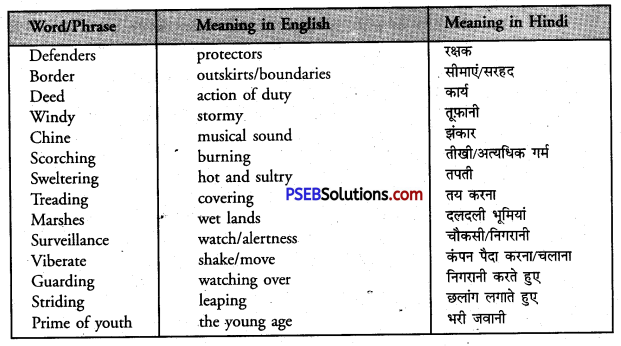
There was a Naughty Boy Question Answer Class 7 English Solutions Poem Chapter 4 PSEB Solutions

Punjab State Board PSEB 7th Class English Book Solutions Poem 4 There was a Naughty Boy Textbook Exercise Questions and Answers.

Class 7th English Solutions Poem Chapter 4 There was a Naughty Boy Question Answers

There was a Naughty Boy Class 7 Questions and Answers

Activity 1.

Look up the following words in a dictionary. You should seek the following information about the words and put them in your WORDS notebook.
1. Meaning of the word as used in the poem (adjective/noun/verb, etc.)
2. Pronunciation (The teacher may refer to the dictionary or the mobile phone for correct pronunciation.)
3. Spellings

Scotland ground yard weighty fourscore wondered

PSEB 7th Class English Solutions Poem 4 There was a Naughty Boy

Vocabulary Expansion

Activity 2

The naughty boy ran away to Scotland from England to see the people there. There, he found that things in Scotland were just the same as in England. To show that things were similar, the poet uses the word “as’. Write about the things that are similar in the space given. One example is given.

1. The naughty boy found that the ground in Scotland was as hard as in England
2. The naughty boy found that the yard in Scotland was as long as in England.
3. The naughty boy found that the song in Scotland was as merry as in the England.
4. The naughty boy found that the cherry in Scotland was as red as in England.
5. The naughty boy found that as weighty as in England.
6. The naughty boy found that the fourscore in Scotland was as eighty as in England.
7. The naughty boy found that the door in Scotland was as wooden as in England.

Activity 3.

Read the following lines from the poem.

That a door
Was as wooden
The door in the poem was ‘wooden’. Let us see some other things which are made of wood. Select the things in the box below that are made of wood and underline them.

table car mobile phone television
boat laptop bed cupboard

Answer:
table, boat, bed, cupboard.

Activity 4.

Three words are given in each column. Fill in the blanks with the names of the material with which the things in each column are made of.
PSEB 7th Class English Solutions Poem 4 There was a Naughty Boy 1
Answer:
stell, Wood, cloth, rubber.

PSEB 7th Class English Solutions Poem 4 There was a Naughty Boy

Learning to Read and Comprehend

Activity 5.

Answer the following questions.

Question 1.
Where did the naughty boy run away from ?
शरारती लड़का कहाँ से भाग कर आया था ?
Answer:
The naughty boy ran away from England.

Question 2.
Where did the naughty boy go?
शरारती लड़का कहाँ गया ?
Answer:
He went to Scotland.

Question 3.
Why did he go there ?
वह वहाँ क्यों गया ?
Answer:
He went there to see the people living there.

Question 4.
What different things did the boy see in Scotland ?
लड़के को स्काटलैंड में कौन-सी भिन्न चीजें देखीं ?
Answer:
The boy saw nothing different in Scotland.

Question 5.
What did the boy wonder about ?
लड़के को किस बात की हैरानी हुई ?
Answer:
He wondered that everything in Scotland was the same as it was in England. Learning Language

Activity 6.

The poem “There was a Naughty Boy’ is very interesting. It describes many things. To describe the things, the poet uses many adjectives. The title of the poem “There was a Naughty Boy’ also has an adjective to describe the boy. Find some more adjectives from the grid given below.
PSEB 7th Class English Solutions Poem 4 There was a Naughty Boy 2
Look at the following two sentences.
1. I am hungry.
2. I am starving.

What is the difference between ‘hungry’ and ‘starving’ here?
Here, sentence 2 tells the reader that ‘I am very hungry (starving). ‘Starving’ means “very hungry’. ‘Starving’, ‘therefore’, is the stronger adjective.

PSEB 7th Class English Solutions Poem 4 There was a Naughty Boy

Activity 7.

Match the adjective in Column A with its stronger adjective in Column B. Column A

Column A
Adjective
Column B
Stronger Adjective
hungry starving
tired beautiful
pretty enraged
nice exhausted
intelligent excellent
angry brilliant
clean spurious
bad hygienic
fake dreadful

Answer:
Hungry — starving, tired – exhausted, pretty – beautiful, nice – excellent, intelligent – brilliant, angry – enraged, clean – hygienic, bad – dreadful, fake – spurious.

Learning to Listen (Class Activity)

Activity 8.

The teacher will speak clearly and give instructions to the students. Students will close their books and listen to the instructions and follow them.
Now repeat the same activity. The teacher will ask a student to come to the front and read the instructions to other students.
Appendix

Learning to Speak (Pairwork)

Activity 9.

Read the following pairs of words aloud with proper stress.
1. hard, yard हाँअड्, याअड्)
2. long, song (लँग,साँग))
3. red, lead (रेड, लैड)
4. weighty, eighty (वेराटी, राअटी)
5. found, ground (फउंड, ग्राउंड)
नोट – विद्यार्थी स्वंय करें

Activity 10.

Discuss in your group what the naughty boy would like to see in Punjab if he came to India and what he would do here.
Some hints :
1. The Golden Temple
2. Vaisakhi Fair
3. Giddha
4. Bhangra
Answer:
Punjab is a land of ten great Sikh Gurus, Gurudwaras and temples. People here are very brave, hard-working and cheerful. The naughty boy, therefore, would see, a scene totally different from England. He would visit the Golden Temple, Jallianwalla Bagh and famous Durgyana Temple. If he came in April, he would visit the Vaisakhi Fair. He would enjoy Giddha and Bhangra, the classical dances of the Punjab. He would also like to see the green and golden fields of wheat crop. Moreover, he would do heavy shopping and take back with him a number of symbols of the Punjabi Culture.

PSEB 7th Class English Solutions Poem 4 There was a Naughty Boy

Learning to Use Language (Group work)

Activity 11.

Discuss in your group which places would you like to see in London and why ? Here are some pictures.
PSEB 7th Class English Solutions Poem 4 There was a Naughty Boy 3
Buckingham Palace where the Queen of United Kingdom lives
PSEB 7th Class English Solutions Poem 4 There was a Naughty Boy 4
Westminster Abbey and the Big Ben Clock Tower
PSEB 7th Class English Solutions Poem 4 There was a Naughty Boy 5

London Eye – a giant wheel, riding on which you can see the whole of London
Answer:
London, the capital of England is a beautiful city to visit. There are many places worth visiting. If I go to London. I would like to visit Buckingham Palace, the Westminster Abbey, the Big Ben Clock Tower and the London eye first.

The Buckingham Palace is a majestic building. It is the royal palace of the Queen of U.K. The Westminster Abbey is a huge royal church. It is situated in the centre of the city offering daily services for all. It is also – World Heritage cite.

PSEB 7th Class English Solutions Poem 4 There was a Naughty Boy

The Big Ben Tower is another building worth visiting. Big Ben is the nickname of the striking clock of the tower. The clock is known for it accuracy. The London Eye is a giant wheel. It is thrilling to have a ride on it. The ride enables you to see the whole of London.

Stanzas For Comprehension

Read the following stanzas carefully and answers the questions that follow each :

(1) There was a naughty boy,
And a naughty boy was he
He ran away to Scotland
The people there to see.

1. Why did the naughty boy run to Scotland ?
शरारती लड़का स्कॉटलैंड क्यों भाग गया ?

2. Why does the poet repeat the word ‘naughty’.
कवि लडके के लिए ‘naughty’ शब्द को क्यों देहराता है|

3. Name the poem and the poet.
कविता और कवि का नाम लिखें।
Answers
1. The naughty boy ran to Scotland to see the people there.
2. The poet repeats the word ‘naughty’ to say that the boy was most mischievous or the naughties one.
3. The name of the poem is ‘There was a Naughty Boy’ and that of the poet is John Keats.

(2) Was as weighty,
That fourscore
Was as eighty,
That a door
Was as wooden,
As in England
So he stood in his shoes
And he wondered,
He wondered,
He stood in his shoes,
And he wondered.

1. What ‘similarity’ did he find about the ground, the door there ?
वहां धरती और दरवाजे के बारे में क्या (किस समानता का) पता चला ?

2. What wondered him ? What words show he surprise ?
उसे किस बात की हैरानी हुई ? कौन-से शब्द उसकी हैरानी को व्यक्त करते हैं ?

PSEB 7th Class English Solutions Poem 4 There was a Naughty Boy

3. What is the central idea of the poem ? कविता का केन्द्रीय भाव क्या है ?
Answer.
1. He found that the ground was as hard and the door was as wooden as in England.
2. Similarity in everything in England and in the place where he was (Scotland) wondered him. The words ‘He stood in his shoes’ show his surprise.
3. The poem brings out that no places are different, no men are different in the world. Their way of life is the same. The things they use and the activities they are involved in are similar. :

Word Meanings

PSEB 7th Class English Solutions Poem 4 There was a Naughty Boy 7

There was a Naughty Boy Summary in Hindi

एक शरारती लड़का (इंग्लैंड) का था। वह यह देखने के लिए स्कॉटलैंड भाग गया कि वहां के लोग कैसे हैं। वह देख कर हैरान रह गया कि वहाँ की धरती इंग्लैंड की धरती की तरह सख्त है। वहां के गज़ की लम्बाई भी उतनी है जितनी कि इंग्लैंड में। स्कॉटलैंड तथा इंग्लैंड के गीतों, फलों तथा धातुओं के गुणों में भी समानता थी।

उदाहरण के लिए गीत आनन्द भरे थे, चैरी लाल थी तथा सीसा भारी था। वहां की गणना का मानक कोड़ी (20 वस्तुएं) भी एक जैसा था। वास्तव में यह सब कुछ हैरान कर देने वाला था।

Class 7 PSEB Solutions Poetry

My Dear Soldiers Question Answer Class 8 English Solutions Poem Chapter 4 PSEB Solutions

Punjab State Board PSEB 8th Class English Book Solutions Poem 4 My Dear Soldiers Textbook Exercise Questions and Answers.

Class 8th English Solutions Poem Chapter 4 My Dear Soldiers Question Answers

My Dear Soldiers Class 8 Questions and Answers

Activity 1.

Look up the following words in a dictionary. You should seek the following information about the words and put them in your WORDS notebook.
1. Meaning of the word as used in the poem (adjective/noun/verb. etc.)
2. Pronunciation (The teacher may refer to the dictionary or a mobile phone for correct pronunciation.)
3. Spellings.

defenders border deed windy scorching
sweltering treading marshes surveillance vibrate

Vocabulary Expansion

Activity 2.

Write synonyms of the following words.

(a) very hot – Scorching
(b) protect – defend

PSEB 8th Class English Solutions Poem 4 My Dear Soldiers

Read the following pairs of words carefully.

1. great sons
2. windy season
3. snowy days
4. scorching sun

All the highlighted words are ‘adjectives’ and the partner words are ‘nouns.’ Sometimes adjectives can be changed to nouns. For example ‘beautiful is an adjective. The noun from the adjective ‘beautiful is ‘beauty’

Sr. No. Adjective Noun
1. strong wind
2. active members
3. rich people
4. wise men
5. loyal soldiers
6. careful student
7. kind person
8. happy lad
9. good friend
10. faithful dog

Learning to Read and Comprehend

Activity 4.

Read the stanza and answer the questions that follow.

A. Oh! Defenders of borders
You are great sons of my land
When we are all asleep in
You still hold on to your deed.
Windy season or snowy days
Or scorching sun’s sweltering rays
You are there guarding all the time awake
Treading the lonely expanses as Yogis.

PSEB 8th Class English Solutions Poem 4 My Dear Soldiers

(a) Name the poet of the poem ‘My Dear Soldiers’.
‘My Dear Soldiers’ कविता के लेखक का नाम बताएं
Answer:
The poet of this poem is A.P.J. Abdul Kalam.

(b) Who are being referred to as ‘Defenders of borders’ ?
‘सीमाओं का रक्षक’ किसे कहा जा रहा है
Answer:
Indian soldiers are being referred to Defenders of Borders’.

(c) How do these great sons serve their motherland ?
ये महान सपूत मातृभूमि की सेवा कैसे करते हैं ?
Answer:
They guard the borders of their motherland day and night.

(d) What kind of weather conditions do the soldiers have to face ?
सैनिक किस प्रकार की मौसमी दशाओं का सामना करते हैं ?
Answer:
They face windy and snowy weather.

B. Climbing the heights or striding the valleys
Defending the desert guarding the marshes
Surveillance in seas and by securing the air
Prime of your youth given to the nation!!
Wind chimes of my land vibrate your feat
We pray for you brave men!!
May the Lord bless you all!!

(a) Whom has the poem been addressed to ?
कविता किसे संबोधित की गई है ?
Answer:
The poem is addressed to the Indian soldiers.

(b) What do these great sons sacrifice for the nation ?
ये महान सपूत राष्ट्र के लिए क्या त्याग करते हैं ?
Answer:
They sacrifice their lives and their youth for the nation.

(c) What is the intention of the poet ?
कवि का इरादा क्या है?
Answer:
The poet wishes to tribute to our brave soldiers. He also wishes that they should enjoy God’s blessings.

PSEB 8th Class English Solutions Poem 4 My Dear Soldiers

(d) Explain: ‘Wind chimes of my land vibrate your feat’.
व्याख्या कीजिए : “मेरे देश की पावन की झंकार तुम्हारे कदमों में सुनाई देती है”
Answer:
It means that our soldiers march forward with rhythmical sound.

Learning Language

Formation of Adverbs

A large number of adverbs are formed by adding ‘-ly’ to certain adjectives.

1. Most of the adverbs formed this way are the Adverbs of Manner. For example :

Sl.No Adjective Adverb 
1. strong strongly
2. faithful faithfully
3. sincere sincerely
4. quick quickly
5. slow slowly
6. neat ready
7. busy busily.
8. happy happily
9. true truly
10. severe severely

2. Some adverbs have the same form as the corresponding adjectives. For example :

S. No Adjective Adverb
1. Fie put in a lot of hard work. He worked hard.
2. I want a little sugar. Please move a little.
3. Fie has high aims. He aims high in life.
4. I want an early reply. Please reply early.

PSEB 8th Class English Solutions Poem 4 My Dear Soldiers

3. Some adverbs are formed by combining a noun and a qualifying adjective. For example : yesterday, otherwise, meanwhile, sometimes.
4. Some adverbs are formed by adding a noun to ‘a’, ‘be’ and ‘to’, etc. For example : today, abreast, ahead, besides, etc.
5. Some adverbs are formed by combining ‘à or ‘be’ and an adjective. For example : aloud, anew, behind, aloud, alone, etc.
6. Some adverbs are formed from participles. For example : wittingly, surprisingly, knowingly, etc.
7. Some adverbs are formed in the following ways. For example : 1… one

1. one once
2. two twice
3. three thrice
4. four fourfold
5. many manifold

8. There are several adverbs which we used together having been joined together with
conjunctions to form adverbial phrases. For example :
(a) by and by (within a short period)
(b) again and again
(c) far and wide
(d) first and foremost
(e) to and fro
(f) off and on (occasionally) etc.

Activity 5.

Change the following adjectives to adverbs.

S. No. Adjective Adverb
1. bad badly
2. angry angrily
3. fast faddy
4. bold boldly
5. brisk briskly
6. meek meekly
7. nice nicely
8. soft softly
9. fair fairly
10. clean cleanly

Activity 6.

In the following sentences, same words are used both as an adjective and as an adverb. Underline the word and write whether it is used as an adjective or an adverb.

(a) You gave a beautiful, presentation. — ‘beautiful’ as an adjective
(b) Your work is beautifully presented. — ‘beautifully as an adverb
(c) I get a monthly paycheque. — ‘monthly’ as an adjective
(d) My company pays me monthly. — ‘monthly’ as an adverb
(e) She dressed elegantly. — ‘elegandy’ as an adverb
(f) She looks very elegant in suit.– ‘elegant’ as an adjective
(g) That boy is so loud. — ‘loud’ as an adjective
(h) That boy speaks so loudly. — ‘loudly as an adverb
(i) He is a gentle person. — ‘gently as an adjective
(j) He hugged me gently. — ‘gently’ as an adverb.

PSEB 8th Class English Solutions Poem 4 My Dear Soldiers

Activity 7.

You will tell your partner something that she/he doesn’t know about you. You may talk about one of the following topics.

  • your pet
  • yourself
  • something you have bought
  • a neighbour
  • a place

While speaking. include two or three lies too. Take turns in speaking. The listener will listen carefully and note down in the notebook what she/he thinks is not true’ or ‘a lie’. When both of you have taken turns in speaking, you will tell your partner what you think was not true in his/her story.

The teacher must go to each bench to ensure that students are using English. Alternatively, the teacher can give two stories with lies which they can read and the partner can point out the lies.

My Pet

I have a pet. It is dog. It is small. But it is very greedy. It can eat one kilo of rice and twelve eggs for a single meal. It eats its rice with a spoon. When I come from outside, it jumps out me and talks to me in English. It scolds me if I reach home late. My father, is very happy with my dog because it helps him in cleaning the house.
Or
A Visit to Simla

I went to Simla for a vacation. It is a very big city. It is a very warm place. I went there on a shop. I did a lot of shopping there. I bought juices from there. I also bought an aeroplane from there and came home on that aeroplane. I keep the aeroplane in my garage and go to my school on my plane everyday.

Learning to Speak (Pairwork)

There are birds of prey that live on high mountains and trees. They have very good eye sight and can see things on the ground while flying in the sky. If they see something that they can eat, they dive like a thunderbolt to catch their prey.

PSEB 8th Class English Solutions Poem 4 My Dear Soldiers

Activity 8.

Think of a wild animal or a bird that you like. Write its different qualities in the mind map given below. Take 2-3 minutes to do this work. You can use the following hints.
(a) kind of bird or animal
(b) its appearance and size
(c) its habitat
(d) its eating habits – herbivorous/carnivorous
(e) some special quality
(f) usefulness of the animal/bird
PSEB 8th Class English Solutions Poem 4 My Dear Soldiers 1

Now speak for two minutes about the animal or the bird you have made notes on. You can refer to your notes while speaking.
Answer:
Elephant is my favourite animal. It lives in dense forests, mostly in dry-wet areas. It is a royal animal that walks gracefully. It has big body greyish to brown in colour. It is a herbivorous. Sugarcane is its favourite food. It has a trunk and two long teeth. It carries heavy logs of wood. It gives rides too.
PSEB 8th Class English Solutions Poem 4 My Dear Soldiers 2

Learning to Write

Letter Writing

Letter writing is an important skill. We need to write letters in our daily life. It may be stated that these days people write emails more than letters. However, the art of writing letters and emails is the same though the format is different. Let us look at a complete letter written below:

Write a letter to your younger brother congratulating him on his brilliant success.

A 204 Rishi Apartments
Sector 70
SAS Nagar
June 10, 20…
Dear Harnaaz
Heartiest congratulations on achieving brilliant success in your board examination! I just came to know about it and I am very happy. I hope you are also extremely happy to receive the news of your result. You have stood first in your stater It is the result of your hard work. I am really proud of you. Your parents must also be very happy. If you continue to work hard like this, you will be a successful person in life.
I wish you a lot of success in your future too.
Yours sincerely
Mankeerat.

Activity 9

Now, using the format of letter writing given earlier and the notes written by you in the mind map above, write a letter to your friend telling him/her all about the animal/ bird you wrote about. At the end of the letter, you must write to your friend about why human beings should try to protect birds and animals from getting hunted by poachers.
Answer:
C-203, Sardar Patel Marg
Sector–22
Chandigarh
21 May, 20…..
Dear Divyadeep
India is a land of bio-diversity (जैव – विविधता) We have many kinds of birds and animals wild and domestic. They have different colours, sizes and different food habits. They live in different climatic conditions (जलवायु दशाएं). They are the beauty of our planet. Elephant is a royal animal. He has kingly grace. Bengal Tiger is another wild animal worth mentioning. Lion is the king of forest. Killing of these animals for food and profit is banned. But it is a pity that poachers hunt them for money. They don’t spare even innocent birds like peacock. It must be stopped otherwise our earth will become a poor place to live in.
Yours Sincerely
Jasjeet.

Word Meanings

PSEB 8th Class English Solutions Poem 4 My Dear Soldiers 3

PSEB 8th Class English Solutions Poem 4 My Dear Soldiers

My Dear Soldiers Poem Summary in English

My Dear Soldiers Summary in English

It is a patriotic poem by A.P.J. Abdul Kalam. It is dedicated to the Indian soldiers. They are the great sons of India. Sun or shine they do their duty. They don’t care for hot sun rays or chilly winds. They are awake day and night guarding borders, the sea, the air and marshes.

Our soldiers are true patriots and selfless soldiers. They sacrifice their all for the sake of the country. They die for the sake of their motherland in the prime of their youth. They are worthy of our praise, respect and god’s blessing. Every Indian prays for the glory of our brave soldiers.

My Dear Soldiers Summary in Hindi

यह A.P.J. Abdul Kalam द्वारा लिखी गई देशभक्ति की एक कविता है। यह भारतीय सैनिकों को समर्पित है। वे भारत के महान् सपूत हैं। वे हर मौसम में अपना कर्तव्य निभाते हैं। वे सूर्य की गर्म किरणों या शीतल हवाओं की परवाह नहीं करते। वे हमारी सीमाओं-सागरों, हवाई मार्गों तथा दलदली भूमियों-की रक्षा करते हुए दिन-रात जागते रहते हैं। हमारे सैनिक सच्चे देशभक्त और नि:स्वार्थ सिपाही हैं। वे देश के लिए अपना सब कुछ बलिदान कर देते हैं। वे भरी जवानी में देश के लिए अपने प्राण दे देते हैं। वे हमारी प्रशंसा, हमारे सम्मान और परमात्मा के आशीर्वाद के पात्र हैं। हर भारतीय भारतीय सैनिकों के गौरव के लिए प्रार्थना करता है।

Central Idea of The Poem

This poem sings the glory of our soldiers. They are true patriots who sacrifice their all for the sake of their country. They guard our boundaries day and night. Sun or shine they are alert. Let us pray for their honour and glory.

Class 8 PSEB Solutions Poetry

The Princess Who Never Smiled Question Answer Class 7 English Solutions Chapter 5 PSEB Solutions

Punjab State Board PSEB 7th Class English Book Solutions Chapter 5 The Princess Who Never Smiled Textbook Exercise Questions and Answers.

Class 7th English Solutions Chapter 5 The Princess Who Never Smiled Question Answers

The Princess Who Never Smiled Class 7 Questions and Answers

Activity 1.

Look up the following words in a dictionary. You should seek the following information about the words and put them in your WORDS note work.
1. Meaning of the word as used in the story (adjective/noun/verb, etc.)
2. Pronunciation (The teacher may refer to the dictionary or the mobile phone for correct pronunciation.)
3. Spellings:

Princess amuse tricks clown mime
Journey scarce nervous appeared magician

Activity 2.

Rearrange the jumbled words given in capitals on the right side to mean the following.

PSEB 7th Class English Solutions Chapter 5 The Princess Who Never Smiled 1
PSEB 7th Class English Solutions Chapter 5 The Princess Who Never Smiled 2

PSEB 7th Class English Solutions Chapter 5 The Princess Who Never Smiled

Activity 3.

Answer the following questions :

Question 1.
Why was the king worried about Tanya, the princess ?
राजकुमारी तान्या के बारे में राजा चिंतित क्यों था ?
Answer:
The King was worried because Tanya never smiled.

Question 2.
What did he do to amuse his daughter ?
पुत्री को खुश करने के लिए उसने क्या किया ?
Answer:
He called a magician and a clown to amuse her.

Question 3.
What did the magician do ?
जादूगर ने क्या किया ?
Answer:
The magician showed the princess some tricks.

Question 4.
What did the clown do ?
मस्खरे (जोकर) ने क्या किया ?
Answer:
The clown tried to make the princess laugh with a mime.

Question 5.
What did the king do when the princess did not smile ?
राजकुमारी के न मुस्कराने पर राजा ने क्या किया ?
Answer:
At this, the king declared that anyone who made the princess laugh would get to marry her.

Question 6.
Who was Ivan ?
इवान कौन था ?
Answer:
Ivan was a poor boy who worked for a farmer.

Question 7.
What did Ivan want to do?
इवान क्या करना चाहता था ?
Answer:
Ivan wanted to take a chance to make the princess laugh.

Question 8.
Who all did he meet on his way to the palace ?
महल की ओर जाते हुए वह रास्ते में किस-किस से मिला ?
Answer:
He met a fish, a mouse and a grass-hopper.

Question 9.
What did they want ?
वे क्या चाहते थे ?
Answer:
They wanted to have a new home.

Question 10.
What did Ivan give each of them ?
इवान ने प्रत्येक को क्या दिया ?
Answer:
Ivan gave a gold coin to each of them.

Question 11.
Where was the princess ?
राजकुमारी कहां थी ?
Answer:
The Princess was standing by her window.

Question 12.
What was she doing ?
वह क्या कर रही थी ?
Answer:
She was looking at Ivan.

PSEB 7th Class English Solutions Chapter 5 The Princess Who Never Smiled

Question 13.
What happened when Ivan fell into a hole ?
जब इवान सुराख/बिल में गिरा तो क्या हुआ ?
Answer:
The princess started laughing at this.

Question 14.
Why did she start laughing ?
वह हँसने क्यों लगी ?
Answer:
She started laughing because it was the funniest thing she had ever seen.

Question 15.
What did the king do ?
राजा ने क्या किया ?
Answer:
The king became very happy and started laughing.

Activity 4

Select the correct option and fill it in the given blank :

Question 1.
Princess Tanya was a pretty girl but she did not
(a) smile
(b) walk
(c) speak
Answer:
(a) smile

Question 2.
The king called …….. to amuse her.
(a) a magician
(b) a clown
(c) a magician and a clown
Answer:
(c) a magician and a clown

Question 3.
The farmer gave Ivan three ………. coins.
(a) silver
(b) copper
(c) gold
Answer:
(c) gold

PSEB 7th Class English Solutions Chapter 5 The Princess Who Never Smiled 3

Question 4.
Ivan met a ……….. first of all.
(a) mouse
(b) fish
(c) grass-hopper
Answer:
(b) fish

Question 5.
Ivan gave .. …………. to the mouse.
(a) one coin
(b) two coins
(c) three coins
Answer:
(a) one coin

PSEB 7th Class English Solutions Chapter 5 The Princess Who Never Smiled

Question 6.
The princess was standing by her ………..
(a) window
(b) garden
(c) tower
Answer:
(a) window

Question 7.
Ivan fell into a ………
(a) river
(b) lake
(c) hole
Answer:
(c) hole

Question 8.
The princess laughed on seeing the small animals the fish, the mouse and the grass hopper trying to ………………….. Ivan to save him.
(a) pull up
(b) push down
(c) push away
Answer:
(a) pull up.

Learning Language

Tenses (verb)
हमें क्रिया का समय बताते हैं। यहां Present continuous Tense के बारे में बात की गई है। इस Tense के बारे में जानने के लिए नीचे दिए गए Format का चयन करें

Affirmative

I am laughing (first form of the verb + -ing).
He/She/It/Singular Nouns is
We/You/They/Plural Nouns are

Negative.

I am not
He/She/Singular Nouns is not watching (verb in its first a film
We/You/They/Plural Nouns are not form + ing).

Interrogative
Is/am/are + subject + first form of the verb + -ing ?

Activity 5

Complete the following sentences using Present Continuous Tense of the verb given in the brackets (Capitalize when needed).

1. My teacher………. talk on the phone right now.
2. …….. you ……………. (dance) ?
3. Cheeku ………………………… (do) his homework at the moment.
4. Shanti …………………………… (work) on a project nowdays.
5. My kids ………………………… (play) in the garden now.
6. Some people ………………. ……… (wait) to talk to you.
7. I ……………… (not go) for a walk today.
8 Leena ……………… (study) for his exam right now ?
9 Uma ……………… (play) the piano now ?
10. Mohan and I ……………… (paint) the fence today.
11. Amita ……………… (help) me at present.
12. My children ……………… (not listen) to the radio now.
13. Saira ……………… (not drink) tea now.
14. I ……………… (vacuum) the carpet right now.
15. My father ……………… (watch) TV now.
16. What she ……………… (eat) right now ?
17. ……. your dog ……… (hide) from me ?
18. Which book ………………………… you ……………….. (read) nowadays?
19. Thomas ………………………. (drive) me home now.
20. I …………………………. (wash) my hands at the moment.
Answer:
1. is talking
2. Are, dancing
3. is doing
4. is working
5. are playing
6. are waiting
7. am not going
8. Is, studying
9. Is, playing
10. are painting.
11. is helping
12. are not listening
13. is not drinking
14. am vacuuming
15. is watching
16. is eating
17. Is, hiding
18. are, reading
19. is driving
20. am washing.

PSEB 7th Class English Solutions Chapter 5 The Princess Who Never Smiled

Now Read the following :

Princess Tanya was watching everything from her window. She started laughing. It was the funniest thing she had ever seen. She laughed and laughed. She kept laughing. The King was passing by her room. He saw that the princess was laughing. The King became very happy. He also started laughing. Within no time, the queen was laughing, the ministers were laughing, the servants were laughing, the guards were laughing and all the people were laughing. Ivan was also laughing.

ऊपर के passage में past (बीते हुए समय की क्रिया, जो उस समय जारी थी) का प्रयोग किया गया है। यह Past Continuous Tense में है। इस Tense के Patterm का अध्ययन नीचे दिए गए वाक्यों में करें।
नोट : Interrogative Sentences में was/were + Subject + first form of the verb + ing ? का Pattern अपनाएं।

Affirmative.

I/He/She/Singular Nouns was watching (verb in its first Torm + -ing). a film.
We/You/They/ Plural Nouns were

Negative.

I/He/She/Singular Nouns was not watching (verb in its first form +-ing). a film.
We/You/They/ Plural Nouns were not

Activity 6

Supply the suitable forms of verbs given in the brackets. The first one is done for you.
1. I was shopping (shop) when you called.
2. Students …………………………… (play) happily when I reached the class.
3. I told him but he didn’t hear me as he ………………. (watch) the news.
4. Sheela and Khyati ………………………… (work) in the office when the boss walked in.
5. The Knight Riders ……………………… (warm-up) when the Mumbai Indians arrived at the stadium.
6. While Minesh was praying, Kiran ………………………. (bake) a cake.
7. I ……………………. (drive) when you called, so I couldn’t answer.
8. I saw Meena yesterday when she …………….. (walk) by the river.
9. My mother ……………. (cook) and my father …………………………. (dust) the house yesterday.
10. Shanti ……………………….. (boil) milk when Rita came.
Answer:
2. were playing
3. was watching
4. were working
5. were warming up
6. was baking
7. was driving
8. was walking
9. was cooking, was dusting
10. was boiling.

Learning to Listen

Activity 7.

Let us play a game today. Get up from your seats. The name of the game is, “The Princess Says…. You will follow the commands of your teacher. She/he will give you commands to follow. Commands will begin with the phrase “The Princess Says …. If the teacher does not say “The Princess Says…….. before a command (i.e. hold your left ear); you will not follow the command. If you still follow the command, you will be out of the game. The last person left wins.

नोट: अपने teacher के साथ मिलकर स्वयं करें।

Learning to Speak (Pair work)

Activity 8

Imagine that you are talking to your friend on the phone. Tell each other about four things that you and your family members are doing. You can pick words from the following table.

wash dance cook pray dust jump
watch laugh clean make draw help

A: Hello, I am ………. X ……… (name) speaking ! Who is on the line ?
B: Hello, I am …….. Y …….. (name) speaking !
A: Oh! What are you doing?
B: I am watching T.V.
A: What is your mother doing ?
B: She is washing clothes. And, what is your mother doing ?
A: She is cooking food.
B: What is your younger brother doing?
A: He is drawing. He is making a dog.
B: What is your elder sister doing? And what about your father?
A: My younger sister is helping mother in the kitchen. My father is praying to God.
B: What is the noise about that is coming ?
A: My younger sister is jumping, dancing and laughing.
B: Good afternoon. Now I am putting the phone down.

PSEB 7th Class English Solutions Chapter 5 The Princess Who Never Smiled

Learning to Write

Activity 9

A mind map of a story is given below. The name of the story is “The Three Pigs’. Using the mind map, write your story about the three pigs and the wolf . All the hints and useful words are given in the mind map.

PSEB 7th Class English Solutions Chapter 5 The Princess Who Never Smiled 4
Answer:
The Three Pigs : Once there were three pigs. One lived in a straw house and one in a wooden. Their houses were not strong as they were quickly built. But the third one lived in a brick house that was very strong. One day a big bad wolf came there. It was hungry for pigs. It blew down the straw and the wooden houses easily and ate the pigs. But she could not break down the brick house. Therefore, it climbed down the chimney of the house. Soon she got buried by hot water and ran away crying.

Learning to use language

Activity 10

Read the dialogue between a dinosaur and a sparrow. Dinosaur is an extinct animal and sparrow is about to become extinct. Radiation from mobile phone towers has harmed sparrows and other birds.

Complete the dialogue by taking information from the given table.

PSEB 7th Class English Solutions Chapter 5 The Princess Who Never Smiled 5

1. First appeared 235 million years ago
2. Class Reptile
3. Size Different sizes, 20 inches to 39.7 meters
4. Height 59 feet (largest dinosaurs)
5. Life on Earth 150 million years
6. Extinction 66 million years ago
7. Cause of Extinction Asteroid hit on Earth
8. Result of the asteroid hit Mass extinction of most species on Earth

Dialogues

Sparrow : Hello, stranger! You are so huge. How can I help you ?
Dinosaur : Oh, hello! Actually I am not a stranger. I used to live here 66 million years ago.
Humans call us Dinosaurs. So I’m just exploring how much the planet has changed.
Sparrow : Oh, really! How much has it changed ?
Dinosaur : Oh, it has changed so much. I don’t like the change. There were no humans and buildings when I used to live no pollution, no global warming.
Sparrow : Oh, tell me more, Sir !
Dinosaur : There were trees all around. We were everywhere – on land, in the air and in water.
Sparrow : Oh, wow! What were they called ?
Dinosaur : Humans have named the flying Dinosaurs as PTERODACTYL.
Sparrow And what about the ones that lived in the water ?
Dinosaur : They have been named as SPINOSAURUS.
Sparrow : Mr Dinosaur, I have so many questions to ask you.
Dinosaur : Don’t worry, I know what is in your mind.
Here I am going to tell you all about me and our family.

PSEB 7th Class English Solutions Chapter 5 The Princess Who Never Smiled 6

We were reptiles. We appeared on earth 235 million years ago. We were of different sizes — from 20 inches to 39.7 meters. The largest member of our family was 59 feet tall. We lived about 150 million years on earth. But about 66 million years ago an asteroid hit the earth that caused our extinction. This incident also led to the extinction of most species of this planet.

PSEB 7th Class English Solutions Chapter 5 The Princess Who Never Smiled

Comprehension Of Passages

Read the following passage carefully and answer the questions that follow each.

(1) This is a very old story from Russia. There was a princess in Russia. Her name was Tanya. Tanya was very beautiful but she never smiled or laughed. Her father, the king, loved her very much but he kept worrying because she never smiled. Even the queen was worried.

King (said to himself): I must find a way to make my daughter happy. I want to see her smiling! And he had an idea. He called a magician to amuse his daughter. The magician showed the princess some tricks.

1. What kind of girl was Tanya ?
तान्या कैसी लड़की थी ?

2. What did Tanya’s father wish ?
तान्या के पिता की क्या इच्छा थी ?

3. Choose true and false statements and write them in your note-book.
(a) Tanya’s father was a king.
(b) Queen never got worried.

4. Complete the sentences according to the meaning of the passage.
(a) Tanya was a …………..
(b) The magician showed the princess …………..

5. Match the words with their meanings.

(a) worried entertain
(b) amuse anxious
show

Answer:
1. Tanya was very beautiful but she never smiled or laughed.
2. Tanya’s father wished to see his daughter (Tanya) smiling.
3.
(a) True
(b) False
4.
(a) Tanya was a princess in Russia.
(b) The magician showed the princess some tricks.
5.
(a) worried — anxious
(b) amuse — entertain

PSEB 7th Class English Solutions Chapter 5 The Princess Who Never Smiled

(2) Very far from the palace, there lived a poor boy. His name was Ivan. He worked for a farmer. When he heard about the king’s promise, he wanted to take a chance at making the princess laugh. He thought that he could make her laugh. The farmer gave the boy three gold coins for the journey.
On his way, he found a lake. In the lake, there was a fish. The fish called him.
Fish (to Ivan) : Oh ! Can you help me, please ?
Ivan (to the fish) : How can I help you, fish ?
Fish (to Ivan) : I have lived in this lake for a long time.
Now the water is getting dirty. I don’t want to live here anymore, but I am too poor to find a new house.
Ivan (to the fish): I am so sorry, Fish. I have three gold coins. I can give you one. I’ll still have two for my journey. I am going to meet the princess.

1. Who was Ivan ? Where did he live ?
इवान कौन था ? वह कहां रहता था ?

2. What did Ivan saw on his way?
रास्ते में उसे क्या दिखाई दिया ?

3. Choose true and false statements and write them in your note-book.
(a) The fish had lived in the lake for a long time.
(b) The fish wanted the princess to help it.

4. Complete the sentences according to the meaning of the passage.
(a) The farmer gave the boy ………….. for the journey.
(b) I am too poor to

5. Match the words with their meanings.

promise saw
found made
 word

Answers
1. Ivan was a poor boy who worked for a farmer. He lived very far from the king’s palace.
2. On his way, Ivan saw a lake with a fish in it.
3.
(a) True
(b) False
4.
(a) The farmer gave the boy three gold coins for the journey.
(b) I am too poor to find a new house.
5.
(a) promise — word
(b) found — saw.

PSEB 7th Class English Solutions Chapter 5 The Princess Who Never Smiled

(3) Ivan continued travelling. He was hungry and very tired. He had no money to buy food. He reached the palace. He saw the princess. She was standing by her window. She was looking at him. He became nervous because the princess was looking at him. He fell into a hole.
Ivan (shouting) : Help! Someone, help me!
Suddenly, the fish, the mouse and the grass-hopper appeared.
All three (fish, mouse and grasshopper) : Don’t worry! We will save you !
The three of them pulled the boy from the hole.

1. In what condition was Ivan when he reached the palace ?
महल तक पहुँचने पर इवान की क्या दशा थी ?

2. Why did he become nervous ?
वह घबरा क्यों गया ?

3. Choose true and false statements and write them in your note-book.
(a) The princess was standing.
(b) The three of them pulled the boy.

4. Complete the sentences according to the meaning of the passage.
(a) The princess was standing …………………..
(b) The three of them pulled the boy …………..

5. Match the words with their meanings.

(a) nervous confused
(b) appeared became invisible
became visible

Answer:
1. Ivan was very hungry and thirsty when he reached the palace.
2. He became nervous because the princess was looking at him.
3.
(a) False
(b) True
4.
(a) The princess was standing by her window.
(b) The three of them pulled the boy out from the hole.
5.
(a) nervous — confused
(b) appeared — became visible

PSEB 7th Class English Solutions Chapter 5 The Princess Who Never Smiled

(4) Princess Tanya was watching everything from her window. She started laughing. It was the funniest thing she had ever seen. She laughed and laughed. She kept laughing. The king was passing by her room. He saw that the princess was laughing. The king became very happy. He also started laughing. Within no time, the queen was laughing, the ministers were laughing, the servants were laughing, the guards were laughing and all the people were laughing. Ivan was also laughing. The king kept his promise. The kingdom came to know that Ivan and the princess were getting married. They got married. Ivan became a prince. He went to the king.

1. How did the King feel ?
राजा ने कैसा महससू किया ?

2. Who were getting married ?
किसकी शादी हो रही थी ?

3. Choose true and false statements and write them in your note-book.
(a) The king did not keep his promise.
(b) Ivan became a prince.

4. Complete the sentences according to the meaning of the passage.
(a) Within …………….. the queen was laughing.
(b) The king saw that ………….

5. Match the words with their meanings.

(a) funniest smile
(b) watch most amusing
see

Answer:
1. The king became very happy.
2. The princess and Ivan were getting married.
3.
(a) False
(b) True
4.
(a) Within no time the queen was laughing.
(b) The king saw that the princess was laughing.
5.
(a) funniest — most amusing
(b) watch — see

Use Of Words/Phrases In Sentences

1. Amuse (entertain) –
Mother amused her child with toys.
माँ ने खिलौनों से अपने बच्चे का मनोरंजन किया।

2. Tricks. (feats) –
The tricks of the magician were funny.
जादूगर के करतब मज़ाकिया थे।

3. Nervous (confused) –
Why are you so nervous ?
आप इतने घबराए हुए क्यों हैं ?

4. Scarce (not enough, scanty) –
Water is getting scarce here.
यहां पानी की कमी होती जा रही है।

PSEB 7th Class English Solutions Chapter 5 The Princess Who Never Smiled

5. Worried (anxious) –
You look worried. What is the problem ?
तुम चिंतित दिखाई देते हो। क्या समस्या है ?

6. Journey (trip) –
We went on a long journey last year.
पिछले साल हम एक लंबी यात्रा पर गए।

7. Princess (royal maiden) –
The princess was married to a handsome prince.
राजकुमारी की शादी एक सुंदर राजकुमार से कर दी गई।

8. Appeared (came in front of) –
The thief appeared before the judge.
चोर जज के सामने आया।

9. Pulled (dragged) –
We pulled the heavy fish with a rope.
हमने भारी मछली को एक रस्सी से खींचा।

Word Meanings

PSEB 7th Class English Solutions Chapter 5 The Princess Who Never Smiled 7

The Princess Who Never Smiled Summary in Hindi

This is very old …………………….. them could do it.

यह रूस की एक बहुत पुरानी कहानी है। रूस में एक राजकुमारी थी। उसका नाम तान्या था। तान्या बहुत सुंदर थी लेकिन वह कभी भी हंसती या मुस्कराती नहीं थी। उसके पिता राजा थे और उसे बहुत प्यार करते थे परन्तु वह चिंतित रहते थे क्योंकि वह कभी मुस्कराती नहीं थी। यहां तक कि रानी भी चिंतित थी। राजा (अपने आप से कहा) : मुझे कोई रास्ता ढूंढना चाहिए ताकि मैं अपनी बेटी को खुश कर सकू। मैं उसे मुस्कराते हुए देखना चाहता हूँ। और उसे एक विचार सूझा। उसने अपनी बेटी को बहलाने के लिए एक जादूगर को बुलाया। जादूगर ने राजकुमारी को कुछ कतरब दिखाए। राजा

(राजकुमारी से) : हा, हा, हा …… क्या यह मनोरंजक नहीं ?
राजकुमारी (राजा से) : हाँ, पिता जी। करतब अच्छे हैं परन्तु वे मेरे चेहरे पर मुस्कान नहीं ला सकते।
उन्होंने एक जोकर को भी बुलाया ताकि वह मुस्करा सके।
राजा (राजकुमारी से) : हा, हा, हा …… क्या यह मज़ेदार नहीं ?
राजकुमारी (राजा से) : हाँ पिता जी। जोकर मजाकिया है, परन्तु वह मुझे मुस्कराहट नहीं दे सकता।जोकर उसे हंसाने के लिए नकलें भी उतारता है।

राजा (राजकुमारी से) : हा, हा, हा ………. क्या यह मज़ाकिया नहीं है ?
राजकुमारी (राजा से) : वह अच्छा है परन्तु वह मेरी मुस्कराहट नहीं ला सकता।
अन्ततः उसने अपने देश के सभी लोगों को यह बताने का निर्णय लिया कि जो कोई भी राजकुमारी को हँसा देगा, उसका विवाह राजकुमारी से कर दिया जाएगा। रूस भर से लोग राजा के महल गए और उन्होंने राजकुमारी को हँसाने का प्रयत्न किया, परन्तु कोई भी ऐसा न कर सका।

Very far from ………………. meet the princess.

महल से बहुत दूर एक गरीब लड़का रहता था। उसका नाम इवान था। वह एक किसान के पास काम करता था। जब उसने राजा के वचन के बारे में सुना, तो उसने राजकुमारी को हँसाने का एक अवसर पाने की सोची। वह सोचता था वह उसे हँसा सकता है। किसान ने यात्रा के लिए लड़के को तीन स्वर्ण मुद्राएं दीं। रास्ते में उसे एक झील मिली। झील में एक मछली थी। मछली ने उसे पुकारा। मछली (इवान से) : ओह! कृपया आप मेरी मदद कर सकते हैं ?
इवान (मछली से) : मछली, मैं तुम्हारी क्या मदद कर सकता हूँ ?

मछली (इवान से) : मैं एक लम्बे समय से इस झील में रह रही हूँ। अब पानी गंदा हो रहा है। मैं यहाँ और
अधिक नहीं रहना चाहती, परंतु मैं इतनी गरीब हूँ कि अपने लिए नया घर नहीं ले
सकती। इवान (मछली से) : मछली, मैं माफी चाहता हूँ। मेरे पास तीन स्वर्ण मुद्राएं हैं। मैं एक तुम्हें दे सकता हूँ।
मेरे पास यात्रा के लिए फिर भी दो बच जाएंगी। मैं राजकुमारी से मिलने जा रहा हूँ।
मछली (इवान से) : मैं तुम्हारा धन्यवाद कैसे कर सकती हूँ ?

इवान (मछली से) : चिंता मत करो। मुझे तुम्हारी मदद करके खुशी हुई। मुझे आशा है कि तुम्हें एक नया और अच्छा घर मिल जाएगा। इवान ने अपनी यात्रा जारी रखी। उसने एक बड़ा सा खेत
देखा। खेत में एक चूहा था। चूहे ने उसे पुकारा। चूहा (इवान से) हैलो नवयुवक! क्या तुम मेरी सहायता कर सकते हो ?
इवान (चूहे से) : चूहे, मैं तुम्हारी मदद कैसे कर सकता हूँ?
चूहा (इवान से) : मैं लम्बे समय से इस खेत में रह रहा हूँ। अब यहां भोजन कम होता जा रहा है। मैं अब यहां और अधिक नहीं रहना चाहता, परन्तु मैं गरीब हूँ।

इवान (चूहे से) : चूहे, मैं माफी चाहता हूँ। मेरे पास दो स्वर्ण मुद्राएं हैं। मैं एक तुम्हें दे सकता हूँ। मेरे
पास यात्रा के लिए फिर भी एक रह जाएगी। मैं राजकुमारी से मिलने जा रहा हूँ।
चूहा (इवान से) : तुम बहुत दयालु हो। मैं किस प्रकार तुम्हारा आभार व्यक्त करूं?
इवान : चिंता मत करो। मैं तुम्हारी मदद करके खुश हूँ। मुझे आशा है कि तुम्हें एक अच्छा और नया घर मिल जाएगा।

Ivan continued ………………….. from the hole.

इवान ने यात्रा जारी रखी। वह एक जंगल में पहुंचा। जंगल में एक टिड्डा रहता था। टिड्डे ने उसे पुकारा।
टिड्डा (इवान से) : सुनिये! क्या तुम मेरी मदद कर सकते हो ?
इवान (टिड्डे से) : टिड्डे, मैं तुम्हारी क्या मदद कर सकता हूँ ?

टिड्डा (इवान से) : मैं लम्बे समय से इस जंगल में रह रहा हूँ। अब बहुत अधिक गर्मी होती जा रही है। मैं अब यहां नहीं रहना चाहता, परन्तु मैं गरीब हूँ।
इवान (टिड्डे से) : टिड्डे, मैं माफी चाहता हूँ। मेरे पास एक स्वर्ण मुद्रा है। मैं वह तुम्हें दे सकता हूँ। मैं अपना काम चला लूंगा। मैं राजकुमारी से मिलने जा रहा हूँ।

टिड्डा (इवान से) : तुम बहुत दयालु हो। मैं तुम्हारा आभार किस प्रकार व्यक्त करूं।
इवान (टिड्डे से) : चिंता मत करो। मैं तुम्हारी मदद करके खुश हूँ। मैं आशा करता हूँ कि तुम्हें एक अच्छा
और नया घर मिल जायेगा। इवान ने यात्रा जारी रखी। वह भूखा और बहुत थक चुका था। उसके पास भोजन के लिए पैसे नहीं थे। वह महल पहुंच गया। उसने राजकुमारी को देखा। वह अपनी खिड़की में खड़ी थी। वह उसे देख रही थी। वह घबरा गया क्योंकि राजकुमारी उसकी ओर ही देख रही थी। वह एक सुराख में जा गिरा।

इवान (चिल्लाया) : सहायता! कोई मेरी सहायता करो। अचानक ही मछली, चूहा तथा टिड्डा प्रकट हो गए।
तीनों मिलकर (मछली, : चिन्ता मत करो। हम तुम्हारी रक्षा करेंगे। चूहा तथा टिड्डा), तीनों ने मिलकर उसे सुराख से बाहर खींच लिया।

PSEB 7th Class English Solutions Chapter 5 The Princess Who Never Smiled

Princess Tanya ………….. People were smiling.

राजकुमारी तान्या यह सब कुछ अपनी खिड़की से देख रही थी। वह हँसने लगी। यह उसके लिए सबसे मनोरंजक बात थी, जो कुछ भी उसने अब तक देखा था। वह जोर से हँसने लगी और वह लगातार हँसती रही। राजा उसके कमरे के पास से गुजर रहा था। उसने देखा कि राजकुमारी हँस रही है। राजा बहुत खुश हुआ। वह भी हँसने लगा। तुरंत ही रानी हँसने लगी, मंत्री हँसने लगे, नौकर हँसने लगे, सुरक्षाकर्मी हँसने लगे और सभी लोग हँसने लगे। इवान भी हँसने लगा।
राजा ने अपना वचन निभाया। राज्य को पता चल गया कि इवान और राजकुमारी की शादी हो रही है। उनकी शादी हो गई। इवान राजकुमार बन गया। वह राजा के पास गया।

इवान (राजा से) : मुझे मेरे मित्र बहुत प्रिय हैं। मैं उन्हें महल में रख रहा हूँ।
राजा (इवान से) : मुझे कोई परेशानी नहीं है। उन्होंने भी राजकुमारी को हँसाया है।
उस दिन से महल एक खुशी भरा स्थान बन गया। चारों ओर हँसी और मुस्कराहटें बिखरी हुई थीं। इवान, राजकुमारी तान्या और उसके मित्र मुस्करा रहे थे, राजा मुस्करा रहा था, रानी मुस्करा रही थी, मंत्री मुस्करा रहे थे, नौकर मुस्करा रहे थे, सुरक्षाकर्मी मुस्करा रहे थे और सभी लोग मुस्करा रहे थे।

Retranslation Of Isolated Sentences

1. There was a princess in Russia. — रूस में एक राजकुमारी थी।
2. Her father, the king loved her very much. — उसके पिता, राजा उसे बहुत प्यार करते थे।
3. Even the queen was worried. — यहां तक कि रानी भी चिंतित थी।
4. I want to see her smiling. — मैं उसे मुस्कराते हुए देखना चाहता हूं।
5. The magician showed the princess some tricks. — जादूगर ने राजकुमारी को कुछ करतब दिखाए।
6. He called a clown to make her smile.– उसने उसकी मुस्कराहट लाने के लिए एक जोकर (मस्खरे) को बुलाया।
7. He is good, but he does not make me smile.– यह अच्छा है, परन्तु यह मुझे मुस्कराहट प्रदान नहीं कर सकता।
8. People from all over the Russia went to the king’s palace. — रूस भर से लोग राजा के महल में गए।
9. He worked for a farmer. — वह किसान के पास काम करता था।
10. The farmer gave the boy three gold coins for the journey. — किसान ने यात्रा के लिए लड़के को तीन मुद्राएं दीं।
11. The king kept his promise. — राजा ने अपना वचन निभाया।
12. She kept laughing. — वह लगातार हँसती रही।
13. I am happy to help you. — मुझे तुम्हारी मदद करके खुशी हुई।
14. He was hungry and very tired. — वह भूखा था और बहुत थका हुआ था।
15. He fell into a hole. — वह एक सुराख में गिर गया।
16. Three of them pulled the boy from the hole. — तीनों ने मिलकर उसे सुराख से खींच लिया।
17. Princess Tanya was watching everything from her window. — राजकुमारी तान्या यह सब कुछ अपनी खिड़की से देख रही थी।

English Guide for Class 7 PSEB Prose

Death the Leveller Question Answer Class 10 English Main Course Book Poem Chapter 2 PSEB Solutions

Punjab State Board PSEB 10th Class English Book Solutions English Main Course Book Poem 2 Death the Leveller Textbook Exercise Questions and Answers.

Class 10th English Main Course Book Poem Chapter 2 Death the Leveller Question Answers

Death the Leveller Class 10 Questions and Answers

Question 1.
What is the theme or the central idea of the poem?
Or
Question 2.
Write the summary of the poem in your own words.
Answer:
Death comes to all. It spares none. It treats the mighty and the weak equally. It reduces everyone to dust. Therefore, it is useless to boast of one’s power or wealth. Only our good actions remain after our death. Therefore, we should always be just in our actions.

मृत्यु सभी को प्राप्त होती है। यह किसी को क्षमा नहीं करती। यह शक्तिशाली और कमज़ोर सभी के साथ एक जैसा व्यवहार करती है। यह प्रत्येक व्यक्ति को धूल में मिला देती है। इसलिए अपनी शक्ति या दौलत की डींग मारना व्यर्थ होता है। केवल हमारे अच्छे काम हमारी मृत्यु के बाद जीवित रहते हैं। इसलिए हमें अपनी क्रियाओं में सदा न्यायसंगत होना चाहिए।

PSEB 10th Class English Main Course Book Solutions Poem 2 Death the Leveller

Question 3.
What lesson do you get from this poem ?
Answer:
Death spares none. It reduces everyone to dust. It treats the mighty and the weak equally. Therefore, it is useless to boast of one’s power or wealth. Only our good actions remain after our death. So we should always be just in our actions.

मृत्यु किसी को क्षमा नहीं करती। यह प्रत्येक आदमी को धूल में मिला देती है। यह शक्तिशाली और कमज़ोर सभी के साथ एक जैसा व्यवहार करती है। इसलिए अपनी शक्ति या दौलत की डींग मारना व्यर्थ होता है। हमारी मृत्यु के बाद केवल हमारे अच्छे काम ही जीवित रहते हैं। इसलिए हमें अपने कामों में सदा न्यायसंगत होना चाहिए।

Question 4.
What does the expression ‘scythe and spade’ stand for ?
Answer:
The given expression stands for the poor peasants and labourers. These people become equal with the kings in death. Death makes no difference between them and the kings.

हंसिया और फावड़ा गरीब किसानों और मजदूरों के प्रतीक हैं। ये लोग मृत्यु में राजाओं के बराबर हो जाते हैं। मृत्यु उनमें और राजाओं में कोई भेद नहीं करती है।

Question 5.
Do the conquerors tame death or the dead ?
Answer:
Conquerors can tame only the dead. They have no power over death. Rather it is death that one day overpowers them and reduces them to dust.

विजेता केवल मृतकों को ही वश में कर सकते हैं। उनका मृत्यु के ऊपर कोई नियन्त्रण नहीं होता है। इसके विपरीत यह मृत्यु होती है जो एक दिन उन पर काबू कर लेती है और उन्हें मिट्टी में मिला देती है।

Question 6.
Explain the lines :
“Only the actions of the just
Smell sweet and blossom in their dust.”
Answer:
Death spares none. It comes to one and all. It reduces everyone to dust. Only one thing escapes death. It is one’s good and just actions. They live even after one’s death. They are never forgotten.

मृत्यु किसी को क्षमा नहीं करती है। यह सभी को प्राप्त होर्ती है। यह प्रत्येक व्यक्ति को मिट्टी में मिला देती है। केवल एक चीज़ मृत्यु से बच पाती है। यह व्यक्ति के अच्छे और न्यायसंगत काम होते हैं। वे व्यक्ति के मरने के बाद भी रहते हैं। वे कभी भुलाए नहीं जाते हैं।

PSEB 10th Class English Main Course Book Solutions Poem 2 Death the Leveller

Question 7.
This poem highlights the uselessness of human power and might. What is it that cannot be snatched by death ?
Answer:
It is only our good and just actions that cannot be snatched by death. All other things – living and non-living – mix with dust in the end. Death spares none. Only our good actions live after our death.

यह केवल हमारे अच्छे और न्यायसंगत काम होते हैं जिन्हें मृत्यु छीन नहीं सकती। शेष सभी चीजेंसजीव और निर्जीव – अन्त में मिट्टी में मिल जाती हैं। मृत्यु किसी को क्षमा नहीं करती। केवल हमारे अच्छे काम हमारी मृत्यु के बाद जीवित रहते हैं।

Objective Type Questions

Question 1.
The ultimate fate of all human beings is ___
(i) old age
(ii) life
(iii) youth
(iv) death.
Answer:
(iv) death

Question 2.
What lives after death ?
(i) Name
(ii) Good deeds
(iii) Fame
(iv) Glory.
Answer:
(ii) Good deeds

Question 3.
The glories of blood and state are just shadows. (True/False)
Answer:
True.

Answer each of the following in one word / phrase / sentence :

Question 1.
Who wrote the poem, ‘Death the Leveller ?
Answer:
James Shirley.

Question 2.
Who have to stoop to fate ?
Answer:
All men.

Question 3.
What are not substantial things ?
Answer:
The glories of our high birth and position.

Question 4.
What does the expression ‘scythe and spade stand for?
Answer:
For the poor peasants and labourers.

Question 5.
How does Death treat the mighty and the weak ?
Answer:
It treats the mighty and the weak equally.

Complete the following :

1. Death is a great
2. Man should not ………………. of his great deeds.
3. The fame and honour won by man fade away after his
Answer:
1. leveller
2. boast
3. death.

Write True or False against each statement : 

1. Conquerer can tame only the dead.
2. Only good actions live after one’s death.
3. Mighty deeds can save one from death.
Answer.
1. True
2. True
3. False.

Choose the correct option for each of the following :

Question 1.
People who win battles with their swords fail to gain victory over ……………
(a) enemy
(b) life
(c) friend
(d) death.
Answer:
(d) death.

Question 2.
Death makes no …………… between the poor and the rich.
(a) different
(b) similar
(c) difference
(d) similarity.
Answer:
(c) difference

PSEB 10th Class English Main Course Book Solutions Poem 2 Death the Leveller

Reading Comprehension

(1) The glories of our blood and state
Are shadows, not substantial things;
There is no armour against Fate;
Death lays his icy hand on kings.

1. Name the poem and the poet.
2. What are not substantial things ?
3. Explain : ‘Death lays his icy hand on kings.’
Answer:
1. The name of the poem is Death the Leveller?. The name of the poet is James Shirley.
2. The glories of our high birth and position are mere shadows. They are not substantial things.
3. Death spares not even kings. It treats the mighty and the weak equally.

(2) Sceptre and Crown
Must tumble down,
And in the dust be equal made
With the poor crooked scythe and spade.

1. Write the name of the poem and the poet.
2. Who are equal before death ?
3. What does the expression “scythe and spade’ stand for ?
Answer:
1. The name of the poem is ‘Death the Leveller. The name of the poet is James Shirley.
2. Mighty kings and the poor peasants are equal before death.
3. The given expression stands for the poor peasants and labourers.

(3) Some men with swords may reap the field,
And plant fresh laurels where they kill
But their strong nerves at last must yield;
They tame but one another still.

1. Name the poem and the poet.
2. What do some men do with swords ?
3. What do they fail to do ?
Answers
1. The name of the poem is ‘Death the Leveller’and the name of the poet is James Shirley.
2. Some men win battles with their swords.
3. They fail to gain victory over death.

(4) Early or late
They stoop to fate,
And must give up their murmuring breath
When they, pale captives, creep to death.

1. Who stoop to fate ?
2. Which two words show that meh.don’t want to die ?
3. What is meant by ‘pale captives’?
Answers
1. All men have to stoop to fate.
2. Murmuring breath.
3. The words ‘pale captives’ create an image of the helpless ones who are at the point of death.

(5) The garlands wither on your brow;
Then boast no more your mighty deeds!
Upon Death’s purple altar now
See where the victor-victim bleeds.

1. What are the garlands that wither ?
2. Why should one not boast of one’s mighty deeds ?
3. What is meant by the victor-victim ?
Answer:
1. Garlands refer to the honours of victory in wars. All these honours prove useless in death.
2. Mighty deeds can’t save one from death. Therefore, it is useless to boast of one’s mighty deeds.
3. The victor of any war becomes a victim by death. The poet calls him victor-victim.

PSEB 10th Class English Main Course Book Solutions Poem 2 Death the Leveller

(6) Your heads must come
To the cold tomb 
Only the actions of the just
Smell sweet and blossom in their dust.

1. What is that which must happen ?
2. What is “cold tomb’ a symbol of ?
3. What idea does the poet want to convey ?
Answer:
1. Everyone must meet death in the end.
2. The words ‘cold tomb’are a symbol of death.
3. Only good actions live after one’s death. Therefore, one should always be just in one’s actions.

Death the Leveller Poem Summary in English

Death the Leveller Introduction:
Death is a great leveller. It knows no difference between a king and a pauper. It treats the mighty and the weak, the rich and the poor equally. Everybody has to bow before Death’s power. Man should not boast of his great deeds. Only good actions are remembered after one’s death.

Death the Leveller Summary in English:

The glories of our high birth and position are mere shadows. They are not substantial things. There is no shield that can save us from what is destined for us. Death lays its cruel hands on kings even. Their sceptre and crown tumble down and are made equal in dust with the poor scythe and spade. In other words, kings and peasants are made equal in death.

Some men win battles by the power of sword. They may win laurels by killing others. But the strong nerves of even such men must at last bow before death. Men can defeat one another only; they can’t defeat death. All powerful men must bow before their fate and give up their murmuring breath early or late. When death overpowers them, they look like pale captives. Death ends all their pride.

The fame and honour won by you shall fade away’ after your death. So, you should not boast of your mighty achievements. You should know that all victors become victims at the purple altar of Death. Your heads, too, will have to lie under the cold tombs after your death. Only the actions of just men live after their death, and spread their fragrance all around.

PSEB 10th Class English Main Course Book Solutions Poem 2 Death the Leveller

Death the Leveller Poem Summary in Hindi

Death the Leveller Introduction:
मृत्यु एक महान् सन्तुलन स्थापित करने वाली चीज़ होती है। यह किसी राजा या रंक में कोई अन्तर नहीं समझती। यद्यपि कोई बलशाली हो या दुर्बल, धनी हो या निर्धन, यह सबके लिए एक समान होती है। सब को मृत्यु की शक्ति के आगे झुकना पड़ता है। मनुष्य को अपने बड़े-बड़े कामों की डींग नहीं मारनी चाहिए। मृत्यु के बाद केवल व्यक्ति के अच्छे काम ही याद रखे जाते हैं।

Death the Leveller Summary in Hindi:

कविता का विस्तृत सार हमारे जन्म या रुतबे की शान केवल परछाईयां होती हैं। ये महत्त्वपूर्ण चीजें नहीं हैं। ऐसा कोई कवच नहीं होता जो हमें उससे बचा सके जो हमारे भाग्य में लिखा होता है। मृत्यु अपने निर्दय हाथ राजाओं पर भी रख देती है। उनकी राजसत्ता और शाही मुकुट नीचे गिर जाता है और उन्हें धूल में हसिया और फावड़ा. उठाए निर्धनों के बराबर कर देता है। दूसरे शब्दों में, राजा और किसान मृत्यु के सामने बराबर होते हैं।

कुछ आदमी तलवार की शक्ति से युद्ध जीत सकते हैं। वे दूसरों को मार कर विजय के उपहार प्राप्त कर सकते हैं। परन्तु ऐसे आदमियों के मज़बूत मन भी अन्त में मृत्यु के सामने झुक जाते हैं। मनुष्य केवल एक-दूसरे को हरा सकते हैं; वे मृत्यु को नहीं हरा सकते। सभी शक्तिशाली मनुष्यों को अपने भाग्य के सामने झुकना पड़ता है और उन्हें जल्दी या देर से अपना श्वास त्यागना पड़ता है। जब मृत्यु उन पर काबू पा लेती है, तो वे पीले पड़े हुए बन्धकों की तरह लगते हैं। मृत्यु उनका सब घमंड समाप्त कर देती है।

तुम्हारे द्वारा प्राप्त मान और सम्मान तुम्हारी मृत्यु के बाद समाप्त हो जाएगा। इसलिए तुम्हें अपनी बलशाली उपलब्धियों पर घमंड नहीं करना चाहिए। तुम्हें यह जान लेना चाहिए कि सभी विजेता मृत्यु की बैंगनी वेदी पर पराजित हो जाते हैं। तुम्हारे सिर भी तुम्हारी मृत्यु के बाद तुम्हारी ठण्डी कब्रों के नीचे पड़े होंगे। केवल न्यायप्रिय लोगों के काम ही उनकी मृत्यु के बाद रहते हैं और सब तरफ़ अपनी सुगन्धि फैलाते हैं।

Death the Leveller Poem Translation in Hindi

1. (Lines 1-4)
The glories of our blood and state
Are shadows, not substantial things;
There is no armour against Fate;
Death lays his icy hand on kings.

Word-meanings : 1. blood-कुल, खानदान; 2. substantial-महत्त्वपूर्ण; 3. armour-कवच।

अनुवाद-हमारे जन्म या रुतबे की शान और यश केवल परछाइयों के समान होते हैं ; ये कोई महत्त्व की ठोस चीजें नहीं होती; भाग्य से बचा पाने वाला कोई कवच नहीं होता ; मृत्यु अपना बर्फ समान ठण्डा हाथ राजाओं पर भी रख देती है।

2. (Lines 5 – 8)
Sceptre and Crown
Must tumble down,
And in the dust be equal made
With the poor crooked scythe and spade.

Word-meanings : 1. sceptre-राजसत्ता; 2. crown-राजा; 3. crooked—गोल आकार वाली; 4. scythe-दराती; 5. spade—फावड़ा।

अनुवाद-राजसत्ता हो या राजा, सभी को नीचे गिरना पड़ता है, और वे धूल में मिलकर बराबर हो जाते हैंगोल आकार वाली दरांती और फावड़ा चलाने वाले गरीब किसानों के साथ। अर्थात् मृत्यु में राजा और रंक सब बराबर हो जाते हैं।

3. (Lines 9-12)
Some men with swords may reap the field,
And plant fresh laurels where they kill :
But their strong nerves at last must yield;
They tame but one another still.

Word-meanings : 1. laurels विजय के उपहार; 2. yield-हार मानना।

अनुवाद-कुछ लोग तलवारों के ज़ोर से युद्ध जीत सकते हैं और दूसरों को मार कर विजयोपहार प्राप्त कर सकते हैं। किन्तु उनके शक्तिशाली शरीरों को भी अन्त में हार माननी पड़ती है; वे केवल एक दूसरे को ही हरा सकते हैं न कि मृत्यु को।

4. (Lines 13–16)
Early or late
They stoop to fate,
And must give up their murmuring breath
When they, pale captives, creep to death.

Word-meanings : 1. stoop-झुकना; 2. murmuring-फुसफुसाते हुए; 3. captives—बन्धक; 4. creep-रंगना।

अनुवाद-जल्दी या देर से, अर्थात् कभी न कभी, उन्हें भाग्य के सामने झुकना ही पड़ता है। वे झुक जाते हैं .. भाग्य के सामने, और उन्हें अपनी फुसफुसाती हुई सांसें छोड़नी पड़ती है, जब वे पीले पड़े युद्ध-बन्दियों की भांति रेंगते हुए मृत्यु की तरफ़ बढ़ते हैं।

PSEB 10th Class English Main Course Book Solutions Poem 2 Death the Leveller

5. (Lines 17-20)
The garlands wither on your brow;
Then boast no more your mighty deeds
Upon Death’s purple altar now
See where the victor-victim bleeds.

Word-meanings : 1. wither-सूख जाना; 2. brow-माथा; 3. altar-वेदी; 4. victor- . victim-विजेता और पराजित।

अनुवाद-तुम्हारे माथे पर पहनी हुई विजय की मालाएं मुरझा जाएंगी। इसलिए अपने शक्तिशाली कामों की डींग मत हांकों ! उधर देखो, मृत्यु की बैंगनी बलि वेदी पर अब वह पराजित हुआ विजयी किस प्रकार रक्त में लथपथ हुआ पड़ा है।

6. (Lines 21-24)
Your heads must come
To the cold tomb
Only the actions of the just
Smell sweet and blossom in their dust.

Word-meanings : 1. tomb-कब्र; 2. just-न्यायपूर्ण।

अनुवाद-तुम्हारे सिरों को ठण्डी कब्रों में अवश्य ही आना होगा; केवल न्यायपूर्ण लोगों के काम ही उनके मरने के बाद उनकी धूल में फूलों के समान खिलते और महकते हैं। .

Class 10th English Main Course Book Solutions PSEB Poetry