PSEB 12th Class History Solutions Chapter 14 Social and Economic Conditions of the Punjab under the Mughals

Punjab State Board PSEB 12th Class History Book Solutions Chapter 14 Social and Economic Conditions of the Punjab under the Mughals Textbook Exercise Questions and Answers.

PSEB Solutions for Class 12 History Chapter 14 Social and Economic Conditions of the Punjab under the Mughals

Long Answer Type Questions:

Question 1.
What was the condition of Muslims under the Mughals?
Or
Write a note on the Muslim society of Punjab during the Mughal times.
Answer:
The condition of the Muslims in the society of the Punjab under the Mughals was very good. Being related to the ruling class, they enjoyed some special privileges in society. They were appointed to all higher posts in the State. At that time the Muslim society was divided into three sections. People of Upper Class, which included mansabdars, governors, landlords, enjoyed a life of pomp and show and luxury. Wine and women were their main sources of entertainment. A large number of servants looked after their comforts.

The Middle Class consisted of peasants, shopkeepers and petty officials. Their standard of living was lower than that of upper class people, but they led a happy life. The Lower Class comprised domestic s mts, labourers, petty shopkeepers and slaves. Their condition was miserable. Being very poor, it was difficult for them to make both ends meet.

PSEB 12th Class History Solutions Chapter 14 Social and Economic Conditions of the Punjab under the Mughals

Question 2.
What was the condition of the Hindus under the Mughals?
Or
Study in brief the condition of Hindu society in the Punjab under the Mughals.
Answer:
The condition of the Hindus in the society of the Punjab under the Mughals was not good. Although they formed a majority in the society yet they were deprived of high offices. The Muslims treated them as Kafirs and they were ill-treated. They were forced to embrace Islam. The Hindu society of that time was fragmented into many castes and sub-castes. The caste-system had become more rigid than before. People of high class looked down upon the people of low class and treated them with cruelty. Besides, many restrictions were imposed on them.

Inter-caste marriages and inter-dining were prohibited so much, so that each member of the sociey had to adopt the occupation of his caste. Anybody who violated the caste rules was excommunicated. The caste system of the Hindus, in fact, proved very harmful for them.

Question 3.
What was the position of women in Punjab under the Mughals?
Or
Describe any five evils prevalent among women in the Punjab under the Mughals.
Answer:
The condition of women in the society of Punjab under the Mughals was miserable. Birth of a female child was considered not good. As enormous amount was required for the marriage of girls, most of them were killed at the time of their birth. The girls who luckily survived were married off at a very young age. Consequently, no attention was given to the education of girls. In the event of the death of husband, the wife was burnt alive on the pyre with her dead husband. This system was called Sati system . Those who did not do so, had to lead the life of a widow. Purdah system was in vogue among Hindu and Muslim women.

Question 4.
What were the main sources of entertainment of the people of Punjab under the Mughals?
Or
What were the means of recreation of the people of Punjab during the Mughals?
Answer:
People of the Punjab during the Mughal period had many sources of entertainment. People of higher class entertained themselves by hunting, taking part in chariot races, ftigeon flights, polo and chess playing, by watching fights of elephants and cocks, by swimming and by taking part in drinking sessions. The common people entertained themselves by dancing, music, singing, wrestling, races, jugglery shows and by playing cards. Besides, people actively took part in festivals and fairs. Prominent among Hindu fairs and festivals were Diwali, Dussehra, Baisakhi, Lohri, Holi, Shivratri and Ram Naumi. The Muslims celebrated mainly Id, Shab-e-Barat and Nauroz.

Question 5.
Write a brief note about prevalent education in Punjab under the Mughals.
Answer:
It was not the responsibility of the state to impart educati ‘’ people during the Mughal period. The Hindus got the primary education in temples while the Muslims got education in mosques. The students were given religious education also. In comparison to the Muslims, the Hindus took more interest in education. No fee was charged from the students. After the completion of education, students gave some offerings (Dakshina) to their teachers. There were schools for providing higher education in Punjab at Lahore, Multan, Sialkot, Jalandhar, Sultanpur, Batala, Ambala, Sirhind etc.

The government gave some financial assistance to these schools. In this period, no attention was given to women-education. Only the women of higher families got education. For this arrangement was made in their homes.

Question 6.
Mention any five special features of social condition of people of the Punjab during the Mughal period.
Answer:
The condition of Muslims of the Punjab under the Mughals was very good. As they belonged to the ruling class, they enjoyed some special privileges. The Muslim society was divided into three classes—Upper Class, Middle Class and Lower Class. People of the Upper Class led a life of luxury and pomp and show. Condition of people of the Lower Class was deplorable. Condition of the Hindus, who formed the majority strata of society, was also not good. They were deprived of many rights. The Muslims hated them. The Hindu society was split up into many castes and sub-castes.

Caste system had become more rigid than before. The condition of women folk in society was miserable. The evils like child- marriage, sati system, ban on widow re-marriage, purdah system etc, were prevalent among women folk. Women were considered a commodity of sensual pleasure. People put on cotton and silk clothes. Garments of high class people were very costly while common people wore ordinary clothes. Both men and women were fond of wearing ornaments at that time.

PSEB 12th Class History Solutions Chapter 14 Social and Economic Conditions of the Punjab under the Mughals

Question 7.
Give an account of agriculture of Punjab under the Mughals.
Or
What policy did the government adopt regarding agriculture in Punjab during the Mughal period?
Or
What was the main occupation of Punjabis under the Mughals?
Answer:
Agriculture-was the main occupation of people of Punjab under the Mughals. About 80% people of the Punjab were engaged in this occupation. Therefore, the Mughal government paid special attention to the encouragement of agriculture. Peasants were given special facilities to bring new land under cultivation. Taqavi loans were given to peasants to develop means of irrigation. Land revenue was fixed on the basis of fertility of land and irrigational facilities and it Varied from one place to the other. Usually it used to be 1/3 of the total produce. Land revenue was accepted in cash or in kind, according to the convenience of the peasants. Land revenue was either written off or reduced in the event of a famine.

Strict orders were issued to those employees who collected revenue, that peasants should not be exploited in any way. Use of fertilisers was encouraged. As a result of all these efforts, there used to be bumper harvests under the Mughals. The main crops of the Punjab were wheat, grains, rice, maize, sugarcane, cotton, barley, etc. Besides, oil-seeds, indigo, opium and many types of fruits were also cultivated.

Question 8.
Write a brief note on textile industry of Punjab under the Mughals.
Answer:
Among the industries prevalent in Punjab under the Mughals, textile industry was the most famous. Of the textile industry the cotton industry was the most important. Fine cloth was manufactured at Amritsar, Lahore, Multan and Gujarat. Multan was famous for mats, table clothes and sheets. Beautiful lungis were manufactured in Peshawar. Pyjamas and salwars were tailored in Multan, Lahore and Amritsar. Chiffon cloth was manufactured in Gujarat. Multan, Kashmir and Amritsar were the famous centres of silk industry. At that time, Gulbadan, Daryai and Dhup-Chhaon silk clothes were manufactured.

There was a great demand for silk Cloth of Multan among courtiers of Lahore and foreign travellers. Amritsar and Kashmir were famous for woollen industry. Kashmiri shawls were famous in the world. Wool was imported for manufacturing shawls. Shawls, blankets and lohis were manufactured in Amritsar. Blankets and lohis of Amritsar were very famous.

Question 9.
What do you know about trade and commerce in Punjab under the Mughals?
Answer:
The internal and external trade of Punjab under the Mughals was very well developed. This was due to many reasons. First, was the ideal geographic location of the Punjab. Secondly, the means of transport were very developed. Thirdly, the Punjab produced bumper harvests. Its industry also flourished. Trade was in the hands of Khatris, Banias, Mahajans, Aroras, Bohras and Khojas. Foreign trade was carried on with Arab countries, Afghanistan, Iran, Tibet, Bhutan, Syria, China and European couptries.

The Punjab exported cotton and silk clothes, shawls, blankets, corn, sugar, indigo and salt to these countries. In exchange the Punjab imported horses of best pedigree, dry fruit, luxury items, fine carpets, silk and precious stones. Transportation of cargo was carried on through carts, camels, horses and oxen. Besides, boats were used to carry the cargo through water routes.

PSEB 12th Class History Solutions Chapter 14 Social and Economic Conditions of the Punjab under the Mughals

Question 10.
Write a short note on the economic condition of Punjab during the Mughal rule.
Or
Throw light on the economic condition of Punjab under the Mughal rule.
Answer:
The economic condition of people in Punjab during the Mughal perio’d was very sound. Agriculture was the main occupation of people at that time. Land was fertile, there was no dearth of irrigational facilities and special facilities provided by the government encouraged this occupation greatly. Consequently, there was bumper harvest. Main crops of the Punjab were wheat, rice, sugarcane, cotton, maize, grains and barley. The other occupation of people was industry. Textile industry was the main and most famous industry at that time. Besides, leather industry, sugar industry, arms manufacturing and woodworks were also famous. The internal and external trade of Punjab was fully developed.

The Punjab carried on export with Arab countries, European countries, Afghanistan, Iran, Tibet, China etc. The Punjab exported cotton cloth, silk cloth, shawls, blankets, corn, sugar, indigo etc. to these countries. In exchange, precious stones, silk, dry fruit and fine horses were imported from these countries. Cost of commodities in the Punjab was very low. As a result the poor also led a comfortable life.

Essay Type Questions:

Social Condition:

Question 1.
Study the social condition of the people of Punjab under the Mughals.
Or
Describe the main features of the social life of the people of the Punjab under the Mughals.
Or
Give a brief account of the social condition of the Punjab under the Mughals.
Answer:
The Mughals ruled in Punjab from 1526 to 1752 A.D. The social condition of the people of Punjab under the Mughals was not so good. The society of Punjab at that time was mainly divided into two sections—the Muslims and the Hindus. A brief description of the social condition of the people of Punjab under the Mughals is as follows—

1. Three classes of Muslims: The Muslim society of Punjab under the Mughals was divided into three classes :

  • Upper Class: The upper class of the Muslims consisted of big mansabdars, subedars, landlords, army generals and affluent persons. The people of this class led a life of comfort and luxury. They lived in beautiful palatial palaces. Their costumes were very costly. They spent most of their time in sensual pleasures and merry-making. There was a large number of servants who attended on them.
  • Middle Class: This class consisted of traders, farmers, soldiers and government officials of the lower rank. Though their standard of living was lower than that of the upper class, yet they led a prosperous life.
  • Lower Class: It was the largest class. This class comprised smiths, carpenters, weavers, craftsmen, petty shop-keepers, labourers and slaves. Their condition was miserable. Being poor, they could hardly make both ends meet. They lived in slum areas. This class constituted a large number of slaves. Their condition was also very pitiable. It had become a fashion at that time to keep slave girls.

2. Caste System of the Hindus: The Hindus constituted the majority strata of the society of Punjab. Their society was divided not only in four main’castes, Brahman, Kshatriya, Vaish and Shudra, but also in many other castes and sub¬castes. The people belonging to one caste looked down upon the people of other castes.

3. Condition of Women : In the society of Mughal Punjab, the condition of women was very pitiable. They were deprived of those rights which were enjoyed by men. In the society, remained confined to the four walls of the house.

4. Diet: The diet of the people of upper class was very rich. The people of upper class were fond of ‘puree’ and ‘halwa’. In order to make their food delicious, they would make liberal use of butte!1 and spices. They made a rich use of fresh and dry fruits. The Hindus were mostly vegetariAnswer: The food of the poor was very simple. The use erf ‘lassi’ was very common. During summer ‘cold sharbat’ was greatly used.

5. Dress and Ornaments: The people in the Punjab of the Mughal period put on cotton and silk clothes. The robes of the people of upper class were very costly. Men’s dress consisted of loose kurta, tight pyjama or salwar and turban. Salwar and kamiz were commonly worn by women. The Hindu women would wear sarees. They would cover their head with either a sheet or a ‘dupatta’. The Muslim women would go out in a ‘burqa’. At that time, both men and women were fond of wearing ornaments.

The women would, as far as possible, wear ornaments on every part of their body such as ear-rings in ears, nose-ring in nose, bangles on arms, rings on fingers, anklets on feet and necklace round neck.

6. Means of Entertainment: The people of Punjab during the Mughal period entertained themselves by different meAnswer: The people of high caste entertained themselves by hunting, taking part in chariot races, playing polo, holding pigeon flights, watching elephant and cock fights, swimming, playing chess and taking part in parties (mehfils). The common people entertained themselves by music, dancing, bhangra, wrestling, races, watching juggler and magic shows and playing cards. Besides all these, people took active part in fairs and festivals with great zeal.

7. Education: In the Mughal period, it was not the responsibility of the government to impart education to the people. The Hindus received their early education in the temples, while the Muslims received it in the mosques. The pupils were also given education about their religions. The Hindus took more interest in education than the Muslims. No fee was charged from the students. After the completion of studies, the pupils would give some offerings to the teachers.

There were centres of higher education at places like Lahore, Multan, Sialkot, Jalandhar, Sultanpur, Batala, Ambala, Sirhind in Punjab. The government would give them financial aid. During this period no attention was paid to women’s education. Only a few women of upper class families ‘got education. Private arrangement for their education was made at homes.

PSEB 12th Class History Solutions Chapter 14 Social and Economic Conditions of the Punjab under the Mughals

Question 2.
Describe the major social evils prevalent in the society of Punjab under the Mughals.
Answer:
The social life of the people under the Mughal rule shows a very terrible scene. At that time caste system, sati system, female infanticide, restriction on widow marriage, polygamy and purdah system etc. were in vogue. As a result the condition of the low caste women was very pitiable. The description of the main social evils during the Mughal rule is as under :

1. Caste System: The Hindus constituted the majority strata of the society of Punjab. Their society was divided not only in four main castes—Brahmin, Kshatriya, Vaishya and Shudra, but also in many other castes and sub-castes. The people belonging to one caste looked down upon the people of other castes. The people of higher castes perpetrated tyranny on the people of lower castes. The people belonging to the low castes were not allowed to mix with the people of high castes, to recite the Vedas, to visit temples and to draw water from wells and ponds of common use.

Untouchability was wide spread. In the society, everybody worked according to his caste. He could not change it according to his ability. There were many restrictions on the inter-mixing of these castes. He, wbo defied these caste rules, was ostracised. Every caste thought of its own welfare. Famous historian Dr. A.L. Srivastava aptly says, “The caste rules and taboos had become more rigid than in the preceding centuries.”

2. Condition of Women : In the society of Mughal Punjab, the condition of women was very pitiable. They were deprived of those rights which were enjoyed by men. In the society, women were considered no better than man’s shoe. They remained confined to the four walls of the house. Women at that time were regarded as an object of entertainment and lust. They could be sold and bought like animals. At that time the following evil practices regarding women were in vogue :

1. Female Infanticide : In the Hindu society of that time the birth of a girl was considered an ill-omen. According to the prevailing social customs, a huge amount of money had to be spent on the marriage of a girl, but a majority strata of the society, who belonged to the poor class could not incur such a heavy expenditure. So, they had to face many hardships to find a suitable match for their daugthers. But, if a person did not marry off his daugther, it was deemed against the religion and society. Besides this, the Muslims forcibly kidnapped the young Hindu girls. So, many Hindus would kill the new-born girls.

2. Child Marriage : According to the prevalent social customs the girls were married off at a very early age i.e. within 4 or 5 years after their birth. As a result no attention was paid to their education. Owing to early marriage, the responsibilities of married life fell on them, which were beyond their comprehension. Early childbirth badly affected their health. Sometimes-for avarice of money, these innocent girls were married off to persons of older age-group.

3. Sati System : The most heinous and the most horrifying of all the- evils prevalent in the Punjab of Mughal period was the ‘Sati system’. According to this inhuman practice, if the husband of an unfortunate woman died, she was forcibly burnt alive on the pyre of her husband. If she were pregnant at the time of her husband’s death, she would be forced to perform Sati with some relics of her husband after the child birth. Since the life of a widow in the society was hellish, many women would rather perform Sati of their own accord.

4. No permission for Widow Marriage : Those women, who survived the Sati rites, had to live a widowr’s life. Widow marriage was strongly prohibited in the society. A widow had to suffer much. Her hair was cut off. She was given shabby clothes to wear. The use of make up was prohibited. She was forced to do the whole household drudgery. She was not permitted to participate in domestic festivities or festivals. A widow was insulted and ill-treated by all. She was chided with accusations like ill-begotten and husband-eater. In short, they led a miserable life.

5. Polygamy : Polygamy was prevalent among Muslims and upper class of Hindus. According to Islam, a Muslim could marry four times. Divorce was also in vogue among the Muslims. Accordingly, the Muslims divorced their previous wives and married the new ones. In fact, the custom of polygamy had worsened the condition of women in the society.

6. Purdah System: Purdah system was on the increase during the Mughal period. This system was in vogue among the Hindu as well as Muslim women. According to this system, the women always remained in the purdah. This system not only badly affected the health of women but also proved a hurdle in the way of liberal thoughts.

7. Prostitution : The practice of prostitution was in full swing during the Mughal period. The cities were overcrowded with prostitutes. This practice had eroded the moral standard of the society. Dr. A.B. Pandey is quite apt, when he says, “The position of women during this period registered a further decline.”

Economic Condition:

Question 3.
Describe the economic condition of Punjab under the Mughals.
Answer:
During the Mughal period the people of Punjab were economically prosperous. The prices of commodities were low. So the people could live comfortably. Agriculture, industry and trade were well developed. Lahore and Multan were the most famous trade centres. A brief description of the economic condition of the people of that time is as ahead

1. Agriculture : The chief occupation of the people of Punjab dining Mughal period was agriculture. 80% population of the Punjab was engaged in this occupation. The reason behind this was that the land of Punjab was very fertile and there was no shortage of means of irrigation. ‘Zabti system’ was enforced in Punjab. Under this system the cultivable land in the Punjab was measured. On the basis of its fertility, it was classified as Polz, Parauti, Chachar and Banjar. The government would determine its land revenue on the basis of the fertility of the soil, convenience of irrigation and average output of the previous decade. The maximum revenue of the government was one-third.

The government collected its land revenue in kind or cash according to the convenience of the farmers. The land revenue to be realized from the farmers was exempted or reduced in the event of famine or short produce. The government officials were strictly ordered not to over¬charge any farmer. As a result of all these efforts, there were bumper crops in Punjab. The main crops of Punjab were wheat, rice, sugar-cane, cotton, maize, gram and barley.

2. Industries : Next to agriculture, industry was the main occupation of the people of Punjab. The main industries of that time were as follows

(1) Cotton Industry: During the Mughal period, cotton industry was the most important industry of Punjab. Lahore, Multan, Sialkot, Gujarat, Samana, Bajwara and Amritsar were the famous industrial centres of cotton industry. Cotton cloth of several varieties was manufactured at Lahore. Multan was known for carpets and mattresses of top quality. Superior type of cloth was made at Samana, which was in great demand in England.

(2) Silk Industry : During the Mughal period, silk industry was the second famous industry of Punjab. Multan, Kashmir and Amritsar were the famous centres of silk industry. The silk cloth of Multan was in great demand in affluent families. ‘Gulbadan’ and ‘Daryayi’ silk clothes were manufactured at Amritsar and Lahore.

(3) Woollen Industry: Woollen industry was one of the famous industries of Punjab. Kashmir and Amritsar were the two famous centres of this industry. Kashmir was a world famous centre of shawl industry. Blankets and ‘Loees’ (thin blankets) of superior qualities were made at Amritsar.

(4) Leather Industry : During the Mughal period, the leather industry of Punjab was also famous. Many things were made of leather. Chief among them were saddles, reins, shoes, gloves and water-carriers called <mashks\ Hoshiarpur, Peshawar and Multan were the famotis centres of this trade.

3. Animal Rearing : In Punjab many people practised animal rearing. The animals were reared for different purposes. Ox, he-buffalo and camel were used for agriculture. Ox, donkey, mule and camel were used for transport purposes. Horse and camel were used for riding. Cows, buffalbes, sheep and goats were reared to get milk. Wool Was also obtained from sheep. Markets to trade these animals were also held at various places in Punjab.

4. Minerals : During the times of the Mughals, although minerals of many types were found in Punjab, their quantity was very small. Copper and iron were found in the hilly areas of Mandi and Suket. There were zinc mines in Jammu. Salt mines were found in Kheora, Nurpur and Kala Bagh (Sindh). Salt-acid was found in Multan and Gujarat. By sifting the sand of the rivers of Punjab, a little quantity of gold was also found.

5. Trade : The external and internal trade of the Punjab flourished during the Mughal period. The work of trade was in the hands of Kshatriyas, Baniyas, Mahajans, Aroras, Bohras and Khojas. The external trade of the Punjab was carried on with Arab countries, Afghanistan, Iran, Tibet, Bhutan, Syria, China and European countries. The Punjab exported cotton and silk clothes, shawls, blankets, grain, sugar, indigo and salt to these countries. In exchange, the Punjab imported horses of superior breed, dry fruit, things of luxury, quality-carpets, silk and precious stones.

PSEB 12th Class History Solutions Chapter 14 Social and Economic Conditions of the Punjab under the Mughals

6. Famous Commercial Towns : Lahore and Multan were the two most important commercial towns of the Punjab. Besides these, Amritsar, Jalandhar, Sirhind, Bajwara, Batala, Samana, Hissar, Panipat, Sultanpur, Kartarpur were other famous commercial towns of the Punjab.

7. Prices : During the Mughal times, the prices of articles in Punjab were very low. During the reign of Akbar, one maund of wheat cost 12 dam, rice 20 dam, maize 10 dam, gram 16 dam, milk 25 dam and sugar 6 dam. Dam was the most common currency used during the Mughal period. It was made of copper. Even after Akbar, the prices remained the same. Prices being low, the poor people could easily make both ends meet.

Question 4.
What were the main features of the Social and Economic life of the people of the Punjab under the Mughals?
Answer:

The Mughals ruled in Punjab from 1526 to 1752 A.D. The social condition of the people of Punjab under the Mughals was not so good. The society of Punjab at that time was mainly divided into two sections—the Muslims and the Hindus. A brief description of the social condition of the people of Punjab under the Mughals is as follows—

1. Three classes of Muslims: The Muslim society of Punjab under the Mughals was divided into three classes :

  • Upper Class: The upper class of the Muslims consisted of big mansabdars, subedars, landlords, army generals and affluent persons. The people of this class led a life of comfort and luxury. They lived in beautiful palatial palaces. Their costumes were very costly. They spent most of their time in sensual pleasures and merry-making. There was a large number of servants who attended on them.
  • Middle Class: This class consisted of traders, farmers, soldiers and government officials of the lower rank. Though their standard of living was lower than that of the upper class, yet they led a prosperous life.
  • Lower Class: It was the largest class. This class comprised smiths, carpenters, weavers, craftsmen, petty shop-keepers, labourers and slaves. Their condition was miserable. Being poor, they could hardly make both ends meet. They lived in slum areas. This class constituted a large number of slaves. Their condition was also very pitiable. It had become a fashion at that time to keep slave girls.

2. Caste System of the Hindus: The Hindus constituted the majority strata of the society of Punjab. Their society was divided not only in four main’castes, Brahman, Kshatriya, Vaish and Shudra, but also in many other castes and sub¬castes. The people belonging to one caste looked down upon the people of other castes.

3. Condition of Women : In the society of Mughal Punjab, the condition of women was very pitiable. They were deprived of those rights which were enjoyed by men. In the society, remained confined to the four walls of the house.

4. Diet: The diet of the people of upper class was very rich. The people of upper class were fond of ‘puree’ and ‘halwa’. In order to make their food delicious, they would make liberal use of butte!1 and spices. They made a rich use of fresh and dry fruits. The Hindus were mostly vegetariAnswer: The food of the poor was very simple. The use erf ‘lassi’ was very common. During summer ‘cold sharbat’ was greatly used.

5. Dress and Ornaments: The people in the Punjab of the Mughal period put on cotton and silk clothes. The robes of the people of upper class were very costly. Men’s dress consisted of loose kurta, tight pyjama or salwar and turban. Salwar and kamiz were commonly worn by women. The Hindu women would wear sarees. They would cover their head with either a sheet or a ‘dupatta’. The Muslim women would go out in a ‘burqa’. At that time, both men and women were fond of wearing ornaments.

The women would, as far as possible, wear ornaments on every part of their body such as ear-rings in ears, nose-ring in nose, bangles on arms, rings on fingers, anklets on feet and necklace round neck.

6. Means of Entertainment: The people of Punjab during the Mughal period entertained themselves by different meAnswer: The people of high caste entertained themselves by hunting, taking part in chariot races, playing polo, holding pigeon flights, watching elephant and cock fights, swimming, playing chess and taking part in parties (mehfils). The common people entertained themselves by music, dancing, bhangra, wrestling, races, watching juggler and magic shows and playing cards. Besides all these, people took active part in fairs and festivals with great zeal.

7. Education: In the Mughal period, it was not the responsibility of the government to impart education to the people. The Hindus received their early education in the temples, while the Muslims received it in the mosques. The pupils were also given education about their religions. The Hindus took more interest in education than the Muslims. No fee was charged from the students. After the completion of studies, the pupils would give some offerings to the teachers.

There were centres of higher education at places like Lahore, Multan, Sialkot, Jalandhar, Sultanpur, Batala, Ambala, Sirhind in Punjab. The government would give them financial aid. During this period no attention was paid to women’s education. Only a few women of upper class families ‘got education. Private arrangement for their education was made at homes.

During the Mughal period the people of Punjab were economically prosperous. The prices of commodities were low. So the people could live comfortably. Agriculture, industry and trade were well developed. Lahore and Multan were the most famous trade centres. A brief description of the economic condition of the people of that time is as ahead

1. Agriculture : The chief occupation of the people of Punjab dining Mughal period was agriculture. 80% population of the Punjab was engaged in this occupation. The reason behind this was that the land of Punjab was very fertile and there was no shortage of means of irrigation. ‘Zabti system’ was enforced in Punjab. Under this system the cultivable land in the Punjab was measured. On the basis of its fertility, it was classified as Polz, Parauti, Chachar and Banjar. The government would determine its land revenue on the basis of the fertility of the soil, convenience of irrigation and average output of the previous decade. The maximum revenue of the government was one-third.

The government collected its land revenue in kind or cash according to the convenience of the farmers. The land revenue to be realized from the farmers was exempted or reduced in the event of famine or short produce. The government officials were strictly ordered not to over¬charge any farmer. As a result of all these efforts, there were bumper crops in Punjab. The main crops of Punjab were wheat, rice, sugar-cane, cotton, maize, gram and barley.

2. Industries : Next to agriculture, industry was the main occupation of the people of Punjab. The main industries of that time were as follows

(1) Cotton Industry: During the Mughal period, cotton industry was the most important industry of Punjab. Lahore, Multan, Sialkot, Gujarat, Samana, Bajwara and Amritsar were the famous industrial centres of cotton industry. Cotton cloth of several varieties was manufactured at Lahore. Multan was known for carpets and mattresses of top quality. Superior type of cloth was made at Samana, which was in great demand in England.

(2) Silk Industry : During the Mughal period, silk industry was the second famous industry of Punjab. Multan, Kashmir and Amritsar were the famous centres of silk industry. The silk cloth of Multan was in great demand in affluent families. ‘Gulbadan’ and ‘Daryayi’ silk clothes were manufactured at Amritsar and Lahore.

PSEB 12th Class History Solutions Chapter 14 Social and Economic Conditions of the Punjab under the Mughals

(3) Woollen Industry: Woollen industry was one of the famous industries of Punjab. Kashmir and Amritsar were the two famous centres of this industry. Kashmir was a world famous centre of shawl industry. Blankets and ‘Loees’ (thin blankets) of superior qualities were made at Amritsar.

(4) Leather Industry : During the Mughal period, the leather industry of Punjab was also famous. Many things were made of leather. Chief among them were saddles, reins, shoes, gloves and water-carriers called <mashks\ Hoshiarpur, Peshawar and Multan were the famotis centres of this trade.

3. Animal Rearing : In Punjab many people practised animal rearing. The animals were reared for different purposes. Ox, he-buffalo and camel were used for agriculture. Ox, donkey, mule and camel were used for transport purposes. Horse and camel were used for riding. Cows, buffalbes, sheep and goats were reared to get milk. Wool Was also obtained from sheep. Markets to trade these animals were also held at various places in Punjab.

4. Minerals : During the times of the Mughals, although minerals of many types were found in Punjab, their quantity was very small. Copper and iron were found in the hilly areas of Mandi and Suket. There were zinc mines in Jammu. Salt mines were found in Kheora, Nurpur and Kala Bagh (Sindh). Salt-acid was found in Multan and Gujarat. By sifting the sand of the rivers of Punjab, a little quantity of gold was also found.

5. Trade : The external and internal trade of the Punjab flourished during the Mughal period. The work of trade was in the hands of Kshatriyas, Baniyas, Mahajans, Aroras, Bohras and Khojas. The external trade of the Punjab was carried on with Arab countries, Afghanistan, Iran, Tibet, Bhutan, Syria, China and European countries. The Punjab exported cotton and silk clothes, shawls, blankets, grain, sugar, indigo and salt to these countries. In exchange, the Punjab imported horses of superior breed, dry fruit, things of luxury, quality-carpets, silk and precious stones.

6. Famous Commercial Towns : Lahore and Multan were the two most important commercial towns of the Punjab. Besides these, Amritsar, Jalandhar, Sirhind, Bajwara, Batala, Samana, Hissar, Panipat, Sultanpur, Kartarpur were other famous commercial towns of the Punjab.

7. Prices : During the Mughal times, the prices of articles in Punjab were very low. During the reign of Akbar, one maund of wheat cost 12 dam, rice 20 dam, maize 10 dam, gram 16 dam, milk 25 dam and sugar 6 dam. Dam was the most common currency used during the Mughal period. It was made of copper. Even after Akbar, the prices remained the same. Prices being low, the poor people could easily make both ends meet.

PSEB 12th Class History Solutions Chapter 14 Social and Economic Conditions of the Punjab under the Mughals

Religious Condition:

Question 5.
Write a critical note on the religious condition of the people of Punjab during the Mughal Period.
Or
What do you know about the religious condition of the people of Punjab under the Mughals? Explain.
Answer:
During the Mughal period in Punjab, besides Hinduism and Islam, Sikhism was also popular. At that time Buddhism had disappeared from Punjab and Jainism was limited to the trading class of the cities. The propagation of Christianity also started in this period. The people in this period, laid greater emphasis on superstitions and rituals of religion. Most of the pdople had forgotten the truth behind religion. The Sikh Gurus undertook the great feat of showing the right path of religion to the people of Punjab.

1. Hinduism : Hinduism is counted among the most ancient religions of India. The followers of this religion worshipped Rama, Vishnu, Krishna, Shiva, Hanuman, Durga, Kali and Laxmi etc. Several beautiful temples were built in the memory of these deities. Several attractive idols were kept in these. Hinduism compelled the presence of the Brahmans in all their rituals. Among the religious texts of the Hindus, Vedas, Ramayana and Geeta held an important position. The Hindus greatly respected Brahmans and the cow. Because of his policy of religious tolerance, the Mughal Emperor Akbar ushered the state into a new religious era. He provided religious freedom to the Hindus and withdrew

The pilgrimage tax and Jaziya. Aurangzeb was an orthodox Sunni Emperor. HeJ&d hot accept the prosperity of any other religion besides Islam. Consequently, Enforced the Hindus to convert to Islam. He destroyed several temples and idols. Several restrictions were imposed on them. Consequently, the Hindus became staunch enemies of the Mughal Empire.

2. Islam: Islam became the most preached religion in Punjab. The main reason for this was that the Muslim invaders first of all settled permanently in Punjab. The followers of this religion believed in one Allah. They considered Mohammad Sahib as a representative of God. They read the Namaz 5 times a day. They observed the Rozas in the month of Ramzaan. They considered it mandatory to perform the Haj. They made donations (Zakaat). They were against idol worship. Because the Sultans of Delhi and the Mughal Emperors were Muslims, hence during their reign, Islam spread rapidly. Because the state offered special privileges to the Muslims, several lower class people of Punjab converted to Islam. Aurangzeb forced several people to convert to Islam.

3. Sufism : Sufism was a sect of Islam. The people of this sect adopted the policy of religious tolerance. Their main objective was mutual brotherhood and service to mankind. They believed in music. They popularised Qawwali form of singing. Sufi saints raised their voice against several prevalent socio-religious malpractices in society. During the Mughal period the Silsilas namely Chishti, Suhravardi, Qadari and Naqshbandi were popular. Because the Sufis loved people of all castes, hence several people joined Sufism. Among the Sufi Silsilas, only the Naqshbandis were fanatics. The Naqshbandis had instigated the Mughal emperors to execute Guru Arjan Dev Ji and Guru Tegh Bahadur Ji.

4. Sikhism: Sikhisrp was bom in Punjab during the Mughal Period. This religion was founded by Guru Nanak Dev Ji in the 15th century. Guru Nanak Sahib vehemently opposed the social and religious malpractices prevalent in society at that time. He spread the message of worship of God and mutual brotherhood. He laid the foundation of the institutions of Sangat and Pangat. The doors of Sikhism were open to people of all castes and classes. He rendered the light of knowledge to people treading in the darkness of ignorance. Guru Ji’s message was carried ahead by his nine successors. The policy of religious tolerance observed by Akbar gave a golden opportunity to Sikhism to prosper. As. soon as Jahangir sat on the throne, the relations between the Sikhs and Mughals grew tense. The martyrdom of Guru Arjan Dev Ji in 1606 A.D. and Guru Tegh Bahadur Ji in 1675 A.D. infuriated the Sikhs. To give a strong response to the Mughals against their atrocities, Guru Gobind Singh Ji founded the Khalsa Panth in 1699 A.D.

5. Other Religions : Besides the above mentioned religions, both Buddhism and Jainism were also popular in Mughal period in Punjab. The followers of these religions were few in number. During the Mughal Emperor Akbar’s reign, Christianity started flourishing as a religion. Akbar allowed the Christians to build a Church at Lahore. This religion did not receive much encouragement in Punjab.

PSEB 12th Class History Solutions Chapter 14 Social and Economic Conditions of the Punjab under the Mughals

Short Answer Type Questions:

Question 1.
What was the condition of Muslims under the Mughals?
Or
Write a note on the Muslim society of the Punjab during the Mughal times.
Answer:
The condition of the Muslims in the society of the Punjab under the Mughals was very good. Being related to the ruling class, they enjoyed some Special privileges in society. People of upper class, enjoyed a life of luxury. Standard of living of the people of middle class was lower than that of upper class people, but they led a happy life. The condition of lower class people was miserable.

Question 2.
What was the condition of Hindus under the Mughals?
Or
Study in brief the condition of Hindu society in the Punjab under the Mughals.
Answer:
The condition of the Hindus in the society of the Punjab under the Mughals was not good. Although they formed a majority in the society yet they were deprived of high offices. The Muslims treated them as Kafirs and they were ill- treated. They were forced to embrace Islam. The caste-system had become more rigid than before. People-of high class looked down upon the people of low class and treated them with cruelty.

Question 3.
What was the position of women in Punjab under the Mughals?
Or
What was the condition of women in the Mughal Period?
Answer:
The condition of women in the society of Punjab under the Mughals was , not good. Birth of a female-child was considered inauspicious. So most of them were killed at the time of their birth. The girls who luckily survived were married off at a very young age. Consequently, no attention was given to the education of girls. Sati system was prevalent. Widow’s life was worse than an animal’s life. Purdah system was in vogue among Hindu and Muslim women.

Question 4.
What were the main sources of entertainment of the people of Punjab under the Mughals?
Or
What were the means of recreation of the people of Punjab during the Mughals?
Answer:
People of the Punjab during the , Mughal period had many sources of entertainment. People of higher class entertained themselves by hunting, taking part in chariot races, polo and chess playing, watching fights of elephants and cocks and swimming and taking part in drinking sessions. The common people entertained themselves by dancing, music, singing, wrestling and racing. Prominent Hindu festivals were Diwali, Dussehra, Baisakhi, Lohri, Holi, Shivaratri and Ram Naumi. The Muslims celebrated mainly Id, Shab-i-Barat and Nauroz.

PSEB 12th Class History Solutions Chapter 14 Social and Economic Conditions of the Punjab under the Mughals

Question 5.
Write a brief note about prevalent education in Punjab under the Mughals.
Answer:
It was not the responsibility of the state to impart education to people during the Mughal period. The Hindus got the primary education in temples while the Muslims got education in mosques. In comparison to the Muslims, the Hindus took more interest in education. No fee was charged from the students. After the completion of education, students gave some offerings (Dakshina) to their teachers. In this period, no attention was given to women education.

Question 6.
Mention important features of social condition of people of the Punjab during the Mughal period.
Answer:
The condition of Muslims of the Punjab under the Mughals was very good. As they belonged to the ruling class, they enjoyed some special privileges. The Muslim society was divided into three classes—Upper Class,^Middle Class and Lower Class. People of the Upper Class led a life of luxury. Gbridition of people of the Lower Class was deplorable. Condition of the Hindus, who fdritted the majority strata of society, was also not good. They were deprived of many rights.

Question 7.
What was the condition of agriculture in Punjab under the Mughals?
Or
What policy did the government adopt regarding agriculture in Punjab during the Mughal period?
Or
What was the main occupation of Punjabis under the Mughals?
Answer:
Agriculture was the main occupation of people of Punjab under the Mughals. About 80% people of the Punjab were engaged in this occupation. Therefore, the Mughal government paid special attention to the encouragement of agriculture. Peasants were given special facilities to bring new land under cultivation. Land revenue was fixed on the basis of fertility of land and irrigational facilities The main crops of the Punjab were—wheat, grains, rice, maize, sugarcane, cotton, barley etc.

Question 8.
Write a brief note on textile industry of Punjab under the Mughals.
Answer:
Among the industries prevalent in Punjab under the Mughals, textile industry was the most famous. Of the textile industry the cotton industry was the most important. Fine cloth was manufactured at Amritsar, Lahore, Multan and Gujarat. Multan was famous for mats, table clothes and sheets. Chiffon cloth was manufactured in Gujarat. Multan, Kashmir and Amritsar were the famous centres of silk industry.

Question 9.
What do you know about trade and commerce in Punjab under the Mughals?
Answer:
The internal and external trade of Punjab under the Mughals was very well developed. Foreign trade was carried on with Arab countries, Afghanistan, Iran, Tibet, Bhutan, Syria, China and European countries. The Punjab exported cotton and silk clothes, shawls, blankets, corn, sugar, indigo and salt to these countries. In exchange the Punjab imported horses of best pedigree, dry fruit, luxury items, fine carpets, silk and precious stones.

Question 10.
Write a short note on the economic condition of Punjab during the Mughal rule.
Or
Write a note on the economic condition of Punjabis during the Mughal rule.
Answer:
The economic condition of people in Punjab during the Mughal period was very sound. Agriculture was the main occupation of people at that time. Land was fertile, there was rib dearth of irrigational facilities and special facilities provided by the government encouraged this occupation greatly. The other occupation of people was industry. The internal and external trade of Punjab was fully developed.

PSEB 12th Class History Solutions Chapter 14 Social and Economic Conditions of the Punjab under the Mughals

Objective Type Questions:

Question 1.
Name the two main communities of Punjabi society during the Mughal period.
Answer:
The Muslims and the Hindus.

Question 2.
Into how many sections was the Muslim society of Punjab divided during the Mughal period?
Answer:
Three.

Question 3.
Write the names of three classes of Muslims during the Mughal period.
Or
How many classes of Muslim society were there in Punjab during the Mughal period?
Answer:
Upper Class, Middle Class and Lower Class.

Question 4.
What type of life did people of Upper Class of Muslim society in Punjab lead under the Mughals?
Answer:
Life of luxury.

Question 5.
What was the condition of Lower Class people of Muslim society in Punjab under the Mughals?
Answer:
Deplorable.

Question 6.
How many classes were there in the Hindu society under the Mughals?
Answer:
Four.

Question 7.
What was the condition of Hindu women in society of Punjab during the Mughal period?
Answer:
Pitiable.

Question 8.
Explain any one evil of women society during Mughal rule.
Or
What was the main evil of the women society during the Mughal period?
Answer:
Sati system.

Question 9.
Give the name of any one centre of higher education Of Punjab . under the Mughals.
Answer:
Lahore.

Question 10.
What was the economic condition of the people of Punjab under the Mughals?
Answer:
Sound.

Question 11.
What was the main occupation of the people of Punjab under the Mughals?
Answer:
Agriculture.

Question 12.
What was the most important industry of Punjab under the Mughals?
Answer:
Textile industry.

Question 13.
Name any one centre of silk industry of Punjab under the Mughals.
Answer:
Kashmir.

Question 14.
What was the condition of trade in Punjab during the Mughal rule?
Answer:
Very developed.

PSEB 12th Class History Solutions Chapter 14 Social and Economic Conditions of the Punjab under the Mughals

Question 15.
Which were the main trade centres of Punjab under the Mughals?
Answer:
Lahore and Multan.

Question 16.
Write the name of any one importent town of Punjab under the Mughals?
Answer:
Lahore.

Question 17.
Which coin Was most prevalent in Punjab under the Mughals?
Or
What currency was in circulation during Mughal period in the Punjab?
Answer:
The Dam.

Question 18.
What was the coin Dam made of?
Or
What was the coin used in Punjab under the Mughals made of?
Answer:
Copper.

Fill in the blanks:

1. The Muslim society in Punjab under the Mughals was divided into …………… classes.
Answer:
three

2. The number of …………….. was the greatest in the lower class of muslim Society in punjab under the Mughals.
Answer:
slaves

3. …………….. were considered the superior most in the Hindu society.
Answer:
Brahmans

4. The condition of women in society of Punjab under the Mughals was ……………..
Answer:
pitiable

5. The higher education centres in Punjab under the Mughals were ………………. and ……………..
Answer:
Lahore, Multan

PSEB 12th Class History Solutions Chapter 14 Social and Economic Conditions of the Punjab under the Mughals

6. The main occupation of people in Punjab under the Mughals was …………….
Answer:
Agriculture

7. During the Mughal’period, …………….. was the most important industry of Punjab.
Answer:
Cotton Industry

8. ……………….. was a world famouos centre of Shawl Industry under the Mughals.
Answer:
Kashmir

9. …………… and …………… were famous for Cotton Industry under the Mughals.
Answer:
Lahore, Multan

10. …………… and …………… were the two most important commercial towns of the Punjab under the Mughals.
Answer:
Lahore, Multan

11. Akbar withdrew Pilgrimage tax imposed on the Hindus in ……………. A.D.
Answer:
1563 A.D.

12. Akbar withdrew tax imposed on the Hindus in 1564.
Answer:
Zaziya

13. Aurangzeb reimposed the Jaziya tax on the Hindus in …………….
Answer:
1679 A.D.

14. Islam was very popular in …………….. under Mughals.
Answer:
Punjab

15. ………………. was founded in Punjab under Mughals.
Answer:
Sikhism

16. The main religion of the people of medieval Punjab was ……………….
Answer:
Hindu

PSEB 12th Class History Solutions Chapter 14 Social and Economic Conditions of the Punjab under the Mughals

True or False:

1. The Muslim society of Punjab under the Mughals was divided into two classes.
Answer:
False

2. The upper class of Muslim society consisted of Mansabdars and Subedars.
Answer:
True

3. The middle class of Muslims consisted mainly slaves.
Answer:
False

4. The lower class of Muslims was the largest.
Answer:
True

5. The Hindu society of Punjab under the Mughals was divided into castes and sub castes.
Answer:
True

6. The condition of Hindu women in society of Punjab under the Mughals was pitiable.
Answer:
True

7. The people of Hindu society under the Mughals did not hate Shudras.
Answer:
False

8. Most of the Hindus of society of Punjab under the Mughals were vegetarians.
Answer:
True

9. The Hindu women under the Mughals wore sarees.
Answer:
True

10. Lahore and Multan were famous centres of higher education under the Mughals.
Answer:
True

11. Women of Mughal period were encouraged to get education.
Answer:
False

PSEB 12th Class History Solutions Chapter 14 Social and Economic Conditions of the Punjab under the Mughals

12. Lahore was the famous education centre in Mughal period of Punjab.
Answer:
True

13. The chief occupation of the people of Punjab under the Mughal period was agriculture.
Answer:
True

14. The Leather Industry was the most famous industry of Punjab during the Mughal Period.
Answer:
False

15. Jabti System was started in Punjab in 1581 A.D.
Answer:
True

16. The land was divided into five parts in Jabti System.
Answer:
False

17. During the Mughal period, Lahore and Kashmir were famous centres of Silk Industry.
Answer:
False

18. During the Mughal period, Kashmir was the famous centre of shawls.
Answer:
True

19. Daam was made of copper.
Answer:
True

20. The birth of Sikhism took place during the Mughal period.
Answer:
True

21. Chisti Silsila was very famous in Mughal time.
Answer:
True

PSEB 12th Class History Solutions Chapter 14 Social and Economic Conditions of the Punjab under the Mughals

Multiple Choice Questions:

1. In how many communities Punjab was divided under the Mughals?
(a) Two
(b) Three
(c) Four
(d) Five
Answer:
(a) Two

2. In how many sections was the under the Mughals?
(a) Two
(b) Three
(c) Four
(d) Five
Answer:
(b) Three

3. Which people did not comprise the upper class of Muslim society?
(a) Jagirdars
(b) Mansabdars
(c) Traders
(d) Generals of the army.
Answer:
(c) Traders

4. Which people did not belong to the middle class of Muslim society?
(a) Traders
(b) Peasants
(c) Soldiers
(d) Labourers.
Answer:
(d) Labourers.

5. Which people comprised the lower class of Muslim society?
(a) Slaves
(b) Labourers
(c) Servants
(d) All of the above.
Answer:
(d) All of the above.

6. Which main evil of women society was prevalent under the Mughals?
(a) Female infanticide
(b) Child marriage
(c) Sati system
(d) All of the above.
Answer:
(d) All of the above.

7. What was the main source of recreations of the people of Punjab under the Mughals?
(a) Hunting
(b) Chess playing
(c) Dance-Music
(d) All of the above.
Answer:
(d) All of the above.

8. Which was the main centre of higher education in Punjab under the Mughals?
(a) Lahore
(b) Multan
(c) Sirhind
(d) All of the above
Answer:
(d) All of the above

9. What was the main occupation of the people of Punjab under the Mughals?
(a) Agriculture
(b) Trade
(c) Industry
(d) Animal rearing.
Answer:
(a) Agriculture

10. Which was the main crop raised in Punjab under the Mughals?
(a) Wheat
(b) Sugarcane
(c) Cotton
(d) All of the above.
Answer:
(d) All of the above.

11. What was the most important industry of Punjab under the Mughals?
(a) Cotton Industry
(b) Leather Industry
(c) Sugar Industry
(d) Wood Industry.
Answer:
(a) Cotton Industry

12. Which was the famous centre of Woollen Industry in Punjab under the Mughals?
(a) Kashmir
(b) Gujarat
(c) Lahore
(d) Sialkot.
Answer:
(a) Kashmir

13. Which item was not expored from Punjab under the Mughals?
(a) Horses
(b) Cotton textile
(c) Sugar
(d) Blankets
Answer:
(a) Horses

PSEB 12th Class History Solutions Chapter 14 Social and Economic Conditions of the Punjab under the Mughals

14. Which of the following towns was famous for trade in Punjab under the Mughals?
(a) Amritsar
(b) Kashmir
(c) Lahore
(d) Panipat
Answer:
(c) Lahore

15. What was the Dam, the most prevalent coin in Punjab made up of?
(a) Gold
(b) Silver
(c) Iron
(d) Copper
Answer:
(d) Copper

16. Which religion was founded during the Mughal period?
(a) Islam
(b) Hinduism
(c) Sikhism
(d) Christianity
Answer:
(c) Sikhism

PSEB 12th Class History Solutions Chapter 13 Rise of the Dal Khalsa and its Mode of Fighting

Punjab State Board PSEB 12th Class History Book Solutions Chapter 13 Rise of the Dal Khalsa and its Mode of Fighting Textbook Exercise Questions and Answers.

PSEB Solutions for Class 12 History Chapter 13 Rise of the Dal Khalsa and its Mode of Fighting

Long Answer Type Questions:

Question 1.
What were the main causes of the rise of Dal Khalsa?
Or
Discuss the main causes of the foundation of Dal Khalsa.
Answer:
After the death of Banda Bahadur in 1716 A.D., the Sikhs were left with no able leader to lead them. Under such conditions, the Mughal Governors of Punjab, Abdus Samad Khan, and Zakariya Khan vigorously persecuted the Sikhs. Awards were announced for the heads of the Sikhs. They were forced to take shelter in hills and forests. The Mughal army chased them. Whenever they were seen alone, they were killed. Under such circumstances, they felt the need to organize themselves in ‘Jathas’. So they formed themselves in small Jathas. In 1734 A.D. Nawab Kapoor Singh, by merging all small Jathas organized them into two chief Dais.

This dais was named Buddha Dal and Taruna Dal. In 1745, on the occasion of Diwali at Amritsar, 25 Jathas, each consisting of 100 Sikhs were formed. Gradually the number of these Jathas rose from 25 to 65. On 29th March 1748 A.D., Nawab Kapoor Singh organized Dal Khalsa by merging 65 Sikh Jathas into 12 Jathas.

PSEB 12th Class History Solutions Chapter 13 Rise of the Dal Khalsa and its Mode of Fighting

Question 2.
Discuss the main features of the Dal Khalsa.
Or
What do you know about the organization of Dal Khalsa?
Or
What are the main principles of Dal Khalsa?
Or
When was Dal Khalsa founded? Describe its main features.
Answer:
Dal Khalsa was established at Amritsar for the unity of Sikh Panth at the suggestion of Nawab Kapoor Singh on March 29, 1748. The sixty five Jathas of the Sikhs were merged into 12 Jathas. Each Jatha had a separate leader and a separate banner. SardarJassa Singh Ahluwalia was appointed the Commander-in-Chief of Dal Khalsa. Every Sikh who had faith in the principles laid down by Guru Gobind Singh Ji was considered a member of Dal Khalsa.

It was essential for every Sikh to join Dal Khalsa in order to face the enemies of the Panth. The Sikhs who joined Dal Khalsa were expected to be experts in horse riding and proficient in the use of arms. Every member of Dal Khalsa was free to join any Jatha. One of the twelve Sardars was elected Commander-in-Chief during war time and the other Sardars obeyed him. Cavalry was the most important part of Dal Khalsa’s army. The members of the Dal Khalsa fhced their enemies through guerilla warfare.

Question 3.
Write the five main features of military administration of Dal Khalsa.
Answer:
The following were the main features of the military system of the Dal Khalsa:

1. Cavalry: Cavalry was an important organ of the army of the Dal Khalsa. To fight without horses was considered an insult by the Sikhs. In fact in the 18th centpry, it was impossible to win victory without cavalry. The horses of the Sikhs were well-trained. They could cover a distance between fifty to one hundred miles in a single day.

2. Infantry : In the army of the Dal Khalsa, infantry was considered to be of little importance. The function of this section of the army was only to keep watch. The Sikhs did not consider it worthwhile to join this wing of the army.

3. Arms : There was absence of artillery in the army of the Dal Khalsa. In the battle, the Sikhs used swords, spears, ‘khandas,’ bows and arrows and guns. For lack of ammunition, guns were scarcely used.

4. Salary: The soldiers of the Dal Khalsa were not given any regular pay. They were given only a share of the booty. Later on they began to be given a part of the ‘ land under their possession. If a soldier was wounded in the battle, he was given compensation.

5. Mode of fighting: The most important characteristic of the Dal Khalsa was its mode of fighting. The Sikhs had adopted guerilla tactics. The guerilla warfare proved very useful for the rise of the Sikh power. The Sikhs used to fall upon the enemies suddenly and inflict heavy losses on them. By the time the enemy got alert, the Sikhs escaped hurriedly into their hideouts in forests and hills. It was because of their mode of fighting that the Sikhs were able to challenge the Mughals and the Afghans.

Question 4.
Write a note on Guerilla mode of fighting of the Dal Khalsa.
Or
What were the features of Dal Khalsa’s mode of fighting?
Or
Briefly explain the mode of fighting adopted by Dal Khalsa.
Answer:
Dal Khalsa’s most important feature was the adoption of the guerilla system of warfare. The Sikhs had to adopt this method of warfare due to many reasons. First in the battle of Gurdas Nangal, several Sikhs were arrested along with Banda Singh Bahadur who were later on executed ruthlessly. The Sikhs learnt a lesson that clashing openly with the Mughals would be harmful for them. Secondly, due to limited resources, the Sikhs had no other alternative but to face the tyranny of Abdus Samad Khan, Zakariya Khan, Yahiya Khan and Mir Mannu. The Guerilla system of warfare proved very useful for the rise of Sikh power.

The Sikhs used to pounce suddenly upon the enemy and inflict heavy losses on them and plunder the treasury. By the time the enemy got ready, the Sikhs again escaped into the forests and hills. The Sikhs did it with agility and quickness. The Sikhs succeeded in facing the Mughals and the Afghans through this system of warfare.

Question 5.
Describe the importance of Dal Khalsa.
Or
What is the significance of Dal Khalsa?
Answer:
Dal Khalsa was set up on March 29, 1748, on the eve of Baisakhi at Amritsar. Nawab Kapoor Singh played a vital role in laying the foundation of the Dal Khalsa. The foundation of Dal Khalsa is considered a very significant event in Sikh history. It infused a new life into the Sikh nation. It unified the Sikhs. It enabled the Sikhs to face the tyranny of Mughal and Afghan Governors. It was the outcome of the efforts of Dal Khalsa that the Sikhs could set up their independent Misls in Punjab. The Dal Khalsa propagated democratic principles. In fact, with the foundation of the Dal Khalsa, the Sikhs came out from the era of darkness and entered into a glorious era. Undoubtedly, the contributions of the Dal Khalsa were great.

PSEB 12th Class History Solutions Chapter 13 Rise of the Dal Khalsa and its Mode of Fighting

Essay Type Questions:

Question 1.
What were the causes responsible for the rise of the Dal Khalsa?
Or
Discuss the reasons for the creation, organization, importance, and mode of fighting of the Dal Khalsa.
Or
Discuss the origin, important features, and importance of the Dal Khalsa.
Or
Describe the circumstances leading to the rise of the Dal Khalsa.
Or
Examine its organization, importance and mode of fighting.
Or
Discuss the circumstances leading to the establishment of the Dal Khalsa? What is its significance in the History of Punjab?
Or
Describe the circumstances leading to the establishment of the Dal Khalsa. Give a brief account of its organization, mode of fighting, and importance.
Or
Discuss the circumstances leading to the establishment of the Dal Khalsa. What is its significance in the History of Punjab?
Or
What do you know about the origin, main features and significance of the Dal Khalsa?
Or
How was the Dal Khalsa founded? Describe Its features and significance.
Or
What were the causes responsible for the rise of the Dal Khalsa?
Or
When and why was the Dal Khalsa founded? Explain its main features and importance.
Or
Give an account of the organisation of the Dal Khalsa and examine its significance.
Or
What were the reasons of the creation of the Dal Khalsa? What is its importance in the History of Punjab?
Or
What was the significance of the Dal Khalsa in the History of Punjab?
Or
Describe the main features of the military system of the Dal Khalsa.
Answer:
1. Persecution of the Sikhs: After the death of Banda Singh Bahadur in 1716 A.D., the Sikhs were left with no able leader to lead them. As a result the Sikhs could not keep themselves united. Under such conditions the Mughal Governors of Punjab, Abdus Samad Khan and Zakariya Khan vigorously persecuted the Sikhs. Awards were announced for the heads of the Sikhs. The Sikhs were arrested and martyred d£ily at Lahore. They were forced to take shelter in hills and forests.

They had to face innumerable hardships. The Mughal army frequently chased them. Whenever they were seen alone or in a small number they were killed. Under such circumstances, they felt the need to organise themselves in ‘Jathas’. So they grouped themselves in small Jathas. These Jathas formed the basis of the Dal Khalsa.

2. Organisation of Buddha Dal and Taruna Dal : In 1734 AD. Nawab Kapoor Singh, by merging all small Jathas organised them into two chief Dais. These Dais were named Buddha Dal and Taruna Dal. In the Buddha Dal,- Sikhs above 40 years of age were recruited. The function of this Dal was to look after the religious places and to propagate Sikh religion. The chief function of the Taruna Dal was to defend the community and to fight with the enemies. The Taruna Dal was further divided into five Jathas and each Jatha was placed under an experienced Sikh Jathedar. The establishment of these Dais infused a new spirit among the Sikhs.

3. Reorganisation of the Dais: The death of Zakariya Khan in 1745 A.D. led to anarchy in Punjab. Taking advantage of the prevailing conditions, the Sikhs passed a ‘Gurmata’ on 14th October, 1745 AD. on the occasion of Diwali at Amritsar. In this ‘Gurmata’ it was decided that 25 Jathas each consisting of 100 Sikhs should be formed. The leaders of these Jathas were appointed by virtue of their ability and bravery. These Jathas adopted guerilla policy to face the government.

These Jathas started killing such ‘Chaudharis’ and ‘Muqaddams’ as had rendered active help to the government against the Sikhs. Gradually the number of these Jathas rose from 25 to 65.

Establishment of the Dal Khalsa:

On 29th March, 1748 A.D. On the day of Baisakhi, the Sikhs gathered at Amritsar. Nawab Kapoor Singh suggested that in view of the hard time ahead, there was a great need for unity and strength of the Panth. Keeping this objective in view, the Dal Khalsa was established on this day. 65 Sikh Jathas were merged into 12 Jathas. Each Jatha had its own separate leader and flag. Sardar Jassa Singh Ahluwalia was appointed the Supreme Commander of the Dal Khalsa. It was imperative for every Sikh to join the Dal Khalsa to face the enemy. It was expected of every Sikh who joined the Dal Khalsa to be expert in both horse-riding and use of weapons. Every member of the Dal Khalsa was at full liberty to join any Jatha.

A meeting of the ‘Sarbat Khalsa’ was held every year on the occasions of Baisakhi and Diwali at Amritsar. Sarbat Khalsa meant the whole Sikh ‘Sangat’. In this meeting ‘Gurmatas’ on matters of vital importance were passed in the presence of the Guru Granth Sahib. All the Sikhs would obey these ‘Gurmatas’.

Features of the Military System of the Dal Khalsa:

The following were the main features of the military system of the Dal Khalsa :

1. Cavalry: Cavalry was an important organ of the army of the Dal Khalsa. To fight without horses was considered an insult by the Sikhs. In fact in the 18th century, it was impossible to win victory without cavalry. The horses of the Sikhs were well-trained. They could cover a distance between fifty to one hundred miles in a single day.

2. Infantry : In the army of the Dal Khalsa, infantry was considered to be of little importance. The function of this section of the army was only to keep watch. The Sikhs did not consider it worthwhile to join this wing of the army.

3. Arms : There was absence of artillery in the army of the Dal Khalsa. In the battle, the Sikhs used swords, spears, ‘khandas,’ bows and arrows and guns. For lack of ammunition, guns were scarcely used.

4. Recruitment and Discipline : There was no fixed rules for recruitment in the army of the Dal Khalsa. Every Sikh was free to join any Jatha of the Dal Khalsa of his own accord. Whenever he wanted, he could leave one Jatha and join the other. No written record of the names and salaries of the soldiers was maintained. There was no arrangement for the training of the soldiers. In spite of these shortcomings, there was always discipline in the rank and file of the Dal Khalsa. The Sikhs would fight with religious fervour.

5. Salary : The soldiers of the Dal Khalsa were not given any regular pay. They were given only a share of the booty. Later on they began to be given a part of the land under their possession. If a soldier was wounded in the battle, he was given compensation.

6. Mode of fighting: The most important characteristic of the Dal Khalsa was its mode of fighting. The Sikhs had adopted guerilla tactics. Several reasons led the Sikhs to adopt this system. Firstly, in the Gurdas Nangal battle, Banda Singh Bahadur and hundreds of Sikhs were taken prisoners, who were later mercilessly killed. The Sikhs learnt a lesson that open confrontation with the Mughal army could prove harmful.

The guerilla warfare proved very useful for the rise of the Sikh power. The Sikhs used to fall upon the enemies suddenly and inflict heavy losses on them. By the time the enemy got alert, the Sikhs escaped hurriedly into their hideouts in forests and hills. It was because of their mode of fighting that the Sikhs were able vto challenge the Mughals and the Afghans.

Significance of the Dal Khalsa:

The establishment of the Dal Khalsa proved a turning point in the history of the Sikhs. After the martyrdom of Banda Singh Bahadur, it unified the scattered power of the Sikhs.’ It taught them to lead a disciplined life and sacrifice their everything for the safety of their religion. It instilled a new confidence into the Sikh community. Under the able leadership of the Dal Khalsa, the Sikhs stoutly resisted the Mughals and the AfghAnswer: As a result of the efforts of the Dal Khalsa, the Sikhs finally succeeded in establishing independent Misls in the Punjab.

In fact, the credit for all the great achievements of the Sikhs during this period goes to the Dal Khalsa. Nihar Ranjan Ray aptly says, “The organisation of the Dal Khalsa has been rightly characterised as a landmark in the history of the Sikhs.”

PSEB 12th Class History Solutions Chapter 13 Rise of the Dal Khalsa and its Mode of Fighting

Short Answer Type Questions:

Question 1.
What were the main causes of the foundation of the Dal Khalsa?
Or
What were the three main causes of the establishment of Dal Khalsa?
Answer:
After the death of Banda Singh Bahadur in 1716 A.D., the Sikhs were left with no able leader to lead them. The Mughal Governors of Punjab, vigorously persecuted the Sikhs. Under such circumstances, they felt the need to organise themselves in ‘Jathas’. In 1734 A.D. Nawab Kapoor Singed, organised them into two Chief Dais named Buddha Dal and Taruna Dal. It was a stepping stone in the foundation of Dal Khalsa. On 29 March, 1748 A.D., Nawab Kapoor Singh formed Dal Khalsa.

Question 2.
Write down the main features of the Dal Khalsa.
Or
What do you know about the organisation of the Dal Khalsa?
Or
What are the main principles of the Dal Khalsa?
Or
When was the Dal Khalsa founded? Describe its main features.
Answer:
Dal Khalsa was established at Amritsar on March 29, 1748. Sardar Jassa Singh Ahluwalia was appointed the Commander-in-Chief of Dal Khalsa. Every Sikh, who had faith in the principles laid down by Guru Gobind Singh Ji was considered a member of Dal Khalsa. The Sikhs who joined Dal Khalsa were expected to be expert in horse riding and proficient in the use of arnis. The members of the Dal Khalsa faced their enemies through guerilla warfare.

Question 3.
Write the main three features of military administration of the Dal Khalsa.
Answer:

  • Cavalry was the most important constituent of the army of Dal Khalsa. The Sikhs deemed it an insult to fight without horses.
  • The Sikhs joined Dal Khalsa according to their will.
  • No written record was kept of their names and salaries,
  • The Sikhs used swords, spears, bows and guns in battles. The guns were occasionally used due to dearth of ammunition,
  • The Sikhs faced their enemies through guerilla warfare.

Question 4.
Write a note on guerilla mode of fighting of the Sikhs.
Or
Write a note on Guerilla battle policy of Sikhs.
Or
What were the features of the Dal Khalsa’s mode of fighting?
Or
Briefly explain the mode of fighting adopted by Dal Khalsa.
Answer:
Dal Khalsa’s most important feature was the adoption of the guerilla system of warfare. Due to limited resources, the Sikhs had to adopt guerilla warfare. The Sikhs used to pounce suddenly upon the enemy and inflict heavy losses on them and plunder the treasury. By the time the enemy got ready, the Sikhs again escaped into the forfeits and hills. The Sikhs succeeded in facing the Mughals and the Afghans through this system of warfare.

Question 5.
Describe the importance of Dal Khalsa.
Or
What is the significance of Dal Khalsa?
Answer:
Dal Khalsa was set up on March 29, 1748, on the eve of Baisakhi at Amritsar, The foundation of Dal Khalsa is infused, a new life into the Sikhs. It enabled the Sikhs to face the tyranny of Mughals and AfghAnswer: It was the outcome of the efforts of Dal Khalsa that the Sikhs could set up their independent Misls in Punjab. The Dal Khalsa propagated democratic principles. In fact, with the foundation of the Dal Khalsa, the Sikhs came out from the era of darkness and entered into a glorious era.

PSEB 12th Class History Solutions Chapter 13 Rise of the Dal Khalsa and its Mode of Fighting

Objective Type Questions:

Question 1.
Give anyone cause responsible for the origin of the Dal Khalsa.
Or
What was the reason for the creation of the Dal Khalsa?
Answer:
The Sikhs wanted to consolidate their power.

Question 2.
When were Buddha Dal and Taruna Dal established?
Answer:
In 1734 A.D.

Question 3.
Which Sikhs were included in Buddha Dal?
Answer:
The Sikhs are above the age of 40.

Question 4.
Who was the leader of Buddha Dal?
Answer:
Nawab Kapoor Singh.

Question 5.
Which Sikhs were included in Taruna Dal?
Answer:
The Sikhs are below the age of 40.

Question 6.
What was the main duty of the Taruna Dal?
Answer:
To face the enemy.

Question 7.
When was Dal Khalsa established?
Answer:
March 29, 1748 A.D.

Question 8.
By whom was the Dal Khalsa founded?
Or
Who founded Dal Khalsa?
Answer:
Nawab Kapoor Singh.

Question 9.
Where was the Dal Khalsa founded?
Answer:
Amritsar.

Question 10.
What is meant by the Dal Khalsa?
Answer:
Military organization of the Sikhs.

PSEB 12th Class History Solutions Chapter 13 Rise of the Dal Khalsa and its Mode of Fighting

Question 11.
Write the total number of main Jathas of the Dal Khalsa.
Answer:
12.

Question 12.
Write the name of one main Jatha of the Dal Khalsa.
Answer:
Sukarchakia Jatha.

Question 13.
When was the Chief Commander of the Dal Khalsa appointed?
Answer:
1748 A.D.

Question 14.
Who was the Chief Commander of the Dal Khalsa?
Answer:
Jassa Singh Ahluwalia.

Question 15.
Who was the First Commander of the Dal Khalsa?
Answer:
Jassa Singh Ahluwalia.

Question 16.
What title was conferred upon Jassa Singh Ahluwalia by the Khalsa?
Answer:
Sultan-ul-Qaum.

Question 17.
What do you mean by Sarbat Khalsa?
Answer:
Gathering of all the Sikhs.

Question 18.
What was the characteristic mode of warfare of the Dal Khalsa?
Or
What was the mode of fighting of the Dal Khalsa?
Answer:
Guerilla warfare.

Question 19.
Why did the Dal Khalsa adopt the guerilla mode of fighting?
Answer:
Because the resources of the Sikhs were very limited.

Question 20.
What was the importance of the Dal Khalsa?
Answer:
It consolidated the scattered Sikh force.

Fill in the blanks:

1. Buddha Dal and Taruna Dal were established in ……………..
Answer:
1734 A.D.

2. ………………. established Buddha Dal and Taruna Dal.
Answer:
Nawab Kapoor Singh

3. The Dal Khalsa was established in ……………….
Answer:
1748 A.D.

4. The Dei Khalsa was established at
Answer:
Amritsar

5. Sardar ……………….. was appointed the Chief Commander of Dal Khalsa.
Answer:
Jassa Singh Ahiuwalia

6. ………………… was an important organ of the army of Dal Khalsa.
Answer;
Cavalry

7. The Dal Khalsa adopted …………………. mode of fighting.
Answer:
Guerilla

PSEB 12th Class History Solutions Chapter 13 Rise of the Dal Khalsa and its Mode of Fighting

True or False:

1. Nawab Kapoor Singh established Buddha Dal and Taruna Dal in 1738 A.D.
Answer:
False

2. The Dal Khalsa was established in 1749 A.D.
Answer:
False

3. The Dal Khalsa was established at Sri Anandpur Shib.
Answer:
True

4. Sardar Jassa Singh Ramgarhia was appointed the Chief Commander of Dal Khalsa.
Answer:
False

5. The cavalry was an important wing of the Dal Khalsa.
Answer:
True

6. The Dal Khalsa’s mode of fighting was gureiha warfare.
Answer:
True

PSEB 12th Class History Solutions Chapter 13 Rise of the Dal Khalsa and its Mode of Fighting

Multiple Choice Questions:

1. Why was the Dal Khalsa established?
(a) The Sikhs wanted to consolidate their power
(b) Nawab Kapoor Singh wanted to create unity among the Sikhs
(c) The Sikhs wanted to teach the Mughals a lesson
(d) All of the above
Answer:
(d) All of the above

2. When was the Dal Khalsa established?
(a) In 1733 A.D.
(b) In 1734 A.D.
(c) In 1739 A.D.
(d) In 1748 A.D.
Answer:
(d) In 1748 A.D.

3. By whom was the Dal Khalsa established?
(a) Nawab Kapoor Singh
(b) Jassa Singh Ahluwalia
(c) Jassa Singh Ramgarhia
(d) Maharaja Ranjit Singh.
Answer:
(a) Nawab Kapoor Singh

4. Where was the Dal Khalsa established?
(a) Delhi
(b) Jalandhar
(c) Amritsar
(d) Ludhiana.
Answer:
(c) Amritsar

5. Who was the Chief Commander of the Dal Khalsa?
(a) Jassa Singh Ahluwalia
(b) Jassa Singh Ramgarhia
(c) Nawab Kapoor Singh
(d) Baba Ala Singh.
Answer:
(a) Jassa Singh Ahluwalia

6. The title of Sultan-ul-Qaum was conferred upon which person by the Khalsa?
(a) Maharaja Ranjit Singh
(b) Nawab Kapoor Singh
(c) Jassa Singh Ahluwalia
(d) Jai Singh.
Answer:
(c) Jassa Singh Ahluwalia

7. Where were the Sarbat Khalsa congregations held?
(a) Delhi
(b) Lahore
(c) Amritsar
(d) Khadur Sahib.
Answer:
(c) Amritsar

PSEB 12th Class History Solutions Chapter 12 Abdus Samad Khan, Zakariya Khan and Mir Mannu: Their Relations with the Sikhs

Punjab State Board PSEB 12th Class History Book Solutions Chapter 12 Abdus Samad Khan, Zakariya Khan and Mir Mannu: Their Relations with the Sikhs Textbook Exercise Questions and Answers.

PSEB Solutions for Class 12 History Chapter 12 Abdus Samad Khan, Zakariya Khan and Mir Mannu: Their Relations with the Sikhs

Long Answer Type Questions:

Question 1.
Write a note on Abdus Samad Khan.
Or
Explain Abdus Samad Khan’s relations with the Sikhs from 1713 to 1726.
Answer:
The Mughal emperor Farrukh Siyar appointed Abdus Samad Khan the Governor of Lahore in 1713 A.D. to crush the growing power of the Sikhs. Abdus Samad Khan succeeded in 1715 A. D. in arresting Banda Singh Bahadur and some of his Sikh companions. It enhanced the prestige of Abdus Samad Khan. Emboldened by his success, he opened a new chapter of perpetuating tyranny on the Sikhs. Every day the Sikhs were arrested, taken to Lahore, and put to the sword.

The Mughal emperor Farrukh Siyar was pleased with the success of Abdus Samad Khan and honored him with the title ‘Sword of the State’. In order to escape his tyranny, the Sikhs took shelter in the forests and hills. Later on, the Sikhs started guerilla warfare against the Mughals. Consequently, Abdus Samad Khan failed to check their power. As a result, he was removed from his post in 1726A.D.

PSEB 12th Class History Solutions Chapter 12 Abdus Samad Khan, Zakariya Khan and Mir Mannu: Their Relations with the Sikhs

Question 2.
What is meant by Bandai Khalsa and Tat Khalsa? How were their differences resolved?
Or
What was the difference between Tat Khalsa and Bandai Khalsa? Who compromised them?
Or
What do you mean by Bandai Khalsa and Tat Khalsa? Explain.
Answer:
After the martyrdom of Banda Singh Bahadur, the Sikhs were divided into two Dals-Bandai Khalsa and Tat Khalsa. The followers of both the Dais had faith in the doctrines of Sikh religion but they differed in their practical actions. The Sikhs who continued to follow the principles of Guru Gobind Singh Ji came to be known as Tat Khalsa (True Khalsa) while those who followed the principles of Banda Singh Bahadur came to be known as Bandai Khalsa. Bandai Khalsa accepted Banda Singh Bahadur as their Guru while Tat Khalsa accepted Guru Granth Sahib as their Guru.

Followers of Bandai Khalsa used the words ‘Fateh Dharam’ and ‘Fateh Darshan’ when they met one another while the followers of Tat Khalsa used ‘Waheguru Ji Ka Khalsa Waheguru Ji Ki Fateh’. Bandai Khalsa wore red robes while Tat Khalsa wore blue robes. In 1721 A.D. Bhai Mani Singh Ji, Head priest of Sri Harmandir Sahib, resolved the differences between them. As a result of this Bandai Khalsa merged into Tat Khalsa.

Question 3.
Describe the tyrannies inflicted on the Sikhs during the time of Zakariya Khan.
Or
How did Zakariya Khan try to deal with the Sikhs?
Or
Describe briefly the persecution of Sikhs under Zakariya Khan.
Answer:
Zakariya Khan became the Governor of Punjab in 1726 A.D. He adopted a tough policy to deal with the Sikhs. He arrested the Sikhs in a large number and martyred them. But when he did not succeed in crushing the Sikhs completely, he planned to placate them. Zakariya Khan gave Sardar Kapoor Singh the title of Nawab and a big Jagir. The Sikhs made use of the opportunity and began to organize their power once again. After some time the Sikhs once again started looting the Mughals. Zakariya Khan confiscated the Jagir that he had given and ordered their persecution.

He announced many awards in this regard. As a result, the massacre of the Sikhs started once again. Famous personalities like Bhai Mani Singh, Mehtab Singh Ji, Bhai Taru Singh Ji, and llaqiqat Rai Ji were martyred. But these martyrdoms infused a new spirit into the Sikhs. Despite his best efforts, Zakariya Khan could not succeed in crushing the Sikh power till his death in 1745 ‘ A.D.

Question 4.
Who was Tara Singh Van? What is the importance of his martyrdom in Sikh History?
Answer:
Tara Singh was a resident of village Van in district Amritsar. He was very popular among the Sikhs for his bravery and services to the Sikh Panth. He had taken an active part in the battles of Banda Singh Bahadur. Now he had taken to farming in his village. The Chaudhary of Naushehra, Sahib Rai, used to let loose his horses into the farms of the Sikhs, so as to damage their crops. When the Sikhs objected to it, he used to insult them. The Sikhs could not tolerate this insult. One day, Tara Singh Van caught hold of a mare of Sahib Rai and sold it. He bought grain with that money and gave it in the ‘langar’. When Sahib Rai came to know about it, he sought help from Zakariya Khan. Zakariya Khan sent a troop of 2200 cavaliers under the command of his General Moman Khan.

Tara Singh Van and his 22 companions inflicted a heavy loss on the Mughal force throughout the night. It was only in the morning that the Mughals came to know of the actual strength of the Sikhs. All these Sikhs became martyrs while fighting. Before their martyrdom, they killed 300 Mughal soldiers and wounded many more. This event took place in February 1726 A.D. The martyrdom of Tara Singh Van infused new confidence among the Sikhs.

Question 5.
Who was Bhai Mani Singh Ji? What was the impact of his martyrdom in Sikh History?
Or
What were the causes of the martyrdom of Bhai Mani Singh Ji?
Or
What do you know about Bhai Mani Singh Ji and his martyrdom?
Or
Write a short note on Bhai Mani Singh Ji.
Answer:
The martyrdom of Bhai Mani Singh Ji was the most significant event of Zakariya Khan’s period. Bhai Mani Singh Ji was the Head Priest of Sri Darbar Sahib, Amritsar. He was greatly respected among the Sikhs. Zakariya Khan imposed a ban on the Sikhs visiting Sri Darbar Sahib. Bhai Mani Singh Ji got a sanction from Zakariya Khan for the Sikhs to gather at Sri Darbar Sahib on the eve of Diwali by promising to give him Rs. 5000. The Sikhs started assembling at Amritsar in a large number. But a day before Diwali, Zakariya Khan attacked Amritsar. It created pandemonium among the Sikhs and they could not assemble on the eve of Diwali. Zakariya Khan arrested Bhai Mani Singh Ji and demanded the stipulated sum.

Bhai Mani Singh Ji could not pay this amount as Diwali festival could not be held. He was asked to either Embrace Islam or to face death. When Bhai Mani Singh Ji refused to accept Islam, he was ruthlessly martyred at Lahore in 1738 AJD. The martyrdom of Bhai Mani Singh caused deep resentment among the Sikhs. So they resolved to uproot the Mughal empire.

Question 6.
Who was Bhai Taru Singh Ji and what is the significance of his martyrdom in Sikh History?
Or
Write a short note on Bhai Taru Singh Ji.
Answer:
Bhai Taru Singh Ji belonged to Puhla village in Majha region’ His profession was agriculture and he used to help the Sikhs with his income. It was a great offence in the eyes of the government. Harbhagat, a man from Jandiala got him arrestetl. He was brought to Lahore where Zakariya Khan asked him to shave off his hair and accept Islam. He was offered all the comforts of the world. Bhai Taru Singh Ji refused to accept both the proposals.

At this Zakariya Khan ordered Bhai Taru Singh Ji’s hair to be scrapped off his scalp. Complying with the orders, the executioner started tearing his skull. At that time Bhai Taru Singh Ji was reciting Japji Sahib. His whole body was drenched in blood but he did not budge. After 22 days, on July 1,1745 he merged with Immortal. This supreme sacrifice of Bhai Taru Sing ;h Ji infused a new spirit among the Sikhs.

Question 7.
Who was Nadir Shah? What was the effect of his invasion on Punjab?
Or
Give a brief account of Nadir Shah’s invasion of Punjab and its impact.
Answer:
Nadir Shah was the emperor of Iran. He invaded India in 1739 A.D. During this invasion, his forces ravaged and ransacked many cities of India including Delhi. It spread: ruin and disorder throughout India and Punjab in particular. Nadir Shah was so ruthless that enemies trembled on hearing his name. When he was returning through Punjab, the Sikhs suddenly pounced upon him and seized a large amount of booty. Nadir Shah was wonder-struck.

He enquired about these Sikhs from Zakariya Khan, the Governor of Punjab. He warned him that if he did not take stern steps immediately against the Sikhs, they would one day get hold of Punjab. As a result, Zakariya Khan stepped up his tyranny over the Sikhs. But after the invasion of Nadir Shah, lawlessness spread in Punjab. Availing themselves of this opportunity, the Sikhs started consolidating their power.

PSEB 12th Class History Solutions Chapter 12 Abdus Samad Khan, Zakariya Khan and Mir Mannu: Their Relations with the Sikhs

Question 8.
Write a brief note on Buddha Dal and Taruna Dal.
Or
When were Buddha Dal and Taruna Dal o.rganised? What is their importance in Sikh History?
Or
What do you mean by ‘Buddha Dal and Taruna Dal’?
Answer:
After the settlement with the Mughals in 1733 A.D., the Sikhs got a golden chance to consolidate their power. Nawab Kapur Singh sent messages to the Sikhs to return to their homes from forests and hills. In this way,’ the persecution of the Sikhs which had continued during the last two decades came to an end. They heaved a sigh of relief. In 1734 A.D. Nawab Kapoor Singh formed two Jathas or Dais with a view to strengthening the Sikh power. These two Jathas came to be known as Buddha Dal and Taruna Dal. The Sikhs above 40 were included in Buddha Dal and below 40 years were included in Taruna Dal.

Taruna Dal was further divided into five groups, each of which had 1300 to 2000 Sikhs. Each group had a separate leader and a flag. Buddha Dal looked after the religious places while Taruna Dal fought against the enemies of the Sikhs.

Question 9.
Who was Yahiya Khan? Give information about his rule?
Answer:
After the death of Zakariya Khan, Yahiya, Khan became the Governor of Lahore in 1746 A.D. He remained on this post till 1747 A.D. In the matter of committing oppressions on the Sikhs, Yahiya Khan did not lag behind his father, Zakariya Khan.

1. Activities of the Sikhs : When Yahiya Khan assumed t;he charge, the atmosphere of anarchy was prevalent in the Punjab. Taking advantage of the opportunity, the Sikhs had organised their power. They attacketd many villages and killed their Chaudharis and Muqaddams for co-operating witk i the government and taking actions against the Sikhs. The Sikh jathas intensifie d their activities in many regions of Punjab.

2. Death of Jaspat Rai: In 1746 A.D. a Sikh jatha which wai3 proceeding on a pilgrimage to Gurdwara Rohri Sahib in Eminabad took away a few goats and sheep from the village Gondlawala. On the complaint of the people, Jaspat Rai, ordered the Sikhs to return the goats and sheep . The Sikhs refused to do so. Consequently, Jaspat Rai with some of his soldiers attacked the Sikhs. In the course of action, Jaspat Rai was killed. With the death of Jaspat Rai hisi soldiers ran for their lives.

3. Actions of Lakhpat Rai against the Sikhs : Diwan Lakh pat Rai’s blood began to boil on hearing the news of his brother Jaspat Rai’s de ath. He took a pledge that he would annihilate the Sikhs. He ordered Diwan Lakhpat Rai to crush the Sikhs. Those who defied these orders were sentenced to death. Many Sikhs inhabiting Lahore were arrested and executed.

4. First Holocaust: With a view to decimate the Sikhs, Yahiya Khan and Lakhpat Rai raised a huge army. This army, unexpectedly, besieged 15,000 Sikhs at Kahnuwan. The Mughal soldiers gave them a hot chase. Here the Sikhs were trapped in a difficult situation. In this attack, 7000 Sikhs were martyred and 3000 arrested. These Sikhs were butchered at Lahore. It was the first occasion in Sikh history, when the Sikhs suffered such a heavy loss of life. That is why this event is known as first Ghallughara or small holocaust in history. This holocaust took place in May 1746 A.D.

Question 10.
What do you know about the First Holocaust of 1746 or the Chhota Ghallughara?
Or
Write a short note on Chhota Ghallughara?
Or
What do you know about ‘First Holocaust?
Answer:
Yahiya Khan and Lakhpat Rai had raised a vast army in order to wipe out the Sikhs. This army suddenly surrounded about 15000 Sikhs at Kahnunwan. The Sikhs escaped from there and took refuge in the hills of Basoli. Here -they were trapped in an awkward situation. On the one side there were steep mountains and on the other Ravi, river was in full spate. The Mughal forces were hotly chasing them from behind while the hill chiefs and people in front were their sworn enemies. The Sikhs had no provisions. Their horses were also in a miserable condition due to the shortage of fodder.

In this attack 7,000 Sikhs were martyred and 3,000 were taken prisoners. These were martyred at Lahore. It was the first instance in Sikh history when the Sikhs suffered such a heavy loss of life. That is why this event is known as First Holocaust or Chotta Ghallughara in Sikh history . It occurred in May, 1746 A.D. Despite this bloody holocaust, morale of the Sikhs remained high and buoyant.

Question 11.
Who was Mir Mannu? What steps did he take against the Sikhs during his period of rule?
Or
How did the rule of Mir Mannu help in the rise of Sikh power?
Or
Study the persecution of the Sikhs by Mir Mannu.
Or
What do you know about the relations between Mir Mannu and the Sikhs?
Or
Write briefly the relations of Mir Mannu with the Sikhs.
Answer:
Mir Mannu was also known as Muin-ul-Mulk. He remained the Mughal Governor of Punjab from 1748 A.D. to 1752 A.D. and the Afghan Governor from 1752 A.D. to 1753 A.D. He represented Ahmad Shah Abdali. Mir Mannu was the sworn enemy of the Si£hs. He issued strict orders to crush the power of the Sikhs and sent military contingents at various places in Pvinjab. As a result, everyday the Sikhs were arrested and brought to Lahore for execution. They were executed in thousands at Shahid Ganj. They were hard pressed. Consequently, they had to take shelter in forests and hills.

When the soldiers of-Mir Mannu could not get hold of the Sikhs, they started arresting Sikh women and children. The cruelty with which they were tortured cannot be explained in words. Despite his extreme cruelty, Mir Mannu could not crush the Sikh power till his end.

Question 12.
Why did Mir Mannu fail to crush the Sikh power?
Or
What were the causes of the failure of Mir Mannu against the Sikhs? Write any five causes.
Answer:
1. Organisation of the Dal Khalsa: The main cause of Mir Mannu’s failure was the organisation of Dal Khalsa. The Sikhs greatly respected Dal Khalsa and were always ready to make any sacrifice at its call. As a result, it became difficult for Mir Mannu to crush the power of the Sikhs.

2. Uncommon qualities of the Sikhs: Another factor responsible for the failure of Mir Mannu was the uncommon qualities of the Sikhs. They had firm determination, unlimited zeal, bravery and spirit of sacrifice for their Panth. They never lost heart despite big hurdles. Mir Mannu subjected Sikh women and children to numerous persecutions, but they remained firm like a rock. It was not an easy task to crush such a community.

3. Guerilla tactics of the Sikhs: The Sikhs adopted guerilla tactics because of their limited resources. According to this policy, whenever the Sikhs found an opportunity, they would attack the Mughal forces, plunder their regions and again take shelter in forests and hills. Since the Sikhs did not confront Mir Mannu in the open field, he failed to crush their power.

4. Cooperation of Diwan Kaura Mai to the Sikhs : Diwan Kaura Mai was an adviser of Mir Mannu. He was a Sahijdhari Sikh. So, he was compassionate towards the Sikhs. Whenever Mir Mannu decided to take any strict action against the Sikhs, Kaura Mai persuaded him to adopt a soft attitude towards the Sikhs. Owing to this valuable co-operation, the Sikhs used to call him ‘Mitha Mai’. This co-operation of Kaura Mai proved helpful in the rise of the Sikh power.

5. Problems of Mir Mannu: During his rule, Mir Mannu was surrounded by several problems, because of which he could not pay his undivided attention to crush the power of the Sikhs. His greatest problem was the invasions of Ahmad Shah Abdali. For fear of these invasions, Mir Mannu had to postpone action against the Sikhs. Secondly, the Wazir of Delhi, Safdarjang, was jealous of Mir Mannu. So, he was always busy hatching conspiracies to remove Mir Mannu from his post. Consequently, he failed to crush the power of the Sikhs.

PSEB 12th Class History Solutions Chapter 12 Abdus Samad Khan, Zakariya Khan and Mir Mannu: Their Relations with the Sikhs

Essay Type Questions:

Abdus Samad Khan 1713-26 A.D.

Question 1.
What was the condition of the Sikhs after the martyrdom of Banda Singh Bahadur? How did Abdus Samad Khan tackle the Sikhs?
Or
What steps were taken by Abdus Samad Khan to crush the powers of the Sikhs during 1713-1726 A.D.?
Or
What were the relations of the Sikhs with Abdus Samad Khan from 1713 to 1726 A.D.?
Answer:
Abdus Samad Khan was made the Governor of Lahore by the Mughal emperor, Farrukh Siyar in 1713 A.D. He was appointed to this post with the aim of completely crushing the power of the Sikhs. He started his administration with an iron hand. After defeating Banda Singh Bahadur in the battle of Gurdas Nangal in 1715 A.D. he arrested him along with many other (740) Sikhs. They were brutally martyred in Delhi on 19th June 1716 A.D. Farrukh Siyar was very happy over Abdus Samad Khan’s action. He honored Abdus Samad Khan with many rewards. Abdus Samad Khan remained on this post till 1726 A.D. The main events of his rule were as follows :

1. Farrukh Siyar’s Edict: In 1716 A.D., the Mughal emperor Farrukh Siyar, issued a royal edict. In this edict, he ordered the Mughal officials to kill any Sikh they could lay their hands on, but pardon those who embraced Islam. All the Hindus were ordered to shave off their heads and beards. He, who violated this order, was to be treated as a Sikh and to be killed. Even those, who gave help or provided shelter to the Sikhs, were also to be killed. Any person, who gave any clue about the whereabouts of any Sikh or helped the government in arresting the Sikhs, was to be amply rewarded.

2. Steps taken by Abdus Samad Khan against the Sikhs: After the issuance of the edict, Abdus Samad Khan started torturing the Sikhs in various ways. Hundreds of innocent Sikhs were daily arrested and brought to Lahore. They were tempted to embrace Islam in exchange for their life but the Guru’s Sikhs preferred death to this type of life. The executioners killed such Sikhs after subjecting them to untold tortures. In order to escape this bloody policy of Abdus Samad Khan, many Sikhs took shelter in the jungles and in the Shivalik hills.

There they had to face many hardships. In this way during the early years of Abdus Samad Khan’s rule, this policy paid rich dividends. Feeling happy with him Farrukh Siyar honoured him with the title of ‘Sword of the State’.

3. Split among the Sikhs: After the martyrdom of Banda Singh Bahadur, the Sikhs were divided into two chief sects “Tat Khalsa’ and ‘Bandai Khalsa’. Tat Khalsa’ were the firm advocates of Guru Gobind Singh Ji’s religious principles. ‘Bandai Khalsa’ began to regard Banda Singh Bahadur as their leader. The followers of Tat Khalsa used to greet each other with ‘Waheguru Ji Ka Khalsa and Waheguru Ji Ki Fateh’, while those of Bandai Khalsa used to greet each other with ‘Fateh Darshan’ and ‘Fateh Dharam’.

The disciples of Tat Khalsa wore blue robes, while those of Bandai Khalsa wore red ones. As a consequence of their differences the Sikhs could not jointly resist the cruelties of Abdus Samad Khan.

4. Change in Circumstances: After 1720 A.D, things began to change and events turned in favour of the Sikhs. The royal court had become a den of conspiracies. In view of political instability, the central govt, could not pay due attention towards the Sikhs. In Punjab too, Abdus Samad Khan was involed in crushing the revolts of Isa Khan and Hussain Khan. Therefore, laxity crept into the action against the Sikhs. In 1721 A.D., with the efforts of Bhai Mani Singh Ji a compromise was made between ‘Tat Khalsa’ and ‘Bandai Khalsa’ at Amritsar on the occasion of Baisakhi. Consequently, Bandai Khalsa merged itself into Tat Khalsa. Thus, they were united.

5. Activities of the Sikhs: The changed circumstances and the newly achieved unity gave a new impetus to the Sikhs. They formed Jathas consisting of one hundred Sikhs each and started looting the Mughal provinces. They began to inflict heavy punishments on those Hindus and Muslims, who had handed over the Sikh women and children to the Mughals and had seized their property. In order to teach the Sikhs a lesson, Abdus Samad Khan sent a force under Aslam Khan to Amritsar. The Sikhs launched a surprise attack and gave a crushing defeat to the imperial forces. Har Sahai was killed in this battle, and Aslam Khan and Dev fled for their lives.

6. Failure of Abdus Samad Khan: Despite his best efforts, Abdus Samad Khan failed to crush the power of the Sikhs. There were many reasons for it. Firstly, Abdus Samad Khan had started aging, so-he lacked the enthusiasm of his youthful days. Secondly, the Sikhs had forged unity. So they were able to counter the cruelties of Abdus Samad Khan. Thirdly, Abdus Samad Khan became the victim of the conspiracies of the Mughal nobles. So, Abdus Samad Khan was removed from his office in 1726 A.D.

Question 2.
What measures were adopted by Zakariya Khan to crush the powers of the Sikhs? How far did he succeed in his efforts?
Or
Describe briefly the persecution of the Sikhs in the reign of Zakariya Khan.
Or
Discuss the relations of Zakariya Khan with the Sikhs.
Or
How did Zakariya Khan treat with the Sikhs?
Answer:
After Abdus Samad Khan, his eldest son Zakariya Khan succeeded him as the Governor of Lahore in 1726 A.D. He continued to occupy this post till 1745 AiD. Zakariya Khan was even a greater tyrant than his father. That is why he was honoured with the title of ‘Khan Bahadur’.

1. Harsh measures against the Sikhs: Immediately after assuming his office, Zakariya Khan started taking repressive measures against the Sikhs. In order to crush the power of the Sikhs completely, he recruited 20,000 soldiers in his army. The villagers were warned against giving shelter to the Sikhs. They were required to inform the Government, if they sighted any Sikh. Through an order, it was declared that anybody who gave information about a Sikh, got him arrested, handed him over to the Government or presented his head to the Government, would be awarded Rs. 10, Rs. 25, Rs. 50 and Rs. 100 respectively. Hundreds of Sikhs began to be martyred everyday at Delhi gate in Lahore. Therefore the place began to be called ‘Shahid Ganj’.

2. Martyrdom of Bhai Tara Singh Ji Van: Bhai Tara Singh Ji was a resident of village Van in district Amritsar. He was very popular among the Sikhs for his bravery and services to the Sikh Panth. He had taken active part in the battles of Banda Singh Bahadur. The Chaudhary of Naushera, Sahib Rai, used to let loose his horses into the farms of the Sikhs, so as to damage their crops. When the Sikhs objected to it he used to insult them.

The Sikhs could not tolerate this insult. One day Bhai Tara Singh Ji Van caught hold of a mare of Sahib Rai and sold it. He bought grain with that money and gave it to the ‘langar’. When Sahib Rai came to know about it, he sought help from Zakariya Khan. Zakariya Khan sent a troop of 2200 cavaliers under the command of his General Moman Khan. Bhai Tara Singh Ji Van and his 22 companions inflicted a heavy loss on the Mughal force. All these Sikhs became martyrs while fighting. Before their martyrdom they had killed 300
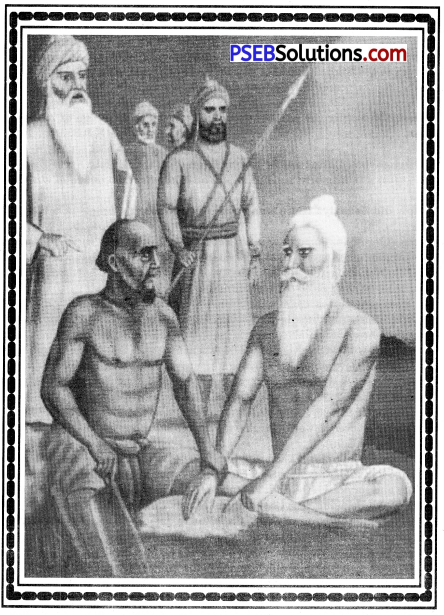
PSEB 12th Class History Solutions Chapter 12 Abdus Samad Khan, Zakariya Khan and Mir Mannu Their Relations with the Sikhs Img 1

Mughal soldiers and wounded many more. This event took place in February, 1726 A.D. In the words of S.S. Seetal, “The news of his martyrdom deeply moved the feelings of the Sikhs.”

3. Retaliatory measures of the Sikhs: All the Sikhs of Punjab were provoked to avenge the martyrdom of Bhai Tara Singh Ji Van and his companions. The Sikhs who had hidden themselves in jungles and hills took a pledge to end the Mughal rule. They began to raid and loot the government treasuries. Besides, they attacked certain places and killed the government henchmen. Whenever, Zakariya Khan sent his soldiers to take action against the Sikhs, they would at once take shelter in jungles and hills.

4. Incident of Haidri Flag : Zakariya Khan was greatly disturbed due to the growing activities of the Sikhs. He raised the slogan of ‘Jihad’ to crush the Sikhs. As a result, thousands of Muslims gathered under the banner of Innayatullah Khan. The command of this army was entrusted to Inayatulla Khan. On the auspicious day of Id, they were given a Haidri flag and it was proclaimed that God would certainly bestow victory on those who fought under this flag. One day about seven thousand Sikhs suddenly attacked these Ghazis and caused havoc in their ranks. Thousands of Ghazis were killed. It gave a great jolt to the Government.

5. Agreement of Zakariya Khan with the Sikhs : Now, Zakariya Khan realised that it was not easy to annihilate the Sikhs. So, he adopted the policy of placating the Sikhs; In 1733 A.D., he sent a message that if the Sikhs stopped their anti-government activities, they would be given ‘Jagir’ which would yield an annual revenue of one lakh rupees, and their leader would be honoured with the title of ‘Nawab’. At first the Sikhs were opposed to this compromise, but later they accepted it. The Sikhs gave this honour of receiving the ‘Jagir’ and the title of Nawab to Sardar Kapoor Singh Faizalpuria.

6. Organisation of Buddha Dal and Taruna Dal: The compromise with the Mughals gave the Sikhs a golden opportunity to organise their power/ Nawab Kapoor Singh sent a message to the Sikhs that they should return to their homes from their hideouts in jungles and hills. Thus, the two decade old struggle between the Mughals and Sikhs came to an end. The Sikhs heaved a sigh of relief. In order to strengthen the power of the Sikhs Nawab Kapoor Singh organised them in two groups in 1734 A.D. These groups were known as Buddha Dal and Taruna Dal.

The Sikhs above the age of 40 were recruited in the Buddha Dal and below the age of 40 in the Taruna Dal. The Taruna Dal was further divided into five groups. Each group had its own leader and banner. The Buddha Dal looked after the religious places and the Taruna Dal fought with the enemies.

7. Renewed struggle between the Mughals and the Sikhs: After organising their power, the Sikhs again started creating disturbance in Punjab. They again began to plunder the government treasuries. This enraged Zakariya Khan and in 1735 A.D. he confiscated the ‘Jagir’ which he had given to the Sikhs. He again announced awards for getting the Sikhs arrested or killed. He gave full freedom to the Hindus and the Muslims to burgle Sikh houses. The Sikhs again began to be arrested and killed. Thus, the Sikhs were once again compelled to take shelter in forests. Taking advantage of this opportunity, the Mughals took possession of Sri Harmandir Sahib.

8. Martyrdom of Bhai Mani Singh Ji: The martyrdom of Bhai Mani Singh Ji occupies a significant place in the Sikh History. He had been the head priest of Harmandir Sahib since 1721 A.D. The Sikhs were greatly perturbed when the soldiers of Zakariya Khan occupied Harmandir Sahib. In 1738 A.D. Bhai Mani Singh Ji requested Zakariya Khan to allow the Sikhs to enter Sri Harmandir Sahib on the Diwali festival and he would offer him Rs. 5000. Zakariya Khan readily accepted the offer. In fact, he hatched a plan. According to this plan he wanted to make a surprise attack and completely decimate the Sikhs who were supposed to gather at Amritsar on Diwali.

Zakariya Khan took the Sikhs unawares and killed a large number of them. Consequently, the festival of Diwali could not be observed at Sri Harmandir Sahib. Afterwards Zakariya Khan demanded Rs. 5000/- as promised by Bhai Mani Singh Ji.

Because the government had prevented the Sikhs from entering Sri Harmandir Sahib, Bhai Mani Singh Ji was unable to pay the stipulated amount. On his inability to pay, the government arrested Bhai Mani Singh Ji and sent him to Lahore. Bhai Sahib Ji was asked to embrace Islam but he refused. Therefore, he was cut to pieces limb by limb in 1738 A.D. This martyrdom of Bhai Mani Singh Ji supplied the much.needed fillip to the Sikh struggle for independence. In the words of Khushwant Singh, “The killing of the pious and venerable head priest caused deep resentment among the Sikhs.”

9. Sikhs robbed Nadir Shah : The Sikhs were on the look out for a golden opportunity to avenge the martyrdom of Bhai Mani Singh Ji. They got this opportunity in 1739 A.D. at the time of Nadir Shah’s invasion on India. After ruthless looting in Delhi, he was going back to Iran via Punjab. When the Sikhs came to know of it, they suddenly attacked and made away with most of the booty. Nadir Shah made enquiries from Zakariya Khan about these Sikhs and warned him that the day is not distant, when the Sikhs would rule in Punjab.

10. Zakariya Khan’s actions against the Sikhs : Nadir Shah’s warning had made a deep impact on Zakariya Khan’s mind. So, he decided to annihilate the Sikhs. The Sikhs again began to be killed ruthlessly daily as before. Here is given a brief description of some prominent martyrs :

(a) Bhai Bota Singh Ji : Zakariya Khan killed many Sikhs. In haughtiness, he announced that he had annihilated all the Sikhs. In order to show the existence of the Sikhs, Bhai Bota Singh Ji had set up a toll-post at Sarai Nurdin and began to charge one anna as toll-tax per cart and one paisa per donkey-load. When Zakariya Khan learnt of it, he could not tolerate it. He sent some soldiers under Jalal Khan. Jalal Khan asked him to surrender, but the brave warrior refused to do so. He fought valiantly with the enemy and finally achieved martyrdom.

(b) Bhai Mehtab Singh Ji and Bhai Sukha Singh Ji: Chaudhary Massa Rangar of village Mandiala, District Amritsar had desecrated Sri Harmandir Sahib by his activities. Therefore, the blood of the Sikhs was boiling for revenge. They wanted to teach Massa Rangar a lesson. Bhai Mehtab Singh Ji and Bhai Sukha Singh Ji hatched a plan. They packed some bags with pieces of stone and covered them with some coins, and reached Sri Harmandir Sahib. When enquired by the soldiers, they told them that they had brought revenue which they wanted to present to Massa Rangar.

Seeing the bags full of coins, they were allowed to go in. At that time, Massa Rangar was busy in merry-making. He was immensely pleased to see the bags full of coins. The moment he bowed forward to receive the bags, Mehtab Singh beheaded him with his sword. Later on Bhai Mehtab Singh and Bhai Sukha Singh were arrested and martyred mercilessly in 1740. A. D.

(c) Bal Haqiqat Rai Ji : Bal Haqiqat Rai Ji was the resident of Sialkot. One day a Muslim boy uttered some words, which were derogatory to the Hindu deities. Bal Haqiqat Rai Ji could not tolerate it. He said some offensive words about Prophet Mohammad and his. daughter Fatima. So, Bal Haqiqat Rai Ji was arrested. In order to, save himself, he was asked to embrace Islam. Bal Haqiqat Rai Ji spurned this offer. As a result, Bal Haqiqat Rai Ji was beheaded in 1742 A.D. The martyrdom of Bal Haqiqat Rai Ji inflammed the feelings of the Hindus and the Sikhs.

(d) Bhai Taru Singh Ji: Bhai Taru Singh Ji was the resident of village Puhla in the Majha region. He did farming and hepled the Sikhs with his incdme. In the eyes of the government, it was a blatant crime. He was brought to Lahore. Here Zakariya Khan offered him the usual choice of Islam or death. Bhai Sahib Ji refused to embrace Islam. Complying with the order of Zakariya Khan, the executioners removed his skull. When Bhai Sahib Ji’s skull was being removed, he was reciting Japji Sahib. This unique martyrdom in 1745 A.D. deeply stirred the Sikhs.

Zakariya Khan undoubtedly committed great cruelties on the Sikhs till his end. However, he failed to crush the power of the Sikhs. Zakariya Khan died on 1st July, 1745 A.D. In the words of Patwant Singh, “No one persecuted the Sikhs with greater zeal than Zakariya Khan.”

PSEB 12th Class History Solutions Chapter 12 Abdus Samad Khan, Zakariya Khan and Mir Mannu: Their Relations with the Sikhs

Question 3.
Briefly describe the relations of Abdus Samad Khan and Zakariya Khan with the Sikhs.
Answer:

Abdus Samad Khan was made the Governor of Lahore by the Mughal emperor, Farrukh Siyar in 1713 A.D. He was appointed to this post with the aim of completely crushing the power of the Sikhs. He started his administration with an iron hand. After defeating Banda Singh Bahadur in the battle of Gurdas Nangal in 1715 A.D. he arrested him along with many other (740) Sikhs. They were brutally martyred in Delhi on 19th June 1716 A.D. Farrukh Siyar was very happy over Abdus Samad Khan’s action. He honored Abdus Samad Khan with many rewards. Abdus Samad Khan remained on this post till 1726 A.D. The main events of his rule were as follows :

1. Farrukh Siyar’s Edict: In 1716 A.D., the Mughal emperor Farrukh Siyar, issued a royal edict. In this edict, he ordered the Mughal officials to kill any Sikh they could lay their hands on, but pardon those who embraced Islam. All the Hindus were ordered to shave off their heads and beards. He, who violated this order, was to be treated as a Sikh and to be killed. Even those, who gave help or provided shelter to the Sikhs, were also to be killed. Any person, who gave any clue about the whereabouts of any Sikh or helped the government in arresting the Sikhs, was to be amply rewarded.

2. Steps taken by Abdus Samad Khan against the Sikhs: After the issuance of the edict, Abdus Samad Khan started torturing the Sikhs in various ways. Hundreds of innocent Sikhs were daily arrested and brought to Lahore. They were tempted to embrace Islam in exchange for their life but the Guru’s Sikhs preferred death to this type of life. The executioners killed such Sikhs after subjecting them to untold tortures. In order to escape this bloody policy of Abdus Samad Khan, many Sikhs took shelter in the jungles and in the Shivalik hills.

There they had to face many hardships. In this way during the early years of Abdus Samad Khan’s rule, this policy paid rich dividends. Feeling happy with him Farrukh Siyar honoured him with the title of ‘Sword of the State’.

3. Split among the Sikhs: After the martyrdom of Banda Singh Bahadur, the Sikhs were divided into two chief sects “Tat Khalsa’ and ‘Bandai Khalsa’. Tat Khalsa’ were the firm advocates of Guru Gobind Singh Ji’s religious principles. ‘Bandai Khalsa’ began to regard Banda Singh Bahadur as their leader. The followers of Tat Khalsa used to greet each other with ‘Waheguru Ji Ka Khalsa and Waheguru Ji Ki Fateh’, while those of Bandai Khalsa used to greet each other with ‘Fateh Darshan’ and ‘Fateh Dharam’.

The disciples of Tat Khalsa wore blue robes, while those of Bandai Khalsa wore red ones. As a consequence of their differences the Sikhs could not jointly resist the cruelties of Abdus Samad Khan.

4. Change in Circumstances: After 1720 A.D, things began to change and events turned in favour of the Sikhs. The royal court had become a den of conspiracies. In view of political instability, the central govt, could not pay due attention towards the Sikhs. In Punjab too, Abdus Samad Khan was involed in crushing the revolts of Isa Khan and Hussain Khan. Therefore, laxity crept into the action against the Sikhs. In 1721 A.D., with the efforts of Bhai Mani Singh Ji a compromise was made between ‘Tat Khalsa’ and ‘Bandai Khalsa’ at Amritsar on the occasion of Baisakhi. Consequently, Bandai Khalsa merged itself into Tat Khalsa. Thus, they were united.

5. Activities of the Sikhs: The changed circumstances and the newly achieved unity gave a new impetus to the Sikhs. They formed Jathas consisting of one hundred Sikhs each and started looting the Mughal provinces. They began to inflict heavy punishments on those Hindus and Muslims, who had handed over the Sikh women and children to the Mughals and had seized their property. In order to teach the Sikhs a lesson, Abdus Samad Khan sent a force under Aslam Khan to Amritsar. The Sikhs launched a surprise attack and gave a crushing defeat to the imperial forces. Har Sahai was killed in this battle, and Aslam Khan and Dev fled for their lives.

6. Failure of Abdus Samad Khan: Despite his best efforts, Abdus Samad Khan failed to crush the power of the Sikhs. There were many reasons for it. Firstly, Abdus Samad Khan had started aging, so-he lacked the enthusiasm of his youthful days. Secondly, the Sikhs had forged unity. So they were able to counter the cruelties of Abdus Samad Khan. Thirdly, Abdus Samad Khan became the victim of the conspiracies of the Mughal nobles. So, Abdus Samad Khan was removed from his office in 1726 A.D.

After Abdus Samad Khan, his eldest son Zakariya Khan succeeded him as the Governor of Lahore in 1726 A.D. He continued to occupy this post till 1745 AiD. Zakariya Khan was even a greater tyrant than his father. That is why he was honoured with the title of ‘Khan Bahadur’.

1. Harsh measures against the Sikhs: Immediately after assuming his office, Zakariya Khan started taking repressive measures against the Sikhs. In order to crush the power of the Sikhs completely, he recruited 20,000 soldiers in his army. The villagers were warned against giving shelter to the Sikhs. They were required to inform the Government, if they sighted any Sikh. Through an order, it was declared that anybody who gave information about a Sikh, got him arrested, handed him over to the Government or presented his head to the Government, would be awarded Rs. 10, Rs. 25, Rs. 50 and Rs. 100 respectively. Hundreds of Sikhs began to be martyred everyday at Delhi gate in Lahore. Therefore the place began to be called ‘Shahid Ganj’.

2. Martyrdom of Bhai Tara Singh Ji Van: Bhai Tara Singh Ji was a resident of village Van in district Amritsar. He was very popular among the Sikhs for his bravery and services to the Sikh Panth. He had taken active part in the battles of Banda Singh Bahadur. The Chaudhary of Naushera, Sahib Rai, used to let loose his horses into the farms of the Sikhs, so as to damage their crops. When the Sikhs objected to it he used to insult them.

The Sikhs could not tolerate this insult. One day Bhai Tara Singh Ji Van caught hold of a mare of Sahib Rai and sold it. He bought grain with that money and gave it to the ‘langar’. When Sahib Rai came to know about it, he sought help from Zakariya Khan. Zakariya Khan sent a troop of 2200 cavaliers under the command of his General Moman Khan. Bhai Tara Singh Ji Van and his 22 companions inflicted a heavy loss on the Mughal force.

All these Sikhs became martyrs while fighting. Before their martyrdom they had killed 300 Mughal soldiers and wounded many more. This event took place in February, 1726 A.D. In the words of S.S. Seetal, “The news of his martyrdom deeply moved the feelings of the Sikhs.”

3. Retaliatory measures of the Sikhs: All the Sikhs of Punjab were provoked to avenge the martyrdom of Bhai Tara Singh Ji Van and his companions. The Sikhs who had hidden themselves in jungles and hills took a pledge to end the Mughal rule. They began to raid and loot the government treasuries. Besides, they attacked certain places and killed the government henchmen. Whenever, Zakariya Khan sent his soldiers to take action against the Sikhs, they would at once take shelter in jungles and hills.

4. Incident of Haidri Flag : Zakariya Khan was greatly disturbed due to the growing activities of the Sikhs. He raised the slogan of ‘Jihad’ to crush the Sikhs. As a result, thousands of Muslims gathered under the banner of Innayatullah Khan. The command of this army was entrusted to Inayatulla Khan. On the auspicious day of Id, they were given a Haidri flag and it was proclaimed that God would certainly bestow victory on those who fought under this flag. One day about seven thousand Sikhs suddenly attacked these Ghazis and caused havoc in their ranks. Thousands of Ghazis were killed. It gave a great jolt to the Government.

5. Agreement of Zakariya Khan with the Sikhs : Now, Zakariya Khan realised that it was not easy to annihilate the Sikhs. So, he adopted the policy of placating the Sikhs; In 1733 A.D., he sent a message that if the Sikhs stopped their anti-government activities, they would be given ‘Jagir’ which would yield an annual revenue of one lakh rupees, and their leader would be honoured with the title of ‘Nawab’. At first the Sikhs were opposed to this compromise, but later they accepted it. The Sikhs gave this honour of receiving the ‘Jagir’ and the title of Nawab to Sardar Kapoor Singh Faizalpuria.

6. Organisation of Buddha Dal and Taruna Dal: The compromise with the Mughals gave the Sikhs a golden opportunity to organise their power/ Nawab Kapoor Singh sent a message to the Sikhs that they should return to their homes from their hideouts in jungles and hills. Thus, the two decade old struggle between the Mughals and Sikhs came to an end. The Sikhs heaved a sigh of relief. In order to strengthen the power of the Sikhs Nawab Kapoor Singh organised them in two groups in 1734 A.D. These groups were known as Buddha Dal and Taruna Dal.

The Sikhs above the age of 40 were recruited in the Buddha Dal and below the age of 40 in the Taruna Dal. The Taruna Dal was further divided into five groups. Each group had its own leader and banner. The Buddha Dal looked after the religious places and the Taruna Dal fought with the enemies.

7. Renewed struggle between the Mughals and the Sikhs: After organising their power, the Sikhs again started creating disturbance in Punjab. They again began to plunder the government treasuries. This enraged Zakariya Khan and in 1735 A.D. he confiscated the ‘Jagir’ which he had given to the Sikhs. He again announced awards for getting the Sikhs arrested or killed. He gave full freedom to the Hindus and the Muslims to burgle Sikh houses. The Sikhs again began to be arrested and killed. Thus, the Sikhs were once again compelled to take shelter in forests. Taking advantage of this opportunity, the Mughals took possession of Sri Harmandir Sahib.

8. Martyrdom of Bhai Mani Singh Ji: The martyrdom of Bhai Mani Singh Ji occupies a significant place in the Sikh History. He had been the head priest of Harmandir Sahib since 1721 A.D. The Sikhs were greatly perturbed when the soldiers of Zakariya Khan occupied Harmandir Sahib. In 1738 A.D. Bhai Mani Singh Ji requested Zakariya Khan to allow the Sikhs to enter Sri Harmandir Sahib on the Diwali festival and he would offer him Rs. 5000. Zakariya Khan readily accepted the offer. In fact, he hatched a plan. According to this plan he wanted to make a surprise attack and completely decimate the Sikhs who were supposed to gather at Amritsar on Diwali.

Zakariya Khan took the Sikhs unawares and killed a large number of them. Consequently, the festival of Diwali could not be observed at Sri Harmandir Sahib. Afterwards Zakariya Khan demanded Rs. 5000/- as promised by Bhai Mani Singh Ji.

Because the government had prevented the Sikhs from entering Sri Harmandir Sahib, Bhai Mani Singh Ji was unable to pay the stipulated amount. On his inability to pay, the government arrested Bhai Mani Singh Ji and sent him to Lahore. Bhai Sahib Ji was asked to embrace Islam but he refused. Therefore, he was cut to pieces limb by limb in 1738 A.D. This martyrdom of Bhai Mani Singh Ji supplied the much.needed fillip to the Sikh struggle for independence. In the words of Khushwant Singh, “The killing of the pious and venerable head priest caused deep resentment among the Sikhs.”

9. Sikhs robbed Nadir Shah : The Sikhs were on the look out for a golden opportunity to avenge the martyrdom of Bhai Mani Singh Ji. They got this opportunity in 1739 A.D. at the time of Nadir Shah’s invasion on India. After ruthless looting in Delhi, he was going back to Iran via Punjab. When the Sikhs came to know of it, they suddenly attacked and made away with most of the booty. Nadir Shah made enquiries from Zakariya Khan about these Sikhs and warned him that the day is not distant, when the Sikhs would rule in Punjab.

10. Zakariya Khan’s actions against the Sikhs : Nadir Shah’s warning had made a deep impact on Zakariya Khan’s mind. So, he decided to annihilate the Sikhs. The Sikhs again began to be killed ruthlessly daily as before. Here is given a brief description of some prominent martyrs :

(a) Bhai Bota Singh Ji : Zakariya Khan killed many Sikhs. In haughtiness, he announced that he had annihilated all the Sikhs. In order to show the existence of the Sikhs, Bhai Bota Singh Ji had set up a toll-post at Sarai Nurdin and began to charge one anna as toll-tax per cart and one paisa per donkey-load. When Zakariya Khan learnt of it, he could not tolerate it. He sent some soldiers under Jalal Khan. Jalal Khan asked him to surrender, but the brave warrior refused to do so. He fought valiantly with the enemy and finally achieved martyrdom.

(b) Bhai Mehtab Singh Ji and Bhai Sukha Singh Ji: Chaudhary Massa Rangar of village Mandiala, District Amritsar had desecrated Sri Harmandir Sahib by his activities. Therefore, the blood of the Sikhs was boiling for revenge. They wanted to teach Massa Rangar a lesson. Bhai Mehtab Singh Ji and Bhai Sukha Singh Ji hatched a plan. They packed some bags with pieces of stone and covered them with some coins, and reached Sri Harmandir Sahib. When enquired by the soldiers, they told them that they had brought revenue which they wanted to present to Massa Rangar.

Seeing the bags full of coins, they were allowed to go in. At that time, Massa Rangar was busy in merry-making. He was immensely pleased to see the bags full of coins. The moment he bowed forward to receive the bags, Mehtab Singh beheaded him with his sword. Later on Bhai Mehtab Singh and Bhai Sukha Singh were arrested and martyred mercilessly in 1740. A. D.

(c) Bal Haqiqat Rai Ji : Bal Haqiqat Rai Ji was the resident of Sialkot. One day a Muslim boy uttered some words, which were derogatory to the Hindu deities. Bal Haqiqat Rai Ji could not tolerate it. He said some offensive words about Prophet Mohammad and his. daughter Fatima. So, Bal Haqiqat Rai Ji was arrested. In order to, save himself, he was asked to embrace Islam. Bal Haqiqat Rai Ji spurned this offer. As a result, Bal Haqiqat Rai Ji was beheaded in 1742 A.D. The martyrdom of Bal Haqiqat Rai Ji inflammed the feelings of the Hindus and the Sikhs.

(d) Bhai Taru Singh Ji: Bhai Taru Singh Ji was the resident of village Puhla in the Majha region. He did farming and hepled the Sikhs with his incdme. In the eyes of the government, it was a blatant crime. He was brought to Lahore. Here Zakariya Khan offered him the usual choice of Islam or death. Bhai Sahib Ji refused to embrace Islam. Complying with the order of Zakariya Khan, the executioners removed his skull. When Bhai Sahib Ji’s skull was being removed, he was reciting Japji Sahib. This unique martyrdom in 1745 A.D. deeply stirred the Sikhs.

Zakariya Khan undoubtedly committed great cruelties on the Sikhs till his end. However, he failed to crush the power of the Sikhs. Zakariya Khan died on 1st July, 1745 A.D. In the words of Patwant Singh, “No one persecuted the Sikhs with greater zeal than Zakariya Khan.”

PSEB 12th Class History Solutions Chapter 12 Abdus Samad Khan, Zakariya Khan and Mir Mannu: Their Relations with the Sikhs

Yahiya Khan 1746-47 A.D.

Question 4.
What steps were taken by Yahiya Khan to crush the power of the Sikhs?
Answer:
After the death of Zakariya Khan, Yahiya Khan became the Governor of Lahore in 1746 A.D. He remained on this post till 1747 A.D. In the matter of committing oppressions on the Sikhs, Yahiya Khan did not lag behind his father, Zakariya Khan.

1. Activities of the Sikhs : When Yahiya Khan assumed the charge, the atmosphere of anarchy was prevalent in the Punjab. Taking advantage of the opportunity, the Sikhs had organised their power. They attacked many villages and killed their Chaudharis and Muqaddams for co-operating with the government and taking actions against the Sikhs. The Sikh jathas intensified their activities in many regions of Punjab.

2. Death of Jaspat Rai: In 1746 A.D. a Sikh jatha which was proceeding on a pilgrimage to Gurdwara Rohri Sahib in Eminabad took away a few goats and sheep from the village Gondlawala. On the complaint of the people, Jaspat Rai, who was the Faujdar of Eminabad, ordered the Sikhs to return the goats and sheep . The Sikhs refused to do so. Consequently, Jaspat Rai with some of his soldiers attacked the Silkhs. In the course of action, Jaspat Rai was killed. With the death of Jaspat Rai his soldiers ran for their lives. This event happened in March 1746 A.D.

3. Actions of Lakhpat Rai against the Sikhs,; Diwan Lakhpat Rai’s blood began to boil on hearing the news of his brother Jaspat Rai’s death. He took a pledge that he would annihilate the Sikhs. Yahiya Khan was already thinking of crushing the power of the Sikhs. He ordered Diwan Lakhpat Rai to crush’the Sikhs. Lakhpat Rai imposed many restrictions on the Sikhs. Thereafter, no one could utter the word ‘Guru’. He told the people to use ‘Rori’ for ‘Gud’ because the word ‘Gud’ sounded like ‘Guru.’ Likewise, he ordered to use the word ‘Pothi’ for the ‘Granth’. Those who defied these orders were sentenced to death. Many Sikhs inhabiting Lahore were arrested and executed.

4. First Holocaust: With a view to decimate the Sikhs, Yahiya Khan and Lakhpat Rai raised a huge army. This army, unexpectedly, besieged 15,000 Sikhs at Kahnuwan. The Sikhs escaped from there and took shelter in the hills of Basoli. The Mughal soldiers gave them a hot chase. Here the Sikhs were trapped in a difficult situation. On one side there were high hills, while on the other the river .Ravi was in full spate. The Mughal soldiers were chasing them from behind while in front they were faced by the Hill Chiefs and, those people, who were their bitter enemies.

The Sikhs were short of food-stuffs. Owing to the shortage of fodder, the horses too were suffering from starvation. In this attack, 7000 Sikhs were killed and 3000 arrested. These Sikhs were butchered at Lahore. It was the first occasion in Sikh history, when the Sikhs suffered such a heavy loss of life. That is why this event is known as first Ghallughara or small holocaust in history. This holocaust took place in May 1746 A.D. Gurbaksh Singh aptly says, “This devastating blow to the Sikhs in 1746 made them more determined than ever to put an end to the genocide.”

5. Fall of Yahiya Khan: In November 1746 A.D., the younger brother of Yahiya Khan, Shah Nawaz Khan, raised the banner of revolt. It resulted in a civil war between the two brothers. This war continued till 1747 A.D. In this war, Shah Nawaz Khan ultimately succeeded and he threw Yahiya Khan and Diwan Lakhpat Rai into the prison on 17 March, 1747 A.D. In this way, their cruelties came to an end, but they could not put an end to the Sikhs.

Question 5.
What steps were taken by Zakariya Khan and Yahiya Khan from 1726-1746 A.D. in order to crush the power of the Sikhs?
Or
Describe the persecution of the Sikhs during the rule of Zakariya Khan and Yahiya Khan.
Answer:

After Abdus Samad Khan, his eldest son Zakariya Khan succeeded him as the Governor of Lahore in 1726 A.D. He continued to occupy this post till 1745 AiD. Zakariya Khan was even a greater tyrant than his father. That is why he was honoured with the title of ‘Khan Bahadur’.

1. Harsh measures against the Sikhs: Immediately after assuming his office, Zakariya Khan started taking repressive measures against the Sikhs. In order to crush the power of the Sikhs completely, he recruited 20,000 soldiers in his army. The villagers were warned against giving shelter to the Sikhs. They were required to inform the Government, if they sighted any Sikh. Through an order, it was declared that anybody who gave information about a Sikh, got him arrested, handed him over to the Government or presented his head to the Government, would be awarded Rs. 10, Rs. 25, Rs. 50 and Rs. 100 respectively. Hundreds of Sikhs began to be martyred everyday at Delhi gate in Lahore. Therefore the place began to be called ‘Shahid Ganj’.

2. Martyrdom of Bhai Tara Singh Ji Van: Bhai Tara Singh Ji was a resident of village Van in district Amritsar. He was very popular among the Sikhs for his bravery and services to the Sikh Panth. He had taken active part in the battles of Banda Singh Bahadur. The Chaudhary of Naushera, Sahib Rai, used to let loose his horses into the farms of the Sikhs, so as to damage their crops. When the Sikhs objected to it he used to insult them.

The Sikhs could not tolerate this insult. One day Bhai Tara Singh Ji Van caught hold of a mare of Sahib Rai and sold it. He bought grain with that money and gave it to the ‘langar’. When Sahib Rai came to know about it, he sought help from Zakariya Khan. Zakariya Khan sent a troop of 2200 cavaliers under the command of his General Moman Khan. Bhai Tara Singh Ji Van and his 22 companions inflicted a heavy loss on the Mughal force.

All these Sikhs became martyrs while fighting. Before their martyrdom they had killed 300 Mughal soldiers and wounded many more. This event took place in February, 1726 A.D. In the words of S.S. Seetal, “The news of his martyrdom deeply moved the feelings of the Sikhs.”

3. Retaliatory measures of the Sikhs: All the Sikhs of Punjab were provoked to avenge the martyrdom of Bhai Tara Singh Ji Van and his companions. The Sikhs who had hidden themselves in jungles and hills took a pledge to end the Mughal rule. They began to raid and loot the government treasuries. Besides, they attacked certain places and killed the government henchmen. Whenever, Zakariya Khan sent his soldiers to take action against the Sikhs, they would at once take shelter in jungles and hills.

4. Incident of Haidri Flag : Zakariya Khan was greatly disturbed due to the growing activities of the Sikhs. He raised the slogan of ‘Jihad’ to crush the Sikhs. As a result, thousands of Muslims gathered under the banner of Innayatullah Khan. The command of this army was entrusted to Inayatulla Khan. On the auspicious day of Id, they were given a Haidri flag and it was proclaimed that God would certainly bestow victory on those who fought under this flag. One day about seven thousand Sikhs suddenly attacked these Ghazis and caused havoc in their ranks. Thousands of Ghazis were killed. It gave a great jolt to the Government.

5. Agreement of Zakariya Khan with the Sikhs : Now, Zakariya Khan realised that it was not easy to annihilate the Sikhs. So, he adopted the policy of placating the Sikhs; In 1733 A.D., he sent a message that if the Sikhs stopped their anti-government activities, they would be given ‘Jagir’ which would yield an annual revenue of one lakh rupees, and their leader would be honoured with the title of ‘Nawab’. At first the Sikhs were opposed to this compromise, but later they accepted it. The Sikhs gave this honour of receiving the ‘Jagir’ and the title of Nawab to Sardar Kapoor Singh Faizalpuria.

6. Organisation of Buddha Dal and Taruna Dal: The compromise with the Mughals gave the Sikhs a golden opportunity to organise their power/ Nawab Kapoor Singh sent a message to the Sikhs that they should return to their homes from their hideouts in jungles and hills. Thus, the two decade old struggle between the Mughals and Sikhs came to an end. The Sikhs heaved a sigh of relief. In order to strengthen the power of the Sikhs Nawab Kapoor Singh organised them in two groups in 1734 A.D. These groups were known as Buddha Dal and Taruna Dal.

The Sikhs above the age of 40 were recruited in the Buddha Dal and below the age of 40 in the Taruna Dal. The Taruna Dal was further divided into five groups. Each group had its own leader and banner. The Buddha Dal looked after the religious places and the Taruna Dal fought with the enemies.

7. Renewed struggle between the Mughals and the Sikhs: After organising their power, the Sikhs again started creating disturbance in Punjab. They again began to plunder the government treasuries. This enraged Zakariya Khan and in 1735 A.D. he confiscated the ‘Jagir’ which he had given to the Sikhs. He again announced awards for getting the Sikhs arrested or killed. He gave full freedom to the Hindus and the Muslims to burgle Sikh houses. The Sikhs again began to be arrested and killed. Thus, the Sikhs were once again compelled to take shelter in forests. Taking advantage of this opportunity, the Mughals took possession of Sri Harmandir Sahib.

8. Martyrdom of Bhai Mani Singh Ji: The martyrdom of Bhai Mani Singh Ji occupies a significant place in the Sikh History. He had been the head priest of Harmandir Sahib since 1721 A.D. The Sikhs were greatly perturbed when the soldiers of Zakariya Khan occupied Harmandir Sahib. In 1738 A.D. Bhai Mani Singh Ji requested Zakariya Khan to allow the Sikhs to enter Sri Harmandir Sahib on the Diwali festival and he would offer him Rs. 5000. Zakariya Khan readily accepted the offer. In fact, he hatched a plan. According to this plan he wanted to make a surprise attack and completely decimate the Sikhs who were supposed to gather at Amritsar on Diwali.

Zakariya Khan took the Sikhs unawares and killed a large number of them. Consequently, the festival of Diwali could not be observed at Sri Harmandir Sahib. Afterwards Zakariya Khan demanded Rs. 5000/- as promised by Bhai Mani Singh Ji.

Because the government had prevented the Sikhs from entering Sri Harmandir Sahib, Bhai Mani Singh Ji was unable to pay the stipulated amount. On his inability to pay, the government arrested Bhai Mani Singh Ji and sent him to Lahore. Bhai Sahib Ji was asked to embrace Islam but he refused. Therefore, he was cut to pieces limb by limb in 1738 A.D. This martyrdom of Bhai Mani Singh Ji supplied the much.needed fillip to the Sikh struggle for independence. In the words of Khushwant Singh, “The killing of the pious and venerable head priest caused deep resentment among the Sikhs.”

9. Sikhs robbed Nadir Shah : The Sikhs were on the look out for a golden opportunity to avenge the martyrdom of Bhai Mani Singh Ji. They got this opportunity in 1739 A.D. at the time of Nadir Shah’s invasion on India. After ruthless looting in Delhi, he was going back to Iran via Punjab. When the Sikhs came to know of it, they suddenly attacked and made away with most of the booty. Nadir Shah made enquiries from Zakariya Khan about these Sikhs and warned him that the day is not distant, when the Sikhs would rule in Punjab.

10. Zakariya Khan’s actions against the Sikhs : Nadir Shah’s warning had made a deep impact on Zakariya Khan’s mind. So, he decided to annihilate the Sikhs. The Sikhs again began to be killed ruthlessly daily as before. Here is given a brief description of some prominent martyrs :

(a) Bhai Bota Singh Ji : Zakariya Khan killed many Sikhs. In haughtiness, he announced that he had annihilated all the Sikhs. In order to show the existence of the Sikhs, Bhai Bota Singh Ji had set up a toll-post at Sarai Nurdin and began to charge one anna as toll-tax per cart and one paisa per donkey-load. When Zakariya Khan learnt of it, he could not tolerate it. He sent some soldiers under Jalal Khan. Jalal Khan asked him to surrender, but the brave warrior refused to do so. He fought valiantly with the enemy and finally achieved martyrdom.

(b) Bhai Mehtab Singh Ji and Bhai Sukha Singh Ji: Chaudhary Massa Rangar of village Mandiala, District Amritsar had desecrated Sri Harmandir Sahib by his activities. Therefore, the blood of the Sikhs was boiling for revenge. They wanted to teach Massa Rangar a lesson. Bhai Mehtab Singh Ji and Bhai Sukha Singh Ji hatched a plan. They packed some bags with pieces of stone and covered them with some coins, and reached Sri Harmandir Sahib. When enquired by the soldiers, they told them that they had brought revenue which they wanted to present to Massa Rangar.

Seeing the bags full of coins, they were allowed to go in. At that time, Massa Rangar was busy in merry-making. He was immensely pleased to see the bags full of coins. The moment he bowed forward to receive the bags, Mehtab Singh beheaded him with his sword. Later on Bhai Mehtab Singh and Bhai Sukha Singh were arrested and martyred mercilessly in 1740. A. D.

(c) Bal Haqiqat Rai Ji : Bal Haqiqat Rai Ji was the resident of Sialkot. One day a Muslim boy uttered some words, which were derogatory to the Hindu deities. Bal Haqiqat Rai Ji could not tolerate it. He said some offensive words about Prophet Mohammad and his. daughter Fatima. So, Bal Haqiqat Rai Ji was arrested. In order to, save himself, he was asked to embrace Islam. Bal Haqiqat Rai Ji spurned this offer. As a result, Bal Haqiqat Rai Ji was beheaded in 1742 A.D. The martyrdom of Bal Haqiqat Rai Ji inflammed the feelings of the Hindus and the Sikhs.

(d) Bhai Taru Singh Ji: Bhai Taru Singh Ji was the resident of village Puhla in the Majha region. He did farming and hepled the Sikhs with his incdme. In the eyes of the government, it was a blatant crime. He was brought to Lahore. Here Zakariya Khan offered him the usual choice of Islam or death. Bhai Sahib Ji refused to embrace Islam. Complying with the order of Zakariya Khan, the executioners removed his skull. When Bhai Sahib Ji’s skull was being removed, he was reciting Japji Sahib. This unique martyrdom in 1745 A.D. deeply stirred the Sikhs.

Zakariya Khan undoubtedly committed great cruelties on the Sikhs till his end. However, he failed to crush the power of the Sikhs. Zakariya Khan died on 1st July, 1745 A.D. In the words of Patwant Singh, “No one persecuted the Sikhs with greater zeal than Zakariya Khan.”

After the death of Zakariya Khan, Yahiya Khan became the Governor of Lahore in 1746 A.D. He remained on this post till 1747 A.D. In the matter of committing oppressions on the Sikhs, Yahiya Khan did not lag behind his father, Zakariya Khan.

1. Activities of the Sikhs : When Yahiya Khan assumed the charge, the atmosphere of anarchy was prevalent in the Punjab. Taking advantage of the opportunity, the Sikhs had organised their power. They attacked many villages and killed their Chaudharis and Muqaddams for co-operating with the government and taking actions against the Sikhs. The Sikh jathas intensified their activities in many regions of Punjab.

2. Death of Jaspat Rai: In 1746 A.D. a Sikh jatha which was proceeding on a pilgrimage to Gurdwara Rohri Sahib in Eminabad took away a few goats and sheep from the village Gondlawala. On the complaint of the people, Jaspat Rai, who was the Faujdar of Eminabad, ordered the Sikhs to return the goats and sheep . The Sikhs refused to do so. Consequently, Jaspat Rai with some of his soldiers attacked the Silkhs. In the course of action, Jaspat Rai was killed. With the death of Jaspat Rai his soldiers ran for their lives. This event happened in March 1746 A.D.

PSEB 12th Class History Solutions Chapter 12 Abdus Samad Khan, Zakariya Khan and Mir Mannu: Their Relations with the Sikhs

3. Actions of Lakhpat Rai against the Sikhs,; Diwan Lakhpat Rai’s blood began to boil on hearing the news of his brother Jaspat Rai’s death. He took a pledge that he would annihilate the Sikhs. Yahiya Khan was already thinking of crushing the power of the Sikhs. He ordered Diwan Lakhpat Rai to crush’the Sikhs. Lakhpat Rai imposed many restrictions on the Sikhs. Thereafter, no one could utter the word ‘Guru’. He told the people to use ‘Rori’ for ‘Gud’ because the word ‘Gud’ sounded like ‘Guru.’ Likewise, he ordered to use the word ‘Pothi’ for the ‘Granth’. Those who defied these orders were sentenced to death. Many Sikhs inhabiting Lahore were arrested and executed.

4. First Holocaust: With a view to decimate the Sikhs, Yahiya Khan and Lakhpat Rai raised a huge army. This army, unexpectedly, besieged 15,000 Sikhs at Kahnuwan. The Sikhs escaped from there and took shelter in the hills of Basoli. The Mughal soldiers gave them a hot chase. Here the Sikhs were trapped in a difficult situation. On one side there were high hills, while on the other the river .Ravi was in full spate. The Mughal soldiers were chasing them from behind while in front they were faced by the Hill Chiefs and, those people, who were their bitter enemies.

The Sikhs were short of food-stuffs. Owing to the shortage of fodder, the horses too were suffering from starvation. In this attack, 7000 Sikhs were killed and 3000 arrested. These Sikhs were butchered at Lahore. It was the first occasion in Sikh history, when the Sikhs suffered such a heavy loss of life. That is why this event is known as first Ghallughara or small holocaust in history. This holocaust took place in May 1746 A.D. Gurbaksh Singh aptly says, “This devastating blow to the Sikhs in 1746 made them more determined than ever to put an end to the genocide.”

5. Fall of Yahiya Khan: In November 1746 A.D., the younger brother of Yahiya Khan, Shah Nawaz Khan, raised the banner of revolt. It resulted in a civil war between the two brothers. This war continued till 1747 A.D. In this war, Shah Nawaz Khan ultimately succeeded and he threw Yahiya Khan and Diwan Lakhpat Rai into the prison on 17 March, 1747 A.D. In this way, their cruelties came to an end, but they could not put an end to the Sikhs.

Question 6.
Explain in brief the persecution of the Sikhs during 1716 to 1747 A.D.
Or
What steps did the Mughal Governors take to crush the Sikhs between 1716-1747 A.D.? Why did the Mughal Governors fail to suppress the Sikhs?
Answer:
Abdus Samad Khan was made the Governor of Lahore by the Mughal emperor, Farrukh Siyar in 1713 A.D. He was appointed to this post with the aim of completely crushing the power of the Sikhs. He started his administration with an iron hand. After defeating Banda Singh Bahadur in the battle of Gurdas Nangal in 1715 A.D. he arrested him along with many other (740) Sikhs. They were brutally martyred in Delhi on 19th June 1716 A.D. Farrukh Siyar was very happy over Abdus Samad Khan’s action. He honored Abdus Samad Khan with many rewards. Abdus Samad Khan remained on this post till 1726 A.D. The main events of his rule were as follows :

1. Farrukh Siyar’s Edict: In 1716 A.D., the Mughal emperor Farrukh Siyar, issued a royal edict. In this edict, he ordered the Mughal officials to kill any Sikh they could lay their hands on, but pardon those who embraced Islam. All the Hindus were ordered to shave off their heads and beards. He, who violated this order, was to be treated as a Sikh and to be killed. Even those, who gave help or provided shelter to the Sikhs, were also to be killed. Any person, who gave any clue about the whereabouts of any Sikh or helped the government in arresting the Sikhs, was to be amply rewarded.

2. Steps taken by Abdus Samad Khan against the Sikhs: After the issuance of the edict, Abdus Samad Khan started torturing the Sikhs in various ways. Hundreds of innocent Sikhs were daily arrested and brought to Lahore. They were tempted to embrace Islam in exchange for their life but the Guru’s Sikhs preferred death to this type of life. The executioners killed such Sikhs after subjecting them to untold tortures. In order to escape this bloody policy of Abdus Samad Khan, many Sikhs took shelter in the jungles and in the Shivalik hills.

There they had to face many hardships. In this way during the early years of Abdus Samad Khan’s rule, this policy paid rich dividends. Feeling happy with him Farrukh Siyar honoured him with the title of ‘Sword of the State’.

3. Split among the Sikhs: After the martyrdom of Banda Singh Bahadur, the Sikhs were divided into two chief sects “Tat Khalsa’ and ‘Bandai Khalsa’. Tat Khalsa’ were the firm advocates of Guru Gobind Singh Ji’s religious principles. ‘Bandai Khalsa’ began to regard Banda Singh Bahadur as their leader. The followers of Tat Khalsa used to greet each other with ‘Waheguru Ji Ka Khalsa and Waheguru Ji Ki Fateh’, while those of Bandai Khalsa used to greet each other with ‘Fateh Darshan’ and ‘Fateh Dharam’.

The disciples of Tat Khalsa wore blue robes, while those of Bandai Khalsa wore red ones. As a consequence of their differences the Sikhs could not jointly resist the cruelties of Abdus Samad Khan.

4. Change in Circumstances: After 1720 A.D, things began to change and events turned in favour of the Sikhs. The royal court had become a den of conspiracies. In view of political instability, the central govt, could not pay due attention towards the Sikhs. In Punjab too, Abdus Samad Khan was involed in crushing the revolts of Isa Khan and Hussain Khan. Therefore, laxity crept into the action against the Sikhs. In 1721 A.D., with the efforts of Bhai Mani Singh Ji a compromise was made between ‘Tat Khalsa’ and ‘Bandai Khalsa’ at Amritsar on the occasion of Baisakhi. Consequently, Bandai Khalsa merged itself into Tat Khalsa. Thus, they were united.

5. Activities of the Sikhs: The changed circumstances and the newly achieved unity gave a new impetus to the Sikhs. They formed Jathas consisting of one hundred Sikhs each and started looting the Mughal provinces. They began to inflict heavy punishments on those Hindus and Muslims, who had handed over the Sikh women and children to the Mughals and had seized their property. In order to teach the Sikhs a lesson, Abdus Samad Khan sent a force under Aslam Khan to Amritsar. The Sikhs launched a surprise attack and gave a crushing defeat to the imperial forces. Har Sahai was killed in this battle, and Aslam Khan and Dev fled for their lives.

6. Failure of Abdus Samad Khan: Despite his best efforts, Abdus Samad Khan failed to crush the power of the Sikhs. There were many reasons for it. Firstly, Abdus Samad Khan had started aging, so-he lacked the enthusiasm of his youthful days. Secondly, the Sikhs had forged unity. So they were able to counter the cruelties of Abdus Samad Khan. Thirdly, Abdus Samad Khan became the victim of the conspiracies of the Mughal nobles. So, Abdus Samad Khan was removed from his office in 1726 A.D.

After Abdus Samad Khan, his eldest son Zakariya Khan succeeded him as the Governor of Lahore in 1726 A.D. He continued to occupy this post till 1745 AiD. Zakariya Khan was even a greater tyrant than his father. That is why he was honoured with the title of ‘Khan Bahadur’.

PSEB 12th Class History Solutions Chapter 12 Abdus Samad Khan, Zakariya Khan and Mir Mannu: Their Relations with the Sikhs

1. Harsh measures against the Sikhs: Immediately after assuming his office, Zakariya Khan started taking repressive measures against the Sikhs. In order to crush the power of the Sikhs completely, he recruited 20,000 soldiers in his army. The villagers were warned against giving shelter to the Sikhs. They were required to inform the Government, if they sighted any Sikh. Through an order, it was declared that anybody who gave information about a Sikh, got him arrested, handed him over to the Government or presented his head to the Government, would be awarded Rs. 10, Rs. 25, Rs. 50 and Rs. 100 respectively. Hundreds of Sikhs began to be martyred everyday at Delhi gate in Lahore. Therefore the place began to be called ‘Shahid Ganj’.

2. Martyrdom of Bhai Tara Singh Ji Van: Bhai Tara Singh Ji was a resident of village Van in district Amritsar. He was very popular among the Sikhs for his bravery and services to the Sikh Panth. He had taken active part in the battles of Banda Singh Bahadur. The Chaudhary of Naushera, Sahib Rai, used to let loose his horses into the farms of the Sikhs, so as to damage their crops. When the Sikhs objected to it he used to insult them.

The Sikhs could not tolerate this insult. One day Bhai Tara Singh Ji Van caught hold of a mare of Sahib Rai and sold it. He bought grain with that money and gave it to the ‘langar’. When Sahib Rai came to know about it, he sought help from Zakariya Khan. Zakariya Khan sent a troop of 2200 cavaliers under the command of his General Moman Khan. Bhai Tara Singh Ji Van and his 22 companions inflicted a heavy loss on the Mughal force.

All these Sikhs became martyrs while fighting. Before their martyrdom they had killed 300 Mughal soldiers and wounded many more. This event took place in February, 1726 A.D. In the words of S.S. Seetal, “The news of his martyrdom deeply moved the feelings of the Sikhs.”

3. Retaliatory measures of the Sikhs: All the Sikhs of Punjab were provoked to avenge the martyrdom of Bhai Tara Singh Ji Van and his companions. The Sikhs who had hidden themselves in jungles and hills took a pledge to end the Mughal rule. They began to raid and loot the government treasuries. Besides, they attacked certain places and killed the government henchmen. Whenever, Zakariya Khan sent his soldiers to take action against the Sikhs, they would at once take shelter in jungles and hills.

4. Incident of Haidri Flag : Zakariya Khan was greatly disturbed due to the growing activities of the Sikhs. He raised the slogan of ‘Jihad’ to crush the Sikhs. As a result, thousands of Muslims gathered under the banner of Innayatullah Khan. The command of this army was entrusted to Inayatulla Khan. On the auspicious day of Id, they were given a Haidri flag and it was proclaimed that God would certainly bestow victory on those who fought under this flag. One day about seven thousand Sikhs suddenly attacked these Ghazis and caused havoc in their ranks. Thousands of Ghazis were killed. It gave a great jolt to the Government.

5. Agreement of Zakariya Khan with the Sikhs : Now, Zakariya Khan realised that it was not easy to annihilate the Sikhs. So, he adopted the policy of placating the Sikhs; In 1733 A.D., he sent a message that if the Sikhs stopped their anti-government activities, they would be given ‘Jagir’ which would yield an annual revenue of one lakh rupees, and their leader would be honoured with the title of ‘Nawab’. At first the Sikhs were opposed to this compromise, but later they accepted it. The Sikhs gave this honour of receiving the ‘Jagir’ and the title of Nawab to Sardar Kapoor Singh Faizalpuria.

6. Organisation of Buddha Dal and Taruna Dal: The compromise with the Mughals gave the Sikhs a golden opportunity to organise their power/ Nawab Kapoor Singh sent a message to the Sikhs that they should return to their homes from their hideouts in jungles and hills. Thus, the two decade old struggle between the Mughals and Sikhs came to an end. The Sikhs heaved a sigh of relief. In order to strengthen the power of the Sikhs Nawab Kapoor Singh organised them in two groups in 1734 A.D. These groups were known as Buddha Dal and Taruna Dal.

The Sikhs above the age of 40 were recruited in the Buddha Dal and below the age of 40 in the Taruna Dal. The Taruna Dal was further divided into five groups. Each group had its own leader and banner. The Buddha Dal looked after the religious places and the Taruna Dal fought with the enemies.

PSEB 12th Class History Solutions Chapter 12 Abdus Samad Khan, Zakariya Khan and Mir Mannu: Their Relations with the Sikhs

7. Renewed struggle between the Mughals and the Sikhs: After organising their power, the Sikhs again started creating disturbance in Punjab. They again began to plunder the government treasuries. This enraged Zakariya Khan and in 1735 A.D. he confiscated the ‘Jagir’ which he had given to the Sikhs. He again announced awards for getting the Sikhs arrested or killed. He gave full freedom to the Hindus and the Muslims to burgle Sikh houses. The Sikhs again began to be arrested and killed. Thus, the Sikhs were once again compelled to take shelter in forests. Taking advantage of this opportunity, the Mughals took possession of Sri Harmandir Sahib.

8. Martyrdom of Bhai Mani Singh Ji: The martyrdom of Bhai Mani Singh Ji occupies a significant place in the Sikh History. He had been the head priest of Harmandir Sahib since 1721 A.D. The Sikhs were greatly perturbed when the soldiers of Zakariya Khan occupied Harmandir Sahib. In 1738 A.D. Bhai Mani Singh Ji requested Zakariya Khan to allow the Sikhs to enter Sri Harmandir Sahib on the Diwali festival and he would offer him Rs. 5000. Zakariya Khan readily accepted the offer. In fact, he hatched a plan. According to this plan he wanted to make a surprise attack and completely decimate the Sikhs who were supposed to gather at Amritsar on Diwali.

Zakariya Khan took the Sikhs unawares and killed a large number of them. Consequently, the festival of Diwali could not be observed at Sri Harmandir Sahib. Afterwards Zakariya Khan demanded Rs. 5000/- as promised by Bhai Mani Singh Ji.

Because the government had prevented the Sikhs from entering Sri Harmandir Sahib, Bhai Mani Singh Ji was unable to pay the stipulated amount. On his inability to pay, the government arrested Bhai Mani Singh Ji and sent him to Lahore. Bhai Sahib Ji was asked to embrace Islam but he refused. Therefore, he was cut to pieces limb by limb in 1738 A.D. This martyrdom of Bhai Mani Singh Ji supplied the much.needed fillip to the Sikh struggle for independence. In the words of Khushwant Singh, “The killing of the pious and venerable head priest caused deep resentment among the Sikhs.”

9. Sikhs robbed Nadir Shah : The Sikhs were on the look out for a golden opportunity to avenge the martyrdom of Bhai Mani Singh Ji. They got this opportunity in 1739 A.D. at the time of Nadir Shah’s invasion on India. After ruthless looting in Delhi, he was going back to Iran via Punjab. When the Sikhs came to know of it, they suddenly attacked and made away with most of the booty. Nadir Shah made enquiries from Zakariya Khan about these Sikhs and warned him that the day is not distant, when the Sikhs would rule in Punjab.

10. Zakariya Khan’s actions against the Sikhs : Nadir Shah’s warning had made a deep impact on Zakariya Khan’s mind. So, he decided to annihilate the Sikhs. The Sikhs again began to be killed ruthlessly daily as before. Here is given a brief description of some prominent martyrs :

(a) Bhai Bota Singh Ji : Zakariya Khan killed many Sikhs. In haughtiness, he announced that he had annihilated all the Sikhs. In order to show the existence of the Sikhs, Bhai Bota Singh Ji had set up a toll-post at Sarai Nurdin and began to charge one anna as toll-tax per cart and one paisa per donkey-load. When Zakariya Khan learnt of it, he could not tolerate it. He sent some soldiers under Jalal Khan. Jalal Khan asked him to surrender, but the brave warrior refused to do so. He fought valiantly with the enemy and finally achieved martyrdom.

(b) Bhai Mehtab Singh Ji and Bhai Sukha Singh Ji: Chaudhary Massa Rangar of village Mandiala, District Amritsar had desecrated Sri Harmandir Sahib by his activities. Therefore, the blood of the Sikhs was boiling for revenge. They wanted to teach Massa Rangar a lesson. Bhai Mehtab Singh Ji and Bhai Sukha Singh Ji hatched a plan. They packed some bags with pieces of stone and covered them with some coins, and reached Sri Harmandir Sahib. When enquired by the soldiers, they told them that they had brought revenue which they wanted to present to Massa Rangar.

Seeing the bags full of coins, they were allowed to go in. At that time, Massa Rangar was busy in merry-making. He was immensely pleased to see the bags full of coins. The moment he bowed forward to receive the bags, Mehtab Singh beheaded him with his sword. Later on Bhai Mehtab Singh and Bhai Sukha Singh were arrested and martyred mercilessly in 1740. A. D.

(c) Bal Haqiqat Rai Ji : Bal Haqiqat Rai Ji was the resident of Sialkot. One day a Muslim boy uttered some words, which were derogatory to the Hindu deities. Bal Haqiqat Rai Ji could not tolerate it. He said some offensive words about Prophet Mohammad and his. daughter Fatima. So, Bal Haqiqat Rai Ji was arrested. In order to, save himself, he was asked to embrace Islam. Bal Haqiqat Rai Ji spurned this offer. As a result, Bal Haqiqat Rai Ji was beheaded in 1742 A.D. The martyrdom of Bal Haqiqat Rai Ji inflammed the feelings of the Hindus and the Sikhs.

(d) Bhai Taru Singh Ji: Bhai Taru Singh Ji was the resident of village Puhla in the Majha region. He did farming and hepled the Sikhs with his incdme. In the eyes of the government, it was a blatant crime. He was brought to Lahore. Here Zakariya Khan offered him the usual choice of Islam or death. Bhai Sahib Ji refused to embrace Islam. Complying with the order of Zakariya Khan, the executioners removed his skull. When Bhai Sahib Ji’s skull was being removed, he was reciting Japji Sahib. This unique martyrdom in 1745 A.D. deeply stirred the Sikhs.

Zakariya Khan undoubtedly committed great cruelties on the Sikhs till his end. However, he failed to crush the power of the Sikhs. Zakariya Khan died on 1st July, 1745 A.D. In the words of Patwant Singh, “No one persecuted the Sikhs with greater zeal than Zakariya Khan.”

After the death of Zakariya Khan, Yahiya Khan became the Governor of Lahore in 1746 A.D. He remained on this post till 1747 A.D. In the matter of committing oppressions on the Sikhs, Yahiya Khan did not lag behind his father, Zakariya Khan.

1. Activities of the Sikhs : When Yahiya Khan assumed the charge, the atmosphere of anarchy was prevalent in the Punjab. Taking advantage of the opportunity, the Sikhs had organised their power. They attacked many villages and killed their Chaudharis and Muqaddams for co-operating with the government and taking actions against the Sikhs. The Sikh jathas intensified their activities in many regions of Punjab.

2. Death of Jaspat Rai: In 1746 A.D. a Sikh jatha which was proceeding on a pilgrimage to Gurdwara Rohri Sahib in Eminabad took away a few goats and sheep from the village Gondlawala. On the complaint of the people, Jaspat Rai, who was the Faujdar of Eminabad, ordered the Sikhs to return the goats and sheep . The Sikhs refused to do so. Consequently, Jaspat Rai with some of his soldiers attacked the Silkhs. In the course of action, Jaspat Rai was killed. With the death of Jaspat Rai his soldiers ran for their lives. This event happened in March 1746 A.D.

3. Actions of Lakhpat Rai against the Sikhs,; Diwan Lakhpat Rai’s blood began to boil on hearing the news of his brother Jaspat Rai’s death. He took a pledge that he would annihilate the Sikhs. Yahiya Khan was already thinking of crushing the power of the Sikhs. He ordered Diwan Lakhpat Rai to crush’the Sikhs. Lakhpat Rai imposed many restrictions on the Sikhs. Thereafter, no one could utter the word ‘Guru’. He told the people to use ‘Rori’ for ‘Gud’ because the word ‘Gud’ sounded like ‘Guru.’ Likewise, he ordered to use the word ‘Pothi’ for the ‘Granth’. Those who defied these orders were sentenced to death. Many Sikhs inhabiting Lahore were arrested and executed.

4. First Holocaust: With a view to decimate the Sikhs, Yahiya Khan and Lakhpat Rai raised a huge army. This army, unexpectedly, besieged 15,000 Sikhs at Kahnuwan. The Sikhs escaped from there and took shelter in the hills of Basoli. The Mughal soldiers gave them a hot chase. Here the Sikhs were trapped in a difficult situation. On one side there were high hills, while on the other the river .Ravi was in full spate. The Mughal soldiers were chasing them from behind while in front they were faced by the Hill Chiefs and, those people, who were their bitter enemies.

The Sikhs were short of food-stuffs. Owing to the shortage of fodder, the horses too were suffering from starvation. In this attack, 7000 Sikhs were killed and 3000 arrested. These Sikhs were butchered at Lahore. It was the first occasion in Sikh history, when the Sikhs suffered such a heavy loss of life. That is why this event is known as first Ghallughara or small holocaust in history. This holocaust took place in May 1746 A.D. Gurbaksh Singh aptly says, “This devastating blow to the Sikhs in 1746 made them more determined than ever to put an end to the genocide.”

5. Fall of Yahiya Khan: In November 1746 A.D., the younger brother of Yahiya Khan, Shah Nawaz Khan, raised the banner of revolt. It resulted in a civil war between the two brothers. This war continued till 1747 A.D. In this war, Shah Nawaz Khan ultimately succeeded and he threw Yahiya Khan and Diwan Lakhpat Rai into the prison on 17 March, 1747 A.D. In this way, their cruelties came to an end, but they could not put an end to the Sikhs.

PSEB 12th Class History Solutions Chapter 12 Abdus Samad Khan, Zakariya Khan and Mir Mannu: Their Relations with the Sikhs

Mir Mannu 1748-53 A.D.

Question 7.
Discuss the persecution of Sikhs under Mir Mannu. Explain the causes of his failure also.
Or
Describe Mir Mannu’s relations with the Sikhs. Why did he fail to achieve his objective?
Or
Who was Mir Mannu? What were the causes of his failure to crush the Sikhs?
Or
Describe the relations between Mir Mannu and the Sikhs.
Or
What were the main reasons of the failure of Mir Mannu against the Sikhs?
Or
Why did Mir Mannu fail to crush the Sikhs?
Or
Explain the causes of failure of Mir Mannu.
Answer:
Mir Mannu who was also known by the name of Muin-ul-Mulk, was the son of Mughal emperor Mohammad Shah Rangila’s Wazir Qamar-ud-Din. He was known for his bravery, strict discipline and wise diplomat. He remained the Governor of Punjab from 1748 to 1753 A.D. According to Harbans Singh, “Mir Mannu proved a worse foe of the Sikhs than his predecessors.”

1. Difficulties of Mir Mannu: When Mir Mannu became the Subedar of Punjab he had to face many uphill tasks. Owing to the struggle for power between Yahiya Khan and Shah Nawaz Khan anarchy had prevailed in Punjab. The invasions of Ahmad Shah Abdali further complicated the political situation of Punjab. Taking advantage of this situation, the Sikhs had intensified their activities of looting. Besides these, the state treasury was almost empty. Mir Mannu paid special attention to overcome these difficulties.

2. Action against tjie Sikhs: Mir Mannu first of all turned his attention towards the Sikhs. In order to crush the Sikhs, he. sent military troops to different regions of Punjab. He issued strict orders to Adina Beg* the Faujdar of Jalandhar Doab, to take severe action against the Sikhs. As a result, the Sikhs were arrested and martyred daily in Lahore. In June 1748 A.D. in a battle between Adina Beg and the Sikhs, 600 Sikhs were martyred. For their self-defence the Sikhs took shelter in their hideouts in hills and forests.

3. Siege of Ram Rauni Fort: The Sikhs had assembled at Amritsar orr the occasion of Diwali in October 1748. When Mir Mannu came to know about it, he decided to take action against the Sikhs. On hearing this news 500 Sikhs took shelter in the Ram Rauni fort and others fled to their hideouts. Mir Mannu besieged the Ram Rauni fort. This siege continued for four months. Under such trying times, Jassa Singh Ramgarhia came to the help of the Sikhs.

His arrival encouraged the morale of the besieged Sikhs. At that time Mir Mannu got the information that Ahmad Shah Abdali was about to attack Punjab. Therefore, Mir Mannu compromised with the Sikhs and lifted the siege. According to the compromise, Mir Mannu gave the estate of Patti to the Sikhs so that they might give up their activities of looting and live peacefully.

4. Second Invasion of Abdali: Ahmad Shah Abdali invaded Punjab for the second time in December 1748 A. D. In the absence of any help from Delhi, the defeat of Mir Mannu was certain. Acting wisely, Mir Mannu entered into a pact with Abdali. According to this pact, Mir Mannu agreed to give Abdali the revenue of four mahals (districts) that included Sialkot, Gujarat, Pasrur and Aurangabad.

5. Persecution of the Sikhs: The second invasion of Ahmad Shah Abdali gave an excellent opportunity to the Sikhs to indulge in looting. Taking advantage of Mir Mannu’s absence from Lahore, the Sikhs under the leadership of Jassa Singh Ahluwalia, ruthlessly looted Lahore. When Mir Mannu came to know about it, he flew into a rage. He took a pledge to annihilate the Sikhs completely. He confiscated the estate, which he had given to the Sikhs. Awards were announced for arresting and killing the Sikhs. Thus, the persecution of the Sikhs was started once again with full vigour.

6. Revolts of Nasir Khan and Shah Nawaz Khan: At the instigation of Wazir Safdarjang of Delhi, Nasir Khan, the Faujdar of four mahals revolted against Mir Mannu. He was defeated near Sialkot by Mir Mannu and succeeded in fleeing to Delhi. At the insistence of Safdarjang, Shah Nawaz Khan, the Governor of Multan also revolted. Shah Nawaz Khan instigated the Sikhs to create disturbance in the region around Lahore. Mir Mannu could not tolerate it. He sent Kaura Mai to crush the revolt of Shah Nawaz Khan. In this battle, Shah Nawaz Khan was defeated and killed.

7. Third Invasion-of Abdali: ‘Ahmad Shah Abdali invaded Punjab for the third time towards the end of 1751 A.D. A fierce battle was fought near Lahore between the forces of Ahmad Shah Abdali and Mir Mannu on 6th March, 1752. A.D. In this battle Kaura Mai was killed and Mir Mannu was arrested. In this way, Ahmad Shah Abdali took possession of Punjab in 1752 A.D. and annexed it to his kingdom. Ahmad Shah Abdali appointed Mir Mannu as the Governor of Punjab and ordered him to take strict action against the Sikhs.

8. Renewal of Sikh Persecution : Mir-Mannu once again pledged to annihilate the Sikhs. Prices (awards) were fixed for the heads of the Sikhs. Severe punishments were awarded to those who gave shelter to the Sikhs. In March 1753 A.D. on the occasion of Hola Mohalla the Sikhs assembled at Makhowal (Anandpur Sahib), Adina Beg suddenly attacked them and killed many Sikhs. Mir Mannu sent his troops to different places of Punjab in order to quell the power of the Sikhs. When they could not lay hand on the Sikhs, these troops arrested large number of women and children and took them to Lahore.

The atrocities committed on these women and children defy description. Despite such fierce persecution, the number of the Sikhs continued to increase rather than showing the downward trend. The following couplet was in vogue :

“Mannu is our sickle,
We the fodder for him to mow,
The more he reaps the more we grow.”

9. Death of Mir Mannu : Mir Mannu’s actions against the Sikhs had reached their climax. On November 3,1753 A.D. when he received the information that some Sikhs had hidden themselves in a sugarcane farm, he immediately rode on a horse to teach sikhs a lesson. His horse frightened by the bullet shots of the Sikhs went berserk and overturned Mir Mannu, but one of his feet was trapped in the stirrup. The horse kept on dragging Mir Mannu leading to his death. Thus, nature avenged Mir Mannu’s cruelties. Famous historian, Dr. N.K. Sinha has rightly written, “Indirectly Mir Mannu was responsible for the growth of the power of the Sikhs.”

PSEB 12th Class History Solutions Chapter 12 Abdus Samad Khan, Zakariya Khan and Mir Mannu: Their Relations with the Sikhs

Causes of the Failure of Mir Mannu:

Question 8.
What were the main reasons for the failure of Mir Mannu against the the Sikhs?
Or
Why did Mir Mannu fail to crush the Sikhs?
Or
Explain the main reasons of the failure of Mir Mannu.
Answer:
During his rule of five years, Mir Mannu left no stone unturned to crush the growing power of the Sikhs. Despite all this, he failed in his objective. The following were the chief factors, which contributed to his failure :

1. Organisation of the Dal Khalsa: The main cause of Mir Mannu’s failure was the organisation of Dal Khalsa. There were 65 Jathas of the Sikhs before 1748 A.D. Now they had regrouped themselves into 12 Jathas to resist the cruelties of Mir Mannu. The Sikhs greatly respected Dal Khalsa and were always ready to make any sacrifice at its call. As a result, it became difficult for Mir Mannu to crush the power of the Sikhs.

2. Uncommon qualities of the Sikhs: Another factor responsible for the failure of Mir Mannu was the uncommon qualities of the Sikhs. They had firm determination, unlimited zeal, bravery and spirit of sacrifice for their Panth. They never lost heart despite big hurdles. Mir Mannu subjected Sikh women and children to numerous persecutions, but they remained firm like a rock. It was not an easy task to crush such a community.

3. Guerilla tactics of the Sikhs: The Sikhs’ Guerilla tactics contributed a great deal to defeat the purpose of Mir Mannu. The Sikhs adopted guerilla tactics because of their limited resources. According to this policy, whenever the Sikhs found an opportunity, they would attack the Mughal forces, plunder their regions and again take shelter in forests and hills. Since the Sikhs did not confront Mir Mannu in the open field, he failed to crush their power.

4. Cooperation of Diwan Kaura Mai to the Sikhs : Diwan – Kaura Mai was an adviser of Mir Mannu. He was a Sahijdhari Sikh. So, he was compassionate towards the Sikhs. On the other hand, Mir Mannu too had deep faith in him. He did not take any action against the Sikhs. Whenever Mir Mannu decided to take any strict action against the Sikhs, Kaura Mai persuaded him to adopt a soft attitude towards the Sikhs. It was because of Kaura Mai that Mir Mannu gave an estate to the Sikhs. Owing to this valuable co-operation, the Sikhs used to call him ‘Mitha Mai’. This co-operation of Kaura Mai proved helpful in the rise of the Sikh power.

5. Dual Policy of Adina Beg: Mir Mannu also failed to crush the Sikh power owing to the dual policy of Adina Beg. He was the Faujdar of Jalandhar.Doab and dreamt of becoming the Governor of Punjab after Mir Mannu. So, whenever Mir Mannu ordered him to take strict action against the Sikhs, he left the action incomplete. He had made a secret alliance with the Sikhs to create disturbance off and on. He knew it well that if he took strict action against the Sikhs, the atmosphere of unrest will continue. Then, his dream to become the Governor of Punjab would not come true.

6. Problems of Mir Mannu: During his rule, Mir Mannu was surrounded by several problems, because of which he could not pay his undivided attention to crush the power of the Sikhs. His greatest problem was the invasions of Ahmad Shah Abdali. For fear of these invasions, Mir Mannu had to postpone action against the Sikhs. Secondly, the Wazir of Delhi, Safdarjang, was jealous of Mir Mannu. So, he was always busy hatching conspiracies to remove Mir Mannu from his post. It was at his instigation that Nasir Khan and Shah Nawaz Khan raised the banner of revolt against Mir Mannu. Mir Mannu remained busy in crushing these revolts. Consequently, he failed to crush the power of the Sikhs.

Short Answer Type Questions:

Question 1.
Write a note on Abdus Samad Khan.
Or
Briefly explain the repressions done on the Sikhs by Abdus Samad Khan.
Answer:
Abdus Samad Khan remained the Governor of Lahore from 1713-1726 A.D. Abdus Samad Khan succeeded in 1715 A. D. in arresting Banda Singh Bahadur and some of his Sikh companions. With this opened a new chapter of perpetrating tyranny on the Sikhs. The Mughal Emperor Farrukh Siyar was pleased with the success of Abdus Samad Khan and honoured him with the title ‘Sword of the State’. However, Abdus Samad Khan failed to check the of the Sikhs power. As a result, he was .removed from his post in 1726 A. D.

Question 2.
What is meant by Bandai Khalsa and Tat Khalsa? How were their differences resolved?
Or
How were the differences between Bandai Khalsa and Tat Khalsa finished?
Or
What was the difference between Tat Khalsa and Bandai Khalsa? Who compromised them?
Or
What was the position of the Sikhs after the martyrdom of Banda Singh Bahadur?
Answer:
After the martyrdom of Banda Singh Bahadur, the Sikhs were divided into two Dals-Bandai Khalsa and Tat Khalsa. The Sikhs who continued to follow the principles of Guru Gobind Singh Ji came to be known as Tat Khalsa while those who followed the principles of Banda Singh Bahadur came to be known as Bandai Khalsa. In 1721 A.D. Bhai Mani Singh Ji, Head priest of Sri Harmandir Sahib Ji, resolved the differences between them.

Question 3.
Describe the tyrannies inflicted on the Sikhs during the time of Zakariya Khan.
Or
How did Zakariya Khan try to deal with the Sikhs?
Or
Discuss the persecution of the Sikhs under Zakariya Khan.
Or
Describe briefly the persecution of Sikhs under Zakariya Khan.
Or
What measures were adopted by Zakariya Khan to crush the power of the Sikhs?
Or
What measures were adopted by Zakariya Khan to crush the power of Sikhs? How far did he succeed in his efforts?
Answer:
Zakariya Khan became the Governor of Punjab in 1726 A.D. He adopted a tough policy to deal with the Sikhs. He arrested the Sikhs in a large number and executed them. But when he did not succeed in crushing the Sikhs completely, he planned to placate them. After some time the Sikhs once again started their activities against the Mughals. So Zakaria Khan had to change his policy towars the Sikhs. He started massacre of the Sikhs once again.

Question 4.
Who was Tara Singh Van? What is the importance of his martyrdom in Sikh History?
Or
Write a short note on Tara Singh Van.
Answer:
Bhai Tara Singh Ji Van was very popular among the Sikhs for his bravery and services to the Sikh Panth. The Chaudhary of Naushera, Sahib Rai, used to let loose his horses into the farms of the Sikhs, to damage their crops. One day, Bhai Tara Singh Ji Van caught hold of a mare of Sahib Rai and sold it. He bought grain with that money and gave it in the ‘langar’. When Sahib Rai came to know about it he attacked the Sikhs to teach them a lesson. Bhai Tara Singh Van and his 22 companions became martyrs while fighting in Feb, 1726. It deeply moved the feelings of the Sikhs.

PSEB 12th Class History Solutions Chapter 12 Abdus Samad Khan, Zakariya Khan and Mir Mannu: Their Relations with the Sikhs

Question 5.
Who was Bhai Mani Singh Ji? What was the impact of his martyrdom?
Or
What were the causes of the martyrdom of Bhai Mani Singh Ji?
Or
What do you know about Bhai Mani Singh Ji and his martyrdom?
Or
Write a note on martyrdom of Bhai Mani Singh Ji.
Or
Write any three causes of the martyrdom of Bhai Mani Singh Ji.
Or
Who was Bhai Mani Singh Ji? What were the causes of his martyrdom?
Answer:
Bhai Mani Singh was the Head Priest of Sri Darbar Sahib, Anlritsar. Zakariya Khan imposed a ban on the Sikhs visiting Sri Darbar Sahib. Bhai Mani Singh Ji got a sanction from Zakariya Khan for the Sikhs to gather at Sri Darbar Sahib on the eve of Diwali by promising to give him Rs. 5000. But one day before Diwali, Zakariya Khan attacked Amritsar. Bhai Mani Singh Ji could not pay this amount. He was ruthlessly executed at Lahore in 1738 A.D. His martyrdom infused a new confidence among the Sikhs.

Question 6.
Who was Bhai Taru Singh Ji and what is the significance of his martyrdom in Sikh History?
Or
Write a short note on Bhai Taru Singh Ji.
Answer:
Bhai Taru Singh Ji belonged to. Puhla village in Majha region. His profession was agriculture and he used to help the Sikhs with his income. It was a great offence in the eyes of the government. So Bhai Taru Singh was arrested. He was asked to accept Islam but Bhai Taru Singh Ji refused to accept. On the orders of Zakaria Khan he was martyred on July 1, 1745. His unique martyrdom deeply stirred the Sikhs.

Question 7.
Who was Nadir Shah? When did he invade India? What was the effect of his invasion on the Punjab?
Or
Give a brief account of Nadir Shah’s invasion on Punjab and its impacts.
Answer:
Nadir Shah was the emperor of Iran. He invaded India in 1739 A.D. During this invasion his forces ravaged and ransacked many cities of India including Delhi. When he was passing through Punjab, the Sikhs suddenly pounced upon him and seized a large amount of booty. Nadir Shah was wonder struck. He warned Zakaria Khan that if he did not take stern steps immediately against the Sikhs, they would one day get hold of Punjab. As a.result, Zakariya Khan stepped up his tyranny over the Sikhs.

Question 8.
Write a brief note on Buddha Dal and Taruna Dal.
Or
When were Buddha Dal and Taruna Dal organised? What is their importance in Sikh History?
Or
What do you mean by ‘Buddha Dal’ and ‘Taruna Dal’?
Or
Write a short note on Taruna Dal.
Answer:
In 1734 A.D. Nawab Kapoor Singh formed two Jathas or Dais in order to strengthen the Sikh power. These two Jathas came to be known as Buddha Dal and Taruna Dal. The Sikhs above 40 were included in Buddha Dal and below 40 years were included in Taruna Dal. Taruna Dal was further divided into five groups. Buddha Dal looked after the religious places while Taruna Dal fought against the enemies of the Sikhs.

Question 9.
Who was Yahiya Khan? Give information about his rule.
Answer:
Yahiya Khan became the Governor of Punjab in 1746 A.D. and remained on this post upto 1747 A.D. He followed the policy of persecution of the Sikhs. In a battle with the Sikhs in 1746 A.D. Jaspat Rai, the brother of Diwan Lakhpat Rai of Lahore, was killed. In order to take revenge on the Sikhs, Lakhpat Rai perpetrated tyranny on the Sikhs. As a result, 7000 Sikhs were killed and 3000 were taken prisoners. This ghastly massacre is known as Chhota Ghallughara (Small Holocaust) in Sikh History. In 1747 A. D. Yahiya Khan was toppled.

Question 10.
What do you know about the First Holocaust of 1746 or the Chhota Ghallughara?
Or
What do you know about First Holocaust?
Or
Write a short note on Chhota Ghallughara?
Or
What do you know about the ‘Chhota Ghallughara’?
Answer:
Yahiya Khan and Lakhpat Rai had raised a vast army in order to wipe out the Sikhs. This army suddenly surrounded about 15000 Sikhs at Kahnuitwan. In this attack 7,000 Sikhs were killed and 3,0 00 were taken prisoness. The Sikhs suffered a heavy loss of life. That is why this event is known as First Holocaust or Chotta Ghallughara in Sikh History. It occurred in May, 1746 A.D. Despite this bloody holocaust, morale of the Sikhs remained high.

Question 11.
Who was Mir Mannu? What steps did he take against the Sikhs during his period of rule?
Or
Describe briefly the Sikh persecution under Mir Mannu.
Or
Study the persecution of the Sikhs by Mir Mannu.
Or
What do you know about the relations between Mir Mannu and the Sikhs?
Or
Write briefly the relations of Mir Mannu with the Sikhs.
Answer:
Mir Mannu remained the Governor of Punjab from 1748 A. D. to 1753 A. D. Everyday the Sikhs were arrested and brought to Lahore for execution. They were executed in thousands at Shahid Ganj. They were hard pressed. Consequently, they had to take shelter in forests and hills. When the soldiers of Mir Mannu could not get hold of the Sikhs, they started arresting Sikh women and children. The cruelty with which they were tortured cannot be explained in words. Despite his extreme cruelty, Mir Mannu could not crush the Sikh power till his end.

PSEB 12th Class History Solutions Chapter 12 Abdus Samad Khan, Zakariya Khan and Mir Mannu: Their Relations with the Sikhs

Question 12.
Why did Mir Mannu fail to crush the Sikh power?
Or
What were the causes of the failure of Mir Mannu against the Sikhs?
Or
Write any three causes of the failure of Mir Mannu against the Sikhs.
Answer:

  • The Sikhs never lost heart despite heavy odds. They founded Dal. Khalsa in 1748 A.D. It organised the Sikh power in 12 Jathas. All the Sikhs respected the instructions of Dal Khalsa and were ready to sacrifice everything on its directive,
  • The guerilla warfare of the Sikhs played a major role in the failure of Mir Mannu’s plans,
  • Mir Mannu’s Diwan Kaura Mai was sympathetic towards the Sikhs.
  • The dual policy of Adina Beg, the Faujdar of Jalandhar Doab also became the cause of the failure of Mir Mannu.
  • Mir Mannu had to face several problems during his period of the rule so he could not crush the Sikh power.

Objective Type Questions:

Question 1.
Give the name of one Mughal Governor who persecuted the Sikhs.
Or
Name anyone Mughal Governor of Punjab from 1716 A.D. to 1752 A.D.
Answer:
Abdus Samad Khan.

Question 2.
When was Abdus Samad Khan appointed the Governor of Lahore?
Answer:
1713 A.D.

Question 3.
Which was the most important success of Abdus Samad Khan?
Answer:
The defeat of Banda Singh Bahadur.

Question 4.
With which title Abdus Samad Khan was honoured by the Mughal emperor, Farrukh Siyar?
Answer:
The Sword of the State.

Question 5.
Name the two sects of the Sikhs after the death of Banda Singh Bahadur.
Answer:
Bandai Khalsa and Tat Khalsa.

Question 6.
What was the difference between Banzai and Tat Khalsa?
Or
What do you understand by Bandai Khalsa and Tat Khalsa?
Answer:
Tat Khalsa believed in the principles of Guru Gobind Singh Ji while Bandai Khalsa believed in the principles of Banda Singh Bahadur.

Question 7.
When were the differences between Tat Khalsa and Bandai Khalsa solved?
Answer:
In 1721 A.D.

Question 8.
Who abolished dispute between Bandai Khalsa and Tat Khalsa?
Answer:
Bhai Mani Singh Ji.

Question 9.
Who were called Sahajdhari Sikhs?
Answer:
Sahajdhari Sikhs were those persons who believed in the principles of Khalsa but had not embraced it.

Question 10.
Who was Zakariya Khan?
Answer:
Governor of Lahore.

Question 11.
When did Zakariya Khan become the Subedar of Lahore?
Answer:
In 1726 A.D.

Question 12.
Name any one famous Sikh who was martyred during Zakariya Khan’s period as Governor.
Answer:
Bhai Mani Singh Ji.

Question 13.
When did Zakariya Khan make a treaty with the Sikhs?
Answer:
In 1733 A.D.

Question 14.
Name the Sikh leader who was given the title of Nawab according to the treaty of 1733 A.D.
Answer:
Sardar Kapoor Singh.

Question 15.
Name the two Dais of the Sikhs.
Answer:
Buddha Dal and Taruna Dal.

Question 16.
When were Buddha Dal and Taruna Dal established?
Answer:
In 1734 A.D.

Question 17.
Where were Buddha Dal and Taruna Dal founded?
Answer:
Amritsar.

Question 18.
Who founded Buddha Dal and Taruna Dal?
Answer:
Nawab Kapoor Singh.

Question 19.
What is meant by Buddha Dal?
Answer:
Buddha Dal included the Sikhs above the age of 40.

Question 20.
What is meant by Taruna Dal?
Answer:
It included the young Sikhs.

Question 21.
During whose reign occur the incident of Haidri Flag?
Answer:
Zakaria Khan.

Question 22.
When was Bhai Tara Singh Ji Van martyred?
Answer:
1726 A.D.

Question 23.
Who was Bhai Mani Singh Ji?
Answer:
Bhai Mani Singh Ji was the Head Granthi of Sri Harmandir Sahib, Amritsar.

Question 24.
When was Bhai Mani Singh Ji martyred?
Answer:
1738 A.D.

Question 25.
Who was Nadir Shah?
Answer:
The ruler of Iran.

Question 26.
When did Nadir Shah invade India?
Answer:
1739 A.D.

Question 27.
Who was Massa Ranghar?
Answer:
Chaudhary of Mandiala village in Amritsar district.

Question 28.
When was Haqiqat Rai executed?
Answer:
1742 A.D.

Question 29.
Why was Bal Haqiqat Rai executed?
Answer:
Because he had said some objectionable words for Bibi Fatima.

Question 30.
When did Zakariya Khan die?
Answer:
1745 A.D.

Question 31.
For how long Yahiya Khan remained the Governor of Punjab?
Answer:
1746 A.D. to 1747 A.D.

Question 32.
When did the First or Small Holocaust (Chhota Ghallughara) take place?
Or
When did First Ghallughara take place?
Answer:
1746 A.D.

Question 33.
Where did the Small Holocaust take place?
Answer:
Kahnuwan.

Question 34.
When did Mir Mannu become the Governor of Lahore?
Answer:
1748 A.D.

Question 35.
With what other name Muin-u-Mulk became popular?
Answer:
Mir Mannu.

Question 36.
Who was the last Mughal Governor of Punjab?
Or
Who was the first Afgan Governor of Punjab?
Answer:
Mir Mannu.

Question 37.
Who was Mir-Mannu?
Answer:
Son of Qamru-ud-din, the Wazir of Delhi.

Question 38.
Why did Mir Mannu oppress the Sikhs?
Answer:
Because of increasing influence of the Sikhs in Punjab.

Question 39.
Give any one reason for success of the Sikhs against the Mughals.
Answer:
Their policy of guerilla warfare.

PSEB 12th Class History Solutions Chapter 12 Abdus Samad Khan, Zakariya Khan and Mir Mannu: Their Relations with the Sikhs

Question 40.
Why did Mir Mannu fail in suppressing the power of the Sikhs?
Answer:
The guerilla warfare of the Sikhs.

Question 41.
When did Mir Mannu die?
Answer:
In 1753 A.D.

Question 42.
Who was Mughlani Begum?
Answer:
The Subedar of Punjab in 1753 A.D.

Question 43.
Who was the widow of Mir Manuu?
Answer:
Mughlani Begum.

Question 44.
When did Mughlani Begum become the Subedar of Punjab?
Answer:
In 1753 A.D.

Question 45.
Why did the Sikhs call Kaura Mai as Mitha Mai?
Answer:
For his sympathy towards the Sikhs.

Fill in the blanks:

1. Abdus Samad Khan was appointed the Governor of Lahore in ………………
Answer:
1713 A.D.

2. For the persecutation of Sikhs, Abdus Samad Khan was honoured with the title of ………………
Answer:
The Sword of the State

3. The names of the two sects of Sikhs after the death of Banda Singh Bahadur were ………….. and ……………
Answer:
Bandai Khalsa, Tat Khalsa

4. In 1721 A.D. the conflict between Bandai Khalsa and Tat Khalsa came to an end with the efforts of …………….
Answer:
Bhai Mani Singh Ji

5. The Subedar of Punjab was …………….. before Zakariya Khan.
Answer:
Abdus Samad Khan

6. Zakariya Khan was appointed the Governor of Lahore in ………………
Answer:
1726 A.D.

7. Zakariya Khan compromised with the Sikhs in …………………
Answer:
1733 A.D.

8. Sardar ……………… was given the title of Nawab according to the treaty of 1733 A.D.
Answer:
Kapoor Singh)

9. Buddha Dal and Taruna Dal were organised in …………….
Answer:
1734 A.D.

10. Bhai Mani Singh Ji was martyred in ………………..
Answer:
1738 A.D.

PSEB 12th Class History Solutions Chapter 12 Abdus Samad Khan, Zakariya Khan and Mir Mannu: Their Relations with the Sikhs

11. Chaudhary ……………….. of Mandiala Village of Amritsar district broke the sanctity of Sri Harmandir Sahib.
Answer:
Massa Ranghar

12. Chaudhary Massa Ranghar was the chaudhary of ……………… village.
Answer:
Mandiala

13. Nadir Shah invaded India in ………………..
Answer:
1739 A.D.

14. Nadir Shah was the emperor of ………………
Answer:
Iran

15. First or Chotta Ghallughara occurred in ………………
Answer:
1746 A D.

16. ……………….. was the Governor of Punjab when First Ghallughara occurred.
Answer:
Yahiya Khan

17. Mir Mannu was also known by the name of ………………
Answer:
Muin-ul-Mulk

18. Mir Mannu was elected Governor of Punjab in …………….
Answer:
1748 A.D.

19. Mir Mannu appointed …………………. as the Faujdar of Jalandhar Doab.
Answer:
Adina Beg

20. Mir Mannu died in ……………..
Answer:
1753 A.D.

True or False:

1. Abdus Samad Khan became the Subedar of Lahore in 1716 A.D.
Answer:
False

2. Mughal Emperor, Furrukh Siyar appointed Abdus Samad Khan as Subedar of Punjab.
Answer:
True

3. Abdus Samad Khan was called ‘Sword of the State.
Answer:
True

4. After the martyrdom of Banda Singh Bahadur the Sikhs of Punjab were divided into two sects Tat Khalsa and Bandai Khalsa.
Answer:
True

5. Bhai Mani Singh Ji made a compromise between two sects i.e. Tat Khalsa and Bandai Khalsa.
Answer:
True

6. In 1721 A.D. a compromise was made between Tat Khalsa and Bandai Khalsa.
Answer:
True

7. Zakariya Khan was appointed the Subedar of Lahore in 1720 A.D.
Answer:
False

8. Tara Singh Ji Van was martyred in 1726 A.D.
Answer:
True

9. An agreement was made between Zakariya Khan and the Sikhs.
Answer:
True

10. Sardar Jassa Singh Ramgarhia founded Buddha Dal and Taruna Dal.
Answer:
False

11. Buddha Dal and Taruna Dal were established in 1734 A.D.
Answer:
True

12. Nadir Shah invaded India in 1739 A.D.
Answer:
True

13. Zakariya Khan executed Bhai Mani Singh Ji in 1738 A.D.
Answer:
True

14. Bal Haqiqat Rai Ji was martyred in the time of Abdus Samad Khan.
Answer:
False

PSEB 12th Class History Solutions Chapter 12 Abdus Samad Khan, Zakariya Khan and Mir Mannu: Their Relations with the Sikhs

15. Bhai Taru Singh Ji was martyred in 1745 A.D.
Answer:
True

16. Zakariya Khan died in 1745 A.D.
Answer:
True

17. The Chotta Ghallughara happened in 1746.
Answer:
True

18. Mir Mannu became the Governor of Lahore in 1748 A.D.
Answer:
True

19. Ahmad Shah Abdali occupied Punjab in 1752 A.D.
Answer:
True

20. Mir Mannu died in 1754 A.D.
Answer:
False

Multiple Choice Questions:

1. Who was the Governor of Lahore in 1716 A.D.?
(a) Abdus Samad Khan
(b) Ahmad Shah Abdali
(c) Mir Mannu
(d) Zakariya Khan
Answer:
(a) Abdus Samad Khan

2. With which title Abdus Samad Khan was honoured by Farrukh Siyar?
(a) Khan Bhadur
(b) The Sword of the State
(c) Nasir Khan
(d) Mittha Mai
Answer:
(b) The Sword of the State

3. When were the differences with .Tat Khalsa and Bandai Khalsa solved?
(a) In 1711 A.D.
(b) In 1716 A.D.
(c) In 1721 A.D.
(d) In 1726 A.D.
Answer:
(c) In 1721 A.D.

4. With whose efforts did the conflict between Bandai Khalsa and Tat Khalsa come to an end?
(a) Baba Deep Singh Ji
(b) Nawab Kapoor Singh
(c) Bhai Mani Singh Ji
(d) Bhai Taru Singh Ji.
Answer:
(c) Bhai Mani Singh Ji

5. When was Zakariya Khan appointed the Governor of Lahore?
(a) In 1716 A.D.
(b) In 1717 A.D.
(c) In 1726 A.D.
(d) In 1728 A.D.
Answer:
(c) In 1726 A.D.

6. In whose rule the incident of Haidri flag took place?
(a) Abdus Samad Khan
(b) Yahihya Khan
(c) Ahmad Shah Abdali
(d) Zakariya Khan.
Answer:
(d) Zakariya Khan.

7. When did compromise take place between Zakariya Khan and the Sikhs?
(a) In 1721 A.D.
(b) In 1724 AD.
(c) In 1733 A.D.
(d) In 1734 A.D. .
Answer:
(c) In 1733 A.D.

8. When were Buddha Dal and Taruna Dal organised?
(a) In 1730 A.D.
(b) In 1735 A.D.
(c) In 1734 A.D.
(d) In 1733 A.D.
Answer:
(c) In 1734 A.D.

PSEB 12th Class History Solutions Chapter 12 Abdus Samad Khan, Zakariya Khan and Mir Mannu: Their Relations with the Sikhs

9. By whom were Buddha Dal and Taruna Dal established?
(a) Nawab Kapoor Singh
(b) Bhai Mani Singh Ji
(c) Baba Deep Singh Ji
(d) Bhai Mehtab Singh Ji
Answer:
(a) Nawab Kapoor Singh

10. When was Bhai Mani Singh Ji martyred?
(a) In 1721 AD.
(b) In 1733 AJ).
(c) In 1734 A.D.
(d) In 1738 A.D.
Answer:
(d) In 1738 A.D.

11. When did Nadir Shah invade India?
(a) In 1736 A.D.
(b) In 1737 A.D.
(c) In 1738 A.D.
(d) In 1739 A-D.
Answer:
(d) In 1739 A-D.

12. Who was Massa Ranghar?
(a) Chaudhary of Mandiala
(b) Chaudhary of Vaan
(c) Faujdar of Jalandhar
(d) Faujdar of Sirhind
Answer:
(a) Chaudhary of Mandiala

13. When was Bal Haqiqat Rai martyred?
(a) In 1739 A.D.
(b) In 1740 A.D.
(c) In 1741 A.D.
(d) In 1742 A.D.
Answer:
(d) In 1742 A.D.

14. When did Zakariya Khan die?
(a) In 1742 A.D.
(b) In 1743 A.D.
(c) In 1744 A.D.
(d) In 1745 A.D.
Answer:
(d) In 1745 A.D.

15. Where did First Ghallughara take place?
(a) Kahnuwan
(b) Kup
(c) Sirhind
(d) Mandiala
Answer:
(a) Kahnuwan

16. When did First Ghallughara take place?
(a) In 1733 A.D.
(b) In 1734 A.D.
(c) In 1739 A.D.
(d) In 1746 A.D.
Answer:
(d) In 1746 A.D.

17. When did Mir Mannu become the Subedar of Punjab?
(a) In 1748 A.D.
(b) In 1749 A,D.
(c) In 1752 A.D.
(d) In 1753 A.D.
Answer:
(a) In 1748 A.D.

18. Who was Adina Begh?
(a) Advisor of Mir Mannu
(b) Diwan of Zakariya Khan
(c) Faujdar of Jalandhar Doab
(d) Chaudhary of Mandiala Village
Answer:
(c) Faujdar of Jalandhar Doab

19. When did Mir Mannu die?
(a) In 1750 A.D.
(b) In 1751 A.D.
(c) In 1752 A.D.
(d) In 1753 A.D.
Answer:
(d) In 1753 A.D.

20. Why did Mir Mannu fail against the Sikhs?
(a) Dual policy of Adina Beg
(b) Guerilla warfare of the Sikhs
(c) Cruelity of Mir Mannu
(d) All of the above.
Answer:
(d) All of the above.

21. When did Mughlani Begum become the Subedar of Punjab?
(a) In 1751 A.D.
(b) In 1752 A.D.
(c) In 1753 A.D.
(d) In 1754 A.D.
Answer:
(c) In 1753 A.D.

PSEB 12th Class History Solutions Chapter 11 Banda Singh Bahadur

Punjab State Board PSEB 12th Class History Book Solutions Chapter 11 Banda Singh Bahadur Textbook Exercise Questions and Answers.

PSEB Solutions for Class 12 History Chapter 11 Banda Singh Bahadur

Long Answer Type Questions:

Question 1.
Give a brief account of the early life of Banda Singh Bahadur.
Or
Describe briefly the early life of Banda Singh Bahadur.
Answer:
Banda Singh Bahadur occupies an honourable place in the Sikh history. With his ability he secured many significant successes one after the other in Punjab. A brief description of the early career of Banda Singh Bahadur is as under :

1. Birth and Parentage: Banda Singh Bahadur was born on 27th October 1670 A.D. at village Rajauri, in district Poonch of Kashmir. His childhood name was Lachhman Dev. His father’s name was Ram Dev, who belonged to the Dogra Rajput caste.

2. Childhood: Lachhman Dev belonged to an extremely poor family. When Lachhman Dev grew up a little, he began to lend a helping hand to his father in agriculture. In his free time, he would go out hunting with his bow and arrow. Gradually, he became a skilful hunter and a good shooter.

3. As a Bairagi: One day when Lachhman Dev was fifteen years old he shot a she-deer who was pregnant. She died in great pain. Therefore he decided to renounce the world. He became a barrage. He changed his name to Madho Das. One Day Madho Das came across a Yogi, Aughar Nath, who was famous for his achievements in Tantric Science (Occultism). Madho Das became Aughar Nath’s devotee. He soon became popular with the people because of his knowledge of occult science.

4. Meeting with Guru Gobind Singh Ji: In 1708 A.D., Guru Gobind Singh Ji had a chance to visit Nanded. During this meeting, a conversation took place between Guru Gobind Singh Ji and Madho Das. Madho Das was so much impressed by the personality of Guru Sahib. Guru Gobind Singh baptised him according to Sikh traditions and renamed him Banda Singh Bahadur.

5. Banda Singh Bahadur proceeds towards Punjab: When Banda Singh Bahadur heard about the cruelties committed on the Sikhs of Punjab and the martyrdom of Guru Tegh Bahadur Ji and the four sons of Guru Gobind Singh Ji, the Rajput blood in his veins began to boil. In order to avenge these cruelties, he sought Guru Gobind Sahib’s blessings and permission to proceed to Punjab. Guru Gobind Singh Ji accepted his request. He moved for Punjab in October 1708 A.D.

PSEB 12th Class History Solutions Chapter 11 Banda Singh Bahadur

Question 2.
Who was Banda Singh Bairagi? How did he become a Sikh?
Answer:
Banda Singh Bahadur, whose first name was Lachhman Dev was a resident of Rajauri village in district Poonch of Kashmir. His father was a poor peasant. His heart was moved when he hunted down a pregnant she-deer. As a result, he turned a barrage. He changed his name from Lachhman Dev to Madho Das. He obtained teaching in occultism (Tantric Knowledge) from a saint of Panchvati, named Aughar Nath. Staying there for some time, Madho Das came to Nanded. It was at Nanded that a meeting took place between him and Guru Gobind Singh Ji in 1708 A.D.

A discussion took place between Madho Das and Guru Gobind Ji. In this meeting, Madho Das was so much impressed by the personality of Guru Gobind Singh Ji that he became his Banda (slave). Guru Gobind Singh Ji administered him Amrit and gave him a new name Banda Singh Bahadur. In this way, Banda Bairagi became a Sikh.

Question 3.
Discuss the meeting of Banda Singh Bahadur with Guru Gobind Singh Ji.
Answer:
In 1708 A.D., Guru Gobind Sing Ji had a chance to visit Nanded. Here, he heard about the magical powers of Madho Das. Once Guru Sahib visited the monastery of Madho Das along with some of his Sikhs. During this meeting, a conversation took place between Guru Gobind Singh Ji and Madho Das. Madho Das was so much impressed by the personality of Guru Sahib that he fell at his feet and asked the following, questions to Guru Gobind Singh Ji.

Madho Das: Who are you?
Guru Gobind Singh Ji: He Whom you know.
Madho Das: What do I know?
Guru Gobind Singh Ji: Think it over in your mind.
Madho Das (after a pause): So you are Guru Gobind Singh!
Guru Gobind Singh: Yes!
Madho Das: What have you come here for?
Guru Gobind Singh: I have come so that I may convert you into a disciple of mine.
Madho Das: I submit, my Lord. I am a Banda(a slave) of yours.

Guru Gobind Singh Ji baptised him according to Sikh traditions and renamed him Banda Singh Bahadur. He was, now, no longer a Bairagi. He became a full-fledged Sikh.

Question 4.
What action and orders were given to Banda Singh Bahadur by Guru Gobind Singh Ji before sending him to Punjab?
Answer:
Before sending him to Punjab, Guru Sahib gave him a sword, five arrows, a council of 5 Pyaras Binod Singh, Kahan Singh, Daya Singh, Ram Singh and Baj Singh and 20 other brave Sikhs for his succour. Besides this, Guru Sahib issued some Hukamnamas (orders) to the Sikhs of Punjab. In these Hukamnamas Guru, Gobind Singh urged them to volunteer for service under the banner of Banda Singh Bahadur. Moreover, Guru Gobind Singh also advised Banda to follow these instructions :

  • Don’t approach a woman, but lead a life of chastity,
  • Always think the truth, speak the truth and act on the truth.
  • Regard yourself as a servant of the Khalsa and always act in accordance with his wishes,
  • Don’t try to form any sect of your own.
  • Don’t let victories elate you or kingly pride turn your head. Banda Singh Bahadur promised to obey the commands of the Guru. He moved for Punjab in October 1708 A.D.

Question 5.
How did Banda Singh Bahadur set up the Sikh empire?
Answer:
Guru Gobind Singh Ji ordered Banda Singh Bahadur to lead the Sikhs in Punjab against the Mughals. When Banda Singh Bahadur came to Punjab, the Sikhs extended him their full cooperation. His first job was. to take revenge on Wazir Khan, the Nawab of Sirhind for the martyrdom of Guru Ji’s sons. With this objective in mind, he marched off to Sirhind with several Sikhs. On the way, Banda Singh Bahadur looted Kaithal, Samana, Kapuri and Sadhaura and slew many Muslims. In a bloody battle on May 12, 1710 A.D. at Chappar Chiri, Wazir Khan, the Faujdar of Sirhind was killed.

The Muslims were massacred in large numbers. The conquest of Sirhind was a great success of Banda Singh Bahadur. He brought many regions of Ganga Doab, Jalandhar Doab and Gurdaspur under him. He made Lohgarh his capital. He issued new coins and established an independent Sikh State.

Question 6.
Give a brief account of the five important conquests of Banda Singh Bahadur.
Or
Describe four major military achievements of Banda Singh Bahadur.
Answer:
The main battles of Banda Singh Bahadur were as follows :

1. Attack on Sonepat: First of all Banda Singh Bahadur attacked Sonepat with his 500 Sikhs in November 1709 A.D. The ruler of Sonepat was so afraid of the Sikhs that he ran away to Delhi without facing them. This victory greatly enhanced the morale of the Sikhs.

2. Conquest of Samana: The executioners of Guru Tegh Bahadur Ji and the younger sons of Guru Gobind Singh Ji lived in Samana. Banda Singh Bahadur attacked Samana and slaughtered many Muslims. It was the first and important conquest of Banda Singh Bahadur.

3. Conquest of Kapuri: The ruler of Kapuri, Qadam-ud-Din was very cruel. He ill-treated the Hindus. So, Banda Singh Bahadur attacked Kapuri, put to death Qadam-ud-Din and conquered the town.

4. Conquest of Sadhaura: Usman Khan the ruler of Sadhaura was notorious for his tyranny. He was a sworn enemy of the Hindus, He tortured and got Pir Buddhu Shah killed for he had helped Guru Gobifld Singh Ji in the battle of Bhangani. In order to settle the score for this insult, Banda Singh Bahadur attacked Sadhaura and slaughtered a large number of Muslims. That is why the place came to be known as Qatalgarhi.

5. Conquest of Sirhind: Wazir Khan, the Faujdar of Sirhind had got the two younger sons, Zorawar Singh and Fateh Singh, of Guru Gobind Singh Ji killed by bricking them alive in the wall. So, Banda Singh Bahadur wanted to teach him such a lesson that should be remembered by the Muslims for a long time. On May 22, 1710 A.D., Banda Singh Bahadur attacked the army of Wazir Khan at Chappar Chiri. The Sikhs massacred the Muslims to such an extent that they shuddered at the very thought of it. Wazir Khan was killed and hanged on a tree upside down. This glorious conquest further boosted the morale of the Sikhs.

PSEB 12th Class History Solutions Chapter 11 Banda Singh Bahadur

Question 7.
Write briefly about the battle of Sirhind.
Or
Write a short note on the conquest of Sirhind by Banda Singh Bahadur.
Or
Describe Banda Singh Bahadur’s conquest of Sirhind. Why was this battle significant for the Sikhs?
Or
Give an account of the battle of Chapparchiri.
Answer:
Wazir Khan, the Faujdar of Sirhind had got the younger sons (Sahibzada Zorawar Singh Ji and Sahibzada Fateh Singh Ji) of Guru Gobind Singh Ji bricked alive in a wall for not accepting Islam. It happened in December 1704 A.D. Moreover, it was Wazir Khan’s emissaries who had assassinated Guru Gobind Singh Ji at Nanded. Consequently, there was a great resentment among the Sikhs. They wanted to take revenge on Wazir Khan for this. This mission was accomplished by Banda Singh Bahadur, the disciple of Guru Gobind Singh Ji. He gathered several Sikhs and attacked Wazir Khan at Chapparchiri on May 22, 1710 A.D. It was a bloody battle.

The Sikh’s slew Wazir Khan hung his body on a tree upside down and left it at the mercy of crows and vultures. Muslims were massacred on a large scale and many we’re burnt alive. Sirhind was taken under control. In this way, Banda Singh Bahadur took revenge on Wazir Khan for his cruel deeds. This important conquest boosted the morale of Sikhs to a great extent. Sirhind yielded annual revenue of more than 50 lakh, as a result of which Banda Singh Bahadur could further consolidate his power.

Question 8.
Write a short note on the battle of Lohgarh by Banda Singh Bahadur.
Answer:
The increasing power of Banda Singh Bahadur was a challenge for the Mughals. Therefore, the Mughal emperor, Bahadur Shah decided to crush the power of Banda Singh Bahadur. So, he sent a big force of sixty thousand soldiers under General Munim Khan to Punjab. This force suddenly attacked Banda Singh Bahadur’s capital Lohgarh on 10th December 1710 A.D. The Sikhs continued to resist the Mughals from inside the Lohgarh fort. As provisions were running short, it was not possible for the Sikhs to sustain the resistance for long. Banda Singh Bahadur was not a man who could easily be caught. He succeeded in escaping in disguise and went into the hills of Nahan. Next day when the Mughals took possession of the fort, they were disappointed to know that they had missed the catch.

Question 9.
Write a brief note on the battle of Gurdas Nangal.
Answer:
The Mughal Emperor Farrukh Siyar appointed Abdus Samad Khan, the Governor of Punjab to check the growing power of the Sikhs under Banda Singh Bahadur. He was directed to take stern steps against the Sikhs. .’Taking a vast army with him he surprisingly besieged Banda Singh Bahadur at Gurdas Nangal in April 1715 A.D. Banda Singh Bahadur and his Sikh companions fought against the Mughal army from the farmhouse (haveli) of Duni Chand. This siege continued for eight months. Gradually provisions were running out and the condition of the Sikhs grew critical.

At this juncture, Baba Binod Singh advised Banda Singh Bahadur to escape from the haveli but Banda Singh Bahadur refused to do so. As a result, Binod Singh escaped from the haveli with his companions. It further worsened the condition of Banda Singh Bahadur. At last Banda Singh Bahadur had to give in, perforce. Thus, Banda Singh Bahadur was arrested on December 7, 1715 A.D. along with his 200 Sikh companions.

Question 10.
When, where and how was Banda Singh Bahadur martyred?
Answer:
Abdus Samad Khan had arrested Banda Singh Bahadur and 200 Sikhs from Gurdas Nangal. But to please the Mughal Emperor he arrested 540 more Sikhs on his way to Lahore. In February 1716 they were sent to Delhi. In Delhi, a big procession of the Sikh prisoners was taken out. Banda Singh Bahadur was put in an iron cage placed upon an elephant. Behind Banda’s elephant followed the rest of the Sikh prisoners. They were put in chains and mounted upon lame and worn down asses and camels. But there was not the slightest sign of dejection or humiliation on the faces of the prisoners.

The execution of the Sikhs began on 5th March 1716 and continued for a week. On June 9, 1716 came the turn of Banda Singh Bahadur.

He was offered the usual choice between Islam and death. But he refused to abjure his faith. Then his young son, Ajay Singh, about four years, was hacked to pieces before his eyes. Thereafter, the eyes of Banda Singh Bahadur were taken out one by one. Then his hands and feet were cut off. Thus, he was hacked to pieces limb by limb. Banda Singh Bahadur remained calm and serene amidst these tortures.

PSEB 12th Class History Solutions Chapter 11 Banda Singh Bahadur

Question 11.
Mention the causes of early success of Banda Singh Bahadur.
Or
What were the five causes of early success of Banda Singh Bahadur?
Or
What were the five causes of success of Banda Singh Bahadur?
Answer:
The following factors can be attributed to his initial success :

1. The unbearable atrocities of the Mughals: The Mughal rulers of Punjab were sworn enemies of the Sikhs. They committed unending atrocities on them. The most hateful personality was Wazir Khan of Sirhind. He had bricked alive in wall the two younger sons Sahibzada Zorawar Singh Ji and Sahibzada Fateh Singh Ji of Guru Gobind Singh Ji. He was also responsible for the martyrdom of Sahibzada Ajit Singh Ji and Sahibzada Jujhar Singh Ji. They were martyred in the Battle of Chamkaur Sahib. All these factors made the Sikhs unite against Wazir Khan under the supreme command of Banda Singh Bahadur.

2. The Hukamnamas of Guru Gobind Singh Ji: Guru Gobind Singh Ji had despatched some Hukamnamas for Sikhs through Banda Singh Bahadur. Through these Hukamnamas or edicts, the Great Guru Sahib had appealed to the Sikhs to fight religious wars against the Mughals. The Sikhs obeyed these orders and their unbounded cooperation became a major factor for the military success of Banda Singh Bahadur.

3. Inefficient Successors of Aurangzeb: After the death of Aurangzeb in 1707 A.D., there was a war of succession among his sons. Prince Muazzam, who assumed the royal title of Bahadur Shah could not pay the needed attention to Punjab. He had to face chaos or disorder in his kingdom. After his death in 1712 A.D., once again the war of succession was fought. Jahandar Shah became the next Mughal emperor. His illicit relations with a prostitute and lack of administrative capabilities wrecked the threads of the kingdom. So, Banda Singh Bahadur could achieve success after success in Punjab.

4. Praiseworthy Administration of Banda Singh Bahadur: Banda Singh Bahadur was. gifted with a good deal of administrative ability. The places conquered by him were efficiently administered. Highly able and honest officials were given top-ranking administrative jobs. The down-trodden, but deserving people were made to come forward to manage the administrative set-up. The aim of ‘land to the tillers’ was fulfilled. Moreover, impartial justice was given to one and all, therefore, Banda Singh Bahadur got the full support of the people of Punjab.

5. Efficient leadership of Banda Singh Bahadur: Banda Singh Bahadur was an intrepid and efficient military commander. He was an expert in the art of warfare and the soldiers under him were made to fight with religious fervour. He led his forces boldly. He also received co-operation from gallant or brave warriors like Baj Singh, Binod. Singh, Fateh Singh and Kahan Singh.

Question 12.
What were the five causes of the failure of Banda Singh Bahadur?
Or
What were the causes of the final failure of Banda Singh Bahadur?
Or
Write down the causes of the ultimate failure of Banda Singh Bahadur against the Mughals.
Answer:
The causes of the ultimate failure of Banda Singh Bahadur are as follows :

1. Strength of the Mughal Empire: Banda Singh Bahadur had limited resources. Compared with the Mughals, the number of his soldiers was also very small. Besides plundering, he had no other source of income. Under such conditions, it was quite impossible for Banda Singh Bahadur to crush the mighty Mughal empire.

2. Lack of Organisation among the Sikhs: The Sikh soldiers lacked organisation and discipline. They did not fight according to a set plan. Banda Singh Bahadur could not organise and discipline these soldiers. As a result, it was not surprising that such soldiers could not succeed.

3. Measures of Farrukh Siyar against the Sikhs: In 1713 A.D., Farrukh Siyar became the new emperor of the Mughals. He was a very cruel and merciless ruler. He could not tolerate the growing strength of the Sikhs under Banda Singh Bahadur. In order to crush the power of the Sikhs, he appointed Abdus Samad Khan, Subedar (Governor) of Lahore. Abdus Samad Khan spared no effort to crush the power of the Sikhs. Finally, he succeeded in arresting Banda Singh Bahadur and his fellows.

4. Surprise attack on the Sikhs at Gurdas Nangal: Abdus Samad Khan made a sudden attack on Banda Singh Bahadur in April 1715 A.D. Banda Singh Bahadur and his fellow Sikhs were besieged in the ‘haveli’ of Duni Chand. It was not easy to resist the Mughals for a long time. Despite these hardships, Banda Singh Bahadur sustained the resistance for eight months but finally gave in.

5. Differences between Banda Singh Bahadur and Binod Singh: Differences cropped up between Banda Singh Bahadur and Binod Singh during the battle of Gurdas Nangal. Binod Singh was in favour of running away from there. Banda Singh Bahadur was not prepared for it. He wanted to offer resistance for some more time. Owing to these differences, Binod Singh with his companions fled from the place. Consequently, Banda Singh Bahadur had to face defeat in the end.

PSEB 12th Class History Solutions Chapter 11 Banda Singh Bahadur

Question 13.
Describe any-five traits of Banda Singh Bahadur’s personality.
Answer:
1. Physical Appearance: Banda Singh Bahadur’s physical appearance resembled to Guru Gobind Singh Ji. He had a thin body, medium height and wheatish complexion.. In reality, Banda Singh Bahadur’s personality was so impressive that even his enemies could not help being influenced.

2. Brave and Bold: Banda Singh Bahadur was very brave and bold. Banda Singh Bahadur did not lose heart in adversity. When he was besieged in the fort of Lohgarh, he pierced through the Mughal army, buf none could dare lay hands on him. He gave evidence of his unique courage in the battle of Gurdas Nangal. Hundreds of such examples can be cited from the life of Banda Singh Bahadur.

3. A true follower of Sikhism: Banda Singh Bahadur was a deeply religious man. He had firm faith in Sikh religion. He issued coins and mohurs in the name of Guru Nanak Dev Ji and Guru Gobind Singh Ji.

4. Tolerant: Although Banda Singh Bahadur was a devout Sikh, he was tolerant towards other religions. He committed no oppression on others to propagate his religion. His fight was against the Mughal tyrants, but not against the Muslims. He had recruited many Muslims in his army. They enjoyed full religious freedom. It is the most obvious proof of his tolerance.

5. As a Warrior and General. Banda Singh Bahadur was a great warrior and an eminent General. Compared with the Mughals, Banda Singh Bahadur’s resources were limited, but by virtue of his ability he got on the nerves of Mughal forces for 7-8 years. He won glorious victories in almost all the battles that he fought. In the battle-field, he would very promptly assess the situation and take quick decision accordingly.

Question 14.
Describe briefly the achievements of Banda Singh Bahadur as a warrior and general.
Or
Explain the main contributions of Banda Singh Bahadur as a brave warrior and great military organiser.
Answer:
Banda Singh Bahadur was a great warrior and a top-class army commander. He had meagre resources in comparison to those of the Mughals, still he kept the Mughals on tenterhooks for 7-8 years through his sheer ability. He got glorious successes in almost all the battles he fought. He quickly guessed the situation in the battlefield and made quick decisions according to the situation. He was an expert in making moves in battles.

He did not consider it an insult in retreating if he sensed that the army of the enemy was vast. He started the battle only when he was confident of success. He used to fight in open fields, from hills or . from within the fort according to the need of the hour. In fact, his military strategy had made him a great general.

Question 15.
Write briefly about Banda Singh Bahadur’s achievements as an administrator.
Answer:
Banda Singh Bahadur was an able administrator. He provided sound administration in the regions that he had conquered. He ruled in the name of Khalsa and promulgated the principles as shown to him by the Gurus. He shunted out the corrupt officials and appointed honest and worthy officials in their places. He appointed the poor and low-caste people to high posts and gave them the much needed respect. Banda Singh Bahadur did an admirable thing in abolishing the Zamindari system. The peasants were, thus, saved from tyranny of feudal lords.

The tillers of the soil were made the owners of the land. Banda Singh Bahadur was also known for his impartial justice. While doing justice he never made a distinction between high or low in his mind. Undoubtedly, the administration of Banda Singh Bahadur was in accordance with the Khalsa grandeur and dignity.

Question 16.
What is the place of Banda Singh Bahadur in the history of Punjab?
Answer:
Undoubtedly, Banda Singh Bahadur occupies a prominent place in the history of the Punjab. He was the first man who laid the foundation of political sovereignty of the Sikhs. He taught the Punjabis the lessons to do or die in order to resist tyrannies. In a short span of 7-8 years he succeeded in shaking the very roots of the mighty Mughal empire. It was indeed his most crowning achievement. He shattered the myth that the Mughals were invincible. He succeeded in infusing a new spirit among the Sikhs for the attainment of independence. The spark of independence ignited by him continued flickering internally which was ultimately converted into a blaze and which reduced to ashes the great Mughal empire.

PSEB 12th Class History Solutions Chapter 11 Banda Singh Bahadur

Essay Type Questions:

Early Career:

Question 1.
What do you know about the early career of Banda Singh Bahadur? Explain briefly.
Answer:
Banda Singh Bahadur occupies an honourable place in Sikh history. With his ability he secured many significant successes one after the other in Punjab. A brief description of the early career of Banda Singh Bahadur is as under :

1. Birth and Parentage: Banda Singh Bahadur was bom on 27th October, 1670AJ). at village Rajauri, in district Poonch of Kashmir. His childhood name was Lachhman Dev. His father’s name was Ram Dev, who belonged to the Dogr. Rajput caste.

2. Childhood : Lachhman Dev belonged to an extremely poor family. When Lachhman Dev grew up a little, he began to lend a helping hand to his father in agriculture. In his free time, he would go out for hunting with his bow and arrow. Gradually, he became $ skilful hunter and a good shooter.

3. As a Bairagi: Soon Lachhman Dev came into contact with a Bairagi named Janki Prasad. Being impressed by him, he too became a Bairagi (recluse) and joined his band. As per practice of the Bairagis, Janki Das changed Lachhman Dev’s name to Madho Das. This band of Bairagis, after many wanderings reached Panchwati (Nasik). Here, Madho Das came across a Yogi, Aughar Nath, who was famous for his achievements in Tantric Science (Occultism). Madho Das became Aughar Nath’s devotee. Being impressed by Madho Das’s service and devotion, Aughar Nath gave him the knowledge of occultism.

Before his death in 1691 A.D. Aughar Nath nominated Madho Das his successor. After staying there for some time, Madho Das came to Nanded. Madho Das soon became popular with the people because of his knowledge of occult science. Consequently, his small hermitage grew into a regular monastery.

PSEB 12th Class History Solutions Chapter 11 Banda Singh Bahadur Img 1

4. Meeting with Guru Gobind Singh Ji: In 1708 A.D., Guru Gobind Singh Ji had a chance to visit Nanded. Here, he heard about the magical powers of Madhp Das. Once Guru Sahib visited the monastery of Madho Das along with some of his Sikhs. During this meeting a conversation took place between Guru Gobind Singh Ji and Madho Das. Madho Das was so much impressed by the personality of Guru Sahib that he fell at his feet and said, “I am your Banda (slave)”. Guru Gobind Singh baptised him according to Sikh traditions and renamed him Banda Singh Bahadur. He was, now, no longer a Bairagi. He became a full-fledged Sikh.

5. Banda Singh Bahadur proceeds towards Punjab : When Banda Singh Bahadur heard about the cruelties committed on the Sikhs of Punjab and the martyrdom of Guru Tegh Bahadur Ji and the four sons of Guru Gobind Singh Ji, the Rajput blood in his veins began to boil. In order to avenge these cruelties, he sought Guru Gobind Sahib’s blessings and permission to proceed to Punjab. Guru Gobind Singh Ji accepted his request. Before sending him to Punjab, Guru Gobind Singh Ji gave him five arrows and 25 other brave Sikhs for his succour.

Besides this, Guru Gobind Singh Ji issued some Hukamnamas (orders) to the Sikhs of Punjab. In these Hukamnamas, Guru Gobind Singh urged them to volunteer for service under the banner of Banda Singh Bahadur. Moreover, Guru Gobind Singh Ji also advised Banda Singh Bahadur to follow these instructions :

  • Don’t approach a woman, but lead a life of chastity.
  • Always think the truth, speak the truth and act on the truth.
  • Regard yourself as a servant of the Khalsa and always act in accordance with His wishes.
  • Don’t try to form any sect of your own.
  • Don’t let victories elate you or kingly pride turn your head. Banda Singh Bahadur promised to obey the commands of the Guru. He moved for Punjab in October 1708 A.D.

Question 2.
Discuss the military exploits of Banda Singh Bahadur and estimate their significance in the history of Punjab.
Or
Write in detail the battles fought between Banda Singh Bahadur and the Mughals.
Or
Explain the military exploits or achievements of Banda Singh Bahadur.
Answer:
After reaching Punjab, Banda Singh Bahadur released the Hukamnamas (orders), which Guru Gobind Singh Ji issued in the names of the Sikhs. Thousands of Sikhs rallied around him, within a few days ready to fight and die under his banner. After this Banda Singh Bahadur embarked on his military exploits. His important conquests are as follows :

1. Attack on Sonepat: Banda Singh Bahadur started his victory spree from Sonepat. In 1709 A.D. he with his 500 Sikhs attacked Sonepat. The Faiijdar of Sonepat fled away to Delhi without offering any resistance. In this way, the Sikhs captured Sonepat without any difficulty.

2. Conquest of Samana: In Samana lived Jalaluddin, the executioner, who had martyred Guru Tegh Bahadur Ji and the executioners (Sashal Beg and Bashal Beg) who had bricked up alive in the wall two younger sons of Guru Gobind Singh Ji. Banda Singh Bahadur wanted to avenge these murderers. So in November 1709 A.D., he made a fierce attack on Samana. The Sikhs killed 10,000 Muslims and reduced the beautiful buildings of the town to heaps of ruins. It was the first great victory of Banda Singh Bahadur.

3. Conquest of Ghulam and Mustafabad: After the victory of Samana, Banda Singh Bahadur attacked Ghulam. The Pathans of this place could not offer any resistance and flee away. Banda Singh Bahadur attacked this town arid conquered it easily. Then, he attacked Mustafabad. The Faujdar of Mustafabad with his 2000 soldiers tried to resist Banda Singh Bahadur, but he had to give in before the enthusiasm of the Sikhs. As a result, the Muslims fled for life, leaving their guns behind in the battlefield.

4. Conquest of Kapuri: The ruler of Kapuri, Qadam-ud-Din was very cruel. He ill-treated the Hindus’. So, Banda Singh Bahadur attacked Kapuri, put to death Qadam-ud-Din and plundered the town.

5. Conquest of Sadhaura: The ruler of Sadhaura, Usman Khan, was notorious for his cruelties. He had got Pir Buddhu Shah tortured to death because he had helped Guru Gobind Singh Ji in the battle of Bhangani. In order to avenge these insults, Banda Singh Bahadur launched a vigorous attack on Sahara. Banda Singh Bahadur put to the sword such a large number of Muslims that the place came to be known as Qatalgarhi or slaughterhouse.

6. Conquest of Sirhittd; The conquest of Sirhind was one of the most significant victories of Banda Singh Bahadur. The Faujdar of Sirhind, Wazir Khan, had Guru Gobind Singh Ji’s two younger sons bricked up alive in a wall. Guru Gobind Singh Ji’s two elder sons had fallen martyrs in the battle of Chamkaur Sahib. A Pathan sent by Wazir Khan had stabbed Guru Gobind Singh Ji as a result of which Guru Gobind Singh Ji passed away.

Owing to these reasons Banda Singh Bahadur wanted to teach Wazir Khan such a lesson as the Mughals might remember for long. On May 22,1710 A.D. both the armies met at Chappar Chiri, 16 kms. from Sirhind, where a bloody battle was fought in the beginning. Fateh Singh killed Wazir Khan. It created panic among Muslim soldiers. The corpse of Wazir Khan was hung on a tree and left at the mercy of crows and vultures. This glorious victory infused a new confidence among the Sikhs.

7. Conquest of Jamuna-Ganga Doab : After the victory of Sirhind, Banda Singh Bahadur paid attention to the provinces of Jamuna-Ganga Doab. Soon after this Banda Singh Bahadur brought Behat, Nanota and Ambeta under his control. After these victories, Banda Singh Bahadur proceeded towards Jalalabad. Jalal Khan, the Faujdar of this place, was very cruel. Banda Singh Bahadur’s forces inflicted a crushing defeat on his forces, but could hot take possession of the fort.

8. Conquest of Jalandhar Doab: Shamas Khan was the Faujdar of Jalandhar Doab. He was a very cruel ruler. The Sikhs sought help of Banda Singh Bahadur. In October 1710 A.D. a fierce battle was fought between the forces of Banda Singh Bahadur and Shamas Khan at Rahon. The Sikhs emerged victorious. As a result the whole Jalandhar Doab came under his possession. After this Banda Singh Bahadur very easily took possession of Amritsar, Batala, Kalanaur and Pathankot.

9. Attack of Mughals on Lohgarh : The increasing power of Banda Singh Bahadur was a challenge for the Mughals. Therefore, the Mughal emperor, Bahadur Shah decided to crush the power of Banda Singh Bahadur. So, he sent a big force of sixty thousand soldiers under General Munim Khan to Punjab. This force suddenly attacked Banda Singh Bahadur’s capital Lohgarh on 10th December 1710 A.D. The Sikhs continued to resist the Mughals from inside the Lohgarh fort. As provisions were running short, it was not possible for the Sikhs to sustain the resistance for long. Banda Singh Bahadur succeeded in escaping in disguise and went into the hills of Nahan.

10. Battle of Gurdas Nangal: Soon after Banda-Singh Bahadur consolidated his power. He very easily took possession of Bahrampur, Raipur, Kalanaur and Batala. On the instructions of Farrukh Siyar, Abdus Samad Khan made a surprise attack on Gurdas Nangal, Banda Singh Bahadur and-his men took shelter in the Haveli of Lala Duni Chand. The imperial forces laid siege to the Haveli, which lasted eight long months. The besiegers kept so watchful guard that not a blade of grass or a grain of corn could find its way in. Consequently, the Sikhs were reduced to great extremities.

They had to eat their horses, mules and even oxen. At this critical juncture, Banda Singh Bahadur developed some differences with Baba Binod Singh, the right hand man of Banda Singh Bahadur. Banda Singh Bahadur held on doggedly for quite some more time. Ultimately, he and his two hundred companions were forced to surrender on December 17, 1715 A.D.

11. Martyrdom of Banda Singh Bahadur: In February 1716 A.D. Banda Singh Bahadur and other arrested Sikhs were sent to Delhi. In Delhi a big procession of the Sikh prisoners was taken out. Banda Singh Bahadur was put in an iron cage placed upon an elephant. He was dressed in clownish clothes and was bound in chains. Behind Banda’s elephant followed the rest of the Sikh prisoners. They were put in chains and mounted upon lame and worn down assess and camels. There was hardly any one in the city, who had not come out to see the tamasha. They mocked at the grotesque appearance of the prisoners. But, there was not the slightest sign of dejection or humiliation on the faces of the prisoners. Life was promised to them on the condition of embracing Islam, but none renounced his faith.

On June 9, 1716 A.D. Banda Singh Bahadur’s young son, Ajay Singh, about four years, was hacked to pieces before his eyes. But he did not yield. Soon afterwards, he was also hacked to pieces. Patwant Singh aptly says, “So ended the life of a man who in seven short years had so mocked the might of the Mughals with his victories that they could never again reassert their authority over the land they had once ruled with such aplomb.”

PSEB 12th Class History Solutions Chapter 11 Banda Singh Bahadur

Question 3.
Describe the career and achievements of Banda Singh Bahadur.
Answer:

Banda Singh Bahadur occupies an honourable place in Sikh history. With his ability he secured many significant successes one after the other in Punjab. A brief description of the early career of Banda Singh Bahadur is as under :

1. Birth and Parentage: Banda Singh Bahadur was bom on 27th October, 1670AJ). at village Rajauri, in district Poonch of Kashmir. His childhood name was Lachhman Dev. His father’s name was Ram Dev, who belonged to the Dogr. Rajput caste.

2. Childhood : Lachhman Dev belonged to an extremely poor family. When Lachhman Dev grew up a little, he began to lend a helping hand to his father in agriculture. In his free time, he would go out for hunting with his bow and arrow. Gradually, he became skilful hunter and a good shooter.

3. As a Bairagi: Soon Lachhman Dev came into contact with a Bairagi named Janki Prasad. Being impressed by him, he too became a Bairagi (recluse) and joined his band. As per practice of the Bairagis, Janki Das changed Lachhman Dev’s name to Madho Das. This band of Bairagis, after many wanderings reached Panchwati (Nasik). Here, Madho Das came across a Yogi, Aughar Nath, who was famous for his achievements in Tantric Science (Occultism). Madho Das became Aughar Nath’s devotee. Being impressed by Madho Das’s service and devotion, Aughar Nath gave him the knowledge of occultism.

Before his death in 1691 A.D. Aughar Nath nominated Madho Das his successor. After staying there for some time, Madho Das came to Nanded. Madho Das soon became popular with the people because of his knowledge of occult science. Consequently, his small hermitage grew into a regular monastery.

4. Meeting with Guru Gobind Singh Ji: In 1708 A.D., Guru Gobind Singh Ji had a chance to visit Nanded. Here, he heard about the magical powers of Madhp Das. Once Guru Sahib visited the monastery of Madho Das along with some of his Sikhs. During this meeting a conversation took place between Guru Gobind Singh Ji and Madho Das. Madho Das was so much impressed by the personality of Guru Sahib that he fell at his feet and said, “I am your Banda (slave)”. Guru Gobind Singh baptised him according to Sikh traditions and renamed him Banda Singh Bahadur. He was, now, no longer a Bairagi. He became a full-fledged Sikh.

5. Banda Singh Bahadur proceeds towards Punjab : When Banda Singh Bahadur heard about the cruelties committed on the Sikhs of Punjab and the martyrdom of Guru Tegh Bahadur Ji and the four sons of Guru Gobind Singh Ji, the Rajput blood in his veins began to boil. In order to avenge these cruelties, he sought Guru Gobind Sahib’s blessings and permission to proceed to Punjab. Guru Gobind Singh Ji accepted his request. Before sending him to Punjab, Guru Gobind Singh Ji gave him five arrows and 25 other brave Sikhs for his succour. Besides this, Guru Gobind Singh Ji issued some Hukamnamas (orders) to the Sikhs of Punjab.

In these Hukamnamas, Guru Gobind Singh urged them to volunteer for service under the banner of Banda Singh Bahadur. Moreover, Guru Gobind Singh Ji also advised Banda Singh Bahadur to follow these instructions :

  • Don’t approach a woman, but lead a life of chastity.
  • Always think the truth, speak the truth and act on the truth.
  • Regard yourself as a servant of the Khalsa and always act in accordance with His wishes.
  • Don’t try to form any sect of your own.
  • Don’t let victories elate you or kingly pride turn your head. Banda Singh Bahadur promised to obey the commands of the Guru. He moved for Punjab in October 1708 A.D.

After reaching Punjab, Banda Singh Bahadur released the Hukamnamas (orders), which Guru Gobind Singh Ji issued in the names of the Sikhs. Thousands of Sikhs rallied around him, within a few days ready to fight and die under his banner. After this Banda Singh Bahadur embarked on his military exploits. His important conquests are as follows :

1. Attack on Sonepat: Banda Singh Bahadur started his victory spree from Sonepat. In 1709 A.D. he with his 500 Sikhs attacked Sonepat. The Faiijdar of Sonepat fled away to Delhi without offering any resistance. In this way, the Sikhs captured Sonepat without any difficulty.

2. Conquest of Samana: In Samana lived Jalaluddin, the executioner, who had martyred Guru Tegh Bahadur Ji and the executioners (Sashal Beg and Bashal Beg) who had bricked up alive in the wall two younger sons of Guru Gobind Singh Ji. Banda Singh Bahadur wanted to avenge these murderers. So in November 1709 A.D., he made a fierce attack on Samana. The Sikhs killed 10,000 Muslims and reduced the beautiful buildings of the town to heaps of ruins. It was the first great victory of Banda Singh Bahadur.

3. Conquest of Ghulam and Mustafabad: After the victory of Samana, Banda Singh Bahadur attacked Ghulam. The Pathans of this place could not offer any resistance and flee away. Banda Singh Bahadur attacked this town arid conquered it easily. Then, he attacked Mustafabad. The Faujdar of Mustafabad with his 2000 soldiers tried to resist Banda Singh Bahadur, but he had to give in before the enthusiasm of the Sikhs. As a result, the Muslims fled for life, leaving their guns behind in the battlefield.

4. Conquest of Kapuri: The ruler of Kapuri, Qadam-ud-Din was very cruel. He ill-treated the Hindus’. So, Banda Singh Bahadur attacked Kapuri, put to death Qadam-ud-Din and plundered the town.

5. Conquest of Sadhaura: The ruler of Sadhaura, Usman Khan, was notorious for his cruelties. He had got Pir Buddhu Shah tortured to death because he had helped Guru Gobind Singh Ji in the battle of Bhangani. In order to avenge these insults, Banda Singh Bahadur launched a vigorous attack on Sahara. Banda Singh Bahadur put to the sword such a large number of Muslims that the place came to be known as Qatalgarhi or slaughterhouse.

6. Conquest of Sirhittd; The conquest of Sirhind was one of the most significant victories of Banda Singh Bahadur. The Faujdar of Sirhind, Wazir Khan, had Guru Gobind Singh Ji’s two younger sons bricked up alive in a wall. Guru Gobind Singh Ji’s two elder sons had fallen martyrs in the battle of Chamkaur Sahib. A Pathan sent by Wazir Khan had stabbed Guru Gobind Singh Ji as a result of which Guru Gobind Singh Ji passed away.

Owing to these reasons Banda Singh Bahadur wanted to teach Wazir Khan such a lesson as the Mughals might remember for long. On May 22,1710 A.D. both the armies met at Chappar Chiri, 16 kms. from Sirhind, where a bloody battle was fought in the beginning. Fateh Singh killed Wazir Khan. It created panic among Muslim soldiers. The corpse of Wazir Khan was hung on a tree and left at the mercy of crows and vultures. This glorious victory infused a new confidence among the Sikhs.

7. Conquest of Jamuna-Ganga Doab : After the victory of Sirhind, Banda Singh Bahadur paid attention to the provinces of Jamuna-Ganga Doab. Soon after this Banda Singh Bahadur brought Behat, Nanota and Ambeta under his control. After these victories, Banda Singh Bahadur proceeded towards Jalalabad. Jalal Khan, the Faujdar of this place, was very cruel. Banda Singh Bahadur’s forces inflicted a crushing defeat on his forces, but could hot take possession of the fort.

8. Conquest of Jalandhar Doab: Shamas Khan was the Faujdar of Jalandhar Doab. He was a very cruel ruler. The Sikhs sought help of Banda Singh Bahadur. In October 1710 A.D. a fierce battle was fought between the forces of Banda Singh Bahadur and Shamas Khan at Rahon. The Sikhs emerged victorious. As a result the whole Jalandhar Doab came under his possession. After this Banda Singh Bahadur very easily took possession of Amritsar, Batala, Kalanaur and Pathankot.

9. Attack of Mughals on Lohgarh : The increasing power of Banda Singh Bahadur was a challenge for the Mughals. Therefore, the Mughal emperor, Bahadur Shah decided to crush the power of Banda Singh Bahadur. So, he sent a big force of sixty thousand soldiers under General Munim Khan to Punjab. This force suddenly attacked Banda Singh Bahadur’s capital Lohgarh on 10th December 1710 A.D. The Sikhs continued to resist the Mughals from inside the Lohgarh fort. As provisions were running short, it was not possible for the Sikhs to sustain the resistance for long. Banda Singh Bahadur succeeded in escaping in disguise and went into the hills of Nahan.

10. Battle of Gurdas Nangal: Soon after Banda-Singh Bahadur consolidated his power. He very easily took possession of Bahrampur, Raipur, Kalanaur and Batala. On the instructions of Farrukh Siyar, Abdus Samad Khan made a surprise attack on Gurdas Nangal, Banda Singh Bahadur and-his men took shelter in the Haveli of Lala Duni Chand. The imperial forces laid siege to the Haveli, which lasted eight long months. The besiegers kept so watchful guard that not a blade of grass or a grain of corn could find its way in. Consequently, the Sikhs were reduced to great extremities.

They had to eat their horses, mules and even oxen. At this critical juncture, Banda Singh Bahadur developed some differences with Baba Binod Singh, the right hand man of Banda Singh Bahadur. Banda Singh Bahadur held on doggedly for quite some more time. Ultimately, he and his two hundred companions were forced to surrender on December 17, 1715 A.D.

11. Martyrdom of Banda Singh Bahadur: In February 1716 A.D. Banda Singh Bahadur and other arrested Sikhs were sent to Delhi. In Delhi a big procession of the Sikh prisoners was taken out. Banda Singh Bahadur was put in an iron cage placed upon an elephant. He was dressed in clownish clothes and was bound in chains. Behind Banda’s elephant followed the rest of the Sikh prisoners. They were put in chains and mounted upon lame and worn down assess and camels. There was hardly any one in the city, who had not come out to see the tamasha.

They mocked at the grotesque appearance of the prisoners. But, there was not the slightest sign of dejection or humiliation on the faces of the prisoners. Life was promised to them on the condition of embracing Islam, but none renounced his faith.

On June 9, 1716 A.D. Banda Singh Bahadur’s young son, Ajay Singh, about four years, was hacked to pieces before his eyes. But he did not yield. Soon afterwards, he was also hacked to pieces. Patwant Singh aptly says, “So ended the life of a man who in seven short years had so mocked the might of the Mughals with his victories that they could never again reassert their authority over the land they had once ruled with such aplomb.”

PSEB 12th Class History Solutions Chapter 11 Banda Singh Bahadur

Question 4.
Examine the causes of early success and ultimate failure of Banda Singh Bahadur.
Or
What are the causes of the initial success and ultimate failure of Banda Singh Bahadur?
Or
Give a brief account of the initial success and ultimate failure of Banda Singh Bahadur.

1. Causes of Banda Singh Bahadur’s Early Success:

Answer:
After the death of Guru Gobind Singh Ji, Banda Singh Bahadur, successfully and devotedly led the Sikhs to the path of glory in an admirable manner. The Sikhs welcomed and followed him because of Hukamnamas of Guru Gobind Singh Ji and gathered under his flag in large numbers. Banda Singh Bahadur and his followers occupied many areas of Punjab within a short time and established the Sikh Rule.

The following factors can be attributed to his initial success :

1. The unbearable atrocities of the Mughals: The Mughal rulers of different parts of Punjab were sworn enemies of the Sikhs. They committed unending atrocities on them. The most hateful personality was Wazir Khan of Sirhind. He had bricked alive in wall two younger sons of Guru Gobind Singh Ji. They were Sahibzada Zorawar Singh Ji and Sahibzada Fateh Singh Ji. He was also responsible for the mortyrdom of Sahibzada Ajit Singh Ji and Sahibzada Jujhar Singh Ji, two other sons of Guru Gobind Singh Ji. They were martyred in the Battle of Chamkaur Sahib. Gul Khan was hired by Wazir Khan and he fatally wounded Guru Gobind Singh at Nanded. All these factors made the Sikhs unite against Wazir Khan under the supreme command of Banda Singh Bahadur.

2. The Hukamnamas of Guru Gobind Singh Ji: Guru Gobind Singh Ji had despatched some Hukamnamas for Sikhs through Banda Singh Bahadur. Through these Hukamnamas or edicts, the Great Guru Sahib had appealed to the Sikhs to fight religious wars against the Mughals. The Sikhs obeyed these orders in letter and spirit and their unbounded co-operation became a major factor for the military success of Banda Singh Bahadur.

3. Inefficient Successors of Aurangzeb : After the death of Aurangzeb in 1707 A.D., there was war of succession among his sons. Prince Muazzam, who assumed the royal title of Bahadur Shah could not pay the needed attention to Punjab. He had to face chaos or disorder in his kingdom. After his death in 1712 A.D., once again the war of succession was fought. Jahandar Shah, became the next Mughal emperor. His illicit relations with a prostitute and lack of administrative capabilities wrecked the threads of the kingdom. So, Banda Singh Bahadur could achieve success after success in Punjab.

4. Praiseworthy Administration of Banda Singh Bahadur : Banda Singh Bahadur was gifted with a good deal of administrative ability. The places conquered by him were efficiently administered. Highly able aqd honest officials were given top-ranking administrative jobs. The down-trodden, but deserving people were made to come forward to manage the administrative set up. The aim of ‘Land to the tillers’ was fulfilled with the abolition of Zamindari System. Moreover, impartial justice was given to one and all.

5. Banda Singh Bahadur’s Early Exploits were against petty local Mughal Officials: With the exception of Sirhind, Banda’s early military exploits were directed against petty and weak Mughal officials, who were no match .for his forces. The local inhabitants were fed up with the atrocities of these Mughal officials and readily co-operated with Banda Singh Bahadur in order to get rid of them. The central polity of the Govt, could not provide any help to these petty Mughal officials. That naturally led to military success of Banda Singh Bahadur and his forces.

6. Efficient leadership of Banda Singh Bahadur : Banda Singh Bahadur was an intrepid and efficient military commander. He was an expert in the art of warfare and the soldiers under him were made to fight with religious fervour. He led his forces boldly. He also received co-operation from gallant or brave warriors like Baj Singh, Binod Singh, Fateh Singh and Kahan Singh.

2. Causes of Banda Singh Bahadur’s Ultimate Failure:

1. Strength of the Mughal Empire : Banda Singh Bahadur had limited resources. Compared with the Mughals, the number of his soldiers was also very small. Besides plundering, he had no other source of income. Under such conditions, it plundering was quite impossible for Banda Singh Bahadur to crush the mighty Mughal empire.

2. Lack of Organisation among the Sikhs : The Sikh soldiers lacked organisation and discipline. They did not fight according to a set plan. Banda Singh Bahadur could not organise and discipline these soldiers. As a result, it was not surprising that such soldiers could not succeed.

3. Violation of Instructions by Banda Singh Bahadur: Before Banda Singh Bahadur proceeded to Punjab, Guru Gobind Singh Ji had given him some instructions. For sometime Banda Singh Bahadur followed these instructions faithfully, but then he began to deviate from them. Against the advice of Guru Sahib, he had married and started living a luxurious life. His victories and power had made him haughty. Besides, he tried to bring about changes in Sikhism. For example, in place of Waheguru Ji Ka Khalsa, Waheguru Ji Ki Fateh, he introduced the word ‘Fateh Darshan’ and ‘Fateh Dharam’. As a result, several devotees of Guru Gobind Singh Ji, turned against him.

4. Measures of Farrukh Siyar against the Sikhs: In 1713 A.D., Farrukh Siyar became the new emperor of the Mughals. He was a very cruel and merciless ruler. He could not tolerate the growing strength of the Sikhs under Banda Singh Bahadur. In order to crush the power of the Sikhs, he-appointed Abdus Samad Khan, Subedar (Governor) of Lahore. Abdus Samad Khan spared no effort to crush the power of the Sikhs. Finally, he succeeded in arresting Banda Singh Bahadur and his fellows.

5. Surprise attack on the Sikhs at Gurdas Nangal: Abdus Samad Khan made a sudden attack on Banda Singh Bahadur in April 1715 A.D. Banda Singh Bahadur and his fellow Sikhs were besieged in the ‘haveli’ of Duni Chand. It was not easy to resist the Mughals for a long time. Despite these hardships, Banda Singh Bahadur sustained the resistance for eight months, but finally gave in.

6. Differences between Banda Singh Bahadur and Binod Singh: Differences cropped up between Banda Singh Bahadur and Binod Singh during the battle of Gurdas Nangal. Binod Singh was in favour of running away from there. Banda Singh Bahadur was not prepared for it. He wanted to offer resistance for some more time. Owing to these differences, Binod Singh with his companions fled from the place. Consequently, Banda Singh Bahadur had to face defeat in the end.

Question 5.
What were the reasons for the failure of Banda Singh Bahadur?
Answer:

1. Causes of Banda Singh Bahadur’s Early Success:

After the death of Guru Gobind Singh Ji, Banda Singh Bahadur, successfully and devotedly led the Sikhs to the path of glory in an admirable manner. The Sikhs welcomed and followed him because of the Hukamnamas of Guru Gobind Singh Ji and gathered under his flag in large numbers. Banda Singh Bahadur and his followers occupied many areas of Punjab within a short time and established the Sikh Rule.

The following factors can be attributed to his initial success :

1. The unbearable atrocities of the Mughals: The Mughal rulers of different parts of Punjab have sworn enemies of the Sikhs. They committed unending atrocities on them. The most hateful personality was Wazir Khan of Sirhind. He had bricked alive in wall two younger sons of Guru Gobind Singh Ji. They were Sahibzada Zorawar Singh Ji and Sahibzada Fateh Singh Ji. He was also responsible for the martyrdom of Sahibzada Ajit Singh Ji and Sahibzada Jujhar Singh Ji, two other sons of Guru Gobind Singh Ji. They were martyred in the Battle of Chamkaur Sahib. Gul Khan was hired by Wazir Khan and he fatally wounded Guru Gobind Singh at Nanded. All these factors made the Sikhs unite against Wazir Khan under the supreme command of Banda Singh Bahadur.

2. The Hukamnamas of Guru Gobind Singh Ji: Guru Gobind Singh Ji had despatched some Hukamnamas for Sikhs through Banda Singh Bahadur. Through these Hukamnamas or edicts, the Great Guru Sahib had appealed to the Sikhs to fight religious wars against the Mughals. The Sikhs obeyed these orders in letter and spirit and their unbounded cooperation became a major factor for the military success of Banda Singh Bahadur.

3. Inefficient Successors of Aurangzeb: After the death of Aurangzeb in 1707 A.D., there was a war of succession among his sons. Prince Muazzam, who assumed the royal title of Bahadur Shah could not pay the needed attention to Punjab. He had to face chaos or disorder in his kingdom. After his death in 1712 A.D., once again the war of succession was fought. Jahandar Shah, became the next Mughal emperor. His illicit relations with a prostitute and lack of administrative capabilities wrecked the threads of the kingdom. So, Banda Singh Bahadur could achieve success after success in Punjab.

4. Praiseworthy Administration of Banda Singh Bahadur: Banda Singh Bahadur was gifted with a good deal of administrative ability. The places conquered by him were efficiently administered. Highly able and honest officials were given top-ranking administrative jobs. The down-trodden, but deserving people were made to come forward to manage the administrative set-up. The aim of ‘Land to the tillers’ was fulfilled with the abolition of the Zamindari System. Moreover, impartial justice was given to one and all.

5. Banda Singh Bahadur’s Early Exploits were against petty local Mughal Officials: With the exception of Sirhind, Banda’s early military exploits were directed against petty and weak Mughal officials, who were no match .for his forces. The local inhabitants were fed up with the atrocities of these Mughal officials and readily co-operated with Banda Singh Bahadur in order to get rid of them. The central polity of the Govt, could not provide any help to these petty Mughal officials. That naturally led to the military success of Banda Singh Bahadur and his forces.

6. Efficient leadership of Banda Singh Bahadur: Banda Singh Bahadur was an intrepid and efficient military commander. He was an expert in the art of warfare and the soldiers under him were made to fight with religious fervour. He led his forces boldly. He also received co-operation from gallant or brave warriors like Baj Singh, Binod Singh, Fateh Singh and Kahan Singh.

PSEB 12th Class History Solutions Chapter 11 Banda Singh Bahadur

Question 6.
What are the causes of the ultimate failure of Banda Singh Bahadur? What was his objective?
Answer:

2. Causes of Banda Singh Bahadur’s Ultimate Failure:

1. Strength of the Mughal Empire: Banda Singh Bahadur had limited resources. Compared with the Mughals, the number of his soldiers was also very small. Besides plundering, he had no other source of income. Under such conditions, it plundering was quite impossible for Banda Singh Bahadur to crush the mighty Mughal empire.

2. Lack of Organisation among the Sikhs: The Sikh soldiers lacked organisation and discipline. They did not fight according to a set plan. Banda Singh Bahadur could not organise and discipline these soldiers. As a result, it was not surprising that such soldiers could not succeed.

3. Violation of Instructions by Banda Singh Bahadur: Before Banda Singh Bahadur proceeded to Punjab, Guru Gobind Singh Ji had given him some instructions. For some time Banda Singh Bahadur followed these instructions faithfully, but then he began to deviate from them. Against the advice of Guru Sahib, he had married and started living a luxurious life. His victories and power had made him haughty. Besides, he tried to bring about changes in Sikhism. For example, in place of Waheguru Ji Ka Khalsa, Waheguru Ji Ki Fateh, he introduced the word ‘Fateh Darshan’ and ‘Fateh Dharam’. As a result, several devotees of Guru Gobind Singh Ji, turned against him.

4. Measures of Farrukh Siyar against the Sikhs: In 1713 A.D., Farrukh Siyar became the new emperor of the Mughals. He was a very cruel and merciless ruler. He could not tolerate the growing strength of the Sikhs under Banda Singh Bahadur. In order to crush the power of the Sikhs, he-appointed Abdus Samad Khan, Subedar (Governor) of Lahore. Abdus Samad Khan spared no effort to crush the power of the Sikhs. Finally, he succeeded in arresting Banda Singh Bahadur and his fellows.

5. Surprise attack on the Sikhs at Gurdas Nangal: Abdus Samad Khan made a sudden attack on Banda Singh Bahadur in April 1715 A.D. Banda Singh Bahadur and his fellow Sikhs were besieged in the ‘haveli’ of Duni Chand. It was not easy to resist the Mughals for a long time. Despite these hardships, Banda Singh Bahadur sustained the resistance for eight months, but finally gave in.

6. Differences between Banda Singh Bahadur and Binod Singh: Differences cropped up between Banda Singh Bahadur and Binod Singh during the battle of Gurdas Nangal. Binod Singh was in favour of running away from there. Banda Singh Bahadur was not prepared for it. He wanted to offer resistance for some more time. Owing to these differences, Binod Singh with his companions fled from the place. Consequently, Banda Singh Bahadur had to face defeat in the end.

Question 7.
Form an estimate of the character and achievements of Banda Singh Bahadur.
Or
Describe in detail the achievements of Banda Singh Bahadur.
Or
Assess the character and achievements of Banda Singh Bahadur. Was he a ruthless blood-sucker?
Answer:
Banda Singh Bahadur possessed a multi-faceted personality. He was a great warrior, an able general, an efficient administrator, tolerant, a true disciple of Sikh religion, a well-wisher of the poor, an opponent of injustice and a man of noble principles. His character proved a source of great inspiration for the coming generations.

1. As a Man:

1. Physical Appearance: Banda Singh Bahadur’s had a very charming personality. He had a thin body, medium height and wheatish complexion. In reality, Banda Singh Bahadur’s personality was so impressive that even his enemies could not help being influenced.

2. Brave and Bold: Banda Singh Bahadur was very brave and bold. Banda Singh Bahadur did not lose heart in adversity. When he was besieged in the fort of Lohgarh, he pierced through the Mughal army, but none could dare lay hands on him. He gave evidence of his unique courage in the battle of Gurdas Nangal. Hundreds of such examples can be cited from the life of Belinda Singh Bahadur.

3. A true follower of Sikhism: Banda Singh Bahadur was a deeply religious man. He had firm faith in the Sikh religion. He issued coins and mohUrs in the name of Guru Nanak Dev Ji and Guru Gobind Singh Ji.

4. Tolerant: Although Banda Singh Bahadur was a devout Sikh, he was tolerant towards other religions. He committed no oppression on others to propagate his religion. His fight was against the Mughal tyrants, but not against the Muslims. He had recruited many Muslims in his army. They enjoyed full religious freedom. It is the most obvious proof of his tolerance.

5. High Character: Banda Singh Bahadur was a man of high character. He led a very simple and pious life. He had never made use of meat, wine and other intoxicants. He had great respect for women. He had instructed the Sikhs not to misbehave with women during the battles. Even the women of the enemies were fully respected. It was proof of the fact that Banda Singh Bahadur was a man of high character.

2. As a Warrior and General:

Banda Singh Bahadur was a great warrior and an eminent General. Compared with the Mughals, Banda Singh Bahadur’s resources were limited, but by virtue of his ability he got on the nerves of Mughal forces for 7-8 years. He won glorious victories in almost all the battles that he fought. In the battle-field, he would very promptly assess the situation and take quick decision accordingly. He was a great strategist. If at a point, he realized that the number of enemy forces was stronger, he would not think it below dignity to withdraw. He would start a battle only, when he was sure of his victory. He would invariably attack at the weak point of the enemy in order to ensure his victory.

He would fight in the open or from the hills and forests according to the need of the situation. In fact, these war strategies had made him a top-class General. The famous historian S.S. Gandhi is quite apt when he says, “He was a warrior and General of the highest order.”

3. As an Administrator:

Banda Singh Bahadur was an able administrator. He had set up an efficient administration in the areas conquered by him. He dismissed Muslim officers because they had become very cruel and corrupt. In their places were appointed able Hindus and Sikhs He also appointed the low-caste people to high posts in his administration. Banda Singh Bahadur did a wonderful job of abolishing the Zamindari system. Thus, the tillers became landowners. Banda Singh Bahadur was also known for his impartial and prompt justice. While dispensing justice, he never discriminated between the high and the low. Harbans Singh aptly says, “Banda Singh’s rule, though short-lived, had a far-reaching impact on tile history of the Punjab.”

4. As an Organiser:

Banda Singh Bahadur was a great organiser. At the time, when he came from Nanded to Punjab, he had only 25 Sikhs with him, but soon he mobilised thousands of Sikhs under his banner. He infused a new spirit into them and prepared them to face the powerful Mughal empire. It was with the help of these Sikhs that Banda Singh Bahadur was able to shake the mighty Mughal empire to its very foundations. Moreover under the able leadership of Banda Singh Bahadur, these Sikhs were prepared to sacrifice their every thing. Consequently, Banda Singh Bahadur succeeded in establishing an independent Sikh State in Punjab.

5. Banda Singh Bahadur’s Place in History:

Banda Singh Bahadur occupies an important place in the history of Punjab. He was able to shake the foundations of the mighty Mughal empire in a short period of 7-8 years. It was indeed his remarkable achievement. The notion that the Mughals were invincible was proved wrong by Banda Singh Bahadur. He infused a new spirit among the Sikhs to achieve independence. The spark of independence ignited by him, took the shape of conflagration, which enveloped the Mughal empire and reduced it to ashes. By abolishing the Zamindari system, he took a very revolutionary step.

He set up an example by appointing the poor and the destitute to the highest positions in the territories under his rule. Undoubtedly, the character and achievements of Banda Singh Bahadur were great. Dr. Raj Pal Singh aptly says, “No doubt, Banda Singh Bahadur emerges as one of the most outstanding leaders that produced in the eighteenth century. In fact, his name has come to symbolize freedom, dedication and sacrifice.” Dr. G.S. Deol aptly writes, “Banda Singh Bahadur occupies a significant place in the history of the Punjab of the 18th century.”

PSEB 12th Class History Solutions Chapter 11 Banda Singh Bahadur

Short Answer Type Questions:

Question 1.
What was Banda Singh Bahadur’s childhood name? Why did he become a Bairagi?
Or
Give a brief account of the early life of Banda Singh Bahadur.
Or
Describe briefly the early life of Banda Singh Bahadur.
Answer:
The name of Banda Singh Bahadur in his childhood was Lachhman Dev. He was very fond of hunting right from his childhood. One day he shot at a she-deer who was pregnant. When Lachhman Dev cut open its belly, two offsprings also died after writhing for some time. This heart moving scene left a deep impact on Lachhman Dev’s mind. Impressed by the personality of a Janki Prasad, Lachhman Dev became a Bairagi.

Question 2.
Who was Banda Bairagi? How did he become a Sikh?
Answer:
Banda Singh Bahadur, whose first name was Lachhman Dev was a resident of Rajouri village in district Poonch of Kashmir. His heart was moved when he hunted down a pregnant she-deer. As a result, he became a bairagi. He changed his name from Lachhman Dev to Madho Das. It was Nanded that Madho Das met Guru Gobind Singh Ji in 1708 A.D. He was so much impressed by the personality of Guru Gobind Singh Ji that he became a Sikh.

Question 3.
What action and orders were given to Banda Singh Bahadur by Guru Gohind Singh Ji before sending him to Punjab?
Answer:
Before sending Banda Singh Bahadur to Punjab, Guru Sahib gave him a sword, five arrows, 5 Pyaras and 20 other brave Sikhs for his help. Besides this, Guru Sahib issued some Hukamnamas (orders) to the Sikhs of Punjab. Guru Gobind Singh Ji also advised Banda Singh Bahadur to follow :

  • Not to approach a woman, but lead a life of chastity,
  • Always, speak the truth,
  • Regard yourself as a servant of the Khalsa.
  • Not to found any sect of your own.
  • Never let victories elate you.

Question 4.
How did Banda Singh Bahadur establish the Sikh State?
Answer:
Guru Gobind Singh Ji ordered Banda Singh Bahadur to lead the Sikhs in Punjab against the Mughals. When Banda Singh Bahadur came to Punjab, the Sikhs extended him their full cooperation. He soon conquered Sonipat, Kaithal, Samana, Kapuri and Sahara. The conquest of Sirhind in 1710 A.D. was a great success for Banda Singh Bahadur. He made Lohgarh his capital. He issued new coins and established an independent Sikh State.

Question 5.
Give a brief account of any three important conquests of Banda Singh Bahadur.
Or
Describe any three major military achievements of Banda Singh Bahadur.
Answer:

  • Banda Singh Bahadur’s conquests started in 1709 A.D. from Sonipat which he conquered easily.
  • He attacked Samana in 1709 A.D. and massacred 10 thousand Muslims.
  • He attacked Kapuri and slew Qadam-ud-Din.
  • The ruler of Sadhaura was also notorious for his cruelties. Banda Singh Bahadur put to death a large number of Muslims in cold blood.
  • To teach a lesson to Wazir Khan, Banada Singh Bahadur attacked his army at Chapparchiri on May 22, 1710 A.D and gave them a crushing defeat.

Question 6.
Write a short note on the conquest of Sadhaura by Banda Singh Bahadur.
Answer:
The ruler of Sadhaura, Usman Khan, was notorious for his cruelties. There was hardly a Hindu woman whose honour had not been attacked by his lust. Moreover, he never allowed the Hindus to celebrate their festivals. Cows were slaughtered in front of the Hindu houses. Banda Singh Bahadur launched a vigorous attack on Sadhaura. Banda Singh Bahadur put to the sword such a large number of Muslims that the place came to be known as Qatalgarhi.

Question 7.
Describe the conquest of Sirhind.
Or
Write briefly about the battle of Sirhind.
Or
Write a short note on conquest of Sirhindby Banda Singh Bahadur.
Or
Describe Banda Singh Bahadur’s conquest of Sirhind. Why was this battle significant for the Sikhs?
Or
Give an account of the battle of Chapparchiri.
Answer:
There was a great resentment among the Sikhs. They wanted to take revenge on Wazir Khan for bricking alive in the wall the younger Sahibzadas of Guru Gobind Singh Ji. So Banda Singh Bahadur, attacked Wazir Khan at Chapparchiri on May 22,1710 AD. It was a bloody battle. The Sikhs slew Wazir Khan, hung his body on a tree upside down and left it at the mercy of crows and vultures. The whole city was mercilessly plundered and Sirhind was taken under control. This conquest boosted the morale of the Sikhs.

Question 8.
Write a short note on the battle of Lohgarh by Banda Singh Bahadur.
Answer:
The increasing power of Banda Singh Bahadur was a challenge for the Mughals. Therefore, the Mughal emperor Bahadur Shah decided to crush the power of Banda Singh Bahadur. So, he sent a big force of sixty thousand soldiers to Punjab under General Munim Khan. This force suddenly attacked Banda Singh Bahadur’s capital Lohgarh on 10th December 1710 A.D. In the event of provisions running short it was not possible for the Sikhs to sustain the resistance for long. He succeeded in escaping in disguise.

PSEB 12th Class History Solutions Chapter 11 Banda Singh Bahadur

Question 9.
Write a brief note on the battle of Gurdas Nangal.
Answer:
Abdus-Samad-Khan besieged Banda Singh Bahadur at Gurdas Nangal in April 1715 A.D. This siege continued for eight months. Gradually provisions ran out and the condition of the Sikhs grew critical. At this juncture, Baba Binod Singh advised Banda Singh Bahadur to escape from the haveli but Banda Singh Bahadur refused to do so. So, Binod Singh escaped from the haveli with his companions. At last Banda Singh Bahadur had to give in on December 7, 1715 A.D.

Question 10.
When, where and how was Banda Singh Bahadur martyred?
Answer:
In February 1716 AD. Banda Singh Bahadur and 740 Sikhs were sent to Delhi. In Delhi, a big procession of the Sikh prisoners was taken out. On June 9, 1716 came the turn of Banda Singh Bahadur. He was offered the usual choice between Islam and death. But he refused to abjure his faith. Then his young son, Ajay Singh, only four years old, was hacked to pieces before his eyes. Thereafter, Banda Singh Bahadur was hacked to pieces limb by limb. The martyrdom of Banda Singh Bahadur infused a new confidence among the Sikhs.

Question 11.
Mention the causes of early success of Banda Singh Bahadur.
Or
What were the main causes of early success of Banda Singh Bahadur?
Or
Write any three causes of early success of Banda Singh Bahadur.
Answer:

  • The people of Punjab were infuriated by the great atrocities of the Mughal rulers on Guru Gobind Singh Ji and his Sikhs.
  • The Hukumnamas issued by Guru Gobind Singh Ji appealed to the Sikhs of Punjab so they gave every support to Banda Singh Bahadur.
  • The successors of Aurangzeb were incompetent. Therefore, they could not pay attention to the rising power of the Sikhs.
  • Banda Singh Bahadur got the support of many Sikh Sardars.
  • Banda Singh Bahadur’s efficient administration also went a long way in bringing him success.

Question 12.
What were the causes of final failure of Banda Singh Bahadur?
Or
Mention the causes of ultimate failure of Banda Singh Bahadur.
Or
Write any three causes of the failure of Banda Singh Bahadur.
Or
Give any three causes of failure of Banda Singh Bahadur.
Answer:

  • Banda Singh Bahadur’s had to face Mughal empire which was very powerful at that time,
  • Banda Singh Bahadur violated the instructions given by Guru Gobind Singh Ji.
  • The Hindu chiefs and feudal lords of the Punjab also sided with the Mughal government against the Sikhs,
  • Abdus Samad Khan, the Governor of Punjab, left no stone unturned in crushing the Sikh power.

Question 13.
Describe the main traits of Banda Singh Bahadur’s personality.
Answer:

  • Banda Singh Bahadur was very daring and fearless. He was never unnerved in the face of heavy odds,
  • He was a true follower of Sikhism. He issued coins in the name of Guru Nanak Dev Ji and Guru Gobind Singh Ji.
  • Banda Singh Bahadur was a great army commander. Despite his limited resources, he kept the Mughal rulers on tenterhooks,
  • Banda Singh Bahadur was also an able administrator. He provided good administration in the conquered areas.

Question 14.
Describe briefly the achievements of Banda Singh Bahadur as a warrior and general.
Or
Explain the main contributions of Banda Singh Bahadur as a brave warrior and great military organiser.
Answer:
Banda Singh Bahadur was a great warrior and a top-class army commander. He had meagre resources in comparison to those of the Mughals, still, he kept the Mughals on tenterhooks for 7-8 years through his sheer ability. He got glorious success in almost all the battles he fought. He quickly accessed the situation in the battlefield and made quick decisions. He was an expert in making moves in battles. He used to initiate the battle only when he was confident of success.

Question 15.
Write briefly about Banda Singh Bahadur’s achievements as an administrator.
Answer:
Banda Singh Bahadur was an able administrator. He provided sound administration in the regions that he had conquered. He shunted out the corrupt officials and appointed honest and worthy officials in their places. He appointed the poor and low-caste people to high posts and gave them the much-needed respect. Banda Singh Bahadur did an admirable thing in abolishing the Zamindari system.

Question 16.
What is the place of Banda Singh Bahadur in the History of Punjab?
Or
What is the main contribution of Banda Singh Bahadur to Sikhs?
Answer:
Undoubtedly, Banda Singh Bahadur occupies a prominent place in the History of Punjab. He was the first man who laid the foundation of the political sovereignty of the Sikhs. He taught the Punjabis the lesson to do or die in order to resist tyrannies. In a short span of 7-8 years, he succeeded in shaking the very roots of the mighty Mughal empire. The spark of independence ignited by him continued flickering and which ultimately reduced the great Mughal empire to ashes.

PSEB 12th Class History Solutions Chapter 11 Banda Singh Bahadur

Objective Type Questions:

Question 1.
When was Banda Singh Bahadur born?
Answer:
October 27, 1670 A.D.

Question 2.
Where was Banda Singh Bahadur born?
Answer:
Rajauri.

Question 3.
What was the real name of Banda Singh Bahadur?
Answer:
Lachhman Dev.

Question 4.
What was the name of the father of Banda Singh Bahadur?
Answer:
Ram Dev.

Question 5.
What name did Banda Singh Bahadur adopt after becoming Bairagi?
Answer:
Madho Das.

Question 6.
Why did Banda Singh Bahadur become Bairagi (ascetic)?
Or
Narrate the event in the early life of Banda Singh Bahadur on account of which he became a Bairagi.
Answer:
Banda Singh Bahadur had hunted a pregnant she-deer.

Question 7.
Where did Banda Singh Bahadur meet Guru Gobind Singh Ji?
Answer:
At Nanded.

Question 8.
Who gave the name of Banda Singh Bahadur to Madho Das?
Answer:
Guru Gobind Singh Ji.

Question 9.
When did Banda Singh Bahadur start his military exploits?
Answer:
1709 A.D.

Question 10.
From where did Banda Singh Bahadur start his military exploits?
Answer:
Sonepat.

Question 11.
Which was the first important conquest of Banda Singh Bahadur?
Answer:
Samana.

Question 12.
Why did Banda Singh Bahadur attack Sadhaura?
Answer:
Because the ruler of Sadhaura Usman Khan was known for his acts of tyranny.

Question 13.
Which was the most important conquest of Banda Singh Bahadur?
Answer:
Sirhind.

Question 14.
When was Sirhind conquerred by Banda Singh Bahadur?
Answer:
May 22, 1710 A.D.

Question 15.
Why did Banda Singh Bahadur attack Sirhind?
Answer:
Because the Faujdar of Sirhind was the enemy of the Sikhs.

Question 16.
Who was defeated by Banda Singh Bahadur in the battle of Sirhind?
Answer:
Wazir Khan,

Question 17.
Who was Wazir Khan?
Answer:
Faujdar of Sirhind.

Question 18.
Name the capital of Banda Singh Bahadur.
Answer:
Lohgarh.

Question 19.
Which princess did Banda Singh Bahadur marry?
Answer:
Princess of Chamba.

Question 20.
What was the name of Banda Singh Bahadur’s son?
Answer:
Ajai Singh.

PSEB 12th Class History Solutions Chapter 11 Banda Singh Bahadur

Question 21.
Which was the last battle fought between Banda Singh Bahadur and the Mughals?
Answer:
Gurdas Nangal.

Question 22.
Who was the Chief Commander of the Mughal forces in the last battle between Banda Singh Bahadur and the Mughals?
Answer:
Abdus Samad Khan.

Question 23.
When was the battle of Gurdas Nangal fought?
Answer:
1715 A.D.

Question 24.
When was Banda Singh Bahadur martyred?
Answer:
June 9, 1716 A.D.

Question 25.
Where was Banda Singh Bahadur martyred?
Answer:
Delhi.

Question 26.
Who was the Mughal emperor at the time of martyrdom of Banda Singh Bahadur?
Answer:
Farrukh Siyaf.

Question 27.
Mention any one cause for the initial success of Banda Singh Bahadur.
Answer:
Due to the atrocities of the Mughals, the people of Punjab rebelled under the banner of Banda Singh Bahadur. ”

Question 28.
Mention any one cause for the ultimate failure of Banda Singh Bahadur.
Answer:
The sources of Banda Singh Bahadur were limited in comparison to those of the Mughals.

Question 29.
In whose names did Banda Singh Bahadur issue coins?
Answer:
Nanak Shahi and Gobind Shahi.

Question 30.
What was the main contribution of Banda Singh Bahadur to the Sikhs?
Answer:
Banda Singh Bahadur taught the Sikhs the lesson of political independence.

PSEB 12th Class History Solutions Chapter 11 Banda Singh Bahadur

Fill in the blanks:

1. Banda Singh Bahadur was bom in ………………..
Answer:
1670 A.D.

2. Banda Singh Bahadur was born in ………………. village.
Answer:
Rajauri

3. The name of the father of Banda Singh Bahadur was …………….
Answer:
Ram Dev

4. The earlier name of Banda Singh Bahadur was
Answer:
Lachhman Dev

5. The hunting of a ………………. changed the entire course of his career.
Answer:
She deer

6. Bairagi Janaki Das changed Lachhman Dev’s name to ……………..
Answer:
Madho Das

7. In 1708 A.D. Banda Singh Bahadur met Guru Gobind Singh Ji at ………………
Answer:
Nanded

8. Guru Gobind Singh Ji gave Madho Das, the name …………………..
Answer:
Banda Singh Bahadur

9. Banda Singh Bahadur started his military exploits from ……………..
Answer:
Sonepat

10. Banda Singh Bahadur won Sonepat in ………………
Answer:
1709 A.D.

11. Banda Singh Bahadur gave a crushing defeat to ruler of Sadhaura, ……………..
Answer:
Usman Khan

12. ……………….. was the Faujdar of Sirhind at the time of Banda Singh Bahadur.
Answer:
Wazir Khan

13. Banda Singh Bahadur appointed ……………… as the ruler of Sirhind.
Answer:
Baaz Singh

14. The name of the Capital of Banda Singh Bahadur was ………………..
Answer:
Lohgarh

15. The Battle of Gurdas Nangal was fought in ………………
Answer:
1715 A.D.

16. Banda Singh Bahadur was martyred at ……………..
Answer:
Delhi

17. Banda Singh Bahadur was martyred in ………………
Answer:
1716 A.D.

18. The first coins of Sikhism were issued by ……………..
Answer:
Banda Singh Bahadur

PSEB 12th Class History Solutions Chapter 11 Banda Singh Bahadur

True or False:

1. Banda Singh Bahadur was born on 27 October, 1670 A.D.
Answer:
True

2. Banda Singh Bahudur was born at Rajauri.
Answer:
True

3. Lachhman Dev was the name of the father of Banda Singh Bahadur.
Answer:
False

4. The childhood name of Banda Singh Bahadur was Ramdev.
Answer:
False

5. Janaki Parsad, a Bairagi changed the name of Lachman Dev to Madho Das.
Answer:
True

6. Guru Gobind Singh Ji met Banda Bahadur in Delhi.
Answer:
False

7. Banda Singh Bahadur started his military exploits in 1709 AD from Sonepat.
Answer:
True

8. Banda Singh Bahadur defeated Qadam-ud-din at Kapuri.
Answer:
True

9. Banda Singh Bahadur defeated Usman Khan, ruler of Sadhaura.
Answer:
True

10. Banda Singh Bahadur conquered Sirhind in 1710 A.D.
Answer:
True

11. The most important victory of Banda Singh Bahadur was that of Ropar.
Answer:
False

12. Wazir Khan was the Faujdar of Sirhind at the time of Banda Singh Bahadur.
Answer:
True

13. Banda Singh Bahadur made Lohgarh his capital.
Answer:
True

14. The battle of Gurdas-Nangal was fought in 1715 A.D.
Answer:
True

15. Banda Singh Bahadur was martyred in 1716 A.D.
Answer:
True

16. Banda Singh Bahadur was martyred at Lahore.
Answer:
False

17. Banda Singh Bahadur was the first ruler of Punjab to issue Sikh coins.
Answer:
True

Multiple Choice Questions:

1. When was Banda Singh Bahadur born?
(a) In 1625 A.D.
(b) In 1660 A.D.
(c) In 1670 A.D.
(d) In 1675 A.D.
Answer:
(c) In 1670 A.D.

2. Where was Banda Singh Bahadur born?
(a) Rajgarh
(b) Rajouri
(c) Sadhaura
(d) Nanded.
Answer:
(b) Rajouri

PSEB 12th Class History Solutions Chapter 11 Banda Singh Bahadur

3. What was the original name of Banda Singh Bahadur?
(a) Lachhman Dev
(b) Ram Dev
(c) Madho Das
(d) Garib Das.
Answer:
(a) Lachhman Dev

4. What was the name of the father of Banda Singh Bahadur?
(a) Nam Dev
(b) Ram Dev
(c) Seh Dev
(d) Lachhman Dev
Answer:
(b) Ram Dev

5. Why did Banda Singh Bahadur become Bairagi?
(a) For hunting a pregnant she-deer
(b) For hunting a pregnant lioness
(c) For hunting a pregnant she-elephant
(d) None of these.
Answer:
(a) For hunting a pregnant she-deer

6. What name did Banda Singh Bahadur adopt after becoming a Bairagi?
(a) Lachhman Das
(b) Ram Dev
(c) Janki Parsad
(d) Madho Das
Answer:
(d) Madho Das

7. Where did Banda Singh Bahadur meet Guru Gobind Singh Ji?
(a) Sri Anandpur Sahib
(b) Amritsar
(c) Goindwal Sahib
(d) Nanded
Answer:
(d) Nanded

8. Why did Guru Gobind Singh Ji send Banda Singh Bahadur to Punjab?
(a) To establish Sikh rule.
(b) To take revenge on the Mughals for their tyranny
(c) To take revenge on the Afghans for their tyranny
(d) All of the above.
Answer:
(b) To take revenge on the Mughals for their tyranny

9. When did Banda Singh Bahadur start his military exploits?
(a) In 1708 A.D.
(b) In 1709 A.D.
(c) In 1710 A.D.
(d) In 1713 A.D.
Answer:
(b) In 1709 A.D.

10. From where did Banda Singh Bahadur start his military exploits?
(a) Panipat
(b) Sonipat
(c) Samana
(d) Kapuri
Answer:
(b) Sonipat

11. Which ruler of Sadhaura was defeated by Banda Singh Bahadur?
(a) Rehmat Khan
(b) Zakariya Khan
(c) Usman Khan
(d) Wazir Khan
Answer:
(c) Usman Khan

12. Which was the most important victory (conquest) of Banda Singh Bahadur?
(a) Sadhaura
(b) Lohgarh
(c) Ropar
(d) Sirhind
Answer:
(d) Sirhind

13. Who was the Faujdar of Sirhind at the time of Banda Singh Bahadur?
(a) Wazir Khan
(b) Nazeeb Khan
(c) Mir Mannu
(d) Zakariya Khan
Answer:
(a) Wazir Khan

14. When did Banda Singh Bahadur conquer Sirhind?
(a) In 1708 A.D.
(b) 1709 A.D.
(c) In 1710 A.D.
(d) 1712 A.D.
Answer:
(c) In 1710 A.D.

15. What was the name of the capital of Banda Singh Bahadur?
(a) Lohgarh
(b) Gurdas Nangal
(c) Amritsar
(d) Kalanaur
Answer:
(a) Lohgarh

16. Princess of which state did Banda Singh Bahadur marry?
(a) Bilaspur
(b) Chamba
(c) Mandi
(d) Kulu.
Answer:
(b) Chamba

17. What was the name of Banda Singh Bahadur’s son?
(a) Ajai Singh
(b) Abay Singh
(c) Daya Singh
(d) Binod Singh.
Answer:
(a) Ajai Singh

18. When was the battle of Gurdas Nangal fought?
(a) 1709 A.D.
(b) 1710 A.D.
(c) 1712 A.D.
(d) 1715 A.D.
Answer:
(d) 1715 A.D.

19. Where was Banda Singh Bahadur martyred?
(a) Delhi
(b) Lahore
(c) Multan
(d) Amritsar
Answer:
(a) Delhi

20. When was Banda Singh Bahadur martyred?
(a) 1714 A.D.
(b) 1715 A.D.
(c) 1716 A.D.
(d) 1718 A.D.
Answer:
(c) 1716 A.D.

21. Which Mughal King ordered to martyr Banda Singh Bahadur?
(a) Aurangzeb
(b) Bahadur Shah
(c) Jahandar Shah
(d) Farrukh Siyar
Answer:
(d) Farrukh Siyar

22. What was the cause of initial (earlier) success of Banda Singh Bahadur?
(a) Good leadership of Banda Singh Bahadur
(b) Hukamnamas of Guru Gobind Singh Ji
(c) Incompetent successors of Aurangzeb
(d) All of the above
Answer:
(d) All of the above

23. What was the cause of the ultimate failure of Banda Singh Bahadur?
(a) Strong (powerful) rule of the Mughals
(b) Sudden attack on Gurdas Nangal
(c) Differences between Banda Singh Bahadur and Baba Binod Singh
(d) All of the above
Answer:
(d) All of the above

PSEB 10th Class English Grammar Tenses

Punjab State Board PSEB 10th Class English Book Solutions English Grammar Tenses Exercise Questions and Answers, Notes.

PSEB 10th Class English Grammar Tenses

Supply the correct form (Present Indefinite Tense) of the verbs in brackets.

1. Who (swim) in the pond every day?
2. We (burn) fuel to get heat.
3. Here (come) the bride.
4. The sun (rise) in the east.
5. They (come) to school by bus.
6. I (go) for a walk every day.
7. The Governor (arrive) tomorrow morning.
8. Raindrops (fall) from the clouds.
9. You always (speak) the truth.
10. I (be) the people, the mob, the crowd.
11. Father asked me, “How (be) you ?”
12. I (not object) to this proposal.
13. He (not like) mangoes.
14. When (leave) the train ?
15. The boys (know) the answer.
Answer:
1. swims
2. burn
3. comes
4. rises
5. come
6. go
7. arrives
8. fall
9. speak
10. am
11. are
12. do not object.
13. does not like
14. does (the train) leave
15. know.

PSEB 10th Class English Grammar Tenses

Fill in the blanks with the Present Continuous form of the verbs given in brackets.

1. What ………………… you ………………… now ? (do)
2. They ……………… to London next week. (go)
3. Meera ………………… to see me tomorrow. (come)
4. We ………………… football. (play)
5. I ……………….. notes. (not take)
6. Why ……………. he ……………… at me ? (laugh)
7. Rajan ………………… a book. (write)
8. The boys ………………… in the river. (not swim)
9. The workers ……….. (paint)
10. Why ………………. he …………….. his clothes ? (change)
11. She ……………….. the candles. (blow out)
12. The old man …………….. with cold. (shiver)
Answer:
1. are (you) doing
2. are going
3. is coming
4. are playing
5. am not taking
6. is (he) laughing
7. is writing
8. are not swimming
9. are painting
10. is (he) changing
11. is blowing out
12. is shivering.

Rewrite the following sentences using the Present Perfect Tense of the verbs in brackets.

1. We (know) each other for the past ten years.
2. The appointed day (come).
3. Do you know what (happen) to his leg ?
4. I (finish) my work.
5. I (never deceive) you.
6. The train ……………….. just ……………….. . (arrive)
7. I shall go there after he (finish) his homework.
8. Why ………………. they …………….. there ? (go)
9. ………. She …………. her meals ? (have)
10. I (never see) the Taj.
Answer:
1. We have known each other for the past ten years.
2. The appointed day has come.
3. Do you know what has happened to his leg?
4. I have finished my work.
5. I have never deceived you.
6. The train has just arrived.
7. I. shall go there after he has finished his homework.
8. Why have they gone there ?
9. Has she had her meals ?
10. I have never seen the Taj.

Complete the following sentences, using the Present Perfect Continuous Tense of the verbs given in brackets.

1. We ………………. for you for two hours. (wait)
2. It ………………… since morning. (rain)
3. Who ……………… at the door for ten minutes ? (knock)
4. They ………………. here since 1997. (live)
5. The girls …………….. for two hours. (sing)
6. ……………….. he ………………… from fever since Monday ? (not suffer)
7. You ………………… this book since January. (write)
8. ………………… the tap ……………….. for two hours ? (not run)
9. Why ………………… you ………………. since yesterday ? (fight)
10. Why …….. to school for three days ? (not come)
Answer:
1. have been waiting
2. has been raining
3. has been knocking
4. have been living
5. have been singing
6. Has (he) not been suffering
7. have been writing
8. Has (the tap) not been running
9. have (you) been fighting
10. has (he) not been coming.

PSEB 10th Class English Grammar Tenses

Fill in the blanks with the Past Indefinite form of the verbs given in brackets.

1. Meera ……………….. (turn) and ………………. (move) to the door.
2. We. ……………. (see) a lion in the jungle.
3. I ………………… (meet) him yesterday.
4. While the girls …………………… (sing), we ………(dance).
5. He…….. (go) out for ten minutes.
6. Who ………. (break) the window yesterday ?
7. She ………………. (send) him a letter last month.
8. They …………….. (know) the answer.
9. We ……….. (copy) from the blackboard.
10. The dog …….. (bite) the postman.
11. The birds ………………… (fly) away.
12. The little girl ………………. (cry) bitterly.
Answer:
1. turned, moved
2. saw
3. met
4. sang, danced
5. went
6. broke
7. sent
8. knew
9. copied
10. bit
11. flew
12. cried.

Rewrite the following sentences, using the Past Indefinite Tense of the verbs.

1. He counts the books.
2. The peon rings the bell.
3. We play cricket.
4. Mohan helps his father.
5. She reads a story.
6. Neetu drinks a glass of milk.
7. Suman shuts the window.
8. He rides a bicycle.
9. A thief steals some money.
10. The policeman holds up his hand.
Answer:
1. He counted the books.
2. The peon rang the bell.
3. We played cricket.
4. Mohan helped his father.
5. She read a story.
6. Neetu drank a glass of milk.
7. Suman shut the window.
8. He rode a bicycle.
9. A thief stole money.
10. The policeman held up his hand.

Fill in the blanks with the Past Continuous Tense of the verbs given in brackets.

1. I ………………. the truth. (speak)
2. A spider ….. over my body. (crawl)
3. When we arrived, they …………….. lunch. (have)
4. When I came, she ………………… (sing)
5. What . ….. when you arrived ? (do)
6. The plane ………………… violently. (shake)
7. My mother ………………. rice. (cook)
8. Why ………………. you ……….. (run)
9. What ………….. you ……. ……. last evening ? (do)
10. We …………….. a film when they came. (watch)
Answer:
1. was speaking
2. was crawling
3. were having
4. was singing
5. was (he) doing
6. was shaking
7. was cooking
8.were (you) running
9. were (you) doing
10. were watching.

PSEB 10th Class English Grammar Tenses

Fill in the blanks with the suitable form (Past Perfect Tense) of the verbs given in brackets.

1. He ……………….. just ………….. his breakfast when I arrived. (finish)
2. The Nawab ……………. (die) years before his son took over.
3. The train ……………. (leave) before he reached the station.
4. The patient …………….. (die) before the doctor arrived.
5. The ship ………………. (sink) before help could reach.
6. He ………………… (completed his work when Meera came.
7. Why ……………… you ……………….. home till then ? (not reach)
8. I ……………(never expect) it to come this way.
9. ……… they …………. (buy) the tickets before the train arrived ?
10. Mother ………………. (tell) him not to go there.
11. Mahmood ………………… (be known) well throughout the city.
12. We ………………… often ………………… such messages. (receive)
Answer:
1. had (just) finished
2. had died
3. had left
4. had died
5. had sunk
6. had completed
7. had (you) not reached
8. had never expected
9. Had (they) bought
10. had told
11. had been known
12. had (often) received

Fill in the blanks with the Past Perfect Continuous Tense of the verbs given in brackets.

1. We …….. (wait) for you for ten hours when you came.
2. He said that he ………………… (live) here for ten years before they met him.
3. She told me that she ………………… (work) for four hours before the light went off.
4. Seema ………………. (suffer) from fever for a month before her examinations started.
5. She ………………. (knit) a sweater for a month before she fell ill.
6. It …………….. (rain) for two days.
7. The farmer ………………. (milk) the cow for an hour before the bell rang.
8. She ……………….. (teach) us English since 2001.
9. The police ……………… (look for) this thief for the last five years.
10. The boys ………………… (learn) their lessons for two hours before the test started.
Answer:
1. had been waiting
2. had been living
3. had been working
4. had been suffering
5. had been knitting
6. had been raining
7. had been milking
8. had been teaching
9. had been looking for
10. had been learning.

Rewrite the following sentences, changing the verb in each sentence into the Future Indefinite Tense.

1. Malcom closed his eyes.
2. I am going home.
3. The boys have been playing cricket.
4. She has finished her homework.
5. I had written a letter.
6. They paint pictures.
7. We are locking the door.
8. Madan is listening to the radio.
9. The teacher teaches us a new lesson.
10. Kalpana has been dancing and singing.
11. Did you go there?
12. Why did you break the windowpane?
Answer:
1. Malcom will close his eyes.
2. I will go home.
3. The boys will play cricket.
4. She will finish her homework.
5. I shall write a letter.
6. They will paint pictures.
7. We shall lock the door.
8. Madan will listen to the radio.
9. The teacher will teach us a new lesson.
10. Kalpana will dance and sing.
11. Will you go there ?
12. Why will you break the windowpane ?

Rewrite the following sentences after changing the Tense into the Future Continuous.

1. I boarded a plane.
2. She was playing on the harmonium.
3. The peon rings the bell.
4. Hari bought this watch from this shop.
5. They are reading newspapers.
6. We have been playing football.
7. Mamta has cooked the dinner.
8. She sang a beautiful song.
9. The children have eaten a chocolate ice cream.
10. He had been collecting stamps.
Answer:
1. I shall be boarding a plane.
2. She will be playing on the harmonium,
3. The peon will be ringing the bell.
4. Hari will be buying this watch from this shop.
5. They will be reading newspapers.
6. We shall be playing football.
7. Mamta will be cooking the dinner.
8. She will be singing a beautiful song.
9. The children will be eating a chocolate ice cream.
10. He will be collecting stamps.

PSEB 10th Class English Grammar Tenses

Fill in the blanks with the Future Perfect Continuous Tense of the verbs.

1. It ………………. (snow) in Shimla since morning.
2. What ………………… you ………………… ? (write)
3. We ……………….. (play) for three hours when you come here.
4. Anand ……………… (live) in Jaipur for ten years.
5. She ……………… (read) this book for ten days.
6. I ………………… (live) in Chennai for two months.
7. ……………… the tap …………….. (run) for an hour before you turn it off ?
8. The mechanic ………………… (repair) my car for an hour.
9. He ……. (suffer) from fever for six days before you get him admitted to the hospital.
10. Sita ……………….. (knit) my sweater for a month before she leaves for Mumbai.
Answer:
1. will have been snowing
2. will (you) have been writing
3. shall have been playing
4. will have been living
5. will have been reading
6. will have been living
7. Will (the tap) have been running
8. will have been repairing
9. will have been suffering
10. will have been knitting.

Correct the following sentences.

1. She had left yesterday.
2. I had gone to Chennai last week.
3. She is reading the ‘Gitanjali’ for the last six days.
4. She finished her work when I met her.
5. When I finished my dinner, I shall read a book.
6. The train left the station before I reached there.
7. I lived in Chandigarh since 1978.
8. Edison has invented the gramophone.
9. She had been born in 1980.
10. They are working hard since last month.
Answer:
1. She left yesterday.
2. I went to Chennai last week.
3. She has been reading the “Gitanjali’ for the last six days.
4. She had finished her work when I met her.
5. When I have finished my dinner, I shall read a book.
6. The train had left the station before I reached there.
7. I had been living in Chandigarh since 1978.
8. Edison invented the gramophone.
9. She was born in 1980.
10. They have been working hard since last month.

Tense (काल)-Verb के जिस रूप से यह पता चले कि क्रिया कब हुई है, उसे Tense कहा जाता है।

Tense तीन प्रकार के होते हैं
(A) Present Tense (वर्तमान काल)
(B) Past Tense (भूतकाल)
(C) Future Tense (भविष्य काल)

(A) present tense

1. Present Indefinite Tense

प्रयोग – इस Tense का प्रयोग निम्नलिखित स्थितियों में किया जाता है-…
1. सदा-सत्य बातों के लिए –
(The sun shines by day, and the moon by night.)

2. चरित्र-सम्बन्धी स्थायी आदतों के लिए –
(He never tells a lie.)

3. वास्तविक वर्तमान और निकट भविष्य के लिए –
1. I understand what you say
2. He leaves for Mumbai tomorrow.

नियम — (1) इस Tense में Verb की पहली फार्म का प्रयोग किया जाता है।
(2) यदि subject एकवचन हो, तो verb की पहली फार्म के साथ s या es का प्रयोग किया जाता है।
(3) Negative तथा Interrogative वाक्यों में Helping Verb के रूप में do/does का प्रयोग किया जाता है।
(4) बहुवचन subject के लिए do का, तथा एकवचन subject के लिए does का प्रयोग किया जाता है। Does के साथ प्रयोग की जाने वाली Verb की पहली फार्म के साथ 8 या es नहीं लगाया
जाता है।
(5) I तथा you के लिए प्रयोग की जाने वाली Verb की पहली फार्म के साथ s या es नहीं लगा जाता है। इनके लिए बहुवचन subject की भान्ति केवल Verb की पहली फार्म का’ प्रयोग किया जाता है।

2. Present continuous Tense

प्रयोग – इस Tense का प्रयोग निम्नलिखित स्थितियों में किया जाता है.
1. बोलने या लिखने के समय चल रही किसी घटना का वर्णन करने के लिए; जैसे
(He is writing a letter.)

2. किसी आदत अथवा व्यवहार का वर्णन करने के लिए भी कभी-कभी इस Tense का प्रयोग किया जाता है; जैसे
(She is working regularly these days.)
नियम – इस Tense के वाक्यों में is / am / are लगा कर Verb के ing वाले रूप का प्रयोग किया जाता है।
Subject + is / am / are + Verb का ing वाला रूप + …………..

Note : Present Continuous Tense तथा Present Indefinite Tense के अन्तर को अच्छी
प्रकार समझ लेना चाहिए। निम्नलिखित नियम याद रखिए
Present Indefinite Tense – for habitual actions; for universal truths; for actions going to take place in near future.
Present Continuous Tense – for actions in progress at the time of speaking.

3. Present Perfect Tense
प्रयोग – इस Tense का प्रयोग अभी-अभी (वर्तमान में) पूरी हुई किसी घटना का वर्णन करने के लिए किया जाता है। नियम – इस Tense के वाक्यों में has / have लगा कर Verb की तीसरी फार्म का प्रयोग किया जाता है; जैसे
1. She has just finished her work.
2. I have spent all my money on books.

PSEB 10th Class English Grammar Tenses

4. Present Perfect Continuous Tense
प्रयोग – इस Tense का प्रयोग तब किया जाता है जब कोई क्रिया भूतकाल में आरम्भ हुई हो और अब भी ।
चल रही हो; जैसे
1. He has been reading English for two years.
2. They have been reading this book since morning.

नियम –
(1) इस Tense के वाक्यों में has / have + been + V1-ing + since / for at sem किया जाता है।
(2) For का प्रयोग तब किया जाता है जब क्रिया के जारी रहने की अवधि (period of time) दी हुई हो; जैसेfor fifteen minutes; for half an hour; for a month; for three years; for a long time.
(3) Since का प्रयोग तब किया जाता है जब क्रिया के आरम्भ होने का निश्चित समय (point of time) दिया हुआ हो; जैसे since Sunday; since breakfast; since yesterday; since Diwali; since January 1998; since the first of May.

Past Tense

1. Past Indefinite Tense
प्रयोग – इस Tense का प्रयोग तब किया जाता है जब कोई घटना भूतकाल में आरम्भ होकर भूतकाल में ही समाप्त हो गई हो।
(We learnt English at school.)
नियम –
(1) इस Tense के affirmative वाक्यों में Verb की दूसरी फार्म का प्रयोग किया जाता है।
(2) Negative वाक्यों में did not + Verb की पहली फार्म का प्रयोग किया जाता है।
(3) Interrogative वाक्यों में Did + subject + Verb की पहली फार्म का प्रयोग किया जाता है।
(4) Did का प्रयोग करने के बाद सदा Verb की पहली फार्म का ही प्रयोग किया जाता है।

2. Past continuous Tense
प्रयोग – इस Tense का प्रयोग तब किया जाता है जब कोई क्रिया भूतकाल में किसी निश्चित समय पर चल रही हो।
(He was writing a letter when I saw him.)
नियम – इस Tense के वाक्यों में was / were लगा कर Verb के ing वाले रूप का प्रयोग किया जाता है।
Note : Past Continuous Tense तथा Past Indefinite Tense के अन्तर को अच्छी प्रकार से समझ लेना चाहिए। निम्नलिखित नियम याद रखिए
Past Indefinite Tense for completed activity.
Past Continuous Tense – for. continuity in past.

3. Past Perfect Tense
प्रयोग – इस Tense का प्रयोग तब किया जाता है यदि कोई क्रिया भूतकाल में किसी निश्चित समय (moment) से पहले या किसी निश्चित समय तक पूरी हो चुकी हो।
1. The patient had died before the doctor came.
2. I had finished my work by evening.
नियम – इस Tense में had लगा कर Verb की तीसरी फार्म का प्रयोग किया जाता है।

Note : यदि किसी वाक्य में भूतकाल में घटी हुई दो घटनाओं का वर्णन हो, तो उनमें से जो घटना पहले घटी हो, उसके लिए Past Perfect Tense का प्रयोग किया जाता है, और जो घटन अपेक्षाकृत बाद में घटी हो, उसके लिए Past Indefinite Tense का प्रयोग किया जाता

4. Past Perfect continuous Tense
प्रयोग – इस Tense का प्रयोग तब किया जाता है यदि कोई क्रिया भूतकाल में आरम्भ होकर भूत ही किसी निश्चित समय पर चल रही हो; जैसे
(When I reached there at 2 p.m.he had been waiting for 1:30 p.m.).
नियम- इस Tense के वाक्यों में had + been + V1-ing + since / for का प्रयोग कि

Future Tense

1. Future Indefinite Tense प्रयोग -इस Tense का प्रयोग साधारण रूप में भविष्य में होने वाली किसी घटना का वर्णन करने के लिए किया जाता है; जैसे
(The post will arrive late. We shall start early.)
नियम- इस Tense के वाक्यों में will / shall लगा कर Verb की पहली फार्म का प्रयोग किया जाता है।
Note : Will और Shall सम्बन्धी प्रयोग के लिए निम्नलिखित नियम ध्यान में रखिए

Assertive alert
1. यदि किसी भविष्य की घटना का केवल साधारण रूप से ही वर्णन हो, तो First Person के लिए shall का प्रयोग किया जाता है। Second और Third Persons के लिए will का प्रयोग किया जाता है।
2. यदि वाक्य में किसी भविष्य-सम्बन्धी आदेश (command), प्रण (promise), निश्चय (determination), धमकी (threat), आदि का वर्णन हो, तो First Person के लिए will का प्रयोग किया जाता है।
3. यदि वक्ता अपने किसी भविष्य-सम्बन्धी उद्देश्य (intention) को प्रकट करना चाहता हो तो वह अपने लिए will का प्रयोग करेगा। अर्थात् ऐसे वाक्यों में First Person के साथ will का प्रयोग किया जाता है।

Interrogative वाक्यों में
1. प्रश्नवाचक वाक्यों में प्रायः Will I और Shall you का प्रयोग नहीं किया जाता है।
2. Third Person के लिए will अथवा shall, किसी का भी प्रयोग किया जा सकता है।
Shall he – भविष्य-सम्बन्धी आदेश, आदि के लिए।
Will he – भविष्य-सम्बन्धी साधारण क्रिया के लिए।

2. Future Continuous Tense
प्रयोग- इस Tense का प्रयोग तब किया जाता है जब भविष्य में किसी विशेष समय का वर्णन हो, और कोई क्रिया उस विशेष समय से पहले आरम्भ होकर उसके बाद में पूरी होनी हो; जैसे (We shall be waiting for you when you get back tomorrow.)
नियम- इस Tense के वाक्यों में will / shall के साथ be लगा कर Verb के ing वाले रूप का प्रयोग किया जाता है।
Note: Future Continuous Tense तथा Future Indefinite Tense के अन्तर को अच्छी तरह से समझ लेना चाहिए।
निम्नलिखित नियम याद रखिए
Future Indefinite Tense – for an action which begins at a certain future moment.
Future Continuous Tense – for an action which begins before and finishes after a certain future moment.

PSEB 10th Class English Grammar Tenses

3. Future Perfect Tense प्रयोग – इस Tense का प्रयोग तब किया जाता है जब कोई क्रिया भविष्य में किसी समय से पहले पूरी होनी हो; जैसे
(I will have finished my homework by evening.)
नियम- इस Tense में will / shall + have लगा कर Verb की तीसरी फार्म का प्रयोग किया जाता है।

4. Future Perfect Continuous Tense प्रयोग-इस Tense का प्रयोग तब किया जाता है यदि क्रिया भविष्य में किसी निश्चित समय
(point of time) तक अथवा किसी निश्चित अवधि (period of time) के लिए जारी रहनी हो; जैसे
(By six o’clock, I will have been sitting here for ten hours.)
नियम- इस Tense में will / shall + have been लगा कर Verb के ing वाले रूप का प्रयोग किया जाता है।

Indefinite Continuous Perfect Perfect Continuous
PRESENT
PAST
FUTURE
write (s)
wrote
will/shall write
is/am/are writing was/were writing will/shall be writing has/have written
had written
will/shall have written
has/have been writing had been writing will/shall have been writing

I. Fill In the blanks with the Present Indefinite form oF the verbs given in the brackets.

1. He ……….. for a walk every day. (go)
2. She ……….. up early in the morning. (get)
3. The peon ……… the bell at 9 o’clock. (ring)
4. I ……….. my parents. (obey)
5. We ……….. our teachers. (respect)
6. We ……….. our prayers in the morning. (set)
7. She ……….. sweetly. (sing)
8. I do not ……….. sweets. (like)
Answer:
1. goes
2. gets
3. rings
4. obey
5. respect
6. say
7. sings
8. like

II. Fill in the blanks with the Present Continuous form of the verbs given in the brackets.

1. ………. it ……….. today? (rain)
2. …….. the peon ……….. the bell? (ring)
3. ………. the boys ……….. football? (play)
4. He ………. a picture. (paint)
5. We ………. our lesson. (learn)
6. She ……….. not ……….. food. (cook)
7. I……….. a letter. (write)
8. You ……….. a race. (run)
Answer:
1. Is, raining
2. Is, ringing
3. Are, playing
4. is painting
5. are learning
6. is, cooking
7. am writing
8. are running.

III. Fill in the blanks with the Present Perfect form of the verbs given in the brackets.

1. I …… my homework. (finish).
2. He ………………….. first in the class. (stand)
3. ………………………. you ……………. your scooter? (sell)
4. ……… she ……………. a car? (buy)
5. They ……….. their enemy. (defeat)
6. We …………….. the match. (win)
7. The peon ………………….. the bell. (ring)
8. We …………………… our duty. (do)
Answer:
1. have finished
2. has stood
3. Have, sold
4. Has, bought
5. have defeated
6. have won
7. has rung
8. have done.

IV. Fill in the blanks with the Present Perfect Continuous form of the verbs given in the brackets.

1. ……………… since morning. (rain)
2. She ………………. from fever for a week. (suffer)
3. I ………………… for you for half an hour. (wait)
4. He ………………… his brother with money for five years. (help)
5. We ……. for a long time. (fight)
6. She ………………… for a job for several months. (look)
7. …………………… he ……………………. books from you since 1991 ? (borrow)
8. ……… she…… in this office since 1987 ? (work)
Answer:
1. has been raining
2. has been suffering
3. have been waiting
4. has been helping
5. have been fighting
6. has been looking
7. Has been borrowing
8. Has been working

V. Fill in the blanks with the Past Indefinite form of the verbs given in the brackets.

1. India ……………….. independence in 1947. (get)
2. He ……………………. government service in 1980 (join)
3. It ………………….. heavily last night. (rain)
4. ……………….. he …………………. you money ? (lend)
5. She ……………….. not ………………… to my proposal. (agree)
6. Why …………………. he …………………… angry with you ? (become)
7. The teacher …………………. the student. (punish)
8. He …………………. to go for a walk daily. (use)
Answer:
1. got
2. joined
3. rained
4. Did, lend
5. did, agree
6. did, become
7. punished
8. used.

VI. Fill in the blanks with the Past Continuous form of the verbs given in the brackets.

1. It …………….. in the morning. (rain)
2. The peon …………………. the bell. (ring)
3. Why ……………. she (weep)
4. She ……………….. clothes. (wash).
5. …………………… she …………………… food ? (eat)
6. …………. the hunter …………………….. birds ? (kill)
7. It …………………… Since
6. She ……….. not food …………… (cook)
7. I ………………….. a letter. (write)
8. You ……………………. a race. (run)
7. He ………………….. a novel. (read)
8. My grandmother ………. a story. (tell)
Answer:
1. was raining
2. was ringing
3. was, weeping
4. was washing
5. Was, eating
6. Was, killing
7. was reading
8. was telling.

PSEB 10th Class English Grammar Tenses

VII. Fill in the blanks with the Past Perfect form of the verbs given in the brackets.

1. He ……… a tiger before I reached the forest. (kill)
2. She …………………. a sweater before I bought a new one. (knit)
3. I …………….. money from my friend before I received my salary. (borrow)
4. The river …………………… its banks before the dam was built. (overflow)
5. …………………… she ………………….. a new dress before his father came ? (buy)
6. Why …………….. he ……………. ……. you before everybody ? (abuse)
7. My uncle ……………… a new house before he retired from service. (build)
8. …….. you in the race before you defeated him in boxing ? (beat)
Answer:
1. had killed
2. had knitted
3. had borrowed
4. had overflowed
5. Had,bought
6. had, abused
7. had built
8. Had, beaten.

VIII. Fill in the blanks with the Past Perfect Continuous form of the verbs given in the brackets.

1. We ………. in Delhi for ten years. (live)
2. He ……… in this office since 1990. (work)
3. She …………………. in this school for ten years. (teach)
4. ……………………. you ……………………. your brother for five years ? (look after)
5. Who ………………….. you with money all these years? (help)
6. The farmer …………………. the fields for many days. (plough)
7. The teacher …………………… the students for a long time. (guide)
8. They …………………… their country for thirty years. (serve).
Answer:
1. had been living
2. had been working
3. had been teaching
4. Had, been
looking after
5. had been helping
6. had been ploughing
8. had been guiding
8. had been serving.

IX. Fill in the blanks with the Future Indefinite form of the verbs given in the brackets.

1. I ……………….. to Delhi.(go)
2. We …….. you with money. (help)
3. The peon ……………….. the bell at 9 o’clock. (ring)
4. …………. she ………………….. in time ? (crime)
5. …………………… he …………………… you his book ? Glend)
6. She ……………………. a rich man. (marry)
7. The train …………………… in time. (arrive)
8. They …………………… a match tomorrow. (play)
Answer:
1. shall go
2. shall help
3. will ring
4. Will, come
5. Wil, lend
6. will marry
7. will arrive
8. will play

X. Fill in the blanks with the Future Continuous form of the verbs given in the brackets.

1. She ………………….. a picture. (paint)
2. I ……. a new car. (buy)
3. He ………………….. to Delhi tomorrow.(go)
4. They …………………… their friends. (help)
5. People ……………………. their work. (do)
6. ……………………. she ………………….. food ? (cook)
7. ….. in the river ? (bathe)
8. He …………………. not …………. his friends. (cheat)
Answer:
1. will be painting
2. shall be buying
3. will be going
4. will be helping
5. will be doing
6. Will, be cooking
7. Will, be bathing
8. will, be cheating

XI. Fill in the blanks with the Future Perfect form of the verbs given in the brackets.

1. She ……….. her work in time. (finish)
2. He ……………………. you with money. (help)
3. They …………………. their clothes. (wash)
4. I. ……………… the situation. (handle)
5. She ……………….. her promise. (break)
6. He ……………………. you money. (lend)
7. she ………. you English? (teach)
8. ………… bravely? (fight)
Answer:
1. will have finished
2. will have helped
3. will have washed
4. shall have handled
5. will have broken
6. will have lent
7. Will, have taught
8. Will, have fought.

PSEB 10th Class English Grammar Tenses

XII. Fill in the blanks with the Future Perfect Continuous form of the verbs given in the brackets.

1. It …………….. for two hours. (rain)
2. They ……………………. here for many years. (live)
3. She …………………. English since 1980. (learn)
4. He ………………… Mathematics for many years. (teach)
5. …………………. she ……………………. in this office since 1985 ? (work)
6. He ………………….. you for a long time. (cheat)
7. They ………………….. the poor since 1982. (help)
8. ……………. she ……………… food for the whole family for several years? (cook)
Answer:
1. will have been raining
2. will have been living
3. will have been learning
4. will have been teaching
5. Will, have been working
6. will have been cheating
7. will have been helping
8. Will, have been cooking.

PSEB 11th Class Political Science Solutions Chapter 29 Indian Judicial System-The Supreme Court and The High Court

Punjab State Board PSEB 11th Class Political Science Book Solutions Chapter 29 Indian Judicial System-The Supreme Court and The High Court Textbook Exercise Questions and Answers.

PSEB Solutions for Class 11 Political Science Chapter 29 Indian Judicial System-The Supreme Court and The High Court

Long Answer Type Questions

Question 1.
Describe the Composition, Jurisdiction and Powers of the Supreme Court.
Or
Discuss the composition, powers and functions of the Supreme Court of India.
Answer:
The Supreme Court established under the Indian Constitution (Art. 124-151) is the highest Judicial authority in the country. It stands at the apex of our Judicial system which is an integrated one.

All the Courts, even those functioning in the States are subject to the authority and jurisdiction of the Supreme Court. The Courts in India administer both the Federal laws as well as the State laws. Hence judiciary in India is unified.

Composition of the Supreme Court:
At the time of the commencement of the Constitution, the Supreme Court consisted of eight judges, including the Chief Justice. In 1956, the maximum number of judges was raised to eleven, including the Chief Justice. This number was again raised in 1960 to fourteen including the Chief Justice. In Dec. 1977, maximum number of judges of Supreme Court was increased from 14 to 18 including the Chief Justice. In April, 1986 the number of Judges was increased from 17 to 25. In July 2019 .the number of Judges was .increased from 30 to 33. Thus at present Supreme Court consists of Chief Justice and 33 other Judges.

Article 127 (1) makes provision for the appointment of ad-hoc judges also. Ad-hoc judges are appointed by the Chief Justice of India with the prior consent of the President from among the judges of any High Court duly qualified to be a judge of the Supreme Court for such period as may be necessary. Ad-hoc judges can be appointed only when the Supreme Court cannot continue or hold any session because of the lack of quorum.

The Constitution of India also provides for the appointment of retired judges of the Supreme Court or the Federal Court, with the prior consent of the President and his consent, on a request being made by the Chief Justice of India to sit and act as a judge of the Supreme Court at any time.

Appointment of the Judges:
The Chief Justice of India is appointed by the President in consultation with such judges of the Supreme Court and High Courts as he may deem fit. In the appointment of other judges of the Supreme Court, the Chief Justice of India must be consulted by the President. On Oct. 28, 1998, in a significant unanimous order, a nine-judge Constitution Bench of the Supreme Court held that recommendations made by the Chief Justice of India on the appointment of judges to the Supreme Court without following the consultation process was not binding on the government.

The consultation process to be adopted by the Chief Justice requires consultation of four seniormost judges of the Supreme Court. The sole opinion of the Chief Justice does not constitute consultation process. Hence recommendations made by the Chief Justice without complying with the norms and guidelines regarding the consultation process are not binding on the government.

The Supreme Court made it clear that even if two judges give an adverse opinion the Chief Justice should not send the recommendation to the government. The Supreme Court said, “The collegium should make the decision in consensus and unless the opinion of the collegium is in confirmity with that of the Chief Justice, no recommendation is to be made.”
Img 1
Qualifications for appointment of Judges:
A candidate for appointment as a Judge of the Supreme Court must fulfil the following qualifications:

  1. He should be a citizen of India.
  2. Must have been a Judge of one or more High Courts for five successive years or must have been an advocate of one or more High Courts for ten successive years.
  3. If in the opinion of the President, he is a distinguished jurist.

Term of office:
Judges of the Supreme Court hold office till they complete the age of 65 years. In case of any discrepancies about the age of a Judge, the decision of the President shall be final. A Judge may resign his office by writing to that effect to the President before the completion of his tenure. On January 13, 1983, Mr. Justice Baharul Islam resigned as a judge of the Supreme Court. A judge of the Supreme Court can be removed from his position only as the ground of proved misbehaviour or incapacity.

The Judge can be removed from office by the President after an address by each House and by a majority of not less than two-thirds of the members of that House present and voting. On 11th May, 1993, the first-ever impeachment motion against a Supreme Court judge failed in the Lok Sabha when the Opposition—sponsored move for removal of Mr. Justice V. Ramaswami could not be carried for want of requisite majority after the ruling Congress en bloc abstained from voting.

Salaries and Allowances of Judges:
he Chief Justice gets a salary of Rs. 2,80,000 per month and the other judges Rs. 2,50,000 per month. Every Judge of the Supreme Court is entitled without payment of rent to the use of an official residence. The judges are also allowed travelling allowances when they undertake journey for the performance of their official duties. The salaries and allowances of the Judges are charged on the Consolidated
Fund of India and accordingly, are not subject to the vote of Parliament.

Neither the privileges nor the allowances of a Judge nor his rights in respect of leave or absence or pension shall be varied to his disadvantage after his appointment. The salaries and allowances of the Judges can be reduced by the President during continuance of a Proclamation of Financial emergency. The Constitution, thus, guarantees to the Judges both security of service and emoluments.

Prohibition of practice after retirement:
The retired judges of the Supreme Court are debarred from pleading before any Court in India. Even if a Judge resigns he is debarred from pleading. However, the retired judges can be invited to act as judges of the Supreme ’Court for some particular business or period of time. No retired judge of the Supreme Court can he asked to act as a judge of the Supreme Court without his consent. Such judges get allowances and not salary. Their allowances are determined by the President.

Oath:
On asssuming office, each judge of the Supreme Court has to make and subscribe before the President or before any other person appointed by the President for the purpose, to an oath or affirmation according to a set form.

Immunities of Judges:
In order to further safeguard the independence of judiciary, the Constitution provides that there can be no discussion in Parliament on the conduct of a judge in the discharge of his official duties. Nor can the actions and decisions of the Judges in their official capacity be subject to criticism so as to impute motive of any kind. There may be academic discussion about the decision of the Supreme Court. The Court may also initiate contempt proceedings if an attempt, direct or indirect, is made to prejudice minds of judges in arriving at an impartial and independent decision.

Seat of the Supreme Court:
The Supreme Court sits in Delhi. It can also sit at any other place or places as the Chief Justice of India may appoint from time to time with the approval of the President. Under this Article, the Supreme Court had held its sessions at Hyderabad and Srinagar.

Jurisdiction and Functions of Supreme Court.

The Supreme Court is the highest Court of the land. It has been vested with wider jurisdiction than any other superior Court in any part of the world. According to Sir Alladi Krishnaswami Ayyar, “The Supreme Court in the Indian Union has more powers than any Supreme Court in any part of the world.”

The jurisdiction of the Court may be divided into three categories-Original, Appellate and Advisory.
1. Original Jurisdiction:
Original jurisdiction means cases which start in the Supreme Court and regarding which the Supreme Court has the exclusive jurisdiction. The Constitution of India divides powers between Centre and States. Howsoever neatly the powers between the two may have been distributed there are always possibilities of doubt and dispute. New situations demand new interpretations. Thus, the Supreme Court decides cases

  • between the Government of India and one or more States;
  • between the Government of India and any one State or States on one side and one or more other State on the other; or
  • between two or more States.

It should be noted that the Supreme Court can entertain such cases only if the disputes involve any question, whether of law or fact, on which the existence or extent of a legal right depends. Where the claim made by one of the parties is not dependent on law but on legal considerations, the Supreme Court has no original jurisdiction.

According to the Constitution, the original jurisdiction of the Supreme Court does not extend to disputes relating to water of inter-state rivers or river valleys, matters referred to the Finance Commission and adjustment of certain expenses between the Union and the States. Likewise, the original jurisdiction of the Supreme Court shall not extend to a dispute, if the dispute arises out of provision of a treaty, agreement, covenant, engagement and other similar instrument which was entered into or executed before 26th January, 1950.

(i) Enforcement of Fundamental Rights:
The Constitution makes the Supreme Court the ultimate guardian of the fundamental rights and liberties of the people^ Rights of the people have no meaning if they are not backed and upheld by judiciary. It is both the jurisdiction as well as the responsibility of Supreme Court to issue orders, directions and writs of Habeas Corpus, Mandamus, Prohibition, Quo Warranto and Certiorari, or any of them for the enforcement of fundamental rights. However, this jurisdiction of the Supreme Court is not exclusive. State High Courts have also been given similar powers.

(ii) To decide election disputes of the President and Vice-President:
The Supreme Court is also empowered to decide any dispute relating to the election of the President or the Vice-President of India and in this regard the Supreme Court’s decision is final and binding. In 1967, election of Dr. Zakir Hussain and in 1969 the election of President V. V. Giri was challenged in the Supreme Court. The Court decided that the election was valid. Similarly Vice-President, G.S. Pathak’s election was challenged and the Supreme Court upheld his election.

But by 39th amendment the Supreme Court was deprived of this power and Parliament was empowered to enact Legislation to set up a forum to hear disputes relating to the election of the . President, Vice-President, Prime Minister and the Speaker. In June 1977, Parliament enacted a law by which Supreme Court is again given power to hear election disputes of the President, Vice-President, Prime Minister and the Speaker. According to 44th Amendment all doubts and disputes arising out of or in connection with the election of a President or Vice-President shall be inquired into and decided by the Supreme Court and the decision shall be final. ,

2. Appellate Jurisdiction:
The Appellate jurisdiction of the Supreme Court can be divided into the following main parts-Constitutional, Civil and Criminal.
(i) Appeal in Constitutional Cases:
Article 132(1) provides that an appeal shall lie to the Supreme Court from any judgement, decree or final order of a High Court in India whether in a civil, criminal or other proceeding, if the ‘ – High Court certifies that the case involves a substantial question of law as to the interpretation of the Constitution. Even if the High Court refuses to give such a certificate, the Supreme Court can grant special leave to appeal if the Court is satisfied that the case involves a Substantive question of law as to the interpretation of the Constitution.

(ii) Appeal in Civil Cases:
As regards appeals in Civil Cases, the 30th Amendment, 1972 has brought significant changes. Prior to the. 30th amendment, appeal to the Supreme Court in civil proceeding against a judgement, decree or final order of a High Court certified that the amount or value of the subject matter of the dispute was not less than Rs. 20,000.

The 30th amendment seeks to do away with the monetary limits for invoking the appellate jurisdiction of the Supreme Court. The Amendment provides for the right to appeal to the Supreme Court on any judgement of a High Court if the case involves a substantial question of law of general importance and if in the opinion of the High Court the said question needs to be decided by the Supreme Court.

(iii) Appeal in Criminal Cases. As regards criminal cases Article 134 provides that an appeal shall lie to the Supreme Court from any judgement, final order or sentence in a criminal proceeding of a High Court if
(а) the High Court has on appeal reversed an order of acquittal of an accused person and sentenced him to death; or
(b) has withdrawn for trial before itself any case from any Court subordinate to its authority and has in such trial convicted the accused person and sentenced him to death ; or
(c) certifies that the case is fit for appeal to the Supreme Court. Under the Constitution, Parliament may by law widen still further the criminal jurisdiction of the Supreme Court.

44th Amendment inserts a new Article 134 A to provide that the High court should consider the question of granting of certificate immediately on the delivery of the judgement, decree, final order, or sentence concerned on the basis of an oral application by a party or, if the High Court deems it fit so to do, on its own motion.

(iv) Special Leave to Appeal:
Article 136 of the Constitution vests the Supreme Court with a power which is of utmost importance. It provides that the Supreme Court may, in its directions grant special leave to appeal from any judgement, decree determination, sentence or order in any cause or matter passed or made by any Court or Tribunal in the territory of India. The only exception to this all embracing power of judicial superintendence is the decision of any court constituted under any law relating to the Armed Court which can grant special leave to appeal even if the High Court has refused to grant certificate to appeal to the Supreme Court.

3. Axtvisory Jurisdiction:
Under Article 143 of the Constitution, the Supreme Court exercises advisory or consultative functions also. Art. 143 provides that if at any time it appears to the President that a question of law or fact has arisen or is likely to arise which is of public importance, he may refer the question to the Supreme Court for consideration and opinion. Such a question is heard by a Bench consisting of at least five judges and the Court follows the procedure of an ordinary trial.

The majority opinion is sent to the President. The judges can hold dissenting opinion as well. The opinion of the Supreme Court is not binding on the President as it is not of the nature of a judicial pronouncement. Nor is it obligatory for the Supreme Court to give its opinion. It may or may not.

4. Interpretation and Protection of the Constitution:
The Constitution of India has placed this responsibility of interpreting the Constitution on the Supreme Court. The Supreme Court is the final authority to interpret the meaning and intent of the Constitution. Likewise, it is the responsibility of the Supreme Court to uphold the supremacy of the Constitution.

There are many instances where the Supreme Court exercised its power of judicial review. In 1967 in Golak Nath’s case, the Supreme Court declared that the Parliament has no power to amend the provision of Fundamental Rights. In the Bank Nationalisation case, the Court held that the Banking Companies Act, 1969 violated equality before law. Article 19 concerning right to acquire, hold and dispose of property and Article 31 regarding compulsory acquisition of property are invalid and unconstitutional. The 24th and 25th amendments were challenged by Keshvananda Bharati and others.

In this case Supreme Court reversed its earlier decision of Golak Nath’s case and gave the Parliament the power to amend the Fundamental Rights. On 9th May, 1980 the Supreme Court struck down Section 55 of the 42 and Amendment Act 1976 which gave unlimited powers to Parliament to amend the Constitution.

The Court in an order said section 55 of the 42nd Amendment Act which inserted sub-sections (4) and (5) in Article 368 (amending power of Parliament) was beyond the amending power of Parliament and was void since it removed all limitations on the power of Parliament to amend the Constitution in such a manner as to destroy its basic or essential features or its basic structure. The Supreme Court also struck down Section 4 of the 42nd Amendment Act amending Article 31-C giving primacy to Directive Principles of State Policy over Fundamental Rights.

5. Court of Record:
The Supreme Court is the Court of Record. The significance of a court of record is two fold: First, the records of the Supreme Court are admitted to be of evidentiary value and are not questioned when they are produced before any Court. Secondly, it has the power to fine and imprison for contempt of its authority.

6. Power Regarding Transference of Cases:
By 42nd Amendment a new article 139-A is inserted in the Constitution. According to article 139A if on the application of the Attorney General of India, the Supreme Court is satisfied that cases involving the same or substantially the same questions of law are pending before it and one or more High Courts or before two or more High Courts and that such questions are substantial question of general importance, the Supreme Court may withdraw the case or cases itself. The Supreme Court is also empowered to transfer any case, appeal, or other proceedings pending before any High Court to any other High Court.

7. Power to Review its own Decisions:
The Supreme Court has the power to review its own decisions. In other Words, the Supreme Court is not bound by its own decisions. Any such review is undertaken by a larger Bench than the one which passed the original judgement. The Supreme Court’s power to review its earlier decisions helps to correct any decision which may be erroneous. In 1971 in the case of Keshvanand Bharati Supreme Court reversed its judgement of Golak Nath’s case and gave the Parliament the power to amend the Fundamental Rights but Parliament has no power to change the basic structure of the Constitution.

8. Miscellaneous Functions:
The Supreme Court performs some miscellaneous functions also. They are as follows:

  • The Supreme Court is the highest court of the land. It has the power to inspect and supervise the working of the subordinate courts. It can also make rules for their efficient working.
  • The Supreme Court can also make rules for the persons practising before the Court.
  • The Supreme Court can make rules for the maintenance of records by the lower Courts.
  • The Supreme Court has the power to initiate contempt proceedings against any alleged offender indulging in malicious and tendentious criticism. It can fine and imprison anybody for contempt of its authority.
  • For the enforcement of its decrees and orders, the Supreme Court can issue appropriate directions. It is the constitutional duty of all the civil and judicial authorities in the territory of India to act in aid of Supreme Court.

Position of the Supreme Court in India:
The power and jurisdiction of the Supreme Court of India, if not wider than the jurisdiction of the Supreme Courts of other countries of the world, is not lesser than the power of the Supreme Courts of other countries of the world. In the words of Alladi Krishnaswami Ayyar, “The Supreme Court in the Indian Union has more powers than any other Supreme Court in any part of the world.” The Supreme Court of India has been given vast powers by the Constitution. The decisions of the Supreme Court are binding on all the courts, and on all the authorities-Central as well as States.

In some matters it has original jurisdiction while in others it has appellate jurisdiction. Its power to grant special leave to appeal against any judgement, decree, sentence or order in any case or matter passed or made by any Court or Tribunal (except Military Tribunal) is not subject to any Constitutional limitation. This is the extraordinary jurisdiction of the Supreme Court and it extends to all cases and all matters, Civil, Criminal or otherwise. Then, the Supreme Court is the interpreter and the guardian of the Constitution. It is the final authority to interpret the Constitution.

What the Constitution means the judges say it. The Supreme Court is also the protector of the fundamental rights of the people. While interpreting Article 13 of the Constitution in the Golak Nath case, the Supreme Court held that Parliament of India has no power to curtail or abridge the rights of the people guaranteed in Part IIP of the Constitution. The Supreme Court can set aside any law or executive order which encroaches upon the rights of the people. In this way, the Supreme Court holds Executive and Legislature in check.

While interpreting the Constitution and laws, the Supreme Court, in an indirect manner, makes new laws. In December, 1982 the Supreme Court upheld the rights of the workers to be heard in the winding up proceedings of a Company. The Supreme Court’s verdict breaks new ground in the history of Jurisprudence in this country in as much as it seeks to interpret old laws in the context of the new social and political milieu.

Commenting upon the role of the Supreme Court, Sir Alladi Krishnaswami Ayyar said, “The future evolution of the Indian Constitution will thus depend to a large extent upon the work of the Supreme Court and the direction given to it by that Court.” In the words of M.V. Pylee: “The combination of such wide and varied powers in the Supreme Court of India makes it not only the supreme authority in the judicial field but also the guardian of the Constitution and law of the land.” Surely, the powers of the Supreme Court are wide and formidable.

PSEB 11th Class Political Science Solutions Chapter 29 Indian Judicial System-The Supreme Court and The High Court

Question 2.
Discuss in brief the powers of the Supreme Court of India.
Or
Discuss the powers and jurisdiction of the Supreme Court of India.
Answer:
The Supreme Court is the highest Court of the land. It has been vested with wider jurisdiction than any other superior Court in any part of the world. According to Sir Alladi Krishnaswami Ayyar, “The Supreme Court in the Indian Union has more powers than any Supreme Court in any part of the world.”

The jurisdiction of the Court may be divided into three categories-Original, Appellate and Advisory.
1. Original Jurisdiction:
Original jurisdiction means cases which start in the Supreme Court and regarding which the Supreme Court has the exclusive jurisdiction. The Constitution of India divides powers between Centre and States. Howsoever neatly the powers between the two may have been distributed there are always possibilities of doubt and dispute. New situations demand new interpretations. Thus, the Supreme Court decides cases

  • between the Government of India and one or more States;
  • between the Government of India and any one State or States on one side and one or more other State on the other; or
  • between two or more States.

It should be noted that the Supreme Court can entertain such cases only if the disputes involve any question, whether of law or fact, on which the existence or extent of a legal right depends. Where the claim made by one of the parties is not dependent on law but on legal considerations, the Supreme Court has no original jurisdiction.

According to the Constitution, the original jurisdiction of the Supreme Court does not extend to disputes relating to water of inter-state rivers or river valleys, matters referred to the Finance Commission and adjustment of certain expenses between the Union and the States. Likewise, the original jurisdiction of the Supreme Court shall not extend to a dispute, if the dispute arises out of provision of a treaty, agreement, covenant, engagement and other similar instrument which was entered into or executed before 26th January, 1950.

(i) Enforcement of Fundamental Rights:
The Constitution makes the Supreme Court the ultimate guardian of the fundamental rights and liberties of the people^ Rights of the people have no meaning if they are not backed and upheld by judiciary. It is both the jurisdiction as well as the responsibility of Supreme Court to issue orders, directions and writs of Habeas Corpus, Mandamus, Prohibition, Quo Warranto and Certiorari, or any of them for the enforcement of fundamental rights. However, this jurisdiction of the Supreme Court is not exclusive. State High Courts have also been given similar powers.

(ii) To decide election disputes of the President and Vice-President:
The Supreme Court is also empowered to decide any dispute relating to the election of the President or the Vice-President of India and in this regard the Supreme Court’s decision is final and binding. In 1967, election of Dr. Zakir Hussain and in 1969 the election of President V. V. Giri was challenged in the Supreme Court. The Court decided that the election was valid. Similarly Vice-President, G.S. Pathak’s election was challenged and the Supreme Court upheld his election.

But by 39th amendment the Supreme Court was deprived of this power and Parliament was empowered to enact Legislation to set up a forum to hear disputes relating to the election of the . President, Vice-President, Prime Minister and the Speaker. In June 1977, Parliament enacted a law by which Supreme Court is again given power to hear election disputes of the President, Vice-President, Prime Minister and the Speaker. According to 44th Amendment all doubts and disputes arising out of or in connection with the election of a President or Vice-President shall be inquired into and decided by the Supreme Court and the decision shall be final. ,

2. Appellate Jurisdiction:
The Appellate jurisdiction of the Supreme Court can be divided into the following main parts-Constitutional, Civil and Criminal.
(i) Appeal in Constitutional Cases:
Article 132(1) provides that an appeal shall lie to the Supreme Court from any judgement, decree or final order of a High Court in India whether in a civil, criminal or other proceeding, if the ‘ – High Court certifies that the case involves a substantial question of law as to the interpretation of the Constitution. Even if the High Court refuses to give such a certificate, the Supreme Court can grant special leave to appeal if the Court is satisfied that the case involves a Substantive question of law as to the interpretation of the Constitution.

(ii) Appeal in Civil Cases:
As regards appeals in Civil Cases, the 30th Amendment, 1972 has brought significant changes. Prior to the. 30th amendment, appeal to the Supreme Court in civil proceeding against a judgement, decree or final order of a High Court certified that the amount or value of the subject matter of the dispute was not less than Rs. 20,000.

The 30th amendment seeks to do away with the monetary limits for invoking the appellate jurisdiction of the Supreme Court. The Amendment provides for the right to appeal to the Supreme Court on any judgement of a High Court if the case involves a substantial question of law of general importance and if in the opinion of the High Court the said question needs to be decided by the Supreme Court.

(iii) Appeal in Criminal Cases. As regards criminal cases Article 134 provides that an appeal shall lie to the Supreme Court from any judgement, final order or sentence in a criminal proceeding of a High Court if
(а) the High Court has on appeal reversed an order of acquittal of an accused person and sentenced him to death; or
(b) has withdrawn for trial before itself any case from any Court subordinate to its authority and has in such trial convicted the accused person and sentenced him to death; or
(c) certifies that the case is fit for appeal to the Supreme Court. Under the Constitution, Parliament may by law widen still further the criminal jurisdiction of the Supreme Court.

44th Amendment inserts a new Article 134 A to provide that the High court should consider the question of granting of certificate immediately on the delivery of the judgement, decree, final order, or sentence concerned on the basis of an oral application by a party or, if the High Court deems it fit so to do, on its own motion.

(iv) Special Leave to Appeal:
Article 136 of the Constitution vests the Supreme Court with a power which is of utmost importance. It provides that the Supreme Court may, in its directions grant special leave to appeal from any judgement, decree determination, sentence or order in any cause or matter passed or made by any Court or Tribunal in the territory of India. The only exception to this all embracing power of judicial superintendence is the decision of any court constituted under any law relating to the Armed Court which can grant special leave to appeal even if the High Court has refused to grant certificate to appeal to the Supreme Court.

3. Axtvisory Jurisdiction:
Under Article 143 of the Constitution, the Supreme Court exercises advisory or consultative functions also. Art. 143 provides that if at any time it appears to the President that a question of law or fact has arisen or is likely to arise which is of public importance, he may refer the question to the Supreme Court for consideration and opinion. Such a question is heard by a Bench consisting of at least five judges and the Court follows the procedure of an ordinary trial.

The majority opinion is sent to the President. The judges can hold dissenting opinion as well. The opinion of the Supreme Court is not binding on the President as it is not of the nature of a judicial pronouncement. Nor is it obligatory for the Supreme Court to give its opinion. It may or may not.

4. Interpretation and Protection of the Constitution:
The Constitution of India has placed this responsibility of interpreting the Constitution on the Supreme Court. The Supreme Court is the final authority to interpret the meaning and intent of the Constitution. Likewise, it is the responsibility of the Supreme Court to uphold the supremacy of the Constitution.

There are many instances where the Supreme Court exercised its power of judicial review. In 1967 in Golak Nath’s case, the Supreme Court declared that the Parliament has no power to amend the provision of Fundamental Rights. In the Bank Nationalisation case, the Court held that the Banking Companies Act, 1969 violated equality before law. Article 19 concerning right to acquire, hold and dispose of property and Article 31 regarding compulsory acquisition of property are invalid and unconstitutional. The 24th and 25th amendments were challenged by Keshvananda Bharati and others.

In this case Supreme Court reversed its earlier decision of Golak Nath’s case and gave the Parliament the power to amend the Fundamental Rights. On 9th May, 1980 the Supreme Court struck down Section 55 of the 42 and Amendment Act 1976 which gave unlimited powers to Parliament to amend the Constitution.

The Court in an order said section 55 of the 42nd Amendment Act which inserted sub-sections (4) and (5) in Article 368 (amending power of Parliament) was beyond the amending power of Parliament and was void since it removed all limitations on the power of Parliament to amend the Constitution in such a manner as to destroy its basic or essential features or its basic structure. The Supreme Court also struck down Section 4 of the 42nd Amendment Act amending Article 31-C giving primacy to Directive Principles of State Policy over Fundamental Rights.

5. Court of Record:
The Supreme Court is the Court of Record. The significance of a court of record is two fold: First, the records of the Supreme Court are admitted to be of evidentiary value and are not questioned when they are produced before any Court. Secondly, it has the power to fine and imprison for contempt of its authority.

6. Power Regarding Transference of Cases:
By 42nd Amendment a new article 139-A is inserted in the Constitution. According to article 139A if on the application of the Attorney General of India, the Supreme Court is satisfied that cases involving the same or substantially the same questions of law are pending before it and one or more High Courts or before two or more High Courts and that such questions are substantial question of general importance, the Supreme Court may withdraw the case or cases itself. The Supreme Court is also empowered to transfer any case, appeal, or other proceedings pending before any High Court to any other High Court.

7. Power to Review its own Decisions:
The Supreme Court has the power to review its own decisions. In other Words, the Supreme Court is not bound by its own decisions. Any such review is undertaken by a larger Bench than the one which passed the original judgement. The Supreme Court’s power to review its earlier decisions helps to correct any decision which may be erroneous. In 1971 in the case of Keshvanand Bharati Supreme Court reversed its judgement of Golak Nath’s case and gave the Parliament the power to amend the Fundamental Rights but Parliament has no power to change the basic structure of the Constitution.

8. Miscellaneous Functions:
The Supreme Court performs some miscellaneous functions also. They are as follows:

  • The Supreme Court is the highest court of the land. It has the power to inspect and supervise the working of the subordinate courts. It can also make rules for their efficient working.
  • The Supreme Court can also make rules for the persons practising before the Court.
  • The Supreme Court can make rules for the maintenance of records by the lower Courts.
  • The Supreme Court has the power to initiate contempt proceedings against any alleged offender indulging in malicious and tendentious criticism. It can fine and imprison anybody for contempt of its authority.
  • For the enforcement of its decrees and orders, the Supreme Court can issue appropriate directions. It is the constitutional duty of all the civil and judicial authorities in the territory of India to act in aid of Supreme Court.

Position of the Supreme Court in India:
The power and jurisdiction of the Supreme Court of India, if not wider than the jurisdiction of the Supreme Courts of other countries of the world, is not lesser than the power of the Supreme Courts of other countries of the world. In the words of Alladi Krishnaswami Ayyar, “The Supreme Court in the Indian Union has more powers than any other Supreme Court in any part of the world.” The Supreme Court of India has been given vast powers by the Constitution. The decisions of the Supreme Court are binding on all the courts, and on all the authorities-Central as well as States.

In some matters it has original jurisdiction while in others it has appellate jurisdiction. Its power to grant special leave to appeal against any judgement, decree, sentence or order in any case or matter passed or made by any Court or Tribunal (except Military Tribunal) is not subject to any Constitutional limitation. This is the extraordinary jurisdiction of the Supreme Court and it extends to all cases and all matters, Civil, Criminal or otherwise. Then, the Supreme Court is the interpreter and the guardian of the Constitution. It is the final authority to interpret the Constitution.

What the Constitution means the judges say it. The Supreme Court is also the protector of the fundamental rights of the people. While interpreting Article 13 of the Constitution in the Golak Nath case, the Supreme Court held that Parliament of India has no power to curtail or abridge the rights of the people guaranteed in Part IIP of the Constitution. The Supreme Court can set aside any law or executive order which encroaches upon the rights of the people. In this way, the Supreme Court holds Executive and Legislature in check.

While interpreting the Constitution and laws, the Supreme Court, in an indirect manner, makes new laws. In December, 1982 the Supreme Court upheld the rights of the workers to be heard in the winding up proceedings of a Company. The Supreme Court’s verdict breaks new ground in the history of Jurisprudence in this country in as much as it seeks to interpret old laws in the context of the new social and political milieu.

Commenting upon the role of the Supreme Court, Sir Alladi Krishnaswami Ayyar said, “The future evolution of the Indian Constitution will thus depend to a large extent upon the work of the Supreme Court and the direction given to it by that Court.” In the words of M.V. Pylee: “The combination of such wide and varied powers in the Supreme Court of India makes it not only the supreme authority in the judicial field but also the guardian of the Constitution and law of the land.” Surely, the powers of the Supreme Court are wide and formidable.

PSEB 11th Class Political Science Solutions Chapter 29 Indian Judicial System-The Supreme Court and The High Court

Question 3.
Describe the composition, jurisdiction and powers of the High Court.
Or
Mention briefly the powers of a State High Court.
Answer:
The Constitution of India provides for a High Court in each State. However, Parliament by law can provide a common High Court for two or more States. At present, the States of Punjab and Haryana have the common High Court, known as the Punjab and Haryana High Court. Earlier, Delhi and Himachal Pradesh were subject to the judicial jurisdiction of the Punjab High Court. Now, Delhi and Himachal have independent High Courts. The High Court is the highest court of the State. All other courts and tribunals working in a State are subject to the authority of the High Court.

Composition:
Each High Court consists of a Chief Justice and such other Judges as the President may from time to time, deem it necessary to appoint. It means that number of Judges in the State High Courts is neither uniform nor fixed. The total strength of the State High Courts has been left to the will of the President. He can appoint as many judges of a High Court as he deems necessary. Besides the Regular Judges, the President may also appoint additional judges for a period not exceeding two years in order to clear the arrears of work. A duly qualified person may be appointed by the President as an acting Judge when a permanent Judge is absent from the duties of his office or is acting as a Chief Justice.

Appointment of the Judges:
All the Judges of a High Court, including the Chief Justice are appointed by the President of India. While appointing the Chief Justice and other judges of a High Court, the President is required to consult the Chief Justice of India and the Governor of the state. On Oct. 28, 1998 in a significant unanimous order, a nine-judge constitution Bench of the Supreme Court held that recommendations made by the Chief Justice of India on the appointments of Judges to the High Courts without following the consultation process were not binding on the government. The Chief Justice of the Supreme Court is required to consult two senior most judges of the Supreme Court. The Supreme Court Bench said that “Merit should be the predominant factor while making any recommendation for appointment as Judges and that seniority above should not be the Criteria.”

Qualifications for Appointment:
No one can be appointed a Judge of the High Court, unless:

  1. he is a citizen of India;
  2. he has held a judicial office in the territory of India for at least ten years; or
  3. he has been an advocate of one or more High Courts for at least ten years.

Terms of Office:
Judges of the High Court retire at the age of 62. Prior to the Fifteenth Amendment Act, they used to retire at the age of sixty. Judges can resign office earlier by writing to that effect to the President of India. The President can remove the Judge from office on the ground of proved misbehaviour or incapacity. The procedure of removal is similar to the one used in the removal of a Supreme Court Judge. In other words, Judges of High Courts can be removed by the President on an address of Parliament adopted separately by each House by a majority of its total membership as well as by a two-thirds majority of those present and voting. In this way, judges of High Court enjoy security of tenure similar to that of the Judges of the Supreme Court.

Salary and Allowances:
The Chief Justice of High Court gets a salary of Rs. 2,50,000 per month. Each other Judge of a High Court gets Rs. 2,25,000 per month. In addition to their salaries, they are also entitled to certain allowances. The Judges get pension after retirement. Their salaries and allowances cannot be varied to their disadvantage after their retirement, The salaries and allowances of the Judges are charged on the Consolidated Fund of the State, but their pensions are charged on the Consolidated Fund of India and are not subject to the vote of Parliament. The President is empowered to reduce the salaries of the Judges during the operation of the Proclamation of Financial Emergency.

Transfer of Judges:
According to Article 222, the President may after consultation with the chief Justice of India, transfer a Judge from one High Court to another-High Court. For example in May 1976 Justice Manohar Singh of Punjab and Haryana High Court, was appointed Chief Justice of Sikkim High Court.

Oath:
According to Article 219, every person appointed to be a Judge of a High Court in a State shall, before he enters upon his office take before the Governor of the State an oath of office on the prescribed form. The Judges have to affirm that they will bear triie faith and allegiance to the Constitution of India and will perform the duties of their office without fear or favour, affection or ill-will and will uphold the Constitution and the law.

Powers And Functions Of State High Court:
A State High Court has to perform various powers and functions. Besides the administration of Justice, they perform adminstrative functions as well. Since all the Courts working in the State are subject to the authority of the State High Court, hence the administrative functions of the High Court. The powers and functions of a High Court may be divided into two parts:

I. Judicial Powers and
II. Administrative Powers.

I. Judicial Powers:
The main responsibility of a State High Court is to administer Justice. The jurisdiction of the various High Courts under the Constitution is the same as it was before the commencement of the Constitution. This is, however, subject to the provision of the Constitution and any future law that is to be made by the appropriate legislature. The jurisdiction of the High Court may be discussed as follows:

1. Original Jurisdiction:
The original jurisdiction of the State High Court is limited.
(i) Under Article 226, every High Court has been empowered to issue writs, orders, directions including writs in the nature of Habeas Corpus, Mandamus, Prohibition, Quo-Warranto and Certiorari or any of them to any person or authority within its territory for the enforcement of the Fundamental Rights and for any other purpose. While the Supreme Court can issue orders, directions and write only for the enforcement of Fundamental Rights (Part III of the Constitution), the High Courts are empowered to issue orders, directions and writs for the enforcement of fundamental rights as well as for any other purpose.

(ii) The original jurisdiction of the State High Court also extends to matters of admiralty, probate, matrimonial, contempt of Court and cases ordered to be transferred from a lower court involving the interpretation of the Constitution to its own file.

(iii) The High Courts of Calcutta, Madras and Bombay exercise original civil jurisdictions when the amount involved is more than two thousand rupees. In criminal cases, it extends to cases committed to them by Presidency Magistrates.

(iv) The High Courts of Calcutta, Bombay and Madras have the original jurisdiction as they had before the enforcement of the new Constitution on hearing straight away cases involving the Christians and the Parsies.

2. Appellate Jurisdiction:
The appellate jurisdiction of the High Court extends to both civil and criminal cases.

  • The High Court can hear appeals in civil cases if the amount involved in the case is at least Rs. 5000 or the dispute involves a property of that amount.
  • The High Court can hear appeals in criminal cases in which the accused has been sentenced to four years imprisonment by the Sessions Judge.
  • The Sessions Judge of a District can award death sentence in criminal cases. But such a sentence is subject to the approval of the High Court.
  • The High Court can hear appeals against the decisions of the lower Courts in most of the revenue cases also.
  • Any case involving the interpretation of the Constitution or law is brought to the High Court in appeal.
  • Appeal in cases of income tax, sales tax etc. can be heard by the High Court.

3. Judicial Review:
Like the Supreme Court of India, the State High Courts have also been vested with the power of Judicial Review. State High Court can strike down any law of the State or any order of the executive if it violates any provision of the Constitution or curtails or takes away any of the Fundamental Rights of the people.

4. Interpretation of the Constitution:
If the High Court feels that a case under consideration of a subordinate Court involves am important question regarding the interpretation of the Constitution it can withdraw a case from the subordinate Courts. Then the High Court interprets the constitution and can decide the case or can send back the case to the subordinate Court for the decision in the light of the interpretation of the High Court.

5. Court of Record:
Like the Supreme Court of India, the State High Courts are also the Courts of Record. As a Court of Record the State High Court has all the powers of such a Court including the power to punish for contempt of itself. Then, the records of such a Court are admitted to be evidentiary value and they cannot be questioned when produced before any Court. Neither the Supreme Court nor the Legislature can deprive a High Court of its power of punishing a contempt for itself.

II. Administrative Powers:
The High Court has also to perform many administrative functions within its territorial jurisdiction. It exercises the power of superintendence and control over all courts and tribunals throughout the territory. This power of the Court, however, does not extend to Military Tribunals. The High Court is responsible to see that the subordinate Courts are working in an efficient manner and that there is no miscarriage of justice. The administrative powers of the High Court are as follows:

1. Except the Military Tribunals, all other Courts and triubunals working within the jurisdiction of the High Court are subject to the superintendence and control of the High Court.

2. The High Court can make and issue general rules and prescribe forms for regulating the practice and proceedings of such Courts.

3. The High Court can prescribe the form in which book entries and accounts shall be kept by the .officers of any Court.

4. The High Court has the power to call for return from such Courts.

5. It is the responsibility of the High Court to see that the inferior Court or tribunal exericses its jurisdiction in accordance with the provisions of laws which it has to administer. Where the inferior Court or tribunal has acted without jurisdiction and passed orders beyond its powers, the High Court may interfere.

6. According to Article 228, if the High Court is satisfied that a case pending in a Court subordinate to it involves a substantial question of laws as to the interpretation of the Constitution it is empowered to withdraw the said case to itself and may either dispose of the case itself or determine the said question of law and return the case to the Court concerned along with a copy of its judgement on that point. It is the duty of that Court to give its judgement’ in accordance with the judgement of the High Court. The Constitution, thus, denies to a subordinate Court the right to interpret the Constitution.

7. The High Court may transfer a case from one Court to another Court, if it deems necessary and in the interest of Justice.

8. According to Article 219, appointments of officers and servants of High Court shall be made by Chief Justice of High Court or such other Judge or officer directed by him. The Governor may in this respect require the Court to consult the State Public Service Commission.

9. The High Court can determine the salary, allowances and other conditions of service of the staff of the subordinate Courts.

10. The High Court has the power to make rules for the promotion, leave, pension and other allowances of the judges of subordinate Courts.

11. The High Court is consulted by the Governor of a State when the latter appoints and promotes district Judges.

Position of the High Court:
In the administration of Justice, the role of the High Court is as vital as that of the Supreme Court. The High Court is the highest Court of a State. All other Courts and tribunals (except Military Tribunals) in the territory of a State are subject to the superintendence and control of the State High Court. Though the High Courts function in States, yet they are free and independent from the control of the State Governments. Neither in their composition nor in their salaries, allowances, pension and other conditions of service, do they depend on State Governments.

Judges of the High Court are appointed by the President in consultation with the governors of the States. And it should not be forgotten that State Governors are also appointed by the President. Then the High Courts are under authority of the Supreme Court. Every effort has been made to make the judiciary independent and impartial. It is gratifying to note that the High Courts have not belied the expectations of the framers of the Constitution.

PSEB 11th Class Political Science Solutions Chapter 29 Indian Judicial System-The Supreme Court and The High Court

Question 4.
Discuss the independence of Judiciary in India.
Answer:
To make democracy and federation successful, it is essential that judiciary should be independent and impartial. It is a special feature of the Indian Constitution that it has tried to establish an independent judiciary in the State. In India following methods have been applied to make the judiciary independent:
1. Appointment of Judges:
In India the method of the appointment of the judges is devised in such a way that only able persons could become the judges. It is the President who appoints the judges of the Supreme Court and State High Courts. But the President is not absolutely free in the making of appointment of Judges. In case of the appointment of the Chief Justice of the Supreme Court he is to consult the Chief Justice of State High Courts and he consults other Judges also. He appoints other Judges in consultation with the Chief Justice.

The Chief Justice of the High Court is appointed in consultation with the State Governor and Chief Justice of the Supreme Court. In case of the appointment of other Judges the Chief Justice of the State High Court is also consulted. The Magistrates and Sub-Judges of the subordinate Courts are also appointed through competitive examination. This way the executive cannot appoint Judges of its own accord.

2. Good Salary:
The Judges of the Supreme Courts and High Courts are given a decent salary so that they do not accept lillegal gratification to increase their income. Every effort has been made to keep them above temptation. The Judges of the Supreme Court are given a monthly salary of Rs. 2,50,000 and the Judges of the High Courts are given a monthly salary of Rs. 2,25,000. They are also provided with a rent-free bungalow. They are given a pension after retirement so that they may not face any financial difficulty in old age.

The salary, allowances and service conditions of the Judges are fixed by law by the Parliament. The salary and allowances of the Judges cannot be changed during their tenure of office to their disadvantage. The Parliament can reduce the salary of the future Judges but the salaries of the Judges vyho are in service cannot be reduced.

3. Long and Secured Tenure;
The Judges are kept in service for a pretty long period. The Judges of the Supreme Court remain in office upto the age of 65 years and Judges of the High Court remain in office up to the age of 62 years. They are not retired in young age. They gain experience and knowledge of the profession and perform their duties quite satisfactorily. The tenure of office is also secured. The executive and the legislature have not been empowered to remove the Judges on minor matters. They can’ be removed from office only if the Parliament passes a resolution by two-thirds majority in both the Houses to this effect. They can be removed only on a charge of misbehaviour or incapacity. The Judges are not in any way under the control of the legislature or the executive. They decide cases without any fear or pressure.

4. Legal Qualifications:
Legal qualifications have been prescribed to become the Judges of the Supreme Court and State High Court. Only that person can be appointed a Judge of the Supreme Court who has either practised law for 10 years in a High Court, or he has been a Judge of High Court for five years or he has been an eminent Jurist in the eyes of the President. Only that person can be appointed a Judge of a State High Court who has been an advocate of High Court of 10 years’ standing or who has held a judicial post for 10 years. Therefore an ordinary and inexperienced person cannot be appointed to the post of a judge. Moreover, a man who possesses legal qualifications can best serve as a Judge.

5. Powers:
The judiciary has been given vast powers in India. It can decide a case even against the Government of the country. An individual can move the Court if he has not got justice at the hands of the Government. In case of fundamental rights the citizens can directly go to the Supreme Court or the High Court. The Supreme Court and the High Court have the power of judicial review over the actions of the Government. If an executive or a law passed by the legislature violates fundamental rights or the provisions of the Constitution it can be declared null aiid void by the Supreme Court and the State High Court. The judiciary is free to give a decision against even the Government of India.

6. Independence of Action:
The judiciary-has been given independence in its actions. No Government official or a private individual can interfere in the working of the judiciary. When a case is under trial in a Court no individual can express his opinions regarding that case publicly. No person can criticise the Judge in connection with any case publicly. The instructions and the orders of the judiciary are to be obeyed by all the Government Officials and other private citizens. If a person shows disrespct to the Court, the Court can institute ‘Contempt of Court’ proceedings against that man, and can punish him.

7. No Practice After Retirement:
After retirement, a judge of the Supreme Court is prohibited to practise before any court or authority of India.

Conclusion:
The above mentioned facts clearly indicate that efforts have been made to make judiciary in India independent and impartial. There is no doubt that the Supreme Court and the High Court enjoy independence of action. These Courts can function without any fear Or outside pressure quite independently and impartially. But the Courts at the lower level do not enjoy that much independence.

The salaries of the Judges of the lower Courts are not so sufficient that they may not fall a prey to temptation. In the lower Courts corruption is the order of the day and the poor people cannot hope to get impartial justice. It is only the poor who so many times feel the need of moving the Court for this or that purpose but they do not have the means to move the Court. Need of the hour is to make judiciary independent at the lower level also. But our Government has not given any serious thought to this problem.

PSEB 11th Class Political Science Solutions Chapter 29 Indian Judicial System-The Supreme Court and The High Court

Question 5.
Write a short note on Supreme Court’s Power of Judicial Review.
Answer:
Supreme Court is the guardian and final interpreter of the Constitution. The Supreme Court is vested with the power of Judicial review. It is the power of the Supreme Court to declare any law null and void if that law violates the Constitution. Article 13, for instance, bearing the marginal headings, “laws incosistent with or in derogation of the Fundamental Rights”, laid down that all laws in force in India immediately before the Commencement of the Constitution in so far as they were inconsistent with the provisions of Part III shall, to the extent of such inconsistency, be void.

Article 13(2) clearly says, “the States shall not make any law which takes away or abridges the rights conferred by this part and law made in contravention, will be void.” It is the Supreme Court which by its judicial review will decide whether a law in connection with the fundamental rights is void or not. The Court has the power of Judicial review where a citizen moves for the enforcement of the fundamental rights under article 32(2) of the Constitution. When the Court is so moved, it will have to decide whether any legislation or executive action of the Union or of a state, violates a fundamental right, and if so it will “issue directions or orders or writs, including writs in the nature of Habeas Corpus, Mandamus, Prohibition, Quo-warranto and Certiorari, whichever may be appropriate, for the enforcement of any of the rights conferred by this part.”

Under Article 245, the Supreme Court can review the extent of laws made by legislature of states. Further, Article 246 (3) provided that the legislature of any state has exclusive power to make laws for any subject of the state legislative list. This means that if parliament ever makes a law on any such subject, except in time of emergency, it shall be void. This again could be decided by the Supreme Court alone.

A7rticle 251 laid down that if Parliament made any law on a subject of the state list Under Article 249 (in national interest) and under Article 250 (in times of emergency) and if it conflicted with any law of the state legislature on the same subject whether made before or after the law of Parliament, the law made by the state legislature shall be inoperative to the extent of repugnancy. Whether or not some provisions of the law of the state are repugnant to the provisions of a parliamentary law is decided by the Supreme Court. Under Art. 254 our Supreme Court can also decide inconsistency between laws made by Parliament and laws made by legislatures of states.

Similarly, Under Art, 258 our Supreme Court can also decide inconsistency between laws made by Parliament and laws made by legislature of states. Similarly, Under Art. 258 the Court can review the power of the Union (President) to confer powers etc. on states in certain cases either conditionally or unconditionally. The Supreme Court can also sit on judgement over the continuance in force of existing laws and their adaptations under Art. 372.

The power of Judicial Review of the Supreme Court was restricted by 42nd Amendment. But by 43rd Amendment the same position of the Supreme Court was restored which was before 42nd Amendment.

Extent of Legislation declared Unconstitutional. Since 1950, the Supreme Court decided hundreds of cases involving various laws passed by Parliament and state legislatures from time to time. It exercised its power of Judicial review in a number of cases. In Golak Nath’s case, the Supreme Court decided that the Parliament has no power to amend the provisions of the Fundamental Rights. On 10 February, 1970 Supreme Court declared the Banking Companies Act, 1969 invalid and unconstitutional. The Supreme Court held that the Act violated Article 14 relating to ‘equality before law’, Article 19 (1) concerning right to acquire, hold and dispose of property and Article 31 regarding compulsory acquisition of property.

In Purses and Privileges of Former Rulers case, “the Supreme Court struck down on 15 December 1970, the Presidential order of 16 September 1970 derecognizing the former rulers and held that the power of the President did not extend to the withdrawal of recognizance of all the rulers by a mid night order.” To neutralise the effects of the Supreme Court judgements, in 1971, 24th and 25th Amendment Acts were passed and these Amendment Acts restored to Parliament powers to amend fundamental rights.

The 24th, 25th and 29th Constitution Amendment Acts were challenged in the Supreme Court by Swami Keshavananda Bharati, a Keral religious head, and others on a variety of grounds. The Supreme Court delivered the judgement on 24 April 1973. The Supreme
Court reversed the Golak Nath case ruling &nd upheld Parliament’s right to amend the Constitution including the Fundamental Rights but not ‘the basic structure of framework’ of the Constitution.

On May 9, 1980, the Supreme Court in Minerva Mills case struck down section 55 of the 42nd Amendment Act 1976 which gives unlimited powers to Parliament. The court held that Section 55 of the Act which inserted sub-section (4) and (5) in Article 368 was beyond the amending power of Parliament and was void since it removed all limitations on the power of Parliament to amend the Constitution and conferred power upon it to amend the Constitution in such a manner as to destroy its basic or essential features or its basic structure.

The court also struck down section 4 of the Constitution 42nd Amendment Act amending Article 31C giving primacy to directive principles of state policy over fundamental rights. The court held that whatever Parliament does, it cannot destroy the country’s basic structure. Consequently, any law that tended to radically alter the basic structure must be declared null and void.

By declaring certain sections of the 42nd Amendment as ultra vires of the Constitution the Court has made it plain that the Supreme Court is the final arbiter aiid interpreter of the Constitution.

PSEB 11th Class Political Science Solutions Chapter 29 Indian Judicial System-The Supreme Court and The High Court

Short Answer Type Questions

Question 1.
Describe the composition of the Supreme Court.
Answer:
At the time of the commencement of the constitution, the Supreme Court consisted of eight judges including the Chief Justice. In 1956, the maximum number of judges was raised to eleven, including the Chief justice. This number was again raised in 1960 to fourteen including the Chief Justice. In July 2019 the number of Judges was increased from 30 to 33. Thus at present Supreme Court consists of Chief Justice and 33 other judges. Article 127 (I) makes provision for the appointment of adhoc judges also.

Question 2.
How are the Judges of Supreme Court appointed?
Answer:
The Chief Justice of India is appointed by the President in consultation with such judges of the Supreme Court and High Courts as he may deem fit. In the appointment of other judges of the Supreme Court the Chief Justice of India must be consulted by the President. In a landmark order on October 28, 1998 the Supreme Court observed that recommendation made by the- Chief Justice of India should have the sole power to recommend appointments through consensus.

Widening the scope of the consultation process, the Supreme Court said with regard to appointment of judges to the Supreme Court, the Chief Justice of India should consult a collegium of four senior most Judges of the Supreme Court and made it clear that even if two Judges give an adverse opinion, the Chief Justice should hot send the recommendations.

Question 3.
Write down qualifications essential for becoming a Judge of the Supreme Court in India.
Answer:
A candidate for appointment as a Judge of the Supreme Court must fulfil the following qualifications:

  • He should be a citizen of India.
  • He must have been a Judge of one or more High Courts for five successive years or must have been an advocate of one or more High Courts for ten successive years.
  • He should be distinguished jurist, in the opinion of the President.

PSEB 11th Class Political Science Solutions Chapter 29 Indian Judicial System-The Supreme Court and The High Court

Question 4.
Explain the salaries and allowances of the Judges of the Supreme Court.
Answer:
The Chief Justice gets a salary of Rs. 2,80,000 per month and the other Judges Rs. 2,50,000 per month. Every Judge of the Supreme Court is entitled without payment of rent to the use of an official residence. The Judges are also allowed travelling allowances when they undertake journey for the performance of their official duties.

The salaries and allowances of the Judges are charged on the Consolidated Fund of India and accordingly, are not subject to the vote of Parliament. Neither the privileges nor the allowances of a Judge nor his rights in respect of leave or absence or pension shall be varied tohis disadvantage after his appointment. The salaries and allowances of the Judges can be reduced by the President during continuance of a Proclamation of Financial Emergency. The Constitution, thus, guarantees to the Judges both security of service and emoluments.

Question 5.
By which process can the judge of the Supreme Court be removed?
Answer:
The judge can be removed from office by the President after an address by each House of Parliament, supported by a majority of the total membership of that House and by a majority of not less than two third of the members of that house present and voting, has been presented to the President, in the same session for such removal on the ground of proved misbehaviour or incapacity.

Question 6.
What are the three types of jurisdiction of the Supreme Court? Explain its original jurisdiction.
Answer:
The main three types of jurisdiction of the Supreme Court are as follow:

  1. Original jurisdiction
  2. Appellate jurisdiction
  3. Advisory jurisdiction.

Original Jurisdiction:
Cases relating to the following matters are brought directly to the Supreme Court:

  1. Disputes between the Union and one or more States regarding the division of powers or any constitutional dispute.
  2. Disputes between States.
  3. Cases relating to the Fundamental Rights.
  4. Cases involving a point of law, i.e. where interpretation of the constitution is involved.

Question 7.
Discuss about the appeal in Constitutional Cases.
Answer:
Article 132(1) provides that an appeal shall lie to the Supreme Court from any judgement, decree or final order of a High Court in India whether in a civil, criminal or other proceeding, if the High Court certifies that the case involves a substantial question of law as to the interpretation of the Constitution. Even if the High Court refuses to give such a certificate, the Supreme Court can grant special leave to appeal if the Court is satisfied, that the case involves a substantive question of law as to the interpretation of the Constitution.

PSEB 11th Class Political Science Solutions Chapter 29 Indian Judicial System-The Supreme Court and The High Court

Question 8.
Define the appeal of which criminal cases can be taken to Supreme Court.
Answer:
As regards criminal cases Article 134 provides that an appeal shall lie to the Supreme Court from any judgement, final order or sentence in a criminal proceeding of a High Court if:

  1. the High Court has on appeal reversed an order of acquittal of an accused person and sentenced him to death; or
  2. has withdrawn for trial before itself any case from any Court subordinante to its authority and has in such trial convicted the accused person and sentenced him to death; or
  3. certifies that the case is fit for appeal of the Supreme Court. Under the Constitution, Parliament may be law widen still further the criminal jurisdiction of the Supreme Court.

Question 9.
Describe the Advisory Jurisdiction of Supreme Court.
Answer:
Under Article 143 of the Constitution, the Supreme Court exercises advisory or consultative functions also. Art, 143 provides that if at any time it appears to the President that a question of law or fact has arisen or is likely to arise which is of public importance, he may refer the question to the Supreme Court for consideration and opinion. Such a question is heard by a Bench consisting of at least five judges and the Court follows the procedure of an ordinary trial. The majority opinion is sent to the President. The judges can hold dissenting opinion as well. The opinion of the Supreme Court is not binding on the President as it is not of the nature of a judicial pronouncement. Nor is it obligatory for the Supreme Court to give its opinion. It may or may not.

Question 10.
Mention the jurisdiction of the Supreme Court.
Answer:
The main three types of jurisdiction are as follows-

  1. Original Jurisdiction: Original jurisdiction means cases which start in the Supreme Court and regarding which the Supreme Court has exclusive jurisdiction.
  2. Appellate Jurisdiction: The appellate jurisdiction of the Supreme Court can be divided into three main part—-Constitutional, Civil and Criminal.
  3. Advisory Jurisdiction: The Supreme Court has the power to advice the President on legal matters but advice of the Supreme Court is not binding on the President.

Question 11.
Describe the composition of the High Court.
Answer:
There is a Chief Justice and some other judges in a high court. Their number is not fixed. The President decides the number from time to time. The Chief Justice and other judges of the High Court are appointed by the President. But in doing so, he consults the Governor of the State and Chief Justice of the Supreme Court. If the High Court has surplus work or its work has been increased temporarily, the President can appoint additional judges on adhoc basis for a period of two years. If a judge abstains for a long time or is incapable of his work, the President can appoint an acting judge in his place.

PSEB 11th Class Political Science Solutions Chapter 29 Indian Judicial System-The Supreme Court and The High Court

Question 12.
Describe the qualifications to become a Judge of High Court.
Answer:
No one can be appointed a Judge of the High Court, unless:

  • he is a citizen of India ;
  • he has held a judicial office in the territory of India for at least ten years; or
  • he has been an advocate of one or more High Courts for at least ten years.

Question 13.
How are the Judges of High Court appointed?
Answer:
All the Judges of the High Court, including the Chief Justice are appointed by the President of India. While appointing the Chief Justice and other judges of a High Court, the President is required to consult the Chief Justice of India and the Governor of the state. The Chief justice of India is required to consult only two senior most Judges of the Supreme Court.

Question 14.
Describe the salary and allowances of the Judges of High Court.
Answer:
The Chief Justice of a High Court gets salary of Rs. 2,50,000 per month. Each other Judge of a High Court gets Rs. 2,25,000 per month. In addition to their salaries, they are also entitled to certain allowances. The Judges get pension after retirement. Their salaries and allowances cannot be varied to their disadvantage after their retirement. The salaries and allowances of the Judges are charged on the Consolidated Fund of the State, but their pensions are charged on the Consolidated Fund of India and are not subject to the vote of Parliament. The President is empowered to reduce the salaries of the Judges during the operation of the Proclamation of Financial Emergency.

Question 15.
How the Judges of High court can be removed?
Answer:
Judges of the High Court retire at the age of 62. Prior to the Fifteenth Amendment act, they used to retire at the age of sixty. Judges can resign office earlier by writing to that effect to the President of India. The President can remove the Judge from office on the ground of proved misbehaviour or incapacity. The Procedure of removal is similar to the one used in the removal of a Supreme Court Judge. In other words, Judges of High Courts can be removed by the President on an address of Parliament adopted separately by each House by a majority of its total membership as well as by a two-thirds majority of those present and voting.

PSEB 11th Class Political Science Solutions Chapter 29 Indian Judicial System-The Supreme Court and The High Court

Question 16.
Write down the original Jurisdiction of High Court.
Answer:

  1. Cases regarding fundamental rights.
  2. Cases relating to the subjects like will, contempt of court, divorce, etc.
  3. Cases regarding the interpretation of the constitution.

Question 17.
Describe the appellate Jurisdiction of the High Court.
Answer:
The appellate jurisdiction of the High Court extends to both civil and criminal cases.

  1. The High Court can hear appeals in criminal cases in which the accused has been sentenced to four years’ imprisonment by the Sessions Judge.
  2. The Sessions Judge of a District can award death sentence in criminal cases. But such a sentence is subject to the approval of the High Court.
  3. The High Court can hear appeals against the decisions of the lower Courts in most of the revenue cases also.
  4. Any case involving the interpretation of the Constitution or law is brought to the High Court in appeal.
  5. Appeal in cases of income tax, sales tax, etc. can be heard by the High Court.

PSEB 11th Class Political Science Solutions Chapter 29 Indian Judicial System-The Supreme Court and The High Court

Question 18.
What do you understand by the term Judicial Review?
Answer:
The essence of Judicial Review is the competence of a Court of law to declare the Constitutionality or otherwise of a legislative enactment. Judicial review means the power of the Courts to review the acts and’ orders of the legislative and executive wings of government and to declare them, when challenged by the affected person, null and void if they are against the provision of the Constitution. According to Dimock, “Judicial review is the examination by the Courts in case actually before them, of legislative status and executives or administrative acts to determine whether or not they are prohibited by a written Constitution or are excess of power granted by it.”

Question 19.
Write a short note on Supreme Court’s power of Judicial Review.
Answer:
Supreme Court is the guardian and final interpreter of the Constitution. The Supreme Court is vested with the power of Judicial review. It is the power of the Supreme Court to declare any law null and void if that law violates the Constitution. It is the Supreme Court which by its judicial review will decide whether a law in connection with the Fundamental Right is void or not. The Court has the power of judicial review where a citizen moves for the enforcement of the fundamental rights.

Under Article 32 (2) of the constitution, when the Court is so moved, it will have to decide whether legislation or executive action of the Union or of a state, violates a fundamental right, and if so it will ‘issue directions or orders or writs, including writs in the nature of Habeas Corpus, Mandamus, Prohibition, Quo-warranto and Certiorari, whichever may be appropriate, for the enforcement of any of the rights conferred by this part.”

Very Short Answer Questions

Question 1.
Describe the composition of the Supreme Court.
Answer:
In July 2019, the number of Judges was increased from 30 to 33. Thus at present Supreme Court consists of Chief Justice and 33 other judges. Article 127 (I) makes provision for the appointment of adhoc judges also.

Question 2.
How are the Judges of Supreme Court appointed?
Answer:
The Chief Justice of India is appointed by the President in consultation with such judges of the Supreme Court and High Courts as he may deem fit. In a landmark order on October 28, 1998 the. Supreme Court observed that recommendation made by the Chief Justice of India should have the sole power to recommend appointments through consensus.

PSEB 11th Class Political Science Solutions Chapter 29 Indian Judicial System-The Supreme Court and The High Court

Question 3.
Write down any two qualifications essential for becoming a Judge of the Supreme Court in India.
Answer:
A candidate for appointment as a Judge of the Supreme Court must fulfil the following qualifications:

  • He should be a citizen of India.
  • He must have been a Judge of one or more High Courts for five successive years or must have been an advocate of one or more High Courts for ten successive years.

Question 4.
Discuss salaries and allowances of the Judges of the Supreme Court.
Answer:
The Chief Justice gets a salary of Rs. 2,80,000 per month and the other Judges Rs. 2,50,000 per month. Every Judge of the Supreme Court is entitled without payment of rent to the use of an official residence. The Judges are also allowed travelling allowances when they undertake journey for the performance of their official duties.

Question 5.
What are the three types of jurisdiction of the Supreme Court?
Answer:
The main three types of jurisdiction of the Supreme Court are as follow:

  1. Original jurisdiction.
  2. Appellate jurisdiction; and
  3. Advisory jurisdiction.

Question 6.
Explain Appelate Jurisdiction of the Supreme Court.
Answer:
Appeals against the decisions of the lower courts can be filed in supreme court. These appeals can be divided into three parts-constitutional, civil, criminal and special leave to appeal.

Question 7.
Discuss the jurisdiction of the Supreme Court.
Answer:

  • Original Jurisdiction.
  • Appellate Jurisdiction.
  • Advisory Jurisdiction.

PSEB 11th Class Political Science Solutions Chapter 29 Indian Judicial System-The Supreme Court and The High Court

Question 8.
Supreme Court is a court of Record Discuss.
Answer:
The Supreme Court is the Court of Record. Hie significance of a court of record is two-fold: First, the records of the Supreme Court are admitted to be of evidentiary value and are not questioned when they are produced before any Court. Secondly, it has the power to fine and imprison for contempt of its authority.

Question 9.
Describe the composition of the High Court.
Answer:
There is a Chief Justice and some other judges in a high court. Their number is not fixed. The President decides the number from time to time. The Chief Justice and other judges of the High Court are appointed by the President. But in doing so, he consults the Governor of the State and Chief Justice of the Supreme Court.

Question 10.
Describe the qualifications to become a Judge of High Court.
Answer:
No one can be appointed a Judge of the High Court, unless:

  • he is a citizen of India.
  • he has held a judicial office in the territory of India for at least ten years.

Question 11.
Describe the salary and allowances of the’Judges of High Court.
Answer:
The Chief Justice of a High Court gets salary of Rs. 2,50,000 per month. Each other Judge of a High Court gets Rs. 2,25,000 per month. In addition to their salaries, they are also entitled to certain allowances. The Judges get pension after retirement. Their salaries and allowances cannot be varied to their disadvantage after their retirement.

PSEB 11th Class Political Science Solutions Chapter 29 Indian Judicial System-The Supreme Court and The High Court

Question 12.
Write down the original Jurisdiction of High Court.
Answer:

  • Cases regarding fundamental rights.
  • Cases relating to the subjects like will, contempt of court, divorce, etc.
  • Cases regarding the interpretation of the constitution.

Question 13.
What do you understand by the term Judicial Review?
Answer:
Judicial review means the power of the Courts to review the acts and orders of the legislative and executive wings of government and to declare them, when challenged by the affected person, null and void if they are against the provision of the Constitution.

One Word to One Sentence Answer Type Questions

Question 1.
Which is the apex Court in India?
Answer:
The Supreme Court.

Question 2.
Where the Supreme Court is situated?
Answer:
The Supreme Court is situated at New Delhi.

Question 3.
Who appoints the Chief Justice of Supreme Court?
Answer:
President appoints the Chief Justice of Supreme Court.

PSEB 11th Class Political Science Solutions Chapter 29 Indian Judicial System-The Supreme Court and The High Court

Question 4.
How the Judges of Supreme Court can be removed?
Answer:
The Judges of the Supreme Court can be removed by impeachment only.

Question 5.
What is the tenure of the Judges of Supreme Court?
Answer:
Judges of the Supreme Court hold office till they complete the age of 65 years.

Fill in The Blanks

1. Supreme Court consist of one chief justice and ……………. other Judges.
Answer:
33

2. The Judge of the ……………. of India retire at the age of 65.
Answer:
Supreme Court

3. Number of Judges of the Supreme Court is fixed by ……………. .
Answer:
Parliament

4. Punjab and Haryana High Court sits at ……………. .
Answer:
Chandigarh.

PSEB 11th Class Political Science Solutions Chapter 29 Indian Judicial System-The Supreme Court and The High Court

True or False statement

1. The Judges of the Supreme Court are appointed by the President.
Answer:
True

2. The Chief Justice of India gets a salary of Rs. 20000 per month.
Answer:
False.

3. Judges of the High Court are appointed by the Governor.
Answer:
False.

Choose The Correct Answer

Question 1.
The President can seek advice from the Supreme Court on:
(A) Questions of law only
(B) Questions of fact only
(C) Questions of law and fact both
(D) None of these.
Answer:
(C) Questions of law and fact both

PSEB 11th Class Political Science Solutions Chapter 29 Indian Judicial System-The Supreme Court and The High Court

Question 2.
Which one of the following is incorrect:
(A) The Supreme Court is the guardian of the Constitution
(B) The Supreme Court is the guardian of the liberty of the people
(C) The Supreme Court is the guardian of the states in the federation
(D) Supreme Court is the guardian of the President.
Answer:
(D) Supreme Court is the guardian of the President.

Question 3.
The Supreme Court of India acts as Federal Court when it deals with:
(A) Fundamental Duties
(B) Inter-State dispute
(C) Directive Principles
(D) Election disputes of the President.
Answer:
(B) Inter-State dispute

Question 4.
Judges of the High Court retire at the age of:
(A) 58 years
(B) 65 years
(C) 60 years
(D) 62 years.
Answer:
(D) 62 years.

Question 5.
Judges of the High Court can be transferred by the:
(A) Parliament
(B) President
(C) Cabinet
(D) Prime Minister.
Answer:
(B) President

PSEB 11th Class Political Science Solutions Chapter 29 Indian Judicial System-The Supreme Court and The High Court

Question 6.
The Judges of the Supreme Court are appointed by the:
(A) President
(B) Prime Minister
(C) Chief Justice of India
(D) Parliament.
Answer:
(A) President

PSEB 11th Class Political Science Solutions Chapter 28 District Administration

Punjab State Board PSEB 11th Class Political Science Book Solutions Chapter 28 District Administration Textbook Exercise Questions and Answers.

PSEB Solutions for Class 11 Political Science Chapter 28 District Administration

Long Answer Type Questions

Question 1.
What do you mean by District Administration? Describe the main features of District Administration.
Answer:
India is a very big country. At present there are 28 States and 9 Union Territories. Each state has been divided into many districts and the officials of the State Government functions in each district. District is the most important, and basic unit of Indian Administration. Every inch of Indian territory is a part of district administration. The administration of each district is placed under the control of a Deputy Commissioner.

Definitions of District:
1. According to Dr. K.N.V. Shastri, “A district is a sufficiently large territory with an over all unity governed by common historical, geographical, social and economic conditions.”

2. According to Chambers Dictionary. “District is a sub-division of a division.” There is no hard and fast rule for fixing up the territorial jurisdiction of a district. The State Governments are authorised to decide the size, territory, name and population of a district. That is why the size of the district varies from state to state.

Types of Districts:
There are different types of districts-
1. Rural Districts:
India is a land of villages and about 70 per cent of its population is of villagers. So the largest number is that of Rural Districts. The average district in India continues to be on the whole a rural district.

2. Urban Districts:
The another type of district is of urban districts. This type of districts are in those territories where the local administration concentrates more on urban problems or urban areas rather than rural ones. Delhi is the best example in this concern.

3. Hilly Districts:
In those territories where the pattern of living is what and that of local administration differs from those of the districts which are situated in plains. Districts of J & K and Himachal Pradesh, etc. can be counted under this, category.

4. Industrial Districts:
This type of districts are found in heavily industrialised areas. Many districts of West Bengal and Bihar are of this type.

5. Backward Districts:
Many districts of India are backward on many grounds. The people of these districts do not enjoy those advantages, which are monopoly of more advanced areas.

Meaning and Definitions of District Administration:
According to S.S. Khera, “The district administration means “the total functions of government in a district.” In other words, “district administration is that part of public administration which functions in the territorial limits of a district.”

In brief, district administration means the management of task of government so far it lies within an area legally recognised as a district. This task is of following types:

  1. Executive
  2. Judicial
  3. Revenue
  4. Magisterial
  5. Development.

Features of District Administration:
Following are the main features of the district administration-
1. Result of Evolution:
District administration in India is result of evolution. The present systematic form of district administration is a heritage of British Rule, but the roots of district administration can be seen even before British regime.

2. Division of District Administration: For administrative convenience district administration is divided into sub-divisions, tehsils and sub-tehsils.

3. Main Unit of Indian Administration. District administration is the main unit of Indian administration because Government performs its important functions through district administration.

4. Deputy Commissioner is the Head of District Administration:
Deputy Commissioner, generally an I.A.S., is the head of the district administration. D.C. controls and supervises the district administration and responsible to the State Government. Other officials of district administration are also the civil servants.

5. Deputy Commissioner as a Co-ordinator in District Administration:
Every district is headed by D.C. and he is responsible for.the co-ordination among various departments at district level.

6. District Administration under the control of State Administration:
District. administration is the subject of State administration. District administration is responsible to the State Government. Therefore state, government has full control over district administration.

7. Extra Constitutional. District administration is extra constitutional entity:
There is only one reference in the Constitution under Art. 233, to the appointment of district judge, but no other mention at all about a district.

8. District Headquarter is the Heart of District Administration:
District headquarter is top administrative unit of district administration. All the government functions are performed at this level. That is why it is called as the heart and centre of district administration.

9. Welfare Nature:
During British regime the main function was to collect revenue and to maintain law and order. Besides these two major functions presently district administration performs a lot of welfare functions.

10. Maintenance of Law and Order is the Prime Function of District Administration:
The main function of the district administration is to maintain, law and order. The district officers have given different powers to maintain law and order in the district and to protect the life and property of the people. Deputy Commissioner at district level can take appropriate steps to maintain law and order,

PSEB 11th Class Political Science Solutions Chapter 28 District Administration

Question 2.
What functions does the District Administration perform?
Answer:
District administration has an important place in Indian administration. It performs the following functions:
1. Maintenance of Law and Order:
To maintain law and order in district and to protect the life and property of the people is the most important function of the district administration. For this purpose officials at district level are given different powers. Deputy Commissioner, the head of the district administration can take appropriate steps to maintain law and order.

2. To Administer Justice:
District administration has been given power and responsibility of administering justice at district level.

3. Collection of Revenue:
To collect revenue was the important function during British period and even today this is important function of district administration. All the taxes imposed by the government are collected by district administration.

4. Developmental Functions:
All the developmental programmes and projects are implemented through district administration. Deputy commissioner is the Chief development officer of the district. Five year plans, Community Development Programmes, Co-operation, Panchayati Raj etc, are under the supervision of district administration.

5. Supervision over Local Self-Institutions:
District administration controls and supervises various local self-institutions like Municipal Committee, Punchayati Raj bodies etc.

6. Public Welfare Functions:
Present form of the State is of Welfare State. State performs many welfare and developmental functions. District administration plays a very vital role in this concern. District administration has to provide mariy facilities to people such as to develop education, to encourage industry, to look after public health, to prevent food adulteration, to develop agriculture, to prevent diseases, etc. Various district officials are responsible for the performance of these functions.

7. Help the People in Natural Calamities:
District administration plays a very important role at the time of crisis. It is the duty of the district administration to provide relief in natural calamities like famine, flood, earthquake, etc.

8. Functions Regarding Elections:
District administration makes arrangements for conducting elections for Parliament, State Legislature and Local bodies. To maintain law and order at the time of elections is the important responsibility of the district administration.

9. Essential Services and Supplies:
District administration controls the essential services and supplies in the interest of the society. For this purpose, district administration takes necessary steps.

10. Functions Regarding Census:
In Our country census is conducted after every ten years. A vast personnel system is needed for this purpose. District administration has the responsibility of conducting census in the district and keeping its record. Function regarding census takes place under the Deputy Commissioner in a district. Deputy Commissioner appoints different employees and makes other arrangements for this.

11. Other Functions:
There are many other functions also performed by district administration. These functions include licensing of arms, explosives, petroleum, cinema, etc., receiving V.I.P’.s, arrangement to give facilities to prisoners, protection of monuments or buildings, etc. of historic or national importance, enforcement of liquor or drugs injurious to health, etc.

PSEB 11th Class Political Science Solutions Chapter 28 District Administration

Question 3.
Discuss the Appointment and Powers of Deputy Commissioner.
Or
“The Deputy Commissioner is the eyes, the ears, the mouth and hands of the State Government.” Discuss.
Answer:
A district is a very important unit of the Indian administration. The chief officer of the district is called the Deputy Commissioner. He is not the agent of any particular department in the district but he represents the government in the district. He runs the district administration on behalf of the government of the State. There are so many government officers like the District Education Officer, District Industries Officer, District Civil Supplies Officer, District Public Relations Officer, District Agriculture Officer, District Excise and Taxation Officer and District Development Officer, etc., in the district.

The Deputy Commissioner is placed above all these officers. He can inspect the working of any department at the district level and can issue instructions regarding the proper functioning of the department. He is responsible to the government for the maintenance of law and order in the district and for making life of the people comfortable. The government issues all its orders in the district through the Deputy Commissioner. The Deputy Commissioner conveys the complaints and difficulties of the people in the district to the government. He is called the eyes, ears, mouth and hands of the government.

Appointment:
The Deputy Commissioner is always an experienced member of the Indian Administrative Services. The President of India appoints the members of the Indian Administrative Services on the recommendations of the Union Public Service Commission. The members of the Indian Administrative Services are governed by the rules and regulations of the central government. They are appointed, promoted and transferred according to the service conditions laid by the Central Government.

The State Government-can appoint and transfer them within the district. Instead of appointing them in the district, they can be appointed in the Secretariat. The State Government can send an I.A.S. officer back to the central government if it is not happy with his work and beyond this the State Government cannot take any action against him. His tenure as Deputy Commissioner is not fixed by law, and it entirely depends upon the will of the State Government. He is paid his salary by the State Government.

Powers of the Deputy Commissioner:
The office of the Deputy Commissioner is very powerful and influential. He has been given vast powers. There is nothing wrong in it if we say that nothing in the district can be done without him. He is the pivot around which the entire district administration revolves. He enjoys both the executive and the judicial powers. He is the District Collector and collects the revenue in the district. It is correct to say that “all strings of the district administration are gathered together in the hands of the Deputy Commissioner.” He enjoys the following powers:

1. As the Chief Executive Officer of the district:
The Deputy Commissioner is the chief executive officer of the district:

  1. It is his duty to maintain law and order in the district. He can get the help of the Superintendent of Police for this purpose,
  2. He can enforce section 144 in the whole of the district or in a part of it for the maintenance of peace and can forbid an assembly of 5 or more than 5 persons.
  3. He can impose curfew if the need for it arises,
  4. He enforces all the orders of the State government in the district. He runs the district administration in his capacity as the agent of the State government,
  5. It is his duty to send the annual report regarding district administration to the government.
  6. He looks after the work of all the mental hospitals, Reform houses, orphanages, and other charitable houses situated in the district in his capacity as the chief executive officer of the district. He can take necessary steps for the reform and proper functioning of such like institutions,
  7. He presents the State government an estimate of the annual budget of the district.

2. As the Collector:
In so many states the Deputy Commissioner is called the District Collector. He is responsible for the collection of revenue in the district:

  1. For this purpose he is the in charge of the revenue department of one district and he collects the revenue with the help of the officials of this department,
  2. He is the head of the district treasury. The treasury officer works under his control,
  3. He looks after the collection of sales tax, duty tax and property tax in the district.
  4. He keeps account of the sale of tickets in judicial matters and court fee.
  5. He hears important cases regarding revenue matters and can hear appeals against the decisions of the Tehsildar.
  6. He sends his report to the government regarding damage to the crops. It is on his recommendation that the government makes a reduction in revenue,
  7. People are given relief through him in case of famine, floods and drought,
  8. He keeps record of the agricultural land and other lands in the district,
  9. He manages the government property in the district,
  10. He controls the land acquisition work in the district.

3. As the Deputy Commissioner:

  1. He is the agent of the State Government in the district and conveys the will of the government to the people and the will of the people to the government,
  2. He looks after the working of local self-government institutions like the Municipal Committees, District Boards, Zila Parishad, Panchayat Samitis, Panchayats and other institutions in the district. He can issue them instructions from time to time. Before independence he used to be the head of these Institutions,
  3. He can inspect the government offices in the district. He can issue instructions regarding the performance of functions to the officers of these departments,
  4. He looks after the public welfare works in the districkand starts various development plans,
  5. He manages mental hospitals, reform houses and orphanages in the district,
  6. He is the District Election Officer and prepares a list of the voters in the district. It is also his duty to make arrangements for the holding of elections,
  7. He helps the people during emergency.

4. As the District Magistrate,
(i) The Deputy Commissioner is also the. District Magistrate,

(ii) All the magistrates in the district work under his control.

(iii) He issues rifle and pistol licences to the people. He also issues licences for the Possession and sale of ammunition and for taking it from one place to another.

(iv) In most of the States the judiciary has not been separated from the executive. In these States the district Magistrate hears important criminal cases. He also hears appeals against the decisions of 2nd and 3rd class magistrates. He looks after the work of the magistrates. In States where executive has been separated from the judiciary, there criminal cases are heard by the Judicial Magistrates and judicial powers of the Deputy Commissioner have been transferred to the Chief Judicial Magistrate.

Change in his tone after Independence:
During British rule the Deputy Commissioner enjoyed much more powers than he enjoys today. He was called the Grand Moghul in those days. He used to be real master of his district. He used to do whatever he liked. He was a mighty power in the administrative system. It was his authority that the people felt directly. It was he who seemed to rule the district. It was to the Deputy Commissioner that the people went with their troubles.

It was from him that they hoped to get justice or help in distress. He was the master of the people and was not one of them. He stood outside and above the people. The Deputy Commissioners were trained to keep themselves aloof from the common people in order that they might play the role of awe-inspiring bureaucrats.

The average district officer aimed at being feared rather than loved by the masses. During British Raj the Deputy Commissioner enjoyed huge powers. He was also the head of the Municipal Committees, District Board and other Local Self-government institutions in the district. He enjoyed vast judicial powers by making use of which he made himself very powerful and influential.

But after independence the position of the Deputy commissioner has undergone a big change. Theoretically there has been no reduction in his powers. In free India, the public officials are required to regard themselves as the servants of the people and not their rulers. The Deputy Commissioner is now supposed to be the first servant of his people. He is to know and respect the sentiments of the people of his district. He is required to maintain a link with his subjects. He is to see that he is easily accessible to his people. Not only this but he is required to seek active-cooperation and assistance of his people.

In addition to this, with the policy of government for transferring powers to Local Self-Government Institutions and also the policy of decentralization, Deputy Commissioner has lost many powers which he used to enjoy in the past. It is, however, good that the Deputy Commissioner has adjusted himself to the new circumstances. He has begun to realize that success of administration does not he in imposing rules and real administration does not flow from above, but depends upon the active cooperation of the people.

He is now a part of the popular government and not an instrument of oppression in the hands of foreign government. He is no longer a means of communication between the people and the government. These functions are now being performed by the M.L.As, The prestige and dignity enjoyed by him under the British regime has vanished. He is now simply one of the important public officials.

Position of the Deputy Commissioner today:
After independence the position of the Deputy Commissioner has undergone a remarkable change and now he does not enjoy as much powers as he enjoyed dining British rule. But it does not mean that today he is not a powerful and influential officer. All the important functions of the government in the district are performed by him. He is the agent of the government in the district. Nothing can be done in the district without his approval. He places before the government the needs of the people, therefore, he is the eyes of the government.

The government comes to know everything about the public through him, therefore, he is the ears of the government. The Government conveys its view-point to the public through him, therefore, he is the mouth of the government. Everything is done by the government through him, therefore, he is the head of the government. The Government can do very little without the assistance of the Deputy Commissioner.

He is the real ruler of the district. The position of the Deputy Commissioner in the district is quite the same as that of the Chief Minister in the State. The revenue and other taxes in the district are collected under his guidance. He is the Chief Executive Officer of the district.

He is District Magistrate. He can inspect any Government Office in the district and can issue any type of instructions to the officials. He can issue orders to the police for the purpose of maintaining of peace in the district. Keeping all these things in view we can say that “All strings of the district administration are gathered together in the hands of the Deputy Commissioner.”

PSEB 11th Class Political Science Solutions Chapter 28 District Administration

Short Answer Type Questions

Question 1.
Describe four types of Districts in India.
Answer:
1. Rural Districts:
India is a land of villages and about 70 per cent of its population lives in villages. So the largest number is that of rural districts. The average district in India continues to be on the whole a rural district.

2. Urban District:
The another type of district is an urban district. This type of districts are in those territories where the local administration concentrates more on urban problems or urban areas rather than rural ones.

3. Hilly Districts:
In those territories where the pattern of living is of what and that of local administration differs from those of the districts which are situated in plains.

4. Industrial Districts: This type of districts are found mainly in industrialised areas.

Question 2.
What do you mean by District Administration?
Answer:
District administration is the basic unit of Indian Administration. According to S.S. Khera, ‘The district administration means, the total functions of government in a district.” In other words district administration is that part of public administration which functions in the territorial limits of a district. In brief, district administration means the management of task of government so far it lies with an area legally recognised as a district. This task is of following types:

  1. Executive,
  2. Judicial,
  3. Revenue,
  4. Magisterial,
  5. Development.

PSEB 11th Class Political Science Solutions Chapter 28 District Administration

Question 3.
Mention four features of District Administration.
Answer:
1. Result of Evolution:
District administration in India is a result of evolution. The present systematic form of district administration is a heritage of British rule, but the roots of district administration can be seen even before British regime.

2. Main Unit of Indian Administration:
District administration is the main unit of Indian administration because Government performs its important functions through district administration.

3. Deputy Commissioner is the Head of District Administration:
Deputy Commissioner, generally an I.A.S., is the head of the district administration. D.C. controls and supervises the district administration and is responsible to the State Government.

4. Extra Constitutional:
District administration is extra constitutional entity. There is one reference in the Constitution under Art. 233, to the appointment of district judge, but no other mention at all about a district.

Question 4.
Describe four functions of District Administration.
Answer:

  1. Maintenance of Law and Order: To maintain law and order and to protect the life and property of the people is the most important function of district administration.
  2. To Administer Justice: District administration has been given power and responsibility of administering justice at district level.
  3. Collection of Revenue: District administration collects the revenue through various taxes imposed by the government.
  4. Development Functions: All the developmental programmes and schemes are implemented through district administration.

Question 5.
How the Deputy Commissioner is appointed?
Answer:
The Deputy Commissioner is the head of district administration. The Deputy Commissioner is always an experienced member of the Indian Administrative Services. Officers of Indian Administrative Services are appointed at the post of Deputy Commissioner by the President of India on the recommendation of the Union Public Services Commission. The members of Indian Administrative Services are governed by the rules and regulations of the Central Government. They are appointed, promoted and transferred according to the service conditions laid by the Central Government.

PSEB 11th Class Political Science Solutions Chapter 28 District Administration

Question 6.
Give four functions of Deputy Commissioner.
Answer:
Following are the main functions of the Deputy Commissioner:

  1. Deputy Commissioner is the chief executive officer of the district. He controls and supervises the entire district administration.
  2. To maintain law and order is his important function. For this purpose Deputy . Commissioner has been given power to take appropriate steps.
  3. He is responsible for the collection of revenue in the district. He is the head of the district treasury.
  4. As a development officer Deputy Commissioner is responsible for the implementation of all developmental programmes and plans.

Question 7.
Discuss the role of Deputy Officer as a Collector.
Answer:
The Deputy Commissioner is also called the Collector. During British period one of the important functions was to collect revenue. Even after the independence collection of revenue is his important function. As a collector, Deputy Commissioner performs following functions:

  1. D.C. is the incharge of the revenue department of one district and he collects the revenue with the help of the officials of his department.
  2. He is the head of the district treasury. Treasury officer works under his control.
  3. He looks after the collection of sales tax, duty tax and property tax in the district.
  4. He hears important cases regarding revenue matters and can hear appeals against the decision of the Tehsildar.

Question 8.
Mention four functions of Deputy Commissioner as the Chief Executive officer of the district.
Answer:
The Deputy Commissioner is the chief executive officer of the District. As a chief executive officer of the District, the Deputy Commissioner performs the following functions:

  • It is his important duty to maintain law and order in the district. He can take appropriate steps for this purpose.
  • He can enforce section 144 in the whole of the district or in a part of it for the maintenance of peace and can forbid an assembly of 5 or more than 5 persons.
  • He enforces all the orders of the State Government in the district.
  • It is his duty to send the annual report regarding district administration to the Government.

Question 9.
What do you know about Superintendent of Police?
Answer:
Superintendent of police is the highest officer of police administration in the district. He is a member of Indian Police Service. All the police force of the district works under his control. He is responsible for maintaining peace and order, for arresting the criminals and for the prevention of crimes in the district. He acts according to the instructions of the District Magistrate regarding the maintenance of peace in the district. He can transfer the officials of the police of the district within the district. He appoints the district policeman.

PSEB 11th Class Political Science Solutions Chapter 28 District Administration

Question 10.
What do you know about District Education Officer?
Answer:
The head of the education department in the district is called the District Education Officer. He supervises and inspects the schools in the district. He is responsible for the educational set up of the district. He also makes recommendations for the grant of aids of the educational institutions in his district.

He is an important officer of the State’s education department. He helps the Deputy Commissioner in looking after the educational requirements in the district. He also sees to it that there is discipline in the schools. He makes transfers of teachers from one school to the other school within the district.

Question 11.
What do you know about District and Session Judge?
Answer:
The judicial department of the district is under the control of the District and Session Judge. He hears appeals in civil and criminal cases against the decisions of the subordinate courts of the district. The District Judge is under the control of the State High Court and the District Magistrate cannot interfere in his functions. He appoints the menial staff of the courts. He can inspect all the courts of the district and can issue any type of instructions to them. He can award death punishment in criminal cases. He is the guardian of the property of those who are not adults. He is also the guardian of disputed property and also of the property which belongs to nobody.

Question 12.
Write a short note on Advocate General.
Answer:
Advocate General is appointed by the Governor on the advice of Council of Ministers. The Advocate General is the legal advisor to the state Govt. He discharges such legal functions as are assigned to him time to time. The constitution laid down for the qualification is that he should be qualified to be a judge of a High Court. When the different departments drafted some bill, he uses to examine that. He is not a member of state legislature, but he can attend the meetings. He has the right to take part in the activities of the legislative and to speak in it. But he has not been given the right to vote.

PSEB 11th Class Political Science Solutions Chapter 28 District Administration

Very Short Answer Type Questions

Question 1.
Explain any two types of Districts in India.
Answer:

  1. Rural Districts: India is a land of villages and about 70 per cent of its population lives in villages. So the largest number is that of rural districts. The average district in India continues to be on the whole a rural district.
  2. Urban District: The another type of district is an urban district. This type of districts are in those territories where the local administration concentrates more on urban problems or urban areas rather than rural ones.

Question 2.
What do you mean by District Administration?
Answer:
District administration is the basic unit of Indian Administration. In other words district administration is that part of public administration which functions in the territorial limits of a district. In brief, district administration means the management of task of government so far it lies with an area legally recognised as a district. This task is of following types: .

  1. Executive
  2. Judicial
  3. Revenue
  4. Magisterial
  5. Development.

Question 3.
Write down any two features of District Administration.
Answer:
1. Result of Evolution:
District administration in India is a result of evolution. The present systematic form of district administration is a heritage of British rule, but the roots of district administration can be seen even before British regime.

2. Main Unit of Indian Administration:
District administration is the main unit of Indian administration because Government performs its important functions through district administration.

PSEB 11th Class Political Science Solutions Chapter 28 District Administration

Question 4.
Describe two functions of District Administration.
Answer:

  1. Maintenance of Law and order: To maintain law and order and to protect the life and property of the people is the most important function of district administration.
  2. To Administer Justice: District administration has been given power and responsibility of administering justice at district level.

Question 5.
Give two functions of Deputy Commissioner.
Answer:
Following are the main functions of the Deputy Commissioner:

  • Deputy Commissioner is the chief executive officer of the district. He controls and supervises the entire district administration.
  • To maintain law and order is his important function. For this purpose Deputy Commissioner has been given power to take appropriate steps.

Question 6.
Explain the role of Deputy Officer as a Collector.
Answer:

  • D.C. is the incharge of the revenue department of one district and he collects the revenue with the help of the officials of his department.
  • He is the head of the district treasury. Treasury officer works under his control.,

Question 7.
Mention any two functions of Deputy Commissioner as the Chief Executive officer of the district.
Answer:
The Deputy Commissioner is the chief executive officer of the District. As a chief executive officer of the District, the Deputy Commissioner performs the following functions:

  • It is his important duty to maintain law and order in the district. He can take appropriate steps for this purpose.
  • He can enforce section 144 in the whole of the district or in a part of it for the maintenance of peace and can forbid an assembly of 5 or more than 5 persons.

PSEB 11th Class Political Science Solutions Chapter 28 District Administration

Question 8.
What do you know about Superintendent of Police?
Answer:
Superintendent of police is the highest officer of police administration in the district. He is a member of Indian Police Service. All the police force of the district works under his control. He is responsible for maintaining peace and order, for arresting the criminals and for the prevention of crimes in the district.

Question 9.
Write a note on District Education Officer?
Answer:
The head of the education department in the district is called the District Education Officer. Ifo supervises and inspects the schools in the district. He is responsible for the educational set up of the district.

One Word to One Sentence Answer Type Questions

Question 1.
How many states and Union territory are there in India.
Answer:
At present there are 28 States and 9 Union territories.

Question 2.
Write down any two types of districts.
Answer:
1. Rural districts
2. Urban districts.

Question 3.
Write down any one feature of district administration?
Answer:
District Administration in India is result of evolution.

PSEB 11th Class Political Science Solutions Chapter 28 District Administration

Fill in the blanks

1. ……………… is the head of district administration.
Answer:
Deputy Commissioner

2. ……………… is the heart of district administration.
Answer:
District head quarter

3. In the district the head of the police department is a ……………… of police.
Answer:
Superintendent.

True or False statement

1. The district administration maintain the law and order in the district.
Answer:
True

2. D.C. is responsible for the co-ordination among various department.
Answer:
True

3. D.C. is not head of the district treasury.
Answer:
False.

Choose The Correct Answer

Question 1.
Which of the following is the basic unit of Indian administration?
(A) District
(B) Village
(C) Block
(D) State.
Answer:
(A) District

PSEB 11th Class Political Science Solutions Chapter 28 District Administration

Question 2.
Every district is headed by:
(A) S.D.M.
(B) Chief Minister
(C) Commissioner
(D) Deputy Commissioner.
Answer:
(D) Deputy Commissioner.

Question 3.
Who is the pivot of district administration?
(A) Superintendent of Police
(B) District and Session Judge
(C) Deputy Commissioner
(D) District Health Officer.
Answer:
(C) Deputy Commissioner

Question 4.
Who said, “District administration means, the total functions of government in a district”?
(A) S.S. Khera
(B) V.K. Puri
(C) K.K. Puri
(D) M.P. Sharma.
Answer:
(A) S.S. Khera

PSEB 10th Class English Grammar Reported Speech

Punjab State Board PSEB 10th Class English Book Solutions English Grammar Reported Speech Exercise Questions and Answers, Notes.

PSEB 10th Class English Grammar Reported Speech

Change the following sentences into the Indirect form of Narration.

Question 1.
1. Sunita says, “I am doing my homework.”
2. He will say, “I do not know you.”
3. The teacher says, “I am on leave.”
4. Bimla says, “Manju wrote a poem.”
5. He said, “Man is mortal.”
6. Rekha said,.“The first battle of Panipat was fought in 1526.”
7. He says, “I will be coming home.”
8. Preeti said, “She teaches English well.”
9. The old man said, “I am very sorry to tell you that it is true.”
10. She said to me, “You managed that very-nicely.”
Answer:
1. Sunita says that she is doing her homework.
2. He will say that he does not know me.
3. The teacher says that he is on leave.
4. Bimla says that Manju wrote a poem.
5. He said that man is mortal.
6. Rekha said that the first battle of Panipat was fought in 1526.
7. He says that he will be coming home.
8. Preeti said that she taught English well.
9. The old man said that he was very sorry to tell me that that was true.
10. She told me that I had managed that very nicely.

PSEB 10th Class English Grammar Reported Speech

Question 2.
1. The young girl said, “If fashions do not change, many manufacturers will have to sit idle.” ’
2. The judge said, “Gandhiji was a victim of stupid fanaticism.”
3. Ram said, “I will write the story of my life.”
4. She said, “I may go there.”
5. Rekha said, “I am learning this art.”
6. Everybody said, “The culprit did not deserve such a severe punishment”
7. Rohit said, “I can catch the train.”
8. The Chief Election Commissioner said, “All elections will have been over by the middle of January.”
9. He said, “I will never forget you.”
10. He said to Rakesh, “We could have done much better.”
Answer:
1. The young girl said that if fashions do not change, many manufacturers will have to sit idle.
2. The judge said that Gandhiji was a victim of stupid fanaticism.
3. Ram said that he would write the story of his life.
4. She said that she might go,there.
5. Rekha said that she was learning that art.
6. Everybody said that the culprit had not deserved such a severe punishment.
7. Rohit said that he could catch the train.
8. The Chief Election Commissioner said that all elections would have been over by the middle of January.
9. He said that he would never forget me.
10. He told Rakesh that they could have done much better.

Question 3.
1. “Why are you so sad today ?” she said to Rani.
2. He said, “How is your mother ?”
3. I said to him, “Will you return tomorrow ?“
4. He said to me, “Do you like mangoes ?”
5. “Do you like this poem ?” he said to his sister.
6. The stranger said to me, “Can you tell me the way to the school ?”
7. He said to the boy, “What do you want from me ?”
8. The teacher said to Krish, “Where do you live ?”
9. He said to the porter, ‘When will the next train arrive ?”
10. She said to me, “Do you want any money ?”
Answer:
1. She asked Rani why she was so sad that day.
2. He asked me how my mother was.
3. I asked him if he would return the next day.
4. He asked me if I liked mangoes.
5. He asked his sister if she liked that poem.
6. The stranger asked me if I could tell him the way to the school.
7. He asked the boy what he wanted from him.
8. The teacher asked Krish where he lived.
9. He asked the porter when the next train would arrive.
10. She asked me if I wanted any money.

PSEB 10th Class English Grammar Reported Speech

Question 4.
1. He said to me, “Why did you write me such an insulting letter ?”
2. My mother said to me, “Did you break the slate ?”
3. She said to me, “What brings you here ?”
4. The teacher said to the students, “Why did you not do the homework ?“
5. The postmaster said to the postman, “What are you doing ? Have you sorted the mail ?“
6. The mother said, “Son, why did the teacher punish you ?”
7. Jai said to me, “Why did you insult my brother ?”
8. He said to us, “Are you coming to the meeting today ?”
9. The master said to the servant, “Why did you not report for duty in time ?”
10. The teacher said to the boy, “Why are you late again ? Don’t you feel ashamed about it ?”
Answer:
1. He asked me why I had written him such an insulting letter.
2. My mother asked me if I had broken the slate.
3. She asked me what brought me there.
4. The teacher asked the students why they had not done the homework.
5. The postmaster asked the postman what he was doing and if he had sorted the mail.
6. The mother asked her son why the teacher had punished him.
7. Jai asked me why I had insulted his brother.
8. He asked us if we were going to the meeting that day.
9. The master asked the servant why he had not reported for duty in time.
10. The teacher asked the boy why he was late again and if he didn’t feel ashamed about that.

Question 5.
I said to him, “Don’t smoke.”
2. The teacher said to the boys, “Do not make a noise.”
3. The hare said to the tortoise, “Let us run a race.”
4. He said to me, “Go to the railway station.”
5. My father said to me, “Do not waste your time.”
6. Raju said to me, “Please give me your pen.” ‘
7. She said to her sister, “Take exercise regularly.”
8. My mother said, “Let’s sit in the sun.”
9. “Leave this room,” said the teacher to the boy.
10. I said to him, “Please be quiet.”
Answer:
1 forbade him from smoking.
2. The teacher asked the boys not to make a noise.
3. The hare suggested to the tortoise? that they should run a race.
4. He ordered me to go to the railway station.
5. My father advised me not to waste my time.
6. Raju requested me to give him my pen.
7. She advised her sister to take exercise regularly.
8. My mother proposed that we should sit in the sun.
9. The teacher ordered the boy to leave that room.
10. I requested him to be quiet.

PSEB 10th Class English Grammar Reported Speech

Question 6.
1. Krishna said, “Let’s do our duty and not run after the reward.”
2. She said to her friend, “Marry him and be happy in life.”
3. Gobind said to his followers, “Throw the enemies out.”
4. My father said to me, “Avoid bad company.”
5. My father said to my mother, “Bring me a cup of tea.”
6. He said to me, “Let’s go to Shimla.”
7. The officer said to the clerk, “Show me all the records.”
8. Sita said to Ram, “Let Lakshman do what he wants.”
9. Kabir said to him, “Continue to worship God till there is life.”
10. “Stand up on the benches,” I said to the children.
Answer:
1. Krishna suggested that we should do our duty and hot run after the reward.
2. She advised her friend to marry him and be happy in life.
3. Gobind ordered his followers to throw the enemies out.
4. My father advised me to avoid bad company.
5. My father asked my mother to bring him a cup of tea.
6. He proposed to me that we should go to Shimla.
7. The officer ordered the clerk to show him all the records.
8. Sita asked Ram to let Lakshman do what he wanted.
9. Kabir advised him to continue to worship God till there was life.
10. I ordered the children to stand up on the benches.

Question 7.
1. The teacher said, “How tough the question paper is !”
2. He said, “Goodbye, friends.”
3. “What a charming scene !“ said the girl.
4. “What a lovely rose !” she said.
5. She said, “How sad you look !”
6. He said, “Alas ! He is no more !”
7. “What a clever fellow I am !” said the crow.
8. “Good morning, Raju,” said Anil. “How are you ?”
9. The old man said, “Alas ! I am ruined.”
10. We said, “May God bless your child !”
Answer:
1. The teacher exclaimed that the question paper was very tough.
2. He bade his friends goodbye.
3. The girl exclaimed with wonder that it was a very charming scene.
4. She exclaimed admiringly that it was a very lovely rose.
5. She exclaimed that I looked very sad.
6. He exclaimed sorrowfully that he was no more.
7. The crow exclaimed proudly that he was a very clever fellow.
8. Anil wished Raju good morning and asked him how he was.
9. The old man exclaimed sorrowfully that he was ruined.
10. We prayed that God might bless her child.

Question 8.
1. The visitor said to us, “Farewell !”
2. He said, “I wish I were a king !”
3. She said to me, “How charming Dalhousie is !”
4. “What a terrible storm it is !“ he said.
5. The boy said, “Hurrah ! My brother stands first !”
6. Harry said, ’’Alas ! I have failed !”
7. He said, “O, for a drop of water !”
8. Raghu said, “May God pardon this sinner !” ,
9. She said, “Alas ! How careless I have been !”
10. He said to them, “Congratulations ! You have done well.”
Answer:
1. The visitor bade us farewell.
2. He wished that he had been a king.
3. She exclaimed to me that Dalhousie was very charming.
4. He exclaimed that that was a very terrible storm.
5. The boy exclaimed with joy that his brother stood first.
6. Harry exclaimed sorrowfully that he had failed.
7. He longed for a drop of water.
8. Raghu prayed that God might pardon that sinner.
9. She exclaimed regretfully that.she had been very careless.
10. He congratulated them and praised them saying that they had done well.

PSEB 10th Class English Grammar Reported Speech

Question 9.
1. They wished that their Prime Minister might live long.
2. She said that she had her own choice.
3. He told me that he loved me.
4. She said that she was not feeling well that day.
5. He requested me to help his brother.
6. He said that he had seen the Taj the previous year.
7. He says that Raju likes fruit.
8. She asked her mother if she might go out.
9. She asked me why I had written that letter.
10. The old man thanked him and asked if he could do something for him.
Answer:
1. They said, “May our Prime Minister live long !”
2. She said, “I have, my own choice.”
3. He said to me, “I love you.”
4. She said, “I am not feeling well today.”
5. He said to me, “Please help my brother.”
6. He said, “I saw the Taj last year.”
7. He says, “Raju likes fruit.”
8. She said to her mother, “May I go out ?”
9. She said to me, “Why did you write this letter ?”
10. The old man said to him, “Thank you. Can I do something for you ?“

Question 10.
1. He said to me, “Are you not afraid ?”
2. Father said, “Rani must learn the basics of a computer.”
3. She said to her friend, ‘Will you help me ?”
4. Radha says, “It is raining heavily.”
5. Rama said, “I had taken tea before you arrived.”
6. He said to the driver, “Be quick.”
7. Asha said to Sudha, “Let’s solve these sums.”
8. I said to him, “Do you need money ?”
9. He said to me, “Life is not a bed of roses.”
10. The Captain said, “All the players must report on time.”
Answer:
1. She asked me if I was not afraid.
2. Father said that Rani had to learn the basics of a computer.
3. She asked her friend if she would help her.
4. Radhu says that it is raining heavily.
5. Rama said that she had taken tea before he arrived.
6. He ordered the driver to lie quick.
7. Asha suggested to Sudha that they should solve those sums.
8. I asked him if he needed money.
9. He told me that life is not a body of roses.
10. The Captain ordered all the players to report on time.

Direct Speech को Indirect Speech में बदलते समय निम्नलिखित परिवर्तन किए जाते हैं

(1) Direct Speech में प्रयोग किए गए inverted commas हटा दिए जाते हैं।
(2) Reporting Verb के बाद लगा हुआ comma हटा दिया जाता है।
(3) यदि आवश्यकता हो तो Reporting Verb के बाद that, if अथवा whether का प्रयोग एक योजक शब्द (linking word) के रूप में किया जाता है।

(4) Pronouns के सम्बन्ध में होने वाले परिवर्तनों के लिए निम्नांकित नियम याद रखिए

  • Reported Speech में जो First Person के Pronouns होते हैं, उन्हें Reporting Verb के Subject (कर्त्ता) के Person में बदला जाता है।
  • Reported Speech में जो Second Person के Pronouns होते हैं, उन्हें Reporting Verb के Object (कर्म) के Person में बदला जाता है।
  • Reported Speech में जो Third Person के Pronouns होते हैं, उनके Person में कोई परिवर्तन नहीं किया जाता है।

(5) Tenses अथवा Verbs के सम्बन्ध में होने वाले परिवर्तनों के लिए निम्नांकित नियम याद रखिए

  • Reporting. Verb का Tense कभी भी बदला नहीं जाता है।
  • Reporting Verb में said to के स्थान पर told, asked, requested, ordered, exclaimed, आदि शब्दों का प्रयोग किया जाता है, परन्तु इसका Tense वही रहता है।
  • Reporting Verb यदि Present Tense अथवा Future Tense में हो, तो Reported Speech के Tense में कोई परिवर्तन नहीं होता है।
  • Reporting Verb यदि Past Tense में हो, तो Reported-Speech के Verb का Tense नीचे दिए नियमों के अनुसार बदला जाता है
    V1, को V2 में बदल दो।
    V2 को had + V3 में बदल दो।
  • Reported Speech में यदि किसी Universal Truth, Habit, Fact अथवा किसी Historical
    Truth का वर्णन हो, तो इसे Indirect में बदलते समय इसके Tense में कोई परिवर्तन नहीं किया जाता है, यद्यपि Reporting Verb का Tense कुछ भी हो।

PSEB 10th Class English Grammar Reported Speech

(vi) यदि Reported Speech में दो क्रियाएं एक ही समय पर हो रही हों (two actions taking place at the same time), तो इसे Indirect में बदलते समय इसके Tense में कोई परिवर्तन नहीं किया जाता है, यद्यपि Reporting Verb का Tense कुछ भी हो।

(vii) Reported Speech में दिया गया वाक्य यदि साधारण (Assertive) हो, तो योजक के रूप में that का प्रयोग किया जाता है।

(viii) Reported Speech में दिया गया वाक्य यदि प्रश्न-वाचक हो, तो योजक के रूप में if या whether का प्रयोग किया जाता है। परन्तु यदि प्रश्न-वाचक वाक्य What, When, Where, Why, Which, Who, How, आदि प्रश्न-वाचक शब्दों से आरम्भ हुआ हो, तो किसी भी योजक का प्रयोग नहीं किया जाता है। वाक्य के आरम्भ में लगा हुआ प्रश्न-वाचक शब्द ही योजक का काम करता है। प्रश्न-वाचक वाक्य को indirect में बदलने के बाद उस वाक्य को सादा (Assertive) बना दिया जाता है।

(ix) Reported Speech में दिया हुआ वाक्य यदि Imperative हो, तो Indirect में बदलते समय नीचे दिए परिवर्तन किए जाते हैं

  • Reporting Verb में दिए गए said to के स्थान पर ordered, asked, requested, begged, advised, आदि शब्दों का प्रयोग किया जाता है।
  • Imperative Verb के आगे to लगाकर उसे Infinitive बना दिया जाता है।

(6) समीपता (nearness) सूचक शब्दों को दूरी-सूचक शब्दों में बदल दिया जाना चाहिए। इन परिवर्तनों के लिए निम्नांकित तालिका याद रखिए

Direct Indirect Direct Indirect
Now Then Today That day
This That Tomorrow The next day
These Those Yesterday The previous day
Here There Last night The previous night
Ago Before Next month The following month

किन्तु ये परिवर्तन नहीं किए जाते हैं यदि समय अथवा स्थान की दूरी का भाव क्रिया के रूप से ही स्पष्ट हो जाता हो।

Change of Tenses

1. I said to the teacher, “I am sorry.”
I told the teacher that I was sorry.

2. I said to the teacher, “I am working hard.”
I told the teacher that I was working hard.

3. I said, “I have been ill since Monday.”
I said that I had been ill since Monday.

4. I said to him, “I was doing my duty.”
I told him that I had been doing my duty.

5. He said to me, “You have done well.”
He told me that I had done well.

6. He said, “I shall go there.”
He said that he would go there.

PSEB 10th Class English Grammar Reported Speech

7. She said to me, ‘You will miss the train.”
She told me that I would miss the train.

Facts, Sayings & Universal Truths

1. He said, “God is great.”
He said that God is great.

2. The boy said, “I take exercise daily.”
The boy said that he takes exercise daily.

3. The teacher said, “The First Battle of Panipat was fought in 1526.”
The teacher said that the First Battle of Panipat was fought in 1526.

4. “Gandhiji believed in non-violence,” said the Prime Minister.
The Prime Minister said that Gandhiji believed in non-violence.

Interrogative Sentences

1. The teacher said to me, “Are you feeling well today ?”
The teacher asked me if I was feeling well that day.

2. The traveller said frame, “Can you tell me the way to the nearest inn ?”
The traveller asked me if I could tell him the way to the nearest inn.

3. Hari said to his father, “May I go to the pictures tonight ?”
Hari asked his father if he might go to the pictures that night.

4. I said to her, “Do you want my help ?”
I asked her if she wanted my help.

5. She said, “Kamla, do you like this book ?”
She asked Kamla if she liked that book.

6. He said to the old man, “What do you want ?”
He asked the old man what he wanted.

7. The teacher said to Hari, “Why haven’t you done your homework ?”
The teacher asked Hari why he hadn’t done his homework.

8. Sohan said to her, “If you fail what will you do ?”
Sohan asked her what she would do if she failed.

Imperative Sentences

1. The teacher said to the boy, “Shut the door.”
The teacher asked the boy to shut the door.

2. Mohan said to Rajan, “Please go to the station with me.”
Mohan requested Rajan to go to the station with him.

3. He said to me, “Trust in God and do the right.”
He advised me to trust in God and to do the right.

4. The boy said, “Papa ! Forgive me this time.”
The boy begged his papa to forgive him that time.

5. I said to my teacher, “Pardon me, sir.”
I respectfully begged my teacher to pardon me.

6. He said to his friends, “Please let me study.”
He requested his friends to let him study.

7. He said to his friend, “Let us dine out today.”
He proposed to his friend that they should dine out that day.

8. Mohan said to his friend, “Let me go home now.”
Mohan told his friend that he might be allowed to go home then.

Exclamatory Sentences

1. She said, “May you succeed, my son !”
She wished that her son might succeed.

2. He said, “What a great misery !”
He exclaimed with sorrow that it was a great misery.

3. The merchant said, “Alas ! I am ruined.”
The merchant exclaimed with sorrow that he was ruined.

4. The captain said, “Hurrah ! We have won.”
The captain exclaimed with joy that they had won.

5. Sita said, “Goodbye, my friend.”
Sita bade her friend goodbye.

PSEB 10th Class English Grammar Reported Speech

6. He said, “0, for a glass of water !”
He strongly desired for a glass of water.

7. The young man said, “Would that I were a bird !”
The young man wished that he had been a bird.

8. The captain said, “Bravo ! A good shot.”
The captain applauded him saying that it was a good shot.

Simple Solved Sentences

Note : Answer Key has been given at the end of the exercises.

(A) Change the Narration.

1. I say, “Life is full of struggle.”
2. Ritu says, “Meena sings well.”
3. The teacher says, “He will succeed this year.”
4. She is saying to me, “Rita is getting married.”
5. I say to him, “Death is a reality.”
6. My mother says to me, “Slow and steady wins the race.”
7. She says to me, “The sunsets in the west.”
8. He says, “She teaches English well.”
9. Manjit says to Raju, “Beauty is everlasting.”
10. Father says to the child, “Good boys do not spit on the floor.”
Answer:
1. I say that life is full of struggle.
2. Ritu says that Meena sings well.
3. The teacher says that he will succeed this year.
4. She is telling me that Rita is getting married.
5. 1 tell him that death is a reality.
6. My mother tells me that slow and steady wins the race.
7. She tells me that the sun sets in the west.
8. He says that she teaches English well.
9. Manjit tells Raju that beauty is everlasting.
10. Father tells the child that good boys do not spit on the floor.

(B)
1. Hari said to Sham, “India is progressing by leaps and bounds.”
2. I said to my mother, “If winter comes, spring cannot be far behind.”
3. The teacher said to me, “The moon revolves round the earth.”
4. Rajni said to Shaloo, “Women are not slaves to their husbands.”
5. Dimple said to her friends, “These boys will fight to the finish today.”
6. I said to my mother, “I cannot do anything now.”
7. I said to Sweetoo, “The children entered the house and spoiled my studies yesterday.”
8. I said to the children, “You should not pluck flowers.”
9. Ram said to Sita, “Lakshman is loved by all.”
10. Rajeev said, “India is passing through a difficult period.”
Answer:
1. Hari told Sham that India was progressing by leaps and bounds.
2. I told my mother that if winter comes, spring cannot be far behind.
3. The teacher told me that the moon revolves round the earth.
4. Rajni told Shaloo that women are not slaves to their husbands.
5. Dimple told her friends that those boys would fight to the finish that day.
6. I told my mother that I could not do anything then.
7. I told Sweetoo that the children had entered the house and spoiled my studies the previous day.
8. I told the children that they should not pluck flowers.
9. Ram told Sita that Lakshman was loved by all.
10. Rajeev said that India was passing through a difficult period.

PSEB 10th Class English Grammar Reported Speech

(C)
1. He said to you, “I have passed the test today.”
2. I said, “I love my country.”
3. You said, “I am going to sleep.”
4. Sanjay said to Nirmala, “We have lost the match.”
5. He said to me, “I love you.”
6. The old man said to his son, “I shall take care of your mother.”
7. The small boy said to his teacher, “Somebody has stolen my belt.”
8. The teacher said, “I will beat you.”
9. Ram said to Surjit, “You cannot save me now.”
10. I said to you, “You are very careless.”
Answer:
1. He told you that he had passed the test that day.
2. I said that I loved my country.
3. You said that you were going to sleep.
4. Sanjay told Nirmala that they had lost the match.
5. He told me that he loved me.
6. The old man told his son that he to would take care of his mother.
7. The small boy told his teacher that somebody had stolen his belt.
8. The teacher said that he would beat him.
9. Ram told Surjit that he could not save him then.
10. I told you that you were very careless.

(D)
1. Mother said; “I am not well today.”
2. I said to my mother, ‘You do not take medicine regularly.”
3. Father said to me, ‘You should give some milk to your mother regularly.”
4. Rani said to me, “My husband does not like me.”
5. Rajan said to me, “I have brought a gift for you.”
6. I said, “I am not to blame.”
7. I said to her, “I will see you tomorrow.”
8. He said, “It is time to go.”
9. The daughter said to her father, “I shall become something in my life.”
10. Mohinder said to me, “I will write a letter soon.”
Answer:
1. Mother said that she was not well that day.
2. I told my mother that she did not take medicine regularly.
3. Father told me that I should give some milk to my mother regularly.
4. Rani told me that her husband did not like her.
5. Rajan told me that he had brought a gift for me.
6. I said that I was not to blame.
7. I told her that I would see her the next day.
8. He said that it was time to go.
9. The daughter told her father that she would become something in her life.
10. Mohinder told me that he would write a letter soon.

(E)
1. I said to him, “Will you return tomorrow ?”
2. She said to me, “Will you come to the party ?”
3. She said to the fox, “Are the grapes sour ?”
4. He said to me, “Do you like sweets ?”
5. I said to him, “Do you like apples ?”
6. He said to me, “Do you need money ?”
7. I said to him, “Should I depend on you for help ?”
8. Rama said to Sohani, “Are you angry with me ?”
9. Ritu said to Gurvir, “Are you happy with my performance ?”
10. I said to him, “Did you like my new suit ?”
Answer:
1. I asked him if he would return the next day.
2. She asked me if I would come to the party.
3. She asked the fox if the grapes were sour.
4. He asked me if I liked sweets.
5. I asked him if he liked apples.
6. He asked me if I needed money.
7. I asked him if I should depend on him for help.
8. Rama asked Sohani if she was angry with her
9. Ritu asked Gurvir if he was happy with her performance.
10. I asked him if he had liked my new suit.

(F)
1. Sweety said to Inder, “Go and post this letter.”
2. Rikky said to Kalu, “Show the visitor in.”
3. He requested the host to let him drink a glass of water.
4. The tutor advised the students to do their homework every day.
5. Cherry said to me, “Please give me some cash.”
6. My elder brother said to me, “Let me finish my work today.”
7. The widow said to me, “Please save me from ruin.”
8. I said to my brother, “Let me study more.”
9. I ordered my servant not to disturb me when I was busy.
10. The prisoner begged the officer to let him see his child once.
Answer:
1. Sweety ordered Inder to go and post that letter.
2. Rikki told Kalu to show the visitor in.
3. He said to the host, “Please let me drink a glass of water.”
4. The tutor said to the students, “Do your homework every day.”
5. Cherry requested me to give her some cash.
6. My elder brother told me to let him finish his work that day.
7. The widow requested me to save her from ruin.
8. I told my brother to let me study more.
9. I said to my servant, “Do not disturb me when I am busy.”
10. The prisoner said to the officer, “Please let me see my child once.”

PSEB 10th Class English Grammar Reported Speech

(G)
1. He said, “May you live long !”
2. He said, “Alas ! I have failed.”
3. He said, “Would that I were rich !”
4. He said, “Goodbye ! my friends.”
5. He said, “O, for a glass of water !”
6. The captain said, “Bravo ! A good shot.”
7. He said, “Alas ! I have been ruined.”
8. The old man said, “May God bless you !”
9. “May you prosper !” said my mother to me.
10. “Pooh ! Go to-hell,” said the old lady to her son.
Answer:
1. He prayed that I might live long.
2. He exclaimed with sorrow that he had failed.
3. He wished that he had been rich.
4. He bade goodbye to his friends.
5. He cried out for a glass of water.
6. The captain applauded him saying that it was a good shot.
7. He exclaimed with sorrow that he had been ruined.
8. The old man prayed that God might bless me.
9. My mother prayed that I might prosper.
10. The old lady scolded her son telling him to go to hell.

(H)
1. The father said to the son, “Go and post this letter.”
2. The officer said to the peon, “Show the visitor in.”
3. I said to my servant, “Do not disturb me while I am busy.”
4. The teacher said to the girls, “Take exercise daily.”
5. The prisoner said, “Alas ! I wish I were free.”
6. They said to him, “Do not torture the little children.”
7. The widow said to her mother, “I shall the with my husband.”
8. The widow requested him to save her from ruin.
9. She proposed to them that they should go to see the fair.
10. The mother said to the child, “Be brave and face the world.”
Answer:
1. The father ordered the son to go and post that letter
2. The officer ordered the peon to show the visitor in.
3. I ordered my servant not to disturb me while I was busy.
4. The teacher advised the girls to take exercise daily.
5. The prisoner wished that he had been free.
6. They advised him not to torture the little children.
7. The widow told her mother that she would die with her husband.
8. The widow said to him, “Please save me from ruin.”
9. She said to them, “Let us go to see the fair.”
10. The mother advised the child to be brave and face the world.

PSEB 11th Class Political Science Solutions Chapter 23 Union and State Relations

Punjab State Board PSEB 11th Class Political Science Book Solutions Chapter 23 Union and State Relations Textbook Exercise Questions and Answers.

PSEB Solutions for Class 11 Political Science Chapter 23 Union and State Relations

Long Answer Type Questions

Question 1.
Discuss the legislative relations between the center and the states in Indian Constitution.
Or
How have the legislative powers been distributed between the center and the states?
Answer:
The Constitution of India very clearly distributes the legislative powers between the Center and the States. Both the sets of governments can frame laws independently in their respective spheres. There are three lists of powers given in the Constitution:

1. Union List:
In the Union list there are 97 subjects. The laws on all these 97 subjects can be framed by the Federal Government i.e., the Parliament of India. The list contains subjects of national importance. These subjects concern all the citizens of India equally. Subjects mentioned in this list are defence, foreign affaris, peace and war, communications, railways, posts and telegraph, currency and coinage, banking, foreign trade, shipping and civil aviation, etc. Laws framed on these subjects are enforced in all States and on all citizens equally.

2. State List:
In the state list there are 66 subjects. These subjects can be legislated upon by the States. Subjects mentioned in this list are like the law and order, police, jails, public health, education, agriculture, local self-government, hospitals, justice, organisation of judiciary except Supreme Court and High Courts, forests, revenue and unemployment, etc. The State Legislature frames laws on these subjects according to its will.

3. Concurrent List:
There are 47 subjects in the concurrent list. The subjects mentioned in the concurrent list are like the marriage, divorce, criminal law, civil procedure, newspapers, books, printing presses, electricity, price control, economic and social planning, trade unions, labour welfare, industrial and labour disputes, social security, legal and medical professions, bankruptcy, contempt of Court, adulteration of food stuffs, drugs and poisons, etc.

The principle underlying concurrent jurisdiction is that both the Centre and the States can frame laws on the subjects mentioned in the concurrent list. But if there is a conflict between the two, the Union law prevails and the state law fails to the extent of repugnancy. It is further provided that if the law, in question, made by the state legislature has been reserved by the Governor of the State concerned for the consideration of the President of India and has received his assent, then it will not be invalid. But Article 254 (2) empowers the Parliament to make a law with respect to the same subject matter adding to amending, varying or repealing the law made by the state with presidential assent.

Union Government is more powerful. From the distribution of powers between the Centre and the States it is clear that the Union government is more powerful than the States.
1. Residuary Powers:
Residuary powers have been allotted to the Central government by the Constitution. But in U.S.A., and Switzerland the residuary powers have been given to the States. It seems that the framers of the Constitution have followed the Canadian example with a view to keep the Centre in a very strong position.

2. Encroachment over the State list by the Union:
The Constitution gives the States power to frame laws on all the subjects included in the State list. But the Central Government has the authority to interfere even in these powers of States under certain special circumstances.

(i) At the resolution of Rajya Sahha. The Union Parliament will be authorized to pass a law on a subject list about which the Rajya Sabha passes a resolution with 2/3rd majority of the members present and voting saying that subject has attained national importance. Such a resolution of the Rajya Sabha will give the Parliament the legislative power for one year at a time. The power may extended yearly till the need is felt. The law of the Parliament in such circumstances will come to an end six months after the lapse of the resolution of the Rajya Sabha.

(ii) At the request of two or more states. Article 252 empowers the Parliament to legislate on a matter in the State list if two or more states desire that any of the matter in the State list be regulated by the Parliament. Any act so passed cannot be amended by a state legislature of which the law – applies.

(iii) On the failure of Constitutional machinery in the state. The Parliament is empowered to pass laws on the State subject for the State in which emergency has been proclaimed because of the failure of constitutional machinery. It may delegate its legislative power concerning the State to President of India if it so deems necessary.

(iv) At the time of emergency arising due to war, external aggression and armed revolt. The Parliament has the authority to pass laws on any subject of the State list during the emergency proclaimed because of war and external aggression, etc. Such a law may be made for the whole of India or any part thereof.

(v) To enforce international treaties, agreements and decisions of international conferences. The Parliament has the power to make law on any item of the State list in order to implement some international treaty or agreement or convention.

(vi) Prior approval before introducing the bill. Some bills require previous sanction of the President before their introduction in the State Legislature e.g., bill concerning restrictions on the Inter-State trade.

(vii) Assent of the President on certain bills is essential. Some bills are reserved by the Governor for the signature of the President after being pased by the State legislature, e.g., bills concerning restriction on the powers of High Courts or bills concerning acquisition of property by the State by paying compensation, etc. The President has the power of absolute veto over the bills which are thus reserved by the Governors for his signature.

A critical examination of legislative relations leaves the impression that the Centre is very powerful in legislative matters and it can impose its will on the State’ All subjects of national importance are in the Union list and in the Concurrent list. Centre is all powerful. It is rightly remarked by K.V. Rao that a mere glance at the State list “shows how unimportant the subjects are and also how ambiguous and blurred.”

Moreover, the Centre has strengthened its hand by virtue of taking recourse to the facilities provided to it as mentioned above. The way the Centre acted in the case of the Kerala Education Bill (1958) clearly proves that the legislative powers of the State are very limited. It has been remarked by S.N. Jain and Alice Jacob that “the Centre while communicating assent has often tended to dictate its policies to the States, though actual assent has been refused only in a few cases.” R.P. Pandey rightly feared that “the whole frame of the federal Constitution” falls if the President is pleased to take a more active part in the consideration of State Bill.

PSEB 11th Class Political Science Solutions Chapter 23 Union and State Relations

Question 2.
Discuss the administrative relations between the Union and the States in India.
Answer:
Like the legislative powers the administrative powers are also divided between the Centre and the States. Administrative relations between the Union and the States largely follow the pattern laid down by the Government of India Act of 1935. Like legislative sphere, the Union is very strong in administrative matters.

According to Dr. Johri, ‘Though the areas of executive authority have been marked both for the Union and the States, the latter have become more or less like the vassals by virtue of the colossal power of the direction, superintendence and control vested in the hands of the Central Government.” As given in Part XI of the Constitution of India, the provisions of the Union-State Administrative relations are as,follows:

1. Art. 162 provides that the executive power of the Union extends to all matters on which Parliament can make laws. On the other hand, the states have executive powers over matters included in State List. In matters included in the Concurrent List the executive functions ordinarily remainwith the states.

2. Art. 256 says that the executive power of every state shall be so exercised as to ensure compliance with the laws made by the Parliament.

3. It is the function of the State executive to see that it does not become a hindrance in the way of the Central executive. For this purpose also the Central Government is empowered to issue direction to State executive.

4. The Central Government may ask the State Government to construct and maintain the means of communication of national and military importance. The Central Government may direct the State Government to protect the railway lines and the trains passing through the States.

5. The State executive is to see that the laws made by the Parliament and the other laws prevalent in the States are very well executed. The Central Government is authorized to give directions to the State governments for this purpose.

6. The President of India appoints the State Governors on the advice of the council of ministers at the Centre. He has the powor to remove them as well. That is why the Governors normally work as representatives of the Central Government in the States. They submit reports to the Centre about the conditions of the State off and on.

7. The federal government can enquire into the charges levelled against the Chief Ministers and may persuade them to vacate the office when the charges are proved.

8. The President can depute any of the State employees to work in accordance with the wishes of the Union Government. Of course the Central Government will pay to the State Government for the extra expenditure made in carrying out the orders.

9. The Parliament can make rules regarding the dispute between the two States with regard to the use of water and boundaries.

10. The President can form an Inter-State Council to advise the States in disputes.

11. All the big officers of the States are manned by the members of the All India Services. These officers are governed by the rules and regualtions of the Union Government.

12. The Union Government can hold a conference of the representatives of State governments to discuss the common problems of the States. The Union Government can ask the State governments to carry out the decisions taken at such conferences.

13. The Union Government enjoys vast powers during emergency. The Central Government may issue instructions to the State governments concerning any subject during the emergency proclaimed because of war or external aggression etc. During the operation of proclamation of emergency, the Union Government can take over the legislative and administrative powers of all the States and, thus suspend the working of federal polity for the country as a whole. As far as the Emergency proclaimed because of the failure of the Constitutional machinery of a State is cocerned, the powers of the State executive go to the Central Executive and the assembly of the State is dissolved and the Council of Ministers is dismissed.

14. If the Parliament makes laws declaring high waterways to be national highways or national waterways then the union government may undertake their construction and maintenance.

15. In Indian federal administration, trade commerce and intercourse is free throughout the country. The parliament has a power to restrict such intercourse for public interest. The states have no such freedom.

In administrative sphere, the Union Government is powerful. Though Governor is a constitutional head, yet he is the representative of the Centre and many times Centre intervenes in the the State affairs through governor. The Union Government is able to penetrate quite deep into the administrative affairs of the state through All India Services.

The way the Central Reserve Police was used by the Centre in Sept. 1968 to deal with the situation created by the strike of Central Government employees in Kerala was criticised by the opposition parties. But L.M. Singvi is of the opinion that “If properly understood, one must appreciate this observation that the use of the Central Reserve Police has proved a very effective device to exercise control over the recalcitrant States so that they do not run in flat contradiction to the spirit of the Constitution or important national policies.”

PSEB 11th Class Political Science Solutions Chapter 23 Union and State Relations

Question 3.
Discuss the financial relations between the Centre and States in India.
Answer:
If the legislative and administrative autonomy of the States are to be real then it must be accompanied by an adequate financial autonomy. It is an accepted principle of the federation that both the Union and the State Governments must have enough sources of revenue to carry out their legislative and administrative business. In India the financial powers have also been distributed between the Centre and the States.

The Central Government can impose the following taxes: income tax excepting the agricultural income, import and export duty, excise duty on tobacco, taxes on newspapers, taxes on railway fares and freights, corporation tax, estate duty on property other than agricultural land, terminal taxes on goods or passengers carried by air, sea or railway, taxes on the sale or purchase of goods in the inter-State commerce etc.

The power of the States, regarding the imposition of taxes extends to the he following matters-land revenue, taxes on agricultural land, income estate duty on agricultural land, taxes on lands and buildings, excise duty on alcoholic liquor, taxes on electricity, taxes on goods and passengers carried by road or on, inland waterways, taxes on vehicles, taxes on boats and animals, professional tax, taxes on luxuries, stamps duties, etc. But it is not enough to study the divisions of the power of taxation between the Centre and the States because the financial relations of the Centre and the States are complicated as given below:

1. There are faxes which are exclusively Central, and the revenues from which are wholly appropriated for the use of the Central government. These include export duties, corporation tax, taxes on the capital value of the assests, exclusive of agricultural land of individuals and companies.

2. Some taxes are levied by the Central Government and are also collected by it. But the income from these taxes is distributed among the States, for example income from income tax.

3. There are certain taxes which are levied by the Centre, but are collected by the States and appropriated by them for their own use. They are stamp duties and excise duties on medicinal and toilet preparations containing alcohol.

4. Some taxes are such as are levied and collected by Centre and those are distributed between the Centre and the States. Income tax on income other than from the agricultural land, is included in this category. Income tax is distributed between the Centre and the States on the recommendations of the Finance Commission. The share of union territories goes to the Cenrtre. Excise duties of the union other than those on medicine and toilet preparations, will be levied and collected by the Centre but may be distributed between the Centre and the States in accordance with the law made by the Parliament.

5. The States of Assam, West Bengal, Bihar and Orissa get grants-in-aid in lieu of the export duty on jute products on the recommendations of the Finance Commission.

6. Grants-in-aid. The Parliament may by law decide to give grants-in-aid to such States as are in need of the same in its opinion. The Centre may give special grants-in-aid to the states to complete some special plans for development. It is for the Union Parlimament to fix the extent of these grants and the Union government can lay down the condition, under which they are to be administered.

7. The Union Government may give loans to the states subject to the conditions laid down by an act of the parliament or may guarantee loans to the states provided that the limits set by the parliament to the Union loan are not exceeded.

8. The Comptroller and Auditor-General of India is appointed by the President and the Parliament may entrust duties and grant him such powers in relation to state accounts as it may deem proper.

9. The Parliament may by law impose certain restrictions on the inter-state trade for public purpose. But if a State Legislature wants to pass such law, it will require the previous sanction of the President.

10. The President appoints the Finance Commission of India for a term of five years. The Finance Commission recommends to the President the distribution of taxes between the centre and the states. Financial Emergency can be proclaimed by the President if he is satisfied that the financial stability or credit of India is threatened.

In such an Emergency also the powers of the federal Government increase as far as the financial sphere is concerned. The Central Government may issue any directions of financial nature to the States in such an Emergency. The money bills passed by the state legislatures will be reserved for the signatures of the President. The President may reduce the salaries of any category or categories of government servants including the judges of the Supreme Court and the High Courts.

PSEB 11th Class Political Science Solutions Chapter 23 Union and State Relations

Short Answer Type Questions

Question 1.
Mention briefly the legislative relations between the Centre and the states in India.
Answer:
The Constitution of India very clearly distributes the legislative powers between the Centre and the states. There are three lists of powers given in the Constitution Union List, State List and Concurrent List.

  1. Union List: There are 97 subjects and Parliament can make laws on these subjects.
  2. State List: There are 66 subjects and on these subjects only states are competent to make law.
  3. Concurrent list: There are 47 subjects. Both the Centre and the States can frame laws on these subjects. But if there is a conflict between the two, the Union law prevails.
  4. Residuary Powers: Residuary powers have been allotted to the Central government by the Constitution.

In legislative matters Centre is more powerful than the States. The Central government has the authority to make laws on the subjects mentioned in the state list under certain special circumstances.

Question 2.
Discuss briefly the financial relations between the Centre and the States in India.
Answer:
In India the financial powers have been distributed between the Centre and the States.

  1. There are certain taxes which are exclusively assigned to the Central government.
  2. There are certain taxes which are exclusively assigned to the State governments.
  3. There are taxes which are exclusively central and the revenue from the wholly appropriated for the use of the Central government.
  4. Some taxes are levied and.collected by the Central government, but the income is distributed among the States.

Question 3.
How is the scheme of distribution of subjects between the Centre and the States is in favour of the Centre?
Answer:
The scheme of distribution of powers between the Centre and the States is clearly in favour of the Centre. The Union List consists of 97 subjects where State List includes 66 subjects only. Moreover, the Union List contains subjects of national importance, whereas State List includes subjects of local importance.

On 47 subjects of Concurrent list both the centre and state can frame laws but if there is a conflict between the two, the union law prevails and the state law fails to the extent of repugnancy. Residuary powers are also with the centre. Under certain special circumstances the centre has a right to make law on the subjects contained in the State list.

PSEB 11th Class Political Science Solutions Chapter 23 Union and State Relations

Question 4.
What are the causes of tension between the relationship of the centre and the states?
Answer:
There are many causes of tension between the relationship of the centre and the states. Followings are some of them:

  • The division of financial resources and the system of financial relations as laid down by the constitution of India is the root cause of tension. The States find themselves financially poor and dependent on the centre.
  • Another major cause of tension is the dual role of the governor as the agent of the centre and the constitutional head of the state.
  • Misuse of Article 356.
  • Deployment of Central Forces in the States.

Question 5.
In what way the tension between the centre and state can be reduced?
Answer:

  • The states should be given adequate source of revenue.
  • There should be Clarify in the role of governor.
  • Art. 356 should not be misused for political purposes.
  • The centre should not misuse its power to amending the Constitution.

Very Short Answer Type Questions

Question 1.
Mention briefly the legislative relations between the Centre and the states in India.
Answer:
There are three lists of powers given in the Constitution-Union List, State List and Concurrent List.

  1. Union List: There are 97 subjects and Parliament can make laws on these subjects.
  2. State List: There are 66 subjects and on these subjects only states are competent to make law.
  3. Concurrent list: There are 47 subjects. Both the Centre and the States can frame laws on these subjects. But if there is a conflict between the two, the Union law prevails.
  4. Residuary Powers: Residuary powers have been allotted to the Central government by the Constitution.

PSEB 11th Class Political Science Solutions Chapter 23 Union and State Relations

Question 2.
Discuss briefly the financial relations between the Centre and the States in India.
Answer:
In India the financial powers have been distributed between the Centre and the States.

  • There are certain taxes which are exclusively assigned to the Central government.
  • There are certain taxes which are exclusively assigned to the State governments.

Question 3.
What are the causes of tension between the relationship of the centre and the states?
Answer:
The division of financial resources and the system of financial relations as laid down by the constitution of India is the root cause of tension. The States find themselves financially poor and dependent on the centre. Another major cause of tension is the dual role of the governor as the agent of the centre and the constitutional head of the state.

Question 4.
In what way the tension between the centre and state can be reduced?
Answer:

  • The states should be given adequate source of revenue.
  • There should be Clarify in the role of governor.

PSEB 11th Class Political Science Solutions Chapter 23 Union and State Relations

One Word to One Sentence Answer Type Questions

Question 1.
In which article It Is mentioned that India will bé ‘Union of States’?
Answer:
Article I of indian Constitution.

Question 2.
From which country we have taken the idea of ‘Union of States?’
Answer:
Canada.

Question 3.
How many subjects are in the Union List?
Answer:
There are 97 subjects in the Union List.

Question 4.
How many subjects are in the State List?
Answer:
There are 66 subjects in the State List.

Question 5.
How many subjects are in the Concurrent List?
Answer:
There are 47 subjects in the Concurrent List.

PSEB 11th Class Political Science Solutions Chapter 23 Union and State Relations

Fill in The Blanks

1.In the Union List there are subjects.
Answer:
97

2. In the State Lists there are subjects.
Answer:
66

3. There are 47 subjects in the List.
Answer:
Concurrent.

True or False statement:

1. The State governors are appointed by Chief Minister.
Answer:
False

2. In India, Residuary powers have been allotted to the State government.
Answer:
False

3. The President can form an Inter-States Council to advice the states in disputes.
Answer:
True.

PSEB 11th Class Political Science Solutions Chapter 23 Union and State Relations

Choose The Correct Answer

Question 1.
Which one of the following articles declares India a ‘Union of States’?
(A) Art. 1
(B) Art. 10
(C) Art. 4
(D) Art. 2.
Answer:
(A) Art. 1

Question 2.
Who said, “The Indian Constitution is neither purely federal nor unitary but a combination of both.”
(A) D.D. Basu
(B) Dr. Jennings
(C) G.N. Singh
(D) Dr. John.
Answer:
(A) D.D. Basu

Question 3.
Union List includes:
(A) 66 Subjects
(B) 47 Subjects
(C) 97 Subjects
(D) 98 Subjects.
Answer:
(C) 97 Subjects

PSEB 11th Class Political Science Solutions Chapter 23 Union and State Relations

Question 4.
State List includes:
(A) 66 Subjects
(B) 47 Subjects
(C) 62 Subjects
(D) 52 Subjects.
Answer:
(A) 66 Subjects

PSEB 11th Class Political Science Solutions Chapter 22 Indian Federal System

Punjab State Board PSEB 11th Class Political Science Book Solutions Chapter 22 Indian Federal System Textbook Exercise Questions and Answers.

PSEB Solutions for Class 11 Political Science Chapter 22 Indian Federal System

Long Answer Type Questions

Question 1.
Discuss the nature of Indian Federalism.
Or
Describe the major characteristics of Indian Federal System.
Or
‘The Indian Constitution is federal in nature but unitary in spirit.’ Examine the statement.
Answer:
The Constitution of India establishes a federal system of government in the country. But the federal system of government in India has come under severe criticism at so many hands. Many people are of the view-point that the constitution of India is only federal in form but it is unitary in spirit. The administration has been organized in such a way that the units of federation cannot exercise their powers independently and they are merely reduced to administrative territories of the union.

The American Constitution established the federal system of government in U.S.A. first of all. In America the units enjoy more powers as compared to the Central government. In Switzerland also the Cantonal governments are more powerful than the Central government. But knowing all this the Indian Constitution allotted more powers to the union government and the states were given an insignificant position.

Dr. Basu is of the opinion that “The Constitution of India is neither purely federal, nor purely unitary, but is combination of both.” In the words of K.C.Wheare, “The Indian Constitution establishes a system of government which is at the most quasi-federal and revolutionary in character; a unitary state with subsidiary federal features rather than a federal state with unitary features.”

PSEB 11th Class Political Science Solutions Chapter 22 Indian Federal System

Question 2.
What are the major characteristics that made the Indian Constitution a Federal Constitution?
Or
Describe the major characteristics of Indian Federal System.
Answer:
Following are the main features of Indian federation:
1. Division of Powers:
The Constitution of India has established two forms of governments-union government and state governments. The Constitution distributes powers between these two sets of governments. There are three lists of powers in the Constitution-

  • Union list,
  • State list and
  • Concurrent List.

The Union list consists of 97 subjects: 42nd Amendment inserted 2 A in the Seventh Schedule of the Constitution. In the union list those subjects have been included on which the central parliament can pass laws or levy taxes e.g. Defence, Atomic energy, Foreign affairs, War and Peace, Railways, Navigation, Post and Telegraph, Banks, Insurance, Census, Income-tax, Customs, Estate duty etc.

There are 66 subjects in the State list. In the State list those subjects are included on which, normally, the state legislature can pass laws or levy taxes, e.g., police, jails, local government, agriculture, forests, public services of the states, revenue, income- tax on agricultural income, professional tax, etc.

The Concurrent list consists of 47 subjects. The subjects included in the Concurrent list are criminal law, criminal procedure, marriage and divorce, bankruptcy, civil procedure, administration of , justice, forests, protection of wild animals and birds, population control and family planning, education, weights and measures except establishment of standards, etc.

On these subjects both the centre and the states can pass laws, but if there is a clash between a law of the centre and that of the State or States, the latter will automatically be null and void to the extent it comes into clash with the law of the Centre. The residuary powers have been given to the Centre by the Constitution.

2. Written Constitution:
The Indian Constitution is written and rigid. The Indian I Constituent Assembly sat from December 9, 1946 to November 26, 1949 to frame the Constitution of India. Every Article of the Constitution was passed after due ! consideration. Indian Constitution consists of 395 Articles and 12 Schedules.

3. Rigid Constitution:
The Constitution of India is also a rigid one. It is said that the Indian Contitution had adopted the middle course of the flexible and rigid Constitution. Certain articles of the Indian Constitution can be amended by the Parliament with simple majority only e.g. the Articles concerned with the formation of new states, scheduled castes and scheduled tribes, allowances of the members of parliament, Indian citizenship, etc. The remaining Constitution can be amended in accordance with the procedure laid down in Article 368.

The Constitution according to this Article can be amended by absolute majority and 2/3rd majority of the members present and voting in both the houses separately. But if the amendment is concerned with the articles mentioned in the Article 368, the approval of 50% of the states will be required in addition to the above written process in the parliament. The procedure of amendment given in Article 368 i.e., special majority in both the houses and approval of 50% states for some articles cannot, in any case, be called the simple procedure rather it is a special procedure because of which the Constitution of India is rigid.

4. Supremacy of the Constitution:
The Constitution in a federation is always kept supreme. The supremacy of the Constitution has been maintained in India too. The central and the state governments in India have to act in accordance with Constitution as the latter is above the government. The power of judicial review is kept in order to maintain the sanctity of the supremacy of the Constitution.

5. Supremacy of the Judiciary:
In a federal system of government, the judiciary is given a special place. The Indian Constitution establishes a powerful and independent judiciary in India. It decides disputes between the Centre and the States. It interprets the Constitution also. The interpretation of the Constitution given by the judiciary is considered final and the most authentic. It can declare any law unconstitutional if it is not in tune with the provisions of the Constitution.

6. Bicameral Legislature:
Bicameral system of legislature is also another important feature of a federal system of government. The Indian parliament also consists of two chambers-the Lok Sabha and the Rajya Sabha. The Lok Sabha is the lower chamber and it represents the masses.The Rajya Sabha is the second chamber and it represents the states. The Rajya Sabha is a permanent chamber and it cannot be dissoved. The members to the Rajya Sabha are elected by the state legislatures. Each state elects a fixed number of members to the Rajya Sabha.

7. Dual Polity:
India has two governments functioning at two different levels—the national or the federal government, on the one side, and the government of each component state, on the other. The state government draws its authority not from the federal government but from the Constitution of India, the same source from which the federal government draws its powers.

PSEB 11th Class Political Science Solutions Chapter 22 Indian Federal System

Question 3.
What are the major characteristics that made the Indian Constitution a Unitary Constitution?
Answer:
Though all the characteristic features of a federation are present in India, yet the word, ‘Federation’ does not occur anywhere in the text of the Constitution of India. According to Art. 1 of the Constitution, “India shall be a Union of States.” The founding fathers purposefully avoided the word ‘Federation’. Art. 1 of the Constitution created a federation by describing India as a ‘Union of States’. In other words, our federation is a Union of States.

There are very strong trends towards the unitary government as the centre has been made very powerful. Moreover, in emergency, the form of government changes from federal into unitary because of which it is said that the form of government in India is federal in peace but unitary in emergency. The trend towards unitary government is clear from the following factors:

1. Division of Powers in favour of Centre:
The Indian Constitution has distributed the powers between the centre and the states in such a way that centre has become stronger than the states. The central government gets the lion’s share of the powers. Most important and almost all important subjects have been included in the union list. If there is a clash over a subject in the concurrent list between the centre and the states, the will of the centre will prevail.

2. Encroachment over the State list by the Union Government:
There are so many provisions in the Constitution with the help of which the centre can interfere with the powers of the states and can exercise these powers,

  • The Parliament by ordinary majority can change the names and boundaries of the states. It can create and abolish legislative councils in states.
  • Rajya Sabha can transfer a state subject in favour of the centre in the name of the national interest. It is to pass such a resolution by 2/3rd majority. Rajya Sabha is a part of Centre,
  • The Central Executive can give directions to the state executive from time to time. The powers of the state executive can be used this way by the Centre,
  • The parliament can make law on any subject in order to enforce a treaty or an agreement entered into between India and any other foreign power. The subject may be a Central subject or a State subject.
  • Many government officials are appointed in the States on behalf of the Central Government,
  • Some bills can be introduced in the State Legislature only by the prior permission of the President of India.
  • Some bills after they are passed by the state Legislature are to be sent to the President of India for his assent,
  • The state governors are appointed by the President of India. He is in fact an agent of the Central Government.

3. Influence of the Union Executive over the State Executive:
There are certain provisions in the Constitution with the help of which the union executive can exert a great degree of influence over the state executive. The union executive can also interfere in the working of the States:—

(i) The Governor of a State is appointed by the President of India. The entire state administration is run in the name of the Governor. The Governor is the head of the State as well as the agent of the Central Government. The Governor remains in office during the pleasure of the Central Government. In order to remain in office the governors are to act in acordance with the wishes of the Central Government.

(ii) There is large number of civil servants who work in the States but their appointment, promotion and dismissal is controlled by the Central government. These officials belong to the All India Services and occupy the important offices of the administrative machinery of the States.

(iii) The Central Government issues orders to the states from time to time. It is mentioned in the Constitution that the Government should exercise its powers in such a way that it does not come in clash with the Central Government in any way.

(iv) The President of India can issue the state essential orders regarding the protection of railway lines and other means of communication.

4. No Separate Constitution of the State:
In America and Switzerland the States have their own separate Constitutions and in them everything regarding the system of administration in the States is mentioned. The units can amend the Constitution according to their own sweet will. But in India except the state of Jammu and Kashmir, no other state has its own Constitution. Everything concerning the states’ administration has been mentioned in the Constitution of India. Dr. Ambedkar said, “The Constitution of the Union of States is a single frame from which neither can get out and within which they must work.”

5. Change in the boundaries of States:’
The Constitution of India empowers the parliament to change the boundaries of the existing States or create new States or change the names of the States on the recommendation of the President. In fact this has happened in India. In a perfect federation this cannot happen. The Central Government has no right to change boundaries of States and as such it is a departure from federal set-up.

6. Amendment in the Constitution:
It is said that the Constitution of India is rigid but the States do not play an important role in the amendment of the Constitution. First, only a part of the Constitution is rigid and for making amendment in this part the approval of half the States of India is required. While making amendment in other parts of the Constitution, the approval of the States is not at all required.

Secondly, resolution regarding the amendment of the Constitution can only be initiated by the parliament and not by the state. Both in America and Switzerland the units have the right to initiate an amendment to the Constitution. In India the State cannot initiate an amendment to the Constitution even if it conerns the State administration.

7. Unequal representation of the States in Rajya Sabha:
An important feature of federalism is that the States should get equal representation in the second chamber of the legislature. In a federation upper chamber secures an equality of representation to federating units irrespective of their size and population. In India, on the other hand, the States are represented in the Rajya Sabha not on the principle of equal representation but on the basis of population of every State. This is a fundamental departure from the federal principle.

8. Single Citizenship:
Normally there is double citizenship in a federation just like the U.S.A. But in India there is single citizenship, i.e. all the citizens of all the States are equally good citizens of India. This factor also indicates the trend towards the unitary government.

9. Uniformity in certain fundamental principles:
The Indian Constitution has displayed uniformity in certain fundamental principles which is not found in many other federal countries.

(i) The Constitution of India provides for a single integrated judicial system for the whole of India. The Supreme Court and the High Courts are links in the same chain. There are no two sets of laws but single civil and criminal code for the entire country. This is clear violation of the federal principle.

(ii) In the whole of the country there functions the same Election Commission, Finance Commission and the Comptroller and Auditor General. The States do not have their separate Election Commissions and Comptroller and Auditor Generals.

(iii) In the whole of India the members of All India Services serve both in the States and the Centre.
All the above mentioned things give an indication that there exists a unitary from of government in India.

10. Constitution does not mention the word federation:
The Indian Constitution does not make use of the word ‘federation’. It makes use of he word ‘Union’ in place of the word ‘federation’. The word ‘Federation’ points towards the autonomous status of the States but the word ‘Union’ does not lay stress upon the autonomous status of the States. The word Union points towards the supremacy of the Central Government. We can also say this thing that Indian federation is not formed in the way in which American federation has been formed. The Indian federal union was formed by those States which were under the Indian Union previously. Under such circumstances it is but natural that the union government should establish its own supremacy.

11. Unitary government in time of emergency:
During emergency the federal government can be changed into a unitary government. It is the President of India who proclaims emergency in the State and such an emergency order is to be approved by the parliament. The States are not consulted in this case. During emergency the President of India can take over the administration of all the States under his own control and the parliament gets the authority of framing all types of laws.

When an emergency is declared because of external aggression, war, armed rebellion or a threat of any of them, the form of government will change from the federal to unitary which implies that the centre will be empowered to exercise the legislative and executive powers of the States. During financial emergency and during the failure of State constitutional machinery the powers of the Centre increase.

12. Centralised Planning. In India, planning is centralised:
The Prime Minister is the chairman of the NITI Aayog and other members are appointed by the centre. According to K.S. Santhanam, “Planning has superseded the federation and our country is working as a unitary system in many respects.”

Real Position:
The Indian Constitution has federal features as well as unitary features. But the controversial point is whether Indian Constitution should be called federal or unitary. Mr. P.T. Chacko said, “What the Constitution would establish in the form of a federation is a federal type of State in which the central government has been given more powers.” During emergency the central government becomes more powerful.

During peace time India is very much a federal State. Whatever powers have been granted to the States by the Constitution they can excercise it according to their own sweet will. The Centre cannot interfere in the working of the administration of the States. But if the constitutional machinery fails in a State, or there are internal riots in the State, or there is danger of an external aggression then the central government takes away all the powers.

In the end we can conclude that the Constitution establishes a federal type of government in India. But during emergency it can be changed into unitary type of State in order to face the crisis. So the Constitution of India is federal in form and unitary in spirit.

PSEB 11th Class Political Science Solutions Chapter 22 Indian Federal System

Question 4.
Why has a strong centre been established in Indian Federation?
Answer:
Indian Constitution establishes a federation, but at the same time strong centre is established. The factors behind making the Centre strong in the Indian Constitution were mentioned by Pt. Nehru as the Chairman of the Union Power Committee in the Constituent Assembly. He pointed out that a weak Centre can’t establish peace and order, nor can it co-ordinate common issues, nor can it represent the entire country in the international sphere. Following are the reasons for making the Centre so powerful:

1. Need of Strong Centre to face the Different Problems of the Country:
When Indian Constitution was being prepared, the country was facing many problems such as communal riots, Kashmir problem, problem of refugees, economic problems, etc. Only strong centre can solve all these problems. Hence, strong centre was established.

2. Strong Centre needed to face the external aggression:
Our founding fathers were aware of the fact that Pakistan may create problems by creating disturbances in the States if a weak centre is established. It was felt that only a strong Centre can meet the external foes. The Centre must be very powerful to meet any invasion successfully.

3. Responsibility of the Centre to defend and protect every part of the country:
It is the reponsibility of the Central Government to defend and protect every part of India. The Centre is to see that situation of law and order in the State is quite normal. To meet all these needs it is essential that Centre should be made very powerful. The Centre cannot face the crisis if it is not armed with full powers. It is why the Central Government can take over the administration of the entire States in its own hands during Emergency.

4. Communalism:
To curb communalism strong Centre was needed, “An equally forceful influence towards centralisation,” says Granville Austin, “was the national pre-occupation with communalism from the late twenties until partition…” And when communal demands did take federal forms as in the case of the Muslims, the explosiveness of the mixture made the Congress leaders more wary of the concept of provincial autonomy as well as of the communalism itself. In such an atmosphere unity gained further significance.

5. Social Revolution:
Another reason for a strong Centre, as given by Austin, was necessitated by the goal of social revolution for which a divisive formula was not quite suitable for India. There must be a strong Centre to think and plan for the well-being of the country as a whole which meAnswer:..having the authority…to co¬ordinate (and)…power of initiative. It should be in a position to supply the wherewithal to the provinces for the better administration whenever the need arises.

6. Partition:
Moreover, the partition had its effect. If India not been partitioned at the time it got its freedom, there would certainly have been far fewer features of centralisation in the Indian Constitution than we find today. By providing an example of the dangers inherent in separatism, it served to unite the Indians. So the Constitution makers did their best to provide a long arm to Centre to curb the fissiparous tendencies arising anywhere in the country in future.

7. Lesson from the Long History of India:
States cannot be granted complete autonomy because it proves harmful sometimes. The Central Government has been made more powerful on the basis of the exeperience of the past. Ther is a danger of the disintegration of the country if States are given frill autonomy. In U.S.A. once the States tried to scede themselves from the Centre: In India the people have sharp differences on the basis of religion, caste and language and there is always a danger of States having separatist tendencies.

8. Strong Centre needed to play effective role in International sphere:
It is most essential to make the Centre strong in the present age. Now-a-days different countries of the world have come closer to one another. Each State is to maintain various types of relations with other States. No State can gain importance in the ’ international sphere if the Centre is not strong.

9. Tendency towards Centralisation:
The Constitution makers were also aware of the modem trend towards Centralisation. Even the framers of the American Constitution as observed by Prof. Carr represented a substantial step towards centralised government and the first years after the adoption of the new Constitution continued to be marked by strong nationalist tendencies. While these (formative) periods have not followed one another in orderly fashion, in the long run there has been a tendency for the periods expanding national power to last longer and to have more permanent effects on national, political and economic affairs.

Due to all these reasons Centre was made very strong. Before the fourth general election in the Centre as well as in almost all the States the Congress Party was in power. The dominance of the Congress Party made Centre very powerful.

PSEB 11th Class Political Science Solutions Chapter 22 Indian Federal System

Short Answer Type Questions

Question 1.
Write the distribution of Powers in Indian Federalism.
Answer:
The Constitution of India very clearly distributes the powers between the centre and the states. There are three lists of powers between the centre and the states, given in the Constitution:

  1. The Union List. There are 97 Subjects in the Union List. Only union government can make laws on these subjects. The main subjects are-Railways, Post and Telegraph, Coinage and Currency, Defence and Foreign Affairs.
  2. The State List. There are 66 subjects in this list. The state governments can make laws on them. The main subjects are-law and order, police, agriculture, irrigation and public works.
  3. The Concurrent List. There are 47 Subjects in the Concurrent List. On these subjects both the centre and the states can make law. But if the two laws are contradictory, the laws of the Centre prevail.

Question 2.
Give four unitary features of the Constitution of India.
Answer:
Following are some of the Unitary features of the Constitution of India.

  1. Centre is very strong.
  2. There is single citizenship in India.
  3. Governors are appointed by the President.
  4. Single tmified judiciary.

Question 3.
Under what circumstances the Union Parliament can make laws on the subjects given in the State List?
Answer:
The Union Parliament can make laws on the subjects given in the State list under the following circumstances:
1. At the Resolution of Rajya Sabha. The Union Parliament will be authorised to pass a law on a subject of State List about which the Rajya Sabha passes a resolution with 2/3 majority of the members present and voting saying that subject has attained national importance.

2. At the request of two or more States. Article 252 empowers Parliament to legislate on a matter in the State list if two or more States desire that any of the matter in the states list be regulated by the Parliament.

3. The Parliament is empowered to pass laws on the State for the State in which emergency has been proclaimed because of the failure of Constitutional machinery.

4. The Parliament has the authority to pass laws on any subject of the State list during the emergency proclaimed because of war and external aggression etc.

PSEB 11th Class Political Science Solutions Chapter 22 Indian Federal System

Question 4.
What was the need of a Strong Centre with a Federation India?
Answer:
Following are the reasons for making the Centre so powerful:
1. Need of Strong Centre to face the Different Problems of the Country. When Indian Constitution was being prepared, the country was facing many problems such as communal riots, Kashmir problem, problem of refugees, economic problems etc. Only strong Centre could solve all these problems. Hence strong Centre was established.

2. Strong Centre needed to face the External Aggression. Our founding fathers were aware if the fact that Pakistan may create problems by creating disturbances in the State of a weak Centre is established. It was felt that only a strong Centre can meet the external foes. The Centre must be very powerful to meet any invasion successfully.

3. Responsibility of the Centre to Defend and Protect every part of the Country. It is the responsibility of the Central Government to defend and protect every part of India. To meet all these needs it is essential that Centre should be made very powerful.

4. Communalism. To curb communalism strong Centre was needed.

Very Short Answer Type Questions

Question 1.
Write the distribution of Powers in Indiap Federalism.
Answer:
The Constitution of India very clearly distributes the powers between the centre and the states. There are three lists of powers between the centre and the states, given in the Constitution: 1. The Union List 2. The State List 3. The Concurrent List.

Question 2.
Write a note on Union List.
Answer:
There are 97 Subjects in the Union List. Only union government can make laws on these subjects. The main subjects are-Railways, Post and Telegraph, Coinage and Currency, Defence and Foreign Affairs.

PSEB 11th Class Political Science Solutions Chapter 22 Indian Federal System

Question 3.
Write a note on State List.
Answer:
There are 66 subjects in this list. The state governments can make laws on them. The main subjects are-law and order, police, agriculture, irrigation and public works.

Question 4.
Write a note on Concurrent List.
Answer:
There are 47 Subjects in the Concurrent List. On these subjects both the centre and the states can make law. But if the two laws are contradictory, the laws of the Centre prevail.

Question 5.
Give two unitary features of the Constitution of India.
Answer:
Following are some of the Unitary features of the Constitution of India.

  • Centre is very strong.
  • There is single citizenship in India.

Question 6.
Under what circumstances the Union Parliament can make laws on the subjects given in the State List?
Answer:
1. At the Resolution of Rajya Sabha. The Union Parliament will be authorised to pass a law on a subject of State List about which the Rajya ’ Sabha passes a resolution with 2/3 majority of the members present and voting saying that subject has attained national importance.

2. At the request of two or more States. Article 252 empowers Parliament to legislate on a matter in the State list if two or more States desire that any of the matter in the states list be regulated by the Parliament.

Question 7.
What was the need of a Strong Centre with a Federation India?
Answer:
Following are the reasons for making the Centre so powerful:

  • Need of Strong Centre to face the Different Problems of the Country.
  • Strong Centre needed to face the external aggression.

PSEB 11th Class Political Science Solutions Chapter 22 Indian Federal System

One Word to One Sentence Answer Type Questions

Question 1.
Name the first Country where federation was established?
Answer:
United Statea of America.

Question 2.
Mention the names of four countries where federation exist?
Answer:
India, U.S.A., Switzerland and Canada.

Question 3.
Write one basic feature of federation.
Answer:
Division of powers between the Centre and the States.

Question 4.
When Article 370, Abrogated from Indian Constitution?
Answer:
5-6 August, 2019.

Fill in the blanks

1. The Constitution in a ………… is always kept supreme.
Answer:
Federation

2. Normally there is ………….. citizenship in a federation.
Answer:
Double

PSEB 11th Class Political Science Solutions Chapter 22 Indian Federal System

True or False statement

1. In India, planning is centralised.
Answer:
True

2. In Indian Constitution has federal features as well as unitary features
Answer:
True

Choose The Correct Answer

Question 1.
Which one of the following is not a feature of Indian federation?
(A) Written Constitution
(B) Supremacy of the Constitution
(C) Distribution of Powers
(D) Dual Citizenship.
Answer:
(D) Dual Citizenship.