PSEB 12th Class History Solutions Chapter 21 Character and Personality of Maharaja Ranjit Singh

Punjab State Board PSEB 12th Class History Book Solutions Chapter 21 Character and Personality of Maharaja Ranjit Singh Textbook Exercise Questions and Answers.

PSEB Solutions for Class 12 History Chapter 21 Character and Personality of Maharaja Ranjit Singh

Long Answer Type Questions:

Question 1.
What do you know about Ranjit Singh as a Man?
Or
Write four traits of Maharaja Ranjit Singh’s personality.
Or
Write about the character and personality of Maharaja Ranjit Singh.
Answer:
Though Ranjit Singh was illiterate, he possessed sharp intellect. He remembered the names of thousands of villages and their geographical locations by heart. His memory was so sharp that he could recognise a person whom he had met many years ago. He was very kind-hearted. He loved his subjects very much, so much so that he never treated his enemies ruthlessly. The Maharaja never awarded capital punishment to anybody during his rule. Maharaja Ranjit Singh was a devoted follower of Sikhism. Every day before starting his work he listened to the Bani of Guru Granth Sahib and offered his prayer. He called his government Sarkar-i-Khalsa. He issued the coins in the name of ‘Nanak Sahai’ and ‘Gobind Sahai’. He gave plenty of charity to Gurdwaras. Besides, his attitude towards other religions was full of respect. Equal treatment was meted out to people of all religions. They had full freedom of observing their rites and customs. The Maharaja gave charity to other religions also with an open heart.

PSEB 12th Class History Solutions Chapter 21 Character and Personality of Maharaja Ranjit Singh

Question 2.
What were the five features of Maharaja Ranjit Singh as a Man?
Answer:
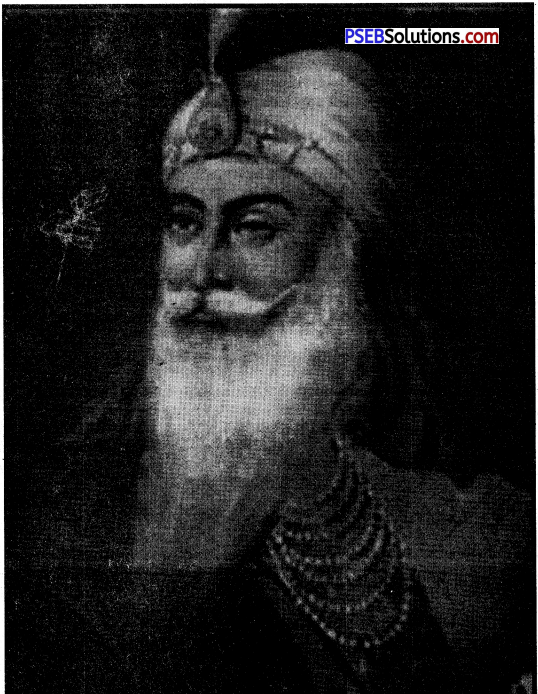
1. Appearance: The appearance of Maharaja Ranjit Singh was not very attractive. He had medium-sized stature and a thin body.- His face had been disfigured as a result of smallpox in his childhood and deprived him of the left eye. Although the Maharaja was ugly, yet his personality was so attractive that anybody who came to meet him was greatly impressed by him. His face was suffused with a special type of halo and brilliance.

2. Hard-working and Active: Maharaja Ranjit Singh was very hard-working and active. He always believed that great men should always be hardworking and active. He expected this from his officers, also. The Maharaja always remained busy in-state work from morning till late night. He delighted in every type of work. He paid personal attention to the minutest work of the state.

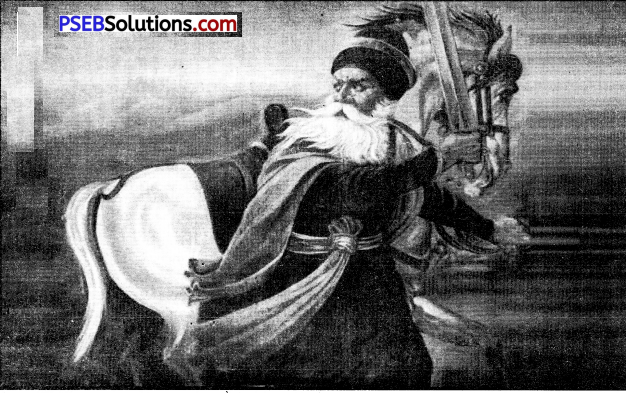
3. Courageous and Brave: Maharaja Ranjit Singh was a very brave and courageous person. He was fond of going to the battlefields, hunting trips, wielding sword and horse-riding. While young, he gave evidence of his bravery by beheading Hashmat Khan earlier. He was ever foremost in battle and the last to retreat. He never lost heart even in the face of the most dreadful situation.

4. Kind Hearted: Maharaja Ranjit Singh was very popular with the people for his kindness. During his period, Maharaja Ranjit Singh defeated many Sikh, Hindu and Muslim Chiefs. But, it is remarkable that the Maharaja never treated his enemies cruelly. He was always ready to help the poor and destitute. Many tales of his kindness are well-known.

5. A devoted follower of Sikhism: Maharaja Ranjit Singh had an unshakable faith in Sikhism. Before starting his routine work, he used to listen to the recitation of Gurbani of Guru Granth Sahib Ji and the Kirtan. He called his government as Sarkar-i-Khalsa and his court Darbar Khalsa Ji. He considered himself to be the Kukar (dog) at the door of the Guru and the Panth.

Question 3.
Maharaja Ranjit Singh was a kind ruler. How?
Answer:
Maharaja Ranjit Singh was very popular with the people for his kindness. During his period, Maharaja Ranjit Singh defeated many Sikh, Hindu and Muslim Chiefs. But what is remarkable is that the Maharaja never treated his enemies cruelly. At that time among the emperors of Kabul and Delhi, whoever came to occupy the throne not only continued to shed blood of their close relatives and claimants to the throne but also left their descendants in a state of destitution. At such times, this rufer of Lahore not only embraced those whom he defeated on the battlefield but also bestowed Jagirs and robes of honour even to their children. The Maharaja did not award a death sentence to any criminal in his region. He was always ready to help the poor and destitute. Many tales of his kindness are well-known.

Mauza or village was the smallest unit of administration. Its administration was run by the Panchayat. The Maharaja did not interfere with the functioning of Panchayat. The Maharaja never ignored the public interest. He had instructed his state officials that they should make special efforts for the public welfare. The Maharaja used to travel his state in disguise to know the condition of the people. Punishment was given to erring officials who violated the orders of the Maharaja. The state offered special facilities to the poor and peasants. Consequently, people were well-off during Maharaja Ranjit Singh’s time.

Question 4.
Maharaja Ranjit Singh was a devoted follower of Sikhism. Give arguments in your favour.
Answer:
Maharaja Ranjit Singh was truly a devoted follower of Sikhism. Every day before starting the routine work he used to hear Kirtan and recitation of Gurbani from Guru Granth Sahib and say his prayer. He never took any important decision ” without seeking guidance from Guru Granth Sahib. He had preserved a Kalgi (aigrette) of Guru Gobind Singh Ji in his Toshakhana (treasure) and considered its touch as a matter of great luck for him. He considered all his victories to be the boon of Almighty. He paid a thanks-giving visit to Sri Harmandir Sahib at Amritsar after each victory where he made huge offerings. He considered himself to be the Kukar (dog) at the door of the Guru and Sikh Panth.

He preferred to be called ‘Singh Sahib’ rather than Maharaja. His coins bore the names of Guru Nanak and Guru Gobind Singh. The official form of salutation in the army was, ‘Waheguru Ji Ka Khalsa, Waheguru Ji Ki Fateh.’ All official oath-taking ceremonies were performed in the presence of Guru Granth Sahib. For building new Gurdwaras and for the maintenance of langar he had given huge revenue-free Jagirs. In short, he was a devoted follower of Sikhism in the true sense of the word.

Question 5.
Maharaja Ranjit Singh was a Secular Ruler. How?
Answer:
Although Ranjit Singh was a staunch Sikh, yet he was liberal towards other religions. He kept religious discrimination and communalism at an arm’s length. He knew very well that for the establishment of a strong and enduring empire the cooperation of people of different religions was essential. By his policy of tolerance, he succeeded in winning over the hearts of the people of different religions. In his empire jobs were given on the basis of merit. In his court, the Sikhs, Hindus, Muslims, Dogras, and Europeans were appointed to the high posts without any discrimination of caste, creed, or nationality.

For instance, his Foreign Minister Faquir Aziz-ud-Din was a Muslim, Prime Minister, Dhian Singh was a Dogra, Diwan Bhiwani Das and Commander Misar Diwan Chand were Hindus and General Ventura and Allard were EuropeAnswer: In matters of charity, the Maharaja did not discriminate against any religion. He made liberal offerings for the maintenance of Hindu temples, Muslim mosques, and mausoleums. In his empire, the people belonging to different religions were at liberty to celebrate their religious ceremonies.

Question 6.
Describe Maharaja Ranjit Singh as a successful Administrator.
Or
What do you know about Maharaja Ranjit Singh as an Administrator?
Answer:
Maharaja Ranjit Singh was an excellent administrator. The main objective of his administration was the welfare of the public. In order to get cooperation in running the administration, he had appointed many honest and able ministers. In order to run the administration efficiently, he had divided his empire into four big provinces.

Question 7.
“Maharaja Ranjit Singh was a great general and a conqueror.” Explain.
Or
What do you know about Ranjit Singh as a Soldier and a General?
Or
Write a note on Maharaja Ranjit Singh as a Soldier and as a Military General.
Answer:
Maharaja Ranjit Singh was a great general of his time. He never faced defeat in any battle that he fought during his lifetime. He deemed it his pleasure to take part in enterprising and adventurous expeditions. He was never unnerved even in the face of heavy odds. The Maharaja took full care of the welfare of his soldiers. As a result, they also remained ever-ready to sacrifice their lives for his sake. Besides being a great general, Maharaja Ranjit Singh was also a great conqueror. When Maharaja Ranjit Singh took reins of Sukarchakia Misl in 1797 A.D., he had a small region under him.

He converted it into a vast empire due to his sheer bravery and ability. He annexed important regions like Lahore, Amritsar, Kasur, Sialkot, Kangra, Gujarat, Jammu, Attock, Multan, Kashmir, and Peshawar to his empire. Maharaja Ranjit Singh had to fight many bloody battles to conquer these regions. He defeated the Afghans and stopped the age-long foreign invasions from the northwest frontier. It was a great singular achievement of Maharaja Ranjit Singh. As a result of his conquests, his empire stretched from Ladakh in the north to Shikarpur in the south and from the Sutlej in the east to Peshawar in the west.

PSEB 12th Class History Solutions Chapter 21 Character and Personality of Maharaja Ranjit Singh

Question 8.
Why is Maharaja Ranjit Singh called Sher-i-Punjab?
Or
What place would you assign Ranjit Singh in the History of Punjab? Why is he called Sher-i-Punjab?
Answer:
Maharaja Ranjit Singh established a vast empire through his sheer bravery. He made the dream of the Sikh empire come true. Besides being a successful conqueror, he also proved to be an efficient administrator. The main object of his administration was the welfare of the public. Often he traveled through his empire in disguise to know the real condition of people. Jobs were given on the basis of merit. People of all religions—the Sikhs, Muslims, Hindus, and Europeans, etc. were given high’ posts in his Darbar. Ranjit Singh adopted a policy of secularism towards all religions.

Essay Type Questions:

Question 1.
Explain in detail the character and personality of Maharaja Ranjit Singh.
Or
Give character estimate of Maharaja Ranjit Singh.
Or
Discuss Maharaja Ranjit Singh as a man, a general, a ruler, and a diplomat.
Or
Explain Maharaja Ranjit Singh as a Man.
Or
What place would you assign to Ranjit Singh in history? Why is he called Sher-i-Punjab?
Answer:
Maharaja Ranjit Singh is counted as one of the greatest personalities not only of India but of the whole world. He was a man of multifarious personality. By virtue of his qualities, he succeeded in establishing a vast and strong Sikh empire in Punjab. He is rightly remembered as Sher-i-Punjab. A brief description of the character and personality of Maharaja Ranjit Singh is as follows:

1. As a Man:

1. Appearance: The appearance of Maharaja Ranjit Singh was not very attractive. He had medium-sized stature and a thin body. His face had been disfigured as a result of smallpox in his childhood and deprived him of the left eye. Although the Maharaja was ugly, yet his personality was so attractive that anybody who came to meet him was greatly impressed by him. His face was suffused with a special type of halo and brilliance.

2. Hard-working and Active: Maharaja Ranjit Singh was very hard-working and active. He always believed that great men should always be hardworking and active. He expected this from his officers, also. The Maharaja always remained busy in-state work from morning till late night. He delighted in every type of work. He paid personal attention to the minutest work of the state.

3. Courageous and Brave: Maharaja Ranjit Singh was a very brave and courageous person. He was fond of going to the battlefields, hunting trips, wielding sword and horse-riding. While young, he gave evidence of his bravery by beheading Hashmat Khan earlier. He was ever foremost in battle and the last to t retreat. He never lost heart even in the face of the most dreadful situation.

PSEB 12th Class History Solutions Chapter 21 Character and Personality of Maharaja Ranjit Singh

4. Illiterate but Intelligent: The Maharaja was not interested in studies. As a result, he remained illiterate. Despite being illiterate, he possessed a very keen, intelligent, and prodigious memory. He knew by heart, the names of thousands of his villages and their geographical location. He could recognize a person at once even if seen many years earlier. He remembered even the smallest details regarding administration. His wisdom was so acute that the foreign travelers wondered at it.

5. Kind Hearted: Maharaja Ranjit Singh was very popular with the people for his kindness. During his period, Maharaja Ranjit Singh defeated many Sikhs, Hindus and. Muslim Chiefs. But, it is remarkable that Maharaja Ranjit Singh never treated his enemies cruelly. The Maharaja did not award a death sentence to any criminal in his reign. He was always ready to help the poor and destitute. Many tales of his kindness are well-known. According to the famous writer Fakir Syed Waheeduddin, “Ranjit Singh’s popular image is that of a kindly patriarch rather than that of conquering hero or a mighty monarch. He was all three, but his humanity has outlived his splendor and power.”

6. A devoted follower of Sikhism: Maharaja Ranjit Singh had an unshakable faith in Sikhism. Before starting his routine work, he used to listen to the recitation of Gurbani of Guru Granth Sahib Ji and the Kirtan. Hp never took any big decision or launched upon any undertaking without seeking guidance from Guru Granth Sahib Ji. After each victory, the Maharaja paid a thanksgiving visit to Sri Darbar Sahib Ji, Amritsar, and made costly offerings.

He called his government Sarkar- i-Khalsa and his court as Darbar Khalsa Ji. He considered himself to be the Kukar (dog) at the door of the Guru and the Panth. He issued coins in the name of Guru Nanak Dev Ji and Guru Gobind Singh Ji. The words ‘Nanak Sahai’ and ‘Gobind Sahai’ were inscribed on them. He liberally gave grants for the construction and maintenance of Gurudwaras. In brief, he was a devout Sikh from heart and soul.

7. Tolerant: Although Ranjit Singh was a staunch Sikh, yet he was liberal towards other religions. He kept religious discrimination and communalism at an arm’s length. He knew very well that for the establishment of a strong and enduring empire, the cooperation of people of different religions was essential. In his empire jobs were given on the basis of merit. In his court, the Sikhs, Hindus, Muslims, Dogras, and Europeans were appointed to the high posts without any discrimination of caste, creed, or nationality.

For instance, his Foreign Minister Faqir Aziz-ad-Din was a Muslim, his Prime Minister, Dhian Singh was a Dogra, his Diwan Bhiwani Das and his Commander Misar Diwan Chand were Hindus and his General Ventura and Allard were EuropeAnswer: In his empire, the people belonging to different religions were at liberty to celebrate their religious ceremonies. According to Dr. Bhagat Singh, “No ruler of ancient or medieval Indian history could match Ranjit Singh in his cosmopolitan approach.’*

2. As a General And Conqueror:

Maharaja Ranjit Singh was a great general of his time. He is counted among the greatest generals of the world. He did not have to face defeat in the battles, which he fought during his lifetime. He took pride in taking part in dreadful campaigns. He never lost his heart even in the face of extreme hardship. For instance in 1823 A.D., in the battle with the Afghans at Naushera, when Akali Phula Singh fell a martyr, the Sikh soldiers lost courage. Their defeat seemed certain, At that time, Maharaja Ranjit Singh, infused a new spirit in his soldiers.

Besides being a great general, Maharaja Ranjit Singh was a great conqueror, also. In 1797 A.D., when he took over the Sukarchakia Misl, he had a very small area under him. By virtue of his ability and bravery, he converted his small kingdom into a big empire. He annexed to his empire, important areas like # Lahore, Amritsar, Kasur, Sialkot, Kangra, Gujarat, Jammu, Attock, Multan, Kashmir, and Peshawar. In order to annex these areas to his empire, the Maharaja had to fight many hazardous battles. By defeating the Afghans he checked their centuries-old invasions on India across the North-West frontiers.

It was a big achievement of Maharaja. Owing to Maharaja Ranjit Singh’s conquests, his empire had extended its frontiers from Ladakh in the North .to Shikarpur in the South, from the river Sutlej in the East to Peshawar in the West. According to the famous historian Dr. Ganda Singh, “Rightly he may claim to be one of the greatest heroes of India.”

3. As an Administrator:

Maharaja Ranjit Singh was not only a great conqueror but also an able ruler. The main aim of Maharaja Ranjit Singh’s administration was public welfare. In order to get co-operation in matters of administration, the Maharaja had appointed many able and honest ministers. With a view to running the administration efficiently, he had divided his kingdom into four big provinces. The smallest unit of administration was ‘Mauza’ or village. The village administration was in the hands of the Panchayat. In order to know the condition of his subjects, he would often tour the state in disguise. The officers, Who dared defy the Maharaja’s orders were given severe punishments. As a result, the public during Maharaja Ranjit Singh’s times was very happy.

Maharaja Ranjit Singh paid special attention to the military administration. He was quite aware that a powerful army was very essential for the defense and expansion of his empire. He was the first Indian ruler, who started giving training to his army on the European pattern. He gave special importance to infantry and artillery. Special attention was paid to maintaining discipline in the army. The Maharaja would personally inspect the army. The practice of keeping the soldier’s record and branding of horses was started. Special awards were given to those soldiers, who showed bravery on the battlefield. The soldiers and their families were fully looked after by the state. Dr. H.R. Gupta aptly says, “He was one of the best rulers in Indian history.”

4. As a Diplomat:

Maharaja Ranjit Singh was a shrewd and far-sighted diplomat. At the beginning of his diplomatic career, he made friends with the powerful Misl Sardars. With the co-operation of these Misl Sardars, he merged the weak Misls with his kingdom. Later on, when the Maharaja grew stronger, he grabbed the powerful Misls one by one. It was a characteristic of Maharaja Ranjit Singh’s diplomacy that he always treated generously the vanquished Chiefs. He granted them Jagirs on liberal terms. Consequently, they never tried to raise a banner of revolt against Maharaja Ranjit Singh.

It was by virtue of his diplomacy that the Maharaja secured the fort of Attock from Jahandad Khan without any fight. In 1835 A.D., when the ruler of Afghanistan, Dost Mohammad Khan came with a large army to attack the Sikhs, the Maharaja played such a trick that he fled from the battlefield without fighting.

In 1809 A.D., Maharaja Ranjit Singh gave evidence of his political sagacity by establishing a friendship with the British. By clashing with a powerful power like the British, he did not want to ring the death-knell of his empire in its infancy. It was not his weakness, but a symbol of his deep political understanding ‘ and far-sightedness. The Maharaja also gave evidence of deep political understanding in solving the North-West frontier problems. By not attacking Afghanistan, Maharaja Ranjit Singh gave yet another proof of his diplomacy. Afterward when the Britishers did so, they had to face dire consequences. Dr. Bhagat Singh aptly says, “It was not easy to beat him in diplomacy.”

5. His Place in the History of the Punjab:

Maharaja Ranjit Singh is counted among the greatest sovereigns not only of India but also of the whole world. Different historians compare Maharaja Ranjit Singh with Mughal emperor Akbar, Maratha ruler Shivaji, Egyptian ruler Mehmet Ali, and the King of France, Napoleon. An impartial study of history, we come to know that the actual achievements of Maharaja Ranjit Singh were far greater than these rulers. At the time of Ranjit Singh’s accession to the throne, he had a nominal kingdom. But with his efficiency and ability, he was able to carve a vast kingdom.

Thus, he fulfilled the dream of establishing a sovereign Sikh empire. He had also established an excellent administration. Its main object was the welfare of the public. He had adopted a tolerant policy towards all religions. He had also established a powerful army for the safety and expansion of his empire. He had given proof of his wisdom by establishing friendly relations with the British. Due to these multifaced qualities, Maharaja Ranjit Singh is deservedly called Sher-i-Punjab. Undoubtedly, Maharaja Ranjit Singh occupied a glorious place in the history of Punjab. In the end, we agree to these words of Dr. H.R. Gupta, “As a man, warrior, general, conqueror, administrator, ruler and diplomat, Ranjit Singh occupies a high position among the greatest sovereigns of the world.”

PSEB 12th Class History Solutions Chapter 21 Character and Personality of Maharaja Ranjit Singh

Short Answer Type Questions:

Question 1.
What do you know about Ranjit Singh as a Man?
Or
Or
Write about the character and personality of Maharaja Ranjit Singh.
Or
Mention the three characteristics of the character and personality of Maharaja Ranjit Singh.
Answer:
Though Ranjit Singh was illiterate, he possessed sharp intellect. His memory was very sharp. He was very kind-hearted. He loved his subjects very much. He never treated his enemies ruthlessly. The Maharaja never awarded capital punishment to anybody during his rule. Maharaja Ranjit Singh was a devoted follower of Sikhism. His attitude towards other religions was full of respect.

Question 2.
Maharaja Ranjit Singh was a kind ruler. How?
Answer:
Maharaja Ranjit Singh was very popular with the people for his kind¬ness. Maharaja Ranjit Singh bestowed Jagirs and robes of honor even to their children whom he defeated in the battlefield. The Maharaja did not award a death sentence to any criminal in his region. He was always ready to help the poor and destitute. Many tales of his kindness are well-known.

Question 3.
Maharaja Ranjit Singh was a devoted follower of Sikhism. Give arguments in your favor.
Answer:
Maharaja Ranjit Singh was truly a devoted follower of Sikhism. Every day before starting the routine work he used to hear Kirtan and recitation of Gurbani from Guru Granth Sahib Ji and say his prayer. He considered all his victories to be the boon of Almighty. He considered himself to be the Kukar (dog) of the Guru and Sikh Panth. He preferred to be called ‘Singh Sahib’ rather than Maharaja. For building new Gurdwaras and for the maintenance of langar he had given huge revenue-free-Jagirs.

Question 4.
Maharaja Ranjit Singh was a Secular Ruler. How?
Answer:
Although Ranjit Singh was a staunch Sikh, yet he was liberal towards other religions. By his policy of tolerance, he succeeded in winning over the hearts of the people of different religions. In his empire jobs were given on the basis of merit. In his court, the Sikhs, Hindus, Muslims, Dogras, and Europeans were appointed to the high posts. In his empire, the people belonging to different reli¬gions were at liberty to celebrate their religious ceremonies.

Question 5.
Describe Maharaja Ranjit Singh as a successful Administrator.
Or
What do you know about Maharaja Ranjit Singh as an Administrator?
Answer:
Maharaja Ranjit Singh was an excellent administrator. The main objective of his administration was the welfare of the public. In order to get cooperation in running the administration, he had appointed many honest and able ministers. The smallest unit of administration was village or Mauza. Its administration was run by the Panchayat. The Maharaja used to travel his state in disguise to know the condition of the people. Consequently, people were well-off during Maharaja Ranjit Singh’s time.

Question 6.
“Maharaja Ranjit Singh was a great General and a Conqueror.” Explain.
Or
What do you know about Ranjit Singh as a Soldier and a General?
Or
Write a note on Maharaja Ranjit Singh as a Soldier and as a Military General.
Answer:
Maharaja Ranjit Singh was a great general of his time. He never faced defeat in any battle that he fought during his lifetime. He annexed important regions like Lahore, Amritsar, Kasur, Sialkot, Kangra, Gujarat, Jammu, Attock, Multan, Kashmir, and Peshawar to his empire. As a result of his conquests, his empire* stretched from Ladakh in the north to Shikarpur in the south and from the Sutlej in the east to Peshawar in the west.

Question 7.
Why was Maharaja Ranjit Singh known as Sher-i-Punjab?
Or
What place would you assign to Maharaja Ranjit Singh in the History of Punjab? Why is he called Sher-i-Punjab?
Answer:
Maharaja Ranjit Singh established a vast empire through his sheer bravery. The main object of his administration was the welfare of the public. People of all religions—were given high posts in his Darbar. He made his army very powerful. He made friends with the English and guarded Punjab against being annexed to the English empire. For all these reasons, Ranjit Singh is called Sher-i-Punjab.

PSEB 12th Class History Solutions Chapter 21 Character and Personality of Maharaja Ranjit Singh

Objective Type Questions:

Question 1.
As a man what were the two characteristic qualities of Maharaja Ranjit Singh?
Answer:
Maharaja Ranjit Singh was brave and kind-hearted.

Question 2.
Which horse was especially loved by Maharaja Ranjit Singh?
Answer:
Lailly.

Question 3.
Maharaja Ranjit Singh was a firm devotee of Sikhism. Give one argument in support of your- answer.
Answer:
He called his Sarkar as Sarkar-i-Khalsa.

Question 4.
What did Maharaja Ranjit Singh call his Government and Darbar?
Answer:
Darbar-i-Khalsa.

Question 5.
What did Maharaja Ranjit Singh call himself.?
Answer:
Dog (Kookar) of Sikhism.

Question 6.
Name anyone non-Sikh Minister of Maharaja Ranjit Singh.
Answer:
Faquir Aziz-ud-Din.

Question 7.
Name prominent historian in the court of Ranjit Singh.
Answer:
Sohan Lai Suri.

Question 8.
Mention any one quality of Maharaja Ranjit Singh as an army General.
Answer:
Maharaja Ranjit Singh did not face defeat in any battle.

Question 9.
“Maharaja Ranjit Singh was a successful diplomat.” Give anyone proof in this regard.
Answer:
Maharaja Ranjit Singh gave proof of his wisdom in not seizing Afghanistan.

Question 10.
Which ruler of Punjab is remembered as Sher-i-Punjab?
Answer:
Maharaja Ranjit Singh.

Question 11.
Why is Maharaja Ranjit Singh called Sher-i-Punjab?
Answer:
Because he established a vast Sikh empire and adopted a liberal policy towards all religions.

Question 12.
Why was Maharaja Ranjit Singh called ‘Paras’?
Answer:
Because he took special care of his subjects.

PSEB 12th Class History Solutions Chapter 21 Character and Personality of Maharaja Ranjit Singh

Fill in the blanks:

1. The appearance of Maharaja Ranjit Singh was not very …………….
Answer:
attractive

2. Maharaha Ranjit Singh specially loved the horse named …………………
Answer:
Lailly

3. Maharaja Ranjit’Singh considered himself ……………… of Sikhism.
Answer:
Kukar

4. Maharaja Ranjit Singh called his government ………………..
Answer:
Sarkar-i-Khalsa

5. Maharaja Ranjit Singh called his Darbar ……………….
Answer:
Darbar-i-Khalsa

6. Maharaja Ranjit Singh was very fond of ……………..
Answer:
wine

7. Maharaja Ranjit Singh is remembered as ………………
Answer:
Sher-i-Punjab

True or False:

1. Maharaja Ranjit Singh was very industrious and agile.
Answer:
True

2. Maharaja Ranjit Singh loved a horse called Lailly.
Answer:
True

3. Maharaja Ranjit Singh called himself Dog (Kookar) of Sikhism.
Answer:
True

4. Maharaja Ranjit Singh called his government as Sardar-i-Khalsa.
Answer:
True

5. Maharaja Ranjit Singh loved Sikhism only.
Answer:
False

6. Maharaja Ranjit Singh had a great hate for wine.
Answer:
False

PSEB 12th Class History Solutions Chapter 21 Character and Personality of Maharaja Ranjit Singh

7. Maharaja Ranjit Singh is remembered as Sher-i-Punjab.
Answer:
True

8. Maharaja Ranjit Singh was not only a great conqueror but also an able administrator.
Answer:
True

Multiple Choice Questions:

1. As a man what were the characteristic qualities of Maharaja Ranjit Singh?
(a) He was very industrious and agile.
(b) He was very kind-hearted.
(c) He was illiterate but intelligent.
(d) All of the above.
Answer:
(d) All of the above.

2. Which horse was specially loved by Maharaja Ranjit Singh?
(a) Lailly
(b) Shally
(c) Chetak
(d) All of the above.
Answer:
(a) Lailly

3. What did Maharaja Ranjit Singh call his government?
(a) Sarkar-i-Aam
(b) Sarkar-i-Khas
(c) Sarkar-i-Khalsa
(d) None of these.
Answer:
(c) Sarkar-i-Khalsa

4. Who was the most famous scholar in the court of Ranjit Singh?
(a) Sohan Lai Suri
(b) Faqir-Aziz-ud-Din
(c) Raja Dhian Singh
(d) Diwan Mohkam Chand.
Answer:
(a) Sohan Lai Suri

5. Which ruler of Punjab is remembered as Sher-i-Punjab?
(a) Maharaja Raiyit Singh
(b) Maharaja Dalip Singh
(c) Maharaja Sher Singh
(d) Maharaja Kharak Singh.
Answer:
(a) Maharaja Raiyit Singh

6. Which words were engraved on ‘Royal Stamp’ in the Maharaja Ranjit Singh Era?
(a) Fateh Dharam
(b) Akal Sahrai
(c) Fateh Darshan
(d) Nanak Sahai.
Answer:
(a) Fateh Dharam

7. Which words were displayed on the ‘Royal Stamp’ of the Maharaja Ranjit Singh?
(a) Nanak Sahai
(b) Akal Sahai
(c) Gobind Sahai
(d) Teg Sahai.
Answer:
(b) Akal Sahai

PSEB 10th Class English Vocabulary Common Errors

Punjab State Board PSEB 10th Class English Book Solutions English Vocabulary Common Errors Exercise Questions and Answers, Notes.

PSEB 10th Class English Vocabulary Common Errors

Correct the following sentences.

(a)
1. There are plenty of fish here.
2. The flowers are beautiful thing.
3. Bible is holy book.
4. The sun rises in east.
5. She is a M.A.
6. He kept me in dark.
7. She can’t help laugh.
8. I enjoy to play hockey.
9. It is no use to cry over spilt milk.
10. He tried cross the river.
Answer:
1. There is plenty of fish here.
2. The flowers are a beautiful thing.
3. The Bible is a holy book.
4. The sun rises in the east.
5. She is an M.A.
6. He kept me in the dark.
7. She can’t help laughing.
8. I enjoy playing hockey.
9. It is no use crying over spilt milk.
10. He tried to cross the river.

PSEB 10th Class English Vocabulary Common Errors

(b)
1. It is too cold today.
2. She is so nice.
3. You are too busy.
4. We are the childrens of India.
5. Work hard lest you may not fail.
6. I saw you long before.
7. I have only finished two stories.
8. Please attend your lesson.
9. She found me lie on the ground.
10. I don’t blame to you.
Answer:
1. It is very cold today.
2. She is very nice.
3. You are very busy.
4. We are the children of India.
5. Work hard lest you should fail.
6. I have seen you long before.
7. I have finished two stories only.
8. Please attend to your lesson.
9. She found me lying on the ground.
10. I don’t blame you.

(c)
1. I know who are you.
2. Why did you let him to go ?
3. I requested him help me.
4. Geeta is a holy book.
5. He will be back in few days.
6. Everybody was in holiday mood.
7. I got chance to show my skill.
8. One must do his duty.
9. Mother gave me many advices.
10. Leave in hand, please.
Answer:
1 know who you are.
2. Why did you let him go ?
3. I requested him to help me.
4. The Geeta is a holy book.
5. He will be back in u few days.
6. Everybody was in a holiday mood.
7. I got a chance to show my skill.
8. One must do one’s duty.
9. Mother gave me much advice.
10. Let go of my hand, please.

(1) Errors in the use of nouns

Incorrect Sentences Correct Sentences
1. Sita is fond of vegtables
2. Ria’s hair are black
3. She threw two breads before the dog.
4. Two of my brother-in-laws are staying with me.
5. These cattles are mine.
6. All the peoples have ‘gone to town.
7. Herds of swines lived in the forest.
8. The child learned the alphabets before he could read.
9. Her house is full of good
10. She wrote very good
11. This is a six-years-old
12. Lara has some grey
13. She expressed her thank to her uncle.
14. Geeta bought two dozens
15. Sher Singh ran a three miles
16. Teachers are sitting in the staff’s
17. She goes to her office on
18. One of my friend is a teacher.
19. Abha is my cousin sister.
20. The sceneries of Kashmir are very charming.
21. Ramu has packed my
22. She sent us many informations.
23. They gave you many advices.
24. She found two long hair in her food.
25. The boys did many
26. In the first inning, our team scored eighty runs.
Sita is fond of vegetables.
Ria’s hair is black.
She threw two pieces of bread before the dog.
Two of my brothers-in-law are staying with me.
These cattle are mine.
All the people have gone to town.
Herds of swine lived in the forest.
The child learned the alphabet before he could read.
Her house is full of good furniture.
She wrote very good poetry.
This is a six-year-old horse.
Lara has some grey hairs.
She expressed her thanks to her uncle.
Geeta bought two dozen mangoes. ‘ Sher Singh ran a three-mile race. Teachers are sitting in the staff room.
She goes to her office on foot.
One of my friends is a teacher.
Abha is my cousin.
The scenery of Kashmir is very charming.
Ramu has packed my luggage.
She sent us much information.
They gave you much advice.
She found two long hairs in her food.
The boys did many acts of mischief. (The boys did much mischief.)
In the first innings, our team scored eighty runs.

PSEB 10th Class English Vocabulary Common Errors

(2) Errors in the use of adjectives

Incorrect Sentences Correct Sentences
1. She did not eat many bread.
2. Ram ate small honey.
3. Every men are mortal.
4. Much men are poor.
5. Little men are rich.
6. Your uncle should take no side.
7. Take the medicine each four hours.
8. What book do you like the best ?
9. Which nonsense this is !
10. Buses pass my house each hour.
11. Sita is beautiful than Radha.
12. Megha is my oldest daughter.
13. Tell me the last news.
14. My dress is costlier than you.
15. Tom is wise for his age.
16. My pen is superior than yours.
17. I am senior by him in service.
18. He has bought any bread.
19. He has not bought some bread.
20. He has bought no any bread.
21. His condition is so serious that there is a little hope of his recovery.
22. Little knowledge is a dangerous thing.
23. Hurry up ! We have only little time left.
24. He spent a little money he had.
25. I need few days’ rest.
26. A few women can keep a secret.
27. He read a few books he had.
28. Many young men have served their country nobly.
29. There were trees on every side of the road.
30. The doctor called to see him each other day.
31. They all loved each other.
32. The two men struck one another.
33. This boy is no less cleverer than that.
She did not eat much bread.
Ram ate a little honey.
All men are mortal.
Many men are poor.
Few men are rich.
Your uncle should take neither side. Take the medicine every four hours. Which book do you like the best ?
What nonsense this is !
Buses pass my house every hour.
Sita is more beautiful than Radha. Megha is my eldest daughter.
Tell me the latest news.
My dress is costlier than yours.
Tom is wiser for his age.
My pen is superior to yours.
I am senior to him in service.
He has bought some bread.
He has not bought any bread.
His condition is -so serious that- there is little hope of his recovery.
A little knowledge is a dangerous thing.
Hurry up ! We have only a little time left.
He spent the little money he had.
I need a few days’ rest.
Few women can keep a secret.
He read the few books he had.
Many young men have served their country nobly. (Many a young man has served his country nobly.)
There were trees on each side of the road.
The doctor called to see him every other day.
They all loved one another.
The two men struck each other.
This boy is no less clever than that.

(3) Errors in the use of articles

Incorrect Sentences Correct Sentences
1. Dog is faithful animal.
2. Rich should help the, poor.
3. A sun rises in the east.
4. You kept me in dark.
5. He wanted to become teacher.
6. I have never been to Agra Fort.
7. She wants house to live in.
8. Do not lose the heart.
9. He wants little sugar for tea.
10. He is honourable man.
11. The singing is my hobby.
12. We were first to reach the school.
13. His house caught the fire.
14. Next morning I had a idea.
15. Tom was first to protest.
16. They made him feel little better.
17. He will be back in few days.
18. Few students are present in the stadium.
19. I have the headache.
20. The game came to end.
21. She is a honourable lady.
22. I want to buy a umbrella.
23. I am a honest worker.
24. She returned after o hour.
25. Do not make noise.
Dog is a faithful animal.
The rich should help the poor.
The sun rises in the east.
You kept me in the dark.
He wanted to become a teacher.
I have never been to the Agra Fort.
She wants a house to live in.
Do hot lose heart.
He wants a little sugar for tea.
He is an honourable man.
Singing is my hobby.
We were the first to reach the school.
His house caught fire.
Next morning I had an idea.
Tom was the first to protest.
They made him feel a little better.
He will be back in a few days.
A few students are present in the stadium.
I have a headache.
The game came to an end.
She is an honourable lady.
I want to buy an umbrella.
I am an honest worker.
She returned after an hour.
Do not make a noise.

PSEB 10th Class English Vocabulary Common Errors

(4) Errors in the use of verbs

Incorrect Sentences Correct Sentences
1. Vegetables goes bad in summer.
2. Either Mohan or Sham are to be promoted.
3. Neither Tom nor his sister have gone to school.
4. Seventy miles are a long distance.
5. I have finished my play last night.
6. He finished his work when I met him.
7. Law and order are to be maintained.
8. May I came in, Madam ?
9. What will I do next ?
10. She said her friend goodbye.
11. A snake cut her.
12. She laid in her bed.
13. I know to play football.
14. The teacher gave a speech.
15. He was ill for two days when the doctor was sent for.
16. I solved all the questions before the time was over.
17. The patient died before the doctor came.
18. The boat was sunk by a storm which suddenly sprang up.
19. You will be hearing this news already; so I need not to repeat it.
20. Look ! The smoke conies out of the window.
21. If you will play the piano, I will sing.
22. If you played the piano, I will sing.
23. If you had played the piano, I would sing.
24. I learnt that my friend has failed.
25. The judge declared that he is guilty.
Vegetables go bad in summer.
Either Mohan or Sham is to be promoted.
Neither Tom nor his sister has gone to school.
Seventy miles is a long distance.
I finished my play last night.
He had finished his work when I met him.
Law and order is to be maintained.
May I come in, Madam?
What shall I do next?
She bade her friend goodbye.
A snake bit her.
She lay in her bed.
I know how to play football.
The teacher made a speech.
He had been ill for two days when the doctor was sent for.
I had solved all the questions before the time was over.
The patient had died before the doctor came.
The boat was sunk by a storm which had suddenly sprung up.
You will have heard this news already; so I need not repeat it.
Look ! The smoke is coming out of the window.
If you play the piano, I will sing.
If you played the piano, I would sing.
If you had played the piano, I would have sung.
I learnt that my friend had failed. The judge declared that he was guilty.

(5) Errors in the use for Proposition

Incorrect Sentences Correct Sentences
1. Manav does not obey to his father.
2. My son does not listen what I say.
3. Meena was angry upon her daughter.
4. He fell from his horse and injured his back.
5. Come and see me at Sunday.
6. I have known him since years.
7. I’d prefer to make the journey with car.
8. I washed the dirt at my hands.
9. This shirt is made with cotton.
10. We cooked food with an open fire.
11. She wore a jacket on her dress.
12. This cloth costs ₹ 50 each metre.
13. They tied him with tree.
14. He wore a blue shirt in his coat.
15. He wanted me to write the preface of his book.
Manav does not obey his father.
My son does not listen to what I say.
Meena was angry with her daughter.
He fell off his horse and injured his back.
Come and see me on Sunday.
I have known him for years.
I’d prefer to make the journey by car.
I washed the dirt off my hands.
This shirt is made of cotton.
We cooked food over an open fire.
She wore a jacket over her dress.
This cloth costs ₹ 50 per metre.
They tied him to a tree.
He wore a blue shirt under his coat.
He wanted me to write the preface to his book.

PSEB 10th Class English Vocabulary Common Errors

(6) Errors in the use of Pronouns

Incorrect Sentences Correct Sentences
1. Myself can do it.
2. Those are ours toys.
3. This action of her’s was not liked by us.
4. It was me who did it.
5. I and you will help the poor.
6. I and my friend were invited to the party.
7. I, you and he “should attend the meeting.
8. You, he and I broke the rules of this game.
9. It is a secret between he and me.
10. Let he and I do it.
11. We enjoyed much at the hill station.
12. Each of the guests must bring their own card.
13. Everybody were in their best clothes.
14. Neither of these two boys are going to pass.
15. None of those boys were allowed to enter their class.
I can do it myself.
Those are our toys. (Those toys are ours.)
This action of hers was not liked by us.
It was I who did it.
You and I will help the poor.
My friend and I were invited to the party.
You, he and / should attend the meeting.
I, he and yow broke the rules of this game.
It is a secret between him and me.
Let him and me do it.
We enjoyed ourselves much at the hill station.
Each of the guests must bring his (or her) own card.
Everybody was in his (their) best clothes.
Neither of these two boys is going to pass.
None of those boys was allowed to enter his class.

(7) Errors in the use of auxiliaries

Incorrect Sentences Correct Sentences
1. I will be obliged to you.
2. If she will come to me, I shall help her. ’
3. I will be drowned and nobody shall save me.
4. I shall stand by my brother under all circumstances.
5. You will be turned out of the class if you won’t stop talking.
6. Shall you help me ?
7. Will I go to the garden ?
8. He worked hard lest he may not fail.
9. He will know me if he saw me.
10. He can do this if he tried.
11. You ought love your parents.
12. He ought have worked hard.
13. Must I do it ? No, you must not.
14. He dares not come to my house.
15. He dare to stand alone.
I shall be obliged to you.
If she comes to me, I shall help her.
I shall be drowned and nobody will save me.
I will jstand by my brother under all circumstances.
You shall be turned out of the class if you don’t stop talking. ,
Will you help me ?
Shall I go to the garden ?
He worked hard lest he should fail.
He would know me if he saw me.
He could do this if he tried.
You ought to love your parents.
He ought to have worked hard.
Must I do it ? No, you need not.
He dare not come to my house.
He dares to stand alone.

PSEB 10th Class English Vocabulary One Word for Many and their use in Sentences

Punjab State Board PSEB 10th Class English Book Solutions English Vocabulary One Word for Many and their use in Sentences Exercise Questions and Answers, Notes.

PSEB 10th Class English Vocabulary One Word for Many and their use in Sentences

1. Something that can be heard – Audible
What he said was not audible.

2. Something written by an unknown person – Anonymous
I received an anonymous letter yesterday.

PSEB 10th Class English Vocabulary One Word for Many and their use in Sentences

3. A written declaration made on oath in the presence of a magistrate or a government official – Affidavit
I submitted an affidavit as a proof of my date of birth.

4. A person who does not believe in God – Atheist
An atheist does not believe in God.

5. A government by one person or one party – Autocracy
Autocracy is not a popular form of government.

6. A word opposite in meaning – Antonym
The antonym of ‘good’ is ‘bad’.

7. A life story of a person written by himself – Autobiography
Gandhiji’s autobiography gives a true description of his life.

8. Medicine to counteract the effect of poison – Antidote
What is the antidote for the poison of the snake ?

9. A representative of a government in a foreign country: -Ambassador
Mr. S.R. Sharma is India’s ambassador in Pakistan.

10. A word or sentence the meaning of which is not clear. – Ambiguous
The minister’s replies were ambiguous.

PSEB 10th Class English Vocabulary One Word for Many and their use in Sentences

11. Place for keeping birds – Aviary
This aviary contains almost all kinds of birds.

12. A place for the storage of weapons – Arsenal
Our neighbouring country is building up a big arsenal.

13. To increase the gravity of a situation – Aggravate
Your perpetual agruing with your father will certainly aggravate his rage.

14. The crime of setting things on fire – Arson
Terrorists caused arson on a large scale.

15. A list of things to be discussed at a meeting – Agenda
What is the agenda for the next meeting ?

16. A state of growth between boyhood and youth – Adolescence
Adolescence is an impressionable period of life.

17. A carriage for the sick and wounded – Ambulance
The injured man was taken in an ambulance.

PSEB 10th Class English Vocabulary One Word for Many and their use in Sentences

18. Objects having life -Animate
Plants and trees are also animate things.

19. A state where no government exists – Anarchy
Unemployment can lead to anarchy.

20. A person liable to be called to account – Accountable
You are accountable for all your misdeeds.

21. An assembly of listeners – Audience
The audience heard Mr. Modi’s speech very attentively.

22. A person who plays a game or does a work only for pleasure – Amateur
Many amateurs also participated in this mission.

23. One who lives in a foreign country – Alien
An American is an alien in our country.

24. A government managed by state officials – Bureaucracy
Bureaucracy should be responsible to the public.

25. Marrying two wives or husbands – Bigamy
Bigamy is not approved in the Indian society.

26. A man who is not married – Bachelor
A bachelor is generally a carefree man.

27. A thing which can be broken easily – Brittle
Glass is hard but brittle

PSEB 10th Class English Vocabulary One Word for Many and their use in Sentences

28. To speak ill of a person in his absence – Backbite
Gentlemen don’t indulge in backbiting.

29. A bunch of flowers -Bouquet
I presented her a bouquet on her birthday.

30. The science which deals with life – Biology
Biology is her favourite subject.

31. A girl just before or after her wedding day – Bride
The bride was wearing a red saree.

32. A boy just before or after his wedding day – Bridegroom
The bridegroom came riding a horse.

33. A person who believes everybody – Credulous
A credulous person easily believes what others say.

34. That which can be corrected – Corrigible
Certain defects are not corrigible.

35. A list of names of books – Catalogue
You should consult the library catalogue.

36. A period of one hundred years – Century
We are living in the twenty-first century.

37. A piece of machinery used for mathematical calculations – Calculator
A calculator helps us in making big calculations easily.

38. The peak point of a story or a plot – Climax
The climax of the film was its best part.

39. A place where the dead are buried – Cemetery
The Christians bury their dead in a cemetery.

40. The art of beautiful writing -Calligraphy
The art of calligraphy is now dying.

PSEB 10th Class English Vocabulary One Word for Many and their use in Sentences

41. A musical entertainment given in a public hall – Concert
People came in thousands to the concert.

42. One who eats human flesh – Cannibal
This book gives an account of cannibals of the past.

43. Government of the people, by the people, for the people – Democracy
We are the biggest democracy in the world.

44. One who drinks too much – Drunkard
A drunkard is certain to have a short life.

45. A government by one person – Dictatorship
Dictatorship cannot continue for long.

46. Money or gifts given to a girl at her marriage -Dowry
Her rich parents gave her a big dowry.

47. To injure one’s reputation – Defame
Each new government defames the previous one.

48. The art of management practised by statesmen -Diplomacy
Nehru was very good at international diplomacy.

49. A speech made without preparation -Extempore
His extempore speech impressed the listeners.

50. A book containing every kind of information -Encyclopedia
An encyclopedia enriches our knowledge.

PSEB 10th Class English Vocabulary One Word for Many and their use in Sentences

51. A person who examines -Examiner
The examiner has marked the answer-books very carelessly.

52. A thing which is fit to be eaten – Edible
All mushrooms are not edible.

53. To root out an evil —Eradicate
Dowry system cannot be eradicated by law alone.

54. To send articles out of the country —Export
India now exports cars to European countries.

55. One who loves his own religion and hates other religions —Fanatic
A fanatic can never be truly religious.

56. Murder of a brother —Fratricide
He was suspected of fratricide by the police.

57. One who is not easily pleased —Fastidious
She is very fastidious about her dress.

58. A period of two weeks —Fortnight
He comes here every fortnight.

59. That which ends in death —Fatal
He was killed in a fatal accident.

60. A man interested in the welfare of women —Feminist
A feminist favours equal rights for women.

61. A person who eats too much —Glutton
He eats like a glutton.

PSEB 10th Class English Vocabulary One Word for Many and their use in Sentences

62. A make-up room behind the stage —Green room
Th hm’oine was dressing up in the green room.

63. Money paid to an employee after his retirement —Liratul:y
He got a big gratuity at his retirement.

64. A place for storing grain —Granary
Punjab is called the granary of India.

65. A medicine that kills germs —Germicide
Keep germicides away from children.

66. A post for which no salary is paid .‘ —Honorary
No wages are given for an honorary post.

67. To cause eggs to produce the young —Hatch
The hen hatches its eggs in a dark place.

68. A place of shelter or safety —Haven
This zoo is a haven for birds.

69. A writing which cannot be read clearly —Illegible
Your handwriting is illegible.

70. One who does not show favour to anyone —Impartial
He gave an impartial decision.

71. That which cannot be solved or dissolved —Insoluble
Oil is insoluble in water.

72. One who cannot read or write —Illiterate
The poor farmer was illiterate.

73. That which cannot be conquered —Invincible
Death is invincible.

74. That which cannot be corrected —Incorrigible
He is an incorrigible gambler.

75. One who never dies —Immortal
The soul is immortal.

76. That which is against law —Illegal
I never do an illegal act.

77. That which cannot be cured —Incurable
Cancer is incurable.

78. That which is not proper —Inept
An inept remark can turn friends into enemies.

79. A thing that must happen —Inevitable
Death is inevitable.

80. A loss which cannot.be repaired or made good —Irreparable
This loss is irreparable.

81. A person easily made angry —Irritable
He has an irritable nature.

PSEB 10th Class English Vocabulary One Word for Many and their use in Sentences

82. That which can be understood —Intelligible
Her lecture was intelligible to everyone.

83. An article or thing liable to catch fire easily —Inflammable
Petrol is highly inflammable.

84. Worship of idols —Idolatry
Many religions are against idolatry.

85. Showing or having good sense and wisdom —Judicious
It was a judicious decision.

86. A special skill or ability —Knack
Mohan has a knack of pleasing everybody.

87. A problem or question hard to solve —Knotty
It is a knotty problem.

88. One who can read and write —Literate
Very few people in the village are literate.

89. A copy of a book, piece of music, etc. before it has been printed. —Manuscript
The manuscript was neatly handwritten.

90. A disorderly crowd of people —Mob
The police was unable to control the mob.

PSEB 10th Class English Vocabulary One Word for Many and their use in Sentences

91. A person with a bad reputation. —Notorious
Jagga was a notorious dacoit.

PSEB 9th Class Hindi Solutions Chapter 2 सूरदास के पद

Punjab State Board PSEB 9th Class Hindi Book Solutions Chapter 2 सूरदास के पद Textbook Exercise Questions and Answers.

PSEB Solutions for Class 9 Hindi Chapter 2 सूरदास के पद

Hindi Guide for Class 9 PSEB सूरदास के पद Textbook Questions and Answers

(क) विषय बोध

1. निम्नलिखित प्रश्नों के उत्तर एक-दो पंक्तियों में दीजिए :

प्रश्न 1.
यशोदा श्री कृष्ण को किस प्रकार सुला रही है?
उत्तर:
यशोदा श्रीकृष्ण को पालने में झूला झूलाते हुए, दुलारते हुए, पुचकारते हुए तथा कुछ गाते हुए सुला रही है।

प्रश्न 2.
यशोदा श्रीकृष्ण को दूर क्यों नहीं खेलने जाने देती है?
उत्तर:
यशोदा श्रीकृष्ण को दूर खेलने इसलिए नहीं जाने देती कि कहीं किसी की गाय उन्हें मार न दे।

प्रश्न 3.
यशोदा श्रीकृष्ण को दूध पीने के लिए क्या प्रलोभन देती है ?
उत्तर:
यशोदा श्री कृष्ण को कहती है कि यदि वे दूध पी लेंगे तो उनकी चोटी भी बलराम की चोटी के समान लंबी-मोटी हो जाएगी।

PSEB 9th Class Hindi Solutions Chapter 2 सूरदास के पद

प्रश्न 4.
श्री कृष्ण यशोदा से क्या खाने की माँग करते हैं ?
उत्तर:
श्रीकृष्ण यशोदा से खाने के लिए माखन-रोटी की माँग करते हैं।

प्रश्न 5.
अंतिम पद में श्रीकृष्ण अपनी माँ से क्या हठ कर रहे हैं ?
उत्तर:
अंतिम पद में श्रीकृष्ण अपनी माँ से गाय चराने जाने की हठ कर रहे हैं। वे अपने हाथों से तोड़ कर फल खाना चाहते हैं।

2. निम्नलिखित पद्यांशों की सप्रसंग व्याख्या कीजिए

प्रश्न 1.
मैया कबहुं बढ़ेगी चोटी।
किती बेर मोहिं दूध पियत भई, यह अजहूं है छोटी।
तू जो कहति बल की बेनी ज्यों, हवै है लांबी मोटी।
काढ़त गुहत न्हवावत जैहै नागिन-सी भुईं लोटी।
काचो दूध पियावति पचि पचि, देति न माखन रोटी।।
सूरदास चिरजीवौ दोउ भैया, हरि हलधर की जोटी ।।
उत्तर:
भक्त सूरदास श्रीकृष्ण के बाल रूप का वर्णन करते हुए कहते हैं कि-बालक कृष्ण अपनी माता यशोदा से शिकायत करते हैं कि-माँ मेरी यह चोटी कब बड़ी होगी? दूध पीते हुए मुझे कितना समय हो गया है, लेकिन यह अभी भी वैसी के वैसी छोटी है। माँ तुम तो कहती हो कि मेरी ये चोटी बलराम भैया की चोटी की भाँति मोटी और लंबी हो जाएगी। इसे निकालते हुए, (कंघी करते हुए) गुंथते और नहाते हुए यह नागिन की भाँति धरती पर लोटने लगेगी। अपनी माँ से शिकायत करते हुए वे कहते हैं कि हे मैया ! तुम बार-बार मुझे कच्चा दूध पीने के लिए देती हो, लेकिन माखन रोटी खाने के लिए नहीं देती हो। पद के अंत में भक्त सूरदास कहते हैं कि बलराम और कृष्ण की यह जोड़ी सदा के लिए बनी रहे।

प्रश्न 2.
आजु मैं गाइ चरावन जैहौं।
बृन्दावन के भांति भांति फल अपने कर मैं खेहौँ ।।
ऐसी बात कहौ जनि बारे, देखौ अपनी भांति।
तनक तनक पग चलिहौ कैसें, आवत वै है. अंति राति।
प्रात जात गैया लै चारन घर आवत हैं सांझ।
तुम्हारे कमल बदन कुम्हिलैहे, रेंगति घामहि मांझ।
तेरी सौं मोहिं घाम न लागत, भुख नहीं कछु नेक।
सूरदास प्रभु कयौ न मानत, पर्यो आपनी टेक।।
उत्तर:
सूरदास जी कहते हैं कि बाल कृष्ण अपनी माँ यशोदा से कहते हैं कि वे आज गाय चराने जाएंगे। इस प्रकार वे वृंदावन के अनेक प्रकार के फल भी अपने हाथ से तोड़ कर खाएँगे। इस पर माता यशोदा उन्हें मना करते हुए कहती हैं कि ऐसी बात मत करो ज़रा अपने को देखो कि तुम अपने छोटे-छोटे कदमों से किस प्रकार चलोगे क्योंकि आते हुए बहुत रात हो जाएगी। सुबह-सुबह गायों को चराने ले जाते हैं तो संध्या के समय घर आते हैं। तुम्हारा कमल जैसा कोमल मुख धूप में भटकने से मुरझा जाएगा। इस पर बाल कृष्ण कहते हैं कि हे माँ ! तुम्हारी कसम मुझे धूप नहीं लगती है और कुछ विशेष भूख भी नहीं है। सूरदास जी कहते हैं कि प्रभु बाल कृष्ण अपनी माता का कहना नहीं मानते और अपनी ज़िद्द अड़े हुए है कि उन्हें गाय चराने जाना है।

PSEB 9th Class Hindi Solutions Chapter 2 सूरदास के पद

(ख) भाषा-बोध

1.नीचे दिए गए सूरदास के पदों में प्रयुक्त ब्रज भाषा के शब्दों के लिए खड़ी बोली हिंदी के शब्द लिखिए

प्रश्न 1.
ब्रज भाषा – खड़ी बोली
के शब्द – हिंदी के शब्द
कुछ – कुछ
तोको – …………………..
कबहुँक – …………………..
किति – …………………..
अरु – …………………..
निंदरिया – …………………..
कान्ह – …………………..
इहिं – …………………..
भुई – …………………..
तुम्हरे – …………………..
उत्तर:
ब्रज भाषा – खड़ी बोली
के शब्द – हिंदी के शब्द
कछु – कुछ
तोको – तुमको
कबहुँक – कभी
किति – कितनी
अरु – और
निंदरिया – नींद
कान्ह – कृष्ण
इहिं – यहाँ
भुई – भूमि
तुम्हरे – तुम्हारे

PSEB 9th Class Hindi Solutions Chapter 2 सूरदास के पद

2. निम्नलिखित एकवचन शब्दों के बहुवचन रूप लिखिए

एकवचन – बहुवचन
पलक – ……………………
नागिन – ……………………
ग्वाला – ……………………
गोपी – ……………………
चोटी – ……………………
उत्तर:
एकवचन – बहुवचन
पलक – पलकें
नागिन – नागिने
ग्वाला – ग्वाले
गोपी – गोपियाँ
चोटी – चोटियाँ
रोटी – रोटियाँ

(ग) पाठेत्तर सक्रियता

प्रश्न 1.
श्रीकृष्ण की बाल-लीलाओं के चित्र इकट्ठे करके अपनी कॉपी में चिपकाएँ।
उत्तर:
विद्यार्थी स्वयं करें।

प्रश्न 2.
जन्माष्टमी के अवसर पर मंदिर में जाकर श्रीकृष्ण की बाल-लीला से सम्बन्धित झाँकियों का अवलोकन कीजिए।
उत्तर:
विद्यार्थी स्वयं करें।

PSEB 9th Class Hindi Solutions Chapter 2 सूरदास के पद

प्रश्न 3.
जन्माष्टमी के अवसर पर मंदिरों में बच्चों द्वारा श्रीकृष्ण की बाल-लीला से सम्बन्धित कार्यक्रम आयोजित किए जाते हैं। उनमें भाग लीजिए।
उत्तर:
विद्यार्थी स्वयं करें।

प्रश्न 4.
जन्माष्टमी के अवसर पर रात को श्रीकृष्ण के जन्म की कथा सुनाई जाती है। वहाँ जाइए और कथा श्रवण कर रसास्वादन कीजिए अथवा टेलीविज़न/इंटरनेट से श्रीकृष्ण की जन्म-कथा को सुनिए/देखिए।
उत्तर:
विद्यार्थी स्वयं करें।

प्रश्न 5.
आप भी बचपन में दूध आदि किसी पदार्थ को नापसंद करते होंगे। आपके माता-पिता आपको यह पदार्थ खिलाने-पिलाने में कितने लाड-प्यार से यत्न करते होंगे। अपने माता-पिता से पूछिए और लिखिए। उत्तर:
विद्यार्थी स्वयं करें।

PSEB 9th Class Hindi Solutions Chapter 2 सूरदास के पद

(घ) ज्ञान-विस्तार

हिंदी-साहित्य के भक्तिकाल (सन् 1318-1643 तक) की कृष्ण-भक्ति-शाखा के प्रमुख कवि सूरदास माने जाते हैं। इनके अतिरिक्त कृष्णदास, नन्ददास, रसखान जैसे प्रसिद्ध कवियों तथा कवयित्री मीराबाई ने भी श्रीकृष्ण को आधार बनाकर उत्कृष्ट काव्य की रचना की है। श्रीकृष्ण की भक्ति से ओत-प्रोत रसखान के सवैयों को तो विद्वानों ने सचमुच रस की खान ही कहा है। मीराबाई का हिंदी की कवयित्री में अप्रतिम स्थान है। मीरा द्वारा रचित श्रीकृष्ण-भक्ति के सुन्दर और मधुर गीत जगत प्रसिद्ध हैं।

मीरा :
पायो जी मैंने राम रतन धन पायो !
वस्तु अमोलक दी मेरे सतगुरु, करि किरपा अपणायौ!
जन्म-जन्म की पूँजी पाई, जग में सबै खोवायो!
खरचै नहिं कोई चोर न लेवै, दिन दिन बढ़त सवायौ !
सत की नाव खेवटिया सतगुरू, भवसागर तरि आयो!
मीरा के प्रभु गिरधर नागर, हरखि-हरखि जस गायौ!

रसखान :
मानुष हौं तो वही रसखानि बसौं ब्रज गोकुल गाँव के ग्वारन।
जौ पसु हौं तो कहा बस मेरो चरौं नित नंद की धेनु मंझारन।।
पाहन हौं तो वही गिरी को जो कियो हरिछत्र पुरंदर धास।
जौ खग हौं तो बसेरो करौं नित कलिंदी कूल कदंब की डारन ।।

PSEB 9th Class Hindi Solutions Chapter 2 सूरदास के पद

PSEB 9th Class Hindi Guide सूरदास के पद Important Questions and Answers

प्रश्न 1.
यशोदा माता श्री कृष्ण को पालने (झूले) में झुलाती हुई क्या-क्या करती है ?
उत्तर:
यशोदा माता श्री कृष्ण को पालने में झुलाते हुए उन्हें दुलारती है; पुचकारती है। उसके मन में जो कुछ भी आता है वह उसे गाती है। वह नींद को श्री कृष्ण के पास जल्दी-जल्दी आने के लिए बुलाती है।

प्रश्न 2.
यशोदा माता श्री कृष्ण को सुलाते समय अपनी सखियों से किस प्रकार बात करती है ?
उत्तर:
यशोदा माता श्री कृष्ण को सुलाते समय अपनी सखियों से बिना बोले कुछ केवल इशारों से बात करती है; कुछ बातें समझाती है।

प्रश्न 3.
यशोदा माता इशारों से अपनी सखियों को क्या बताती है ?
उत्तर:
यशोदा माता इशारों से अपनी सखियों को बताती है कि कृष्ण अब सोने ही वाले हैं। वह उन्हें सुलाने के बाद उनके के पास आ जाएगी।

प्रश्न 4.
वह कौन-सा सुख था जो ऋषि-मुनियों को न मिल यशोदा माता को ही मिला था ?
उत्तर:
श्री कृष्ण ने मानव रूप में धरती पर जन्म लिया था। माँ के रूप में उनका पालन-पोषण करने का जो सुख तपस्या करने वाले ऋषि-मुनियों को नहीं मिला था वह यशोदा माता को मिला था।

PSEB 9th Class Hindi Solutions Chapter 2 सूरदास के पद

प्रश्न 5.
यशोदा माता बाल कृष्ण को क्या-क्या नहीं करने के लिए कहती है ?
उत्तर:
यशोदा माता बाल कृष्ण को पुकारते हुए कहती है कि खेलने के लिए घर से दूर न जाए ताकि कहीं किसी की गाय उसे अपने सींग न मार दे।

प्रश्न 6.
श्री कृष्ण की सुंदरता को देखकर गाँव में क्या-क्या प्रतिक्रिया होती है ?
उत्तर:
श्री कृष्ण की सुंदरता को देख कर सभी गोप-गोपियाँ आश्चर्य व्यक्त करते हैं। वे प्रसन्न होते हैं और घरघर में बधाइयाँ दी जाती हैं।

प्रश्न 7.
श्री कृष्ण अपनी माँ से अपनी चोटी की लंबाई से संबंधित क्या शिकायत करते हैं ?
उत्तर:
श्री कृष्ण अपनी माँ से अपनी चोटी की लंबाई से संबंधित शिकायत करते हैं कि उसकी लंबाई छोटी है। वह बलराम की चोटी जैसी लंबी-मोटी नहीं है। वह उसे लंबा करने के लिए कितनी बार दूध पी चुके हैं पर फिर भी बढ़ती ही नहीं।

प्रश्न 8.
यशोदा माता को कृष्ण को गौवें चराने के लिए जाने से क्या-क्या कह कर रोकती हैं ?
उत्तर:
यशोदा माता श्री कृष्ण से कहती है कि वे अभी बहुत छोटे हैं। वे अपने छोटे-छोटे कदमों से जंगल में नहीं जा पाएंगे। गौएं चराने का काम कठिन होता है। सुबह जाकर शाम को घर वापस लौटना होता है। तेज धूप कष्ट देती है। धूप में इधर-उधर भटकने से उनका कमल-सा चेहरा मुरझा जाएगा।

एक शब्द/एक पंक्ति में उत्तर दीजिए

प्रश्न 1.
बालक कृष्ण को सोया हुआ जान कर यशोदा कैसे बातें करती है?
उत्तर:
इशारों से।

PSEB 9th Class Hindi Solutions Chapter 2 सूरदास के पद

प्रश्न 2.
सोते-सोते जब बालक कृष्ण अकुला उठते हैं तो यशोदा क्या करती है?
उत्तर:
यशोदा मधुर स्वर में गाने लगती है।

प्रश्न 3.
श्रीकृष्ण माता यशोदा से किसके बढ़ने के लिए पूछते हैं ?
उत्तर:
अपनी चोटी के।

प्रश्न 4.
गाय चराने कब जाना पड़ता है ?
उत्तर:
प्रात:काल के समय।

हाँ-नहीं में उत्तर दीजिए

प्रश्न 5.
बालक कृष्ण गाय चराने जाने की जिद्द पर अड़े हुए हैं।
उत्तर:
हाँ।

प्रश्न 6.
यशोदा बालक कृष्ण को दूर खेलने जाने देती है।
उत्तर:
नहीं।

PSEB 9th Class Hindi Solutions Chapter 2 सूरदास के पद

सही-गलत में उत्तर दीजिए

प्रश्न 7.
बालक कृष्ण की चोटी बहुत लम्बी और मोटी है।
उत्तर:
गलत।

प्रश्न 8.
बालक कृष्ण को गाय चराते हुए धूप और भूख नहीं लगती।
उत्तर:
सही।

रिक्त स्थानों की पूर्ति करें

प्रश्न 9.
इहिं अंतर ……… उठे हरि, ……. मधुरै गावै।
उत्तर:
इहिं अंतर अकुलाई उठे हरि, जसुमति मधुरै गावै।

प्रश्न 10.
काढ़त गुहत ……… जैहै …… सी भुई लोटी।
उत्तर:
काढ़त गुहत न्हवावत जैहै नागिन सी भुई लोटी।

PSEB 9th Class Hindi Solutions Chapter 2 सूरदास के पद

बहुविकल्पी प्रश्नों में से सही विकल्प चुनकर लिखें

प्रश्न 11.
यशोदा श्रीकृष्ण को किसमें सुला रही है-
(क) पालने में
(ख) गोद में
(ग) पलंग पर
(घ) कंधे पर।
उत्तर:
(क) पालने में।

प्रश्न 12.
सोते हुए श्रीकृष्ण क्या फड़काते हैं-
(क) पलक
(ख) अधर
(ग) हाथ
(घ) पाँव।
उत्तर:
(ख) अधर।

प्रश्न 13.
हलधर किसे कहा गया है
(क) कृष्ण को
(ख) नंद को
(ग) बलराम को
(घ) ग्वालों को।
उत्तर:
(ग) बलराम को।

PSEB 9th Class Hindi Solutions Chapter 2 सूरदास के पद

प्रश्न 14.
बालक कृष्ण क्या नहीं खाना-पीना चाहते-
(क) दूध
(ख) माखन
(ग) रोटी
(घ) माखन-रोटी।
उत्तर:
(क) दूध।

प्रश्न 15.
श्रीकृष्ण गाय चराने कहाँ जाना चाहते हैं-
(क) गोवर्धन
(ख) वृंदावन
(ग) कालिंदी तट
(घ) गोकुल।
उत्तर:
(ख) वृंदावन।

PSEB 9th Class Hindi Solutions Chapter 2 सूरदास के पद

सूरदास के पद सप्रसंग व्याख्या

1. जसोदा हरि पालने झुलावै।
हलरावै, दुलराइ मल्हावै, जोइ-सोइ कछू गावै।
मेरे लाल को आउ निंदरिया, काहै न आनि सुवावै।
तू काहैं नहिं बेगहिं आवै, तोको कान्ह बुलावै।
कबहुँक पलक हरि नूदि लेत हैं, कबहुँ अधर फरकावै।
सोवत जानि मौन है रहि रहि, करि करि सैन बतावै।
इहिं अंतर अकुलाई उठे हरि, जसुमति मधुरै गावै।
जो सुख सूर अमर मुनि दुरलभ, सो नंद भामिनि पावै॥

शब्दार्थ:
हरि = श्री कृष्ण। पालना = झूला। हलरावै = हिलाती है। मल्हावै = पुचकारती है। निंदरिया = नींद। बेगिहि = शीघ्रता से। तोको = तुझे। अधर = होंठ। मौन = चुप। सैन = संकेत, इशारे। नंद-भामिनि = नन्द की पत्नी, यशोदा।

प्रसंग:
प्रस्तुत पद सूरदास द्वारा रचित ‘सूरदास के पद’ से लिया गया है, जिसमें यशोदा माता अपने पुत्र कृष्ण जी को झूले में झुला कर सुलाने का प्रयास कर रही है। कवि ने अत्यन्त मनोहारी ढंग से माता की विभिन्न क्रियाओं को अंकित किया है।

व्याख्या:
सूरदास जी कहते हैं कि यशोदा माता बाल कृष्ण को झूले (पालना) में झुला रही है। वह झूले को हिलाती है, पुत्र को दुलारती है, पुचकारती है और जो कुछ मन में आता है, गाती है। वह गाते हुए कहती है, “ओ री नींद ! तू मेरे लाल के पास आ। तू आकर इसे सुलाती क्यों नहीं है? तुम्हें कब से कन्हैया बुला रहा है।”कृष्ण कभी पलकों को बन्द कर लेते हैं और कभी ओठों को फड़काते हैं। उन्हें सोया हुआ जानकार यशोदा चुप हो जाती है और दूसरों को इशारे से ही कुछ बातें समझाती है। इसी बीच कृष्ण अकुला उठते हैं और यशोदा फिर से मधुर स्वर में गाने लगती है। सूरदास कहते हैं कि नंद की पत्नी यशोदा को जो सुख प्राप्त हो रहा है, वह देवता और मुनियों को भी प्राप्त नहीं होता।

विशेष:

  1. सूर ने अन्धे होते हुए भी छोटे बच्चे के सोने और माँ की वात्सल्यमयी क्रियाओं का सुन्दर अंकन किया है।
  2. अनुप्रास और पुनरुक्ति अलंकार, ब्रजभाषा, वात्सल्य रस का प्रयोग किया गया है।

PSEB 9th Class Hindi Solutions Chapter 2 सूरदास के पद

2. कहन लागे मोहन मैया मैया।
नंद महर सों बाबा बाबा, अरु हलधर सों भैया।
ऊंचे चढ़ि चढ़ि कहति जसोदा, लै लै नाम कन्हैया।
दूरि खेलन जनि जाहु लला रे, मारैगी काहु की गैया।
गोपी ग्वाल करत कौतूहल, घर घर बजति बधैया।
सूरदास प्रभु तुम्हरे दरस कों, चरननि की बलि जैया।

शब्दार्थ:
मोहन = श्री कृष्ण। महर = मुखिया। हलधर = बलराम (श्री कृष्ण के बड़े भाई)। जनि = मत, न। जाहु = जाना। लला रे = हे पुत्र, हे लाल। कौतूहल = आश्चर्य, हैरानी। बधैया = बधाइयाँ। दरस = दर्शन। बलि जैया = निछावर हूँ।

प्रसंग:
प्रस्तुत पद सूरदास जी द्वारा रचित ‘सूरदास के पद’ में से लिया गया है, जिसमें सूरदास जी ने श्री कृष्ण के बाल-रूप का वर्णन करते हुए उनके बोलने का वर्णन किया है।

व्याख्या:
सूरदास जी कहते हैं कि श्री कृष्ण अब कुछ बड़े हो गये हैं। अब वे यशोदा माता को मैया-मैया कहने लगे हैं तथा ग्वालों के मुखिया नंद जी को बाबा-बाबा और बड़े भाई बलराम जी को भैया-भैया कहने लगे हैं। बालक कृष्ण को बाहर खेलने के लिए जाता हुआ देखकर यशोदा माता घर की छत के ऊपर चढ़ कर श्री कृष्ण का नाम लेकर पुकारती हुई कहती हैं कि हे लाल ! दूर खेलने मत जाओ। तुम्हें किसी की गाय मार देगी। सूरदास जी कहते हैं कि श्री कृष्ण के रूप सौंदर्य पर गोप-गोपियाँ सभी आश्चर्य करते हैं; प्रसन्न होते हैं और घर-घर में बधाइयाँ दी जाती हैं। सूरदास जी कहते हैं कि हे प्रभु, तुम्हारे दर्शन के लिए, मैं तुम्हारे चरणों पर बलिहारी जाता हूँ।

विशेष:

  1. बालक कृष्ण द्वारा बोलना प्रारम्भ करने का स्वाभाविक वात्सल्य रस चित्रण है।
  2. ब्रज भाषा, संवादात्मकता वात्सल्य रस, अनुप्रास तथा पुनरुक्ति प्रकाश अलंकार का प्रयोग किया गया है।

3. मैया कबहुँ बढ़ेगी चोटी।
किती बेर मोहिं दूध पियत भई, यह अजहूँ है छोटी।
तू जो कहति बल की बेनी ज्यों, हवै है लांबी मोटी।
काढ़त गुहत न्हवावत जैहै नागिन-सी भुईं लोटी।
काचो दूध पियावति पचि पचि, देति न माखन रोटी।
सूरदास चिरजीवी दोउ भैया, हरि हलधर की जोटी।

शब्दार्थ:
कबहुँ = कब। पियत = पी लिया है। अजहूँ = अब भी। बल = बलराम। बेनी = चोटी। काढ़त = खोलते हुए। गुहत = चोटी बनाते हुए। भुईं = धरती। पचि-पचि = बार-बार। हरि-हलधर = कृष्ण-बलराम।

प्रसंग:
प्रस्तुत पद सूरदास द्वारा रचित ‘सूरदास के पद’ से अवतरित है। यहाँ सूरदास ने कृष्ण के बाल-सुलभ रूप का अनोखा वर्णन करते हुए कृष्ण द्वारा यशोदा को उलाहना देने की बात की है।

व्याख्या:
भक्त सूरदास श्रीकृष्ण के बाल रूप का वर्णन करते हुए कहते हैं कि-बालक कृष्ण अपनी माता यशोदा से शिकायत करते हैं कि-माँ मेरी यह चोटी कब बड़ी होगी? दूध पीते हुए मुझे कितना समय हो गया है, लेकिन यह अभी भी वैसी के वैसी छोटी है। माँ तुम तो कहती हो कि मेरी ये चोटी बलराम भैया की चोटी की भाँति मोटी और लंबी हो जाएगी। इसे निकालते हुए, (कंघी करते हुए) गुंथते और नहाते हुए यह नागिन की भाँति धरती पर लोटने लगेगी। अपनी माँ से शिकायत करते हुए वे कहते हैं कि हे मैया ! तुम बार-बार मुझे कच्चा दूध पीने के लिए देती हो, लेकिन माखन रोटी खाने के लिए नहीं देती हो। पद के अंत में भक्त सूरदास कहते हैं कि बलराम और कृष्ण की यह जोड़ी सदा के लिए बनी रहे।

विशेष:

  1. सूरदास ने बाल कृष्ण द्वारा मैया यशोदा को शिकायत करने का स्वाभाविक वर्णन किया है।
  2. पद में गेयता, अनुप्रास, उपमा तथा पुनरुक्ति प्रकाश अलंकार हैं। ब्रज भाषा सरल, सहज एवं भावानुकूल है।

PSEB 9th Class Hindi Solutions Chapter 2 सूरदास के पद

4. आजु मैं गाइ चरावन जैहौं।
बृन्दावन के भांति भांति फल अपने कर मैं खेहौं।
ऐसी बात कहौ जनि बारे, देखौ अपनी भांति।
तनक तनक पग चलिहौ कैसें, आवत हवै है अति राति।
प्रात जात गैया लै चारन घर आवत हैं सांझ।
तुम्हारे कमल बदन कुम्हिलैहे, रेंगति घामहिं मांझ।
तेरी सौं मोहिं घाम न लागत, भूख नहीं कछु नेक।
सूरदास प्रभु कहयौ न मानत, पर्यो आपनी टेक॥

शब्दार्थ:
चरावन = चरवाने के लिए। जैहौं = जाऊँगा। कर = हाथ। खेहौं = खाऊँगा। जनि = मत। बारे = बालक। चलिहौ = चलोगे। घामहि = धूप। सौं = कसम। टेक = हठ।

प्रसंग:
प्रस्तुत पद सूरदास द्वारा रचित ‘सूरदास के पद’ से लिया गया है जिसमें कवि ने बाल कृष्ण की गौ चराने की जिद्द तथा माता यशोदा का उन्हें रोकने का वर्णन किया है।

व्याख्या:
सूरदास जी कहते हैं कि बाल कृष्ण अपनी माँ यशोदा से कहते हैं कि वे आज गाय चराने जाएंगे। इस प्रकार वे वृंदावन के अनेक प्रकार के फल भी अपने हाथ से तोड़ कर खाएँगे। इस पर माता यशोदा उन्हें मना करते हुए कहती हैं कि ऐसी बात मत करो ज़रा अपने को देखो कि तुम अपने छोटे-छोटे कदमों से किस प्रकार चलोगे क्योंकि आते हुए बहुत रात हो जाएगी। सुबह-सुबह गायों को चराने ले जाते हैं तो संध्या के समय घर आते हैं। तुम्हारा कमल जैसा कोमल मुख धूप में भटकने से मुरझा जाएगा। इस पर बाल कृष्ण कहते हैं कि हे माँ ! तुम्हारी कसम मुझे धूप नहीं लगती है और कुछ विशेष भूख भी नहीं है। सूरदास जी कहते हैं कि प्रभु बाल कृष्ण अपनी माता का कहना नहीं मानते और अपनी ज़िद्द अड़े हुए है कि उन्हें गाय चराने जाना है।

विशेष:

  1. कवि ने बाल हठ का सजीव वर्णन किया है। कृष्ण भी अपनी हठ पर अड़े हुए हैं।
  2. ब्रज भाषा, गेयता, संवादात्मकता, पुनरुक्ति प्रकाश, अनुप्रास तथा उपमा अलंकार का प्रयोग सराहनीय है।

PSEB 9th Class Hindi Solutions Chapter 2 सूरदास के पद

सूरदास के पद Summary

सूरदास के पद कवि परिचय।

जीवन परिचय:
मध्यकालीन सगुणोपासक एवं कृष्णभक्त कवि सूरदास जी का जन्म सन् 1478 ई० में दिल्ली के निकट सीही ग्राम में एक सारस्वत ब्राह्मण परिवार में हुआ था। कुछ विद्वान् इन्हें जन्म से ही अन्धा मानते हैं तो कुछ मानते हैं कि यह किसी कारणवश बाद में अन्धे हो गए लेकिन इसका कोई भी साक्ष्य नहीं मिलता। सूरदास जी महाप्रभु वल्लभाचार्य जी द्वारा वल्लभ सम्प्रदाय में दीक्षित हुए और उन्हीं की प्रेरणा से ब्रज में श्रीनाथ जी के मन्दिर में कीर्तन करने लगे। इनका देहांत सन् 1583 ई० में मथुरा के निकट पारसौली नामक गाँव में हृया था।

रचनाएँ:
सूरदास जी रचित तीन रचनाएँ सूरसागर, सूरसारावली और साहित्य लहर। हैं। सूरसागर की रचना श्रीमद्भागवत पुराण के आधार पर की गई है। इनका काव्य ब्रजभाषा में रचित, गीतात्मक, माधुर्य गुण से युक्त तथा अलंकारपूर्ण है। . विशेषताएँ-इनके काव्य में श्रृंगार और वात्सल्य का बहुत सहज और स्वाभाविक चित्रण प्राप्त होता है। शृंगार के वियोग पक्ष में इन्होंने गोपियों के कृष्ण के विरह के संतप्त हृदय का मार्मिक चित्रण किया है। श्रीकृष्ण लीलाओं में इनकी बाललीलाओं का वर्णन बेजोड़ है। सूरदास जी की भक्ति भावना सख्य भाव की है।

PSEB 9th Class Hindi Solutions Chapter 2 सूरदास के पद

सूरदास के पद पदों का सार

सूरदास के इन पदों में वात्सल्य रस का मोहक चित्रण किया गया है। पहले पद में यशोदा श्रीकृष्ण को पालने में झूला झुलाकर और लोरी देकर सुला रही है। श्रीकृष्ण कभी पलकें मूंद लेते हैं तो कभी व्याकुल हो उठ जाते हैं। यशोदा उन्हें लोरी गा कर फिर से सुला देती है। दूसरे पद में यशोदा श्रीकृष्ण को दूर खेलने जाने के लिए मना करती है। तीसरे पद में माँ यशोदा श्रीकृष्ण को चोटी बढ़ने का लालच देकर बहाने से दूध पिलाती है परंतु श्रीकृष्ण चोटी न बढ़ने से चिंतित हो कर माखन रोटी खाने के लिए देने के लिए कहते हैं। चौथे पद में श्रीकृष्ण माँ से गायें चराने जाने के लिए हठ करते हैं। परन्तु उनकी बाल-अवस्था देखकर यशोदा उन्हें जाने से रोकना चाहती है।

PSEB 9th Class Hindi Solutions Chapter 1 कबीर दोहावली

Punjab State Board PSEB 9th Class Hindi Book Solutions Chapter 1 कबीर दोहावली Textbook Exercise Questions and Answers.

PSEB Solutions for Class 9 Hindi Chapter 1 कबीर दोहावली

Hindi Guide for Class 9 PSEB कबीर दोहावली Textbook Questions and Answers

(क) विषय-बोध

1. निम्नलिखित प्रश्नों के उत्तर एक-दो पंक्तियों में दीजिए

प्रश्न 1.
कबीर के अनुसार ईश्वर किसके हृदय में वास करता है?
उत्तर:
कबीर के अनुसार ईश्वर सच्चे व्यक्ति के हृदय में वास करता है।

प्रश्न 2.
कबीर ने सच्चा साधु किसे कहा है?
उत्तर:
कबीर ने सच्चा साधु उसे कहा है जो भावों का भूखा होता है और उसे धन-दौलत का लालच नहीं होता है।

प्रश्न 3.
संतों के स्वभाव के बारे में कबीर ने क्या कहा है?
उत्तर:
संत अपनी सजनता कभी नहीं छोड़ते चाहे उन्हें कितने भी बुरे स्वभाव के व्यक्तियों से मिलना पड़े अथवा उन के साथ रहना पड़ा। उन पर बुराई का प्रभाव नहीं होता।

PSEB 9th Class Hindi Solutions Chapter 1 कबीर दोहावली

प्रश्न 4.
कबीर ने वास्तविक रूप से पंडित/विद्वान किसे कहा है?
उत्तर:
कबीर के अनुसार जिसे व्यक्ति ने प्रेम के ढाई अक्षर पढ़ लिए हैं वही वास्तविक रूप से पंडित/विद्वान् है।

प्रश्न 5.
धीरज का संदेश देते हुए कबीर ने क्या कहा है?
उत्तर:
कबीर जी ने कहा है कि सभी कार्य धैर्य धारण करने से होते हैं, इसलिए मनुष्य को धीरज रखना चाहिए, जैसे ऋतु आने पर वृक्ष पर फल अपने आप आ जाते हैं उसी प्रकार समय आने पर मनुष्य के सभी कार्य भी सिद्ध हो जाते हैं।

प्रश्न 6.
कबीर ने सांसारिक व्यक्ति की तुलना पक्षी से क्यों की है?
उत्तर:
कबीर ने सांसारिक व्यक्ति की तुलना पक्षी से इसलिए की है क्योंकि जैसे पक्षी आकाश में इधर-उधर उड़ता रहता है वैसे मनुष्य चंचल मन भी उसके शरीर को कहीं भी भटकाता रहता है।

प्रश्न 7.
कबीर ने समय के सदुपयोग पर क्या संदेश किया है?
उत्तर:
कबीर जी का कहना है कि मनुष्य को अपना काम कल पर नहीं टालना चाहिए बल्कि तुरंत कर लेना चाहिए क्योंकि कल का पता नहीं होता कि कल क्या होगा।

PSEB 9th Class Hindi Solutions Chapter 1 कबीर दोहावली

2. निम्नलिखित पद्यांशों की सप्रसंग व्याख्या कीजिए

(i) जैसा भोजन खाइये, तैसा ही मन होय।
जैसा पानी पीजिये, तैसी वाणी होय।।
(ii) बुरा जो देखन मैं चला, बुरा न मिलिया कोय।
जो दिल खोजा आपना, मुझसे बुरा न कोय।
(iii) जाति ना पूछो साधु की, पूछ लीजिये ज्ञान।
मोल करो तरवार का, पड़ा रहन दो म्यान।।
(iv) अति का भला न बोलना, अति की भली न चूप।
अति का भला न बरसना, अति की भली न धूप।।
(v) माला तो कर में फिरै, जीभ फिरै मुख मांहि।
मनुवा तौ चहुँ दिशि फिरै, यह तो सुमिरन नांहि॥
उत्तर:
(i) कबीरदास जी कहते हैं कि जो व्यक्ति जैसा भोजन खाता है, उसका मन भी वैसा ही हो जाता है तथा जैसा वह पानी पीता है वैसे ही उसकी वाणी से शब्द निकलते हैं। भाव यह है कि कि सात्विक खान-पान के व्यक्ति का मन-वाणी शुद्ध होती तथा तामसिक भोजन-जल का पान करने वाले व्यक्ति का मन और वाणी भी अशुद्ध होगी।

(ii) कबीरदास जी कहते हैं कि मैं जब इस संसार में किसी बुरे व्यक्ति को तलाश करने के लिए निकला तो ढूंढने पर भी मुझे कोई भी बुरा नहीं मिला। जब मैंने अपने दिल को टटोल कर देखा तो मुझे पता चला कि इस संसार में मुझ से बुरा कोई भी नहीं है।

(iii) कबीरदास जी कहते हैं कि मैं जब इस संसार में किसी बुरे व्यक्ति को तलाश करने के लिए निकला तो ढूंढने पर भी मुझे कोई भी बुरा नहीं मिला। जब मैंने अपने दिल को टटोल कर देखा तो मुझे पता चला कि इस संसार में मुझ से बुरा कोई भी नहीं है।

(iv) कबीरदास जी कहते हैं कि हमें किसी साधु की जाति नहीं पूछनी चाहिए बल्कि उसका ज्ञान जानना चाहिए क्योंकि उसके ज्ञान से ही हमें लाभ हो सकता है। जैसे तलवार लेते समय तलवार का मूल्य किया जाता है, म्यान का नहीं-उसी प्रकार से ज्ञानी साधु का सम्मान होता है, उसकी जाति का नहीं।

(v) कबीर जी कहते हैं कि ईश्वर का भजन या स्मरण करते समय हाथ में माला फिरती रहती है और जीभ मुँह में घूमती रहती है लेकिन व्यक्ति का मन चारों दिशाओं में भटकता रहता है। यह तो किसी भी प्रकार से प्रभु का स्मरण नहीं है।

PSEB 9th Class Hindi Solutions Chapter 1 कबीर दोहावली

(ख) भाषा-बोध

निम्नलिखित शब्दों का वर्ण-विच्छेद कीजिए-
प्रश्न 1.
शब्द – वर्ण-विच्छेद बराबर
बराबर – ब् + अ + र् + आ + ब् + अ + र् + अ
भोजन – ————
पंडित – ————
ग्यान – ————
बरसना – ————
उत्तर:
शब्द – वर्ण-विच्छेद बराबर
बराबर – ब् + अ + र् + आ + ब् + अ + र् + अ
भोजन – भ् + ओ + ज् + अ + न् + अ
पंडित – प् + अं+ ड् + इ + त् + अ म्यान
ग्यान – म् + य् + आ + न् + अ बरसना
बरसना – ब् + अ + र् + अ + स् + अ + न् + आ

(ग) पाठेत्तर सक्रियता

प्रश्न 1.
पुस्तकालय से कबीर के दोहों की पुस्तक लेकर प्रेरणादायक दोहों का संकलन कीजिए।
उत्तर:

  • बोली एक अमोल है, जो कोई बोले जानि
    हिय तराजू तोल के, तब मुख बाहर आनि॥
  • निंदक नियरे राखिए, आँगन कुटी छवाय।
    बिन पानी साबुन बिना, निर्मल करे सुभाय।
  • दोस पराये देखि करि, चला हँसत-हँसत।
    अपने याद न आवई, जिनका आदि न अंत ॥
  • जग में बैरी कोई नहीं, जो मन सीतल होय।
    या आपको डारि दे, दया करै सब कोय॥
  • आवत गारी एक है, उलटत होइ अनेक।
    कह कबीर नहिं उलटिए, वही एक की एक॥

प्रश्न 2.
कबीर के दोहों की ऑडियो या वीडियो सी० डी० लेकर अथवा इंटरनेट से प्रात:काल/संध्या के समय दोहों का श्रवण कर रसास्वादन कीजिए।
उत्तर:
विद्यार्थी अपने अध्यापक की सहायता से स्वयं करें।

प्रश्न 3.
कैलेण्डर से देखें कि इस बार कबीर-जयंती कब है। स्कूल की प्रातः कालीन सभा में कबीर-जयंती के अवसर पर कबीर साहिब के बारे में अपने विचार प्रस्तुत कीजिए।
उत्तर:
विद्यार्थी अपने अध्यापक की सहायता से स्वयं करें।

PSEB 9th Class Hindi Solutions Chapter 1 कबीर दोहावली

प्रश्न 4.
एन० सी० ई० आर० टी० द्वारा कबीर पर निर्मित फ़िल्म देखिए।
उत्तर:
विद्यार्थी अपने अध्यापक की सहायता से स्वयं करें।

प्रश्न 5.
मेरी नज़र में : सच्ची भक्ति’ इस विषय पर कक्षा में चर्चा कीजिए।
उत्तर:
विद्यार्थी अपने अध्यापक की सहायता से स्वयं करें।

(घ) ज्ञान-विस्तार

कबीर के अतिरिक्त रहीम, बिहारी तथा वृन्द ने भी इनके दोहों की रचना की है जो कि बहुत ही प्रेरणादायक हैं। इनके द्वारा रचित नीति के दोहे तो विश्व प्रसिद्ध हैं और हमारे लिए मार्गदर्शक का काम करते हैं। इन्हें पढ़ने से एक ओर जहाँ मन को शांति मिलती है वहीं दूसरी ओर हमारी बुद्धि भी प्रखर होती है।
उत्तर:

रहीम :

  • रहिमन धागा प्रेम का मत तोर्यो चटकाय।
    टूटे से फिरि न जुड़े, जुड़े गांठ परि जाई॥
  • छमा बड़न को चाहिए, छोटन को उत्पात।
    का रहीम हरि को घट्यो, जो भृगु मारी लात ।।

बिहारी :

  • दीरघ सांस न लेहि दुख, सुख साईंहि न भूलि।
    दई-दई क्यों करतु है, दई-दई सो कबूलि।।
  • नर की अरु नल नीर की गति एकै करि जोइ।
    जेतौ नीचो वै चले, तैतो ऊँचो होइ॥

वंद :

  • बड़े न हजै गुनन बिन, बिरद बड़ाई पाय।
    कहत धतूरे सौ कनक, गहनों घड़ो न जाय।।
  • सुरसती के भंडार की बड़ी अपूरव बात।
    ज्यों खरचें त्यों-त्यों बड़े बिन खरचे घटि जात॥

PSEB 9th Class Hindi Solutions Chapter 1 कबीर दोहावली

PSEB 9th Class Hindi Guide कबीर दोहावली Important Questions and Answers

प्रश्न 1.
परमात्मा के संबंध में कबीर की क्या विचारधारा थी?
उत्तर:
कबीर निर्गुणी थे। वे मानते थे कि परमात्मा सब जगह है। वह जन्म-मरण से परे है। उसे प्राप्त नहीं किया जा सकता। वह चाहे हर जगह है पर उसे देखा नहीं जा सकता। उसका कोई रंग-रूप नहीं है।

प्रश्न 2.
कबीर ने सच बोलने के विषय में क्या कहा है?
उत्तर:
कबीर ने सच बोलने के विषय में कहा है कि उससे बढ़ कर कोई तप नहीं है। जिस प्राणी के हृदय में सच बसता है उसी के भीतर परमात्मा का वास होता है।

प्रश्न 3.
कबीर के अनुसार जो व्यक्ति धन का लोभी होता है उसमें किस जैसे गुण नहीं होते?
उत्तर:
कबीर जी के अनुसार जो व्यक्ति लालची होता है वह किसी भी स्थिति में साधु कहलाने के योग्य नहीं होता। साधु भाव के भूखे होते हैं, न कि धन दौलत के।

PSEB 9th Class Hindi Solutions Chapter 1 कबीर दोहावली

प्रश्न 4.
कबीर जी के अनुसार हमारा खान-पान हमें कैसे प्रभावित करता है?
उत्तर:
हम जैसा खाते या पीते हैं वैसा ही हमारा मन बन जाता है। बुरा खाने-पीने वाले का मन बुरा बन जाता है तो सात्विक खाने-पीने वाले का स्वभाव भी वैसा ही सात्विक हो जाता है।

प्रश्न 5.
कबीर जी के अनुसार कैसी पढ़ाई इन्सान को पंडित बनाने के योग्य होती है?
उत्तर:
कबीर जी के अनुसार धार्मिक ग्रंथों के पढ़ने से ही इन्सान पंडित बन सकता है। वे ग्रंथ ही इन्सान को परमात्मा को प्राप्त करने की राह दिखाते हैं और उसे संसार के छल-कपट से दूर करते हैं।

प्रश्न 6.
कबीर जी के अनुसार संतों पर किस का कोई प्रभाव नहीं पड़ता?
उत्तर:
कबीर जी के अनुसार संतों पर बुरे लोगों का भी प्रभाव नहीं पड़ता। वे सदा अच्छे बने रहते हैं-ठीक वैसे ही जैसे चंदन के पेड़ पर चाहे साँप लिपटे रहें पर उनके ज़हर का चंदन के पेड़ पर कोई प्रभाव नहीं पड़ता।

प्रश्न 7.
कबीर जी ने धैर्य के महत्त्व को किस प्रकार व्यक्त किया है?
उत्तर:
कबीर जी धैर्य को महत्त्व देते हुए मानते हैं कि समय से पहले कभी कुछ नहीं होता। जैसे कोई माली सैंकड़ों पानी से भरे घड़ों से पेड़-पौधों को सींचता रहे लेकिन उन पर फल तो मौसम आने पर ही लगेगा। इसी प्रकार मनुष्य चाहे कितनी भी कोशिश कर ले पर उसके कार्य तो उचित समय आने पर ही होते हैं ; समय से पहले नहीं।

प्रश्न 8.
कबीर जी ने साधुओं की जाति के विषय में क्या विचार व्यक्त किया है?
उत्तर:
कबीर जी ने माना है कि साधुओं की जाति कभी नहीं पूछनी चाहिए। उनकी पहचान उनकी भक्ति और ज्ञान होता है। जिस प्रकार तलवार खरीदते समय उसी का दाम पूछा जाता है न कि उस म्यान का-जिस में रखी जाती है, उसी प्रकार साधु की महत्ता उसकी भक्ति और ज्ञान से होती है, न कि उस की जाति-पाति और रंग-रूप से।

प्रश्न 9.
कबीर जी ने इन्सान के मन की चंचलता को किस प्रकार व्यक्त किया है?
उत्तर:
कबीर जी ने इन्सान के मन को अति चंचल मानते हुए कहा है कि वह जो चाहता है उसका शरीर वैसा ही करता है। सब अच्छे-बुरे काम इन्सान के द्वारा अपने मन की इच्छा के कारण किए जाते हैं। जो व्यक्ति जैसी अच्छी या बुरी संगति करता है उसे वैसे ही. फल की प्राप्ति होती है।

PSEB 9th Class Hindi Solutions Chapter 1 कबीर दोहावली

प्रश्न 10.
कबीर जी किसी भी काम की अधिकता को कैसा मानते हैं?
उत्तर:
कबीर जी का मानना है कि किसी भी काम की अधिकता बुरी होती है। न तो आवश्यकता से अधिक बोलना चाहिए और न ही चुप रहना चाहिए। न अधिक वर्षा अच्छी होती है और न ही अत्यधिक गर्मी-हर वस्तु और काम संतुलित-सा होना चाहिए। किसी की भी अति अच्छी नहीं होती।

प्रश्न 11.
कबीर जी ने मन की चंचलता के विषय में क्या विचार व्यक्त किया है?
उत्तर:
कबीर मानते हैं कि इन्सान का मन बहुत चंचल होता है। वह पल भर भी कहीं टिकता नहीं है। जब वह भक्ति करने लगता है तो माला उस के हाथ में घूमती रहती है और जीभ मुँह में हिल-हिल कर ईश्वर का नाम लेती है लेकिन उसका मन दुनिया भर की अच्छी-बुरी बातें सोचता है। मन की चंचलता उसे ईश्वर के नाम में डूबने ही नहीं देती। चंचलता से भरा मन तो इन्सान से भक्ति करने का नाटक ही कराता है।

प्रश्न 12.
कबीर जी ने इन्सान को अपना काम सदा समय पर करने की शिक्षा कैसे दी है?
उत्तर:
कबीर जी ने इन्सान को शिक्षा देते हुए कहा है कि उसे सदा अपने काम को समय से करना चाहिए। जो काम कल करना है उसे आज ही करो और आज का काम अभी करो। यह संसार तो नाशवान है। यदि अगले ही पल प्रलय हो गई अर्थात् तुम नहीं रहे तो अपना काम फिर कैसे करोगे। अपने काम को अगले दिन पर मत छोड़ो।

एक शब्द/एक पंक्ति में उत्तर दीजिए

प्रश्न 1.
कबीर ने किस के बराबर ‘तप नहीं’ बताया है?
उत्तर:
सत्य के।

प्रश्न 2.
कबीर के अनुसार कौन साधु नहीं होता?
उत्तर:
जो धन का भूखा होता है।

प्रश्न 3.
कबीर के अनुसार कौन ‘संतई’ नहीं छोड़ता?
उत्तर:
संत।

PSEB 9th Class Hindi Solutions Chapter 1 कबीर दोहावली

प्रश्न 4.
कबीर के अनुसार क्या पढ़ने से कोई विद्वान् हो जाता है?
उत्तर:
ढाई आखर प्रेम का पढ़ने से विद्वान् हो जाते हैं।

प्रश्न 5.
कबीर ने सबसे बुरा किसे कहा है?
उत्तर:
स्वयं को।

हाँ-नहीं में उत्तर दीजिए

प्रश्न 6.
धैर्य रखने से धीरे-धीरे सब कार्य सफल होते हैं।
उत्तर:
हाँ।

प्रश्न 7.
साधु की जात पूछनी चाहिए, ज्ञान नहीं पूछना चाहिए।
उत्तर:
नहीं।

सही-गलत में उत्तर दीजिए

प्रश्न 8.
जो जैसी संगति करता है, उसे वैसा फल नहीं मिलता।
उत्तर:
गलत।

प्रश्न 9.
किसी भी कार्य की ‘अति’ ठीक नहीं होती।
उत्तर:
सही।

PSEB 9th Class Hindi Solutions Chapter 1 कबीर दोहावली

रिक्त स्थानों की पूर्ति करें-

प्रश्न 10.
(i) मोल करो ……………. का, पड़ा ……………. दो म्यान।
उत्तर:
मोल करो तलवार का, पड़ा रहन दो म्यान।

(ii) पोथी पढ़ि पढ़ि ……………. मुवा ……………. हुआ न कोय।
उत्तर:
पोथी पढ़ि पढ़ि जग मुवा पंडित हुआ न कोय।

बहुविकल्पी प्रश्नों में से सही विकल्प चुनकर उत्तर लिखें

प्रश्न 11.
माला किस में फिरती है
(क) मन में
(ख) कर में
(ग) तन में
(घ) मुख में।
उत्तर:
(ख) कर में।

प्रश्न 12.
आज का काम कब करना चाहिए
(क) आज
(ख) कल
(ग) परसों
(घ) कभी भी।
उत्तर:
(क) आज।

PSEB 9th Class Hindi Solutions Chapter 1 कबीर दोहावली

प्रश्न 13.
कैसे व्यक्ति के हृदय में ईश्वर निवास करता है
(क) तपस्वी
(ख) वाचाल
(ग) सच्चे
(घ) पोथियों का ज्ञानी।
उत्तर:
(ग) सच्चे।

प्रश्न 14.
कबीर ने सांसारिक व्यक्ति की तुलना किससे की है
(क) पशु से
(ख) पक्षी से
(ग) जलचर से
(घ) सागर से।
उत्तर:
(ख) पक्षी से।

प्रश्न 15.
संत अपनी क्या नहीं छोड़ते
(क) आन
(ख) बान
(ग) शान
(घ) संतई।
उत्तर:
(घ) संतई।

PSEB 9th Class Hindi Solutions Chapter 1 कबीर दोहावली

कबीर दोहावली सप्रसंग व्याख्या

1. साच बराबर तप नहीं, झूठ बराबर पाप।
जाके हिरदे साच है, ताके हिरदे आप॥

शब्दार्थ:
साच = सत्य। हिरदे = हृदय। आप = परमात्मा।

प्रसंग:
प्रस्तुत दोहा ‘कबीर दोहावली’ से लिया गया है, जिसे कबीरदास जी ने रचा है। इस दोहे में कवि ने सत्य की महिमा का वर्णन किया है।

व्याख्या:
कबीरदास जी कहते हैं कि सत्य के समान संसार में कोई तपस्या नहीं है तथा झूठ के बराबर कोई पाप नहीं है। जिनके हृदय में सत्य का निवास होता है उनके हृदय में आप अर्थात् स्वयं परमात्मा का निवास होता है।

विशेष:

  1. कवि के अनुसार सत्यवादी व्यक्ति के मन में सदा परमात्मा का निवास होता है।
  2. भाषा सरल, सहज तथा भावपूर्ण सधुक्कड़ी है। दोहा छंद है।

2. साधु भूखा भाव का, धन का भूखा नाहिं।
धन का भूखा जी फिरै, सो तो साधू नाहिं।

शब्दार्थ:
भाव = भावना, सत्कार। भूखा = लालची, कुछ चाहने की इच्छा करने वाला।

प्रसंग:
प्रस्तुत दोहा कबीरदास द्वारा रचित ‘कबीर दोहावली’ से लिया गया है, जिसमें कवि ने सच्चे साधु के गुणों का वर्णन किया है।

व्याख्या:
कबीरदास जी कहते हैं कि साधु तो केवल भावनाओं का भूखा होता है, वह धन का भूखा कभी नहीं होता। यदि कोई साधु धन के लालच में मारा-मारा फिरता है तो वह साधु कहलाने के योग्य नहीं है।

विशेष:

  1. सच्चा साधु भावनाओं का भूखा होता है, धन का नहीं।
  2. सधुक्कड़ी, भाषा दोहा छंद तथा अनुप्रास अलंकार का प्रयोग हुआ है।

PSEB 9th Class Hindi Solutions Chapter 1 कबीर दोहावली

3. जैसा भोजन खाइये, तैसा ही मन होय।
जैसा पानी पीजिये, तैसी वाणी होय॥

शब्दार्थ:
वाणी = बोलना, बोल। होय = होता है।

प्रसंग:
प्रस्तुत दोहा ‘कबीर दोहावली’ से लिया गया है, जिसके कवि कबीरदास हैं। इस दोहे में अन्न-जल का मानव मन और तन पर प्रभाव चित्रित किया गया है।

व्याख्या:
कबीरदास जी कहते हैं कि जो व्यक्ति जैसा भोजन खाता है, उसका मन भी वैसा ही हो जाता है तथा जैसा वह पानी पीता है वैसे ही उसकी वाणी से शब्द निकलते हैं। भाव यह है कि कि सात्विक खान-पान के व्यक्ति का मन-वाणी शुद्ध होती तथा तामसिक भोजन-जल का पान करने वाले व्यक्ति का मन और वाणी भी अशुद्ध होगी।

विशेष:

  1. कवि के अनुसार मनुष्य के जीवन पर उसके खान-पान का बहुत प्रभाव पड़ता है।
  2. भाषा सधुक्कड़ी, दोहा छंद तथा अनुप्रास अलंकार है।

4. संत न छाडै संतई, जो कोटिक मिलैं असंत।
चंदन भुवँगा बैठिया, तउ सीतलता न तजंत॥

शब्दार्थ:
संत = साधु, सज्जन पुरुष। संतई = साधु-स्वभाव, सज्जनता। कोटिक = करोड़ों। असंत = दुष्ट या बुरे स्वभाव वाले व्यक्ति। भुवँगा = साँप। बैठिया = बैठना, लिपटे रहना। तउ = फिर भी।।

प्रसंग:
यह दोहा संत कबीरदास’ द्वारा रचित ‘कबीर दोहावली’ से लिया गया है। इसमें कबीर जी ने साधु-स्वभाव के विषय में कहा है कि किसी भी अवस्था में अपने साधु-स्वभाव अर्थात् सज्जनता को नहीं छोड़ते हैं। व्याख्या-कबीर जी कहते हैं कि साधु अर्थात् कोई भी सज्जन कभी अपने साधु स्वभाव अर्थात् सज्जनता को नहीं छोड़ता है, चाहे उसे कितने ही बहुत बुरे स्वभाव वाले व्यक्ति मिलें अथवा उनके साथ रहना पड़े। जिस प्रकार चंदन कबीर दोहावली के वृक्ष से अनेक विष भरे साँप लिपटे रहने पर भी चंदन का वृक्ष अपनी शीतलता का परित्याग कभी नहीं करता। उसके गुण ज्यों के त्यों बने रहते हैं।

विशेष:

  1. साधु लोगों पर बुरे लोगों की संगति का कभी भी कोई असर नहीं पड़ता। वे सदा अपने साधु-स्वभाव को बनाए रखते हैं।
  2. उदाहरण अलंकार, सरल भावपूर्ण भाषा तथा दोहा छंद विद्यमान है।

PSEB 9th Class Hindi Solutions Chapter 1 कबीर दोहावली

5. पोथी पढ़ि पढ़ि जग मुवा पंडित हुआ न कोय।
ढाई आखर प्रेम का, पढ़े सु पंडित होय।

शब्दार्थ:
पोथी = पुस्तक, ग्रंथ। पंडित = विद्वान्। मुवा = मर गए। आखर = अक्षर।

प्रसंग:
प्रस्तुत दोहा कबीर दास द्वारा रचित ‘कबीर दोहावली’ से लिया गया है, जिसमें कवि ने ईश्वरीय प्रेम की महिमा का वर्णन किया है। व्याख्या-कबीरदास जी कहते हैं कि संसार के लोग अनेक धर्म ग्रंथों को पढ़-पढ़ कर मर गए परंतु कोई भी विद्वान् न बन सका। कवि का मानना है कि यदि कोई व्यक्ति प्रभु-प्रेम के ढाई अक्षर पढ़ कर समझ लेगा तो वह विद्वान् अथवा ज्ञानी हो जाएगा।

विशेष:

  1. कवि के अनुसार केवल पुस्तकीय ज्ञान से कोई विद्वान् नहीं बन सकता, उसे तो परमात्मा से प्रेम करना आना चाहिए तभी ज्ञानी बन सकता है।
  2. भाषा सहज, सरल, सधुक्कड़ी, दोहा छंद, अनुप्रास तथा पुनरुक्ति प्रकाश अलंकार का प्रयोग किया गया है।

6. बुरा जो देखन मैं चला, बुरा न मिलिया कोय।
जो दिल खोजा आपना, मुझसे बुरा न कोय।

शब्दार्थ:
मिलिया = मिला। खोजा = ढूँढ़ा, तलाश किया।

प्रसंग:
प्रस्तुत दोहा कबीरदास द्वारा रचित ‘कबीर दोहावली’ से लिया गया है, जिसमें कवि ने बताया है कि दूसरों में बुराई देखने से पहले अपने अंदर झाँक कर देखो।

व्याख्या:
कबीरदास जी कहते हैं कि मैं जब इस संसार में किसी बुरे व्यक्ति को तलाश करने के लिए निकला तो ढूंढने पर भी मुझे कोई भी बुरा नहीं मिला। जब मैंने अपने दिल को टटोल कर देखा तो मुझे पता चला कि इस संसार में मुझ से बुरा कोई भी नहीं है।

विशेष:

  1. कवि का मानना है कि बुराई मनुष्य के अपने अंदर होती है। उसे बाहर कहीं खोजने की आवश्यकता नहीं है।
  2. भाषा सधुक्कड़ी और दोहा छंद है।

PSEB 9th Class Hindi Solutions Chapter 1 कबीर दोहावली

7. धीरे-धीरे रे मना, धीरे सब कुछ होय।
माली सींचे सौ घड़ा, ऋतु आए फल होय॥

शब्दार्थ:
मना = मन। सींचे = सींचना। सौ = सैंकड़ा। ऋतु = मौसम। प्रसंग-प्रस्तुत दोहा कबीरदास द्वारा रचित ‘कबीर दोहावली’ से लिया गया है, जिसमें कवि ने इन्सान को अपने मन में धैर्य रखने पर बल दिया है।

व्याख्या:
कबीरदास जी कहते हैं कि हे मेरे मन। धैर्य रखो क्योंकि धीरे-धीरे सब काम हो जाते हैं। जिस प्रकार माली सैंकड़ों घड़ों पानी से वृक्षों को सींचता है और उस वृक्ष पर फल मौसम के आने पर ही आते हैं उससे पहले नहीं, इसी प्रकार से मनुष्य के कार्य भी समय आने पर होते हैं।

विशेष:

  1. यहाँ कवि ने ‘सहज पके सो मीठा’ के अनुसार ‘सब्र का फल मीठा’ माना है और सदा धैर्य से कार्य करने का उपदेश दिया है।
  2. सधुक्कड़ी भाषा, दोहा छंद, अनुप्रास तथा पुनरुक्ति प्रकाश अलंकार का प्रयोग किया गया है।

8. जाति ना पूछो साधु की, पूछ लीजिये ज्ञान।
मोल करो तरवार का, पड़ा रहन दो म्यान॥

शब्दार्थ:
ज्ञान = विद्वता। तरवार = तलवार। म्यान = तलवार का खोल।

प्रसंग:
प्रस्तुत दोहा कबीरदास द्वारा रचित ‘कबीर दोहावली’ से लिया गया है, जिसमें कवि ने ज्ञानी साधु का सम्मान करने के लिए कहा है न कि उसकी जाति का।

व्याख्या:
कबीरदास जी कहते हैं कि हमें किसी साधु की जाति नहीं पूछनी चाहिए बल्कि उसका ज्ञान जानना चाहिए क्योंकि उसके ज्ञान से ही हमें लाभ हो सकता है। जैसे तलवार लेते समय तलवार का मूल्य किया जाता है, म्यान का नहीं-उसी प्रकार से ज्ञानी साधु का सम्मान होता है, उसकी जाति का नहीं।

विशेष:

  1. कवि ने साधु का सम्मान उसके ज्ञान से करने के लिए कहा है न कि जाति से।
  2. भाषा सधुक्कड़ी, दोहा छंद है।

PSEB 9th Class Hindi Solutions Chapter 1 कबीर दोहावली

9. कबीर तन पंछी भया, जहाँ मन तहां उड़ी जाइ।
जो जैसी संगती कर, सो तैसा ही फल पाइ।

शब्दार्थ:
तन = शरीर। पंछी = पक्षी। प्रसंग-प्रस्तुत दोहा कबीरदास द्वारा रचित ‘कबीर दोहावली’ से लिया गया है, जिसमें कवि ने मन की चंचलता का वर्णन किया है।

व्याख्या:
कबीरदास जी कहते हैं कि यह शरीर पक्षी हो गया है, जिसे मन जहाँ चाहे वहीं उड़ा कर ले जाता है, अर्थात् शरीर मन के वश में होकर उसके अनुसार आचरण करता है। वास्तव में, जो जिस संगति में रहता है, उसे उसी प्रकार का फल भी मिलता है।

विशेष:

  1. मन की चंचलता के कारण शरीर भी उसी के इशारों पर चलता है, अत: मन को वश में करना चाहिए।
  2. भाषा सधुक्कड़ी है और दोहा छंद, अनुप्रास अलंकार का प्रयोग किया गया है।

10. अति का भला न बोलना, अति की भली न चूप।
अति का भला न बरसना, अति की भली न धूप॥

शब्दार्थ:
अति = बहुत अधिक। चूप = खामोशी, मौन । बरसना = वर्षा, बारिश।

प्रसंग:
प्रस्तुत दोहा कबीरदास द्वारा रचित ‘कबीर दोहावली’ से लिया गया है, जिसमें कवि ने ‘अति सर्वत्र वर्जते के अनुसार किसी भी कार्य में अति को निंदनीय माना है।

व्याख्या:
कबीरदास जी कहते हैं कि बहुत अधिक बोलना अथवा बहुत अधिक मौन रहना अच्छा नहीं होता है। बहुत बारिश का होना और बहुत अधिक गर्मी का पड़ना भी अच्छा नहीं होता। इस प्रकार किसी भी कार्य में अति हानिकारक होती है।

विशेष:

  1. कवि के अनुसार किसी भी कार्य में अति नहीं करनी चाहिए।
  2. भाषा सधुक्कड़ी और दोहा छंद है।

11. माला तौ कर में फिरै, जीभ फिरै मुख मांहि।
मनुवा तौ चहुँ दिशि फिरै, यह तो सुमिरन नांहि॥

शब्दार्थ:
कर = हाथ। मनुवा = मन । सुमिरन = ईश्वर का भजन करना, स्मरण करना।।

प्रसंग:
प्रस्तुत दोहा कबीर जी द्वारा लिखित ‘साखी’ है। प्रस्तुत दोहे में कबीर जी ने ईश्वर भजन में किसी प्रकार के आडम्बर या दिखावे से बचने की बात कही है। व्याख्या-कबीर जी कहते हैं कि ईश्वर का भजन या स्मरण करते समय हाथ में माला फिरती रहती है और जीभ मुँह में घूमती रहती है लेकिन व्यक्ति का मन चारों दिशाओं में भटकता रहता है। यह तो किसी भी प्रकार से प्रभु का स्मरण नहीं है।

विशेष:

  1. भाव है कि ईश्वर का स्मरण करते समय मनुष्य का मन एकाग्र होना चाहिए तभी सही ढंग से ईश्वर का स्मरण होगा।
  2. अनुप्रास अलंकार, सरल भाषा, दोहा छंद तथा उपदेशात्मक शैली है।

PSEB 9th Class Hindi Solutions Chapter 1 कबीर दोहावली

12. काल्ह करै सो आज कर, आज करै सौ अब्ब।
पल में परलै होयगी, बहुरि करैगो कब्ब।

शब्दार्थ:
काल्ह = कल। अब्ब = अभी। परलै = विनाश, मृत्यु। बहुरि = फिर। कब्ब = कब।

प्रसंग:
प्रस्तुत दोहा कबीरदास द्वारा रचित ‘कबीर दोहावली’ से लिया गया है, जिसमें कवि ने किसी कार्य को टालने की निंदा की है।

व्याख्या:
कबीरदास जी कहते हैं कि हे मनुष्य ! तुमने जो कार्य कल करना है उसे आज ही कर लो और जो आज करना है उसे अभी कर लो क्योंकि पता नहीं कभी भी पलभर में विनाश अथवा मृत्यु हो सकती है, यदि ऐसा हो गया तो फिर अपना कार्य कब करोगे।

विशेष:

  1. आज का कार्य कल पर नहीं टालना चाहिए क्योंकि कभी भी कुछ भी हो सकता है।
  2. भाषा सधुक्कड़ी, दोहा छंद, अनुप्रास अलंकार है।

कबीर दोहावली Summary

कबीर दोहावली कवि परिचय।

कवि-परिचय संत कबीर हिंदी-साहित्य के भक्तिकाल की महान् विभूति थे। उन्होंने अपने बारे में कुछ न कह कर भक्त, सुधारक और साधक का कार्य किया था। उनका जन्म सन् 1398 ई० में काशी में हुआ था तथा उनकी मृत्यु सन् 1518 में काशी के निकट मगहर नामक स्थान पर हुई थी। उनका पालन-पोषण नीरु और नीमा नामक एक जुलाहा दंपति ने किया था। कबीर विवाहित थे। उनकी पत्नी का नाम लोई था। उनका एक पुत्र कमाल और एक पुत्री कमाली थे।।

रचनाएँ:
कबीर निरक्षर थे पर उनका ज्ञान किसी विद्वान् से कम नहीं था। वे मस्तमौला, फक्कड़ और लापरवाह फकीर थे। वे जन्मजात विद्रोही, निर्भीक, परम संतोषी और क्रांतिकारक सुधारक थे। कबीर की एकमात्र प्रामाणिक रचना ‘बीजक’ है, जिसके तीन भाग-साखी, सबद और रमैणी हैं। उनकी इस रचना को उनके शिष्यों ने संकलित किया था।

विशेषताएँ:
कबीर निर्गुणी थे। उनका मानना था कि ईश्वर इस विश्व के कण-कण में विद्यमान है। वह फूलों की सुगंध से भी पतला, अजन्मा और निर्विकार है। कबीर ने गुरु को परमात्मा से भी अधिक महत्त्व दिया है क्योंकि परमात्मा की कृपा होने से पहले गुरु की कृपा का होना आवश्यक है। कबीर ने विभिन्न अंधविश्वासों, रूढ़ियों और आडंबरों का कड़ा विरोध किया था। उन्होंने जाति-पाति और वर्ग-भेद का विरोध किया। वे शासन, समाज, धर्म आदि समस्त क्षेत्रों में क्रांतिकारी परिवर्तन चाहते थे।

कबीर की भाषा जन-भाषा के बहुत निकट थी। उन्होंने साखी, दोहा, चौपाई की शैली में अपनी वाणी प्रस्तुत की थी। उनकी भाषा में अवधी, ब्रज, खड़ी बोली, पूर्वी हिंदी, फारसी, अरबी, राजस्थानी, पंजाबी आदि के शब्द बहुत अधिक हैं। इसलिए इनकी भाषा को खिचड़ी या सधुक्कड़ी भी कहते हैं।

PSEB 9th Class Hindi Solutions Chapter 1 कबीर दोहावली

कबीर दोहावली दोहों का सार

कबीरदास द्वारा रचित ‘कबीर दोहावली’ के बारह दोहों में नीति से संबंधित बात कही गई है। इनमें संत कवि ने सत्य-आचरण, सच्चे साधु की पहचान तथा अन्न-जल के मानव जीवन पर पड़ने वाले प्रभाव आदि का वर्णन किया है। कवि के अनुसार सच्चे व्यक्ति के हृदय में प्रभु निवास करते हैं। सच्चा साधु भाव का भूखा होता है तथा जैसा हम अन्नजल ग्रहण करते हैं वैसा ही हमारा आचरण होता है। सज्जन व्यक्ति बुरे लोगों के साथ रहकर भी अपनी अच्छाई नहीं छोड़ता। संसार में अपने अतिरिक्त कोई बुरा नहीं होता। धैर्य से ही सब कार्य होते हैं। साधु की जाति नहीं ज्ञान देखना चाहिए। सभी इन्सानों को अपने मन की चंचलता को वश में करना चाहिए। किसी भी बात की अति सदा हानिकारक होती है तथा ईश्वर का स्मरण एकाग्र भाव से करना चाहिए। कभी भी आज का काम कल पर नहीं टालना चाहिए क्योंकि मृत्यु के बाद तो वह काम हमारे द्वारा फिर कभी भी नहीं हो सकेगा।।

PSEB 12th Class History Solutions Chapter 15 Invasions of Ahmad Shah Abdali and Disintegration of Mughal Rule in the Punjab

Punjab State Board PSEB 12th Class History Book Solutions Chapter 15 Invasions of Ahmad Shah Abdali and Disintegration of Mughal Rule in the Punjab Textbook Exercise Questions and Answers.

PSEB Solutions for Class 12 History Chapter 15 Invasions of Ahmad Shah Abdali and Disintegration of Mughal Rule in the Punjab

long Answer Type Questions:

Question 1.
Who was Ahmad Shah Abdali? What were the reasons of his Punjab invasions?
Or
Write the main causes of invasions of Ahmad Shah Abdali on Punjab.
Answer:
1. Ambition of Abdali: Ahmad Shah Abdali was a very ambitious ruler. He did not feel contented with his small kingdom of Afghanistan. Hence, he wanted to expand his domain by capturing Punjab and other states of India. In order to fulfill his imperialistic ambition he, first of all, decided to invade Punjab.

2. Enormous wealth of India: In order to establish a powerful empire it was very necessary for Abdali to have great wealth. He could not obtain this wealth from his own kingdom of Afghanistan, as it was economically a very backward region. On the other hand, this wealth could be obtained from India, which was famous in the entire world for its enormous wealth.

3. To consolidate his position in Afghanistan: Ahmad Shah Abdali belonged to an ordinary family. He became the ruler of Afghanistan after killing Nadir Shah in 1747 A.D. Many chieftains opposed him due to this reason. Hence, Ahmad Shah Abdali, in order to, consolidate his position in Afghanistan wanted to invade foreign countries. Through these invasions, he wanted to enhance his honor and status and also win the loyalty of the Afghans.

4. Favourable Political condition of India: After the death of Aurangzeb in 1707 A.D. the mighty Mughal empire was rapidly going towards its downfall. The successors of Aurangzeb began to spend most of their time in the company of wine and women. Hence, there was complete anarchy in all directions in his reign. In Punjab, the Sikhs were proving to be an uncontrollable menace for the Mughal subedars. Taking advantage of this situation, Ahmad Shah Abdali decided to invade Punjab.

5. Invitation of Shah Nawaz Khan: In 1745 A.D. after the death of Zakriya Khan, his eldest son Yahiya Khan became the new subedar of Lahore. Shah Nawaz Khan, his younger brother, could not tolerate this. For quite some time, he had been dreaming of becoming the subedar of Lahore. In this situation, Shah Nawaz Khan invited Ahmad Shah Abdali to invade India. Abdali was in search of such a golden opportunity. Hence, he decided to attack India.

PSEB 12th Class History Solutions Chapter 15 Invasions of Ahmad Shah Abdali and Disintegration of Mughal Rule in the Punjab

Question 2.
When and how many times did Ahmad Shad Abdali invade Punjab? Describe any five invasions.
Answer:
Ahmad Shah Abdali invaded Punjab eight times between 1747 and 1767 A.D. On the invitation of Shah Nawaz Khan the Governor of Lahore, Ahmad Shah Abdali invaded Punjab in December 1747 A.D. for the first time. When he reached the Punjab, Shah Nawaz Khan refused to give him co-operation. Abdali defeated Shah Nawaz Khan who fled to Delhi. Muin-ul-Mulk (Mir-Mannu) gave Abdali a crushing defeat in a battle at Manipur. The Mughal emperor was pleased with it and he appointed Mir Mannu the Governor of Lahore. In order to take revenge, Abdali invaded the Punjab second time at the end of 1748 A.D. This time Mir Mannu got no assistance from Delhi, so he was defeated. He made a treaty with Abdali.

According to this treaty, Mannu accepted to pay Abdali 14 lakh annually. As Mannu could not pay the ransom in time, Abdali invaded Punjab for the third time in 1751-52 A.D. Abdali occupied Punjab during this invasion. During his fifth invasion in Punjab, Ahmad Shah Abdali gave a crushing defeat to the Marathas on 14th January, 1761 A.D. in the third battle of Panipat. The sixth invasion of Abdali on Punjab during 1761-62 A.D. was the most famous. During this invasion on February 5, 1762 A.D. Abdali massacred about 25,000 to 30,000 Sikhs at village Kup near Malerkotla. This event is known as the Great Holocaust. In spite of all his efforts, Abdali failed to crush the growing Sikh power.

Question 3.
What do you know about the first invasion of Ahmad Shah Abdali?
Or
Write a short note on the Abdali’s first invasion over Punjab.
Answer:
At the invitation of Shah Nawaz Khan, Ahmad Shah Abdali proceeded with his forces towards India in December 1747. Without any resistance he reached Shahdara near Lahore on 8th January 1748. Meanwhile Qamar-ud; Din compromised with Shah Nawaz Khan. As a result Shah Nawaz Khan refused to side with Abdali. This enraged Abdali. By defeating Shah Nawaz Khan on 10th January 1748, he took possession of Lahore. Shah Nawaz Khan fled away to Delhi. After taking possession of Lahore, Abdali plundered it at his will. Then he proceeded for Delhi.

Wazir Qamar-ud-Din advanced with his forces to resist him. In a battle near Sirhind, Qamar-ud-Din was killed. At Manupur on 11th March, 1748 .AD., in a fierce battle Muin-ul-Mulk, son of Qamar-ud-Din, inflicted a crushing defeat on Abdali. Mohammad Shah was pleased over the bravery of Muin-ul-Mulk and made him the Governor of Punjab. He was popularly known as Mir Mannu. Thus, the first invasion of Abdali proved a failure.

Question 4.
Briefly explain the second invasion of Ahmad Shah Abdali on Punjab.
Or
Give a brief account of the seconsd invasion of Ahmad Shah Abdali.
Answer:
Ahmad Shah Abdali wanted to avenge his defeat in the first invasion. Secondly, he was also aware of the facts that the new Wazir of Delhi, Safdar Jang was jealous of Mir Mannu. Because of this Mir Mannu’s position was unstable. Owing to these reasons Ahmad Shah Abdali invaded Punjab for the second time in 1748 A.D. Mir Mannu too advanced to face Abdali. In the absence of any help from Delhi, Mir Mannu’s defeat seemed certain. So he signed a pact with Abdali. According to this pact Mir Mannu agreed to pay the annual tribute of Char Mahals (four districts) Sialkot, Pasrur, Gujarat and Aurangabad to Abdali.

The annual revenue of these districts was to the tune of Rs. 14 lakhs. When Mir Mannu was busy with Ahmad Shah Abdali, the Sikhs under the leadership of Jassa Singh Ahluwalia plundered Lahore.

Question 5.
Throw light on the third invasion of Ahmad Shah Abdali on Punjab.
Answer:
There was a great disturbance in Punjab owing to the rampages of the Sikhs and the revolt of Nassir Khan against Mir Mannu. As a result Mir Mannu could not send 14 lakh rupees as annual tribute to Ahmad Shah Abdali. So Abdali invaded Punjab for the third time in November 1751 A.D. Mir Mannu sent Abdali 8 lakh rupees and promised to pay the remaining amount of 6 lakh later on. However, this did not satisfy Abdali and he darted towards Lahore with his forces. When the people of Lahore heard this news, many of them ran away from Lahore in order to escape Abdali’s loot and cruelties. After reaching Lahore, Abdali looted for 3 months. It is said that, no lamp was lighted at night in any house.

All this while Mir Mannu had been waiting for any kind of help from Delhi. A fierce battle was fought between the forces of Ahmad Shah Abdali and Mir Mannu near Lahore on 6th March, 1752 A.D. In this battle Diwan Kaura Mai was killed and Mir Mannu was arrested. Abdali was so greatly impressed by the boldness of Mir Mannu that he appointed him the Governor of Punjab.

PSEB 12th Class History Solutions Chapter 15 Invasions of Ahmad Shah Abdali and Disintegration of Mughal Rule in the Punjab

Question 6.
Explain the fourth invasion of Ahmad Shah Abdali.
Answer:
After the death of Mir Mannu in 1753 A.D., his widow Mughlani Begum became the Governor of Punjab. She was a lady with loose character. It caused disturbance in the whole Punjab. On the orders of new Mughal emperor Alamgir II, Mughlani Begum was arrested and brought to Delhi where she was thrown into the prison. Adina Beg was appointed the new Governor of Punjab. From the prison the Mughlani Begum revealed many important secrets through letters to Abdali. Besides, Abdali could not tolerate the appointment of any Mughal Governor over Punjab.

So Abdali invaded Punjab in November 1756 A.D. for the fourth time. On hearing the news of Abdali’s invasion Adina Beg fled to Delhi without putting up any resistance. Abdali made his son Taimur Shah the Governor of Punjab. A fierce battle was fought near Amritsar between the Afghans and the Sikhs. In this battle, the Sikh leader Baba Deep Singh Ji displayed unparalleled heroism but was ultimately martyred. To avenge his martyrdom the Sikhs plundered Lahore.

Question 7.
Write a note on the third battle of Panipat.
Answer:
The third battle of Panipat was fought between the Marathas and Ahmad Shah Abdali on January 14, 1761 A.D. The reason was that both the powers wanted to establish their foothold in North India. In 1758 A.D., the Marathas had defeated Taimur Shah, the son of Abdali and Governor of the Punjab and occupied the Punjab. It was a challenge to Ahmad Shah Abdali’s power. So he invaded in 1759 A.D. and seized Punjab. After that he advanced to Delhi.

A pitched battle took place between the Marathas and Abdali in Panipat. Sada Shiv Rao Bhau was leading the Marathas in this battle. The Marathas faced a crushing defeat and also suffered heavy loss of life and property in this battle. As a result of this battle, the Marathas suffered grievous blow while the Sikhs got a chance to consolidate their power in the Punjab.

Question 8.
What were the results of the third battle of Panipat?
Answer:
The Third Battle of Panipat is considered as an important and decisive one in the History of India.

1. Great tragedy for the Marathas : The Third Battle of Panipat proved to be a big disaster for the Marathas. In this battle 28,000 Maratha soldiers were killed and a large number were wounded. It is said that there was no house in Maharashtra from which’a family member had not been killed in this war. Peshwa Balaji Baji Rao could not bear this insulting defeat and soon bade farewell to this world.

2. Severe blow to the Maratha Power and Prestige : Prior to the Third Battle of Panipat, the Marathas were considered as ope of the primary powers of India. But the defeat in this battle dealt a severe blow to their power and prestige. As a consequence, the Maratha dream of establishing a Hindu empire in India, vanished.

3. End of Maratha Unity : The Third Battle of Panipat dealt a severe blow to the Maratha prestige and led to the end of the Maratha unity. As a result,„ they got entangled in petty differences and fights amongst themselves. Besides, in this battle nearly all the important Maratha leaders had been killed. As a result, selfish and wicked leaders like Ragoba got a chance to put his wicked plans in operation.

4. Rise of the Sikh Power in Punjab : Ahmad Shah Abdali had ended the Mughal rule in Punjab in 1752 A.D. In the Third Battle of Panipat, he crushed the power of the Marathas. As a result, Punjab was lost for ever to the Marathas. Now only two powers were left in Punjab Afghans and the Sikhs to establish their sovereignty. This is how, the rise of the Sikhs in Punjab was facilitated. They defeated the Afghans and established their own rule in Punjab.

5. Rise of the British Power in India : In order to establish their empire in India, the British faced the greatest challenge from the Marathas. The defeat of the Marathas in the Third Battle of Panipat cleared the way for the establishment of the British authority in India. Slowly, the British became the main power in India.

Question 9.
Write a short note on Wada Ghallughara (Second Bloody Carnage).
Or
Explain the sixth invasion of Ahmad Shah Abdali.
Answer:
The Wada Ghallughara was a very tragic event of Sikh history. The Sikhs had many regions of the Punjab under their control in 1761 A.D. Besides, they had started plundering many other areas also. The Sikhs had also defeated the Governor of Punjab Khwaja Ubaid Khan, appointed by Ahmad Shah Abdali. Abdali could never tolerate the growing influence of the Sikhs, so he invaded the Punjab for the 6th time at the end of 1761 A.D. He easily took control of Lahore. After that Abdali suddenly surrounded the Sikhs at village Kup near Malerkotla on February 5, 1762 A.D.

In this surprise attack 25 to 30 thousand Sikhs were killed. This event is known in Sikh history as Wada Ghallughara. Abdali became very happy over the heavy loss of life of the Sikhs. He thought that it would break the backbone of the Sikh power, but his assessment proved wrong. The Sikhs with redoubled vigour attacked the forces of Abdali. The Sikhs captured Sirhind in 1764 A.D., Lahore in 1765 A.D. and declared their independence.

PSEB 12th Class History Solutions Chapter 15 Invasions of Ahmad Shah Abdali and Disintegration of Mughal Rule in the Punjab

Question 10.
How did the Sikhs organise their power in their battles against the Afghans?
Answer:
In their battles against the Afghans, the Sikhs had organised themselves in Jathas (regiments). Their unflinching faith in Guru Granth Sahib and Sikh Panth helped in uniting them. Gurmatas were passed through Sarbat Khalsa in the presence of Guru Granth Sahib. All the Sikhs’obeyed these Gurmatas with great respect. A Commander-in-Chief of these Jathas was appointed through Gurmata and all the Sikhs fought against their-enemy under his command. ‘Raj v Karega Khalsa’ had become a belief with every Sikh. Ahmad Shah Abdali could not pay attention to the Sikhs for many years. The Governors appointed by him also could not suppress the Sikhs. In this way, the Sikhs organised themselves as a force against the Afghans.

Question 11.
What were the causes of failure of Ahmad Shah Abdali against the Sikhs? Write any five main reasons.
Or
What were the five causes of failure of Ahmad Shah Abdali against the Sikhs?
Answer:
1. Tenacity of the Sikhs : One of the significant causes of Ahmad Shah Abdali’s failure was the strong determination of the Sikhs. They had unflinching faith in Guru Gobind Singh Ji’s proclamation, ‘Raj Karega Khalsa.’ (The ‘Chalsa will rule). In the Great Holocaust 25,000 to 30,000 Sikhs were massacred. Despite this, the Sikhs remained in high spirits. It was not an easy task to defe r community.

2. Guerilla tactics of War : The guerilla tactics of war adopted was one of the n,ain causes responsible for their success and Ahmad She failure. Whenever Ahmad Shah Abdali proceeded against the Sikhs with his huge army, the Sikhs immediately took shelter in forests and hills and finding a suitable opportunity, the Sikhs would strike Abdali’s soldiers, inflict heavy losses on them and then escape to their hiding places. Abdali could not cope with the guerilla tactics of the Sikhs.

3. Non-Cooperation of the people of the Punjab : Another significant cause of Ahmad Shah Abdali’s defeat was that he could not secure the support of the people of the Punjab. Due to his repeated invasions and plundering, an atmosphere of anarchy and lawlessness prevailed in the Punjab. Abdali not only robbed the people of their wealth, but also killed thousands of innocent persons. Their houses and fields were set on fire and their women were maltreated and dishonoured. As a result, the Punjabis had no sympathy for this ruthless invader.

4. Character of the Sikhs : The character of the Sikhs also proved to be an important factor for the failure of Ahmad Shah Abdali. They never attacked any unarmed or fleeing soldier in the battlefield. They gave full respect to women and children, even if they belonged to their enemy. Because of these qualities, the Sikhs became popular with the Punjabis. So, the success of the Sikhs under these circumstances, was no wonder.

5. Capable leaders of the Sikhs : Another significant cause of the victory of the Sikhs against Ahmad Shah Abdali was their able leaders. These leaders led the Sikhs ably and wisely in difficult times. Prominent among these leaders were Nawab Kapoor Singh, Jassa Singh Ahluwalia, Jassa Singh Ramgarhia, Charat Singh Sukarchakia, Ala Singh and Lehna Singh Bhangi.

Question 12.
Describe any five important effects of Ahmad Shah Abdali’s invasions over Punjab.
Answer:
1. End of the Mughal Rule in the Punjab : The first great impact of Ahmad Shah Abdali’s invasion on Punjab was that the Mughalrule in the Punjab came to an end. Mir Mannu was the last Mughal Governor of Punjab. Abdali took possession of the Punjab and annexed it to his Afghan empire. Abdali too had nominated Mir Mannu as the Governor of Punjab on his behalf. The Mughals tried to recapture Punjab but Abdali frustrated their efforts.

2. Rise of the Sikh Power : In the 18th century a struggle for supremacy was going on among four powers namely Mughals, Afghans, Marathas and the Sikhs. As a result of Ahmad Shah Abdali’s invasions, the Mughal and the Maratha powers in the Punjab came to an end. Now this tussle for the possession of the Punjab was left between the two powers i.e. the Afghans and the Sikhs. The Sikhs had got on the nerves of the Afghans by their guerilla warfare. In the Great Holocaust of 1762 A.D., Abdali massacred thousands of Sikhs but could not dampen their spirits. The Sikhs onquered Sirhind in 1764 A.I). and Lahore in 1765 A.D. The Sikhs proclaimed their independence by circulating their own coins.

3. People of Punjab became Brave : As a result of Ahmad Shah Abdali’s invasions, the people of the Punjab became brave and bold because they had to wield weapons for their defence against the invasions and lootings of Ahmad Shah Abdali. They set up glorious examples of bravery in the long-drawn struggle with the AfghAnswer: The Sikhs finally emerged victorious in this struggle.

4. Enmity between the Sikhs and Muslims increased : The invasions of Ahmad Shah Abdali increased the enmity between the Sikhs and the Muslims. It was because the Afghans always raised the slogan of Jihad (religious war) while fighting against the Sikhs. They committed many atrocities on the Sikhs in the name of Islam. Secondly, by demolishing the most sacred place, Harimandir Sahib of the Sikhs, Abdali turned the Sikhs into his bitter enemies. Owing to these reasons, the gulf between the Sikhs and the Afghans widened.

5. Economic Loss of the Punjab : The invasions of Ahmad Shah Abdali inflicted great loss on the economy of the Punjab. He robbed Punjab of gold, silver, diamonds and pearls of lakhs and croses of rupees. In fact, almost the whole wealth ‘ of the Punjab was drained off to Afghanistan. Due to the repeated invasions agricultural production was adversely affected. Abdali’s soldiers, while marching, badly damaged the crops of thousands of acres of land. Commerce and industries also felt the pinch of the Afghan invasions.

Question 13.
What were ,the effects of Ahmad Shah Abdali’s invasions on the Sikh struggle for power?
Or
What were the political effects of Abdali’s invasions?
Answer:
The invasions of Ahmad Shah Abdali had a deep effect on the polity of the Punjab. First of all, the Mughal rule came to an end in Punjab, Abdali annexed the Punjab to Afghanistan in 1752. Secondly, Abdali gave the Marathas a crushing defeat in the third battle of Panipat as result of which the influence of Mafathas ended in Punjab for ever. Thirdly, as a result of continuous attacks of Ahmad Shah Abdali, lawlessness and chaos prevailed in the Punjab. Life and property of the people was not safe.

The government officials exploited the people and justice was to be found nowhere. Fourthly, with the end of Maratha power in Punjab, the Sikhs got an opportunity to consolidate their power. They defeated the forces of Abdali at many places through guerilla warfare. The Sikhs got control over Lahore in 1765 A.D. and declared their independence.

PSEB 12th Class History Solutions Chapter 15 Invasions of Ahmad Shah Abdali and Disintegration of Mughal Rule in the Punjab

Question 14.
What were the Social effects of the invasions of Ahmad Shah Abdali?
Answer:
1. Increase in the Social Evils : The invasions of Ahmad Shah Abdali encouraged many evils in the Punjab. The people became selfish and characterless. Theft, robbery, murder, looting, cheating and corruption were the order of the day.

2. People of Punjab became Brave : As a result of Ahmad Shah Abdali’s invasions the people of the Punjab became brave and bold. The reason being that they had to wield weapons for their defence against the invasions of Ahmad Shah Abdali. They set up glorious examples of bravery in the long drawn struggle with the Afghans.

3. Punjabis became spendthrift: Punjabis’ character underwent a significant change as a result of Ahmad Shah Abdali’s invasions. They became spendthrift. The reason was that Abdali invariably carried money to Afghanistan which he looted from the people during his invasions. This adage became very common at that time :
“Khadha Pita lahe da, Rehnda Ahmad Shahe da.” Whatever you eat and drink is yours, the rest belongs to Ahmad Shah Abdali.

4. Enmity between the Sikhs and Muslims increased : The invasions of Ahmad Shah Abdali increased the enmity between the Sikhs and the Muslims. It’ was because the Afghans always raised the slogan of Jihad (religious war) while fighting against the Sikhs. Secondly, by demolishing the most sacred place, the Sri Harmandir Sahib of the Sikhs, Abdali turned the Sikhs into his bitter enemies. Owing to these reasons the gulf between the Sikhs and the Afghans widened.

Question 15.
What were the economic consequences of the invasions of Ahmad Shah Abdali?
Answer:
The invasions of Ahmad Shah Abdali inflicted great loss on the economy of the Punjab. He robbed Punjab of gold, silver, diamonds and pearls worth crores of rupees. In fact, almost the whole wealth of the Punjab was drained off to Afghanistan. Due to the repeated invasions agricultural production was adversely effected. Abdali’s soldiers while marching badly damaged the crops of thousands of acres of land. Commerce and industries also felt the pinch of the Afghan invasions. The sense of insecurity and anarchical conditions impeded the growth of trade in terms of quantum and quality.

Travelling was difficult and unsafe. Therefore, Punjab couldn’t expect much external trade. Moreover, many industrial centres were destroyed by the Afghan forces. It all resulted in the poverty of the people.

Essay Type Questions:

Causes Of Abdali’S Invasions:

Question 1.
What were the causes of the invasions of Ahmad Shah Abdali?
Or
Explain the causes of the invasions of Ahmad Shah Abdali.
Or
What were the causes of the invasions of Ahmad Shah Abdali on Punjab?
Answer:
Ahmad Shah Abdali was the ruler of Afghanistan. He invaded Punjab eight times from 1747 to 1767 A.D. The following causes were responsible for these invasions:

1. Ambition of Abdali : Ahmad Shah Abdali was a very ambitious ruler. He did not feel contented with his small kingdom of Afghanistan. Hence, he wanted to expand his domain by capturing Punjab and other states of India. In order to fulfil his imperialistic ambition he first of all decided to invade Punjab.

2. Enormous wealth of India: In order to establish a powerful empire it was very necessary for Abdali to have great weatlh. He could not obtain this wealth from his own kingdom of Afghanistan, as economically it was a very backward region. On the other hand, this wealth could be obtained from lndia, which was famous in the entire world for its enormous wealth. In 1739 A.D. when he had come to India with Nadir Shah, he was amazed to see India’s enormous wealth. Nadir Shah While returning from India had taken with him unlimited precious gems, gold and silver etc. Abdali also wanted to invade India and loot its enormous wealth.

3. To consolidate his position in Afghanistan: Ahmad Shah Abdali belonged to an ordinary family. He became the ruler of Afghanistan after killing Nadir Shah in 1747 A.D. Many chieftains opposed him due to this reason. Hence, Ahmad Shah Abdali, in order to, consolidate his position in Afghanistan wanted to invade foreign countries. Through these invasions he wanted to enhance his honour and status and also win the loyalty of the Afghans.

4. Favourable Political condition of India: After the death of Aurangzeb in 1707 A.D. the mighty Mughal empire was rapidly going towards its downfall. After Mohammad Shah sat on the throne in 1719 A.D. the situation became even more sombre. Most of his time was spent in the company of wine and women. Hence he became famous by the name ‘Rangeela’ (the colourful). During his reign (1719-48 AD.), the actual reins of his government were in the hands of his ministers, who were always busy plotting against one another. Hence, there was complete anarchy in all directions in his reign. In Punjab, the Sikhs were proving to be an uncontrollable menace for the Mughal subedars. Taking advantage of this situation, Ahmad Shah Abdali decided to invade Punjab.

5. Past Experience of Abdali in India: In 1739 A.D. when Nadir Shah invaded India, Ahmad Shah Abdali was his commander-in-chief. Abdali had at that time made a close study of the political situation of Punjab and Delhi and also of the fighting capability of the Indian Army. He had realised that the Mughal empire was like a castle of sand which could not withstand a strong storm. Hence, after becoming an indepedent ruler, Abdali decided to take advantage of this situation.

6. Invitation of Shah Nawaz Khan : In 1745 A.D. after the death of Zakriya Khan, his eldest son Yahiya Khan became the new subedar of Lahore. Shah Nawaz Khan, his younger brother, could not tolerate this. For quite some time, he had been dreaming of becoming the subedar of Lahore. At the end of the year 1746 A.D. he declared war against Yahiya Khan. This war between the two brothers continued for four months. Shah Nawaz Khan won this battle.

He imprisoned Yahiya Khan and himself became the subedar of Lahore. The Wazir (minister) of Delhi, Qamar- ud-din who was the father-in-law of Yahiya Khan could not toleratq this. At his instigation, Muhammad Shah Rangeela refused to accept Shah Nawaz Khan as the subedar of Lahore. In this situation, Shah Nawaz Khan invited Ahmad Shah Abdali to invade India. Abdali was in search of such a golden opportunity. Hence, he decided to attack India.

PSEB 12th Class History Solutions Chapter 15 Invasions of Ahmad Shah Abdali and Disintegration of Mughal Rule in the Punjab

Invasions Of Abdall:

Question 2.
Give a brief account of Ahmad Shah Abdalf s invasions over Punjab.
Answer:
Ahmad Shah was the ruler of Afghanistan. He invaded Punjab eight times during his rule from 1747 to 1767 A.D. A brief description of these invasions is given below :

1. First Invasion of Abdali 1747-48 A.D.: On the invitation of Shah Nawaz, Khan Ahmad Shah Abdali proceeded with his forces towards India in December 1747 A.D. Without any resistance, he reached Shahdara near Lahore on 8th January 1748 A.D.. Meanwhile Qamar-ud-Din compromised with Shah Nawaz Khan. As a result, Shah Nawaz Khan refused to side with Abdali. This enraged Abdali. By defeating Shah Nawaz Khan on 10th January 1748 A.D., he tpok possession of Lahore. Shah Nawaz Khan fled to Delhi. After taking possession of Lahore, Abdali plundered it at his will. Then, he proceeded for Delhi.

Wazir Qamar-ud-Din advanced with his forces to resist him. In a battle near Sirhind, Qamar-ud-Din was killed. At Manupur on 11th March, 1748 A.D. in a fierce battle Muin-ul- Mulk, son of Qamar-ud-Din, inflicted a crushing defeat on Abdali. Mohammad Shah was pleased over the bravery of Muin-ul-Mulk and made him the Governor of Punjab. He was popularly known as Mir Mannu. Taking advantage of the anarchy prevalent in the country, the Sikhs of Punjab had begun to consolidate their power.

2. Second Invasion of Abdali 1748-49 A.D.: Ahmad Shah Abdali wanted to avenge his defeat in the first invasion. So, Ahmad Shah Abdali invaded Punjab for the second time in 1748 A.D. Mir Mannu too, advanced to face Abdali. In the absence

PSEB 12th Class History Solutions Chapter 15 Invasions of Ahmad Shah Abdali and Disintegration of Mughal Rule in the Punjab Img 1

of any help from Delhi, Mir Mannu’s defeat seemed certain. So, he signed a pact with Abdali. According to this pact, Mir Mannu agreed to pay the annual tribute of Char Mahals (four districts) Sialkot, Pasrur, Gujarat and Aurangabad to Abdali. The annual revenue of these districts was to the tune of Rs. 14 lakhs.

3. Third Invasion of Abdali 1751-52 A.D.: There was a great disturbance in Punjab owing to the rampages of the Sikhs and the revolt of Nassir Khan against Mir Mannu. As a result Mir Mannu could not send 14 lakh rupees, the annual revenue to Ahmad Shah Abdali. So, Abdali invaded Punjab for the third time in November 1751 A.D. Mir Mannu sent Abdali 8 lakh rupees and promised to pay the remaining amount of 6 lakh later on. However, this did not satisfy Abdali and he darted towards Lahore with his forces. When the people of Lahore heard this news, many of them ran away from Lahore, in order to escape Abdali’s loot and cruelties.

After reaching Lahore, Abdali looted Lahore for 3 months. It is said that no lamp was lighted at night in any house. All this, while Mir Mannu had been waiting for some kind of help from Delhi.

A fierce battle was fought between the forces of Ahmad Shah Abdali and Mir Mannu near Lahore on 6th March, 1752 A.D. In this battle Diwan Kaura Mai was killed and Mir Mannu was arrested. Next day Mir Mannu was brought before Ahmad Shah Abdali. Abdali was greatly impressed by the boldness of Mir Mannu. So, he not only forgave Mir Mannu but also made him the Governor of Punjab. In this way, Abdali annexed Punjab to his empire in 1752 A.D.

4. Fourth Invasion of Abdali 1756-57 A.D.: After the death of Mir Mannu in 1753 A.D., his widow Mughlani Begum became the Governor of Punjab. On the orders of new Mughal emperor, Alamgir II, Mughlani Begum was arrested and thrown into prison. Adina Beg was appointed the new Governor of Punjab. Abdali could not tolerate the appointment of any Mughal Governor over Punjab. So, Abdali invaded Punjab in November 1756 A.D. for the fourth time. On hearing the news of Abdali’s invasion Adina Beg fled to Delhi without putting up any resistance. Then, Abdali planned to attack Delhi. In the meanwhile the Sikhs had grown in strength in Punjab. They raided the forces of Abdali and looted much of his booty. Abdali decided to settle his scores with the Sikhs on his return from Delhi.

Ahmad Shah Abdali reached Delhi in January 1757 A.D. and caused great havoc. Afterwards, he looted Mathura and Brindaban. On reaching Punjab, he made his son Timur Shah, the Governor of Punjab. He ordered Timur Shah to teach the Sikhs a lesson for their activities. In order to crush the power of the Sikhs, he sent an army to Amritsar under the command of Jahan Khan. A fierce battle was fought near Amritsar between the Afghans and the Sikhs. In this battle, the Sikh leader Baba Deep Singh Ji displayed unparalleled heroism. As tradition goes, he continued to fight the enemy even after his head was severed. He breathed his las after reaching Harimandir Sahib on November 11, 1757 A.D. The lom of Baba Deep Singh Ji infused a new spirit among the Sikhs. In the 1 Gurbaksh Singh,

“The martyrdom of Baba Deep Singh Ji and his associates shocked the whole Sikh nation. They determined to retaliate with vengeance.”

5. Fifth Invasion of Abdali 1759-61 A.D. : In 1758 A D., the Sikhs in collaboration with the Marathas drove out Taimur Shah from the Punjab. So Abdali wanted to teach a lesson to the Sikhs and the Marathas. With this objective, Abdali invaded Punjab in October 1759 A.D. Abdali, defeated a famous Maratha leader, Duttaji, at Taraori near Ambala. Swiftly he captured Delhi. Here Abdali stayed for a year. When the news of Maratha’s consecutive defeats reached their Peshwa Balaji Baji Rao, he sent a large army under the command of Sada Shiv Rao Bha’u to resist Ahmad Shah Abdali. A fierce battle known as Third Battle of Panipat was fought on 14th January, 1761 A.D. between the two armies.

In this battle Abdali caused much havoc to the Maratha army. Consequently, the power of the Marathas suffered a heavy set-back in the Punjab. Ahmad Shah Abdali could do no harm to the Sikh power. At night when Abdalih soldiers were resting, the Sikhs would suddenly attack them and make away with their treasures. This time Abdali was taking away with him a large number of women from India. Jassa Singh Ahluwalia made a sudden attack and got many women released from Abdali’s captivity and sent them to their homes. In this way Jassa Singh Ahluwalia gave proof of his bravery.

6. Sixth Invasion of Abdali 1762 A.D.: After Ahmad Shah Abdali had returned to Afghanistan, the Sikhs intensified their activities. In order to teach a lesson to the Sikhs he invaded for the sixth time in 1762 A.D. He made a surprise attack on the Sikhs at village Kup on 5th February, 1762 A.D. At that time the Sikhs were taking their families to some safe place. Their arms and rations were lying at village Garma, which was at a distance of 6 kilometres from there. The Sikhs while forming a safety circle around their women and children started resisting Abdali’s soldiers. The Sikhs suffered heavy losses in the battle for want of arms. In this battle 25,000 to 30,000 Sikhs were massacred. This loss was too jnuch for the Sikhs. That is why this incident is known as Wadda Ghallughara (Great Holocaust) in the Sikh history.

Though the Sikhs had suffered a great loss they had not lost their courage. The Sikhs attacked Kasur in 1763 A.D., and ransacked it. A fierce battle was fpught between the forces of the Sikhs and of Zain Khan, the Governor of Sirhind, on 14th January, 1764 A.D. In this battle Zain Khan was killed.-After this the Sikhs plundered Sirhind and thoroughly destroyed it.

7. Other Invasions of Abdali 1764-67 AD. : Ahmad Shah Abdali invaded Punjab for the seventh times in 1764-65 A.D. and the eighth times in 1766-67 A.D. These invasions of Abdali were of no significance. Infact, he failed to crush the power of the Sikhs. During this time the Sikhs had occupied Lahore in 1765 A.D. The Sikhs issued their coins and declared their independence.

PSEB 12th Class History Solutions Chapter 15 Invasions of Ahmad Shah Abdali and Disintegration of Mughal Rule in the Punjab

The Third Battle of Panipat:

Question 3.
Discuss the causes, events and results of the Third Battle of Panipat.
Or
Discuss the causes, events and results of the Third Battle of Panipat.
Or
What were the causes of the Third Battle of Panipat? Briefly describe the consequences of this battle.
Or
Describe the causes and consequences of the Third Battle of Panipat.
Or
Discuss the causes and events of the Third Battle of Panipat.
Answer:
On 14 January, 1761 A.D. the Third Battle of Panipat took place between the Marathas and Ahmad Shah Abdali. It had far reaching consequences on the history of Punjab.

(A) Causes of the Third Battle of Panipat

A brief description of the causes responsible for the Third Battle of Panipat is given below:

1. Plunder of Ruhelkhand by the Marathas: The Ruhelas ruled Ruhelkhand. The Marathas defeated them and forced them to flee from Ruhelkhand. Then Marathas indulged in plunder and loot. The Ruhelas were Afghans and hence were clans of Ahmad Shah. Consequently, they invited Ahmad Shah to avenge this insult to the Afghan race. Abdali immediately accepted the invitation.

2. Policy of establishing Hindu Kingdom by the Marathas: The Marathas were consistently increasing their power. Encouraged by this, the Peshwas declared the establishment of a Hindu empire in India. Then the Muslim Kingdom in India was in grave danger. Hence these kingdoms encouraged Abdali to suppress the Marathas.

3. Lack of unity among the Hindus : The Jjits and the Rajputs who were Hindus, were jealous of growth of the Maratha power in India. The main reason for this was that they themselves wanted to establish their own supremacy in India. Abdali considered this disunity among the Hindus as a golden opportunity to. gain control over India.

4. Occupation of Delhi and Punjab by Marathas : During his previous invasions of India, Ahmad Shah Abdali in 1752 A.D. had established his supremacy over Punjab and in 1756 A.D. over Delhi. In Punjab, he had appointed his son Taimur Shah and in Delhi the Ruhela leader Najib-ud-Daula as his representatives. The Marathas occupied Delhi in 1757 A.D. and Punjab in 1758 A.D. Both these victories of the Marathas were a challenge to the power of Ahmed Shah Abdali. Hence, to establish his honour and supremacy, it became important for him to fight with the Marathas.

(B) Events of the Third Battle of Panipat

At the end of 1759 A.D. Abdali attacked India. First of all, he established control over Punjab. He, then, advanced towards Delhi. The Marathas tried to stop him on the way, but they were unsuccessful. When Balaji Baji Rao got the news of these events, he sent a huge army towards north India. The actual reins of control of this army were in the hands of Sadashiv Eao Bhau. The Peshwa even sent his son Vishwas Rao to help him. The command of the artillery of this army was given to Ibrahim Gardi. Due to Marathas’ improper policies, the Rajputs and the Sikhs of Punjab were already angry with them. That is why at this moment of crisis they did not lend them their support.

The Jat leader, Surajmal advised Sadashiv Rao Bhau to use guerilla warfare methods against Abdali. But he did not accept this wise advice. Surajmal along with his 10,000 soldiers declined to support the Marathas. As a result the Marathas were left with only 45,000 soldiers. On the other hand Ahmad Shah Abdali had 60,000 soldiers under him. Out of these nearly half the soldiers had been sent by the Nawab of Oudh, Shiyaud-Daula and by the Ruhela sardar Najib-ud-daula to support Abdali. Both these armies reached the region of Panipat in November 1760 A.D. For nearly two and a half months neither of these two had the courage to attack.

On 14 January, 1761 A.D. the Marathas attacked the army of Abdali. This was a fearful battle. At the beginning of the battle the Marathas seemed to have the odds in their favour. But when Vishwas Rao was killed by a bullet the whole situation was easily reversed. Sadashiv Rao Bhau got down from his elephant to express sorrow. When the Maratha soldiers saw his palanquin empty on the elephant they thought he had also been killed. As a result panic spread amongst the Maratha soldiers. Abdali’s soldiers grabbed this golden opportunity and followed them and caused them heavy losses. Thus Ahmad Shah Abdali became victorious in the Third Battle of Panipat.

(C) Consequences of the Third Battle of Panipat

The Third Battle of Panipat is considered as an important and decisive one in the History of India. .

1. Great tragedy for the Marathas: The Third Battle of Panipat proved to be a big disaster for the Marathas. In this battle 28,000 Maratha soldiers were killed and a large number were wounded. It is said that there was no house in Maharashtra from which a family member had not been killed in this war. Peshwa Balaji Baji Rao could not bear this insulting defeat and soon bade farewell to this world.

2. Severe blow to the Maratha Power and Prestige: Prior to the Third Battle of Panipat, the Marathas were considered as one of the primary powers of India. But the defeat in this battle dealt a severe blow to their power and prestige. As a consequence, the Maratha dream of establishing a Hindu empire in India, vanished.

3. End of Maratha Unity : The Third Battle of Panipat dealt a severe blow to the Maratha prestige and led to the end of the Maratha unity. As a result, they got entangled in petty differences and fights amongst themselves. Besides, in this battle nearly all the important Maratha leaders had been killed. As a result, selfish and wicked leaders like Ragoba got a chance to put his wicked plans in operation.

4. Rise of the Sikh Power in Punjab : Ahmad Shah Abdali had ended the Mughal rule in Punjab in 1752 A.D. In the Third Battle of Panipat, he crushed the power of the Marathas. As a result, Punjab was lost for ever to the Marathas. Now only two powers were left in Punjab—Afghans and the Sikhs—to establish their
sovereignty. This is how, the rise of the Sikhs in Punjab was facilitated. They defeated the Afghans and established their own rule in Punjab.

5. Rise of the British: Power in India : In order to establish their empire in India, the British faced the greatest challenge from the Marathas. The defeat of the Marathas in the Third Battle of Panipat cleared the way for the establishment of the British authority in India. Slowly, the British became the main power in India. Writing about the consequence of the Third Battle of Panipat, eminent historians P.N. Chopra, T. K. Ravindran and N. Subramanian have said, “The Third Battle of Panipat proved disastrous to the Marathas.”

PSEB 12th Class History Solutions Chapter 15 Invasions of Ahmad Shah Abdali and Disintegration of Mughal Rule in the Punjab

Question 4.
What were the reasons of failure of the Marathas in the Third Battle of Panipat?
Answer:
There were various causes responsible for the defeat of the Marathas in the Third Battle of Panipat. A detailed account of these causes is as follows :

1. Powerful army of the Afghans : One of the principal causes of the defeat of the Marathas in this war was the powerful army of the AfghAnswer: This army was better trained, disciplined and united. Besides this, their artillery was also .very powerful. Hence, the Maratha army could not face them.

2. Able leadership’ of Ahmad Shah Abdali : Ahmad Shah Abdali was an extremely experienced commander. He was included amongst Asia’s greatest commanders. On the other hand, the Maratha commanders Sadashiv Rao Bhau and Vishwas Rao had no experience about the management of war. The defeat of such an army was a matter of no great surprise.

3. Policy of plunder of the Marathas’: Another major cause .of the defeat of the Marathas was that they indulged in terrible plundering of the regions captured by them. Due to this policy the kingdoms of Rajputana, Hyderabad, Awadh, Ruhelkhand and Mysore became their opponents. So, they offered no help to the Marathas, in this moment of crisis. Consequently, the Maratha defeat was a foregone conclusion.

4. Renounced the Guerilla method of warfare : The Marathas belonged to Maharashtra, which-has forests and a mountainous terrain. The Marathas were adept at the method of guerilla warfare. By which they had achieved many amazing victories. But in the Third Battle of Panipat, they discarded this method of guerilla warfare and committed the grave blunder of adopting the policy of direct ground warfare against Abdali. As a result, the Marathas had to face defeat.

5. Co-operation of Muslim States to Abdali : One of the major reasons for Abdali’s victory in this battle’was that he got the support of various Indian Muslim kingdoms like Ruhelkhand and Awadh. This boosted Abdali’s morale and he succeeded in defeating the Marathas.

6. Economic difficulties of the Marathas : The economic difficulties of the Marathas was another main reason for the defeat of the Marathas. Due to lack of funds the Marathas could neither provide their soldiers with appropriate weapons nor foodstuffs. So, the defeat of such an army was sure.

7. Blunder of Sadashiv Rao Bhau : During the Third Battle of Panipat, the Peshwa’s son Vishwas Rao was killed. When Sadashiv Rao Bhau got this news, he descended from his elephant to pay his last respect to the dead. On seeing his palanquin empty on the elephant, the Maratha soldiers thought that even he had been killed in the battle. As a result, panic spread amongst the Marathas and within no time the battle was lost.

Question 5.
Describe the causes, results and failure of Marathas in the Third Battle of Panipat.
Answer:
For answer to this question students are requested to see the answers of Question Nos. 3 and 4.

Causes Of The Failure Of Ahmad Shah Abdali:

Question 6.
What were the causes of failure of Ahmad Shah Abdali in the struggle against the Sikhs?
Or
What were the reasons of failure of Ahmad, Shah Abdali against the Sikhs?
Or
Examine carefully the causes of Ahmad SEah Abdali’s ultimate failure to suppress the Sikh power.
Or
Discuss the causes of the success of the Sikhs against Ahmad Sha Abdali.
Answer:
Ahmad Shah Abdali was one of the greatest warriors and generals of Asia. He vastly extended his empire by occupying several regions. He was a very brutal king. The enemies trembled at the very mention of his name. Despite all this, he failed to crush the power of the Sikhs. The following factors were responsible for the failure of Ahmad Shah Abdali or the victory of the Sikhs

1. Tenacity of the Sikhs: One of the significant causes of Ahmad Shah Abdali’s failure was the strong determination of the Sikhs. They had unflinching faith in Guru Gobind Singh Ji’s proclamation, “Raj Karega Khalsa.’ (The Khalsa will rule). That is why they resisted the attacks of Ahmad Shah Abdali tooth and nail. Though Abdali committed untold atrocities on the Sikhs yet they were not demoralised. They stood firm like a rock. In the Great Holocaust 25,000 to 30,000 Sikhs were massacred. Despite this, the Sikhs remained in high spirits. It was not an easy task to defeat such a community.

2. Guerilla tactics of War : The guerilla tactics of war adopted by the Sikhs was one of the main causes responsible for their success and Ahmad Shah Abdali’s failure. The Sikhs were convinced that they would not be able to square up with an experienced general like Ahmad Shah Abdali in the open because Sikhs had limited resources. Whenever Ahmad Shah, Abdali proceeded against the Sikhs with his huge army, the Sikhs immediately took shelter in forests and hills and finding a suitable opportunity, the Sikhs would strike Abdali’s soldiers, inflict heavy losses on them and then escape to their hiding places. Abdali could not cope with the guerilla tactics of the Sikhs. The famous writer Khushwant Singh aptly says, “Fighting the Sikhs was like trying to catch the wind in a net.”

3. Abdali left insufficient Soldiers : Another significant cause of Ahmad Shah Abdali’s failure to crush the Sikh powers was that he left insufficient number of soldiers in the Punjab for this purpose. He did leave some soldiers in the prominent towns of Punjab but their number was much smaller than the required ones. Consequently, they failed even to hold the ground on which they stood.

4. Incapable representatives of Abdali : Another reason of Ahmad Shah Abdali’s defeat was his incompetent representatives in Punjab. They lacked administrative skill. His son, Taimur Shah remained the Governor of Punjab for only one year. He proved.to be an inefficient ruler. His assistant, Jahan Khan lacked administrative skill. Zain Khan of Sirhind turned his soldiers against himself by refusing to pay them their salaries. Similarly the Governor of Lahore, Khwaja Ubaid Khan was unfit for his office. As a result of these incapable representatives of Abdali, the power of the Sikhs continued to rise rather than decline.

5. Non-Cooperation of the people of the Punjab r Another significant cause of Ahmad Shah Abdali’s defeat was that he could not secure the support of the people of the Punjab. Due to his repeated invasions and plundering, an atmosphere of anarchy and lawlessness prevailed in the Punjab. Abdali not only robbed the people of their wealth, but also killed thousands of innocent persons. Their houses and fields were set on fire and their women were maltreated and dishonoured: As a result, the Punjabis had no sympathy for this ruthless invader. Under such conditions, to think of Ahmad Shah Abdali’s conquest of Punjab was to think of something impossible.

6. Help from Zamindars : In the Sikh-Afghan tussle, the Zamindars of the Punjab extended their full co-operation to the Sikhs. They knew very well that after a brief stay in the Punjab, Abdali would return to Afghanistan. But on the other hand their relations with the Sikhs were of a permanent nature. They did not want to run any risk by taking action against the Sikhs. Besides many Zamindars were actually fighting for freedom and were sympathetic towards the Sikhs. The co¬operation of the Zamindars proved very useful for the growth of the Sikh power.

7. Character of the Sikhs : The character of the Sikhs also proved to be an important factor for the failure of Ahmad Shah Abdali. The sterling qualities of the Sikhs of the 18th century were such as could not but impress even their enemies. Although the Sikhs had to face innumerable hardships, yet they remained happy under all circumstances. They never attacked any unarmed or fleeing soldier in the battlefield.

They gave full respect to women and children, even if they belonged to their enemy. Qazi Nur Mohammad who nursed strong feelings of malice against the Sikhs had also lavished praises on the Sikhs for these qualities in his book entitled ‘Jangnama’. Because of these qualities, the Sikhs became popular with the Punjabis. So, the success of the Sikhs under these circumstances, was no wonder.

8. Capable leaders of the Sikhs : Another significant cause of the victory of the Sikhs against Ahmad Shah Abdali was their able leaders. These leaders led the Sikhs ably and wisely in difficult times. Prominent among these leaders were Nawab Kapoor Singh, Jassa Singh Ahluwalia, Jassa Singh Ramgarhia, Charat Singh Sukarchakia, Ala Singh and Lehna Singh Bhangi. Under their leadership the Sikh Panth continued to march on the path of progress.

9. Contribution of Amritsar : In the Sikh-Afghan tussle, the contribution of Amritsar was remarkable. The Sikhs looked upon it as their Mecca. They took pride in being martyred for its sake. In the 18th century the Sikhs would first gather at Harimandir Sahib and take a bath in the holy tank, before attacking their enemy. They passed their Gurmatas at the Akal Takht Sahib. No Sikh would withdraw himself from the decisions taken by these ‘Gurmatas’. In fact, Amritsar had become a symbol of unity and freedom of the Sikhs. Ahmad Shah Abdali tried to finish off the Sikhs by demolishing Harimandir Sahib and filling up its holy tank with debris.

10. Revolts in Afghanistan : The Empire of Ahmad Shah Abdali was very vast. It was very difficult for him to keep it under his control. So, whenever Abdali invaded the Punjab, finding it a golden opportunity .someone or the other always raised a banner of revolt in Afghanistan. Owing to these recurring revolts, Abdali could not pay his undivided attention to the Punjab. Moreover, he had to return to Afghanistan without consolidation of his Conquests. The Sikhs took full advantage of this situation and recaptured all his conquered regions after Abdali’s return to Afghanistan. As a result Abdali failed to crush the power of the Sikhs.

PSEB 12th Class History Solutions Chapter 15 Invasions of Ahmad Shah Abdali and Disintegration of Mughal Rule in the Punjab

Effects of Abdali’S Invasions On the Punjab:

Question 7.
Narrate the effects of the invasions of Ahmad Shah Abdali on the Punjab.
Or
Study the political, social and econmic effects of Ahmad Shah Abdali’s invasions on the Punjab.
Or
Examine the various effects of the invasions of Ahmad Shah Abdali.
Or
What were the effects of Ahmad Shah Abdali on Punjab? Discuss in detail.
Answer:
Ahmad Shah Abdali invaded the Punjab eight times between 1747 A.D. to 1767 A.D. His invasions left deep impact on the political, social and economic sphere of the Punjab. A brief account of these effects are as follows :

Political Effects:

1. End of the Mughal Rule in the Punjab : The first great impact of Ahmad Shah Abdali’s invasion on Punjab was that the Mughal rule in the Punjab came to an end. Mir Mannu was the last Mughal Governor of Punjab. He did not get any help from Delhi. So, he was defeated by Ahmad Shah Abdali in 1752 A.D. Abdali took possession of the Punjab and annexed it to his Afghan empire. Abdali too had nominated Mir Mannu as the Governor of Punjab on his behalf. After the death of Mir Mannu in 1753 A.D., the Mughals tried to recapture Punjab but Abdali frustrated their efforts. As a result the Mughal rule in the Punjab came to an end for ever.

2. End of Maratha Power in the Punjab: Adina Beg, the Faujdar of Jalandhar Doab was dreaming of becoming the Governor of Punjab. So, he invited the Marathas to Punjab and entered into an alliance with the Sikhs. In 1758 A.D. the Marathas, after defeating Timur Shah took possession of the Punjab. They nominated Adina Beg as the Governor of Punjab, but he passed away soon. After him the Marathas nominated Sambhaji, the Governor of Punjab. Abdali defeated him in 1759 A.D. Abdali inflicted a crushing defeat on the Marathas in the Third Battle of Panipat on 14th January, 1761 A.D. As a result of this defeat the Maratha power in Punjab was eclipsed for ever. .

3. Rise of the Sikh Power: In the 18th century a struggle for supremacy was going on among four powers namely Mughals, Afghans, Marathas and the Sikhs. As a result of Ahmad Shah Abdali’s invasions, the Mughal and the Maratha powers in the Punjab came to an end. Now this tussle for the possession of the Punjab was left between the two powers i.e. the Afghans and the Sikhs. The Sikhs had got on the nerves of the Afghans by their guerilla warfare. In the Great Holocaust of 1762 A.D., Abdali massacred thousands of Sikhs but could not dampen their spirits. The Sikhs conquered Sirhind in 1764 A.D. and Lahore in 1765 A.D. The Sikhs proclaimed their independence by circulating their own coins.

4. Anarchy in the Punjab : There was anarchy and lawlessness everywhere in Punjab due to the continuous invasions of Ahmad Shah Abdali from 1747 to 1767 A.D. The government officials began to have their own ways. They started fleecing the people. There was no such thing as justice. Since the life and property of the people were insecure, it let to anarchy and chaos in the Punjab.

Social Effects:

5. Increase in the Social Evils : The invasions of Ahmad Shah Abdali encouraged many evils in the Punjab. The people became selfish and characterless. They were not afraid of committing any crime or sin. Theft, robbery, murder, looting,
cheating and corruption were the order of the day. These evils had eaten into the vitals of the society of the Punjab.

6. People of Punjab became Brave : As a result of Ahmad Shah Abdali’s invasions, the people of the Punjab became brave and bold because they had to wield weapons for their defence against the invasions and lootings of Ahmad Shah Abdali. They set up glorious examples of bravery in the long-drawn struggle with the AfghAnswer: The Sikhs finally emerged victorious in this struggle.

7. Punjabis became spendthrift : Punjabis’ character underwent a significant change as a result of Ahmad Shah Abdali’s invasions. They became spendthrift. The reason was that Abdali had carried away the money to Afghanistan which he looted from the people during his invasions. So the people began to eat, drink and make merry instead of hoarding money. This adage became very common at that time,

“Khada Peeta Lahe da,
Rehnda Ahmad Shahe da.”
Whatever, you eat and drink is yours, the rest belongs to Ahmad Shah Abdali.

8. Enmity between the Sikhs and Muslims increased : The invasions of Ahmad Shah Abdali increased the enmity between the Sikhs and the Muslims. It was because the Afghans always raised the slogan of Jihad (religious war) while, fighting against the Sikhs. They committed many atrocities on the Sikhs in the name of Islam. Secondly, by demolishing the most sacred place, Harimandir Sahib of the Sikhs, Abdali turned the Sikhs into his bitter enemies. Owing to these reasons, the gulf between the Sikhs and the Afghans widened.

Economic and Cultural Effects:

9. Economic Loss of the Punjab : The invasions of Ahmad Shah Abdali inflicted great loss on the economy of the Punjab. He robbed Punjab of gold, silver, diamonds and pearls of lakhs and croses of rupees. In fact, almost the whole wealth of the Punjab was drained off to Afghanistan. Due to the repeated invasions agricultural production was adversely affected. Abdali’s soldiers, while marching, badly damaged the crops of thousands of acres of land. Commerce and industries also felt the pinch of the Afghan invasions. It all resulted in the poverty of the people.

10. Great Blow to Art and Literature : Ahmad Shah Abdali’s invasions gave a great blow to the development of art and literature in the Punjab. During their invasions, the Afghan soldiers destroyed many rare art pieces and most of literature. Many historical buildings including gurdwaras and temples were razed to the ground. The atmosphere of anarchy and chaos was not conducive to the creation of new art and literary compositions. Thus, the bloody invasions of Abdali resulted in great historic and cultural loss. S.S. Gandhi aptly says, “The invasions of Ahmad Shah Abdali exercised manifold effects, covering almost all aspects of life.”

PSEB 12th Class History Solutions Chapter 15 Invasions of Ahmad Shah Abdali and Disintegration of Mughal Rule in the Punjab

Short Answer Type Questions:

Question 1.
Who was Ahmad Shah Abdali? What were the reasons of his Punjab invasions?
Or
Write the main causes of invasions of Ahmad Shah Abdali on Punjab.
Or
What were three causes of the invasions of Ahmad Shah Abdali on Punjab?
Answer:
Ahmad Shah Abdali was the emperor of Afghanistan. Many factors were responsible for his invasions,

  • He wanted to expand his empire,
  • He wanted to get wealth from Punjab to consolidate his position in Afghanistan.
  • There was anarchy in India. Ahmad Shah Abdali wanted to take advantage of this golden opportunity,
  • By establishing his control over Punjab, he wanted to earn a name and fame.

Question 2.
What do you know about the first invasion of Ahmad Shah Abdali?
Or
Write a short note on the first Abdali invasion over Punjab.
Answer:
On the invitation of Shah Nawaz Khan, Ahmad Shah Abdali proceeded with his forces towards India in December 1747. By defeating Shah Nawaz Khan on 10th January 1748, he took possession of Lahore. Shah Nawaz Khan fled away to Delhi. At Manupur on 11th March, 1748’A. D. in a fierce battle Muin-ul-Mulk gave a crushing defeat to Abdali. Mohammad Shah was pleased , over the bravery of Muin-ul-Mulk and made him the Governor of Punjab. He* was popularly known as Mir Mannu. Thus, the first invasion of Abdali proved a failure.

Question 3.
Briefly explain the second invasion of Ahmad Shah Abdali on Punjab.
Or
Give a brief account of the second invasion of Ahmad Shah Abdali.
Answer:
Ahmad Shah Abdali wanted to avenge his defeat during the first invasion. Secondly, he was also aware that Mir Mannu’s position was unstable. Owing to these reasons Ahmad Shah Abdali invaded Punjab for the second time in 1748 A.D. In the absence of any help from Delhi, Mir Mannu signed a pact with Abdali. According to this pact, Mir Mannu agreed to pay the annual tribute of Char Mahals (four districts) Sialkot, Pasrur, Gujarat, and Aurangabad to Ahmad Shah Abdali.

Question 4.
Throw light on the third invasion of Ahmad Shah Abdali on Punjab.
Answer:
Abdali invaded Punjab for the third time in November 1751 A.D. After reaching Lahore, Abdali looted many towns and villages for three months. A fierce battle was fought between the forces of Ahmad Shah Abdali and Mir Mannu near Lahore on 6th March, 1752 A.D. Mir Mannu was defeated and was arrested. Abdali was so greatly impressed by the boldness of Mir Mannu that he appointed him the Governor of Punjab.

Question 5.
Explain the fourth invasion of Ahmad Shah Abdali.
Answer:
Abdali invaded Punjab in November 1756 A.D. for the fourth time. On hearing the news of Abdali’s invasion Adina Beg, the governor fled to Delhi without putting up any resistance. Abdali made his son Timur Shah the Governor of Punjab. A fierce battle was fought near Amritsar between the Afghans and the Sikhs. In this battle, the Sikh leader Baba Deep Singh Ji displayed unparalleled heroism but was ultimately martyred. The Sikhs sworn to avenge his martyrdom.

Question 6.
Who was Timur Shah?
Answer:
Timur Shah was the son and successor of Ahmad Shah Abdali, the ruler of Afghanistan. In 1757 A.D., he was appointed as the Subedar of Punjab by Ahmad Shah Abdali. Like his father he was a staunch enemy of the Sikhs. He had destroyed the famous Ramrauni fort of the Sikhs. Besides he had filled the sarovar of Harmandir Sahib with filth. Therefore, in 1758 A.D. the Sikhs along with Marathas and Adina Beg compelled Timur Shah to flee from the Punjab.

PSEB 12th Class History Solutions Chapter 15 Invasions of Ahmad Shah Abdali and Disintegration of Mughal Rule in the Punjab

Question 7.
What were the three main causes of third battle of Panipat?
Answer:

  • The Ruhelas got against the Marathas because of the plunger and. loot caused by the Marathas.
  • The Marathas wanted to establish Hindu empire in r India. So Muslims got against them.
  • The Jats and the Rajputs were jealous of growth of the Maratha power in India.
  • Marathas had established their control over Delhi and Punjab which Abdali could not tolerate,
  • To establish his honour and supremacy, it became important for him to fight with the Marathas.

Question 8.
Write a short note on the third battle of Panipat.
Answer:
The third battle of Panipat was fought between the Marathas and Ahmad Shah Abdali on January 14, 1761 A.D. A pitched battle took place between the Marathas and Ahmad Shah Abdali in Panipat. Sada Shiv Rao Bhau was leading the Marathas in this battle. The Marathas faced a crushing defeat and also suffered heavy loss of life and property in this battle. As a result of this battle, the Marathas suffered grievous blow while the Sikhs got a chance to consolidate their power in the Punjab.

Question 9.
What were the results of the third battle of Panipat?
Or
Write down any three results of the third battle of Panipat.
Answer:
The results of the third battle of Panipat were of far reaching. This battle resulted in huge loss of men and money of the Marathas. The Maratha Peshwa Balaji Baji Rao couldn’t tolerate this humiliating defeat and he passed away within a few months. Marathas received a severe jolt to their power. Conse¬quently their dream of establishing a Hindu empire in India dashed to the ground. After this defeat the Maratha leaders began to quarrel among themselves. It ended their unity.

Question 10.
Write a short note on Wadda Ghallughara (Second Bloody Carnage).
Or
Write a brief note on Wadda Ghallughara (Great Holocaust), sixth invasion of Ahmad Shah Abdali.
Or
Write a short note on Second Big Ghallughara.
Answer:
The Wadda Ghallughara was a very tragic event of Sikh History. Ahmad Shah Abdali could never tolerate the growing influence of the Sikhs. So he sieged the Sikhs at village Kup near Malerkotla on Feb 5, 1762 A.D. In this surprise attack 25 to 30 thousand Sikhs were killed. This event is known in Sikh history as Wadda Ghallughara. Ahmad Shah Abdali became very happy over the heavy loss of life oi the Sikhs. He thought that it would break the backbone of the Sikh power, but his assessment proved wrong.

Question 11.
How did the Sikhs organise their power in their battles against the Afghans?
Answer:
(a) In their battles against the Afghans, the Sikhs had organised themselves in Jathas (regiments),
(b) Gurmatas were passed through Sarbat Khalsa in the presence of Guru Granth Sahib. All the Sikhs obeyed these Gurmatas with great respect.
(Hi) Ahmad Shah Abdali could not pay attention to the Sikhs for many years,
(d) The landlords and common people gave their full co-operation to the Sikhs.

Question 12.
Why did Ahmad Shah Abadali fail in crushing the power of the Sikhs?
Or
What were the causes of victory of the Sikhs and defeat of Ahmad Shah Abdali?
Or
What were the causes of failure of Ahmad Shah Abdali against the Sikhs?
Or
Write any three causes of the failure of Ahmad Shah Abdali against the Sikhs.
Answer:

  • The firm determination and self-confidence of the Sikhs,
  • The Sikhs adopted guerilla system of warfare.
  • Ahmad Shah Abdali could not pay his proper attention to the Punjab as revolts broke out in Afghanistan time and again,
  • The leaders of the Sikhs were wise and worthy. They fought against the enemy unitedly.

PSEB 12th Class History Solutions Chapter 15 Invasions of Ahmad Shah Abdali and Disintegration of Mughal Rule in the Punjab

Question 13.
What were the effects of Ahmad Shah Abdali’s invasions on the Sikh struggle for power?
Or
What were the political effects of Abdali’s invasions?
Answer:

  • Ahmad Shah Abdali annexed Punjab to Afghanistan in 1752 A.D.
  • Ahmad Shah Abdali gave the Marathas a crushing defeat in the third battle of Panipat as result of which the influence of Marathas ended in Punjab for ever.
  • As a – result of continuous attacks of Ahmad Shah Abdali, lawlesness and chaos prevailed in the Punjab,
  • Life and property of the people was not safe. So instead of saving the Sikhs started spending lavishly.

Question 14.
Describe important effects of Ahmad Shah Abdali’s invasions over Punjab.
Answer:

  • Punjab was annexed to Afghanistan in’1752 A.D. Consequently, the Mughal rule ended in the Punjab for ever,
  • Punjab had to face heavy economic losses due to the invasions of Ahmad Shah Abdali.
  • Trade also suffered a set back due to the atmosphere of loot and chaos,
  • These invasions of Ahmad Shah Abdali gave a great blow to the art and literature of the Punjab,
  • Punjabis now started spending money lavishly instead of saving it.

Question 15.
What were the social effects of the invasions of Ahmad Shah Abdali?
Answer:

  • The invasions of Ahmad Shah Abdali encouraged many evils in the Punjab. The people became selfish,
  • As a result of Ahmad Shah Abdali’s invasions the people of the Punjab became brave and bold,
  • Punjabi’s became spendthrift. The reason was that Ahmad Shah Abdali would take away the money,
  • Many historical buildings and literature were damaged during Abdali’s invasions.
  • His invasions caused heavy economic loss to Punjab.

Question 16.
What were the economic consequences of the invasions of Ahmad Shah Abdali?
Answer:

  • The invasions of Ahmad Shah Abdali inflicted great loss on the economy of Punjab. He robbed Punjab of gold, silver, diamonds, and pearls of worth crores of rupees,
  • Abdali’s soldiers badly damaged the crops of thousands of acres of land while marching,
  • Commerce and industries also felt the pinch of the Afghan invasions.
  • The sense of insecurity and anarchical conditions impeded the growth of trade.
  • Travelling was difficult and unsafe.

Objective Type Questions:

Question 1.
Who was Ahmad Shah Abdali?
Answer:
The ruler of Afghanistan.

Question 2.
Where did Ahmad Shah Abdali rule?
Answer:
In Afghanistan.

Question 3.
For how many times Ahmed Shah Abdali invaded Punjab?
Answer:
Eight times.

Question 4.
Give the main cause of Ahmad Shah Abdali’s invasions on Punjab.
Or
Give any one reason of the invasions of Ahmad Shah Abdali.
Answer:
He wanted to expand his empire.

Question 5.
When did Ahmad Shah Abdali invade Punjab?
Answer:
1747 to 1767 A.D.

PSEB 12th Class History Solutions Chapter 15 Invasions of Ahmad Shah Abdali and Disintegration of Mughal Rule in the Punjab

Question 6.
When did Ahmad Shah Abdali invade Punjab for the first time?
Answer:
1747-48 A.D.

Question 7.
When did Ahmad Shah Abdali invade Punjab for the second time?
Answer:
1748-49 A.D.

Question 8.
When did Mir Mannu become the Governor of Punjab?
Answer:
1748 A.D.

Question 9.
When did Ahmad Shah Abdali conquer Punjab?
Answer:
1752 A.D.

Question 10.
Who was appointed as Governor by Ahmad Shah Abdali after he conquered Punjab?
Answer:
Timur Shah.

Question 11.
Who was Timur Shah?
Answer:
Ahmad Shah Abdali’s. son.

Question 12.
Who was Baba Deep Singh Ji?
Answer:
A famous leader of Shaheed Misl.

Question 13.
When was Baba Deep Singh Ji martyred?
Answer:
Nov. 11, 1757 A.D.

Question 14. When did the Marathas occupy Punjab?
Answer:
1758 A.D.

Question 15.
Who was the first Maratha Subedar of Punjab?
Answer:
Adina Beg.

Question 16.
When was the third battle of Panipat fought?
Answer:
January 14, 1761 A.D.

Question 17.
Between whom was the third battle of Panipat fought?
Answer:
Marathas and Ahmad Shah Abdali.

Question 18.
When did Wadda Ghallughara take place?
Or
When did Second or Big Ghallughara take place?
Answer:
5th February, 1762 A.D.

Question 19.
Where did Second Ghallughara take place?
Or
Where did the Vadda ( big ) Ghallughara happen?
Answer:
At Kup.

Question 20.
When and where did Second (Wadda) Ghallughara take place?
Answer:
In 1762 A.D. at Kup.

Question 21.
Who was responsible for Wadda Ghallughara?
Answer:
Ahmad Shah Abdali.

PSEB 12th Class History Solutions Chapter 15 Invasions of Ahmad Shah Abdali and Disintegration of Mughal Rule in the Punjab

Question 22.
When did the Sikhs occupy Sirhind?
Answer:
January 14, 1764 A.D.

Question 23.
Who was Zain Khan?
Answer:
Governor of Sirhind from 1761 A.D. to 1764 A.D.

Question 24.
When did the Sikhs take control of Lahore?
Answer:
1765 A.D.

Question 25.
Give any one reason of Ahmad Shah Abdali’s failure against the Sikhs.
Or
Explain any one cause of the success of the Sikhs against Ahmad Shah Abdali.
Answer:
The Sikhs adopted guerilla warfare against Abdali.

Question 26.
Give any one political consequence of Abdali’s invasions.
Or
Write any one effect of the invasions of Ahmad Shah Abdali.
Answer:
Ahmad Shah Abdali occupied Punjab in 1752 A.D.

Question 27.
What were the two economic consequences of the invasions of Abdali?
Answer:
The Punjab had to suffer a great economic loss.

Fill in the blanks:

1. Ahmad Shah Abdali was the ruler of ……………
Answer:
Afghanistan

2. Ahmad Shah Abdali became the Emperor of …………… in 1747 A.D.
Answer:
Afghanistan

3. …………… became the ruler of Afghanistan after the killing of Nadar Shah.
Answer:
Ahmad Shah Abdali

4. Ahmad Shah Abdali attacked on Punjab …………… times.
Answer:
eight

5. Ahmad Shah Abdali invaded India for the first time in ……………
Answer:
1747-48 A.D.

6. Ahmad Shah Abdali conquered Punjab in ……………..
Answer:
1752 A.D.

7. Ahmad Shah Abdali appointed ………………. as the Governor of Punjab in 1752 A.D.
Answer:
Mir Mannu

8. Ahmad Shah Abdali appointed ………………. as the Governor of Punjab in 1757 A.D.
Answer:
Timur Shah

PSEB 12th Class History Solutions Chapter 15 Invasions of Ahmad Shah Abdali and Disintegration of Mughal Rule in the Punjab

9. Baba Deep Singh Ji became a martyr in ………………
Answer:
1757 A.D.

10. The third battle of Panipat was fought on ………………
Answer:
January 14, 1761 A.D.

11. …………….. was the JPeshwa of Marathas at the time .of- the third battle of Panipat.
Answer:
Balaji Baji Rao

12. ……………. was the General of Marathas in the third battle of Panipat.
Answer:
Sadashiv Rao Bhau

13. ……………. were defeated in the third battle of Panipat.
Answer:
Marathas

14. Wadda Ghallughara took place in …………….
Answer:
1762 A.D.

15. Wadda Ghallughara took place at village……………
Answer:
Kup

16. In 1764 A.D. Baba Ala Singh defeated severly the Subedar of Sirhind ………………
Answer:
Zain Khan

17. Ahmad Shah Abdali attacked Punjab …………… times.
Answer:
eight

18. ………….. rule came to an end in Punjab due to invasions of Ahmad Shah Abdali.
Answer:
Mughal

19. The main cause of Ahmad Shah Abdali’s failure against the Sikhs was ……………. policy of the Sikhs.
Answer:
Guerilla

True or False:

1. Ahmad Shah Abdali was the ruler of Afghanistan.
Answer:
True

2. Ahmad Shah Abdali was the ruler of Afghanistan in 1747 A.D.
Answer:
True

3. Ahmad Shah Abdali invaded Punjab in 1749 A.D. for the first time.
Answer:
False

4. The main purpose of invasions of Ahmad Shah Abdali on India was to obtain wealth.
Answer:
True

5. Ahmad Shah Abdali invaded India for six times.
Answer:
False

6. Mir Mannu defeated Ahmad Shah Abdali in 1748 A.D. in the battle of Manupur.
Answer:
True

7. Ahmad Shah Abdali occupied Punjab in 1751 A.D. (
Answer:
False

8. Timur Shah was the son of Babur.
Answer:
False

9. Baba Deep Singh Ji became a martyr on November 10, 1757 A.D.
Answer:
False

10. The third battle of Panipat took place on January 14, 1761 A.D. between the Marathas and Ahmad Shah Abdali.
Answer:
True

PSEB 12th Class History Solutions Chapter 15 Invasions of Ahmad Shah Abdali and Disintegration of Mughal Rule in the Punjab

11. Vishwas Rao was the son of Balaji Baji Rao.
Answer:
True

12. The Sikhs occupied Lahore in 1761 A.D.
Answer:
True

13. Jassa Singh Ahluwalia, was conferred the title of ‘Sultan-ul-Quam’ on occupation of Punjab in 1761 A.D.
Answer:
True

14. Wadda Ghallughara took place during the 6th attack of Ahmad Shah Abdali.
Answer:
True

15. Wadda Ghallughara took place in 1762 A.D.
Answer:
True

16. The big Holocaust was held at Kahnuwal.
Answer:
False

17. The Sikhs occupied Sirhind in 1764 A.D.
Answer:
True

18. The Sikhs declared their independence after the occupation of Punjab in 1765 A.D.
Answer:
True

19. Nadir Shah became the ruler of Afganistan after the death of Ahmad Shah Abdali.
Answer:
False

Multiple Choice Questions:

1. Who was Ahmad Shah Abdali?
(a) Ruler of Afghanistan
(b) Ruler of Iran
(c) Ruler of China
(d) Ruler of India.
Answer:
(a) Ruler of Afghanistan

2. How many times Ahmad Shah Abdali invaded Punjab?
(a) Four
(b) Five
(c) Seven
(d) Eight
Answer:
(d) Eight

3. When did Ahmad Shah Abdali invade Punjab for the first time?
(a) 1745 AD.
(b) 1746 A.D.
(c) 1747 A.D.
(d) 1752 A.D.
Answer:
(c) 1747 A.D.

4. In which battle, Ahmad Shah Abdali conquered Punjab?
(a) First
(b) Second
(c) Third
(d) Fourth
Answer:
(c) Third

5. When did Ahmad Shah Abdali conquer Punjab?
Or
When did Mughal rule come to an end in Punjab?
(a) 1748 A.D.
(b) 1751 A.D.
(c) 1752 A.D.
(d) 1761 A.D.
Answer:
(c) 1752 A.D.

PSEB 12th Class History Solutions Chapter 15 Invasions of Ahmad Shah Abdali and Disintegration of Mughal Rule in the Punjab

6. When did Timur Shah become the Governor of Punjab?
(a) 1751 A.D.
(b) 1752 A.D.
(c) 1757 A.D.
(d) 1759 A.D.
Answer:
(c) 1757 A.D.

7. When was Baba Deep Singh Ji got martyred?
(a) 1752 A.D.
(b) 1755 A.D.
(c) 1756 A.D.
(d) 1757 A.D.
Answer:
(d) 1757 A.D.

8. When was the third battle of Panipat fought?
(a) 1758 A.D.
(b) 1759 A.D.
(c) 1760 A.D.
(d) 1761 A.D.
Answer:
(d) 1761 A.D.

9. Who defeated the Marathas in the third battle of Panipat?
(a) Jassa Singh Ahluwalia
(b) Jassa Singh Ramgarhia
(c) Ahmad Shah Abdali
(d) Mir Mannu.
Answer:
(c) Ahmad Shah Abdali

10. When did Wadda Gallughara take place?
(a) 1746 A.D.
(b) 1748 A.D.
(c) 1761 A.D.
(d) 1762 A.D.
Answer:
(d) 1762 A.D.

11. Where did Second Gallughara take place?
(a) Kanhunwan
(b) Kup
(c) Kartarpur
(d) Jalandhar.
Answer:
(b) Kup

12. When did the Sikhs occupy Sirhind?
(a) 1761 A.D.
(b) 1762 A.D.
(c) 1763 A.D.
(d) 1764 A.D.
Answer:
(d) 1764 A.D.

13. When did the Sikhs occupy Lahore?
(a) 1760 A.D.
(b) 1762 A.D.
(c) 1764 A.D.
(d) 1765 A.D.
Answer:
(d) 1765 A.D.

PSEB 12th Class History Solutions Chapter 16 Origin and Growth of the Sikh Misls and their Nature of Organization

Punjab State Board PSEB 12th Class History Book Solutions Chapter 16 Origin and Growth of the Sikh Misls and their Nature of Organization Textbook Exercise Questions and Answers.

PSEB Solutions for Class 12 History Chapter 16 Origin and Growth of the Sikh Misls and their Nature of Organization

Long Answer Type Questions:

Question 1.
What do you mean by the word Misl? How did the Misls originate?
Or
Explain in brief the origin of Misls.
Or
What do you mean by the word Misl? What were the causes of origin of Sikh Misls?
Answer:
The historians have divergent views regarding the meaning of the word Misl. According to the general opinion, Misl meant a file in which details of Misls were recorded. After the martyrdom of Banda Singh Bahadur, the Mughal Governors of the Punjab perpetrated tyranny on the Sikhs to crush the Sikh power. As a result the Sikhs took shelter in forests and hills. These Sikhs formed small Jathas (groups). In 1734 A.D. Nawab Kapur Singh created Buddha Dal and Taruna Dal with the objective of creating unity among the Sikhs. The Sikhs above 40 years of age were included in Buddha Dal while the Sikhs below this age joined Taruna Dal.

In 1745 A.D. the Sikhs had formed 25 Jathas. Each Jatha had 100 Sikhs. Gradually the number of these Jathas increased to 65. In order to face the Mughal tyranny and the invasions of Ahmad Shah Abdali, Dal Khalsa was established at Amritsar on March 29, 1748 A.D. Twelve Jathas were organised under Dal Khalsa. Each Jatha had its own Sardar (commander) and a separate flag. Later on, these Jathas formed 12 independent Sikh Misls in Punjab.

PSEB 12th Class History Solutions Chapter 16 Origin and Growth of the Sikh Misls and their Nature of Organization

Question 2.
Explain the nature of the Sikh Misls of Punjab.
Or
Write a short note on the nature of Misl organisation.
Answer:
The historians hold divergent views about the nature of the organisation of Misls. The reason being that the administration of the Misls was not run according to any definite system. Different Sardars had formed their own rules according to their own requirements. J.D. Cunningham is of the view that the nature of the organisation of the Misls was theocratic,-confederate and feudalistic. The chiefs of all the Misls had full faith in the institution of the Sikh religion. The Sikh Misls were not wholly independent and were a part of a loose confederation. Dr. A.C. Banerjee held that the organisation of Misls was democratic on composition and religious in its cohesive principles.

It was democratic in composition because leaders of all the Misls were equal and no Sardar was under any other Sardar. The cohesive principles of the Misls were religious. All the Sikhs abided by the Gurmata. In Ibbetsons view the organisation of the Misls was a mixture of theocracy, democracy and autocracy. In matters of internal administration the Sardars used their powers according to their own will.

Question 3.
Explain briefly any five misls of Punjab.
Answer:
1. Faizalpuria Misl: Nawab Kapoor Singh was the founder of Faizalpuria Misl. First of all he occupied a village named Faizalpuria near Amritsar. The name of this village was changed to Singhpur. Therefore, Faizalpuria Misl is also known as Singhpuria Misl. Nawab Kapoor Singh was known among the Sikhs for his bravery. After the death of Nawab Kapoor Singh in 1753 A.D. the Faizalpuria Misl was ruled by Khushal Singh and Budh Singh.

2. Bhangi Misl : Though Bhangi Misl was founded by Chajja Singh but its real founder is considered Hari Singh. Because the leaders of this Misl were addicted to the use of Bhang (hemp), so this Misl came to be known as Bhangi Misl. Jhanda Singh and Ganda Singh were its two other famous leaders.

3. Ramgarhia Misl : The founder of Ramgarhia Misl was Khushal Singh. The most famous leader of this Misl was Jassa Singh Ramgarhia. He had made Sri Hargobindpur as the capital of Ramgarhia Misl. After the death of Jassa Singh Ramgarhia this Misl was led by Jodh Singh.

4. Sukarchakia Misl: The founder of Sukarchakia Misl was Sardar Charat Singh. As his forefathers belonged to village Sukarchak, so this Misl came to be known as Sukarchakia Misl. Sardar Charat Singh was a brave warrior. He had declared Gujranwala as the capital of Sukarchakia Misl. After the death of Charat Singh in 1774 A.D. Mahan Singh and Ranjit Singh wisely led the Sukarchakia Misi. In 1799 A.D. Ranjit Singh conquered Lahore and this conquest proved, a turning point in the history of Punjab.

5. Kanahia Misl: Jai Singh was the founder of Kanahia Misl. As he was the resident of Kanaha village, so this Misl came to be known as Kanahia Misl. Jai Singh was a brave leader. Jai Singh had married his granddaughter Mehtab Kaur in 1796 A.D. to Ranjit Singh, the son of Mahan Singh of Sukarchakia Misl. Jai Singh passed away in 1798 A.D. After his death Kanahia Misl was led by Sada Kaur, the mother-in-law of Ranjit Singh.

Question 4.
Write a note on Nawab Kapoor Singh.
Or
Discuss in brief the achievements of Nawab Kapoor Singh.
Answer:
After the martyrdom of Banda Singh Bahadur, Nawab Kapoor Singh was the most distinguished leader of the Sikhs. He was the founder of Faizalpuria Misl. He was born in 1697 A.D. in a village Kaloke. His father Dalip Singh belonged to a Jat family. Kapoor Singh was very brave and daring from his childhood. He was administered Amrit by Bhai Mani Singh. Soon he became a famous leader of the Sikhs. In 1733 A.D. he got the title of Nawab and a Jagir worth Rs. 1 lakh annually from Zakariya Khan, the Governor of the Punjab. In 1734 A.D. Nawab Kapoor Singh divided the Khalsa into two Dais namely—Buddha Dal and Taruna Dal with a view to organise the Sikh force.

He led both the Dais with wisdom and ability. He did a great job for the Sikh Panth by founding Dal Khalsa in 1748 A.D. He led the community through very difficult times. He was able to weld together the scattered Sikhs into a strong force. He paved the way for the greatness of the Sikh nation. In fact, the contribution of Nawab Kapoor Singh in the development of Sikh Panth arid in its organisation is remarkable. He died in 1753 A.D.

PSEB 12th Class History Solutions Chapter 16 Origin and Growth of the Sikh Misls and their Nature of Organization

Question 5.
Who was Jassa Singh Ahluwalia? Describe his achievements in brief.
Or
Write what you know about Jassa Singh Ahluwalia.
Or
Write a brief note on Jassa Singh Ahluwalia.
Answer:
Jassa Singh Ahluwalia was the founder of Ahluwalia Misl. He was born in 1718 A.D. in a village Ahlu near Lahore. His father’s name was Badar Singh. Jassa Singh was just five when his father expired. Jassa Singh very soon became a famous leader of the Sikhs due to his talent and ability. The Sikhs attacked the forces of Nadir Shah in 1739 A.D. under the command of Jassa Singh and looted his treasury. At the time of the foundation of Dal Khalsa, in 1748 A.D., Jassa Singh Ahluwalia was appointed its supreme commander. He rendered a great service to the Sikh Panth by leading Dal Khalsa with rare ability.

Under the command of Jassa Singh, the Sikhs conquered Lahore in 1761 A.D. Jasssa Singh faced the forces of Abdali very bravely even during Wada Ghallughara in 1762 A.D. Jassa Singh took control of Sirhind in 1764 A.D. In 1778 A.D. Jassa Singh occupied Kapurthala and made it the capital of Ahluwalia Misl. In short, Jassa Singh was a great warrior, a valiant general and a splendid organiser. He did more than any other Chief to consolidate the Sikh power. He died in 1783 A.D.

Question 6.
Who was Jassa Singh Ramgarhia? Write a brief note on his achievements. Write what you know about Jassa Singh Ramgarhia?
Answer:
Jassa Singh Ramgarhia was the most famous leader of Ramgarhia Misl. This Misl reached its pinnacle under his able guidance. Jassa Singh served first under Adina Beg, the Faujdar of Jalandhar. In October, 1748 A.D., Mir Mannu and Adina Beg’s joint forces suddenly seiged 500 Sikhs in the fortress of Ram Rauni. Jassa Singh reached there to help his brethren in crisis and thus saved lives of 300 Sikhs. The Sikhs were pleased over it and they gave Ram Rauni fort to Jassa Singh.

The name of this fort was changed to Ramgarh. In 1753 A D. after the death of Mir Mannu, there was chaos in Punjab, so Jassa Singh made use of this opportunity in taking Kalanaur, Batala, Hargobindpur, Qadian, Urmur Tanda, Deepalpur, Datarpur and Haripur under his control and expanded Ramgarhia Misl. He declared Sri Hargobindpur to be the capital of Ramgarhia Misl. Jassa Singh did not have good relations with Ahluwalia and Sukarchakia Misls. Jassa Singh died in 1803 A.D.

Question 7.
Write a short note on Mahan Singh.
Answer:
After the death of Charat Singh in 1774 A.D. his son Mahan Singh became the next leader of the Sukarchakia Misl. At that time Mahan Singh was barely 10 years old. So his mother Desan led the Misl very wisely for some time. Soon Mahan Singh started the expansion of the Sukarchakia Misl. First of all he captured Rohtas. Then he took possession of Rasul Nagar and Alipur. Mahan Singh changed ‘ the name of Rasul Nagar into Ramnagar and Alipur into Akalgarh. Mahan Singh conquered from the Bhangi Sardars the areas of Multan, Bhawalpur and Sahival etc. Jai Singh Kanahia began to feel jealous of the growing power of Mahan Singh.

In order to teach him a lesson Mahan Singh with Jassa Singh Ramagarhia attacked the Kanahia Misl. In a battle near Batala, Jai Singh’s son Gurbaksh Singh was killed. After some time friendly relations were established between Sukarchakia and Kanahia. Misls. Jai Singh got his granddaughter Mehtab Kaur married to Mahan Singh’s son, Ranjit Singh. In 1792 A.D. Mahan Singh passed away.

Question 8.
Write a short note on Phulkian Misl.
Answer:
Chaudhry Phul was the founder of the Phulkian Misl. The Misl Phulkian came to be known after his name. Phul was a Sidhu Jat. Guru Har Rai Sahib had blessed him that his family would rule. Guru Sahib’s prophecy proved true and the Phul family established its rule over Patiala, Nabha and Jind. Ala Singh was the founder of the Patiala House. Ala Singh made Barnala the centre of his activities. In 1761 A.D., Ala Singh helped the Marathas against Ahmad Shah Abdali. Soon, in 1762 A.D. during his 6th invasion Ahmad Shah Abdali attacked Barnala and arrested Ala Singh. Ala Singh saved his life by giving Abdali a huge amount of money. In 1764 A.D., Ala Singh with other leaders of the Dal Khalsa attacked Sirhind. In 1764 A.D., Ahmad Shah Abdali appointed Ala Singh the Governor of Sirhind.

The Nabha House was founded by Hamir Singh in. 1755 A.D. Gajpat Singh was the founder of Phulkian Misl in Jind. He had brought under his control many areas of Panipat and Karnal in 1763 A.D. He married off his daughter Raj Kaur to ‘ the Sukarchakia Misl leader, Charat Singh’s son Mahan Singh. After Gajpat Singh’s death in 1789 A.D., his son, Bhag Singh ascended the throne. He took an active part in all the campaigns of Patiala. In 1809 A.D. this state too came under the protection of the English.

PSEB 12th Class History Solutions Chapter 16 Origin and Growth of the Sikh Misls and their Nature of Organization

Question 9.
Write a short note on Ala Singh.
Answer:
Ala Singh was the founder of Patiala House. He was very brave right from his childhood. Ala Singh made Barnala the centre of his activities. During Ahmad Shah Abdali’s first invasion in 1748 A.D. Ala Singh helped the Mughals against him. In view of his services, the Mughal emperor, Mohammad Shah Rangila presented him a ‘Khillat’. It added to the name and fame of Ala Singh. Soon Ala Singh took possession of the areas of Budhlada, Tohana, Bhattner and Jaimalpur. In 1762 A.D. during his 6th invasion Ahmad Shah Abdali attacked Barnala and arrested Ala Singh. Ala Singh saved his life by giving Abdali a huge amount of sum. In 1764 A.D. Ahmad Shah Abdali appointed Ala Singh the Governor of Sirhind. The other members of the Dal Khalsa were annoyed with him over this compromise and told him to snap his ties with Ahmad Shah Abdali. But soon Ala Singh passed away.

Question 10.
What do you understand by Sarbat Khalsa and Gurmata?
Or
Write a brief note on Sarbat Khalsa and Gurmata.
Answer:
(1) Sarbat Khalsa : In order to discuss the subjects concerning the Sikh Panth the congregation of the Sarbat Khalsa used to be called twice—on Diwali and Baisakhi, at the Akal Takht Sahib, Amritsar. After paying obeisance to the Guru Granth Sahib, all the Sikhs would sit down. At first the Gurbani was recited and Ardas performed. Afterwards any Sikh would stand up and give information to the Sikh Sangat about the matter concerned. Every man and woman was at liberty to express his/her views on the problem. Then a decision would be taken unanimously.

(2) Gurmata: Gurmata was the central institution of the Sikh Misls. The word Gurmata is a combination of two words ‘Guru’ and ‘Mata’ which mean opinion or decision of the Guru. In other words, the resolutions accepted by Sarbat Khalsa in the presence of Guru Granth Sahib were called Gurmata. All the Sikhs accepted and obeyed these Gurmatas with respect. Some of the important functions of Gurmata were to elect leader of Dal Khalsa, to prepare foreign policy of the Sikhs, to finalise plans of military action against common enemy, to settle disputes between Sikh leaders and to arrange for the preaching of Sikhism.

Question 11.
What is meant by Gurmata? Give a brief account of its functions.
Or
Write a short note on Gurmata.
Answer:
Gurmata was the central institution of the Misls. ‘Gurmata’ is a combination of two Punjabi words: ‘Guru’ and ‘Mata’ meaning thereby the ‘decision of the-Guru’. Gurmatas regarding the political, social and religious matters of the Sikh Panth were passed. Its some of the important functions were : to elect the leader of the Dal Khalsa, to formulate the foreign policy of the Sikhs, to finalise the plans about the joint action to be taken against the common enemies of the Sikhs, to resolve the disputes among the Sikh Sardars and to propagate the Sikh religion. Normally the Sikhs would assemble on the occasions of Diwali and Baisakhi at the Akal Takht Sahib for the Gurmatas, but Gurmatas about any emergency matter of the Sikhs could be passed anywhere in the presence of the Guru Granth Sahib.

After paying obeisance to the Guru Granth Sahib, all the Sikhs would sit down. At first the Gurbani was recited and Ardas was performed. Afterwards, any Sikh would stand up and give information to the Sikh Sangat about the matter concerned. Every man and woman was at liberty to express his/her views on the problem. Before the announcement of the Gurmata, the assembled Sangat would utter ‘Waheguru Ji Ka Khalsa Wahegurn Ji Ki Fateh’ and then the Ardas was performed. After this, the ‘Krah- Parsad’ was distributed to those present. All the Sikhs would abide by these Gurmatas considering them to be the commands from the Guru. The institution of the Gurmata made a remarkable contribution to promote unity, self-respect and discipline in the Sikh Panth.

PSEB 12th Class History Solutions Chapter 16 Origin and Growth of the Sikh Misls and their Nature of Organization

Question 12.
Mention any five features of internal organisation of Sikh Misls.
Or
Describe the internal organisation of Sikh Misls.
Or
Describe the main features of Misl administration.
Answer:
Each head of the Misl was called Sardar. He used to give a part of the conquered area to the Misldars, who were subordinate to him. These Misldars could part company with their Sardars and set up a separate Misl independently. These Sardars (heads) of the Misls loved their masses like members of the family. Village was the smallest unit of the Misl. Almost all the affairs of the village were looked into by the Panchayat and settled by it. People respected the decisions of Panchayat. The judicial system of Sikh Misls was very simple. There was no written law.

The law-suits were settled according to the prevalent traditions. The culprits were not given rigid and stern punishments. Usually fine was charged from them. During the Misl period, land revenue was the main source of income.Its fixation varied according to the fertility of land. Usually land revenue used to be 1/3 to 1/4 of the total produce. This’tax was collected twice a year and it could be paid in cash or kind.

Question 13.
Mention the features of inernal organisation of Sikh Misls.
Or
Describe the internal organisation of Sikh Misls.
Or
Describe the main features of Misl organisation.
Answer:
The Chief of each Misl was called Sardar. Each Sardar had a number of Misldars under him. Like the Sardars, the Misldars too had their armies. They would give a part of the conquered areas to the Misldars under him. In the beginning the position of the Sardar was not hereditary. It was given to on the basis of personal qualities and bravery. Gradually, it became hereditary. Although the Sardars were autocratic, they were not cruel. They loved the people, as they did their own families. With a view to running the administration efficiently, the Misls were divided into many districts. The Chief of the district was called Kardar. He was responsible for running the administration of the District. The Sardar rarely interfered in his work. Village was the smallest unit of the Misl administration.

It was considered to be the most important administrative unit because most of the people at that time lived in the villages. The village administration was in the hands of the Panchayat. Almost all the matters of the village were settled by the Panchayat. It also looked after the people. ‘Lambardar’, ‘Patwari’ and ‘Chowkidar’ were the important workers of the village. The Lambardar would look after the well-being of the people of his village. The Patwari kept the record of the village land. The Chowkidar would keep watch in the village. The Sardar did not interfere in the village affairs.

Question 14.
What is Rakhi System? Explain in brief.
Or
What do you know about Rakhi System? Write in brief.
Or
What is Rakhi System? Explain its origin.
Or
Write a short note on Rakhi System.
Answer:
1. Meaning of Rakhi System: The word ‘Rakhi’ means ‘to protect’. Those villages which wilfuly came under the Rakhi of Sikhs were guaranted security from the foreign invaders and extortion of government officials. In return, the villages had to give one fifth part of their produce to these Sikhs.

2. Beginning of Rakhi System : A state of ararchy prevailed in the Punjab due to the harsh policy adopted by the Mughal subedars as well as the repeated invasions of Nadir Shah and Ahmad Shah Abdali. There was no stable government in the Punjab. It gave a rude golt to the argriculture, industry and trade in the Punjab. The local officials and zamindars exploited the peasants and whenever they wished, they looted them under the threat of sword. In such a chaotic situation, the government neither had time nor concern for its people. Dal Khalsa was fully acquainted with the tribulations of the people. It felt that the people must be protected at any cost. Hence, Dal Khalsa started the Rakhi system.

3. Features of Rakhi system : According to Rakhi system, those villages which wanted protection against harsh government officials, zamindars, dacoits and foreign invaders, came under the shelter of the Sikhs. The villages Which sought refuge under the Sikhs, were saved from being looted. The Sikhs never used to attack these villages at all. The Jathas of Dal Khalsa promised to protect the villages seeking their protection. Sometimes, more than one Jathas protected the villages. A special force of Dal Khalsa was always kept ready at Amritsar to counter any untoward incident. Each village had to give l/5th of their harvest twice a year to Dal Khalsa for their protection.

4. Importance of Rakhi System : In the 18th century, the Rakhi system in the Punjab proved advantageous in many aspects. Firstly, it proved to be a first step in increasing the political power of the Sikhs, Secondly, it ensured peace to the people of the Punjab after centuries. They were protected from cruel jagirdars and corrupt officials. Thirdly, they were no longer afraid of foreign invaders. Fourthly, as peace prevailed, it encouraged agriculture, industry and trade.

Question 15.
What do you know about the financial administration of Misl period?
Or
Write a short note on economy under the Misls.
Answer:
1. Land Revenue Administration : During the times of the Misls, the chief source of income was land revenue. It varied according to the fertility of the soil. It normally ranged from l/3rd to l/4th part of the total produce. It was realised twice a year at the time of Rabi and Kharif harvests. In order to collect the land revenue, Batai System was followed. Under this system the government fixed the revenue after harvesting the crops. The land revenue could be paid either in cash or in kind. The Sardars of the Misls took special care for the welfare of farmers. During the Misl period, four kinds of land tenure Pattidari, Misldari, Jagirdari and Tabedari were in vogue.

2. Rakhi System : The foreign invaders like Nadir Shah and Ahmad Shah Abdali, further worsened the situation by their plunder. The life and property of the people were no more safe. They were always afraid of being looted. Therefore, many villages took shelter with the Dal Khalsa for their defence. The Dal Khalsa would protect such villages from the extortion of government officials and foreign invaders. Besides, the Sikhs themselves would also not plunder such villages. In return for this, Rakhi (defence) the people of the village would give part of their produce to the Sardar of the Misl. This Rakhi tax was also an important source of income of the Misls.

3. Other sources of Income : In addition to the sources mentioned above, the Misl Sardars had income from octroi, judicial department, gifts and booty looted during the battles.

4. Expenditure : The Misl Sardars would spend a large portion of their income on army, horses and weapons. Besides, this money was also spent on constructing new forts and getting old ones repaired. From the income, the expenditure of the family and relatives of the Misl Sardar was also apportioned. In addition, the Misl Sardars would donate money to the Gurdwaras and the Temples, and arrange Langar for the poor people.

PSEB 12th Class History Solutions Chapter 16 Origin and Growth of the Sikh Misls and their Nature of Organization

Question 16.
Write briefly about the judicial system of Sikh Misls.
Or
Write a note on the Judicial system of Sikh Misls.
Answer:
The judicial system of Sikh Misls was very simple. There was no written law. The verdict of law-suits was given according to the prevalent customs and conventions. Capital punishment was not given to any culprit. Mostly the culprits were fined. Those who repeatedly committed crimes had their limbs chopped off. Panchayat was the lowest court of the Misls. Most of the disputes of the village were settled by Panchayat itself. People accepted the verdict of the Panchayat as God’s decision. Each Sardar of the Misls had his own separate court. It decided both civil and criminal cases.

He could also hear appeal against the verdict of the Panchayat. Sarbat Khalsa was the supreme court of the Sikhs during Misl period. Mutual disputes of Sardars of Misls and matters relating to Sikh nation were heard in Sarbat Khalsa and decided through Gurmatas.

Question 17.
What were the main features of the Military system of the Misls?
Answer:
1. Cavalry : Cavalry was the most important wing of the army of the Misls. The Sikhs were very competent horsemen. They would daily cover a distance of 50 to 120 miles. In swift riding, the Sikh horsemen were perhaps, ahead of all other Indian soldiers. The fast running horses of the Sikhs proved very helpful in their guerilla warfare.

2. Infantry : The Sikhs considered it below their dignity to join the infantry. Its reason was that during the times of the Misl, no special importance was attached to it. The soldiers of infantry could not match a cavalier. They were employed as security guards of the forts, for the protection of women and children and for conveying messages.

3. Recruitment : Recruitment in the Misl army was entirely voluntary. The fresh recruits could join any Misl and were at liberty to re-join any other Misl. No records of the soldiers’, names, service, payment etc. were kept. There was no provision for regular training of the soldiers. The soldiers were not given their salary in cash. They got only a share in the booty.

4. Weapons anch Equipments : The weapons of war consisted of swords, spears, pikes, bows and arrows, two edged daggers, lances and muskets. The use of the guns much restricted, owing to the scarcity of powder. In the handling of these weapons, the Sikhs were uncommonly expert.

5. Mode of Fighting : During the Misl period, the Sikhs followed the guerilla mode of fighting. The Sikhs employed guerilla strategy to impede every foreign invasion by cutting off their supplies, harassing their army both in camp and on march. They made surprise attacks on their enemies and before they could retaliate, they (the Sikhs) moved beyond their reach. In short, the guerilla mode of fighting of the Sikhs proved as one of the most important causes of the success of the Sikhs.

Essay Type Questions:

Question 1.
Trace the origin and development of Sikh Misls in the Punjab.
or
What do you understand by the term ‘Misl’? Describe the origin of the Sikh Misls.
Or
Define Misl. What do you know about the origin and growth of Sikh Misls?
Or
What do you understand by the term ‘Misl’? Give an account of the history of the important Sikh Misls.
Or
What do you mean by the word Misl? Describe the origin and growth of Sikh Misls.
Answer:
The establishment of Sikh Misls in Punjab in the 18th century proved a turning point in its history.

1. Meaning of term ‘Misl’:

There is a difference of opinion among the historians as to what the word ‘Misl’ meAnswer: Misl is infact, an Arabic word, which means equal. The Sikhs had established 12 independent Misls in Punjab in the 18th century. The Sardar of each Misl treated the Sardars of other Misls in the term of equality. However, they were free in running their internal administration. For this distinguished feature, the Sikh Jathas were called Misls.

2. Origin of the Sikh Misls:

Nawab Kapoor Singh, the famous leader of the Sikhs, felt the need of greater unity among the Sikhs to challenge the increasing cruelties of the Mughals and to face boldly the invasions of Ahmad Shah Abdali. With this objective Dal Khalsa was founded on the Baisakhi day on 29th March, 1748 A.D. at Amritsar. Twelve Jathas were organised under the Dal Khalsa. Each Jatha had its own leader and banner. These Jathas began to be called the ‘Misls’. These Misls had established their independent rule in different parts of the Punjab during 1767 to 1799 A.D.

3. Growth of the Sikh Misls:

During the period between 1767 and 1799 A.D. the Sikhs had established 12 independent Misls between the region of Jamuna and Sind in the Punjab. A brief l account of the growth of these Misls is as follows :

1. Faizalpuria Misl : Nawab Kapoor Singh was the founder of Faizalpuria Misl. First of all he occupied a village named Faizalpuria near Amritsar. The name of this village was changed to Singhpur. Therefore, Faizalpuria Misl is also known as Singhpuria Misl. Nawab Kapoor Singh was known among the Sikhs for his bravery. The Faizalpuria Misl included Jalandhar, Ludhiana, Patti, Nurpur and Behrampur. After the death of Nawab Kapoor Singh in 1753 A.D. the Faizalpuria Misl was ruled by Khushal Singh and Budh Singh.

2. Bhangi Misl : Though Bhangi Misl was founded by Chajja Singh but its real founder is considered Hari Singh. Because the leaders of this Misl were addicted to the use of Bhang (hemp), so this Misl came to be known as Bhangi Misl. Jhanda Singh and Ganda Singh were its two other famous leaders. This Misl included the territories of Lahore, Amritsar, Gujarat and Sialkot etc.

3. Ahluwalia Misl: The founder of Ahluwalia Misl was Sardar Jassa Singh Ahluwalia. As he was the inhabitant of village Ahlu so this Misl came to be known as Ahluwalia Misl. He was a great leader. In 1748 A.D. he was made the Odinmander-in-chief of the Dal Khalsa. He had shown his bravery of feats by conquering Lahore, itasur and Sirhind. He was conferred the title of Sultan-ul- Quam. He had made Kapurthala as his capital. After the death of Jassa Singh Ahluwalia in 1783 A.D. Bhag Singh and Fateh Singh had led this Misl.

4. Ramgarhia Misl : The founder of Ramgarhia Misl was Khushal Singh. The most famous leader of this Misl was Jassa Singh Ramgarhia. He had conquered Dipalpur, Kalanaur, Batala, Urmur Tanda, Haripur and Kartarpur etc. He had made Sri Hargobindpur as the capital of Ramgarhia Misl, After * the death of Jassa Singh Ramgarhia this Misl was led by Jodh Singh.

5. Sukarchakia Misl: The founder of Sukarchakia Misl was Sardar Charat Singh. As his forefathers belonged to village Sukarchak, so this Misl came to be known as Sukarchakia Misl. Sardar CharaHBingh was a brave warrior. He had conquered Eminabad, Gujranwala, Sialkot, Wazirabad, Chakwal, Jalalpur and Rasulpur etc. He had declared Gujranwala as the capital of Sukarchakia Misl. After the death of Charat Singh in 1774 A.D. Mahan Singh and Ranjit Singh wisely led the Sukarchakia Misl. In 1799 A.D. Ranjit Singh conquered Lahore and this conquest proved a turning point in the history of Punjab.

6. Kanahia Misl: Jai Singh was the founder of Kanahia Misl. As he was the resident of Kanaha village, so this Misl came to be known as Kanahia Misl. Jal Singh was a brave leader. He had conquered Mukerian, Pathankot, Gurdaspur and Kangra etc. Jai Singh had married his granddaughter Mehtab Kaur in 1796 A.D. to Ranjit Singh, the son of Mahan Singh of Sukarchakia Misl. Jai Singh passed away in 1798 A.D. After his death Kanahia Misl was led by Sada Kaur, the mother-in-law of Ranjit Singh.

7. Phulkian Misl: The founder of Phulkian Misl was Chaudhry Phul, a Jat. This Misl included Patiala, Nabha and Jind. Baba Ala Singh, Amar Singh and Sahib Singh were the famous leaders of the Patiala House. Hamir Singh and Jaswant Singh were the leaders of the Nabha House. Gajpat Singh and Bhag Singh were the leaders of the Jind House.

8. Dallewalia Misl: The founder of Dallewalia Misl was Gulab Singh. Tara Singh Gheba was the most famous Sardar of this Misl. This Misl had under its control the areas like Phillaur, Rahon, Nakodar and Baddowal etc.

9. Nakkai Misl : The founder of Nakkai Misl was Hira Singh. He had conquered Nakka, Chunian, Dipalpur, Kanganpur, Shergarh and Faridabad. His successor Ran Singh was the most famous leader of this Misl. He had extended the boundaries of Nakkai Misl by annexing Kot Kamalia and Shakarpur.

10. Shahid Misl : The founder of Shahid Misl was Sardar Sudha Singh. Since the leaders of this Misl fell martyrs in the battles against the Afghans, the Misl came to be known as the Shahid Misl. Baba Deep Singh, Karam Singh and Gulab Singh were the other distinguished leaders of this Misl. This Misl had under its control the areas of Saharanpur, Shahzadpur and Kesni. Most of the people of this Misl were’Nihangs, who put on blue clothes. So, the Shahid Misl was also known as the Nihang Misl.

11. Nishanwalia Misl: The founder of this Misl was Sardar Sangat Singh. As the leaders of this hjisl used to carry the banner or insignia of the Dal Khalsa, so this Misl came to be known as the Nishanwalia Misl. Sangat Singh expanded his Misl by occupying the areas of Ambala, Shahbad, Singhwala, Sahnewal, Doraha etc. He made Singhwala his capital. After the death of Sangat Singh in 1774 A.D., his brother Mahan Singh succeeded him. ,,

12. Karorsinghia Misl: The founder of this Misl was Karora Singh, so the Misl came to be known as Karorsinghia Misl. Since Karora Singh was the inhabitant of village Panjgarhia, this Misl is called the Panjgarhia Misl, .also. After the death of Karora Singh in 1764 A.D. Baghel Singh was unanimously elected the leader of this Misl. He was the most-famous of all the leaders of the Karor Singhia Misl. He made Chalodi a place near Kamal, his capital. He included Nawan Shahr and Banga areas in his Misl. After the death of Baghel Singh, his son Jodh Singh became the leader of the Misl. He conquered many areas of the Malwa region.

PSEB 12th Class History Solutions Chapter 16 Origin and Growth of the Sikh Misls and their Nature of Organization

Question 2.
Write a note on the Organisation of the Sikh Misls.
Or
Discuss the nature of the Organisation of Misls.
Or
Bring out the main features of the administration of the Sikh Misls.
Or
Give an account of Civil and Military Administration of the Misls.
Or
Describe the internal administration of the Misls.
Or
What do you know about the origin and growth of the Sikh Mils?
Answer:
A brief account of the organisation of the Sikh Misls is given ahead :

1. Gurmata:

Gurmata was the central institution of the Misls. ‘Gurmata’ is a combination of two Punjabi words : ‘Guru’ and ‘Mata’ meaning thereby the ‘decision of the Guru.’ In other words, the decisions arrived at with the common consent of the Sarbat Khalsa in the presence of the Guru Granth Sahib Ji were called ‘Gurmata’. All the Sikhs complied with these Gurmatas with respect.

2. Internal Organisation of the Misls:

1. Sardar and Misldar : The Chief of each Misl was called Sardar. Each Sardar had a number of Misldars under him. Like the Sardars, the Misldars too had their armies. They would give a part of the conquered areas to the Misldars under him. In the beginning the position of the Sardar was not hereditary. It was given to on the basis of personal qualities and bravery. Gradually, it became hereditary. Although the Sardars were autocratic, they were not cruel. They loved the people, as they did their own families.

2. Districts : With a view to running the administration efficiently, the Misls were divided into many districts. The Chief of the district was called Kardar. He was responsible for running the administration of the District. The Sardar rarely interfered in his work.

3. Villages : Village was the smallest unit of the Misl administration. It was considered to be the most important administrative unit- because most of the people at that time lived in the villages. The village administration was in the hands of the Panchayat. Almost all the matters of the village were settled by the Panchayat. It also looked after the people. ‘Lambardar’, ‘Patwari’ and ‘Chowkidar’ were the important workers of the village. The Lambardar would look after the well-being of the people of his village. The Patwari kept the record of the village land. The Chowkidar would keep watch in the village. The Sardar did not interfere in the village affairs.

Financial Administration:

1. Land Revenue Administration : During the times of the Misls, the chief source of income was land revenue. It varied according to the fertility of the soil. It normally ranged from l/3rd to l/4th part of the total produce. It was realised twice a year at the time of Rabi and Kharif harvests. In order to collect the land revenue, Batai System was followed. Under this system the government fixed the revenue after harvesting the crops. The land revenue could be paid either in cash or in kind. The Sardars of the Misls took special care for the welfare of farmers. During the Misl period, four kinds of land tenure Pattidari, Misldari, Jagirdari and Tabedari were in vogue.

2. Rakhi System: In the 18th century after the death of Banda Singh Bahadur, the atmosphere of anarchy and lawlessness had prevailed in Punjab. The government officials were engaged in robbing the people. The foreign invaders like Nadir Shah and Ahmad Shah Ahdali, further worsened the situation by their plunder. The life and property of the people were no more safe. They were always afraid of being looted. Therefore, many villages took shelter with the Dal Khalsa for their defence. The Dal Khalsa would protect such villages from the extortion of government officials and foreign invaders.

Besides, the Sikhs themselves would also not plunder such villages. In return for this, Rakhi (defence) the people of the village would give part of their produce to the Sardar of the Misl. Consequently, this tax came to be known as the Rakhi tax. This Rakhi tax was also an important source of income of the Misls.

3. Other sources of Income : In addition to the sources mentioned above, the Misl Sardars had income from octroi, judicial department, gifts and booty looted during the battles.

4. Expenditure: The Misl Sardars would spend a large portion of their income on army, horses and weapons. Besides, this money was also spent on constructing new forts and getting old ones repaired. From the income, the expenditure of the family and relatives of the Misl Sardar was also apportioned. In addition, the Misl Sardars would donate money to the Gurdwaras and the Temples, and arrange Langar for the poor people.

Judicial Administration:

1. Panchayat: During the times of the Misls, Panchayat was the smallest, but an important unit of judicial administration. There was Panchayat in every village. Only able and honest persons were elected to the Panchayat. Most of the cases in the village were decided by the Panchayat. The people accepted the verdict of the Panchayat, considering it to be a divine justice.

2. Sardar’s Court: The Sardar of each Misl would hold his separate court. Here, he would decide both civil and criminal cases. He would also hear appeals against the decisions of the Panchayats. He had full right to grant capital punishment to any criminal, but he Would normally give lenient punishment to the criminals. With a view to deliver full justice to the public, the Sardar would tour his territory in disguise.

3. Sarbat Khalsa : During the times of the Misls, the Sarbat Khalsa was considered the Supreme Court of the Sikhs. The mutual disputes of the Misldars, disputes of succession and matters concerning the Sikh community were heard by the Sarbat Khalsa. In order to, decide such cases the Sarbat Khalsa would assemble at the Akal Takht, Amritsar. All the Sikhs would comply with the Gurmatas passed by it.

4. Laws and Punishments : During the period of the Sikh Misls, the judicial system was quite simple. There were no written laws. Th§ cases were decided according to the prevailing customs and traditions. At that time, punishments were not severe. No criminal was sentenced to death. Mostly the fines (Jurmanas) were charged from the criminals. If any criminal committed crimes, time and again, his hands, feet, nose and ears were chopped off. Some thanks-giving money (Shukrana) was realised by the government from the winner of case. Undoubtedly, the judicial system of the Sikh Misls was rough ancHteady, rather crude and imperfect. Nevertheless, it was best suited to the temper o’f the people.

PSEB 12th Class History Solutions Chapter 16 Origin and Growth of the Sikh Misls and their Nature of Organization

Military Administration:

1. Cavalry : Cavalry was the most important wing of the army of the Misls. The Sikhs were very competent horsemen. They would daily cover a distance of 50 to 120 miles. In swift riding, the Sikh horsemen were perhaps, ahead of all other Indian soldiers. The fast running horses of the Sikhs proved very helpful in their guerilla warfare.

2. Infantry : The Sikhs considered it below their dignity to join the infantry. Its reason was that during the times of the Misl, no special importance was attached to it. The soldiers of infantry could not match a cavalier. They were employed as security guards of the forts, for the protection of women and children and for conveying messages.

3. Artillery : The artillery, which plays a decisive, role in the battles, was not a part of the Misl army. As a result, the Sikhs had to face several hardships in their battles against the Mughals and the AfghAnswer: In 1800 A.D. the Sikhs had only 40 guns but these were very small.

4. Recruitment: Recruitment in the Misl army was entirely voluntary. The fresh recruits could join any Misl and were at liberty to re-join any other Migl. No records of the soldiers’ names, service, payment etc. were kept. There was no provision for regular training of the soldiers. The soldiers .were not given their salary in cash. They got only a share in the booty.

5. Weapons and Equipments : The weapons of war consisted of swords, spears, pikes, bows and arrows, two edged daggers, lances and muskets. The use of the guns much restricted, owing to the scarcity of powder. In the handling of these weapons, the Sikhs were uncommonly expert.

6. Mode of Fighting : During the Misl period, the Sikhs followed the guerilla mode of fighting. The Sikhs employed guerilla strategy to impede every foreign invasion by cutting off their supplies, harassing their army both in camp and on march. Plundering their baggage, hovering round the troops, pursuing them at the time of their retreat and also blocking their passage of roads and rivers. They made surprise attacks on their enemies and before they could retaliate, they (the Sikhs) moved beyond their reach. It is apparent that these Sikh tactics were to wear out the enemy. In short, the guerilla mode of fighting of the Sikhs proved as one of the most important causes of the success of the Sikhs.

7. Total Strength of the Army: Nothing can be said with certainty about the total strength of the soldiers of the Misls. The reason is, that it has been variously estimated by different writers. According to B.C. Heugal during the times of the Misls, the total strength of the Sikh army was 69,500. According to George Forster, the total strength of the Misl army was about 2,00,000. According to the modern historians Hari Ram Gupta, Dr. Bhagat Singh and S.S. Gandhi, during the Misl period the total strength of the Sikh army was 1 lakh. Finally, we agree with the words of S.S. Gandhi,

“The Misl organisation was undoubtedly crude but it suited the times. It had its triumphs and grand achievements to its credit.” “Jassa Singh established his reputation as one of the strongest chiefs of the Punjab. He had been actively participating in all the Sikh incursions and displaying deeds of gallantry in all the battle-fields wherever he fought.”

Short Answer Type Questions:

Question 1.
What dp you mean by the word Misl? How did the Misls originate?
Or
Explain in brief the origin of Misls.
Or
What do you understand by Misls? Describe in brief their Origin.
Or
What do you mean by Misls? Briefly discuss their growth.
Answer:
Misl meant a file in which details of Misls were recorded. After the martyrdom of Banda Singh Bahadur, the Mughal Governors of the Punjab perpetrated tyranny on the Sikhs to crush the Sikh power. As. a result the Sikhs took shelter in forests and hills. Dal Khalsa was established at Amritsar on March 29, 1748 A.D. Twelve Jathas were organised under Dal Khalsa. Later on, these Jathas formed 12 independent Sikh Misls in Punjab.

PSEB 12th Class History Solutions Chapter 16 Origin and Growth of the Sikh Misls and their Nature of Organization

Question 2.
Write a short note on the nature of Misl organisation.
Answer:
The historians hold divergent views about the nature of the organisation of Misls. The reason being that the administration of the Misls was not run according to any definite system. Different Sardars had formed their own rules according to their own requirements. J.D. Cunningham is of the view that the nature of the organisation of the Misls was theocratic, confederate and feudalistic. Dr. A.C. Banerjee held that the organisation of Misls was democratic in composition and religious in its cohesive principles.

Question 3.
Write a note on Nawab Kapoor Singh.
Or
Give a brief account of the life of Nawab Kapoor Singh.
Or
Who was Nawab Kapoor Singh? Describe his achievements.
Answer:
Nawab Kapoor Singh was founder of Faizalpuria Misl. In 1733 A.D., he got the title of Nawab and a Jagir worth Rs, one lakh annually from Zakariya Khan, the Governor of the Punjab. In 1734 A.D. Nawab Kapoor Singh organised the Khalsa into two Dais, namely—Buddha Dal and Taruna Dal. He led both the Dais with wisdom and ability.. He did a great job for the Sikh Panth by founding Dal Khalsa in 1748 A.D. He led the community (through very difficult times.

Question 4.
What do you know about Jassa Singh Ahluwalia?
Or
Write what you know about Jassa Singh Ahluwalia?
Or
Write a brief note on Jassa Singh Ahluwalia.
Answer:
Jassa Singh Ahluwalia was the founder of Ahluwalia Misl. In 1748 A.D., Jassa Singh Ahluwalia was appointed Supreme Commander of the Dal Khalsa. Under the command of Jassa Singh, the Sikhs conquered Lahore in 1761 A.D. Jasssa Singh faced the forces of Abdali very bravely even during Wada Ghallughara in 1762 A.D. Jassa Singh took control of Sirhind in 1764 A. D. In 1778 A.D. Jassa Singh took control of Kapurihala and made it the capital of Ahluwalia Misl. He died in 1783 A D.

Question 5.
Who was Jassa Singh Ramgarhia? Write a brief note on his achievements.
Or
Write what you know about Jassa Singh Ramgarhia?
Answer:
Jassa Singh Ramgarhia was the most famous leader of Ramgarhia Misl. After the death of Mir Mannu, he took the advantage of chaos in Punjab. He captured Kalanaur, Batala, Hargobindpur, Qadian, Urmur Tanda, Deepalpur, Datarpur and Haripur under his control and expanded Ramgarhia Misl. He declared Sri Hargobindpur to be the capital of Ramgarhia Misl. Jassa Singh died in L803AD.

Question 6.
Write a short note on Mahan Singh.
Answer:
Mahan Singh became the leader of the Sukarchakia Misl in 1774 A.D. Soon he captured Rohtas, Rasul Nagar and Alipur. Mahan Singh conquered the areas of Multan, Bhawalpur and Sahival etc. from the Bhangi Sardars. In a battle near Batala, Jai Singh’s son Gurbaksh Singh was killed. After some time friendly relations were established between Sukarchakia and Kanahia Misls. In 1792 A.D. Mahan Singh passed away.

Question 7.
Write a short note on Phulkian Misl.
Answer:
Chaudhry Phul was the founder of Phulkian Misl. His family ruled over Patiala, Nabha and Jind. Baba Ala Singh was the founder of Patiala House. He was very brave. He annexed many places. He made Bamala as his capital. In 1765 A.D. he signed peace treaty with Ahmad Shah Abdali. Hamir Singh was the founder of Nabha House. He ruled from 1755 A.D. to 1783 A.D. Gajpat Singh was the founder of Jind House. He had Married his daughter Raj Kaur to Mahan Singh of Sukarchakia Misl. In 1809 Phulkian Misl went under the British protection.

Question 8.
Write a short note on Ala Singh.
Answer:
Ala Singh was the founder of Phulkian Misl in Patiala. During Ahmad Shah Abdali’s first invasion in 1748 A.D., Ala Singh helped the Mughals against him. Ala Singh took possession of the areas of Budhlada, Tohana, Bhattner and Jaimalpur. In 1765 A. D. Ahmad Shah Abdali appointed Ala Singh the Governor of Sirhind. The other members of the Dal Khalsa were annoyed with him over this compromise and told him to snap his ties with Ahmad Shah Abdali. But soon Ala Singh passed away.

Question 9.
What do you understand by Sarbat Khalsa?
Or
Write a brief note on Sarbat Khalsa.
Answer:
In order to discuss the subjects concerning the Sikh Panth the congregation of the Sarbat Khalsa used to be called twice—on Diwali and Baisakhi, at the Akal Takht Sahib, Amritsar. After paying obeisance to the Guru Granth Sahib Ji, all the Sikhs would sit down. At first the Gurbani was recited and Ardas performed. Afterwards one of the Sikhs would stand up and give information to the Sikh Sangat about the matter concerned. Then a decision would be taken unanimously. .

Question 10.
What do you understand by Gurmata? Give a brief account of its functions.
Or
Write a brief note on Gurmata.
Or
What do you know about Gurmata?
Or
What is meant by Gurmata? Discuss about the three main works of Gurmata.
Answer:
Gurmata was the central institution of the Sikh Misls. Gurmata is a combination of two words Guru and Mata which means the decision of the Guru. All the Sikhs accepted and obeyed these Gurmatas with respect. Some of the important functions of Gurmata were to elect leader of Dal Khalsa, to prepare foreign policy of the Sikhs, to finalise plans of military action against common enemy, to settle disputes between Sikh leaders and to arrange for the preaching of Sikhism.

PSEB 12th Class History Solutions Chapter 16 Origin and Growth of the Sikh Misls and their Nature of Organization

Question 11.
Write the features of Misl Administration.
Or
Describe the internal organisation of Sikh Misls.
Describe the main features of Misl Administration.
Answer:
Each head of the Misl was called Sardar. These Sardars (heads) of the Misls loved their masses like members of the family. Village was the smallest unit of the Misl. Almost all the affairs of the village were looked into by the Panchayat and settled by it. People respected the decisions of Panchayat. There was no written law. The law suits were settled according to the prevalent traditions. Usually fine was charged from the culprits. During the Misl period, land revenue was the main source of income. .

Question 12.
What is Rakhi system? Explain in brief.
Or
What do you know about Rakhi system? Write in brief.
Or
What is Rakhi system? Explain its origin.
Or
What do you know about Rakhi system?
Or
Write a short note on Rakhi system.
Or
Write three main features of Rakhi system.
Answer:
After the martyrdom of Banda Singh Bahadur in 18th century an era of anarchy and lawlessness started in Punjab. The people were living under the constant threat of loot and plunder. Consequently, several villages sought help of the Dal Khalsa for their protection (Rakhi). Dal Khalsa provided these villages security from exploitation of government officials and foreign invaders. Besides, the Sikhs also did not attack such villages.

Question 13.
What do you know about the financial administration of Misl period?
Or
Write a short note on economy under the Misls.
Answer:
During the times of the Misls, the chief source of income was land revenue. It varied according to the fertility of the soil. It normally ranged l/3rd to l/4th parts of the total produce. It was realised twice a year. Rakhi tax became an important source of income of the Misls. The Misl Sardars used to spend a large portion of their income on army, horses and weapons. They also donated money to the gurudwaras and the temples.

Question 14.
Write briefly about the Judicial system of Sikh Misls.
Or
Write a note on the Judicial system of Sikh Misls.
Answer:
The judicial system of Sikh Misls was very simple. There was no written law. The verdict of law-suits was given according to the prevalent customs and conventions. Capital punishment was not given to any culprit. Mostly the culprits Were fined. Mcst of the disputes of the villagers were settled by Panchayat itself. People accepted the verdict of the Panchayat as God’s decision. Each sardar of the Misls had his own court.

Question 15.
What were the main features of military administration of Sikh Misls?
Or
Write any three features of military administration of Sikh Misls.
Answer:

  • The cavalry was considered the most important part of the army during the Misl period.
  • People joined army at their own will.
  • No regular training was given to the soldiers, and they were also not paid salary in cash.
  • Record of the soldiers was not maintained at that time.
  • The Misl soldiers faced their enemy through guerilla warfare, because they had limited resources.

PSEB 12th Class History Solutions Chapter 16 Origin and Growth of the Sikh Misls and their Nature of Organization

Objective Type Questions:

Question 1.
What is meant by the word Misl?
Answer:
‘Equal’.

Question 2.
What was the total number of Sikh Misls in Punjab?
Answer:
12.

Question 3.
When were the Sikh Misls established in Punjab?
Answer:
18 th century.

Question 4.
Name any one famous Misl.
Answer:
Ahluwalia Misl.

Question 5.
With which other name was Faizalpuria Misl known as?
Answer:
Singhpuria Misl.

Question 6.
Who was the founder of Faizalpuria Misl?
Answer:
Nawab Kapoor Singh.

Question 7.
Who was the most famous leader of Faizalpuria Misl?
Answer:
Nawab Kapoor Singh.

Question 8.
Who was Nawab Kapoor Singh?
Answer:
Founder of Faizalpuria Misl.

Question 9.
Which Misl was founded by Nawab Kapoor Singh?
Answer:
Faizalpuria Misl.

Question 10.
Who was the founder of Ahluwalia Misl?
Or
Who was Jassa Singh Ahluwalia?
Answer:
Jassa Singh was the founder of Ahluwalia Misl.

Question 11.
Why was Ahluwalia Misl known by this name?
Answer:
Because Jassa Singh Ahluwalia belonged to village Ahlu.

Question 12.
What was the name of the capital of Ahluwalia Misl?
Answer:
Kapurthala.

Question 13.
Who was Jassa Singh Ahluwalia?
Answer:
of Misl.

Question 14.
Name the capital of Ramgarhia Misl.
Answer:
Sri Hargobindpur.

Question 15.
Name any one famous leader of Ramgarhia’Misl.
Answer:
Jassa Singh Ramgarhia.

Question 16.
Who was Jassa Singh Ramgarhia?
Answer:
The most famous leader of Ramgarhia Misl.

Question 17.
Who was the founder of Bhangi Misl?
Answer:
Chajja Singh.

Question 18.
Why was the Bhangi Misl named so?
Answer:
As the leaders of this Misl were addicted to the use of Bhang (hemp).

Question 19.
Which was the most powerful Misl of the Sikhs?
Answer:
Sukarchakia Misl.

Question 20.
Who was the founder of Sukarchakia’Misl?
Answer:
Charat Singh.

PSEB 12th Class History Solutions Chapter 16 Origin and Growth of the Sikh Misls and their Nature of Organization

Question 21.
Name the capital of Sukarchakia Misl.
Answer:
Gujranwala.

Question 22.
Who was Mahan Singh?
Answer:
The leader of Sukarchakia Misl in 1774 A.D.

Question 23.
Who was the founder of Kanahia Misl?
Answer:
Jai Singh.

Question 24.
Who was the founder of Phulkian Misl?
Answer:
Chaudhary Phul.

Question 25.
Who was Baba Ala Singh?
Answer:
The founder of Phulkian Misl in Patiala.

Question 26.
Which was the capital of Baba Ala Singh?
Answer:
Barnala.

Question 27.
Who was given the title of Raja by Ahmad Shah Abdali?
Answer:
Baba Ala Singh.

Question 28.
Who was the ablest leader of Dallewalia Misl?
Answer:
Tara Singh Gheba.

Question 29.
Who was the founder of Shahid Misl?
Answer:
Sardar Sudfca Singh.

Question 30.
Why was Shahid Misl given this name?
Answer:
Because of the martyrdoms given by its leaders.

Question 31.
Which was the central institution of the Sikh Misls?
Answer:
Gurmata.

Question 32.
What is meant by Gurmata?
Answer:
Unanimous decision taken by the Sarbat Khalsa in the presence of Guru Granth Sahib.

Question 33.
Where was Sarbat Khalsa convened?
Answer:
Amritsar.

Question 34.
What was the Chief of Sikh Misl called?
Answer:
Sardar.

Question 35.
Name any one feature of administration of Sikh Misls.
Answer:
Village administration was in the hands of Panchayat.

Question 36.
What is meant by Rakhi system?
Or
What do you mean by Rakhi system?
Answer:
The villages falling under Rakhi system were given protection by the Sikhs.

Question 37.
What was the mode of fighting of Misl Sena?
Answer:
Guerilla warfare.

PSEB 12th Class History Solutions Chapter 16 Origin and Growth of the Sikh Misls and their Nature of Organization

Fill in the blanks:

1. In 18th century, ………………. independent Sikh Misls came into existence in Punjab.
Answer:
12

2. Nawab Kapoor Singh was the founder of .. Misi.
Answer:
Faizalpuria

3. Nawab Kapoor Singh established Dal Khalsa in …………….
Answer:
1748A.D.

4. The founder of Ahiuwalia Misi was ………………
Answer:
Jassa Singh Ahluwalia

5. The capital of Ahluwalia Misl was ……………
Answer:
Kapurthala

6. The founder of Ramgarhia Misl was ……………….
Answer:
Khushal Singh

7. The famous leader of Ramgarhia Misl was ……………
Answer:
Jassa Singh Ramgarhia

8. …………….. was the capital of Jassa Singh Ramgarhia.
Answer:
Sri Hargobindpur

9. Jhanda Singh was the famous leader of ……………..
Answer:
Bhangi Misl

10. ……………. was the founder of Sukarchakia Misl.
Answer:
Charat Singh

11. In 1774 A.D. …………….. became the leader of Sukarchakia Misl.
Answer:
Mahan Singh

12. The capital of Sukarchakia Misl was …………….
Answer:
Gujranwala

13. Maharaja Ranjit Singh took over the reins of the Sukarchakia Misl in ……………
Answer:
1792 A.D.

14. …………….. was the founder of Kanahia Misl.
Answer:
Jai Singh

15. ……………. was the founder of Phulkian Misl.
Answer:
Chaudhry Paul

16. ……………. was the founder of Phulkian Misl in Patiala.
Answer:
Baba Ala Singh

17. Baba Ala Singh made ……………… as his capital.
Answer:
Barnala

18. …………….. was the most famous sardar (leader) of Dallewalia Misl.
Answer:
Tara Singh Gheba

19. ……………. was the founder of Shahid Misl.
Answer:
Sudha Singh

20. Baba Deep Singh was related to ……………. Misl.
Answer:
Shahid

21. The central institution of the Sikh Misls was ………………
Answer:
Gurmata

22. The Chief of the Sikh Misls was called …………..
Answer:
Sardar

23. ……………. was the main source of income of the Sikh Misls.
Answer:
Land Revenue

24. Rakhi system became popular in Punjab in ………….. century.
Answer:
18th

25. During the period of the Sikh Misls, mostly …………….. were charged from the criminals.
Answer:
Fines

26. During the Misl period, the Sikh army faced its enemies following …………… mode of fighting.
Answer:
Guerilla

PSEB 12th Class History Solutions Chapter 16 Origin and Growth of the Sikh Misls and their Nature of Organization

True or False:

1. In 18th century, 12 Sikh Misls got established-in Punjab.
Answer:
True

2. ‘Misl’ is’an Arabic word which means ‘equal.’
Answer:
True

3. Nawab Kapoor Singh Faizalpuria was the founder of Faizalpuria Misl.
Answer:
True

4. Faizalpuria Misl is also called Ahluwalia Misl.
Answer:
False

5. Nawab Kapoor Singh founded the Dal Khalsa in 1734 A.D.
Answer:
False

6. Nawab Kapoor Singh was the commander-in-chief of Dal Khalsa.
Answer:
True

7. Nawab Kapoor Singh passed away in 1753 A.D.
Answer:
True

8. In 1748 A.D. Jassa Singh Ahluwalia was appointed the Commander-in¬chief of Dal Khalsa.
Answer:
True

9. Jassa Singh Ramgarhia was founder of Ahluwalia Misl.
Answer:
False

10. Jassa Singh Ahluwalia made Kapurthla his capital.
Answer:
True

11. The famous leader of Ramgarhia Misl was Jassa Singh Ramgarhia.
Answer:
True

12. Jassa Singh Ramgarhia made Kartarpur his capital.
Answer:
False

13. The Bhangi Misl was named as the leaders of the Misl were addicted to the use of Bhang (hemp).
Answer:
True

14. Maharaja Ranjit Singh was the founder of Sukarchakia Misl.
Answer:
False

15. In 1772 A.D., Charat Singh passed away.
Answer:
False

6. In 1792 A.D., Ranjit Singh took the reins of Sukarchakia Misl.
Answer:
True

7. The capital name of Sukerchakiya Misl was Lahore.
Answer:
False

18. The founder of Kanahia Mislwas Jai Singh.
Answer:
True

19. Baba Deep Singh Ji was the most famous leader of Dallewali Misl.
Answer:
False

20. Maharani Jinda was the founder of Kanahia Misl.
Answer:
False

21. Baba Ala Singh made Bamala his capital.
Answer:
True

22. Baba Ala Singh passed away in 1762 A.D.
Answer:
False

23. Amar Singh succeeded Patiala House in 1765 A.D.
Answer:
True

24. Ahmad Shah Abdali honoured Amar Singh with the title ‘Raja-i-Rajgan Bahadur’.
Answer:
True

25. Hameer Singh was the founder of Nishanwalia Misl.
Answer:
False

PSEB 12th Class History Solutions Chapter 16 Origin and Growth of the Sikh Misls and their Nature of Organization

26. The central institution of the Sikh Misls was Gurmata.
Answer:
True

27. The chief of Misl was called Misldar.
Answer:
False

28. In 18th century, Rakhi system was prevalent in Punjab.
Answer:
True

29. During the times of the Misls, the Sarbat Khalsa was considered the Supreme Court of the Sikhs.
Answer:
True

30. The army of the Sikh Misls employed guerilla strategy to attack its enemies.
Answer:
True

Multiple Choice Questions:

1. What was the total number of the Sikh Misls in Punjab?
(a) 5
(b) 10
(c) 12
(d) 15
Answer:
(c) 12

2. Who was Nawab Kapoor Singh?
(a) Founder of Faizalpuria Misl
(b) Faujdar of Jalandhar
(c) Subedar of Punjab
(d) Leader of Ahluwalia Misl.
Answer:
(a) Founder of Faizalpuria Misl

3. Who was the founder of Ahluwalia Misl?
(a) Jassa Singh
(b) Bhag Singh
(c) Fateh Singh
(d) Khushal Singh.
Answer:
(a) Jassa Singh

4. What was the name of the capital of Ahluwalip Misl?
(a) Amritsar
(b) Kapurthala
(c) Lahore
(d) Sri Hargobindpur.
Answer:
(b) Kapurthala

5. Who was the founder of Ramgarhia Misl?
(a) Jassa Singh Ramgarhia
(b) Khushal Singh
(c) Jodh Singh
(d) Bhag Singh.
Answer:
(b) Khushal Singh

6. Who was the main leader of Ramgarhia Misl?
(a) Jassa Singh Ramgarhia
(b) Nand Singh
(c) Khushal Singh
(d) Hari Singh.
Answer:
(a) Jassa Singh Ramgarhia

7. What was the name of the capital of Ramgarhia Misl?
(a) Kapurthala
(b) Sri Hargobindpur
(c) Lahore
(d) Bamala.
Answer:
(b) Sri Hargobindpur

8. Who was the founder of Bhangi Misl?
(a) Bhim Singh
(b) Hari Singh
(c) Chajja Singh
(d) Ganda Singh.
Answer:
(c) Chajja Singh

9. Who was the most famous leader of Bhangi Misl?
(a) Hari Singh
(b) Jhanda Singh
(c) Ganda Singh
(d) Bhim Singh.
Answer:
(b) Jhanda Singh

10. Which was the most powerful Misl?
(a) Sukarchakia Misl
(b) Bhangi Misl
(c) Kanahia Misl.
(d) Phulkian Misl.
Answer:
(a) Sukarchakia Misl

11. Who was the founder of Sukarchakia Misl?
(a) Khushal Singh
(b) Nawab Kapoor Singh
(c) Chajja Singh
(d) Charat Singh.
Answer:
(d) Charat Singh.

12. Name the capital of Sukarchakia Misl.
(a) Amritsar
(b) Lahore
(c) Gujranwala
(d) Barnala.
Answer:
(c) Gujranwala

13. Which of the following towns was not occupied by Charat Singh?
(a) Sialkot
(b) Chakwal
(c) Gujranwala
(d) Alipur
Answer:
(d) Alipur

14. When did Ranjit Singh become the leader of Sukarchakia Misl?
(a) 1770 A.D.
(b) 1780 A.D.
(c) 1782 A.D.
(d) 1792 A.D.
Answer:
(d) 1792 A.D.

15. Who was the founder of Kanahia Misl?
(a) Jai Singh
(b) Sada Kaur
(c) Baba Ala Singh
(d) Jassa Singh Ahluwalia.
Answer:
(a) Jai Singh

16. Who was Sada Kaur?
(a) Leader of Kanahia Misl
(b) Mother-in-Law of Mahan Singh
(c) Leader of Bhangi Misl
(d) None of these.
Answer:
(a) Leader of Kanahia Misl

17. Who was the founder of Phulkian Misl?
(a) Chaudhary Phul
(b) Chajja Singh
(c) Nawab Kapoor Singh
(d) Ganda Singh.
Answer:
(a) Chaudhary Phul

18. Who was the founder of Patiala House?
(a) Amar Singh
(b) Baba Ala Singh
(c) Hamir Singh
(d) Gajpat Singh.
Answer:
(b) Baba Ala Singh

19. Which city was made capital of Patiala House by Baba Ala Singh?
(a) Kapurthala
(b) Sri Hargobindpur
(c) Barnala
(d) Gujranwala.
Answer:
(c) Barnala

PSEB 12th Class History Solutions Chapter 16 Origin and Growth of the Sikh Misls and their Nature of Organization

20. Who was the most famous leader of Dallewalia Misl?
(a) Gulab Singh
(b) Tara Singh Gheba
(c) Jai Singh
(d) Baba Ala Singh
Answer:
(b) Tara Singh Gheba

21. Who was the most famous leader of Shahid Misl?
(a) Sudha Singh
(b) Baba Deep Singh Ji
(c) Karam Singh
(d) Gurbax Singh.
Answer:
(b) Baba Deep Singh Ji

22. Who was the founder of Nakkai Misl?
(a) Nahar Singh
(b) Hira Singh
(c) Ram Singh
(d) Kahan Singh
Answer:
(b) Hira Singh

23. Which was the central organisation of the Sikh Misls?
(a) Rakhi System
(b) Jagirdari
(c) Gurmata
(d) Misls
Answer:
(c) Gurmata

24. What was the chief of District called during Misl times?
(a) Ziladar
(b) Kardar
(c) Misldar
(d) Sardar.
Answer:
(b) Kardar

25. What was Rakhi System?
(a) Protection from extortion of foreign invaders
(b) Protection of crops .
(c) Protection of women folk
(d) All of the above.
Answer:
(a) Protection from extortion of foreign invaders

26. Which army was the most important wing of the Misls?
(a) Cavalry
(b) Infantry
(c) Artillery
(d) Navy
Answer:
(a) Cavalry

PSEB 10th Class English Vocabulary Idioms

Punjab State Board PSEB 10th Class English Book Solutions English Vocabulary Idioms Exercise Questions and Answers, Notes.

PSEB 10th Class English Vocabulary Idioms

I. Use the following idioms in sentences of your own :

1. Off and on
2. In the air
3. To come to light
4. Call it a day
5. In a nutshell
6. Early bird
7. To go to the dogs
8. Cry wolf
9. Down to earth
10. To end in smoke
11. Tooth and nail
12. Hat-trick
Answer:
1. Off and on– Our principal addresses the students off and on
2. In the air — Corruption is in the air all over the country.
3. To come to light – Many strange facts came to light during course of enquiry.
4. Call it a day — It is very late now; we should call it a day.
5. In a nutshell – He explained everything to me in a nutshell.
6. Early bird — He is an early bird. He goes for a morning walk every day.
7. To go to the dogs — Without discipline, any organisation go to the dogs.
8. Cry wolf — Do not trust him. He is in the habit of crying wolf.
9. Down to earth — His down to earth proposal attracted immediate attention.
10. To end in smoke — All my efforts to reform him have ended in smoke
11. Tooth and nail — We shall oppose corruption tooth and nails
12. Hat-trick — Which Indian bowler performed a Hat-trick m the last World Cup?

PSEB 10th Class English Vocabulary Idioms

II. Match the idioms in column A with their meanings in column B :

A — B
1. hard and fast — (a) in detail
2. ill at ease — (b) to happen
3. go up in flames — (c) to bribe
4. to lose face — (d) to blame
5. to foot the bill — (e) rigid
6. to find fault with — (f) uncomfortable
7. to grease the palm — (g) to pay the bill
8. to come to pass — (h) to be destroyed
9. on the cards — to lose prestige
10. at length : — (j) probable
Answer:
1. — (e) 2. — (f) 3. — (h) 4. – (i) 5. — (g) 6. — (d) 7. —(C) 8. — (b) 9. (j) 10. — (a)

शब्दों के ऐसे समूह को idiom या मुहावरा कहा जाता है जिसका अर्थ उसके अलग-अलग शब्दों से स्पष्ट न हो, अपितु पूरे समूह को ही याद करना और उसके अर्थ को जानना होता हो। इस तरह के कुछ शब्द – समूह (idioms) नीचे दिए जा रहे है

1. Above board
This shopkeeper is above board in his dealings.

2. Adam’s ale
Adam’s ale is very necessary for good health.

3. An eyewash
This enquiry is only an eyewash; nothing will come out of it.

4. At par
Death treats the rich and the poor at par.

5. In the air
Terrorism is in the air all over the world.

PSEB 10th Class English Vocabulary Idioms

6. All in all
Our father is all in all in our family.

7. At a discount
They are selling everything at a discount.

8. Apple of one’s eye
The only son was the apple of his parents’ eye.

9. Apple of discord
Kashmir has become an apple of discord between India and Pakistan.

10. All Greek
He spoke in English which was all Greek to the villagers.

11. At a stretch
She can speak for hours at a stretch. At a low
Morality is at a low ebb these days.

13. As easy as ABC
Mathematics for me is not difficult. It is as easy as ABC.

14. Again and again
I have warned him again and again, but he does not care.

15. All of a sudden
He got up all of a sudden and left the room.

16. At large
Her killer is still at large.

17. At length
He talked about his problem at length.

18. Behind one’s back
You should not abuse him behind his back.

19. A bed of roses
Life is not a bed of roses for the poor.

20. Borrowed plums
Borrowed plums don’t make one rich in the real sense.

PSEB 10th Class English Vocabulary Idioms

21. Blue blood
Princess Diana was never proud of her blue blood.

22. A bosom friend
Is he your bosom friend ?

23. To beat about the bush
Do not beat about the bush; come to the point.

24. By virtue of
She got the job by virtue of her greater experience.

25. By leaps and bounds
Our school is progressing by leaps and bounds under the present principal.

26. On the cards
It is on the cards that Indian cricket team will win the World Cup this time.

27. To carry the day
Indian team carried the day against Pakistani team.

28. A cat and dog life
He has been living a cat and dog life with his wife.

29. To call a spade a spade
I have no fear and always call a spade a spade.

30. A clean state
After her divorce she started her life with a clean state.

31. A close shave
They had a close shave in the car accident last night.

32. A cock and bull story
He made up a cock and bull story for being absent.

33. To come to light
During the enquiry, many new facts have come to light.

34. To come to pass
All that you told me has come to pass.

35. Crocodile tears
The wicked wife shed crocodile tears over the death of her husband.

36. Call it a day
After playing for his country for ten years, he decided to call it a day.

37. Call the shots
It is the manager who calls the shots in our company.

38. Charity begins at home
For all politicians these days, charity begins at home.

PSEB 10th Class English Vocabulary Idioms

39. Clear the deck
The Principal asked the students to clear the deck for the welcome of the Chief Guest at the Annual Function of the school.

40. Close-fisted person
He is a close-fisted person and won’t give you any money.

41. Coin money
He is coining money from his new business.

42. Cut one’s coat according to one’s cloth
If you don’t want to get into debt, always cut your coat according to your cloth.

43. Dark horse
The lean and thin boy proved a dark horse when he won the long-distance race.

44. To go to the dogs
His business has gone to the dogs and his family is starving.

45. Down to earth
My approach to life is always down to earth.

46. A dead language
Sanskrit is now a dead language.

47. Die by inches
The poor old man died by inches.

48. Do a good turn
Try to do a good turn every day.

49. To give ear
Give ear to what I am saying.

50. To make both ends meet
It is very difficult for the poor to make both ends meet these days.

51. To end in smoke
All my efforts to reform him have ended in smoke.

52. An eye-opener
You should take your failure as an eye-opener.

53. Now start working hard. Early bird
She is an early bird and goes for a morning walk.

PSEB 10th Class English Vocabulary Idioms

54. To lose face
As a result of his mistakes, he has lost face in his office.

55. To save face
She was dismissed, but she saved face by telling everyone that she had resigned.

56. Face-to-face
I came face-to-face with a burglar when I opened the door of my house.

57. To find fault with
We should not find fault with others.

58. With flying colours
Those who work hard always come off with flying colours in their exams.

59. To foot the bill
Who will foot the bill of this party ?

60. Tooth and nail
We shall oppose the new taxes tooth and nail.

61. To gain ground
Madhuri is gaining ground in her popularity day-by-day.

62. To throw out of gear
Life was thrown out of gear because of the floods.

63. To grind one’s teeth
She grinds her teeth when she is asleep.

64. To grease the palm
In India, you can have anything done by greasing the palm.

PSEB 10th Class English Vocabulary Idioms

65. Go up in flames
The whole house went up in flames with a cracker.

66. A hen-pecked husband
He is a hen-pecked husband; his wife leads him by the nose.

67. A Herculean task
It is a Herculean task to bring up one’s children these days.

68. To lay hands on
No one can dare to lay hands on our soil.

69. To take heart
He took heart, tried again, and was successful.

70. To take to one’s heels
On seeing the policeman, the thief took to his heels.

71. Hard and fast
There are no hard and fast rules of reading a book.

72. To hush up
The minister tried to hush up the bad acts of his son.

73. Ins and outs
He quickly learnt all the ins and outs of his father’s business.

74. Ill at ease
Phatik felt ill at ease at his uncle’s house.

75. To keep an eye on
We requested our neighbours to keep an eye on our house while we were away.

76. To look sharp
Look sharp, or you will miss the train.

77. In a nutshell
Tell me the whole story in a nutshell.

PSEB 10th Class English Vocabulary Idioms

78. To cry over spilt milk
It is no use crying over spilt milk.

PSEB 10th Class English Vocabulary Pairs of Words Generally Confused

Punjab State Board PSEB 10th Class English Book Solutions English Vocabulary Pairs of Words Generally Confused Exercise Questions and Answers, Notes.

PSEB 10th Class English Vocabulary Pairs of Words Generally Confused

Choose the correct word for each blank.

1. He went for a walk in the ………..(wood, woods)
2. She always ……………. good clothes. (wares, wears)
3. Please …………… here for some time. (wait, weight)
4. Bad …………….. of drugs was soon felt. (affect, effect)
5. He was set free on …………….. (bale, bail)
6. Can you ……………… this stick ? (break, brake)
7. ……. off your old shoes. (Caste, Cast)
8. Lata is my ………………. friend.(dear, deer)
9. He does not …… good clothes (wear, ware)
10. The child wanted me to tell a …………(tail, tale)
11. I …………….. whose house is this ! (wander, wonder)
12. He felt .. ……………. after illness. (weak, week)
13. Do not go out in bad ……. (weather, whether)
14. She gave …………….. to a baby girl. (birth, berth)
15. He noted it down in his (diary, dairy)
16. He is opening the garden …………… (gate, gait)
17. If a man is not …………….. he can hardly expect to succeed. (industrious, industrial)
18. He fell a ………………. to disease. (pray, prey)
19. Newton formulated the …………… of gravitation.(principal, principle)
20. He wanted to …………….. an educated girl. (marry, merry)
21. Make a list of all the ……………… members in our staff. (male, mail)
22. She never lost her …………… (tamper, temper)
23. ……………… out the damp clothes. (Ring, Wring)
24. He is in the ……………… of smoking after meals. (custom, habit)
25. Do not ……………… in the class. (doze, dose)
Answer:
1. woods
2. wears
3. wait
4. effect
5. bail
6. break
7. Cast
8. dear
9. wear
10. tale
11. wonder
12. weak
13. weather
14. birth
15. diary
16. gate
17. industrious
18. prey
19. principle
20. marry
21. male
22. temper
23. Wring
24. habit
25. doze.

 PSEB 10th Class English Pairs of Words Generally Confused

अंग्रेजी भाषा के कुछ शब्द प्रायः विद्यार्थियों के मन में उलझन पैदा कर देते हैं क्योंकि कई बार वे बोलने में एक जैसे प्रतीत होते हैं, किन्तु उनके अर्थ एक-दूसरे से बहुत भिन्न होते हैं। इस तरह के शब्दों के अर्थ और उनके प्रयोग विद्यार्थियों को अच्छी तरह से समझ लेने चाहिएं। ऐसे कुछ उदाहरण प्रयोग सहित नीचे दिए जा रहे हैं।

1. Accept – He accepted my offer.
Except – All except Mohan were present.

2. Alter – Don’t alter your decision now.
Altar – He bowed his head at the altar.

3. Adapt – You should adapt yourself to new system.
Adopt – Rajni says she will adopt this child.
Adept – She is adept in painting.

4. Access – I have no access to the minister.
Excess – Excess of everything is bad.

5. Advise – He advised me to work hard.
Advice – I shall follow your advice.

6. Angle – Make an angle of 30°.
Angel – Gandhiji was an angel of peace.

7. Incident – It was a sad incident of my life.
Accident – He was killed in a bus accident.

8. Amiable – She has an amiable nature.
Amicable – They reached an amicable settlement.

 PSEB 10th Class English Pairs of Words Generally Confused

9. Affect – Overwork affected her health.
Effect – My advice had no effect on him.

10. Artisan – A blacksmith is an artisan.
Artist – A singer is an artist.

11. Bail – He was released on bail.
Bale – I bought two bales of cotton.

12. Bare – Don’t walk around in bare feet.
Bear  – I can’t bear this insult.

13. Battle – Our army won the battle.
War – The world is living in the fear of war.

14. Born – When were you born?
Borne – I have borne many difficulties.

15. Bridal – She has gone for bridal make-up.
Bridle – Can you bridle this horse?

16. Birth – What is your date of birth?
Berth – I got a berth in the train.

17. Break – You shouldn’t break the rules.
Brake – The brakes of my bike don’t work.

18. Canon – It is against the canons of morality.
Cannon – He was killed by a cannon ball.

19. Canvas – He is good at canvas painting.
Canvass – He was canvassing for votes.

20. Carrier – My bicycle has no carrier.
Career – He was successful in his career.

21. Cast – Cast off your old dress.
Caste – He is a Brahmin by caste.

 PSEB 10th Class English Pairs of Words Generally Confused

22. Childish – I don’t like her childish ways.
Childlike – Your childlike simplicity is in fact your beauty.

23. Cite – He cited an example to prove his point.
Site – This site is good for a factory.
Sight – The sight of the hills was very lovely.

24. Cord – I want a piece of cord to hang this picture.
Chord – A chord joins two points on a circle.

25. Course – The question paper was out of course.
Coarse – This cloth is very coarse.

26. Custom – The dowry is a bad custom.
Habit – Smoking is a bad habit.

27. Check – The teacher checked my homework:
Cheque – I gave her a cheque for one thousand rupees.

28. Council – He is a member of the students council.
Counsel – Listen to the counsel of your elders.

29. Dear – Arun is my dear friend.
Deer – A deer can run very fast.

30. Dose – Take your dose of medicine.
Doze – He was dozing in the class.

31. Discover – America was discovered by Columbus.
Invent – Who invented telephone?

32. Disease – Is Diabetes not a serious disease?
Decease – After her father’s decease, she joined the family business.

33. Drown – The boy was drowned in the river.
Sink – The boat sank in the flooded river.

34. Due – This loss was due to your carelessness.
Dew – The dew drops looked very beautiful.

 PSEB 10th Class English Pairs of Words Generally Confused

35. Dying – The old man was dying.
Dyeing – He has a dyeing factory

36. Diary – Diary writing is a good habit.
Dairy – We buy milk from a dairy.

37. Envelop – He was enveloped blanket.
Envelope – She received a letter with a torn envelope.

38. Fair – Our prices are always fair.
Fare – Children travel half fare.

39. Feet – I have pain in my feet.
Feat – The magician showed us many feats.

40. Farther – I am tired and can’t go any farther.
Further – Have you any further questions?

41. Flour – The bread is made of flour.
Floor – There was a carpet on the floor.

42. Fore – There was fire in the fore part of the ship.
Four – Two and two make four.

43. Foul – Never play a foul game.
Fowl – The goose is a water fowl.

44. Forth – They set forth at dawn.
Fourth – She got the fourth position.

45. Farm – Mr. Gill has a very big farm.
Form – Please help me fill in this form.

46. Gate – This big building has an iron gate.
Gait – She has a lovely gait.

47. Goal – What is your goal in life?
Gaol – The thief was sent to gaol.

48. Hail – He hails from Delhi.
Hale – He looked hale and hearty.

49. Heel – I have pain in my left heel.
Heal – Your wound will take time to heal.

50. Human – To err is human.
Humane – She has a very humane nature.

51. Hair – She has very long hair.
Hare – The hare can run very fast.

 PSEB 10th Class English Pairs of Words Generally Confused

52. Idle – Don’t sit idle…
Idol – Sachin is the idol of many cricket lovers.

53. Industrial – Ludhiana is an industrial town.
Industrious – Punjabis are industrious people.

54. Loose – I like loose clothes.
Lose – Be brave and don’t lose heart.

55. Lesson – I have learnt my lesson.
Lessen – This tablet will lessen your pain.

56. Loin – Let us gird up our loins.
Lion – He is as brave as a lion.

57. Liar – He is a liar by nature.
Lawyer – His father is a lawyer.

58. Mail – I received a letter by mail.
Male – She has one male child.

59. Miner – Seven miners were killed in the accident.
Minor – It is not a minor mistake.

60. Merry – Eat, drink and be merry.
Marry – She doesn’t want to marry.

61. Meet – I meet him almost daily.
Meat – I do not eat meat.

 PSEB 10th Class English Pairs of Words Generally Confused

62. Pail – The pail is full of water.
Pale – She turned pale at the sight of a thief in the house.

63. Pain – I have pain in my head.
Pane – Who has broken the window-pane ?

64. Pair – I have bought a pair of shoes.
Pare – Pare your nails.

65. Piece – I gave him a piece of bread.
Peace – We want to live in peace.

66. Practice – Practice makes a man perfect.
Practise – You should practise every day.

67. Quite – I am feeling quite well today,
Quiet – Keep quiet, please.

68. Pray – I pray to God daily.
Prey – The lion is a beast of prey.

69. Principal – The principal of our school is a gentle person.
Principle – He is a man of high principles.

70. Right – He is right in saying this.
Rite – Old rites must go now.
Write – She writes to me off and on.

71. Route – We took the shortest route.
Rout – The enemy was put to rout.

 PSEB 10th Class English Pairs of Words Generally Confused

72. Role – She played her role nicely.
Roll – The teacher took the roll.

73. Ring – She was wearing a gold ring.
Wring – Wring out the towel, please.

74. Sale – This house is for sale.
Sail – The ship was in full sail.

75. Sore – My eyes are sore.
Sour – These grapes are sour.
Soar – Prices are soaring these days.

76. Soul – The soul is immortal.
Sole – The sole of my shoe needs mending.

77. Stationary – The sun is stationary.
Stationery – He deals in stationery.

78. Steal – Knowledge is a thing that none can steal.
Steel – The knife is made of steel.

79. Story – He told us a false story.
Storey – This house has three storeys.

80. Son – His son is a doctor.
Sun – The sun gives us light and heat.

 PSEB 10th Class English Pairs of Words Generally Confused

81. Tail – A monkey has a long tail.
Tale – She related her sad tale.

82. Their – They have finished their work.
There – We waited there for an hour.

83. Throne – The king was sitting on his throne.
Thrown – Rotten eggs were thrown away.

84. Tamper – Someone has tampered with my books.
Temper – Do not lose your temper.

85. Vacation – We went to Shimla during the summer vacation.
Vocation – Nursing is a noble vocation.

86. Waste – Don’t waste your time. e
Waist – I have pain in my waist.

87. Weak – The old man was too weak to walk.
Week – He is coming here next week.

88. Wonder – I wonder what he wants.
Wander – He keeps wandering all day.

89. Whet – Hard work whets the appetite.
Wet – Don’t wear these wet clothes.

90. Weather – The weather was fine on the hills.
Whether – I want to know whether he will come.

91. Weight – What is your weight ?
Wait – I had to wait for a long time.

92. Ware – He goes from street to street selling his wares.
Wear – She loves to wear loose clothes.

 PSEB 10th Class English Pairs of Words Generally Confused

93. Wood – This chair is made of wood.
Woods – He left home and went to live in the woods.

94. Which – Which class are you in ?
Witch – I don’t believe in ghosts and witches.

PSEB 10th Class English Grammar Punctuation

Punjab State Board PSEB 10th Class English Book Solutions English Grammar Punctuation Exercise Questions and Answers, Notes.

PSEB 10th Class English Grammar Punctuation

Note : A complete Answer Key has been given at the end of the exercises. Punctuate the following :

I.
1. my sister is an m a bed
2. ramesh the director of the company has gone to delhi
3. the rich and the poor the high and the low the weak and the strong visit this temple
4. he asked me why i was crying
5. the sun having risen we started our journey
6. god save me from such friends
7. tibet the roof of the world is an old land
8. she is no doubt the happiest girl under the sun
9. we bought apples oranges peaches and bananas
10. unless you work hard you cant stand first
Answer:
1. My sister is an M.A., B.Ed.
2. Ramesh, the director of the company, has gone to Delhi.
3. The rich and the poor, the high and the low. the weak and the strong, visit this temple.
4. He asked me why I was crying.
5. The sun having risen, we started our journey.
6. God. save me from such friends
7. Tibet, the roof of the world, is an old land.
8. She is, no doubt, the happiest girl under the sun.
9. We bought apples, oranges, peaches and bananas.
10. Unless you work hard, you can’t stand first.

II.
1. kashmir the Switzerland of india is very beautiful
2. may i come in sir
3. well well meet at the station tomorrow
4. money is after all not the most important thing
5. she is an american she a dutch
6. mohan in his heart of hearts felt sad
7. harpreet was elected an mla
8. balwinder to tell you the truth is a crook
9. there are five m a beds in our school
10. sita is a dancer gita a singer an
Answer:
1. Kashmir, the Switzerland of India, is very beautiful.
2. May I come in, sir ?
3. Well, we’ll meet at the station tomorrow.
4. Money is, after all, not the most important thing.
5. She is an American; she, a Dutch.
6. Mohan, in his heart of hearts, felt sad.
7. Harpreet was elected an M.L.A.
8. Balwinder to tell you the truth is a crook.
9. There are five M.A., B.Eds in our school.
10. Sita is a dancer; Gita, a singer.

PSEB 10th Class English Grammar Punctuation

III.
1. ram singh the captain of the team is from makhan majra
2. he passed the ba exam last year
3. balinder came first he was therefore given a prize
4. bill clinton the president of the usa was a very active politician
5. the ramayana is a sacred book of the hindus
6. Harpreet is a student of khalsa college amritsar
7. she is a phd student
8. do as I tell you said the magician
9. gitanjali was composed by tagore
10. the teacher said students don’t make a noise
11. I like the poems of Amrita pritam
12. he lost money reputation and friends
Answer:
1. Ram Singh, the captain of the team, is from Makhan Majra.
2. He passed the B.A. exam last year.
3. Balinder came first. He was, therefore, given a prize.
4. Bill Clinton, the-President of the U.S.A., was a very active politician.
5. The Ramayana is a sacred book of the Hindus.
6. Harpreet is a student of Khalsa College, Amritsar.
7. She is a Ph.D. student.
8. “Do as I tell you,” said the magician.
9. ‘Gitanjalf was composed by Tagore.
10. The teacher said, “Students, don’t make a noise.”
11. I like the poems of Amrita Pritam.
12. He money, reputation and friends.

IV.
1. portia is the heroine of Shakespeare’s merchant of Venice
2. I would rather die she said than beg
3. the brave and the coward the intelligent and the dull the weak and the strong came to ashok for guidance
4. his story was in several ways improbable
5. mahatma gandhi was killed on 30th january 1948 and was cremated at raj ghat delhi
6. example as the proverb says is the best precept
7. friends romans countrymen lend me your ears
8. we want help not sympathy
9. being dissatisfied he resigned his post
10. john smith lived soberly honestly and prudently
Answer:
1. Portia is the heroine of Shakespeare’s ‘Merchant of Venice’.
2. “I would I rather die,” she said, “than beg.”
3. The brave and the coward, the intelligent I and the dull, the weak and the strong, came to Ashok for guidance.
4. His story was in several ways improbable.
5. Mahatma Gandhi was killed on 30th January, 1948, and was cremated at Raj Ghat, Delhi.
6. Example, as the ! proverb says, is the best precept.
7. “Friends, Romans, countrymen, lend me your ears.”
8. We want help, not sympathy.
9. Being dissatisfied, he resigned I his post.
10. John Smith lived soberly, honestly and prudently.

PSEB 10th Class English Grammar Punctuation

V.
1. i have opted for punjabi, english, economics and philosophy
2. some men are born great some achieve greatness and some have greatness thrust upon them
3. william the conqueror is remembered for his courage and fortitude
4. anand and not you is to blame
5. have you read shakespeares as you like it
6. long live the president
7. the headmaster said to the student yes come in
8. Ashoka the great declared buddhism as the state religion
9. the examination being over we decided to have a holiday
10. the room was spacious but dark and suffocating
Answer:
1 have opted for Punjabi, English, Economics and Philosophy.
2. Some men are born great; some achieve greatness; some have greatness thrust upon them.
3. William, the conqueror, is remembered for his courage and fortitude.
4. Anand and not you is to blame.
5. Have you read Shakespeare’s ‘As You Like It’
6. Long live the President!
7. The Headmaster said to the student,”Yes. come in.”
8. Ashoka, the great, declared Buddhism as the State Religion.
9. The examination being over, we decided to have a holiday.
10. The room was spacious; but. dark and suffocating.

VI
1. if you go to agra do visit the taj mahal
2. welcome he said have a seat what can i do for you
3. on tuesday the prime minister of afghanistan reaches india
4. sir said the lamb you surely see that the water flows from you to me how can i then make the water muddy
5. he said asha looks terrible is she ill
6. reading makethat  full man speaking a ready man writing an exact man
7. men may come and men may go but I go oh for ever
8. i tell you sir i have read king lear
9. my uncle DRC i sharma lives in shimla
10. how stupid I have been said vandana
Answer:
1. If you go to Agra, do visit the Taj Mahal.
2. “Welcome,” he said. “Have a seat. What can I do for you ?”
3. On Tuesday, the Prime Minister of Afghanistan I reaches India.
4. “Sir !’’ said the lamb. “You surely see that the water flows ! from you to me.
How can I then make the water muddy ?”
5. He said, “Asha ! looks terrible. Is she ill ?”
6. Reading maketh a full man; speaking a ready man; writing an exact man.
7. Men may come and men may go; but I go on for ever.
8. I tell you, sir. I have read ‘King Lear’.
9. My uncle, Dr. C.L. Sharma, lives in Shimla.
10. “How stupid I have been !” said Vandana.

PSEB 10th Class English Grammar Punctuation

VII.
1. i now fully understand who he was why he came to kolkata and where he went away

2. once during a break in the rains there was a cool soft breeze blowing a bird was singing a sweet song among the green trees

3. he studies in hindu college

4. O death where is thy sting

5. i left this place on Sunday the 9th of October and returned on Thursday the 15th of November

6. your son is certainly a boy of ability said the headmaster but all depends upon you whether he is to do well at school what an extraordinary statement said the father how can his progress possibly depend upon me you can see replied the headmaster that he does his homework carefully oh yes said the father i can do at least that much

7. one day walking together up a hill i said to Hemant do you not wish yourself in your own country again yes he said what would you do there said i would you turn wild and eat mens flesh again he looked full of concern and shaking his head said no no

8. a gentleman thinking he was charged too much by a porter for the delivery of a parcel asked him what his name was my name replied the man is the same as my fathers

9. no smoking in this compartment said the ticket inspector to the traveller i am not smoking was the travellers reply but you have got your pipe in your mouth answered the inspector yes was the sharp reply i have got my feet in my boots but i am not walking

10. you coward he said gently as if to himself then with neither hurry nor any particular violence he struck the man in the mouth the man sprang to his feet and cried a blow I would not take a blow from god almighty.

11. a blind man carrying a lantern in his hand and a pitcher on; his shoulder was walking along one night alone when he met a thoughtless young fellow who asked him to explain the use of a lantern to a blind man

12. I wish i had lots of money said the wife if one could get what one wished for i think i should wish for common sense not for money said the husband naturally everybody wishes for what he has not got said the wife

13. who is the man you speak of asked rama leaving his seat buttoning up his coat and moving towards the door

14. the hare said to the tortoise you bulky fellow how slowly you crawl i could run a mile while you ran a dozen yards the tortoise replied o boaster do you really think so let us have a race and we shall see who is faster

15. a few years ago a man named smith was tried on a charge of entering a house and committing theft there he had made an opening into which he had thrust the upper part of his body and he had removed the articles he could lay his hands on his pleader said my lord my client did not enter the house only his upper half went in
Answer:
1. I now fully understand who he was. why he came to Kolkata, and where he went away.

2. Once, during a break in the rains, there was a cool, soft breeze blowing. A bird was singing a sweet song among the green trees.

3. He studies in Hindu College.

4. O. Death ! Where is thy sting?

5. I left this place on Sunday, the 9th of October, and returned on Thursday, the 15th of November.

6. “Your son is certainly a boy of ability,” said the Headmaster, “but all depends! upon you whether he is to do well at school.”
“What an extraordinary statement!” said the father, “how can his progress possibly depend upon me ?”
“You can see,” replied the Headmaster, “that he does his homework
“Oh, yes,” said the father, “I can do at least that much.”

7. One day, walking together up a hill, I said to Hemant. “Do you not wish yourself in your own country again ?”
“Yes,” he said.
“What would you do there ?” said I. “Would you turn wild and eat men’s flesh again ?”
He looked full of concern and, shaking his. head, said, “No, no !”

8. A gentleman, thinking he was charged too much by a porter for the delivery of a parcel, asked him what his name was. “My name,” replied the man, “is the same as my father’s.”

9. “No smoking in this compartment!” said the ticket inspector to the traveller. “I am not smoking,” was the traveller’s reply. “But you have got your pipe in your mouth,” answered the inspector. ‘Yes,” was the sharp reply. “I have got my feet in my boots but I am not walking!”

10. ‘You coward !” he said gently, as if to himself. Then with neither hurry nor any particular violence, he struck the man in the mouth. The man sprang to his feet and cried. “A blow ! I would not take a blow from God Almighty.”

11. A blind man, carrying a lantern in his hand and a pitcher on his shoulder, was walking along one night alone when he met a thoughtless young fellow who asked him to explain the use of a lantern to a blind man.

12. “I wish I had lots of money,” said the wife. “If one could get what one wished for, I think I should wish for common sense, not for money,” said the husband. “Naturally, everybody wishes for what he has not got,” said the wife.

13. “Who is the man you speak of ?” asked Rama, leaving his seat, buttoning up his coat, and moving towards the door.

14. The hare said to the tortoise, ‘You bulky fellow ! How slowly you crawl ! I could run a mile while you ran a dozen yards.” The tortoise replied, “O boaster ! Do you really think so ? Let us have a race and we shall see who is faster.”

15. A few years ago, a man named Smith was tried on a charge of entering a house and committing theft there. He had made an opening into which he had thrust the upper part of his body and he had removed the articles he could lay his hands on. His pleader said, “My lord, my client did not end the house; only his upper half went in.”

PSEB 10th Class English Grammar Punctuation

(2015) – Sets – A, B & C

(A) Do as directed :
(i) Fill in the blanks with suitable determiners :
Chandigarh is …………. capital of Punjab. It is …………. favourite city.

(ii) Fill in the blanks with suitable prepositions :
(a) He took pity …………. the poor man.
(b) He jumped …………. the wall.

(iii) Fill in the blanks with suitable modals :
(a) She worked hard so that she …………. pass………….. (may, might)
(b) You…………. clean your teeth every morning. (could, should)

(iv) Combine the sentences with the given conjunction :
He is very weak. He cannot stand. (So-that)

(v) Identify the Subordinate Clause and name it :
Look before you leap.

(vi) Fill in the blank with the correct form of the non-finite verb given in the bracket :
He is used to ………… (go) to cinema too often.

(vii) Change the voice :
(a) He will do his duty.
(b) What was Sohan doing ?

(viii) Change the narration :
(a) Sita said, “Goodbye, my friend.”
(b) I said to my brother, “Let me study more.”

(ix) Change into Past Indefinite Tense :
He rides a bicycle.

(x) Punctuate the following sentence :
i tell you sir i have read king lear
Answer:
(i) the, my
(ii)
(a) on
(b) over
(iii)
(a) might
(b) should
(iv) He is so weak that he cannot stand.
(v) before you leap – Adverb clause
(vi) going
(vii)
(a) His duty will be done.
(b) What was being done by Soban ?
(viii)
(a) Sita bade her friend goodbye.
(b) I asked my brother to let me study more.
(ix) He rode a bicycle.
(x) I tell you, sir, I have read King Lear.

(B) Do as directed :

(i) Fill in the blanks with suitable determiners :
…………… poor peasant went off early in ………….. morning to plough.

(ii) Fill in the blanks with suitable prepositions :
Translation is an art. Good Translation is the result ………….. practice and patience. It requires skill to translate words and ideas …….. a language.

(iii) Fill in the blanks with suitable modals :
(a) Walk fast lest you ………….. miss the train. (should, would)
(b) You ………….. pay your debts. (must, should, can)

(iv) Combine the sentences with the given conjunction :
I cannot stand. I cannot sit. (neither, nor)

(v) Identify the Subordinate Clause and name it :
He is the man who displayed those magic tricks

(vi) Fill in the blanks with the correct form of the non-finite verb given in the bracket :
The children seemed ………. on seeing the giant. (frighten)

(vii) Change the voice :
(a) The peon was ringing the bell.
(b) I know this man.

(viii) Change the narration :
(a) He said, “0, for a glass of water”
(b) I say, “He is an honest man.”

(ix) Change into Past Indefinite Tense :
Mohan helps his father.

(x) Punctuate the following sentence :
harpreet is a student of khalsa college amritsar.
Answer:
(i) The, the
(ii) of, of
(iii)
(a) should
(b) must
(iv) I can neither stand nor sit.
(v) who displayed those magic tricks Adjective clause
(vi) frightened
(vii)
(a) The bell was being rung by the peon.
(b) This man is known to me.
(viii)
(a) he cried for a glass of water.
(b) I say that he is an honest man.
(ix) Mohan helped his father.
(x) Harpreet is la student of Khalsa College, Amritsar.

PSEB 10th Class English Grammar Punctuation

(C) Do as directed :

(i) Fill in the. blanks with suitable determiners :
In my last summer vacation, I went to ………….. historical place. It was very beautiful place.

(ii) Fill in the blanks with suitable prepositions :
Once there lived a hermit ……….. a forest. He was very kind ……….. others.

(iii) Fill in the blanks with suitable modals :
(a) Candidates ……….. answer all questions. (should, must)
(b) ……….. borrow your pen, Sir ? (may, could, shall)

(iv) Combine the sentences with the given conjunction :
Rajan is kind. He is honest. (both-and)

(v) Identify the Subordinate Clause and name it :
Such students as work hard are liked by all.

(vi) Fill in the blanks with the correct form of the non-finite verb given in the bracket :
It is no use ……… over spilt milk. (cry)

(vii) Change the voice :
(a) They were not selling their books.
(b) Do not make a noise.

(viii) Change the narration :
(a) He said, “What a great misery !”
(b) Sunita says, “ I am doing my homework.”

(ix) Change into Past Indefinite Tense :
We shall help you with money

(x) Punctuate the following sentence :
i tell you sir i have read king lear
Answer:
(i) a, a
(ii) in, to
(iii)
(a) must
(b) could
(iv) Rajan is both kind and honest.
(v) as work hard – Adjective clause
(vi) crying
(vii)
(a) Their books were not being sold by them.
(b) Let a noise not be made,
(viii)
(a) He exclaimed with sorrow that if was a great misery
(b) Sunita I says that she is doing her homework.
(ix) We would help you with money.
(x) I tell you sir, I have to read ‘King Lear’

(2016) – Sets — A, B & C

(A) Do as directed :

(i) Fill in the blanks with suitable determiners,:
She does not want ……….. interference in ……….. lifestyle.

(ii) Fill in the blanks with suitable prepositions :
We belong ……….. a country which is known ……….. its traditions and cultures.

(iii) Fill in the blanks with suitable modals :
(a) A rich man ……….. buy anything he likes. (must, can)
(b) You ……….. do as you are told. (must, should)

(iv) Combine the sentences with the given conjunction :
He worked hard. He fell ill. (so-that)

(v) Identify the Subordinate Clause arid name it :
My fear was that Mohit would reach late.

(vi) Pill in the blank with the correct form of the non-finite verb given in the bracket:
It is no use ……….. over spilt milk. (cry)

(vii) Change the voice :
(a) The teacher will punish the naughty boys.
(b) Help everybody.

(viii) Change the narration :
(a) He said to his friends, “Please let me study.”
(b) Seema said to me, “My husband does not like me.”

(ix) I am going home. (Change into Future Indefinite Tense)

(x) Punctuate the following sentence :
there are five beds in our school
Answer:
(i) any, her
(ii) to, for
(iii)
(a) can
(b) should
(iv) He worked so hard that he fell in.
(v) that Mohit would reach late – Noun clause
(vi) crying
(vii)
(a) The naughty boys will be punished by the teacher.
(b) Everybody should be helped.
(viii)
(a) He requested his friends to let him study.
(b) Seema told me that her husband did not like her.
(ix) I will go home. til
(x) There are five M.A., B.Eds. in our school.

PSEB 10th Class English Grammar Punctuation

(B) Do as directed :

(i) Fill in the blanks with suitable determiners :
Mr Gupta went to bazaar and bought ……… honey from ……… shop.

(ii) Fill in the blanks with suitable prepositions :
Now women are conscious ……… their position ……… society.

(iii) Fill in the blanks with suitable modals :
(a) ……… I smoke here ? (may, might)
(b) You ……… be home by 11 o’clock”. (should, must)

(iv) Combine the sentences with the given conjunction :
I was late for school. I missed the first bus. (because)

(v) Identify the Subordinate Clause and name it:
I am glad that you have acted honestly.

(vi) Fill in the blank with the correct form of the non-finite verb given in the bracket:
He dislikes ……….. in the village. (live)

(vii) Change the voice :
(a) She will water the plants.
(b) Learn it by heart.

(viii) Change the narration :
(a) The teacher said to the boy, “Shut the door.”
(b) He said to you, “I have passed the test today.”

(ix) We are locking the door.
(Change into Future Indefinite Tense)

(x) Punctuate the following sentence :
he asked me why i was crying
Answer:
(i) some, a
(ii) of, in
(iii)
(a) May
(b) must
(iv) I was late for school because I missed the first bus.
(v) that you have acted honestly — Adverb clause
(vi) living
(vii)
(a) The plants will be watered by her.
(b) It should be learnt by heart
(viii)
(a) The teacher ordered the boy to shut the door
(b) He told you that he had passed the test that day.
(ix) We shall lock the door
(x) He asked me why I was crying.

(C) Do as directed :
(1) Fill in the blanks with suitable determiners :
He earned …………. money from …………. profession.

(ii) Fill in the blanks with suitable prepositions :
Once there lived a hermit …………. a forest. He was very kind ……….. others.

(iii) Fill in the blanks with suitable modals :
(a) She worked hard so that she ………. pass. (may, might)
(b) You ………….. clean your teeth every morning. (should, could)

(iv) Combine the sentences with the given conjunction :
He was tired. He could hardly stand. (so-that)

(v) Identify the Subordinate Clause and name it :
This is the school that the President visited.

(vi) Fill in the blank with the correct form of the non-finite verb given in the bracket :

She objected to …………. her bicycle. (take)
(vii) Change the Voice :
(a) Nikhil will buy a new house.
(b) Do not make a noise.

(viii) Change the Narration :
(a) Neetu said to Mr Sanjeev, “Please go to the station with him.”
(b) Dinesh said to Simran, “You cannot save me now.”

(ix) I had written a letter. ” (Change into Future Indefinite Tense)
(x) Punctuate the following sentence :
friends romans countrymen lend me your ears
Answer:
(i) much, his
(ii) in, to
(iii)
(a) might
(b) should
(iv) He was so tired that he could hardly stand
(v) that the President visited — Adjective clause
(vi) taking
(vii)
(a) A new, house will be bought by Nikhil.
(b) Let a noise not be made
(viii)
(a) Neetu requested Mr Sanjeev to go to the station with him.
(b) Dinesh told Simran that she could not save him then
(ix) I will write a letter
(x) Friends, Romans, Countrymen, lend me your ears.

PSEB 10th Class English Grammar Punctuation

(2017) Sets -A, B & C

(A) Do as directed:

(i) Fill in the blanks with suitable determiners :
He opened ………….. bag and spread out …………….. articles.

(ii) Fill in the blanks with suitable prepositions :
Trust ….. God and have faith ………. Him.

(iii) Fill in the blanks with suitable modals :
(a) …………………. that I were a minister! (Would/Will)
(b) …………….. you climb up this tree ? (Can/Should)

(iv) Combine the sentences with a suitable conjunction :
(a) The patient had died.
(b) The doctor came afterwards.

(v) Identify the Subordinate Clause and name it :
It know that he is wrong.

(vi) Fill in the blank with the correct form of the non-finite verb given in the bracket :
This pen is not worth ……….. (buy)

(vii) Change the voice :
(a) I play cricket every day.
(b) Who does not want liberty ?

(viii) Change the narration :
(a) He said, “I shall be coming tomorrow.”
(b) Ram said to Sham, “Is the earth round ?

(ix) Change into the Past Indefinite Tense :
She speaks the truth.

(x) Punctuate the following sentence :
he is an ma in english
Answer:
(i) his, the.
(ii) in, in
(iii)
(a) Would
(b) Can
(iv) The patient had died before the doctor came
(v) that he is wrong – Noun clause
(vi) buying,
(vii)
(a) Cricket is played everyday by me.
(b) By whom is liberty not wanted ?
(viii)
(a) He said that ho would be coming the next day.
(b) Ram asked Sham if the earth was round
(ix) She spoke the truth.
(x) He is an M.A. in English.

(B) Do as directed :

(i) Fill in the blank with a suitable determiner :
He looks as stupid as ………………. owl.

(ii) Fill in the blank with a suitable preposition :
He was accused …………… theft.

(iii) Fill in the blanks with suitable modals :
(a) It ………………… rain today. (may/must)
(b) You ……………. follow the traffic rules. (must/can)

(iv) Combine the sentences with a suitable conjunction
(a) The sum is difficult.
(b) We cannot solve it.

(v) Identify the Subordinate Clause and name it :
Life is what you make it.

(vi) Fill in the blank with the correct form of the non-finite verb given in the bracket :
Do you want …………. my address. (know)

(vii) Change the voice :
(a) I know his ways.
(b) He has been punished.

(viii) Change the narration : the narration :
(a) My mother said to me, “Did you break the cup ?
(b) “Why are you sad ?” she said to Naini.

(ix) Change into the Past Idefinite Tense :
She is going to Shimla with me.

(x) Punctuate the following sentence :
harpreet is a student of khalsa college amritsar
Answer:
(i) an
(ii) of
(iii)
(a) may
(b) must
(iv) I he sum is so difficult that we I cannot solve it.
(v) What you make it – Noun Clause
(vi) to know
(vii)
(a) His ways are known to me.
(b) The teacher has punished him.
(viii)
(a) My mother asked me if I had broken the cup.
(b) She asked Naini why she was sad.
(ix) She went to Shimla with me.
(x) Harpreet is a student of Khalsa College, Amritsar.

PSEB 10th Class English Grammar Punctuation

(C) Do as directed :

(i) Fill in the blanks with a suitable determiner :
Would you like ……………….. coffee ?

(ii) Fill in the blanks with suitable prepositions :
Cholera has broken ………………… ; beware ……………. it.

(iii) Fill in the blanks with suitable modals :
(a) You ……………… Avoid him. He is a liar. (insistence)
(b) It ……………….. rain; it is cloudy. (may/should)

(iv) Combine the sentences with a suitable conjunction :
(a) He is working hard.
(b) He wants to get a scholarship.

(v) Identify the Subordinate Clause and name it :
Go where you came from.

(vi) Fill in the blank with the correct form of the non-finite verb given in the bracket :
He wants …………. (sleep)

(vii) Change the voice :
(a) How do you know him ?
(b) I have finished my work.

(viii) Change the narration :
(a) Rama said, “India won freedom in 1947.”
(b) The doctor said to me, “What can I do for you ?”

(ix) Change into the Past Continuous Tense :
They are taking food.

(x) Punctuate the following sentence :
sita bought pens books pencils and notebooks
Answer:
(i) some
(ii) out: of
(iii)
(a) must
(b) may
(iv) He is working hard because he wants to get a scholarship
(v) Where you came from-Adverb clause
(vi) to sleep
(vii)
(a) How is he known to you ?
(b) My work has been finished by me.
(viii)
(a) Rama said that India won freedom in 1947.
(b) The doctor asked me what he could do for me.
(ix) They were taking food
(x) Sita bought pens, books, pencils and notebooks.

(2018) — All Sets

Note : All the questions in all sets are the same.

1. Do as directed :

(i) Fill in the blanks with suitable determiners :
My grandmother was ………. old lady ………… parents left me with her.

(ii) Fill in the blanks with suitable prepositions :
Dreams have been the topic …………. discussion with men …………. centuries.

(iii) Fill in the blanks with suitable modals :
(a) If I were the Prime Minister, I ………… fight corruption. (will, would)
(b) How …………. you abuse your elder brother ? (could, should)

(iv) Combine the sentences with, suitable conjunctions :
Mohan is honest. He is sincere. (both-and)

(v) Identify the Subordinate Clause and name it :
This is the doctor who treated me.

(vi) Fill in he blank with the correct form of the non-finite verb given in the bracket
Every miser hates …………. money………… (spend)

(vii) Change the voice :
(a) Who had been fined ?
(b) Sit down, please.

(viii) Change the narration :
(a) “Stand up on the benches”, I said to the children.
(b) My mother said to me, “Did you break the slate ?

(ix) Change into the Past Indefinite Tense :
I shall go to Delhi.

(x) Punctuate the following sentence :
i like the poems of amrita Pritam

2. Answer the following objective type questions :

(i) Walk slowly lest you …………….. fall.
(Fill in the blank with a suitable modal from the options given below.)
(a) might
(b) should
(c) might
(d) would.

(ii) Fill in the blank with the Future Continuous form of the verb given in the brackets.
He …………… not ……………….. his friends. (cheat)
Answer:
1. (i) an, my
(ii) of, for
(iii)
(a) would
(b) could
(iv) Mohan is both honest and sincere
(v) who treated me – Adjective clause
(vi) spending
(vii)
(a) Whom had the teacher fined ?
(b) You are requested to sit down
(viii)
(a) I ordered the children to stand up on the benches
(b) My mother asked me whether I had broken the slate
(ix) I went to Delhi
(x) I like the poems of Amrita Pritam.

2. (i) (b)
(ii) will (not) be cheating.

PSEB 10th Class English Grammar Punctuation

(2019 – All Sets)

1. Do as directed :

(i) Fill in the blanks with suitable determiners :
……………. Ganga is ………….. sacred river.

(ii) Mr. Smith is known ……….. me.
He is a man ……….. letters. (Use Prepositions)

(iii) Fill in the blanks with suitable modals ?
(a) Duty …………. be done. (must, should)
(b) Rita …………… speak English fluently. (can, need)

(iv) Combine the following sentences :
I cannot stand. I cannot sit. (Use neither … nor)

(v) I know that she loves music. (Identify the Subordinate Clause and name it)

(vi) Use the correct form of the non-finite verb to fill in the blank:
She bade us ……….. away. (go)

(vii) Change the voice :
(a) Quinine tastes bitter.
(b) I like music.

(viii) Change the narration :
(a) Rashmi says, “I am doing my homework.”
(b) The teacher said to the boy, “Honesty is the best policy.”

(ix) Change into Future Indefinite Tense :
He helps his father.

(x) Punctuate the following sentence :
we bought apples oranges peaches and bananas
Answer:
(i) The, a
(ii) to, of
(iii)
(a) must
(b) can
(iv) I can neither stand nor sit.
(v) that she loves music—Noun Clause
(vi) go
(vii)
(a) Quinine is bitter when tasted
(b) Music is liked by me.
(viii)
(a) Rashmi says that she is doing her homework
(b) The teacher told the boy that honesty is the best policy
(ix) He will help his father
(x) We bought apples, oranges, peaches, and bananas.