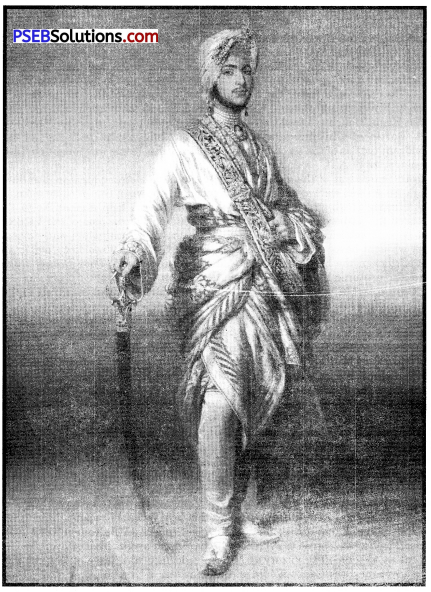
PSEB 12th Class History Solutions Chapter 22 First Anglo-Sikh War: Causes and Results

Punjab State Board PSEB 12th Class History Book Solutions Chapter 22 First Anglo-Sikh War: Causes and Results Textbook Exercise Questions and Answers.

PSEB Solutions for Class 12 History Chapter 22 First Anglo-Sikh War: Causes and Results

Long Answer Type Questions:

Question 1.
Give a brief description of the main causes of the First Anglo-Sikh War.
Or
Give the causes of the First Anglo-Sikh War.
Or
What were the five main causes of the First Anglo-Sikh War?
Or
Briefly describe the five main causes of the First Anglo-Sikh War.
Answer:
1. British Policy of Encircling Punjab: The British had been greedily looking towards Punjab for quite some time with a view to bringing it under their control. By signing the treaty of Amritsar with Ranjit Singh in 1809 A.D., the British had forever checked Maharaja Ranjit Singh’s advancement towards the Cis-Sutlej areas. In 1835-36 A.D., the Britishers forced Maharaja Ranjit Singh to withdraw his forces from Shikarpur and occupy it. In 1835 A.D. the Britishers took possession of Ferozepur. In 1838 A.D., the Britishers set up a military cantonment at Ferozepur. As a result, a war between the British and the Sikhs’had become inevitable.

2. Anarchy in Punjab: After the death of Maharaja Ranjit Singh in June 1839 A.D., anarchy had spread in Punjab. A period of conspiracies and killings for the occupation of the throne had started. During 6 years from 1839 A.D. to 1845 A.D., as many as, 5 governments changed. The Dogras through their conspiracies finished many members of Maharaja Ranjit Singh’s family. This situation was an invitation to the Britishers.

3. Defeat of the British in the First Anglo-Afghan War: The First Anglo-Afghan War which was fought from 1839 to 1842 A.D., left a deep impact on the Anglo-Sikh relationship. This area was geographically very significant. Although the Amirs of Sind were very loyal to the British yet by leveling false allegations Lord Ellenborough declared war against Sind. In 1843 A.D. the British brought Sind under their control. Since the Sikhs wanted to annex Sind to their empire, it further embittered Anglo-Sikh relations.

4. Occupation of Sind by the British: This area was geographically very significant. Although the Amirs of Sind were very loyal to the British yet by leveling false allegations Lord Ellenborough declared war against Sind. In 1843 A.D. the British brought Sind under their control. Since the Sikhs wanted to annex Sind to their empire, it further embittered Anglo-Sikh relations.

5. Appointment of Major Broadfoot: In November 1844 A.D., Major Broadfoot was appointed in place of Mr. Clark, as the political agent of Ludhiana. He was a bitter opponent of Sikhs. He came with this view in his mind to the frontiers of Punjab that the British had decided to fight a war with the Sikhs.

PSEB 12th Class History Solutions Chapter 22 First Anglo-Sikh War: Causes and Results

Question 2.
Write a brief note on the battle of Mudki.
Answer:
The first important battle between the Sikhs and the British was fought at Mudki on December 18, 1845 A.D. In this battle, the number of Sikh soldiers was 5500 and Lai Singh commanded them. On the other hand, the British had 12,000 soldiers and they were commanded by Hugh Gough. The British thought that they would defeat the Sikhs very easily, but the Sikhs launched such a forceful attack on the British army that it created consternation among them. Lai Singh got scared to see it. He had come to get the Sikh army defeated, but the tables were turned on the British.

At this, he fled away from the battlefield along with some of his soldiers: Even then the Sikhs continued fighting the British bravely. But in the absence of their commander, and being fewer in number, the Sikhs were ultimately defeated. The British had won the war at an enormous cost because in this battle many of their famous warriors were killed. Moreover, the British realized that it was not a child’s play to gain victory over the Sikhs.

Question 3.
What do you know about the battle of Ferozshah or Pherushahr?
Answer:
A fierce battle took place between the Sikhs and the British at Ferozshah on December 21, 1845 A.D. The number of British soldiers was 17 thousand in this battle and they had 69 cannons. Their command was in the hands of experienced generals like Hugh Gough, John Littler, and Lord Hardinge. On the other hand, the Sikh soldiers were about 25 to 30 thousand and they had 100 cannons. The Sikh army was led by traitors like Lai Singh and Teja Singh.

In this battle, the Sikhs attacked the British army so forcefully that they suffered heavy casualties. They even began to think of surrendering before the Sikh army without any condition. But luck favored the British. On December 22, due to the treachery of Lai Singh and Teja Singh, the Sikh forces were defeated. In this battle, the Sikhs suffered a heavy loss of life.

Question 4.
Write a brief note on the battle of Sobraon.
Answer:
The battle of Sobraon was the last decisive battle of the First Anglo-Sikh War. It was fought on February 10, 1846 A.D. The Sikhs and the British had made full preparations for this battle. Famous generals like Hugh Gough, Lord Hardinge, and others were commanding the British forces. On the other hand, Lai Singh and Teja Singh were commanding the Sikh army. Both these traitors had given the British, all the necessary information well before the battle started.

They were the first to flee soon after the first assault. Moreover, they dismantled the boat bridge over the river Sutlej. Consequently, thousands of Sikh soldiers were drowned. At this critical juncture, Sham Singh Attariwala took over the command and pushed the British hard. Ultimately the Sikhs were defeated and suffered heavy casualties. In fact, the battle of Sobraon proved as “Waterloo” for the Sikhs.

Question 5.
Write a brief note on the Treaty of Lahore (March 9, 1846 A.D.).
Answer:
As a result of the First Anglo-Sikh War, a treaty was signed between the British Government and Lahore Darbar on March 9, 1846 A.D. This treaty is famous in history aS the Treaty of Lahore. Following were the main terms of the treaty:

  • Maharaja Dalip Singh and his successors would always maintain peace and friendship with the British government.
  • The Maharaja of Lahore accepted that he and his successors would have no claim on the region to the south of the Sutlej river forever.
  • The Maharaja handed over all the forts of plains and hills between the Sutlej and the Beas to the British.
  • The British demanded a heavy amount of 1.50 crore rupees as a ransom for the war. Such a big amount could not be had from the treasury of Lahore Darbar. So the region of Kashmir and Hazara was given to the British for Rs. one crore with a promise to pay the remaining amount of 50 lakh rupees from the treasury.
  • Lahore’s army was reduced to 20,000 infantry and 12,000 cavalry.
  • The British forces could pass through the Lahore empire whenever the need be.
  • The Maharaja promised that he would not employ any European, American, or English without the permission of the British.
  • The British accepted Maharaja Dalip Singh as the ruler of Lahore, Queen Jindan as the regent of Maharaja Dalip Singh, and Lai Singh as the Prime Minister.
  • The British would not interfere in the internal affairs of Lahore Darbar but they would advise as and when required.

Question 6.
What do you know about the Treaty of Bhairowal?
Answer:
The treaty of Bhairowal was signed between Lahore Darbar and the British Government on December 16, 1846 A.D. According to it, a British Resident was appointed to run the administration of Lahore Darbar. Maharani Jindan was removed from the post of regent and her annual pension of Rs. 1\(\frac { 1 }{ 2 }\) lakh was fixed. An eight-member council was formed for the help of residents, it was decided to keep a British army for the protection of the Maharaja and to maintain peace and order. Lahore Darbar accepted to pay Rs. 22 lakh annually to the British to meet the expenses of this army.

The conditions of this treaty were to remain in force till December 4, 1854 A.D. when Maharaja Dalip Singh became an adult. Although through the treaty of Bhairowal, the British did not annex Punjab to the British empire yet they reduced its sovereignty to a great extent. In fact, the British had become the rulers of Punjab and the Sikh rule was merely in name.

PSEB 12th Class History Solutions Chapter 22 First Anglo-Sikh War: Causes and Results

Question 7.
Study in brief the results of First Anglo-Sikh War.
Or
Give in brief the results of First Anglo-Sikh War.
Or
What were the results of the First Anglo-Sikh War?
Answer:
As a result of First Anglo-Sikh War, a treaty was signed by the British Government and the Lahore Darbar on 9th March 1846 A.D. This treaty is known as the treaty of Lahore. The following were the main terms of the treaty :

  • The Maharaja of Lahore renounced all claim to the areas lying to the south of river Sutlej,
  • The Maharaja handed over to the British the area between the river Sutlej and Beas.
  • The army of Lahore Darbar was reduced to 20,000 infantry and 12,000 cavalry.
  • The British Government demanded a heavy sum of 1.50 crore rupees as war indemnity. Lahore Darbar ceded the provinces of Kashmir and Hazara as equivalent to one crore of rupees. It paid the rest amount from its treasury.
  • The Maharaja committed that he would not employ any foreigner without the consent of the British Government. (vi) The British Government recognized Dalip Singh the Maharaja of Lahore and Rani Jindan as his regent.

Question 8.
Write a brief note on Sham Singh Attariwala.
Answer:
Sham Singh Attariwala Was a great warrior of the Sikh Class. He belonged to Attari village near Amritsar. His father Sardar Nihal Singh used to serve in the army of Maharaja Ranjit Singh, At the very young age of 18, Attariwala Joined Maharaja’s army and carried various military expeditions. The political condition of Punjab after the death of Maharaja Ranjit Singh greatly depressed Attariwala. He opposed the attempts of the British Government to annex Punjab. The First Anglo-Sikh War broke out in 1845 A.D. Attariwala actively participated in the battle of Sabraon. It was fought on February 10, 1846 A.D. Unfortunately, the commanding officers of the Sikh army proved traitors. At this critical juncture, Sham Singh Attariwala took over the command and pushed the British hard. His bravery was also praised by the British. At last, Sham Singh Attariwala achieved martyrdom while fighting in the battle.

Question 9.
Describe any four reasons as to why the British did not annex Punjab to their empire after the First Anglo-Sikh War.
Answer:
Although the British had defeated the Sikhs in the battle of Sobraon, many thousand soldiers of the Khalsa army were still roaming at many places with arms. If they had declared the annexation of Punjab to the British empire, it could have become a headache for the British. The second reason was that the British wanted the Punjab should act as a buffer state between the British empire and Afghanistan.

If the British had annexed Punjab to their empire, their frontiers would have touched Afghanistan. New problems on the Afghanistan frontiers would have been created for which the British were not prepared. Thirdly, the British had to keep a vast British army to keep Punjab under their control. It would have tremendously increased their expenses. Fourthly, the Governor-General thought that Punjab could not prove useful for the British from an economic point of view. He considered Punjab a source of trouble in place of a source of power.

Question 10.
Mention five causes of the Sikhs’ defeat in the First Anglo-Sikh War.
Answer:

  • The first major cause of the defeat of the Sikhs in the First Anglo-Sikh War was the treachery of Lai Singh and Teja Singh. Lai Singh was appointed to the post of Prime Minister while Teja Singh was working as a Chief Commander. Both of them for their selfish interest had gone over to the British. As a consequence, though the Sikhs fought with great bravery the treachery of their leaders proved fatal for them,
  • In the battle of Aliwal, the Sikhs were defeated due to the treachery of Ranjodh Singh.
  • The European officers in the Sikh army aligned themselves secretly with the British. They constantly informed all the secrets of the Sikhs of the British.
  • Besides these, the British belonged to the greatest imperialist power of the world. Naturally, they had good resources than the Sikhs.
  • The British generals had a good experience of War. They fought with full vigor for the safety of the British Empire. Consequently, the Sikhs had to face defeat.

PSEB 12th Class History Solutions Chapter 22 First Anglo-Sikh War: Causes and Results

Essay Type Questions:

Question 1.
What were the main causes of the First Anglo-Sikh War?
Or
Describe the causes of the First Anglo-Sikh War.
Or
Describe the causes of the First Anglo-Sikh War between the British and the Sikhs.
Answer:
The British had been dreaming to usurp Punjab for quite some time. They had started encircling Punjab even during the times of Maharaja Ranjit Singh. They had intentionally adopted such policies that led to the First. Anglo-Sikh War. A brief account of the causes of the First Anglo-Sikh war is as follows :

1. British Policy of Encircling Punjab: The British had been greedily looking towards Punjab for quite some time with a view to bringing it under their control. By signing the treaty of Amritsar with Ranjit Singh in 1809 A.D., the British had forever checked Maharaja Ranjit Singh’s advancement towards the Cis-Sutlej areas. In 1835-36 A.D., the Britishers forced Maharaja Ranjit Singh to withdraw his forces from Shikarpur and occupy it.

In 1835 A.D. the Britishers took possession of Ferozepur. Because of its being close to Lahore, they could collect good information about Maharaja Ranjit Singh’s activities. In 1838 A.D., the Britishers set up a military cantonment at Ferozepur. The same year they blocked Maharaja Ranjit Singh’s advancement towards Sind and forced the Amirs of Sind to keep a British Resident at Hyderabad. In fact, the Britishers were encircling the whole of Punjab and the swallowing of Punjab was only a matter of time. As a result, a war between the British and the Sikhs had become inevitable.

2. Anarchy in Punjab: After the death of Maharaja Ranjit Singh in June 1839 A.D., anarchy had spread in Punjab. A period of conspiracies and killings for the occupation of the throne had started. During 6 years from 1839 A.D. to 1845 A.D., as many as, 5 governments changed. The Dogras through their conspiracies finished many members of Maharaja Ranjit Singh’s family. These murders and conspiracies had a disastrous impact on the politics of Punjab. This situation was an invitation to the Britishers.

3. Defeat of the British in the First Anglo-Afghan War: The First Anglo-Afghan War which was fought from 1839 to 1842 A.D., left a deep impact on the Anglo-Sikh relationship. Before this war, wherever the Britishers turned their face, success smiled on them. They were considered invincible. But, in this war, the British tasted defeat for the first time. The heavy loss caused in this war dealt a severe blow to the prestige of the British. The Britishers wanted to wipe out the stigma of their defeat suffered in Afghanistan by another grand victory. They could score this victory in Punjab because Punjab was in a state of turmoil at that time.

4. Occupation of Sind by the British: In 1842 A.D., Lord Ellenborough was appointed the new Governor-General of India in place of Lord Auckland. Lord Ellenborough wanted to remove the disgrace of the defeat which the British had to taste in the First Anglo-Afghan War. Therefore, he decided to occupy Sind. This area was geographically very significant. Although the Amirs of Sind were very loyal to the British yet by leveling false allegations Lord Ellenborough declared war against Sind. In 1843 A.D. the British brought Sind under their control. Since the Sikhs wanted to annex Sind to their empire, it further embittered Anglo-Sikh relations.

5. Military Preparations by the British: Governor-General, Lord Hardinge began to make war preparations. The British army gradually began to advance towards the Sutlej. Col. Richmond, who was very popular with the people, was replaced by Major Broadfoot who was arrogant by nature as the political agent of the North-West frontier. Lord Hugh Gough, who was the British Commander-in¬Chief, set up his headquarters at Ambala. In March 1845 A.D., more forces from other parts of the country were sent to Ferozepur, Ludhiana, and Ambala. These military preparations further widened the gulf between the Sikhs and the Britishers.

6. Appointment of Major Broadfoot: In November 1844 A.D., Major Broadfoot was appointed in place of Mr. Clark, as the political agent of Ludhiana. He was a bitter opponent of Sikhs. He came with this view in his mind to the frontiers of Punjab that the British had decided to fight a war with the Sikhs. Dr. Fauja Singh aptly says, “The appointment of Broadfoot as Political Agent at Ludhiana was also a calculated move made with an eye on the fast-approaching war with Punjab.” Broadfoot undertook many such exercises which provoked the Sikhs against the British.

7. Incitement for war by Lai Singh and Teja Singh: After the death of Jawahar Singh, Lai Singh was appointed the new Wazir (Prime Minister) of the Lahore government. He appointed his brother Teja Singh, Chief Commander of the Khalsa army. Both of them were already in league with the British. Since the Sikh army had already become powerful at that time, Lai Singh and Teja Singh, were greatly afraid of it. They wanted to weaken it directing its energies against the British army. By doing so, they would be able to retain their positions and also heave a sigh of relief. So, they started inciting the Sikh army against the British. On 11th Dec. 1845 A.D., the Sikh soldiers crossed the river Sutlej. The British were looking out for this golden opportunity. So Lord Hardinge declared war against the Sikhs on 13th December 1845 A.D.

Question 2.
What were the main events of the First Anglo-Sikh War? Briefly explain the consequences of this war.
Or
Study the main events and results of the First Anglo-Sikh War.
Answer:
The Sikh soldiers were compelled to cross over the river Sutlej on 11th December 1845 A.D. because of the imprudent policies followed by the British. The British were waiting for this golden opportunity. So the Governor-General Lord Hardinge declared war against the Sikhs on 13th December 1845 A.D. It had far-reaching consequences. A brief account of the events and results of the First Anglo-Sikh war is as follows:

1. Events of the war:

1. Battle of Mudki: The first important battle between the Sikhs and the Britishers was fought at Mudki on 18th December, 1845 A.D. In this battle the number of the Sikh soldiers was 5500, and they were commanded by Lai Singh. On the other hand, the strength of the British soldiers was 12,000 and they were led by Lord Hugh Gough. The British thought that they would easily overpower the Sikh army, but the Sikh army caused such a havoc that the British soldiers ran helter-skelter. On seeing this Lai Singh got nervous. He fled from the battlefield with some soldiers. As a consequence the Sikh army was defeated. According to the famous historian Sita Ram Kohli, “The battle of Mudki served to dispel a notion that had gained credence with the British that the Sikhs were no great force to be reckoned with.”

2. Battle of Ferozeshah : The second great battle between the Sikhs and the British was fought at Ferozeshah or Pheru Shahar on 21st December, 1845 AD. The British were fully prepared for this battle. The British army was commanded by famous and experienced generals like Lord Hugh Gough, John Littler and Lord Hardinge. On the other hand, the Sikh soldiers were led by Lai Singh and Teja Singh. The Britishers were fully confident of the treachery of the Sikh generals and that they would score an easy win in the battle. But the Sikhs gave such a baffling rebuff to the British that once it looked that their empire in India had shaken.

Exactly at that time, when the British army was being trounced on all fronts, Lai Singh and Teja Singh with their soldiers fled from the battlefield, without any rhyme or reason. When the retreating Britishers heard, that the Sikhs were fleeing, they came back and converted their defeat into’victory. In this way the Khalsa army was defeated owing to the treachery of their Generals. General Havelock said, “Another such action will shake the Empire.”

3. Battle of Baddowal : On the directions of the Lahore Darbar, Ranjodh Singh Majithia with 10,000 soldiers reached Baddowal, a place located 18 miles away from Ludhiana. On 21st January, 1846 A.D., the battle between the British and the Sikhs started at Baddowal. The Sikhs fought very gallantly. They plundered the weapons and rations of the Britishers. The Britishers being defeated, fled towards Ludhiana.

4. Battle of Aliwal: Ranjodh Singh Majithia with his soldiers left Baddowal and headed for Aliwal.’Harry Smith wanted to retrieve his honour by defeating the Sikhs. On 28th January, 1846 A.D., the British army under Harry Smith attacked the Sikhs. Thus, the Sikhs were caught unawares. It was a fierce battle. Ranjodh Singh after, giving orders to his army to flee away, himself fled the battlefield. Because of Ranjodh Singh’s treachery, the British carried the day.

5. Battle of Sobraon: The battle of Sobraon was the last and the most decisive battle of the First Anglo-Sikh War. This battle was fought on 10th February, 1846 A.D. Before this battle 30,000 Sikh soldiers had reached Sobraon. Lai Singh and Teja Singh were commanding the Sikh army. In order to face the Sikh army, the British had also made a good preparation. The strength of the British army in this battle was 15,000. Lord Hugh Gough and Lord Hardinge were commanding the British army. On 10th February, 1846 A.D., the Britishers attacked the Sikh army. As a result of the counter attack by the Sikh army, the British army had to retreat.

At this time, as pre-planned, at first Lai Singh and then Teja Singh fled from the battlefield. While going away, Teja Singh sank the boats loaded with powder and ammunition, and also destroyed the Pontoon bridge. Without the commanders, the Sikh army was unnerved. At this critical juncture, Sardar Sham Singh Attariwala took over the command. He rallied the Khalsa army saying, “Khalsa ji, do not bring discredit to Sikhism. It is better to die while fighting bravely than live a life of slavery. Unsheath your swords and pounce upon your enemy. Either win or fall martyrs.”

The Khalsa army unsheathed its swords and with the slogans of ‘Sat Siri Akal’ fell upon the enemy. They slaughtered several British soldiers. At last, Sham Singh Attariwala died a hero’s death. The British were amazed at his bravery and efficiency. The martyrdom of Sham Singh Attariwala demoralised the Sikh army. How long could the swords resist the guns? At last the Sikh army deserted the battlefield. In this way finally the Britishers emerged victorious in this decisive battle.

2. Results of the War:

As a result of First Anglo-Sikh War, a treaty was signed by the British Government and the Lahore Darbar on 9th March, 1846 A.D. This treaty is known as the treaty of Lahore in history.

Treaty of Lahore:

The following were the main terms of the treaty of Lahore :

  1. There shall be perpetual peace and friendship between the British Government and Maharaja Dalip Singh and his successors.
  2. The Maharaja of Lahore renounces for himself and his successors all claim to the areas lying to the south of river Sutlej.
  3. The Maharaja handed over the British the plain and the hilly areas and forts situated between the rivers Sutlej and Beas.
  4. The British Government demanded a heavy sum of 1.50 crore rupees as war indemnity. As the Lahore Darbar was unable to pay this heavy amount, it ceded the provinces of Kashmir and Hazara as equivalent to one crore of rupees.
  5. The army of Lahore Darbar was reduced to 20,000 infantry and 12,000 cavalry.
  6. The Maharaja agreed to disband the mutinous troops of the Lahore army.
  7. Whenever the need arose, the British army could pass through the Lahore Raj without any check.
  8. The Maharaja committed that he would not employ any Britisher, European or American without the consent of the British Government.
  9. The British Government recognized Dalip Singh the Maharaja of Lahore, Rani Jindan as the regent of the Maharaja, and Lai Singh, as the Prime Minister.
  10. The British Government would not interfere in the internal matters of the Lahore Darbar, but when approached it would simply advise.
  11. The Lahore Government would not change its boundaries without the concurrence of the British Government.

PSEB 12th Class History Solutions Chapter 22 First Anglo-Sikh War: Causes and Results

Supplementary Treaty:

Two days after the treaty of Lahore i.e. on 11th March 1846 A.D., some supplementary treaty was added to this treaty. The main terms of the supplementary treaty were as given ahead :

  1. For the protection of the Maharaja and citizens of Lahore, an adequate British army would stay at Lahore till the end of 1846 A.D.
  2. The fort and the city of Lahore would be completely under the control of the British army. The Lahore Government would arrange for and bear the expenses of the accommodation of the soldiers.
  3. Both the Governments would soon appoint their Commissioners to fix the boundaries between the two States.
    Treaty of Bhairowal

The British Government signed a new treaty with the Lahore Darbar on 16th December 1846 A.D. This treaty is known as the treaty of Bhairowal in history. The main terms of this treaty were as follows :

  1. The British Government would appoint a British resident to look after all the departments of the Lahore Government.
  2. As long as, Maharaja Dalip Singh was minor (i.e. upto 1854 A.D.), the administration of the state would be run by the ‘Council of Regency’ constituted of eight members.
  3. The Council of Regency would have to do the administrative work according to the advice of the British Resident.
  4. Maharani Jindan was removed from the post of regent and it was decided that she would get annual pension of 1\(\frac { 1 }{ 2 }\) lakh rupees.
  5. For the defence  of the Maharaja and the maintenance of peace in the country, a British contingent would stay at Lahore.
  6. If the Governor-General felt the need of the army for the defence of the capital or the maintenance of peace in the country, as per his orders, the British army could establish, its control over any fort or military cantonment of the Lahore Raj.
  7. For the expenses of the British army, the Lahore Darbar would pay ₹ 22 lakh per year to the British Government.
  8. The conditions of the treaty would continue to be in force till Maharaja Dalip Singh attained the age of 16 years i.e. upto 4th September, 1854 A.D.

It is true that although through the treaties of Lahore and Bhairowal the British did not seize Punjab, yet its autonomy was lost to a large extent. In fact, Sikh kingdom became a virtual British protectorate. Dr. G.S. Chhabra aptly says, “The treaty of Bhairowal thus rang the deathknell of the Sikh power and it made the British the real masters of the Punjab.”

Question 3.
Discuss the causes and results of the First Anglo-Sikh War.
Or
Briefly describe the causes and results of the First Anglo-Sikh War.
Or
What were the causes of the First Anglo-Sikh War? What were the out- comes of this war?
Answer:

The British had been dreaming to usurp Punjab for quite some time. They had started encircling Punjab even during the times of Maharaja Ranjit Singh. They had intentionally adopted such policies that led to the First. Anglo-Sikh War. A brief account of the causes of the First Anglo-Sikh war is as follows :

1. British Policy of Encircling Punjab: The British had been greedily looking towards Punjab for quite some time with a view to bringing it under their control. By signing the treaty of Amritsar with Ranjit Singh in 1809 A.D., the British had forever checked Maharaja Ranjit Singh’s advancement towards the Cis-Sutlej areas. In 1835-36 A.D., the Britishers forced Maharaja Ranjit Singh to withdraw his forces from Shikarpur and occupy it.

In 1835 A.D. the Britishers took possession of Ferozepur. Because of its being close to Lahore, they could collect good information about Maharaja Ranjit Singh’s activities. In 1838 A.D., the Britishers set up a military cantonment at Ferozepur. The same year they blocked Maharaja Ranjit Singh’s advancement towards Sind and forced the Amirs of Sind to keep a British Resident at Hyderabad. In fact, the Britishers were encircling the whole of Punjab and the swallowing of Punjab was only a matter of time. As a result, a war between the British and the Sikhs had become inevitable.

2. Anarchy in Punjab: After the death of Maharaja Ranjit Singh in June 1839 A.D., anarchy had spread in Punjab. A period of conspiracies and killings for the occupation of the throne had started. During 6 years from 1839 A.D. to 1845 A.D., as many as, 5 governments changed. The Dogras through their conspiracies finished many members of Maharaja Ranjit Singh’s family. These murders and conspiracies had a disastrous impact on the politics of Punjab. This situation was an invitation to the Britishers.

3. Defeat of the British in the First Anglo-Afghan War: The First Anglo-Afghan War which was fought from 1839 to 1842 A.D., left a deep impact on the Anglo-Sikh relationship. Before this war, wherever the Britishers turned their face, success smiled on them. They were considered invincible. But, in this war, the British tasted defeat for the first time. The heavy loss caused in this war dealt a severe blow to the prestige of the British. The Britishers wanted to wipe out the stigma of their defeat suffered in Afghanistan by another grand victory. They could score this victory in Punjab because Punjab was in a state of turmoil at that time.

4. Occupation of Sind by the British: In 1842 A.D., Lord Ellenborough was appointed the new Governor-General of India in place of Lord Auckland. Lord Ellenborough wanted to remove the disgrace of the defeat which the British had to taste in the First Anglo-Afghan War. Therefore, he decided to occupy Sind. This area was geographically very significant. Although the Amirs of Sind were very loyal to the British yet by leveling false allegations Lord Ellenborough declared war against Sind. In 1843 A.D. the British brought Sind under their control. Since the Sikhs wanted to annex Sind to their empire, it further embittered Anglo-Sikh relations.

5. Military Preparations by the British: Governor-General, Lord Hardinge began to make war preparations. The British army gradually began to advance towards the Sutlej. Col. Richmond, who was very popular with the people, was replaced by Major Broadfoot who was arrogant by nature as the political agent of the North-West frontier. Lord Hugh Gough, who was the British Commander-in¬Chief, set up his headquarters at Ambala. In March 1845 A.D., more forces from other parts of the country were sent to Ferozepur, Ludhiana, and Ambala. These military preparations further widened the gulf between the Sikhs and the Britishers.

6. Appointment of Major Broadfoot: In November 1844 A.D., Major Broadfoot was appointed in place of Mr. Clark, as the political agent of Ludhiana. He was a bitter opponent of Sikhs. He came with this view in his mind to the frontiers of Punjab that the British had decided to fight a war with the Sikhs. Dr. Fauja Singh aptly says, “The appointment of Broadfoot as Political Agent at Ludhiana was also a calculated move made with an eye on the fast-approaching war with Punjab.” Broadfoot undertook many such exercises which provoked the Sikhs against the British.

7. Incitement for war by Lai Singh and Teja Singh: After the death of Jawahar Singh, Lai Singh was appointed the new Wazir (Prime Minister) of the Lahore government. He appointed his brother Teja Singh, Chief Commander of the Khalsa army. Both of them were already in league with the British. Since the Sikh army had already become powerful at that time, Lai Singh and Teja Singh, were greatly afraid of it. They wanted to weaken it directing its energies against the British army. By doing so, they would be able to retain their positions and also heave a sigh of relief. So, they started inciting the Sikh army against the British. On 11th Dec. 1845 A.D., the Sikh soldiers crossed the river Sutlej. The British were looking out for this golden opportunity. So Lord Hardinge declared war against the Sikhs on 13th December 1845 A.D.

The Sikh soldiers were compelled to cross over the river Sutlej on 11th December 1845 A.D. because of the imprudent policies followed by the British. The British were waiting for this golden opportunity. So the Governor-General Lord Hardinge declared war against the Sikhs on 13th December 1845 A.D. It had far-reaching consequences. A brief account of the events and results of the First Anglo-Sikh war is as follows:

PSEB 12th Class History Solutions Chapter 22 First Anglo-Sikh War: Causes and Results

1. Events of the war:

1. Battle of Mudki: The first important battle between the Sikhs and the Britishers was fought at Mudki on 18th December, 1845 A.D. In this battle the number of the Sikh soldiers was 5500, and they were commanded by Lai Singh. On the other hand, the strength of the British soldiers was 12,000 and they were led by Lord Hugh Gough. The British thought that they would easily overpower the Sikh army, but the Sikh army caused such a havoc that the British soldiers ran helter-skelter. On seeing this Lai Singh got nervous. He fled from the battlefield with some soldiers. As a consequence the Sikh army was defeated. According to the famous historian Sita Ram Kohli, “The battle of Mudki served to dispel a notion that had gained credence with the British that the Sikhs were no great force to be reckoned with.”

2. Battle of Ferozeshah : The second great battle between the Sikhs and the British was fought at Ferozeshah or Pheru Shahar on 21st December, 1845 AD. The British were fully prepared for this battle. The British army was commanded by famous and experienced generals like Lord Hugh Gough, John Littler and Lord Hardinge. On the other hand, the Sikh soldiers were led by Lai Singh and Teja Singh. The Britishers were fully confident of the treachery of the Sikh generals and that they would score an easy win in the battle. But the Sikhs gave such a baffling rebuff to the British that once it looked that their empire in India had shaken.

Exactly at that time, when the British army was being trounced on all fronts, Lai Singh and Teja Singh with their soldiers fled from the battlefield, without any rhyme or reason. When the retreating Britishers heard, that the Sikhs were fleeing, they came back and converted their defeat into’victory. In this way the Khalsa army was defeated owing to the treachery of their Generals. General Havelock said, “Another such action will shake the Empire.”

3. Battle of Baddowal : On the directions of the Lahore Darbar, Ranjodh Singh Majithia with 10,000 soldiers reached Baddowal, a place located 18 miles away from Ludhiana. On 21st January, 1846 A.D., the battle between the British and the Sikhs started at Baddowal. The Sikhs fought very gallantly. They plundered the weapons and rations of the Britishers. The Britishers being defeated, fled towards Ludhiana.

4. Battle of Aliwal: Ranjodh Singh Majithia with his soldiers left Baddowal and headed for Aliwal.’Harry Smith wanted to retrieve his honour by defeating the Sikhs. On 28th January, 1846 A.D., the British army under Harry Smith attacked the Sikhs. Thus, the Sikhs were caught unawares. It was a fierce battle. Ranjodh Singh after, giving orders to his army to flee away, himself fled the battlefield. Because of Ranjodh Singh’s treachery, the British carried the day.

5. Battle of Sobraon: The battle of Sobraon was the last and the most decisive battle of the First Anglo-Sikh War. This battle was fought on 10th February, 1846 A.D. Before this battle 30,000 Sikh soldiers had reached Sobraon. Lai Singh and Teja Singh were commanding the Sikh army. In order to face the Sikh army, the British had also made a good preparation. The strength of the British army in this battle was 15,000. Lord Hugh Gough and Lord Hardinge were commanding the British army. On 10th February, 1846 A.D., the Britishers attacked the Sikh army. As a result of the counter attack by the Sikh army, the British army had to retreat.

At this time, as pre-planned, at first Lai Singh and then Teja Singh fled from the battlefield. While going away, Teja Singh sank the boats loaded with powder and ammunition, and also destroyed the Pontoon bridge. Without the commanders, the Sikh army was unnerved. At this critical juncture, Sardar Sham Singh Attariwala took over the command. He rallied the Khalsa army saying, “Khalsa ji, do not bring discredit to Sikhism. It is better to die while fighting bravely than live a life of slavery. Unsheath your swords and pounce upon your enemy. Either win or fall martyrs.”

The Khalsa army unsheathed its swords and with the slogans of ‘Sat Siri Akal’ fell upon the enemy. They slaughtered several British soldiers. At last, Sham Singh Attariwala died a hero’s death. The British were amazed at his bravery and efficiency. The martyrdom of Sham Singh Attariwala demoralised the Sikh army. How long could the swords resist the guns? At last the Sikh army deserted the battlefield. In this way finally the Britishers emerged victorious in this decisive battle.

2. Results of the War:

As a result of First Anglo-Sikh War, a treaty was signed by the British Government and the Lahore Darbar on 9th March, 1846 A.D. This treaty is known as the treaty of Lahore in history.

Treaty of Lahore

The following were the main terms of the treaty of Lahore :

  1. There shall be perpetual peace and friendship between the British Government and Maharaja Dalip Singh and his successors.
  2. The Maharaja of Lahore renounces for himself and his successors all claim to the areas lying to the south of river Sutlej.
  3. The Maharaja handed over the British the plain and the hilly areas and forts situated between the rivers Sutlej and Beas.
  4. The British Government demanded a heavy sum of 1.50 crore rupees as war indemnity. As the Lahore Darbar was unable to pay this heavy amount, it ceded the provinces of Kashmir and Hazara as equivalent to one crore of rupees.
  5. The army of Lahore Darbar was reduced to 20,000 infantry and 12,000 cavalry.
  6. The Maharaja agreed to disband the mutinous troops of the Lahore army.
  7. Whenever the need arose, the British army could pass through the Lahore Raj without any check.
  8. The Maharaja committed that he would not employ any Britisher, European or American without the consent of the British Government.
  9. The British Government recognized Dalip Singh the Maharaja of Lahore, Rani Jindan as the regent of the Maharaja, and Lai Singh, as the Prime Minister.
  10. The British Government would not interfere in the internal matters of the Lahore Darbar, but when approached it would simply advise.
  11. The Lahore Government would not change its boundaries without the concurrence of the British Government.

Supplementary Treaty:

Two days after the treaty of Lahore i.e. on 11th March 1846 A.D., some supplementary treaty was added to this treaty. The main terms of the supplementary treaty were as given ahead :

  1. For the protection of the Maharaja and citizens of Lahore, an adequate British army would stay at Lahore till the end of 1846 A.D.
  2. The fort and the city of Lahore would be completely under the control of the British army. The Lahore Government would arrange for and bear the expenses of the accommodation of the soldiers.
  3. Both the Governments would soon appoint their Commissioners to fix the boundaries between the two States.
    Treaty of Bhairowal

The British Government signed a new treaty with the Lahore Darbar on 16th December 1846 A.D. This treaty is known as the treaty of Bhairowal in history. The main terms of this treaty were as follows :

  1. The British Government would appoint a British resident to look after all the departments of the Lahore Government.
  2. As long as, Maharaja Dalip Singh was minor (i.e. upto 1854 A.D.), the administration of the state would be run by the ‘Council of Regency’ constituted of eight members.
  3. The Council of Regency would have to do the administrative work according to the advice of the British Resident.
  4. Maharani Jindan was removed from the post of regent and it was decided that she would get annual pension of 1\(\frac { 1 }{ 2 }\) lakh rupees.
  5. For the defence  of the Maharaja and the maintenance of peace in the country, a British contingent would stay at Lahore.
  6. If the Governor-General felt the need of the army for the defence of the capital or the maintenance of peace in the country, as per his orders, the British army could establish, its control over any fort or military cantonment of the Lahore Raj.
  7. For the expenses of the British army, the Lahore Darbar would pay ₹ 22 lakh per year to the British Government.
  8. The conditions of the treaty would continue to be in force till Maharaja Dalip Singh attained the age of 16 years i.e. upto 4th September, 1854 A.D.

It is true that although through the treaties of Lahore and Bhairowal the British did not seize Punjab, yet its autonomy was lost to a large extent. In fact, Sikh kingdom became a virtual British protectorate. Dr. G.S. Chhabra aptly says, “The treaty of Bhairowal thus rang the deathknell of the Sikh power and it made the British the real masters of the Punjab.”

PSEB 12th Class History Solutions Chapter 22 First Anglo-Sikh War: Causes and Results

Short Answer Type Questions:
Or
Give the causes of the First Anglo-Sikh War.
Or
Mention any three main causes of First Anglo-Sikh War.
Answer:

  • The British had been following the policy of encirclement of Punjab.
  • After the death of Maharaja Ranjit Singh anarchy prevailed in the Punjab,
  • The British had suffered a humiliating defeat in their first war against Afghanistan. So they wanted to retrieve their honour by conquering Punjab,
  • The Sikh leaders like Lai Singh and Teja Singh wanted to engage the Khalsa army in a conflict against the British so as to make their own position strong,
  • The appointment of Major Broadfoot in 1844 A.D. inflammed the atmosphere to a great extent.

Question 2.
Write a brief note on the battle of Mudki.
Answer:
The first important battle between the Sikhs and the British was fought at Mudki on December 18, 1845 A.D. In this battle, Sikh soldiers were commanded by Lai Singh. On the other hand? the British soldiers were commanded by Hugh Gough. The British thought that they would defeat the Sikhs very easily, but the Sikhs launched such a forceful attack on the British army that it created consternation among them. Lai Singh fled away from the battlefield. The Sikhs were ultimately defeated.

Question 3.
What do you know about the battle of Ferozshah or Pherushahr?
Answer:
A fierce battle took place between the Sikhs and the British at Ferozshah on December 21, 1845 A.D. Their command was in the hands of experienced generals like Hugh Gough, John Littler and Lord Hardinge. The Sikh army was led by traitors like Lai Singh and Teja Singh. Due to the treachery of Lai Singh and Teja Singh the Sikh forces were defeated.

Question 4.
Write a brief note on the battle of Sobraon.
Answer:
The battle of Sobraon was the last decisive battle of the First Anglo-Sikh War. It was fought on February 10, 1846 A.D. The famous generals like Hugh Gough, Lord Hardinge and other were commanding the British forces. On the other hand Lai Singh and Teja Singh were commanding the Sikh army. Sham Singh Attariwala fought bravely and pushed the British hard. Ultimately the Sikhs were defeated and suffered heavy casualties.

Question 5.
Write a brief note on the Treaty of Lahore
Or
What do you know about the Treaty of Lahore?
Answer:

  • Maharaja Dalip Singh and his successors would always maintain peace and friendship with the British government,
  • The Maharaja of Lahore accepted that he and his successors would have no claim on the region to the south of Sutlej river forever.
  • The Maharaja handed over all the forts of plains and hills between the Sutlej and the Beas to the British
  • The British demanded a heavy amount of 1.50 crore rupees as ransom for the war.
  • The British accepted Maharaja Dalip Singh as the ruler of Lahore, Maharani Jindan as the regent of Maharaja Dalip Singh and Lai Singh as the Prime Minister.

Question 6.
What do you know about the Treaty of Bhairowal?
Or
Write a short note on the Treaty of Bhairowal.
Answer:
The Treaty of Bhairowal was signed between Lahore Darbar and the British Government on December 16, 1846 A.D. According to it, a British Resident was appointed to run the administration of Lahore Darbar. Maharani Jindan was removed from the post of regent and her annual pension of Rs.1\(\frac { 1 }{ 2 }\) lakh was fixed. An eight member council was formed for the help of British Resident. It was decided to keep a British army for the protection of the Maharaja and to maintain peace and order.

PSEB 12th Class History Solutions Chapter 22 First Anglo-Sikh War: Causes and Results

Question 7.
Study in brief the results of First Anglo-Sikh War.
Or
Give in brief the results of First Anglo-Sikh War.
Or
What were the results of the First Anglo-Sikh War?
Answer:

  • The Maharaja of Lahore renounced all claim to the areas lying to the south of river Sutlej,
  • The Maharaja handed over to the British the area between the river Sutlej and Beas.
  • The British Government demanded a heavy sum of 1.50 crore rupees as war indemnity,
  • The Maharaja committed that he would not employ any foreigner without the consent of the British Government,
  • The British Government recognised Dalip Singh as the Maharaja of Lahore and Maharani Jindan as his regent.

Question 8.
Write a brief note on Sham Singh Attariwala.
Answer:
Sham Singh Attariwala was a great warrior of the Sikhs. At a very young age of 18, Attariwala joined Maharaja’s army. The First Anglo-Sikh war broke out in 1845 A.D. Sham Singh Attariwala actively participated in battle of Sobraon. Unfortunately, the commanding officers of the Sikh army proved traitors. At this critical juncture Sham Singh Attariwala took over the command and pushed the British hard. At last, Sham Singh Attariwala achieved martyrdom while fighting in the battle.

Question 9.
Describe any five reasons as to why the British did not annex Punjab to their empire after the First Anglo-Sikh War.
Answer:

  • If they had declared the annexation of the Punjab to the British Empire, it could have become a headache for the British,
  • The British wanted that Punjab should act as a buffer state between the British Empire and Afghanistan,
  • The British had to keep a vast British army to keep Punjab under their control. It would have tremendously increased their expenses.
  • The Governor- General thought that Punjab could not prove useful for the British from the economic point of view.
  • He considered the Punjab a source of trouble in place of a source of power.

Question 10.
Mention five causes of the Sikhs’ defeat in the First Anglo-Sikh War.
Answer:

  • The first major cause of the defeat of the Sikhs in the First Anglo- Sikh War was the treachery of Lai Singh and Teja Singh,
  • The European officers in the Sikh army aligned themselves secretly with the British.
  • The British had good resources than the Sikhs,
  • The British generals had good experience of War.
  • The British belonged to the greatest imperialist power of the world.

PSEB 12th Class History Solutions Chapter 22 First Anglo-Sikh War: Causes and Results

Objective Type Questions:

Question 1.
Whose son was Maharaja Dalip Singh?
Answer:
Maharaja Ranjit Singh.

Question 2.
For how long did Maharaja Dalip Singh rule over the Punjab?
Answer:
From Sept. 15, 1843 to Mar. 29, 1849 A.D.

Question 3.
Who was the Maharaja of Punjab during the First and Second Anglo-Sikh Wars?
Answer:
Maharaja Dalip Singh.

Question 4.
Who was Lai Singh?
Answer:
Prime Minister of Lahore.

Question 5.
Who was Teja Singh?
Answer:
Teja Singh was Commander of the Sikh Army.

Question 6.
When was First Anglo-Sikh War fought?
Or
When did the First Anglo-Sikh War happened?
Answer:
1845-46 A.D.

Question 7.
Who was the Governor-General of India during the First Anglo- Sikh War?
Answer:
Lord Hardinge.

Question 8.
Name any one cause responsible for the First-Anglo Sikh War.
Answer:
The English had started encircling the Punjab on all sides.

Question 9.
When was the battle of Mudki fought?
Answer:
Dec. 18, 1845 A.D.

Question 10.
When was the battle of Ferozeshah or Ferushahr fought?
Answer:
December 21, 1845 A.D.

Question 11.
When was the battle of Baddowal fought?
Answer:
21 1st January, 1846 A.D.

Question 12.
When was the battle of Aliwal fought?
Answer:
28th January, 1846 A.D.

Question 13.
When was the battle of Sobraon fought?
Answer:
February 10, 1846 A.D.

Question 14.
Which Sikh General got martyred fighting bravely in the battle of Sobraon?
Answer:
Sham Singh Atariwala.

Question 15.
With which battle did the First Anglo-Sikh War end?
Answer:
Battle of Sobraon.

Question 16.
Who was defeated in First Anglo-Sikh War?
Answer:
The Sikhs.

Question 17.
With which treaty did the First-Anglo Sikh War come to an end?
Answer:
Treaty of Lahore.

Question 18.
When was the Treaty of Lahore signed between the English and the Sikhs?
Answer:
On March 9, 1846 A.D.

Question 19.
When did the Treaty of Bhairowal take place?
Answer:
On December 16, 1846 A.D.

Question 20.
Mention any one important clause of the Treaty of Bhairowal.
Answer:
A British Resident was to look after all the departments of the Lahore Darbar.

Question 21.
To whom did the English hand over Kashmir after the First Anglo-Sikh War?
Answer:
Gulab Singh.

PSEB 12th Class History Solutions Chapter 22 First Anglo-Sikh War: Causes and Results

Question 22.
Mention any one cause of the Sikh defeat in the First Anglo- Sikh War.
Or
Give the main reason for the defeat of the Sikhs in the First Anglo- Sikh War.
Answer:
The leaders of the Sikhs were traitors.

Fill in the blanks:

1. In 1839 A.D. after the death of Maharaja Ranjit Singh ……………… became the ruler of Punjab.
Answer:
Maharaja Kharak Singh

2. In …………… the British bought Sind under their control.
Answer:
1843 A.D.

3. The First Anglo-Sikh War was fought in ……………..
Answer:
1845-46 A.D.

4. …………… was the Maharaja of the Punjab during the First Anglo-Sikh War.
Answer:
Maharaja Dalip Singh

5. During the First Anglo-Sikh War. the commander of the Sikh Army was ……………..
Answer:
Teja Singh

6. …………….. was the Prime Minister of Lahore Darbar during the First Anglo-Sikh war.
Answer:
Lai Singh

7. ……………. was the Supreme commander of the English forces during First Anglo-Sikh War.
Answer:
Lord Hugh Gough

8. The battle of Mudki was fought on …………….
Answer:
Dec. 18, 1845 A.D.

9. The battle of Ferozeshah was fought on ……………..
Answer:
December 21, 1845 A.D.

10. The battle of Sobraon was fought on ……………
Answer:
February 10, 1846 A.D.

11. The First Anglo-Sikh War ended with the battle of ……………..
Answer:
Sobraon

12. The First Anglo-Sikh War ended with the Treaty of ……………
Answer:
Lahore

13. The Treaty of Bhairowal took place on ………………
Answer:
December 16, 1846 A.D.

True or False:

1. The First Anglo-Sikh War was fought in 1947 A.D.
Answer:
False

2. Maharaja Ranjit Singh was the Maharaja of Punjab during the First Anglo- Sikh War.
Answer:
False

3. Lord Hardings became the Governor General after Ellenbrough.
Answer:
True

PSEB 12th Class History Solutions Chapter 22 First Anglo-Sikh War: Causes and Results

4. Lord Hugh Gough was the Commander-in-Chief of the English forces during the First Anglo-Sikh war.
Answer:
True

5. Teja Singh was Commander-in-Chief of the Sikh Army during the First Anglo-Sikh war.
Answer:
True

6. Lai Singh was the Prime Minister of Lahore Darbar during the First Anglo- Sikh war.
Answer:
True

7. The battle of Mudki was fought on Dec. 21, 1845 A.D.
Answer:
False

8. The battle of Ferozeshah was fought on Dec. 21, 1845 A.D.
Answer:
True

9. The battle of Aliwal was fought on January 28, 1846 A.D.
Answer:
False

10. Harry Smith was the Commander of the British army in the battle of Aliwal.
Answer:
True

11. The battle of Sobraon was fought on February 10, 1846 A.D.
Answer:
True

12. The Sikhs won the battle of Sobraon.
Answer:
False

13. The First Anglo-Sikh War ended with the Treaty of Bhairowal.
Answer:
False

14. The Treaty of Lahore took place between the British Government and the Lahore Darbar on March 9, 1846 A.D.
Answer:
True

15. The Treaty of Bhairowal between the Sikhs and the English took place on December 16, 1846 A.D.
Answer:
True

Multiple Choice Questions:

1. Who was the king of Punjab at the time of First Anglo-Sikh War?
(a) Maharaja Sher Singh.
(b) Maharaja Dalip Singh
(c) Maharaja Ranjit Singh
(d) Maharaja Kharak Singh.
Answer:
(b) Maharaja Dalip Singh

2. When was the. First Anglo-Sikh War fought?
(a) 1839-40 A.D.
(b) 1841-42 A.D.
(c) 1843-44 A.D.
(d) 1845-46 A.D.
Answer:
(d) 1845-46 A.D.

3. Who was the Governor General of India during the First Anglo-Sikh War?
(a) Lord Dalhousie
(b) Lord Hardinge
(c) Lord Ripon
(d) Lord Dufferin.
Answer:
(b) Lord Hardinge

4. The designation of Lai Singh in Lahore Darbar was :
(a) Foreign Minister
(b) Prime Minister
(c) Chief Commander
(d) Diwan.
Answer:
(b) Prime Minister

5. When did the English occupy Sind?
(a) 1842 A.D.
(b) 1843 A.D.
(c) 1844 A.D.
(d) 1845 A.D.
Answer:
(b) 1843 A.D.

6. When did Governor General Lord Harding declared the war against the Sikhs?
(a) 1848 A.D.
(b) 1849 A.D.
(c) 1865 A.D.
(d) 1845 A.D.
Answer:
(d) 1845 A.D.

7. Who was the supreme Commander-in-Chief of the English forces during the First and Second Anglo-Sikh Wars?
(a) Lord Hugh Gough
(b) Lord Dufferin
(c) Major Broadfoot
(d) Robert Cust.
Answer:
(a) Lord Hugh Gough

8. When was the battle of Mudki fought?
(a) December 12, 1844 A.D.
(b) December 12, 1845 A.D.
(c) December 18, 1845 A.D.
(d) December 18, 1846 A.D.
Answer:
(c) December 18, 1845 A.D.

9. When was the battle of Ferozeshah fought?
(a) December 18, 1845 A.D.
(b) December 19, 1845 A.D.
(c) December 20, 1845 A.D.
(d) December 21, 1845 A.D.
Answer:
(d) December 21, 1845 A.D.

10. When was the battle of Sobraon fought?
(a) December 21, 1845 A.D.
(b) February 10, 1846 A.D.
(c) February 15, 1846 A.D.
(d) February 10, 1847 A.D.
Answer:
(b) February 10, 1846 A.D.

11. With which treaty did the First Anglo-Sikh War come to an end?
(a) Treaty of Lahore
(b) Treaty of Amritsar
(c) Treaty of Bhairowal
(d) Tripartite Treaty.
Answer:
(a) Treaty of Lahore

12. When did Treaty of Lahore take place?,
(a) February 10, 1845 A.D.
(b) February 10, 1846 A.D.
(c) March 7, 1846 A.D.
(d) March 9, 1846 A.D.
Answer:
(d) March 9, 1846 A.D.

13. After the First Anglo-Sikh War, to whom was Kashmir given by the English?
(a) Gulab Singh
(b) Dhian Singh
(c) Hira Singh
(d) Hari Singh.
Answer:
(a) Gulab Singh

14. When did the Treaty of Bhairowal take place?
(a) March 9, 1846 A.D.
(b) March 11, 1846 A.D.
(c) December 16, 1846 A.D.
(d) December 26, 1846 A.D.
Answer:
(c) December 16, 1846 A.D.

PSEB 9th Class Hindi Solutions Chapter 6 पाँच मरजीवे

Punjab State Board PSEB 9th Class Hindi Book Solutions Chapter 6 पाँच मरजीवे Textbook Exercise Questions and Answers.

PSEB Solutions for Class 9 Hindi Chapter 6 पाँच मरजीवे

Hindi Guide for Class 9 PSEB पाँच मरजीवे Textbook Questions and Answers

(क) विषय-बोध

1. निम्नलिखित प्रश्नों के उत्तर एक-दो पंक्तियों में दीजिए :

प्रश्न 1.
कवि ने गुरु गोबिन्द सिंह जी के लिए किन-किन विशेषणों का प्रयोग इस कविता में किया है ?
उत्तर:
प्रस्तुत कविता में कवि ने गुरु गोबिन्द सिंह जी के लिए खालस महामानव, युग-द्रष्टा तथा युग-स्रष्टा विशेषणों का प्रयोग किया है। कवि ने दशमेश को तेज का पुंज भी कहा है।

प्रश्न 2.
कविता में ‘दशम् नानक’ किसे कहा गया है ?
उत्तर:
प्रस्तुत कविता में सिक्खों के दशम् गुरु श्री गुरु गोबिन्द सिंह जी को ‘दशम् नानक’ कहा गया है।

प्रश्न 3.
सन् 1699 ई० में विशाल मेला कहाँ लगा था ?
उत्तर:
सन् 1699 ई० में विशाल मेला आनन्दपुर साहिब में लगा था।

PSEB 9th Class Hindi Solutions Chapter 6 पाँच मरजीवे

प्रश्न 4.
‘मरजीवा’ शब्द का क्या अर्थ है ?
उत्तर:
मरजीवा का अर्थ है मरने को तैयार। मरजीवा का एक अर्थ मर कर जीवित अर्थात् अमर होने वाले को भी कहते हैं।

प्रश्न 5.
अकाल पुरुष का फ़रमान क्या था ?
उत्तर:
अकाल पुरुष का फ़रमान था कि अन्याय से मुक्ति दिलाने के लिए तथा धर्म की रक्षा करने के लिए एक व्यक्ति का बलिदान चाहिए।

प्रश्न 6.
पाँचों मरजीवों के नाम लिखिए।
उत्तर:
पाँचों मरजीवों के नाम हैं-लाहौर का दयाराम (भाई दया सिंह), हस्तिनापुर का धर्मराय (भाई धर्म सिंह), द्वारिका का मोहकम चंद (भाई मोहकम सिंह), बिदर का साहब चंद (भाई साहिब सिंह) तथा पुरी का हिम्मत राय (भाई हिम्मत सिंह)।

प्रश्न 7.
जो व्यक्ति न्याय के लिए बलिदान देता है, धर्म की रक्षा के लिए शीश कटा लेता है, उसे हम क्या कह कर पुकारते हैं ?
उत्तर:
जो व्यक्ति न्याय के लिए बलिदान देता है, धर्म की रक्षा के लिए शीश कटा कर बलिदान देता है, उसे हम मरजीवा कहते हैं।

प्रश्न 8.
गुरु जी ने वीरों की पहचान क्या बताई ?
उत्तर:
गुरु जी के अनुसार शुभाचरण करते हुए जीवन पथ पर निर्भय होकर बलिदान देना ही वीरों की पहचान है।

प्रश्न 9.
‘धर्म-अधर्म के संघर्ष की रात’ का क्या अर्थ है ?
उत्तर:
प्रस्तुत पंक्ति का अर्थ यह है कि वह रात धर्म की रक्षा और अधर्म अर्थात् अन्याय से मुक्ति के उपाय सोचने की रात थी।

PSEB 9th Class Hindi Solutions Chapter 6 पाँच मरजीवे

2. निम्नलिखित पद्यांशों की सप्रसंग व्याख्या कीजिए

प्रश्न 1.
तेज पुंज गुरु गोबिन्द के हाथों में
है नंगी तलवार
लहराती हवा में बारम्बार
“अकाल पुरुष का है फरमान
अभी तुरन्त चाहिये एक बलिदान
अन्याय से मुक्ति दिलाने को
धर्म बचाने, शीश कटाने को
मरजीवा क्या कोई है तैयार ?
मुझे चाहिये शीश एक उपहार !
जिसका अद्भुत त्याग देश की
मरणासन्न चेतना में कर दे नवरक्त संचार।”
उत्तर:
कवि कहता है कि दिव्य ज्योति से प्रकाशमान गुरु गोबिन्द सिंह जी के हाथों में नंगी तलवार थी, जिसे बार-बार हवा में लहराते हुए उन्होंने कहा’अकाल पुरुष की यह आज्ञा है कि अभी तुरन्त एक व्यक्ति का बलिदान चाहिए, जो अन्याय से मुक्ति दिलाने के लिए, धर्म की रक्षा करने के लिए अपना सिर कटाने को तैयार हो। है कोई ऐसा व्यक्ति जो मरने को तैयार हो ? मुझे एक सिर भेंट स्वरूप चाहिए जिसका अनोखा त्याग देश की दयनीय दशा में नया खून भर दे।’

PSEB 9th Class Hindi Solutions Chapter 6 पाँच मरजीवे

प्रश्न 2.
लीला से पर्दा हटा गुरु प्रकट हुए
चकित देखते सब पांचों बलिदानी संग खड़े
गुरुवर बोले “मेरे पांच प्यारे सिंघ
साहस, रूप, वेश, नाम में न्यारे सिंघ
दया सिंघ, धर्म सिंघ और मोहकम सिंघ
खालिस जाति खालसा के साहब सिंघ व हिम्मत सिंघ
शुभाचरण पथ पर निर्भय देंगे बलिदान ।
अब से पंथ “खालसा” मेरा ऐसे वीरों की पहचान।”
उत्तर:
कवि कहते हैं कि पाँचों मरजीवों को भीतर ले जाकर उनके सिर काटने की लीला करने के बाद गुरु जी इस लीला से पर्दा हटा कर बाहर आए। उनके साथ पाँचों मरजीवों को खड़ा देख कर सभी हैरान रह गये। तब गुरु जी बोले-‘ये मेरे पाँच प्यारे सिंह हैं। ये सिंह साहस, रूप, वेश और नाम से अलग ही सिंह हैं अर्थात् विशेष सिंह हैं। गुरु जी ने उनके नामों के साथ सिंह शब्द जोड़ते हुए कहा कि खालिस जाति खालसा पंथ से सम्बन्धित ये दया सिंह, धर्म सिंह, मोहकम सिंह, साहब सिंह एवं हिम्मत सिंह हैं, जो अपने अच्छे आचरण के रास्ते पर चलते हुए निडर होकर बलिदान देंगे। आज से मेरा खालसा पंथ ऐसे वीरों द्वारा ही पहचाना जाएगा।’

(ख) भाषा-बोध

1. शब्दांश + मूल शब्द (अर्थ) – नवीन शब्द (अर्थ)
अ + न्याय (इन्साफ़) – अन्याय (इन्साफ़ के विरुद्ध कार्य)
वि + श्वास (साँस) – विश्वास (भरोसा)

उपर्युक्त मूल शब्द (न्याय) में ‘अ’ शब्दांश लगाने से ‘अन्याय’ तथा ‘श्वास में ‘वि’ शब्दांश लगाने से ‘विश्वास’ नवीन शब्द बने हैं तथा उनके अर्थ में भी परिवर्तन आ गया है। ये ‘अ’ तथा ‘वि’ उपसर्ग हैं। अतएव जो शब्दांश किसी शब्द के शुरू में जुड़कर उसके अर्थ में परिवर्तन ला देते हैं, वे उपसर्ग कहलाते हैं।

निम्नलिखित शब्दों में से उपसर्ग तथा मूल शब्द अलग-अलग करके लिखिए

प्रश्न 1.
शब्द – उपसर्ग – मूल शब्द
अधर्म – अ – धर्म
अतिरिक्त – ………. – ……..
उपहार – ………….. – ………….
प्रकट – ………….. – ………….
उत्तर:
शब्द – उपसर्ग – मूल शब्द
अतिरिक्त – अति – रिक्त
उपहार – उप – हार
प्रकट – प्र – कट

प्रश्न 2.
मूल शब्द (अर्थ) + शब्दांश = नवीन शब्द (अर्थ)
सन्न (स्तब्ध, चुप) + आटा. = सन्नाटा (स्तब्धता, चुप्पी)
कायर (डरपोक) + ता = कायरता (डरपोकपन)
उपर्युक्त मूल शब्द ‘सन्न’ में ‘आटा’ लगाने से ‘सन्नाटा’ तथा ‘कायर’ शब्द में ‘ता’ लगाने से ‘कायरता’ नवीन शब्द बने हैं तथा उनके अर्थ में भी परिवर्तन आ गया है। ये ‘आटा’ तथा ‘ता’ प्रत्यय हैं। अतएव जो शब्दांश किसी शब्द के अंत में जुड़कर उनके अर्थ में परिवर्तन ला देते हैं, वे प्रत्यय कहलाते हैं।

PSEB 9th Class Hindi Solutions Chapter 6 पाँच मरजीवे

निम्नलिखित शब्दों में से प्रत्यय तथा मूल शब्द अलग-अलग करके लिखिए

शब्द – मूल शब्द – प्रत्यय
वैशाखी – ………. – …………
निवासी – ………. – …………
बलिदानी – ………… – ………….
बलिहारी – …………. – …………..
उत्तर:
शब्द – मूल शब्द – प्रत्यय
वैशाखी – वैशाख – ई
निवासी – निवास – ई
बलिदानी – बलिदान – ई
बलिहारी – बलिहार – ई

(ग) पाठेत्तर सक्रियता

1. स्कूल की प्रार्थना सभा में खालसा पंथ की साजना, वैसाखी पर्व तथा श्री गुरु गोबिन्द सिंह जी के जन्म दिवस के अवसर पर प्रेरणादायक विचार प्रस्तुत कीजिए।

2. श्री आनन्दपुर साहिब के ऐतिहासिक महत्त्व के बारे में अपने पुस्तकालय से पुस्तक लेकर पढ़िए अथवा इंटरनेट से जानकारी प्राप्त कीजिए।

3. अपने माता-पिता के साथ श्री आनन्दपुर साहिब के ऐतिहासिक गुरुद्वारे के दर्शन कीजिए और अन्य स्थलों का भ्रमण कीजिए।

4. श्री आनन्दपुर साहिब के ऐतिहासिक स्थलों के चित्र एकत्रित कीजिए। उत्तर-विद्यार्थी स्वयं करें।

PSEB 9th Class Hindi Solutions Chapter 6 पाँच मरजीवे

(घ) ज्ञान-विस्तार

1. आनन्दपुर साहिब : आनन्दपुर साहिब पंजाब प्रदेश के रूपनगर जिले में स्थित है। यह स्थान चंडीगढ़ से 85 किलोमीटर की दूरी पर स्थित है। इसकी स्थापना सन् 1664 ई० में सिक्खों के नौवें गुरु तेग़ बहादुर ने की थी। आनन्दपुर साहिब में स्थित प्रसिद्ध गुरुद्वारे तख्त श्री केसगढ़ साहिब की बहुत महानता है। ऐसा माना जाता है कि यहाँ पर श्रद्धालुओं की हर मुराद पूरी होती है।

2. अन्य प्रसिद्ध ऐतिहासिक स्थल : सेंट्रल किला श्री आनन्दगढ़ साहिब, लोहगढ़ किला, होलगढ़ किला, फतेहगढ़ किला एवं तारागढ़ किला। इसके अतिरिक्त आनन्दपुर साहिब में बना ‘विरासत-ए-खालसा’ संग्रहालय भी बहुत महत्त्वपूर्ण स्थल है। इसमें श्री गुरु नानक देव जी से लेकर श्री गुरु ग्रंथ साहिब की स्थापना तक सिक्ख धर्म के विकास को बखूबी दर्शाया गया है।

PSEB 9th Class Hindi Guide पाँच मरजीवे Important Questions and Answers

प्रश्न 1.
गुरु जी ने संगत के सम्मुख मरजीवे की माँग क्यों रखी ?
उत्तर:
गुरु जी ने संगत के सम्मुख किसी मरजीवे के बलिदान की भारत के लोगों को मुग़ल शासकों के अत्याचार और अन्याय से मुक्ति दिलाने के लिए माँग की। वे धर्म की रक्षा करना चाहते थे। उनका मानना था कि मरजीवे के त्याग और बलिदान से मरणासन्न हिन्दू लोगों में नए खून का संचार होगा।

प्रश्न 2.
गुरु जी ने पाँच सिंहों की किन विशेषताओं पर प्रकाश डाला है ?
उत्तर:
गुरु जी ने पाँच सिंह साहिबान को साहस, रूप, वेश और नाम से न्यारे सिंह कहा। ये पाँचों सिंह शुभाचरण के मार्ग पर चलते हुए निर्भय होकर बलिदान देंगे।

PSEB 9th Class Hindi Solutions Chapter 6 पाँच मरजीवे

प्रश्न 3.
‘जूझना ही जीवन है-जीवन से मत भागो’ इस पंक्ति का अर्थ स्पष्ट करें।
उत्तर:
प्रस्तुत पंक्ति का अर्थ है कि संघर्ष करना ही जीवन की निशानी है। अत: हमें जीवन सुखपूर्वक बिताने के लिए संघर्ष करना चाहिए और संघर्ष करने से कभी भी मुँह नहीं मोड़ना चाहिए। संघर्ष करने से जी चुराना जीवन से भागने के बराबर होगा।

प्रश्न 4.
सन् सोलह सौ निन्यानवे की वैशाखी का ऐतिहासिक महत्त्व क्या है ?
उत्तर:
सन् सोलह सौ निन्यानवे की वैशाखी का ऐतिहासिक महत्त्व यह है कि इस दिन गुरु गोबिन्द सिंह जी ने आनन्दपुर साहिब में अपने शिष्यों का एक विशाल मेला आयोजित किया और हाथ में नंगी तलवार लेकर पाँच बार एक-एक मरजीवे के शीश की माँग की । बलिदान के लिए तैयार पाँच शिष्यों ने आपकी माँग पूरी की। इस तरह गुरु जी ने पाँच बलिदानियों की तलवार पर परीक्षा करके खालसा पंथ की नींव रखी और उसको निराला रूप देते हुए कहा कि उनके सिंह अच्छे आचरण पर चलते हुए निडर होकर बलिदान देंगे। इसके बाद गुरु जी के सारे शिष्य सिंह बन गये और उन्होंने कुर्बानियाँ देकर ज़ालिम मुग़ल शासकों और अधर्म का नाश कर दिया। सन् 1699 ई० की वैशाखी के पवित्र पर्व पर ‘खालसा’ का सृजन पाँच प्यारों के रूप में किया। यह घटना धर्म की रक्षा और गरीब को अभयदान देने का कारण बनी। इसी दिन से गुरु जी ने अपने शिष्यों को अपने नाम के साथ ‘सिंह’ शब्द लगाने का आदेश दिया और उन्हें शुद्ध आचरण करते सदा निर्भय होकर बलिदान देने के लिए तैयार रहने का आदेश भी दिया।

प्रश्न 5.
पाँच प्यारों के चुनाव की घटना का वर्णन अपने शब्दों में कीजिए।
उत्तर:
सन् 1699 की वैशाखी का दिन था। आनन्दपुर साहिब नामक स्थान पर गुरु गोबिन्द सिंह जी के शिष्य और भक्त बहुत बड़ी संख्या में एकत्रित हुए थे। गुरु जी ने संगत से धर्म की रक्षा तथा अन्याय से मुक्ति पाने के लिए अपने शीश का बलिदान देने वाले एक मरजीवे की माँग की। संगत में चुप्पी छा गयी। तभी लाहौर के खत्री दया राम ने अपने आप को बलिदान के लिए प्रस्तुत किया। गुरु जी उसे एक तम्बू में ले गए और लोगों ने सिर कटने की आवाज़ सुनी। थोडी देर बाद गुरु जी ने और बलिदान की माँग की। इस बार हस्तिनापुर का जाट धर्मराय आगे बढ़ा। गुरु जी उसे भी भीतर ले गये। इसी तरह द्वारिका के मोहकम चन्द धोबी, बिदर के साहब चंद नाई और पुरी के हिम्मतराय ने भी स्वयं को बलिदान के लिए प्रस्तुत किया। थोड़ी देर बाद लोगों ने उन पाँचों को गुरु जी के साथ तम्बू के बाहर जीवित खड़े देखा तो लोग हैरान रह गए। लोग गुरु जी की लीला को समझ न सके।

PSEB 9th Class Hindi Solutions Chapter 6 पाँच मरजीवे

एक शब्द/एक पंक्ति में उत्तर दीजिए

प्रश्न 1.
‘पाँच मरजीवे’ किस कवि की रचना है ?
उत्तर:
योगेन्द्र बख्शी की।

प्रश्न 2.
‘सप्तसिन्धु’ किस प्रदेश का वैदिक काल में नाम था ?
उत्तर:
पंजाब का।

प्रश्न 3.
‘दशम नानक’ किन्हें कहते हैं ?
उत्तर:
श्री गुरु गोबिन्द सिंह जी को दशम गुरु कहते हैं।

प्रश्न 4.
श्री गुरु गोबिन्द सिंह जी के हाथ में क्या लहरा रही थी ?
उत्तर:
नंगी तलवार।

प्रश्न 5.
‘मरजीवा’ कौन होता है ?
उत्तर:
जो मरने के लिए तैयार हो।

हाँ-नहीं में उत्तर दीजिए

प्रश्न 6.
धर्मराय लाहौर का निवासी था।
उत्तर:
नहीं।

प्रश्न 7.
द्वारिका का बलिदानी मोहकम चंद धोबी था।
उत्तर;
हाँ।

PSEB 9th Class Hindi Solutions Chapter 6 पाँच मरजीवे

सही-गलत में उत्तर दीजिए

प्रश्न 8.
श्री गुरु गोबिन्द सिंह जी ने पाँच मरजीवों को पांच प्यारे’ कहा।
उत्तर:
सही।

प्रश्न 9.
लोहड़ी के अवसर पर आनन्दपुर साहिब में खालसा पंथ की नींव रखी गई।
उत्तर:
गलत।

रिक्त स्थानों की पूर्ति करें

प्रश्न 10.
……. जब …….. की ….. से भागी।
उत्तर:
कायरता जब सप्तसिन्धु की धरती से भागी।

प्रश्न 11.
अब से पंथ …….. मेरा ऐसे …… की पहचान।
उत्तर:
अब से पंथ खालसा मेरा ऐसे वीरों की पहचान।

बहुविकल्पी प्रश्नों में से सही विकल्प चुनकर उत्तर लिखें

PSEB 9th Class Hindi Solutions Chapter 6 पाँच मरजीवे

प्रश्न 12.
साहब चंद नाई कहाँ का निवासी था
(क) पुरी
(ख) द्वारिका
(ग) लाहौर
(घ) बिदर।
उत्तर:
(घ) बिदर।

प्रश्न 13.
आनन्दपुर साहिब में किस वर्ष खालसा पंथ की नींव रखी गई ?
(क) 1691
(ख) 1695
(ग) 1699
(घ) 1697.
उत्तर:
(ग) 1699 में।

प्रश्न 14.
अन्याय से मुक्ति दिलाने के लिए गुरु जी ने किसकी मांग की ?
(क) तलवार की
(ख) बलिदानियों की
(ग) सेना की
(घ) गोला-बारूद की।
उत्तर:
(ख) बलिदानियों की।

प्रश्न 15.
किसकी बांह थाम कर “दशमेश खिल उठे” ?
(क) दयाराम की
(ख) धर्मराय की
(ग) साहब चंद की
(घ) मोहकम चंद की।
उत्तर:
(क) दयाराम की।

PSEB 9th Class Hindi Solutions Chapter 6 पाँच मरजीवे

‘पाँच मरजीवे सप्रसंग व्याख्या

1. एक सुबह आनन्दपुर साहिब में जागी,
कायरता जब सप्तसिन्धु की धरती से भागी।
धर्म-अधर्म के संघर्ष की रात।
एक खालस महामानव।
युग द्रष्टा-युग स्रष्टा।
साहस का ज्वलन्त सूर्य ले हाथ
आह्वान कर रहा
जागो वीरो जागो
जूझना ही जीवन है-जीवन से मत भागो।

शब्दार्थ:
सुबह = प्रातः । सप्तसिन्धु = सात नदियाँ (वैदिक काल में पंजाब को सप्त सिन्धु कहा जाता था, क्योंकि यहाँ सात नदियाँ बहती थीं।)। खालस = शुद्ध। महामानव = महापुरुष। युग द्रष्टा = ज़माने को देखने वाला। युग स्रष्टा = ज़माने का निर्माण करने वाला। ज्वलन्त = जलता हुआ, प्रकाशमान। आह्वान करना = बुलाना। जूझना = संघर्ष करना।

प्रसंग:
प्रस्तुत पद्यांश डॉ० योगेन्द्र बख्शी द्वारा रचित कविता ‘पाँच मरजीवे’ में से लिया गया है। प्रस्तुत कविता में कवि ने सन् 1699 ई० में आनन्दपुर साहिब में गुरु गोबिन्द सिंह जी द्वारा खालसा पंथ की नींव रखे जाने के समय पंच प्यारों के साहस और आत्मबलिदान का वर्णन किया है।

व्याख्या:
कवि कहता है कि आनन्दपुर साहिब में एक दिन सूर्योदय के साथ ही सात नदियों की धरती से कायरता भाग गई। बीती रात धर्म और अधर्म के संघर्ष की रात थी। उस दिन एक शुद्ध महापुरुष ने, जो युग को देखने वाला अर्थात् युग की चिन्ता करने वाला तथा युग का निर्माण करने वाला था, साहस का प्रकाशमान सूर्य हाथ में लेकर बुला रहा था और कह रहा था हे वीरो, जागो। संघर्ष करना ही जीवन है इसलिए तुम संघर्ष से कभी नहीं घबराओ और जीवन से मत भागो।

विशेष:

  1. गुरु गोबिन्द सिंह जी द्वारा आनन्दपुर साहिब में संगत को आत्म-बलिदान के लिए प्रेरित करने का वर्णन किया गया है।
  2. भाषा तत्सम प्रधान, भावपूर्ण तथा ओज गुण से युक्त है।

PSEB 9th Class Hindi Solutions Chapter 6 पाँच मरजीवे

2. सन् सोलह सौ निन्यानवे की
वैशाखी की पावन बेला है
दशम नानक के द्वारे-आनन्दपुर में
दूर-दूर से उमड़े भक्तों-शिष्यों का
विशाल मेला है।

शब्दार्थ:
पावन = पवित्र। दशम नानक = सिक्खों के दसवें गुरु गोबिन्द सिंह जी। द्वारे = घर पर, पास। विशाल = बहुत बड़ा।

प्रसंग:
प्रस्तुत पद्यांश डॉ० योगेन्द्र बख्शी द्वारा रंचित कविता ‘पाँच मरजीवे’ में से लिया गया है। प्रस्तुत कविता में कवि ने सन् 1699 ई० में आनन्दपुर साहिब में गुरु गोबिन्द सिंह जी द्वारा खालसा पंथ की नींव रखे जाने के समय पंच प्यारों के साहस और आत्मबलिदान का वर्णन किया है।

व्याख्या:
कवि कहता है कि सन् 1699 की वैशाखी के पवित्र समय दशम नानक गुरु गोबिन्द सिंह जी के द्वार पर आनन्दपुर साहिब में दूर-दूर से गुरु जी के भक्त और शिष्य एकत्र हुए और वहाँ एक बहुत बड़ा मेला सज गया।

विशेष:

  1. वैशाखी पर आनन्दपुर साहिब में लगे मेले का वर्णन है।
  2. भाषा सहज, सरल है। अनुप्रास और पुनरुक्ति प्रकाश अलंकार हैं।

3. तेज पुंज गुरु गोबिन्द के हाथों में
है नंगी तलवार
लहराती हवा में बारम्बार
“अकाल पुरुष का है फरमान
अभी तुरन्त चाहिये एक बलिदान
अन्याय से मुक्ति दिलाने को
धर्म बचाने, शीश कटाने को
मरजीवा क्या कोई है तैयार ?
मुझे चाहिये शीश एक उपहार !
जिसका अद्भुत त्याग देश की
मरणासन्न चेतना में कर दे नवरक्त संचार।”

शब्दार्थ:
तेज पुंज = दिव्य ज्योति का समूह। फरमान = आज्ञा। अकाल पुरुष = ईश्वर, वाहेगुरु। मरजीवा = बलिदानी, मर कर भी जीवित होने वाला, मरने को तैयार । शीश = सिर। उपहार = भेंट, सौगात। अद्भुत = विचित्र, अनोखा। मरणासन्न = मरने के निकट, जो मर रहा हो। चेतना = बुद्धि-विवेक से काम लेना, सोच-विचार। नवरक्त = नया खून। संचार = बहा देना।।

प्रसंग:
प्रस्तुत पद्यांश डॉ० योगेन्द्र बख्शी द्वारा रचित कविता ‘पाँच मरजीवे’ में से लिया गया है। इस कविता में कवि ने सन् 1699 में आनन्दपुर साहिब में गुरु गोबिन्द सिंह जी द्वारा खालसा पंथ की स्थापना का वर्णन किया है।

व्याख्या:
कवि कहता है कि दिव्य ज्योति से प्रकाशमान गुरु गोबिन्द सिंह जी के हाथों में नंगी तलवार थी, जिसे बार-बार हवा में लहराते हुए उन्होंने कहा’अकाल पुरुष की यह आज्ञा है कि अभी तुरन्त एक व्यक्ति का बलिदान चाहिए, जो अन्याय से मुक्ति दिलाने के लिए, धर्म की रक्षा करने के लिए अपना सिर कटाने को तैयार हो। है कोई ऐसा व्यक्ति जो मरने को तैयार हो ? मुझे एक सिर भेंट स्वरूप चाहिए जिसका अनोखा त्याग देश की दयनीय दशा में नया खून भर दे।’

विशेष:

  1. गुरु जी द्वारा संगत को बलिदान के लिए प्रेरित करने का वर्णन किया गया है।
  2. भाषा तत्सम प्रधान, भावपूर्ण तथा ओज गुण से युक्त है। अनुप्रास तथा प्रश्न अलंकार हैं। वीर रस है।

PSEB 9th Class Hindi Solutions Chapter 6 पाँच मरजीवे

4. सन्नाटा छा गया मौन हो रही सभा
सब भयभीत नहीं कोई हिला
फिर लाहौर निवासी खत्री दयाराम आगे बढ़ा
“कृपाकर सौभाग्य मुझे दीजिए
धर्म-रक्षा के लिए-भेंट है शीश गुरुवर !
प्राण मेरे लीजिए।”

शब्दार्थ:
सन्नाटा = चुप्पी, खामोशी, निस्तब्धता। मौन = चुप। भयभीत = डरे हुए। गुरुवर = हे गुरु श्रेष्ठ।

प्रसंग:
प्रस्तुत पद्यांश डॉ. योगेन्द्र बख्शी द्वारा रचित कविता ‘पाँच मरजीवे’ में से लिया गया है। प्रस्तुत कविता में कवि ने सन् 1699 ई० में आनन्दपुर साहिब में गुरु गोबिन्द सिंह जी द्वारा खालसा पंथ की स्थापना का वर्णन किया है।

व्याख्या:
कवि कहता है कि गुरु जी द्वारा एक व्यक्ति के सिर का बलिदान माँगने की बात सुन कर सारी सभा में खामोशी छा गयी और सभी भयभीत और चुप रह गये। सभी डरे हुए थे। कोई भी अपनी जगह से न हिला। तभी लाहौर निवासी खत्री दयाराम आगे बढ़ा और उसने गुरु जी से निवेदन किया कि हे गुरु श्रेष्ठ! धर्म की रक्षा के लिए अपना सिर भेंट करने का सौभाग्य कृपा करके मुझे मेरे प्राण ले लीजिए।

विशेष:

  1. दयाराम द्वारा अपना बलिदान देने का वर्णन किया है।
  2. भाषा सहज तथा भावपूर्ण है।

5. खिल उठे दशमेश उसकी बांह थाम
ले गये भीतर, बन गया काम
उभरा स्वर शीश कटने का और फिर गहरा विराम !
भयाकुल चकित चेहरे सभा के
रह गये दिल थाम !

शब्दार्थ:
खिल उठना = प्रसन्न हो जाना। दशमेश = दशम् गुरु गोबिन्द सिंह जी। थाम = पकड़कर। काम बन जाना = काम पूरा होना। विराम = मौन, चुप्पी। भयाकुल = डर से घबराये हुए। चकित = हैरान। दिल थाम कर रह जाना = धैर्य धारण करना।

प्रसंग:
प्रस्तुत पद्यांश डॉ. योगेन्द्र बख्शी द्वारा रचित कविता ‘पाँच मरजीवे’ में से लिया गया है। प्रस्तुत कविता में कवि ने सन् 1699 ई० में आनन्दपुर साहिब में गुरु गोबिन्द सिंह जी द्वारा खालसा पंथ की स्थापना का वर्णन किया है।

व्याख्या:
कवि कहता है कि लाहौर के खत्री दयाराम द्वारा बलिदान के लिए अपने आप को प्रस्तुत करने की बात सुन दशम् पातशाह गुरु गोबिन्द सिंह जी प्रसन्न हो उठे। वे दयाराम की बाँह पकड़ कर भीतर ले गये। उन्होंने जान लिया कि वे जो चाहते थे वह हो गया है। तभी भीतर से सिर कटने का स्वर उभरा और फिर एक गहरी खामोशी छा गई। सभा में मौजूद लोगों के चेहरे हैरान होकर डर से घबरा गये। उन्होंने बड़ी कठिनता से धैर्य धारण किया।

विशेष:

  1. दयाराम के बलिदान देने का वर्णन है।
  2. भाषा सहज, सरल तथा भावपूर्ण है। मुहावरों का सहज रूप से प्रयोग किया गया है।

PSEB 9th Class Hindi Solutions Chapter 6 पाँच मरजीवे

6. रक्त रंजित फिर लिये तलवार
आ गये गुरुवर पुकारे बारम्बार
एक मरजीवा अपेक्षित और है
बढ़े आगे कौन है तैयार !

शब्दार्थ:
रक्त-रंजित = खून से लथपथ, खून से भीगी। मरजीवा = मरने को तैयार। अपेक्षित = चाहिए, जिसकी आवश्यकता हो।

प्रसंग:
प्रस्तुत पद्यांश डॉ० योगेन्द्र बख्शी द्वारा रचित कविता ‘पाँच मरजीवे’ में से लिया गया है। प्रस्तुत कविता में कवि ने सन् 1699 ई० में आनन्दपुर साहिब में गुरु गोबिन्द सिंह जी द्वारा खालसा पंथ की स्थापना का वर्णन किया है।

व्याख्या:
कवि कहता है कि दयाराम खत्री के बलिदान के बाद गुरु जी हाथ में खून से लथपथ तलवार लिए हुए बाहर आये और उन्होंने बार-बार यह पुकारा कि अभी एक और मरने को तैयार व्यक्ति की आवश्यकता है। जो इस बलिदान के लिए तैयार हो, वह आगे बढ़े।

विशेष:

  1. गुरु जी द्वारा एक और बलिदानी की आवश्यकता का वर्णन किया गया है।
  2. भाषा सरल, सहज और भावपूर्ण है।

7. प्राण के लाले पड़े हैं
सभी के मन स्तब्ध से मानो जड़े हैं।
किन्तु फिर धर्मराय बलिदान-व्रत-धारी
जाट हस्तिनापुर का खड़ा करबद्ध
गुरुचरण बलिहारी !
हर्षित गुरु ले गये भीतर उसे भी
लीला विस्मयकारी !

शब्दार्थ:
प्राण के लाले पड़ना = जीना कठिन हो जाना, अपनी जान की चिंता होना। स्तब्ध से = संज्ञाहीन, हैरान। जड़े = जड़, निर्जीव, बेजान, स्तब्ध। करबद्ध = हाथ जोड़ कर। बलिहारी = न्यौछावर। हर्षित = प्रसन्न। विस्मयकारी = हैरान कर देने वाली।

प्रसंग:
प्रस्तुत पद्यांश डॉ० योगेन्द्र बख्शी द्वारा रचित कविता ‘पाँच मरजीवे’ में से लिया गया है। प्रस्तुत कविता में कवि ने सन् 1699 ई० में आनन्दपुर साहिब में गुरु गोबिन्द सिंह जी द्वारा खालसा पंथ की स्थापना का वर्णन किया है।

व्याख्या:
कवि कहते हैं कि गुरु जी द्वारा दूसरी बार एक और व्यक्ति के बलिदान की आवश्यकता की बात सुन कर वहाँ उपस्थित लोगों को अपने प्राणों की चिंता होने लगी अर्थात् वे घबरा गये और सारी सभा के लोगों के मन हैरान होकर जड़वत अर्थात् स्तब्ध से हो गये। किन्तु तभी बलिदान के व्रत को धारण करने वाला हस्तिनापुर का जाट धर्मराय हाथ जोड़कर खड़ा हो गया। उसने कहा मैं गुरु चरणों पर न्यौछावर होने को तैयार हूँ। उसकी बात सुनकर गुरु जी प्रसन्न होकर उसे भीतर ले गये। उनकी यह लीला हैरान कर देने वाली थी।

विशेष:

  1. गुरु जी के आह्वान पर धर्मराय अपना बलिदान देने के लिए तैयार हो गया।
  2. भाषा सहज तथा भावपूर्ण है। मुहावरे का प्रयोग है।

PSEB 9th Class Hindi Solutions Chapter 6 पाँच मरजीवे

8. टप टप टपक रहे रक्त बिन्दु
गहरी लाल हुई चम चम तलवार-
मांग रही बलि बारम्बार ।
गुरुवर की लीला अपरम्पार।

शब्दार्थ:
रक्त बिन्दु = खून की बूंदें। चम चम = चमकती हुई। अपरम्पार = जिसका कोई पार न हो, जिसकी कोई सीमा न हो-असीम। . प्रसंग-प्रस्तुत पद्यांश डॉ. योगेन्द्र बख्शी द्वारा रचित कविता ‘पाँच मरजीवे’ में से लिया गया है। इस कविता में कवि ने सन् 1699 ई० में आनन्दपुर साहिब में गुरु गोबिन्द सिंह जी द्वारा खालसा पंथ की स्थापना का वर्णन किया है।

व्याख्या:
कवि कहते हैं कि दो मरजीवों को बलिदान के लिए तम्बू के भीतर ले जाने के बाद गुरु जी जब बाहर आए तो उनकी चमकती हुई तलवार गहरी लाल हो गई थी और उनसे खून की बूंदें टप-टप टपक रही थीं। गुरु जी की तलवार बार-बार बलिदान माँग रही थी अर्थात् अभी और बलिदान के लिए मरजीवों का आह्वान कर रही थी। कवि कहते हैं कि गुरु जी की लीला का कोई पार नहीं पाया जा सकता।
विशेष:

  1. गुरु जी द्वारा लिए गए. बलिदानों के बाद उनकी तलवार से टपकती रक्त बूंदों का सजीव वर्णन है।
  2. भाषा सरल, सहज एवं चित्रात्मक है। अनुप्रास तथा पुनरुक्ति प्रकाश अलंकार है।

9. बलिदानों के क्रम में एक एक कर शीश कटाने
बढ़ा आ रहा द्वारिका का मोहकम चन्द धोबी
बिदर का साहब चन्द नाई, पुरी का हिम्मतराय कहार
पांच ये बलिदान अद्भुत चमत्कार !

शब्दार्थ:
क्रम = सिलसिला, कार्य, कृत्य। अदभुत चमत्कार = अनोखी बात, विचित्र करामात।

प्रसंग:
प्रस्तुत पद्यांश डॉ० योगेन्द्र बख्शी द्वारा रचित कविता ‘पाँच मरजीवे’ में से लिया गया है। इस कविता में कवि ने सन् 1699 ई० में आनन्दपुर साहिब में गुरु गोबिन्द सिंह जी द्वारा खालसा पंथ की स्थापना का वर्णन किया है।

व्याख्या:
कवि कहता है कि बलिदानों का सिलसिला चलता रहा। दयाराम और धर्मराय के बाद गुरु जी की माँग पर एक-एक कर अपना सिर कटवाने के लिए क्रमशः द्वारिका का मोहकम चन्द धोबी, बिदर का साहब चंद नाई और जगन्नाथ पुरी का हिम्मतराय कहार आगे आए। इस तरह पाँच बलिदानियों ने अपना बलिदान दिया। इन पाँचों का बलिदान एक अनोखी करामात थी । यह तो अद्भुत चमत्कार के समान था; करिश्मा था।

विशेष:

  1. पाँच पियारों के अद्भुत बलिदान का वर्णन है।
  2. भाषा सहज, सरल तथा भावपूर्ण है।

PSEB 9th Class Hindi Solutions Chapter 6 पाँच मरजीवे

10. लीला से पर्दा हटा गुरु प्रकट हुए
चकित देखते सब पांचों बलिदानी संग खड़े
गुरुवर बोले “मेरे पांच प्यारे सिंघ
साहस, रूप, वेश, नाम में न्यारे सिंघ
दया सिंघ, धर्म सिंघ और मोहकम सिंघ
खालिस जाति खालसा के साहस सिंघ व हिम्मत सिंघ
शुभाचरण पथ पर निर्भय देंगे बलिदान
अब से पंथ “खालसा” मेरा ऐसे वीरों की पहचान।” ।

शब्दार्थ:
चकित = हैरान। संग = साथ। न्यारे = अलग, अनोखे। खालिस = शुद्ध। खालसा = सिक्ख पंथ। शुभाचरण = अच्छा व्यवहार। पथ = रास्ता। निर्भय = निडर।

प्रसंग:
प्रस्तुत पद्यांश डॉ० योगेन्द्र बख्शी द्वारा रचित कविता ‘पाँच मरजीवे’ में से लिया गया है। इस कविता में कवि ने सन् 1699 ई० में आनन्दपुर साहिब में गुरु गोबिन्द सिंह जी द्वारा खालसा पंथ की स्थापना का वर्णन किया है।

व्याख्या:
कवि कहते हैं कि पाँचों मरजीवों को भीतर ले जाकर उनके सिर काटने की लीला करने के बाद गुरु जी इस लीला से पर्दा हटा कर बाहर आए। उनके साथ पाँचों मरजीवों को खड़ा देख कर सभी हैरान रह गये। तब गुरु जी बोले-‘ये मेरे पाँच प्यारे सिंह हैं। ये सिंह साहस, रूप, वेश और नाम से अलग ही सिंह हैं अर्थात् विशेष सिंह हैं। गुरु जी ने उनके नामों के साथ सिंह शब्द जोड़ते हुए कहा कि खालिस जाति खालसा पंथ से सम्बन्धित ये दया सिंह, धर्म सिंह, मोहकम सिंह, साहब सिंह एवं हिम्मत सिंह हैं, जो अपने अच्छे आचरण के रास्ते पर चलते हुए निडर होकर बलिदान देंगे। आज से मेरा खालसा पंथ ऐसे वीरों द्वारा ही पहचाना जाएगा।’

विशेष:

  1. खालसा पंथ की स्थापना का अति प्रभावशाली वर्णन है।
  2. भाषा भावपूर्ण है। संवादात्मक शैली है।

PSEB 9th Class Hindi Solutions Chapter 6 पाँच मरजीवे

‘पाँच मरजीवे Summary

योगेन्द्र बख्शी कवि-परिचय

जीवन परिचय:
डॉ. योगेन्द्र बख्शी का जन्म सन् 1939 ई० में जम्मू तवी में हुआ था। इन्होंने हिन्दी-साहित्य में एम०ए० करने के बाद पीएच०डी० की उपाधि प्राप्त की थी। अध्यापक के साथ-साथ इनका लेखन कार्य भी चलता रहा। राजकीय महेन्द्रा कॉलेज, पटियाला के स्नातकोत्तर हिन्दी-विभाग के अध्यक्ष के पद से सेवानिवृत्त होकर भी ये साहित्यसाधना में लीन हैं।

रचनाएँ:
काव्य रचनाएँ-सड़क का रोग, खुली हुई खिड़कियाँ, कि सनद रहे, आदमीनामा : सतसई, गज़ल के .. रूबरू।

आलोचना:
प्रसाद का काव्य तथा कामायनी, हिन्दी तथा पंजाबी उपन्यास का तुलनात्मक अध्ययन। संपादित पुस्तकें-निबंध परिवेश, काव्य विहार, गैल गैल, आओ हिन्दी सीखें : आठ । बाल साहित्य-बंदा बहादुर, मैथिलीशरण गुप्त। अनुवाद-पैरिस में एक भारतीय- एस०एस० अमोल के यात्रा वृत्तांत का अनुवाद । विशेषताएँ-इनके काव्य में आस-पास के जीवन की घटनाओं का अत्यंत यथार्थ चित्रण प्राप्त होता है। ‘पाँच मरजीवे’ कविता में कवि ने खालसा पंथ की नींव की ऐतिहासिक घटना का अत्यंत स्वाभाविक चित्रण किया है।

PSEB 9th Class Hindi Solutions Chapter 6 पाँच मरजीवे

‘पाँच मरजीवे कविता का सार

कविता का सार कवि ‘योगेन्द्र बख्शी’ जी ने ‘पाँच मरजीवे’ कविता में खालसा पंथ की नींव की ऐतिहासिक घटना का प्रभावशाली ढंग से चित्रण किया है। औरंगज़ेब के जुल्मों से दुःखी हिन्दुओं में नई चेतना जागृत करने के लिए गुरु गोबिन्द सिंह जी ने आन्नदपुर साहिब में सन् 1699 ई० में बैसाखी वाले दिन लोगों से धर्म की रक्षा के लिए एक ऐसे पुरुष की मांग जो धर्म के लिए अपना सर्वस्व बलिदान कर सके। उनकी यह मांग सुनकर चारों ओर सन्नाटा छा गया। अचानक भीड़ में से लाहौर निवासी खत्री दयाराम आगे आया और धर्म की बेदी पर बलिदान होने के लिए गुरु गोबिन्द सिंह जी के पास चला गया। गुरु गोबिन्द सिंह जी उसे लेकर अन्दर गए और बाहर खड़े लोगों ने सिर कटने की आवाज़ सुनी। इस प्रकार गुरु गोबिन्द सिंह ने बारी-बारी और चार व्यक्ति मांगे। हस्तिनापुर का जाट धर्मराय, द्वारिका के मोहकम चन्द धोबी, बिदर के साहब चन्द नाई और पुरी के हिम्मतराय ने भी अपने को बलिदान के लिए प्रस्तुत किया। थोड़ी देर बाद लोगों ने उन पाँचों को गुरु जी के साथ तम्बू के बाहर जीवित खड़े देखा तो लोग हैरान रह गए। उस दिन उन पाँच लोगों के आत्मबलिदान की मांग करके उन्होंने खालसा पंथ की नींव डाली। उस खालसा पंथ ने हिन्दुओं के लिए औरंगजेब के अत्याचारों का विरोध किया। बाद में इसी खालसा पंथ ने सिक्ख सम्प्रदाय रूप में अपनी पहचान भी स्थापित की।

PSEB 9th Class Hindi Solutions Chapter 5 मैंने कहा, पेड़

Punjab State Board PSEB 9th Class Hindi Book Solutions Chapter 5 मैंने कहा, पेड़ Textbook Exercise Questions and Answers.

PSEB Solutions for Class 9 Hindi Chapter 5 मैंने कहा, पेड़

Hindi Guide for Class 9 PSEB मैंने कहा, पेड़ Textbook Questions and Answers

(क) विषय-बोध

1. निम्नलिखित प्रश्नों के उत्तर एक-दो पंक्तियों में दीजिए-

प्रश्न 1.
पेड़ आँधी-पानी में भी किस तरह से अपनी जगह खड़ा है?
उत्तर:
पेंड आँधी-पानी में भी अपनी जगह मिट्टी के कारण खड़ा है जिसमें उसकी जड़ें दूर-दूर तक फैली हुई हैं। मिट्टी उन्हें जकड़ कर पेड़ को स्थिरता और मज़बूती प्रदान करती है। मिट्टी पेड़ को जल और पोषण भी देती है।

प्रश्न 2.
सूरज, चाँद, मेघ और ऋतुओं के क्या-क्या कार्य-कलाप हैं?
उत्तर:
सूरज धरती को प्रकाश और गर्मी प्रदान करता है जिनके कारण पेड़-पौधे अन्य सभी प्राणी अपना-अपना जीवन सुख से बिता सकते हैं। सूर्य ही जीवन का वास्तविक आधार है। चाँद स्वयं घटता-बढ़ता है और धरती को रात्रि के समय हल्का उजाला देता है और ज्वार-भाटा का कारण बनता है। मेघ (बादल) वर्षा लाते हैं। वे ही जीवन के आधार जल को सबके लिए धरती पर बरसाते हैं। पेड़-पौधे तक अन्य सभी प्राणी उन्हीं से जीवन प्राप्त करते हैं। ऋतुएँ बदलबदल कर धरती को भिन्न-भिन्न गर्म-सर्द आदि वातावरण प्रदान करती हैं जो जीवन के लिए आवश्यक होती हैं।

PSEB 9th Class Hindi Solutions Chapter 5 मैंने कहा, पेड़

प्रश्न 3.
पेड़ में सहनशक्ति के अतिरिक्त और कौन-कौन से गुण हैं?
उत्तर:
पेड़ में सहनशक्ति के अतिरिक्त अत्यंत मज़बूती, लंबी आयु, विपरीत परिस्थितियों का आसानी से सामना करने की क्षमता, समझदारी, दूरदृष्टि और कृतज्ञता प्रकट करने के गुण हैं।

प्रश्न 4.
पेड़ के बढ़ने और जड़ों के धरती में समाने का क्या संबंध है?
उत्तर:
पेड़ के बढ़ने और जड़ों के धरती में समाने का आपस में गहरा संबंध है। जैसे-जैसे पेड़ की जड़ें धरती में बढ़ती जाती हैं; फैलती जाती हैं वैसे-वैसे पेड़ की ऊँचाई और फैलावट भी बढ़ती जाती है क्योंकि जड़ें ही उसे पोषण देती हैं और वे ही उसे स्थिरता प्रदान करती हैं।

प्रश्न 5.
पेड़ मिट्टी के अतिरिक्त और किस-किस को श्रेय देता है?
उत्तर:
पेड़ मिट्टी के अतिरिक्त सूर्य, चंद्रमा, बादलों और ऋतुओं को श्रेय देता है।

प्रश्न 6.
पेड़ ने क्या सीख प्राप्त की है?
उत्तर:
पेड़ ने सीख प्राप्त की है कि ‘जो मरण-धर्मा हैं वे ही जीवनदायी हैं।

PSEB 9th Class Hindi Solutions Chapter 5 मैंने कहा, पेड़

2. निम्नलिखित पद्यांशों की सप्रसंग व्याख्या कीजिए

प्रश्न 1.
सूरज उगता-डूबता है, चाँद मरता-छीजता है
ऋतुएँ बदलती हैं, मेघ उमड़ता-पसीजता है,
और तुम सब सहते हुए
सन्तुलित शान्त धीर रहते हुए
विनम्र हरियाली से ढंके, पर भीतर ठोठ कठैठ खड़े हो।
उत्तर:
कवि कहता है कि उसने पेड़ से पूछा कि अरे पेड़, तुम इतने बड़े हो, इतने सख्त और मज़बूत हो। पता नहीं कि कितने सौ बरसों से खड़े हो। तुम ने सैंकड़ों वर्ष की आँधी-तूफ़ान, पानी को अपने ऊपर झेला है पर फिर भी अपनी जगह पर सिर ऊँचा करके वहीं रुके हुए हो। प्रातः सूर्य निकलता है और शाम को फिर डूब जाता है। रात के

प्रश्न 2.
काँपा पेड़, मर्मरित पत्तियाँ
बोली मानो, नहीं, नहीं, नहीं, झूठा
श्रेय मुझे मत दो !
मैं तो बार-बार झुकता, गिरता, उखड़ता
या कि सूखा दूंठा हो के टूट जाता,
श्रेय है तो मेरे पैरों-तले इस मिट्टी को
जिसमें न जाने कहाँ मेरी जड़ें खोयी हैं
उत्तर:
जैसे ही कवि ने सैंकड़ों वर्ष पुराने, मज़बूत और हरे-भरे पेड़ की प्रशंसा की वैसे ही पेड़ काँपा और उसकी हरी-भरी पत्तियाँ मर्मर ध्वनि करती हुई मानो बोल पड़ीं। उन्होंने कहा कि नहीं-नहीं। मेरी लंबी आयु और मज़बूती का झूठा यश मुझे मत दो। मैं कब का नष्ट हो चुका होता। मैं तो बार-बार झुकता, गिरता, उखड़ कर नष्ट होता या सूख कर पूरी तरह ढूंठ बन कर टूट चुका होता। पर ऐसा हुआ नहीं- इसका श्रेय तो मेरे पैरों के नीचे की उस मिट्टी को है जिसमें मेरी जड़ें खोयी हुई हैं; न जाने कहाँ-कहाँ तक वे दूर तक फैली हुई हैं। मैं तो उन्हीं की आशा में उतना ही ऊपर उठा जितनी दूरी तक मेरी जड़ें नीचे मिट्टी में समायी हुई हैं; फैली हुई हैं। पेड़ ने कहा कि उसकी मज़बूती और हरे-भरेपन का कोई श्रेय उसको नहीं है। इसका श्रेय तो केवल उस नामहीन मिट्टी को है जिसमें वह उगा था; अब खड़ा हुआ है।

(ख) भाषा-बोध

PSEB 9th Class Hindi Solutions Chapter 5 मैंने कहा, पेड़

1. निम्नलिखित शब्दों का वर्ण-विच्छेद कीजिए

शब्द – वर्ण-विच्छेद
पेड़ – ———–
चाँद – ———–
मेघ – ———–
मिट्टी – ———–
सूरज – ———–
ऋतुएँ – ———–
पत्तियाँ – ———–
जीवनदायी – ———–
उत्तर:
शब्द – वर्ण-विच्छेद
पेड़ – प् + ए + डू + अ
चाँद – च् + आ + द् + अ
मेघ – म् + ऐ + घ् + अ
मिट्टी – म् + इ + ट् + ट् + ई
सूरज – स् + ऊ + र् + अ + ज् + अ
ऋतुएँ – ऋ + त् + उ + एँ
पत्तियाँ – प् + अ + त् + त् + इ + य् + आं
जीवनदायी – ज् + ई + व् + अ + न् + अ + द् + आ + य् + ई।

2. निम्नलिखित तद्भव शब्दों के तत्सम रूप लिखिए

तद्भव – तत्सम
मिट्टी – ———–
सूरज – ———–
सिर – ———–
पानी – ———–
चाँद – ———–
पत्ता – ———–
सीख – ———–
सूखा – ———–
उत्तर:
तद्भव – तत्सम
मिट्टी – मृतिका
सूरज – सूर्य
सिर – शिरः (शिरस्)
पानी – वारि
चाँद – चंद्र
पत्ता – पत्र
सीख – शिक्ष
सूखा – शुष्क।

PSEB 9th Class Hindi Solutions Chapter 5 मैंने कहा, पेड़

(ग) पाठेत्तर सक्रियता

प्रश्न 1.
‘पेड़ लगाओ’ इस विषय पर चार्ट पर स्लोगन लिखकर कक्षा में लगाइए।
उत्तर:
विद्यार्थी स्वयं करें।

प्रश्न 2.
प्रत्येक विद्यार्थी अपने जन्म-दिन पर अपने विद्यालय में पौधा लगाइए।
उत्तर:
विद्यार्थी स्वयं करें।

प्रश्न 3.
भिन्न-भिन्न पौधों की जानकारी एकत्रित कीजिए।
उत्तर:
विद्यार्थी स्वयं करें।

प्रश्न 4.
‘पेड़ धरा का आभूषण, करता दूर प्रदूषण’ इस विषय पर कक्षा में चर्चा कीजिए।
उत्तर:
विद्यार्थी स्वयं करें।

PSEB 9th Class Hindi Solutions Chapter 5 मैंने कहा, पेड़

(घ) ज्ञान-विस्तार

1. भारत का राष्ट्रीय पेड़ बरगद है।

2. एक साल में एक पेड़ इतनी कार्बन डाइऑक्साइड सोख लेता है जितनी एक कार से 26,000 मील चलने के बाद निकलती है।

3. एक एकड़ में फैला जंगल सालभर में 4 टन ऑक्सीजन छोड़ता है जो 18 लोगों के लिए एक साल की ज़रूरत

4. एक व्यक्ति द्वारा जीवन भर में फैलाए गए प्रदूषण को खत्म करने के लिए 300 पेड़ों की ज़रूरत होती है।

5. 25 फुट लम्बा पेड़ एक घर के सालाना बिजली खर्च को 8 से 12 फीसदी तक कम कर देता है।

6. सबसे चौड़ा पेड़ : दुनिया का सबसे चौड़ा पेड़ 14,400 वर्ग मीटर में फैला है। कोलकाता में आचार्य जगदीशचंद्र बोस बोटेनिकल गार्डन में लगा यह बरगद का पेड़ 250 वर्ष से अधिक समय में इतने बड़े क्षेत्र में फैल गया है। दूर से देखने में यह अकेला बरगद का पेड़ एक जंगल की तरह नज़र आता है। दरअसल बरगद के पेड़ की शाखाओं से जटाएँ पानी की तालाश में नीचे ज़मीन की ओर बढ़ती हैं। ये बाद में जड़ के रूप में पेड़ को पानी और सहारा देने लगती हैं। फिलहाल इस बरगद की 2800 से अधिक जटाएँ जड़ का रूप ले चुकी हैं।

PSEB 9th Class Hindi Guide मैंने कहा, पेड़ Important Questions and Answers

प्रश्न 1.
‘अज्ञेय’ का पूरा नाम लिखिए।
उत्तर:
सच्चिदानंद हीरानंद वात्स्यायन ‘अज्ञेय’।

प्रश्न 2.
पाठ्यक्रम में संकलित अज्ञेय के द्वारा रचित कविता का नाम लिखिए।
उत्तर:
‘मैंने कहा, पेड़’।

प्रश्न 3. ‘मैंने कहा, पेड़’ नामक कविता में वर्णित पेड़ आयु में कितना बड़ा था?
उत्तर:
सौ वर्ष से अधिक।

प्रश्न 4.
कवि ने पेड़ से क्या प्रश्न किया था?
उत्तर:
कवि ने पेड़ से प्रश्न किया था कि वह कितने ही सौ बरसों से अधिक आयु का था। सब तरह की कठोर प्राकृतिक कठिनाइयों को झेलने के बाद भी वह बाहर से हरा-भरा और भीतर से इतना कठोर कैसे था?

PSEB 9th Class Hindi Solutions Chapter 5 मैंने कहा, पेड़

प्रश्न 5.
पेड़ ने किसे श्रेय देने से कवि को रोका था?
उत्तर:
पेड ने कवि को उसे (पेड़ को) श्रेय देने से रोका था।

प्रश्न 6.
पेड़ ने अपने जीवन के लिए मुख्य रूप से श्रेय किसे और क्यों दिया था?
उत्तर:
पेड ने अपने जीवन के लिए मिट्टी को मुख्य रूप से श्रेय दिया था क्योंकि उसकी जड़ों को मिट्टी ने मज़बूती से जकड़ रखा था । दूर-दूर तक फैली उसकी जड़ें यदि मिट्टी में मजबूती से जकड़ी हुई न होती तो वह धूप में सूख जाता या आंधियों के वेग से उखड़ जाता। वह अब तक ढूँठ में बदल चुका होता।

प्रश्न 7.
पेड़ को बाहर से किसने ढका हुआ था?
उत्तर:
पेड़ को बाहर से ‘विनम्र हरियाली’ ने ढका हुआ था।

प्रश्न 8.
पेड़ ने उस मिट्टी को कौन-सा विशेषण दिया था जिसमें उसकी जड़ें दबी हुई थी?
उत्तर:
पेड़ ने उस मिट्टी को ‘नामहीन’ विशेषण दिया था।

एक शब्द/एक पंक्ति में उत्तर दें

PSEB 9th Class Hindi Solutions Chapter 5 मैंने कहा, पेड़

प्रश्न 1.
‘मैंने कहा, पेड़’ किस कवि की रचना है?
उत्तर:
सच्चिदानंद हीरानंद वात्स्यायन ‘अज्ञेय’ की।

प्रश्न 2.
कौन उगता-डूबता है?
उत्तर:
सूरज।

प्रश्न 3.
कवि ने मरता-छीजता किसे बताया है?
उत्तर:
चाँद को।

प्रश्न 4.
पेड़ अपनी मज़बूती का श्रेय किसे देता है?
उत्तर:
उस नामहीन मिट्टी को, जिसमें उसकी जड़ें दबी हुई हैं।

प्रश्न 5.
‘जो मरण-धर्मा हैं वे ही जीवनदायी हैं’ कथन किसका है?
उत्तर:
पेड़ का।

हाँ-नहीं में उत्तर दीजिए

प्रश्न 6.
पेड़ न जाने कितने सौ बरसों से सिर ऊँचा किए खड़ा है।
उत्तर:
हाँ।

प्रश्न 7.
ऋतुएँ बदलती नहीं हैं, मेघ उमड़ता-पसीजता नहीं है।
उत्तर:
नहीं।

PSEB 9th Class Hindi Solutions Chapter 5 मैंने कहा, पेड़

सही-गलत में उत्तर दीजिए

प्रश्न 8.
पेड़ संतुलित, शांत, धीर रहता है।
उत्तर:
सही।

प्रश्न 9.
विनम्र हरियाली से ढका होने पर भी पेड़ भीतर से खोखला है।
उत्तर:
गलत।

रिक्त स्थानों की पूर्ति करें

प्रश्न 10.
या कि………. दूंठ हो के ……. जाता।
उत्तर:
या कि सूखा दूंठ हो के टूट जाता।

प्रश्न 11.
जो …………. हैं वे ही ……. हैं।
उत्तर:
जो मरणधर्मा हैं वे ही जीवनदायी हैं।

बहुविकल्पी प्रश्नों में से सही विकल्प चुनकर उत्तर लिखें

PSEB 9th Class Hindi Solutions Chapter 5 मैंने कहा, पेड़

प्रश्न 12.
पेड़ की आयु कितने वर्षों से अधिक है
(क) दस
(ख) बीस
(ग) पचास
(घ) सौ।
उत्तर:
(घ) सौ।

प्रश्न 13.
‘कठैठ’ का अर्थ है
(क) खोखला
(ख) मज़बूत
(ग) लकड़ी का
(घ) लट्ठ।
उत्तर:
(ख) मज़बूत।

प्रश्न 14.
पेड़ के काँपने पर पत्तियों की क्या दशा थी?
(क) हर्षित
(ख) हरियाली
(ग) मर्मरित
(घ) फड़फड़ाती।
उत्तर:
(ग) मर्मरित।

प्रश्न 15.
मेघ क्या करता है?
(क) उगता-डूबता है
(ख) मरता-छीजता है
(ग) शांत-धीर है
(घ) उमड़ता-पसीजता है।
उत्तर:
(घ) उमड़ता-पसीजता है।

PSEB 9th Class Hindi Solutions Chapter 5 मैंने कहा, पेड़

मेने कहा, पेड़ सप्रसंग व्याख्या

1. मैंने कहा, “पेड़, तुम इतने बड़े हो,
इतने कड़े हो,
न जाने कितने सौ बरसों के आँधी-पानी में
सिर ऊँचा किये अपनी जगह अड़े हो।
सूरज उगता-डूबता है, चाँद मरता-छीजता है
ऋतुएँ बदलती हैं, मेघ उमड़ता-पसीजता है,
और तुम सब सहते हुए
सन्तुलित शान्त धीर रहते हुए
विनम्र हरियाली से ढंके, पर भीतर ठोठ कठैठ खड़े हो।

शब्दार्थ:
कड़ा = सख्त, कठोर। अड़े = रुके हुए। बरसों = वर्षों, सालों। छीजता = नष्ट होता। मेघ = बादल। पसीजता = दया भाव उमड़ता। सहते = झेलते। सन्तुलित = समान भाव वाला। धीर = शांत स्वभाव वाला। विनम्र = विनीत। ठोठ = ठेठ, निरा, बिना बिगड़े हुए। कठैठ = सख्त, मज़बूत।

प्रसंग:
प्रस्तुत पंक्तियाँ अज्ञेय के द्वारा रचित कविता ‘मैंने कहा, पेड़’ से ली गई हैं। कवि किसी मज़बूत और बहुत बड़े पेड़ को देख कर उसकी मज़बूती के बारे में जानना चाहता है।

व्याख्या:
कवि कहता है कि उसने पेड़ से पूछा कि अरे पेड़, तुम इतने बड़े हो, इतने सख्त और मज़बूत हो। पता नहीं कि कितने सौ बरसों से खड़े हो। तुम ने सैंकड़ों वर्ष की आँधी-तूफ़ान, पानी को अपने ऊपर झेला है पर फिर भी अपनी जगह पर सिर ऊँचा करके वहीं रुके हुए हो। प्रातः सूर्य निकलता है और शाम को फिर डूब जाता है। रात के

समय चाँद निकलता है-वह कभी नष्ट होता है तो कभी उसका आकार कम होता है। लगातार ऋतुएँ बदलती रहती हैं। कभी आकाश में बादल उमड़-घुमड़ कर आ जाते हैं और कभी वे बरसने के बाद अपना दया-भाव प्रकट कर देते हैं। ऋतुएँ आती हैं; अपने रंग दिखा कर चली जाती हैं लेकिन तुम उन सबको अपने ऊपर सह लेते हो। विपरीत स्थितियों को तुम अत्यंत धैर्य से शांत रह कर झेल लेते हो। तुम अपने आपको विनीत और धैर्यवान बन कर हरे-भरे पत्तों रूपी हरियाली से ढके रहते हो, लेकिन भीतर से मज़बूत हो; कठोर हो।

विशेष:

  1. कवि ने पेड़ की कठोरता और सहनशीलता की प्रशंसा की है।
  2. खड़ी बोली का प्रयोग किया गया है जिसमें तत्सम, तद्भव और देशज शब्दों का सहज-स्वाभाविक प्रयोग सराहनीय है।
  3. मुक्त छंद है।

PSEB 9th Class Hindi Solutions Chapter 5 मैंने कहा, पेड़

2. काँपा पेड़, मर्मरित पत्तियाँ
बोली मानो, नहीं, नहीं, नहीं, झूठा
श्रेय मुझे मत दो !
मैं तो बार-बार झुकता, गिरता, उखड़ता
या कि सूखा दूंठ हो के टूट जाता,
श्रेय है तो मेरे पैरों-तले इस मिट्टी को
जिसमें न जाने कहाँ मेरी जड़ें खोयी हैं :
ऊपर उठा हूँ. उतना ही आश
में जितना कि मेरी जड़ें नीचे दूर धरती में समायी हैं।
श्रेय कुछ मेरा नहीं, जो है इस नामहीन मिट्टी का।

शब्दार्थ:
मर्मरित = मर्मर ध्वनि करता हुआ ; हल्की आवाज़ करता हुआ। श्रेय = यश। दूंठ = पेड़ का बचा हुआ हिस्सा ; सूखा हुआ पेड़। पैरों-तले = पैरों के नीचे। आश = उम्मीद । नामहीन = नाम के बिना।

प्रसंग:
प्रस्तुत पंक्तियाँ अज्ञेय के द्वारा रचित कविता ‘मैंने कहा, पेड़’ से ली गई हैं। कवि ने पेड़ की मज़बूती और धैर्य की प्रशंसा की थी लेकिन पेड़ अपना बड़प्पन दिखाते हुए इसका श्रेय उस मिट्टी को देता है जिसमें उसकी जड़ें दबी हुई हैं।

व्याख्या:
जैसे ही कवि ने सैंकड़ों वर्ष पुराने, मज़बूत और हरे-भरे पेड़ की प्रशंसा की वैसे ही पेड़ काँपा और उसकी हरी-भरी पत्तियाँ मर्मर ध्वनि करती हुई मानो बोल पड़ीं। उन्होंने कहा कि नहीं-नहीं। मेरी लंबी आयु और मज़बूती का झूठा यश मुझे मत दो। मैं कब का नष्ट हो चुका होता। मैं तो बार-बार झुकता, गिरता, उखड़ कर नष्ट होता या सूख कर पूरी तरह ढूंठ बन कर टूट चुका होता। पर ऐसा हुआ नहीं- इसका श्रेय तो मेरे पैरों के नीचे की उस मिट्टी को है जिसमें मेरी जड़ें खोयी हुई हैं; न जाने कहाँ-कहाँ तक वे दूर तक फैली हुई हैं। मैं तो उन्हीं की आशा में उतना ही ऊपर उठा जितनी दूरी तक मेरी जड़ें नीचे मिट्टी में समायी हुई हैं; फैली हुई हैं। पेड़ ने कहा कि उसकी मज़बूती और हरे-भरेपन का कोई श्रेय उसको नहीं है। इसका श्रेय तो केवल उस नामहीन मिट्टी को है जिसमें वह उगा था; अब खड़ा हुआ है।

विशेष:

  1. पेड़ ने अपनी लम्बाई-ऊँचाई और मज़बूती का श्रेय उस मिट्टी को प्रदान किया है जिसमें उसकी जड़ें धंसी हुई हैं।
  2. खड़ी बोली का प्रयोग है।
  3. तत्सम और तद्भव शब्दों का प्रयोग है। मुक्त छंद है।

PSEB 9th Class Hindi Solutions Chapter 5 मैंने कहा, पेड़

3. और, हाँ, इन सब उगने-डूबने, भरने-छीजने,
बदलने, गलने, पसीजने,
बनने-मिटने वालों का भी;
शतियों से मैंने बस एक सीख पायी है;
जो मरण-धर्मा हैं वे ही जीवनदायी हैं।”

शब्दार्थ:
छीजने = नष्ट होना। पसीजने = दया भाव उमड़ना। शतियों = सैंकड़ों वर्षों। सीख = शिक्षा। मरणधर्मा = नष्ट होने वाले। जीवनदायी = जीवन देने वाला।

प्रसंग:
प्रस्तुत पंक्तियाँ ‘मैंने कहा, पेड़’ नामक कविता से ली गई हैं जिसके रचयिता अज्ञेय जी हैं। कवि ने पेड़ से जब पूछा था कि उसकी मज़बूती और लंबी आयु का कारण क्या था तो पेड ने इसका श्रेय मिट्टी को दिया था जिसमें उसकी जड़ें दूर-दूर तक फैली हुई थीं। उसने प्रकृति को भी अपने होने का कारण माना था।

व्याख्या:
पेड़ कवि से कहता है कि मिट्टी के अतिरिक्त उन सब को भी श्रेय देता है जिनके कारण वह लंबी आयु और सुदृढ़ता प्राप्त कर पाया था। वह सूर्य को भी यश देता है जो सुबह होते ही उगता है; उसे धूप के रूप में प्रकाश और गर्मी देता है और फिर सांझ होते ही डूब जाता है। वह चंद्रमा को भी श्रेय देता है जो रात्रि के अंधकार में कभी मरता है तो कभी छीजता है। वह सभी ऋतुओं को भी श्रेय देता है जो लगातार बदलती रहती है; बादल उमड़ते-घुमड़ते हुए आते हैं और अपनी दया के कारण पानी बरसाते हैं। वह उन बनने-मिटने वाले बादलों की देन को स्वीकार करता है। पेड़ कहता है कि मैंने अपने पिछले सैंकड़ों वर्षों से यही एक शिक्षा प्राप्त की है कि जो मरण-धर्मा है, वे ही सच्चे जीवन देने वाले हैं। वे आते हैं, दूसरों का भला करते हैं और चले जाते हैं। उन्हीं के कारण अन्य जीवन के सुखों को प्राप्त करते हैं।

विशेष:

  1. कवि ने पेड़ के माध्यम से जीवन के सुखों का कारण प्रस्तुत किया है। प्रकृति ही प्राणियों के लिए वास्तविक सुखों की आधार है।
  2. तत्सम और तद्भव शब्दावली का सहज प्रयोग किया जाता है।
  3. छंद मुक्त रचना है जिसमें लय नहीं है।

PSEB 9th Class Hindi Solutions Chapter 5 मैंने कहा, पेड़

मेने कहा, पेड़ Summary

अज्ञेय कवि-परिचय

जीवन-परिचय:
सच्चिदानंद हीरानंद वात्स्यायन ‘अज्ञेय’ हिंदी-साहित्य के प्रसिद्ध कवि, कथाकार, ललित निबंधकार, संपादक और सफल अध्यापक के रूप में प्रसिद्ध रहे हैं। आप हिंदी-साहित्य के प्रयोगवादी काव्यधारा के प्रवर्तक माने जाते हैं। आपका जन्म 7 मार्च, सन् 1911 ई० में देवरिया जिले में स्थित कुशीनगर (कसया पुरातत्व खुदाई शिविर) में हुआ था। आपके पिता पंडित हीरानंद शास्त्री पुरातत्व विभाग में थे और स्थान-स्थान पर घूमते रहते थे। इनका बचपन लखनऊ, कश्मीर, बिहार और मद्रास में बीता था। इनकी प्रारंभिक शिक्षा घर में हुई थी। इन्होंने पंजाब विश्वविद्यालय से मैट्रिक की परीक्षा पास की थी। इन्होंने लाहौर से सन् 1929 में बीएस०सी० की परीक्षा पास की थी और फिर अंग्रेजी विषय में एम०ए० करने के लिए प्रवेश लिया था लेकिन क्रांतिकारी गतिविधियों में हिस्सा लेने के कारण इनकी पढ़ाई बीच में छूट गई थी। इन्हें सन् 1936 तक अनेक बार जेल-यात्रा करनी पड़ी थी। ‘चिंता’ और ‘शेखर : एक जीवनी’ नामक पुस्तकों को इन्होंने जेल में लिखा था। इन्होंने जापानी हाइफू कविताओं का अनुवाद किया था। साहित्यकार होने के साथ-साथ यह अच्छे फ़ोटोग्राफर और पर्यटक भी थे।

अज्ञेय ने कैलिफोर्निया विश्वविद्यालय से लेकर जोधपुर विश्वविद्यालय तक पढ़ाया था। यह ‘दिनमान’ और ‘नवभारत टाइम्स’ के संपादक भी रहे थे। इन्हें सन् 1964 में ‘आंगन के पार द्वार’ पर साहित्य अकादमी पुरस्कार और ‘कितनी नावों में कितनी बार’ पर भारतीय ज्ञानपीठ पुरस्कार प्राप्त हुआ था। इनका देहांत 4 अप्रैल, सन् 1987 में हो गया था।

रचनाएँ:
अज्ञेय ने अपने जीवन में निम्नलिखित रचनाओं को रचा था-

काव्य:
‘भग्नदूत’, ‘चिन्ता’, ‘इत्यलम्’, ‘हरी घास पर क्षण-भर’, ‘बावरा अहेरी’, ‘इन्द्रधनुष रौंदे हुए ये’, ‘अरी ओ करुणा प्रभामय’, ‘आँगन के पार द्वार’, ‘पूर्वी’, ‘सुनहरे शैवाल’, ‘कितनी नावों में कितनी बार’, ‘क्योंकि मैं उसे पहचानता हूँ’, ‘सागर मुद्रा’, ‘सन्नाटा बुनता हूँ।

नाटक : ‘उत्तर प्रियदर्शी’।

कहानी संग्रह : ‘विपथगा’, ‘परम्परा’, ‘ये तेरे प्रतिरूप’, ‘कोठरी की बात’, ‘शरणार्थी’, ‘जिज्ञासा और अन्य कहानियाँ।

उपन्यास : शेखर एक जीवनी’ (दो भागों में), ‘नदी के द्वीप’, ‘अपने-अपने अजनबी’।

भ्रमण : वृत्त-‘अरे यायावर रहेगा याद’, ‘एक बूंद सहसा उछली’ ।

निबन्ध : संग्रह-‘त्रिशंकु ‘, ‘सबरंग’, ‘आत्मनेपद’, ‘हिंदी साहित्यः एक आधुनिक परिदृश्य सब रंग और ‘कुछ राग आलवाल’ ।

अनुदित:
श्रीकांत’, (शरत्चंद्र का उपन्यास), टू इज़ हिज़ स्ट्रेंजर (अपने-अपने अजनबी)।

विशेषताएँ:
अज्ञेय ने अपने साहित्य में विश्व भर की पीड़ा को समेटने का प्रयत्न किया था। वे अहंवादी नहीं थे। उन्होंने प्रेम और विद्रोह को एक साथ प्रस्तुत करने की कोशिश की थी। वे मानते थे कि प्रेम ऐसे पेड़ के रूप में है जो जितना ऊपर उठता है उतनी ही उसकी गहरी जड़ें ज़मीन में धंसती जाती हैं। उन्होंने छोटी-छोटी कविताओं के द्वारा जीवन की गहरी बातों को प्रकट करने में सफलता प्राप्त की। उन्होंने अपने साहित्य में गरीब लोगों के प्रति सहानुभूति प्रकट की थी। उनकी कविता में प्रकृति के सुंदर रंगों की शोभा विद्यमान है। इनके साहित्य में परिवार, समाज, जीवन मूल्यों की गिरावट, राजनीतिक पैंतरेबाजी, जीवन की विषमता आदि को स्थान दिया गया है।

लेखक की भाषा अनगढ़ नहीं है पर वह इतनी सहज है कि बोझिल महसूस नहीं होती। इनकी कविता में लोक शब्दों का प्रयोग हुआ है। इसमें प्रवाहात्मकता है।

PSEB 9th Class Hindi Solutions Chapter 5 मैंने कहा, पेड़

मेने कहा, पेड़ कविता का सार

‘मैंने कहा, पेड़’ नामक कविता में पेड़ की सहनशीलता और मज़बूती को प्रकट किया गया है। पेड़ तरह-तरह की मुसीबतें झेलता है पर फिर भी शांत खड़ा रहता है। कवि ने पेड़ की प्रशंसा करते हुए कहा है कि वह बहुत बड़ा है। वह मज़बूत भी बहुत है। न जाने कितने सैंकड़ों वर्ष से वह अपनी जगह पर खड़ा है। तरह-तरह की ऋतुएँ उस पर अपना प्रभाव दिखाती हैं। गर्मी-सर्दी-वर्षा सब उस पर अपने रंग दिखाती हैं पर फिर भी वह उनसे अप्रभावित ही बना रहता है। यह सुनकर पेड़ की पत्तियाँ कांपती हुई बोली कि ऐसा नहीं है। मुझे इस मज़बूती का श्रेय मत दो। मैं गिरता, झुकता, उखड़ता और अब तक तो मैं ढूँठ बन कर टूट गया होता। मेरे इस प्रकार खड़े रहने का श्रेय तो मेरे नीचे की मिट्टी को है जिस में मेरी जड़ें धंसी हुई हैं। मैं जितना ऊँचा उठा हुआ हूँ उतनी ही गहराई में मेरी जड़ें समायी हुई हैं। श्रेय तो केवल इस मिट्टी को ही है। अपने सैंकड़ों वर्ष लंबे जीवन में मैंने बस इतना ही सीखा है कि जो मरण-धर्मा हैं वे ही जीवनदायी हैं।

PSEB 9th Class Hindi Solutions Chapter 4 झाँसी की रानी की समाधि पर

Punjab State Board PSEB 9th Class Hindi Book Solutions Chapter 4 झाँसी की रानी की समाधि पर Textbook Exercise Questions and Answers.

PSEB Solutions for Class 9 Hindi Chapter 4 झाँसी की रानी की समाधि पर

Hindi Guide for Class 9 PSEB झाँसी की रानी की समाधि पर Textbook Questions and Answers

(क) विषय-बोध

1. निम्नलिखित प्रश्नों के उत्तर एक या दो पंक्तियों में दीजिए :

प्रश्न 1.
समाधि में छिपी राख की ढेरी किसकी है?
उत्तर:
झाँसी की रानी लक्ष्मीबाई की है। राख की ढेरी समाधि में छिपी हुई है।

प्रश्न 2.
किस महान् लक्ष्य के लिए रानी लक्ष्मीबाई ने अपना बलिदान दिया?
उत्तर:
अंग्रेजों से देश में स्वतंत्र कराने के लिए रानी लक्ष्मीबाई ने अपना बलिदान दिया था।

प्रश्न 3.
रानी लक्ष्मीबाई को कवयित्री ने ‘मरदानी’ क्यों कहा है?
उत्तर:
कवयित्री ने रानी लक्ष्मीबाई को ‘मरदानी’ इसलिए कहा है क्योंकि मर्दो के समान शत्रु से युद्ध किया था।

PSEB 9th Class Hindi Solutions Chapter 4 झाँसी की रानी की समाधि पर

प्रश्न 4.
रण में वीरगति को प्राप्त होने से वीर का क्या बढ़ जाता है?
उत्तर:
रण में वीरगति को प्राप्त करने पर वीर का मान बढ़ जाता है।

प्रश्न 5.
कवयित्री को रानी से भी अधिक रानी की समाधि क्यों प्रिय है?
उत्तर:
कवयित्री को रानी से भी अधिक रानी की समाधि इसलिए प्रिय है क्योंकि इससे उसे स्वतंत्रता के लिए संघर्ष करने की प्रेरणा मिलती है। वैसे भी सोने से अधिक सोने की भस्म कीमती होती है। उसी प्रकार रानी से अधिक उसकी समाधि मूल्य वाली है।

प्रश्न 6.
रानी लक्ष्मीबाई की समाधि का ही गुणगान कवि क्यों करते हैं?
उत्तर:
रानी लक्ष्मीबाई की समाधि का ही गुणगान कवि इसलिए करते हैं क्योंकि इसकी कहानी चिरस्थाई है जो कभी मिट नहीं सकती। उन्हें रानी के प्रति आदर, स्नेह और श्रद्धा है।

PSEB 9th Class Hindi Solutions Chapter 4 झाँसी की रानी की समाधि पर

2. निम्नलिखित पद्यांशों की सप्रसंग व्याख्या कीजिए :

प्रश्न 1.
यहीं कहीं पर बिखर गई वह, भग्न विजय-माला-सी।
उसके फूल यहाँ संचित हैं, है यह स्मृति शाला-सी॥
सहे वार पर वार अन्त तक, लड़ी वीर बाला-सी।
आहुति-सी गिर चढ़ी चिता पर, चमक उठी ज्वाला-सी॥
उत्तर:
कवयित्री लिखती है कि इसी स्थान के आस-पास वे एक टूटी हुई विजय की माला के समान बिखर गई थी अर्थात् यहीं उनकी मृत्यु हुई थी। उनकी अस्थियाँ उसी समाधि में एकत्र करके रखी गई हैं। यह उनकी याद की स्थली है। उन्होंने शत्रुओं के वार पर वार अंत समय तक सहन किए थे। वे एक वीरांगना के समान लड़ी थीं। वे स्वतंत्रता संग्राम के यज्ञ में आहुति के समान गिर कर चिता पर चढ़ गईं और एक ज्वाला के समान चमक उठीं।

प्रश्न 2.
बढ़ जाता है मान वीर का, रण में बलि होने से।
मूल्यवती होती सोने की भस्म, यथा सोने से॥
रानी से भी अधिक हमें अब, यह समाधि है प्यारी।
यहाँ निहित है स्वतन्त्रता की, आशा की चिनगारी॥
उत्तर:
कवयित्री कहती है कि जब कोई वीर युद्ध क्षेत्र में अपना बलिदान दे देता है तो उसका आदर-सत्कार उसी प्रकार बढ़ जाता है जैसे सोने की भस्म सोने से भी अधिक कीमती होती है। इसलिए कवयित्री को अब रानी से भी अधिक रानी की यह समाधि प्यारी है क्योंकि यहाँ स्वतंत्रता प्राप्त करने की आशा रूपी चिंगारी छिपी हुई है।

प्रश्न 3.
इससे भी सुन्दर समाधियाँ, हम जग में हैं पाते।
उनकी गाथा पर निशीथ में, क्षुद्र जंतु ही गाते॥
पर कवियों की अमर गिरा में, इसकी अमिट कहानी।
स्नेह और श्रद्धा से गाती, है वीरों की बानी॥
उत्तर:
कवयित्री के अनुसार इस समाधि से सुंदर समाधियाँ हमें इस संसार में मिलती हैं। उनके संबंध में जो भी कथा होगी उसे आधी रात को तुच्छ जीव ही गाते हैं। परन्तु कवियों की अमर वाणी में इस झाँसी की रानी की समाधि की तो कभी भी न गिरने वाली अमर कहानी कही जाती है जिसे वीर अपने स्वर में अत्यंत श्रद्धा और स्नेहपूर्वक गाते हैं।

PSEB 9th Class Hindi Solutions Chapter 4 झाँसी की रानी की समाधि पर

(ख) भाषा-बोध

1. निम्नलिखित एकवचन शब्दों के बहुवचन रूप लिखिएएकवचन बहुवचन

एकवचन – बहुवचन
रानी – रानियाँ
समाधि – ————
ढेरी – ————
प्यारी – ————
चिनगारी – ————
कहानी – ————
माला – ————
शाला – ————
चिता – ————
ज्वाला – ————
बाला – ————
गाथा – ————
उत्तर:
एकवचन – बहुवचन
रानी – रानियाँ
समाधि – समाधियाँ
ढेरी – ढेरियाँ
प्यारी – प्यारियाँ
चिनगारी – चिनगारियाँ
कहानी – कहानियाँ
माला – मालाएँ
शाला – शालाएँ
चिता – चिताएँ
ज्वाला – ज्वालाएँ
बाला – बालाएँ
गाथा – गाथाएँ

PSEB 9th Class Hindi Solutions Chapter 4 झाँसी की रानी की समाधि पर

2. निम्नलिखित शब्दों को शुद्ध करके लिखिए

अशुद्ध – शुद्ध
सुतंत्रता – स्वतंत्रता
लघू – ————
भगन – ————
मुल्यवती – ————
कशुद्र – ————
श्रधा – ————
आरति – ————
स्थलि – ————
आहूति – ————
भसम – ————
कवीयों – ————
जंतू – ————
उत्तर:
अशुद्ध – शुद्ध
सुतंत्रता – स्वतंत्रता
लघू – लघु
भगन – भग्न
मुल्यवती – मूल्यवती
कशुद्र – कशुद्र
श्रधा – श्रद्धा
आरति – आरती
स्थलि – स्थली
आहूति – आहुति
भसम – भस्म
कवीयों – कवियों
जंतू – जंतु

PSEB 9th Class Hindi Solutions Chapter 4 झाँसी की रानी की समाधि पर

(ग) पाठेत्तर सक्रियता

प्रश्न 1.
रानी लक्ष्मीबाई की पूरी जीवनी पुस्तकालय से पुस्तक लेकर पढ़ें।
उत्तर:
विद्यार्थी स्वयं करें।

प्रश्न 2.
रानी लक्ष्मीबाई के अतिरिक्त दर्गाभाभी (क्रांतिकारी भगवतीचरण वोहरा की धर्मपत्नी), झलकारी बाई, सनीति चौधरी, सुहासिनी गांगुली, विमल प्रतिभा देवी (भारत नौजवान सभा, बंगाल शाखा की अध्यक्ष) आदि की जीवनियों के बारे में पुस्तकों/इंटरनेट से जानकारी ग्रहण करें।
उत्तर:
विद्यार्थी स्वयं करें।

प्रश्न 3.
स्वतंत्रता सेनानियों से सम्बन्धित डाक टिकटों/सिक्कों अथवा चित्रों का संग्रह करें।
उत्तर:
विद्यार्थी स्वयं करें।

PSEB 9th Class Hindi Solutions Chapter 4 झाँसी की रानी की समाधि पर

प्रश्न 4.
पंजाब के अमर शहीदों जैसे लाला लाजपतराय, भगत सिंह, करतार सिंह सराभा, मदनलाल ढींगरा आदि के बारे में पढ़ें व इनके जीवन से देशभक्ति की प्रेरणा लें।
उत्तर:
विद्यार्थी स्वयं करें।

प्रश्न 5.
झाँसी की आधिकारिक वेबसाइट (www. jhansi.nic.in) पर झाँसी/रानी झाँसी से सम्बन्धित दुर्लभ चित्रों का अवलोकन करें।
उत्तर:
विद्यार्थी स्वयं करें।

(घ) ज्ञान-विस्तार

PSEB 9th Class Hindi Solutions Chapter 4 झाँसी की रानी की समाधि पर

1. झाँसी : झाँसी भारत के उत्तर प्रदेश का एक ज़िला है। यह उत्तर प्रदेश एवं मध्य प्रदेश की सीमा पर स्थित है। यह शहर बुंदेलखंड क्षेत्र में आता है।

2. झाँसी के दर्शनीय स्थल : झाँसी-किला, रानी-महल, झाँसी-संग्रहालय, महालक्ष्मी मंदिर, गणेश-मंदिर व गंगाधर राव की छतरी।

3. रानी लक्ष्मीबाई :
लक्ष्मीबाई का जन्म 19 नवम्बर, सन् 1828 ई० को काशी (बाद में बनारस और अब वाराणसी) के भदैनी नगर में हुआ। लक्ष्मीबाई की जन्म तिथि के बारे में इतिहासकारों/विद्वानों की एक राय नहीं है। कुछ विद्वान् इनका जन्म 19 नवम्बर, सन् 1835 को मानते हैं। इनके पिता का नाम मोरोपंत तांबे और माता का नाम भागीरथी बाई था। लक्ष्मीबाई के बचपन का नाम मणिकर्णिका था किन्तु सभी इसे प्यार से मनु कहते थे। मनु का विवाह झाँसी के महाराज गंगाधर राव से हुआ था। विवाह के बाद मनु का नाम लक्ष्मीबाई रखा गया। इस तरह मनु झाँसी की रानी लक्ष्मीबाई बन गई। सन् 1851 को रानी ने एक पुत्र को जन्म दिया किन्तु कुछ ही महीने बाद गंभीर रूप से बीमार होने पर इस बालक की चार महीने की उम्र में ही मृत्यु हो गई। तत्पश्चात् महाराज बीमार रहने लगे और उन्होंने एक बच्चे को गोद लिया। इस बालक का नाम दामोदर राव रखा गया। किन्तु महाराज का स्वास्थ्य साथ नहीं दे रहा था अत: कहते हैं कि पुत्र गोद लेने के दूसरे ही दिन महाराज की भी मृत्यु हो गई। अंग्रेज़ों ने गोद लिए हुए पुत्र को राजा मानने से इन्कार कर दिया। वे झाँसी को अपने अधीन करना चाहते थे किन्तु रानी ने अंग्रेजों को घोषणा की कि मैं अपनी झाँसी नहीं दूंगी। तत्पश्चात् रानी और अंग्रेज़ों में भयंकर युद्ध हुआ और 18 जून, सन् 1858 को रानी अंग्रेजों से लड़ते-लड़ते वीरगति को प्राप्त हो गई। (कुछ इतिहासकार यह मानते हैं कि रानी 17 जून, सन् 1858 को शहीद हुई थीं अतः जन्म तिथि की ही भाँति इनकी शहादत की तिथि पर भी मतभेद है।)

4. रानी लक्ष्मीबाई पर डाक टिकट :
भारत सरकार ने रानी लक्ष्मीबाई पर वर्ष 1957 को पंद्रह पैसे का एक डाक टिकट जारी किया। इसके बाद वर्ष 1988 को भारत सरकार ने प्रथम स्वतंत्रता संग्राम 1857 के प्रमुख सेनानियों के लिखे नामों (रानी लक्ष्मीबाई, बेगम हज़रत महल, नाना साहब, मंगल पांडे, बहादुर शाह ज़फर) का डाक टिकट जारी किया जिसमें रानी लक्ष्मीबाई का नाम सबसे ऊपर दर्ज है।

5. झलकारी बाई :
रानी लक्ष्मीबाई की सेना की महिला शाखा ‘दुर्गा दल’ की सेनापति थी-झलकारी बाई। इसकी वीरता के किस्से भी झाँसी में प्रसिद्ध हैं। कहते हैं कि रानी की हमशक्ल होने के कारण इसने कई बार अंग्रेज़ों को धोखा दिया। मैथिलीशरण गुप्त ने झलकारी बाई की बहादुरी पर लिखा है

“जाकर रण में ललकारी थी, वह तो झाँसी की झलकारी थी
गोरों से लड़ना सिखा गई, है इतिहास में झलक रही
वह तो भारत की ही नारी थी।”
भारत सरकार ने 22 जुलाई, सन् 2001 को झलकारी बाई का चार रुपए का डाक टिकट जारी किया।

6. बुदेलखंड :
बुंदेलखंड मध्य भारत का एक प्राचीन क्षेत्र है। यूं तो बुंदेलखंड क्षेत्र दो राज्यों-उत्तर प्रदेश तथा मध्य प्रदेश में विभाजित है परन्तु भौगोलिक और सांस्कृतिक दृष्टि से यह एक-दूसरे से अभिन्न रूप से जुड़ा है। रीतिरिवाजों, भाषा और विवाह सम्बन्धों के कारण इसकी एकता और भी मज़बूत हुई है। बुंदेली इस क्षेत्र की बोली है। इतिहासकारों के अनुसार बुंदेलखंड में 300 ई० पूर्व मौर्य शासन काल के साक्ष्य उपलब्ध हैं। इसके बाद वाकाटक शासन, गुप्त, कलचुरी, चंदेल, बुंदेल शासन, मराठा शासन और अंग्रेज़ों का शासन रहा।

7. बुंदेले हरबोले : बुंदेले हरबोले बुंदेलखंड की एक जाति विशेष है। इस जाति के लोग राजा-महाराजाओं के यश का गुणगान करने के लिए जाने जाते हैं।

8. बुंदेलखंड की अमर विभूतियाँ विशिष्ट व्यक्तित्व

  • आल्ह-ऊदल : आल्ह और ऊदल ये दो भाई थे। ये बुंदेलखंड (महोबा) के वीर योद्धा थे। इनकी वीरता की कहानी उत्तर भारत में गायी जाती है।
  • कवि पद्माकर : रीतिकालीन कवि।
  • रानी लक्ष्मीबाई : प्रथम स्वतंत्रता संग्राम की अमर सेनानी।
  • मैथिलीशरण गुप्त : राष्ट्रकवि मैथिलीशरण गुप्त हिंदी साहित्य के देदीप्यमान नक्षत्र हैं। इनका जन्म झाँसी (उत्तर प्रदेश) के चिरगांव में हुआ।
  • डॉ० हरिसिंह गौर : डॉ० हरिसिंह गौर सागर विश्वविद्यालय के संस्थापक, शिक्षा शास्त्री, ख्याति प्राप्त विधिवेत्ता, समाज सुधारक, साहित्यकार, महान् दानी व देशभक्त थे। ये दिल्ली विश्वविद्यालय, दिल्ली तथा नागपुर विश्वविद्यालय, नागपुर के उपकुलपति भी रहे हैं।

PSEB 9th Class Hindi Solutions Chapter 4 झाँसी की रानी की समाधि पर

PSEB 9th Class Hindi Guide झाँसी की रानी की समाधि पर Important Questions and Answers

प्रश्न 1.
लेखिका ने समाधि में किस के छिपे होने की बात कही है?
उत्तर:
लेखिका ने समाधि में राख की एक ढेरी के दबे होने की बात कही है। वह राख झाँसी की रानी की मृतक देह की है। रानी ने सारे देश में स्वतंत्रता की प्राप्ति की आग सुलझा दी थी।

प्रश्न 2.
रानी का देहांत कहाँ हुआ था और कैसे?
उत्तर:
रानी का देहांत उनकी समाधि के आस-पास ही किसी जगह पर हुआ था। वह अंग्रेजों से युद्ध लड़ते हुए विजय की माला के समान वहाँ बिखर गई थी। उसने अपने शरीर पर शत्रु की तलवारों के अनेक वार झेले थे और अंत में आहुति की तरह वहीं चिता पर भस्म हो गई थी।

प्रश्न 3.
वीरों का मान किस प्रकार बढ़ जाता है?
उत्तर:
वीरों का मान युद्ध भूमि में अपना जीवन देश के लिए अर्पित कर देने से बढ़ जाता है।

प्रश्न 4.
बलिदानी वीरों की राख का मूल्य कैसा होता है?
उत्तर:
बलिदानी वीरों की राख का मूल्य सोने की भस्म से भी अधिक होता है।

PSEB 9th Class Hindi Solutions Chapter 4 झाँसी की रानी की समाधि पर

प्रश्न 5.
कवि के अनुसार अब हमें रानी की समाधि कैसी लगती है और क्यों?
उत्तर:
कवि के अनुसार अब हमें रानी की समाधि रानी से भी अधिक प्यारी लगती है क्योंकि उसमें हमारे देश की स्वतंत्रता की चिंगारी छिपी हुई है।

प्रश्न 6.
हमारे देश में वीर देशभक्तों की बानी कैसे गाई जाती है?
उत्तर:
हमारे देश में वीर देशभक्तों की बानी अत्यंत स्नेह और श्रद्धा से गाई जाती हैं।

प्रश्न 7.
कवयित्री ने झाँसी की रानी की कहानी किससे सुनी थी?
उत्तर:
कवयित्री ने झाँसी की रानी की कहानी बुंदेल हरबोलों के मुख से सुनी थी।

प्रश्न 8.
कवयित्री ने ‘मरदानी’ किसे कहा है?
उत्तर:
कवयित्री ने रानी लक्ष्मीबाई को ‘मरदानी’ कहा है।

PSEB 9th Class Hindi Solutions Chapter 4 झाँसी की रानी की समाधि पर

एक शब्द/एक पंक्ति में उत्तर दीजिए

प्रश्न 1.
‘झाँसी की रानी की समाधि पर’ कविता किस के द्वारा रचित है?
उत्तर:
सुभद्राकुमारी चौहान।

प्रश्न 2.
‘झाँसी की रानी’ का क्या नाम था?
उत्तर:
रानी लक्ष्मीबाई।

प्रश्न 3.
रानी लक्ष्मीबाई को कवयित्री ने क्या कहकर संबोधित किया है?
उत्तर:
लक्ष्मी मरदानी।

प्रश्न 4.
वीर का मान कब बढ़ जाता है?
उत्तर:
जब वह रणभूमि में शहीद हो जाता है।

प्रश्न 5.
कवयित्री ने किनके मुख से झाँसी की रानी की कहानी सुनी थी?
उत्तर:
बुंदेलों के।

PSEB 9th Class Hindi Solutions Chapter 4 झाँसी की रानी की समाधि पर

हाँ-नहीं में उत्तर दीजिए

प्रश्न 6.
बलिदानी वीरों की राख का मूल्य सोने की भस्म से भी अधिक होता है।
उत्तर:
हाँ।

प्रश्न 7.
रानी से भी अधिक हमें अब यह समाधि है प्यारी।
उत्तर:
हाँ।

सही-गलत में उत्तर दीजिए

प्रश्न 8.
रानी लक्ष्मीबाई ने अंत तक वार नहीं सहे थे।
उत्तर:
गलत।

प्रश्न 9.
रानी लक्ष्मीबाई के फूल इस समाधि में संचित हैं।
उत्तर:
सही।

रिक्त स्थानों की पूर्ति करें

प्रश्न 10.
यहाँ ….. है ….. की, ……. की चिनगारी।
उत्तर:
यहाँ निहित है स्वतंत्रता की, आशा की चिनगारी।

प्रश्न 11.
स्नेह और ……… से गाती है, …….. की बानी।
उत्तर:
स्नेह और श्रद्धा से गाती है, वीरों की बानी।

PSEB 9th Class Hindi Solutions Chapter 4 झाँसी की रानी की समाधि पर

बहुविकल्पी प्रश्नों में से सही विकल्प चुनकर उत्तर लिखें

प्रश्न 12.
रानी लक्ष्मीबाई ने स्वतंत्रता की दिव्य आरती कैसे फेरी थी-
(क) जलकर
(ख) चलकर
(ग) गाकर
(घ) तपकर।
उत्तर:
(क) जलकर।

प्रश्न 13.
रानी लक्ष्मीबाई की समाधि को कवयित्री ने कौन-सी स्थली बताया है?
(क) क्रीड़ा
(ख) लीला
(ग) जीवन
(घ) संघर्ष।
उत्तर:
(ख) लीला।

प्रश्न 14.
रानी लक्ष्मीबाई चिता पर आहुति-सी गिरकर कैसी चमकी?
(क) चिंगारी-सी
(ख) ज्वाला-सी
(ग) बिजली-सी
(घ) चाँदनी-सी।
उत्तर:
(ख) ज्वाला-सी।

PSEB 9th Class Hindi Solutions Chapter 4 झाँसी की रानी की समाधि पर

प्रश्न 15.
कवियों की ‘गिरा’ में रानी की समाधि की कैसी कहानी है?
(क) अमर
(ख) अनाम
(ग) अमिट
(घ) अनंत।
उत्तर:
(ग) अमिटी

झाँसी की रानी की समाधि पर सप्रसंग व्याख्या

1. इस समाधि में छिपी हुई है, एक राख की ढेरी।
जलकर जिसने स्वतंत्रता की, दिव्य आरती फेरी॥
यह समाधि यह लघु समाधि है, झाँसी की रानी की।
अंतिम लीला स्थली यही है, लक्ष्मी मरदानी की॥

शब्दार्थ:
समाधि = किसी की चिता पर बनाए जाने वाले स्मारक। दिव्य = अलौकिक। लघु = छोटी-सी। अंतिम = आखिरी। लीला-स्थली = कार्य करने का स्थान। मरदानी = मर्दो जैसी।

प्रसंग:
यह काव्यांश सुभद्रा कुमारी चौहान द्वारा रचित ‘झाँसी की रानी की समाधि पर’ नामक कविता से लिया गया है। इसमें उन्होंने प्रथम स्वतंत्रता संग्राम की वीरांगना रानी लक्ष्मीबाई को स्मरण किया है।

व्याख्या:
कवयित्री का मानना है कि इस झाँसी की रानी की समाधि में एक राख की ऐसी ढेरी छिपी हुई है जिसने स्वयं जलकर स्वतंत्रता की अलौकिक आरती फेरी थी। यह समाधि, यह जो छोटी-सी समाधि है, वह झाँसी की रानी की समाधि है। यह उनके युद्ध क्षेत्र का अंतिम स्थान है, यह उस मों जैसी लक्ष्मीबाई की समाधि है।

विशेष:

  1. झाँसी की रानी के बलिदान से देश में स्वतंत्रता प्राप्त करने की लहर उत्पन्न हो गई थी।
  2. भाषा तत्सम प्रधान तथा भावपूर्ण है। अनुप्रास अलंकार है।

PSEB 9th Class Hindi Solutions Chapter 4 झाँसी की रानी की समाधि पर

2. यहीं कहीं पर बिखर गई वह, भग्न विजय-माला-सी।
उसके फूल यहाँ संचित हैं, है यह स्मृति शाला-सी॥
सहे वार पर वार अन्त तक, लड़ी वीर बाला-सी।
आहुति-सी गिर चढ़ी चिता पर, चमक उठी ज्वाला-सी॥

शब्दार्थ:
भग्न = टूटी हुई। विजय-माला = जीत की माला। फूल = अस्थियाँ। संचित = एकत्र किए हुए, जमा। स्मृति = याद। बाला = युवती। ज्वाला = आग की लपट।

प्रसंग;
प्रस्तुत काव्यांश सुभद्रा कुमारी चौहान द्वारा रचित कविता ‘झाँसी की रानी की समाधि पर’ से लिया गया है। इसमें उन्होंने झाँसी की रानी लक्ष्मीबाई के बलिदान के प्रति अपनी श्रद्धा व्यक्त की है।

व्याख्या:
कवयित्री लिखती है कि इसी स्थान के आस-पास वे एक टूटी हुई विजय की माला के समान बिखर गई थी अर्थात् यहीं उनकी मृत्यु हुई थी। उनकी अस्थियाँ उसी समाधि में एकत्र करके रखी गई हैं। यह उनकी याद की स्थली है। उन्होंने शत्रुओं के वार पर वार अंत समय तक सहन किए थे। वे एक वीरांगना के समान लड़ी थीं। वे स्वतंत्रता संग्राम के यज्ञ में आहुति के समान गिर कर चिता पर चढ़ गईं और एक ज्वाला के समान चमक उठीं।

विशेष:

  1. झाँसी की रानी के अंतिम समय तक शत्रुओं से युद्ध कर आत्म-बलिदान देने का वर्णन है।
  2. भाषा सहज, सरल, भावपूर्ण है। अनुप्रास तथा उपमा अलंकार है।

3. बढ़ जाता है मान वीर का, रण में बलि होने से।
मूल्यवती होती सोने की भस्म, यथा सोने से॥
रानी से भी अधिक हमें अब, यह समाधि है प्यारी।
यहाँ निहित है स्वतन्त्रता की, आशा की चिनगारी॥

शब्दार्थ:
मान = सम्मान, आदर। रण = युद्ध । मूल्यवती = कीमती। यथा = जैसे। निहित = छिपी हुई।

प्रसंग:
प्रस्तुत पद्यांश सुभद्रा कुमारी चौहान द्वारा रचित कविता ‘झाँसी की रानी की समाधि पर’ से लिया गया है। इसमें कवयित्री ने झाँसी की रानी लक्ष्मीबाई के बलिदान के प्रति अपनी श्रद्धा व्यक्त की है।

व्याख्या:
कवयित्री कहती है कि जब कोई वीर युद्ध क्षेत्र में अपना बलिदान दे देता है तो उसका आदर-सत्कार उसी प्रकार बढ़ जाता है जैसे सोने की भस्म सोने से भी अधिक कीमती होती है। इसलिए कवयित्री को अब रानी से भी अधिक रानी की यह समाधि प्यारी है क्योंकि यहाँ स्वतंत्रता प्राप्त करने की आशा रूपी चिंगारी छिपी हुई है।

विशेष:

  1. कवयित्री को इस समाधि से भविष्य में स्वतंत्रता प्राप्त करने की प्रेरणा प्राप्त होती है।
  2. भाषा भावपूर्ण सरस तथा सरल है। उदाहरण अलंकार है।

PSEB 9th Class Hindi Solutions Chapter 4 झाँसी की रानी की समाधि पर

4. इससे भी सुन्दर समाधियाँ, हम जग में हैं पाते।
उनकी गाथा पर निशीथ में, क्षुद्र जंतु ही गाते॥
पर कवियों की अमर गिरा में, इसकी अमिट कहानी।
स्नेह और श्रद्धा से गाती, है वीरों की बानी॥

शब्दार्थ:
जग = संसार। गाथा = कथा, कहानी। निशीथ = आधी रात। क्षुद्र = तुच्छ, छोटे। गिरा = बाणी। अमिट = कभी न मिटने वाली।।

प्रसंग:
प्रस्तुत काव्यांश सुभद्रा कुमारी चौहान द्वारा रचित कविता ‘झाँसी की रानी की समाधि पर’ से लिया गया है। इसमें कवयित्री ने रानी लक्ष्मीबाई की वीरता के प्रति अपनी श्रद्धा व्यक्त की है।

व्याख्या:
कवयित्री के अनुसार इस समाधि से सुंदर समाधियाँ हमें इस संसार में मिलती हैं। उनके संबंध में जो भी कथा होगी उसे आधी रात को तुच्छ जीव ही गाते हैं। परन्तु कवियों की अमर वाणी में इस झाँसी की रानी की समाधि की तो कभी भी न गिरने वाली अमर कहानी कही जाती है जिसे वीर अपने स्वर में अत्यंत श्रद्धा और स्नेहपूर्वक गाते हैं।

विशेष:

  1. झाँसी की रानी के बलिदान की अमर गाथा कवि और वीर आज भी श्रद्धापूर्वक गाते हैं।
  2. भाषा सरल, सरस, भावपूर्ण है।

5. बुंदेले हर बोलों के मुख, हमने सुनी कहानी।
खूब लड़ी मरदानी वह थी, झाँसी वाली रानी॥
यह समाधि यह चिर समाधि है, झाँसी की रानी की।
अन्तिम लीला स्थली यही है, लक्ष्मी मरदानी की।

शब्दार्थ:
बुंदेले = बुंदेलखंड के। हर बोलों = चारण, भाट, यशगान गाने वाले। चिर = सदा रहने वाली, स्थाई।

प्रसंग:
प्रस्तुत पंक्तियाँ सुभद्राकुमारी चौहान द्वारा रचित कविता ‘झाँसी की रानी की समाधि पर’ से ली गई हैं। इसमें कवयित्री ने झाँसी की रानी के बलिदान के प्रति अपनी भावनाएँ व्यक्त की हैं।

व्याख्या:
कवयित्री कहती है कि हमने बुंदेलखंड के यशोगान करने वालों के मुख से यह कहानी सुनी है कि वह मरदानी खूब डट कर लड़ी थी, वह झाँसी वाली रानी थी। यह उनकी लंबे समय तक बनी रहने वाली समाधि है। यह झाँसी की रानी की समाधि है। यह उनके अंतिम युद्ध क्षेत्र की स्थली है। लक्ष्मीबाई वास्तव में ही मरदानी वीरांगना थीं। .

विशेष:

  1. रानी लक्ष्मीबाई का वीरतापूर्वक युद्ध करते हुए बलिदान देना उनकी इस समाधि के रूप में सदा स्मरण रहेगा।
  2. भाषा सरल, सहज भावपूर्ण है।

PSEB 9th Class Hindi Solutions Chapter 4 झाँसी की रानी की समाधि पर

झाँसी की रानी की समाधि पर Summary

झाँसी की रानी की समाधि पर कवि-परिचय

जीवन-परिचय:
सुभद्रा कुमारी चौहान का जन्म सन् 1904 ई० की नागपंचमी के दिन प्रयाग में हुआ था। कुछ विद्वान् इनका जन्म सन् 1905 ई० में मानते हैं। इनके पिता का नाम ठाकुर राम नाथ सिंह था। इनकी शिक्षा क्रास्थवेट गर्ल्स कॉलेज में हुई थी। जब ये आठवीं कक्षा में पढ़ रही थीं तब इनका विवाह स्वतंत्रता सेनानी लक्ष्मण सिंह से हो गया था। स्वाधीनता संग्राम में सक्रिय भाग लेने के कारण इन्हें भी कई बार जेल जाना पड़ा था। इनका समग्र जीवन संघर्षमय रहा था। सन् 1948 ई० की बसंत पंचमी के दिन इनका निधन हो गया था।

रचनाएँ:
इनकी प्रमुख काव्य रचनाएँ ‘मुकुल’ और ‘त्रिधारा’ हैं। इनकी ‘झाँसी की रानी’ कविता भाषा, भाव, छंद की दृष्टि से सुप्रसिद्ध वीर गीत है। इनकी अन्य प्रसिद्ध कविताएँ ‘वीरों का कैसा हो वसंत’, ‘राखी की चुनौती’, ‘जलियाँवाला बाग में बसंत’ आदि हैं। इन्होंने अनेक यथार्थवादी मार्मिक कहानियाँ भी लिखी हैं।

विशेषताएँ:
सुभद्रा कुमारी चौहान की कविताओं में राष्ट्रप्रेम, वीरों के प्रति श्रद्धा, तत्कालीन परिस्थितियों का यथार्थ अंकन प्राप्त होता है। उनकी मान्यता थी कि “परीक्षाएँ जब मनुष्य के मानसिक स्वास्थ्य को क्षत-विक्षत कर डालती हैं, तब उनमें उत्तीर्ण होने-न-होने का कोई मूल्य नहीं रह जाता।” उनके मन का गंभीर, ममता-सजल और वीरभाव है वह उनकी कविताओं में झलकता है। जीवन के प्रति ममता भरा विश्वास ही उनके काव्य का प्राण माना जाता है

“सुख भरे सुनहले बादल, रहते हैं मुझको घेरे।
विश्वास प्रेम साहस है, जीवन के साथी मेरे।”

PSEB 9th Class Hindi Solutions Chapter 4 झाँसी की रानी की समाधि पर

झाँसी की रानी की समाधि पर कविता का सार

‘झाँसी की रानी की समाधि पर’ कविता में कवयित्री सुभद्रा कुमारी चौहान ने अंग्रेज़ी सेना के साथ प्रथम स्वतंत्रता संग्राम में युद्ध करते हुए अपने प्राणों का आहुति देने वाली झाँसी की रानी लक्ष्मीबाई की समाधि के प्रति अपनी श्रद्धा व्यक्त की है। उनके अनुसार इस समाधि में एक ऐसी राख की ढेरी छिपी हुई है जिसने स्वयं जल कर भारत की स्वतंत्रता की चिंगारी को भड़काया था। इसी स्थल पर युद्ध करते हुए उन्होंने अपने प्राणों की आहुति दे दी थी। इस प्रकार युद्ध क्षेत्र में अपने प्राणों का बलिदान देने से वीरों का आदर-सत्कार बढ़ जाता है। इसलिए अब हमें रानी से भी अधिक उनकी समाधि प्रिय है क्योंकि यह हमें भविष्य में स्वतंत्रता दिलाने की आशा दिलाती है। संसार. में इससे भी सुंदर समाधियाँ होंगी परन्तु कवियों ने अपनी वाणी से इस समाधि की अमर गाथा गाई है। कवयित्री ने बुंदेलखंड के यशोगान गायकों से झाँसी की रानी की मर्यों के समान युद्ध करने की गाथा सुनी थी। यह उसी रानी की सदा रहने वाली समाधि है जो उनके युद्ध क्षेत्र का अंतिम स्थल था।

PSEB 9th Class Hindi Solutions Chapter 3 कर्मवीर

Punjab State Board PSEB 9th Class Hindi Book Solutions Chapter 3 कर्मवीर Textbook Exercise Questions and Answers.

PSEB Solutions for Class 9 Hindi Chapter 3 कर्मवीर

Hindi Guide for Class 9 PSEB कर्मवीर Textbook Questions and Answers

(क) विषय-बोध

1. निम्नलिखित प्रश्नों के उत्तर एक या दो पंक्तियों में दीजिए

प्रश्न 1.
जीवन में बाधाओं को देखकर वीर पुरुष क्या करते हैं ?
उत्तर:
जीवन में बाधाओं को देखकर वीर पुरुष घबराते नहीं हैं, बल्कि कठिन से कठिन काम भी कर लेते हैं।

प्रश्न 2.
कठिन से कठिन काम के प्रति कर्मवीर व्यक्ति का दृष्टिकोण कैसा होता है ?
उत्तर:
कठिन से कठिन कार्य करते हुए भी कर्मवीर व्यक्ति उकताते अथवा तंग नहीं होते हैं।

PSEB 9th Class Hindi Solutions Chapter 3 कर्मवीर

प्रश्न 3.
सच्चे कर्मवीर व्यक्ति समय का सदुपयोग किस प्रकार करते हैं ?
उत्तर:
सच्चे कर्मवीर आज का काम आज कर के समय का सदुपयोग करते हैं, वे व्यर्थ की बातों में अपना समय नहीं गवाते हैं।

प्रश्न 4.
मुश्किल काम कर के वे दूसरों के लिए क्या बन जाते हैं ?
उत्तर:
मुश्किल काम कर के वे दूसरों के लिए आदर्श बन जाते हैं।

प्रश्न 5.
कवि ने कर्मवीर व्यक्ति के कौन-कौन से गुण इस कविता में बताए गए हैं ?
उत्तर:
कवि ने कर्मवीर व्यक्ति को परिश्रमी, निडर, समय पर काम करने वाला, कठिन से कठिन स्थिति का सामना करने वाला तथा अपनी सहायता स्वयं कर के सफल होने वाला बताया है।

PSEB 9th Class Hindi Solutions Chapter 3 कर्मवीर

2. निम्नलिखित पद्यांशों की सप्रसंग व्याख्या कीजिए

प्रश्न 1.
आज करना है जिसे करते उसे हैं आज ही
सोचते कहते हैं जो कुछ कर दिखाते हैं वही
मानते जो भी है सुनते हैं सदा सबकी कही
जो मदद करते हैं अपनी इस जगत में आप ही
भूल कर वे दूसरों का मुँह कभी तकते नहीं
कौन ऐसा काम है वे कर जिसे सकते नहीं।।
उत्तर:
कवि कर्मशील व्यक्तियों के गुणों का वर्णन करते हुए लिखता है कि कर्मशील लोग आज जो कार्य करना है उसे आज ही करते हैं, वे जो कुछ सोचते हैं उसे करके भी दिखाते हैं । वे सदा सब की सुनते हैं और मानते भी हैं। वे इस संसार में अपनी सहायता स्वयं करते हैं। वे भूले से भी किसी दूसरे की सहायता नहीं लेते। ऐसा कोई कार्य नहीं है जिसे वे कर नहीं सकते अर्थात् वे सभी कार्य कर सकते हैं।

प्रश्न 2.
जो कभी अपने समय को यों बिताते हैं नहीं
काम करने की जगह बातें बनाते हैं नहीं
आज कल करते हुए जो दिन गँवाते हैं नहीं
यत्न करने से कभी जो जी चुराते हैं नहीं।
बात है वह कौन जो होती नहीं उनके लिए
वे नमूना आप बन जाते हैं औरों के लिए।।
उत्तर:
कवि का कथन है कि कर्मशील व्यक्ति अपना समय व्यर्थ में गंवाते नहीं हैं। वे काम करने के स्थान पर केवल बातें नहीं बनाते हैं। वे अपना दिन आज-कल अथवा टाल-मटोल के व्यतीत नहीं करते हैं। वे मेहनत करने से कभी भी इन्कार नहीं करते हैं। ऐसा कोई भी कार्य नहीं है जो वे नहीं कर सकते, वे तो स्वयं ही कार्य करके दूसरों के लिए आदर्श बन जाते हैं।

PSEB 9th Class Hindi Solutions Chapter 3 कर्मवीर

(ख) भाषा-बोध

‘क’ (संस्कृत भाषा के शब्द) – ‘ख’ (हिंदी भाषा के शब्द)
कर्म – काम
मुख – मुँह

उपर्युक्त ‘क’ भाग में ‘कर्म’ और ‘मुख’ शब्द संस्कृत भाषा के शब्द हैं। इनका हिंदी भाषा में भी ज्यों का त्यों प्रयोग होता है। इन शब्दों को ‘तत्सम’ शब्द कहते हैं। तत् + सम अर्थात् इसके समान। ‘इसके समान’ से अभिप्राय है-‘स्रोत भाषा के समान’। हिंदी की ‘स्रोत भाषा’ संस्कृत है, अत: जो शब्द संस्कृत भाषा से हिंदी में ज्यों के त्यों अर्थात् बिना किसी परिवर्तन के ले लिए गए हैं उन्हें तत्सम’ शब्द कहते हैं। जैसे : कर्म, मुख।

उपर्युक्त ‘ख’ भाग में ‘कर्म’ के लिए ‘काम’ और ‘मुख’ के लिए ‘मुँह’ शब्दों का प्रयोग किया गया है। ये शब्द (काम, मुँह) संस्कृत से हिंदी में कुछ परिवर्तन के साथ आए हैं। इन्हें तद्भव शब्द कहते हैं। तद् + भव अर्थात् ‘उससे होने वाले’ से अभिप्राय है-संस्कृत भाषा से विकसित होने वाले। अतः ‘वे’ संस्कृत शब्द जो हिंदी में कुछ परिवर्तन के साथ आते हैं-उन्हें ‘तद्भव’ शब्द कहते हैं। जैसे-काम, मुँह।

PSEB 9th Class Hindi Solutions Chapter 3 कर्मवीर

1. पाठ में आए निम्नलिखित तद्भव शब्दों के तत्सम रूप लिखिए

तद्भव – तत्सम
भाग – ——-
आठ – ——–
पहर – ———-
आग – ———
उत्तर:
तद्भव – तत्सम
भाग – अंश
आठ – अष्ट
पहर – प्रहर
आग – अग्नि।

2. निम्नलिखित मुहावरों के अर्थ समझकर उन्हें अपने वाक्यों में प्रयुक्त कीजिए

मुहावरा – अर्थ – वाक्य
1. एक ही आन में – तुरंत, शीघ्र ही —————–
2. फूलना फलना – सम्पन्न होना —————–
3. मुँह ताकना – दूसरों पर निर्भर रहना —————
4. बातें बनाना – गप्पें मारना ——————-
5. जी चुराना – काम से बचना ——————
6. नमूना बनना – आदर्श/उदाहरण बनना ———————–
7. कलेजा काँपना- भय से विचलित होना, दिल दहल जाना —————–

उत्तर:
1. एक ही आन में – तुरंत, शीघ्र ही
वाक्य – सिमरन एक ही आन में चाय बनाकर ले आई।

2. फूलना फलना – सम्पन्न होना
वाक्य – राम का कारोबार आजकल खूब फल-फूल रहा है।
वाक्य

3. मुँह ताकना – दूसरों पर निर्भर रहना
वाक्य – अपना काम स्वयं करना चाहिए न कि किसी का मुँह ताकते रहना चाहिए।

4. बातें बनाना – गप्पें मारना
वाक्य – नरेन्द्र कुछ करता तो है नहीं बस वह बातें बनाना जानता है।

5. जी चुराना – काम से बचना
वाक्य – मुकेश सदा काम से जी चुराता रहता है।

6. नमूना बनना – आदर्श/उदाहरण बनना
वाक्य – हमारे देश के पूर्व प्रधानमंत्री लाल बहादुर शास्त्री पूरे देश के लिए सादगी के नमूना थे।

7. कलेजा काँपना – भय से विचलित होना, दिल दहल जाना
वाक्य – नाग को देखते ही मेरा कलेजा काँपने लगा था।

PSEB 9th Class Hindi Solutions Chapter 3 कर्मवीर

(ग) पाठेत्तर सक्रियता

प्रश्न 1.
आपके अंदर कौन-सी ऐसी खूबियाँ हैं जो आपको दूसरों से अलग करती हैं ? उनकी सूची बनाइए। इन खूबियों को पुष्ट करते रहें तथा जीवन में इनसे कभी न डगमगाएँ।
उत्तर:
विद्यार्थी स्वयं करें।

प्रश्न 2.
आपके अंदर क्या कमियाँ हैं ? उनकी सूची बनाइए और अपने अध्यापकों/अभिभावकों/बड़ों की मदद से उन्हें दूर करने का प्रयास कीजिए।
उत्तर:
विद्यार्थी स्वयं करें।

प्रश्न 3.
अपनी दिनचर्या स्वयं बनाएँ जिसमें पढ़ने, खेलने/व्यायाम करने, खाने-पीने और सोने का समय निश्चित हो। (नोट : दिनचर्या बनाते समय इस बात का ध्यान रखें कि दिनचर्या कठोर न होकर लचीली हो) छुट्टी वाले दिन/दिनों की विशेष दिनचर्या बनाएँ जिसमें पढ़ने के अधिक घंटे हों। लाल बहादुर शास्त्री तथा अब्दुल कलाम जैसे सच्चे कर्मवीर एवं दृढ़ संकल्पशील नेताओं की जीवनियाँ पढ़ें एवं उनसे प्रेरणा लें।
उत्तर:
विद्यार्थी स्वयं करें।

PSEB 9th Class Hindi Solutions Chapter 3 कर्मवीर

(घ) ज्ञान-विस्तार

गीता में कर्मयोग को सर्वश्रेष्ठ माना गया है। कर्मठ व्यक्ति के लिए यह योग अधिक उपयुक्त है। गीता में स्वयं श्रीकृष्ण कहते हैं-

कर्मण्येवाधिकारस्ते मा फलेषु कदाचन।
मा कर्मफलहेतुर्भूमा ते सङ्गोऽस्त्वकर्मणि।। 2-47॥

अर्थात् तेरा कर्म करने में ही अधिकार है, उसके फल में कभी नहीं। इसलिए कर्मों के फल में तेरी वासना (इच्छा) न हो तथा तेरी कर्म न करने में भी आसक्ति न हो। अतः कर्मयोग हमें सिखाता है कि कर्म के लिए कर्म करो, आसक्तिरहित होकर कर्म करो। कर्मयोगी इसलिए कर्म करता है कि कर्म करना उसे अच्छा लगता है और उसके परे उसका कोई हेतु नहीं है। कर्मयोगी कर्म का त्याग नहीं करता, वह केवल कर्मफल का त्याग करता है और कर्मजनित दुःखों से मुक्त हो जाता है।

PSEB 9th Class Hindi Guide कर्मवीर Important Questions and Answers

प्रश्न 1.
कर्मवीर किस से कभी नहीं घबराते ?
उत्तर:
कर्मवीर जीवन की राह में आने वाली तरह-तरह की बाधाओं को देख कर कभी नहीं घबराते।

प्रश्न 2.
कर्मवीर को कभी भी पछताना क्यों नहीं पड़ता ?
उत्तर:
कर्मवीर कभी किसी काम में दूसरों के भरोसे पर नहीं रहते। वे अपना काम स्वयं करते हैं। इसलिए उन्हें कभी भी पछताना नहीं पड़ता।

PSEB 9th Class Hindi Solutions Chapter 3 कर्मवीर

प्रश्न 3.
कर्मवीर किससे कभी नहीं डरते ?
उत्तर:
कर्मवीर कठिन से कठिन काम स्वयं परिश्रमपूर्वक करते हैं और काम की अधिकता से कभी नहीं डरते।

प्रश्न 4.
कर्मवीर को अपने परिश्रम का क्या फल प्राप्त होता है?
उत्तर:
कर्मवीर अपने परिश्रम से बुरे दिनों को भी अच्छे दिनों में बदल देते हैं। वह हर स्थिति में फलते-फूलते रहते हैं; सुख प्राप्त करते हैं।

प्रश्न 5.
कर्मवीर की काम करने की क्षमता क्यों अधिक प्रतीत होती है?
उत्तर:
कर्मवीर कभी भी आज का काम कल पर नहीं डालते। वे आज का काम आज ही पूरा करते हैं। वे जो सोचते हैं उसे पूरा करते हैं। वे सबकी बात सुनते हैं उसे मानते हैं और दूसरों की सदा सहायता करते हैं। वे सहायता के लिए दूसरों का सहारा नहीं लेते। कोई भी तो ऐसा काम नहीं जिसे वे न कर सकते हों। वे अपना समय व्यर्थ नहीं गंवाते।

प्रश्न 6.
कर्मवीर किस-किस प्रकार के कष्टों को झेलते हुए कर्म करते रहते हैं?
उत्तर:
कर्मवीर कठोर परिश्रम करते हैं। वे सब प्रकार की भीषण से भीषण समस्याओं का सामना करते हुए परिश्रम में जुटे रहते हैं। वे आकाश को छूते ऊँचे-दुर्गम पर्वतों के शिखरों को भी डटकर पार कर जाते हैं। वे घने जंगलों, गरजते समुद्रों और दहकती लपटों का भी सामना करने में भी डरते नहीं। वे कर्म की राह में आने वाली सभी बाधाओं के पार निकल जाने की हिम्मत रखते हैं।

प्रश्न 7.
‘कर्मवीर’ कविता के आधार पर कर्मवीरों की विशेषताओं को लिखिए।
उत्तर:
अयोध्यासिंह उपाध्याय ‘हरिऔध’ के द्वारा रचित कविता ‘कर्मवीर’ के आधार पर कर्मवीरों में निम्नलिखित विशेषताएँ होती हैं.
1. निर्भय – कर्मवीर सदा निडर होते हैं। वे अपनी राह में आने वाली किसी भी स्थिति से टकराने के लिए सदा तैयार रहते हैं। विघ्न-बाधाएँ उनके रास्ते का रोड़ा नहीं बन पाती।
2. आत्मबल से संपन्न – कर्मवीर भाग्य के भरोसे पर नहीं रहते। उनमें अपार आत्मबल होता है। वे अपने भाग्य के भरोसे कभी नहीं रहते। वे किसी भी काम को करते हुए आत्मबल से उससे टकराते हैं और सफलता प्राप्त करते हैं।
3. स्थिर बुद्धि – कर्मवीर चंचल स्वभाव के नहीं होते। वे स्थिर बुद्धि होते हैं। उनका ध्यान इधर-उधर व्यर्थ नहीं भटकता। वे अपने इस गुण से अपने बुरे दिनों को भी अच्छा बना लेते हैं।
4. निष्ठावान – कर्मवीर निष्ठावान होते हैं। वे आज का काम कल पर नहीं डालते। वे जो सोच लेते हैं उसे पूरा करते हैं। वे दूसरों से सहायता लेने की इच्छा कभी नहीं करते।
5. विश्वास से भरे हुए – कर्मवीर स्वयं पर विश्वास करते हैं। वे सब की बात सुनते हैं और अपने आत्मिक बल से उसे पूरा करने की योग्यता रखते हैं। वे दूसरों की सहायता से अपना काम नहीं करते बल्कि अपनी शक्ति से उसे संपन्न करते हैं।
6. कर्मठ – वे अपना समय व्यर्थ नहीं गंवाते। वे कभी भी परिश्रम से जी नहीं चुराते। अपनी कर्मठता से वे सबके आदर्श बन जाते हैं।
7. धैर्यवान – कर्मवीर अपार धैर्यवान होते हैं। ऊँचे पर्वत, गहरे सागर, दहकती अग्नि, डरावने जंगल आदि भी उनका रास्ता नहीं रोक पाते। वे हर स्थिति में उन पर विजय प्राप्त कर अपने लक्ष्य की प्राप्ति कर लेते हैं।

PSEB 9th Class Hindi Solutions Chapter 3 कर्मवीर

एक शब्द/एक पंक्ति में उत्तर दीजिए

प्रश्न 1.
‘कर्मवीर’ कविता किस कवि के द्वारा रचित है ?
उत्तर:
अयोध्या सिंह उपाध्याय ‘हरिऔध’।

प्रश्न 2.
कर्मवीर किस से कभी नहीं घबराते ?
उत्तर:
जीवन में आने वाली बाधाओं से।

प्रश्न 3.
भाग्य के भरोसे कौन नहीं रहते हैं ?
उत्तर:
कर्मवीर।

प्रश्न 4.
‘व्योम’ शब्द का क्या अर्थ है ?
उत्तर:
आकाश।

प्रश्न 5.
मुश्किल काम करके कर्मवीर दूसरों के लिए क्या बन जाते हैं ?
उत्तर:
आदर्श बन जाते हैं।

PSEB 9th Class Hindi Solutions Chapter 3 कर्मवीर

हाँ-नहीं में उत्तर दीजिए

प्रश्न 6.
हो गए एक आन में उनके भले दिन भी बुरे।
उत्तर:
नहीं।

प्रश्न 7.
भूल कर वे दूसरों का मुँह कभी ताकते नहीं।
उत्तर:
हाँ।

सही-गलत में उत्तर दीजिए

प्रश्न 8.
आजकल करते हुए जो दिन गंवाते हैं।
उत्तर:
गलत।

प्रश्न 9.
भूलकर भी वह नहीं नाकाम रहता है कहीं।
उत्तर:
सही।

रिक्त स्थानों की पूर्ति करें

प्रश्न 10.
आग की …….. फैली ……. में लपट।
उत्तर:
आग की भयदायिनी फैली दिशाओं में लपट।

प्रश्न 11.
जो …………. करते हैं ……….. इस जगत में आप ही।
उत्तर:
जो मदद करते हैं अपनी इस जगत में आप ही।

PSEB 9th Class Hindi Solutions Chapter 3 कर्मवीर

बहुविकल्पी प्रश्नों में से सही विकल्प चुनकर उत्तर लिखें-

प्रश्न 12.
कठिन काम को देखकर कर्मवीर क्या नहीं करते-
(क) घबराते
(ख) पछताते
(ग) उकताते
(घ) शर्माते।
उत्तर:
(ग) पछताते।

प्रश्न 13.
कर्मवीरों के एक आन में दिन कैसे हो जाते हैं
(क) बुरे
(ख) भले
(ग) गर्म
(घ) सर्द।
उत्तर:
(ख) भले।

PSEB 9th Class Hindi Solutions Chapter 3 कर्मवीर

प्रश्न 14.
कर्मवीर की मदद कौन करता है-
(क) पड़ोसी
(ख) शासन
(ग) स्वयं
(घ) कोई नहीं।
उत्तर:
(ग) स्वयं।

प्रश्न 15.
कर्मवीर समय का क्या करते हैं
(क) सदुपयोग
(ख) दुरुपयोग
(ग) व्यर्थ गंवाना
(घ) सोते रहना।
उत्तर:
(क) सदुपयोग।

कर्मवीर सप्रसंग व्याख्या

1. देख कर बाधा विविध, बहु विज घबराते नहीं।
रह भरोसे भाग के दुख भोग पछताते नहीं।
काम कितना ही कठिन हो किन्तु उबताते नहीं
भीड़ में चंचल बने जो वीर दिखलाते नहीं।
हो गये एक आन में उनके बुरे दिन भी भले
सब जगह सब काल में वे ही मिले फूले फले।

शब्दार्थ:
बाधा = रुकावट, संकट। विविध = अनेक प्रकार की। बहु = बहुत। विज = बाधा। भाग = भाग्य। उबताते = उकताना, तंग आना।

प्रसंग:
प्रस्तुत पंक्तियाँ अयोध्या सिंह उपाध्याय ‘हरिऔध’ द्वारा रचित कविता ‘कर्मवीर’ से ली गई हैं, जिसमें कवि ने कर्मशील लोगों के गुणों पर प्रकाश डाला है।

व्याख्या:
इन पंक्तियों में कवि कर्मशील व्यक्तियों की विशेषताओं का वर्णन करते हुए लिखता है कि कर्मशील व्यक्ति अपने मार्ग में आने वाली अनेक प्रकार की रुकावटों और बहुत सारे विघ्नों को देखकर घबराते नहीं हैं। वे भाग्य के भरोसे रहकर दुःख भोगते हुए पछताते नहीं हैं। उन्हें चाहे कितना भी कठिन कार्य करना पड़े वे वह कार्य करते हुए तंग नहीं होते। वे भीड़ में फंस कर चंचल बन कर अपनी वीरता नहीं दिखलाते हैं। उनकी मेहनत से उनके बुरे दिन भी भले दिन बन जाते हैं। वे सभी स्थानों तथा सभी समय में सदा प्रसन्न तथा सुखी दिखाई देते हैं।

विशेष:

  1. कर्मशील व्यक्ति अपने मार्ग में आने वाली बाधाओं से कभी नहीं घबराते तथा कठिन-से-कठिन कार्य करके सदा प्रसन्न दिखाई देते हैं।
  2. भाषा तत्सम, तद्भव शब्दों से युक्त भावपूर्ण है। अनुप्रास अलंकार है।

PSEB 9th Class Hindi Solutions Chapter 3 कर्मवीर

2. आज करना है जिसे करते उसे हैं आज ही
सोचते कहते हैं जो कुछ कर दिखाते हैं वही
मानते जो भी है सुनते हैं सदा सबकी कही
जो मदद करते हैं अपनी इस जगत में आप ही
भूल कर वे दूसरों का मुँह कभी तकते नहीं
कौन ऐसा काम है वे कर जिसे सकते नहीं।।

शब्दार्थ:
कही = कहना, बात। मदद = सहायता। मुँह ताकना = किसी की मदद लेना।

प्रसंग:
यह पद्यांश अयोध्या सिंह उपाध्याय ‘हरिऔध’ द्वारा रचित ‘कर्मवार’ नामक कविता से लिया गया है। इसमें कवि ने कर्मशील व्यक्तियों की विशेषताओं का वर्णन किया है।

व्याख्या:
कवि कर्मशील व्यक्तियों के गुणों का वर्णन करते हुए लिखता है कि कर्मशील लोग आज जो कार्य करना है उसे आज ही करते हैं, वे जो कुछ सोचते हैं उसे करके भी दिखाते हैं । वे सदा सब की सुनते हैं और मानते भी हैं। वे इस संसार में अपनी सहायता स्वयं करते हैं। वे भूले से भी किसी दूसरे की सहायता नहीं लेते। ऐसा कोई कार्य नहीं है जिसे वे कर नहीं सकते अर्थात् वे सभी कार्य कर सकते हैं।

विशेष:

  1. कर्मशील व्यक्ति किसी काम को टालते नहीं तथा जो कहते हैं कर के दिखाते हैं। वे अपनी सहायता स्वयं करते हैं तथा सभी कार्य कर सकते हैं।
  2. भाषा सहज, सरल, भावपूर्ण तथा मुहावरे से युक्त है।

3. जो कभी अपने समय को यों बिताते हैं नहीं
काम करने की जगह बातें बनाते हैं नहीं
आज कल करते हुए जो दिन गँवाते हैं नहीं
यत्न करने से कभी जो जी चुराते हैं नहीं
बात है वह कौन जो होती नहीं उनके लिए
वे नमूना आप बन जाते हैं औरों के लिए।

शब्दार्थ:
यल = प्रयत्न, कोशिश, मेहनत। नमूना = उदाहरण, आदर्श, मिसाल।

प्रसंग:
प्रस्तुत पंक्तियाँ अयोध्या सिंह उपाध्याय ‘हरिऔध’ द्वारा रचित कविता ‘कर्मवीर’ से ली गई हैं, जिसमें कवि ने कर्मशील व्यक्तियों के गुणों का वर्णन किया है।

व्याख्या:
कवि का कथन है कि कर्मशील व्यक्ति अपना समय व्यर्थ में गंवाते नहीं हैं। वे काम करने के स्थान पर केवल बातें नहीं बनाते हैं। वे अपना दिन आज-कल अथवा टाल-मटोल के व्यतीत नहीं करते हैं। वे मेहनत करने से कभी भी इन्कार नहीं करते हैं। ऐसा कोई भी कार्य नहीं है जो वे नहीं कर सकते, वे तो स्वयं ही कार्य करके दूसरों के लिए आदर्श बन जाते हैं।

विशेष:

  1. कर्मशील व्यक्ति केवल बातें ही नहीं बनाते बल्कि काम करके दूसरों के लिए मिसाल बन जाते हैं।
  2. भाषा सरल, भावपूर्ण, मुहावरों से युक्त तथा अनुप्रास अलंकार है।

PSEB 9th Class Hindi Solutions Chapter 3 कर्मवीर

4. व्योम को छूते हुए दुर्गम पहाड़ों के शिखर
वे घने जंगल जहाँ रहता है तम आठों पहर
गर्जते जल राशि की उठती हुई ऊँची लहर
आग की भयदायिनी फैली दिशाओं में लपट
ये कँपा सकती कभी जिसके कलेजे को नहीं
भूलकर भी वह नहीं नाकाम रहता है कहीं।

शब्दार्थ:
व्योम = आकाश। दुर्गम = कठिन, जहाँ जाना मुश्किल हो। शिखर = चोटी। तम = अंधेरा। आठों पहर = हर समय। भयदायिनी = डर पैदा करने वाली। नाकाम = असफल।

प्रसंग:
यह काव्यांश अयोध्या सिंह उपाध्याय ‘हरिऔध’ द्वारा रचित ‘कर्मवीर’ नामक कविता से अवतरित है। इसमें कवि ने कर्मशील व्यक्तियों के गुणों का वर्णन किया है।

व्याख्या:
कवि कर्मशील लोगों की विशेषताओं का वर्णन करते हुए लिखता है कि कर्मशील व्यक्ति अपने परिश्रम से आकाश की ऊँचाइयों को छू लेते हैं। वे पर्वतों की कठिन चोटियों पर भी चढ़ जाते हैं। वे उन घने जंगलों को भी पार कर जाते हैं जहाँ हर समय अंधेरा रहता है। गर्जना करते हुए सागर की ऊँची-ऊँची लहरों तथा आग की भय पैदा करने वाली चारों दिशाओं में फैली लपटों का भी वे सामना कर सकते हैं। इनसे उनका हृदय कभी भी काँपता नहीं है। वे भूल से भी कभी असफल नहीं होते हैं।

विशेष:

  1. कर्मशील व्यक्ति हर कठिन परिस्थिति का सामना करने के लिए तैयार रहता है तथा किसी भी दशा में घबराता नहीं है।
  2. भाषा तत्सम प्रधान तथा भावपूर्ण है। अनुप्रास अलंकार है।

PSEB 9th Class Hindi Solutions Chapter 3 कर्मवीर

कर्मवीर Summary

कर्मवीर कवि-परिचय

जीवन परिचय:
द्विवेदी युग के सबसे बड़े कवि श्री अयोध्या सिंह उपाध्याय ‘हरिऔध’ का जन्म 15 अप्रैल, सन् 1865 ई० में उत्तर प्रदेश के आज़मगढ़ जिले के निज़ामाबाद नामक कस्बे में हुआ। इनके वंश में गुरुदयाल उपाध्याय ने सिक्ख धर्म में दीक्षा ले ली थी इसी कारण ब्राह्मण होकर भी उपाध्याय वंश के लड़के अपने नाम के साथ सिंह लगाने लगे। अयोध्या सिंह जी के पिता का नाम भोला सिंह उपाध्याय तथा माता का नाम रुक्मिणी देवी था। मिडिल की परीक्षा पास करके आप निज़ामाबाद के तहसीली स्कूल में अध्यापक नियुक्त हो गए थे। इन्हें बंगला, अंग्रेजी, गुरुमुखी, उर्दू, फ़ारसी एवं संस्कृत का ज्ञान था। सन् 1889 में आप कानूनगो बन गये और 32 वर्ष तक इसी पद पर आसीन रहे। रिटायर होने के बाद पं० मदन मोहन मालवीय जी की प्रेरणा से आप ने काशी हिंदू विश्वविद्यालय में सन् 1941 तक पढ़ाया। 16 मार्च, सन् 1947 को इनका स्वर्गवास हो गया था। इन्हें ‘मंगला प्रसाद’, पुरस्कार प्राप्त हुआ था। साहित्य सम्मेलन ने इन्हें ‘विद्यावाचस्पति’ की उपाधि प्रदान की थी।

रचनाएँ:
उपाध्याय जी ने अपने जीवन काल में लगभग 45 ग्रंथों की रचना की थी। इनमें से प्रमुख काव्य ग्रंथ हैंप्रिय प्रवास, पद्य प्रसून, चुभते चौपदे, चोखे चौपदे, बोलचाल, पारिजात, रस-कलश तथा वैदेही वनवास। ‘प्रिय-प्रवास’ इनका लोकप्रिय महाकाव्य है।

विशेषताएँ:
इनके काव्य में कृष्ण भक्ति की प्रमुखता है। प्रिय-प्रवास’ कृष्ण के वियोग में संतप्त गोपियों की गाथा है। इन्होंने कृष्ण काव्य को राष्ट्र भक्ति तथा समाज सुधार से जोड़ा है। स्वदेश प्रेम तथा कर्म करने की प्रेरणा देना इनकी काव्य की प्रमुख विशेषता है। इन्होंने अपनी रचनाओं में खड़ी बोली का प्रयोग किया है जिसमें तत्सम, तद्भव, देशज तथा विदेशी शब्दों का प्रयोग भी देखा जा सकता है।

PSEB 9th Class Hindi Solutions Chapter 3 कर्मवीर

कर्मवीर कविता का सार

‘कर्मवीर’ कविता में ‘हरिऔध’ जी ने कर्मशील व्यक्तियों की विशेषताओं का उल्लेख करते हुए बताया है कि वे कभी भी विघ्न, बाधाओं को देख कर घबरातें नहीं हैं तथा कठिन से कठिन कार्य भी मन लगा कर पूरा करते हैं। अपनी मेहनत से वे अपने बुरे दिनों को भी भला बना लेते हैं। वे कभी भी किसी काम को कल पर टालते हैं। वे जो कुछ सोचते हैं, वही कर के भी दिखाते हैं। वे अपना कार्य स्वयं करते हैं तथा कभी किसी से सहायता नहीं मांगते। वे अपने समय को अमूल्य समझकर व्यर्थ की बातों में गंवाते नहीं हैं। वे न तो काम से जी चुराते हैं और न ही टाल-मटोल करते हैं। वे तो दूसरों के लिए आदर्श हैं। अपनी मेहनत से वे आकाश की ऊँचाइयों को छू लेते हैं तथा दुर्गम पर्वतों की चोटियों को भी जीत लेते हैं। उन्हें घने जंगलों के अंधकार, गर्जते सागर की लहरों, आग की लपटों आदि भी विचलित नहीं करती तथा वे सदा अपने कार्यों में सफल रहते हैं।

PSEB 12th Class History Solutions Chapter 20 Civil and Military Administration of Ranjit Singh

Punjab State Board PSEB 12th Class History Book Solutions Chapter 20 Civil and Military Administration of Ranjit Singh Textbook Exercise Questions and Answers.

PSEB Solutions for Class 12 History Chapter 20 Civil and Military Administration of Ranjit Singh

Long Answer Type Questions:

Question 1.
Give an outline of Central Administration of Maharaja Ranjit Singh.
Answer:
Maharaja was the pivot of central administration. Every word uttered by him was deemed law. Maharaja Ranjit Singh used his powers for the public welfare. In order to get cooperation in running the administration, the Maharaja had appointed many ministers, of which prominent were the Prime Minister, Foreign Minister, Diwan, Chief Commander and Deorhiwala. It rested on Maharaja’s will to accept their advice or not.

Maharaja Ranjit Singh usually accepted the advice of his ministers for the efficiency of the administration. He had also established 12 departments or daftars for the smooth functioning of administration. Of these departments, main were Daftar-i-Abwab-ul-Mal, Daftar-i-Tauzihat, Daftar-i-Mawajib, Daftar-i-Roznamcha-i-Ikhrajat. Decidedly, Maharaja Ranjit Singh’s central administration was good.

PSEB 12th Class History Solutions Chapter 20 Civil and Military Administration of Ranjit Singh

Question 2.
What was the position of Maharaja Ranjit Singh in the Central Administration?
Answer:
Maharaja was head of the State and he was the pivot around which the entire administration of the state revolved. He himself prepared all the internal and external policies. He himself appointed all the ministers, high ranking civil and military officers of the state. He could also remove them from their posts whenever he wanted. He was also the highest court of justice of the state and every word uttered by him became law for the people.

None could dare violate his orders. He was the Commander-in-Chief of the army. He could declare war or peace with any ruler. He could impose or reduce or abolish taxes on his subjects. In short, powers of the Maharaja were in no way less than those of an autocrat. But the Maharaja never misused these powers. He used them for the public welfare.

Question 3.
Describe the Provincial Administration of Maharaja Ranjit Singh.
Answer:
In order to run the administration smoothly, Maharaja Ranjit Singh had divided his empire into four provinces. The names of these provinces were

  • Suba- i-Lahore
  • Suba-i-Multan
  • Suba-i-Kashmir and
  • Suba-i-Peshawar.

The administration of the Suba or Province was under Nazim (Governor). His main duties were to maintain peace, law and order in the state, to enforce the orders of the Maharaja, to decide the lawsuits and to supervise the work of other officials of the province. In this way powers of the Nazim were boundless. However, he could never misuse his powers as he got all the instructions from the Maharaja.

Unworthy Nazims were removed from their posts. Famous Nazims of Maharaja Ranjit Singh were:

  • Sardar Lehna Singh Majithia,
  • Misar Roop Lai
  • Diwan Sawan Mai
  • Cols. Mihan Singh
  • General Hari Singh Nalwa and
  • Avitabile.

Question 4.
What was the position of Kardar during the times of Maharaja Ranjit Singh?
Answer:
Each Suba was further divided into many Paraganas. The chief official of the Pargana was called Kardar. The office of a Kardar was considered more important than that of the Nazims. He was a pivotal functionary who had direct contact with the people. His position was like a present-day Deputy Commissioner. He had many duties to do.

The chief duties of the Kardar were to establish peace in the Pargana, to get the Maharaja’s order implemented, to collect the land revenue, to look after public welfare and administer justice. In brief, the Kardar exercised enormous powers in his Pargana. He was assisted by Qanungos and Muqaddams. Dr. Bhagat Singh aptly says, The Kardar was in fact most important official of Local Government.

Question 5.
Write a note on Local Administration of Maharaja Ranjit Singh.
Or
What do you know about the Local Administration of Maharaja Ranjit Singh?
Answer:

1. Administration of the Parganas: Each Suba was further divided into many Parganas. The chief official of the Pargana was called Kardar. The chief duties of the Kardar were to establish peace in the Pargana, to get the Maharaja’s orders implemented, to collect the land revenue, to look after public welfare and administer justice. In brief, the Kardar exercised enormous powers in his Pargana. He was assisted by Qanungos and Muqaddams.

2. Village Administration: The smallest unit of administration was the village. It was then called ‘Mauza’. The administration of the village was in the hands of the Panchayat. The Panchayat looked after the people of the village and settled their petty disputes. The people showed great regard for the Panchayat and they mostly accepted its decisions. The Patwari maintained the record of the village land.

The Chaudhary would help the government in collecting land revenue. Muqaddam (Lambardar) was head of the village. He worked as a link between the government and the people. The Chowkidar was the watchman of the village. The Maharaja did not interfere in the working of the village.

3. AdministratioiM>f the city of Lahore: During the period of Maharaja Ranjit Singh, the administration of Lahore city was run differently from other cities. The chief official of Lahore city was ‘Kotwal’. At the time of Maharaja Ranjit Singh, Imam Bakhsh was appointed to this important post. The chief functions of a Kotwal were to give practical shape to the Maharaja’s orders, to maintain peace in the city, to supervise the work of Mohalladars, to make arrangements for cleanliness in the city, to keep details of the foreign visitors, to supervise trade and industry and to examine weights and measures etc.

The whole city was divided into Mohallas. Each Mohalla was under a Mohalladar. He used to look after the Mohalla under him.

PSEB 12th Class History Solutions Chapter 20 Civil and Military Administration of Ranjit Singh

Question 6.
Write a short note on the administration of the city of Lahore during the times of Maharaja Ranjit Singh.
Answer:
During the period of Maharaja Ranjit Singh, the administration of Lahore city was run differently from other cities. The whole city was divided into Mohallas. A Mohalla was under a Mohalladar. The Mohalladar maintained peace and order in hia mohalla and looked after the arrangement of cleanliness.

The chief official of Lahore city was ‘Kotwal’. The chief functions of a Kotwal were to give practical shape to the Maharaja s orders, to maintain peace in the city, to supervise the work of Mohalladars. to make arrangements for cleanliness in the city, to keep details of the foreign visitors, to supervise trade and industry and to examine weights and measures etc. He used to take necessary action against the guilty persons.

Question 7.
Write a short note on the Financial Administration of Maharaja Ranjit Singh.
Or
Describe main features of Maharaja Ranjit Singh’s land revenue administration.
Answer:
Economic Condition. Land revenue constituted the most important source of Maharaja Ranjit Singh’s income. Out of a total revenue amounting to a little over three crores of rupees about two crores were contributed by land revenue. During Maharaja Ranjit Singh’s times the following methods of assessment of land revenue were prevalent:

1. Batai System : During Maharaja Ranjit Singh’s times, the Batai system was widely prevalent. According to this system, the land revenue was assessed after harvesting. The system however had certain serious flaws. First, the state couldn’t have any idea of its income in advance. Secondly, the government had to appoint a large number of staff in order to ensure that there was no misappropriation of the produce by the farmers. Consequently, this system proved very expensive for the’government. Maharaja Ranjit Singh dispensed with this system in 1823 A.D.

2. Kankut System: In 1824 A.D. the Maharaja introduced the Kankut system in many parts of his Kingdom. Under this system revenue was determined on the basis of standing crops. The assessed revenue was realized in the form of cash.

3. Bigha System: In some parts of the State, Bigha system of assessment was prevalent. According to the Bigha system, the produce of per Bigha was assessed for determining the land revenue. On its basis, the government would find out how many Bighas of land a farmer owned and how much revenue, he owed to the government.

4. Plough System : In certain places of Ranjit Singh’s kingdom, land revenue was determined according to the plough system. According to this system the land which could be ploughed by a pair of oxen was considered a unit. On the basis of produce per unit, the government would fix its share. As a result a peasant had to pay land revenue in proportion to the number of pairs of bulls, he possessed.

5. Well System : In some parts of Ranjit Singh’s state, the government determined its share on the basis of well-system. According to this system, in order to determine the land revenue that much land was made a unit which could be easily irrigated by one well.

Question 8.
Write a brief note on Jagirdari system of Maharaja Ranjit Singh.
Or
What were the chief features of Jagirdari system of Maharaja Ranjit Singh?
Answer:
Many types of Jagirs were prevalent during Maharaja Ranjit Singh’s time. Of these, service Jagirs was considered the most important. These Jagirs were given to high military and civil officials of the state in lieu of their salaries. Besides, Inam Jagirs, Subsistence Jagirs, Watan Jagirs and Dharamarth Jagirs were also prevalent. Dharamarth Jagirs were given to religious institutions and holy persons. These Jagirs were given on permanent basis.

These Jagirs were managed by Jagirdar himself directly or by his agents. The Jagirdar not only collected revenue in his Jagir but he had also the right to decide the law-suits. Sometimes he was also given command of military expeditions. Military Jagirdars had the right of recruiting soldiers also. Although the Jagirdari system had some defects yet it suited the conditions of those times.

PSEB 12th Class History Solutions Chapter 20 Civil and Military Administration of Ranjit Singh

Question 9.
What do you know about the Judicial system of Maharaja Ranjit Singh?
Or
Discuss the main features of the Judicial system of Maharaja Ranjit Singh.
Answer:
The judicial system of Maharaja Ranjit Singh was simple. Laws were not written. Justice was done on the basis of existing conventions, customs and sacred scriptures. The final verdict rested with the Maharaja. In order to give justice to his subjects, Ranjit.Singh had set up many courts in his empire. The Panchayats settled disputes in the villages. In towns and cities, there were courts of Qazis. Non-Muslims also went> to the court of Qazi besides the Muslims.

The Qazi did justice according to Shariat (religious laws). Ranjit Singh had appointed special officers , called Adalti, for dispensing justice. During Maharaja Ranjit Singh’s time, punishments were not rigid. The capital punishment was not awarded to anybody. Normally, fines were imposed on culprits. In short,'”the judicial system of Ranjit Singh was congenial to the social and political conditions of those times.

Question 10.
What were the main features of Maharaja Ranjit Singh’s military ‘ administration?
Or
What reforms were introduced by Ranjit Singh to improve his military system?
Or
Write a short note on the military administration of Ranjit Singh.
Answer:
1. Composition : Maharaja Ranjit Singh’s army consisted of persons belonging to different classes. These included the Sikhs, the Rajputs, the Brahmans, the Khatris, the Gorkhas, the Muslims, the Purbia Hindustanis and the Europeans.

2. Recruitment: The enlistment in the army during Maharaja Ranjit Singh’s time was entirely voluntary. Only strong and sturdy persons were recruited in the army. The task of recruiting officers was in the hands of Maharaja Ranjit Singh.

3. Pay: Before the times of Maharaja Ranjit Singh the soldiers were paid either in the form of Jagirs or out of the plunder. The soldiers were paid in kind, twice a year at the time of harvest. Maharaja Ranjit Singh introduced the system of making payment in cash.

4. Promotions : Maharaja Ranjit Singh gave promotions to the soldiers, only on the basis of their ability. While giving promotions to his soldiers, the Maharaja did not discriminate against anyone on the basis of caste or religion.

5. Rewards and Honours : Every year Maharaja Ranjit Singh spent lakhs of rupees on presents and honours, which he gave to the soldiers for their acts of bravery in the battlefield and also for their glorious services to the Lahore Darbar.

Question 11.
Write a brief note on the Fauj-i-Khas of Maharaja Ranjit Singh’s army.
Answer:
The Fauj-i-Khas of Maharaja Ranjit Singh’s army was its most important and most powerful part. It was commanded and trained by General Ventura. It consisted of 4 battalions of infantry, 2 regiments of cavalry and 1 troop of artillery. This army was trained in European Style. Selected soldiers were enlisted in it. Their arms and horses were also of best quality. That is why it was called Fauj-i- Khas. This army had separate insignia and separate flag. It used French words of command. This army was so disciplined that European officers were also amazed to watch its performance. It was really a show-piece of the Maharaja’s army.

Question 12.
What do you mean by Fauj-e-Be-Qawaid of Maharaja Ranjit Singh?
Answer:
Fauj-i-Be-Qawaid means that army which did not observe any prescribed rules. This army was divided into four parts

  • Ghorcharas
  • Fauj-i-Kilajat
  • Akalis and
  • Jsagirdari Fauj.

A brief description of these is as follows :

1. Ghorcharas : Ghorcharas were the most important part of the Be-Qawaid army. It was divided into two categories,

  • Ghorcharas Khas and
  • Misldar Swars. Ghorcharas Khas consisted of the relatives of-the dignitaries of the court of landed gentry. The Misldar Swars consisted of those horsemen, who were previously employed with the Misl Sardars. They were regarded inferior m status to Ghorcharas Khas. The Ghorcharas retained their old methods of warfare and regarded the European’s practices, as the tricks of the dancing girl: In 1838-39 A.D. the strength of the Ghorcharas was 10,795.

2. Fauj-i-Kilajat : For the defence of the forts, Ranjit Singh had a separate army which was called Fauj-i-Kilajat. The number of these troops varied according to the importance of the forts. In important forts, a large number of soldiers were kept. In small forts the strength of the soldiers ranged between 25 and 50. The commanding officer of the fort was called either Quiladar or Thanedar.

3. The Akalis: The Akalis were known for their bravery. They called themselves the immortal army of Guru Gobind Singh Ji. Each Akali proclaimed himself equivalent to 1,25,000 soldiers. The Akalis always moved fully armed to the teeth. They were opposed to all types of training. It was very difficult for Ranjit Singh to keep them under his control. They fought like devils and performed feats of amazing bravery in the battlefield. Therefore, they were always employed in the most dangerous expeditions. Their number was about 3,000. Akali Phula Singh and Akali Sadhu Singh were their famous leaders.

4. Jagirdari Fauj : During the times of Maharaja Ranjit Singh, those Jagirdars, who were given military Jagirs had to keep soldiers for the service of the state. The small Jagirdars kept only the cavaliers, whereas the big Jagirdars kept infantry and artillery, in addition to the cavaliers. The Jagirdars themselves recruited their soldiers. These soldiers were inspected from time to time by the state.

Question 13.
What was Ranjit Singh’s attitude towards his subjects?
Answer:
Ranjit Singh’s behaviour towards his subjects was good. He never ignored public interests. State officials were given instructions that they should take extra care for the welfare of public. He travelled in disguise very often to know the real condition of people. Those who violated his orders, were given punishment. The peasants and the poor were given special state facilities. When once there was famine in Kashmir, the Maharaja had sent there a thousand loaded mules with corn.

He gave patronage not only to the Sikhs and Hindus but also to the Muslims. He gave them land exempted from revenue in charity. As a result, his subjects were well-off during Maharaja Ranjit Singh’s time.

PSEB 12th Class History Solutions Chapter 20 Civil and Military Administration of Ranjit Singh

Essay Type Questions:

Civil Administration Of Maharaja Ranjit Singh:

Question 1.
Describe the Civil Administration of Maharaja Ranjit Singh.
Or
Give a brief account of the Civil Administration of Maharaja Ranjit Singh.
Or
Describe about the Civil Administration of Maharaja Ranjit Singh.
Or
Explain in detail the Central and Provincial Administration of Maharaja Ranjit Singh.
Or
Describe the Central and Provincial Administrative sy stem of Maharaja Ranjit Singh.
Or
Give a detailed description of Maharaja Ranjit Singh’s Provincial and Local Administration.
Answer:
Maharaja Ranjit Singh was not only a great conqueror but also an efficient administrator. The salient features of Maharaja Ranjit Singh’s civil administration were as follows :

1. Central Administration

(1) The Maharaja : The Maharaja was the head of the State. All the state affairs were looked after by him. He framed all the internal and external policies. All the major civil and military appointments were made by hj^He could dismiss anyone from his office at will. He was the Chief Justice of the State. His word was law. Nobody could dare defy his orders. He had the right to impose, to withdraw or to reduce any tax.

He was the Commander-in-Chief of the armed forces. The armed forces always abided by his command. He was empowered to declare or end war. He was totally free ttf sign any treaty with any other ruler. In short, the Maharaja’s powers were in no way less than those of a dictator. But the Maharaja never misused these powers. He considered that his own welfare lies in the welfare of the subjects.

(2) Ministers: For the efficient performance of administration, the Maharaja had organised a Council of Ministers. The ministers were appointed by the Maharaja himself. Only those persons who were able, honest and loyal, to the state were appointed ministers. These ministers would give suggestions to the Maharaja about their respective departments. Their suggestions were not binding on the Maharaja. But the Maharaja normally formulated the state policies keeping in view the suggestions of these ministers. The important ministers of the Maharaja were as follows:

1. Prime Minister : Next to the Maharaja in importance was the place of Prime Minister (Wazir). He advised the Maharaja in all political affairs of the state. He looked after all the departments, except finance and foreign affairs. He represented the Maharaja in his absence. He decided cases by holding his court. He sent only very important cases to the Maharaja. All types of petitions were sent to the Maharaja only through him. He got all the orders of the Maharaja implemented. During Ranjit Singh’s time, Raja Dhian Singh held this office for a long time.

2. Foreign Minister: During Maharaja Ranjit Singh’s times, the office of the Foreign Minister was also very important. He gave suggestions to the Maharaja regarding war and peace with other powers. He tried to improve rel ations of foreign countries with the Lahore Darbar. He read to the Maharaja the letters received from the foreign countries and sent their replies as the Maharaja advised him. During the reign of Maharaja Ranjit Singh Faqir Aziz-ud-Din held this office. The Maharaja greatly valued his opinion.

3. Finance Minister : The Finance Minister was one of the important ministers of the Maharaja and was called Diwan. His chief function was to maintain an account of income and expenditure of the state. The papers concerning expenditure of all the departments were first placed before the Diwan for scrutiny. The Diwan would read out the daily report of his department to the Maharaja and received orders to this effect from him. Diwan Bhiwani Das, Diwan Ganga Ram and Diwan Dina Nath were the famous Finance Ministers of Maharaja Ranjit Singh.

4. Cohunander-in-Chief : Maharaja Ranjit Singh himself was the Chief Commander of his army. All the major campaigns were commanded by the Maharaja himself. In addition, the Maharaja would appoint different generals for different campaigns. Their chief task was to lead the army in battles and maintain discipline among soldiers. Diyan Mohkam Chand, Misar Diwan Chand and Hari Singh Nalwa were the famous Generals of Ranjit Singh.

5. Deorhiwala : The Deorhiwala looked after the royal family and the palace. No one could enter the palace without his permission. To arrange somebody’s meeting with the Maharaja in the palace depended on him. He also acted as a watch man of the royal pplace. In addition, all the ceremonies in the palace were performed under his supervision. Jamadar Khushal Singh held this office for quite a long time. After him this office was given to Dhidn Singh.

(3) Central Departments or Daftars: For administrative efficiency Maharaja Ranjit Singh had established various departments or daftars. A brief description of the prominent daftars is as follows :

  • Daftar-i-Abwab-ul-Mal: It maintained the account of different sources Of income the state.
  • Daftar-i-Mal : It kept account of land revenue received from various Parganas and Taluqas.
  • Daftar-i-Wajuhat: It kept the account of the income accrued from court fee and custom duty on opium, bhang and other intoxicants.
  • Daftar-i-Taujihat: It maintained the account of the royal family.
  • Daftar-i-Mawaj ib : It maintained the account, of salaries paid to the military and civil officials.
  • Daftar-i-Roznamacha-i-Ikhrajat : It kept the account of daily expenditure of the state.
  • Daftar-i-Toshakhana : In this department, expensive things were taken care of. This office was divided into two parts

Toshakhana Khaas and Toshakhana Bahela. Gold, silver, diamonds, pearls, etc. were kept at Toshakhana Khaas. The things of general use were kept at Toshakhana Bahela.

II. Provincial Administration

With a view to run the administration efficiently, Maharaja Ranjit Singh had divided his kingdom into four provinces. The names of these provinces were

  • Suba-i-Lahore
  • Suba-i-Multan
  • Suba-i-Kashmir and
  • Suba-i- Peshawar.

Nazim was the highest authority of the Suba. His main duty was to maintain peace and order in the Suba. For this purpose, he was allowed to maintain a small force. In addition, he supervised the. work of other officials of the Suba. He got the orders of the Maharaja implemented in the Suba. He decided the civil and criminal cases.

He heard the appeals against the decisions of the Kardas. He helped the various Suba officials in the collection of land revenue. He also supervised the work of district Kardars. Thus, the Nazim exercised vast powers in his own Suba. But, he had to seek the prior approval of the Maharaja, before taking any crucial decision about his Suba. The Maharaja could change the Nazim, whenever he wanted. The famous Nazims of Maharaja Ranjit Singh were

  • Sardar Lehna Singh Majithia
  • Misar Roop Lai
  • Diwan Sawan Mai
  • Karnail Mihan Singh
  • Avitabile

III. Local Administration

(a) Administration of the Parganas : Each Suba was further divided into many Parganas. The’ chief official of the Pargana was called Kardar. The office of a Kardar was considered more important than that of the Nazims. He was a pivotal functionary, who. had a direct contact with the people. His position was like a present day Deputy Commissioner.

He had many duties to do. The chief duties of the Kardar were to establish peace in the Pargana, to get the Maharaja’s orders implemented, to collect the land revenue, to look after public welfare and administer justice. In brief, the Kardar exercised enormous powers in his Pargana. He was assisted by Qanungos and Muqaddams.

(b) Village Administration : The smallest unit of administration was the village. It was then called ‘Mauza’. The administration of the village was in the hands of the Panchayat. The Panchayat looked after the people of the village and settled their petty disputes. The people showed great regard for the Panchayat and they mostly accepted its decisions.

The Patwari maintained the record of the village land. The Chaudhary would help the government in collecting land revenue. Muqaddam (Lambardar) was head of the village. He worked as a link between the government and the people. The Chowkidar was the watchman of the village. The Maharaja did not interfere in the working of the village.

(c) Administration of the city of Lahore : During the period of Maharaja Ranjit Singh, the administration of Lahore city was run differently from other cities. The chief official of Lahore city was ‘Kotwal’. At the time of Maharaja Ranjit Singh, Imam Bakhsh was appointed to this important post. The chief functions of a Kotwal were to give practical shape to the Maharaja’s orders, to maintain peace in the city, to supervise the work of Mohalladars, to make arrangements for cleanliness-in the city, to keep details of the foreign visitors, to supervise trade and industry and to examine weights and measures etc. The whole city was divided into Mohallas. Each Mohalla was under a Mohalladar. He used to look after the Mohalla under him.

PSEB 12th Class History Solutions Chapter 20 Civil and Military Administration of Ranjit Singh

Financial Administration Of J Maharaja Ranjit Singh:

Question 2.
Give a detailed description of Maharaja Ranjit Singh’s Financial Administration.
Or
Discuss the salient features of Maharaja Ranjit Singh’s Financial Administration.
Or
Describe the Financial System of Maharaja Ranjit Singh in detail.
Or
Examine critically the land revenue system of Maharaja Ranjit Singh.
Or
Discuss the land revenue system of Maharaja Ranjit Singh.
Answer:
Every state needs funds for carrying on its administration and implementing many other projects. Such funds are raised by a well devised financial system. The financial system prevailing in the Punjab during Maharaja Ranjit Singh’s reign was the simplest of its kind. At first, the finance system of Maharaja Ranjit Singh was not regularised. In 1808 A.D. he decided to improve the existing financial system. So, he appointed Diwan Bhiwani Das as his Finance Minister.

Diwan Bhiwani Das soon after his appointment established Daftar-i-Abwab-ul- Mal, Daftar-i-Abwab-ul-Tahwil, Daftar-i-Taujihat and Daftar-i-Roznamcha-i- Ikhrazat with a view to regularise the financial system.

IV. Land Revenue Administration:

Land revenue constituted the most important source of Maharaja Ranjit Singh’s income. Out of a total revenue amounting to a little over three crores of rupees about two crores were contributed by land revenue. During Maharaja Ranjit Singh’s times the following methods of assessment of land revenue were prevalent:

(1) Batai System: During Maharaja Ranjit Singh’s times, the Batai system was widely prevalent. According to this system, the land revenue was assessed after harvesting. The system however had certain serious flaws. First, the state couldn’t have any idea of its income in advance. Secondly, the government had to appoint a large number of staff in order to ensure that there was no misappropriation of the produce by the farmers. Consequently, this system: proved very expensive for the government. Maharaja Ranjit Singh dispensed with this system in 1823 A.D.

(2) Kankut System: In 1824 A.D. the Maharaja introduced the Kankut system in many parts of his kingdom. Under this system revenue was determined on the basis of standing crops. The assessed revenue was realized in the form of cash.

(3) Bigha System: In some parts of the State, Bigha system of assessment was prevalent. According to the Bigha system, the produce of per Bigha was assessed for determining the land revenue. On its basis, the government would find out how many Bighas of land a farmer owned and how much revenue, he owed to the government.

(4) Plough System: In certain places of Ranjit Singh’s kingdom, land revenue was determined according to the plough system. According to this system the land which could be ploughed by a pair of oxen was considered a unit. On the basis of produce per unit, the government would fix its share. As a result a peasant had to pay land revenue in proportion to the number of pairs of bulls, he possessed.

(5) Well System : In some parts of Ranjit Singh’s state, the government determined its share on the basis of well-system. According to this system, in order to determine the land revenue that much land was made a unit which could be easily irrigated by one well.

(6) Ijaradari System: According to the Ijaradari system, the government would hand over the land of a village or a group of villages to a contractor and realize the fixed land revenue from him. This contractor had the right to collect revenue from the land under him. These contractors were called Ijaradars. The government gave them the right to collect land revenue for 2 to 6 years.

Collection of Land Revenue

During the times of Maharaja Ranjit Singh, the land revenue was collected twice a year. This revenue was collected at the time of Rabi and Kharif harvests. There is a considerable difference of opinion among historians over the government share of the produce. It varied from place to place and according to the fertility of the soil. Most of the historians agree that they government charged 50% revenue on the very fertile land. Very little land revenue was charged from those who cultivated the barren land, till it became completely fertile. Usually it ranged from 2/5th to l/3rd of the total produce. Dr. B.J. Hasrat aptly says,

“Neither unduly benevolent nor exceedingly oppressive, the land revenue system of Ranjit Singh was highly practical and suited to the requirements of the time. During the times of Ranjit Singh, in addition to the land revenue, the government had the following other main sources of income :

(1) Custom Duties: Next to land revenue, the other main source of state income was custom duties. There was a network of octroi posts all over the state. Custom duties were imposed upon all articles irrespective of their being domestic or foreign. During Maharaja Ranjit Singh’s times the total income from custom duties amounted to 17 lakhs.

(2) Nazrana : Nazrana was also the chief source of state income. It was that cash or precious gifts, which the courtiers of the state and the other people presented to the Maharaja on different occasions.

(3) Zabti: It was also an important source of state income. Maharaja Ranjit Singh would confiscate the property of guilty officials. Besides this, in the event of Jagirdar’s death, the Jagirs given to them were confiscated. These Jagirs were either retained by the state or retained by the successors of the Jagirdars, in lieu of money.

(4) Income from Judiciary : Income from judiciary was also a good source of state income. The government would get Jurmana from the guilty persons and ‘Shukrana’ from those, who were declared innocent.

(5) Excise yTteetaxes charged on the sale of opium, bhang, wine and other
intoxicants were called excise. The government earned sufficient annual income through this tax.

(6) Income from Salt: The government had the exclusive right to extract salt from the salt mines. It had the right to manufacture salt or sell it.

(7) Abwabs : Abwabs were those small taxes which were charged along with the land revenue. They were normally 5% to 15% of the land revenue.

(8) Professional Tax : Maharaja Ranjit Singh’s government had imposed professional tax on the people of different professions. This tax was charged at the rate of Re. 1 to Rs. 2 per person.

Total Income of the Kingdom

We do not have any specific knowledge of the total income of the kingdom during Maharaja Ranjit Singh’s times. We can estimate from the different details given by the historians that during Maharaja Ranjit Singh’s times the total annual income of the state was between 2 crore and 3 crore.

Expenditure:

During Ranjit Singh’s reign no formal budget was prepared. The government would spend its income on running the administration, paying salaries to the army, courtiers and other civil officials, manufacturing war-materials, developing agriculture, executing government plans, running charitable institutions and awarding prizes. ,

PSEB 12th Class History Solutions Chapter 20 Civil and Military Administration of Ranjit Singh

Question 3.
Make an assessment of the Judicial Administration of Maharaja Ranjit Singh.
Or
What do you know about the Judicial Administration of Ranjit Singh? Explain in detail.
Or
Explain the Judicial System and Financial Administration of Maharaja Ranjit Singh.
Answer:
The judicial system of Maharaja Ranjit Singh was very simple. There were no written laws. Judicial decisions were made in accordance with the customary conventions and religious beliefs. No distinction was made between civil and criminal cases. The chief characteristics of Ranjit Singh’s judicial system were as follows :

Courts:

Maharaja Ranjit Singh had established the following courts to deliver justice to his people:

1. Panchayat: In the judicial system of Maharaja Ranjit Singh, Panchayat Was the smallest, but the most important court. The Panchayat generally consisted of five members. Almost all the civil and criminal cases of the village were heard by the Panchayat. The Panchayat decided cases according to the conventions of the people. The people greatly respected the Panchayat.

2. Qazi’s Court: During Ranjit Singh’s time, the Qazi’s courts were set up in the cities. During Ranjit Singh’s times people of all religions were appointed to this office. Appeals against the judgements of the Panchayats were made in the Qazi’s court and new cases were also heard.

3. Jagirdar’s Court: During the period of Maharaja Ranjit Singh, Jagirs were administered by the Jagirdars. These Jagirdars were empowered to decide both civil and criminal cases within the jurisdiction of these Jagirs.

4. Kardar’s Court: Kardar was the chief officer of the Pargana. In his court, all the civil and criminal cases of the Pargana were heard and judgements given.

5. Nazim’s Court: In every province, the chief judicial officer was the Nazim. He normally decided criminal cases but some civil cases were also decided.

6. Adalti’s Court: In order to give justice, to his subjects Ranjit Singh had appointed Adaltis in all the big cities. Both the civil and criminal cases were heard in these courts.
7. Adalat-i-Ala : Adalat-i-Ala was the highest court below the Maharaja. This court was set up at Lahore. This court was like the High Court of today. In this court appeals against the judgements of the courts of Kardar and Nazim were heard.

8. Maharaja’s Court: The Maharaja’s court was the highest court. His decisions were final. Maharaja Ranjit Singh considered it his first duty to give impartial justice to the people. The aggrieved party could appeal to the Maharaja directly. At that time, it was not necessary that the case should come to the Maharaja through the channel of lower courts. The Maharaja also heard appeals against the decisions of Kardars, Nazims and Adalat-i-Ala. The power to award death sentence rested only with the Maharaja. He could pardon any criminal.

Working of the Courts:

During Maharaja Ranjit Singh’s times, the working system of the courts was simple and practical. In order to get justice, the people were at liberty to knock at the door of any court in the state. At that time the laws were not written, so the judges would deliver their judgements on the basis of prevalent conventions. The disposal of the cases was speedy. The people could appeal to the Maharaja against the decisions of the lower courts.

Punishments:

Maharaja Ranjit Singh was opposed to give severe punishments to the criminals. He had done away with many inhuman punishments. The death sentence was not awarded to any criminal. Normally, the criminals were fined. The punishment of amputating a part of the body was scarcely given to the criminals. This punishment was given to those criminals who committed crimes time and again.

Estimate of Ranjit Singh’s Judicial System:

The historians have either admired or severely criticised the judicial system of Maharaja Ranjit Singh on the basis of following merits and demerits :

(1) Demerits : Some historians have strongly criticised the judicial system of Maharaja Ranjit Singh. They advance the following arguments :

1. Justice was Sold: One major demerit of Ranjit Singh’s, judicial system was that the government had made justice a source of income. One could escape punishment by paying fine to the government after committing even the most serious crime. Where justice is sold, to call it justice is an insult to justice:

2. Court’s Rights were not Clear : During the times of Ranjit Singh, the rights of various courts were not clear. Civil and criminal cases were not differentiated from each other.

3. No Written Laws : During Ranjit Singh’s times laws were not written. Therefore while delivering justice, the judges would have their own ways. In the absence of written laws, the possibility of the dispensation of right justice was reduced.

4. Wrong Decisions: Ranjit Singh was the Chief Justice of the state. No appeal could be made against his decisions.The decisions of these cases were adversely affected by the mental state of the Maharaja. Whenever the Maharaja was in a happy state of niind, he would even acquit the most serious criminal. On the contrary, if the Maharaja happened to be in angry mood, he would give a severe punishment even to an ordinary criminal.

(2) Merits : Many historians have admired the judicial system of Maharaja Ranjit Singh. They advance the following arguments :

1. Justice was not Sold : Some historians are of the opinion that justice was sold during the regime of Maharaja Ranjit Singh. Any criminal could have his punishment waived off by paying fine to the government. Most of the historians have contradicted this view that justice was not sold during Maharaja Ranjit Singh’s times.

2. Fast and Cheap Justice : Another prominent merit of Maharaja Ranjit Singh’s judicial system was that the people of those days used to get fast and cheap justice. The cases were not allowed to get lost in the judicial complications.

3. Laws were based on Conventions : It is true that there were no written laws during Maharaja Ranjit Singh’s period but the society never felt their absence. The reason being that the judges delivered their judgements on the basis of prevalent conventions and religious traditions. The people greatly respected these conventions.

4. Strict watch over the Judges : The Maharaja kept a strict watch over the judges so that they might dispense justice justly. He would take action against those judges who did not discharge their duties sincerely.

PSEB 12th Class History Solutions Chapter 20 Civil and Military Administration of Ranjit Singh

Jagirdari System Of Maharaja Ranjit Singh:

Question 4.
Discuss about the Jagirdari System of Maharaja Ranjit Singh.
Answer:
Jagirdari system was prevalent among the Sikh Misls, even before . Maharaja Ranjit Singh, but Maharaja Ranjit Singh gave it a new shape. The following were the chief characteristics of Maharaja Ranjit Singh’s Jagirdari system :

Kinds of Jagirs:

During Maharaja Ranjit Singh’s times the following Jagirs were in vogue :

1. Service Jagirs : Service Jagirs were the most significant of all the Jagirs which were given during the times of Maharaja Ranjit Singh. They constituted the bulk of the landed grants. Service Jagirs were given both to the military and civil persons. All service Jagirs whether civil or military were held depending on the pleasure of the Maharaja. They could be enlarged, reduced or confiscated depending upon how their guarantors discharged their assigned responsibilities. A brief description of these Jagirs is as follows:

(1) Military Jagirs : Military Jagirs were those Jagirs in which the Jagirdars had to keep certain number of horsemen for the state service. These Jagirdars were given Jagirs by the. state in return for expenditure incurred for the maintenance of these horsemen. Maharaja Ranjit Singh took special care that every military Jagirdar must keep under him the horsemen fixed by the government. So, the Jagirdar’s horsemen were inspected from time to time. Those Jagirdars, whose horsemen were found less in number, were given punishments. In 1830 A.D. Maharaja Ranjit Singh had introduced the branding of horses.

(2) Civil Jagirs : Civil Jagirs were given to the civil officers of the state in lieu of the salary they received. They had the right to collect land revenue from their Jagirs. The Civil Jagirdars did not need to keep fixed horsemen under them. The number of Civil Jagirs was very large.

2. Inam Jagirs : Inam Jagirs were those Jagirs which the Maharaja would give to the people in recognition of their special services or as reward for their acts of valour. Inam Jagirs were normally hereditary.

3. Subsistence Jagirs : Subsistence Jagirs were those Jagirs which the Maharaja gave to the people for sustenance purpose. For such Jagirs the Maharaja did not expect any service. Normally these Jagirs were given to the Maharaja’s relatives, the defeated rulers and their dependents and the Jagirdar’s dependents for their subsistence. The Subsistence Jagirs like the Inam Jagirs were also hereditary, jfm^at was expected in return was a payment of a small nazrana (tribute) in token of their loyalty to the state.

4. Watan Jagirs : Watan Jagirs were also called Patidar Jagirs. These were those Jagirs which were given to the Jagirdars in his native village. These Jagirs were, in vogue, during the times of the Sikh Misls. These Jagirs were hereditary. Maharaja Ranjit Singh continued the Watan Jagirs, but he ordered some Watan Jagirdars to render military service.

5. Dharamarth Jagirs : Dharamarth Jagirs were those Jagirs which were given to religious institutions, like gurdwaras, temples and mosques, or holy persons. The income accrued from the Dharamafth Jagirs given to the religious institutions was spent for providing accommodation to the pilgrims, on the langar and on the upkeep of sacred places. The Dharamarth Jagirs were given on permanent basis.

PSEB 12th Class History Solutions Chapter 20 Civil and Military Administration of Ranjit Singh

Other Features of the Jagirdari System:

1. Size of the Jagirs : There was a great difference in the size of all the Jagirs, whatever the category of a Jagir might be, but the greatest difference was in the Service Jagirs. The Service. Jagir could be equivalent to a village or part thereof or from an acre to as big as the whole district.

2. Administration of the Jagirs : The administration of the Jagirs was managed either directly by the Jagirdars themselves or indirectly by their agents. The administration of small Jagirs was managed by the Jagirdars, themselves or by the members of their family, in their absence. Those Jagirdars who had large Jagirs scattered over a number of places could not manage it alone. So, they appointed *Mukhtars’ to look after the administrative work of the Jagirs.

The amount of land revenue to be collected by the Jagirdar or their agents was fixed by the government. The Jagirdar had to keep it in view that the farmers working under him or his labourers should not be displeased with him.

Civil And Military Administration Of Ranjit Singh:

3. Duties of the Jagirdars : During the regime of Maharaja Ranjit Singh the Jagirdars not only collected the revenue from the Jagirs under them but also decided the judicial cases of the people living in their Jagirs. Many a time, the Maharaja would give command of small military campaigns to the brave Jagirdars also. Often the Maharaja would authorise the Jagirdars to collect arrears of land revenue from the areas under them. Sometimes Jagirdars were sent on diplomatic missions and were given the responsibility to welcome the important foreign dignitaries. In short, the Jagirdars enjoyed enormous powers during the times of Maharaja Ranjit Singh.

Merits of the Jagirdari System

1. Free from the burden of Collecting Revenue : During the period of Maharaja Ranjit Singh, many civil and military officers had been given the Jagirs. These Jagirdars were given the right to collect revenue from the Jagir under them. So, the government became free from the burden of collecting revenue.

2. A large force was prepared : During Maharaja Ranjit Singh’s times those Jagirdars who were given military Jagirs had to keep soldiers for the service of the state. The Maharaja inspected these soldiers from time to time. The Jagirdars would send these soldiers to the help of the Maharaja at the time of need. A large reserve force for Maharaja Ranjit Singh was thus prepared by the Jagirdars.

3. Help in the Administration : During Maharaja Ranjit Singh’s times the Jagirdars not only collected the revenue, but also settled all the judicial matters in the Jagirs under them. These Jagirdars were also empowered to collect Nazrana. In order to maintain peace, they would also sometimes lead small military campaigns. In this way, the Jagirdar proved help&d to Maharaja Ranjit Singh in matters of state administration.

4. Restriction on the despotism of Ranjit Singh : The Jagirdari system imposed restriction on the despotism of Ranjit Singh. Since the Maharaja sought the help of the Jagirdars in running his administration, he could not rule by free will. He had to keep in mind the wishes of the Jagirdars.

Demerits of the Jagirdari System:

1. Lack of unity in the Army: During the period of Maharaja Ranjit Singh, the Jagirdars had their own army- Its recruitment was made according to the Jagirdar’s own whims. The soldiers under every Jagirdar did not undergo the same sort of training. Consequently, there was a lack of co-ordination in them. Besides, these soldiers were more loyal to the Jagirdars than to the Maharaja.

2. Exploitation of Farmers : The Jagirdars were empowered to collect land revenue from the Jagirs held by them.’ These Jagirdars would try to collect maximum Revenue from the farmers. The big Jagirdars would often take fixed amount of money from the contractors and allow them to collect revenue. These contractors would greatly exploit the farmers to earn maximum profit.

3. Jagirdars led a luxurious Life : Since the big Jagirdars were very rich, they led a life of luxury. They would indulge in debauchery and merry-making in
their palaces. One reason being that these Jagirdars knew that after their death their Jagir could be confiscated. Thus, the valuable wealth of the state was wasted.

4. Jagirdari System proved harmful to the Successors of Ranjit Singh: Maharaja Ranjit Singh had given enormous powers to the Jagirdars. As long as he was alive, he kept them under his control, but after his death, his weak successors could not keep them under their control. They began to take part in anti-state conspiracies. It proved very harmful to the Sikh empire.

Although the Jagirdari system suffered from certain defects, yet it eminently suited during the regime of Maharaja Ranjit Singh.

Military Administration Of Maharaja Ranjit Singh:

PSEB 12th Class History Solutions Chapter 20 Civil and Military Administration of Ranjit Singh

Question 5.
Give an account of the Military Administration of Maharaja Ranjit Singh.
Or
Describe in detail the military system of Maharaja Ranjit Singh.
Or
Write briefly the military organisation of Maharaja Ranjit Singh. Why was his army called the ‘Engine of Power?
Or
Describe the various reforms introduced by Maharaja Ranjit Singh in order to westernise his army.
Or
Discuss critically the Military Administration of Ranjit Singh.
Or
Describe the salient features of the Military Administration of Maharaja Ranjit Singh.
Or
Describe the merits and demerits of the Military Administration of Maharaja Ranjit Singh.
Answer:
Maharaja Ranjit Singh was not only a great conqueror, but also a military administrator of a very high order. Before Maharaja Ranjit Singh, the military system of the Sikhs was very defective. There was a total lack of discipline among the soldiers. They were neither paraded nor given training of any kind. The infantry was considered very inferior. The Sikhs considered it below their dignity to join the infantry. The army was also not well-organised. There was no practice of branding the horses. The soldiers were not given salaries in cash.

They were given a share of the booty. As a result, the soldiers paid more attention to plundering than fighting. No record of the details of soldiers was maintained. Above all, the Sikh army did not have the modern sophisticated weapons. Artillery was not considered an essential part of the army. Such an army can not be called an army in the true sense of the word. Ranjit Singh was dreaming of establishing a powerful Sikh empire. In order to realise his dream, he felt the urgency of creating a strong and disciplined army. Therefore, he planned to modernise his army.

Division of Army:

Maharaja Ranjit Singh had divided his army into two wings,

  • Fauj-i-Ain (regular army) and
  • Fauj-i-Be-Qawaid (irregular army).

A brief description of these wings is as follows :

Fauj-i-Ain:

The regular army of Maharaja Ranjit Singh was called Fauj-i-Ain. It comprised all the three arms,

  • Infantry
  • Cavalry and
  • Artillery.

1. Infantry : Maharaja Ranjit Singh was fully aware of the importance of infantry. The task of recruitment in this army had started after 1805 A.D., which continued throughout the Maharaja’s reign. In the beginning, the number of the Sikhs in this army was nominal. The reason being that the Sikhs looked down upon infantry. Therefore, in the beginning, Maharaja Ranjit Singh recruited the Pathans and the Gorkhas in this section of the army.

Afterwards, owing to Maharaja Ranjit Singh’s efforts, the Sikhs too began to join it. In 1822 A.D. Maharaja Ranjit Singh employed General Ventura to train the infantry on western pattern. Under his able guidance, the infantry became the efficienfand the most disciplined army of Maharaja Ranjit Singh within a few years. In 1838-39 A.D. the strength of Maharaja Ranjit Singh’s infantry rose to 26617.

2. Cavalry : The second important part of Maharaja Ranjit Singh’s army was cavalry. In order to organise it on western lines, Maharaja Ranjit Singh appointed General Allard in 1822 A.D. Under his command the cavalry became very strong. In 1838-39, the overall strength of the cavalry was 4090.

3. Artillery : Maharaja Ranjit Singh was fully aware of the importance of artillery in the modern warfare. Therefore, he paid a special attention to the development of artillery in 1810 A.D. In 1812 A.D. he organised Topkhana-i-Khas.. In order to make the artillery more powerful he employed General Court in 1827 A.D., and Col. Alexander Gardener in 1832 A.D. Under their able guidance the artillery made matchless progress in a few years. Maharaja Ranjit Singh had divided his artillery into four categories:

  • Topkhana-i-Fili,
  • Topkhana-i- Shutri

4. Topkhana-i-Aspi,
5. Topkhana-i-Gavi. Topkhana-i-Fili consisted of very heavy guns, which were pulled by the elephants. Topkhana-i-Shutri consisted of those guns, which were pulled by the camels. Topkhana-i-Aspi consisted of those guns, which were pulled by the horses. Topkhana-i-Gavi consisted of those guns, which were pulled by the oxen.

Fauj-i-Khas:

Fauj-i-Khas was the most important and the strongest portion of Maharaja Ranjit Singh’s army. It was trained under the command of General Ventura. It consisted of four battalions of infantry, two regiments of cavalry, and a troop of artillery. It was trained and disciplined strictly on European patterns. In it, very selected soldiers were recruited. Their weapons and horses were, also, of the superior type. That is why this army was called Fauj-i-Khas. It had a separate flag and emblem.

Fauj-l-Be-Qawaid:

Fauj-i-Be-Qawaid means that army that did not observe any prescribed rules. This army was divided into four parts

  • Ghorcharas
  • Fauj-i-Kilajat
  • Akalis and
  • Jagirdari Fauj.

A brief description of these is as follows :

1. Ghorcharas: Ghorcharas were the most important part of the Be-Qawaid army. It was divided into two categories,

  • Ghorcharas Khas and
  • Misldar Swars. Ghorcharas Khas consisted of the relatives of the dignitaries of the court of landed gentry. The Misldar Swars consisted of those horsemen, who were previously employed with the Misl Sardars. They were regarded inferior in status to Ghorcharas Khas. The Ghorcharas retained their old methods of warfare and regarded the Europeans practices, as the tricks of the dancing girl. In 1838-39 A.D. the strength of the Ghorcharas was 10,795.

2. Fauj-i-Kilajat: For the defence of the forts, Ranjit Singh had a separate army which was called Fauj-i-Kilajat. 1116 number of these troops varied according to the importance of the forts. In important forts, a large number of soldiers were kept. In small forts the strength of the soldiers ranged between 25 and 50. The commanding officer of the fort was called either Quiladar or Thanedar.

3. The Akalis: The Akalis were known for their bravery. They called themSelves the immortal army of Guru Gobind Singh Ji. Each Akali proclaimed himself equivalent to 1,25,000 soldiers. The Akalis always moved fully armed to the teeth. They were opposed to q}l types of training. It was very difficult for Ranjit Singh to keep them under his control. They fought like devils and performed feats of amazing bravery in the battlefield. Therefore, they were always employed in the most dangerous expeditions. Their number was about 3,000. Akali Phula Singh and Akali Sadhu Singh were their famous leaders.

4. Jagirdari Fauj: During the times of Maharaja Ranjit Singh, those Jagirdars, who were given military Jagirs had to keep soldiers for the service of the state. The small Jagirdars kept only the cavaliers, whereas the big Jagirdars kept infantry and artillery, in addition to the cavaliers. The Jagirdars themselves recruited their soldiers. These soldiers were inspected from time to time by the state.

Other Features:

1. Total Strength of the Army: Most of the historians agree to the view that Maharaja Ranjit Singh’s army ranged between 75,000 and 1,00,000.

2. Composition: Maharaja Ranjit Singh’s army consisted of persons belonging to different classes. These included the Sikhs, the Rajputs, the Brahmans, the Khatris, the Gorkhas, the Muslims. The Purbia Hindustanis and the Europeans.

3. Recruitment: The enlistment in the army during Maharaja Ranjit Singh’s time was entirely voluntary. Only strong and sturdy persons were recruited in the army. The task of recruiting officers was in the hands of Maharaja Ranjit Singh.

4. Pay: Before the times of Maharaja Ranjit Singh the soldiers were paid either in the form of Jagirs or out of the plunder. The soldiers were paid in kind, twice a year at the time of harvest. Maharaja Ranjit Singh introduced the system of making payment in cash.

5. Promotions : Maharaja Ranjit Singh gave promotions to the soldiers, only on the basis of their ability. While giving promotions to his soldiers, the Maharaja did not discriminate against anyone on the basis of caste or religion.

6. Rewards and Honours : Every year Maharaja Ranjit Singh spent lakhs of rupees on presents and honours, which he gave to the soldiers for their acts of bravery in the battlefield and also for their glorious services to th^Li&hore Darbar.

7. Discipline: Maharaja Ranjit Singh had maintained a high depeb of discipline in his army. Those who violated the military rules were awarded severe punishments. Gen. Sir Charles Gough and Arthur D. Innes aptly say, “The Sikh army was the most efficient, the hardest to overcome, that we have ever faced ip India.”

PSEB 12th Class History Solutions Chapter 20 Civil and Military Administration of Ranjit Singh

Short Answer Type Questions:

Question 1.
Give an outline of Central Administration of Maharaja Ranjit Singh.
Answer:
Every word uttered by Maharaja Ranjit Singh was deemed law. In order – to get cooperation in running the administration, the Maharaja had appointed many ministers, of which prominent were the Prime Minister, Foreign Miniate. Finance Minister, Diwan, Chief Commander and Deorhiwala. It rested on Maharaja’s will to accept their advice or not. He had also established 12 departments or daftars for the smooth functioning of administration.

Question 2.
What was the position of Maharaja Ranjit Singh in the Central Administration?
Answer:
Maharaja was head of the State and he was the pivot around which the entire administration of the state revolved. He himself appointed all the ministers, high ranking civil and military officers of the state. He was also the highest court of justice of the state and every word uttered by him became law for the people. He was the Commander-in-Chief of the army. He could declare war or peace with any ruler.

Question 3.
Write a short note on the Provincial Administration of Maharaja Ranjit Singh.
Answer:
Maharaja Ranjit Singh had divided his empire into four Provinces,

  • Suba-i-Lahore
  • Suba-i-Multan
  • Suba-i-Kashmir and
  • Suba-i-Peshawar.

The administration of the Suba or Province was under Nazim (Governor). His main duties were to maintain peace, and to enforce the orders of the Maharaja in the province. He also helped the officials in collecting land revenue to maintain the law and order in the state, to enforce the orders of the Maharaja.

Question 4.
What was the position of Kardar during the times of Maharaja Ranjit Singh?
Or
Write the works of Kardar during the times of Maharaja Ranjit Singh.
Answer:
Each Suba was further divided into many Paraganas. The chief official of the Pargana was called Kardar. The chief duties of the Kardar were to establish peace in the Pargana, to get the Maharaja’s order implemented, to collect the land revenue, to look after public welfare and administer justice. In brief the Kardar exercised enormous powers in his Pargana. He was assisted by Qanungos and Muqaddams.

Question 5.
Analyse the Local Administration of Maharaja Ranjit Singh.
Or
What do yoh khow about the Local Administration of Maharaja Ranjit Singh?
Answer:
At the time of Maharaja Ranjit Singh the Subas were further divided into many Parganas. The administration of Pargana was under Kardar. The main duties of the Kardar were to keep peace in his Pargana, to promulgate orders of the Maharaja, to collect revenue, to look after the public welfare, and to decide the civil and criminal cases. Village or Mauz& was the lowest unit of administration. Its administration was in the hands of Panchayat.

Question 6.
Write the important functions of |£otwal during the times of Maharaja Ranjit Singh. .
Answer:

  • To implement the orders of the Maharaja.
  • To establish law and order in the city.
  • To look after the cleanliness in the city.
  • To keep the record of foreigners.
  • To keep a watch on trade and industries in the city.

Question 7.
Write a short note on the administration of city of Lahore during the times of Maharaja Ranjit Singh.
Or
How was the administration of the city of Lahore during the times of Maharaja Ranjit Singh?
Answer:
During the period of Maharaja Ranjit Singh, the administration of Lahore city was run differently from other cities. The whole city was divided into Mohallas. A Mohalla was under a Mohalladar. The Mohalladar maintained peace and order in his mohalla and looked after the arrangement of cleanliness. The chief official of Lahore city was ‘KotwaP who usually was to be a Muslim. At the time of Maharaja Ranjit Singh, Imam Baksh was appointed at this post.

PSEB 12th Class History Solutions Chapter 20 Civil and Military Administration of Ranjit Singh

Question 8.
Write a slbort note on the Financial Administration of Maharaja Ranjit Singh.
Or
Describe main features of Maharaja Ranjit Singh’s Land Revenue Administration.
Answer:
Land revenue being the main source of state income, Maharaja Ranjit Singh paid special attention to its administration. Batai, Kankut, Bidding, Bigha, Plough and Well systems of determining land revenue were prevalent during Maharaja Ranjit Singh’s time. Land revenue was collected twice in a year. The officials who collected revenue were—Kardar, Muqaddam, Patwari, Qanungo and Chaudhary. Land revenue could be paid in cash or in kind and it was fixed on the basis of fertility of land.

Question 9.
Write a brief note on Jagirdari system of Maharaja Ranjit Singh.
Or
What were the chief features of Jagirdari system of Maharaja Ranjit Singh?
Answer:
Many types of Jagirs were prevalent during Maharaja Ranjit Singh’s time. Of these, service Jagirs was considered the most important. These Jagirs were given to high military and civil officials of the state in lieu of their salaries. Besides, Inam Jagirs, Subsistence Jagirs, Watan Jagirs and Dharamarth Jagirs Were also prevalent. Dharamarth Jagirs were given to religious institutions and holy persons. These Jagirs were managed by Jagirdar himself directly or by his agents.

Question 10.
Write a shcfrt note on the Judicial system of Maharaja Ranjit Singh.
Or
Discuss the main features of the Judicial system of Maharaja Ranjit Singh.
Or
What were the main features of the Judicial system of Maharaja Ranjit Singh?
Answer:
The Judicial system of Maharaja Ranjit Singh was simple. Laws were not written. Justice was done on the basis of existing conventions, customs and sacred scriptures. The final verdict rested with the Maharaja. In order to give justice to his subjects, Maharaja Ranjit Singh had set up many courts in his empire. The Panchayats settled disputes in the villages. In towns and cities, there were courts of Qazis. During Maharaja Ranjit Singh’s time, punishments were not rigid.

Question 11.
What were the main features of Maharaja Ranjit Singh’s Military Administration?
Or
What reforms were introduced by Ranjit Singh to improve his Military system?
Or
Write a short note on the Military Administration of Ranjit Singh.
Or
What were the main features of Maharaja Ranjit Singh’s Military Administration?
Or
Describe any three features of the military administration of Maharaja Ranjit Singh.
Or
What do you know about the military system of Mahraja Ranjit Singh?
Answer:
Maharaja Ranjit Singh organised a vast and powerful army. He recruited the English officers in his army to make his army stronger. Keeping record of soldier’s identification and putting mark on horses were started. Factories for manufacturing cannons, guns and other arms were established in the state. He personally inspected the army. Special awards were given to those who displayed bravery in battles. The soldiers were given salary in cash or in the form of Jagirs.

Question 12.
Write a brief note on the Fauj-i-Khas of Maharaja Ranjit Singles army.
Answer:
The Fauj-i-Khas of Maharaja Ranjit Singh’s army was its most important and most powerful part. It was commanded and trained by General Ventura. It consisted of 4 battalions of infantry, 2 regiments of cavalry and 1 troop of artillery. This army was trained in European style. Selected soldiers were enlisted in it. Their arms and horses were also of best quality. That is why it was called Fauj- i-Khas. This army was highly disciplined.

Question 13.
What was Maharaja Ranjit Singh’s attitude towards his subjects?
Answer:
Ranjit Singh’s behaviour towards his subjects was good. State officials were given instructions that they should take extra care for the welfare of public. He travelled in disguise very often to know the real condition of people. Those who violated his orders, were given punishment. The peasants and the poor were given special state facilities. He gave patronage not only-to the Sikhs and Hindus but also to the Muslims.

Question 14.
Write a short note on the effects of Ranjit Singh’s rule on the life of the people.
Answer:
The rule of Maharaja Ranjit Singh had a far reaching effects on the life of the people. He had eastablished a vast empire in Punjab. Thus the people of Punjab were able to have a relief in their lives after centuries. Before this the people of Punjab had to face untold cruelities at the hands of Mughals and AfghAnswer: Maharaja Ranjit Singh had established an efficient administration of Punjab. Its main aim was the public welfare. Maharaja Ranjit Singh had abolished inhuman punishments.

PSEB 12th Class History Solutions Chapter 20 Civil and Military Administration of Ranjit Singh

Objective Type Questions:

Question 1.
Who was the pivot of central administration during Maharaja Ranjit Singh’s rule?
Answer:
Maharaja himself.

Question 2.
Mention any one objective of Maharaja Ranjit Singh’s administration.
Answer:
Public Welfare.

Question 3.
Mention any one power of Maharaja Ranjit Singh.
Answer:
Maharaja Ranjit Singh himself drafted the internal and external policies.

Question 4.
Who was the Prime Minister of Maharaja Ranjit Singh?
Answer:
Raja Dhian Singh.

Question 5.
What was the main duty of the Prime Minister of Maharaja Ranjit Singh?
Answer:
To advise the Maharaja about all political and other important affairs of the state.

Question 6.
Name the Foreign Minister of Maharaja Ranjit Singh.
Answer:
Faqir Aziz-ud-Din.

Question 7.
What was the main duty of the Foreign Minister of Maharaja Ranjit Singh?
Answer:
To advise the Maharaja regarding war and peace.

Question 8.
Name any one famous Finance Minister of Maharaja Ranjit Singh.
Or
Who was the Finance Minister of Maharaja Ranjit Singh?
Answer:
Diwan Bhawani Das.

Question 9.
Name any one famous army general of Maharaja Ranjit Singh.
Answer:
Sardar Hari Singh Nalwa.

Question 10.
Who was appointed as ‘Deorhiwala’ during Maharaja Ranjit Singh’s time?
Answer:
Jamadar Khushal Singh.

Question 11. What was the main duty of Deorhiwala during Maharaja Ranjit Singh’s time?
Answer:
To look after the royal family and the court.

Question 12.
Name any two offices that were established to look after the central administration during Maharaja Ranjit Singh’s time.
Answer:
Daftar-i-Abwab-ul-Mal.

Question 13.
Into how many Provinces was the empire of Maharaja Ranjit Singh divided?
Answer:
Four.

Question 14.
Name one Province of Maharaja Ranjit Singh.
Answer:
Subaf-Lahore

PSEB 12th Class History Solutions Chapter 20 Civil and Military Administration of Ranjit Singh

Question 15.
Who was thfe highest official of the Province du Maharaja Ranjit Smgh?
Answer:
Nazim.

Question 16.
Mention any one function of Nazims during Maharaja Ranjit Singh’s time.
Answer:
To keep peace and order in the province under them.

Question 17.
Name the highest official of a Pargana.
Answer:
Kardar.

Question 18.
Write any one main function of Muqaddam?
Answer:
To help in collection of revenus from the village.

Question 19.
Who looked after the administration of the city of Lahore in Ranjit Singh’s time?
Answer:
Kotwal.

Question 20.
Who was the Kotwal of Lahore during Maharaja Ranjit Singh’s time?
Answer:
Imam Baksh.

Question 21.
What was the main function of Kotwal during Maharaja Ranjit Singh’s time?
Answer:
To maintain law and order in the city.

Question 22.
Name any one prevalent system of collecting land revenue in Maharaja Ranjit Singh’s time.
Answer:
Batai system.

Question 23.
What do you mean by Batai system?
Answer:
The land revenue was determined after harvesting.

Question 24.
What do you understand by Kankut system?
Answer:
The land revenue was fixed on the basis of standing crops.

Question 25.
Name any one source of state income besides land revenue in Maharaja Ranjit Singh’s time.
Answer:
Octroi.

Question 26.
What is meant by Jagirdari system?
Answer:
In Jagirdari system, the state officials were given Jagirs instead of cash salary.

Question 27.
What is meant by Watan Jagirs?
Answer:
These Jagirs were given to the Jagirdars in their own village.

Question 28.
What is meant by Dharmarth Jagirs?
Answer:
These Jagirs were given to the religious institutions- and holy persons.

Question 29.
Name any one judicial court prevalent in Maharaja Ranjit Singh’s time.
Answer:
The judicial court prevalent in Maharaja Ranjit Singh’s time was the Court of Qazi.

Question 30.
Which was the highest court of Maharaja Ranjit Singh’s time?
Answer:
Adalat-i-Ala.

Question 31.
Name any one drawback of the Sikh army before Maharaja Ranjit Singh.
Answer:
There was lack of discipline in the Sikh army.

Question 32.
Name any one reform made by Maharaja Ranjit Singh in the Sikh army.
Answer:
Maharaja Ranjit Singh imparted training to the Sikh army on western lines.

PSEB 12th Class History Solutions Chapter 20 Civil and Military Administration of Ranjit Singh

Question 33.
Into which two categories was Maharaja Ranjit Singh’s army divided?
Answer:
Fauj-i-Ain and Fauj-i-Be-Qawaid.

Question 34.
When did Maharaja Ranjit Singh organise the infantry?
Answer:
1805 A.D.

Question 35.
Into how many parts was cavalry divided in Maharaja Ranjit Singh’s time?
Answer: Four.

Question 36.
Whom did Maharaja Ranjit Singh appoint to train Fauj-i-Khas?
Answer:
General Ventura.

Question 37.
Under whose command was the artillery of Fauj-i-Khas in Maharaja Ranjit Singh’s time?
Answer:
General Ilahi Baksh.

Question 38.
What is meant by Fauj-i-Be-Qawaid?
Answer:
It meant the army which did not comply with the laid down rules.

Question 39.
Write the names of any two European officers of Lahore Darbar.
Or
Write the name of two European officers of Ranjit Singh’s army?
Or
Write the names of two main Generals of Ranjit Singh’s army.
Answer:

  • General/entura and
  • General Court.

Fill in the blanks:

1. The ……………… was the head of the State during-Ranjit Singh’s rule.
Answer:
Maharaja

2. Raja Dhian Singh was the …………….. of Maharaja Ranjit Singh.
Answer:
Prime Minister

3. …………… was the Foreign Minister of Maharaja Ranjit Singh.
Answer:
Faqir-Aziz-ud-Din

4. ………………. and ………………. were the Finance Ministers of Maharaja Ranjit Singh.
Answer:
Diwan Bhiwani Dass, Diwan Ganga Ram

5. The most famous army General of Maharaja Ranjit Singh was ……………..
Answer:
Hari Singh Nalwa

6. ……………… was appointed as Deorhiwala during Maharaja Ranjit Singh’s time.
Answer:
Jamadar Khushal Singh

7. Deorhiwala looked after the …………….
Answer:
royal family

8. ……………… kept the account of daily expenditure of the state.
Answer:
Daftar-i-Roznamacha-i-Ikhrajat

PSEB 12th Class History Solutions Chapter 20 Civil and Military Administration of Ranjit Singh

9. …………… looked after the valuable things of the state.
Answer:
Daftar-i-Toshakhana

10. The Empire of Maharaja Ranjit Singh was divided into …………… Provinces.
Answer:
four

11. ……………. was the highest official of the Proviñce during the times of Maharaja Ranjit Singh.
Answer:
Nazim

12. In Maharaja Ranjit Singh’s time, head of the ……………… was called Kardar.
Answer:
Pargana

13. During Maharaja Ranjit Singh’s time ………………. kept the record of land of the village.
Answer:
Patwari

14. ………………. was the chief official of Lahore during Maharaja Ranjit Singh’s rule.
Answer:
Kotwal

15. ………………….. was the Kotwal of Lahore during Maharaja Ranjit Singh’s time.
Answer:
Imam Baksh

16. ……………. was the main source of income during Maharaja Ranjit Singh’s time.
Answer:
Land Revenue

17. During Maharaja Ranjit Singh’s times, the ……………… system was widely prevalent.
Answer:
Batai

18. During the times of Maharaja Ranjit Singh the land revenue was collected ……………. a year.
Answer:
twice

19. ……………….. Jagirs were the most significant of all the Jagirs which were given during the times of Maharaja Ranjit Singh.
Answer:
Service

20. ……………… Jagirs weíe those Jagirs which were given t& religious institutions during the times of Maharaja Ranjit Singh.
Answer:
Dharamarth

21. …………… was the highest court during the time of Maharaja Ranjit Singh.
Answer:
Adalat-i-Ala

22. During Maharaja Ranjit Singh’s times, Adalat-i-Ala was set up in …………..
Answer:
Lahore

23. During Maharaja Ranjit Singh’s times, the criminals were generally ……………. only.
Answer:
fined

24. The regular army of Maharaja Ranjit Singh was called …………….
Answer:
Fauj-i-Ain

PSEB 12th Class History Solutions Chapter 20 Civil and Military Administration of Ranjit Singh

25. Maharaja Ranjit Singh appointed in …………. General Allard to train his regular cavalry.
Answer:
1822 A.D.

26. During Maharaja Ranjit Singh’s times the artillery consisted of very heavy guns, pulled by the elephants was called …………….
Answer:
Topkhana-i-Fili

27. Maharaja Ranjit Singh appointed ………………. to train Fauj-i-Khas.
Answer:
General Ventura

28. In Maharaja Ranjit Singh’s time, the artillery of Fauj-i-Khas was under the command of General ……………..
Answer:
Ilahi Baksh

29. The army of Maharaja Ranjit Singh, which did not comply with the laid down rules, was called …………..
Answer:
Fauj-i-Be-Qawaid

True or False:

1. Maharaja Ranjit Singh framed all the internal and external policies of the state.
Answer:
True

2. Raja Dhian Singh was the Prime Minister of Maharaja Ranjit Singh.
Answer:
True

3. Diwan Dina Nath was the Foreign Minister of Maharqja Ranjit Singh.
Answer:
False

4. During the period of Maharaja Ranjit Singh, the Finance Minister was called Diwan.
Answer:
True

5. Diwan Bhiwani Das was the Finance Minister of Maharaja Ranjit Singh.
Answer:
True

6. Diwan Mohakam Chand and Sardar Hari Singh Nalwa were famous Commander-in-Chiefs of Maharaja Ranjit Singh.
Answer:
True

7. During the period of Maharaja Ranjit Singh, Jamadar Khushal Singh was posted as Deorhiwala.
Answer:
True

8. During the period of Maharaja Ranjit Singh the office of Daftar-i-Abwab-ul Mai kept a record of state income.
Answer:
True

9. Daftar-i-Roznamacha-i-Ikhrajat- kept the account of daily expenditure of the state of Maharaja Ranjit Singh.
Answer:
True

10. Maharaja Ranjit Singh had divided his kingdom in four provinces.
Answer:
True

PSEB 12th Class History Solutions Chapter 20 Civil and Military Administration of Ranjit Singh

11. Kardar was the main official of the Suba at the time of Maharaja Ranjit Singh.
Answer:
False

12. Kotwal was the main official of Lahore at the time of Maharaja Ranjit Singh.
Answer:
True

13. At the time of Maharaja Ranjit Singh, Imam Baksh was appointed as Kotwal.
Answer:
True

14. Diwan Ganga.Ram established daftars at the time of Maharaja Ranjit Singh.
Answer:
False

15. Land Revenue was the main source of state income in Maharaja Ranjit Singh’s time.
Answer:
True

16. Batai system was widely prevalent during Maharaja Ranjit Singh’s time.
Answer:
True

17. During the times of Maharaja Ranjit Singh, the Land Revenue was collected thrice a year.
Answer:
False

18. Service Jagirs were the most significant of all the Jagirs during the times of Maharaja Ranjit Singh.
Answer:
True)

19. Dharmarth Jagirs were given to religious institutions and holy persons in Maharaja Ranjit Singh’s time.
Answer:
True

20. Subsistence Jagirs were given to people in recognition of their special services in the times of Maharaja Ranjit Singh.
Answer:
False

21. Qazi’s courts were set up in cities, dining Maharaja Ranjit Singh’s time.
Answer:
True

22. During the times of Maharaja Ranjit Singh, Adalat-i-Ala court was set up in Lahore.
Answer:
True

23. Maharaja Ranjit Singh was in favour of giving severe punishments to the criminals.
Answer:
False

24. Maharaja Ranjit Singh made a compromise between traditional and western ideas for his army.
Answer:
True

25. The regular army of Maharaja Ranjit Singh was called Fauj-i-Ain.
Answer:
True

26. Maharaja Ranjit Singh appointed Gereral Ventura to train Fauj-i-Khas.
Answer:
True

27. Maharaja Ranjit Singh gave the command of artillery of Fauj-i-Khas to General Ilahi Baksh.
Answer:
True

28. Fauj-i-Be-Qawaid was the army which did not comply with the laid down rules in the times of Maharaja Ranjit Singh.
Answer:
True

PSEB 12th Class History Solutions Chapter 20 Civil and Military Administration of Ranjit Singh

Multiple Choice Questions:

1. Who was the pivot of central administration during Maharaja Ranjit Singh’s rule?
(a) Maharaja
(b) Foreign Minister
(c) Finance Minister
(d) Prime Minister
Answer:
(a) Maharaja

2. Who was the Prime Minister of Maharaja Ranjit Singh?
(a) Diwan Mohkam Chand
(b) Raja Dhian Singh
(c) Diwan Ganga Nath
(d) Faqir Azizuddin.
Answer:
(b) Raja Dhian Singh

3. Who was the Foreign Minister of Maharaja Ranjit Singh?
(a) Diwan Mohkam Chand
(b) Raja Dhian Singh
(c) Faqir Aziz-ud-Din
(d) Khushal singh.
Answer:
(c) Faqir Aziz-ud-Din

4. Who was not the Finance Minister of Maharaja Ranjit Singh?
(a) Diwan Mohkam Chand
(b) Diwan Ganga Ram
(c) Diwan Dina Nath
(d) Diwan Bhiwani Das
Answer:
(a) Diwan Mohkam Chand

5. Who was the famous Army General of Maharaja Ranjit Singh?
(a) Hari Singh Nalwa
(b) Misar Diwan Chand
(c) Diwan Mohkam Chand
(d) All of the above
Answer:
(d) All of the above

6. Who looked after the royal family and the court during Maharaja Ranjit Singh’s time?
(a) Deorhiwala
(b) Kardar
(c) Subedar
(d) Kotwal.
Answer:
(a) Deorhiwala

7. Who was appointed as ‘Deorhiwala’ during Maharaja Ranjit Singh’s time?
(a) Jamadar Khushal Singh
(b) Sangat Singh
(c) Hari Singh Nalwa
(d) Jassa Singh Ramgarhia.
Answer:
(a) Jamadar Khushal Singh

8. Into how many provinces was the Empire of Maharaja Ranjit Singh divided?
(a) Two
(b) Three
(c) Four
(d) Five
Answer:
(c) Four

9. What was head of province known as during Maharaja Ranjit Singh’s time? .
(a) Subedar
(b) Kardar
(c) Nazim
(d) Kotwal.
Answer:
(c) Nazim

10. What was the head of Pargana called during Maharaja Ranjit Singh’s time?
Or
What was the main officer of Pargana called at the time of Maharaja Ranjit Singh?
(a) Governor
(b) Kardar
(c) Mukadam
(d) Patwari
Answer:
(b) Kardar

11. Who was the incharge of Lahore at the time of Maharaja RanjitSingh?
(a) Subedar
(b) Kardar
(c) Kotwal
(d) Patwari
Answer:
(c) Kotwal

12. Who was the Kotwal of Lahore at the time Maharaja Ranjit Singh’s rule?
Or
The main officer’s (Kotwal) name of Lahore was :
(a) Dhyan Singh
(b) Bhawani Das
(c) Dina Nath
(d) Imam Baksh.
Answer:
(d) Imam Baksh.

13. In the era of Maharaja Ranjit Singh what was village called’?
(a) Garhi
(b) Haveli
(c) Block
(d) Mauja
Answer:
(d) Mauja

14. What was the main source of income during Maharaja Ranjit Singh’s time?
(a) Land Revenue
(b) Toll tax
(c) Nazrana
(d) Zabti
Answer:
(a) Land Revenue

15. What was the name of Jagir being given to the religious institutions and holy persons in Maharaja Ranjit Singh’s time?
(a) ’Watan Jagir
(b) Inam Jagir
(c) Dharmarth Jagir
(d) Subsistence Jagir.
Answer:
(c) Dharmarth Jagir

16. Which was considered the most important Jagir in Maharaja Ranjit Singh’s time?
(a) Inam Jagir
(b) Watan Jagir
(c) Service Jagir
(d) Subsistence Jagir.
Answer:
(c) Service Jagir

17. Which was the lowest court of Maharaja Ranjit Singh?
(a) Panchayat
(b) Qazi’s Court
(c) Jagirdar’s Court
(d) Kardar’s Court.
Answer:
(a) Panchayat

18. Which court was lower to the court of Maharaja Rapjit Singh?
(a) Court of Nazim
(b) Adalat-i-Ala
(c) Adaliti
(d) Court of Kardar
Answer:
(b) Adalat-i-Ala

19. Which type of punishment was given to the culprits during Maharaja Ranjit Singh’s time?
(a) Death sentence
(b) Jurmana (fine)
(c) Amputation of body parts
(d) All of the above.
Answer:
(b) Jurmana (fine)

20. What was the drawback of Sikh army before Maharaja Ranjit Singh?
(a) Lack of discipline among soldiers
(b) Infantry considered as an inferior force
(c) No cash salary was given to the soldiers
(d) All of the above.
Answer:
(d) All of the above.

21. What was the regular army of Maharaja Ranjit Singh called?
(a) Fauj-i-Ain
(b) Fauj-i-Khas
(c) Fauj-i-Be-Qawaid
(d) All of these.
Answer:
(a) Fauj-i-Ain

22. Who was appointed to train Fauj-i-Khas*by Maharaja Ranjit Singh?
(a) General Ilahi Baksh
(b) General Allard
(c) General Ventura
(d) General Court.
Answer:
(c) General Ventura

23. Under whose command was the artillery of Fauj-i-Khas in Maharaja Ranjit Singh’s time?
(a) General Ilahi Baksh
(b) General Court
(c) Colonel Gardener
(d) General Ventura.
Answer:
(a) General Ilahi Baksh

24. What was the name given to the army which did not comply with the laic^down rules in Maharaja Ranjit Singh’s time?
(a) Fauj-i-Khas
(b) Fauj-i-Be-Qawaid
(c) Farvy-i-Ain
(d) None of these
Answer:
(b) Fauj-i-Be-Qawaid

25. Who was appointed as a trainer for cavalry by Maharaja Ranjit Singh?
(a) General Ventura
(b) General Allard
(c) General Court
(d) General Ilahi Baksh.
Answer:
(b) General Allard

PSEB 12th Class History Solutions Chapter 19 Ranjit Singh’s relations with Afghanistan and his N.W.F. Policy

Punjab State Board PSEB 12th Class History Book Solutions Chapter 19 Ranjit Singh’s relations with Afghanistan and his N.W.F. Policy Textbook Exercise Questions and Answers.

PSEB Solutions for Class 12 History Chapter 19 Ranjit Singh’s relations with Afghanistan and his N.W.F. Policy

Long Answer Type Questions:

Question 1.
How did Maharaja Ranjit Singh conquer Attock? What was its significance?
Or
Give a brief account of Maharaja Ranjit Singh’s conquest of Attock and the battle of Hazro.
Answer:
The fort of Attock was geographically very significant. During Maharaja Ranjit Singh’s time Jahandad Khan, the Afghan Governor, was ruling over Attock. He was under the Kabul government only in name, otherwise, he was ruling independently. In 1813 A.D. when the Wazir of Kabul, Fateh Khan attacked Kashmir and defeated his brother Ata Mohammad Khan, he was alarmed. He was confident that Fateh Khan’s next target would be Attock.

Therefore, he started negotiations with Ranjit Singh. In exchange of a big Jagir yielding an annual revenue of Rs. 1 lakh he agreed to surrender the fort of Attock to Ranjit Singh. When Fateh Khan came to know about it, he flew into a rage.

In order to bring the fort of Attock under his control, he with his army proceeded towards Attock. On 13th July, 1813 A.D., at a place called Hazro or HaiXdru a fierce battle was fought between the armies of Ranjit Singh and Fateh Khan. In this battle Ranjit Singh gave a crushing defeat to Fateh Khan. It was the first battle fought between the Afghans and the Sikhs. This victory not only strengthened Ranjit Singh’s hold on Attock but also spread his fame far and wide.

PSEB 12th Class History Solutions Chapter 19 Ranjit Singh’s relations with Afghanistan and his N.W.F. Policy

Question 2.
Write about the battle of Hazro or Haidro or Chuch.
Answer:
Maharaja Ranjit Singh had got the fort of Attock from Governor Jahandad Khan in exchange for Jagir of one lakh rupees, in March 1813 A.D. This fort was very important from the geographical point of view. When Fateh Khan came to know about it, he flew into rage. He started from Kashmir to Attock with heavy military force. He declared Jihad (religious war) against the Sikhs. A force for help from Kabul was also sent for Fateh Khan. On the other hand Maharaja Ranjit Singh also sent a vast army for the defence of the fort of Attock under General Hari Singh Nalwa, S. Jodh Singh Ramgarhia and Diwan Mohkam Chand.

A bloody battle between the two forces took place at Hazro, Haidro or Chuch. On July 13, 1813 A.D. the forces of Maharaja Ranjit Singh gave Fateh Khan’s army a crushing defeat. It not only confirmed the control of Maharaja Ranjit Singh over the fort of Attock but also his fame spread far and wide.

Question 3.
Write a brief note on Shah Shuja.
Or
Give a brief account of Shah Shuja’s relations with Maharaja Ranjit Singh.
Answer:
Shah Shuja was the emperor of Afghanistan. He ruled from 1803 to 1809 A.D. He proved a very incompetent ruler. In 1809 A.D. he left the throne and fled away. He was arrested by Ata Mohammad Khan, the Afghan Governor of Kashmir. In the first expedition of Kashmir in 1813 A.D. the forces of Maharaja Ranjit Singh got him released and brought him to Lahore. In exchange for it, Maharaja Ranjit Singh got the world famous diamond Koh-i-noor from his wife Wafa Begum.

In 1833 A.D. Shah Shuja made an agreement with Maharaja Ranjit Singh in order to regain his lost throne, but he did not succeed in his efforts. On June 26, 1838″ A.D. a Tripartite Treaty was signed among the English, Shah Shuja and Maharaja Ranjit Singh. According to this treaty, efforts were made to make Shah Shuja the emperor of Afghanistan. As a result of the efforts of the English, Shah Shuja became the emperor of Afghanistan in 1839 A.D. but soon he was. killed in a rebellion against him.

Question 4.
Write a short note on the relations between Maharaja Ranjit Singh and Dost Mohammad Khan.
Answer:
Dost Mohammad Khan became the ruler of Afghanistan in 1826 A.D. Dost Mohammad Khan could never accept the fast growing influence of Maharaja Ranjit S Singh. A gulf had been created between them on the issue of Peshawar. A tussle started between Shah Shuja the ex-ruler of Afghanistan and Dost Mohammad Khan over the throne. Taking advantage of the situation, Maharaja Ranjit Singh took control of Peshawar very easily on May 6, 1834 A.D. After defeating Shah Shuja, Dost Mohammad Khan tried again to bring Peshawar under his control but he did not succeed.

In 1837 A.D. Dost Mohammad Khan sent a vast army to Peshawar under his son Akbar Khan. In the bloody battle of Jamraud, although General Hari Singh Nalwa was killed, but he ensured victory for the Sikhs. After this, Dost Mohammad Khan never turned his face towards Peshawar.

Question 5.
Write a brief note on Syed Ahmad.
Or
Write a note on the Zihad (Religious War) of Syed Ahmad.
Answer:
During 1827 to 1831 A.D. a fanatic named Syed Ahmad continued a rebellion against the Sikhs in the Attock and Peshawar regions. He hailed from Bareilly. He used to say, “Allah has sent me to conquer the Punjab and India and to expel the Sikhs from Afghan states and to finish them.” Taken in by his utterances, many Afghan sardars became his followers. In a very short period, he collected a vast army. It was a challenge to the authority of Maharaja Ranjit Singh.

He was defeated by the Sikh forces first at Saidu and then at Peshawar but luckily on both occasions he succeeded in saving himself. In spite of his defeats, he continued his struggle against the Sikhs. At last, Syed Ahmad was killed at Balakot, fighting against Prince Sher Singh in 1831 A.D. Thus, a great headache of the Sikhs came to an end.

PSEB 12th Class History Solutions Chapter 19 Ranjit Singh’s relations with Afghanistan and his N.W.F. Policy

Question 6.
Write a short note on the Battle of Jamraud.
Answer:
Dost Mohammad Khan did not sit quietly on reaching Kabul. He wanted to avenge the insult suffered by him at the hands of the Sikhs. On the other side, the Sikhs were also busy in consolidating their position in Peshawar. In order to, prevent the Afghans from invading Peshawar, General Hari Singh Nalwa got a strong fort constructed at Jamraud. Dost Mohammad Khan could not tolerate the growing power of the Sikhs in Peshawar. So, he sent twenty thousand soldiers under the command of Mohammad Akbar and Shamsudin to invade Jamraud.

This army attacked Jamraud on 28th April, 1837 A&D. Sardar Mahan Singh with his 600 soldiers bravely resisted the Afghans for two days. At that time, General Hari Singh Nalwa was lying seriously ill at Peshawar. When he heard the news of Afghan attack, roaring like a lion, he reached Jamraud with his 10,000 soldiers. He trounced the Afghan forces. Being hit by a shell, General Hari Singh Nalwa died a martyr’s death on 30th April, 1837 A.D.

In order to, avenge his martyrdom, the Sikh army made so powerful attack on the Afghans that they fled to Kabul like jackals. Thus, the Sikhs emerged victorious in this decisive battle of Jamraud. When Maharaja Ranjit Singh heard the news of the death of his great general, Hari Si»gh Nalwa, tears kept flowing down his eyes for days together. After the battle of Jamraud, Dost Mohammad Khan never dared to attack Peshawar again. He felt assured that it was not possible to recover Peshawar from the Sikhs.

Question 7.
Write a short note on Akali Phula Singh.
Or
Who was Akali Phula Singh? Write a note on his military achievements.
Answer:
Akali Phula Singh was a pillar of the Sikh empire. He greatly contributed towards strengthening the foundations and expansion of Sikh empire. Maharaja Ranjit Singh respected him very much due to his exemplary bravery, fearlessness, love for Sikhism and high moral character. Maharaja Ranjit Singh succeeded in taking control of Kasur due to the bravery of Akali Phula Singh in 1807 A.D. In the same year, Akali Phula Singh brought Jhang also under his control. It was due to him that in 1816 A.D., the revolts by Muslim rulers against the Sikh rule in Multan, Bhakhar and Bahawalpur could be crushed. His contribution in the conquest of Multan in 1818 A.D., was also significant.

In the same year, Maharaja Ranjit Singh got his services during the Peshawar expedition. During the conquest of Kashmir in 1819 A.D. also, he was with Maharaja Ranjit Singh. Akali Phula Singh was killed in a battle against the Afghans at Naushehra on March 14, 1823 A.D. Undoubtedly Akali Phula Singh was a great saviour of the Sikh empire.

Question 8.
Write a brief note on Hari Singh Nalwa.
Or
Who was Hari Singh Nalwa? What do you know about him? Give a brief account.
Answer:
Hari Singh Nalwa was the greatest and most fearless general of Maharaja Ranjit Singh. He was matchless in the art of horse riding, swordsmanship and shooting. Besides being a great warrior, he was also a great administrator. Impressed by his bravery Maharaja Ranjit Singh had enlisted him in the army. Very soon he attained the high post of general. Once he had killed a lion with his hands, at which he was awarded the title of Nalwa by the Maharaja. He was so brave that the enemy trembled before him. He took part in most of the hazardous expeditions of Maharaja Ranjit Singh and achieved success in them. He remained the Nazim (governor) of Kashmir in 1820-21 A.D. and became Nazim of Peshawar in 1834 A.D. and remained on this post till 1837 A.D.

While working on-these posts, he not only created law and order in these regions but also initiated many reforms. He was killed on April 30, 1837 A.D. fighting against the Afghans at Jamraud. His death was a great blow to Maharaja Ranjit Singh and he kept weeping for many days. Undoubtedly, Hari Singh Nalwa had contributed greatly in consolidating and expanding the empire of Maharaja Ranjit Singh.

PSEB 12th Class History Solutions Chapter 19 Ranjit Singh’s relations with Afghanistan and his N.W.F. Policy

Question 9.
Explain the features of North-West Frontier Policy of Maharaja Ranjit Singh.
Or
Write down the main five features of the North-West Frontier Policy of Maharaja Ranjit Singh.
Or
Describe the five features of North-West Frontier Policy of Maharaja Ranjit Singh.
Answer:
Maharaja Ranjit Singh had conquered and annexed Attock, Multan, Dera Ghazi Khan, Dera Ismail Khan and Peshawar etc. of north-west frontier region to his empire. Acting wisely, he did not try to occupy Afghanistan at all. He was already facing many problems in north-west frontier states, so he did not want to invite a new headache for himself. Maharaja Ranjit Singh took many steps to make north-west frontiers safe. He got many new forts constructed at strategic points and repaired old ones. A well-trained army was kept in these forts.

Mobile military squads were formed to crush the rebels. Maharaja Ranjit Singh showed an excellent grasp of the realities of the situation in running the administration of this region. He allowed the conventions and customs of this region to continue and did not interfere with the matters of tribal people unnecessarily. Army generals were appointed as the governors to run the administration. This step was taken keeping in view the temperament of the local tribes.

Question 10.
What is the significance of North-West Frontier Policy of Ranjit Singh?
Answer:
The North-West Frontier Policy of Maharaja Ranjit Singh occupies a special place in the history of Punjab. It speaks volumes about his far-sightedness, diplomacy and administrative ability. By bringing Multan, Kashmir, Peshawar etc. under his control, Ranjit Singh was able to put an end to the Afghan influence in this region. As a result Maharaja Ranjit Singh succeeded in making his empire safe from Afghan invasions.

It was a great political achievement of Maharaja Ranjit Singh. Because of his successful policy Ranjit Singh brought the various tribal people under his control. Moreover, he was able to establish law and order in this region. The revolts were crushed with iron hands. Means of transport were developed. Special steps were taken to encourage agriculture. Land revenue was reduced to a considerable extent. Trade was also given a new boost. Consequently, the people of North-West Frontier region became prosperous and happy.

PSEB 12th Class History Solutions Chapter 19 Ranjit Singh’s relations with Afghanistan and his N.W.F. Policy

Essay Type Questions:

Question 1.
Briefly describe Maharaja Ranjit Singh’s relations with the Afghans.
Or
Give a brief account of the main stages of relations of Maharaja Ranjit Singh with Afghanistan.
Answer:
Maharaja Ranjit Singh’s relations with Afghanistan can be divided into the following four stages:

  • First stage of Sikh-Afghan relations 1797-1812 A.D.
  • Second stage of Sikh-Afghan relations 1813-1834 A.D.
  • Third stage of Sikh-Afghan relations 1834-1837 A.D.
  • Fourth stage of Sikh-Afghan relations 1838-1839 A.D.
  • First Stage of Sikh-Afghan Relations 1797-1812 A.D.

1. Ranjit Singh and Shah Zaman : The relations between Ranjit Singh and the Afghans started at the time, when in 1797 A.D. Ranjit Singh took over the reins of the Sukarchakia Misl. At that time, Shah Zaman was the king of Afghani¬stan. He considered Punjab as his personal heritage, because his grandfather Ahmad Shah Abdali had occupied it in 1752 A.D. Shah Zaman had invaded Punjab thrice by 1797 A.D., before Ranjit Singh ascended the throne. During his fourth invasion, Shah Zaman besieged Lahore on 27th November, 1798. At that time, Lahore was ruled over by the three Bhangi Misl Sardars (Chet Singh, Sahib Singh and Mohar Singh). They fled from the city without giving any resistance to Shah Zaman.

Shah Zaman had to go back to Kabul to crush the revolt. The Bhangi Sardars once again took possession of Lahore in January, 1799 A.D. Ranjit Singh defeated the Bhangi Sardars and occupied Lahore on 7th July, 1799 A.D.. After¬wards, with a view to improrve his relations with Shah Zaman, Ranjit Singh sent to Kabul his 12 to 15 guns, which had fallen in the river Jhelum. Shah Zaman felt pleased with Ranjit Singh and acknowledged his control over Lahore.

2. Political Instability in Afghanistan: In 1800 A.D., a war of succession for the royal throne started in Kabul. Shah Zaman was dethroned and Shah Mehmud became the new king of Afghanistan. He ruled only for three years (1800-03 A.D.). In 1803 A.D. Shah Shuja forcibly took possession of the throne from Shah Mehmud. He ruled till 1809 A.D. He proved to be an unworthy king. It led to chaos in Af¬ghanistan.

On finding this golden opportunity, the Afghan Governors of Attock, Kashmir, Multan and Derajat declared their independence. Maharaja Ranjit Singh also took advantage of the weakness of the Kabul government and took possession of the Afghap areas like Kasur, Jhang, Khushal and Sahiwai. In 1809 A.D. Shah Shuja was dethroned and Shah Mehmud again became the new king of Afghani-stan.

Since Fateh Khan had rendered every possible help to Shah Mehmud in getting the royal throne, so he appointed him his Prime Minister. By 1812 A.D. Fateh Khan had greatly consolidated his position in Afghanistan- In 1812 A.D. the ruler of Attock, Jahandad Khan had imprisoned Shah Shuja and sent him to Kashmir. The ruler of Kashmir Ata Mohammad Khan had thrown him into the prison.

PSEB 12th Class History Solutions Chapter 19 Ranjit Singh’s relations with Afghanistan and his N.W.F. Policy

(B) Second Stage of Sikh-Afghan Relations 1813-1834 A.D.

came to know of it, he lost his temper. He himself proceeded with a huge army to drive out the Sikhs from Attock. On July 13,1813 A.D. a fierce battle was fought at a place called Hazro or Haidru, in which Maharaja Ranjit Singh inflicted a crushing defeat on Fateh Khan. This victory gave a severe blow to the power of the Afghans and enhanced the prestige of the Sikhs.

5. Conquest of Kashmir 1819 A.D.: Encouraged by the victory of Multan in 1818 A.D. Maharaja Ranjit Singh made a plan in 1819 A.D. to conquer Kashmir. A large army under the command of Misar Diwan Chand, was sent to Kashmir. The army succeeded in defeating the Kashmir ruler, JaJbbar Khan and capturing Kash¬mir. This significant victory greatly enhanced the prestige of Maharaja Ranjit Singh. It dealt a severe blow to the Afghan power.

6. Battle of Naushera 1823 A.D.: Azim Khan made Ayub Khan the new king of Afghanistan and himself became the Wazir. Taking advantage of the disturbed situation in Afghanistan, Maharaja Ranjit Singh attacked Peshawar in 1818 A.D. Yar Mohammad Khan and Dost Mohammad Khan, who ran the Government of Peshawar jointly accepted the suzerainty of Maharaja Ranjit Singh. Azim Khan could not tolerate it.

As a result on 14th March 1823 A.D., a decisive battle was fought between the two forces at Naushera or Tibba Tehri. In this battle, the Sikhs inflicted such a crushing defeat on the Afghans, that they fled from the battlefield. According to Dr. B.J. Hasrat, “The Sikh victory at Naushera sounded the deathknell of Afghan supremacy beyond the?iver Indus.”

7. Revolt of Sayyed Ahmad 1827-31 A.D. : During the period 1827 A.D. to 1831 A.D., a man named Sayyed Ahmad had created disturbance against the Sikhs in Attock and Peshawar. He declared that God has sent him to conquer Punjab and India, and to drive out the Sikhs from the Afghan territories. Taken in by his utterances, many Afghan Sardars became his disciples. In no time, he was able to organise a big army.

It was a challenge to Maharaja Ranjit Singh’s power. The Sikh forces defeated him first at Saidu and then at Peshawar, but fortunately he escaped both the times. Despite these defeats, he continued his struggle against the Sikhs. At last in 1831 A.D., he died at Balakot while fighting against. Prince Sher Singh. In this way a big nuisance for the Sikhs was over.

8. Treaty with Shah Shuja 1833 A.D.: On 12th March, 1833 AJD., a treaty was signed between Maharaja Ranjit Singh and Shah Shuja. According to the treaty, Shah Shuja accepted Maharaja Ranjit Singh’s suzerainty on all the areas conquered in the North-West of river Indus. In return Maharaja Ranjit Singh gave help him help to fight against Dost Mohammad Khan.

9. Annexation of Peshawar to the Lahore Kingdom 1834 A.D. : In 1834 A.D. Maharaja Ranjit Singh decided to annex Peshawar to the Lahore Raj. With this objective, he sent to Peshawar a large army under the command of prince Naunihal Singh, Hari Singh Nalwa and General Ventura. When, Sultan Mohammad heard the news of attack by the Sikhs, he fled to Kabul without putting up any resistance. Thus, on 6th May, 1834 A.D., Peshawar was annexed to the Lahore Kingdom. In order to run the administration of Peshawar, Hari Singh Nalwa was appointed the first Governor.

(C) Third Stage of Sikh-Afghan Relations 1834,1837 A.D.

The annexation of Peshawar to the Lahore Kingdom in 1834 A.D., ushered in a new era in the Sikh-Afghan relations. During this period, the Afghans tried to recapture Peshawar, but the Sikh forces frustrated all their efforts.

10. Efforts to recapture Peshawar by Dost Mohammad Khan 1835 A.D.: In 1834 A.D., when Maharaja Ranjit Singh annexed Peshawar to his empire, Dost Mohammad Khan lost this temper. He could not tolerate the rule of the Sikhs over an important territory like Peshawar. But, at that time, he was involved in a civil war with Shah Shuja. After defeating Shah Shuja, he asked Ranjit Singh either to hand over Peshawar to him or be ready to fight with him.

Maharaja Ranjit Singh chose the second option. In order to consolidate his position, Dost Mohammad Khan raised the slogan of Jihad (religious war). As a result, Afghan tribes in large numbers gathered under his banner. He won over to his side, his brother, Sultan Mohammad, who was the governor of Peshawar.

Maharaja Ranjit Singh was not fully prepared for the battle, so he sent Faqir Aziz-ud-Din and Harlan to hold talks. Another objective of this mission was to create a wedge between Dost Mohammad Khan and Sultan Mohammad Khan. This mission succeeded in achiev¬ing both the objectives. Near Peshawar, when both the forces came face to face, Sultan Mohammad with his soldiers went over to the side of the Sikhs.

PSEB 12th Class History Solutions Chapter 19 Ranjit Singh’s relations with Afghanistan and his N.W.F. Policy

On seeing this, Dost Mohammad Khan retreated to Kabul with his soldiers without putting up any resistance on 11th May, 1835 A.D. In this’tvay, Maharaja Ranjit Singh won a significant victory without shedding a drop of blood.

11. Battle of Jamraud 1837 A.D.: Dost Mohammad Khan wanted to avenge his humiliation suffered at the hands of the Sikhs. On the other hand, the Sikhs also wanted to consolidate their position in Peshawar. In <?rder to counter the Af¬ghan invasions, Hari Singh Nalwa got a strong fort constructed at Jamraud. In order to check this operation of Hari Singh Nalwa, Dost Mohammad Khan sent a huge army of 20,000 soldiers under the command of his son Mohammad Akbar and Shamsudin.

This army attacked the fort of Jamraud on 28th April, 1837 A.D. Hari Singh Nalwa was then lying seriously ill at Peshawar. When he heard the news of Afghan attack, he with his 10,000 soldiers attacked the Afghans at Jamraud with a view to teach them a lesson. Although Hari Singh Nalwa was killed in this battle, the Sikhs caused such a havoc among the Afghans that they never turned their face towards Peshawar thereafter.

(D) Fourth Stage of Sikh-Afghan Relations 1838-39 A.D.

Britishers wanted to establish Mendly relations with the Afghanistan ruler. Dost Mohammad Khan. With this end in view, they sent Captain Alexander Burns to Afghanistan. But the talks could not mature. Then the British made a plan to make the ex-ruler of Afghanistan, Shah Shuja, the new ruler of Afghanistan. The British forced Ranjit Singh, also to become a party to the treaty. In this way, a tripartite treaty between the British, Shah Shuja and Maharaja Ranjit Singh was signed on 26th June 1838 A.D.

The prominent terms of the tripartite treaty were :

  • Shah Shuja would be made the king of Afghanistan with the co-operation of the British and Maharaja Ranjit Singh,
  • Shah Shuja would accept Maharaja Ranjit Singh’s suzerainty over the Afghan territories conquered by him.
  • Shah Shuja promised to abide by all those decisions concerning Sind taken by the British and Maharaja Ranjit Singh,
  • Shah Shuja would have no contact with any world power without the permission of the British and the Sikhs,
  • The enemy of one power would be

Question 2.
Describe the chief characteristics of Maharaja Ranjit Singh’s North-West Frontier Policy. Was the Maharaja successful in this policy?
Or
Discuss the North-West Frontier Policy of Ranjit Singh.
Or
Explain the North-West Frantier Policy of Maharaja Single.
Or
Which problems had Maharaja Ranjit Singh to face in the North-West Frontier territories? What steps did the Maharaja take to solve these problems?
Or
Examine the main features of the North-West Frontier Policy of Ranjit Singh. What was its significance?
Answer:
The North-West Frontier has always formed a vital problem for the rulers ‘ of Punjab, as well as, of India. The reason was that the foreign invaders coming through this route caused much havoc in Punjab and India. Besides, this territory was inhabited by very savage tribes. Their chief occupation was to carry on loot and arson. They were indisciplined by nature. They were staunch fanatics and remained ever ready to die in the name of religion. It was not an easy task to . encounter them. Maharaja Ranjit*Singh was the first ruler, who paid his attention to solve this tangle.

Main Features of North-West frontier Policy

The main features of North-West Frontier Policy of Maharaja Ranjit Singh were as given below:

1. Conquests of North-Western Territories : There were two stages of the conquests of North-Western territories by Ranjit Singh. After conquering Attock, Multan and Kashmir, he had annexed them to his kingdom. After these conquests, Maharaja Ranjit Singh paid attention to the territories beyond Indus river. He conquered Peshawar in 1818 A.D., Bhawalpur in 1820 A.D. and Dera Ismail Khan and Mankera in 1821 A.D. Acting wisely, Maharaja Ranjit Singh did not annex these areas to his kingdom.

He left them under the-care of the Muslims in return for the annual revenue (khiraj) from these areas. By 1827 A.D. to 1831 A.D. Maha raja Ranjit Singh’s power had greatly increased, he decided to annex these areas to his kingdom. Consequently, Maharaja Ranjit Singh annexed to his kingdom, Dera Gazi Khan in 1831 A.D., Tonk in 1832 A.D., Bannu in 1833 A.D., Peshawar in 1834 A.D. and Dera Ismail Khan in 1836 A.D.

2. Decision of not conquering Afghanistan: Maharaja Ranjit Singh was a wise statesman. So he never tried to conquer Afghanistan. He was already facing many hardships in the North-West frontier areas. Under such a situation, he did not want to invite any more trouble by conquering Afghanistan. Perhaps on one occasion only did he think seriously of attacking Afghanistan. This idea occurred to him in 1837 A.D. to avenge the death of his great General Hari Singh Nalwa who was killed in the battle of Jamraud. Soon his anger cooled down and he gave up the idea of attacking Afghanistan. It is true that Maharaja Ranjit Singh joined the Tripartite Treaty in June 1838 A.D., but he did not want to attack Afghani¬stan. He joined this treaty so that the British might not harm his interests.

PSEB 12th Class History Solutions Chapter 19 Ranjit Singh’s relations with Afghanistan and his N.W.F. Policy

3. Efforts to crush the Tribes: Many Afghan tribes lived in the North-West¬ern Frontier areas which were under the control of Ranjit Singh. Of these tribes Yussufazai, Mohammadzai, Daudzai, Afridi and Khattak were the most savage. During the period 1827 and 1831 A.D. Sayyed Ahmad instigated the tribes of these territories against the Sikhs. Ranjit Singh sent many military campaigns to crush these tribes.

In 1831 A.D. Sayyed Ahmad was killed along with his 500 companions, while fighting against Prince Sher Singh at Balakot. In spite of this, these tribes continued to create disturbances against the Sikhs. In 1834 A.D. when Peshawar was annexed to the Sikh empire, Hari Singh Nalwa was appointed as Governor there. Hari Singh Nalwa followed a very strong policy to crush these tribes.

4. Measures for the defence of the North-West Frontier: Maharaja Ranjit Singh took many steps for the defence of the North-West Frontiers. He got con¬structed new forts like the fort of Attock, Khairabad, Jahangira, Jamraud and Fatehgarh at places of strategical importance. In addition, old forts were repaired. Trained soldiers were deployed in these forts. These soldiers were always ready to crush the rebels. Besides, mobile squads were also raised. These squads had cre¬ated such a panic in the hearts of these tribes that they would seldom raise their heads.

5. Administration of North-West Frontier Territories : In order to keep the tribes of North-West Frontier territories under control, Maharaja Ranjit Singh appointed military Governors. He did not bring about any revolutionary change in the administration of these territories. Old laws, customs and traditions were not interfered with. Every Khan enjoyed a good status in this area, as enjoyed by him previously. He would collect taxes from the people belonging to his tribe.

He settled their disputes and punished them according to the prevalent customs. With a view to encourage agriculture, canals and wells were dug up in the area. The rate of revenue was greatly reduced. By virtue of these efforts, Maharaja Ranjit Singh tried to win the confidence of the people living there. On the other hand, the trouble¬shooters were severely dealt with.

Importance of N.W.E Policy

The N.W.F. Policy of Maharaja Ranjit Singh succeeded to a-considerable ex¬tent. Undoubtedly it was one of his greatest achievements. By conquering Multan, Kashmir and Peshawar etc. Maharaja Ranjit Singh had ended the Afghan influ¬ence. He succeeded in establishing peace by crushing the turbulent tribes living in North-Western Frontiers. He took special steps to encourage agriculture. It led to the economic prosperity of the people living there. Dr. G.S. Nayyar aptly says, “It was the first time after Anangpal that the series of invasions from the North-West were checked and the tribesmen ruled.”

PSEB 12th Class History Solutions Chapter 19 Ranjit Singh’s relations with Afghanistan and his N.W.F. Policy

Short Answer Type Questions:

Question 1.
How did Maharaja Ranjit Singh conquer Attock? What was its significance?
Or
Give a brief account of Maharaja Ranjit Singh’s conquest of Attock and the battle of Hazro.
Answer:
In exchange of a big Jagir yielding an annual revenue of Rs. 1 lakh Jahandad Khan agreed to surrender the fort of Attock to Maharaja Ranjit Singh. When Fateh Khan came to know about it, he flew into a rage. In order to bring the fort of Attock under his control, he proceeded towards Attock with his army. On I3th July, 1813 A.D., at a place called Hazro or Haidru, a fierce battle was fought between the armies of Maharaja Ranjit Singh and Fateh Khan. In this battle Maharaja Ranjit Singh gave a crushing defeat to Fateh Khan. It boosted the morale of the Sikh army.

Question 2.
Write a brief note on Shah Shuja.
Or
Give a brief account of Shah Shuja’s relations with Maharaja Ranjit Singh.
Answer:
He ruled Afghanistan from 1803 to 1809 A.D. In 1809 A.D. he left the throne and fled away. He was arrested by Ata Mohammad Khan, the Afghan Governor of Kashmir. In the first expedition of Kashmir in 1813 A.D. the forces of Maharaja Ranjit Singh got him released and brought him to Lahore. On June 26, 1838 A.D. a Tripartite Treaty was signed between the English, Shah Shuja and Maharaja Ranjit Singh. According to this treaty, efforts were made to make Shah Shuja the emperor of Afghanistan but it remained unsuccessful.

Question 3.
Write a short note on the relations between Maharaja Ranjit Singh and Dost Mohammad Khan.
Answer:
Dost Mohammad Khan became the ruler of Afghanistan in 1826 A.D. Dost Mohammad Khan could never accept the fast growing influence of Maharaja Ranjit Singh. Maharaja Ranjit Singh took control of Peshawar very easily on May 6, 1834 A.D; In 1837 A.-D. Dost Mohammad Khan sent a vast army to Peshawar under his son Akbar Khan. In the bloody battle of Jamraud, although S. Hari Singh Nalwa was killed, yet the Sikhs, ultimately came out victorious. After this, Dost Mohammad Khan never turned his face towards Peshawar.

Question 4.
Write a brief note on Sayyed Ahmad.
Or
Write a note on the Jihad (Religious War) of Sayyed Ahmad.
Answer:
During 1827 to 1831 A.D. a fanatic named Sayyed Ahmad continued a rebellion against the Sikhs in the Attock and Peshawar regions. He hailed from Bareilly. He used to say, “Allah has sent me to conquer the Punjab and India and to expel the Sikhs from Afghan states and to finish them.” Taken in by his utterances, many Afghan sardars became his followers. He was killed at Balakot, fighting against Prince Sher Singh in 1831 A.D. .

Question 5.
Write a short note on Akali Phula Singh.
Or
Who was Akali Phula Singh? Write a note on his military achievements.
Answer:
Akali Phula Singh was a pillar of the Sikh empire. He greatly contributed . towards strengthening the foundations and expansion of Sikh empire. Maharaja Ranjit Singh succeeded in taking control of Kasur due to the bravery of Akali Phula Singh in 1807 A.D. His contribution in the conquest of Multan in 1818 A.D., was also significant. During the conquest of Kashmir in 1819 AD. also, he was with Maharaja Ranjit Singh. Akali Phula Singh was killed in a battle against the Afghans at Naushehra on March 14, 1823 A.D.

PSEB 12th Class History Solutions Chapter 19 Ranjit Singh’s relations with Afghanistan and his N.W.F. Policy

Question 6.
Write a short note on the battle of Jamraud.
Answer:
General Hari Singh Nalwa had got a strong fort built at Jamraud with the objective of consolidating his position in Peshawar. Dost Mohammad Khan could never tolerate it. So he sent a vast army to Jamraud under the command of his son Akbar Khan. His forces surrounded the fort of Jamraud on April 28, 1837 A.D. Hari Singh Nalwa attacked the Afghans but he was killed. Inspite of that the Sikhs gave a crushing defeat to the Afghans on April 30,1837 A.D. After this the Afghans never dared to conquer Peshawar.

Question 7.
Write a brief note on Hari Singh Nalwa.
Or
What do you know about Sardar Hari Singh Nalwa?
Or
Write a note on S&rdar Hari Singh Nalwa.
Answer:
Hari Singh Nalwa was the greatest and most fearless General of Maharaja Ranjit Singh. He took part in most of the hazardous expeditions of Maharaja Ranjit Singh and achieved success in them. He remained the Nazim (Governor) of Kashmir in 1820-21 A.D. and Nazim of Peshawar from 1834 A.D. to 1837 A.D. While working on these posts, he not only created law and order in these regions but also initiated many reforms. He was killed on April 30, 1837 AD. fighting against the Afghans at Jamraud.

Question 8.
Describe the main features of North-West Frontier policy of Maharaja Ranjit Singh.
Or
Write down the main features of the North-West Frontier Policy of Maharaja Ranjit Singh.
Answer: (a) Maharaja Ranjit Singh took many steps. To make north-west frontiers safe. He got many new forts constructed at strategic points and repaired old ones.
(b) Mobile military squads were formed to crush the rebels. (Hi) He allowed the conventions and customs of this region to continue (d) He did not interfere with the matters of tribal people unnecessarily, (v) Army Generals were appointed as the Governors to run the administration.

Question 9.
What is the significance of North-West Frontier Policy of naraja Ranjit Singh?
Or
Write down the three main features of the North-West Frontier Policy of Maharaja Ranjit Singh.
Answer:
The North-West Frontier policy of Maharaja Ranjit Singh speaks volumes for his far-sightedness, diplomacy and administrative ability. By bringing Multan, Kashmir, Peshawar etc. under his control, Maharaja Ranjit Singh was able to put an end to the Afghan influence in this region. As a result Maharaja Ranjit Singh succeeded in making his empire safe from Afghan invasions. He was able to establish law and order in this region. Means of transport were developed. Special steps were taken to encourage agriculture. Trade was also given a new boost.

PSEB 12th Class History Solutions Chapter 19 Ranjit Singh’s relations with Afghanistan and his N.W.F. Policy

Objective Type Questions:

Question 1.
Name any one ruler of Afghanistan during the rule of Maharaja RanjitSingh.
Answer:
Shah Shuja.

Question 2.
Name any two Barkzai Brothers.
Answer:
Dost Mohammad Khan and Yar Mohammad Khan.

Question 3.
Who was Shah Zaman?
Or
What was Shah Shuja?
Answer:
He was the ruler of Afghanistan.

Question 4.
When did Shah Zaman occupy Lahore?
Answer:
On Nov. 27,1798 AD.

Question 5.
Who was ruling at Lahore when Shah Zaman occupied it in 1798 AD.?
Answer:
Three Bhangi Sardars or Bhangi Misl.

Question 6.
Who was Fateh Khan?
Answer:
Wazir of Shah Mahmud, the ruler of Afghanistan.

Question 7.
Where did the alliance take place between Mdharqja Ranjit Singh and Fateh Khan regarding the control over Kashmir?
Answer:
At Rohtas.

Question 8.
When was the battle of Hazro or Haidru fought?
Answer:
July 13, 1813 A.D.

Question 9.
Give one result of the battle of Hazro?
Answer:
It gave a crushing blow to the Afghan pow

Question 10.
When did Maharaja Ranjit Singh occupy Kashmir?
Answer:
1819 A.D.

PSEB 12th Class History Solutions Chapter 19 Ranjit Singh’s relations with Afghanistan and his N.W.F. Policy

Question 11.
When was the battle of Naushera fought?
Answer:
March 14, 1823 AD.

Question 12.
Who was defeated in the battle of Naushera?
Answer:
Azim Khan.

Question 13.
Who was Akali Phula Singh?
Answer:
A famous army general of Maharaja Ranjit Singh.

Question 14.
Name the battle in which Akali Phula Singh died.
Or
In which battle Akali Phula Singh died?
Answer:
The battle of Naushera.

Question 15.
Who was Syed Ahmad?
Answer:
He called himself the Caliph of the Muslims.

Question 16.
By whom was the religious war (Jihad) led against Maharaja Ranjit Singh?
Answer:
Syed Ahmad.

Question 17.
When did Maharaja Ranjit Singh annex Peshawar to his empire?
Answer:
1834 A.D.

Question 18.
Whom did Maharaja Ranjit Singh appoint the first Governor of Peshawar?
Answer:
Hari Singh Nalwa.

Question 19.
When did the battle of Jamraud take place?
Answer:
30 April, 1837

Question 20.
Who was Hari Singh Nalwa?
Answer:
Famous General of Maharaja Ranjit Singh.

Question 21.
When was the Tripartite Treaty signed?
Answer:
June 26, 1838 A.D.

Question 22.
Mention any one clause of Tripartite Treaty.
Answer:
Shah Shuja was to be made the ruler of Afghanistan.

Question 23.
Name any one problem of Maharaja Ranjit Singh regarding the North-West Frontier States.
Answer:
He had to deal with the tribes of North-West Frontier States.

PSEB 12th Class History Solutions Chapter 19 Ranjit Singh’s relations with Afghanistan and his N.W.F. Policy

Question 24.
Give a characteristic of Maharaja Raqjit Singh’s North-West Frontier Policy.
Answer:
He never tried to capture control over Afghanistan,

Question 25.
Name a barbaric tribe of North-West at the time of Maharaja Ranjit Singh.
Answer:
Yusufjais.

Question 26.
Mention any one effect of Maharaja Ranjit Singh’s North-West Frontier Policy.
Answer:
Peace was established.

Fill in the blanks :

1. The ruler of Afghanistan during the rule of Maharaja Ranjit Singh was ……………..
Answer:
Shah Zaman

2. ……………. became the new king of Afghanistan in 1800 A.D.
Answer:
Shah Mehmud

3. In 1813 A.D., a pact was signed between Maharaja Ranjit Singh and Fateh Khan at …………….
Answer:
Rohtas

4. Maharaja Ranjit Singh took hold of ………….. from Jahandad Khan.
Answer:
Attock

5. The battle of Naushera was fought between Maharaja Ranjit Singh and the Afghans in …………..
Answer:
1823 A.D.

6. Maharaja Ranjit Singh annexed Peshawar to his empire in ……………
Answer:
1834 A.D.

7. In 1838 A.D., the Tripartite Treaty was signed among the English ………………. and Maharaja Ranjit Singh.
Answer:
Shah Suja

8. Hari Singh Nalwa died in ……………….
Answer:
1837 A.D.

PSEB 12th Class History Solutions Chapter 19 Ranjit Singh’s relations with Afghanistan and his N.W.F. Policy

True or False:

1. Shah Zaman was the ruler of Afghanistan during the rule of Maharaja Ranjit Singh.
Answer:
True

2. Shah Mehmood became the new ruler of Afghanistan in 1805 A.D.
Answer:
False

3. A settlement took place between Maharaja Ranjit Singh and Fateh Khan in 1813 A.D. at Rohtas.
Answer:
True

4. The battle of Hazro was fought on July 13, 1818 A.D.
Answer:
True

5. Maharaja Ranjit Singh occupied Multan in 1818 A.D.
Answer:
True

6. Mahafaja Ranjit Singh conquered Kashmir in 1819 A.D.
Answer:
True

7. Hari Singh Nalwg was appointed new Governor of Kashmir in 1820.
Answer:
True

8. Sardar Hari Singh Nalwa was honoured by Zaffarjung.
Answer:
False

9. The battle of Naushera was fought on March 14, 1828 A.D.
Answer:
False

10. Maharaja Ranjit Singh annexed Peshawar to his empire in 1834 A.D.
Answer:
True

11. The battle of Jamraud was fought in 1837 A.D.
Answer:
True

12. The North-West Frontier Policy of Maharaja Ranjit-Singh succeeded to a considerable extent in solving the N.W.F. problems.
Answer:
True

PSEB 12th Class History Solutions Chapter 19 Ranjit Singh’s relations with Afghanistan and his N.W.F. Policy

Multiple Choice Questions:

1. When did Shah Zaman occupy Lahore?
(a) 1796 A.D.
(b) 1797 A.D.
(c) 1798 A.D.
(d) 1799 A.D.
Answer:
(c) 1798 A.D.

Who was Fateh Khan?
(a) Wazir of Afghanistan
(b) Wazir of Ranjit Singh
(c) Wazir of Iran
(d) None of these.
Answer:
(a) Wazir of Afghanistan

3. When did the alliance take place between Maharaja Ranjit Singh and Fateh Khan regarding the control over Kashmir?
(a) 1803 A.D.
(b) 1805 A.D.
(c) 1809 A.D.
(d) 1813 AD.
Answer:
(d) 1813 AD.

4. Where did the alliance take place between Maharaja Ranjit Singh and Fateh Khan?
(a) Rohtas
(b) Rohtang
(c) Supeen
(d) Hazro,
Answer:
(a) Rohtas

5. When did Akali Phuila Singh get martyrdom while fighting with the Afghans?
(a) 1813 A.D.
(b) 1815 A.D.
(c) 1819 A.D.
(d) 1823 A.D.
Answer:
(d) 1823 A.D.

6. In which places Syed Ahmad created disturbance against the Sikhs?
(a) Attock and Peshawar
(b) Peshawar and Kashmir
(c) Kashmir and Multan
(d) Multan and Attock.
Answer:
(a) Attock and Peshawar

7. When did Syed Ahmad revolt against the Sikhs?
(a) 1823 A.D.
(b) 1825 A D.
(c) 1827 A.D.
(d) 1831 A.D.
Answer:
(c) 1827 A.D.

8. When did Maharaja Ranjit Singh annexJPeshawar to his Empire?
(a) 1823 A.D.
(b) 1831 A.D.
(c) 1834 A.D.
(d) 1837 A.D.
Answer:
(c) 1834 A.D.

9. In which battle famous Sikh General Hari Singh Nalwa was killed?
(a) Battle of Jamraud
(b) Battle of Naushera
(c) Battle of Hazro
(d) Battle of Supeen
Answer:
(a) Battle of Jamraud

10. Which person was to be appointed as ruler of Afghanistan according to the Tripartite Treaty?
(a) Shah Zaman
(b) Shah Shuja
(c) Shah Mehmud
(d) Dost Mohammad Khan.
Answer:
(b) Shah Shuja

PSEB 12th Class History Solutions Chapter 18 Anglo-Sikh Relations 1800-1839 A.D.

Punjab State Board PSEB 12th Class History Book Solutions Chapter 18 Anglo-Sikh Relations 1800-1839 A.D. Textbook Exercise Questions and Answers.

PSEB Solutions for Class 12 History Chapter 18 Anglo-Sikh Relations 1800-1839 A.D.

Long Answer Type Questions:

Question 1.
Who was Jaswant Eao Holkar? Why Ranjit Singh did not help him?
Answer:
Jaswant Rao Holkar was a Maratha Chief. In 1805 A.D. he was defeated by the Britishers. So he came to Punjab to seek Ranjit Singh’s help against the British. Maharaja Ranjit Singh gave a warm welcome to Holkar. But Maharaja Ranjit Singh did not agree to extend him active help against the British, which was the real purpose of Holkar’s visit to Amritsar. Maharaja Ranjit Singh did not help Holkar owing to the following reasons :

Firstly, Maharaja Ranjit Singh overawed by the discipline of the British army. Secondly, a small army of the Britishers had forced a huge army of the Marathas to flee from the battlefield. So it was natural for Maharaja Ranjit Singh to conclude that a small contingent of the Sikh army joining hands with Holkar would not bring about any marked change in the situation. Thirdly, in order to take a decision about Holkar, Maharaja Ranjit Singh called a Gurmata of the Sikh Sardars at Amritsar.

After deep deliberations it was decided that any help extended to Holkar might prove disastrous for the Lahore Raj. Fourthly, Maharaja Ranjit Singh did not want to convert Punjab into an arena of battlefield. His kingdom was still very small and this battle could prove ruinous for the newly growing Sikh State.

PSEB 12th Class History Solutions Chapter 18 Anglo-Sikh Relations 1800-1839 A.D.

Question 2.
Analyse the relationship of Ranjit Singh and Britishers in the first phase.
Or
Study the circumstances leading to Treaty of Amritsar.
Or
Describe the Anglo-Sikh relations between 1800 to 1809.
Answer:
Maharaja Ranjit Singh wanted to bring all the Sikh states under him. With this aim in view he invaded the Malwa region twice in 1806 A.D. and 1807 A.D. He conquered many regions and accepted tributes from many chiefs. Scared by these invasions, the Sardars of Malwa region sought help from the English. But as the danger of Napoleon’s invasion on India had increased, so the English wanted to make a friendly treaty with Maharaja Ranjit Singh, instead of giving help to the Sikh Chiefs of Malwa.

In addition the dialogue between Ranjit Singh and Charles Metcalfe in 1808 A.D. failed. Ranjit Singh attacked Malwa for the third time in 1809 A.D. and brought some area under his control. At this time, the danger of Napoleon’s invasion on India had receded. Now the English started military preparations to make Ranjit Singh accept their conditions. As a result, a treaty was signed between Ranjit Si knowri as Treaty of Amritsar.

Question 3.
Describe the singinficance of the Treaty of Amritsar signed between Ranjit Singh and the English.
Or
Describe the historical significance of the Treaty of Amritsar (1809).
Or
Write the main clauses and importance of Amritsar treaty.
Or
Describe the main clauses and importance of Treaty of Amritsar between Maharaja Ranjit Singh and the English.
Answer:
The Treaty of Amritsar was signed on April 25, 1809 A.D. between Maharaja Ranjit Singh and the English. This treaty was very significant from the historical point of view. According to this treaty Maharaja Ranjit Singh accepted Sutlej as the eastern boundary of his empire. As such his dream to become the emperor of all the Sikh states was shattered for ever. It caused not only political but also economic loss to Ranjit Singh. But this treaty proved useful to the Maharaja in some aspects. He succeeded in protecting his newly established kingdom from the powerful English.

Now Ranjit Singh had no danger on the east from the English. So he succeeded in expanding his empire in the North-West direction. On the other hand, the influence of the English spread upto the Sutlej river. Having no danger from Punjab side, the English could consolidate their position in other parts of India. This treaty enhanced the prestige of the English to a great extent.

Question 4.
Why was tension created between the English and Maharaja Ranjit Singh over the Sind tangle?
Answer:
Sind was very important from geographical and commercial point of view. So both, the English and Maharaja Ranjit Singh wanted to bring it under their control. In 1831 A.D., the English deputed Alexander Burns to get its geographical knowledge. In order to deceive Maharaja Ranjit Singh, he was invited by Governor- General Lord Bentinck for a meeting at Ropar. This meeting took place on October 26,1831 A.D. By holding this meeting the English, very cleverly, kept Ranjit Singh’s attention diverted.

On the other hand, they sent Colonel Pottinger to Sind to sign a treaty with Sind. He succeeded in signing a commercial treaty with the Amirs of Sind in 1832 A.D. This treaty strained the relations between Ranjit Singh and the English. In 1838 A.D., the English signed another treaty with the Amirs of Sind. Consequently, Sind came under the influence of the English. Maharaja could not swallow this bitter pill. It further strained the Anglo-Sikh relations.

Question 5.
Why was tension created between Maharaja Ranjit Singh and English over Ferozepur tangle?
Answer:
The Britishers wanted to bring Ferozepur under their control. This city was hardly at a distance of 40 miles from Lahore. The English could have a better view of Ranjit Singh’s activities from this place. Besides, the possession of Ferozepur was essential to surround the Punjab. Although the Britishers had been looking towards Ferozepur greedily for a long time, they had been postponing its acquisition lest Ranjit Singh should feel annoyed with them.

That is why, the Britishers had been conceding his control over Ferozepur till 1835 A.D. But, by now the situation had changed. The Britishers did not need Ranjit Singh’s friendship any more. Therefore, they forcibly took possession of Ferozepur in 1835 A.D. In 1838 A.D., the Britishers set up a big military cantonment here. Although Ranjit Singh expressed his resentment over the seizure of Ferozepur and setting up of a military cantonment there by the British, yet they did not bother about it. The Maharaja had to just swallow his pride.

PSEB 12th Class History Solutions Chapter 18 Anglo-Sikh Relations 1800-1839 A.D.

Question 6.
Write a brief note on Tri-partite Treaty and its significance.
Or
Discuss about Tri-partite Treaty.
Answer:
In 1837 A.D., Russia was fast advancing towards Asia. In order to check . any possibility of Russian attack on India, the Britishers wanted to establish friendly relations with the Afghanistan ruler, Dost Mohammad Khan. With this end in view, they sent Captain Alexander Burns to Afghanistan. But the talks could not mature. Then the British made a plan to make the ex-ruler of Afghanistan, Shah Shuja, the new ruler of Afghanistan. The British forced Ranjit Singh, also to become a party to the treaty. In this way, a tripartite treaty between the British, Shah Shuja and Maharaja Ranjit Singh was signed on 26th June, 1838 A.D.

The prominent terms of the tripartite treaty were :

  • Shah Shuja would be made the king of Afghanistan with the co-operation of the British and Maharaja Ranjit Singh,
  • Shah Shuja would accept Maharaja Ranjit Singh’s suzerainty ‘ over the Afghan territories conquered by him.
  • Shah Shuja promised to abide by all those decisions concerning Sind taken by the British and Maharaja Ranjit Singh.
  • Shah Shuja would have no contact with any world power without the permission of the British and the Sikhs.
  • The enemy of one power would be regarded as the enemy of the other two powers also.
  • In order to enthrone Shah Shuja, Maharaja Ranjit Singh would help him with 5,000 soldiers and Shah Shuja would give Rs. 2 lakh to the Maharaja in return thereof.

According to the tripartite treaty, the Sikh and the British forces jointly attacked Afghanistan in January 1839 A.D. In April 1839 A.D., they captured Qandhar. The action against Dost Mohammad Khan was still going on when Maharaja Ranjit Singh passed away on 27th June, 1839 A.D.

Question 7.
Write about the relations between the English and the Sikhs from 1809 to 1839.
Answer:
On 25th April, 1809 A.D. Maharaja Ranjit Singh signed the treaty of Amritsar with the Britishers. It provided for perpetual friendship between both as the British agreed to have no concern to the north of the river Sutlej. There was the state of distrust and suspicion between 1809 A.D. and 1812 A.D. as each side entertained imaginary apprehensions.

Gradually the doubts began to disappear, David Oterlony was given warm welcome at the marriage of Prince Kharak Singh. During 1812 A.D. and 1821 A.D. both sides adopted a neutral policy. In 1822 A.D. the Anglo-Sikh relations got little bit strained over the ownership of village Wadni.

The signing of a Commercial treaty with Sind and the capture of Shikarpur and Ferozepur by British widened the gulf between Maharaja and the British. Moreover, Ranjit Singh was forced to sign a tripartite treaty in 1838 A.D. Maharja Ranjit Singh died in 1839 A.D.

PSEB 12th Class History Solutions Chapter 18 Anglo-Sikh Relations 1800-1839 A.D.

Essay Type Questions:

Question 1.
Study the Anglo-Sikh relations from 1800 to 1809 A.D. from a critical point of view.
Or
Critically examine Ranjit Singh’s relations with the British from 1800 to 1809 A.D.
Or
Examine the circumstances leading to the Treaty of Amritsar of 1809 A.D. What were its terms and respective advantages derived by the Maharaja and the British from it?
Or
Discuss the circumstances leading to the Treaty of Amritsar (1809 AD.). Examine the significance of this treaty.
Or
What do you kngw about the Treaty of Amritsar? What was gained by Maharaja Ranjit Singh and the English by this Treaty?
Answer:
The British were looking towards Punjab with greedy eyes since long times. On the other hand Maharaja Ranjit Singh wanted to establish his sovereignty over the whole of Punjab. Thus the imperialist attitjide of both the powers influenced their relations to a great extent. The relationship between Maharaja Ranjit Singh and the British during the period between 1800 to 1809 A.D. can be discussed as follows:

1. Mission of Yusuf Ali 1800 A.D.: Maharaja Ranjit Singh had established cordial relations with the ruler of Afghanistan Shah Zaman. So, the British government was alarmed at it. It feared that Shah Zaman and Maharaja Ranjit Singh might jointly attack the British. Such a situation could prove dangerous for them. In order to avert this possibility, the Britishers sent their emissary, Yusuf Ali, to the court of Mdharaja Ranjit Singh. But this mission was yet on the way, when a civil war broke out in Afghanistan. As the possibility of the Shah Zaman’s invasion of India was over Yusuf Ali was recalled. So, this mission remained confined to the level of a goodwill mission only.

2. Holkar’s visit to Punjab 1805 A.D.: After having suffered a defeat at the hands of the Britishers in 1805 A.D. the Maratha Sardar Jaswant Rao Holkar came to Punjab to seek Maharaja Ranjit Singh’s help against the British. He declined the help to Holkar. At that time, Maharaja Ranjit Singh did not want to convert Punjab into an arena of battlefield. His kingdom was still very small and this battle could prove ruinous for the newly growing Sikh State.

3. Treaty of Lahore 1806 A.D.: Since Maharaja Ranjit Singh had not helped Holkar, the Britishers were very happy with him. They signed a treaty with Maharaja Ranjit Singh at Lahore on 1st January, 1806 A.D. This treaty which is famous in history as the treaty of Lahore had the following main clauses :

  • Ranjit Singh would not help Jaswant Rao Holkar and his companion Amir Khan. He would permit them to go away peacefully to a distance of 30 miles from Amritsar.
  • In future too, Ranjit Singh would have no relations of any kind with Holkar.
  • As long as Ranjit Singh abstained from any intercourse with the enemies of the British Government the latter would not enter the Sikh territory. Thus, by signing a treaty with the British, Maharaja Ranjit Singh saved his empire from the likelihood of facing a great danger.

4. Napoleonic Danger : Soon after the arrival of the new Governor-General Lord Minto in India, the international situation in Europe underwent a radical change. In the year 1807 A.D., Napoleon signed the treaty of Tilsit with Russia. According to this treaty, Russia assured him of its full co-operation in the event of his invasion on India. The growing influence of Napoleon upset the British Government in India. In order to face this situation, it decided to make friendship with Maharaja Ranjit Sii)gh.

5. Metcalfe’s First Mission : The Britishers sent Charles Metcalfe to sign a treaty with Maharaja Ranjit Singh. He met the Maharaja at Khem Karan on 11th Sept. 1808 A.D. Here he placed the following proposals before Maharaja Ranjit Singh:

  • In case Napoleon invaded India, both Ranjit Singh and the British would jointly face him. Ranjit Singh would not allow the army of Napoleon to pass through the Punjab.
  • In case of war with France, Maharaja Ranjit Singh would permit the British forces to pass through the Punjab.

Maharaja Ranjit Singh was very wise. He had realised that the Britishers were in dire need of his friendship at that time. So before agreeing to the proposals of the Britishers, he placed the following conditions before Charles Metcalfe

  • Firstly the British government should acknowledge his sovereignty over the whole of Sikh country.
  • Secondly, the British shouldn’t interfere in case Ranjit Singh was involved in a war against the ruler of Kabul. As Metcalfe had no authority to concede what Ranjit Singh had asked for, so the negotiations broke off.

6. Metcalfe’s Second Mission: Napoleon was involved in a battle with Spain. Therefore, the danger of his invasion on India was averted. Now, the British .decided to check the growing influence of Ranjit Singh. In this connection Charles Metcalfe met Maharaja Ranjit Singh at Amritsar on 10th December, 1808 A.D. This talk also remained inconclusive.

7. Warfare Preparations : The British began to make warfare preparations in order to have their conditions conceded. In February, 1809 A.D., they sent an army to Ludhiana under the command of Sir David Ochterlony. On seeing this attitude of the Britishers, Maharaja Ranjit Singh also started making preparations for warfare. Diwan Mohkam Chand who was the commander of the Maharaja’s : army was deputed to Phillaur. Maharaja Ranjit Singh even performed the ceremony of auspicious moment for starting the battle. Despite all these preparations, Maharaja Ranjit Singh at the last moment yielded to the British demands.

8. The Treaty of Amritsar 1809 A.D.: On 25th April, 1809 A.D. Maharaja Ranjit Singh signed the treaty of Amritsar with the Britishers. The treaty had the following clauses :

  • It provided for perpetual friendship between the British Government and the State of Lahore. The British agreed to have no concern with the territories and subjects of the Maharaja to the north of the river Sutlej.
  • The State of Lahore bound itself not to commit any encroachments on the possessions of the Cis-Sutlej Chiefs or to maintain in its territories more troops than were necessary for internal duties.
  • Any violation of these stipulations would render the treaty null and void.
  • The treaty having been concluded at Amritsar on 25th April, 1809 A.D. was signed by Charles Metcalfe on behalf of the British and Maharaja Ranjit Singh Qn behalf of the Lahore Darbar.

9. Disadvantages of the Treaty of Amritsar to Ranjit Singh : The Treaty of Amritsar of 1809 A.D. resulted in many disadvantages to Ranjit Singh :

  • One of the greatest cherished ideals of Ranjit Singh’s life was, that he wanted to be the sole ruler of all the Sikhs. The treaty of Amritsar shattered this dream of Ranjit Singh forever.
  • This treaty dealt a serious blow to Ranjit Singh’s power, prestige and dig¬nity. This treaty proved that the power and position of the Britishers were much more than that of Ranjit Singh.
  • With the treaty of Amritsar, the Britishers came closer to Punjab. From this point of view, the ultimate effect of the treaty of Amritsar proved disastrous for Ranjit Singh’s empire.
  • The treaty of Amritsar had put a check on Maharaja Ranjit Singh from taking possession of the Cis-Sutlej areas. So, a big chunk of Punjab could not be¬come the part of his kingdom. In this way, Maharaja Ranjit Singh had to suffer not only a great territorial but economic loss also.

10. Advantages of the Treaty of Amritsar to Ranjit Singh: The signing of the Treaty of Amritsar in 1809 A.D. had some advantages to Ranjit Singh :

  • By signing the treaty with the British, Maharaja Ranjit Singh saved the Punjab state from ruin. If Ranjit Singh had challenged the Britishers at that time, he would certainly have lost his kingdom.
  • The Treaty of Amritsar proved useful for Ranjit Singh. Owing to the treaty, the eastern boundary of Ranjit Singh’s empire became secure. As a result, Ranjit Singh could include Attock, Multan, Kashmir, Derajat and Peshawar to Punjab.

11. Advantages of the Treaty of Amritsar to the British: By signing the Treaty of Amritsar in 1809 A.D. the British got the ahead advantages :

  • The Treaty of Amritsar was a big diplomatic victory for the British. They stopped Ranjit Singh from advancing towards the east, even without firing a shot.
  • By the Treaty of Amritsar, the Britishers made many territorial gains. Without fighting any battle with Ranjit Singh, they could extend the boundaries of their empire from Jamuna to river Sutlej. It added to the stature of the British East India Company a great deal.
  • Because of the Treaty of Amritsar, friendly relations were established between the British and Ranjit Singh. The British felt no danger from the Sikhs. They devoted their whole attention to crushing other powers in India. Soon, they were able to bring the Marathas, the Pindaries and the Gorkhas under their submission.
  • Another advantage which the Britishers had by signing the Treaty of Amritsar, was that Punjab became a buffer state between Afghanistan and British India. Consequently, the British were able to rid themselves of the prob¬lems of North-West Frontiers.

PSEB 12th Class History Solutions Chapter 18 Anglo-Sikh Relations 1800-1839 A.D.

Question 2.
Describe the Anglo-Sikh relations between 1809-1839 A.D.
Or
Give the main features of the relations between Maharaja Ranjit Singh and the British during 1809-1839 AD.
Or
Critically discuss the Anglo-Sikh relations from 1809 to 1839 A.D.
Answer:
The Treaty of Amritsar was signed between the British and Maharaja Ranjit Singh on 25th April 1809 A.D. It proved a new turning point in their relations. A brief account of these relations is as follows:

1. Period of some Distrust and Suspicion: Despite the Treaty of Amritsar, the state of distrust and suspicion continued between the British and Maharaja Ranjit Singh between 1809 A.D. and 1812 A.D. Each side entertained imaginary apprehensions. They left spying agents in order to know the military and diplo¬matic moves of each other. The spies made exaggerated reports to their governments. In order to deal with the situation, the British set up a powerful military cantonment at Ludhiana. On the other hand, Maharaja Ranjit Singh got a fort constructed at Phillaur and kept a heavy force in it.

2. Improvement in the Relations: Gradually the doubts between Maharaja Ranjit Singh and the British began to disappear. In 1812 A.D. Maharaja Ranjit Singh invited David Ochterlony to attend the marriage of Prince Kharak Singh. He was given a warm welcome when he reached the Lahore Darbar. During 1812 A.D. and 1821 A.D. the Britishers and Maharaja Ranjit Singh adopted a neutral policy and did not interfere in each other’s affairs. So, the tension, if any in their relations disappeared.

3. Problem of Wadni: In 1822 A.D. the relations between the British and Maharaja Ranjit Singh became strained over the ownership of village Wadi. At the insistence of Sada Kaur, the Britishers drove out Ranjit Singh’s forces from Wadi. Ranjit Singh felt enraged at it, but he prudently avoided the collision with the British.

4. Cordiality Restored 1824-30 A.D.: In 1823 A.D. Captain Wade, the new political agent at Ludhiana had accepted Ranjit Singh’s claim over Wadni. In this way, once again cordial relations began to develop between the British and the Sikhs. When in 1824. A.D. the Nepal government sought Ranjit Singh’s help against the British, he declined it. Likewise, in 1825 A.D. Maharaja Ranjit Singh refused to help the ruler of Bharatpur against the British. In 1826 A.D., when Maharaja Ranjit Singh fell ill, the Britishers sent Dr. Murray for his treatment. In this way, a marked improvement took place in the relations between the two.

5. Question of Sind : The area of Sind was geographically and commercially very significant. So both Maharaja Ranjit Singh and the British were keen in con¬trolling it. In 1831 A.D. the British sent Alexander Burns to gather information about Sind. In order that Maharaja Ranjit Singh might not develop any doubt, he was invited to Ropar to hold a meeting with the Governor-General William Bentinck. This meeting was held on 26th October, 1831 A.D. The Britishers very cleverly kept him absorbed in talks. On the other hand, the English suc¬ceeded in signing a commercial treaty with Sind in 1832 A.D. It led to bitterness between their relations.

6. Question of Shikarpur : The question of Shikarpur further widened the gulf between Maharaja Ranjit Singh and the British. The Shikarpur area was also significant from the commercial and geographical point of view. In 1836 A.D., when Majari tribe attacked the frontier state of Ranjit Singh, he defeated them and captured Shikarpur. At that time an English troop under Wade, also reached there. They forced Ranjit Singh to vacate Shikarpur. Ranjit Singh was compelled to re¬treat because he did not want to fight with the Britishers.

7. Question of Ferozepur : The Britishers wanted to bring Ferozepur under their control. Therefore, they forcibly took possession of Ferbzepur in 1835 A.D. In 1838 A.D., the Britishers set up a big military cantonmen.t here. Although Ranjit Singh expressed his resentment over the seizure of Ferozepur but the British did not bother about it. The Maharaja had to just swallow his pride.

8. Tripartite Treaty : In 1837 A.D., Russia was fast advancing towards Asia. The Britishers feared that Russia might invade India through Afghanistan. In order to prevent this attack and to depose the ruler of Afghanistan, Dost Mohammad Khan, the British signed the tripartite treaty on 26th June, 1838 A.D. with the ex-ruler of Afghanistan Shah Shuja and Maharaja Ranjit Singh. Maharaja Ranjit Singh was not interested in signing this treaty but he was forced to do so by the British. The tripartite treaty was a great diplomatic defeat of Maharaja Ranjit Singh. He was yet thinking of taking revenge of this humiliation when he died on 27th June, 1839 A.D.

An Estimate of Ranjit Singh’s Policy Towards The British The historians differ over the policy adopted by Maharaja Ranjit Singh towards the British. Some historians hold the view that Maharaja Ranjit Singh gave proof of his sagacity and far-sightedness by not fighting with the Britishers. Ranjit Singh knew very well the power of the Britishers and did not want to see an abrupt end of the Khalsa Raj. Secondly, owing to his friendship with the British, he was able to expand the Sikh state a great deal towards North-West.

On the other hand some other historians have strongly criticised the policy of Ranjit Singh towards the British. They hold the view that Ranjit Singh had adpoted the policy of yielding to the British from 1809 A.D. till the end of his life. In 1809 A.D., through the treaty of Amritsar, Maharaja Ranjit Singh was forced to withdraw his forces from the areas beyond Sutlej. In the matter of Sind, Shikarpur and Ferozepur, he had been grievously insulted. The tripartite treaty had been forcibly imposed on him. Ranjit Singh’s words “All will turn red” bear witness to his cowardliness.

To submit to the cruel and the brutal all the time can’t be termed either just or worthy. It was, indeed, his greatest political blunder. Dr. N.K. Sinha aptly says, “Perhaps with the solicitude inherent in all’ builders he feared to ex¬pose the kingdom, he had created, to the risks of war and chose instead the policy of yielding, yielding and yielding.”

Question 3.
Discuss the relations of Ranjit Singh with the British from 1800 to 1839 A.D.
Or
Give a brief account of Anglo-Sikh relations between 1800 to 1839 A.D.
Or
Briefly describe the relations between Maharaja Ranjit Singh and the British during 1800 to 1839 A.D. Did Maharaja adopt the policy of yielding to the British?
Or
What type of relations existed between Maharaja Ranjit Singh and East India Company?
Answer:
For answer to this question students are requested to see the answers of Question Nos.l and 2.

PSEB 12th Class History Solutions Chapter 18 Anglo-Sikh Relations 1800-1839 A.D.

Short Answer Type Questions:

Question 1.
Who was Jaswant Rao Holkar? Why did Maharaja Ranjit Singh not help him?
Answer:
Jaswant Rao Holkar was a Maratha Chief. In 1805 A.D. he was defeated by the British. So he came to Punjab to seek Maharaja Ranjit Singh’s help against the British. Maharaja Ranjit Singh did not agree to extend his active help against the British, due to these reasons :

  • Maharaja Ranjit Singh was dreaded to see the discipline of the British army,
  • Gurmata of the Sikh Sardars at Amritsar, decided that any help extended to Holkar might prove disastrous for the Lahore Raj.
  • Maharaja Ranjit Singh did not want to convert Punjab into an arena of the battlefield.

Question 2. Describe the circumstances of the Treaty of Amritsar.
Or
Study the circumstances leading to the Treaty of Amritsar.
Or
Describe the Anglo-Sikh relations between 1800 to 1809.
Answer:
Maharaja Ranjit Singh wanted to bring all the Sikh states under him. So, he invaded the Malwa region twice in 1806 A.D. and 1807 A.D. He conquered many regions. The conversation between Ranjit Singh and Charles Metcalfe in 1808 A.D. failed. Ranjit Singh attacked Malwa for the third time in 1808 A.D. Now the English started military preparations to make Ranjit Singh accept their conditions. As a result, a treaty was signed between Ranjit Singh and the English on April 25, 1809 A.D. It was known as the Treaty of Amritsar.

Question 3.
What were the three conditions of the Treaty of Amritsar?
Answer:

  • It provided for perpetual friendship between the British govt, and the state of Lahore,
  • The state of Lahore bound itself not to maintain in its territories more troops than were necessary for internal duties.
  • The British agreed to have no concern with the territories and subjects of the Maharaja to the north of River Sutlej.

Question 4.
Describe the significance of the Treaty of Amritsar signed between Ranjit Singh and the English.
Or
Give the historical significance of the Treaty of Amritsar (1809).
Or
Write the main clauses and importance of the Amritsar Treaty.
Or
Mention the terms and significance of the Treaty of Amritsar.
Or
What was the significance of the Treaty of Amritsar?
Answer:
The Treaty of Amritsar was signed on April 25,1809 A.D. between Maharaja Ranjit Singh and the English. According to this treaty Maharaja Ranjit Singh accepted Sutlej as the eastern boundary of his empire. As such his dream to become the emperor of all the Sikh states was shattered for ever. It caused not only political but also economic loss to Ranjit Singh. But this treaty proved useful to the Maharaja in protecting his newly established kingdom from the powerful English. This treaty enhanced the prestige of the English to a great extent.

Question 5.
Why was tension created between the English and Maharaja Ranjit Singh over the Sind tangle?
Answer:
Sind was very important from geographical and commercial point of view. So both, the English and Maharaja Ranjit Singh wanted to bring it under their control. Colonel Pottinger succeeded in signing a commercial treaty with the Amirs of Sind in 1832 A.D. In 1838 A.D., the English signed another treaty with the Amirs of Sind. Consequently, Sind came under the influence of the English. Maharaja could not swallow this bitter pill but he did not dare to take any step against the English.

Question 6.
Why was tension created between Maharaja Ranjit Singh and the English over Ferozepur.
Answer:
The British wanted to bring Ferozepur under their control. They could keep an eye on Ranjit Singh’s activities from here. Moreover, Ferozepur could help them in surrounding Punjab. The British forcibly brought Ferozepur under their control in 1835 A.D. and set up their military contonment there in 1838 A.D. Ranjit Singh was annoyed over it but the English never bothered about it.

Question 7.
Write a brief note on Tri-partite Treaty and its significance.
Or
Write a short note on Tri-partite Treaty.
Answer:
Russia was fast advancing to Asia in 1837 A.D. At such a time, a Tri¬partite Treaty was signed among the English, Maharaja Ranjit Singh and Shah Shuja on June 26, 1838 A.D. According to this treaty it was decided to make Shah Shuja the ruler of Afghanistan. Maharaja Ranjit Singh did not want to be a part of the treaty but he was compelled to do so by the British.

Question 8.
Write about the relations between the English and the Sikhs from 1809-1839.
Answer:
On 25th April, 1809 A.D. Maharaja Ranjit Singh signed the Treaty of Amritsar with the Britishers. It provided for perpetual friendship between them as the British agreed to have no concern to the north of the river Sutlej. There was the state of distrust and suspicion between 1809 A.D. and 1830 A.D. as each side entertained imaginary apprehensions. During 1830-39 A.D. the relations between the two remained tense over the questions of Sind, Shikarpur and Ferozepur.

PSEB 12th Class History Solutions Chapter 18 Anglo-Sikh Relations 1800-1839 A.D.

Objective Type Questions:

Question 1.
When was the first contact established between the English and the Sikhs?
Or
When did the English and Maharaja Ranjit Singh come into contact with each other? ‘
Answer:
In 1800 A.D.

Question 2.
Who was Yusuf Ali?
Answer:
The English sent Yusuf Ali to Lahore Darbar as their emissary in 1800 A.D.

Question 3.
When did the Maratha leader, Jaswant Rao Holkar come to Punjab?
Answer:
1805 A.D.

Question 4.
When was the treaty of friendship was first signed between Maharaja Ranjit Singh and the British?
Answer:
In 1806 A.D.

Question 5.
State any one term of the Treaty of Lahore of 1806 A.D.
Answer:
Maharaja Ranjit Singh would not help Holkar.

Question 6.
Who was Charles Metcalfe?
Answer:
He was a British official.

Question 7.
How many times Charles Metcalfe and Maharaja Ranjit Singh met?
Answer:
Two.

Question 8.
How many times and when did Maharaja Ranjit Singh attack Malwa?
Answer:
Three times between 1806 to 1808 A.D.

Question 9.
When did Maharaja Ranjit Singh attack Malwa for the first time?
Answer:
1806 A.D.

Question 10.
Mention any one factor which led to the signing of the Treaty of Amritsar.
Answer:
The courtiers of Maharaja Ranjit Singh advised him not to engage in a conflict with the British.

Question 11.
When was the famous Treaty of Amritsar signed?
Or
When did the Treaty of Amritsar take place -?
Or
When was the ‘Treaty of Amritsar’ settled?
Answer:
April 25, 1809 A.D.

Question 12.
Give any one main clause of the Treaty of Amritsar.
Answer:
There will be fast friendship between the British Government and the Lahore Darbar.

Question 13.
What was the loss of Treaty of Amritsar to Maharaja Ranjit Singh?
Answer:
It dashed all the hopes of Maharaja Ranjit Singh’s ever becoming the emperor of the Sikhs.

PSEB 12th Class History Solutions Chapter 18 Anglo-Sikh Relations 1800-1839 A.D.

Question 14.
Name any one advantage of the Treaty of Amritsar for Maharaja Ranjit Singh?
Or
What was the advantage of the Treaty of Amritsar for Maharaja Ranjit Singh?
Answer:
It saved the infant kingdom of Maharaja Ranjit Singh from premature end.

Question 15.
Name any one advantage of the Treaty of Amritsar for the English.
Answer:
It greatly enhanced the prestige of the English.

Question 16.
When did the relations between Maharaja Ranjit Singh and the British strain over Wadni?
Answer:
In 1822 A.D.

Question 17.
In 1823 A.D. who was appointed the new political agent at Ludhiana?
Answer:
Captain Wade.

Question 18.
In 1826 which British doctor treated Maharaja Ranjit Singh?
Answer:
Dr. Murray.

Question 19.
When did Maharaja Ranjit Singh meet William Bentinck?
Or
When did Maharaja Ranjit Singh meet the British Governor General?
Answer:
October 26, 1831 A.D.

Question 20.
Where did Maharaja Ranjit Singh meet the British Governor General?
Answer:
Ropar.

Question 21.
Whom did the English send for signing a treaty with Sind?
Answer:
Col. Pottinger.

Question 22.
When did the English occupy Ferozepur?
Answer:
1835 A.D.

Question 23.
When was the Tripartite Treaty signed?
Answer:
June 26, 1838 A.D.

Fill in the blanks:

1. Mission of Yusuf Ali came to Punjab in ……………..
Answer:
1800 A.D.

2. Jaswant Rao Holkar came to Punjab in ……………
Answer:
1805 A.D.

3. The Treaty of Lahore was signed between the English and Maharaja Ranjit Singh in …………….. A.D.
Answer:
1806 A.D.

4. Maharaja Ranjit Singh attacked Malwa in ………….. for the first time.
Answer:
1806 A.D.

5. Maharaja Ranjit Singh attacked Malwa in …………. for the third time.
Answer:
1808 A.D.

6. Charles Metcalfe met Ranjit Singh at ………….. for the second time.
Answer:
Amritsar

PSEB 12th Class History Solutions Chapter 18 Anglo-Sikh Relations 1800-1839 A.D.

7. The Treaty of Amritsar was signed by the English and Maharaja Ranjit Singh on ……………….
Answer;
April 25, 1809 A.D.

8. According to the Treaty of Amritsar, …………… was boundary between the British and Maharaja Ranjit Singh.
Answer:
Sutlej

9. Maharaja Ranjit Singh met William Bentinck in 1831 at ……………..
Answer:
Ropar

10. The Tripartite Treaty was signed between Maharaja Ranjit Singh, Shaji Shuja and the English in ………..
Answer:
1838 A.D.

True or False:

1. Yusuf Ali Misson came to Punjab in 1800 A.D.
Answer:
True

2. The Maratha leader Jaswant Rao Holkar came to Punjab in 1805 A.D.
Answer:
True

3. The Treaty of Lahore was signed between the English and Maharaja Ranjit Singh in 1805 A.D.
Answer:
False

4. Maharaja Ranjit Singh attacked Malwa in 1806 A.D. for the first time.
Answer:
True

5. In 1808 A.D. Charles Metcalfe met Maharaja Ranjit Singh at Khem Karan.
Answer:
True

6. On April 25, 1809 A.D. Maharaja Ranjit Singh and the Britishers signed the Treaty of Amritsar.
Answer:
True

7. The Treaty of Amritsar was a blow to Ranjit Singh’s prestige.
Answer:
True

8. In 1826 A.D., the Britishers sent Dr. Murray for the treatment of Maharaja Ranjit Singh.
Answer:
True

9. Lord William Bentinck met Maharaja Ranjit Singh in 1831 A.D. at Ropar.
Answer:
True

10. The Britishers occupied Ferozepur in 1835 A.D.
Answer:
True

11. The Tripartite Treaty was signed on 26th Jufte, 1838 A.D. between Maharaja Ranjit Singh, Shah Shuja and the British.
Answer:
True

PSEB 12th Class History Solutions Chapter 18 Anglo-Sikh Relations 1800-1839 A.D.

Multiple Choice Questions:

1. When did the Maratha leader, Jaswant Rao Holkar come to Punjab?
(a) 1801 A.D.
(b) 1802 A.D.
(c) 1805 A.D.
(d) 1809 A.D.
Answer:
(c) 1805 A.D.

2. When was the first treaty signed between the English and Maharaja Ranjit Singh?
(a) 1805 A.D.
(b) 1806 A.D.
(c) 1807 A.D.
(d) 1809 A.D.
Answer:
(b) 1806 A.D.

3. How many times did Maharaja Ranjit Singh attack Malwa?
(a) Twice
(b) Three times
(c) Four times
(d) Five times.
Answer:
(b) Three times

4. When did Maharaja Ranjit Singh attack Malwa for the first time?
(a) 1805 A,D.
(b) 1806 A.D.
(c) 1807 A.D.
(d) 1809 A.D.
Answer:
(b) 1806 A.D.

5. Where did Charles Metcalfe meet Maharaja Ranjit Singh for the first time?
(a) Ludhiana
(b) Amritsar
(c) Lahore
(d) Khem Karan.
Answer:
(d) Khem Karan.

6. When did Treaty of Amritsar take place between Maharaja Ranjit Singh and the English?
(a) 1805 A.D.
(b) 1809 A.D.
(c) 1812 A.D.
(d) 1821 A.D.
Answer:
(b) 1809 A.D.

7. Which river was made the boundary between the British Empire and Maharaja Ranjit Singh by the Treaty of Amritsar in 1809 A.D.?
(a) Beas River
(b) Sutlej River
(c) Ravi River
(d) Jhelum River.
Answer:
(b) Sutlej River

8. When did meeting between Maharaja Ranjit Singh and William Bentinck take place?
(a) 1809 A.D.
(b) 1811 A.D.
(c) 1821 A.D.
(d) 1831 A.D.
Answer:
(d) 1831 A.D.

9. Where did the Maharaja Ranjit Singh 3jid William Bentinck met?
(a) Amritsar
(b) Ludhiana.
(c) Ropar
(d) Lahore.
Answer:
(c) Ropar

10. When did the English sign a treaty with Amirs of Sind?
(a) 1829 A.D.
(b) 1830 A.D.
(c) 1831 A.D.
(d) 1832 A.D.
Answer:
(d) 1832 A.D.

11. When was the Tripartite Treaty signed?
(a) 1839 A.D.
(b) 1845 A.D.
(c) 1838 A.D.
(d) 1809 A.D.
Answer:
(c) 1838 A.D.

PSEB 12th Class History Solutions Chapter 17 Maharaja Ranjit Singh’s Career and Conquests

Punjab State Board PSEB 12th Class History Book Solutions Chapter 17 Maharaja Ranjit Singh’s Career and Conquests Textbook Exercise Questions and Answers.

PSEB Solutions for Class 12 History Chapter 17 Maharaja Ranjit Singh’s Career and Conquests

Long Answer Type Questions:

Question 1.
Give a brief account of the career of Maharaja Ranjit Songh.
Or
Describe briefly the life of Maharaja Ranjit Singh.
Answer:
Maharaja Ranjit Singh was born in 1780 A.D. His father, Mahan Singh was the Chief of the Sukarchakia Misl. When he was four years old, he fell a victim to small pox. At the age of 12, he got the first opportunity to go to the battle. Maharaja Ranjit Singh was married to Mehtab Kaur of Kanahia Misl. When Maharaja Ranjit Singh grew to be 17, he took over the charge of administration. His first and the most significant victory was that of Lahore in 1799 A.D. Conquest of Amritsar in 1805 A.D., Gujarat in 1809 A.D. and of Multan in 1818 A.D. were some of the major victories of Maharaja Ranjit Singh.

Ranjit Singh sent three expeditions to Kashmir and finally annexed it in 1819 A.D. Peshawar was also annexed in 1834 A.D. by the Maharaja. In 1805 A.D., Maharaja abolished the institution of Gurmata and became politically independent. Maharaja Ranjit Singh was also an efficient administrator. He had appointed very able and honest ministers to run the administration. He was very shrewd and far sighted diplomat. The Anglo-Sikh friendship was an evidence of his political sagacity. Maharaja Ranjit Singh passed away on 27 June, 1839 A.D.

PSEB 12th Class History Solutions Chapter 17 Maharaja Ranjit Singh’s Career and Conquests

Question 2.
What was the political condition of Punjab on the accession of Maharaja Ranjit Singh?
Or
What was the political condition of Punjab at the time when Maharaja Ranjit Singh ascended the throne?
Answer:
When Maharaja Ranjit Singh took the reins of Sukarchakia Misl in his hands in 1797 A.D., the political condition of the Punjab was deplorable. An atmosphere of complete anarchy and unrest prevailed in the Punjab. The mighty Mughal empire had crumbled to dust. On its ruins many independent small Kingdoms were established. The Sikhs had found 12 independent Misls in most parts of the Punjab.

Their unity was a thing of the past and they had started quarrelling among themselves. Shah Zaman, the niler of Kabul started invading the Punjab in order to bring it under his control. Sansar Chand, the ruler of Kangra and Bhim Sen Thapa the ruler of Nepal were on a look-out for getting control of – the Punjab. The Marathas and the English were also dreaming of bringing Punjab under their control, but they were involved with other powers of India.

Question 3.
Write a short note on Shah Zaman.
Answer:
Shah Zaman became the new ruler of Afghanistan after the death of his father, Taimur Shah in 1793 AL.D. He immediately turned his attention to recovering the Punjab from the Sikhs. With this objective he invaded the Punjab in 1793 A.D. and again in 1795 A.D., but he had to go back to Kabul leaving these expeditions. He easily occupied Lahore during his third invasion in January 1797 A.D. The Bhangi Sardars of Lahore, Lehna Singh and Gujjar Singh took to their heels as they heard of Shah Zaman’s invasion. But Shah Zaman had to go back to Kabul due to a rebellion there at that time. Taking advantage of the oppournity, the Bhangi Sardars again got hold of Lahore. In November 1798 A.D.,

once again Shah Zaman took control of Lahore. This time again he had to return to Kabul due to a rebellion. Maharaja Ranjit Singh occupied Lahore on July 7, 1799 A.D. In 1800 A.D. Shah Zaman lost his empire in a coup.

Question 4.
Explain briefly any five conquests of Maharaja Ranjit Singh.
Answer:
Undoubtedly Maharaja Ranjit Singh was the greatest ruler of Punjab. By his ability and efforts he converted his small kingdom into a vast empire during his reign (1799-1839). His main conquests are mentioned below:

1. Conquest of Lahore, 1799 A.D.: The first and the most important conquest of Maharaja Ranjit Singh was the conquest of Lahore. The three Bhangi Sardars and Sahib Singh, Mohar Singh and Chet Singh jointly ruled Lahore. People were very unhappy due to their tyrannical rule, so they invited Ranjit Singh to take over Lahore. Deeming it a golden chance, Ranjit Singh invaded Lahore and occupied it on July 7, 1799 A.D.

2. Conquest of Amritsar, 1805 A.D.: The city of Amritsar was very important for the Sikhs from the religious point of view. It was considered the Mecca of the Sikhs. It was also the most famous trade centre. In order to be an emperor of the Punjab, the control over Amritsar was essential. In 1805 A.D. Ranjit Singh invaded Amritsar and defeated Mai Sukhan, the widow of Gulab Singh. In this way, Amritsar was conquered.

3. Conquest of Multan, 1818 A.D.: Multan was very important from trade and geographical point of view. Sind could be easily conquered by having a control over Multan. The Maharaja had to attack seven times to conquer Multan. Every time, Muzaffar Khan the ruler of Multan evaded Maharaja Ranjit Singh by offering him a heavy ransom. In 1818 A.D. Maharaja Ranjit Singh resolved to make a conquest of Multan. He sent a vast army under ‘the command of Misar Diwan Chand. After a pitched battle the army of Maharaja Ranjit Singh conquered Multan. It was indeed one of the important conquests of Maharaja Ranjit Singh.

4. Conquest of Kashmir, 1819 A.D.: The valley of Kashmir was famous for its scenic beauty and trade. Ranjit Singh tried to conquer it in 1813 and 1814 A.D. but did not succeed. The conquest of Multan greatly encouraged Maharaja Ranjit Singh. He sent a huge army under the command of Misar Diwan Chand to conquer Kashmir. This army defeated Jabbar Khan, the ruler of Kashmir and occupied Kashmir in 1819 A.D.

5. Conquest of Peshawar, 1834 A.D : Peshawar was an important region from the geographical point of view. In his first expedition in 1818 A.D. Maharaja Ranjit Singh had defeated Yar Mohammad Khan and Dost Mohammad Khan but he resolved not to include Peshawar in his empire. In 1823 A.D., Azim Khan, a minister of Afghanistan took over the control of Peshawar. Maharaja Ranjit Singh defeated him in a pitched battle of Naushehra and again got control over Peshawar. He annexed Peshawar to his empire in 1834 A.D.

PSEB 12th Class History Solutions Chapter 17 Maharaja Ranjit Singh’s Career and Conquests

Question 5.
Give a brief account of the conquest of Lahore by Ranjit Singh and its significance.
Or
Write a brief note on Maharaja Ranjit Singh’s conquest of Lahore.
Or
What was the importance of Maharaja Ranjit Singh’s Lahore conquest?
Answer:
The conquest of Lahore was the first important political achievement of X Maharaja Ranjit Singh. Lahore assumed great importance, being the biggest and oldest city of the Punjab. Besides, it had been the capital of the Punjab since long. Three Bhangi Sardars, Sahib Singh, Mohar Singh and Chet Singh jointly ruled over it. People were very unhappy due to their oppressive rule. In November 1798 A.D., Shah Zaman, the ruler of Kabul had conquered Lahore but he had to go back due to a mutiny in Kabul. Taking advantage of this opportunity, the Bhangi Sardars had again brought Lahore under their control.

As people there were fed up with their misdeeds, they invited Maharaja Ranjit Singh to take control of Lahore. Ranjit Singh with the help of his mother-in-law, Sada Kaur attacked Lahore. On hearing the news of invasion, Sahib Singh and Mohar Singh fled in panic. Chet Singh gave in after a short while. In this way, Ranjit Singh brought Lahore under his control on July 7, 1799 A. D. It laid the foundation of a sovereign Sikh monarchy in Punjab.

Question 6.
Write a short note ‘on the battle of Bhasin.
Answer:
The occupation of Lahore by Ranjit Singh aroused the jealousies among the leading chiefs of Punjab. Jassa Singh Ramgarhia, Sahib Singh Bhangi of Gujarat, Gulab Singh Bhangi of Amritsgfr, Jodh Singh of Wazirabad and Nizam- ud-Din of Kasur made a united front against Ranjit Singh. The joint forces under the command of Gulab Singh Bhangi assembled at Bhasin near Lahore. Ranjit Singh too reached Bhasin to face them.

For about two months, neither side dared to attack. Unexpectedly one day Gulab Singh Bhangi died of over-drifliking. It demoralised the opponents of Ranjit Singh and they fled away from the battlefield. In this way Ranjit Singh scored a victory without shedding a drop of blood. Xhis ‘ victory to Ranjit Singh warded off his great danger. It also strengthened his hold over Lahore.

Question 7.
Describe briefly about the conquest of Amritsar by Maharaja Ranjit Singh and its importance.
Or
Discuss briefly the significance of the conquest of Amritsar.
Answer:
The city of Amritsar was of. great religious importance to the Sikhs. It was the Mecca of the Sikhs. Besides, it was also the most famous trade centre of the Punjab. It was very essential for Ranjit Singh to take control of Amritsar in order to become Maharaja of the Punjab. Mai Sukhan, widow of Gulab Singh was ruling over Amritsar as the guardian of her minor son Gurdit Singh. In 1805 A.D., Maharaja Ranjit Singh asked her to hand over the fort of Lohgarh and famous gun Zamzama to him.

Mai Sukhan refused to accept the proposal, so Maharaja Ranjit Singh attacked Amritsar, along with his mother-in-law Sada Kaur and Fateh Singh Ahluwalia. After a short resistance, Mai Sukhan accepted defeat. In this way, in 1805 A.D. Maharaja Ranjit Singh got control over Amritsar. With the conquest of Amritsar, Maharaja Ranjit Singh’s fa’me spread far and wide.

PSEB 12th Class History Solutions Chapter 17 Maharaja Ranjit Singh’s Career and Conquests

Question 8.
How did Maharaja Ranjit Singh conquer Multan?
Answer:
Multan was important from geographic and economic point of view. Hence, Maharaja Ranjit Singh wanted to conquer it. Multan was under the rule of Afghan Governor, Nawab Muzaffar Khan. As such he was under the rule of the Kabul Government, but in reality he was ruling independently. From 1802 A.D. to 1817 A.D., Maharaja Ranjit Singh sent six expeditions to Multan. Each time Nawab Muzaffar Khan avoided the army of Ranjit Singh with a Nazrana. In 1818 A.D. Maharaja decided to conquer Multan. He started preparing for an attack on Multan on a large scale.

Misar Diwan Chanid, who was one of the popular generals of the Maharaja, was sent to conquer Multan with an army of 20,000 soldiers in January 1818 A.D. On the other hand, Nawab Muzaffar Khan started preparing to face the armies of the Maharaja. He declared a religious war (Jihad) against the Sikhs.

The siege to Multan continued for four months but the Sikhs were not successful in capturing the fort. On 2nd June, 1818 A.D., the Akali leader Sadhu Singh was successful in entering the fort with some of his companions. Behind him, the Sikh armies also entered the fort. Nawab Muzaffar Khan and his sons valiantly faced them. In the end, Muzaffar Khan and his five sons were killed. His sixth son was wounded and rest ef the two asked for forgiveness.

Thus, the Sikh army occupied Multan. When Maharaja Ranjit Singh received the news of this important victory, he was pleased. Festivities took place to celebrate this victory for days on end. Misar Diwan Chand was bestowed upon with the title of ‘Zafar Jang’.

Question 9.
Describe the significance of Maharaja Ranjit Singh’s conquest of Multan.
Answer:
The conquest of Multan was one of the significant conquests of Maharaja Ranjit Singh. The importance of this conquest can be gauged from the facts given below:

1. A death blow to the Afghan Power : The conquest of Multan sounded the death knell of Afghan influence in the Punjab. There was a time when the Sikhs would run to the forests and hills on hearing the news of Ahmad Shah Abdali’s invasion because at that time it was not possible for them to face a direct clash with the AfghAnswer: The conquest of Multan turned the tables. This conquest marked an end to the Afghan power in the Punjab and proved that the Sikhs were far more powerful than the Afghans.

2. Multan stood like a wall between Sind and Bahawalpur : With the occupation of Multan by Ranjit Singh, the Muslims of Sind and Bahawalpur were separated. With this separation, they could not form a joint front against Ranjit Singh. In this way, Multan stood like a wall between Sind and Bahawalpur.

3. Some Small Muslim States accepted the Submission of Ranjit Singh: Another important result of the conquest of Multan by Maharaja Ranjit Singh was that the Muslim rulers of some small states like Bahawalpur, Derajat, Dera Ghazi Khan and Dera Ismail Khan were terrified and so they accepted the suzerainty of Maharaja Ranjit Singh.

4. Increase in the Revenue : The land of Multan was very fertile. So with its victory, Ranjit Singh’s revenue increased a great deal. The record of the Khalsa Darbar shows that Ranjit Singh received Rs. 7 lakhs per annum as revenue from Multan. With this money Ranjit Singh got the opportunity to execute his future
plans.

5. Commercial Advantage : The conquest of Multan proved useful from commercial point of view. The trade of India with Afghanistan and the Central Asia was carried on through Multan. With Ranjit Singh’s control over this important centre of trade, the trade of Punjab was greatly encouraged.

Question 10.
How did Maharaja Ranjit Singh conquer Kashmir?
Answer:
Kashmir was very famous for its natural beauty and trade. So Maharaja Ranjit Singh wanted to bring Kashmir under his control. Right at that time Fateh Khan, a minister of Kabul, was also planning to conquer Kashmir. As both of them were not in a position to conquer Kashmir individually, they made an agreement at Rohtas. According to this agreement,

Maharaja Ranjit Singh decided to send 12,000 soldiers under the command of Diwan Mohkam Chand to assist Fateh Khan. On the other hand Fateh Khan agreed to give 1/3 of the conquered area and the booty. In 1813 A.D. both the armies marched to Kashmir. Ata Mohammad Khan, Governor of Kashmir advanced to face the joint forces.

But he was defeated in a battle at Shergarh. After conquering Kashmir, Fateh Khan gave, Maharaja Ranjit Singh nothing. In 1814 A.D. Maharaja Ranjit Singh invaded Kashmir for the second time. He had to face defeat in this expedition. Emboldened by the victory of Multan in 1818 A.D. Maharaja Ranjit Singh invaded Kashmir in 1819 A.D. for the third time. In a battle at Supin which was fought on 5th July, 1819 A.D. Jabbar Khan, the then Governor of Kashmir; suffered a defeat. In this way, Maharaja Ranjit Singh succeeded in bringing Kashmir under his control.

PSEB 12th Class History Solutions Chapter 17 Maharaja Ranjit Singh’s Career and Conquests

Question 11.
Describe the significance of Maharaja Ranjit Singh’s conquest of Kashmir.
Answer:
1. It increased the prestage of Maharaja Ranjit Singh; The conquest of Kashmir was a very significant conquest of Maharaja Ranjit Singh. It greatly increased his prestige and pride. His supremacy was accepted beyond Leh, Lhasa and mountains of Kara Kurram. His frontier in the north had reached its natural bounds.

2. It gave a rude jolt to the Afghan power. The control of Kashmir by the Sikhs dealt a severe blow to the Afghan influence in India and it encouraged the morale of Sikh forces.

3. It increased the income of the Government. The conquest of Kashmir resulted in economic gain to the Maharaja. This province yielded annual income of 40,00,000 rupees to Maharaja Ranjit Singh.

4. It encouraged the Trade. The conquest of Kashmir was also useful from a commercial point of view. Kashmir was famous in the world for its shawl industry. Besides, Kashmir was also famous for fruits of many types, and for its forests. With the annextion of Kashmir to the Panjab its trade got great impetus.

Question 12.
Write a brief note on the battle of Naushehra or Tibba Tehri.
Answer:
Azim Khan, the ruler of Kabul had invaded and conquered Peshawar in January 1823 A.D. He declared Jihad (religious war) against the Sikhs, as a result of which many Afghans swarmed under his banner. On the other hand, Maharaja Ranjit Singh sent a vast army of 20,000 to face the army of Azim Khan. Hari Singh Nalwa, General Allard, General Ventura, Akali Phula Singh, Fateh Singh Ahluwalia and prince Kharak Singh were sent along with this army.

Maharaja Ranjit Singh himself commanded this expedition. A fierce battle took place between the two armies at Naushehra or Tibba Tehri on March 14,1823 A.D.

Azim Khan had also about 20,000 soldiers. In the beginning of the battle, the Afghans had the upper hand. Akali Phula Singh and many other famous warriors were killed in this battle. At this juncture, Maharaja Ranjit Singh infused a new spirit and dynamism into his army. Now the Sikhs attacked the Afghans so vigorously that the latter had to flee to save their lives. As a result pf the victory in this decisive battle the morale of Maharaja Ranjit Singh’s army was enhanced. Azim Khan soon died due to shock of his humiliating defeat in this battle.

Question 13.
Briefly write about the significance of Maharaja Ranjit Singh’s conquest of Peshawar.
Answer:
Maharaja Ranjit Singh’s conquest of Peshawar was one of the most significant conquests. This conquest greatly enhanced the prestige of Maharaja Ranjit Singh. The influence of his military power was acknowledged all over India and his empire also expanded. It sounded the death knell of Afghan supremacy beyond the river Indus,

The Punjabis heaved a sigh of relief after 8 centuries when Maharaja Ranjit Singh conquered Peshawar, because the Muslim invaders invaded Punjab and other parts of India through this route. These invasions had created the atmosphere of unrest and anarchy in India.The danger of these invasions disappeared with Maharaja Ranjit Singh’s conquest of Peshawar. This conquest also proved economically useful to Maharaja Ranjit Singh. Peshawar yielded about 12 lakh rupees annual income to Maharaja Ranjit Singh.

PSEB 12th Class History Solutions Chapter 17 Maharaja Ranjit Singh’s Career and Conquests

Question 14.
What policy did Maharaja Ranjit Singh adopt towards the defeated rulers?
Answer:
Maharaja Ranjit Singh not only brought several states under his control but also adopted a successful administrative policy. This policy was uniformly applied to all the rulers, may they be Sikhs, Hindus or the Muslims. Many rulers, who accepted the suzereinty of Ranjit Singh were returned their states. Those rulers whose areas were annexed to his empire, were given some posts in the Maharaja’s Darbar or given suitable Jagirs enough for their living.

A stern policy was adopted against those rulers who continued to oppose Maharaja Ranjit Singh. In short the policy of kindness and leniency adopted by Maharaja Ranjit Singh towards the defeated rulers had no parallel in the history of that period.

Question 15.
What policy did Maharaja Ranjit Singh adopt towards the Sikh Misls?
Examine the Misl policy of Ranjit Singh.
Answer:
Ranjit Singh adopted a special type of policy towards the Sikh Misls. The main characteristics of this policy were as follows :

  • To give no weightage either to relationships or to sentiments in matters of state expansion.
  • Not to bother whether it is just or unjust to take possession of the areas of the Misl Sardars while expanding the state.
  • To make friendship with the powerful Misl Sardars or to establish matrimonial relations with them so that on one hand their co-operation might be extracted and on the other hand the possible formation of any powerful joint front against him might be ruled out.
  • To attack the weak Misl Sardars and annex their territories to his state.
  • On getting an opportunity to betray even the friendly Misl Sardars and annex their states to his kingdom. .
  • To do away with the important central institution i.e. the ‘Gurmata’ so that no Misldar might equal Ranjit Singh.

Ranjit Singh first of all established friendly relations with the Kanahia Misl. In 1796 A.D., he married Mehtab Kaur, the daughter of late Gurbaksh Singh. At Tarn Taran in 1798 A.D., Ranjit Singh made his second marriage with Raj Kaur. In 1801 A.D. Ranjit Singh and Fateh Singh exchanged turbans and took an oath in the presence of the Guru Granth Sahib Ji that they would live like brothers and stand by each other through thick and thin.

Afterwards Fateh Singh rendered yeoman’s contribution in several campaigns of Ranjit Singh. On the other hand he attacked the weak misls and attached them to his kingdom. In July 1799 A.D., Ranjit Singh conquered Lahore from the Bhangi Sardars. After this, he conquered Dallewalia Misl, Karor Singhia Misl, Nakkai Misl and Faizalpuria Misl. When Maharaja Ranjit Singh became confident that his state had grown powerful, he deemed it fit to change his policy towards the friendly Misls.

Essay Type Questions:

Early Career Of Maharaja Ranjit Singh:

Question 1.
Describe the early life of Maharaja Ranjit Singh. How far is his early life different from that of Shivaji?
Or
Describe in detail the early life of Maharaja Ranjit Singh.
Answer:
Maharaja Ranjit Singh occupies an important place in the Sikh history. By virtue of his ability he converted his small state into a vast empire. In this way, Maharaja Ranjit Singh translated the dream of Sikh Empire into a reality. A brief account of Maharaja Ranjit Singh’s early career is given ahead :

1. Birth and Parentage: Ranjit Singh was born in 1780 A.D. His father Mahan Singh was the Chief of the Sukarchakia Misl. There is a controversy among historians about the place and date of his birth. Historians like Osborne, Griffin, Mc-Gregar, Latif, Shahmat Ali and Kanahiya Lai say that his date of birth was 2nd November, 1780 A.D.

On the other hand Sohan Lai Suri, a court historian of Ranjit Singh, and Diwan Amar Nath, a contemporary historian of Ranjit Singh say that Ranjit Singh’s birthday was 13th November, 1780 A.D. Similarly there is also a difference of opinion among the historians about Ranjit Singh’s birthplace. Some historians opine that Ranjit Singh was born at Gujranwala. While on the other hand, some historians believe that Ranjit Singh was born at his maternal grandparents’ house at Badrukhan in Jind State.

Modern historians accept Gujranwala to be Ranjit Singh’s birth place. The name of Ranjit Singh’s mother was Raj Kaur. Ranjit Singh’s childhood name was Budh Singh.

2. Childhood and Education : Since Ranjit Singh was the only son of his parents he was brought up in the lap of luxury. Ranjit Singh was four years old, when he fell a victim to small-pox. Luckily, Ranjit Singh recovered after some time but the scars of the disease were left on his face and the light of his left eye was gone for ever.

When Ranjit Singh was five years old, he was sent to Bhag Singh’s ‘Dharmshala’. at Gujranwala for education. But, Ranjit Singh had no interest in studies, so, he remained illiterate all his life. Ranjit Singh spent most of his time in horse-riding, swordsmanship and shooting. As a result, with the passage of time, he became a top class horse-rider, skilful bowman and expert swordsman. Observing Ranjit Singh’s ability, his father Mahan Singh predicted,

“The state of Gujranwala will not be a sufficient place for my brave son Ranjit Singh. He would become a great warrior.”

3. Acts of bravery: Ranjit Singh was hardly 12 years old, when he got the first opportunity to go in a battle. Mahan Singh had taken his son, Ranjit Singh along with him in the campaign of Sodhran fort. Mahan Singh suddenly fell grievously ill, so he had to return from the battlefield. He handed over the command to Ranjit Singh. Ranjit Singh not only inflicted a crushing defeat on his enemies, but also robbed them of their ammunition. Mahan Singh was very happy over this victory. He changed his son’s name from Budh Singh to Ranjit Singh (the victor of battle).

In 1793 A.D., once while hunting alone Ranjit Singh reached near Ladowali village. Hashmat Khan, the Chief of the Chatha clan, on finding Ranjit Singh alone, hid himself behind a bush. When Ranjit Singh passed by the bush, Hashmat Khan dealt a powerful blow of sword to Ranjit Singh, but Ranjit Singh had a miraculous escape. He promptly counter-attacked and beheaded him

4. Marriage : Ranjit Singh was six years old, when he was engaged to the granddaughter of the Kanahia Misl Sardar, Jai Singh, and the daughter of

PSEB 12th Class History Solutions Chapter 17 Maharaja Ranjit Singh’s Career and Conquests Img 1

Gurbaksh Singh, Mehtab Kaur. In 1796 A.D. when Ranjit Singh was 16 years old, he was married with Mehtab Kaur with great pomp and show. This marriage proved very useful in the political career of Ranjit Singh. According to Griffin, Ranjit Singh had 18 Queens.

5. The Triune Regency: When Ranjit Singh was only 12 years old, his father Mahan Singh died in 1792 A.D. Since Ranjit Singh was only a minor, the task of state administration passed into the hands of his mother, Raj Kaur. Raj Kaur did not have any administrative skill, so she handed over the charge to her favourite, Diwan Lakhpat Rai. In 1796 A.D. when Ranjit Singh was married to Mehtab Kaur, his mother-in-law, Sada Kaur too began to take interest in matters of administration. In this way during 1792 A.D. to 1797 A.D. the administration of Sukarchakia Misl remained in the hands of three persons Raj Kaur, Diwan Lakhpat Rai and Sada Kaur. So, this period is called the period of the Triune Regency.

6. The end of Triune Regency: When Ranjit Singh grew to be 17, he took over the charge of administration. Some European and Muslim historians have tried without any historical facts that Ranjit Singh had got his mother Raj Kaur and Diwan Lakhpat Rai murdered because of the illicit relations between them. But Dr. N.K. Sinha, Dr. G.L. Chopra, Sita Ram Kohli and Khuswant Singh are of the opinion that the allegation of his mother’s murder against Ranjit Singh is a matter of sheer injustice. Secondly, the allegation of mother’s murder is not consistent with the character of Ranjit Singh.

As we are well aware that during his reign Ranjit Singh had never punished even a single hardcore criminal with death sentence. How such a kind ruler could murder his own mother? Dr. H.R. ‘Gupta aptly says, “The story is purely malicious and absolutely unfair and unjust.”

PSEB 12th Class History Solutions Chapter 17 Maharaja Ranjit Singh’s Career and Conquests

Political Condition Of The Punjab:

Question 2.
What was the political condition of the Punjab on the eve of Ranjit Singh’s accession? How did this condition prove helpful in his rise to power?
Or
Describe the political condition of the Punjab on the eve of Maharaja Ranjit Singh’s accession to power.
Answer:
In 1797 A.D. when Ranjit Singh took over the reins of the Sukarchakia Misl, the atmosphere of anarchy and lawlessness was prevalent in Punjab. The Mughal rule had come to an end in the Punjab and the Sikhs, Afghans and Rajputs had established their small independent states on its ruins. Thus, the political condition of the Punjab, proved eminently, suitable in the rise of Ranjit Singh to power. A brief description of the political condition at the time of Ranjit Singh’s accession to power is as follows :

The Sikh Misls:

In most parts of the Punjab, twelve independent Sikh Misls were established. It was to the good luck of Ranjit Singh that by the end of the 18th century, no Misl was left powerful enough. A brief description of the important Misls is as follows :

1. Bhangi Misl: Before the growth of Ranjit Singh’s power, the Bhangi Misl in the North-West of the Sutlej river was very powerful. The two most important towns of the Punjab, Lahore and Amritsar, were under this Misl. Besides these, the areas of Gujarat and Sialkot were also under it. Among the Bhangi Sardars Chet Singh, Sahib Singh and Mohar Singh were the prominent leaders. All these Bhangi rulers were great addicts of bhang (hemp). They spent most of their times in merry-making. Consequently, the Bhangi Misl had lost much of its previous glory and power. It was heading fast towards its end.

2. Ahluwalia Misl : The founder of the Ahluwalia Misl was Jassa Singh Ahluwalia. He was a great warrior, a valiant general and a splendid organiser. He had brought under his submission the territories situated between Jalandhar Doab and Bari Doab. He Was a very brave and fearless warrior. In 1739 A.D. when Nadir Shah was going back from India with the booty, he attacked his army and took away with much of his booty. He had defeated the forces of Ahmad Shah Abdali on a number of times. Because of these reasons, the Sikhs of the Punjab held Jassa Singh Ahluwalia in great esteem. It was fortunate for Ranjit Singh that this great warrior died in 1783 A.D. After his death Bhag Singh became his successor but he lacked the qualities of Jassa Singh Ahluwalia.

3. Kanahia Misl: The founder of the Kanahia Misl was Jai Singh Kanahia. He was very brave and courageous warrior. He had -under him the areas of Mukerian, Gurdaspur, Datarpur, Dharampur and Pathankot. Jai Singh’s son, Gurbaksh Singh was also very brave. He died in 1785 A.D. In 1796 A.D., Ramjit Singh was married to Gurbaksh Singh’s daughter, Mehtab Kaur. This marriage proved very significant for the political career of Ranjit Singh. In 1798 A.D. Jai Singh died and the reins of the Kanahia Misl fell into the hands of Gurbaksh Singh’s widow and Ranjit Singh’s mother-in-law Sada Kaur. She was a very ambitious woman.

4. Sukarchakia Misl: The founder of the Sukarchakia Misl Charat Singh was the grandfather of Ranjit Singh. He had under him Gujranwala, Eminabad and Sialkot. After the death of Charat Singh in 1774 A.D. he was succeeded by his son, Mahan Singh. He had all the qualities of a great Sardar. He expanded his Misl by conquering new areas. After the death of Mahan Singh in 1792 A.D., his son Ranjit Singh became his successor. Since Ranjit Singh was barely 12 years old at that time, the task of running the administration of the Misl fell into the hands of his mother Raj Kaur, Diwan Lakhpat Rai and mother-in-law, Sada Kaur till 1797 A.D.

5. Ramgarhia Misl: Sardar Jassa Singh Ramgarhia was a very bold and brave warrior. His rule was over Gurdaspur, Kalanaur, Batala and Qadian. It war Ranjit Singh’s good fortune that at the time of his rise, Jassa Singh Ramgarhia had grown quite old. So, he could not become a hurdle in the way of Ranjit Singh.

6. Faizalpuria Misl: Nawab Kapoor Singh was the founder of the Faizalpuria Misl. He was certainly a great Sikh leader, who ably guided the Sikhs at the most critical time. After the death of Nawab Kapoor Singh in 1753 A.D. his nephew Khushal Singh became his successor. He was a brave and able Sardar. He had expanded the Faizalpuria Misl by conquering the areas of Jalandhar, Nurpur, Beharampur, Patti etc. In 1795 A.D. after the death of Khushal Singh his son, Budh Singh ascended the throne. It was Ranjit Singh’s good fortune that Budh Singh did not prove to be a competent ruler.

7. Other Misls : Besides the above mentioned Misls, there existed the Dallewalia, Phulkian, Karorsinghia, the Nishanwalia, the Nakkai and the Shahid Misls. At the time of Ranjit Singh’s rise to power, these Misls were very weak. So, they had no significance in the politics of the Punjab.

Muslim States:

Towards the end of the 18th century, in the North-West of Punjab, the Muslims had established many independent states. The states of Kasur, Multan, Kashmir, Attock and Peshawar were famous among them. Kasur was under the rule of a Pathan ruler, Nizarp-ud-Din. At that time Multan was under Nawab Muzaffar Khan, Kashmir under Ata Mohammad Khan, Attock under Jahandad Khan and Peshawar under Fateh Khan. Besides these states, many other small Muslim states also existed. There was no unity among these Muslim rulers. A struggle for power was always going on among them. Consequently, done of them was powerful enough to create hurdles in the way of Ranjit Singh.
Hill States

To the North of Punjab several independent hill states had come into existence at the time of Ranjit Singh’s rise to power. The state of Kangra was the most famous. Kangra was under the rule of a Rajput ruler, Sansar Chand Katoch. He was dreaming of conquering the whole of Punjab. Towards the end of the 18th century the Rajput rulers were ruling hill spates like Mandi, Kulu, Chamba, Basoli, Suket, Nurpur. and Jammu. Their rulers were very weak and they kept quarrelling among one another. So, they could pose no danger to Ranjit Singh.

The Gorkhas:

The Gorkhas of Nepal were very brave. Towards the close of the 18th century, they had started expanding their power towards the Punjab. Ip 1794 A.D., they had captured Garhwal and Kumaun. Bhim Sen Thapa decided to attack the Punjab under the able leadership of his son Amar Singh Thapa. Therefore a confrontation between Ranjit Singh and the Gorkhas was imminent.

George Thomas:

George Thomas was a brave Englishman. He had established an independent state in the South-East of Punjab at Hansi. There he got constructed a fort named Georgegarh after his own name. He invaded the areas of Patiala and Jind several times and indulged in looting there. The rule of George Thomas could not last long. The French General Paron defeated him and drove him but of the Punjab. General Paron’s rule, too, did not last long.

The Marathas:

Till 1797 A.D. the Marathas under their able leader Daulat Rao Sindhia were able to capture Meerut and Delhi. He wanted to conquer Punjab. Another Maratha leader, Dhara Rao, too had made certain invasions against the South-East based Phulkian Misl of the Punjab. The Marathas could pose a serious danger to Ranjit Singh, but fortunately for Ranjit Singh, exactly at the same time the Marathas got involved with the British, who were very powerful. So, they could not pay their attention to the Punjab. ,

The British:

Towards the end of the 18th century, the power of the British had greatly increased in India. Although the British were looking greedily towards the Punjab but at that time they had locked horns with the Marathas, the Nizam of Hyderabad and many other problems. Therefore, Ranjit Singh had no immediate danger from the Britishers. »

Shah Zaiiian:

The ruler of Afghanistan, Shah Zaman, could pose a danger to the power of Ranjit Singh. He had become the new ruler of Afghanistan after the death of his father, Timur Shah in 1793 A.D. He tried to reoccupy Punjab.-With this objective, he invaded Punjab four times between 1793 and 1798 A.D. to go back to Kabul for one reason or the other. In this way, the likely danger of Shah Zaman to the power of Ranjit Singh was averted. It is obvious from the description given above that towards the end of the 18th century the political condition of the Punjab was favourable to Ranjit Singh. He took full advantage of the condition and succeeded in establishing a strong Sikh enipire.in the Punjab.

The famous historian Dr. G.L. Chopra aptly says, “Thus the political situation on the eve of the 19th century was eminently suited for the rise of a resolute and outstanding personality, who might weld these discordant elements steadily into an organised kingdom and as we shall see, Ranjit Singh availed himself of this opportunity.”

PSEB 12th Class History Solutions Chapter 17 Maharaja Ranjit Singh’s Career and Conquests

Ranjit Singh’S Policy Towards F The Sikh Misls:

Question 3.
Examine critically the Misl policy of Ranjit Singh.
Or
“Ranjit Singh’s policy was one of absorption of all the Sikh confederacies. No ties of kinship, no sentiments of gratitude were strong enough to stand in his way.” (N.K. Sinha). Explain the statement.
Or
Give an account of the salient features of the Misl policy of Ranjit Singh.
Or
Describe the relations of Maharaja Ranjit Singh with Sikh Misls.
Answer:
In 1797 A.D., when Ranjit Singh ascended the throne of Sukarchakia Misl, his kingdom was limited to a few areas only. Since Ranjit Singh was a ruler of high ambitions, he was not satisfied with this small kingdom. He wanted to convert it into a vast empire. For this purpose, he directed his attention towards the Sikh Misls in the Punjab.

Characteristics of the Misl Policy:

Ranjit Singh adopted a special type of policy towards the Sikh Misls. The main characteristics of this policy were as follows :

  • To give no weightage either to relationships or to sentiments in matters of state expansion.
  • Not to bother whether it is just or unjust to take possession of the areas of the Misl Sardars while expanding the state.
  • To make friendship with the powerful Misl Sardars o% to establish matrimonial relations with them so that on one .hand their co-operation might be extracted and on the other hand the possible formation of any powerful joint front against him might be ruled out.
  • To attack the weak Misl Sardars and annex their territories to his state.
  • On getting an opportunity to betray even the friendly Misl Sardars and annex their states to his kingdom.
  • To do away with the important central institution i.e. the ‘Gurmata’ so that no Misldar might equal Ranjit Singh.

Policy towards the Powerful Misls:

1. Matrimonial Relations with Kanahia Misl : Ranjit Singh first of all established friendly relations with the Kanahia Misl. In 1796 A.D., he married Mehtab Kaur, the daughter of late Gurbaksh Singh. In this way the unison of the two Misls strengthened Ranjit Singh’s position. Ranjit Singh’s mother-in¬law, Sada Kaur rendered him very valuable services in his conquests of Lahore, Bhasin and Amritsar.

2. Matrimonial Relations with Nakkai Misi : At Tarn Taran in 1798 A.D., Ranjit Singh made his second marriage with Raj Kaur, the daughter of Sardar Khazan Singh of the Nakkai Misl. With this marriage Ranjit Singh received the requisite co-operation from the Nakkai Misl in the expansion of his Kingdom.

3. Friendship with Fateh Singh Ahluwalia : During Ranjit Singh’s times, the Ahluwalia Misl was one of the most powerful and famous Misls. At that time, Fateh Singh Ahluwalia was the leader of the Misl. In 1801 A.D. Ranjit Singh and Fateh Singh exchanged turbans and took an oath in the presence of the Guru Granth Sahib Ji that they would live like brothers and stand by each other through thick and thin. Afterwards Fateh Singh rendered yeoman’s contribution in several campaigns of Ranjit Singh.

4. Friendship with Jodh Singh Ramgarhia : In 1803 A.D., Jodh Singh Ramgarhia became the new Sardar of the Ramgarhia Misl. Like his father, he was also very brave and valiant warrior. Acting diplomatically Ranjit Singh established friendly relations with Jodh Singh. Jodh Singh helped Ranjit Singh in many of his military campaigns.

5. Friendship with Tara Singh Gheba: Tara Singh Gheba was the leader of the Dallewalia Misl. He was brave and powerful. Ranjit Singh established friendly relations with him. Their mutual relations became so intimate that Tara Singh accompanied Ranjit Singh in many battles.

Policy towards the weak Misls:

Whereas on one hand, Ranjit Singh adopted the policy of establishing friendly relations with the powerful Misls, on the other handphe attacked the weak Misls and annexed them to his kingdom. A brief description of these Misls is as given ahead:

1. Bhangi Misl: In July 1799 A.D., Ranjit Singh conquered Lahore from the Bhangi Sardars. It was one of the most significant conquests of Ranjit Singh. In 1805 A.D., by defeating Gulab Singh Bhangi’s widow Mai Sukhan, Ranjit Singh took possession of Amritsar. Likewise by defeating Jiwan Singh Bhangi of Sialkot in 1808 A.D., and Sahib Singh Bhangi of Gujarat in 1809 A.D., he annexed their areas to his kingdom. These conquests sounded the death knell of the Bhangi Misl.

2. Dallewalia Misl: Ranjit Singh had established friendly relations with the Dallewalia Chief, Tara Singh Gheba. Tara Singh Gheba died in 1807 A.D. His last rites had not yet been performed, when Ranjit Singh sent his army to attack Dallewalia. It succeeded in occupying the Dallewalia Misl.

3. Karor Singhia Misl : In 1809 A.D., the Chief of the Karor Singhia Misl Baghel Singh died. On finding it a golden opportunity, Ranjit Singh occupied the Karor Singhia Misl.

4. Nakkai Misl: Maharaja Ranjit Singh had matrimonial relations with the Nakkai Misl. Caring little about it Ranjit Singh’s army attacked the Nakkai Misl in 1810 A.D., defeated its Chief Kahan Singh and merged his areas to his Kingdom.

5. Faizalpuria Misl: After the death of Khushal Singh in 1795 A.D., his son Budh Singh became the new Chief of the Faizalpuria Misl. He lacked the bravery and ability of his father. As a result the Faizalpuria Misl began to head towards its decline. Ranjit Singh took advantage of it and occupied it in 1811 A.D.

Change In the Policy towards Friendly Misls:

When Maharaja Ranjit Singh became confident that his state had grown powerful, he deemed it fit to change his policy towards the friendly Misls. This policy may be discussed as follows :

1. Kanahia Misl: In 1796 A.D., Maharaja Ranjit Singh married Mehtab Kaur, the daughter of the late Kanahia Chief, Gurbaksh Singh and Sada Kaur. As has already been described, the Maharaja’s mother-in-law, Sada Kaur had rendered invaluable help in Ranjit Singh’s rise to power. But in 1821 A.D., Maharaja Ranjit Singh arrested his mother-in-law, Sada Kaur and seized the areas of Kanahia Misl.

2. Ramgarhia Misl: As long as Jodh Singh Ramgarhia lived, Maharaja Ranjit Singh maintained friendly relations with him. In 1815 A.D., when Jodh Singh died, Ranjit Singh took possession of the Ramgarhia Misl and annexed its areas to his kingdom.

3. Ahluwalia Misl: Maharaja Ranjit Singh had very intimate relations with Fateh Singh Ahluwalia. He had helped Ranjit Singh in several of his military campaigns. Ranjit Singh too had helped him in some of his conquests. In 1825-26 A.D., some sort of misunderstanding developed between them. So, Fateh Singh Ahluwalia with his family sought the refuge of the Britishers. Maharaja Ranjit Singh captured all the areas which were under Fateh Singh Ahluwalia. In 1827 A.D., they compromised. Maharaja Ranjit Singh Returned some of the areas of Fateh Singh Ahluwalia while the rest remained with Kim.

Abolition of Gurmata:

Gurmata was the central institution of the Sikh Misls. It symbolised the unity, organization and equality of the Misl Chiefs. The convention of the Gurmata was held at the Akal Takht Sahib at Amritsar. The Chiefs of the various Misls would take part in it and decide about the action to be taken against the enemies and also discuss in detail matters of common interest. Although now the Gurmata had ceased to be an effective institution, yet Ranjit Singh did not want that the other Misl Chiefs should claim equality with him through the medium of Gurmata. Therefore in 1805 A.D., Maharaja Ranjit Singh scrapped the institution of the Gurmata. With the abolition of this institution, Maharaja Ranjit Singh became totally independent to take his political decisions.

PSEB 12th Class History Solutions Chapter 17 Maharaja Ranjit Singh’s Career and Conquests

Criticism of the Misl Policy:

Some historians prominently Griffin, Sinha and Latif, have criticised the Misl policy of Maharaja Ranjit Singh severely on the following basis:

(a) Aggressive Policy : Maharaja Ranjit Singh adopted aggressive policy towards the weak Misls. He would attack the Misls without any rhyme or reason and take possession of them. Ranjit Singh seized the territories of Dallewalia, Bhangi, Faizalpuria, Nakkai and Karor Singhia Misls and annexed them to his kingdom. These Misls had done nothing wrong to Maharaja Ranjit Singh.

(b) Selfish and Unscrupulous Policy: Maharaja Ranjit Singh’s policy towards the Misls was entirely selfish and unscrupulous. He did not conduct himself well even towards the Chiefs of the powerful Misls, who had rendered him their invaluable services at the time of his rise to power. Not to speak of others, in 1821 A.D., he imprisoned his mother-in-law, Sada Kaur and included her areas in his empire. According to Dr. N. K. Sinha, “Ranjit Singh’s policy was one of absorption of all the Sikh confederacies. No tie of kinship, no sentiment of gratitude was strong enough to stand in his way.”

Justification of the Misl Policy:

Although Ranjit Singh’s policy towards the Misls has been described as aggressive and selfish, the following facts prove that his policy towards the Misls was not unfair : ‘

(a) Generous treatment with the vanquished Chiefs : It is true that Maharaja Ranjit Singh had annexed the Misls to his kingdom but he treated the vanquished with a leniency and kindness unknown in Oriental despotism. He granted big estates to the chiefs and their families for their sustenance.

(b) Establishment of a Powerful Kingdom: Maharaja Ranjit Singh was a man of far-sightedness. He had realized that small and weak Misls could not prove helpful in any way in establishing a strong Sikh empire. So Maharaja Ranjit Singh took possession of these Misls and organised them into’a powerful Sikh empire. If these Misls had been left in their original form, they would have been swallowed either by the Afghans or by some other enemy.

(c) Ranjit Singh was not devoid of sentiments of Gratitude : The charge levelled against Ranjit Singh that he was devoid of the sentiments of relationship and gratitude is entirely wrong. As long as Jodh Singh Ramgarhia lived, Ranjit Singh did not bring his areas under his submission. Ranjit Singh imprisoned his mother-in-law, Sada Kaur in 1821 A.D., because she had started conspiring against the Maharaja.

(d) A blessing for the People of Punjab : Maharaja Ranjit Singh’s Misl policy actually proved a blessing for the people of Punjab. An atmosphere of anarchy and chaos prevailed in Punjab during the Misl period. By putting an end to the Misls the Maharaja established an independent Sikh empire. Maharaja Ranjit Sing’ not only maintained peace in his empire, but also encouraged agriculture and trade. Consequently, Punjab became a prosperous state.

PSEB 12th Class History Solutions Chapter 17 Maharaja Ranjit Singh’s Career and Conquests

Conquests Of Maharaja Ranjit Singh:

Question 4.
Give a brief description of the victories of Maharaja Ranjit Singh.
Or
Explain the main conquests of Maharaja Ranjit Singh. “Maharaja Ranjit Singh was a great conqueror and. an empire builder.” In the light of this statement, give a brief account of the important conquests of Maharaja Ranjit Singh.
Answer:
Maharaja Ranjit Singh was a great conqueror. When he ascended the throne he was a Sardar of a small Misl of Sukarchakia. But, by the virtue of his bravery and ability, he changed his state into an empire. A brief account of the conquests of Maharaja Ranjit Singh is given below :

1. Conquest of Lahore 1799 AD.: Hie first and the most significant conquest of Maharaja Ranjit Singh was that of Lahore. Lahore had been the capital of the Punjab for centuries together. At that time, three Bhangi Sardars Sahib Singh, Mohar Singh and Chet Singh jointly ruled oyer it. The people were fed up with their cruelties and maladministration. The ruler of Afghanistan, Shah Zaman, was dreaming of bringing the Punjab under his control. With this objective he invaded the Punjab four times during the years 1793 A.D. and 1798 AD. During his fourth invasion, Shah Zaman easily captured Lahore in November 1798 A.D. But because of a rebellion in Kabul, Shah Zaman had to retreat to Kabul.

Taking advantage of this situation the Bhangi Sardars, ence again took possession of Lahore. Since, the people of Lahore were already fed up with their oppressive rule, they invited Ranjit Singh to take control of Lahore. Ranjit Singh took advantage of this golden opportunity and attacked Lahore on 6th July, 1799 AD., with the help of his mother-in-law Sada Kaur. On hearing the news of attack, Bhangi Sardars fled away from the city. Thus, Ranjit Singh occupied Lahore on 7th July, 1799 AD. The conquest of Lahore was the first major achievement of Ranjit Singh. According to Fakir Syed Waheeduddin, “Its capture, therefore, not only added to Ranjit Singh’s strength and importance, but also invested him with title to the rest of the Punjab.”

2. Battle of Bhasin 1800 AD. : The occupation of Lahore by Ranjit Singh aroused the jealousies among the leading chiefs of Punjab. Gulab Singh Bhangi of Amritsar, and Nizam-ud-Din of Kasur made a united front against Ranjit Singh. The joint forces under the command of Gulab SinglHBhangi assembled at Bhasin near Lahore. Ranjit Singh too reached Bhasin to face them. Unexpectedly one day Gulab Singh Bhangi died of over-drinking. It demoralised the Opponents of Ranjit Singh and they fled away from the battlefield. In this way Ranjit Singh scored a victory without shedding a drop of blood.

3. Coronation of Ranjit Singh. On 12 April, 1801 A.D., on the auspicious day of Baisakhi festival, Ranjit Singh was crowned as the Maharaja of Lahore. The coronation took place amidst great festivities and public rejoicings. Baba Sahib Singh Bedi, a descendant of Guru Nanak Dev Ji, anointed Ranjit Singh with tilak. Maharaja Ranjit Singh took the title of ‘Sarkar-e-Khalsa’. To commemorate this event,’4ie issued Nanakshahi coin.

4. Conqpest of Amritsar 1805 A.D.: The city of Amritsar was very important for the Sikhs trom the religious point of view. The Sikhs considered it as their Mecca. In addition, it was the most famous trade centre of the Punjab. In order to become the Maharaja of the Punjab it was very essential for Ranjit Singh to bring Amritsar under his control. In 1805 A.D. Maharaja Ranjit Singh asked Gulab Singh Bhangi’s widow Mai Sukhan, who was ruling over Amritsar in the name of her minor son, Gurdit Singh, to hand over the fort of Lohgarh and the famous Zamzama gun to him. Mai Sukhan did hot concede these demands of the Maharaja. So Maharaja Ranjit Singh at once attacked Amritsar. After some resistance, Mai Sukhan admitted defeat. Thus, Amritsar came under the control of Ranjit Singh.

5. Cis-Sutlej Expeditions 1806-08 A.D.: Maharaja Ranjit Singh attacked the area of Cis-Sutlej thrice i.e. ih 1806 A.D., 1807 A.D. and 1808 A.D. During his first attack the Maharaja conquered the areas of Ludhiana, Jagraon, Dakha, Jandiala and Talwandi. During his second expedition, Ranjit Singh took possession of the areas of Morinda, Sirhind, Zira, Kot-Kapura and Dharmkot. In his third expedition, Ranjit Singh captured the areas of Faridkot, Ambala, Shahabad. Maharaja Ranjit Singh did not annex the conquered territories to his kingdom, but distributed them to his companions. According to the Treaty of Amritsar, signed on 25th April, 1809 A.D. between Maharaja Ranjit Singh and British the region of Cis-Sutlej had gone under the protection of British, so the Maharaja could not establish his hold on these territories.

6. Conquest of Dallewalia Misl, 1807 A.D. : The leader of the Dallewalia Misl was Tara Singh Gheba. He was an able ruler. So Maharaja Ranjit Singh did hot dare to attack the Dallewalia Misl as long as he was alive. In 1807 A.D., Tara Singh Gheba died. Finding a good^ppdrtunity, Ranjit Singh attacked the Dallewalia Misl on the pretext of expressing his condolence. Tara Singh’s widow gave little resistance to Ranjit Singh and thqn admitted defeat. The Maharaja annexed to his kingdom all the territories of the Dallewalia Misl.

7. Conquest of Sialkot 1808 A.D.: The ruler of Sialkot was Jiwan Singh. In 1808 A.D., Maharaja Ranjit Singh asked him to hand over the fort of Sialkot to him. On his refusal, Ranjit Singh attacked Sialkot. After a brief resistance Jiwan Singh admitted his defeat. The Maharaja annexed Sialkot to his kingdom.

8. Conquest of Kangra l4op A.D.: In 1809 A.D. the Gorkhas of Nepal beseiged the Tort of Kangra. The ruler of Kangra Sansar Chand Katoch requested Ranjit Singh for help against the Gorkhas. He promised to give Ranjit Singh the fort of Kangra in return of that. Ranjit Singh readily accepted the offer. His army compelled the Gorkhas to retreat. Now, Sansar Chand declined to give the fort to Ranjit Singh. Consequently, Ranjit Singh detained Sansar Chand’s son, Anurodh. As a result, Sansar Chand had no option, but to hand over the fort to Ranjit Singh. v Its occupation added to the prestige of the Maharaja.

9. Conquest of Gujarat 1809 A.D.: The city of Gujarat was very famous for its vast resources. The ruler of Gujarat, Sahib Singh Bhangi had been conspiring against Ranjit Singh. Being preoccupied elsewhere, Ranjit Singh could not pay attention to Gujarat. In 1809 A.D., Ranjit Singh sent a force under Faqir Aziz-ud-Din against Gujarat. He defeated Sahib Singh Bhangi and brought Gujarat under ’ control.

10. Conquest of Attock 1813 A.D. : The fort of Attock was geographically very significant. During Maharaja Ranjit Singh’s time, Jahandad Khan, the Afghan Governor, was ruling over Attock. He was under the Kabul government only in name, otherwise he was ruling independently. In 1813 A.D., when the Wazir of Kabul, Fateh Khan, attacked Kashmir and defeated his brother Ata Mohammad Khan, he was alarmed. He was confident that Fateh Khan’s next target would he K Attock. Therefore, he started negotiations with Ranjit Singh. In exchange of a big ‘ Jagir yielding an annual revenue of Rs. 1 lakh he agreed to surrender the fort of Attock to Ranjit Singh.

When Fateh Khan came to know about it, he flew into a v rage. In order to bring the fort of Attock under his control, he proceeded towards Attock with his army. On 13th July, 1813 A.D., at a place called Hazro or Haidr u, a fierce battle was fought between the armies of Ranjit Singh and Fateh Khan. In this battle Ranjit Singh gave a crushing defeat to Fateh Khan. It was the first battle fought between the Afghans and the Sikhs. This victory not only strengthened v Ranjit Singh’s hold on Attock, but also spread his fame far and wide.

11. Conquest of Multan 1818 A.D.: Multan was important from geographic and economic point of view. Hence, Maharaja Ranjit Singh wanted to conquer it. Multan was under the rule of Afghan Governor, Nawab Muzaffar Khan. As such he was under the rule of the Kabul Government, but in reality he was ruling independently. From 1802 A.D. to 1817 A.D., Maharaja Ranjit Singh sent six expeditions to Multan. Each time Nawab Muzaffar Khan avoided the army of Ranjit Singh with a Nazrana. In 1818 A.D. Maharaja decided to conquer Multan. He started preparing for an attack on Multan on a large scale.

Misar Diwan Chand, who was one of the popular generals of the Maharaja was sent to conquer Multan with a large army. After a fierce fight Misar Diwan Chand was able to conquer Multan. In this fight Nawab Muzaffar Khan and his five sons were killed. When Maharaja Ranjit Singh received the news of this important victory, he was pleased. Festivities took place to celebrate this victory for days on end. Misar Diwan Chand was bestowed upon with the title of ‘Zafar Jang’.

12. Conquest of Kashmir 1819 A.D. : The valley of Kashmir has been famous for its beauty, delicious fruits and prosperous trade since ancient times. That is why, Maharaja Ranjit Singh wanted to conquer this province. In this regard, he sent two expeditions to Kashmir in 1813 and 1814 A.D., but both these expeditions failed to achieve the desired objective. Maharaja Ranjit Singh got a new impetus with the conquest of Multan in 1818 A.D. Therefore, in 1819 A.D., he sent a huge force under the command of Misar Diwan Chand, the victor of Multan, to Kashmir.

He succeeded in defeating the Afghan Governor of Kashmir, Jabbar Khan. The conquest of Kashmir added to the prestige of Maharaja Ranjit Singh. Misar Diwan Chand was honoured with the title of ‘Fateh-o-Nusrat Nasib’ (one who is destined to win). The conquest of Kashmir gave a stunning blow to the Afghan power. It boosted the morale of the Sikh forces. Moreover, it proved beneficial to the Maharaja from the commercial point of view. Dr. G.S. Chhabra aptly says, “The conquest of Kashmir had a great significance in the Maharaja’s development of power.”

13. Conquest of Peshawar 1834 A.D.: Peshawar was an important region from the geographical point of view. In his first expedition, in 1818 A.D., Maharaja Ranjit Singh had defeated Yar Mohammad Khan and Dost Mohammad Khan, but he resolved not to include Peshawar in his empire. In 1823 A.D., Azim Khan, a minister of Afghanistan took over the control of Peshawar. Maharaja Ranjit Singh defeated him in a pitched battle of Naushera and again got control over Peshawar. He annexed Peshawar to his empire in 1834 A.D.

Extent of the Empire:

Maharaja Ranjit Singh’s, empire had extended upto Ladakh in the North, ShikarpuT in the South, the river Sutlej in the East and Peshawar in the West. In this way Maharaja Ranjit Singh had established a big empire during his reign. According to Dr. G.L. Chopra, “Ranjit Singh, within forty years, raised himself from a petty sardar to the rulership of an extensive kingdom.”

PSEB 12th Class History Solutions Chapter 17 Maharaja Ranjit Singh’s Career and Conquests

Question 5.
Briefly describe the various stages in the conquest of Multan by Ranjit Singh. Point out its significance.
Or
How did Maharaja Ranjit Singh conquer and administer Multan?
Answer:
Multan was geographically and economically very significant. It was an important province of the Mughal empire. In 1779 A.D., Ahmad Shah Abdali’s successor Timur Shah defeated the Bhangi Sardars and established his control over Multan. He appointed NaWab Muzaffar Khan as the Governor of Multan. Soon after taking advantage of the political instability in Afghanistan, Nawab Muzaffar Khan declared his independence. During Ranjit Singh’s times Multan was under Nawab Muzaffar Khan, Expeditions of Ranjit Singh In order to conquer Multan Maharaja Ranjit Singh had invaded Multan seven timefffrom 1802 AD. to 1818 A.D.Ahrief description of these expeditions is as follows:

1. First Expedition 1802 A.D.: In 1802 A.D., Maharaja Ranjit Singh led his first expedition to Multan. When his army reached near Multan, Nawab Muzaffar Khan became panicky. So he sent this message to Ranjit Singh that if he did not attack Multan, he was ready to pay annual tribute to him. Ranjit Singh accepted the condition and returned to Lahore with plenty of riches without fighting.

2. Second Expedition 1805 A.D.: According to the treaty of 1802 A.D. Nawab Muzaffar Khan did not send the annual tribute to Ranjit Singh. So Ranjit Singh again marched to Multan in 1805 A.D. At that time, Ranjit Singh received the information that the Maratha Sardar, Jaswant Rai Holkar had entered the Punjab. So Maharaja Ranjit Singh hastily entered into a pact with Muzaffar Khan and returned to Lahore.

3. Third Expedition 1807 A.D.: In 1807 A.D., Maharaja Ranjit Singh attacked Multan for the third time because Nawab Muzaffar Khan was helping the rulers of Jhang and Kasur against Ranjit Singh. When Ranjit Singh received this news, he attacked Multan. In no time, his army conquered several territories of Multan , but it could not conquer the fort of Multan. Finally, Ranjit Singh raised the seige after accepting Rs. 70,000 as Nazrana from Muzaffar Khan.

4. Fourth Expedition 1810 A.D. : In 1810 A.D., Maharaja Ranjit Singli despatched a force against Multan for the fourth time under the command of Diwan Mohkam Chand. The Sikh army conquered the Multan city and beseiged the fort. This time too the forces of Maharaja Ranjit Singh couldn’t conquer the Multan fort. At last a compromise took place between Maharaja Ranjit Singh and Nawab Muzaffar Khan. According to the compromise Nawab -Muzaffar Khan agreed to give Ranjit Singh an annual tribute of Rs. 2 lakhs.

5. Fifth Expedition 1816 A.D.; In 1816 A.D., Maharaja Ranjit Singh sent an expeditiohto Multan under the command of Misar’Diwan Chand. Akali Phula Singh with a number of Akalis also joined this expedition. Once again Muzaffar Khan paid a huge amount to the Maharaja in order to forestall his doom.

6. Sixth Expedition 1817 A.D.: In order to get the arrear of the tribute fror Nawab Muzzaffar Khan, Maharaja Ranjit Singh sent an army to Multan in 1817 A.D. under the command of Diwan Bhiwani Das. This expedition failed to¬ffs objectives.

7. Seventh Expedition 1818 A.D.: In 1818 A.D., Maharaja Ranjit Singh firmly decided to conquer Multan. Preparations for the attack on Multan were made with great zeal and zest. The command of 20,000 cavalry and infantry soldiers was entrusted to Misar Diwan Chand. He beseiged the fort of Multan. This seige continued for four months. All the efforts of the Sikh forces to demolish the fort proved futile. In the evening of 2nd June, Akali Sadhu Singh with his companions succeeded in entering the fort, raising the slogans of ‘Sat Siri Akal’. In the battle Muzaffar Khan mid his five sons died fighting bravely.

One of his sons was wounded and two of them apologised. Thus, Ranjit Singh’s army conquered the fort of Multan on 2nd June, 1818 A.D. When Ranjit Singh heard the news of the conquest of Multan, he was overjoyed. To celebrate this grand victory, Lahore and Amritsar were greatly illuminated and celebrations were held for days together throughout the State. The conqueror of Multan Misar Diwan Chand was presented valuable gifts and honoured with the title of ‘Zafar Jang9 (Victor of the Battle).

Importance of the Conquest of Multan:

The conquest of Multan was one of the significant conquests of Maharaja Ranjit Singh. The importance of this conquest can be gauged from the facts given below :

  • This conquest marked an end to the Afghan power in the Punjab and proved that the Sikhs were far more powerful than the Afghans.
  • Another important result of the conquest of Multan by Maharaja Ranjit Singh was that the Muslim rulers of some small states were terrified and so they accepted the suzerainty of Maharaja Ranjit Singh.
  • The land of Multan was very fertile. So with its victory Ranjit Singh’s revenue increased a great deal.
  • The conquest of Multan not only expanded the empire of Maharaja Ranjit Singh but also enhanced his prestige. All began to acknowledge his power.
  • The conquest of Multan greatly encouraged Maharaja Ranjit Singh and his soldiers.
  • The conquest of Multan proved useful from commercial and military point of view. According to H.S. Bhatia and S.R. Bakshi, “The conquest besides adding to his financial sources, established Ranjit Singh’s prestige among his enemies.”

Conquest Of Kashmir:

Question 6.
Discuss the various expeditions sent to conquer Kashmir. Study its significance.
Or
How did Maharaja Ranjit Singh conquer and administer Kashmir?
Or
How did Ranjit Singh conquer Kashmir? What was the significance of this conquest?
Answer:
The valley of Kashmir has been famous for its beauty, natural sights, pleasant climate, delicious fruits and prosperous trade. It is, in fact, a paradise on earth. That is why, it has been a source of attraction for the invaders since ancient times. In 1752 A D., the ruler of Afghanistan Ahmad Shah Abdali conquered it from the Mughals and annexed it to his empire. During Ranjit Singh’s times Afghan Governor Ata Mohammad Khan was ruling over Kashmir. Taking advantage of the political instability in Afghanistan, Ata Mohammad Khan declared his inde¬pendence in 1809 A.D.

After consolidating his position in Kabul, Wazir Fateh Khan paid attention to bring Kashmir under his control. Right at that time Maharaja Ranjit Singh of Punjab was also anxious to conquer Kashmir.

In 1813 A.D., an agreement was reached between Maharaja Ranjit Singh and Fateh Khan at Rohtas. According to this agreement between Ranjit Singh and Fateh Khan, it was decided that the forces of the two would jointly attack Kashmir. A brief account of Maharaja Ranjit Singh’s expeditions to Kashmir is given below:

First Expedition of Kashmir—1813 A.D.:

According to the agreement made at Rohtas in 1813 A.D., Ranjk Singh’s General Diwan Mohkam Chand with twelve thousand soldiers, and Fateh Khan with a huge force proceeded jointly to attack Kashmir. When the Governor of Kashmir Ata Mohammad Khan heard the news of the arrival of the joint forces, he tried to resist them at Shergarh. After a brief resistance Ata Mojhammad Khan fled from the battlefield. Thus, Kashmir was occupied without much difficulty. After the conquest of Kashmir. Fateh Khan refused to share the territory and the booty with the Sikhs.

When Maharaja Ranjit Singh came to know that Fateh Khan had deceived him, his wrath knew no bounds. He decided to teach the Afghans a lesson, which they might remember for long. The Maharaja secured the important fort of Attock from Jahandad Khan in lipu of a ‘Jagir’ of one lakh per annum. When Fateh Khan came to know about it, he became very furious. In order to retrieve it from Maharaja Ranjit Singh he, with his forces proceeded towards Attock. Before leaving Kashmir, he entrusted its administration to his brother Azim Khan.

A fierce battle was fought between the two foffies on 13th July, 1813 A.D., at a place named Hazro or Haidru, 5 miles away from Attock. In this bloody battle, 2000 Afghans were killed. Fateh Khan with his soldiers fled to Kabul. The victory of Hazro greatly boosted the morale of the Sikh forces because in this battle they had for the first time inflicted a crushing defeat on the Afghan forces.

Second Expedition of Kashmir—1814 A.D.:

Greatly encouraged by the victory at Hazro, Maharaja Ranjit Singh decided to attack Kashmir in April, 1814 A.D. At that time Azim Khan, the younger brother of Fateh Khan was acting as the Governor of Kashmir. He had made full arrangements to resist the forces of Maharaja Ranjit Singh. Maharaja Ranjit Singh’s experienced General, Diwan Mohkam Chand suggested to the Maharaja not to attack Kashmir at that time. But Ranjit Singh paid little heed to his suggestion. Maharaja Ranjit Singh himself with Diwan Mohkam Chand’s grandson Ram Dayal marched towards Kashmir. Ranjit Singh had to face many hardships in the absence of Diwan Mohkam Chand’s experience and military command.

When Ranjit Singh’s army reached Rajori on the ill-advice of the Sardar of that place, Aghar Khan, he divided his army into two parts. Owing to this division Maharaja Ranjit Singh’s forces had to suffer a heavy loss. In July, 1814 A.D., in a battle fought at Sopian, Azim Khan inflicted crushing defeat on the Sikh forces under Ram Dayal. Since Ranjit Singh was left with a small number of soldiers, he thought it better to retreat without any confrontation. Owing to bad weather, Ranjit Singh’s forces had to suffer a heavy loss of life and material. Ram Dayal too had to return to Lahore with a heavy loss.

PSEB 12th Class History Solutions Chapter 17 Maharaja Ranjit Singh’s Career and Conquests

Third Expedition of Kashmir-—1819 A.D.:

In 1818 A.D., Azim Khan appointed his brother Jabbar Khan the Governor of Kashmir. Jabbar Khan did not have any quality of his brother, Azim Khan. He proved to be a worthless and inefficient ruler. Maharaja Ranjit Singh wanted to avail himself of this opportunity. Secondly, the conquest of Multan in 1818 A.D., infused a new confidence among the soldiers of Ranjit Singh. So, Ranjit Singh thought it a golden opportunity to attack Kashmir.

In April 1819 A.D., Maharaja Ranjit Singh with a big force of 30,000 soldiers marched towards Kashmir. The main division of the army was kept under the command of Misar Diwan Chand. For his assistance the second division of the army was kept under Prince Kharak Singh. The third division of the army was commanded by Maharaja Ranjit Singh himself. This army was to be used in need only. On the other hand, Jabbar Khan too advanced with his soldiers to face the Sikhs. A fierce battle took place between the two armies at a place called Supin on 5th July, 1819 A.D.

But the Afghan forces could not stand before the Sikh forces for long and they fled from the battlefield. Jabbar Khan, having been wounded escaped to Peshawar. In this way, the Sikhs took possession of Kashmir. Maharaja Ranjit Singh celebrated the occasion with great joy. Misar Diwan Chand was honoured with the title Fateh-o-Nusrat Nasib (one who is destined to win).

Importance of the Conquest of Kashmir:

The conquest of Kashmir was one of the most significant conquests of Maharaja Ranjit Singh. This conquest added to the Maharaja’s prestige. Secondly, the Sikh’s occupation of Kashmir gave a stunning blow to the»Afghan power. It boosted the morale of Sikh forces. Thirdly, the conquest of Kashmir proved beneficial to the Maharaja from the economic point of view. Ranjit Singh’s annual income from . this province was Rs. 40,00,000. Fourthly, the conquest of Kashmir proved extrefnely useful from the commercial point of view. This province was world famous for its shawl industry. According to Khushwant Singh, “Kashmir was an important acquisition for the Punjab.”

Administration of Kashmir:

After the annexation of Kashmir to the Sikh empire in 1819 A.D., Maharaja Ranjit Singh appointed Diwan Moti Ram, the first Governor of Kashmir. He failed to check the anarchy and corruption which had prevailed there. So General Hari Singh Nalwa was appointed the new Governor of , Kashmir. He brought about many significant improvements in the administrative, economic and social fields. He tried to give impartial justice to the people. He withdrew undue taxes levied on the people. Those who defied the government rules were severely dealt with.

Special attention was paid to develop the industries of Kashmir. As a result of these efforts, the people of Kashmir met with prosperity after a long time. In 1821 A.D., Maharaja Ranjit Singh called back Hari Singh Nalwa from Kashmir for some other important assignment. After Hari Singh Nalwa, all the Governors appointed in Kashmir failed to maintain such order.

Conquest Of Peshawar:

Question 7.
Give the main stages of Maharaja Ranjit Singh’s conquest of Peshawar and its annexation to his kingdom.
Or
Describe in brief the conquest of Peshawar by Maharaja Ranjit Singh. What was its significance?
Or
Describe the conquest of Peshawar by Maharaja Ranjit Singh.
Answer:
Peshawar was situated to the North-West Frontier of India. It had its strategic importance. The invaders coming to the Punjab from the North-West Frontier generally came’by this way. Therefore, for the security of the Punjab, it was essential for Ranjit Singh to take possession of Peshawar.

Moreover Peshawar was also a famous trade centre. India carried on its trade with Afghanistan through this route. So, by annexing Peshawar to his empire, Maharaja Ranjit Singh wanted to add to his financial resources. Since, Peshawar was situated near Kabul, it was not an easy task to capture it.

Various Expeditions of Peshawar:

Maharaja Ranjit Singh sent various expeditions to conquer Peshawar. A brief description of these expeditions is as follows :

1. First Expedition 1818 A.D.: Maharaja Ranjit Singh led his first expedition to Peshawar in 1818 A.D. At that time Peshawar was being jointly ruled by Barakzai brothers, Yar Mohammad Khan and Dost Mohammad Khan. When they heard about the advancement of the Sikh forces, they fled from Peshawar, without offering any resistance. Thus, on 20th November, 1818 A.D., Maharaja Ranjit Singh conquered Peshawar without any difficulty.

For the time being the Maharaja did not want to annex Peshawar to his empire. So, he appointed the ex-ruler of Attock, Jahandad Khan, the Governor of Peshawar and he himself marched back to Lahore.

2. Second Expedition 1819 A.D.: Hardly had the Sikh army reached Lahore, Yar Mohammad Khan and Dost Mohammad Khan attacked Peshawar and recaptured it. Maharaja Ranjit Singh could not tolerate the occupation of Peshawar by Yar Mohammad Khan and Dost Mohammad Khan. He sent an. army of 12,000 soldiers under the command of Prince Kharak Singh and Misar Diwan Chand to attack Peshawar. Instead of resisting the forces of Maharaja Ranjit Singh, the Barakzai brothers accepted his overlordship.

3. Third Expedition 1823 A.D. : After sometime Azim Khan, the wazir of Kabul took possession of Peshawar. Azim Khan knew it very well that he might have to face Maharaja Ranjit Singh’s forces at any time. Therefore, he started consolidating his position. On the other hand, Ranjit Singh too, in a bid to maintain his hold of Peshawar, had started making military preparations. Soon, the Maharaja sent a large army to Peshawar under the command of famous Generals like Hari Singh Nalwa, Prince Sher Singh and Attar Singh Attariwala.

A decisive battle was fought between the two armies on 14th March, 1823 A.D., at a place called Naushera. This battle is also known as the battle of Tibba Tehri. It was a very dreadful battle. In the beginning, the Afghans had an upper hand. Akali Phula Singh and many other famous warriors of the Sikhs were killed in this battle. Therefore, the Khalsa army began to feel disheartened. At this time, Maharaja Ranjit Singh infused a new enthusiasm in his soldiers and shouting the slogans of Sat Siri Akal attacked the Afghans with full force. This attack turned the tides.

Azim Khan and his companions fled for life from the battlefield. In this way, Sikhs were able to win this decisive battle. After the victory at Naushera, the Sikh forces reached Peshawar on 17th March, 1823 A.D., Maharaja Ranjit Singh reappointed, Yar Mohammad Khan the Governor of Peshawar.

4. Fourth Expedition 1827-31 A.D.: During 1827 A.D., to 1831 A.D., Maharaja Ranjit Singh had to send expeditions to crush the revolts of Sayyed Ahmad. He had started instigating the Afghans against the Sikhs. In 1829 A.D., Sayyed Ahmad with 40 thousand soldiers attacked Peshawar. Yar Mohammad Khan was killed while fighting. As a result Sayyed Ahmad captured Peshawar. When Maharaja Ranjit Singh heard about it, he sent an army under the command of Prince Sher Singh and General Ventura. Sayyed Ahmad and his soldiers suffered a heavy defeat in a fierce battle fought at Peshawar.

Sayyed Ahmad succeeded in fleeing from the battlefield. Yar Mohammad Khan’s brother, Sultan Mohammad Khan was appointed the new Governor of Peshawar. Sayyed Ahmad still did not desist from his anti-Sikh activities. In May, 1831 A.D., he was killed at Balakot, while fighting against Prince Sher Singh. In this way a big nuisance for the Sikhs came to an end.

5. Fifth Expedition 1834 A.D.: In 1834 A.D., Maharaja Ranjit Singh decided to annex Peshawar to his empire. With this objective, a huge force was sent to Peshawar under the command of Prince Naunihal Singh and General Hari Singh Nalwa. When Sultan Mohammad Khan heard the news, he fled to Kabul without offering any resistance. In this way on 6th May, 1834 A.D., the Sikh forces occupied Peshawar very comfortably. General Hari Singh Nalwa was appointed the first Governor to look after the administration of Peshawar.

PSEB 12th Class History Solutions Chapter 17 Maharaja Ranjit Singh’s Career and Conquests

Battle of Jamraud:

Dost Mohammad Khan did not sit quietly on reaching Kabul. He wanted to avenge the insult suffered by him at the hands of the Sikhs. On the other side, the Sikhs were also busy in consolidating their position in Peshawar. In order to, prevent the Afghans from invading Peshawar, General Hari Singh Nalwa got a strong fort constructed at Jamraud. Dost Mohammad Khan could not tolerate the growing power of the Sikhs in Peshawar.

So, he sent twenty thousand soldiers under the command of Mohammad Akbar and Shamsudin to invade Jamraud. This army attacked Jamraud on 28th April, 1837 A.D. Sardar Mahan Singh with his 600 soldiers bravely resisted the Afghans for two days. At that time, General Hari Singh Nalwa was lying seriously ill at Peshawar.

When he heard the news of Afghan attack, roaring like a lion, he reached Jamraud with his 10,000 soldiers. He’trounced the Afghan forces. Being hit by a shell, General Hari Singh Nalwa died a martyr’s death on 30th April, 1837 A.D. In order to, avenge his martyrdom, the Sikh army made so powerful attack on the Afghans that they fled to Kabul like jackals. Thus* the Sikhs emerged victorious in this decisive battle of Jamraud. When Maharaja Ranjit Singh heard the news of the death of his great general, Hari Singh Nalwa, tears kept flowing down his eyes for days together. After the battle of Jamraud, Dost Mohammad Khan never dared to attack Peshawar again. He felt assured that it was not possible to recover Peshawar from the Sikhs.

Significance of the Conquest of Peshawar:

The conquest of Peshawar was one of the significant conquests of Maharaja Ranjit Singh. This conquest largely added to the empire of Maharaja Ranjit Singh. The supremacy of his military power was established all over India. It enhanced his prestige also. With the conquest of Peshawar by Ranjit Singh, the Punjabis heaved a sigh of relief after eight centuries, because .the Muslim invaders had invaded the Punjab and other parts of India only through this route. These invasions not only caused much havoc but also made the nights of the people sleepless.

But this danger was removed, when Maharaja Ranjit Singh took possession of Peshawar. The conquest of Peshawar by Maharaja Ranjit Singh also added to his economic resources. Prof. Harbans Singh aptly says, “The Sikh conquest of Peshawar finally ended the long sequence of invasions from the north-west.”

Short Answer Type Questions:

Question 1.
Give a brief account of the career of Maharaja Ranjit Singh.
Or
Describe briefly the life of Maharaja Ranjit Singh.
Answer:
Maharaja Ranjit. Singh was well known as the most efficient ruler not only in Punjab but in India. He was born in 1780 A.D. in Gujranwala. He ruled from 1799 A.D. to 1839 A.D. He established a vast empire.Under him all religions were paid equal respect. He established an efficient administration. He captured the areas of Lahore, Multan, Kashmir, Peshawar, Amritsar and Gujarat etc. Undoubtedly, he was Sher-i-Punjab.

Question 2.
What was the political condition of Punjab on the accession of Maharaja Ranjit Singh?
Or
What was the political condition of Punjab at the time of Maharaja Ranjit Singh’s accession to power?
Answer:
When Maharaja Ranjit Singh took the reins of Sukarchakia Misl in his hands in 1797 A.D., the political condition of the Punjab was deplorable. The Sikhs had found 12 independent Misls in most parts of the Punjab. Their unity was a thing of the past. Shah Zaman, the ruler of Kabul started invading the Punjab in order to bring it under his control. Sansar Chand Katoch, the ruler of Kangra and Bhim Sen Thapa the ruler of Nepal were on a look out for getting control of the Punjab.

Question 3.
Write a short note on Shah Zaman.
Answer:
Shah Zaman became the new ruler of Afghanistan after the death of his father, Taimur Shdh in 1793 A.D. He immediately turned his attention to recover the Punjab from the Sikhs. With this objective he invaded Punjab in 1793 A.D. and again in 1795 A.D., but he had to go back to Kabul, unsuccessfully. He easily occupied Lahore during his third invasion in January 1797 A.D. In November 1798 A.D., once again Shah Zaman took control of Lahore. In 1800 A.D. Shah Zaman lost his empire in a coup. –

PSEB 12th Class History Solutions Chapter 17 Maharaja Ranjit Singh’s Career and Conquests

Question 4.
Give a brief account of the conquest of Lahore by Ranjit Singh and its significance.
Or
Write a brief note on Maharaja Ranjit Singh’s conquest of Lahore.
Or
What was the importance of Maharaja Ranjit Singh’s Lahore conquest?
Answer:
The conquest of Lahore was the first important political achievement of Maharaja Ranjit Singh. At that time three Bhangi Sardars-Sahib Singh, Mohar Singh, Chet Singh ruled over Lahore. Ranjit Singh with the help of his mother- in-law, Sada Kaur attacked Lahore. On hearing the news of invasion, Sahib Singh and Mohar Singh fled in panic. Chet Singh gave in after a short while. In this way, Ranjit Singh brought Lahore under his control on July 7, 1799 A. D. It proved to be turning point in Maharaja Ranjit Singh’s life.

Question 5.
Write a short note on the battle of Bhasin.
Answer:
The occupation of Lahore by Ranjit Singh. Gulab Singh Bhangi of Amritsar and Nizam-ud-Din of Kasur made a united front against him. The joint forces under the command of Gulab Singh Bhangi assembled at Bhasin near Lahore. Ranjit Singh too reached Bhasin to face them. Unexpectedly one day Gulab Singh Bhangi died of over drinking. It demoralised the opponents of Ranjit Singh and they fled from the battlefield. In this way Maharaja Ranjit Singh scored a victory without shedding a drop of blood.

Question 6.
Describe briefly about the conquest of Amritsar by Maharaja Ranjit Singh and its importance.
Or
Discuss briefly the significance of the conquest of Amritsar.
Or
Describe briefly about the conquest of Amritsar by Maharaja Ranjit Singh.
Or
Write a short note on the Maharaja Ranjit Singh’s Amritsar conquest.
Answer:
In 1805 A.D., Maharaja Ranjit Singh asked her to hand over the fort of Lohgarh and famous gun Zamzama to him. Mai Sukhan refused to accept the proposal, so Maharaja Ranjit Singh attacked Amritsar, along with his mother-in¬law Sada Kaur and Fateh Singh Ahluwalia. After a short resistance, Mai Sukhan accepted defeat. In this way, in 1805 A.D. Maharaja Ranjit Singh got control over Amritsar. With the conquest of Amritsar, Maharaja Ranjit Singh’s fame spread far and wide.

Question 7.
How did Maharaja Ranjit Singh conquer Multan?
Answer:
Multan was very significant from the geographical and commercial point of view. Maharaja Ranjit Singh sent six military expeditions between 1802-1817 A.D. Nawab Muzaffar Khan, the ruler of Multan evaded annexation everytime by offering tribute to the Maharaja. In 1818 A.D. Maharaja Ranjit Singh resolved to conquer Multan. With this aim, he sent a vast army under the command of Misar Diwan Chand to conquer Multan. The Sikhs easily conquered Multan.

Question 8.
Describe the three significance of Maharaja Ranjit Singh’s conquest of’Multan.
Answer:
The conquest of Multan is one of the important conquests of Maharaja Ranjit Singh. This conquest put an end to the influence of Afghans in Punjab. This decisive conquest enhanced the morale of the Sikhs. It expanded Maharaja Ranjit Singh’s empire. It also enhanced his grandeur and glory. As a result, the conquest of Multan gave impetus to the trade of Punjab.

Question 9.
How did Maharaja Ranjit Singh conquer Kashmir?
Or
Describe Maharaja Ranjit Singh’s conquest of Kashmir.
Answer:
According to an agreement made between Maharaja Ranjit Singh and Fateh Khan, they attacked Kashmir in 1813 A.D. Ata Mohammad Khan, Governor of Kashmir was defeated in a battle at Shergarh. In 1814 A.D. Maharaja Ranjit Singh invaded Kashmir for the second time. He had to face defeat in this expedition. Maharaja Ranjit Singh invaded Kashmir in 1819 A.D. for the third time. Maharaja Ranjit Singh won the battle and succeeded in bringing Kashmir under his control.

Question 10.
Describe the significance of Maharaja Ranjit Singh’s conquest of Kashmir.
Answer:

  • It greatly increased Maharaja Ranjit Singh’s prestige and pride,
  • His frontier in the north had reached its natural bounds.
  • The control of Kashmir by the Sikhs dealt a severe blow to the Afghan influence in India and it encouraged the morale of Sikh forces.
  • The conquest of Kashmir resulted in economic gain to the Maharaja.
  • With the annextion of Kashmir to the Panjab its trade got great impetus.

Question 11.
Write a brief note on the battle of Naushera or. Tibba Tehri.
Answer:
A fierce battle tbok place between the army of Maharaja Ranjit Singh and the Afghans at Naushehra or Tibba Tehri on March 14, 1823 A.D. In the beginning of the battle, the Afghans had the upper hand. Akali Phula Singh and many other famous warriors were killed in this battle. Now the Sikhs attacked the Afghans so vigorously that the latter had to flee to save their lives. As a result of the victory in this decisive battle the morale of Maharaja Ranjit Singh’s army was enhanced.

PSEB 12th Class History Solutions Chapter 17 Maharaja Ranjit Singh’s Career and Conquests

Question 12.
Briefly write about the significance of Maharaja Ranjit Singh’s conquest of Peshawar.
Answer:
Maharaja Ranjit Singh’s conquest of Peshawar greatly enhanced the prestige of Maharaja Ranjit Singh. The Punjabis heaved a sigh of relief after Maharaja Ranjit Singh conquered Peshawar, because the Muslim invaders invaded Punjab and other parts of India through this route. This conquest also proved economically useful to Maharaja Ranjit Singh. It sounded the death knell of Afghan supremacy.

Question 13.
What policy did Maharaja Ranjit Singh adopt towards the defeated rulers?
Answer:
Maharaja Ranjit Singh not only brought several states under his control but also adopted a successful administrative policy. This policy was uniformly applied to all the rulers, whether Sikhs, Hindus or the Muslims. Many rulers, who accepted the suzerainty of Ranjit Singh were returned their states. Those, rulers whose areas were annexed to his empire, were given some posts in the Maharaja’s Darbar or given suitable Jagirs enough for their living. A stern policy was adopted against those rulers who continued to oppose Maharaja Ranjit Singh.

Question 14.
What policy did Maharaja Ranjit Singh adopt towards the Sikh Misls?
Or
Examine the Misl policy of Ranjit Singh.
Or
Write down the policy of Maharaja Ranjit Singh towards Sikh Misls.
Answer:
There were 12 independent Sikh Misls at the time of Maharaja Ranjit Singh’s accession to power. Maharaja Ranjit Singh belonged to the Sukarchakia Misl. As the Maharaja wanted to establish a vast empire, he planned to bring all the Sikh Misls under his control. Since he was not in a position at that time to face the powerful Misls, he either established matrimonial relations or friendship with these Misls. With their cooperation he took control of weak Misls. When his resources increased, he included powerful Misls to his empire one by one.

Objective Type Questions:

Question 1.
When was Maharaja Ranjit Singh born?
Answer:
November 13, 1780 A.D.

Question 2.
Where was Maharaja Ranjit Singh born?
Answer:
Gujranwala.

Question 3.
To which Misl did he belong?
Answer:
Sukarchakia Misl.

Question 4.
Give the name of Maharaja Ranjit Singh’s mother.
Answer:
Raj Kaur.

PSEB 12th Class History Solutions Chapter 17 Maharaja Ranjit Singh’s Career and Conquests

Question 5.
What was the name of Maharaja Ranjit Singh’s father?
Answer:
Mahan Singh.

Question 6.
Who was Raj Kaur?
Answer:
Mother of Maharaja Ranjit Singh.

Question 7.
What was Maharaja Ranjit Singh’s mother called.as?
Answer:
Mai Malwain.

Question 8.
With which Misl did Maharaja Ranjit Singh belong to?
Answer:
Sukarchakia Misl.

Question 9.
Name the grandfather of Maharaja Ranjit Singh.
Or
What was the name of Maharaja Ranjit Singh’s grandfather?
Answer:
The name of Maharaja Ranjit Singh’s grandfather was Charat Singh.

Question 10.
What was the original name of Ranjit Singh?
Answer:
Budh Singh.

Question 11.
When did Ranjit Singh get accession to the throne?
Answer:
1792 A.D.

Question 12.
Who was Sada Kaur?
Answer:
Mother-in-law of Ranjit Singh.

Question 13.
What was the name of mother-in-law of Maharaja Ranjit Singh?
Answer:
Sada Kaur.

Question 14.
To which Misl did Sada Kaur belong?
Or
To which Misl Sada Kaur belonged?
Answer:
Kanahia Misl.

Question 15.
Name the three Bhangi Sardars who ruled oyer Lahore during Maharaja Ranjit Singh’s time.
Answer:
Chet Singh, Sahib Singh and Mohar Singh.

Question 16.
Name the two Misls annexed by Maharaja Ranjit Singh.
Answer:
Dallewalia Misl and Karorsinghia Misl. .

Question 17.
Which ruler did rule over Kasur, when Maharaja Ranjit Singh rose to power?
Answer:
Nizam-ud-Din.

Question 18.
Who was the ruler of Kangra when Maharaja Ranjit Singh rose to power?
Answer:
Sansar Chand Katoch.

Question 19.
Which Gorkha leader of Nepal was famous, when Maharaja Ranjit Singh rose to power?
Answer:
Bhim Sen Thapa.

Question 20.
Who was George Thomas?
Answer:
He was a brave Englishman who had set up an independent state in Hansi.

Question 21.
Who was Shah Zaman?
Answer:
Emperor of Afghanistan.

Question 22.
What was the period of reign of Maharaja Ranjit Singh?
Answer:
1799 A.D. to 1839 A.D.

Question 23.
Which Misl was ruling over Lahore when Maharaja Ranjit Singh conquered it in 1799 A.D.?
Answer:
Bhangi Misl.

Question 24.
When did Maharaja Ranjit Singh conquer Lahore?
Answer:
July 7, 1799 A.D.

PSEB 12th Class History Solutions Chapter 17 Maharaja Ranjit Singh’s Career and Conquests

Question 25.
Give any one significance of the conquest of Lahore.
Answer:
Maharaja Ranjit Singh was considered the ruler of the Punjab.

Question 26.
When did the coronation of Maharaja Ranjit Singh take place?
Or
When was Maharaja Ranjit Singh coronated?
Answer:
April 12, 1801 A.D.

Question 27.
Where was Maharaja Ranjit Singh coronated?
Answer:
Lahore.

Question 28.
When did Maharaja Ranjit Singh conquer Amritsar?
Answer:
1805 A.D.

Question 29.
What was Zamzama?
Answer:
A famous cannon.

Question 30.
How many times Maharaja Ranjit Singh invaded Malwa region?
Answer:
Three times.

Question 31.
Who was the Nawab of Kasur when-Maharaja Ranjit Singh conquered it?
Answer:
Qutab-ud-Din.

Question 32.
When did Maharaja Ranjit Singh conquer Kangra?
Answer:
1809 A.D.

Question 33.
Who was the ruler of Kangra when Maharaja Ranjit Singh conquered it?
Answer:
Sansar Chand Katoch.

Question 34.
When did Maharaja Ranjit Singh,conquer Gujarat?
Answer:
1809 A.D.

Question 35.
From whom did Maharaja Ranjit Singh conquer Gujarat?
Answer:
Sahib Singh Bhangi.

Question 36.
When did Maharaja Ranjit Singh conquer Attock?
Answer:
1813 A.D.

Question 37.
From whom did Maharaja Ranjit Singh conquer Attock?
Answer:
Jahandad Khan.

Question 38.
When was the battle of Hazro or Haidru fought?
Answer:
July 13, 1813 A.D.

Question 39.
When Ranjit Singh occupied Multan, who was the ruler of Multan at that time?
Answer:
Nawab Muzaffar Khan.

PSEB 12th Class History Solutions Chapter 17 Maharaja Ranjit Singh’s Career and Conquests

Question 40.
When did Maharaja Ranjit Singh conquer Multan?
Answer:
2nd June, 1818 A.D.

Question 41.
Who was the Commander-in-Chief of the Sikh forces when Maharaja Ranjit Singh conquered it in 1818 A.D.?
Answer:
Misar Diwan Chand.

Question 42.
Give any one important result of the conquest of Multan.
Answer:
This conquest was a big setback to the Afghan power.

Question 43.
When did Fateh Khan enter into an alliance with Ranjit Singh to conquer Kashmir?
Answer:
1813 A.D.

Question 44.
Who was Wafa Bagum?
Answer:
She was the wife of Afghanistan’s ruler Shah Shuja.

Question 45.
What did Maharaja Ranjit Singh get from Begum Shah Shuja?
Answer:
‘Kohinoor Diamond’.

Question 46.
When did Maharaja Ranjit Singh attack Kashmir for the first time?
Answer:
1813 A.D.

Question 47.
Who was the ruler of Kashmir when Maharaja Ranjit Singh’s forces attacked it in 1813 A.D.?
Answer:
Ata Mohammad.

Question 48.
When did Maharaja Ranjit Singh attack Kashmir for the second time?
Answer:
1814 A.D.

Question 49.
Who was the ruler of Kashmir when Maharaja Ranjit Sihgh attacked in 1814 A.D.?
Answer:
Aazim Khan.

Question 50.
When did Maharaja Ranjit Singh conquer Kashmir?
Answer:
July 5, 1819 A.D.

Question 51.
When did Maharaja Ranjit Singh attack Peshawar for the first time?
Answer:
1818 A.D.

Question 52. Who ruled over Peshawar when Maharaja Ranjit Singh attacked Peshawar in 1818 A.D.?
Answer:
Yar Mohammad Khan and Dost Mohammad Khan.

Question 53.
When was the famous battle of Naushera or Tibba Tehri fought?
Answer:
March 14, 1823 A.D.

Question 54.
Which famous Akali warrior was killed in the battle of Naushera?
Answer:
Akali Phula Singh.

Question 55.
When Peshawar was annexed to thfe Sikh Empire?
Answer:
1834 A.D.

Question 56.
When was the battle of Jamraud fought?
Answer:
1837 A.D.

PSEB 12th Class History Solutions Chapter 17 Maharaja Ranjit Singh’s Career and Conquests

Question 57.
Which famous Sikh General was killed in the battle of Jamraud?
Answer:
General Hari Singh Nalwa.

Question 58.
Who was defeated in the battle of Jamraud?
Answer:
Afghans.

Question 59.
Mention the capital of Maharaja Ranjit Singh’s empire.
Answer:
Lahore.

Question 60.
Name any one special feature of Misl policy of Maharaja Ranjit Singh.
Answer:
No room for any consideration of relationship.

Question 61.
Name the Sardar of the Ramgarhia with whom Maharaja Ranjit Singh established friendly relations.
Answer:
Jodh Singh Ramgarhia.

Question 62.
When did Maharaja Ranjit Singh abolish Gurmata as a political institution?
Answer:
1805 A.D.

Question 63.
When did Maharaja Ranjit Singh die?
Answer:
June 27, 1839 A.D.

Question 64.
Who became the successor of Maharaja Ranjit Singh?
Answer:
Kharak Singh.

Question 65.
Who was Kharak Singh?
Answer:
He was the eldest son of Maharaja Ranjit Singh.

Fill in the blanks:

1. Maharaja Ranjit Singh belonged to ……………. Misl.
Answer:
Sukarchakia

2. Maharaja Ranjit Singh was horn in ……………..
Answer:
1780 A.D.

3. The name of the father of Maharaja Ranjit Singh was ………………..
Answer:
Mahan Singh

4. The name of the mother of Maharaja Ranjit Singh was …………………
Answer:
Raj Kaur

5. The childhood name of Maharaja Ranjit Singh was ………………
Answer:
Budh Singh

6. Maharaja Ranjit Singh was married to Mehtab Kaur in …………….
Answer:
1796 A.D.

7. ………….. was the mother-in-law of Maharaja Ranjit Singh.
Answer:
Sada Kaur

8. ………………. ruled over Lahore during Maharaja Ranjit Singh’s time.
Answer:
Bhangi Misl

9. Ranjit Singh conquered Lahore in ……………….
Answer:
1799 A.D.

PSEB 12th Class History Solutions Chapter 17 Maharaja Ranjit Singh’s Career and Conquests

10. Ranjit Singh was coronated as Maharaja of Punjab in …………..
Answer:
1801 A.D.

11. The capital of Maharaja Ranjit Singh was ………….
Answer:
Lahore

12. Maharaja Ranjit Singh conquered Amritsar in …………….
Answer:
1805 A.D.

13. Maharaja Ranjit Singh conquered Kangra in ……………..
Answer;
1809 A.D.

14. …………….. was the ruler of Kangra at Maharaja Ranjit Singh’s time.
Answer:
Sansar Chand Katoch

15. In 1809 A.D. Maharaja Ranjit Singh defeated …………… the ruler of Gujarat.
Answer:
Sahib Singh Bhangi

16. Maharaja Ranjit Singh conquered Attock in ………………
Answer:
1813 A.D.

17. Nawab …………….. was the ruler of Multan during Maharaja Ranjit Singh’s time.
Answer:
Muzaffar Khan

18. Multan was conquered by Maharaja Ranjit Singh in ……………
Answer:
1818 A.D.

19. ……………… was the ruler of Kashmir when Maharaja Ranjit Singh conquered it.
Answer:
Ata Mohammad Khan

20. Maharaja Ranjit Singh attacked Kashmir in ……………… for the first time.
Answer:
1813 A.D.

21. Maharaja Ranjit Singh attacked Kashmir in ………………. for the second time.
Answer:
1814 A.D.

22. Maharaja Ranjit Singh conquered Kashmir in ………………
Answer:
1819 A.D.

23. Maharaja Ranjit Singh attacked Peshawar in ……………… for the first time.
Answer:
1818 A.D.

24. At the time of Maharaja Ranjit Singh, battle between Afghans and Sikhs was fought at Tibba Tehri on ………………
Answer:
March 14, 1823 A.D.

25. The Akali leader Phula Singh was killed in theJbattle of ………………..
Answer:
Naushera

26. Maharaja Ranjit Singh annexed Peshawar to his-empire in …………..
Answer:
1834 A.D.

27. The battle of Jamraud was fought between the Sikhs and the Afghans in ……………
Answer:
1837 A.D.

28. Maharaja Ranjit Singh died in …………….
Answer:
1839 A.D.

PSEB 12th Class History Solutions Chapter 17 Maharaja Ranjit Singh’s Career and Conquests

True or False:

1. Maharaja Ranjit Singh belonged to Kanahia Misl.
Answer:
False

2. Maharaja Ranjit Singh was born in 1780 A.D.
Answer:
True

3. The name of the father of Maharaja Ranjit Singh was Charat Singh.
Answer:
False

4. Sada Kaur was the mother of Maharaja Ranjit Singh.
Answer:
False

5. Sada Kaur belonged to Kanahia Misl.
Answer:
True

6. The childhood name of Maharaja Ranjit Singh was Buddh Singh.
Answer:
True

7. Sher Singh was the childhood name of Maharaja Ranjit Smgh.
Answer:
False

8. Shah Zaman was the son of Timur Shah.
Answer:
True

9. Shah Zaman was the ruler of Afghanistan.
Answer:
True

10. Ranjit Singh conquered Lahore in 1799 AD.
Answer:
True

11. Ranjit Singh was considered as the Maharaja df Lahore in 1801 AD.
Answer:
True

12. Maharaja Ranjit Singh conquered Amritsar from Mai Sukhan in 1805 A.D.
Answer:
True

13. Zamzama was the name of a fort.
Answer:
False

14. Maharaja Ranjit Singh conquered Kangra in 1809 A.D.
Answer:
True

15. Maharaja Ranjit Singh conquered Attock in 1813 A.D.
Answer:
True

16. Maharaja Ranjit Singh occupied Multan in 1818 A.D.
Answer:
True

17. Maharaja Ranjit Singh attacked Kashmir for the first time in 1814 A.D.
Answer:
False

18. Maharaja Ranjit Singh conquered Kashmir in 1819 AD.
Answer:
True

19. Maharaja Ranjit Singh attacked Peshwar for the first time in 1818 AD.
Answer:
True

20. The famous battle of Naushera was fought in 1813 AD.
Answer:
False

21. Akali Phula Singh was kifled in the battle of Naushera.
Answer:
True

22. Maharaja Ranjit Singh annexed Peshawar, to his empire in 1834 A.D.
Answer:
True

23. The battle of Hazro was fought on 13th July, 1813 AD.
Answer:
True

24. The Battle of Jamraud was fought in 1837 AD.
Answer:
True

25. Maharaja Ranjit Singh passed away on June 27, 1839 A.D.
Answer:
True

PSEB 12th Class History Solutions Chapter 17 Maharaja Ranjit Singh’s Career and Conquests

26. Maharaja Ranjit Singh made Lahore as capital of his empire.
Answer:
True

27. Maharaja Dalip Singh became the successor of Maharaja Ranjit Singh’s Empire.
Answer:
False

28. Maharaja Kharak Singh was the successor of Maharaja Ranjit Singh.
Answer:
True

Multiple Choice Questions:

1. When was Mahairaja Ranjit Singh born?
(a) 1770 A.D.
(b) 1775 A.D.
(c) 1776 A.D.
(d) 1780 A.D.
Answer:
(d) 1780 A.D.

2. Where was Maharaja Ranjit Singh born?
(a) Gujranwala
(b) Lahore
(c) Amritsar
(d) Multan.
Answer:
(a) Gujranwala

3. To which Misl did Maharaja Ranjit Singh belong?
(a) Kanahia
(b) Sukarchakia
(c) Ramgarhia
(d) Phulkian.
Answer:
(b) Sukarchakia

4. What was the name of the father of Maharaja Ranjit Singh?
(a) Budh Singh
(b) Charat Singh
(c) Mahan Singh
(d) Bhag Singh.
Answer:
(c) Mahan Singh

5. Who was famous as‘Mai Malwain’?
(a) Daya Kaur
(b) Rattan Kaur
(c) Raj Kaur
(d) Sada Kaur.
Answer:
(c) Raj Kaur

6. When did Ranjit Singh become the leader of Sukarchakia Misl?
(a) 1790 A D.
(b) 1792 A.D.
(c) 1793 A.D.
(d) 1795 A.D.
Answer:
(b) 1792 A.D.

7. Who was Sada Kaur?
(a) Queen of Ranjit Singh
(b) Mother-in-law of Ranjit Singh
(c) Sister of Ranjit Singh
(d) None of these.
Answer:
(b) Mother-in-law of Ranjit Singh

8. Which Bhangi Sardar ruled over Lahore when Maharaja Ranjit Singh rose to power?
(a) Chet Singh
(b) Sahib Singh
(c) Mohar Singh
(d) All of the above.
Answer:
(d) All of the above.

PSEB 12th Class History Solutions Chapter 17 Maharaja Ranjit Singh’s Career and Conquests

9. Who was ruling over Kasur, when Maharaja Ranjit Singh rose to power?
(a) Nizam-ud-Din
(b) Kadam-ud-Din
(c) Wazir Khan
(d) Zakariya Khan.
Answer:
(a) Nizam-ud-Din

10. Which city was ruled by Sansar Chand Katoch when Maharaja Ranjit Singh rose to power?
(a) Nepal
(b) Kangra
(c) Jammu
(d) Sialkot.
Answer:
(b) Kangra

11. Which Gurkha leader of Nepal was famous in 18th century?
(a) Bhim Sen Thapa
(b) Agar Sen Thapa
(c) Amar Singh Thapa
(d) Tej Bahadur Thapa.
Answer:
(a) Bhim Sen Thapa

12. Where did George Thomas set up an independent state in 18th century?
(a) Jhansi
(b) Hansi
(c) Sirhind
(d) Muradabad.
Answer:
(b) Hansi

13. Who was Shah Zaman?
(a) Ruler of Iran
(b) Ruler of Nepal.
(c) Ruler of Afghanistan
(d) Ruler of China.
Answer:
(c) Ruler of Afghanistan

14. Which was the first important conquest of Maharaja Ranjit Singh?
(a) Amritsar
(b) Lahore
(c) Bhasin
(d) Kashmir
Answer:
(b) Lahore

15. When did Maharaja Ranjit Singh conquer Lahore?
(a) 1799 A.D.
(b) 1801 A.D.
(c) 1803 A.D.
(d) 1805 A.D.
Answer:
(a) 1799 A.D.

16. Which was the capital of Maharaja Ranjit Singh’s Kingdom?
(a) Lahore
(b) Amritsar
(c) Kashmir
(d) Peshawar.
Answer:
(a) Lahore

17. When was Maharaja Ranjit Singh coronated?
(a) 1799 A.D.
(b) 1800 A.D.
(c) 1801 A.D.
(d) 1805 A.D.
Answer:
(c) 1801 A.D.

18. When did Maharaja Ranjit Singh conquer Amritsar?
(a) 1805 A.D.
(b) 1806 A.D.
(c) 1808 A.D.
(d) 1809 A.D.
Answer:
(a) 1805 A.D.

19. When was the battle of Hazro or Haidru fought?
(a) 1809 A.D.
(b) 1811 A.D.
(c) 1813 A.D.
(d) 1814 A.D.
Answer:
(c) 1813 A.D.

20. Who was the ruler of Multan when Ranjit Singh occupied it?
(a) Misar Diwan Chand
(b) Ata Mohammad Khan
(c) Nawab Muzaffar Khan
(d) Dost Mohammad Khan
Answer:
(c) Nawab Muzaffar Khan

21. When did Ranjit Singh conquer Multan?
(a) 1802 A.D.
(b) 1805 A.D.
(c) 1817 A.D.
(d) 1818 A.D.
Answer:
(d) 1818 A.D.

22. From whom did Maharaja Ranjit Singh get the ‘Kohinoor’ Diamond?
(a) Shah Shuja
(b) Waffa Begum
(c) Fateh Khan
(d) Jabbar Khan.
Answer:
(b) Waffa Begum

23. When did Maharaja Ranjit Singh attack Kashmir for the first time?
(a) 1811 A.D.
(b) 1812 A.D.
(c) 1813 A.D.
(d) 1818 A.D.
Answer:
(c) 1813 A.D.

24. Who was the Governor of Kashmir when Maharaja Ranjit Singh attacked Kashmir for the first time?
(a) Ata Mohammad Khan
(b) Shah Shuja
(c) Jabbar Khan
(d) Qutub-ud-Din.
Answer:
(a) Ata Mohammad Khan

25. When did Maharaja Ranjit Singh conquer Kashmir?
(a) 1813 A.D.
(b) 1814 A.D.
(c) 1818 A.D.
(d) 1819 A.D.
Answer:
(d) 1819 A.D.

26. When did Maharaja Ranjit Singh attack Peshawar for the first time?
(a) – 1802 A.D.
(b) 1805 A.D.
(c) 1809 A.D.
(d) 1818 A.D.
Answer:
(d) 1818 A.D.

27. In which battle was Akali leader Phula Singh killed?
(a) Battle of Jamraud
(b) Battle of Naushera
(c) Battle of Sopian
(d) Battle of Supeen.
Answer:
(b) Battle of Naushera

28. When was battle of Naushera or Tibba Tehri fought?
(a) 1818 A.D.
(b) 1819 A.D.
(c) 1821 A.D.
(d) 1823 A.D.
Answer:
(d) 1823 A.D.

29. When did Maharaja Ranjit Singh conquer Peshawar?
(a) 1819 A.D.
(b) 1821 A.D.
(c) 1823 A.D.
(d) 1834 A.D.
Answer:
(c) 1823 A.D.

30. When was Peshawar annexed to the Sikh Empire?
(a) 1823 A.D.
(b) 1825 A.D.
(c) 1834 A.D.
(d) 1839 A.D.
Answer:
(c) 1834 A.D.

31. When was the battle of Jamraud fought?
(a) 1818 A.D.
(b) 1819 A.D.
(c) 1823 A.D.
(d) 1837 A.D.
Answer:
(d) 1837 A.D.

32. Which famous Sikh General was killed in the battle of Jamraud?
(a) Hari Singh Nalwa
(b) Akali Phula Singh
(c) Misar Diwan Chand
(d) Diwan Mohkam Chand.
Answer:
(a) Hari Singh Nalwa

33. With which powerful Misl Maharaja Ranjit Singh did not establish friendly relations?
(a) Ahluwalia
(b) Bhangi
(c) Ramgarhia
(d) Dallewalia.
Answer:
(b) Bhangi

34. Which Misl Sardar was called Baba by Maharaja Ranjit Singh?
(a) Gurbax Singh
(b) Fateh Singh Ahluwalia
(c) Jodh Singh Ramgarhia
(d) Tara Singh Gheba.
Answer:
(c) Jodh Singh Ramgarhia

35. When did Maharaja Ranjit Singh abolish Gurmata?
(a) 1799 A.D.
(b) 1801 A.D.
(c) 1802 A.D.
(d) 1805 A.D.
Answer:
(d) 1805 A.D.

36. When did Maharaja Ranjit Singh die?
(a) 1829 A.D.
(b) 1831 A.D.
(c) 1837 A.D.
(d) 1830 A.D.
Answer:
(d) 1830 A.D.

PSEB 10th Class English Vocabulary Common Proverbs

Punjab State Board PSEB 10th Class English Book Solutions English Vocabulary Common Proverbs Exercise Questions and Answers, Notes.

PSEB 10th Class English Vocabulary Common Proverbs

(2013, All Sets)

(A)
(a) Fill in the blank with a suitable word from those given in bracket :
This is good for a factory. (site, sight)

(b) Give one word for the following :
The art of beautiful writing.

(c) Use the following idiom in a sentence of your own :
Hard and fast.

(d) Give the meaning of the following proverb :
Might is right.
Answer:
(a) site
(b) calligraphy
(c) There are no hard and fast rules of reading a book
(d) One who is powerful is considered to be just.

PSEB 10th Class English Vocabulary Common Proverbs

(B)
(a) Fill in the blank with a suitable word from those given in bracket:
It is not a defect. (miner, minor)

(b) Give one word for the following :
Articles sent out of the country.

(c) Use the following idiom in a sentence of your own :
Off and on.

(d) Correct the following sentence :
What is the time in your watch ?
Answer:
(a) minor
(b) exports
(c) It rained off and on all day.
(d) What is the time by your watch ?

(C)
(a) Fill in the blank with a suitable word from those given in bracket:
She has a …… amount of sense. (fair, fare)

(b) Give one word for the following :
A carriage for the sick and wounded.

(c) Give the meaning of the following proverb :
Blood is thicker than water.

(d) Correct the following sentence :
This shirt is made with cotton.
Answer:
(a) fair
(b) stretcher
(c) family relationships are stronger than others
(d) This shirt is made of cotton.

(2014, All Sets)

(A)
(a) Fill in the blank with a suitable word from those in bracket :

(b) Give one word for the following :
A loss which cannot be repaired or made good.

(c) Use the following idiom in a sentence of your own :
To end in smoke.

PSEB 10th Class English Vocabulary Common Proverbs

(d) Correct the following sentence :
Myself can do it.
Answer:
(a) principal
(b) irreparable
(c) All her efforts to reform her drunkard husband ended in smoke
(d) I can do it myself.

(B)
(a) Fill in the blank a suitable word from those in bracket:
She has an ……….. nature. (amiable, amicable)

(b) Give one word for the following :
That which is against law.

(c) Use the following idiom in a sentence of your own :
To find fault with.

(d) Correct the following sentence :
A sun rises in the east.
Answer:
(a) amiable
(b) illegal
(c) Stop finding fault with other
(d) The sun rises in the east.

(C)
(a) Fill in the blank with a suitable word from those in bracket:
She to me off and on. (rites, write)

(b) Give one word for the following :
Government of the people, by the people, for the people.

(c) Use the following idiom in a sentence of your own :
Tooth and nail.

(d) Correct the following sentence :
Come and see me at Sunday.
Answers
(a) writes
(b) Democracy
(c) We shall oppose the new; taxes tooth and nail
(d) Come and see me on Sunday.

(2015, All Sets)

(A)
(a) Fill in the blank with a suitable word from those in bracket :
The ………. drops looked very beautiful. (due, dew)

(b) Give one word for the following :
The art of management practised by statement.

(c) Use the following idiom in a sentence of your own :
All in all.

(d) Correct the following sentence :
You kept me in dark.
Answer:
(a) dew
(b) Diplomacy
(c) My father is all in all in our family
(d) You kept me in the dark.

(B)
(a) Fill in the blank with a suitable word from those in bracket:
I am feeling ……well today. (quiet ; quite)

(b) Give one word for the following :
A list of things to be discussed at a meeting.

(c) Use the following idiom in a sentence of your own :
To end in smoke.

(d) Correct the following sentence :
Let us go and bathe in river.
Answer:
(a) quite
(b) Agenda
(c) All plans of the enemy ended in smoke
(d) Let us go and bathe in the river.

PSEB 10th Class English Vocabulary Common Proverbs

(C)
(a) Fill in the blank with a suitable
word from those in bracket :
Arun is my …….. friend. (deer, dear)

(b) Give one word for the following :
A person with a bad reputation.

(c) Use the following idiom in a sentence of your own :
Apple of one’s eye.

(d) Correct the following sentence :
The stitch in time saves nine.
Answers
(a) dear
(b) notorious
(c) He is the apple of his parents eye.
(d) A stitch in time save nine.

(2016, All Sets)

(A)
(a) Fill in the blank with a suitable word from those given in bracket :
Parents ………. the character of their child. (farm, form)

(b) Give one word for the following :
One who can read and write.

(c) Use the following idiom in a sentence of your own :
Crocodile tears.

(d) Correct the following sentence :
Simran is my cousin sister.
Answer:
(a) form
(b) literate
(c) The wicked wife shed crocodile tears over the death of her husband
(d) Simran is my cousin.

(B)
(a) Fill in the blank with a suitable word from those given in bracket :
The wind ……….. points to the north. (vain, vane)

(b) Give one word for the following :
A place of permanent residence.

(c) Use the following idiom in a sentence of your own :
To take heart.

(d) Correct the following sentence :
Anita is my older daughter.
Answer:
(a) vane
(b) domicile
(c) He took heart, tried again, and was successful
(d) Anita is my! elder daughter.

(C)
(a) Fill in the blank with a suitable word from those given in bracket :
Hold the ………. of the horse carefully. (bridal, bridle)

(b) Give one word for the following :
A person who does not believe in God.

(c) Use the following idiom in a sentence of your own :
A bed of roses.

(d) Correct the following sentence :
Politics are a dirty game.
Answer:
(a) bridle
(b) atheist
(c) Life is not a bed of roses for the poor
(d) Politics is a dirty game.

(2017, All Sets)

(A)
(a) Fill in the blank with a suitable
word from those in bracket : Apply the ……….. to stop the car. (break/brake)

(b) Give one word for the following :
One who does not eat meat.

(c) Use the following idiom in a sentence of your own :
With flying colours

(d) Correct the following sentence.
Fifty miles are a long distance.
Answer:
(a) brake
(b) vegetarian
(c) Those who work hard come off with flying colours
(d) Fifty miles is a long distance

(B)
(a) Fill in the blank with a suitable word from those in bracket :
Do not …….. in the class.
(doze/dose)

(b) Give one word for the following :
One who never dies.

(c) Use the following idiom in a sentence of your own :
To carry the day

(d) Correct the following sentence.
He wrote very good poetries.
Answer:
(a) doze
(b) immortal
(c) Indian team carried the day against Pakistan
(d) He wrote very good poetry/ poems.

PSEB 10th Class English Vocabulary Common Proverbs

(C)
(a) Fill in the blank with a suitable
word from those in bracket : Open the ……….. (gate /gait)

(b) Give one word for the following :
That which cannot be heard.

(c) Use the following idiom in a sentence of your own :
A hard nut to crack

(d) Correct the following sentence.
When he left ?
Answer:
(a) gate
(b) inaudible
(c) To solve the Kashmir issue is a hard nut to crack.
(d) When did he leave ?

(2018, All Sets)

(a) Fill in the blank with a suitable
word from those in the bracket :
The bread is made of ……….. (floor / flour)

(b) Give one word for the following :
(i) To send articles out of the country.
(ii) One who eats human flesh.

(c) Use the following idiom in a sentence of your own :
Hard and fast

(d) Correct the following sentence :
It is no use to cry over spilt milk.
Answer:
(a) flour
(b) (i) export (ii) cannibal
(c) There are no hard and fast rules of reading a book
(d) It is no use crying over spilt milk.

(2019, All Sets)

(a) Fill in the blank with a suitable word from those in the bracket :
When were you ? (born/borne)
(b) Give one word for the following : something that can be heard.
(c) Correct the following sentence : Shelly is my cousin sister.
(d) Frame a sentence using the following idiom :
at par
Answers
(a) born
(b) audible
(c) Shelly is my cousin
(d) Death treats the rich and the poor at par.

1. A fool and his money are soon parted :
One who cannot take care of his money, loses it.

2. A good beginning makes a good ending :
A well-begun task ends in a good state.

3. A house is not a home :
A home is known by real love and affection, and not by walls alone.

4. A journey of a thousand miles begins with a single step :
Every huge project has a humble beginning.

5. A little knowledge is a dangerous thing :
Lesser knowledge leads to damage.

6. A new broom sweeps clean :
A fresh leader or administrator gets rid of the old and brings in new ideas and personnel.

7. A penny saved is a penny earned :
Saving is as important as earning.

PSEB 10th Class English Vocabulary Common Proverbs

8. A picture paints a thousand words :
A picture speaks the mind of the painter.

9. A problem shared is problem halved :
A work or job may be very difficult but if many hands together solve it, it becomes easier.

10. A prophet is not recognized in his own land :
A person may be very talented but cannot get due importance among his own people.

11. A rolling stone gathers no moss :
A person who never settles anywhere will never do well.

12. A stitch in time saves nine :
An action or thing done at the right time saves much trouble.

13. A volunteer is worth twenty pressed men :
A man who does his job willingly is certainly better than many upon whom the work is thrust.

14. Actions speak louder than words :
One is judged by what he does, and not by what he says.

15. All that glitters is not gold :
Appearances generally deceive people.

16. All work and no play makes Jack a dull boy :
A man cannot achieve the best by overwork. Recreation is also necessary.

17. An apple a day keeps the doctor away :
A person who takes an apple daily remains healthy and does not need to visit a doctor.

18. As you sow so shall you reap :
As your actions will be, the same kind of reward will be received by you.

19. Barking dogs seldom bite :
Those who boast and talk too much of themselves, are of low and weak mind.

20. Beggars can’t be choosers :
A person who depends on others cannot have anything of his own choice.

21. Better safe than sorry :
It is better to take precautions than to be regretful.

22. Birds of a feather flock together :
Persons of same calibre and position like to mix more with each other.

23. Blood is thicker than water :
Family relationships are stronger than others.

24. Boys will be boys :
Young boys, and sometimes grown-up men, occasionally behave in a childish way.

25. Charity begins at home :
A person’s first duty is to care for and help his or her own family.

26. Cleanliness is next to godliness :
Being clean is a sign of spiritual purity or goodness.

27. Don’t bite the hand that feeds you :
Do not think ill of the person who helps you.

28. Don’t count your chickens before they are hatched :
Do not daydream.

PSEB 10th Class English Vocabulary Common Proverbs

29. Don’t put all your eggs in one basket :
Do not invest all your money at a single place or you can be ruined.

30. Don’t try to talk before you can crawl :
Do things according to your calibre.

31. Early to bed and early to rise makes a man healthy, wealthy and wise :
One should sleep early and get up early to be healthy, wealthy and wise.

32. Empty vessels make the most noise :
One who doesn’t have any good quality in him, shows off more.

33. Every dark cloud has a silver lining :
Even the greatest sorrow has some happiness hidden behind it.

34. Everybody want to go to heaven, but nobody wants to die :
Everyone wants luxuries in life, but no one wants to work for them.

35. Fools rush in where angels fear to tread :
The inexperienced do something that the more informed people would avoid.

36. Fortune favours the brave :
God helps those who dare.

37. God helps those who help themselves :
One has to do his own work; self-help is the best help.

38. Handsome is that handsome does :
Beauty lies in action, not in ‘physical’ appearance.

39. Haste makes waste :
If you do a job in hurry, it can be spoiled.

40. History repeats itself :
Man does what his ancestors did.

41. Home is where the heart is :
A home is where one is loved not where one lives.

42. If God had meant us to fly, He’d have given us wings :
Do not try doing things for which nature does not permit you.

43. If wishes were horses, beggars would ride :
It is easy to wish, but difficult to achieve.

44. Imitation is the sincerest form of flattery :
One is flattered by the thought that he is considered worth imitating.

45. Into every life a little rain must fall :
Everyone should taste a little bit of adversity to admire the good things.

46. It takes a thief to catch a thief :
Thieves are the experts when it comes to thieving.
They would know best how to catch other thieves.

47. It’s better to give than to receive :
The person who helps others is respected more than the one who asks for help.

48. It’s better to light a candle than curse the darkness :
Instead of cursing the bad circumstances, one should try to change them.

PSEB 10th Class English Vocabulary Common Proverbs

49. It’s no use crying over spilt milk :
One should not waste one’s time lamenting the loss.

50. It’s the early bird that gets the worm :
One who comes first is served first.

51. Jack of all trades, master of none :
One who tries to learn many things never becomes a specialist of anything.

52. Laugh and the world will laugh with you; weep and you weep alone :
No one likes the company of one who remains sad and dejected.

53. Laughter is the best medicine :
Those who laugh in illness recover quickly.

54. Let sleeping dogs lie :
Do not trouble the troubles until the troubles trouble you.

55. Life is what you make it :
There is no use cursing others for your failures. Your success or failure lies entirely on yourself.

56. Like father, like son :
Children tend to do the same as their parents do.

57. Live for today, for tomorrow never comes :
We should not worry about future.

58. Look before you leap :
One should think of the consequences before doing anything.

59. Man does not live by bread alone :
Man has not a stomach alone, but heart also is to be taken care of.

60. Marry in haste, repent at leisure :
One should be careful while choosing his life partner.

61. Money doesn’t grow on trees :
One makes money by working hard, so it must not be wasted.

62. Money makes the world go round :
One can do anything and go anywhere if he has money.

63. Necessity is the mother of invention :
You make new things only if you need them. Ingenuity is stimulated by difficulty.

64. Never judge a book by its cover :
The true worth of a thing can’t be judged by its external looks.

65. Never put off till tomorrow what you can do today :
Tomorrow never comes, so one must do one’s work today.

66. No man is an island :
Man is a social animal and cannot live alone.

67. No one can make you feel inferior without your consent :
If you hold your head high, no one can let you down.

PSEB 10th Class English Vocabulary Common Proverbs

68. Nothing is certain but death and taxes :
Death comes to all and everyone has to pay his dues.

69. Oil and water don’t mix :
People of different tastes and nature do not mix up with each other.

70. Opportunity only knocks once :
You cannot get chances again and again.

71. Out of sight, out of mind :
You are likely to forget what you don’t see more often.

72. People who live in glasshouses shouldn’t throw stones at others :
If you do something bad yourself, never forbid others to do it.

73. Power corrupts : absolute power corrupts absolutely :
A person’s sense of morality lessens as his or her power increases.

74. Practice makes a man perfect :
One becomes efficient at something by doing it again and again.

75. Pride comes before a fall :
If one becomes proud of his success, he is likely to fall.

76. Rome wasn’t built in a day :
It takes time and patience to do any great work.

77. Spare the rod and spoil the child :
The children study only if they have some fear.

78. Still waters run deep :
Those with extraordinary qualities never show off.

PSEB 10th Class English Vocabulary Common Proverbs

79. The Devil finds work for idle hands to do:
People who have no work to do, often do wrong things.