PSEB 12th Class Chemistry Solutions Chapter 15 Polymers

Punjab State Board PSEB 12th Class Chemistry Book Solutions Chapter 15 Polymers Textbook Exercise Questions and Answers.

PSEB Solutions for Class 12 Chemistry Chapter 15 Polymers

PSEB 12th Class Chemistry Guide Polymers InText Questions and Answers

Question 1.
Explain the terms polymer and monomer.
Answer:

  • Polymer is a high molecular mass macromolecule consisting of repeating structural units derived from monomers.
  • A monomer is a simple molecule capable of undergoing polymerisation and leading to the formation of the corresponding polymer.

Question 2.
What are natural and synthetic polymers? Give two examples of each type.
Answer:

  1. Natural polymers are high molecular mass macromolecules and are found in plants and animals. For example, proteins and nucleic acids,
  2. Synthetic polymers are man-made high molecular mass macromolecules. These include synthetic plastics, fibres and rubbers. For example, polythene and dacron.

Question 3.
Distinguish between the terms homopolymer and copolymer and give an example of each.
Answer:
Homopolymer: Polymers whose repeating structural units are derived from only one type of monomer units are called homopolymers. For example, polythene, PAN, Teflon, nylon-6, etc.

Copolymer: Polymers whose repeating structural units are derived from two or more types of monomer molecules are called copolymers. For example, Buna-S, Buna-N, nylon-6,6 polyester, bakelite, etc.

Question 4.
How do you explain the functionality of a monomer?
Answer:
The functionality of a monomer is the number of binding sites in a molecule. For example, the functionality of ethene, propene, styrene, acrylonitrile is one and that of 1, 3-butadiene, adipic acid, terephthalic acid, hexamethylenediamine is two.

Question 5.
Define the term polymerisation.
Answer:
The polymerisation is a process of formation of a high molecular mass polymer from one or more monomers by linking together a large number of repeating structural units through covalent bonds.

Question 6.
PSEB 12th Class Chemistry Solutions Chapter 15 Polymers 1
Answer:
PSEB 12th Class Chemistry Solutions Chapter 15 Polymers 2 is a homopolymer because it is obtained from a single monomer unit, NH2-CHR-COOH.

Question 7.
In which classes, the polymers are classified on the basis of molecular forces?
Answer:
On the basis of molecular forces of attraction polymers are classified into the following classes :

  • Elastomers
  • Fibres
  • Thermoplastic polymers and
  • Thermosetting polymers.

Question 8.
How can you differentiate between addition and condensation polymerisation?
Answer:
(i) Addition polymerisation: In this, polymers are formed by the repeated addition of monomers molecules possessing double or triple bonds.
For example :

PSEB 12th Class Chemistry Solutions Chapter 15 Polymers 3

(ii) Condensation polymerisation: It is a process in which two or more bi-functional molecules undergo a series of condensation reactions with the elimination of some simple molecules and leading to the formation of polymers.
PSEB 12th Class Chemistry Solutions Chapter 15 Polymers 4

Question 9.
Explain the term copolymerisation and give two examples.
Answer:
When a mixture containing more than one monomeric species is allowed to polymerise, the product obtained is called a copolymer and the process is called copolymerisation. For example, Buna-S, a copolymer of 1,3-butadiene and styrene and Buna-N, a copolymer of 1,3-butadiene and acrylonitrile.

PSEB 12th Class Chemistry Solutions Chapter 15 Polymers

Question 10.
Write the free radical mechanism for the polymerisation of ethene.
Answer:
The mechanism of chain growth polymerisation of ethene of free radical mechanism is given below :
Step I. Chain initiation step :
PSEB 12th Class Chemistry Solutions Chapter 15 Polymers 5

Step II. Chain propagation step :
PSEB 12th Class Chemistry Solutions Chapter 15 Polymers 6
Step III. Chain terminating step :

PSEB 12th Class Chemistry Solutions Chapter 15 Polymers 7

Question 11.
Define thermoplastics and thermosetting polymers with two examples Of each.
Answer:
Thermoplastic polymers: These polymers are the linear or slightly. branched long-chain molecules capable of repeatedly softening on heating and hardening on cooling. These polymers possess intermolecular forces of attraction intermediate between elastomers and fibres. Some common examples are polythene, polystyrene, polyvinyl, etc.

Thermosetting polymers: These polymers are cross-linked or heavily branched molecules, which on heating undergo extensive cross-linking in moulds and again become infusible. These polymers cannot be reused. Some common examples are bakelite, urea-formaldehyde resins, etc.

Question 12.
Write the monomers used for getting the following polymers :
(i) Polyvinyl chloride
(ii) Teflon
(iii) Bakelite
Answer:
PSEB 12th Class Chemistry Solutions Chapter 15 Polymers 8

Question 13.
Write the name and structure of one of the common initiators used in free radical addition polymerisation.
Answer:
One common initiator used in free radical addition polymerisation is benzoyl peroxide. Its structure is given below:
PSEB 12th Class Chemistry Solutions Chapter 15 Polymers 9

Question 14.
How does the presence of double bonds in rubber molecules influence their structure and reactivity?
Answer:

  • In natural rubber (cis- 1,4-polyisoprene), double bonds are located between C2 and C3 of isoprene units.
  • The double bonds are reactive sites and helps in vulcanisation of natural rubber forming S-S linkages between chains.
  • The cis-configuration about double bonds do not allow the chains to come closer and so there are weak intermolecular attractions between the chains. This leads to coiled structure and elasticity for natural rubber.

Question 15.
Discuss the main purpose of vulcanisation of rubber.
Answer:
Natural rubber becomes soft at high temperatures (> 335K) and brittle at low temperatures (< 283 K) and shows high water absorption capacity. It is soluble in non-polar solvents and is non-resistant to attack by oxidising agents. To improve upon these physical properties, a process of vulcanisation is carried out. This process consists of heating a mixture of raw rubber with sulphur and an appropriate additive at a temperature range between 373 K and 415 K. On vulcanisation, sulphur forms cross-links at the reactive sites of double bonds and thus the rubber gets stiffened.

Question 16.
What are the monomeric repeating units of Nylon-6 and Nylon-6,6?
Answer:
PSEB 12th Class Chemistry Solutions Chapter 15 Polymers 10
(ii) Nylon-6,6: 1,6-Hexamethylenediamine and adipic acid.
PSEB 12th Class Chemistry Solutions Chapter 15 Polymers 11

Question 17.
Write the names and structures of the monomers of the following polymers:
(i) Buna-S,
(ii) Buna-N,
(iii) Dacron,
(iv) Neoprene
Answer:
The names and structures of monomers are :

PSEB 12th Class Chemistry Solutions Chapter 15 Polymers 12

Question 18.
Identify the monomer in the following polymeric structures :
PSEB 12th Class Chemistry Solutions Chapter 15 Polymers 13
Answer:
The monomers forming the polymer are :
(i) Decanoic acid HOOC-(CH2)8-COOH and Hexamethylenediamine H2N-(CH2)6-NH2.
(ii)
PSEB 12th Class Chemistry Solutions Chapter 15 Polymers 14

PSEB 12th Class Chemistry Solutions Chapter 15 Polymers

Question 19.
How is dacron obtained from ethylene glycol and terephthalic acid?
Answer:
Dacron is a synthetic condensation polymer which has ester group in the polymer chain. Terylene was also known by the name.

PSEB 12th Class Chemistry Solutions Chapter 15 Polymers 15

Question 20.
What is a biodegradable polymer? Give an example of a biodegradable aliphatic polyester.
Answer:
A polymer that can be decomposed by bacteria is called a biodegradable polymer.
Poly-β-hydroxybutyrate-CO-β-hydroxy valerate (PHBV) is a biodegradable aliphatic polyester.

PSEB 12th Class Chemistry Solutions Chapter 15 Polymers 16

Chemistry Guide for Class 12 PSEB Polymers Textbook Questions and Answers

Question 1.
What are polymers?
Answer:
Polymers are high molecular mass macromolecules, which consist of repeating structural units derived from monomers. Polymers have a high molecular mass (103 – 107 u). In a polymer, various monomer units are joined by strong covalent bonds. These polymers can be natural as well as synthetic. Polythene, rubber, and nylon 6, 6 are examples of polymers.

Question 2.
How are polymers classified on the basis of structure?
Answer:
Polymers are classified on the basis of structure as follows:
1. Linear polymers: These polymers are formed of long straight chains. They can be depicted as :
PSEB 12th Class Chemistry Solutions Chapter 15 Polymers 17
e.g., high-density polythene (HDP), polyvinyl chloride PVC, etc.

2. Branched-chain polymers: These polymers are basically linear chain polymers with some branches. These polymers are represented as:
PSEB 12th Class Chemistry Solutions Chapter 15 Polymers 18
e.g., low-density polythene (LDP), amylopectin, etc.

3. Cross-linked or Network polymers: These polymers have many cross-linking bonds that give rise to a network-like structure. These polymers contain bi-functional and tri-functional monomers and strong covalent bonds between various linear polymer chains. Examples of such polymers include bakelite and Melmac.
PSEB 12th Class Chemistry Solutions Chapter 15 Polymers 19

Question 3.
Write the names of monomers of the following polymers:
PSEB 12th Class Chemistry Solutions Chapter 15 Polymers 20
Answer:
(i) Hexamethylenediamine [H2N—(CH2)6—NH2] and adipic acid [HOOC—(CH2)4 —COOH].
(ii) Caprolactam
PSEB 12th Class Chemistry Solutions Chapter 15 Polymers 21
(iii) Tetrafluoroethene, (F2C – CF2).

Question 4.
Classify the following as addition and condensation polymers: Terylene, Bakelite, Polyvinyl chloride, Polythene.
Answer:
Addition polymers: Polyvinyl chloride, polythene.
Condensation polymers: Terylene, bakelite.

PSEB 12th Class Chemistry Solutions Chapter 15 Polymers

Question 5.
Explain the difference between Buna-N and Buna-S.
Answer:
Both are copolymers. Buna-N is a copolymer of 1, 3-butadiene and acrylonitrile while Buna-S is a copolymer of 1,3-butadiene and styrene.

Question 6.
Arrange the following polymers in increasing order of their intermolecular forces:
(i) Nylon-6,6, Buna-S, Polythene
(ii) Nylon-6, Neoprene, Polyvinylchloride.
Answer:
(i) Buna-S < Polythene < Nylon-6,6
(ii) Neoprene < Polyvinyl chloride < Nylon-6

PSEB 12th Class Chemistry Important Questions Chapter 16 Chemistry in Everyday Life

Punjab State Board PSEB 12th Class Chemistry Important Questions Chapter 16 Chemistry in Everyday Life Important Questions and Answers.

PSEB 12th Class Physics Important Questions Chapter 16 Chemistry in Everyday Life

Very Short Answer Type Questions

Question 1.
Where are receptors located? [NCERT Exemplar]
Answer:
Receptors are embedded in cell membrane.

Question 2.
Which site of an enzyme is called allosteric site? [NCERT Exemplar]
Answer:
Sites different from active site of enzyme where a molecule can bind and affect the active site is called allosteric site.

Question 3.
What is the harmful effect of hyperacidity? [NCERT Exemplar]
Answer:
Ulcer development in stomach.

Question 4.
Write the name of an antacid which is often used as a medicine.
Answer:
Ranitidine (Zantac).

PSEB 12th Class Chemistry Important Questions Chapter 16 Chemistry in Everyday Life

Question 5.
What is the medicinal use of narcotic drugs? [NCERT Exemplar]
Answer:
Since narcotic drugs relieve pain and produce sleep, these are chiefly used for the relief of post-operative pain, cardiac pain and pain of terminal cancer and in childbirth.

Question 6.
Which type of drugs come under antimicrobial drugs? [NCERT Exemplar]
Answer:
Antiseptics, antibiotics and disinfectants.

Question 7.
What is the mode of action of antimicrobial drugs? [NCERT Exemplar]
Answer:
Antimicrobial drugs can kill the microorganism such as bacteria, virus, fungi or other parasites. They can, alternatively, inhibit the pathogenic action of microbes.

Question 8.
Which one of the following drugs is an antibiotic? Morphine, Equanil, Chloramphenicol, Aspirin
Answer:
Chloramphenicol.

Question 9.
What is meant by ‘narrow-spectrum antibiotics’?
Answer:
Antibiotics which are mainly effective against Gram-positive or Gram-negative bacteria are known as narrow-spectrum antibiotics. For , example, penicillin G.

Question 10.
Define the limited spectrum antibiotics.
Answer:
Antibiotics which are mainly effective against a single organism or disease, are called as limited spectrum antibiotics.

Short answer type questions

Question 1.
Why are certain drugs called enzyme inhibitors?[NCERT Exemplar]
Answer:
Enzymes have active sites that bind the substrate for effective and quick chemical reactions. The functional groups present at the active site of enzyme interact with functional groups of substrate via ionic bonding, hydrogen bonding, van der Waal’s interaction, etc. Some drugs interfere with this interaction by blocking the binding site of enzyme and prevent the binding of actual substrate with enzyme. This inhibits the catalytic activity of the enzyme, therefore, these are called inhibitors.

Question 2.
Sodium salts of some acids are very useful as food preservatives. Suggest a few such acids. [NCERT Exemplar]
Answer:
A preservative is naturally occurring or synthetically produced substance that is added to foods to prevent decomposition by microbial growth or by undesirable chemical changes. Sodium salts of some acids are very useful as food preservatives.
Some examples of such acids are as follows :

  • Benzoic acid in the form of its sodium salts constitutes one of the most common food preservatives. Sodium benzoate is a common preservative in acid or acidified foods such as fruit, juices, pickles etc. Yeasts are inhibited by benzoate to a greater extent than are moulds and bacteria.
  • Sorbic acid and its salts (sodium, potassium, and calcium) also have preservative activities but the applications of -sodium sorbate (C6H7NaO2) are limited compared to that for potassium salt.
  • Sodium erythorbate (C6H7NaO6) is a food additive used predominate in meats, poultry and soft drinks.
  • Sodium propanoate[Na(C2H5COO)] is used in bakery products as mould inhibitor.

Question 3.
What is the side product of soap industry? Give reactions showing soap formation. [NCERT Exemplar]
Answer:
Soaps are sodium or potassium salts of long-chain fatty acids such as stearic acid, oleic acid and palmitic acid. Soaps containing sodium salts are formed by heating fat (i. e., glyceryl ester of fatty acid) with aqueous sodium hydroxide solution.
PSEB 12th Class Chemistry Important Questions Chapter 16 Chemistry in Everyday Life 1
This reaction is known as saponification. In this reaction, esters of fatty acids are hydrolyzed and the soap obtained remains in colloidal form. It is precipitated from the solution by adding NaCl. The solution left after removing the soap contains glycerol as side product.

PSEB 12th Class Chemistry Important Questions Chapter 16 Chemistry in Everyday Life

Question 4.
Hair shampoos belong to which class of synthetic detergent? [NCERT Exemplar]
Answer:
Hair shampoos are made up of cationic detergents. These are quaternary ammonium salts of amines with acetates, chlorides or bromides as anions, e. g., cetyltrimethylammonium bromide.
PSEB 12th Class Chemistry Important Questions Chapter 16 Chemistry in Everyday Life 2

Question 5.
Explain why sometimes foaming is seen in river water near the place where sewage water is poured after treatment?
[NCERT Exemplar]
Answer:
Detergents have long hydrocarbon chains. If their hydrocarbon chain is highly branched, then bacteria cannot degrade this easily. Such detergents are non-biodegradable. Slow degradation of detergents leads to their accumulation.

These non-biodegradable detergents persist in water even after sewage treatment and cause foaming in rivers, ponds and their water get polluted. In order to overcome this issue branching of the hydrocarbon chain is controlled and kept to a minimum.

Long answer type questions

Question 1.
What are enzyme inhibitors? Classify them on the basis of their mode of attachment on the active site of enzymes. With the help of diagrams explain how do inhibitors inhibit the enzymatic activity? [NCERT Exemplar]
Answer:
Enzymes are responsible to hold the substrate molecule for a chemical reaction and they provide functional groups which will attack the substrate to carry out the chemical reaction. Drugs which inhibit any of the two activities of enzymes are called enzyme inhibitors.

Enzyme inhibitors can block the binding site thereby preventing the binding of the substrate to the active site and hence inhibiting the catalytic activity of the enzyme.
Drugs inhibit the attachment of natural substrate on the active site of enzymes in two different ways as explained below :
(i) Drugs which compete with natural substrate for their attachment on the active sites of enzymes are called competitive inhibitors.
PSEB 12th Class Chemistry Important Questions Chapter 16 Chemistry in Everyday Life 3
(ii) Some drugs, however, do not bind to the active site but bind to a different site of the enzyme which is called allosteric site. This binding of the drug at allosteric site changes the shape of the active site of the enzyme in such a way that the natural substrate cannot recognize it. Such enzymes are called non-competitive inhibitors.
PSEB 12th Class Chemistry Important Questions Chapter 16 Chemistry in Everyday Life 4

Question 2.
In what respect to prontosil and salvarsan resemble? Is there any resemblance between azo dye and prontosil? Explain. [NCERT Exemplar]
Answer:
Prontosil, also called sulfamide chrysoidine, trade name of the first synthetic drug used in the treatment of general bacterial infections in humans. Prontosil resulted from research, directed by German chemist and pathologist Gerhard Domagk, on the antibacterial action of azo dyes. A red azo dye of low toxicity, prontosil was shown by Domagk to prevent mortality in mice infected with Streptococcus bacteria.

The dye was also effective in controlling staphylococcus infections in rabbits. Within a relatively short period, it was demonstrated that prontosil was effective not only in combating experimental infections in animals but also against Streptococcal disease in humans, including meningitis and puerperal sepsis. Structural formula of prontosil is as follows :
PSEB 12th Class Chemistry Important Questions Chapter 16 Chemistry in Everyday Life 5
From the structure of prontosil, it is very clear that it has -N = N- linkage. It was discovered that the part of the structure of prontosil molecule shown inbox, i.e., p-amino benzene sulphonamide has antibacterial activity.
Salvarsan is also known as arsphenamine. It was introduced at the beginning of 1910s as the first effective treatment for syphilis. It is an organoarsenic molecule and has -As = As- double bond.
PSEB 12th Class Chemistry Important Questions Chapter 16 Chemistry in Everyday Life 6
Salvarsan and prontosil show similarity in their structure. Both of these drugs are antimicrobials. Salvarsan contains -As = As- linkage whereas prontosil has —N = N— linkage.
PSEB 12th Class Chemistry Important Questions Chapter 16 Chemistry in Everyday Life 7
Prontosil (a red azo dye) and azo dye both have -N = N- linkage.
PSEB 12th Class Chemistry Important Questions Chapter 16 Chemistry in Everyday Life 8

PSEB 12th Class Chemistry Important Questions Chapter 16 Chemistry in Everyday Life

Question 3.
Ashwin observed that his friend Shubhain was staying aloof, not playing with friends, and becoming easily irritable for some weeks. Ashwin told his teacher about this, who, in turn, called Shubham’s parents and advised them to consult a doctor. The doctor after examining Shubham prescribed antidepressant drugs for him.
After reading the above passage, answer the following questions:
(i) Name two antidepressant drugs.
(ii) Mention the values shown by Ashwin.
(iii) How should Shubham’s family help him other than providing medicine?
(iv) What is the scientific explanation for the feeling of depression?
Answer:
(i) Equanil, Iproniazid, phenelzine (any two)
(ii) Empathetic, caring, sensitive.
(iii) They should talk to him, be a patient listener, can discuss the matter with the psychologist.
(iv) If the level of noradrenaline is low, then the signal sending activity becomes low and the person suffers from depression.

PSEB 12th Class Chemistry Solutions Chapter 16 Chemistry in Everyday Life

Punjab State Board PSEB 12th Class Chemistry Book Solutions Chapter 16 Chemistry in Everyday Life Textbook Exercise Questions and Answers.

PSEB Solutions for Class 12 Chemistry Chapter 16 Chemistry in Everyday Life

PSEB 12th Class Chemistry Guide Chemistry in Everyday Life InText Questions and Answers

Question 1.
Why do we need to classify drugs in different ways?
Answer:
Different ways of classification of drugs and the usefulness of such classification are as follows :

  1. Classification on the basis of pharmacological effect is useful for doctors because it provides them the whole range of drugs available for the treatment of a particular type of problem.
  2. Classification on the basis of drug action on a particular biochemical process is useful for choosing the correct lead compound for designing the synthesis of a desired drug.
  3. Classification on the basis of molecular targets is useful for medicinal chemists so that they can design a drug which is most effective for a particular receptor site.
  4. Classification on the basis of chemical structure is useful for doctors to design the synthesis of a number of structurally similar compounds having different substituents and then choosing the drug having the least toxicity.

Question 2.
Explain the term target molecules or drug targets as used in medicinal chemistry.
Answer:
Drugs interact with macromolecules such as proteins, carbohydrates, lipids, enzymes and nucleic acids. Hence, these are called drug targets. Drugs possessing some common structural features may have the same mechanism of action on targets.

Question 3.
Name the macro-molecules that are chosen as drug targets.
Answer:
Nucleic acids, proteins, carbohydrates, lipids, enzymes are chosen as drug targets.

Question 4.
Why should not medicines be taken without consulting doctors?
Answer:
Side effects are caused when a drug binds to more than one receptor site. So, a doctor must be consulted to choose the right drug which has the maximum affinity for a particular receptor site to have the desired effect. The dose of the drug is also crucial because some drugs like opiates in higher doses act as poisons and may cause death.

PSEB 12th Class Chemistry Solutions Chapter 16 Chemistry in Everyday Life

Question 5.
Define the term chemotherapy.
Answer:
The branch of chemistry which deals with the treatment of diseases using chemicals is called chemotherapy.

Question 6.
Which forces are involved in holding the drugs to the active site of enzymes?
Answer:
Ionic bonding, hydrogen bonding, van der Waals’ interaction, dipole-dipole interaction etc., are involved in holding the drugs to the active site of enzymes.

Question 7.
While antacids and antiallergic drugs interfere with the function of histamines, why do these not interfere with the function of each other?
Answer:
These (antacids and antiallergic drugs) do not interfere with the function of each other because they work on different receptors in the body.

Question 8.
Low level of noradrenaline is the cause of depression. What type of drugs are needed to cure this problem? Name two drugs.
Answer:
In event of low level of neurotransmitters, noradrenaline, antidepressant drugs are required. These drugs inhibit the enzymes which catalyse the degradation of noradrenaline. If the enzyme is inhibited, noradrenaline is slowly metabolised and thus activates its receptor for longer periods of time thereby reducing depression. Two important drugs are iproniazid and phenelzine.

Question 9.
What is meant by the term ‘broad-spectrum antibiotics? Explain.
Answer:
Broad-spectrum antibiotics are effective against several different types of harmful bacteria. Examples are tetracycline, ofloxacin, chloramphenicol, etc. Chloramphenicol can be used in case of typhoid, acute fever, dysentery, urinary infections, meningitis and pneumonia.

Question 10.
How do antiseptics differ from disinfectants? Give one example of each.
Answer:
Differences between antiseptics and disinfectants are as follows :
Antiseptics

  • Antiseptics are chemical substances which prevent the growth of microorganisms and may even kill them but are not harmful to living tissues.
  • Antiseptics are generally applied to living tissues such as wounds, cuts, ulcers and diseased skin surfaces.
  • Dettol, furnace, soframicine are antiseptics.

Disinfectants

  • Disinfectants are chemical substances which kill microorganisms or stop their growth but are harmful to human tissues.
  • Disinfectants are applied to inanimate objects such as floor, drainage system, instruments, etc.
  • Chlorine in the concentration of 0.2 to 0.4 ppm in aqueous solution and SO 2 in very low concentration are disinfectants.

Question 11.
Why are cimetidine and ranitidine better antacids than sodium hydrogen carbonate or magnesium or aluminium hydroxide?
Answer:
Excessive use of sodium hydrogen carbonate or a mixture of aluminium and magnesium hydroxide can make the stomach alkaline and trigger the production of even more acid. On the other hand, ranitidine and cimetidine prevent the interaction of histamine with the receptors present in the stomach wall. This results in release of lesser amount of acid. Thus, these are better antacids.

PSEB 12th Class Chemistry Solutions Chapter 16 Chemistry in Everyday Life

Question 12.
Name a substance which can be used as an antiseptic as well as disinfectant.
Answer:
0.2% solution of phenol acts as an antiseptic while 1% of the solution acts as a disinfectant.

Question 13.
What are the main constituents of Dettol?
Answer:
Chloroxylenol and a-terpineol in a suitable solvent.

Question 14.
What is tincture of iodine? What is its use?
Answer:
A 2-3 per cent solution of iodine in alcohol-water mixture is known as tincture of iodine. It is used as an antiseptic.

Question 15.
What are food preservatives?
Answer:
Chemical substances which are used to protect food against bacteria, yeasts and moulds are called food preservatives. For example, sodium metabisulphite, sodium benzoate, etc.
Question 16.
Why is the use of aspartame limited to cold foods and drinks?
Answer:
Aspartame decomposes on heating and may not work well. So, its use as an artificial sweetener is limited to foods and drinks at low temperatures.

Question 17.
What are artificial sweetening agents? Give two examples.
Answer:
Artificial sweetening agents are the chemical substances which provide sweetness to the food without increasing the calories to the body. For example, saccharin, aspartame, sucralose etc.

Question 18.
Name the sweetening agent used in the preparation of sweets for a diabetic patient.
Answer:
Saccharin.

Question 19.
What problem arises in using alitame as artificial sweetener?
Answer:
Alitame is a high potency artificial sweetener. Therefore, it becomes difficult to control die level of sweetness while using it.

Question 20.
How are synthetic detergents better than soaps?
Answer:
Advantages of synthetic detergents over soaps :

  • Detergents can work with hard water too while soaps cannot.
  • They can work even in an acidic medium while soaps cannot.
  • Synthetic detergents are stronger cleansing agents than soaps.
  • Their solubility is higher than that of soaps.
  • They are prepared from hydrocarbons (petroleum) so their use is to save vegetable oils which are used during the preparation of soaps.

Question 21.
Explain the following terms with suitable examples :
(i) Cationic detergents
(ii) Anionic detergents and
(iii) Non-ionic detergents
Answer:
(i) Cationic detergents: These are quaternary ammonium salts of amines with acetates, chlorides or bromides.
Example: Cetyl trimethyl ammonium bromide
(ii) Anionic detergents: These detergents have large anionic part in their molecules. These are of two types :
(a) Sodium alkyl sulphates: For example, Sodium lauryl sulphate CH3 (CH2)10 CH2OSO3Na+.
(b) Sodium alkyl benzene sulphonates: For example, sodium dodecylbenzene sulphonate
PSEB 12th Class Chemistry Solutions Chapter 16 Chemistry in Everyday Life 1
(iii) Non-ionic detergents: These are esters of high molecular mass alcohols with fatty acids. For example, Polyethylene glycol stearate.
CH3 (CH2)16 COO(CH2CH2O)nCH2CH2OH.

PSEB 12th Class Chemistry Solutions Chapter 16 Chemistry in Everyday Life

Question 22.
What are biodegradable and non-biodegradable detergents? Give one example of each.
Answer:
Detergents having straight hydrocarbon chains are easily degraded by microorganisms and hence are called biodegradable detergents, whereas detergents containing branched hydrocarbon chains are not easily degraded by the microorganisms and hence are called non-biodegradable detergents. As a result, non-biodegradable detergents accumulate in rivers and waterways thereby causing severe water pollution.

Examples of biodegradable detergents are : sodium lauryl sulphate, sodium 4-(l-dodecyl) benzene-sulphonate and sodium 4-(2-dodecyl) benzenesulphonate. An example of non-biodegradable detergent is sodium 4-(l, 3, 5, 7-tetramethyloctyl) benzenesulphonate.

Question 23.
Why do soaps not work with hard water?
Answer:
Calcium and magnesium salts present in hard water react with soaps to form insoluble compounds, which form curdy white precipitates and are difficult to remove from the clothes.

PSEB 12th Class Chemistry Solutions Chapter 16 Chemistry in Everyday Life 2

Question 24.
Can you use soaps and synthetic detergents to check the hardness of water?
Answer:
We can use soaps to check the hardness of water because with hard water, soaps give a gummy mass (sticky precipitate) but we cannot use detergents for this purpose because they give foam with both hard and soft water.

Question 25.
Explain the cleansing action of soaps.
Answer:
The cleansing action of soap is due to the fact that soap molecules, such as sodium stearate form micelle around the oil droplet in such a way that hydrophobic part of the stearate ions is in the oil droplet and hydrophilic part projects out of the oil droplet like the bristles.

Since the polar groups can interact with water, the oil droplet surrounded by stearate ions is now pulled in water and removed from the dirty surface. Thus, soap helps in emulsification and washing away of oils and fats. The negatively charged sheath around the globules prevents them from coming together and forming aggregates.
PSEB 12th Class Chemistry Solutions Chapter 16 Chemistry in Everyday Life 3

Question 26.
If the water contains dissolved calcium hydrogen carbonate, out of soaps and synthetic detergents which one will you use for cleaning clothes?
Answer:
Synthetic detergents.

PSEB 12th Class Chemistry Solutions Chapter 16 Chemistry in Everyday Life

Question 27.
Label the hydrophilic and hydrophobic parts in the following compounds.
(i) CH3(CH2)10CH2OSO3Na+
(ii) CH3(CH2)15N+(CH3)3 Br
(iii) CH3(CH2)16COO(CH2CH2O)n CH2CH2OH
Answer:

Chemistry Guide for Class 12 PSEB Chemistry in Everyday Life Textbook Questions and Answers

Question 1.
Sleeping pills are recommended by doctors to the patients suffering from sleeplessness but It is not advisable to take Its doses without consultation with the doctor. Why?
Answer:
Sleeping pills contain drugs that may be tranquillizers or antidepressants. They affect the nervous system, relieve anxiety, stress, irritability or excitement. But they should strictly be used under the supervision of a doctor. If not, the uncontrolled and overdosage can cause harm to the body and mind because in higher doses these drugs act as poisons.

Question 2.
With reference to which classification has the statement, “ranitidine is an antacid” been given?
Answer:
This statement refers to the classification according to the pharmacological effect of the drug because any drug which will be used to counteract the effect of excess acid in the stomach will be called antacid.

Question 3.
Why do we require artifical sweetening agents?
Answer:
Natural sweeteners (sucrose etc.) provide calories to the body. Taking extra calories is harmful for diabetic patients. So, artificial sweeteners are used (i) to control intake of calories and (ii) as a substitute of sugar for diabetics.

Question 4.
Write the chemical equation for preparing sodium soap from glyceryl oleate and glyceryl palmitate. Structural formulae of these compounds are given below.
(i) (C15H31COO)3C3H5 – Glyceryl pfi]mitate
(ii) (C17H32COO)3C3H5 – Glyceryl oleate
Answer:

PSEB 12th Class Chemistry Solutions Chapter 16 Chemistry in Everyday Life 5

Question 5.
Following types of non-ionic detergents are present in liquid detergents, emulsifying agents and wetting agents. Label the hydrophilic and hydrophobic parts In the molecule. Identify the functional group(s) present In the molecule.
PSEB 12th Class Chemistry Solutions Chapter 16 Chemistry in Everyday Life 6
Answer:
PSEB 12th Class Chemistry Solutions Chapter 16 Chemistry in Everyday Life 7
(b) Functional groups: Ether and alcohol.

PSEB 12th Class Physics Important Questions Chapter 8 Electromagnetic Waves

Punjab State Board PSEB 12th Class Physics Important Questions Chapter 8 Electromagnetic Waves Important Questions and Answers.

PSEB 12th Class Physics Important Questions Chapter 8 Electromagnetic Waves

Very short answer type questions

Question 1.
How are radiowaves produced?
Answer:
They are produced by rapid accelerations and deaccelerations of electrons in aerials.

Question 2.
How are microwaves produced?
Answer:
By using a magnetron.

PSEB 12th Class Physics Important Questions Chapter 8 Electromagnetic Waves

Question 3.
Write two uses of microwaves.
Answer:
Uses of Microwaves

  • In RADAR communication.
  • In analysis of molecular and atomic structure.

Question 4.
To which part of the electromagnetic spectrum does a wave of frequency 3 × 10¹³ Hz belong?
Answer:
The frequency of 3 × 10¹³ Hz belongs to the infrared waves.
Question 5.
Name the electromagnetic waves, which (i) maintain the Earth’s warmth and (ii) are used in aircraft navigation.
Answer:
(i) Infrared rays
(ii) Microwaves

Question 6.
Welders wear special goggles or face masks with glass windows to protect their eyes from electromagnetic radiation. Name the radiations and write the range of their frequency.
Answer:
Welders wear special goggles or face mask with glass windows to protect their eyes from ultraviolet rays. The range of UV rays is 4 × 10⁻⁷ m (400 nm) to 6 x 10⁻¹⁰ m (0.6 nm).
Question 7.
How are X-rays produced?
Answer:
X-rays are produced when high energetic electron beam is made incident on a metallic target of high melting point and high atomic weight.

PSEB 12th Class Physics Important Questions Chapter 8 Electromagnetic Waves

Question 8.
Write two uses of X-rays.
Answer:
Uses of X-rays

  • In medical diagnosis as they pass through the muscles not through the bones.
  • In detecting faults, cracks, etc. in metal products.

Question 9.
A variable frequency AC source is connected to a capacitor. How will the displacement current change with decrease in frequency? (NCERT Exemplar)
Answer:
On decreasing the frequency, reactance XC = \(\frac{1}{\omega C}\) will increase which will lead to decrease in conduction current. In this case Id = Ic, hence displacement current will decrease.

Question 10.
Do electromagnetic waves carry energy and momentum?
Answer:
Yes. Electromagnetic waves carry energy and momentum.

Question 11.
Why is the orientation of the portable radio with respect to broadcasting station important? (NCERT Exemplar)
Answer:
As electromagnetic waves are plane polarised, so the receiving antenna should be parallel to electric/magnetic part of the wave.

Question 12.
The charge on a parallel plate capacitor varies as q = q0 cos 2πvt. The plates are very large and close together (area = A, separation = d). Neglecting the edge effects, find the displacement current through the capacitor? (NCERT Exemplar)
Answer:
Conduction current IC = Displacement current ID
IC = ID = \(\frac{d q}{d t}\) = \(\frac{d}{d t}\) (q0 cos 2π vt) = -2πcq0vsin2πvt

PSEB 12th Class Physics Important Questions Chapter 8 Electromagnetic Waves

Question 13.
Professor C.V. Raman surprised his students by suspending freely a tiny light ball in a transparent vacuum chamber by shining a laser beam on it. Which property of electromagnetic waves was he exhibiting? Give one more example of this property. (NCERT Exemplar)
Answer:
Electromagnetic waves exert radiation pressure. Tails of comets are due to solar radiation.

Short answer type questions

Question 1.
Write the generalised expression for the Ampere’s circuital law in terms of the conduction current and the displacement current. Mention the situation when there is
(i) only conduction current and no displacement current,
(ii) only displacement current and no conduction current.
Answer:
Generalised Ampere’s Circuital Law
\(\oint \vec{B} \cdot \overrightarrow{d l}\) = μ0Ic + μ0ε0\(\frac{d \phi_{E}}{d t}\)
Line integral of magnetic field over closed loop is equal to p 0 times sum of conduction current and displacement current.

(i) In case of steady electric field in a conducting wire, electric field does not change with time, conduction current exists in the wire but displacement current may be zero.
So \(\oint \vec{B} \cdot \overrightarrow{d l}\) = μ0Ic

(ii) In large region of space, where there is no conduction current, but there is only a displacement current due to time varying electric field (or flux).
So Φ \(\vec{B} \cdot \overrightarrow{d l}\) = μ0 ε0 \(\frac{d \phi_{E}}{d t}\)

Question 2.
How are infrared waves produced? Why are these referred to as ‘heat waves’? Write their one important use.
Answer:
Infrared waves are produced by hot bodies and molecules. Infrared waves are sometimes referred to as heatwaves. This is because water molecules present in most materials readily absorb infrared waves. After absorption, their thermal motion increases, that is they heat up and heat their surroundings.

Infrared lamps are used in physical therapy and in remote control of devices.

PSEB 12th Class Physics Important Questions Chapter 8 Electromagnetic Waves

Question 3.
(i) Arrange the following electromagnetic waves in the descending order of their wavelength.
(a) Microwaves
(b) Infrared rays
(c) Ultraviolet radiation
(d) γ-rays
(ii) Write one use each of any two of them.
Answer:
(i) The decreasing order ofwavelength of electromagnetic waves are Microwaves > Infrared > Ultraviolet > y-rays

(ii) Microwaves: They are used in RADAR devices,
γ-rays: It is used in radio therapy.

Question 4.
Write Maxwell’s generalization of Ampere’s Circuital Law. Show that in the process of charging a capacitor, the current produced within the plates of the capacitor is
i = ε0\(\frac{d \phi_{\boldsymbol{E}}}{d t}\)
Where ΦE is the electric flux produced during charging of the capacitor plates.
Answer:
Ampere’s circuital law is given by
\(\oint \vec{B} \cdot \overrightarrow{d l}\) = μ0Ic
For a circuit containing capacitor, during its charging or discharging the current within the plates of the capacitor varies producing displacement current Id Hence, Ampere’s circuital law is generalised by Maxwell, given as
\(\oint \vec{B} \cdot \overrightarrow{d l}\) = μ0Ic + μ0Id
The electric flux (ΦE) between the plates of capacitor changes with time, producing current within the plates which is proportional to (\(\frac{d \phi_{E}}{d t}\))
Thus, we get,
Ic = ε0 \(\frac{d \phi_{E}}{d t}\)ε

Question 5.
How are electromagnetic waves produced? What is the source of energy of these waves? Write mathematical expressions for electric and magnetic fields of an electromagnetic wave propagating along the z-axis. Write any two important properties of electromagnetic waves.
Answer:
Electromagnetic wave produced by oscillating charged particle. Mathematical expression for electromagnetic wave travel along z-axis:
Ex = E0 sin(kz – ωt) [For electric field]
By = B0 sin(kz – ωt) [For magnetic field]
Properties
(i) Have oscillating electric perpendicular direction.
(ii) Transverse nature.

PSEB 12th Class Physics Important Questions Chapter 8 Electromagnetic Waves

Question 6.
Electromagnetic waves with wavelength
(i) λ1 is used in satellite communication.
(ii) λ2 is used to kill germs in water purifier.
(iii) λ3 is used to detect leakage of oil in underground pipelines.
(iv) λ4 is used to improve visibility in runways during fog and mist conditions.
(a) Identify and name the part of electromagnetic spectrum to which these radiations belong.
(b) Arrange these wavelengths in ascending order of their magnitude.
(c) Write one more application of each. (NCERTExemplar)
(a) λ1 → Microwave, λ2 → UV
λ3 → X rays, λ4 → Infrared

(b) λ3 < λ24 < λ1

(c) Microwave-RADAR
UV-LASIK eye surgery
X-ray-Bone fracture identification (bone scanning)
Infrared-Optical communicatio

Long answer type questions

Question 1.
Draw a labelled diagram of Hertz’s experiment. Explain how electromagnetic radiations are produced using this set-up.
Answer:
Hertz Experiment: Hertz’s experiment was based on the fact that an oscillating electric charge radiates electromagnetic waves and these waves carry energy which is being supplied at the cost of K.E. of the oscillating charge.

Hertz Apparatus: The experimental arrangement used by Hertz for the production and detection of electromagnetic waves in the laboratory, is shown in fig. His experimental arrangement consists of two metal sheets P1 and P2. These sheets are connected to a source of very high voltage (i.e. an induction coil, which can supply a potential difference of several thousand volts). S1 and S2 are two metal spheres connected to the metal sheets P1 and P2 . The distance between the metal sheets is kept nearly 60 cm and that between the sphere is normally from 2 cm to 2.5 cm.

The two plates P1 and P2 form a capacitor of very low capacitance (C). The circuit containing P1 and P2 (being completed by conducting wire), has also some low value of inductance L. It thus forms an LC circuit. Detector (D) consisting of a coil to the ends of which two other small metal spheres S1‘and S2‘ are connected.
PSEB 12th Class Physics Important Questions Chapter 8 Electromagnetic Waves 1

Working of Hertz Apparatus: Due to existence of very high voltage, air present in the gap across the plates of spheres S1 and S2 gets ionised. Due to presence of the ions or charged particles, the path between the spheres S1 and S2 become conducting. As a result of this, very high time- varying current flows across the gap between S1 and S2 (as plates P1 and P2 form an LC circuit). Due to this a spark is produced. Since, sheets P1 ,
P2 form an LC-circuit, hence, electromagnetic waves of frequency f = \(\frac{1}{2 \pi} \sqrt{\frac{1}{L C}}\)

Function of the Detector D: Hertz detected the electromagnetic waves by means of a detector D kept at suitable distance from the conducting spheres S1, S2 Detector D is made of two similar conducting spheres S1‘ and S2‘ joined to the ends of a coil to form another LC circuit.

PSEB 12th Class Physics Important Questions Chapter 8 Electromagnetic Waves

The frequency of this LC circuit is made equal to the frequency of electromagnetic waves reaching it. The frequency can be adjusted by changing the diameter of the coil of the detector and by changing the distance between S1‘ and S2‘. Hertz placed the detector in such a way that the magnetic lines of force produced by the oscillating electric field across the gap between S1‘ and S2‘ are normal to the plane of coil (C). When magnetic lines of force cut the detector coil, an emf is induced in it. Hence, air in the gap between S1‘ and S2‘ gets ionised. A conducting path becomes available for the induced current to flow across the gap. Thus, the spark is produced between S1‘ and S2‘. Hertz also observed that the spark across S1‘ and S2‘ was greatest when the S1‘ S2‘ and S1 S2 were parallel to each other. This clearly established that electromagnetic waves produced were polarise i.e., \(\vec{E}\) and \(\vec{B}\) always lie in one plane.

PSEB 12th Class Physics Solutions Chapter 8 Electromagnetic Waves

Punjab State Board PSEB 12th Class Physics Book Solutions Chapter 8 Electromagnetic Waves Textbook Exercise Questions and Answers.

PSEB Solutions for Class 12 Physics Chapter 8 Electromagnetic Waves

PSEB 12th Class Physics Guide Electromagnetic Waves Textbook Questions and Answers

Question 1.
Figure 8.6 shows a capacitor made of two circular plates each of radius 12 cm, and separated by 5.0 cm. The capacitor is being charged by an external source (not shown in the figure). The charging current is constant and equal to 0.15 A.
PSEB 12th Class Physics Solutions Chapter 8 Electromagnetic Waves 1
(a) Calculate the capacitance and the rate of charge of potential difference between the plates.
(b) Obtain the displacement current across the plates.
(c) Is Kirchhoffs first rule (junction rule) valid at each plate of the capacitor? Explain.
Answer:
(a) Capacitance of capacitor is given by the relation
C = \(\frac{\varepsilon_{0} A}{d}\) = \(\frac{8.854 \times 10^{-12} \times \pi \times(0.12)^{2}}{5 \times 10^{-2}}\)
= 8.01F
Also \(\frac{d Q}{d t}\) = \(\frac{d V}{d t}\)
∴ \(\frac{d V}{d t}\) = \(\frac{0.15}{8.01 \times 10^{-12}}\)
= 1.87 × 10¹⁰V /s

(b) Displacement current Id = ε0 × \(\frac{d}{d t}\) (ΦE)
Again ΦE – EA across Hence,(negative end constant).
Hence, Id = ε0 A\(\frac{d E}{d t}\)
Again, E = \(\frac{Q}{\varepsilon_{0} A}\)
So, \(\frac{d E}{d t}=\frac{i}{\varepsilon_{0} A}\)
which corresponds id = i = 1.5A

(c) Yes, Kirchhoffs law is valid provided by current, we mean the sum of condition and displacement current.

PSEB 12th Class Physics Solutions Chapter 8 Electromagnetic Waves

Question 2.
A parallel plate capacitor (Fig. 8.7) made of circular plates each of radius R = 6.0 cm has a capacitance C = 100 pF. The capacitor is connected to a 230 V ac supply with a (angular) frequency of 300 rad s-1.
PSEB 12th Class Physics Solutions Chapter 8 Electromagnetic Waves 2
(a) What is the rms value of the conduction current?
(b) Is the conduction current equal to the displacement current?
(c) Determine the amplitude of B at a point 3.0 cm from the axis between the plates.
Answer:
(a) Irms = Vrms × Cω
= 230 × 100 × 1012 × 300
= 6.9 × 10⁻⁶ A = 6.9 μ A

(b) Yes, we know that the deviation is correct even if I is steady DC or AC (oscillating in time) can be proved as
Id = ε0\(\frac{d}{d t}\) (σ) = ε0\(\frac{d}{d t}\) (EA) (> σ = EA)
ε0A \(\frac{d E}{d t}\) = ε0A \(\frac{d}{d t}\) (\(\frac{\sigma}{\varepsilon_{0}}\))
ε0A \(\frac{d}{d t}\) (\(\frac{\sigma}{\varepsilon_{0} A}\)) (> σ = \(\frac{q}{A}\))
ε0A × \(\frac{1}{\varepsilon_{0} A} \cdot \frac{d q}{d t}\) = I
which is the required proof.

(c) The region formula for magnetic field
B = \(\frac{\mu_{0} r}{2 \pi R^{2}}\)id
even if Id is oscillating (and so magnetic field B): The formula is valid. ID oscillates in phase as i0 = i (peak value of current). Now, we have
B0 = \(\frac{\mu_{0} r}{2 \pi R^{2}}\)i0
where B0 and i0 are the amplitude of magnetic field and current respectively.
So, i0 = √2Irms = 6.96 × 1.414 μA = 9.76μA
Given, r = 3 cm, R = 6cm
B0 = \(\frac{\mu_{0} r i_{0}}{2 \pi R^{2}}\)
= \(\frac{10^{-7} \times 2 \times 3 \times 10^{-2} \times 9.76 \times 10^{-6}}{(6)^{2} \times\left(10^{-2}\right)^{2}}\)
= 1.633 × 10⁻¹¹ T

Question 3.
What physical quantity is the same for X-rays of wavelength 10-10 m, red light of wavelength 6800 Å and radiowaves of wavelength 500 m?
Answer:
X-rays, red light and radiowaves all are the electromagnetic waves. They have different wavelengths and frequencies. But the physical quantity which is same for all of these is the velocity of light in vacuum which is denoted by c and is equal to 3 × 10⁸ ms-1 W

PSEB 12th Class Physics Solutions Chapter 8 Electromagnetic Waves

Question 4.
A plane electromagnetic wave travels in vacuum along z-direction. What can you say about the directions of its electric and magnetic field vectors? If the frequency of the wave is 30 MHz, what is its wavelength?
Answer:
In an electromagnetic wave’s propagation vector \(\vec{K}\), electric field vector \(\vec{E}\) and magnetic field vector \(\vec{K}\) form a right handed system. As the propagation vector is along Z-direction, electric field vector will be along X-direction and magnetic field vector will be along Y-direction.
Frequency v = 30 MHz = 30 × 106Hz
Speed of light c = 3 × 10⁸ ms-1
Wavelength, λ = \(\frac{c}{v}\) = \(\frac{3 \times 10^{8}}{30 \times 10^{6}}\) = 10 m

Question 5.
A radio can tune in to any station in the 7.5 MHz to 12 MHz hand. What is the corresponding wavelength band?
Answer:
Speed of wave c = 3 × 10⁸ ms-1
When frequency, V1 = 7.5MHz = 7.5 × 10⁶ Hz
Wavelength, λ1 = \(\frac{c}{v_{1}}\) = \(\frac{3 \times 10^{8}}{7.5 \times 10^{6}}\) = 40m
When frequency, V2 12 MHZ = 12 × 106HZ
Wavelength, λ2 = \(\frac{c}{v_{2}}\) = \(\frac{3 \times 10^{8}}{12 \times 10^{6}}\) = 25m
Wavelength band is from 25 m to 40 m.

Question 6.
A charged particle oscillates about its mean equilibrium position with a frequency of 109 Hz. What is the frequency of the electromagnetic waves produced by the oscillator?
Answer:
According to Maxwell’s theory, an oscillating charged particle with a frequency v radiates electromagnetic waves of frequency v.
So, the frequency of electromagnetic waves produced by the oscillator is v = 109 Hz.

PSEB 12th Class Physics Solutions Chapter 8 Electromagnetic Waves

Question 7.
The amplitude of the magnetic field part of a harmonic electromagnetic wave in vacuum is B0 =510 nT. What is the amplitude of the electric field part of the wave?
The relation between magnitudes of magnetic and electric field vectors in vacuum is
\(\frac{E_{0}}{B_{0}}\) = c
⇒ E0 = B0C
Here, B0 = 510 × 10-9T, c = 3 × 10⁸ ms-1
E0 = 510 × 10-9 × 3 × 108 = 153N/C

Question 8.
Suppose that the electric field amplitude of an electromagnetic wave is E0 = 120 N/C and that its frequency is v = 50.0 MHz. (a) Determine, B0, ω, k and λ. (b) Find expressions for E and B.
Answer:
Electric field amplitude, E0 = 120 N/C
Frequency of source, v = 50.0 MHz = 50 × 106 Hz
Speed of light, c = 3 × 10⁸ m/s

(a) Magnitude of magnetic field strength is given as
B0 \(\frac{E_{0}}{\mathcal{C}}\) = \(\frac{120}{3 \times 10^{8}}\)
40 × 10-8T
= 400 × 10-9 T
= 400 nT
Angular frequency of source is given as
ω = 2πv = 2π × 50 × 106
= 3.14 × 10⁸ rad/s
Propagation constant is given as
k = \(\frac{\omega}{c}\) = \(\frac{3.14 \times 10^{8}}{3 \times 10^{8}}\) = 1.05 rad /m
Wavelength of wave is given us
λ = \(\frac{c}{v}\) = \(\frac{3 \times 10^{8}}{50 \times 10^{6}}\) = 6.0m

(b) Suppose the wave is propagating in the positive x direction. Then, the electric field vector will be in the positive y direction and the magnetic field vector will be in the positive z direction. This is because all three vectors are mutually perpendicular.
Equation of electric field vector is given as
\(\vec{E}\) = E0sin (kx – ωt) ĵ
= 120 sin [1.05 x – 3.14 × 10⁸t] ĵ
And, magnetic field vector is given as
\(\vec{B}\) = B0 sin (kx – ωt)k̂
\(\vec{B}\) = (4 × 10⁻⁷)sin[1.05 x – 3.14 × 10⁸t]k̂

PSEB 12th Class Physics Solutions Chapter 8 Electromagnetic Waves

Question 9.
The terminology of different parts of the electromagnetic spectrum is given in the text. Use the formula E – hv (for energy of a quantum of radiation : photon) and obtain the photon energy in units of eV for different parts of the electromagnetic spectrum. In what way are the different scales of photon energies that you obtain related to the sources of electromagnetic radiation?
Answer:
Energy of a photon is given as
E = hv = \(\frac{h c}{\lambda}\)
where,
h = Planck’s constant = 6.6 × 10⁻³⁴ Js
c = Speed of light = 3 × 10⁸ m/s
λ = Wavelength of radiation
∴ E = \(\frac{6.6 \times 10^{-34} \times 3 \times 10^{8}}{\lambda}\) = \(\frac{19.8 \times 10^{-26}}{\lambda}\) = J
= \(\frac{19.8 \times 10^{-26}}{\lambda \times 1.6 \times 10^{-19}}\) = \(\frac{12.375 \times 10^{-7}}{\lambda}\) = eV
The given table lists the photon energies for different parts of an electromagnetic spectrum for different λ.
PSEB 12th Class Physics Solutions Chapter 8 Electromagnetic Waves 3
The photon energies for the different parts of the spectrum of a source indicate the spacing of the relevant energy levels of the source.

Question 10.
In a plane electromagnetic wave, the electric field oscillates sinusoidally at a frequency of 2.0 × 10¹⁰Hz and amplitude 48 Vm-1.
(a) What is the wavelength of the wave?
(b) What is the amplitude of the oscillating magnetic field?
(c) Show that the average energy density of the E field equals the average energy density of the B field, [c = 3 × 10⁸ ms-1]
Answer:
Frequency of the electromagnetic wave, v = 2.0 × 10¹⁰ Hz
Electric field amplitude, E0 = 48 V m-1
Speed of light, c = 3 × 10⁸ m/s

(a) Wavelength of the wave is given as
λ = \(\frac{\mathcal{C}}{\mathrm{v}}\) = \(\frac{3 \times 10^{8}}{2 \times 10^{10}}\) 0.015 m

(b) Magnetic field strength is given as
B0 = \(\frac{E_{0}}{c}\)
= \(\frac{48}{3 \times 10^{8}}\) = 1.6 × 10⁻⁷ T

(c) Let UE and UB be the energy density of \(\) field and \(\) field respectively. Energy density of the electric field is given as
UE = \(\frac{1}{2}\) ε0E2
And, energy density of the magnetic field is given as
UB = \(\frac{1}{2 \mu_{0}}\)2
We have the relation connecting E and B as
E = cB ………….. (1)
where,
c = \(\frac{1}{\sqrt{\varepsilon_{0} \mu_{0}}}\) ……………. (2)
Putting equation (2) in equation (1), we get
E = \(\frac{1}{\sqrt{\varepsilon_{0} \mu_{0}}}\)B
Squaring both sides, we get
E2 = \(\frac{1}{\varepsilon_{0} \mu_{0}}\) B2
ε0E2 = \(\frac{B^{2}}{\mu_{0}}\)
\(\frac{1}{2}\)ε0E2 = \(\frac{1}{2} \frac{B^{2}}{\mu_{0}}\)
⇒ UE = EB

PSEB 12th Class Physics Solutions Chapter 8 Electromagnetic Waves

Question 11.
Suppose that the electric field part of an electromagnetic wave in vacuum is
E = {(3.1 N/C) cos [(1.8 rad/m) y + (5.4 × 10⁶ rad/s) t]}î
(a) What is the direction of propagation?
(b) What is the wavelength λ ?
(c) What is the frequency v?
(d) What is the amplitude of the magnetic field part of the wave?
(e) Write an expression for the magnetic field part of the wave.
Answer:
(a) Wave is propagating along negative y-axis.

(b) Standard equation of wave is \(\vec{E}\) = E0 cos(ky + cot)î
Comparing the given equation with standard equation, we have
E0 = 3.1 N/C, k = 1.8 rad/m, ω = 5.4 × 10⁶ rad/s
Propagation constant k = \(\frac{2 \pi}{\lambda}\)
∴ λ = \(\frac{2 \pi}{k}\) = \(\frac{2 \times 3.14}{1.8}\) m = 3.49 m

(c) We have ω = 5.4 × 10⁶ rad/s
Frequency, v = \(\frac{\omega}{2 \pi}\) = \(\frac{5.4 \times 10^{6}}{2 \times 3.14}\) Hz
= 8.6 × 10⁵ Hz

(d) Amplitude of magnetic field,
B0 = \(\frac{E_{0}}{c}\) = \(\frac{3.1}{3 \times 10^{8}}\) = 1.03 × 10⁻⁸ T

(e) The magnetic field is vibrating along Z-axis because \(\vec{K}\),\(\vec{E}\),\(\vec{B}\) form a right handed system -ĵ × î = k̂
> Expression for magnetic field is
\(\vec{B}\) = B0 cos(ky+ ωt)k̂
= [1.03 × 10⁻⁸Tcos{(1.8rad / m) y +(5.4 × 6 rad/s)t}]k̂

Question 12.
About 5% of the power of a 100 W light bulb is converted to visible radiation. What is the average intensity of visible radiation
(a) at a distance of 1 m from the bulb?
(b) at a distance of 10 m?
Assume that the radiation is emitted isotropically and neglect reflection.
Answer:
Power in visible radiation, P = \(\frac{5}{100}\) × 100 = 5W
For a point source, intensity I = \(\frac{P}{4 \pi r^{2}}\), where r is distance from the source.

(a) When distance r = 1 m,
I = \(\frac{5}{4 \pi(1)^{2}}=\frac{5}{4 \times 3.14}\) = 0.4 W/m2

(b) When distance r = 10 m,
I = \(\frac{5}{4 \pi(10)^{2}}=\frac{5}{4 \times 3.14 \times 100}\)
= 0.004 W/m2

PSEB 12th Class Physics Solutions Chapter 8 Electromagnetic Waves

Question 13.
Use the formula λm T = 0.29 cm K to obtain the characteristic temperature ranges for different parts of the electromagnetic spectrum. What do the numbers that you obtain tell you?
Answer:
A body at a particular temperature produces a continuous spectrum of wavelengths. In case of a black body, the wavelength corresponding to maximum intensity of radiation is given according to Planck’s law. It can be given by the relation,
λm = \(\frac{0.29}{T}\) cm K
where, λm = maximum wavelength
T = temperature
Thus, the temperature for different wavelengths can be obtained as
For λm = 10-4 cm; T = \(\frac{0.29}{10^{-4}}\) = 2900°K
For λm = 5 × 10⁻⁵ cm; T = \(\frac{0.29}{5 \times 10^{-5}}\) = 5800°K
For λm = 10-6 cm; T = \(\frac{0.29}{10^{-6}}\) = 290000 °K and so on.

The numbers obtained tell us that temperature ranges are required for obtaining radiations in different parts of an electromagnetic spectrum. As the wavelength decreases, the corresponding temperature increases.

Question 14.
Given below are some famous numbers associated with electromagnetic radiations in different contexts in physics. State the part of the electromagnetic spectrum to which each belongs.
(a) 21 cm (wavelength emitted by atomic hydrogen in interstellar space).

(b) 1057 MHz (frequency of radiation arising from two close energy levels in hydrogen; known as Lamb shift).

(c) 2.7 K (temperature associated with the isotropic radiation filling all space-thought to be a relic of the ‘big-bang’ origin of the universe).

(d) 5890 Å – 5896 Å (double lines of sodium).

(e) 14.4 keV [energy of a particular transition in 57 Fe nucleus associated with a famous high resolution spectroscopic method (Mossbauer spectroscopy)].
Answer:
(a) 21 cm belongs to short wavelength end of radiowaves (or Hertizan waves).

(b) Wavelength, λ = \(\frac{c}{v}\) = \(\frac{3 \times 10^{8}}{1057 \times 10^{6}}\) = 0.28 m = 28 cm.
This also belongs to short wavelength end of radiowaves.

(c) From relation λmT = 0.29 × 10⁻² K,
λm = \(\frac{0.29 \times 10^{-2} \mathrm{~K}}{T}=\frac{0.29 \times 10^{2}}{2.7}\)
= 0.107 × 10⁻²m= 0.107 cm.
This corresponds to microwaves.

(d) Wavelength doublet 5890Å – 5896Å belongs to the visible region. These are emitted by sodium vapour lamp.

(e) From relation, E = \(\frac{h c}{\lambda}\)
we have λ = \(\frac{h c}{E}\)
λ = \(\frac{6.63 \times 10^{-34} \times 3 \times 10^{8}}{14.4 \times 10^{3} \times 1.6 \times 10^{-19}} \mathrm{~m}\)
= 0.86 × 10⁻¹⁰ m = 0.86 Å
It belongs to the X-ray region of electromagnetic spectrum.

PSEB 12th Class Physics Solutions Chapter 8 Electromagnetic Waves

Question 15.
Answer the following questions :
(a) Long distance radio broadcasts use short-wave bands. Why?

(b) It is necessary to use satellites for long distance TV transmission. Why?

(c) Optical and radiotelescopes are built on the ground but X-ray astronomy is possible only from satellites orbiting the earth Why?

(d) The small ozone layer on top of the stratosphere is crucial for human survival. Why?

(e) If the earth did not have an atmosphere, would its average surface temperature be higher or lower than what it is now?

(f) Some scientists have predicted that a global nuclear war on the earth would be followed by a severe ‘nuclear winter’ with a devastating effect on life on earth. What might be the basis of this prediction?
Answer:
(a) Long distance radio broadcasts use short-wave bands because only these bands can be refracted by the ionosphere.

(b) Yes, it is necessary to use satellites for long distance TV transmissions because television signals are of high frequencies and high energies. Thus, these signals are not reflected by the ionosphere. Hence, satellites are helpful in reflecting TV signals. Also, they help in long distance TV transmissions.

(c) With reference to X-ray astronomy, X-rays are absorbed by the atmosphere. However, visible and radiowaves can penetrate it. Hence, optical and radiotelescopes are built on the ground, while X-ray astronomy is possible only with the help of satellites orbiting the Earth.

(d) The small ozone layer on the top of the stratosphere is crucial for human survival because it absorbs harmful ultraviolet radiations present in sunlight and prevents it from reaching the Earth’s surface.

(e) In the absence of an atmosphere, there would be no greenhouse effect on the surface of the Earth. As a result, the temperature of the Earth would decrease rapidly, making it chilly and difficult for human survival.

(f) A global nuclear war on the surface of the Earth would have disastrous consequences. Post nuclear war, the Earth will experience severe winter as the war will produce clouds of smoke -that would cover maximum parts of the sky, thereby preventing solar light form reaching the atmosphere. Also, it will lead to the depletion of the ozone layer.

PSEB 12th Class Chemistry Solutions Chapter 4 Chemical Kinetics

Punjab State Board PSEB 12th Class Chemistry Book Solutions Chapter 4 Chemical Kinetics Textbook Exercise Questions and Answers.

PSEB Solutions for Class 12 Chemistry Chapter 4 Chemical Kinetics

PSEB 12th Class Chemistry Guide Chemical Kinetics InText Questions and Answers

Question 1.
From the rate expression for the following reactions, determine their order of reaction and the dimensions of the rate constants.
(i) 3 NO(g) → N2O(g) Rate = k[NO]2
(ii) H2O2 (aq) +3I (aq) + 2H+ → 2H2O (l) + \(\mathbf{I}_{3}^{-}\)
Rate = k[H2O2] [I]
(iii) CH3CHO(g) → CH4(g) + CO(g) Rate = k [CH3CHO]3/2
(iv) C2H5Cl(g) → C2H4(g) + HCl (g) Rate = k [C2H5Cl]
Solution:
(i) Given, rate = k [NO]2
Therefore, order of the reaction = 2
Dimension of rate constant (k) = \(\frac{\text { Rate }}{[\mathrm{NO}]^{2}}\)
= \(\frac{m o l L^{-1} s^{-1}}{\left(m o l L^{-1}\right)^{2}}\)
= \(\frac{\mathrm{mol} \mathrm{L}^{-1} \mathrm{~s}^{-1}}{\mathrm{~mol}^{2} \mathrm{~L}^{-2}}\)
= L mol-1 s-1

(ii) Given, rate = k [H2O2] [I ]
Therefore, order of the reaction = 2
Dimension of k = \(\frac{\text { Rate }}{\left[\mathrm{H}_{2} \mathrm{O}_{2}\right]\left[\mathrm{I}^{-}\right]}\)
= \(\frac{\mathrm{mol} \mathrm{L}^{-1} \mathrm{~s}^{-1}}{\left(\mathrm{~mol} \mathrm{~L}^{-1}\right)\left(\mathrm{mol} \mathrm{L}^{-1}\right)}\)
= L mol-1 s-1

(iii) Given rate = k[CH3CHO]3/2
Therefore, order of the reaction = \(\frac{3}{2}\)
Dimension of k = \(\frac{\text { Rate }}{\left[\mathrm{CH}_{3} \mathrm{CHO}\right]^{3 / 2}}\)
PSEB 12th Class Chemistry Solutions Chapter 4 Chemical Kinetics 9
= \(\frac{\text { mol L }^{-1} \mathrm{~s}^{-1}}{\mathrm{~mol}^{\frac{3}{2}} \mathrm{~L}^{-\frac{3}{2}}}\)
= mol -1/2L1/2 s-1

(iv) Given, rate = k [C2H5Cl]
Therefore, order of the reaction = 1
Dimension of k = \(\frac{\text { Rate }}{\left[\mathrm{C}_{2} \mathrm{H}_{5} \mathrm{Cl}\right]}\)
= \(\frac{\mathrm{mol} \mathrm{L}^{-1} \mathrm{~s}^{-1}}{\mathrm{~mol} \mathrm{~L}^{-1}}\) = s-1

PSEB 12th Class Chemistry Solutions Chapter 4 Chemical Kinetics

Question 2.
For the reaction:
2A + B → A2B
the rate = k[A] [B]2 with k = 2.0 x 10⁻⁶ mol-2L2s-1. Calculate the initial rate of the reaction when [A] = 0.1 mol L-1, [B] = 0.2 mol L-1. Calculate the rate of reaction after [A] is reduced to 0.06 mol L-1.
Solution:
The initial rate of the reaction is
Rate = k [A][B]2
= (2.0 × 10⁻⁶ mol-2 L2 s-1) (0.1 mol L-11) (0.2 mol L-1 )2
= 8.0 × 10⁻⁹ mol L-1 s-1
When [A] is reduced from 0.1 mol L-1 to 0.06 molL-1, the concentration of A reacted = (0.1 – 0.06) mol L-1 = 0.04 mol L-1 Therefore, concentration of B reacted
= \(\frac{1}{2}\) × 0.04 mol L-1 = 0.02 mol L-1
Then, concentration of B available, [B] = (0.2 -0.02) mol L-1
= 0.18 mol L-1
After [A] is reduced to 0.06 mol L-1, the rate of the reaction is given by,
Rate = k [A][B]2
= (2.0 × 10⁻⁶ mol-2 L2 s-1) (0.06 mol L-1) (0.18 mol L-1)2
= 3.89 × 10⁻⁹ mol L-1 s-1

Question 3.
The decomposition of NH3 on platinum surface is zero order reaction. What are the rates of production of N2 and H2 if k = 2.5 x 10⁻⁴ mol-1 L s-1?
Solution:
The decomposition of NH3 on platinum surface is represented by the following equation
PSEB 12th Class Chemistry Solutions Chapter 4 Chemical Kinetics 1
For zero order reaction, rate = k
∴ \(-\frac{1}{2} \frac{d\left[\mathrm{NH}_{3}\right]}{d t}=\frac{d\left[\mathrm{~N}_{2}\right]}{d t}=\frac{1}{3} \frac{d\left[\mathrm{H}_{2}\right]}{d t}\)
= 2.5 × 10⁻⁴ mol L-1 s-1
Therefore, the rate of production of N2
\(\frac{d\left[\mathrm{~N}_{2}\right]}{d t}\) = 2.5 × 10⁻⁴ mol L-1 s-1
The rate of production of H2
\(\frac{d\left[\mathrm{H}_{2}\right]}{d t}\) = 3 × 2.5 × 10-4 mol L-1 s-1
= 7.5 × 10⁻⁴ mol L-1 s-1

PSEB 12th Class Chemistry Solutions Chapter 4 Chemical Kinetics

Question 4.
The decomposition of dimethyl ether leads to the formation of CH4, H2 and CO and the reaction rate is given by
Rate = k [CH3OCH3]3/2
The rate of reaction is followed by increase in pressure in a closed vessel, so the rate can also be expressed in terms of the partial pressure of dimethyl ether, i.e.,
Rate = k(PCH3OCH3 )3/2
If the pressure is measured in bar and time in minutes, then what are the units of rate and rate constants?
Solution:
If the pressure is measured in bar and time in minutes, then
Unit of rate = bar min-1
Rate = k(PCH3OCH3 )3/2
⇒ k = \(\frac{\text { Rate }}{\left(p_{\mathrm{CH}_{3} \mathrm{OCH}_{3}}\right)^{3 / 2}}\)
= PSEB 12th Class Chemistry Solutions Chapter 4 Chemical Kinetics 10

Question 5.
Mention the factors that affect the rate of a chemical reaction.
Answer:
The factors that affect the rate of a chemical reaction are as follows :
(i) Nature of reactants: Ionic substances react more rapidly than covalent compounds because ions produced after dissociation are immediately available for reaction.

(ii) Concentration of reactants: Rate of a chemical reaction is direcdy proportional to the concentration of reactants.

(iii) Temperature: Generally rate of a reaction increases on increasing the temperature.

(iv) Presence of catalyst: In presence of catalyst, the rate of reaction generally increase and the equilibrium state is attained quickly in reversible reactions.

(v) Surface area of the reactants: Rate of reaction increases with increase in surface area of the reactants. That is why powdered form of reactants is preffered than their granular form.

PSEB 12th Class Chemistry Solutions Chapter 4 Chemical Kinetics

Question 6.
A reaction is second order with respect to a reactant. How is the rate of reaction affected if the concentration of the reactant is (i) doubled (ii) reduced to half?
Solution:
Let the concentration of the reactant be [A] = a
Rate of reaction, R = k [A]2 = ka2
(i) If the concentration of the reactant is doubled, i.e. [A] = 2a, then the rate of the reaction would be
R’ = k (2a)2
= 4ka2 = 4R
Therefore, the rate of the reaction would increase by 4 times.

Question 7.
What is the effect of temperature on the rate constant of a reaction? How can this effect of temperature on rate constant be represented quantitatively?
Answer:
The rate constant is nearly doubled with a rise in temperature by 10° for a chemical reaction.

The temperature effect on the rate constant can be represented quantitatively by Arrhenius equation, k = Ae-Ea/RT

Where, k is the rate constant, A is the Arrhenius factor or the frequency factor, R is the gas constant, T is the temperature, and Ea is the energy of activation for the reaction.

Question 8.
In a pseudo first order hydrolysis of ester in water, the following results were obtained:

t/s 0 30 60 90
[Ester]/molL-1 0.55 0.31 0.17 0.085

(i) Calculate the average rate of reaction between the time interval 30 to 60 seconds.
(ii) Calculate the pseudo first order rate constant for the hydrolysis of ester.
Solution:
(i) Average rate of reaction between the time interval, 30 to 60 seconds
= \(\frac{d[\text { Ester }]}{d t}\)
= \(\frac{0.31-0.17}{60-30}\)
= \(\frac{0.14}{30}\)
= 4.67 × 10⁻³ mol L-1 s-1
PSEB 12th Class Chemistry Solutions Chapter 4 Chemical Kinetics 2

PSEB 12th Class Chemistry Solutions Chapter 4 Chemical Kinetics

Question 9.
A reaction is first order in A and second order in B.
(i) Write the differential rate equation.
(ii) How is the rate affected on increasing the concentration of B three times?
(iii) How is the rate affected when the concentrations of both A and B are doubled?
Solution:
(i) The differential rate equation will be
– \(\frac{d[\mathrm{R}]}{d t}\) = k[A][B]2

(ii) If the concentration of B is increased three times, then
– \(\frac{d[\mathrm{R}]}{d t}\) = k[A][3B]2
= 9.k [A][B]2
Therefore, the rate of reaction will increase 9 times.

(iii) When the concentrations of both A and B are doubled,
– \(\frac{d[\mathrm{R}]}{d t}\) = k[2A][2B]2
= 8.k [A] [B]2
Therefore, the rate of reaction will increase 8 times.

Question 10.
In a reaction between A and B, the initial rate of reaction (r0) was measured for different initial concentrations of A and B as given below:

A/mol L-1 0.20 0.20 0.40
B/mol L-1 0.30 0.10 0.05
r0/mol L-1 s-1 5.07 × 10⁻⁵ 5.07 × 10⁵ 1.43 × 10⁻⁴

What is the order of the reaction with respect to A and B?
Solution:
Let the order of the reaction with respect to A be x and with respect to B be y.
Therefore
r0 = k [A]x [B]y
5.07 × 10-5 = k[0.20]x [0.30]y …………. (i)
5.07 × 10-5 = k[0.20]x [0.10]y …………. (ii)
1.43 × 10-4 = k[0.40]x [0.05]y ……….. (iii)
PSEB 12th Class Chemistry Solutions Chapter 4 Chemical Kinetics 3
Hence, the order of the reaction with respect to A is 1.5 and with respect to B is 0.

Question 11.
The following results have been obtained during the kinetic studies of the reaction:
2A + B → C + D
PSEB 12th Class Chemistry Solutions Chapter 4 Chemical Kinetics 11
Determine the rate law and the rate constant for the reaction.
Solution:
Let the order of the-reaction with respect to A be x and with respect to B be y.
Therefore, rate of the reaction is given by,
Rate = k [A]x [B]y According to the question,
6.0 × 10⁻³; = k[0.1]x [0.1]y …………. (i)
7.2 × 10-2 = k[0.3]x [0.2]y …………… (ii)
2.88 × 10-1 = k[0.3]x [0.4]y ………….. (iii)
2.40 × 10-2 = k[0.4]x [0.1]y …………… (iv)
Dividing equation (iv) by (i), we get
PSEB 12th Class Chemistry Solutions Chapter 4 Chemical Kinetics 4
PSEB 12th Class Chemistry Solutions Chapter 4 Chemical Kinetics 5

PSEB 12th Class Chemistry Solutions Chapter 4 Chemical Kinetics

Question 12.
The reaction between A and B is first order with respect to A and zero order with respect to B. Fill in the blanks in the following table:
PSEB 12th Class Chemistry Solutions Chapter 4 Chemical Kinetics 12
Solution:
The given reaction is of the first order with respect to A and of zero order with respect to B.
Therefore, the rate of the reaction is given by,
Rate = k[A]1[B]0
⇒ Rate = fc[A]
From experiment I, we get
2.0 × 10⁻² molL-1 min-1 = k(0.1 molL-1)
⇒ k = 0.2 min-1

From experiment II, we get
4.0 × 10⁻² molL-1 min-1 = 0.2 min-1 [A]
⇒ [A] = 0.2 mol L-1

From experiment III, we get
Rate = 0.2 min-1; × 0.4 mol L-1
= 0.08 mol L-1 min-1

From experiment IV, we get
2.0 × 10⁻² molL-1 min-1 = 0.2 min-1 [A]
⇒ [A] = 0.1 mol L-1

Question 13.
Calculate the half-life of a first order reaction from their rate constants given below:
(i) 200 s-1
(ii) 2 min-1
(iii) 4 years-1
Solution:
Half life period for first order reaction, t1/2 = \(\)
(i) t1/2 = \(\frac{0.693}{200 \mathrm{~s}^{-1}}\) = 0.347 × 10⁻² s
= 3.47 × 10⁻³ s
(ii) t1/2 = \(\frac{0.693}{2 \min ^{-1}}\) = 0.35 mm
(iii) t1/2 = \(\frac{0.693}{4 \text { years }^{-1}}\)= 0.173 years 4 years-1

Question 14.
The half-life for radioactive decay of 14C is 5730 years. An archaeological artifact containing wood had only 80% of the 14C found in a living tree. Estimate the age of the sample.
Solution:
Decay constant (k) = \(\frac{0.693}{t_{1 / 2}}\)
\(\frac{0.693}{5730}\) = years -1
Radioactive decay follows first order kinetics
t = \(\frac{2.303}{k}\) = log\(\frac{[R]_{0}}{[R]}\)
= \(\frac{\frac{2.303}{0.693}}{5730}\) × log \(\frac{100}{80}\)
= 1845 years
Hence, the age of the sample is 1845 years.

PSEB 12th Class Chemistry Solutions Chapter 4 Chemical Kinetics

Question 15.
The experimental data for decomposition of N205
[2N2O5 → 4NO2 + O2]
in gas phase at 318K are given below:
PSEB 12th Class Chemistry Solutions Chapter 4 Chemical Kinetics 13
(i) Plot [N2O5] against t.
(ii) Find the half-life period for the reaction.
(iii) Draw a graph between log [N2O5 ] and t.
(iv) What is the rate law?
(v) Calculate the rate constant
(vi) Calculate the half-life period from k and compare it with (ii).
Solution:
(i) The plot of [N2O5] against time is given below:
PSEB 12th Class Chemistry Solutions Chapter 4 Chemical Kinetics 6

(ii) Initial concentration of N2O5 = 1.63 x 10⁻² M
Half of this concentration = 0.815 x 10⁻² M
Time corresponding to this concentration = 1440 s
Hence t1/2 = 1440 s

(iii) For graph between log[N2O5] and time, we first find the values of log[N2O5]

Time (s) 102 × [N2O5] mol L-1 log [N2O5]
0 1.63 -1.79
400 1.36 -1.87
800 1.14 -1.94
1200 0.93 -2.03
1600 0.78 -2.11
2000 0.64 -2.19
2400 0.53 -2.28
2800 0.43 -2.37
3200 0.35 -2.46

PSEB 12th Class Chemistry Solutions Chapter 4 Chemical Kinetics 14
(iv) The given reaction is of the first order as the plot, log [N205] v/s t, is a straight line. Therefore, the rate law of the reaction is
Rate = k [N2O5]

(v) From the plot, log [N2O5] v/s t, we get
Slope = \(\frac{-2.46-(-1.79)}{3200-0}\)
= \(\frac{-0.67}{3200}\)
Again, slope of the line of the plot log [N2O5] v/s t is given by
– \(\frac{k}{2.303}\)
Therefore we get
\(-\frac{k}{2.303}=-\frac{0.67}{3200}\)
k = \(\frac{0.67 \times 2.303}{3200}\)
= 4.82 × 10⁻⁴s-1

(vi) Half-life period (t1/2) = \(\)
= \(\frac{0.693}{4.82 \times 10^{-4} \mathrm{~s}^{-1}}\) = 1438 s
Half-life period (t1/2) is calculated from the formula and slopes are approximately the same.

Question 16.
The rate constant for a first order reaction is 60 s-1. How much time will it take to reduce the initial concentration of the reactant to its 1/16th value?
Solution:
For first order reaction
t = \(\frac{2.303}{k}\) log \(\frac{1}{(a-x)}\) …………. (i)
Given (a – x) = \(\frac{1}{16}\); k= 60 s-1
Placing the values in equation (i)
t = \(\frac{2.303}{60 \mathrm{~s}^{-1}}\) log \(\frac{a \times 16}{a}\)
= \(\frac{2.303}{60 \mathrm{~s}^{-1}}\) log16 \(\frac{2.303}{60 \mathrm{~s}^{-1}}\) × 4 log 2
= \(\frac{2.303}{60 \mathrm{~s}^{-1}}\) × 4 × 0.3010
= 4.6 × 10⁻²s
Hence, the required time is 4.6 × 10⁻² s.

PSEB 12th Class Chemistry Solutions Chapter 4 Chemical Kinetics

Question 17.
During nuclear explosion, one of the products is 90Sr with half-life of 28.1 years. If 1μ g of 90Sr was absorbed in the bones of a newly born baby instead of calcium, how much of it will remain after 10 years and 60 years if it is not lost metabolically.
Solution:
As radioactive disintegration follows first order kinetics,
∴ Decay constant of 90Sr, k = \(\frac{0.693}{t_{1 / 2}}\)
= \(\frac{0.693}{28.1 \mathrm{y}}\) = 2.466 × 10⁻²y-1

To calculate the amount left after 10 years
[R]0 = 1μg, t = 10 years, k = 2.466 × 10⁻²y-1,[R] =?
k = \(\frac{2.303}{t}\) log \(\frac{[R]_{0}}{[R]}\)
2.466 × 10-2 = \(\frac{2.303}{10}\) log \(\frac{1}{[R]}\)
or log[R] = – 0.1071
or [Rl = Antilog \(\overline{1}\).8929 = 0.78 14 μg

To calculate the amount left after 60 years
2.466 × 10-2 = \(\frac{2.303}{60}\) log \(\frac{1}{[R]}\)
or log[R] = – 0.6425
or [R] = Antilog \(\overline{1}\).3575 = 0.2278 μg

Question 18.
For a first order reaction, show that time required for 99% completion is twice the time required for the completion of 90% of reaction.
Solution:
For a first order reaction, the time required for 99% completion is
PSEB 12th Class Chemistry Solutions Chapter 4 Chemical Kinetics 7
Therefore, t1 = 2t2
Hence, the time required for 99% completion of a first order reaction is twice the time required for the completion of 90% of the reaction.

Question 19.
A first order reaction takes 40 min for 30% decomposition.
Calculate t1/2
Solution:
Given, t = 40 min,
For a first order reaction,
PSEB 12th Class Chemistry Solutions Chapter 4 Chemical Kinetics 8

PSEB 12th Class Chemistry Solutions Chapter 4 Chemical Kinetics

Question 20.
For the decomposition of azoisopropane to hexane and nitrogen at 543 K, the following data are obtained.

t (sec) P(mm of Hg)
0 35.0
360 54.0
720 63.0

Calculate the rate constant.
Solution:
The decomposition of azoisopropane to hexane and nitrogen at 543 K is represented by the following equation:
PSEB 12th Class Chemistry Solutions Chapter 4 Chemical Kinetics 15
Hence, the average value of rate constant
k = \(\frac{\left(2.175 \times 10^{-3}\right)+\left(2.235 \times 10^{-3}\right)}{2} s^{-1}\)
= 2.21 × 10⁻³s-1

Question 21.
The following data were obtained during the first order thermal decomposition of SO2Cl2 at a constant volume.
SO2Cl2(g) → SO2(g) + Cl2(g)

Experiment Time/s-1 Total pressure/atm
1 0 0.5
2 100 0.6

Calculate the rate of the reaction when total pressure is 0.65 atm.
Solution:
The first order thermal decomposition of SO2cl2 at a constant volume is represented by the following equation:
PSEB 12th Class Chemistry Solutions Chapter 4 Chemical Kinetics 16
= 2.23 × 10⁻³s-1

When Pt = 0.65 atm,
P0 + p = 0.65
⇒ p = 0.65 – P0
= 0.65 – 0.5
= 0.15 atm
Pressure of SO2Cl2 at time t (PSO2Cl2 SO2Cl2
= P0 – P
= 0.5 – 0.15
= 0.35 atm

Therefore, the rate of equation, when total pressure is 0.65 atm, is given by,
Rate = k × (PSO2Cl2 SO2Cl2)
= (2.23 × 10⁻³ s-1) (0.35 atm)
= 7.8 × 10⁻⁵ atm s-1

PSEB 12th Class Chemistry Solutions Chapter 4 Chemical Kinetics

Question 22.
The rate constant for the decomposition of N2O5 at various temperatures is given below:
PSEB 12th Class Chemistry Solutions Chapter 4 Chemical Kinetics 17
Draw a graph between In k and 1/T and calculate the values of A and Ea.
Predict the rate constant at 30° and 50°C.
Solution:
To draw the plot of log k versus 1/T, we can rewrite the given data as follows:
PSEB 12th Class Chemistry Solutions Chapter 4 Chemical Kinetics 18
From graph, we find
Slope = \(\frac{-2.4}{0.00047}\) = 5106.38
Ea = – Slope × 2.303 × R
= – (- 5106.38) × 2.303 × 8.314
= 97772.58 J mol-1
= 97.77258 kJ mol-1

We know that,
log k = log A – \(\frac{E_{a}}{2.303 R T}\)
log k = log \(\left[-\frac{E_{a}}{2.303 R}\right] \frac{1}{T}\) = log A
Compare it with y = mx + c (which is equation of line in intercept form)
log A = value of intercept on y-axis i.e.
on log k-axis [y2 – y1 = -1 – (-7.2)]
= (-1 + 7.2) = 6.2 ,
log A = 6.2
A = Antilog 6.2
= 1.585 × 10⁶ s-1
The values of rate constant k can be found from graph as follows:
PSEB 12th Class Chemistry Solutions Chapter 4 Chemical Kinetics 19
We can also calculate the value of A from the following formula
log k = log A = \(\frac{E_{a}}{2.303 R T}\)

Question 23.
The rate constant for the decomposition of hydrocarbons is 2.418 × 10⁻⁵ s-1 at 546 K. If the energy of activation is 179.9 kJ/mol, what will be the value of pre-exponential factor.
Solution:
Given, k = 2.418 × 10⁻⁵s-1, T = 546 K
Ea = 179.9 kJ mol-1 = 179.9 × 10³ J mol-1
According to the Arrhenius equation,
k = Ae-Ea/RT
ln k = ln A – \(\frac{E_{a}}{R T}\)
log k = log A – \(\frac{E_{a}}{2.303 R T}\)
log A = log K + \(\frac{E_{a}}{2.303 R T}\)
= log(2.418 × 10¹⁵s-1) + \(\frac{179.9 \times 10^{3} \mathrm{~J} \mathrm{~mol}^{-1}}{2.303 \times 8.314 \mathrm{Jk}^{-1} \mathrm{~mol}^{-1} \times 546 \mathrm{~K}}\)
= (0.3835 – 5) +17.2082 = 12.5917
Therefore, A = antilog (12.5917) = 3.9 × 10¹²s-1

PSEB 12th Class Chemistry Solutions Chapter 4 Chemical Kinetics

Question 24.
Consider a certain reaction A → Products with k = 2.0 × 10⁻²s-1 Calculate the concentration of A remaining after 100 s if the initial concentration of A is 1.0 mol L-1.
Solution:
Given, k = 2.0 x 10⁻²s-1, t = 100 s, [A]0 = 1.0 mol L-1
Since, the unit of k is s-1, the given reaction is a first order reaction.
PSEB 12th Class Chemistry Solutions Chapter 4 Chemical Kinetics 20

Question 25.
Sucrose decomposes in acid solution into glucose and fructose according to the first order rate law, with t1/2 =3.00 hours. What fraction of sample of sucrose remains after 8 hours?
Solution:
For a first order reaction,
PSEB 12th Class Chemistry Solutions Chapter 4 Chemical Kinetics 21
= 0.158 M
Hence, the fraction of sample of sucrose that remains after 8 hours is 0.158 M.

Question 26.
The decomposition of hydrocarbon follows the equation k = (45 × 1011 s1)e-28000k/T
Calculate Ea.
Solution:
The given equation is
k = (45 × 1011 s1)e-28000k/T …(i)
Arrhenius equation is given by,
k = AeEa/RT …(ii)
From equation (i) and (ii), we get
\(\frac{E_{a}}{R T}\) = \(\frac{28000 \mathrm{~K}}{T}\)
⇒ Ea = R × 28000 K
= 8.314 J K-1 mol-1 × 28000 K
= 232792 J mol-1
= 232.792 kJ mol-1

PSEB 12th Class Chemistry Solutions Chapter 4 Chemical Kinetics

Question 27.
The rate constant for the first order decomposition of H2O2 is given by the following equation :
log k = 14.34 – 1.25 × 10⁴ K/T
Calculate Ea for this reaction and at what temperature will its half-period be 256 minutes?
Solution:
Arrhenius equation is given by,
k = Ae-Ea/RT
⇒ log k = log A – \(\frac{E_{a}}{2.303 \mathrm{RT}}\) …(i)
log k = 14.34 – 1.25 × 10⁴ K/T …(ii)
From equation (i) and (ii), we get
\(\frac{E_{a}}{2.303 \mathrm{RT}}\) = \(\frac{1.25 \times 10^{4} \mathrm{~K}}{T}\)
⇒ Ea = 1.25 × 104K × 2.303 × R
= 1.25 × 104K × 2.303 × 8.314 J K-1 mol-1
= 239339.3 J mol-1
= 239.34 kJ mol-1
Also, when t1/2 = 256 minutes,
For first order reaction
k = \(\frac{0.693}{t_{1 / 2}}\)
= \(\frac{0.693}{256}\)
= 2.707 × 10⁻¹³ min-1
= 4.51 × 10⁻⁵ s-1
According to Arrhenius theory,
log k = 14.34 – 1.25 × 10,4K/T
PSEB 12th Class Chemistry Solutions Chapter 4 Chemical Kinetics 22

Question 28.
The decomposition of A into product has value of & as 45 × 103 s-1 at 10°C and energy of activation 60 kJ mol-1. At what temperature would k be 1.5 × 10⁴ s-1.
Solution:
From Arrhenius equation, we get
\(\log \frac{k_{2}}{k_{1}}\) = \(\frac{E_{a}}{2.303 \mathrm{R}}\left(\frac{T_{2}-T_{1}}{T_{1} T_{2}}\right)\)
Also, k1 = 4.5 × 10³ s-1
T1 = 273 + 10 = 283k
k2 = 1.5 × 10⁴ s-1
Ea = 60 kJmol-1 = 6.0 × 10⁴ Jmol-1
PSEB 12th Class Chemistry Solutions Chapter 4 Chemical Kinetics 23
⇒ 0.0472T2 = T2 – 283
⇒ 0.9528T2 = 283
⇒ T2 = 297.019 K
= 297K = (297 – 273)0C
= 240C
Hence, k would be 1.5 × 10⁴ s-1 at 240C.

PSEB 12th Class Chemistry Solutions Chapter 4 Chemical Kinetics

Question 29.
The time required for 10% completion of a first order reaction at 298 K is equal to that required for its 25% completion at 308 K. If the value of A is 4 × 10¹⁰ s-1. Calculate k at 318 K and Ea.
Solution:
For a first order reaction,
PSEB 12th Class Chemistry Solutions Chapter 4 Chemical Kinetics 24
To calculate k at 318 K,
It is given that, A = 4 × 10¹⁰ s-1, T = 318 K
Again, from Arrhenius equation, we get
log k = log A – \(\frac{E_{a}}{2.303 \mathrm{RT}}\)
= log (4 × 10¹⁰) – \(\frac{76.64 \times 10^{3}}{2.303 \times 8.314 \times 318}\)
= (0.6021 + 10) – 12.5870 = -1.9849 k
k = Antilog (-1.9849)
= Antilog (2.0151) = 1.035 × 10⁻²s-1
Ea = 76.640 kJ mol-1
Ea = 76.640 kJmol-1
k = 1.035 × 10⁻²s-1

Question 30.
The rate of a reaction quadruples when the temperature changes from 293 K to 313 K. Calculate the energy of activation of the reaction assuming that it does not change with temperature.
Solution:
Given, k2 = 4k1, T1 = 293 K, T2 = 313 K
From Arrhenius equation, we get
PSEB 12th Class Chemistry Solutions Chapter 4 Chemical Kinetics 25
Hence, the required energy of activation is 52.86 kJ mol-1

Chemistry Guide for Class 12 PSEB Chemical Kinetics Textbook Questions and Answers

Question 1.
For the reaction R → P, the concentration of a reactant changes from 0.03 M to 0.02 M in 25 minutes. Calculate the average rate of reaction using units of time both in minutes and seconds.
Solution:
PSEB 12th Class Chemistry Solutions Chapter 4 Chemical Kinetics 26

PSEB 12th Class Chemistry Solutions Chapter 4 Chemical Kinetics

Question 2.
In a reaction, 2A → Products, the concentration of A decreases from 0.5 mol L-1 to 0.4 mol L-1 in 10 minutes. Calculate the rate during this interval?
Solution:
Rate of reaction = Rate of disappearance of A = – \(\frac{1}{2} \frac{\Delta[A]}{\Delta t}\)
= – \(\frac{1}{2} \frac{[A]_{2}-[A]_{1}}{t_{2}-t_{1}}\)
= – \(\frac{1}{2} \frac{(0.4-0.5) \mathrm{mol} \mathrm{L}^{-1}}{10 \mathrm{~min}}\)
= – \(\frac{1}{2} \frac{-0.1}{10}\)
= 0.005 mol L-1 min-1
= 5 × 10⁻³ M min-1

Question 3.
For a reaction, A + B → Product; the rate law is given by,
r = k [A]1/2 [B]2. What is the order of the reaction?
Solution:
The order of the reaction = \(\frac{1}{2}\) + 2
= 2\(\frac{1}{2}\) = 2.5

Question 4.
The conversion of molecules X to Y follows second order kinetics. If concentration of X is increased to three times how will it affect the rate of formation of Y? ‘
Solution:
The reaction X → Y follows second order kinetics.
Therefore, the rate equation for this reaction will be:
Rate (r) = k[X]2 = k × X2 …………. (i)
If the concentration of X is increased to three times, then
Rate (r’) = fc(3X)2 = k × 9X2 ………….. (ii)
Dividing eq. (ii) by eq. (i)
\(\frac{r^{\prime}}{r}=\frac{k \times 9 X^{2}}{k \times X^{2}}\) = 9
It means that the rate of formation of Y will increase by nine times.

PSEB 12th Class Chemistry Solutions Chapter 4 Chemical Kinetics

Question 5.
A first order reaction has a rate constant 1.15 × 10⁻³s-1. How long will 5 g of this reactant take to reduce to 3 g?
Solution:
Initial amount [R]0 = 5 g
Final amount [R] = 3 g
Rate constant (k) = 1.15 × 10⁻³s-1
We know that for a 1st order reaction,
PSEB 12th Class Chemistry Solutions Chapter 4 Chemical Kinetics 27
= 444.38 s
= 444 s

Question 6.
Time required to decompose SO2Cl2 to half of its initial amount is 60 minutes. If the decomposition is a first order reaction, calculate the rate constant of the reaction.
Solution:
We know that for a 1st order reaction,
t1/2 = \(\frac{0.693}{k}\)
> k = \(\frac{0.693}{t_{1 / 2}}\)
= \(\frac{0.693}{60 \mathrm{~min}}\) = \(\frac{0.693}{(60 \times 60) \mathrm{s}}\)
or k = 1.925 × 10⁻⁴ s-1]

Question 7.
What will be the effect of temperature on rate constant?
Answer:
The rate constant of a reaction is nearly doubled with a 10° rise in temperature. However, the exact dependence of the rate of a chemical reaction on temperature is given by Arrhenius equation,
k = Ae-Ea/RT
Where, A is the Arrhenius factor or the frequency factor, T is the temperature, R is the gas constant, Ea is the activation energy.

PSEB 12th Class Chemistry Solutions Chapter 4 Chemical Kinetics

Question 8.
The rate of the chemical reaction doubles for an increase of 10 K in absolute temperature from 298 K. Calculate Ea.
Solution:
Given, T1 = 298 K
∴ T2 = (298 + 10)K = 308K
We also know that the rate of the reaction doubles when temperature is increased by 10°.
Therefore, let us take the value of k1 = k and that of k2 = 2k
Also, R =8.314 JK-1 mol-1
Now, substituting these values in the equation:
PSEB 12th Class Chemistry Solutions Chapter 4 Chemical Kinetics 28

Question 9.
The activation energy for the reaction
2HI (g) → H2 + I2(g)
is 209.5 kJ mol-1 at 58IK. Calculate the fraction of molecules of reactants having energy equal to or greater than activation energy?
Solution:
Fraction of molecules of reactants (x) having energy equal to or greater than activation energy may be calculated as follows
or log x = \(\frac{-E_{a}}{R T}\) or log x = –\(\frac{E_{a}}{2.303 R T}\)
or log x = – \(\frac{209.5 \times 10^{3}}{2.303 \times 8.314 \times 581}\)
= -18.8323
x = Antilog (-18.8323) = Antilog (\(\overline{19}\).1677)
= 1.471 × 10⁻¹⁹
Hence, fraction of molecules of reactants having energy equal to or greater than activation energy = 1.471 × 10⁻¹⁹

PSEB 12th Class Physics Important Questions Chapter 7 Alternating Current

Punjab State Board PSEB 12th Class Physics Important Questions Chapter 7 Alternating Current Important Questions and Answers.

PSEB 12th Class Physics Important Questions Chapter 7 Alternating Current

Very short answer type questions

Question 1.
Why is the use of AC voltage preferred over DC voltage? Give two reasons.
Answer:
The use of AC voltage is preferred over DC voltage because of

  • the loss of energy in transmitting the AC voltage over long distance with the help of step-up transformers is negligible as compared to DC voltage.
  • AC voltage can be stepped up and stepped down as per the requirement by using a transformer.

Question 2.
Explain why current flows through an ideal capacitor when it is connected to an AC source, but not when it is connected to a DC source in a steady state.
Answer:
For AC source, circuit is complete due to the presence of displacement current in the capacitor. For steady DC, there is no displacement current, therefore, circuit is not complete.
Mathematically, capacitive reactance
XC = \(\frac{1}{2 \pi f C}=\frac{1}{\omega C}\)
So, capacitor allows easy path for AC source.
For DC, / = 0, so XC = infinity.
So, capacitor blocks DC.

PSEB 12th Class Physics Important Questions Chapter 7 Alternating Current

Question 3.
Define capacitor reactance. Write its SI units.
Answer:
Capacitor reactance is the resistance offered by a capacitor, when it is connected to an electric circuit. It is given by XC = \(\frac{1}{\omega C}\)
where, ω = angular frequency of the source
C = capacitance of the capacitor
The SI unit of capacitor reactance is ohm (Ω).

Question 4.
In a series LCR circuit, VL = VC ≠ VR What is the value of power factor for this circuit?
Answer:
Power factor = 1
Since VL = VC, the inductor and capacitor will nullify the effect of each other and it will be a resistive circuit.
For Φ =0; power factor cosΦ = 1

Question 5.
The power factor of an AC circuit is 0.5. What is the phase difference between voltage and current in this circuit?
Answer:
Power factor between voltage and current is given by cosΦ, where Φ is phase difference
cosΦ = 0.5 = \(\frac{1}{2}\) ⇒ Φ = cos-1 (\(\frac{1}{2}\)) = \(\frac{\pi}{3}\)

Question 6.
What is wattless current?
Answer:
When pure inductor and/or pure capacitor is connected to AC source, the current flows in the circuit, but with no power loss; the phase difference between voltage and current is \(\frac{\pi}{3}\) . Such a current is called the wattless current.

PSEB 12th Class Physics Important Questions Chapter 7 Alternating Current

Question 7.
An AC source of voltage V = V0 sin ωt is connected to an ideal inductor. Draw graphs of voltage V and current I versus cat.
Answer:
Graphs of V and I versus ωt for this circuit is shown below:
PSEB 12th Class Physics Important Questions Chapter 7 Alternating Current 1

Question 8.
Define ‘quality factor’ of resonance in series LCR circuit. What is its SI unit?
Answer:
The quality factor (Q) of series LCR circuit is defined as the ratio of the resonant frequency to frequency band width of the resonant curve.
Q = \(\frac{\omega_{r}}{\omega_{2}-\omega_{1}}=\frac{\omega_{r} L}{R}\)

Clearly, smaller the value of R, larger is the quality factor and sharper the resonance. Thus, quality factor determines the nature of sharpness of resonance. It has no units.

Question 9.
What is the function of a step-up transformer?
Answer:
Step-up transformer converts low alternating voltage into high alternating voltage and high alternating current into low alternating current. The secondary coil of step-up transformer has greater number of turns than the primary (Ns > Np ).

PSEB 12th Class Physics Important Questions Chapter 7 Alternating Current

Question 10.
Mention the two important properties of the material suitable for making core of a transformer.
Answer:
Two characteristic properties:

  1. Low hysteresis loss
  2. Low coercivity

Question 11.
If an LC circuit is considered analogous to a harmonically oscillating spring block system, which energy of the LC circuit would be analogous to potential energy and which one analogous to kinetic energy? (NCERTExemplar)
Answer:
Magnetic energy analogous to kinetic energy and electrical energy analogous to potential energy.

Question 12.
A device ‘X’ is connected to an a.c. source. The variation of voltage, current and power in one complete cycle is shown in the figure.
PSEB 12th Class Physics Important Questions Chapter 7 Alternating Current 2
(a) Which curve shows power consumption over a full cycle?
(b) What is the average power consumption over a cycle?
(c) Identify the device ‘X’. (NCERT Exemplar)
Answer:
(a) A
(b) Zero
(c) L or C or LC

Short answer type questions

Question 1.
Prove that an ideal capacitor in an AC circuit does not dissipate power.
Answer:
Since, average power consumption in an AC circuit is given by
Pav = Vrms × Irms × cosΦ
But in pure capacitive circuit, phase difference between voltage and current is given by
Φ = \(\frac{\pi}{2}\)
∴ Pav = Vrms × Irms × cos \(\frac{\pi}{2}\)
⇒ Pav = 0 ( ∵ cos \(\frac{\pi}{2}\) = 0)
Thus, no power is consumed in pure capacitive AC circuit.

PSEB 12th Class Physics Important Questions Chapter 7 Alternating Current

Question 2.
A circuit is set up by connecting inductance L 100 mil, resistor R -100 D. and a capacitor of reactance 200 Ω in series. An alternating emf of 150 √2 V, 500/ π Hz is applied across this series combination. Calculate the power dissipated in the resistor.
Answer:
Here, L =100 x 10-3 H,R =100 Ω,
XC = 200 Ω,Vrms = 150√2 V
v = \(\frac{500}{\pi}\) HZ
PSEB 12th Class Physics Important Questions Chapter 7 Alternating Current 3
= 225 W

Question 3.
A series L-C-R circuit is connected to an AC source. Using the phasor diagram, derive the expression for the impedance of the circuit. Plot a graph to show the variation of current with frequency of the source, explaining the nature of its variation.
Answer:
Assuming XL > XC
⇒ VL > VC
∵ Net voltage, V = \(\sqrt{V_{R}^{2}+\left(V_{L}-V_{C}\right)^{2}}\)
where, VL, VC and are alternating voltages across L,C and R respectively.
PSEB 12th Class Physics Important Questions Chapter 7 Alternating Current 4
PSEB 12th Class Physics Important Questions Chapter 7 Alternating Current 5
But, VR= IR,VL = IXL,
VC = IXC
∴ Net voltage, V = \(\sqrt{(I R)^{2}+\left(I X_{L}-I X_{C}\right)^{2}}\)
\(\frac{V}{I}\) = \(\sqrt{R^{2}+\left(X_{L}-X_{C}\right)^{2}}\)
Impedance of LCR circuit,
Z = \(\frac{V}{I}\) = \(\sqrt{R^{2}+\left(X_{L}-X_{C}\right)^{2}}\)

PSEB 12th Class Physics Important Questions Chapter 7 Alternating Current

Question 4.
In a series LCR circuit connected to an AC source of variable frequency and voltage V = Vm sin ωt, draw a graph showing the variation of current (I) with angular frequency (ω) for two different values of resistance R1 and R2 (R1 > R2 ). Write the condition under which the phenomenon of resonance occurs. For which value of the resistance out of the two curves, a sharper resonance is produced? Define Q-factor of the circuit and give its significance.
Answer:
Figure shows the variation of im with ω in a LCR series circuit for two values of resistance R1 and R2 (R1 > R2).
PSEB 12th Class Physics Important Questions Chapter 7 Alternating Current 6
The condition for resonance in the LCR circuit is
ω0 = \(\frac{1}{\sqrt{L C}}\)
We see that the current amplitude is maximum at the resonant frequencyω. Since im = vm / R at resonance, the current amplitude for case R2 is sharper to that for case R1.

Quality factor or simply the Q-factor of a resonant LCR circuit is defined as the ratio of voltage drop across the capacitor (or inductor) to that of applied voltage.
It is given by Q = \(\frac{1}{R} \cdot \sqrt{\frac{L}{C}}\)
The Q-factor determines the sharpness of the resonance curve. Less sharp the resonance, less is the selectivity of the circuit while higher is the Q, sharper is the resonance curve and lesser will be the loss in energy of the circuit.

Question 5.
Both alternating current and direct current y, are measured in amperes. But how is the ampere defined for an alternating current? (NCERT Exemplar)
PSEB 12th Class Physics Important Questions Chapter 7 Alternating Current 7
Answer:
An ac current changes direction with the source frequency and the attractive force would average to zero. Thus, the ac ampere must be defined in terms vc of some property that is independent of the direction of current. Joule’s heating effect is such property and hence it is used to define rms value of ac.

PSEB 12th Class Physics Important Questions Chapter 7 Alternating Current

Question 6.
Explain why the reactance provided by a capacitor to an alternating current decreases with increasing frequency. (NCERT Exemplar)
Answer:
A capacitor does not allow flow of direct current through it as the resistance across the gap is infinite. When an alternating voltage is applied across the capacitor plates, the plates are alternately charged and discharged. The current through the capacitor is a result of this changing voltage (or charge). Thus, a capacitor will pass more current through it if the voltage is changing at a faster rate, i. e., if the frequency of supply is higher. This implies that the reactance offered by a capacitor is less with increasing frequency, it is given byl/©C.

Question 7.
Explain why the reactance offered by an inductor increases with increasing frequency of an alternating voltage.
(NCERT Exemplar)
Answer:
An inductor opposes flow of current through it by developing an induced emf according to Lenz’s law. The induced voltage has a polarity so as to maintain the current at its present value. If the current is decreasing, the polarity of the induced emf will be so as to increase the current and vice versa. Since the induced emf is proportional to the rate of change of current, it will provide greater reactance to the flow of current if the rate of change is faster, i.e., if the frequency is higher. The reactance of an inductor, therefore, is proportional to the frequency, being given by ωL.

Long answer type questions

Question 1.
(a) An AC source of voltage V = V0 sin ωt is connected to a series combination of L, C and R. Use the phasor diagram to obtain expression for impedance of the circuit and phase angle between voltage and current. Find the condition when current will be in phase with the voltage. What is the circuit in this condition called?
(b) In a series LR circuit XL = R and power factor of the circuit is P1. When capacitor with capacitance C such that XL = XC is put in series, the power factor becomes P2. Calculate \(\frac{P_{1}}{P_{2}}\).
Answer:
(a) Expression for Impedance in LCR Series Circuit : Suppose resistance R, inductance L and capacitance C are connected in series and an alternating source of voltage V = V0 sin ωt is applied across it. (fig. a) On account of being in series, the current (i) flowing through all of them is the same.
PSEB 12th Class Physics Important Questions Chapter 7 Alternating Current 8
Suppose, the voltage across resistance R isVR, voltage across inductance L is VL and voltage across capacitance C is VC. The voltage VR and current i are in the same phase, the voltage VL will lead the current by angle 90° while the voltage VC will lag behind the current by angle 90° (fig. b). Clearly,VC and VL are in opposite directions, therefore their resultant potential difference = VC – VL (if VC >,VL).

Thus, VR and (VC – VL) are mutually perpendicular and the phase difference between them is 90°. As applied voltage across the circuit is V, the resultant of VR and (VC – VL) will also be V. From fig.
PSEB 12th Class Physics Important Questions Chapter 7 Alternating Current 9
PSEB 12th Class Physics Important Questions Chapter 7 Alternating Current 10

PSEB 12th Class Physics Important Questions Chapter 7 Alternating Current

Question 2.
(i) What do you understand by sharpness of resonance in a series L-C-R circuit? Derive an expression for Q-factor of the circuit.
Three electrical circuits having AC sources of variable frequency are shown in the figures. Initially, the current flowing in each of these is same. If the frequency of the applied AC source is increased, how will the current flowing in these circuits be affected? Give the reason for your answer.
PSEB 12th Class Physics Important Questions Chapter 7 Alternating Current 11
Answer:
PSEB 12th Class Physics Important Questions Chapter 7 Alternating Current 12
The sharpness of resonance in series LCR circuit refers how quick fall of alternating current in circuit takes place when frequency of alternating voltage shifts away from resonant frequency. It is measured by quality factor (Q-factor) of circuit.

The Q-factor of series resonant circuit is defined as the ratio of the voltage developed across the capacitance or inductance at resonance to the impressed voltage which is the voltage applied.
PSEB 12th Class Physics Important Questions Chapter 7 Alternating Current 13
This is the required expression.

(ii) Let initially Ir current is flowing in all the three circuits. If frequency of applied AC source is increased, then the change in current will occur in the following manner.
(a) Circuit Containing Resistance R Only: There will not be any effect in the current on changing the frequency of AC source.
PSEB 12th Class Physics Important Questions Chapter 7 Alternating Current 14
where,fi = initial frequency of AC source.
There is no effect on current with the increase in frequency.

(b) AC Circuit Containing Inductance
PSEB 12th Class Physics Important Questions Chapter 7 Alternating Current 15
Only: With the increase of frequency current of AC source inductive reactance increase as
I = \(\frac{V_{r m s}}{X_{L}}=\frac{V_{r m s}}{2 \pi f L}\)
For given circuit,
I ∝ \(\frac{1}{f}\)
Current decreases with the increase of frequency.

(c) AC Circuit Containing Capacitor Only:
XC = \(\frac{1}{\omega C}=\frac{1}{2 \pi f C}\)
Current, I = \(\frac{V_{r m s}}{X_{C}}\) = \(\frac{V_{r m s}}{\left(\frac{1}{2 \pi f C}\right)}\)
I = 2πfCVrms
For given circuit, I ∝ f
Current increases with the increase of frequency.
PSEB 12th Class Physics Important Questions Chapter 7 Alternating Current 16

PSEB 12th Class Physics Important Questions Chapter 7 Alternating Current

Question 3.
(a) Describe briefly, with the help of a labelled diagram, the working of a step up transformer.
(b) Write any two sources of energy loss in a transformer.
(c) A step up transformer converts a low voltage into high voltage. Does it not violate the principle of conservation of energy? Explain
Or Draw a labelled diagram of a step-down transformer. State the principle of its working. Express the turn ratio in terms of voltages.
Find the ratio of primary and secondary currents in terms of turn ratio in an ideal transformer.
How much current is drawn by the primary of a transformer connected to 220 V supply when it delivers power to a 110 V-550 W refrigerator?
Answer:
(a) Transformer: Transformer is a device by which an alternating voltage may be decreased or increased. It is based on the principle of mutual-induction.

Construction: It consists of laminated core of soft iron, on which two coils of insulated copper wire are separately wound. These coils are kept insulated from each other and from the iron-core, but are coupled through mutual induction. The number of turns in these coils are different. Out of these coils one coil is called primary coil and other is called the secondary coil. The terminals of primary coils are connected to AC mains and the terminals of the secondary coil are connected to external circuit in which alternating current of desired voltage is required. Transformers are of two types:
1. Step-up transformer: It transforms the alternating low voltage to alternating high voltage and in this the number of turns in secondary coil is more than that in primary coil. (i. e.,Ns> Np).
2. Step-down transformer: It transforms the alternating high voltage to alternating low voltage and in this the number of turns in secondary coil is less than that in primary coil (i. e.Ns < Np)
PSEB 12th Class Physics Important Questions Chapter 7 Alternating Current 17
Working: When alternating current source is connected to the ends of primary coil, the current changes continuously in the primary coil; due to which the magnetic flux linked with the secondary coil changes continuously, therefore the alternating emf of same frequency is developed across the secondary.

Let Np be the number of turns in primary coil, Ns the number of turns in secondary coil and Φ the magnetic flux linked with each turn. We assume that there is no leakage of flux so that the flux linked with each turn of primary coil and secondary coil is the same. According to Faraday’s laws the emf induced in the primary coil
ε 0 = -Np\(\frac{\Delta \phi}{\Delta t}\) …………….. (1)
and emf induced in the secondary coil
ε s = -Np\(\frac{\Delta \phi}{\Delta t}\) ……………… (2)
From eq. (1) and eq, (2)
\(\frac{\varepsilon_{s}}{\varepsilon_{p}}=\frac{N_{s}}{N_{p}}\) …………………. (3)
If the resistance of primary coil is negligible, the emf (ε p) induced in the primary coil, will be equal to the applied potential difference (Vp) across its ends. Similarly if the secondary circuit is open, then the potential difference Vs across its ends will be equal to the emf (ε s) induced in it; therefore,
\(\frac{V_{s}}{V_{p}}=\frac{\varepsilon_{s}}{\varepsilon_{p}}=\frac{N_{s}}{N_{p}}\) r(say) …………… (4)
where r = \(\frac{N_{S}}{N_{P}}\) is called the transformation ratio. If ip and is are the instantaneous currents in primary and secondary coils and there is no loss of energy.
For about 100% efficiency,
Power in primary = Power in secondary
Vp ip = Vsis
∴ \(\frac{i_{s}}{i_{p}}=\frac{V_{p}^{F}}{V_{s}}=\frac{N_{p}}{N_{s}}=\frac{1}{r}\) ………….. (5)

In step-up transformer, Ns > Np → r > 1 ;
So Vs > Vp and is < ip
i.e., Step up transformer increases the voltage.

In step down transformer, Ns < Np → r < 1
So Vs < Vp and is > ip
i.e., step-up down transformer decreases the voltage, but increase the current.

Laminated Core: The core of a transformer is laminated to reduce the energy losses due to eddy currents. So, that its efficiency may remain nearly 100%.
In a transformer with 100% efficiency (say), Input power = output power dVpIp = VsIs
(b) The sources of energy loss in a transformer are, (i) eddy current losses due to iron core, (ii) flux leakage losses, (iii) copper losses due to heating up of copper wires, (iv) Hysteresis losses due to magnetisation and demagnetisation of core.

(c) When output voltage increases, the output current automatically decreases to keep the power same. Thus, there is no violation of conservation of energy in a step-up transformer.
We have, ip Vp = isVs = 550 W
Vp 220V
ip = \(\frac{550}{220}=\frac{5}{2}\) = 2.5A

PSEB 12th Class Physics Solutions Chapter 7 Alternating Current

Punjab State Board PSEB 12th Class Physics Book Solutions Chapter 7 Alternating Current Textbook Exercise Questions and Answers.

PSEB Solutions for Class 12 Physics Chapter 7 Alternating Current

PSEB 12th Class Physics Guide Alternating Current Textbook Questions and Answers

Question 1.
A 100 Ω resistor is connected to a 220 V, 50 Hz ac supply.
(a) What is the rms value of current in the circuit?
(b) What is the net power consumed over a full cycle?
Answer:
The given voltage of 220 V is the rms or effective voltage.
Given Vrms = 220 V, v = 50 Hz, R = 100 Ω
(a) RMS value of current,
Irms = \(\frac{V_{r m s}}{R}\) = \(\frac{220}{100}\) = 2.2 A
Net power consumed, P = I2rmsR
= (2.20)2 × 100 = 484 W

Question 2.
(a) The peak voltage of an ac supply is 300 V. What is the rms voltage?
(b) The rms value of current in an ac circuit is 10 A. What is the peak current?
Answer:
(a) Given, V0 = 300 V
Vrms = \(\frac{V_{0}}{\sqrt{2}}=\frac{300}{\sqrt{2}}\) = 150√2 ≈ 212 V

(b) Given, Irms = 10 A
I0 = Irms √2 = 10 × 1.41 = 14.1 A

PSEB 12th Class Physics Solutions Chapter 7 Alternating Current

Question 3.
A 44 mH inductor is connected to 220 V, 50 Hz ac supply. Determine the rms value of the current in the circuit.
Answer:
Inductance of inductor, L = 44 mH = 44 × 10-3 H
Supply voltage, V = 220 V
Frequency, v = 50 Hz
Angular frequency, ω = 2 πv
Inductive reactance, XL = ωL = 2πvL × 2π × 50 × 44 × 10-3Ω
rms value of current is given as
I = \(\frac{V}{X_{L}}\) = \(\frac{220}{2 \pi \times 50 \times 44 \times 10^{-3}}\) = 15.92 A
Hence, the rms value of current in the circuit is 15.92 A.

Question 4.
A 60 μF capacitor is connected to a 110 V, 60 Hz ac supply. Determine the rms value of the current in the circuit.
Answer:
Capacitance of capacitor, C = 60μF = 60 × 10-6F
Supply voltage, V = 110 V
Frequency, v = 60 Hz
Angular frequency, ω = 2 πv
Capacitive reactance,
XC = \(\frac{1}{\omega C}\) = \(\frac{1}{2 \pi v C}\) = \(\frac{1}{2 \pi \times 60 \times 60 \times 10^{-6}}\)Ω
rms value of current is given as
I = \(\frac{V}{X_{C}}\) = \(\frac{110}{\frac{1}{2 \pi \times 60 \times 60 \times 10^{-6}}}\)
= 110 × 2 × 3.14 × 3600 × 10-6
= 2.49 A
Hence, the rms value of current in the circuit is 2.49 A.

PSEB 12th Class Physics Solutions Chapter 7 Alternating Current

Question 5.
In Exercises 7.3 and 7.4, what is the net power absorbed by each circuit over a complete cycle. Explain your answer.
Answer:
In the inductive circuit,
rms value of current, I = 15.92 A
rms value of voltage, V = 220 V
Hence, the net power absorbed by the circuit, can be obtained by the relation,
P = VIcosΦ
where,
Φ = Phase difference between V and I.
For a pure inductive circuit, the phase difference between alternating voltage and current is 90°i. e., Φ = 90°
Hence, P = 0 i. e., the net power is zero.

In the capacitive circuit,
rms value of current, I = 2.49 A
rms value of voltage, V = 110 V
Hence, the net power absorbed by the circuit, can be obtained as
P = VIcosΦ
For a pure capacitive circuit, the phase difference between alternating voltage and current is 90°i. e., Φ = 90 °
Hence, P = 0 i. e., the net power is zero.

Question 6.
Obtain the resonant frequency ωr of a series LCR circuit with L = 2.0 H, C = 32 μF and R = 10 Ω. What is the Q-value of this circuit?
Answer:
Resonant frequency,
ωr = \(\frac{1}{\sqrt{L C}}\) = \(\frac{1}{\sqrt{2.0 \times 32 \times 10^{-6}}}\)
= \(\frac{1}{8}\) × 103 = 125 rads-1
Q = \(\frac{\omega_{r} L}{R}\) = \(\frac{125 \times 2.0}{10}\) = 25

Question 7.
A charged 30 μF capacitor is connected to a 27 mH inductor.
What is the angular frequency of free oscillations of the circuit?
Answer:
Capacitance of the capacitor, C = 30 μF = 30 × 10-6 F,
Inductance of the inductor, L = 27 mH = 27 × 10-3H
Angular frequency is given as
ωr = \(\frac{1}{\sqrt{L C}}\)
= \(\frac{1}{\sqrt{27 \times 10^{-3} \times 30 \times 10^{-6}}}\)
= \(\frac{1}{9 \times 10^{-4}}=\frac{10^{4}}{9}\)
= 1.11 × 10³ rad/s
Hence, the angular frequency of free oscillations of the circuit is 1.11 × 10³ rad/s.

PSEB 12th Class Physics Solutions Chapter 7 Alternating Current

Question 8.
Suppose the initial charge on the capacitor in Exercise 7.7 is 6 mC. What is the total energy stored in the circuit initially? What is the total energy at later time?
Answer:
Capacitance of the capacitor, C = 30 μF = 30 × 10-6F
Inductance of the inductor, L = 27 mH = 27 × 10-3 H
Charge on the capacitor, Q = 6 mC = 6 × 10⁻³ C
Total energy stored in the capacitor can be calculated as
E = \(\frac{1}{2} \frac{Q^{2}}{C}\) = \(\frac{1}{2} \frac{\left(6 \times 10^{-3}\right)^{2}}{\left(30 \times 10^{-6}\right)}\)
= \(\frac{36 \times 10^{-6}}{2\left(30 \times 10^{-6}\right)}\)
= \(\frac{6}{10}\) = 0.6 J
Total energy at a later time will remain the same because energy is shared between the capacitor and the inductor.

Question 9.
A series LCR circuit with R = 20 Ω, L = 1.5 H and C = 35 μF is connected to a variable frequency 200 V ac supply. When the frequency of the supply equals the natural frequency of the circuit, what is the average power transferred to the circuit in one complete cycle?
Answer:
When frequency of supply is equal to natural frequency of circuit, then resonance is obtained. At resonance XC = XL
⇒ Impedance, Z = \(\sqrt{R^{2}+\left(X_{C}-X_{L}\right)^{2}}\)
= R = 20Ω
Current in circuit,
Irms = \(\frac{V_{r m s}}{R}\) = \(\frac{200}{20}\) = 10A
Power factor
cosΦ = \(\frac{R}{Z}=\frac{R}{R}\) = 1
∴ Average power pav = Vrms Irms cosΦ = Vrms Irms
= 20 × 10 = 2000 W = 2 kW

PSEB 12th Class Physics Solutions Chapter 7 Alternating Current

Question 10.
A radio can tune over the frequency range of a portion of MW broadcast band : (800 kHz to 1200 kHz). If its LC circuit has an effective inductance of 200 μH, what must be the range of its variable capacitor?
[Hint: For timing, the natural frequency i. e., the frequency of free oscillations of the LC circuit should be equal to the frequency of the radiowave.]
Answer:
The range of frequency (v) of the radio is 800 kHz to 1200 kHz
Lower tuning frequency, v1 = 800 kHz = 800 × 103 Hz
Upper tuning frequency, v2 = 1200 kHz = 1200 × 106 Hz
Effective inductance of circuit, L = 200 μH = 200 × 10-6 H
Capacitance of variable capacitor for v1 is given as
C1 = \(\frac{1}{\omega_{1}^{2} L}\)
where, ω1 = Angular frequency for capacitor C1
= 2 πv1
= 2 π × 800 × 103 rad/s
∴ C1 = \(\frac{1}{\left(2 \pi \times 800 \times 10^{3}\right)^{2} \times 200 \times 10^{-6}}\)
= 197.8 × 10⁻¹²F
= 197.8 pF
Capacitance of variable capacitor for v2 is given as
C2 = \(\frac{1}{\omega_{2}^{2} L}\)
where,
ω2 = Angular frequency for capacitor C2
= 2πv2
= 2 π × 1200 × 103 rad/s
∴ C 2 = \(\frac{1}{\left(2 \pi \times 1200 \times 10^{3}\right)^{2} \times 200 \times 10^{-6}}\)
= 87.95 × 10⁻¹² F = 87.95 pF
Hence, the range of the variable capacitor is from 87.95 pF to 197.8 pF.

Question 11.
Figure 7.21 shows a series LCR circuit connected to a variable frequency 230 V source. Z, = 5.0H, C = 80 μF, R = 40Ω.
PSEB 12th Class Physics Solutions Chapter 7 Alternating Current 1
(a) Determine the source frequency which drives the circuit in resonance.
(b) Obtain the impedance of the circuit and the amplitude of current at the resonating frequency.
(c) Determine the rms potential drops across the three elements of the circuit. Show that the potential drop across the LC combination is zero at the resonating frequency.
Answer:
Given, the rms value of voltage Vrms = 230 V
Inductance L = 5H
Capacitance C = 80 μF = 80 × 10-6 F
Resistance R = 40 Ω

(a) For resonance frequency of circuit
ωr = \(\frac{1}{\sqrt{L C}}\) = \(\frac{1}{\sqrt{5 \times 80 \times 10^{-6}}}\) = 50 rad/s
Source frequency at resonance, then
v0 = \(\frac{\omega_{0}}{2 \pi}\) = \(\frac{50}{2 \times 3.14}\) = 7.76 Hz

(b) At the resonant frequency, XL = XC
So, impedance of the circuit Z = R
∴ Impedance Z = 40 Ω
The rms value of current in the circuit
Irms = \(\frac{V_{r m s}}{Z}\) = \(\frac{230}{40}\) = 5.75 A
Amplitude of current, I0 = Irms √2
= 5.75 × √2 = 8.13 A

(c) The rms potential drop across I,
VL = Irms × XL = Irms × ωrL
= 5.75 × 50 × 5 = 1437.5V
The rms potential drop across R
VR = Irms R = 5.75 × 40 = 230 V
The rms potential drop across C,
VC = Irms × XC = Irms × \(\frac{1}{\omega_{r} C}\)
= 5.75 × \(\frac{1}{50 \times 80 \times 10^{-6}}\)
= 1437.5V
Potential drop across LC combinations
= Irms(XL – XC)
= Irms (XL – XL) = 0
(∵ XL = XC in resonance)

PSEB 12th Class Physics Solutions Chapter 7 Alternating Current

Question 12.
An LC circuit contains a 20 mH inductor and a 50 μF capacitor with an initial charge of 10 mC. The resistance of the circuit is negligible. Let the instant the circuit is closed be t = 0.
(a) What is the total energy stored initially? Is it conserved during LC oscillations?
(b) What is the natural frequency of the circuit?
(c) At what time is the energy stored (i) completely electrical (Lestored in the capacitor)? (ii) completely magnetic (i.e., stored in the inductor)?
(d) At what times is the total energy shared equally between the inductor and the capacitor?
(e) If a resistor is inserted in the circuit, how much energy is eventually dissipated as heat?
Answer:
Inductance of the inductor, L = 20 mH = 20 × 10-3H
Capacitance of the capacitor, C = 50 μF = 50 × 10-6 F
Initial charge on the capacitor, Q = 10 mC = 10 × 10-3C

(a) Total energy stored initially in the circuit is given as
E = \(\frac{1}{2} \frac{Q^{2}}{C}\)
= \(\frac{\left(10 \times 10^{-3}\right)^{2}}{2 \times 50 \times 10^{-6}}=\frac{10^{-4}}{10^{-4}}\) = 1J
Hence, the total energy stored in the LC circuit will be conserved because there is no resistor connected in the circuit.

(b) Natural frequency of the circuit is given by the relation,
v = \(\frac{1}{2 \pi \sqrt{L C}}\)
= \(\frac{1}{2 \pi \sqrt{20 \times 10^{-3} \times 50 \times 10^{-6}}}\)
= \(\frac{10^{3}}{2 \pi}\) = 159.24 Hz
Natural angular frequency,
ωc = \(\frac{1}{\sqrt{L C}}\) = \(\frac{1}{\sqrt{20 \times 10^{-3} \times 50 \times 10^{-6}}}\)
= \(\frac{1}{\sqrt{10^{-6}}}\) = 103 rad/s
Hence, the natural frequency of the circuit is 10 rad/s.

(c) (i) For time period (T = \(\frac{1}{v}\) = \(\frac{1}{159.24}\) = 6.28 ms), total charge on the
capacitor at time t,
Q’ = Q cos\(\frac{2 \pi}{T}\)t
For energy stored is electrical, we can write Q’ = Q
Hence, it can be inferred that the energy stored in the capacitor is completely electrical at time, t = 0, \(\frac{T}{2}\), T, \(\frac{3 T}{2}\),…

(ii) Magnetic energy is the maximum when electrical energy, Q’ is equal to 0.
Hence, it can be inferred that the energy stored in the capacitor is
completely magnetic at time, t = \(\frac{T}{4}\), \(\frac{3 T}{4}\), \(\frac{5 T}{4}\),….

(d) Q’ = Charge on the capacitor when total energy is equally shared between the capacitor and the inductor at time t.
When total energy is equally shared between the inductor and capacitor,
the energy stored in the capacitor = \(\frac{1}{2}\) (maximum energy)
PSEB 12th Class Physics Solutions Chapter 7 Alternating Current 2
Hence, total energy is equally shared between the inductor and the capacitor at time,
t = \(\frac{T}{8}\), \(\frac{3 T}{8}\),\(\frac{5 T}{8}\)

(e) If a resistor is inserted in the circuit, then total initial energy is dissipated as heat energy in the circuit. The resistance damps out the LC oscillation.

PSEB 12th Class Physics Solutions Chapter 7 Alternating Current

Question 13.
A coil of inductance 0.50 H and resistance 100 Ω is connected to a 240 V, 50 Hz ac supply.
(a) What is the maximum current in the coil?
(b) What is the time lag between the voltage maximum and the current maximum?
Answer:
Given, L = 0.50 H ,R = 100 Ω, V = 240 V, v = 50 Hz
(a) Maximum (or peak) voltage V0 = V – √2
Maximum current, I0 = \(\frac{V_{0}}{Z}\)
Inductive reactance, XL = ωL = 2πvL
= 2 × 3.14 × 50 × 0.50
= 157 Ω.
Z = \(\sqrt{R^{2}+X_{L}^{2}}\)
= \(\sqrt{(100)^{2}+(157)^{2}}\) = 186 Ω
PSEB 12th Class Physics Solutions Chapter 7 Alternating Current 3

Question 14.
Obtain the answers (a) to (b) in Exercise 7.13 if the circuit is connected to a high frequency supply (240 V, 10 kHz). Hence, explain the statement that at very high frequency, an inductor in a circuit nearly amounts to an open circuit. How does an inductor behave in a dc circuit after the steady state?
Answer:
Inductance of the inductor, L = 0.5 Hz
Resistance of the resistor, R = 100 Ω
Potential of the supply voltage, V = 240 V
Frequency of the supply, v = 10 kHz = 104 Hz
Angular frequency, ω = 2πv = 2 π × 104 rad/s

(a) Peak voltage, V0 = √2 × V = 240√2 V
Maximum current, I0 = \(\frac{V_{0}}{\sqrt{R^{2}+\omega^{2} L^{2}}}\)
= \(\frac{240 \sqrt{2}}{\sqrt{(100)^{2}+\left(2 \pi \times 10^{4}\right)^{2} \times(0.50)^{2}}}\)
= 1.1 × 10⁻² A

(b) For phase difference, Φ, we have the relation
tanΦ = \(\frac{\omega L}{R}\) = \(\frac{2 \pi \times 10^{4} \times 0.5}{100}\) = 100π
Φ = 89.82° = \(\frac{89.82 \pi}{180}\) rad
ωt = \(\frac{89.82 \pi}{180}\)
t = \(\frac{89.82 \pi}{180 \times 2 \pi \times 10^{4}}\) = 25 μs

It can be observed that I0 is very small in this case. Hence, at high frequencies, the inductor amounts to an open circuit.
In a dc circuit, after a steady state is achieved, ω = 0. Hence, inductor L behaves like a pure conducting object.

PSEB 12th Class Physics Solutions Chapter 7 Alternating Current

Question 15.
A 100 μF capacitor in series with a 40 Ω resistance is connected to a 110 V, 60 Hz supply.
(a) What is the maximum current in the circuit?
(b) What is the time lag between the current maximum and the voltage maximum?
Answer:
Capacitance of the capacitor, C = 100 μF = 100 × 10-6 F = 10-4 F
Resistance of the resistor, R = 40 Ω
Supply voltage, V = 110 V
Frequency of oscillations, v = 60 Hz
Angular frequency, co = 2πv = 2π × 60 rad/s = 120 π rad/s
For a RC circuit, we have the relation for impedance as
Z = \(\sqrt{R^{2}+\frac{1}{\omega^{2} C^{2}}}\)
peak voltage V0 = V√2 = 110√2
PSEB 12th Class Physics Solutions Chapter 7 Alternating Current 4

(b) In an RC circuit, the voltage lags behind the current by a phase angle of Φ. This angle is given by the relation
PSEB 12th Class Physics Solutions Chapter 7 Alternating Current 5
= 1.55 × 10⁻³ s
= 1.55 ms
Hence, the time lag between maximum current and maximum voltage is 1.55 ms.

Question 16.
Obtain the answers to (a) and (b) in Exercise 7.15 if the circuit is connected to a 110 V, 12 kHz supply? Hence, explain the statement that a capacitor is a conductor at very high frequencies. Compare this behaviour with that of a capacitor in a dc circuit after the steady state.
Answer:
Capacitance of the capacitor, C = 100 μF = 100 × 10-6 F
Resistance of the resistor, R = 40 Ω
Supply voltage, V = 110 V
Frequency of the supply, v = 12 kHz = 12 × 103 Hz
Angular frequency, ω = 2πv = 2 × π × 12 × 103
= 24 π × 103 rad/s
Peak voltage, V0 = V√2 = 110 √2V
PSEB 12th Class Physics Solutions Chapter 7 Alternating Current 6
= 0.04 μs
Hence, Φ tends to become zero at high frequencies. At a high frequency, capacitor C acts as a conductor.
In a dc circuit, after the steady state is achieved, ω = 0. Hence, capacitor C acts an open circuit.

PSEB 12th Class Physics Solutions Chapter 7 Alternating Current

Question 17.
Keeping the source frequency equal to the resonating frequency of the series LCR circuit, if the three elements, L, C and R are arranged in parallel, show that the total current in the parallel LCR circuit is minimum at this frequency. Obtain the current rms value in each branch of the circuit for the elements and source specified in Exercise 7.11 for this frequency.
Answer:
Here, L = 5.0 H
C = 80 μF = 80 × 10-6 F
R = 40Ω
The effective impedance of the parallel LCR is given by
PSEB 12th Class Physics Solutions Chapter 7 Alternating Current 7

Question 18.
A circuit containing a 80 mH inductor and a 60 µF capacitor in series is connected to a 230 V, 50 Hz supply. The resistance of the circuit is negligible.
(a) Obtain the current amplitude and rms values.
(b) Obtain the rms values of potential drops across each element.
(c) What is the average power transferred to the inductor?
(d) What is the average power transferred to the capacitor?
(e) What is the total average power absorbed by the circuit?
[‘Average’ implies ‘averaged over one cycle’.]
Answer:
Given,
V = 230 V, v = 50 Hz, L = 80 mH = 80 × 10-3 H,
C = 60µF = 60 × 10-6 F

(a) Inductive reactance XL = ωL = 2πvL
= 2 × 3.14 × 50 × 80 × 10-3
= 25.1 Ω
PSEB 12th Class Physics Solutions Chapter 7 Alternating Current 8
(b) RMS value of potential drops across L and C are
VL = XL Irms = 25.1 × 8.23 = 207 V
VC = XC Irms = 53.1 × 8.23 = 437 V
Net voltage = VC – VL = 230 V

(c) The voltage across L leads the current by angle \(\frac{\pi}{2}\) , therefore, average
power
Pav Vrms Irms cos \(\frac{\pi}{2}\) = 0 (zero)

(d) The voltage across C lags behind the current by angle \(\frac{\pi}{2}\),
∴ pav = Vrms Irms cos \(\frac{\pi}{2}\) = 0

(e) As circuit contains pure I and pure C, average power consumed by LC circuit is zero.

PSEB 12th Class Physics Solutions Chapter 7 Alternating Current

Question 19.
Suppose the circuit in Exercise 7.18 has a resistance of 15 Ω. Obtain the average power transferred to each element of the circuit, and the total power absorbed.
Answer:
Here, R – 15Ω, L = 80 mH = 80 × 10-3 H
C = 60 μF = 60 × 10-6 F.
Er.m.s. = 230 V
v = 50 Hz
> ω = 2πv = 2π × 50 =100 π
Z = impedance of LCR circuit
= \(\sqrt{R^{2}+\left(\omega L-\frac{1}{\omega C}\right)^{2}}\)
PSEB 12th Class Physics Solutions Chapter 7 Alternating Current 9
= 7.258 = 7.26 A
∴ Average power consumed by R or transferred to R is given by
(Pav)R = I2r.m.s..R = (7.26)2 × 15 = 790.614 W
= 791 W.
Also (Pav)L and (Pav)C be the average power transferred to I and C respectively.
(Pav)L = Er.m.s. . Ir.m.s. cosΦ
Here e.m.f. leads current by \(\frac{\pi}{2}\)
∴ (Pav)L= Er.m.s. . Ir.m.s. cos \(\frac{\pi}{2}\)
= 0
and (Pav )C = = Er.m.s. . Ir.m.s. cosΦ
= 0
( ∵ Φ = \(\frac{\pi}{2}\) and cos \(\frac{\pi}{2}\) = 0

If Pav be the total power absorbed in the circuit, then
Pav = (Pav)L + (Pav )C + (Pav )R
= 0 + 0 + 791
= 791 W

PSEB 12th Class Physics Solutions Chapter 7 Alternating Current

Question 20.
A series LCR circuit with L = 0.12 H, C = 480 nF, R = 23 Ω is connected to a 230 V variable frequency supply.
(a) What is the source frequency for which current amplitude is maximum? Obtain this maximum value.
(b) What is the source frequency for which average power absorbed by the circuit is maximum? Obtain the value of this maximum power.
(c) For which frequencies of the source is the power transferred to the circuit half the power at resonant frequency? What is the current amplitude at these frequencies?
(d) What is the Q-factor of the given circuit?
Answer:
Inductance, L = 0.12 H
Capacitance, C = 480 nF = 480 × 10-9 F
Resistance, R = 23 Ω
Supply voltage, V = 230 V
Peak voltage is given as V0 = √2V
V0 = √2 × 230 = 325.22 V

(a) Current flowing in the circuit is given by the relation,
I0 = \(\frac{V_{0}}{\sqrt{R^{2}+\left(\omega L-\frac{1}{\omega C}\right)^{2}}}\)
where, I0 = maximum at resonance
At resonance, we have
ωRL – \(\frac{1}{\omega_{R} C}[latex] = 0
where, ωR = Resonance angular frequency
∴ ωR = [latex]\frac{1}{\sqrt{L C}}\)
= \(\frac{1}{\sqrt{0.12 \times 480 \times 10^{-9}}}\)
= \(\frac{10^{5}}{\sqrt{12 \times 48}}=\frac{10^{5}}{24}\)
= 4166.67 rad/s
∴ Resonant frequency; vR = \(\frac{\omega_{R}}{2 \pi}\) = \(\frac{4166.67}{2 \times 3.14}\) = 663.48 HZ
and, maximum current (I0)max = \(\frac{V_{0}}{R}\) = \(\frac{325.22}{23}\) 14.14 A

(b) Average power absorbed by the circuit is given as
Pav = \(\frac{1}{2}\)I02R

The average power is maximum at ω = ω0 at which I0 = (I0)max
∴ (pav )max = \(\frac{1}{2}\)(I0)2maxR
= \(\frac{1}{2}\) × (14.14)2 × 23 = 2299.3 W
= 2300 W

(c) The power transferred to the circuit is half the power at resonant frequency.
Frequencies at which power transferred is half, ω = ωR ± Δ ω
= 2π (vR ± Δv)
where, Δω = \(\frac{R}{2 L}\)
= \(\frac{23}{2 \times 0.12}\) = 95.83 rad/s
Hence, change in frequency, Δ v = \(\frac{1}{2 \pi}\) Δω = \(\frac{95.83}{2 \pi}\) = 15.26 Hz
Thus power absorbed is half the peak power at
vR + Δv = 663.48 + 15.26 = 678.74 Hz
and, vR ΔV = 663.48 – 15.26 = 648.22 Hz
Hence, at 648.22 Hz and 678.74 Hz frequencies, the power transferred is half.
At these frequencies, current amplitude can be given as
I’ = \(\frac{1}{\sqrt{2}}\) × (I0)max = \(\frac{14.14}{\sqrt{2}}=\frac{14.14}{1.414}\) = 10 A

(d) Q-factor of the given circuit can be obtained using the relation,
Q = \(\frac{\omega_{R} L}{R}\) = \(\frac{4166.67 \times 0.12}{23}\) = 21.74
Hence, the Q-factor of the given circuit is 21.74.

Question 21.
Obtain the resonant frequency and Q-factor of a series LCR circuit with L = 3.0 H, C = 27 μF and R = 7.4 Ω. It is desired to improve the sharpness of the resonance of the circuit by reducing its ‘full width at half maximum’ by a factor of 2. Suggest a suitable way.
Answer:
Inductance, L = 3.0 H
Capacitance, C = 27 μF = 27 × 10-6F
Resistance, R = 7.4 Ω
At resonance, resonant frequency of the source for the given LCR series circuit is given as
ωr = \(\frac{1}{\sqrt{L C}}\) = \(\frac{1}{\sqrt{3 \times 27 \times 10^{-6}}}\)
\(\frac{10^{3}}{9}\) = 111.11 rad s-1
Q-factor of the series
Q = \(\frac{\omega_{r} L}{R}\) = \(\frac{111.11 \times 3}{7.4}\) = 45.0446
To improve the sharpness of the resonance by reducing its ‘full width at half maximum’ by a factor of 2 without changing cor, we need to reduce R to half i. e., Resistance = \(\frac{R}{2}=\frac{7.4}{2}\) = 3.7 Ω.

PSEB 12th Class Physics Solutions Chapter 7 Alternating Current

Question 22.
Answer the following questions :
(a) In any ac circuit, is the applied instantaneous voltage equal to the algebraic sum of the instantaneous voltages across the series elements of the circuit? Is the same true for rms voltage?

(b) A capacitor is used in the primary circuit of an induction coil.

(c) An applied voltage signal consists of a superposition of a dc voltage and an ac voltage of high frequency. The circuit consists of an inductor and a capacitor in series. Show that the dc signal will appear across C and the ac signal across L.

(d) A choke coil in series with a lamp is connected to a dc line. The lamp is seen to shine brightly. Insertion of an iron core in the choke causes no change in the lamp’s brightness. Predict the corresponding observations if the connection is to an ac line.

(e) Why is choke coil needed in the use of fluorescent tubes with ac mains? Why can we not use an ordinary resistor instead of the choke coil?
Answer:
(a) Yes; the statement is not true for rms voltage.
It is true that in any ac circuit, the applied voltage is equal to the average sum of the instantaneous voltages across the series elements of the circuit. However, this is not true for rms voltage because voltages across different elements may not be in phase.

(b) High induced voltage is used to charge the capacitor.
A capacitor is used in the primary circuit of an induction coil. This is because when the circuit is broken, a high induced voltage is used to charge the capacitor to avoid sparks.

(c) The dc signal will appear across capacitor C because for dc signals, the impedance of an inductor (L) is negligible while the impedance of a capacitor (C) is very high (almost infinite). Hence, a dc signal appears across C. For an ac signal of high frequency, the impedance of L is high and that of C is very low. Hence, an ac signal of high frequency appears across L.

(d) If an iron core is inserted in the choke coil (which is in series with a lamp connected to the ac line), then the lamp will glow dimly. This is because the choke coil and the iron core increase the impedance of the circuit.

(e) A choke coil is needed in the use of fluorescent tubes with ac mains because it reduces the voltage across the tube without wasting much power. An ordinary resistor cannot be used instead of a choke coil for this purpose because it wastes power in the form of heat.

Question 23.
A power transmission line feeds input power at 2300 V to a stepdown transformer with its primary windings having 4000 turns. What should be the number of turns in the secondary in order to get output power at 230 V?
Answer:
Input voltage, V1 = 2300 V
Number of turns in primary coil, n1 = 4000
Output voltage, V2 = 230 V
Number of turns in secondary coil = n2
Voltage is related to the number of turns as
\(\frac{V_{1}}{V_{2}}=\frac{n_{1}}{n_{2}}\)
\(\frac{2300}{230}=\frac{4000}{n_{2}}\)
n2 = \(\frac{4000 \times 230}{2300}\) = 400
Hence, there are 400 turns in the second winding.

PSEB 12th Class Physics Solutions Chapter 7 Alternating Current

Question 24.
At a hydroelectric power plant, the water pressure head is at a height of 300 m and the water flow available is 100 m3s-1 . If the turbine generator efficiency is 60%, estimate the electric power available from the plant (g = 9.8 ms-2).
Answer:
Height of the water pressure head, h = 300 m
Volume of water flow per second, V = 100 m3/s
Efficiency of turbine generator, η = 60% = 0.6
Acceleration due to gravity, g = 9.8 m/ s2
Density of water, ρ = 103 kg/m3
Electric power available from the plant = η × h ρ gV
= 0.6 × 300 × 103 × 9.8 × 100
= 176.4 × 10⁶ W
= 176.4 MW

Question 25.
A small town with a demand of 800 kW of electric power at 220 V is situated 15 km away from an electric plant generating power at 440 V. The resistance of the two wire line carrying power is 0.5 Ω per km. The town gets power from the line through a 4000-220 V step-down transformer at a sub-station in the town.
(a) Estimate the line power loss in the form of heat.
(b) How much power must the plant supply, assuming there is negligible power loss due to leakage?
(c) Characterise the step up transformer at the plant.
Answer:
Total electric power required, P = 800 kW = 800 × 103 W
Supply voltage, V = 220 V
Voltage at which electric plant is generating power, V’ = 440 V
Distance between the town and power generating station, d = 15 km
Resistance of the two wire lines carrying power = 0.5 Ω/km
Total resistance of the wires, R = (15 + 15)0.5 = 15Ω
A step-down transformer of rating 4000 – 220 V is used in the sub-station.
Input voltage, V1 = 4000 V
Output voltage, V2 = 220 V
rms current in the wire lines is given as
I = \(\frac{P}{V_{1}}\) = \(\frac{800 \times 10^{3}}{4000}\) = 200 A

(a) Line power loss = I2R = (200)2 × 15 = 600 × 103 W = 600 kW

(b) Assuming that the power loss is negligible due to the leakage of the current.
Total power supplied by the plant = 800 kW + 600 kW = 1400 kW

(c) Voltage drop in the power line = IR = 200 × 15 = 3000 V
Hence, total voltage transmitted from the plant = 3000 + 4000 = 7000 V Also, the power generated is 440 V.
Hence, the rating of the step-up transformer situated at the power plant is 440 V – 7000 V.

PSEB 12th Class Physics Solutions Chapter 7 Alternating Current

Question 26.
Do the same exercise as above with the replacement of the earlier transformer by a 40,000-220 V step-down transformer (Neglect, as before, leakage losses though this may not be a good assumption any longer because of the very high voltage transmission involved). Hence, explain why high voltage transmission is preffered?
Answer:
The rating of the step-down transformer is 40000 V – 220 V
Input voltage, V1 = 40000 V
Output voltage, V2 = 220 V
Total electric power required, P = 800 kW = 800 × 103 W
Source potential, V = 220 V
Voltage at which the electric plant generates power, V’ = 440 V
Distance between the town and power generating station, d = 15 km
Resistance of the two wire lines carrying power = 0.5 Ω/km
Total resistance of the wire lines, R = (15 + 15)0.5 = 15 Ω
rms current in the wire line is given as
I = \(\frac{P}{V_{1}}\) = \(\frac{800 \times 10^{3}}{40000}\) = 20A

(a) Line power loss = I2R
= (20)2 × 15 = 6000 W = 6 kW

(b) Assuming that the power loss is negligible due to the leakage of current.
Hence, total power supplied by the plant = 800 kW + 6 kW = 806 kW

(c) Voltage drop in the power line = 7R = 20 × 15 = 300 V
Hence, voltage that is transmitted by the power plant
= 300 + 40000 = 40300 V
The power is being generated in the plant at 440 V.
Hence, the rating of the step-up transformer needed at the plant is 440 V – 40300 V. ‘
Hence, power loss during transmission = \(\frac{600}{1400}\) x 100 = 42.8%
In the previous exercise, the power loss due to the same reason is
\(\frac{6}{800}\) × 100 = 0.744%
Since the power loss is less for a high voltage transmission, high voltage transmissions are preferred for this purpose.

PSEB 12th Class Physics Solutions Chapter 9 Ray Optics and Optical Instruments

Punjab State Board PSEB 12th Class Physics Book Solutions Chapter 9 Ray Optics and Optical Instruments Textbook Exercise Questions and Answers.

PSEB Solutions for Class 12 Physics Chapter 9 Ray Optics and Optical Instruments

PSEB 12th Class Physics Guide Ray Optics and Optical Instruments Textbook Questions and Answers

Question 1.
A small candle, 2.5 cm in size is placed at 27 cm in front of a concave mirror of radius of curvature 36 cm. At what distance from the mirror should a screen be placed in order to obtain a sharp image? Describe the nature and size of the image. If the candle is moved closer to the mirror, how would the screen have to be moved?
Answer:
Size of the candle, h = 2.5 cm
Image size = h’
Object distance, u = -27 cm
Radius of curvature of the concave mirror, R = -36 cm
Focal length of the concave mirror, f = \(\frac{R}{2}=\frac{-36}{2}\) = -18 cm
Image distance = v

The image distance can be obtained using the mirror formula
PSEB 12th Class Physics Solutions Chapter 9 Ray Optics and Optical Instruments 1

The negative sign shows that the image is formed in front of the mirror i.e., on the side of the object itself. Thus the screen must be placed at a distance of 54 cm in front of the mirror.
The magnification of the image is given as

The height of the candle’s image is 5 cm. The negative sign indicates that the image is inverted and virtual.
If the candle is moved closer to the mirror, then the screen will have to be moved away from the mirror in order to obtain the image.

Question 2.
A 4.5 cm needle is placed 12 cm away from a convex mirror of focal length 15 cm. Give the location of the image and the magnification. Describe what happens as the needle is moved farther from the mirror.
Answer:
Given u = -12 cm, f = +15 cm. (convex mirror)
PSEB 12th Class Physics Solutions Chapter 9 Ray Optics and Optical Instruments 3

That is image is formed at a distance of 6.67 cm behind the mirror.
Magnification m = \(-\frac{v}{u}=-\frac{\frac{20}{3}}{-12} \) = \(\frac{5}{9}\)
Size of image I = mO = \(\frac{5}{9}\) x 4.5 = 2.5 cm
The image is erect, virtual and has a size 2.5 cm.

Its position is 6.67 cm behind the mirror when needle is moved farther, the image moves towards the focus and its size goes on decreasing.

Question 3.
A tank is filled with water to a height of 12.5 cm. The apparent depth of a needle lying at the bottom of the tank is measured by a microscope to be 9.4 cm. What is the refractive index of water? If water is replaced by a liquid of refractive index 1.63 up to the same height, by what distance would the microscope have to be moved to focus on the needle again?
Answer:
Case I:
When tank is filled with water Actual depth of the needle in water, h1 = 12.5cm
Apparent depth of the needle in water, h2 =9.4cm
Refractive index of water = μ
The value μ can be obtained as follows
μ = \(\frac{\text { Actual depth }}{\text { Apparent depth }}\)
= \(\frac{h_{1}}{h_{2}}=\frac{12.5}{9.4}\) ≈ 1.33
Hence, the refractive index of water is about 1.33

Case II: When tank is filled with liquid
Water is replaced by a liquid of refractive index, μ’ = 1.63
The actual depth of the needle remains the same, but its apparent depth changes.
Let y be the new apparent depth of the needle. Hence, we can write the relation
μ’ = \(\frac{h_{1}}{y}\)
y = \(\frac{h_{1}}{\mu^{\prime}}=\frac{12.5}{1.63}\) = 7.67 cm
Hence, the new apparent depth of the needle is 7.67cm. It is less than h2 Therefore, to focus the needle again, the microscope should be moved up. Distance by which the microscope should be moved up =9.4-7.67 = 1.73 cm.

Question 4.
Figures 9.34 (a) and (b) show refraction of a ray in air incident at 60° with the normal to a glass air and water-air interface, respectively. Predict the angle of refraction in glass when the angle of incidence in water is 45° with the normal to a water-glass interface [Fig. 9.34 (c)]
PSEB 12th Class Physics Solutions Chapter 9 Ray Optics and Optical Instruments 4
Answer:
As per the given figure, for the glass-air interface
Angle of incidence, i = 60°
Angle of refraction, r = 35°
The relative refractive index of glass with respect to air is given by Snell’s law as
aμg = \( \frac{\sin i}{\sin r}\)
= \(\frac{\sin 60^{\circ}}{\sin 35^{\circ}}=\frac{0.8660}{0.5736}\) = 1.51 …………………….. (1)
As per the given figure, for the air-water interface
Angle of incidence, j = 600
Angle of refraction, r = 470
The relative refractive index of water with respect to air is given by Snell’s law as
wμw = \( \frac{\sin i}{\sin r}\)
= \(\frac{\sin 60^{\circ}}{\sin 47^{\circ}}=\frac{0.8660}{0.7314}\) = 1.184 …………………………… (2)

Using equations (1) and (2), the relative refractive index of glass with respect to water can be obtained as
wμg = \(\frac{a_{g}}{a_{w_{w}}}\)
= \( \frac{1.51}{1.184} \) = 1.275

The following figure shows the situation involving the glass-water interface
PSEB 12th Class Physics Solutions Chapter 9 Ray Optics and Optical Instruments 5
Angle of incidence, i = 45
Angle of reflection = r
From Snell’s law, r can be calculated as, \(\frac{\sin i}{\sin r}\) = wμg
\(\frac{\sin 45^{\circ}}{\sin r}\) = 1.275
sin r = \(\frac{\frac{1}{\sqrt{2}}}{1.275}=\frac{0.707}{1.275}\) = 0.5546
r = sin-1(0.5546) = 38.68°
Hence, the angle of refraction at the water-glass interface is 38.68°

Question 5.
A small bulb is placed at the bottom of a tank containirg water to a depth of 80 cm. What is the area of the surface of water through which light from the bulb can emerge out? Refractive index of water is 1.33 (Consider the bulb to be a point source.)
Answer:
Actual depth of the bulb in water, d1 = 80 cm = 0.8 m
Refractive index of water, μ = 1.33
The given situation is shown in the following figure
PSEB 12th Class Physics Solutions Chapter 9 Ray Optics and Optical Instruments 6
where,
i = Angle of Incidence
r = Angle of Refraction = 90°
Since the bulb is a point source, the emergent light can be considered as a circle of radius,
R = \(\frac{A C}{2}\) = AO = OC
Using Snell’s law, we can write the relation for the refractive index of water as
μ = \(\frac{\sin r}{\sin i}\)
1.33 = \(\frac{\sin 90^{\circ}}{\sin i}\)
i = sin-1\(\left(\frac{1}{1.33}\right)\) = 48.75°

Using the given figure, we have the relation
tan i = \(\frac{O C}{O B}=\frac{R}{d_{1}}\)
∴R = tan 48.75° x 0.8 = 0.91 m
∴ Area of the surface of water = πR2
= π(0.91)2
= 2.61 m2
Hence, the area of the surface of water through which the light from the bulb can emerge is approximately 2.61 m2.

Question 6.
A prism is made of glass of unknown refractive index. A parallel beam of light is incident on a face of the prism. The angle of minimum deviation is measured to be 40°. What is the refractive index of the material of the prism? The refracting angle of the prism is 60°. If the prism is placed in water (refractive index 1.33), predict the new angle of minimum deviation of a parallel beam of light.
Answer:
Angle of minimum deviation, δm = 40 °
Refracting angle of the prism, A = 60°
Refractive index of water, μ = 1.33
Let μ’ be the refractive index of the material of the prism.
The angle of deviation and refracting angle of the prism are related to refractive index (μ’) as
μ’ = \(\frac{\sin \left(\frac{A+\delta_{m}}{2}\right)}{\sin \left(\frac{A}{2}\right)} \)
= \(\frac{\sin \left(\frac{60^{\circ}+40^{\circ}}{2}\right)}{\sin \left(\frac{60^{\circ}}{2}\right)}=\frac{\sin 50^{\circ}}{\sin 30^{\circ}}=\frac{0.766}{0.5}\)
= 1.532
Hence, the refractive index of the material of the prism is 1.532.
Since the prism is placed in water, let 8 ^ be the new angle of minimum deviation for the same prism.

The refractive index of glass with respect to water is given by the relation
PSEB 12th Class Physics Solutions Chapter 9 Ray Optics and Optical Instruments 8
PSEB 12th Class Physics Solutions Chapter 9 Ray Optics and Optical Instruments 9
Hence, the new minimum angle of deviation is 10.32°.

Question 7.
Double-convex lenses are to be manufactured from a glass of refractive index 1.55, with both faces of the same radius of curvature. What is the radius of curvature required if the focal length is to be 20 cm?
Answer:
Lens maker formula is
\(\frac{1}{f}=(n-1)\left(\frac{1}{R_{1}}-\frac{1}{R_{2}}\right)\) …………………………………… (1)
If R is radius of curvature of double convex lens, then,
PSEB 12th Class Physics Solutions Chapter 9 Ray Optics and Optical Instruments 10
∴ R = 2(n-1)f
Here, n =1.55, f = +20 cm
∴ R = 2 (1.55 -1) x 20 = 22 cm

Question 8.
A beam of light converges at a point P. Now a lens is placed in the path of the convergent beam 12 cm from P. At what point does the beam converge if the lens is (a) a convex lens of focal length 20 cm, and (b) a concave lens of focal length 16 cm?
Answer:
In the given situation, the object is virtual and the image formed is real.
Object distance, u = +12cm
(a) Focal length of the convex lens, f = 20 cm
Image distance = v
According to the lens formula, we have the relation
PSEB 12th Class Physics Solutions Chapter 9 Ray Optics and Optical Instruments 11
∴ v = \(\frac{60}{8}\) = 7.5cm
Hence, the image is formed 7.5cm away from the lens, toward its right.

(b) Focal length of the concave lens, f = -16 cm
Image distance = v
According to the lens formula, we have the relation
PSEB 12th Class Physics Solutions Chapter 9 Ray Optics and Optical Instruments 12
∴ v = 48 cm
Hence, the image is formed 48 cm away from the lens, toward its right.

Question 9.
An object of size 3.0 cm is placed 14 cm in front of a concave lens of focal length 21 cm. Describe the image produced by the lens. What happens if the object is moved further away from the lens?
Answer:
Size of object O = 3.0 cm
u = -14 cm, f = -21 cm (concave lens)
∴ Formula \(\frac{1}{f}=\frac{1}{v}-\frac{1}{u}\)
⇒ \(\frac{1}{v}=\frac{1}{f}+\frac{1}{u}\)
or \(\frac{1}{v}=\frac{1}{-21}+\frac{1}{-14}=-\frac{2+3}{42}\)
or v = \(-\frac{42}{5}\) = -8.4 cm
Size of image I = \(\frac{v}{u}\) O
= \(\frac{-8.4}{-14}\) x 3.0 cm = 1.8 cm

That is, image is formed at a distance of 8.4 cm in front of lens. The image is virtual, erect and of size 1.8 cm. As the object is moved farther from the lens, the image goes on shifting towards focus and its size goes on decreasing. The image is never formed beyond the focus of the concave lens.

Question 10.
What is the focal length of a convex lens of focal length 30 cm in contact with a concave lens of focal length 20 cm? Is the system
a converging or a diverging lens? Ignore thickness of the lenses.
Answer:
Given f1 = +30 cm, f2 = -20 cm
The focal length (F) of combination is given by
\(\frac{1}{F}=\frac{1}{f_{1}}+\frac{1}{f_{2}}\)
⇒ F = \(\frac{f_{1} f_{2}}{f_{1}+f_{2}}\)
= \(\frac{30 \times(-20)}{30-20}\) = -60 cm
That is, the focal length of combination is 60 cm and it acts like a diverging lens.

Question 11.
A compound microscope consists of an objective lens of focal length 2.0 cm and an eyepiece of focal length 6.25 cm separated by a distance of 15 cm. How far from the objective should an object be placed in order to obtain the final image at (a) the least distance of distinct vision (25cm), and (b) at infinity? What is the magnifying power of the microscope in each case?
Answer:
Focal length of the objective lens, f0 = 2.0 cm
Focal length of the eyepiece, fe = 6.25cm
Distance between the objective lens and the eyepiece, d = 15cm
(a) Least distance of distinct vision, d’ = 25cm
∴ Image distance for the eyepiece, ve = -25cm
Object distance for the eyepiece = ue
According to the lens formula, we have the relation
\(\frac{1}{v_{e}}-\frac{1}{u_{e}}=\frac{1}{f_{e}}\)
or \(\frac{1}{u_{e}}=\frac{1}{v_{e}}-\frac{1}{f_{e}}\)
= \(\frac{1}{-25}-\frac{1}{6.25}=\frac{-1-4}{25}=\frac{-5}{25}\)
∴ ue = -5cm
Image distance for the objective lens, v0 = d + ue =15-5 = 10 cm
Object distance for the objective lens = u0
According to the lens formula, we have the relation
\(\frac{1}{v_{o}}-\frac{1}{u_{o}}=\frac{1}{f_{o}}\)
\(\frac{1}{u_{0}}=\frac{1}{v_{0}}-\frac{1}{f_{0}}=\frac{1}{10}-\frac{1}{2}=\frac{1-5}{10}=\frac{-4}{10}\)
∴ u0=-2.5cm
Magnitude of the object distance, |u0| = 2.5 cm
The magnifying power of a compound microscope is given by the relation
m = \(\frac{v_{o}}{\left|u_{o}\right|}\left(1+\frac{d^{\prime}}{f_{e}}\right)\)
= \(\frac{10}{2.5}\left(1+\frac{25}{6.25}\right)\) = 4(1+4) = 20
Hence, the magnifying power of the microscope is 20.

(b) The final image is formed at infinity.
∴ Image distance for the eyepiece, ve = ∞
Object distance for the eyepiece = ue
According to the lens formula, we have the relation
\(\frac{1}{v_{o}}-\frac{1}{u_{o}}=\frac{1}{f_{o}}\)
\(\frac{1}{u_{o}}=\frac{1}{v_{o}}-\frac{1}{f_{o}}=\frac{1}{8.75}-\frac{1}{2.0}=\frac{2-8.75}{17.5}\)
∴ u0 = \(\frac{17.5}{6.75}\) = -2.59 cm
Magnitude of the object distance, |u0| = 2.59 cm
The magnifying power of a compound microscope is given by the relation
m = \(\frac{v_{o}}{\left|u_{o}\right|}\left(1+\frac{d^{\prime}}{f_{e}}\right)\)
= \(\frac{8.75}{2.59} \times\left(1+\frac{25}{6.25}\right)\) = 13.51
Hence, the magnifying power of the microscope is 13.51.

Question 12.
A person with a normal near point (25cm) using a compound microscope with objective of focal length 8.0 mm and an eyepiece of focal length 2.5 cm can bring an object placed at 9.0 mm from the objective in sharp focus. What is the separation between the two lenses? Calculate the magnifying power of the microscope.
Answer:
Focal length of the objective lens, f0= 8 mm = 0.8cm
Focal length of the eyepiece, fe = 2.5 cm
Object distance for the objective lens, u0 = -9.0 mm = -0.9 cm
Least distance of distant vision, d = 25 cm
Image distance for the eyepiece, ve = -d = -25 cm
Object distance for the eyepiece = ue

Using the lens formula, we can obtain the value of ue as
PSEB 12th Class Physics Solutions Chapter 9 Ray Optics and Optical Instruments 13
∴ ue = \(-\frac{25}{11}\) = -2.27 cm
We can also obtain the value of the image distance for the objective lens (v0) using the lens formula.
PSEB 12th Class Physics Solutions Chapter 9 Ray Optics and Optical Instruments 14
∴ v0 = 7.2 cm
The distance between the objective lens and the eyepiece = |ue|+v0
= 2.27+ 7.2 = 9.47cm
The magnifying power of the microscope is calculated as \(\frac{v_{o}}{\left|u_{o}\right|}\left(1+\frac{d}{f_{e}}\right)\)
= \(\frac{7.2}{0.9}\left(1+\frac{25}{2.5}\right)\)
= 8(1 +10) = 88
Hence, the magnifying power of the microscope is 88.

Question 13.
A small telescope has an objective lens of focal length 144 cm and an eyepiece of focal length 6.0cm. What is the magnifying power of the telescope? What is the separation between the objective and the eyepiece?
Answer:
Focal length of the objective lens, f0 = 144 cm
Focal length of the eyepiece, fe = 6.0 cm
The magnifying power of the telescope is given as, m = \(\frac{f_{o}}{f_{e}}=\frac{144}{6}\) = 24
The separation between the objective lens and the eyepiece is calculated as
= fo + fe
= 144 + 6 = 150 cm
Hence, the magnifying power of the telescope is 24 and the separation between the objective lens and the eyepiece is 150 cm.

Question 14.
(a) A giant refracting telescope at an observatory has an objective lens of focal length 15 m. If an eyepiece of focal length 1.0 cm is used, what is the angular magnification of the telescope?
(b) If this telescope is used to view the moon, what is the diameter of the image of the moon formed by the objective lens? The diameter of the moon is 3.48 x 10⁶ m, and the radius of lunar orbit is 3.8 x 10⁸ m.
Answer:
(a) Given f0 = 15 m,
fe = 1.0 cm = 1.0 x 10⁻² m
Angular magnification of telescope,
m = \(-\frac{f_{o}}{f_{e}}=-\frac{15}{1.0 \times 10^{-2}}\) = -1500
Negative sign shows that the final image is inverted.
(b) Let D be diameter of moon, d diameter of image of moon formed by objective and r be the distance of moon from objective lens, then
PSEB 12th Class Physics Solutions Chapter 9 Ray Optics and Optical Instruments 15

Question 15.
Use the mirror equation to deduce that:
(a) an object placed between f and 2f of a concave mirror produces a real image beyond 2f.
(b) a convex mirror always produces a virtual image independent of the location of the object.
(c) the virtual image produced by a convex mirror is always diminished In size and is located between the focus and the
pole.
(d) an object placed between the pole and focus of a concave mirror produces a virtual and enlarged image.
[Note: This exercise helps you deduce algebraically properties of images that one obtains from explicit ray diagrams.]
Answer:
(a) For a concave mirror, the focal length (f) is negative
∴ f<o
When the object is placed on the left side of the mirror, the object distance (u) is negative.
∴ u<O
For image distance v, we can write the mirror formula
\(\frac{1}{v}=\frac{1}{f}-\frac{1}{u}\) …………………………………… (1)
The object lies between f and 2f.
∴ 2f < u < f (∵ u and f are negative) ∴ \(\frac{1}{2 f}>\frac{1}{u}>\frac{1}{f}\)
\(-\frac{1}{2 f}<-\frac{1}{u}<-\frac{1}{f}\)
\(\frac{1}{f}-\frac{1}{2 f}<\frac{1}{f}-\frac{1}{u}<0\) ………………………………… (2)
Using equation (1), we get
\(\frac{1}{2 f}<\frac{1}{v}<0\)

∴ \(\frac{1}{v}\) is negative, i.e., v is negative.
\(\frac{1}{2 f}<\frac{1}{v}\) 2f > v
-v > -2 f
Therefore, the image lies beyond 2f.

(b) For a convex mirror, the focal length (f) is positive.
∴ f>o
When the object is placed on the left side of the mirror, the object distance (u) is negative.
∴ u<O
For image distance y, we have the mirror formula
\(\frac{1}{v}=\frac{1}{f}-\frac{1}{u}\)
Using equation (2), we can conclude that
\(\frac{1}{\nu}\) < 0 v v> 0
Thus, the image is formed on the back side of the mirror.
Hence, a convex mirror always produces a virtual image, regardless of the object distance.

(c) For a convex mirror, the focal length (f) is positive.
∴ f> 0
When the object is placed on the left side of the mirror, the object distance (u) is negative.
∴ u< 0
For image distance v, we have the mirror formula
\(\frac{1}{v}=\frac{1}{f}-\frac{1}{u}\)
But we have u < 0 ∴ \(\frac{1}{v}>\frac{1}{f}\)
v < f
Hence, the image formed is diminished and is located between the focus (f) and the pole.

(d) For a concave mirror, the focal length (f) is negative.
∴ f< 0
When the object is placed on the left side of the mirror, the object distance (u) is negative.
∴ u< 0 It is placed between the focus (f) and the pole. ∴f > u > 0
\(\frac{1}{f}<\frac{1}{u}\) < 0 \(\frac{1}{f}-\frac{1}{u}\) > 0
For image distance v, we have the mirror formula
PSEB 12th Class Physics Solutions Chapter 9 Ray Optics and Optical Instruments 16
The image is formed on the right side of the mirror. Hence, it is a virtual image.
For u < 0 and v > 0, we can write
\(\frac{1}{u}>\frac{1}{v}\)
v > u
Magnification, m = \(\frac{v}{u}\) > 1 u
Hence, the formed image is enlarged.

Question 16.
A small pin fixed on a tabletop is viewed from above from a distance of 50 cm. By what distance would the pin appear to be raised if it is viewed from the same point through a 15 cm thick glass slab held parallel to the table? Refractive index of glass = 1.5. Does the answer depend on the location of the slab?
Answer:
Actual depth of the pin, d = 15cm
Apparent depth of the pin = d’
Refractive index of glass, µ = 1.5

Ratio of actual depth to the apparent depth is equal to the refractive index of glass, i.e.
µ = \(\frac{d}{d^{\prime}}\)
∴ d’ = \(\frac{d}{\mu}\)
= \(\frac{15}{1.5}\) = 10 cm
The distance at which the pin appears to be raised = d-d’=15-10 = 5 cm
For a small angle of incidence, this distance does not depend upon the location of the slab.

Question 17.
(a) Figure 9.35 shows a cross-section of a ‘light pipe’ made of a glass fibre of refractive index 1.68. The outer covering of the pipe is made of a material of refractive index 1.44. What is the range of the angles of the incident rays with the axis of the pipe for which total reflections inside the pipe take place, as shown in the figure.
(b) What is the answer if there is no outer covering of the pipe?
PSEB 12th Class Physics Solutions Chapter 9 Ray Optics and Optical Instruments 17
Answer:
(a) Refractive index of the glass fibre, µ2 = 1.68
Refractive index of the outer covering of the pipe, µ1 =1.44
Angle of incidence = i
Angle of refraction = r
Angle of incidence at the interface = i’

The refractive index (µ) of the inner core-outer core interface is given as
µ = \(\frac{\mu_{2}}{\mu_{1}}=\frac{1}{\sin i^{\prime}}\)
sin i’ = \(\frac{\mu_{1}}{\mu_{2}}=\frac{1.44}{1.68}\) = 0.8571
∴ i’ = 59°

For the critical angle, total internal reflection (TIR) takes place only when i > i’. i.e., i > 59°
Maximum angle of reflection, rmax = 90°-i’ = 90°-59°= 31°
Let, imax be the maximum angle of incidence.
The refractive index at the air – glass interface, µ2 =1.68
µ2 = \(\frac{\sin i_{\max }}{\sin r_{\max }}\)
sin imax = µ2 sin rmax = 1.68 sin31°
= 1.68 x 0.5150
= 0.8652
∴imax = sin-1 (0.8652) ≈ 60°
Thus, all the rays incident at angles lying in the range 0 < i < 60° will suffer total internal reflection.

(b) If the outer covering of the pipe is not present, then
Refractive index of the outer pipe, µ1 = Refractive index of air = 1
For the angle of incidence i =90°, we can write Snell’s law at the air-pipe interface as
\(\frac{\sin i}{\sin r}\) = µ2 = 1.68
sin r = \(\frac{\sin 90^{\circ}}{1.68}=\frac{1}{1.68}\)
r = sin-1(0.5952)
∴ i’ = 90°-36.5°= 53.5°
Since i’ > r, all incident rays will suffer total internal reflection.

Question 18.
Answer the following questions:
(a) You have learnt that plane and convex mirrors produce virtual images of objects. Can they produce real images under some circumstances? Explain.
(b) A virtual image, we always say, cannot be caught on a screen. Yet when we ‘see’ a virtual image, we are obviously bringing it onto the ‘screen’(i.e., the retina) of our eye. Is there a contradiction?
(c) A diver underwater, looks obliquely at a fisherman standing on the bank of a lake. Would the fisherman look taller or shorter to the diver than what he actually is?
(d) Does the apparent depth of a tank of water change if viewed obliquely? If so, does the apparent depth increase or decrease?
(e) The refractive index of diamond is much greater than that – of ordinary glass. Is this fact of some use to a diamond cutter?
Answer:
(a) Yes, they produce real images under some circumstances. If the object is virtual, i.e., if the light rays converging at a point behind a plane mirror (or a convex mirror) are reflected to a point on a screen placed in front of the mirror, then a real image will be formed.

(b) No, there is no contradiction. A virtual image is formed when light rays diverge. The convex lens of the eye causes these divergent rays to converge at the retina. In this case, the virtual image serves as an object for the lens to produce a real image.

(c) The diver is in the water and the fisherman is on land (i.e., in the air). Water is a denser medium than air. It is given that the diver is viewing the fisherman. This indicates that the light rays are traveling from a denser medium to a rarer medium. Hence, the refracted rays will move away from the normal. As a result, the fisherman will appear to be taller.

(d) Yes, the apparent depth of a tank of water changes when viewed obliquely. This is because light bends on traveling from one medium to another. The apparent depth of the tank, when viewed obliquely, is less than the near-normal viewing.

(e) Yes, the refractive index of diamond (2.42) is more than that of ordinary glass (1.5). The critical angle for diamond is less than that for glass. A diamond cutter uses a large angle of incidence to ensure that the light entering the diamond is totally reflected from its faces. This is the reason for the sparkling effect of a diamond.

Question 19.
The image of a small electric bulb on the wall of a room is to be obtained on the opposite wall 3 m away by means of a large convex lens. What is the maximum possible focal length of the lens required for the purpose? ’’
Answer:
Here, u + v = 3 m, :.v = 3 -u
From lens formula,
PSEB 12th Class Physics Solutions Chapter 9 Ray Optics and Optical Instruments 18
or u = \(\frac{3 \pm \sqrt{3^{2}-4.3 f}}{2}\)
For real solution, 9 -12, f should be positive.
It., 9 -12f > 0
or 9 >12f.
or f < \(\frac{9}{12}\) < \(\frac{3}{4}\) m
∴ The maximum focal length of the lens required for the purpose is \(\frac{3}{4}\) m
i.e, fmax = 0.7 m

Question 20.
A screen is placed 90 cm from an object. The image of the object on the screen is formed by a convex lens at two different locations separated by 20 cm. Determine the focal length of the lens.
Answer:
Here, O is a position of object and I is position of image (screen).
Distance OI = 90 cm
L1 and L2 are the two positions of the lens.
∴ Distance between L1 and L2 = O1 O2 = 20 cm
For Position L1 of the Lens: Let x be the distance of the object from the lens.
∴ u1 = -x
∴ Distance of the image from the lens, v1 = +(90 – x)
PSEB 12th Class Physics Solutions Chapter 9 Ray Optics and Optical Instruments 19
If f be the focal length of the lens, then using lens formula,
\(-\frac{1}{u}+\frac{1}{v}=\frac{1}{f}\) we get
\(-\frac{1}{-x}+\frac{1}{90-x}=\frac{1}{f}\)
or \(\frac{1}{f}=\frac{1}{x}+\frac{1}{90-x}\) ……………………………….. (1)
For Position L2 of the Lens : Let u2 and v2 be the distances of the object and image from the lens in this position.
∴ u2=-(X + 20),
v2 = +[90-(x+20)] = +(70-x)
∴ Using lens formula,
PSEB 12th Class Physics Solutions Chapter 9 Ray Optics and Optical Instruments 20
PSEB 12th Class Physics Solutions Chapter 9 Ray Optics and Optical Instruments 21

Question 21.
(a) Determine the ‘effective focal length’ of the combination of the two lenses in Exercise 9.10, if they are placed 8.0 cm apart with their principal axes coincident. Does the answer depend on which side of the combination a beam of parallel light is incident? Is the notion of effective focal length of this system useful at all?

(b) An object 1.5 cm in size is placed on the side of the convex lens in the arrangement (a) above. The distance between the object and the convex lens is 40 cm. Determine the magnification produced by the two-lens system and the size of the image.
Answer:
Focal length of the convex lens, f1 = 30 cm
Focal length of the concave lens,f2 = -20 cm
Distance between the two lenses, d = 8.0 cm

(a)
(i) When the parallel beam of light is incident on the convex lens first.
According to the lens formula, we have
\(\frac{1}{v_{1}}-\frac{1}{u_{1}}=\frac{1}{f_{1}}\)
where, μ1 = Object distance = ∞, v1 = Image distance = ?
\(\frac{1}{v_{1}}=\frac{1}{30}-\frac{1}{\infty}=\frac{1}{30}\)
∴ v1 = 30 cm
The image will act as a virtual object for the concave lens. Applying lens formula to the concave lens, we have
\(\frac{1}{v_{2}}-\frac{1}{u_{2}}=\frac{1}{f_{2}}\)
where, u2 = Object distance = (30 – d) = 30 – 8 = 22 cm,
v2 = Image distance=?
\(\frac{1}{v_{2}}=\frac{1}{22}-\frac{1}{20}=\frac{10-11}{220}=\frac{-1}{220}\)
∴ v2 = -220 cm
The parallel incident beam appears to diverge from a point that is \(\left(220-\frac{d}{2}=220-\frac{8}{2}=220-4=216 \mathrm{~cm}\right)\) from the centre of the combination of the two lenses.

(ii) When the parallel beam of light is incident, on the concave lens first. According to the lens formula, we have
\(\frac{1}{v_{2}}-\frac{1}{u_{2}}=\frac{1}{f_{2}}\)
\(\frac{1}{v_{2}}=\frac{1}{f_{2}}+\frac{1}{u_{2}}\)
where, u2 = Object distance = -∞, v2 = Image distance = ?
\(\frac{1}{v_{2}}=\frac{1}{-20}+\frac{1}{-\infty}=-\frac{1}{20}\)
∴ v2 = -20 cm
The image will act as a real object for the .convex lens.
Applying lens formula to the convex lens, we have
\(\frac{1}{v_{1}}-\frac{1}{u_{1}}=\frac{1}{f_{1}}\)
where, u1 = Object distance = -(20 + d) = -(20 + 8) = -28 cm v1 = Image distance = ?
\(\frac{1}{v_{1}}=\frac{1}{30}+\frac{1}{-28}=\frac{14-15}{420}=\frac{-1}{420}\)
∴ v1 = -420 cm
Hence, the parallel incident beam appear to diverge from a point that is (420 – 4 = 416 cm) from the left of the centre of the combination of the two lenses. The answer depends on the side of the combination at which the parallel beam of light is incident. The notion of effective focal length does not seem to be useful for this combination.

(b) Height of the object, h1 =1.5 cm
Object distance from the side of the convex lens, u1 = -40 cm
|ui| = 40 cm

According to the lens formula
\(\frac{1}{v_{1}}-\frac{1}{u_{1}}=\frac{1}{f_{1}}\)
where, v1 = Image distance =?
\(\frac{1}{v_{1}}=\frac{1}{30}+\frac{1}{-40}=\frac{4-3}{120}=\frac{1}{120}\)
∴ v1 = 120 cm
Magnification, m= \(\frac{v_{1}}{\left|u_{1}\right|}=\frac{120}{40}\) = 3

Hence, the magnification due to the convex lens is 3.
The image formed by the convex lens acts as an object for the concave lens.
According to the lens formula
\(\frac{1}{v_{2}}-\frac{1}{u_{2}}=\frac{1}{f_{2}}\)
where,
u2 = Object distance = +(120 —8)=112 cm
v2= Image distance =?
PSEB 12th Class Physics Solutions Chapter 9 Ray Optics and Optical Instruments 22
Magnification, m’ = \(\left|\frac{v_{2}}{u_{2}}\right|=\frac{2240}{92} \times \frac{1}{112}=\frac{20}{92}\)
Hence, the magnification due to the concave lens is \(\frac{20}{92}\)
The magnification produced by the combination of the two lenses is calculated as m x m’ = \(3 \times \frac{20}{92}=\frac{60}{92}\) = 0.652
The magnification of the combination is given as
\(\frac{h_{2}}{h_{1}}\) = 0.652
h2 = 0.652 x h1
where, h1 = Object size = 1.5 cm,
h2 = Size of the image
∴ h2 = 0.652 x 1.5 = 0.98 cm
Hence, the height of the image is 0.98 cm.

Question 22.
At what angle should a ray of light be incident on the face of a prism of refracting angle 60° so that it just suffers total internal reflection at the other face? The refractive index of the material of the prism is 1.524.
Answer:
The incident, refracted, and emergent rays associated with a glass prism ABC are shown in the given figure
PSEB 12th Class Physics Solutions Chapter 9 Ray Optics and Optical Instruments 23
Angle of prism, A = 60°
Refractive index of the prism, μ = 1.524
i1 = Incident angle
r2 = Refracted angle
r2 = Angle of incidence at the face
AC = e = Emergent angle = 90°

According to Snell’s law, for face AC, we can have sine
\(\frac{\sin e}{\sin r_{2}}\) = μ
PSEB 12th Class Physics Solutions Chapter 9 Ray Optics and Optical Instruments 24
It is clear from the figure that angle A = r1 + r2
According to Snell’s law, we have the relation
μ = \(\frac{\sin i_{1}}{\sin r_{1}} \)
sin i1 = μ sin r1
= 1.524 x sin19°= 0.496
∴ i1= 29.75°
Hence, the angle of incidence is 29.75°.

Question 23.
You are given prisms made of crown glass and flint glass with a wide variety of angles. Suggest a combination of prisms which will
(a) deviate a pencil of white light without much dispersion,
(b) disperse (and displace) a pencil of white light without much deviation.
Answer:
(a) Place the two prisms beside each other. Make sure that their bases are on the opposite sides of the incident white light, with their faces touching each other. When the white light is incident on the first prism, it will get dispersed. When this dispersed light is incident on the second prism, it will recombine and white light will emerge from the combination of the two prisms.

(b) Take the system of the two prisms as suggested in answer (a). Adjust (increase) the angle of the flint-glass-prism so that the deviations due to the combination of the prisms become equal. This combination will disperse the pencil of white light without much deviation.

Question 24.
For a normal eye, the far point is at infinity and the near point of distinct vision is about 25 cm in front of the eye. The cornea of . the eye provides a converging power of about 40 dioptres, and the least converging power of the eye-lens behind the cornea is about 20 dioptres. From this rough data estimate the range of accommodation (i.e., the range of converging power of the eye-lens) of a normal eye.
Answer:
Least distance of distinct vision, d = 25 cm
Far point of a normal eye, d’ = ∞
Converging power of the cornea, Pc = 40 D
Least converging power of the eye- lens, Pe = 20 D
To see the objects at infinity, the eye uses its least converging power.
Power of the eye-lens, P = Pc + Pe =40+20 = 60 D
Power of the eye-lens is given as
P = \(\frac{1}{\text { Focal length of the eye lens }(f)} \)
f = \(=\frac{1}{P}=\frac{1}{60 D}=\frac{100}{60}=\frac{5}{3}\) cm

To focus an object at the near point, object distance (u) = -d = -25 cm
Focal length of the eye-lens = Distance between the cornea and the retina = Image distance
Hence, image distance, v = \( \frac{5}{3}\) cm
According to the lens formula, we can write
\(\frac{1}{f^{\prime}}=\frac{1}{v}-\frac{1}{u}\)
Where f’ = Focal length
PSEB 12th Class Physics Solutions Chapter 9 Ray Optics and Optical Instruments 25
Power of the eye-lens = 64-40 = 24 D
Hence, the range of accommodation of the eye-lens is from 20 D to24D.

Question 25.
Does short-sightedness (myopia) or long-sightedness (hypermetropia) imply necessarily that the eye has partially lost its ability of accommodation? If not, what might cause these defects of vision?
Answer:
A myopic or hypermetropic person can also possess the normal ability of accommodation of the eye-lens. Myopia occurs when the eyeballs get elongated from front to back. Hypermetropia occurs when the eye-balls get shortened.
When the eye-lens loses its ability of accommodation, the defect is called presbyopia.

Question 26.
A myopic person has been using spectacles of power -1.0 dioptre for distant vision. During old age he also needs to use separate reading glass of power +2.0 dioptres. Explain what may have happened.
Answer:
The power of the spectacles used by the myopic person, P = -1.0 D
Focal length of the spectacles, f = \(\frac{1}{P}=\frac{1}{-1 \times 10^{-2}}\) = -100 cm
Hence, the far point of the person is 100 cm. He might have a normal near point of 25 cm. When he uses the spectacles, the objects placed at infinity produce virtual images at 100 cm.
He uses the ability of accommodation of the eye-lens to see the objects placed between 100 cm and 25 cm.
During old age, the person uses reading glasses of power, P’ = +2D The ability of accommodation is lost in old age.
This defect is called presbyopia. As a result, he is unable to see clearly the objects placed at 25 cm.

Question 27.
A person looking at a person wearing a shirt with a pattern comprising vertical and horizontal lines is able to see the vertical lines more distinctly than the horizontal ones. What is this defect due to? How is such a defect of vision corrected?
Answer:
In the given case, the person is able to see vertical lines more distinctly than horizontal lines. This means that the refracting system (cornea and eye-lens) of the eye is not working in the same way in different planes. This defect is tailed astigmatism. The person’s eye has enough curvature in the vertical plane. However, the curvature in the horizontal plane is insufficient. Hence, sharp images of the vertical lines are formed on the retina, but horizontal lines appear blurred. This defect can be corrected by using cylindrical lenses.

Question 28.
A man with normal near point (25cm) reads a book with small print using a magnifying glass: a thin convex lens of focal length 5 cm.
(a) What is the closest and the farthest distance at which he should keep the lens from the page so that he can read the book when viewing through the magnifying glass?
(b) What is the maximum and the minimum angular magnification (magnifying power) possible using the above simple microscope?
Answer:
(a) Focal length of the magnifying glass, f = 5 cm
Least distance of distinct vision, d = 25 cm
Closest object distance = u
Image distance, v = -d = -25 cm
According to the lens formula, we have
PSEB 12th Class Physics Solutions Chapter 9 Ray Optics and Optical Instruments 26
PSEB 12th Class Physics Solutions Chapter 9 Ray Optics and Optical Instruments 27
Hence, the closest distance at which the person can read the book is 4.167 cm.
For the object at the farthest distance (u’), the image distance (v’) = ∞

According to the lens formula, we have
PSEB 12th Class Physics Solutions Chapter 9 Ray Optics and Optical Instruments 28
∴ u’ = -5 cm
Hence, the farthest distance at which the person can read the book is 5 cm.
(b) Maximum angular magnification is given by the relation
αmax= \(\frac{d}{|u|}=\frac{25}{\frac{25}{6}} \) = 6
Minimum angular magnification is given by the relation
αmin = \(\frac{d}{\left|u^{\prime}\right|}=\frac{25}{5} \) = 5.

Question 29.
A card sheet divided into squares each of size 1 mm2 is being viewed at a distance of 9 cm through a magnifying glass (a converging lens of focal length 10 cm) held close to the eye.
(a) What is the magnification produced by the lens? How much is the area of each square in the virtual image?
(b) What is the angular magnification (magnifying power) of the lens?
(c) Is the magnification in (a) equal to the magnifying power in (b)?
Explain.
Answer:
(a) Area of each square, A = 1 mm2
Object distance, u = -9 cm
Focal length of the converging lens, f = 10 cm
For image distance v, the lens formula can be written as
PSEB 12th Class Physics Solutions Chapter 9 Ray Optics and Optical Instruments 29
∴ v = -90 cm
Magnification, m = \(=\frac{v}{u}=\frac{-90}{-9}\) =10
∴ Area of each square in the virtual image = (10)2A
= 102 x 1 =100 mm2 = 1 cm2
(b) Magnifying power of the lens = \(\frac{d}{|u|}=\frac{25}{9}\) = 2.8
(c) The magnification in (a) is not the same as the magnifying power in(b).
The magnification magnitude is \(\left(\left|\frac{v}{u}\right|\right)\) and the magnifying power is \(\left(\frac{d}{|u|}\right) \) .
The two quantities will be equal when the image is formed at the near point (25 cm).

Question 30.
(a) At what distance should the lens be held from the figure in Exercise 9.29 in order to view the squares distinctly with the maximum possible magnifying power?
(b) What is the magnification in this case?
(c) Is the magnification equal to the magnifying power in this case? Explain.
Answer:
(a) The maximum possible magnification is obtained when the image is formed at the near point (d = 25cm).
Image distance, v = -d = -25 cm
Focal length, f = 10 cm
Object distance = u
According to the lens formula, we have
PSEB 12th Class Physics Solutions Chapter 9 Ray Optics and Optical Instruments 30
∴ u = \(-\frac{50}{7}\) = -7.14 cm
Hence, to view the squares distinctly, the, lens should be kept 7.14 cm away from them. .
(b) Magnifying = \(\left|\frac{v}{u}\right|=\frac{25}{50}\) =3.5
(c) Magnifying power = \(\frac{d}{u}=\frac{25}{\frac{50}{7}}\) = 3.5
Since the image is formed at the near point (25 cm), the magnifying power is equal to the magnitude of magnification.

Question 31.
What should be the distance between the object in Exercise 9.30 and the magnifying glass if the virtual image of each square in the figure is to have an area of 6.25 mm2. Would you be able to see the squares distinctly with your eyes very close to the magnifier? [Note: Exercises 9.29 to 9.31 will help you clearly understand the difference between magnification in absolute size and the angular magnification (or magnifying power) of an instrument.]
Answer:
Area of the virtual image of each square, A = 6.25 mm
Area of each square, A0 = 1 mm2
Hence, the linear magnification of the object can be calculated as
m = \(\sqrt{\frac{A}{A_{0}}}=\sqrt{\frac{6.25}{1}} \) = 2.5
But m = \(\frac{\text { Image distance }(v)}{\text { Object distance }(u)} \)
∴ v = mu = 2.5 u
Focal length of the magnifying glass, f = 10 cm

According to the lens formula, we have the relation
PSEB 12th Class Physics Solutions Chapter 9 Ray Optics and Optical Instruments 31
∴ u = \(-\frac{1.5 \times 10}{2.5}\) = -6 cm
and v = 2.5 u = 2.5 x 6 = -15 cm
The virtual image is formed at a distance of 15 cm, which is less than the near point (i.e., 25 cm) of a normal eye. Hence, it cannot be seen by the eyes distinctly.

Question 32.
Answer the following questions:
(a) The angle subtended at the eye by an object is equal to the angle subtended at the eye by the virtual image produced by a magnifying glass. In what sense then does a magnifying glass provide angular magnification?
(b) In viewing through a magnifying glass, one usually positions one’s eyes very close to the lens. Does angular magnification change if the eye is moved back?
(c) Magnifying power of a simple microscope is inversely proportional to the focal length of the lens. What then stops us from using a convex lens of smaller and smaller focal length and achieving greater and greater magnifying power?
(d) Why must both the objective and the eyepiece of a compound microscope have short focal lengths?
(e) When viewing through a compound microscope, our eyes should be positioned not on the eyepiece but a short distance away from it for best viewing. Why? How much should be that short distance between the eye and eyepiece?
Answer:
(a) Though the image size is bigger than the object, the angular size of the image is equal to the angular size of the object. A magnifying glass helps one see the objects placed closer than the least distance of distinct vision (i.e., 25 cm). A closer object causes a larger angular size. A magnifying glass provides angular magnification. Without magnification, the object cannot be placed closer to the eye. With magnification, the object can be placed much closer to the eye.

(b) Yes, the angular magnification changes when the distance between the eye and a magnifying glass is increased, the angular magnification decreases a little. This is because the angle subtended at the eye is slightly less than the angle subtended at the lens. Image distance does not have any effect on angular magnification.

(c) The focal length of a convex lens cannot be decreased by a greater amount. This is because making lenses having very small focal lengths is not easy. Spherical and chromatic aberrations are produced by a convex lens having a very small focal length.

(d) The ang lar magificarin produced by’the eyepiece of a compound microscope is \(\left[\left(\frac{25}{f_{e}}\right)+1\right]\)
Where fe = Focal length of the eyepiece
It can be inferred that fe is small, then angular magnification of the eyepiece will be large.
The angular magnification of the objective lens of a compound microscope is given as
\(\frac{1}{\left(\left|u_{o}\right| f_{o}\right)}\)
Where, u0 = Object distance for the objective lens, f0 = Focal length of the objective
The magnification is large when u0> f0 . In the case of a microscope, the object is kept close to the objective lens. Hence, the object distance is very little.
Since u0 is small, f0 will be even smaller. Therefore, fe and f0 are both small in the given condition.

(e) When we place our eyes too close to the eyepiece of a compound microscope, we are unable to collect much-refracted light. As a result, the field of view decreases substantially. Hence, the clarity of the image gets blurred.
The best position of the eye for viewing through a compound microscope is at the eye-ring attached to the eyepiece. The precise location of the eye depends on the separation between the objective lens and the eyepiece.

Question 33.
An angular magnification (magnifying power) of 30X is desired using an objective of focal length 1.25 cm and an eyepiece of focal length 5 cm. How will you set up the compound microscope?
Answer:
Focal length of the objective lens, f0 = 1.25 cm
Focal length of the eyepiece, fe = 5 cm
Least distance of distinct vision, d = 25 cm

Angular magnification of the compound microscope = 30X
Total magnifying power of the compound microscope, m = 30
The angular magnification of the eyepiece is given by the relation
me = \(\left(1+\frac{d}{f_{e}}\right)=\left(1+\frac{25}{5}\right)\) = 1+5 = 6
The angular magnification of the objective lens (m0) is related to me as
mome=m
or m0 = \(\frac{m}{m_{e}}=\frac{30}{6}\) = 5

We also have the relation
m = \( \frac{\text { Image distance for the objective lens }\left(v_{o}\right)}{\text { Object distance for the objective lens }\left(-u_{0}\right)}\)
5 = \(\frac{v_{o}}{-u_{o}}\)
∴ v0 = -5u0 …………………………….. (1)
Applying the lens formula for the objective lens
PSEB 12th Class Physics Solutions Chapter 9 Ray Optics and Optical Instruments 32
and v0 = -5u0
= -5 x (-1.5) = 7.5 cm
The object should be placed 1.5 cm away from the objective lens to obtain the desired magnification.
Applying the lens formula for the eyepiece
\(\frac{1}{v_{e}}-\frac{1}{u_{e}}=\frac{1}{f_{e}}\)
where,
ve = Image distance for the eyepiece = -d = -25 cm
ue = Object distance for the eyepiece
\(\frac{1}{u_{e}}=\frac{1}{v_{e}}-\frac{1}{f_{e}}=\frac{-1}{25}-\frac{1}{5}=-\frac{6}{25}\)
ue =-4.17 cm
Separation between the objective lens and the eyepiece = \(\left|u_{e}\right|+\left|v_{o}\right|\)
= 4.17 + 7.5 = 11.67 cm
Therefore, the separation between the objective lens and the eyepiece should be 11.67 cm.

Question 34.
A small telescope has an objective lens of focal length 140 cm and an eyepiece of focal length 5.0 cm. What is the magnifying power of the telescope for viewing distant objects when
(a) the telescope is in normal adjustment (i.e., when the final image is at infinity)?
(b) the final image is formed at the least distance of distinct vision (25 cm)?
Answer:
Focal length of the objective lens, f0 =140 cm
Focal length of the eyepiece, fe = 5 cm
Least distance of distinct vision, d = 25 cm
(a) When the telescope is in normal adjustment, its magnifying power is given as
m = \(\frac{f_{o}}{f_{e}}=\frac{140}{5} \) = 28
(b) When the final image is formed at d, the magnifying power of the telescope is given as
\(\frac{f_{o}}{f_{e}}\left[1+\frac{f_{e}}{d}\right]=\frac{140}{5}\left[1+\frac{5}{25}\right]\)
= 28[1 +0.2] = 28×1.2 = 33.6

Question 35.
(a) For the telescope described in Exercise 9.34 (a), what is the separation between the objective lens and the eyepiece?
(b) If this telescope is used to view a 100 m tall tower 3 km away, what is the height of the image of the tower formed by the objective lens?
(c) What is the height of the final image of the tower if it is formed at 25 cm?
Answer:
Focal length of the objective lens, f0 =140 cm
Focal length of the eyepiece, fe= 5 cm
(a) In normal adjustment, the separation between the objective lens and the eyepiece = f0 + fe = 140 + 5 = 145 cm
(b) Height of the tower, h1 = 100 m
Distance of the tower (object) from the telescope, u = 3 km = 3000 m
The angle subtended by the tower at the telescope is given as
θ’ = \(\frac{h_{2}}{f_{o}}=\frac{h_{2}}{140}\) rad
where,
h2 = Height of the image of the tower formed by the objective lens
\(\frac{1}{30}=\frac{h_{2}}{140}\) (∵θ=θ’)
∴ h2 = \(\frac{140}{30}\) = 4.7 cm
Therefore, the objective lens forms a 4.7 cm tall image of the tower.

(c) Image is formed at a distance, d = 25 cm
The magnification of the eyepiece is given by the relation
m = 1 + \(\frac{d}{f_{e}}\)
= 1+ \(\frac{25}{5}\) =1 + 5 = 6
Height of the final image = mh2 = 6 x 4.7 = 28.2 cm
Hence, the height of the final image of the tower is 28.2 cm.

Question 36.
A Cassegrain telescope uses two mirrors as shown in Fig. 9.33. Such a telescope is built with the mirrors 20 mm apart.
If the radius of curvature of the large mirror is 220 mm and the small mirror is 140 mm, where will the final image of an object at infinity be?
Answer:
Given, r1 = 220 mm, f1 = \(\frac{r_{1}}{2}\) = 110 mm = 11 cm
r2 = 140 mm, f2 = \(\frac{r_{2}}{2}\) = 70 mm = 7.0 cm
Distance between mirrors, d = 20 mm = 2.0 cm
The parallel incident rays coming from distant objects fall on the concave mirror and try to be focused at the principal focus of concave lens, i. e., v1 = -f1 = -11 cm
But in the path of rays reflected from concave mirror, a convex mirror is placed. Therefore the image formed by the concave mirror acts as a virtual object for convex mirror.
PSEB 12th Class Physics Solutions Chapter 9 Ray Optics and Optical Instruments 33
For convex mirror f2 = -7.0 cm, u2 = -(11 -2) = -9 cm
PSEB 12th Class Physics Solutions Chapter 9 Ray Optics and Optical Instruments 34
v2 = \(-\frac{63}{2}\) cm = -31.5 cm
This is the distance of the final image formed by the convex mirror. Thus, the final image is formed at a distance of 31.5 cm from the smaller (convex) mirror behind the bigger mirror.

Question 37.
Light incident normally on a plane mirror attached to a galvanometer coil retraces backward as shown in Fig. 9.36. A current in the coil produces a deflection of 3.5° of the mirror. What is the displacement of the reflected spot of light on a screen placed 1.5 m away?
PSEB 12th Class Physics Solutions Chapter 9 Ray Optics and Optical Instruments 35
Answer:
Angle of deflection, θ = 3.5°
Distance of the screen from the mirror, D = 1.5 m
The reflected rays get deflected by an amount twice the angle of deflection i.e., 2θ = 2 x 3.5 = 7.0°
The displacement (d) of the reflected spot of light on the screen is given as
tan 2θ = \(\frac{d}{1.5}\) d =1.5 x tan7°= 0.184 m = 18.4 cm
Hence, the displacement of the reflected spot of light is 18.4 cm.

Question 38.
Figure 9.37 shows an biconvex lens (of refractive index 1.50) in contact with a liquid layer on top of a plane mirror.
A small needle with its tip on the principal axis is moved along the axis until its inverted image is found at the position of the needle. The distance of the needle from the lens is measured to be 45.0 cm. The liquid is removed and the experiment is repeated. The new distance is measured to he 30.0 cm. What is the refractive index of the liquid?
PSEB 12th Class Physics Solutions Chapter 9 Ray Optics and Optical Instruments 36
Answer:
Focal length of the convex lens, f1 = 30 cm
The liquid acts as a mirror. Focal length of the liquid = f2
Focal length of the system (convex lens + liquid), f = 45 cm
For a pair of optical systems placed in contact, the equivalent focal length is given as
\(\frac{1}{f}=\frac{1}{f_{1}}+\frac{1}{f_{2}}\)
\(\frac{1}{f_{2}}=\frac{1}{f}-\frac{1}{f_{1}}\)
= \(\frac{1}{45}-\frac{1}{30}=-\frac{1}{90}\)
∴ f2 = -90 cm
Let the refractive index of the lens be μ1 and the radius of curvature of one surface be R. Hence, the radius of curvature of the other surface is R.
R can be obtained using the relation \(\frac{1}{f_{1}}=\left(\mu_{1}-1\right)\left(\frac{1}{R}+\frac{1}{-R}\right)\)
\(\frac{1}{30}=(1.5-1)\left(\frac{2}{R}\right)\)
∴ R = \(\frac{30}{0.5 \times 2}\) = 30 cm

Let μ2 be the refractive index of the liquid.
Radius of curvature of the liquid on the side of the plane minor = ∞
Radius of curvature of the liquid on the side of the lens, R = -30 cm
The value of μ2, can be calculated using the relation
\(\frac{1}{f_{2}}=\left(\mu_{2}-1\right)\left[\frac{1}{-R}-\frac{1}{\infty}\right]\)
\(\frac{-1}{90}=\left(\mu_{2}-1\right)\left[\frac{1}{+30}-0\right]\)
μ2 – 1 = \(\frac{1}{3} \)
∴ μ2 = \(\frac{4}{3} \) = 133
Hence, the refractive index of the liquid is 1.33.

PSEB 12th Class Physics Important Questions Chapter 9 Ray Optics and Optical Instruments

Punjab State Board PSEB 12th Class Physics Important Questions Chapter 9 Ray Optics and Optical Instruments Important Questions and Answers.

PSEB 12th Class Physics Important Questions Chapter 9 Ray Optics and Optical Instruments

Very short answer type questions

Question 1.
What is reflection?
Answer:
When a light ray incident on a smooth surface bounces back to the same medium, it is called reflection.

Question 2.
State new cartesian sign conventions used for mirrors.
Answer:

  • All the distances are measured from the pole of the mirror.
  • All the distances measured in the direction of incident ray are taken as positive and the distances measured opposite to the incident ray are taken as – ve.
  • All heights measured perpendicular to the principal axis in the upward direction are taken as + ve and those measured in downward direction are taken as – ve.

Note: Direction of incident light is always to be shown falling from left to right. So distance of the object and real image is always -ve while that of virtual image is always + ve, height of real image is always – ve while that of the virtual image and the size of real object are always + ve.

Question 3.
How does focal length of a lens change when red light incident on it is replaced by violet light? Give reason for your answer.
Answer:
The refractive index of the material of a lens increases with the decrease in wavelength of the incident light. So, focal length will decrease with a decrease in wavelength according to the formula.
\(\frac{1}{f}=(\mu-1)\left(\frac{1}{R_{1}}-\frac{1}{R_{2}}\right)\)
Thus, when we replace red light with violet light then due to increase in wavelength the focal length of the lens will decrease.

PSEB 12th Class Physics Important Questions Chapter 9 Ray Optics and Optical Instruments

Question 4.
Define refraction of light.
Answer:
It is defined as the process of bending of light from its path when it travels from one medium to the another.

Question 5.
State
(a) Laws of reflection.
(b) Laws of refraction.
Answer:
(a) The following are the two laws of reflection :
(i) Angle of incidence is always equal to the angle of reflection.
(ii) The incident ray, reflected ray and normal to the surface at the point of incidence all lie in the same plane.

(b) The following are the two laws of refraction :
(i) The ratio of the sine of angle of incidence to the sine of the angle of refraction is always constant for a given pair of media.
i.e., \(\frac{\sin i}{\sin r}\) = constant = aµb
where aµb is called relative refractive index of medium b w.r.t. a.
(ii) The incident ray, refracted ray and the normal to the refracting surface at the point of incidence all lie in the same plane.

Question 6.
(i) What is the relation between critical angle and refractive index of a material?
(ii) Does critical angle depend on the colour of light? Explain.
Answer:
(i) Refractive index (µ) = \(\frac{1}{\sin C}\)
where, C is the critical angle.
(ii) Since, refractive index depends upon the wavelength of light, the critical angle for a given pair of media is different for different wavelengths (colours) of light.

Question 7.
Under what condition does a biconvex lens of glass having a certain refractive index act as a plane glass sheet when immersed in a liquid?
Answer:
A biconvex lens will act like a plane sheet of glass if it is immersed in a liquid having the same index of refraction as itself. In this case, the focal length 1/f = 0 or f→ ∞.

Question 8.
A biconvex lens made of a transparent material of refractive index 1.25 is immersed in water of refractive index 1.33. Will the lens behave as a converging lens? Give reason.
Answer:
No, it will behave as a diverging lens.
On Using thin lens maker formula
\(\frac{1}{f_{w}}=\left(\frac{n_{g}}{n_{m}}-1\right)\left(\frac{1}{R_{1}}-\frac{1}{R_{2}}\right)\)
On Using sign convention R1 = +ve, R2 = -ve and ng = 1.25 and nm = 1.33
\(\left(\frac{1}{R_{1}}+\frac{1}{R_{2}}\right)\) +ve,value and \(\left(\frac{1.25}{1.33}-1\right)\) =-ve value Hence fw = -ve , so it behaves as a diverging lens.

PSEB 12th Class Physics Important Questions Chapter 9 Ray Optics and Optical Instruments

Question 9.
Define total internal reflection.
Answer:
It is defined as the process of reflection of light that takes place when a ray of light travelling from denser to rarer medium gets incident at the interface of the two media at an angle greater than the critical angle for the given air of media.

Question 10.
State the criteria for the phenomenon of total internal reflection of light to take place.
Answer:
Following are the criteria for total internal reflection

  • Light must pass from a denser to a rarer medium.
  • Angle of incidence must be greater than critical angle.

Question 11.
Define mirage.
Answer:
It is defined as an optical illusion that occurs in deserts and coal tarred roads appear to be covered with water but on approaching at that place no water is obtained. In deserts thirsty animals observe virtual images of trees on hot sand so expecting a pond of water there but on reaching there, they do not get water pond and hence called optical illusion.

Question 12.
Why diamond sparkles?
Answer:
The critical angle for diamond is low i.e., 23° and its refractive index is 2.47. The faces of diamond are cut in such a way that when a ray of light entering from a face undergoes multiple total internal reflections from its different faces. Due to small value of the critical angle, almost all light rays entering the diamond suffer multiple total internal reflection and thus it shines brilliantly.

Question 13.
What are optical fibres? Give their one use.
Answer:
Optical fibres are thousands of very fine quality fibres of glass or quartz. The diameter of each fibre is of the order of 10-4 cm having refractive index of material equal to 1.7. These are coated with a thin layer of material having µ = 1.5.
They are used in transmission and reception of electrical signals by converting them first into light signals.

Question 14.
Write the relationship between angle of incidence ‘i’ angle of prism ‘A’ and angle of minimum deviation for a triangular prism.
Answer:
i = \(\frac{A+\delta_{m}}{2}\)
where, δm = angle of minimum deviation.

Question 15.
Define dispersion of light. What is its cause?
Answer:
It is defined as the process of splitting up of white light into its constituent colours on passing through a prism.
We know that for small angled prism,
δ = (µ -1)A.
Also according to Cauchy’s formula, we know that µ ∝ \(\frac{1}{\lambda^{2}}\)
Thus µ of the material of prism is different for different colours, so δ is also different for different incident colours.
Thus due to different values of angle of deviation, each colour occupies different direction in emergent beam of light and thus constituent colours of white light get dispersed. λv < λr, so δv > δr.
The violet colour deviates more than the red colour.

PSEB 12th Class Physics Important Questions Chapter 9 Ray Optics and Optical Instruments

Question 16.
Explain the rainbow.
Answer:
The rainbow is an example of the dispersion of sunlight by the water drops in the atmosphere. This is a phenomenon due to combined effect of dispersion, refraction and reflection of sunlight by spherical water droplets of rain. The conditions for observing a rainbow are that the sun should be shining in one part of the sky (say near western horizon) while it is raining in the opposite part of the sky (say eastern horizon). An observer can therefore see a rainbow only when his back is towards the sun.

Question 17.
Why does the Sun look reddish at sunset or sunrise?
Answer:
During sunset or sunrise, the sun is just above the horizon, the blue colour gets scattered most by the atmospheric molecules while red light gets scattered least, hence Sun appears red.
I ∝ \(\frac{1}{2^{4}}\) and λB << λR.

Question 18.
Will the focal length of a lens for red light be more, same or less than that for blue light? (NCERT Exemplar)
Answer:
As the refractive index for red is less than that for blue, parallel beams of light incident on a lens will be bent more towards the axis for blue light compared to red. Thus the focal length for red light will be more than that for blue.

Question 19.
An unsymmetrical double convex thin lens forms the image of a point object on its axis. Will the position of the image change if the lens is reversed? (NCERT Exemplar)
Answer:
No, the reversibility of the tens makes equation.
\(\frac{1}{v}-\frac{1}{u}=\frac{1}{f}=(n-1)\left(\frac{1}{R_{1}}-\frac{1}{R_{2}}\right)\)
= -(n-1) \(\left(\frac{1}{R_{2}}-\frac{1}{R_{1}}\right)\)
On reversing the lens, values of R1 and R2 are reversed and so their signs.
Hence, for a given position of object (u), position of image (v) remains unaffected.

Question 20.
Why danger signals are of red light?
Answer:
Scattering of light is inversely proportional to the fourth power of wavelength of incident light. As red light has longer wavelength as compared to other visible colours, so its scattering is least and thus red light signals can be seen from a longer distance.

Short answer type questions

Question 1.
Will the focal length of a lens for red light be more, same or less than that for blue light? [NCERT Exemplar]
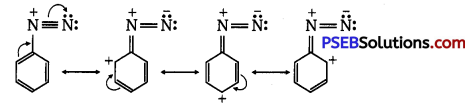
Answer:
As the refractive index for red is less than that for blue parallel beams of light incident on a lens will be bent more towards the axis for blue light compared to red.
In other words, μb > μr By lens maker’s formula,
\(\frac{1}{f}=\left(n_{21}-1\right)\left(\frac{1}{R_{1}}-\frac{1}{R_{2}}\right)\)
Therefore, fb < fr
Thus, the focal length for blue light will be smaller than that for red.

Question 2.
Define power of a lens. Write its units. Deduce the relation \(\frac{1}{f}=\frac{1}{f_{1}}+\frac{1}{f_{2}}\) for two thin lenses kept in contact coaxially.
Answer:
The power of a lens is equal to the reciprocal of its focal length when it is measured in metre. Power of a lens,
P = \(\frac{1}{f(\text { metre })}\)
Its SI unit is dioptre (D).
PSEB 12th Class Physics Important Questions Chapter 9 Ray Optics and Optical Instruments 1
Consider two lenses A and B of focal lengths, f1 and f2 placed in contact with each other. An object is placed at a point O beyond the focus of the first lens A. .
The first lens produces an image (real image) at I1 which serves as a virtual object for the second lens B producing the final image at I.

Since, the lenses are thin, we assume the optical centres P of the lenses to be coincident. For the image formed by the first lens A, we obtain
\(\frac{1}{v_{1}}-\frac{1}{u}=\frac{1}{f_{1}}\) ……………………………. (1)
For the image formed by the second lens B, we obtain
\(\frac{1}{v}-\frac{1}{v_{1}}=\frac{1}{f_{2}}\) …………………………………. (2)
Adding eqs. (1) and (2), we obtain
\(\frac{1}{v}-\frac{1}{u}=\frac{1}{f_{1}}+\frac{1}{f_{2}}\) …………………………. (3)

If the two lenses system is regarded as equivalent to a single lens of focal length f, we have
\(\frac{1}{v}-\frac{1}{u}=\frac{1}{f}\) ……………………………… (4)
From eqs. (3) and (4), we obtain
\(\frac{1}{f_{1}}+\frac{1}{f_{2}}=\frac{1}{f}\) .

PSEB 12th Class Physics Important Questions Chapter 9 Ray Optics and Optical Instruments

Question 3.
(a) Draw a schematic labelled ray diagram of a reflecting type telescope (cassegrain).
(b) The objective of telescope is of larger focal length and of larger aperture (compared to the eyepiece). Why? Given reasons.
(c) State the advantages of reflecting telescope over refracting telescope.
Answer:
(a)
PSEB 12th Class Physics Important Questions Chapter 9 Ray Optics and Optical Instruments 2
(b) In normal adjustment, magnifying power of the telescope, M = \(\frac{f_{0}}{f_{e}}\)
(i) If focal length of the objective lens is large in comparison to the eyepiece, magnifying power increases.
(ii) Resolving power of the telescope RP = \(\frac{D}{1.22 \lambda}\)
D being the diameter of the objective. To increase the resolving power of the telescope, large aperture of the objective lens is required.

Advantages

  • There is no chromatic aberration in a mirror.
  • Brighter image.
  • High resolving power.
  • Large magnifying power.

Question 4.
How is the working of a telescope different from that of a microscope?
Answer:
Difference in working of telescope and microscope

  • Objective of telescope forms the image of a very far off object at or within the focus of its eyepiece. The microscope does the same for a small object kept just beyond the focus of its objective.
  • The final image formed by a telescope is magnified relative to its size as seen by the unaided eye while the final image formed by a microscope is magnified relative to its absolute size.
  • The objective of a telescope has large focal length and large aperture while the corresponding parameters for a microscope have very small ‘ values.

Question 5.
For a glass prism (μ = \(\sqrt{3}\) ) the angle of minimum deviation is equal to the angle of the prism. Find the angle of the prism. (NCERT Exemplar)
Answer:
At minimum deviation μ = \(\frac{\sin \left[\frac{\left(A+\delta_{m}\right)}{2}\right]}{\sin \left(\frac{A}{2}\right)} \)
Given, δm = A
∴ μ = \(\frac{\sin A}{\sin \frac{A}{2}}=\frac{2 \sin \frac{A}{2} \cos \frac{A}{2}}{\sin \frac{A}{2}}=2 \cos \frac{A}{2}\)
∴ \(\cos \frac{A}{2}=\frac{\sqrt{3}}{2} \text { or } \frac{A}{2}=30\)
⇒ A = 600.

Long Answer Type Questions

Question 1.
(a) Draw a ray diagram for formation of image of a point object by a thin double convex lens having radii of curvature R1 and R2. Hence, derive lens maker’s formula for a double convex lens. State the assumptions made and sign convention used.
(b) A convex lens is placed over a plane mirror. A pin is now positioned so that there is no parallax between the pin and its image formed by this lens-mirror combination. How will you use this observation to find focal length of the lens? Explain briefly.
Answer:
(a) Lens Maker’s Formula: Suppose L is a thin lens. The refractive index of the material of lens is n2 and it is placed in a medium of refractive index n1. The optical centre of lens is C and X’ X is principal axis. The radii of curvature of the surfaces of the lens are R1 and R2 and their poles are P1 and P2.

The thickness of lens is t, which is very small. O is a point object on the principal axis of the lens. The distance of O from pole P1 is u. The first refracting surface forms the image of O at I’ at a distance v’ from P1.
From the refraction formula at spherical surface, \(\frac{n_{2}}{v^{\prime}}-\frac{n_{1}}{u}=\frac{n_{2}-n_{1}}{R_{1}}\) ……………………………….. (1)
The image I’ acts as a virtual object for second surface and after refraction at second surface, the final image is formed at I.

The distance of I from pole P2 of second surface is v. The distance of virtual object (I’) from pole P2 is (v’ -t).
For refraction at second surface, the ray is going from second medium (refractive index n2) to first medium (refractive index n1), therefore, from refraction formula at spherical surface
PSEB 12th Class Physics Important Questions Chapter 9 Ray Optics and Optical Instruments 3
\(\frac{n_{1}}{v}-\frac{n_{2}}{\left(v^{\prime}-t\right)}=\frac{n_{1}-n_{2}}{R_{2}}\) ……………….. (2)
For a thin lens t is negligible as compared to v’, therefore from eq. (2)
\(\frac{n_{1}}{v}-\frac{n_{2}}{v^{\prime}}=-\frac{n_{2}-n_{1}}{R_{2}}\) ……………………………….. (3)
Adding equation (1) and (3),we get
PSEB 12th Class Physics Important Questions Chapter 9 Ray Optics and Optical Instruments 4
where, 1n2 = \(\frac{n_{2}}{n_{1}}\) is refractive index of second medium (te. medium of lens) with respect to first medium. If the object O is at infinity, the image will be formed at second focus i.e., if u = ∞, v = f2 =f
Therefore, from equation (4)
PSEB 12th Class Physics Important Questions Chapter 9 Ray Optics and Optical Instruments 5
This formula is called Lens-Maker’s formula. If first medium is air and refractive index of material of lens be n, then 1n2 = n, therefore, the modified equation (5) may be written as
\(\frac{1}{f}=(n-1)\left(\frac{1}{R_{1}}-\frac{1}{R_{2}}\right)\) ………………………………. (6)

(b) Focal length = distance of the pin from the mirror.
The rays from the object after refraction from lens should fall normally on the plane mirror. So, they retrace their path. Hence, rays must be originating from focus and thus distance of the pin from the plane mirror gives focal length of the lens.

PSEB 12th Class Physics Important Questions Chapter 9 Ray Optics and Optical Instruments

Question 2.
(a) Draw the labelled ray diagram for the formation of image by a compound microscope. Derive an expression for its total magnification (or magnifying power), when the final image is formed at the near point. Why both objective and eyepiece of a compound microscope must have short focal lengths?
(b) Draw a ray diagram showing the image formation by a compound microscope. Hence, obtain expression for total magnification when the image is formed at infinity.
Answer:
(a) Compound Microscope: It consists of a long cylindrical tube, containing at one end a convex lens of small aperture and small focal length. This is called the objective lens (0). At the other end of the tube another co-axial smaller and wide tube is fitted, which carries a convex lens (E) at its outer end. This lens is towards the eye and is called the eyepiece. The focal length and aperture of eyepiece are somewhat larger than those of objective lens. Cross-wires are mounted at a definite distance before the eyepiece. The entire tube can be moved forward and backward by the rack and pinion arrangement.

Adjustment: First of all the eyepiece is displaced backward and forward to focus it on cross-wires. Now the object is placed just in front of the objective lens and the entire tube is moved by rack and pinion arrangement until there is no parallax between image of object and cross wire. In this position, the image of the object appears quite distinct.

Working: Suppose a small object AB is placed slightly away from the first focus Fo‘of the objective lens. The objective lens forms the real, inverted and magnified image A’ B’, which acts as an object for eyepiece. The eyepiece is so adjusted that the image A’B’ lies between the first focus Fe‘ and the eyepiece E. The eyepiece forms its image A”B” which is virtual, erect and magnified. Thus the final image A”B” formed by the microscope is inverted and magnified and its position is outside the objective and eyepiece towards objective lens.
PSEB 12th Class Physics Important Questions Chapter 9 Ray Optics and Optical Instruments 6
The magnifying power of a microscope is defined as the ratio of angle (β) subtended by final image on the eye to the angle (α) subtended by the object on eye, when the object is placed at the least distance of distinct vision, i.e., Magnifying power,
M = \(\frac{\beta}{\alpha}\)
As object is very small, angles a and 1 are very small and so tan α = α and tan β = β. By definition the object AB is placed at the least distance of distinct vision.
PSEB 12th Class Physics Important Questions Chapter 9 Ray Optics and Optical Instruments 7
∴ α = tan α = \(\frac{A B}{E A}\)
By sign convention, EA = – D,
∴ α = \(\frac{A B}{-D}\)
and from figure
β = tan β = \(\frac{A^{\prime} B^{\prime}}{E A^{\prime}}\)
If ue is distance of image A’ B’ from eyepiece E, then by sign convention, EA’ = -ue
and so, β = \(\frac{A^{\prime} B^{\prime}}{-u_{e}}\)

Hence, magnifying power,
M = \(\frac{\beta}{\alpha}=\frac{A^{\prime} B^{\prime} /\left(-u_{e}\right)}{A B /(-D)}=\frac{A^{\prime} B^{\prime}}{A B} \cdot \frac{D}{u_{e}}\)
By sign conventions, magnification of objective lens
\(\frac{A^{\prime} B^{\prime}}{A B}=\frac{v_{o}}{\left(-u_{o}\right)}\)
∴ M = \(-\frac{v_{o}}{u_{o}} \cdot \frac{D}{u_{e}}\) ………………………………….. (2)

Using lens formula \(\frac{1}{f}=\frac{1}{v}-\frac{1}{u}\) for eyelens,
(i.e. using f = fe’ V = -ve, U = -ue ) we get
\(\frac{1}{f_{e}}=\frac{1}{-v_{e}}-\frac{1}{\left(-u_{e}\right)}\)
or \(\frac{1}{u_{e}}=\frac{1}{f_{e}}+\frac{1}{v_{e}}\)
Magnifying power,
M = \(-\frac{v_{o}}{u_{o}} D\left(\frac{1}{f_{e}}+\frac{1}{v_{e}}\right)\)

or M = \(-\frac{v_{o}}{u_{o}}\left(\frac{D}{f_{e}}+\frac{D}{v_{e}}\right)\)
When final image is formed at the distance of distinct vision, Ve = D
∴ Magnification,
M= – \(\frac{v_{o}}{u_{o}}\left(1+\frac{D}{f_{e}}\right)\)

For greater magnification of a compound microscope, fe should be small. As fo < fe’ so f0 is small.
Hence, for greater magnification both f0 and fe should be small with f0 to be smaller of the two.

(b) If image A’B’ is exactly at the focus of the eyepiece, then image A”B” is formed at infinity.
If the object AB is very close to the focus of the objective lens of focal length f0, then magnification M0 by the objective lens
Me = \(\frac{L}{f_{0}}\)
PSEB 12th Class Physics Important Questions Chapter 9 Ray Optics and Optical Instruments 8

where, L is tube length (or distance between lenses L0 and Le) Magnification Me by the eyepiece
Me = \(\frac{D}{F_{e}} \)
where, D = Least distance of distinct vision
Total magnification, m = M0 Me = \(\left(\frac{L}{f_{o}}\right)\left(\frac{D}{f_{e}}\right)\)

Question 3.
Explain with the help of a labelled ray diagram, how is image formed in an astronomical telescope. Derive an expression for its magnifying power.
Or
Draw a ray diagram showing the image formation of a distant object by a refracting telescope. Define Its magnifying power and write the two important factors considered to increase the magnifying power. Describe briefly the two main limitations and explain how far these can be minimised in a reflecting telescope.
Answer:
Astronomical (Refracti ng) Telescope
Construction: It consists of two co-axial cylindrical tubes, out of which one tube is long and wide, while the other tube is small and narrow. The narrow tube may be moved in and out of the wide tube by rack and pinion arrangement. At one end of wide tube an achromatic convex lens L1 is placed, which faces the object and is so-called objective (lens). The focal length and aperture of this lens are kept large. The large aperture of objective is taken that it may collect sufficient light to form a bright image of a distant object. The narrow tube is towards eye and carries an achromatic convex lens 12 of small focal length and small aperture on its outer end. This is called eye-lens or eyepiece.

The small aperture of eye lens is taken so that the whole light refracted by it may reach the eye. Cross-wires are fitted at a definite distance from the eye lens. Due to large focal length of objective lens and small focal length of eye lens, the final image subtends a large angle at the eye and hence the object appears large. The distance between the two lenses may be arranged by displacing narrow tube in or out of wide tube by means of rack and pinion arrangement.

Adjustment: First of all the eyepiece is moved backward and forward in the narrow tube and focused on the cross-wires. Then the objective lens is directed towards the object and narrow tube is displaced in or out of wide tube until the image of object is formed on cross-wires and there is no parallax between the image and cross-wires. In this position, a clear image of the object is seen. As the image is formed by refraction of light through both the lenses, this telescope is called the refracting telescope.
PSEB 12th Class Physics Important Questions Chapter 9 Ray Optics and Optical Instruments 9
Working: Suppose AB is an object whose end A is on the axis of telescope. The objective lens (L1) forms the image A’B’ of the object AB at its second principal focus F0.
This image is real, inverted and diminished. This image A’ B’ acts as an object for the eyepiece L2 and lies between first focus fe‘ and optical centre C2 of lens L2.
Therefore, eyepiece forms its image A” B” which is virtual, erect and magnified.
Thus, the final image A” B” of object AB formed by the telescope is magnified, inverted and lies between objective and eyepiece.

Magnifying Power: The magnifying power of a telescope is measured by the ratio of angle (β) subtended by final image on the eye to the angle (α) subtended by object on the eye. i.e.,
Magnifying power M = \(\frac{\beta}{\alpha}\)
As α and β are very small angles, therefore, from figure.

The angle subtended by final image A” B” on eye.
β = angle subtended by image A’B’ on eye
= tanβ = \(\frac{A^{\prime} B^{\prime}}{C_{2} A^{\prime}}\)
As the object is very far (at infinity) from the telescope, the angle subtended by object at eye is same as the angle subtended by object on objective lens.
∴ α = tan α = \(\frac{A^{\prime} B^{\prime}}{C_{1} A^{\prime}}\)
∴ M = \(\frac{\beta}{\alpha}=\frac{A^{\prime} B^{\prime} / C_{2} A^{\prime}}{A^{\prime} B^{\prime} / C_{1} A^{\prime}}=\frac{C_{1} A^{\prime}}{C_{2} A^{\prime}}\)
If the focal lengths of objective and eyepiece be f0 and fe, distance of image A’B’ from eyepiece be ue, then by sign convention
C1A’ = +f0
C2A’ = – ue
∴ M = –\(\frac{f_{o}}{u_{e}}\) ……………………………… (1)

If ve is the distance of A” B” from eye-piece, then by sign convention, fe is positive, ue and ve are both negative. Hence, by lens formula = \(\frac{1}{f}=\frac{1}{v}-\frac{1}{u}\)
we have
\(\frac{1}{f_{e}}=\frac{1}{-v_{e}}-\frac{1}{\left(-u_{e}\right)}\)
or
\(\frac{1}{u_{e}}=\frac{1}{f_{e}}+\frac{1}{v_{e}}\)
Substituting this value in eq. (1), we get
M = -f0 \(\left(\frac{1}{f_{e}}+\frac{1}{v_{e}}\right)\) …………………………. (2)

This is the general formula for magnifying power. In this formula, only numerical values of f0, fe and ve are to be used because signs have already been used.
Length of Telescope : The distance between objective and eyepiece is called the length (L) of the telescope. Obviously,
L = L1L2 =C1C2 = f0+ue …………………… (3)

Now there arise two cases :
(i) When the final image is formed at minimum distance (D) of distinct vision then ve =D
∴ M = -f0 \(\left(\frac{1}{f_{e}}+\frac{1}{D}\right)=-\frac{f_{o}}{f_{e}}\left(1+\frac{f_{e}}{D}\right)\) …………………………… (4)
Length of telescope L = f0 + ue

(ii) In normal adjustment position, the final image is formed at infinity: For relaxed eye, the final image is formed at infinity. In this state, the image A’B’ formed by objective lens should be at first the principal focus of eyepiece, i.e.,
ue = fe and ve
∴ Magnifying power,
M = – f0 \(\left(\frac{1}{f_{e}}+\frac{1}{\infty}\right)\) = –\(\frac{f_{o}}{f_{e}}\)
Length of telescope = f0 + fe
For large magnifying power, f0 should be large and fe should be small. For high resolution of the telescope, diameter of the objective should be large.

PSEB 12th Class Physics Important Questions Chapter 9 Ray Optics and Optical Instruments

Factors for Increasing the Magnifying Power
1. Increasing focal length of objective
2. Decreasing focal length of eyepiece

Limitations
1. Suffers from chromatic aberration
2. Suffers from spherical aberration
3. Small magnifying power
4. Small resolving power

Advantages of Reflecting Telescope
1. No chromatic aberration, because mirror is used.
2. Spherical aberration can be removed by using a parabolic mirror.
3. Image is bright because no loss of energy due to reflection.
4. Large mirror can provide easier mechanical support.