PSEB 10th Class Hindi Solutions Chapter 1 दोहावली

Punjab State Board PSEB 10th Class Hindi Book Solutions Chapter 1 दोहावली Textbook Exercise Questions and Answers.

PSEB Solutions for Class 10 Hindi Chapter 1 दोहावली

Hindi Guide for Class 10 PSEB दोहावली Textbook Questions and Answers

(क) विषय-बोध

I. निम्नलिखित प्रश्नों के उत्तर एक या दो पंक्तियों में दीजिए

प्रश्न 1.
तुलसीदास जी के अनुसार राम जी के निर्मल यश का गान करने से कौन-से चार फल मिलते हैं ?
उत्तर:
तुलसीदास जी के अनुसार राम जी के निर्मल यश का गान करने से धर्म, अर्थ, काम और मोक्ष नामक चार फल मिलते हैं।

प्रश्न 2.
मन के भीतर और बाहर उजाला करने के लिए तुलसी कौन-सा दीपक हृदय में रखने की बात करते हैं?
उत्तर:
तुलसी हृदय में श्रीराम नाम रूपी मणियों के दीपक को रखने की बात करते हैं।

PSEB 10th Class Hindi Solutions Chapter 1 दोहावली

प्रश्न 3.
संत किस की भाँति नीर-क्षीर विवेक करते हैं?
उत्तर:
संत हंस की भाँति नीर-क्षीर विवेक करते हैं।

प्रश्न 4.
तुलसीदास के अनुसार भव सागर को कैसे पार किया जा सकता है?
उत्तर:
तुलसीदास के अनुसार श्रीराम से स्नेह, सांसारिक प्राणियों से समता तथा राग, रोष, दोष, दुःख आदि का त्याग करने से भव सागर को पार किया जा सकता है।

प्रश्न 5.
जो व्यक्ति दूसरों के सुख और समृद्धि को देखकर ईर्ष्या से जलता है, उसे भाग्य में क्या मिलता है?
उत्तर:
जो व्यक्ति दूसरों की सुख-समृद्धि से ईर्ष्या में जलता है उसे अपने जीवन में कभी सुख की प्राप्ति नहीं होती।

प्रश्न 6.
रामभक्ति के लिए गोस्वामी तुलसीदास किसकी आवश्यकता बतलाते हैं?
उत्तर:
गोस्वामी तुलसीदास रामभक्त के लिए ईश्वर की भक्ति, नीर-क्षीर विवेकी होने और परम आस्तिकता के भावों की आवश्यकता बतलाते हैं। रामभक्ति के लिए संत समागम और हृदय की पवित्रता आवश्यक है।

II. निम्नलिखित पद्यांशों की सप्रसंग व्याख्या कीजिए

(1) प्रभु तरुतर कपि डार पर, ते किए आपु समान।
तुलसी कहुँ न राम से, साहिब सील निधान।
(2) सचिव, वैद, गुरु तीनि जो, प्रिय बोलहिं भयु आस।
राज, धर्म, तन तीनि कर, होइ बेगिही नास।
उत्तर:
(1) कवि कहता है कि प्रभु श्री राम जी तो वृक्षों के नीचे और बंदर वृक्षों की डालियों पर रहते थे, परंतु ऐसे बंदरों को भी उन्होंने अपने समान बना लिया। तुलसीदास जी कहते हैं कि श्रीरामजी जैसे शीलनिधान स्वामी अन्य किसी स्थान पर कहीं भी नहीं हैं।

(2) कवि कहता है कि स्वामी से तो वह सेवक बड़ा होता है जो अपने धर्म के पालन को करने में निपुण होता है। इसीलिए स्वामी श्रीराम तो सागर पर पुल बंधने के बाद ही समुद्र पार कर सके परंतु उनका सेवक हनुमान तो बिना पुल के ही समुद्र लांघ गया था।

(ख) भाषा-बोध

निम्नलिखित शब्दों के विपरीत शब्द बनाएं-

शब्द = विपरीत शब्द
संपत्ति = ——–
सेवक = ——–
भलाई = ——–
लाभ = ———-
उत्तर:
शब्द = विपरीत शब्द
संपत्ति = विपत्ति।
सेवक = स्वामी।
भलाई = बुराई।
लाभ = हानि।

2. निम्नलिखित शब्दों की भाववाचक संज्ञा बनाएं-

दास = ——–
निज = ——–
गुरु = ——–
जड़। = ———
उत्तर:
शब्द . विपरीत शब्द
दास = दासता।
निज = निजता।
गुरु = गुरुत्व।
जड़ = जड़ता।

3. निम्नलिखित के विशेषण बनाएँ-

धर्म = ——–
मन = ———
भय = ———
दोष। = ———
उत्तर:
शब्द – विशेषण शब्द
धर्म = धार्मिक।
मन = मानसिक।
भय = भयनक।
दोष = दोषी।

PSEB 10th Class Hindi Solutions Chapter 1 दोहावली

(ग) पाठ्येतर सक्रियता

प्रश्न 1.
अपने विद्यालय के पुस्तकालय से गोस्वामी तुलसीदास से संबंधित पुस्तकों से उनके जीवन की अन्य घटनाओं के बारे में जानकारी प्राप्त करें।
उत्तर:
(विद्यार्थी स्वयं करें।)

प्रश्न 2.
तुलसीदास द्वारा रचित दोहों की ऑडियो या वीडियो सी०डी० लेकर अथवा इंटरनेट से इन दोहों को सुनकर आनंद लें और स्वयं भी इन को याद कर लय में गाने का अभ्यास करें।
उत्तर:
(विद्यार्थी स्वयं करें।)

प्रश्न 3.
इंटरनेट के माध्यम से राष्ट्रीय दूरदर्शन पर दिखाए ‘तुलसीदास’ के जीवन पर आधारित सीरियल को ग्रीष्म अवकाश में देखें। उत्तर:
(विद्यार्थी स्वयं करें।)

(घ) ज्ञान विस्तार

रामभक्त गोस्वामी तुलसीदास जी द्वारा रचित हनुमान चालीसा का प्रथम दोहा ‘श्री गुरु चरन सरोज रज’ कवि की हनुमान जी के प्रति श्रद्धा-भक्ति का प्रतीक है। हनुमान जी को केसरी नंदन तथा अंजनि पुत्र भी कहते हैं। केसरी इनके पिता तथा अंजना माता थी। लंका में सीता का समाचार लाते समय ये एक ही छलांग में समुद्र लांघ गए थे और जब इनकी पूंछ में आग लगा दी गई थी तब इन्होंने रावण की सारी लंका ही जला दी थी। लक्ष्मण मूर्छा के समय ये ही लंका से सुषेण वैद्य को तथा उसके कहने पर संजीवनी बूटी को लाए थे। इन्होंने ही सुग्रीव की श्रीराम जी के साथ मित्रता करवा कर उसे उसका राज्य दिलवाया था। इस प्रकार हनुमान महाबली तथा श्री राम जी के अनन्य सेवक माने जाते हैं।

PSEB 10th Class Hindi Guide दोहावली Important Questions and Answers

प्रश्न 1.
कवि के अनुसार श्रीराम जी जैसा शीलनिधान अन्य कोई क्यों नहीं है?
उत्तर:
श्रीराम जैसा शील निधान अन्य कोई भी नहीं था क्योंकि श्रीराम ने वानरों को भी पूरा सम्मान दिया था।

प्रश्न 2.
बिना हरि कृपा के क्या प्राप्त नहीं हो सकता?
उत्तर:
हरि कृपा के बिना संत-समागम नहीं प्राप्त हो सकता।

प्रश्न 3.
ईर्ष्यालु व्यक्ति की क्या दशा होती है?
उत्तर:
ईर्ष्यालु व्यक्ति सदा ईर्ष्या की आग में जलता रहता है तथा उसका कभी भी भला नहीं होता है।

प्रश्न 4.
भगवान् से भक्त को बड़ा बताने के लिए तुलसीदास ने कौन-सा उदाहरण दिया है?
उत्तर:
श्रीराम को लंका जाने के लिए समुद्र पर पुल बंधवा कर जाना पड़ा जबकि उनके भक्त हनुमान छलांग लगा कर ही समुद्र पार कर लंका पहुँच गए थे।

प्रश्न 5.
चापलूस दरबारियों से क्या हानि होती है?
उत्तर:
चापलूस दरबारी सदा राजा की हाँ में हाँ मिलाते हैं, उसकी आलोचना कभी भूलकर भी नहीं करते जिससे राजा अपने राज्य, धर्म और अपने शरीर का भी नाश झूठे अभिमान के कारण कर देता है।

PSEB 10th Class Hindi Solutions Chapter 1 दोहावली

प्रश्न 6.
कैसी भक्ति के बिना श्रीराम अपने भक्तों पर कृपा नहीं करते?
उत्तर:
जिस भक्ति में श्रीराम के प्रति विश्वास नहीं होता उन भक्तों पर श्रीराम कृपा नहीं करते।

(क) एक पंक्ति में उत्तरात्मक प्रश्न

प्रश्न 1.
तुलसी ने हृदय में कैसे दीपक को रखने की बात कही है?
उत्तर:
तुलसी ने हृदय में श्रीराम नाम रूपी मणियों के दीपक के रखने की बात कही है।

प्रश्न 2.
राम की कृपा के बिना स्वप्न में भी क्या नहीं मिलता ?
उत्तर:
राम की कृपा के बिना स्वप्न में भी जीवन में चैन नहीं मिलता।

प्रश्न 3.
श्रीराम ने सागर कैसे पार किया था ?
उत्तर:
श्रीराम ने सागर पर बने पुल से सागर पार किया था।

प्रश्न 4.
हंस की भांति नीर-क्षीर विवेक कौन करते हैं?
उत्तर:
संत हंस की भांति नीर-क्षीर विवेक करते हैं।

(ख) निम्नलिखित प्रश्नों के उत्तर एक सही विकल्प चुनकर लिखें

प्रश्न 1.
‘श्री गुरु चरन सरोज रज’ में सरोज है
(क) सरोवर
(ख) कमल
(ग) सरिता
(घ) धूल।
उत्तर:
(ख) कमल

प्रश्न 2.
‘निज मन मुकुरु सुधारि’ में मुकुरु है
(क) मुकरना
(ख) मौसम
(ग) शीशा
(घ) सुधरना।
उत्तर:
(ग) शीशा

प्रश्न 3.
भगवान् पर क्या किए बिना भक्ति नहीं हो सकती
(क) दया
(ख) विश्वास
(ग) प्रार्थना
(घ) समझौता।
उत्तर:
(ख) विश्वास

PSEB 10th Class Hindi Solutions Chapter 1 दोहावली

प्रश्न 4.
‘दोहावली’ किसकी रचना है
(क) तुलसीदास
(ख) वृन्द
(ग) बिहारी
(घ) रहीम।
उत्तर:
(क) तुलसीदास

(ग) एक शब्द/हाँ या नहीं/सही-गलत/रिक्त स्थानों की पूर्ति के प्रश्न

प्रश्न 1.
संत किस की भाँति नीर-क्षीर विवेक करते हैं? (एक शब्द में उत्तर दीजिए)
उत्तर:
हँस

प्रश्न 2.
राम जी का निर्मल यशगान करने से चार फल मिलते हैं। (हाँ या नहीं में उत्तर लिखें)
उत्तर:
हाँ

प्रश्न 3.
अपने धर्म में निपुण सेवक साहब से बड़ा नहीं होता। (सही या गलत लिख कर उत्तर दें)
उत्तर:
गलत

प्रश्न 4.
तुलसीदास राम के भक्त थे। (सही या गलत लिख कर उत्तर दें)
उत्तर:
सही

प्रश्न 5.
बरनऊं रघुबर ……. जसु।
उत्तर:
बिमल

प्रश्न 6.
गिरिजा संत ……….. सम।
उत्तर:
समागम

प्रश्न 7.
राज, धर्म, तन तीनि कर, होइ ……. नास।
उत्तर:
बेगिही।

दोहावली दोहों की सप्रसंग व्याख्या

1. श्री गुरु चरन सरोज रज, निज मन मुकुरु सुधारि।
बरनऊँ रघुबर विमल जसु, जो दायकु फल चारि॥

शब्दार्थ:
चरन = पैर। सरोज = कमल। रज = धूल। मकरु = दर्पण। बरनऊँ = वर्णन करूँ। विमल = निर्मल, उज्ज्वल। जसु = यश। दायकु = देने वाले। फल चारि = चार फल-धर्म, अर्थ, काम और मोक्ष।

प्रसंग:
प्रस्तुत दोहा तुलसीदास द्वारा रचित ‘दोहावली’ से लिया गया है। यह दोहा हनुमान चालीसा का प्रारंभिक दोहा है। इस दोहे में गुरु वंदना के बाद श्रीराम के पवित्र चरित्र के गुणगान करने की कवि ने कामना की है।

व्याख्या:
कवि कहता है कि मैं श्री गुरु महाराज के चरण कमलों की धूल से अपने मनरूपी दर्पण को स्वच्छ और पवित्र करके श्री रघुवीर रामजी के निर्मल पवित्र यश का वर्णन करता हूँ, जो चारों फलों धर्म, अर्थ, काम और मोक्ष को देने वाला है।

विशेष:

  1. कवि अपने सद्गुरु की कृपा प्राप्त कर श्रीराम के उज्ज्वल चरित्र का गुणगान करने की कामना कर रहा है।
  2. भाषा ब्रज मिश्रित अवधी, दोहा छंद, अनुप्रास, उपमा तथा रूपक अलंकार हैं।

PSEB 10th Class Hindi Solutions Chapter 1 दोहावली

2. राम नाम मनी दीप धरु, जीह देहरी द्वार।
तुलसी भीतर बाहरु हुँ, जौ चाहसि उजियार॥

शब्दार्थ:
मनी = मणियाँ। दीप = दीपक। जीह = जीभ । देहरी = दहलीज। चाहसि = चाहता है। उजियार = उजाला।

प्रसंग:
प्रस्तुत दोहा तुलसीदास द्वारा रचित ‘दोहावली’ से लिया गया है, जिसमें कवि ने श्रीराम के नाम स्मरण की महिमा का वर्णन किया है।

व्याख्या:
तुलसीदास जी कहते हैं कि हे मानव, तू राम नाम रूपी मणि-दीपक को मुखरूपी द्वार की जीभरूपी दहलीज पर रख। यदि तू भीतर और बाहर दोनों ओर उजाला चाहता है। भाव यह है कि राम नाम रूपी मणियों से बने दीपक को हृदय में धारण करने से अज्ञान रूपी अंधेरा नष्ट हो जाता है तथा ज्ञान रूपी उजाला हो जाता है।

विशेष:

  1. राम नाम के स्मरण से समस्त दोषों का नाश हो जाता है तथा हृदय के बाहर और भीतर उजाला हो जाता है।
  2. ब्रज भाषा में अवधी के शब्दों का मिश्रण है। दोहा छंद, रूपक अलंकार है।

3. जड़ चेतन गुन दोषभय, बिस्व कीन्ह करतार।
संत हंस गुन गहहिं पय, परिहरि बारि विकार॥

शब्दार्थ:
जड़ = निर्जीव। चेतन = सजीव। बिस्व = संसार। करतार = ईश्वर, परमात्मा। गहहिं = लेकर। पय = दूध। परिहरि = छोड़कर। बारि = पानी। विकार = बुराई।

प्रसंग:
प्रस्तुत दोहा तुलसीदास द्वारा रचित ‘दोहावली’ में से लिया गया है, जिसमें कवि ने संतों की विशेषता का वर्णन किया है।

व्याख्या:
तुलसीदास कहते हैं कि परमात्मा ने इस जड़-चेतन संसार को गुण और दोष से युक्त बनाया है, परंतु संत हँसों के समान नीर-क्षीर विवेकी होने के कारण दोष रूपी जल को त्याग कर गुण रूपी दूध को ग्रहण करते हैं।

विशेष:

  1. संत सदा सद्गुणों से युक्त होते हैं। वे विकारों से रहित होते हैं।
  2. अवधी भाषा, दोहा छंद, अनुप्रास तथा रूपक अलंकार का प्रयोग सराहनीय है।

4. प्रभु तरुतर कपि डार पर, ते किए आपु समान।
तुलसी कहुँ न राम से, साहिब सील निधान। 

शब्दार्थ:
तरुतर = वृक्ष के नीचे। कपि = वानर। आयु = अपने।

प्रसंग:
प्रस्तुत दोहा तुलसीदास के द्वारा रचित ‘दोहावली’ से लिया गया है। इस दोहे में कवि ने श्रीराम द्वारा वानरों को दिए गए सम्मान का वर्णन किया है।

व्याख्या:
कवि कहता है कि प्रभु श्री राम जी तो वृक्षों के नीचे और बंदर वृक्षों की डालियों पर रहते थे, परंतु ऐसे बंदरों को भी उन्होंने अपने समान बना लिया। तुलसीदास जी कहते हैं कि श्रीरामजी जैसे शीलनिधान स्वामी अन्य किसी स्थान पर कहीं भी नहीं हैं।

विशेष:

  1. श्रीराम की सबके प्रति समतावादी दृष्टि का उल्लेख किया गया है। वे कोई भी भेदभाव न करते हुए सबको अपने समान बना लेते थे।
  2. अवधी भाषा, दोहा छंद, अनुप्रास अलंकार है।

5. तुलसी ममता राम सो, समता सब संसार।
राग न रोष न दोष दुःख, दास भए भव पार॥

शब्दार्थ:
ममता = स्नेह, प्रेम। समता = बराबर। राग = प्रेम। रोष = क्रोध। भव = संसार।

प्रसंग:
प्रस्तुत दोहा तुलसीदास द्वारा रचित ‘दोहावली’ से लिया गया है। इस दोहे में कवि ने श्रीराम के प्रति आस्था रखने तथा सांसारिक प्राणियों से समभाव रखने की प्रेरणा दी है।

व्याख्या:
तुलसीदास जी कहते हैं कि श्रीराम से ममता रखो तथा संसार के प्राणियों के प्रति समभाव रखो, इससे मनुष्य राग, रोष, दोष, दुःख से मुक्त हो जाता है तथा श्रीराम का दास होने के कारण इस संसार रूपी सागर से पार हो जाता है।

विशेष:

  1. सांसारिक माया-मोह के बंधनों से मुक्त होकर भव-सागर पार करने के लिए श्रीराम के प्रति ममता होनी आवश्यक है।
  2. अवधी भाषा, दोहा छंद, अनुप्रास तथा रूपक अलंकार हैं।

6. गिरिजा संत समागम सम, न लाभ कछु आन।
बिनु हरि कृपा न होइ सो, गावहिं वेद पुरान॥

शब्दार्थ:
गिरिजा = पार्वती। सम = समान। आन = अन्य, दूसरा।

प्रसंग:
प्रस्तुत दोहा तुलसीदास द्वारा रचित ‘दोहावली’ से लिया गया है। इस दोहे में कवि ने संत-समागम की महिमा का वर्णन किया है।_

व्याख्या:
कवि कहता है कि शिव जी पार्वती को संतों के सम्मेलन की महिमा का वर्णन करते हुए कहते हैं कि हे पार्वती, संतों के साथ मिल बैठकर उनके विचार सुनने के समान संसार में अन्य कुछ भी लाभकारी नहीं है तथा संत-समागम भी श्रीराम की कृपा के बिना नहीं मिलता। ऐसा वेद-पुराणों में भी कहा गया है।

विशेष:

  1. संत-समागम प्रभु कृपा से प्राप्त होता है तथा इसके समान लाभदायक संसार में और कुछ भी नहीं है।
  2. भाषा अवधी, दोहा छंद तथा अनुप्रास अलंकार हैं।

PSEB 10th Class Hindi Solutions Chapter 1 दोहावली

7. पर सुख संपत्ति देखि सुनि, जरहिं जे जड़ बिनु आगि।
तुलसी तिन के भाग ते, चलै भलाई भागि॥

शब्दार्थ:
पर = पराया, दूसरे का। जरहिं = जलना, ईर्ष्या करना। जड़ = मूर्ख भाग = भाग्य। भागि = भाग जाना, चले जाना।

प्रसंग:
प्रस्तुत दोहा तुलसीदास द्वारा रचित ‘दोहावली’ से लिया गया है, जिसमें कवि ने ईर्ष्यालु व्यक्ति की दुर्दशा का वर्णन किया है।

व्याख्या:
गोस्वामी तुलसी दास कहते हैं कि दूसरे के सुख और संपत्ति को देख-सुन कर जो मूर्ख बिना आग के ही जलते रहते हैं, उन लोगों के भाग्य से भलाई स्वयं ही भाग जाती है। भाव यह है कि दूसरों की उन्नति को देखकर ईर्ष्या करने वाले व्यक्ति का कभी भी भला नहीं होता है।

विशेष:

  1. ईर्ष्यालु व्यक्ति का कभी भी भला नहीं होता है और न ही सुख की प्राप्ति होती है।
  2. भाषा अवधी-ब्रज का मिश्रण, दोहा छंद, अनुप्रास अलंकार हैं।

8. सचिव वैद गुरु तीनि जो, प्रिय बोलहिं भयु आस।
राज, धर्म, तन तीनि कर, होइ बेगिही नास॥

शब्दार्थ:
सचिव = मंत्री। वैद = वैद्य। प्रिय बोलहिं = मीठा बोलना, मुँह देखी बोलना। भयु = डर से। तीनि = तीनों। बेगिही = शीघ्र ही। नास = नाश, विनाश।

प्रसंग:
प्रस्तुत दोहा तुलसीदास द्वारा रचित ‘दोहावली’ से लिया गया है, जिसमें कवि ने राजा के भय से उसकी हाँ में हाँ मिलाने वाले चापलूसों के परिणाम का वर्णन किया है।

व्याख्या:
कवि कहता है कि यदि किसी राजा का मंत्री, वैद्य और गुरु–ये तीनों राज-भय से अथवा किसी लोभलालच से उसकी बात जैसी है वैसी ही मान लेते हैं अथवा उसकी हाँ में हाँ मिलाते हैं तो उसके राज्य, धर्म और शरीर तीनों का शीघ्र ही विनाश हो जाता है।

विशेष:

  1. तुलसी दास का मानना है कि रावण के भय से उसके सभासद सदा उसकी हाँ में हाँ मिलाते थे, इसलिए उसका विनाश हो गया था। इसलिए ऐसे चापलूसों से बचना चाहिए।
  2. भाषा अवधी और ब्रज है। दोहा छंद तथा अनुप्रास अलंकार है।

9. साहब ते सेवक बड़ो, जो निज धरम सुजान।
राम बाँध उतरै उद्धि, लांघि गए हनुमान॥

शब्दार्थ:
साहब = स्वामी। उद्धि = समुद्र। बाँध = पुल। सुजान = निपुण।

प्रसंग:
प्रस्तुत दोहा तुलसीदास द्वारा रचित दोहावली से लिया गया है, जिसमें कवि ने भगवान् से अधिक उनके भक्त की प्रशंसा की है।

व्याख्या:
कवि कहता है कि स्वामी से तो वह सेवक बड़ा होता है जो अपने धर्म के पालन को करने में निपुण होता है। इसीलिए स्वामी श्रीराम तो सागर पर पुल बंधने के बाद ही समुद्र पार कर सके परंतु उनका सेवक हनुमान तो बिना पुल के ही समुद्र लांघ गया था।

विशेष:

  1. स्वामी की कृपा से सेवक स्वामी से भी बड़ा काम कर सकता है।
  2. भाषा अवधी, ब्रज, दोहा छंद, अनुप्रास अलंकार हैं।

10. बिनु बिस्वास भगति नहिं, तेहि बिनु द्रवहिं न राम।
राम कृपा बिनु सपनेहुँ, जीवन नहिं विश्राम।

शब्दार्थ:
द्रवहिं = द्रवित होना, पिघलना, दया करना। लह = प्राप्त करना, लेना।

प्रसंग:
प्रस्तुत दोहा तुलसीदास द्वारा रचित ‘दोहावली’ से लिया गया है। इस दोहे में कवि ने अपने आराध्य पर पूर्ण विश्वास रखते हुए भक्ति करने का संदेश दिया है।

व्याख्या:
कवि कहता है कि बिना भगवान् पर विश्वास किए उनकी भक्ति नहीं हो सकती। विश्वास से रहित भक्ति से श्रीराम अपने भक्त पर दया नहीं करते और राम की कृपा के बिना स्वप्न में भी जीवन में चैन नहीं मिलता है। भाव यह है कि विश्वासपूर्वक भक्ति करने से ही परमात्मा की प्राप्ति होती है।

विशेष:

  1. ईश्वर की भक्ति उस पर पूर्ण विश्वास रख कर ही करनी चाहिए तभी ईश्वर की कृपा होती है।
  2. भाषा अवधी, ब्रज हैं। दोहा छंद और अनुप्रास अलंकार है।

दोहावली Summary

दोहावली  कवि परिचय।

राम-भक्त कवियों में तुलसीदास का नाम विशेष आदर से लिया जाता है। उनका जन्म सन् 1532 ई० में राजापुर, ज़िला बाँदा में हुआ था। कुछ विद्वान् उत्तर प्रदेश के एटा जिले में सोरों नामक ग्राम को उनका जन्म स्थान मानते हैं। इनके पिता का नाम आत्मा राम तथा माता का नाम हुलसी था। मूल नक्षत्र में उत्पन्न होने के कारण माता-पिता ने इन्हें त्याग दिया था। इनका बचपन दर-दर की ठोकरें खाते हुए अनेक कष्टों में बीता। बाद में बाबा नरहरिदास ने उन्हें सहारा दिया। उनके पास रहकर उन्होंने शिक्षा प्राप्त की थी। बाद में काशी के महान् विद्वान शेष सनातन से उन्होंने वेद-शास्त्रों और इतिहास-पुराण का ज्ञान प्राप्त किया। विद्वान बनकर वे वापस राजपुर लौटे थे। तब दीनबंधु पाठक ने अपनी पुत्री रत्नावली से इनका विवाह करवा दिया था। वे अपनी पत्नी रत्नावली से बहुत प्यार करते थे। एक दिन वह इनको बताए बिना अपने मायके चली गई। तुलसीदास जी को जब पता चला तो अन्धेरी रात तथा मूसलाधार वर्षा में रत्नावली के पास पहुँच गए। इस पर रत्नावली ने उन्हें फटकार सुनाई और राम के चरणों में स्नेह लगाने की प्रेरणा दी।

लाज न लागत आपको दौरे आयह साथ,
धिक धिक ऐसे प्रेम को कहां कहौ हौं, नाथ।

इस घटना से तुलसीदास का हृदय ग्लानि से भर गया। उन्होंने संसार को त्याग कर अपना सारा जीवन भगवान राम की आराधना तथा भक्तिपरक साहित्य लिखने में लगा दिया। सन् 1623 ई० में तुलसीदास जी का स्वर्गवास हुआ।

रचनाएँ-तुलसीदास के नाम से 37 पुस्तकें स्वीकार की जाती हैं। लेकिन इनमें से तुलसी के प्रामाणिक ग्रन्थ बारह ही हैं, वे हैं–रामचरितमानस, वैराग्य संदीपनी, रामललानहछू, बरवै रामायण, पार्वती मंगल, जानकी मंगल, रामाज्ञा-प्रश्न, दोहावली, कवितावली, गीतावली, कृष्ण गीतावली और विनय पत्रिका।

तुलसीदास ने अपने काव्य में राम को विष्णु का अवतार मान कर उन्हें ईश्वर पद प्रदान किया है-‘सोई दशरथ सुत हित, कौसलपति भगवान्।’ उन्होंने माना है कि राम ही धर्म का उद्धार करने वाले हैं तथा उनमें शील, शक्ति और सौंदर्य के गुण विद्यमान हैं। राम के माध्यम से कवि ने अपने काव्य में आदर्श समाज की कल्पना की है। उन्होंने राम, सीता, भरत, लक्ष्मण, कौशल्या, हनुमान आदि के द्वारा आदर्श गृहस्थ, आदर्श समाज और आदर्श राज्य की कल्पना को साकार रूप दिया है। इनकी रचनाओं का मूल रस शांत है। लेकिन स्थान-स्थान पर अन्य सभी रसों का सुंदर प्रयोग दिखाई दे जाता है। कवितावली के बालकांड में वात्सल्य रस के सुंदर उदाहरण दिए गए हैं। तुलसीदास एक श्रेष्ठ कवि और सच्चे लोकनायक हैं।

PSEB 10th Class Hindi Solutions Chapter 1 दोहावली

इन्होंने अपने काव्य में जीवन के विविध रूपों को प्रस्तुत किया है। इन्होंने अवधी और ब्रज भाषाओं का संदर प्रयोग किया है। इनकी अधिकांश रचनाएँ अवधी में हैं। लेकिन ‘विनय पत्रिका’ में ब्रज भाषा का प्रयोग किया गया है। इनके प्रबंध काव्य में दोहाचौपाई छंदों का प्रयोग अधिक है तो मुक्तक काव्यों में गीति शैली’ की प्रधानता है। इन्होंने आवश्यकतानुसार उर्दू, फ़ारसी, बुंदेली, भोजपुरी आदि शब्दों का प्रयोग किया है। तुलसीदास वास्तव में ही उत्कृष्ट कोटि के भक्त कवि हैं।

दोहावली दोहों का सार

पाठ्यपुस्तक में तुलसीदास द्वारा रचित दस दोहे संकलित हैं, जिनमें कवि की भक्ति एवं नीति से संबंधित भावनाएँ व्यक्त हुई हैं। पहले दोहे में कवि अपने गुरु की वंदना कर अपने पवित्र मन से चारों फलों को देने वाला श्रीराम के पावन चरित्र के गुणगान करने की कामना करता है। दूसरे दोहे में श्रीराम रूपी मणियों के दीपक के प्रकाश से मन के अंधकार को दूर करने तथा तीसरे दोहे में संतों को नीर-क्षीर विवेकी हँसों के समान बताया गया है जो गुणों को अपना कर समस्त विकार त्याग देते हैं। चौथे दोहे में श्री राम की वानरों को सम्मान देने, पांचवें दोहे में श्रीराम के प्रति ममता तथा संसार के सभी लोगों से समता का व्यवहार रखने और छठे दोहे में संतों के समागम के लाभ का वर्णन किया गया है।

सातवें दोहे में दूसरों की संपत्ति को देखकर ईर्ष्या करने वालों की दुर्दशा का वर्णन है। आठवें दोहे में कवि ने राम भक्त हनुमान की प्रशंसा की है। नौवें दोहे में चापलूस सभासदों से राजा को सावधान रहने के लिए कहा गया है क्योंकि जी हजूरी करने वालों से धर्म, शरीर और राज्य का नाश हो जाता है। दसवें दोहे में कवि ने स्पष्ट किया है कि पूर्ण आस्था से भक्ति करने पर ही श्रीराम अपने भक्तों पर कृपा करते हैं तथा श्रीराम की कृपा के बिना स्वप्न में भी शांति नहीं मिलती है।

PSEB 10th Class Science Important Questions Chapter 7 Control and Coordination

Punjab State Board PSEB 10th Class Science Important Questions Chapter 7 Control and Coordination Important Questions and Answers.

PSEB 10th Class Science Important Questions Chapter 7 Control and Coordination

Long Answer Type Questions

Question 1.
Draw a well labeled diagram of the human brain and mention the functions of its various parts.
Answer:
Human brain is divided into three parts- Fore brain, mid brain and hind brain.
1. The Fore Brain: It is the largest part of the brain. It consists of the following parts :
(a) Olfactory lobes: They are concerned with sense of smell.
(b) Cerebrum: It is the most important and largest part of the fore brain. It is divided into two halves called the cerebral hemispheres. The two hemispheres are connected by a tract of nerve fibres called corpus callosum.

The functions of cerebrum are :

  • It analyses the sensory signals in the association areas and thinking of a proper response.
  • It sends response signals (motor signals) to the muscles through the motor areas.
  • It stores memory of different experiences and uses this memory to generate proper responses.
  • It is the seat of understanding language, memory, knowledge and logical thinking.

PSEB 10th Class Science Important Questions Chapter 7 Control and Coordination 1
Section of human brain

(c) Thalamus: It is situated underneath (below) the cerebrum. Its function is to coordinate the incoming sensory signals to the cerebrum and outgoing motor signals from it.

  • It controls many of the body’s important activities and feelings’ such as hunger, thirst, temperature regulation, sleep, emotional behaviour and sexual activity.
  • It produces and secretes hormones that control the functioning of the pituitary gland situated just below it. It also controls the function of internal body organs by means of the autonomic nervous system.

2. The Mid Brain: It consists of crura cerebri and optic lobes. It is the topmost structure of the brain stem :

  • It has centres relating to pain, temperature and touch.
  • It controls many involuntary actions of the body.
  • It has a collection of cells that control functioning of eyes and ears.

3. The Hind Brain: It consists of the pons, cerebellum and medulla oblongata :
(a) Pons. It is a bulging structure situated below the mid brain. It consists of large bundles of nerve fibres that interconnect different regions of the brain.

(b) Cerebellum. It is located at the lower back side of the brain under the cerebrum. Its functions are as follows :

  • Maintaining the posture and balance of the body by controlling the muscles.
  • It also controls the voluntary actions of the body by controlling motor signals coming from the cerebrum.

(c) Medulla oblongata. It is long stalk-like lowermost portion of the brain stem.. At the lower side it is connected with the spinal cord. It controls many involuntary actions such as salivation, vomiting, blood pressure, respiration and heart beat.

Question 2.
Describe the structure of spinal cord.
Answer:
The spinal cord extends from the foramen magnum where it is continuous with the medulla. It is a vital link between the brain and the body, and from the body to the brain. The spinal cord is 40 to 50 cm long and 1 cm to 1.5 cm in diameter. Two consecutive rows of nerve roots emerge on each of its sides. These nerve roots join distally to form 31 pairs of spinal nerves. The spinal cord is a cylindrical structure of nervous tissue composed of white and grey matter, is uniformly organized. The spinal nerve contains motor and sensory nerve fibres to and from all parts of the body.
PSEB 10th Class Science Important Questions Chapter 7 Control and Coordination 2
Spinal Cord

Although the spinal cord constitutes only about 2% of the central nervous system (CNS), its functions are vital.
Knowledge of spinal cord functional anatomy makes it possible to diagnose the nature and location of cord damage and many cord diseases.

PSEB 10th Class Science Important Questions Chapter 7 Control and Coordination

Question 3.
What is reflex action? Explain giving an example. What is reflex arc?
Answer:
Reflex action is a quick action in response without involvement of the thought process. It is controlled through the spinal cord in which transfer of impulse takes place from sensory neuron to the motor neuron. The path through which the signal travels during reflex action is called the reflex arc. As the reflex arc is a shorter route reflex action takes place in a fraction of a second. For example, if a person accidentally hits something on the leg, the pain receptors in the skin receive the pain and generate an electric signal. This impulse is sent by the sensory neuron to the spinal cord. In the spinal cord the impulse is transferred quickly to the motor neuron, which relays it to the leg muscles for quick action.
PSEB 10th Class Science Important Questions Chapter 7 Control and Coordination 3
PSEB 10th Class Science Important Questions Chapter 7 Control and Coordination 4

Question 4.
List the components of nervous system. What is a synapse? Explain what are its kinds.
Answer:

  • Nervous system: It consists of central nervous system, peripheral nervous system and autonomic nervous system.
  • Central nervous system: It consists of brain and spinal cord. It is the main controlling centre of the body.
  • Peripheral nervous system: It consists of cranial and spinal nerves.
  • Autonomic nervous system consists of a special set of peripheral nerves that innervate organs like heart, lungs, digestive tract.

Autonomic nervous system can be divided into two divisions :
(a) Sympathetic nervous system.
(b) Parasympathetic nervous system.

Synapse: Synapse is the close proximity of the axon of one neuron and the dendrite or cvton of another neuron with a gap. In a synapse, the transmitting cell is called the presynaptic cell, and the receiving cell is termed the postsynaptic cell. A narrow gap, called synaptic cleft, separates the presynaptic cell from the postsynaptic cell. Hence, an action potential occurring in the membrane of the presynaptic cell cannot be directly transmitted to the membrane of the postsynaptic cell.

Question 5.
What are phytohormones? Classify the main groups.
Answer:
Growth regulators: Growth is regulated not only by environmental factors like light and temperature but also by certain chemical substances within the plants. These substances are known as plant hormones, growth hormones, phytohormones or growth regulators. A plant hormone can be defined as a chemical substance, which is capable of translocation and regulating one or more physiological reactions, when present in low concentrations.

  • Auxins
  • Gibberellins
  • Cytokinins
  • Ethylene.
  • Abscisic acid (ABA).

On the basis of their effect, phytohormones can be divided into two groups :
(а) Growth promoters: These stimulate the plant growth e.g. auxins, gibberellins, cytokinins and ethylene.
(b) Growth inhibitors: These inhibit or retard plant growth e.g. ABA.

Question 6.
Explain the following :
(i) Hydrotropism (ii) Thigmotropism (iii) Chemotropism.
Or
Explain briefly the various types of plant movements.
Answer:
Movements: Movements of plant parts can mostly be classified as growth movements and turgor movements. The growth movements are autonomic. The movements induced by external stimuli are called paratonic. Tropic movements can be of various types depending on the nature of external stimulus e.g. geotropism, thigmotropism, thermotropism, hydrotropism, chemotropism and phototropism.

Nastic movements are in the bifacial organ. Seismonastic movements are observed in Mimosa pudica.

  • Phototropism: Movements towards stimulus of light.
  • Geotropism: Movements towards stimulus of force of gravity.
  • Hydrotropism: The term hydrotropism is applied to growth movements in response to external stimulus of water. Roots, normally or positively hydrotropic (i.e., they bend towards the source of water).
  • Thigmotropism: Thigmotropism is the tropic movement in the plants due to the stimulus of touch, tactile, mechanical or rubbing.
  • Chemotropism: When chemical substances are the external stimuli, the growth movement is termed as chemotropism. The best example is the growth of pollen tube through stigma and style towards the embryo sac with the stimulus of chemical substances present in the carpel.

Question 7.
Describe various endocrine glands.
Answer:
Endocrine glands and their secretions
PSEB 10th Class Science Important Questions Chapter 7 Control and Coordination 5

Short Answer Type Questions

Question 1.
What are hormones? Why are they called chemical messengers? What are the general properties of hormones?
Answer:
Hormones: They are informational molecules secreted by the endocrine cells in one part of the body in response to changes in external or internal environment, and carried by blood to another part where they stimulate or inhibit specific physiological processes for the good of the body as a whole.

In other words, the hormones are chemical messengers that regulate the biological processes in the organisms as they carry the information in the form of chemicals.

General properties of hormones

  • The hormones themselves do not create biochemical processes. They only modify the existing metabolic processes and change the rate of action.
  • Hormonal actions are usually long lasting than those produced by nerve impulses.
  • They are effective in minute quantities.
  • They are secreted in response to specific stimuli.
  • They are secreted independent of one another.

Question 2.
What is phototropism?
Answer:
Phototropism is the growth movement in response to unidirectional stimulus of light. It is observed in plant stem, root, leaves. Stem is positively phototropic.

Question 3.
Write differences between nastic and tropic movements.
Answer:

Nastic Movements Tropic Movements
1. Growth growth independent movements growth dependent movements
2.Time of Action immediate slow
3. Response to Stimulus Non-directional directional
4. Reason for action change in turgor cell division
5. Alternate name nastics tropism
6. Examples folding of leaves of touch me- not(Mimosa), opening and closing of stomata phototropism, geotropism, hydrotropism, chemotropism

Question 4.
Why is pituitary gland called master endocrine gland?
Answer:
Pituitary gland is a small pea-shaped endocrine gland situated inferior to hypothalamus. It is called master endocrine gland because its secretion control and regulates the secretions of all other endocrine glands.

PSEB 10th Class Science Important Questions Chapter 7 Control and Coordination

Question 5.
Name one disorder each in case of less (hypo) or excess (hyper) secretion of insulin and thyroxine.
Answer:

Name of hormone Disorder due to hvposecietion Disorder due to hypersecretion
Insulin Diabetes Hyperglycemia
Thyroxine Myxedema Exophthalmic goitre

Question 6.
List four uses of auxins.
Answer:
Functions of IAA

  • IAA brings about cell elongation.
  • It initiates the formation and growth of roots and stem if applied to the cutting of stem.
  • Application of auxins causes formation of seedless fruits.
  • It has an inhibitory effect on abscission of leaves and fruits, which lead to leaf fall and fruit drop.
  • The parthenocarpy can be induced by application of auxins.
  • Respiration rate increases with auxins.

Question 7.
What are the physiological effects of gibberellins?
Answer:
Physiological effects of gibberellins :

  • Gibberellins promote cell-division.
  • Gibberellins promote cell-elongation.
  • Gibberellins lead to increase in the length of internodes.
  • Gibberellins induce parthenocarpy in many cases e.g. tomato.
  • Gibberellins promote flowering in some plants like Chrysanthemum.
  • Gibberellins prevent senescence in leaves.

Question 8.
What are the functions of cytokinins?
Answer:
Functions of cytokinins

  • It promotes cell division by activating DNA synthesis.
  • It promotes the growth of lateral buds by neutralising the auxin.
  • It is reported that cytokinin activates protein synthesis in buds by incorporation of labelled amino acid.
  • It is also found to be effective in removing the apical dominance.

Question 9.
Write short notes on abscisic acid and ethylene.
Or
Write functions of abscisic acid.
Answer:
Abscisic acid (ABA)

  • Abscisic acid (ABA) is a growth regulator found widespread in plants. It is a growth inhibitor.

  • Abscisic acid causes the inhibition of mitosis in the vascular cambium.
  • As the winter approaches, the ABA brings about the dormancy of axillary buds.
  • Abscisic acid also induces the dormancy in seeds.
  • It causes ageing in leaves. It is also called ‘stress hormone’.

Question 10.
Write functions of Ethylene.
Answer:
Ethylene:
Ethylene is synthesized in the plants from amino acid methionine. Ethylene produces the effect on the growth of vegetative and reproductive parts of the plant.

Ethylene is the only gaseous phytohormone. It is basically a growth inhibitor and brings about the following functions in the plant body.

  • Ethylene inhibits root growth and development of lateral buds.
  • Ethylene inhibits the elongation of stem and stimulates its transverse expansion.
  • The changes which occur during the ripening of fruit are also attributed to the effect of ethylene.
  • Ethylene also accelerates the process of ageing in plant organs.

Question 11.
What is chemotropism?
Answer:
Directional movement of a plant/ or its parts in response to chemicals is called chemotropism e.g. growth of the pollen tube towards the ovule is a chemotropic movement due to which fertilization of flower takes place.

Question 12.
Give examples of geotropism.
Answer:

  • 1.Roots move in the direction of gravity (positive geotropism).
  • Shoots move (up) against direction of gravity (negative geotropism).

Question 13.
What is the type of phenomenon shown in the figure? Define the same.
PSEB 10th Class Science Important Questions Chapter 7 Control and Coordination 6
Answer:

  • Geotropism:
  • Geotropism. It is a type of growth movements induced by stimulus of gravity.

Question 14.
Differentiate between hormones and enzymes.
Answer:
Differences between hormones and enzymes

Hormones Enzymes
1. They are produced by glands which lack ducts (endocrines). 1. They are generally produced by glands which bear the ducts (exocrine).
2. They may be steroids, amines or protein in chemical nature, 2. They are always proteinic in nature.
3. They are consumed during metabolism. 3. They act as catalysts and are produced in the same quantity at the end of reaction.

Question 15.
Briefly explain the autonomic nervous system.
Answer:

  • Autonomic nervous system: The autonomic nervous system coordinates the activities of viscera through the regulation of their smooth muscles and glands by its nerves.
  • The sympathetic nervous system prepares the body to face an emergency by accelerating heart beat and breathing rate; dilating the bronchioles to facilitate gas exchange; and sending blood to the organs which need it most such as heart, brain and skeletal muscle for “fight or flight”. It releases neurotransmitters adrenaline and noradrenaline into the synapses (adrenergic).
  • The parasympathetic nervous system acts when body is relaxing after an emergency. It restores heart beat and respiratory rate to normal and restarts digestion. It releases acetylcholine into the synapses (cholinergic).

Question 16.
List different parts of the human nervous system.
Answer:
PSEB 10th Class Science Important Questions Chapter 7 Control and Coordination 7

Question 17.
Define ‘nerve impulse’. Which structure in a neuron helps to conduct a nerve impulse?
(i) towards the cell body?
(ii) away from the cell body?
Answer:
Nerve impulse: The information passing through neurons in the form of electrical and chemical signals is called nerve impulse. Neurofibrils in the neuron help to conduct impulses.

Neuron is structural and functional unit of nervous system.

  • Dendrite carries the impulse to cell body.
  • Axon carries impulse away from cell body.

Question 18.
Name the five major senses of man.
Answer:
Five major senses of man

  1. Sense of hearing.
  2. Sense of smell.
  3. Sense of touch.
  4. Sense of taste.
  5. Sense of vision or sight.

Question 19.
Write short note on meninges present around brain. Name the fluid present in the spaces in between meninges. Mention its function.
Answer:
Meninges (Sing. Meninx.) The protective membranes present around brain. They are as follows :

  1. Duramater: It is outer, thick, non-vascular membrane present inner to bones of cranium.
  2. Piamater: It is inner, thin, vascular membrane present closely around brain.
  3. Arachnoid membrane: It is the middle membrane.
  4. Cerebrospinal fluid is present in between the meninges. It protects brain from mechanical shock.

Question 20.
Label the parts of human brain.
PSEB 10th Class Science Important Questions Chapter 7 Control and Coordination 8
Answer:
A. Cerebrum
B. Cerebellum
C. Medulla oblongata.

Question 21.
What is a gland? Name the two types of glands.
Answer:
Definition: A cell, a tissue, or an organ which secretes certain useful chemical compounds required for particular function is called a gland.

Types: Animals have two types of glands: exocrine and endocrine.

Question 22.
How does our body maintain blood sugar level?
Answer:
The timing and amount of hormone released are regulated by feedback mechanisms.
When the sugar levels in blood rise, they are detected by the cells of the pancreas which respond by producing more insulin. As the blood sugar level falls, insulin secretion is reduced.

Question 23.
Why is pancreas a dual gland?
Answer:
Pancreas is a dual gland because it acts as both endocrine and exocrine gland. As endocrine it secretes hormones like insulin, glucagon. As an exocrine gland, it releases enzymes like trypsin, lipase, amylase etc. Such types of glands are also called heterocrine glands.

Question 24.
List the functions of testosterone and estrogen.
Answer:

  • Functions of testosterone: Develops male reproductive organs and secondary sexual characters in males.
  • Functions of estrogen: Develops female genital organs and secondary sexual characters in females.

Question 25.
Name the hormones which stimulate the testis.
Answer:

  • Follicular Stimulating Hormone (FSH). It stimulates the production of sperms in the testis.
  • Interstitial Stimulating Hormone (ISH). It stimulates the interstitial cells of the testis and produce a male sex hormone known as ‘testosterone’.

The FSH and ISH are secreted by pituitary gland.

PSEB 10th Class Science Important Questions Chapter 7 Control and Coordination

Question 26.
List some of the functions of adrenal glands.
Answer:
Functions of adrenal glands

  • Prepare the body for emergencies.
  • Regulate the kidney in maintaining salt and water balance.
  • Control blood pressure and pulse rate.
  • Control concentration of sodium, potassium and sugar in the body.
  • Control some sexual characteristics.
  • Influence breakdown of tissue proteins into amino acids.

Question 27.
Write a note on turgor movements.
Or
Mechanism of movements shown by Mimosa pudica, if touched.
Answer:
Turgor movements. Mimosa pudica (Touch-me-not) shows typical seismonastic type of movements. It is a paratonic variation type of movement which is brought about in response to external stimulus of touch. Leaf of Mimosa pudica is a compound leaf. It shows pulvini of primary and secondary order of petioles and sub-petioles. It gives a very quick response to a shock stimulus.

Question 28.
How do phototropism differ from geotropism?
Answer:
Differences between phototropism and geotropism

Phototropism Geotropism
1. Response of parts of plants in the form of growth movement to the stimulus of light is called phototropism. 1. It applies to growth movements induced by stimulus of force of gravity.
2. Stem and aerial parts bend towards light source. 2. Stem and aerial parts move away from force of gravity.
3. Roots and other underground parts move away from source of light. 3. Roots and other underground parts move towards the force of gravity.

Question 29.
List the major endocrine glands and state their position in the human body.
Answer:
The major endocrine glands in the human body are:

  • Pituitary gland
  • Thyroid gland
  • Parathyroid gland
  • Thymus gland
  • Islets of Langerhans present in Pancreas
  • Adrenal gland
  • Testis
  • Ovary
  • Pineal Gland.

PSEB 10th Class Science Important Questions Chapter 7 Control and Coordination 9
Endocrine glands in human (a) male (b) female

Question 30.
Nervous and hormonal system together perform the function of control and co-ordination in human beings.” Justify the statement.
Answer:
Nervous and hormonal system. Both nerves and hormones transmit information between different parts in the animal body, in the same manner (chemical communication). Both coordinate and regulate physiological activities of the organisms. Moreover, there is a considerable coordination between the two. Synthesis and release of some hormones are regulated by nerves. On the other hand, hormones may also influence the activation of nerves. Because of their interrelationship, the nervous and the endocrine system are now together referred to as the neuroendocrine system.

Question 31.
What are the general functions of ‘hormones’?
Answer:
Functions of Hormones

  • Hormones stimulate the tissue activity.
  • Hormones regulate growth and reproduction.
  • Hormones control metabolism.
  • Hormones synthesize, store and utilize substances like glucose.
  • Hormones conserve water and minerals.

Question 32.
Label 1 and 2 in the figure given below:
PSEB 10th Class Science Important Questions Chapter 7 Control and Coordination 10
Answer:
1. Ovary
2. Neck showing location of Thyroid.

Very Short Answer Type Questions

Question 1.
Are movements in living organi-sms a characteristic of life?
Answer:
No.

Question 2.
Movements in plants are due to result of which kind of action?
Answer:
Growth.

Question 3.
Crying, respiration and voluntary movements are linked to which category.
Answer:
Involuntary actions.

Question 4.
Name the structural and functional unit of nervous system.
Answer:
Neuron.

Question 5.
What is the function of dendrites?
Answer:
Dendrites acquire the information.

Question 6.
Name the structure of neuron which conduct impulse.
Answer:
Axon.

PSEB 10th Class Science Important Questions Chapter 7 Control and Coordination

Question 7.
Name the sites where electrical impulses are conducted into hemical impulses.
Answer:
Synapse.

Question 8.
What is a neuron?
Answer:
Neuron: It is a structural and functional unit of nervous system. It is the largest cell of the body.

It has three components i.e.

  1. cell body
  2. dendrites
  3. axon.

Question 9.
What is synaptic cleft?
Answer:
The gap between dendrites of one neuron and axon of the next neuron is called synaptic cleft.

Question 10.
Mention the receptors for light and sound in animals.
Answer:

  • Receptors for light. Photore-ceptors (Eyes)
  • Receptors for sound. Phonoreeeptors (Ears)

Question 11.
What is reflex action?
Answer:
Reflex action: It is sudden spontaneous, mechanical, involuntary response to a stimulus by voluntary organs.

Question 12.
Give two examples of reflex action.
Answer:

  1. Closing of eyes in response to bright light.
  2. Withdrawal of hand in case touched a hot plate.

Question 13.
Which organ is involved in reflex action?
Answer:
Spinal cord.

Question 14.
Name three parts of neurons in complex reflex arc.
Answer:
A complex reflex arc is composed of afferent, connector and efferent neurons.

Question 15.
Name the main constituents of central nervous system.
Answer:
Brain and spinal cord.

Question 16.
What are the components of peripheral nervous system?
Answer:
Cranial (cerebral) nerves and spinal nerves originating from brain and spinal cord respectively.

Question 17.
Name the three main parts of brain.
Answer:
Fore brain, Mid brain and Hind brain.

Question 18.
List three involuntary actions.
Answer:
Circulation of blood, secretion of saliva and movement of food in the alimentary canal.

Question 19.
Involuntary actions are cont-rolled by which part of brain.
Answer:
Medulla.

Question 20.
Cycling, walking along a straight path and picking up of pencil are controlled by which part of brain.
Answer:
Cerebellum of hind brain.

Question 21.
Name the part of brain which control balancing and voluntary movements of body.
Answer:
Cerebellum of hind brain.

Question 22.
What is the function of cerebro spinal fluid?
Answer:
CSF (cerebrospinal fluid) acts as a shock absorber.

Question 23.
Name the structure which protects spinal cord.
Answer:
Vertebral column.

PSEB 10th Class Science Important Questions Chapter 7 Control and Coordination

Question 24.
How does plant cell change its shape?
Answer:
Change in the water content of plant cell.

Question 25.
What is the function of tendril.
Answer:
Tendril helps in climbing along a support.

Question 26.
Name the hormone which help in cell division.
Answer:
Cytokinin.

Question 27.
Name the hormone secreted by adrenal gland.
Answer:
Adrenaline.

Question 28.
Where is thyroxine hormone secreted?
Answer:
Thyroid gland.

Question 29.
Name the hormone which plays role in metabolism of carbo-hydrates, proteins and fats.
Answer:
Thyroxine hormone.

Question 30.
Name the gland which secreted growth hormone.
Answer:
Pituitay gland.

Question 31.
Name the hormones which play role in maturity during adolescence in boys and girls.
Answer:
Testosterone in boys and estrogen in girls.

Question 32.
Where is insulin secreted?
Answer:
Pancreas.

Question 33.
In addition to nervous system, which other system plays role in coordination.
Answer:
Endocrine system which secretes chemical messengers called hormone.

Question 34.
Name the hormone which helps in chemical co-ordination in plants.
Answer:
Phytohormone (plant hormones).

Question 35.
What is the main element of thyroxine hormone?
Answer:
Iodine.

Question 36.
What is the main function of the vasopressin hormone?
Answer:
Regulates water content in the blood.

Question 37.
Write the function of hormone ‘thyroxine’ in our body.
Answer:
It regulates metabolism of carbo-hydrates, fats and proteins.

Question 38.
Which two systems of body work together for control and coordination of body parts?
Answer:
Nervous system and Hormonal system (endocrine glands).

Question 39.
Which organ secretes a hormone when the blood sugar rises. Name a digestive enzyme released by this organ.
Answer:

  1. Pancreas releases insulin hormone.
  2. Trypsin enzyme.

Question 40.
Define endocrine glands.
Answer:
These glands are ductless glands which secrete chemical messengers called hormones carried by blood to target organs.

Question 41.
Name the hormone which inc-reases blood pressure and rate of heart beat.
Answer:
Adrenaline.

Question 42.
Name the female sex hormones.
Answer:

  • Progesterone
  • Oesterogen
  • Estardiol.

Question 43.
Name the following :
(i) The cause of diabetes mellitus.
Answer:
Deficiency of insulin

(ii) The two portions of adrenal gland.
Answer:
Adrenal cortex and adrenal medulla

(iii) The gland which function actively in emergency situations.
Answer:
Adrenal medulla

(iv) The hormone of pituitary that helps in child birth.
Answer:
Oxytocin

(v) The endocrine gland located on the top of kidneys.
Answer:
Adrenal gland

(vi) The gland which secretes insulin.
Answer:
Pancreas.

Question 44.
Name the following :
(i) The hormone which prepares the body to meet any emergency situation.
Answer:
Adrenaline

(ii) An example of the disease caused due to insufficient secretion of hormone.
Answer:
Cretinism

(iii) The gland, which produces the so called ‘emergency hormone’.
Answer:
Adrenal gland

(iv) Carrier of hormones from the gland to target organ.
Answer:
Blood

(v) The hormone which controls (i.e. reduces) the level of sugar in blood, and the gland which secretes it.
Answer:
Insulin, Pancreas.

Question 45.
Name the three kinds of neuron.
Answer:

  1. Motor neuron
  2. Sensory neuron
  3. Relaying neuron.

PSEB 10th Class Science Important Questions Chapter 7 Control and Coordination

Question 46.
What happens when bright light is focussed on eyes?
Answer:
Eyes get closed in response to light so as to protect the eyes.

Question 47.
Where are receptors located in the body?
Answer:
Sense organs.

Question 48.
What is the function of gustatory receptors?
Answer:
To taste the food.

Question 49.
Name the organs concerned with sense of smell.
Answer:
Olfactoreceptor.

Question 50.
Which part of plant bends towards light?
Answer:
Shoot apex.

Question 51.
Name the largest cell present in human body.
Answer:
Neuron.

Question 52.
What are the three basic regions of the brain?
Answer:

  1. Fore brain
  2. Mid brain
  3. Hind brain.

Question 53.
Which part of the brain controls the heart?
Answer:
Medulla oblongata.

Question 54.
Name the following :
(i) Structural and functional units of the nervous system.
Answer:
Neurons

(ii) Two type of peripheral nerves.
Answer:
Cranial and spinal nerves

(iii) Most important part of the nervous system.
Answer:
Brain

(iv) Three divisions of human brain.
Answer:
Fore brain, mid brain and hind brain

(v) Largest part of the brain.
Answer:
Cerebrum

(vi) Two types of matter present in brain and spinal cord.
Answer:
White matter and grey matter.

Question 55.

How many hormones are secreted by pituitary gland?
Answer:
13 Types of hormones are secreted by pituitary gland.

Multiple Choice Questions

Question 1.
Which of the following is not a plant hormone?
(A) GA3
(B) Ethylene
(C) Phytochrome
(D) Auxins.
Answer:
(C) Phytochrome

Question 2.
Cytokinins stimulate the cell for:
(A) Turgor
(B) Elongation
(C) Cell division
(D) Wall thickening
Answer:
(C) Cell division

Question 3.
Movement in the leaf of the Touch-me-not (Mimosa) plant is:
(A) Epinasty
(B) Hyponasty
(C) Nyctinasty
(D) Seismonasty.
Answer:
(D) Seismonasty.

Question 4.
Hydrotropism is response towards:
(A) light
(B) touch
(C) gravity
(D) water.
Answer:
(D) water.

Question 5.
The reflex action is :
(A) blinking of eyelid
(B) swallowing of food bolus
(C) sneezing and coughing
(D) All the above.
Answer:
(D) All the above.

PSEB 10th Class Science Important Questions Chapter 7 Control and Coordination

Question 6.
Nerve fibres transmit the nerve message by means of :
(A) chemical
(B) physical
(C) electrochemical
(D) electrical.
Answer:
(C) electrochemical

Question 7.
Brain and spinal cord act as :
(A) Receptors
(B) Effectors
(C) Modulators
(D) None of these.
Answer:
(A) Receptors

Question 8.
Which of the following is not a structure in the hind brain?
(A) Medulla oblongata
(B) Thalamus
(C) Cerebellum
(D) Pons.
Answer:
(B) Thalamus

Question 9.
Which one of the following endocrine gland produces two distinct hormones?
(A) Adrenal
(B) Thymus
(C) Testis
(D) Pineal.
Answer:
(A) Adrenal

Fill in the Blanks :

Question 1.
The nervous system uses ______ impulses to transmit messages.
Answer:
electrical.

Question 2.
______ is the main coordinating centre in the body.
Answer:
Brain.

Question 3.
The movement of a part of a plant in response to light is called ______
Answer:
Phototropism.

Question 4.
Endocrine glands secrete ______ into blood.
Answer:
Hormones.

Question 5.
Insulin hormone is secreted by ______
Answer:
Pancreas.

PSEB 10th Class Science Important Questions Chapter 7 Control and Coordination

Question 6.
Auxins play role in cell ______
Answer:
Elongation.

Question 7.
In human there are ______ pairs of cranial nerves.
Answer:
Twelve.

Question 8.
______ is the junction between two adjacent neurons.
Answer:
Synapse.

PSEB 10th Class Science Important Questions Chapter 6 Life Processes

Punjab State Board PSEB 10th Class Science Important Questions Chapter 6 Life Processes Important Questions and Answers.

PSEB 10th Class Science Important Questions Chapter 6 Life Processes

Long Answer Type Questions

Question 1.
What are the kinds of heterotrophic organisms on the basis of nutrition?
Answer:
Heterotrophic nutrition is a mode of nutrition in which organisms obtain readymade organic food from outside source. The organisms that depend upon outside sources for obtaining organic nutrients are called heterotrophs. It is a characteristic feature of all animals and non-green plants, that are unable to utilize carbon and synthesi s organic compounds necessary for life, but depends upon organic sources of carbon. They are thus dependent upon autotrophic organisms (Plants) and are called as heterotrophs.

It is of the following types :

  • Saprophytic nutrition: In this type of nutrition, an organism lives upon dead organic sources such as dead plants and dead animals. These usually secrete dissolving and digesting enzymes and absorb the liquefied molecules so formed e.g. yeast, bread moulds and dung moulds etc.
  • Parasitic nutrition: In this type of nutrition, an organism lives totally at the expense of others and derives its food material and shelter from the other .These organisms which derive food material are called parasites and the organism from which food is derived is called as host. This type of nutrition is termed as parasitic or holozoic nutrition: It is also known as parasite-host relationship e.g. Cuscuta, Ascaris etc.
  • Holozoic nutrition. It is a mode of heterotrophic nutrition which involves intake of solid pieces of food. Since solid food is taken in, Holozoic nutrition is also called ingestive nutrition. Holozoic nutrition (GK. “Holo”-Whole; “Zoon”-Animal) is found in animals and protists. The food may consist of another animal, plant or its parts.

Depending upon the source of food, holozoic organisms are of three types :

  1. Herbivores: These organisms obtain their food from plants e.g. cow, rat, deer and goat etc.
  2. Carnivores: These organisms take the flesh of other organisms as their food e.g. tiger, cheetah, snake, eagle etc.
  3. Omnivores: These can feed on plants and flesh of other organisms e.g. human, cockroach, crow etc.

Question 2.
What is photosynthesis? Describe the significance of photo-synthesis.
Answer:
Photosynthesis (Photos-Light, Synthesis-putting together) may be defined as an anabolic process in which green plants manufacture complex organic food substances (carbohydrate) from simple inorganic compounds like carbon dioxide and wrater in presence of sunlight with the aid of chlorophyll and evolve out oxygen as a byproduct of the process. Thus photosynthesis is a process in which radiant energy is converted into chemical energy
PSEB 10th Class Science Important Questions Chapter 6 Life Processes 1
In other words photosynthesis is a series of oxidation- reduction reaction in which CO2 is reduced and H2O is oxidized to produce carbohydrates and oxygen.

  • Chloroplasts are the actual sites for photosynthesis.
  • All green parts of a plant are involved in photosynthesis.
  • Leaves are the most important organs of photosynthesis.

PSEB 10th Class Science Important Questions Chapter 6 Life Processes 2
Section of Leaf showing site of photosynthesis

Significance of photosynthesis:

  • Photosynthesis is a source of all our food and fuel. It is the only biological process that acts as the driving vital force for the whole animal kingdom and for the non-photosynthetic organisms.
  • It drives all other processes of biological and abio- logical world. It is responsible for the growth and sustenance of our biosphere.
  • It provides organic substances, which are used in the production of fats, proteins, nucleoproteins, pigments, enzymes, vitamins, cellulose, organic acids, etc. Some of them become structural parts of the organisms.
  • It makes use of simple raw materials such as CO2, H2O and inexhaustible light energy for the synthesis of energetic organic compounds.
  • It is significant because it provides energy in terms of fossil fuels like coal and petrol obtained from plants, which lived millions and millions of years ago.
  • Plants, from great trees to microscopic algae, are engaged in converting light energy into chemical energy, while man with all his knowledge in chemistry and physics cannot imitate them.

Question 3.
Which organelle is responsible for photosynthesis? Describe the role of chlorophyll.
Answer:
Chloroplast is the organelle responsible for photosynthesis. Chloroplasts contain green pigment called as chlorophyll. Photosynthetic pigments occur in the granum. They constitute the pigment system called photosystem. About 250 to 400 pigment molecules are present in a photosystem.

The primary function of photosystems is to trap light energy and converts it to chemical energy.

  • Chloroplast was discovered by Schimper.
  • Number of chloroplasts is variable in different species of plants.
  • In lower plants like algae they are 1 or 2 number.
  • In higher plants their number varies from 40 -100 per palisade cell or more.
  • Chloroplasts also have variable shapes, for example cup-shaped, ribbon-shaped etc. in algae while it is discoidal in higher plants.

A typical structure of chloroplast is a double membranous structure having two parts.

  • Grana: It is a lamellar system consisting of stacks of granum lamella each bounded by a membranous box called as thylakoid. They are 40 – 60 per cell. Number of thylakoids per grana is 50 or more. Chlorophyll molecules are found inside the thylakoid membrane where they trap solar energy in the form of small energy packets called ‘photon’ or ‘quanta’. Grana are interconnected to each other by a channel called as stroma lamellae or Fret’s channel.
  • Stroma: It is a non-pigmented proteinaceous matrix in which grana remain embedded. It contains enzymes for dark reaction.
  • Mechanism of Photosynthesis: Photosynthesis is formation of organic food from carbon dioxide and water with the help of sunlight inside chlorophyll containing cells. Oxygen is produced as by-products.

PSEB 10th Class Science Important Questions Chapter 6 Life Processes 3
Oxygen comes from water. Hydrogen of water is used to reduce carbon dioxide to form carbohydrate.

Photosynthesis occurs in two main steps:

  • The first step is dependent upon light and the second step is not dependent upon light. Hence, the former is called light reaction or photochemical phase while the latter, the dark reaction or biosynthetic phase of photosynthesis.
  • Water is split up during photosynthesis by the process called photolysis. It provides reductant for carbon dioxide. Oxygen is liberated. All the liberated oxygen, therefore, comes from water.
  • The photolysis of water in photosynthesis was discovered by Hill and hence it is also known as Hill reaction.
  • The light reaction of photosynthesis is followed by the dark reaction. In this, CO2 is first fixed by ribulose diphosphate and from this fixed CO2 phosphoglyceric acid is formed. The phosphoglyceric acid thus formed ultimately forms carbohydrates.
  • The basic organic compound formed in photosynthesis is often considered to be glucose. The storage product of plants is commonly starch.
  • A chemical equation of photosynthesis is

PSEB 10th Class Science Important Questions Chapter 6 Life Processes 4
In plants and most algae it occurs in the chloroplasts i.e., light reaction and dark reaction.

PSEB 10th Class Science Important Questions Chapter 6 Life Processes

Question 4.
Discuss the steps of light reaction and dark reaction.
Answer:
Steps of light reaction.
Two main steps of light reaction are :
(a) Photolysis of water
(b) Conversion of fight energy into chemical energy.

  • Light reaction takes places in the thylakoid membranes and the intergranal lamellae of the chloroplast in the presence of fight.
  • Two photosystems (PSI and PSII) work in a coordinated manner.
  • H2O splits into H+ and OH.
  • H+ is used to reduce NADP to NADPH2 which is used in dark reaction.
  • Photophosphorylation takes place in two ways—cyclic and non-cyclic.
  • Light energy is converted into chemical energy.
  • The end-products are ATP and NADPH2.
  • As a result of photolysis of water, oxygen is evolved as a by-product.
    4H2O → 4 OH + 4 H+
    4 OH + 4e → 4 OH
    OH → 2H2O + O2

Summary of dark reaction :

  • Dark reaction takes place in the stroma of the living chloroplast.
  • Atmospheric CO2 is absorbed.
  • The end products of fight reaction (ATP and NADPH2) are also used.
  • All green plants operate C3 photosynthetic pathway. Some monocot plants like maize, sugarcane operate both C3 and C4 photosynthetic pathways.
  • First end product of photosynthesis is sugar.

Question 5.
Explain process of nutrition in Amoeba.
Answer:
Nutrition in Amoeba. Amoeba is omnivorous, i.e. it feeds on smaller animals, plants, micro-organisms and fragments of larger organisms. Nutrition is holozoic. Ingestion can occur at any place on the surface since a regular mouth is absent. Ingestion occurs through phagocytosis or engulfing the food particle in an invagination of the body. The engulfed food particle comes to fie inside a food vacuole. The latter is surrounded by a membrane.
PSEB 10th Class Science Important Questions Chapter 6 Life Processes 5
Digestion of food within food vacuole

Digestion: The digestion is intracellular and the food vacuoles act as temporary stomach for digestion.
Absorption: It occurs by diffusion and distribution takes place by cyclosis.
Assimilation: Assimilation of digested material occurs in a single cell.
Egestion: The undigested food is eliminated through the surface of the cell, where the food vacuole containing the undigested food bursts and discharges its contents to the outside.

Question 6.
Difference between the followings :
(i) Autotrophic and Heterotrophic nutrition
(ii) Herbivore and Carnivore.
Answer:
(i) Autotrophic and Heterotrophic nutrition :

Autotrophic Nutrition Heterotrophic Nutrition
1. Food is self-manufactured. 1. Food is obtained readymade from outside.
2. An external source of energy is required for synthesis of food. 2. An external source of energy is not required. The required energy is present in the food obtained from outside.
3. Inorganic substances constitute the raw materials for manufacturing food. 3. Inorganic substances are not much required.
4. Chlorophyll is present for trapping light energy. 4. Chlorophyll is absent
5. Digestion is absent. 5. An external or internal digestion is required for conversion of complex organic materials into simpler and soluble ones.
6. Organisms performing autotrophic nutrition function as producers. Examples: Green plants, some bacteria, some protists. 6. Organisms performing heterotrophic nutrition function as consumers. Animals, many protists and monerans.

(ii) Herbivore and Carnivore

Herbivore Carnivore
Animals winch cat only plants. e.g. Cow, goat etc. They feed on flesh of other animals, e.g. Lion, vulture etc.

Question 7.
Describe human alimentary canal. Draw a labelled diagram of human alimentary canal.
Or
Describe the human alimentary canal with the help of a suitable diagram.
Answer:

  • Mammalian (human) alimentary canal comprises mouth, buccal cavity, pharynx, oesophagus, stomach, small intestine (duodenum, jejunum and ileum), large intestine (caecum, colon and rectum) and anus.
  • The mouth, bounded by two lips open into oral cavity.
  • Buccal cavity contains teeth and tongue, and receives saliva from 3 pairs of salivary glands. Teeth are meant for cutting and mastication of food.
  • Pharynx: It is a vertical tube. It is a cross passage for food and air. It has uvula and epiglottis which closes the internal nares and glottis respectively during swallowing of food to ensure the passage of food into oesophagus (food pipe).
  • Oesophagus: It is a 25 cm long narrow muscular straight tube. It opens into stomach. Oesophagus propels the swallowed food into stomach.
  • Stomach: It is a sac-like structure situated in the upper part of abdominal cavity below the diaphragm. Large part of this sac is situated left of the median line.
  • Small Intestine: It is the longest part of alimentary canal. It is thin-walled and highly coiled tubular structure. It is about 3-3.5 metres long and occupies most part of abdominal cavity. It is coiled upon itself. Its inner lining is thrown into numerous villi.

PSEB 10th Class Science Important Questions Chapter 6 Life Processes 6
Human digestive system.

Large intestine: The large intestine is about 1.5 metres long. It is divided into following parts, i.e. the vermiform appendix, the colon and the rectum. Caecum is a blind tube and represented by vermiform appendix (5-8 cm) and is present below the junction of small and large intestine. Rectum is the last part and opens to the outside by anus guarded by anal sphincter.

PSEB 10th Class Science Important Questions Chapter 6 Life Processes

Question 8.
Describe the process of digestion of food in man.
Answer:
Digestion: The process of conversion of non-diffusible form of food into the simple and diffusible form by chemical and mechanical processes in the alimentary canal is called digestion.

  • The process of digestion starts in the mouth cavity and is completed in the intestine.
  • In the mouth, food gets mixed up with saliva secreted by salivary glands.
  • Saliva contains an enzyme ptyalin (salivary amylase) which breaks polysaccharide starch into disaccharide maltose.

PSEB 10th Class Science Important Questions Chapter 6 Life Processes 7

  • The food from the mouth cavity called bolus passes into the stomach through the oesophagus.
  • The gastric glands of the stomach secrete gastric juice which contains hydrochloric acid, protein digesting
  • enzyme-pepsin Rennin, mucus and small amount of gastric lipase are also components of gastric juice.
  • Pepsin breaks down proteins into peptones and proteoses in acidic medium of stomach.
  • Rennin undies the milk.
  • Muscles present on the wall of stomach churn and propel the food called chyme forward into duodenum.
  • The digested food moves from stomach to duodenum of the small intestine.
  • Duodenum receives bile from juices from liver and pancreatic juice from pancreas.
  • The pancreatic juice contains trypsin, amylase and lipase.
  • The proteins, fats and carbohydrates are further digested into diffusible form amino acids, glycerol and fatty acids, glucose and fructose.
  • The intetinal juice consists of amylolytic, proteolytic and lipolytic enzymes.
  • Finally, the digestion is completed in the ileum with the secretion of the intestinal juice by intestinal glands.
  • Emulsion form of food called chyle is ready for absorption.

Question 9.
Name the constituents of blood and state the functions of each.
Answer:

Constituents Functions
1. Plasma, (i) Serum It contains proteins as well as organic and inorganic substances in solution.
(ii) Fibrinogen It serves to carry the nutritive and waste materials, antibodies, enzymes and hormones.
2. Red blood corpuscles (R.B.Cs.) Clotting of blood.
(Erythrocytes) They help to transport oxygen.
3. White blood corpuscles (W.B.Cs) They help to defend our body against bacteria, as well as the toxins which these organisms may produce. They also help to remove useless dead tissues from the blood.
4. Blood Platelets or Thrombocytes They play a vey important role in bringing about the coagulation of blood.

Question 10.
State the functions of blood.
Answer:
Blood performs a number of functions in the body, the most important of which are as follows :

  • Blood supplies nutrients and oxygen to various organs and cells of the body.
  • It carries the waste matter formed in the cells to the excretory organs.
  • It regulates the temperature of the body.
  • It supplies hormones to different parts of the body.
  • It prevents the body from various diseases by destroying the pathogenic germs.
  • It prevents excessive loss of nutrients from cuts and wound by forming a clot.

Question 11.
Describe the structure of human heart.
Answer:
Heart.

  • It is a highly efficient, pumping organ of body. Human heart consists of 4 chambers: upper smaller right and left atria (auricles) with thinner wall and lower larger right and left ventricles with thicker walls.
  • Atria open into the respective ventricles by atrioventricular apertures guarded by atrioventricular valves.
  • The two atria are separated from each other by interatrial septum, and the two ventricles are separated from each other by interventricular septum.
  • The sinoatrial node (SAN) or the pacemaker is located in the upper wall of right atrium.

Valves of the heart.
Valves are muscular flaps which prevent the blood to flow back through it. Two types of heart valves are distinguished :

  1. The Atrioventicular valves: These valves separate the atria from the ventricles. The right side of the heart possesses the tricuspid valve or right atrioventricular valve and the left side of the heart possesses the bicuspid or mitral valve.
  2. Semilunar valves: These are located in the arteries leaving the heart. The pocket-shaped pulmonary semilunar valves lies in the opening where the pulmonary trunk leaves the right ventricle and aortic semilunar valve lies at the opening between the left ventricle and aorta.

Question 12.
Draw Human heart and label its parts.
Or
Draw a sectional view of the human heart and label on it, Aorta, Right Ventricle and Pulmonary veins.
Answer:
Human Heart
PSEB 10th Class Science Important Questions Chapter 6 Life Processes 8
V.S. of Human heart.

Question 13.
Explain respiratory system of human.
Answer:
PSEB 10th Class Science Important Questions Chapter 6 Life Processes 9
Human respiratory system

PSEB 10th Class Science Important Questions Chapter 6 Life Processes

Question 14.
Describe the mechanism of breathing in human beings.
Answer:
Mechanism of breathing
Breathing. It is simply inhaling fresh air rich in oxygen and exhaling foul air rich in carbon dioxide. Respiratory system of man consists of :

  1. Respiratory tract.
  2. Respiratory organs (lungs).

Respiratory tract. It is the tract or the path through which fresh air enters the body reaches the lungs and foul air (rich in CO2) leaves the lungs to come out. It consists of Nasal cavity → Pharynx → Larynx → Trachea → Bronchi → Bronchioles → Alveoli (of Lungs).
Breathing is accomplished through changes in size and air pressure of chest cavity. It involves Inspiration and Expiration.

Inspiration:
Intake of fresh air is called inspiration. It occurs when the chest cavity is increased in size and therefore decrease in pressure.

Expiration:
The expulsion of foul air (rich in CO2) from lungs is called expiration. It results when the chest cavity is reduced in size.

Question 15.
Draw a well labelled diagram of human excretory system.
Answer:
Human Excretory System.
PSEB 10th Class Science Important Questions Chapter 6 Life Processes 10
Human excretory system.

Question 16.
Describe the structure of human urinary system.
Answer:
The urinary system consists of the following :

  1. Kidneys
  2. Ureters
  3. Urinary bladder
  4. Urethra.

1. Kidneys: The kidneys are a pair of bean-shaped delicate organs. They are situated one on each side of the mid-dorsal line of the abdominal cavity, just below the level of the stomach.

2. Ureters: They are two tubes about 30 cm long, emerging from each kidney with the pelvis of which they are continuous. The ureters run downwards and inwards and open into the urinary bladder.

3. Urinary bladder: It serves as a reservoir for the urine. It is a hollow muscular organ lined by stratified epithelium. Its average capacity for storage is about 500 mm. It is situated in the cavity of the pelvis just behind the pubic symphysis.

4. Urethra: The urethra in two sexes differ. The male urethra is about 20 cm in length. The female urethra is a short duct of about 4 cm long and it extends from the urinary bladder to the external urethra orifice which is in the vestibule just above and anterior to the vaginal orifice.

Short Answer Type Questions

Question 1.
What are life processes?
Answer:
Life processes: Every living organisms takes food, derives energy, removes wagte materials from their bodies and responds to changes in their environment. These activities are called life processes. In all living organisms there occur the basic life processes such as nutrition, respiration, transportation, excretion and reproduction, which are necessary for survival.

Question 2.
What is nutrition? Briefly explain the two major kinds of nutrition.
Or
Define autotrophic nutrition.
Answer:
Nutrition: All living organisms need matter to build up the body and energy to operate the metabolic reaction that sustains life. The materials which provide these two primary requirements of life are called nutrients or foods. The sum total of processes by which organisms obtain matter and energy is termed nutrition.

Modes of Nutrition:
1. Autotrophic or Holophytic nutrition: All green plants and certain protozoans (Euglena) have evolved a mechanism to directly use the energy7 of sunlight for preparing organic food in their own body from simple raw materials i.e. C02 and H20. These simple inorganic materials are transformed into glucose and oxygen is evolved.
PSEB 10th Class Science Important Questions Chapter 6 Life Processes 11
2. Heterotrophic Nutrition: Animal, fungi, (Amoeba) and many bacteria cannot utilize solar energy. They use chemical bond-energy of organic molecules synthesized by other organisms in building their own organic molecules. Such a mode of feeding is termed as heterotrophic nutrition, and the organisms having it are called heterotrophs.

It is of three types :

  1. Saprophytic
  2. Parasitic
  3. Holozoic.

Question 3.
Write a note on saprophytic nutrition.
Answer:
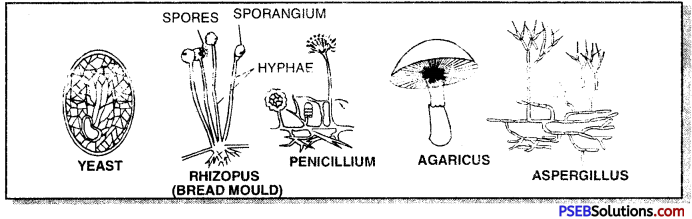
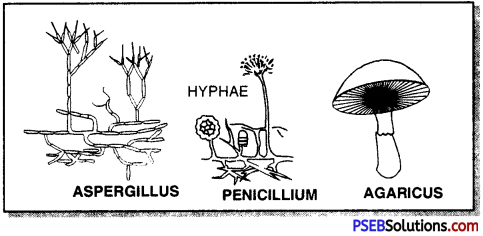
Saprophytic nutrition (Sapros = rotten; phyton = plant) It this organism releases some juices to soften or digest the food and then absorbs the nutrient. Thus they decompose the dead organic matter into simpler substance. Fungi (yeast, moulds, mushrooms) and many bacteria are saprophytic in nutrition.

The saprophytic mode of nutrition can best be exemplified by the common bread mould, Rhizopus. It converts the complex organic food materials of bread i.e. starch into soluble sugars with the help of starch digesting enzymes. These soluble sugars are then absorbed by the fungus.

Question 4.
Explain the two main steps of photosynthesis.
Answer:
Photosynthesis occurs in two main steps.

  • The first step is dependent upon light and the second step is not dependent upon light. Hence, the former is called light reaction or photochemical phase while the latter, the dark reaction or biosynthetic phase of photosynthesis.
  • Water is split up during photosynthesis by the process called photolysis. It provides reductant for carbon dioxide. Oxygen is liberated. All the liberated oxygen, therefore, comes from water.
  • The photolysis of water in photosynthesis was discovered by Hill and hence it is also known as Hill reaction.
  • The light reaction of photosynthesis is followed by the dark reaction. In this, CO2 is first fixed by ribulose diphosphate and from this fixed CO2 phosphoglyceric acid is formed. The phosphoglyceric acid thus formed ultimately forms carbohydrates.
  • The basic organic compound formed in photosynthesis is often considered to be glucose. The storage product of plants is commonly starch.
  • A chemical equation of photosynthesis is

PSEB 10th Class Science Important Questions Chapter 6 Life Processes 12
In plants and most algae it occurs in the chloroplasts i.e., light reaction and dark reaction.

Question 5.
Give a brief account of factors affecting the process of photosynthesis.
Answer:
Factors affecting the process of photosynthesis.

  • Temperature: The rate of photosynthesis increases with increase in temperature upto a maximum of 35°C. However, the rate starts decreasing if the temperature rises beyond 30°C.
  • Water: The rate of photosynthesis is slow in water-deficient conditions.
  • Carbon dioxide: The rate of photosynthesis increases with an increase in carbon dioxide concentration upto a certain level, beyond which there is no effect on the rate of photosynthesis.
  • Anatomy of leaf
  • Chlorophyll contents.

PSEB 10th Class Science Important Questions Chapter 6 Life Processes

Question 6.
What are stomata? Explain role in respiration.
Or
How respiration takes place in roots and stems in plants?
Answer:
Respiration in plants. Plants, during the process of photosynthesis, give off oxygen which is utilized during respiration.

Plant respiration occurs at slower rate.

  • In the leaves Stomata are the openings located on the surface of the leaves which are guarded by two kidney-shaped guard cells. Through stomatal opening, air can pass into or out of leaves.
  • In woody stems. Lenticelo are the breathing pores located on the surface of the woody stems through which air can pass. Plants do not have any specialised ventilation mechanism.
  • In roots. Roots take up oxygen present in between particles through root hairs by diffusion. Root hairs are simple extensions of epidermal cells of root in contact with soil.

PSEB 10th Class Science Important Questions Chapter 6 Life Processes 13
In the older parts of roots: Older portions of root hairs lacks root hairs. They are covered with protective layer of dead cells having very small openings called lenticels through which gaseous exchange take place between soil and inner living cell.

Question 7.
Demonstrate with experiment that O2 is evolved during photosynthesis.
Answer:
Take a beaker filled with water. Add a pinch of baking soda (NaHCO3) to it and put a Hydrilla plant (Aquatic plant) in it. Cover the plant with a funnel. Invert a test tube containing water over the stem of the funnel. Keep this apparatus in the bright sunlight. After some time bubbles start emerging out from the plant, which gets collected in the upper part of the test tube. Remove the test tube and test the gas with a lighted splinter, it keeps on glowing showing that the gas is a supporter of combustion. Thus, the experiment clearly shows that O2 is evolved during photosynthesis.
PSEB 10th Class Science Important Questions Chapter 6 Life Processes 14

Question 8.
To demonstrate that photosynthesis take place in the presence of chlorophyll
Procedure :

  • Take a potted plant with variegated leaves-for example, money plant or crotons.
  • Keep the plant in a dark room for three days so that all the starch gets used up.
  • Now keep the plant in the sunlight for about six hours.
  • Pluck a leaf from the plant. Mark the green areas in it and trace them on a sheet of paper.
  • Dip the leaf in boiling water for a few minutes.
  • After this immerse it in a beaker containing alcohol.
  • Carefully place the above beaker in a water-bath and heat till the alcohol begins to boil.
  • What happens to the colour of the leaf? What is the colour of the solution?
  • Now dip the leaf in a dilute solution of iodine for a few minutes.
  • Take out the leaf and rinse off the iodine solution.
  • Observe the colour of the leaf and compare this with the tracing of the leaf done in the beginning (Fig.).

PSEB 10th Class Science Important Questions Chapter 6 Life Processes 15
What can you conclude about the presence of starch in various areas of the leaf?

  • Observation and Conclusion: Only green patches of variegated leaf take on blue colour. Other parts remain unchanged.
  • Photosynthesis take place only in chlorophyll-containing patches of leaf.

Question 9.
To demonstrate that CO2 necessary for photosynthesis.
Answer:
Procedure:

  • Take two healthy potted plants which are nearly of the same size.
  • Keep them in a dark room for three days.
  • Now place each plant on separate glass plates. Place a watch-glass containing potassium hydroxide by the side of one of the plants.

The potassium hydroxide is used to absorb carbon dioxide.
PSEB 10th Class Science Important Questions Chapter 6 Life Processes 16
Experimetal set-up (a) with potassium hydroxide (b) without potassium hydroxide

  • Cover both the plants with separate bell-jars as shown in Figure.
  • Use vaseline to seal the bottom of the jars to the glass plates so that the set-up is air-tight.
  • Keep the plants in sunlight for about two hours.
  • Pluck a leaf from each plant and check for the presence of starch as in the above activity.
  • Do both the leaves show the presence of the same amount of starch?

What can you conclude from this activity?
Observation and Conclusion. The plant containing CO2 in the surrounding carry out photosynthesis. Other plant does not. It proves that CO2 is essential for photosynthesis.

Question 10.
Demonstrate with experiment that light is essential for photosynthesis.
Answer:
Take a de-starched potted plant, which has been kept in dark for 3 to 4 days. Cover one of its leaves completely with a carbon paper so that no light falls on it. Keep the plant in light for 4 to 6 hours. Test the covered leaf and uncovered leaf for starch with iodine test. The covered leaf will show negligible amount of starch, while the uncovered leaf will give positive test for starch. The process clearly shows that light is necessary for photosynthesis.

Question 11.
How is respiration different from breathing?
Answer:
Differences between Breathing and Respiration

Breathing Respiration
1. It is ventilation or bringing in of oxygenated air and giving out deoxygenated air. 1. Respiration of animals includes breathing, gaseous exchange and catabolic breakdown of food.
2. It is a physical process. 2. Respiration is both a physical and physiological process.
3. Breathing does not liberate energy. 3. It liberates energy.
4. It is restricted to organs where gaseous exchange occurs between blood and atmospheric air. 4. Respiration involves every living ceil of the body.

PSEB 10th Class Science Important Questions Chapter 6 Life Processes

Question 12.
List three differences between respiration in plants and respiration in animals.
Answer:
Differences in respiration in plants and animals

Respiration in plants Respiration in animals
1. All the cells of plant parts (root, stem, leaves) perform the respiration individually. 1. It is performed by specific respiratory organs for all the cells of body.
2. There is little transport of gases from one part to the other. 2. Transport of gases is maximum.
3. Rate of respiration is low. 3. Rate of respiration is high.

Question 13.
What is the function of epiglottis?
Answer:
Epiglottis is a flap like structure present at the top of glottis. It closes glottis during swallowing of food thus checks the entry of food into respiratory passage.

Question 14.
Why is food necessary for living organisms?
Answer:
Food provide energy to raw materials for growth and maintenance.

Utility of components of food.

  • Carbohydrates are mainly used for producing energy.
  • Fats serve as stored concentrated fuel for energy production.
  • Proteins are mainly used to build up tissues.
  • Mineral salts and vitamins regulate metabolic processes and growth.
  • Water is essential for all biological activities.

Question 15.
Explain the mechanism of breathing in human.
Answer:
Inhalation or Inspiration

  • The entry of air from outside into alveoli of lungs through respiratory tract is called inhalation.
  • The air enters when thoracic cavity expands due to contraction of intercostal muscles attached to ribs and peripheral muscles of the diaphragm.
  • Thus the thorax moves upward, outward and forward.
  • It increases the volume of thoracic cavity and the pressure decreases.
  • Thus air from outside rushes into alveoli of lungs through nostrils, nasal chambers, trachea, bronchi and bronchioles.
  • The alveolar sac gets filled with oxygen rich air.

Exhalation or Expiration is concerned with the expelling of carbon dioxide from lungs.

  • It takes place when the volume of the thoracic cavity decreases and the pressure of the contained air in the thoracic cavity increases.
  • Air passes out through the respiratory tract from the lungs.

Question 16.
What is the effect of sternuos exercise on rate of breathing and why?
Answer:
Normally man breathes about 15-18 times per minute but during hard exercise the breathing rate increases to 20 to 25 times per minute. It is due to the fact that body needs more of energy thus requires more of oxygen.

Question 17.
Give an outline of Calvin-Benson Cycle.
Answer:
Melvin Calvin and Andy Benson discovered this cycle, hence it is called Calvin cycle.
PSEB 10th Class Science Important Questions Chapter 6 Life Processes 17
Calvin-Benson Cycle

Question 18.
Label the parts in the figure.
Answer:
PSEB 10th Class Science Important Questions Chapter 6 Life Processes 18
Answer:

  1. Pseudopodium
  2. Food particle
  3. Ingestion
  4. Food Vacuole
  5. Waste
  6. Digestion of food.

Question 19.
Describe the role of intestinal juice.
Answer:
Intestinal juice too is alkaline (pH 8.3).

It has many enzymes :

  • Intestinal amylase hydrolyses the remaining starch and glycogen to maltose.
  • Maltase changes maltose to glucose.
  • Sucrase converts sucrose into glucose and fructose.
  • Lactase hydrolyses lactose to glucose and fructose.
  • Dipeptidases hydrolyse dipeptides to amino acids.
  • Intestinal lipase splits emulsified fats into fatty acids and glycerol.
  • Alkaline emulsion of digestion products formed in the small intestine is called chyle.

Question 20.
Explain absorption of food in the small intestine.
Answer:
Absorption. The process of diffusion of digested food into blood present in the blood capillaries of smail intestine is called absorption. Inner lining is thrown in fold called villi. They increase surface area for absorption of food.
Glucose, amino acid, vitamins, mineral salts and water diffuses into blood present in blood capillaries of numerous villi of the small intestine. The fatty acids and glycerol diffuses into lymph present in lymph vessels called lacteals. The digested food is carried to the liver by the hepatic portal vein. The fatty acid and glycerol unite in lymph to form fat. Most of the fat passes as a milky emulsion. After absorption, the undigested- food passes into large intestine.

Question 21.
State the functions of stomach and large intestine.
Functions of Stomach
Answer:

  • Storage of food.
  • Mechanical breakdown of food.
  • Partial digestion of food.

Functions of large intestine
Colon:

  • Its wall absorbs the water from undigested food.
  • Absorption of digested food also takes place in this region which has not been absorbed by ileum.

PSEB 10th Class Science Important Questions Chapter 6 Life Processes

Question 22.
Differentiate the following :
Respiration and Photosynthesis
Answer:
Differences between Respiration and Photosynthesis

Respiration Photosynthesis
1. It is a catabolic process in which food substrates are broken down. 1. It is an anabolic process in which food substrates are synthesized.
2. It takes place in all living cells. 2. It is carried out only by the chlorophyll containing cells of plants.
3. CO2 and H2O are produced. 3. CO2 and H2O are used.
4. CO2 is given out. 4. O2 is released as a byproduct.
5. Chemical energy is converted into ATP and some energy is lost as heat. 5. Radiant energy’of light is converted into 1 chemical energy.

Question 23.
What is fermentation? How is it important?
Answer:
The slow decomposition of organic matter into simpler substances in the presence of enzymes is known as fermentation. It is a type of anaerobic respiration. Fermentation literally means a chemical change accompanied by effervescence. The anaerobic breakdown of glucose to carbon dioxide and ethanol is a form of respiration referred to fermentation. It is normally carried by yeast cells and accounts for the production of alcohol in alcoholic bevefages. In fermentation process, if glucose is converted into ethanol then it is called ethanolic fermentation. When glucose is converted into organic acids such as lactic acid, then this type of fermentation is known as lactic acid fermentation. It is carried out by the bacterium Bacillus acidilacti.

Question 24.
Briefly explain the human respiratory system and also label the parts 1, 2, 3, 4, 3 and 6.
PSEB 10th Class Science Important Questions Chapter 6 Life Processes 19
Answer:
Human Respiratory System. Respiratory system of human beings and other mammals consists of air passage or respiratory tract, a pair of lungs.

Respiratory tract is made up of nostrils nasal cavity, pharynx, larynx, trachea and bronchi.

  1. Left Lung
  2. Heart
  3. Diaphragm
  4. Trachea
  5. Larynx
  6. Nasal Cavity

The lungs are a pair of brownish grey coloured spongy structures situated in the thoracic cavity. The left lung consists of two lobes while the right lung consists of three lobes.

Each lobule of a lung consists of bronchioles which terminate into a bunch of spherical thin walled air sacs, called alveoli.

Each alveolus or air sac has a diameter of 75 to 300 microns and has a very thin wall. The walls of the alveoli are elastic and are supplied with capillaries. Gases are exchanged between the capillaries and the air sacs through these thin walls.

Question 25.
What are the different modes of respiration in animals?
Answer:
In animals such as earthworm, respiration is by skin.

  • The insects have an elaborate tracheal system of respiration.
  • Fishes respire through gills.
  • Respiratory system of human beings and other mammals consists of air passage or Respiratory tract, and a pair of lungs.
  • Respiratory tract is made up of nasal cavity, pharynx, larynx, trachea and bronchi. The lungs are a pair of brownish grey coloured spongy structures situated in the thoracic cavity.
  • The left lung consists of two lobes while the right lung consists of three lobes.
  • Each lobule of a lung consists of bronchioles which terminate into a bunch of spherical thin-walled air sacs, called alveoli.

Question 26.
Differentiate between respiration and combustion.
Answer:
Difference between respiration and combustion.

Respiration Combustion
1. It occurs in living cells. 1. It occurs in non living and dead cells.
2. It is a complex biochemical process controlled by several enzymes. 2. It is a chemical process.
3. Heat produced is much less. 3. A large amount of heat is produced.
4. There is no flame or light produced. 4. This process is usually accompanied with flame and light.

Question 27.
What are parasitic nutrition?
Answer:
Parasitic nutrition (Para = besides ; sitos = food). In this an organism (parasite) depends upon the organism (host) for its nutritional requirements. Many bacteria, viruses, fungi, some non-green plants and many animals have this mode of nutrition.

For example, a fungus Puccinia is a parasite on wheat and barberry plants; Cuscuta or dodder plant grows as a parasite on many plants; tapeworms and round worms are parasites in the body of man etc.

Parasites are of two kinds :

  1. Ectoparasites and
  2. Endoparasites

Question 28.
Differentiate between Light reaction and Dark reaction in photosynthesis.
Answer:
Difference between light reaction and Dark reaction

Light reaction Dark reaction
1. Light reaction is light induced chemical reaction. 1. Dark reaction requires no light and is purely enzyme controlled reaction.
2. Energy rich compounds like ATP and NADPH2 are synthesized. 2. The energy rich compounds are used to produce the organic compounds.
3. Oxygen is liberated. 3. No liberation of oxygen.
4. It takes place in the grana of the chloroplasts. 4. It takes place in the stroma of chloroplasts.

Question 29.
What are the functions of liver?
Answer:
Functions of liver

  1. Role in digestion. Bile produced by liver helps in the digestion of food as follows.
    • It emulsifies the fats with its salts.
    • It prevents decomposition of food by checking the growth of bacteria.
    • It neutralizes the acid coming from the stomach along with food and provide alkaline medium in the intestine required for action of enzymes of pancreas and intestinal glands.
  2. Regulation of Blood Sugar: The liver separates the excess of sugar from the blood and stores it in its cells as glycogen (animals starch).
  3. Formation of Glycogen from non-carbohydrates Sources.
  4. Deamination: In the liver, the amino acids coming from the alimentary canal are sorted out, ammonia is formed. Ammonia is converted to less toxic urea.
  5. Excretion: Liver collects haemoglobin of the worn-out red blood corpuscles and changes it into bile pigments.

Question 30.
Differentiate between Saprophytic and Parasitic nutrition.
Answer:

Saprotrophic Nutrition Parasitic nutrition
Many organisms absorb fluid food through the body surface. This is called saprotrophic nutrition. Bacteria and fungi flourish on dead, decaying organic matter of both plant and animal origin. They secrete digestive enzymes onto this matter. The enzymes hydrolyze the organic matter into simple soluble products that are then absorbed. This method of taking up organic food is known as saprophytic nutrition. The organisms obtain nutrients from a living host without helping it any way.
Examples. Liver fluke lives in the bile duct of sheep and absorbs nutrient. Other examples include several fungi, bacteria and a few higher non-green plants such a cuscuta.

PSEB 10th Class Science Important Questions Chapter 6 Life Processes

Question 31.
Discuss the fate of food in the oral cavity of man.
Answer:
Fate of food in mouth cavity. The partial digestion of food occurs due to the action of Ptyalin enzyme. It acts on starches and forms maltose.
The sufficiently masticated, partially digested food forms bolus. It is swallowed into oesophagus through gullet by raising the throat aided by the muscles of pharynx.

Question 32.
What is a digestive gland? Name the various digestive glands of man and their secretions.
Answer:
Digestive gland. A gland that secretes digestive juice which is helpful in the digestion of food is called a digestive gland.

Digestive glands of Man

Name of digestive gland Name of digestive juice/Secretion
1. Salivary gland Saliva
2. Gastric glands Gastric juice
3. Pancreas Pancreatic juice
4. Liver Bile
5. Intestinal glands Intestinal juice

Question 33.
Write the enzymes of the pancreatic juice, the substrates they digest and the products of their digestive action.
Answer:
Enzymes of the pancreatic juice

Name of Enzyme Substrate Name of end products
1. Amylase Starch, glycogen Maltose and Isomaltose
2. Trypsin Proteoses, Peptones and Proteins Peptides and amino acid
3. Lipase Emulsified lipids Glycerol and fatty acids

Question 34.
What is meant by photosynthesis? What are the basic requirements for the process of photosynthesis?
Answer:
The manufacture of organic compounds from carbon dioxide and water in the presence of sunlight inside the chlorophyll containing cells of the plant is called photosynthesis. The overall reaction of photosynthesis is
PSEB 10th Class Science Important Questions Chapter 6 Life Processes 20
Basic requirements for photosynthesis. CO2, water, chlorophyll and solar energy. Photosynthesis is a photo-biochemical process in which energy rich compounds such as carbohydrates (glucose) are synthesized from simple inorganic compounds like CO2 and water in the presence of sunlight and chlorophyll. Oxygen is a by-product.

Question 35.
What are the different ways in which glucose is oxidized to provide energy in various organisms?
Answer:
Breaking down of glucose involves two step process. In the first step, it is broken into three carbon molecule called pyruvate. The pyruvate is further broken down into energy in following different ways in various organisms :

  • Aerobic Respiration: In this case, pyruvate is broken down into water and carbon dioxide along with release of energy. It commonly occurs in mitochondria of cells.
  • Anaerobic Respiration in Yeast: In yeast cells during fermentation pyruvate is converted into ethanol and carbon dioxide in the absence of oxygen.
  • Anaerobic Respiration in Muscles: Due to lack of oxygen, e.g. during vigorous running or exercise, in human muscles, pyruvate is converted into lactic acid.

Question 36.
Explain how exchange of materials takes place between Blood and Tissues.
Answer:
Arteries supply fresh blood with 02 and food materials to different body organs. Inside the body organ the artery divides into smaller branches called arterioles. The arterioles further divide into extremely thin walled blood capillaries. The blood capillaries form an extensive network inside the body organ. They make their way through the tissue cells. Blood plasma along with the dissolved materials comes out of the thin walls of the blood capillaries and collects into the tissue. It is then called tissue fluid, which acts as an intermediate medium between blood and tissue cells.

The tissue fluid contains different materials such as oxygen, amino acids, glucose, mineral ions and proteins etc. which are needed by the body cells. The body cells take up the required materials from the tissue fluid and release their wastes such as C02 and nitrogenous wastes. These enter through the blood capillary wall and dissolve into the blood plasma or enter into the red blood cells and are carried away.

Question 37.
Outline inhalation-exhalation cycle.
Answer:

  • Inhalation: Lowering of diaphragm → Rising of rib cage → Gas (O2) passes to Alveoli
  • Exhalation: Air is forced out → Rising of diaphragm → Lowering of ribcage

Question 38.
Leaves of a healthy potted plant are coated with vaseline to block the stomata. Will this plant remain healthy for long? State three reasons to support your answer.
Answer:
No, the plant will not remain healthy because no exchange of gases will take place. It will lead to :

  • low respiration
  • no photosynthesis occurs
  • no transpiration.

Hence plant will not remain healthy and may die eventually.

Question 39.
What are
(i) stomata and
Answer:
Stomata are tiny apertures found on the surface of the leaf, which regulate the exchange of respiratory gases and transpiration.

(ii) lenticels?
Answer:
Lenticels are the raised pores in the woody plants that allow the exchange of gases between the atmosphere and the internal tissues.

Question 40.
Briefly explain breathing, external resperation exchange of gases and tissue resperation.
Answer:

  • Breathing involves inhaling of oxygen rich fresh air and exhaling of carbon dioxide rich foul air. The respiratory surface is richly supplied with blood for this purpose. Oxygen of the inhaled air is taken up by blood while carbon dioxide of the blood passes into the air for exhalation.
  • The exchange of gases between the blood and the air at the respiratory surface is. known as external respiration.
  • Oxygen absorbed by the blood at the respiratory surface is taken to various parts of the body through arteries. Blood loses the oxygen contained in it to tissue fluid, from where it picks up carbon dioxide. The latter is brought to the respiratory surface by blood.
  • Tissue respiration, also called internal respiration, is the exchange of gases between the tissue cells and the blood involving uptake of oxygen by tissue cells, oxidation of respiratory substrate and elimination of carbon dioxide by the cells.

Question 41.
Why is mitochondria termed ‘power house’ of the cell?
Answer:

  • Most of the aerobic respiration occurs inside the mitochondria and therefore, the latter are also called power houses of the cells.
  • Mitochondria are site of synthesis, storage and transport of ATP.
  • ATP (Adenosine triphosphate) is the energy currency of the living organisms.
  • Adenosine triphosphate. The energy released during cellular respiration is immediately used to synthesise a molecule called ATP from ADP and inorganic phosphate

PSEB 10th Class Science Important Questions Chapter 6 Life Processes 21
ATP is used to fuel all other activities in the cell. Therefore, it is said to be the energy currency for . most cellular processes.

Question 42.
The figure shows different ways in which glucose is oxidised to provide energy in various organisms?
Fill up the blanks : A _________ B _________ C _________, D. _________ E _________ F _________
PSEB 10th Class Science Important Questions Chapter 6 Life Processes 22
Answer:
Different pathways to provide energy from glucose
A. glucose
B. Pyruvate
C. Absence of Oxygen
D. Presence of oxygen
E. Lactic Acid F. Carbondioxide

Question 43.
Fill in the blanks 1, 2, 3, 4, 5, 6 in the figure.
PSEB 10th Class Science Important Questions Chapter 6 Life Processes 23
Double circulation of blood in birds and mammals.
Answer:

  1. Right vetricle
  2. Lungs
  3. Left Auricle
  4. Left Ventricle
  5. Body parts (except Lungs)
  6. Right Auricle

PSEB 10th Class Science Important Questions Chapter 6 Life Processes

Question 44.
State differences between artery and vein.
Answer:
Differences between Artery and Vein

Artery Vein
1. An artery carries blood from the heart to different organs of the body. 1. A vein collects blood from different organs of the body and brings it back to the heart.
2. Blood flows under great pressure. 2. Blood flows under less pressure.
3. It has a thick muscular wall. 3. Wall is thin
4. It is non collapsible. 4. It is collapsible.
5. It contains oxygenated blood (Exception pulmonary artery). 5. It contains deoxygenated blood (Exception pulmonary vein)
6. Valves are absent. 6. Valves are present.
7. Mostly deep seated. 7. Mostly superficial.

Question 45.
Why are WBCs called ‘soldiers of the body’?
Answer:
WBC (White Blood Corpuscles) or leucocytes engulf and destroy the foreign particles in the body. Hence they are called ‘soldiers of the body.’

Question 46.
What are hypertension and hypotension?
Answer:
Hypertension. It is the high blood pressure which is caused due to emotions such as worry, excitement, fear etc.
Hypotension. It is the low blood pressure when it falls below the normal level.

Question 47.
Name the three major types of blood vessels. Explain briefly.
Answer:
The three main types of blood vessels are :

  • Arteries have thick elastic walls and their diameter may be even 1 cm. These blood vessels carry the blood from the heart to the various parts of the body.
  • Capillaries. Arteries divide into thin arterioles and arterioles further ramify into capillaries (1 micron diameter). The wall of a capillary is made up of a single layer of cells. The muscles and elastic fibres are absent in the capillaries. The walls of these capillaries are so thin that the exchange of food materials, waste materials and gases takes place between the blood and protoplasm of cells (liver, lung etc.) through them.
  • Veins. The capillaries again reunite to form venules and venules unite to form veins. These venules and veins return the blood to the heart.

PSEB 10th Class Science Important Questions Chapter 6 Life Processes 24
Diagram showing the relationship among blood vessels

Question 48.
Write a note on lymphatic system in human beings.
Answer:
Lymphatic system: The lymphatic system comprises colourless fluid, the lymph; a network of fine channels, the lymphatic capillaries; tubes of varied sizes, the lymphatic vessels; and the lymph nodes. Tissue or interstitial fluid present in the spaces between tissue cells is formed by filtration of protein-free fluid from the blood. Tissue fluid passes into lymphatic capillaries to form lymph. The latter is carried by lymphatic vessels to the veins. Lymphatic vessels have lymph nodes which filter lymph, removing microorganisms and cellular debris and adding lymphocytes.

Question 49.
Write functions of lymph.
Answer:
Functions of lymph

  • It drains excess tissue fluid from the extracellular spaces back into the blood.
  • Some of the fluid from the digestive tract is absorbed in the lymph. The lymphatic vessels store this fluid temporarily, and release it gradually so that the kidneys do not face a sudden pressure of urine excretion.
  • It carries carbon dioxide and nitrogenous waste materials that diffuse into the tissue fluid to the blood.
  • It takes lymphocytes and antibodies from the lymph nodes to the blood.

Question 50.
Give differences between blood and lymph.
Answer:
Differences between Blood and Lymph

Blood Lymph
1. It consists of plasma, erythrocytes, leucocytes and platelets. 1. It consists of plasma and leucocytes (lymphocytes most abundant).
2. It is red in colour due to the presence of haemoglobin in erythrocytes. 2. It is colourless as haemoglobin is absent,
3. Its plasma has more proteins, calcium and phosphorus. 3. Its plasma has fewer proteins and less calcium and phosphorus.
4. It transports materials in the body. 4. It acts as middle man between blood and body tissue.

Question 51.
How are xylem and phloem well suited for transport of materials in plants? Explain.
Or
How are water and mineral transported in plants?
Answer:
Xylem and phloem are well suited to carry water, minerals and food in plants. Vessels in the xylem are cylindrical in shape with their ends open and are placed one above the other so as to form a continuous column stretching from roots to leaves. So, the water and minerals absorbed by the roots are carried upwards to the leaves. This is known as transportation.

Similarly, phloem has sieve tubes that are also cylindrical but the ends are not open instead covered with sieve (perforated) plate. These tubes are also placed one above the other, forming a continuous column from leaves to other parts of the plant body. The food synthesized in the leaves is carried to other paxts of the plant body through phloem. Sucrose is the main form in which carbohydrates are translocated in plants.
PSEB 10th Class Science Important Questions Chapter 6 Life Processes 25
Xylem vessels that transport water and mineral sahs

PSEB 10th Class Science Important Questions Chapter 6 Life Processes 26
Phioem tubes that conduct prepared food.

Question 52.
Mention any three methods adopted by plants to minimise the transpiration rate.
Answer:
Three methods adopted by plants to minimise the rate of transpiration are :

  1. In some cases leaves are rolled to cover stomata (e.g. some grasses)
  2. The stomata may be sunken (e.g. Nerium)
  3. In some cases, leaves may be dropped or absent as in most cacti.

Question 53.
Write a short note on root pressure.
Answer:
Root pressure: During absorption, water is forced into the xylem vessels by the surrounding cortical cells with a certain force. This induces a pressure which is responsible for ascent of sap to many feet in xylem. This pressure which is developed due to the activity of root is called as root pressure.
Root pressure is a vital phenomenon and depends upon the activity of living root cells. The magnitude of root pressure varies from 2-8 atm.

Question 54.
How is transpiration useful to plants?
Answer:
Advantages of transpiration

  • It has cooling effect on the plants as excess of sun’s energy is dissipated.
  • It helps in the removal of excess of water from the plant.
  • It causes ascent of sap.
  • It helps to maintain water cycle.
  • It increases the amount of sugar and mineral content in the fruit.
  • It is needed to permit photosynthesis to take place.

Question 55.
What are the disadvantages of transpiration?
Answer:

  • More plants die from excessive water loss by transpiration.
  • Due to high rate of transpiration plants suffer from loss of turgidity.

PSEB 10th Class Science Important Questions Chapter 6 Life Processes

Question 56.
What is translocation?
Answer:
Translocation: The long distance transport of the organic food from a source to a sink is known as translocation.

Question 57.
(a) What is blood pressure?
Answer:
Blood pressure is the force that blood exerts against the wall of a vessel. This pressure is much greater in arteries than in veins. The pressure of blood inside the artery during ventricular systole is called systolic pressure and pressure in artery during ventricular diastole is called diastolic pressure.

(b) What are normal value of systolic and diastolic blood pressure
Answer:
The normal systolic pressure is about 120 mm of Hg and diastolic pressure is 80 mm of Hg.

(c) How is it measured?
Answer:
PSEB 10th Class Science Important Questions Chapter 6 Life Processes 27
Measurement of blood pressure

(d) Name the instrument used to measure blood pressure.
Answer:
Blood pressure is measured with an instrument called sphygmomanometer.
High blood pressure is also called hypertension and is caused by the constriction of arterioles, which results in increased resistance to blood flow. It can lead to the rupture of an artery and internal bleeding.

Question 58.
Write a note on mechanism of blood clotting.
Answer:
Blood Clotting: At the site of injury, blood platelets disintegrate and release enzyme thromboplastin. Thromboplastin in the presence of calcium ions, transforms the inactive prothrombin into active thrombin. Thrombin converts soluble fibrinogen into insoluble fibrin. This forms a meshwork of fibrils which entangle blood corpuscle and transforms the liquid blood into a gel or clot.
PSEB 10th Class Science Important Questions Chapter 6 Life Processes 28
Mechanism of Blood Clotting
Unless the blood clots at the site of the injury, there will be loss of blood (blood haemorrhage).
Such a loss of blood will lead to death of the person.

Question 59.
Briefly describe excretory system.
Answer:

  • Kidneys are a pair of bean-shaped reddish brown organs which lie in the lumbar part of abdomen along the dorsal wall, one on either side of the vertebral column.
  • Each kidney receives a renal artery from dorsal aorta and sends a renal vein to inferior vena cava.
  • The excretory waste products ,are filtered out in the kidney.
  • Each kidney contains about 1.2 million excretory units called uriniferous tubules or nephrons.
  • Uriniferous tubule is a long, twisted, narrow, tubular structure which consists of ‘ Bowman’s capsule, neck, proximal convoluted tubule, loop of Henle and distal convoluted tubule.
  • Bowman’s capsule is a blind cup-shaped end of uriniferous tubule with a tuft of blood capillaries called glomerulus.
  • Ureters are two distensible tubes which connect the kidneys with the urinary bladder.
  • Urinary bladder is a median pear-shaped bag-like structure that occurs in she pelvic region of abdominal cavity.
  • Urinary bladder can hold 300-800 ml of urine.
  • Urethra is a tubular connection between the urinary bladder and the external Opening of urinary tract.

Question 60.
Label the parts of human excretory system.
Answer:
PSEB 10th Class Science Important Questions Chapter 6 Life Processes 29

  1. Kidney
  2. Ureter
  3. Urinary Bladder.

Question 61.
How does the excretion take place in Amoeba?
Answer:
The excretory product of Amoeba is ammonia. Special excretory organelle is lacking in Amoeba. C02 and ammonia are excreted by diffusing in solution through plasma membrane. The concentration of ammonia is always higher in Amoeba than in the surrounding water. The water enters through plasma membrane by “endosmosis”. Ammonia is formed in cytoplasm by metabolism.

Surplus water enters contractile vacuole. This surplus water can rupture the animal’s body. Thus size of contractile vacuole increases, when the contractile vacuole is fully expanded with water, it moves towards the periphery. As the contractile vacuole comes in close contact with the plasma membrane, it bursts. Thus excess of water (surplus water) is discharged in the surrounding water. This phenomenon of controlling the amount of water in the body is called as “osmoregulation”.
PSEB 10th Class Science Important Questions Chapter 6 Life Processes 30
Excretion in Amoeba

Question 62.
State one main function of the following :
(i) Glomerulus
Answer:
The filtration of blood in the nephron takes place in the glomerulus.

(ii) Malpighian capsule
Answer:
Malpighian capsule is concerned with ultrafiltration.

(iii) Sweat gland
Answer:
Sweat glands produce sweat containing urea, uric acid and salts. Sweat evaporates to bring down the body temperature to normal.

(iv) Nephron of kidney tubule
Answer:
Through the kidney tubule or nephrons, filtration of urea, uric acid, water and some salts occur from the blood.

(v) Loop of Henle.
Answer:
Loop of Henle is useful in the absorption of water and secretion of urea.

Question 63.
Name the chief organs of excretion in man. Mention the waste products that they excrete.
Answer:
The chief excretory organs and the waste products removed by them are :

  1. Kidneys – Urea in the form of urine.
  2. Lungs – Carbon dioxide.
  3. Skin – Water and salts as sweat.

Question 64.
Name the following :
(i) A process by which the unwanted nitrogenous wastes are eliminated from the body.
Answer:
Excretion

(ii) Major excretory organs of man.
Answer:
Kidneys

(iii) The structural and functional units of kidney.
Answer:
Nephrons

(iv) A tuft of blood capillaries found in the Bowman’s capsule of nephron.
Answer:
Glomerulus

Question 65.
Name the following :
(i) The structure that brings urine from the kidney to the urinary bladder.
Answer:
Ureter

(ii) Thin membranous sac serving as the reservoir of urine.
Answer:
Urinary bladder

(iii) Any two organic constituents of normal human urine.
Answer:
Urea, creatinine

(iv) The chief nitrogenous waste product in the human urine and the organ which produces it.
Answer:
Urea, liver

(v) Name two excretory products formed by the liver.
Answer:
Bile pigments (Bilirubin, Biliverdin), urea.

Question 66.
What do you understand by artificial kidney? Name the principle on which it works.
Or
Write a note on haemodialysis.
Answer:
Artificial Kidney or Haemodialysis. In case of acute kidney failure, the poisonous materials may accumulate in the body fluids which will cause oedema and finally lead to death of the patient. In such cases, artificial kidney is used. It works on the principle of dialysis and separates wastes from the blood. The process is called haemodialysis.

Artificial kidney contains a number of tubes with a semipermeable lining.
Its functioning is similar to kidney, but it is different since there is no reabsorption involved.

In this, blood from an artery is diverted through a cellophane tube, having pores equal to those of glomerular capillaries, placed in a circulating bath. Concentration of bath-fluid is kept equal to that of normal plasma. The pores in the cellophane tube allow small sized wastes like urea, ammonium salts etc. to pass through but do not allow the passage of blood cells, proteins, fats etc. Diffusion of small and useful substances like glucose, amino acids etc is prevented by keeping their concentration in the dialysis fluid equal to the normal plasma. Blood from dialyser is returned to the body through a vein.
PSEB 10th Class Science Important Questions Chapter 6 Life Processes 31
Flow of blood through an artificial kidney for haemodialysis.

Question 67.
What are the functions of tongue?
Answer:
Functions of tongue.

  • It helps in mastication of food.
  • It bears taste buds and helps in the sensation of taste of food.
  • It takes part in the modification of sound production.
  • It acts as a brush and cleans the teeth.
  • It aids in deglutition of food.

PSEB 10th Class Science Important Questions Chapter 6 Life Processes

Question 68.
(i) Label the part A-E
Answer:
PSEB 10th Class Science Important Questions Chapter 6 Life Processes 32
A. Interventricular System B. Right Ventricle C. Right Atrium D. Left Ventricle E. Aorta

(ii) Write Function of E.
Answer:
Function of E-Aorta carries blood to all parts of body.

Very Short Answer Type Questions

Question 1.
Why are maintenance processes required?
Answer:
They are required to prevent breakdown.

Question 2.
List three characteristics of living organisms.
Answer:

  1. Growth
  2. Movements
  3. Repair and maintenance of their structures.

Question 3.
What are life processes?
Answer:
The processes which together perform the maintenance jobs are collectively termed as life processes.

Question 4.
What is the basic requirement of maintenance?
Answer:
Energy is needed by living organisms for maintenance.

Question 5.
What are sources of energy for living organisms?
Answer:
Carbon based molecules i.e. food obtained from environment.

Question 6.
List the common reactions required to obtain energy from carbon based molecules.
Answer:
Oxidising-reducing reactions.

Question 7.
Name any four life processes required for maintenance.
Answer:

  1. Nutrition
  2. Respiration
  3. Transportation
  4. Excretion.

Question 8.
What are nutrients?
Answer:
The substances which provide materials for growth, energy and maintenance are called nutrients.

Question 9.
What is nutrition? Why is it necessary?
Answer:
Nutrition. The sum total of processes by which living organisms obtain food materials and prepare them for use in the growth, repair and providing energy is termed nutrition.

Question 10.
What is food?
Answer:
Food provides energy. It Provides raw materials for growth and maintenance.

Question 11.
What is holozoic nutrition?
Answer:
Holozoic nutrition. When the nutrients are ingested as solid organic food matter, it is called holozoic nutrition.

PSEB 10th Class Science Important Questions Chapter 6 Life Processes

Question 12.
What is the source of food for heterotrophs?
Answer:
All heterotrophs obtain food from autotrophs.

Question 13.
Name the process which prepares food is autotrophs.
Answer:
Photosynthesis.

Question 14.
Why are green plants called producers?
Answer:
Green plants prepare their food from CO2 and H2O in the presence of sunlight and chlorophyll. All other organisms obtain food from green plants, thus called as producers.

Question 16.
In which spectrum of light maximum photosynthesis occurs?
Answer:
Red light.

Question 17.
Where is chlorophyll present in cells of leaves?
Answer:
Chloroplast.

Question 18.
How does oxygen produced during photosynthesis enter the atmosphere?
Answer:
Oxygen passes out of green leaves through stomata and diffuses into the atmosphere.

Question 19.
Where does photolysis occur in plant?
Answer:
Photolysis occurs in chloroplasts present in the cell.

Question 20.
Write chemical reaction of photosynthesis.
Answer:
PSEB 10th Class Science Important Questions Chapter 6 Life Processes 33

Question 21.
What are the advantages of cooked food?
Answer:
Human beings consume cooked food. Cooking makes it soft, palatable, tasty and easier to digest.

Question 22.
What is the role of CO2 during photosynthesis?
Answer:
CO2 provides carbon for synthesis of glucose (C6H12O8) during photosynthesis.

Question 23.
What is the role of stomata in green leaves?
Answer:
Stomata are minute pores through which exchange of gas occurs.

Question 24.
Name the minerals obtained from soil by plants.
Answer:
Nitrogen, phosphorus, potassium, iron, magnesium and other minerals.

Question 25.
What is the role of nitrogen plants?
Answer:
Nitrogen is constituent of proteins and nitrogen bases of nucleic acids.

Question 26.
What is the food of Amoeba?
Answer:
Food of Amoeba consists of small protozoans, algae, rotifers, bacteria, and diatoms. It also feeds upon bits of organic matter.

Question 27.
Is food vacuole of Amoeba, temporary structure or a permanent one?
Answer:
Food vacuole is a temporary structure.

Question 28.
What is saliva?
Answer:
Saliva is a digestive juice secreted by salivary glands present in oral cavity.

Question 29.
Name the enzyme present in saliva.
Answer:
Salivary amylase.

Question 30.
Name the organ through which blood passes into stomach from oral cavity.
Answer:
Pharynx and oesophagus.

Question 31.
Name the largest part of alimentary canal.
Answer:
Small intestine.

Question 32.
Which of the animals need long large intestine?
Answer:
Animals eating grasses need large intestine for digestion of cellulose.

Question 33.
What is the nature of food entering small intestine from stomach?
Answer:
Acidic in nature.

Question 34.
Name the juices which convert acidic food into alkaline in small intestine.
Answer:
Bile and pancreatic juice.

Question 35.
Name the digestive juice secreted by liver.
Answer:
Bile juice.

Question 36.
Name the digestive juice secreted by pancreas.
Answer:
Pancreatic juice.

PSEB 10th Class Science Important Questions Chapter 6 Life Processes

Question 37.
List the enzymes which help in the digestion of proteins.
Answer:

  • Pepsin
  • Trypsin
  • Chymotryposin
  • Peptidases.

Question 38.
What is approximate length of human alimentary canal?
Answer:
9 to 10 metres.

Question 39.
Name the largest gland present in human body.
Answer:
Liver.

Question 40.
Name the gland which is exocrine as well as endocrine in nature.
Answer:
Pancreas.

Question 41.
What are three parts of small intestine?
Answer:

  1. Duodenum
  2. Jejunum
  3. Ileum.

Question 42.
Differentiate between chyme and chyle.
Answer:

  • Chyme is a semisolid, semidigested acidic food which passes from stomach into duodenum.
  • Chyle is emulsion form, completely digested, alkaline food present is small intestine ready for absorption.

Question 43.
Name the four enzymes present in pancreatic juice.
Answer:

  1. Pancreatic amylase
  2. Pancreatic lipase
  3. Trypsin
  4. Chymotrypsin.

Question 44.
Maximum water is absorbed in which part of alimentary canal.
Answer:
Large intestine.

Question 45.
What is digestion?
Answer:
Digestion. Chemical and mechanical break down of complex, non-diffusible form of food into simple diffusible form of food by action of enzyme.

Question 46.
What is assimilation?
Answer:
The absorption and digestion of food or nutrients by the body or any biological system.

Question 47.
What is egestion?
Answer:
The act or process of discharging undigested food as faeces from a cell in case of unicellular organisms.

Question 48.
What are villi present is small intestine and not in stomach?
Answer:
Small intestine is site of absorption of digested food, villi increase the surface area for absorption of food. No absorption of food occurs in stomach thus villi are absent.

Question 49.
What happens to pyrnvate produced during anaerobic respiration?
Answer:
Pyruvate produced at the end of glycolysis is converted to C02 and ethanol.

Question 50.
What is aerobic respiration?
Answer:
Aerobic respiration is the process of producing cellular energy involving oxygen cells break down food in the mitochondria in a long, multistep process that produces roughly 36 ATP.

Question 51.
What is anaerobic res-piration?
Answer:
A form of incomplete intracellular breakdown of sugar or other organic compounds in the absence of oxygen that releases energy.

Question 52.
What is ATP?
Answer:
ATP is Adenosine triphosphate. It is the energy currency of life. ATP is a high- energy molecule found in every cell. Its job is to store and supply the cell with needed energy.

Question 53.
Expand NADP.
Answer:
NADP. Nicotinamide Adenine Dinucleotide.

Question 54.
Name three animals which respire through skin.
Answer:

  1. Earthworm
  2. Leech
  3. Frog.

Question 55.
Where does Krebs cycle occur in the body?
Answer:
Krebs cycle is completed in mitochondria of cells.

Question 56.
What is hypoxia?
Answer:
Hypoxia is a condition of shortage of oxygen in the body due to strangulation on cyanide poisoning.

Question 57.
Name the respiratory sub-strate.
Answer:
Glucose.

Question 58.
What is the end product of aerobic respiration?
Answer:
Carbon dioxide and water.

Question 59.
What is fermentation?
Answer:
Incomplete breakdown of glucose in the absence of oxygen in microbes such as bacteria and yeast. It forms CO22, ethanol and energy is released in small amount.

Question 60.
Man breaths how many times per minute?
Answer:
12-15 times.

Question 61.
What are the functions of ATP?
Answer:
ATP provide energy for all metabolic reactions in the body such as movements, synthesis, cell division.

PSEB 10th Class Science Important Questions Chapter 6 Life Processes

Question 62.
What is bark?
Answer:
The tissue ontside the outer most covering of the stem or root is called bark.

Question 63.
Name the tissue which transport food in plants.
Answer:
Phloem.

Question 64.
What is xylem?
Answer:
Xylem is a complex tissue which transport water and minerals from roots to other parts of the plant.

Question 65.
Name two substances which enter the root through the root hairs.
Answer:

  1. Water
  2. Soluble minerals from soil.

Question 66.
What is ascent of sap?
Answer:
The process by which water absorbed by the root is carried to aerial parts of plant is called ascent of sap.

Question 67.
Name the transport tissue of body.
Answer:
Blood and lymph.

Question 68.
Name the three types of blood vessels.
Answer:

  1. Arteries
  2. Veins
  3. Capillaries.

Question 69.
List types of circulation in human body.
Answer:
Double circulation involving pulmonary circulation and systemic circulation.

Question 70.
Name the fluid medium of blood.
Answer:
Plasma.

Question 71.
Why is the S-A node called pace-maker of the heart?
Answer:
S-A node, being self-excitatory, initiates a wave of contraction in the heart.

Question 72.
Name the organs which play role in circulation of blood.
Answer:
Heart. It is a muscular, pumping organ. It pumps the blood in the body.

Question 73.
Name the types of cells which destroy harmful bacteria in the body.
Answer:
White blood corpuscles (W.B.C.)

Question 74.
Name the instrument used to measure blood pressure.
Answer:
Sphigmomanometer.

Question 75.
Name the artery which carry impure (deoxygenated) blood from heart to lungs.
Answer:
Pulmonary artery.

Question 76.
Expand ECG.
Answer:
Electrocardiogram.

Question 77.
Write normal blood pressure in human body.
Answer:
120/80 → Systolic = 120 and Diastolic = 80

Question 78.
Name the largest artery.
Answer:
Aorta.

Question 79.
What is excretion?
Answer:
Excretion. Elimination of nitrogenous waste materials from body is called excretion.

Question 80.
How many nephrons are present in each kidney?
Answer:
About 10 lakhs.

Question 81.
What are the excretory structures of amoeba?
Answer:
Contractile vacuole.

Question 82.
What is a malpighian body (renal corpuscle)?
Answer:
Bowman’s capsule and glomerulus.

Question 83.
Name the reservoir of urine in the body.
Answer:
Urinary bladder.

Question 84.
What is micturition?
Answer:
Act of passing out of urine from urinary bladder is called micturition.

Question 85.
Name the structures which store wastes in plants.
Answer:
Central vacuoles.

Question 86.
What are resins and gums?
Answer:
These are storage wastes of plants.

Question 87.
Define autotrophic nutrition.
Answer:
The organisms prepare their own food from raw materials like C02 and H20 in the presence of sunlight. It takes place in green plants containing chlorophyll.

Question 88.
Define heterotrophic nutrition.
Answer:
The mode of taking readymade organic food material is called heterotrophic nutrition. It may be holozoic (ingestive) or saprophytic and parasitic (absorptive).

Multiple Choice Questions

Question 1.
Among the following which is a parasitic plant?
(A) Plasmodium
(B) Cuscuta
(C) Amoeba
(D) Rhizobium.
Answer:
(B) Cuscuta

Question 2.
Dark reaction and light reaction of photosynthesis takes place is:
(A) stroma and grana of chioroplast respectively
(B) grana and stroma of chioroplast respectively
(C) grana only
(D) stroma only.
Answer:
(A)stroma and grana of chioroplast respectively

PSEB 10th Class Science Important Questions Chapter 6 Life Processes

Question 3.
Chemical reaction takes place during dark reaction of photosynthesis is:
(A) photo1ysi
(B) hydrolysis
(C) carbon dioxide is bonded with RUBP
(D) nitrogen fixation.
Answer:
(C) carbon dioxide is bonded with RUBP

Question 4.
Plants are green in colour because:
(A) they absorb green light only
(B) they reflect green light
(C) they absorb green light but reflect all other lights
(D) none of the above are correct.
Answer:
(B) they reflect green light.

Question 5.
The nutrition in Mucor is:
(A) parasitic
(B) autotrophic
(C) saprophytic
(D) holozoic.
Answer:
(C) saprophytic

Question 6.
In amoeba the digestion is intracellular because :
(A) amoeba is unicellular
(B) amoeba is multicellular ‘
(C) amoeba is found in pond
(D) amoeba is microscopic animal.
Answer:
(A) amoeba is unicellular

Question 7.
Which of the following has no digestive enzyme?
(A) Saliva
(B) Bile
(C) Gastric juice
(D) Intestinal juice.
Answer:
(B) Bile

Question 8.
C02 acceptor during dark reaction of photosynthesis is :
(A) RUBP
(B) PEP
(C) NADPH
(D) ATP.
Answer:
(A) RUBP

Fill in the blanks:

Question 1.
Viruses show _________ movements.
Answer:
Molecular.

Question 2.
Growth, _________ and repair and _________ are characteristics of life.
Answer:
movements, maintenance.

Question 3.
_________ is needed by living organisms for movements and maintenance.
Answer:
Energy.

PSEB 10th Class Science Important Questions Chapter 6 Life Processes

Question 4.
_________ is the largest gland of body.
Answer:
Liver

Question 5.
_________ and are the raw materials for photosynthesis.
Answer:
C02 and H20.

Question 6.
RBC transport _________ in the body.
Answer:
Oxygen.

Question 7.
Xylem and _________ are the main conducting tissues in plants.
Answer:
Phloem.

Question 8.
Translocation of food takes place through _________ of phloem.
Answer:
Sieve tubes.

PSEB 10th Class Science Important Questions Chapter 5 Periodic Classification of Elements

Punjab State Board PSEB 10th Class Science Important Questions Chapter 5 Periodic Classification of Elements Important Questions and Answers.

PSEB 10th Class Science Important Questions Chapter 5 Periodic Classification of Elements

Long Answer Type Questions

Question 1.
What do you understand by Dobereiner’s triads? Give some examples to support it.
Answer:
In 1817, a German Chemist, Dobereiner, gave a classification in which the similar elements were arranged in groups of three called Triads. The arrangement was such that the atomic mass of the middle element was almost the average of the atomic masses of the first and third elements. For example, if A, B and C are the elements present in the triad, then

Atomic mass of B =\(\frac{\text { Atomic mass of } \mathrm{A}+\text { Atomic mass of } \mathrm{C}}{2}\)

Examples of triads.
A few examples of triads are listed as given ahead :
1. Lithium, Sodium. Potassium
Atomic mass of Lithium (Li) = 7
Atomic mass of Potassium (K) = 39
Atomic mass of Sodium (Na) = \(\frac{39+7}{2}\) = 23
Actual atomic mass of sodium = 23

This group of triads is called Alkali Metal Group. All the elements present are metals, have valency equal to one (1) and dissolve in water to form soluble hydroxides called alkalis.

2. Calcium, Strontium, Barium
Atomic mass of Calcium (Ca) = 40
Atomic mass of Barium (Ba) = 137
Atomic mass of Strontium (Sr) = \(\frac{137+40}{2}=\frac{177}{2}\) = 88.5
Actual atomic mass of strontium = 88

This group of triads is called Alkaline Earth Metals Group. All the elements present are metals, have valency equal to two (2) and their oxides dissolve in water to form hydroxides which are alkaline in nature.

Question 2.
(a) What was Dobereiner’s basis of classifying elements?
Answer:
Dobereiner gave a classification in which the elements were arranged in a group of three elements called triads. The arrangement was such that the atomic masses of the middle elements were almost the average of the atomic masses of the first and third elements.

(b) What is the basis of classification of elements according to Mendeleev?
Answer:
The major contribution in the classification of the elements is by Mendeleev, a Russian chemist. He studied in detail the properties of the elements and made a very important observation. He stated that when elements are arranged in order of increasing atomic masses, the elements with similar properties recur after a definite gap. He based his classification of law called Mendeleev’s Periodic Law. The law may be stated as:

Physical and chemical properties of the elements are periodic function of their atomic weights or atomic masses.

PSEB 10th Class Science Important Questions Chapter 5 Periodic Classification of Elements

Question 3.
Give a brief discussion of the Mendeleev’s classification of the elements.
Answer:
Mendeleev’s classification of the elements is based upon the Mendeleev’s periodic law. The law helped him to develop a table called Mendeleev’s Periodic Table. The table has been divided into vertical columns which are called Groups and horizontal rows which are known as Periods.

These are briefly discussed as follows :
1. Groups: These are the vertical rows. There are in all eight groups. The elements present in first seven groups are called Normal Elements. The elements present in group VIII are called the Transition Elements. Each group (I to VII) has been further divided into sub-groups which are called A and B. The inert gas or noble gas elements (He, Ne, Ar, Kr, Xe) were not known at that time. Therefore, they were not shown in the table. All the elements placed in a group have the same valency. Ail the elements present in a sub-group have the similar properties. For example, group I-B includes element Cu (Copper), Ag (Silver) and Au (Gold). They have similar properties.

2. Periods: In the periodic table horizontal rows are called periods. There were in all six periods in the original periodic table. The seventh period was added later on and this is not shown in the periodic table. The properties of the elements present in a period change systematically. For example, in every period, the first element is a typical metal. As we move from left to right, the metallic character gradually decreases and non- metallic character increases. For example, in period 2, the first element Li (Lithium) is a metal while the last element F (Fluorine) is a non-metal. The Mendeleev’s Periodic Table is shown below :

Mendeleev’S Periodic Table
PSEB 10th Class Science Important Questions Chapter 5 Periodic Classification of Elements 1

Question 4.
(a) Why do we classify elements?
Answer:
To simplify and systematize the study of known elements.

(b) What were the two criteria used by Mendeleev in creating his Periodic Table?
Answer:

  1. Mendeleev arranged the elements in order of increasing atomic masses.
  2. Mendeleev considered the compounds formed by the elements oxygen and hydrogen.

(c) Why did Mendeleev leave some gaps in his Periodic Table?
Answer:
For the discovery of new elements.

(d) In Mendeleev’s Periodic Table, why was there no mention of Noble gases like7 Helium, Neon and Argon?
Answer:
Because noble gases were not known at that time.

(e) Would you place the two isotopes of chlorine, Cl-35 and Cl-37 in different slots because of their different atomic masses or in the same slot because their chemical properties are the same? Justify your answer.
Answer:
In the same slot because Cl-35 and Cl-37 have same chemical properties.

Question 5.
How did Mendeleev’s Periodic Table help in the discovery of new elements?
Answer:
When Mendeleev gave the periodic table, only 63 elements were known. The classification was based on two major properties :

  • Elements are arranged in order of increasing atomic masses.
  • Elements present in a group have similar properties.

Many elements were not known at the time the periodic table was given. Therefore, Mendeleev left gaps for these elements in the periodic table. But the properties of these elements could be predicted. For example, let us suppose that Rb (Rubidium) a member of group IA was not known when Mendeleev framed the periodic table. But its properties could be predicted. It was expected to be a metal with valency equal to 1. It was expected to be soluble in water to form a soluble hydroxide RbOH which is an alkali. This helped in the discovery of the element. In this manner, a number of elements could be discovered.

PSEB 10th Class Science Important Questions Chapter 5 Periodic Classification of Elements

Question 6.
Discuss some major merits of the Mendeleev’s Periodic Table.
Answer:
Merits of Mendeleev’s Periodic Table
Mendeleev’s periodic table was the first proper systematic classification of the elements. The important merits of the table are listed as follows :
1. Systematic study of elements. With the classification of elements into groups and periods, their study became quite systematic. For example, if the properties of one particular element in a group are known, those of the other elements could be predicted. Actually, elements placed in a group are expected to show similar characteristics.

2. Correction of wrong atomic masses. The periodic table helped in correcting the atomic masses of some of the elements because the elements were arranged in order of their increasing atomic masses.

3. Prediction of new elements. At the time Mendeleev gave the periodic table, only 63 elements were known. While arranging these elements in groups and periods, certain gaps were left. These gaps represented some undiscovered elements. But the properties of these unknown elements could be predicted from their positions in the respective groups. This helped, later on, to discover these elements.

Question 7.
On the basis of Mendeleev’s Periodic Table given following, answer the questions that follow the table :
PSEB 10th Class Science Important Questions Chapter 5 Periodic Classification of Elements 2
(a) Name the element which is in
(i) 1st group and 3rd period
Answer:
Sodium

(ii) VII group and 2nd period.
Answer:
Fluorine

(b) Suggest the formula for the following :
(i) oxide of nitrogen
Answer:
N2O5

(ii) hydride of oxygen.
Answer:
H2O.

(c) In group VIII of the Periodic Table, why does cobalt with atomic mass 58.93 appear before nickel having atomic mass 58.71?
Answer:
Because the elements with similar properties could be grouped together.

(d) Besides gallium, which two other elements have since been discovered for which Mendeleev had left gaps in his Periodic Table?
Answer:
Scandium and Germanium.

(e) Using atomic masses of Li, Na and K, find the average atomic mass of Li and K and compare it with the atomic mass of Na. State the conclusion drawn from this activity.
Answer:
Average atomic mass of Li and K = \(\frac{6.939+39.102}{2}=\frac{46.04}{2}\) = 23.02
Atomic mass of Na = 22.99
Hence Atomic mass of Na = Average of atomic masses of Li and K = \(\frac{46.04}{2}\) = 23.02

Question 8.
Point out the major defects in Mendeleev’s Periodic Table.
Answer:
Defects in Mendeleev’s Periodic Table:
Mendeleev’s periodic table was quite helpful in the classification of the elements.

But it had certain defects also. These are discussed as follows :
1. Position of hydrogen. Hydrogen was placed at the top of group LA. It is a non-metal where all other elements included in the group are metals.

2. Position of isotopes. The periodic table is based on the basis of the atomic masses of the elements and the elements with different atomic masses must be given separate places in the table. If this is correct, all the isotopes of an element must be allotted separate positions. For example, there are three isotopes for hydrogen and they must be given three separate places in the table. But only one position for hydrogen has been given.

3. Wrong order of atomic masses of some elements. In the table, the elements are arranged in order of increasing atomic masses. This means that the element with higher atomic mass must be placed after the element with the lower atomic mass. But in the table, there are some anomalies. For example, Co (Cobalt) with atomic mass 58-9 should be placed after Ni (Nickel) with atomic mass 58-7. But it has been placed before nickel.

4. Elements with similar properties placed in different groups. In the periodic table, it has been found that the elements with similar properties are placed in different groups. For example, copper and mercury have many common properties. But copper has been placed in group I B and mercury in group II B.

5. No similarity in the elements placed in sub-groups. The elements present in different sub-groups of the same group are expected to have common properties. But these are quite different. For example, elements in group I A are very soft and reactive metals but elements in group IB are hard and less reactive in nature.

6. No explanation for the cause of periodicity. Mendeleev was not in a position to explain why the elements included in a group show similar properties.

Question 9.
Give a brief description of Long Form of Periodic Table.
Answer:
The Long form of periodic table has been formed by arranging the elements in order of increasing atomic numbers. It is based upon Modern periodic law which states that the properties of the elements are the periodic function of their atomic numbers. Just as in case of the Mendeleev’s table, this periodic table has also been divided into Periods and Groups.
(A) Groups
These are the vertical columns. In all, there are eighteen groups in the table. The details of the groups are as follows :

Long Form of Periodic Table of Modern Periodic Table
PSEB 10th Class Science Important Questions Chapter 5 Periodic Classification of Elements 3

  • Group 1: The elements present in group I or 1 are called Alkali Metals.
  • Group 2: The elements which are present in group IIA or 2 are called Alkaline Earth Metals.
  • Groups 13 to Group 18: There are in all six groups. The Groups 13 to 16 are named after the first element present in the family. For example, Group IIIA or 13 is called Boron Family because first member is boron.
  • Group 17 consists of a family called Halogen Family.
  • The group 18 is also called zero group because the elements have zero valency. These elements are ail gases. They have very little tendency to take part in chemical combination. These are also called Noble Gases.

In the latest Long Form of Periodic Table, groups of Alkali metals and Alkaline erttH metals are given numbers 1 and 2. The transition of elements are numbered from its,2 The non-metals are included in groups 13 to 18.

Group No. Name of Family
Group 13 Boron Family
Group 14 Carbon Family
Group 15 Nitrogen Family
Group 16 Oxygen Family
Group 17 Halogens
Group 18 or zero group  Noble Gases
  • Group 3 to Group 12: There are in all ten groups. These are all metals and are called Transition elements. When we go down each group, the metallic character further increases.
  • Group 3: Group 3 also includes fourteen elements belonging to Lanthanide family. These are called Lanthanides because they start after Lanthanum (La) with Z = 57. These are present in the 6th period as shown in the table.
  • It also includes another fourteen elements called Actinides. These are present in 7th period. These are so called as they come after Actinium (Ac) with Z = 89. These are placed at the bottom of the table for convenience.

(B) Periods
Periods are the horizontal rows which are present in the Long Form of Periodic Table. Different periods have different number of elements and their atomic numbers are continuous. There are in all seven periods. The seventh period is still incomplete. The number of elements which are included in each period are given below :

Period No. of elements Name of the Period
1 2 Shortest Period
2 8 Short Period
3 8 Short Period
4 18 Long Period
5 18 Long Period
6 32 Longest Period
7 20 Incomplete Period

PSEB 10th Class Science Important Questions Chapter 5 Periodic Classification of Elements

Question 10.
What is periodicity? What is the cause of periodicity?
Answer:
Periodicity may be defined as the repetition of the similar properties of the elements placed in a group and separated by definite gaps of atomic numbers (8, 8, 18, 18, 32).

Cause of Periodicity. The properties of the elements, particularly the chemical properties, are linked with number of electrons present in the outermost shell of their atoms which is also called Valence shell. Elements with similar valence shell electronic configurations are expected to have similar properties.

It may be noted that all the elements which are present in a group have the same number of electrons in the valence shells of their atoms. In other words, the same valence shell electronic arrangement gets repeated after definite gaps of atomic numbers (8, 8, 18, 18, 32). Therefore, the elements placed in a group show similar properties.

Example, Let us write the electronic distribution of the first four members of the alkali metals present in group I.
PSEB 10th Class Science Important Questions Chapter 5 Periodic Classification of Elements 4
All the four elements have one electron each in the valence shell of their atoms. They have, therefore, similar properties.

Question 11.
(a) What were the two major shortcomings of Mendeleev’s periodic table? How have these been removed in the modern periodic table?
Answer:
The shortcomings of Mendeleev’s periodic table are :

  • Isotopes of an element find different positions in periodic table.
  • Some chemically similar elements have been separated and some dissimilar elements are placed together.

In these Modern Periodic Table
Modern Table

  • Isotopes of an element occupy the same position because they have same atomic number.
  • The similar elements are grouped together and dissimilar elements are separated.

(b) Two elements X and Y have atomic numbers 12 and 16 respectively. Write the electronic configuration for these elements. To which period of the modern periodic table do these two elements belong? What type of bond will be formed between them and why?
Answer:

Element Electronic Configuration Period
X12 2, 8, 2 3rd
Y16 2, 8, 6 3rd

They will form ionic bonds because two electrons are transferred from X to Y so that they get their octets complete :
PSEB 10th Class Science Important Questions Chapter 5 Periodic Classification of Elements 5

Question 12.
Why is Long Form of Periodic Table regarded better than Mendeleev’s Periodic Table?
Or
How could Modern Periodic Table remove various anomalies of Mendeleev’s Periodic Table?
Answer:
Long Form of Periodic Table is regarded better than the Mendeleev’s periodic table due to the following reasons:

  • It is based upon atomic number which is considered better than the atomic mass because the properties of the elements are related to the atomic number.
  • It explains why the elements placed in a group show similar properties but Mendeleev’s Periodic Table gives no explanation for the same.
  • All groups in the Periodic Table are independent groups and there are no sub¬groups as in Mendeleev’s Periodic Table.
  • Many defects in the Mendeleev’s Periodic Table have been removed.
  • There is no confusion regarding the position of isotopes because all the isotopes of an element have the same atomic number.
  • The periodic table is more systematic than the Mendeleev’s table and is easy to remember.

Question 13.
The following tables shows the position of six elements A, B, C, D, E and F in the periodic table.
PSEB 10th Class Science Important Questions Chapter 5 Periodic Classification of Elements 6
Using the above table answer the following questions :
(a) Which element will form only covalent compounds?
Answer:
E

(b) Which element is a metal with valency 2?
Answer:
D

(c) Which element is non-metal with valency of 3?
Answer:
B

(d) Out of D and E, which one has a bigger atomic radius and why?
Answer:
D

(e) Write a common name for the family of elements C and F,
Answer:
The noble gases.

Question 14.
The question refers to the elements of the periodic table with atomic number from 3 to 18.
PSEB 10th Class Science Important Questions Chapter 5 Periodic Classification of Elements 7
(a) Which of these :
(i) is/are noble gas?
Answer:
H, P

(ii) is it a halogen?
Answer:
G, O

(iii) is an alkali metal?
Answer:
A, I

(iv) is it a metal with valency 2?
Answer:
A, I

(b) Write the electronic arrangement of G.
Answer:
G has the electronic configuration = 2, 7

(c) If A combines with F, what would be the formula of resulting compound?
Answer:

Short Answer Type Questions

Question 1.
Atomic number is considered to be a more appropriate parameter than atomic mass classification of elements in a periodic table. Why?
How does atomic size of elements vary on moving from
(i) Left to right in a period.
(ii) from top to bottom in a group.
Give reasons for your answers.
Answer:

  • This is because atomic number is a more fundamental property of an atom.
  • As we move from left to right along a period atomic radius decreases due to increase in effective nuclear charge.
  • As we move from top to bottom in a group, atomic radius increases. This is due to addition of new electronic shells.

PSEB 10th Class Science Important Questions Chapter 5 Periodic Classification of Elements

Question 2.
Define periodic law. Why was it necessary to change the basis of classification from atomic masses to atomic numbers?
Answer:
Periodic Law: The properties of elements are a periodic function of their atomic numbers. It was necessary to change the basis of classification from atomic masses to atomic numbers because atomic number and not atomic mass is the fundamental property of an element.

Question 3.
What do you understand by the term periodicity? Do the properties of two elements placed in a group the same? Illustrate.
Answer:
The repetition of the similar properties of the elements placed in a group and separated by definite gaps of atomic numbers (8, 8, 18, 18, 32) is called periodicity. The elements placed in a group show similar properties, e.g. consider group 1 elements.

Element Symbol Electronic configuration
Lithium (3) Li – 2, 1
Sodium (11) Na – 2, 8, 1
Potassium (19) K – 2, 8, 8, 1
Rubidium (37) Rb – 2, 8, 18, 8, 1
Cesium (55) Cs – 2, 8, 18, 18, 1
Francium (87) Fr – 2, 8, 18, 32, 18, 8, 1

These elements show similar properties because they have similar outer electronic configurations.

Question 4.
What was wrong with Dobereiner’s classification of elements?
Answer:
Dobereiner classified the elements in group of three in such a way that the atomic mass of the middle element was the mean of the first and the third elements. But he could not find many triads of elements. Therefore, the classification was rejected.

Question 5.
What properties do ail elements in the same column of the periodic table as boron have in common?
Answer:
The elements of Boron family in the periodic table show

  • Tricovalency
  • Form trihalides
  • Form trioxides
  • React with halogens to form halides.

Question 6.
Indicate the atomic number of elements of period 3 of Modern periodic table :
(a) non-metals
Answer:
14, 15, 16, 17

(b) elements forming negative ions.
Answer:
15, 16, 17

(c) elements with high melting points.
Answer:
11, 12, 13, 14

(d) elements forming positive ions.
Mention the atomic number only.
Answer:
11, 12, 13

Question 7.
Define atomic radius. Give its units.
Answer:
Atomic radius. It may be defined as the distance between the centre of nucleus and the outermost shell of an isolated atom.

Also the atomic radius of a non-metallic element is defined as half the distance between the nuclei of two atoms bound by a single covalent bond.
Units = Å or pm (picometre)
e.g. atomic radius of hydrogen atom = 37 pm.

Question 8.
How does atomic radius vary down a group and along a period?
Answer:
Variation in a group. The atomic radius generally increases from top to bottom in a group due to the addition of a new shell.
Variation along a period. The atomic radius decreases on moving from left to right due to the increase in nuclear charge.

Question 9.
Write down the electronic configuration of elements with atomic numbers 2, 14, 17, 19. Indicate the group of the periodic table to which they belong.
Answer:
The information is being given in a tabular form.

Atomic number Electronic configuration K L M N Group
2 2 18
14 2, 8, 4 14
17 2, 8, 7 17
19 2, 8, 8, 1 1

Question 10.
Locate the following group in the periodic table :
(a) Alkali metals
Answer:
Alkali metals: Group 1 or IA

(b) Halogens
Answer:
Halogens: Group 17 or VIIA

(c) Alkaline earth metals
Answer:
Alkaline earth metals: Group 2 or IIA

(d) Noble gases.
Answer:
Noble gases: Group 18 or zero

PSEB 10th Class Science Important Questions Chapter 5 Periodic Classification of Elements

Question 11.
What properties do the elements in the same vertical column of the periodic table as fluorine have in common?
Answer:
These are :

  • They form diatomic molecules F2, Cl2, Br2 I2
  • They are non-metals.
  • They show a valency of one.

Question 12.
Write the chemical electronic configuration of nitrogen (N = 7) and phosphorous (P = 15).
Answer:
PSEB 10th Class Science Important Questions Chapter 5 Periodic Classification of Elements 8

Question 13.
(i) Name the members of the alkaline earth family.
Answer:
The members of the alkaline earth family are :
Be, Mg, Ca, Sr, Ba, Ra.

(ii) To which group do they belong?
Answer:
They belong to group 2.

(iii) Which member is radioactive in nature?
Answer:
The radioactive member in them is Radium (Ra).

(iv) Which member is the least reactive?
Answer:
The least reactive member of the family is Beryllium (Be).

Question 14.
Why are the members of group 1 called alkali metals?
Answer:
The members of group 1 are called alkali metals because all of them are water soluble. They react with water to form soluble hydroxides. The soluble hydroxides of the metals are called alkalies.
PSEB 10th Class Science Important Questions Chapter 5 Periodic Classification of Elements 9

Question 15.
An atom has the electronic configuration 2, 8, 7.
(a) What is the atomic number of this element?
Answer:
The atomic number of the element = Total number of electrons
= 2 + 8 + 7 = 17

(b) To which of the following elements would it be chemically similar? (atomic numbers are given) N (7), F (9), P (15), Ar (18).
Answer:
The electronic configurations of given atom and N, F, P and Ar are.

Atom Electronic configuration
K L M
2 8 7
N 2 5
F 2 7
P 2 8 5
Ar 2 8 8

Since F has same number of electrons in the outermost shell as the given atom. Hence, the given atom is chemically similar to F.

Question 16.
What physical and chemical properties of elements were used by Mendeleev in creating his periodic table? List two observations which posed a challenge to Mendeleev’s Periodic Law.
Answer:
He selected the compounds of the elements with oxygen and hydrogen. He gave a table based upon atomic weights of the elements.

Limitations of Mendeleev’s Classification

  • The position of hydrogen was uncertain.
  • The isotopes of elements were not given proper positions in the periodic table.

Question 17.
(a) What are amphoteric oxides? Choose the amphoteric oxides from amongst the following oxides :
Na2O, ZnO, Al2O3, CO2, HaO
Answer:
The oxides which can react both with acids as well as bases to produce salts and water.

(b) Why is it that non-metals do not displace hydrogen from dilute acids?
Answer:
This is because non-metals cannot lose electrons and cannot reduce H+ ions from acid to H2.

PSEB 10th Class Science Important Questions Chapter 5 Periodic Classification of Elements

Question 18.
What are noble gas elements? Why are they so called?
Answer:
Noble gas elements are the. elemehts present in group 18 of the periodic table which is also called zero group, It means that the valency of the elements is zero. Actually, whereas the first member helium has two electrons in its only shell, the atoms of the remaining elements (Neon, Argon, Krypton, Xenon and Radon) have eight electrons in their outermost shells. They do not have any tendency to combine with atoms of other elements. Hence, they show zero valency. These are also called noble gases because they do not take part in chemical combination.

Question 19.
How is metallic character of an element defined? How does the metallic character of the elements change in a group?
Answer:
The metallic character of an element may be expressed in terms of its tendency to lose electrons and to form positive ion.
M (Element) → M+ + e

In a group the metallic character increases’ downwards. For example, among the elements of group 2, Beryllium (Be) is the least metallic. At the same time, radium (Ra) which is the last element is maximum metallic in nature.

Question 20.
Why do the elements present in a group show similar chemical properties?
Answer:
The properties of the elements, particularly the chemical properties are related to valence shell electronic distribution. The elements with the same valence shell electronic distribution have the similar chemical properties. For example, the members, of alkaline earth metal family (Group 2) have two electrons in the valence shell of their atoms. They therefore, show similar chemical properties.

Question 21.
How does the reactivity of the metals vary in a group?
Answer:
In a group, containing metals, the reactivity increases down the group. For example, in the metals of group 1 (Alkali metals), Lithium reacts with water very slowly. Sodium is more reactive and potassium is. still more reactive than sodium.

Question 22.
Name the elements present in the second period. Give their electronic configuration.
Answer:
The second period of the Long Form of Periodic Table has eight elements. The first element is Lithium and the last element is Neon. The electronic configuration of the elements are given below:
PSEB 10th Class Science Important Questions Chapter 5 Periodic Classification of Elements 10

Question 23.
Why do not the elements present in a period show same valency?
Answer:
The valency of the element is related to the number of electrons in the outermost energy shell of its atom. Since the elements present in a period have different number of valence electrons or outermost electrons, they show different valencies.

Question 24.
The metallic character of the elements in a period decreases from left to the right. Justify.
Answer:
In every period, as we move from left to right, the metallic character of the elements decreases gradually. This is shown with the elements present in the third period.
PSEB 10th Class Science Important Questions Chapter 5 Periodic Classification of Elements 11

Question 25.
Give symbols for :
(a) a metal belonging to second group of the periodic table.
Answer:
The metal belonging to second group is calcium (Ca).

(b) a metal belonging to the third group of the periodic table.
Answer:
The metal belonging to third group is aluminium (Al).

(c) two non-metals belonging to the halogen family.
Answer:
The two non-metals of halogen family are fluorine (F) and chlorine (Cl).

Question 26.
Write electronic structures of:
(i) Potassium
(ii) Lithium
(iii) Fluorine.
Answer:
The electronic configurations of the atoms are given below :
PSEB 10th Class Science Important Questions Chapter 5 Periodic Classification of Elements 12

Question 27.
Name two other elements which are in the same family as
(i) carbon
Answer:
Carbon belongs to the group 16. Two other elements are silicon (Si) and germanium (Ge).

(ii) fluorine
Answer:
Fluorine belongs to group 17. Two other elements are chlorine (Cl) and bromine (Br).

(iii) sodium.
Answer:
Sodium belongs to group 1. Two other elements are lithium (Li) and potassium (K).

PSEB 10th Class Science Important Questions Chapter 5 Periodic Classification of Elements

Question 28.
Carbon (atomic number 6) and silicon (atomic number 14) are elements in the same group of the periodic table. Give the electronic arrangements of the carbon and silicon atoms and state the groups in which these elements occur.
Answer:
The required information may be given in a tabular form as follows :

Element Atomic no. Electronic arrangement Group
Carbon (C) 6 2, 4 14
Silicon (Si) 14 2, 8, 4 14

Question 29.
Sodium and aluminium have atomic numbers of 11 and 13 respectively. They are separated by one element in the periodic table and have valencies of 1 and 3 respectively. Chlorine and potassium are also separated by one element in the periodic table (their atomic numbers are 17 and 19 respectively) and yet both have valency of one. Explain your answer.
Answer:
Sodium and aluminium: The electronic configurations of the elements are given below :
Sodium (Na) = 2, 8, 1
Aluminium (Al) = 2, 8, 3

The valency in this case is given by the number of valence electrons. Therefore, the valency of sodium is 1 and that of aluminium is 3.

Chlorine and potassium: The electronic configurations of the elements are given below :
Chlorine (Cl) = 2, 8, 7
Potassium (K) = 2, 8, 1

Question 30.
Give the atomic number and electronic distribution of:
(i) The third alkali metal
Answer:
Potassium (19) 2, 8, 8, 1

(ii) The second alkaline earth metal
Answer:
Magnesium (12) 2, 8, 2

(iii) The first halogen
Answer:
Fluorine (9) 2, 7

(iv) The second noble gas.
Answer:
Neon (10) 2, 8.

Question 31.
Observe the following elements in the Modern Periodic Table.
PSEB 10th Class Science Important Questions Chapter 5 Periodic Classification of Elements 13
Name the elements A, B, C and D. Also indicate noble gas
Answer:
(A) Lithium
(B) Chlorine
(C) Neon
(D) Potassium C is a noble gas

Question 32.
Match the following :

(a) Fluorine (i) Metalloid
(b) Neon (ii) Halogen
(c) Sodium (iii) Noble gas
(d) Arsenic (iv) Alkali metal

Answer:

(a) Fluorine (ii) Halogen
(b) Neon (iii) Noble gas
(c) Sodium (iv) Alkali metal
(d) Arsenic (i) Metalloid

PSEB 10th Class Science Important Questions Chapter 5 Periodic Classification of Elements

Question 33.
How many electrons can be present in the valence shells of metal atoms and non-metal atoms?
Answer:
Metal atoms have 1, 2 or 3 electrons in their valence shells whereas non-metal atoms have 4 to 7 electrons in their valence shells.

Question 34.
How are the various groups of the Modern Periodic Table designated according to the IUPAC system and old system?
Answer:
The designations of various groups of the Modern periodic table are :
PSEB 10th Class Science Important Questions Chapter 5 Periodic Classification of Elements 14

Question 35.
What are the uses of Modern Periodic Table?
Answer:

  • Systematic study of the elements. In the periodic table, the elements with similar properties are placed together in the same group. If we know the properties of one element of the group, the properties of other elements belonging to the same group can be predicted. Thus, there is no need to study the properties of all the elements.
  • Properties of an element can be predicted from the position of the element in the periodic table. For example, if the element belongs to group IA or IIA it is likely to be a reactive metal, and if it belongs to group VII A it is likely to be a reactive non-metal.
  • It has led to the discovery of many new elements.

Very Short Answer Type Questions

Question 1.
How many elements have been discovered so far?
Answer:
114.

Question 2.
How are elements classified?
Answer:
The elements have been classified on the basis of their properties.

Question 3.
Why are group IA elements called alkali metals?
Answer:
This is because all these elements are metals and their oxides and hydroxides give alkaline solutions in water.

Question 4.
What is the basis of Modern Periodic table?
Answer:
It is based upon Modern Periodic law.

PSEB 10th Class Science Important Questions Chapter 5 Periodic Classification of Elements

Question 5.
Name the family to which halogens belongs?
Answer:
Halogen family.

Question 6.
Name the second elements of group 14.
Answer:
Silicon.

Question 7.
How many valence electrons and present in halogen elements?
Answer:
Seven.

Question 8.
How many elements are present in 4th period?
Answer:
18.

Question 9.
How many electrons are present in Mg2+ ion?
Answer:
Ten.

Question 10.
Out of Na and Mg which was larger size?
Answer:
Na

Question 11.
What is the valency of nitrogen?
Answer:
Three.

Question 12.
Out of Na and K which is more reactive?
Answer:
Sodium (Na).

Question 13.
Name the group number of halogen family.
Answer:
Group 17 (or VII-A).

Question 14.
Name the last element of third period?
Answer:
Argon.

PSEB 10th Class Science Important Questions Chapter 5 Periodic Classification of Elements

Question 15.
What is Dobereiner’s Triad?
Answer:
A group of three elements having similar properties is called Dobereiner’s Triad.

Question 16.
A, B and constitute the Dobereiner s Traid. Atomic mass of A and C are 7 and 23 respectively. Calculate atomic mass of B.
Answer:
\(\frac{7+23}{2}=\frac{30}{2}\) = 15

Question 17.
Name the elements discovered after Mendeleev’s Periodic Table?
Answer:
Scandium (Se), Gallium (Ga), Germanium (Ge) etc.

Question 18.
Name the groups and periods in Mendeleev’s Periodic Table?
Answer:
8 groups and 7 periods.

Question 19.
How does atomic radii as we move from left along a period in the Periodic Table?
Answer:
It decreases.

Question 20.
An element has the electronic configuration 2, 8, 3. What is its group number in Modern Periodic Table?
Answer:
Group 13.

Question 21.
Give the basis of Dobereiner’s classification.
Answer:
Doberenier Triads.

Question 22.
Give the characteristics of Dobereiner’s Triads.
Answer:
The atomic mass of the central element is the average of masses of the other two elements.

Question 23.
What is the drawback of Doberenier’s Triads?
Answer:
All the known elements could be grouped into Triads.

Question 24.
There are three alements A, B and C. The atomic masses of A and C are 7 and 39. What is the atomic mass of B on the bais of Dobereiner’s Traids?
Answer:
Atomic mass of B = \(\frac{7+39}{2}\) = 23.

Question 25.
There are three elements X, Y, Z. Atomic masses of X and Z are 35.5 and 127. What will be atomic mass of Y on the basis of Dobereiner’s Traids?
Answer:
Atomic mass of Y
\(\frac{35.5+127}{2}=\frac{162.5}{2}\) = 81.25

Question 26.
Write Newland’s Law of Octaves for classification of elements.
Answer:
When the elements are arranged in order of increasing atomic masses, eighth elements has properties similar to the first element.

Question 27.
How many element were classified by Newland.
Answer:
Upto mass number 40.

Question 28.
Indicate the group number and period number of P in the modern Periodic Table.
Answer:
Group-15, Period-3.

Question 29.
An element has the electronic configuration 2, 8, 8, 2. Indicate its group and Period in the Modern Periodic Table.
Answer:
Group-12, Period-4.

Question 30.
An element M is in the group 13 of Modern Periodic Table write the formula of its oxide.
Answer:
M2O3.

Question 31.
Give the groups and periods in the Modern Periodic Table.
Answer:
Group-18, Periods-7.

Question 32.
Give the electronic configuration of 17Cl35. Also indicate its position in the Periodic Table.
Answer:
Electronic configuation of 17Cl35 = 2, 8, 7
Period number = 3
Group number =17. (VII A)

Question 33.
Give the name and electronic configuation of element with atomic number 9.
Answer:
Fluorine and it has the electronic configuation = 2, 7.

Question 34.
What is Modern Periodic Law?
Answer:
It states that the properties of the elements are the periodic functions of their atomic numbers.

Question 35.
Who gave Newland’s Law of Octaves.
Answer:
Newland.

Question 36.
Define Mendeleev’s periodic law.
Answer:
It states that the properties of the elements are the periodic functions of their atomic masses.

Question 37.
What is the basis of Mendeleev’s Modern Table?
Answer:
It is based upon Mendeleev periodic law and in this table the elements are arranged in order of increasing atomic masses.

Question 38.
How many groups are present in Mendeleev’s Period Table.
Answer:
Eight.

Question 39.
Name the next elements after P in Modern Periodic Table.
Answer:
Sulphur (S).

Question 40.
Give the group number of nitrogen and phosphorus.
Answer:
They belong to group number 15.

Question 41.
Out of Mg and Al which is more metallic?
Answer:
Mg.

Question 42.
Out of Be, Mg, Ca, Al which does not belong to same group?
Answer:
Al.

Question 43.
In which group noble gases are present?
Answer:
Group 18 or group zero.

PSEB 10th Class Science Important Questions Chapter 5 Periodic Classification of Elements

Question 44.
Na and S are present in the third period of Modern Periodic Table. Which is more metallic and why?
Answer:
Na is more metallic due to larger size than S.

Question 45.
What is metallic character?
Answer:
It is the tendency of an atom of the element to form positive ions by losing electrons.

Question 46.
What is the trend in metallic character on moving from left to right along a period?
Answer:
It decreases.

Multiple Choice Questions:

Question 1.
Who gave Law of octaves?
(A) Newland
(B) Dobereiner
(C) Mendeleef
(D) Lother Mayer.
Answer:
(A) Newland

Question 2.
In Mendeleef’s periodic table which element was discovered in the gap between Boron and Aluminium ?
(A) Na
(B) Ca
(C) Ga
(D) Ba.
Answer:
(C) Ga

Question 3.
According to Mendeleef’s periodic law, the elements are arranged in order of A increasing:
(A) Atomic numbers
(B) Decreasing atomic number
(C) Increasing atomic masses
(D) Decreasing atomic masses.
Answer:
(C) Increasing atomic masses

Question 4.
Which element occupied gap left in Mendeleers periodic table?
(A) Germanium
(B) chlorine
(C) Oxygen
(D) Silicon.
Answer:
(A) Germanium

Question 5.
An element has the electronic configuration 2, 8, 2. It is present in group:
(A) 2
(B) is
(C) 8
(D) 10.
Answer:
(A) 2

Question 6.
Which element shows metallic character?
(A) 2, 8, 2
(B) 2, 8, 4
(C) 2, 8, 8
(D) 2, 7.
Answer:
(A) 2, 8, 2

Question 7.
Which shell is largest shell?
(A) K
(B)L
(C) M
(D) N.
Answer:
(D) N

Fill in the blanks :

Question 1.
Out of Na and Mg, ______ has bigger size.
Answer:
Na.

Question 2.
Number of elements known in Mendeleefs periodic table were ______
Answer:
63.

Question 3.
Oxygen and sulphur belong to same ______
Answer:
group.

Question 4.
The elements of group 17 are called ______
Answer:
halogens.

PSEB 10th Class Science Important Questions Chapter 5 Periodic Classification of Elements

Question 5.
The valency of the members of noble gas family is ______
Answer:
zero.

Question 6.
The halogens belong to group ______
Answer:
17.

PSEB 9th Class Science Important Questions Chapter 5 The Fundamental Unit of Life

Punjab State Board PSEB 9th Class Science Important Questions Chapter 5 The Fundamental Unit of Life Important Questions and Answers.

PSEB 9th Class Science Important Questions Chapter 5 The Fundamental Unit of Life

Long Answer Type Questions

Question 1.
Describe the structure of the plant cell.
Answer:
A generalized plant cell consists of three distinct parts viz, cell wall, cell membrane or plasma membrane and protoplasm.
1. Cell wall. It is the outermost covering of a cell made up of a non-living substance called cellulose. Is is permeable. It provides shape, strength and protection to cell.

2. Cell membrane or Plasma membrane. It is thin, delicate and elastic protoplasmic covering lying internal to the cell wall. The plasma membrane controls the entrance and exit of molecules and ions.

3. Cytoplasm. It consists of a number of living and non-living structures. The living structures are called cytoplasmic organelles or cell organelles and include structures like endoplasmic reticulum, ribosomes, golgi apparatus, mitochondria, lysosomes, plastids, vacuoles etc.
(a) Plastids. Plastids are spherical or discoid bodies containing different types of pigments in them. They are of three types viz. chloroplasts, chromoplasts and leucoplasts. The chloroplasts contain a green pigment in them, called chlorophyll. They play a vital role in the process of photosynthesis. The chromoplasts contain pigments other than chlorophyll. They impart various colours to flowers and fruits. Leucoplasts are colourless plastids. They are concerned with the storage of starch.
(b) Mitochondria are power house of cell.
(c) Ribosomes are of 70 S type. They are site for protein synthesis.
(d) Endoplasmic reticulum is network of membranes.
(e) Vacuoles. These are fluid-filled bubble-like structures bounded by a membrane, called tonoplast. They are mostly found in plant cell. Vacuoles provide turgidity and rigidity to cell.

4. Nucleus. It is a dense spherical body bounded by a membrane, called nuclear membrane. Embedded within the nuclear sap are found a number of thread-like structures called chromosomes with genes on them. The nucleus controls the various metabolic activities of the cell.

PSEB 9th Class Science Important Questions Chapter 5 The Fundamental Unit of Life

Question 2.
Draw a well labelled diagram of ultrastructure of plant cell.
Answer:
Ultrastructure of plant cell
PSEB 9th Class Science Important Questions Chapter 5 The Fundamental Unit of Life 1

Question 3.
Describe the structure of nucleus. Write its functions.
Answer:
A true nucleus is present in all the eukaryotic cells except mammalian RBCs, sieve tube cells, tracheids and vessels. It directs life processes of cells. It is formed of four components:
(a) Nuclear membrane. It is a two-layered envelope around the nuclear sap. It is porous (with nuclear pores) and semipermeable membrane. Outer membrane is studded with ribosomes and may be continuous with RER. It regulates exchange of materials between nucleoplasm and cytoplasm.
PSEB 9th Class Science Important Questions Chapter 5 The Fundamental Unit of Life 2
(b) Nucleoplasm. It is a semifluid colloidal substance in which nucleoli and chromatin fibres are present.
(c) Nucleolus. It is dense, spherical, naked and darkly stained structure and is the site of formation and storehouse of rRNAs.
(d) Ovomatin fibres. These are long, fine and darkly stained threads which collectively form nuclear reticulum. During prophase of mitosis and meiosis, these condense to form a species-specific number of rods, called chromosomes. These are with genes which are chemically formed of DNA and act as units of heredity and variations.
Functions of the nucleus:
The nucleus performs the following important functions:

  • The nucleus controls all the cellular activities of the cell.
  • Tire nucleus plays an important role in transmission of hereditary characters from parents to offsprings.
  • The nucleus plays a vital role in cell division.

Question 4.
Write short notes on:
(a) Chloroplast
(b) Endoplasmic reticulum
(c) Golgi bodies
Answer:
Structure and functions of a chloroplast:
A chloroplast is formed of two membranes and two chambers, so resembles a mitochon-drion. Outer membrane is freely permeable while inner membrane is semi permeable. Inner chamber is filled with a denser and granular proteinaceous (about 50%) ground substance called stroma or matrix. It is site of dark reaction or CO2 fixation of photosynthesis and has a number of grana, 70 S ribosomes and DNA molecules (circular and naked).
1. Grana are site for light reactions of photosynthesis.
2. Function of Chloroplasts: These are sites of photosynthesis, so are called “kitchens of cell.”
PSEB 9th Class Science Important Questions Chapter 5 The Fundamental Unit of Life 3
(b) Endoplasmic reticulum
There are two forms of endoplasmic reticulum. They are the following:

  • Rough type (RER): Ribosomes are associated with rough endoplasmic reticulum.
  • Smooth type (SER): Golgi apparatuses are associated with smooth endoplasmic reticulum.

Components of ER
PSEB 9th Class Science Important Questions Chapter 5 The Fundamental Unit of Life 4
Functions of Rough and Smooth Endoplasmic reticulum

Functions of Endoplasmic Reticulum:

  1. The endoplasmic reticulum acts as secretory, storage, circulatory and nervous system of the cell. Its functions depend upon its location, nature and cell type.
  2. It provides an ultrastructural skeletal framework of the cell.
  3. ER provide channels for quick transport of materials.
  4. It provides surface for attachment of ribosomes.
  5. It provides materials, lipids and proteins for biogenesis of membranes.

Functions of Smooth Endoplasmic Reticulum:

  1. Detoxification of drugs and poison.
  2. Formation of visual pigment from Vitamin A in retinal cells.
  3. Synthesis of fats inside the cells of adipose tissue.
  4. Synthesis of steroids and hormones.

(c) Golgi complex or Golgi Apparatus:
The golgi complex is usually located near the cell nucleus and in animal cells it is frequently disposed around the centriole pair. It normally consists of numerous sets of membrane-bound, smooth surface cisternae. Each cisterna is flat, disc-shaped and curved like a shallow bowl.
PSEB 9th Class Science Important Questions Chapter 5 The Fundamental Unit of Life 5
It has lumen which is bounded by a single membrane. Each set of flattened disc-shaped cistemae forms a structure that resembles stack of plates, called a Golgi stack or dictyosome (as referred in the plants).

PSEB 9th Class Science Important Questions Chapter 5 The Fundamental Unit of Life

Question 5.
Discuss the structure and function of mitochondrion.
Answer:
Structure. Mitochondria are ‘power house’ of cells. It has two mitochondrial membranes and two chambers. Outer mitochondrial membrane is smooth and porous while inner mitochondrial membrane is produced into finger-like processes called cristae to increase the surface area for the distribution of respiratory enzymes of electron transport chain.

Cristae are studded with regularly placed knob-like oxysomes which take part in energy releasing reactions. Inner chamber is filled with a granular matrix having respiratory enzymes. Matrix present in inner chamber also contains DNA, RNA and ribosomes.
PSEB 9th Class Science Important Questions Chapter 5 The Fundamental Unit of Life 6
Functions of mitochondria:

  1. These are called power houses or power plants or ATP mills as these are site of aerobic oxidation (cellular respiration) of glucose to produce energy-rich ATP molecules.
  2. They provide biological intermediates for the synthesis of various biomolecules such as fatty acids, amino acids, steroids etc.

Question 6.
Write a note on prokaryotic cell.
Answer:

  1. The prokaryotes have a single membrane.
  2. Cells which have respiratory enzymes associated with plasma membrane.
  3. Circular DNA without proteins, forming a single prochromosome called nucleoid and lying in direct contact with cytoplasm.
  4. They have 70 S ribosomes.
  5. They lack membrane-bound organelles and sap vacuoles.
  6. They do not show cyclosis, phagocytosis, pinocytosis and exocytosis.
  7. Cell division by fission or budding.
  8. Examples. Bacteria, Blue green algae and Mycoplasma.

Question 7.
Write a short note on eukaryotic cell.
Answer:

  1. The eukaryotic cells have double membrane and plasma membrane devoid of respiratory enzymes.
  2. These cells have linear DNA associated with proteins forming two to many chromosomes enclosed by a nuclear envelope. Thus proper well defined nucleus is present.
  3. There are present 80 S ribosomes.
  4. Many membrane-bound organelles such as mitochondria, chloroplasts, lysosomes etc., and sap vacuoles present.
  5. Form mitotic apparatus in cell division and undergo meiosis.
  6. They may show cyclosis, phagocytosis, pinocytosis and exocytosis.

PSEB 9th Class Science Important Questions Chapter 5 The Fundamental Unit of Life

Question 8.
Draw the ultrastructure of a typical animal cell.
Answer:
An animal cell has three functional regions. Plasma membrane, cytoplasm and nucleus.
PSEB 9th Class Science Important Questions Chapter 5 The Fundamental Unit of Life 7

Short Answer Type Questions

Question 1.
What is cell and cell theory?
Answer:
Cell. 1. Structural and functional unit of life is called cell.
2. A cell is mass of protoplasm formed of different types of inorganic and organic biomolecules and externally bounded by a thin and semipermeable plasma membrane.
Cell Theory. M.J. Schleiden and Theodore Schwann (1938-39) proposed cell theory. The cell theory can be stated as follows:
(a) The body of all living organisms is composed of cells. Cell is a unit of structure and function of life.
(b) New cells are formed from the pre-existing cells only (R. Virchow).
(c) The life is passed from one generation to the next generation through a single cell.

Question 2.
What is a prokaryotic cell?
Answer:
Prokaryotic cell, (pro = primitive, karyon = nucleus) It is characterized by an incipient nucleus called nucleoid formed of single and circular chromosome. It is formed of double-stranded DNA but not associated with histone proteins. It is not enclosed by nuclear membrane.

  • Membrane-bound cell organelles such as mitochondria, chloroplasts etc. are absent.
  • Examples: Bacteria, Blue-green algae, Mycoplasma etc.

Question 3.
What is a eukaryotic cell?
Answer:
A eukaryotic (eu = good; karyon = nucleus) cell has true nucleus which has two or more linear chromosomes lying in the nucleoplasm and is surrounded by a double and porous nuclear membrane. Membrane bound organelles present. 80 S Ribosomes present (S = Svedberg unit).

PSEB 9th Class Science Important Questions Chapter 5 The Fundamental Unit of Life

Question 4.
Explain structural and functional organisation of unicellular and multicellular organism.
Answer:

  • Unicellular organism, in such organisms, a single cell carries out all life processes with the help of organelles. They are also called acellular organisms.
  • Multicellular organism. A multicellular organism is made up of large number of cells.
  • The cells are differentiated to share varied functions performed by unicellular organisms. Whatever the case may be, all multicellular organisms start their life from a single cell.
  • The multicellular organism represents itself in two forms – as an individual and as a member of assembly of cells.
  • Advantages of Multicellularity:
    • The division of labour in a multicellular organism increases the efficiency of the organism.
    • It promotes the chance of survival.

Question 5.
What do you mean by:
1. Organelle
2. Inclusions
Answer:
1. Organelle, it is a living structure of cell with a specific function.
2. Inclusions. The lifeless structures in a cell, which may or may not have a definite function are called inclusions. These are vacuoles, excretory products, starch grains etc.

Question 6.
Distinguish between cell wall and cell membrane.
Answer:
Differences between cell wall and cell membrane

Cell wall Cell membrane
1. It is present only in plant cells where it lies outside the cell membrane.

2. Dead in nature and permeable.

3. Composed of cellulose.

4. It is thick in nature.

1. It ocurs in animal cells and plant cells.

2. Living membrane and is semi-permeable.

3. Composed of lipids and proteins.

4. Comparatively very thin.

Question 7.
Name the two nucleic acids present in cell.
Answer:

  • DNA (Deoxyribose nucleic acid): It is the genetic material. It is passed on from parents to next generation, It regulates the functioning of cells.
  • RNA (Ribose nucleic acid): It is structural component of ribosome. It plays role in protein systhesis.

PSEB 9th Class Science Important Questions Chapter 5 The Fundamental Unit of Life

Question 8.
Why are mitochondria called “power house of cell”?
Answer:
Mitochondria are site of generation, transport and storage of ATP. Adenosine triphosphate (ATP) is the energy currency of the cell.

Question 9.
Explain lysosomes.
Answer:

  • Lysosomes. They are single membrane bound vescicular structures. They are present in cytoplasm of eukaryotic cells. They contain digestive enzymes.
  • They exist in four different forms thus exhibit polymorphism.
  • They are involved in autolysis and hence called as ‘suicidal bags.’

Question 10.
List the functions of vacuoles.
Answer:
Functions of vacuoles

  1. They act as storage sacs for solid or liquid contents of cell.
  2. They help the cell to remain turgid and rigid.
  3. Vacuoles play an important role in growth.
  4. In some freshwater unicellular organisms, specialised vacuoles play an important role in expelling excess water and some wastes from, cells. It is called osmoregulation.

Question 11.
What is centrosome? List two functions of centrosome.
Answer:
Centrosome: It consists of granule like two centrioles; surrounded by clear area of cytoplasm called centrosphere. It is present in animal cells only.
Functions of centrosome:

  • They help in spindle formation during cell divison in animal cell.
  • They act as basal bodies and give rise to motile structures, i.e. cilia and flagella.

PSEB 9th Class Science Important Questions Chapter 5 The Fundamental Unit of Life

Question 12.
Differentiate smooth endoplasmic reticulum (SLR) and rough endoplasmic reticulum (RER).
Answer:
Differences between SER and RER:

SER RER
1. It does not bear ribosomes over the surface of its membranes which are smooth.

2. It is engaged in the synthesis of glycogen, lipids and steroids.

3. It gives rise to sphaerosomes.

1. It possesses ribosomes attached to its membranes which are rough.

2. The reticulum takes part in the synthesis of proteins and enzymes.

3. It helps in the formation of lysosomes through golgi apparatus.

Question 13.
What are ribosomes? Write their kinds and chemical composition.
Answer:
Structure of Ribosome. The ribosomes are ribonucleoproteinic, obovate, spheroid without membrane structures. They are having two sub-units, one is larger sub-unit having dome-shaped structure and the other smaller sub-unit forming a cap-like structure. They are composed of ribosomal RNA (rRNA) and proteins.
Type of ribosomes:
1. 70 S ribosomes. They are present in both prokaryotic and eukaryotic cell.
2. 80 S ribosomes. They are present in eukaryotic cell.
PSEB 9th Class Science Important Questions Chapter 5 The Fundamental Unit of Life 8
Functions of ribosomes:
They are the site of protein synthesis as they contain enzymes involved in protein synthesis.

PSEB 9th Class Science Important Questions Chapter 5 The Fundamental Unit of Life

Question 14.
Write functions of cell wall.
Answer:
Functions of cell wall:

  1. It provides shape and rigidity to the cell
  2. It protects the protoplast.
  3. It permits cells of bacteria, fungi and plants to withstand very dilute external environment without bursting.
  4. It increases the size of cell by continuous absorption.
  5. It is involved in the movement of materials in and out of the cell.

Question 15.
Give the functions of plasma membrane.
Answer:
Functions of plasma membrane:

  1. It maintains individuality of cells.
  2. It provides shape to the cell.
  3. It keeps the cell contents in place and distinct from the environmental materials.
  4. It protects the cell from injury.
  5. It regulates the flow of material into and out of the cell. It allows only the selected substances to move across it.
  6. It forms organelles of cell.

Question 16.
Define the following:

  1. Cytoplasm
  2. Hyaloplasm
  3. Nucleoplasm.

Answer:

  1. Cytoplasm: The clear, translucent, colourless, viscous, fluid in which are present various cell inclusions and organelles is called cytoplasm.
  2. Hyaloplasm: The clear homogeneous ground substance of cytoplasm is termed hyaloplasm (cytoplasmic matrix).
  3. Nucleoplasm: Clear transparent homogeneous fluid inside the nucleus is called ucleoplasm.

PSEB 9th Class Science Important Questions Chapter 5 The Fundamental Unit of Life

Question 17.
State the differences between cilia and flagella.
Answer:
Differences between cilia and flagella:

Cilia Flagella
1. They are short hair-like structures with an average length of 5-10 mm.

2. They are present all over the surface of cell of the organism.

3. They are more in number usually 100 to a few thousand per cell.

4. They beat perpendicularly and simultaneously.

5. The cilia produce a sweeping or pendular stroke.

1. They are long, whip-like structures with an average length of 150 mm.

2. They are usually present on one end of cell.

3. They are less in number usually 1 or 2 per cell.

4. They beat freely.

5. The flagella produce undulatory motion.

Question 18.
State the differences between grana and stroma.
Answer:
Differences between grana and stroma:

Grana Stroma
1. It consists of flatfened sac-like structures which are piled up one above the other like stacks of coins.

2. They contain photosynthetic pigments on them.

3. They are made of lipoproteins.

1. It is matrix or ground substance of chloroplast in which different structures like grana and lamellae are embedded.

2. Pigments are absent.

3. It is composed of watery proteinaceous substance.

Question 19.
Write functions of cell wall.
Answer:
Function of cell wall:

  1. It protects the cell from mechanical damage and infection.
  2. It helps in cell-to-cell interaction.
  3. It acts as a barrier to unwanted molecules.
  4. It provides rigidity and mechanical support to the cells.

PSEB 9th Class Science Important Questions Chapter 5 The Fundamental Unit of Life

Question 20.
How will you examine cells of onion peel.
Answer:
Examination of Onion Feel

  1. Take out the onion peel from the inner side of the scale of the bulb.
  2. Put this transparent peel into water and cut a small piece.
  3. Stain it with safranin solution. It will make the nucleus more distinct.
  4. Put it on the slide and place it in glycerine.
  5. Observe under low power microscope, then change it to high power and study the following:

Observation:

  • Regular, rectangular-shaped cells are placed close to each other.
  • Cell has a prominent cell wall, cytoplasm and nucleus. The vacuole occupies the central position.

Question 21.
What are possible shapes of cells? Explain with simple sketches.
Answer:
Shapes of cells

  1. Shapes of the cells differ not only in different organisms but also in different parts of same organism. They may be oval, spherical, discoid, cuboidal, columnar, spindle-shaped etc.
  2. The shape of the cell is usually related with its function.
  3. Some other factors controlling the shape of cell are function, age, pressure, cell wall and internal or external skeleton.
  4. Amoeba and leucocytes go on changing their shapes to enable them to engulf the materials.

PSEB 9th Class Science Important Questions Chapter 5 The Fundamental Unit of Life 9

Question 22.
Differentiate between diffusion and osmosis
Answer:
Differences between diffusion and osmosis:

Diffusion Osmosis
1. Diffusion is the net downward movement of a given substance (ions, atoms or molecules, etc.) along the free energy gradient from the place of its higher concentration to an area of its lesser concentration.

2. The diffusion may occur in any medium and the diffusing particles may be solid, liquid or gas.

3. Presence of semipermeable membrane is not required.

Osmosis is a special type of diffusion of solvent molecules from low concentration of solution to higher concentration of solution when the two are separated by a semipermeable membrane.

2. The osmosis occurs in liquid medium and only the solvent molecules move from one place to another.

3. Presence of semi-permeable membrane in between the two solutions is required.

Question 23.
Which organelle is called as protein factory of the cell?
Answer:
Ribosomes provide space for the synthesis of proteins in the cell. Hence, they are called protein factories. It synthesises various proteins and enzymes for the cell. Haemoglobin is an example of a protein made by free ribosomes in the young red blood corpuscles.

PSEB 9th Class Science Important Questions Chapter 5 The Fundamental Unit of Life

Question 24.
Differentiate Ribosome and Lysosome.
Answer:
Differences between ribosome and lysosome:

Ribosome Lysosome
1. Ribosome is an oval to rounded granular structure which is not covered ever by any membrane.

2. It consists of two unequal nucieoprotein subunits.

3. It takes part in protein synthesis.

1. Lysosome is a rounded membrane lined vesicle containing number of hydrolytic enzymes.

2. It does not consists of nucieoprotein.

3. It takes part in digestion, scavenging and defence against pathogens.

Question 25.
What are plastids? Name its three types.
Answer:
Plastids. These are double membrane bound organelles found in plant cell. These are of three types:

  • Chromoplasts
  • Chloroplasts
  • Leucoplasts.

Question 26.
Write functions of plastids.
Answer:
Functions of plastids

  1. Chloroplasts are the site of photosynthesis so called as kitchen of the cell.
  2. Chromoplasts provide colour to flowers and fruits.
  3. Leucoplasts are site of storage of food.
  4. Granum is site of light reaction, while stroma is the site of dark reaction.

Question 27.
What are the functions of lysosomes?
Answer:
Functions of lysosomes:

  1. Take part in intracellular digestion of foreign particle.
  2. They provide energy during starvation.
  3. They help in defence against bacterial and viral infection.
  4. Lysosome removes cellular debris.

Question 28.
Name the various organelles of cell and mention the most important function of each.
Answer:
Names and functions of cellular organelles:

Name of cell organelle Function
1. Plasma membrane Protects the cell organelles and separates the contents of cell from external environment.
2. Cell wall (plant cell only) Provides strength and rigidity to the cell. It permits the bacterial and plant cells to withstand very dilute external medium without bursting.
3. Cytoplasm Contains machinery and metabolites for carrying out the instructions sent from nucleus.
4. Cytoplasmic matrix Contains raw materials and enzymes for metabolism.
5. Endoplasmic reticulum It is responsible for transportation of extracellular and intracellular chemical molecules. It is also the site for synthesis of various molecules.
6. Ribosomes These are sites for protein synthesis.
7. Golgi complex Complexing, packaging and dispatching various materials to various targets inside and outside the cells.
8. Mitochondria


Site for respiratory reactions and energy liberation in the form of ATP.


9. Lysosomes (animal cells only) Centrosome (animal cells only) Plastids (plants only).
Cilia and flagella.
Vacuoles.
Nucleus.
Helps in waste disposal system and autolysis. Forms spindle during cell division.
Responsible for photosynthesis.
Provide movement to cell.
Storage sacs for liquid and solid contents. Regulates growth and reproduction of cell.

PSEB 9th Class Science Important Questions Chapter 5 The Fundamental Unit of Life

Question 29.
Differentiate cytoplasm and nucleoplasm.
Answer:
Differences between cytoplasm and nucleoplasm

Cytoplasm Nucleoplasm
1. Part of protoplasm that lies outside 1. Part of protoplasm that lies inside the
2. It appears to be homogeneous semi-fluid jelly-like substance 2. It is transparent.
3. It contains number of inorganic substances forming clear true solution and organic substances lipids, protein and carbohydrates forming a polyphasic colloidal system. 3. Nucleoplasm is colloidal substance having similar composition to cytoplasm, but contains more of nucleo- tides.
4. Suspended in it are various organelles and inclusions. 4. Suspended in it is chromatin.

Question 30.
What will happen to a cell if its nucleus is removed?
Answer:
Cell will die with passage of time as nucleus is the controlling centre of all functions of cell.

Very Short Answer Type Questions

Question 1.
What is the structural and functional unit of life?
Answer:
Cell.

Question 2.
Name three functional regions of a cell.
Answer:

  • Plasma membrane
  • Nucleus
  • Cytoplasm.

PSEB 9th Class Science Important Questions Chapter 5 The Fundamental Unit of Life

Question 3.
Name the orgnelles present in the cells.
Answer:
Mitochondria, Ribosomes, Endoplasmic Reticulum, Golgi bodies, Centrosome, Lysosomes, Plastids.

Question 4.
Name the organelle present in plant cell only.
Answer:
Plastids.

Question 5.
What is the main component of nucleus?
Answer:
Chromatin network which takes up the shape of chromosomes at the time of cell division.

Question 6.
Give six examples of single celled organisms.
Answer:
Paramecium, Amoeba, Chlamydomonas, Euglena, Trypanosoma and Malarial parasite.

Question 7.
Who coined the term ‘Protoplasm’ for the fluid substance of cell?
Answer:
Purkinje (1839).

Question 8.
How it was made possible to observe the complex structures of cell?
Answer:
Discovery of electron microscope.

Question 9.
Name the organelle which takes part in protein synthesis.
Answer:
Ribosomes.

Question 10.
Which is the longest cell in plants.
Answer:
Sclerenchyma.

PSEB 9th Class Science Important Questions Chapter 5 The Fundamental Unit of Life

Question 11.
Name the smallest and largest cells.
Answer:

  • Smallest cell – Mycoplasma.
  • Largest cell-Ostrich egg.

Question 12.
Name the smallest and largest cell of human body.
Answer:

  • Smallest cell – of kidney.
  • Largest cell-neuron (nerve cell).

Question 13.
List the factors which denote size of cell.
Answer:

  1. Structure
  2. Location
  3. Function.

Question 14.
What are the two main components of protoplasm?
Answer:
Cytoplasm and nucleoplasm.

Question 15.
Which cell organelle is called suicidal bag?
Answer:
Lysosome.

Question 16.
What is the primary function of lysosome?
Answer:
A centre of intracellular digestion, so is called digestive bag.

Question 17.
Name the cell organelle responsible for protein synthesis.
Answer:
Ribosomes.

PSEB 9th Class Science Important Questions Chapter 5 The Fundamental Unit of Life

Question 18.
Expand DNA.
Answer:
Deoxyribose nucleic acid.

Question 19.
Expand RNA.
Answer:
Ribose nucleic acid.

Question 20.
Who examined thin slice of cork under microscope?
Answer:
Robert Hooke.

Question 21.
What is cork?
Answer:
Cork is obtained from the bark of a tree.

Question 22.
Who coined the term cell?
Answer:
Robert Hooke.

Question 23.
Who examined the living cells for first time?
Answer:
A.V. Leeuwenhoek.

Question 24.
What are unicelluar organisms?
Answer:
The organisms formed of single cell e.g. Amoeba.

PSEB 9th Class Science Important Questions Chapter 5 The Fundamental Unit of Life

Question 25.
What are multicellular organisms?
Answer:
The organisms formed of a large number of cells are termed as multicellular organisms e.g. human beings.

Question 26.
Write examples of multicellular organisms.
Answer:
Fungi, plants and animals.

Question 27.
Write two features of cells of onion peel.
Answer:
Presence of cell wall and large central vacuole.

Question 28.
What is the contribution of Robert Brown in cell biology?
Answer:
Discovered nucleus in the cells of orchid.

Question 29.
What are the two types of cells on the basis of nature of nucleus? *
Answer:
Prokaryotic and Eukaryotic cells.

Question 30.
Name any two prokaryotic cells.
Answer:

  • Bacterial cell
  • Blue-green algae

Question 31.
Who proposed the cell theory?
Answer:
M.J. Schleiden and Theodore Schwann.

Question 32.
What is cell theory?
Answer:
All plants and animals are made up of cells and cell is the structural and functional unit of life.

PSEB 9th Class Science Important Questions Chapter 5 The Fundamental Unit of Life

Question 33.
Give the contribution of Rudolf Virchow in the field of biology.
Answer:
He stated “omnis cellula e cellula” which means new cells are formed by the growth and division of pre-existing cells.

Question 34.
What is the number of cells present in an adult person?
Answer:
100 trillion (1014).

Question 35.
Which is the smallest measuring unit in the field of cell biology?
Answer:
Angstrom (A).

Question 36.
In which year electron microscope was invented?
Answer:
1940.

Question 37.
What is the nature of plasma membrane?
Answer:
It is formed of lipids and proteins.

Question 38.
Give the primary function of plasma membrane.
Answer:
It regulates exchange of materials between the cytoplasm and extracellular fluid.

Question 39.
Give one term for a semifluid ground substance present between plasma membrane and nucleus.
Answer:
Cytoplasm.

PSEB 9th Class Science Important Questions Chapter 5 The Fundamental Unit of Life

Question 40.
What is diffusion?
Answer:
Diffusion. The movement of substance from a region of higher concentration to a region of lower concentration is called diffusion.

Question 41.
What is the term for movement of water into and out of cell across a semipermeable membrane?
Answer:
Osmosis.

Question 42.
Define plasmolysis.
Answer:
Loss of water from a plant cell resulting in shrinkage or contraction of cell away from cell wall.

Question 43.
Give the common name of the mitochondria.
Answer:
Powerhouses or ATP mills.

PSEB 9th Class Science Important Questions Chapter 5 The Fundamental Unit of Life

Question 44.
Expand ATP.
Answer:
ATP. Adenosine triphosphate

Question 45.
Name two semi-autonomous cell organelles.
Answer:
Mitochondria and plastids.

Question 46.
Which type of enzymes are located inside the mitochondria?
Answer:
Respiratory enzymes.

Question 47.
Name the largest-sized cell organelle.
Answer:
Plastid (chloroplast).

Question 48.
Name three types of plastids.
Answer:
Leucoplasts, chloroplasts and chromoplasts.

PSEB 9th Class Science Important Questions Chapter 5 The Fundamental Unit of Life

Question 49.
Which cell organelle is called kitchen of cell and why?
Answer:
Chloroplast. It is site of photosynthesis in green plants. During this process plant prepare their own food by trapping solar energy and use COz and water as raw materials.

Question 50.
What are chromoplasts?
Answer:
These are coloured plastids with yellow, orange or red coloured plastids.

Question 51.
Write the chemical composition of cell wall.
Answer:
Cellulose.

Question 52.
What is the role of cell wall?
Answer:
Cell wall provide structural support to plant cell.

Question 53.
Which chemical is used to strain plant cell?
Answer:
Iodine, Safranin, methylene blue.

PSEB 9th Class Science Important Questions Chapter 5 The Fundamental Unit of Life

Question 54.
Give one major difference between SER and RER.
Answer:
SER is without ribosomes and is involved in lipid synthesis, while RER is with ribosome-studded cistemae and is involved in protein synthesis.

Question 55.
List two general functions of ER.
Answer:

  • ER acts as channels for transport of materials within the cell.
  • It also act as cytoskeleton.

Question 56.
Write one function of SER.
Answer:
Detoxification of many poisons and drugs.

Question 57.
Give the primary function of Golgi body.
Answer:
Cell secretion and acts as condensation membrane.

Question 58.
Which plastids are involved in storage of food?
Answer:
Leucoplasts.

PSEB 9th Class Science Important Questions Chapter 5 The Fundamental Unit of Life

Question 59.
What is the main difference between cell organelles and cell inclusions?
Answer:
Cell organelles are living structures of cytoplasm, while cell inclusions are non-living structures of cytoplasm.

Question 60.
Name the vacuolar membrane.
Answer:
Tonoplast.

Question 61.
Why is nucleus called director of cell?
Answer:
It controls and directs all the cellular activities.

Question 62.
Which organelle plays central role in cellular reproduction?
Answer:
Nucleus.

Question 63.
What is nature of nuclear membrane?
Answer:
It is two-layered, lipoproteinaceous, porous and semipermeable.

Question 64.
What is primary function of nuclear membrane?
Answer:
Regulates exchange of materials between nucleoplasm and cytoplasm.

PSEB 9th Class Science Important Questions Chapter 5 The Fundamental Unit of Life

Question 65.
What are the functional units of chromosomes?
Answer:
Genes.

Question 66.
What is the chemical nature of a chromosome?
Answer:
DNA and basic protein histones, so is called Deoxyribonucleoprotein (DNP).

Question 67.
Give the primary function of DNA of chromatin fibre.
Answer:
DNA acts as genetic material and helps in transmission of characters from par¬ents to offsprings.

PSEB 9th Class Science Important Questions Chapter 5 The Fundamental Unit of Life

Question 68.
What is the function of vacuole in plant cell?
Answer:
Vacuoles are full of cell sap and provide rigidity and turgidity to cell vacuoles, temporarily stores wastes.

Question 69.
Write functions of contractile vacuole in plant cell.
Answer:
Osmoregulation and expelling wastes from the cell.

Question 70.
Name the organelle which contains chlorophyll.
Answer:
Chloroplast.

Question 71.
What are two functions of plasma membrane?
Answer:

  • Provides shape to cell
  • Keeps intact the contents of cell.

PSEB 9th Class Science Important Questions Chapter 5 The Fundamental Unit of Life

Question 72.
What is osmosis?
Answer:
It is a special type of diffusion of solvent molecules from low concentration of solution to higher concentration solution separated by semipermeable membrane.

PSEB 10th Class Science Important Questions Chapter 4 Carbon and its Compounds

Punjab State Board PSEB 10th Class Science Important Questions Chapter 4 Carbon and its Compounds Important Questions and Answers.

PSEB 10th Class Science Important Questions Chapter 4 Carbon and its Compounds

Long Answer Type Questions

Question 1.
What is allotropy? Name the allotropes of carbon. Are they chemically same? Compare their physical properties.
Answer:
Allotropy: The phenomenon of existence of two or more different physical forms of the same chemical element, with same chemical properties is called allotropy.

Allotropes of carbon

  • Diamond
  • Graphite

Similarity in chemical composition:
If both the allotropes in equal amount are heated in air then both will release same amount of carbon dioxide and will not leave any residue. Therefore this proves that both are same in chemical composition.
PSEB 10th Class Science Important Questions Chapter 4 Carbon and its Compounds 1

Comparison of Physical Properties

Property Diamond Graphite
1. Appearance Transparent Black, shiny
2. Hardness Very hard Soft, slippery/ smooth in touch
3. Heat conductivity Very less Medium conductor
4. Electric conductivity Bad conductor Good conductor
5. Density (kg/m3) 3 – 510 2 – 250
6. Purity Purest Less pure than diamond
7. Melting point 3500°C 3000°C
8. Uses/Applications Jewellery, drilling purpose Lubricants. Drycells, Electric Arcs, Pencils, Lead,

Question 2.
What is covalent bond? Write its properties.
Answer:
The chemical bond formed by sharing of electrons between atoms of same or different non-metal elements is known as covalent bond.

Properties of Covalent bond/bonds.

  • They hax e strong bonds within molecules but their inter molecular bond is weak.
  • They have low boiling points.
  • They have low melting points.
  • Their compounds are bad conductors of electricity.

Question 3.
(a) Why does carbon form largest number of compounds?
Answer:
This is due to its tetracovalency and catenation.

(b) Why are some of these called saturated and other unsaturated compounds?
Answer:
The compounds containing C – C single bond are called saturated compounds and the compound containing
PSEB 10th Class Science Important Questions Chapter 4 Carbon and its Compounds 2
bonds are called unsaturated compounds.

(c) Which of these two is more reactive?
Answer:
Unsaturated compounds are more reactive than saturated compounds.

(d) Write the names of the compounds
(i) CH3 – CH2 – Br
Answer:
PSEB 10th Class Science Important Questions Chapter 4 Carbon and its Compounds 3

PSEB 10th Class Science Important Questions Chapter 4 Carbon and its Compounds 4
Answer:
PSEB 10th Class Science Important Questions Chapter 4 Carbon and its Compounds 5

Question 4.
Write about nomenclature of carbon compounds.
Answer:
The names of compounds in a homologous series are based on the name of basic carbon chain modified by a prefix’ ‘phrase before’ or ‘suffix’ ‘phrase after’ indicating the nature of the functional group. For example, the names of various alcohols are methanol, ethanol, propanol and butanol.

Naming of carbon compound can be done by the following method :

  • Identify the number of carbon atoms in the compound. A compound having three carbon atoms will have the name propane.
  • In case a functional group is present, it is indicated in the name of the compound with either a ‘prefix’ or a ‘suffix’. Like chloro propane, bromo propane, propanal, propanone etc.
  • If the name of functional group is to be given on the basis of suffix, the name of the carbon chain is modified by deleting the final ‘e’ and adding the appropriate suffix. For example, a chain having three carbons with a Ketone group will be given name in the following manner.
    Propane-‘e’ = propan + ‘one’ = propanone.
  • If the carbon chain is unsaturated then the final ‘ane’ in the name of carbon chain is substituted by ‘ene’ or ‘yne’. For example, a three-carbon chain with a double bond would be called propene and if it has triple bond, it would be called propyne.

PSEB 10th Class Science Important Questions Chapter 4 Carbon and its Compounds

Question 5.
Write down the chemical properties of carbon compounds.
Answer:
The main chemical properties of carbon compounds are :
1. Burning: Carbons in all its allotropic forms burns in the presence of oxygen and produces heat, light and C02, For example :
C + O2 → CO2 + heat and light
CH4 + 2O2 → CO2 + 2H2O + Heat and light
CH3CH2OH + 3O2 → 2CO2 + 3H2O + Heat and light.
Saturated hydrocarbons burn with a clear flame whereas unsaturated hydrocarbons burn with sooty yellow flame.

2. Oxidation: Carbon compounds can easily be oxidised by burning. Alkaline potassium permanganate or acidified potassium permanganate converts alcohols into acids.
PSEB 10th Class Science Important Questions Chapter 4 Carbon and its Compounds 6

3. Addition reaction: Unsaturated hydrocarbons make saturated hydrocarbons by adding hydrogen to itself in the presence of catalysts like nickel and palladium. The reaction is commonly used in hydrogenation of vegetable oils using nickel catalyst.

Vegetable oils generally have long unsaturated carbon chain while animal fats have saturated carbon chains.
PSEB 10th Class Science Important Questions Chapter 4 Carbon and its Compounds 7

4. Substitution reaction: Saturated hydrocarbons are fairly unreactive and are inert in the presence of most reagents. However, in the presence of sunlight, chlorine gets combined with hydrocarbons in a quick reaction. Chlorine replaces very quickly the hydrogen atoms in the chemical reaction one by one due to which number of products are usually formed with the higher homologous of alkanes.
PSEB 10th Class Science Important Questions Chapter 4 Carbon and its Compounds 8

Question 6.
(a) What is an alcohol? Give two examples.
Answer:
Alcohol is a simple compound of carbon, hydrogen and oxygen. If one hydrogen atom is replaced by hydroxyl (-OH) group in alkene, alcohol is produced. General formula of alcohol is CnH2n+2

Examples :

  • In Methane (CH4) when hydrogen atom is replaced by hydroxyl (- OH) group, methanol (CH3OH) is formed.
  • Ethanol (C2H5OH) is produced with the help of ethane

(b) How is synthetic ethanol produced? Also write.
Answer:
Synthetic ethanol is prepared by reacting ethane with water in the presence of phosphoric acid (H3P04).
PSEB 10th Class Science Important Questions Chapter 4 Carbon and its Compounds 9
Properties of Ethanol :

  • It is a colourless liquid with specific colour.
  • Its boiling point is 351 K and melting point is 156 K.
  • It is soluble in water in any proportion.
  • It doesn’t show any reaction with litmus because it is neutral.
  • It burns with blue flame in air to produce carbon dioxide and water.
    C2H5OH + 3O2 → 2CO2 + 3H2O
  • It reacts with oxygen or potassium dichromate (K2Cr2O7) to produce ethanoic acid.
    C2H5OH + O2 → CH3COOH + H2O
  • It reacts with sodium metal.
    2C2H5OH + 2Na → 2C2H5ONa + H2
  • It reacts with acetic acid in the presence of concentrated H2SO4. When this mixture is heated and poured in ice cold solution of sodium carbonate, a sweet smell is produced.

PSEB 10th Class Science Important Questions Chapter 4 Carbon and its Compounds 10

Question 7.
Give important properties of monocarboxylic acids. Also give its uses.
Or
Give important properties of ethanoic acid (Acetic acid). Also give its uses.
Answer:
Important properties of monocarboxylic acid :
1. Ethanoic acid or acetic acid is colourless liquid and is soluble in water, 5-8% solution of acetic acid in water is called vinegar.

2. Pure ethanoic acid melts at 290 K and freezes during winter in cold climates and looks like ice. Hence it is called glacial acetic acid.

3. Esterification: When an acid is heated with an alcohol in the presence of cone. H2S04, an ester is produced. This is a slow reversible reaction and is called esterification.
PSEB 10th Class Science Important Questions Chapter 4 Carbon and its Compounds 11
Esters are sweet-smelling substances.

4. Action with a base
PSEB 10th Class Science Important Questions Chapter 4 Carbon and its Compounds 12

5. Action with carbonates and bicarbonates
Ethanoic acid decomposes carbonates and bicarbonates producing salt, carbon dioxide and water.
2CH3COOH + Na2CO3 → 2CH3COONa + H2O + CO2
CH3COOH + NaHCO3 → CH3COONa + H2O + CO2

Uses of ethanoic acid :

  • It is used in the manufacture of dyes, perfumes and rayon.
  • It is used in the manufacture of plastics, rubber and silk industries.
  • It is used as a solvent.
  • It is used as a vinegar in cooking, as food dressing and for preparing pickles.
  • It is used for the manufacture of chemicals like acetone, acetic anhydride, etc.
  • It is used for making white lead [2PbCO3. Pb(OH)2]

Question 8.
Explain the following terms :
(i) Esterification
Answer:
Alcohols are treated with carboxylic acids in the presence of concentrated sulphuric acid to form ester and this process in known as esterification.

Method: Mix ethyl alcohol with acetic acid in a test tube. Few drops of concentrated sulphuric acid is added and test tube is heated mildly in hot tub of water. Instantaneously sweet smell of ester is diffused in whole room.
PSEB 10th Class Science Important Questions Chapter 4 Carbon and its Compounds 13
It is an example of esterification. Ester is used in ice-cream, cold drinks, medicines, make up etc.

(ii) Saponification
Answer:
Saponification: Breaking down of fats is called saponification.

It is performed by heating vegetable or animal oils with 40% solution of caustic soda. Fats and base react to produce soap and glycerol.
PSEB 10th Class Science Important Questions Chapter 4 Carbon and its Compounds 14
Concentrated common salt solution is added to crystallize soap from water. Soap floats on the surface of water, after cooling. Soap is extracted from water and desired colour and smell are added and is given desired shape.

(iii) Decarboxylation
Answer:
Decarboxylation: Methane is produced when sodium or potassium salt of ethanoic acid are heated with sodium hydroxide and calcium oxide in 3 : 1 ratio.
PSEB 10th Class Science Important Questions Chapter 4 Carbon and its Compounds 15
It is a useful method to prepare methane. It is known as decarboxylation because one molecule of CO2 is removed.

(iv) Polymerization.
Answer:
Polymerization: When a large number of small molecules join together at a specific temperature and pressure to form a big molecule, this process is termed as polymerization. These small molecules are known as ‘monomer’ whereas big combined molecule is known as ‘polymer.’
For example. Molecules of ethene join together at 2000 atm pressure and 200°C to form polythene.
PSEB 10th Class Science Important Questions Chapter 4 Carbon and its Compounds 16

Question 9.
Describe a method for the preparation of soap.
Answer:
Soaps are sodium or potassium salts of higher fatty acids. When the naturally occurring esters called fats or oils are heated with NaOH solution, they undergo hydrolysis to form sodium salt of higher fatty acid (called soap) and glycerol.

Manufacture of Soap. Soap can be made easily in the laboratory. Heat fat or oil with sodium hydroxide solution. After a few minutes, and constant stirring, the oil and water layers get mixed.

Add 5-10 g of common salt to it, stir the mixture and allow’ it to cool. On cooling, pale yellow a solid forms as a cake called soap.

The same principle is used for making soap in soap industry. Some other substances like perfumes, disinfectants and medicines are added to soap to give it desired characteristics.

Example :
PSEB 10th Class Science Important Questions Chapter 4 Carbon and its Compounds 17

PSEB 10th Class Science Important Questions Chapter 4 Carbon and its Compounds

Question 10.
What do you understand by isomers? Explain it with an example.
Or
Write down the isomers of butane.
Answer:
Isomers. The compounds with same molecular formula but different structural formula are called isomers and the phenomenon is called isomerism. There is no change in the structure of methane, ethane, propane if the atoms of carbon and hydrogen are rearranged but in case of alkane molecule if number of carbon is more than three then more than one arrangement is possible.

In this one long carbon chain is formed and the others are branched. In case of butane the chain is linked with atleast three carbon atoms with other carbon atoms. This type of alkanes are termed as iso-alkane. In a chain having no branch, carbon atom cannot be linked with two carbon atoms. Alkanes of this type are called normal alkane (n-alkane).

Two Isomers of Butane:
PSEB 10th Class Science Important Questions Chapter 4 Carbon and its Compounds 18

Isomers of Pentane
PSEB 10th Class Science Important Questions Chapter 4 Carbon and its Compounds 19

Short Answer Type Questions

Question 1.
Explain why carbon forms mostly covalent compounds?
Answer:
Carbon has four electrons in its outermost shell. In order to get stable electronic configuration, it has to lose or gain four electrons, but it is difficult to lose or gain four electrons from energy considerations. Hence, Carbon complete its octet by sharing its valence electrons with other atoms forming covatent bonds resulting in the formation of covalent compounds.

Question 2.
In order to form large amount of carbonic compounds which major elements are used other than hydrogen and oxygen?
Answer:
The number of carbonic compounds is very large which was not possible only with the help of hydrogen and oxygen. Along with these two elements some other elements like nitrogen, sulphur, oxygen, halogens (Cl, Br, I, F) etc. also combine and because of it the caybonic compounds have crossed the number of many million. These combine together on the basis of functional groups and make new compounds.

Question 3.
‘Carbon is a unique element’, why?
Answer:
Carbon is the only known element out of all other known elements, that has got capability to make long chains. Each long chain of carbon atoms provides such a simple base with which other atoms can join by various methods resulting in the composition of various compounds.

Carbon atoms can make long chains or rings in three ways because of having catenation property.
PSEB 10th Class Science Important Questions Chapter 4 Carbon and its Compounds 20

Question 4.
Explain the structure of diamond and write why is it so hard?
Answer:
In diamond each carbon atom remains at the centre of regular tetrahedral and it remains bound with covalent bond to four carbon atoms which are situated at four corners of tetrahedral. Thus, all electrons of carbon are bound atoms and none is found in free state. So it forms a strong three-dimensional tetrahedral structure and because of it diamond is the hardest substance with very high density.
PSEB 10th Class Science Important Questions Chapter 4 Carbon and its Compounds 21

Question 5.
What are the uses of diamond?
Answer:
Uses of Diamond

  • Diamond being the hardest substance is used for cutting other substances.
  • Diamond because of its shine and lustre is used for making ornaments.
  • It is used for drilling hard rocks.
  • Sharp-edged diamonds are used by eye surgeon in catract surgery.
  • Being extra ordinarly sensitive for heat radiations and having property to remove immediately harmful radiations. These are used in making absolute thermometers.

Question 6.
Why do diamonds glitter?
Answer:
Diamond is a transparent substance whose refractive index is very high. The rays of light passing through it get diverted much. According to its cut base edges light rays undergo total internal reflection. When these edges are polished, diamond glitters very beautifully.

PSEB 10th Class Science Important Questions Chapter 4 Carbon and its Compounds

Question 7.
How are diamonds made naturally and artifically?
Answer:
Naturally, diamonds are made by carbon present at the depth of about 150 km, where pressure is 70,000 atm and the temperature is about 1500°C. These diamonds come up near the surface with special kimberlite rocks. Artifically, diamonds are made by heating graphite under high pressure in the presence of special catalysts.

Question 8.
Write the structure of graphite. Why is it so soft?
Answer:
Each carbon atom is bonded with three neighbouring carbon atoms with covalent bonds in graphite. They are always in the same plane giving hexagonal array. As compared to diamond, the distance between carbon atoms is more. The distance between upper and lower layers does not permit carbon atoms to make covalent bonds and because of this fourth electrons remains free. These layers can easily slide one upon the other and graphite attains the property of a lubricant. It is very soft and slippery.
PSEB 10th Class Science Important Questions Chapter 4 Carbon and its Compounds 22

Question 9.
Why are diamonds used in jewellery? Give reasons.
Answer:
Refractive index of diamond is 2.45 which is the highest of all known substances, because of this, it shines brightly. Its critical angle is 24°, which is very less. This is why, the light rays passing through it deviates much. A small deviation in it causes beautiful spectrum of colours. When the bases of diamond are polished, it produces an astonishing brightness. That is why diamonds are used in making jewellery.

Question 10.
Why is graphite a good conductor of electricity?
Answer:
Each carbon atom of graphite is surrounded by three carbon atoms joined with covalent bond which makes hexagonal layers over each other. In these layers distance between the carbon atoms is more, that is why the possibility of fourth covalent bond between the carbon atoms of opposite layers is reduced. The fourth covalent electron is set free. The graphite has easy flow of electrons and it acts as a good conductor of electricity.

Question 11.
What are the uses of graphite?
Answer:
Uses of Graphite

  • It is good conductor of electricity so- it is used in making dry cells and electric arcs as electrods.
  • It is used in making pencils, black colour and black paint.
  • It has lubricant property so it is used in machines to keep them lubricating at high temperature.
  • It is used in making crucibles to boil some metals because of its high melting point.

Question 12.
Why are allotropes of carbon in form a molecule known as fullerenes?
Answer:
The allotropes of carbon in which 60 carbon atoms join to form a molecule are termed as fullerene. US architect Buckminster Fuller designed three dimensional domes which were supported by pentagonal and hexagonal structures.

Since fullerene molecules looked like these domes, that is why they are known as fullerene.
PSEB 10th Class Science Important Questions Chapter 4 Carbon and its Compounds 23

Question 13.
Draw the electron dot structures of methane, ethane, ethene, butane.
Or
(i) Write molecular formula of butane.
(ii) Draw the structure of Propanal.
Answer:
Methane
Formula -CH4
PSEB 10th Class Science Important Questions Chapter 4 Carbon and its Compounds 24

Ethane
Formula -C2H6
PSEB 10th Class Science Important Questions Chapter 4 Carbon and its Compounds 25

Ethene
Formula -C2H4
PSEB 10th Class Science Important Questions Chapter 4 Carbon and its Compounds 26

Or
(i) Butane
Formula – C4H10
PSEB 10th Class Science Important Questions Chapter 4 Carbon and its Compounds 27

(ii) Propanal
PSEB 10th Class Science Important Questions Chapter 4 Carbon and its Compounds 28

PSEB 10th Class Science Important Questions Chapter 4 Carbon and its Compounds

Question 14.
Write two tests of alcohol.
Answer:

  1. Ester test: When alcohol is heated with acetic acid, in the presence of sulphuric acid, sweet smelling ester is produced.
  2. Sodium test: Alcohol reacts with sodium metal and always produces hydrogen gas.

Question 15.
(a) What do you understand by homologous series? Explain with an example.
Answer:
Homologous series. A series of compounds in which the same functional group substitutes for hydrogen in a carbon chain is called a homologous series. Each successive member differ by (- CH2) group. All the members of a homologous series can be obtained by similar process.

General Formula : CnH2n+2
For example : Homologous series of alkane is as follows
PSEB 10th Class Science Important Questions Chapter 4 Carbon and its Compounds 29

(b) Write the first three homologous compounds of methane.
Answer:
Homologous Compounds of Methane
PSEB 10th Class Science Important Questions Chapter 4 Carbon and its Compounds 30

Question 16.
Define homologous series. What are its main properties?
Answer:
Homologous series. A series of compounds in which the same functional group substitutes for hydrogen in a carbon chain is called homologous series. In this series the adjacent members differ by (-CH2) group. Each member of a homologous series is called homolog.

Properties of Homologous Series :

  • All the members of a homologous series can be represented by a common formula.
  • Two successive members differ by one carbon atom and 2 hydrogen atoms.
  • All the members of a homologous series possess similar chemical properties.
  • There is a small difference between all the members of a homologous series.
  • There is always a difference of 14 a.m.u. in atomic mass of two adjacent homologous.

Question 17.
What are alkanes? Write the properties of its main members. What do we conclude from its properties?
Answer:
Alkanes. The hydrocarbons with structural/general formula CnH2n+2 are called alkanes. The members of this group form an homologous series. Hydrocarbons like methane, ethane, propane and butane form many carbonic compounds which are collectively known as alkane. In these compounds, the number of carbon and hydrogen atoms differ by (- CH2) for the next member of family.

Properties of Alkanes
PSEB 10th Class Science Important Questions Chapter 4 Carbon and its Compounds 31

Conclusions:

  • Physical properties of alkane are based on their mass.
  • First four members of alkane are in gasous state and alkanes having more than six carbon atoms are in liquid state.
  • Alkanes having high molecular mass are found in solid state.
  • Melting and boiling point of alkanes increase with increase in molecular mass.

Question 18.
What happens when hydrogen gas is passed through vegetable oils in the presence of nickel?
Answer:
Vegetables oils have double bond and polymerisation is possible. When nickel is used as catalyst, vegetable oil converts to vegetable ghee when hydrogen is passed through it because of hydrogenation. Vegetable ghee is solid like butter at room temperature.
PSEB 10th Class Science Important Questions Chapter 4 Carbon and its Compounds 32

Question 19.
Write the chemical properties of ethanoic acid.
Answer:
Ethanoic acid reacts with some metals, metal carbonates, hydroxides and bicarbonates.
1. Action with sodium:
PSEB 10th Class Science Important Questions Chapter 4 Carbon and its Compounds 33

2. Action with sodium hydroxide and potassium hydroxide:
PSEB 10th Class Science Important Questions Chapter 4 Carbon and its Compounds 34

3. Action with carbonate and hydrogen carbonate :
It reacts with carbonates and hydrogen carbonate to form water, salt and carbon dioxide.
PSEB 10th Class Science Important Questions Chapter 4 Carbon and its Compounds 35

PSEB 10th Class Science Important Questions Chapter 4 Carbon and its Compounds

Question 20.
Which type of oils should be used for cooking? Why?
Answer:
Animal fats have saturated fatty acids, which are harmful for health, whereas oils have long unsaturated carbon chains which are not harmful. Hence unsaturated fatty acids oils are used for cooking.

Question 21.
Write the ill-effects of using alcohol.
Answer:

  • It is an addictive substance.
  • It affects the sensitivity of nervous system.
  • When a drunken person drives the vehicle he/she is not able to take the right decisions which leads to accident.

Question 22.
Why is consumption of methanol (CH3OH) very fatal?
Answer:
Even a very small amount of methanol can prove fatal. In liver, it oxides to form methanale, which vigorously react with cells of liver, by which protoplasm gets emanating and swells in the same manner as boiled egg. Consumption of methanol also lead to blindness.

Question 23.
Write the IUPAC names of ethyl alcohol and acetic acid. Write the name of products formed when ethyl alcohol and acetic acid react in the presence of concentrated sulphuric acid. Write its chemical reaction.
Answer:

Compounds IUPAC Names
1. Ethyl alcohol ethanol
2. Acetic acid ethanoic acid

Chemical reaction :
PSEB 10th Class Science Important Questions Chapter 4 Carbon and its Compounds 36

Question 24.
How will you prepare :
(a) ethyl alcohol from ethene
(b) acetic acid from ethyl alcohol?
Give reactions.
Answer:
(a) Ethene is heated with water in the presence of phosphoric acid to prepare ethyl alcohol
PSEB 10th Class Science Important Questions Chapter 4 Carbon and its Compounds 37
(b) Acetic acid is prepared by oxidation of ethyl alcohol
PSEB 10th Class Science Important Questions Chapter 4 Carbon and its Compounds 38

Question 25.
Write in brief the various industrial alcohols.
Answer:

  • Absolute alcohol: It is 100% pure ethanol. It is produced by fractional distillation of ethanol which is prepared by fermentation of carbohydrates.
  • Denatured alcohol: It is 95% ethanol and is used in industries. It is made poisonous by adding methanol, copper sulphate and pyridine, so as to make it unfit for drinking.
  • Power alcohol: It is mixture of Benzene and Ether in 20% Ethanol and 50% gasolene. It is used to save petroleum.
  • Alcoholic beverages: Alcohol is used as addictive drink. It is sold under various names like, rum, whisky, brandy, Jinn, etc.

Question 26.
Why is cleansing effect of soap not effective in hard water?
Answer:
Soaps are not effective in hard water for washing purposes because hard water has salts of calaium and magnesium. When soaps are dissolved in hard water, calcium and magnesium ions l’eact with water to form calcium and magnesium salts of fatty acids.
PSEB 10th Class Science Important Questions Chapter 4 Carbon and its Compounds 39
That is why a large amount of soap gets wasted. Calcium and magnesium salts being insoluble in water make precipitates and they get attached with the clothes and cause hinderance to the cleaning action and the clothes are not cleaned properly.

Question 27.
Distinguish between soaps and detergents.
Answer:

Soaps Synthetic detergents
1. Soaps are sodium or potassium salts of higher fatty acids e.g. Sodium Stearate. 1. Synthetic detergents are Sodium alkyl Sulphates or Sodium alkyl benzene sulphates.
2. Soaps are prepared from vegetable oils or animal fats. 2. Synthetic detergents are prepared from the hydrocarbons obtained from petroleum.
3. Soaps have relatively weak cleansing action. 3. They have strong cleansing action.
4. Soaps form curdy white precipitates with calcium and magnesium salts present in hard water and hence, are not used in hard water. 4. Calcium and magnesium salts of detergents are soluble in water. Therefore no curdy white precipitates are obtained in hard water and hence synthetic detergents can be used even in hard water.
5. Soaps cannot be used in acidic medium as they are decomposed into carboxylic acids in acidic medium. 5. They can be used in acidic medium as they are the salts of strong acid and are not decomposed in acidic medium.
6. Soaps do not cause water pollution. 6. Synthetic detergents cause water pollution.
7. Soaps are biodegradable. 7. Some of the synthetic detergents are non biodegradable.

Question 28.
Write the formation of ethanol by fermentation process.
Answer:
Fermentation occurs in the presence of Bio-chemical catalysts at normal temperature by which sugar molecules convert into alcohol and carbon dioxide. These catalysts are known as enzymes, which means ‘yeast’ or ‘in the fermentation’.

Alcohol is formed by fermentation of sugar or starch. In a beaker, grape juice or glucose mixture is heated at 20° – 30°C in the presence of yeast. Sugar or starch molecules break into smaller molecules which produce carbon dioxide due to process of fermentation. This carbon dioxide is expelled out but air is not given inlet. A dilute mixture of ethanol is formed in water during fermentation. Ethanol is purified by distillation.

Chemical reaction :
PSEB 10th Class Science Important Questions Chapter 4 Carbon and its Compounds 40

Question 29.
Write the name of the reaction in which ethanoic acid and ethanol react together to form one product. Write the common name of the product.
Answer:
When ethanoic acid reacts with ethanol in the presence of concentrated sulphuric acid, ester is produced and this process is known as esterification.
CH3COOH + C2H5OH → CH3COOC2H5 + H2O

Question 30.
Observe the figure given below :
PSEB 10th Class Science Important Questions Chapter 4 Carbon and its Compounds 41
(i) Write the reaction taking place
Answer:
PSEB 10th Class Science Important Questions Chapter 4 Carbon and its Compounds 42

(ii) What is this reaction called?
Answer:
Esterification

Question 31.
What is indicated in the figure given below and give use of it.
Answer:
The figure indicates formation of micelle. Micelles are used to remove oily dirt from clothes.
1 – Hydrophilic end
2 – Oil droplet.
PSEB 10th Class Science Important Questions Chapter 4 Carbon and its Compounds 43

Question 32.
Show the bonds of Hydrogen, Oxygen and Nitrogen atoms respectively.
Answer:
1. Hydrogen: Two atoms of hydrogen by sharing of their electrons make hydrogen molecule (H2).
PSEB 10th Class Science Important Questions Chapter 4 Carbon and its Compounds 44

2. Oxygen: A double bond is made between two atoms of oxygen. Each atom of oxygen shares two electrons with other atom to form .an octet.
PSEB 10th Class Science Important Questions Chapter 4 Carbon and its Compounds 45

3. Nitrogen: Each atom of nitrogen shares three electrons to form an octet.
PSEB 10th Class Science Important Questions Chapter 4 Carbon and its Compounds 46

Question 33.
(i) Write molecular formula of Propane.
Answer:
C3H8

(ii) Write IUPAC name of
PSEB 10th Class Science Important Questions Chapter 4 Carbon and its Compounds 47
Answer:
Bromoethane.

Question 34.
What is detergent? Write the formation of synthetic detergents. Write its advantage.
Answer:
Materials used for cleaning purposes are known as detergents. Since long, soaps have been used as detergents but now-a-days synthetic detergents are more popular. The detergent molecule has two ends, one which is made of sulphate (-SO4) or sulphonate (SO3Na) group and it is hydrophilic by nature whereas other which is made of hydrocarbon is hydrophobic.

Synthetic detergent produces ample amount of lather even in hard water. These do not form insoluble salts of calcium or magnesium.

Question 35.
Which substances are used to produce synthetic detergents?
Answer:
Following substances are needed for production of synthetic detergents :

  • Long chained hydrocarbons obtained from petroleum and coal.
  • Concentrated sulphuric acid.
  • Sodium hydroxide.

Procedure: Hydrocarbons are treated with cone, sulphuric acid to get hydrocarbonic sulphuric acid. It is further reacted with NaOH which forms synthetic detergents. About 15 to 30% of the total weight of washing powder is detergent. Rest of the others are various chemicals which provide other qualities.

PSEB 10th Class Science Important Questions Chapter 4 Carbon and its Compounds

Question 36.
What are the components of washing powder?
Answer:

  • Synthetic detergents (15 to 30%).
  • Sodium sulphate and sodium nitrate.
  • Sodium tri-poly phosphate or sodium carbonate.
  • Sodium perborate.

Very Short Answer Type Questions

Question 1.
Which element is present necessarily in the following items?
Food, clothes, medicines and hooks.
Answer:
Carbon.

Question 2.
On which element do all living processes depend?
Answer:
Carbon.

Question 3.
What percentage of carbon is present in minerals found under the crust of earth?
Answer:
0.02 %.

Question 4.
What percentage of CO2 is present in atmosphere?
Answer:
0.003%.

Question 5.
How many electrons are present in the outer shell of carbon?
Answer:
4.

Question 6.
Why does carbon need four electrons to gain or lose?
Answer:
To attain noble gas configuration.

Question 7.
How does carbon gain four electrons?
Answer:
By making C4 anion.

Question 8.
How does carbon lose four electrons?
Answer:
By making C4+ cation.

Question 9.
Which type of bond is shared by a pair of two hydrogen atoms?
Answer:
Single bond.

Question 10.
How is single bond between two atoms expressed?
Answer:
By single straight line.

Question 11.
What is the atomic number of nitrogen?
Answer:
7.

Question 12.
How many electrons are given by each atom of Nitrogen to complete the octet?
Answer:
3.

PSEB 10th Class Science Important Questions Chapter 4 Carbon and its Compounds

Question 13.
Which gas is used as a fuel the most?
Answer:
Methane gas.

Question 14.
Methane is the main constituent gas of which two fuel gases?
Answer:
Biogas, C.N.G.

Question 15.
Write the full form of C.N.G.
Answer:
Compressed Natural Gas.

Question 16.
How is the structure of diamond?
Answer:
Strong three-dimensional structure.

Question 17.
How is the structure of graphite?
Answer:
Hexagonal.

Question 18.
Which of these two is a good conductor of electricity diamond or graphite?
Answer:
Graphite.

Question 19.
Which is the hardest substance?
Answer:
Diamond.

Question 20.
How does it feel by touching graphite?
Answer:
Soft and slippery.

Question 21.
Which element has the ability to form large number of compounds?
Answer:
Carbon.

Question 22.
Give names of two elements which are placed in the group of carbon and have same valency.
Answer:
Valency of carbon is 4. This group has silicon and germanium.

Question 23.
What is the simplest form of hydrocarbon?
Answer:
Methane (CH4).

Question 24.
In which types of bonds can carbon atoms join?
Answer:
Single, double, triple bond and ring-shaped.

Question 25.
Write the names of five elements which can make bond with carbon to form new compounds.
Answer:
Oxygen, Hydrogen, Nitrogen, Sulphur, Chlorine.

PSEB 10th Class Science Important Questions Chapter 4 Carbon and its Compounds

Question 26.
Write the formula of Ethane.
Answer:
C2H6.

Question 27.
Write the structural formula of Ethane.
Answer:
PSEB 10th Class Science Important Questions Chapter 4 Carbon and its Compounds 48

Question 28.
Give the next higher homo-logues of:
(i) C3H6
Answer:
C4H8

(ii) C6H8.
Answer:
C7H10.

Question 29.
Give the structure of ethanol.
Answer:
PSEB 10th Class Science Important Questions Chapter 4 Carbon and its Compounds 49

Question 30.
Name the functional group in propanone.
Answer:
PSEB 10th Class Science Important Questions Chapter 4 Carbon and its Compounds 50

Question 31.
Give the structure of simplest ketone.
Answer:
Simplest keton is acetone. It has the structure :
PSEB 10th Class Science Important Questions Chapter 4 Carbon and its Compounds 51

Question 32.
Give the name and structure of four carbon atoms in aldehyde.
Answer:
PSEB 10th Class Science Important Questions Chapter 4 Carbon and its Compounds 52

Question 33.
Name the products obtained when ethanol undergoes complete combustion.
Answer:
Carbon dioxide (CO2) and Water (H2O).

Question 34.
Give the structural formula of ethanol.
Answer:
PSEB 10th Class Science Important Questions Chapter 4 Carbon and its Compounds 53

Question 35.
Give the name and structure of functional group present in acetic acid (CH3COOH).
Answer:
Carboxyl group
PSEB 10th Class Science Important Questions Chapter 4 Carbon and its Compounds 54

Question 36.
Which of the following compounds belong to same homo-Iogous series?
C2H6O2, C2H6O2, C2H6, CH4O
Answer:
C2H6 O, (C2H5OH) And CH4O or (CH2OH).

Question 37.
Give the structural formula of an ester.
Answer:
PSEB 10th Class Science Important Questions Chapter 4 Carbon and its Compounds 55

Question 38.
Give the names and structural formulas of acid and alcohol from which ethyl acetate is obtained.
Answer:
Acetic acid
PSEB 10th Class Science Important Questions Chapter 4 Carbon and its Compounds 56
and ethyl alcohol, CH3CH2OH

Question 39.
Give the electron-dot stucture of methane.
Answer:
PSEB 10th Class Science Important Questions Chapter 4 Carbon and its Compounds 57

Question 40.
Define covalent bond.
Answer:
It is formed by mutual sharing of electron pair between two atoms.

Question 41.
Explain what covalent compounds do not conduct electric current?
Answer:
This is because there are neither free ions nor free electrons.

Question 42.
Name the bond formed between metal atom and non-metal atoms.
Answer:
Ionic or electro valent bond.

Question 43.
What are allotropes?
Answer:
When an element exists in two or more form having different physical pruperties but, some chemical properties, there forms are called allotropes.

Question 44.
Define catenation.
Answer:
It is the property due to which a large number of atoms of the same element get linked together through covalent bonds forming long straight chains, branched chains and rings of different sizes.

PSEB 10th Class Science Important Questions Chapter 4 Carbon and its Compounds

Question 45.
Give two oxidising agents.
Answer:

  1. Acidified potassium permanganate.
  2. Acidified potassium dichromate.

Question 46.
Give the electron dot structure of ethane.
Answer:
Dot structure of ethane :
PSEB 10th Class Science Important Questions Chapter 4 Carbon and its Compounds 58

Question 47.
Give the structural formula of propane.
Answer:
PSEB 10th Class Science Important Questions Chapter 4 Carbon and its Compounds 59

Question 48.
Give the electron dot structure of ethene.
Answer:
Dot structure of ethene.
PSEB 10th Class Science Important Questions Chapter 4 Carbon and its Compounds 60

Question 49.
Define functional group.
Answer:
It is an atom or group of atoms which when present in a molecule gives special properties to it. e.g. C2H5OH has the functional group, -OH (hydroxyl group).

Question 50.
If two organic compounds have some functional group, predict they have similar physical or chemical properties.
Answer:
Similar chemical properties.

Question 51.
Give the general formulae of alkanes, alkenes and alkynes.
Answer:
Alkanes: Cn H2n+2
Alkaenes: CnH2n
Alkynes: CnH2n-2, where n = No. if carbon atoms).

Question 52.
Give the structural formula of isomers of C4H10 (butane).
Answer:
Butane has two structural isomers :
PSEB 10th Class Science Important Questions Chapter 4 Carbon and its Compounds 61

Question 53.
Give the first four members of homologous series of alcohols.
Answer:
CH3OH, C2H5OH. C3H7OH, C4H5OH.

Question 54.
Define a Catalyst.
Answer:
It is a substance which can increase the rate of a reaction but remains unchanged in mass and composition at the end of reaction.

Question 55.
What happens when a piece of sodium metal is added to ethanol? Give chemical equation also.
Answer:
PSEB 10th Class Science Important Questions Chapter 4 Carbon and its Compounds 62

Question 56.
What happens when ethanol is heated with conc. H2SO4 at 443K?
Answer:
Ethanol undergoes acidic dehydration to give ethene
PSEB 10th Class Science Important Questions Chapter 4 Carbon and its Compounds 63

Question 57.
What is denatured spirit or alcohol?
Answer:
It is prepared by adding poisonous substance like methanol, acetone, pyridine or copper sulphate to ethanol. It is unfit for drinking purposes.

Question 58.
Give three uses of ethanoic acid.
Answer:

  1. In the manufacture of vineger
  2. In the manufacture white lead
  3. As a reagent in laboratory.

Question 59.
What is the atomic number of hydrogen?
Answer:
One.

Question 60.
Give the electronic configuration of carbon atom.
Answer:
(2, 4).

Question 61.
Give name of four carbon compounds.
Answer:
Methane, Chloroform, Ethanol and ethanoic acid.

Question 62.
Give two allotropic forms of carbon.
Answer:
Diamond and graphite.

Question 63.
Give the name of simplest ketone.
Answer:
Propanone (CH3 COCH3).

PSEB 10th Class Science Important Questions Chapter 4 Carbon and its Compounds

Question 64.
Give the name of first member of homologous series of alkynes.
Answer:
Ethyne (C2H2).

Question 65.
Give the name and formula of acid present in vinegar.
Answer:
Ethanoic acid (CH3 COOH).

Multiple Choice Questions:

Question 1.
Ethanoic acid has the formula:
(A) C2H5OH
(B) CH3COCH3
(C) CH3COOH
(D) C2H5COOH.
Answer:
(C) CH3COOH

Question 2.
Carboxylic acids contain functional group:
(A) -CHO
(B) -CH2OH
(C) -COOH
(D) -OH.
Answer:
(C) -COOH

Question 3.
The general formula of the alkyne is:
(A) CnH2n-2
(B) CnH2n+2
(C) CnH2n
(D) CnH2n+2.
Answer:
(A) CnH2n-2

Question 4.
Propanone has the functional group :
(A) -OH
(B) -CHO
(C) C=O
(D) -COOH.
Answer:
(C) C=O

Question 5.
Vinegar contains acetic acid:
(A) 5-8%
(B) 15-20%
(C) 21-29%
(D) 30-40%.
Answer:
(A) 5-8%

Question 6.
The reaction of acetic acid with ethyl alcohol is called :
(A) Polymerisation
(B) Saponification
(C) Hydrogenation
(D) Esterification.
Answer:
(D) Esterification.

Fill in the Blanks :

Question 1.
The functional group present in ethyl alcohol is ___________
Answer:
The functional group present in ethyl alcohol is alcoholic group (-OH)

Question 2.
CH3—CH2—OH represents ___________
Answer:
Ethyl alcohol.

Question 3.
Two atoms of the same element combine to form a molecule. The bond between them is known as ___________ bond.
Answer:
Covalent.

PSEB 10th Class Science Important Questions Chapter 4 Carbon and its Compounds

Question 4.
In the formation of oxygen molecule, the oxygen atoms share ___________ electrons each.
Answer:
Two.

Question 5.
The number of single covalent bonds in the molecule of ammonia is ___________
Answer:
Three.

PSEB 9th Class Science Solutions Chapter 5 The Fundamental Unit of Life

Punjab State Board PSEB 9th Class Science Important Questions Chapter 5 The Fundamental Unit of Life Important Questions and Answers.

PSEB Solutions for Class 9 Science Chapter 5 The Fundamental Unit of Life

PSEB 9th Class Science Guide The Fundamental Unit of Life Textbook Questions and Answers

Question 1.
Make a comparison to write down ways in which plant cells are different from animal cell.
Answer:

Features Plant Cell Animal Cell
1. Cell wall Cell wall is formed of cellulose. Cell wall is absent.
2. Centrosome Absent. Present.
3. Vacuoles Large-sized and many present, small-sized. Generally absent but if only a few.
4. Plastids Present. Absent.
5. Reserve food In the form of starch and paramylon. In the form of glycogen
6. Nucleus Central. Acentric away from centre.

PSEB 9th Class Science Solutions Chapter 5 The Fundamental Unit of Life 1

PSEB 9th Class Science Important Questions Chapter 5 The Fundamental Unit of Life

Question 2.
How is prokaryotic cell different from a eukaryotic cell?
Answer:
Differences between prokaryotic cell and eukaryotic cell

Prokaryotic cell Eukaryotic cell
1. Found in Bacteria, blue-green algae and , Mycoplasma.

2. Primitive nucleus called nucleoid present. Chromosome is single, circular and double-stranded DNA but no proteins (so naked), No nuclear membrane.

3. Cell wall when present, it is formed of peptidoglycan.

4. Membrane-bound Cell-organelles like mitochondria, plastids, E.R., golgi bodies etc. is absent.

5. Ribosomes are of 70 S type.

6. Small-sized (1 – 10 um).

7. Cell division by fission or budding.

  1.  Found in Protista, Fungi, Plantae and Animalia.

2. A true nucleus present. Chromosomes are two to man, linear and formed of DNA and histones. Nuclear membrane present.

3. Cell wall when present in plant cells it is formed of cellulose.

4. Membrane-bound Cell-organelles like mitochondria, plastids, E.R., golgi bodies etc. is present.

5. Ribosomes are of 80 S type.

6. Large-sized (5 – 100 /un).

7. Cell division bv mitosis and meiosis.

Question 3.
What would happen if a plasma membrane ruptures or breaks down?
Answer:
Plasma membrane maintains the shape and protects the organelles. If it gets ruptured the internal organisation will be lost and it will not be able to perform its function. Then cell wall die and contents of cell will get disintegrated.

Question 4.
What would happen to the life of a cell if there was no Golgi apparatus?
Answer:
1. The Golgi apparatus performs the function of storage, modification and packaging of materials synthesised in the cell. These materials will not be able to perform their function in its original form.
2. The formation of lysosomes will be affected.

Question 5.
Which organelle is known as the powerhouse of the cell? Why?
Answer:
Mitochondria are known as ‘power house’ of the cell. They are sites for synthesis, storage and transport of ATP (Adenosine triphosphate) commonly called energy currency.

PSEB 9th Class Science Important Questions Chapter 5 The Fundamental Unit of Life

Question 6.
Where do the lipids and proteins constituting the cell membrane get synthesised?
Answer:

  • Proteins are synthesised bv ribosomes.
  • SER is site for synthesis of lipid.
  • These proteins and lipids are modified by golgi apparatus to form plasma membrane.

Question 7.
How does an Amoeba obtain its food?
Answer:
Plasma membrane is flexible and it enables the cell to engulf in food and other materials from the external environment. Such a process is termed endocytosis.

Question 8.
What is osmosis?
Answer:
Osmosis. It is a special case of diffusion of water through a selectively permeable membrane. It is a passage of water from a region of higher concentration through a semi- permeable membrane to a region of low water concentration.

Question 9.
Carry out the following osmosis experiment:
Take four peeled potato halves and hollow each one out to make potato cups. One of these potato cups should be made from a boiled potato. Put each potato cup in a trough containing water. Now,
(a) keep cup A empty
(b) put one teaspoon sugar in cup B
(c) put one teaspoon salt in cup C
(d) put one teaspoon sugar in the boiled potato cup D.
Keep this setup for two hours. Then observe the four potato cups and answer the following.
1. Explain why water gathers in the hollowed portion of B and C.
2. Why is potato A necessary for this experiment?
3. Explain why water does not gather in the hollowed out portions of A and D?
Answer:
1. The water gathers in hollowed portion of potato cups B and C due to osmosis.
2. Cup A acts as control experiment and indicates that cavity of potato will not induce any type of movement.
3. Cup A does not contain hypertonic solution hence water does not rise. In cup D, cells of potato cup being boiled cells are dead and no osmosis occurs.

Science Guide for Class 9 PSEB The Fundamental Unit of Life InText Questions and Answers

Question 1.
Who discovered cell and how?
Answer:
Robert Hooke (1665) discovered cell for the first time. He examined a thin slice of cork under the microscope. He observed that cork resembled the structure of a honey comb consisting of many hexagonal compartments and called these boxes ‘cells’.

Question 2.
Why is cell called the structural and functional unit of life?
Answer:

  1. Cells are arranged in proper and systematic order to form a body of living organism. Thus cells serve as basic building structural units for more complex organisms.
  2. Cell is also functional unit of life because all the metabolic activities of life take place at cell level.
  3. Respiration, digestion, excretion and reproduction occur at cell level.
  4. Cells contain genetic material which regulate cell functions and pass on all information to the next generation.

Question 3.
How do substances like C02 and water move in and out of the cell? Discuss.
Answer:
The substances like C02 and water move in and out of cell by the process of diffusion. There is spontaneous movement of substances from higher concentration to lower concentration. The movement of water across selectively permeable membrane is called osmosis.

PSEB 9th Class Science Important Questions Chapter 5 The Fundamental Unit of Life

Question 4.
Why is the plasma membrane called selectively permeable membrane?
Answer
Plasma membrane permits the entry and exit of selected materials in and out of the cell. It also prevents movement of some materials required within the cell. The membrane is called selectively permeable membrane.

Question 5.
Fill in the gaps in the following table illustrating differences between prokaryotic and eukaryotic cells.

Prokaryotic Cell Eukaryotic Cell
1. Size: generally small (1 – 10 µm) = 10-6m

2. Nuclear region ……………. and known as ………………..

3. Chromosome single.

4. Membrane-bound cell organelles absent.

1. Size: generally large 5 – 100 µm

2. Nuclear region well defined and surrounded by a nuclear membrane.

3. More than one.

4. ………………………………………………..

Answer:
2. Nuclear region undefined due to absence of nuclear membrane and known as Nucleoid.
4. Membrane-bound cell organelles such as mitochondria, Golgi bodies, chloroplast, etc. are present.

Question 6.
Can you name two organelles we have studied that contain their own genetic material?
Answer:

  • Chloroplasts
  • Mitochondria.

Question 7.
If the organization of the cell is destroyed due to some physical or chemical influence, what will happen?
Answer:
Each cell has certain special cell organelles. Each performs a special function. If an organization is destroyed cell will stop performing basic functions and result in its death.

PSEB 9th Class Science Important Questions Chapter 5 The Fundamental Unit of Life

Question 8.
Why are lysosomes called ‘suicidal bags’?
Answer:
Lysosomes are membrane-bound sacs filled with enzymes and this enzyme may digest their own contents if burst. They carry out autolysis (auto = self; lysis = break down) hence called “suicidal bags.”

Question 9.
Where are proteins synthesized inside the cell?
Answer:
Proteins are synthesized on the ribosomes which are attached to the surface of RER or lie freely in the cytoplasm. Ribosomes are also called “protein factories” of cells.

PSEB 10th Class Science Important Questions Chapter 3 Metals and Non-metals

Punjab State Board PSEB 10th Class Science Important Questions Chapter 3 Metals and Non-metals Important Questions and Answers.

PSEB 10th Class Science Important Questions Chapter 3 Metals and Non-metals

Long Answer Typt Questions

Question 1.
Show various steps involved in extraction of metal from an ore by a sketch.
Answer:
PSEB 10th Class Science Important Questions Chapter 3 Metals and Non-metals 1
Steps involved in the extraction of metals from ores.

Question 2.
Give methods of enrichment of ores.
Answer:
Methods of enrichment of ores. Ores or minerals are mined from earth these are usually contaminated with large amount of impurities which are called gangue. It is necessary to remove these impurities before extraction of metals. By removing gangue the ore is enriched and concentration of metal is increased. Therefore ore in enriched prior to other processes. Methods of removing gangue from ore depends on the difference of physical and chemical properties of both of them.
PSEB 10th Class Science Important Questions Chapter 3 Metals and Non-metals 2
Enrichment of ore using magnetic method.

Physical methods of enrichment :

  • Hydraulic Washing: In this method finely powdered ore is washed with jet of water. In this strong flow of water light gangue particles are washed away where as heavy ore particles settle down, Tin and lead ores are enriched by this method.
  • Froth Floatation Method: In this method, mixture of powdered ore and water or some appropriate oil is taken in a tank. Ore particles are coated with oil and gangue particles are wet with water. A blast of compressed air is blown through the pipe of a rotating agitation to produce froth, due to this, mineral particles wetted with oil change into foam and float on the surface of water. Froth containing ore particles is easily transferred to another container sulphides of copper, lead and zinc are enriched by this method.

Chemical Methods: The chemical method used for the concentration of the ore is based on the difference in some chemical property of the metal and the impurities. An example of this method is the concentration of bauxite ore of aluminium.

Concentration of aluminium ore by Bayer’s process: In this method, Bauxite is reduced by treating it with hot sodium hydroxide. It gives sodium meta aluminate (NaAlO2) which is soluble in water. The solution in filtered to remove the gangue present in the ore because it does not dissolve in sodium hydroxide. NaAlO2 is allowed to react with hydrochloric acid to obtain Aluminium hydroxide. On strong heating aluminium hydroxide pure aluminium oxide is obtained.

Following reactions take place
PSEB 10th Class Science Important Questions Chapter 3 Metals and Non-metals 3

Question 3.
Explain General methods used in the extraction of metals.
Answer:
Steps involved in the extraction of metals :

  • Enrichment (concentration) of ore.
  • Converting concentrated ore into oxide.
  • Reduction of metal oxide to obtain metal.
  • Refining of impure metal.

1. Concentration :
(A) Hydraulic washing: This method is used for concentration of oxide ores Gangue particles are lighter as compared to ore particles. In this method powdered ore is washed with flowing water. Light gangue particles are washed away with water and heavy ore particles are left.

(B) Froth floatation method: In this method powdered ore is taken in a tank containing water pine oil is also added to it. Sulphide ore is wet with oil and gangue is wet with water.
PSEB 10th Class Science Important Questions Chapter 3 Metals and Non-metals 4
The water is agitated by blowing compressed air violently, a froth is formed on the surface of water. This froth carries the lighter ore particles along with it to the surface. Gangue particles are heavy and settle to the bottom.

(C) Magnetic separation.
PSEB 10th Class Science Important Questions Chapter 3 Metals and Non-metals 5
Enrichment of ore using magnetic method.

1. Magnetic method: This method is acceptable for magnetic impurities like iron, cobalt, Nickel etc. Minerals which are of magnetic nature got attracted towards magnetic field. Chromite and pyrolusite ores are enriched by this method. In this method ground ore is placed on a conveyer belt. This belt goes around two rollers one of which is magnetic. When ore comes near the magnetic roller then two heaps of magnetic and non magnetic materials are obtained. Iron ore magnetite is enriched by this method.

(D) Chemical separation: This process is based on the difference between chemical – properties of ores and gangue eg. Bauxite Al2O3.2H2O is impure form of aluminium oxide. It contains Iron (III) oxide (Fe2O3) and sand (SiO2) as main impurities. Due to iron (III) oxide its colour is red brown. Bayer’s process is used to obtain pure aluminium from / bauxite. In this methods powdered ore is mixed with heated sodium hydroxide.
Al2O3 (S) + 2NaOH (aq) → 2NaAlO2 (aq) + H2O (l)
NaAlO2 (aq) + 2H2O (l) → Al(OH)2 (s) + NaOH (aq)
PSEB 10th Class Science Important Questions Chapter 3 Metals and Non-metals 6

2. Converting concentrated ore into metal oxide
Roasting: In this process ore is heated in the presence of air to obtain metal oxide. Which can easily be reduced to obtain the metal.

Zinc blende contains zinc sulphide when concentrated zinc blende ore (zinc sulphide) is roasted in air then it gets oxidized to give zinc oxide.
PSEB 10th Class Science Important Questions Chapter 3 Metals and Non-metals 7
Calcination: In this process ore is heated in the absence of air to remove moisture and volatile impurities.
When carbonate ore is heated it dissociates to give metal oxide.
PSEB 10th Class Science Important Questions Chapter 3 Metals and Non-metals 8

3. Extracting metals from metal oxide.
To obtain metal from metal oxide it is heated with some reducing agent. To obtain metals zinc, iron, tin etc. their oxides ore heated with carbon which acts as reducing agent.
ZnO(s) + C(s) → Zn(s) + CO(g)

Oxides of metals with medium activity can be reduced by using highly reactive metals like sodium, calcium and aluminium etc.
3MnO2(s) + 4Al(s) → 3Mn(l) + 2Al2O3(s) + heat

4. Electrolytic refining.
In this method impure metal is taken as anode and a thin strip of pure metal is taken in the form of cathode metal salt solution is taken as electrolyte. When electric current is passed through the electrolyte, pure metal from anode dissolves into solution and impurities settle down as anode mud.
PSEB 10th Class Science Important Questions Chapter 3 Metals and Non-metals 9
Electrolytic refining

PSEB 10th Class Science Important Questions Chapter 3 Metals and Non-metals

Question 4.
(a). How do metals and non-metals react?
Answer:
Metals and non-metals react on the basis of electronic configuration in the valence shell.

Sodium has only one electron in its outer most shell. If it lose its electrons of the M shell then L will become its outermost shell which have complete octet. Nucleus of this atom will have 11 protons but number of electrons is 10, therefore it is positively charged and gives Na+ sodium positive ions. On the other side, there are 7 electrons in the outer most shell of chlorine and it requires one electron to complete its octet. If there is reaction between chlorine and sodium then lost electron of sodium atom is gained by chlorine atom and chlorine atom becomes negatively charged by one unit. Because there are 17 protons in the nucleus of the chlorine atom and there are 18 electrons in K, L and M shells. Therefore, chloride negative ions Cl- is obtained.

Due to opposite charges sodium and chloride ions attract each other and they form strong bonds involving electrostatic forces and form sodium chloride.

Another ionic compound, magnesium chloride is shown in fig.
Formation of NaCl and MgCl2 by Electron transfer :
PSEB 10th Class Science Important Questions Chapter 3 Metals and Non-metals 10
Formation of sodium chloride.
PSEB 10th Class Science Important Questions Chapter 3 Metals and Non-metals 11
Formation of sodium chloride.

Compounds formed by metals and Non-Metals by the transfer of electrons between them are called ionic or electrovalent compounds.

(b) Write four main exceptions from normal properties of metals and Non-Metals.
Answer:

  • All the metals are solid at room temperature except mercury. Melting point of metal is usually high but of Gallium and Cesium is low.
  • Iodine is a non-metal but still shiny.
  • Carbon is a non-metal which can have many forms. Diamond is allotrope of carbon. It is the hardest substance found in nature. Its melting and boiling point are very high. Another allotrope of carbon is graphite which is conductor of electricity.
  • Alkali metal (lithium, sodium, Potassium) are so soft that these can be cut by knife. They have low density and low melting point.

Question 5.
How will you differentiate between metals and non-metals?
Answer:
Differences between metals and non-metals on the basis of physical properties :

Metals Non-metals
1.         All metals are solid at room temperature. But mercury is liquid at room temperature. 1. Non-metals exist in all the three states at room temperature. Phosphorous and sulphur are solid, H2, O2, N2 in gaseous state, and bromine in liquid state.
2. Metals are ductile, malleable and tenacious. 2. These are soft.
3. Metals have lustre i.e. metal shine. 3. They do not have lustre but diamond, graphite and iodine are exceptions.
4. Metals are good conductors of heat and electricity but bismuth is exception.  4.All non metals are non conductors except graphite and carbon gas.
5. Metals have high melting and boiling points.  5. Non metals have low melting and boiling points.
6. Metals are hard but sodium and potassium can be cut by knife. 6. These are not very hard but diamond is the hardest substance.
7. Metals have very high relative densities but Na, K are exceptions. 7. Non metals have very low relative densities.
8. Metals are opaque. 8. Gaseous non metals are transparent.

Difference between metals and non-metals on the basis of chemical properties

Metals Non-metals
1. Metals form alkaline oxides some of them form bases. 1. Non-metals form acidic or neutral oxides.
2. Metals react with acids to displace hydrogen and form salts. 2. Non-metals do not displaces hydrogen from acids.
3. Metals are electropositive in nature. 3. Non-metals are electronegative in nature.
4. Metals combine with chlorine to form chlorides which are electrovalent compounds. 4. Non-metals combine with chlorine to form chlorides which are covalent compounds.
5. Some metals combine with hydrogen to form hydrides which are electrovalent. 5. Non-metals combine with hydrogen to form hydrides which are covalent.
6. Metals are reducing agents. 6. Non-metals are oxidizing agents.
7. Metals form positive ions in aqueous solution. 7. Non-metals form negative ions in aqueous solution.

Question 6.
Discuss about the extraction of metals
Answer:
Some metals are found in free state in nature. Some metals are found in the form of compounds. Metals at the bottom of reactivity series show very low reactivity. These are found in free state. Gold, silver, platinum and copper are found in free state.

Copper and silver are also found in the form of sulphide and oxide ores. Metals (K, Na, Ca, Mg and Al) which are at the top of reactivity series show very high reactivity that they are never found in free state. Metals at the middle of the reactivity series (Zn, Fe, Pb etc.) are moderately reactive. These are found in the form of oxide, sulphide or carbonate. Some metal ores are found in the form of oxides.

Metals are classified into three types:
(a) least reactive metals
(b) Moderately reactive metals
(c) highly reactive metals.
PSEB 10th Class Science Important Questions Chapter 3 Metals and Non-metals 12
Reactivity series and metallurgy

Question 7.
What is rust? What are the requirements necessary for its completion? Give ways to prevent rusting of iron?
Answer:
Surface of iron aquires a coating of a brown flaky substance called rust. It is a compound of Iron (III) Oxide and iron (III) hydroxide. It weakens the iron surface. Due to this, a great loss occurs to the iron articles.

The presence of moisture and air is necessary for rusting of iron. This can be proved with an experiment. If we take new shining irons nails in three test tubes as shown, then we find that nails which are in contact with water and air, got rusted. If we completely immerse the nails in water and cover the water surface with oil so that there is no air available for the nails, then nails will not get rusted.

Similarly if we use CaCl, in the test tube absorbs all the moisture so that no moisture is available in this case also, nails will not get rusted.
PSEB 10th Class Science Important Questions Chapter 3 Metals and Non-metals 13

Ways to Prevent Rusting :

  1. Using oil or grease on the surface: If iron surface is covered with oil or grease it does not remain in contact with air and thus rusting is prevented. Machine parts are saved by this method.
  2. Using enamel: By painting iron surface, rusting can be prevented. Buses, cars, scooter, motor cycle, windows, trains etc. are saved by this method.
  3. Covering with plastic: Iron surface is covered with plastic. Iron furniture is saved by this method.
  4. Galvanization: A process of coating thin layer of zinc on iron is called galvanization. This method is used to prevent buckets, tubs, drums, iron sheets etc. from rusting.
  5. By electroplating: Iron can be electroplated by metals like Nickle, Chromium, aluminium etc. Rims, handles, bumpers etc. of vehicles are prevented from rusting by this method.
  6. By tin: Iron is coated with tin. Ghee canisters, boxes used for packing food are tinned.
  7. Converting to steel: Iron can be preverted from rusting by converting it into steel.

PSEB 10th Class Science Important Questions Chapter 3 Metals and Non-metals

Question 8.
Explain General properties of ionic compounds.
Answer:
General properties of ionic compounds are given below:

  • Physical nature: Due to strong force of attraction between positive ions and negative ions, ionic compounds are solid. They are brittle and break on pressing.
  • Melting and boiling point: They have high melting and boiling points. Because a large amount of energy is required to break the strong inter ionic attraction.
  • Solubility: Ionic compounds are normally soluble in water but are insoluble in Kerosene, Petrol etc.
  • Electric Conductivity: In solid form ionic compounds do not conduct electricity because of strong and firm structure. Movement of ions is not possible. But ionic compounds can conduct electricity in molten state, because electrostatic force of attraction becomes very weak due to heat energy. Therefore ions can move freely and electric current can pass through it. Mobility of charged particles is necessary for conduction of electricity in a solution. Ions are present in aqueous solution of ionic compounds. When electric current is passed through the solution then ions start moving towards the opposite electrodes.

Question 9.
What is an alloy? Magnetic iron oxide explain the objective of their formation?
Answer:
Alloy: An alloy is a homogeneous mixture of a metal with another metal or non-metal, e.g. solder is an alloy of lead and tin (Pb and Sn). Stainless steel, solder, brass, bronze, bell metal etc.

Uses of alloys :

  • For increasing hardness: Iron is mixed with carbon to form stainless steel which is harder than iron. Copper is mixed with gold and lead is mixed with silver to make them hard. Duralium is an alloy made from aluminium and is very hard.
  • Increasing strength: Steel, Duralium are hard as well as strong.
  • Preventing Corrosion: By making stainless steel an alloy of iron, which do not get rusted.
  • To produce sound: Bell metal is an alloy of copper and tin used to produce loud sound.
  • To lower melting point: An alloy of Bismuth, tin and lead has low melting point.
  • Moulding: Bronze and type metal.
  • For change in colour: Aluminium bronze is an alloy of copper and aluminium is of golden colour.
  • Domestic uses: Alloys are used in homes, factories, offices etc. e.g. utensils, almirahs, fans, refrigerators elements etc. are made up of alloys.

Question 10.
Explain the activity series of metals.
Answer:
All metals have different rates of activity. Some metals like sodium, potassium and calcium etc. are highly reactive. These metals combine with oxygen to form oxide and react with hydrogen to form hydrides. Some metals are compratively less reactive e.g. iron, zinc etc. Some metals are least reactive e.g. gold, silver. Reactivity of metals depends on their ability to lose electrons, Metals are arranged in a list in decreasing rate of their activity.
PSEB 10th Class Science Important Questions Chapter 3 Metals and Non-metals 14
Metals which are above hydrogen are more reactive and those below hydrogen are lower in reactivity and are found in free state. In this series potassium is the most reactive metal in this series.

Short Answer Type Questions

Question 1.
Name two metals which are good conductors of heat and electricity. Name metals which are highly and least conducting with reference to heat.
Answer:
Copper and aluminium are good conductors of electricity and heat. Silver is very good conductor of heat whereas lead is not a good conductor of heat.

Question 2.
Define ductility with example.
Answer:
Property of drawing thin wires from a metal is called ductility. Gold is the highest ductile metal. We can draw 2 km long wire from 18 carat gold.

Question 3.
What is electrical conductivity? Name the metals which have the highest conductivity, less than this and the lowest conductivity.
Answer:
It is the ease with which electric current can flow through a metal. Those metals which offer very low resistance to the flow of current they have high conductivity. Silver, copper are very good conductors of current then comes gold, aluminium and tungsten. Lead and iron have least conductivity i.e., they offer very high resistance to the flow of current.

Question 4.
Which property of metals give them characteristic chemical properties?
Answer:
Metals form positive ions by loosing electrons. This property of formation of ions by the metals give them characteristics chemical properties, e.g., Mg form Mg ion by loosing two electrons :
Mg → Mg2+ + 2e

Question 5.
Ionic compounds are found in which state? Comment on the melting and boiling point of ionic compounds.
Answer:
Compounds which are formed by the transfer of electrons from metals to Non¬Metals are called ionic or electrovalent compounds e.g., NaCl, LiCl, CaCl2, CaO, MgCl2. Ionic compounds have very high melting and boiling points because a large amount of energy is required to break the strong inter-ionic attractions.

PSEB 10th Class Science Important Questions Chapter 3 Metals and Non-metals

Question 6.
What is difference between minerals and ores?
Answer:

Sr. No. Minerals Ores
1. Those natural occuring substances, which contain metals in the form of compounds. 1. These are the minerals from which metals can be extracted easily and cheaply.
2. In many of the minerals percent age amount of metals is large and in some it is less. 2. In all the ores, percentage amount of metals is enough.
3. In some minerals there are so many impurities which create difficulty in the extraction of metals. 3. Ores do not have such problematic impurities.
4. All the minerals can not be used for extracting metals. All the minerals are not ores. 4.         All the ores can be used to extract metals.

Question 7.
How are the metals extracted, which are at the top of reactivity series?
Answer:
Metals which are towards the top of reactivity series are sodium, calcium, magnesium, aluminium. There are very reactive. These metals can not be obtained by heating them with carbon. These have more affinity towards oxygen, therefore these are extracted by electrolytic reduction. Sodium, magnesium and calcium are obtained by the electrolysis of their molten chlorides. Metals got deposited at cathode and chorine is liberated at anode.
At cathode : Na+ + e → Na
At anode : 2Cl → Cl2 + 2e

Aluminium is obtained by the electrolytic reduction of aluminium oxide.
At cathode ; Al3+ + 3e → Al
PSEB 10th Class Science Important Questions Chapter 3 Metals and Non-metals 15

Question 8.
How the metals, which are in the middle of the activity series extracted?
Answer:
Metals which are in the middle of the activity series are iron, zinc, lead, copper etc. These are found in the form of sulphides or carbonates. It is easy to obtain metals from their oxides compared to sulphides or carbonates. Therefore before extraction metal sulphide or carbonates are converted into their oxide. Sulphide ores are converted into metal oxides by heating in the presence of air. This is known as roasting. Carbonate ores are heated in limited supply of air to convert them into oxides. This is known as calcination. Following reactions take place during roasting and calcination of zinc.
PSEB 10th Class Science Important Questions Chapter 3 Metals and Non-metals 16
PSEB 10th Class Science Important Questions Chapter 3 Metals and Non-metals 17
Then by using carbon as reducing agent, metal is extracted from metal oxide, e.g. when Zinc oxide is heated with carbon it gets reduced to give zinc.
PSEB 10th Class Science Important Questions Chapter 3 Metals and Non-metals 18
In addition to using carbon for reduction, displacement reaction can be used to extract metals. More reactive metals like sodium, calcium, aluminium etc. can be used as reducing agents because these can displace atoms which are below them in the reactivity series. For example, when mangnese dioxide is heated with aluminium powder then following reaction takes place.
PSEB 10th Class Science Important Questions Chapter 3 Metals and Non-metals 19

Question 9.
How will you extract metals which are low in the activity series?
Answer:Metals low in the activity series are less reactive and can be obtained from metal oxides simply by heating. Cinnabar (Hgs) an ore of mercury (Hg) when heated change to mercuric oxide (HgO), on heating it further it is reduced to mercury.

Question 10.
Explain the reactions of metals with water.
Answer:
On reacting with water, metals form metal oxide and produce hydrogen. These dissolve in water to form metal hydroxide. But all metals do not react with water.

Metals like sodium and Potassium react with cold water, vigorously. The reaction of sodium and Potassium is very vigorous and exothermic that hydrogen produced starts burning simultaneously.
2K (s) + 2H2O (l) → 2KOH (aq) + H2(g) + heat
2Na (s) + 2H2O (l) → 2NaOH (aq) + H2(g) + heat

Reaction of calcium with water is slow. Heat produced in this reaction is not enough to burn the hydrogen produced in the reaction.
Ca (s) + 2H2O(l) → Ca (OH)2 + H2(g)

Metals like iron, aluminium, zinc etc. do not react with cold water and not even with hot water. But they react with steam to form metal oxide and produce, hydrogen.
2Al(s) + 3H2O(g) → Al2O3(S) + 3H2(g)
3Fe(s) + 4H2O(g) → Fe3O4(s) + 4H2(g)
Metals like lead, copper, silver and gold etc. do not react with water.

Question 11.
How do metals react with :
1. Oxygen
2. Dilute acids
3. Chlorine
4. Hydrogen.
Answer:
I. Reaction of metals with oxygen: Metals combine with oxygen to form metal oxides. Metal atoms lose their loosely bound electrons to form positive ions where as oxygen atoms gain electrons to form negative oxide ions. These metal oxide are basic in nature. Since all metals have different level of reactivity therefore they combine with oxygen at different temperatures.
1. Na and K Combine with oxygen at normal temperature to form oxides which dissolve in water to form hydroxide.
4 Na (s) + O2(g) → 2Na2S(s)
Na2O(s) + H2O → 2NaOH (or)

2. If magnesium is burned in air it forms magnesium oxide.
Mg → Mg2+ + 2e-
O + 2e → O2-
Mg2+ + O2- → MgO

3. Copper and iron combine with oxygen at high temperature in dry air.
PSEB 10th Class Science Important Questions Chapter 3 Metals and Non-metals 21

II. Reaction of metals with dilute acids. Metals reacts with dilute acids to produce hydrogen gas. Rate of reactivity is different.
1. Na, K, Zn, Mg, Fe etc. are reactive in decreasing order.
2Na + HCl → 2NaCl + H2
Mg + 2HCl → MgCl2 + H2
Zn + H2SO4 → ZnSO4 + H2

2. Dilute nitric acid reacts with metals like Cu, Ag, Pb, Hg to form NO (nitrogen oxide).
Cu + 8HNO3 → 3Cu (NO3)2 + 2NO + 4H2O
3Ag + 4HNO3 → 3AgNO3 + NO + 2H2O

3. Dilute nitric acid reacts with Mg and Mn to produce hydrogen gas.
Mg + 2HNO3 → Mg (NO3)2 + H2

4. Gold and platinum do not react with dilute acids.

III. Reaction of metals with chlorine. Metals combines with chlorine to form electrovalent chlorides.
Ca + Cl2 → CaCl2

IV. Reaction of metals with hydrogen. Reactive metals like Na, K, Ca etc. react with hydrogen to form hydrid.
2Na + H2 → 2NaH
Ca + H2 → CaH2

V. Reaction of metals with water:
1. Water at normal temperature react with Na, K and Ca to liberate hydrogen gas.
2Na + 2H2O → 2NaOH + H2
Ca + 2H2O → Ca (OH)2 + H2

2. Mg, Zn and Fe react with boiling water to form oxide.
Mg + H2O → MgO + H2
3Fe + 4H2O → Fe3O4 + 4H2

PSEB 10th Class Science Important Questions Chapter 3 Metals and Non-metals

Question 12.
What is roasting? When do you use it?
Answer:
Roasting. After enrichment of ore, it is heated in the presence of dir, this process is called roasting sulphides or carbonates of some metals are converted into oxides, because extraction of metal is easy from oxides. Carbonates and sulphides of zinc and lead are converted into oxides by roasting.
PSEB 10th Class Science Important Questions Chapter 3 Metals and Non-metals 22

Question 13.
If a copper plate remains immersed in silver nitrate solution for some time then what happens? Write the ionic equation for the reaction.
Answer:
Copper is more reactive than silver. Copper will displace silver from the solution and silver gets deposited on copper. Colour of the solution becomes blue.
PSEB 10th Class Science Important Questions Chapter 3 Metals and Non-metals 23

Question 14.
Copper sulphate solution is stored in an iron container. After some days holes were seen in the container. Write the reaction. Explain the reaction on the basis of activity series.
Answer:
Iron is more reactive than copper and is placed before copper in the activity series. Therefore iron can displace copper from copper sulphate solution, due to this reaction holes were seen in the container.
CuSO4 + Fe → FeSO4 + Cu
Cu2+ (aq) + Fe(s) → Fe2+ (aq) + Cu(s)
Thus iron displaced copper.

Question 15.
Why copper becomes green if left open in air. Why?
Answer:
Copper reacts with moist carbon dioxide which is present in air. This makes its surface dull and a green layer is seen on the surface of copper. This green substance is copper carbonate.
PSEB 10th Class Science Important Questions Chapter 3 Metals and Non-metals 24

Question 16.
What is 24 carat gold?
Answer:
Pure gold is called 24 carat gold. It is very soft. It can be used to make ornaments. Small amount of silver or copper is mixed with it to make it harder. In our country usually 22 carat gold is used to make ornaments. This means 22 pure gold is mixed with 2 parts of copper or silver.

Question 17.
Which process is used for the enrichment of sulphide ore. Explain in brief two steps involved in the extraction of metal from enriched sulphide ore.
Answer:
Sulphide ore is finely grounded to get powder. This is then enriched by using ‘Froth floation process’.

Steps involved in the extraction of metal from enriched sulphide ore :
1. Roasting: Enriched ore is heated in the presence of air to get oxides. This process is called roasting.
PSEB 10th Class Science Important Questions Chapter 3 Metals and Non-metals 25

2. Reduction. Oxide of the enriched ore is heated with reducing agent to extract the metal.
PSEB 10th Class Science Important Questions Chapter 3 Metals and Non-metals 26

Question 18.
Give differences :
(i) Hydraulic washing and liquation.
Answer:

Hydraulic Washing Liquation
1. This process is used for concentration of an ore. 1. The process is used for refining of metals.
2. Ore is washed with washing. 2. This is used for refining metal having low melting points.

(ii) Electrolytic reduction and reduction by carbon.
Answer:

Electrolytic reduction Reduction by carbon
1. Here cathode acts as reducing agent. It converts metal ions into metals by providing electrons.
  1. Carbon is used as reducing agent.
2. This method is used to reduce the salts of highly reactive metals. 2. This method is used to reduce the oxides of metals which are in the middle of activity series.

Question 19.
An alloy of yellow’ colour is made up of two metals A and B. When this alloy was dipped in dilute sulphuric acid, a layer dissolved in acid and formed colourless solution. B did not dissolve in it and the surface of alloy attained red brown colour. What is A and B?
Answer:
Yellow coloured alloy is brass which is mixture of zinc and copper. In this A is zinc and B is copper.
Zn + H2SO4 → ZnSO4 + H2

Question 20.
Sulphur dioxide (SO2) gas is produced when a certain ore is heated. Write the method involved in the extraction of metal from this ore.
Answer:
SO2 gas is produced when copper pyrites an ore of copper is heated.

Following steps are involved in the extraction of metal from this ore :
1. Ore is ground to get powder. It is mixed with water and pine oil. Compressed air is blown to separate impurities. This way ore gets enriched, this method is called froth floatation method.

2. Now the enriched ore is roasted. A part of CuS converts to CuO
PSEB 10th Class Science Important Questions Chapter 3 Metals and Non-metals 27
Copper is in liquid state and is purified by electric refining.

3. Electrical refining. In this process impure copper rod is taken as anode and pure copper plate is taken as cathode. Electric current is passed through copper sulphate solution in the presence of acid
PSEB 10th Class Science Important Questions Chapter 3 Metals and Non-metals 28

PSEB 10th Class Science Important Questions Chapter 3 Metals and Non-metals

Question 21.
What is Thermite process? Write its uses.
Answer:
Some displacement reactions are highly exothermic. The quantity of heat produced is so high that metals obtained are in molten state. When Iron (III) oxide (Fe2O3) reacts with aluminium then a large amount of heat is produced.
Fe2O3(s) + 2Al(s) → 2Fe(l) + Al2O3(s) + heat

This is known as thermite process. This process is used to weld the rails and to join the cracks in machines.

Question 22.
Give five uses of non-metals.
Answer:

  • Hydrogen is used in the preparation of vegetable oil.
  • Carbon is an important non-metal which is main constituent of vitamins, proteins, carbohydrates, enzymes etc. Graphite is used as an electrode in various cells.
  • Nitrogen is used in ammonia, Nitric acid and fertilizers. Its presence in air controls the rate of combustion.
  • Presence of oxygen is the base of our life. Combustion is also possible in the presence of oxygen.
  • Sulphur is used in many medicines and is also used to make explosives.

Question 23.
Differentiate Roasting and Calcination.
Answer:

Roasting Calcination
1. Roasting is used for sulphide ores. 1. Calcination is used for carbonate and hydrated ores.
2. Ore is heated in the presence of air.  2. Ore is heated in the absence of air.
3. SO2 gas is produced. 3. CO2 gas is produced.

Question 24.
How is ionic compound sodium chloride, forms from sodium and chlorine?
Answer:
Sodium and chloride ions are oppositely charged and thus attract each other
They are bound together by strong electrostatic force of attraction and exist in the form of sodium chloride (NaCl). Sodium chloride does not exist as a molecule but as a set of ions :
PSEB 10th Class Science Important Questions Chapter 3 Metals and Non-metals 29

Question 25.
Ionic compounds are insulators when in solid state whereas when in aqueous solution they become conductors. Why?
Answer:
There exist a strong force of attraction between positive and negative ions of the ionic compounds, due to which these compounds are solid and hard. Due to their firm and rigid structure ions cannot move. But in molten state or in aqueous solution the force between opposite ions become weak and the ions can move freely. Therefore electricity can pass through ionic compounds when in liquid form.

Question 26.
What is aqua regia? Explain.
Answer:
Aqua regia is a mixutre of concentrated hydrochloric acid and concentrated nitric acid in the ratio of 3 : 1. It can dissolve gold where no single acid can do this. Aqua regia (Latin word for Royal water) is highly corrosive and fuming liquid. It can also dissolve platinum.

Question 27.
Give two main ores of aluminium. Also give two alloys of aluminium.
Answer:
Two ores of aluminium are :

  1. Bauxite, Al2O3. 2H2O
  2. Cryolite, Na3 (AlF6).

Two alloys of aluminium are :

  1. Duralium
  2. Magnalium.

Question 28.
Give uses of pure metals.
Answer:

  • Copper and aluminium wires are used in the transmission of power (electricity).
  • Utensils, Machines etc. are made up of iron, aluminium and copper.
  • Gold and silver are used to make ornaments, these are also used in sweets in the form of silver foil.
  • Metals like cadmium, titanium, zinconium etc. are used in nuclear energy and space science projects.
  • Aluminium foil is used to wrap eatables.
  • Titanium and its alloys are used in airplane, airplane structure and engine, chemical reactor.

  • Metals are used in broken bones and body parts.

Question 29.
Which gas is produced, when reactive metals come in contact with dilute hydrochloric acid? Write the chemical reaction between iron and dil. H2SO4.
Answer:
When reactive metals come in contact with dil. hydrochloric acid then (H2) hydrogen gas is produced.
Hydrogen gas is produced when iron reacts with dil. H2SO4.
Fe + H2SO4 → FeSO4 + H2

PSEB 10th Class Science Important Questions Chapter 3 Metals and Non-metals

Question 30.
What is the function of cryolite in the electrolytic reduction of alumina?
Answer:
Cryolite has two functions in the extraction of aluminium :

  • To reduce the melting point of alumina.
  • Alumina is bad conductor of electricity on mixing cryolite (Na2AlF3), Al2+ ions are produced from alumina.

Question 31.
How do iron and aluminium react with water?
Answer:
Aluminium and iron do not react with cold or hot water. But react with steam to form metal oxide and hydrogen.
2Al(s) + 3H2O(g) → Al2O3(s) + 3H2(g)
3Fe(s) + 3H2O(g) → Fe3O4(s) + 3H2(g)

Question 32.
What happen when :
(i) Iron oxide is heated with coke?
Answer:
Iron oxide is readuced to iron.
PSEB 10th Class Science Important Questions Chapter 3 Metals and Non-metals 30

(ii) Magnesium is treated with dilute sulphuric acid?
Answer:
Hydrogen is produced
PSEB 10th Class Science Important Questions Chapter 3 Metals and Non-metals 31

(iii) Zinc is added to blue vitriol solution?
Answer:
Blue colour of solution gradually faders away
PSEB 10th Class Science Important Questions Chapter 3 Metals and Non-metals 32

Question 33.
What is rust? Explain it with the help of a chemical reaction.
Answer:
If iron is left open in moist air, a brown layer is produced on its surface. This brown coloured layer is of Ferric oxide and ferric hydroxide. This is called rust. This makes iron weak.
4Fe + 3O2 + 3H2O → Fe2O3 + 2Fe(OH)3

Question 34.
Write names of main alloys and their constituents?
Answer:

Alloys Constituents Uses
1. Steel Iron, carbon used in airplanes, buildings vehicles etc.
2. Stainless steel Iron, Carbon, Chromium utensils, machine parts, knife, blade, food and milk industry, nuts, bolts, taps etc.
3. Brass Copper, Zinc utensils, idols, airplanes, medals, steam driven train parts etc.
4. Bronze Copper, tin utensils and other apparatus.
5. Solder Lead, tin For joining/welding electric wires.
6. German Silver Copper, Nickel, zinc Airplane wings, utensils used in kitchen of airplanes and other mate­rials.
7. Bell metal Copper,tin For making bells.
8. Duralium Aluminium, copper magnesium and mangnese in very small amount. In airplane
9. Magnoleum Aluminium, magnesium Light weight tools and cheap utensils.
10. Gun metal Copper, tin, zinc For making gears of vehicles and machines.

Question 35.
Write the names of metals found in Bronze and Duralium, give uses of these alloys.
Answer:
Bronze. It is 90% copper and 10% tin. It is used in idols, medals, coins and vessels used for cooking food.
Duralium. It consists of 95% aluminium, 4% copper, 0.5% magnesium and 0.5% manganese. It is used in aeroplanes, space crafts, kitchen vessels.

Question 36.
What is rust? What is its chemical formula?
Answer:
When iron is left open in air, then a layer of iron oxide is formed on the surface of iron. This brown matter is rust. It corrodes the metal. Its chemical formula is Fe2O3. xH2O.

PSEB 10th Class Science Important Questions Chapter 3 Metals and Non-metals

Question 37.
What are metals?
Answer:
The elements which are on the left and in the middle of the periodic table and have metallic lustre are called metals. These are usually ductile, malleable, good conductor of electricity and heat, hard and have high density. They form basic oxides. Examples of metals are gold, iron, silver, copper, platinum etc.

Question 38.
What is ihe reason of catching fire by potassium and sodium on their own?
Answer:
Potassium and sodium reacts with water vigorously and violently. The reaction is very violent and highly exothermic that hydrogen produced in the reaction catches fire on its own.

Question 39.
Observe the figure given below and name the gas produced. Also give the chemical equation.
PSEB 10th Class Science Important Questions Chapter 3 Metals and Non-metals 33
Answer:
Hydrogen gas is produced
PSEB 10th Class Science Important Questions Chapter 3 Metals and Non-metals 34

Question 40.
What is indicated by the following figure?
Or
With the help of a labelled diagram prove that both oxygen/air and water are necessary for rusting of iron.
PSEB 10th Class Science Important Questions Chapter 3 Metals and Non-metals 35
Answer:
Both air and moisture are required for rusting of iron.

Question 41.
Why the substance obtained by mixing small amount of carbon in iron is used largely for various purposes?
Answer:
When small amount of carbon is mixed with iron it changes to steel. This is stronger than iron. It can be used in ships, vehicles, dams.

Question 42.
Write a chemical equation for the reaction taking place in the test tube. How does the colour of solution change? What is change in colour of iron nails?
PSEB 10th Class Science Important Questions Chapter 3 Metals and Non-metals 36
Answer:
PSEB 10th Class Science Important Questions Chapter 3 Metals and Non-metals 37
The colour of the solution changes from blue to light green. The colour of Iron nails changes from grey to brown.

Very Short Answer Type Questions

Question 1.
Give one example of metal which is liquid at room temperature.
Answer:
Mercury.

Question 2.
Name one metal and one non-metal which is liquid at room temperature.
Answer:
Metal-Mercury.
Non-Metal—Bromine

Question 3.
Name one non-metal which has bright lustre.
Answer:
Iodine.

Question 4.
Name one non-metal which does not have bright.
Answer:
Phosphorus.

Question 5.
Which of the following metal are liquid at body temperature (37° C): Gallium, Magnesium, Caesium, Aluminium.
Answer:
Gallium and Caesium.

Question 6.
Name one non-metal which is a good conductor of electricity?
Answer:
Graphite (Carbon).

PSEB 10th Class Science Important Questions Chapter 3 Metals and Non-metals

Question 7.
Arrange the following metals in the decreasing order of reactivity,
Fe, Zn, Cu, Na, Ag.
Answer:
Na > Zn > Fe > Cu > Ag.

Question 8.
Out of Sodium, Calcium, Aluminium, Copper and Magnesium name the metal which reacts with
(i) Boiling water
Answer:
Magnesium

(ii) Steam.
Answer:
Copper.

Question 9.
Sodium metal is kept under kerosene oil, why?
Answer:
This is because sodium reacts with moist air as well as water.

Question 10.
A non-metal X, exists in two forms Y and Z. Y is the hardest substance and Z is a poor conductor of electricity. What are X, Y and Z?
Answer:
Y = Diamond Z = Graphite X = Carbon
Y and Z are allotropic forms of carbon.

Question 11.
An element, A form two oxides AO and AOa. AO is neutral and AO2 is acidic : Indicate whether A is metal or non-metal.
Answer:
A is non-metal.

Question 12.
Name the reaction to convert metal into its oxide .
Answer:
Oxidation.

Question 13.
Ionic solids have high melting points, why?
Answer:
In ionic solids, there are strong electrostatic forces of attraction between the oppositely charged ions and a large amount of energy required to overcome these forces.

Question 14.
An element X reacts with oxide to form oxide, X2O which dissolves in water and turns red litmus solution blue. Give the nature of oxide and indicate X is metal or non-metal.
Answer:
X2O is basic. X is metal.

Question 15.
What is the nature of metal oxides?
Answer:
Basic.

Question 16.
Name two noble metals.
Answer:
Gold and platinum.

Question 17.
Name an ore of mercury.
Answer:
Mercury sulphide (Hgs).

Question 18.
Name two metalloids.
Answer:
Arsenic, antimony.

Question 19.
Metals lose lustre when placed in air, why?
Answer:
This is because their surfaces are covered with oxides, carbonates or sulphide layer’s .

Question 20.
Name two metals which can be cut with a knife.
Answer:
Sodium and potassium.

Question 21.
Why do metals aquire different shapes?
Answer:
This is due to malleability and ductility of metals.

PSEB 10th Class Science Important Questions Chapter 3 Metals and Non-metals

Question 22.
Name the metal which is poor conductor of heat.
Answer:
Lead.

Question 23.
Name the metal which offers resistance to the flow of electricity.
Answer:
Mercury.

Question 24.
Which of the following metals can be drawn into wires?
Answer:
Cu, Al, Fe, Pb.

Question 25.
Name four non-metals which are solid at room temperature.
Answer:
Carbon, Sulphur, Phosphorous, and iodine.

Question 26.
Name the elements which are present in abundance in earth’s crust.
Answer:
Oxygen and silicon.

Question 27.
What are alkalies? Give one example.
Answer:
Alkali. It is a metal hydroxide soluble in water Example : Sodium hydroxide (NaOH).

Question 28.
Name two amphoteric oxide.
Answer:

  1. Aluminium oxide (Al2O3)
  2. Zinc Oxide (ZnO)

Question 29.
What happens when magnesium is heated to ignition temperature?
Answer:
Magnesium burns with white light producing magnesium oxide.

Question 30.
Name the metal which does not react with dil. HCl.
Answer:
Copper.

Question 31.
Name two metals which react with hydrogen.
Answer:
Sodium and potasium.

Question 32.
Give the reaction when a piece of Calcium reacts with water.
Answer:
Ca + 2H2O → Ca (OH)2 + 4H2.

Question 33.
Give the reactions when red hot iron reacts with steam.
Answer:
Ca + 4H2O → Fe3O4 + H2.

Question 34.
Why is zinc oxide called amphoteric oxide?
Answer:
This is because zinc oxide reacts with both acid as well as base.

Question 35.
The metals Na, K and Ca react with hydrogen to form hydroxide but other metals don’t, why?
Answer:
This is because Na, K and Ca are highly reactive metals.

Question 36.
Give the reactions which occur when zinc plate is added to copper sulphate solution.
Answer:
Zn + CuSO4 → ZnSO4 + Cu.

Question 37.
Out of the metals, Na, Cu, Au, which is
(i) Most reactive and
Answer:
Most reactive metal-Sodium (Na)

(ii) Least reactive?
Answer:
Least reactive metal-Gold (Au).

Question 38.
Arrange the following metals in the decreasing order of reactivity, Zinc, Mercury and Aluminium.
Answer:
Al < Zn < Hg.

PSEB 10th Class Science Important Questions Chapter 3 Metals and Non-metals

Question 39.
Name two metals which occur in free state in nature.
Answer:
Gold and Platinum.

Question 40.
Define corrosion of metals.
Answer:
It is the interaction of surface of metal with air and moisture forming a layer of oxide, halide or carbonate layer on its surface.

Question 41.
Name a metal which undergoes corrosion in air.
Answer:
Iron.

Question 42.
Name two metals which are not corroded easily.
Answer:
Gold and silver.

Question 43.
Why does copper utensils turn green on exposure to air?
Answer:
Copper reacts with oxygen, carbon dioxide and moisture to form a green coloured compound (basic copper carlxmate):
PSEB 10th Class Science Important Questions Chapter 3 Metals and Non-metals 38

Question 44.
Name two metals which are both malleable and ductile.
Answer:

  1. Copper
  2. Aluminium.

Question 45.
Name the most abundant metal in the earth’s crust.
Answer:
Aluminium.

Question 46.
Name the metal that gives a green coating when exposed to moisture.
Answer:
Copper.

Question 47.
Which is the most lightest metal known to us?
Answer:
Lithium.

Question 48.
Name two metals which occur in free state in nature.
Answer:

  1. Gold
  2. Platinum.

Question 49.
Name one of the most common ore of aluminium.
Answer:
Bauxite (Al2O3. 2H2O).

Question 50.
What is an amalgam?
Answer:
An amalgam is an alloy of mercury with some other metals.

Question 51.
Name two metals which :
(a) readily burn in air an
Answer:
Metals which readily burn in air are :

  1. sodium
  2. magnesium.

(b) do not burn.
Answer:
metals which do not burn readily in air are :

  1. Copper
  2. iron.

Question 52.
Name the metal which is best conductor of electricity.
Answer:
Silver.

PSEB 10th Class Science Important Questions Chapter 3 Metals and Non-metals

Question 53.
Name one metal which reacts with cold water.
Answer:
Sodium.

Question 54.
Name one metal
(i) more reactive than hydrogen and
Answer:
Sodium

(ii) less reactive than hydrogen.
Answer:
Silver.

Question 55.
Write the chemical name of any one compound ore of sulphur.
Answer:
Zinc sulphide (ZnS).

Question 56.
Name the metal used in galvanisation of iron.
Answer:
Zinc.

Question 57.
The metal which is found in nature in the free state is
Answer:
Gold and Platinum.

Question 58.
What chemical process is used for obtaining a metal from its oxide?
Answer:
Reduction process.

Question 59.
Which metals do not corrode easily?
Answer:
The metals which are not attacked by air and moisture don’t corrode easily.

Multiple Choice Questions :

Question 1.
The non-metal which is liquid at room temperature is:
(A) Chlorine
(B) Bromine
(C) Fluorine
(D) Iodine.
Answer:
(B) Bromine

Question 2.
Most reactive metal is:
(A) Na
(B) Mg
(C) Au
(D) K
Answer:
(D) K

Question 3.
The property due to which metals can be beaten into sheets is :
(A) Malleability
(B) Ductility
(C) Metallic lustre
(D) Hardness.
Answer:
(A) Malleability

Question 4.
The axnphoteric oxide is:
(A) ZnO
(B) BaO
(C) K2O
(D) Na2O.
Answer:
(A) ZnO

PSEB 10th Class Science Important Questions Chapter 3 Metals and Non-metals

Question 5.
Copper gets covered with green layer when exposed to air due to the formation of:
(A) CuSO4
(B) CuCO3. Cu(OH)2
(C) Cu (NO3)2
(D) CuO.
Answer:
(B) CuCO3. Cu(OH)2

Question 6.
During galvanisation, the metal whose layer is deposited is:
(A) Gallium
(B) Aluminium
(C) Zinc
(D) Silver.
Answer:
(C) Zinc

Fill in the blanks:

Question 1.
Brass is an alloy of copper and ____________
Answer:
Zinc.

Question 2.
____________ is the best conductor of electricity.
Answer:
Silver.

Question 3.
All the ores are ____________
Answer:
Minerals.

Question 4.
Copper can be refined by ____________
Answer:
Electrorefining.

PSEB 9th Class Science Important Questions Chapter 4 Structure of the Atom

Punjab State Board PSEB 9th Class Science Important Questions Chapter 4 Structure of the Atom Important Questions and Answers.

PSEB 9th Class Science Important Questions Chapter 4 Structure of the Atom

Long Answer Type Questions:

Question 1.
What is Rutherford’s ∝-ray scattering experiment? Give its observations. How does Rutherford explain this observation?
Answer:
Rutherford’s ∝-ray scattering experiment: In this experiment, Rutherford obtained a thin stream of fast-moving alpha (∝) particles from radioactive source (P0) and was allowed to strike against a thin foil of heavy metal like gold. Alpha particles are also called helium nuclei (He2+ with + 2 unit charge and 4 a.m.u. mass). As a result of the experiment, he made the following observations:

  1. Most of the ∝-particles passed through the gold foil without any deflection from their original path.
  2. Some of the ∝-particles got deflected by small angles from their original path.
  3. A few ∝-particles (approximately 1 out of 10,000) were deflected to a large extent. In some cases, the a-particles came back in the same direction after striking the gold foil.

Explanation for the observations:

We know that the gold foil is made up of atoms of gold which are placed side by side. Since most of the ∝-particles passed through these atoms undeflected they did not come across any obstruction in their path, this shows that most of the space in the atom is light or hollow.

The electrons with negligible mass were supposed to be present in this portion called extra nuclear portion. The a-particies were deflected from their path and a very few came back in the same direction. This shows that they must have met with some obstruction in their path.
The obstruction must be
1. Heavy because a-particles are high speed particles and can remove light obstruction from their path.
2. Small because only a few a-particles got deflected.
3. Positively charged because some a-particles were repelled by this obstruction.
PSEB 9th Class Science Important Questions Chapter 4 Structure of the Atom 1
This small, heavy and positively charged portion inside an atom was called nucleus. The protons with mass and positive charge were supposed to be present in the nucleus. Later on, neutrons were also found to be present in the nucleus of the atom.

PSEB 9th Class Science Important Questions Chapter 4 Structure of the Atom

Question 2.
Discuss in brief Rutherford’s Model of atom.
Answer:
The main points of Rutherford’s model of atom are listed as follows:
1. An atom has two parts. These are nucleus and extra nuclear portion.
2. The nucleus contains protons while electrons are present in the extra nuclear portion.
3. Most of the mass of the atom is due to the nucleus because electrons have negligible mass.
PSEB 9th Class Science Important Questions Chapter 4 Structure of the Atom 2
4. The volume occupied by the nucleus is very small as compared to the volume occupied by extra nuclear portion.
5. The electrons in the extra nuclear portion are not stationary. These are revolving around the nucleus. The electrons are called planetary electrons because they can be compared to various planets which revolve around the sun. The nucleus may be compared with the sun.

Question 3.
Discuss the arrangement of the electrons in the different energy levels.
Or
Describe Bohr-Bury scheme for the distribution of electrons in the various orbits or energy levels of an atom.
Answer:
The distribution of electrons in the energy levels is given with the help of Bohr Bury scheme. It is given as follows:
1. The energy levels or energy shells are filled in order of increasing energies. The electrons first enter the K shell (n = 1. which is closest to the nucleus. This is followed by L shell (n = 2), M shell (n = 3) and so on. Here V represents the number of the shell.
2. The maximum number of electrons in any shell is given as 2n2 (n = number of the shell). The distribution in the first four energy shells is given in the table given below:
Distribution of electrons in first four energy shells according to 2n2 rule.

Symbol of shell Number of shell (n) Maximum number of electrons (2n2)
K 1 2 x (1)2 = 2
L 2 2 x (2)2 = 8
M 3 2 x (3)2 = 18
N 4 2 x (4)2 = 32

3. The outermost energy shell cannot have more than 8 electrons. The next inner shell called penultimate shell, cannot have more than 18 electrons.
4. It is not necessary that an energy level or shell is fully filled before the filling in the next energy level starts. In fact, filling of electrons in a new shell starts when any shell contains 8 electrons.
On the basis of the above scheme, let us discus with mass number 24 and atomic number 12.
PSEB 9th Class Science Important Questions Chapter 4 Structure of the Atom 3

  • Mass no. of atom (A) = 24
  • Atomic no. of atom (Z) = 12
  • No. of protons in nucleus = 12
  • No. of neutrons in nucleus = 12
  • No. of electrons to be distributed = 12
  • The distribution in the various energy shells: K L M: 2, 8, 2

PSEB 9th Class Science Important Questions Chapter 4 Structure of the Atom

Question 4.
Give the electronic distribution in the first twenty elements on the basis of Bohr-Bury scheme.
Answer:
On the basis of Bohr-Bury scheme, the distribution of electrons in first twenty elements (Z = 1 to Z = 20) is given below:
Table: Electronic distribution in atoms of first 20 elements

Element (Symbol) Mass No. (A) Atomic No. (Z) No. of Protons (P) No. of Electrons (e) No. of Neutrons (n) (A-Z) Electronic Distribution
K L M N
1. Hydrogen (H) 1 1 1 1 0 1
2. Helium (He) 4 2 2 2 2 2
3. Lithium (Li) 7 3 3 3 4 9 1
4. Beryllium (Be) 9 4 4 4 5 2 2
5. Boron (B) 11 5 5 5 6 2 3
6. Carbon (C) 12 6 6 6 6 2 4
7. Nitrogen (N) 14 7 7 7 7 2 5
8. Oxygen (O) 16 8 8 8 8 2 6
9. Fluorine (F) 19 9 9 9 10 2 7
10. Neon (Ne) 20 10 10 10 10 2 8
11. Sodium (Na) 23 11 11 11 12 2 8 1
12. Magnesium (Mg) 24 12 12 12 12 9 8 2
13. Aluminium (Al) 27 13 13 13 14 ‘ 2 8 3
14. Silicon (Si) 28 14 14 14 14 2 8 4
15. Phosphorus (P) 31 15 15 15 16 2 8 5
16. Sulphur (S) 32 16 16 16 16 2 8 6
17. Chlorine (Cl) 35 17 17 17 18 2 8 7
18. Argon (Ar) 40 18 18 18 22 2 8 8
19. Potassium (K) 39 19 19 19 20 2 8 8 1
20. Calcium (Ca) 40 20 20 20 20 2 8 8 2

PSEB 9th Class Science Important Questions Chapter 4 Structure of the Atom 4
Special cases of Potassium and Calcium:

  • In case of Potassium (Z = 19), the M shell has only 8 electrons and not 18. Actually, when the M shell gets 8 electrons, the filling of electrons starts in the next shell which is N-shell. When the N-shell gets 2 electrons, the electron are again- filled in the M shell.
  • Thus, electronic distribution in potassium (Z = 19) is
    K L M N
    2 8 8 1 (M shell has 8 electrons and N shell has 1 electron)
  • Similarly, the electronic distribution in calcium (Z = 20) is:
    K L M N: 2 8 8 2 (M shell has 8 electrons and N shell has 2 electrons)

PSEB 9th Class Science Important Questions Chapter 4 Structure of the Atom

Question 5.
Define the terms:

  1. Atomic number
  2. Mass number
  3. Atom
  4. Ion
  5. Element
  6. Orbit
  7. Nucleons

Answer:

  1. Atomic number: It is the number of protons present in the nucleus of an atom of the element.
  2. Mass number: It is the sum of number of protons and neutrons present in the nucleus of an atom of the elements.
  3. Atom: It is the smallest unit of matter which takes part in chemical reactions and it may or may not exist independently.
  4. Ion: It is an atom or group of atoms having charge positive or negative and can exist freely in solution.
  5. Element: It is a pure substance which can neither be built up nor broken into two or more still simpler substance by any physical or chemical method and it consists of only one kind of atoms.
  6. Orbit: It is the fixed circular path traced by an electron revolving around the
  7. Nucleons: The protons and neutrons present in the nucleus of an atom of the element are collectively known as nucleons.u

Short Answer Type Questions:

Question 1.
What do you understand by the structure of atom?
Answer:
According to the Dalton’s atomic theory, the smallest particle of matter is called atom. But later studies have shown that an atom is further made up of sub-atomic particles called electrons, protons and neutrons. Different atoms have different number of such particles and they also differ in the arrangement of these particles. Therefore, the atoms have different properties.

Question 2.
What happens when electric field is applied to the path of cathode rays? What does it show?
Answer:
When electric field is applied to the path of the cathode rays, these are deflected towards the positive plate of the field. This shows that the cathode rays consist of negatively charged particles.

PSEB 9th Class Science Important Questions Chapter 4 Structure of the Atom

Question 3.
What is the information conveyed by the following observations :

  1. Atom is electrically neutral,
  2. Mass of the atom is due to the nucleus.

Answer:

  1. If an atom is electrically neutral, this means that it will have equal number of protons and electrons. Both protons and electrons have 1 unit charge but with opposite sign.
  2. This means that nucleus contains in it both protons and neutrons which have mass.

Question 4.
What is the significance of number of protons found in the atoms in each of the different elements?
Answer:
The number of electrons in atom of the element is equal to the number of protons. By knowing no. of protons, we can calculate no. of electrons and hence its properties.

Question 5.
Write the electronic configuration of the elements A, B, C, D, E with atomic numbers 5, 6, 14, 13 and 15. Which have similar chemical properties?
Answer:

Element Atomic No. (Z) Electronic configuration
K L M
A 5 2 3
B 6 2 4
C 14 2 8 4
D 13 ? 8 3
E 15 2 8 5

Elements B and C. have similar chemical properties because both of them have 4 valence elt, trons.
Elements A and D have similar chemical properties because both of them have 3 valence electrons.

Question 6.
Five species P, Q, R, S, T have electrons, protons and neutrons are as follows:

Species Electrons Protons Neutrons
P 4 3 4
Q 8 9 9
R 17 17 20
S 17 17 18
T 18 18 22

Find

  1. a cation
  2. an anion
  3. a noble gas and
  4. a pair of isotopes.

Answer:

  1. Cation – Q
  2. Anion – P
  3. A noble gas = T
  4. Pair of isotopes = R and S (because they have same number of electrons and protons but different number of neutrons).

PSEB 9th Class Science Important Questions Chapter 4 Structure of the Atom

Question 7.
Helium has only 2 electrons in the K-shell. But it is called an inert gas element. Why?
Answer:
Helium (He) atom has only one shell (K-shell) which can have a maximum of 2 electrons only. It cannot have more than 2 electrons. As a result, the combining capacity of He is zero. Therefore, its valency is also zero.

Question 8.
Give labelled diagram to show how are cathode rays produced?
Answer:
PSEB 9th Class Science Important Questions Chapter 4 Structure of the Atom 5

Question 9.
An atom has mass number A and atomic number Z.
1. How many protons are present in the nucleus?
2. How many electrons are revolving around the nucleus?
3. How many neutrons are present in its nucleus?
Answer:
Mass number = A
Atomic number = Z
1. No. of protons present in the nucleus = Z
2. No. of electrons revolving around the nucleus = Z
3. No. of neutrons present in the nucleus = A – Z.

Question 10.
State three ways by which a proton differs from an electron.
Answer:

Proton Electron
1. It has one unit of positive charge.

2. It has mass 1.6 x 10⁻²⁴ g.

3. It is present in the nucleus of an atom.

It has one unit of negative charge.

It has mass 9.1 x 10″28 g.

It is present in the extranuclear part of an atom.

Question 11.
What are isotopes? Give two uses of isotopes. Name the isotopes of hydrogen. Give their structures.
Answer:
Isotopes. The atoms of the same element having the same atomic number but different mass numbers are called isotopes.
Use of isotopes:
1. Isotopes of hydrogen, oxygen, carbon are used to study the mechanisms of organic reactions.
2. Some radioactive isotopes are used for the treatment of cancer and other diseases. The isotopes of hydrogen are:
PSEB 9th Class Science Important Questions Chapter 4 Structure of the Atom 6

PSEB 9th Class Science Important Questions Chapter 4 Structure of the Atom

Question 12.
Explain why elements have fractional atomic masses?
Answer:
The elements have fractional atomic masses due to the existence of isotopes (having different mass numbers) e.g. chlorine has two isotopes \({ }_{17}^{35} \mathrm{Cl}\) and \({ }_{17}^{37} \mathrm{Cl}\) and are present in the ratio 3:1.
∴ Average atomic mass of chlorine = \(\frac{35 \times 3+37 \times 1}{4}=\frac{105+37}{4} \) = 35.5 a.m.u.

Question 13.
What are isobars? Give examples.
Answer:
The atom of different elements having same mass numbers but different atomic numbers are called isobars.
e.g. 1. \({ }_{18}^{40} \mathrm{Ar}\) and \({ }_{19}^{40} \mathrm{Ar}\)
2. \({ }_{36}^{86} \mathrm{Ar}\) and \({ }_{38}^{86} \mathrm{Ar}\)

Question 14.
Sulphur has an atomic number 16 and a mass of 32. State the number of protons and neutrons in the nucleus of sulphur. Give a simple diagram to show the arrangement of electrons in an atom of sulphur.
Answer:
PSEB 9th Class Science Important Questions Chapter 4 Structure of the Atom 7
Atomic number of S = 16
Mass number of S = 32
∴ No. of protons = 16
No. of neutrons = 32 – 16 = 16
No. of electrons = 16

Question 15.
Write down the electronic configuration of the following:
1. \({ }_{13}^{27} \mathrm{X}\)
2. \({ }_{17}^{35} \mathrm{X}\)
Write down the number of electrons in X and neutrons in Y and the formula of
compound formed by X and Y.
Answer:
1. \({ }_{13}^{27} \mathrm{X}\)
Atomic number of X = 13
Mass number of X =27
No. of protons in X = 13
∴ No. of electrons in X = 13
The electronic configuration of X = 2, 8, 3
Valency of X = 3

2. \({ }_{17}^{35} \mathrm{X}\)
Atomic number of Y = 17
Mass number of Y =35
No. of protons in Y = 17
No. of electrons in Y = 17
No. of neutrons in Y = 35 – 17 = 18
The electronic co0nfiguration of Y = 2, 8, 7
Valency of Y = 1
The formula of the compound formed by X and Y
PSEB 9th Class Science Important Questions Chapter 4 Structure of the Atom 8

PSEB 9th Class Science Important Questions Chapter 4 Structure of the Atom

Question 16.
Give the important properties or characteristics of isotopes.
Answer:

  1. The isotopes of an element have same atomic number (Z) i.e. the same number of electrons and same number of protons. Hence, they have identical chemical properties.
  2. Isotopes of an element have same number of valence electrons and hence same valency.
  3. Isotopes of an element have different mass numbers (or different number of neutrons) and hence they have different physical properties such as mass, density, melting point, boiling point etc.

Question 17.
An atom of the element is represented as 11x?

  1. What does the numeral 23 indicate?
  2. What does the nemeral 11 indicate?
  3. What is the number of protons in X?

Answer:

  1. 23 indicates mass number of X.
  2. 11 indicates atomic number of X.
  3. No. of protons in X = Atomic number = 11.

Question 18.
The atom of an element is made up of 4 protons, 5 neutrons and 4 electrons. what are its atomic number and mass number?
Answer:
No. of proton = 4
Atomic number of the element, Z = 4
No. of neutrons = 5
∴ No. of protons + No. of neutrons =4 + 5 = 9
∴ Mass number of the element, A = 9.

Question 19.
Calculate the number of neutrons in the following elements:
1. \({ }_{1}^{3} \mathrm{Cl}\)
2. \({ }_{17}^{37} \mathrm{Cl}\)
3. \({ }_{20}^{40} \mathrm{Cl}\)
Answer:
1. \({ }_{1}^{3} \mathrm{Cl}\)
Mass number = 3
Atomic number = 1
No.of neutrons = Mass no – Atomic no.
= 3 – 1 = 2

2. \({ }_{17}^{37} \mathrm{Cl}\)
Mass number = 37
Atomic number = 17
No.of neutrons = 37 – 17 = 20

3. \({ }_{20}^{40} \mathrm{Cl}\)
Mass number = 40
Atomic number = 20
No.of neutrons = 40 – 20 = 20

Question 20.
Give two conditions under which cathode rays are produced.
Answer:
Cathode rays are produced when a gas is subjected to the action of
1. High voltage of the order of 5000-10000 V and
2. Under a low pressure of the order of 10-3 atm of Hg.

PSEB 9th Class Science Important Questions Chapter 4 Structure of the Atom

Question 21.
The electronic configuration of P (Z = 15) is 2, 8, 5. Why is the valency of phosphorus 3 and not 5?
Answer:
The electronic configuration of phosphorus (P) shows that it has 5 valence electrons. Its valency is expected to be 5. But it is not possible for the atom to lose 5 electrons present in the valence shell because the energy required to remove these electrons will be very high. Therefore, phosphorus atom has valency equal to 3 because to gain 3 electrons is easier than losing 5 electrons as it requires less energy.

Question 22.
What information is conveyed by the statement that the mass number of magnesium is 24 and the atomic number is 12?
Answer:
The atomic number (12) of magnesium indicates that its atom has 12 protons in the nucleus and an equal number of electrons in the extra nuclear portion. The mass number (24) points out that there are also 12 neutrons (24 – 12 = 12) present in the nucleus alongwith protons.

Question 23.
Is it possible for an atom to have 12 protons and 13 electrons? Explain.
Answer:
No, it is not possible. An atom must always be electrically neutral. This means that it has no net charge present on it. Now, each proton has one unit positive charge and each electron has one unit negative charge. In a neutral atom, the number of electrons and protons must always be the same. Thus, an atom cannot have 12 protons and 13 electrons.

Question 24.
Give the important isotopes of hydrogen, carbon, oxygen and chlorine. Indicate their mass numbers and atomic numbers.
Answer:
PSEB 9th Class Science Important Questions Chapter 4 Structure of the Atom 9

Numerical Problems (Solved):

Question 1.
Chlorine has two isotopes \({ }_{17}^{35} \mathrm{Cl}\) and \({ }_{17}^{37} \mathrm{Cl}\) in the ratio 3 : 1. Calculate the average atomic mass of chlorine.
Solution:
PSEB 9th Class Science Important Questions Chapter 4 Structure of the Atom 10

PSEB 9th Class Science Important Questions Chapter 4 Structure of the Atom

Question 2.
Out of 18X and 16Y which atom is chemically more reactive?
Solution:
PSEB 9th Class Science Important Questions Chapter 4 Structure of the Atom 11
No. of valence electrons in X =8
No. of valence electrons in Y =6
∴ Y is more reactive.

Question 3.
An element has 12 neutrons and mass number 23. Give the atomic number and symbol of the element.
Solution:

  • Mass number(A) = 23
  • Number of neutrons = 12
  • Number of protons = 23 – 12 = 11
  • Atomic Number(Z)= 11
  • Symbol of the element = \(\frac{23}{11} \mathrm{Na}\)

Question 4.
Calculate number of protons, neutrons and electrons in \(\frac{235}{92} \mathrm{U}\) and \(\frac{238}{92} \mathrm{U}\). How are these atoms related?
Solution:
table
\(\frac{235}{92} \mathrm{U}\) and \(\frac{238}{92} \mathrm{U}\) are isotopes.

Question 5.
Calculate the number of electrons, protons and neutrons is \(\frac{19}{9} \mathrm{U}\). Also calculate its valency.
Solution:

  1. Atomic number = 9
  2. Mass number = 19
  3. No. of protons = 9
  4. No. of neutrons = 19 – 9 = 10
  5. Electronic configuration = 2 7
  6. Valency = 8 – 7 = 1.

Very Short Answer Type Questions

Question 1.
Who discovered canal rays?
Answer:
Goldstein discovered canal rays in 1886.

PSEB 9th Class Science Important Questions Chapter 4 Structure of the Atom

Question 2.
Which charge is present on canal ray particles?
Answer:
They carry positive charge.

Question 3.
Which charge is present on protons?
Answer:
Positive charge.

Question 4.
Where are protons present in an atom?
Answer:
Protons are present in the nucleus, deep inside the atom.

Question 5.
What were the characteristics of an atom according to Dalton?
Answer:
According to Dalton an atom was indivisible and indestructible.

Question 6.
Which discovery is against Dalton’s theory?
Answer:
Discovering of electrons and protons in an atom.

Question 7.
Who proposed the first model for the structure of atom?
Answer:
J.J. Thomson.

PSEB 9th Class Science Important Questions Chapter 4 Structure of the Atom

Question 8.
Why did Rutherford used gold foil in a-ray scattering experiment?
Answer:
This is because he wanted as thin a layer as possible. It was about 1000 atoms thick.

Question 9.
What are α-particles?
Answer:
They are doubly charged helium ions (He2+).

Question 10.
What is the charge on α-particles?
Answer:
+2 units.

Question 11.
What is the mass of an α-particle?
Answer:
4 u.

Question 12.
How the defects of Rutherford’s model were removed by Neil Bohr?
Answer:
The electrons revolve around the nucleus in an atom in fixed circular paths called orbits or energy levels and don’t lose energy.

Question 13.
What are energy levels or shells?
Answer:
The definite orbits in where electrons revolve around the nucleus are called energy levels. These are designated as K, L, M, N ……………. 1, 2, 3, 4.

PSEB 9th Class Science Important Questions Chapter 4 Structure of the Atom

Question 14.
Define mass number of an element.
Answer:
It is the sum of number of neutrons and protons present in the nucleus of the atom of the element.

Question 15.
Who gave the distribution of electrons in the various shells of an atom?
Answer:
Bohr and Bury.

Question 16.
What is the maximum number of electrons present in an electronic shell?
Answer:
2n2 (Where n is the number of shells).

Question 17.
What is the maximum first four shells of an atom?
Answer:
2, 8, 18, 32.

Question 18.
What is the maximum number of electrons in the outermost shell of an atom?
Answer:
8

Question 19.
Which elements are chemically inert?
Answer:
These are the elements which have 8 electrons in their outermost shells.

PSEB 9th Class Science Important Questions Chapter 4 Structure of the Atom

Question 20.
Define octet.
Answer:
The maximum number of electrons present in the outermost shell of an atom is called octet.

Question 21.
Define valency of an element.
Answer:
It is the combining capacity of an atom of the element and it is equal to the number of electrons lost or gained or contributed for sharing from its valence shell in order to complete its octet.

Question 22.
Define atomic number.
Answer:
It-is the number of protons present in the nucleus of an atom of the element.

Question 23.
Define nucleon.
Answer:
The neutrons and protons present in the nucleus of an atom of the element are collectively known as nucleons.

Question 24.
Where is most of the mass of the element present?
Answer:
In the nucleus of an atom.

Question 25.
Define atomic mass of an element.
Answer:
It is the sum of the number of neutrons and protons present in the nucleus of its atom.

Question 26.
What are isotopes?
Answer:
Atoms of the same element having same atomic number but different mass numbers are called isotopes.

PSEB 9th Class Science Important Questions Chapter 4 Structure of the Atom

Question 27.
Write two isotopes of chlorine.
Answer:
\({ }_{17}^{35} \mathrm{Cl}\) and \({ }_{17}^{37} \mathrm{Cl}\).

Question 28.
Write two isotopes of carbon.
Answer:
\({ }_{6}^{12} \mathrm{Cl}\) and \({ }_{6}^{14} \mathrm{Cl}\).

Question 29.
Isotope of which element is used in the treatment of cancer?
Answer:
Isotope of cobalt (\({ }_{27}^{59} \mathrm{Co}\)).

Question 30.
What is the atomic mass of chlorine?
Answer:
35.5

Question 31.
Isotope of which element is used for the treatment of goitre?
Answer:
An isotope of iodine.

Question 32.
Isotope of which element is used in atomic reactor?
Answer:
Uranium.

Question 33.
What are isobars?
Answer:
Atoms of the different elements having same mass number but different atomic numbers are called isobars.

Question 34.
Give one example of isobars?
Answer:
\(\underset{(\text { Calcium })}{\stackrel{40}{20} \mathrm{Ca}}\) and \(\underset{(\text { Argon })}{\stackrel{40}{18} \mathrm{Ca}}\).

Question 35.
Write three isotopes of hydrogen.
Answer:

  1. Protium (\({ }_{1}^{1} \mathrm{H}\))
  2. Deuterium (\({ }_{2}^{1} \mathrm{H}\))
  3. Tritium (\({ }_{3}^{1} \mathrm{H}\)).

PSEB 9th Class Science Important Questions Chapter 4 Structure of the Atom

Question 36.
What is the total number of electrons in an atom if its K-and L-shells are fully filled?
Answer:
10 (K-2, L-8).

Question 37.
What electrons in an atom influence its chemical properties?
Answer:
Valence electrons (electrons in the outermost shell).

Question 38.
How will you represent chlorine atom having mass number 35 and atomic number 17?
Answer:
\({ }_{17}^{35} \mathrm{Cl}\)

Question 39.
Name the sub-atomic particle on which size of an atom depends?
Answer:
Electron.

Question 40.
Name the atoms having same atomic number but different mass numbers.
Answer:
Isotopes.

PSEB 9th Class Science Important Questions Chapter 4 Structure of the Atom

Question 41.
Mg2+ has 10 electrons, what is the number of protons in it?
Answer:
10 + 2 = 12.

Question 42.
Name the element which has no neutrons in the nucleus of its atom.
Answer:
Hydrogen.

Question 43.
Out of electrons, protons and neutrons, which are same in isotopes?
Answer:
Electrons and protons.

Question 44.
There are three isotopes of hydrogen, \({ }_{1}^{1} \mathrm{H},{ }_{1}^{2} \mathrm{H},{ }_{1}^{3} \mathrm{H}\) all are electrically neutral, why?
Answer:
This is because each isotope has one electron and one proton.

Question 45.
An element has atomic number 16. Give its electronic configuration and number of valence electrons.
Answer:
Electronic configuration 2, 8, 6.

Question 46.
The number of electrons in the valence shell of sodium (Na) is ……………… .
Answer:
1.

Question 47.
Fluorine belongs to …………… family.
Answer:
Halogen.

PSEB 9th Class Science Important Questions Chapter 4 Structure of the Atom

Question 48.
In an atom, the number of …………… is the same as the number of ………………. .
Answer:
Electrons, protons

Question 49.
Sodium has …………….. electron …………….. than sodium ion.
Answer:
One, more

Question 50.
Isotopes of an element are …………….. because they have ……….. number of electrons.
Answer:
Chemically similar, same

PSEB 9th Class Science Important Questions Chapter 4 Structure of the Atom

Question 51.
The number of electrons in the valence shell of an atom cannot be ………………..>
Answer:
More than eight.

PSEB 10th Class Science Important Questions Chapter 2 Acids, Bases and Salts

Punjab State Board PSEB 10th Class Science Important Questions Chapter 2 Acids, Bases and Salts Important Questions and Answers.

PSEB 10th Class Science Important Questions Chapter 2 Acids, Bases and Salts

Long Answer Type Questions

Question 1.
What do you mean by neutralization reaction? Explain with an experiment.
Answer:
It is a chemical reaction in which acids reacts with base to form salt and water. It is known as neutralization reaction.
PSEB 10th Class Science Important Questions Chapter 2 Acids, Bases and Salts 1
Process of neutralization

Experiment: Take a solution of dilute sodium hydroxide in a beaker. Add few drops of phenolphthalein in this solution. Its colour changes to pink. Take a burette filled with dilute hydrochloric acid. Fix it vertically on a stand as shown in Fig. Place a beaker under it. Add the hydrochloric acid slowly to the beaker with the help of burette and go on swirling the beaker slowly. When the colour of solution disappears then stop adding acid to beaker. Now there is no effect of Red to Blue litmus to the solution. Now there is only salt and water in the beaker which is neutral to litmus. This is known as neutralization reaction.

Example:
HCl + NaOH → NaCl + H2O
Cu(OH)2 + H2SO4 → CuSO4 + H2O
HCl + KOH → KCl + H2O

Question 2.
Write briefly chemical properties of acids.
Answer:
Acids have several chemical properties :
1. Reaction with metals. Acids reacts with active metals. Zinc, Magnesium, Iron, Mangenese etc. reacts with them to produce hydrogen gas.
Zn(s) + dil. H2SO4(aq) → ZnSO4(aq) + H2(g)
Mg(s) +dil.2HCl(aq) → MgCl2(aq) + H2(g)
Fe(s) + dil. H2SO4 (aq) → FeSO4(aq) + H2(g)
Mn(s) + dil. HNO3 (aq) → Mn(NO3)(aq) + H2 (g)

2. Reaction with metals carbonate and metal bicarbonate. Acids reacts with metal carbonate and metal bicarbonate to produce C02.
Na2CO3 + H2SO4 → Na2SO4 + H2O + CO2
NaHCO3 + HCl → NaCl + H2O + CO2
CaCO3 + 2HCl → CaCl2 + H2O + CO2
K2CO3 + 2HCl → 2KCl + H2O + CO2

3. Reaction with bases. Acids reacts with base to show neutralization. They produce salt.
HCl + NaOH → NaCl + H2O
HCl + KOH → KCl + H2O
Cu(OH)2 + H2SO4 → CuSO4 + H2O

4. Reaction with sulphites and bisulphites. Acids react with metal sulphite and bisulphite to produce SO2 gas.
CaSO3 + H2SO4 → CaSO4 + H2O +SO2 (g)
NaHSO3 + HCl → NaCl + H2O + SO2(g)

5. Reaction with metal sulphides and hydrogen sulphides. Acids react with metal various metal sulphide and hydrogen sulphides to produce H2S gas.
FeS + H2SO4 → FeSO4 + H2 S(g)
PSEB 10th Class Science Important Questions Chapter 2 Acids, Bases and Salts 2

6. Reaction with metal Chlorides. When metal chloride heated with acids the reaction takes place.
NaCl + H2SO4 → NaHSO4 + HCl (g)
NaCl + NaHSO4 → Na2SO4 + HCl (g)

7. Reaction with metal nitrates. Concentration acid reacts with metal nitrate.
NaNO3 +H2SO4 → NaHSO4 + HNO3
NaNO3 + NaHSO4 → Na2SO4 + HNO3

8. Reaction with metal oxides. Metal oxides reacts with dilute acids to form salts of
Na2O + 2HNO3 → 2NaHO3 + H2O
CuO + 2HCl → CuCl2 + H2O

Question 3.
Write in brief chemical properties of bases/alkalis.
Answer:
Important chemical properties of bases/alkalis are given below :
1. Reaction with metals, Bases react with some metals to produce hydrogen gas.
PSEB 10th Class Science Important Questions Chapter 2 Acids, Bases and Salts 3

2. Reaction with air. Some bases react with CO2 present in air.
2NaOH + CO2 → Na2CO3
2KOH + CO2 → K2CO3

3. Reaction with acids. Bases react with acids to produce salts.
NaOH+ HCl → NaCl + H2O
Fe(OH)2 + 2HCl → FeCl2 + 2H2O
Ca(OH)2 + 2HCl → CaCl2 + 2H2O

4. Reaction with salts. Salts of copper, iron, Zinc etc. react with bases and produce insoluble metal hydroxides.
ZnSO4 + 2NaOH → Na2SO4 + Zn(OH)2
CuSO4 + 2NH4OH → (NH4)2SO4 + Cu(OH)2
FeCl3 + 3NaOH → 3NaCl + Fe(OH)3

PSEB 10th Class Science Important Questions Chapter 2 Acids, Bases and Salts

Question 4.
What is the importance of pH in everyday life?
Answer:
pH has very important role in our life :
1. In animal world. Many of the processes in our body occur within the pH range of 7-0 to 7-8. We can survive only in this narrow range. pH value of our blood, tears, saliva is nearly 7-4. Survival will become impossible if this value becomes less than 7-0 or more than 7-8. When pH of rain water decreases from 7-0 to 5-6 or less then it is called acid rain. WThen acid rain flows to the rivers then pH value of river water lowers. Survival of aquatic life in such rivers become difficult.

2. For plants. For healthy growth of plants a specific pH range of soil is required. If soil becomes more basic or acidic, produce badly affected.

3. Digestive system. Our stomach produces HCl, which without harming us help in the digestion of food. Duiing indigestion the stomach produces too much of acid. This causes pain and irritation in the stomach. To get rid of this pain, bases are used which are called antacids. For this weak base like milk of magnesia is used.

4. Tooth decay. If pH value of the mouth is lower than 5-5, then tooth decay begins. Our teeth are made up of calcium phosphate which is hardest substance in our body. It is not soluble in water but starts decaying when pH of the mouth is lower than 5-5. Bacteria present in the mouth produce acids by .degradation of sugar and food particles. To get rid of this we should use basic tooth paste. This will neutralize the acid and tooth decay can be prevented.

5. Relief from insect stings. When some insects sting us, they leave a special type of acid in our body. Bees, ants etc. leave methanoic acid in our body by their sting. To get relief from pain, mild base like baking soda is rubbed on the stung area.

6. Safety from special plants. Plants like nettle have stingging hair. By touching them we feel pain similar to insect sting. This pain is due to methanoic acid. Conventionally, one can get relief by rubbing leaves of dock plant on the stung area.

Short Answer Type Questions

Question 1.
What are indicators? How do indicators are categorized? Explain.
Answer:
Those substances which change their colour in acidic and basic solutions, are called indicators.
Indicators are categorized into two types on the basis of their special properties and characteristics.

  1. Indicators which give colour to acids and basic medium.
  2. Indicators which give smell to acids and basic medium.

1. Colour giving indicators :
(A) Litmus solution: Litmus solution is purple dye which is obtained from Lichen plant. This is available as red or blue solution and also in the form of litmus paper. Blue litmus turn to red in the presence of acids and Red litmus turns to blue in the presence of basic media. Litmus is neither acidic nor basic by itself.
PSEB 10th Class Science Important Questions Chapter 2 Acids, Bases and Salts 4

(B) Turmeric: Turmeric change to red-brown colour in the presence of bases. That is why vegetable stain on the clothes becomes red brown when washed by applying soap which is alkaline.

(C) Phenolphthalein: This is synthetic indicator. It gives pink colour in the presence of bases.

(D) Methyl orange: This is also synthetic indicator. It gives pink colour in the presence of acidic medium and yellow in the presence of bases.


2. Olfactory indicators: Chopped onion, vanilla essence and clove oil change smell in the presence of acids and bases act as olfactory indicators.

Question 2.
What is dilution?
Answer:
When we mix an acid or base with water, the number of H+/OH~ ions per unit volume decreases, it is called dilution. By dilution, acids and bases are ionized.

Question 3.
Give characteristics of acids.
Answer:

  • They are sour to taste.
  • They turn blue litmus to red.
  • Their solution is not like soap solution.
  • They produce hydrogen gas when reacts with metals.
  • They react with carbonates to produce carbon dioxide.
  • Acid react with bases to produce salts and water.

Question 4.
Give four uses of acids in our everyday life.
Answer:

  1. Vinegar is used in cooking food and acts as preservative and used in pickles.
  2. HCl in our stomach destroys the harmful bacteria, which reach there with our food.
  3. Tartaric acid is used to prepare baking soda.
  4. Carbonic acid is used in soft drinks.

Question 5.
What are the harmful effects of acids in everyday life?
Answer:

  • They can destroy living cells.
  • Concentrated acids can badly damage the skin and soft organs.
  • These can damage eatables.

Question 6.
Differentiate between strong acids and weak acids.
Answer:

Strong acids Weak acids
1. These get completely dissolved in water and produce H+ ions and negative ions. 1. These do not completely dissociate into H+ ions and negative ions.
2. Equilibrium is not established. 2. Equilibrium is established between ions and undissociated ions.
3. Example: H2SO4, HNO3. 3. Example: H2CO3, CH3COOH.

PSEB 10th Class Science Important Questions Chapter 2 Acids, Bases and Salts

Question 7.
Differentiate between strong base and weak base.
Answer:

Strong base Weak base
1. These get completely dissolved in water to produce OH ions. 1. These are partially soluble in water.
2. Example: NaOH, KOH 2. Example: Ca(OH)2, Mg(OH)2.

Question 8.
Categorize the following compounds as strong and weak acids and bases,
(i) HCl
(ii) H2SO4
(iii) CH3CHOOH
(iv) HCN
(v) NH4OH
(vi) H3PO4
(vii) NaOH
(viii) Ca(OH)2
(ix) KOH
(x) H2CO3
Answer:
PSEB 10th Class Science Important Questions Chapter 2 Acids, Bases and Salts 5

Question 9.
What is the reason for electric conduction in acids? Explain.
Answer:
Acids produce H+ ions. Due to ions acids can conduct electricity. This conduction takes place in water solution.
HCl + H2O → H3O + +Cl
HNO3 +H2O → H3O+ +NO3

Question 10.
What happens when a base is dissolved in water? Explain it.
Answer:
Bases when dissolved in water give hydroxide OH ion. The water-soluble bases are called alkalis.
PSEB 10th Class Science Important Questions Chapter 2 Acids, Bases and Salts 6

Question 11.
Why are bases not touched or tasted?
Answer:
Bases have a bitter taste like soaps and are harmful to skin. They are harmful when touched or tasted.

Question 12.
Write uses of alkalies/bases.
Answer:

  • These are used to make soap.
  • These are used in basic batteries.
  • These are used in making antacids.
  • Used in Petrol refining and paper industry.
  • To remove stains of grease from cloths.
  • To make hard water, soft.

Question 13.
Give normal characteristics of bases.
Answer:

  • They are bitter to taste.
  • They are soapy to touch and are harmful for skin.
  • These turn litmus to blue.
  • These turn turmeric to red brown colour.
  • These react with acids to produce salts and water.
  • They turn phenolphthalein solution to pink.

Question 14.
What is difference between alkali and base?
Answer:
Those alkalies which are soluble in water are called bases. This means all bases are alkalies but all alkalies are not bases, e.g. Ferric hydroxide [Fe(OH)3] and cupric hydroxide [Cu(OH)2] are alkalies but are not bases since these are not soluble in water.

Question 15.
What are the sources to get common salt (NaCl)? Explain.
Answer:
We can get common salt from following sources :

  • Sea water: A huge amount of salt is dissolved in sea water. Salt in obtained from sea water through salt shallows. Solar heat and air help in the evaporation of sea water. We get salt.
  • Mineral salt: Deposits of solid salt are found in many parts of the world. These beds of rock salts were formed when seas of bygone ages dried up. This salt is mined similar to the mining of coal. These rocks are found in Mandi (Himachal Pradesh), Khewra (Pakistan). Due to impurities this salt is brown in colour.
  • From Lakes: Salt is obtained from Sambher lake in Rajasthan, great salt lake in America, Lake Elton in Roose etc. This salt in obtained by evaporation.

Question 16.
Write characteristics of common salt.
Answer:

  • Colour and state: It is colourless crystalline substance which melts at 820°C.
  • Solubility: Salt is soluble in water.
  • Effect of heat: On heating salt a cracking sound is produced due to breaking of ‘ salt crystals.
  • Hygroscopic: Salt absorb moisture from the air, This is due to presence of magnesium and calcium chloride.

Reaction with sulphuric acid. Salt reacts with concentrated sulphuric acid to produce HCl gas.
PSEB 10th Class Science Important Questions Chapter 2 Acids, Bases and Salts 7

Reaction with silver nitrate. Salt reacts with silver nitrate to form white precipitates of silver chloride.
AgNO3 + NaCl → AgCl + NaNO3

Question 17.
Give uses of common salt.
Answer:

  • Salt is important constituent of our food.
  • This is used as preservative in many eatables.
  • It is used in soap, pottery industry.
  • It is used in making freezing mixture.
  • It is used in the preparation of bleaching powder, caustic soda, hydrochloric acid, washing soda, Baking powder etc.

PSEB 10th Class Science Important Questions Chapter 2 Acids, Bases and Salts

Question 18.
What is chlor-alkali process? Give pictorial representation of the products of this reaction. Give their uses.
Answer:
PSEB 10th Class Science Important Questions Chapter 2 Acids, Bases and Salts 8
Important products of chior-alkali process.

When current is passed through aqueous solution of salt gets dissociated and sodium hydroxide is produced. This is known as chlor-alkali process because the products in this reaction are chlorine (chlore) and sodium hydroxide (base)
2NaCl(aq)+ 2H2O(l) → 2NaOH(aq) + Cl2(g) + H2(g)

All these products are very important and useful in industry medicine, home and cosmetics etc. Chlorine and hydrogen are the by products of this process.

Question 19.
How is bleaching powder prepared? Give its common characteristics and uses.
Answer:
Bleaching powder is obtained by the reaction of chlorine with slaked lime.
PSEB 10th Class Science Important Questions Chapter 2 Acids, Bases and Salts 9
To manufacture bleaching powder at large scale, we have a special tower there is a hopper at the top of tower, slaked lime is added through this hopper. At the bottom hot air and chlorine gas are blown. Chlorine moves upwards and is absorbed completely by slaked lime and bleaching powder is produced.

Characteristics :

  • Bleaching powder is light yellow coloured powder, It has a sharp smell of chlorine.
  • It is soluble in water, but not completely.
  • It reacts with CO2 of air and loose its chlorine.
    CaOCl2 + CO2 → CaCO3 + Cl2
  • It reacts with acids
    CaOCl2 + 2HCl → CaCl2 + H2O + Cl2
    CaOCl2 +H2SO4 → CaSO4 + H2O + Cl2

Uses

  • It is used in paper and textile industry.
  • Used to disinfect drinking water to make it free from germs.
  • It is used to make unshrinkable work.
  • It is used for preparing chloroform.
  • It acts as oxidising agent.

Question 20.
Write chemical formula for washing soda. When its crystals are open in air, then what happens?
Answer:
Chemical formula for washing soda is Na2CO3. 10H2O. When its crystals are left open in air then due to efforescence nine molecules of water are lost in the air.
Na2CO3.10H2O → Na2CO3 .H2O + 9H2O

Question 21.
What happens when solution of sodium hydrogen carbonate is heated? Give chemical reaction for the equation.
Answer:
When sodium hydrogen carbonate solution is heated then carbon dioxide gas is produced and sodium carbonate is produced.
PSEB 10th Class Science Important Questions Chapter 2 Acids, Bases and Salts 10

Question 22.
What is common name of the compound CaOCl2? Name the substance which reacts with chlorine to produce bleaching powder?
Answer:
Common name of compounds CaOCl2 is bleaching powder. The substance which reacts with chlorine to produce bleaching powder is slaked lime [Ca(OH)2],

Question 23.
If during the preparation of plaster of Paris the process of heating is not controlled then which substance is formed?
Answer:
Temperature should be maintained at 373 K during the preparation of plaster of Paris. If temperature is not controlled then unhydrated calcium sulphate (CaSO4) is produced which do not have the properties of plaster of Paris. This is known as dead burnt Plaster.

Question 24.
Explain preparation, properties and uses of baking soda (NaHCO3).
Answer:
Chemical formula for baking soda is NaHCO3 and its chemical name is sodium bicarbonate. It is formed when CO2 is passed through aqueous solution of Na2CO3.
Na2CO3 + CO2 + H2O → 2NaHCO3

It can also be prepared from sodium chloride.
PSEB 10th Class Science Important Questions Chapter 2 Acids, Bases and Salts 11
Properties: When it is heated it swells and becomes light. On heating it produces CO2. It is soluble in water.

Uses :

  • It is used in the preparation of baking powder.
  • It acts as antacid in case of acidity in the stomach.
  • It is also used in soda-acid fire extinguishers.

Question 25.
Explain the following processes.
(i) Deliquescence
Answer:
Deliquescence: When some compounds absorb moisture from air and change to solution then this process is called deliquescence.
e.g. common salt is deliquescence.

(ii) Bleach.
Answer:
Bleach: When some gas or compound decolourises something, this is known as bleach, e.g. bleaching powder or chlorine is used for this purpose.

Question 26.
What happens when carbon dioxide is passed through fresh lime water?
Answer:
When carbon dioxide is passsed through fresh lime water in small quantity then insoluble calcium carbonate is formed and colour of lime water turns to milky.
PSEB 10th Class Science Important Questions Chapter 2 Acids, Bases and Salts 12
If excess of CO2 is passed through this solution, calcium carbonate change to soluble bicarbonate and milkiness disappears.
PSEB 10th Class Science Important Questions Chapter 2 Acids, Bases and Salts 13
If this solution is heated again, milky colour again appears because calcium bicarbonate again change to calcium carbonate.
PSEB 10th Class Science Important Questions Chapter 2 Acids, Bases and Salts 14

PSEB 10th Class Science Important Questions Chapter 2 Acids, Bases and Salts

Question 27.
What is pH scale? How does it respresent acidic and basic nature of a solution? Represent whole range of pH and [H3O]+.
Answer:
A scale which is used to know the concentration of hydrogen ion in a solution is called pH scale. Here ‘p’ stands for ‘potenz’ a German word which means power. We can measure from zero to 14 on this scale. Zero represents strongest acid, and 14 represents strongest base. pH is such a number which represents acidic or basic nature of a solution. More is the concentration of hydrogen ion in a solution less is its pH value. If a solution is neutral its pH value is 7. If pH is lower than 7 then solution is acidic and if pH is more than 7 then solution is basic. Normally pH can be found by using universal pH indicator paper.
PSEB 10th Class Science Important Questions Chapter 2 Acids, Bases and Salts 15

Question 28.
Are salt crystals really dry? Explain.
Answer:
Copper sulphate crystals which seems to be dry contains water of crystallization. These seem to be dry hut are not. When we heat the crystals then this water is removed and colour of salt become white. When salt is made wet its colour again change to blue.

Fixed number of molecules of water present in unit formula of salt is called water of crystallization. In unit formula of copper sulphate, there are five molecules of water. Formula for hydrated copper sulphate is CuSO4. 5H2O. In Na2CO3.10H2O there are 10 molecules of water.

Gypsum is another salt which contains water of crystalization. There are two molecules of water in it.
Its formula is CaSO4.2H2O.

Question 29.
How is washing soda prepared? Give its uses.
Answer:
Washing soda (Na2CO3.10H2O) is obtained from sodium chloride. By heating soda, we get sodium carbonate. By recrystallization of sodium carbonate, washing soda is obtained. This is a basic salt.
PSEB 10th Class Science Important Questions Chapter 2 Acids, Bases and Salts 16
Sodium carbonate and sodium bicarbonate are useful in several industrial processes.

Uses of washing soda :

  • Sodium carbonate is used in glass, soap and paper industry.
  • It is used in the manufacturing of sodium compound such as Borax.
  • It is used in cleaning agent for domestic purpose.
  • It is used to remove permanent hardness of water.

Question 30.
What is efflorescence? Name one compound which shows efflorescence? Explain your answer with an equation.
Answer:
The phenomenon of losing some part of water of cyrstallization into air from a crystal is called efflorescence. This phenomenon takes place on heating or some times spontaneously. Washing soda contain water of crystallization hence its formula is Na2CO3. 10H2O. When it is placed in open then it loose its 9 molecules of water and single hydrate is left.
Na2CO3.10H2O → Na2CO3.H2O + 9H2O

on heating it looses all of its water.
Na2CO3.10H2O → Na2CO3 + 10H2O

Question 31.
A baker found that a cake prepared by him is small in size and hard. Which constituent, he forgot to add, due to which cake can become soft and big. Give reason.
Answer:
Baker forgot to add baking powder. When baking powder (a mixture of sodium bicarbonate and Tartaric acid) is added to cake and on heating tartaric acid reacts with sodium bicarbonate to produce carbon dioxide. This carbon dioxide makes the cake to swell and cake becomes light. Baker, definitely forgot to add baking powder that is why cake is small and hard.

Question 32.
When bleaching powder is left open in air, then what happens?
Answer:
When bleaching powder is left open in air, then its properties change. C02 present in air reacts with it due to which calcium carbonate and chlorine gas are produced. Properties of bleaching are lost.
CaOCl2 + CO2 → CaCO3 + Cl2

PSEB 10th Class Science Important Questions Chapter 2 Acids, Bases and Salts

Question 33.
What are the important uses of bleaching powder?
Answer:

  • It is used to bleach cotton cloths, linen and wood pulp.
  • It is used to disinfect drinking water and to make it free of germs.
  • It is used to make chloroform.
  • Unshrinkable wool is prepared using bleaching powder.
  • It acts as oxidizing agent in Laboratories and in industry.

Question 34.
Name the compounds used in hospitals for supporting fractured bones in the right position. How is it prepared?
Answer:
The compound used in hospitals for supporting fractured bones in the right position is plaster of paris. It is calcium sulphate hemihydrate (CaSO4. \(\frac{1}{2}\)H2O). It is prepared at a temperature of 373 K by heating gypsum.
PSEB 10th Class Science Important Questions Chapter 2 Acids, Bases and Salts 17

Question 35.
Write important uses of Plaster of Paris.
Answer:

  • It is used in making toys, moulds, ceramic, containers etc.
  • It is used for making material for decoration and statues.
  • In hospitals it is used by doctors to set fractured bones and by dental doctors for creating mould to make dentures.
  • Used in buildings, to give plane look to walls and ceiling.
  • Material used by fire fighters.
  • It is used to stop leakage of gases in Laboratories.

Question 36.
Many people complaint about gas problem in stomach. What is main reason for this? Why do they use ‘milk of magnesia’ to get relief from this?
Or
What are antacids?
Answer:
A juice is secreted in the stomach which contains enzyme pepsine and hydrochloric acid. Enzyme pepsine is active in acidic medium. When hdyrochloric acid is produced in excess quantity, then we get burning and pain in the stomach, which is known as acidity.

Those substances which are used to neutralize this acid are called antacids. Usually people take a mild base like milk of magnesia for this purpose. It neutralizes the excess acid and provide relief.

Question 37.
Idols and utensils made up of copper and brass become shiny when rubbed with lemon? Why?
Answer:
Idols and utensils made up of copper and brass become dull due to coating of copper oxide. Citric acid present in lemon react with it to form salt, which can be easily washed with water. Brass and copper surface becomes shiny.

Question 38.
For the safety of teeth what type of toothpaste should be used. Why?
Or
How does change in pH-value helps in tooth decay?
Answer:
Bacteria present in mouth produce acid by degradation of sugar and food particles. This reduces the pH value of mouth which causes tooth decay. After foods we should used basic tooth pastes to prevent tooth decay. Mild bases present in it neutralizes the excess acid. This reducing the chances of tooth decay.

Question 39.
What is the remedy for sting of Nettle plant? Write.
Answer:
Nettle is a herbaceous plant found in jungles. Its leaves have stinging hair. These hair cause painful sting if touched accidentally. This pain is due to the secretion of methanoic acid by stinging hair in the body. To get rid of this pain leaves of dock plant are rubbed on the area of sting. Leaves of dock plant have base in them. This plant often grows beside the nettle plant. It neutralizes the acidic effect and gives relief from pain.

Question 40.
What is acidic rain? How is the pH of soil can be measured?
Answer:
Some of the gases like SO2, SO3, NO2 etc. present in the atmosphere gets dissolved in rain water and fall on earth in the from of acid is called acid rain. This corrodes some of the metals and marble.

pH value of soil can be measured by using paper soaked in universal indicator. This way we can know the nature of soil as acidic or basic. When pH value of rain water is less < than 5-6 then it is called acid rain. To know the pH value of soil, it is dissolved in water in a test tube and its filter is tested with universal indicator pH paper.

Question 41.
Is human life possible on venus planet?
Answer:
No, human life is not possible on venus plant the atmosphere of venus is covered with thick white and yellow clouds of sulphuric acid. If there is a rain is presence of water, it will be acidic and the existence of human life will be impossible.

Question 42.
Magnesium is treated with dil. H2SO4. The gas evolved is collected as shown below. Name the method used for collection of gas and the gas produced.
PSEB 10th Class Science Important Questions Chapter 2 Acids, Bases and Salts 18
Answer:
Downward displacement of water. The gas produced is hydrogen.

PSEB 10th Class Science Important Questions Chapter 2 Acids, Bases and Salts

Question 43.
Compounds such as alcohols and glucose also contain hydrogen but are not categorised as acids. Describe an activity to prove it.
PSEB 10th Class Science Important Questions Chapter 2 Acids, Bases and Salts 19
Answer:
Fix two nails on a cork and place it in a 100 ml beaker. Connect thses nails to a 6 volt battery through a bulb and switch as shown in the figure.

Pour some aqueous solution of alcohol or aqueous solution of glucose in the beaker so that nails dip in it. Switch on the current. The bulb does not glow indicating that alcohol and glucose don’t dissociate in aqueous solution and hence do not produce H+(aq) ions although they contain hydrogen.
PSEB 10th Class Science Important Questions Chapter 2 Acids, Bases and Salts 20
Aqueous solution of alcohol or glucose does not conduct electricity

1 — Cathode
2 — Anode

Question 44.
Observe the figure and answer the following:
PSEB 10th Class Science Important Questions Chapter 2 Acids, Bases and Salts 21
(i) What are 1 and 2?
Answer:
1-Soap bubble filled with hydrogen 2-Burning of hydrogen gas with a pop sound

(ii) Write down the reactions taking place in test tube.
Answer:
PSEB 10th Class Science Important Questions Chapter 2 Acids, Bases and Salts 22

Question 45.
In the pH paper shown in figure given below, pH of lemon juice is 2.2 and that milk of magnesia is 10. What is its significance?
PSEB 10th Class Science Important Questions Chapter 2 Acids, Bases and Salts 23
Answer:

  • Lemon justice is acidic because pH is less than 7.
  • Milk of magnesia is basic because pH is more than 7.

Question 46.
Which gas is being produced during reaction in the test tube? How does this gas react with Calcium Hydroxide/Lime water?
PSEB 10th Class Science Important Questions Chapter 2 Acids, Bases and Salts 24
Answer:
Carbon dioxide (CO2).
PSEB 10th Class Science Important Questions Chapter 2 Acids, Bases and Salts 25

Very Short Answer Type Questions

Question 1.
What makes food sour?
Answer:
Presence of acids.

Question 2.
What is the reason of bitterness?
Answer:
Presence of bases.

Question 3.
What is the reason of acidity in stomach?
Answer:
excess of HCl acid.

Question 4.
What is the effect of acid on litmus?
Answer:
Blue litmus changes to red.

Question 5.
What are olfactory indicators?
Answer:
Some substances which change their smell in acidic or basic medium are called . olfactory indicators.

Question 6.
Give three examples of olfactory indicators.
Answer:
Chopped onions, clove coil, vanilla essence.

Question 7.
Which gas is produced when Zinc reacts with sodium hydroxide?
Answer:
Hydrogen gas.

Question 8.
Which gas is produced when metal carbonates and metal hydrogen carbonates react with acid?
Answer:
Carbon dioxide.

Question 9.
What happens when CO2 is passed through lime water?
Answer:
Lime water turns milky.

Question 10.
Why milkiness of lime water disappear when excess of CO2 is passed through it?
Answer:
Due to formation of Ca(HCO3)2 which is soluble in water.

PSEB 10th Class Science Important Questions Chapter 2 Acids, Bases and Salts

Question 11.
Write the name and colour of the compound formed when copper oxide reacts with dilute hydrochloric acid.
Answer:
Blue-green copper chloride.

Question 12.
Which name is used for metal oxide?
Answer:
Alkaline oxide.

Question 13.
What is the nature of non-metal oxide?
Answer:
Acidic nature.

Question 14.
Why does current flow in acids?
Answer:
Due to ions.

Question 15.
Which ion is produced in acidic solution?
Answer:
Hydrogen ion (H+).

Question 16.
What is used to dry, moist gas?
Answer:
Calcium chloride.

Question 17.
How do we represent hydrogen ion?
Answer:
H+(aq) or hydronium ion (HgO+).

Question 18.
Which ions is produced by bases in water?
Answer:
Hydroxide (OH) ion.

Question 19.
What is base?
Answer:
Alkalies which are soluble in base.

Question 20.
What should we do to dilute an acid?
Answer:
We should add acid to water slowly and not vice versa.

Question 21.
What is dilution?
Answer:
When we add acid or base in water, concentration of ions (HgO+/OH) per unit volume decreases, this is known as dilution.

Question 22.
What is name of mixture of various indicators?
Answer:
Universal indicator.

Question 23.
What is that which show different colour at different concen-tration of hydrogen ion in a solution?
Answer:
Universal indicator.

Question 24.
What is pH scale?
Answer:
To know the strength of H+ ion in a solution a scale is used known as pH scale.

Question 25.
What is p in pH?
Answer:
‘p’ means ‘potenz’.

Question 26.
What is the range of pH scale?
Answer:
0 to 14.

Question 27.
What is pH value of neutral solution?
Answer:
pH value is 7.

Question 28.
If pH value of solution is less than 7, then what does it indicate?
Answer:
Acidic solution.

PSEB 10th Class Science Important Questions Chapter 2 Acids, Bases and Salts

Question 29.
If pH value of a solution is more than 7, then what does it indicate?
Answer:
Solution is basic.

Question 30.
What is the value on pH scale for lemon juice?
Answer:
Nearly 2.2.

Question 31.
What is the value on pH scale for pure water?
Answer:
7

Question 32.
What is the value on pH scale for milk of magnesia?
Answer:
10.

Question 33.
What is the value on pH scale for sodium hydroxide?
Answer:
Nearly 14.

Question 34.
What is pH range in which our body works?
Answer:
Our body works in the pH range of 7.0 to 7.8.

Question 35.
What is pH value of acid rain?
Answer:
It is less than 5.6.

Question 36.
In which type of river survival of aquatic animals is difficult?
Answer:
When acid rain water flows to the river.

Question 37.
What surrounds the venus planet?
Answer:
Thick white and yellow clouds of sulphuric acid.

Question 38.
Which acid is produced in our stomach?
Answer:
Hydrochloric acid.

Question 39.
What is produced in the stomach when there is indigestion.
Answer:
Excess of HCl.

Question 40.
What is used for treating excess of acid in the stomach?
Answer:
Antacids (mild bases).

Question 41.
When does tooth decay begin?
Answer:
When pH value in less than 5.5.

Question 42.
Teeth are made up of which substance?
Answer:
Calcium phosphate.

Question 43.
Why do we feel pain due to bee sting?
Answer:
Due to acid.

Question 44.
Which substance is applied on the stinging area which gives relief from pain?
Answer:
Weak base like baking soda.

Question 45.
What do the stinging hair of nettle plant secret?
Answer:
Methanoic acid.

Question 46.
What is the remedy for sting of herbaceous plant Nettle?
Answer:
Rub leaves of dock plant.

Question 47.
Which acid is there in vinegar?
Answer:
Acetic acid.

Question 48.
Which acid is there in lemon, orange?
Answer:
Citric acid.

PSEB 10th Class Science Important Questions Chapter 2 Acids, Bases and Salts

Question 49.
Which acid is in curd and milk?
Answer:
Lactic acid.

Question 50.
What is main source of salt?
Answer:
Sea water.

Question 51.
What is exothermic reaction?
Answer:
Those chemical reactions in which heat is produced.

Question 52.
What is endothermic reaction?
Answer:
Those chemical reactions in which heat in absorbed are called endothermic reactions.

Question 53.
Solid sodium chloride does not conduct electric current, why?
Answer:
In sodium chloride, Na+ and Cl- ions are held together by strong electrostatic forces of attraction and ions can’t move freely. Hence solid sodium chloride does not conduct electric current.

Question 54.
In which state chemical reactions take place easily.
Answer:
Gaseous or liquid state.

Question 55.
What is solute?
Answer:
It is a compound, which in aqueous solution, dissociate into positive and negative ions.

Question 56.
What is a strong electrolyte?
Answer:
A compound which dissociate in water and its dissociation percentage is 30%, is called strong electrolyte.

Question 57.
What is weak electrolyte?
Answer:
A compound which dissociate in water and its dissociation percentage is less than 30% is called weak electrolyte.

Question 58.
Which acids are obtained from animals?
Answer:
Organic acids.

Question 59.
Who gave pH scale and when?
Answer:
pH scale was given by Danish Chemist Soren Sorensen in 1909.

Question 60.
Concentration of which ion is important in every Biological and many industrial processes?
Answer:
Concentration of hydrogen ion.

Question 61.
What is the reason for burn feeling in stomach and chest? How to get rid of this situation?
Answer:
When excess of hydrochloric acid is produced in stomach, then we feel burn feeling in stomach and chest. We can be relieved by taking baking soda.
NaHCO3 + HCl → NaCl + H2O + CO2

Question 62.
What is baking powder?
Answer:
Baking powder is a mixture of baking soda and tartaric acid.

Question 63.
If we do not use tartaric acid in baking powder for making a cake. How will the cake taste?
Answer:
It will be bitter due to sodium carbonate.

Question 64.
Which chemicals are used in fire extinguishers?
Answer:
Sodium hydrogen carbonate and sulphuric acid.

Question 65.
Which gas is produced in soda acid fire extinguisher?
Answer:
Carbon dioxide gas.

PSEB 10th Class Science Important Questions Chapter 2 Acids, Bases and Salts

Question 66.
Which compound is used to make water free of germs?
Answer:
Bleaching powder (CaOCl2).

Question 67.
Name chemical name of quick lime.
Answer:
Calcium oxide (CaO).

Question 68.
Name the deliquescent present in salt.
Answer:
Magnesium chloride (MgCl2).

Question 69.
What type of smell is given by bleaching powder?
Answer:
Smell of ehlorme gas.

Question 70.
Sometimes eyes become red after swimming in a swimming pool why?
Answer:
Due to excess of bleaching powder in water.

Question 71.
When did Egyptions used plaster of paris?
Answer:
They used it 5000 years ago.

Question 72.
How did the Egyptions prepare plaster of Paris?
Answer:
They heated Gypsum in open air.

Question 73.
What was the use of Plaster of Paris for Egyptions?
Answer:
They used to fix rocks with it as cement for their monuments.

Question 74.
What is the relation of ‘Paris’ in plaster of Paris?
Answer:
In the beginning Gypsum was obtained from Montmarti in Paris, thus paris is related with it.

Question 75.
What is heated to which temperature from preparing plaster of Paris?
Answer:
Plater of Paris is obtained from gypsum (CaSO4.2H2O) by heating it to 373 K.

Multiple Choice Questions:

Question 1.
pH of an acidic solution is:
(A) >7
(B) <7
(C) 7
(D) 14.
Answer:
(B) <7

Question 2.
Neutral solution has pH:
(A) 7
(B) >7
(C) < 7
(D) 14.
Answer:
(A) 7

Question 3.
Common name of NaCO3. 10H2O is :
(A) Bleaching powder
(B) Baking powder
(C) Plaster of Paris
(D) Washing soda.
Answer:
(D) Washing soda.

Question 4.
Acid and base react to form salt and water. This reaction is called:
(A) Washing soda.
(B) Chioro-alkali
(C) Reduction
(D) None of these.
Answer:
(D) None of these.

Question 5.
What is used for plastering fractured bones?
(A) Cement
(B) Gypsum
(C) Plaster of Paris
(D) Soda.
Answer:
(C) Plaster of Paris

PSEB 10th Class Science Important Questions Chapter 2 Acids, Bases and Salts

Question 6.
Toothpaste used for cleaning teeth is :
(A) Acidic
(B) Neutral
(C) Basic
(D) None.
Answer:
(A) Acidic

Question 7.
A solution turns red litmus blue, its pH is :
(A) 1
(B) 4
(C) 5
(D) 10
Answer:
(D) 10.

Fill in the blanks:

Question 1.
The common name of CaOCl2 is ______
Answer:
Bleaching powder.

Question 2.
The sodium compound used for softening hard water is ______
Answer:
Washing soda.

Question 3.
The common name of Na2CO3.10H2O is ______
Answer:
Washing soda.