
PSEB 6th Class Science Notes Chapter 2 Components of Food

This PSEB 6th Class Science Notes Chapter 2 Components of Food will help you in revision during exams.

PSEB 6th Class Science Notes Chapter 2 Components of Food

→ Nutrients are the substances that are needed for the proper growth and development of the body.

→ Carbohydrates, proteins, fats, minerals, and vitamins are the main nutrients in our food.

→ In addition to these, our body needs water and roughage.

→ Carbohydrates are made up of carbon, hydrogen, and oxygen. These are instant sources of energy and are called energy-giving food.

→ Bajra, jowar, rice, wheat, jaggery, mango, banana, and potato are the main sources of carbohydrates.

PSEB 6th Class Science Notes Chapter 2 Components of Food

→ We have two types of carbohydrates. These are simple carbohydrates and complex hydrates.

→ Examples of simple carbohydrates are glucose, fructose, sucrose, lactose, etc.

→ Examples of complex carbohydrates are starch, cellulose, glycogen, etc.

→ Carbohydrates sweet in taste are called sugars.

→ Sucrose is known as table sugar.

→ Fructose is called fruit sugar.

→ Lactose is called milk sugar.

→ Starch is tasteless and insoluble in water. It is made up of many glucose units.

→ The main sources of starch are potatoes, wheat, rice, maize, etc.

→ During digestion, starch is first converted into glucose and finally into carbon dioxide and water. So, starch is not an instant source of energy.

PSEB 6th Class Science Notes Chapter 2 Components of Food

→ Starch detection can be done by an iodine test. It gives a blue-black colour with iodine.

→ Proteins are made up of carbon, hydrogen, oxygen, and nitrogen. They are called body-building foods.

→ The growth and repair of body cells is the main function of proteins. These also protect us from many diseases.

→ Plants and animals both are sources of proteins.

→ Proteins from plants are called plant proteins and proteins from animals are called animal proteins.

→ Beans like soybeans, peas, and pulses like gram and moon are sources of plant proteins.

→ We also get proteins from spinach, mushroom, broccoli, etc.

→ Mean, fish, poultry, milk, and milk products are the main sources of proteins.

→ Some proteins speed up various reactions occurring in our bodies. These are known as enzymes.

→ Enzymes are proteins that speed up various activities inside the body of a living organism.

→ Proteins when added to a solution of copper sulphate and caustic soda gives blue colour. This reaction is used for detecting the proteins.

PSEB 6th Class Science Notes Chapter 2 Components of Food

→ Fats also give us energy. They give larger amounts of energy in comparison to carbohydrates. They do not release energy instantly.

→ Fats are known as the richest source of energy. Carbohydrates are known as instant sources of energy.

→ Important plant sources of fats are vegetable oils like mustard oil, coconut oil, and sunflower oil.

→ Other sources of fats are cashew, almonds, groundnut, and sesame seeds.

→ Important animal sources of fat are meat, eggs, fish, milk, and milk products like butter, ghee, etc.

→ Fats give energy, prevent heat loss from the body.

→ The presence of an oily patch on paper confirms the presence of fat in any food item.

→ Our bodies also need minerals. Calcium, iron, iodine, and phosphorus are important minerals. These do not give us energy.

→ Iron is needed for the formation of haemoglobin and calcium is needed for forming bones.

→ Phosphorus provides strength to bones and teeth.

→ Iodine is needed for the normal functioning of the thyroid gland.

→ Vitamins are essential for the proper functioning of our body.

PSEB 6th Class Science Notes Chapter 2 Components of Food

→ We have different vitamins like A, B, C, D, E, and K.

→ Sources of vitamin A are eggs, meat, milk, cheese, green leafy vegetables, carrot, papaya, etc. It is needed for healthy eyes and skin.

→ Sources of vitamin B are milk, green vegetables, peas, eggs, cereals, mushrooms, etc. It is needed for normal growth and proper functioning of the central nervous system and digestive system.

→ Sources of vitamin C are citrus fruits (lemon, orange, etc.), amla, tomato, broccoli, etc. It is needed for fighting against diseases.

→ Sources of vitamin D are dairy products, fish liver oil, exposure to sunlight, etc. It is needed for healthy bones and teeth.

→ Sources of vitamin E are almonds, peanuts, sunflower oil, soyabean oil, leafy vegetables. It is needed for protecting cells from damage and helping our body to lower different problems.

→ Sources of vitamin K are green leafy vegetables, fish meat, eggs, cereals, etc. It is needed for the clotting of blood.

→ Nutrients: are the substances that are needed for the proper growth and development of the body.

→ Balance diet: The diet that contains an adequate amount of all the essential nutrients, roughage, and water for proper growth and development of the body is called a Balanced diet

→ Deficiency Diseases: The disease which is caused due to shortage of nutrients in our diet for a long time is called deficiency disease.

→ Goiter: A deficiency disease caused due to deficiency of iodine and its main symptom is an enlargement of the gland in the neck.

PSEB 6th Class Science Notes Chapter 2 Components of Food

→ Scurvy: It is a disease caused by deficiency of vitamin C and its main symptoms include bleeding gums.

→ Beri-Beri: It is a disease caused by a deficiency of vitamin-B.

→ Rickets: It is a disease caused by deficiency of vitamin D and its main symptoms include softening and bending of bones.

→ Anaemia: It is a disease caused by deficiency of iron and its main symptoms include weakness, fatigue, and pale skin.

→ Roughage: The fibrous indigestible material present in food is termed roughage.
PSEB 9th Class Maths Solutions Chapter 3 Coordinate Geometry Ex 3.1

Punjab State Board PSEB 9th Class Maths Book Solutions Chapter 3 Coordinate Geometry Ex 3.1 Textbook Exercise Questions and Answers.

PSEB Solutions for Class 9 Maths Chapter 3 Coordinate Geometry Ex 3.1

Question 1.
How will you describe the position of a table lamp on your study table to another person?
Answer:
First of all. I will explain that the study table is the first quadrant of the Cartesian plane, the edge nearer to me as the positive direction of the x-axis and the edge on my left Is the positive direction of the y-axis. Now, I will measure the distance of the table lamp from the edge nearer to me. Suppose that distance is y cm. Now, I will measure the distance of the table lamp from the edge on my left. Suppose that distance is x cm. Now, I can describe the position of the table lamp that it is y cm away from the edge nearer to me and x cm away from the edge on my left. In this manner, I can describe the position of any object lying on the table with two independent informations.

PSEB 9th Class Maths Solutions Chapter 3 Coordinate Geometry Ex 3.1

Question 2.
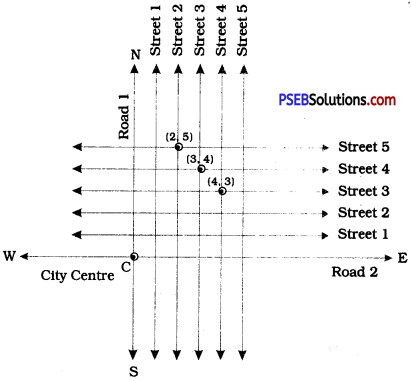
(Street Plan) : A city has two main roads which cross each other at the centre of the city. These two roads are along the North-South direction and East-West direction.

All the other streets of the city run parallel to these roads and are 200 m apart. There are 5 streets in each direction. Using 1 cm = 200 m, draw a model of the city on your notebook. Represent the roads/streets by single lines.

There are many cross-streets in your model. A particular cross-street is made by two streets, one running in the North South direction and another in the East West direction. Each cross-street is referred to in the following manner:

If the 2nd street running in the North South direction and 5th in the East-West direction meet at some crossing. then we will call this cross-street (2, 5). Using this convention, find:
Answer:
PSEB 9th Class Maths Solutions Chapter 3 Coordinate Geometry Ex 3.1 1

(i) how many cross-streets can be referred to as (4, 3).
Answer:
One and only one cross-street can be referred to as (4, 3) because it is the intersection of 4th street running in the North-South direction and the 3rd street running in the East-West direction. As we are using two independent references, each cross-street (X, y) will be referred uniquely.

PSEB 9th Class Maths Solutions Chapter 3 Coordinate Geometry Ex 3.1

(ii) how many cross-streets can be referred to as (3, 4).
Answer:
One and only one cross-street can be referred to as (3, 4) because it is the intersection of the 3rd street running in the North-South direction and the 4th street running in the East-West direction.

PSEB 6th Class Science Notes Chapter 1 Food Where Does it Come From

This PSEB 6th Class Science Notes Chapter 1 Food Where Does it Come From will help you in revision during exams.

PSEB 6th Class Science Notes Chapter 1 Food Where Does it Come From

→ All living beings need the energy to carry out their daily activities.

→ Food is needed by living beings for their growth, getting energy for doing work, replacement and repair of their damaged body parts, and protection against diseases.

→ Different varieties of food like fruits, vegetables, milk products, sweets, eggs, meat, chapati, and bakery products are present in nature.

PSEB 6th Class Science Notes Chapter 1 Food Where Does it Come From

→ The materials needed to prepare food items are called ingredients. Food materials can be made of one or two or many ingredients.

→ Plants are the chief source of food for us and other animals. However, few food materials are also obtained from animals.

→ Green plants can prepare their own food by using sunlight, carbon dioxide, and water to prepare their food. This process is called photosynthesis.

→ Every part of a plant where the food is stored is edible i.e. seed, flower, stem, root, leaf.

→ The plant parts which are used by us as food are called edible parts.

→ We eat roots of carrot, radish, turnip, sweet potato, etc. We also use stems of certain plants.

→ Some stems like those of ginger, potato, onion, turmeric grow underground and store food.

→ Stems of ginger and turmeric are used as spices.

PSEB 6th Class Science Notes Chapter 1 Food Where Does it Come From

→ The stem of sugarcane is used to make juice, sugar, and jaggery.

→ We eat different types of fruits like apple, mango, guava, papaya, orange, etc.

→ All these fruits are eaten raw i.e. without cooking. We make jams and pickles from some fruits.

→ Fruits are essential for good health as these are important sources of vitamins and minerals.

→ We use leaves of various plants like mustard, spinach, cabbage, coriander, mint, etc.

→ We use seeds of many plants as food like wheat, rice, maize, gram, peas, kidney beans and green gram (moong), etc.

→ Seeds of some crops like gram, peas, kidney beans, and green gram (moong) are known as pulses whereas seeds of wheat, rice, and maize are known as cereals.

→ We get milk, honey, meat, eggs, oil, etc. from animals.

PSEB 6th Class Science Notes Chapter 1 Food Where Does it Come From

→ Honey contains sugar, water, minerals, enzymes, and vitamins. Nectar of flowers is a source of honey.

→ On the basis of the food taken by animals, there are three categories of the animals:

  • Herbivores
  • Carnivores
  • Omnivores

→ Herbivores are the animals that eat only plants and plant products are called herbivores, e.g. cows, goats, rabbits, sheep, deer, elephants, etc.

→ Carnivores are the animals which eat other animals are called carnivores, e.g. lions, tigers, lizards, snakes, etc.

→ Omnivores are the animals which eat both plants and animals are called omnivores. e.g. Crow, bear, dog, and rat, man, etc.

→ Milk contains proteins, sugar, fats, and vitamins.

→ It is used worldwide as food that can be converted into dairy products like cheese, butter, curd, cream, etc.

→ People eat the meat of goats, sheep, chicken, fish, and sea animals like prawns, crab.

→ Meat is also used as food and it contains a great number of proteins and fats.

→ People eat eggs of hen and duck and other birds.

PSEB 6th Class Science Notes Chapter 1 Food Where Does it Come From

→ The white part of the egg is called albumen and the yellow part of the egg is called yolk.

→ Albumen is rich in proteins and you are rich in fats.

→ Food: Substances providing energy to do work, maintain body heat, protect us from diseases, etc. is called food.

→ Balance diet: A diet that contains all the nutrients needed by the body is called a balanced diet.

→ Edible: The substances/materials which are safe for eating are called edible substances.

→ Ingredients: Materials needed to prepare food Items.

→ Pulses: Seeds of some crops like gram, peas, moong.

→ Cereals: Seeds of grass crops e.g. wheat, rice, maize

→ Albumin: White part of the egg.

→ Yolk: Yellow part of the egg

PSEB 6th Class Science Notes Chapter 1 Food Where Does it Come From

→ Nectar: Sugary fluid present in flowers

→ Herbivores: Plant-eating animals are called herbivores.

→ Nectar: Sugary fluid present in flowers

→ Autotrophs: Organisms that can prepare their own food by photosynthesis.

→ Heterotrophs: Organisms that depend on other organisms for food

→ Herbivores: Organisms that eat only plants and plant products

→ Carnivores: Animals eating other animals are called carnivores.

→ Omnivores: Animals that eat both plants and animals are called omnivores.

PSEB 9th Class Maths MCQ Chapter 2 Polynomials

Punjab State Board PSEB 9th Class Maths Book Solutions Chapter 2 Polynomials MCQ Questions with Answers.

PSEB 9th Class Maths Chapter 2 Polynomials MCQ Questions

Multiple Choice Questions and Answer

Answer each question by selecting the proper alternative from those given below each question to make the statement true:

Question 1.
The value of p(x) = x3 + x2 – 3x – 3 at x = – 1 is ………….. .
A. 1
B. – 1
C. 0
D. – 3
Answer:
C. 0

PSEB 9th Class Maths MCQ Chapter 2 Polynomials

Question 2.
For the polynomial p(x), If p(2) = 0. then …………….. is a factor of p(x).
A. (x – 2)
B. (x + 2)
C. (x2 – 2)
D. (x2 + 2)
Answer:
A. (x – 2)

Question 3.
Dividing 2x3 + 6x2 + x + 5 by (x + 3), the remainder is ………………. .
A. 2
B. 3
C. 1
D. 0
Answer:
A. 2

Question 4.
……………. should be subtracted from x3 + 3x2 + 2x + 10, so that the result is exactly divisible by (x + 3).
A. 1
B. 2
C. 3
D. 4
Answer:
D. 4

PSEB 9th Class Maths MCQ Chapter 2 Polynomials

Question 5.
………………… should be added to x3 – 5x2 + x – 8, so that the result Is exactly divisible by (x – 5).
A. 2
B. – 2
C. – 3
D. 3
Answer:
D. 3

Question 6.
…………………. is one of the zeros of the polynomial x3 – 6x2 + 2x – 12.
A. 2
B. – 2
C. 6
D. – 6
Answer:
C. 6

Question 7.
If x + 3 is a factor of x3 + 6x2 + 11x + k, then k = ……………….. .
A. 2
B. 3
C. 4
D. 6
Answer:
D. 6

PSEB 9th Class Maths MCQ Chapter 2 Polynomials

Question 8.
………………….. should be added to x2 – 8, so that the result is exactly divisible by (x + 3).
A. 1
B. – 1
C. 3
D. – 3
Answer:
B. – 1

Question 9.
If x – 1 is a factor of 4x3 + 3x2 – 4x + k, then k = ………… .
A. 4
B. 1
C. 3
D. – 3
Answer:
D. – 3

Question 10
………………. is one of the factors of 2x4 + x3 – 14x2 – 19x – 6.
A. (x – 1)
B. (x + 1)
C. (x + 3)
D. (x – 2)
Answer:
B. (x + 1)

PSEB 9th Class Maths MCQ Chapter 2 Polynomials

Question 11.
When x3 + 64 is divided by x + 4, the quotient is ………………. .
A. (x – 4)
B. (x + 8)
C. (x + 16)
D. x2 – 4x + 16
Answer:
D. x2 – 4x + 16

Question 12.
x3 + 3x2 + 3x + 2 = (x + 2) (……………..)
A. x – 2
B. x2 + 1
C. x2 – x – 1
D. x2 + x + 1
Answer:
D. x2 + x + 1

Question 13.
The factors of x2 – x – 12 are .
A.(x + 6) and (x – 2)
B. (x – 4) and (x – 3)
C. (x + 4) and (x + 3)
D. (x – 4) and (x + 3)
Answer:
D. (x – 4) and (x + 3)

PSEB 9th Class Maths MCQ Chapter 2 Polynomials

Question 14.
The factors of x2 – 100 are ………………. .
A. (x – 20) and (x – 5)
B. (x – 25) and (x – 4)
C. (x – 10)2
D. (x + 10) and (x – 10)
Answer:
D. (x + 10) and (x – 10)

Question 15.
x2 – 2 + \(\frac{1}{x^{2}}\) = ………………………
A. \(\left(x+\frac{1}{x}\right)\left(x-\frac{1}{x}\right)\)
B. \(\left(x-\frac{1}{x}\right)^{2}\)
C. \(\left(x-\frac{1}{x}\right)^{3}\)
D. \(\left(x+\frac{1}{2}\right)^{2}\)
Answer:
B. \(\left(x-\frac{1}{x}\right)^{2}\)

Question 16.
If x2 + mx – 28 = (x – 7) (x + 4), then m = ………………….. .
A. 3
B. – 3
C. 11
D. – 11
Answer:
B. – 3

Question 17.
105 × 95 = ………………. .
A. 9500
B. 10,500
C. 9925
D. 9975
Answer:
D. 9975

PSEB 9th Class Maths MCQ Chapter 2 Polynomials

Question 18.
(110)3 = …………………… .
A. 330
B. 3300
C. 33.000
D. 13,31,000
Answer:
D. 13,31,000

Question 19.
(15)3 – (9)3 – (6)3 = ………………….
A. 1215
B. 2430
C. – 810
D. 810
Answer:
B. 2430

PSEB 9th Class Maths MCQ Chapter 2 Polynomials

Question 20.
If x + 3 is one of the factors x3 + 2x2 – ax – 18, then a = …………………. .
A. 3
B. – 3
C. 9
D. – 9
Answer:
C. 9

PSEB 6th Class Science Notes Chapter 12 Electricity and Circuits

This PSEB 6th Class Science Notes Chapter 12 Electricity and Circuits will help you in revision during exams.

PSEB 6th Class Science Notes Chapter 12 Electricity and Circuits

→ An electric cell is a source of electric energy.

→ The electric cell has two terminals: one positive terminal (+) and the other negative terminal (-).

→ The electric bulb has one filament which is connected to its terminals.

→ On passing the electric current, the bulb begins to glow.

→ In a closed electric circuit, the electric current passes from one terminal of the electric cell to the other terminal.

PSEB 6th Class Science Notes Chapter 12 Electricity and Circuits

→ The switch is a simple device that is used to either break the electric circuit or to complete it.

→ Materials that allow an electric current to pass through them, are called conductors.

→ Materials that do not allow an electric current to pass through them are called insulators.

→ Light-emitting thin wire of the bulb is called filament of the bulb.

→ On the breaking of filament, the bulb becomes fused.

→ The complete path of electric current is called an Electric circuit.

→ Bulb: It is a simple device that gives out light on passing an electric current through it.

→ Electric conductor: Materials that allow current to pass through them are called electric conductors.

→ Electric cell: Electric cell is a source of electricity. The chemicals stored in it produce an electric current.

PSEB 6th Class Science Notes Chapter 12 Electricity and Circuits

→ Electric circuit: The path of current from one terminal to another terminal, through a switch, bulb, and switch, is called an electric circuit.

→ Filament: A small thin metallic wire (Tungsten) inside a bulb that glows when current is allowed to pass through it, is called a filament.

→ Insulators: Materials that do not allow current to pass current through them are called insulators.

→ Switch: A simple device that is used to break or complete a circuit is called a switch.

→ Terminal: The point of entering or exit of electric current is called terminal.

→ An electric cell has two terminals:

  • Positive terminal
  • Negative terminal.

PSEB 6th Class Science Notes Chapter 11 Light Shadows and Reflections

This PSEB 6th Class Science Notes Chapter 11 Light Shadows and Reflections will help you in revision during exams.

PSEB 6th Class Science Notes Chapter 11 Light Shadows and Reflections

→ Light is a form of energy that enables us to see the things around us.

→ A source of light can be either natural or artificial as for example Sun, Moon, Stars CFL, Candle, and LED.

→ Light ordinarily travels along a straight path.

→ Opaque objects do not allow light to pass through them and the objects lying on the other side of it cannot be seen.

PSEB 6th Class Science Notes Chapter 11 Light Shadows and Reflections

→ Transparent objects allow light to pass through them and we can see through these objects clearly.

→ Translucent objects allow light to pass through them partially and the objects lying on another side of these objects are not seen clearly.

→ Shadows are formed when an opaque object comes in the path of light.

→ A pinhole camera can be made with simple materials and can be used to obtain the image of the Sun and other bright (luminous) objects. This image is inverted and small in size.

→ Reflection from the mirror gives us clear images.

→ Luminous Object: Such objects have light of their own and give out light.

→ Non-Luminous Object: Such object which has no light of its own and becomes luminous from light emitted by other luminous objects.

→ Light: It is a form of energy that enables us to see the surrounding objects but light itself is not seen.

→ Source of light: Such luminous bodies which have the light of their own and which emit light as for example candle CFL etc. The source light may either be a Natural or Artificial source.

PSEB 6th Class Science Notes Chapter 11 Light Shadows and Reflections

→ Transparent objects: Such objects through which light can pass and on the other side of which we can see clearly are called transparent objects. Examples are Air, water, glass, etc.

→ Opaque objects: Those objects which do not allow light to pass through them and the objects on the other side of which cannot be seen are called opaque objects. Examples are Cardboard sheets, wood, metal, and rubber, etc.

→ Translucent objects: Those objects through which light can pass but partially and the objects lying on the other side of which are not seen clearly are called translucent objects. Examples are Tissue paper, thin cloth, oiled paper, etc.

→ Shadow: When an opaque object is placed in the path of the light rays coming from a source of light then light cannot pass through and a black region is formed on the other side of the opaque body. This black region where no light is received is called the shadow. The size of the shadow can be small or large.

→ Sundial: It is an instrument that shows time with the help of shadows formed by sunlight.

→ Solar Eclipse: When the moon while revolving around the earth comes in such a situation that the moon is in between the earth and the sun and all the three are in a straight line then the shadow of the sun is formed on the earth, a solar eclipse is said to occur.

→ Lunar Eclipse: When the earth comes in between the sun and moon and all the three are in a straight line and the shadow of the moon is formed on the earth; then the lunar eclipse is said to occur.

PSEB 6th Class Science Notes Chapter 11 Light Shadows and Reflections

→ Pinhole camera: It is an instrument in which the inverted and small-sized image of a stationary object such as a building or tree is formed. It is constructed on the principle of propagation of light in a straight line.

→ Mirror: Any smooth and polished surface which changes the path of light rays falling on it, is called a mirror.

→ Reflection of light: When light falls on a mirror and light falling on it is sent back into the same medium in a particular direction, then this phenomenon of change of direction of the path of light is called reflection of light. Reflection of light is of two types:

  • Regular reflection
  • Irregular reflection

→ Regular reflection: When light falls on a smooth plane mirror or a polished surface then a reflection of light takes place in a regular manner. This reflection of light is called regular reflection.

PSEB 6th Class Science Notes Chapter 11 Light Shadows and Reflections

→ Irregular reflection: When light falls on any rough or uneven surface than light rays after reflection gets scattered. This reflection of light is called irregular reflection. We can see the various objects around us due to this reflection.

PSEB 6th Class Science Notes Chapter 10 Motion and Measurement of Distances

This PSEB 6th Class Science Notes Chapter 10 Motion and Measurement of Distances will help you in revision during exams.

PSEB 6th Class Science Notes Chapter 10 Motion and Measurement of Distances

→ Measurement is a comparison of an unknown quantity with a known fixed quantity of the same kind.

→ Different modes of transport are used to move from one place to another.

→ Earlier cubit, hand span, or foot were used to measure the lengths or distances. Measurements made with them were not accurate.

→ The system of units used is known as the International System of Unit (S.I. Units) and is accepted all over the world.

PSEB 6th Class Science Notes Chapter 10 Motion and Measurement of Distances

→ The S.I. unit of length is meter.

→ Change in the position of an object with respect to things in the surroundings is called motion.

→ The motion of an object in a straight line is called linear motion.

→ In a circular motion, the object moves in a circular path and its distance from a fixed point (centre) always remains the same.

→ A motion that repeats itself after a fixed interval of time is called Periodic motion.

→ The fixed amount of known quantity is called unit.

→ The standard unit of length is a meter.

→ Distance: It is a measurement of length between two points.

→ Measurement: The comparison of an unknown quantity with some known quantity of the same kind.

→ Unit: The known fixed quantity taken as standard for comparison.

→ Odometer: A device fitted in motor vehicles to measure the distance covered by the vehicle.

PSEB 6th Class Science Notes Chapter 10 Motion and Measurement of Distances

→ Motion: When an object changes its position as compared to the surroundings with the passage of time, then the object is said to be in motion.

→ Linear Motion: The motion of an object in a straight line.

→ Circular motion: The motion of an object in a circular path, is called circular motion.

→ Periodic motion: When an object repeats its motions after a fixed interval of time, its motion is called periodic motion.

PSEB 6th Class Science Notes Chapter 9 The Living Organisms and Their Surroundings

This PSEB 6th Class Science Notes Chapter 9 The Living Organisms and Their Surroundings will help you in revision during exams.

PSEB 6th Class Science Notes Chapter 9 The Living Organisms and Their Surroundings

→ Different types of living organisms are present everywhere.

→ All living beings have some common characteristics.

→ They need food, respond to stimuli, respire, excrete, grow, reproduce and show movements.

→ The surroundings where organisms live are called a habitat.

PSEB 6th Class Science Notes Chapter 9 The Living Organisms and Their Surroundings

→ Habitat may be terrestrial or aquatic or aerial/arboreal. Deserts, mountains, and grasslands are examples of terrestrial habitats. Oceans, ponds, and lakes are examples of aquatic habitats.

→ Organisms having terrestrial habitat are called terrestrial organisms whereas organisms having aquatic habitat are known as aquatic organisms.

→ Plants having terrestrial habitat are called terrestrial plants whereas plants having aquatic habitat are known as aquatic plants.

→ Animals having terrestrial habitats are called terrestrial animals whereas animals having aquatic habitat are known as aquatic animals.

→ All types of habitats have two main components: biotic and abiotic.

→ Biotic components are all living things like plants, animals, human micro-organisms.

→ Abiotic components include all non-living things like rocks, soil, air, water, sunlight.

→ Abiotic factors or components change over thousands of years.

→ The ability of the living things to adjust themselves to their surroundings is called Adaptation.

PSEB 6th Class Science Notes Chapter 9 The Living Organisms and Their Surroundings

→ Organisms i.e. plants and animals adapt differently to live better in different habitats.

→ Rats and snakes stay in burrows deep in the sand to stay away from the intense heat.

→ Cactus is a desert plant that has spines to reduce the loss of water from leaves through transpiration.

→ Trees in the mountain regions are normally cone-shaped having sloping branches and needle-like leaves.

→ Animals have thick skin or fur to protect them from the cold of mountainous regions.

→ Lion, deer, or other animals are adapted to live in grasslands.

→ Squids and octopuses are sea animals. Their habitats are deep-sea (sea bed). They make their body streamlined while swimming.

→ Aquatic plants can be floating, totally submerged, or partially submerged type.

→ A frog is an animal that can live both on land and in water. Its body is adapted to both types of abiotic factors.

→ A cloud grows in size, moves from one place to another but it is a non-living thing.

PSEB 6th Class Science Notes Chapter 9 The Living Organisms and Their Surroundings

→ Some animals go into a state of long sleep during winter for survival and this winter sleep is called Hibernation.

→ Cell: The basic unit of life is called a cell.

→ Unicellular Organisms: Organisms that are made of only one cell.

→ Multicellular Organisms: Organisms that are made of many cells.

→ Stimulus: Living things respond to immediate and long-term changes in their environment.

→ Adaptations: The presence of specific features and habits, which enable a plant or an animal to live in a particular habitat, is called adaptation.

→ Habitat: The surroundings where plants and animals live, are called their habitat.

→ Biotic Component: The living components of habitat are biotic components, e.g. plants, animals.

→ Xerophytes: The plants which grow and propagate in deserts, e.g. cactus.

→ Hydrophytes: The plants which grow and propagate in water.

→ Photosynthesis: The process of manufacturing food by green plants with the help of water, carbon dioxide, sunlight, and chlorophyll.

→ Breathing: Taking in and releasing out air from the body is called breathing.

PSEB 6th Class Science Notes Chapter 9 The Living Organisms and Their Surroundings

→ Respiration: The process of exchange of carbon dioxide and oxygen is called respiration.
(or)
The process of taking oxygen in, combining it with food, and throwing out carbon dioxide and water vapour is called Respiration.

→ Excretion: The process by which waste products are removed from the body of organisms.

→ Producers: Organisms that can manufacture their own food. Examples are all types of green plants.

→ Consumers: Organisms that cannot manufacture their own food but consume food prepared by green plants or other organisms.

→ Predators: Some strong animals that make weaker animals their prey are called predators.

PSEB 6th Class Science Notes Chapter 9 The Living Organisms and Their Surroundings

→ Decomposers: Microorganisms that feed on dead plants and animals and break them into simpler substances.

→ Scavengers: Animals that feed on dead animals.

PSEB 6th Class Science Notes Chapter 8 Body Movements

This PSEB 6th Class Science Notes Chapter 8 Body Movements will help you in revision during exams.

PSEB 6th Class Science Notes Chapter 8 Body Movements

→ Movement is a change in the position of any part of the body of an organism.

→ Locomotion is the movement of the whole body of an organism from one place to another.

→ Animals show locomotion and other types of movements but plants do not locomotion though they show some other types of movements.

→ Walking by man, swimming by fishes, running by horse, crawling by a snake, jumping by grasshopper, and flying by birds, etc. are different modes of locomotion.

PSEB 6th Class Science Notes Chapter 8 Body Movements

→ The purpose of locomotion by animals is to find water, food, shelter, and protect themselves from enemies.

→ The framework made up of bones that give support to the body is known as the skeleton.

→ Bones are hard and rigid whereas cartilage is smooth and flexible.

→ The human skeleton comprises bones and cartilages.

→ The human body has 300 bones at the time of birth.

→ The adult human body has 206 bones.

→ The rib cage is made up of ribs, backbone, and chest bone. It protects the internal parts of the body.

→ Skull encloses protects the brain.

→ A Joint is a place where bones meet together.

→ The ligament is an elastic tissue that connects bones together.

→ The movement of the body depends upon the contraction of muscles. These muscles always work in pairs.

→ Gait is the pattern of movement of limbs of animals.

PSEB 6th Class Science Notes Chapter 8 Body Movements

→ The earthworm moves by contraction and extension of the muscles of its body.

→ A snail moves with the help of a large sticky muscular foot.

→ A cockroach can walk, run. climb and fly.

→ Forelimbs of birds are modified into wings that help in flight.

→ The body of fish is streamlined and it moves by fins placed laterally on its body.

→ Birds have streamlined bodies and hollow lightweight bones which help them during g flight.

→ Snakes move by creeping on their belly.

→ Different types of joints allow movements in different directions.

→ Our body has many joints – The ball and socket joint, the Hinge joint, the Fixed joint, and the Pivotal joint.

→ The ball and socket joint allows the movement in a circular form or in all directions.

→ The hinge joint allows back and forth movement.

→ The pivotal joint allows the movement forward and backward, right or left. The joint of the neck and head is an example.

→ Fixed joints are immovable.

PSEB 6th Class Science Notes Chapter 8 Body Movements

→ X-ray helps in counting the number of bones and studying the shape of bones in all bodies.

→ Movement: is a change in the position of any part of the body of an organism.

→ Locomotion: is the movement of the whole body of an organism from one place to another.

→ Bone: It is the part of the skeleton which is hard in nature.

→ Joint: A joint is a part of the body where two or more bones meet to allow some type of movement.

→ Cartilage: Smooth, thick, and flexible tissue found in joints.

→ Fixed Joints: The joints at which bones cannot move is known as fixed joint.

→ Moveable Joints: The joints where the movement of the bones is possible are called movable joints.

→ Skeleton: The framework of the body that gives support and shape to the body.

→ Streamlined body: A body that tapers at both ends is called a streamlined body.

→ Tendon: The strong, fibrous tissue which attaches muscles to bones is called a tendon.

→ Ligaments: Strong, flexible tissue which connects two bones.

PSEB 6th Class Science Notes Chapter 8 Body Movements

→ Pelvis: The large bony bowl formed by the fusion of hip bones and the last two parts of the backbone is known as the pelvis.

→ Pectoral Girdle: The girdle that supports the bones of the arm is called the pectoral girdle.

→ Pelvic Girdle: The girdle that supports the bones of the legs is called the pelvic girdle.

→ Vertebrae: These are the small ring-shaped bones present in the backbone.

→ Dislocation: The dislodging of bones at the joints from their normal positions is called dislocation.

PSEB 6th Class Science Notes Chapter 7 Getting to Know Plants

This PSEB 6th Class Science Notes Chapter 7 Getting to Know Plants will help you in revision during exams.

PSEB 6th Class Science Notes Chapter 7 Getting to Know Plants

→ We have a large variety of plants around us. These differ in size, shape, colour of leaves, flowers, etc.

→ Plants around us are usually grouped inter herbs, shrubs, and trees

→ Herbs are small-sized plants with soft green stems which generally lack branches.

→ Shrubs are medium-sized plants with hard stems and branched near the base or near the ground. Trees are tall and long with strong stems called trunks.

PSEB 6th Class Science Notes Chapter 7 Getting to Know Plants

→ Parts of a plant consist of two types of system – root system and shoot system.

→ The root system is the underground part of the plant. It anchors the plant to the soil.

→ Roots absorb water and minerals from the soil.

→ The shoot system is the portion of the plant above the ground.

→ Two types of roots are taproots and fibrous roots.

→ Stem conducts water to leaves and other parts of the plant.

→ Stem conducts water to leaves and other parts of the plant.

→ The green colour of leaves is due to the presence of a pigment called chlorophyll.

→ Leaves perform photosynthesis and transpiration.

→ The leaf is made up of two parts-petiole and lamina.

→ The lines on the leaf lamina are called veins and in the centre is called midrib.

→ Venation is of two types: Parallel venation and Reticulate venation.

PSEB 6th Class Science Notes Chapter 7 Getting to Know Plants

→ A flower is the reproductive part of a plant.

→ The flower has sepals, petals, stamens, and pistils.

→ Stamen is the male reproductive organ.

→ The pistil is the female reproductive organ.

→ Creepers: Herbs having a weak stem that cannot stand upright and spread on the ground are called creepers.

→ Climbers: Plants having a weak stem that cannot stand erect and take support of nearby objects to climb up are called climbers.

→ Taproot: The root which has a main root and branched smaller roots is called the taproot.

→ Fibrous root: This root has no main root. It is like a bundle of thread-like growth. All roots seem similar and are known as fibrous roots.

→ Weeds: The unwanted plants grown with the main crop are weeds.

→ Venation: The design made by veins in a leaf is called venation.

→ Parallel Venation: When the lines/veins are parallel to one another then it is known as parallel venation.

PSEB 6th Class Science Notes Chapter 7 Getting to Know Plants

→ Reticulate Venation: When there is a network of veins then the venation is reticulate venation.

→ Herbs: The plants with small size, green and tender stems are known as herbs.

→ Shrubs: Plants having strong stem branched at the base are known as shrubs.

→ Trees: Trees are tall-sized plants in which the main stem is hard, broad, and thick at the base, and branches are found on the upper part.

→ Trunk: The main step of a tree which is woody, hard, broad, and thick at the base, and bare branches is known as the trunk.

→ Photosynthesis: The process by which plants prepare food using carbon dioxide and water in the presence of chlorophyll and sunlight.

→ Transpiration: Loss of water vapour from plants through stomata.