PSEB 7th Class Maths MCQ Chapter 14 Symmetry

Punjab State Board PSEB 7th Class Maths Book Solutions Chapter 14 Symmetry MCQ Questions with Answers.

PSEB 7th Class Maths Chapter 14 Symmetry MCQ Questions

Multiple Choice Questions :

Question 1.
A polygon is said to be a regular polygon if its :
(a) All sides are equal
(b) All angles are equal
(c) Both (A) and (B)
(d) None of these.
Answer:
(c) Both (A) and (B)

Question 2.
The number of lines of symmetry for an equilater triangle is :
(a) One
(b) Two
(c) Three
(d) Four
Answer:
(c) Three

Question 3.
The number of lines of symmetry for a square will be :
(a) Two
(b) Four
(c) Three
(d) One
Answer:
(b) Four

Question 4.
What other name can you give to the line of symmetry of an isoscele triangle ?
(a) Perpendicular name
(b) Height
(c) Median
(d) Altitude
Answer:
(c) Median

Question 5.
Which letter has only one line of symmetry ?
(a) Z
(b) H
(c) E
(d) N
Answer:
(c) E

PSEB 7th Class Maths MCQ Chapter 14 Symmetry

Fill in the blanks :

Question 1.
The objects or figures that do not have any line of symmetry are called ……………… figures.
Answer:
Asymmetrical

Question 2.
Mirror reflection leads to ………………
Answer:
Symmetry

Question 3.
The angle by which the object rotates is called the angle of ………………
Answer:
rotation

Question 4.
The number of lines of symmetry for regular pentagon is ………………
Answer:
five

Question 5.
The number of lines of symmetry scalar for scalar triangle is ………………
Answer:
none

PSEB 7th Class Maths MCQ Chapter 14 Symmetry

Write True/False :

Question 1.
A square has four lines of symmetry. (True/False)
Answer:
True

Question 2.
An isosceles triangle has a line of symmetry but not rotational symmetry. (True/False)
Answer:
True

Question 3.
A square has both line symmetry as well as rotational symmetry. (True/False)
Answer:
True

Question 4.
Some figures have only line symmetry. (True/False)
Answer:
True

Question 5.
The number of lines of symmetry for a quadrilateral is four. (True/False)
Answer:
False

PSEB 7th Class Maths Solutions Chapter 14 Symmetry Ex 14.3

Punjab State Board PSEB 7th Class Maths Book Solutions Chapter 14 Symmetry Ex 14.3 Textbook Exercise Questions and Answers.

PSEB Solutions for Class 7 Maths Chapter 14 Symmetry Ex 14.3

1. In the following figures, find the number of lines of symmetry and angle of rotation for rotational symmetry.
PSEB 7th Class Maths Solutions Chapter 14 Symmetry Ex 14.3 1
Solution:
(a) Line of symmetry 3, angle of rotation 120°
(b) Line of symmetry 4, angle of rotation 90°.

2. Name any two figures that have both line of symmetry and rotational symmetry.
Solution:
Equilateral triangle and circle

3. If a figure has two or more lines of symmetry should it have a rotational symmetry of order more than 1 ?
Solution:
Yes, Square has four lines of symmetry and rotational symmetry of order 4.

PSEB 7th Class Maths Solutions Chapter 14 Symmetry Ex 14.3

4. Following shapes have both, line symmetry and rotational symmetry. Find the number of lines of symmetry, centre of rotation and order of rotational symmetry.
PSEB 7th Class Maths Solutions Chapter 14 Symmetry Ex 14.3 2
PSEB 7th Class Maths Solutions Chapter 14 Symmetry Ex 14.3 3
PSEB 7th Class Maths Solutions Chapter 14 Symmetry Ex 14.3 4
Solution:
(a) 3, centroid, 3
(b) 2, Intersection of diagonals, 2
(c) 6, centre of hexagon, 6

5. Some of the english alphabets have fascinating symmetrical structures. Which capital letters have just one line of symmetry (Like E) ? Which capital letters have a rotational symmetry of order 2 (Like I) ? By attempting to think on such lines, you will be able to fill in the following table.
PSEB 7th Class Maths Solutions Chapter 14 Symmetry Ex 14.3 5
Solution:
PSEB 7th Class Maths Solutions Chapter 14 Symmetry Ex 14.3 6

PSEB 7th Class Maths Solutions Chapter 14 Symmetry Ex 14.3

6. Multiple Choice Questions :

Question (i).
If 60° is the smallest angle of rotational for a given figure what will be the angle of rotation for same figure.
(a) 150°
(b) 180°
(c) 90°
(d) 330°
Answer:
(b) 180°

Question (ii).
Which of these can not be a measure of an angle of rotation for any figure.
(a) 120°
(b) 180°
(c) 17°
(d) 90°
Answer:
(c) 17°

Question (iii).
Which of the following have both line symmetry and rotational symmetry ?
(a) An isosceles triangle
(b) A scalene triangle
(c) A square
(d) A parallelogram
Answer:
(c) A square

Question (iv).
Which of the alphabet has both multiple line and rotational symmetries ?
(a) S
(b) O
(c) H
(d) L
Answer:
(b) O

Question (v).
In the word ‘MATHS’ which of the following pairs of letters shows rotational symmetry ?
(a) M and T
(b) H and S
(c) A and S
(d) T and S
Answer:
(b) H and S

PSEB 7th Class Maths Solutions Chapter 14 Symmetry Ex 14.2

Punjab State Board PSEB 7th Class Maths Book Solutions Chapter 14 Symmetry Ex 14.2 Textbook Exercise Questions and Answers.

PSEB Solutions for Class 7 Maths Chapter 14 Symmetry Ex 14.2

1. Write the order of rotation for the following figures.
PSEB 7th Class Maths Solutions Chapter 14 Symmetry Ex 14.2 1
Solution:
(a) 2
(b) 2
(c) 5
(d) 6

2. Specify the centre of rotation, direction of rotation, angle of rotation and order of rotation for the following.

(i)
PSEB 7th Class Maths Solutions Chapter 14 Symmetry Ex 14.2 2
Solution:
Centre of rotation is O, direction of rotation is clockwise, Angle of rotation is 120° and order of rotation is 3.

(ii)
PSEB 7th Class Maths Solutions Chapter 14 Symmetry Ex 14.2 3
Solution:
Centre of rotation is P, direction of rotation is clockwise, Angle of rotation is 90° and order of rotation is 4.

(iii)
PSEB 7th Class Maths Solutions Chapter 14 Symmetry Ex 14.2 4
Solution:
Centre of rotation is O, direction of rotation is clockwise, Angle of rotation is 90° and order of rotation is 4.

PSEB 7th Class Maths Solutions Chapter 14 Symmetry Ex 14.2

3. Which of the following figures have rotational symmetry about the marked point (×) give the angle of rotation and order of the rotation of the figures.
(a)
PSEB 7th Class Maths Solutions Chapter 14 Symmetry Ex 14.2 5
Solution:
It has rotational symmetry, angle of rotation 180° and order of rotation 2.

(b)
PSEB 7th Class Maths Solutions Chapter 14 Symmetry Ex 14.2 6
Solution:
It has rotational symmetry, angle of rotation 90° and order of rotation 4.

(c)
PSEB 7th Class Maths Solutions Chapter 14 Symmetry Ex 14.2 7
Solution:
It has rotational symmetry, angle of rotation 72° and order of rotation 5.

(d)
PSEB 7th Class Maths Solutions Chapter 14 Symmetry Ex 14.2 8
Solution:
It has rotational symmetry, angle of rotation 60° and order of rotation 6.

(e)
PSEB 7th Class Maths Solutions Chapter 14 Symmetry Ex 14.2 9
Solution:
It has rotational symmetry, angle of rotation 90° and order of rotation 4.

PSEB 7th Class Maths Solutions Chapter 14 Symmetry Ex 14.2

4. Multiple choice questions :

Question (i).
The angle of rotation in an equilateral triangle is :
(a) 60°
(b) 70°
(c) 90°
(d) 120°
Answer:
(d) 120°

Question (ii).
A square has a rotational symmetry of order 4 about its centre what is the angle of rotation ?
(a) 45°
(b) 90°
(c) 180°
(d) 270°
Answer:
(b) 90°

Question (iii).
What is the order of rotational symmetry of the english alphabet Z ?
(a) 0
(b) 1
(c) 2
(d) 3
Answer:
(c) 2

Question (iv).
Which of these letters has only rotational symmetry ?
(a) S
(b) E
(c) B
(d) P
Answer:
(a) S

Question (v).
If the smallest angle of rotation is 90° then order of symmetry is ?
(a) 1
(b) 3
(c) 4
(d) 2
Answer:
(c) 4

PSEB 6th Class Maths MCQ Chapter 8 Basic Geometrical Concepts

Punjab State Board PSEB 6th Class Maths Book Solutions Chapter 8 Basic Geometrical Concepts MCQ Questions with Answers.

PSEB 6th Class Maths Chapter 8 Basic Geometrical Concepts MCQ Questions

Multiple Choice Questions

Question 1.
How many lines can pass through a point?
(a) 1
(b) 2
(c) 4
(d) Infinite.
Answer:
(d) Infinite.

PSEB 6th Class Maths MCQ Chapter 8 Basic Geometrical Concepts

Question 2.
The number of points lie on a line are
(a) 2
(b) 4
(c) 1
(d) Infinite.
Answer:
(d) Infinite.

Question 3.
The number of lines passes through two points are ……………… .
(a) 1
(b) 2
(c) 3
(d) Infinite.
Answer:
(a) 1

Question 4.
In how many parts, a closed curve divides the plane?
(a) 1
(b) 2
(c) 3
(d) 4.
Answer:
(c) 3

Question 5.
A quadrilateral has……………. diagonals.
(a) 1
(b) 2
(c) 3
(d) 4.
Answer:
(b) 2

PSEB 6th Class Maths MCQ Chapter 8 Basic Geometrical Concepts

Question 6.
Which of the following is not a polygon?
(a) Triangle
(b) Pentagon
(c) Circle
(d) Quadrilateral.
Answer:
(c) Circle

Question 7.
A triangle has…………… parts.
(a) 3
(b) 6
(c) 9
(d) 2.
Answer:
(b) 6

Question 8.
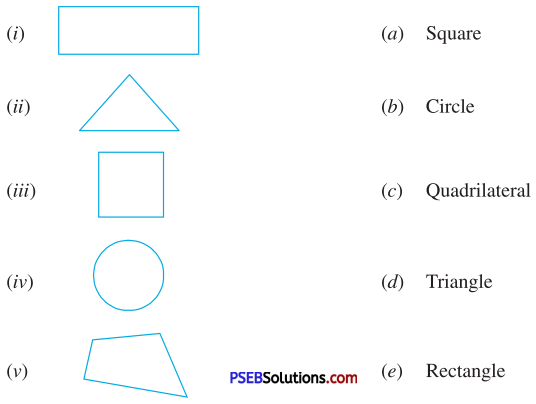
Which of file following is not a quadrilateral?
PSEB 6th Class Maths MCQ Chapter 8 Basic Geometrical Concepts 1
Answer:
PSEB 6th Class Maths MCQ Chapter 8 Basic Geometrical Concepts 2

Question 9.
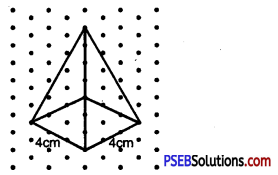
A line segment joining the opposite vertices of a quadrilateral is called its …………. .
(a) Diagonal
(b) Side
(c) Angle
(d) Region.
Answer:
(a) Diagonal

PSEB 6th Class Maths MCQ Chapter 8 Basic Geometrical Concepts

Question 10.
The radius of a circle is 4 cm then the diameter is …………….. .
(a) 8 cm
(b) 2 cm
(c) 6 cm
(d) 12 cm.
Answer:
(a) 8 cm

Question 11.
The diameter of a circle is 12 cm then the radius is …………….. .
(a) 24 cm
(b) 6 cm
(c) 18 cm
(d) 4 cm.
Answer:
(b) 6 cm

Question 12.
The longest chord of a circle is…………….
(a) Arc
(b) Perimeter
(c) Diameter
(d) Radius.
Answer:
(c) Diameter

Question 13.
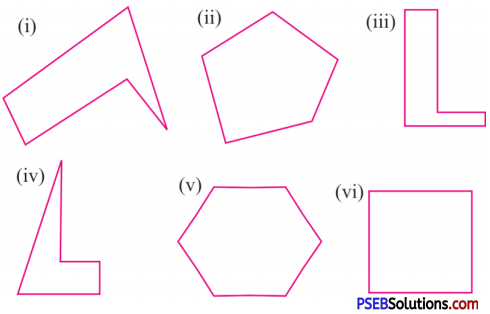
Which of the following figure is not a polygon?
PSEB 6th Class Maths MCQ Chapter 8 Basic Geometrical Concepts 3
Answer:
PSEB 6th Class Maths MCQ Chapter 8 Basic Geometrical Concepts 4

PSEB 6th Class Maths MCQ Chapter 8 Basic Geometrical Concepts

Question 14.
Which of the following figure is a polygon?
PSEB 6th Class Maths MCQ Chapter 8 Basic Geometrical Concepts 5
Answer:
PSEB 6th Class Maths MCQ Chapter 8 Basic Geometrical Concepts 6

Question 15.
Which of the following is a closed curve?
PSEB 6th Class Maths MCQ Chapter 8 Basic Geometrical Concepts 7
Answer:
PSEB 6th Class Maths MCQ Chapter 8 Basic Geometrical Concepts 8

Question 16.
Which of the following is an open curve?
PSEB 6th Class Maths MCQ Chapter 8 Basic Geometrical Concepts 9
Answer:
PSEB 6th Class Maths MCQ Chapter 8 Basic Geometrical Concepts 10

PSEB 6th Class Maths MCQ Chapter 8 Basic Geometrical Concepts

Question 17.
Two different line when intersect each other at some point, they are called:
(a) Intersecting lines
(b) Parallel lines
(c) Concurrent lines
(d) None of these.
Answer:
(a) Intersecting lines

Fill in the blanks:

Question (i)
In the environment, a railway track is an example of ……………. .
Answer:
parallel lines

Question (ii)
In the environment, a nail fixed in the wall is an example of ……………….. .
Answer:
a point

PSEB 6th Class Maths MCQ Chapter 8 Basic Geometrical Concepts

Question (iii)
The intersection of the three walls of a room, is an example of …………… .
Answer:
concurrent lines

Question (iv)
……………….. is the longest chord of a circle.
Answer:
Diameter

Question (v)
A triangle has ……………… part.
Answer:
six

Write True/False:

Question (i)
Three lines can pass through a point. (True/False)
Answer:
False

Question (ii)
The number of lines passing through two points is one. (True/False)
Answer:
True

PSEB 6th Class Maths MCQ Chapter 8 Basic Geometrical Concepts

Question (iii)
Every circle has a centre. (True/False)
Answer:
True

Question (iv)
The diameter is twice the radius. (True/False)
Answer:
True

Question (v)
Every chord of a circle is also a diameter. (True/False)
Answer:
False

PSEB 7th Class Maths Solutions Chapter 14 Symmetry Ex 14.1

Punjab State Board PSEB 7th Class Maths Book Solutions Chapter 14 Symmetry Ex 14.1 Textbook Exercise Questions and Answers.

PSEB Solutions for Class 7 Maths Chapter 14 Symmetry Ex 14.1

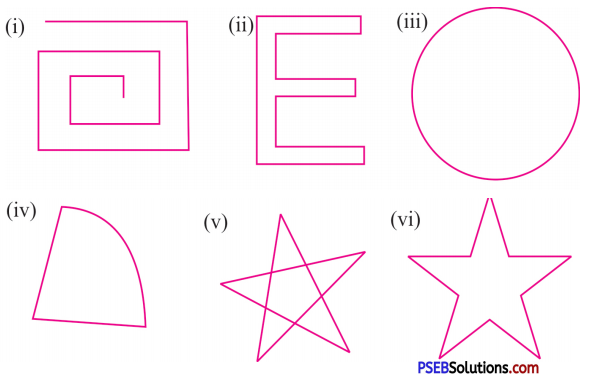
1. Which of the following figures are asymmetrical ?
PSEB 7th Class Maths Solutions Chapter 14 Symmetry Ex 14.1 1
PSEB 7th Class Maths Solutions Chapter 14 Symmetry Ex 14.1 2
Solution:
Figure (a) and (c) are asymmetrical.

2. Draw the lines of symmetry in the following figures.
PSEB 7th Class Maths Solutions Chapter 14 Symmetry Ex 14.1 3
PSEB 7th Class Maths Solutions Chapter 14 Symmetry Ex 14.1 4
Solution:
PSEB 7th Class Maths Solutions Chapter 14 Symmetry Ex 14.1 5
PSEB 7th Class Maths Solutions Chapter 14 Symmetry Ex 14.1 6

PSEB 7th Class Maths Solutions Chapter 14 Symmetry Ex 14.1

3. Draw all lines of symmetry if any in each of the following figures.
PSEB 7th Class Maths Solutions Chapter 14 Symmetry Ex 14.1 7
PSEB 7th Class Maths Solutions Chapter 14 Symmetry Ex 14.1 8
Solution:
PSEB 7th Class Maths Solutions Chapter 14 Symmetry Ex 14.1 9
PSEB 7th Class Maths Solutions Chapter 14 Symmetry Ex 14.1 10

4. Copy the figures with punched holes and find the axes of symmetry for the following.
PSEB 7th Class Maths Solutions Chapter 14 Symmetry Ex 14.1 11
Solution:
PSEB 7th Class Maths Solutions Chapter 14 Symmetry Ex 14.1 12

PSEB 7th Class Maths Solutions Chapter 14 Symmetry Ex 14.1

5. In the following figures mark the missing holes in order to make them symmetrical about the dotted line.
PSEB 7th Class Maths Solutions Chapter 14 Symmetry Ex 14.1 13
Solution:
The missing holes are marked by dark punches (small circles) in each of following figures
PSEB 7th Class Maths Solutions Chapter 14 Symmetry Ex 14.1 14

6. In each of the following figures, the mirror line (i.e. the line of symmetry) is given as dotted line complete each figure performing reflection in the dotted (mirror) line. (You might perhaps place a mirror along the dotted line and look into the mirror for the image). Are you able to recall the name of figure you complete.
PSEB 7th Class Maths Solutions Chapter 14 Symmetry Ex 14.1 15
Solution:
PSEB 7th Class Maths Solutions Chapter 14 Symmetry Ex 14.1 16

PSEB 7th Class Maths Solutions Chapter 14 Symmetry Ex 14.1

7. Draw the reflection of the following letter in the given mirror line.
PSEB 7th Class Maths Solutions Chapter 14 Symmetry Ex 14.1 17
Solution:
PSEB 7th Class Maths Solutions Chapter 14 Symmetry Ex 14.1 18

8. Copy each diagram on a squared paper and complete each shape to be symmetrical about the mirror lines shown dotted.
PSEB 7th Class Maths Solutions Chapter 14 Symmetry Ex 14.1 19
Solution:
PSEB 7th Class Maths Solutions Chapter 14 Symmetry Ex 14.1 20

PSEB 7th Class Maths Solutions Chapter 14 Symmetry Ex 14.1

9. State the number of lines of symmetry for the following figures :

(a) A scalene triangle
(b) A rectangle
(c) A rhombus
(d) A parallelogram
(e) A regular hexagon
(f) A circle
Answer:
(a) 0
(b) 2
(c) 2
(d) 0
(e) 6
(f) Infinite.

10. Multiple Choice Questions :

Question (i).
Which of the following triangles have no line of symmetry ?
(a) An equilateral triangle
(b) An Isosceles triangle
(c) A scalene triangle
(d) All of above
Answer:
(a) An equilateral triangle

Question (ii).
What is the other name for a line of symmetry of a circle ?
(a) An arc
(b) A sector
(c) A diameter
(d) A radius
Answer:
(c) A diameter

Question (iii).
How many lines of symmetry does a regular polygon have ?
(a) Infinitely many
(b) As many as its sides
(c) One
(d) Zero
Answer:
(b) As many as its sides

Question (iv).
In the given figure, the dotted line is the line of symmetry which figure is formed if the given figure is reflected in the dotted line fig.
PSEB 7th Class Maths Solutions Chapter 14 Symmetry Ex 14.1 21
(a) Square
(b) Rhombus
(c) Triangle
(d) Pentagon
Answer:
(b) Rhombus

PSEB 7th Class Maths Solutions Chapter 14 Symmetry Ex 14.1

Question (v).
What is other name for a line of symmetry of an Isosceles triangle ?
(a) Side
(b) Median
(c) Radius
(d) Angle
Answer:
(b) Median

Question (vi).
Which of the following alphabets has a vertical line of symmetry ?
(a) M
(b) Q
(c) E
(d) B
Answer:
(a) M

Question (vii).
Which of the following alphabets has a horizontal line of symmetry ?
(a) C
(b) D
(c) K
(d) All the above
Answer:
(d) All the above

Question (viii).
Which of the following alphabets has no line of symmetry ?
(a) A
(b) B
(c) P
(d) O
Answer:
(c) P

PSEB 7th Class Maths MCQ Chapter 13 Exponents and Powers

Punjab State Board PSEB 7th Class Maths Book Solutions Chapter 13 Exponents and Powers MCQ Questions with Answers.

PSEB 7th Class Maths Chapter 13 Exponents and Powers MCQ Questions

Multiple Choice Questions :

Question 1.
The value of (-1)101
(a) 1
(b) -1
(c) 101
(d) -101
Answer:
(b) -1

Question 2.
The value of (-1)100 is:
(a) 100
(b) -100
(c) 1
(d) -1
Answer:
(c) 1

Question 3.
Find the value of 26 will be :
(a) 32
(b) 64
(c) 16
(d) 8
Answer:
(b) 64

Question 4.
The exponential form of 6 × 6 × 6 × 6 is :
(a) 62
(b) 6°
(c) 64
(d) 65
Answer:
(c) 64

PSEB 7th Class Maths MCQ Chapter 13 Exponents and Powers

Question 5.
The exponential notation of 512 is :
(a) 26
(b) 27
(c) 28
(d) 29
Answer:
(d) 29

Question 6.
The exponential form of a × a × a × c × c × c × c × d is :
(a) a3c4d
(b) a8cd
(c) a3c5d
(d) ab5d3
Answer:
(a) a3c4d

Question 7.
Simplify: (-3)2 × (-5)2.
(a) 45
(b) 75
(c) 15
(d) 225
Answer:
(d) 225

Question 8.
Choose correct expanded form of 47051 out of the following :
(a) 4 × 10⁶ + 7 × 10⁵ + 5 × 10³ + 1 × 10²
(b) 4 × 10⁵ + 7 × 10⁴ + 5 × 10 + 1
(c) 4 × 10⁴ + 7 × 10³ + 5 × 10 + 1
(d) 4 × 10⁴ + 7 × 10³ + 5 × 10² + 1
Answer:
(c) 4 × 10⁴ + 7 × 10³ + 5 × 10 + 1

Question 9.
Find the number for the following form :
3 × 10⁴ + 7 × 10² + 5 × 10°
(a) 3075
(b) 30705
(c) 375
(d) 3750
Answer:
(b) 30705

Question 10.
The value of (2° + 3° + 4°) will be :
(a) 9
(b) 3
(c) 5
(d) 24
Answer:
(b) 3

PSEB 7th Class Maths MCQ Chapter 13 Exponents and Powers

Fill in the blanks :

Question 1.
The value of (1000)° is ………………
Answer:
1

Question 2.
The value of (1)1000 is ………………
Answer:
1

Question 3.
The value of 25 is ………………
Answer:
32

Question 4.
The exponential notation of 512 is ………………
Answer:
29

Question 5.
The exponential form of 5 × 5 × 5 × 5 × 5 × 5 is ………………
Answer:
56

PSEB 7th Class Maths MCQ Chapter 13 Exponents and Powers

Write True or False :

Question 1.
The value of a0 is 1. (True/False)
Answer:
True

Question 2.
The value of 20 × 30 × 40 will be 24. (True/False)
Answer:
False

Question 3.
The value of (30 + 50 × 20 will be 2. (True/False)
Answer:
True

Question 4.
am ÷ an = amn (True/False)
Answer:
False

Question 5.
(am)n = amn (True/False)
Answer:
True

PSEB 7th Class Maths Solutions Chapter 9 Rational Numbers Ex 9.1

Punjab State Board PSEB 7th Class Maths Book Solutions Chapter 9 Rational Numbers Ex 9.1 Textbook Exercise Questions and Answers.

PSEB Solutions for Class 7 Maths Chapter 9 Rational Numbers Ex 9.1

1. Write two equivalent rational numbers of the following :

Question (i).
\(\frac {4}{5}\)
Solution:
\(\frac {4}{5}\) = \(\frac {4}{5}\) × \(\frac {2}{2}\)
= \(\frac {8}{10}\)
\(\frac {4}{5}\) = \(\frac {4}{5}\) × \(\frac {3}{3}\)
= \(\frac {12}{15}\)
∴ Equivalent rational numbers of \(\frac {4}{5}\) are \(\frac {8}{10}\) and \(\frac {12}{15}\)

Question (ii).
\(\frac {-5}{9}\)
Solution:
\(\frac {-5}{9}\) = \(\frac {-5}{9}\) × \(\frac {2}{2}\)
= \(\frac {-10}{18}\)
\(\frac {-5}{9}\) = \(\frac {-5}{9}\) × \(\frac {3}{3}\)
= \(\frac {-15}{27}\)
∴ Equivalent rational numbers of \(\frac {-5}{9}\) are \(\frac {-10}{18}\) and \(\frac {-15}{27}\)

Question (iii).
\(\frac {3}{-11}\)
Solution:
\(\frac {3}{-11}\) = \(\frac {3}{-11}\) × \(\frac {2}{2}\)
= \(\frac {6}{-22}\)
\(\frac {3}{-11}\) = \(\frac {3}{-11}\) × \(\frac {3}{3}\)
= \(\frac {9}{-33}\)
∴ Equivalent rational numbers of \(\frac {3}{-11}\) are \(\frac {6}{-22}\) and \(\frac {9}{-33}\)

PSEB 7th Class Maths Solutions Chapter 9 Rational Numbers Ex 9.1

2. Find the standard form of the following rational numbers :

Question (i).
\(\frac {35}{49}\)
Solution:
\(\frac {35}{49}\)
∵ H.C.F. of 35 and 49 is 7
PSEB 7th Class Maths Solutions Chapter 9 Rational Numbers Ex 9.1 1
So dividing both the numerator and denominator by 7 we get.
\(\frac {35}{49}\) = \(\frac{35 \div 7}{49 \div 7}\) = \(\frac {5}{7}\)
∴ Standard form of \(\frac {35}{49}\) is \(\frac {5}{7}\)

Question (ii).
\(\frac {-42}{56}\)
Solution:
\(\frac {-42}{56}\)
∵ H.C.F. of -42 and 56 is 14
PSEB 7th Class Maths Solutions Chapter 9 Rational Numbers Ex 9.1 2
So dividing both the numerator and denominator by 14 we get.
\(\frac {-42}{56}\) = \(\frac{-42 \div 14}{56 \div 14}\) = \(\frac{-3}{4}\)
∴ Standard form of \(\frac {-42}{56}\) is \(\frac{-3}{4}\)

Question (iii).
\(\frac {19}{-57}\)
Solution:
\(\frac {19}{-57}\)
∵ H.C.F. of 59 and 57 is 19
PSEB 7th Class Maths Solutions Chapter 9 Rational Numbers Ex 9.1 3
So dividing both the numerator and denominator by 19 we get.
\(\frac {19}{-57}\) = \(\frac{-19 \div 19}{-57 \div 19}\) = \(\frac{1}{-3}\)
∴ Standard form of \(\frac {19}{-57}\) is \(\frac{1}{-3}\)

PSEB 7th Class Maths Solutions Chapter 9 Rational Numbers Ex 9.1

Question (iv).
\(\frac{-12}{-36}\)
Solution:
\(\frac{-12}{-36}\)
∵ H.C.F. of 12 and 36 is 12.
PSEB 7th Class Maths Solutions Chapter 9 Rational Numbers Ex 9.1 4
So dividing both the numerator and denominator by 12 we get.
\(\frac{-12}{-36}\) = \(\frac{-12 \div 12}{-36 \div 12}\) = \(\frac{1}{3}\)
Standard form of \(\frac{-12}{-36}\) is \(\frac{1}{3}\)

3. Which of the following pairs represent same rational number ?

Question (i).
\(\frac{-15}{25}\) and \(\frac{18}{-30}\)
Solution:
\(\frac{-15}{25}\) = \(\frac{-15 \div 5}{25 \div 5}\)
= \(\frac{-3}{5}\)
\(\frac{18}{-30}\) = \(\frac{18 \div-6}{-30 \div-6}\)
= \(\frac{-3}{5}\)
∴ \(\frac{-15}{25}\) and \(\frac{18}{-30}\) represents the same number.

Question (ii).
\(\frac{2}{3}\) and \(\frac{-4}{6}\)
Solution:
\(\frac{2}{3}\) = \(\frac{2}{3}\) × \(\frac{1}{1}\)
= \(\frac{2}{3}\)
\(\frac{-4}{6}\) = \(\frac{-4 \div 2}{6 \div 2}\)
= \(\frac{-2}{3}\)
∴ \(\frac{-2}{3}\) and \(\frac{-4}{6}\) doesnot represents the same rational numbers.

Question (iii).
\(\frac{-3}{4}\) and \(\frac{-12}{16}\)
Solution:
\(\frac{-3}{4}\) = \(\frac{-3}{4}\) × \(\frac{4}{4}\)
= \(\frac{-12}{16}\)
\(\frac{-12}{16}\) = \(\frac{-12}{16}\)
∴ \(\frac{-3}{4}\) and \(\frac{-12}{16}\) represents the same rational number.

Question (iv).
\(\frac{-3}{-7}\) and \(\frac{3}{7}\)
Solution:
\(\frac{-3}{4}\) = \(\frac{-3 \div-1}{-7 \div-1}\)
= \(\frac{-3}{4}\)
∴ \(\frac{-3}{-7}\) and \(\frac{3}{7}\) represents the same rational number.

PSEB 7th Class Maths Solutions Chapter 9 Rational Numbers Ex 9.1

4. Which is greater in each of the following ?

Question (i).
\(\frac{3}{7}\), \(\frac{4}{5}\)
Solution:
Given rational nrnnbere are \(\frac{3}{7}\) and \(\frac{4}{5}\)
L.C.M. of 7 and 5 is 35
∴ \(\frac{3}{7}\) = \(\frac{3 \times 5}{7 \times 5}\)
= \(\frac{15}{35}\)
and \(\frac{4}{5}\) = \(\frac{4 \times 7}{5 \times 7}\)
= \(\frac{28}{35}\)
∵ Numerator of second is greater than first i.e. 28 > 15
So \(\frac{4}{5}\) > \(\frac{3}{7}\)

Question (ii).
\(\frac{-4}{12}\), \(\frac{-8}{12}\)
Solution:
Given rational numbere are \(\frac{-4}{12}\) and \(\frac{-8}{12}\)
∵ Numerator of first is greater than second i.e. -4 > – 8
∴ \(\frac{-4}{12}\) > \(\frac{-8}{12}\)

Question (iii).
\(\frac{-3}{9}\), \(\frac{4}{-18}\)
Solution:
Given rational numbers are \(\frac{-3}{9}\), \(\frac{4}{-18}\)
\(\frac{-3}{9}\) = \(\frac{-3 \times 2}{9 \times 2}\)
= \(\frac{-6}{18}\)
\(\frac{4}{-18}\) = \(\frac{4 \times-1}{-18 \times-1}\)
\(\frac{-4}{18}\)
Since -4 > – 6.
\(\frac{4}{-18}\) > \(\frac{-3}{9}\)

Question (iv).
-2\(\frac{3}{5}\), -3\(\frac{5}{8}\)
Solution:
-2\(\frac{3}{5}\) = \(\frac{-13}{5} \times \frac{8}{8}\)
= \(\frac{-104}{40}\)
-3\(\frac{5}{8}\) = \(\frac{-29}{8} \times \frac{5}{5}\)
= \(\frac{-135}{40}\)
∵ -104 > -135
∴ \(\frac{-13}{5}\) > \(\frac{-29}{8}\)
Thus, -2\(\frac{3}{5}\) > -3\(\frac{5}{8}\)

PSEB 7th Class Maths Solutions Chapter 9 Rational Numbers Ex 9.1

5. Write the following rational numbers in ascending order.

Question (i).
\(\frac{-5}{7}, \frac{-3}{7}, \frac{-1}{7}\)
Solution:
\(\frac{-5}{7}, \frac{-3}{7}, \frac{-1}{7}\)
Here -5 < -3 < -1
i.e. \(\frac{-5}{7}, \frac{-3}{7}, \frac{-1}{7}\)
Therefore, the ascending order is:
\(\frac{-5}{7}, \frac{-3}{7}, \frac{-1}{7}\)

Question (ii).
\(\frac{-1}{5}, \frac{-2}{15}, \frac{-4}{5}\)
Solution:
\(\frac{-1}{5}, \frac{-2}{15}, \frac{-4}{5}\)
L.C.M of 5, 15, 5 is 15
PSEB 7th Class Maths Solutions Chapter 9 Rational Numbers Ex 9.1 5

Question (iii).
\(\frac{-3}{8}, \frac{-2}{4}, \frac{-3}{2}\)
Solution:
\(\frac{-3}{8}, \frac{-2}{4}, \frac{-3}{2}\)
L.C.M of 8, 4, 2 is 8
∴ \(\frac{-3}{8}=\frac{-3}{8} \times \frac{1}{1}=\frac{-3}{8}\)
\(\frac{-2}{4}=\frac{-2 \times 2}{4 \times 2}=\frac{-4}{8}\)
\(\frac{-3}{2}=\frac{-3 \times 4}{2 \times 4}=\frac{-12}{8}\)
∴ -12 < -4 < -3
or \(\frac {-12}{8}\) < \(\frac {-4}{8}\) < \(\frac {-3}{8}\)
Hence assending order is \(\frac{-3}{2}, \frac{-2}{4}, \frac{-3}{8}\)

PSEB 7th Class Maths Solutions Chapter 9 Rational Numbers Ex 9.1

6. Write five rational numbers between following rational numbers.

Question (i).
-2 and -1
Solution:
Given rational numbers are -2 and -1
Let us write -2 and -1 as rational numbers with 5 + 1 = 6 as denominator.
We have -2 = -2 × \(\frac {6}{6}\)
= \(\frac {-6}{6}\)
\(\frac {-12}{6}\) < \(\frac {-11}{6}\) < \(\frac {-10}{6}\) < \(\frac {-9}{6}\) < \(\frac {-8}{6}\) < \(\frac {-7}{6}\) < \(\frac {-6}{6}\)
Hence five rational numbers between -2 and -1 are :
\(\frac {-11}{6}\),\(\frac {-10}{6}\),\(\frac {-9}{6}\),\(\frac {-8}{6}\),\(\frac {-7}{6}\)
i.e. \(\frac {-11}{6}\),\(\frac {-5}{3}\),\(\frac {-3}{2}\),\(\frac {-4}{3}\),\(\frac {-7}{6}\)

Question (ii).
\(\frac {-4}{5}\) and \(\frac {-2}{3}\)
Solution:
Given rational numbers are \(\frac {-4}{5}\) and \(\frac {-2}{3}\)
First we find equivalent rational numbers having same denominator
Thus \(\frac {-4}{5}\) = \(\frac{-4 \times 9}{5 \times 9}\)
= \(\frac {-36}{45}\)
and \(\frac {-2}{3}\) = \(\frac{-2 \times 15}{3 \times 15}\)
= \(\frac {-30}{45}\)
Now, we choose any five integers -35, -34, -33, -32, -31 between the numerators -36 and -30
Then the five rational numbers between \(\frac {-36}{45}\) and \(\frac {-30}{45}\) are:
\(\frac{-35}{45}, \frac{-34}{45}, \frac{-33}{45}, \frac{-32}{45}, \frac{-31}{45}\)
Hence, five rational numbers between \(\frac {-4}{5}\) and \(\frac {-2}{3}\) are
\(\frac{-35}{45}, \frac{-34}{45}, \frac{-33}{45}, \frac{-32}{45}, \frac{-31}{45}\)
i.e. \(\frac{-7}{9}, \frac{-34}{45}, \frac{-11}{15}, \frac{-32}{45}, \frac{-31}{45}\)

Question (iii).
\(\frac {1}{3}\) and \(\frac {5}{7}\)
Solution:
Given rational numbers are \(\frac {1}{3}\) and \(\frac {5}{7}\)
First we find equivalent rational numbers having same denominator
PSEB 7th Class Maths Solutions Chapter 9 Rational Numbers Ex 9.1 6
\(<\frac{4}{7}<\frac{13}{21}<\frac{2}{3}<\frac{5}{7}\)
Hence, five rational numbers between \(\frac {1}{3}\) and \(\frac {5}{7}\) are
\(\frac{8}{21}, \frac{3}{7}, \frac{10}{21}, \frac{4}{7}, \frac{13}{21}\).

PSEB 7th Class Maths Solutions Chapter 9 Rational Numbers Ex 9.1

7. Write four more rational numbers in each of the following.

Question (i).
\(\frac{-1}{5}, \frac{-2}{10}, \frac{-3}{15}, \frac{-4}{20}, \ldots\)
Solution:
The given rational numbers are :
\(\frac{-1}{5}, \frac{-2}{10}, \frac{-3}{15}, \frac{-4}{20}, \ldots\)
\(\frac {-1}{5}\) is the rational number in its lowest form
Now, we can write
\(\frac{-2}{10}=\frac{-1}{-5} \times \frac{2}{2}\),
\(\frac{-3}{15}=\frac{-1}{5} \times \frac{3}{3}\) and \(\frac{-1}{5}=\frac{-1}{5} \times \frac{4}{4}\)
Thus, we observe a pattern in these numbers.
The next four rational numbers would be
\(\frac{-1}{5} \times \frac{5}{5}=\frac{-5}{25}\),
\(\frac{-1}{5} \times \frac{6}{6}=\frac{-6}{30}\),
\(\frac{-1}{5} \times \frac{7}{7}=\frac{-7}{35}\)
\(\frac{-1}{5} \times \frac{8}{8}=\frac{-8}{40}\)
Hence required four more rational numbers are :
\(\frac{-5}{25}, \frac{-6}{30}, \frac{-7}{35}, \frac{-8}{40}\)

Question (ii).
\(\frac{-1}{7}, \frac{2}{-14}, \frac{3}{-21}, \frac{4}{-28}, \ldots\)
Solution:
The given rational numbers are
\(\frac{-1}{7}, \frac{2}{-14}, \frac{3}{-21}, \frac{4}{-28}, \ldots\)
\(\frac {-1}{7}\) is the rational number in its lowest form
Now, we can write
\(\frac{2}{-14}=\frac{-1}{7} \times \frac{-2}{-2}=\frac{2}{-14}, \frac{3}{-21}\)
= \(\frac{-1}{7} \times \frac{-3}{-3}\) and \(\frac{4}{-28}=\frac{-1}{7} \times \frac{-4}{-4}\)
Thus, we observe a pattern in these numbers.
The next four rational numbers would be :
\(-\frac{1}{7} \times \frac{-5}{-5}=\frac{5}{-35}\), \(\frac{-1}{7} \times \frac{-6}{-6}=\frac{6}{-42}\),
\(\frac{-1}{7} \times \frac{-7}{-7}=\frac{7}{-49}\), \(\frac{-1}{7} \times \frac{-8}{-8}=\frac{8}{-56}\)
Hence required four more rational numbers are :
\(\frac{5}{-35}, \frac{6}{-42}, \frac{7}{-49}, \frac{8}{-56}\)

PSEB 7th Class Maths Solutions Chapter 9 Rational Numbers Ex 9.1

8. Draw a number line and represent the following rational number on it.

Question (i).
\(\frac {2}{4}\)
Solution:
Draw a line and choose a point O on it to represent the rational number zero (0). We choose a point A to the right of 0 to represent 1.
Divide the segment OA into four equal parts. Second part from O to the right represents the rational number \(\frac {2}{4}\) as shown in the figure.
PSEB 7th Class Maths Solutions Chapter 9 Rational Numbers Ex 9.1 7

Question (ii).
\(\frac {-3}{4}\)
Solution:
Draw a line and choose a point O on it to represent the rational number zero (0). We choose a point A to the right of 0 to represent -1.
Divide the segment OA into four equal parts. Third part from O to the left represents the rational number \(\frac {-3}{4}\) as shown in the figure.
PSEB 7th Class Maths Solutions Chapter 9 Rational Numbers Ex 9.1 8

Question (iii).
\(\frac {5}{8}\)
Solution:
Draw a line and choose a point O on it to represent the rational number zero (0).
We choose a point A to the right of 0 to represent 1.
Divide the segment OA into eight equal parts. Fifth part from O to the right represents the rational number as shown in the figure.
PSEB 7th Class Maths Solutions Chapter 9 Rational Numbers Ex 9.1 9

Question (iv).
\(\frac {-6}{4}\)
Solution:
Draw a line and choose a point O on it to represent the rational number zero (0).
We choose a point A to the left of O to represent -2.
Divide the segment OA into eight equal parts. Sixth part from O to the left represents the rational number \(\frac {-6}{4}\) as shown in the figure.
PSEB 7th Class Maths Solutions Chapter 9 Rational Numbers Ex 9.1 10

9. Multiple Choice Questions :

Question (i).
\(\frac{3}{4}=\frac{?}{12}\) then ? =
(a) 3
(b) 6
(c) 9
(d) 12.
Answer:
(c) 9

PSEB 7th Class Maths Solutions Chapter 9 Rational Numbers Ex 9.1

Question (ii).
\(\frac{-4}{7}=\frac{?}{14}\) then ? =
(a) -4
(b) -8
(c) 4
(d) 8
Answer:
(b) -8

Question (iii).
The standard form of rational number \(\frac {-21}{28}\) is
(a) \(\frac {-3}{4}\)
(b) \(\frac {3}{4}\)
(c) \(\frac {3}{7}\)
(d) \(\frac {-3}{7}\)
Answer:
(a) \(\frac {-3}{4}\)

Question (iv).
Which of the following rational number is not equal to \(\frac {7}{-4}\) ?
(a) \(\frac {14}{-8}\)
(b) \(\frac {21}{-12}\)
(c) \(\frac {28}{-16}\)
(d) \(\frac {7}{-8}\)
Answer:
(d) \(\frac {7}{-8}\)

Question (v).
Which of the following is correct ?
(a) 0 > \(\frac {-4}{9}\)
(b) 0 < \(\frac {-4}{9}\)
(c) 0 = \(\frac {4}{9}\)
(d) None
Answer:
(a) 0 > \(\frac {-4}{9}\)

Question (vi).
Which of the following is correct ?
(a) \(\frac{-4}{5}<\frac{-3}{10}\)
(b) \(\frac{-4}{5}>\frac{3}{-10}\)
(c) \(\frac{-4}{5}=\frac{3}{-10}\)
(d) None
Answer:
(a) \(\frac{-4}{5}<\frac{-3}{10}\)

PSEB 6th Class Maths Solutions Chapter 3 Playing with Numbers Ex 3.3

Punjab State Board PSEB 6th Class Maths Book Solutions Chapter 3 Playing with Numbers Ex 3.3 Textbook Exercise Questions and Answers.

PSEB Solutions for Class 6 Maths Chapter 3 Playing with Numbers Ex 3.3

1. Find prime factors of the following numbers by factor tree method:

Question (i)
96
Solution:
PSEB 6th Class Maths Solutions Chapter 3 Playing with Numbers Ex 3.3 1
∴ Prime factorisation of 96 = 2 × 2 × 2 × 2 × 2 × 3

PSEB 6th Class Maths Solutions Chapter 3 Playing with Numbers Ex 3.3

Question (ii)
120
Solution:
PSEB 6th Class Maths Solutions Chapter 3 Playing with Numbers Ex 3.3 2
∴ Prime factorisation of 120 = 2 × 2 × 2 × 3 × 5

Question (iii)
180.
Solution:
PSEB 6th Class Maths Solutions Chapter 3 Playing with Numbers Ex 3.3 3
∴ Prime factorisation of 180 = 2 × 2 × 3 × 3 × 5

2. Complete each factor tree:

Question (i)
PSEB 6th Class Maths Solutions Chapter 3 Playing with Numbers Ex 3.3 4
Solution:
PSEB 6th Class Maths Solutions Chapter 3 Playing with Numbers Ex 3.3 5

PSEB 6th Class Maths Solutions Chapter 3 Playing with Numbers Ex 3.3

Question (ii)
PSEB 6th Class Maths Solutions Chapter 3 Playing with Numbers Ex 3.3 6
Solution:
PSEB 6th Class Maths Solutions Chapter 3 Playing with Numbers Ex 3.3 7

Question (iii)
PSEB 6th Class Maths Solutions Chapter 3 Playing with Numbers Ex 3.3 8
Solution:
PSEB 6th Class Maths Solutions Chapter 3 Playing with Numbers Ex 3.3 9

PSEB 6th Class Maths Solutions Chapter 3 Playing with Numbers Ex 3.3

3. Find the prime factors of the following numbers by division method:

Question (i)
420
Solution:
PSEB 6th Class Maths Solutions Chapter 3 Playing with Numbers Ex 3.3 10
∴ 420 = 2 × 2 × 3 × 5 × 7

Question (ii)
980
Solution:
PSEB 6th Class Maths Solutions Chapter 3 Playing with Numbers Ex 3.3 11
∴ 980 = 2 × 2 × 5 × 7 × 7

Question (iii)
225
Solution:
PSEB 6th Class Maths Solutions Chapter 3 Playing with Numbers Ex 3.3 12
∴ 225 = 3 × 3 × 5 × 5

PSEB 6th Class Maths Solutions Chapter 3 Playing with Numbers Ex 3.3

Question (iv)
150
Solution:
PSEB 6th Class Maths Solutions Chapter 3 Playing with Numbers Ex 3.3 13
∴ 150 = 2 × 3 × 5 × 5

Question (v)
324
Solution:
PSEB 6th Class Maths Solutions Chapter 3 Playing with Numbers Ex 3.3 14
∴ 324 = 2 × 2 × 3 × 3 × 3 × 3

PSEB 6th Class Social Science Notes Chapter 22 Public Property and its Protection

This PSEB 6th Class Social Science Notes Chapter 22 Public Property and its Protection will help you in revision during exams.

PSEB 6th Class Social Science Notes Chapter 22 Public Property and its Protection

→ Personal Property: Personal property is the property owned by individuals or a group of individuals for private enjoyment and use.

→ Public Property: Public property is owned by the public or a whole community.

→ Public Services: Basic facilities provided by the government to the public are called public services.

PSEB 6th Class Social Science Notes Chapter 22 Public Property and its Protection

→ Family Property: The family property is the property that belongs to the family.

→ Historical Monuments: Historical monuments are evidence of historical past and ancient glory in the shape of forts, palaces, temples, mosques, gurdwaras, and churches.

→ The Ancient Monuments and Archaeological Sites and Remains Act, 1958: The Ancient Monuments and Archaeological Sites and Remains Act was passed by the Government of India in 1958.

→ Under this Act, the persons who damage historical monuments can be prosecuted and punished by law.

PSEB 6th Class Social Science Notes Chapter 21 Urban Development – Local Self Government

This PSEB 6th Class Social Science Notes Chapter 21 Urban Development – Local Self Government will help you in revision during exams.

PSEB 6th Class Social Science Notes Chapter 21 Urban Development – Local Self Government

→ Institutions of local self-government in urban areas: Nagar Panchayat, Municipal Council or Municipal Committee, and Municipal Corporation are the three institutions of local self-government in urban areas.

→ Nagar Panchayat: A Nagar Panchayat is formed in a town with a population of not more than 20,000.

→ Municipal Councilor Municipal Committee: A city with a population from 20,000 to one lac, has a Municipal Councilor Municipal Committee.

→ Municipal Corporation: A Municipal Corporation is a local body for a big city.

PSEB 6th Class Social Science Notes Chapter 21 Urban Development - Local Self Government

→ It is the highest institution of urban local self-government. It is established in a city with a population of lakhs.

→ Councilors: Members of a Municipal Council (Committee) and a Municipal Corporation are called councilors.

→ Mayor: Mayor is the head of a Municipal Corporation. He is elected by the members of the Municipal Corporation.

→ District Administration: The administration at the district level is called District Administration. It is headed by Deputy Commissioner.

→ Judicial Administration: There are two types of courts in a district. Civil courts deal with matters related to property and money, while criminal courts deal with cases like theft, murder, and criminal assault.