PSEB 9th Class Maths Solutions Chapter 13 Surface Areas and Volumes Ex 13.3

Punjab State Board PSEB 9th Class Maths Book Solutions Chapter 13 Surface Areas and Volumes Ex 13.3 Textbook Exercise Questions and Answers.

PSEB Solutions for Class 9 Maths Chapter 13 Surface Areas and Volumes Ex 13.3

Note: Assume π = \(\frac{22}{7}\), unless stated otherwise.

Question 1.
Diameter of the base of a cone is 10.5 cm and its slant height is 10 cm. Find its curved surface area.
Answer:
For the given cone, diameter d = 10.5 cm.
Then, radius r = \(\frac{10.5}{2}\) cm and slant height
l = 10 cm.
Curved surface area of a cone
= πrl
= \(\frac{22}{7}\) × \(\frac{10.5}{2}\) × 10 cm2
= \(\frac{22}{7}\) × \(\frac{105}{2}\) × cm2
= 11 × 15 cm2
= 165 cm2
Thus, the curved surface area of the given cone is 165 cm2.

PSEB 9th Class Maths Solutions Chapter 13 Surface Areas and Volumes Ex 13.3

Question 2.
Find the total surface area of a cone, if its slant height is 21 m and diameter of its base is 24 m.
Answer:
For the given cone, diameter d = 24 m.
Then, radius r = \(\frac{24}{2}\) = 12 m and slant height l = 21 m.
Total surface area of a cone
= πr (l + r)
= \(\frac{22}{7}\) × 12(21 + 12) m2
= \(\frac{22 \times 12 \times 33}{7}\) m2
= \(\frac{8712}{7}\) m2
= 1244.57 m2
Thus, the total surface area of the given cone is 1244.57 m2.

Question 3.
Curved surface area of a cone is 308 cm2 and its slant height is 14 cm. Find,
(i) radius of the base and
(ii) total surface area of the cone.
Answer:
For the given cone, slant height l = 14 cm and curved surface area = 308 cm2
(i) Curved surface area of a cone = πrl
∴ 308 cm2 = \(\frac{22}{7}\) × r × 14 cm
∴ \(\frac{308 \times 7}{22 \times 14}\) cm = r
∴ r = 7 cm
Thus, the radius of the base of the cone is 7 cm.

PSEB 9th Class Maths Solutions Chapter 13 Surface Areas and Volumes Ex 13.3

(ii) Total surface area of a cone
= πrl + πr2
= 308 + \(\frac{22}{7}\) × 7 × 7 cm2
= 308 + 154 cm2
= 462 cm2
Thus, the total surface area of the cone is 462 cm2.

Question 4.
A conical tent is 10 m high and the radius of its base is 24 m. Find
(i) slant height of the tent.
(ii) cost of the canvas required to make the tent, if the cost of 1 m2 canvas is ₹ 70.
Answer:
For the conical tent,
radius r = 24 m and height h = 10 m.

(i) l = \(\sqrt{h^{2}+r^{2}}\)
= \(\sqrt{10^{2}+24^{2}}\)
= \(\sqrt{100+576}\)
= \(\sqrt{676}\)
∴ l = 26 m
Thus, the slant height of the tent is 26 m.

PSEB 9th Class Maths Solutions Chapter 13 Surface Areas and Volumes Ex 13.3

(ii) Area of the canvas used to make tent
= Curved surface area of the conical tent
= πrl
= \(\frac{22}{7}\) × 24 × 26 m2
= \(\frac{13728}{7}\) m2
Cost of 1 m2 canvas = ₹ 70
∴ Cost of \(\frac{13728}{7}\) m2 canvas
= ₹ \(\left(70 \times \frac{13728}{7}\right)\)
= ₹ 1,37,280
Thus, the cost of canvas required is ₹ 1,37,280.

Question 5.
What length of tarpaulin 3 m wide will be required to make conical tent of height 8 m and base radius 6m? Assume that the extra length of material that will be required for stitching margins and wastage in cutting is approximately 20 cm.
(Use π = 3.14)
Answer:
For the conical tent to be made, radius r = 6 m and height h = 8 m.
l2 = h2 + r2 = 82 + 62 = 64 + 36 = 100
∴ l = √100 = 10 m
Area of the tarpaulin used in making tent
= Curved surface area of conical tent
= πrl
= 3.14 × 6 × 10 m2
= 188.4 m2
Now, the width of the tarpaulin is 3 m.
∴ Length of tarpaulin required = \(\frac{188.4}{3}\) m
= 62.8 m
But, 20 cm, i.e., 0.2 m of tarpaulin is required more for margins and wastage.
∴ Total length of the tarpaulin required = 62.8 + 0.2 m = 63 m
Thus, total length of tarpaulin required is 63 m.

PSEB 9th Class Maths Solutions Chapter 13 Surface Areas and Volumes Ex 13.3

Question 6.
The slant height and base diameter of a conical tomb are 25 m and 14 m respectively. Find the cost of whitewashing its curved surface at the rate of ₹ 210 per 100 m2.
Answer:
For the given conical tomb,
radius r = \(\frac{\text { diameter }}{2}\) = \(\frac{14}{2}\) = 7 m
and slant height l = 25 m. .
Area of the region to be whitewashed
= Curved surface area of the conical tomb
= πrl
= \(\frac{22}{7}\) × 7 × 25 m2
= 550 m2
Cost of whitewashing 100 m2 region = ₹ 210
∴ Cost of whitewashing 550 m2 region
= ₹ \(\left(\frac{210 \times 550}{100}\right)\)
= ₹ 1155
Thus, the cost of whitewashing the curved surface of the tomb is ₹ 1155.

PSEB 9th Class Maths Solutions Chapter 13 Surface Areas and Volumes Ex 13.3

Question 7.
A joker’s cap is in the form of a right circular cone of base radius 7 cm and height 24 cm. Find the area of the sheet required to make 10 such caps.
Answer:
For the conical cap, radius r = 7 cm and height h = 24 cm.
l = \(\sqrt{h^{2}+r^{2}}\)
= \(\sqrt{24^{2}+7^{2}}\)
= \(\sqrt{576+49}\)
= \(\sqrt{625}\) = 25 cm
Area of the sheet required to make 1 conical cap
= Curved surface area of the conical cap
= πrl
= \(\frac{22}{7}\) × 7 × 25 cm2
= 550 cm2
Area of sheet required to make 1 cap = 550 cm2
∴ Area of sheet required to make 10 caps
= 550 × 10 cm2
= 5500 cm2
Thus, the area of the sheet required to make 10 caps is 5500 cm2

PSEB 9th Class Maths Solutions Chapter 13 Surface Areas and Volumes Ex 13.3

Question 8.
A bus stop is barricaded from the remaining part of the road, by using 50 hollow cones made of recycled carboard. Each cone has a base diameter of 40 cm and height 1 m. If the outer side of each of the cones is to be painted and the cost of painting is ₹ 12 per m2, what will be the cost of painting all these cones? (Use π = 3.14 and take \(\sqrt{1.04}\) = 1.02)
Answer:
For the given cone,
radius r = \(\frac{\text { diameter }}{2}\) = \(\frac{40}{2}\) = 20 cm = 0.2 m and
height h = 1 m.
l = \(\sqrt{h^{2}+r^{2}}\)
= \(\sqrt{1^{2}+0.2^{2}}\)
= \(\sqrt{1.04}\)
= 1.02 m
Curved surface area of a cone
= πrl
= 3.14 × 0.2 × 1.02 m2
∴ Curved surface area of 50 cones
= 50 × 3.14 × 0.2 × 1.02 m2
= 32.028 m2
Cost of painting 1 m2 region = ₹ 12
∴ Cost of painting 32.028 m2 region
= ₹ (12 × 32.028)
= ₹ 384.34 (approx.)
Thus, the cost of painting all the 50 cones is ₹ 384.34 (approx.)

PSEB 6th Class Maths Solutions Chapter 8 Basic Geometrical Concepts Ex 8.6

Punjab State Board PSEB 6th Class Maths Book Solutions Chapter 8 Basic Geometrical Concepts Ex 8.6 Textbook Exercise Questions and Answers.

PSEB Solutions for Class 6 Maths Chapter 8 Basic Geometrical Concepts Ex 8.6

1. In the given figure, write the name of:
PSEB 6th Class Maths Solutions Chapter 8 Basic Geometrical Concepts Ex 8.6 1

Question (i)
Centre
Solution:
Centre: O

PSEB 6th Class Maths Solutions Chapter 8 Basic Geometrical Concepts Ex 8.6

Question (ii)
Radii
Solution:
Radii: OX, OY, OP

Question (iii)
Diameter
Solution:
Diameter: XY

Question (iv)
Chord.
Solution:
Chord: QR.

2. In the given figure, write the name
PSEB 6th Class Maths Solutions Chapter 8 Basic Geometrical Concepts Ex 8.6 2

Question (i)
minor arc
Solution:
Minor arc : PAQ

PSEB 6th Class Maths Solutions Chapter 8 Basic Geometrical Concepts Ex 8.6

Question (ii)
major arc
Solution:
Major arc : PBQ

Question (iii)
minor sector
Solution:
Minor sector: OPAQ

Question (iv)
major sector.
Solution:
Major sector : OPBQ.

3. In the given figure, write the name
PSEB 6th Class Maths Solutions Chapter 8 Basic Geometrical Concepts Ex 8.6 3

Question (i)
Minor segment
Solution:
Minor segment: ACBA

PSEB 6th Class Maths Solutions Chapter 8 Basic Geometrical Concepts Ex 8.6

Question (ii)
Major segment.
Solution:
Major segment: ADBA

4. In the given figure, name the points:
PSEB 6th Class Maths Solutions Chapter 8 Basic Geometrical Concepts Ex 8.6 4

Question (i)
In its interior
Solution:
Points in its interior : O, A, D, F

Question (ii)
On its boundary (circumference)

Solution:
Points on its boundary (circumference) C
Question (iii)
In its exterior.
Solution:
Points in its exterior : B, E

PSEB 6th Class Maths Solutions Chapter 8 Basic Geometrical Concepts Ex 8.6

5. Find the diameter of the circle whose radius is:

Question (i)
5 cm
Solution:
Given Radius of the circle = 5 cm
∴ Diameter of the Circle = 2 × radius = 2 × 5 cm = 10 cm

Question (ii)
4 cm
Solution:
Given radius of the circle = 4 cm
∴ Diameter of the circle = 2 × radius = 2 × 4m = 8m

Question (iii)
10 cm.
Solution:
Given radius of the circle = 10 cm
∴ Diameter of circle = 2 × Radius = 2 × 10 cm = 20 cm

PSEB 6th Class Maths Solutions Chapter 8 Basic Geometrical Concepts Ex 8.6

6. If the diameter of the circle is 12 cm. Find the radius:
Solution:
Given diameter of a circle = 12 cm
∴ Radius of circle = Diameter + 2
= 12 cm + 2
= 6 cm

7. Fill in the blanks:

Question (i)
The distance around a circle is called ……………… .
Solution:
Circumference

Question (ii)
The diameter of a circle is ……………… times its radius.
Solution:
two

PSEB 6th Class Maths Solutions Chapter 8 Basic Geometrical Concepts Ex 8.6

Question (iii)
The longest chord of circle is …………….. .
Solution:
diameter

Question (iv)
All the radii of a circle are of ……………… length.
Solution:
equal

Question (v)
The diameter of a circle passes through ……………. .
Solution:
centre

Question (vi)
A circle divides all the points in a plane into ……………… parts.
Solution:
three.

8. State true or false:

Question (i)
The diameter of a circle is equal to its radius.
Solution:
False

Question (ii)
The diameter is a chord of circle.
Solution:
True

PSEB 6th Class Maths Solutions Chapter 8 Basic Geometrical Concepts Ex 8.6

Question (iii)
A radius is a chord of the circle.
Solution:
False

Question (iv)
Every circle has a centre.
Solution:
True

Question (v)
The region enclosed by a chord and arc is called a segment
Solution:
True

PSEB 6th Class Maths Solutions Chapter 8 Basic Geometrical Concepts Ex 8.5

Punjab State Board PSEB 6th Class Maths Book Solutions Chapter 8 Basic Geometrical Concepts Ex 8.5 Textbook Exercise Questions and Answers.

PSEB Solutions for Class 6 Maths Chapter 8 Basic Geometrical Concepts Ex 8.5

1. Out of the following, Identify the quadrilateral:
PSEB 6th Class Maths Solutions Chapter 8 Basic Geometrical Concepts Ex 8.5 1
Solution:
PSEB 6th Class Maths Solutions Chapter 8 Basic Geometrical Concepts Ex 8.5 2

PSEB 6th Class Maths Solutions Chapter 8 Basic Geometrical Concepts Ex 8.5

2. Name the given quadrilaterals:
PSEB 6th Class Maths Solutions Chapter 8 Basic Geometrical Concepts Ex 8.5 3
Solution:
(i) ABCD
(ii) PQRS
(iii) XYZW.

3. Write the name of all vertices, angles, sides, diagonals of the following quadrilaterals:
PSEB 6th Class Maths Solutions Chapter 8 Basic Geometrical Concepts Ex 8.5 4
Solution:
(i) Vertices = O, N, M, L;
Angles = \(\angle \mathrm{O}, \angle \mathrm{N}, \angle \mathrm{M}, \angle \mathrm{L}\)
Sides = ON, NM, ML, LO;
Diagonals = OM, NL

(ii) Vertices = H, G, F, E;
Angles = \(\angle \mathrm{H}, \angle \mathrm{G}, \angle \mathrm{F}, \angle \mathrm{E}\)
Sides = HG, GF, FE, EH;
Diagonals = EG, FH.

4. For the given quadrilateral ABCD, name:

Question (i)
(i) Side opposite to AB
(ii) Angles adjacent to B
(iii) Diagonal joining B and D
(iv) Angle opposite to A
(v) Sides adjacent to CD.
PSEB 6th Class Maths Solutions Chapter 8 Basic Geometrical Concepts Ex 8.5 5
Solution:
(i) CD
(ii) \(\angle \mathrm{A} \text { and } \angle \mathrm{C}\)
(iii) BD
(iv) \(\angle \mathrm{C}\)
(v) AD and BC.

PSEB 6th Class Maths Solutions Chapter 8 Basic Geometrical Concepts Ex 8.5

5. In the given quadrilateral JUMP, name the points.
PSEB 6th Class Maths Solutions Chapter 8 Basic Geometrical Concepts Ex 8.5 6

Question (i)
In its interior
Solution:
Points in the interior of quad. JUMP are :
L, N, C

Question (ii)
In its exterior
Solution:
Points in its exterior of quad. JUMP are :
B, O, X

Question (iii)
On its boundary.
Solution:
Points on the boundary of quad. JUMP are :
P, M, U, Y, J, A.

PSEB 6th Class Maths Solutions Chapter 8 Basic Geometrical Concepts Ex 8.5

6. Fill in the blanks:

Question (i)
A quadrilateral has …………….. vertices.
Solution:
4

Question (ii)
A quadrilateral has …………… sides.
Solution:
4

Question (iii)
A quadrilateral has …………… angles.
Solution:
4

Question (iv)
A quadrilateral has ………….. diagonals.
Solution:
2

PSEB 6th Class Maths Solutions Chapter 8 Basic Geometrical Concepts Ex 8.5

Question (v)
A diagonal divides the quadrilateral into……………… triangles.
Solution:
2

Question (vi)
A line segment joining the opposite vertices of a quadrilateral is called its ………. .
Solution:
Diagonal

Question (vii)
The interior and the boundary of a quadrilateral together constitute the ……………. region.
Solution:
Quadrilateral.

7. State True or False:

Question (i)
A diagonal divides quadrilateral into four triangles.
Solution:
False

Question (ii)
The angle that have a common vertex are called adjacent angles.
Solution:
True

PSEB 6th Class Maths Solutions Chapter 8 Basic Geometrical Concepts Ex 8.5

Question (iii)
The sides that have a common vertex are called adjacent sides.
Solution:
True

Question (iv)
A quadrilateral has four diagonals.
Solution:
False

Question (v)
The quadrilateral region consists of the exterior and the boundary of the quadrilateral.
Solution:
False

PSEB 10th Class Maths Solutions Chapter 6 Triangles Ex 6.5

Punjab State Board PSEB 10th Class Maths Book Solutions Chapter 6 Triangles Ex 6.5 Textbook Exercise Questions and Answers.

PSEB Solutions for Class 10 Maths Chapter 6 Triangles Ex 6.5

Question 1.
Sides of triangles are given below. Determine which of them are right triangles. In case of a right triangle, write the length of its hypotenuse.
(i) 7 cm, 24 cm, 25 cm
(ii) 3 cm, 8 cm, 6 cm
(iii) 50 cm, 80 cm, 100 cm
(iv) 13 cm, 12 cm, 5 cm.
Solution:
(i) Let ∆ABC, with AB = 7 cm BC = 24 cm, AC = 25 cm
AB2 + BC2 = (7)2 + (24)2
= 49 + 576 = 625
AC2 = (25)2 = 625
Now AB2 + BC2 = AC2
∴ ∆ABC is right angled triangle. Hyp. AC = 25cm.

(ii) Let ∆PQR with PQ = 3 cm, QR = 8 cm PR = 6 cm
PQ2 + PR2 = (3)2 + (6)2
= 9 + 36 = 45
QR2 = (8)2 = 64.
Here PQ2 + PR2 ≠ QR2
∴ ∆PQR is not right angled triangle.

PSEB Solutions PSEB 10th Class Maths Solutions Chapter 6 Triangles Ex 6.5

(iii) Let ∆MNP, with MN =50 cm, NP = 80 cm, MP = 100 cm
MN 2+ NP2 = (50)2 + (80)2
= 2500 + 6400 = 8900
MP2 = (100)2 = 10000
Here MP2 ≠ MN2 + NP2.
∴ ∆MNP is not right angled triangle.

(iv) Let ∆ABC, AB = 13 cm, BC = 12 cm, AC = 5 cm
BC2 + AC2 = (12)2 + (5)2
= 144 + 25 = 169
AB2 = (13)2 = 169
∴ AB2 = BC2 + AC2
∆ABC is right angled triangle.
Hyp. AB = 13 cm.

PSEB Solutions PSEB 10th Class Maths Solutions Chapter 6 Triangles Ex 6.5

Question 2.
PQR is a triangle right angled at P and M is a point on QR such that PM ⊥ QR. Show that PM2 = QM . MR.
Solution:
Given: ∆PQR is right angled at P and M is a point on QR such that PM ⊥ QR.
To prove : PM2 = QM × MR

PSEB 10th Class Maths Solutions Chapter 6 Triangles Ex 6.5 1

Proof: ∠P = 90° (Given)
∴ ∠1 + ∠2 = 90°
∠M = 900 (Given)
In ∆PMQ,
∠1 + ∠3 + ∠5 = 180°
=> ∠1 + ∠3 = 90° [Angle Sum Property] ………….(2) [∠5 = 90°]
From (1) and (2),
∠1 + ∠2 = ∠1 + ∠3
∠2 = ∠3
In ∆QPM and ∆RPM,
∠3 = ∠2 (Proved)
∠5 = ∠6 (Each 90°)
∴ ∆QMP ~ ∆PMR [AA similarity]
\(\frac{{ar} .(\Delta \mathrm{QMP})}{{ar} .(\Delta \mathrm{PMR})}=\frac{\mathrm{PM}^{2}}{\mathrm{MR}^{2}}\)

[If two triangles are similar, ratio o their areas is equal to square of corresponding sides]
\(\frac{\frac{1}{2} \mathrm{QM} \times \mathrm{PM}}{\frac{1}{2} \mathrm{RM} \times \mathrm{PM}}=\frac{\mathrm{PM}^{2}}{\mathrm{MR}^{2}}\)

[area of ∆ = \(\frac{1}{2}\) Base × Altitude]

\(\frac{\mathrm{QM}}{\mathrm{RM}}=\frac{\mathrm{PM}^{2}}{\mathrm{RM}^{2}}\)

PM2 = QM × RM Hence proved.

PSEB Solutions PSEB 10th Class Maths Solutions Chapter 6 Triangles Ex 6.5

Question 3.
In fig., ABD is a triangle right angled at A and AC ⊥ BD. Show that

PSEB 10th Class Maths Solutions Chapter 6 Triangles Ex 6.5 2

(i) AB2 = BC.BD
(ii) AC2 = BC.DC
(üi) AD2 = BD.CD.
Solution:
Given. A right angled ∆ABD in which right angled at A and AC ⊥ BD.
To Prove:
(i) AB2 = BC.BD
(ii) AC2 = BC.DC .
(iii) AD2 = BD.ÇD .
Proof. In ∆DAB and ∆DCA,
∠D = ∠D (common)
∠A = ∠C (each 90°)
∴ ∆DAB ~ ∆DCA [AA similarity]
In ∆DAB and ∆ACB,
∠B = ∠B (common)
∠A = ∠C . (each 90°)
∴ ∆DAB ~ ∆ACB, .
From (1) and (2),
∆DAB ~ ∆ACB ~ ∆DCA.
(i) ∆ACB ~ ∆DAB (proved)
∴ \(\frac{{ar} .(\Delta \mathrm{ACB})}{{ar} .(\Delta \mathrm{DAB})}=\frac{\mathrm{AB}^{2}}{\mathrm{DB}^{2}}\)

[If two triangles are similar corresponding sides are proportional]

\(\frac{\frac{1}{2} \mathrm{BC} \times \mathrm{AC}}{\frac{1}{2} \mathrm{DB} \times \mathrm{AC}}=\frac{\mathrm{AB}^{2}}{\mathrm{DB}^{2}}\)
[Area of triangle = \(\frac{1}{2}\) Base × Altitude]
BC = \(\frac{\mathrm{AB}^{2}}{\mathrm{BD}}\)
AB2 = BC × BD.

(iii) ∆ACB ~ ∆DCA (proved)
\(\frac{{ar} .(\Delta \mathrm{DAB})}{{ar} .(\Delta \mathrm{DCA})}=\frac{\mathrm{DA}^{2}}{\mathrm{DB}^{2}}\)
[If two triangles are similar corresponding sidec are proportional]

\(\frac{\frac{1}{2} \mathrm{CD} \times \mathrm{AC}}{\frac{1}{2} \mathrm{BD} \times \mathrm{AC}}=\frac{\mathrm{AD}^{2}}{\mathrm{BD}^{2}}\)

CD = \(\frac{\mathrm{AD}^{2}}{\mathrm{BD}}\)
⇒ AD2 = BD × CD.

PSEB Solutions PSEB 10th Class Maths Solutions Chapter 6 Triangles Ex 6.5

Question 4.
ABC is an isosceles triangle right angled at C. Prove that AB2 = 2AC2.
Solution:
Given: ABC is an isosceles triangle right angled at C.
To prove : AB2 = 2AC2.
Proof: In ∆ACB, ∠C = 90° & AC = BC (given)

PSEB 10th Class Maths Solutions Chapter 6 Triangles Ex 6.5 3

AB2 = AC2 + BC2
[By using Pythagoras Theorem]
=AC2 + AC2 [BC = AC]
AB2 = 2AC2
Hence proved.

Question 5.
ABC is an isosceles triangle with AC = BC. If AB2 = 2AC2, prove that ABC is right triangle.
Solution:
Given: ∆ABC is an isosceles triangle AC = BC
To prove: ∆ABC is a right triangle.

PSEB 10th Class Maths Solutions Chapter 6 Triangles Ex 6.5 4

Proof: AB2 = 2AC2 (given)
AB2 = AC2 + AC2
AB2 = AC2 + BC2 [AC = BC]
∴ By Converse of Pythagoras Theorem,
∆ABC is right angled triangle.

PSEB Solutions PSEB 10th Class Maths Solutions Chapter 6 Triangles Ex 6.5

Question 6.
ABC is an equilateral triangle of side 2a. Find each of its altitudes.
Solution:
∆ABC is equilateral triangle with each side 2a
AD ⊥ BC
AB = AC = BC = 2a
∆ADB ≅ ∆ADC [By RHS Cong.]
∴ BD = DC = a [c.p.c.t]

PSEB 10th Class Maths Solutions Chapter 6 Triangles Ex 6.5 5

In right angled ∆ADB
AB2 = AD2 + BD2
(2a)2 = AD2 + (a)2
4a2 – a2 = AD2.
AD2 = 3a2
AD = √3a.

Question 7.
Prove that the sum of the squares of the sides of a rhombus is equal to the sum of the squares of its diagonals. [Pb. 2019]
Solution:
Given: Rhombus, ABCD diagonal AC and BD intersect each other at O.
To prove:
AB2 + BC2 + CD2 + AD2 = AC2 + BD2
Proof:The diagonals of a rhombus bisect each other at right angles.

PSEB 10th Class Maths Solutions Chapter 6 Triangles Ex 6.5 6

∴ AO = CO, BO = DO
∴ ∠s at O are rt. ∠s
In ∆AOB, ∠AOB = 90°
∴ AB2 = AO2 + BO2 [By Pythagoras Theorem] …………..(1)
Similarly, BC2 = CO2 + BO2 ……………..(2)
CD2 = CO2 + DO2 ……………(3)
and DA2 = DO2 + AO2 ……………….(4)
Adding. (1), (2), (3) and (4), we get
AB2 + BC2 + CD2 + DA2 = 2AO2 + 2CO2 + 2BO2 + 2DO2
= 4AO2 + 4BO2
[∵ AO = CO and BO = DO]
= (2AO)2 + (2BO)2 = AC2 + BD2.

PSEB Solutions PSEB 10th Class Maths Solutions Chapter 6 Triangles Ex 6.5

Question 8.
In fig., O is a point In the interior of a triangle ABC, OD ⊥ BC, OE ⊥ AC and OF ⊥ AB. Show that
(i) OA2 + OB2 + OC2 – OD2 – OE2 – OF2 = AF2 + BD2 + CE2

(ii)AF2 + BD2 + CE2 = AE2 + CD2 + BF2.

PSEB 10th Class Maths Solutions Chapter 6 Triangles Ex 6.5 7

Solution:
Given: A ∆ABC in which OD ⊥ BC, 0E ⊥ AC and OF ⊥ AB.

PSEB 10th Class Maths Solutions Chapter 6 Triangles Ex 6.5 8

To prove:
(i) AF2 + BD2 + CE2 = OA2 + OB2 + OC2 – OD2 – OE2 – OF2
(ii) AF2 + BD2 + CE2 = AE2 + CD2 + BF2.
Construction: Join OB, OC and OA.
Proof: (i) In rt. ∠d ∆AFO, we have
OA2 = OF2 + AF2 [By Pythagoras Theorem]
or AF2 = OA2 – OF2 …………..(1)

In rt. ∠d ∆BDO, we have:
OB2 = BD2+ OD2 [By Pythagoras Theorem]
⇒ BD2 = OB2 – OD2 …………..(2)

In rt. ∠d ∆CEO, we have:
OC2 = CE2 + OE2 [By Pythagoras Theorem]

⇒ CE2 = OC2 – OE2 ……………(3)

∴ AF2 + BD2 + CE2 = OA2 – OF2 + OB2 – OD2 + OC2 – 0E2
[On adding (1), (2) and (3)]
= OA2 + OB2 + OC2 – OD2 – OE2 – OF2
which proves part (1).
Again, AF2 + BD2 + CE2 = (OA2 – OE2) + (OC2 – OD2) + (OB2 – OF2)
= AE2 + CD2 + BF2
[∵AE2 = AO2 – OE2
CD2 = OC2 – OD2
BF2 = OB2 – OF2].

PSEB Solutions PSEB 10th Class Maths Solutions Chapter 6 Triangles Ex 6.5

Question 9.
A ladder 10 m long reaches a window 8 m above the ground. Find the distance of the foot of the ladder from base of the wall.
Solution:
Height of window from ground (AB) = 8m.

PSEB 10th Class Maths Solutions Chapter 6 Triangles Ex 6.5 9

Length of ladder (AC) = 10 m
Distance between foot of ladder and foot of wall (BC) = ?
In ∆ABC,
AB2 + BC2 = AC2 [By Pythagoras Theorem]
(8)2 + (BC)2 = (10)2
64 + BC2 = 100
BC2 = 100 – 64
BC = √36
BC = 6 cm.
∴ Distance between fóot of ladder and foot of wall = 6 cm.

Question 10.
A guy wire attached to a vertical pole of height 18 m Is 24 m long and has a stake attached to the other end. How far from the base of the pole should the stake be driven so that the wire will be taut?
Solution:
Let AB is height of pole (AB) = 18 m
AC is length of wire = 24 m

PSEB 10th Class Maths Solutions Chapter 6 Triangles Ex 6.5 10

C is position of stake AB at ground level.
In right angle triangle ABC,
AB2 + BC2 = AC2 [By Pythagoras Theorem]
(18)2 + (BC)2 = (24)2
324 + (BC)2 = 576
BC2 = 576 – 324
BC = \(\sqrt{252}=\sqrt{36 \times 7}\)
BC = 6√7 m.

PSEB Solutions PSEB 10th Class Maths Solutions Chapter 6 Triangles Ex 6.5

Question 11.
An aeroplane leaves an airport and flies due north at a speed of 1000 km per hour. At the same time, another aeroplane leaves the same airport and flies due west at a speed of 1200 km per hour. How far apart will be the two pLanes after 1\(\frac{1}{2}\) hours?
Solution:
Speed of first aeroplane = 1000km/hr.

PSEB 10th Class Maths Solutions Chapter 6 Triangles Ex 6.5 11

Distance covered by first aeroplane due north in 1\(\frac{1}{2}\) hours =1000 × \(\frac{3}{2}\)
OA = 1500 km
Speed of second aeroplane = 1200 km/hr.
Distance covered by second aeroplane in 1\(\frac{1}{2}\) hours = 1200 × \(\frac{3}{2}\)
OB = 1800 km.
In right angle ∆AOB
AB2 = AO2 + OB2 [By Phyrhagoras Theorem]
AB2 = (1500)2 + (1800)2
AB = \(\sqrt{2250000+3240000}\)
= \(\sqrt{5490000}\)
= \(\sqrt{61 \times 90000}\)
AB = 300√61 km.
Hence, Distance between two aeroplanes = 300√61 km.

Question 12.
Two poles of heights 6 m and 11 m stand on a plane ground. If the distance between the feet of the poles is 12 m, find the
distance between their tops.
Solution:
Height of pole AB = 11 m
Height of pole (CD) = 6 m

PSEB 10th Class Maths Solutions Chapter 6 Triangles Ex 6.5 12

Distance between foot of pole = 12 m
from C draw CE ⊥ AB. such that
BE = DC = 6 m
AE = AB – BE = (11 – 6) m = 5 m.
and CE = DB = 12 m.
In rt. ∠d ∆AEC,
AC2 = AE2 + FC2
[By Phythagoras Theorem)
AC = \(\sqrt{(5)^{2}+(12)^{2}}\)
= \(\sqrt{25+144}\)
= \(\sqrt{169}\) = 13.
Hence, Distance between their top = 13m.

PSEB Solutions PSEB 10th Class Maths Solutions Chapter 6 Triangles Ex 6.5

Question 13.
D and E are points on the sides CA and CB respectively of a triangle ABC right angled at C.
Prove that AE2 + BD2 = AB2 + DE2.
Solution:
Given: In right angled ∆ABC, ∠C = 90° ;
D and E are points on sides CA & CB respectively.
To prove: AE2 + BD2 = AB2 + DE2
Proof: In rt. ∠d ∆BCA,
AB2 = BC2 + CA2 …………..(1) [By Pythagoras Theorem]

PSEB 10th Class Maths Solutions Chapter 6 Triangles Ex 6.5 13

In rt. ∠d ∆ECD,
DE2 = EC2 + DC2 ……………….(2) [By Pythagoras Theorem]
In right angled triangle ∆ACE,
AE2 = AC2 + CE2 ……………….(3)
In right angled triangle ∆BCD
BD2 = BC2 + CD2 ……………….(4)
Adding (3) and (4),
AE2 + BD2 = AC2 + CE2 + BC2 + CD2
= [AC2 + CB2] + [CE2 + DC2]
= AB2 + DE2
[From (1) and (2)]
Hence 2 + BD2 = AB2 + DE2.
Which is the required result.

Question 14.
The perpendicular from A on side BC of a ∆ABC intersects BC at D such that DB = 3 CD. Prove that 2AB2 = 2AC2 + BC2.

PSEB 10th Class Maths Solutions Chapter 6 Triangles Ex 6.5 14

Solution:
Given: ∆ABC, AD ⊥ BC
BD = 3CD.
To prove: 2AB2 = 2AC2 + BC2.

PSEB 10th Class Maths Solutions Chapter 6 Triangles Ex 6.5 15

Proof: In rt. ∠d triangles ADB and ADC, we have
AB2 = AD2 + BD2;
AC2 = AD2 + DC2 [By Pythagoras Theorem]
∴ AB2 – AC2 = BD2 – DC2
= 9 CD2 – CD2; [∵ BD = 3CD]
= 8CD2 = 8 (\(\frac{\mathrm{BC}}{4}\))2
[∵ BC = DB + CD = 3 CD + CD = 4 CD]
∴ CD = \(\frac{1}{4}\) BC
∴ AB2 – AC2 = \(\frac{\mathrm{BC}^{2}}{2}\)
⇒ 2(AB2 – AC2) = BC2
⇒ 2AB2 – 2AC2 = BC2
∴ 2AB2 = 2AC2 + BC2.
Which is the required result.

PSEB Solutions PSEB 10th Class Maths Solutions Chapter 6 Triangles Ex 6.5

Question 15.
In an equilateral triangle ABC, D is a point on side BC such that BD = \(\frac{1}{3}\) BC. Prove that 9 AD2 = 7 AB2.
Solution:
Given: Equilateral triangle ABC, D is a point on side BC such that BD = \(\frac{1}{3}\) BC.
To prove: 9AD2 = 7 AB2.
Construction: AB ⊥ BC.
Proof: ∆AMB ≅ ∆AMC [By R.HS. Rule since AM = AM and AB = AC]

PSEB 10th Class Maths Solutions Chapter 6 Triangles Ex 6.5 16

∴ BM = MC = \(\frac{1}{2}\) BC [c.p.c.t.]
Again BD = \(\frac{1}{3}\) BC and DC = \(\frac{1}{3}\) BC (∵ BC is trisected at D)
Now in ∆ADC, ∠C is acute
∴ AD2 = 2AC2 + DC2 – 2 DC × MC
= AC2 + \(\left[\frac{2}{3} \mathrm{BC}\right]^{2}\) – 2 \(\left[\frac{2}{3} \mathrm{BC}\right] \frac{1}{2} \mathrm{BC}\)

[∵ DC = \(\frac{2}{3}\) BC and MC = \(\frac{1}{2}\) BC]
= AB2 + \(\frac{4}{9}\) AB2 – \(\frac{2}{3}\) AB2
[∵ AC = BC = AB]
= (1 + \(\frac{4}{9}\) – \(\frac{2}{3}\)) AB2

= \(\left(\frac{9+4-6}{9}\right) \mathrm{AB}^{2}=\frac{7}{9} \mathrm{AB}^{2}\)

∴ AD2 = \(\frac{7}{9}\) AB2
⇒ 9 AD2 = 7 AB2.

Question 16.
In an equilateral triangle, prove that three times the square of one side Ls equal to four times the square of one of its
altitudes.
Solution:
Given:
ABC is equilateral ∆ in which AB = BC = AC

PSEB 10th Class Maths Solutions Chapter 6 Triangles Ex 6.5 17

To prove: 3 AB2 = 4 AD2
Proof: In right angled ∆ABD,
AB2 = AD2 + BD2 (Py. theorem)
AB2 = A BD2 (Py. theorem)

PSEB 10th Class Maths Solutions Chapter 6 Triangles Ex 6.5 18

AD2 = \(\frac{3}{4}\) AB2
⇒ 4 AD2 = 3 AB2
Hence, the result.

PSEB Solutions PSEB 10th Class Maths Solutions Chapter 6 Triangles Ex 6.5

Question 17.
Tick the correct answer and justify: In ∆ABC, AB = 6 cm, AC = 12 cm and BC = 6√3 cm. [The angles of B are respectively
(A) 120°
(B) 64°
(C) 90°
(D) 45°
Solution.
AC = 12 cm
AB = 6√3 cm
BC = 6 cm
AC2 = (12)2 = 144 cm
AB2 + BC2 = (6√3)2 + (6)2
= 108 + 36
AB√3 + BC√3 = 144
∴ AB√3 + BC√3 = AC√3
Hence by converse of pythagoras theorem ∆ABC is right angred triangle right angle at B
∴ ∠B = 90°
∴ correct option is (C).

PSEB 6th Class Maths Solutions Chapter 8 Basic Geometrical Concepts Ex 8.4

Punjab State Board PSEB 6th Class Maths Book Solutions Chapter 8 Basic Geometrical Concepts Ex 8.4 Textbook Exercise Questions and Answers.

PSEB Solutions for Class 6 Maths Chapter 8 Basic Geometrical Concepts Ex 8.4

1. Write all the names of the following triangles in all orders:
PSEB 6th Class Maths Solutions Chapter 8 Basic Geometrical Concepts Ex 8.4 1
Solution:
(i) ∆ABC, ∆ACB, ∆BAC, ∆BCA, ∆CAB, ∆CBA.
(ii) ∆XYZ, ∆XZY, ∆YZX, ∆YXZ, ∆ZXY, ∆ZYX
(iii) ∆LMN, ∆LNM, ∆MNL, ∆MLN, ∆NML, ∆NLM.

PSEB 6th Class Maths Solutions Chapter 8 Basic Geometrical Concepts Ex 8.4

2. Write the name of vertices, sides and angles of the following triangles:
PSEB 6th Class Maths Solutions Chapter 8 Basic Geometrical Concepts Ex 8.4 2
Solution:

(i) (ii) (iii)
Vertices P, R, Q D, E, F T, P, S
Sides PR, QR, PQ DE, EF, DF TP, PS, TS
Angles \(\angle \mathrm{P}, \angle \mathrm{R}, \angle \mathrm{Q}\) \(\angle \mathrm{D}, \angle \mathrm{E}, \angle \mathrm{F}\) \(\angle \mathrm{T}, \angle \mathrm{P}, \angle \mathrm{S}\)

3. In the given figure, name the points that lie:
PSEB 6th Class Maths Solutions Chapter 8 Basic Geometrical Concepts Ex 8.4 3

Question (i)
On the boundary of ∆GEM
Solution:
Points on the boundary of AGEM are: G, A, E, C, M

PSEB 6th Class Maths Solutions Chapter 8 Basic Geometrical Concepts Ex 8.4

Question (ii)
In the interior of ∆GEM
Solution:
Points in the interior of AGEM are : P, X, D

Question (iii)
In the exterior of ∆GEM.
Solution:
Points in the exterior of AGEM are : Y, B.

4. In the given figure, write the name of:
PSEB 6th Class Maths Solutions Chapter 8 Basic Geometrical Concepts Ex 8.4 4

Question (i)
All different triangles
Solution:
All different triangles are :
∆AOD, ∆DOC, ∆BOC, ∆AOB, ∆ABD, ∆BCD, ∆ACD, ∆ABC

PSEB 6th Class Maths Solutions Chapter 8 Basic Geometrical Concepts Ex 8.4

Question (ii)
Triangles having O as the vertex
Solution:
Triangles having O as the vertex are :
∆AOB, ∆BOC, ∆COD, ∆AOD

Question (iii)
Triangles having A as the vertex.
Solution:
Triangles having A as the vertex are:
∆AOB, ∆AOD, ∆ABD, ∆ABC, ∆ACD.

5. Fill in the blanks of the following:

Question (i)
A triangle has …………… vertices.
Solution:
3

Question (ii)
A triangle has …………… angles.
Solution:
3

PSEB 6th Class Maths Solutions Chapter 8 Basic Geometrical Concepts Ex 8.4

Question (iii)
A triangle has ……………. sides.
Solution:
3

Question (iv)
A triangle divide the plane into ……………. parts.
Solution:
3

Question (v)
A triangle has …………… parts.
Solution:
6

PSEB 6th Class Maths Solutions Chapter 8 Basic Geometrical Concepts Ex 8.3

Punjab State Board PSEB 6th Class Maths Book Solutions Chapter 8 Basic Geometrical Concepts Ex 8.3 Textbook Exercise Questions and Answers.

PSEB Solutions for Class 6 Maths Chapter 8 Basic Geometrical Concepts Ex 8.3

1. Name the given angles in all ways:
PSEB 6th Class Maths Solutions Chapter 8 Basic Geometrical Concepts Ex 8.3 1
Solution:
(i) \(\angle \mathrm{DEF}, \angle \mathrm{FED}, \angle \mathrm{E}, \angle a\)
(ii) \(\angle \mathrm{XOY}, \angle \mathrm{YOX}, \angle \mathrm{O}, \angle 1\)
(iii) \(\angle N O M, \angle M O N, \angle O, \angle x\)

PSEB 6th Class Maths Solutions Chapter 8 Basic Geometrical Concepts Ex 8.3

2. Name the vertex and the arms of given angles:
PSEB 6th Class Maths Solutions Chapter 8 Basic Geometrical Concepts Ex 8.3 2
Solution:

(i) (ii) (iii)
Vertex B Q o
Arm \(\overrightarrow{\mathrm{BC}}, \overrightarrow{\mathrm{BA}}\) \(\overrightarrow{\mathrm{QP}}, \overrightarrow{\mathrm{QR}}\) \(\overrightarrow{\mathrm{OS}}, \overrightarrow{\mathrm{OP}}\)

3. Name all the angles of the given figure:
PSEB 6th Class Maths Solutions Chapter 8 Basic Geometrical Concepts Ex 8.3 3
Solution:
(i) \(\angle \mathrm{X}, \angle \mathrm{Y}, \angle \mathrm{Z}\)
(ii) \(\angle \mathrm{P}, \angle \mathrm{Q}, \angle \mathrm{R}, \angle \mathrm{S}\)
(iii) \(\angle \mathrm{AOB}, \angle \mathrm{BOC}, \angle \mathrm{AOC}\)

PSEB 6th Class Maths Solutions Chapter 8 Basic Geometrical Concepts Ex 8.3

4. In the given figure, name the points that lie:
PSEB 6th Class Maths Solutions Chapter 8 Basic Geometrical Concepts Ex 8.3 4

Question (i)
In the interior of \(\angle \mathrm{DOE}\)
Solution:
Points in the interior of \(\angle \mathrm{DOE}\) are :
A, X, M

Question (ii)
In the exterior of \(\angle \mathrm{DOE}\)
Solution:
Points in the exterior of \(\angle \mathrm{DOE}\) are :
H, L

Question (iii)
On the \(\angle \mathrm{DOE}\)
Solution:
Points on the \(\angle \mathrm{DOE}\) are :
D, B, O, E.

PSEB 6th Class Maths Solutions Chapter 8 Basic Geometrical Concepts Ex 8.3

5. In the given figure, write another name for the following angles :
PSEB 6th Class Maths Solutions Chapter 8 Basic Geometrical Concepts Ex 8.3 5

Question (i)
\(\angle \mathrm{1}\)
Solution:
\(\angle S \text { or } \angle PSR \text { or } \angle RSP\)

Question (ii)
\(\angle \mathrm{2}\)
Solution:
\(\angle \mathrm{RPQ} \text { or } \angle \mathrm{QPR}\)

Question (iii)
\(\angle \mathrm{3}\)
Solution:
\(\angle \mathrm{SRP} \text { or } \angle \mathrm{PRS}\)

Question (iv)
\(\angle \mathrm{a}\)
Solution:
\(\angle \mathrm{Q} \text { or } \angle \mathrm{RQP} \text { or } \angle \mathrm{PQR}\)

PSEB 6th Class Maths Solutions Chapter 8 Basic Geometrical Concepts Ex 8.3

Question (v)
\(\angle \mathrm{b}\)
Solution:
\(\angle \mathrm{PRQ} \text { or } \angle \mathrm{QRP}\)

PSEB 9th Class Maths Solutions Chapter 13 Surface Areas and Volumes Ex 13.2

Punjab State Board PSEB 9th Class Maths Book Solutions Chapter 13 Surface Areas and Volumes Ex 13.2 Textbook Exercise Questions and Answers.

PSEB Solutions for Class 9 Maths Chapter 13 Surface Areas and Volumes Ex 13.2

Note: Assume π = \(\frac{22}{7}\), unless stated otherwise.

Question 1.
The curved surface area of a right circular cylinder of height 14 cm is 88 cm2. Find the diameter of the base of the cylinder.
Answer:
Height of cylinder h = 14 cm.
Curved surface area of a cylinder = 2 πrh
∴ 88 cm2 = 2 × r × 14cm
∴ \(\frac{88 \times 7}{2 \times 22 \times 14}\) cm = r
∴ r = 1 cm
Now, diameter of the cylinder = 2r = 2 × 1 cm
= 2 cm
Thus, the diameter of the base of the cylinder is 2 cm.

PSEB 9th Class Maths Solutions Chapter 13 Surface Areas and Volumes Ex 13.2

Question 2.
It is required to make a closed cylindrical tank of height 1 m and base diameter 140 cm from a metal sheet. How many square metres of the sheet are required for the same ?
Answer:
Height of cylindrical tank h = 1 m
Diameter of the cylinder =140 cm
∴ Radius of the cylinder r = \(\frac{\text { diameter }}{2}\)
= \(\frac{140}{2}\) cm
= 70 cm
= 0.7 m
Total surface area of the closed cylindrical tank
= 2πr (r + h)
= 2 × \(\frac{22}{7}\) × 0.7 (0.7 + 1) m2
= 4.4 × 1.7 m2
= 7.48 m2
Thus, 7.48 m2 sheet is required to make the closed cylindrical tank.

Question 3.
A metal pipe is 77 cm long. The inner diameter of a cross section is 4 cm, the outer diameter being 4.4 cm (see the given figure). Find its
PSEB 9th Class Maths Solutions Chapter 13 Surface Areas and Volumes Ex 13.2 1
(i) inner curved surface area,
Answer:
For inner cylinder, diameter = 4 cm
∴ For inner cylinder,
radius r = \(\frac{\text { diameter }}{2}\) = 2 cm
and height (length) h = 77 cm.
Inner curved surface area of the pipe
= 2πrh
= 2 × \(\frac{22}{7}\) × 2 × 77 cm2
= 968 cm2
Thus, the inner curved surface area is 968 cm2.

PSEB 9th Class Maths Solutions Chapter 13 Surface Areas and Volumes Ex 13.2

(ii) outer curved surface, area,
Answer:
For outer cylinder, diameter = 4.4 cm
∴ For outer cylinder,
radius R = \(\frac{\text { diameter }}{2}\) = \(\frac{4.4}{2}\) = 2.2
and height h = 77 cm.
Outer curved surface area of the pipe
= 2πRh
= 2 × \(\frac{22}{7}\) × 2 × 77 cm2
= 1064.8 cm2
Thus, the outer curved surface area is
1064.8 cm2.

(iii) total surface area.
Answer:
Total surface area includes the area of two circular rings at the ends together with the inner and outer curved surface areas.
For each circular ring, outer radius R = 2.2 cm and inner radius r = 2 cm
Area of one circular ring
= π(R2 – r2)
= \(\frac{22}{7}\)(2.22 – 22)cm2
= \(\frac{22}{7}\) (4.84 – 4) cm2
= \(\frac{22}{7}\) × 0.84 cm2
= 2.64 cm2
∴ Area of two circular rings.
= 2 × 2.64 cm2
= 5.28 cm2
Now, total surface area of the pipe = Inner curved surface area + outer curved surface area + area of two circular rings
= 968 + 1064.8 + 5.28 cm2
= 2038.08 cm2

PSEB 9th Class Maths Solutions Chapter 13 Surface Areas and Volumes Ex 13.2

Question 4.
The diameter of a roller is 84 cm and its length is 120 cm. It takes 500 complete revolutions to move once over to level a playground. Find the area of the playground in m2.
Answer:
For the cylindrical roller, diameter d = 84 cm and height (length) h = 120 cm.
Curved surface area of the cylindrical roller
= πdh
= \(\frac{22}{7}\) × 84 × 120 cm2
= 31680 cm2
= \(\frac{31680}{10000}\) m2
= 3.168 m2
Thus, the area of playground levelled in 1 complete revolution of the roller = 3.168 m2
∴ The area of playground levelled in 500 complete revolutions of the roller
= 3.168 × 500 m2 = 1584 m2
Thus, the area of the playground is 1584 m2.

Question 5.
A cylindrical pillar is 50 cm in diameter and 3.5 m in height. Find the cost of painting the curved surface of the pillar at the rate of ₹ 12.50 per m2.
Answer:
For the cylindrical pillar, diameter d = 50 cm = 0.5 m and height h = 3.5 m.
Curved surface area of the cylindrical pillar
= πdh
= \(\frac{22}{7}\) × 0.5 × 3.5 m2
= 5.5 m2
Cost of painting 1 m2 area = ₹ 12.50
∴ Cost of painting 5.5 m2 area = ₹ (12.50 x 5.5)
= ₹ 68.75
Thus, the cost of painting the curved surface of the pillar is ₹ 68.75.

PSEB 9th Class Maths Solutions Chapter 13 Surface Areas and Volumes Ex 13.2

Question 6.
Curved surface area of a right circular cylinder is 4.4 m2. If the radius of the base of the cylinder is 0.7 m, find its height.
Answer:
For the given cylinder, radius r = 0.7 m and
curved surface area = 4.4 m2.
Curved surface area of a cylinder = 2πrh
∴ 4.4 m2 = 2 × \(\frac{22}{7}\) × 0.7m × h
∴ h = \(\frac{4.4 \times 7}{2 \times 22 \times 0.7}\)m
∴ h = 1 m
Thus, the height of the cylinder is 1 m.

Question 7.
The inner diameter of a circular well is 3.5 m. It is 10 m deep. Find
(i) its inner curved surface area,
(ii) the cost of plastering this curved surface at the rate of ₹ 40 per m2.
Answer:
A circular well means a cylindrical well. For the cylindrical well, diameter d = 3.5 m and height (depth) h = 10 m.
(i) Curved surface area of the well
= πdh
= \(\frac{22}{7}\) × 3.5 × 10 m2
= 110 m2

PSEB 9th Class Maths Solutions Chapter 13 Surface Areas and Volumes Ex 13.2

(ii) Cost of plastering 1 m2 region = ₹ 40
∴ Cost of plastering 110 m2 region
= ₹ (40 × 110)
= ₹ 4400

Question 8.
In a hot water heating system, there is a cylindrical pipe of length 28 m and diameter 5 cm. Find the total radiating surface in the system.
Answer:
For the cylindrical pipe, diameter d = 5 cm = 0.05 m and height (length) h = 28 m.
The radiation surface in the system is the •curved surface of the pipe.
Hence, we find the curved surface area of the cylindrical pipe.
Curved surface area of the cylindrical pipe
= πdh
= \(\frac{22}{7}\) × 0.05 × 28 m2
= 4.4 m2
Thus, the total radiating surface in the system is 4.4 m2.

Question 9.
Find: (i) the lateral or curved surface area of a closed cylindrical petrol storage tank that is 4.2 m in diameter and 4.5 m high.
(ii) how much steel was actually used, if \(\frac{1}{12}\) of the steel actually used was wasted in making the tank.
Answer:
For the closed cylindrical tank, diameter d = 4.2 m, hence radius
r = \(\frac{4.2}{2}\) = 2.1 m and height h = 4.5 m.

PSEB 9th Class Maths Solutions Chapter 13 Surface Areas and Volumes Ex 13.2

(i) Curved surface area of the cylindrical tank
= 2 πrh
= 2 × \(\frac{22}{7}\) × 2.1 × 4.5 m2
= 59.4 m2

(ii) Total surface area of the closed cylindrical tank
= 2πr (r + h)
= 2 × \(\frac{22}{7}\) × 2.1 (2.1 + 4.5) m2
= 13.2 × 6.6 m2
= 87.12 m2
Suppose, x m2 steel was used for making the tank. But during production, \(\frac{1}{12}\) of the steel was wasted.
∴ Actual quantity of steel used = \(\frac{11}{12}\)x m2.
Hence, \(\frac{11}{12}\)x = 87.12
∴ x = \(\frac{8712}{100} \times \frac{12}{11}\)
∴ x = 95.04 m2
Thus, the quantity of steel actually used during the preparation of the tank is 95.04 m2.

Question 10.
In the given figure, you see the frame of a lampshade. It is to be covered with a decorative cloth. The frame has a base diameter of 20 cm and height of 30 cm. A margin of 2.5 cm is to be given for folding it over the top and bottom of the frame. Find how much cloth is required for covering the lampshade.
PSEB 9th Class Maths Solutions Chapter 13 Surface Areas and Volumes Ex 13.2 2
Answer:
The shape of the decorative cloth will be cylindrical.
For the cylinder of cloth, diameter d = 20 cm and height h = 30 cm + 2.5 cm + 2.5 cm = 35 cm.
Curved surface area of the cylinder of cloth
= πdh
= \(\frac{22}{7}\) × 20 × 35 cm2
Thus, 2200 cm2 cloth is required for covering the lampshade.

PSEB 9th Class Maths Solutions Chapter 13 Surface Areas and Volumes Ex 13.2

Question 11.
The students of Vidyalaya were asked to participate in a competition for making and decorating penholders in the shape of a cylinder with a base, using cardboard. Each penholder was to be of radius 3 cm and height 10.5 cm. The Vidyalaya was to supply the competitors with cardboards. If there were 35 competitors, how much cardboard was required to be bought for the competition ?
Answer:
The cylindrical penholders to be made have base but open at the top. Thus, to prepare a penholder, the area of the cardboard required will be given by the curved surface area of the cylinder and the area of base.

For cylindrical penholder, radius r = 3 cm and height h = 10.5 cm.
Area of cardboard required for 1 penholder
= Curved surface area of cylinder + Area of base
= 2πrh + πr2
= πr (2h + r)
= \(\frac{22}{7}\) × 3(2 × 10.5 + 3) cm2
= \(\frac{66 \times 24}{7}\) cm2
∴ Area of the cardboard required for 35 penholders
= 35 × \(\frac{66 \times 24}{7}\) cm2
= 7920 cm2
Thus, 7920 cm2 cardboard was required to be bought for the competition.

PSEB 9th Class Maths Solutions Chapter 13 Surface Areas and Volumes Ex 13.1

Punjab State Board PSEB 9th Class Maths Book Solutions Chapter 13 Surface Areas and Volumes Ex 13.1 Textbook Exercise Questions and Answers.

PSEB Solutions for Class 9 Maths Chapter 13 Surface Areas and Volumes Ex 13.1

Question 1.
A plastic box 1.5 m long, 1.25 m wide and 65 cm deep is to be made. It is open at the top. Ignoring the thickness of the plastic sheet, determine: (i) The area of the sheet required for making the box. (ii) The cost of sheet for it, if a sheet measuring 1 m2 costs ₹ 20.
Answer:
The plastic box to be made is open at the top. Hence, the plastic sheet is required for the lateral surfaces and the base.
Here, for the box to be made,
length l = 1.5 m;
breadth b = 1.25 m and
height h = 65 cm = 0.65 m.
Area of the plastic sheet required for open box = Lateral surface area + Area of base
= 2 h(l + b) + l × b
= 2 × 0.65 (1.5 + 1.25) + 1.5 × 1.25 m2
= 1.3 × 2.75 + 1.875 m2
= 3.575 + 1.875 m2
= 5.45 m2
Cost of 1 m2 sheet = ₹ 20
∴ Cost of 5.45 m2 sheet = ₹ (5.45 × ₹ 20)
= ₹ 109

PSEB 9th Class Maths Solutions Chapter 13 Surface Areas and Volumes Ex 13.1

Question 2.
The length, breadth and height of a room are 5 m, 4 m and 3 m respectively. Find the cost of white washing the walls of the room and the ceiling at the rate of ₹ 7.50 per m2.
Answer:
For the given room, length 1 = 5 m; breadth b = 4 m and height h = 3 m.
Area of the region to be white washed
= Area of four walls + Area of ceiling
= 2 h(l + b) + l × b
= 2 × 3 (5 + 4) + 5 × 4 m2
= 54 + 20 m2
= 74 m2
Cost of white washing 1 m2 region = ₹ 7.5
∴ Cost of white washing 74 m2 region
= ₹ (74 × 7.5)
= ₹ 555

PSEB 9th Class Maths Solutions Chapter 13 Surface Areas and Volumes Ex 13.1

Question 3.
The floor of a rectangular hall has a perimeter 250 m. If the cost of painting the four walls at the rate of ₹ 10 per m2 is ₹ 15,000, find the height of the hall. [Hint: Area of the four walls = Lateral surface area.]
Answer:
Area painted at the cost of ₹ 10 = 1 m2
∴ Area painted at the cost of ₹ 15,000
= \(\frac{15000}{10}\)
= 1500 m2
∴ Area of the four walls = 1500m2
∴ Lateral surface area = 1500 m2
∴ Perimeter Of the floor × Height = 1500 m2
∴ 250 m × Height = 1500 m2
∴ Height = \(\frac{15000}{250}\)
∴ Height = 6 m

PSEB 9th Class Maths Solutions Chapter 13 Surface Areas and Volumes Ex 13.1

Question 4.
The paint in a certain container is sufficient to paint an area equal to 9.375 m2. How many bricks of dimensions 22.5 cm × 10 cm× 7.5 cm can be painted out of this container?
Answer:
For each brick, length l = 22.5 cm; breadth b = 10 cm and height h = 7.5 cm.
Total surface area of one brick
= 2 (lb + bh + hl)
= 2 (22.5 × 10 + 10 × 7.5 + 7.5 × 22.5) cm2
= 2 (225 + 75 + 168.75) cm2
= 2 (468.75) cm2
= 937.5 cm2
= \(\frac{937.5}{10000}\) m2 = 0.09375 m2
No. of bricks that can be painted with paint sufficient to paint 0.09375 m2 area = 1
∴ No. of bricks that can be painted with paint sufficient to paint 9.375 m2 area 9.375
= \(\frac{9.375}{0.09375}\) = 100

PSEB 9th Class Maths Solutions Chapter 13 Surface Areas and Volumes Ex 13.1

Question 5.
A cubical box has each edge 10 cm and |> another cuboidal box is 12.5 cm long, 10 cm wide and 8 cm high.
(i) Which box has the greater lateral surface area and by how much?
(ii) Which box has the smaller total surface area and by how much ?
Answer:
For the cubical box, edge a = 10 cm and for the cuboidal box, length l = 12.5 cm; breadth b = 10 cm and height h = 8 cm
(i) Lateral surface area of cubical box
= 4a2
= 4 (10)2 cm2
= 400 cm
Lateral surface area of cuboidal box
= 2h(l + b)
= 2 × 8(12.5 + 10) cm2
= 16 × 22.5 cm2
= 360 cm2
Thus, the lateral surface area of cubical box is greater by 40 cm2 (400 – 360).

(ii) Total surface area of cubical box = 6a2
= 6 (10)2 cm2
= 600 cm2
Total surface area of cuboidal box
= 2 (lb + bh + hl)
= 2(12.5 × 10 + 10 × 8 + 8 × 12.5) cm2
= 2 (125 + 80 + 100) cm2
= 2 (305) cm2
= 610 cm2
Thus, the total surface area of cubical box is smaller by 10 cm2 (610 – 600).

PSEB 9th Class Maths Solutions Chapter 13 Surface Areas and Volumes Ex 13.1

Question 6.
A small indoor greenhouse (herbarium) is made entirely of glass panes (including base) held together with tape. It is 30 cm long, 25 cm wide and 25 cm high.
(i) What is the area of the glass ?
(ii) How much of tape is needed for all the 12 edges ?
Answer:
(i) For the cuboidal greenhouse, length l = 30 cm; breadth fa = 25 cm and height h = 25 cm.
Area of glass used
= Total surface area of cuboid
= 2 (lb + bh + hl)
= 2 (30 × 25 + 25 × 25 + 25 × 30) cm2
= 2 (750 + 625 + 750) cm2
= 2 (2125) cm2
= 4250 cm2

(ii) 12 edges of the cuboidal greenhouse is made-up of 4 lengths, 4 breadths and 4 heights.
∴ Length of tape needed for 12 edges
= 4l + 4b + 4h
= 4 (l + b + h)
= 4 (30 + 25 + 25) cm
= 4 (80) cm
= 320 cm

PSEB 9th Class Maths Solutions Chapter 13 Surface Areas and Volumes Ex 13.1

Question 7.
Shanti Sweets Stall was placing an order for making cardboard boxes for packing their sweets. Two sizes of boxes were required. The bigger of dimensions 25 cm × 20 cm × 5 cm and the smaller of dimensions 15 cm × 12 cm × 5 cm. For all the overlaps, 5 % of the total surface area is required extra. If the cost of the cardboard is ₹ 4 for 1000 cm2, find the cost of cardboard required for supplying 250 boxes of each kind.
Answer:
For bigger cuboidal boxes, length l = 25 cm;
breadth b = 20 cm and height h = 5 cm.
Total surface area of a bigger box
= 2 (lb + bh + hl)
= 2 (25 × 20 + 20 × 5 + 5 × 25) cm2
= 2 (500 + 100 + 125) cm2
= 1450 cm2
Area of cardboard required for overlap
= 5 % of 1450 cm2
= 72.5 cm2
Thus, the total area of cardboard required for 1 bigger box = 1450 + 72.5 cm2
= 1522.5 cm2
∴ The total area of cardboard required for 250 bigger boxes = (1522.5 × 250) cm2
For smaller cuboidal boxes, length l = 15 cm; breadth b = 12 cm and height h = 5 cm.
Total surface area of a smaller box
= 2 (lb + bh + hl)
= 2 (15 × 12 + 12 × 5 + 5 × 15) cm2
= 2(180 +60 + 75) cm2
= 2 (315) cm2
= 630 cm2
Area of cardboard required for overlap
= 5% of 630 cm2
= 31.5 cm2
Thus, the total area of cardboard required for 1 smaller box = 630 + 31.5 cm2 = 661.5 cm2
∴ The total area of cardboard required for 250 smaller boxes = (661.5 × 250) cm2
Now, the total area of cardboard required for all the boxes
= (1522.5 × 250) + (661.5 × 250) cm2
= 250(1522.5 + 661.5) cm2
= 250 × 2184 cm2
Cost of 1000 cm2 cardboard = ₹ 4
∴ Cost of 250 × 2184 cm2 cardboard
= ₹ \(\left(\frac{4 \times 250 \times 2184}{1000}\right)\)
= ₹ 2184

PSEB 9th Class Maths Solutions Chapter 13 Surface Areas and Volumes Ex 13.1

Question 8.
Parveen wanted to make a temporary shelter for her car, by making a box-like structure with tarpaulin that covers all the four sides and the top of the car (with the front face as a flap which can be rolled up). Assuming that the stitching margins are very small, and therefore negligible, how much tarpaulin would be required to make the shelter of height 2.5 m, with base dimensions 4 m × 3 m ?
Answer:
For the box-like structure without base, length
l = 4m; breadth b = 3m and height h = 2.5m.
Area of tarpaulin required
= Area of lateral surfaces + Area of top
= 2 h(l + b) + l × b
= 2 × 2.5 (4 + 3) + 4 × 3 m2
= 35 + 12 m2
= 47 m2

PSEB 9th Class Maths MCQ Chapter 12 Heron’s Formula

Punjab State Board PSEB 9th Class Maths Book Solutions Chapter 12 Heron’s Formula MCQ Questions with Answers.

PSEB 9th Class Maths Chapter 12 Heron’s Formula MCQ Questions

Multiple Choice Questions and Answer

Answer each question by selecting the proper alternative from those given below each question to make the statement true:

Question 1.
The sides of a triangle measure 8cm, 12cm and 6 cm. Then, the semiperimeter of the triangle is ……………………… cm.
A. 26
B. 52
C. 13
D. 6.5
Answer:
C. 13

Question 2.
Each side of an equilateral triangle measures 8 cm. Then, the semiperimeter of the triangle is ……………………….. cm.
A. 4
B. 24
C. 12
D.36
Answer:
C. 12

PSEB 9th Class Maths MCQ Chapter 12 Heron's Formula

Question 3.
In a right angled triangle, the length of the hypotenuse is 15 cm and one of the sides forming right angle is 9 cm. Then, the semiperimeter of the triangle is ……………………….. cm.
A. 36
B. 18
C. 12
D. 15
Answer:
B. 18

Question 4.
The ratio of the measures of the sides of a triangle is 3:4:5. If the semiperimeter of the < triangle is 36 cm, the measure of the longest side of the triangle is ……………………. cm.
A. 12
B. 15
C. 20
D. 30
Answer:
D. 30

Question 5.
The area of a triangle is 48 cm2 and one of its sides measures 12 cm. Then, the length of the altitude corresponding to this side is …………………. cm.
A. 4
B. 8
C. 16
D. 6
Answer:
B. 8

PSEB 9th Class Maths MCQ Chapter 12 Heron's Formula

Question 6.
The sides of a triangle measure 12 cm, 17 cm and 25 cm. Then, the area of the triangle is ……………………….. cm2.
A. 54
B. 90
C. 180
D. 135
Answer:
B. 90

Question 7.
Two sides of a triangle measure 9 cm and 10 cm. If the perimeter of the triangle is 36cm, then its area is …………………. cm2.
A. 17
B. 36
C. 72
D. 18
Answer:
B. 36

Question 8.
The area of an equilateral triangle with each side measuring 10 cm is ………………….. cm2.
A. \(\frac{5 \sqrt{3}}{2}\)
B. 25√3
C. 5√3
D. 3√5
Answer:
B. 25√3

PSEB 9th Class Maths MCQ Chapter 12 Heron's Formula

Question 9.
∆ ABC is an isosceles triangle in which BC = 8 cm and AB = AC = 5 cm. Then, area of ∆ ABC = ……………………….. cm2.
A. 6
B. 12
C. 18
D. 24
Answer:
B. 12

Question 10.
ABCD is a parallelogram. If ar (ABC) = 18 cm2, then ar(ABCD) = …………………. cm2.
A. 18
B. 9
C. 36
D. 27
Answer:
C. 36

Question 11.
ABCD is a parallelogram. If ar (ABC) = 18 cm2, then ar (ABCD) = …………………. cm2.
A. 3.6
B. 7.2
C. 7.5
D. 6
Answer:
B. 7.2

PSEB 9th Class Maths MCQ Chapter 12 Heron's Formula

Question 12.
In quadrilateral ABCD, AC = 10 cm. BM and DN are altitudes on AC from B and D respectively. If BM = 12cm and DN = 4 cm, then ar (ABCD) = …………………. cm2.
A. 160
B. 80
C. 320
D. 480
Answer:
B. 80

Question 13.
The perimeter of rhombus ABCD is 40 cm and BD =16 cm. Then, ar (ABCD) = ……………………. cm2.
A. 96
B. 48
C. 24
D. 72
Answer:
A. 96

PSEB 9th Class Maths MCQ Chapter 12 Heron's Formula

Question 14.
The area of a rhombus is 72 cm2 and one of its diagonals measures 16 cm. Then, the length of the other diagonal is ………………… cm.
A. 12
B. 9
C. 18
D. 15
Answer:
B. 9

Question 15.
PQRS is a square. If PQ = 10 cm, then PR = ……………………….. cm.
A. 10
B. 20
C. 10√2
D. 2√10
Answer:
C. 10√2

PSEB 6th Class Maths Solutions Chapter 9 Understanding Elementary Shapes Ex 9.1

Punjab State Board PSEB 6th Class Maths Book Solutions Chapter 9 Understanding Elementary Shapes Ex 9.1 Textbook Exercise Questions and Answers.

PSEB Solutions for Class 6 Maths Chapter 9 Understanding Elementary Shapes Ex 9.1

1. Measure the line segments using a ruler and a divider:
PSEB 6th Class Maths Solutions Chapter 9 Understanding Elementary Shapes Ex 9.1 1
Solution:
(i) PQ = 4.4 cm
(ii) CD = 3.6 cm
(iii) XY = 2.5 cm
(iv) AB = 5.8 cm
(v) LM = 5 cm.

PSEB 6th Class Maths Solutions Chapter 9 Understanding Elementary Shapes Ex 9.1

2. Compare the line segments in the figure and fill in the blanks:
PSEB 6th Class Maths Solutions Chapter 9 Understanding Elementary Shapes Ex 9.1 2PSEB 6th Class Maths Solutions Chapter 9 Understanding Elementary Shapes Ex 9.1 2

Question (i)
AB _ AB
Solution:
AB = AB

Question (ii)
CD _ AC
Solution:
CD < AC Question (iii) AC _ AD Solution: AC > AD

Question (iv)
BC _ AC
Solution:
BC < AC Question (v) BD _ CD. Solution: BD > CD.

3. Draw any line segment AB. Take any point C between A and B. Measure the lengths of AB, BC and AC. Is AB = AC + CB?
Solution:
If A, B, C are any three points on a line such that AC + CB = AB, then we are sure that C lies between A and B.
PSEB 6th Class Maths Solutions Chapter 9 Understanding Elementary Shapes Ex 9.1 3
On measuring the lengths of AB, BC and AC, we get
AB = 6 cm, AC = 4 cm, CB = 2 cm
Now, AC + CB = 4 cm + 2 cm = 6 cm
Hence, AB = AC + CB.

PSEB 6th Class Maths Solutions Chapter 9 Understanding Elementary Shapes Ex 9.1

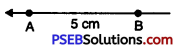
4. Draw a line segment AB = 5 cm and AC = 9 cm in such a way that points A, B, C are collinear. What is the length of BC?
Solution:
PSEB 6th Class Maths Solutions Chapter 9 Understanding Elementary Shapes Ex 9.1 4
AB = 5 cm and AC = 9 cm
Since, A, B and C are collinear
∴ AB + BC = AC
⇒ 5 cm + BC = 9 cm
⇒ BC = 9 cm – 5 cm
= 4 cm.
Hence, Length of BC = 4 cm