PSEB 9th Class English Vocabulary Nature of Words

Punjab State Board PSEB 9th Class English Book Solutions English Vocabulary Nature of Words Exercise Questions and Answers, Notes.

PSEB 9th Class English Vocabulary Nature of Words

Read the words and phrases that convey different meanings of the word ‘set given below :

Fixed, started, a group of same things, arranged, written or done, a piece of equipment, put. Now write the word / group of words that give the meaning of ‘set’ against each sentence.

1. My mother gifted a set of handkerchiefs to my younger sister.
2. The jewels were set beautifully in gold.
3. Raghu is well set in his new job.
4. Several TV sets have been stolen from his shop.
5. Let’s start wearing woollen clothes; the winter has set in.
6. The date of the test has not been set yet.
7. She has set the alarm for 5 o’clock, so that she is not late.
8. The surgeon who set my uncle’s hip bone is very popular.
9. Old people have set views about everything.
10. The table has been set for the tea party.
Answer:
1. a group of same things
2. fixed
3. settled
4. a piece of equipment
5. started
6. fixed
7. put fixed
9. fixed
10. arranged.

PSEB 9th Class English Vocabulary Nature of Words)

किसी एक शब्द के विभिन्न प्रयोगों के विभिन्न अर्थ हो सकते हैं। उदाहरण के रूप में नीचे दिए वाक्यों में run शब्द के आथों को देखिए

1. He can run very fast and win the prize. (race)
2. Don’t you think that the film will run at least for 6 weeks? (continue)
3. Suman runs from one table to another to finish her work in time. (hurries)
4. It is strange that Mr. Sahay is able to run two businesses effortlessly. (manages)
5. Our school will run Spoken English classes during the summer vacation. (provide)
6. Trains often run late in winter. (travel)
7. I can’t run on my small salary. (afford)
8. When she peels onions, tears run down her cheeks. (flow)

PSEB 9th Class English Grammar Tenses (Concord and Sequence)

Punjab State Board PSEB 9th Class English Book Solutions English Grammar Tenses (Concord and Sequence) Exercise Questions and Answers, Notes.

PSEB 9th Class English Grammar Tenses (Concord and Sequence)

Correct the tense in the following sentences :

(a)
1. They have come yesterday.
2. I have bought this house last year.
3. I am the person who have saved your life.
4. I shall call you when the lunch will be ready.
5. Dinesh will come if you will invite him.
6. I had been to Delhi recently.
7. She is one of those persons who never tells a lie.
8. She is working in the office for two years.
9. I had gone to the club last night.
10. I have written to him yesterday.
Answer:
1. They came yesterday.
2. I bought this house last year.
3. I am the person who has saved your life.
4. I shall call you when the lunch is ready.
5. Dinesh will come if you invite him.
6. I have been to Delhi recently.
7. She is one of those persons who never tell a lie.
8. She has been working in the office for two years.
9. I went to the club last night.
10. I wrote to him yesterday.

PSEB 9th Class English Grammar Tenses (Concord and Sequence)

(b) 1. I hoped that my friend will help me
2. Take care that you will not be cheated.
3. I know them for the last four years.
4. The patient died before the doctor arrived.
5. Newton has discovered the Law of Gravitation.
6. I am studying hard for the last three weeks.
7. He is suffering from fever since Monday.
8. I had visited Shimla last summer.
9. I am sorry I did not write that letter yet.
10. His younger sister is died.
Answer:
1. I hoped that my friend would help me.
2. Take care that you are not cheated.
3. I have been knowing them for the last four years.
4. The patent had died before the doctor arrived.
5. Newton discovered the Law of Gravitation.
6. I have been studying hard for the last three weeks.
7. He has been suffering from fever since Monday.
8. I visited Shimla last summer.
9. I am sorry I have not written that letter yet.
10. His younger sister is dead.

Put the correct Verbs in the blanks :

1. The tallest of these boys ……….. next door to me. (live, lives)
2. Slow and steady ……….. the race. (win, wins)
3. Neither Ashok nor Prem ………. any right to the property. (has, have)
4. Neither the captain nor the soldiers ……….. been arrested. (has, have)
5. Neither he nor I ……….. money to spare for this. (has, have)
6. You, as well as he, ……….. innocent. (is, are)
7. None but the brave ……….. the fair. (deserve, deserves)
8. The United States ……… a prosperous country. (is, are)
9. The committee ………. divided in their opinion. (was, were)
10. I, who ……….. your friend, will stand by you. (is, am, are)
Answer:
1. lives
2. wins
3. has
4. have
5. have
6. are
7. deserves
8. is
9. were
10. am.

Put the correct Verbs in the blanks :

1. All the players in my team ………. done well. (has, have)
2. Bread and butter ……… what they want. (is, are)
3. Either Sushil or Rakesh ……….. done this mischief…….. (has, have)
4. Neither he nor his servants ……….. honest. (was, were)
5. Neither you nor Sham ……….. to be capable of doing this. (appear, appears)
6. Not only the workman but the supervisor also ………. been dismissed. (has, have)
7. Each day and each hour ……….. its own importance. (has, have)
8. The news of the flood ……….. caused great anxiety. (has, have)
9. The jury ……….. divided in their opinion. (was, were)
10. This is one of the best novels that ………… been published this year. (has, have)
Answer:
1. have
2. is
3. has
4. were
5. appears
6. has
7. has
8. has
9. were
10. have.

PSEB 9th Class English Grammar Tenses (Concord and Sequence)

Put the correct Verbs in the blanks :

1. The cost of all types of pens ………. gone up. (has, have)
2. Time and tide ……….. for none ……….. (wait, waits)
3. Either you or he ……….. mistaken. (is, are)
4. Either Rajinder or his parents ……… responsible for this. (was, were)
5. Neither you nor I ……… lucky. (am, are)
6. He, as well as you, ……….. to blame. (is, are)
7. None of the ships ……….. rescued from the storm. (was, were)
8. The Arabian Nights ……….. interesting stories. (contain, contains)
9. The crew did ……….. best to save the ship. (its, their)
10. This is one of the most difficult lessons that ……… been taught. (has, have)
Answer:
1. has
2. wait
3. is
4. were
5. am
6. is
7. was
8. contains
9. their
10. have.

Put the correct Verbs in the blanks :

1. The toys that were bought by my son……….. really useful. (is, are)
2. Oil and water ……….. mix. (does not, do not)
3. Neither the judge nor the witnesses ……… him. (believe, believes)
4. Neither the Principal nor the lecturers ……….. present at the meeting. (was, were)
5. Either he or I ……….. wrong. (am, are)
6. The workmen, with their leaders ………. been arrested. (have, has)
7. One of my friends ………. the owner of this factory. (is, are)
8. Good crockery ……….. expensive. (is, are)
9. The jury ……….. divided on the issue. (was, were)
10. I am the one who ………. always stood for justice. (has, have)
Answer:
1. are
2. do not
3. believe
4. were
5. am
6. have
7. is
8. is
9. were
10. has.

Put the correct Verb in the blanks :

1. He ……….. regularly. (work, works)
2. Tobacco and alcohol ………. injurious to health. (is, are)
3. Either the officer or the assistants ………. responsible for this error. (is, are)
4. Me or his friends ………. to blame. (was, were)
5. Neither my brother nor I ……….. ever been to Mumbai. (has, have)
6. The gallery, with its beautiful pictures, ………. a great attraction. (is, are)
7. Either of these two proposals ……….. acceptable to me. (is, are)
8. The West Indies ……….. a land of great cricketers. (is, are)
9. The Assembly ……….. in session.
10. He is one of those leaders who …………. always ready to do or die.
Answer:
1. works
2. are
3. are
4. were
5. have
6. is
7. is
8. are
9. is
10. are.

PSEB 9th Class English Grammar Tenses (Concord and Sequence)

Use Of Tenses

Tense (काल)-Verb के जिस रूप से यह पता चले कि क्रिया कब हुई है, उसे Tense कहा जाता है। Tense तीन प्रकार के होते हैं

1. Present Tense (वर्तमान काल)
2. Past Tense (भूत काल)
3. Future Tense (भविष्य काल)
प्रत्येक Tense के चार भिन्न-भिन्न रूप होते हैं

1. (i) Present Indefinite Tense (or) Simple Present
(ii) Present Continuous Tense
(iii) Present Perfect Tense
(iv) Present Perfect Continuous Tense.

2. (i) Past Indefinite Tense (or) Simple Past
(ii) Past Continuous Tense
(iii) Past Perfect Tense
(iv) Past Perfect Continuous Tense.

3. (i) Future Indefinite (or) Simple Future
(ii) Future Continuous Tense
(iii) Future Perfect Tense
(iv) Future Perfect Continuous Tense.

(A) Present Tense

1. Present Indefinite Tense प्रयोग – इस Tense का प्रयोग निम्नलिखित स्थितियों में किया जाता है
1. सदा सत्य बातों के लिए:
(The sun shines by day, and the moon by night.)

2. चरित्र-सम्बन्धी स्थायी आदतों के लिए –
(He never tells a lie.)

3. वास्तविक Present और निकट भविष्य के लिए –
1. I understand what you say.
2. He leaves for Mumbai tomorrow.

नियम-

  • इस Tense में Verb की पहली फार्म का प्रयोग किया जाता है।
  • यदि subject एकवचन हो, तो verb की पहली फार्म के साथ या का प्रयोग किया जाता है।
  • Negative तथा Interrogative वाक्यों में Helping Verb के रूप में do / does का प्रयोग किया जाता है।
  • बहुवचन subject के लिए do का, एकवचन subject के लिए does का प्रयोग किया जाता है। Does के साथ प्रयोग की जाने वाली Verb की पहली फार्म के साथ s या es नहीं लगाया जाता है।
  • I तथा you के लिए प्रयोग की जाने वाली Verb की पहली फार्म के साथ s या es नहीं लगाया जाता है। इनके लिए बहुवचन subject की भान्ति केवल Verb की पहली फार्म का ही प्रयोग किया जाता है।

2. Present Continuous Tense प्रयोग-इस Tense का प्रयोग निम्नलिखित स्थितियों में किया जाता है

1. बोलने या लिखने के समय चल रही किसी घटना का वर्णन करने के लिए; जैसे (He is writing a letter:)
2. किसी आदत अथवा व्यवहार का वर्णन करने के लिए भी कभी-कभी इस Tense का प्रयोग किया जाता है; जैसे
(She is working regularly these days.) नियम- इस Tense के वाक्यों में is / am / are लगा कर Verb के ing. वाले रूप का वर्णन किया जाता है।
Subject + is / am / are + Verb का ing वाला रूप + ………….

Note : Present Continuous Tense तथा Present Indefinite Tense के अन्तर को अच्छी प्रकार समझ लेना चाहिए। निम्नलिखित नियम याद रखिए
Present Indefinite Tense — for habitual actions; for universal truths; for actions going to take place in near future.
Present Continuous Tense — for actions in progress at the time of speaking.

3. Present Perfect Tense प्रयोग-इस Tense का प्रयोग अभी-अभी (वर्तमान में) पूरी हुई किसी घटना का वर्णन करने के लिए
किया जाता है। नियम- इस Tense के वाक्यों में has / have लगा कर Verb की तीसरी फार्म का प्रयोग किया जाता है; जैसे
1. She has just finished her work.
2. I have spent all my money on books.

PSEB 9th Class English Grammar Tenses (Concord and Sequence)

4. Present Perfect Continuous Tense प्रयोग- इस Tense का प्रयोग तब किया जाता है जब कोई क्रिया भूत काल में आरम्भ हुई हो और अब भी चल रही हो; जैसे
1. He has been reading English for two years.
2. They have been reading this book since morning.

नियम-
(1) इस Tense के वाक्यों में has / have + been + V1-ing + since / for का प्रयोग किया जाता है।
(2) For का प्रयोग तब किया जाता है जब क्रिया के जारी रहने की अवधि (period of time) दी हुई हो; जैसे for fifteen minutes; for half an hour; for a month; for three years ; for a long time.
(3) Since का प्रयोग तब किया जाता है जब क्रिया के आरम्भ होने का निश्चित समय (point of time) दिया हुआ हो; जैसे
since Sunday; since breakfast; since yesterday ; since Diwali; since January 1998; since the first of May.

(B) Past Tense

1. Past Indefinite Tense प्रयोग- इस Tense का प्रयोग तब किया जाता है जब कोई घटना भूत काल में आरम्भ होकर भूत काल में ही समाप्त हो गई हो। (We learnt English at school.)

नियम-
(1) इस Tense के affirmative वाक्यों में Verb की दूसरी फार्म का प्रयोग किया जाता है।
(2) Negative वाक्यों में did not + Verb की पहली फार्म का प्रयोग किया जाता है।
(3) Interrogative वाक्यों में Did + subject + Verb की पहली फार्म का प्रयोग किया जाता है।
(4) Did का प्रयोग करने के बाद सदा Verb की पहली फार्म का ही प्रयोग किया जाता है।

2. Past Continuous Tense प्रयोग – इस Tense का प्रयोग तब किया जाता है जब कोई क्रिया भूतकाल में किसी निश्चित समय पर चल रही हो। (He was writing a letter when I saw him.)
नियम – इस Tense के वाक्यों में was / were लगा कर Verb के ing वाले रूप का प्रयोग किया जाता है।

Note : Past Continuous Tense तथा Past Indefinite Tense के अन्तर को अच्छी प्रकार से समझ लेना चाहिए। निम्नलिखित नियम याद रखिए
Past Indefinite Tense – for completed activity.
Past Continuous Tense – for continuity in past.

PSEB 9th Class English Grammar Tenses (Concord and Sequence)

3. Past Perfect Tense प्रयोग – इस Tense का प्रयोग तब किया जाता है यदि कोई क्रिया भूतकाल में किसी निश्चित समय (moment) से पहले या किसी निश्चित समय तक पूरी हो चुकी हो।
1. The patient had died before the doctor came.
2. I had finished my work by evening.

नियम – इस Tense में had लगा कर Verb की तीसरी फार्म का प्रयोग किया जाता है।

Note : यदि किसी वाक्य में भूत काल में घटी हुई दो घटनाओं का वर्णन हो, तो उनमें से जो घटना पहले घटी हो उसके लिए Past Perfect Tense का प्रयोग किया जाता है, और जो घटना अपेक्षाकृत बाद में घटी हो उसके लिए Past Indefinite Tense का प्रयोग किया जाता है।

4. Past Perfect Continuous Tense प्रयोग – इस Tense का प्रयोग तब किया जाता है यदि कोई क्रिया भूतकाल में आरम्भ होकर भूतकाल में ही किसी निश्चित समय पर चल रही हो; जैसे(When I reached there at 2 p.m., he had been waiting for me since 1:30 p.m.) नियम – इस Tense के वाक्यों में had + been + V1-ing + since / for का प्रयोग किया जाता

(C) Future Tense

Future Indefinite Tense

प्रयोग- इस Tense का प्रयोग साधारण रूप में भविष्य में होने वाली किसी घटना का वर्णन करने के लिए किया जाता है; जैसे–
(The post will arrive late. We shall start early.)
नियम – इस Tense के वाक्यों में will / shall लगा कर Verb की पहली फार्म का प्रयोग किया जाता है।
Note : Will और Shall सम्बन्धी प्रयोग के लिए निम्नलिखित नियम ध्यान में रखिए

(1) Assertive वाक्यों में
1. यदि किसी भविष्य की घटना का केवल साधारण रूप से ही वर्णन हो, तो-
First Person के लिए shall का प्रयोग किया जाता है।
Second और Third Persons के लिए will का प्रयोग किया जाता है।

2. यदि वाक्य में किसी भविष्य-सम्बन्धी आदेश (command), प्रण (promise), निश्चय (determination), धमकी (threat) आदि का वर्णन हो, तो First Person के लिए will का प्रयोग किया जाता है।

3. यदि वक्ता अपने किसी भविष्य-सम्बन्धी उद्देश्य (intention) को प्रकट करना
चाहता हो तो वह अपने लिए Will का प्रयोग करेगा। अर्थात् ऐसे वाक्यों में First person के साथ will का प्रयोग किया जाता है।

(2) Interrogative वाक्यों में
1. प्रश्न-वाचक वाक्यों में प्राय: Will I और Shall you का प्रयोग नहीं किया जाता है।
2. Third Person के लिए will अथवा shall किसी का भी प्रयोग किया जा सकता है।
Shall he – भविष्य सम्बन्धी आदेश आदि के लिए।
Will he – भविष्य सम्बन्धी साधारण क्रिया के लिए।

Future Continuous Tense –

प्रयोग-इस Tense का प्रयोग तब किया जाता है जब भविष्य में किसी विशेष समय का वर्णन हो, और कोई क्रिया उस विशेष समय से पहले आरम्भ होकर उसके बाद में पूरी होनी हो; जैसे
(We shall be waiting for you when you get back tomorrow).
नियम – इस Tense के वाक्यों में will / shall के साथ be लगा कर Verb के ing वाले रूप का प्रयोग किया जाता है।

Note :
Future Continuous Tense तथा Future Indefinite Tense के अन्तर को अच्छी तरह से समझ लेना चाहिए। निम्नलिखित नियम याद रखिए
Future Indefinite Tense – for an action which begins at a certain future moment.
Future Continuous Tense – for an action which begins before and finishes after a certain future moment.

PSEB 9th Class English Grammar Tenses (Concord and Sequence)

3. Future Perfect Tense –
प्रयोग – इस Tense का प्रयोग तब किया जाता है जब कोई क्रिया भविष्य में किसी समय से पहले पूरी होनी हो; जैसे
(I will have finished my homework by evening.)
नियम – इस Tense में will / shall + have लगा कर Verb की तीसरी फार्म का प्रयोग किया जाता है।

4. Future Perfect Continuous Tense प्रयोग – इस Tense का प्रयोग तब किया जाता है यदि क्रिया भविष्य में किसी निश्चित समय (point of time) तक अथवा किसी निश्चित अवधिः (period of time) के लिए जारी रहनी हो; जैसे (By six o’clock I will have been sitting here for ten hours.)
नियम – इस Tense में will / shall + have been लगा कर Verb के ing वाले रूप का प्रयोग किया जाता है।

Indefinite Continuous Perfect Perfect Continuous
PRESENT
PAST
FUTURE
write (s)
wrote
will/shall write
I am/are writing
was/were writing
I will/shall be writing
has/have written
had written
will/shall have written
has/have been written
had been written
will/shall have been written

Miscellaneous Sentences For Practice

Fill in the blanks with the Present Indefinite form of the verbs given in the brackets :

1. He for a walk every day. (go)
2. She …………………….. up early in the morning. (get)
3. The peon ……………… the bell at 9 o’clock. (ring)
4. I ………………. my parents. (obey)
5. We ……………… our teachers. (respect)
6. We ……………………. our prayers in the morning.
7. She …………………….. sweetly. (sing
8. I do not …………………….. sweets. (like)

Fill in the blanks with the Present Continuous form of the verbs given in the brackets :

1. …………… it …………………… today? (rain)
2. ……….. the peon ……. the bell ? (ring)
3. ………… the boys …………..football ? (play)
4. He ……….. a picture. (paint)
5. We ………… our lesson. (learn)
6. She ……………………. not ……………. food. (cook)
7. I ……………………. a letter. (write)
8. You ………. (run)

Fill in the blanks with the Present Perfect form of the verbs given in the brackets :

1. I ….. my homework. (finish)
2. He …………………… first in the class. (stand)
3. …………you …………. your scooter ? (Sell)
4. ………….. she ……. a car? (buy)
5. They ……………………. their enemy. (murder)
6. We ……………………… the match. (win)
7. The peon ………………….. the bell. (ring)
8. We …….. our duty. (do)

Fill in the blanks with the Present Perfect Continuous form of the verbs given in the brackets :

1. It …………….. since morning. (rain)
2. She ………………….. from fever for a week. (suffer)
3. I ………………….. for you for half an hour. (wait)
4. He ……. his brother with money for five years. (help)
5. We ……………………. for a long time. (fight)
6. She ………………… for a job for several months. (look)
7. ……………………. he books from you since 2011? (borrow)
8. she ………………. in this office since 2013? (work)

Fill in the blanks with the Past Indefinite form of the verbs given in the brackets :

1. India ………………….. independence in 1947. (get)
2. He ………………….. government service in 2012. (join)
3. It …………………… heavily last night. (rain)
4. …………………… he …………… you money? (lend)
5. She ……………………. not ……………………. to my proposal. (agree)
6. Why ……………………. he ……………………. angry with you? (become)
7. The teacher ………………….. the student. (punish)
8. He …………………. to go for a walk daily. (use)

PSEB 9th Class English Grammar Tenses (Concord and Sequence)

Fill in the blanks with the Past Continuous form of the verbs given in the brackets :

1. It ……………. in the morning. (rain)
2. The peon …… ……………. the bell. (ring)
3. Why …………….. she (weep)
4. She ……………………. clothes. (wash)
5. …………………. she …………………… food ? (eat)
6. …………………. the hunter ……………… birds ? (kill)
7. He a novel ………… (read)
8. My grandmother …………………… a story. (tell)

Fill in the blanks with the Past Perfect form of the verbs given in the brackets :

1. He ………………….. a tiger before I reached the forest. (kill)
2. She …………………… a sweater before I bought a new one. (knit)
3. I ……………….. money from my friend before I received my salary. (borrow)
4. The river ………………….. its banks before the dam was built. (overflow)
5. …………….. she …………… a new dress before his father came ? (buy)
6. Why …………………… he …………….. you before you offended him ? (abuse)
7. My uncle …………………… a new house before he retired from service. (build)
8. ……. you in the race before you defeated him in boxing ? (beat)

Fill in the blanks with the Past Perfect Continuous form of the verbs given in the brackets :

1. We in Delhi for ten years. (live)
2. He ……………….. in this office since 2011. (work)
3. She ……………… in this school for ten years. (teach)
4. ……………. your brother for five years ? (look after)
5. Who …………………. you with money all these years ? (help)
6. The farmer …….. the fields for many days. (plough)
7. The teacher …………………… the students for a long time. (guide)
8. They …….. their country for thirty years. (serve)

Fill in the blanks with Future Indefinite form of the verbs given in the brackets :

1. I ………………… to Delhi. (go)
2. We ……………………. you with money. (help)
3. The peon ………. the bell at 9 o’clock. (ring)
4. ………… she……………….. in time ? (come)
5. …………………… he …………………… you his book ? (lend)
6. She ……………………. a rich man. (marry)
7. The train ………………….. in time. (arrive)
8. They …………………… a match tomorrow. (play)

Fill in the blanks with the Future Continuous form of the verbs given in the brackets :

1. She ……………………. a picture. (paint)
2. I ………………….. a new car. (buy)
3. He ……………………. to Delhi tomorrow.
4. They ………………….. their friends. (help)
5. People ………………….. their work. (do)
6. ……………….. she ………………….. food ? (cook)
7. …………………… they …………………. in the river ? (bathe)
8. He ……………………. not ……………………. his friends. (cheat)

PSEB 9th Class English Grammar Tenses (Concord and Sequence)

Fill in the blanks with the Future Perfect form of the verbs given in the brackets :

1. She …………………… her work in time. (finish)
2. He ………………….. you with money. (help)
3. They ………………… their clothes. (wash)
4. I ………………….. the situation. (handle)
5. She …………………… her promise. (break)
6. He ……………………. you money. (lend)
7. ……….. you English ? (teach)
8. ………………….. they ……………. bravely ? (fight)

Fill in the blanks with the Future Perfect Continuous form of the verbs given in the brackets :

1. It ………………… for two hours. (rain)
2. They …………….. here for many years. (live)
3. She …………………… English since 2008 (learn)
4. He …………………. Mathematics for many years. (teach)
5. …………………. she ………. in this office since 1985 ? (work)
6. He ……………………. you for a long time. (cheat)
7. They ………………….. the poor since 1982. (help)
8. …… she ……………….. food for the whole family for several (cook)

Concord : Subject-Verb Agreement

1. क्रिया का प्रयोग अवश्य ही इसके कर्ता के अनुसार होना चाहिए।
2. एकवचन कर्ता के साथ एकवचन क्रिया का प्रयोग किया जाता है और बहुवचन कर्ता के साथ बहुवचन क्रिया का प्रयोग किया जाता है।

Singular Subject – Singular Verb Plural Subject – Plural Verb
This child is very clever.
That book was interesting.
He has many storybooks.
He does not work regularly.
These children are very clever.
Those books were interesting.
They have many storybooks.
They do not work regularly.

याद रखें – I के साथ am, was, have तथा you के साथ are, were, have का प्रयोग किया जाता है।

I am / was angry with him.
I have a good English dictionary.
You are / were late for school.
You have a good house.

3. निम्नलिखित क्रियाओं को negative और question form में बदलने के लिए have का प्रयोग किया जाता है, न कि has का –

do, does, did,
will, would, shall, should,
can, could, may, might,
must, need, dare,
ought to, used to
Examples :

  • Does she have a new frock ?
  • We do not have a high school in our village.
  • Did he have his share ?
  • I shall have a lot of money next week.
  • He used to have a car.
  • Mohan must have finished his work.

कुछ वाक्यों में ‘There’ कर्ता का स्थान ले लेता है। वास्तविक कर्ता क्रिया के बाद आता है।

  • There is a table in this room.
  • There are ten desks in this room.
  • There was a clock on the wall.
  • There were pictures on the wall.
  • There has been a mistake.
  • There have been many mistakes.

याद रखिए कि ऐसे वाक्यों में क्रिया वास्तविक कर्ता के अनुसार होती है। यदि वास्तविक कर्ता एकवचन (a table, a clock, a mistake) हो तो क्रिया भी एकवचन (is, was, has) होती है। यदि वास्तविक कर्ता बहुवचन (ten desks, pictures, many mistakes) हो तो क्रिया भी बहुवचन (are, were, have) होती है। परन्तु ‘There’ के विपरीत It’ के साथ सदा एकवचन क्रिया का प्रयोग किया जाता है।

  • It is hot today.
  • It was 7:30 at that time.
  • It has been a mistake.

प्रायः हम एक भूल कर जाते हैं, जिसे “Error of Proximity” कहा जाता है, हम क्रिया को इसके साथ लगती संज्ञा की मात्रा के अनुसार कर देते हैं। निम्नलिखित उदाहरणों में दिखाए अनुसार हमें इनसे बचना चाहिए।

  • The quality of the mangoes was (not ‘were) not good.
  • His knowledge of Indian vernaculars is (not are) very sound.
  • The state of his affairs was (not ‘were) such as to cause anxiety to his parents.
  • The results of the new policy are (not is) very encouraging.

PSEB 9th Class English Grammar Tenses (Concord and Sequence)

4. and’ द्वारा जोड़े गए दो या दो से अधिक एकवचन संज्ञाओं या सर्वनामों के साथ बहुवचन क्रिया का प्रयोग किया जाता है। जैसे –

  • Gold and silver are precious metals.
  • Fire and water do not agree.
  • Are your father and mother at home ?
  • He and I were playing.

परन्तु यदि संज्ञाएं हमारे दिमाग को एक विचार देती हैं, अथवा किसी एक ही व्यक्ति अथवा वस्तु की ओर संकेत करती हैं, तो एकवचन क्रिया का प्रयोग किया जाता है। जैसे –

  • The horse and carriage is at the door.
  • Bread and butter is his only food.
  • Honour and glory is his reward.
  • The novelist and poet is dead.

5. एकवचन के साथ with, as well as, आदि द्वारा जोड़े गए शब्द उपवाक्य सम्बन्धी होते हैं। इसलिए एकवचन क्रिया का प्रयोग किया जाना चाहिए; जैसे –

  • The house, with its contents, was insured.
  • The Chairman, with the directors, is to be present.
  • The ship, with its crew, was lost.
  • Silver, as well as cotton, has fallen in price.
  • Sanskrit, as well as Arabic, was taught there.
  • Justice, as well as mercy, allows it.

6. or अथवा nor द्वारा जोड़े गए दो या दो से अधिक कर्ताओं के साथ एकवचन क्रिया का प्रयोग किया जाता है। जैसे –

  • No nook or corner was left unexplored.
  • Our happiness or our sorrow is largely due to our own actions.
  • Either the cat or the dog has been here.
  • Neither food nor water was to be found there.
  • Neither praise nor blame seems to affect him.

7. जब or अथवा nor द्वारा जोड़े गए कर्ताओं में से एक बहुवचन हो, तब क्रिया भी बहुवचन होनी चाहिए, और बहुवचन कर्ता को क्रिया के समीपतम् रखना चाहिए; जैसे –
Neither the chairman nor the directors are present. जब or अथवा nor द्वारा जोड़े गए कर्ता अलग-अलग सर्वनामों से सम्बन्धित हों तो क्रिया समीपतम् सर्वनाम के अनुसार होनी चाहिए; जैसे –

  • Either he or I am mistaken
  • Either you or he is mistaken.
  • Neither you nor he is to blame.
  • Neither my friend nor I am to blame.

Either, neither, each, everyone, many a के साथ एकवचन क्रिया का प्रयोग किया जाना चाहिए; जैसे

  • He asked me whether either of the applicants was suitable.
  • Neither of the two men was very strong.
  • Each of these minerals is found in India.
  • Everyone of the boys loves to ride.
  • Many a man has done so.

ऐसी दो संज्ञाएं जिनसे पूर्व each अथवा every लगा हो और वे and द्वारा जुड़ी हुई हों, तो ऐसी स्थिति में उनके साथ एकवचन क्रिया का प्रयोग किया जाता है जैसे –

  • Each boy and each girl was present in the class.
  • Every table and every chair has been dusted.

8. कुछ संज्ञाएं जिनका रूप बहुवचन में होता है, परन्तु जिनका अर्थ एकवचन में होता है, ऐसी संज्ञाओं के साथ एकवचन क्रिया का प्रयोग किया जाता है; जैसे –

  • The news is true.
  • Politics was with him the business of his life.
  • The wages of sin is death.
  • Mathematics is a branch of study in every school.

कुछ संज्ञाएं जिनका रूप एकवचन में होता है, परन्तु जिनका अर्थ बहुवचन में होता है, ऐसी संज्ञाओं के साथ बहुवचन क्रिया का प्रयोग किया जाता है; जैसे – Twelve dozen cost one hundred rupees.

9. किसी समूह-वाचक संज्ञा के साथ एकवचन क्रिया का प्रयोग होता है जब उस समूह को समूचे पूर्णांक के रूप में ले लिया जाए; और बहुवचन क्रिया का प्रयोग तब होता है जब उसी समूह को उसकी विभिन्न इकाइयों के रूप में लिया जाए; जैसे –
1. The committee has issued its report.
2. The committee are divided on one minor point.
परन्तु हमें समरूप होना चाहिए। इस प्रकार, हमें कहना चाहिए :
The committee has appended a note to its (not their) report.

PSEB 9th Class English Grammar Tenses (Concord and Sequence)

10. जब कोई बहुवचन संज्ञा किसी एक वस्तु अथवा किसी सामूहिक इकाई का एक विशेष नाम हो, तब इसके साथ एकवचन क्रिया का प्रयोग किया जाना चाहिए; जैसे –

  • The Arabian Nights is still a great favourite.
  • The United States has a big navy.
  • Plutarch’s Lives is an interesting book.
  • Gulliver’s Travels was written by Swift.

11. जब कोई बहुवचन संज्ञा किसी ऐसी विशेष संख्या अथवा मात्रा की ओर संकेत करती है जिसे एक समूचा पूर्णांक माना गया हो, तब क्रिया प्रायः एकवचन होती है; जैसे –

  • One hundred paise is equal to one rupee.
  • Six miles is a long distance.
  • Fifty thousand rupees is a large sum.
  • Three parts of the business is left for me to do.

Complete these sentences with one of the two verbs given in brackets :

1. They ……….. going to report the matter to the Principal. (is / are)
2. She ………… not have any chance of winning the election. (do / does)
3. The teacher does not ……….. much work to do. (has / have)
4. ……….. you have any money with you ? (Do / Does)
5. Doesn’t Chennai ……….. a severe winter ? (has / have)
6. ………… the men shouting loudly ? (Was / Were)
7. Can we ………… coffee instead of tea ? (has / have)
8. Don’t the students ……………. their books with them ? (has / have)
9. ……………. your friend visit you daily ? (Do / Does)
10. They needn’t …………… gone there so early. (has / have)
Answer:
1. are
2. does
3. have
4. Do
5. have
6. Were
7. have
8. have
9. Does
10. have.

Choose the correct verb out of the two given in brackets and rewrite the sentences :

1. The cause of both the accidents (was, were) the same.
2. Each of the boys (has, have) done his homework.
3. All my friends (has, have) joined this college.
4. (Have, has) either of you any money?
5. Everyone of us (is, are) going to the film.
6. Both the rooms (was, were) whitewashed…
7. One of the debators (was, were) very interesting.
8. The furniture (is, are) to be sold today.
9. A few sheep (was, were) running about in the field.
10. Neither Manu nor Misha (was, were) with us today.
Answer:
1. was
2. has
3. have
4. Has
5. is
6. were
7. was
8. is
9. were
10. was.

PSEB 9th Class English Grammar Tenses (Concord and Sequence)

Sequence Of Tenses

यदि मुख्य-वाक्य की क्रिया Present Tense में हो, तो उपवाक्य की क्रिया किसी भी Tense में हो सकती है; जैसे

1. He assures me that the train has arrived.
2. He says she will come at 4 p.m.
3. The Principal declares that latecomers will be fined.
4. Subhash says that they had been sitting there for two hours.
5. The witness affirms that the accused is not guilty.

2. यदि मुख्य वाक्य की क्रिया Future Tense में हो, तो उप-वाक्य की क्रिया किसी भी Tense में हो सकती है; जैसे
1. He will assure me that the train has arrived.
2. He will assure me that the train had arrived.
3. He will say that Ramesh is late.
4. He will say that Ramesh was late.
5. He will tell us that Radha is waiting for us at the bus stop.

3. यदि मुख्य-वाक्य की क्रिया Past Tense में हो, तो उप-वाक्य की क्रिया भी Past Tense में ही होनी चाहिए। (किन्तु यदि उप-वाक्य में किसी Habit या Universal truth का वर्णन हो, तो इसकी क्रिया Present Tense में ही रहती है।)
1. He assured me that the train had arrived.
2. She said that she would come at 4 p.m.
3. The Principal declared that latecomers would be fined.
4. He told me that he never tells a lie.
5. The teacher said that honesty is the best policy.

If Patterns

(If से आरम्भ होने वाले उप-वाक्य) नीचे दिए गए चार्ट को सदा ध्यान में रखिए- ‘.

If Clause Main Clause 
I   Form
II   Form
Had + III Form
will + I Form
would + I Form
would have + III Form

नोट : Until और unless से आरम्भ होने वाले उप-वाक्यों में भी यही नियम लागू होते हैं।
Examples :
1. If you play the piano, I will sing.
If you played the piano, I would sing.
If you had played the piano, I would have sung.

2. He will beat the thief if he catches him.
He would beat the thief if he caught him.
He would have beaten the thief if he had caught him.

3. The horse will kick you if you go near it.
The horse would kick you if you went near it.
The horse would have kicked you if you had gone near it.

4. He will not play tennis if you do not give him a racket.
He would not play tennis if you did not give him a racket.
He would not have played tennis if you had not given him a racket.

5. He will walk to the station if he is well.
He would walk to the station if he was well.
He would have walked to the station if he had been well.

PSEB 9th Class English Grammar Tenses (Concord and Sequence)

6. My servant can paint your boat if you give him a brush.
My servant could paint your boat if you gave him a brush.
My servant could have painted your boat if you had given him a brush.

PSEB 9th Class Hindi Vyakaran उपसर्ग

Punjab State Board PSEB 9th Class Hindi Book Solutions Hindi Grammar upasarg उपसर्ग Exercise Questions and Answers, Notes.

PSEB 9th Class Hindi Grammar उपसर्ग

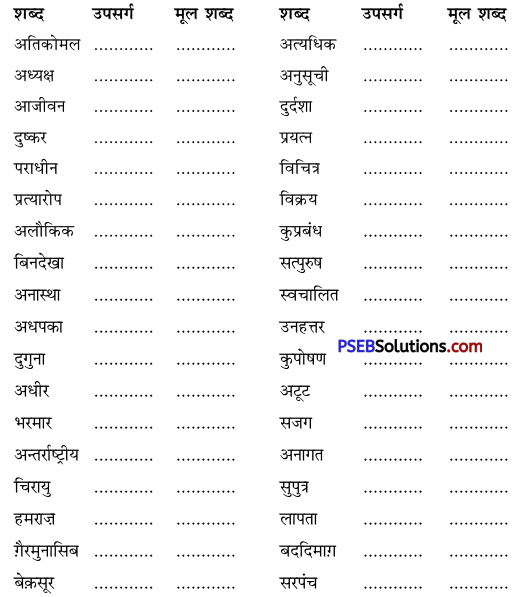
निम्नलिखित शब्दों में से मूल शब्द व उपसर्ग अलग-अलग करके लिखिए।
PSEB 9th Class Hindi Vyakaran उपसर्ग 1
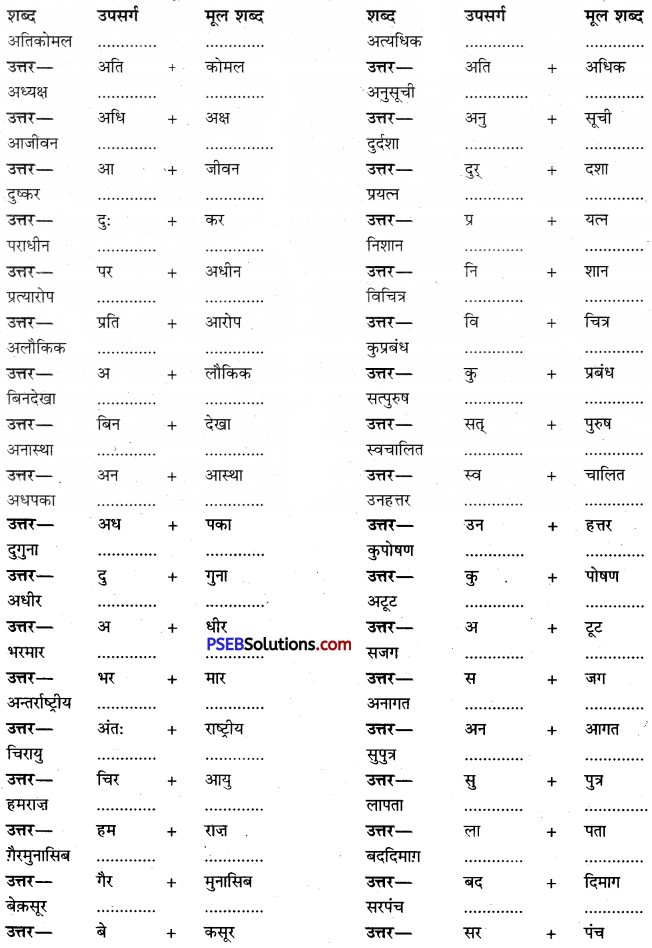
उत्तर:
PSEB 9th Class Hindi Vyakaran उपसर्ग 2

PSEB 9th Class Hindi Vyakaran उपसर्ग

एक वाक्य में उत्तर दीजिए

प्रश्न 1.
उपसर्ग किसे कहते हैं?
उत्तर:
किसी शब्द से पहले जो शब्दांश जुड़कर उसके अर्थ को बदल देता है या उसमें बदलाव उत्पन्न कर देता है, उसे उपसर्ग कहते हैं।

प्रश्न 2.
हिंदी में उपसर्ग कितने प्रकार के होते हैं?
उत्तर:
हिंदी में उपसर्ग चार प्रकार के होते हैं।

प्रश्न 3.
हिंदी के उपसर्गों के प्रकार लिखिए।
उत्तर:

  1. संस्कृत के उपसर्ग
  2. हिंदी के उपसर्ग
  3. विदेशी भाषाओं के उपसर्ग
  4. उपसर्ग की तरह प्रयुक्त होने वाले संस्कृत अव्यय।

प्रश्न 4.
तत्सम उपसर्ग किसे कहते हैं?
उत्तर:
संस्कृत से हिंदी में आए वे उपसर्ग जो तत्सम रूप में प्रयुक्त किए जाते हैं उन्हें तत्सम उपसर्ग कहते हैं।

प्रश्न 5.
तत्सम उपसर्ग के चार उदाहरण दीजिए।
उत्तर:
अति, अव, आ, उप, अनु, दुर, अभि, अप, प्र, प्रति।

प्रश्न 6.
उपसर्ग की तरह प्रयुक्त किए जाने वाले संस्कृत अव्यय के उदाहरण लिखिए।
उत्तर:
अंतर, अ, अध, कु, अलम् पुनर्, सह, सत्, चिर।

प्रश्न 7.
हिंदी के उपसर्गों के उदाहरण दीजिए।
उत्तर:
अ, अध, अन, उन, अव, दु, कु, चौ, नि, भर, सु।

प्रश्न 8.
उर्दू के उपसर्गों के उदाहरण दीजिए।
उत्तर:
कम, अल, बिला, बे, बा, दर, ना, बद्, गैर, खुश, हर, हम।

PSEB 9th Class Hindi Vyakaran उपसर्ग

प्रश्न 9.
खुश, न, सर, हम, हर और कम उपसर्ग किस भाषा से संबंधित हैं?
उत्तर:
ये सभी उर्दू के उपसर्गों से संबंधित हैं।

एक शब्द में उत्तर दीयिजए

प्रश्न 1.
उपसर्ग किसी शब्द में क्या परिवर्तन कर देता है?
उत्तर:
अर्थ।

प्रश्न 2.
उपसर्ग कितने प्रकार के होते हैं?
उत्तर:
चार।

प्रश्न 3.
‘अधि’ उपसर्ग अर्थ को क्या प्रदान करता है?
उत्तर:
श्रेष्ठता।

प्रश्न 4.
‘अनु’ उपसर्ग अर्थ को क्या अर्थ देती है?
उत्तर:
समानता।

प्रश्न 5.
‘उत्’ उपसर्ग अर्थ को क्या प्रदान करती है?
उत्तर:
उच्चता/श्रेष्ठता/उत्कृष्टता।

प्रश्न 6.
‘गैर’ उपसर्ग किस भाषा से संबंधित है?
उत्तर:
उर्दू।

प्रश्न 7.
‘बे’ उपसर्ग किस अर्थ को प्रदान करता है?
उत्तर:
बिना/बगैर।

प्रश्न 8.
‘प्रत्यारोपण’ में किस उपसर्ग का प्रयोग किया गया है
उत्तर:
प्रति।

प्रश्न 9.
‘अधपका’ शब्द में प्रयुक्त उपसर्ग को लिखिए।
उत्तर:
अध।

PSEB 9th Class Hindi Vyakaran उपसर्ग

हाँ/नहीं में उत्तर दीजिए

प्रश्न 1.
‘चौराह’ में ‘चो’ उपसर्ग का प्रयोग किया गया है।
उत्तर:
नहीं।

प्रश्न 2.
‘कपूत’ में ‘कपू’ उपसर्ग का प्रयोग किया गया है।
उत्तर:
नहीं।

प्रश्न 3.
‘चिरस्मरणीय’ में चिर उपसर्ग का प्रयोग है।
उत्तर:
हाँ।

प्रश्न 4.
‘सच्चरित्र’ शब्द में सत् उपसर्ग का प्रयोग है।
उत्तर:
हाँ।

प्रश्न 5.
‘तिरोहित’ शब्द में तिर उपसर्ग है।
उत्तर:
हाँ।

प्रश्न 6.
‘स्वयंभू’ शब्द में ‘स्व’ उपसर्ग है।
उत्तर:
नहीं।

प्रश्न 7.
‘परदादा’ शब्द में पर उपसर्ग का प्रयोग किया गया है।
उत्तर:
हाँ।

रिक्त स्थानों की पूर्ति कीजिए

प्रश्न 1.
उपसर्ग किसी शब्द के ……….. लगकर विशेष अर्थ को प्रकट करता है।
उत्तर:
आगे/शुरू में।

प्रश्न 2.
उपसर्ग के प्रयोग से शब्दांश का ……….. बदल जाता है।
उत्तर:
अर्थ।

प्रश्न 3.
उपसर्ग …………. प्रकार के होते हैं।
उत्तर:
चार।

प्रश्न 4.
संस्कृत से हिंदी में आने वाले रूपों को ………. उपसर्ग कहते हैं।
उत्तर:
तत्सम।

प्रश्न 5.
‘उन’ उपसर्ग ……….. अर्थ को व्यक्त करता है।
उत्तर:
एक कम।

प्रश्न 1.
उपसर्ग किसे कहते हैं?
उत्तर:
उपसर्ग उस शब्दांश को कहते हैं जो किसी शब्द के शुरू में लगकर विशेष अर्थ प्रकट करता है और उस शब्द का अर्थ ही बदल देता है ; जैसे-‘कर्म’ शब्द का अर्थ है कार्य अथवा काम। इस कर्म से पहले ‘सु’ और ‘कु’ लगाने से नए शब्द बनते हैं-सु + कर्म = सुकर्म तथा कु + कर्म = कुकर्म ! यहाँ ‘सु’ और ‘कु’ लगने से नए शब्द सुकर्म और कुकर्म बनें जिनके अर्थ भी बदल गए हैं। सुकर्म का अर्थ अच्छे कार्य तथा कुकर्म का अर्थ बुरे कार्य हैं। यहाँ ‘सु’ और ‘कु’ उपसर्ग हैं।

प्रश्न 2.
उपसर्ग की परिभाषा दीजिए।
उत्तर:
जो शब्दांश किसी शब्द के पहले जुड़कर नया शब्द बनाते हैं और उसके अर्थ में भी परिवर्तन हो जाता है, उसे उपसर्ग कहते हैं।

प्रश्न 3.
उपसर्ग कितने प्रकार के होते हैं?
उत्तर:
हिंदी में उपसर्ग चार प्रकार के होते हैं:

  1. तत्सम अथवा संस्कृत के उपसर्ग
  2. संस्कृत अव्यय जो उपसर्ग की तरह प्रयोग होते हैं
  3. तद्भव अर्थात् हिंदी के उपसर्ग और
  4. विदेशी भाषाओं उर्दू, फारसी, अंग्रेज़ी से आए हिंदी में प्रचलित उपसर्ग।

PSEB 9th Class Hindi Vyakaran उपसर्ग

(क) तत्सम उपसर्ग/संस्कृत के उपसर्ग जो उपसर्ग संस्कृत से हिंदी में आए हैं और अभी भी तत्सम रूप में ही प्रयुक्त किए जाते हैं, उन्हें तत्सम उपसर्ग कहते हैं।

उपसग अर्थ उपसर्ग + मूल शब्द = शब्द रूप
1. अति अधिक, ऊपर, उस पार अति + रिक्त = अतिरिक्त, अति + आचार = अत्याचार, अति + शय = अतिशय, अति + क्रमण = अतिक्रमण, अति + सार = अतिसार, अति + काल = अतिकाल, अति + अधिक = अत्यधिक, अति + अंत = अत्यंत, अति + उत्तम = अत्युत्तम।
2. अधि श्रेष्ठ, ऊपर, समीपता अधि + आत्म = अध्यात्म, अधि + पति = अधिपति, अधि + कार = अधिकार, अधि + भार = अधिभार, अधि + नायक = अधिनायक, अधि + कृत = अधिकृत, अधि + राज = अधिराज, अधि + अयन = अध्ययन, अधि + आदेश = अध्यादेश, अधि + ईश = अधीश, अधि + करण = अधिकरण, अधि + अक्ष = अध्यक्ष।
3. अनु अर्थ पीछे, समान, क्रम, पश्चात्, समानता अनु + करण = अनुकरण, अनु + शासन = अनुशासन, अनु + चर = अनुचर, अनु + रोध = अनुरोध, अनु + सार = अनुसार, अनु + ग्रह = अनुग्रह, अनु + क्रम = अनुक्रम, अनु + शीलन = अनुशीलन, अनु + गामी = अनुगामी, अनु + वाद = अनुवाद, अनु + राग = अनुराग, अनु + ज = अनुज।
4. अप बुरा, अनुचित, हीनता, विपरीत, अभाव, लघुता अप + यश = अपयश, अप + शब्द = अपशब्द, अप + कीर्ति = अपकीर्ति, अप + वाद = अपवाद, अप + हरण = अपहरण, अप + कार = अपकार, अप + कर्ष = अपकर्ष, अप + व्यय = अपव्यय।
5. अभि निकट, समीप, ओर, अधिकता अभि + मान = अभिमान, अभि + भावक = अभिभावक, अभि + नेता = अभिनेता, अभि + यान = अभियान, अभि + शाप = अभिशाप, अभि + आगत = अभ्यागत, अभि + इष्ट = अभीष्ट, अभि + उदय = अभ्युदय, अभि + नव = अभिनव, अभि + मुख = अभिमुख, अभि + योग = अभियोग, अभि + प्राय = अभिप्राय।
6. अव बुरा, नीचे, हीन, पतन, अनादर अव + शेष = अवशेष, अव + गुण = अवगुण, अव + नति = अवनति, अव + हेलना = अवहेलना, अव + गत = अवगत, अव + तार = अवतार, अव + लोकन = अवलोकन, अव + रोहण = अवरोहन, अव + गति = अवगति, अव + नत = अवनत।
7. आ तक, समेत, सीमा, कमी, सीमा आ + रक्त = आरक्त, आ + कर्षण = आकर्षण, आ + दान = आदान, आ + चरण = आचरण, आ + जीवन = आजीवन, आ + मरण = आमरण, आ + रोहण = आरोहण, आ + गमन = आगमन, आ + ग्रह = आग्रह, आ + कृति = आकृति, आ + क्रमण = आक्रमण।
8. उत् / उद्। ऊँचा, श्रेष्ठ, ऊपर, उत्कर्ष, उच्चता उत् + कंठा = उत्कंठा, उत् + पाद = उत्पाद, उत् + थान = उत्थान, उत् + खनन = उत्खनन, उत् + साह = उत्साहे, उत् + कर्ष = उत्कर्ष, उत् + पत्ति = उत्पत्ति, उत् + तम = उत्तम, उत् + गार = उद्गार, उत् + गम = उद्गम, उत् + धार = उद्धार, उत् + चरण = उच्चरण, उत् + लेख = उल्लेख, उत् + घाटन = उद्घाटन, उत् + भव = उद्भव, उत् + लंघन = उल्लंघन।
9. उप निकट, समान, गौण, सहायक, सुदृढ़ उप + कार = उपकार, उप + ग्रह = उपग्रह, उप + चार = उपचार, उप + वन = उपवन, उप + नाम = उपनाम, उप + स्थित = उपस्थित, उप + भेद = उपभेद, उप + करण = उपकरण, उप + संहार = उपसंहार, उप + देश = उपदेश, उप + निवेश = उपनिवेश।
10. दुर / दुस् / दुष बुरा, कठिन दुर् + दशा = दुर्दशा, दुर् + लभ = दुर्लभ, दुर् + आचार = दुराचार, दुर् + गम = दुर्गम, दुर् + गति = दुर्गति, दुर् + गुण = दुर्गुण, दुर् + भाग्य = दुर्भाग्य, दुस् + साध्य = दुस्साध्य, दुस् + साहस = दुस्साहस, दुर् + घटना = दुर्घटना, दुर् + नीति = दुर्नीति, दुस् + शासन = दुश्शासन।
11. निर् / निस् रहित, निषेध, नहीं, बिना निर् + अपराध = निरपराध, निर् + विघ्न = निर्विघ्न, निर् + आदर = निरादर, निर् + गुण = निर्गुण, निस् + फल = निष्फल, निस् + छल = निश्छल, निस् + चय = निश्चय, | निस् + सार = निस्सार, निस् + सहाय = निस्सहाय, निर् + करण = निराकरण, निर् + मल = निर्मल, निर् + दोष = निर्दोष, निर् + जीव = निर्जीव, निस् + संदेह = निस्संदेह।
12. नि नीचे, भीतर, निपुणता, बाहर नि + पात = निपात, नि + बंध = निबंध, नि + युक्त = नियुक्त, नि + युक्ति = नियुक्ति, नि + यम = नियम, नि + वास = निवास, नि + मग्न = निमग्न, नि + रोध = निरोध, नि + रूपण = निरूपण, नि + दान = निदान।
13. परा अधिक, विपरीत, नाश, अनादर परा + जय = पराजय, परा + क्रम = पराक्रम, परा + मर्श = परामर्श, परा + अस्त = परास्त, परा + काष्ठा = पराकाष्ठा, परा + शक्ति = पराशक्ति।
14. परि अधिक, चारों ओर परि + जन = परिजन, परि + पूर्ण = परिपूर्ण, परि + चालक = परिचालक, परि + भ्रमण = परिभ्रमण, परि + कल्पना = परिकल्पना, परि + दर्शन = परिदर्शन, परि + वर्तन = परिवर्तन, परि + वेश = परिवेश, परि + चर्या = परिचर्या, परि+ श्रम = परिश्रम, परि + सर = परिसर, परि + धान = परिधान, परि + भाषा = परिभाषा, परि + ईक्षा = परीक्षा, परि + आवरण = पर्यावरण।
15. प्र अधिक, आगे, ऊपर, यश प्र + सन्न = प्रसन्न, प्र + ताप = प्रताप, प्र + सिद्ध = प्रसिद्ध, प्र + क्रिया = प्रक्रिया, प्र + वाह = प्रवाह, प्र + यत्न = प्रयत्न, प्र + तिष्ठा = प्रतिष्ठा, प्र + योग = प्रयोग, प्र + दूषण = प्रदूषण, प्र + चार = प्रचार, प्र + दत्त = प्रदत्त।
16. प्रति हरेक, सामने, विरोध प्रति + एक = प्रत्येक, प्रति + निधि = प्रतिनिधि, प्रति + कार = प्रतिकार, प्रति + उपकार = प्रत्युपकार, प्रति + वादी = प्रतिवादी, प्रति + क्षण = प्रतिक्षण, प्रति + ध्वनि = प्रतिध्वनि, प्रति + कार = प्रतिकार, प्रति + शत = प्रतिशत, प्रति + वर्ष = प्रतिवर्ष, प्रति + अक्ष = प्रत्यक्ष।
17. वि विरोध, विशेषता, अभाव, हीनता भिन्नता, वि + पक्ष = विपक्ष, वि + कास = विकास, वि + ज्ञान = विज्ञान, वि + कार = विकार, वि + राम = विराम, वि + नय = विनय, वि + नाश = विनाश, वि + राम = विराम, वि + जय = विजय, वि + देश = विदेश, वि + क्रय = विक्रय, वि + मुख = विमुख, वि + भाग = विभाग, वि + फल = विफल, वि + चित्र = विचित्र, वि + भिन्न = विभिन्न, वि + योग = वियोग।
18. सम् अच्छा, संयोग, सहित सम् + कल्प = संकल्प, सम् + चय = संचय, सम् + तोष = संतोष, सम् + पूर्ण = संपूर्ण, सम् + मति = सम्मति, सम् + सार = संसार, सम् + वाद = संवाद, सम् + तोष = संतोष। सम् + पत्ति = संपत्ति, सम + पूर्ण = संपूर्ण।
19. सु सहज, अच्छा सु + पुत्र = सुपुत्र, सु + कवि = सुकवि, सु + जन = सुजन, सु + आगत = स्वागत, सु + वास = सुवास, सु + कन्या = सुकन्या, सु + कुमार = सुकुमार, सु + योग्य = सुयोग्य, सु + चेता = सुचेता।

विशेष:
संस्कृत में कभी-कभी एक से अधिक उपसर्गों का प्रयोग भी किया जाता है ; जैसे-
1. सु + वि + ख्यात = सुविख्यात
2. निर् + अप + राध = निरपराध
3. वि + आ + करण = व्याकरण
4. सम + आ + लोचना = समालोचना

प्रश्न 1.
अव्यय किसे कहते हैं? ये कितने प्रकार के होते हैं?
उत्तर:
जिन शब्दों का लिंग, वचन, कारक, काल आदि के कारण कोई परिवर्तन या विकार नहीं होता उन्हें अव्यय या अविकारी शब्द कहते हैं; जैसे-आज, कल, अहा !, ओ !, हाय !, और, तथा, यहाँ, के ऊपर, की ओर आदि।
अव्यय पाँच प्रकार के होते हैं-क्रिया विशेषण, समुच्चयबोधक, संबंधबोधक, विस्मयादिबोधक और निपात। संस्कृत के कुछ अव्यय भी उपसर्गों की तरह प्रयोग में लाए जाते हैं।

PSEB 9th Class Hindi Vyakaran उपसर्ग

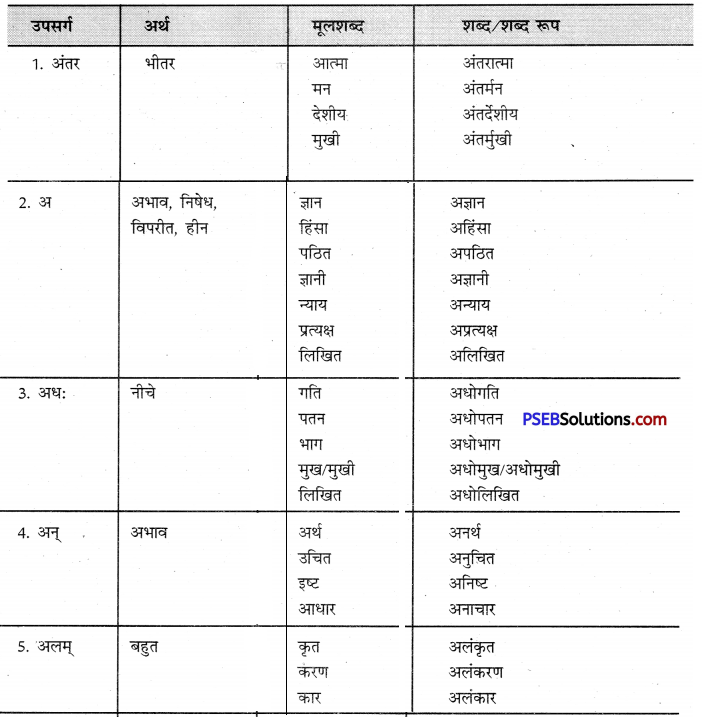
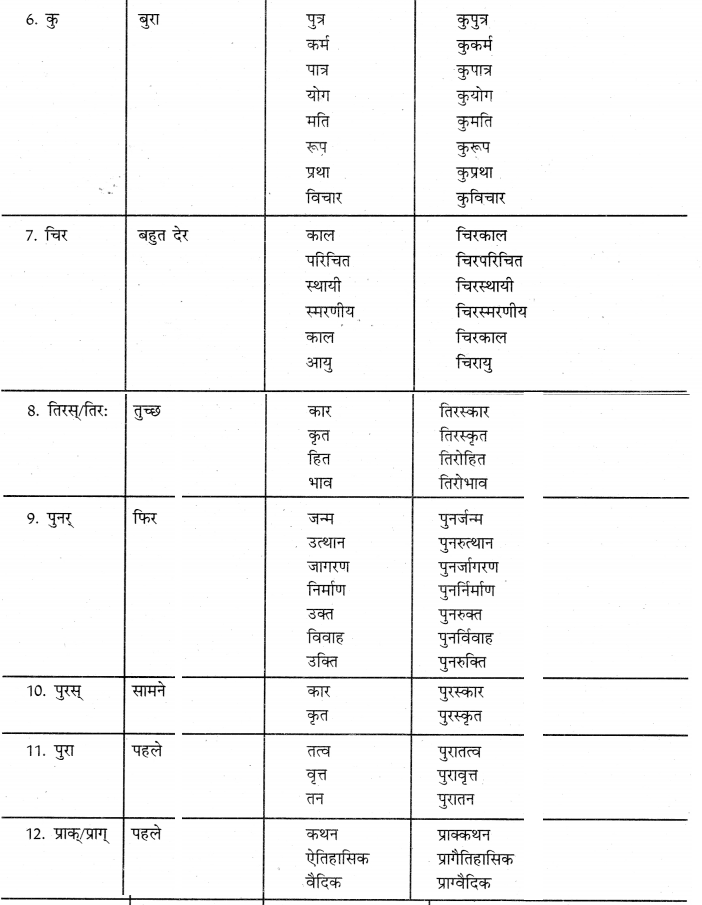
(ख) उपसर्ग की तरह प्रयुक्त किए जाने वाले संस्कृत अव्यय
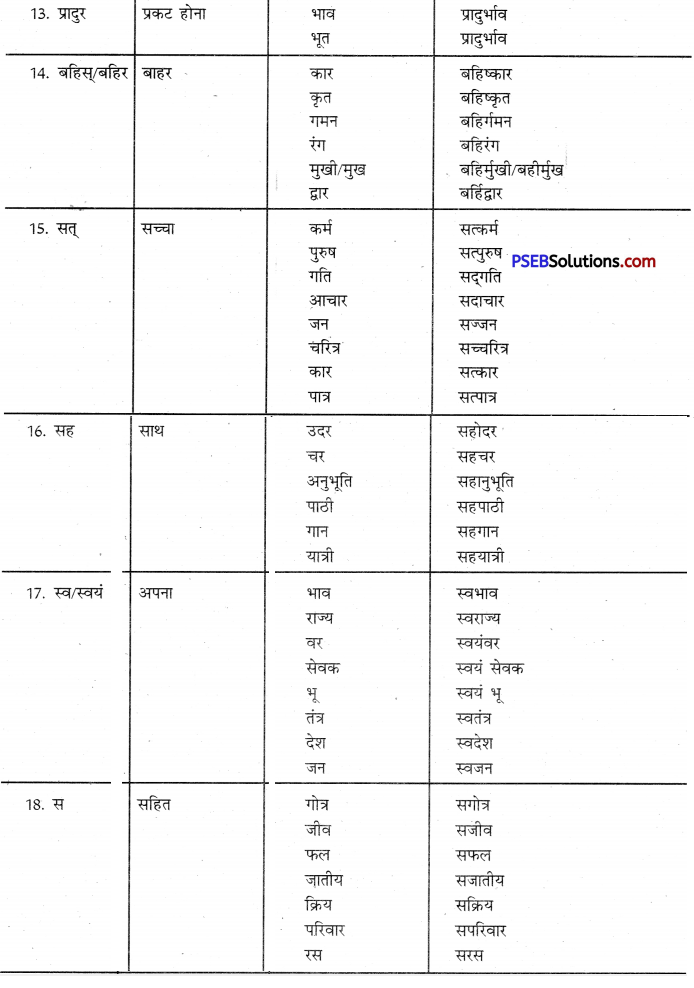
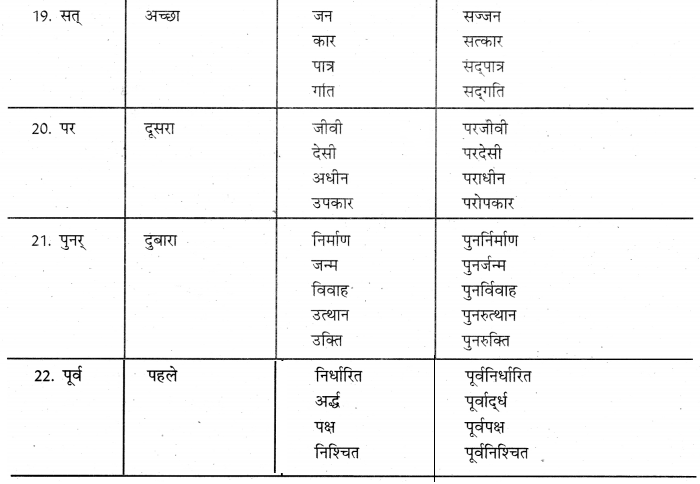
PSEB 9th Class Hindi Vyakaran उपसर्ग 3
PSEB 9th Class Hindi Vyakaran उपसर्ग 4
PSEB 9th Class Hindi Vyakaran उपसर्ग 5
PSEB 9th Class Hindi Vyakaran उपसर्ग 6

तद्भव उपसर्ग / हिंदी के उपसर्ग

उपसग अर्थ उपसर्ग + मूल शब्द = शब्द रूप
1. अ अभाव, निषेध अ + चेत = अचेत, अ + जर = अजर, अ + मर = अमर, अ + टल = अटल, अ + मोल = अमोल, अ + थाह = अथाह, अ + पढ़ = अपढ़, अ + जान = अजान, अ + ज्ञान = अज्ञान, अ + शांत = अशांत।
2. अध आधा अध + खिला = अधखिला, अध + मरा = अधमरा, अध + खाया = अधखाया, अध + पका = अधपका, अध + जल = अधजल, अध + बीच = अधबीच।
3. अन अभाव, निषेध अन + जाना = अनजाना, अन + पढ़ = अनपढ़, अन + होनी = अनहोनी, अन + देखा = अनदेखा, अन + जान = अनजान, अन + बन = अनबन।
4. उन एक कम उन + सठ = उनसठ, उन + तीस = उनतीस, उन + चालीस = उनचालीस, उन + अस्सी = उनासी, उन + पचास = उनचास, उन + साठ = उनसठ।
5. औ/ अव हीनता, निषेध औ + घट = औघट, औ + गुण = औगुन, अव + गुण = अवगुण, अव + हठ = अवहठ, औ + सर = औसर।।
6. कु, क बुरा, हीनता कु + पात्र = कुपात्र, कु + घड़ी = कुघड़ी, कु + चाल = कुचाल, क + पूत = कपूत, कु + पुत्र = कुपुत्र, कु + मार्ग = कुमार्ग, कु + ढंग = कुढंग, कु + चक्र = कुचक्र, कु + कर्म = कुकर्म।
7. दु बुरा, हीन, दो दु + बला = दुबला, दु + काल = दुकाल, दु + रंगा = दुरंगा, दु + साध = दुसाध, दु + नीति = दुनीति, दु + साध्य = दुसाध्य।
8. चौ चार उपसर्ग + मूलशब्द = शब्द रूप चौ + खट = चौखट, चौ + पाई = चौपाई, चौ + गुना = चौगुना, चौ + राहा = चौराहा, चौ + मंज़िला = चौमंजिला, चौ + कन्ना = चौकन्ना, चौ + मासा = चौमासा।
9. नि रहित, नहीं नि + डर = निडर, नि + पूता = निपूता, नि + हत्था = निहत्था, नि + कम्मा = निकम्मा।
10. बिन अभाव, निषेध बिन + देखा = बिनदेखा, बिन + पानी = बिनपानी, बिन + माँगे = बिनमाँगे, बिन + खाया = बिनखाया, बिन + ब्याहा = बिनब्याहा, बिन + चाहे = बिनचाहे, बिन + खिला = बिनखिला, बिन + जाने = बिनजाने।
11. भर पूरा, ठीक भर + पेट = भरपेट, भर + मार = भरमार, भर + पूर = भरपूर, भर + पाई = भरपाई, भर + सक = भरसक।
12. सु /स अच्छा, सहित सु + पात्र = सुपात्र, स + पूत = सपूत, सु + गंध = सुगंध, सु + फल = सुफल, सु + रूप = सुरूप, सु + घड़ = सुघड़, स + हित = सहित, स + जग = सजग, स + गोत्र = सगोत्र, स + रस = सरस, स + हित = सहित।
13. औ हीनता, निषेध औ + गुन = औगुन, औ + सर = औसर, औ + घट = औघट।
14. पर अन्य पीढ़ी का पर + दादा = परदादा, पर + नाना = परनाना, पर + दादी = परदादी।

PSEB 9th Class Hindi Vyakaran उपसर्ग

(ग) उर्दू के उपसर्ग

उपसग अर्थ उपसर्ग + मूल शब्द = शब्द रूप
1. अल निश्चित उपसर्ग + मूलशब्द = शब्द रूप अल + बत्ता = अलबत्ता, अल + बेला = अलबेला, अल + ग़रज = अलग़रज, अल + सुबह = अलसुबह, अल + मस्त = अलमस्त।
2. कम थोड़ा कम + ज़ोर = कमज़ोर, कम + बख्त = कमबख्त, कम + उम्र = कमउम्र, कम + अक्ल = कमअक्ल, कम + सिन = कमसिन।
3. खुश अच्छा खुश + दिल = खुशदिल, खुश + नसीब = खुशनसीब, खुश + मिज़ाज = खुशमिज़ाज, खुश + किस्मत = खुशकिस्मत, खुश + हाल = खुशहाल, खुश + ख्याली = खुशख्याली, खुश + बू = खुशबू।
4. गैर निषेध, भिन्न, बिना गैर + ज़रूरी = गैरज़रूरी, गैर + हाज़िर = गैरहाज़िर, गैर + ज़िम्मेदार = गैरजिम्मेदार, गैर + सरकारी = गैरसरकारी, . गैर + रस्मी = गैररस्मी।
5. दर में दर + कार = दरकार, दर + असल = दरअसल, दर + मियान = दरमियान, दर + किनार = दरकिनार, दर + हकीकत = दरहकीकत।
6. ना अभाव ना + मुमकिन = नामुमकिन, ना + पसंद = नापसंद, ना + राज़ = नाराज़, ना + लायक = नालायक, ना + चीज़ = नाचीज़, ना + समझ = नासमझ, ना + उम्मीद = नाउम्मीद, ना + कारा = नाकारा, ना + काफी = नाकाफी, ना + काबिल = नाकाबिल।
7. ब अनुसार, के साथ ब + दौलत = बदौलत, ब + नाम = बनाम, ब + खूबी = बखूबी, ब + खैरियत = बखैरियत, ब + गैर = बगैर।
8. बद. बुरा बद + इंतज़ामी = बदइंतज़ामी, बद + किस्मत = बदकिस्मत, बद + दुआ = बददुआ, बद + तमीज़ = बदतमीज़, बद + नाम = बदनाम, बद + चलन = बदचलन, बद + बू = बदबू, बद + सूरत = बदसूरत।
9. बा साथ, अनुसार बा + असर = बाअसर, बा + क़ायदा = बाक़ायदा, बा + अदब = बाअदब, बा + इज्जत = बाइज्जत, बा + ज़ब्ता = बाज़ब्ता, बा + वजूद = बावजूद।
10. बे बिना, बगैर बे + आसरा = बेआसरा, बे + क़दर = बेक़दर, बे + अदब = बेअदब, बे + ग़रज = बेग़रज, बे + ऐब = बेऐब, बे + काम = बेकाम, बे + वफ़ा = बेवफ़ा, बे + अक्ल = बेअक्ल, बे + दाग़ = बेदाग़, बे + काम = बेकाम, बे + कसूर = बेकसूर, बे + लगाम = बेलगाम, बे + वजह = बेवजह।
11. बिला बिना, बगैर बिला + कसूर = बिलाकसूर, बिला + वजह = बिलावजह, बिला + लिहाज़ = बिलालिहाज़, बिला + नागा = बिलानागा।
12. ला बिना, नहीं ला + जवाब = लाजवाब, ला + परवाह = लापरवाह, ला + इलाज = लाइलाज, ला + वारिस = लावारिस, ला + चार = लाचार, ला + पता = लापता।
13. सर मुख्य सर + कार = सरकार, सर + पंच = सरपंच, सर + ताज़ = सरताज़, सर + हद = सरहद, सर + फ़रोश = सरफ़रोश, सर + गना = सरगना।
14. हम साथ, समान हम + वतन = हमवतन, हम + साया = हमसाया, हम + शक्ल = हमशक्ल, हम + राही = हमराही, हम + जुल्फ़ = हमजुल्फ़, हम + उम्र = हमउम्र, हम + राज़ = हमराज़, हम + जोली = हमजोली, हम + सफ़र = हमसफ़र।
15. हर प्रत्येक हर + पल = हरपल, हर + दिल = हरदिल, हर + दम = हरदम, हर + साल = हरसाल, हर + रोज़ = हररोज़, हर + घड़ी = हरघड़ी, हर + दिन = हरदिन, हर + हाल = हरहाल।

PSEB 9th Class Hindi Vyakaran वचन

Punjab State Board PSEB 9th Class Hindi Book Solutions Hindi Grammar vachan वचन Exercise Questions and Answers, Notes.

PSEB 9th Class Hindi Grammar वचन

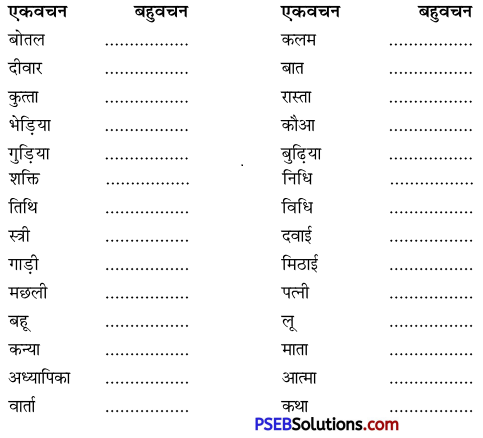
वचन परिवर्तन कीजिए। एकवचन से बहुवचन बनाइए:
PSEB 9th Class Hindi Vyakaran वचन 1
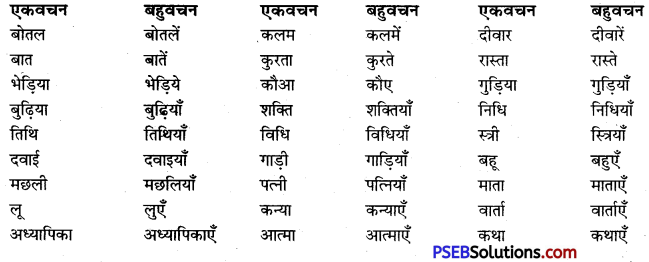
उत्तर:
PSEB 9th Class Hindi Vyakaran वचन 2

PSEB 9th Class Hindi Vyakaran वचन

एक वाक्य में उत्तर दीजिए

प्रश्न 1.
वचन किसे कहते हैं?
उत्तर:
शब्द के जिस रूप से उसके एक या अनेक होने का पता लगता है, उसे वचन कहते हैं।

प्रश्न 2.
वचन का संबंध किससे माना जाता है?
उत्तर:
वचन का संबंध गिनती से माना जाता है।

प्रश्न 3.
वचन के कितने प्रकार होते हैं?
उत्तर:
वचन के दो प्रकार होते हैं।

प्रश्न 4.
वचन के प्रकार कौन-कौन से होते हैं?
उत्तर:
वचन के दो प्रकार होते हैं-एकवचन, बहुवचन।

प्रश्न 5.
एकवचन किसे कहते हैं?
उत्तर:
शब्द के जिस रूप से किसी एक वस्तु के होने का पता चले, उसे एकवचन कहते हैं। उदाहरण लड़का, पुस्तक।

प्रश्न 6.
बहुवचन किसे कहते हैं?
उत्तर:
शब्द के जिस रूप से किसी वस्तु के एक से अधिक होने का पता चले उसे बहुवचन कहते हैं। उदाहरणलड़के, पुस्तकें।

प्रश्न 7.
वचन की पहचान किनसे होती है?
उत्तर:
वचन की पहचान संज्ञा, सर्वनाम और क्रिया से होती है।

PSEB 9th Class Hindi Vyakaran वचन

प्रश्न 8.
एकवचन वाले शब्द का प्रयोग बहुवचन के रूप में कब-कब किया जा सकता है?
उत्तर:
एकवचन वाले शब्द का प्रयोग सम्मान, अभिमान, स्वाभिमान, अधिकार आदि की स्थिति में बहुवचन के रूप में किया जा सकता है।

प्रश्न 9.
बहुवचन के स्थान पर एकवचन का प्रयोग कब किया जा सकता है?
उत्तर:
बहुवचन के स्थान पर एकवचन का प्रयोग जनता, बारिश, जल आदि के लिए किया जा सकता है।

एक शब्द में उत्तर दीजिए

प्रश्न 1.
‘सभापति पधार चुके हैं’ इस वाक्य में एक बहुवचन के रूप में क्या प्रकट करता है?
उत्तर:
आदर।

प्रश्न 2.
‘हम आपको नौकरी दिला देंगे’-मंत्री जी ने कहा कि इसमें सर्वनाम क्या प्रकट करता है?
उत्तर:
बड़प्पन/महान्।

प्रश्न 3.
सोना बहुत महंगा हो गया है।-‘सोना’ क्या प्रकट करता है?
उत्तर:
धातु का बोध कराता है।

प्रश्न 4.
‘गुड़िया’ का वचन बदलकर लिखिए
उत्तर:
गुड़ियाँ।

प्रश्न 5.
‘माता’ का वचन बदलकर लिखिए
उत्तर:
माताएँ।

प्रश्न 6.
‘दवाइयाँ’ का वचन बदलकर लिखिए। उत्तर-दवाई।

PSEB 9th Class Hindi Vyakaran वचन

प्रश्न 7.
‘रीतियाँ’ का वचन बदलकर लिखिए।
उत्तर:
रीति।

हाँ/नहीं में उत्तर दीजिए

प्रश्न 1.
शब्द के जिस रूप से उसके एक या अनेक होने का पता चलता है उसे वचन कहते हैं।
उत्तर:
हाँ।

प्रश्न 2.
हिंदी में वचन चार प्रकार के होते हैं।
उत्तर:
नहीं।

प्रश्न 3.
वचन की पहचान संज्ञा, सर्वनाम और क्रिया से होती है।
उत्तर:
हाँ।

प्रश्न 4.
आदर प्रकट करने के लिए एकवचन की जगह बहुवचन का प्रयोग किया जाता है।
उत्तर:
हाँ।

प्रश्न 5.
दर्शन, हस्ताक्षर, आँसू आदि का प्रयोग बहुवचन में होता है।
उत्तर:
हाँ।

प्रश्न 6.
अधिकार दर्शाने के लिए भी एकवचन की जगह बहुवचन का प्रयोग किया जाता है।
उत्तर:
हाँ।

प्रश्न 7.
घमंड प्रकट करने के लिए भी ‘मैं’ की जगह ‘हम’ का प्रयोग किया जाता है।
उत्तर:
हाँ।

रिक्त स्थानों की पूर्ति करें

प्रश्न 1.
वचन का संबंध ………….. से होता है।
उत्तर:
गिनती।

प्रश्न 2.
स्वयं को महान् सिद्ध करने के लिए एकवचन की जगह ………….. प्रयुक्त किया जाता है।
उत्तर:
बहुवचन।

प्रश्न 3.
आँसू, प्राण, लोग, हस्ताक्षर, होश, आदि का प्रयोग प्रायः ………… किया जाता है।
उत्तर:
बहुवचन।

प्रश्न 4.
लोहा, सोना, चांदी आदि संज्ञाएँ वचन की दृष्टि से किस प्रकार प्रयुक्त की जाती हैं?
उत्तर:
एकवचन।

प्रश्न 5.
एकवचन से बहुवचन में बदल कर लिखिए
(क) छात्र
(ख) गुरु
(ग) शिक्षक
(घ) टिड्डी।
उत्तर:
(क) छात्र = छात्रगण
(ख) गुरु = गुरुजन
(ग) शिक्षक = शिक्षकवृंद
(घ) टिड्डी = टिड्डीदल।

PSEB 9th Class Hindi Vyakaran वचन

प्रश्न 1.
वचन किसे कहते हैं?
उत्तर:
शब्द के जिस रूप से किसी व्यक्ति, वस्तु के एक या अनेक होने का बोध होता है उसे वचन कहते हैं; जैसे-लड़का खेल रहा है।’ ‘लड़के खेल रहे हैं।’ इन वाक्यों में लड़का’ एक की संख्या का तथा ‘लड़के’ एक से अधिक संख्या का बोध करा रहे हैं।

प्रश्न 2.
वचन की परिभाषा दीजिए। उत्तर-शब्द के जिस रूप से उसके एक या एक से अधिक होने का बोध होता है, उसे वचन कहते हैं। प्रश्न 3. वचन के कितने और कौन-कौन से प्रकार हैं?
उत्तर:
हिंदी में वचन दो प्रकार के होते हैं

  1. एक वचन-शब्द के जिस रूप से किसी व्यक्ति अथवा पदार्थ के एक होने का बोध हो, उसे एक वचन कहते हैं; जैसे-लड़का, पुस्तक, नदी, कपड़ा, रानी, बालिका।
  2. बहुवचन-शब्द के जिस रूप से व्यक्तियों अथवा पदार्थों के एक से अधिक होने का बोध हो, उसे बहुवचन कहते हैं; जैसे-लड़के, पुस्तकें, नदियाँ, कपड़े, रानियाँ, बालिकाएँ।

प्रश्न 4.
गणनीय-अगणनीय से क्या तात्पर्य है?
उत्तर:
वचन के साथ गणनीय-अगणनीय भेद जुड़ा है। इसके दो भेद हैं-

  1. गणनीय शब्द-जो शब्द गिनने योग्य व्यक्तियों, प्राणियों, वस्तुओं आदि का बोध कराते हैं, उन्हें गणनीय शब्द कहते हैं; जैसे-मनुष्य, मेज़, किताब, पेंसिल आदि।
  2. अगणनीय शब्द-जो शब्द गिने नहीं जा सकते केवल मापा-नापा जा सकता है, अगणनीय शब्द कहलाते हैं; जैसे-दूध, पानी, सोना, आटा आदि।

प्रश्न 5.
वचन की पहचान कैसे होती है?
उत्तर:
वचन की पहचान तीन प्रकार से की जा सकती है
(i) संज्ञा से-संज्ञा शब्दों के प्रयोग से वचन की पहचान की जा सकती है; जैसे-
(क) घोड़ा दौड़ रहा है। (ख) घोड़े दौड़ रहे हैं।
इन वाक्यों में (क) वाक्य में एक ‘घोड़ा दौड़ रहा है, इसलिए यह एक वचन है। (ख) वाक्य में ‘घोड़े दौड़ रहे हैं’ से पता चलता है कि एक से अधिक घोड़े दौड़ रहे हैं, इसलिए यहाँ बहुवचन है।

(ii) सर्वनाम से-सर्वनाम शब्दों के प्रयोग से भी वचन का ज्ञान होता है; जैसे(क) मैं खेल रहा हूँ। (ख) हम खेल रहे हैं।
इन वाक्यों में (क) वाक्य में ‘मैं’ (ख) वाक्य में ‘हम’ पुरुषवाचक सर्वनाम उत्तम पुरुष के शब्द हैं जिनमें से ‘क’ वाक्य से एकवचन तथा ‘ख’ वाक्य से बहुवचन का पता चलता है।

(iii) क्रिया से-क्रिया के प्रयोग से भी वचन का बोध होता है; जैसे(क) बालक पढ़ रहा है। (ख) बालक पढ़ रहे हैं।
इन वाक्यों में ‘क’ वाक्य में पढ़ रहा है’ तथा ‘ख’ वाक्य में पढ़ रहे हैं’ क्रियाओं से पता चलता है कि वाक्य ‘क’ में एक बालक तथा ‘ख’ वाक्य में एक से अधिक बालक पढ़ने की क्रिया कर रहे हैं, इसलिए ‘क’ वाक्य एकवचन तथा ‘ख’ वाक्य बहुवचन है।

प्रश्न 6.
वचन परिवर्तन के सामान्य नियमों का वर्णन कीजिए।
उत्तर:
वचन परिवर्तन के सामान्य नियम निम्नलिखित हैंहिंदी में एक के लिए एकवचन और एक से अधिक के लिए बहुवचन का प्रयोग होता है। इस सामान्य नियम के अतिरिक्त वचन के संबंध में कुछ अन्य नियम भी ध्यान देने योग्य हैं-
(i) सम्मान या आदर देने के लिए एक व्यक्ति के साथ भी बहुवचन का प्रयोग होता है। जैसे-

  • श्री कृष्ण महान् योद्धा भी थे।
  • गांधी जी छुआछूत के विरोधी थे।
  • श्री रामचंद्र वीर थे।
  • पिताजी अमृतसर गए हैं।
  • नेताजी आ रहे हैं।

इन वाक्यों में एक ही व्यक्ति का वर्णन है, परंतु आदर प्रदर्शन के लिए बहुवचन का प्रयोग किया गया है। इसे आदरार्थक बहुवचन कहते हैं।

(ii) हस्ताक्षर, प्राण, दर्शन, होश, लोग शब्द प्रायः बहुवचन में ही प्रयुक्त होते हैं। यथा-

  • उनके हस्ताक्षर तो विचित्र हैं।
  • गुरुजी के दर्शन तो दुर्लभ हैं।
  • मेघा ने उनके आँसू पोंछे।
  • आप लोग कब आए?

(iii) जनता, वर्षा और पानी शब्द एकवचन में प्रयुक्त होते हैं। यथा-

  • सिंहासन खाली करो कि जनता आती है।
  • ऐसी वर्षा हुई कि सारे गाँव में पानी भर गया।
  • जनता ने स्वामीजी की जय-जयकार की।

(iv) कुछ एकवचन संज्ञा शब्दों के साथ गुण, लोग, जन, समूह, वृंद शब्द जोड़कर उनका बहुवचन में प्रयोग किया जाता है; जैसे

  • छात्रगण खेल की तैयारी में व्यस्त हैं।
  • मज़दूर लोग विश्राम कर रहे हैं।
  • मंत्रिमंडल चुनाव पर विचार कर रहा है।
  • अध्यापक-वृंद विद्यार्थियों को पढ़ा रहा होगा।

PSEB 9th Class Hindi Vyakaran वचन

जिन शब्दों के अंत में जाति, सेना या दल शब्द प्रयुक्त होते हैं उनका प्रयोग एकवचन में होता है। यथा-

  • स्त्री-जाति समझौते में लगी है।
  • सेवा-दल महत्त्वपूर्ण कार्य नहीं कर रहा है।
  • जन-समूह प्रदर्शन कर रहा होगा।

(v) व्यक्तिवाचक और भाववाचक संज्ञा शब्द एकवचन में प्रयुक्त होते हैं। जैसे-

  • अनन्या आठवीं कक्षा में पढ़ती है।
  • सत्य की सदा ही विजय होती है।
  • झूठ के कभी भी पाँव नहीं होते।

(vi) जातिवाचक शब्द समूहबोधक होते हुए भी एकवचन में प्रयुक्त होता है। जैसे-

  • सदा से ही मनुष्य स्वार्थी रहा है।
  • बाज़ार में आम आ गया है।
  • मथुरा का पेड़ा सारे देश में प्रसिद्ध है।
  • कुत्ता वफ़ादार होता है।

(vii) अधिकार, अभिमान, स्वाभिमान आदि व्यक्त करने के लिए भी ‘मैं’ एकवचन के स्थान पर ‘हम’ बहुवचन का प्रयोग होता है-

  • हमसे ईमानदार कोई नहीं है।
  • हम तुम्हारा काम कर देंगे।
  • हमारा कहना मान जाओ, नहीं तो पछताओगे।

वचन परिवर्तन

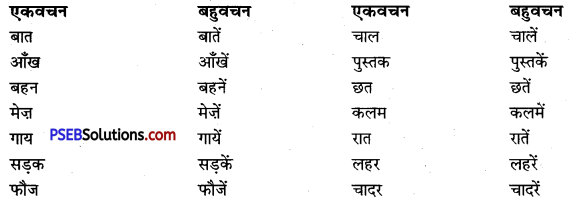
1. अकारांत स्त्रीलिंग संज्ञाओं के अंत में ‘अ’ को ‘एँ’ करके
PSEB 9th Class Hindi Vyakaran वचन 3

2. ‘अकारांत पुल्लिग’ शब्दों के अंत में ‘आ’ के स्थान पर ‘ए’ लगाकर
PSEB 9th Class Hindi Vyakaran वचन 4

अपवाद (i) संस्कृत की कुछ अकारांत संज्ञाएँ एकवचन तथा बहुवचन में एक जैसी रहती हैं। जैसे पिता, नेता, भ्राता, योद्धा, कर्ता आदि।
(ii) आकारांत संबंधसूचक शब्द जैसे–चाचा, मामा, नाना, ताया, फूफा, दादा आदि के रूप बहुवचन में परिवर्तित नहीं होते अर्थात् इनके दोनों वचन एक जैसे ही रहते हैं।

3. ‘अकारांत स्त्रीलिंग’ शब्दों के अंत में ‘एँ’ लगाकर
PSEB 9th Class Hindi Vyakaran वचन 5

PSEB 9th Class Hindi Vyakaran वचन

4. ‘उकारांत’, ‘ऊकारांत’ एवं ‘औकारांत’ स्त्रीलिंग शब्दों में ‘एँ’ लगाकर
यदि एकवचन में किसी शब्द का अंतिम स्वर ‘ऊ’ हो तो ‘एँ’ जोड़कर बहुवचन बनाते समय ‘दीर्घ’ स्वर ‘ऊ’ को ह्रस्व ‘उ’ में बदल दिया जाता है। जैसे-बहु-बहुएँ आदि।
PSEB 9th Class Hindi Vyakaran वचन 6

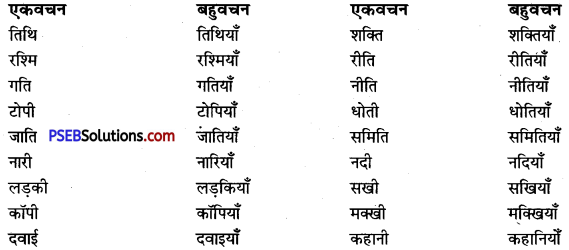
5. इकारांत (इ) ईकारांत (ई) स्त्रीलिंग शब्दों के अंत में ‘याँ’ लगाकर:
विशेष : ईकारान्त शब्दों में अंतिम दीर्घ ‘ई’ को बहुवचन बनाते समय ह्रस्व ‘इ’ में बदल दिया जाता है जैसे-नदीनदियाँ, नारी-नारियाँ आदि।
PSEB 9th Class Hindi Vyakaran वचन 7

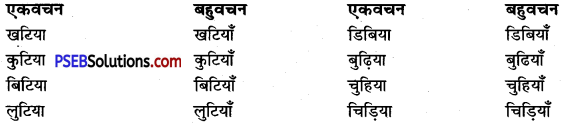
6. ‘इया’ अंत वाले स्त्रीलिंग शब्दों के अंतिम ‘या’ के स्थान पर ‘याँ’ लगाकर:
PSEB 9th Class Hindi Vyakaran वचन 8

7. कुछ शब्दों के अंत में गण, वृंद, जन, वर्ग, दल, आदि लगाकर बहुवचन रूप बनते हैं। जैसे:
PSEB 9th Class Hindi Vyakaran वचन 9

विशेष: (i) हिंदी में कुछ ‘अकारांत’, ‘आकारांत’ या ‘इकारांत’ आदि शब्द ऐसे हैं जिनका शब्द (विभक्ति चिह्न रहित) स्तर पर एकवचन तथा बहुवचन में एक ही रूप रहता है जैसे-
PSEB 9th Class Hindi Vyakaran वचन 10

(ii) ‘अ’ और ‘आ’ अंत वाले एकवचन शब्दों के अंतिम स्वर को संबोधन के समय बहुवचन रूप में प्रयुक्त करते समय ‘ओ’ हो जाता है। जैसे-
PSEB 9th Class Hindi Vyakaran वचन 11

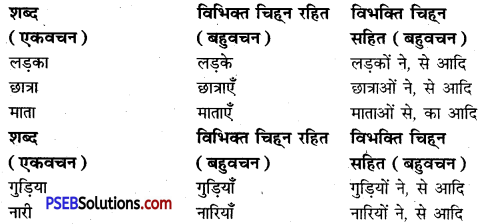
(iii) कुछ ऐसे भी शब्द हैं जिनका विभक्ति चिह्नों से रहित तथा विभक्ति चिह्नों सहित दोनों तरह बहुवचन बनता है। जैसे-
PSEB 9th Class Hindi Vyakaran वचन 12

PSEB 9th Class Hindi Vyakaran लिंग

Punjab State Board PSEB 9th Class Hindi Book Solutions Hindi Grammar ling लिंग Exercise Questions and Answers, Notes.

PSEB 9th Class Hindi Grammar लिंग

लिंग परिवर्तन कीजिए
PSEB 9th Class Hindi Vyakaran लिंग 1
उत्तर:
PSEB 9th Class Hindi Vyakaran लिंग 2

PSEB 9th Class Hindi Vyakaran लिंग

एक वाक्य में उत्तर दीजिए

प्रश्न 1.
लिंग किसे कहते हैं?
उत्तर:
संज्ञा के जिस रूप से पुरुष या स्त्री जाति का बोध हो उसे लिंग कहते हैं।

प्रश्न 2.
हिंदी में लिंग कितने प्रकार के होते हैं?
उत्तर:
लिंग दो प्रकार के होते हैं-पुल्लिग, स्त्रीलिंग।

प्रश्न 3.
पर्वतों के नाम किस लिंग से संबंधित होते हैं?
उत्तर:
पर्वतों के नाम पुल्लिंग से संबंधित होते हैं।

प्रश्न 4.
किस धातु का नाम स्त्रीलिंग होता है?
उत्तर:
चाँदी का नाम स्त्रीलिंग होता है।

प्रश्न 5.
देशों के नाम किस लिंग से संबंधित होते हैं?
उत्तर:
देशों के नाम पुल्लिंग से संबंधित होते हैं।

प्रश्न 6.
ग्रहों में किस ग्रह का नाम स्त्रीलिंग होता है?
उत्तर:
पृथ्वी का।

प्रश्न 7.
प्रायः वृक्ष पुल्लिंग होते हैं। आप ऐसे दो नाम लिखिए जो वृक्ष स्त्रीलिंग होते हैं।
उत्तर:
इमली, नीम।

प्रश्न 8.
सागरों के नाम किस लिंग से संबंधित होते हैं?
उत्तर:
पुल्लिंग।

PSEB 9th Class Hindi Vyakaran लिंग

प्रश्न 9.
दो अनाजों के नाम लिखिए जो स्त्रीलिंग होते हैं।
उत्तर:
अरहर, ज्वार, मक्की।

प्रश्न 10.
रत्नों में किस रत्न का नाम स्त्रीलिंग होता है?
उत्तर:
मणि।

प्रश्न 11.
स्त्रीलिंग की पहचान प्रायः किससे होती है?
उत्तर:
स्त्रीलिंग की पहचान प्रायः इकारान्त तत्सम शब्द से होती है।

प्रश्न 12.
नदियों के नाम प्रायः किस लिंग से संबंधित होते हैं?
उत्तर:
नदियों के नाम प्रायः स्त्रीलिंग से संबंधित होते हैं।

एक शब्द में उत्तर दीजिए

प्रश्न 1.
किस नदी का नाम पुल्लिंग होता है?
उत्तर:
ब्रह्मपुत्र।

प्रश्न 2.
हिंदी की ईकारान्त संज्ञाएं प्रायः स्त्रीलिंग होती हैं लेकिन आप किसी एक का अपवाद रूप में नाम लिखिए।
उत्तर:
हाथी।

प्रश्न 3.
‘उ’ अंत वाली तत्सम संज्ञाएं प्रायः किस लिंग से संबंधित होती हैं?
उत्तर:
स्त्रीलिंग।

प्रश्न 4.
तिथियों और नक्षत्रों के नाम प्राय: लिंग से संबंधित होते हैं?
उत्तर:
स्त्रीलिंग से।

प्रश्न 5.
जिस संज्ञा शब्द के अंत में ‘ख’ वर्ण आता है वह लिंग की दृष्टि से प्रायः कैसा होता है?
उत्तर:
स्त्रीलिंग।

प्रश्न 6.
नित्य स्त्रीलिंग का पुल्लिंग किस प्रकार लिखा जाता है?
उत्तर:
‘नर’ लगा कर, जैसे नर कोयला, नर मक्खी।

प्रश्न 7.
नित्य पुल्लिंग का स्त्रीलिंग किस प्रकार लिखा जाता है?
उत्तर:
नित्य पुल्लिंग का स्त्रीलिंग ‘मादा’ लगाकर लिखा जाता है। जैसे-मादा बाज, मादा चीता।

PSEB 9th Class Hindi Vyakaran लिंग

हाँ/नहीं में उत्तर दीजिएप्रश्न

प्रश्न 1.
‘मादा उल्लू’ नित्य पुल्लिंग होता है।
उत्तर:
हाँ।

प्रश्न 2.
‘नर मकड़ी’ नित्य स्त्रीलिंग होता है।
उत्तर:
हाँ।

प्रश्न 3.
‘बुद्धिमान’ का स्त्रीलिंग है-बुद्धिमती।
उत्तर:
हाँ।

प्रश्न 4.
‘वधू’ का पुल्लिंग है-वर।
उत्तर:
हाँ।

प्रश्न 5.
‘धात्री’ का पुल्लिंग धात्रा’ होता है?
उत्तर:
नहीं।

निम्नलिखित के लिंग बदल कर लिखिए-

ज्ञानवान, स्वाभिमानिनी, अभिनेता, भर्ता, तेली, चिड़ा, मुन्ना, बेटा, तेजस्वी, सुत, गोप, कुमार, जेठ, भील, ठाकुर, दूबे, चौबे, देवर, हंस, कर्ता।
उत्तर:
ज्ञानवती, स्वाभिमानी, अभिनेत्री, भी, तेलिन, चिड़िया, मुनिया, बिटिया, तेजस्विनी, सुता, गोपी, कुमारी, जेठानी, भीलनी, ठकुराइन, दुबाइन, चौबाइन, देवरानी, हंसिनी, कीं।

प्रश्न 1.
लिंग किसे कहते हैं?
उत्तर:
संज्ञा के जिस रूप से पुरुष अथवा स्त्री जाति का बोध हो, उसे लिंग कहते हैं, जैसे-‘रवि पढ़ता है। रजनी पढ़ती है।’ इन वाक्यों में ‘रवि पढ़ता है’ में ‘रवि’ शब्द पुरुष जाति का बोध कराने से पुल्लिंग है तथा ‘रजनी पढ़ती है’ में ‘रजनी’ शब्द स्त्री जाति का बोध कराने से स्त्रीलिंग है।

प्रश्न 2.
हिंदी में कितने लिंग होते हैं?
उत्तर:
हिंदी में दो लिंग-पुल्लिंग और स्त्रीलिंग होते हैं।
(i) पुरुष जाति का बोध कराने वाले शब्द पुल्लिंग होते हैं जैसे हार्दिक दौड़ रहा है। कुत्ता भौंक रहा है। इन दोनों वाक्यों में ‘हार्दिक’ तथा ‘कुत्ता’ शब्द पुल्लिंग हैं क्योंकि दोनों शब्द पुरुष जाति का बोध कराते हैं।

(ii) स्त्री जाति का बोध कराने वाले शब्द ‘स्त्रीलिंग’ कहलाते हैं; जैसे-बकरी चर रही है। गायिका गा रही है। इन दोनों वाक्यों में ‘बकरी’ तथा ‘गायिका’ शब्द स्त्रीलिंग हैं क्योंकि दोनों शब्द स्त्री जाति का बोध करा रहे हैं।

प्रश्न 3.
हिंदी में लिंग की पहचान कैसे करते हैं?
उत्तर:
हिंदी भाषा में लिंग की पहचान शब्द के अर्थ तथा शब्द के रूप के आधार पर की जाती है। प्राणिवाचक संज्ञा शब्दों का लिंग अर्थ के अनुसार तथा निर्जीव पदार्थों के लिंग की पहचान रूप अथवा लोक-व्यवहार के आधार पर की जाती है। लिंग पहचान के प्रमुख नियम निम्नलिखित हैं-
(i) कुछ प्राणिवाचक संज्ञा शब्द युगल रूप में होते हैं, जिससे उनका लिंग-निर्धारण सहज रूप से हो जाता है ; जैसे-बिल्ला-बिल्ली, माता-पिता, पति-पत्नी, लड़का-लड़की, शेर-शेरनी, नर-नारी, दादा-दादी, चाचा-चाची।

(ii) कुछ संज्ञा शब्द नित्य पुल्लिंग अथवा स्त्रीलिंग होते हैं;
जैसेनित्य पुल्लिंग-खटमल, मच्छर, तोता, गैंडा, पक्षी, खरगोश, चीता, भेड़िया, कौआ।
नित्य स्त्रीलिंग-नँ, मक्खी, मछली, मैना, तितली, कोयल, चील, गिलहरी, चींटी।
इन संज्ञा शब्दों में जाति भेद स्पष्ट करने के लिए उनके आगे ‘नर’ अथवा ‘मादा’ शब्दों का प्रयोग लगाकर करते हैं; जैसे-मादा भेड़िया, नर मछली, मादा चीता, नर चील।

PSEB 9th Class Hindi Vyakaran लिंग

(iii) प्राणियों के समूह अथवा समुदाय का बोध कराने वाले संज्ञा शब्द भी व्यवहार के अनुसार पुल्लिंग और स्त्रीलिंग होते हैं; जैसे-
पुल्लिंग-परिवार, समाज, दल, झुंड, मंडल। स्त्रीलिंग-जनता, भीड़, सेना, सभा, मंडली।

(iv) कुछ प्राणिवाचक संज्ञा शब्द केवल स्त्रीलिंग में प्रयुक्त होते हैं; जैसे-संतान, सती, धाय, सवारी, नर्स, सुहागिन, सौतन। इन संज्ञा शब्दों के पुल्लिंग रूप नहीं बनते हैं।

(v) कुछ शब्द उभयलिंगी हैं, जिनका प्रयोग पुल्लिंग तथा स्त्रीलिंग दोनों रूपों में होता है; जैसे-
दही खट्टी है।
दही खट्टा है।

(vi) शरीर के कुछ अंग पुल्लिंग तथा कुछ स्त्रीलिंग होते हैं; जैसेपुल्लिंग-मुँह, कान, हाथ, पाँव, ओठ, नाखून, गाल। स्त्रीलिंग-जीभ, नाक, आँख, बाँह, टाँग, नस, हड्डी।

(vii) वृक्षों के नाम भी पुल्लिंग और स्त्रीलिंग होते हैं; जैसेपुल्लिंग-आम, पीपल, शीशम, नींबू, अशोक, केला, संतरा, कीकर, वट, चीड़, अनार। स्त्रीलिंग-नीम, इमली, लीची, नाशपाती।।

(viii) सामान्य रूप से पुल्लिंग शब्द हैं-
सागर-हिंदमहासागर, प्रशांतमहासागर, अंधमहासागर।
रत्न-हीरा, मोती, पुखराज, नीलम, मूंगा।
अपवाद–मणि। द्रव्य-घी, पानी, तेल, शरबत, दूध।
अपवाद-चाय, लस्सी, कॉफी।
अनाज-जौ, गेहूँ, बाजरा, तिल, चना।
अपवाद-ज्वार, मक्की।
धातुएँ-सोना, लोहा, पीतल, ताँबा, सीसा।
अपवाद-चाँदी।
महीने-चैत्र, वैशाख, सावन, भादों।
दिन-सोम, मंगल, बृहस्पति, शनि, शुक्र।
देश-भारत, जापान, चीन, रूस, अमेरिका।
नक्षत्र-सूर्य, चंद्र, मंगल, शनि, शुक्र।
अपवाद-पृथ्वी।
फल-आम, केला, अमरूद, संतरा, नीबू।
समय सूचक शब्द-दिन, घंटा, सप्ताह, मास, वर्ष।
प्रत्यय जुड़े शब्द-आ-मोटा, आपा-मोटापा, आव-चुनाव, पन-बचपन, ना-खाना, त्व-मनुष्यत्व, दार-पहरेदार, खान-डाकखाना।
वर्णमाला के अक्षर-क, ख, ट, श, ओ।

(ix) सामान्य रूप से स्त्रीलिंग शब्द हैं-
नदियाँ-गंगा, यमुना, कृष्णा, कावेरी, नर्मदा।
अपवाद-ब्रह्मपुत्र।
तिथियाँ-दूज, तीज, पंचमी. नौमी. एकादशी।
भाषाएँ-हिंदी, पंजाबी, गुजराती, मराठी, संस्कृत।
प्रत्यय जुड़े शब्द-आ-लता, इ-शक्ति, ई-मिठाई, इया-चिड़िया, आवट-सजावट, आहट-मुसकराहट, ता-सुंदरता।

(x) विदेशी भाषाओं के शब्दों के लिंग का निर्धारण रूप, अर्थ तथा व्यवहार की दृष्टि से होता है; जैसे-जवाब, मेहमान, अखबार, मज़ा, वक्त, खत (पुल्लिंग); किताब, दीवार, हवा, तलाश, अदालत (स्त्रीलिंग) ; कोट, फ़ोटो, पेन, बूट, बटन (पुल्लिंग), पेंसिल, पैंट, फ़ीस, ट्रेन, बस (स्त्रीलिंग) हैं।

(xi) अकारांत तत्सम शब्द प्रायः पुल्लिंग होते हैं; जैसे-धन, कर्म, नगर, जल, नर।

(xii) आकारांत शब्द प्रायः पुल्लिंग होते हैं; जैसे-कपड़ा, लोटा, आटा, लोहा, दादा, पिता, राजा।

4. कुछ अकारांत पुल्लिग शब्दों में आनी’ या ‘आणी’ प्रत्यय जोड़कर स्त्रीलिंग शब्दों की रचना की जाती है। जैसे-
PSEB 9th Class Hindi Vyakaran लिंग 3

5. जाति, उपनाम और पदवी बाची शब्दों के अंतिम स्वर के स्थान पर ‘आइन’ प्रत्यय लगाकर स्त्रीलिंग शब्दों की रचना की जाती है। जैसे-
PSEB 9th Class Hindi Vyakaran लिंग 4

PSEB 9th Class Hindi Vyakaran लिंग

6. कुछ अकारांत या आकारांत पुल्लिग शब्दों के अंतिम ‘आ’ के स्थान पर स्त्रीलिंग में ‘इया’ प्रत्यय लगा दिया जाता है। जैसे-
PSEB 9th Class Hindi Vyakaran लिंग 5

7. व्यवसाय सूचक (कार्यसूचक) व कुछ अन्य पुल्लिग शब्दों के अंतिम स्वर के स्थान पर ‘इन’ लगाकर स्त्रीलिंग शब्द बन जाता है। जैसे-
PSEB 9th Class Hindi Vyakaran लिंग 6

8. संस्कृत की कुछ संज्ञाओं में प्रयुक्त अंतिम ‘अक’ के स्थान पर ‘इका’ लगाने से स्त्रीलिंग शब्दों की रचना होती है। जैसे-
PSEB 9th Class Hindi Vyakaran लिंग 7

9. कुछ संज्ञा शब्दों में अंतिम ‘ता’ के स्थान पर ‘त्री’ लगा देने से स्त्रीलिंग शब्द की रचना होती है। जैसे-
PSEB 9th Class Hindi Vyakaran लिंग 8

10. कुछ ईकारान्त (पुल्लिग) संज्ञा शब्दों के अंतिम स्वर ‘ई’ के स्थान पर ‘इनी’ या ‘इणी’ प्रत्यय लगाकर स्त्रीलिंग शब्दों की रचना होती है। जैसे-
PSEB 9th Class Hindi Vyakaran लिंग 9

11. ‘आन’ अंत वाले कुछ पुल्लिग संज्ञा शब्दों के अंत में ‘अती’ अथवा ‘मती’ लगाकर स्त्रीलिंग शब्द बनाया जाता है। जैसे-
PSEB 9th Class Hindi Vyakaran लिंग 10

12. सर्वथा भिन्न रूप में बनने वाले स्त्रीलिंग शब्द कुछ पुल्लिग शब्दों के स्त्रीलिंग में विशिष्ट रूप बनते हैं। जैसे-
PSEB 9th Class Hindi Vyakaran लिंग 11

PSEB 9th Class Hindi Vyakaran लिंग

13. नित्य पुल्लिग हिंदी में जिन शब्दों का प्रयोग हमेशा पुल्लिग रूप में ही होता है, वे नित्य पुल्लिंग कहलाते हैं। जैसे- खटमल, पक्षी, खरगोश।
PSEB 9th Class Hindi Vyakaran लिंग 12
नित्य पुल्लिग की तरह नित्य स्त्रीलिंग शब्दों के आगे ‘नर’ शब्द जोड़कर लिंग दर्शाया जाता है-

14. नित्य स्त्रीलिंग: हिंदी में जिन शब्दों का प्रयोग हमेशा स्त्रीलिंग में ही होता है, वे नित्य स्त्रीलिंग कहलाते हैं। जैसे-कोयल, मछली, मक्खी।
PSEB 9th Class Hindi Vyakaran लिंग 13

PSEB 9th Class Maths Solutions Chapter 4 Linear Equations in Two Variables Ex 4.2

Punjab State Board PSEB 9th Class Maths Book Solutions Chapter 4 Linear Equations in Two Variables Ex 4.2 Textbook Exercise Questions and Answers.

PSEB Solutions for Class 9 Maths Chapter 4 Linear Equations in Two Variables Ex 4.2

Question 1.
Which one of the following options is true, and why?
y = 3x + 5 has
(i) a unique solution,
(ii) only two solutions,
(iii) infinitely many solutions.
Answer:
Option (iii) is true. Since y = 3x + 5 is a linear equation in two variables, it has infinitely many solutions. e.g., (1, 8), (2, 11), (3, 14), (4, 17), (0, 5), (- 1, 2) are all solutions of the given equation y = 3x + 5.

PSEB 9th Class Maths Solutions Chapter 4 Linear Equations in Two Variables Ex 4.2

Question 2.
Write four solutions for each of the following equations:
(i) 2x + y = 7
Answer:
2x + y = 7
∴ y = 7 – 2x
Taking x = 0, 1, 2, 3, we get the values of y as 7, 5, 3 and 1 respectively. Thus, (0, 7), (1, 5), (2, 3) and (3, 1) are four solutions of the given equation 2x + y = 7. We can give other answers as well because the given linear equation in two variables has infinitely many solutions.

(ii) πx + y = 9
Answer:
πx + y = 9
∴ y = 9 – πx
For x = 0, y = 9.
For x = 1, y = 9 – π.
For x = – 1, y = 9 + π.
For x = , y = 8.
Thus, (0, 9), (1, 9 – π), (- 1, 9 + π) and (\(\frac{1}{\pi}\), 8) are four of the infinitely many solutions of the given equation πx + y = 9.

(iii) x = 4y
Answer:
x = 4y
For y = 0, x = 0.
For y = 1, x = 4.
For y = – 1, x = – 4.
For y = 2, x = 8.
Thus, (0, 0), (4, 1), (- 4, – 1) and (8, 2) are four of the infinitely many solutions of the given equation x = 4y.

PSEB 9th Class Maths Solutions Chapter 4 Linear Equations in Two Variables Ex 4.2

Question 3.
Check which of the following are solutions of the equation x – 2y = 4 and which are not:
(i) (0, 2)
Answer:
Substituting x = 0 and y = 2, we get x – 2y = 0 – 2(2) = – 4, which is not equal to 4. Hence, (0, 2) is not a solution of x – 2y = 4.

(ii) (2, 0)
Answer:
Substituting x = 2 and y = 0, we get x – 2y = 2 – 2 (0) = 2, which is not equal to 4. Hence, (2, 0) is not a solution of x – 2y = 4.

(iii) (4, 0)
Answer:
Substituting x = 4 and y = 0, we get x – 2y = 4 – 2 (0) = 4. Hence, (4, 0) is a solution of x – 2y = 4.

(iv) (√2, 4√2)
Answer:
Substituting x = √2 and y = 4√2, we get x – 2y = √2 – 2(4√2) = – 7√2, which is not equal to 4. Hence, (√2, 4√2) is not a solution of x – 2y = 4.

(v) (1, 1)
Answer:
Substituting x = 1 and y = 1, we get x – 2y = 1 -2(1) = – 1, whIch is not equal to 4. Hence, (1, 1) is not a solution of x – 2y = 4.

PSEB 9th Class Maths Solutions Chapter 4 Linear Equations in Two Variables Ex 4.2

Question 4.
Find the value of k, if x = 2, y = 1 is a solution of the equation 2x + 3y = k.
Answer:
x = 2, y = 1 is a solution of equation 2x + 3y = k. Hence, x = 2 and y = 1 satisfy the equation.
∴ 2(2) + 3(1) = k
∴ 4 + 3 = k
∴ 7 = k
∴ k = 7

PSEB 9th Class English Grammar Prepositions

Punjab State Board PSEB 9th Class English Book Solutions English Grammar Prepositions Exercise Questions and Answers, Notes.

PSEB 9th Class English Grammar Prepositions

Put suitable Prepositions in the blank spaces :

1. Mothers have affection ……………… their children.
2. We are thankful ……………… God …………….. His blessings.
3. I feel no appetite ……………. food.
4. We are tired ……………… you.
5. He has an easy access …………… this officer.
6. He was true ……………… his principles.
7. Pay great attention ……………. English.
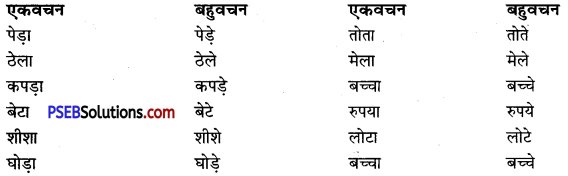
8. Is he unfit …………….. practical work ?
9. You are vexed ……………… my behaviour.
10. I have an advantage ……………… my enemy.
Answer:
1. for 2. to, for 3. for 4. of 5. to 6. to 7. to 8. for 9. at 10. over.

PSEB 9th Class English Grammar Prepositions

Put suitable Prepositions in the blank spaces :

1. He has no confidence ……………. me.
2. Rajinder is related ……………… me.
3. We have nothing but contempt ……………. him.
4. Be respectful ……………… your parents.
5. You have no authority …………….. me in this matter.
6. He has an ambition …………. high business.
7. Sita is very sensitive ………….. criticism.
8. I have no objection …………… his joining this college.
9. We are short …………… money at present.
10. I am ready ……………… tea.
Answer:
1. in 2. to 3. for 4. to 5. over 6. for 7. to 8. to 9. of 10. for.

Put suitable Prepositions in the blank spaces :

1. He is a disgrace …………… his family.
2. Agra is famous …………… its historical buildings.
3. Pt. Nehru was popular ……………. the people.
4. I have no hatred …………… him.
5. He stands in need ……………… money.
6. His face is familiar …………… me.
7. We are familiar …………… the present state of trade.
8. I am grateful …………… you …………… the timely help.
9. Are they not partial ……………. him ?
10. She is quick ……………… English.
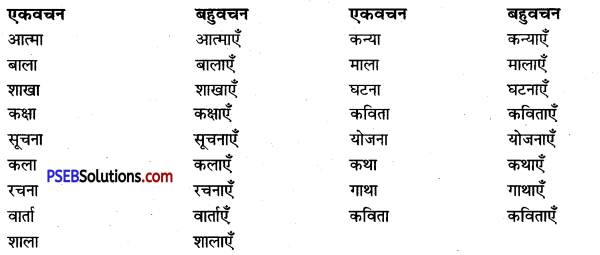
Answer:
1. to 2. for 3. with 4. for 5. of 6. to 7. with 8. to, for 9. to 10. at.

Correct the following sentences :

1. He is on bed still.
2. We pray God daily.
3. He is accused for theft.
4. He writes from a pencil.
5. We travel in train.
6. They travel by horseback.
7. He will join school on tomorrow.
8. I prefer tea for coffee.
9. He is not ashamed for this.
10. I took pity at the beggar.
Answer:
1. He is in bed still.
2. We pray to God daily.
3. He is accused of theft.
4. He writes with a pencil.
5. We travel by train.
6. They travel on horseback.
7. He will join school by tomorrow.
8. I prefer tea to coffee.
9. He is not ashamed of this.
10. I took pity on the beggar.

Correct the following sentences :

1. It has been drizzling from Monday.
2. He delivered a speech into the college hall.
3. Sweets were distributed between the boys of the class.
4. Translate this passage in English.
5. His services have been dispensed.
6. Tibet is into the North of India.
7. His sister was married with a doctor.
8. The lion was shot with the hunter by a gun.
9. He warned me on the danger.
10. Have you disposed your goods ?
Answer:
1. It has been drizzling since Monday.
2. He delivered a speech in the college hall.
3. Sweets were distributed among the boys of the class.
4. Translate this passage into English.
5. His services have been dispensed with.
6. Tibet is to the North of India.
7. His sister was married to a doctor.
8. The lion was shot by the hunter with a gun.
9. He warned me of the danger.
10. Have you disposed of your goods ?

PSEB 9th Class English Grammar Prepositions

Fill in the blanks with the suitable Prepositional Phrases from the given list :

(in favour of, for want of, on the point of, for the sake of, after all, in spite of, at home in, in search of, in the light of, find fault with, instead of, on behalf of, at the mercy of, in front of, on account of)

1. My house is situated ……………. his shop.
2. I could not attend the office …………… an urgent piece of work at home.
3. We are going to cast our vote ……………… the best candidate.
4. We gave him a dinner …….. …… strong opposition from a few friends.
5. I want a pen ……………… a pencil.
6. The lawyer spoke ……………. his client.
7. The project failed ……………. funds.
8. The old lady is ……………. death.
9. Lala Lajpat Rai died …………… his country.
10. Let us forgive him; ………….. he is merely a child.
11. He is ……………… Mathematics.
12. After the death of his father, he was ……………. his stepmother only.
13. The crow flew hither and thither …………….. some pebbles.
14. It is easy to ……………… others.
15. …………….. our previous experience with this man, we are very careful in dealing with him now.
Answer:
1. in front of
2. on account of
3. in favour of
4. in spite of
5. instead of
6. on behalf of
7. for want of
8. on the point of
9. for the sake of
10. after all
11. at home in
12. at the mercy of
13. in search of
14. find fault with
15. In the light of.

Fill in the blanks with suitable Prepositions :

1. He came ……………. day break.
2. He was born …………….. 1990.
3. He will start ………….. five o’clock in the morning.
4. I met him at Moga ……………… Punjab.
5. We sat ……………… the ground.
6. The cat sprang …………. the table.
7. He is ……………. his room.
8. He jumped ……………… the river.
Answer:
1. at
2. in
3. at
4. in
5. on
6. upon
7. in
8. into.

Fill in the blanks with suitable Prepositions :

1. I have not heard ……………. him since he left, but I’ve heard …………….. his accident from a friend. He has been shifted ………. Mumbai. I learn he is ……………… plaster and is unable to move ……………… of bed. He has also been injured ……….. the head. I must visit him …………….. the B. Candy hospital when I go ………….. Mumbai next week.
Answer:
about, of, to, in, out, on, in, to.

2. India is now one …………….. the major nuclear powers of the world. The first Indian nuclear device was exploded ……………. Pokhran, a place 106 km. ……………… the town of Jaisalmer …………….. May 18, 1974. It was an underground explosion, many kilometres below the surface ……………… the earth. There was no smoke, no dreadful balls ……………. fire; no animal or human life was destroyed. ……………… the explosion,
a crater of about 150 metres ……………… diameter was formed.
Answer:
of, at, from, on, of, of, During, in.

Fill in the blanks with suitable Prepositions :

1. He will return …………. a week.
2. He lives …………….. Hyderabad.
3. He fell ……………… the river.
4. The tree was cut …………….. this man ……………… an axe.
5. …………….. this month, many famous men died.
6. He begins school …………….. today.
7. He has been sleeping …………….. morning.
8. She came …………….. a good family.
Answer:
1. in 2. in 3. into 4. by, with 5. During 6. from 7. since 8. from.

PSEB 9th Class English Grammar Prepositions

Fill in the blanks with suitable Prepositions :

1. He has been ill …………… Friday last.
2. I shall be there …………….. 6 o’clock.
3. His answer is …………… the point.
4. ……………. being fined, he was imprisoned.
5. I prefer walking …………… cycling.
6. She was fond …………… reading novels.
7. What is the time ……………. your watch ?
8. I have no use ………………
Answer:
1. since 2. at 3. to 4. Instead of 5. to 6. of 7. by 8. for.

Fill in the blanks with suitable Prepositions :

1. He is true ……………. his word.
2. I differ ……………. you ……………. this point.
3. I am sick ……………. idleness.
4. The train is …………….. time.
5. Do not translate word ………….. word.
6. They are very proud …………….. their success.
7. I took him …………… his word.
8. Divide the apple …………….. two persons.
9. He congratulated me …………… my success.
10. He deals ……………… cloth.
Answer:
1. to 2. with, on 3. of 4. in 5. for 6. of 7. at 8. between 9. on 10. in.

Fill in the blanks with suitable Prepositions :

1. We are in need ………………… money.
2. The train is ………………… time.
3. I am sick ……………….. this job.
4. Do not be cruel ………………… animals.
5. He has applied ……………. leave.
6. He is quick …………….. his action.
7. Trust ……………… God.
8. He is kind ……………. me.
9. He is no match ………………. you.
10. Cows feed …………………. grass.
Answer:
1. of 2. in 3. of 4. to 5. for 6. in 7. in 8. to 9. for 10. on.

Fill in the blanks with suitable Prepositions :

1. This copy is very different …………….. that.
2. Some lady is knocking …………….. the door.
3. Ritu is not suitable ……………. this post.
4. Helen is not ……………. home just now.
5. Ram comes ……………… a noble family.
6. Open your book …………….. page twelve.
7. Ranjit was seated …………….. the two girls.
8. He takes …………….. his mother.
Answer:
1. from 2. at 3. for 4. at 5. from 6. at 7. between 8. after.

PSEB 9th Class English Grammar Prepositions

Fill in the blanks with suitable Prepositions :

Last week when I went home, I left my watch …………. the drawer ……………. my brother’s table and forgot all …………….. it. It was only ………….. reaching the hostel that I realised my mistake. Now I am requesting a friend ………………. mine, who is going …….. my town, to call ……………… my brother and ask him to deliver the watch ………
Answer:
in, of, about, after, of, to, on, to.

Fill in the blanks with suitable Prepositions :

1. She supplied the poor ……………… food.
2. He lives …………… milk only.
3. He was killed …………….. a highwayman a dagger.
4. The Flying Mail departs …………….. 12.20 p.m. for Delhi.
5. I have been here ……………. a long time.
6. She was fond ……………… reading books.
7. She sat ……………… me.
8. We met her …………….. the station.
Answer:
1. with 2. on 3. by, with 4. at 5. for 6. of 7. beside 8. at.

Fill in the blanks with suitable Prepositions :

1. He walked ……………… the hall.
2. I have been suffering from fever ………….. Monday last.
3. He cut his finger ……………. a knife.
4. A quarrel arose ………….. the two sisters.
5. I shall not be there ……………. an hour.
6. He stood ……………. the crowd of boys.
7. She will come …………….. a week.
8. She died ……………. grief …………….. her lost son.
Answer:
1. into 2. since 3. with 4. between 5. before 6. among 7. after 8. in, of.

Fill in the blanks with suitable Prepositions :

1. You must take care ………….. your health.
2. He died ……………… fever.
3. He is ill ……………… malaria.
4. The basket is full …………….. flowers.
5. He invited me ……………… dinner.
6. She prays ………….. God every day.
7. He is tired …………….. this life.
8. Have pity ……………. us.
Answer:
1. of 2. of 3. with 4. of 5. to 6. to 7. of 8. on.

Fill in the blanks with suitable Prepositions :

1. He did not reply ………….. my letter.
2. She lives close …………… my house.
3. He fought ……………… his enemies.
4. He complained …………….. me.
5. He borrowed money ……………… me.
6. My marriage comes …………. next Sunday.
7. Ram is married ………….. Sita.
8. Basu depends ……………. your help.
9. Who rules …………… England ?
10. We laughed ……………… her dress.
Answer:
1. to 2. to 3. with 4. against 5. from 6. off 7. to 8. on 9. over 10. at.

Fill in the blanks with suitable Prepositions :

1. Turn left ……………… the traffic lights.
2. Keep ……………… the left.
3. Turn right ……………… the mall.
4. He stayed here ……………. a while.
5. I have known him …………… a long time.
6. He died ……………. the night.
7. We will wait here ……………… he comes.
8. We arrived ……………… the town yesterday.
Answer:
1. at 2. to 3. at 4. for 5. for 6. in 7. until 8. in.

PSEB 9th Class English Grammar Prepositions

Fill in the blanks with suitable Prepositions :

1. The boy climbed ……………… the tree.
2. Have you seen an aeroplane go ……………… ?
3. He lives close
4. I hope to see you ……………… Monday.
5. When are you going to set …………….. on your journey ?
6. The 9.15 train started …………….. time.
7. He will probably arrive …………….. 6.00 p.m.
8. I hired a taxi ……………. my holidays.
9. He died ……………. cholera.
10. The mother looks …………… the child.
Answer:
1. up 2. up 3. by 4. on 5. out 6. in 7. at 8. for 9. of 10. after.

ऐसे शब्द को Preposition कहा जाता है जो स्थान (place), दिशा (direction), साधन (source), विधि (method), आदि का बोध कराने के लिए किसी Noun अथवा Pronoun से पहले लगाया गया हो; जैसे
In the room; towards the city; through the forest; by all means; into the well; beside me; between us; आदि।

The Use Of Some Prepositions

(1) At का प्रयोग छोटे नगरों तथा गांवों के नामों के साथ किया जाता है। .
In का प्रयोग बड़े नगरों, प्रान्तों और देशों के नामों के साथ किया जाता है।
1. Mohan lives at Kathua.
2. She was born at Batote.
3. The last National Games were held in Dehli.
4. There are many film studios in Mumbai.

(2) On का प्रयोग तिथियों तथा दिनों के नामों के साथ किया जाता है।
In का प्रयोग महीनों तथा वर्षों के लिए किया जाता है।
At का प्रयोग Point of Time के लिए किया जाता है।

1. I shall go to Delhi on Sunday.
2. Our examination begins on 24th July.
3. Rains started in July.
4. His grandfather died in 2013.
5. We had tea at 5 o’clock.
6. He came at the right time.

(3) In और At के निम्नलिखित समय-सम्बन्धी प्रयोग याद रखिए

In the morning    At noon
In the evening     At night
In the afternoon  At dawn

(4) Between का प्रयोग दो व्यक्तियों । स्थानों । वस्तुओं, आदि के लिए किया जाता है।
Among का प्रयोग दो से अधिक व्यक्तियों । स्थानों । वस्तुओं, आदि के लिए किया जाता है।

1. The two brothers quarrelled between themselves.
2. The three brothers quarrelled among themselves.

(5) In स्थिरता (rest) को प्रकट करता है।
Into अन्दर की ओर गति (motion) को प्रकट करता है।
1. He was sitting in the room.
2. The fox fell into the well.

(6) On स्थिरता (rest) को प्रकट करता है।
Upon ऊपर की ओर गति (motion) को प्रकट करता है।
1. The book is on the table.
2. The cat jumped upon the table.

PSEB 9th Class English Grammar Prepositions

(7) With उस यन्त्र (instrument) की ओर संकेत करता है जिसका प्रयोग कोई काम करने के लिए किया
गया हो। By काम करने वाले (doer) की ओर संकेत करता है।
1. He beat his servant with a stick.
2. The book was written by me.

(8) Beside = निकट, असंगत
Besides = के अतिरिक्त
1. She came and sat beside me.
2. Your answer is beside the mark.
3. I have three other pens besides this.

(9) Since तथा For का प्रयोग Perfect Tense के बाद किया जाता है।
From का प्रयोग किसी भी Tense के बाद किया जा सकता है।
Since और From का प्रयोग point of time के लिए किया जाता है।
For का प्रयोग period of time के लिए किया जाता है।
Since का प्रयोग केवल भूतकाल के सम्बन्ध में ही किया जा सकता है।
From और For का प्रयोग किसी भी काल के लिए किया जा सकता है।
1. He has been ill since Monday last.
2. This timetable has been in force since August.
3. He studied English from the age of ten.
4. This timetable will come in force from Monday.
5. I have been ill for five days.

(10) During का प्रयोग तब किया जाता है जब कोई क्रिया किसी अवधि के दौरान हुई हो।
1. The phone rang during the meal.
2. Her husband was taken to the hospital during the night.

(11) To तथा Until (Till) का प्रयोग किसी अवधि के अन्त को सूचित करने के लिए किया जाता है।
1. She is busy from six to eight.
2. Let’s wait until the rain stops.
3. The shop remains open till 10 p.m.

(12) In का प्रयोग भविष्य के अर्थ में किसी अवधि के अन्त को सूचित करने के लिए किया जाता है।
Within का प्रयोग किसी अवधि की समाप्ति से थोड़ा समय पूर्व के समय को सूचित करने के लिए किया जाता है।
After का प्रयोग भूतकाल के अर्थ में किसी अवधि के अन्त को सूचित करता है।
1. I shall return in a week. (at the end of a week)
2. He will return within a week. (before the end of a week)
3. She returned from Mumbai after a week.

PSEB 9th Class English Grammar Prepositions

(13) After एक preposition है तथा इसके बाद किसी noun अथवा noun phrase का होना ज़रूरी होता
Afterwards एक adverb है जिसका प्रयोग तब किया जाता है जब वहां कोई noun अथवा noun phrase
1. We’ll leave after lunch.
2. After winning the prize, she became famous overnight.
3. Let’s go to the theatre first and eat afterward.
4. Afterwards, she was sorry for what she had said.

Words Followed By Appropriate Prepositions

1. Abide by – I shall abide by my prornise.
2. Absorb in – I was absorbed in my work.
3. Accede to all for – He acceded to my request.
4. Accuse of – He was accused of murder.
5. Acquit of – He was acquitted of all the charges.
6. Act upon – He acted upon my advice.
7. Admit to – He was admitted to the 9th class.
8. Afraid of – I am not afraid of death.
9. Agree on – We all agree on this point.
10. Agree to – Do you agree to this proposal ?
11. Agree with – I agree with you.
12. Angry with – He is angry with ine.
13. Angry at – The teacher was angry at your misconduct.
14. Approve of – I do not approve of your action.
15. Arrive at – He arrived at Jalandhar at six o’clock.
16. Ashamed of – He feels ashamed of his conduct.
17. Assure of -I assure you of my help.
18. Astonished at – I was astonished at his failure.
19. Avail of – Avail yourself of this opportunity.
20. Aware of – I am aware of my shortcomings.
21. Believe in – I do not believe in ghosts.
22. Belong to – He belongs to a rich family.
23. Bent on – He is bent on mischief.
24. Bless with – She was blessed with a son.
25. Blind in – He is blind in one eye.
26. Blind to – You are blind to your shortcomings.
27. Boast of – Do not boast of your riches.
28. Born in – He was born in a poor family.
29. Born of – She was born of rich parents.
30. Born to – A son was born to her.
31. Bound for – The train is bound for Kolkata.
32. Busy with – I was busy with my work.
33. Call at – I called at his house this morning.

PSEB 9th Class English Grammar Prepositions

34. Call on – Tomorrow I shall call on you.
35. Care of – You should take care of your health.
36. Charge with – He was charged with murder.
37. Collide with – My cycle collided with a tonga.
38. Compare to – We may compare the world to a stage.
39. Complain of – He always complains of headache.
40. Condemn to – The murderer was condemned to death.
41. Confidence in – I have no confidence in you.
42. Conscious of – am conscious of my weaknesses.
43. Consist of – The class consists of forty boys.
44. Contented with – Be contented with your lot.
45. Deal in – His father deals in cotton.
46. Deal with – I know how to deal with you.
47. Deprive of – He was deprived of his share.
48. Die of – He died of cholera.
49. Differ from – This pen differs from that.
50. Differ with – I differ with you on this point.
51. Dispose of – He disposed of his old books.
52. Due to – His success is due to hard work.
53. Engage in – He is engaged in writing a book.
54. Engage to – She is engaged to a doctor.
55. Excel in – He excels me in speaking English.
56. Familiar to – His face is familiar to me.
57. Familiar with – I am not familiar with him.
58. Feed on – Cows feed on grass.
59. Feel for – We should feel for the poor.
60. Fond of – Children are fond of sweets.
61. Free from – Nobody is free from worries.
62. Full of – The glass is full of milk.
63. Good at – He is good at Mathematics.
64. Grateful to – I shall be grateful to you for this kindness.
65. Grieve at – He was grieved at his failure.
66. Guilty of – He was found guilty of theft.
67. Hope for – Let us hope for better result this time.
68. Ignorant of – He was ignorant of the facts.
69. Inferior to – This pen is inferior to that.
70. Infested with – This house is infested with rats.
71. Inform of – You did not inform me of his arrival.
72. Injurious to – Smoking is injurious to health.
73. Interest in – He has no interest in his studies.
74. Invite to – He invited me to dinner.
75. Junior to – He is junior to me in service.
76. Kind to – Be kind to the poor.
77. Key to – Hard work is the key to success.
78. Lame in – He is lame in one leg.
79. Laugh at – Do not laugh at the poor.
80. Listen to – Listen to what I say.
81. Live on – He lives on milk and fruit.
82. Married to – Rama was married to Sita.
83. Match for – Pakistan is no match for India.
84. Notorious for – He is notorious for gambling.
85. Obedient to – Be obedient to your teachers.
86. Obliged to – I am obliged to you for this help.
87. Occur to – An idea occurred to me.
88. Pity for – Have pity for the poor.
89. Pity on – He took pity on me.

PSEB 9th Class English Grammar Prepositions

90. Polite to – Be polite to all.
91. Preferable to – Death is preferable to dishonour.
92. Prefer to – I prefer death to dishonour.
93. Pray to – I pray to God daily.
94. Preside over – Who presided over the meeting ?
95. Prevent from – He prevented me from going there.
96. Prey to – He fell a prey to disease.
97. Proud of – She is proud of her beauty.
98. Quarrel with – Do not quarrel with others over trifles.
99. Reduce to – He was reduced to a skeleton.
100. Regard for – He has no regard for his teachers.
101. Related to – She is related to me.
102. Relieve of – He wants to be relieved of his duty.
103. Remember to – Please remember me to your father.
104. Remind of – He reminded me of my promise.
105. Responsible to – We are responsible to God for our actions.
106. Satisfied with – I am not satisfied with his work.
107. Search for – What are you searching for ?
108. Send for – We sent for the doctor.
109. Short of – We ran short of funds.
110. Sick of – He is sick of his son.
111. Similar to – This knife is similar to that.
112. Slow of – He is slow of understanding.
113. Sorry for – I am sorry for the delay.
114. Succeed in – He succeeded in getting a job.
115. Stand by – Will you stand by me in trouble ?
116. Suffer from – He suffered from malaria.
117. Superior to – My cap is superior to yours.
118. Sure of – I am sure of my success.
119. Surprised at – I am surprised at your behaviour.
120. Sympathetic to – The teacher is sympathetic to his students.
121. Sympathise with – Always sympathise with the poor.
122. Sympathy for – He has no sympathy for me.
123. Talk to – I talked to him about his problem
124. Taste for – I have no taste for games.
125. Tired of – I am tired of this type of life.
126. Tired with – I am tired with the day’s work.
127. Trust in – Trust in God and do the right.
128. True to – I am true to my friends.
129. Useful for – Exercise is useful for health.
130. Useful to – This book is very useful to me.
131. Warn of – He warned me of the danger.

PSEB 9th Class English Grammar Prepositions

132. Want in – Your son is wanting in common sense.
133. Wish for – I wish for your success.
134. Wonder at – I wondered at his trick.
135. Worthy of – I shall try to be worthy of your love.
136. Yield to – Never yield to injustice.

PSEB 9th Class Maths Solutions Chapter 4 Linear Equations in Two Variables Ex 4.1

Punjab State Board PSEB 9th Class Maths Book Solutions Chapter 4 Linear Equations in Two Variables Ex 4.1 Textbook Exercise Questions and Answers.

PSEB Solutions for Class 9 Maths Chapter 4 Linear Equations in Two Variables Ex 4.1

Question 1.
The cost of a notebook is twice the cost of a pen. Write a linear equation in two variables to represent this statement.
(Take the cost of a notebook to be and that of a pen to be ₹ y.)
Answer:
Let the cost of a notebook be ₹ x and the cost of a pen be ₹ y.
Then, according to the given data, the cost of a notebook is twice the cost of a pen.
∴ x = 2y
Thus, x = 2y, i.e., x – 2y = 0 is the required linear equation in two variables.

PSEB 9th Class Maths Solutions Chapter 4 Linear Equations in Two Variables Ex 4.1

Question 2.
Express the following linear equations in the form ax + by + c = 0 and indicate the values of a, b and c in each case:
(i) 2x + 3y = 9.3\(\overline{5}\)
Answer:
2x + 3y = 9.3\(\overline{5}\)
∴ 2x + 3y – 9.3\(\overline{5}\) = 0
Here, a = 2, b = 3 and c = – 9.3\(\overline{5}\).

(ii) x – \(\frac{y}{5}\) – 10 = 0
Answer:
x – \(\frac{y}{5}\) – 10 = 0
∴x – \(\frac{1}{5}\)y – 10 = 0
Here, a = 1, b = – \(\frac{1}{5}\) and c = – 10.

PSEB 9th Class Maths Solutions Chapter 4 Linear Equations in Two Variables Ex 4.1

(iii) – 2x + 3y = 6
Answer:
– 2x + 3y = 6
∴ – 2x + 3y – 6 = 0
Here, a = 1, b = – 3 and c = – 6.

(iv) x = 3y
Answer:
x = 3y
∴ x – 3y + 0 = 0
Here, a = 1, b = – 3 and c = 0.

(v) 2x = – 5y
Answer:
2x = – 5y
∴ 2x + 5y + 0 = 0
Here, a = 2, b = 5 and c = 0

(vi) 3x + 2 = 0
Answer:
3x + 2 = 0
∴ 3x + oy – 2 = 0
Here, a = 3, b = 1 and c = – 2

PSEB 9th Class Maths Solutions Chapter 4 Linear Equations in Two Variables Ex 4.1

(vii) y – 2 = 0
Answer:
y – 2 = 0
∴ 0x + y – 2= 0
Here a = 0, b = 1 and c = – 2

(viii) 5 = 2x
Answer:
5 = 2x
∴ 5 – 2x = 0
∴ – 2x + 0y + 5 = 0
Here a = – 2, b = 0, c = 5

PSEB 9th Class Maths MCQ Chapter 3 Coordinate Geometry

Punjab State Board PSEB 9th Class Maths Book Solutions Chapter 3 Coordinate Geometry MCQ Questions with Answers.

PSEB 9th Class Maths Chapter 3 Coordinate Geometry MCQ Questions

Multiple Choice Questions and Answer

Answer each question by selecting the proper alternative from those given below each question to make the statement true:

Question 1.
For x = 2, y = 3, u = – 2 and v = – 3, point (x + y, u + v) lies in the ……………. quadrant.
A. first
B. second
C. third
D. fourth
Answer:
D. fourth

PSEB 9th Class Maths MCQ Chapter 3 Coordinate Geometry

Question 2.
For x = 4, y = – 5, u = – 6 and v = 8, point (x + y, u + v) lies In the quadrant.
A. first
B. second
C. third
D. fourth
Answer:
B. second

Question 3.
If (x, y) and (y, x) represent the same point in the coordinate plane, then is possible.
A. x = 5, y = 2
B. x = 2, y = 5
C. x = – 5. y = – 2
D. x = 5, y = 5
Answer:
D. x = 5, y = 5

PSEB 9th Class Maths MCQ Chapter 3 Coordinate Geometry

Question 4.
The line Joining P(3, -2) and Q(3, 4)
A. is parallel to the x-axis
B. is parallel to the y-axis
C. is perpendicular to the y-axis
D. intersects both the axes
Answer:
B. is parallel to the y-axis

Question 5.
The line joining A(- 2, 5) and B(- 2, – 8)
A. is parallel to the x-axis
B. is perpendicular to the x-axis
C. intersects the y-axis
D. intersects both the axes
Answer:
B. is perpendicular to the x-axis

Question 6.
The line joining A (- 2, 5) and B (3, 5) intersects ……………….. .
A. the x-axis at (- 2, 0)
B. the x-axis at (3, 0)
C. the y-axis at (0, 5)
D. the x-axis at (5, 0)
Answer:
C. the y-axis at (0, 5)

PSEB 9th Class Maths MCQ Chapter 3 Coordinate Geometry

Question 7.
The line joining A (3, 2) and B (3, – 2) intersects …………………….. .
A. the x-axis at (0, 3)
B. the x-axis at (3, 0)
C. the y-axis at (0, 2)
D. the y-axis at (0, – 2)
Answer:
B. the x-axis at (3, 0)

PSEB 9th Class Maths Solutions Chapter 3 Coordinate Geometry Ex 3.3

Punjab State Board PSEB 9th Class Maths Book Solutions Chapter 3 Coordinate Geometry Ex 3.3 Textbook Exercise Questions and Answers.

PSEB Solutions for Class 9 Maths Chapter 3 Coordinate Geometry Ex 3.3

Question 1.
In which quadrant or on which axis does each of the points (- 2, 4), (3, – 1), (- 1, 0), (1, 2) and (- 3, – 5) lie? Verify your answer by locating them on the Cartesian plane.
Answer:
PSEB 9th Class Maths Solutions Chapter 3 Coordinate Geometry Ex 3.3 1

PSEB 9th Class Maths Solutions Chapter 3 Coordinate Geometry Ex 3.3

Coordinates of the point Position of the point
(- 2, 4) In the 2nd quadrant
(3, – 1) In the 4th quadrant
(- 1, 0) On the x-axis
(1, 2) In the 1st quadrant
(- 3, – 5) In the 3rd quadrant

Question 2.
Plot the points (x, y) given in the following table on the plane, choosing suitable units of distance on the axes:
PSEB 9th Class Maths Solutions Chapter 3 Coordinate Geometry Ex 3.3 2
Answer:
PSEB 9th Class Maths Solutions Chapter 3 Coordinate Geometry Ex 3.3 3