PSEB 9th Class English Vocabulary Antonyms

Punjab State Board PSEB 9th Class English Book Solutions English Vocabulary Antonyms Exercise Questions and Answers, Notes.

PSEB 9th Class English Vocabulary Antonyms

Match the Antonyms correctly :

A — B
admit — destroy
public — straight
junior — conclude
bent — stale
defend — senior
dark — private
fresh — well-lit
create — descend
ascend — dangerous
safe — attack
start — modern
ancient — deny
Answer:
admit → deny; public → private ; junior → senior; bent → straight; defend → attack; dark → well-lit; fresh → stale ; create → destroy; ascend → descend; safe → dangerous; start → conclude ; ancient → modem.

PSEB 9th Class English Vocabulary Antonyms

Complete the following sentences with the Antonyms given in the box. The italicized words will help you to choose the right words:

modern;  spend; withdraw; vacant; remember; success; punctual; expensive; plus; import

1. Ramesh, you are always ………… but why are you late today?
2. We will not ………… all the money now. We will save it for the rainy day.
3. Seven seats are still ………… They were all full by now last year.
4. I will deposit the whole amount. I can ………… it at any time I want to.
5. The Goyals ………… wool from Australia, make garments and export them to the U.K.
6. Don’t forget your sweater here ………….. to wear it when it is cold in Srinagar.
7. ……….. and failure go hand in hand in life.
8. This umbrella is very ……… I need a cheap one.
9. Rome has both ancient and ……….. buildings.
10. Can you tell me the minus and ……….. points of this proposal?
Answer:
1. punctual
2. spend
3. vacant
4. withdraw
5. import
6. Remember
7. Success
8. expensive
9. modem
10. plus.

PSEB 9th Class English Vocabulary Antonyms

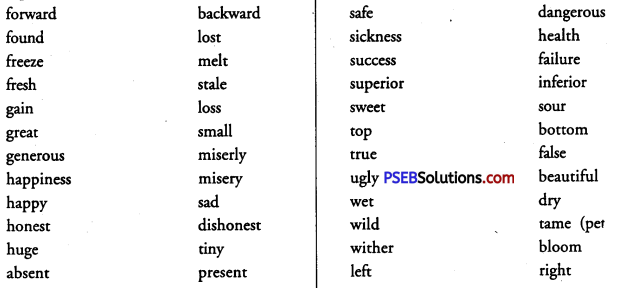
Antonyms

जिन दो शब्दों के अर्थ एक-दूसरे के विपरीत हों, उन्हें Antonyms कहते हैं; जैसे
clean → dirty
deep → shallow
sorrow → joy

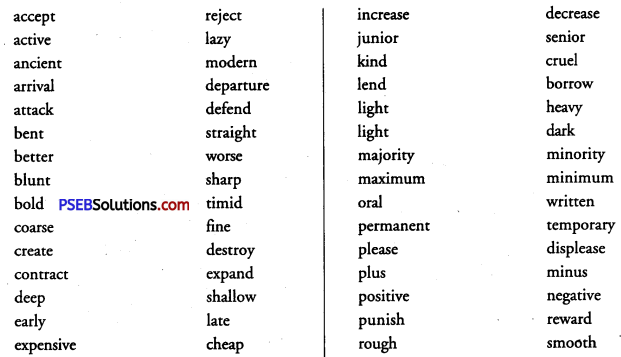
List Of Antonyms

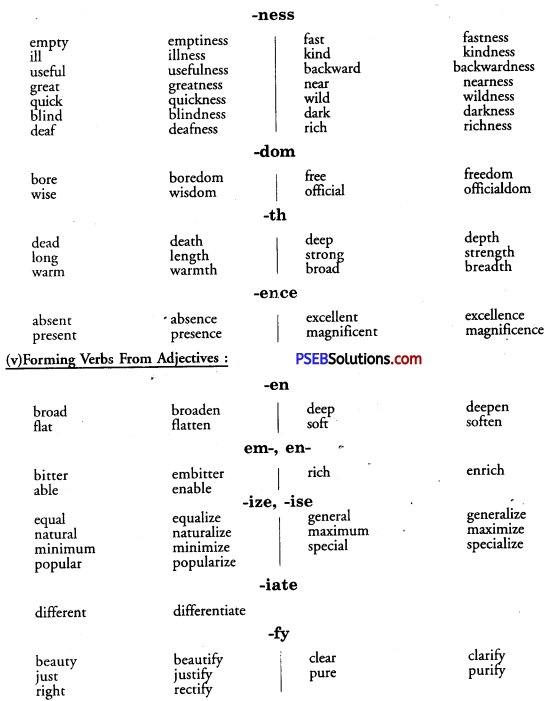
PSEB 9th Class English Vocabulary Antonyms 1
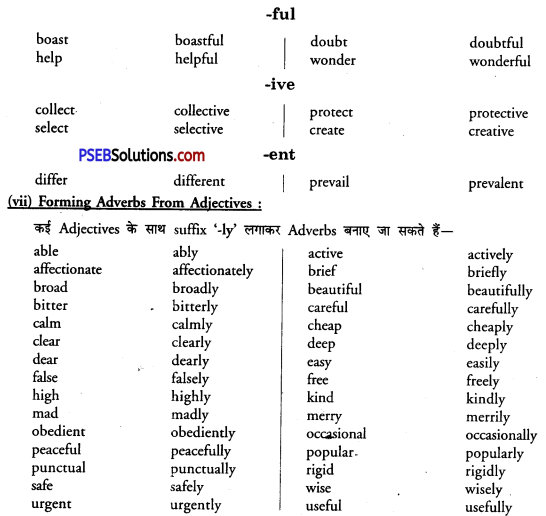
PSEB 9th Class English Vocabulary Antonyms 2

PSEB 9th Class English Vocabulary Homonyms

Punjab State Board PSEB 9th Class English Book Solutions English Vocabulary Homonyms Exercise Questions and Answers, Notes.

PSEB 9th Class English Vocabulary Homonyms

Homonyms

जिन शब्दों का उच्चारण एक जैसा हो परन्तु उनके अर्थ तथा हिज्जे (spellings) अलग-अलग हों, उन्हें Homonyms कहते है, जैसे
break, brake; write, right; sight, site; weight, wait; etc.

List Of Homonyms

1. Berth – Please get a berth reserved for me in the Flying Mail.
Birth – She gave birth to a male child.

2. Brake – The driver applied brakes to save the child.
Break – Glass breaks easily.

3. Cell – This remote control works on two pencil cells.
Sell – We want to sell our old furniture.

4. Died – His father died at the age of eighty.
Dyed – She dyed her hair dark brown.

5. Dose – This bottle contains six doses.
Doze – He was dozing in the class.

6. Hair – She was combing her hair.
Hare – The hare can run very fast.

7. Heal – The wound healed slowly.
Heel – The thief took to heels.

PSEB 9th Class English Vocabulary Homonyms

8. Pain – I have pain in my stomach.
Pane – Who has broken the window pane ?

9. Pair – I have bought a pair of shoes.
Pare – Pare your nails.

10. Peace – Who does not want peace ?
Piece – I gave him a piece of bread.

11. Pray – I pray to God for your health and happiness.
Prey – The tiger jumped on its prey.

12. Principal – My mother went to the school to meet the principal.
Principle – He is a man of high principles.

13. Root – This tree has very deep roots.
Route – We took the shortest route.

14. Stair – The man slipped while climbing the stairs.
Stare – It is a bad habit to stare at anyone.

15. Storey – This house has three storeys.
Story – My grandmother told me a very interesting story.

16. Their – Their house is small but comfortable.
There – We went there in a group.

17. Wait – I had to wait for a long time.
Weight – My weight is fifty kilograms.

18. Waist – The water in the river soon rose above his waist.
Waste – Don’t waste your time.

19. Weather – The weather has suddenly turned cold.
Whether – I want to know whether this answer is correct.

PSEB 9th Class English Vocabulary Homonyms

20. Heir – Kanwar Mahendra Singh is the next heir to the throne.
Air – Go out for a walk in the fresh air.

Choose the word from the pairs of words given and complete the sentences. You may have to change the form of the word in some cases.

fair, fare; groan, grown; practise, practice; principle, principal; feet, feat; vain, vein; stationery, stationary; wait, weight.

1. It is my ………… not to lend money to anyone.
2. The player was badly hurt and was ………… with pain.
3. Can you ………… for some time? The officer is very busy at the moment.
4. A passenger train hit a ………… goods train near Pune.
5. The ………… of buses may go up by 10% next month.
6. Have you done enough ………… to win the match ?
7. Mamta tried in ………… to climb to the top of the building.
8. The Lotus Temple in Delhi is a great ………… of engineering.
Answers
1. principle
2. groaning
3. wait
4. stationary
5. fare
6. practice
7. vain
8. feat.

PSEB 9th Class Maths Solutions Chapter 9 Areas of Parallelograms and Triangles Ex 9.1

Punjab State Board PSEB 9th Class Maths Book Solutions Chapter 9 Areas of Parallelograms and Triangles Ex 9.1 Textbook Exercise Questions and Answers.

PSEB Solutions for Class 9 Maths Chapter 9 Areas of Parallelograms and Triangles Ex 9.1

Question 1.
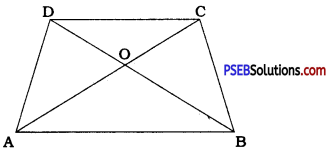
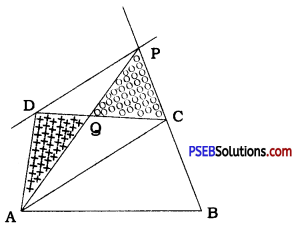
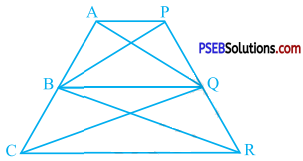
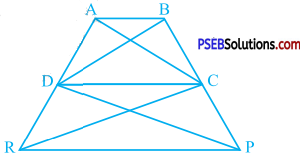
Which of the following figures lie on the same base and between the same parallels. In such a case, write the common base and the two parallels.

(i)
PSEB 9th Class Maths Solutions Chapter 9 Areas of Parallelograms and Triangles Ex 9.1 1
Answer:
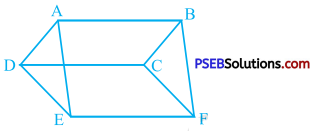
In figure (i), trapezium ABCD and ∆ PDC lie on the same base and between the same parallels.
Here, DC is the common base and DC and AB are two parallels.

PSEB 9th Class Maths Solutions Chapter 9 Areas of Parallelograms and Triangles Ex 9.1

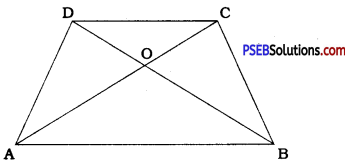
(ii)
PSEB 9th Class Maths Solutions Chapter 9 Areas of Parallelograms and Triangles Ex 9.1 2
Answer:
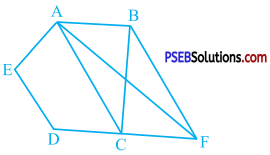
In figure (ii), no two figures lie on the same base and between the same parallels.

(iii)
PSEB 9th Class Maths Solutions Chapter 9 Areas of Parallelograms and Triangles Ex 9.1 3
Answer:
In figure (iii), parallelogram PQRS and ∆ TQR lie on the same base and between the same parallels.
Here, QR is the common base and QR and PS are two parallels.

PSEB 9th Class Maths Solutions Chapter 9 Areas of Parallelograms and Triangles Ex 9.1

(iv)
PSEB 9th Class Maths Solutions Chapter 9 Areas of Parallelograms and Triangles Ex 9.1 4
Answer:
In figure (iv), no two figures lie on the same base and between the same parallels.

(v)
PSEB 9th Class Maths Solutions Chapter 9 Areas of Parallelograms and Triangles Ex 9.1 5
Answer:
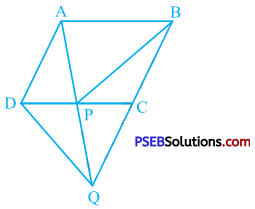
In figure (v), parallelograms ABCD and APQD as well as trapeziums ABQD and APCD, all the four figures, lie on the same base and between the same parallels.
Here, AD is the common base and AD and BQ are two parallels.

PSEB 9th Class Maths Solutions Chapter 9 Areas of Parallelograms and Triangles Ex 9.1

(vi)
PSEB 9th Class Maths Solutions Chapter 9 Areas of Parallelograms and Triangles Ex 9.1 6
Answer:
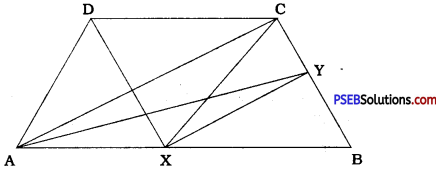
In figure (vi), no two figure lie on the same base and between the same parallels.

PSEB 9th Class Maths MCQ Chapter 8 Quadrilaterals

Punjab State Board PSEB 9th Class Maths Book Solutions Chapter 8 Quadrilaterals MCQ Questions with Answers.

PSEB 9th Class Maths Chapter 8 Quadrilaterals MCQ Questions

Multiple Choice Questions and Answer

Answer each question by selecting the proper alternative from those given below each question to make the statement true:

Question 1.
The ratio of four angles in order of a quadrilateral is 2 : 4 : 5 : 4. Then, the measure of the smallest angle of the quadrilateral is
A. 120°
B. 96°
C. 48°
D. 60°
Answer:
C. 48°

PSEB 9th Class Maths MCQ Chapter 8 Quadrilaterals

Question 2.
In quadrilateral PQRS, ∠P = 5x, ∠Q = 3x, ∠R = 4x and ∠S = 6x. Then, the measure of the greatest angle of quadrilateral PQRS is …………… .
A. 100°
B. 60°
C. 80°
D. 120°
Answer:
D. 120°

Question 3.
In quadrilateral ABCD, ∠A + ∠B = 150°.
Then ∠C + ∠D =
A. 105°
B. 210°
C. 150°
D. 300°
Answer:
B. 210°

Question 4.
In trapezium PQRS, PQ || RS. If ∠P = 150°, then ∠S = …………. .
A. 75°
B. 150°
C. 60°
D. 30°
Answer:
D. 30°

Question 5.
The perimeter of parallelogram ABCD is 22 cm.
If AB = 4 cm, then BC = ……………. cm.
A. 7
B. 6
C. 5.5
D. 4
Answer:
A. 7

PSEB 9th Class Maths MCQ Chapter 8 Quadrilaterals

Question 6.
In parallelogram ABCD, ∠A – ∠B = 30°. Then, ∠C = ……………… .
A. 105°
B. 75°
C. 150°
D. 60°
Answer:
A. 105°

Question 7.
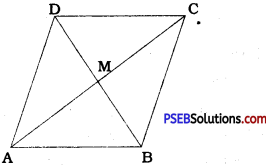
In parallelogram ABCD, the bisectors of ∠A and ∠B intersect at M. If ∠A = 80°, then ∠AMB = ……………. .
A. 40°
B. 50°
C. 80°
D. 90°
Answer:
D. 90°

Question 8.
In parallelogram ABCD, the ratio ∠A : ∠B : ∠C : ∠D can be
A. 3 : 4 : 5 : 6
B. 2 : 3 : 3 : 2
C. 2 : 3 : 2 : 3
D. 2 : 3 : 5 : 8
Answer:
C. 2 : 3 : 2 : 3

Question 9.
In parallelogram ABCD, 3 ∠ A = 2 ∠ B. Then, ∠ D = ………………. .
A. 120°
B. 108°
C. 72°
D. 60°
Answer:
B. 108°

PSEB 9th Class Maths MCQ Chapter 8 Quadrilaterals

Question 10.
In ∆ ABC, E and F are the midpoints of AB and AC respectively. If EF = 4 cm, then BC = …………… cm.
A. 8
B. 2
C. 4
D. 12
Answer:
A. 8

Question 11.
In ∆ ABC, P is the midpoint of AB and Q is the midpoint of AC. Then, PQCB is a ………….. .
A. trapezium
B. parallelogram
C. rectangle
D. rhombus
Answer:
A. trapezium

Question 12.
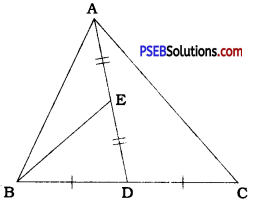
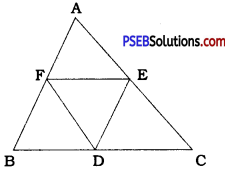
In ∆ ABC, D, E and F are the midpoints of AB, BC and CA respectively. If the perimeter of ∆ DEF is 30 cm, then the perimeter of ∆ ABC is ……………. cm.
A. 15
B. 30
C. 45
D. 60
Answer:
D. 60

PSEB 9th Class Maths MCQ Chapter 8 Quadrilaterals

Question 13.
∆ ABC is an equilateral triangle. D, E and F are the midpoints of AB, BC and CA respectively. If AB = 8 cm, the perimeter of ∆ DEF is …………… cm.
A. 24
B. 12
C. 6
D. 48
Answer:
B. 12

Question 14.
ABCD is a rectangle. If AB = 5 cm and BC = 12
cm, then BD = ………………. cm
A. 17
B. 13
C. 8.5
D. 1
Answer:
B. 13

PSEB 9th Class Maths MCQ Chapter 8 Quadrilaterals

Question 15.
ABCD is a rhombus. If AC = 10 cm and BD = 24 cm, the perimeter of ABCD is …………………. cm.
A. 13
B. 26
C. 52
D. 48
Answer:
C. 52

PSEB 9th Class Maths Solutions Chapter 8 Quadrilaterals Ex 8.2

Punjab State Board PSEB 9th Class Maths Book Solutions Chapter 8 Quadrilaterals Ex 8.2 Textbook Exercise Questions and Answers.

PSEB Solutions for Class 9 Maths Chapter 8 Quadrilaterals Ex 8.2

Question 1.
ABCD is a quadrilateral in which F Q, R and S are midpoints of the sides AB, BC, CD and DA respectively (see the given figure 1). AC is a diagonal. Show that:
(i) SR || AC and SR = \(\frac{1}{2}\) AC
(ii) PQ = SR
(iii) PQRS is a parallelogram.
PSEB 9th Class Maths Solutions Chapter 8 Quadrilaterals Ex 8.2 1
Answer:
In ∆ DAC, S and R are the midpoints of DA and DC respectively.
Through C draw a line parallel to AD which intersects line SR at T.
In ∆ DRS and ∆ CRT
∠ DRS = ∠ CRT (Vertically opposite angles)
∠ RSD = ∠ RTC (Alternate angles formed by transversal ST of DS || TC)
DR = CR (R is the midpoint of DC.)
∴ ∆ DRS ≅ ∆ CRT (AAS rule)
∴ DS = CT and SR = RT (CPCT)
As S is the midpoint of DA, we have DS = SA.
∴ SA = CT
And, by construction, SA || CT.
∴ Quadrilateral SACT is a parallelogram.
∴ ST || AC
∴ SR || AC ………… (1)
Now, SR = RT gives SR = \(\frac{1}{2}\)ST
In parallelogram SACT, ST = AC.
∴ SR = \(\frac{1}{2}\)AC ……………. (2)
Taking (1) and (2) together,
SR || AC and SR = \(\frac{1}{2}\)AC ….. Result (1)
Similarly, in ∆ ABC, P and Q are the midpoints of AB and BC respectively. ,
∴ PQ || AC and PQ = \(\frac{1}{2}\)AC
Now, SR = \(\frac{1}{2}\)AC and PQ = \(\frac{1}{2}\)AC
∴ PQ = SR …… Result (ii)
Similarly, SR || AC and PQ || AC.
∴ PQ || SR
Thus, in quadrilateral PQRS, PQ = SR and PQ || SR.
Hence, by theorem 8.8, PQRS is a parallelogram. … Result (iii)

PSEB 9th Class Maths Solutions Chapter 8 Quadrilaterals Ex 8.2

Question 2.
ABCD is a rhombus and F Q, R and S are the midpoints of the sides AB, BC, CD and DA respectively. Show that the quadrilateral PQRS is a rectangle.
Answer:
PSEB 9th Class Maths Solutions Chapter 8 Quadrilaterals Ex 8.2 2
ABCD is a rhombus and F Q, R and S are the midpoints of sides AB, BC, CD and DA respectively.
∴ In ∆ ABC, PQ || AC and PQ = \(\frac{1}{2}\)AC.
∴ In ∆ ADC, SR || AC and SR = \(\frac{1}{2}\)AC.
Hence, in quadrilateral PQRS, PQ || SR and PQ = SR.
∴ Quadrilateral PQRS is a parallelogram.
Now, since ABCD is a rhombus, AC and BD bisect each other at right angles at M.
∴ ∠ AMB = 90°
Now, AC || PQ and MN is their transversal.
∴ ∠ AMN + ∠ MNP = 180° (Interior angles on the same side of transversal)
∴ ∠ AMB + ∠MNP = 180°
∴ 90° + ∠ MNP = 180°
∴ ∠ MNP = 90°
In ∆ ABD, P and S are the midpoints of AB and AD respectively.
∴ PS || BD and NP is their transversal.
∴ ∠ DNP + ∠ NPS = 180°
∴ ∠ MNP + ∠ NPS =180°
∴ 90° + ∠ NPS = 180°
∴ ∠ NPS = 90°
∴ ∠ SPQ = 90°
Thus, in parallelogram PQRS, one angle ∠P is a right angle.
Hence, quadrilateral PQRS is a rectangle.

PSEB 9th Class Maths Solutions Chapter 8 Quadrilaterals Ex 8.2

Question 3.
ABCD is a rectangle and P, Q, R and S are midpoints of the sides AB, BC, CD and DA respectively. Show that the quadrilateral PQRS is a rhombus.
Answer:
PSEB 9th Class Maths Solutions Chapter 8 Quadrilaterals Ex 8.2 3
Since ABCD is a rectangle, its diagonals are equal.
∴ AC = BD
∴ \(\frac{1}{2}\)AC = \(\frac{1}{2}\)BD
In ∆ ABC, P and Q are the midpoints of AB and BC respectively.
∴ PQ = \(\frac{1}{2}\)AC
Similarly, in ∆ ADC, SR = \(\frac{1}{2}\)AC; in ∆ ABD, SP = \(\frac{1}{2}\) BD and in ∆ BCD, QR = \(\frac{1}{2}\) BD.
Now, PQ = SR = \(\frac{1}{2}\)AC, SP = QR = \(\frac{1}{2}\)BD and \(\frac{1}{2}\)AC = \(\frac{1}{2}\)BD
Hence, in quadrilateral PQRS,
PQ = QR = RS = SP
Thus, all the sides of quadrilateral PQRS are equal.
Hence, quadrilateral PQRS is a rhombus.

PSEB 9th Class Maths Solutions Chapter 8 Quadrilaterals Ex 8.2

Question 4.
ABCD is a trapezium in which AB || DC, BD is a diagonal and E is the midpoint of AD. A line is drawn through E parallel to AB intersecting BC at F (see the given figure). Show that F is the midpoint of BC.
PSEB 9th Class Maths Solutions Chapter 8 Quadrilaterals Ex 8.2 4
Answer:
Suppose line EF drawn through E and parallel to AB intersects BD at M.
EF || AB and AB || DC
∴ EF || DC
Trapezium ABCD is divided into two triangles, ∆ ABD and ∆ BCD, by diagonal BD.
In ∆ ABD, E is the midpoint of AD and a line through E and parallel to AB intersects BD at M.
Hence, by theorem 8.10, M is the midpoint of BD.
Now, in ∆ BCD, M is the midpoint of BD and a line through M and parallel to CD intersects BC at F.
Hence, by theorem 8.10, F is the midpoint of BC.
Note: The following result about the length of EF can also be derived:
EF = \(\frac{1}{2}\)(AB + CD)
Moreover, if X and Y are the midpoints of the diagonals of above trapezium ABCD, then XY = \(\frac{1}{2}\)|AB – CD|.

PSEB 9th Class Maths Solutions Chapter 8 Quadrilaterals Ex 8.2

Question 5.
In a parallelogram ABCD, E and F are the midpoints of sides AB and CD respectively (see the given figure). Show that the line segments AF and EC trisect the diagonal BD.
PSEB 9th Class Maths Solutions Chapter 8 Quadrilaterals Ex 8.2 5
Answer:
E and F are the midpoints of AB and CD respectively.
∴ AE = \(\frac{1}{2}\)AB and CF = \(\frac{1}{2}\)CD
In parallelogram ABCD, AB = CD and AB || CD.
∴ AE = CF and AE || CF
Hence, quadrilateral AECF is a parallelogram.
∴ AF || EC
∴ AP || EQ
In ∆ ABP E is the midpoint of AB and EQ || AR
∴ Q is the midpoint of PB. (Theorem 8.10)
∴PQ = QB …………… (1)
Similarly, in ∆ DQC, F is the midpoint of DC and FP || CQ.
∴ P is the midpoint of DQ. (Theorem 8.10)
∴ DP = PQ …………….. (2)
From (1) and (2), DP = PQ = QB.
Moreover, DP + PQ + QB = BD.
Thus, AF and EC trisect the diagonal BD.

PSEB 9th Class Maths Solutions Chapter 8 Quadrilaterals Ex 8.2

Question 6.
Show that the line segments joining the midpoints of the opposite sides of a quadrilateral bisect each other.
Answer:
PSEB 9th Class Maths Solutions Chapter 8 Quadrilaterals Ex 8.2 6
In quadrilateral ABCD, P Q, R and S are the midpoints of sides AB, BC, CD and DA respectively.
In ∆ ABC, P and Q are the midpoints of AB and BC respectively.
∴ PQ || AC and PQ = \(\frac{1}{2}\)AC …………….. (1)
In ∆ ADC, S and R are the midpoints of DA and DC respectively.
∴ SR || AC and SR = \(\frac{1}{2}\)AC ……………… (2)
From (1) and (2),
PQ = SR and PQ || SR.
Thus, in quadrilateral PQRS, sides in one pair of opposite sides are equal and parallel. Hence, quadrilateral PQRS is a parallelogram. The diagonals of a parallelogram bisect each other. [Theorem 8.6]
∴ PR and SQ bisect each other.
Thus, the line segments joining the midpoints of the opposite sides of a quadrilateral bisect each other.

PSEB 9th Class Maths Solutions Chapter 8 Quadrilaterals Ex 8.2

Question 7.
ABC is a triangle right angled at C. A line through the midpoint M of hypotenuse AB and parallel to BC intersects AC at D. Show that:
(i) D is the midpoint of AC.
(ii) MD ⊥ AC
(iii) CM = MA = \(\frac{1}{2}\)AB
Answer:
PSEB 9th Class Maths Solutions Chapter 8 Quadrilaterals Ex 8.2 7
In ∆ ABC, ∠ C is a right angle and M is the midpoint of hypotenuse AB. A line through M and parallel to BC intersects AC at D.
Hence, by theorem 8.10, DM bisects AC.
∴ D is the midpoint of AC. ….. Result (i)
In ∆ ABC, ∠ C is a right angle.
∴ ∠ C = 90°
Now, BC || DM and DC is their transversal.
∴ ∠ MDC + ∠ DCB = 180° (Interior angles on the same side of transversal)
∴ ∠ MDC + 90° = 180°
∴ ∠ MDC = 90°
Thus, MD is perpendicular to AC.
∴ MD ⊥ AC …… Result (ii)
Now, in ∆ ADM and ∆ CDM,
AD = CD (D is the midpoint of AC)
∠ ADM = ∠ CDM (Right angles)
DM = DM (Common)
∴ ∆ ADM ≅ ∆ CDM (SAS rule)
∴ AM = CM (CPCT) ……………. (1)
Now, M is the midpoint of AB.
∴ AM = \(\frac{1}{2}\)AB …… (2)
< Prom (1) and (2),
CM = MA = \(\frac{1}{2}\)AB …… Result (iii)

PSEB 9th Class English Grammar Non-Finites

Punjab State Board PSEB 9th Class English Book Solutions English Grammar Non-Finites Exercise Questions and Answers, Notes.

PSEB 9th Class English Grammar Non-Finites

(a) Fill up the blanks, selecting suitable to-infinitives from the following list :

(to see, to implement, to do, to announce, to show, to join, to let, to waste, to play, to do, to go, to solve, to post, to ask, to remember)

1. It is time ………………
2. That was a sight …..
3. The judge has a judgement ………
4. That is something ………………..
5. I have a new plan ……………
6. I have a nice picture ……….
7. Have you any plan ……………… the college ?
8. I have some questions ……………… you.
9. Have you any work ……………. ?
10. I have a house 11. She has no problem ………………
12. I have no time …………….
13. Do you have any letters …………..
14. He has some homework …………..
15. Bedi has a match ……………… on Sunday.
Answer:
1. to go
2. to see
3. to announce
4. to remember
5. to implement
6. to show
7. to join
8. to ask
9. to do
10. to let
11. to solve
12. to waste
13. to post
14. to do
15. to play.

PSEB 9th Class English Grammar Non-Finites

(b) Frame seven meaningful sentences from the table below :

I have some letters
some homework
some good news
a question
some pictures
a match
no time
to ask you
to waste
to play on Sunday
to show you
to do
to tell you
to post

1. I have some letters to post.
2. I have some homework to do.
3. I have some good news to tell you.
4. I have a question to ask you.
5. I have some pictures to show you.
6. I have a match to play on Sunday.
7. I have no time to waste.

Fill up the blanks with the Present Participle form of the following Verbs :

(a) (smoke, look, spit, swim, read, wait, go, read, eat, see)

1. …………… is a very good exercise.
2. No …………….. in this compartment.
3. ……………. French is easier than to speak it.
4. ………….. after children requires patience.
5. ………….. between meals is bad.
6. No ……………….
7. He insisted on ……………. her.
8. I am quite used to ……………… in queues.
9. Do you feel like …………….. for a swim ?
10. I am looking forward to ……………… that book.
Answer:
1. Swimming
2. smoking
3. Reading
4. Looking
5. Eating
6. spitting
7. seeing
8. waiting
9. going
10. reading.

PSEB 9th Class English Grammar Non-Finites

(b) (travel, talk, work, walk, ride, see, wait, steal, drop, smoke, cut)

1. He is used to …………….. at night.
2. Try to avoid ……………. in the rush hour.
3. There’s nothing here worth ………….
4. Stop ……..
5. Would you mind ……………… a moment ?
6. He prefers …………….. to …………
7. The grass needs …………..
8. I don’t allow ……………… here.
9. I heard the cork ………..
10. I caught him ……………… my apples.
Answer:
1. working
2. travelling
3. seeing
4. talking
5. waiting
6. walking, riding
7. cutting
8. smoking
9. dropping
10. stealing.

Put the – ing forms (Participles) of the following Verbs in the blanks in the following sentences :

(please, write, rise, run, tire, drip, bore, work, grow, amuse.)
1. I caught a …………….. dog.
2. It was a ……………… sight.
3. We had a …………….. journey.
4. Give him a …………… pad.
5. …………… crops need care.
6. I do not like ……………… taps.
7. Did you see the …………….. flames ?
8. It was a ……………….. play.
9. We had an ……………… talk.
10. The government is looking after the …………… classes.
Answer:
1. running
2. pleasing
3. tiring
4. writing
5. Growing
6. dripping
7. rising
8. boring
9. amusing
10. working.

Given below are some pairs of sentences. Combine them into single sentences, using the Participle Phrases :

1. I saw a thief.
He was running away towards the station.

2. You can see the child.
She is sleeping peacefully.

3. His brother came home.
He brought an English wife with him.

4. Kindly give something to the poor beggar.
He is crying for alms.

5. The prince slept soundly.
He dreamt of his bright future.

6. My father came back home.
He brought some fruit for use.

7. Ram killed the witness.
He was giving a statement.

8. A police officer came to my house today.
He brought my missing bicycle with him.

9. I can hear my son.
He is saying prayers.

PSEB 9th Class English Grammar Non-Finites

10. Could you bring me a pen ?
It is lying on the shelf.
Answers
1. I saw a thief running away towards the station.
2. You can see the child sleeping peacefully.
3. His brother came home bringing an English wife with him.
4. Kindly give something to the poor crying beggar.
5. The prince slept soundly dreaming of his bright future.
6. My father came back home bringing some fruit for use.
7. Ram killed the witness giving a statement.
8. A police officer came to my house today bringing my missing bicycle with him.
9. I can hear my son saying prayers.
10. Could you bring me a pen lying on the shelf?

Fill in the blanks with correct Past Participle form of the given verbs :

(wound, cook, burn, break, write, build, rot, lose, unlock, fade, close, paint, translate, finish, fail)

1. I got my house ……………
2. He got the book …………
3. The …………… soldier was taken to the hospital.
4. The overseer is getting this house ……..
5. The ……………… rose was thrown out.
6. You must get the room ……………..
7. The …………….. food got spoilt.
8. Give a ……………… statement.
9. A ……………. child dreads the fire.
10. This college does not admit ……….. students.
11. He died of a …………….. heart.
12. The officer wants this work ………….. by today.
13. Who likes ……………. vegetables ?
14. That lady found her ……………… purse.
15. I found all the doors
Answer:
1. built
2. translated
3. wounded
4. unlocked
5. faded
6. painted
7. cooked
8. written
9. burnt
10. failed
11. broken
12. finished
13. rotten
14. lost
15. closed.

Combine the following sentences, using Participles or Gerunds or Infinitives :

1. I made a journey to Mumbai yesterday. I went there to get the best financial advice.
2. Your parcel never reached me. It had been addressed to the wrong place.
3. Turn to the right. You will find the office.
4. He drew his sword. He rushed at the king.
5. It was my purse. It had been lost.
6. He made a promise. He kept it also.
7. One must serve twenty years. After that one can retire.
8. He said he would come today. I was pleased at this.
9. I promise to help you in time of need. You can rely on this.
10. She was praised by all. She grew proud.
Answer:
1. I made a journey to Mumbai to get the best financial advice.
2. Having been addressed to the wrong place, your parcel never reached me.
3. Turning to the right, you will find the office.
4. Drawing his sword he rushed at the king.
5. It was my lost purse.
6. Having made a promise he kept it also.
7. After serving for twenty years one can retire.
8. I was pleased to hear of his coming today.
9. You can rely on my promise to help you in times of need.
10. Being praised by all, she grew proud.

PSEB 9th Class English Grammar Non-Finites

The Infinitive

क्रिया के मूल रूप को Infinitive कहा जाता है। इस पर कर्ता के Number और Person का कोई प्रभाव नहीं होता है।
Infinitive दो प्रकार के होते हैं :
Bare Infinitive : यह क्रिया का वह मूल रूप होता है जिसके साथ to नहीं लगता है।
I saw her weep. — We made her sing.

To-Infinitive : यह क्रिया का वह मूल रूप होता है जिसके साथ to लगा होता है।
I want to go now. — We have to pay taxes.

The Use of Bare-Infinitive

Bare-Infinitive का प्रयोग निम्नलिखित हालतों में किया जाता है :

1. निम्नलिखित सहायक क्रथाओ के बाद
do, does, did, can, could, will, would, shall, should, may, might, need, must, dare.
1. I shall accompany you.
2. He may come today.
3. You need not do it.

2. निम्नलिखित सकर्मत (Transitive) कियाओं के बाद :

make, let, bid, feel, hear, see, watch, notice, observe, if I
1. ‘I heard him go up the stairs.
2. I saw him steal my pen.
3. I felt the cold air strike against my face.
4. He made her weep every day.

3. had और would वाले निम्नालिखित phrases के बाद :

had better, had rather, would rather, had sooner, would sooner.
1. I would rather die than beg.
2. You had better stop smoking.

4. than (conjunction) it but (preposition) etc are :

1. I would rather walk than ride your scooter.
2. He did nothing but laugh.
नोट : but के बाद ‘bare-infinitive’ का प्रयोग केवल तभी किया जाता है जब but से पूर्व मुख्य क्रिया के रूप में do, does, did का प्रयोग किया गया हो।

The Use of To-Infinitive.

To-infinitive का प्रयोग निम्नलिखित हालतों में किया जाता है :

1. ought और have के साथ to-infinitive का प्रयोग किया जाता है यदि इन शब्दों का प्रयोग किसी जिम्मेदारी (obligation) अथवा कर्त्तव्य को प्रकट करने के लिए किया गया हो।

1. You ought to respect your elders.
2. We ought to help the poor.
3. I have to support my family.
4. She has to live with her parents.
5. Boys had to pay their fees.

2. किसी कारण अथवा उद्देश्या के प्रकट करने के लिए भी to-invinitive का प्रयोग किया जाता ह

1. She came here to consult you.
2. I went to Delhi to meet my brother.
3. They stopped at the market to buy some apples.
4. We did not go there to earn money.

निम्नलिखित क्रियाओं के साथ to-infinitive लगाया जाता है यदि उनका प्रयोग किसी मनोरथ, इच्छा अथवा तत्परता को प्रकट करने के लिए किया गया हो :

want, hope, like, love, hate, promise, intend, propose, decide, swear, learn, remember, forget, agree, consent, neglect, refuse, attempt, fail, hesitate, prepare, care, pretend, determine, arrange, seem.
1. I want to go now.
2. She decided to marry him.
3. I forgot to answer this question.
4. They promised to pay all the taxes.

PSEB 9th Class English Grammar Non-Finites

निम्नलिखित सकर्मक क्रियाओं के साथ कर्म (object) लगाने के बाद to-infinitive का प्रयोग किया जाता है :

ask, advise, allow, beg, compel, courage, force, instruct, invite, order, permit, request, tell, teach, warn, Bici
1. I begged him to help me.
2. My mother asked me to work hard.
3. The teacher allowed him to go.
4. The boys requested the teacher to forgive them.

Fill in the blanks with the correct form of the verbs given in brackets :

1. Mohan wants ………………. (swim) in the river.
2. The teacher asked him ……………….. (get) out of the room.
3. I forgot ……………….. (bring) my purse.
4. Let him ……………….. (go) now.
5. I have come ……………….. (see) the Principal.
6. It began ……………….. (rain) and we couldn’t go out.
7. We saw him ……………. (arrive) at the station.
8. The book was easy …………….. (read).
9. We didn’t expect Ram …………. (win).
10. They heard her ………………. (sing) a sweet song.
11. Mohan knows how ……………….. (answer) this question.
12. He was too tired ……………….. (walk).
13. He made me …………….. (do) it.
14. They stopped ……………… (have) some rest.
15. He is saving money ………….. (buy) a scooter.
16. Would you like …….. (have) dinner with us?

The Gerund

-ing प्रत्यय वाली ऐसी क्रिया जो Noun का काम कर रही हो उसे Gerund कहा जाता है। इसका प्रयोग निम्नलिखित स्थितियों में किया जा सकता है :

1. Subject to a Verb 1. Swimming improves one’s health.
2. Smoking causes cancer.
2. Object to a Verb 1. I dislike smoking.
2. I love swimming.
3. Object to a Preposition 1. He is fond of playing.
2. She was fined for coming late.
4. Complement to a Linking Verb 1. His only aim was cheating.
2. My favourite hobby is gardening.
5. In apposition to a Pronoun 1. It is no use crying.
2. It is foolish saying that.

Gerunds के प्रयोग के सम्बन्ध में ध्यान रखने योग्य बातें :

1. निम्नलिखित क्रियाओं के साथ कर्म (object) के रूप में to-infinitive तथा gerund में से किसी का भी प्रयोग किया जा सकता है।
advise, allow, attempt, begin, continue, hate, intend, learn, like, love, remember, start.

To-infinitive Gerund
1. He intends to live here.
2. I love to hear this song.
3. I remembered to see him.
4. We prefer to travel by air.
5. He continued to write letters.
1. He intends living here.
2. Move hearing this song.
3. I remembered seeing him.
4. We prefer travelling by air.
5. He continued writing letters.

2. अनुभूति सम्बन्धी निम्नलिखित क्रियाओं के साथ bare-infinitive अथवा gerund में से किसी का भी प्रयोग किया जा सकता है :
feel, hear, notice, observe, see, watch.

Bare-Infinitive Gerund
1. I heard her come in.
2. She saw me cross the road.
3. I heard you shout in the class.
1. I heard her coming in.
2. She saw me crossing the road.
3. I heard you shouting in the class.

3. निम्नलिखित क्रियाओं के साथ केवल gerund का ही प्रयोग किया जा सकता है। इनके साथ infinitive का प्रयोग कभी नहीं किया ‘
जाना चाहिए।
avoid, delay, deny, dislike, enjoy, finish, forget, imagine, keep (जारी रखना), mind (बुरा मनाना), pardon, postpone, risk, stop, suggest, try (परखना), understand.

4. निम्नलिखित क्रियाओं के साथ भी gerund का ही प्रयोग किया जाता है :

be worth, can’t bear, be no use, can’t stand, be no good, can’t help.

1. This table is worth buying.
2. It is no use crying over spilt milk.
3. It is no good imitating others.
4. She can’t bear living away from her children.
5. I can’t stand smoking in my room.
6. We couldn’t help laughing at him.

PSEB 9th Class English Grammar Non-Finites

5. यदि किसी gerund से पूर्व कोई संज्ञा अथवा सर्वनाम लगा हो, तो यह अवश्य ही सम्बन्धवाचक रूप में होना चाहिए, जैसे

1. I dislike Mohan’s coming late daily.
2. Your father depends on your working hard.
3. Do you mind my smoking here?

Fill in the blanks with the correct form of the given verbs (Gerund or Infinitive) :

1. I don’t mind …………. (give) my book to you.
2. My father has stopped ………… (talk) to him.
3. We enjoyed …………… (swim) in the river.
4. She likes …………. (walk) in her garden.
5. He has given up …………. (smoke).
6. The tailor has completed ………….. (sew) the shirt.
7. He refused ………….. (accept) my advice.
8. When the bell rang, the students came
9. I decided ………. (see) the Principal.
10. She offered …………… (bring) flowers for me.
11. I want …………… (play) cricket.
12. Do you really enjoy …………. (play) football ?
13. My father can’t afford ………….. (buy) a T.V. set.
14. They will not permit you …………… (talk) in the library.
15. I advised my brother ………….. (work) hard for the test.

The participle

क्रिया के जिस रूप में Verb तथा Adjective दोनों के ही गुण हों, उसे Participle कहा जाता है। Participle तीन प्रकार के होते हैं :

Present Participle Past Participle Perfect Participle
Drowning Drowned Having drowned
Seeing Seen Having seen
Finishing Finished Having finished

1. Present Participle के कुछ उदाहरण

  • A drowning man catches at a straw.
  • The results were encouraging.
  • Taking a walking stick, the old lady came out of the cottage.
  • Seeing the police, the thief ran away.
  • Naresh went into the bathroom singing.

2. Past Participle के कुछ उदाहरण

  • His spoken English is much better than yours.
  • These solved papers are very helpful.
  • I boarded a crowded bus.
  • I saw a faded rose.

3. Perfect Participle के कुछ उदाहरण

  • Having bought a book, I came back from the market.
  • Having done his homework, John went out to play.
  • Having attended a meeting of the club, I came back.
  • Having won a prize, Neelu felt happy.

4. Participle Phrases के कुछ उदाहरण
याद रखिए कि
(1) जब कोई क्रिया वाक्य की मुख्य क्रिया के समय पर ही हो रही हो तो उसके लिए Present Participle (V1-ing) का प्रयोग किया जाना चाहिए :
I looked through some old papers and came across this letter.
= Looking through some old papers, I came across this letter.

The students saw the Headmaster and they stopped talking.
= Seeing the Headmaster, the students stopped talking.

PSEB 9th Class English Grammar Non-Finites

(2) जब कोई क्रिया वाक्य की मुख्य क्रिया से पहले हो चुकी हो, तो उसके लिए Past Participle (having + V3) का प्रयोग किया जाता है :
I met my friend and went back with him to his house.
= Having met my friend, I went back with him to his house.

The match ended and the spectators went away.
= The match having ended, the spectators went away.

Fill in the blanks with the correct non-finite form (Infinitive, Gerund or Participle) of the verbs given in the brackets :

1. The rice will grow well in the ………… (come) rains.
2. We heard of his ………… (come) back today.
3. We hope …………… (see) him back soon.
4. …………… (Believe) him to be right, I trusted him.
5. Night ………….. (come) on, the men went home.
6. Did you hear of his ………. (win) a prize ?
7. I am tired of …………. (do) this work.
8. Generally ……… (speak), we get what we deserve.
9. We saw him …………( leave) the house.
10. I was very happy ………… (see) you.
11. I shall be glad …….. (help) you.
12. My wife ……………… (expect) my return, did not leave the house.
13. ………….. (Spelt) is more difficult than …………. (write).
14. I am …………… (blame), not you.
15. The coach made us … (run).

Miscellaneous Sentences For Practice

Use the proper form of Non-finites in the following sentences

I.

1. ………………. (Teach) correct English needs great care.
2. People assembled ………………. (hear) the Minister.
3. I saw him ………………. (leave) his house.
4. Some people love ……………….(climb) mountains.
5 ……………….(Walk) is a good exercise.
6. It is easy ………………. (advise) others.
7. People worship the ………………. (rise) sun.
8. I made him ………………. (laugh).
9. A ………………. (drown) man catches at a straw.
10. I intend ……………….(spend) my vacation with my uncle.

II.

1. We are busy ………………. (pack).
2. He refused ………………. (obey) me orders.
3. I hope ………………. (succeed) in my plans.
4. The ………………. (steal) money did not last long.
5. He insisted on ………………. (see) him.
6. These days it is not easy ………………. (get) a job.
7. We were too ……………….(tire) to work.
8. I enjoy ………………. (piny) with small children.
9. ………………. (Smoke) is injurious to health.
10. She agreed ………………. (marry) the poor shepherd.

PSEB 9th Class English Grammar Non-Finites

III.

1. They all heard him ………………. (sing).
2. The runner is ………………. (exhaust).
3. It is no use ………………. (wait) here now.
4. Are you interested in ………………. (paint) ?
5. Dogs are not allowed ………………. (enter) the garden.
6. ………………. (Swim) is a good exercise.
7. I heard him ………………. (cry) for help. .
8. Are you interested in ………………. (boat) ?
9. She was too tired ………………. (walk).
10. No ………………. (park) here.

IV.

1. I wonder why he avoids ………………. (meet) me.
2. It is no use ………………. (argue) with him.
3. I made him ………………. (feel!) sorry.
4. ………………. (Drink) ruins our health.
5. I don’t mind ………………. (wait).
6. He did not let me ………………. (play) in his garden.
7. I hope ………………. (get) first division in the examination.
8. I don’t want ………………. (swim) in the river.
9. I enjoy ………………. (sing) patriotic songs.

V.

1. His story made the listeners ………………. (weep).
2. Dancing is difficult ………………. (learn).
3. We enjoyed ………………. (boat) in the lake.
4. I saw the ball ………………. (roll) into the well.
5. We are looking forward to ………………. (see) her.
6. He used ………………. (smoke) in his youth.
7. How dare you ………………. (talk) like that ?
8. They found her ………………. (sleep).
9. They made her ………………. (sing) a song.
10. She refused ………………. (help).

PSEB 9th Class Maths Solutions Chapter 8 Quadrilaterals Ex 8.1

Punjab State Board PSEB 9th Class Maths Book Solutions Chapter 8 Quadrilaterals Ex 8.1 Textbook Exercise Questions and Answers.

PSEB Solutions for Class 9 Maths Chapter 8 Quadrilaterals Ex 8.1

Question 1.
The angles of a quadrilateral are in the ratio 3: 5 : 9: 13. Find all the angles of the quadrilateral.
Answer:
Let, ABCD be a given quadrilateral.
∴ ∠A : ∠B : ∠C : ∠D = 3 : 5 : 9 : 13
Sum of ratios = 3 + 5 + 9 + 13 = 30
In quadrilateral ABCD, ∠A + ∠B + ∠C + ∠D = 360°
∴ ∠A = \(\frac{3}{30}\) × 360° = 3 × 12 = 36°
∴ ∠B = \(\frac{5}{30}\) × 360° = 5 × 12 = 60°
∴ ∠C = \(\frac{9}{30}\) × 360° = 9 × 12 = 108°
∴ ∠D = \(\frac{13}{30}\) × 360° = 13 × 12 = 156°
Thus the angles of the given quadrilateral are 36°, 60°, 108° and 156°.

PSEB 9th Class Maths Solutions Chapter 8 Quadrilaterals Ex 8.1

Question 2.
If the diagonals of a parallelogram are equal, then show that it is a rectangle.
PSEB 9th Class Maths Solutions Chapter 8 Quadrilaterals Ex 8.1 1
Answer:
In parallelogram ABCD, diagonals are equal.
∴ AC = BD.
In ∆ DAB and ∆ CBA.
DA = CB (Theorem 8.2)
AB = BA (Common)
DB = CA (Given)
∴ ∆ DAB ≅ ∆ CBA sss rule)
∴ ∠ DAB = ∠CBA (CPCT)
In parallelogram ABCD, AD || BC and AB is their transversal.
∴ ∠ DAB + ∠ CBA = 180°
(Interior angles on the same side of transversal)
Thus, in parallelogram ABCD, two angles ∠A and∠B are right angles. Hence, all the angles are right angle.
Hence, the parallelogram ABCD having equal diagonals is a rectangle.

PSEB 9th Class Maths Solutions Chapter 8 Quadrilaterals Ex 8.1

Question 3.
Show that if the diagonals of a quadrilateral bisect each other at right angles, then it is a rhombus.
PSEB 9th Class Maths Solutions Chapter 8 Quadrilaterals Ex 8.1 11
Answer:
In quadrilater ABCD. diagonals AC and BD bisect each other at M at right angles.
∴ AM = CM, BM = DM and
∠AMB = ∠CMB = ∠CMD = ∠AMD = 90°.
In ∆ AMB and ∆ CMB,
AM = CM
∠ AMB = ∠CMB
BM = BM (Common)
∴ ∆ AMB ≅ ∆ CMB (SAS rule)
∴ AB = CB (CPCT)
Similarly, proving ∆ BMC ≅ ∆ DMC and ∆ DMA ≅ ∆ BMA, we get BC = DC and DA = BA.
Thus, in quadrilateral. ABCD.
AB = BC CD = DA.
Therefore, quadrilateral ABCD is a rhombus.
Thus, if the diagonals of a quadrilateral bisect each other at right angles, then it is a rhombus.

PSEB 9th Class Maths Solutions Chapter 8 Quadrilaterals Ex 8.1

Question 4.
Show that the diagonals of a square are equal and bisect each other at right angles.
PSEB 9th Class Maths Solutions Chapter 8 Quadrilaterals Ex 8.1 2
Answer:
ABCD is a square in which diagonals AC and BD intersect at M.
Every square is a parallelogram.
∴ AC and BD bisect each other. …………… (1)
In ∆ DAB and ∆ CBA,
DA = CB (Sides of a square)
∠ DAB = ∠ CBA (Right angles in a square)
AB = BA (Common)
∴ ∆ DAB ≅ ∆ CBA (SAS rule)
∴ BD = AC (CPCT) ……………….. (2)
Now, in ∆ AMB and ∆ CMB,
AM = CM (BD bisects AC at M).
BM = BM (Common)
AB = CB (Sides of a square)
∴ ∆ AMB ≅ ∆ CMB (SSS rule)
∴ ∠ AMB = ∠CMB (CPCT)
But, ∠ AMB and ∠ CMB form a linear pair.
∴ ∠ AMB + ∠ CMB = 180°
Hence, ∠AMB = ∠ CMB = 90° (3)
(1), (2) and (3) taken together proves that the diagonals of a square are equal and bisect each other at right angles.

PSEB 9th Class Maths Solutions Chapter 8 Quadrilaterals Ex 8.1

Question 5.
Show that if the diagonals of a quadrilateral are equal and bisect each other at right angles, then it is a square.
PSEB 9th Class Maths Solutions Chapter 8 Quadrilaterals Ex 8.1 3
Answer:
In quadrilateral ABCD, diagonals AC and BD are equal and bisect each other at right angles.
∴ AC = BD,
MA = MC = MB = MD = \(\frac{1}{2}\)AC = \(\frac{1}{2}\)BD and
∠AMB = ∠CMB= ∠DMC = ∠DMA= 90°.
In ∆ AMB and ∆ CMB,
AM = CM
∠ AMB = ∠ CMB (Right angles)
BM = BM (Common)
∴ ∆ AMB ≅ ∆ CMB (SAS rule)
∴ AB = CB (CPCT)
Similarly, we can prove that BC = DC and
DA = BA.
Thus, in quadrilateral ABCD,
AB = BC = CD = DA …………… (1)
Now, in ∆ DAB and ∆ CBA,
DA = C B
BD = AC (Given)
AB = BA (Common)
∴ ∆ DAB ≅ ∆ CBA (SSS rule)
∴ ∠DAB = ∠CBA (CPCT)
Thus, in quadrilateral ABCD, ∠A = ∠B.
Similarly, we can prove that ∠B = ∠C and ∠C = ∠D.
Thus, in quadrilateral ABCD,
∠A = ∠B = ∠C = ∠D.
Moreover. In quadrilateral ABCD,
∠A + ∠B + ∠C + ∠D = 360°
∴ ∠A = ∠B = ∠C = ∠D = \(\frac{360^{\circ}}{4}\) = 90° ……………… (2)
Thus, (1) and (2) taken together proves that in quadrilateral ABCD, all the sides are equal and all the angles are equal.
Therefore, quadrilateral ABCD is a square.
Thus, if the diagonals of a quadrilateral are equal and bisect each other at right angles, then it is a square.

PSEB 9th Class Maths Solutions Chapter 8 Quadrilaterals Ex 8.1

Question 6.
Diagonal AC of a parallelogram ABCD bisects ∠A (see the given figure). Show that (i) it bisects ∠C also, (ii) ABCD is a rhombus.
PSEB 9th Class Maths Solutions Chapter 8 Quadrilaterals Ex 8.1 4
Answer:
Diagonal AC of parallelogram ABCD bisects ∠A.
∴ ∠DAC = ∠BAC …………… (1)
Now, ∠BAC and ∠DCA are alternate angles formed by transversal AC of AB || CD.
∴ ∠BAC = ∠DCA …………… (2)
Similarly, ∠DAC and ∠BCA are alternate angles formed by transversal AC of AD || BC.
∴ ∠DAC = ∠BCA ……………… (3)
From (1), (2) and (3),
∠DCA = ∠BCA.
But, ∠DCA + ∠BCA = ∠BCD (Adjacent angles)
∴ AC bisects ∠C also.
In parallelogram ABCD,
∠A = ∠C (Theorem 8.4)
∴ \(\frac{1}{2}\)∠A = \(\frac{1}{2}\)∠C
∴ ∠ DAC = ∠ DCA
∴ In ∆ DAC, DA = DC (Sides opposite to equal angles)
Moreover, in parallelogram ABCD,
AB = CD and BC = DA (Theorem 8.2)
∴ AB = BC = CD = DA
Thus. In parallelogram ABCD, all the sides are equal.
Hence, ABCD is a rhombus.

PSEB 9th Class Maths Solutions Chapter 8 Quadrilaterals Ex 8.1

Question 7.
ABCD is a rhombus. Show that diagonal AC bisects ∠A as well as ∠C and diagonal BD bisects ∠B as well as ∠D.
Answer:
PSEB 9th Class Maths Solutions Chapter 8 Quadrilaterals Ex 8.1 5
ABCD is a rhombus
∴ AB || DC, BC || AD and AB = BC = CD = DA.
AB || DC and AC is their transversal.
∴ ∠CAB = ∠ACD (Alternate angles)
In, ∆ DAC, CD = DA
∴ ∠ACD = ∠CAD
Then, ∠CAB = ∠CAD
But, ∠CAB + ∠CAD = ∠ DAB (Adjacent angles)
∴ ∠ CAB = ∠CAD = \(\frac{1}{2}\) ∠DAB
This shows that AC bisects ∠A.
Again, BC || AD and AC is their transversal.
∴ ∠ BCA = ∠ DAC (Alternate angles)
In, ∆ DAC, DA = DC
∴ ∠ DAC = ∠ DCA
Then, ∠BCA = ∠DCA
But, ∠ BCA + ∠ DCA = ∠ DCB (Adjacent angles)
∴ ∠ BCA = ∠ DCA = \(\frac{1}{2}\)∠ DCB
This shows that AC bisects ∠C.
Thus, AC bisects ∠A as well as ∠C.
Similarly, taking BD as transversal of AB || DC, and BC || AD, it can be proved that BD bisects ∠B as well as ∠D.

PSEB 9th Class Maths Solutions Chapter 8 Quadrilaterals Ex 8.1

Question 8.
ABCD is a rectangle in which diagonal AC bisects ∠A as well as ∠C. Show that: (i) ABCD is a square. (ii) Diagonal BD bisects ∠B as well as ∠D.
Answer:
PSEB 9th Class Maths Solutions Chapter 8 Quadrilaterals Ex 8.1 6
In rectangle ABCD, AB = CD, BC = AD, AB || CD and BC || AD.
AC bisects ∠A as well as ∠C.
∴ ∠DAC = ∠BAC = \(\frac{1}{2}\)∠A and
∠ DCA = ∠ BCA = \(\frac{1}{2}\)∠C
Now, AB || CD and AC is their transversal.
∴ ∠ BAC = ∠ DCA (Alternate angles)
∴ ∠ DAC = ∠ DCA
Thus, in ∆ DAC, ∠DAC = ∠DCA
∴ AD = CD (Sides opposite to equal angles)
From this, we get AB = BC = CD = DA.
Also, in rectangle ABCD,
∠A = ∠B = ∠C = ∠D = 90°
Hence, ABCD is a square. …..Result (i)
In ∆ BCD, BC = CD
∴ ∠ CBD = ∠ CDB
Moreover, AB || CD and BD is their transversal.
∴ ∠ CDB = ∠ ABD (Alternate angles)
∴ ∠ CBD = ∠ ABD
Now, ∠ CBD + ∠ ABD = ∠ ABC
∴ ∠ CBD = ∠ ABD = \(\frac{1}{2}\) ∠ ABC
Thus, BD bisects ∠B.
Similarly, diagonal BD bisects ∠ D.
Hence, diagonal BD bisects ∠B as well as ∠D …….. Result (ii)

PSEB 9th Class Maths Solutions Chapter 8 Quadrilaterals Ex 8.1

Question 9.
In parallelogram ABCD, two points P and Q are taken on diagonal BD such that DP = BQ (see the given figure). Show that:
(i) ∆ APD ≅ ∆ CQB
(ii) AP = CQ
(iii) ∆ AQB ≅ ∆ CPD
(iv) AQ = CP
(v) APCQ is a parallelogram.
Answer:
PSEB 9th Class Maths Solutions Chapter 8 Quadrilaterals Ex 8.1 7
ABCD is a parallelogram.
∴ AD || BC and BD is their transversal.
∴ ∠ADB = ∠CBD (Alternate angles)
∴ ∠ADP = ∠CBQ …………… (1)
Similarly, CD || BA and BD is their transversal.
∴ ∠ ABD = ∠ CDB (Alternate angles)
∴ ∠ABQ = ∠CDP ……………… (2)
In ∆ APD and ∆ CQB,
AD = CB (Opposite sides of a parallelogram)
∠ ADP = ∠ CBQ [by (1)]
DP = BQ (Given)
∴ ∆ APD ≅ ∆ CQB (SAS rule) ……. Result (i)
∴ AP = CQ (CPCT) …… Result (ii)
In ∆ AQB and ∆ CPD,
AB = CD (Opposite sides of a parallelogram)
∠ ABQ = ∠ CDP [by (2)]
BQ = DP (Given)
∴ ∆ AQB ≅ ∆ CPD (SAS rule) …….. Result (iii)
∴ AQ = CP (CPCT) ………….. Result (iv)
Now, in quadrilateral APCQ, AP = CQ and AQ = CP
Hence, by theorem 8.3, APCQ is a parallelogram. ………. Result (v)

PSEB 9th Class Maths Solutions Chapter 8 Quadrilaterals Ex 8.1

Question 10.
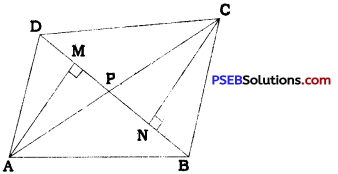
ABCD is a parallelogram and AP and Cg are perpendiculars from vertices A and C on diagonal BD (see the given figure). Show that
(i) ∆ APB ≅ ∆ CQD
(ii) AP = CQ
PSEB 9th Class Maths Solutions Chapter 8 Quadrilaterals Ex 8.1 8
Answer:
In parallelogram ABCD, AB || CD and BD is their transversal.
∴ ∠ ABD = ∠ CDB (Alternate angles)
∴ ∠ABP = ∠CDQ ……………. (1)
Now, in ∆ APB and ∆ CQD,
AB = CD (Opposite sides of a parallelogram)
∠ ABP = ∠ CDQ [by (1)]
∠ APB = ∠ CQD (Right angles)
∆ APB ≅ ∆ CQD (AAS rule) ………… Result (i)
∴ AP = CQ (CPCT) ……….. Result (ii)

PSEB 9th Class Maths Solutions Chapter 8 Quadrilaterals Ex 8.1

Question 11.
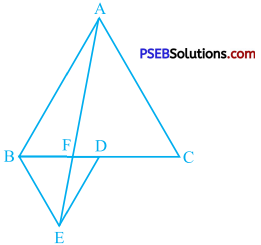
In ∆ ABC and ∆ DBF, AB = DE, AB || DE, j BC = EF and BC || EF. Vertices A, B and C are joined to vertices D, E and F respectively (see the given figure). Show that:
(i) Quadrilateral ABED is a parallelogram
(ii) Quadrilateral BEFC is a parallelogram
(iii) AD || CF and AD = CF
(iv) Quadrilateral ACFD is a parallelogram
(v ) AC = DF
(vi) ∆ ABC ≅ ∆ DEF.
PSEB 9th Class Maths Solutions Chapter 8 Quadrilaterals Ex 8.1 9
Answer:
In quadrilateral ∆ BED, AB = DE and AB || DE. Thus, in quadrilateral ABED, sides in one s pair of opposite sides are equal and parallel. Hence, by theorem 8.8, quadrilateral ABED is a parallelogram. …… Result (i)
Similarly, in quadrilateral BEFC, BC = EF and BC || EF.
Hence, by theorem 8.8, quadrilateral BEFC is a parallelogram. …………. Result (ii)
In parallelogram ABED, AD || BE and in parallelogram BEFC, BE || CE Thus, AD and CF both are parallel to BE.
∴ AD || CF ……….(1)
In parallelogram ABED, AD = BE and in parallelogram BEFC, BE = CF.
∴ AD = CF ……… (2)
Taking (1) and (2) together, we get
AD || CF and AD = CF ………. Result (iii)
In quadrilateral ACFD, AD || CF and AD = CF. Hence, by theorem 8.8, quadrilateral ACFD is a parallelogram. ………. Result (iv)
AC and DF are opposite sides of parallelogram ACFD.
∴ AC = DF ………….. Result (v)
Now, in ∆ ABC and ∆ DEF,
AB = DE (Given)
BC = EF (Given)
AC = DF [by result (v)l
∴ ∆ ABC ≅ ∆ DEF (SSS rule) …… Result (vi)

PSEB 9th Class Maths Solutions Chapter 8 Quadrilaterals Ex 8.1

Question 12.
ABCD is a trapezium in which AB || CD and AD = BC (see the given figure). Show that:
(i) ∠A = ∠B
(ii) ∠C = ∠D
(iii) ∆ ABC ≅ ∆ BAD
(iv) diagonal AC = diagonal BD
[Hint: Extend AB and draw a line through C parallel to DA intersecting AB produced at E.)
PSEB 9th Class Maths Solutions Chapter 8 Quadrilaterals Ex 8.1 10
Answer:
AB is extended to E, and AB || CD.
∴ AE || CD
In quadrilateral ADCE, AE || CD and by consturction CE || DA.
∴ Quadrilateral ADCE is a parallelogram.
∴ AD = CE
Moreover, AD = BC (Given)
∴ BC = CE
In ∆ BCE, BC = CE
∴ ∠CBE = ∠CEB
∴ ∠CBE = ∠CEA ………….. (1)
In parallelogram ADCE, AD || CE and AE is their transversal.
∴ ∠ DAE + ∠ CEA = 180° (Interior angles on the same side of transversal)
∴ ∠ DAE + ∠ CBE = 180° [by (1)]
∴ ∠ DAE = 180° – ∠ CBE …………… (2)
Moreover, ∠ ABC + ∠ CBE = 180° (Linear pair)
∴ ∠ ABC = 180° – ∠ CBE …………. (3)
From (2) and (3),
∠ DAE = ∠ ABC
∴ ∠A = ∠B ……… Result (i)
AB || CD and AD is their transversal.
∴ ∠A + ∠D = 180°
∴ ∠D = 180°- ∠A ………….. (4)
AB || CD and BC is their transversal.
∴ ∠B + ∠C = 180°
∴ ∠C = 180°- ∠B
∴ ∠C = 180° – ∠ A [by result (i)] ……… (5)
From (4) and (5),
∠C = ∠D …….. Result (ii)
Draw diagonals AC and BD.
In ∆ ABC and ∆ BAD,
BC = AD (Given)
∠ ABC = ∠ BAD [by result (i)]
AB = BA (Common)
∴ ∆ ABC ≅ ∆ BAD (SAS rule) ………. Result (iii)
∴ AC = BD (CPCT)
Thus, diagonal AC = diagonal BD … Result (iv)
Note: A trapezium in which non-parallel sides are equal is called an isosceles trapezium. As proved above, in an isosceles trapezium, the diagonals are equal and the angles on each parallel side are equal.

PSEB 9th Class English Vocabulary Synonyms

Punjab State Board PSEB 9th Class English Book Solutions English Vocabulary Synonyms Exercise Questions and Answers, Notes.

PSEB 9th Class English Vocabulary Synonyms

Match the words in column A with their synonyms in column B :

A — B
just — reach
leave — wrath
permit — refuge
brave — fearless
certain — vanish
disappear — sure
anger — prevent
forbid — fair
shelter — inactive
attempt — depart
lazy — allow
arrive — try
Answer:
just = fair ; leave = depart ; permit = allow ; brave = fearless ; certain = sure ; disappear = vanish; anger = wrath ; forbid = prevent; shelter = refuge; attempt = try; lazy = inactive; arrive = reach.

PSEB 9th Class English Vocabulary Synonyms

Complete the sentences with the words given in the box. The italicized words will help you to choose the right words 

inactive ; pouring ; bright ; finish ; annoyed ; enormous ; collect ; wear ; try

1. Is the new student intelligent ? Yes, he is very ……………..
2. It was raining heavily. In fact, it was ………………
3. The show stopped at 10 p.m. because the policemen asked us to ………….. early.
4. She was very angry with my brother. I don’t know why she was so …………….. with him.
5. It was a very huge animal. We had never seen such an ……………. animal before.
6. He likes to assemble photographs. He has decided to …………….. about one thousand rare ones.
7. Don’t put on the red cap, …………….. the black one.
8. She is quite lazy. I don’t know why she is so ……………..
Answer:
1. bright
2. pouring
3. finish
4. annoyed
5. enormous
6. collect
7. wear
8. inactive.

Synonyms

जिन शब्दों का अर्थ एक ही हो अथवा मिलता-जुलता हो, उन्हें Synonyms कहते हैं; जैसे
hard = difficult
pray = request
fact = truth

PSEB 9th Class English Vocabulary Synonyms

List Of Synonyms

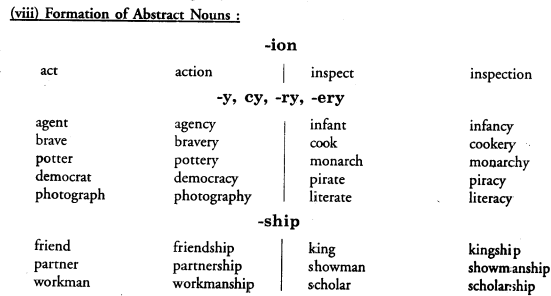
PSEB 9th Class English Vocabulary Synonyms 1
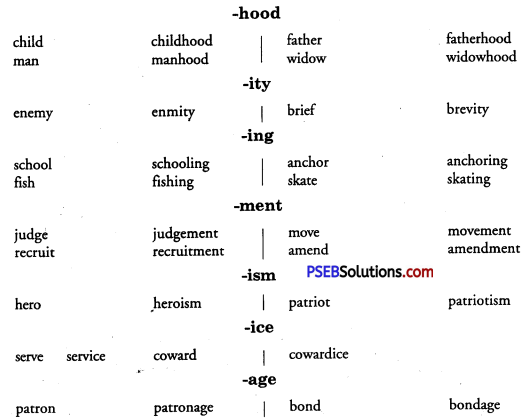
PSEB 9th Class English Vocabulary Synonyms 2

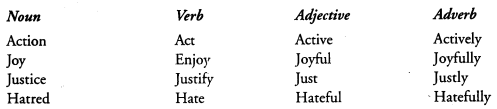
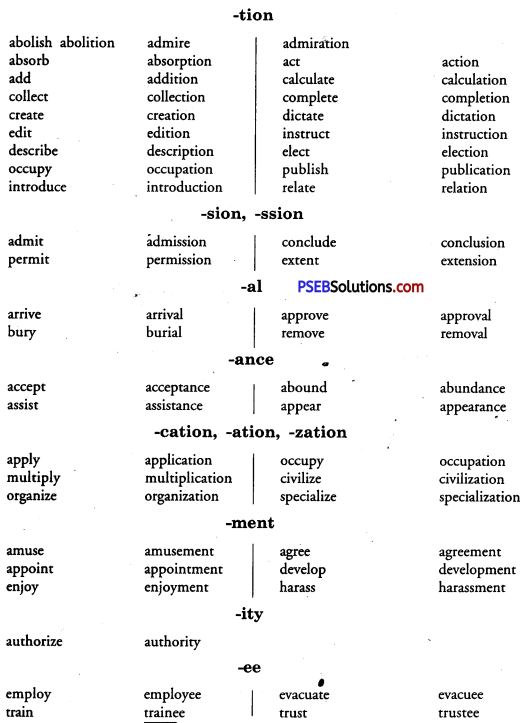
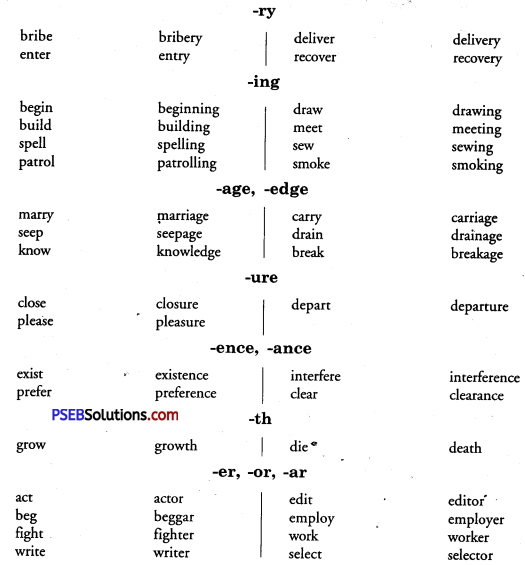
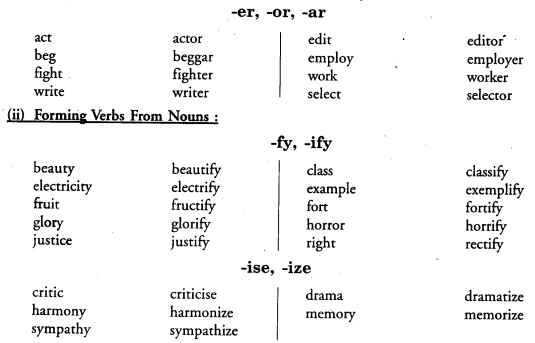
PSEB 9th Class English Vocabulary Words as different Parts of Speech

Punjab State Board PSEB 9th Class English Book Solutions English Vocabulary Words as different Parts of Speech Exercise Questions and Answers, Notes.

PSEB 9th Class English Vocabulary Words as different Parts of Speech

Write n’ for noun, ‘adj.’ for adjective, ‘adv.’ for adverb and ‘ for verb for the italicized word given in the sentences :

1. One must travel light while travelling by air.
2. This clock is ten minutes fast.
3. The chief guest’s speech was brief and to the point.
4. The officer was briefed about the facts of the case.
5. This bicycle cost him twelve hundred rupees.
6. Manvinder ran fast enough to reach the school in time.
7. What is your examiner’s schedule for tomorrow ?
8. You can buy many fancy items from Meena Bazar.
9. That tastes real good. Where did you get it from ?
10. What is the cost of this pair of socks ?
Answer:
1. adv.
2. adj.
3. adj.
4. v
5. v
6. adv.
7. n
8. adj.
9. adv.
10. n.

PSEB 9th Class English Vocabulary Words as different Parts of Speech

Use the given words in sentences as directed :

1. Fare (noun) – He has not paid the bus fare.
Fare (verb) – Ram has fared well in the examination.

2. Bear (noun) – There are many types of bear in the zoo.
Bear (verb) – He has borne much suffering in his life.

3. Wound (noun) – My wound has healed.
Wound (verb) – He was wounded seriously.

4. Round (adjective) – The earth is round.
Round (preposition)- The earth goes round the sun.
Round (adverb) – Everybody joins hands and dances round.

5. Fast (adjective) – He is a fast friend of mine.
Fast (adverb) – She is running very fast.
Fast (noun) – I observe fast on every Monday.

6. Stand (noun) – I saw him near the cycle-stand.
Stand (verb) – Will you please stand up?

7. Produce (noun) – This shop sells only fresh local produce.
Produce (verb) – She produced a hot meal for us within 20 minutes.

PSEB 9th Class English Vocabulary Words as different Parts of Speech

एक ही शब्द को भाषा के विभिन्न रूपों में इस्तेमाल किया जा सकता है। उदाहरण के रूप में निम्नलिखित वाक्यों को देखिए

They fought to the last. (Noun)
The war lasted one month. (Verb)
He was the last man to come. (Adjective)
He spoke last at the meeting. (Adverb)

यहां शब्द ‘last’ को पहले वाक्य में Noun के रूप में, दूसरे वाक्य में एक Verb के रूप में, तीसरे वाक्य में एक Adjective तथा चौथे वाक्य में एक Adverb के रूप में इस्तेमाल किया गया है।
Examples :

Act
Verb : He acted upon my advice.
Noun : It was an act of kindness.

All
Noun : I lost my all in this business.
Adjective : All the boys reached the playground.

Bail
Verb : He will be bailed out today.
Noun : He was set free on bail.

Back
Verb : He becked my proposal.
Noun: He has pain in his back.
Adjective : He came through the back door.

PSEB 9th Class English Vocabulary Words as different Parts of Speech

Better
Adjective : This book is better than that.
Adverb: He fared better in the test than he had hoped.
Verb : We hope to better the conditions of our workers.
Noun (pl.) : Follow your betters.

Book
Verb : Get your luggage booked.
Noun : I have read this book.

Close
Noun : The meeting came to a close in time.
Verb : The school is closed for summer vacation.

Dawn
Verb : The truth dawned upon him yesterday.
Noun : I always get up before dawn.

Drive
Verb : Suresh is driving the car at top speed.
Noun : He had a good drive in the morning.

Effect
Verb : The prisoner effected his escape.
Noun : My advice had the desired effect.

Fare
Verb : I have fared badly in my test.
Noun : We paid the bus fare.

Fix
Noun : We are in a fix now.
Verb : Let us fix the programme.

Face :
Verb: He has faced many difficulties in his life.
Noun Wash your face.

Fast
Noun: They keep a fast every Friday.
Adjective: This is a fast train.
Verb: I fast once every week.

PSEB 9th Class English Vocabulary Words as different Parts of Speech

Hand
Verb: The thief was handed over to the police.
Noun: Wash your hands.

Iron
Verb: Iron your clothes.
Noun: Iron is a useful metal.
Adjective: This knife has an iron handle.

Idle :
Verb: Do not idle away your precious time.
Noun: The idle fail in their life.
Adjective: Sohan is an idle boy.

Like
Verb: I like her ways.
Noun: Everybody has his likes and dislikes.
Adjective: Like poles repel each other.

Light
Noun: There was no light in the room.
Adjective: Always take a light diet to keep fit.
Verb: Light the lamp.
Adverb: Travel light if you must.

Less
Adjective: He is paying less attention to studies these days.
Verb: He is less intelligent than his brother.
Noun: He won’t be satisfied with less.

Near :
Adjective: He is a near relation of the headmaster.
Verb: He is nearing his end.
Adverb: Come near

Right
Noun: We must fight for our rights.
Adjective: This is my right hand.
Verb: Every wrong should be righted.

Round
Noun: Let us have a round of cards.
Adjective: The earth is round.
Verb: He rounded his lips in anger.
Adjective: He turned round.
Preposition: She wore a necklace round her neck.

Second :
Verb: I will second your proposal.
Noun: I will come back in a second.
Adjective: February is the second month of the year.

Still
Noun: In the still of the night, a thief entered our house.
Adjective: The night was still.

PSEB 9th Class English Vocabulary Words as different Parts of Speech

Stone
Adjective: It is a stone wall.
Verb: The boys stoned the dog to death.
Noun: The boys threw stones at the beggar.

Time
Noun: What is the time by your watch ?
Verb: The train is timed to reach here at 5 p.m.

Well
Noun: We have a well in our garden.
Adjective: The patient is now well.
Adverb: He has fared well in the examination.
Verb: Tears welled up in her eyes.

While
Noun: Rest a little while.
Verb: He is whiling away his time.

Will
Noun: Where there is a will, there is a way.
Verb: Have what you will.

PSEB 9th Class Maths Solutions Chapter 9 Areas of Parallelograms and Triangles Ex 9.2

Punjab State Board PSEB 9th Class Maths Book Solutions Chapter 9 Areas of Parallelograms and Triangles Ex 9.2 Textbook Exercise Questions and Answers.

PSEB Solutions for Class 9 Maths Chapter 9 Areas of Parallelograms and Triangles Ex 9.2

Question 1.
In the given figure, ABCD is a parallelogram, AE ⊥ DC and CF ⊥ AD. If AB = 16 cm, AE = 8 cm and CF = 10 cm, find AD.
PSEB 9th Class Maths Solutions Chapter 9 Areas of Parallelograms and Triangles Ex 9.2 1
Answer:
The area of a parallelogram is the product of its base and the altitude corresponding to that base.
Here, in parallelogram ABCD, the altitude corresponding to base DC is AE and the altitude corresponding to base AD is CF.
∴ ar(ABCD) = DC × AE = AD × CF
∴ DC × AE = AD × CF
∴ AB × AE = AD × CF (∵ AB = DC In parallelogram ABCD)
∴ 16 × 8 = AD × 1O
∴ AD = \(\frac{16 \times 8}{10}\)
∴ AD = \(\frac{128}{10}\)
∴ AD = 12.8 cm

PSEB 9th Class Maths Solutions Chapter 9 Areas of Parallelograms and Triangles Ex 9.2

Question 2.
If E, F, G and H are respectively the midpoints of the sides of a parallelogram ABCD, show that ar(EFGH) = \(\frac{1}{2}\)ar (ABCD).
Answer:
In parallelogram ABCD. E, F, G and H are the midpoints of AB, BC. CD and DA respectively.
Draw GE.
PSEB 9th Class Maths Solutions Chapter 9 Areas of Parallelograms and Triangles Ex 9.2 2
In parallelogram ABCD, AB || CD and AB = CD.
∴ BE || CG and BE (\(\frac{1}{2}\) AB) = CG (\(\frac{1}{2}\) CD)
∴ Quadrilateral EBCG is a parallelogram.
∴ GE || BC
Now, ∆ EFG and parallelogram EBCG are on the same base GE and between the same parallels GE and BC.
∴ ar(EFG)= \(\frac{1}{2}\)ar (EBCG) ………………. (1)
Similarly, ∆ EHG and parallelogram AEGD are on the same base GE and between the same parallels GE and DA.
∴ ar(EHG) = \(\frac{1}{2}\)ar (AEGD) ……………….. (2)
Adding (1) and (2),
ar (EFG) + ar (EHG) = \(\frac{1}{2}\) ar (EBCG) + \(\frac{1}{2}\) ar (AEGD)
∴ ar (EFGH) = \(\frac{1}{2}\) [ar (EBCG) + ar (AEGD)]
∴ ar (EFGH) = \(\frac{1}{2}\) ar (ABCD)

PSEB 9th Class Maths Solutions Chapter 9 Areas of Parallelograms and Triangles Ex 9.2

Question 3.
p and Q are any two points lying on the sides DC and AD respectively of a parallelogram ABCD. Show that ar (APB) = ar (BQC).
PSEB 9th Class Maths Solutions Chapter 9 Areas of Parallelograms and Triangles Ex 9.2 3
Answer:
Here, ∆ APB and parallelogram ABCD are on the same base AB and between the same parallels AB and CD.
∴ ar (APB) = \(\frac{1}{2}\)ar (ABCD) …………… (1)
Similarly, ∆ BQC and parallelogram ABCD are on the same base BC and between the same parallels BC and DA.
∴ ar (BQC) = \(\frac{1}{2}\)ar (ABCD) ……………… (2)
From (1) and (2),
ar(APB) = ar(BQC)

PSEB 9th Class Maths Solutions Chapter 9 Areas of Parallelograms and Triangles Ex 9.2

Question 4.
In the given figure, P is a point in the interior of a parallelogram ABCD. Show that,
(i) ar (APB) + ar (PCD) = \(\frac{1}{2}\)ar (ABCD)
(ii) ar (APD) + ar (PBC) = ar (APB) + ar (PCD)
[Hint: Through P, draw a line parallel to AB.]
PSEB 9th Class Maths Solutions Chapter 9 Areas of Parallelograms and Triangles Ex 9.2 4
Answer:
Through P, draw a line parallel to AB which intersects BC at Q and AD at R.
Now, in quadrilateral ABQR,
AB || QR (By construction)
BQ || AR (In parallelogram ABCD, BC || AD)
∴ Quadrilateral ABQR is a parallelogram.
Similarly, DCQR is a parallelogram.
∆ APB and parallelogram ABQR are on the same base AB and between the same parallels AB and QR.
∴ ar(APB) = \(\frac{1}{2}\)ar (ABQR) ……………….. (1)
Similarly, ∆ PCD and parallelogram DCQR are on the same base DC and between the same parallels DC and QR.
∴ ar(PCD) = \(\frac{1}{2}\)ar (DCQR) ………………… (2)
Adding (1) and (2),
= ar(APB) + ar (PCD)
= \(\frac{1}{2}\)ar (ABQR) + \(\frac{1}{2}\)ar (DCQR)
∴ ar (APB) + ar (PCD)
= \(\frac{1}{2}\) [ar (ABQR) + ar (DCQR)]
∴ ar (APB) + ar (PCD) = \(\frac{1}{2}\)ar (ABCD) …………………. (3)
Now, through P, draw a line parallel to AD which intersects AB at S and CD at T.
Then, as above, it can be proved that
ar(APD) + ar(PBC) = \(\frac{1}{2}\)ar (ABCD) ……………………. (4)
From (3) and (4),
ar (APD) + ar (PBC) = ar (APB) + ar (PCD)

PSEB 9th Class Maths Solutions Chapter 9 Areas of Parallelograms and Triangles Ex 9.2

Question 5.
In the given figure, PQRS and ABRS are parallelograms and X is any point on side BR. Show that:
(i) ar (PQRS) = ar (ABRS)
(ii) ar(AXS) = \(\frac{1}{2}\)ar (PQRS)
PSEB 9th Class Maths Solutions Chapter 9 Areas of Parallelograms and Triangles Ex 9.2 5
Answer:
Parallelograms PQRS and ABRS are on the same base RS and between the same parallels PB and SR.
∴ ar (PQRS) = ar (ABRS) …………….. (1)
∆ AXS and parallelogram ABRS are on the same base AS and between the same parallels AS and BR.
∴ ar (AXS) = \(\frac{1}{2}\)ar (ABRS) ………………… (2)
From (1) and (2),
ar (AXS) = \(\frac{1}{2}\)ar (PQRS)

PSEB 9th Class Maths Solutions Chapter 9 Areas of Parallelograms and Triangles Ex 9.2

Question 6.
A farmer was having a field in the form of a parallelogram PQRS. She took any point A on RS and joined it to points P and Q. In how many parts the field Is divided? What are the shapes of these parts? The farmer wants to sow wheat and pulses in equal portions of the field separately. How should she do it?
Answer:
PSEB 9th Class Maths Solutions Chapter 9 Areas of Parallelograms and Triangles Ex 9.2 6
By taking any point A on RS and joining it to points P and Q, the field is divided into three triangular parts as ∆ PSA, ∆ APQ and ∆ QRA.
Here, ∆ APQ and parallelogram PQRS are on the same base PQ and between the same parallels PQ and SR.
∴ ar (APQ) = \(\frac{1}{2}\)ar (PQRS)
∴ ar (PSA) + ar(QRA) = \(\frac{1}{2}\)ar(PQRS)
Thus, ar (APQ) = ar (PSA) + ar (QRA)
Now, as the farmer wants to sow wheat and pulses in equal portions of the field separately.
she has two options as below to do so:
(1) She should sow wheat in ∆ APQ and pulses in ∆ PSA as well as ∆ QRA.
(2) She should sow pulses in ∆ APQ and wheat in ∆ PSA as well as ∆ QRA.