A Ballad of Sir Pertab Singh Question Answer Class 10 English Main Course Book Poem Chapter 3 PSEB Solutions

Punjab State Board PSEB 10th Class English Book Solutions English Main Course Book Poem 3 A Ballad of Sir Pertab Singh Textbook Exercise Questions and Answers.

Class 10th English Main Course Book Poem Chapter 3 A Ballad of Sir Pertab Singh Question Answers

A Ballad of Sir Pertab Singh Class 10 Questions and Answers

Question 1.
Write a summary of the poem in your own words.
Answer:
Pertab Singh was the king of Jodhpore. He had a friend who was an Englishman. Suddenly, the friend died. Pertab Singh himself carried his friend’s bier. He did not care for the warning of priests who said that he would lose his caste by carrying the bier of an Englishman.

प्रताब सिंह जोधपुर का राजा था। उसका एक अंग्रेज़ मित्र था। अचानक मित्र की मृत्यु हो गई। प्रताब सिंह ने स्वयं अपने मित्र की अरथी उठाई। उसने पण्डितों की चेतावनी की परवाह न की जो कहते थे कि एक अंग्रेज़ की अरथी उठाने से वह अपनी जाति खो बैठेगा।

PSEB 10th Class English Main Course Book Solutions Poem 3 A Ballad of Sir Pertab Singh

Question 2.
What is the central idea of the poem ?
Answer:
This poem brings out the folly of the caste system. All men are equal in the eyes of God. No one is high or low by caste. Humanity is the only true caste. A caste that divides men from men can’t be called a true caste.

यह कविता जाति-प्रथा की मूर्खता को व्यक्त करती है। सभी लोग ईश्वर की दृष्टि में बराबर हैं। जाति से कोई बड़ा या छोटा नहीं होता। मानवता ही एकमात्र सच्ची जाति है। ऐसी जाति जो मनुष्यों को मनुष्यों से बांटती हो, उसे सच्ची जाति नहीं कहा जा सकता।

Question 3.
Who was Sir Pertab Singh ?
Answer:
Sir Pertab Singh was the king of Jodhpore. He lived in the Red-rose House. He was a true friend. He did not believe in the caste system. For him, the caste of a soldier was the only true caste.

सर प्रताब सिंह जोधपुर का राजा था। वह रेड-रोज हाऊस में रहता था। वह एक सच्चा मित्र था। वह जाति प्रथा में विश्वास नहीं रखता था। उसके अनुसार एक सैनिक की जाति एकमात्र सच्ची जाति होती है।

Question 4.
Why did Pertab Singh immediately like the English soldier ?
Answer:
The Englishman looked every inch a soldier. Pertab Singh himself was a true soldier. That was why he liked him immediately. He did not believe in any differences of caste. For him the caste of a soldier was the only true caste.

अंग्रेज़ पूरी तरह से एक सच्चा सैनिक दिखाई देता था। प्रताब सिंह स्वयं एक सच्चा सैनिक था। इस कारण से वह उसे तुरन्त पसन्द करने लगा। वह जाति के किसी भेद-भाव में विश्वास नहीं करता था। उसके लिए एक सैनिक की जाति ही एकमात्र सच्ची जाति थी।

Question 5.
How did the two comrades spend their days ?
Answer:
The two comrades spent their days together. They would go riding in the morning and in the evening. They told each other stories of love and adventure. Thus they passed their days happily. Then one day the English soldier died suddenly.

दोनों मित्र अपने दिन एक-साथ बिताया करते थे। वे प्रातः और सायं घुड़सवारी करने के लिए जाया करते थे। वे एक-दूसरे को प्यार और साहस की कहानियां सुनाया करते। इस तरह उन्होंने अपने दिन प्रसन्नतापूर्वक बिताए। फिर एक दिन अंग्रेज़ सैनिक की अचानक मृत्यु हो गई।

PSEB 10th Class English Main Course Book Solutions Poem 3 A Ballad of Sir Pertab Singh

Question 6.
Why was Pertab Singh asked to send a sweeper when the Englishman died ?
Answer:
Four men were needed to carry the Englishman’s bier. But in Jodhpore, they could find only three Englishmen. No one from the Hindu castes was supposed to carry the bier of a non-Hindu. So Pertab Singh was asked to send a sweeper. A sweeper has no caste to lose.

अंग्रेज़ आदमी की अरथी उठाने के लिए चार आदमियों की ज़रूरत थी। किन्तु जोधपुर में वे केवल तीन अंग्रेज़ ही ढूँढ पाये। हिन्दू जातियों में से कोई भी ऐसे आदमी की अरथी उठाने को तैयार नहीं होना था जो हिन्दू न हो। इसलिए प्रताब सिंह से कहा गया कि वह एक मेहतर को भेज दे। एक मेहतर की कोई जाति नहीं होती जिसे वह खो बैठे।

Question 7.
What was the problem that arose when the Englishman died ?
Answer:
Four men were needed to carry the Englishman’s bier. But in Jodhpore, they could find only three Englishmen. No one from the Hindu castes was supposed to carry the bier of a non-Hindu. Thus a problem arose to find the fourth bearer.

अंग्रेज़ की अरथी को उठाने के लिए चार आदमियों की ज़रूरत थी। किन्तु जोधपुर में वे केवल तीन अंग्रेज़ ही ढूँढ पाये। हिन्दू जातियों में से कोई भी ऐसे आदमी की अरथी उठाने को तैयार नहीं होना था जो हिन्दू न हो। इसलिए चौथे उठाने वाले को ढूंढने की समस्या पैदा हो गई।

Question 8.
What, according to the priests, had Pertab Singh lost ? Why?
Answer:
The priests said that Pertab Singh had lost his caste. He had carried the bier of a foreigner. Religion did not allow this. Pertab Singh had defied religion. He had made himself impure and thus lost his caste. However, Pertab Singh did not care what the priests said.

पुरोहितों ने कहा कि प्रताब सिंह अपनी जाति खो चुका था। उसने एक विदेशी की अरथी को उठाया था। धर्म इस की इजाजत नहीं देता था। प्रताब सिंह ने धर्म का उल्लंघन किया था। उसने स्वयं को अपवित्र बना लिया था और इस तरह अपनी जाति खो बैठा था। किन्तु प्रताब सिंह ने उस बात की परवाह न की जो पुरोहितों ने कही।

Objective Type Questions

Question 1.
Sir Pertab Singh lived in …………… House.
(i) Red-rose
(ii) Black-rose
(iii) Rose-red
(iv) Rose-blood.
Answer:
(iii) Rose-red

Question 2.
Sir Pertab Singh’s friend was ……………. soldier.
(i) an Indian
(ii) a Chinese
(iii) an English
(iv) a Pakistani.
Answer:
(iii) an English

Question 3.
According to the priests, Pertab Singh lost his caste forever. (True False)
Answer:
True.

Answer each of the following in one word / phrase / sentence :

Question 1.
Who wrote the poem, ‘A Ballad of Sir Pertab Singh’ ?
Answer:
Sir Henry Newbolt.

Question 2.
What was Sir Pertab Singh’s house called ?
Answer:
It was called Rose-red House.

Question 3.
Who came forward to carry the bier of Pertab’s English friend ?
Answer:
Sir Pertab Singh himself.

PSEB 10th Class English Main Course Book Solutions Poem 3 A Ballad of Sir Pertab Singh

Question 4.
What did the Brahmins tell Sir Pertab Singh when he carried his English friend’s bier ?
Answer:
They told Pertab Singh that he had lost his caste.

Question 5.
What does the poem, ‘A Ballad of Sir Pertab Singh’ bring out ?
Answer:
It brings out the folly of caste system.

Complete the following :

1. Sir Pertab Singh was the king of ……
2. ….. is the only true caste.
3. Sir Pertab Singh did not care about the warning of the …….
Answer:
1. Jodhpore
2. Humanity
3. priests.

Write True or False against each statement:

1. Sir Pertab Singh did not believe in the caste system.
2. Pertab’s friend was a German soldier.
3. No one is high or low by caste.
Answer:
1. True
2. False
3. True.

Choose the correct option for each of the following :

Question 1.
Sir Pertab Singh liked the English soldier because he looked every inch a …………
(a) lover
(b) soldier
(c) traitor
(d) joker.
Answer:
(b) soldier

Question 2.
The two comrades told each other the stories of ………
(a) saints and prophets
(b) kings and knights
(c) gods and goddesses
(d) love and adventure.
Answer:
(d) love and adventure.

Reading Comprehension

(1) In the first year of him that first
Was Emperor and King,
A rider came to the Rose-red House,
The House of Pertab Singh.

1. Name the poem and the poet.
2. Who came to Pertab Singh’s house ?
3. What was the house called ?
4. How long had Pertab Singh been the King ?
Answer:
1. The name of the poem is ‘A Ballad of Sir Pertab Singh’. The poet is Sir Henry
2. A young English rider came to Pertab Singh’s house.
3. The house was called Rose-red House.
4. He was yet in the first year of his rule

(2) Beneath the morning stars they rode,
Beneath the evening sun,
And their blood sang to them as they rode
That all good wars are one.

1. Who were the riders ?
2. How did they feel while riding together ?
3. How did they feel about wars ?
4. How long did the two continue riding together ?
Answer:
1. The two riders were Pertab Singh and an English soldier.
2. They felt very brave and happy.
3. They felt that all good wars are one.
4. They kept riding from early dawn till it was evening.

(3) So ran their joy the allotted days,
Till at the last day’s end
The shadow stilled the Rose-red House
And the heart of Pertab’s friend.

1. Who was Pertab’s friend ?
2. What happened to the friend ?
3. How did the two feel while living together ?
4. Explain : “The shadow stilled the Rose-red House.?
Answers ·
1. Pertab’s friend was an English soldier.
2. The friend died suddenly.
3. They felt very happy while living together.
4. Pertab’s heart was filled with sorrow over his friend’s death. The whole palace was covered in the shadow of grief.

(4) There were three of his race and creed,
Three only and no more :
They could not find to bear the dead
A fourth in all Jodhpore.
‘O Maharaj, of your good grace
Send us a sweeper here;
A sweeper has no caste to lose
Even by an alien bier.’

1. “There were three of his race and creed. Which race has been mentioned here ?
2. What could they not find in all Jodhpore ?
3. What did they request the king to do ?
Answers
1. The race and creed of the Englishman has been mentioned here.
2. They could not find a fourth one of the English race and creed in all Jodhpore to carry the bier of a foreigner:
3. They requested the king to send a sweeper to carry the bier of a foreigner.

(5) What need, what need ?’ said Pertab Singh,
And bowed his princely head.
‘I have no caste, for I myself
Am bearing forth the dead.’

1. What need does Pertab Singh refer to ?
2. Who came forward to carry the bier ?
3. Whose bier was it ?
4. Why did Pertab Singh say, “I have no caste.” ?
Answer:
1. It was the need of a fourth person to carry the bier.
2. Pertab Singh himself came forward to carry the bier.
3. It was the bier of an English soldier who was Pertab Singh’s friend.
4. He said this because he did not believe in the caste system

PSEB 10th Class English Main Course Book Solutions Poem 3 A Ballad of Sir Pertab Singh

(6) “God only knows,’ said Pertab Singh,
“That which I lose today :
And without me no hand of man,
Shall bear my friend away.’

1. Name the poem and the poet.
2. How did he feel over this loss ?
3. What did he decide to do ?
4. What did Pertab Singh say he had lost ?
Answer:
1. The name of the poem is ‘A Ballad of Sir Pertab Singh’. The poet is Sir Henry Newbolt.
2. He felt very unhappy over the loss.
3. He decided to carry his friend’s bier himself.
4. He said he had lost a very dear friend.

A Ballad of Sir Pertab Singh Poem Summary in English

A Ballad of Sir Pertab Singh Introduction:
Now there arose a problem. There were only three Englishmen in all Jodhpore. They could not find a fourth one to carry the dead man’s bier. Religion did not allow a Hindu to carry the dead body of a foreigner. So, the king was requested to send a sweeper. But the king himself came forward to carry his friend’s dead body to the grave. The king was warned that he would lose his caste by doing so.

Sir Pertab Singh paid no heed to it. Next morning the Brahmins came to Pertab Singh. They informed him that he had been declared an outcaste. Pertab Singh angrily told the Brahmins that there was a caste higher than any other caste in the world. It was the caste of a true soldier. The king belonged to this caste and had no fear of losing it.

A Ballad of Sir Pertab Singh Summary in English:

This ballad shows the folly of the Hindu caste system. Sir Pertab Singh was the king of Jodhpore. It was the first year of his rule when a rider came to his palace. This rider was a young Englishman. He was every inch a soldier. On seeing him Pertab’s heart lit up with joy. The two became fast friends.

Now the two friends spent most of their time together. They told each other their stories of love and adventure. Thus they passed their days joyfully. But unfortunately, after some days, Pertab’s friend died all of a sudden. The king’s heart was filled with sorrow. The shadow of grief spread over his palace.

Next morning the Englishman’s dead body was placed in a coffin. It was to be carried to the place of burial. But there arose a problem. There were only three men of his race and creed in all Jodhpore. They could not find a fourth one to carry the bier. Religion did not allow a Hindu to carry the bier of a foreigner. So they requested the king to send a sweeper. A sweeper, they said, had no caste to lose.

PSEB 10th Class English Main Course Book Solutions Poem 3 A Ballad of Sir Pertab Singh

But the king himself came forward to carry the bier of his friend. People were filled with surprise. They told the king that he would lose his caste if he did so. But the king paid no heed to what they said. No loss could be greater to him than the loss of his friend. Without caring for what the people said, he became the fourth pall-bearer. He carried the bier of his friend in the sight of all Jodhpore.

Next morning some Brahmins came to Pertab Singh. They said that a very fearful thing had happened. The king had lost his caste for what he had done. At this the king flew into a rage. He said that his caste was above the caste of any Brahmin or Rajput. It was immortal. It was wide as the world, free as the air, and pure as the pool of death. It was the caste of all noble hearts. It was the caste of a true soldier. Sir Pertab Singh had no fear of losing it.

A Ballad of Sir Pertab Singh Poem Summary in Hindi

A Ballad of Sir Pertab Singh Introduction:
यह गीत हिन्दू जाति-प्रथा की मूर्खता को नंगा करता है। सर प्रताब सिंह जोधपुर का राजा था। एक बार एक घुड़सवार उसके महल में आया। वह घुड़सवार एक अंग्रेज़ था। वह पूर्ण रूप से एक सैनिक प्रतीत होता था। दोनों पक्के मित्र बन गए। अब वे अपना अधिकतर समय इकट्ठे ही बिताया करते थे। एक दिन सर प्रताब सिंह के मित्र की अचानक मृत्यु हो गई। राजा का दिल दुःख से भर गया। अब एक समस्या पैदा हो गई। पूरे जोधपुर में केवल तीन अंग्रेज़ व्यक्ति थे। उन्हें मृत व्यक्ति की अरथी उठाने के लिए चौथा आदमी न मिल सका।

धर्म एक हिन्दू को इजाजत नहीं देता था कि वह किसी विदेशी के मृत शरीर को उठाकर ले जाए। इसलिए राजा से प्रार्थना की गई कि वह किसी मेहतर को भेज दे। किन्तु अपने मित्र के शव को उठा कर कब्र तक ले जाने के लिए राजा स्वयं आ गया। राजा को चेतावनी दी गई कि ऐसा करने से वह अपनी जाति खो बैठेगा। सर प्रताब सिंह ने इसकी ओर कोई ध्यान न दिया। अगली प्रातः ब्राह्मण प्रताब सिंह के पास आए। उन्होंने उसे सूचित किया कि उसे जाति में से निकाल दिया गया था। प्रताब सिंह ने क्रोधपूर्वक ब्राह्मणों से कहा कि एक जाति ऐसी थी जो प्रत्येक अन्य जाति से ऊंची थी। यह एक सच्चे सैनिक की जाति थी। राजा इसी जाति से सम्बन्ध रखता था तथा इसे खोने का उसे कोई भय नहीं था।

A Ballad of Sir Pertab Singh Summary in Hindi:

कविता का विस्तृत सार यह गीत हिन्दू जाति-प्रथा की मूर्खता को स्पष्ट करता है। सर प्रताब सिंह जोधपुर का राजा था। उसके राज्यकाल का पहला वर्ष था जब एक घुड़सवार उसके महल में आया। यह घुड़सवार एक युवा अंग्रेज़ था। वह पूरी तरह से एक सैनिक प्रतीत हो रहा था। उसे देखकर प्रताब का दिल खुशी से भर गया। दोनों पक्के मित्र बन गए। – दोनों मित्र अब अपना अधिकतर समय इकट्ठे ही गुजारा करते थे। वे एक-दूसरे को अपने प्यार और पराक्रम की कहानियां सुनाया करते थे। इस प्रकार वे अपने दिन खुशी-खुशी बिताते चले गए। किन्तु दुर्भाग्यवश कुछ दिनों के पश्चात् प्रताब के मित्र की अचानक मृत्यु हो गई। राजा का दिल दुःख से भर गया। दुःख की परछाईं महल के ऊपर छा गई।

अगली प्रातः उस अंग्रेज़ के शव को एक ताबूत में रख दिया गया। इसे दफनाने की जगह पर ले जाया जाना था। किन्तु एक समस्या पैदा हो गई। पूरे जोधपुर में उसकी जाति तथा धर्म के केवल तीन लोग थे। उन्हें अरथी उठाने के लिए चौथा व्यक्ति न मिल सका। धर्म एक हिन्दू को इस बात की इजाजत नहीं देता था कि वह किसी विदेशी की अरथी को उठाए। इसलिए उन्होंने राजा से प्रार्थना की कि वह किसी मेहतर को भेज दे। उन्होंने कहा कि एक मेहतर की कोई जाति नहीं होती थी जिसे वह खो सकता हो।

किन्तु राजा अपने मित्र की अरथी को उठाकर ले जाने के लिए स्वयं आगे आया। लोग हैरानी से भर गए। उन्होंने राजा से कहा कि वह अपनी जाति खो बैठेगा यदि उसने ऐसा किया। किन्तु राजा ने उनके द्वारा कही गई बात की तरफ कोई ध्यान न दिया। अपने मित्र की हानि (मृत्यु) से बड़ी हानि उसके लिए कोई अन्य नहीं हो सकती थी। इस बात की कोई परवाह किए बिना कि लोग क्या कह रहे थे वह अरथी उठाने वाला चौथा व्यक्ति बन गया। वह पूरे जोधपुर की आंखों के सामने अपने मित्र की अरथी को उठा कर ले गया।

PSEB 10th Class English Main Course Book Solutions Poem 3 A Ballad of Sir Pertab Singh

अगली प्रातः कुछ ब्राह्मण प्रताब सिंह के पास आए। उन्होंने उसे बतलाया कि एक बहुत भयानक बात हो गई थी। राजा ने जो किया था उसके कारण वह अपनी जाति खो बैठा था। यह सुनकर राजा क्रोध से भर गया। उसने कहा कि उसकी जाति किसी ब्राह्मण या राजपूत की जाति से अधिक ऊंची थी। यह कभी न मिट सकने वाली थी। यह संसार जितनी विशाल, पवन जितनी स्वतन्त्र और मृत्यु के सरोवर जितनी पवित्र थी। यह सभी सच्चे दिल वाले व्यक्तियों की जाति थी। सर प्रताब सिंह को इसके खो जाने का कोई भय नहीं था।

A Ballad of Sir Pertab Singh Poem Translation in Hindi

(1) (Lines 1-4)
In the first year of him that first
Was Emperor and King,
A rider came to the Rose-red House,
The House of Pertab Singh.

अनुवाद-उसे सम्राट् तथा राजा बने हुए अभी पहला ही वर्ष चल रहा था जब एक घुड़सवार प्रताब सिंह के लाल-गुलाबी महल में आया।

(2) (Lines 5 – 8)
Young he was and an Englishman,
And a soldier, hilt and heel,
And he struck fire in Pertab’s heart
As the steel strikes on steel.

अनुवाद-वह घुड़सवार जवान था तथा एक अंग्रेज़ था। वह सिर से पांव तक पूरा सिपाही था। उसे देखकर प्रताब सिंह के दिल से ऐसी ज्वाला उठी जो फौलाद के साथ फौलाद के टकराने पर निकलती है।

(3) (Lines 9-12)
Beneath the morning stars they rode,
Beneath the evening sun,
And their blood sang to them as they rode
That all good wars are one.

अनुवाद-वे प्रातःकाल के तारों की छांव में इकट्ठे घुड़सवारी किया करते। सायंकाल को सूर्य डूबने के समय भी वे इकटे घुड़सवारी किया करते तथा जब वे घुड़सवारी कर रहे होते तो उन्हें अपने खून में से यही संगीत सुनाई देता कि भले कामों के लिए लड़ी जाने वाली सभी लड़ाइयां एक जैसी होती हैं।

(4) (Lines 13-16)
They told their tales of the love of women,
Their tales of East and West,
But their blood sang that of all their loves
They loved a soldier best.

अनुवाद-वे एक-दूसरे को अपने-अपने प्यार की कहानियां सुनाते। वे पूर्व के देशों की तथा पश्चिम के देशों की कहानियां सुनाते। किन्तु उनके खून में से यही संगीतमय आवाजें आतीं कि वे सबसे अधिक एक सैनिक से ही प्यार करते थे।

(5) (Lines 17-20)
So ran their joy the allotted days,
Till at the last day’s end
The shadow stilled the Rose-red House
And the heart of Pertab’s friend.

अनुवाद-इस प्रकार उनका प्रसन्नतापूर्ण जीवन निश्चित दिनों तक चलता रहा। अन्त में मौत की परछाईं ने लाल-गुलाबी (पत्थर के बने हुए) महल को सुला दिया तथा प्रताब के मित्र के दिल को भी (अर्थात् प्रताब के उस अंग्रेज़ मित्र की मृत्यु हो गई)।

(6) (Lines 21-24)
When morning came, in narrow chest,
The soldier’s face they hid,
And over his fast-dreaming eyes
Shut down the narrow lid.

अनुवाद-जब प्रातः हुई तो उन्होंने एक तंग बक्से (ताबूत) में उस सैनिक के चेहरे को छिपा दिया तथा उसकी गहरी स्वप्नों से भरी आँखों से ऊपर ताबूत के तंग ढक्कन को बन्द कर दिया।

PSEB 10th Class English Main Course Book Solutions Poem 3 A Ballad of Sir Pertab Singh

(7) (Lines 25-28)
Three were there of his race and creed,
Three only and no more :
They could not find to bear the dead
A fourth in all Jodhpore.

अनुवाद-वहां उस अंग्रेज़ की अपनी कौम और जाति के तीन व्यक्ति थे। वे केवल तीन ही थे और कोई नहीं था। अरथी को उठाने के लिए पूरे जोधपुर में उन्हें कोई चौथा व्यक्ति न मिल सका।

(8) (Lines 29-32)
‘O Maharaj, of your good grace
Send us a sweeper here;
A sweeper has no caste to lose
Even by an alien bier.’

अनुवाद-“ओ महाराज, आपकी बड़ी कृपा होगी, यदि आप हमारे लिए यहां एक मेहतर भेज दें। एक मेहतर की जाति भ्रष्ट नहीं हो सकती है यद्यपि वह किसी विदेशी की (अथवा किसी अन्य जाति के व्यक्ति की) अरथी को भी कन्धा लगा दे।”

(9) (Lines 33-36)
‘What need, What need ?’ said Pertab Singh,
And bowed his princely head.
‘I have no caste, for I myself
Am bearing forth the dead.’

अनुवाद-“क्या ज़रूरत है, क्या ज़रूरत है ?” प्रताब सिंह ने कहा। यह कहते हुए उसने अपना शाही सिर झुकाया तथा फिर कहा, “मेरी कोई जाति नहीं है, क्योंकि मैं स्वयं मृतक को कन्धा देने जा रहा हूं।”

(10) (Lines 37-40)
O Maharaj, O passionate heart,
Be wise, bethink you yet :
That which you lose today is lost
Till the last sun shall set.’

अनुवाद-“ओ महाराज, ओ दया के सागर, बुद्धि से काम लीजिए। अभी भी आप विचार कर लीजिए। जो आप आज गंवा बैठेंगे वह अन्तिम सूर्य के डूबने तक (अर्थात् संसार के रहने तक) खो बैठेंगे।”

(11) (Lines 41-44)
‘God only knows,’ said Pertab Singh,
That which I lose today :
And without me no hand of man
Shall bear my friend away.

अनुवाद-प्रताब सिंह ने कहा, “वह तो केवल ईश्वर ही जानता है कि मैं आज क्या गंवा बैठा हूँ। तथा मेरे अतिरिक्त किसी भी अन्य व्यक्ति का हाथ मेरे मित्र (की अरथी) को उठा कर नहीं ले जाएगा।”

(12) (Lines 45-48)
Stately and slow and shoulder-high
In the sight of all Jodhpore,
The dead went down, by the rose-red steps
Upheld by bearers four.

अनुवाद-पूरे जोधपुर की आंखों के सामने शाही ढंग से धीरे-धीरे कन्धों पर उठाए गए मृत शरीर को लालगुलाबी (पत्थर की बनी) सीढ़ियों के नीचे ले जाया गया, जिसे चार व्यक्तियों ने उठाया हुआ था।

(13) (Lines 49-52)
When dawn relit the lamp of grief
Within the burning East
There came a word to Pertab Singh,
The soft word of a priest.

अनुवाद-जब अगली प्रातः होने पर जलती हुई पूर्व दिशा में सूर्य रूपी दुःख का दीपक फिर से चमकने लगा तो प्रताब सिंह को एक पुजारी की तरफ से नम्रतापूर्ण सन्देश प्राप्त हुआ।

(14) (Lines 53-56)
He woke, and even as he woke
He went forth all in white,
And saw the Brahmins bowing there
In the hard morning light.

अनुवाद-वह जाग उठा तथा जागते ही पूरे सफ़ेद वस्त्र पहने हुए बाहर आया। वहां उसने प्रातः की दुःखदायक रोशनी में ब्राह्मणों को सिर झुकाए हुए खड़े देखा।

(15) (Lines 57-60)
‘Alas ! O Maharaj, alas!
O noble Pertab Singh
For here in Jodhpore yesterday
Befell a fearful thing.

अनुवाद-“बहुत शोक की बात है ! ओ महाराज, बहुत शोक की बात है ! ओ भली आत्मा वाले प्रताब सिंह जी ! क्योंकि कल यहां जोधपुर में बहुत भयानक बात हो गई।”

(16) (Lines 61-64)
o here in Jodhpore yesterday
A fearful thing befell.’
‘A fearful thing,’ said Pertab Singh,
God and my heart know well.

अनुवाद-“हां, कल यहां जोधपुर में एक बहुत भयानक बात हो गई।” “हां, एक भयानक बात हो गई है,” प्रताब सिंह ने कहा, “यह तो ईश्वर और मेरा दिल अच्छी तरह से जानते हैं।”

(17) (Lines 65-68)
I lost a friend.’ ‘More fearful yet !
When down these steps you passed
In sight of all Jodhpore you lost
O Maharaj ! – your caste.

अनुवाद-“मैं एक मित्र खो बैठा हूँ।” “इससे भी अधिक भयानक बात हो गई है। जब पूरे जोधपुर की नज़रों के सामने इन सीढ़ियों से नीचे को आप चलकर गए थे, तब ओ महाराज, आप अपनी जाति खो बैठे थे।”

PSEB 10th Class English Main Course Book Solutions Poem 3 A Ballad of Sir Pertab Singh

(18) (Lines 69 – 72)
Then leapt the light in Pertab’s eyes
As the flame leaps in smoke,
“Thou priest ! thy soul hath never known
The word thy lips have spoke.

अनुवाद-तब प्रताब सिंह की आंखों में क्रोध की ज्वाला ऐसे चमक उठी जैसे धुएं में से आग चमक उठती है। “अरे पुजारी ! तुम्हारी आत्मा उन शब्दों के अर्थ को कभी समझ नहीं सकती है जो तुम्हारे होठों में से निकल रहे हैं।”

(19) (Lines 73-76)
‘My caste ! Know you there is a caste
Above my caste or thine,
Brahmin and Rajput are but dust
To that immortal line :

अनुवाद-“तुम मेरी जाति की बात करते हो ! तुम जान लो कि एक जाति ऐसी भी है जो मेरी जाति से तथा तुम्हारी जाति से भी ऊंची है। उस कभी न मिटने वाली जाति के सामने किसी ब्राह्मण अथवा राजपूत की जाति मात्र धूलि समान है।”

(20) (Lines 77—80)
“Wide as the world, free as the air,
Pure as the pool of death
The caste of all Earth’s noble hearts
Is the right soldier’s faith.

अनुवाद-“एक सच्चे सैनिक की जाति संसार जितनी विशाल, वायु जितनी स्वतन्त्र तथा मृत्यु के सरोवर के समान पवित्र होती है। तथा यह पूरी धरती के सज्जन पुरुषों की जाति होती है।”

Class 10th English Main Course Book Solutions PSEB Poetry

Death the Leveller Question Answer Class 10 English Main Course Book Poem Chapter 2 PSEB Solutions

Punjab State Board PSEB 10th Class English Book Solutions English Main Course Book Poem 2 Death the Leveller Textbook Exercise Questions and Answers.

Class 10th English Main Course Book Poem Chapter 2 Death the Leveller Question Answers

Death the Leveller Class 10 Questions and Answers

Question 1.
What is the theme or the central idea of the poem?
Or
Question 2.
Write the summary of the poem in your own words.
Answer:
Death comes to all. It spares none. It treats the mighty and the weak equally. It reduces everyone to dust. Therefore, it is useless to boast of one’s power or wealth. Only our good actions remain after our death. Therefore, we should always be just in our actions.

मृत्यु सभी को प्राप्त होती है। यह किसी को क्षमा नहीं करती। यह शक्तिशाली और कमज़ोर सभी के साथ एक जैसा व्यवहार करती है। यह प्रत्येक व्यक्ति को धूल में मिला देती है। इसलिए अपनी शक्ति या दौलत की डींग मारना व्यर्थ होता है। केवल हमारे अच्छे काम हमारी मृत्यु के बाद जीवित रहते हैं। इसलिए हमें अपनी क्रियाओं में सदा न्यायसंगत होना चाहिए।

PSEB 10th Class English Main Course Book Solutions Poem 2 Death the Leveller

Question 3.
What lesson do you get from this poem ?
Answer:
Death spares none. It reduces everyone to dust. It treats the mighty and the weak equally. Therefore, it is useless to boast of one’s power or wealth. Only our good actions remain after our death. So we should always be just in our actions.

मृत्यु किसी को क्षमा नहीं करती। यह प्रत्येक आदमी को धूल में मिला देती है। यह शक्तिशाली और कमज़ोर सभी के साथ एक जैसा व्यवहार करती है। इसलिए अपनी शक्ति या दौलत की डींग मारना व्यर्थ होता है। हमारी मृत्यु के बाद केवल हमारे अच्छे काम ही जीवित रहते हैं। इसलिए हमें अपने कामों में सदा न्यायसंगत होना चाहिए।

Question 4.
What does the expression ‘scythe and spade’ stand for ?
Answer:
The given expression stands for the poor peasants and labourers. These people become equal with the kings in death. Death makes no difference between them and the kings.

हंसिया और फावड़ा गरीब किसानों और मजदूरों के प्रतीक हैं। ये लोग मृत्यु में राजाओं के बराबर हो जाते हैं। मृत्यु उनमें और राजाओं में कोई भेद नहीं करती है।

Question 5.
Do the conquerors tame death or the dead ?
Answer:
Conquerors can tame only the dead. They have no power over death. Rather it is death that one day overpowers them and reduces them to dust.

विजेता केवल मृतकों को ही वश में कर सकते हैं। उनका मृत्यु के ऊपर कोई नियन्त्रण नहीं होता है। इसके विपरीत यह मृत्यु होती है जो एक दिन उन पर काबू कर लेती है और उन्हें मिट्टी में मिला देती है।

Question 6.
Explain the lines :
“Only the actions of the just
Smell sweet and blossom in their dust.”
Answer:
Death spares none. It comes to one and all. It reduces everyone to dust. Only one thing escapes death. It is one’s good and just actions. They live even after one’s death. They are never forgotten.

मृत्यु किसी को क्षमा नहीं करती है। यह सभी को प्राप्त होर्ती है। यह प्रत्येक व्यक्ति को मिट्टी में मिला देती है। केवल एक चीज़ मृत्यु से बच पाती है। यह व्यक्ति के अच्छे और न्यायसंगत काम होते हैं। वे व्यक्ति के मरने के बाद भी रहते हैं। वे कभी भुलाए नहीं जाते हैं।

PSEB 10th Class English Main Course Book Solutions Poem 2 Death the Leveller

Question 7.
This poem highlights the uselessness of human power and might. What is it that cannot be snatched by death ?
Answer:
It is only our good and just actions that cannot be snatched by death. All other things – living and non-living – mix with dust in the end. Death spares none. Only our good actions live after our death.

यह केवल हमारे अच्छे और न्यायसंगत काम होते हैं जिन्हें मृत्यु छीन नहीं सकती। शेष सभी चीजेंसजीव और निर्जीव – अन्त में मिट्टी में मिल जाती हैं। मृत्यु किसी को क्षमा नहीं करती। केवल हमारे अच्छे काम हमारी मृत्यु के बाद जीवित रहते हैं।

Objective Type Questions

Question 1.
The ultimate fate of all human beings is ___
(i) old age
(ii) life
(iii) youth
(iv) death.
Answer:
(iv) death

Question 2.
What lives after death ?
(i) Name
(ii) Good deeds
(iii) Fame
(iv) Glory.
Answer:
(ii) Good deeds

Question 3.
The glories of blood and state are just shadows. (True/False)
Answer:
True.

Answer each of the following in one word / phrase / sentence :

Question 1.
Who wrote the poem, ‘Death the Leveller ?
Answer:
James Shirley.

Question 2.
Who have to stoop to fate ?
Answer:
All men.

Question 3.
What are not substantial things ?
Answer:
The glories of our high birth and position.

Question 4.
What does the expression ‘scythe and spade stand for?
Answer:
For the poor peasants and labourers.

Question 5.
How does Death treat the mighty and the weak ?
Answer:
It treats the mighty and the weak equally.

Complete the following :

1. Death is a great
2. Man should not ………………. of his great deeds.
3. The fame and honour won by man fade away after his
Answer:
1. leveller
2. boast
3. death.

Write True or False against each statement : 

1. Conquerer can tame only the dead.
2. Only good actions live after one’s death.
3. Mighty deeds can save one from death.
Answer.
1. True
2. True
3. False.

Choose the correct option for each of the following :

Question 1.
People who win battles with their swords fail to gain victory over ……………
(a) enemy
(b) life
(c) friend
(d) death.
Answer:
(d) death.

Question 2.
Death makes no …………… between the poor and the rich.
(a) different
(b) similar
(c) difference
(d) similarity.
Answer:
(c) difference

PSEB 10th Class English Main Course Book Solutions Poem 2 Death the Leveller

Reading Comprehension

(1) The glories of our blood and state
Are shadows, not substantial things;
There is no armour against Fate;
Death lays his icy hand on kings.

1. Name the poem and the poet.
2. What are not substantial things ?
3. Explain : ‘Death lays his icy hand on kings.’
Answer:
1. The name of the poem is Death the Leveller?. The name of the poet is James Shirley.
2. The glories of our high birth and position are mere shadows. They are not substantial things.
3. Death spares not even kings. It treats the mighty and the weak equally.

(2) Sceptre and Crown
Must tumble down,
And in the dust be equal made
With the poor crooked scythe and spade.

1. Write the name of the poem and the poet.
2. Who are equal before death ?
3. What does the expression “scythe and spade’ stand for ?
Answer:
1. The name of the poem is ‘Death the Leveller. The name of the poet is James Shirley.
2. Mighty kings and the poor peasants are equal before death.
3. The given expression stands for the poor peasants and labourers.

(3) Some men with swords may reap the field,
And plant fresh laurels where they kill
But their strong nerves at last must yield;
They tame but one another still.

1. Name the poem and the poet.
2. What do some men do with swords ?
3. What do they fail to do ?
Answers
1. The name of the poem is ‘Death the Leveller’and the name of the poet is James Shirley.
2. Some men win battles with their swords.
3. They fail to gain victory over death.

(4) Early or late
They stoop to fate,
And must give up their murmuring breath
When they, pale captives, creep to death.

1. Who stoop to fate ?
2. Which two words show that meh.don’t want to die ?
3. What is meant by ‘pale captives’?
Answers
1. All men have to stoop to fate.
2. Murmuring breath.
3. The words ‘pale captives’ create an image of the helpless ones who are at the point of death.

(5) The garlands wither on your brow;
Then boast no more your mighty deeds!
Upon Death’s purple altar now
See where the victor-victim bleeds.

1. What are the garlands that wither ?
2. Why should one not boast of one’s mighty deeds ?
3. What is meant by the victor-victim ?
Answer:
1. Garlands refer to the honours of victory in wars. All these honours prove useless in death.
2. Mighty deeds can’t save one from death. Therefore, it is useless to boast of one’s mighty deeds.
3. The victor of any war becomes a victim by death. The poet calls him victor-victim.

PSEB 10th Class English Main Course Book Solutions Poem 2 Death the Leveller

(6) Your heads must come
To the cold tomb 
Only the actions of the just
Smell sweet and blossom in their dust.

1. What is that which must happen ?
2. What is “cold tomb’ a symbol of ?
3. What idea does the poet want to convey ?
Answer:
1. Everyone must meet death in the end.
2. The words ‘cold tomb’are a symbol of death.
3. Only good actions live after one’s death. Therefore, one should always be just in one’s actions.

Death the Leveller Poem Summary in English

Death the Leveller Introduction:
Death is a great leveller. It knows no difference between a king and a pauper. It treats the mighty and the weak, the rich and the poor equally. Everybody has to bow before Death’s power. Man should not boast of his great deeds. Only good actions are remembered after one’s death.

Death the Leveller Summary in English:

The glories of our high birth and position are mere shadows. They are not substantial things. There is no shield that can save us from what is destined for us. Death lays its cruel hands on kings even. Their sceptre and crown tumble down and are made equal in dust with the poor scythe and spade. In other words, kings and peasants are made equal in death.

Some men win battles by the power of sword. They may win laurels by killing others. But the strong nerves of even such men must at last bow before death. Men can defeat one another only; they can’t defeat death. All powerful men must bow before their fate and give up their murmuring breath early or late. When death overpowers them, they look like pale captives. Death ends all their pride.

The fame and honour won by you shall fade away’ after your death. So, you should not boast of your mighty achievements. You should know that all victors become victims at the purple altar of Death. Your heads, too, will have to lie under the cold tombs after your death. Only the actions of just men live after their death, and spread their fragrance all around.

PSEB 10th Class English Main Course Book Solutions Poem 2 Death the Leveller

Death the Leveller Poem Summary in Hindi

Death the Leveller Introduction:
मृत्यु एक महान् सन्तुलन स्थापित करने वाली चीज़ होती है। यह किसी राजा या रंक में कोई अन्तर नहीं समझती। यद्यपि कोई बलशाली हो या दुर्बल, धनी हो या निर्धन, यह सबके लिए एक समान होती है। सब को मृत्यु की शक्ति के आगे झुकना पड़ता है। मनुष्य को अपने बड़े-बड़े कामों की डींग नहीं मारनी चाहिए। मृत्यु के बाद केवल व्यक्ति के अच्छे काम ही याद रखे जाते हैं।

Death the Leveller Summary in Hindi:

कविता का विस्तृत सार हमारे जन्म या रुतबे की शान केवल परछाईयां होती हैं। ये महत्त्वपूर्ण चीजें नहीं हैं। ऐसा कोई कवच नहीं होता जो हमें उससे बचा सके जो हमारे भाग्य में लिखा होता है। मृत्यु अपने निर्दय हाथ राजाओं पर भी रख देती है। उनकी राजसत्ता और शाही मुकुट नीचे गिर जाता है और उन्हें धूल में हसिया और फावड़ा. उठाए निर्धनों के बराबर कर देता है। दूसरे शब्दों में, राजा और किसान मृत्यु के सामने बराबर होते हैं।

कुछ आदमी तलवार की शक्ति से युद्ध जीत सकते हैं। वे दूसरों को मार कर विजय के उपहार प्राप्त कर सकते हैं। परन्तु ऐसे आदमियों के मज़बूत मन भी अन्त में मृत्यु के सामने झुक जाते हैं। मनुष्य केवल एक-दूसरे को हरा सकते हैं; वे मृत्यु को नहीं हरा सकते। सभी शक्तिशाली मनुष्यों को अपने भाग्य के सामने झुकना पड़ता है और उन्हें जल्दी या देर से अपना श्वास त्यागना पड़ता है। जब मृत्यु उन पर काबू पा लेती है, तो वे पीले पड़े हुए बन्धकों की तरह लगते हैं। मृत्यु उनका सब घमंड समाप्त कर देती है।

तुम्हारे द्वारा प्राप्त मान और सम्मान तुम्हारी मृत्यु के बाद समाप्त हो जाएगा। इसलिए तुम्हें अपनी बलशाली उपलब्धियों पर घमंड नहीं करना चाहिए। तुम्हें यह जान लेना चाहिए कि सभी विजेता मृत्यु की बैंगनी वेदी पर पराजित हो जाते हैं। तुम्हारे सिर भी तुम्हारी मृत्यु के बाद तुम्हारी ठण्डी कब्रों के नीचे पड़े होंगे। केवल न्यायप्रिय लोगों के काम ही उनकी मृत्यु के बाद रहते हैं और सब तरफ़ अपनी सुगन्धि फैलाते हैं।

Death the Leveller Poem Translation in Hindi

1. (Lines 1-4)
The glories of our blood and state
Are shadows, not substantial things;
There is no armour against Fate;
Death lays his icy hand on kings.

Word-meanings : 1. blood-कुल, खानदान; 2. substantial-महत्त्वपूर्ण; 3. armour-कवच।

अनुवाद-हमारे जन्म या रुतबे की शान और यश केवल परछाइयों के समान होते हैं ; ये कोई महत्त्व की ठोस चीजें नहीं होती; भाग्य से बचा पाने वाला कोई कवच नहीं होता ; मृत्यु अपना बर्फ समान ठण्डा हाथ राजाओं पर भी रख देती है।

2. (Lines 5 – 8)
Sceptre and Crown
Must tumble down,
And in the dust be equal made
With the poor crooked scythe and spade.

Word-meanings : 1. sceptre-राजसत्ता; 2. crown-राजा; 3. crooked—गोल आकार वाली; 4. scythe-दराती; 5. spade—फावड़ा।

अनुवाद-राजसत्ता हो या राजा, सभी को नीचे गिरना पड़ता है, और वे धूल में मिलकर बराबर हो जाते हैंगोल आकार वाली दरांती और फावड़ा चलाने वाले गरीब किसानों के साथ। अर्थात् मृत्यु में राजा और रंक सब बराबर हो जाते हैं।

3. (Lines 9-12)
Some men with swords may reap the field,
And plant fresh laurels where they kill :
But their strong nerves at last must yield;
They tame but one another still.

Word-meanings : 1. laurels विजय के उपहार; 2. yield-हार मानना।

अनुवाद-कुछ लोग तलवारों के ज़ोर से युद्ध जीत सकते हैं और दूसरों को मार कर विजयोपहार प्राप्त कर सकते हैं। किन्तु उनके शक्तिशाली शरीरों को भी अन्त में हार माननी पड़ती है; वे केवल एक दूसरे को ही हरा सकते हैं न कि मृत्यु को।

4. (Lines 13–16)
Early or late
They stoop to fate,
And must give up their murmuring breath
When they, pale captives, creep to death.

Word-meanings : 1. stoop-झुकना; 2. murmuring-फुसफुसाते हुए; 3. captives—बन्धक; 4. creep-रंगना।

अनुवाद-जल्दी या देर से, अर्थात् कभी न कभी, उन्हें भाग्य के सामने झुकना ही पड़ता है। वे झुक जाते हैं .. भाग्य के सामने, और उन्हें अपनी फुसफुसाती हुई सांसें छोड़नी पड़ती है, जब वे पीले पड़े युद्ध-बन्दियों की भांति रेंगते हुए मृत्यु की तरफ़ बढ़ते हैं।

PSEB 10th Class English Main Course Book Solutions Poem 2 Death the Leveller

5. (Lines 17-20)
The garlands wither on your brow;
Then boast no more your mighty deeds
Upon Death’s purple altar now
See where the victor-victim bleeds.

Word-meanings : 1. wither-सूख जाना; 2. brow-माथा; 3. altar-वेदी; 4. victor- . victim-विजेता और पराजित।

अनुवाद-तुम्हारे माथे पर पहनी हुई विजय की मालाएं मुरझा जाएंगी। इसलिए अपने शक्तिशाली कामों की डींग मत हांकों ! उधर देखो, मृत्यु की बैंगनी बलि वेदी पर अब वह पराजित हुआ विजयी किस प्रकार रक्त में लथपथ हुआ पड़ा है।

6. (Lines 21-24)
Your heads must come
To the cold tomb
Only the actions of the just
Smell sweet and blossom in their dust.

Word-meanings : 1. tomb-कब्र; 2. just-न्यायपूर्ण।

अनुवाद-तुम्हारे सिरों को ठण्डी कब्रों में अवश्य ही आना होगा; केवल न्यायपूर्ण लोगों के काम ही उनके मरने के बाद उनकी धूल में फूलों के समान खिलते और महकते हैं। .

Class 10th English Main Course Book Solutions PSEB Poetry

Some Glimpses of Ancient Indian Thought and Practices Question Answer Class 10 English Main Course Book Chapter 5 PSEB Solutions

Punjab State Board PSEB 10th Class English Book Solutions English Main Course Book Chapter 5 Some Glimpses of Ancient Indian Thought and Practices Textbook Exercise Questions and Answers.

Class 10th English Main Course Book Chapter 5 Some Glimpses of Ancient Indian Thought and Practices Question Answers

Some Glimpses of Ancient Indian Thought and Practices Class 10 Questions and Answers

Short Answer Type Questions

Question 1.
What caused desperation to the gods ?
Answer:
There was a fight between the demons and the gods. The demons seemed to have an upper hand. It caused desperation to the gods.

असुरों और देवताओं के बीच एक युद्ध हुआ। असुरों का पलड़ा भारी प्रतीत होता था। इससे देवताओं में निराशा पैदा हो गई।

Question 2.
Who did the gods go to in desperation ?
Answer:
The gods went to Lord Vishnu. They wanted to know the way to defeat the demons.

देवता भगवान् विष्णु के पास गए। वे असुरों को पराजित करने का तरीका जानना चाहते थे।

PSEB 10th Class English Main Course Book Solutions Chapter 5 Some Glimpses of Ancient Indian Thought and Practices

Question 3.
What was Lord Vishnu’s advice to the gods ?
Answer:
Lord Vishnu advised the gods to get a mighty sword prepared from the bones of some great sage.

भगवान् विष्णु ने देवताओं को सलाह दी कि वे एक शक्तिशाली तलवार प्राप्त करें जो किसी महान् सन्त की अस्थियों से बनी हो।

Question 4.
What was the sacrifice of Saint Dadhichi ?
Answer:
He laid down his life so that his bones could be made into an invincible weapon for the gods.

उसने अपने प्राणों का बलिदान कर दिया ताकि उसकी अस्थियों से देवताओं के लिए एक अपराजेय शस्त्र बनाया जा सके।

Question 5.
What is the real spirit behind the yajnas performed in our homes ?
Answer:
It is the spirit of charity, renunciation, sacrifice and detachment.

यह दान, त्याग, बलिदान और वैराग्य की भावना होती है।

Question 6.
What does the tradition of feeding birds and animals prove ?
Answer:
It proves that the people of our country believe in the unity and sanctity of all life.

इससे सिद्ध होता है कि हमारे देश के लोग सम्पूर्ण जीवन की एकता तथा पवित्रता में विश्वास रखते हैं।

Question 7.
Why did some scholars laugh at Ashtavakra ?
Answer:
Ashtavakra had a deformed body. He looked very ugly. Therefore, some scholars laughed at him.

अष्टवक्र का शरीर टेढ़ा-मेढ़ा था। वह बहुत कुरूप लगता था। इसलिए कुछ विद्वान उस पर हंस पड़े।

Question 8.
How did Ashtavakra react when some scholars laughed at him ?
Or
How did Ashtavakra react ?
Answer:
Ashtavakra became very angry. He called them skinners because they measured the worth of a person from his skin.

अष्टवक्र बहुत क्रोधित हो उठा। उसने उन्हें चर्मकार कहा क्योंकि वे किसी व्यक्ति का मूल्य उसकी चमड़ी से आंकते थे।

Question 9.
What did Vivekananda say to the lady who laughed at his ____ simple dress ?
Answer:
He said that it was the tailor who made a man in the lady’s country. But in his own country, it was the real worth and character of a person that mattered.

उसने कहा कि उस औरत के देश में एक दर्जी होता है जो किसी व्यक्ति को बनाता है। किन्तु उसके अपने देश में व्यक्ति का वास्तविक मूल्य और उसका चरित्र होता है जिसका महत्त्व होता है।

Question 10.
What was the status of women in ancient India ?
Answer:
In ancient India, women enjoyed a high status. No auspicious function was considered complete without their participation.

प्राचीन भारत में औरतों का दर्जा ऊंचा था। कोई भी शुभ कार्य उनकी भागीदारी के बिना पूरा नहीं माना जाता था।

PSEB 10th Class English Main Course Book Solutions Chapter 5 Some Glimpses of Ancient Indian Thought and Practices

Question 11.
Why did Shivaji bow his head before the woman who was brought to him as a gift ?
Answer:
Shivaji had great regard for women. He looked upon them as his mothers. That was why he called that woman mother and bowed his head before her.

शिवाजी औरतों के प्रति बहुत सम्मान रखते थे। वह उन्हें अपनी माताएं मानते थे। इसीलिए उन्होंने उस औरत को मां कहा और उसके सामने अपना सिर झुकाया।

Question 12.
Why, according to you, were the wars fought in the Mahabharata and Ramayana sacred ?
Answer:
These wars were fought to defend and uphold the honour of motherhood. That was why they were considered sacred.

ये युद्ध मातृत्व की रक्षा और उसे बनाए रखने के लिए लड़े गए थे। इसी कारण से वे पवित्र माने जाते थे।

Question 13.
What does Lord Rama’s meeting with a Bheel woman and eating the tasted berries show ?
Answer:
It shows that in ancient India, there was never any discrimination on the basis of caste, creed or profession.

इससे पता चलता है कि प्राचीन भारत में कभी भी जाति, नस्ल या व्यवसाय के आधार पर भेद-भाव नहीं होता था।

Long Answer Type Questions

Question 1.
Why, according to the author, should those people be ashamed of themselves who believe in female foeticide ?
Answer:
The author says that India is a land where women were always held in great regard. No auspicious ceremony was considered complete without their participation. The two great epics, the Ramayana and the Mahabharata, also uphold the honour of women. In such a country, the evil of female foeticide is indeed a matter to be ashamed of.

लेखक कहता है कि भारत एक ऐसा देश है जहां औरतों का सदा ही बहुत सम्मान किया जाता था। उनके शामिल हुए बिना कोई भी शुभ अनुष्ठान सम्पूर्ण नहीं माना जाता था। रामायण और महाभारत के दो महाकाव्य भी औरतों के सम्मान का समर्थन करते हैं। ऐसे देश में कन्या-भ्रूण हत्या वास्तव में ही एक शर्मिंदा होने की बात है।

Question 2.
How does the author support the idea of the victory of the good over the evil ?
Answer:
The author gives the examples of Dadhichi and Sri Guru Gobind Singh’s sons. These great souls sacrificed their lives for the cause of good. Dadhichi sacrificed his life to give the gods an invincible weapon against the asurs. The young sons of Sri Guru Gobind Singh sacrificed their lives for the sake of their faith and the principles of justice.

लेखक दधीचि और गुरु गोबिन्द सिंह के पुत्रों का उदाहरण देता है। इन महान आत्माओं ने अच्छाई की खातिर अपने जीवन बलिदान कर दिए। दधीचि ने असुरों के विरुद्ध देवताओं को एक अजेय शस्त्र प्रदान करने के लिए अपना जीवन बलिदान कर दिया। गुरु गोबिन्द सिंह के छोटे पुत्रों ने अपने धर्म और न्याय के सिद्धान्तों की खातिर अपने जीवन बलिदान कर दिए।

Question 3.
What is the basic difference between the position of women in society in the ancient times and now ?
Answer:
In the ancient times, women enjoyed a very high position. No auspicious ceremony was considered complete without their participation. They were never looked upon as objects of lust. Now women are not given their due regard. The incidents of dowry killings and female foeticide are matters of shame for us.

प्राचीन समय में औरतों को बहुत ऊंचा स्थान प्राप्त था। कोई भी शुभ अनुष्ठान औरतों की उपस्थिति के बिना पूरा नहीं माना जाता था। उन्हें कभी भी वासनापूर्ति की चीज़ नहीं माना जाता था। परन्तु अब औरतों को उचित सम्मान नहीं दिया जाता है। दहेज के कारण होने वाली मौतें और कन्या-भ्रूण की हत्या हमारे लिए लज्जा की बातें हैं।

Question 4.
What does the practice of langar’ stand for ? Explain.
Answer:
Langar is a symbol of love and fellow-feeling. It is a symbol of brotherhood and equality. It tells us that we should eat only after we have shared our meal with others. By sharing our meals with others, we develop a great feeling of love and brotherhood.

लंगर प्यार और सहभावना का प्रतीक है। यह भाईचारे और समानता का प्रतीक है। यह हमें बताता है कि हमें केवल तब खाना चाहिए जब हम दूसरों के साथ अपना भोजन बांट चुके हों। दूसरों के साथ अपना भोजन बांटने से हम प्यार और भाईचारे की महान भावनाओं को विकसित करते हैं।

PSEB 10th Class English Main Course Book Solutions Chapter 5 Some Glimpses of Ancient Indian Thought and Practices

Question 5.
Give an example to prove that in ancient India, there was no discrimination on the basis of caste.
Answer:
We find a great example of it in the Ramayana. Lord Rama ate the tasted berries from a Bheel woman. The woman was a shudra while Rama was a ksatriya. It shows that in ancient India, there was no discrimination on the basis of caste.

रामायण में हमें इसका एक महान उदाहरण मिलता है। भगवान राम ने एक भील औरत से जूठे बेर खाए थे। वह औरत एक शूद्र थी जब कि राम एक क्षत्रिय थे। इससे पता चलता है कि प्राचीन भारत में जाति के आधार पर कोई भेद-भाव नहीं था।

Vocabulary and Grammar

Objective Type Questions

Question 1.
Some scholars laughed at Ashtavakra’s ….
(i) joke
(ii) friend
(iii) luck
(iv) deformed body
Answer:
(iv) deformed body

Question 2.
In ancient India, the woman was always considered a goddess. (True /False)
Answer:
True

Question 3.
The gods went to Lord Vishnu in desperation. (True /False)
Answer:
True

Question 4.
Who was losing in the battle between the gods and the demons ?
Answer:
The gods

Question 5.
What did Saint Dadhichi advise the gods to make ?
(i) An arrow
(ii) A sword
(iii) Bones
(iv) None of these.
Answer:
(iv) None of these.

Question 6.
Shivaji bowed his head before the …………….
(i) man
(ii) woman
(iii) teacher
(iv) king
Answer:
(ii) woman

Answer each of the following in one word / phrase / sentence :

Question 1.
In the fight beween the demons and gods, who was winning initially ?
Answer:
The demons.

Question 2.
Who was Dadhichi ?
Answer:
He was a great saint.

Question 3.
What did Dadhichi give to gods ?
Answer:
He gave them all the bones of his body.

Question 4.
Who is the author of this chapter ?
Answer:
Dr. D.V. Jindal.

Question 5.
How did the young sons of Sri Guru Gobind Singh sacrifice their life?
Answer:
They chose to be bricked alive for the sake of their faith.

Question 6.
What does ‘Vasudhev Kutumbukam’ stand for?
Answer:
It stands for the entire universe is our family’.

Question 7.
Who was Ashtavakra ?
Answer:
He was a well-known sage.

Question 8.
Why were the gods depressed ?
Answer:
Because the demons seemed to be winning.

PSEB 10th Class English Main Course Book Solutions Chapter 5 Some Glimpses of Ancient Indian Thought and Practices

Question 9.
Why was Ashtavakra angry ?
Answer:
Because the scholars were laughing at his misshapen body.

Question 10.
What supreme quality of Chatrapati Shivaji has been highlighted in the chapter ?
Answer:
His quality of giving highest respect to women.

Complete the following:

1. The fight took place between gods and ………….
2. Dadhichi readily gave his …………… to gods.
3. The two sons of Sri Guru Gobind Singh were ………….
4. The elder ones treat it as their duty to feed ………….
5. The great sage, Ashtavakra, came to the court of ………….. have always been given high respect in India.
Answer:
1. demons
2. bones
3. bricked alive
4. the birds and animals
5. king Janaka
6. Women.

Write True or False against each statement :

1. The demons seemed to be losing the fight.
2. Gods went to Lord Brahma for advice.
3. Feeding birds shows our people’s belief in the unity of all life.
4. Ashtavakra was a very handsome sage.
5. Chhatrapati Shivaji was very respectable to women.
6. In Lord Rama’s time, there was no discrimination on the basis of cast or creed.
Answer:
1. False
2. False
3. True
4. False
5. True
6. True.

Choose the correct option for each of the following:

Question 1.
A long fight took place
(a) among demons themselve
(b) among gods
(c) between demons and gods
(d) none of the above.
Answer:
(c) between demons and gods

Question 2.
What was to be made from Sage Dadhichi’s bones ?
(a) A thunderbolt (Vajrapatt).
(b) A bow.
(c) A chakra.
(d) A spear.
Answer:
(a) A thunderbolt (Vajrapatt).

Question 3.
Indians feel happy to feed ……
(a) birds
(b) beasts
(c) animals
(d) both (a) and (c).
Answer:
(d) both (a) and (c).

Question 4.
In ancient India, women enjoyed ……….
(a) complete freedom
(b) a very high status
(c) all luxuries
(d) quarrels and fights.
Answer:
(b) a very high status

PSEB 10th Class English Main Course Book Solutions Chapter 5 Some Glimpses of Ancient Indian Thought and Practices

Some Glimpses of Ancient Indian Thought and Practices Summary & Translation in English

Some Glimpses of Ancient Indian Thought and Practices Introduction:
In this chapter, the author tells about the traditions and practices prevalent in ancient India. He says that our old philosophy teaches us the spirit of detachment. But now corruption, greed and lust for easy money have overshadowed this noble philosophy. Our old philosophy teaches us that the whole universe is one family. But now we have forgotten this philosophy. In ancient India, there was no discrimination on the basis of caste, creed or sex. But now such discrimination is quite prevalent. Women are not getting their rightful place in the society. The practice of female foeticide has become very common.

Some Glimpses of Ancient Indian Thought and Practices Summary & Translation in English

(Page 72)

In a fight between the demons’ and the gods once, the demons were having an Upper hand. In desperation and anxiety, the gods went to Lord Vishnu to find out as to how they could vanquish the demons. The Lord advised them to get a mighty sword (ah underbolt, Vajarpatt) prepared from he bones of some great sage. Accordingly; he gods approached the sage Dadhichi, great saint. Dadhichi took no time in laying down his life so that his bones could be made into an invincible weapon (amoghastra). This victory of the good over evil is the rarest of the rare examples of great renunciation and sacrifice that this culture teaches.

Who can forget the supreme sacrifice of the young sons of Sri Guru Gobind Singh ? They chose to be bricked alive for the sake of their faith and the canons of justice and true liberty. Our philosophy and thought teach us to renounce , to sacrifice, to give away in charity in the real spirit of detachment. ‘Idam naa mam’ (This does not belong to me) is the real spirit behind the yajnas we are called upon to perform frequently in our homes. Should corruption, greed and lust for easy money have any place in a country rich with such noble and lofty traditions ?

(Page 73)

The elder ones of this country, as per tradition coming down from thousands of years to this day, consider it a divine and blessed duty to feed the birds flying in the sky, the animals moving about on. this earth and the insects living in small holes inside the earth. This noble tradition is ocular proof of the fact that the people of this country believe in the unity of life, anywhere and everywhere.

‘Vasudhev Kutumbukam’, the entire Universe is one family, is the basic thought that works here and in the various such ceremonies like the tradition of ‘langar’ in the holy temples and Gurudwaras and the message of the holy Gurus contained in the directive: ‘Eat only after you have shared your meal with others, (Wand chakra).’ This idea of distribution applies not to food only; it extends well up to the entire resources and funds that are available to man. Do we still need to be taught to love the entire mankind as our kith and king and respect the sanctity of life through total non-violence

Once, the story goes, king Janaka of Maithil (present Bihar) called a meeting of the scholars to discuss some ticklish issue based on high philosophic thought. A well-known sage named Ashtavakra (so called – because of his deformed body) was also invited to this meeting. As Ashtavakara entered the portals of the palace hall and walked up the passage, some scholars already present there burst into a derisive laughter. How could such a deformed and misshapen person discuss high philosophy, they felt.

Ashtavakra thundered back to the king, “O King ! I feel ashamed of being invited to this assembly of skinners(persons who deal in animal skins; Charamkars). It is only a skinner who measures intelligence or status of a person from his skin or physical looks or the colour and shape of his skin or body.”

PSEB 10th Class English Main Course Book Solutions Chapter 5 Some Glimpses of Ancient Indian Thought and Practices

(Page 74)

This put the entire assembly to shame and brought them to their knees to beg pardon of this great saint. Colour of the skin or shape of the body has never been a measure of intelligence or status in this country. Lord Rama’s eating of the tasted berries from a Bheel woman (a Shudra woman who used to sprinkle water on the earth with the help of a leather bag) is a sufficient proof of the fact that there was never any discrimination on the basis of caste, creed or profession of a person in ancient India. One is here also reminded of what the enlightened sage, Swami Vivekananda, said to a lady in America who laughed at his ‘simple’ dress : “Madam, in your country, it is the tailor who makes a man; in my country it is the intrinsic worth and character of a person that make him or her great.”

Isn’t it unwise to support, tacitly or otherwise, any talk of such discrimination on such frivolous bases today ? The history of this great land is full of examples where no auspicious function was considered to be held properly without the participation of women. So much so, that if no woman could somehow make it to the function, a statue of the woman was created to mark her auspicious presence. This only proves that a woman in this great land was never looked upon as an object of lust or sex; she was always considered a devi (goddess), Kanjak (a young, unmarried girl child fit to be worshipped), the mother of mankind, the ardhangini, the inseparable but equal wheel of the rat ha (chariot) of life.

(Page 75)

This fitly explains Chhatrapati Shivaji’s bowing his head before a woman and respectfully restoring her dignity Shivaji’s bowing his head before a woman and respectfully restoringid her dignity as a mother when some misguided soldiers of his victorious army presented her to Shivaji as gift. This too explains that the great wars in both the sacred epics, the Ramayana and the Mahabharata, were fought for defending and upholding the honour of this matrishakti, the powerful motherhood. Does this not put those to shame who think of resorting to female foeticide or denying the female sex their rightful place in the affairs of the world ?

Some Glimpses of Ancient Indian Thought and Practices Summary & Translation in Hindi

Some Glimpses of Ancient Indian Thought and Practices Introduction:
इस पाठ में लेखक प्राचीन भारत में प्रचलित परम्पराओं और रिवाजों के बारे में बताता है। वह कहता है कि हमारा प्राचीन दर्शन हमें विराग की भावना सिखाता है। परन्तु अब भ्रष्टाचार, लालच और लालसा ने इस उत्तम दर्शन को ढक लिया है। हमारा प्राचीन दर्शन हमें सिखाता है कि पूरा ब्रह्माण्ड एक परिवार है। परन्तु अब हम इस दर्शन को भूल चुके हैं। प्राचीन भारत में जाति, धर्म या लिंग के आधार पर कोई भेदभाव नहीं होता था। परन्तु अब इस प्रकार का भेदभाव बहुत आम है। औरतों को समाज में उनका उचित स्थान नहीं मिल रहा। कन्या-भ्रूण हत्या एक आम बात हो चुकी है।

Some Glimpses of Ancient Indian Thought and Practices Summary & Translation in Hindi

(Page 72)

असुरों और देवताओं के मध्य युद्ध के दौरान एक बार असुरों का पलड़ा भारी हो रहा था। निराशा और चिंता से भर कर देवतागण भगवान् विष्णु के पास यह जानने के लिए गए कि वे किस प्रकार असुरों को हरा सकते थे। भगवान् ने उन्हें सलाह दी कि वे किसी महान् सन्त की हड्डियों से तैयार की गई एक शक्तिशाली तलवार (वज्रपात) प्राप्त करें। इसी उद्देश्य से देवतागण सन्त दधीचि के पास पहुँचे जो एक महान् सन्त था। दधीचि ने अपने प्राणों का बलिदान करने में कोई देर न की ताकि उसकी हड्डियों से एक अजेय शस्त्र (अमोघास्त्र)

बनाया जा सके। बुराई के ऊपर अच्छाई की यह विजय महान् त्याग और बलिदान के उन दुर्लभतम् उदाहरणों में से एक है जो यह संस्कति सिखाती है। श्री गुरु गोबिन्द सिंह के छोटे-छोटे पुत्रों के महानतम् बलिदान को कौन भूल सकता है ? उन्होंने स्वेच्छा से अपने धर्म, न्याय के आदर्शों तथा वास्तविक स्वतन्त्रता के लिए स्वयं को ईंटों में चिनवा लिया। हमारा दर्शन और हमारे विचार हमें त्याग करना, बलिदान करना, वैराग्य की सच्ची भावना के साथ अपना सर्वस्व दान में दे देना सिखाते हैं। ‘इदम् न माम’ (यह मेरी नहीं है) ही वह वास्तविक भावना है जो उन यज्ञों में निहित होती है जिन्हें हमें अपने घरों में विभिन्न अवसरों पर प्रायः आयोजित करने को कहा जाता है। क्या भ्रष्टाचार, लालच और किसी भी तरीके से धन कमाने की लालसा का कोई स्थान ऐसे देश में होना चाहिए जो ऐसी श्रेष्ठ तथा उच्च परम्पराओं से समृद्ध हो ?

PSEB 10th Class English Main Course Book Solutions Chapter 5 Some Glimpses of Ancient Indian Thought and Practices

(Page 73)

इस देश के बुजुर्ग व्यक्ति, हजारों वर्षों से आज तक चली आ रही परम्परा के अनुसार, इसे अपना दैवी और पवित्र कर्त्तव्य मानते हैं कि वे आकाश में उडते हए पक्षियों. इस धरती पर विचरने वाले पशओं तथा धरती के अन्दर अपने छोटे-छोटे. बिलों में रहने वाले कीड़े मकौड़ों के लिए खाने को दें। यह उत्तम परम्परा इस तथ्य का प्रत्यक्ष प्रमाण है कि इस देश के लोग किसी भी जगह और हर जगह जीवन की एकता में विश्वास रखते ‘वसुधैव कुटुम्बकम्’ (पूरा विश्व एक परिवार है) वह मूल विचार है जो यहां काम करता है, और उन विभिन्न अनष्ठानों में भी जैसे कि पवित्र मंदिरों और गुरुद्वारों में लंगर की परम्परा, तथा महान् गुरुओं के उस संदेश में जो इस निर्देश में निहित है कि: ‘भोजन तभी’

करो जब तुमने अपना भोजन अन्य व्यक्तियों के साथ बाँट लिया हो (वंड छको)।’ बांटने का यह विचार केवल भोजन पर ही लागू नहीं होता, यह उन सभी स्रोतों तथा निधियों पर भी लागू होता है जो मनुष्य को प्राप्त हैं। क्या अभी भी हमें यह सिखाए जाने की आवश्यकता है कि हम सम्पूर्ण मानवता को अपना सम्बन्धी समझें और सम्पूर्ण अहिंसा के माध्यम से जीवन की पवित्रता का सम्मान करें ?
ऐसी कहानी है कि एक बार मैथिल (आज का बिहार) के राजा जनक ने किसी जटिल समस्या पर, जो उच्च दार्शनिक विचारों पर आधारित थी, विचार-विमर्श करने के लिए एक सभा बुलाई। अष्टवक्र नाम के एक प्रसिद्ध ऋषि को भी उस सभा में निमन्त्रित किया गया था।

(उसका नाम उसके शरीर की अंग-विकृति के कारण ऐसा पड़ गया था।) जैसे ही अष्टवक्र ने महल के सभा-भवन में प्रवेश किया और गलियारे में चल कर आने लगा, वहां पहले से उपस्थित कुछ विद्वान उपहास भरे ठहाके लगाने लगे। ऐसा अंग-विकृत तथा कुरूप व्यक्ति किस प्रकार उच्च दर्शन के विषय में चर्चा कर सकता था. उन्होंने ऐसा सोचा। इस पर अष्टवक्र ने गरजती हुई आवाज़ में राजा से कहा, “हे राजन ! चर्मकारों (पशु-चमड़ी का व्यापार करने वाले लोगों) की इस सभा में निमन्त्रित किए जाने पर मुझे लज्जा आ रही है। यह केवल एक चर्मकार ही होता है जो किसी व्यक्ति की बुद्धिमत्ता अथवा उसके पद का माप उसकी त्वचा तथा उसकी शारीरिक आकृति या उसकी त्वचा अथवा शरीर के रंग और आकृति से करता है।

(Page 74)

इस पर पुरी सभा लज्जित हो गई और वे उस महान् ऋषि से क्षमा मांगने के लिए अपने घुटनों के बल हो गए। त्वचा का रंग या शरीर की आकृति इस देश में कभी भी बुद्धिमत्ता अथवा ऊंचे पद का मापदंड नहीं रहे हैं।

भगवान् राम द्वारा एक भीलनी (एक शूद्र स्त्री जो चर्म मशक द्वारा ज़मीन पर पानी छिड़का करती थी) के जूठे बेरों को खाना इस तथ्य का पर्याप्त प्रमाण है कि प्राचीन भारत में जाति, धर्म अथवा व्यवसाय के आधार पर कभी भी किसी व्यक्ति से कोई भेद-भाव नहीं किया जाता था। यहां उस बात की भी याद आ जाती है जो उस प्रबुद्ध सन्त, स्वामी विवेकानन्द, ने अमरीका की उस स्त्री से कही थी जिसने उसके अत्यन्त सादे वस्त्रों का मज़ाक उड़ाया था, “मैडम, आपके देश में किसी व्यक्ति को एक दर्जी बनाता है; मेरे देश में किसी व्यक्ति के आंतरिक गुण और उसका चरित्र होते हैं जो उसे महान् बनाते हैं।”

PSEB 10th Class English Main Course Book Solutions Chapter 5 Some Glimpses of Ancient Indian Thought and Practices

क्या यह मूर्खता नहीं होगी कि प्रत्यक्ष या अप्रत्यक्ष रूप से ऐसे महत्त्वहीन आधारों पर इस तरह के भेद-भाव वाली किसी चर्चा का आजकल अनुमोदन किया जाए? इस महान् देश का इतिहास ऐसे उदाहरणों से भरा पड़ा है जहां स्त्रियों द्वारा भाग लिए बिना कोई भी शुभ कार्य उचित रूप से आयोजित नहीं समझा जाता था। यहां तक कि यदि कोई स्त्री किसी कारण से उस कार्य में सम्मिलित नहीं हो पाती थी तो उसकी शुभ उपस्थिति के प्रतीक के रूप में उस स्त्री की मूर्ति बनवाई जाती थी। इससे केवल यही सिद्ध होता है कि इस महान् देश में स्त्री को वासना या कामेच्छा पूरी करने वाली चीज़ कभी नहीं समझा जाता था; उसे सदा एक देवी, एक कंजक (एक छोटी उम्र की अविवाहित कन्या जिसकी पूजा की जानी चाहिए), मानव-मात्र की मां, अर्धांगिनी, जीवन रथ का अभिन्न किन्तु बराबरी वाला पहिया माना जाता था।

(Page 75)

छत्रपति शिवाजी द्वारा एक स्त्री के सामने सिर झुकाने और एक मां की तरह उसकी प्रतिष्ठा को पुनः स्थापित करने के पीछे यही भावना काम कर रही थी जब उनकी विजयी सेना के कुछ पथभ्रष्ट सैनिकों ने उस स्त्री को शिवाजी के सामने एक उपहार के रूप में प्रस्तुत किया। यह हमें यह भी बताता है कि दोनों पवित्र महाकाव्यों, रामायण और महाभारत, में महायुद्ध इसी मातृशक्ति के सम्मान की रक्षा के लिए और उसे बनाए रखने के लिए लड़े गए थे। क्या यह बात उन लोगों को लज्जा से नहीं भर देती जो कन्या-भ्रूण हत्या की बात सोचते हैं अथवा विश्व के मामलों में स्त्रियों को उनका न्याय-संगत स्थान नहीं देते हैं ?

English Main Course Book Class 10 Solutions PSEB Prose

A Gift for Christmas Question Answer Class 10 English Main Course Book Chapter 4 PSEB Solutions

Punjab State Board PSEB 10th Class English Book Solutions English Main Course Book Chapter 4 A Gift for Christmas Textbook Exercise Questions and Answers.

Class 10th English Main Course Book Chapter 4 A Gift for Christmas Question Answers

A Gift for Christmas Class 10 Questions and Answers

Short Answer Type Questions

Question 1.
Why was Della crying ?
Answer:
Della wanted to buy a Christmas gift for Jim, but she didn’t have money for it. So she was crying.

डैला जिम के लिए एक क्रिसमस उपहार खरीदना चाहती थी, किन्तु उसके पास इसके लिए पैसे नहीं थे। इसलिए वह रो रही थी।

Question 2.
Describe the poverty of Della’s house.
Answer:
Signs of poverty were everywhere in the house. She had only a little couch. It was also very very dirty.

घर में सब जगह निर्धनता के चिन्ह थे। उसके पास केवल एक छोटा-सा सोफा था। यह भी बहुत गन्दा था।

PSEB 10th Class English Main Course Book Solutions Chapter 4 A Gift for Christmas

Question 3.
What type of present had Deila planned for Jim ?
Answer:
Della wanted to buy a fine present for Jim. She wanted it to be something rare which Jim could feel proud of.

डैला जिम के लिए कोई सुन्दर उपहार खरीदना चाहती थी। वह कोई ऐसी चीज़ चाहती थी जो दुर्लभ हो और जिस पर जिम गर्व महसूस कर सके।

Question 4.
What were the two prized possessions of Jim and Della ?
Answer:
Jim had a golden watch. Before him, it had been his father’s and grandfather’s. Della had lovely brown hair that reached below her knees.

जिम के पास एक सुनहरी घड़ी थी। उससे पहले यह उसके पिता की और उसके दादा की रही थी। डैला के पास भूरे रंग के सुन्दर बाल थे जो उसके घुटनों के नीचे तक पहुंचते थे।

Question 5.
Describe the present Della bought for Jim.
Answer:
Della bought a platinum watch-chain for Jim. It was simple but well made.

डैला ने जिम के लिए प्लैटिनम की बनी घड़ी की एक चेन खरीदी। यह सादी किन्तु अच्छी बनी हुई लगती थी।

Question 6.
How did Della manage to buy the gift ?
Answer:
Della had beautiful long hair. She sold it for twenty dollars. Thus she was able to buy a Christmas gift for Jim.

डैला के बाल लम्बे और सुन्दर थे। उसने इन्हें बीस डॉलर में बेच दिया। इस प्रकार वह जिम के लिए एक क्रिसमस उपहार खरीदने के योग्य हो गई।

Question 7.
What did Della think when she looked at herself in the mirror ?
Answer:
Della looked at herself in the mirror. She looked like a boy. She became very nervous. She thought Jim would be very angry with her.

डैला ने खुद को आइने में देखा। वह एक लड़के के जैसी लगती थी। वह बहुत घबरा गई। उसने सोचा जिम उससे बहुत नाराज़ होगा।

Question 8.
What was Jim’s reaction on seeing Della’s hair gone ?
Answer:
There was a strange expression in Jim’s eyes. It was not anger or surprise.
It was not disapproval also. He simply stared at her fixedly.

जिम की आँखों में एक विचित्र भाव था। यह न तो गुस्सा था, और न ही हैरानी। यह न पसन्द करने का भाव भी नहीं था। वह केवल उसे एकटक घूरता रहा।

PSEB 10th Class English Main Course Book Solutions Chapter 4 A Gift for Christmas

Question 9.
What explanation did Delle give to Jim ?
Answer:
Della said that she wanted to buy a Christmas present for Jim, but she had not the money. So she had to sell her hair to get the money.

डैला ने कहा कि वह जिम के लिए क्रिसमस का कोई उपहार खरीदना चाहती थी किन्तु उसके पास पैसे नहीं थे। इसलिए उसे पैसे प्राप्त करने के लिए अपने बाल बेचने पड़े।

Question 10.
What was in the package that Jim had brought for Della ?
Answer:
The package contained a beautiful set of combs. Della had seen them in a shop window. She had liked them but had never hoped she could get them.

पैकेट में कंघियों का एक सुन्दर जोड़ा था। डैला ने इन्हें एक दुकान की खिड़की में देखा था। उसे ये पसन्द थीं किन्तु उसे कभी आशा नहीं थी कि वह उन्हें प्राप्त कर सकेगी।

Question 11.
How did Jim manage to buy the present for Della ?
Answer:
Jim had a beautiful gold watch. He sold it to buy a present for Della.

जिम के पास एक सुन्दर सुनहरी घड़ी थी। डैला के लिए उपहार खरीद पाने के लिए उसने इसे बेच दिया।

Long Answer Type Questions

Question 1.
‘Expenses had been greater than she had calculated.’ Why ?
Answer:
Jim earned only twenty dollars a week. Out of it, eight dollars went for the house rent. Thus only twelve dollars were left for the family to live on. With all her parsimony, Della could save only 1.87 dollars. Naturally, the expenses had been greater than expected.

जिम सप्ताह में केवल बीस डॉलर कमाता था। इसमें से आठ डालर घर के किराए के लिए निकल जाते थे। इस प्रकार परिवार के निर्वाह के लिए केवल बारह डालर बच पाते थे। अपनी पूरी किफ़ायत के बावजूद डैला केवल 1.87 डालर बचा पाई थी। स्वाभाविक रूप से खर्चे आशा से अधिक रहे थे।

Question 2.
Describe in your own words the incident of Della’s selling her hair.
Answer:
Della wanted to buy a nice Christmas present for Jim, but she had not the money for it. She thought of selling her beautiful brown hair. She went to a shop that dealt in hair goods. There she sold her hair for twenty dollars. She at once took the money and ran to the market to buy a present for Jim.

डैला जिम के लिए क्रिसमस का एक सुन्दर उपहार खरीदना चाहती थी, किन्तु उसके पास इसके लिए पैसे नहीं थे। उसने अपने सुन्दर भूरे बाल बेचने का मन बनाया। वह एक दुकान पर गई जहां बालों की बनी चीजें बेची जाती थीं। वहां उसने अपने बाल बीस डालर में बेच दिए। उसने तुरन्त पैसे लिए और जिम के लिए उपहार खरीदने बाज़ार की तरफ़ दौड़ पड़ी।

Question 3.
Why was Della pleased with her selection of the present for Jim ?
Answer:
Jim had a gold watch of which he was very proud. Della bought a platinum chain for Jim’s watch. She wanted to give it to him as a Christmas present. The platinum chain was simple but well made. Della felt that it had been made for Jim and no one else. She was certain that Jim would be very pleased to have it.

जिम के पास सोने की एक घड़ी थी जिस पर उसे बहुत गर्व था। डैला ने जिम की घड़ी के लिए प्लैटिनम की एक चेन खरीदी। वह उसे यह क्रिसमस उपहार के रूप में देना चाहती थी। प्लैटिनम चैन सादी थी किन्तु बढ़िया बनी हुई थी। डैला को महसूस हुआ कि वह जिम के लिए बनी थी, तथा और किसी के लिए नहीं। उसे विश्वास था कि उसे प्राप्त करके जिम बहुत प्रसन्न होगा।

PSEB 10th Class English Main Course Book Solutions Chapter 4 A Gift for Christmas

Question 4.
Why does the story writer call Jim ‘a poor fellow’ ?
Answer:
Jim was only twenty-two and he was burdened with a family. He earned only twenty dollars a week. Out of it, eight dollars went for the house rent. Thus very little was left to run the house. Jim had no overcoat or gloves. He looked very thin and serious. That is why the story writer calls him ‘a poor fellow’.

जिम की आयु केवल बाईस वर्ष की थी और वह एक परिवार के बोझ तले दबा हुआ था। वह सप्ताह में केवल बीस डालर कमाता था। इसमें से आठ डालर मकान के किराए में चले जाते थे। इस प्रकार घर चलाने के लिए बहुत थोड़े पैसे बचते थे। जिम के पास कोई ओवरकोट या दस्ताने नहीं थे। वह बहुत दुबला-पतला और गम्भीर दिखाई देता था। इसी कारण कहानी-लेखक उसे ‘बेचारा आदमी’ कहता है।

Question 5.
What do you think about the expression in Jim’s eyes ? Was it shock, surprise or anger ? Why ?
Answer:
When Jim looked at Della without her hair, a strange expression came in his eyes. It was not anger or surprise. It was not disapproval also. He simply stared at her fixedly. He had brought for her a costly pair of combs, but now he saw that she had no hair to wear them. It was this fact that had turned him blank.

जब जिम ने डैला को उसके बालों के बिना देखा तो उसकी आंखों में एक अजीब-सा भाव आ गया। यह कोई क्रोध या हैरानी का भाव नहीं था। यह पसन्द न आने का भाव भी नहीं था। वह केवल एकटक नज़र से उसे देखता रहा। वह उसके लिए कंघियों का एक कीमती जोड़ा लेकर आया था किन्तु अब उसने देखा कि उन्हें पहनने के लिए उसके कोई बाल नहीं थे। यही बात थी जिसने उसे भावशून्य बना
दिया था।

Question 6.
Both Jim and Della gave each other the gifts of rare love. How ? Explain.
Answer:
Jim and Della had two precious things. One was Della’s lovely long hair and the other was Jim’s gold watch. Della sold her hair to buy a Christmas present for Jim. And Jim sold his gold watch to buy a set of combs for Della’s hair. Thus their gift proved of no use for each other. Still they were the gifts of rare love. They showed how deeply the two loved each other.

जिम और डैला के पास दो कीमती चीजें थीं। एक थी – डैला के सुन्दर लम्बे बाल और दूसरी थी – जिम की सुनहरी घड़ी। डैला ने जिम के लिए एक क्रिस्मस उपहार खरीदने के लिए अपने बाल बेच दिए तथा जिम ने डैला के बालों के लिए कंघियों का एक जोड़ा खरीद पाने के लिए अपनी सोने की घड़ी बेच दी। इस प्रकार उनके उपहार एक-दूसरे के लिए किसी काम के न सिद्ध हुए। फिर भी वे दुर्लभ प्यार के उपहार थे। उनसे पता चलता था कि वे एक-दूसरे से कितना गहरा प्यार करते थे।

Vocabulary and Grammar

Question 1.
Supply suitable gerunds in the blanks :
Answer:
1. becoming
2. sleeping
3. climbing
4. pruning
5. annoying
6. living
7. putting
8. swimming
9. working
10. doing.

Question 2.
(a) Combine the nouns with gerunds in the table to form meaningful compound. nouns :
Answer:
1. fruit-picking
2. lorry-driving
3. birdwatching
4. coal-mining
5. weightlifting
6. fish-farming.

(b) Now combine the gerunds with the nouns to form compound nouns :
Answer:
1. waiting room
2. diving board
3. driving licence
4. dining hall
5. swimming pool
6. housing committee
7. skating rink.

Question 3.
Fill in the blanks with the suitable word :
Answer:
1. weakness
2. shout
3. sweet
4. timid
5. foal
6. keys
7. bleat
8. shame
9. deer
10. definite.

Question 4.
Fill in the blanks with the phrases given below :
Answer:
1. look after
2. look ahead
3. look out
4. took up
5. Put on
6. Put out
7. put off
8. put forward.

Question 5.
Correct the following sentences :
Answer:
1. To save the child, he jumped into the well.
2. You have to answer for your misbehaviour.
3. He did not agree to my proposal.
4. We should abide by the decision of the management.
5. He has been accused of theft.
6. You must apologize to the boss for your misbehaviour.
7. The student assured the teacher of his honesty.
8. Della was absorbed in her studies.
9. The nurse is attending on your father.
10. He is addicted to drugs.

PSEB 10th Class English Main Course Book Solutions Chapter 4 A Gift for Christmas

Question 6.
Rewrite the following in the Indirect form of Narration
Answer:
1. Speaking with difficulty, Jim asked Della if she had cut off her hair.
Della replied that she had cut it off and sold it. She asked Jim if he didn’t like her just as well, without her hair.
2. Della told Jim that he didn’t have to look for it. She urged Jim to be good to her because she had done it all for him.
3. Della asked Jim if it wasn’t lovely. She added that she had hunted all over the town to find it and Jim would have to look at his watch a hundred times a day then. She asked Jim to give her his watch as she wanted to see how it (the chain) looked on it.

Objective Type Questions

Question 1.
The signs of richness were everywhere in their house. (True/False)
Answer:
False

Question 2.
What did Della buy for Jim as a Christmas gift ?
(i) Jeans
(ii) Set of combs
(iii) Watch
(iv) Watch-chain.
Answer:
(iv) Watch-chain.

Question 3.
The proud possession of Jim was …
(i) salary
(ii) Della
(iii) gold watch
(iv) flat.
Answer:
(iii) gold watch

Question 4.
Who did not have enough money to buy a Christmas present ?
(i) Jim
(ii) Della
(iii) Both of them
(iv) None of them.
Answer:
(iii) Both of them

Question 5.
Della sold her hair for ……………. dollars.
Answer:
twenty

Question 6.
What did Jim buy for Della as a Christmas gift?
(i) Jeans
(ii) Set of combs
(iii) Watch
(iv) Watch-chain.
Answer:
(ii) Set of combs

Answer each of the following in one word / phrase / sentence :

Question 1.
Who is the author of the story, ‘A Gift for Christmas’?
Answer:
O’ Henry.

Question 2.
How much money had Della saved ?
Answer:
One dollar and eighty-seven cents.

Question 3.
Why had Della been saving money ?
Answer:
She wanted to give a Christmas gift to her husband.

Question 4.
Did Della feel happy in her home ?
Answer:
No, she felt unhappy with her modest home.

Question 5.
What was Della’s ambition ?
Answer:
She wanted to live a rich person’s life.

PSEB 10th Class English Main Course Book Solutions Chapter 4 A Gift for Christmas

Question 6.
What were the two precious possessions of Della and Jim ?
Answer:
Della’s beautiful hair and Jim’s ancestral gold watch.

Question 7.
How much did Della get in exchange for her hair ?
Answer:
Twenty dollars.

Question 8.
What did Jim need badly?
Answer:
A new overcoat and a pair of gloves.

Question 9.
How did Della look with her cropped hair ?
Answer:
She looked like a schoolboy.

Question 10.
What did Jim buy for Della ?
Answer:
A beautiful set of combs for her hair.

Complete the following :

1. Della wanted to buy a …………………. for Jim.
2. Della got twenty …………………. in exchange for her hair.
3. The two proud possessions in Youngs’ home were and ……………
4. Jim was ………………. to see Della with cropped hair.
5. Jim needed a …………………. and a pair of …………..
6. Jim sold his ………………. to buy a gift for Della.
Answer:
1. Christmas gift
2. dollars
3. Della’s hair, Jim’s gold watch
4. speechless
5. new overcoat, gloves
6. gold watch.

Write True or False against each statement :

1. Della’s household showed their poverty.
2. Della was accustomed to dreaming big.
3. Della sold her hair to buy a set of combs.
4. Jim hated Della with her short hair.
5. The gifts proved very useful to both of them.
6. Jim and Della’s love increased on receiving those ‘useless’ gifts.
7. Della bought a platinum watch-chain for Jim.
Answer:
1. True
2. True
3. False
4. False
5. False
6. True
7. True.

Choose the correct option for each of the following :

Question 1.
Della was crying because ………
(a) she had lost her purse
(b) she did not love Jim
(c) she had no money for a gift
(d) she had a terrible headache.
Answer:
(c) she had no money for a gift

Question 2.
The inside of Della’s home showed …………
(a) their poverty
(b) their good taste
(c) cracks in walls
(d) a lot of furniture.
Answer:
(a) their poverty

Question 3.
At the young age of twenty-two, Jim was burdened with ………
(a) a joint family
(b) a big responsibility
(c) heavy debt
(d) a family.
Answer:
(d) a family.

Question 4.
The ‘useless’ gifts of Della and Jim showed their …………
(a) innocence
(b) stupidity
(c) ignorance
(d) deep love for each other.
Answer:
(d) deep love for each other.

PSEB 10th Class English Main Course Book Solutions Chapter 4 A Gift for Christmas

A Gift for Christmas Summary & Translation in English

A Gift for Christmas Introduction:
Jim and Della were husband and wife. They had great love for each other. There were two precious possessions in their house. One was Jim’s gold watch. The other was Della’s hair. It was Christmas eve. They wished to give something wonderful as a gift to each other. But they had no money to buy the gifts. Della sold her hair and bought a platinum chain for Jim’s gold watch. On the other hand, Jim sold his gold watch and bought a beautiful set of combs for Della’s hair. But when they came back home, they found that their gifts were of no use to them. Jim was without his watch and Della was without her hair. But their love for each other made the Christmas eve most enjoyable for them.

A Gift for Christmas Summary & Translation in English

(Page 46)

One dollar and eighty-seven cents. That was all. And sixty cents of it was in pennies. Pennies saved one and two at a time. Three times Della counted it. And the next day would be Christmas. There was clearly nothing that Della could do except to throw herself on the dirty little couch and cry. While Della is crying let us take a look at her home which is a furnished flat at $8 a week. You see signs of poverty

wherever you turn your eyes. What else can you expect1 when Della’s husband, Mr. James Dillingham Young, earns just2 $20 a week ? Della finished crying. She went up to the looking-glass and began to powder her cheeks. Then she stood by the window and looked out dully at a grey cat walking on a grey fence in a grey backyard. Tomorrow would be Christmas Day, and she had only $1.87 with which to buy Jim a present. She had been saving every penny she could for months, with this result. Twenty dollars a week doesn’t go far. Expenses had been greater than she had calculated. They always are. Only $1.87 to buy a present for Jim. Her Jim. Oh, the many happy hours she had spent planning for something nice for him . Something fine and rare, worthy of the honour of being owned by Jim.

Suddenly Della turned away from the window and stood before the glass. Her eyes were shining brilliantly, but her face had lost its colour all of a sudden, Rapidly she pulled down her hair and let it fall to its full length.Now, there were two possessions of the James Dillingham Youngs in which they both took great pride. One was Jim’s gold watch that had been his father’s and his grandfather’s. The other was Della’s hair. Della let fall her beautiful hair and it looked like a cascade of brown waters.

It reached below her knees. Quickly and nervously she combed it and did it up again. For a minute she faltered. Tears appeared in her eyes.

(Page 47)

That was only for a moment. She put on her old brown jacket, she put on her old brown hat. With her eyes shining brightly she fluttered out of the door and down the stairs to the street. She stopped at a shop with the sign ‘Mme Sofronio. Hair Goods of All Kinds’. The shop was located on the second floor. Della ran up the stairs.
‘Will you buy my hair ?’ asked Della.
‘I buy hair,’ said Madame. ‘Take your hat off and let me have a look at it.’
Down came the brown cascade.

‘Twenty dollars,’ said Madame, lifting the beautiful hair with her experienced hand.
‘Give it to me quickly,’ said Della.
Della spent the next two hours in the stores eagerly looking for Jim’s present. She found it at last. It surely had been made for Jim and no one else. There was no other like it in any of the stores. It was a platinum watch-chain, simple but well made. It was worthy of the watch. As soon as she saw it she decided that it was the right present for Jim. She paid twenty-one dollars for it and hurried home with the 87 cents that remained.

When Della reached home, pleased with the present, she grew nervous as she thought calmly about what she had done. She looked at the reflection in the mirror long, carefully, and critically. She brought out her curling irons and began to curl her hair carefully. The tiny curls made her look like a schoolboy. ‘If Jim doesn’t kill me,’ she said to herself, ‘before he takes a second look at me, he’ll say I look like a boy. But what could I do ? Oh ! What could I do with a dollar and eighty-seven cents ?’

Page -48

At seven o’clock the coffee was made and everything arranged to get dinner ready. Jim was never late. Della sat on the corner of the table near the door with the watch chain in hater hand. Then she heard his step on the stairs. She turned white for just a moment. She prayed, ‘Please God, make him think I am still pretty.’

The door opened and Jim stepped in and closed it. He looked thin and very serious. Poor fellow, he was only twenty- two and he was burdened with a family . He needed a new overcoat and he was without gloves. Jim’s eyes were fixed on Della, and there was an expression in them that she could not read, and it terrified her. It was not anger, nor surprise. He simply stared at her with a strange expression on his face.

Della got off the table and moved towards him. ‘Jim, darling,’ she cried,‘don’t look at me that way. I had my hair cut off and sold it because I had to buy a Christmas present for you. I just had to do it. My hair grows so fast you don’t mind, do you ? Say Merry Christmas ! Jim, and let’s be happy. You don’t know what a nice what a beautiful present I’ve got for you.’

You’ve cut off your hair ?’ asked Jim, speaking with difficulty.‘Cut it off and sold it,’ said Della. ‘Don’t you like me just as well , without my hair ?’ Jim looked about the room curiously . You say, your hair is gone ?’ he said with an air almost of disbelief .You needn’t look for it,’ said Della. ‘It’s sold, I tell you sold and gone. It’s Christmas Eve, Jim. Be good to me, because I did it all for you.’

Jim seemed to wake up at last, and to understand. He kissed Della. He suddenly remembered that he had brought something for Della too. He drew a package from his overcoat pocket and threw it upon the table.

Page – 49

‘Don’t make any mistake, Della,’ he said, ‘about me. Whatever happens I shall always love you just the same. Now open the package and you will understand why I behaved as I did.’ Della’s white fingers quickly opened the package. And then at first a scream of joy followed by a quick feminine change to tears.

For there lay The Combs the set of combs, side and back, that Della had seen in a Broadway window and liked so much. They were beautiful combs, so expensive and they were hers now. But alas, the hair in which she was to wear them was sold and gone ! She took them up lovingly, smiled through her tears and said, ‘My hair grows so fast, Jim !’
And then Della jumped up like a little cat and cried, ‘Oh, oh !’

Jim had not yet seen his beautiful present. She held it out to him eagerly on her open palm.
‘Isn’t it lovely, Jim ? I hunted all over town to find it. You’ll have to look at your watch a hundred times a day now. Give me your watch. I want to see how it looks on it.’

Instead of obeying, Jim sat down on the couch and put his hands under the back of his head and smiled.
‘Dell,’ said he, ‘let’s put our Christmas presents away and keep them awhile. They are too nice to use just at present. I sold the watch to get the money to buy your combs. And now please get the dinner ready.’

PSEB 10th Class English Main Course Book Solutions Chapter 4 A Gift for Christmas

A Gift for Christmas Summary & Translation in Hindi

A Gift for Christmas Introduction:
जिम और डैला पति-पत्नी थे। उनके दिलों में एक-दूसरे के लिए बहुत प्यार था। उनके घर में दो बहुमूल्य वस्तुएं थीं। एक तो जिम की सोने की घड़ी थी। दूसरी डैला के बाल थे। क्रिसमस की पूर्व-संध्या थी। वे एकदूसरे को कोई आश्चर्यजनक उपहार भेंट करना चाहते थे। परन्तु उनके पास उपहार खरीदने के लिए पैसे नहीं थे। डैला ने अपने बाल बेच दिए और जिम की सोने की घड़ी के लिए एक प्लैटिनम की जंजीर खरीद ली। दूसरी ओर, जिम ने अपनी सोने की घड़ी बेच दी और डैला के लम्बे बालों के लिए कंघियों का एक सुन्दर सैट खरीद लिया। परन्तु जब वे घर वापस आए तो उन्होंने पाया कि उनके उपहारों का उनके लिए कोई लाभ नहीं था। जिम के पास घड़ी नहीं थी और डैला के बाल नहीं थे। परन्तु उनके पारस्परिक प्यार के कारण क्रिसमस की संध्या उनके लिए अत्यन्त खुशी भरी हो गई।

A Gift for Christmas Summary & Translation in Hindi

(Page 46)

एक डॉलर और सत्तासी सैंट। केवल इतनी ही रकम थी। और इसमें भी साठ सैंट पेनियों (छोटे सिक्के) थे। वे पेनियां जो एक-एक और दो-दो करके जमा की गई थीं। डैला ने इसे तीन बार गिना। और अगले दिन क्रिसमस होनी थी। स्पष्ट रूप से डैला के पास कुछ अन्य करने को नहीं था, सिवाए इसके कि वह स्वयं को अपने छोटे-से गंदे सोफे पर पटक दे और रोने लगे। जिस दौरान डैला रो रही है, आइए हम उसके घर पर एक नज़र डाल लें जो कि आवश्यक वस्तुओं से सज्जित एक फ़्लैट है जिसका किराया आठ डॉलर प्रति सप्ताह है।

जिधर भी आप नज़र घुमाएं, आपको ग़रीबी के चिन्ह नज़र आएंगे। आप और क्या आशा कर सकते हैं जब डैला का पति, मिस्टर जेम्ज़ डिलिंगम यंग, प्रति $20 सप्ताह मात्र बीस डॉलर कमाता है ? डैला ने रोना बंद कर दिया। वह दर्पण के सामने गई और अपने गालों पर पाउडर लगाने लगी। फिर वह खिड़की की बगल में खड़ी हो गई और नीरस भाव से बाहर को देखा जहां एक धूसर रंग की बिल्ली धूसर रंग के पिछवाड़े में धूसर रंग के अहाते पर चली जा रही थी। अगला दिन क्रिस्मस का होने वाला था और उसके पास जिम के लिए उपहार खरीदने को मात्र 1.87 डॉलर थे। वह कई महीनों से प्रत्येक पैनी बचाती आ रही थी जो वह बचा सकती थी और उसका परिणाम केवल इतना हुआ था।

प्रति सप्ताह बीस डॉलर ज़्यादा नहीं चलते हैं। खर्चे उससे ज़्यादा हो जाते जितना वह अनुमान लगाया करती। वे हमेशा हो जाते हैं। जिम के लिए उपहार $1.87 खरीदने को मात्र 1.87 डॉलर। उसका अपना जिम। ओह, कितने प्रसन्नतापूर्ण घण्टे उसने जिम के लिए किसी बढ़िया चीज़ की योजना बनाते हुए बिताए थे! कोई ऐसी चीज़ जो बढ़िया और दुर्लभ हो, जो जिम द्वारा रखे जाने के सम्मान की पात्र हो।

अचानक डैला खिड़की से हटी और दर्पण के सामने खड़ी हो गई। उसकी आंखें तेज़ चमक लिए हुए थीं किन्तु उसका चेहरा अचानक ही अपनी सारी लालिमा खो बैठा। शीघ्रता से उसने अपने बाल खोल कर नीचे किए और उन्हें उनकी पूरी लंबाई तक गिरने दिया। अब जेम्ज़ डिलिंगम यंग परिवार के पास दो कीमती चीजें थीं जिन पर वह दोनों बहुत गर्व करते थे। एक तो जिम की सुनहरी घड़ी थी जो उससे पहले उसके पिता और उसके दादा के पास रह चुकी थी। दूसरी चीज़ डैला के बाल थे। डैला ने अपने सुंदर बालों को नीचे तक गिरने दिया और ये भूरे पानी के एक झरने के जैसे लग रहे थे। ये उसके घुटनों के नीचे तक पहुंच रहे थे। जल्दी से और घबराहटपूर्वक उसने बालों में कंघी की और उन्हें फिर से बान्ध लिया। एक पल के लिए वह हिचकिचा गई। उसकी आंखों में आंसू भर आए।

PSEB 10th Class English Main Course Book Solutions Chapter 4 A Gift for Christmas

(Page 47)

ऐसा केवल एक पल ही रहा। उसने अपनी पुरानी भूरी जैकेट पहनी तथा अपना पुराना भूरे रंग का हैट पहन लिया। अपनी आंखों में एक तेज़ चमक लिए हुए वह तेज़ी से दरवाजे से बाहर निकली और सीढ़ियों से उतर कर गली में आ गई। वह एक दुकान के पास रुकी जहां लिखा था’ ‘मैडम सोफ्रोनियो। बालों से बनी सभी प्रकार की चीजें’। दुकान दूसरी मन्ज़िल पर स्थित थी। डैला भागती हुई सीढ़ियों से ऊपर को गई। “क्या आप मेरे बाल खरीदेंगी ?” डैला ने पूछा। “हां, मैं बाल ही खरीदती हूं,” मैडम ने कहा। “अपना हैट उतारो और मुझे इन्हें एक नज़र देखने दो।” भूरा झरना तुरन्त नीचे को बह आया।

“बीस डॉलर,” मैडम ने उन संदर बालों को अपने अभ्यस्त हाथों से उठाते हुए कहा। “जल्दी से यह मुझे दे दीजिए,” डैला ने कहा। डैला ने अगले दो घंटे जिम के लिए उपहार की उत्सुकतापूर्वक खोज करते हुए दुकानों में बिताए। अंत में उसे यह मिल गया। निश्चय ही यह जिम के लिए बनाया गया था, किसी भी अन्य के लिए नहीं। इसके जैसा कोई अन्य किसी भी दुकान में नहीं था। यह प्लैटिनम की बड़ी एक घड़ी वाली चेन थी, सादी किन्तु अच्छी बनी हुई। यह उस घड़ी के लिए उपयुक्त थी। ज्योंही डैला ने इसे देखा, उसने निश्चय कर लिया कि जिम के लिए यह बिल्कुल उपयुक्त उपहार था। उसने चेन के लिए इक्कीस डॉलर का भुगतान किया और बचे हुए सत्तासी सैंट लिए हुए तेज़ी से घर की तरफ चल दी।

जब डैला अपने उपहार पर प्रसन्न होती हुई घर पहुंची तो वह घबराने लगी जब उसने शांतिपूर्वक विचार किया कि वह क्या कर बैठी थी। दर्पण में अपने प्रतिबिम्ब को वह बड़े ध्यान से, आलोचनात्मक ढंगपूर्वक लंबे समय तक देखती रही। उसने बाल धुंघराले करने वाली अपनी लोहे की कंघियां निकाली और सावधानीपूर्वक अपने बालों को धुंघराले बनाने लगी। उन छोटे-छोटे छल्लों में वह एक स्कूली लड़के जैसी लग रही थी। “कहीं जिम मुझे मार ही न दे,” उसने स्वयं से कहा, “इससे पहले कि वह मुझ पर दूसरी नज़र डाले, वह कहेगा मैं एक लड़के जैसी लगती हूं। किन्तु मैं क्या कर सकती थी? ओह ! मैं एक डॉलर और सत्तासी सैंट से क्या कर सकती थी ?”

(Page 48)

सात बजे उसने काफ़ी बनाई और रात्रि भोज तैयार करने के लिए सभी चीजें तैयार कर लीं। जिम कभी देर से नहीं आता था। घड़ी की चेन अपने हाथ में लिए हुए डैला दरवाजे के पास एक मेज के कोने पर बैठ गई। तब उसे सीढ़ियों से आती जिम के कदमों की आवाज़ सुनाई दी। वह केवल एक पल के लिए सफ़ेद पड़ गई। वह प्रार्थना करने लगी, “हे ईश्वर, कृपा करके उसे यह विचार देना कि मैं अभी भी सुंदर हूँ।” दरवाजा खुला और जिम ने अंदर कदम रखा और इसे बंद कर दिया। वह दुबला और बहुत गंभीर लग रहा था। बेचारा जिम, वह सिर्फ बाईस वर्ष का था और परिवार के बोझ में दबा था! उसे एक नए ओवर कोट की ज़रूरत थी और उसके पास दस्तानें नहीं थे। जिम की नज़र डैला पर टिकी थी और उसकी आँखों में एक ऐसा भाव था जिसे डैला पढ़ न पाई और इससे वह भयभीत हो उठी। उस भाव में न क्रोध था और न ही आश्चर्य । वह अपने चेहरे पर एक विचित्र-सा भाव लिए उसकी तरफ़ टकटकी लगाए देखता रहा। डैला मेज़ से नीचे उतरी और जिम की तरफ बढ़ी। “जिम, मेरे प्रिय,” उसने चिल्लाते हुए कहा, “मुझे इस

तरह न देखो। मैंने अपने बाल कटवा दिए और बेच दिए क्योंकि मुझे तुम्हारे लिए क्रिसमस का उपहार खरीदना था। मुझे ऐसा करना ही था। मेरे बाल बहुत जल्दी बढ़ आते हैं, तुम्हें बुरा तो नहीं लगा है, क्या लगा है ? जिम, ‘शुभ क्रिसमस!’ कहो और आओ हम खुशी मनाएँ। तुम नहीं जानते मैं तुम्हारे लिए कितना बढ़िया,कितना सुंदर उपहार लाई हूं।” “तुमने अपने बाल कटवा दिए ?” जिम ने पूछा,
मुश्किल से बोलते हुए। “हाँ, कटवा दिए और बेच दिए.” डैला ने कहा। “क्या तुम मुझे बालों के बिना भी उतना ही पसंद नहीं ? करते हो ?” जिम ने उत्सुकतापूर्वक कमरे में इधर-उधर देखा।
“तुम कहती हो तुम्हारे बाल नहीं रहे ?” उसने लगभग अविश्वास के भाव से कहा।

“तुम्हें उन्हें ढूँढने की कोई जरूरत नहीं है,” डैला ने कहा। “वे बिक चुके हैं, मैं तुम्हें बता रही हूं बिक चुके हैं और जा चुके हैं। आज क्रिसमस की पूर्व-संध्या है, जिम। मेरे प्रति अच्छे बने रहो क्योंकि मैंने वह सब तुम्हारी खातिर किया था।” अन्त में मानो जिम जाग उठा हो और समझने लगा हो। उसने डैला को. चूमा। अचानक उसे याद आया कि वह डैला के लिए भी एक उपहार लाया था। उसने अपने ओवरकोट की जेब में से एक पैकट बाहर निकाला और इसे मेज़ पर फेंक दिया।

Page – 49

“डैला, मेरे विषय में कोई ग़लत मत सोचो,” उसने कहा, “यद्यपि कुछ भी हो जाए, मैं हमेशा तुम्हें उतना ही प्यार करता रहूंगा। अब पैकेट को खोलो और तुम समझ जाओगी कि मैंने वैसा व्यवहार क्यों किया जो मैं कर रहा था।” डैला की सफ़ेद अंगुलियों ने तेज़ी से पैकेट को खोला। और फिर पहले तो प्रसन्नता-भरी एक चीख़ निकली और इसके बाद औरतों वाले आंसू बहने शुरू हो गए। क्योंकि वहां वे कंघियां पड़ी हुई थीं – कंघियों का एक सैट जिसे डैला ने ब्रॉडवे बाज़ार की एक दुकान पर खिड़की में देखा था और उन्हें बहुत पसंद किया था।

वे सुंदर कंघियां थीं, बहुत कीमती तथा अब वे उसकी थीं। किन्तु अफसोस कि वे बाल जिनमें उसने ये पहननी थीं, बिक चुके थे और जा चुके थे! डैला ने प्यार से उन कंघियों भीतर से मुस्कराई और बोली, “मेरे बाल बहुत जल्दी बढ़ आते हैं, जिम !” और तब डैला एक छोटी बिल्ली की भांति उछली और चिल्लाई, “वाह, वाह !” जिम ने अभी अपना सुंदर उपहार नहीं देखा था। डैला ने इसे उत्सुकतापूर्वक अपनी खुली हथेली पर रखकर उसकी तरफ़ बढ़ाया। “क्या यह सुंदर नहीं है, जिम ? मैंने इसे पाने के लिए पूरा शहर छान मारा। अब तुम्हें दिन में सौ बार अपनी घड़ी की तरफ़ देखना पड़ेगा। लाओ, मुझे अपनी घड़ी दो। मैं देखना चाहती हूं कि यह इस पर कैसी लगती है।”

उसका कहा मानने की बजाए, जिम सोफे पर बैठ गया, और उसने अपने हाथ अपने सिर के पीछे रख लिए और मुस्कराया। “डैल,” उसने कहा, “आओ, हम अपने-अपने क्रिसमस उपहार एक तरफ़ रख दें और थोड़ी देर के लिए इन्हें पड़ा रहने दें। वे इतने अच्छे हैं कि उनका प्रयोग वर्तमान में अभी नहीं किया जा सकता। तुम्हारी कंघियां खरीदने के लिए पैसे प्राप्त करने को मैंने घड़ी बेच दी। और अब कृपया खाना तैयार कर दो।”

English Main Course Book Class 10 Solutions PSEB Prose
Secret of Happiness Question Answer Class 10 English Main Course Book Chapter 3 PSEB Solutions

Punjab State Board PSEB 10th Class English Book Solutions English Main Course Book Chapter 3 Secret of Happiness Textbook Exercise Questions and Answers.

Class 10th English Main Course Book Chapter 3 Secret of Happiness Question Answers

Secret of Happiness Class 10 Questions and Answers

Short Answer Type Questions

Question 1.
Which is the greatest day in an individual’s life ?
Answer:
It is when the individual begins for the first time to realize himself.

ऐसा तब होता है जब व्यक्ति सर्वप्रथम स्वयं को जानने लगता है।

Question 2.
What enthralled the student in the Psychology class ?
Answer:
The professor in the Psychology class said that an average man fails because he does not learn to control and consolidate his powers. The student was enthralled because he realized that this very thing was the cause of his own failures.

मनोविज्ञान की कक्षा में प्रोफैसर ने बताया कि एक आम आदमी इसलिए असफल होता है क्योंकि वह अपनी शक्तियों को काबू करना और उन्हें संगठित करना नहीं सीखता। इससे विद्यार्थी रोमांचित हो उठा क्योंकि उसे महसूस हो गया कि उसकी अपनी असफलताओं का यही कारण था।

PSEB 10th Class English Main Course Book Solutions Chapter 3 Secret of Happiness

Question 3.
Did the boy change as a result of realization ?
Answer:
Yes, as a result of the self-realization, the boy changed a lot. He became highly successful in his life.

हां, आत्म-ज्ञान की वजह से लड़के में भारी बदलाव आ गया। वह अपने जीवन में अत्यधिक सफल बन गया।

Question 4.
What is there in the personality of every man ?
Answer:
In the personality of every individual, there is a great reservoir of unused power.

प्रत्येक व्यक्ति के व्यक्तित्व में अप्रयुक्त शक्ति का एक भारी भण्डार होता है।

Word-meanings :

  • सामना करना
  • कष्ट देना, पीड़ित करना
  • में विश्वास प्रकट करना।

Question 5.
How can weak personalities become strong ?
Answer:
Every individual has an immense store of unused power. By using this store, weak personalities can become strong.

प्रत्येक व्यक्ति के पास अप्रयुक्त शक्ति का विशाल भण्डार होता है। इस भण्डार का प्रयोग करने से कमज़ोर व्यक्तित्व मज़बूत बन सकते हैं।

Question 6.
What would Chesterton preach if he had just one sermon to deliver ?
Answer:
He would preach against fear and also tell the way to conquer it.

वह भय के विरुद्ध प्रवचन करता और इसे जीत पाने का रास्ता भी बताता।

Question 7.
What are the different types of fear experienced by people ?
Answer:
People experience many types of fear. There are financial fears, fears of ill health and fears about the future. There are also fears about the consequences of past acts.

लोग कई प्रकार के भय अनुभव करते हैं। वहां वित्तीय भय, बुरे स्वास्थ्य के भय और भविष्य के बारे में भय होते हैं। वहां अतीत में की गई क्रियाओं के परिणामों के भय भी होते हैं।

PSEB 10th Class English Main Course Book Solutions Chapter 3 Secret of Happiness

Question 8.
What did the author of ‘Secret of Happiness’ find when he flung the door open ?
Answer:
He found only a little chipmunk there. It ran off into the darkness as the author flung the door open.

वहां उसे केवल एक छोटी-सी गिलहरी दिखाई दी। यह तुरन्त अन्धेरे में भाग गई जब लेखक ने झटके से दरवाजा खोला।

Question 9.
How can one have a real escape from fear ?
Answer:
We must have faith in God. We must have faith that we are not alone. We must have faith that God is always with us and cares for us. Such faith can give us real peace of mind and freedom from all fear.

हमें ईश्वर में अवश्य विश्वास रखना चाहिए। हमें विश्वास रखना चाहिए कि हम अकेले नहीं हैं। हमें विश्वास रखना चाहिए कि ईश्वर सदा हमारे साथ है और हमारी चिन्ता करता है। इस तरह का विश्वास हमें मन की वास्तविक शान्ति और सब तरह के भय से मुक्ति प्रदान कर सकता है।

Question 10.
What was the priceless secret discovered by Mr. Kagawa ?
Answer:
Mr. Kagawa discovered that if a person immerses himself over a long period in the grace of God, he can attain peace that nothing can destroy.

मिस्टर कगावा ने यह बात खोज निकाली कि यदि कोई व्यक्ति एक लम्बे समय तक स्वयं को ईश्वरकृपा में डुबो लेता है तो वह ऐसी गहरी शान्ति प्राप्त कर सकता है जिसे कोई भी चीज़ नष्ट नहीं कर सकती।

Long Answer Type Questions

Question 1.
Describe, in your own words, how the professor changed the total attitude of the student.
Answer:
The student was totally unsuccessful in his studies. His professor told the class that an average man fails because he does not learn to control and consolidate his powers. The professor gave the example of the burning glass. The student realized the cause of his own failures. Thus his attitude towards life changed totally.

वह विद्यार्थी अपनी पढ़ाई में पूरी तरह से असफल रहा था। उसके प्रोफैसर ने कक्षा को बताया कि एक आम आदमी असफल रहता है क्योंकि वह अपनी शक्तियों को काबू और संगठित करना नहीं सीखता। प्रोफैसर ने जलाने वाले शीशे का उदाहरण दिया। विद्यार्थी को अपनी असफलताओं का कारण समझ में आ गया। इस प्रकार जीवन के प्रति उसका दृष्टिकोण पूरी तरह बदल गया।

Question 2.
Write a small paragraph on The Proper Use of Human Energy’.
Answer:
Every human being has an immense source of energy. But sadly, an average man uses only twenty percent of his mental power. The rest of it remains unused. If human beings learn to use their unused powers, they can face and master all circumstances. Thus through the proper use of human energy, complete peace can be attained.

प्रत्येक मनुष्य के पास ऊर्जा का विशाल स्त्रोत होता है। परन्तु दुःख की बात यह है कि साधारण आदमी अपनी मानसिक शक्ति का केवल बीस प्रतिशत ही प्रयोग करता है। इसका शेष भाग अप्रयुक्त ही पड़ा रहता है। यदि मनुष्य अपनी अप्रयुक्त शक्तियों का प्रयोग करना सीख लें, तो वे सभी प्रकार की परिस्थितियों का सामना कर सकते हैं और उन पर विजय प्राप्त कर सकते हैं। इस प्रकार मानव-शक्ति के उपयुक्त प्रयोग के द्वारा संपूर्ण शान्ति प्राप्त की जा सकती है।

PSEB 10th Class English Main Course Book Solutions Chapter 3 Secret of Happiness

Question 3.
Relate the incident of North Woods in your own words. Answer: Once the author was staying in a lonely cabin in the North Woods. The night was very dark. The author heard some noises outside his cabin. He thought there were gangsters with machine guns and pistols. But the author conquered his fear and flung the door open. He found there only a little chipmunk that at once ran off into the darkness.

एक बार लेखक नार्थ वुडज़ में स्थित एक एकान्त केबिन में ठहरा हुआ था। रात बहुत अन्धेरी थी। लेखक को अपने केबिन के बाहर कुछ आवाजें सुनाई दी। उसने समझा वहां मशीनगनों और पिस्तौलों के साथ डाकू आ गए थे। परन्तु लेखक ने अपने भय पर काबू पा लिया और झटके से दरवाज़ा खोल दिया। वहां उसे मात्र एक छोटी-सी गिलहरी दिखाई दी जो तुरन्त अन्धेरे में भाग गई।

Question 4.
Write, in brief, the message given by Mr. Kagawa.
Answer:
Mr. Kagawa said that we must have faith in God. We must have faith that God is always with us and cares for us. Such faith can give us real peace of mind and freedom from fear. Nothing can destroy such peace.

मिस्टर कगावा ने कहा कि हमें अवश्य ईश्वर में विश्वास रखना चाहिए। हमें अवश्य विश्वास रखना चाहिए कि ईश्वर सदा हमारे साथ है और वह हमारी चिन्ता करता है। इस तरह का विश्वास हमें वास्तविक शान्ति और भय से मुक्ति प्रदान कर सकता है। इस तरह की शान्ति को कोई भी चीज़ नष्ट नहीं कर सकती है।

Vocabulary and Grammar

Question 1.
Give the synonyms of :
Answer:
(a) eminent — famous
(b) adversary — enemy
(c) profound — deep
(d) poise — calmness
(e) obstacle — hindrance
(f) illustration — example
(g) futile — pointless
(h) abundant — plentiful
(i) conquer — defeat
(j) total — complete.

Question 2.
Give the antonyms of :
Answer:
(a) destroy — create
(b) opponent — companion
(c) shakable — unshakable
(d) optimism — pessimism
(g) ignorance — knowledge
(e) strength — weakness
(f) ordinary — special
(g) cautious — reckless.
(h) real — imaginary
(i) fact — fiction

PSEB 10th Class English Main Course Book Solutions Chapter 3 Secret of Happiness

Question 3.
Give one word for each of the following expressions :
Answer:
(a) psychology
(b) sermon
(c) optimist
(d) journal
(e) atheist.

Question 4.
Frame sentences to show distinction between the following pairs of words :
Answer:
1. Birth–I have been living here since my birth.
Berth-I was lucky to have a berth on the train.

2. Familiar-There was something vaguely familiar about him.
Familial-A protective familial environment has made him a dull person.

3. Gate-We drove through the palace gate.
Gait-The old man was walking with an unsteady gait.

4. Adept-He is adept at mending clocks.
Adapt-She adapted herself quickly to the new climate.

5. Mental-The experience caused him much mental suffering.
Mantle The clever minister took on the mantle of supreme power.

6. Root-Vines have very long roots.
RouteWe drove home by the shortest route.

7. Peace-After years of fighting, the people longed for peace.
Piece-He lost one of the pieces of his model engine.

Question 5.
Fill in the blanks with suitable articles :
Answer:
1. The dog is a faithful animal.
2. Tanuja is an honest girl.
3. I saw an American and a European at the market.
4. We visited the Golden Temple at Amritsar.
5. The Himalayas have many ranges.
6. I use an umbrella in the rainy season.
7. Chandigarh is the capital of Punjab.

Question 6.
Change the following sentences into passive voice :
Answer:
1. He is known to me very well.
2. My help was sought by them.
3. It is time for goodbye to be said.
4. Milk is contained in this jug.
5. Foul language should not be used.
6. I will be received by my father.
7. She was annoyed at me.

Question 7.
Fill in the blanks with the appropriate comparatives or superlatives of the adjectives given in the brackets :
Answer:
1. Milk is thicker than water.
2. The pen is mightier than the sword.
3. Ludhiana is the largest city of Punjab.
4. It is easier said than done.
5. The condition of the patient is much better now.
6. Better late than never.

Question 8.
Fill in the blanks with a non-finite:
1. He used the illustration of the burning glass.
2. The great success of life lies in putting a key into the lock and releasing that terrific power.
3. If I had only one sermon to preach, I would preach people to shun fear.
4. We allow ourselves to be made miserable by fear.
5. The person who wishes to become adept in the art of living must learn to subdue his fears.
6. I sat rooted to my chair.
7. I wanted to get out of there.
8. I found the door broken.
9. He did not learn the art of controlling his powers.
10. Having faith in God gives a lot of strength: more

Objective Type Questions

Question 1.
Which illustration was used by the professor of Psychology ?
Question
The familiar illustration of the burning glass.

Question 2.
Who declared to give sermon against fear ?
(i) Professor of Psychology
(ii) Gilbert Chesterton
(iii) Author
(iv) Kagawa.
Answer:
(ii) Gilbert Chesterton

Question 3
values are needed in the world today.
Answer:
(i) Moral

Question 4.
The author found an elephant when he flung open the door. (True/False)
Answer:
False

Question 5.
We should have faith that is always with us.
(i) God
(ii) somebody
(iii) everyman
(iv) nobody.
Answer:
(i) God

PSEB 10th Class English Main Course Book Solutions Chapter 3 Secret of Happiness

Question 6. ……….
in God gives us real peace of mind.
(i) Fear
(ii) Hatred
(iii) Faith
(iv) Anger.
Answer:
(iii) Faith

Answer each of the following in one word / phrase / sentence :

Question 1.
Who is the author of the essay, ‘Secret of Happinessf ?
Answer.
Norman Vincent Peale.

Question 2.
Which is the greatest day in man’s life ?
Answer.
When he begins to realize himself.

Question 3.
Why does an average man fail ?
Answer.
Because he has not learnt to control and consolidate his powers.

Question 4.
How much of the powers possessed by a man is used by him ?
Answer.
Only a very small part.

Question 5.
What is there in the personality of an individual ?
Answer.
A great store of unused power.

Question 6.
What does the author teach us about fear ?
Answer.
Fear should never overcome us.

Question 7.
How did a student of psychology class change himself ?
Answer.
He changed himself by self-realization.

Question 8.
How can a weak person become strong ?
Answer.
By using his large store of unused power.

Question 9.
How can we overcome fear ?
Answer.
By convincing ourselves that God is always with us.

Question 10.
What was the message given by Mr Kagawa ?
Answer.
He advised us to have faith in God.

Complete the following :

1. Man’s greatest day is when he starts ………… himself.
2. Man fails because he fails to ………… his desires.
3. We can have a real escape from fear when we have faith in …………
4. The ways of destiny are …………
5. Man can succeed if he can bring his unused powers to a …………
6. An average man uses only about ………… per cent of his mental capacity.
Answer:
1. realising
2. control
3. God
4. strange
5. focus
6. twenty.

Write True or False against each statement :

1. A man feels great when he starts realizing himself.
2. The college student mentioned in the essay was no good in the athletic field.
3. We can get over our fears if we have faith in God.
4. An average human uses about 60 percent of his mental powers.
5. Fear is one of the commonest enemies of man.
6. A fear is, in many ways, like a ghost.
Answer:
1. True
2. False
3. True
4. False
5. True
6. True.

PSEB 10th Class English Main Course Book Solutions Chapter 3 Secret of Happiness

Choose the correct option for each of the following :

Question 1.
Destiny has its own ………………… ways.
(a) strange
(b) predictable
(c) funny
(d) horrible.
Answer:
(a) strange

Question 2.
We can escape fear by ………….
(a) arming ourselves
(b) self-confidence
(c) having faith in God
(d) none of the above.
Answer:
(c) having faith in God

Question 3.
The only sermon of Chesterton would be against
(a) war
(b) greed
(c) love
(d) fear
Answer:
(d) fear

Question 4.
In many respects, fear is comparable to a …..
(a) professor
(b) teacher
(c) preacher
(d) ghost.
Answer:
(d) ghost.

Secret of Happiness Summary & Translation in English

Secret of Happiness Introduction:

In this chapter, the author tells us how we can gain success in our life. He says that we should realize our powers. He says that an average man uses only twenty percent of his mental powers. Every man has a big store of unused powers. If he can use this power, he will be able to master all circumstances. Fear is one of the biggest enemies of man. If we wish to become adept in the art of living, we must learn to conquer our fears. We should have faith in ourselves. If we have faith in ourselves, we can be free from every fear. And then we shall have total peace of mind.

Secret of Happiness Summary & Translation in English

Page 31.

Dynamics of Self-Realization

The greatest day in any individual’s life is when he begins for the first time to realize himself. It happened to a college student friend of mine once with dramatic suddenness. He was as unsuccessful in his studies as he was efficient upon the athletic field. Destiny, however, has its own strange ways. One day in a class in Psychology, our student friend suddenly became enthralled as the professor described how the average man fails because he does not learn to control and consolidate his powers. He used the familiar illustration of the burning glass. The rays of the sun, falling upon a piece of paper, have little effect. Let them, however, be drawn by the burning glass to a focus and they create an intense heat which will quickly burn a hole in the paper.

The professor pointed out that the man who succeeds is the one who can draw his dissipated and therefore futile powers to a focus . Our student said that in a flashing illumination he saw the cause of his own failure and oblivious of all in the room and under the spell of a veritable new birth leaped to his feet, crying, “I see it; I see it.” What had happened ? He had met himself, a new self, his real self, which he never before had seen and the revelation changed him from a failure to a potential success, the possibilities of which were later abundantly realized. He was now a grand success in whatever he chose to do.

(Page 32)

You Are Greater than You Think.

In his famous address on ‘The Energies of Men’, William James, a geat psychologist, said, “Men habitually use only a small part of the powers which they possess and which they might use under appropriate circumstances.” A scientist is reported recently to have said that the average man uses but twenty percent of his brain power. When you think of some people, that sounds like optimism. Think of it – you are using, if you are an average person, only one fifth of your mental capacity.

Consider what you could make of life if you increased that by only fifty percent. In the personality of every individual there is a great reservoir of unused power. But in many of us just a miserable little trickle is getting through, and on that we live and do our work. The great secret of life is to put a key into the lock, turn back the sluice gates and let that power, like a terrific stream, flow into your mind and personality. It will transform you into a person of strength and effectiveness,well able to meet and master all circumstances. The important thing to emphasize is that it is a source of inward power by which weak personalities can become strong; divided personalities can become unified; hurt minds can be healed; and the secret of peace and poise attained.

The Escape from Fear
A British publishing house issued, some years ago, a volume of sermons, under the title, If I Could Preach Only Once. One of these sermons was by Gilbert Chesterton, “If I had only one sermon to preach,” Chesterton declared, “it would be sermon against fear.”

PSEB 10th Class English Main Course Book Solutions Chapter 3 Secret of Happiness

(Page 33)

Why should this eminent man of letters 11 single out so ordinary an adversary? First of all, because fear is one of man’s most common enemies. It touches every one of us in some way. Many people, for example, have financial fears. We have fears of ill health, anticipating the direful consequences of being overtaken by some bodily affliction. We allow ourselves to be made miserable by fear of what the future holds or fears of the consequences of past acts and decisions. Fears of one kind and another haunt us and cast a shadow over our happiness.

No person is at his best or in full control of his powers if he is the victim of fear. In many ways fear lays its paralyzing hand upon an individual and becomes a chief obstacle to the full development of personality and to the achievement of success in life. The person who wishes to become adept in the art of living must learn to conquer and subdue his fears.

This is a problem common to us all, and I want to state at the outset the encouraging fact that any and every individual can escape from fear. Remember this, however, only you can conquer your fears. Others may help you but ultimately you must do it yourself. The first step and, for that matter, a large part of the campaign against one’s fears is to get a complete and thorough. going knowledge of them. Bring them out into the light of day and watch them shrivel up.

A fear is not unlike a ghost. It frightens you in the gloom, but there isn’t much to it when you get it into the light. Most of the things one fears never happen; at least they do not amount to anything. As one frog in a pond may sound like a hundred when one is trying to sleep, so one little fact may be enlarged by mental fear and distorted imaging out of all proportion to its real size.

Page – 34

Once in a lonely cabin1 on a dark night, deep in the North Woods, I heard on the porch noises that sent a shiver up my spine. It sounded like the cautious approach of several intruders. I sat transfixed , rooted to my chair, with every hair seemingly standing on end. Newspaper accounts of a recent murder in that section flashed across my mind. This is the end, I thought, but I was far from being prepared to die. I didn’t want to die; I wanted to get out of there.

Finally, unable to stand the suspense longer and desperation lending bravado,leaped to the door and flung it open, expecting to see a whole array of gangsters with machine guns and pistols. Instead, a little chipmunk scurried off into the darkness, leaving me limp and mortified but yet the learner of a great lesson, namely, that it is very salutary to get a good look at your fears, and that when you do, they are much less impressive than you had imagined them to be.

Faith in God

A great Japanese, Kagawa, a preacher and social worker, once visited our country. Everyone noted that he carried about himself a sense of peace and poise, an inner strength and confidence that was truly remarkable. Kagawa had discovered a priceless secret, and he gave us his secret by saying, that if one will do as he did, ‘immerse oneself over a long period in the grace of God’, one will enter into a profound calm that nothing can destroy. Kagawa said that encountering mobs, threatened by soldiers, hurt by opponents, the calm never left him. His eyesight was threatened; disease afflicted him; but he never lost his calm. He testified that he was often amazed by the depth of this peace. This he assured us he had found in God. In that relationship he lost all his fears.

(Page 35)

There is the real escape from fear. Get a deep, unshakable faith in the fact that you are not alone, but that God watches over you and cares for you and will bring you through all difficulties. Then you will have total peace of mind. Confidence, not fear, will be yours forever.

Secret of Happiness Summary & Translation in Hindi

Secret of Happiness Introduction:

इस अध्याय में लेखक हमें यह बताता है कि हम जीवन में सफलता कैसे प्राप्त कर सकते हैं। वह कहता है कि हमें अपनी शक्तियों को समझना चाहिए। वह कहता है कि एक आम आदमी अपनी मानसिक शक्तियों का केवल बीस प्रतिशत प्रयोग करता है। प्रत्येक मनुष्य के पास अप्रयुक्त शक्ति का एक बड़ा भण्डार होता है। वह यदि उस शक्ति का प्रयोग कर पाए तो वह हर प्रकार की परिस्थिति पर काबू पा सकता है। डर मनुष्य के सबसे बड़े शत्रुओं में से एक है। यदि हम जीने की कला में कुशल होना चाहते हैं तो हमें अपने भयों पर काबू पाना सीखना चाहिए। हमें स्वयम् पर विश्वास होना चाहिए। यदि हमें स्वयम् पर विश्वास होगा तो हम हर प्रकार के भय से मुक्त हो सकेंगे। और तब हमारे मन को पूर्ण शान्ति मिलेगी।

Secret of Happiness Summary & Translation in Hindi

आत्मज्ञान का गति-विज्ञान

किसी भी व्यक्ति के जीवन का महानतम् दिन वह होता है जब उसे पहली बार आत्मज्ञान होने लगता है। ऐसा एक बार मेरे एक मित्र के साथ, जो कॉलेज का विद्यार्थी था, नाटकीय ढंग से अचानक हुआ। वह अपनी पढ़ाई में उतना ही असफल था जितना वह खेल-कूद के मैदान में कुशल था। किन्तु भाग्य के अपने ही विचित्र ढंग होते हैं। एक दिन मनोविज्ञान की कक्षा में मेरा वह विद्यार्थी-मित्र रोमांचित हो उठा जब प्रोफैसर ने बताया कि एक औसत व्यक्ति इसलिए असफल रहता है क्योंकि वह अपनी शक्तियों पर नियंत्रण करना और उन्हें मजबूत करना नहीं सीखता।

उसने जलाने वाले शीशे वाले सुपरिचित उदाहरण का प्रयोग किया। कागज़ के एक टुकड़े पर पड़ती हुई सूर्य की किरणों का कोई प्रभाव नहीं होता। किन्तु यदि जलाने वाले शीशे द्वारा उन्हें केंद्रित कर दिया जाए तो उनसे तीव्र ताप पैदा हो जाता है जो उस कागज़ में जल्दी ही जला कर एक छेद बना देगा। प्रोफैसर ने बताया कि एक सफल व्यक्ति वही होता है जो अपनी कमज़ोर हो चुकी, और इस प्रकार बेकार पड़ी, शक्तियों को केंद्रित कर सकता है। हमारे उस विद्यार्थी ने कहा कि एक चौंधिया देने वाले ज्ञान-प्रकाश में उसने अपनी स्वयं की असफलता को पहचान लिया,और कमरे में बैठे सभी व्यक्तियों के प्रति पूरी तरह से अनजान हुआ और अपने उस नए जन्म से सम्मोहित हुआ, वह उछल कर अपने पांवों पर खड़ा हो गया और चिल्लाते हुए बोला, “मैं समझ गया; मैं समझ गया।”

क्या हुआ था? उसका स्वयं से मिलन हो गया था, एक नए व्यक्तित्व से, उसके वास्तविक व्यक्तित्व से, जिसे उसने पहले कभी नहीं देखा था और उस रहस्योद्घाटन ने उसकी असफलता को संभावित सफलता में परिवर्तित कर दिया, और जिसकी संभावनाओं को बाद में पर्याप्त रूप से अर्जित कर लिया गया। अब वह प्रत्येक उस काम में भारी सफलता प्राप्त करता जो भी वह करने का मन बनाता।”

PSEB 10th Class English Main Course Book Solutions Chapter 3 Secret of Happiness

(Page 32)

आप उससे अधिक महान है जितना आप सोचते हैं-‘व्यक्तियों की शक्तियाँ’, इस विषय पर दिए गए अपने प्रसिद्ध भाषण में महान् मनोवैज्ञानिक विलियम जेम्ज़ ने कहा, “लोग आदतन उन शक्तियों का एक छोटा-सा अंश ही इस्तेमाल करते हैं जो उनके पास होती हैं और जिन शक्तियों का इस्तेमाल वे शायद उपयुक्त परिस्थितियों में कर सकते हैं।” किसी वैज्ञानिक ने हाल में ही कहा था कि एक औसत व्यक्ति अपने मस्तिष्क की शक्ति के केवल बीस प्रतिशत का ही इस्तेमाल करता है। जब आप कुछ व्यक्तियों के बारे में विचार करते हैं तो यह बात एक आशावाद के जैसी लगती है। तनिक सोचिए – यदि आप एक औसत व्यक्ति हैं तो आप अपने मानसिक सामर्थ्य का केवल पांचवां भाग ही इस्तेमाल कर रहे हैं।

यह सोचिए कि आप अपने जीवन को कैसा बना सकते यदि आप उस अंश को केवल पचास प्रतिशत बढ़ा लेते। प्रत्येक व्यक्ति के व्यक्तित्व के अंदर बिना इस्तेमाल की गई शक्ति. का एक महान् भंडार होता है। किन्तु हम में से अनेकों में उस भंडार की मात्र एक हल्की-सी टपकन ही निकल रही होती है, और उसी पर हम जीवित रहते हैं और अपना काम चलाते रहते हैं। जीवन| का महान् रहस्य यही है कि आप ताले में चाबी डालें, जल-द्वारों को खोलें और उस शक्ति को एक शक्तिशाली| प्रवाह की भांति अपने मस्तिष्क और व्यक्तित्व के अंदर बह कर आने दें। यह आप को एक शक्तिशाली और प्रभावी व्यक्ति में बदल देगी जो सब परिस्थितियों का सामना करने और उन पर स्वामित्व स्थापित करने में पूरी तरह समर्थ होगा। वह महत्त्वपूर्ण बात जिस पर बल देने की ज़रूरत है, यह है कि आंतरिक शक्ति का यह एक स्त्रोत है जिससे कमजोर व्यक्तित्व शक्तिशाली बन सकते हैं, विभक्त व्यक्तित्व एकीकृत हो सकते हैं, चोट खाए मस्तिष्कों को राहत मिल सकती है, और शांति और मानसिक संतुलन के रहस्य का भेद जाना जा सकता है।

भय से छुटकारा

कुछ वर्ष पूर्व एक बर्तानवी प्रकाशन संस्थान ने प्रवचनों की एक पुस्तक जारी की जिसका शीर्षक था- यदि मैं केवल एक बार भी प्रवचन कर पाता। इन प्रवचनों में से एक प्रवचन गिल्बर्ट चेस्टर्टन की रचना थी। “यदि मेरे पास देने को केवल एक प्रवचन होता,” चेस्टर्टन ने ऐसा कहा, “तो यह भय के विरुद्ध एक प्रवचन होता।”

(Page 33)

इस प्रसिद्ध विद्वान ने भय जैसे एक साधारण शत्रु को क्यों चुना? सर्वप्रथम इसलिए क्योंकि भय मनुष्य के सबसे सामान्य शत्रुओं में से एक होता है। यह हममें से प्रत्येक को किसी न किसी रूप में प्रभावित करता है। उदाहरण के रूप में बहुत से लोगों को वित्तीय भय होते हैं। हमें खराब स्वास्थ्य के भय होते हैं, किसी शारीरिक कष्ट से ग्रस्त होने के खतरनाक परिणामों का हम पूर्वानुमान लगाने लगते हैं। हम स्वयं को उस भय से दुःखी बना लेते हैं कि भविष्य में क्या होगा, अथवा उस भय से कि हमारे अतीत के काम और निर्णयों के क्या परिणाम होंगे।

एक या दूसरी किस्म के डर हमें निरन्तर सताते रहते हैं और हमारी प्रसन्नता को ग्रसित करते रहते कोई भी व्यक्ति अपने सर्वोत्तम स्वरूप में नहीं होता अथवा अपनी शक्तियों पर पूरे नियंत्रण की स्थिति में| नहीं होता यदि वह भय का शिकार हो। कई तरह से भय एक व्यक्ति पर अपना अशक्त बना देने वाला हाथ रख देता है और उसके व्यक्तित्व के संपूर्ण विकास में और उसके जीवन में सफलता प्राप्त करने में एक मुख्य बाधा बन जाता है। वह व्यक्ति जो जीने की कला में दक्ष बनने की इच्छा रखता है, उसे अपने भयों पर विजय पाना और उन्हें दबाए रखना सीखना होगा।

यह हम सभी के लिए एक समस्या है और मैं शुरू में ही यह उत्साहवर्द्धक तथ्य बता देना चाहता हूं कि कोई भी और हर कोई भय से छुटकारा पा सकता है। किन्तु यह याद राखए कि केवल आप हा अपन भया पर विजय पा सकते हैं। अन्य व्यक्ति यद्यपि आप की सहायता करें, किन्तु अंत में आप को यह काम स्वयं ही करना होगा। पहला कदम और वास्तव में भी किसी भी व्यक्ति द्वारा अपने भयों के विरुद्ध अभियान का एक मुख्य अंश यह होता है कि वह उन भयों के विषय में सम्पूर्ण और गहरी जानकारी प्राप्त करे।

उनको दिन की रोशनी में लेकर आइए और फिर उन्हें मुरझाता हुआ और कुम्हलाता हुआ देखिए। भय किसी भूत से भिन्न नहीं होता है। यह आप को अंधेरे में डराता है, किन्तु जब आप इसे प्रकाश में ले कर आते हैं तो इसमें अधिक कुछ भी नहीं रहता। अधिकतर चीजें जिनसे व्यक्ति डरता है, वे कभी घटित नहीं होती हैं; कम से कम उनका कोई सार नहीं होता है। जिस तरह किसी तालाब में एक मेढक की टर्राहट सौ मेंढकों जैसी प्रतीत हो सकती है जब कोई व्यक्ति सोने का प्रयत्न कर रहा हो, उसी तरह एक छोटी-सी चीज़ को मानसिक डर तथा विकृत कल्पना के द्वारा उसके वास्तविक आकार से कहीं अधिक बड़ा अनुपात प्रदान किया जा सकता है।

Page – 34

एक बार नार्थ वुड्स (नामक घने जंगल) के काफी भीतर की तरफ़ एक अंधेरी रात के समय एक एकांत केबिन में बैठे हुए मैंने बरामदे से आती हुई कुछ आवाजें सुनीं जिनसे मेरी रीढ़ की हड्डी में एक कंपकंपी दौड़ गई। ये आवाजें कई घुसपैठियों द्वारा सावधानी पूर्वक पास आने के जैसी लग रही थीं। मैं जड़ हो कर अपनी कुर्सी से जकड़ा हुआ बैठा रहा, मेरा एक-एक रोम खड़ा हुआ प्रतीत हो रहा था। उस क्षेत्र में हाल ही में हुई एक हत्या के विषय में समाचार-पत्रों द्वारा किए गए वर्णन मेरेमन में अचानक आने लगे। मैंने सोचा कि मेरा अंत आ गया था किन्तु मैं मरने के लिए बिल्कुल तैयार नहीं था। मैं मरना नहीं चाहता था; मैं वहां से बच निकलना चाहता था। अंत में उस दुविधा को और अधिक सहने में असमर्थ हो कर, और हताशा वाली वीरता से भर कर मैं दरवाज़े की तरफ झपटा और इसे एक झटके के साथ खोल दिया, यह आशा करते हुए कि वहां डाकुओं की एक पूरी सेना मशीन-गनें और पिस्तौलें लिए हुए होगी। इसकी बजाए वहां एक छोटी-सी गिलहरी दौड़ कर अन्धेरे की तरफ़ भाग गई और मैं वहां निष्क्रिय और लज्जित-सा हुआ खड़ा रह गया, किन्तु फिर भी मैंने एक महान् शिक्षा ग्रहण कर ली कि अपने भयों पर एक भरपूर नज़र डाल लेना बहुत हितकारी होता है, तथा यह कि जब आप ऐसा कर लेते हैं तो वे (भय) उतने डरावनेनहीं रहते जितनी आप ने उनके बारे में कल्पना कर ली थी।

ईश्वर में आस्था.

एक महान् जापानी (उपदेशक तथा समाज-सेवक) कगावा एक बार हमारे देश में आया। प्रत्येक व्यक्ति का ध्यान इस ओर गया कि उसमें शान्ति तथा मानसिक सन्तुलन की भावना, एक आंतरिक शक्ति और आत्म विश्वास था जो सचमुच ही असाधारण था। कगावा ने एक अमूल्य रहस्य का भेद पा लिया था, तथा उसने हमें अपना रहस्य यह कहते हुए बताया कि यदि कोई व्यक्ति वैसा ही करेगा जैसा कि वह स्वयं करता है, “एक लंबे समय तक स्वयं को ईश्वर-कृपा में डुबो ले’, तो वह ऐसी गहरी शांति प्राप्त कर लेगा जिसे कोई भी चीज़ नष्ट नहीं कर सकेगी। कगावा ने कहा कि लोगों की भारी भीड़ का सामना करने, सैनिकों द्वारा धमकाए जाने,विरोधियों द्वारा चोट पहुंचाए जाने के बावजूद भी शान्ति ने उसका साथ कभी नहीं छोड़ा था। उसकी आंखों की रोशनी खतरे में पड़ गई थी, रोग उसे कष्ट दे रहे थे; किन्तु उसने शांति का दामन कभी नहीं छोड़ा। उसने विश्वासपूर्ण ढंग से कहा कि अक्सर इस शान्ति की गहराई से वह चकित रह जाता था। उसने हमें यह विश्वास दिलाया कि यह शान्ति उसे ईश्वर से प्राप्त हुई थी। इस संबंध के कारण उसने सब भयों से मुक्ति पा ली थी।

PSEB 10th Class English Main Course Book Solutions Chapter 3 Secret of Happiness

(Page 35)

भय से छुटकारा पाने का वहां एक वास्तविक तरीका है। इस तथ्य में आप एक गहरी और अटल आस्था रखिए कि आप अकेले नहीं हैं, अपितु ईश्वर आप पर पूरी निगरानी रखता है और आप का पूरा ध्यान रखता है और वह आप को सभी कठिनाइयों से बाहर ले आएगा। तब आप को पूर्ण मानसिक शान्ति प्राप्त हो जाएगी।

English Main Course Book Class 10 Solutions PSEB Prose
Character of a Happy Man Question Answer Class 10 English Main Course Book Poem Chapter 1 PSEB Solutions

Punjab State Board PSEB 10th Class English Book Solutions English Main Course Book Poem 1 Character of a Happy Man Textbook Exercise Questions and Answers.

Class 10th English Main Course Book Poem Chapter 1 Character of a Happy Man Question Answers

Character of a Happy Man Class 10 Questions and Answers

Question 1.
What does the poet want to say in this poem?
Answer:
The poet wants to say that we should be honest in our thoughts if we want to be happy. We should be free from jealousy. We should not be a slave of passions. We should be content with whatever little we have.

कवि कहना चाहता है कि हमें अपने विचारों में ईमानदार होना चाहिए यदि हम प्रसन्न रहना चाहते हैं। हमें ईर्ष्या रहित होना चाहिए। हमें वासनाओं का दास नहीं होना चाहिए। हमारे पास जो भी थोड़ा बहुत हो, हमें उससे सन्तुष्ट रहना चाहिए।

PSEB 10th Class English Literature Book Solutions Chapter 1 Bed Number-29

Question 2.
Write a note on the central / main idea of the poem.
Or
Question 3.
Write a summary of the poem in your own words.
Answer:
This poem gives the secret of a truly happy person’s life. Such a person leads an honest life. He is jealous of none. He is content with whatever little he has. He is not a slave of passions. He follows the path of goodness.

यह कविता एक वास्तविक रूप से प्रसन्न व्यक्ति के जीवन का रहस्य बताती है। इस तरह का व्यक्ति ईमानदारी का जीवन गुजारता है। वह किसी से ईर्ष्या नहीं करता है। उसके पास जो भी थोड़ा-बहुत होता है, वह उसी से सन्तुष्ट रहता है। वह वासनाओं का दास नहीं होता है। वह अच्छाई के रास्ते का अनुसरण करता है।

Question 4.
Explain the lines : “Whose armour is his honest thought
And simple truth his utmost skill !”
Answer:
One who wants to be truly happy is honest in his thoughts. He does not need any armour for his defence. His honest thoughts are his best defence. He has not to master any skills. His truthful simplicity is his best skill.

ऐसा व्यक्ति जो वास्तव में ही प्रसन्न रहना चाहता है, अपने विचारों में ईमानदार होता है। उसे अपनी सुरक्षा के लिए किसी कवच की ज़रूरत नहीं होती है। उसके ईमानदारी-भरे विचार ही उसकी सर्वोत्तम सुरक्षा होते हैं। उसे कोई हुनर सीखने की ज़रूरत नहीं होती। उसकी सच्चाई-भरी सादगी ही उसका सर्वोत्तम हुनर होती है।

Question 5.
How does a man become really happy ?
Answer:
A man can become really happy by following the rules of goodness. He knows no jealousy. He is honest in his thoughts. He is not a slave of passions. He is content with whatever little he has.

एक व्यक्ति अच्छाई के नियमों का पालन करने से वास्तव में प्रसन्न बन सकता है। उसे किसी ईर्ष्या का पता नहीं होता। वह अपने विचारों में ईमानदार होता है। वह वासनाओं का दास नहीं होता। उसके पास थोड़ा-बहुत जो होता है, वह उसी से सन्तुष्ट रहता है।

Question 6.
How does ‘a religious book or a friend’ give happiness ?
Answer:
A religious book is like a friend and a friend is like a religious book. Both of them keep us on the right path. They stand by us in our loneliness. They give us happiness of the purest kind.

एक धार्मिक पुस्तक एक मित्र के जैसी होती है और एक मित्र एक धार्मिक पुस्तक के जैसा होता है। वे दोनों हमें अच्छे मार्ग पर बनाए रखते हैं। वे हमारे अकेलेपन में हमारा साथ देते हैं। वे हमें अति पवित्र किस्म की प्रसन्नता प्रदान करते हैं।

PSEB 10th Class English Literature Book Solutions Chapter 1 Bed Number-29

Question 7.
How does a contented man have all without having anything ?
Answer:
A contented man has no hope to rise or fear of fall. He remains content with whatever little he has. He may not be the master of lands, but he is the master of his desires. Thus he becomes the master of all, though he may not have anything.

एक सन्तुष्ट व्यक्ति को ऊपर उठने की कोई आशा नहीं होती और नीचे गिरने का कोई भय नहीं होता। वह उसी से सन्तुष्ट रहता है जो थोड़ा-बहुत उसके पास होता है। वह ज़मीनों का मालिक यद्यपि न हो, किन्तु वह अपनी इच्छाओं का स्वामी होता है। इस तरह वह सभी चीज़ों का स्वामी बन जाता है यद्यपि उसके पास कुछ न हो।

Objective Type Questions

Question 1.
A happy man envies ………….
(i) none
(ii) his friends
(iii) everyone
(iv) the rich.
Answer:
(i) none

Question 2.
A happy man obeys the rules of …….
(i) traffic
(ii) king
(iii) goodness government.
Answer:
(iii) goodness government.

Question 3.
A happy man is afraid of death. (True/False)
Answer:
False

Answer each of the following in one word / phrase / sentence :

Question 1.
Who wrote the poem, ‘Character of a Happy Man’ ?
Answer:
Sir Henry Wotton.

Question 2.
What is the armour of a happy man ?
Answer:
His honest thoughts.

Question 3.
What does a happy person not care about ?
Answer:
Worldly fame or people’s opinions.

Question 4.
What is a truly happy man content with ?
Answer:
With whatever little he has.

Question 5.
How do a religious book and a true friend help us ?.
Answer:
They stand by us in loneliness.

Complete the following :

1. A man is ……………….. if he has not to serve another’s will.
2. A truly happy person is one who does not feel …………………. of others.
3. A happy man has no fear to ……………….. or to fall.
Answer:
1. lucky
2. jealous
3. rise.

Write True or False against each statement :

1. A happy man is afraid of death.
2. A happy man prays for worldly gifts.
3. A happy man is not a slave of his passions.
Answer:
1. False
2. False
3. True.

Choose the correct option for each of the following :

Question 1.
A happy person envies ….
(a) nobody
(b) anybody
(c) everybody
(d) somebody.
Answer:
(a) nobody

PSEB 10th Class English Literature Book Solutions Chapter 1 Bed Number-29

Question  2.
One who wants to be …….. should live a free and honest life.
(a) sad
(b) happy
(c) unhappy
(d) disappointed.
Answer:
(b) happy

Reading Comprehension

(1) How happy is he born or taught
That serventh not another’s will;
Whose armour is his honest thought,
And simple truth his utmost skill !

1. Name the poem and the poet.
2. What is the armour of a happy man ?
3. What is his utmost skill ?
Answers
1. The name of the poem is “Character of a Happy Man’and the poet is Sir Henry Wotton.
2. The armour of a happy man is his honest thoughts.
3. His utmost skill is simple truth.

(2) Whose passions not his masters are;
Whose soul is still prepared for death;
Untied unto the world with care
Of public fame or private breath.

1. Name the poem and the poet.
2. What is a happy man not afraid of ?
3. What is a happy man not slave of ?
4. What does a truly happy person not care about ?
Answers
1. The name of the poem is ‘Character of a Happy Man’and the poet is Sir Henry Wotton.
2. A happy man is not afraid of death.
3. He is not slave of his passions.
4. He doesn’t care about worldly fame or people’s opinions.

(3) Who envies none whom chance doth raise
Nor vice; who never understood
How deepest wounds are given with praise;
Nor rules of state, but rules of good.

1. Who does a happy person envy ?
2. What does a happy person not understand ?
3. What does a truly happy person rule over ?
Answer:
1. A happy person envies nobody.
2. He does not understand how deepest wounds are caused by false praise.
3. A truly happy person does not rule over any state. He rules over others not by virtue of any political power but by the goodness of his heart.

(4) Who God doth late and early pray More of
His grace than gifts to lend;
And entertains the harmless day
With a religious book or friend.

1. What does a happy man pray for ?
2. What do you understand by the term ‘harmless day’ ?
3. How does a happy man spend his day ?
Answers:
1. A happy man prays for God’s grace. He does not pray for any worldly gifts.
2. It means the harmless activities of the day.
3. He spends his day in the study of religious books or in the company of some noble friend.

(5) This man is free from servile bonds
Of hope to rise, or fear to fall;
Lord of himself, though not of lands;
And having nothing, yet hath all.

1. What does the poet mean by ‘This mano?
2. What do ‘servile bonds’ refer to ?
3. Explain the last line of the stanza.
Answers:
1. He means the man who wants to be truly happy.
2. The hope to rise and the fear to fall have been called ‘servile bonds’.
3. A happy man may not be the master of lands, but he is a master of himself. Thus he may have nothing, yet he has all.
Or
1. What is a happy man free from ?
2. What does a truly happy person have nothing to fear?
3. What is a happy man master of ?
Answers
1. A happy man is free from servile bonds.
2. He has no fear to rise or to fall.
3. He is a complete master of himself.

Character of a Happy Man Poem Summary in English

Character of a Happy Man Introduction:
In this poem, the poet lists those virtues which enable a person to lead a happy life. He says that one who wants to be happy, should live a free and honest life. Such a person is not a slave of passions. He does not run after worldly fame and wealth. He is jealous of none. He follows the rules of righteousness. He prays to God regularly. He passes his time in the company of religious books or faithful friends. He is not ambitious at all. He is content with whatever little he has.

Character of a Happy Man Summary in English:

A man is lucky if he has not to serve another’s will. He is happily born and taught if he leads a free life of his own. He has no need of an armour for the protection of his body. His honest thoughts serve as his armour. The only art or craft that he knows is that of simple truth. In other words, he is simple at heart and knows no cunning.

A lucky and happy person is one

  • who is not a slave to his passions,
  • whose soul is always prepared to receive death, and
  • who is not tied to the world by care of public fame or the good opinion of others. In other words, he has no worry to earn public fame or the good opinion of others.

A truly happy person is one who does not feel jealous of others. He does not feel jealous of those who rise in life by chance or through the use of wicked means. He does not know how deep wounds are caused by false praise. In simple words, he never indulges in false praise of others. He rules over others not by virtue of any political power but by the goodness of his heart.

A man who prays to God every hour of the day gets true happiness. He prays to God not for any material gains but for mercy. He spends his day in harmless pleasures. He entertains himself by reading a religious book or spending time in the company of a friend.

A man who has all these qualities is free from all hopes and fears. He has no hope to rise or fear of fall. He has complete self-control. He may not be the master of lands, but he is complete master of himself. He may not be having any material possession, yet he lives as if he has everything. In other words, he leads a completely contented life.

Character of a Happy Man Poem Summary in Hindi

Character of a Happy Man Introduction:
इस कविता में कवि उन गुणों के बारे में लिखता है जो किसी व्यक्ति को खुशी-भरा जीवन बिताने में सहायता देते हैं। वह कहता है कि ऐसा व्यक्ति जो प्रसन्न रहना चाहता है, वह एक स्वतन्त्र तथा ईमानदारी-भरा जीवन व्यतीत करता है। वह वासनाओं का दास नहीं होता है। वह सांसारिक प्रसिद्धि तथा दौलत के पीछे नहीं भागता है। वह किसी से ईर्ष्या महसूस नहीं करता है। वह सदाचार के नियमों का पालन करता. है। वह नियमपूर्वक ईश्वर को प्रार्थना करता है। वह अपना समय धार्मिक पुस्तकों अथवा वफादार मित्रों की संगति में व्यतीत करता है। वह तनिक रूप से भी महत्त्वाकांक्षी नहीं होता है। उसके पास जो थोड़ा-बहुत होता है, वह उसी से सन्तुष्ट रहता है।

Character of a Happy Man Summary in Hindi:

कविता का विस्तृत सार

वह व्यक्ति भाग्यशाली होता है जिसे किसी अन्य व्यक्ति की इच्छा की गुलामी नहीं करनी पड़ती है। वह अपने जन्म तथा शिक्षा की दृष्टि से भाग्यशाली होता है यदि वह अपनी इच्छा का स्वतन्त्र जीवन गुजारता हो। उसे अपने शरीर की रक्षा के लिए किसी कवच की ज़रूरत नहीं होती है। उसके ईमानदारी भरे विचार ही उसके कवच का काम करते हैं। एकमात्र कला अथवा कारीगरी जो उसे आती है वह सीधी-सादी सच्चाई कहने की होती है। अन्य शब्दों में, वह दिल का भोला होता है तथा कोई चुस्ती-चालाकी नहीं जानता है।

एक भाग्यशाली तथा प्रसन्न व्यक्ति वह होता है

  • जो अपनी लालसाओं (अर्थात् सांसारिक इच्छाओं) का दास नहीं होता है,
  • जिसकी आत्मा मृत्यु का स्वागत करने के लिए सदा तैयार रहती है, तथा
  • जो समाज में प्रसिद्धि तथा दूसरों की प्रशंसा प्राप्त करने की चिन्ता के कारण संसार से बन्धा नहीं होता है। अन्य शब्दों में, उसे सामाजिक प्रसिद्धि तथा दूसरों की प्रशंसा प्राप्त करने की कोई चिन्ता नहीं होती है।

सच्चे अर्थों में प्रसन्न व्यक्ति वह होता है जो दूसरों से ईर्ष्या नहीं करता है। वह ऐसे लोगों से ईर्ष्या नहीं करता है जो किसी संयोग के कारण अथवा दुष्टतापूर्ण साधनों के प्रयोग द्वारा उन्नति कर लेते हैं। वह यह नहीं जानता है कि झूठी प्रशंसा के कारण कितने गहरे घाव पैदा हो जाते हैं। साधारण शब्दों में ऐसा कहा जा सकता है कि वह दूसरों की झूठी प्रशंसा कभी नहीं करता है। वह दूसरों पर किसी राजनैतिक शक्ति के द्वारा नहीं अपितु अपने दिल की अच्छाई के कारण राज्य करता है।

ऐसा व्यक्ति जो दिन भर प्रत्येक पल ईश्वर से प्रार्थना करता है, वही सच्ची खुशी प्राप्त करता है। वह ईश्वर से कोई भौतिक लाभ प्राप्त करने के लिए नहीं बल्कि उसकी कृपा पाने के लिए प्रार्थना करता है। वह निष्कपट खुशियों में अपना दिन बिताता है। वह कोई धार्मिक पुस्तक पढ़ने में या किसी मित्र की संगति में आनन्द प्राप्त करता है।

PSEB 10th Class English Literature Book Solutions Chapter 1 Bed Number-29

ऐसा व्यक्ति जिसके पास ये सभी गुण होते हैं वह प्रत्येक आशा तथा भय से मुक्त होता है। उसे न तो ऊपर उठने की कोई आशा होती है और न ही नीचे गिरने का कोई भय होता है। उसे स्वयं पर पूरा नियन्त्रण होता है। यद्यपि वह ज़मीन-जायदादों का मालिक न हो किन्तु वह अपना पूरा मालिक होता है। यद्यपि उसके पास कोई भी भौतिक पदार्थ न हो किन्तु वह ऐसे जीवन गुजारता है जैसे उसके पास सब कुछ हो। अन्य शब्दों में वह एक पूरी तरह से सन्तुष्ट जीवन गुजारता है।

Character of a Happy Man Poem Translation in Hindi

1. Lines 1 – 4
How happy is he born or taught
That serveth not another’s will;
Whose armour is his honest thought,
And simple truth his utmost skill !

Word-meanings :
1. happy-भाग्यशाली; 2. born and taught-जन्म तथा शिक्षा की दृष्टि से; 3. serveth – पालन करना; 4. will-इच्छा, आदेश; 5. armour-कवच; 6. utmost-अधिकतम; 7. skill-चतुराई, कौशल।

अनुवाद-उस व्यक्ति का जन्म प्रसन्नतापूर्ण होता है और उसकी शिक्षा भी खुशी देने वाली होती है जिसे दूसरों की आज्ञा का पालन नहीं करना पड़ता, अर्थात् जो स्वतन्त्रता का जीवन गुजारता है। उसके ईमानदारी भरे विचार उसका कवच होते हैं। उसका एकमात्र कौशल सीधी-सादी सच्चाई होती है।

2. Lines 5 – 8
Whose passions not his masters are,
Whose soul is still prepared for death;
Untied unto the world with care
Of public fame or private breath.

Word-meanings :
1. passions—सांसारिक इच्छाएँ; 2. still-सदा; 3. untied—बन्धन मुक्त; 4. unto—के साथ; 5. private breath-दूसरे के निजी विचार।

अनुवाद-ऐसे व्यक्ति की सांसारिक इच्छाएं उसकी स्वामी नहीं होती। उसकी आत्मा मृत्यु का स्वागत करने के लिए, सदा तैयार रहती है। वह प्रसिद्धि तथा दूसरों की प्रशंसा प्राप्त करने की चिन्ता में संसार से बन्धा नहीं रहता है।

3. Lines 9-12
Who envies none whom chance doth raise
Nor vice; who never understood
How deepest wounds are given with praise;
Nor rules of state, but rules of good.

Word-meanings :
1. envies-घृणा करता है, ईर्ष्या करता है; 2. vice-बुराई; 3. stateराजनैतिक सत्ता।

अनुवाद-ऐसा व्यक्ति उनसे ईर्ष्या नहीं करता जो भाग्य से, या बुरे साधनों से प्रगति करते हैं। वह यह नहीं जानता कि झूठी प्रशंसा के कारण बहुत गहरे घाव पैदा होते हैं। वह दूसरों पर राजनैतिक सत्ता नहीं, अपितु दिल की अच्छाई के कारण राज्य करता है।

4. Lines 13-16
Who God doth late and early pray
More of His grace than gifts to lend;
And entertains the harmless day
With a religious book or friend.

Word-meanings :
1. doth does; 2. late and early-प्रत्येक समय, निरन्तर; 3. graceकृपा; 4. gifts-भौतिक लाभ; 5. entertains-प्रसन्नतापूर्वक बिताता है।

अनुवाद-ऐसा व्यक्ति हर समय ईश्वर की प्रार्थना करता है। वह उससे उसकी कृपा मांगता है, उससे भौतिक उपहार नहीं मांगता है। वह निष्कपट खुशियों में दिन बिताता है। वह कोई धार्मिक पुस्तक पढ़ने में या मित्र की संगति में आनन्द प्राप्त करता है।

PSEB 10th Class English Literature Book Solutions Chapter 1 Bed Number-29

5. Lines 17-20
This man is free from servile bonds
Of hope to rise, or fear to fall;
Lord of himself, though not of lands;
And having nothing, yet hath all. 

Word-meanings : 1. servile bonds-दासता के बन्धन; 2. having nothing, yet hath all-यद्यपि उसके पास कुछ भी न हो, तो भी वह ऐसे प्रसन्न रहता है जैसे उसके पास सब कुछ हो, भाव यह कि वह सन्तुष्ट जीवन व्यतीत करता है।

अनुवाद-ऐसा आदमी दासता के बन्धनों से मुक्त होता है। उसे न ऊपर उठने और न नीचे गिरने का डर होता है। वह अपना स्वयं का स्वामी होता है, यद्यपि ज़मीनों का स्वामी न हो। उसके पास फिर भी सब कुछ होता है यदि उसके पास कुछ भी न हो। Question Answer

Class 10th English Main Course Book Solutions PSEB Poetry

Where is Science Taking Us? Question Answer Class 10 English Main Course Book Chapter 2 PSEB Solutions

Punjab State Board PSEB 10th Class English Book Solutions English Main Course Book Chapter 2 Where is Science Taking Us? Textbook Exercise Questions and Answers.

Class 10th English Main Course Book Chapter 2 Where is Science Taking Us? Question Answers

Where is Science Taking Us? Class 10 Questions and Answers

Short Answer Type Questions

Question 1.
Why does the author of ‘Where Is Science Taking Us ? say that science is doing less than nothing ?
Answer:
Science has done nothing with regard to ethical and spiritual matters. It has created many ethical problems, but doesn’t offer any solutions. Therefore, the writer says that science is doing less than nothing.

नैतिक और आध्यात्मिक विषयों के सम्बन्ध में विज्ञान ने कुछ नहीं किया है। इसने अनेक नैतिक समस्याएं खड़ी कर दी हैं, परन्तु उनका समाधान नहीं दिया है। इसलिए लेखक कहता है कि विज्ञान कुछ भी नहीं से भी कम कर रहा है।

Question 2.
What are machines doing for the humans ?
Answer:
Machines have given humans abnormal power. They are helping them in every field. They are working as man’s slaves.

मशीनों ने मनुष्यों को असाधारण शक्ति प्रदान कर दी है। वे हर क्षेत्र में उनकी सहायता कर रही हैं। वे मनुष्य के दासों के रूप में काम कर रही हैं।

PSEB 10th Class English Main Course Book Solutions Chapter 2 Where is Science Taking Us?

Question 3.
What is the greatest triumph of science ?
Answer:
Science has helped us to produce more and more food. It has also invented many new medicines and helped man to live longer.

विज्ञान ने अधिकाधिक भोजन पैदा करने में हमें सहायता प्रदान की है। इसने अनेक नई दवाइयों का आविष्कार भी किया है और मनुष्य की अधिक समय तक जीवित रहने में सहायता की है।

Question 4.
What are the consequences of war ?
Answer:
War causes death and destruction. Selfish traders hoard all food and people have to starve.

युद्ध से मृत्यु और विनाश पैदा होते हैं। स्वार्थी व्यापारी सभी खाने की चीज़ों की जमाखोरी कर लेते हैं और लोगों को भूखा मरना पड़ता है।

Question 5.
Today the upper age group is overcrowded.’ Why?
Answer:
Almost every year, many new drugs are invented. These drugs increase the average span of life. As a result of this, the upper age group has become overcrowded.

लगभग प्रत्येक वर्ष अनेकों नई दवाइयों की खोज हो जाती है। ये दवाइयां जीवन की औसत अवधि को बढ़ा देती हैं। इसके परिणामस्वरूप अधिक आयु के लोगों की संख्या अत्यन्त बढ़ गई है।

Question 6.
What has happened to the ethics and morals in the modern world?
Answer:
In the modern world, everybody is running after material things. Nobody cares about ethics and morals.

आधुनिक संसार में प्रत्येक व्यक्ति भौतिक चीजों के पीछे भाग रहा है। नैतिकता और नीति-शास्त्र की परवाह कोई नहीं करता है।

Question 7.
What is really needed in the world today ?
Answer:
Moral and spiritual values are needed in the world today. The qualities of charity, mercy, understanding, tolerance and justice need to be developed.

आज संसार में नैतिक और आध्यात्मिक मूल्यों की ज़रूरत है। दान, दया, सहानुभूति, सहनशीलता और न्याय सम्बन्धी गुणों को विकसित करने की ज़रूरत है।

PSEB 10th Class English Main Course Book Solutions Chapter 2 Where is Science Taking Us?

Question 8.
Why does the author of ‘Where Is Science Taking Us ? wish to live another hundred years ?
Answer:
The author hopes that life will become more interesting, intriguing and exciting in future. He wants to enjoy such kind of life. That is why he wishes to live another hundred years.

लेखक को आशा है कि भविष्य में जीवन और अधिक रोचक, जटिल और रोमांचक हो जाएगा। वह इस प्रकार के जीवन का आनन्द उठाना चाहता है। इसी कारण से वह सौ वर्ष और जीना चाहता है।

Long Answer Type Questions

Question 1.
List the material triumphs of science and the non-material necessities to make the world a better place.
Answer:
Science has given man all power over the physical world. It has given man the power of machines. With the help of machines, man can do even the impossible. But science has given man only the power over material things. In fact, it is the non-material things like charity, mercy, tolerance and justice that make the world a better place. In this regard, science has done less than nothing.

विज्ञान ने मनुष्य को भौतिक संसार के ऊपर पूरी शक्ति प्रदान कर दी है। इसने मनुष्य को मशीनों की शक्ति प्रदान कर दी है। मशीनों की सहायता से मनुष्य असम्भव काम तक कर सकता है। किन्तु विज्ञान ने मनुष्य को केवल भौतिक चीज़ों के ऊपर शक्ति प्रदान की है। वास्तव में यह दान, दया, सहनशीलता और न्याय जैसी चीजें हैं जो संसार को एक बेहतर जगह बनाती हैं। इस विषय में विज्ञान ने कुछ नहीं से भी कम काम किया है।

Question 2.
What should be the ultimate aim of science ?
Answer:
The ultimate aim of science should be to make life worthwhile on the earth. No doubt, science has given man the comfort of all material things. But more than material things, it is the non-material things that man needs. They are the qualities of charity, mercy, tolerance and justice. It is these things that make life worthwhile. Science should help man develop these functions of the mind.

विज्ञान का अन्तिम लक्ष्य इस धरती पर जीवन को सार्थक बनाना है। निस्सन्देह विज्ञान ने मनुष्य को सभी भौतिक चीज़ों की सुविधा प्रदान की है। किन्तु भौतिक चीजों से ज्यादा मनुष्य को अभौतिक चीज़ों की ज़रूरत है। वे दान, दया, सहनशीलता और न्याय के गुण हैं। यही चीजें हैं जो जीवन को सार्थक बनाती हैं। विज्ञान को मनुष्य में यही क्रियाएँ विकसित करने में सहायता देनी चाहिए।

Vocabulary and Grammar

Question 1.
Modern drugs have decreased the average span of life of human beings. (True, False)
Answer:
False

Question 2.
Machines give us more and more hours of …………..
(i) hard work
(ii) leisure
(iii) life
(iv) health.
Answer:
(ii) leisure

Question 3.
Name two non-material things mentioned in the lesson.
Answer:
Charity and tolerance

Question 4.
According to the writer, science is doing ‘less than nothing for material things’. (True, False)
Answer:
True

Question 5.
Which age group is overcrowded today?
(i) Childhood
(ii) Middle age group
(iii) Upper age group
(iv) None of these.
Answer:
(iii) Upper age group

Question 6.
Science has helped man to live ……
(i) forever
(ii) no more
(iii) longer
(iv) a short life.
Answer:
(iii) longer

Answer each of the following in one word / phrase / sentence :

Question 1.
Name the author of the essay, Where is Science Taking Us’?
Answer:
The name of the author is Dr. S.W. Pennyquick.

Question 2.
Which is the newer question cropping up before us ?
Answer:
The question is : ‘Where is science taking us ?

Question 3.
Which thing does the author first take as a material thing ?
Answer:
He first takes up the machine as a material thing.

Question 4.
Where do we find machines ?
Answer:
We find them in every sphere of life.

PSEB 10th Class English Main Course Book Solutions Chapter 2 Where is Science Taking Us?

Question 5.
What does a machine give us ?
Answer:
A machine gives us power and leisure.

Question 6.
Are machines good for us in all the ways ?
Answer:
No, they also create problems for us.a

Question 7.
What questions regarding machines come in man’s mind ?
Answer:
Man wants to know the answer regarding the aims and goal of the machines.

Question 8.
What things are now most important for the humanity ?’
Answer:
They are understanding, tolerance, justice and mercy.

Question 9.
Has science been successful in non-material things ?
Answer:
No, science has been helpless in this regard.

Question 10.
How is the life becoming because of machines ?
Answer:
It is becoming more and more interesting and exciting.

Complete the following :

1. Material things are our ………………… business.
2. Machines are there in every …………………. of human activity.
3. This age is truly the age of ………………….
4. We can now kill our fellow men in …………………. numbers.
5. During the war, many people have to …………………
6. Machine age gives us more hours of …………..
Answer:
1. daily
2. field
3. machine
4. large
5. starve
6. leisure.

Write True or False against each statement :

1. From the early times, man has wanted to know the meaning of life.
2. Science is doing a lot in respect of ethical and spiritual values.
3. Machines have reduced our leisure time.
4. Science produces goods, but it has no control over the consequences.
5. The number of aged persons has come down.
6. The spirit of tolerance and understanding is necessary for the humans.
Answer:
1. True
2. False
3. False
4. True
5. False
6. True.

Choose the correct option for each of the following:

Question 1.
Man has always wanted to know the ………………… of life.
(a) use
(b) meaning
(c) complexities
(d) mystery
Answer:
(b) meaning

Question 2.
Machines have given us more hours of ……………
(a) worries
(b) troubles
(c) leisure
(d) hard work.
Answer:
(c) leisure

Question 3.
We can now kill our fellow beings in …………
(a) fewer numbers
(b) a second
(c) the trenches
(d) larger numbers.
Answer:
(d) larger numbers.

PSEB 10th Class English Main Course Book Solutions Chapter 2 Where is Science Taking Us?

Question 4.
Now the wars have become ……
(a) very terrible
(b) easy
(c) rare
(d) impossible.
Answer:
(a) very terrible

Objective Type Questions

Question 1.
The synonym of each word under column A rhymes with the other word given under column C. Fill in the blanks in column B with the synonyms of words under A :
Answer:
1. fury – rage – page
2. began-started – parted
3. consequence – result – insult
4. conquest – victory – history
5. ethical – moral – oral
6. apparent – obvious – tedious
7. tolerate – bear – tear
8. charity – donation – nation
9. sufficient – enough – rough
10. abolish – end – mend.

Question 2.
Match the words under A with their antonyms under B :
Answer:
1. material → spiritual
2. forward → backward
3. necessary → unnecessary
4. creative → destructive
5. triumph → defeat
6. less → more
7. obvious → latent
8. ultimate → initial
9. justice → injustice
10. exciting → dull.

Question 3.
Make meaningful words by using over and under as prefix or suffix.
Answer:
1. overcome
2. underline
3. overestimate, underestimate
4. overstatement, understatement
5. undercurrent
6. overarm, underarm
7. overdo
8. overground, underground
9. pullover
10. overage, underage
11. underpants
12. overcharge, undercharge.

Question 4.
Rewrite the following in Direct Speech :
Answer:
1. The minister said, “I spoke about the rights of the citizens in a democracy. I must speak about the citizen’s responsibilities too.”
2. My mother said to me, “Do not waste your time during the holidays. Do some useful reading.”
3. The school inspector said, “I was very pleased with the school. I wish to congratulate the principal and the staff.”
4. The boys said to the teacher, “We didn’t understand the question. Please explain it once more.”

Question 5.
Change the Voice in the following sentences :
Answer:
1. The examination has been passed by him.
2. The truth must be spoken by you.
3. Your uncle’s advice should be followed by you.
4. A song can be sung by her now.
5. The test will be passed by Ram.
6. Why was he abused by you ?
7. It has to be done by me.
8. The police will arrest him soon.
9. A lie cannot be told by her.
10. You must accept this.

Question 6.
Put the words in the brackets into the be-going form :
Answer:
1. You are going to miss your bus.
2. The man with a brick in his hand is going to throw it at the dog.
3. We are wearing red clothes and the bull is going to attack us.
4. I am not going to sleep in this room, it is dirty.
5. Due to some technical fault, the aeroplane is going to crash.
6. They are going to make a lot of money out of this deal.
7. I am going to collect my new dress this evening.
8. I’ve reminded you once; I am not going to do it again.
9. He is going to smuggle this gold out of the country.
10. Look at the clouds. It is going to rain.

Where is Science Taking Us? Summary & Translation in English

Where is Science Taking Us Introduction:

In this chapter, the writer analyses the aims and the ultimate goal of science. He says that science has so far limited itself to material things. It has given man immense power over his material environment. But in non-material things such as charity, tolerance, forbearance, justice, mercy and understanding – science has been helpless. The writer says that the ultimate goal of science should be to make life worthwhile. And it can be done only by the advancement of non-material things. The writer hopes that one day science will bring about a functional improvement in the human mind and give it greater power of reasoning and understanding. He hopes that man will then have sufficient reason and understanding to abolish war.

Where is Science Taking Us? Summary & Translation in English:

Page – 18

When man first began to think, he asked himself the deepest of all questions a question which you have undoubtedly asked yourself many times : What is the Meaning of Life ? What is it all about ? Where are we all going ? What drives men ever forward to work and worry ? And now there’s this other big question a newer question which is beginning to force itself into our notice. One that is not ages old that has not been with us since man first began to think. It is : Where is Science Taking Us?

First, where is science taking us with regard to ethical and spiritual values ? We know what it is doing with regard to material things, for material things are its daily business; but what is it doing with regard to non-material things ? If the answer were ‘nothing at all’, that would be bad enough; but the actual answer is ‘less than nothing’. Here science is actually doing less than nothing. Its material teachings have been so over-emphasized that many people are floundering and wondering whether after all man is but a machine animated by forces over which he has no control.

Let’s concentrate on material things, the things that form the very stronghold of science. Look at the machine, for instance. This is the age of the machine. Machines are everywhere in the fields, in the factory, in the home, in the street, in the city, in the country, everywhere. To fly, it is not necessary to have wings; there are machines. To swim under the sea it is not necessary to have gills ; there are machines. To kill our fellow men in overwhelming numbers, there are machines. Petrol machines alone provide ten times more power than all human beings in the world. In the busiest countries, each individual has six hundred human slaves in his machines.

PSEB 10th Class English Main Course Book Solutions Chapter 2 Where is Science Taking Us?

Page – 19

What are the consequences of this abnormal power ? Before the war, it looked as though it might be possible, for the first time in history, to provide food and clothing and shelter for the teeming population of the world every man, woman and child. This would have been one of the greatest triumphs of science. And yet, many a time especially during the war we have seen the world crammed full of food and people hungry. For that’s the way of science and the machine age. Science produces the goods, it makes the goods, but has no control over the consequences.

The machine age gives us year by year more hours of leisure but it fails to teach us how to use them. It gives us mechanical habits of mind and represses the spirit of adventure except along machine- made lines. We will need all our creative powers to think our way out of the social problems which science has created for us.

It is science that has given us the unexpected redistribution of the age groups. Almost every year, some modern drug adds a little more to the average span of life, until the upper group is overcrowded. In the United States, for instance, there are already nine million people over the age of sixty. (This talk was delivered around the 1950’s.) In fifteen years’ time, this number will reach the astonishing figure of forty-five million. Who is to keep them ? It will need some readjustment.

And so science goes on raising its problems. Compared with our fundamental question What is Life ? these problems may seem to be of less importance. But they are not really so.

What is happening is that science is creating problems faster than they can be solved. Man is struggling in a sort of vicious circle, always striving to catch up and never getting nearer. And there are no signs that the glut of discoveries is coming to an end. War is the worst example; science has pushed it so far forward that ethics 1 and morals are floundering hopelessly behind.

Page -20

It makes one sometimes ask : What is science really after? What are its aims? What is its goal? Its aims seem to be obvious. They are material, of course. One aim is the complete understanding, indeed the conquest, of man’s environment ; the conquest of everything material, big or small, bringing all powers within man’s reach. The other aim is the understanding of all the mysteries that lie within the human body the material mysteries, the innumerable chemical and physical actions that make the body work.

If these are the apparent aims of science, surely they cannot represent the ultimate goal. The ultimate goal, if there is such a thing, must be the understanding of everything that makes life worth while, the enrichment of all that life means. That goes beyond material things; for man needs more than food and shelter and clothing and the understanding of what goes on within his stomach.

What is really needed in the world today, perhaps more than ever before, is not some new world-shattering discovery in nuclear physics, or some breath taking discovery in chemistry or medicine. The advance for which the world is waiting, beyond any doubt, is a small advance a slight advance in charity, in understanding, forbearance, tolerance, justice and mercy. That is what the world is waiting for, and waiting rather anxiously. But charity, and tolerance, and forbearance, and the understanding of one another are non-material matters. And in non-material things in the simplest social things science has been helpless. It cannot even help us to distinguish good from evil.

Maybe this will not always be so. Who knows ? It is quite probable that some day science will effect an improvement in the human brain itself. Not a structural improvement, for in structure the human brain is the greatest miracle of all; its understanding will come last. But there might well be a functional improvement. That is far from fantastic. The advances in science might one day well increase the capacity and reasoning power of the human brain.

PSEB 10th Class English Main Course Book Solutions Chapter 2 Where is Science Taking Us?

Page -21

I should say there is little doubt that man will one day improve on the natural man, raise his intellectual status, and give himself greater power of reasoning and understanding. He might have sufficient reason and understanding to abolish war. Whether that will be so, whether and when he will have a better understanding of his fellow men that remains to be seen. It brings us back to the question Where is Science Taking Us ? Despite the present vicissitudes, we are going somewhere. There are trouble some times ahead. But those who fear for the future are the craven (cowardly) in spirit; for life is becoming more and more interesting, intriguing and exciting. I wish I had another hundred years

Where is Science Taking Us? Summary & Translation in Hindi

Where is Science Taking Us? Introduction:
इस लेख में लेखक विज्ञान के उद्देश्यों तथा इसके अन्तिम लक्ष्य का विश्लेषण करता है। वह कहता है कि विज्ञान ने अब तक स्वयं को भौतिक चीज़ों तक ही सीमित रखा है। इसने मनुष्य को अपने भौतिक पर्यावरण पर अथाह शक्ति प्रदान की है। किन्तु दयालुता, सहनशीलता, धैर्य, न्याय, दान-भावना तथा सहानुभूति जैसी अभौतिक चीज़ों के बारे में विज्ञान असहाय है। लेखक कहता है कि विज्ञान का अन्तिम लक्ष्य जीवन को सार्थक बनाना होना चाहिए तथा ऐसा केवल अभौतिक चीजों को विकसित करने से ही सम्भव हो सकता है। लेखक आशा करता है कि एक दिन विज्ञान मनुष्य के दिमाग की कार्य-प्रणाली में सुधार ला देगा। यह इसे तर्क करने तथा दूसरों को समझ पाने के लिए अधिक योग्यता प्रदान कर देगा। वह आशा करता है कि मनुष्य के पास तब इतना तर्क और इतनी सहानुभूति होगी कि युद्ध सदा के लिए समाप्त हो जाएगा।

Where is Science Taking Us? Summary & Translation in Hindi:

Page – 18

जब मनुष्य ने पहली बार सोचना शुरू किया तो उसने सभी प्रश्नों से अधिक गहराई वाला एक प्रश्न स्वयं से पछा – वह प्रश्न जो आप ने निश्चय ही स्वयं से अनेक बार पछा होगा जीवन का अर्थ क्या है ? वह सब किसके विषय में है ? हम सब कहां जा रहे हैं ? कौन-सी चीज़ मनुष्यों को हमेशा आगे की तरफ धकेलते हुए काम करने और चिन्ता करने के लिए धकेलती रहती है ? और अब वहां यह दूसरा बड़ा प्रश्न है – एक और नया प्रश्न जो हमारे ध्यान में ज़बरदस्ती आना शुरू हो / गया है। ऐसा प्रश्न जो युगों पुराना नहीं है ……. जो | हमारे पास तब से नहीं रहा है जब से मनुष्य ने पहली

बार सोचना शुरू किया था। यह प्रश्न है – विज्ञान हमें कहां ले जा रहा है ? पहली बात यह है कि विज्ञान हमें नैतिक और आध्यात्मिक गुणों के विषय में हमें कहां ले जा रहा है ? हमें पता है कि यह भौतिक पदार्थों के विषय में क्या कर रहा है, क्योंकि भौतिक चीजें इसकी दैनिक क्रिया में आती हैं ; किन्तु यह अभौतिक चीज़ों के सम्बन्ध में क्या कर रहा है ? यदि इसका उत्तर होता ‘कुछ भी नहीं’, तो यह बहुत खराब बात होती; किन्तु वास्तविक उत्तर है – ‘कुछ नहीं से भी कम’। इस क्षेत्र में विज्ञान वास्तव में कुछ नहीं से भी कम कर रहा है। इसकी भौतिक शिक्षाओं को इतना ज्यादा वज़न दिया गया है कि अनेक लोग भटकने लगे हैं और हैरान हुए  सोच रहे हैं कि आखिर क्या मनुष्य मात्र एक मशीन है| जो ऐसी शक्तियों के द्वारा संचालित हो रही है जिनके ऊपर उसका कोई वश नहीं है।

आइए, हम भौतिक चीज़ों पर अपना ध्यान एकाग्र | करें, वे चीजें जो विज्ञान का केन्द्र हैं। उदाहरण के रूप में, मशीन को देखिए।यह मशीन का युग है। मशीनें हर जगह हैं – खेतों में, फैक्टरियों में, घरों में, शहर में, गलियों में, देहात में,| हर जगह। उडने के लिए पंखों की ज़रूरत नहीं: इसके लिए मशीनें हैं। समुद्र के भीतर तैरने के लिए गलफड़ों की ज़रूरत नहीं है। इसके लिए मशीनें हैं। अपने साथी मानव-जीवों को भारी संख्या में मारने के लिए वहां. मशीनें हैं। अकेली पेट्रोल की मशीनें ही दुनिया भर के सभी मनुष्यों की अपेक्षा दस गुणा अधिक शक्ति प्रदान / करती हैं। व्यस्ततम् देशों में प्रत्येक व्यक्ति के पास | उसकी मशीनों के रूप में छ: सौ गुलाम हैं।

PSEB 10th Class English Main Course Book Solutions Chapter 2 Where is Science Taking Us?

Page – 19

इस असामान्य शक्ति के क्या परिणाम हैं ? युद्ध के पहले ऐसा प्रतीत होता था मानो इतिहास में पहली बार विश्व की उमड़ती जनसंख्या को खाना, कपड़े और | रहने के लिए छत दे पाना शायद सम्भव | हर आदमी, औरत और बच्चे के लिए। विज्ञान की यह हो जाएगा सबसे बड़ी जीत होनी थी। और फिर भी हमने कई बार, विशेषकर युद्ध के दौरान, विश्व में भोजन से ठसाठस भरे हए भंडार देखे हैं और लोगों को भखे रहते देखा है। क्योंकि यही तरीका है विज्ञान और मशीनी युग का। विज्ञान चीज़ों का उत्पादन करता है, वह चीजें बनाता है, किन्त परिणामों पर इसका कोई नियंत्रण नहीं है। मशीनी युग हमें वर्ष-प्रति-वर्ष विश्राम के अधिकाधिक घण्टे प्रदान करता है किन्तु हमें इस विश्राम का उपयोग करना नहीं सिखाता है।

यह हमारे दिमाग को एक मशीन के जैसी आदतें प्रदान कर देता है और साहसिक भावना को दबा देता है – मशीनी ढंग से काम करने के अतिरिक्त शेष सभी भावनाओं को। हमें अपनी सभी सृजनात्मक शक्तियों का प्रयोग करते हुए सोचना होगा कि हम उन सामाजिक समस्याओं से कैसे बाहर निकल सकते हैं जो विज्ञान ने हमारे लिए पैदा कर दी हैं। यह विज्ञान है जिस ने हमें आयु-वर्गों का अप्रत्याशित रूप से पुनः वर्गीकरण प्रदान कर दिया है। लगभग प्रति वर्ष कोई न कोई आधुनिक दवाई जीवन की औसत अवधि को थोडा और बढ़ा देती है. जिस से ऊपरी आयु-वर्ग की संख्या और भी ज्यादा हो जाती है। उदाहरण के रूप में, संयुक्त राज्य में साठ वर्ष से अधिक आयु वाले लोग पहले ही 90 लाख हैं।

(यह भाषण 1950 के आसपास दिया गया था।) पन्द्रह वर्षों केसमय में यह संख्या साढ़े चार करोड़ के अचम्भाजनक आँकड़े तक पहुँच जायेगी। उनका पालन कौन करेगा ? इसके लिए कुछ पुनः समन्वय करने की ज़रूरत पड़ेगी। तथा इस प्रकार विज्ञान अपनी समस्याएँ पैदा करता रहता है। हमारे मौलिक प्रश्न के मुकाबले में – कि ज़िन्दगी क्या है ? ये समस्याएं शायद थोड़ी कम महत्त्वपूर्ण लगें। परन्तु वास्तव में वे ऐसी नहीं हैं। सुलझाया नहीं जा सकता। मनुष्य एक प्रकार के दुश्चक्र में संघर्ष कर रहा है, हमेशा समस्याओं से निबटने का संघर्ष करता रहता है और कभी भी उनके बराबर आगे बढ़ नहीं पाता है। और इस बात के कोई संकेत नहीं है कि आविष्कारों की भरमार समाप्त होने वाली है। सबसे| बुरा उदाहरण युद्ध है; विज्ञान ने इसे इतना आगे धकेल दिया है कि नीतिशास्त्र और नैतिकता बेबस रूप से भटकते हुए पीछे रह गए हैं।

Page -20

इस कारण कभी-कभी व्यक्ति पूछने लगता है विज्ञान वास्तव में क्या प्राप्त करना चाहता है ? इसके उद्देश्य क्या हैं ? इसका अन्तिम लक्ष्य क्या है ? इसके लक्ष्य स्पष्ट लगते हैं। वे निस्सन्देह भौतिक हैं। एक लक्ष्य है : पूर्ण समझ, असल में विजय, इन्सान की उसके वातावरण पर विजयः प्रत्येक भौतिक चीज़ पर विजय, बड़ी हो या छोटी, सभी शक्तियों को मनुष्य की पहुंच के अंदर लाना।दूसरा उद्देश्य उन सभी रहस्यों को समझना है जो मनुष्य के शरीर के भीतर छिपे हैं – भौतिक रहस्य, वे असंख्य रासायनिक और शारीरिक क्रियाएं जो शरीर को चलाने में मदद करती हैं। यदि विज्ञान के प्रत्यक्ष उद्देश्य यही हैं तो निस्सन्देह वे अन्तिम उद्देश्य नहीं हो सकते।

अन्तिम उद्देश्य, यदि ऐसी कोई चीज़ होती है, तो यह अवश्य उन सभी बातों की समझ होनी चाहिए जो जीवन को सार्थक बनाती हैं, उन सभी बातों की समृद्धि जिनका अर्थ जीना होता है। यह बात भौतिक चीज़ों से परे की बात है; क्योंकि मनुष्य को रोटी, कपड़ा और मकान से कुछ ज्यादा चाहिए होता है और ऐसी बातों की समझ से कुछ ज्यादा कि उसक पट म क्या गातावाधया चल रही होती हैं।

आज की दुनिया में वास्तव में जिस चीज की आवश्यकता है, शायद पहले के किसी समय से भी ्यादा, वह परमाणु भौतिकी के किसी विश्व-विनाशक आविष्कार की नहीं है, अथवा रसायन-विज्ञान या औषधि विज्ञान में किसी आश्चर्यजनक खोज की। वह प्रगति, जिसकी संसार प्रतीक्षा कर रहा है वह निस्संदेह एक छोटी-सी प्रगति है सिर्फ थोड़ी-सी प्रगति दानशीलता, समझ, धैर्य, सहनशीलता, न्याय और दया भावना में प्रगति। यही चीज़ है जिसका इंतजार दुनिया कर रही है, और बहुत उत्सुकता से। किन्तु दानशीलता और सहनशीलता और धैर्य तथा परस्पर समझ अभौतिक चीजें हैं। और अभौतिक चीजों

PSEB 10th Class English Main Course Book Solutions Chapter 2 Where is Science Taking Us?

के विषय में अति साधारण सामाजिक बातों के सम्बन्ध में विज्ञान बेबस रहा है। यह तो बुराई और अच्छाई में अंतर करने में भी हमारी मदद नहीं कर सकता। शायद ऐसा हमेशा नहीं रहेगा। कौन जानता है ? ऐसी बहुत सम्भावना है कि विज्ञान किसी दिन इन्सानी दिमाग़ में ही सुधार ला दे। दिमाग़ की बनावट में नहीं, क्योंकि आकार की दृष्टि से इन्सानी दिमाग एक सब से बड़ा अजूबा है; इसे समझ पाना सब से अन्तिम बात होगी। किन्तु इस में क्रियात्मक सुधार लाया जा सकता है। यह कोई बहुत विलक्षण बात नहीं है। विज्ञान में होने वाली प्रगतियां शायद एक दिन मानव दिमाग़ की क्षमता और इसकी तर्क-शक्ति को भी बढ़ा दें।

Page -21

मैं तो कहूंगा कि इस बात में लगभग कोई सन्देह नहीं है कि मानव अपने स्वाभाविक रूप से बेहतर बन जाएगा, अपने बौद्धिक स्तर को ऊपर उठा लेगा, तथा स्वयं को तर्क करने और समझने की बेहतर शक्ति प्रदान कर देगा। उसके पास शायद इतना तर्क और इतनी बुद्धि आ जाए कि वह युद्ध को समाप्त कर दे। क्या ऐसा होगा, क्या उसे अपने सहजीवों के बारे में बेहतर समझ प्राप्त हो जाएगी और कब होगी ये बातें अभी देखना बाकी इस से हम पुनः वापस उस प्रश्न पर आ जाते हैं कि विज्ञान हमें कहां ले जा रहा है ? वर्तमान के उतार चढ़ावों के बावजूद हम किसी-न-किसी तरफ़ अग्रसर हो रहे हैं। आने वाला समय मुश्किलों से भरा होगा। किन्तु वे लोग जो भविष्य के विषय में डरते हैं, वे आत्मा के कायर हैं, क्योंकि जीवन अधिकाधिक रुचिपूर्ण, जटिल और रोमांचक होता जा रहा है। काश, मेरे पास (जीवन के) एक सौ वर्ष और होते।

English Main Course Book Class 10 Solutions PSEB Prose

The Happy Prince Question Answer Class 10 English Main Course Book Chapter 1 PSEB Solutions

Punjab State Board PSEB 10th Class English Book Solutions English Main Course Book Chapter 1 The Happy Prince Textbook Exercise Questions and Answers.

Class 10th English Main Course Book Chapter 1 The Happy Prince Question Answers

The Happy Prince Class 10 Questions and Answers

Short Answer Type Questions

Question 1.
Where did the statue of the Happy Prince stand?
Answer:
It stood on a high column above the city.

यह नगर के ऊपर की तरफ़ एक बहुत ऊँचे स्तम्भ पर खड़ा था।

Question 2.
How was the statue decorated?
Answer:
The statue was covered with thin leaves of fine gold. It had two bright sapphires for its eyes. There was a large ruby on its sword-hilt.

बुत बढ़िया सोने की बारीक पत्तियों से पूरा ढका हुआ था। उसकी आँखों में दो चमकदार नीलम लगे थे। उसकी तलवार की मूठ पर एक बड़ा लाल माणिक था।

Question 3.
Where was the Swallow going ?
Answer:
The Swallow was going to Egypt. His friends had already gone there.

अबाबील पक्षी मिस्र जा रहा था। उसके मित्र पहले ही वहां जा चुके थे।

PSEB 10th Class English Main Course Book Solutions Chapter 1 The Happy Prince

Question 4.
Why did the Swallow put up between the feet of the Happy Prince ?
Answer:
It was a fine place between the feet of the Happy Prince. Also, there was plenty of fresh air. That was why the Swallow put up there.

प्रसन्नचित्त राजकुमार के पैरों के मध्य की जगह बहुत बढ़िया थी। साथ में वहां पर्याप्त ताजा हवा भी थी। इसीलिए अबाबील वहां ठहर गया।

Question 5.
Where were the drops coming from ?
Answer:
The drops were coming from the eyes of the statue of the Happy Prince.

बूंदें प्रसन्नचित्त राजकुमार के बुत की आँखों से आ रही थीं।

Question 6.
Why was the Happy Prince crying ?
Answer:
The statue of the Happy Prince had been set up very high. He could see all the sorrows and miseries of the city people. It made him cry.

प्रसन्नचित्त राजकुमार का बुत बहुत ऊँचाई पर स्थापित किया गया था। वह शहर के लोगों के सभी दुःखों और कष्टों को देख सकता था। इससे उसे रोना आ गया।

Question 7.
Describe the seamstress in the words of the Prince.
Answer:
The seamstress had a thin and worn face. She was embroidering flowers on a satin gown. Her hands were coarse and red. They were all pricked by the needle.

दर्जिन का चेहरा दुबला और थका हुआ था। वह साटन के एक गाउन पर फूलों की कढ़ाई कर रही थी। उसके हाथ खुरदरे और लाल थे। वे पूरी तरह से सुई के कारण छिदे हुए थे।

Question 8.
Why was the seamstress’s little boy crying?
Answer:
The little boy was ill. He had fever. He was crying for oranges.

नन्हा लड़का बीमार था। उसे बुखार था। वह संतरों के लिए रो रहा था।

Question 9.
How did the Happy Prince and the Swallow help the seamstress?
Answer:
The Happy Prince asked the Swallow to pluck the ruby out of his sword hilt and take it to the seamstress. The Swallow did the same. Thus they helped the seamstress.

प्रसन्नचित्त राजकुमार ने अबाबील से अपनी तलवार की मूठ से माणिक निकाल कर दर्जिन के पास लेजाने को कहा। अबाबील ने ऐसा ही किया। इस प्रकार उन्होंने दर्जिन की सहायता की।

Question 10.
Why did the Swallow feel warm ?
Answer:
The Swallow had done a good deed. The thought of it made him feel warm.

अबाबील ने एक अच्छा काम किया था। ऐसा सोच कर उसे सुखद गर्मी महसूस हुई।

Question 11.
What troubled the young man in the garret ?
Answer:
The young man in the garret was a poor playwright. He was feeling very cold and there was no fire in the grate. He was feeling hungry also.

अटारी में बैठा युवक एक निर्धन नाटककार था। उसे बहुत ठण्ड लग रही थी और अंगीठी में कोई आग नहीं थी। उसे भूख भी लग रही थी।

Question 12.
How was the young man helped ?
Answer:
The Prince asked the Swallow to pluck out the sapphire from his eye and give it to the young man. The Swallow did as he was told. The young man. became happy on getting the sapphire. He was now able to finish his play.

राजकुमार ने अबाबील को आदेश दिया कि वह उसकी आँख से नीलम निकाल ले और युवक को दे आए। अबाबील ने वैसे ही किया जैसा उसे कहा गया था। नीलम पाकर युवक खुश हो गया। वह अब अपना नाटक समाप्त कर सकता था।

PSEB 10th Class English Main Course Book Solutions Chapter 1 The Happy Prince

Question 13.
Why was the match girl crying ?
Answer:
The match girl’s matches had fallen into the gutter. They were all spoiled. That was why she was crying.

माचिस बेचने वाली लड़की की माचिसें नाली में गिर गई थीं। वे सब खराब हो गईं थीं। इसी कारण वह रो रही थी।

Question 14.
The Swallow said to the Prince, “I will stay with you always.” Why ?
Answer:
The Prince had given away the sapphires from his eyes for the poor playwright and the match girl. He had now become completely blind. The. Swallow felt deep pity for the Prince and decided to stay with him for ever.

राजकुमार ने अपनी आँखों के नीलम ग़रीब नाटककार और माचिस बेचने वाली लड़की के लिए दे दिए थे। वह अब पूरी तरह अन्धा हो गया था। अबाबील को राजकुमार के लिए गहरी दया महसूस हुई और उसने सदा के लिए उसके साथ रहने का निश्चय कर लिया।

Question 15.
How did the poor Swallow manage to live in so much cold ?
Answer:
The Swallow tried to keep himself warm by flapping his wings. He got some crumbs to eat at the baker’s door. Thus he managed to live in so much cold.

अबाबील अपने पंख फड़फड़ा कर स्वयम् को गर्म रखने की कोशिश करता। उसे नानबाई के दरवाजे पर से कुछ रोटी के टुकड़े खाने को मिल जाते। इस प्रकार उसने इतनी सर्दी में जीने का उपाय
कर लिया।

Question 16.
Why was the statue of the Happy Prince pulled down ?
Answer:
The statue of the Happy Prince had lost all its gold, its ruby and sapphires. :
Now it looked dull and grey. Therefore, it was pulled down.

प्रसन्नचित्त राजकुमार का बुत अपना सब सोना, अपना माणिक और अपने नीलम खो बैठा था। अब वह भूरा और भद्दा दिखाई देता था। इसलिए इसे नीचे गिरा दिया गया।

Question 17.
What were the two most precious things in the city ?
Answer:
The two most precious things in the city were — the dead Swallow and the broken lead heart of the Happy Prince.

शहर में दो सबसे कीमती वस्तुएं थीं – मृत अबाबील और प्रसन्नचित्त राजकुमार का टूटा हुआ सीसे का दिल।

Long Answer Type Questions

Question 1.
Why was the prince called the Happy Prince ?
Answer:
The Prince lived in a palace. No sorrow was allowed to enter there. He never had a taste of sorrow. He did not know what tears were. He always remained happy. Thus he lived, and thus he died. So his courtiers called him the Happy Prince.

राजकुमार एक महल में रहता था। वहां किसी दुःख को प्रवेश करने की इजाजत नहीं थी। उसने कभी किसी दुःख का अनुभव नहीं किया था। वह नहीं जानता था कि आँसू क्या होते हैं। वह सदा प्रसन्न रहता था। वह इसी प्रकार जीवित रहा और ऐसे ही मर गया। इसलिए उसके दरबारी उसे प्रसन्नचित्त राजकुमार कहते थे।

Question 2.
“I cannot choose but weep.” Why did the Happy Prince say so ?
Answer:
The statue of the Happy Prince had been set up very high. He could thus see all the ugliness of the city and the misery of the poor people. But he could not move from his place. His feet were fastened to the pedestal. Therefore, he could not choose but weep.

हैपी प्रिन्स का बुत बहुत ऊंचा लगा हुआ था। इस प्रकार वह शहर की सारी कुरूपता और ग़रीब लोगों के कष्टों को देख सकता था। परन्तु वह अपने स्थान से हिल नहीं सकता था। उसके पैर चौकी से जकड़े हुए थे। इसलिए, वह रोने के अलावा और कुछ नहीं कर सकता था।

Question 3.
Comment on the remark — “The living beings always think that gold can make them happy.’
Answer:
Living beings are greedy by nature. They are never satisfied. The more they have, the more they want. They think that happiness comes with more and more gold and money. But this is not true. Real happiness lies in sympathy and contentment. A sympathetic and contented heart enjoys heavenly joy.

जीवित प्राणी स्वभाव से लालची होते हैं। वे कभी सन्तुष्ट नहीं होते। उनके पास जितना अधिक होता है, वे उतना ही ज्यादा चाहते हैं। वे समझते हैं कि प्रसन्नता अधिकाधिक सोने और पैसे से प्राप्त होती है। किन्तु यह सत्य नहीं है। वास्तविक प्रसन्नता सन्तोष और सहानुभूति में निहित होती है। एक सहानुभूतिपूर्ण और सन्तुष्ट हृदय दैवी प्रसन्नता का आनन्द उठाता है।

PSEB 10th Class English Main Course Book Solutions Chapter 1 The Happy Prince

Question 4.
Why did the Mayor dislike the statue so much ?
Answer:
The statue of the Happy Prince had lost all its gold, ruby and sapphires. Now it looked dull and grey. It looked no better than a beggar. That was why the Mayor disliked the statue so much. He gave orders to pull it down and melt it in a furnace.

प्रसन्नचित्त राजकुमार का बुत अपना सब सोना, माणिक और नीलम खो बैठा था। अब यह भूरा और भद्दा दिखाई देता था। यह एक भिखारी से कोई बेहतर नहीं लगता था। इसी कारण से मेयर को बुत से इतनी घृणा थी। उसने इसे नीचे गिराने और भट्ठी में पिघलाने का आदेश दे दिया।

Question 5.
Write a short note on the sufferings of the poor people in the city.
Answer:
The poor people in the city lived a miserable life. There was a poor seamstress. She had nothing to give her son who was sick. There was a student who had no firewood to keep himself warm. There was a match girl who had no shoes or stockings. There were hungry and homeless children. There was ugliness and misery everywhere.

नगर में निर्धन लोग एक दयनीय जीवन व्यतीत कर रहे थे। वहां एक निर्धन दर्जिन थी। उसके पास अपने बीमार पुत्र को देने के लिए कुछ नहीं था। वहां एक विद्यार्थी था जिसके पास अपने को गर्म रखने के लिए कोई ईंधन नहीं था। वहां एक माचिस बेचने वाली लड़की थी जिसके पास कोई जूते अथवा जुराबें नहीं थीं। वहां भूखे और बेघर बच्चे थे। वहां हर जगह गन्दगी और दरिद्रता थी।

Question 6.
What is the message conveyed by the author ?
Answer:
The author brings out the secret of true happiness. True happiness comes from serving the poor and the needy. God also blesses such persons. It is clear from the examples of the Happy Prince and the Swallow. The Happy Prince gives his all for the sake of the poor. The poor Swallow sacrifices his life for the sake of the Happy Prince. God blesses both of them. He gives them place in His Paradise.

लेखक सच्ची प्रसन्नता के रहस्य को व्यक्त करता है। सच्ची प्रसन्नता गरीबों और जरूरतमन्दों की सेवा करने से प्राप्त होती है। ईश्वर भी ऐसे लोगों को अपना आशीर्वाद देता है। यह बात प्रसन्नचित्त राजकुमार और अबाबील के उदाहरणों से स्पष्ट हो जाती है। प्रसन्नचित्त राजकुमार अपना सर्वस्व निर्धनों के लिए दे देता है। बेचारा अबाबील हैपी प्रिन्स के लिए अपना जीवन बलिदान कर देता है। ईश्वर उन दोनों को आशीर्वाद देता है। वह उन्हें अपने स्वर्ग में स्थान प्रदान कर देता है।

Vocabulary and Grammar

Question 1.
Fill in the blanks with words that mean both A and B.
Answer:
(b) bank
(c) sound
(d) draw
(e) swallow
(f) close
(g) grate
(h) court.

Question 2.
Fill in the blanks choosing the correct word from the following sets :
Answer:
(a) You have quite drenched me. The patient is sleeping, please keep quiet.
(b) The poet’s heart was filled with joy. Do not hunt the heart. You can be punished for it.
(c) Winter dryness makes her skin coarse. You need good marks to get into this university course.
(d) There is no fire in the grate. She takes great care of her kids.
(e) Do not wander in the rain. The Pyramids are a great wonder.
(f) They pulled down the statue of the Happy Prince. Penalties are laid down in the statute.
(g) Human nature is the same everywhere. All nations believe in the humane treatment of the prisoners of war.
(h) They held their council meeting on Tuesday. I will bear your counsel in mind.
(i) A bird in hand is better than two in the bush. Batter the mixture into a thick paste.
(j) He wrote an official letter. His officious manner made him many enemies.

Question 3.
Match the following words with their antonyms :
Answer:
1. above — below
2. plenty — scarcity
3. bright — dull
4. sorrow — happiness
5. entrance — exit
6. personal — public
7. coarse — smooth
8. delicious — insipid
9. strange — familiar
10. shabby – neat
11. friendly – hostile
12. arrival – departure
13. disease — health
14. angel — devil
15. accept — reject
16. agree — disagree
17. misery — joy
18. appear — vanish
19. create — destroy.

PSEB 10th Class English Main Course Book Solutions Chapter 1 The Happy Prince

Question 4.
Fill in the blanks using of and off :
Answer:
1. Send me a cup of tea.
2. I washed the dirt off my hands.
3. Get off the bus at the next stop.
4. Send me a copy of this story.
5. Did you get a day off this week ?
6. She died of heart failure.
7. It was nice of you to send me flowers.
8. He fell off the bed and broke his leg.
9. He is a member of the Parliament.
10. She is better off without him.

Question 5.
Rewrite the following sentences in their past perfect and past perfect continuous form :
Answer:
1. (a) The town had made all preparations.
(b) The town had been making all preparations.

2. (a) He had passed by the cathedral tower.
(b) He had been passing by the cathedral tower.

3. (a) You had done a good action.
(b) You had been doing a good action.

4. (a) I had come to bid you goodbye.
(b) I had been coming to bid you goodbye.

5. (a) He had slept at the Prince’s feet.
(b) He had been sleeping at the Prince’s feet.

6. (a) The Swallow had flown over the great city.
(b) The Swallow had been flying over the great city.

7. (a) They had pulled down the statue of the Happy Prince.
(b) They had been pulling down the statue of the Happy Prince.

8. (a) He had picked up crumbs outside the baker’s door.
(b) He had been picking up crumbs outside the baker’s door.

9. (a) They had melted the statue in a furnace.
(b) They had been melting the statue in a furnace.

10. (a) The poor little Swallow had grown colder and colder.
(b) The poor little Swallow had been growing colder and colder.

Question 6.
Punctuate the following paragraph :
Answer:
Jack shouted back at his accuser, “You want to massacre 150,000 people for nothing !” Spitting out his words with fury, Roger, the senior officer, in the room shouted, “I have never seen such a gutsless general like you, Jack !”

Question 7.
Make adjectives and use them in sentences :
Answer:
1. Brilliant – He is a brilliant student.
2. Quick – She was quick to point out all the mistakes I’d made.
3. Nervous – Interviews always make me nervous.
4. Bright – Tomorrow’s weather will be cloudy with bright periods.
5. Eager – I as eager to know my exam result.
6. Careful – Be careful while crossing the road.
7. Critical – The patient’s condition is critical.
8. Simple – This machine is quite simple to use.
9. Sudden – Their departure was very sudden.
10. Loving – She is my loving daughter.

Objective Type Questions

Question 1.
The drops were coming from the …………….. of the Happy Prince.
Answer:
1. eyes

Question 2.
The son of the seamstress was crying because he wanted to go to Egypt. (True, False)
Answer:
False

Question 3.
The poor seamstress was given the …………….. by the swallow.
(i) gold
(ii) sapphire
(iii) ruby
(iv) oranges.
Answer:
(iii) ruby

Question 4.
Who ordered to pull down the statue of the Happy Prince ?
(i) Mayor
(ii) Swallow
(iii) Seamstress
(iv) Playwright.
Answer:
(i) Mayor

Question 5.
The statue of the Happy Prince was decorated with diamonds. (True/False)
Answer:
False

Question 6.
Who was sent to bring the two most precious things from the city ?
(i) Mayor
(ii) God
(iii) Angel
(iv) Match-girl.
Answer:
(iii) Angel

Question 7.
The man in the garret was writing a …
Answer:
play.

Answer each of the following in one word / phrase / sentence :

Question 1.
What type of palace did the Happy Prince live in ?
Answer:
It was a palace where no sorrow was allowed to enter.

Question 2.
Where did the statue of the Happy Prince stand ?
Answer:
It stood on a tall column high above the city.

Question 3.
Where were the friends of the Swallow waiting ?
Answer:
They were waiting for the Swallow in Egypt.

Question 4.
What was the seamstress doing ?
Answer:
She was embroidering flowers on a satin gown.

Question 5.
What did the Swallow take to the seamstress’s house ?
Answer:
She took the ruby from the sword-hilt of the Happy Prince.

PSEB 10th Class English Main Course Book Solutions Chapter 1 The Happy Prince

Question 6.
What was used for the eyes of the Happy Prince ?
Answer:
Two bright sapphires were used as the eyes of the Happy Prince.

Question 7.
What was the heart of the Happy Prince made of ?
Answer:
It was made of lead.

Question 8.
Who got a sapphire from the Swallow ?
Answer:
The playwright got a sapphire from the Swallow.

Question 9.
Why did the Swallow feel warm even when it was biting cold outside ?
Answer:
Because he had done a good deed.

Question 10.
Why was the match girl weeping ?
Answer:
She was weeping because her matches had fallen into the gutter.

Question 11.
Who brought God the leaden heart and the dead bird ?
Answer:
One of God’s angels brought them to Him.

Question 12.
What were the two most precious things in the city ?
Answer:
They were the leaden heart of the Happy Prince and the dead bird.

Complete the following :

1. There was no fire in the play wright’s …………..
2. The seamstress was embroidering . ……………… on a satin gown.
3. The Swallow plucked out the …………………. from the Prince’s sword.
4. The Swallow decided to put up between the ……………… of the Happy Prince.
5. The statue of the Happy Prince was gilded all over with …………. of fine gold.
6. The Happy Prince did not know what ………………… were when he lived . in the palace.
7. From above, Happy Prince could see the . ……….. of the city.
8. The Mayor said, “He is little better than a ……………….
Answer:
1. grate
2. flowers
3. ruby
4. feet
5. leaves
6. tears
7. misery
8. beggar.

Write True or False against each statement :

1. God gave a place to the Happy Prince in his city of gold.
2. Swallow’s friends were waiting for him in Egypt.
3. The play wright was a very rich man.
4. The Happy Prince lived a miserable life when he was alive.
5. The statue was set up in a park.
6. The heart of the Happy Prince was made of lead.
7. The Town Councillors praised the statue of Happy Prince. –
Answer:
1. True
2. True
3. False
4. False
5. False
6. True
7. False

Choose the correct option for each of the following :

Question 1.
In his palace, the Happy Prince had lived …………..
(a) a happy life
(b) a miserable life
(c) a student life
(d) a sorrowful life.
Answer:
(a) a happy life

Question 2.
The statue of the Happy Prince stood ……
(a) in the palace
(b) inside a park
(c) on a platform
(d) on a tall column.
Answer:
(d) on a tall column.

Question 3.
The seamstress …………. when the Swallow came to her house.
(a) was talking to her son
(b) was playing with her son
(c) was fanning the boy’s head
(d) was asleep.
Answer:
(d) was asleep.

Question 4.
The statue was gilded all over with : ………….
(a) precious jewels
(b) solid gold
(c) thin leaves of gold
(d) artistic paintings.
Answer:
(c) thin leaves of gold

PSEB 10th Class English Main Course Book Solutions Chapter 1 The Happy Prince

Question 5.
The Swallow’s friends had already gone to …………
(a) West Africa
(b) South Africa
(c) Egypt
(d) none of the above.
Answer:
(c) Egypt

Question 6.
The Swallow took shelter ……………….. of the Prince.
(a) between the feet
(b) on the shoulder
(c) on the hand
(d) on the sword.
Answer:
(a) between the feet

The Happy Prince Summary & Translation in English

The Happy Prince Introduction:
The Happy Prince lived a carefree life as long as he was alive. He lived in the palace of happiness. No sorrow was allowed to enter his palace. His courtiers called him the Happy Prince. So he lived and so he died. After his death, a statue of the Happy Prince was set up on a tall column. The statue was made of lead but was covered with gold. The eyes were made of sapphires and the sword-hilt had a ruby on it. The Happy Prince had a very kind heart. When he saw the misery of the poor people, his heart melted with pity. He gave away his ruby, sapphires and all the gold for the poor. He became blind and his body looked ugly. But he was happy at heart because real happiness comes from serving the poor and the needy. Though his heart was made of lead, yet it broke when his beloved Swallow died. God blessed the Happy Prince and was pleased to have him in His city of gold.

The Happy Prince Summary & Translation in English:

Page -1

High above the city, on a tall column? stood the statue of the Happy Prince. He was gilded all over with thin leaves of fine gold; for eyes, he had two bright sapphires, and a large red ruby glowed on his sword-hilt?
One night, there flew over the city a little Swallow. His friends had gone away to Egypt six weeks before, but he had stayed behind; then he decided to go to Egypt too.
All day long he flew, and at night time he arrived at the city.
“Where shall I put up ?” he said, “I hope the town has made preparations.”
Then he saw the statue on the tall column.

“I will put up there,” he cried. “It is a fine position with plenty of fresh air.” So he alighted just between the feet of the Happy Prince.
“I have a golden bedroom,” he said softly to himself as he looked round, and he prepared to go to sleep; but just as he was putting his head under his wing a large drop of water fell on him. “What a curious thing !” he cried. “There is not a single cloud in the sky; the stars are quite clear and bright, and yet it is raining.” Then another drop fell.
“What is the use of a statue if it cannot keep the rain off ?” he said. “I must look for a good chimney pot,” and he determined to fly away. But before he had opened his wings, a third drop fell, and he looked up, and saw — Ah ! what did he see ?

Page -2

The eyes of the Happy Prince were filled with tears?, and tears were running down his golden cheeks. His face was so beautiful in the moonlight that the little Swallow was filled with pity.
“Who are you ?” he said. “I am the Happy Prince.”

“Why are you weeping then ?” asked the Swallow. “You have quite drenched me.”
“When I was alive and had a human heart,” answered the statue, “I did not know what tears were, for I lived in the palace, where sorrow is not allowed to enter. My courtiers? called me the Happy Prince, and happy indeed I was. So I lived, and so I died. And now that I am dead, they have set me up here so high that I can see the ugliness and all the miseryo of my city, and though my heart is made of lead yet I cannot chooseli but weep.”

“What ! Is he not solid gold ?” said the Swallow to himself. He was too political to make any personal remarks.
“Far away,” continued the statue in a low musical voice, “far away in a little street there is a poor house. One of the windows is open, and through it I can see a woman seated at a table. Her face is thin and worn, and she has coarse, red hands, all pricked by the needle, for she is a seamstress. She is embroidering flowers on a satin gown for the loveliest of the Queen’s maids of honour, to wear at the next Court ball?. In a bed in the corner of the room, her little boy is lying ill. He has fever?, and is asking his mother to give him oranges. His mother has nothing to give him but river water, so he is crying. Swallow, little Swallow, will you not bring her the ruby out of my sword-hilt ? My feet are fastened to this pedestal and I cannot move.”

“I am waited for in Egypt,” said the Swallow. “My friends are flying up and down the Niles, and talking to the lotus flowers. Soon they will go to sleep.”

PSEB 10th Class English Main Course Book Solutions Chapter 1 The Happy Prince

Page 3

The Prince asked the-Swallow to stay with him for one night and be his messenger?. “The boy is so thirsty, and the mother so sad,” he said.
“I don’t think I like boys,” answered the Swallow. “I want to go to Egypt.”
But the Happy Prince looked so sad that the little Swallow was sorry. “It is very cold here,” he said. But he agreed to stay with him for one night and be his messenger.

“Thank you, little Swallow,” said the Prince.
The Swallow picked out the great ruby from the Prince’s sword, and flew away with it in his beak over the roofs of the town.
He passed by the cathedral10 tower, where the white marble angels were sculptured. He passed by the palace and heard the sound of dancing. A beautiful girl came out on the balcony with her lover.

“I hope my dress will be ready in time for the State ball,” she answered. “I have ordered flowers to be embroidered on it, but the seamstresses are so lazy.” He passed over the river, and saw the lanterns hanging on the masts of the ships. At last he came to the poor house and looked in. The boy was tossing feverishly on his bed, and the mother had fallen asleep; she was so tired. In he hopped, and laid the great ruby on the table beside the woman’s thimble. Then he flew gently round the bed, fanning the boy’s forehead with his wings. “How . cool I feel !“ said the boy, “I must be getting better,” and he sank into a delicious slumber.

Then the Swallow flew back to the Happy Prince, and told him what he had done. “It is curious,” he remarked, “but I feel quite warm now, although it is so cold.”

Page – 4

“That is because you have done a good action,” said the Prince. And the little Swallow began to think and then fell asleep. Thinking always made him sleepy. When the moon rose, he flew back to the Happy Prince. “Have you any commissions for Egypt ?“ he cried. “I am just starting.”

“Swallow, Swallow, little Swallow,”said the Prince, “Will you stay with me one night longer ?“ “I am waited for in Egypt,” answered the Swallow.

“Swallow, Swallow, little Swallow,” said the Prince, “far away across the city I see a young man in a garret?. He is leaning over a desk covered with papers, and in the glass by his side there is a bunch of withered violets. His hair is brown and crisp and his lips are red as pomegranates, and he has large and dreamy eyes. He is trying to finish a play for the Director of the Theatre, but he is too cold to write any more. There is no fire in the grate”, and hunger has made him faint.”

“I will wait with you one night longer,” said the Swallow, who really had a good heart. He asked if he should take another ruby to the young play wrigh to. “Alas ! I have no ruby10 now,” said the Prince. “My eyes are all that I have left. They are made of rarell sapphires, which were brought out of India a thousand years ago.” He ordered the Swallow to pluck out one of them and take it to the playwright. “He will sell it to the jeweller, and buy firewood , and finish his play,” he said.

“Dear Prince,” said the Swallow, “I cannot do that,” and he began to weep.
“Swallow, Swallow, little Swallow,” said the Prince, “do as I command you.”

Page 5

So the Swallow plucked out the Prince’s eye, and flew away to the student’s garret. It was easy enough to get in, as there was a hole in the roof. Through this he darted, and came into the room. The young man had his head buried in his hands, so he did not hear the flutter of the bird’s wings, and when he looked up he found the beautiful sapphire lying on the withered violets.

“I am beginning to be appreciated?,” he cried. “This is from some great admirer. Now I can finish my play,” and he looked quite happy.
The next day, the Swallow flew down to the harbour. He sat on the mast of a large vessel and watched the sailors working. “I am going to Egypt,” cried the Swallow, but nobody minded, and when the moon rose he flew back to the Happy Prince.

“I have come to bid you goodbye,” he cried.
“Swallow, Swallow, little Swallow,” said the Prince, “will you not stay with me one night longer ?”
“It is winter,” answered the Swallow, “and the snow will soon be here. In Egypt, the sun is warm on the green palm trees?, and the crocodiles8 lie in the mud and look lazily about them.”

“In the square below,” said the Happy Prince, “there stands a little match girl. She has let her matches fall in the gutterlo, and they are all spoiled. Her father will beat her if she does not bring home some money, and she is crying. She has no shoes or stocking, and her little head is barell. Pluck out my other eye, and give it to her, and her father will not beat her.” “I will stay with you one night longer,” said the Swallow, “but I cannot pluck out your eye. You would be quite blind then.”

“Swallow, Swallow, little Swallow,” said the Prince, “do as I command you.”
So he plucked out the Princess other eye, and darted down with it. He swooped’ past the match girl, and slipped the jewel into the palm of her hand. “What a lovely bit of glass !“ cried the little girl; and she ran home, laughing.
Then the Swallow came back to the Prince. “You are blind now,” he said, “so I will stay with you always”
“No, little Swallow,” said the poor
Prince, “you must go away to Egypt.”
“No, I will stay with you always,” said the Swallow, and he slept at the Prince’s feet.

PSEB 10th Class English Main Course Book Solutions Chapter 1 The Happy Prince

Page -6

All the next day, he sat on the Prince’s shoulder, and told him stories of what he had seen in strange lands.
“Dear little Swallow,” said the Prince, “you tell me of marvellous things, but more marvellous than anything is the suffering of men and of women. There is no Mystery so great as Misery. Fly over my city, little Swallow, and tell me what you see there.”

So the Swallow flew over the great city, and saw the rich making merry in their beautiful houses, while the beggars were sitting at the gates. He flew into dark lanes, and saw the white faces of starving children looking out listlessly at the black streets. Under the archway of a bridge two little boys were lying in each other’s arms to try to keep themselves warm. “How hungry we are !” they said. “You must not lie here,” shouted the watchman, and they wandered out into the rain.

Then he flew back and told the Prince what he had seen.
“I am covered with fine gold,” said the Prince. “You must take it off, leaf by leaf, and give it to the poor; the living always think that gold can make them happy.” Leaf after leaf of the fine gold, the Swallow picked off, till the Happy Prince looked quite dull1 and grey. Leaf after leaf of the fine gold he brought to the poor and the children’s faces grew rosier, and they laughed and played in the street. “We have bread now !” they cried.

Page – 7

Then the snow came, and after the snow came the frost. The streets looked as if they were made of silver. Everybody went about in furs, and the little boys wore scarlet caps and skated on the ice. The poor little Swallow grew colder and colder, but he would not leave the Prince; he loved him too well. He picked up crumbs outside the baker’s door when the baker was not looking, and tried to keep himself warm by flapping his wings.

But at last he knew that he was going to die. He had just enough strength to fly to the Prince’s shoulder once more. “Goodbye, dear Prince !” he murmured, “will you let me kiss your hand ?”
“I am glad that you are going to Egypt at last, little Swallow,” said the Prince. “You have stayed too long here but you must kiss me on the lips, for I love you.” “It is not to Egypt that I am going,” said the Swallow. “I am going to the House of Death. Death is the brother of Sleep, is he not ?”

And he kissed the Happy Prince on the lips, and fell down dead at his feet.
At the moment, a curious crack sounded inside the statue, as if something had broken. The fact is that the leaden heart had snapped right in two. It certainly was a dreadfully hard frost.

Early the next morning, the Mayor was walking in the sqaure below in company with the Town Councillors . As they passed the column, he looked up at the statue. “Dear me! how shabby the Happy Prince looks !” he said.

Page – 8

“How shabby, indeed !” cried the Town Councillors, who always agreed with the Mayor and they went up to look at it.
“The ruby has fallen out of his sword, his eyes are gone, and he is golden no longer,” said the Mayor. “In fact, he is little better than a beggar !”
“Little better than a beggar,” said the Town Councillors.

“And here is actually a dead bird at his feet!” continued the Mayor. “We must really issue a proclamation that birds are not to be allowed to die here.” And the Town Clerk made a note of the suggestion.
So they pulled down the statue of the Happy Prince. “As he is no longer beautiful he is no longer useful,” said the Art Professor at the University.

Then they melted the statue in a furnace. “What a strange thing !” said the overseer of the workmen at the foundry. “This broken lead heart will not melt in the furnace. We must throw it away.” So they threw it on a dust-heap1 where the dead Swallow was also lying.

“Bring me the two most precious things in the city,” said God to one of His Angels; and the Angel brought Him the leaden heart and the dead bird.
“You have rightly chosen,” said God,
“for in my garden of Paradise, this little bird shall sing for ever more and in my city of gold the Happy Prince shall praise me.”

The Happy Prince Summary & Translation in Hindi

The Happy Prince Introduction:
प्रसन्नचित्त राजकुमार जब तक जीवित था, उसने एक चिन्ता-मुक्त जीवन व्यतीत किया। वह खुशी के महल में रहता था। किसी भी प्रकार के दुःख को इस महल में घुसने की आज्ञा नहीं थी। उसके दरबारी उसे प्रसन्नचित्त राजकुमार कहा करते थे। वह इसी तरह खुशी में जिया और खुशी में ही मरा। उसकी मृत्यु के पश्चात् प्रसन्नचित्त राजकुमार का एक बुत एक ऊँचे स्तम्भ पर लगा दिया गया। बुत सीसे (सिक्के) का बना था लेकिन यह पूरा सोने से ढका हुआ था।

उसकी आंखें नीलम की बनी थीं और उसकी तलवार के मुठे पर एक माणिक लगा था। प्रसन्नचित्त राजकुमार का हृदय बहुत दयालु था। जब उसने ग़रीब लोगों का दुःख देखा तो उसका दिल दया से पिघल गया। उसने अपना माणिक, नीलम और सारा सोना गरीबों के लिए त्याग दिया। वह अन्धा हो गया और उसका शरीर भद्दा दिखाई देने लगा।

लेकिन उसका मन प्रसन्न था क्योंकि वास्तविक प्रसन्नता ग़रीबों तथा जरूरतमंदों की सहायता करने से मिलती है। यद्यपि उसका दिल सीसे का बना था, यह टूट कर दो टुकड़े हो गया जब उसका प्रिय अबाबील पक्षी मर गया। ईश्वर ने प्रसन्नचित्त राजकुमार को अपना आशीर्वाद दिया तथा उसे प्रसन्नतापूर्वक अपने सोने के नगर अर्थात् स्वर्ग में स्थान प्रदान कर दिया।

The Happy Prince Summary & Translation in Hindi:

Page -1

नगर में बहुत ऊँचे स्तम्भ पर प्रसन्नचित्त राजकुमार | का बुत खड़ा था। वह पूरा सोने की बारीक पत्तियों से । ढका था; उसकी आंखों के लिए दो चमकदार नीलम थे, और उसकी तलवार की मूठ पर एक बड़ा लाल माणिक चमक रहा था।
एक रात उस शहर के ऊपर एक छोटा अबाबील | उड़ता हुआ आया। उसके मित्र छ: सप्ताह पूर्व मिस्र चले – गए थे, किन्तु वह पीछे रह गया था; फिर उसने भी मिस्त्र जाने का निश्चय कर लिया।

दिन भर वह उड़ता रहा और रात के समय वह नगर – में आ पहुंचा।
“मैं कहां ठहरूंगा ?” उसने कहा, “मुझे आशा है कि नगर ने (मुझे ठहराने की) तैयारियां कर ली हैं।”
फिर उसने ऊंचे स्तम्भ पर खड़े बुत को देखा।

“मैं वहां ठहरूंगा,” उसने ऊंचे स्वर में कहा। “यह एक अच्छा स्थान है जहां पर्याप्त ताजा हवा आ रही है।” इसलिए वह प्रसन्नचित्त राजकुमार के पैरों के बिल्कुल मध्य में उतर आया।
“मुझे एक सुनहरा सोने का कमरा मिल गया है,” उसने चारों ओर देखते हुए अपने आप से धीमे स्वर में कहा, और वह सोने के लिए तैयार हो गया; परन्तु जैसे ही वह अपना सिर अपने पंख के नीचे रखने लगा, पानी की एक बड़ी बूंद उस पर आ गिरी। “कितनी अजीब बात है!” वह चिल्लाया। “आकाश में एक भी बादल नहीं है; तारे बिल्कुल साफ़ और चमकदार हैं, और फिर भी वर्षा हो रही है।”
तभी एक और बूंद आ गिरी।

“एक बुत का क्या लाभ है यदि वह वर्षा से बचा नहीं सकता ?” उसने कहा। “मुझे किसी अच्छी चिमनी (धुंआकश) की तलाश करनी चाहिए,” और उसने वहां से उड़ जाने का निश्चय कर लिया।
लेकिन इससे पहले कि वह अपने पंख खोलता, एक तीसरी बूंद आ गिरी, और उसने ऊपर को नज़र उठाई और देखा – आह! उसने क्या देखा ?

PSEB 10th Class English Main Course Book Solutions Chapter 1 The Happy Prince

Page – 2

प्रसन्नचित्त राजकुमार की आँखें आँसुओं से भरी थीं,और आँसू उसके सुनहरे गालों से नीचे बह रहे थे। उसका चेहरा चांदनी में इतना सुन्दर लग रहा था कि नन्हा अबाबील करुणा से भर गया।
“तुम कौन हो ?” उसने कहा।
“मैं प्रसन्नचित्त राजकुमार हूँ।”
“फिर तुम रो क्यों रहे हो ?”
अबाबील ने पूछा। “तुमने मुझे पूरा भिगो दिया है।”

“जब मैं जीवित था और एक मानव जैसा दिल रखता था,” बुत ने उत्तर दिया, “मैं नहीं जानता था कि | आँसू क्या होते हैं, क्योंकि मैं महल में रहा करता था, जहाँ दुःख का प्रवेश वर्जित है। मेरे दरबारी मुझे प्रसन्नचित्त राजकुमार कहा करते थे और मैं वास्तव में ही प्रसन्न था। इसी तरह मैं प्रसन्नता में जिया और प्रसन्नता में ही मरा। और अब जब कि मैं मर चुका हूँ, उन्होंने मुझे यहां इतनी ऊंचाई पर स्थापित कर दिया है कि मैं अपने शहर की कुरूपता और इसके सारे दुःखों को देख सकता हूँ, और यद्यपि मेरा दिल सीसे का बना है, मैं रोये बिना नहीं रह सकता है।” “क्या ! वह ठोस सोने का नहीं है ?” अबाबील ने अपने मन में कहा। वह इतना विनम्र था कि कोई व्यक्तिगत टिप्पणी नहीं करना चाहता था।

“बहुत दूर,” बुत ने एक हल्की परन्तु सुरीली आवाज़ में कहना जारी रखा, “बहुत दूर एक छोटी-सी गली में एक निर्धन मकान है। उसकी एक खिड़की खुली हुई है और उसमें से मैं देख सकता हूँ कि मेज़ के पास एक स्त्री बैठी हुई है। उसका चेहरा दुबला और थका हुआ है और उसके हाथ खुरदरे और लाल हैं, जोकि सूई से छिदे हुए हैं क्योंकि वह एक दर्जिन है। वह रानी की विशिष्ट सेविकाओं में से सबसे सुन्दर सेविका के लिए साटन के एक गाउन पर फूलों की कढ़ाई कर रही है जिसे उसने अगले दरबारी नृत्य के समय पहनना है। कमरे के एक कोने में चारपाई पर उसका छोटा लड़का बीमार पड़ा है। उसे ज्वर है और वह अपनी मां को संतरे देने के लिए कह रहा है। उसकी माता के पास उसे देने के लिए नदी के जल के अतिरिक्त और कुछ नहीं है, इसलिए वह रो रहा है। ओ अबाबील, नन्हें अबाबील, क्या तुम मेरी तलवार की मूठ में से माणिक निकाल कर उसे नहीं दे आओगे ? मेरे पैर इस चौकी में जकड़े हुए हैं और मैं हिल नहीं सकता हूँ।”
अबाबील ने कहा, “मेरी मिस्त्र में प्रतीक्षा हो रही है। मेरे मित्र नील नदी के ऊपर उड़ रहे हैं और कमल के फूलों से बातें कर रहे हैं। शीघ्र ही वे सो जाएंगे।”

Page 3

राजकुमार ने अबाबील से कहा कि वह उसके साथ एक रात ठहर जाए तथा उसका दूत बने। “लड़का बहुत प्यासा है और माता बहुत उदास है,” उसने कहा।
“मैं नहीं समझता कि मुझे लड़के पसन्द हैं,”
अबाबील ने उत्तर दिया। “मैं मिस्र जाना चाहता हूँ।”
परन्तु प्रसन्नचित्त राजकुमार इतना दुःखी लग रहा था कि छोटे अबाबील को दया महसूस हुई। “यहां बहुत सर्दी है,” उसने कहा। परन्तु वह एक रात के लिए उसके साथ रहने और उसका दूत बनने को तैयार हो गया।

“धन्यवाद, नन्हें अबाबील,” राजकुमार ने कहा।
अबाबील ने राजकुमार की तलवार से कीमती माणिक उखाड़ा और इसे अपनी चोंच में उठाकर नगर की छतों के ऊपर से गुजरता हुआ उड़ गया।
वह गिरजाघर के मीनार के ऊपर से गुज़रा जहां सफेद संगमरमर के देवदूत खुदे हुए थे। वह महल के पास से गुजरा और नाचने की आवाज़ सुनी। एक सुन्दर कन्या छज्जे पर अपने प्रेमी के साथ आई।
“आशा करती हूँ कि मेरी पोशाक दरबारी नृत्य के समय तक तैयार हो जाएगी,” उसने जवाब दिया। “मैंने उस पर फूलों की कढ़ाई करने का आदेश दिया है,

लेकिन दर्जिनें कितनी आलसी होती हैं।” वह नदी के ऊपर से गुजरा और उसने जलपोतों के मस्तूलों से लटकती हुई लालटेने देखीं। आखिर वह उस गरीब घर तक आया और अन्दर को झांका। बुखार की बेचैनी में लड़का बिस्तर पर करवटें बदल रहा था, और | उसकी मां सो चुकी थी; वह बहुत थकी हुई थी। वह (अबाबील) फुदक कर अन्दर गया और उस बड़े | माणिक को उस औरत के अंगुस्ताने के पास मेज के ऊपर n रख दिया। फिर वह लड़के के माथे पर अपने पंखों से हवा करता हुआ उसके बिस्तर के चारों तरफ़ धीरे से – उड़ा। “मैं कितना शीतल अनुभव कर रहा हूँ।”

लड़के ने कहा, “अवश्य ही मेरी तबीयत बेहतर हो रही है,” तथा वह मधुर नींद में डूब गया। तब अबाबील प्रसन्नचित्त राजकुमार के पास वापस d उड़ कर आया और उसे बतलाया उसने क्या किया था। at “विचित्र बात है,” वह बोला, “लेकिन अब मैं काफ़ी गर्म महसूस कर रहा हूँ, यद्यपि ठण्ड बहुत है।”

Page – 4

“ऐसा इसलिए है क्योंकि तुमने एक अच्छा काम | किया है,” राजकुमार ने कहा। और नन्हें अबाबील ने | सोचना शुरू कर दिया, तथा फिर सो गया। सोचने से उसे प्राय: नींद आ जाती थी। जब चांद निकला तो वह उड़ कर प्रसन्नचित्त राजकुमार | के पास वापस आया। “क्या आपको मिस्र में कोई काम | है ?” उसने ऊँचे स्वर में कहा। “मैं अभी जाने को तैयार हूँ।” | “ओ अबाबील, अबाबील, नन्हें अबाबील,” राजकुमार ने कहा, “क्या तुम मेरे साथ एक रात और ठहरोगे ? “मिस्र में मेरी प्रतीक्षा हो रही है,” अबाबील ने | उत्तर दिया।

“अरे अबाबील, अबाबील, नन्हें अबाबील,” राजकुमार ने कहा, “नगर के पार बहुत दूर मुझे एक घर की अटारी में एक युवक दिखाई दे रहा है। वह कागजों से भरी एक मेज पर झुका हुआ है और उसकी बगल में गिलास में मुरझाये हुए बनफशा के फूलों का गुलदस्ता है। उसके बाल भूरे और धुंघराले हैं और उसके होंठ अनार की तरह लाल हैं और उसकी बड़ी-बड़ी तथा स्वप्नमयी
आँखें हैं। वह थियेटर के निर्देशक के लिए एक नाटक समाप्त करने का प्रयास कर रहा है, परन्तु उसे इतनी ठण्ड लग रही है कि वह और लिख नहीं पा रहा है। उसकी अंगीठी में आग नहीं है और भूख ने उसे मूर्छित-सा कर दिया है।”

“मैं तुम्हारे साथ एक रात और रुकूँगा,” अबाबील ने कहा, जो वास्तव में ही एक अच्छा दिल रखता था। उसने पूछा कि क्या वह उस युवा नाटककार के पास एक दूसरा माणिक ले जाए। “अफसोस ! अब मेरे पास कोई माणिक नहीं है,” राजकुमार ने कहा। “अब मेरे पास केवल मेरी आंखें ही बची हैं। वे दुर्लभ नीलम की बनी हैं जिन्हें भारत से एक हज़ार वर्ष पूर्व लाया गया था।” उसने अबाबील को आदेश दिया कि वह उनमें से एक को निकाल ले और इसे नाटककार के पास ले जाए। “वह इसे जौहरी को बेच कर जलाने की लकड़ी खरीद लेगा और अपना नाटक समाप्त कर लेगा,” उसने कहा।
“प्रिय राजकुमार,” अबाबील ने कहा, “मैं ऐसा नहीं कर सकता,” और वह रोने लग गया।
“अरे अबाबील, अबाबील, छोटे अबाबील,” राजकुमार ने कहा, “जैसा मैं आदेश देता हूं, वैसा ही करो।”

PSEB 10th Class English Main Course Book Solutions Chapter 1 The Happy Prince

Page 5

इसलिए अबाबील ने राजकुमार की आंख निकाल | ली और विद्यार्थी की अटारी की ओर मुड़ गया। अन्दर प्रवेश करना बहुत आसान था क्योंकि छत में एक छेद था। इसमें से अन्दर घुस कर वह बहुत तेजी से कमरे में आ गया। युवक ने अपने सिर को अपने हाथों में लिया हुआ था, इसलिए उसने पक्षी के पंखों की फड़फड़ाहट न सुनी, और जब उसने ऊपर देखा तो उसे बनफ़शा के मुरझाए हुए फूलों पर रखा सुन्दर नीलम दिखाई दिया।
“मेरी सराहना होने लगी है,” वह चिल्ला दिया। “यह किसी बड़े प्रशंसक की तरफ से आया है। अब मैं अपना नाटक पूरा कर सकता हूं,” और वह काफी प्रसन्न दिखने लगा।

अगले दिन अबाबील बन्दरगाह की तरफ उड़ कर गया। वह एक बड़े जहाज़ के मस्तूल पर बैठ गया और नाविकों को काम करते देखता रहा। “मैं मिस्र जा रहा हूं,” अबाबील ने चिल्ला कर कहा, परन्तु किसी ने कोई ध्यान नहीं दिया और जब चांद निकला तो वह उड़ कर वापस प्रसन्नचित्त राजकुमार के पास आ गया।

“मैं तुम्हें अलविदा कहने आया हूं,” वह चिल्लाया।
राजकुमार ने कहा “अरे अबाबील, अबाबील, छोटे अबाबील,” राजकुमार ने कहा, “क्या तुम मेरे साथ एक रात और नहीं ठहरोगे ?” “सर्दी की ऋतु है,” अबाबील ने उत्तर दिया, “और शीघ्र ही यहां बर्फ पड़ जाएगी। मिस्त्र में हरे-हरे खजूर के पेड़ों के ऊपर सुखद धूप पड़ रही है, और कीचड़ में लेटे हुए मगरमच्छ सुस्ताते हुए चारों तरफ देखते रहते हैं।”

“नीचे चौराहे में,” प्रसन्नचित्त राजकुमार ने कहा, “एक छोटी-सी, माचिस बेचने वाली लड़की खड़ी है। वह अपनी माचिसें नाली में गिरा बैठी है और वे सब खराब हो गई हैं। यदि वह अपने घर कुछ पैसे ले कर नहीं लौटेगी तो उसका पिता उसे पीटेगा, तथा इसलिए वह रो रही है। उसके पास न जूते हैं और न ही जुराबे और उसका नन्हा-सा सिर नंगा है। तुम मेरी दूसरी आँख निकाल लो और उसे दे दो तथा फिर उसका पिता उसे नहीं पीटेगा।”

“मैं एक और रात आपके पास रुक जाऊंगा.” अबाबील ने कहा, “किन्तु मैं आपकी आँख नहीं निकाल सकता। तब आप बिल्कुल अन्धे हो जाएंगे।”
“अरे अबाबील, अबाबील, छोटे अबाबील,” राजकुमार ने कहा, “तुम वैसा ही करो जैसा मैं आदेश देता हैं।”
इसलिए उसने राजकुमार की दूसरी आँख उखाड़ ली और इसे लेकर तीव्र गति सहित नीचे को आया। वह झपट कर माचिस वाली लड़की के पास से निकला और उसकी हथेली पर नीलम हल्के से सरका दिया।

“काँच का कितना सुन्दर टुकड़ा है!” नन्ही लड़की चिल्ला उठी; और वह हंसती हुई घर भाग गई।
फिर अबाबील राजकुमार के पास वापस आया। “अब तुम अन्धे हो गये हो,” उसने कहा, “इसलिए मैं हमेशा तुम्हारे साथ रहूँगा।”
“नहीं, नन्हें अबाबील,” बेचारा राजकुमार बोला, “तुम्हें अवश्य ही मिस्त्र चले चाना चाहिए।”
“नहीं, मैं हमेशा तुम्हारे साथ रहूँगा,” अबाबील ने कहा, और वह राजकुमार के पैरों में सो गया।

Page -6

अगले सारे दिन वह राजकुमार के कंधे पर बैठा रहा और उसने विचित्र देशों में जो कुछ देखा था, उसके बारे में उसे कहानियाँ सुनाईं। “प्रिय नन्हें अबाबील,” राजकुमार ने कहा, “तुम | मुझे अद्भुत बातें सुना रहे हो, परन्तु किसी भी चीज़ से अधिक अद्भुत नर-नारियों की पीड़ा है। कोई भी रहस्य इतना बड़ा नहीं होता जितना कि (दरिद्रता की) पीड़ा का रहस्य। नन्हें अबाबील, मेरे नगर के ऊपर से | उड़ कर जाओ और मुझे बताओ कि तुम्हें वहाँ क्या दिखाई दिया है।” इसलिए छोटा अबाबील विशाल नगर के ऊपर से – उड़ कर गया और उसने अमीर लोगों को अपने सुन्दर । घरों में खुशियाँ मनाते हुए देखा जबकि भिखारी फाटकों पर बैठे थे। वह अंधेरी गलियों में से उड़ कर गया और उसने भूख से मर रहे बच्चों के सफेद चेहरे देखे जो उदासी सहित अंधेरी गलियों की तरफ देख रहे थे। पुल की गोलाईदार छत के नीचे दो छोटे लड़के स्वयं को गर्म रखने का प्रयास करते हुए एक-दूसरे की बांहों में पड़े थे। “हम कितने भूखे हैं!” उन्होंने कहा। “तुम्हें यहाँ बिल्कुल नहीं लेटना है,” चौकीदार चिल्लाया और वे बाहर वर्षा में भटकने लगे।

फिर वह वापस उड़कर राजकुमार के पास गया और उसे वह सब बतलाया जो उसने देखा था। “मैं सोने की बारीक पत्तियों से ढका हुआ हूँ,” राजकुमार ने कहा। “तुम इन्हें एक-एक पत्ती करके उतार लो और ग़रीबों में बाँट दो; जीवित लोग प्रायः यही सोचते हैं कि सोना उन्हें खुश कर सकता है।” एक-एक पत्ती करके अबाबील ने बारीक सोने को उतारा, जब तक कि प्रसन्नचित्त राजकुमार भद्दा और निस्तेज दिखाई न देने लगा। एक-एक पत्ती करके उसने सोना ग़रीबों को लाकर दिया, और बच्चों के चेहरे अधिक गुलाबी हो गये और वे हँसने लगे तथा गली में खेलने लगे। “अब हमारे पास रोटी है!” वे ऊंचे स्वर में चिल्लाये।

Page – 7

फिर बर्फ पड़ने लगी और बर्फ के बाद कोहरा पड़ा। गलियाँ ऐसे लग रही थीं मानो चाँदी की बनी हों। सभी लोग खाल के बने वस्त्र पहने फिर रहे थे और छोटे लड़के लाल टोपी पहने बर्फ पर स्केटिंग कर रहे थे।
बेचारा नन्हा अबाबील ठण्डा और ठण्डा होता गया, परन्तु उसने राजकुमार को न छोड़ा; क्योंकि वह उसे बहुत चाहता था। वह नानबाई के दरवाजे के बाहर से रोटी के छोटे-छोटे टुकड़े उठा लेता जब नानबाई देख नहीं रहा होता था, तथा वह अपने पंख फड़फड़ा कर स्वयं को गर्म रखने की कोशिश करता।

परन्तु आखिर वह जान गया कि वह मरने वाला है। उसमें केवल इतनी ही ताक़त थी कि वह एक बार फिर उड़ कर राजकुमार के कंधे तक पहुंच सकता। “अलविदा, प्रिय राजकुमार !” वह धीमे स्वर में बोला, “क्या तुम मुझे अपना हाथ चूमने दोगे ?”
“मुझे खुशी है कि तुम आखिर मिस्र जा रहे हो, नन्हें अबाबील,” राजकुमार ने कहा। “तुम यहाँ बहुत ही देर तक रुके रहे हो परन्तु तुम्हें मेरे होंठों पर चूमना होगा क्योंकि मैं तुम्हें प्यार करता हूँ।”

“मैं मिस्र नहीं जा रहा हूँ,” अबाबील ने कहा। “मैं मृत्यु के घर जा रहा हूँ। मृत्यु नींद का भाई है, क्या ऐसा नहीं है ?”
तथा उसने प्रसन्नचित्त राजकुमार को होंठों पर चूमा और मर कर उसके पैरों में जा गिरा। उसी क्षण बुत के अन्दर से टूटने की एक विचित्र आवाज सुनाई दी, जैसे कुछ टूट गया था। वास्तव में यह सीसे का बना दिल था जो टूट कर ठीक दो टुकड़े हो गया था। निश्चित ही भयानक ढंग से सख्त कोहरा पड़ रहा था। अगले दिन प्रातः नगरपति नगर-पार्षदों के साथ निचले चौराहे में से गुजर रहा था। जैसे ही वे स्तम्भ के पास से गुज़रे, उसने ऊपर बुत की तरफ देखा। “हे ईश्वर! प्रसन्नचित्त राजकुमार कितना भद्दा दिखाई दे रहा है!” उसने कहा।

PSEB 10th Class English Main Course Book Solutions Chapter 1 The Happy Prince

Page – 8

“सचमुच क्झि तना भद्दा!” नगर-पार्षद चिल्लाए, जो सदा नगरपति से सहमत रहते थे और वे इसे देखने के लिए ऊपर चढ़ गए।
“इसकी तलवार से माणिक गिर चुका है, इसकी आँखें नहीं रही हैं और अब यह सोने का भी नहीं रहा है,” मेयर ने कहा। “वास्तव में यह एक भिखारी से भी कोई बेहतर नहीं लग रहा है!”
“सचमुच एक भिखारी से बेहतर नहीं लगता,” नगर-पार्षदों ने कहा।

“और इधर देखो, उसके पैरों में सचमुच एक मरा हुआ पक्षी पड़ा है !” नगरपति ने कहना जारी रखा। “हमें सचमुच एक घोषणा-पत्र जारी करना चाहिए कि पक्षियों को यहां मरने की इजाजत नहीं है।” तथा नगर के लेखाकार ने इस सुझाव को नोट कर लिया।
इसलिए उन्होंने प्रसन्नचित्त राजकुमार के बुत को नीचे गिरा दिया। “क्योंकि अब वह सुन्दर नहीं रहा है, इसका कोई लाभ नहीं है,” विश्वविद्यालय के कलाप्राध्यापक ने कहा।

फिर उन्होंने बुत को भट्ठी में पिघलाया। “कितनी विचित्र बात है!” ढलाईघर में काम करने वालों के निरीक्षक ने कहा। “यह टूटा हुआ सीसे का दिल भट्ठी में नहीं पिघलेगा। हमें इसे फेंक देना चाहिए।” इसलिए उन्होंने इसे एक धूल के ढेर पर फेंक दिया जहाँ मृत अबाबील भी पड़ा हुआ था।

“नगर की दो सबसे कीमती वस्तुएँ मुझे लाकर दो,” ईश्वर ने अपने देवदूतों में से एक को कहा और देवदूत ने उसे सीसे का दिल और मरा हुआ पक्षी लाकर दिया।
“तुमने ठीक चुनाव किया है,” ईश्वर ने कहा, “क्योंकि मेरे स्वर्ग वाले बगीचे में यह नन्हा पक्षी भविष्य में सदा के लिए गाया करेगा और प्रसन्नचित्त राजकुमार मेरे सुनहरे नगर में मेरा गुणगान किया करेगा।”

English Main Course Book Class 10 Solutions PSEB Prose
Return to Air Question Answer Class 10 English Literature Book Chapter 6 PSEB Solutions

Punjab State Board PSEB 10th Class English Book Solutions English Literature Book Chapter 6 Return to Air Textbook Exercise Questions and Answers.

Class 10th English Literature Book Chapter 6 Return to Air Question Answers

Return to Air Class 10 Questions and Answers

Question 1.
Why was the boy called ‘Sausage’ ?
Answer:
The boy was quite fat and plump. That was why he was called Sausage.

लड़का काफ़ी मोटा और गोलमटोल था। इसलिए हर कोई उसे कुल्चा कहता था।

Question 2.
Why did the boy not like diving ?
Answer:
The boy had weak eyesight. He could not see properly without his glasses. He had to take off his glasses for diving. Therefore, he did not like diving.

लड़के की दृष्टि कमज़ोर थी। वह अपने चश्मे के बिना ठीक तरह से देख नहीं पाता था। गोताखोरी के लिए उसे अपना चश्मा उतारना पड़ता था। इसलिए वह गोताखोरी पसन्द नहीं करता था।

PSEB 10th Class English Literature Book Solutions Chapter 6 Return to Air

Question 3.
What is duck-diving ? How is it taught ?
Answer:
Duck-diving means diving into water in the manner of a duck. A brick is thrown into water and the learner is asked to bring it out. In this way, duck-diving is taught.

बत्तखी-गोताखोरी का अर्थ होता है, पानी में बत्तख की तरह गोता लगाना। एक ईंट पानी में फेंक दी जाती है और प्रशिक्षु से इसे निकाल कर लाने के लिए कहा जाता है। इस प्रकार बत्तखी-गोताखोरी सिखाई जाती है।

Question 4.
What happened to Sausage when he tried duck-diving the first time ?
Answer:
Sausage. had to remove his glasses for diving. He could not see properly inside the water. Instead of the brick, he brought out an old tin-box from the bottom.

गोताखोरी के लिए सासेज को अपना चश्मा उतारना पड़ा। पानी के अन्दर वह ठीक तरह से देख न पाया। ईंट की बजाए वह एक पुराना टीन का डिब्बा तल से उठा लाया।

Question 5.
Why couldn’t Sausage see inside the water ?
Answer:
Sausage had weak eyesight and had to wear glasses. But for diving, he had to remove his glasses. That was why he couldn’t see properly inside the water.

सासेज की नज़र कमज़ोर थी और उसे चश्मा पहनना पड़ता था। किन्तु गोता लगाने के लिए उसे अपना चश्मा उतारना पड़ा था। इसी कारण से वह पानी के अन्दर ठीक ढंग से देख न पाया।

Question 6.
Why did the water change colours ? How did it change colours ?
Answer:
The water changed colours because the intensity of sunlight decreased gradually underwater. The water changed from thick green to brown lemonade and then to blackish-brown.

पानी ने रंग इसलिए बदले क्योंकि सूर्य की रोशनी की चमक पानी के नीचे धीरे-धीरे कम होती गई। पानी का रंग गहरे हरे रंग से बदल कर भूरे नींबू-सोडे जैसा और फिर भूरा-काला हो गया।

Question 7.
Was Sausage sure that he would not come out alive ? Give examples to support your answer.
Answer:
Sausage had been underwater for a long time. He was about to lose his breath. Although he started going up quickly, he thought he would not come out alive.
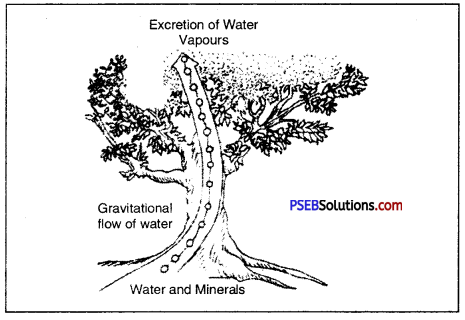
सासेज लम्बा समय पानी के अन्दर रहा था। उसकी सांस उखड़ने वाली थी। यद्यपि उसने तेज़ी से ऊपर आना शुरू कर दिया, उसने सोचा कि वह जीवित बाहर नहीं आ पाएगा।

Question 8.
What did Sausage dig out ? Did he know what he had caught hold of when he was inside the water ? Why ?
Answer:
He dug out an old tin-box. But he did not know what it was. He had weak eyesight and could not see properly without his glasses.

उसने एक पुराना टीन का बक्सा खोद कर निकाला। किन्तु उसे यह पता नहीं था कि यह क्या था। उसकी नज़र कमज़ोर थी और अपने चश्मे के बिना वह ठीक ढंग से देख नहीं सकता था।

Question 9.
Where did Sausage reach while swimming ?
Answer:
While swimming, he reached the other end of the pond.

तैरते हुए वह तालाब के दूसरे किनारे पर पहुंच गया।

PSEB 10th Class English Literature Book Solutions Chapter 6 Return to Air

Question 10.
What did Sausage do with the tin-box ?
Answer:
He took the tin-box to his home. He placed it on the mantelpiece. He put his coin collection in it. He wanted to keep it as long as he lived.

वह टीन के बक्से को अपने घर ले गया। उसने इसे अंगीठी पर रख दिया। उसने इसमें अपने सिक्कों का संग्रह डाल दिया। वह इसे उतनी देर रखना चाहता था जितनी देर वह जीवित रहे।

Objective Type Questions

Question 1.
The boy was called …………
(i) flabby
(ii) filthy
(iii) Sausage
(iv) honest.
Answer:
(iii) Sausage

Question 2.
The instructor threw a tin in the pond. (True/False)
Answer:
False
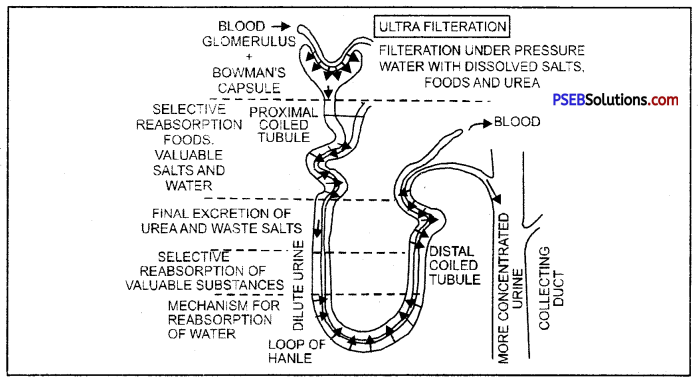
Question 3.
Sausage put his stamp collection in the tin. (True/False)
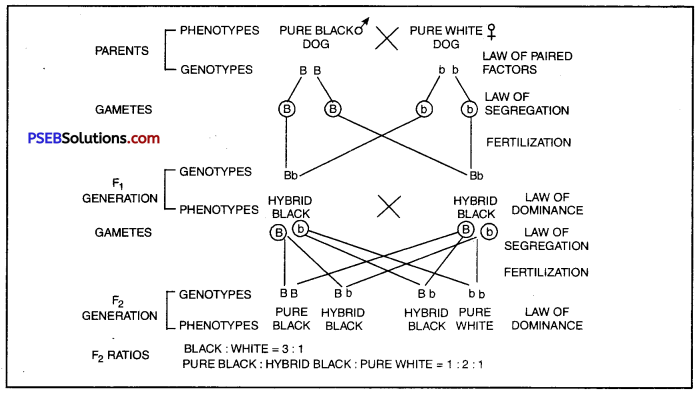
Answer:
False

Question 4.
Sausage brought a ………….. from under the water.
(i) tin-box
(ii) fish
(iii) duck
(iv) pearl.
Answer:
(i) tin-box

Question 5.
Duck-diving means diving into water in the manner of a …………..
(i) fish
(ii) duck
(iii) crocodile
(iv) turtles.
Answer:
(ii) duck

Question 6.
Where did Sausage reach while diving ?
Answer:
The other end of the pond.

Answer each of the following in one word / phrase / sentence :

Question 1.
Who is the author of the story ?
Answer:
Philippa A Pearce.

Question 2.
What was the boy called ?
Answer:
‘Sausage’

Question 3.
What did Sausage not like ?
Answer:
Diving

Question 4.
What is thrown into water while teaching duck-diving ?
Answer:
A brick.

Question 5.
Why couldn’t Sausage see inside the water ?
Answer:
Because he had a weak eyesight.

Question 6.
How did water change colours ?
Answer:
From thick green to brown lemonade and then to blackish brown.

Question 7.
What was Sausage about to lose underwater ?
Answer:
His breath.

Question 8.
What did Sausage dig out ?
Answer:
He dug out an old tin box.

Complete the following :

1. The author of the story used to swim in a ……..
2. The boy was very fat and ………………
3. Duck-diving means diving like a ……………….
4. Sausage could not see ………. in water.
5. The water changed its ……….
Answer:
1. pond
2. plump
3. duck
4. properly
5. colours.

PSEB 10th Class English Literature Book Solutions Chapter 6 Return to Air

Write True or False against each statement :

1. The boy was nicknamed ‘Sausage’ because he was fat and plump.
2. Sausage liked diving very much.
3. A pitcher is thrown into water in duck-diving training.
4. For diving, the boy had to remove his sweater.
5. Sausage was about to lose his breath underwater.
Answer:
1. True
2. False
3. False
4. False
5. True.

Choose the correct option for each of the following:

Question 1.
The author of the story was expert in …
(a) shooting
(b) birdwatching
(c) swimming
(d) playing at cards.
Answer:
(c) swimming

Question 2.
What did Sausage have to take off before going into water ?
(a) His hat.
(b) His dress.
(c) His legs.
(d) His spectacles.
Answer:
(d) His spectacles.

Question 3.
Sausage dug out an old ……….
(a) radio set
(b) tin-box
(c) book
(d) bottle.
Answer:
(b) tin-box

Question 4.
Where was the tin-box placed ?
(a) On the shelf.
(b) In the almirah.
(c) On the mantelpiece.
(d) On the rooftop.
Answer:
(c) On the mantelpiece.

Return to Air Summary & Translation in English

Return to Air Introduction:
The author used to swim in a pond. He was quite expert in swimming. But he could not dive from the diving-board. He had to take off his specs to go into the water. Therefore, he did not want to learn diving. But he was told that one should learn to dive and go underwater. In this way, a person could rescue anyone from drowning. To teach the author diving, his swimming instructor threw a brick into the pond and asked him to bring it out. When the author removed his specs, he could see only blurred figures.

Even then, he jumped into the water. He could not see the brick underwater. He found a brick-like object at the bottom of the pond. He dug it out from the mud. He had swum underwater too far. Now he wanted to come on the surface as soon as possible. He became quite afraid. Various fears came into his mind. He thought he might not reach the surface in time. He kept on going upwards. Suddenly, he reached the surface. When he put on his specs, he found that instead of the brick, he had brought an old tin box from the bottom.

Return to Air Summary & Translation in Hindi

Return to Air Introduction:
लेखक एक तालाब में तैरा करता था। वह तैराकी में काफी निपुण था। परन्तु वह डाइविंग-बोर्ड से गोता नहीं लगा सकता था। पानी के अन्दर जाने के लिए उसे अपना चश्मा उतारना पड़ता था। इसलिए वह गोताखोरी नहीं सीखना चाहता था। परन्तु उसे बताया गया था कि व्यक्ति को गोता लगाना और पानी के अन्दर जाना आना चाहिए था। इस प्रकार व्यक्ति किसी को भी डूबने से बचा सकता था। लेखक को गोताखारी सिखाने के लिए उसके तैराकी प्रशिक्षक ने तालाब में एक ईंट फेंकी और उसे उसको बाहर निकाल कर लाने के लिए कहा।

जब लेखक ने अपना चश्मा उतारा तो वह धुंधली-सी आकृतियां ही देख पा रहा था। फिर भी उसने पानी में छलांग लगा दी। वह पानी के अंदर ईंट न देख पाया। उसे तालाब की तली पर एक ईंट जैसी चीज़ मिल गई। उसने उसे कीचड़ से खोद कर निकाल लिया। वह पानी के नीचे तैरता हुआ काफ़ी दूर चला गया था। वह अब जितनी जल्दी हो सके, सतह पर आना चाहता था। वह काफ़ी डर गया। विभिन्न प्रकार के भय उसके मन में आ गए। उसने सोचा कि वह समय से सतह पर नहीं पहुंच पाएगा। उसने ऊपर जाना जारी रखा। अचानक वह सतह पर पहुंच गया। जब उसने अपना चश्मा पहना तो उसने पाया कि वह तल से ईंट के स्थान पर टीन का एक पुराना बक्सा ले आया था। कठिन शब्दार्थ और सम्पूर्ण कहानी का हिन्दी अनुवाद.

PSEB 10th Class English Literature Book Solutions Chapter 6 Return to Air

Return to Air Summary & Translation in Hindi:

(Page 51-52)
The ponds are ………. never get it.”

Word-meanings : 1. pond-तालाब; 2. bald-गंजे; 3. squeeze-तंग जगह में घुसना; 4. wade –मुश्किल से चलना; 5. float-सतह पर तैरते रहना; 6. sausage-मांस से बनाया हुआ एक प्रकार का कबाब जैसा पदार्थ; 7. glasses—(नज़र का) चश्मा; 8. upend-उल्टा हो जाना।

अनुवाद- तालाब बहुत बड़े हैं, इसलिए एक सिरे पर लोग नहाते हैं और दूसरे सिरे पर मछली का शिकार करते हैं। गंजे सिरों वाले बूढ़े आदमी फोल्डिंग स्टूलों पर बैठे रहते हैं और डंडी और डोरी की सहायता से मछलियों का शिकार करते रहते हैं और छोटे-छोटे बच्चे जंगलों में अपने को सिकोड़ कर घुसते रहते हैं और फिर पानी में धीरे-धीरे चलते हुए अपने जाल से मछलियां पकड़ते हैं। किन्तु तालाब के हमारे वाले सिरे पर पानी ज्यादा

अन्य चीज़ के बारे में नहीं सोचा, सिवाए इसके कि उस ईंट को लिए हुए ऊपर उठू और (पानी से बाहर) हवा में पहुंच जाऊं। तली को मेरे उस तरह छुने ने कीचड़ को हिला दिया था इसलिए इसके एक बादल में से होते हुए मैं ऊपर की तरफ जाना शुरू हो गया। मुझे महसूस हुआ कि मैं खो जाऊंगा। शायद मैं पानी के अन्दर-अन्दर तैरते हुए बहुत दूर तक चला गया था – शायद मैं भटकते हुए उस जगह पर पहुंच जाऊंगा जहां लोग मछली का शिकार कर रहे थे और मेरे गाल के मांस में मछली वाला कांटा फंस जाएगा, या शायद मुझे ऊपरी सतह और बाहर की हवा फिर से नहीं मिल पाने वाली थी

(Page 53)
I was quite ……….. to be hundred.

Word-meanings : 1. exploded—एक तेज़ आवाज़ के साथ पानी से बाहर निकल आया था; 2. for a while – कुछ समय के लिए; 3. trickling down—पतली धाराओं की शक्ल में बह रहा था; 4. mantelpiece – अंगीठी के ऊपर सजावटी चीजें रखने की जगह।

अनुवाद- मैं काफ़ी डरा हुआ था यद्यपि मैं काफ़ी तेज़ी से ऊपर आ रहा था, और पानी अब भूरे-काले से हरा-भूरा और फिर चमकदार लैमनेड के रंग का होता जा रहा था; मैं पानी के अन्दर से सूरज को चमकते हुए भी देख पा रहा था, मैं सतह के नज़दीक आता जा रहा था। मैं काफ़ी धीरे-धीरे जा रहा था; मैं जान गया था कि मैं समय रहते फिर से हवा तक नहीं पहुंच पाऊंगा। अब मैं हवा में कभी नहीं पहुंच सकूँगा फिर अचानक ही मैं सतह पर था – मैं एक धमाके के साथ पानी से दुबारा हवा में आ पहुंचा था। कुछ समय के लिए मैं किसी भी चीज़ के बारे में नहीं सोच सका; और मैं कुछ भी नहीं कर सका, सिवाए इसके कि उस पुरानी सांस को छोड़ दूं, जिसे मैंने अन्दर रोक कर रखा हुआ था और कुछ ताज़ी और तेज़ सांसें लूं और ईंट को पकड़े रखू।

तालाब का पानी पतली धारों में मेरी नाक में से बह रहा था और मेरे मुंह में आ रहा था, जिससे मैं घृणा करता हूं किन्तु मेरे चारों तरफ़ और ऊपर की तरफ़ हवा थी, मेरे सांस लेने के लिए, जीवित रहने के लिए; और अब मैं शायद सौ साल का होने तक ज़िन्दा रहूं और मेरी अपनी हलवाई की दुकान हो, और मैं चांद पर चलं और कुत्तों को पालूं और किसी को डूबने से बचाऊं और इसके लिए मुझे पदक दिया जाए और टी०वी० पर मेरा इंटरव्यू लिया जाए। और फिर मैंने गौर किया कि वे किनारे पर खड़े चिल्ला रहे थे। वे ताली बजा रहे थे और चिल्ला रहे थे, “कबाब! कबाब!” प्रशिक्षक अपने हाथों को मुंह के गिर्द रखे हुए कह रहा था, “अरे, वह तुमने क्या पकड़ रखा है?”

तो उस समय मैं समझा कि मैं लगभग तालाब के दूसरे सिरे पर आ पहुंचा था। मैं पीछे मुड़ा और तैर कर किनारे पर पहुंच गया। उन्होंने मुझे मेरा चश्मा दिया ताकि मैं देख सकूँ कि मैं तली से क्या ले आया था। क्योंकि वह ईंट नहीं थी; उतनी ही बड़ी चीज़, पर वह एक टीन था – एक पुराना टीन – ऐसा बक्सा जिस पर कुछ भी पेंट बाकी नहीं रहा था और उस पर वह काला-भूरा कीचड़ जमा हुआ था जो तालाब की तली में से आया था। वह ईंट जितना ही भारी था क्योंकि इसमें कीचड़ भरा हुआ था – कीचड़ के सिवा कुछ नहीं। वह टीन तली में कई सालों से पड़ा रहा होगा।

PSEB 10th Class English Literature Book Solutions Chapter 6 Return to Air

मैंने उस टीन को साफ़ कर लिया है और घर में अंगीठी के ऊपर वाली जगह रख दिया है और उसमें मैंने सिक्कों का अपना संग्रह डाल दिया है। मुझे बाद में फिर से एक अन्य ईंट के लिए वह बत्तख-गोता लगाना पड़ा था, और मैं ईंट को लाने में सफल हो गया था तथा मैं बिल्कुल भी डरा नहीं था। मैं उस टीन को रखे रहूंगा जब तक मैं जीवित रहूंगा, और मैं शायद सौ साल की उम्र तक जीवित रहूं।

Class 10th English Literature Book PSEB Supplementary Reader

How Much Land Does A Man Need? Question Answer Class 10 English Literature Book Chapter 5 PSEB Solutions

Punjab State Board PSEB 10th Class English Book Solutions English Literature Book Chapter 5 How Much Land Does A Man Need? Textbook Exercise Questions and Answers.

Class 10th English Literature Book Chapter 5 How Much Land Does A Man Need? Question Answers

How Much Land Does A Man Need? Class 10 Questions and Answers

Question 1.
What did the two women discuss ? Were they related to each other ?
Answer:
The two women discussed about town life and village life. Both of them were sisters. The elder one spoke in praise of town life. The younger one praised country life.

उन दोनों औरतों ने शहरी जीवन और ग्रामीण जीवन के बारे में विचार-विमर्श किया। वे दोनों बहनें थीं। बड़ी ने शहरी जीवन की प्रशंसा की। छोटी ने ग्रामीण जीवन की प्रशंसा की।

PSEB 10th Class English Literature Book Solutions Chapter 5 How Much Land Does A Man Need?

Question 2.
What did one woman say in defence of rural life ? What was the counter argument ?
Answer:
She said that rural life could be rough, but it was free from anxiety. Villagers might never grow rich, but they always had enough to eat. But the other woman boasted of the town life.

उसने कहा कि ग्रामीण जीवन कठिनाई-पूर्ण हो सकता है, परन्तु यह चिन्ता मुक्त होता है। ग्रामीण. लोग चाहे कभी धनी न बन सकें, परन्तु उनके पास खाने के लिए सदा काफी रहता है। परन्तु दूसरी औरत ने शहरी जीवन की डींग मारी।

Question 3.
Pakhom listened to the women’s chatter. He started brooding and reached a conclusion. What was the conclusion ?
Answer:
Pakhom did not have enough land. He thought that if he had plenty of land, he would not fear the Devil himself. And he decided to buy some more land.

पाखोम् के पास पर्याप्त ज़मीन नहीं थी। उसने सोचा कि यदि उसके पास काफ़ी ज़मीन हो जाए तो वह स्वयम् शैतान से भी नहीं डरेगा। और उसने कुछ और ज़मीन खरीदने का मन बनाया।

Question 4.
What did the Devil decide when he heard Pakhom’s musings?
Answer:
The Devil decided to give Pakhom enough land. And by means of that land, he decided to get Pakhom into his power.

शैतान ने पाखोम् को काफी ज़मीन देने का फैसला किया। और इस भूमि के द्वारा उसने पाखोम् को अपने पंजे में करने का फैसला किया।

Question 5.
The estate-owner, on whose land Pakhom was a tenant, sold her land. Who bought the land ?
Answer:
One of Pakhom’s neighbours bought fifty acres of the land. Pakhom also arranged to buy forty acres of that land.

पाखोम् के एक पड़ोसी ने उस ज़मीन के पचास एकड़ खरीद लिए। पाखोम ने भी चालीस एकड़ खरीदने का प्रबन्ध कर लिया।

PSEB 10th Class English Literature Book Solutions Chapter 5 How Much Land Does A Man Need?

Question 6.
How did Pakhom manage to put together the money for buying the land ?
Answer:
Pakhom sold his colt and one half of his bees. He hired out one of his sons as a labourer and took his wages in advance. He also borrowed some money from his brother-in-law.

पाखोम् ने अपना बछेड़ा (घोड़े का बच्चा) और आधी मधुमक्खियां बेच दी। उसने अपने पुत्र को कहीं मज़दूर लगवा दिया और उसका वेतन पेशगी ले लिया। उसने अपने बहनोई से भी कुछ पैसा उधार लिया।

Question 7.
Pakhom met a stranger one day. Who was this stranger ? What information did he give to Pakhom ?
Answer:
This stranger was a peasant. He told Pakhom that he had come from beyond the Volga. He said that the land there was very fertile. The rye sown on it grew as high as a horse.

यह अजनबी एक किसान था। उसने पाखोम् को बताया कि वह वोल्गा नदी के पार से आया था। उसने कहा कि वहां पर की जमीन बहुत उपजाऊ थी। इस पर उगाई गई राई एक घोड़े जितनी ऊंची हो जाती थी।

Question 8.
A trader told Pakhom something about the land of Bashkirs. What was it ?
Answer:
He told Pakhom that the Bashkirs had plenty of land. It was near a river and was very fertile. They sold it at a very low price – 13,000 acres for only 1,000 roubles.

उसने पाखोम् को बताया कि बशकीर लोगों के पास काफ़ी ज़मीन थी। यह एक नदी के नज़दीक थी और बहुत उपजाऊ थी। वे इसे बहुत कम कीमत पर बेच देते थे -.13,000 एकड़ केवल 1,000 रूबल में।

Question 9.
Who were the Bashkirs ? How did Pakhom make friends with them ?
Answer:
The Bashkirs were very simple people. They lived in tents. They had plenty of land. Pakhom made friends with them by giving them various gifts.

बशकीर लोग बहुत सीधे-सादे थे। वे तम्बुओं में रहते थे। उनके पास काफ़ी ज़मीन थी। पाखोम् ने उन्हें विभिन्न उपहार देकर उनसे मित्रता कर ली।

Question 10.
Bashkirs wanted to repay Pakhom for his gifts. What did Pakhom want from them ?
Answer:
Pakhom wanted from them their land. It was for this purpose only that he had come there.

पाखोम् उनसे उनकी ज़मीन चाहता था। वह केवल इसी उद्देश्य के लिए वहां पर आया था।

Question 11.
‘Our price is always the same : one thousand roubles a day, the chief said. What did he mean ?
Answer:
The Bashkirs did not sell their land by acres. They sold it by the day. It meant one could have for one thousand roubles as much land as one could walk round in one day.

बशकीर लोग अपनी ज़मीन एकड़ों के हिसाब से नहीं बेचते थे। वे इसे दिन के हिसाब से बेचते थे। इसका मतलब था कि व्यक्ति एक हज़ार रूबल में उतनी ज़मीन प्राप्त कर सकता था, जितनी ज़मीन का वह पैदल चल कर एक दिन में चक्कर काट सकता था।

PSEB 10th Class English Literature Book Solutions Chapter 5 How Much Land Does A Man Need?

Question 12.
On what condition did the chief agree to sell land to Pakhom ?
Answer:
For one thousand roubles, Pakhom could have as much land as he could walk round in a day. But there was one condition. He had to come back to the starting point before sunset.

एक हज़ार रूबल देकर पाखोम् एक दिन में जितनी भी जगह का चलकर चक्कर काट सकता था, उसे प्राप्त कर सकता था। परन्तु वहां एक शर्त थी। उसे सूर्यास्त से पहले उसी जगह पर वापस आना था, जहां से वह चला था।

Question 13.
What is the moral of the story ?
Answer:
Man’s physical needs on this earth are not many. Yet he keeps hungering for them all his life. He never feels satisfied till he meets his end.

इस धरती पर मनुष्य की भौतिक आवश्यकताएं अधिक नहीं होती हैं। फिर भी वह सारा जीवन उनके लिए तड़पता रहता है। वह सन्तुष्ट नहीं होता जब तक उसकी मृत्यु नहीं हो जाती।

Objective Type Questions

Question 1.
The two women discussing about village and town life were
(i) friends
(ii) sisters
(iii) neighbours
(iv) enemies.
Answer:
(ii) sisters

Question 2.
The Bashkirs had plenty of ……………
(i) cattle
(ii) money
(iii) land
(iv) gold.
Answer:
(iii) land

Question 3.
How much land did Pakhom manage to buy from the estate owner ?
Answer:
Forty acres

Question 4.
Pakhom was a very …………… man.
(i) helpful
(ii) greedy
(iii) kind
(iv) selfish.
Answer:
(ii) greedy

Question 5.
Pakhom was dead in the end. (True/False)
Answer:
True

Question 6.
Pakhom borrowed some money from his brother-in-law. (True/False)
Answer:
True

Question 7.
Pakhom met a stranger who was a peasant. (True/False)
Answer:
True

Answer each of the following in one word / phrase / sentence :

Question 1.
Who is the writer of the story ?
Answer:
Leo Tolstoy.

Question 2.
What is the story about ?
Answer:
About the sin of greed.

Question 3.
Were the two women discussing about the town and village life ?
Answer:
Yes, they were.

PSEB 10th Class English Literature Book Solutions Chapter 5 How Much Land Does A Man Need?

Question 4.
How were the two women related to each other ?
Answer:
Both of them were sisters.

Question 5.
What did Pakhom decide ?
Answer:
To buy some more land.

Question 6.
Who purchased the estate-owner’s land ?
Answer:
Pakhom.

Question 7.
How did Pakhom arrange to buy the land ?
Answer:
By selling his colt and half of his bees.

Question 8.
Who told Pakhom something about the land of Bashkirs ?
Answer:
A trader.

Question 9.
Who were Bashkirs ?
Answer:
They were very simple people.

Question 10.
What sum was agreed upon to sell land to Pakhom ?
Answer:
One thousand roubles.

Complete the following:

1. The elder woman spoke ……….. .. town life.
2. Pakhom thought if he had plenty of land, he would not fear …………..
3. The Devil decided to give Pakhom ….
4. The stranger told that he had come from beyond …………..
5. One of Pakhom’s neighbours bought ……………… acres of land.
6. Pakhom was supposed to come back to the starting point before the sun had …
7. Pakhom met a stranger one day. The stranger was a ………..
Answer:
1. in favour of
2. the Devil
3. enough
4. the Volga
5. fifty
6. set
7. peasant.

Write True or False against each statement :

1. Pakhom did not have enough land.
Answer:
True

2. The younger woman praised town life.
Answer:
False

3. Pakhom purchased the estate-owner’s land.
Answer:
True

4. The Bashkirs lived in palaces.
Answer:
False

5. The Bashkirs did not sell their land by acres.
Answer:
True

6. Man never feels satisfied till his death.
Answer:
True

Choose the correct option for each of the following:

1. Man wants more and more of ……………..
(a) greed
(b) wealth
(c) education
(d) satisfaction.

2. What were the two women discussing ?
(a) The town life and village life.
(b) Domestic problems
(c) Military life.
(d) Kashmir issue.

3. Pakhom borrowed money from his …..
(a) maternal uncle
(b) neighbour
(c) colleague
(d) brother-in-law.

4. Pakhom wanted from the Bashkirs ……………
(a) their land
(b) their clothes
(c) their guns
(d) their horses.

PSEB 10th Class English Literature Book Solutions Chapter 5 How Much Land Does A Man Need?

How Much Land Does A Man Need? Summary & Translation in English

How Much Land Does A Man Need? Introduction:
This story by Leo Tolstoy is about the sin of greed. Man’s material needs on this earth are not many. Yet he troubles himself all his life. He wants more and more of wealth. He runs from one sin to the other till he meets his end. Tolstoy has illustrated this idea through the story of Pakhom. Pakhom had an insatiable greed for land.

The more land he had, the more greedy he grew. Once he said, “If I had plenty of land, I shouldn’t fear the devil himself.” On hearing this, the devil decided to try his strength against Pakhom. He thought that he would give Pakhom as much land as he desired, and thus get him into his power. In course of time, Pakhom came to have 125 acres of land, yet he was not satisfied.

He came to know about the land of Bashkir people. There he could get for 1000 roubles as much land as he could go round on his feet in one day. In his greed, he exerted himself too much. Yet he did not stop. He fell down dead just when he had completed the circuit. A grave was dug for him. Six feet from head to heels was all that Pakhom needed. Thus Tolstoy shows that greed brings man’s ruin.

How Much Land Does A Man Need? Summary & Translation in Hindi

How Much Land Does A Man Need? Introduction:
लियो टालस्टाए द्वारा लिखित यह कहानी लालच की बुराई के सम्बन्ध में है। इस धरती पर मनुष्य की भौतिक आवश्यकताएं अधिक नहीं होती हैं। फिर भी वह आयु-भर अपने आप को तड़पाता रहता है। वह अधिकाधिक दौलत प्राप्त करना चाहता है। वह एक पाप से दूसरे पाप की ओर भागा चला जाता है तथा अन्त में अपने अन्त को प्राप्त हो जाता है। टालस्टाए ने इस विचार को पाखोम् की कहानी द्वारा स्पष्ट किया है। पाखोम् के मन में ज़मीन प्राप्त करने के लिए न सन्तुष्ट हो सकने वाला लालच भरा हुआ था।

उसके पास जितनी अधिक ज़मीन होती जाती, वह उतना ही अधिक लालची होता जाता। एक बार उसने कहा, “यदि मेरे पास बहुत-सी ज़मीन हो जाए, तो मैं स्वयम् शैतान से भी नहीं डरूंगा।” यह सुनकर शैतान ने अपनी शक्ति उस पर आज़माने का निश्चय किया। उसने सोचा कि वह पाखोम् को जितनी भी ज़मीन वह चाहेगा, दे देगा और इस प्रकार उसे अपने शिकंजे में फंसा लेगा। कुछ समय के बाद पाखोम् के पास 125 एकड़ भूमि हो गई, परन्तु फिर भी वह सन्तुष्ट न हुआ। उसे बशकीर लोगों की जमीन के विषय में पता लगा।

वहां पर वह 1000 रूबल में उतनी ज़मीन प्राप्त कर सकता था जितनी ज़मीन का वह पैदल चल कर एक दिन में चक्कर काट सकता था। अपने लालच में उसने स्वयम् को बहुत थका लिया। परन्तु वह फिर भी नहीं रुका। ठीक उसी समय, जब उसने अपना चक्कर पूरा कर लिया था, वह मर कर गिर पड़ा। उसके लिए कब्र खोदी गई। सिर से पांव तक पाखोम् को केवल छः फुट की ज़रूरत थी। इस प्रकार टालस्टाए यह दिखाता है कि लालच मनुष्य का विनाश ले आता है।

How Much Land Does A Man Need? Summary & Translation in Hindi:

कहानी का विस्तृत सार

दो बहनें थीं। बड़ी का विवाह शहर में एक व्यापारी के साथ हुआ था। छोटी का विवाह गांव में एक किसान के साथ हुआ था। एक बार बड़ी बहन अपनी छोटी बहन से मिलने के लिए उसके गांव में आई। दोनों बहनें चाय पीते हुए बातें करने लगीं। बड़ी बहन ने शहरी जीवन के लाभों के बारे में डींगें मारनी शुरू कर दी। उसने कहा कि वे शहर में खाने और पहनने को बहुत अच्छी चीजें प्राप्त कर सकते थे। वहां मनोविनोद के बहुत- से साधन थे।

छोटी बहन को बहुत बुरा महसूस हुआ। उसने बदले में एक व्यापारी के जीवन में दोष निकालने शुरू कर दिए तथा उसकी अपेक्षा एक किसान के जीवन को बेहतर ठहराया। उसने यह स्वीकार किया कि शहरी लोग अधिक धन कमा सकते हैं, किन्तु उनका जीवन चिन्ताओं से भरा होता है। उसने कहा कि यद्यपि किसान का शरीर मोटा नहीं होता, किन्तु उसका जीवन लम्बा अवश्य होता है। उसने कहा, “हम कभी धनी तो नहीं बन सकते हैं, किन्तु हमारे पास खाने के लिए सदा पर्याप्त रहेगा।”

छोटी बहन का पति, जिसका नाम पाखोम् (Pakhom) था, पास बैठा दोनों बहनों की बातें सुन रहा था। अपनी पत्नी के मुंह से किसान के जीवन की जोरदार प्रशंसा सुन कर उसे बहुत गर्व महसूस हुआ। वह एक किसान के जीवन से पूरी तरह सन्तुष्ट था। यद्यपि किसान का जीवन व्यस्त तथा कठिन परिश्रम वाला होता है, किन्तु यह प्रत्येक प्रकार की बुराई से मुक्त होता है। पाखोम् ने अपने मन में सोचा, “हमारी एकमात्र कठिनाई यह है कि हमारे पास पर्याप्त भूमि नहीं है। यदि मेरे पास बहुत-सी ज़मीन होती, तो मैंने स्वयं शैतान से भी नहीं डरना था।” इस सारे समय के दौरान शैतान पाखोम् के पिछली ओर बैठा हुआ था। उसने वे सब बातें सुन ली जो वहां की जा रही थीं। उसे इस बात पर बहुत प्रसन्नता हुई कि किसान की बीवी ने अपने पति के मन में घमंड पैदा कर दिया था। शैतान ने पाखोम् पर अपनी शक्ति परखने का निश्चय कर लिया। उसने सोचा कि वह पाखोम् को बहुत-सी ज़मीन दे देगा और इस प्रकार उसे अपने पंजे में फंसा लेगा।

पाखोम् के गांव के समीप ही एक औरत रहती थी। उसके पास 300 एकड़ ज़मीन की जायदाद थी। वह एक बहुत भद्र और दयालु-हृदय स्त्री थी। एक शीत-ऋतु के दिनों में यह समाचार फैल गया कि वह औरत अपनी ज़मीन बेच रही थी। पाखोम् को बहुत ईर्ष्या महसूस हुई जब उसे पता चला कि उसका पड़ोसी पचास एकड़ जमीन खरीद रहा था। उसके पास केवल एक सौ रूबल (रूस में प्रचलित मुद्रा) थे। उसने अपनी एक घोड़ी और आधी मधुमक्खियां बेच दीं। उसने अपने लड़कों में से एक को कहीं नौकर लगवा दिया और उसका वेतन पेशगी ले लिया। शेष धन-राशि उसने अपने एक सम्बन्धी से उधार ले ली।

यह सब करने के बाद पाखोम् उस औरत के पास गया। उसने 40 एकड़ भूमि के एक टुकड़े के लिए उसके साथ सौदा कर लिया। उसने आधे पैसे नकद दे दिए और शेष राशि दो वर्ष के अन्दर चुकता करने का वचन दे दिया। इस प्रकार पाखोम् के पास अब अपनी निजी भूमि हो गई। उसने कहीं से बीज उधार ले लिए और ज़मीन में बो दिए। फसल बहुत अच्छी हुई और एक ही वर्ष के भीतर पाखोम् ने पूरा ऋण चुकता कर दिया।

एक दिन पाखोम् अपने घर में बैठा हुआ था कि वहां एक किसान आया। पाखोम्. ने किसान को अपने पास रात गुजारने की इजाजत दे दी। उसने किसान को भोजन भी खिलाया। किसान ने पाखोम् को बतलाया कि वह एक किसान था तथा वोल्गा नदी के दूसरी ओर से आया था। बहुत-से लोग वहां आ कर बस रहे थे। कोई भी व्यक्ति जिसके पास धन हो, वह दो शिलिंग प्रति एकड़ की दर से जितनी ज़मीन चाहे, खरीद सकता था। उसने बताया कि वहां ज़मीन इतनी उपजाऊ थी कि इस पर बोये हुए अनाज की फसल एक घोड़े जितनी ऊंची उग आती थी।

पाखोम के दिल में प्रबल इच्छा भर आई। उसने अपना मकान, अपने पश तथा अपनी सारी ज़मीन बेच डाली। वहां उसने नई भूमि खरीदी। यह भूमि अनाज की उपज के लिए बहुत अच्छी थी। पाखोम् ने वहां अपनी आवश्यकतानुसार इमारत खड़ी कर ली और पशु भी खरीद लिए। वह अब पहले की अपेक्षा दस गुणा धनी हो गया था।

PSEB 10th Class English Literature Book Solutions Chapter 5 How Much Land Does A Man Need?

आरम्भ में तो पाखोम् अपने नए जीवन से बहुत प्रसन्न था। किन्तु जब वह इस का आदी हो गया तो वह सोचने लग गया कि यहां भी उसके पास पर्याप्त ज़मीन नहीं थी। वह गेहूं बोने के लिए अधिक, तथा और अधिक जगह प्राप्त करना चाहता था। हर वर्ष वह अन्य लोगों से ज़मीन किराए पर ले लेता था। मौसम ठीक होने के कारण उसे फसलें बहुत अच्छी प्राप्त हुईं। उसने पैसे बचाने शुरू कर दिए। किन्तु पाखोम् हर वर्ष अन्य लोगों की ज़मीन किराए पर लेने की मजबूरी से तंग आ गया। उसने गेहूं बोने के लिए अधिक भूमि खरीदने का निश्चय कर लिया। अचानक उसे एक ऐसा किसान मिल गया जो अपनी 1300 एकड़ जमीन बेचना चाहता था। पाखोम् ने सौदा कर लिया और 1500 रूबल पर मूल्य निश्चित हो गया। इस में से कुछ राशि नकद तथा शेष राशि बाद में दी जानी थी।
ठीक जिस समय सौदा पक्का किया जाना था, उस गांव में से एक व्यापारी गुजरा। वह अपने घोड़ों के वास्ते चारा प्राप्त करने के लिए पाखोम् के यहां आ कर रुका। उसने पाखोम् के साथ बैठ कर चाय पी, और उन्होंने

एक-दूसरे से बातें कीं। व्यापारी ने पाखोम् को बतलाया कि वह बशकीर लोगों के प्रदेश से आ रहा था जहां उसने केवल 1000 रूबल में 13000 एकड़ जमीन खरीदी थी। पाखोम् ने तुरन्त बशकीर लोगों के प्रदेश जाने का निश्चय कर लिया। उसने अपनी पत्नी को घर की देखभाल करने के लिए छोड़ा, और एक नौकर को साथ लेकर अपनी यात्रा पर निकल पडा।

पाखोम् तथा उसका नौकर सात दिन तक यात्रा करते रहे। अन्त में वे बशकीर लोगों के प्रदेश में पहुंच गए। ज्योंहि बशकीर लोगों ने पाखोम को देखा वे अपने तम्बुओं में से बाहर निकल आए। वे बहुत प्रसन्न लग रहे थे। उन्होंने अपने अतिथि का बड़े स्नेह से स्वागत किया। पाखोम् ने कुछ उपहार अपने छकड़े में से निकाले और बशकीर लोगों में बांट दिए। इसी दौरान बशकीर मुखिया भी वहां आ पहुंचा। पाखोम् ने कुछ सुन्दर उपहार मुखिया को भी दिए। फिर उसने उन लोगों को अपने वहां आने का उद्देश्य समझाया। मुखिया ने पाखोम् से कहा कि वह 1000 रूबल प्रति दिन के हिसाब से जितनी ज़मीन चाहे, खरीद सकता था। पाखोम् को मुखिया की 1000 रूबल प्रति दिन के हिसाब वाली बात समझ में न आई।

उसने मुखिया से पूछा, “जमीन मापने की यह कौन-सी इकाई होती है ? इसमें कितने एकड होते हैं ?” मुखिया ने उत्तर दिया कि उन्हें एकड़ों में मापना नहीं आता था। इसलिए वे दिनों के हिसाब से ज़मीन बेचते थे। मुखिया ने अपनी बात को इस प्रकार से कह कर स्पष्ट किया, “तुम अपने पैरों से चल कर एक दिन में जितनी भी जगह का चक्कर काट लोगे, वह तुम्हारी हो जाएगी, इसकी कीमत 1000 रूबल प्रति दिन होगी। किन्तु इसमें एक शर्त है। यदि तुम उसी दिन उस स्थान पर वापस पहुंच नहीं पाते जहां से तुम चले थे तो तुम्हारे पैसे ज़ब्त कर लिए जाएंगे। तुम जितना बड़ा चक्कर चाहो, काट सकते हो किन्तु सूर्य डूबने से पहले तुम्हें उस स्थान पर लौटना होगा जहां से तुम चले थे। वह सारी ज़मीन, जिस का तुम चक्कर काट लोगे, तुम्हारी हो जायेगी।” __ पाखोम् को यह सब सुन कर बहुत प्रसन्नता हुई। यह फैसला हो गया कि अगली प्रातः पाखोम् चलना शुरू करेगा। पाखोम् इतना उत्तेजित था कि उस रात को वह सो न सका। वह अपने मन में यही हिसाब-किताब लगाता रहा कि वह कितनी जगह का चक्कर काट पाएगा। वह रात-भर जागता रहा और प्रभात होने से थोड़े ही समय पहले उसकी आंख लग गई। सुबह उसने तुरन्त अपने नौकर को जगाया और बशकीर लोगों को बुलाने के लिए चल पड़ा।

वे सभी एक पहाड़ी पर पहुंच गए। चारों और असीमित भूमि फैली थी जो अति उपजाऊ थी। मुखिया ने पाखोम् से कहा, “जितनी दूरी तक तुम्हारी आंखें देख रही हैं, यह सब जगह हमारी है। तुम इसका जो भी भाग चाहो, ले सकते हो।” पाखोम् की आंखें चमकने लगीं। मुखिया ने टोपी उतारी, इसे ज़मीन पर रखा तथा कहने लगा, “यह निशान होगा। यहां से शुरू हो जाओ और लौट कर यहीं पहुंच जाओ। जितनी भी जगह का तुम चक्कर काट लोगे, तुम्हारी हो जाएगी।”

पाखोम ने अपने पैसे निकाल कर टोपी पर रख दिए। ज्योंहि सूर्य क्षितिज से ऊपर उठा, उसने चलना शुरू कर दिया। उसने अपने साथ कुछ रोटी और पानी की एक सुराही ले ली। ज़मीन के हर मोड़ पर निशान खोदने के लिए उसने अपने साथ एक फावड़ा भी ले लिया। आरम्भ में पाखोम् न तो बहुत धीरे और न ही बहुत तेज़ चला। एक हज़ार गज़ चलने के बाद उसने एक गड्ढा खोदा। इस निशान को और अधिक नज़र आ सकने योग्य बनाने के लिए उसने वहां घास वाली मिट्टी की एक ढेरी बना दी। पाखोम् ने अब अपनी गति और तेज कर दी।

गरमी बढ़ रही थी। उसने अपना कोट उतार कर कन्धे पर रख लिया। पाखोम् तीन मील तक चलता गया। फिर उसने मुड़ कर पीछे देखा। वह पहाड़ी मुश्किल से ही दिखाई दे रही थी। इस पर खड़े लोग काली चींटियों जैसे लग रहे थे। पाखोम् ने एक गड्ढा खोदा और वहां घास वाली मिट्टी की एक और ढेरी बना दी।

पाखोम् को अब थकावट महसूस होने लगी।
उसने सूर्य की ओर देखा तो पता चला कि अब दोपहर हो गई थी। वह कुछ आराम करने के लिए बैठ गया। बाद दोपहर पाखोम् ने शेष दूरी सीधी रेखा में दौड़ कर पूरी करने का निश्चय कर लिया।

पाखोम् ने जल्दी से एक गड्ढा खोदा और फिर सीधा पहाड़ी की ओर चल पड़ा।
वह अब मुश्किल से ही चल पा रहा था। गर्मी की वजह से उस का बुरा हाल हो गया था। उसके पैर कट गये थे और उनमें घाव हो गए थे। उसकी टांगें जवाब देने लगीं और उसे यह भय हो गया कि कहीं थकावट से उसकी मौत न हो जाए। फिर भी पाखोम् रुका नहीं। उसने अपना कोट, अपने बूट, अपनी सुराही और अपनी टोपी – सब फेंक दिए। उसने अपने पास केवल फावड़ा ही रखा क्योंकि इससे उसे चलने में सहारा मिलता रहा था। जब वह पहाड़ी के समीप पहुंचा तो सूर्य डूबने ही वाला था। पाखोम् ने एक लम्बी सांस भरी और पहाड़ी के ऊपर की ओर दौड़ पड़ा।

पाखोम् चोटी पर पहुंच गया और उसने वहां पड़ी हुई टोपी देखी। वह आगे की ओर गिर पड़ा और उसके हाथ टोपी तक पहुंच गये। मुखिया ने चिल्ला कर कहा, “वाह, कितना अच्छा आदमी है। उसने बहुत सारी जगह हासिल कर ली है।”

PSEB 10th Class English Literature Book Solutions Chapter 5 How Much Land Does A Man Need?

पाखोम् का नौकर दौड़ता हुआ आगे आया। उसने अपने स्वामी को ऊपर उठाने की कोशिश की, किन्तु पाखोम् तो मर चुका था। उसके मुंह से खून बह रहा था।

नौकर ने फावड़ा लिया और इतनी बड़ी कब्र खोदी जिसमें पाखोम् को दफनाया जा सके।
फिर उसने अपने स्वामी को इस में दफना दिया। पाखोम् को अपने सिर से लेकर एड़ियों तक के लिए केवल छ: फुट जगह की ही ज़रूरत थी।

Class 10th English Literature Book PSEB Supplementary Reader