PSEB 10th Class Maths Solutions Chapter 11 Constructions Ex 11.1

Punjab State Board PSEB 10th Class Maths Book Solutions Chapter 11 Constructions Ex 11.1 Textbook Exercise Questions and Answers.

PSEB Solutions for Class 10 Maths Chapter 11 Constructions Ex 11.1

In each of the questions, give the justification of the construction also.

Question 1.
Draw a line segment of length 7.6 cm and divide ¡tin the ratio 5 : 8. Measure the two parts.
Solution:
Given: A line segment of length of 7.6 cm.
Steps of construction:
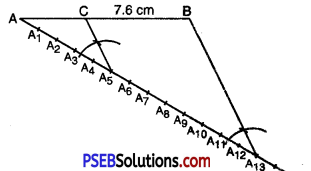
1. Take a line segment AB = 7.6 cm.
2. Draw any ray AX, making an acute angle ∠BAX.
3. Locate 5 + 8 = 13 (given ratio 5: 8) points A1, A2, A3, A4, A5, ………….., A10, A11, A12, A13 on ray AX such that A1A2 = A2A3 = A3A4 = …………. = A11A12 = A12 A13.
4. Join BA13.
5. Through point A5, draw a line A5C || A13B (by making an angle equal to ∠A13B) at A5 intersecting AB at ‘C’. Then AC : CB = 5 : 8;
PSEB 10th Class Maths Solutions Chapter 11 Constructions Ex 11.1 1

Justification:
Let us see how this method gives us the required division.
In ∆AA13B,
Since A5C || A13B
∴ By Basic Proportionality Theorem
\(\frac{\mathrm{AA}_{5}}{\mathrm{~A}_{5} \mathrm{~A}_{13}}=\frac{\mathrm{AC}}{\mathrm{CB}}\)

By construction, \(\frac{\mathrm{AA}_{5}}{\mathrm{~A}_{5} \mathrm{~A}_{13}}=\frac{5}{8}\)

∴ \(\frac{\mathrm{AC}}{\mathrm{CB}}=\frac{5}{8}\)
This shows that ‘C’ divides AB in the ratio 5 : 8.
On measuring the two parts, AC = 2.9 cm and CB = 4.7 cm.

PSEB Solutions PSEB 10th Class Maths Solutions Chapter 11 Constructions Ex 11.1

Alternative Method:
Steps of construction:
1. Take a line segment AB = 7.6 cm
2. Draw any acute angle ∠BAX
3. Draw angle ∠ABY such that ∠ABY = ∠BAX.
4. Locate the points A1, A2, A3, A4, A5 on ray AX such that A1A2 = A2A3 = A3A4 = A4A5.
5. Locate the points B1, B2, B3, B4, B5, B6, B7, B8 on ray BY such that B1B2 = B2B3 = B3B4 = B4B5 = B5B6 = B6B7 = B7B8
6. Join A5B8 let it intersects AB at point Then AC : CB = 5 : 8.
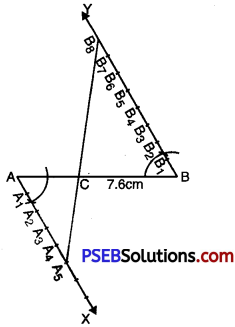
PSEB 10th Class Maths Solutions Chapter 11 Constructions Ex 11.1 2

justification:
In ∆ACA5 and ∆BCB8,
∠ACA5 = ∠BCB8 [vertically opp. ∠s]
∠BAA5 = ∠ABB8 [construction]
∴ AACA5 ~ ABCB8 [AA-similarity cond.]
∴ Their corresponding sides must be in the same ratio. ,
\(\frac{A C}{B C}=\frac{C A_{5}}{C B_{8}}=\frac{A_{5} A}{B_{8} B}\)
(I)(II) (III)
From I and III, \(\frac{A C}{B C}=\frac{A_{5} A}{B_{8} B}\)

But, \(\frac{A_{5} A}{B_{8} B}=\frac{5}{8}\) [construction]

\(\frac{A C}{C B}=\frac{5}{8}\).

PSEB Solutions PSEB 10th Class Maths Solutions Chapter 11 Constructions Ex 11.1

Question 2.
Construct a triangle of sides 4 cm, 5 cm and 6 cm and then a triangle similar to it whose sides are \(\frac{2}{3}\) of corresponding sides of the first triangle.
Solution:
Steps of construction:
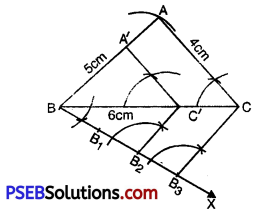
1. Construct a triangle ABC with given measurements. AB = 5 cm, AC = 4 cm and BC = 6 cm.
2. Make any acute angle ∠CBX below the side BC.
PSEB 10th Class Maths Solutions Chapter 11 Constructions Ex 11.1 3

3. Locate three points (greater of 2 and 3 in \(\frac{2}{3}\))B1, B2, B3 on BX such that BB1 = B1B2 = B2B3.
4. Join B3C.
5. Through B2 (smaller of 2 and 3 in \(\frac{2}{3}\) draw a line parallel to B3C, which intersect BC in C’.
6. Through C’, draw a line parallel to CA meeting BA is A’.
Thus ∆A’BC’ is the required triangle whose sides are of corresponding sides of ∆ABC.

Justification of construction :
First we will show that first triangle and constructed triangle are similar.
i.e. ∆A’BC’ ~ ∆ABC.
Consider ∆A’BC’ and ∆ABC.
∠B = ∠B [Common]
∠A’C’B= ∠ACB [By construction]
∆A’C’B ~ ∆ACB [AA – similarity]
∴ Their corresponding sides must be in the same ratio.
\(\frac{\mathrm{A}^{\prime} \mathrm{B}}{\mathrm{AB}}=\frac{\mathrm{BC}^{\prime}}{\mathrm{BC}}=\frac{\mathrm{C}^{\prime} \mathrm{A}^{\prime}}{\mathrm{CA}}\) …………….(1)
Now, consider ∆B2BC’ and ∆B3BC,
∠B = ∠B [common]
∠B2C’B = ∠B2CB [construction]
∴ ∆B2BC’ ~ ∆B3BC [AA -similarity]
∴ Their corresponding sides must be in the same ratio.

\(\frac{\mathrm{B}_{2} \mathrm{~B}}{\mathrm{~B}_{3} \mathrm{~B}}=\frac{\mathrm{BC}^{\prime}}{\mathrm{BC}}=\frac{\mathrm{C}^{\prime} \mathrm{B}_{2}}{\mathrm{CB}_{3}}\)

I II III

Taking (I) and (II).
\(\frac{\mathrm{BC}^{\prime}}{\mathrm{BC}}=\frac{\mathrm{B}_{2} \mathrm{~B}}{\mathrm{~B}_{3} \mathrm{~B}}\)

But, \(\frac{\mathrm{B}_{2} \mathrm{~B}}{\mathrm{~B}_{3} \mathrm{~B}}=\frac{2}{3}\) [construction]

\(\frac{\mathrm{BC}^{\prime}}{\mathrm{BC}}=\frac{2}{3}\) ……………(2)

From (1) & (2),
\(\frac{\mathrm{A}^{\prime} \mathrm{B}}{\mathrm{AB}}=\frac{\mathrm{BC}^{\prime}}{\mathrm{BC}}=\frac{\mathrm{C}^{\prime} \mathrm{A}^{\prime}}{\mathrm{CA}}=\frac{2}{3}\)

⇒ A’B = \(\frac{2}{3}\) AB and BC’ = \(\frac{2}{3}\) BC; C’A’ = \(\frac{2}{3}\) CA.
Hence, the construction is Justified.

PSEB Solutions PSEB 10th Class Maths Solutions Chapter 11 Constructions Ex 11.1

Question 3.
Construct a triangle with sides 5 cm, 6 cm and 7 cm and then another triangle whose sides are of the corresponding sides of the first triangle.
Solution:
PSEB 10th Class Maths Solutions Chapter 11 Constructions Ex 11.1 4

Steps of construction :
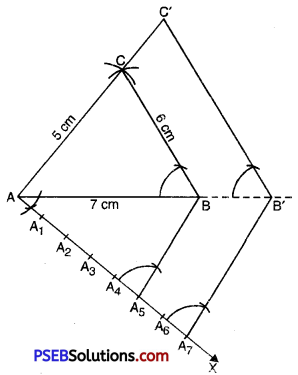
1. Construct a triangle ABC in which AB = 7 cm, BC 6 cm and AC =5 cm.
2. Make any acute angle ∠BAX below the base AB.
3. Locate seven points A1, A2, A3, A4, A5, A6, A7 on the ray AX such that
AA1 = A1A2 = A2A3 = A3A4 = A4A5 = A5A6 = A6A7.
4. Join BA5.
5. Through A7, draw a line parallel A5B. Let it meets AB at B’ on being produced such that AB’= \(\frac{7}{5}\) AB.
6. Through B’, draw a line parallel to BC which meets AC at C’ on being produced.
∆AB’C’ is the required triangle.

Justification of the construction.
In ∆ABC and ∆AB’C’,
∠A = ∠A [common]
∠ABC = ∠AB’C’ [corresponding ∠s]
∴ ∠ABC – ∠AB’C’ [AA-similarity]
∴ Their corresponding sides must be in the same ratio.
\(\frac{\mathrm{AB}}{\mathrm{AB}^{\prime}}=\frac{\mathrm{BC}}{\mathrm{B}^{\prime} \mathrm{C}^{\prime}}=\frac{\mathrm{CA}}{\mathrm{C}^{\prime} \mathrm{A}}\) ……………..(1)

Again, in ∆AA5B and AA7B’
∠A = ∠A [common]
∠AA5B = ∠AA7 B’ [corresponding ∠s]
∴ ∆AA5B ~ ∆AA7B’ [AA – similarity]
∴ Their corresponding sides must be in the same ratio.
\(\frac{\mathrm{AA}_{5}}{\mathrm{AA}_{7}}=\frac{\mathrm{A}_{5} \mathrm{~B}}{\mathrm{~A}_{7} \mathrm{~B}^{\prime}}=\frac{\mathrm{AB}}{\mathrm{AB}^{\prime}}\)

⇒ \(\frac{\mathrm{AB}}{\mathrm{AB}^{\prime}}=\frac{\mathrm{AA}_{5}}{\mathrm{AA}_{7}}\) [construction]

But, \(\frac{\mathrm{AB}}{\mathrm{AB}^{\prime}}=\frac{5}{7}\) …………….(2)

From (1) and (2),

\(\frac{\mathrm{AB}}{\mathrm{AB}^{\prime}}=\frac{\mathrm{BC}}{\mathrm{B}^{\prime} \mathrm{C}^{\prime}}=\frac{\mathrm{CA}}{\mathrm{C}^{\prime} \mathrm{A}}=\frac{5}{7}\)

or \(\frac{A B^{\prime}}{A B}=\frac{B^{\prime} C^{\prime}}{B C}=\frac{C^{\prime} A}{C A}=\frac{7}{5}\)

⇒ AB’ = \(\frac{7}{5}\) AB; B’C’ = \(\frac{7}{5}\) BC and C’A’ = \(\frac{7}{5}\) CA

Hence, the sides of ∆AB’C’ are \(\frac{4}{4}\) of ∆ABC.

PSEB Solutions PSEB 10th Class Maths Solutions Chapter 11 Constructions Ex 11.1

Question 4.
Construct an isosceles triangle whose base is 8 cm and altitude 4 cm and then another triangle whose sides are 12 times
the corresponding sides of the isosceles triangle.
Solution:
Given: Base of isosceles triangle is 8 cm and Altitude = 4 cm
To construct: A triangle whose sides are times the sides of isosceles triangle.
Steps of construction:
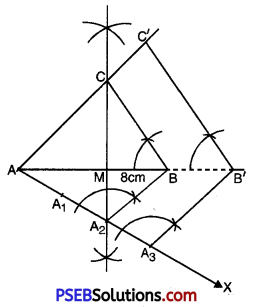
1. Take base AB = 8 cm.
2. Draw perpendicular bisector of AB. Let it intersect AB at ‘M’.
3. With M as centre and radius = 4 cm, draw an arc which intersects the perpendicular bisector at ‘C’
4. Join CA and CB.
5. ∆ABC is an isosceles with CA = CB.
6. Make any acute angle ∠BAX below the side BC.
7. Locate three (greater of ‘2’ & ‘3’ in 1\(\frac{1}{2}\) or \(\frac{3}{2}\))
A1, A2, A3 on ‘AX’ such that A A1 = A1 A2 = A2 A3.
PSEB 10th Class Maths Solutions Chapter 11 Constructions Ex 11.1 5

8. Join A2 (2nd point smaller of ‘2 and ‘3’ in ) and B.
9. Through A3, draw a line parallel to A2B meet AB is B’ cm being produced.
10. Through B’, draw a line parallel to BC which meets AC in C’ on being produced. ∆AB’C’ is the required triangle whose sides are 1\(\frac{1}{2}\) times the corresponding sides of ∆ABC.

Justification of construction :
First we will prove ∆AB’C’ are ∆ABC and similar.
Consider ∆ AB’C’ and ∆ ABC
∠A = ∠A [Common]
∠AB’C’ = ∠ABC [By construction]
∠AB’C’ ~ ∠ABC [By AA – similarityj
∴ Their corresponding sides must be in the same ratio
\(\frac{\mathrm{AB}^{\prime}}{\mathrm{AB}}=\frac{\mathrm{B}^{\prime} \mathrm{C}^{\prime}}{\mathrm{BC}}=\frac{\mathrm{C}^{\prime} \mathrm{A}}{\mathrm{CA}}\) ……………(1)

Now consider ∆ A3AB’ and ∆ A,AB
∠A = ∠A [common]
∠B’A3A = ∠BA2A [By construction]
∴∆ A3A B’ – ∆A2AB [AA – similarity]
∴ Their corresponding sides must be in the same ratio
\(\frac{A_{3} A}{A_{2} A}=\frac{A B^{\prime}}{A B}=\frac{B^{\prime} A_{3}}{B A_{2}}\)
I II III
Taking (I) & (II),
\(\frac{A B^{\prime}}{A B}=\frac{A_{3} A}{A_{2} A}\)

But, \(\frac{A_{3} A}{A_{2} A}=\frac{3}{2}\) [construction]
⇒ \(\frac{\mathrm{AB}^{\prime}}{\mathrm{AB}}=\frac{3}{2}\) ……………..(2)
From (1) & (2)m
\(\frac{\mathrm{AB}^{\prime}}{\mathrm{AB}}=\frac{\mathrm{B}^{\prime} \mathrm{C}^{\prime}}{\mathrm{BC}}=\frac{\mathrm{C}^{\prime} \mathrm{A}}{\mathrm{CA}}=\frac{3}{2}\left(1 \frac{1}{2}\right)\)

⇒ AB’ = 1\(\frac{1}{2}\) (AB); B’C’ = 1\(\frac{1}{2}\) BC and C’A’ = 1\(\frac{1}{2}\) (CA)
Hence, given result is justified.

PSEB Solutions PSEB 10th Class Maths Solutions Chapter 11 Constructions Ex 11.1

Question 5.
Draw a triangle ABC with side BC = 6 cm, AB =5 cm and ¿ABC = 60°. Then construct a triangle whose sides are of the corresponding sides of the triangle ABC.
Solution:
Steps of construction :
1. Take a line segment BC = 6 cm
2. Construct an angle of measure 60° at point B. i.e., ∠CBX = 60°.
3. With B as centre and radius 5 cm draw an arc intersecting BX at ‘A’
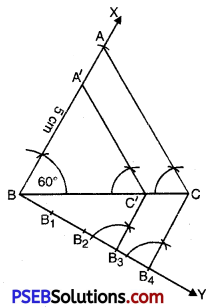
PSEB 10th Class Maths Solutions Chapter 11 Constructions Ex 11.1 6

4. Join A and C.
5. At B, make any acute angle ∠CBY below the side BC.
6. Locate four points (greater of 3 and 4 in \(\frac{3}{4}\)) B1, B2, B3, B4 on BY such that BB1 = B1B2 = B2B3 = B3B4. .
7. Join B4 and C.
8. Draw a line through B3 (smaller of 3 and 4 in ) parallel to B4C making corresponding angles. Let the line through B3 intersects BC in C’.
9. Through C’, draw a line parallel to CA which intersects BA at A’.
The ∆A’BC’ is the required triangle whose sides are \(\frac{3}{4}\) of sides of ∆ABC.

Justification of the construction:
Consider ∆A’BC’ and ∆ABC
∠B = ∠B [commoni
∠A’C’B = ∠ACB [corresponding ∠s]
∴ ∆A’BC’ ~ ∆ABC [AA – similarity]
∴ Their corresponding sides must be in the same ratio.

∴ \(\frac{\mathrm{A}^{\prime} \mathrm{B}}{\mathrm{AB}}=\frac{\mathrm{BC}^{\prime}}{\mathrm{BC}}=\frac{\mathrm{C}^{\prime} \mathrm{A}^{\prime}}{\mathrm{CA}}\) ……………..(1)

Now consider ∆B3B C’ and ∆B4BC.
∠B = ∠B [common]
∠ C’ B3B = ∠CB4B [corresponding ∠s]
∆B3BC’ ~ ∆B4BC [AA – similarity con.]
Their corresponding sides must be in the same ratio.
\(\frac{B_{3} B}{B_{4} B}=\frac{B C^{\prime}}{B C}=\frac{C^{\prime} B_{3}}{C B_{4}}\)
(I) (II) (III)

From (I) and (II),
\(\frac{\mathrm{BC}^{\prime}}{\mathrm{BC}}=\frac{\mathrm{B}_{3} \mathrm{~B}}{\mathrm{~B}_{4} \mathrm{~B}}\)

But, = \(\frac{\mathrm{B}_{3} \mathrm{~B}}{\mathrm{~B}_{4} \mathrm{~B}}=\frac{3}{4}\) [construction]

\(\frac{\mathrm{BC}^{\prime}}{\mathrm{BC}}=\frac{3}{4}\) ………..(3)

From (1) and (3)
\(\frac{\mathrm{A}^{\prime} \mathrm{B}}{\mathrm{AB}}=\frac{\mathrm{BC}^{\prime}}{\mathrm{BC}}=\frac{\mathrm{C}^{\prime} \mathrm{A}^{\prime}}{\mathrm{CA}}=\frac{3}{4}\)

and C’A’= \(\frac{3}{4}\) CA.
∆A’BC’ is the required triangle whose sides are \(\frac{3}{4}\) sides of ∆ABC.

PSEB Solutions PSEB 10th Class Maths Solutions Chapter 11 Constructions Ex 11.1

Question 6.
Draw a triangle ABC with side BC = 7 cm, ∠B = 45°. ∠A = 105°. Then construct a triangle whose sides are j- times
the corresponding sides of ∆ABC.
Solution:
Steps of construction:
1. Construct the triangle ABC with the given measurements.
BC = 7 cm; ∠B = 45, ∠A = 105°
By angle sum property of triangle
∠A + ∠B + ∠C= 180°
105° + 45° + ∠C = 180°
∠C = 180 – 150° = 30°
2. Make any acute angle ∠CBX at point B, below the sides BC.
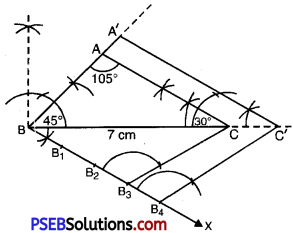
PSEB 10th Class Maths Solutions Chapter 11 Constructions Ex 11.1 7

3. Locate four points (greater of 3 and 4 in \(\frac{4}{3}\)) B1, B2, B3, B4 on ‘BX’ such that BB1 = B1B2 = B2B3 = B3B4.
4. Join B3C (smaller of 3 and 4 in \(\frac{4}{3}\)).
5. Through B4, draw a line parallel to B3C meeting BC in C’ on being produced.
6. Through C’, draw another line parallel to CA meeting BA in A’ on being produced.
7. ∆A’BC’ is the required triangle whose sides are times the triangle ABC.

Justification of construction:
Consider the ∆ A’BC’ and ∆ ABC,
∠B = ∠B [common]
∠A’C’B = ∠ACB [construction]
∴ ∆A’BC’ ~ ∆ABC [AA – similarity]
∴ Their corresponding sides must be in the same ratio

\(\frac{\mathrm{A}^{\prime} \mathrm{B}}{\mathrm{AB}}=\frac{\mathrm{BC}^{\prime}}{\mathrm{BC}}=\frac{\mathrm{C}^{\prime} \mathrm{A}^{\prime}}{\mathrm{CA}}\) ………….(1)

Again, consider ∆B4B C’ and ∆B3BC,
∠B = ∠B [common]
∠C’B4B = ∠CB3B [By consiruction]
∴ BB C’ AB3BC [AA-si niilarity]
∴ Their corresponding sides must be in the same ratio
\(\frac{\mathrm{B}_{4} \mathrm{~B}}{\mathrm{~B}_{3} \mathrm{~B}}=\frac{\mathrm{BC}^{\prime}}{\mathrm{BC}}=\frac{\mathrm{C}^{\prime} \mathrm{B}_{4}}{\mathrm{CB}_{3}}\)
I II III

Taking I and II members.

\(\frac{B C^{\prime}}{B C}=\frac{B_{4} B}{B_{3} B}\)

But, \(\frac{B_{4} B}{B_{3} B}=\frac{4}{3}\) (construction)

or \(\frac{B C^{\prime}}{B C}=\frac{4}{3}\) ………….(2)

From (1) and (2),

\(\frac{\mathrm{A}^{\prime} \mathrm{B}}{\mathrm{AB}}=\frac{\mathrm{BC}^{\prime}}{\mathrm{BC}}=\frac{\mathrm{C}^{\prime} \mathrm{A}^{\prime}}{\mathrm{CA}}=\frac{4}{3}\)

⇒ A’B = \(\frac{4}{3}\) AB; BC’ = \(\frac{4}{3}\) BC and C’A’ = \(\frac{4}{3}\) CA
Hence the construction is justified.

PSEB Solutions PSEB 10th Class Maths Solutions Chapter 11 Constructions Ex 11.1

Question 7.
Draw a right triangle in which the sides (other than hypotenuse) are of lengths 4 cm and 3 cm. Then construct another triangle whose sides are \(\frac{5}{3}\) times the corresponding sides of the given triangle.
Solution:
Steps of construction:
1. Draw a right triangle using given conditions. Consider the triangle as ABC in which BC = 4 cm; AB = 3 cm and
∠B = 90°.
2. Make any acute angle ∠CBX below the line BC.
3. Locate five points (greater of 5 and 3 in \(\frac{5}{3}\)) B1, B2, B3, B4. B5 on BX such that BB1 = B1B2 = B2B3 = B3B4 = B4B5.
4. Join B3 (smaller of ‘5’ and ‘3’ in \(\frac{5}{3}\)) and ‘C’.
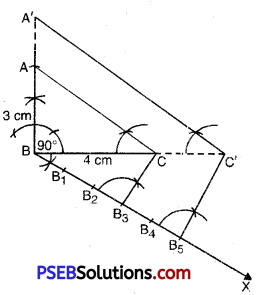
PSEB 10th Class Maths Solutions Chapter 11 Constructions Ex 11.1 8

5. Through B5. draw a line parallel to BC meeting BC is C’ on being produced.
6. Again draw a line through C’ parallel to CA meeting BA in A’ on being produced.
∆A’BC’ is the required triangle whose sides are \(\frac{5}{3}\) times the sides of ∆ABC.

Justification of construction :
Consider ∆A’BC’ and ∆ABC
∠B = ∠B [common]
∠A’C’B = ∠ACB [By construction]
∴ ∆A’BC’ ~ ∆ABC [AA-similarity condition]
∴ Their corresponding sides must be in the same ratio
\(\frac{\mathrm{A}^{\prime} \mathrm{B}}{\mathrm{AB}}=\frac{\mathrm{BC}^{\prime}}{\mathrm{BC}}=\frac{\mathrm{C}^{\prime} \mathrm{A}^{\prime}}{\mathrm{CA}}\) ……………..(1)

Again, in ∆B5C’B and ∆XB3CB,
∠B = ∠B [common]
∠C’B5B = ∠CB3B [By construction]
∴ ∆B5C’B ~ ∆B3CB [AA-similarityj
∴ Their corresponding sidcs must be in the same ratio.

\(\frac{\mathrm{B}_{5} \mathrm{C}^{\prime}}{\mathrm{B}_{3} \mathrm{C}}=\frac{\mathrm{C}^{\prime} \mathrm{B}}{\mathrm{CB}}=\frac{\mathrm{BB}_{5}}{\mathrm{BB}_{3}}\)

I II III

Taking II and III members.
\(\frac{\mathrm{BC}^{\prime}}{\mathrm{BC}}=\frac{\mathrm{B}_{5} \mathrm{~B}}{\mathrm{~B}_{3} \mathrm{~B}}\)

But, \(\frac{B_{5} B}{B_{3} B}=\frac{5}{3}\) [construction]

\(\frac{B C^{\prime}}{B C}=\frac{5}{3}\) ……………(2)
From (1) and (2),

\(\frac{\mathrm{A}^{\prime} \mathrm{B}}{\mathrm{AB}}=\frac{\mathrm{BC}^{\prime}}{\mathrm{BC}}=\frac{\mathrm{C}^{\prime} \mathrm{A}^{\prime}}{\mathrm{CA}}=\frac{5}{3}\)

⇒ A’B = \(\frac{5}{3}\) AB; BC’ = \(\frac{5}{3}\) BC and C’A’ = \(\frac{5}{3}\) CA
Hence the construction is justified.
PSEB 10th Class Maths Solutions Chapter 10 Circles Ex 10.2

Punjab State Board PSEB 10th Class Maths Book Solutions Chapter 10 Circles Ex 10.2 Textbook Exercise Questions and Answers.

PSEB Solutions for Class 10 Maths Chapter 10 Circles Ex 10.2

In Question 1 to 3, choose the corred option and give justification.

Question 1.
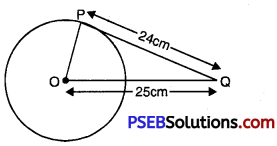
From a point Q, the length of the tangent to a circle is 24 cm and the distance of Q from the centre is 25 cm. The radius of the circle is
(A) 7 cm
(B) 12 cm
(C) 15 cm
(D) 24.5 cm
Solution:
A circle with centre O from a point, Q the length of the tangent to a circle is 24 cm and distance of Q from the centre is 25 cm.

PSEB 10th Class Maths Solutions Chapter 10 Circles Ex 10.2 1

∴ ∠QPO = 90°
Now, in right angled ∠OPQ,
OQ2 = PQ2 + OP2
(25)2 = (24)2 + OP2
Or 625 = 576 + OP2
Or OP2 = 625 – 576
Or OP2 = 49 = (7)2
Or OP = 7 cm
∴ Option (A) is correct.

PSEB Solutions PSEB 10th Class Maths Solutions Chapter Circles Ex 10.2

Question 2.
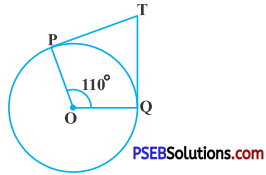
In Fig., if TP and TQ and tangents to a circle with centre O so ∠POQ = 110°, then ∠PTQ is equal to
(A) 60°
(B) 70°
(C) 80°
(D) 90°

PSEB 10th Class Maths Solutions Chapter 10 Circles Ex 10.2 2

Solution:
In figure, OP is radius and PT is tangent to circle.
∠OPT = 90°
Similarly, ∠OQT = 90° and ∠POQ = 110° (Given)
Now, POQT is a Quadrilateral.
∴ ∠POQ + ∠OQT + ∠PTQ + ∠TPO = 360°
110° + 90° + ∠PTQ + 90° = 360°
Or ∠PTQ + 290° = 360°
Or ∠PTQ = 360° – 290°
Or ∠PTQ = 70°
∴ Option (B) is correct.

PSEB Solutions PSEB 10th Class Maths Solutions Chapter Circles Ex 10.2

Question 3.
In tangents PA and PB from a point P to a circle with centre O are inclined to each other at angle of 800, then LPOA is equal to
(A) 50°
(B) 60°
(C) 70°
(D) 80°
Solution:
In given firgure, OA is radius and AP is a tangent to the circle.

PSEB 10th Class Maths Solutions Chapter 10 Circles Ex 10.2 3

∴ ∠OAP = 90°
Similarly, ∠OBP = 90°
Now, in right angled ∆PAO and ∆PBO
∠PAO = ∠PBO = 90°
OP = OP (Common side)
OA = OB (radii of same Circle)
∴ ∆PAO ≅ ∆PBO [RHS congruence]
∴ ∠AOP = ∠BOP [CPCT]
Or ∠AOP =∠BOP = \(\frac{1}{2}\) ∠AOB
Also, In Quad. OAPB,
∠OBP + ∠BPA + ∠PAO + ∠AOP = 360°
90° +80° +90° + ∠AOB = 360°
∠AOB = 360° – 260°
∠AOB = 100°
Form (1) and (2), we get
∠AOP = ∠BOP = \(\frac{1}{2}\) × 100° = 50°

∴ Option (A) is correct.

PSEB Solutions PSEB 10th Class Maths Solutions Chapter Circles Ex 10.2

Question 4.
Prove that, the tangents drawn at the ends of a diameter of a circle are parallel.
Solution:
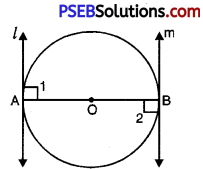
Given: A circle with center O and AB as its diameter l and m are tangents at points A and B.
To Prove: l || m
Proof: OA is the radius and l is the tangent to the circle.

PSEB 10th Class Maths Solutions Chapter 10 Circles Ex 10.2 4

∴ ∠1 = 90°
Similarly, ∠2 = 90°
Or ∠1 = ∠2 = 90°
But these are alternate angles between two lines, when one transversal cuts them.
∴ l || m
Hence, tangents drawn at the ends of a diameter of a circle are parallel.

Question 5.
Prove that the perpendicular at the point of contact to the tangent to a circle passes through the centre.
Solution:
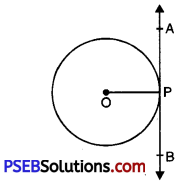
Given. A circle with centre O. AB its tangent meet circle at P.
i.e., P is the point of contact.

PSEB 10th Class Maths Solutions Chapter 10 Circles Ex 10.2 5

To Prove: Perpendicular at the point of contact to the tangent to a circle passes through the centre.
Construction: Join OP.
Proof: The perpendicular to a tangent line AB through the point of contact passes through the centre of the circle because only one perpendicular, OP can be drawn to the line AB through the point P.
Hence, perpendicular at the point of contact to the tangent to a circle passes through the centre.

PSEB Solutions PSEB 10th Class Maths Solutions Chapter Circles Ex 10.2

Question 6.
The length of a tangent from a point A at a distance 5 cm. from the centre of the circle is 4 cm. Find the radius of the circle.
Solution:
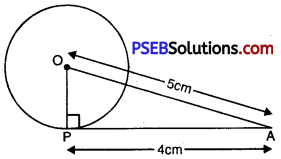
A circle with centre ‘O’ A is any point outside the circle at a distance of 5 cm from the centre.

PSEB 10th Class Maths Solutions Chapter 10 Circles Ex 10.2 6

Length of tangent = PA = 4 cm
Since, OP is the radius and PA is the tangent to the circle.
∠OPA = 90°
Now, in right angled ∠OPA.
Using Pythagoras Theorem.
OA2 = OP2 + PA2
(5)2 = OP2 + (4)2
Or OP2 = 25 – 16
Or OP2 = 9 = (3)2
Or OP = 3 cm.
Hence, radius of the circle is 3 cm.

Question 7.
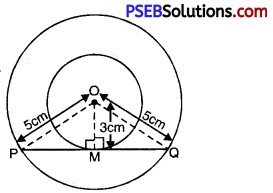
Two concentric circles are of radii 5 cm and 3 cm. Find the length of Ihe chord of the larger circle which touches the smaller circle.
Solution:
Two concentric circles having same centre O, and radii 5 cm and 3 cm respectively. Let PQ be the chord of larger circle
but tangent to the smaller circle.

PSEB 10th Class Maths Solutions Chapter 10 Circles Ex 10.2 7

Since, OM be the radius of smaller circle and PMQ be the tangent.

∴ ∠OMP = ∠OMQ = 90°
Consider, right angled triangles OMP and OMQ,
∠OMP = ∠OMQ = 90°
OP = OQ [radii of same circle]
OM = OM [common side]
∴ ∆OMP ≅ ∆OMQ [RHS congurence]
∴ PM = MQ [CPCT]
Or PQ = 2PM = 2MQ
Now, in right angled ∆OMQ.
Using Pythagoras Theorem,
OQ2 = OM2 + MQ2
(5)2 = (3)2 + (MQ)2
Or MQ = 25 – 9
Or MQ2 = 16 = (4)2
Or MQ = 4 cm
Length of chord PQ = 2 MQ = 2 (4) cm = 8 cm
Hence, length of required chord is 8 cm.

PSEB Solutions PSEB 10th Class Maths Solutions Chapter Circles Ex 10.2

Question 8.
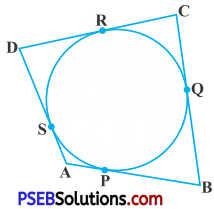
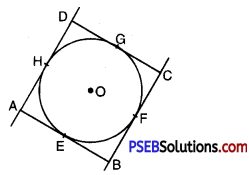
A quadrilateral ABCD is drawn to the circumscribe a circle (see figure). Prove that AB + CD = AD + BC.

PSEB 10th Class Maths Solutions Chapter 10 Circles Ex 10.2 8

Solution:
Given: A Quadrilateral ABCD is drawn to circumscribe a circle.
To Prove: AB + CD = AD + BC
Proof: Since the lengths of tangents drawn from an external point to a circle are equal. Now, B is any point outside the circle and BP : BQ are tangents to the circle.
∴ BP = BQ ……………(1)
Similarly, AP = AS ………….(2)
and CR = CQ …………..(3)
Also, DR = DS ………….(4)
Adding (1), (2), (3) and (4), we get
(BP + AP) + (CR + DR) = (BQ + CQ) + (AS + DS)
AB + CD = BC + AD
is the required result.

Question 9.
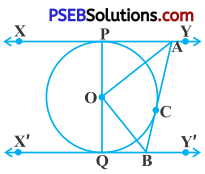
In figure, XY and X’Y’ are two parallel tangents to a circle with centre O and another tangent AB with point of contact C
intersecting XY at A and X’Y’ at B. Prove that ∠AOB = 90°.

PSEB 10th Class Maths Solutions Chapter 10 Circles Ex 10.2 9

Solution:
Given: A circle with centre O having two parallel tangents XY and X’Y’ and= another tangent AB with point of contact C
intersecting XY at A and X’Y’ at B.
To Prove: ∠AOB = 90°
Contruction: Join OC, OA and OB.
Proof: Since the lengths of tangents drawn from an external point to a circle are equal.
Now, A is any point outside the circle from two tangents PA and AC are drawn to the circle.
∴ PA = AC
Also, in ∆ POA and ∆ AOC,
PA = AC (Proved)
OA = OA (common side)
OP = OC (radii of same circle)
∴ ∆POA ≅ ∆AOC [SSS congruence]
and ∠PAO = ∠CAO [CPCT]
Or ∠PAC = 2 ∠PAO = 2 ∠CAO ……………(1)
Similarly, ∠QBC = 2∠OBC = 2 ∠OBQ ………………(2)
Now, ∠PAC + ∠QBC = 180°
[Sum of the interior angles on the same side of transversal is 180°]
Or 2∠CAO + 2∠OBC = 180° [Using (1) & (2)]
Or ∠CAO + ∠OBC = 180 = 90° …(3)
Now, in ∆OAB,
∠CAO + ∠OBC + ∠AOB = 180°
90°+ ∠AOB = 180° [Using (3)]
Or ∠AOB = 180° – 90° = 90°
Hence, ∠AOB = 90°.

PSEB Solutions PSEB 10th Class Maths Solutions Chapter Circles Ex 10.2

Question 10.
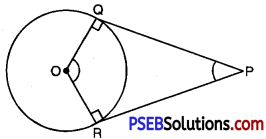
Prove that the angle between the two tangents drawn from an external point to a circle is supplementary to the angle subtended by the line segment joining the points of contact at the centre. [Pb. 20191
Solution:
Given. A circle with centre O. P is any point outside the circle PQ and PR are the tangents to the given circle from point P.

PSEB 10th Class Maths Solutions Chapter 10 Circles Ex 10.2 10

To Prove. ∠ROQ + ∠QPR = 180°
Proof. OQ is the radius and PQ is tangent from point P to the given circle.
∴ ∠OQP = 90° ………..(1)
[∵ The tangent at any point of a circle is perpendicular to the radius through the point of contact]
Similarly, ∠ORP = 90°
Now, in quadrilateral ROQP,
∠ROQ + ∠PRO + ∠OQP + ∠QPR = 360°
Or ∠ROQ + 90° + 90° + ∠QPR = 360° [Using (1) & (2)]
Or ∠ROQ + ∠QPR + 180 = 360°
Or ∠ROQ + ∠QPR = 360° – 180°
Or ∠ROQ + ∠QPR = 180°
Hence, the angle between the two tangents drawn from and external point to a circle is supplementary to angle subtended by the line segment joining the pnts of contact at the centre.

Question 11.
Prove that the parallelogram circumscribing a circle is a rhombus.
Solution:
Given: A parallelogram ABCD circumscribed a circle with centre O.
To Prove: ABCD is a rhombus.
Proof: Since the lengths of tangents drawn from an external point to a circle are equal. Now, B is any point outside thé circle and BE; BF are tangents to the circle.

PSEB 10th Class Maths Solutions Chapter 10 Circles Ex 10.2 11

To Prove: ABCD is a rhombus.
Proof: Since the lengths of tangents drawn from an external point to a circle are equal. Now, B is any point outside thè circle and BE; BF are tangents to the circle.
∴ BE = BF
Similarly AE = AH ……………(2)
and CG = CF
Also DG = DH
Adding (1), (2), (3) and (4), we get
(BE + AE) + (CG + DG) = (BF + CF) – (AH + DH)
Or AB + CD = BC +AD ……….(5)
Now, ABCD is a parallelogram, (Given)
∴ AB = CD and BC = AD …………(6)
From (5) and (6), we get
AB + AB = BC + BC
Or 2AB = 2BC or AB = BC
Or AB = BC = CD = AD
∴ ABCD is a rhombus.
Hence, parallelogram circumscribing a circle is a rhombus.

PSEB Solutions PSEB 10th Class Maths Solutions Chapter Circles Ex 10.2

Question 12.
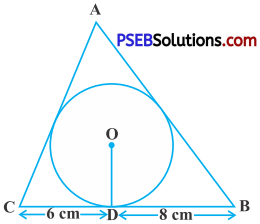
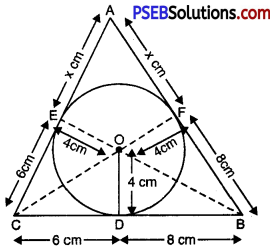
A triangle ABC is drawn to circumscribe a circle of radius 4 cm such that the segments BD and DC into which BC is divided by the point of contact D are of lengths 8 cm and 6 cm respectively (see Fig). Find the sides AB and AC.

PSEB 10th Class Maths Solutions Chapter 10 Circles Ex 10.2 12

Solution:
A triangle ABC is drawn to circumscribe a circle of radius 4 cm and the sides BC, CA, AB of ∆ABC touch the circle at
D, E, F respectively. Since the lengths of tangents drawn from an external point to a circle are equal.
∴ AE = AF = x cm(say)
CE = CD = 6 cm (Given)
and BF = BD = 5 cm
Since the tangent at any point of a circle is perpendicular to the radius through the point of contact.

PSEB 10th Class Maths Solutions Chapter 10 Circles Ex 10.2 13

∴ OD ⊥ BC; OE ⊥ AC and OF ⊥ AB.
Also, OE = OD = OF = 4 cm.
Consider, ∆ABC
a = AC = (x + 6) cm ;
b = CB = (6 + 8) cm = 14 cm
c = BA = (8 + x) cm
S = \(\frac{a+b+c}{2}\)
∴ S = \(\frac{x+6+14+8+x}{2}\) = \(\frac{2 x+28}{2}\) = (x + 14)

area (∆ABC)= \(\sqrt{\mathrm{S}(\mathrm{S}-a)(\mathrm{S}-b)(\mathrm{S}-c)}\)

= \(\sqrt{\begin{array}{r}
(x+14)(x+14-\overline{x+6}) \\
(x+14-14)(x+14-\overline{8+x})
\end{array}}\)

= \(\sqrt{(x+14)(8)(x)(6)}\)

= \(\sqrt{48 x^{2}+672 x}\) cm2 ………………(1)

area (∆OBC) = \(\frac{1}{2}\) × base × altitude
= \(\frac{1}{2}\) × 14 × 4 = 28cm2 …………….(2)

area(∆BOA)= \(\frac{1}{2}\) × base × altitude
= \(\frac{1}{2}\) × (8 + x) × 4 = 28cm2…………….(3)

area (∆AOC) = \(\frac{1}{2}\) × base × altitude
= \(\frac{1}{2}\) × (6 + x) × 4 = 28cm2 …………….(4)

From the figure, by addition of areas, we have
Or (∆ABC) = ar (∆OBC) + ar (∆BOA) + ar (∆AOC)
\(\sqrt{48 x^{2}+672 x}\) = 28 + 16 + 2x + 12 + 2x
Or \(\sqrt{48 x^{2}+672 x}\) = 4x + 56
Or 48x2 + 672x =4[x+ 14]
Squaring both sides, we get
Or 48x2 + 672x = 16 (x + 14)2
Or 48x (x + 14) = 16(x + 14)2
Or 3x = x + 14
Or 2x = 14
Or x = \(\frac{14}{2}\) = 7
∴ AC = (x + 6) cm = (7 + 6) cm= 13 cm
and AB = (x + 8) cm = (7 + 8) cm = 15 cm
Hence, AB = 15 cm and AC = 13 cm.

PSEB Solutions PSEB 10th Class Maths Solutions Chapter Circles Ex 10.2

Question 13.
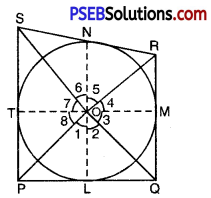
Prove that opposite sides of a quadrilateral circumscribing a circle subtend supplementary angles at the centre of the circle.
Solution:
Given:
A quadrilateral PQRS circumscribing a circle having centre O. Sides PQ, QR, RS and SP touches the circles at L, M, N, T
respectively.

PSEB 10th Class Maths Solutions Chapter 10 Circles Ex 10.2 14

To Prove:
∠POQ + ∠SOR = 180°
and ∠SOP + ∠ROQ = 180°
Construction:
Join OP, OL, OQ, 0M. OR, ON, OS, OT
Proof: Since the two tangents drawn from an external point subtend equal angles at the centre.
∴ ∠2 = ∠3; ∠4 = ∠5 ; ∠6 = ∠7; ∠8 = ∠1
But, sum of all angles around a point is 360°
∴ ∠1 + ∠2 + ∠3 + ∠4 + ∠5 + ∠6 + ∠7 + ∠8 = 360°
Or ∠1 + ∠2 + ∠2 + ∠5 +∠5 + ∠6 + ∠6 + ∠1 = 360°
Or 2(∠1 + ∠2 + ∠5 + ∠6) = 360°
Or (∠1 + ∠2) + (∠5 + ∠6) = \(\frac{360^{\circ}}{2}\) = 180°
Or ∠POQ + ∠SOR = 180°
Similarly, ∠SOP + ∠ROQ = 180°
Hence, opposite sides of a quadrilateral circumscribing a circle subtend supplementary angles at the centre of the circle.

PSEB 10th Class Maths Solutions Chapter 10 Circles Ex 10.1

Punjab State Board PSEB 10th Class Maths Book Solutions Chapter 10 Circles Ex 10.1 Textbook Exercise Questions and Answers.

PSEB Solutions for Class 10 Maths Chapter 10 Circles Ex 10.1

Question 1.
How many tangents can a circle have?
Solution:
Since at any point on a circle, there can be one and only one tangeni. But circle is a collection of infinite points, so we can draw infinite number of tangents to a circle.

PSEB Solutions PSEB 10th Class Maths Solutions Chapter Circles Ex 10.1

Question 2.
Fill in the blanks:
(i) A tangent to a circle intersects it in ………………. point(s).
Solution:
one

(ii) A line intersecting a circle in two points is called a ………………..
Solution:
secant.

(iii) A circle can have ……………. parallel tangents at the most.
Solution:
two

(iv) The common point of a lingent h, circle and the circit is called ………………
Solution:
point of contact.

PSEB Solutions PSEB 10th Class Maths Solutions Chapter Circles Ex 10.1

Question 3.
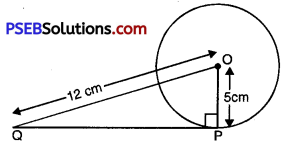
A tangent PQ at a point P of a circle of radius 5 cm meets a line through the centre O at a point Q so that OQ = 12 cm. Length PQ is:
(A) 12 cm
(B) 13 cm
(C) 8.5 cm
(D) \(\sqrt{119}\) cm.
Solution:
According to given information we draw the figure such that,

PSEB 10th Class Maths Solutions Chapter 10 Circles Ex 10.1 1

OP = 5 cm and OQ = 12 cm
∵ PQ is a tangent and OP is the radius
∵ ∠OPQ = 90°
Now, In right angled ∆OPQ.
By Pythagoras Theorem,
OQ2 = OP2 + QP2
Or (12)2 = (5)2 + QP2
Or QP2 = (12)2 – (5)2
Or QP2 = 144 – 25 = 119
Or QP = \(\sqrt{119}\) cm.
Hence, option (D) is correct.

PSEB Solutions PSEB 10th Class Maths Solutions Chapter Circles Ex 10.1

Question 4.
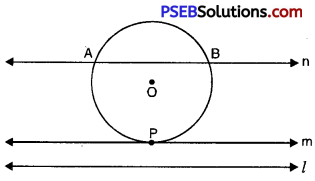
Draw a circle and two lines parallel to given line such that one is a tangent and other a secant to the circle.
Solution:
According to thc given information we draw a circle having O as centre and l is the given line.

PSEB 10th Class Maths Solutions Chapter 10 Circles Ex 10.1 2

Now, m and n be two lines parallel to a given line l such that m is tangent as well as parallel to l and n is secant to the circle as well as parallel to l.

PSEB 10th Class Maths Solutions Chapter 9 Some Applications of Trigonometry Ex 9.1

Punjab State Board PSEB 10th Class Maths Book Solutions Chapter 9 Some Applications of Trigonometry Ex 9.1 Textbook Exercise Questions and Answers.

PSEB Solutions for Class 10 Maths Chapter 9 Some Applications of Trigonometry Ex 9.1

Question 1.
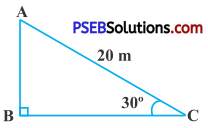
A circus artist is climbing 220 m long rope, which is tightly stretched and tied from the top of a vertical pole to the ground. Find the height of the pole, ¡f the angle made by the rope with the ground level is 30° (see fig.).

PSEB 10th Class Maths Solutions Chapter 9 Some Applications of Trigonometry Ex 9.1 1

Solution:
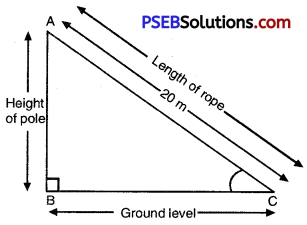
Let AB be the heignt of pole;
AC = 20 m be the length of rope.
The angle of elevation in this situation is 30°.
Various arrangements are as shown in figure.

PSEB 10th Class Maths Solutions Chapter 9 Some Applications of Trigonometry Ex 9.1 2

In right angled ∆ABC,
\(\frac{\mathrm{AB}}{\mathrm{AC}}\) = sin 30°

or \(\frac{\mathrm{AB}}{20}=\frac{1}{2}\)

or AB = \(\frac{1}{2}\) × 20 = 10
Hence, height of pole is 10 m.

PSEB Solutions PSEB 10th Class Maths Solutions Chapter 9 Some Applications of Trigonometry Ex 9.1

Question 2.
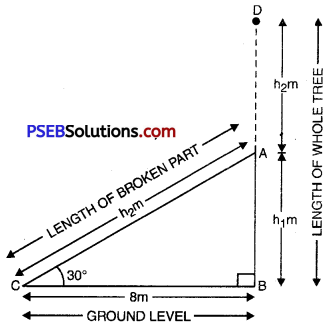
A tree breaks due to storm and the broken part bends so that the top of the tree touches the ground making an angle 300 with it. The distance between the foot of the tree to the point where the top touches the ground is 8 rn Find the height of the tree.
Solution:
Let BD be length of tree before storm.
After storm AD = AC = length of broken part of tree.
The angle of elevation in this situation is 30°.
Various arrangements are as shown in the figure.

PSEB 10th Class Maths Solutions Chapter 9 Some Applications of Trigonometry Ex 9.1 3

In right angled ∆ABC,

\(\frac{\mathrm{AB}}{\mathrm{AC}}\) = tan 30°

or \(\frac{h_{1}}{8}=\frac{1}{\sqrt{3}}\)
or h1 = \(\frac{8}{\sqrt{3}} \times \frac{\sqrt{3}}{\sqrt{3}}=\frac{8}{3} \sqrt{3}\) m ……….(1)

\(\frac{\mathrm{BC}}{\mathrm{AC}}\) = cos 30°

or \(\frac{8}{h_{2}}=\frac{\sqrt{3}}{2}\)

or \(h_{2}=\frac{8 \times 2}{\sqrt{3}}=\frac{16}{\sqrt{3}} \times \frac{\sqrt{3}}{\sqrt{3}}\)

h2 = \(\frac{16}{3}\) √3 …………..(2)

Total height of the tree = h1 + h2
= \(\frac{8}{3}\) √3 + \(\frac{16}{3}\) √3 [Using (1) & (2)]

= \(\left(\frac{8+16}{3}\right) \sqrt{3}=\frac{24}{3} \sqrt{3}\) = 8√3 m.
Hence, height of the tree is 8√3 m.

PSEB Solutions PSEB 10th Class Maths Solutions Chapter 9 Some Applications of Trigonometry Ex 9.1

Question 3.
A contractor plants to install two slides for the children to play in a park. For the children below the age of 5 years, she
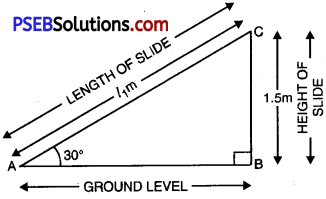
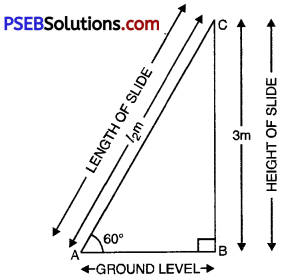
prefers to have a slide whose top is at a height of 1.5 m, and is inclined at an angle of 30° to the ground, whereas for elder children, she wants to have a steep slide at a height of 3 m, and inclined at an angle of 60° to the ground. What should be the length of the slide in each case?
Solution:
Case I:
For children below 5 years.
Let AC = l1 m denote the length of slide and BC = 1.5 m be the height of slide. The angle of elevation is 30°.
Various arrangements are shown in figure.

PSEB 10th Class Maths Solutions Chapter 9 Some Applications of Trigonometry Ex 9.1 4

In right angled ∆ABC,

\(\frac{\mathrm{BC}}{\mathrm{AC}}\) = sin 30°

or \(\frac{1 \cdot 5}{l_{1}}=\frac{1}{2}\)

or l1 = 1.5 × 2 = 3 m.

Case II:
For Elder children
Let AC = 12 m represent the length of slide and BC = 3 m be the height of slide. The angle of elevation is 60°. Various arrangements are as shown in figure.

PSEB 10th Class Maths Solutions Chapter 9 Some Applications of Trigonometry Ex 9.1 5

In right angled ∆ABC,

\(\frac{\mathrm{BC}}{\mathrm{AC}}\) = sin 60°

or \(\frac{3}{l_{2}}=\frac{\sqrt{3}}{2}\)

or l2 = \(\frac{3 \times 2}{\sqrt{3}}=\frac{6}{\sqrt{3}}\)

= \(\frac{6}{\sqrt{3}} \times \frac{\sqrt{3}}{\sqrt{3}}=\frac{6 \sqrt{3}}{3}\)

= 2√3 m.

Hence, length of slides for children below 5 years and elder children are 3 m and 2 m.

PSEB Solutions PSEB 10th Class Maths Solutions Chapter 9 Some Applications of Trigonometry Ex 9.1

Question 4.
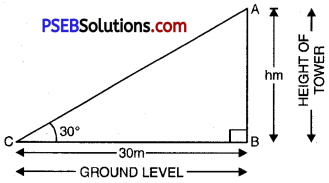
The angle of elevation of the top of a tower from a point on the ground, which is 30 m away from the foot of the tower, is 30°. Find the height of the tower.
Solution:
Let BC = h m be the height of tower and AB = 30 m be the distance at ground level. Various arrangements are as shown in figure.

PSEB 10th Class Maths Solutions Chapter 9 Some Applications of Trigonometry Ex 9.1 6

In right angled ∆ABC,

\(\frac{\mathrm{BC}}{\mathrm{AB}}\) = tan 30°

or \(\frac{h}{30}=\frac{1}{\sqrt{3}}\)

or h = \(\frac{30}{\sqrt{3}} \times \frac{\sqrt{3}}{\sqrt{3}}=\frac{30 \sqrt{3}}{3}\)

= 10√3 = 10 × 1.732
h = 17.32 (approx).
Hence, height of tower is 17.32 m.

Question 5.
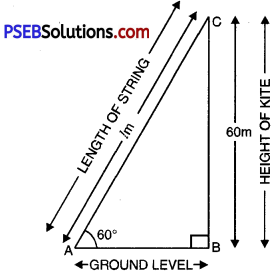
A kite is flying at a height of 60 m above the ground. The string attached to the kite is temporarily tied to a point on the ground. The inclination of the string with the ground is 60°. Find the length of the string, assuming that there is no slack in the string.
Solution:
Let us suppose position of the kite is at point CAC = l m be length of string with which kite is attached. The angle of elevation for this situation be 60°. Various arrangements are as shown in the figure.
PSEB 10th Class Maths Solutions Chapter 9 Some Applications of Trigonometry Ex 9.1 7

In right angled ∆ABC,

\(\frac{\mathrm{CB}}{\mathrm{AB}}\) = sin 60°

or \(\frac{60}{l}=\frac{\sqrt{3}}{2}\)

or l = \(\frac{60 \times 2}{\sqrt{3}}=\frac{120}{\sqrt{3}} \times \frac{\sqrt{3}}{\sqrt{3}}\)

= \(\frac{120 \sqrt{3}}{3}\) = 40√3 m.
Hence, length of the string be 40√3 m.

PSEB Solutions PSEB 10th Class Maths Solutions Chapter 9 Some Applications of Trigonometry Ex 9.1

Question 6.
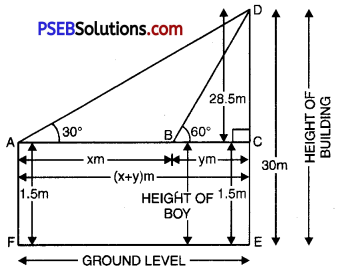
A 15 m tall boy is standing at some distance from a 30 m tall building. The angle of elevation from his eyes to the top of the building increases from 30° to 60° as he walks towards the building. Find the distance he walked towards the building.
Solution. Let ED = 30 m be the height of building and EC = l5 m be the height of boy.
The angle of elevation at different situation are 30° and 60° respectively.
Various arrangements are as shown in figure.

PSEB 10th Class Maths Solutions Chapter 9 Some Applications of Trigonometry Ex 9.1 8

In right angled ∆ABC,

\(\frac{\mathrm{DC}}{\mathrm{AC}}\) = tan 30°

or \(\frac{28 \cdot 5}{x+y}=\frac{1}{\sqrt{3}}\)

or x + y = 28.5 × √3 m ………………(1)

Now, in right angled ∆BCD,

\(\frac{\mathrm{DC}}{\mathrm{BC}}\) = tan 60°

or \(\frac{28 \cdot 5}{y}=\sqrt{3}\)

or y = \(\frac{28 \cdot 5}{\sqrt{3}}\)

or y = \(\frac{28 \cdot 5}{\sqrt{3}} \times \frac{\sqrt{3}}{\sqrt{3}}=\frac{28 \cdot 5 \times \sqrt{3}}{3}\) ……….(2)

Distance covered towards building = x = (x + y) – y
= (28.5 × √3) – (\(\frac{28.5}{3}\) × √3) m [sing (1) and (2)]

= 28.5 (1 – \(\frac{1}{3}\)) √3 m

= 28.5 (\(\frac{3-1}{4}\)) √3 m

= [28.5 × \(\frac{2}{3}\)]√3 m = 19√3 m.

Hence, distance covered by boy towards the building is 19√3 m.

PSEB Solutions PSEB 10th Class Maths Solutions Chapter 9 Some Applications of Trigonometry Ex 9.1

Question 7.
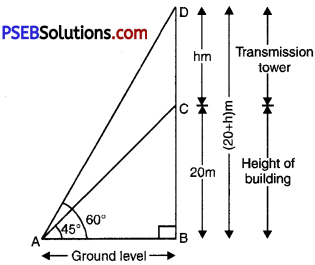
From a point on the ground, the angles of elevation of the bottom and top of a transmission tower fixed at the top of a 20 m high building are 45° and 60° respectively. Find the height of the tower.
Solution:
Let BC = 20 m be the height of building and DC = h m be the height of transmission tower. The angle of elevation of
the bottom and top of a transmission tower are 45° and 60° respectively.
Various arrangements are as shown in the figure.

PSEB 10th Class Maths Solutions Chapter 9 Some Applications of Trigonometry Ex 9.1 9

In right angled ∆ABC,
\(\frac{A B}{B C}\) = cot 45°

or \(\frac{\mathrm{AB}}{20}\) = 1
or AB = 20 m ………………..(1)
Also, in right angled ∆ABD,
\(\frac{A B}{B C}\) = cot 60°

or \(\frac{\mathrm{AB}}{20+h}=\frac{1}{\sqrt{3}}\)

AB = \(\frac{(20+h)}{\sqrt{3}}\) ………….(2)

From (1) and (2), we get

20 = \(\frac{(20+h)}{\sqrt{3}}\)
or 20√3 = 20 + h
or h = 20√3 – 20
or h = 20 (√3 – 1) m
= 20 (1.732 – 1) m
= 20 × 0.732 = 14.64 m.

Hence, height of the tower is 14.64 m.

PSEB Solutions PSEB 10th Class Maths Solutions Chapter 9 Some Applications of Trigonometry Ex 9.1

Question 8.
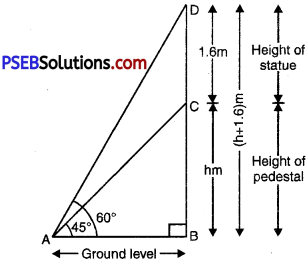
A statue 1.6 m tall stands on the top of a pedestal. From a point on the ground, the angle of elevation of the top of the statue is 60° and from the same point the angle of elevation of the top of the pedestal is 45°. Find the height of the pedestal.
Solution. Let BC = h m be the height of Pedestal and CD = 1.6 m be the height of statue.
The angle of elevation of top of statue and top of pedestal are 60° and 45° respectively. Various arrangements are as shown in the figure.

PSEB 10th Class Maths Solutions Chapter 9 Some Applications of Trigonometry Ex 9.1 10

In right angled ∆ABC,
\(\frac{A B}{B C}\) = cot 45°

or \(\frac{A B}{h}\) = 1

or AB = h m ………….(1)

In right angled ∆ABC,
\(\frac{\mathrm{AB}}{\mathrm{BD}}\) = cot 60°

or \(\frac{\mathrm{AB}}{h+1.6}=\frac{1}{\sqrt{3}}\)

or AB = \(\frac{h+1.6}{\sqrt{3}}\) ……….(2)

From (1) and (2), we get
h = \(\frac{h+1.6}{\sqrt{3}}\)
or √3h = h + 1.6
or (√3 – 1) h = 1.6
or (1.732 – 1) h = 16
or (0.732) h = 1.6
or h = \(\frac{1.6}{0.732}\) = 2.1857923
= 2.20 m (approx.)
Hence, height of pedestal is 2.20 m.

Question 9.
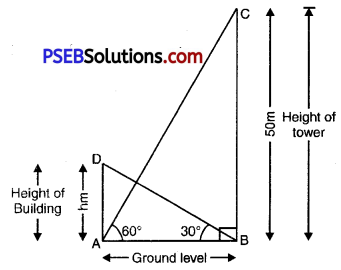
The angle of elevation of the top of a building from the foot of the tower is 300 and the angle of elevation of the top of the tower from the foot of the building is 60°. If the tower is 50 m high, find the height of the
building.
Solution:
Let BC = 50 m be height of tower and AD = h m be height of building. The angle of elevation of the top of a building from the foot of tower and top of tower from foot of the building are 30° and 60° respectively. Various arrangement are as shown in figure.

PSEB 10th Class Maths Solutions Chapter 9 Some Applications of Trigonometry Ex 9.1 11

In right angled ∆ABC,
\(\frac{A B}{B C}\) = cot 60°

or \(\frac{\mathrm{AB}}{50}=\frac{1}{\sqrt{3}}\)

or AB = \(\frac{50}{\sqrt{3}}\) …………(1)

Also, in right angled ∆DAB,
\(\frac{\mathrm{AB}}{\mathrm{DA}}\) = cot 30°

or \(\frac{A B}{h}\) = √3
or AB = h√3 ……………(2)

From (1) and (2), we get
\(\frac{50}{\sqrt{3}}\) = h√3

or \(\frac{50}{\sqrt{3}} \times \frac{1}{\sqrt{3}}\) = h

or h = \(\frac{50}{3}\) = 16.6666

or h = 16.70 m (approx).
Hence, height of building is 16.70 m.

PSEB Solutions PSEB 10th Class Maths Solutions Chapter 9 Some Applications of Trigonometry Ex 9.1

Question 10.
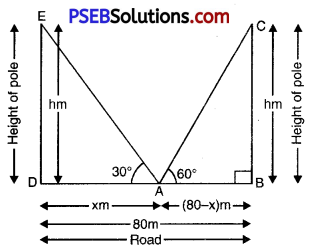
Two poles of equal heights are tanding opposite each other on either side of he road, which is 80 m wide. From a point
between them on the road the angles of elevation of the top of the poles are 60° and 30°, respectively. Find the height of the poles and the distances of the point from the poles.
Solution:
Let BC = DE = h m he height of two equal poles and point A be the required position where the angle of elevations of top of two poles are 30° and 60° respectively. Various arrangement are as shown in the figure.

PSEB 10th Class Maths Solutions Chapter 9 Some Applications of Trigonometry Ex 9.1 12

In right angled ∆ADE,

\(\frac{E D}{D A}\) = tan 30°

or \(\frac{h}{x}=\frac{1}{\sqrt{3}}\)

or h = \(\frac{x}{\sqrt{3}}\) ……………(1)

In right angled ∆ABC,

\(\frac{\mathrm{BC}}{\mathrm{AB}}\) = tan 60°

or \(\frac{h}{80-x}\) = √3

or h = (80 – x) √3 …………(2)

From (1) and (2), we get
\(\frac{x}{\sqrt{3}}\) = (80 – x)
or x = (80 – x) √3 × √3
or x = (80 – x) 3
or x = 240 – 3x
or 4x = 240
or x = \(\frac{240}{4}\) = 60
Substitute this value of x in (I), we get
h = \(\frac{60}{\sqrt{3}}=\frac{60^{\circ}}{\sqrt{3}} \times \frac{\sqrt{3}}{\sqrt{3}}\)

= \(\frac{60 \sqrt{3}}{3}=20 \sqrt{3}\)

= (20 × 1.732) m = 34.64 m
DA = x = 60 m
and AB = 80 – x = (80 – 60) m = 20 m.
Hence, heigth of the poles are 3464 m and the distances of the point from the poles are 20 m and 60 m respectively.

PSEB Solutions PSEB 10th Class Maths Solutions Chapter 9 Some Applications of Trigonometry Ex 9.1

Question 11.
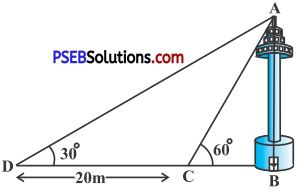
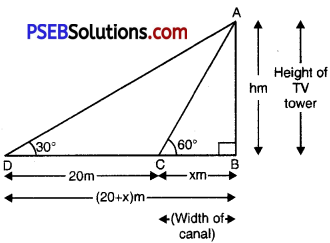
A TV tower stands vertically on a bank of a canal. From a point on the other bank directly opposite the tower, the angle of elevation of the top of the tower is 60°. From a point 20 m away from this point on the same bank, the angle of elevation of the top of the tower is 30° (see fig.). Find the height of the tower and the width of the canal.

PSEB 10th Class Maths Solutions Chapter 9 Some Applications of Trigonometry Ex 9.1 13

Solution:
Let BC = x m be the width of canal and CD = h m be height of TV tower. The angles of elevation of top of tower at different position are 30° and 60° respectively. Various arrangements are as shown in figure.

PSEB 10th Class Maths Solutions Chapter 9 Some Applications of Trigonometry Ex 9.1 14

In right angled ∆ABC,

\(\frac{\mathrm{AB}}{\mathrm{BC}}\) = tan 60°

or \(\frac{h}{x}\) = √3
or h = √3x …………..(1)

Also, in right angled ∆ABD,
\(\frac{\mathrm{AB}}{\mathrm{BD}}\) = tan 30°

or \(\frac{h}{20+x}=\frac{1}{\sqrt{3}}\)

or h = \(\frac{20+x}{\sqrt{3}}\) ……………….(2)

From (1) and (2), we get

√3x = \(\frac{20+x}{\sqrt{3}}\)
or √3(√3x) = 20 + x
or 3x = 20 + x
or 2x = 20
or x = \(\frac{20}{2}\) = 10

Substitute this value of x in (1), we get
h = 10(√3)
= 10 × 1.732
h = 17.32 m
Hence, height of TV tower is 17.32 m and. width of the canal is 10 m.
Question 12.
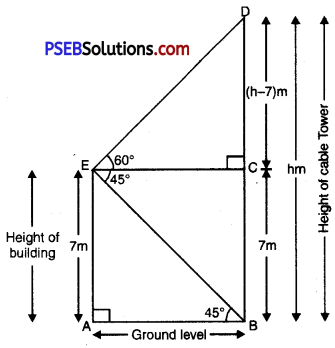
From the top of a 7m high building, the angle of elevation of the top of a cable tower is 60° and the angle of depression of its foot is 45°. Determine the height of the tower.
Solution:
Let BD = hm be the height of cable tower and AE = 7 m be the height of building. The angle of elevation of the top of a cable tower and angle of depression of its foot from top of a building are 60° and 45° respectively.
Various arrangements are as shown in figure.

PSEB 10th Class Maths Solutions Chapter 9 Some Applications of Trigonometry Ex 9.1 15

In right angled ∆ABC,

\(\frac{\mathrm{AB}}{\mathrm{AE}}\) = cot 45°

or \(\frac{\mathrm{AB}}{7}\) = 1

or AB = 7 m. ……………..(1)

Also, in right angled ∆DCE,

\(\) = cot 60°
or \(\frac{\mathrm{EC}}{h-7}=\frac{1}{\sqrt{3}}\)

or EC = \(\frac{h-7}{\sqrt{3}}\) ……………..(2)

But AB = EC ………….(Given)
7 = \(\frac{h-7}{\sqrt{3}}\) [Using (1) and (2)]
or 7√3 = h – 7
h = 7√3 + 7 = 7 (√3 + 1)
or h = 7 (1.732 + 1) = 7(2.732)
or h = 19.124
or h = 19.20 m (approx.)
Hence, height of the tower is 19.20 m.

PSEB Solutions PSEB 10th Class Maths Solutions Chapter 9 Some Applications of Trigonometry Ex 9.1

Question 13.
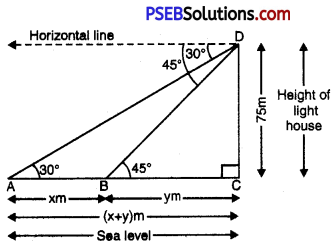
As observed from the top of a 75 m high lighthouse from the sea-level, the angles of depression of two ships are 30° and 45°. If one ship is exactly behind the other on the same side of the lighthouse, find the distance between the two ships.
Solution:

PSEB 10th Class Maths Solutions Chapter 9 Some Applications of Trigonometry Ex 9.1 16

Let CD = 75 m be the height of light house and point D be top of light house from w’here angles of depression of two ships are 30° and 45° respectively. Various arrangements are as shown in the figure.

In right angled ∆BCD,
\(\frac{\mathrm{BC}}{\mathrm{CD}}\) = cot 45°

or \(\frac{y}{75}\) = 1
or y = 75 m ……………(1)

Also, in right angled ∆ACD
\(\frac{\mathrm{AC}}{\mathrm{CD}}\) = cot 30°

or \(\frac{x+y}{75}\) = √3
or x + y = 75√3
or x + 75 = 75√3 [using (1)]
or x = 75√3 – 75
= 75 (√3 – 1)
= 75( 1.732 – 1)
= 75 (0.732)
or x = 54.90
Hence, distance between the two ships is 54.90 m.

PSEB Solutions PSEB 10th Class Maths Solutions Chapter 9 Some Applications of Trigonometry Ex 9.1

Question 14.
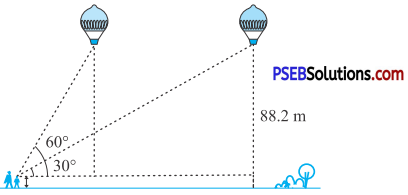
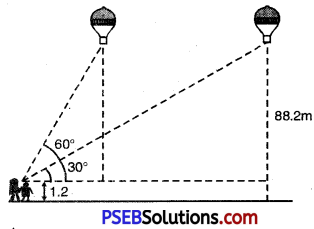
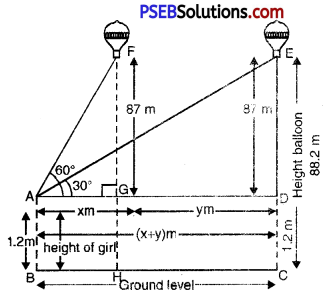
A 1.2 m tall girl spots a balloon moving with the wind in a horizontal line at a height of 88.2 m from the ground. The angle of elevation of the balloon from the eyes of the girl at any instant ¡s 60°. After some time, the angle of elevation reduces to 30° (see fig.). Find the distance travelled by the balloon during the interval.

PSEB 10th Class Maths Solutions Chapter 9 Some Applications of Trigonometry Ex 9.1 17

Solution:
Let ‘AB’ be the position of 1.2 m tall girl, at the point of the angles of elevation of balloon at
different distances are 30° and 60° respectively. Various arrangements are as shwon in th figure.
According to question,
FG = ED = CE – CD
= 88.2 m – 1.2 m
= 87 m

PSEB 10th Class Maths Solutions Chapter 9 Some Applications of Trigonometry Ex 9.1 19

PSEB 10th Class Maths Solutions Chapter 9 Some Applications of Trigonometry Ex 9.1 18

In right angled ∆AGF,
\(\frac{A G}{G F}\) = cot 60°

or \(\frac{x}{87}=\frac{1}{\sqrt{3}}\)

or x = \(\frac{87}{\sqrt{3}}\) m.

Also, in right angled ∆ADE,
\(\frac{A D}{E D}\) = cot 30°

or \(\frac{x+y}{87}\) = √3

or x + y = 87√3
or \(\frac{87}{\sqrt{3}}\) + y = 87√3
or y = 87√3 – \(\frac{87}{\sqrt{3}}\)

or y = 87√3 – \(\frac{1}{\sqrt{3}}\)

or y = 87 \(\frac{3-1}{\sqrt{3}} \times \frac{\sqrt{3}}{\sqrt{3}}\)

or y = \(\frac{87 \times 2 \times \sqrt{3}}{3}\)

or y = 58√3
or y = 58(1.732) = 100.456
or y = 100.456 m.
Hence, distance travelled by the balloon during the interval is 100.46 m.

PSEB Solutions PSEB 10th Class Maths Solutions Chapter 9 Some Applications of Trigonometry Ex 9.1

Question 15.
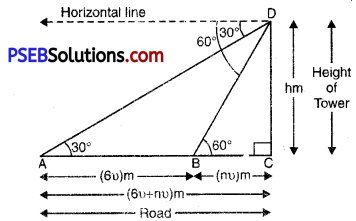
A straight highway leads to the foot of a tower. A man standing at the top of the tower observes a car at an angle of depression of 30°, which is approaching the foot of the tower with a uniform speed. Six seconds later, the angle of depression of the car is found to be 60°. Find the further t(me taken by the car to reach the foot of the tower.
Solution:
Let CD = h m. be the tower of height.
Let A be initial position of the car and after six seconds the car be at 13. The angles of depression at A and B are 30° and 60° respectively. Various arrangements are as shown in figure.

PSEB 10th Class Maths Solutions Chapter 9 Some Applications of Trigonometry Ex 9.1 20

Let speed of the car be υ metre per second using formula, Distance = Speed x Time
AB = Distance covered by car in 6 seconds
AB = 6υ metre
Also, time taken by car to reach the tower be ‘n’ seconds.
∴ BC = nυ metre
In right angled ∆ACD.
\(\frac{\mathrm{CD}}{\mathrm{AC}}\) = tan 30°

or \(\frac{h}{6 v+n v}=\frac{1}{\sqrt{3}}\)

or h = \(\frac{6 v+n v}{\sqrt{3}}\) ……………….(1)

Also, in right angled ∆BCD,
\(\frac{C D}{B C}\) = tan 60°

or \(\frac{h}{n v}\) = √3
h = nv (√3) ……….(2)

From (1) and (2), we get
\(\frac{6 v+n v}{\sqrt{3}}\) = nυ(√3)
or 6υ + nυ = nυ(√3)
or 6υ + nυ = 3nυ
or 6υ = 2nυ
or n = \(\frac{6 v}{2 v}\) = 3
Hence, time taken by car to reach the foot of tower is 3 seconds.

PSEB Solutions PSEB 10th Class Maths Solutions Chapter 9 Some Applications of Trigonometry Ex 9.1

Question 16.
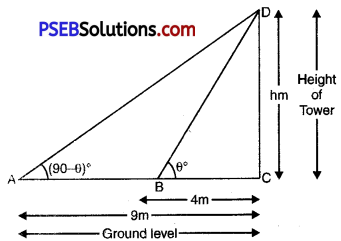
The angles of elevation of the top of a tower from two points at a distance of 4 m and 9 m from the base of the tower and in the same straight line with it are complementary. Prove that the height of the tower is 6 m.
Solution:
Let CD = h m be the height of tower and B ; A be the required points which are at a distance of 4 m and 9 m from the tower respectively. Various arrangements are as shown in the figure.

PSEB 10th Class Maths Solutions Chapter 9 Some Applications of Trigonometry Ex 9.1 21

In right angled ∆BCD
\(\frac{\mathrm{CD}}{\mathrm{BC}}\) = tan θ

or \(\frac{h}{4}\) = tan θ ………….(1)

Also, in right angled ∆ACD,
\(\frac{C D}{A C}\) = tan (90 – θ)

or \(\frac{h}{9}\) = cot θ

Multiplying (1) and (2), we get
\(\frac{h}{4} \times \frac{h}{9}\) = tan θ cot θ

or \(\frac{h^{2}}{36}=\tan \theta \times \frac{1}{\tan \theta}\)

or h2 = 36 = (6)2
or h = 6
Hence, height of the tower is 6 m.

PSEB 10th Class Maths Solutions Chapter 8 Introduction to Trigonometry Ex 8.4

Punjab State Board PSEB 10th Class Maths Book Solutions Chapter 8 Introduction to Trigonometry Ex 8.4 Textbook Exercise Questions and Answers.

PSEB Solutions for Class 10 Maths Chapter 8 Introduction to Trigonometry Ex 8.4

Question 1.
Express the trigonometric ratios of sin A, sec A and tan A in terms of cot A.
Solution:
By using Identity,
cosec2 A – cot2 A = 1
⇒ cosec2 A = 1 + cot2 A
⇒ (cosec A)2 = cot2 A + 1
⇒ \(\left(\frac{1}{\sin A}\right)^{2}\) = cot2 A + 1
⇒ (sin A)2 = \(\frac{1}{\cot ^{2} \mathrm{~A}+1}\)
⇒ sin A = ± \(\frac{1}{\sqrt{\cot ^{2} \mathrm{~A}+1}}\)
We reject negative values of sin A for acute angle A.
Therefore, sin A = \(\frac{1}{\sqrt{\cot ^{2} A+1}}\)
By using identity,
sec2 A – tan2 A = 1
⇒ sec2 A = 1 + tan2 A
= 1 + \(\frac{1}{\cot ^{2} A}\)
= \(\frac{\cot ^{2} A+1}{\cot ^{2} A}\)

⇒ sec A = \(\sqrt{\frac{\cot ^{2} A+1}{\cot ^{2} A}}\)

tan A = \(\frac{1}{\cot A}\).

PSEB Solutions PSEB 10th Class Maths Solutions Chapter 8 Introduction to Trigonometry Ex 8.4

Question 2.
Write all the other trigonometric ratios of ∠A in terms of sec A.
Solution:
By using Identity
sin2 A + cos2 A = 1
⇒ sin2 A = 1 – cos2 A
= 1 – \(\frac{1}{\sec ^{2} \cdot A}\) = \(\frac{\sec ^{2} A-1}{\sec ^{2} A}\)

⇒ (sin A)2 = \(\frac{\sec ^{2} A-1}{\sec ^{2} A}\)

⇒ sin A = ± \(\sqrt{\frac{\sec ^{2} A-1}{\sec ^{2} A}}\)

[Reject – ve sign for acute angle A]
⇒ sin A = ± \(\sqrt{\frac{\sec ^{2} A-1}{\sec ^{2} A}}\)
cos A = \(\frac{1}{\sec A}\)
1 + tan2 A = sec2 A
tan2 A = sec2 A – 1
(tan A)2 = sec2 A – 1
⇒ tan A = ± \(\sqrt{\sec ^{2} A-1}\)
[Reject – ve sign for acute angle A]
i.e., tan A = \(\sqrt{\sec ^{2} A-1}\)
cosec A = \(\frac{1}{\sin A}=\frac{1}{\sqrt{\sec ^{2} A-1}}\)

= \(\frac{\sec A}{\sqrt{\sec ^{2} A-1}}\)

cot A = \(\frac{1}{\tan A}=\frac{1}{\sqrt{\sec ^{2} A-1}}\).

Question 3.
Evaluate:
(i) \(\frac{\sin ^{2} 63^{\circ}+\sin ^{2} 27^{\circ}}{\cos ^{2} 17^{\circ}+\cos ^{2} 73^{\circ}}\)

(ii) sin 25° cos 65° + cos 25° sin 65°.
Solution:
(i) \(\frac{\sin ^{2} 63^{\circ}+\sin ^{2} 27^{\circ}}{\cos ^{2} 17^{\circ}+\cos ^{2} 73^{\circ}}\)

= \(\frac{\left\{\sin \left(90^{\circ}-27^{\circ}\right)+\sin ^{2} 27^{\circ}\right\}}{\cos ^{2} 17^{\circ}+\left\{\cos \left(90^{\circ}-17^{\circ}\right)\right\}^{2}}\)
[∵ sin(90 – θ) = cos θ and cos (90 – θ) = sin θ]

= \(\frac{\left\{\cos 27^{\circ}\right\}^{2}+\sin ^{2} 27^{\circ}}{\cos ^{2} 17^{\circ}+\left\{\sin 17^{\circ}\right\}^{2}}\)

= \(\frac{\cos ^{2} 27^{\circ}+\sin ^{2} 27^{\circ}}{\cos ^{2} 17^{\circ}+\sin ^{2} 17^{\circ}}\)
= \(\frac{1}{1}\) = 1.

PSEB Solutions PSEB 10th Class Maths Solutions Chapter 8 Introduction to Trigonometry Ex 8.4

(ii) sin 25° cos 65° + cos 25° sin 65°
= sin 25° × cos (90° – 25°)
+ cos 25° × sin (90° – 25°)
[∵ cos (90° – θ) = sin θ
sin(90° – θ) = cos θ].
= sin 25° × sin 25° + cos 25° × cos 25°
= sin2 25° + cos2 25° = 1.

Question 4.
Choose the correct option. Justify your choice:
(i) 9 sec2 A – 9 tan2 A =
(A) 1
(B) 9
(C) 8
(D) 0.

(ii) (1 + tan θ + sec θ) (1 + cot θ – cosec θ) =
(A) θ
(B) 1
(C) 2
(D) – 1.

(iii) (sec A + tan A) (1 – sin A) =
(A) sec A
(B) sin A
(C) cosec A
(D) cos A.

(iv) \(\frac{1+\tan ^{2} A}{1+\cot ^{2} A}\) =
(A) sec2A
(B) – 1
(C) cot2 A
(D) tan2 A.

Solution:
(i) Consider, 9 sec2 A – 9 tan2 A
= 9 (sec2 A – tan2 A)
= 9 × 1 = 9.
Option (B) is correct.

PSEB Solutions PSEB 10th Class Maths Solutions Chapter 8 Introduction to Trigonometry Ex 8.4

(ii) Consider, (1 + tan θ + sec θ) (1 + cot θ – cosec θ)
= \(\left\{1+\frac{\sin \theta}{\cos \theta}+\frac{1}{\cos \theta}\right\} \times\left\{1+\frac{\cos \theta}{\sin \theta}-\frac{1}{\sin \theta}\right\}\)

= \(\left\{\frac{\cos \theta+\sin \theta+1}{\cos \theta}\right\} \times\left\{\frac{\sin \theta+\cos \theta+1}{\sin \theta}\right\}\)

= \(\begin{array}{r}
\{(\cos \theta+\sin \theta)+1\} \\
\times\{(\cos \theta+\sin \theta)-1\} \\
\hline \cos \theta \times \sin \theta
\end{array}\)

= \(\frac{(\cos \theta+\sin \theta)^{2}-(1)^{2}}{\cos \theta \times \sin \theta}\)

[∵ (a + b) (a – b) = a2 – b2]

= \(\frac{\cos ^{2} \theta+\sin ^{2} \theta+2 \cos \theta \sin \theta-1}{\cos \theta \times \sin \theta}\)

= \(\frac{1+2 \cos \theta \sin \theta-1}{\cos \theta \sin \theta}\) = 2.

Option (C) is correct.

(iii) Consider, (sec A + tan A) (1 – sin A)
= \(\left(\frac{1}{\cos A}+\frac{\sin A}{\cos A}\right)\) × (1 – sin A)

= \(\frac{(1+\sin A)}{\cos A}\) × (1 – sin A)

= \(\frac{(1+\sin A)(1-\sin A)}{\cos A}\)

= \(\frac{(1)^{2}-(\sin A)^{2}}{\cos A}=\frac{1-\sin ^{2} A}{\cos A}=\frac{\cos ^{2} A}{\cos A}\)
[∵ cos2 A = 1 – sin2 A]
= cos A.
Option (D) is correct.

PSEB Solutions PSEB 10th Class Maths Solutions Chapter 8 Introduction to Trigonometry Ex 8.4

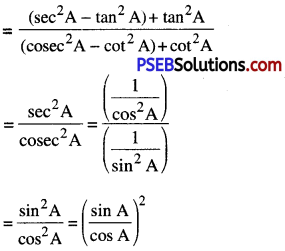
(iv) Consider, \(\frac{1+\tan ^{2} A}{1+\cot ^{2} A}\)

PSEB 10th Class Maths Solutions Chapter 8 Introduction to Trigonometry Ex 8.4 7

= tan2 A.
Option (D) is correct.

Question 5.
Prove the following Identities, where the angles involved are acute angles for which the expressions are defined.
(i) (cosec θ – cot θ) = \(\frac{1-\cos \theta}{1+\cos \theta}\)

(ii) \(\frac{\cos A}{1+\sin A}+\frac{1+\sin A}{\cos A}\) = 2 sec A.

(iii) \(\frac{\tan \theta}{1+\cot \theta}+\frac{\cot \theta}{1-\tan \theta}\) = 1 + sec θ cosec θ
[Hint : Write the expression in terms of sin θ and cos θ]

(iv) \(\frac{1+\sec A}{\sec A}=\frac{\sin ^{2} A}{1-\cos A}\)
[Hint: Simplify L.H.S. and R.H.S. separately]

(v) \(\frac{\cos A-\sin A+1}{\cos A+\sin A-1}\) using the identity cosec2 A = 1 + cot2 A.

(vi) \(\sqrt{\frac{1+\sin A}{1-\sin A}}\) = sec A + tan A

(vii) \(\frac{\sin \theta-2 \sin ^{3} \theta}{2 \cos ^{3} \theta-\cos \theta}\) = tan θ

(viii) (sin A + cosec A)2 + (cos A + sec A)2 = 7 + tan2 A + cot2 A.

(ix) (cosec A – sin A) (sec A – cos A) = \(\frac{1}{\tan A+\cot A}\)
[Hint : Simplify L.H.S. and R.H.S. separately]

(x) \(\left(\frac{1+\tan ^{2} A}{1+\cot A^{2}}\right)=\left(\frac{1-\tan A}{1-\cot A}\right)^{2}\) = tan2 A.

PSEB Solutions PSEB 10th Class Maths Solutions Chapter 8 Introduction to Trigonometry Ex 8.4

Solution:
(i) L.H.S. = (cosec θ – cot θ)2
= \(\left\{\frac{1}{\sin \theta}-\frac{\cos \theta}{\sin \theta}\right\}^{2}\)

= \(\left(\frac{1-\cos \theta}{\sin \theta}\right)^{2}=\frac{(1-\cos \theta)^{2}}{\sin ^{2} \theta}\)
Using identity, sin2 θ + cos2 θ = 1
⇒ sin2 θ = 1 – cos2 θ
= \(\frac{(1-\cos \theta)^{2}}{1-\cos ^{2} \theta}\)
= \(\)
[∵ a2 – b2 = (a + b) (a – b)]

= \(\)

∴ L.H.S. = R.H.S.
Hence, (cosec θ – cot θ)2 = \(\frac{1-\cos \theta}{1+\cos \theta}\)

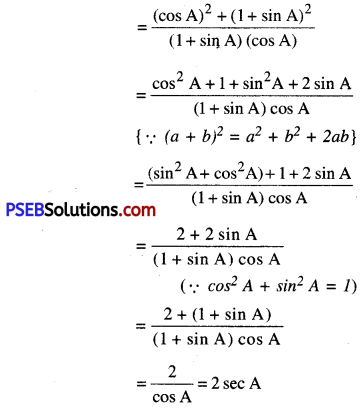
(ii) L.H.S. = \(\frac{\cos A}{1+\sin A}+\frac{1+\sin A}{\cos A}\)

PSEB 10th Class Maths Solutions Chapter 8 Introduction to Trigonometry Ex 8.4 1

= \(\frac{2}{\cos A}\) = cos A
∴L.H.S. = R.H.S.
Hence, \(\frac{\cos A}{1+\sin A}+\frac{1+\sin A}{\cos A}\) = 2 sec A.

PSEB Solutions PSEB 10th Class Maths Solutions Chapter 8 Introduction to Trigonometry Ex 8.4

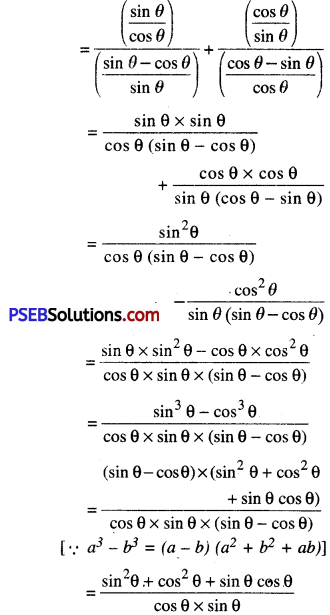
(iii) L.H.S. = \(\frac{\tan \theta}{1+\cot \theta}+\frac{\cot \theta}{1-\tan \theta}\) = 1 + sec θ cosec θ

= \(\frac{\left(\frac{\sin \theta}{\cos \theta}\right)}{\left(1-\frac{\cos \theta}{\sin \theta}\right)}+\frac{\left(\frac{\cos \theta}{\sin \theta}\right)}{\left(1-\frac{\sin \theta}{\cos \theta}\right)}\)

PSEB 10th Class Maths Solutions Chapter 8 Introduction to Trigonometry Ex 8.4 2

= \(\frac{1+\sin \theta \cos \theta}{\cos \theta \sin \theta}=\frac{1}{\cos \theta \sin \theta}+1\)

= 1 + \(\left(\frac{1}{\cos \theta}\right)\left(\frac{1}{\sin \theta}\right)\) = 1 + sec θ cosec θ
∴L.H.S. = R.H.S.
Hence, \(\frac{\tan \theta}{1+\cot \theta}+\frac{\cot \theta}{1-\tan \theta}\) = 1 + sec θ cosec θ

(iv) L.H.S. = \(\frac{1+\sec A}{\sec A}=\frac{\sin ^{2} A}{1-\cos A}\)
= \(\frac{1+\frac{1}{\cos A}}{\frac{1}{\cos A}}\)
= 1 + cos A …………….(1)
R.H.S = \(\frac{\sin ^{2} A}{1-\cos A}\)
(∵ 1 – cos2 A = sin2 A.)
= \(\frac{1-\cos ^{2} A}{1-\cos A}\)

= \(\frac{(1+\cos A)(1-\cos A)}{(1-\cos A)}\)

= 1 + cos A. …………….(2)
From (1) and (2) it is clear that
∴ L.H.S. = R.H.S.
Hence, \(\frac{1+\sec A}{\sec A}=\frac{\sin ^{2} A}{1-\cos A}\).

PSEB Solutions PSEB 10th Class Maths Solutions Chapter 8 Introduction to Trigonometry Ex 8.4

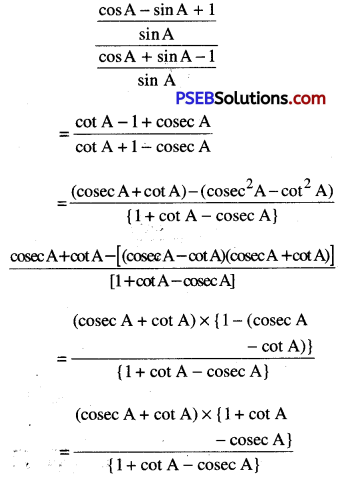
(v) L.H.S. = \(\frac{\cos A-\sin A+1}{\cos A+\sin A-1}\) using the identity cosec2 A

PSEB 10th Class Maths Solutions Chapter 8 Introduction to Trigonometry Ex 8.4 3

= cosec A + cot A
= R.H.S
∴ L.H.S. = R.H.S.
Hence, \(\frac{\cos A-\sin A+1}{\cos A+\sin A-1}\) using the identity cosec2 A = 1 + cot2 A.

(vi) L.H.S. = \(\sqrt{\frac{1+\sin A}{1-\sin A}}\)

= \(\sqrt{\frac{(1+\sin A)(1+\sin A)}{(1-\sin A)(1+\sin A)}}\)

= \(\sqrt{\frac{(1+\sin A)^{2}}{(1)^{2}-(\sin A)^{2}}}\)

= \(\sqrt{\frac{(1+\sin A)^{2}}{1-\sin ^{2} A}}=\sqrt{\frac{(1+\sin A)^{2}}{\cos ^{2} A}}\)

= \(\frac{1+\sin A}{\cos A}=\frac{1}{\cos A}+\frac{\sin A}{\cos A}\)
= sec A + tan A
∴ L.H.S. = R.H.S.
Hence, \(\sqrt{\frac{1+\sin A}{1-\sin A}}\) = sec A + tan A.

PSEB Solutions PSEB 10th Class Maths Solutions Chapter 8 Introduction to Trigonometry Ex 8.4

(vii) L.H.S. = \(\frac{\sin \theta-2 \sin ^{3} \theta}{2 \cos ^{3} \theta-\cos \theta}\)

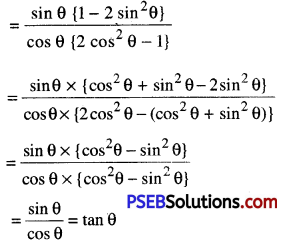
PSEB 10th Class Maths Solutions Chapter 8 Introduction to Trigonometry Ex 8.4 4

∴ L.H.S. = R.H.S.
Hence, \(\frac{\sin \theta-2 \sin ^{3} \theta}{2 \cos ^{3} \theta-\cos \theta}\) = tan θ

(viii) L.H.S. = (sin A + cosec A)2 + (cos A + sec A)2
= (sin2 A + cosec2 A + 2 sin A × cosec A) + {cos2 A + sec2 A
+ 2 cos A × sec A)
= [sin2 A + co2 A + 2sin A × \(\frac{1}{\sin A}\)] + [cos2 A + sec2 A + 2 cosA × \(\frac{1}{\cos A}\)]
= (sin2 A + cosec2 A + 2) + (cos2 A + sec2 A + 2)
= 2 + 2 + (sin2 A + cos2 A) + sec2 A + cosec2 A
= 2 + 2 + 1 + 1 + tan2 A + 1 + cot2 A
= 7 tan2 A + cot2 A
∴ L.H.S. = R.H.S.
Hence, (sin A + cosec A)2 + (cos A + sec A)2 = 7 + tan2 A + cot2 A.

PSEB Solutions PSEB 10th Class Maths Solutions Chapter 8 Introduction to Trigonometry Ex 8.4

(ix) L.H.S. = (cosec A – sin A) (sec A – cos A)

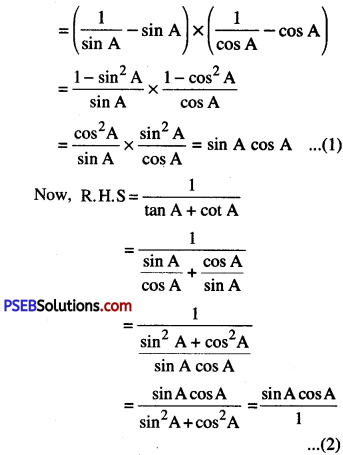
PSEB 10th Class Maths Solutions Chapter 8 Introduction to Trigonometry Ex 8.4 5

From (1) and (2), it is clear that
L.H.S. = R.H.S.
Hence, (cosec A – sin A) (sec A – cos A) = \(\frac{1}{\tan A+\cot A}\)

(x) \(\left(\frac{1+\tan ^{2} A}{1+\cot A^{2}}\right)\)
(∵ 1 + tan2 A = sec2 A
and 1 + cot2 A = cosec2 A)

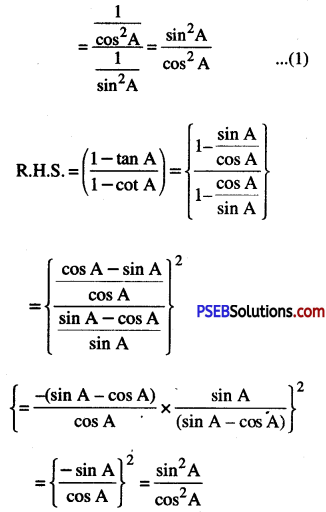
PSEB 10th Class Maths Solutions Chapter 8 Introduction to Trigonometry Ex 8.4 6

From (1) and (2), it is clear that
LH.S. = R.H.S.
Hence, \(\left(\frac{1+\tan ^{2} A}{1+\cot A^{2}}\right)=\left(\frac{1-\tan A}{1-\cot A}\right)^{2}\) = tan2 A.

PSEB Solutions PSEB 10th Class Maths Solutions Chapter 8 Introduction to Trigonometry Ex 8.4