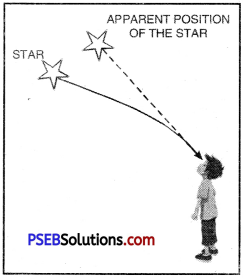
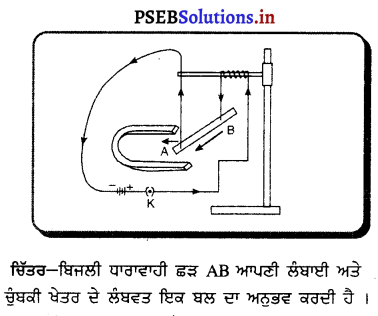
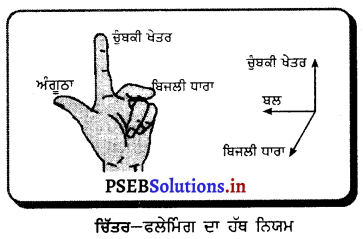
PSEB 10th Class Science Solutions Chapter 10 ਪ੍ਰਕਾਸ਼-ਪਰਾਵਰਤਨ ਅਤੇ ਅਪਵਰਤਨ

Punjab State Board PSEB 10th Class Science Book Solutions Chapter 10 ਪ੍ਰਕਾਸ਼-ਪਰਾਵਰਤਨ ਅਤੇ ਅਪਵਰਤਨ Textbook Exercise Questions and Answers.

PSEB Solutions for Class 10 Science Chapter 10 ਪ੍ਰਕਾਸ਼-ਪਰਾਵਰਤਨ ਅਤੇ ਅਪਵਰਤਨ

PSEB 10th Class Science Guide ਪ੍ਰਕਾਸ਼-ਪਰਾਵਰਤਨ ਅਤੇ ਅਪਵਰਤਨ Textbook Questions and Answers

ਪ੍ਰਸ਼ਨ 1.
ਹੇਠ ਲਿਖਿਆਂ ਵਿੱਚੋਂ ਕਿਹੜਾ ਪਦਾਰਥ ਲੈੱਨਜ਼ ਬਣਾਉਣ ਲਈ ਨਹੀਂ ਵਰਤਿਆ ਜਾ ਸਕਦਾ ?
(a) ਪਾਣੀ
(b) ਕੱਚ
(c) ਪਲਾਸਟਿਕ
d) ਮਿੱਟੀ ।
ਉੱਤਰ-
(d) ਮਿੱਟੀ ।

ਪ੍ਰਸ਼ਨ 2.
ਕਿਸੇ ਵਸਤੂ ਦਾ ਅਵਤਲ ਦਰਪਣ ਦੁਆਰਾ ਬਣਿਆ ਪ੍ਰਤਿਬਿੰਬ, ਸਿੱਧਾ ਅਤੇ ਬਿੰਬ ਤੋਂ ਵੱਡਾ ਸੀ । ਵਸਤੁ (ਬਿਬ) ਦੀ ਸਥਿਤੀ ਹੋਣੀ ਚਾਹੀਦੀ ਹੈ ?
(a) ਮੁੱਖ ਫੋਕਸ ਅਤੇ ਵਤਾ ਕੇਂਦਰ ਦੇ ਵਿਚਕਾਰ
(b) ਵਕ੍ਰਤਾ ਕੇਂਦਰ ਉੱਤੇ
(c) ਵਕਤਾ ਕੇਂਦਰ ਤੋਂ ਪਰੇ
(d) ਦਰਪਣ ਦੇ ਧਰੁਵ ਅਤੇ ਮੁੱਖ ਫੋਕਸ ਦੇ ਵਿਚਕਾਰ ।
ਉੱਤਰ-
(d) ਦਰਪਣ ਦੇ ਧਰੁਵ ਅਤੇ ਮੁੱਖ ਫੋਕਸ ਦੇ ਵਿਚਕਾਰ ।

ਪ੍ਰਸ਼ਨ 3.
ਕਿਸੇ ਵਸਤੂ ਦਾ ਵਾਸਤਵਿਕ ਅਤੇ ਸਮਾਨ ਆਕਾਰ ਪ੍ਰਤਿਬਿੰਬ ਪ੍ਰਾਪਤ ਕਰਨ ਲਈ ਵਸਤੂ ਨੂੰ ਉੱਤਲ ਲੈੱਨਜ਼ ਦੇ ਸਾਹਮਣੇ ਕਿੱਥੇ ਰੱਖਿਆ ਜਾਵੇ ?
(a) ਲੈੱਨਜ਼ ਦੇ ਮੁੱਖ ਫੋਕਸ ਉੱਤੇ
(b) ਫੋਕਸ ਦੂਰੀ ਦੀ ਦੁੱਗਣੀ ਦੂਰੀ ਉੱਤੇ
(c) ਅਨੰਤ ਉੱਤੇ
(d) ਲੈੱਨਜ਼ ਦੇ ਪ੍ਰਕਾਸ਼ ਕੇਂਦਰ ਅਤੇ ਮੁੱਖ ਫੋਕਸ ਦੇ ਵਿਚਕਾਰ ।
ਉੱਤਰ-
(b) ਫੋਕਸ ਦੂਰੀ ਦੀ ਦੁੱਗਣੀ ਦੂਰੀ ਉੱਤੇ ।

PSEB 10th Class Science Solutions Chapter 10 ਪ੍ਰਕਾਸ਼-ਪਰਾਵਰਤਨ ਅਤੇ ਅਪਵਰਤਨ

ਪ੍ਰਸ਼ਨ 4.
ਕਿਸੇ ਗੋਲਾਕਾਰ ਦਰਪਣ ਅਤੇ ਕਿਸੇ ਪਤਲੇ ਗੋਲਾਕਾਰ ਲੈੱਨਜ਼ ਦੋਵਾਂ ਦੀਆਂ ਫੋਕਸ ਦੂਰੀਆਂ – 15cm ਹਨ । ਦਰਪਣ ਅਤੇ ਲੈੱਨਜ਼ ਸੰਭਾਵਿਤ ਹਨ :
(a) ਦੋਵੇਂ ਅਵਤਲ
(b) ਦੋਵੇਂ ਉੱਤਲ
(c) ਦਰਪਣ ਅਵਤਲ ਅਤੇ ਲੈੱਨਜ਼ ਉੱਤਲ
(d) ਦਰਪਣ ਉੱਤਲ ਅਤੇ ਲੈੱਨਜ਼ ਅਵਤਲ ।
ਉੱਤਰ-
(a) ਦੋਵੇਂ ਅਵਤਲ ।

ਪ੍ਰਸ਼ਨ 5.
ਕਿਸੇ ਦਰਪਣ ਤੋਂ ਤੁਸੀਂ ਕਿੰਨੀ ਵੀ ਦੂਰੀ ਉੱਤੇ ਖੜ੍ਹੇ ਹੋਵੇ; ਤੁਹਾਡਾ ਪ੍ਰਤਿਬਿੰਬ ਹਮੇਸ਼ਾ ਹੀ ਸਿੱਧਾ ਪ੍ਰਤੀਤ ਹੁੰਦਾ ਹੈ ਸੰਭਵ ਤੌਰ ਤੇ ਦਰਪਣ ਹੈ :
(a) ਕੇਵਲ ਸਮਤਲ
(b) ਕੇਵਲ ਅਵਤਲ
(c) ਕੇਵਲ ਉੱਤਲ
(d) ਜਾਂ ਤਾਂ ਸਮਤਲ ਜਾਂ ਉੱਤਲ ।
ਉੱਤਰ-
(d) ਜਾਂ ਤਾਂ ਸਮਤਲ ਅਤੇ ਜਾਂ ਉੱਤਲ ।

ਪ੍ਰਸ਼ਨ 6.
ਕਿਸੇ ਸ਼ਬਦਕੋਸ਼ (dictionary) ਵਿੱਚ ਛੋਟੇ ਅੱਖਰਾਂ ਨੂੰ ਪੜ੍ਹਨ ਸਮੇਂ ਤੁਸੀਂ ਹੇਠ ਦਿੱਤੀਆਂ ਵਿੱਚੋਂ ਕਿਹੜੇ ਲੈੱਨਜ਼ ਨੂੰ ਪਹਿਲ ਦਿਓਗੇ ?
(a) 5 cm ਫੋਕਸ ਦੂਰੀ ਦਾ ਇੱਕ ਉੱਤਲ ਲੈੱਨਜ਼
(b) 50 cm ਫੋਕਸ ਦੁਰੀ ਦਾ ਇੱਕ ਅਵਤਲ ਲੈੱਨਜ਼
(c) 5 cm ਫੋਕਸ ਦੂਰੀ ਦਾ ਇੱਕ ਉੱਤਲ ਲੈੱਨਜ਼
(4) 5 cm ਫੋਕਸ ਦੂਰੀ ਦਾ ਇੱਕ ਅਵਤਲ ਲੈੱਨਜ਼ ।
ਉੱਤਰ-
(a) 50 cm ਫੋਕਸ ਦੂਰੀ ਦਾ ਇੱਕ ਉੱਤਲ ਲੈੱਨਜ਼ ।

ਪ੍ਰਸ਼ਨ 7.
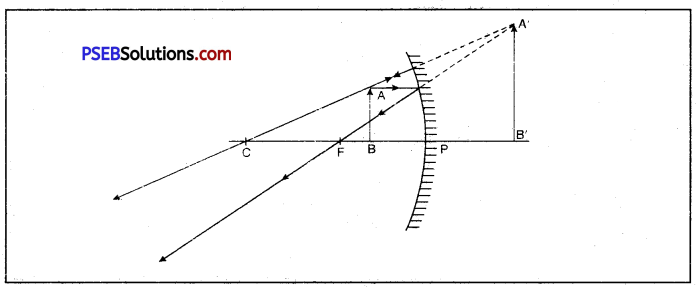
15cm ਫੋਕਸ ਦੂਰੀ ਦੇ ਇੱਕ ਅਵਤਲ ਦਰਪਣ ਦਾ ਉਪਯੋਗ ਕਰਕੇ ਅਸੀਂ ਕਿਸੇ ਵਸਤੂ ਦਾ ਸਿੱਧਾ ਪ੍ਰਤਿਬਿੰਬ ਬਨਾਉਣਾ ਚਾਹੁੰਦੇ ਹਾਂ । ਵਸਤੂ ਦੇ ਦਰਪਣ ਦੀ ਦੂਰੀ ਦਾ ਰੇਂਜ (range) ਕੀ ਹੋਣਾ ਚਾਹੀਦਾ ਹੈ ? ਪ੍ਰਤਿਬਿੰਬ ਦੀ ਪ੍ਰਕਿਰਤੀ ਕਿਹੋ ਜਿਹੀ ਹੈ ? ਪ੍ਰਤਿਬਿੰਬ, ਵਸਤੂ ਤੋਂ ਵੱਡਾ ਹੈ ਜਾਂ ਛੋਟਾ ? ਇਸ ਸਥਿਤੀ ਵਿੱਚ ਪ੍ਰਤਿਬਿੰਬ ਬਣਨ ਦਾ ਕਿਰਨ ਰੇਖਾ ਚਿੱਤਰ ਬਣਾਓ ।
ਉੱਤਰ-
ਅਵਤਲ ਦਰਪਣ ਦੁਆਰਾ ਸਿੱਧਾ ਪ੍ਰਤਿਬਿੰਬ ਪ੍ਰਾਪਤ ਕਰਨ ਲਈ ਵਸਤੂ ਨੂੰ ਅਵਤਲ ਦਰਪਣ ਦੇ ਧਰੁਵ ਅਤੇ ਫੋਕਸ ਦੇ ਵਿੱਚ ਰੱਖਣਾ ਚਾਹੀਦਾ ਹੈ । ਇਸ ਲਈ ਵਸਤੂ ਦੀ ਧਰੁਵ ਤੋਂ ਦੂਰੀ 6 cm ਤੋਂ ਵੱਧ ਅਤੇ 15 cm ਤੋਂ ਘੱਟ ਹੋਣੀ ਚਾਹੀਦੀ ਹੈ | ਅਜਿਹਾ ਕਰਨ ਨਾਲ ਵਸਤੂ ਦਾ ਪ੍ਰਤਿਬਿੰਬ ਆਭਾਸੀ, ਸਿੱਧਾ ਅਤੇ ਆਕਾਰ ਵਿੱਚ ਵਸਤੂ ਤੋਂ ਵੱਡਾ ਹੋਵੇਗਾ ।
PSEB 10th Class Science Solutions Chapter 10 ਪ੍ਰਕਾਸ਼-ਪਰਾਵਰਤਨ ਅਤੇ ਅਪਵਰਤਨ 1

ਪ੍ਰਸ਼ਨ 8.
ਨਿਮਨ ਸਥਿਤੀਆਂ ਵਿੱਚ ਵਰਤੇ ਗਏ ਦਰਪਣ ਦੀ ਕਿਸਮ ਦੱਸੋ ।
(a) ਕਿਸੇ ਕਾਰ ਦੀ ਹੈੱਡ ਲਾਈਟ
(b) ਕਿਸੇ ਵਾਹਨ ਦਾ ਪਾਸਾ/ਪਿੱਛੇ-ਦਰਸ਼ੀ ਦਰਪਣ
(c) ਸੋਲਰ ਭੱਠੀ
ਆਪਣੇ ਉੱਤਰ ਦੀ ਕਾਰਨ ਸਹਿਤ ਪੁਸ਼ਟੀ ਕਰੋ ।
ਉੱਤਰ-
(a) ਕਾਰ ਦੀ ਹੈੱਡ ਲਾਈਟ ਵਿੱਚ ਅਵਤਲ ਦਰਪਣ ਦੀ ਵਰਤੋਂ ਕੀਤੀ ਜਾਂਦੀ ਹੈ । ਬਲਬ ਨੂੰ ਅਵਤਲ ਦਰਪਣ ਦੇ ਮੁੱਖ ਫੋਕਸ ਤੇ ਰੱਖਿਆ ਜਾਂਦਾ ਹੈ । ਬਲਬ ਤੋਂ ਨਿਕਲਣ ਵਾਲੀਆਂ ਪ੍ਰਕਾਸ਼ ਕਿਰਣਾਂ ਦਰਪਣ ਤੋਂ ਪਰਾਵਰਤਨ ਹੋਣ ਮਗਰੋਂ ਸਮਾਂਤਰ ਹੋ ਜਾਂਦੀਆਂ ਹਨ । ਇਸ ਤੋਂ ਇੱਕ ਸ਼ਕਤੀਸ਼ਾਲੀ ਸਮਾਨੰਤਰ ਪ੍ਰਕਾਸ਼ ਕਿਰਣ ਪੰਜ ਪ੍ਰਾਪਤ ਹੁੰਦਾ ਹੈ ।

(b) ਵਾਹਨਾਂ ਵਿੱਚ ਪਾਸਾ (ਸਾਈਡ) ਦਰਪਣ ਦੇ ਰੂਪ ਵਿੱਚ ਉੱਤਲ ਦਰਪਣ ਨੂੰ ਪਹਿਲ ਦਿੱਤੀ ਜਾਂਦੀ ਹੈ, ਕਿਉਂਕਿ ਉੱਤਲ ਦਰਪਣ ਹਮੇਸ਼ਾ ਵਸਤੂ ਦਾ ਸਿੱਧਾ ਅਤੇ ਵਸਤੂ ਦੀ ਤੁਲਨਾ ਵਿੱਚ ਛੋਟੇ ਸਾਇਜ਼ ਦਾ ਪ੍ਰਤਿਬਿੰਬ ਬਣਾਉਂਦਾ ਹੈ ਜਿਸ ਕਾਰਨ ਇਸ ਦਾ ਦ੍ਰਿਸ਼ਟੀ-ਖੇਤਰ ਵੱਧ ਜਾਂਦਾ ਹੈ । ਅਜਿਹਾ ਕਰਨ ਨਾਲ ਵਾਹਨ-ਚਾਲਕ (driver) ਛੋਟੇ ਜਿਹੇ ਦਰਪਣ ਵਿੱਚ ਹੀ ਸਾਰਾ ਖੇਤਰ , ਵੇਖ ਪਾਉਂਦਾ ਹੈ ।

(c) ਸੂਰਜੀ ਭੱਠੀ (Solar furnace) ਵਿੱਚ ਅਵਤਲ ਦਰਪਣ ਦੀ ਵਰਤੋਂ ਕੀਤੀ ਜਾਂਦੀ ਹੈ । ਗਰਮ ਕੀਤੇ ਜਾਣ ਵਾਲੇ ਬਰਤਨ ਨੂੰ ਦਰਪਣ ਦੇ ਮੁੱਖ-ਫੋਕਸ ਤੇ ਰੱਖਿਆ ਜਾਂਦਾ ਹੈ । ਸੂਰਜ ਤੋਂ ਆ ਰਹੀਆਂ ਸਮਾਨੰਤਰ ਕਿਰਨਾਂ ਦਰਪਣ ਤੋਂ ਪਰਾਵਰਤਨ ਹੋਣ ਤੋਂ ਬਾਅਦ ਫੋਕਸ ਤੇ ਰੱਖੇ ਬਰਤਨ ਤੇ ਸਾਰੀ ਤਾਪ ਊਰਜਾ ਨੂੰ ਕੇਂਦ੍ਰਿਤ ਕਰ ਦਿੰਦੀਆਂ ਹਨ ।

PSEB 10th Class Science Solutions Chapter 10 ਪ੍ਰਕਾਸ਼-ਪਰਾਵਰਤਨ ਅਤੇ ਅਪਵਰਤਨ

ਪ੍ਰਸ਼ਨ 9.
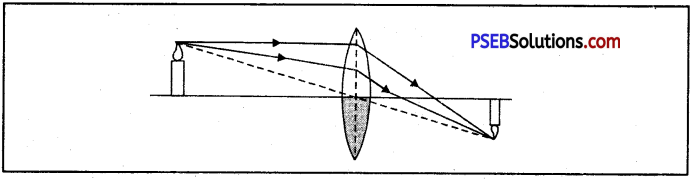
ਕਿਸੇ ਉੱਤਲ ਲੈੱਨਜ਼ ਦਾ ਅੱਧਾ ਭਾਗ ਕਾਲੇ ਕਾਗ਼ਜ਼ ਨਾਲ ਢੱਕ ਦਿੱਤਾ ਗਿਆ ਹੈ । ਕੀ ਇਹ ਲੈੱਨਜ਼ ਕਿਸੇ ਵਸਤੂ ਦਾ ਪੂਰਾ ਪ੍ਰਤਿਬਿੰਬ ਬਣਾ ਲਏਗਾ ? ਆਪਣੇ ਉੱਤਰ ਦੀ ਪ੍ਰਯੋਗ ਦੁਆਰਾ ਜਾਂਚ ਕਰੋ । ਆਪਣੇ ਪ੍ਰੇਖਣਾਂ ਦੀ ਵਿਆਖਿਆ ਕਰੋ ।
ਉੱਤਰ-
ਹਾਂ, ਇਹ ਲੈਂਨਜ਼ ਵਸਤੂ ਦਾ ਪੂਰਾ ਪ੍ਰਤਿਬਿੰਬ ਬਣਾਏਗਾ ।
PSEB 10th Class Science Solutions Chapter 10 ਪ੍ਰਕਾਸ਼-ਪਰਾਵਰਤਨ ਅਤੇ ਅਪਵਰਤਨ 2
ਪ੍ਰਯੋਗਿਕ ਪੜਤਾਲ-
ਵਿਧੀ-

  • ਇੱਕ ਪ੍ਰਕਾਸ਼ੀ ਬੈਂਚ (Optical bench) ਉੱਪਰ ਇੱਕ ਸਟੈਂਡ ਵਿੱਚ ਉੱਤਲ ਲੈਂਜ਼ ਲਗਾਓ ।
  • ਇੱਕ ਸਟੈਂਡ ਵਿੱਚ ਜਲਦੀ ਹੋਈ ਮੋਮਬੱਤੀ ਲਗਾ ਕੇ ਲੈੱਨਜ਼ ਦੀ ਫੋਕਸ ਦੂਰੀ ਤੋਂ ਥੋੜ੍ਹੀ ਜ਼ਿਆਦਾ ਦੂਰੀ ਤੇ ਪ੍ਰਕਾਸ਼ੀ ਬੈਂਚ ਤੇ ਰੱਖੋ ।
  • ਹੁਣ ਲੈਂਨਜ਼ ਦੇ ਦੂਜੇ ਪਾਸੇ ਪਕਾਸ਼ੀ ਬੈਂਚ ਤੇ ਸਟੈਂਡ ਵਿੱਚ ਪਰਦਾ (Screen) ਲਗਾ ਕੇ ਉਸਨੂੰ ਅੱਗੇ-ਪਿੱਛੇ ਲਿਜਾਓ ਅਤੇ ਅਜਿਹੀ ਥਾਂ ‘ਤੇ ਰੱਖੋ ਕਿ ਉਸ ਉੱਪਰ ਮੋਮਬੱਤੀ ਦਾ ਤਿੱਖਾ ਪ੍ਰਤਿਬਿੰਬ ਬਣ ਜਾਵੇ ।
  • ਹੁਣ ਲੈਂਨਜ਼ ਦੇ ਹੇਠਲੇ ਅੱਧੇ ਭਾਗ ਤੇ ਕਾਲਾ ਕਾਗ਼ਜ਼ ਚਿਪਕਾ ਕੇ ਢੱਕ ਦਿਓ ਤਾਂ ਜੋ ਲੈਨਜ਼ ਦੇ ਉੱਪਰਲੇ ਅੱਧੇ ਭਾਗ ਤੋਂ ਪ੍ਰਕਾਸ਼ ਦਾ ਅਪਵਰਤਨ ਹੋਣ ਕਾਰਨ ਪ੍ਰਤਿਬਿੰਬ ਬਣੇ । ਇਸ ਹਾਲਤ ਵਿੱਚ ਤੁਸੀਂ ਵੇਖੋਗੇ ਕਿ ਮੋਮਬੱਤੀ ਦਾ ਪਹਿਲਾਂ ਵਰਗਾ ਪੁਰਾ ਤਿਬਿੰਬ ਪ੍ਰਾਪਤ ਹੋਵੇਗਾ, ਪਰੰਤੁ ਇਸ ਦੀ ਤੀਬ੍ਰਤਾ ਪਹਿਲੇ ਪ੍ਰਤਿਬਿੰਬ ਦੀ ਤੁਲਨਾ ਵਿੱਚ ਘੱਟ ਹੋ ਜਾਂਦੀ ਹੈ ।

ਵਿਆਖਿਆ – ਮੋਮਬੱਤੀ ਦੇ ਕਿਸੇ ਬਿੰਦੂ ਤੋਂ ਚਲਣ ਵਾਲੀਆਂ ਪ੍ਰਕਾਸ਼ ਕਿਰਨਾਂ ਲੈੱਨਜ਼ ਦੇ ਵੱਖ-ਵੱਖ ਭਾਗਾਂ ਤੋਂ ਅਪਵਰਤਿਤ ਹੋ ਕੇ ਇੱਕ ਬਿੰਦੂ ਤੇ ਮਿਲਣਗੀਆਂ । ਲੈੱਨਜ਼ ਦੇ ਹੇਠਲੇ ਅੱਧੇ ਭਾਗ ਨੂੰ ਕਾਲਾ ਕਰਨ ‘ਤੇ ਵੀ ਉਸ ਬਿੰਦੂ ਤੇ ਪ੍ਰਕਾਸ਼ ਕਿਰਨਾਂ ਆਉਣਗੀਆਂ । ਜਿਸ ਕਰਕੇ ਮੋਮਬੱਤੀ ਦਾ ਪੂਰਾ ਪ੍ਰਤਿਬਿੰਬ ਪ੍ਰਾਪਤ ਹੋਵੇਗਾ, ਪਰੰਤੂ ਕਿਰਨਾਂ ਦੀ ਸੰਖਿਆ ਘੱਟ ਹੋਣ ਕਾਰਨ ਪ੍ਰਤਿਬਿੰਬ ਦੀ ਤੀਬ੍ਰਤਾ (ਤਿੱਖਾਪਣ ਹੋ ਜਾਵੇਗੀ ।

ਪ੍ਰਸ਼ਨ 10.
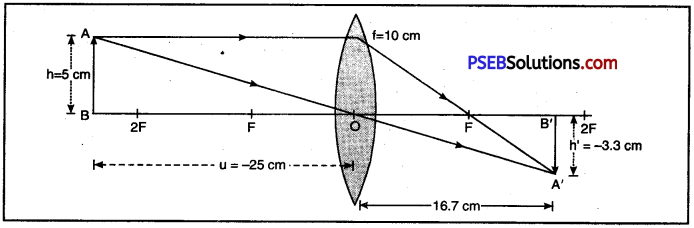
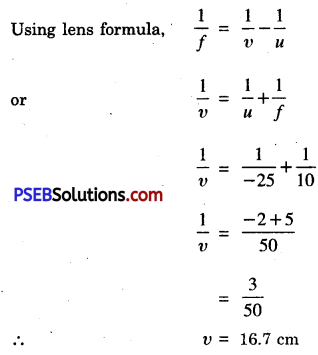
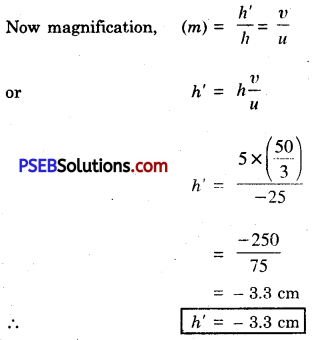
5cm ਲੰਬੀ ਵਸਤੂ 10cm ਫੋਕਸ ਦੂਰੀ ਦੇ ਕਿਸੇ ਅਭਿਸਾਰੀ ਲੈੱਨਜ਼ ਤੋਂ 25cm ਦੂਰੀ ਉੱਤੇ ਰੱਖਿਆ ਗਿਆ ਹੈ । ਪ੍ਰਕਾਸ਼ ਕਿਰਨ ਰੇਖਾ ਚਿੱਤਰ ਖਿੱਚ ਕੇ ਬਣਨ ਵਾਲੇ ਪ੍ਰਤਿਬਿੰਬ ਦੀ ਸਥਿਤੀ, ਸਾਈਜ਼ ਅਤੇ ਪ੍ਰਕਿਰਤੀ ਗਿਆਤ ਕਰੋ ।
ਹੱਲ :
ਇੱਥੇ ਵਸਤੂ ਦੀ ਅਭਿਸਾਰੀ ਲੈਂਨਜ਼ ਤੋਂ ਦੂਰੀ (u) = – 25cm
ਅਭਿਸਾਰੀ ਲੈੱਨਜ਼ ਦੀ ਫੋਕਸ ਦੂਰੀ (f) = + 10cm
ਬਿੰਬ (ਵਸਤੂ ਦੀ ਲੰਬਾਈ (ਉੱਚਾਈ) (O) = + 5cm
ਪ੍ਰਤਿਬਿੰਬ ਦਾ ਸਾਈਜ਼ (I) = ?
PSEB 10th Class Science Solutions Chapter 10 ਪ੍ਰਕਾਸ਼-ਪਰਾਵਰਤਨ ਅਤੇ ਅਪਵਰਤਨ 3
PSEB 10th Class Science Solutions Chapter 10 ਪ੍ਰਕਾਸ਼-ਪਰਾਵਰਤਨ ਅਤੇ ਅਪਵਰਤਨ 4
PSEB 10th Class Science Solutions Chapter 10 ਪ੍ਰਕਾਸ਼-ਪਰਾਵਰਤਨ ਅਤੇ ਅਪਵਰਤਨ 5
ਅਰਥਾਤ ਪ੍ਰਤਿਬਿੰਬ ਦਾ ਸਾਇਜ਼ = \(\frac {10}{3}\) cm ਹੋਵੇਗੀ । ਰਿਣ ਚਿੰਨ੍ਹ ਦਰਸਾਉਂਦਾ ਹੈ ਕਿ ਪ੍ਰਤਿਬਿੰਬ ਮੁੱਖ-ਧੁਰੇ ਦੇ ਹੇਠਾਂ ਵੱਲ ਹੋਵੇਗਾ ਜਿਹੜਾ ਕਿ ਵਾਸਤਵਿਕ ਅਤੇ ਉਲਟਾ ਹੋਵੇਗਾ ।

ਪ੍ਰਸ਼ਨ 11.
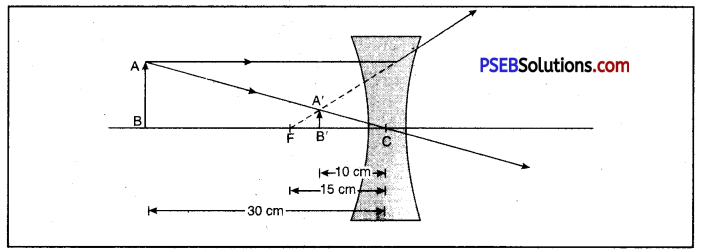
15cm ਫੋਕਸ ਦੂਰੀ ਦਾ ਕੋਈ ਅਵਤਲ ਲੈੱਨਜ਼ ਕਿਸੇ ਵਸਤੂ ਦਾ ਪ੍ਰਤਿਬਿੰਬ ਲੈਂਨਜ਼ ਤੋਂ 10cm ਦੂਰੀ ਉੱਤੇ ਬਣਾਉਂਦਾ ਹੈ । ਵਸਤੂ ਲੈੱਨਜ਼ ਤੋਂ ਕਿੰਨੀ ਦੂਰੀ ਉੱਤੇ ਸਥਿਤ ਹੈ ? ਕਿਰਨ ਰੇਖਾ ਚਿੱਤਰ ਬਣਾਓ ।
ਹੱਲ :
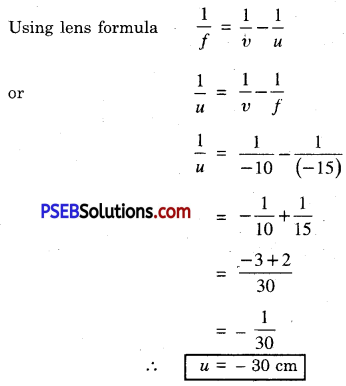
ਦਿੱਤਾ ਗਿਆ ਹੈ, ਅਵਤਲ ਲੈੱਨਜ਼ ਦੀ ਫੋਕਸ ਦੁਰੀ (f) = -15 cm ਕਿਉਂਕਿ ਅਵਤਲ ਲੈੱਨਜ਼ ਦੁਆਰਾ ਬਣਿਆ ਪ੍ਰਤਿਬਿੰਬ ਹਮੇਸ਼ਾ ਆਭਾਸੀ ਹੁੰਦਾ ਹੈ ਅਤੇ ਲੈੱਨਜ਼ ਦੇ ਸਾਹਮਣੇ ਉਸੇ ਪਾਸੇ ਬਣਦਾ ਹੈ ਜਿਸ ਪਾਸੇ ਵਸਤੂ ਹੁੰਦੀ ਹੈ ।
υ = -10 cm
ਹੁਣ ਲੈਂਨਜ਼ ਸੂਤਰ ਤੋਂ \(\frac{1}{v}-\frac{1}{u}\) = \(\frac{1}{f}\)
PSEB 10th Class Science Solutions Chapter 10 ਪ੍ਰਕਾਸ਼-ਪਰਾਵਰਤਨ ਅਤੇ ਅਪਵਰਤਨ 6
PSEB 10th Class Science Solutions Chapter 10 ਪ੍ਰਕਾਸ਼-ਪਰਾਵਰਤਨ ਅਤੇ ਅਪਵਰਤਨ 7
∴ u = -30 cm
ਅਰਥਾਤ ਵਸਤੂ ਲੈੱਨਜ਼ ਦੇ ਸਾਹਮਣੇ 30 cm ਦੀ ਦੂਰੀ ਤੇ ਹੈ ।

PSEB 10th Class Science Solutions Chapter 10 ਪ੍ਰਕਾਸ਼-ਪਰਾਵਰਤਨ ਅਤੇ ਅਪਵਰਤਨ

ਪ੍ਰਸ਼ਨ 12.
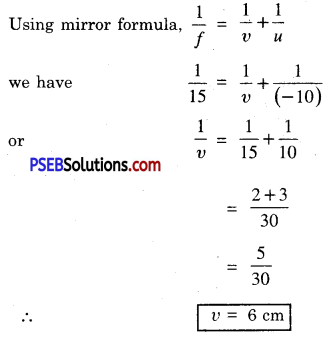
15cm ਫੋਕਸ ਦੂਰੀ ਦੇ ਕਿਸੇ ਉੱਤਲ ਦਰਪਣ ਤੋਂ ਕੋਈ ਵਸਤੂ 10cm ਦੂਰੀ ਉੱਤੇ ਰੱਖਿਆ ਗਿਆ ਹੈ । ਪ੍ਰਤਿਬਿੰਬ ਦੀ ਸਥਿਤੀ ਅਤੇ ਪ੍ਰਕਿਰਤੀ ਗਿਆਤ ਕਰੋ ।
ਹੱਲ :
ਦਿੱਤਾ ਹੈ : ਉੱਤਲ ਦਰਪਣ ਦੀ ਫੋਕਸ ਦੂਰੀ (f) = + 15 cm
ਵਸਤੂ ਦੀ ਦਰਪਣ ਤੋਂ ਦੂਰੀ (u) = – 10cm
PSEB 10th Class Science Solutions Chapter 10 ਪ੍ਰਕਾਸ਼-ਪਰਾਵਰਤਨ ਅਤੇ ਅਪਵਰਤਨ 8
∴ υ = + 6cm
ਧਨ ਚਿੰਨ੍ਹ ਇਹ ਦਰਸਾਉਂਦਾ ਹੈ ਕਿ ਤਿਬਿੰਬ ਦਰਪਣ ਦੇ ਪਿੱਛੇ 6cm ਦੀ ਦੂਰੀ ਤੇ ਬਣੇਗਾ ।
ਧਨ ਚਿੰਨ੍ਹ ਇਹ ਵੀ ਦਰਸਾਉਂਦਾ ਹੈ ਕਿ ਪ੍ਰਤਿਬਿੰਬ ਸਿੱਧਾ ਅਤੇ ਆਭਾਸੀ ਹੈ ।

ਪ੍ਰਸ਼ਨ 13.
ਇੱਕ ਸਮਤਲ ਦਰਪਣ ਦੁਆਰਾ ਪੈਦਾ ਹੋਇਆ ਵੱਡਦਰਸ਼ਨ +1 ਹੈ । ਇਸਦਾ ਕੀ ਅਰਥ ਹੈ ?
ਉੱਤਰ-
ਇੱਕ ਸਮਤਲ ਦੁਆਰਾ ਉਤਪੰਨ ਹੋਇਆ ਵੱਡਦਰਸ਼ਨ m = +1 ਇਹ ਦਰਸਾਉਂਦਾ ਹੈ ਕਿ ਦਰਪਣ ਦੁਆਰਾ ਬਣਾਏ ਗਏ ਪ੍ਰਤਿਬਿੰਬ ਦਾ ਆਕਾਰ ਵਸਤੂ ਦੇ ਆਕਾਰ (Size) ਦੇ ਬਰਾਬਰ ਹੈ ਅਤੇ ਧਨਾਤਮਕ ਚਿੰਨ੍ਹ (+) ਇਹ ਦਰਸਾਉਂਦਾ ਹੈ ਕਿ ਸਮਤਲ ਦਰਪਣ ਦੁਆਰਾ ਬਣਾਇਆ ਗਿਆ ਪ੍ਰਤਿਬਿੰਬ ਦਰਪਣ ਦੇ ਪਿੱਛੇ ਬਣ ਰਿਹਾ ਹੈ ਅਤੇ ਇਹ ਆਭਾਸੀ ਅਤੇ ਸਿੱਧਾ ਹੈ ।

ਪ੍ਰਸ਼ਨ 14.
5.0 cm ਲੰਬਾਈ ਦੀ ਕੋਈ ਵਸਤੂ 30cm ਵਰ੍ਹਾ ਅਰਧ-ਵਿਆਸ ਦੇ ਕਿਸੇ ਉੱਤਲ ਦਰਪਣ ਦੇ ਸਾਹਮਣੇ 20cm ਦੂਰੀ ਉੱਤੇ ਰੱਖੀ ਗਈ ਹੈ । ਪ੍ਰਤਿਬਿੰਬ ਦੀ ਸਥਿਤੀ ਅਤੇ ਆਕਾਰ ਗਿਆਤ ਕਰੋ ।
ਹੱਲ :
ਦਿੱਤਾ ਹੈ : ਵਸਤੂ ਦੀ ਉੱਤਲ ਦਰਪਣ ਤੋਂ ਦੂਰੀ (u) = – 20 cm
ਉੱਤਲ ਦਰਪਣ ਦਾ ਵਕਤਾ ਅਰਧ-ਵਿਆਸ (R) = + 30 cm
∴ ਉੱਤਲ ਦਰਪਣ ਦੀ ਫੋਕਸ ਦੂਰੀ (f) = \(\frac{R}{2}\)
= \(\frac{+30}{2}\) cm
= + 15cm
ਵਸਤੂ ਦੀ ਲੰਬਾਈ (O) = + 5.0 cm
ਦਰਪਣ ਸੂਤਰ \(\frac{1}{u}+\frac{1}{v}=\frac{1}{f}\) ਤੋਂ
PSEB 10th Class Science Solutions Chapter 10 ਪ੍ਰਕਾਸ਼-ਪਰਾਵਰਤਨ ਅਤੇ ਅਪਵਰਤਨ 9
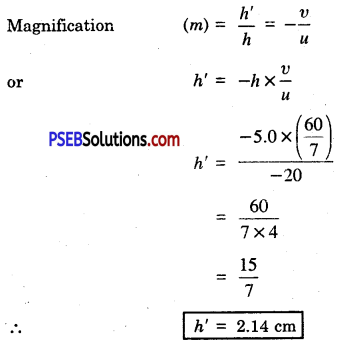
ਇਸ ਲਈ ਪ੍ਰਤਿਬਿੰਬ ਦੀ ਦਰਪਣ ਤੋਂ ਦੂਰੀ (0) = + \(\frac{60}{7}\) cm ਅਰਥਾਤ ਧਨਾਤਮਕ ਚਿੰਨ੍ਹ ਇਹ ਦਰਸਾਉਂਦਾ ਹੈ ਕਿ ਪ੍ਰਤਿਬਿੰਬ ਦਰਪਣ ਦੇ ਦੂਜੇ ਪਾਸੇ \(\frac{60}{7}\) cm ਦੀ ਦੂਰੀ ‘ਤੇ ਬਣੇਗਾ ।
ਜੇਕਰ ਤਿਬਿੰਬ ਦੀ ਉੱਚਾਈ ਆਕਾਰ ‘I’ ਹੈ, ਤਾਂ ਵੱਡਦਰਸ਼ਨ ਸੂਤਰ ਦੁਆਰਾ m = \(-\frac{v}{u}=\frac{\mathrm{I}}{\mathrm{O}}\) ਤੋਂ
PSEB 10th Class Science Solutions Chapter 10 ਪ੍ਰਕਾਸ਼-ਪਰਾਵਰਤਨ ਅਤੇ ਅਪਵਰਤਨ 10
ਧਨਾਤਮਕ ਚਿੰਨ੍ਹ (+) ਇਹ ਸਪੱਸ਼ਟ ਕਰਦਾ ਹੈ ਕਿ ਪ੍ਰਤਿਬਿੰਬ ਸਿੱਧਾ ਅਤੇ ਆਭਾਸੀ ਹੋਵੇਗਾ ਅਤੇ ਦਰਪਣ ਦੇ ਪਿੱਛੇ \(\frac{15}{7}\) cm ਦੀ ਦੂਰੀ ਤੇ ਬਣੇਗਾ ।

ਪ੍ਰਸ਼ਨ 15.
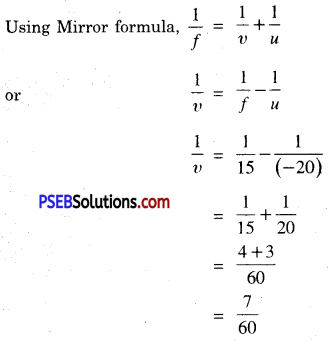
7.0cm ਸਾਈਜ਼ ਦੀ ਕੋਈ ਵਸਤੂ 18 cm ਫੋਕਸ ਦੂਰੀ ਦੇ ਕਿਸੇ ਅਵਤਲ ਦਰਪਣ ਦੇ ਸਾਹਮਣੇ 27cm ਦੂਰੀ ਉੱਤੇ ਰੱਖਿਆ ਗਿਆ ਹੈ । ਦਰਪਣ ਤੋਂ ਕਿੰਨੀ ਦੂਰੀ ਤੇ ਕਿਸੇ ਪਰਦੇ ਨੂੰ ਰੱਖੀਏ ਕਿ ਉਸ ਉੱਤੇ ਵਸਤੂ ਦਾ ਸਪਸ਼ਟ ਫੋਕਸ ਕੀਤਾ ਪ੍ਰਤਿਬਿੰਬ ਪ੍ਰਾਪਤ ਕੀਤਾ ਜਾ ਸਕੇ । ਪ੍ਰਤਿਬਿੰਬ ਦਾ ਆਕਾਰ ਅਤੇ ਕਿਰਤੀ ਗਿਆਤ ਕਰੋ ।
ਹੱਲ :
ਦਿੱਤਾ ਹੈ : ਵਸਤੂ ਦਾ ਆਕਾਰ (ਸਾਈਜ਼) (O) = + 7.0 cm
ਅਵਤਲ ਦਰਪਣ ਦੀ ਫੋਕਸ ਦੂਰੀ (f) = -18cm
ਵਸਤੂ ਦੀ ਦਰਪਣ ਤੋਂ ਦੂਰੀ (u) = -27cm
ਪ੍ਰਤਿਬਿੰਬ ਦੀ ਦਰਪਣ ਤੋਂ ਦੂਰੀ (υ) = ?
ਪ੍ਰਤਿਬਿੰਬ ਦਾ ਆਕਾਰ (I) = ?
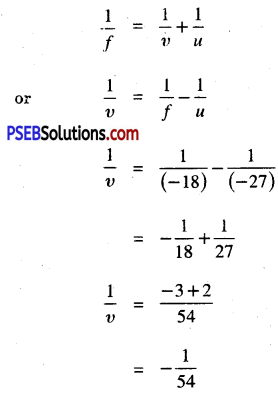
ਦਰਪਣ ਸੂਤਰ \(\frac{1}{u}+\frac{1}{v}=\frac{1}{f}\) ਤੋਂ
PSEB 10th Class Science Solutions Chapter 10 ਪ੍ਰਕਾਸ਼-ਪਰਾਵਰਤਨ ਅਤੇ ਅਪਵਰਤਨ 11
∴ υ = – 54 cm

ਰਿਣਾਤਮਕ ਚਿੰਨ੍ਹ (-) ਇਹ ਦਰਸਾਉਂਦਾ ਹੈ ਕਿ ਤਿਬਿੰਬ ਦਰਪਣ ਦੇ ਸਾਹਮਣੇ 54cm ਦੀ ਦੂਰੀ ‘ਤੇ ਬਣੇਗਾ । ਇਸ ਲਈ ਪਰਦੇ (Screen) ਨੂੰ ਦਰਪਣ ਦੇ ਸਾਹਮਣੇ 54cm ਦੀ ਦੂਰੀ ਤੇ ਰੱਖਣਾ ਚਾਹੀਦਾ ਹੈ ।
ਹੁਣ ਦਰਪਣ ਦੇ ਵੱਡਦਰਸ਼ਨ ਸੂਤਰ ਤੋਂ,
m = \(\frac{-v}{u}=\frac{\mathrm{I}}{\mathrm{O}}\)
= \(\frac{-(-54)}{(-27)}=\frac{I}{7}\)
I = \(\frac{-54 \times 7}{27}\)
∴ I = -14 cm
ਅਰਥਾਤ ਪ੍ਰਤਿਬਿੰਬ ਦਾ ਸਾਇਜ਼ (ਉੱਚਾਈ) 14cm ਹੋਵੇਗੀ । ਰਿਣਾਤਮਕ ਚਿੰਨ੍ਹ (-) ਇਹ ਦਰਸਾਉਂਦਾ ਹੈ ਕਿ ਪ੍ਰਤਿਬਿੰਬ ਵਾਸਤਵਿਕ ਅਤੇ ਉਲਟਾ ਹੋਵੇਗਾ ।

PSEB 10th Class Science Solutions Chapter 10 ਪ੍ਰਕਾਸ਼-ਪਰਾਵਰਤਨ ਅਤੇ ਅਪਵਰਤਨ

ਪ੍ਰਸ਼ਨ 16.
ਉਸ ਲੈੱਨਜ਼ ਦੀ ਫੋਕਸ ਦੂਰੀ ਗਿਆਤ ਕਰੋ ਜਿਸ ਦੀ ਸ਼ਕਤੀ -2.0 ) ਹੈ । ਇਹ ਕਿਸ ਪ੍ਰਕਾਰ ਦਾ ਲੈੱਨਜ਼ ਹੈ ?
ਹੱਲ :
ਦਿੱਤਾ ਹੈ : ਐੱਨਜ਼ ਦੀ ਸ਼ਕਤੀ (P) – 2.0 D
ਲੈੱਨਜ਼ ਦੀ ਫੋਕਸ ਦੂਰੀ (f) = ?
PSEB 10th Class Science Solutions Chapter 10 ਪ੍ਰਕਾਸ਼-ਪਰਾਵਰਤਨ ਅਤੇ ਅਪਵਰਤਨ 12
= -50 cm
ਦੇ ਅਤੇ ਨਾ ਰਿਣਾਤਮਕ (-) ਚਿੰਨ੍ਹ ਇਹ ਦਰਸਾਉਂਦਾ ਹੈ ਕਿ ਲੈੱਨਜ਼ ਅਵਤਲ ਲੈੱਨਜ਼ ਹੈ ।

ਪ੍ਰਸ਼ਨ 17.
ਕੋਈ ਡਾਕਟਰ +1.5 D ਸ਼ਕਤੀ ਦਾ ਸੰਸ਼ੋਧਿਤ ਲੈਂਨਜ਼ ਨਿਰਧਾਰਿਤ ਕਰਦਾ ਹੈ । ਲੈੱਨਜ਼ ਦੀ ਫੋਕਸ ਦੂਰੀ ਗਿਆਤ ਕਰੋ । ਕੀ ਨਿਰਧਾਰਿਤ ਲੈੱਨਜ਼ ਅਭਿਸਾਰੀ ਜਾਂ ਅਪਸਾਰੀ ਹੈ ?
ਹੱਲ : ਦਿੱਤਾ ਹੈ : ਐੱਨਜ਼ ਦੀ ਸ਼ਕਤੀ (P) = + 1.5 D
ਲੈੱਨਜ਼ ਦੀ ਫੋਕਸ ਦੂਰੀ (f) = ?
ਲੈੱਨਜ਼ ਦੇ ਸ਼ਕਤੀ ਸੂਤਰ ਤੋਂ, p = \(\frac{1}{f}\)
1.5 = \(\frac{1}{f}\)
∴ f = \(\frac{1}{1.5}\)
= \(\frac{10}{15}\)
= \(\frac{2}{3}\) cm
= +9.67 m
∴ f = +67 cm
ਧਨਾਤਮਕ ਚਿੰਨ੍ਹ (+) ਇਹ ਦਰਸਾਉਂਦਾ ਹੈ ਕਿ ਲੈੱਨਜ਼ ਅਭਿਸਾਰੀ ਲੈਂਨਜ਼ ਉੱਤਲ ਲੈੱਨਜ਼) ਹੈ ।

Science Guide for Class 10 PSEB ਪ੍ਰਕਾਸ਼-ਪਰਾਵਰਤਨ ਅਤੇ ਅਪਵਰਤਨ InText Questions and Answers

ਅਧਿਆਇ ਦੇ ਅੰਦਰ ਦਿੱਤੇ ਗਏ ਪ੍ਰਸ਼ਨ ਅਤੇ ਉਨ੍ਹਾਂ ਦੇ ਉੱਤਰ

ਪ੍ਰਸ਼ਨ 1.
ਅਵਤਲ ਦਰਪਣ ਦੇ ਮੁੱਖ ਫੋਕਸ ਦੀ ਪਰਿਭਾਸ਼ਾ ਦਿਓ ।
ਉੱਤਰ-
ਅਵਤਲ ਦਰਪਣ ਦਾ ਮੁੱਖ-ਫੋਕਸ – ਮੁੱਖ-ਫੋਕਸ ਉਹ ਬਿੰਦੁ ਹੈ ਜਿੱਥੇ ਅਵਤਲ ਦਰਪਣ ਦੇ ਮੁੱਖ ਧੁਰੇ ਦੇ ਸਮਾਨੰਤਰ ਆ ਰਹੀਆਂ ਆਪਾਤੀ ਕਿਰਨਾਂ ਦਰਪਣ ਤੋਂ ਪਰਾਵਰਤਿਤ ਹੋਣ ਤੋਂ ਬਾਅਦ ਮਿਲਦੀਆਂ ਹਨ ।
PSEB 10th Class Science Solutions Chapter 10 ਪ੍ਰਕਾਸ਼-ਪਰਾਵਰਤਨ ਅਤੇ ਅਪਵਰਤਨ 13

ਪ੍ਰਸ਼ਨ 2.
ਇੱਕ ਗੋਲਾਕਾਰ ਦਰਪਣ ਦਾ ਵਕਤਾ ਅਰਧ-ਵਿਆਸ 20cm ਹੈ । ਉਸਦੀ ਫੋਕਸ ਦੂਰੀ ਕੀ ਹੋਵੇਗੀ ?
ਹੱਲ :
ਦਿੱਤਾ ਹੈ : ਗੋਲਾਕਾਰ ਦਰਪਣ ਦਾ ਵਕਤਾ ਅਰਧ-ਵਿਆਸ (R) = 20cm
∴ ਗੋਲਾਕਾਰ ਦਰਪਣ ਦੀ ਫੋਕਸ ਦੂਰੀ f = \(\frac{\mathrm{R}}{2}\)
= \(\frac{20}{2}\) cm
= 10 cm

ਪ੍ਰਸ਼ਨ 3.
ਉਸ ਦਰਪਣ ਦਾ ਨਾਂ ਦੱਸੋ ਜੋ ਵਸਤੁ ਦਾ ਸਿੱਧਾ ਅਤੇ ਵੱਡਾ ਪ੍ਰਤਿਬਿੰਬ ਬਣਾ ਸਕੇ ।
ਉੱਤਰ-
ਅਵਤਲ ਦਰਪਣ ਵਸਤੂ ਦਾ ਸਿੱਧਾ ਅਤੇ ਵੱਡਾ ਪ੍ਰਤਿਬਿੰਬ ਬਣਾਉਂਦਾ ਹੈ ਜਦੋਂ ਵਸਤੂ ਨੂੰ ਦਰਪਣ ਦੇ ਫੋਕਸ ਅਤੇ ਧਰੁਵ ਦੇ ਵਿਚਕਾਰ ਰੱਖਿਆ ਜਾਂਦਾ ਹੈ ।

ਪ੍ਰਸ਼ਨ 4.
ਅਸੀਂ ਵਾਹਨਾਂ ਵਿੱਚ ਉੱਤਲ ਦਰਪਣ ਨੂੰ ਪਿੱਛੇ ਦੀ ਆਵਾਜਾਈ ਦੇਖਣ ਵਾਲੇ ਦਰਪਣ ਦੇ ਰੂਪ ਵਿੱਚ ਪਹਿਲ ਕਿਉਂ ਦਿੰਦੇ ਹਾਂ ?
ਉੱਤਰ-
ਵਾਹਨਾਂ ਵਿੱਚ ਉੱਤਲ ਦਰਪਣ ਨੂੰ ਪਿੱਛੇ ਦੀ ਆਵਾਜਾਈ ਦੇਖਣ ਵਾਲੇ ਦਰਪਣ ਦੇ ਰੂਪ ਵਿੱਚ ਪਹਿਲ ਦੇਣ ਦੇ ਹੇਠ ਲਿਖੇ ਕਾਰਨ ਹਨ-

  1. ਉੱਤਲੇ ਦਰਪਣ ਹਮੇਸ਼ਾ ਵਸਤੂ ਦਾ ਸਿੱਧਾ ਪ੍ਰਤਿਬਿੰਬ ਬਣਾਉਂਦਾ ਹੈ ।
  2. ਉੱਤਲ ਦਰਪਣ ਵਸਤੂ ਦੀ ਤੁਲਨਾ ਵਿੱਚ ਛੋਟਾ ਪ੍ਰਤਿਬਿੰਬ ਬਣਾਉਂਦਾ ਹੈ ਜਿਸ ਕਰਕੇ ਵਿਖਾਈ ਦੇਣ ਵਾਲਾ ਦਿਸ਼ਟੀ ਖੇਤਰ ਵੱਧ ਜਾਂਦਾ ਹੈ ਅਤੇ ਵਾਹਨ-ਚਾਲਕ (ਡਰਾਈਵਰ) ਟਰੈਫ਼ਿਕ ਵਾਲੇ ਸਾਰੇ ਖੇਤਰ ਨੂੰ ਵੇਖ ਸਕਦਾ ਹੈ ।

ਪ੍ਰਸ਼ਨ 5.
ਉਸ ਉੱਤਲ ਦਰਪਣ ਦੀ ਫੋਕਸ ਦੂਰੀ ਗਿਆਤ ਕਰੋ ਜਿਸ ਦਾ ਵਰ੍ਹਾ ਅਰਧ-ਵਿਆਸ 32 cm ਹੈ ।
ਹੱਲ :
ਦਿੱਤਾ ਹੈ, ਉੱਤਲ ਦਰਪਣ ਦਾ ਵਕੁਤਾ ਅਰਧ-ਵਿਆਸ (R) = + 32 cm
ਉੱਤਲ ਦਰਪਣ ਦੀ ਫੋਕਸ ਦੂਰੀ (f) = ?
ਅਸੀਂ ਜਾਣਦੇ ਹਾਂ, f = \(\frac{R}{2}\)
= \(\frac{+32}{2}\)
∴ ਉੱਤਲ ਦਰਪਣ ਦੀ ਫੋਕਸ ਦੂਰੀ (f) = 16 cm

ਪ੍ਰਸ਼ਨ 6.
ਇੱਕ ਅਵਤਲ ਦਰਪਣ ਆਪਣੇ ਸਾਹਮਣੇ 10 cm ਦੂਰੀ ਉੱਤੇ ਰੱਖੇ ਇੱਕ ਬਿੰਬ ਦਾ ਤਿੰਨ ਗੁਣਾ ਵੱਡਾ ਵਾਸਤਵਿਕ ਪ੍ਰਤਿਬਿੰਬ ਬਣਾਉਂਦਾ ਹੈ । ਪ੍ਰਤਿਬਿੰਬ ਦਰਪਣ ਤੋਂ ਕਿੰਨੀ ਦੂਰੀ ਉੱਤੇ ਹੈ ?
ਹੱਲ :
ਦਿੱਤਾ ਹੈ, ਵਸਤੂ ਦੀ ਅਵਤਲ ਦਰਪਣ ਤੋਂ ਦੂਰੀ (u) = -10cm
ਪ੍ਰਤਿਬਿੰਬ ਦਾ ਵੱਡਦਰਸ਼ਨ (m) = \(\frac{-v}{u}[latex] = -3
ਜਾਂ [latex]\frac{v}{u}[latex] = 3
ਜਾਂ υ = 3 × u
= 3 × (10)
∴ υ = -30 cm
ਅਰਥਾਤ ਪ੍ਰਤਿਬਿੰਬ ਦੀ ਦਰਪਣ ਤੋਂ ਦੂਰੀ 30 cm ਹੈ । ਰਿਣਾਤਮਕ ਚਿੰਨ੍ਹ ਇਹ ਦਰਸਾਉਂਦਾ ਹੈ ਕਿ ਪ੍ਰਤਿਬਿੰਬ ਦਰਪਣ ਦੇ ਸਾਹਮਣੇ ਵਸਤੂ ਵਾਲੇ ਪਾਸੇ ਹੀ ਬਣੇਗੀ ।

ਪ੍ਰਸ਼ਨ 7.
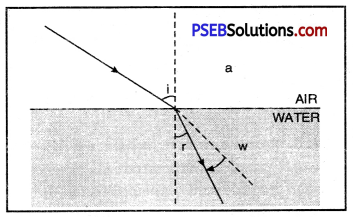
ਹਵਾ ਵਿੱਚ ਜਾਂਦੀ ਇੱਕ ਕਿਰਨ ਪਾਣੀ ਵਿੱਚ ਤਿਰਛੀ ਪ੍ਰਵੇਸ਼ ਕਰਦੀ ਹੈ । ਕੀ ਪ੍ਰਕਾਸ਼ ਕਰਨ ਲੰਬ ਵੱਲ ਝੁਕੇਗੀ ਜਾਂ ਲੰਬ ਤੋਂ ਦੂਰ ਹਟੇਗੀ ? ਦੱਸੋ ਕਿਉਂ ?
ਉੱਤਰ-
ਹਵਾ ਵਿੱਚ ਗਮਨ ਕਰ ਰਹੀ ਪ੍ਰਕਾਸ਼ ਦੀ ਇੱਕ ਕਿਰਨ ਜਦੋਂ ਪਾਣੀ ਵਿੱਚ ਤਿਰਛੀ ਦਾਖਲ ਹੋਵੇਗੀ ਤਾਂ ਇਹ ਕਿਰਨ ਲੰਬ ਵੱਲ ਝੁਕੇਗੀ ਕਿਉਂਕਿ ਪਾਣੀ, ਹਵਾ ਦੀ ਤੁਲਨਾ ਵਿੱਚ ਸੰਘਣਾ ਮਾਧਿਅਮ ਹੈ ਅਤੇ ਪਾਣੀ ਅੰਦਰ ਪ੍ਰਕਾਸ਼ ਦੀ ਚਾਲ ਵਿੱਚ ਕਮੀ ਆ ਜਾਵੇਗੀ ।
PSEB 10th Class Science Solutions Chapter 10 ਪ੍ਰਕਾਸ਼-ਪਰਾਵਰਤਨ ਅਤੇ ਅਪਵਰਤਨ 14

ਪ੍ਰਸ਼ਨ 8.
ਪ੍ਰਕਾਸ਼ ਹਵਾ ਤੋਂ 1.50 ਅਪਵਰਤਨ-ਅੰਕ ਦੀ ਕੱਚ ਦੀ ਪਲੇਟ ਵਿੱਚ ਪ੍ਰਵੇਸ਼ ਕਰਦਾ ਹੈ । ਕੱਚ ਵਿੱਚ ਪ੍ਰਕਾਸ਼ ਦੀ ਚਾਲ ਕਿੰਨੀ ਹੈ ? ਨਿਰਵਾਯੂ ਵਿੱਚ ਪ੍ਰਕਾਸ਼ ਦੀ ਚਾਲ 3 × 10⁸ m/s ਹੈ ।
ਹੱਲ:
ਦਿੱਤਾ ਹੈ, ਕੱਚ ਦਾ ਅਪਵਰਤਨ-ਅੰਕ (aμg) = 1.50
ਨਿਰਵਾਤ (ਹਵਾ) ਵਿੱਚ ਪ੍ਰਕਾਸ਼ ਦੀ ਚਾਲ (c) = 3 × 10⁸ m/s
ਕੱਚ ਵਿੱਚ ਪ੍ਰਕਾਸ਼ ਦੀ ਚਾਲ (Vg) = ?
PSEB 10th Class Science Solutions Chapter 10 ਪ੍ਰਕਾਸ਼-ਪਰਾਵਰਤਨ ਅਤੇ ਅਪਵਰਤਨ 15
∴ ਕੱਚ ਵਿੱਚ ਪ੍ਰਕਾਸ਼ ਦੀ ਚਾਲ (Vg) = [latex]\frac{3 \times 10^{8} m s}{1.50}\)
= 2 × 10⁸ m/s

ਪ੍ਰਸ਼ਨ 9.
ਸਾਰਨੀ 10.3 ਵਿੱਚ ਸਭ ਤੋਂ ਵੱਧ ਪ੍ਰਕਾਸ਼ੀ ਘਣਤਾ ਵਾਲਾ ਮਾਧਿਅਮ ਪਤਾ ਕਰੋ । ਸਭ ਤੋਂ ਘੱਟ ਪ੍ਰਕਾਸ਼ੀ ਘਣਤਾ ਵਾਲੇ ਮਾਧਿਅਮ ਦਾ ਵੀ ਪਤਾ ਕਰੋ ।
ਉੱਤਰ-
ਸਾਰਣੀ 10.3 ਤੋਂ ਸਪੱਸ਼ਟ ਹੈ ਕਿ ਹੀਰੇ ਦਾ ਅਪਵਰਤਨ-ਅੰਕ 2.42 ਹੈ ਜਿਹੜਾ ਸਭ ਤੋਂ ਵੱਧ ਅਤੇ ਹਵਾ ਦਾ ਅਪਵਰਤਨ-ਅੰਕ 1.0003 ਹੈ, ਜਿਹੜਾ ਸਭ ਤੋਂ ਘੱਟ ਹੈ । ਇਸ ਲਈ ਹੀਰੇ ਦੀ ਪ੍ਰਕਾਸ਼ੀ ਘਣਤਾ ਸਭ ਤੋਂ ਵੱਧ ਅਤੇ ਹਵਾ ਦੀ ਪਕਾਸ਼ੀ ਘਣਤਾ ਸਭ ਤੋਂ ਘੱਟ ਹੈ ।

ਪ੍ਰਸ਼ਨ 10.
ਤੁਹਾਨੂੰ ਕੈਰੋਸੀਨ, ਤਾਰਪੀਨ ਦਾ ਤੇਲ ਅਤੇ ਪਾਣੀ ਦਿੱਤੇ ਗਏ ਹਨ । ਇਨ੍ਹਾਂ ਵਿੱਚੋਂ ਕਿਸ ਵਿੱਚ ਪ੍ਰਕਾਸ਼ ਸਭ ਤੋਂ ਯਤੀਬਰ ਗਤੀ ਨਾਲ ਚਲਦਾ ਹੈ । ਸਾਰਨੀ 0.3 ਵਿੱਚ ਦਿੱਤੇ ਹੋਏ ਅੰਕੜਿਆਂ ਦਾ ਪ੍ਰਯੋਗ ਕਰੋ ।
ਉੱਤਰ-
ਅਸੀਂ ਜਾਣਦੇ ਹਾਂ ਕਿ ਵੱਧ ਅਪਵਰਤਨ-ਅੰਕ ਵਾਲਾ ਮਾਧਿਅਮ ਪ੍ਰਕਾਸ਼ੀ ਸੰਘਣਤਾ ਵਾਲਾ ਮਾਧਿਅਮ ਹੁੰਦਾ ਹੈ ਅਤੇ ਘੱਟ ਅਪਵਰਤਨ-ਅੰਕ ਵਾਲਾ ਮਾਧਿਅਮ ਪ੍ਰਕਾਸ਼ੀ ਵਿਰਲ ਮਾਧਿਅਮ ਹੁੰਦਾ ਹੈ ਜਿਸ ਵਿੱਚ ਪ੍ਰਕਾਸ਼ ਦੀ ਚਾਲ ਘੱਟ ਹੁੰਦੀ ਹੈ । ਸਾਰਣੀ 10.3 ਤੋਂ ਸਪੱਸ਼ਟ ਹੁੰਦਾ ਹੈ ਕਿ ਕੈਰੋਸੀਨ (ਮਿੱਟੀ ਦਾ ਤੇਲ) ਦਾ ਅਪਵਰਤਨ-ਅੰਕ 1.44, ਤਾਰਪੀਨ ਦੇ ਤੇਲ ਦਾ ਅਪਵਰਤਨ-ਅੰਕ 1.47 ਅਤੇ ਪਾਣੀ ਦਾ ਅਪਵਰਤਨ-ਅੰਕ ਨਿਊਨਤਮ 1.33 ਹੈ । ਇਨ੍ਹਾਂ ਅੰਕੜਿਆਂ ਤੋਂ ਸਪੱਸ਼ਟ ਹੈ ਕਿ ਪਾਣੀ ਦਾ ਅਪਵਰਤਨ ਅੰਕ ਨਿਊਨਤਮ ਹੈ, ਇਸ ਲਈ ਪਾਣੀ ਵਿੱਚ ਪ੍ਰਕਾਸ਼ ਸਭ ਤੋਂ ਤੇਜ਼ ਗਤੀ ਨਾਲ ਚਲਦਾ ਹੈ ।

ਪ੍ਰਸ਼ਨ 11.
ਹੀਰੇ ਦਾ ਅਪਵਰਤਨ-ਅੰਕ 2.42 ਹੈ । ਇਸ ਕਥਨ ਦਾ ਕੀ ਭਾਵ ਹੈ ?
ਉੱਤਰ-
ਹੀਰੇ ਦਾ ਅਪਵਰਤਨ-ਅੰਕ 2.42 ਹੈ । ਇਸ ਕਥਨ ਦਾ ਮਤਲਬ ਇਹ ਹੈ ਕਿ ਹੀਰੇ ਵਿੱਚ ਪ੍ਰਕਾਸ਼ ਦੀ ਚਾਲ,
ਖਲਾਅ (ਨਿਰਵਾਤ) ਵਿੱਚ ਪ੍ਰਕਾਸ਼ ਦੀ ਚਾਲ ਦੀ ਤੁਲਨਾ ਵਿੱਚ \(\frac{1}{2 \cdot 42}\) ਗੁਣਾ ਹੈ ।

ਪ੍ਰਸ਼ਨ 12.
ਕਿਸੇ ਲੈੱਨਜ਼ ਦੀ ਇੱਕ ਡਾਈਆਪਟਰ ਸਮਰੱਥਾ ਦੀ ਪਰਿਭਾਸ਼ਾ ਦਿਓ ।
ਉੱਤਰ-
ਇੱਕ (1) ਡਾਈਆਪਟਰ ਉਸ ਲੈਂਨਜ਼ ਦੀ ਸਮਰੱਥਾ ਹੈ ਜਿਸਦੀ ਫੋਕਸ ਦੂਰੀ 1 ਮੀਟਰ (= 100 ਸੈਂਟੀਮੀਟਰ) ਹੈ । ਉੱਤਲ ਲੈੱਨਜ਼ ਦੀ ਸਮਰੱਥਾ ਧਨਾਤਮਕ ਅਤੇ ਅਵਤਲ ਲੈੱਨਜ਼ ਦੀ ਸਮਰੱਥਾ ਰਿਣਾਤਮਕ ਮੰਨੀ ਜਾਂਦੀ ਹੈ ।

ਪ੍ਰਸ਼ਨ 13.
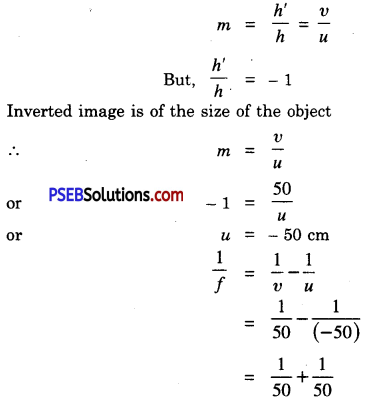
ਕੋਈ ਉੱਤਲ ਲੈੱਨਜ਼ ਇੱਕ ਸੂਈ ਦਾ ਵਾਸਤਵਿਕ ਅਤੇ ਉਲਟਾ ਪ੍ਰਤਿਬਿੰਬ ਉਸ ਲੈਂਨਜ਼ ਤੋਂ 50 cm ਦੂਰ ਬਣਾਉਂਦਾ ਹੈ । ਇਹ ਸੂਈ ਉੱਤਲ ਲੈੱਨਜ਼ ਦੇ ਸਾਹਮਣੇ ਕਿੱਥੇ ਰੱਖੀ ਹੋਈ ਹੈ ? ਲੈੱਨਜ਼ ਦੀ ਸਮਰੱਥਾ ਵੀ ਗਿਆਤ ਕਰੋ ।
ਹੱਲ :
ਦਿੱਤਾ ਹੈ, ਉੱਤਲ ਲੈਨਜ਼ ਤੋਂ ਪ੍ਰਤਿਬਿੰਬ ਦੀ ਦੂਰੀ (υ) = +50 cm
[ υ ਦਾ ਚਿੰਨ੍ਹ + ਹੈ ਕਿਉਂਕਿ ਤਿਬਿੰਬ ਵਾਸਤਵਿਕ ਅਤੇ ਉਲਟਾ ਹੈ]
ਪ੍ਰਤਿਬਿੰਬ ਦਾ ਸਾਇਜ਼ ਜਾਂ ਉੱਚਾਈ (I) = ਵਸਤੂ ਦਾ ਸਾਇਜ਼ (O)
∴ ਵੱਡਦਰਸ਼ਨ (m) = \(\frac{\mathrm{I}}{\mathrm{O}}\) = -1
[ਵਾਸਤਵਿਕ ਪ੍ਰਤਿਬਿੰਬ ਲਈ ਵੱਡਦਰਸ਼ਨ ਰਿਣਾਤਮਕ ਹੁੰਦਾ ਹੈ]
ਪਰੰਤੂ ਲੈੱਨਜ਼ ਦੇ ਲਈ ਵੱਡਦਰਸ਼ਨ, m = \(-\frac{v}{u}\)
:: \(-\frac{v}{u}\) = -1
ਜਾਂ υ = -u
ਜਾਂ u = -υ
= -50 cm
ਇਸ ਲਈ ਸੂਈ (ਬਿਬ) ਉੱਤਲ ਲੈੱਨਜ਼ ਦੇ ਸਾਹਮਣੇ 50 cm ਦੀ ਦੂਰੀ ‘ਤੇ ਰੱਖੀ ਗਈ ਹੈ ।
ਲੈੱਨਜ਼ ਸੂਤਰ \(\frac{1}{v}-\frac{1}{u}\) = \(\frac{1}{f}\) ਤੋਂ
PSEB 10th Class Science Solutions Chapter 10 ਪ੍ਰਕਾਸ਼-ਪਰਾਵਰਤਨ ਅਤੇ ਅਪਵਰਤਨ 16
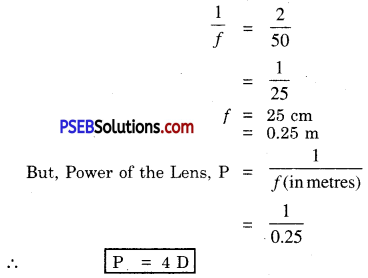
= \(\frac{1}{0.25}\)D
∴ ਲੈੱਨਜ਼ ਦੀ ਸਮਰੱਥਾ (P) = +4D

ਪ੍ਰਸ਼ਨ 14.
ਦੋ ਮੀਟਰ ਫੋਕਸ ਦੂਰੀ ਵਾਲੇ ਕਿਸੇ ਅਵਤਲ ਲੈੱਨਜ਼ ਦੀ ਸ਼ਕਤੀ ਗਿਆਤ ਕਰੋ ।
ਹੱਲ :
ਦਿੱਤਾ ਹੈ, ਅਵਤਲ ਲੈੱਨਜ਼ ਦੀ ਫੋਕਸ ਦੂਰੀ (f) = -2m
[ਅਵਤਲ ਲੈੱਨਜ਼ ਦੀ ਫੋਕਸ ਦੂਰੀ ਰਿਣਾਤਮਕ ਮੰਨੀ ਜਾਂਦੀ ਹੈ]
ਅਵਤਲ ਲੈੱਨਜ਼ ਦੀ ਸ਼ਕਤੀ (P) = ?
PSEB 10th Class Science Solutions Chapter 10 ਪ੍ਰਕਾਸ਼-ਪਰਾਵਰਤਨ ਅਤੇ ਅਪਵਰਤਨ 17
= \(\frac{1}{-2}\) D ਇਸ ਲਈ ਅਵਤਲ ਲੈੱਨਜ਼ ਦੀ ਸ਼ਕਤੀ (P) = -0.5 D

PSEB 10th Class Science Solutions Chapter 9 ਅਨੁਵੰਸ਼ਿਕਤਾ ਅਤੇ ਜੀਵ ਵਿਕਾਸ

Punjab State Board PSEB 10th Class Science Book Solutions Chapter 9 ਅਨੁਵੰਸ਼ਿਕਤਾ ਅਤੇ ਜੀਵ ਵਿਕਾਸ Textbook Exercise Questions and Answers.

PSEB Solutions for Class 10 Science Chapter 9 ਅਨੁਵੰਸ਼ਿਕਤਾ ਅਤੇ ਜੀਵ ਵਿਕਾਸ

PSEB 10th Class Science Guide ਅਨੁਵੰਸ਼ਿਕਤਾ ਅਤੇ ਜੀਵ ਵਿਕਾਸ Textbook Questions and Answers

ਪ੍ਰਸ਼ਨ 1.
ਮੈਂਡਲ ਦੇ ਇੱਕ ਪ੍ਰਯੋਗ ਵਿੱਚ ਲੰਬੇ ਮਟਰ ਦੇ ਪੌਦੇ ਜਿਨ੍ਹਾਂ ਦੇ ਬੈਂਗਣੀ ਫੁੱਲ ਸਨ, ਦਾ ਸੰਕਰਣ ਬੌਣੇ ਪੌਦਿਆਂ ਜਿਨ੍ਹਾਂ ਦੇ ਸਫੈਦ ਫੁੱਲ ਸਨ, ਨਾਲ ਕਰਾਇਆ ਗਿਆ । ਇਨ੍ਹਾਂ ਦੀ ਸੰਤਾਨ ਦੇ ਸਾਰੇ ਪੌਦਿਆਂ ਵਿੱਚ ਫੁੱਲ ਬੈਂਗਣੀ ਰੰਗ ਦੇ ਸਨ । ਪਰ ਉਨ੍ਹਾਂ ਵਿਚੋਂ ਲਗਭਗ ਅੱਧੇ ਬੌਣੇ ਸਨ । ਇਸ ਤੋਂ ਕਿਹਾ ਜਾ ਸਕਦਾ ਹੈ ਲੰਬੇ ਜਨਕ ਪੌਦਿਆਂ ਦੀ ਅਨੁਵੰਸ਼ਿਕ ਰਚਨਾ ਨਿਮਨ ਸੀ-
(ਉ) TTWW
(ਅ) TTww
(ੲ) TtWW
(ਸ) TtWw
ਉੱਤਰ-
(ੲ) TtWW.

ਪ੍ਰਸ਼ਨ 2.
ਸਮਜਾਤ ਅੰਗਾਂ ਦਾ ਉਦਾਹਰਣ ਹੈ-
(ੳ) ਸਾਡਾ ਹੱਥ ਅਤੇ ਕੁੱਤੇ ਦਾ ਅਗਲਾ ਪੈਰ
(ਅ ਸਾਡੇ ਦੰਦ ਅਤੇ ਹਾਥੀ ਦੇ ਦੰਦ
(ੲ) ਆਲੂ ਅਤੇ ਘਾਹ ਦੀਆਂ ਤਿੜਾਂ
(ਸ) ਉਪਰੋਕਤ ਸਾਰੇ ।
ਉੱਤਰ-
(ਸ) ਉਪਰੋਕਤ ਸਾਰੇ ।

ਪ੍ਰਸ਼ਨ 3.
ਵਿਕਾਸ ਦ੍ਰਿਸ਼ਟੀਕੋਣ ਤੋਂ ਸਾਡੀ ਕਿਸ ਨਾਲ ਵਧੇਰੇ ਸਮਾਨਤਾ ਹੈ-
(ਉ) ਚੀਨ ਦੇ ਵਿਦਿਆਰਥੀ
(ਅ) ਚਿਮਪੈਂਜੀ
(ੲ) ਮੱਕੜੀ
(ਸ) ਬੈਕਟੀਰੀਆ ।
ਉੱਤਰ-
(ੳ) ਚੀਨ ਦੇ ਵਿਦਿਆਰਥੀ ।

PSEB 10th Class Science Solutions Chapter 9 ਅਨੁਵੰਸ਼ਿਕਤਾ ਅਤੇ ਜੀਵ ਵਿਕਾਸ

ਪ੍ਰਸ਼ਨ 4.
ਇੱਕ ਅਧਿਐਨ ਤੋਂ ਪਤਾ ਲੱਗਿਆ ਕਿ ਹਲਕੇ ਰੰਗ ਦੀਆਂ ਅੱਖਾਂ ਵਾਲੇ ਬੱਚਿਆਂ ਦੇ ਮਾਤਾ-ਪਿਤਾ ਦੀਆਂ ਅੱਖਾਂ ਵੀ ਹਲਕੇ ਰੰਗ ਦੀਆਂ ਹੁੰਦੀਆਂ ਹਨ । ਇਸਦੇ ਆਧਾਰ ਉੱਤੇ ਅਸੀਂ ਕਹਿ ਸਕਦੇ ਹਾਂ ਕਿ ਅੱਖਾਂ ਦੇ ਹਲਕੇ ਰੰਗ ਦਾ ਲੱਛਣ ਪ੍ਰਭਾਵੀ ਹੈ ਜਾਂ ਅਪ੍ਰਭਾਵੀ ? ਆਪਣੇ ਉੱਤਰ ਦੀ ਵਿਆਖਿਆ ਕਰੋ ।
ਉੱਤਰ-
ਸਾਰੇ ਬੱਚਿਆਂ ਵਿਚ ਆਪਣੇ ਮਾਤਾ-ਪਿਤਾ ਦੇ ਲੱਛਣ ਪ੍ਰਕਟ ਹੁੰਦੇ ਹਨ । ਮਾਤਾ-ਪਿਤਾ ਤੋਂ ਹਲਕੇ ਰੰਗ ਦੀਆਂ ਅੱਖਾਂ ਦਾ ਬੱਚਿਆਂ ਵਿੱਚ ਆ ਜਾਣਾ ਸੁਭਾਵਿਕ ਹੈ ਇਸ ਅਵਸਥਾ ਵਿੱਚ ਤਾਂ ਅੱਖਾਂ ਦੇ ਹਲਕੇ ਰੰਗ ਦਾ ਲੱਛਣ ਪ੍ਰਭਾਵੀ ਹੈ ਪਰ ਇਸ ਨੂੰ ਹਰ ਬੱਚੇ ਦੀ ਅਵਸਥਾ ਵਿਚ ਪ੍ਰਭਾਵੀ ਨਹੀਂ ਕਹਿ ਸਕਦੇ । ਇਹ ਅਪ੍ਰਭਾਵੀ ਵੀ ਹੋ ਸਕਦਾ ਹੈ ।

ਪ੍ਰਸ਼ਨ 5.
ਜੀਵ ਵਿਕਾਸ ਅਤੇ ਵਰਗੀਕਰਨ ਦੇ ਅਧਿਐਨ ਖੇਤਰ ਆਪਸ ਵਿੱਚ ਕਿਸ ਤਰ੍ਹਾਂ ਸੰਬੰਧਿਤ ਹਨ ?
ਉੱਤਰ-
ਜੀਵਾਂ ਵਿਚ ਵਰਗੀਕਰਨ ਦਾ ਅਧਿਐਨ ਉਨ੍ਹਾਂ ਵਿਚ ਮੌਜੂਦ ਸਮਾਨਤਾਵਾਂ ਅਤੇ ਭਿੰਨਤਾ ਦੇ ਆਧਾਰ ਤੇ ਕੀਤਾ ਜਾਂਦਾ ਹੈ । ਉਨ੍ਹਾਂ ਵਿੱਚ ਸਮਾਨਤਾ ਇਸ ਲਈ ਪ੍ਰਕਟ ਹੁੰਦੀ ਹੈ ਕਿ ਉਹ ਕਿਸੇ ਸਮਾਨ ਪੂਰਵਜ ਤੋਂ ਪੈਦਾ ਹੋਏ ਹਨ ਅਤੇ ਉਨ੍ਹਾਂ ਵਿੱਚ ਭਿੰਨਤਾ ਵਿਭਿੰਨ ਪ੍ਰਕਾਰ ਦੇ ਵਾਤਾਵਰਨਾਂ ਵਿੱਚ ਕੀਤੀ ਜਾਣ ਵਾਲੀ ਅਨੁਕੂਲਤਾ ਦੇ ਕਾਰਨ ਹੁੰਦਾ ਹੈ । ਉਨ੍ਹਾਂ ਵਿਚ ਵੱਧਦੀ ਜਟਿਲਤਾ ਨੂੰ ਜੀਵ-ਵਿਕਾਸ ਦੇ ਉੱਤਰੋਤਰ ਮਿਕ ਆਧਾਰ ਤੇ ਸਥਾਪਿਤ ਕਰਕੇ ਆਪਸੀ ਸੰਬੰਧਾਂ ਦਾ ਗਿਆਨ ਪ੍ਰਾਪਤ ਕੀਤਾ ਜਾ ਸਕਦਾ ਹੈ ।

ਪ੍ਰਸ਼ਨ 6.
ਸਮਜਾਤ ਅਤੇ ਸਮਰੂਪ ਅੰਗਾਂ ਦੀ ਉਦਾਹਰਣ ਦੇ ਕੇ ਸਮਝਾਓ ।
ਉੱਤਰ-
ਸਮਜਾਤ ਅੰਗ – ਪੌਦਿਆਂ ਅਤੇ ਪ੍ਰਾਣੀਆਂ ਦੇ ਉਹ ਅੰਗ ਜਿਨ੍ਹਾਂ ਦੀ ਮੁੱਢਲੀ ਰਚਨਾ ਇਕ ਸਮਾਨ ਹੁੰਦੀ ਹੈ ਪਰ ਉਨ੍ਹਾਂ ਦੇ ਕਾਰਜ ਵੱਖ-ਵੱਖ ਹੁੰਦੇ ਹਨ, ਉਨ੍ਹਾਂ ਨੂੰ ਸਮਜਾਤ ਅੰਗ ਕਹਿੰਦੇ ਹਨ , ਜਿਵੇਂ-ਪੰਛੀਆਂ ਦੇ ਪੰਖ, ਮਨੁੱਖ ਦੀਆਂ ਭੁਜਾਵਾਂ, ਕੁੱਤੇ ਦੀਆਂ ਅਗਲੀਆਂ ਲੱਤਾਂ, ਡੱਡੂਆਂ ਦੇ ਅਗਲੇ ਪੈਰ, ਗਾਂ, ਘੋੜੇ ਆਦਿ ਦੇ ਅਗਲੇ ਪੈਰ । ਇਹ ਸਾਰੇ ਅੰਗ ਰਚਨਾ ਦੇ ਆਧਾਰ ਤੇ ਇੱਕ ਸਮਾਨ ਹਨ ਪਰ ਇਨ੍ਹਾਂ ਦਾ ਜੀਵਾਂ ਵਿਚ ਕਾਰਜ ਵੱਖ-ਵੱਖ ਹੈ ।
PSEB 10th Class Science Solutions Chapter 9 ਅਨੁਵੰਸ਼ਿਕਤਾ ਅਤੇ ਜੀਵ ਵਿਕਾਸ 1

ਸਮਰੂਪ ਅੰਗ – ਜੀਵਾਂ ਦੇ ਉਹ ਅੰਗ ਜੋ ਦੇਖਣ ਵਿਚ ਇੱਕ ਸਮਾਨ ਹੋਣ, ਪਰ ਉਨ੍ਹਾਂ ਦੀ ਰਚਨਾ ਅਤੇ ਕਾਰਜ ਵੱਖ-ਵੱਖ ਹੋਣ, ਉਨ੍ਹਾਂ ਨੂੰ ਸਮਰੂਪ ਅੰਗ ਕਹਿੰਦੇ ਹਨ ; ਜਿਵੇਂ ਕੀਟਾਂ ਦੇ ਪੰਖ, ਪੰਛੀਆਂ ਦੇ ਪੰਖ, ਚਮਗਿੱਦੜ ਦੇ ਪੰਖ । ਇਨ੍ਹਾਂ ਸਾਰੇ ਜੀਵਾਂ ਵਿੱਚ ਪੰਖ ਦੇਖਣ ਨੂੰ ਇੱਕ ਸਮਾਨ ਦਿਖਾਈ ਦਿੰਦੇ ਹਨ, ਪਰੰਤੂ ਉਨ੍ਹਾਂ ਦੀ ਰਚਨਾ ਅਤੇ ਕਾਰਜ ਭਿੰਨ ਹਨ । ਮਟਰ, ਅੰਗੂਰ ਆਦਿ ਪੌਦਿਆਂ ਵਿਚ ਤੰਦੜੇ (Tendrils) ਵੀ ਇਸੇ ਦੀ ਉਦਾਹਰਨ ਹੈ ।
PSEB 10th Class Science Solutions Chapter 9 ਅਨੁਵੰਸ਼ਿਕਤਾ ਅਤੇ ਜੀਵ ਵਿਕਾਸ 2

ਪ੍ਰਸ਼ਨ 7.
ਕੁੱਤੇ ਦੀ ਚਮੜੀ ਦਾ ਪ੍ਰਭਾਵੀ ਰੰਗ ਗਿਆਤ ਕਰਨ ਦੇ ਉਦੇਸ਼ ਨੂੰ ਮੁੱਖ ਰੱਖ ਕੇ ਇੱਕ ਪ੍ਰੋਜੈਕਟ ਤਿਆਰ ਕਰੋ ।
ਉੱਤਰ-
PSEB 10th Class Science Solutions Chapter 9 ਅਨੁਵੰਸ਼ਿਕਤਾ ਅਤੇ ਜੀਵ ਵਿਕਾਸ 3
ਕਾਲੇ ਰੰਗ ਦੇ ਨਰ ਅਤੇ ਸਫੈਦ ਰੰਗ ਦੀ ਮਾਦਾ ਦੇ ਸੰਯੋਗ ਨਾਲ ਪੈਦਾ ਹੋਏ ਸਾਰੇ ਪਿੱਲੇ ਕਾਲੇ ਰੰਗ ਦੇ ਹੋਣ ਤਾਂ ਕੁੱਤੇ ਦੀ ਚਮੜੀ ਦਾ ਪ੍ਰਭਾਵੀ ਰੰਗ ਕਾਲਾ ਹੀ ਹੋਵੇਗਾ । ਤਿੰਨ ਕੁੱਤੇ ਕਾਲੇ ਅਤੇ ਇੱਕ ਕੁੱਤਾ ਸਫ਼ੈਦ ਹੋਵੇਗਾ, ਸਾਰੇ ਕਾਲੀ ਚਮੜੀ ਵਾਲੇ ਲੱਛਣ ਇਹ ਦਰਸਾਉਂਦਾ ਹੈ ਕਿ ਕਾਲਾ ਰੰਗ ਪ੍ਰਭਾਵੀ ਰੰਗ ਹੈ ।

ਕੁੱਤਿਆਂ ਦੇ ਵੱਖ-ਵੱਖ ਰੰਗਾਂ ਦਾ ਕਾਰਨ ਡਿਜ਼ਾਈਨ ਜੀਨਾਂ ਦੀ ਆਪਸੀ ਕਿਰਿਆ ਦੇ ਕਾਰਨ ਹੁੰਦਾ ਹੈ ਜਿਸ ਵਿਚ F, ਅਨੁਪਾਤ 12 : 3 : 1 ਹੁੰਦਾ ਹੈ । ਇਸ ਲਈ ਸ਼ੁੱਧ ਨਸਲਾਂ ਦੇ ਵਿੱਚ ਸਕਰਨ ਕਰਵਾਏ ਬਿਨਾਂ ਕਿਸੇ ਸਹੀ ਸਟੀਕ ਫੈਸਲੇ ਤੱਕ ਨਹੀਂ ਪਹੁੰਚਿਆ ਜਾ ਸਕਦਾ ।

ਪ੍ਰਸ਼ਨ 8.
ਵਿਕਾਸੀ ਸੰਬੰਧ ਸਥਾਪਿਤ ਕਰਨ ਵਿੱਚ ਪਥਰਾਟਾਂ ਦਾ ਕੀ ਮਹੱਤਵ ਹੈ ?
ਉੱਤਰ-
PSEB 10th Class Science Solutions Chapter 9 ਅਨੁਵੰਸ਼ਿਕਤਾ ਅਤੇ ਜੀਵ ਵਿਕਾਸ 4
ਵਿਕਾਸੀ ਸੰਬੰਧ ਸਥਾਪਿਤ ਕਰਨ ਵਿਚ ਪਥਰਾਟ ਬਹੁਤ ਮਹੱਤਵਪੂਰਨ ਭੂਮਿਕਾ ਨਿਭਾਉਂਦੇ ਹਨ । ਯੁਗਾਂ ਪਹਿਲਾਂ ਜੋ ਜੀਵ ਅਜਿਹੇ ਵਾਤਾਵਰਨ ਵਿਚ ਚਲੇ ਗਏ ਸਨ, ਉਨ੍ਹਾਂ ਦਾ ਪੂਰਾ ਅਪਘਟਨ ਨਹੀਂ ਹੋਇਆ ਸੀ ਅਤੇ ਉਨ੍ਹਾਂ ਦੇ ਸਰੀਰ ਦੀ ਛਾਪ ਚਟਾਨਾਂ ਤੇ ਸੁਰੱਖਿਅਤ ਰਹਿ ਗਈ । ਇਹ ਸੁਰੱਖਿਅਤ ਅਵਸ਼ੇਸ਼ ਹੀ ਪਥਰਾਟ (Fossil) ਕਹਾਉਂਦੇ ਹਨ । ਜਦੋਂ ਪਥਰਾਟਾਂ ਦੀ ਖੁਦਾਈ ਕਰਕੇ ਪ੍ਰਾਪਤੀ ਕੀਤੀ ਜਾਂਦੀ ਹੈ ਤਾਂ ਉਨ੍ਹਾਂ ਦੀ ਪ੍ਰਾਪਤੀ ਦੀ ਡੂੰਘਾਈ ਤੋਂ ਪਤਾ ਲੱਗ ਜਾਂਦਾ ਹੈ ਕਿ ਇਹ ਲਗਭਗ ਇੰਨਾ ਪੁਰਾਣਾ ਹੈ । ‘ਫਾਸਿਲ ਡੇਟਿੰਗ` (Fossil dating) ਇਸ ਕੰਮ ਵਿੱਚ ਸਹਾਇਕ ਸਿੱਧ ਹੁੰਦੀ ਹੈ । ਜੋ ਪਥਰਾਟ ਜਿੰਨੀ ਵੱਧ ਡੂੰਘਾਈ ਤੋਂ ਪ੍ਰਾਪਤ ਹੋਵੇਗਾ ਉਹ ਓਨਾ ਹੀ ਪੁਰਾਣਾ ਹੋਵੇਗਾ । ਲਗਭਗ 10 ਕਰੋੜ ਸਾਲ ਪਹਿਲਾਂ ਸਮੁੰਦਰ ਤਲ ਵਿੱਚ ਅਰੀਧਾਰੀ ਜੀਵਾਂ ਦੇ ਜੋ ਪਥਰਾਟ ਪ੍ਰਾਪਤ ਹੁੰਦੇ ਹਨ, ਉਹ ਸਭ ਤੋਂ ਪੁਰਾਣੇ ਹਨ । ਇਸਦੇ ਕੁੱਝ ਮਿਲੀਅਨ ਸਾਲਾਂ ਬਾਅਦ ਜਦੋਂ ਡਾਇਨਾਸੋਰ ਮਰੇ ਤਾਂ ਉਨ੍ਹਾਂ ਦੇ ਪਥਰਾਟ ਅਰੀਧਾਰੀ ਜੀਵਾਂ ਦੇ ਪਥਰਾਟਾਂ ਤੋਂ ਉੱਪਰਲੀ ਸਤਹਿ ਤੇ ਬਣੇ । ਇਸਦੇ ਕੁਝ ਮਿਲੀਅਨ ਸਾਲ ਬਾਅਦ ਜਦੋਂ ਘੋੜੇ ਦੇ ਸਮਾਨ ਜੀਵ ਪਥਰਾਟ ਵਿੱਚ ਬਦਲੇ ਤਾਂ ਉਨ੍ਹਾਂ ਨੂੰ ਡਾਇਨਾਸੋਰਾਂ ਦੇ ਪਥਰਾਟਾਂ ਤੋਂ ਉੱਪਰ ਸਥਾਨ ਮਿਲਿਆ । ਇਸ ਨਾਲ ਉਨ੍ਹਾਂ ਦਾ ਵਿਕਾਸੀ ਸੰਬੰਧ ਸਥਾਪਿਤ ਹੁੰਦਾ ਹੈ ।

PSEB 10th Class Science Solutions Chapter 9 ਅਨੁਵੰਸ਼ਿਕਤਾ ਅਤੇ ਜੀਵ ਵਿਕਾਸ

ਪਸ਼ਨ 9.
ਕਿਹੜੇ ਪ੍ਰਮਾਣਾਂ ਦੇ ਆਧਾਰ ਤੇ ਅਸੀਂ ਕਹਿ ਸਕਦੇ ਹਾਂ ਕਿ ਜੀਵਨ ਦੀ ਉਤਪੱਤੀ ਅਜੈਵਿਕ ਪਦਾਰਥਾਂ ਤੋਂ ਹੋਈ ਹੈ ?
ਉੱਤਰ-
ਵੱਖ-ਵੱਖ ਜਾਤੀਆਂ ਦੇ ਵਿਕਾਸੀ ਸੰਬੰਧਾਂ ਦਾ ਅਧਿਐਨ ਇਹੀ ਦਰਸਾਉਂਦਾ ਹੈ ਕਿ ਜੀਵਨ ਦੀ ਉਤਪੱਤੀ ਇੱਕ ਹੀ ਜਾਤੀ ਤੋਂ ਹੋਈ ਹੈ । ਇੱਕ ਬ੍ਰਿਟਿਸ਼ ਵਿਗਿਆਨੀ ਜੇ.ਬੀ.ਐੱਸ. ਹਾਲਨ ਨੇ ਸਭ ਤੋਂ ਪਹਿਲਾਂ ਇਹ ਸੁਝਾਅ ਦਿੱਤਾ ਸੀ ਕਿ ਜੀਵਾਂ ਦੀ ਉਤਪੱਤੀ ਉਨ੍ਹਾਂ ਅਜੈਵਿਕ ਪਦਾਰਥਾਂ ਤੋਂ ਹੋਈ ਹੋਵੇਗੀ ਜੋ ਧਰਤੀ ਦੀ ਉਤਪੱਤੀ ਦੇ ਸਮੇਂ ਬਣੇ ਸਨ । ਸਾਲ 1953 ਵਿਚ ਸਟੇਨਲ ਐਲ. ਮਿਲਰ ਅਤੇ ਹੇਰਾਲਡ ਸੀ. ਡਰੇ ਨੇ ਅਜਿਹੇ ਬਣਾਵਟੀ ਵਾਤਾਵਰਨ ਦਾ ਨਿਰਮਾਣ ਕੀਤਾ ਸੀ ਜੋ ਪ੍ਰਾਚੀਨ ਵਾਤਾਵਰਨ ਦੇ ਸਮਾਨ ਸੀ । ਇਸ ਵਾਤਾਵਰਨ ਵਿਚ ਆਕਸੀਜਨ ਨਹੀਂ ਸੀ । ਇਸ ਵਿਚ ਆਕਸੀਜਨ ਨਹੀਂ ਸੀ । ਇਸ ਵਿਚ ਅਮੋਨੀਆ, ਮੀਥੇਨ ਅਤੇ ਹਾਈਡਰੋਜਨ ਸਲਫਾਈਡ ਸਨ । ਉਸ ਵਿੱਚ ਇਕ ਪਾਤਰ ਵਿਚ ਪਾਣੀ ਵੀ ਸੀ ਜਿਸ ਦਾ ਤਾਪਮਾਨ 100°C ਤੋਂ ਘੱਟ ਰੱਖਿਆ ਗਿਆ ਸੀ । ਗੈਸਾਂ ਦੇ ਮਿਸ਼ਰਣ ਵਿਚੋਂ ਚਿੰਗਾਰੀਆਂ ਪੈਦਾ ਕੀਤੀਆਂ ਗਈਆਂ ਜੋ ਆਕਾਸ਼ੀ ਬਿਜਲੀਆਂ ਦੇ ਸਮਾਨ ਸਨ । ਮੀਥੇਨ ਤੋਂ 15% ਕਾਰਬਨ ਸਰਲ ਕਾਰਬਨ ਸਰਲ ਯੌਗਿਕ ਯੌਗਿਕਾਂ ਵਿਚ ਬਦਲ ਗਏ । ਇਨ੍ਹਾਂ ਵਿਚ ਅਮੀਨੋ ਐਸਿਡ ਵੀ ਸੰਸਲੇਸ਼ਿਤ ਹੋਏ ਜੋ ਪ੍ਰੋਟੀਨ ਦੇ ਅਣੂਆਂ ਦਾ ਨਿਰਮਾਣ ਕਰਦੇ ਹਨ । ਇਸੇ ਆਧਾਰ ਤੇ ਅਸੀਂ ਕਹਿ ਸਕਦੇ ਹਾਂ ਕਿ ਜੀਵਨ ਦੀ ਉਤਪੱਤੀ ਅਜੈਵਿਕ ਪਦਾਰਥਾਂ ਤੋਂ ਹੋਈ ਸੀ ।

ਪ੍ਰਸ਼ਨ 10.
ਅਲਿੰਗੀ ਜਣਨ ਦੇ ਟਾਕਰੇ ਵਿੱਚ ਲਿੰਗੀ ਜਣਨ ਦੁਆਰਾ ਪੈਦਾ ਭਿੰਨਤਾਵਾਂ ਵਧੇਰੇ ਸਥਾਈ ਹੁੰਦੀਆਂ ਹਨ, ਵਿਆਖਿਆ ਕਰੋ । ਇਹ ਲਿੰਗੀ ਜਣਨ ਕਰਨ ਵਾਲੇ ਜੀਵਾਂ ਦੇ ਵਿਕਾਸ ਨੂੰ ਕਿਸ ਤਰ੍ਹਾਂ ਪ੍ਰਭਾਵਿਤ ਕਰਦਾ ਹੈ ?
ਉੱਤਰ-
ਅਲਿੰਗੀ ਜਣਨ ਦੀ ਤੁਲਨਾ ਵਿਚ ਲਿੰਗੀ ਜਣਨ ਦੁਆਰਾ ਪੈਦਾ ਭਿੰਨਤਾਵਾਂ ਵਧੇਰੇ ਸਥਾਈ ਹੁੰਦੀਆਂ ਹਨ । ਅਲਿੰਗੀ ਜਣਨ ਇੱਕ ਹੀ ਜੀਵ ਤੋਂ ਹੋਣ ਦੇ ਕਾਰਨ ਸਿਰਫ਼ ਉਸੇ ਦੇ ਗੁਣ ਉਸਦੀ ਸੰਤਾਨ ਵਿਚ ਜਾਂਦੇ ਹਨ ਅਤੇ ਇਹ ਬਿਨਾਂ ਪਰਿਵਰਤਨ ਪੀੜੀ-ਦਰ-ਪੀੜੀ ਸਮਾਨ ਹੀ ਰਹਿੰਦੇ ਹਨ ।ਲਿੰਗੀ ਜਣਨ ਨਰ ਅਤੇ ਮਾਦਾ ਦੇ ਯੁਗਮਤਾਂ ਦੇ ਸੰਯੋਗ ਨਾਲ ਹੁੰਦਾ ਹੈ ਜਿਨ੍ਹਾਂ ਵਿਚ ਵੱਖ-ਵੱਖ ਜੀਨ ਹੋਣ ਦੇ ਕਾਰਨ ਸੰਕਰਨ ਦੇ ਸਮੇਂ ਵਿਭਿੰਨਤਾ ਵਾਲੀ ਸੰਤਾਨ ਪੈਦਾ ਹੁੰਦੀ ਹੈ । ਉਦਾਹਰਨ ਦੇ ਲਈ ਸਾਰੇ ਮਨੁੱਖ ਯੁਗਾਂ ਪਹਿਲਾਂ ਅਫ਼ਰੀਕਾ ਵਿਚ ਪੈਦਾ ਹੋਏ ਸਨ ਪਰ ਜਦੋਂ ਉਨ੍ਹਾਂ ਵਿੱਚੋਂ ਕਈਆਂ ਨੇ ਅਫ਼ਰੀਕਾ ਛੱਡ ਦਿੱਤਾ ਅਤੇ ਹੌਲੀ-ਹੌਲੀ ਸਾਰੇ ਸੰਸਾਰ ਵਿਚ ਫੈਲ ਗਏ ਤਾਂ ਲਿੰਗੀ ਜਣਨ ਤੋਂ ਪੈਦਾ ਵਿਭਿੰਨਤਾਵਾਂ ਦੇ ਕਾਰਨ ਉਨ੍ਹਾਂ ਦੀ ਚਮੜੀ ਦਾ ਰੰਗ, ਕਦ, ਆਕਾਰ ਆਦਿ ਵਿੱਚ ਪਰਿਵਰਤਨ ਆ ਗਿਆ ।

ਪ੍ਰਭਾਵਿਤ ਕਰਨ ਦੇ ਕਾਰਨ/ਆਧਾਰ-

  1. ਲਿੰਗੀ ਜਣਨ ਵਿਚ DNA ਦੀ ਕਾਪੀ ਵਿੱਚ ਹੋਈਆਂ ਤਰੁੱਟੀਆਂ ਦੇ ਕਾਰਨ ਵਿਭਿੰਨਤਾਵਾਂ ਪੈਦਾ ਹੋ ਜਾਂਦੀਆਂ ਹਨ ।
  2. ਨਰ ਅਤੇ ਮਾਦਾ ਦੇ ਫ਼ਾਸਿੰਗ ਔਵਰ ਦੇ ਸਮੇਂ ਸਮਜਾਤ ਗੁਣ ਸੂਤਰ ਦੇ ਸਮਾਨ ਭਾਗ ਆਪਸ ਵਿਚ ਬਦਲ ਜਾਂਦੇ ਹਨ ।
  3. ਸੰਤਾਨ ਨੂੰ ਆਪਣੇ ਮਾਤਾ-ਪਿਤਾ ਤੋਂ ਬਰਾਬਰ ਅਨੁਵੰਸ਼ਿਕ ਪਦਾਰਥ ਪ੍ਰਾਪਤ ਹੁੰਦੇ ਹਨ ਜਿਸ ਵਿਚ ਜੀਨ ਪਰਸਪਰ ਕਿਰਿਆ ਕਰ ਕੇ ਕਈ ਨਵੇਂ ਵਿਕਲਪਾਂ ਨੂੰ ਜਨਮ ਦੇ ਸਕਦੇ ਹਨ ।
  4. ਸੰਤਾਨ ਦੇ ਲਿੰਗ ਅਤੇ ਭਿੰਨਤਾਵਾਂ ਸਦਾ ਇਸ ਸੰਯੋਗ ਤੇ ਨਿਰਭਰ ਕਰਦੀ ਹੈ ਕਿ ਮਾਤਾ-ਪਿਤਾ ਦਾ ਕਿਹੜਾ ਯੁਗਮਕ ਨਰ ਸ਼ੁਕਰਾਣੂ ਦੇ ਨਾਲ ਸੰਯੋਜਿਤ ਹੋਵੇਗਾ ।

ਪ੍ਰਸ਼ਨ 11.
ਸੰਤਾਨ ਵਿੱਚ ਨਰ ਅਤੇ ਮਾਦਾ ਜਨਕ ਦੁਆਰਾ ਅਨੁਵੰਸ਼ਿਕ ਯੋਗਦਾਨ ਵਿੱਚ ਬਰਾਬਰ ਦੀ ਭਾਗਦਾਰੀ ਕਿਸ ਪ੍ਰਕਾਰ ਨਿਸਚਿਤ ਕੀਤੀ ਜਾਂਦੀ ਹੈ ?
ਉੱਤਰ-
ਹਰ ਸੈੱਲ ਵਿੱਚ ਗੁਣ ਸੂਤਰਾਂ ਦਾ ਇੱਕ ਜੋੜਾ ਹੁੰਦਾ ਹੈ-ਇੱਕ ਨਰ ਅਤੇ ਇੱਕ ਮਾਦਾ ਤੋਂ । ਜਦੋਂ ਗਮਕ ਬਣਦੇ ਹਨ ਤਾਂ ਗੁਣ ਸੂਤਰਾਂ ਦੇ ਜੋੜੇ ਤੋਂ ਅੱਧੇ-ਅੱਧੇ ਗੁਣ ਸੂਤਰ ਉਸ ਨੂੰ ਪ੍ਰਾਪਤ ਹੁੰਦੇ ਹਨ । ਯੁਗਮਕਾਂ ਦੇ ਮੇਲ ਨਾਲ ਗੁਣ ਸੂਤਰ ਫਿਰ ਤੋਂ ਮਿਲ ਜਾਂਦੇ ਹਨ । ਇਸ ਲਈ ਸੰਤਾਨ ਵਿਚ ਨਰ ਅਤੇ ਮਾਦਾ ਜਨਕਾਂ ਦੁਆਰਾ ਅਨੁਵੰਸ਼ਿਕ ਯੋਗਦਾਨ ਵਿੱਚ ਬਰਾਬਰ ਦੀ ਹਿੱਸੇਦਾਰੀ ਹੁੰਦੀ ਹੈ । ਉਦਾਹਰਨ-ਮਨੁੱਖ ਵਿਚ 23 ਜੋੜੇ ਅਰਥਾਤ 46 ਗੁਣ ਸੂਤਰ ਪਾਏ ਜਾਂਦੇ ਹਨ । ਇਨ੍ਹਾਂ ਵਿਚੋਂ 22 ਜੋੜੇ ਅਲਿੰਗੀ ਗੁਣ ਸੂਤਰ ਅਤੇ 23ਵਾਂ ਜੋੜਾ ਲਿੰਗੀ ਗੁਣ ਸੂਤਰ ਕਹਾਉਂਦਾ ਹੈ । ਨਰ ਵਿਚ ‘XY” ਗੁਣ ਸੂਤਰ ਅਤੇ ਮਾਦਾ ਵਿਚ ‘XX’ ਗੁਣ ਸੂਤਰ ਹੁੰਦੇ ਹਨ । ਪ੍ਰਜਣਨ ਸੈੱਲ ਦੇ ਲਗਾਤਾਰ ਵਿਭਾਜਨ ਨਾਲ ਹੀ ਜਣਨ ਸੰਭਵ ਹੋ ਸਕਦਾ ਹੈ । ਜਦੋਂ ਲਿੰਗੀ ਜਣਨ ਦੀ ਪ੍ਰਕਿਰਿਆ ਵਿੱਚ ਸੰਤਾਨ ਦੀ ਰਚਨਾ ਹੁੰਦੀ ਹੈ ਤਾਂ ਨਰ ਅਤੇ ਮਾਦਾ ਉਸਨੂੰ ਸਮਾਨ ਰੂਪ ਵਿਚ ਅਨੁਵੰਸ਼ਿਕ ਪਦਾਰਥ ਪ੍ਰਦਾਨ ਕਰਦੇ ਹਨ । ਇਸੇ ਕਾਰਨ ਸੰਤਾਨ ਵਿਚ ਨਰ ਅਤੇ ਮਾਦਾ ਜਨਕਾਂ ਦੁਆਰਾ ਅਨੁਵੰਸ਼ਿਕ ਯੋਗਦਾਨ ਵਿਚ ਬਰਾਬਰ ਦੀ ਹਿੱਸੇਦਾਰੀ ਨਿਸਚਿਤ ਕੀਤੀ ਜਾਂਦੀ ਹੈ ।

ਪ੍ਰਸ਼ਨ 12.
ਕੇਵਲ ਉਹ ਭਿੰਨਤਾਵਾਂ ਜੋ ਕਿਸੇ ਇਕੱਲੇ ਜੀਵ ਦੇ ਲਈ ਉਪਯੋਗੀ ਹੁੰਦੀਆਂ ਹਨ, ਜਨਸੰਖਿਆ ਵਿੱਚ ਆਪਣੀ ਹੋਂਦ ਬਣਾਈ ਰੱਖਦੀਆਂ ਹਨ । ਕੀ ਤੁਸੀਂ ਇਸ ਕਥਨ ਨਾਲ ਸਹਿਮਤ ਹੋ ? ਕਿਉਂ ਅਤੇ ਕਿਉਂ ਨਹੀਂ ?
ਉੱਤਰ-
ਹਾਂ, ਲਿੰਗੀ ਜਣਨ ਦੇ ਨਤੀਜੇ ਵਜੋਂ ਜੀਵ ਵਿਚ ਅਨੇਕ ਪ੍ਰਕਾਰ ਦੀਆਂ ਵਿਭਿੰਨਤਾਵਾਂ ਪੈਦਾ ਹੁੰਦੀਆਂ ਹਨ ਪਰ ਉਹ ਸਾਰੀਆਂ ਭਿੰਨਤਾਵਾਂ ਆਪਣੀ ਹੋਂਦ ਬਣਾ ਕੇ ਨਹੀਂ ਰੱਖ ਸਕਦੀਆਂ । ਜੀਵ ਦੇ ਸਮਾਜਿਕ ਵਿਵਹਾਰ ਦੇ ਕਾਰਨ ਉਨ੍ਹਾਂ ਵਿਭਿੰਨਤਾਵਾਂ ਵਿੱਚ ਅੰਤਰ ਆ ਜਾਂਦਾ ਹੈ । ਇਹ ਸੰਭਵ ਹੈ ਕਿ ਸਮਾਜਿਕ ਜੀਵ ਕੀੜੀ ਦੀ ਹੋਂਦ ਨੂੰ ਉਸਦੀ ਵਿਭਿੰਨਤਾ ਪ੍ਰਭਾਵਿਤ ਕਰੇ ਅਤੇ ਉਹ ਜੀਵਤ ਨਹੀਂ ਰਹਿ ਸਕੇ ਪਰ ਸ਼ੇਰ ਵਰਗੇ ਪਾਣੀ ਦੀ ਹੋਂਦ ਨੂੰ ਸ਼ਾਇਦ ਇਹ ਪ੍ਰਭਾਵਿਤ ਨਾ ਕਰੇ ਅਤੇ ਉਸਦੀ ਹੋਂਦ ਬਣੀ ਰਹੇ ।

Science Guide for Class 10 PSEB ਅਨੁਵੰਸ਼ਿਕਤਾ ਅਤੇ ਜੀਵ ਵਿਕਾਸ InText Questions and Answers

ਅਧਿਆਇ ਦੇ ਅੰਦਰ ਦਿੱਤੇ ਗਏ ਪ੍ਰਸ਼ਨ ਅਤੇ ਉਨ੍ਹਾਂ ਦੇ ਉੱਤਰ

ਪ੍ਰਸ਼ਨ 1.
ਜੇਕਰ ਇੱਕ ‘ਲੱਛਣ A’ ਅਲਿੰਗੀ ਪ੍ਰਜਣਨ ਵਾਲੀ ਜਨਸੰਖਿਆ ਦੇ 10% ਜੀਵਾਂ ਵਿੱਚ ਮਿਲਦਾ ਹੈ ਅਤੇ ‘ਲੱਛਣ B’ ਉਸੇ ਜਨਸੰਖਿਆ ਵਿੱਚ 60% ਜੀਵਾਂ ਵਿੱਚ ਮਿਲਦਾ ਹੈ ਤਾਂ ਕਿਹੜਾ ਲੱਛਣ ਪਹਿਲਾਂ ਪੈਦਾ ਹੋਇਆ ਹੋਵੇਗਾ ?
ਉੱਤਰ-
‘ਲੱਛਣ B’ ਅਲਿੰਗੀ ਪ੍ਰਜਣਨ ਵਾਲੀ ਜਨਸੰਖਿਆ ਵਿਚ 60 ਪ੍ਰਤੀਸ਼ਤ ਜੀਵਾਂ ਵਿਚ ਮਿਲਦਾ ਹੈ ਜਦੋਂ ਕਿ ‘ਲੱਛਣ A’ ਪ੍ਰਜਣਨ ਵਾਲੀ ਜਨਸੰਖਿਆ ਵਿਚ 50% ਤੋਂ ਵੱਧ ਹੈ । ਇਸ ਲਈ ‘ਲੱਛਣ B’ ਪਹਿਲਾਂ ਪੈਦਾ ਹੋਇਆ ਸੀ ।

PSEB 10th Class Science Solutions Chapter 9 ਅਨੁਵੰਸ਼ਿਕਤਾ ਅਤੇ ਜੀਵ ਵਿਕਾਸ

ਪ੍ਰਸ਼ਨ 2.
ਭਿੰਨਤਾਵਾਂ ਦੇ ਪੈਦਾ ਹੋਣ ਨਾਲ ਕਿਸੇ ਸਪੀਸ਼ੀਜ਼ ਦੀ ਹੋਂਦ ਕਿਵੇਂ ਵੱਧ ਜਾਂਦੀ ਹੈ ? (ਮਾਂਡਲ ਪੇਪਰ, 2020)
ਉੱਤਰ-
ਭਿੰਨਤਾਵਾਂ ਦੇ ਪੈਦਾ ਹੋਣ ਨਾਲ ਕਿਸੇ ਸਪੀਸ਼ੀਜ਼ ਦੀ ਉੱਤਰਜੀਵੜਾ ਦੀ ਸੰਭਾਵਨਾ ਵੱਧ ਜਾਂਦੀ ਹੈ । ਕੁਦਰਤੀ ਚੋਣ ਹੀ ਕਿਸੇ ਸਪੀਸ਼ੀਜ਼ ਦੀ ਉਤਰਜੀਵਤਾ ਦਾ ਆਧਾਰ ਬਣਦੀ ਹੈ ਜੋ ਵਾਤਾਵਰਨ ਵਿਚ ਵਾਪਰਦਾ ਹੈ । ਸਮੇਂ ਦੇ ਨਾਲ ਉਨ੍ਹਾਂ ਵਿੱਚ ਜੋ ਉੱਨਤੀ ਦੀ ਪ੍ਰਵਿਰਤੀ ਦਿਖਾਈ ਦਿੰਦੀ ਹੈ ਉਸਦੇ ਨਾਲ ਉਨ੍ਹਾਂ ਦੇ ਸਰੀਰਕ ਰਚਨਾ ਵਿਚ ਜਟਿਲਤਾ ਦਾ ਵਾਧਾ ਵੀ ਹੋ ਜਾਂਦਾ ਹੈ । ਤਾਪ ਨੂੰ ਸਹਿਣ ਕਰਨ ਦੀ ਸਮਰੱਥਾ ਵਾਲੇ ਜੀਵਾਣੂਆਂ ਦੀ ਵਧੇਰੇ ਗਰਮੀ ਤੋਂ ਬਚਾਓ ਦੀ ਸੰਭਾਵਨਾ ਵਧੇਰੇ ਹੁੰਦੀ ਹੈ । ਵਾਤਾਵਰਨ ਦੁਆਰਾ ਸਭ ਤੋਂ ਵਧੀਆ ਪਰਿਵਰਤਨ ਦੀ ਚੋਣ ਜੀਵ-ਵਿਕਾਸ ਪ੍ਰਮ ਦਾ ਆਧਾਰ ਬਣਦਾ ਹੈ । ਭਿੰਨਤਾਵਾਂ ਕੁਦਰਤੀ ਵਰਣ ਵਿਚ ਸਹਾਇਤਾ ਦਿੰਦੀ ਹੈ ਅਤੇ ਪ੍ਰਤੀਕੂਲ ਹਾਲਤਾਂ ਨਾਲ ਲੜਨ ਵਿਚ ਸਹਾਇਕ ਹੁੰਦੀ ਹੈ । ਇਹ ਅਨੁਕੂਲਣ ਨੂੰ ਵਧਾਉਂਦੀ ਹੈ ।

ਪ੍ਰਸ਼ਨ 3.
ਮੈਂਡਲ ਦੇ ਪ੍ਰਯੋਗ ਦੁਆਰਾ ਕਿਵੇਂ ਪਤਾ ਲੱਗਿਆ ਕਿ ਲੱਛਣ ਪ੍ਰਭਾਵੀ ਅਤੇ ਅਪ੍ਰਭਾਵੀ ਹੁੰਦੇ ਹਨ ?
ਉੱਤਰ-
ਜਦੋਂ ਮੈਂਡਲ ਨੇ ਮਟਰ ਦੇ ਲੰਬੇ ਪੌਦਿਆਂ ਅਤੇ ਬੌਨੇ ਪੌਦਿਆਂ ਦਾ ਸੰਕਰਨ ਕਰਵਾਇਆ ਤਾਂ ਉਸਨੂੰ ਪਹਿਲੀ ਸੰਤਾਨ ਪੀੜ੍ਹੀ F1 ਵਿਚ ਸਾਰੇ ਪੌਦੇ ਲੰਬੇ ਪ੍ਰਾਪਤ ਹੋਏ ਸਨ । ਇਸਦਾ ਅਰਥ ਸੀ ਕਿ ਦੋ ਲੱਛਣਾਂ ਵਿਚੋਂ ਸਿਰਫ਼ ਇੱਕ ਹੀ ਪਿਤਰੀ ਲੱਛਣ ਦਿਖਾਈ ਦਿੱਤਾ । ਉਨ੍ਹਾਂ ਦੋਨਾਂ ਦਾ ਮਿਸ਼ਰਿਤ ਪ੍ਰਮਾਣ ਦਿਖਾਈ ਨਹੀਂ ਦਿੱਤਾ । ਉਸਨੇ ਪਿਤਰੀ ਪੌਦਿਆਂ ਅਤੇ F1 ਪੀੜ੍ਹੀ ਦੇ ਪੌਦਿਆਂ ਨੂੰ ਸਵੈ-ਪਰਾਗਣ ਨਾਲ ਉਗਾਇਆ । ਇਸ ਦੂਸਰੀ ਪੀੜ੍ਹੀ F2 ਵਿਚ ਸਾਰੇ ਪੌਦੇ ਲੰਬੇ ਨਹੀਂ ਸਨ । ਇਸ ਵਿਚ ਇਕ ਚੌਥਾਈ ਪੌਦੇ ਬੌਣੇ ਸਨ । ਮੈਂਡਲ ਨੇ ਲੰਬੇ ਪੌਦਿਆਂ ਦੇ ਲੱਛਣ ਨੂੰ ਪ੍ਰਭਾਵੀ ਅਤੇ ਬੌਣੇ ਪੌਦਿਆਂ ਦੇ ਲੱਛਣ ਨੂੰ ਅਪ੍ਰਭਾਵੀ ਕਿਹਾ ।
PSEB 10th Class Science Solutions Chapter 9 ਅਨੁਵੰਸ਼ਿਕਤਾ ਅਤੇ ਜੀਵ ਵਿਕਾਸ 5

ਪ੍ਰਸ਼ਨ 4.
ਮੈਂਡਲ ਦੇ ਪ੍ਰਯੋਗਾਂ ਤੋਂ ਕਿਵੇਂ ਪਤਾ ਲੱਗ ਸਕਦਾ ਹੈ ਕਿ ਭਿੰਨ ਲੱਛਣ ਸੁਤੰਤਰ ਰੂਪ ਵਿੱਚ ਅਨੁਵੰਸ਼ਿਕ ਹੁੰਦੇ ਹਨ ?
ਉੱਤਰ-
ਮੈਂਡਲ ਨੇ ਦੋ ਭਿੰਨ ਲੱਛਣਾਂ ਵਾਲੇ ਮਟਰ ਦੇ ਪੌਦਿਆਂ ਦੀ ਚੋਣ ਕਰ ਕੇ ਉਨ੍ਹਾਂ ਤੋਂ ਪੌਦਿਆਂ ਨੂੰ ਉਗਾਇਆ । ਲੰਬੇ ਪੌਦੇ ਅਤੇ ਬੌਣੇ ਪੌਦਿਆਂ ਦਾ ਸੰਕਰਨ ਕਰਵਾ ਕੇ ਪ੍ਰਾਪਤ ਸੰਤਾਨ ਵਿਚ ਲੰਬੇ ਅਤੇ ਬੌਣੇ ਪੌਦਿਆਂ ਦੀ ਗਣਨਾ ਕੀਤੀ । ਪਹਿਲੀ ਸੰਤਾਨ ਪੀੜੀ (F1 ) ਵਿਚ ਕੋਈ ਪੌਦਾ ਵਿਚਕਾਰਲੀ ਉਚਾਈ ਦਾ ਨਹੀਂ ਸੀ । ਸਾਰੇ ਪੌਦੇ ਲੰਬੇ ਸਨ । ਦੋ ਲੱਛਣਾਂ ਵਿਚੋਂ ਸਿਰਫ਼ ਇੱਕ ਪਿਤਰੀ ਲੱਛਣ ਹੀ ਦਿਖਾਈ ਦਿੰਦਾ ਸੀ ਪਰ ਦੁਸਰੀ ਪੀੜੀ (F2) ਵਿਚ ਸਾਰੇ ਪੌਦੇ ਲੰਬੇ ਨਹੀਂ ਸਨ ਬਲਕਿ ਉਨ੍ਹਾਂ ਵਿਚੋਂ ਇੱਕ ਚੌਥਾਈ ਪੌਦੇ ਬੌਣੇ ਸਨ । ਇਸ ਤੋਂ ਸਪੱਸ਼ਟ ਹੁੰਦਾ ਹੈ ਕਿ ਕਿਸੇ ਵੀ ਲੱਛਣ ਦੇ ਦੋ ਵਿਕਲਪ ਲਿੰਗੀ ਜਣਨ ਦੁਆਰਾ ਉਤਪੰਨ ਹੋਣ ਵਾਲੇ ਜੀਵਾਂ ਵਿੱਚ ਕਿਸੇ ਵੀ ਲੱਛਣ ਦੇ ਦੋ ਵਿਕਲਪਾਂ ਦੀ ਸੁਤੰਤਰ ਰੂਪ ਵਿੱਚ ਅਨੁਵੰਸ਼ਿਕੀ ਹੁੰਦੀ ਹੈ ।

ਪ੍ਰਸ਼ਨ 5.
ਇੱਕ ‘A’ ਲਹੂ ਵਰਗ ਵਾਲਾ ਪੁਰਸ਼ ਇੱਕ ਇਸਤਰੀ ਜਿਸ ਦਾ ਲਹੂ ਵਰਗ ‘O’ ਹੈ, ਨਾਲ ਵਿਆਹ ਕਰਵਾਉਂਦਾ ਹੈ ਉਨ੍ਹਾਂ ਦੀ ਪੁੱਤਰੀ ਦਾ ਲਹੂ ਵਰਗ ‘O’ ਹੈ । ਕੀ ਇਹ ਸੂਚਨਾ ਪੂਰੀ ਹੈ ਜੇਕਰ ਤੁਹਾਨੂੰ ਕਿਹਾ ਜਾਵੇ ਕਿ ਲਹੂ ਗਰੁੱਪ ‘A’ ਜਾਂ ‘O’ ਵਿੱਚ ਕਿਹੜਾ ਪ੍ਰਭਾਵੀ ਲੱਛਣ ਹੈ ? ਆਪਣੇ ਉੱਤਰ ਦੇ ਪੱਖ ਵਿੱਚ ਕਾਰਨ ਦਿਓ ।
ਉੱਤਰ-
ਲਹੂ ਵਰਗ ‘O’ ਪ੍ਰਭਾਵੀ ਲੱਛਣ ਹੈ ਕਿਉਂਕਿ ਇਹ F1 ਪੀੜ੍ਹੀ ਵਿਚ ਲਹੂ ਵਰਗ ‘O’ ਪ੍ਰਕਟ ਹੋਇਆ ਹੈ । ਇਹ ਸੂਚਨਾ ਪ੍ਰਭਾਵੀ ਅਤੇ ਪ੍ਰਭਾਵੀ ਲੱਛਣਾਂ ਨੂੰ ਪ੍ਰਕਟ ਕਰਨ ਲਈ ਕਾਫ਼ੀ ਹੈ ।

ਲਹੂ ਵਰਗ-A ਤੀਜਨ-A) ਦੇ ਲਈ ਜੀਨ ਪ੍ਰਭਾਵੀ ਹੈ ਅਤੇ ਜੀਨ ਪ੍ਰਾਰੂਪ IA IA ਜਾਂ IA i.e. ਹੈ । ਇਸਤਰੀ ਦਾ ਲਹੂ ਵਰਗ ‘O’ ਹੈ । ਇਸ ਲਈ ਉਸਦਾ ਜੀਨ ਪ੍ਰਾਰੂਪ ‘ii’ ਸਮਯੁਗਮੀ ਹੈ । ਪੁੱਤਰੀ ਦੇ ਲਹੂ ਵਰਗ ‘O’ ਨੂੰ ਖ਼ਾਸ ਇਸ ਤਰ੍ਹਾਂ ਦਿਖਾਇਆ ਜਾ ਸਕਦਾ ਹੈ ।
PSEB 10th Class Science Solutions Chapter 9 ਅਨੁਵੰਸ਼ਿਕਤਾ ਅਤੇ ਜੀਵ ਵਿਕਾਸ 6
ਲਹੂ ਵਰਗ ‘O’ ਉਸੇ ਸਥਿਤੀ ਵਿਚ ਹੁੰਦਾ ਹੈ ਜਦੋਂ ਲਹੂ ਵਿਚ ਤੀਜਨ ‘A’ ਅਤੇ ਤੀਜਨ ‘B’ ਨਹੀਂ ਹੁੰਦਾ ।

ਪ੍ਰਸ਼ਨ 6.
ਮਨੁੱਖ ਵਿੱਚ ਬੱਚੇ ਦਾ ਲਿੰਗ ਨਿਰਧਾਰਣ ਕਿਵੇਂ ਹੁੰਦਾ ਹੈ ?
ਉੱਤਰ-
ਮਨੁੱਖ ਵਿੱਚ ਬੱਚੇ ਦਾ ਲਿੰਗ ਨਿਰਧਾਰਣ-ਮਨੁੱਖ ਵਿਚ ਬੱਚੇ ਦਾ ਨਿਰਧਾਰਨ ਵਿਸ਼ੇਸ਼ ਗੁਣ ਸੂਤਰਾਂ ਦੇ ਆਧਾਰ ਤੇ ਹੁੰਦਾ ਹੈ । ਨਰ ਵਿਚ ‘XY’ ਗੁਣ ਸੂਤਰ ਹੁੰਦੇ ਹਨ ਅਤੇ ਮਾਦਾ ਵਿਚ ‘XX’ ਗੁਣ ਸੂਤਰ ਮੌਜੂਦ ਹੁੰਦੇ ਹਨ । ਇਸ ਤੋਂ ਸਪੱਸ਼ਟ ਹੈ ਕਿ ਮਾਦਾ ਦੇ ਕੋਲ Y-ਗੁਣ ਸੂਤਰ ਹੁੰਦਾ ਹੀ ਨਹੀਂ । ਜਦੋਂ ਨਰ-ਮਾਦਾ ਦੇ ਸੰਯੋਗ ਨਾਲ ਸੰਤਾਨ ਪੈਦਾ ਹੁੰਦੀ ਹੈ ਤਾਂ ਮਾਦਾ ਕਿਸੇ ਵੀ ਤਰ੍ਹਾਂ ਨਾਲ ਨਰ ਬੱਚੇ ਨੂੰ ਪੈਦਾ ਕਰਨ ਵਿਚ ਸਮਰੱਥ ਹੋ ਹੀ ਨਹੀਂ ਸਕਦੀ ਕਿਉਂਕਿ ਨਰ ਬੱਚੇ ਵਿਚ ‘XY’ ਗੁਣ ਸੂਤਰ ਹੋਣੇ ਚਾਹੀਦੇ ਹਨ ।
PSEB 10th Class Science Solutions Chapter 9 ਅਨੁਵੰਸ਼ਿਕਤਾ ਅਤੇ ਜੀਵ ਵਿਕਾਸ 7

ਨਿਰਧਾਰਨ ਨਿਸ਼ੇਚਨ ਕਿਰਿਆ ਵਿਚ ਜੇ ਪੁਰਸ਼ ਦਾ ‘X’ ਲਿੰਗ ਗੁਣ ਸੂਤਰ ਇਸਤਰੀ ਦੇ ‘X’ ਲਿੰਗ ਗੁਣ ਸੂਤਰ ਨਾਲ ਮਿਲਦਾ ਹੈ ਤਾਂ ਇਸ ਨਾਲ ‘XX’ ਜੋੜਾ ਬਣੇਗਾ । ਇਸ ਲਈ ਸੰਤਾਨ ਲੜਕੀ ਦੇ ਰੂਪ ਵਿਚ ਹੋਵੇਗੀ, ਪਰ ਜਦੋਂ ਪੁਰਸ਼ ਦਾ ‘Y’ ਲਿੰਗ ਗੁਣ ਸੂਤਰ ਇਸਤਰੀ ਦੇ ‘X’ ਲਿੰਗ ਗੁਣ ਸੂਤਰ ਨਾਲ ਮਿਲ ਕੇ ਨਿਸ਼ੇਚਨ ਕਰੇਗਾ ਤਾਂ ‘XY’ ਬਣੇਗਾ । ਇਸ ਨਾਲ ਲੜਕੇ ਦਾ ਜਨਮ ਹੋਵੇਗਾ । ਕਿਸੇ ਵੀ ਪਰਿਵਾਰ ਵਿਚ ਲੜਕੇ ਜਾਂ ਲੜਕੀ ਦਾ ਜਨਮ ਪੁਰਸ਼ ਦੇ ਗੁਣ ਸੂਤਰਾਂ ਤੇ ਨਿਰਭਰ ਕਰਦਾ ਹੈ । ਕਿਉਂਕਿ ‘Y’ ਗੁਣ ਸੂਤਰ ਤਾਂ ਸਿਰਫ਼ ਪੁਰਸ਼ ਕੋਲ ਹੁੰਦਾ ਹੈ ।
PSEB 10th Class Science Solutions Chapter 9 ਅਨੁਵੰਸ਼ਿਕਤਾ ਅਤੇ ਜੀਵ ਵਿਕਾਸ 8

PSEB 10th Class Science Solutions Chapter 9 ਅਨੁਵੰਸ਼ਿਕਤਾ ਅਤੇ ਜੀਵ ਵਿਕਾਸ

ਪ੍ਰਸ਼ਨ 7.
ਉਹ ਕਿਹੜੇ ਭਿੰਨ ਢੰਗ ਹਨ ਜਿਨ੍ਹਾਂ ਦੁਆਰਾ ਵਿਸ਼ੇਸ਼ ਲੱਛਣਾਂ ਵਾਲੇ ਅਨੁਵੰਸ਼ਿਕ ਜੀਵਾਂ ਦੀ ਗਿਣਤੀ ਉਸ ਖ਼ਾਸ ਜਨਸੰਖਿਆ ਵਿੱਚ ਵੱਧ ਸਕਦੀ ਹੈ ?
ਉੱਤਰ-
ਜੋ ਜਨਸੰਖਿਆ ਵਿਚ ਪਰਿਵਰਤਨ ਪੈਦਾ ਹੁੰਦੇ ਹਨ ਅਤੇ ਉਹ ਪਰਿਵਰਤਨ ਵਿਸ਼ੇਸ਼ ਲੱਛਣਾਂ ਦੀ ਸੁਰੱਖਿਆ ਅਤੇ ਪੋਸ਼ਕ ਦੇ ਪ੍ਰਤੀ ਅਨੁਕੂਲ ਕੁਦਰਤੀ ਅਵਸਥਾਵਾਂ ਪੈਦਾ ਕਰਦੇ ਹਨ ਤਾਂ ਵਿਸ਼ੇਸ਼ ਲੱਛਣਾਂ ਵਾਲੇ ਵਿਅਕਤੀਗਤ ਜੀਵਾਂ ਦੀ ਜਨਸੰਖਿਆ ਵੱਧ ਜਾਵੇਗੀ : ਕੁਦਰਤੀ ਚੋਣ ਅਤੇ ਅਨੁਵੰਸ਼ਿਕ ਅਨੁਕੂਲਤਾ ਇਸ ਕਾਰਜ ਵਿਚ ਵਿਸ਼ੇਸ਼ ਸਹਿਯੋਗ ਪ੍ਰਦਾਨ ਕਰਦੇ ਹਨ ।

ਪ੍ਰਸ਼ਨ 8.
ਇੱਕ ਜੀਵ ਦੁਆਰਾ ਜੀਵ ਕਾਲ ਵਿੱਚ ਹਿਣ ਕੀਤੇ ਲੱਛਣ ਆਮ ਕਰਕੇ ਅਗਲੀ ਪੀੜ੍ਹੀ ਵਿੱਚ ਅਨੁਵੰਸ਼ਿਕ ਕਿਉਂ ਨਹੀਂ ਹੁੰਦੇ ?
ਉੱਤਰ-
ਇੱਕ ਵਿਅਕਤੀਗਤ ਜੀਵ ਦੁਆਰਾ ਜੀਵ ਕਾਲ ਵਿੱਚ ਗ੍ਰਹਿਣ ਕੀਤੇ ਲੱਛਣ ਉਸਦੇ ਜਣਨ ਸੈੱਲਾਂ ਦੀ ਜੀਨ ਤੇ ਅਸਰ ਨਹੀਂ ਪਾਉਂਦੇ । ਇਸ ਲਈ ਉਹ ਆਮ ਕਰਕੇ ਅਗਲੀ ਪੀੜ੍ਹੀ ਵਿਚ ਅਨੁਵੰਸ਼ਿਕ ਨਹੀਂ ਹੁੰਦੇ ।

ਪ੍ਰਸ਼ਨ 9.
ਸ਼ੇਰਾਂ ਦੀ ਸੰਖਿਆ ਵਿੱਚ ਕਮੀ ਅਨੁਵੰਸ਼ਿਕਤਾ ਦੇ ਦ੍ਰਿਸ਼ਟੀਕੋਣ ਤੋਂ ਚਿੰਤਾ ਦਾ ਵਿਸ਼ਾ ਕਿਉਂ ਹੈ ?
ਉੱਤਰ-
ਸ਼ੇਰਾਂ ਵਿੱਚ ਅਨੁਵੰਸ਼ਿਕ ਵਿਭਿੰਨਤਾ ਲਗਭਗ ਨਹੀਂ ਦੇ ਬਰਾਬਰ ਹੈ । ਜੇ ਬਹੁਤ ਤੇਜ਼ੀ ਨਾਲ ਬਦਲਦੀਆਂ ਵਾਤਾਵਰਨੀ ਹਾਲਾਤਾਂ ਵਿਚ ਬਦਲਾਵ ਨਹੀਂ ਆਇਆ ਤਾਂ ਸਾਰੇ ਸ਼ੇਰ ਨਾਟਕੀ ਰੂਪ ਵਿੱਚ ਸਮਾਪਤ ਹੋ ਜਾਣਗੇ ।

ਉਦਾਹਰਨ ਲਈ – ਜੇ ਕਿਸੇ ਸ਼ੇਰ ਵਿੱਚ ਕਿਸੇ ਭਿਆਨਕ ਰੋਗ ਦਾ ਸੰਕ੍ਰਮਣ ਹੋ ਜਾਵੇ ਤਾਂ ਸਾਰੇ ਸ਼ੇਰ ਉਸੇ ਨਾਲ ਮਰ ਜਾਣਗੇ ਕਿਉਂਕਿ ਸੰਕ੍ਰਮਣ ਉਨ੍ਹਾਂ ਦੀ ਜੀਨ ਦੀ ਆਵਿਰਤੀ ਨੂੰ ਪ੍ਰਭਾਵਿਤ ਕਰੇਗਾ । ਸ਼ੇਰਾਂ ਦੀ ਘੱਟਦੀ ਗਿਣਤੀ ਵੀ ਇਹੀ ਸੰਕੇਤ ਕਰਦੀ ਹੈ ਕਿ ਵਾਤਾਵਰਨ ਵਿਚ ਆਇਆ ਪਰਿਵਰਤਨ ਉਨ੍ਹਾਂ ਦੇ ਅਨੁਕੂਲ ਨਹੀਂ ਰਿਹਾ ਹੈ ਅਤੇ ਉਹ ਜਲਦੀ ਹੀ ਸਮਾਪਤ ਹੋ ਜਾਣਗੇ ।

ਪ੍ਰਸ਼ਨ 10.
ਉਹ ਕਿਹੜੇ ਕਾਰਕ ਹਨ ਜੋ ਨਵੀਂ ਸਪੀਸ਼ੀਜ਼ ਪੈਦਾ ਕਰਨ ਵਿੱਚ ਸਹਾਇਕ ਹਨ ?
ਉੱਤਰ-
ਨਵੀਂ ਸਪੀਸ਼ੀਜ਼ ਉਤਪੰਨ ਕਰਨ ਵਿਚ ਹੇਠ ਲਿਖੇ ਕਾਰਕ ਸਹਾਇਕ ਹੁੰਦੇ ਹਨ-

  1. ਅਨੁਵੰਸ਼ਿਕ ਅਪਵਹਿਣ
  2. ਲਿੰਗੀ ਪ੍ਰਜਣਨ ਦੇ ਨਤੀਜੇ ਵਜੋਂ ਪੈਦਾ ਉਤਪਰਿਵਰਤਨ ।
  3. ਦੋ ਜਨਸੰਖਿਆਵਾਂ ਦੀ ਇੱਕ-ਦੂਸਰੇ ਨਾਲ ਭੂਗੋਲਿਕ ਵਿਭਿੰਨਤਾ ਜਿਸ ਕਾਰਨ ਜਨਸੰਖਿਆਵਾਂ ਦੇ ਮੈਂਬਰ ਆਪਸ ਵਿਚ ਇੱਕ ਲਿੰਗੀ ਪ੍ਰਜਣਨ ਨਹੀਂ ਕਰ ਪਾਉਂਦੇ ।
  4. ਕੁਦਰਤੀ ਚੋਣ ।

ਪ੍ਰਸ਼ਨ 11.
ਕੀ ਭੂਗੋਲਿਕ ਵਖਰੇਵਾਂ ਸਵੈ-ਪਰਾਗਣ ਕਰਨ ਵਾਲੇ ਪੌਦਿਆਂ ਦੇ ਸਪੀਸ਼ੀਜ਼ ਦੀ ਸਪੀਸ਼ੀਏਸ਼ਨ ਕਰਨ ਦਾ ਮੁੱਖ ਕਾਰਕ ਹੈ ? ਕਿਉਂ ਜਾਂ ਕਿਉਂ ਨਹੀਂ ?
ਉੱਤਰ-
ਹਾਂ । ਵੱਖ-ਵੱਖ ਭੂਗੋਲਿਕ ਸਥਿਤੀਆਂ ਦੇ ਕਾਰਨ ਵੱਖ-ਵੱਖ ਪੌਦਿਆਂ ਵਿਚ ਵੱਖਰੇਵਾਂ ਹੋਵੇਗਾ । ਲੱਛਣ ਦੋ ਪ੍ਰਕਾਰ ਦੇ ਹੁੰਦੇ ਹਨ-ਜਣਕੀ ਲੱਛਣ ਅਤੇ ਵਾਤਾਵਰਨੀ ਲੱਛਣ ਸਵੈ-ਪਰਾਗਿਤ ਪ੍ਰਜਾਤੀ ਦੀ ਜੀਨ ਸੰਰਚਨਾ ਵਿਚ ਕੋਈ ਪਰਿਵਰਤਨ ਨਾ ਹੋਣ ਦੇ ਕਾਰਨ ਵੱਖਰੇਵਾਂ ਪੈਦਾ ਨਹੀਂ ਹੁੰਦਾ ਅਤੇ ਵਾਤਾਵਰਨੀ ਲੱਛਣਾਂ ਦੇ ਕਾਰਨ ਇਹ ਖੁਦ ਨੂੰ ਇੱਕ ਜਾਤੀ ਦੇ ਰੂਪ ਵਿਚ ਸਥਾਪਿਤ ਕਰ ਲੈਂਦੇ ਹਨ ।

PSEB 10th Class Science Solutions Chapter 9 ਅਨੁਵੰਸ਼ਿਕਤਾ ਅਤੇ ਜੀਵ ਵਿਕਾਸ

ਪ੍ਰਸ਼ਨ 12.
ਕੀ ਭੂਗੋਲਿਕ ਵਖਰੇਵਾਂ ਅਲਿੰਗੀ ਜਣਨ ਵਾਲੇ ਜੀਵਾਂ ਦੀ ਸਪੀਸ਼ੀਏਸ਼ਨ ਦਾ ਮੁੱਖ ਕਾਰਕ ਹੋ ਸਕਦਾ ਹੈ । ਕਿਉਂ ਜਾਂ ਕਿਉਂ ਨਹੀਂ ?
ਉੱਤਰ-
ਨਹੀਂ । ਅਲਿੰਗੀ ਜਣਨ ਕਰਨ ਵਾਲੇ ਜੀਵਾਂ ਵਿੱਚ ਪੀੜੀਆਂ ਤੱਕ ਵੱਖਰੇਵਾਂ ਪੈਦਾ ਨਹੀਂ ਹੁੰਦਾ । ਭੂਗੋਲਿਕ ਵਖਰੇਵੇਂ ਨਾਲ ਕਈ ਪੀੜੀਆਂ ਤੱਕ ਉਨ੍ਹਾਂ ਤੇ ਕੋਈ ਅਸਰ ਨਹੀਂ ਪਵੇਗਾ । ਕਿਉਂਕਿ ਬਹੁਤ ਘੱਟ ਵੱਖਰੇਵਾਂ ਸਪੀਸ਼ੀਜ ਕਾਫ਼ੀ ਨਹੀਂ ਹੋਵੇਗਾ ।

ਪ੍ਰਸ਼ਨ 13.
ਉਨ੍ਹਾਂ ਲੱਛਣਾਂ ਦਾ ਇੱਕ ਉਦਾਹਰਣ ਦਿਓ ਜਿਨ੍ਹਾਂ ਦਾ ਉਪਯੋਗ ਅਸੀਂ ਦੋ ਸਪੀਸ਼ੀਜ਼ ਦੇ ਵਿਕਾਸ ਸੰਬੰਧਾਂ ਦੇ ਨਿਰਧਾਰਨ ਲਈ ਕਰਦੇ ਹਾਂ ।
ਉੱਤਰ-
ਪੰਛੀ, ਡੱਡੂ, ਛਿਪਕਲੀ, ਘੋੜਾ ਅਤੇ ਮਨੁੱਖਾਂ ਵਿਚ ਚਾਰ ਪੈਰ ਹਨ ਅਤੇ ਉਨ੍ਹਾਂ ਸਾਰਿਆਂ ਦੀ ਮੁੱਢਲੀ ਸੰਰਚਨਾ ਇੱਕ ਸਮਾਨ ਹੈ । ਚਾਹੇ ਇਹ ਸਾਰੇ ਪ੍ਰਾਣੀ ਇਨ੍ਹਾਂ ਤੋਂ ਵੱਖ-ਵੱਖ ਕੰਮ ਲੈਂਦੇ ਹਨ । ਅਜਿਹੇ ਸਮਜਾਤ ਲੱਛਣਾਂ ਤੋਂ ਵੱਖ ਦਿਖਾਈ ਦੇਣ ਵਾਲੇ ਅਲੱਗ-ਅਲੱਗ ਸਪੀਸ਼ੀਜ਼ ਦੇ ਵਿਚ ਵਿਕਾਸੀ ਸੰਬੰਧ ਦਾ ਨਿਰਧਾਰਨ ਕਰਦੇ ਹਨ ।

ਪ੍ਰਸ਼ਨ 14.
ਕੀ ਇੱਕ ਤਿੱਤਲੀ ਅਤੇ ਚਮਗਿੱਦੜ ਦੇ ਖੰਭਾਂ ਨੂੰ ਸਮਜਾਤ ਅੰਗ ਕਿਹਾ ਜਾ ਸਕਦਾ ਹੈ ? ਕਿਉਂ ਜਾਂ ਕਿਉਂ ਨਹੀਂ ?
ਉੱਤਰ-
ਤਿੱਤਲੀ ਅਤੇ ਚਮਗਿੱਦੜ ਦੋਨਾਂ ਜੀਵਾਂ ਦੇ ਖੰਭ ਉੱਡਣ ਦਾ ਕੰਮ ਕਰਦੇ ਹਨ ਪਰ ਇਨ੍ਹਾਂ ਨੂੰ ਸਮਜਾਤ ਅੰਗ ਨਹੀਂ ਕਿਹਾ ਜਾ ਸਕਦਾ ਕਿਉਂਕਿ ਇਨ੍ਹਾਂ ਦੇ ਪੰਖਾਂ ਦੀ ਮੂਲ ਰਚਨਾ ਅਤੇ ਉਤਪੱਤੀ ਇੱਕ ਸਮਾਨ ਨਹੀਂ ਹੁੰਦੀ ਚਾਹੇ ਇਨ੍ਹਾਂ ਦੇ ਕਾਰਜ ਇੱਕ ਸਮਾਨ ਹੁੰਦੇ ਹਨ । ਇਹ ਇਨ੍ਹਾਂ ਦੇ ਸਮਰੂਪ ਅੰਗ ਹਨ ।

ਪ੍ਰਸ਼ਨ 15.
ਪਥਰਾਟ ਕੀ ਹਨ ? ਇਹ ਜੀਵ ਵਿਕਾਸ ਦੀ ਪ੍ਰਕਿਰਿਆ ਦੇ ਵਿਸ਼ੇ ਵਿੱਚ ਕੀ ਦਰਸਾਉਂਦੇ ਹਨ ?
ਉੱਤਰ-
ਪਥਰਾਟ (Fossil) – ਜੀਵਾਂ ਦੇ ਚੱਟਾਨਾਂ ਵਿੱਚ ਦੱਬੋ ਅਵਸ਼ੇਸ਼ਾਂ ਨੂੰ ਪਥਰਾਟ ਕਹਿੰਦੇ ਹਨ | ਕਈ ਯੁਗ ਪਹਿਲਾਂ ਜਿਹੜੇ ਜੀਵਾਂ ਦਾ ਅਪਘਟਨ ਨਹੀਂ ਹੋ ਸਕਿਆ ਸੀ ਉਹ ਮਿੱਟੀ ਵਿੱਚ ਮਿਲ ਗਏ ਸਨ । ਉਨ੍ਹਾਂ ਦੇ ਸਰੀਰ ਦੀ ਛਾਪ ਗਿੱਲੀ ਮਿੱਟੀ ਤੇ ਰਹਿ ਗਈ ਸੀ ਅਤੇ ਉਹ ਮਿੱਟੀ ਬਾਅਦ ਵਿਚ ਚੱਟਾਨ ਵਿਚ ਬਦਲ ਗਈ ਸੀ । ਪਥਰਾਟ ਪੌਦਿਆਂ ਜਾਂ ਜੰਤੂਆਂ ਦੇ ਅਵਸ਼ੇਸ਼ ਹਨ ।

ਪਥਰਾਟ ਤੋਂ ਪ੍ਰਾਪਤ ਜੀਵ ਵਿਕਾਸ ਦੀ ਪ੍ਰਕਿਰਿਆ ਦੀਆਂ ਜਾਣਕਾਰੀਆਂ-

  1. ਅੱਜ ਮਿਲਣ ਵਾਲੇ ਜੀਵ-ਜੰਤੂਆਂ ਤੋਂ ਪੁਰਾਤਨ-ਕਾਲ ਵਿਚ ਮਿਲਣ ਵਾਲੇ ਜੀਵ-ਜੰਤੂ ਬਹੁਤ ਵੱਖ ਸਨ ।
  2. ਪੰਛੀਆਂ ਦਾ ਵਿਕਾਸ ਰੀਂਗਣ ਵਾਲੇ ਜੀਵਾਂ ਤੋਂ ਹੋਇਆ ਹੈ ।
  3. ਟੈਰੀਡੋਫਾਈਟ ਅਤੇ ਜਿਮਨੋਸਪਰਮ ਤੋਂ ਐਂਜੀਓਸਪਰਮ ਵਿਕਸਿਤ ਹੋਏ ।
  4. ਸਰਲ ਜੀਵਾਂ ਤੋਂ ਹੀ ਜਟਿਲ ਜੀਵਾਂ ਦਾ ਵਿਕਾਸ ਹੋਇਆ ।
  5. ਵੱਖ-ਵੱਖ ਪੌਦਿਆਂ ਅਤੇ ਜੰਤੂਆਂ ਦੇ ਵਰਗਾਂ ਦੇ ਵਿਕਾਸਕੂਮ ਦਾ ਪਤਾ ਚਲਦਾ ਹੈ ।
  6. ਮਨੁੱਖੀ ਵਿਕਾਸ ਦੀ ਪ੍ਰਕਿਰਿਆ ਦਾ ਪਤਾ ਚਲਦਾ ਹੈ ।

ਪ੍ਰਸ਼ਨ 16.
ਕੀ ਕਾਰਨ ਹੈ ਕਿ ਆਕਾਰ, ਰੰਗ-ਰੂਪ ਅਤੇ ਦਿੱਖ ਇੰਨੇ ਭਿੰਨ ਵਿਖਾਈ ਦੇਣ ਵਾਲੇ ਮਨੁੱਖ ਇੱਕ ਹੀ ਸਪੀਸ਼ੀਜ਼ ਦੇ ਮੈਂਬਰ ਹਨ ?
ਉੱਤਰ-
ਵੱਖ-ਵੱਖ ਸਥਾਨਾਂ ਤੇ ਮਿਲਣ ਵਾਲੇ ਮਨੁੱਖਾਂ ਦੀ ਆਕ੍ਰਿਤੀ, ਆਕਾਰ, ਰੰਗ-ਰੂਪ ਵਿੱਚ ਵੱਖਰੇਂਵਾਂ ਅਸਲ ਵਿਚ ਆਭਾਸੀ ਹੈ । ਇਨ੍ਹਾਂ ਦੀ ਭਿੰਨਤਾ ਦਾ ਜੈਵਿਕ ਆਧਾਰ ਤਾਂ ਹੈ ਪਰ ਸਾਰੇ ਮਨੁੱਖ ਇੱਕ ਹੀ ਸਪੀਸ਼ੀਜ਼ ਦੇ ਮੈਂਬਰ ਹਨ । ਉਨ੍ਹਾਂ ਵਿੱਚ ਕਿਸੇ ਪ੍ਰਕਾਰ ਦਾ ਅਨੁਵੰਸ਼ਿਕ ਵਿਚਲਨ ਨਹੀਂ ਹੈ । ਅਨੁਵੰਸ਼ਿਕ ਵਿਚਲਨ ਹੀ ਕਿਸੇ ਸਪੀਸ਼ੀਜ਼ ਨੂੰ ਦੂਸਰੇ ਤੋਂ ਭਿੰਨ ਕਰਦਾ ਹੈ ।

PSEB 10th Class Science Solutions Chapter 9 ਅਨੁਵੰਸ਼ਿਕਤਾ ਅਤੇ ਜੀਵ ਵਿਕਾਸ

ਪ੍ਰਸ਼ਨ 17.
ਵਿਕਾਸ ਦੇ ਆਧਾਰ ਤੇ ਕੀ ਤੁਸੀਂ ਦੱਸ ਸਕਦੇ ਹੋ ਕਿ ਬੈਕਟੀਰੀਆ, ਮੱਕੜੀ, ਮੱਛੀ ਅਤੇ ਚਿਮਪੈਂਜੀ ਵਿੱਚੋਂ ਕਿਸ ਦੀ ਸਰੀਰਕ ਬਣਤਰ ਉੱਤਮ ਹੈ ? ਆਪਣੇ ਉੱਤਰ ਦੀ ਵਿਆਖਿਆ ਕਰੋ ।
ਉੱਤਰ-
ਜਦੋਂ ਧਰਤੀ ਤੇ ਜੀਵਨ ਦਾ ਵਿਕਾਸ ਹੋਇਆ ਸੀ ਅਤੇ ਬੈਕਟੀਰੀਆ ਸਭ ਤੋਂ ਪਹਿਲਾਂ ਬਣਨ ਵਾਲੇ ਜੀਵ ਹਨ । ਯੁਗਾਂ ਤੋਂ ਬਾਅਦ ਉਹ ਅਜੇ ਵੀ ਆਪਣੀ ਹੋਂਦ ਕਾਇਮ ਰੱਖੇ ਹੋਏ ਹਨ । ਉਨ੍ਹਾਂ ਨੇ ਵਾਤਾਵਰਨ ਵਿਚ ਆਉਣ ਵਾਲੇ ਸਾਰੇ ਪਰਿਵਰਤਨਾਂ ਨੂੰ ਸਫਲਤਾਪੂਰਵਕ ਸਹਿਣ ਕੀਤਾ ਹੈ ਅਤੇ ਉਨ੍ਹਾਂ ਅਨੁਸਾਰ ਅਨੁਕੂਲ ਕੀਤਾ ਹੈ । ਇਸ ਲਈ ਉਹ ਵਿਸਤਾਰ ਦੇ ਆਧਾਰ ਤੇ ਪੂਰਨ ਰੂਪ ਵਿਚ ਸਫ਼ਲ ਅਤੇ ਸਮਰੱਥ ਹਨ । ਇਸੇ ਤਰ੍ਹਾਂ ਮੱਕੜੀ, ਮੱਛੀ, ਅਤੇ ਚਿਮਪੈਂਜੀ ਨੇ ਵੀ ਆਪਣੇ-ਆਪਣੇ ਜੀਵਨ ਨੂੰ ਪ੍ਰਤੀਕੂਲ ਹਾਲਾਤਾਂ ਵਿਚ ਢਾਲਣ ਲਈ ਅਨੁਕੂਲ ਕੀਤਾ ਹੈ । ਇਸ ਲਈ ਸਾਰਿਆਂ ਦੀ ਸਰੀਰਕ ਬਣਤਰ ਉੱਤਮ ਹੈ ।

PSEB 10th Class Science Solutions Chapter 8 ਜੀਵ ਪ੍ਰਜਣਨ ਕਿਵੇਂ ਕਰਦੇ ਹਨ?

Punjab State Board PSEB 10th Class Science Book Solutions Chapter 8 ਜੀਵ ਪ੍ਰਜਣਨ ਕਿਵੇਂ ਕਰਦੇ ਹਨ? Textbook Exercise Questions and Answers.

PSEB Solutions for Class 10 Science Chapter 8 ਜੀਵ ਪ੍ਰਜਣਨ ਕਿਵੇਂ ਕਰਦੇ ਹਨ?

PSEB 10th Class Science Guide ਜੀਵ ਪ੍ਰਜਣਨ ਕਿਵੇਂ ਕਰਦੇ ਹਨ? Textbook Questions and Answers

ਪ੍ਰਸ਼ਨ 1.
ਅਲਿੰਗੀ ਜਣਨ ਬਡਿੰਗ ਦੁਆਰਾ ਜਿਸ ਵਿੱਚ ਹੁੰਦਾ ਹੈ ਉਹ ਹੈ :
(ਉ) ਅਮੀਬਾ
(ਅ) ਯੀਸਟ
(ੲ) ਪਲਾਜਮੋਡੀਅਮ
(ਸ) ਲੇਸ਼ਮਾਨੀਆ ।
ਉੱਤਰ-
(ਅ) ਯੀਸਟ (Yeast) ।

ਪ੍ਰਸ਼ਨ 2.
ਹੇਠ ਲਿਖਿਆਂ ਵਿਚੋਂ ਕਿਹੜਾ ਮਨੁੱਖ ਵਿੱਚ ਮਾਦਾ ਜਣਨ ਪ੍ਰਣਾਲੀ ਦਾ ਭਾਗ ਨਹੀਂ :
(ਉ) ਅੰਡਕੋਸ਼
(ਅ) ਗਰਭਕੋਸ਼
(ੲ) ਸ਼ੁਕਰਾਣੂ ਵਾਹਿਣੀ
(ਸ) ਫੈਲੋਪੀਅਨ ਟਿਊਬ ।
ਉੱਤਰ-
(ੲ) ਸ਼ੁਕਰਾਣੂ ਵਾਹਿਣੀ ।

ਪ੍ਰਸ਼ਨ 3.
ਪਰਾਗ ਕੋਸ਼ ਵਿੱਚ ਹੁੰਦਾ ਹੈ :-
(ਉ) ਹਰੀਆਂ ਪੱਤੀਆਂ
(ਅ) ਬੀਜ ਅੰਡ
(ਏ) ਇਸਤਰੀ ਕੇਸਰ
(ਸ) ਪਰਾਗ ਕਣ ।
ਉੱਤਰ-
(ਸ) ਪਰਾਗ ਕਣ ।

PSEB 10th Class Science Solutions Chapter 8 ਜੀਵ ਪ੍ਰਜਣਨ ਕਿਵੇਂ ਕਰਦੇ ਹਨ?

ਪ੍ਰਸ਼ਨ 4.
ਅਲਿੰਗੀ ਜਣਨ ਦੇ ਟਾਕਰੇ ਵਿੱਚ ਲਿੰਗੀ ਜਣਨ ਦੇ ਕੀ ਲਾਭ ਹਨ ?
ਉੱਤਰ-
ਲਿੰਗੀ ਜਣਨ ਹੇਠ ਲਿਖੇ ਕਾਰਨਾਂ ਤੋਂ ਅਲਿੰਗੀ ਜਣਨ ਦੀ ਤੁਲਨਾ ਵਿੱਚ ਲਾਭਕਾਰੀ ਹੈ-

  • ਲਿੰਗੀ ਜਣਨ ਵਿਚ ਨਰ ਅਤੇ ਮਾਦਾ ਤੋਂ ਪ੍ਰਾਪਤ ਹੋਣ ਵਾਲੇ ਨਰ ਯੁਗਮਕ ਅਤੇ ਮਾਦਾ ਯੁਗਮਕ ਦੇ ਨਿਸ਼ੇਚਨ ਤੋਂ ਲਿੰਗੀ ਜਣਨ ਹੁੰਦਾ ਹੈ ਕਿਉਂਕਿ ਇਹ ਦੋ ਭਿੰਨ ਪਾਣੀਆਂ ਤੋਂ ਪ੍ਰਾਪਤ ਹੁੰਦੇ ਹਨ ਇਸ ਲਈ ਸੰਤਾਨ ਵਿਸ਼ੇਸ਼ਤਾਵਾਂ ਦੀ ਵਿਵਿਧਤਾ ਨੂੰ ਪ੍ਰਗਟ ਕਰਦੇ ਹਨ ।
  • ਲਿੰਗੀ ਜਣਨ ਤੋਂ ਗੁਣ ਸੂਤਰਾਂ ਦੇ ਨਵੇਂ ਜੋੜੇ ਬਣਦੇ ਹਨ । ਇਸ ਨਾਲ ਵਿਕਾਸਵਾਦ ਦੀ ਦਿਸ਼ਾ ਨੂੰ ਨਵੇਂ ਆਯਾਮ ਪ੍ਰਾਪਤ ਹੁੰਦੇ ਹਨ । ਇਸ ਨਾਲ ਜੀਵਾਂ ਵਿਚ ਵਧੀਆ ਗੁਣਾਂ ਦੇ ਪੈਦਾ ਹੋਣ ਦੇ ਅਵਸਰ ਵੱਧ ਜਾਂਦੇ ਹਨ ।

ਪ੍ਰਸ਼ਨ 5.
ਮਨੁੱਖ ਵਿੱਚ ਪਤਾਲੂਆਂ ਦੇ ਕੀ ਕਾਰਜ ਹਨ ?
ਉੱਤਰ-
ਮਨੁੱਖ ਵਿੱਚ ਪਤਾਲੂਆਂ ਦੇ ਕਾਰਜ-ਪਤਾਲ ਵਿਚ ਨਰ ਜਣਨ-ਸੈੱਲ ਸ਼ੁਕਰਾਣੂ ਦਾ ਨਿਰਮਾਣ ਹੁੰਦਾ ਹੈ । ਟੈਸਟੋਸਟੀਰੋਨ ਹਾਰਮੋਨ ਦੇ ਉਤਪਾਦਨ ਅਤੇ ਰਿਸਾਓ ਵਿਚ ਪਤਾਲੂ ਦੀ ਮਹੱਤਵਪੂਰਨ ਭੂਮਿਕਾ ਹੈ ।

ਪ੍ਰਸ਼ਨ 6.
ਮਾਹਵਾਰੀ ਕਿਉਂ ਹੁੰਦੀ ਹੈ ?
ਉੱਤਰ-
ਜੇ ਮਾਦਾ ਸਰੀਰ ਵਿਚ ਨਿਸ਼ੇਚਨ ਨਹੀਂ ਹੁੰਦਾ ਤਾਂ ਅੰਡਾ-ਸੈੱਲ ਲਗਭਗ ਇਕ ਦਿਨ ਤਕ ਜੀਵਤ ਰਹਿੰਦਾ ਹੈ । ਅੰਡਕੋਸ਼ ਹਰ ਮਹੀਨੇ ਇਕ ਅੰਡੇ ਦਾ ਨਿਰਮਾਣ ਕਰਦਾ ਹੈ ਅਤੇ ਨਿਸ਼ੇਚਿਤ ਅੰਡੇ ਦੀ ਪ੍ਰਾਪਤੀ ਲਈ ਗਰਭਕੋਸ਼ ਵੀ ਹਰ ਮਹੀਨੇ ਤਿਆਰੀ ਕਰਦਾ ਹੈ । ਇਸ ਲਈ ਇਸਦੀ ਆਂਤਰਿਕ ਵਿੱਤੀ ਮਾਂਸਲ ਅਤੇ ਸਪੰਜੀ ਹੋ ਜਾਂਦੀ ਹੈ । ਇਹ ਅੰਡਾ-ਸੈੱਲ ਦੇ ਨਿਸ਼ੇਚਨ ਹੋਣ ਦੀ ਅਵਸਥਾ ਵਿਚ ਉਸਦੇ ਪੋਸ਼ਣ ਦੇ ਲਈ ਜ਼ਰੂਰੀ ਹੈ । ਪਰ ਨਿਸ਼ੇਚਨ ਦੀ ਅਵਸਥਾ ਵਿਚ ਇਸ ਪਰਤ ਦੀ ਵੀ ਲੋੜ ਨਹੀਂ ਰਹਿੰਦੀ । ਇਸ ਲਈ ਇਹ ਪਰਤ ਹੌਲੀ-ਹੌਲੀ ਟੁੱਟ ਕੇ ਯੋਨੀ ਮਾਰਗ ਵਿਚੋਂ ਲਹੂ ਅਤੇ ਮਿਉਕਸ ਦੇ ਰੂਪ ਵਿਚ ਬਾਹਰ ਨਿਕਲ ਜਾਂਦੀ ਹੈ । ਇਸ ਚੱਕਰ ਵਿਚ ਲਗਭਗ ਇਕ ਮਹੀਨੇ ਦਾ ਸਮਾਂ ਲਗਦਾ ਹੈ । ਇਸ ਨੂੰ ਮਾਸਿਕ ਧਰਮ ਜਾਂ ਮਾਹਵਾਰੀ (Menstruation) ਕਹਿੰਦੇ ਹਨ । ਇਸਦਾ ਸਮਾਂ ਲਗਭਗ 2 ਤੋਂ 8 ਦਿਨਾਂ ਦਾ ਹੁੰਦਾ ਹੈ ।

ਪ੍ਰਸ਼ਨ 7.
ਫੁੱਲ ਦੀ ਲੰਬਾਤਮਕ ਕਾਟ ਦਾ ਅੰਕਿਤ ਕੀਤਾ ਚਿੱਤਰ ਬਣਾਓ ।
ਉੱਤਰ-
PSEB 10th Class Science Solutions Chapter 8 ਜੀਵ ਪ੍ਰਜਣਨ ਕਿਵੇਂ ਕਰਦੇ ਹਨ 1

ਪ੍ਰਸ਼ਨ 8.
ਗਰਭ ਨਿਰੋਧਨ ਦੀਆਂ ਭਿੰਨ-ਭਿੰਨ ਵਿਧੀਆਂ ਕਿਹੜੀਆਂ ਹਨ ?
ਉੱਤਰ-
ਬੱਚਿਆਂ ਦੇ ਜਨਮ ਨੂੰ ਨਿਯਮਿਤ ਜਾਂ ਕੰਟਰੋਲ ਕਰਨ ਲਈ ਲੋੜ ਹੈ ਕਿ ਮਾਦਾ ਵਿੱਚ ਨਿਸ਼ੇਚਨ ਨਾ ਹੋਵੇ । ਇਸਦੇ ਲਈ ਮੁੱਖ ਗਰਭ ਨਿਰੋਧਕ ਵਿਧੀਆਂ ਅੱਗੇ ਲਿਖੀਆਂ ਹਨ-

(i) ਰਸਾਇਣਿਕ ਵਿਧੀ – ਕਈ ਪ੍ਰਕਾਰ ਦੇ ਰਸਾਇਣਿਕ ਪਦਾਰਥ ਮਾਦਾ ਨਿਸ਼ੇਚਨ ਨੂੰ ਰੋਕ ਸਕਦੇ ਹਨ । ਔਰਤਾਂ ਦੁਆਰਾ ਗਰਭ ਨਿਰੋਧਕ ਗੋਲੀਆਂ ਦੀ ਵਰਤੋਂ ਕੀਤੀ ਜਾਂਦੀ ਹੈ । ਝੱਗ ਦੀ ਗੋਲੀ, ਜੈਲੀ, ਵੱਖ-ਵੱਖ ਪ੍ਰਕਾਰ ਦੀਆਂ ਕਰੀਮਾਂ ਆਦਿ ਇਹ ਕਾਰਜ ਕਰਦੀਆਂ ਹਨ ।
PSEB 10th Class Science Solutions Chapter 8 ਜੀਵ ਪ੍ਰਜਣਨ ਕਿਵੇਂ ਕਰਦੇ ਹਨ 2

(ii) ਸਰਜਰੀ – ਨਰ ਵਿਚ ਨਸਬੰਦੀ (Vasectomy) ਅਤੇ ਮਾਦਾ ਵਿਚ ਵੀ ਨਲਬੰਦੀ (Tubectomy) ਦੁਆਰਾ ਨਿਸ਼ੇਚਨ ਰੋਕਿਆ ਜਾਂਦਾ ਹੈ | ਪੁਰਸ਼ਾਂ ਦੀ ਸਰਜਰੀ ਵਿਚ ਸ਼ੁਕਰਾਣੂ ਵਹਿਣੀਆਂ ਨੂੰ ਕੱਟ ਕੇ ਬੰਨ੍ਹ ਦਿੱਤਾ ਜਾਂਦਾ ਹੈ ਜਿਸ ਨਾਲ ਪੀਨਸ ਵਿਚ ਬਣਨ ਵਾਲੇ ਸ਼ੁਕਰਾਣੂ ਬਾਹਰ ਨਹੀਂ ਆ ਸਕਦੇ । ਇਸਤਰੀਆਂ ਵਿਚ ਅੰਡ ਵਾਹਿਣੀ ਨੂੰ ਕੱਟ ਕੇ ਬੰਨ੍ਹ ਦਿੱਤਾ ਜਾਂਦਾ ਹੈ ਜਿਸ ਨਾਲ ਅੰਡਕੋਸ਼ ਵਿਚ ਬਣੇ ਅੰਡੇ ਗਰਭਕੋਸ਼ ਵਿਚ ਨਹੀਂ ਆ ਪਾਉਂਦੇ ।
PSEB 10th Class Science Solutions Chapter 8 ਜੀਵ ਪ੍ਰਜਣਨ ਕਿਵੇਂ ਕਰਦੇ ਹਨ 3

(iii) ਭੌਤਿਕ ਵਿਧੀ – ਵੱਖ-ਵੱਖ ਭੌਤਿਕ ਵਿਧੀਆਂ ਨਾਲ ਸ਼ੁਕਰਾਣੂਆਂ ਨੂੰ ਇਸਤਰੀ ਦੇ ਗਰਭਕੋਸ਼ ਵਿਚ ਜਾਣ ਤੋਂ ਰੋਕ ਦਿੱਤਾ ਜਾਂਦਾ ਹੈ । ਲਿੰਗੀ ਸੰਪਰਕ ਵਿਚ ਨਿਰੋਧ ਆਦਿ ਤਰੀਕਿਆਂ ਦੀ ਵਰਤੋਂ ਇਸਦੇ ਅਧੀਨ ਆਉਂਦਾ ਹੈ । ਗਰਭ ਧਾਰਨ ਨੂੰ ਰੋਕਣ ਲਈ ਲੂਪ ਜਾਂ ਕਾਪਰ-ਟੀ (Copper-T) ਨੂੰ ਗਰਭਕੋਸ਼ ਵਿਚ ਸਥਾਪਿਤ ਕੀਤਾ ਜਾਂਦਾ ਹੈ ।

PSEB 10th Class Science Solutions Chapter 8 ਜੀਵ ਪ੍ਰਜਣਨ ਕਿਵੇਂ ਕਰਦੇ ਹਨ?

ਪ੍ਰਸ਼ਨ 9.
ਇਕ ਸੈੱਲੀ ਅਤੇ ਬਹੁਸੈੱਲੀ ਜੀਵਾਂ ਦੀ ਜਣਨ ਵਿਧੀਆਂ ਵਿੱਚ ਕੀ ਅੰਤਰ ਹੈ ?
ਉੱਤਰ-
ਇਕ ਸੈੱਲੀ ਜੀਵ ਅਕਸਰ ਵਿਖੰਡਨ, ਬਡਿੰਗ, ਜੀਵ ਪੁਨਰਜਣਨ, ਬਹੁ-ਖੰਡਨ ਆਦਿ ਵਿਧੀਆਂ ਰਾਹੀਂ ਜਣਨ ਕਰਦੇ ਹਨ । ਉਨ੍ਹਾਂ ਵਿਚ ਸਿਰਫ਼ ਇਕ ਹੀ ਸੈੱਲ ਹੁੰਦਾ ਹੈ । ਇਹ ਸਰਲਤਾ ਨਾਲ ਸੈੱਲ ਵਿਭਾਜਨ ਦੁਆਰਾ ਤੇਜ਼ੀ ਨਾਲ ਜਣਨ ਕਰ ਸਕਦੇ ਹਨ । ਬਹੁ-ਸੈੱਲੀ ਜੀਵਾਂ ਵਿਚ ਜਣਨ ਕਿਰਿਆ ਜਟਿਲ ਜਾਂ ਗੁੰਝਲਦਾਰ ਹੁੰਦੀ ਹੈ ਅਤੇ ਇਹ ਮੁੱਖ ਰੂਪ ਵਿਚ ਲਿੰਗੀ ਜਣਨ ਕਿਰਿਆ ਹੀ ਹੁੰਦੀ ਹੈ ।

ਪ੍ਰਸ਼ਨ 10.
ਜਣਨ ਕਿਸੇ ਪ੍ਰਜਾਤੀ ਦੀ ਜਨਸੰਖਿਆ ਦੇ ਸਥਾਈਪਣ ਵਿੱਚ ਕਿਵੇਂ ਸਹਾਇਕ ਹੈ ?
ਉੱਤਰ-
ਕਿਸੇ ਵੀ ਜਾਤੀ ਦੀ ਜਨਸੰਖਿਆ ਦੇ ਸਥਾਈਪਨ ਵਿਚ ਜਣਨ ਅਤੇ ਮੌਤ ਦਾ ਬਰਾਬਰ ਮਹੱਤਵ ਹੈ । ਜੇ ਜਣਨ ਅਤੇ ਮੌਤ ਦਰ ਵਿਚ ਲਗਭਗ ਬਰਾਬਰੀ ਦੀ ਦਰ ਹੋਵੇ ਤਾਂ ਸਥਾਈਪਨ ਬਣਿਆ ਰਹਿੰਦਾ ਹੈ । ਇਸ ਜਨਸੰਖਿਆ ਵਿੱਚ ਜਨਮ ਦਰ ਅਤੇ ਮੌਤ ਦਰ ਹੀ ਉਸਦਾ ਆਧਾਰ ਦਾ ਨਿਰਧਾਰਨ ਕਰਦੇ ਹਨ ।

ਪ੍ਰਸ਼ਨ 11.
ਗਰਭ ਨਿਰੋਧਕ ਯੁਕਤੀਆਂ ਅਪਨਾਉਣ ਦੇ ਕੀ ਕਾਰਨ ਹੋ ਸਕਦੇ ਹਨ ?
ਉੱਤਰ-
ਗਰਭ ਨਿਰੋਧਕ ਯੁਕਤੀਆਂ ਮੁੱਖ ਰੂਪ ਵਿਚ ਬੇਲੋੜੇ ਗਰਭ ਰੋਕਣ ਲਈ ਅਪਣਾਈਆਂ ਜਾਂਦੀਆਂ ਹਨ । ਇਨ੍ਹਾਂ ਨਾਲ ਬੱਚਿਆਂ ਵਿਚ ਉਮਰ ਦਾ ਅੰਤਰ ਵਧਾਉਣ ਵਿਚ ਵੀ ਸਹਿਯੋਗ ਲਿਆ ਜਾ ਸਕਦਾ ਹੈ । ਕੰਡੋਮ ਦੀ ਵਰਤੋਂ ਨਾਲ ਏਡਜ਼ (AIDS), ਸਿਫਲਿਸ (Siphlis), ਗੋਨੋਰੀਆ (Goriorrhoea) ਵਰਗੇ ਯੌਨ ਸੰਬੰਧੀ ਰੋਗਾਂ ਦੇ ਲਾਗ ਤੋਂ ਵੀ ਬਚਿਆ ਜਾ ਸਕਦਾ ਹੈ ।

Science Guide for Class 10 PSEB ਜੀਵ ਪ੍ਰਜਣਨ ਕਿਵੇਂ ਕਰਦੇ ਹਨ? InText Questions and Answers

ਅਧਿਆਇ ਦੇ ਅੰਦਰ ਦਿੱਤੇ ਗਏ ਪ੍ਰਸ਼ਨ ਅਤੇ ਉਨ੍ਹਾਂ ਦੇ ਉੱਤਰ

ਪ੍ਰਸ਼ਨ 1.
ਡੀ. ਐੱਨ. ਏ. ਦੀ ਨਕਲ ਬਣਾਉਣ ਦੀ ਜਣਨ ਵਿੱਚ ਕੀ ਮਹੱਤਤਾ ਹੈ ? |
ਉੱਤਰ-
ਜਣਨ ਵਿਚ ਡੀ. ਐੱਨ. ਏ. ਕਾਪੀ ਕਰਨਾ ਪਾਣੀ ਦੀ ਹੋਂਦ ਦੇ ਲਈ ਬਹੁਤ ਜ਼ਰੂਰੀ ਹੈ । ਇਹ ਸਪੀਸ਼ੀਜ ਵਿਚ ਪਾਈ ਜਾਣ ਵਾਲੀਆਂ ਵਿਭਿੰਨ ਵਿਸ਼ੇਸ਼ਤਾਵਾਂ ਦੀ ਹੋਂਦ ਨੂੰ ਬਣਾ ਕੇ ਰੱਖਣ ਵਿਚ ਸਹਾਇਕ ਹੈ । ਡੀ. ਐੱਨ. ਏ. ਦੀ ਕਾਪੀ ਪੀੜ੍ਹੀਆਂ ਤੱਕ ਗੁਣਾਂ ਨੂੰ ਅੱਗੇ ਲੈ ਕੇ ਚਲਦੀ ਹੈ । ਇਸ ਨਾਲ ਸਰੀਰਕ ਡਿਜ਼ਾਈਨ ਵਿਚ ਸਮਤਾ ਬਣੀ ਰਹਿੰਦੀ ਹੈ ਪਰ ਨਵੀਆਂ ਵਿਭਿੰਨਤਾਵਾਂ ਦੇ ਕਾਰਨ ਇਸ ਵਿਚ ਪਰਿਵਰਤਨ ਆਉਂਦੇ ਰਹਿੰਦੇ ਹਨ । ਇਸ ਨਾਲ ਪਾਣੀ ਦੀ ਹੋਂਦ ਬਣੀ ਰਹਿੰਦੀ ਹੈ ਚਾਹੇ ਉਸ ਵਿਚ ਕੁਝ ਅੰਤਰ ਆ ਜਾਣ ।

ਡੀ. ਐੱਨ. ਏ. ਅਨੁਵੰਸ਼ਿਕ ਗੁਣਾਂ ਦਾ ਸੰਦੇਸ਼ ਹੈ ਜੋ ਜਨਮ ਤੋਂ ਹੀ ਸੰਤਾਨ ਨੂੰ ਪ੍ਰਾਪਤ ਹੁੰਦਾ ਹੈ । ਇਸਦੇ ਕੇਂਦਰਕ ਵਿਚ ਪ੍ਰੋਟੀਨ ਸੰਸ਼ਲੇਸ਼ਣ ਦੇ ਲਈ ਸੂਚਨਾ ਮੌਜੂਦ ਹੁੰਦੀ ਹੈ । ਸੂਚਨਾ ਦੇ ਬਦਲ ਜਾਣ ਤੇ ਪ੍ਰੋਟੀਨ ਵੀ ਬਦਲ ਜਾਣਗੇ ਜਿਸ ਕਾਰਨ ਸਰੀਰਕ ਰਚਨਾ ਵਿਚ ਵੀ ਵਿਭਿੰਨਤਾ ਆ ਜਾਵੇਗੀ । ਡੀ. ਐਨ. ਏ. ਕਾਪੀ ਬਣਨ ਦੇ ਨਾਲ-ਨਾਲ ਦੁਸਰੀ ਸੈਂਲੀ ਸੰਰਚਨਾ ਦਾ ਸਿਰਜਨ ਵੀ ਹੁੰਦਾ ਹੈ । ਜੈਵ ਰਸਾਇਣਿਕ ਕਿਰਿਆਵਾਂ ਦੇ ਕਾਰਨ ਡੀ. ਐਨ. ਏ. ਦੀ ਕਾਪੀ ਵਿਚ ਕੁਝ ਵਿਭਿੰਨਤਾ ਪੈਦਾ ਹੋ ਜਾਂਦੀ ਹੈ ।

ਪ੍ਰਸ਼ਨ 2.
ਜੀਵਾਂ ਵਿਚ ਵਿਭਿੰਨਤਾਵਾਂ ਪ੍ਰਜਾਤੀਆਂ ਦੇ ਲਈ ਲਾਭਦਾਇਕ ਹਨ ਪਰ ਵਿਅਕਤੀਆਂ ਲਈ ਜ਼ਰੂਰੀ ਨਹੀਂ । ਕਿਉਂ ?
ਉੱਤਰ-
ਜੀਵਾਂ ਤੇ ਪਰਿਸਥਿਤਿਕ ਸਿਸਟਮ ਵਿੱਚ ਨਿਸਚਿਤ ਸਥਾਨ ਜਾਂ ਨਿੱਚ (Niche) ਦਾ ਸਿੱਧਾ ਪ੍ਰਭਾਵ ਪੈਂਦਾ ਹੈ । ਕਿਸੇ ਪ੍ਰਜਾਤੀ ਦੀ ਜਨਸੰਖਿਆ ਦੀ ਸਥਿਰਤਾ ਦਾ ਸੰਬੰਧ ਜਣਨ ਨਾਲ ਹੈ । ਜਦੋਂ ਨਿੱਚ (Niche) ਵਿੱਚ ਅਜਿਹੇ ਪਰਿਵਰਤਨ ਆ ਜਾਂਦੇ ਹਨ ਜੋ ਜੀਵਾਂ ਦੇ ਨਿਯੰਤਰਨ ਤੋਂ ਬਾਹਰ ਹੁੰਦੇ ਹਨ ਜੋ ਉਗਰ ਪਰਿਵਰਤਨ ਦਿਖਾਈ ਦਿੰਦੇ ਹਨ । ਇਨ੍ਹਾਂ ਦੇ ਨਤੀਜੇ ਵਜੋਂ ਜਨਸੰਖਿਆ ਦਾ ਸਮੂਲ ਵਿਨਾਸ਼ ਸੰਭਵ ਹੁੰਦਾ ਹੈ । ਜੇ ਜਨਸੰਖਿਆ ਦੇ ਜੀਵਾਂ ਵਿੱਚ ਵਿਭਿੰਨਤਾ ਹੋਵੇਗੀ ਤਾਂ ਉਨ੍ਹਾਂ ਦੇ ਜੀਵਤ ਰਹਿਣ ਦੀ ਕੁਝ ਸੰਭਾਵਨਾ ਹੈ । ਵਿਸ਼ਵ ਤਾਪਮਾਨ ਵਿਚ ਵਾਧੇ ਦੇ ਕਾਰਨ ਜੇ ਪਾਣੀ ਦਾ ਤਾਪਮਾਨ ਵਧੇਰੇ ਵੱਧ ਜਾਵੇ ਤਾਂ ਠੰਡੇ ਪਾਣੀ ਵਿਚ ਮਿਲਣ ਵਾਲੇ ਜੀਵਾਣੂਆਂ ਦਾ ਨਾਸ਼ ਹੋ ਜਾਵੇਗਾ ਪਰ ਗਰਮੀ ਨੂੰ ਸਹਿਣ ਵਾਲੇ ਜੀਵਾਣੁ ਜੀਵਤ ਰਹਿਣਗੇ ਅਤੇ ਵਾਧਾ ਕਰਨਗੇ । ਇਸ ਲਈ ਵਿਭਿੰਨਤਾ ਪਜਾਤੀਆਂ ਨੂੰ ਲੰਬੇ ਸਮੇਂ ਤੱਕ ਜਿਉਂਦਾ ਰੱਖਣ ਲਈ ਉਪਯੋਗੀ ਹਨ । ਵਿਭਿੰਨਤਾ ਪ੍ਰਜਾਤੀਆਂ ਲਈ ਤਾਂ ਲਾਭਦਾਇਕ ਹੈ ਪਰ ਵਿਅਕਤੀਆਂ ਦੇ ਲਈ ਜ਼ਰੂਰੀ ਨਹੀਂ ਹੈ ।

PSEB 10th Class Science Solutions Chapter 8 ਜੀਵ ਪ੍ਰਜਣਨ ਕਿਵੇਂ ਕਰਦੇ ਹਨ?

ਪ੍ਰਸ਼ਨ 3.
ਦੋ ਖੰਡਨ ਬਹੁਖੰਡਨ ਨਾਲੋਂ ਕਿਵੇਂ ਭਿੰਨ ਹੈ ?
ਉੱਤਰ-
ਦੋ ਖੰਡਨ ਵਿਚ ਕੋਈ ਇਕ ਸੈੱਲ ਦੋ ਛੋਟੇ ਅਤੇ ਲਗਭਗ ਸਮਾਨ ਭਾਗਾਂ ਵਿਚ ਵੰਡਿਆ ਜਾਂਦਾ ਹੈ । ਦੋ ਖੰਡਨ ਇਕ ਨਿਰਧਾਰਿਤ ਤਲ ਤੇ ਹੁੰਦਾ ਹੈ । ਪਰ ਬਹੁਖੰਡਨ ਵਿਚ ਇਕ ਸੈੱਲ ਜੀਵ ਨਾਲੋਂ ਨਾਲ ਕਈ ਸੰਤਾਨ ਸੈੱਲਾਂ ਵਿਚ ਵਿਭਾਜਿਤ ਹੋ ਜਾਂਦੇ ਹਨ । ਦੋ ਖੰਡਨ ਵਿਚ ਸਿਸਟ (cyst) ਨਹੀਂ ਬਣਦਾ ਪਰ ਬਹੁਖੰਡਨ ਵਿੱਚ ਸਿਸਟ (cyst) ਬਣਦਾ ਹੈ । ਅਮੀਬਾ ਅਤੇ ਪੈਰਾਮੀਸ਼ੀਅਮ ਵਿਚ ਦੋ ਖੰਡਨ ਹੁੰਦਾ ਹੈ । ਕਾਲਾਜ਼ਾਰ ਦੇ ਰੋਗਾਣੁ ਲੇਸ਼ਮਾਨੀਆਂ ਅਤੇ ਮਲੇਰੀਆ ਪਰਜੀਵੀ ਪਲਾਜ਼ਮੋਡੀਅਮ ਵਿਚ ਬਹੁਖੰਡਨ ਹੁੰਦਾ ਹੈ ।

ਪ੍ਰਸ਼ਨ 4.
ਬੀਜਾਣੂ ਦੁਆਰਾ ਜਣਨ ਨਾਲ ਜੀਵ ਕਿਸ ਤਰ੍ਹਾਂ ਲਾਹੇਵੰਦ ਰਹਿੰਦਾ ਹੈ ?
ਉੱਤਰ-
ਬੀਜਾਣੂ ਵਾਧਾ ਕਰਕੇ ਰਾਈਜ਼ੋਪਸ (Phizopus) ਦੇ ਨਵੇਂ ਜੀਵ ਪੈਦਾ ਕਰਦੇ ਹਨ । ਬੀਜਾਣੂ ਦੇ ਚਾਰੇ ਪਾਸੇ ਇੱਕ ਮੋਟੀ ਝਿੱਲੀ ਹੁੰਦੀ ਹੈ ਜੋ ਪ੍ਰਤੀਕੂਲ ਹਾਲਾਤਾਂ ਵਿਚ ਉਸਦੀ ਰੱਖਿਆ ਕਰਦੀ ਹੈ । ਇਨ੍ਹਾਂ ਵਿਚ ਪੈਦਾ ਬੀਜਾਣੂਆਂ ਦੀ ਗਿਣਤੀ ਵੱਧ ਹੁੰਦੀ ਹੈ । ਇਸ ਲਈ ਉਨ੍ਹਾਂ ਦੇ ਬਚਣ ਦੀ ਸੰਭਾਵਨਾ ਵਧੇਰੇ ਹੁੰਦੀ ਹੈ । ਉਹ ਸੌਖਿਆਂ ਹੀ ਵਿਪਰੀਤ ਹਾਲਾਤਾਂ ਵਿਚ ਵੀ ਮਿਲ ਸਕਦੇ ਹਨ । ਨਮ ਸਤਹਿ ਦੇ ਸੰਪਰਕ ਵਿਚ ਆਉਣ ਤੇ ਇਹ ਵਾਧਾ ਕਰਨ ਲਗਦੇ ਹਨ ।

ਪ੍ਰਸ਼ਨ 5.
ਕੀ ਤੁਸੀਂ ਕੁੱਝ ਕਾਰਨ ਸੋਚ ਸਕਦੇ ਹੋ ਜਿਨ੍ਹਾਂ ਤੋਂ ਪਤਾ ਲਗਦਾ ਹੋਵੇ ਕਿ ਜਟਿਲ ਰਚਨਾ ਵਾਲੇ ਜੀਵ ਪੁਨਰਜਣਨ ਦੁਆਰਾ ਨਵੀਂ ਸੰਤਾਨ ਪੈਦਾ ਨਹੀਂ ਕਰ ਸਕਦੇ ?
ਉੱਤਰ-
ਜਟਿਲ ਸੰਰਚਨਾ ਵਾਲੇ ਜੀਵਾਂ ਵਿਚ ਜਣਨ ਵੀ ਗੁੰਝਲਦਾਰ ਜਾਂ ਜਟਿਲ ਹੁੰਦਾ ਹੈ । ਪੁਨਰਜਣਨ ਇਕ ਪ੍ਰਕਾਰ ਦਾ ਪਰਿਵਰਤਨ ਹੈ ਜਿਸ ਵਿਚ ਜੀਵ ਦੇ ਗੁਣਾਂ ਵਿਚ ਅੰਤਰ ਨਹੀਂ ਆਉਂਦਾ । ਇਹ ਜਣਨ ਦੇ ਸਮਾਨ ਨਹੀਂ ਹੈ । ਜਟਿਲ ਸੰਰਚਨਾ ਵਾਲੇ ਜੀਵ ਪੁਨਰਜਣਨ ਦੁਆਰਾ ਕਿਸੇ ਵੀ ਭਾਗ ਨੂੰ ਕੱਟ ਕੇ ਆਮ ਕਰਕੇ ਉਸੇ ਤਰ੍ਹਾਂ ਦਾ ਜੀਵ ਪੈਦਾ ਨਹੀਂ ਕਰ ਸਕਦੇ ਕਿਉਂਕਿ ਉਨ੍ਹਾਂ ਦਾ ਸਰੀਰ ਅੰਗਾਂ ਅਤੇ ਅੰਗ ਪ੍ਰਣਾਲੀਆਂ ਵਿਚ ਵਿਭਾਜਿਤ ਹੁੰਦਾ ਹੈ ।

ਪ੍ਰਸ਼ਨ 6.
ਕੁੱਝ ਪੌਦਿਆਂ ਨੂੰ ਉਗਾਉਣ ਲਈ ਇਕ ਪ੍ਰਜਣਨ ਦਾ ਉਪਯੋਗ ਕਿਉਂ ਕੀਤਾ ਜਾਂਦਾ ਹੈ ?
ਉੱਤਰ-
ਆਮ ਕਰਕੇ ਜੋ ਪੌਦੇ ਬੀਜ ਪੈਦਾ ਨਹੀਂ ਕਰਦੇ ਉਨ੍ਹਾਂ ਦੀਆਂ ਜੜ੍ਹਾਂ, ਤਣਾ, ਪੱਤੀਆਂ ਆਦਿ ਨੂੰ ਢੁੱਕਵੇਂ ਹਾਲਾਤਾਂ ਵਿਚ ਵਿਕਸਿਤ ਕਰਕੇ ਨਵਾਂ ਪੌਦਾ ਪ੍ਰਾਪਤ ਕਰ ਲਿਆ ਜਾਂਦਾ ਹੈ । ਅਕਸਰ ਏਕਲ ਪੌਦੇ ਇਸ ਸਮਰੱਥਾ ਦੀ ਵਰਤੋਂ ਜਣਨਵਿਧੀ ਦੇ ਰੂਪ ਵਿਚ ਕਰਦੇ ਹਨ । ਉਨ੍ਹਾਂ ਨੂੰ ਉਗਾਉਣ ਦੇ ਲਈ ਕਾਇਕ ਪ੍ਰਜਣਨ ਕੀਤਾ ਜਾਂਦਾ ਹੈ ।

ਪ੍ਰਸ਼ਨ 7.
ਡੀ. ਐੱਨ. ਏ. ਦੀ ਕਾਪੀ ਬਣਾਉਣਾ ਜਣਨ ਦੇ ਲਈ ਕਿਉਂ ਜ਼ਰੂਰੀ ਹੈ ?
ਉੱਤਰ-
ਜਣਨ ਦੀ ਪ੍ਰਕਿਰਿਆ ਨਾਲ ਉਸ ਤਰ੍ਹਾਂ ਦੀ ਹੀ ਸੰਤਾਨ ਦੀ ਪ੍ਰਾਪਤੀ ਕੀਤੀ ਜਾਂਦੀ ਹੈ ਜਿਹੋ ਜਿਹੇ ਜਨਮ ਦੇਣ ਵਾਲੇ ਹੋਣ । ਡੀ. ਐੱਨ. ਏ. ਦੀ ਕਾਪੀ ਦੇ ਪਰਿਣਾਮ ਵਜੋਂ ਹੀ ਵੰਸ਼ਾਨੁਰਾਤ ਗੁਣਾਂ ਤੋਂ ਯੁਕਤ ਸੰਤਾਨ ਪ੍ਰਾਪਤ ਹੁੰਦੀ ਹੈ । ਇਸ ਲਈ ਡੀ. ਐੱਨ. ਏ. ਦੀ ਕਾਪੀ ਬਣਾਉਣਾ ਜਣਨ ਦੇ ਲਈ ਜ਼ਰੂਰੀ ਹੈ । ਇਹ ਜੀਵਨ ਦੀ ਲਗਾਤਾਰਤਾ ਨੂੰ ਬਣਾਈ ਰੱਖਦਾ ਹੈ ਅਤੇ ਜੀਵਾਂ ਵਿਚ ਜਾਤੀ ਵਿਸ਼ੇਸ਼ ਦੇ ਗੁਣ ਬਣੇ ਰਹਿੰਦੇ ਹਨ ।

ਪ੍ਰਸ਼ਨ 8.
ਪਰਾਗਣ ਕਿਰਿਆ ਨਿਸ਼ੇਚਨ ਤੋਂ ਕਿਵੇਂ ਭਿੰਨ ਹੈ ?
ਉੱਤਰ-

ਪਰਾਗਣ ਕਿਰਿਆ (Pollination) ਨਿਸ਼ੇਚਨ ਕਿਰਿਆ (Fertilization)
(1) ਉਹ ਕਿਰਿਆ ਜਿਸ ਵਿਚ ਪਰਾਗਕਣ ਇਸਤਰੀ-ਕੇਸਰ ਦੇ ਸਟਿਗਮਾ ਤੱਕ ਪੁੱਜਦੇ ਹਨ, ਪਰਾਗਣ ਕਹਾਉਂਦੀ ਹੈ । (1) ਉਹ ਕਿਰਿਆ ਜਿਸ ਵਿਚ ਨਰ ਯੁਗਮਕ ਅਤੇ ਮਾਦਾ ਯੁਗਮਕ ਮਿਲ ਕੇ ਯੁਗਮਜ ਬਣਾਉਂਦੇ ਹਨ, ਨਿਸ਼ੇਚਨ ਕਹਾਉਂਦੀ ਹੈ ।
(2) ਇਹ ਜਣਨ ਕਿਰਿਆ ਦਾ ਪਹਿਲਾ ਚਰਨ ਹੈ । (2) ਇਹ ਜਣਨ ਕਿਰਿਆ ਦਾ ਦੂਸਰਾ ਚਰਨ ਹੈ ।
(3) ਪਰਾਗਣ ਕਿਰਿਆ ਦੋ ਪ੍ਰਕਾਰ ਦੀ ਹੁੰਦੀ ਹੈ-ਸਵੈ-ਪਰਾਗਣ ਅਤੇ ਪਰ-ਪਰਾਗਣ । (3) ਨਿਸ਼ੇਚਨ ਕਿਰਿਆ ਵੀ ਦੋ ਪ੍ਰਕਾਰ ਦੀ ਹੁੰਦੀ ਹੈ-ਬਾਹਰੀ ਅਤੇ ਅੰਦਰੂਨੀ ਨਿਸ਼ੇਚਨ ਕਿਰਿਆ ।
(4) ਪਰਾਗਕਣਾਂ ਦੇ ਸਥਾਨਾਂਤਰਨ ਦੇ ਲਈ ਵਾਹਕਾਂ ਦੀ ਲੋੜ ਹੁੰਦੀ ਹੈ । (4) ਇਸ ਕਿਰਿਆ ਵਿਚ ਵਾਹਕਾਂ ਦੀ ਕੋਈ ਲੋੜ ਨਹੀਂ ਹੁੰਦੀ ।
(5) ਅਨੇਕ ਪਰਾਗਕਣਾਂ ਦਾ ਨੁਕਸਾਨ ਹੁੰਦਾ ਹੈ । (5) ਇਸ ਵਿਚ ਪਰਾਗਕਣਾਂ ਦਾ ਨੁਕਸਾਨ ਨਹੀਂ ਹੁੰਦਾ ।
(6) ਇਸ ਕਿਰਿਆ ਵਿਚ ਖ਼ਾਸ ਲੱਛਣਾਂ ਦੀ ਲੋੜ ਹੁੰਦੀ ਹੈ । (6) ਇਸ ਕਿਰਿਆ ਵਿਚ ਖ਼ਾਸ ਲੱਛਣਾਂ ਦੀ ਲੋੜ ਨਹੀਂ ਹੁੰਦੀ ।

ਪ੍ਰਸ਼ਨ 9.
ਵੀਰਜ ਥੈਲੀਆਂ ਅਤੇ ਪ੍ਰੋਸਟੇਟ ਗੰਥੀ ਦੀ ਕੀ ਭੂਮਿਕਾ ਹੈ ?
ਉੱਤਰ-
ਵੀਰਜ ਥੈਲੀ ਅਤੇ ਪ੍ਰੋਸਟੇਟ ਗੰਥੀ ਆਪੋ-ਆਪਣੇ ਰਿਸਾਓ ਸ਼ੁਕਰਾਣੂ ਵਹਿਣੀ ਵਿਚ ਪਾਉਂਦੇ ਹਨ ਜਿਸ ਨਾਲ ਸ਼ੁਕਰਾਣੂ ਇਕ ਤਰਲ ਮਾਧਿਅਮ ਵਿਚ ਆ ਜਾਂਦੇ ਹਨ । ਇਸ ਦੇ ਕਾਰਨ ਇਨ੍ਹਾਂ ਦਾ ਸਥਾਨਾਂਤਰਨ ਸਰਲਤਾ ਨਾਲ ਹੁੰਦਾ ਹੈ । ਨਾਲ ਹੀ ਇਹ ਰਿਸਾਓ ਉਨ੍ਹਾਂ ਨੂੰ ਪੋਸ਼ਣ ਵੀ ਪ੍ਰਦਾਨ ਕਰਦਾ ਹੈ ।

ਵੀਰਜ ਥੈਲੀ ਵਿਚੋਂ ਰਿਸਾਓ ਤਰਲ ਵਿਚ ਫਰਕਟੋਜ਼, ਸਿਟਰੇਟ ਅਤੇ ਕਈ ਪ੍ਰੋਟੀਨ ਹੁੰਦੇ ਹਨ । ਇਹ ਦੋਵੇਂ ਵੀਰਜ ਦੀ ਵਾਰੀ-ਵਾਰੀ ਪ੍ਰਤੀਸ਼ਤਤਾ 60 : 30 ਵਿਚ ਬਣਾਉਂਦੇ ਹਨ । ਵੀਰਜ ਥੈਲੀ ਯੋਨੀ ਵਿਚ ਸੁਗੜਨ ਨੂੰ ਉਦੀਮਤ ਕਰਦਾ ਹੈ ਅਤੇ ਪ੍ਰੋਸਟੇਟ ਮੂਤਰ ਦੀ ਅਮਲਤਾ ਨੂੰ ਉਦਾਸੀਨ ਕਰਦਾ ਹੈ ।

PSEB 10th Class Science Solutions Chapter 8 ਜੀਵ ਪ੍ਰਜਣਨ ਕਿਵੇਂ ਕਰਦੇ ਹਨ?

ਪ੍ਰਸ਼ਨ 10.
ਪਿਊਬਰਟੀ ਸਮੇਂ ਲੜਕੀਆਂ ਵਿੱਚ ਕਿਹੜੇ-ਕਿਹੜੇ ਪਰਿਵਰਤਨ ਵਿਖਾਈ ਦਿੰਦੇ ਹਨ ? ਉੱਤਰ-ਪਿਉਬਰਟੀ ਸਮੇਂ ਲੜਕੀਆਂ ਵਿਚ ਵਿਖਾਈ ਦੇਣ ਵਾਲੇ ਪਰਿਵਰਤਨ-

  1. ਸਰੀਰ ਵਿਚ ਕੁਝ ਨਵੇਂ ਭਾਗਾਂ ਜਿਵੇਂ ਬਾਹਾਂ ਦੇ ਅੰਦਰਲੇ ਜੋੜ ਜਣਨ ਅੰਗਾਂ ਦੇ ਖੇਤਰ ਵਿਚ ਵਾਲਾਂ ਦੇ ਗੁੱਛੇ ਨਿਕਲ ਆਉਂਦੇ ਹਨ ।
  2. ਹੱਥਾਂ, ਪੈਰਾਂ ਤੇ ਮਹੀਨ ਸੁਰਾਖ ਜਾਂ ਰੋਮ ਆ ਜਾਂਦੇ ਹਨ ।
  3. ਚਮੜੀ ਤੇਲ ਯੁਕਤ ਹੋ ਜਾਂਦੀ ਹੈ ਤੇ ਕਦੇ-ਕਦੇ ਮੂੰਹ ਤੇ ਕਿੱਲ ਨਿਕਲਣ ਲਗਦੇ ਹਨ ।
  4. ਛਾਤੀਆਂ ਦੇ ਆਕਾਰ ਵਿਚ ਵਾਧਾ ਹੁੰਦਾ ਹੈ ।
  5. ਛਾਤੀ ਦੇ ਅੰਤਲੇ ਸਿਰੇ ਤੇ ਨਿੱਪਲ ਅਤੇ ਉਸਦੇ ਆਸ-ਪਾਸ ਦੀ ਚਮੜੀ ਦਾ ਰੰਗ ਗੂੜ੍ਹਾ ਹੋਣ ਲਗਦਾ ਹੈ ।
  6. ਮਾਹਵਾਰੀ (Menstruation) ਆਉਣੀ ਸ਼ੁਰੂ ਹੋ ਜਾਂਦੀ ਹੈ ।
  7. ਅੰਡਕੋਸ਼ ਵਿਚ ਅੰਡੇ ਤਿਆਰ ਹੋਣ ਲਗਦੇ ਹਨ |
  8. ਆਵਾਜ਼ ਸੁਰੀਲੀ ਹੋ ਜਾਂਦੀ ਹੈ ।
  9. ਉਲਟ ਲਿੰਗ ਪ੍ਰਤੀ ਖਿੱਚ ਹੋਣ ਲਗਦੀ ਹੈ ।

ਪ੍ਰਸ਼ਨ 11.
ਮਾਂ ਦੇ ਸਰੀਰ ਵਿੱਚ ਭਰੂਣ ਪੋਸ਼ਣ ਕਿਵੇਂ ਪ੍ਰਾਪਤ ਕਰਦਾ ਹੈ ?
ਜਾਂ
ਮਾਂ ਦੇ ਗਰਭ ਵਿਚ ਪਲ ਰਿਹਾ ਭਰੂਣ ਆਪਣਾ ਪੋਸ਼ਣ ਕਿਵੇਂ ਪ੍ਰਾਪਤ ਕਰਦਾ ਹੈ ?
ਉੱਤਰ-
ਗਰਭਕੋਸ਼ ਵਿਚ ਸਥਾਪਿਤ ਭਰੂਣ ਨੂੰ ਮਾਂ ਦੇ ਲਹੂ ਤੋਂ ਪੋਸ਼ਣ ਪ੍ਰਾਪਤ ਹੁੰਦਾ ਹੈ । ਇਸਦੇ ਲਈ ਪਲੇਸੈਂਟਾ ਦੀ ਸੰਰਚਨਾ ਕੁਦਰਤ ਦੁਆਰਾ ਕੀਤੀ ਗਈ ਹੈ । ਇਹ ਇੱਕ ਤਸ਼ਤਰੀ ਨੁਮਾ ਸੰਰਚਨਾ ਹੈ ਜੋ ਬੱਚੇਦਾਨੀ ਦੀ ਕੰਧ ਵਿਚ ਧਸੀ ਹੁੰਦੀ ਹੈ । ਇਸ ਵਿਚ ਭਰੂਣ ਦੇ ਪਾਸੇ ਵਾਲੇ ਟਿਸ਼ੂ ਉੱਤੇ ਵਿਲਾਈ(Villi) ਹੁੰਦੇ ਹਨ । ਮਾਂ ਵਾਲੇ ਪਾਸੇ ਹੂ ਸਥਾਨ (Blood Spaces) ਹੁੰਦੇ ਹਨ ਜੋ ਵਿਲਾਈ ਨੂੰ ਘੇਰਦੇ ਹਨ । ਇਹ ਮਾਂ ਤੋਂ ਭਰੂਣ ਨੂੰ ਗੁਲੂਕੋਜ਼, ਆਕਸੀਜਨ ਅਤੇ ਹੋਰ ਪਦਾਰਥ ਪ੍ਰਦਾਨ ਕਰਦੇ ਹਨ ।

ਪ੍ਰਸ਼ਨ 12.
ਜੇਕਰ ਕੋਈ ਇਸਤਰੀ ਕਾਪਰ-ਟੀ ਦਾ ਪ੍ਰਯੋਗ ਕਰ ਰਹੀ ਹੈ ਤਾਂ ਕੀ ਇਹ ਲਿੰਗੀ ਸੰਪਰਕ ਰੋਗਾਂ ਦੁਆਰਾ ਸੰਚਾਰਿਤ ਰੋਗਾਂ ਤੋਂ ਉਸਦੀ ਰੱਖਿਆ ਕਰੇਗਾ ?
ਉੱਤਰ-
ਨਹੀਂ, ਕਾਪਰਟੀ ਕਿਸੇ ਵੀ ਹਾਲਤ ਵਿਚ ਮਹਿਲਾ ਦੀ ਲਿੰਗੀ ਸੰਚਾਰਿਤ ਰੋਗਾਂ ਤੋਂ ਰੱਖਿਆ ਨਹੀਂ ਕਰੇਗਾ ।

PSEB 10th Class Science Solutions Chapter 7 ਕਾਬੂ ਅਤੇ ਤਾਲਮੇਲ

Punjab State Board PSEB 10th Class Science Book Solutions Chapter 7 ਕਾਬੂ ਅਤੇ ਤਾਲਮੇਲ Textbook Exercise Questions and Answers.

PSEB Solutions for Class 10 Science Chapter 7 ਕਾਬੂ ਅਤੇ ਤਾਲਮੇਲ

PSEB 10th Class Science Guide ਕਾਬੂ ਅਤੇ ਤਾਲਮੇਲ Textbook Questions and Answers

ਪ੍ਰਸ਼ਨ 1.
ਹੇਠ ਲਿਖਿਆਂ ਵਿਚੋਂ ਕਿਹੜਾ ਪੌਦਾ ਹਾਰਮੋਨ ਹੈ ?
(a) ਇੰਸੂਲਿਨ
(b) ਥਾਇਰਾਕਸਿਨ
(c) ਈਸਟਰੋਜਨ
(d) ਸਾਈਟੋਕਾਇਨਿਨ ।
ਉੱਤਰ-
(d) ਸਾਈਟੋਕਾਇਨਿਨ ।

ਪ੍ਰਸ਼ਨ 2.
ਦੋ ਨਾੜੀ ਸੈੱਲਾਂ ਵਿਚਕਾਰਲੀ ਖਾਲੀ ਥਾਂ ਨੂੰ ਕਹਿੰਦੇ ਹਨ :
(a) ਡੈਂਡਰਾਈਟ
(b) ਸਾਈਨੈਪਸ
(c) ਐਕਸਾਨ
(d) ਆਵੇ ।
ਉੱਤਰ-
(b) ਸਾਈਨੈਪਸ ।

ਪ੍ਰਸ਼ਨ 3.
ਦਿਮਾਗ਼ ਉੱਤਰਦਾਈ ਹੈ :
(a) ਸੋਚਣ ਲਈ
(b) ਦਿਲ ਦੀ ਧੜਕਨ ਨੂੰ ਇਕਸਾਰ ਰੱਖਣ ਲਈ
(c) ਸਰੀਰ ਦਾ ਸੰਤੁਲਨ ਕਾਇਮ ਰੱਖਣ ਲਈ
(d) ਉਕਤ ਸਾਰੇ ।
ਉੱਤਰ-
(d) ਉਕਤ ਸਾਰੇ ।

PSEB 10th Class Science Solutions Chapter 7 ਕਾਬੂ ਅਤੇ ਤਾਲਮੇਲ

ਪ੍ਰਸ਼ਨ 4.
ਸਾਡੇ ਸਰੀਰ ਵਿੱਚ ਗਾਹੀ ਦਾ ਕੀ ਕੰਮ ਹੈ ? ਅਜਿਹੀ ਸਥਿਤੀ ਤੇ ਵਿਚਾਰ ਕਰੋ ਜਿੱਥੇ ਗਾਹੀ ਉੱਚਿਤ ਪ੍ਰਕਾਰ ਨਾਲ ਕਾਰਜ ਨਹੀਂ ਕਰਦੀ । ਇਸ ਨਾਲ ਕੀ ਸਮੱਸਿਆਵਾਂ ਉਤਪੰਨ ਹੋ ਸਕਦੀਆਂ ਹਨ ?
ਉੱਤਰ-
ਵਾਤਾਵਰਨ ਵਿਚ ਹਰ ਪਰਿਵਰਤਨ ਦੀ ਅਨੁਕਿਰਿਆ ਤੋਂ ਇਕ ਗਤੀ ਪੈਦਾ ਹੁੰਦੀ ਹੈ ਜੋ ਸਾਡੇ ਆਸਪਾਸ ਹੋਣ ਦੀ ਸਥਿਤੀ ਵਿਚ ਸਾਨੂੰ ਪ੍ਰਭਾਵਿਤ ਕਰਦੀ ਹੈ । ਸਾਡੇ ਸਰੀਰ ਦੇ ਹੀ ਉਨ੍ਹਾਂ ਸੂਚਨਾਵਾਂ ਨੂੰ ਇਕੱਠਾ ਕਰਦੇ ਹਨ ਅਤੇ ਉਨ੍ਹਾਂ ਨੂੰ ਕੇਂਦਰੀ ਨਾੜੀ-ਪ੍ਰਣਾਲੀ ਤੱਕ ਭੇਜ ਦਿੰਦੇ ਹਨ । ਨਾੜੀ-ਪ੍ਰਣਾਲੀ ਵਿਚ ਦਿਮਾਗ ਅਤੇ ਸੁਸ਼ਮਨਾ ਠੀਕ ਸੁਨੇਹਾ ਸਰੀਰ ਦੇ ਵੱਖਵੱਖ ਅੰਗਾਂ ਅਤੇ ਗ੍ਰੰਥੀਆਂ ਨੂੰ ਪ੍ਰਦਾਨ ਕਰ ਦਿੰਦੇ ਹਨ । ਜੇ ਗ੍ਰਾਹੀ ਠੀਕ ਢੰਗ ਨਾਲ ਕੰਮ ਨਾ ਕਰਨ ਤਾਂ ਅਸੀਂ ਵਾਤਾਵਰਨ ਵਿਚ ਹੋਣ ਵਾਲੇ ਪਰਿਵਰਤਨਾਂ ਨੂੰ ਨਾ ਤਾਂ ਸਮਝਾ ਸਕਾਂਗੇ ਅਤੇ ਨਾ ਹੀ ਉਨ੍ਹਾਂ ਦੇ ਪਤੀ ਠੀਕ ਢੰਗ ਨਾਲ ਕੋਈ ਪ੍ਰਤੀਕਿਰਿਆ ਕਰ ਸਕਾਂਗੇ ।

ਪ੍ਰਸ਼ਨ 5.
ਇੱਕ ਨਿਊਰਾਨ ਦੀ ਰਚਨਾ ਦਰਸਾਓ ਅਤੇ ਉਸ ਦੇ ਕਾਰਜ ਦਾ ਵਰਣਨ ਕਰੋ ।
ਉੱਤਰ-
ਨਿਊਰਾਨ (Neuron) ਸੰਦੇਸ਼ਾਂ ਦਾ ਸੰਵਹਿਨ ਕਰਨ ਵਾਲੀ ਮੂਲ ਇਕਾਈ ਹੈ । ਇਹ ਵਿਸ਼ੇਸ਼ ਰੂਪ ਵਿਚ ਲੰਬੀ ਹੁੰਦੀ ਹੈ । ਇਸ ਵਿਚ ਜੀਵ ਪੁੰਜ ਜਾਂ ਸੈੱਲ ਬਾਡੀ ਤੋਂ ਘਿਰਿਆ ਹੋਇਆ ਕੇਂਦਰਕ ਹੁੰਦਾ ਹੈ । ਸੈੱਲ ਬਾਡੀ ਤੋਂ ਡੈਂਡਰਾਈਟਸ ਨਾਮਕ ਕਈ ਛੋਟੀਆਂ-ਛੋਟੀਆਂ ਸ਼ਾਖਾਵਾਂ ਨਿਕਲਦੀਆਂ ਹਨ । ਇਨ੍ਹਾਂ ਸ਼ਾਖਾਵਾਂ ਵਿਚੋਂ ਇਕ ਸ਼ਾਖਾ ਵੱਧ ਲੰਬੀ ਹੁੰਦੀ ਹੈ । ਇਸ ਨੂੰ ਐਕਸਾਨ ਕਹਿੰਦੇ ਹਨ । ਇਹ ਸੰਦੇਸ਼ਾਂ ਨੂੰ ਸੈੱਲ ਤੋਂ ਦੂਰ ਲੈ ਜਾਂਦਾ ਹੈ । ਕੋਈ ਵੀ ਨਿਊਰਾਨ ਸਿੱਧੀ ਹੀ ਦੂਸਰੀ ਨਿਊਰਾਨ
PSEB 10th Class Science Solutions Chapter 7 ਕਾਬੂ ਅਤੇ ਤਾਲਮੇਲ 1

ਨਾੜੀ ਪੇਸ਼ੀ ਜੋੜ ਨਾਲ ਜੁੜੀ ਨਹੀਂ ਹੁੰਦੀ । ਇਨ੍ਹਾਂ ਦੇ ਅੰਦਰ ਖ਼ਾਲੀ ਥਾਂ ਹੁੰਦੀ ਹੈ ਜਿਸ ਵਿਚ ਨੇੜੇ ਦਾ ਸੰਵਹਿਨ ਹੁੰਦਾ ਹੈ ਇਸ ਨੂੰ ਸਿਨੈਪਸ ਕਹਿੰਦੇ ਹਨ । ਜੇ ਸਾਡੇ ਪੈਰਾਂ ਵਿਚ ਦਰਦ ਹੈ ਤਾਂ ਇਸਦੀ ਸੂਚਨਾ ਪੈਰ ਵਿਚ ਮੌਜੂਦ ਸੰਵੇਦੀ ਨਿਊਰਾਨ ਦੇ ਡੈਂਡਰਾਈਟ ਹਿਣ ਕਰਦੇ ਹਨ । ਨਿਉਰਾਨ ਉਸ ਨੂੰ ਬਿਜਲੀ ਸੰਕੇਤ ਵਿਚ ਬਦਲ ਦਿੰਦੀ ਹੈ । ਇਹ ਬਿਜਲੀ ਸੰਕੇਤ ਸੈਂਲ ਬਾਡੀ ਦੁਆਰਾ ਪ੍ਰਵਾਹਿਤ ਹੁੰਦਾ ਹੈ । ਸਿਨੈਪਸ ਵਿਚ ਹੁੰਦਾ ਹੋਇਆ ਇਹ ਦਿਮਾਗ਼ ਤੱਕ ਪੁੱਜਦਾ ਹੈ । ਦਿਮਾਗ਼ ਸੰਦੇਸ਼ ਹਿਣ ਕਰ ਉਸ ਤੇ ਅਨੁਕਿਰਿਆ ਕਰਦਾ ਹੈ । ਪ੍ਰੇਰਤ ਨਾੜੀ ਇਸ ਅਨੁਕਿਰਿਆ ਨੂੰ ਪੈਰ ਦੀਆਂ ਪੇਸ਼ੀਆਂ ਤੱਕ ਪਹੁੰਚਾਉਂਦੀ ਹੈ ਅਤੇ ਪੈਰ ਦੀਆਂ ਪੇਸ਼ੀਆਂ ਉੱਚਿਤ ਅਕਿਰਿਆ ਕਰਦੀਆਂ ਹਨ ।

ਨਿਉਰਾਨ (Neuron) ਤਿੰਨ ਪ੍ਰਕਾਰ ਦੇ ਹਨ-

  1. ਸੰਵੇਦੀ ਨਿਊਰਾਨ-ਸਰੀਰ ਦੇ ਵੱਖ-ਵੱਖ ਭਾਗਾਂ ਵਿਚੋਂ ਇਹ ਸੰਵੇਦਨਾਵਾਂ ਨੂੰ ਦਿਮਾਗ਼ ਵਲ ਲੈ ਜਾਂਦੀ ਹੈ ।
  2. ਪ੍ਰੇਰਕ ਨਿਊਰਾਨ-ਇਹ ਦਿਮਾਗ਼ ਤੋਂ ਆਦੇਸ਼ਾਂ ਨੂੰ ਪੇਸ਼ੀਆਂ ਤੱਕ ਪਹੁੰਚਾਉਂਦੀ ਹੈ ।
  3. ਬਹੁ-ਧਰੁਵੀ ਨਿਊਰਾਨ-ਇਹ ਸੰਵੇਦਨਾਵਾਂ ਨੂੰ ਦਿਮਾਗ਼ ਵੱਲ ਅਤੇ ਦਿਮਾਗ਼ ਤੋਂ ਪੇਸ਼ੀਆਂ ਵਲ ਲੈ ਜਾਣ ਦਾ ਕਾਰਜ ਕਰਦੀ ਹੈ ।

ਪ੍ਰਸ਼ਨ 6.
ਪੌਦਿਆਂ ਵਿੱਚ ਪ੍ਰਕਾਸ਼ ਅਨੁਵਰਤਨ ਕਿਸ ਪ੍ਰਕਾਰ ਹੁੰਦਾ ਹੈ ?
ਉੱਤਰ-
ਪੌਦਿਆਂ ਦੇ ਕਰੂੰਬਲਾਂ ਦੁਆਰਾ ਪ੍ਰਕਾਸ਼ ਸਰੋਤ ਦੀ ਦਿਸ਼ਾ ਵੱਲ ਗਤੀ ਕਰਨ ਨੂੰ ਪ੍ਰਕਾਸ਼ ਅਨੁਵਰਤਨ ਕਹਾਉਂਦਾ ਹੈ । ਕਰੂੰਬਲਾਂ ਦਾ ਪ੍ਰਕਾਸ਼ ਦੇ ਪ੍ਰਤੀ ਧਨਾਤਮਕ ਅਨੁਵਰਤਨ ਹੁੰਦਾ ਹੈ ।
PSEB 10th Class Science Solutions Chapter 7 ਕਾਬੂ ਅਤੇ ਤਾਲਮੇਲ 2
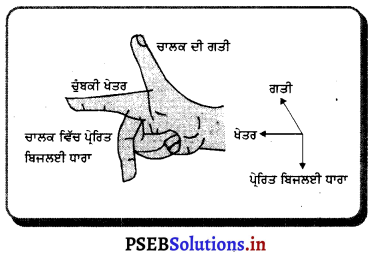
ਜੇ ਕਿਸੇ ਪੌਦੇ ਨੂੰ ਗਮਲੇ ਵਿਚ ਲਗਾ ਕੇ ਕਿਸੇ ਹਨੇਰੇ ਕਮਰੇ ਵਿਚ ਰੱਖ ਦਿੱਤਾ ਜਾਵੇ ਤਾਂ ਪ੍ਰਕਾਸ਼ ਕਿਸੇ ਖਿੜਕੀ ਜਾਂ ਦਰਵਾਜ਼ੇ ਵੱਲੋਂ ਅੰਦਰ ਆਉਂਦਾ ਹੋਵੇ ਤਾਂ ਕੁਝ ਦਿਨਾਂ ਦੇ ਬਾਅਦ ਹੀ ਤਣੇ ਦਾ ਅਗਲਾ ਭਾਗ ਖੁਦ ਉਸੀ ਦਿਸ਼ਾ ਵਿਚ ਮੁੜ ਜਾਂਦਾ ਹੈ ਜਿਸ ਪਾਸੇ ਤੋਂ ਪ੍ਰਕਾਸ਼ ਕਮਰੇ ਵਿਚ ਪਾ ਰਿਹਾ ਸੀ ।

ਅਜਿਹਾ ਇਸ ਲਈ ਹੁੰਦਾ ਹੈ ਕਿ ਤਣੇ ਦਾ ਸਿਰਾ ਸਿਰਫ ਉਸੀ ਦਿਸ਼ਾ ਵਿਚ ਰਿਸਾਓ ਹੋਣ ਵਾਲੇ ਵਧੇਰੇ ਆਕਸਿਨ ਦੇ ਪ੍ਰਭਾਵ ਨਾਲ ਨਸ਼ਟ ਹੋ ਜਾਂਦਾ ਹੈ । ਜਦੋਂ ਕਿ ਉਲਟ ਦਿਸ਼ਾ ਵੱਲ ਹਾਰਮੋਨ ਮੌਜੂਦ ਰਹਿੰਦਾ ਹੈ । ਇਸ ਕਾਰਨ ਤਣੇ ਦੀ ਦਿਸ਼ਾ ਵਿਚ ਮੁੜ ਜਾਂਦਾ ਹੈ ।

ਪ੍ਰਸ਼ਨ 7.
ਸੁਖਮਨਾ ਨਾੜੀ ਤੇ ਸੱਟ ਲੱਗਣ ਨਾਲ ਕਿਹੜੇ ਸੰਕੇਤਾਂ ਵਿੱਚ ਰੁਕਾਵਟ ਆਵੇਗੀ ?
ਉੱਤਰ-
ਸੁਖਮਨਾ ਨਾੜੀ ਜਾਂ ਮੇਰੁਰਜੁ ਨੂੰ ਸੱਟ ਲੱਗਣ ਨਾਲ ਪ੍ਰਤਿਵਰਤੀ ਕਿਰਿਆਵਾਂ ਅਤੇ ਅਣਇੱਛਤ ਕਿਰਿਆਵਾਂ ਲਈ ਆਉਣ ਵਾਲੇ ਸੰਕੇਤਾਂ ਵਿਚ ਰੁਕਾਵਟ ਹੋਵੇਗੀ । ਵਾਤਾਵਰਨ ਦੀ ਕੋਈ ਵੀ ਸੂਚਨਾ ਆਉਣ ਜਾਣ ਵਾਲੀਆਂ ਨਾੜੀਆਂ ਦੇ ਬੰਡਲ ਵਿਚ ਹੁੰਦੀ ਹੋਈ ਦਿਮਾਗ਼ ਵਿਚ ਪਹੁੰਚ ਜਾਵੇਗੀ । ਇਹ ਤੁਰੰਤ ਪ੍ਰਭਾਵਿਤ ਅੰਗਾਂ ਵਿਚ ਨਾ ਪੁੱਜ ਕੇ ਦਿਮਾਗ ਦੁਆਰਾ ਉਸ ਅੰਗ ਤਕ ਪੁੱਜ ਜਾਵੇਗੀ । ਅਜਿਹਾ ਹੋਣ ਨਾਲ ਵਧੇਰੇ ਦੇਰ ਲਗੇਗੀ ਅਤੇ ਉਦੋਂ ਤੱਕ ਅੰਗ ਤੇ ਬੁਰਾ ਅਸਰ ਹੋ ਚੁੱਕਾ ਹੋਵੇਗਾ ।

ਪ੍ਰਸ਼ਨ 8.
ਪੌਦਿਆਂ ਵਿੱਚ ਰਸਾਇਣਿਕ ਤਾਲਮੇਲ ਕਿਸ ਤਰ੍ਹਾਂ ਹੁੰਦਾ ਹੈ ?
ਉੱਤਰ-
ਪੌਦਿਆਂ ਵਿਚ ਰਸਾਇਣਿਕ ਤਾਲਮੇਲ-ਪੌਦਿਆਂ ਵਿਚ ਰਸਾਇਣਿਕ ਤਾਲਮੇਲ ਪੌਦਿਆਂ ਦੇ ਹਾਰਮੋਨਾਂ ਦੇ ਕਾਰਨ ਹੁੰਦਾ ਹੈ । ਪੌਦੇ ਖ਼ਾਸ ਹਾਰਮੋਨਾਂ ਨੂੰ ਪੈਦਾ ਕਰਦੇ ਹਨ ਜੋ ਉਸ ਦੇ ਖ਼ਾਸ ਭਾਗਾਂ ਨੂੰ ਪ੍ਰਭਾਵਿਤ ਕਰਦੇ ਹਨ । ਪੌਦਿਆਂ ਵਿਚ ਤਣੇ ਦਾ ਸਿਰਾ ਪ੍ਰਕਾਸ਼ ਦੇ ਆਉਣ ਵਾਲੀ ਦਿਸ਼ਾ ਵੱਲ ਵਧਦਾ ਹੈ । ਗੁਰੂਤਵਾਨੁਵਰਤਨ ਜੜਾਂ ਨੂੰ ਹੇਠਾਂ ਵੱਲ ਮੋੜ ਕੇ ਅਨੁਕਰਿਆ ਕਰਦਾ ਹੈ । ਇਸ ਤਰ੍ਹਾਂ ਜਲਾ ਅਨੁਵਰਤਨ ਅਤੇ ਰਸਾਇਣ ਅਨੁਵਰਤਨ ਹੁੰਦਾ ਹੈ । ਪਰਾਗ ਨਲਿਕਾ ਦਾ ਬੀਜ ਅੰਡ ਵਲ ਵਾਧਾ ਕਰਨਾ ਰਸਾਇਣ ਅਨੁਵਰਤਨ ਦਾ ਉਦਾਹਰਨ ਹੈ । ਵੱਖ ਵੱਖ ਪੋਦੇ ਹਾਰਮੋਨ ਸੈੱਲਾਂ ਦੁਆਰਾ ਸੰਸ਼ਲੇਸ਼ਣ ਦੇ ਬਾਅਦ ਪੌਦਿਆਂ ਦੇ ਹੋਰ ਭਾਗਾਂ ਵਿਚ ਵਿਸਰਿਤ ਹੋ ਕੇ ਉਸ ਨੂੰ ਪ੍ਰਭਾਵਿਤ ਕਰਦੇ ਹਨ | ਸਾਈਟੋਕਾਈਨਿਨ ਹਾਰਮੋਨ ਪੌਦਿਆਂ ਦੀ ਜੀਰਣਤਾ ਨੂੰ ਰੋਕਦੇ ਹਨ | ਆਕਸਿਨ ਹਾਰਮੋਨ ਵਾਧਾ, ਅਨੁਵਰਤਨ ਗਤੀਆਂ, ਜੜ੍ਹ ਵਿਭੇਦਨ ਆਦਿ ਨੂੰ ਨਿਯੰਤਰਿਤ ਕਰਦੇ ਹਨ । ਐਬਸੈਸਿਕ ਤੇਜ਼ਾਬ ਵਾਧਾ ਰੋਕਣ ਵਾਲਾ ਪੌਦਾ ਹਾਰਮੋਨ ਹੈ । ਪੱਤਿਆਂ ਦਾ ਮੁਰਝਾਉਣਾ ਵੀ ਇਸ ਦੇ ਪ੍ਰਭਾਵਾਂ ਵਿੱਚ ਸ਼ਾਮਿਲ ਹੈ ।

PSEB 10th Class Science Solutions Chapter 7 ਕਾਬੂ ਅਤੇ ਤਾਲਮੇਲ

ਪ੍ਰਸ਼ਨ 9.
ਇੱਕ ਜੀਵ ਵਿੱਚ ਕੰਟਰੋਲ ਅਤੇ ਤਾਲਮੇਲ ਦੇ ਸਿਸਟਮ ਦੀ ਕਿਉਂ ਲੋੜ ਹੈ ? ਉੱਤਰ-ਬਹੁਕੋਸ਼ੀ ਜੀਵਾਂ ਦੀ ਰਚਨਾ ਬਹੁਤ ਗੁੰਝਲਦਾਰ ਹੁੰਦੀ ਹੈ । ਉਨ੍ਹਾਂ ਦੇ ਸਰੀਰ ਦੇ ਬਾਹਰੀ ਅਤੇ ਅੰਦਰਲੇ ਅੰਗਾਂ ਦੀ ਖ਼ਾਸ ਕਾਰਜ-ਪ੍ਰਣਾਲੀ ਅਤੇ ਗਤੀਵਿਧੀਆਂ ਵਿਚ ਤਾਲਮੇਲ ਦੀ ਬਹੁਤ ਹੀ ਲੋੜ ਹੁੰਦੀ ਹੈ । ਅੰਗਾਂ ਵਿਚ ਨਿਯੰਤਰਨ ਜਾਂ ਕੰਟਰੋਲ ਅਤੇ ਤਾਲਮੇਲ ਦੁਆਰਾ ਹੀ ਉਨ੍ਹਾਂ ਦੀਆਂ ਲੋੜਾਂ ਦੀ ਪੂਰਤੀ ਸੰਭਵ ਹੋ ਸਕਦੀ ਹੈ । ਜੀਵਾਂ ਦੀ ਗੁੰਝਲਦਾਰ ਪ੍ਰਕਿਰਤੀ ਕਾਰਨ ਹੀ ਉਹ ਉਨ੍ਹਾਂ ਨਾੜੀਆਂ ਦੀ ਵਰਤੋਂ ਕਰਦੇ ਹਨ ਜੋ ਨਿਯੰਤਰਨ ਅਤੇ ਤਾਲਮੇਲ ਕਾਰਜ ਕਰਦੇ ਹਨ । ਖ਼ਾਸ ਕੰਮਾਂ ਲਈ ਟਿਸ਼ੂਆਂ ਦੀ ਵਰਤੋਂ ਨਿਯੰਤਰਨ ਅਤੇ ਤਾਲਮੇਲ ਵਿਚ ਸਹਾਇਕ ਸਿੱਧ ਹੁੰਦੀ ਹੈ ।

ਪ੍ਰਸ਼ਨ 10.
ਅਣਇੱਛਤ ਕਿਰਿਆਵਾਂ ਅਤੇ ਪ੍ਰਤਿਵਰਤੀ ਕਿਰਿਆਵਾਂ ਇੱਕ ਦੂਜੇ ਤੋਂ ਕਿਸ ਪ੍ਰਕਾਰ ਭਿੰਨ ਹਨ ?
ਉੱਤਰ-
ਪ੍ਰਤਿਵਰਤੀ ਕਿਰਿਆਵਾਂ ਉਹ ਕਿਰਿਆਵਾਂ ਹਨ ਜੋ ਬਾਹਰੀ ਸੰਵੇਦਨਾਂ ਦੇ ਉੱਤਰ ਵਿਚ ਤੁਰੰਤ ਅਤੇ ਆਪਣੇ ਆਪ ਹੋ ਜਾਂਦੀਆਂ ਹਨ । ਇਸ ਤੇ ਦਿਮਾਗ ਦਾ ਕੋਈ ਨਿਯੰਤਰਨ ਨਹੀਂ ਹੁੰਦਾ । ਇਹ ਮੇਰੂਰਜੂ ਜਾਂ ਸੁਖਮਨਾ ਦੁਆਰਾ ਨਿਯੰਤਰਿਤ ਜਾਂ ਕੰਟਰੋਲ ਹੋ ਜਾਂਦੀ ਹੈ । ਪ੍ਰਤਿਵਰਤੀ ਕਿਰਿਆਵਾਂ ਆਪਣੇ ਆਪ ਪ੍ਰੇਰਕ ਦੇ ਪ੍ਰਤੀਉੱਤਰ ਵਿਚ ਹੁੰਦੀਆਂ ਹਨ । ਉਦਾਹਰਨ ਲਹੂ ਦਬਾਅ, ਦਿਲ ਦੇ ਧੜਕਨ ਦੀ ਦਰ, ਸਾਹ ਦਰ ਆਦਿ ।

ਅਣਇੱਛਤ ਕਿਰਿਆਵਾਂ ਵੀ ਪ੍ਰਾਣੀਆਂ ਦੀ ਇੱਛਾ ਦੁਆਰਾ ਚਾਲਿਤ ਨਹੀਂ ਹੁੰਦੀਆਂ ਪਰ ਇਨ੍ਹਾਂ ਦਾ ਚਾਲਨ ਮੱਧ ਦਿਮਾਗ਼ ਅਤੇ ਪਿਛਲੇ ਦਿਮਾਗ਼ ਦੁਆਰਾ ਕੀਤਾ ਜਾਂਦਾ ਹੈ । ਉਦਾਹਰਨ-ਗਰਮ ਧਾਤੁ ਤੇ ਹੱਥ ਲਗਾਉਣ ਤੇ ਹੱਥ ਪਰੇ ਹਟਣਾ, ਪਲਕ ਝਪਕਨਾ ਅਤੇ ਖਾਂਸੀ ਕਰਨਾ ਆਦਿ ।

ਪ੍ਰਸ਼ਨ 11.
ਜੰਤੂਆਂ ਵਿਚ ਕੰਟਰੋਲ ਅਤੇ ਤਾਲਮੇਲ ਦੇ ਲਈ ਨਾੜੀ ਅਤੇ ਹਾਰਮੋਨ ਕਿਰਿਆ ਵਿਧੀਆਂ ਦੀ ਤੁਲਨਾ ਅਤੇ ਟਾਕਰਾ ਕਰੋ ।
ਉੱਤਰ-

ਨਾੜੀ ਕਿਰਿਆ ਵਿਧੀ ਹਾਰਮੋਨ ਕਿਰਿਆ ਵਿਧੀ
(1) ਇਹ ਐਕਸਾਨ ਦੇ ਅੰਤ ਵਿਚ ਬਿਜਲੀ ਆਵੇਗ ਦਾ ਨਤੀਜਾ ਹੈ । (1) ਇਹ ਲਹੂ ਦੁਆਰਾ ਭੇਜਿਆ ਗਿਆ ਰਸਾਇਣਿਕ ਸੰਦੇਸ਼ ਹੈ ।
(2) ਸੂਚਨਾ ਬਹੁਤ ਤੇਜ਼ ਗਤੀ ਨਾਲ ਅੱਗੇ ਵੱਧਦੀ ਹੈ । (2) ਸੂਚਨਾ ਹੌਲੀ-ਹੌਲੀ ਗਤੀ ਕਰਦੀ ਹੈ ।
(3) ਸੂਚਨਾ ਵਿਸ਼ਿਸ਼ਟ ਇਕ ਜਾਂ ਅਨੇਕ ਨਾੜੀ, ਸੈੱਲਾਂ, ਨਿਊਰਾਨਾਂ ਆਦਿ ਨੂੰ ਪ੍ਰਾਪਤ ਹੁੰਦੀ ਹੈ । (3) ਸੂਚਨਾ ਸਾਰੇ ਸਰੀਰ ਨੂੰ ਲਹੂ ਦੁਆਰਾ ਪ੍ਰਾਪਤ ਹੋ ਜਾਂਦੀ ਹੈ ਜਿਸ ਨੂੰ ਕੋਈ ਖ਼ਾਸ ਸੈੱਲ ਜਾਂ ਨਾੜੀ ਖੁਦ ਪ੍ਰਾਪਤ ਕਰ ਲੈਂਦਾ ਹੈ ।
(4) ਇਸ ਨੂੰ ਉੱਤਰ ਜਲਦੀ ਪ੍ਰਾਪਤ ਹੋ ਜਾਂਦਾ ਹੈ । (4) ਇਸ ਨੂੰ ਉੱਤਰ ਹੌਲੀ-ਹੌਲੀ ਪ੍ਰਾਪਤ ਹੁੰਦਾ ਹੈ ।

(5) ਇਸਦਾ ਪ੍ਰਭਾਵ ਘੱਟ ਸਮੇਂ ਤਕ ਰਹਿੰਦਾ ਹੈ । (5) ਇਸਦਾ ਪ੍ਰਭਾਵ ਅਕਸਰ ਦੇਰ ਤਕ ਰਹਿੰਦਾ ਹੈ ।

ਪ੍ਰਸ਼ਨ 12.
ਛੂਈ-ਮੂਈ ਪੌਦੇ ਵਿੱਚ ਗਤੀ ਅਤੇ ਸਾਡੀ ਲੱਤ ਦੀ ਗਤੀ ਦੇ ਤਰੀਕਿਆਂ ਵਿੱਚ ਕੀ ਅੰਤਰ ਹੈ ?
ਉੱਤਰ-
ਛੂਈ-ਮੂਈ ਪੌਦਾ ਸਪਰਸ਼ ਕਰਦੇ ਹੀ ਪੱਤਿਆਂ ਨੂੰ ਝੁਕਾ ਕੇ ਜਾਂ ਬੰਦ ਕਰ ਕੇ ਸੰਵੇਦਨਸ਼ੀਲਤਾ ਦੀ ਜਾਣਕਾਰੀ ਦਿੰਦਾ ਹੈ । ਪੌਦੇ ਹਾਰਮੋਨ ਦੇ ਅਸਰ ਕਾਰਨ ਦਾ ਸੈੱਲਾਂ ਵਿਚ ਇਹ ਪਰਿਵਰਤਿਤ ਕਰ ਦਿੰਦੀਆਂ ਹਨ । ਜਦੋਂ ਕਿ ਸਾਡੀਆਂ ਲੱਤਾਂ ਵਿਚ ਹੋਣ ਵਾਲੀ ਇੱਛਤ ਕਿਰਿਆ ਦਾ ਪਰਿਣਾਮ ਹੈ ਜੋ ਮੱਧ ਦਿਮਾਗ਼ ਦੁਆਰਾ ਸੰਚਾਲਿਤ ਹੁੰਦੀ ਹੈ । ਇਸ ਵਿਚ ਨਾੜੀ ਕੰਟਰੋਲ ਦਾ ਸਹਿਯੋਗ ਪ੍ਰਾਪਤ ਕੀਤਾ ਜਾਂਦਾ ਹੈ ।
Science Guide for Class 10 PSEB ਕਾਬੂ ਅਤੇ ਤਾਲਮੇਲ InText Questions and Answers

ਅਧਿਆਇ ਦੇ ਅੰਦਰ ਦਿੱਤੇ ਗਏ ਪ੍ਰਸ਼ਨ ਅਤੇ ਉਨ੍ਹਾਂ ਦੇ ਉੱਤਰ

ਪ੍ਰਸ਼ਨ 1.
ਪ੍ਰਤਿਵਰਤੀ ਕਿਰਿਆ ਅਤੇ ਚੱਲਣ ਵਿੱਚ ਕੀ ਅੰਤਰ ਹੈ ?
ਉੱਤਰ-
ਪ੍ਰਤਿਵਰਤੀ ਕਿਰਿਆ ਦਿਮਾਗ਼ ਦੀ ਇੱਛਾ ਦੇ ਬਿਨਾਂ ਹੋਣ ਵਾਲੀ ਅਣਇੱਛਕ ਕਿਰਿਆ ਹੈ । ਇਹ ਸਵਾਇਤ ਪ੍ਰੇਰਕ ਦੀ ਪ੍ਰਤੀਉੱਤਰ ਹੈ । ਇਹ ਬਹੁਤ ਸਪੱਸ਼ਟ ਅਤੇ ਯਾਂਤਰਿਕ ਪ੍ਰਕਾਰ ਦੀ ਹੈ । ਇਹ ਸੁਖਮਨਾ ਦੁਆਰਾ ਨਿਯੰਤਰਿਤ ਪੇਸ਼ੀਆਂ ਦੁਆਰਾ ਕਰਾਈ ਜਾਂਦੀ ਹੈ ।

‘ਚੱਲਣ’ ਇਕ ਇੱਛਤ ਕਿਰਿਆ ਹੈ ਜੋ ਮਨੁੱਖ ਸੋਚ-ਵਿਚਾਰ ਕਰ ਕੇ ਹੀ ਕਰਦਾ ਹੈ ਅਤੇ ਇਸਦਾ ਨਿਯੰਤਰਨ ਦਿਮਾਗ਼ ਦੁਆਰਾ ਹੁੰਦਾ ਹੈ । ਪ੍ਰਤਿਵਰਤੀ ਕਿਰਿਆ ਵਿਚ ਸਰੀਰ ਦਾ ਸਿਰਫ ਇਕ ਭਾਗ ਪ੍ਰਤੀਕਿਰਿਆ ਕਰਦਾ ਹੈ ਜਦੋਂ ਕਿ ਚਲਣ ਵਿਚ ਪੂਰਾ ਸਰੀਰ ਇਕ ਸਥਾਨ ਤੋਂ ਦੂਸਰੇ ਸਥਾਨ ਤੇ ਜਾਂਦਾ ਹੈ ।
PSEB 10th Class Science Solutions Chapter 7 ਕਾਬੂ ਅਤੇ ਤਾਲਮੇਲ

ਪ੍ਰਸ਼ਨ 2.
ਦੋ ਨਿਉਰਾਨਾਂ ਵਿਚਕਾਰ ਡੈਂਡਰਾਈਟ ਤੇ ਕੀ ਹੁੰਦਾ ਹੈ ?
ਉੱਤਰ-
ਪ੍ਰਾਣੀਆਂ ਦੇ ਸਰੀਰ ਵਿਚ ਦੋ ਨਿਊਰਾਨ ਇਕ ਦੂਸਰੇ ਨਾਲ ਜੁੜ ਕੇ ਲੜੀ ਬਣਾਉਂਦੇ ਹਨ ਅਤੇ ਸੂਚਨਾ ਅੱਗੇ ਭੇਜਦੇ ਹਨ । ਸੂਚਨਾ ਇਕ ਨਿਊਰਾਨ ਦੇ ਡੈਂਡਰਾਈਟ (Dendite) ਸਿਰੇ ਦੀ ਨੋਕ ਦੁਆਰਾ ਪ੍ਰਾਪਤ ਕੀਤੀ ਜਾਂਦੀ ਹੈ ਅਤੇ ਇਕ ਰਸਾਇਣਿਕ ਕਿਰਿਆ ਦੁਆਰਾ ਇਕ ਬਿਜਲੀ ਆਵੇਗ ਪੈਦਾ ਕਰਦੀ ਹੈ । ਇਹ ਆਵੇਗ ਡੈਂਡਰਾਈਟ ਤੋਂ ਸੈੱਲਾਂ ਤਕ ਪੁੱਜਦਾ ਹੈ ਅਤੇ ਸੈੱਲ ਬਾਡੀ ਵਿਚ ਹੁੰਦਾ ਹੋਇਆ ਇਸਦੇ ਅੰਤਿਮ ਸਿਰੇ ਤੱਕ ਪੁੱਜ ਜਾਂਦਾ ਹੈ । ਸੈੱਲ ਬਾਡੀ ਦੇ ਅੰਤ ਵਿਚ ਬਿਜਲੀ ਆਵੇਗ ਦੁਆਰਾ ਕੁਝ ਰਸਾਇਣਾਂ ਨੂੰ ਪੈਦਾ ਕਰਵਾਇਆ ਜਾਂਦਾ ਹੈ ਜੋ ਖਾਲੀ ਥਾਂਵਾਂ ਨੂੰ ਪਾਰ ਕਰ ਆਪਣੇ ਤੋਂ ਅਗਲੀ ਨਾੜੀ ਸੈੱਲ ਜਾਂ ਨਿਊਰਾਨ ਦੀ ਡੈਂਡਰਾਈਟ ਵਿਚ ਇਸ ਪ੍ਰਕਾਰ ਬਿਜਲੀ ਆਵੇਸ਼ ਨੂੰ ਸ਼ੁਰੂ ਕਰਵਾਉਂਦੇ ਹਨ । ਇਹ ਸਰੀਰ ਵਿੱਚ ਨਾੜੀ ਆਵੇਗ ਦੀ ਯਾਤਰਾ ਦਾ ਸਾਧਾਰਨ ਪ੍ਰਬੰਧ ਹੈ ।
ਪ੍ਰਸ਼ਨ 3.
ਦਿਮਾਗ਼ ਦਾ ਕਿਹੜਾ ਭਾਗ ਸਰੀਰ ਦੀ ਸਥਿਤੀ ਅਤੇ ਸੰਤੁਲਨ ਨੂੰ ਬਣਾਈ ਰੱਖਦਾ ਹੈ ?
ਉੱਤਰ-
ਪਿਛਲੇ ਦਿਮਾਗ਼ ਵਿਚ ਸਥਿਤ ਸੈਰੀਬੈਲਮ (Cerebellum) ਇੱਛੁਕ ਕਿਰਿਆਵਾਂ ਦੇ ਸਹੀ ਹੋਣ ਅਤੇ ਸਰੀਰ ਦੇ ਆਸਣ ਤੇ ਸੰਤੁਲਨ ਲਈ ਉੱਤਰਦਾਈ ਹੈ । ਸਰੀਰ ਦੀ ਸਥਿਤੀ ਅਤੇ ਸੰਤੁਲਨ ਦਾ ਅਨੁਰੱਖਿਅਣ ਕਰਦਾ ਹੈ । ਇਹ ਪਿਛਲੇ ਦਿਮਾਗ਼ ਵਿਚ ਹੇਠਾਂ ਵੱਲ ਸਥਿਤ ਹੁੰਦਾ ਹੈ । ਇਹ ਇੱਛਤ ਪੇਸ਼ੀਆਂ ਦੀ ਗਤੀ ਨੂੰ ਨਿਯੰਤਰਿਤ ਕਰਦਾ ਹੈ ।

ਪ੍ਰਸ਼ਨ 4.
ਅਸੀਂ ਅਗਰਬੱਤੀ ਦੀ ਗੰਧ ਦਾ ਪਤਾ ਕਿਵੇਂ ਕਰਦੇ ਹਾਂ ?
ਉੱਤਰ-
ਸਾਡੀ ਨੱਕ ਵਿਚ ਗੰਧ ਹੀ ਹੁੰਦੇ ਹਨ । ਇਨ੍ਹਾਂ ਦੇ ਸੰਵੇਦੀ ਨਿਊਰਾਨ ਅਗਰਬੱਤੀ ਦੀ ਗੰਧ ਨੂੰ ਪ੍ਰਾਪਤ ਕਰਦੇ ਹਨ ਅਤੇ ਅਨੁਕਿਰਿਆ ਨੂੰ ਪ੍ਰੇਰਕ ਖੇਤਰ ਤਕ ਪਹੁੰਚਾਉਂਦੇ ਹਨ । ਅਗਲੇ ਦਿਮਾਗ਼ (Cerebrun) ਵਿਚ ਹੀ ਨਾਲ ਸੰਵੇਦੀ ਆਵੇਗ ਪ੍ਰਾਪਤ ਕਰਨ ਦਾ ਖੇਤਰ ਹੁੰਦਾ ਹੈ ਜੋ ਸੁੰਘਣ ਦੇ ਲਈ ਹੀ ਖ਼ਾਸ ਬਣੇ ਹੁੰਦੇ ਹਨ । ਇਹੀ ਗੰਧ ਦੇ ਪ੍ਰਤੀ ਫੈਸਲਾ ਲੈ ਕੇ ਅਗਰਬੱਤੀ ਦੀ ਸੁਗੰਧ ਦਾ ਸਾਨੂੰ ਅਨੁਭਵ ਕਰਵਾਉਂਦੇ ਹਨ ।

ਪ੍ਰਸ਼ਨ 5.
ਪ੍ਰਤਿਵਰਤੀ ਕਿਰਿਆ ਵਿੱਚ ਦਿਮਾਗ਼ ਦੀ ਕੀ ਭੂਮਿਕਾ ਹੈ ?
ਉੱਤਰ-
ਪ੍ਰਤਿਵਰਤੀ ਕਿਰਿਆਵਾਂ ਦਿਮਾਗ਼ ਦੁਆਰਾ ਪਰਿਚਲਿਤ ਨਹੀਂ ਹੁੰਦੀਆਂ । ਇਹ ਸੁਖਮਨਾ ਦੁਆਰਾ ਨਿਯੰਤਰਿਤ ਪੇਸ਼ੀਆਂ ਦੀ ਅਣਇੱਛਤ ਕਿਰਿਆਵਾਂ ਹੁੰਦੀਆਂ ਹਨ ਜੋ ਪ੍ਰੇਰਤ ਦੀ ਪ੍ਰਤੀਕਿਰਿਆ ਵਿਚ ਹੁੰਦੀ ਹੈ । ਇਹ ਕਿਰਿਆਵਾਂ ਚਾਹੇ ਦਿਮਾਗ਼ ਦੀ ਇੱਛਾ ਦੇ ਬਿਨਾਂ ਹੁੰਦੀਆਂ ਹਨ ਪਰ ਦਿਮਾਗ਼ ਤਕ ਇਸਦੀ ਸੂਚਨਾ ਪਹੁੰਚਦੀ ਹੈ ਜਿੱਥੇ ਸੋਚਣ ਵਿਚਾਰਨ ਦੀ ਪ੍ਰਕਿਰਿਆ ਹੁੰਦੀ ਹੈ ।

ਪ੍ਰਸ਼ਨ 6.
ਪੌਦਾ ਹਾਰਮੋਨ ਕੀ ਹੈ ?
ਉੱਤਰ-
ਪੌਦਾ ਹਾਰਮੋਨ (Plant Harmones) – ਇਹ ਵੱਖ-ਵੱਖ ਪ੍ਰਕਾਰ ਦੇ ਰਸਾਇਣਿਕ ਪਦਾਰਥ ਹਨ ਜੋ ਪੌਦਿਆਂ ਦੇ ਵਾਧੇ ਅਤੇ ਵਿਭੇਦਨ ਸੰਬੰਧੀ ਕਿਰਿਆਵਾਂ ਤੇ ਨਿਯੰਤਰਨ ਕਰਦੇ ਹਨ ਉਨ੍ਹਾਂ ਨੂੰ ਪੌਦਾ ਹਾਰਮੋਨ ਕਹਿੰਦੇ ਹਨ । ਪੌਦਾ ਹਾਰਮੋਨ ਕਈ ਪ੍ਰਕਾਰ ਦੇ ਹੁੰਦੇ ਹਨ । ਆਂਕਸਿਨ (Auxin), ਜਿੱਥੇਰੇਲਿਨ (Gibberllins), ਸਾਈਟੋਕਾਈਨਿਨ (Cytokinins), ਐਬਸਿਲਿਕ ਐਸਿਡ (Abscisic acid) ਆਦਿ ਪੌਦਾ ਹਾਰਮੋਨ ਹਨ ।

PSEB 10th Class Science Solutions Chapter 7 ਕਾਬੂ ਅਤੇ ਤਾਲਮੇਲ

ਪ੍ਰਸ਼ਨ 7.
ਛੂਈ-ਮੂਈ ਪੌਦੇ ਦੀਆਂ ਪੱਤੀਆਂ ਦੀ ਗਤੀ, ਪ੍ਰਕਾਸ਼ ਵਲ ਕਰੂੰਬਲਾਂ ਦੀ ਗਤੀ ਤੋਂ ਕਿਵੇਂ ਭਿੰਨ ਹੈ ?
ਉੱਤਰ-
ਛੂਈ-ਮੂਈ ਪੌਦਿਆਂ ਤੇ ਪ੍ਰਕਾਸ਼ ਅਨੁਵਰਤਨੀ ਗਤੀ ਦਾ ਅਸਰ ਪੈਂਦਾ ਹੈ । ਪੌਦੇ ਦਾ ਕਰੂੰਬਲ ਬਹੁਤ ਧੀਮੀ ਗਤੀ ਨਾਲ ਪ੍ਰਕਾਸ਼ ਆਉਣ ਵਾਲੀ ਦਿਸ਼ਾ ਵਿਚ ਵਾਧਾ ਕਰਦਾ ਹੈ ਪਰ ਇਸਦੇ ਪੱਤੇ ਛੂ ਲੈਣ ਦੀ ਅਨੁਕਿਰਿਆ ਦੇ ਪ੍ਰਤੀ ਬਹੁਤ ਹੀ ਸੰਵੇਦਨਸ਼ੀਲ ਹਨ । ਛੂਹਣ ਦੀ ਸੂਚਨਾ ਇਸਦੇ ਵੱਖ-ਵੱਖ ਭਾਗਾਂ ਨੂੰ ਬਹੁਤ ਤੇਜ਼ੀ ਨਾਲ ਪ੍ਰਾਪਤ ਹੋ ਜਾਂਦੀ ਹੈ । ਪੋਦੇ ਇਸ ਸੂਚਨਾ ਨੂੰ ਇਕ ਸੈੱਲ ਤੋਂ ਦੂਸਰੇ ਸੈੱਲ ਤਕ ਸੰਚਾਰਿਤ ਕਰਨ ਲਈ ਬਿਜਲੀ ਰਸਾਇਣ ਸਾਧਨ ਦੀ ਵਰਤੋਂ ਕਰਦੇ ਹਨ । ਇਸ ਵਿਚ ਸੂਚਨਾਵਾਂ ਦੇ ਚਲਣ ਦੇ ਲਈ ਕੋਈ ਖ਼ਾਸ ਕਿਸਮ ਦੇ ਟਿਸ਼ ਨਹੀਂ ਹੁੰਦੇ । ਇਸ ਲਈ ਇਹ ਪਾਣੀ ਦੀ ਮਾਤਰਾ ਵਿਚ ਪਰਿਵਰਤਨ ਕਰਕੇ ਆਪਣੇ ਪੱਤਿਆਂ ਨੂੰ ਸੁੰਗੜ ਕੇ ਆਕਾਰ ਬਦਲ ਲੈਂਦੇ ਹਨ ।
PSEB 10th Class Science Solutions Chapter 7 ਕਾਬੂ ਅਤੇ ਤਾਲਮੇਲ 3

ਪ੍ਰਸ਼ਨ 8.
ਇਕ ਪੌਦਾ ਹਾਰਮੋਨ ਦਾ ਉਦਾਹਰਨ ਦਿਓ ਜੋ ਵਾਧੇ ਲਈ ਉਤੇਜਿਤ ਕਰਦਾ ਹੈ ।
ਉੱਤਰ-
ਆਕਸਿਨ (Auxin)-ਇਕ ਪੌਦਾ ਹਾਰਮੋਨ ਹੈ ਜੋ ਪੌਦਿਆਂ ਵਿੱਚ ਵਾਧੇ ਨੂੰ ਉਤੇਜਿਤ ਕਰਦਾ ਹੈ ।
ਪ੍ਰਸ਼ਨ 9.
ਕਿਸੇ ਸਹਾਰੇ ਦੇ ਚੌਹਾਂ ਪਾਸੇ ਵੱਲ ਤੰਦੜਿਆਂ ਦੇ ਵਾਧੇ ਵਿੱਚ ਆਕਸਿਨ ਕਿਵੇਂ ਸਹਾਇਤਾ ਕਰਦਾ ਹੈ ?
ਉੱਤਰ-
ਜਦੋਂ ਵਾਧਾ ਕਰਦਾ ਪੌਦਾ ਪ੍ਰਕਾਸ਼ ਵੱਲ ਜਾਂਦਾ ਹੈ ਤਾਂ ਆਂਕਸਿਨ ਨਾਮ ਦਾ ਪੌਦਾ ਹਾਰਮੋਨ ਤਣੇ ਦੇ ਅਗਲੇ ਭਾਗ ਵਿਚ ਸੰਸਲੇਸ਼ਿਤ ਹੁੰਦਾ ਹੈ ਅਤੇ ਸੈੱਲਾਂ ਦੀ ਲੰਬਾਈ ਵਿਚ ਵਾਧਾ ਕਰਦਾ ਹੈ । ਜਦੋਂ ਪੌਦੇ ਤੇ ਇਕ ਪਾਸੇ ਪ੍ਰਕਾਸ਼ ਆ ਰਿਹਾ ਹੋਵੇ ਤਾਂ ਆਕਸਿਨ ਵਿਸਰਿਤ ਹੋ ਕੇ ਤਣੇ ਤੋਂ ਦੂਰ ਵਾਲੀ ਦਿਸ਼ਾ ਵਿਚ
ਸਹਾਰਾ ਆਕਸਿਨ ਦਾ ਸਾਂਦਰਨ ਸੈੱਲਾਂ ਨੂੰ ਲੰਬਾਈ ਵਿਚ ਵੱਧਣ ਲਈ ਉਦੈਪਤ ਕਰਦਾ ਹੈ ਅਤੇ ਉਹ ਤੰਦੜੇ ਦੀ ਸਹਾਇਤਾ ਨਾਲ ਕਿਸੇ ਦੂਸਰੇ ਪੌਦੇ ਜਾਂ ਬਾੜ ਦੇ ਉੱਪਰ ਚੜਦਾ ਹੈ । ਇਹ ਤੰਦੜਾ ਸਪਰਸ਼ ਦੇ ਲਈ ਸੰਵੇਦਨਸ਼ੀਲ ਹੈ । ਜਦੋਂ ਇਹ ਕਿਸੇ ਆਧਾਰ ਦੇ ਸੰਪਰਕ ਵਿਚ ਆਉਂਦੇ ਹਨ ਤਾਂ ਤੰਦੜੇ ਦਾ ਉਹ ਭਾਗ ਤੇਜ਼ੀ ਨਾਲ ਵਾਧਾ ਕਰਦਾ ਹੈ ਜੋ ਵਸਤੂ ਤੋਂ ਦੂਰ ਰਹਿੰਦਾ ਹੈ ਅਤੇ ਉਹ ਵਸਤੂ ਨੂੰ ਚਾਰੋਂ ਪਾਸੇ ਤੋਂ ਜਕੜ ਲੈਂਦਾ ਹੈ ।
PSEB 10th Class Science Solutions Chapter 7 ਕਾਬੂ ਅਤੇ ਤਾਲਮੇਲ 4

ਪ੍ਰਸ਼ਨ 10.
ਜਲ ਅਨੁਵਰਤਨ ਦਰਸਾਉਣ ਲਈ ਇੱਕ ਪ੍ਰਯੋਗ ਸੈੱਟ ਕਰੋ ।
ਉੱਤਰ-
ਲੱਕੜੀ ਦਾ ਬਣਿਆ ਇਕ ਲੰਬਾ ਡੱਬਾ ਲਓ । ਇਸ ਵਿਚ ਮਿੱਟੀ ਅਤੇ ਖਾਦ ਦਾ ਮਿਸ਼ਰਨ ਭਰੋ । ਇਸਦੇ ਇਕ ਸਿਰੇ ਤੇ ਇਕ
ਪੌਦਾ ਲਗਾਓ । ਡੱਬੇ ਵਿਚ ਪੌਦੇ ਦੇ ਉਲਟ ਦਿਸ਼ਾ ਵਿਚ ਇਕ ਕੀਪ ਮਿੱਟੀ ਵਿਚ ਗੱਡ ਦਿਓ । ਪੌਦੇ ਨੂੰ ਉਸੇ ਕੀਪ ਦੇ ਦੁਆਰਾ ਰੋਜ਼ ਪਾਣੀ ਦਿਓ । ਲਗਭਗ ਇਕ ਹਫਤੇ ਬਾਅਦ ਪੌਦੇ ਦੇ ਨੇੜੇ ਦੀ ਮਿੱਟੀ ਹਟਾ ਕੇ ਧਿਆਨ ਨਾਲ ਦੇਖੋ । ਪੌਦੇ ਦੀਆਂ ਜੜਾਂ ਦਾ ਵਾਧਾ ਉਸੇ ਦਿਸ਼ਾ ਵਿਚ ਦਿਖਾਈ ਦੇਵੇਗੀ ਜਿਸ ਦਿਸ਼ਾ ਵਿਚ ਕੀਪ
ਚਿੱਤਰ-ਜਲ ਅਨੁਵਰਤਨ ਦਰਸਾਉਣ ਦਾ ਪ੍ਰਯੋਗ ਦੁਆਰਾ ਪੌਦੇ ਦੀ ਸਿੰਚਾਈ ਕੀਤੀ ਸੀ ।
PSEB 10th Class Science Solutions Chapter 7 ਕਾਬੂ ਅਤੇ ਤਾਲਮੇਲ 5

ਪ੍ਰਸ਼ਨ 11.
ਜੰਤੂਆਂ ਵਿੱਚ ਰਸਾਇਣਿਕ ਤਾਲਮੇਲ ਕਿਵੇਂ ਹੁੰਦਾ ਹੈ ?
ਉੱਤਰ-
ਜੰਤੂਆਂ ਵਿਚ ਅੰਦਰ-ਰਿਸਾਵੀ ਗੰਥੀਆਂ ਖ਼ਾਸ ਰਸਾਇਣਾਂ ਨੂੰ ਪੈਦਾ ਕਰਦੀਆਂ ਹਨ । ਇਹ ਰਸਾਇਣ ਜਾਂ ਹਾਰਮੋਨ ਜੰਤੂਆਂ ਨੂੰ ਸੂਚਨਾਵਾਂ ਸੰਚਰਿਤ ਕਰਨ ਦੇ ਸਾਧਨ ਦੇ ਰੂਪ ਵਿਚ ਵਰਤੇ ਜਾਂਦੇ ਹਨ । ਐਨਲ ਰੰਥੀ ਤੋਂ ਨਿਕਲੇ ਐਡਰੀਨਲਿਨ ਹਾਰਮੋਨ ਸਿੱਧਾ ਲਹੂ ਵਿਚ ਮਿਲ ਜਾਂਦਾ ਹੈ ਅਤੇ ਸਰੀਰ ਦੇ ਵੱਖ-ਵੱਖ ਭਾਗਾਂ ਤੱਕ ਪਹੁੰਚ ਜਾਂਦਾ ਹੈ । ਟਿਸ਼ੂਆਂ ਵਿਚ ਖ਼ਾਸ ਗੁਣ ਹੁੰਦੇ ਹਨ ਜੋ ਆਪਣੇ ਲਈ ਜ਼ਰੂਰੀ ਹਾਰਮੋਨਾਂ ਨੂੰ ਪਹਿਚਾਣ ਕੇ ਉਨ੍ਹਾਂ ਦੀ ਵਰਤੋਂ ਬਾਹਰੀ ਜਾਂ ਅੰਦਰਲੀ ਪੱਧਰ ‘ਤੇ ਕਰਦੇ ਹਨ । ਖ਼ਾਸ ਤਰ੍ਹਾਂ ਦੇ ਕੰਮਾਂ ਨੂੰ ਕਰਨ ਵਾਲੇ ਅੰਗਾਂ ਨਾਲ ਤਾਲਮੇਲ ਕਰ ਕੇ ਹਾਰਮੋਨ ਆਪਣਾ ਖ਼ਾਸ ਅਸਰ ਦਿਖਾ ਦਿੰਦੇ ਹਨ ।
PSEB 10th Class Science Solutions Chapter 7 ਕਾਬੂ ਅਤੇ ਤਾਲਮੇਲ

ਪ੍ਰਸ਼ਨ 12.
ਆਇਓਡੀਨ ਯੁਕਤ ਲੂਣ ਦੇ ਉਪਯੋਗ ਦੀ ਸਲਾਹ ਕਿਉਂ ਦਿੱਤੀ ਜਾਂਦੀ ਹੈ ?
ਉੱਤਰ-
ਥਾਇਰਾਇਡ ਗ੍ਰੰਥੀ (Thyroid Gland) – ਥਾਇਰਾਈਡ ਗ੍ਰੰਥੀ ਨੂੰ ਹਾਰਮੋਨ ਬਣਾਉਣ ਲਈ ਆਇਓਡੀਨ ਦੀ ਲੋੜ ਹੁੰਦੀ ਹੈ | ਸਾਡੇ ਸਰੀਰ ਵਿਚ ਪ੍ਰੋਟੀਨ ਅਤੇ ਵਸਾ ਦੇ ਢਾਹ-ਉਸਾਰੂ ਨੂੰ ਥਾਇਰਾਕਸਿਨ ਹਾਰਮੋਨ ਨਿਯੰਤਰਿਤ ਕਰਦਾ ਹੈ । ਇਹ ਵਾਧੇ ਦੇ ਸੰਤੁਲਨ ਲਈ ਜ਼ਰੂਰੀ ਹੁੰਦਾ ਹੈ । ਜੋ ਸਾਡੇ ਭੋਜਨ ਵਿਚ ਆਇਓਡੀਨ ਦੀ ਕਮੀ ਰਹੇਗੀ ਤਾਂ ਸਾਨੂੰ ਗਿੱਲੜ ਰੋਗ (Goitre) ਹੋ ਜਾਵੇਗਾ । ਇਸ ਬਿਮਾਰੀ ਦੇ ਲੱਛਣ ਫੁੱਲੀ ਹੋਈ ਗਰਦਨ ਜਾਂ ਬਾਹਰ ਵਲ ਉੱਭਰੇ ਹੋਏ ਨੇਤਰ ਗੋਲਕ ਨਮਕ ਦੀ ਵਰਤੋਂ ਦੀ ਸਲਾਹ ਦਿੱਤੀ ਜਾਂਦੀ ਹੈ ।

ਪ੍ਰਸ਼ਨ 13.
ਜਦੋਂ ਐਡਰੀਨਾਲਿਨ ਦਾ ਲਹੂ ਵਿੱਚ ਰਿਸਾਓ ਹੁੰਦਾ ਹੈ ਤਾਂ ਸਾਡੇ ਸਰੀਰ ਵਿੱਚ ਕੀ ਪ੍ਰਤੀਕਿਰਿਆ ਹੁੰਦੀ ਹੈ ? ਉੱਤਰ-ਐਡਰੀਨਾਲਿਨ ਨੂੰ ਆਪਾਤਕਾਲ ਹਾਰਮੋਨ ਵੀ ਕਹਿੰਦੇ ਹਨ । ਜਦੋਂ ਕੋਈ ਵਿਅਕਤੀ ਡਰ ਜਾਂ ਤਣਾਅ ਦੀ ਸਥਿਤੀ ਵਿਚ ਹੁੰਦਾ ਹੈ ਤਾਂ ਸਰੀਰ ਖੁਦ ਹੀ ਐਡਰੀਨਾਲਿਨ ਹਾਰਮੋਨ ਨੂੰ ਵੱਡੀ ਮਾਤਰਾ ਵਿਚ ਰਿਸਾਓ ਕਰ ਦਿੰਦਾ ਹੈ ਤਾਂਕਿ ਵਿਅਕਤੀ ਆਪਾਤਕਾਲ ਦਾ ਸਾਹਮਣਾ ਕਰ ਸਕੇ । ਇਸ ਨਾਲ ਦਿਲ ਦੀ ਧੜਕਨ ਵਧ ਜਾਂਦੀ ਹੈ ਤਾਂਕਿ ਸਾਡੀਆਂ ਪੇਸ਼ੀਆਂ ਨੂੰ ਵੱਧ ਆਕਸੀਜਨ ਦੀ ਆਪੂਰਤੀ ਹੋ ਸਕੇ । ਪਾਚਨ ਪ੍ਰਣਾਲੀ ਅਤੇ ਚਮੜੀ ਵਿਚ ਲਹੂ ਦੀ ਆਪੂਰਤੀ ਘੱਟ ਹੋ ਜਾਂਦੀ ਹੈ । ਇਨ੍ਹਾਂ ਅੰਗਾਂ ਦੇ ਸਿਰੇ ਦੀਆਂ ਧਮਣੀਆਂ ਦੇ ਆਸ-ਪਾਸ ਦੀ ਪੇਸ਼ੀ ਸੁੰਗੜ ਜਾਂਦੀ ਹੈ । ਇਹ ਲਹੁ ਦੀ ਦਿਸ਼ਾ ਨੂੰ ਸਾਡੀਆਂ ਕੰਕਾਲ ਪੇਸ਼ੀਆਂ ਵੱਲ ਕਰ ਦਿੰਦੀ ਹੈ । ਡਾਇਆਫਰਾਮ ਅਤੇ ਪਸਲੀਆਂ ਦੀ ਪੇਸ਼ੀਆਂ ਦੇ ਸੁੰਗੜਨ ਨਾਲ ਸਾਹ ਤੇਜ਼ ਚਲਣ ਲਗਦੀ ਹੈ । ਇਹ ਸਾਰੀਆਂ ਕਿਰਿਆਵਾਂ ਮਿਲ ਕੇ ਜੰਤੁ ਸਰੀਰ ਨੂੰ ਸਥਿਤੀ ਨਾਲ ਨਿਪਟਨ ਲਈ ਤਿਆਰ ਕਰਦੀਆਂ ਹਨ ।

ਪ੍ਰਸ਼ਨ 14.
ਸ਼ੱਕਰ ਰੋਗ ਦੇ ਕੁਝ ਰੋਗੀਆਂ ਦਾ ਇਲਾਜ ਇੰਸੁਲਿਨ ਦਾ ਇੰਜੈਕਸ਼ਨ ਲਗਾ ਕੇ ਕਿਉਂ ਕੀਤਾ ਜਾਂਦਾ ਹੈ ?
ਉੱਤਰ-
ਇੰਸੁਲਿਨ (Insulin)-ਉਹ ਹਾਰਮੋਨ ਹੈ ਜੋ ਪੈਨਕਰੀਆਜ਼ ਵਿਚ ਪੈਦਾ ਹੁੰਦਾ ਹੈ । ਇਹ ਲਹੂ ਵਿਚ ਸ਼ਕਰ ਦੇ ਪੱਧਰ ਨੂੰ ਨਿਯੰਤਰਿਤ ਕਰਨ ਵਿਚ ਸਹਾਇਤਾ ਦਿੰਦਾ ਹੈ । ਜੇ ਇਹ ਠੀਕ ਮਾਤਰਾ ਵਿਚ ਪੈਦਾ ਨਾ ਹੋਵੇ ਤਾਂ ਲਹੂ ਵਿਚ ਸ਼ੱਕਰ ਦਾ ਪੱਧਰ ਵੱਧ ਜਾਂਦਾ ਹੈ ਜਿਸ ਕਾਰਨ ਸਰੀਰ ਤੇ ਕਈ ਹਾਨੀਕਾਰਕ ਪ੍ਰਭਾਵ ਪੈਂਦੇ ਹਨ । ਇਸ ਲਈ ਸ਼ਕਰ ਰੋਗ ਨਾਲ ਪੀੜਤ ਰੋਗੀਆਂ ਦਾ ਇਲਾਜ ਇੰਸੁਲਿਨ ਦਾ ਇੰਜੈਕਸ਼ਨ ਲਾ ਕੇ ਕੀਤਾ ਜਾਂਦਾ ਹੈ । ਇਸ ਨਾਲ ਉਨ੍ਹਾਂ ਦੇ ਲਹੂ ਵਿਚ ਸ਼ਕਰ ਦਾ ਪੱਧਰ ਕਾਬੂ ਵਿਚ ਰਹਿੰਦਾ ਹੈ ।
PSEB 10th Class Science Solutions Chapter 5 ਤੱਤਾਂ ਦਾ ਆਵਰਤੀ ਵਰਗੀਕਰਨ

Punjab State Board PSEB 10th Class Science Book Solutions Chapter 5 ਤੱਤਾਂ ਦਾ ਆਵਰਤੀ ਵਰਗੀਕਰਨ Textbook Exercise Questions and Answers.

PSEB Solutions for Class 10 Science Chapter 5 ਤੱਤਾਂ ਦਾ ਆਵਰਤੀ ਵਰਗੀਕਰਨ

PSEB 10th Class Science Guide ਤੱਤਾਂ ਦਾ ਆਵਰਤੀ ਵਰਗੀਕਰਨ Textbook Questions and Answers

ਪ੍ਰਸ਼ਨ 1.
ਆਵਰਤੀ ਸਾਰਨੀ ਵਿੱਚ ਖੱਬੇ ਤੋਂ ਸੱਜੇ ਪਾਸੇ ਵੱਲ ਜਾਣ ਨਾਲ ਤਰਤੀਬ ਬਾਰੇ ਕਿਹੜਾ ਕਥਨ ਸੱਚ ਨਹੀਂ :
(a) ਤੱਤਾਂ ਦਾ ਧਾਤਵੀ ਸੁਭਾਅ ਘੱਟਦਾ ਹੈ ।
(b) ਸੰਯੋਜਕ ਇਲੈੱਕਟਾਨਾਂ ਦੀ ਸੰਖਿਆ ਵੱਧ ਜਾਂਦੀ ਹੈ ।
(c) ਪਰਮਾਣੂ ਸੋਖ ਨਾਲ ਇਲੈੱਕਟ੍ਰਾਨਾਂ ਨੂੰ ਗੁਆ ਦਿੰਦੇ ਹਨ ।
(d) ਇਨ੍ਹਾਂ ਦੇ ਆਕਸਾਈਡ ਵਧੇਰੇ ਤੇਜ਼ਾਬੀ ਹੋ ਜਾਂਦੇ ਹਨ ।
ਉੱਤਰ-
ਕਥਨ (c) ਸੱਚ ਨਹੀਂ ਹੈ, ਕਿਉਂਕਿ ਆਵਰਤੀ ਸਾਰਨੀ ਵਿੱਚ ਖੱਬਿਉਂ ਸੱਜੇ ਜਾਣ ਨਾਲ ਪਰਮਾਣੂ ਦੀ ਇਲੈੱਕਟ੍ਰਾਨ ਗੁਆਉਣ ਦੀ ਸਮਰੱਥਾ ਘੱਟਦੀ ਹੈ ।

ਪ੍ਰਸ਼ਨ 2.
ਤੱਤ X, XCl2 ਸੂਤਰ ਵਾਲਾ ਇੱਕ ਕਲੋਰਾਈਡ ਬਣਾਉਂਦਾ ਹੈ ਜੋ ਕਿ ਇੱਕ ਉੱਚ ਪਿਘਲਣ ਅੰਕ ਦਾ ਠੋਸ ਹੈ । ਇਹ ਤੱਤ X ਸੰਭਵ ਤੌਰ ‘ਤੇ ਆਵਰਤੀ ਸਾਰਨੀ ਦੇ ਉਸ ਗਰੁੱਪ ਵਿੱਚ ਹੋਵੇਗਾ ਜਿਸ ਵਿੱਚ ਹੈ :
(a) Na
(b) Mg
(c) Al
(d) Si.
ਉੱਤਰ-
ਜੇਕਰ ਤੱਤ X, XCl2 ਸੂਤਰ ਦਾ ਕਲੋਰਾਈਡ ਬਣਾਉਂਦਾ ਹੈ ਤਾਂ ਤੱਤ X ਦੇ ਸੰਯੋਜਨ ਇਲੈੱਕਟ੍ਰਾਨਾਂ ਦੀ ਸੰਖਿਆ 2 ਹੋਵੇਗੀ ਅਰਥਾਤ ਉਸਦੇ ਬਾਹਰਲੇ ਸੈੱਲ ਵਿੱਚ ਸੰਯੋਜਕੜਾ ਇਲੈੱਕਟਾਨ ਦੀ ਸੰਖਿਆ 2 ਹੋਵੇਗੀ । ਆਵਰਤੀ ਸਾਰਨੀ ਅਨੁਸਾਰ ਸਿਰਫ ਗਰੁੱਪ 2 ਦੇ ਤੱਤ Be, Mg, Ca, Sr, Ba ਅਤੇ Pa ਦੀ ਸੰਯੋਜਕਤਾ ਇਲੈੱਕਟਾਨਾਂ ਸੰਖਿਆ 2 ਹੈ । ਇਸ ਲਈ X ਤੱਤ ਉਸ ਗਰੁੱਪ ਵਿੱਚ ਹੈ ਜਿਸ ਵਿੱਚ ਮੈਗਨੀਸ਼ੀਅਮ (Mg) ਹੈ, ਕਿਉਂਕਿ ਮੈਗਨੀਸ਼ੀਅਮ ਇੱਕ ਧਾਤ ਹੁੰਦੇ ਹੋਏ ਵੀ ਇੱਕ ਆਇਨੀ ਕਲੋਰਾਈਡ ਬਣਾਉਣ ਦੀ ਸਮਰੱਥਾ ਰੱਖਦਾ ਹੈ ਜਿਸਦਾ ਉੱਚਾ ਪਿਘਲਣ ਅੰਕ ਹੈ ।

PSEB 10th Class Science Solutions Chapter 5 ਤੱਤਾਂ ਦਾ ਆਵਰਤੀ ਵਰਗੀਕਰਨ

ਪ੍ਰਸ਼ਨ 3.
ਕਿਸ ਤੱਤ ਵਿੱਚ :
(a) ਦੋ ਸੈੱਲ ਹਨ ਅਤੇ ਦੋਵੇਂ ਇਲੈੱਕਟ੍ਰਾਨਾਂ ਨਾਲ ਪੂਰੇ ਭਰੇ ਹਨ ।
(b) ਇਲੈੱਕਟ੍ਰਾਨੀ ਤਰਤੀਬ 2,8,2 ਹੈ,
(c) ਕੁੱਲ ਤਿੰਨ ਸੈੱਲ ਹਨ ਅਤੇ ਸੰਯੋਜਕ ਸੈੱਲ ਵਿੱਚ ਚਾਰ ਇਲੈਂਕਨ ਹਨ ।
(d) ਦੂਜੇ ਸੈੱਲ ਵਿੱਚ ਪਹਿਲੇ ਸੈੱਲ ਨਾਲੋਂ ਦੁੱਗਣੇ ਇਲੈਂਕਟਾਨ ਹਨ ।
ਉੱਤਰ-
(a) ਨੋਬਲ ਗੈਸਾਂ ਦੇ ਸਾਰੇ ਸੈੱਲ ਇਲੈੱਕਟਾਨ ਨਾਲ ਭਰੇ ਹੁੰਦੇ ਹਨ । ਇਸ ਲਈ ਦਿੱਤਾ ਗਿਆ ਤੱਤ ਇੱਕ ਨੋਬਲ ਤੱਤ ਗੈਸ ਹੈ ਕਿਉਂਕਿ ਇਸਦੇ ਦੋ ਸੈੱਲ ਪੂਰੀ ਤਰ੍ਹਾਂ ਭਰੇ ਹੋਏ ਹਨ । ਇਸ ਤਰ੍ਹਾਂ ਤੱਤ ਨਿਆਨ (Ne) (2,8) ਇੱਕ ਤੱਤ ਹੈ ।

(b) ਇਲੈੱਕਟ੍ਰਾਨੀ ਤਰਤੀਬ 2,8,2 ਦਾ ਜੋੜ 12 ਇਸ ਤੱਤ ਦਾ ਪਰਮਾਣੂ-ਅੰਕ ਹੈ ਅਤੇ ਪਰਮਾਣੂ ਅੰਕ 12 ਵਾਲਾ ਤੱਤ ਮੈਗਨੀਸ਼ੀਅਮ (Mg) ਹੈ । ਇਸ ਲਈ ਦਿੱਤਾ ਗਿਆ ਤੱਤ ਮੈਗਨੀਸ਼ੀਅਮ (Mg) ਹੈ ।

(c) ਕੁੱਲ ਤਿੰਨ ਸੈੱਲਾਂ ਵਿੱਚੋਂ ਬਾਹਰਲੇ ਸੈੱਲ ਵਿੱਚ ਇਲੈੱਕਟਾਨ ਸੰਖਿਆ 4 ਹੈ । ਇਸ ਲਈ ਤੱਤ ਦਾ ਇਲੈੱਕਟ੍ਰਾਨ ਤਰਤੀਬ ਹੈ (2,8,4) ਜਿਸਦਾ ਜੋੜ 14 ਹੈ । ਇਸ ਤਰ੍ਹਾਂ ਪਰਮਾਣੂ ਅੰਕ 14 ਵਾਲਾ ਤੱਤ ਸਿਲੀਕਾਨ (Si) ਹੈ । ਕੁੱਲ ਦੋ ਸੈੱਲ ਹਨ | ਬਾਹਰਲੇ ਸੈੱਲ ਵਿੱਚ 3 ਇਲੈੱਕਵਾਨ ਹਨ । ਇਸ ਤਰ੍ਹਾਂ ਤੱਤ ਦਾ ਇਲੈੱਕਟਾਨੀ ਤਰਤੀਬ (2,3) ਹੈ ਅਤੇ ਤਰਤੀਬ ਇਲੈੱਕਟ੍ਰਾਨਾਂ ਦਾ ਜੋੜ 5 ਹੈ ।
ਇਸ ਲਈ ਇਲੈੱਕਟ੍ਰਾਨ ਤਰਤੀਬ ਜੋੜ 5 ਵਾਲਾ ਤੱਤ ਬੋਨ (B) ਹੈ ।

d) ਦੂਸਰੇ ਸੈੱਲ ਵਿੱਚ ਪਹਿਲੇ ਸੈੱਲ ਦੀ ਤੁਲਨਾ ਵਿੱਚ ਦੁੱਗਣੇ ਇਲੈਂਕਟਾਨ ਹਨ । ਇਸ ਲਈ ਇਲੈੱਕਟ੍ਰਾਨੀ ਤਰਤੀਬ (2,4) ਅਤੇ ਇਲੈੱਕਟ੍ਰਾਨਾਂ ਦਾ ਜੋੜ 6 ਹੈ । ਇਸ ਤਰ੍ਹਾਂ ਪਰਮਾਣੂ ਸੰਖਿਆ 6 ਵਾਲਾ ਤੱਤ ਕਾਰਬਨ (C) ਹੈ !

ਪ੍ਰਸ਼ਨ 4.
(a) ਆਵਰਤੀ ਸਾਰਨੀ ਵਿੱਚ ਬੋਰਾਂਨ ਕਾਲਮ ਦੇ ਸਾਰੇ ਤੱਤਾਂ ਦਾ ਸਾਂਝਾ ਗੁਣ ਕੀ ਹੈ ?
(b) ਆਵਰਤੀ ਸਾਰਨੀ ਵਿੱਚ ਫਲੋਰੀਨ ਕਾਲਮ ਦੇ ਸਾਰੇ ਤੱਤਾਂ ਦਾ ਸਾਂਝਾ ਗੁਣ ਕੀ ਹੈ ?
ਉੱਤਰ-
(a) ਆਵਰਤੀ ਸਾਰਨੀ ਵਿੱਚ ਬੋਰਾਂਨ ਕਾਲਮ ਦੇ ਸਾਰੇ ਤੱਤ ਪਰਮਾਣੂ ਸੰਖਿਆ 13 ਨਾਲ ਸੰਬੰਧ ਰੱਖਦੇ ਹਨ । ਇਸ ਲਈ ਇਨ੍ਹਾਂ ਸਾਰਿਆਂ ਦੇ ਬਾਹਰਲੇ ਸੈੱਲ ਵਿੱਚ ਇਲੈੱਕਟ੍ਰਾਨਾਂ ਦੀ ਸੰਖਿਆ ਹੋਵੇਗੀ । ਬੋਰਾਨ (B) ਨੂੰ ਛੱਡ ਕੇ ਜੋ ਇੱਕ ਆਧਾਤ ਹੈ ਬਾਕੀ ਸਾਰੇ ਤੱਤ (Al, Ga, In ਅਤੇ Th) ਧਾਤਾਂ ਹਨ ।

(b) ਫਲੋਰੀਨ ਕਾਲਮ ਦੇ ਵਿੱਚ ਆਉਣ ਵਾਲੇ ਸਾਰੇ ਤੱਤ ਨੋਬਲ ਤੱਤ ਹਨ ਅਤੇ ਪਰਮਾਣੂ ਸੰਖਿਆ 17 ਨਾਲ ਸੰਬੰਧ ਰੱਖਦੇ ਹਨ । ਇਸ ਲਈ ਉਨ੍ਹਾਂ ਦੇ ਬਾਹਰਲੇ ਸੈੱਲ ਵਿੱਚ ਫਲੋਰੀ ਵਾਂਗ 7 ਇਲੈੱਕਟ੍ਰਾਨ ਹੋਣਗੇ । ਇਹ ਸਾਰੇ ਤੱਤ (F, Cl, Br, I) ਅਧਾਤਾਂ ਹਨ ।

ਪ੍ਰਸ਼ਨ 5.
ਇੱਕ ਪਰਮਾਣੂ ਦੀ ਇਲੈੱਕਟ੍ਰਾਨੀ ਤਰਤੀਬ 2,8,7 ਹੈ :
(a) ਇਸ ਤੱਤ ਦਾ ਪਰਮਾਣੁ ਅੰਕ ਕੀ ਹੈ ?
(b) ਹੇਠ ਲਿਖਿਆਂ ਵਿੱਚੋਂ ਕਿਸ ਨਾਲ ਇਸ ਦੀ ਰਸਾਇਣਿਕ ਸਮਾਨਤਾ ਹੋਵੇਗੀ ?
(ਪਰਮਾਣੂ ਅੰਕ ਬੈਕਟ ਵਿੱਚ ਦਿੱਤੇ ਗਏ ਹਨ)
N(7), F(9), P(15), Ar(18) ।
ਉੱਤਰ-
(a) ਤੱਤ ਦੀ ਪਰਮਾਣੂ ਸੰਖਿਆ = 2 + 8 +7 = 17 ਹੈ ਅਤੇ ਇਹ ਤੱਤ ਕਲੋਰੀਨ ਹੈ ।

(b) ਕਿਉਂਕਿ ਤੱਤ ਦੇ ਬਾਹਰਲੇ ਸੰਯੋਜਕਤਾ ਸੈੱਲ ਵਿੱਚ ਇਲੈੱਕਟ੍ਰਾਨਾਂ ਦੀ ਸੰਖਿਆ 7 ਹੈ । ਇਸ ਲਈ ਇਹ ਗਰੁੱਪ ਪਰਮਾਣੂ ਸੰਖਿਆ 17 ਨਾਲ ਸੰਬੰਧ ਰੱਖਦਾ ਹੈ । ਇਸ ਪਰਿਵਾਰ ਦੇ ਹੋਰ ਤੱਤਾਂ ਦੀ ਪਰਮਾਣੂ ਸੰਖਿਆ ਅਤੇ ਇਲੈੱਕਟਾਨੀ ਹੇਠ ਲਿਖੇ ਅਨੁਸਾਰ ਹੈ :-

ਤੱਤ ਪਰਮਾਣੂ ਸੰਖਿਆ ਇਲੈੱਕਟਾਨੀ ਤਰਤੀਬ
ਫਲੋਰੀਨ (F) 9 2, 7
ਕਲੋਰੀਨ (Cl) 35 2, 8, 18, 7
ਆਇਓਡੀਨ (I) 53 2, 8, 18, 18, 7

ਇਸ ਲਈ ਤੱਤ F(a) ਪਰਮਾਣੂ ਸੰਖਿਆ 9 ਹੋਣ ਕਾਰਨ ਨੋਬਲ ਗੈਸ ਪਰਿਵਾਰ ਨਾਲ ਸੰਬੰਧ ਰੱਖਦਾ ਹੈ । ਇਸ ਲਈ ਇਸ ਤੱਤ ਦੀ ਰਸਾਇਣਿਕ ਸਮਾਨਤਾ ਕਲੋਰੀਨ ਨਾਲ ਹੋਵੇਗੀ ।

ਪ੍ਰਸ਼ਨ 6.
ਆਵਰਤੀ ਸਾਰਨੀ ਵਿੱਚ ਤਿੰਨ ਤੱਤਾਂ A, B ਅਤੇ C ਦੀ ਸਥਿਤੀ ਹੇਠ ਦਿੱਤੇ ਅਨੁਸਾਰ ਹੈ :

ਗਰੁੱਪ 16 ਗਰੁੱਪ 17
A
B C

(a) ਸੋ A ਧਾਤ ਹੈ ਜਾਂ ਅਧਾਤ ਹੈ ?
(b) ਦੱਸੋ A ਦੇ ਟਾਕਰੇ ਵਿੱਚ C ਵਧੇਰੇ ਕਿਰਿਆਸ਼ੀਲ ਹੈ ਜਾਂ ਘੱਟ ਕਿਰਿਆਸ਼ੀਲ ਹੈ ?
(c) ਕੀ B ਨਾਲੋਂ c ਸਾਈਜ਼ ਵਿੱਚ ਵੱਡਾ ਹੈ ਜਾਂ ਛੋਟਾ ?
(d) ਤੱਤ A ਕਿਸ ਪ੍ਰਕਾਰ ਦਾ ਆਇਨ-ਕੇਟਆਇਨ ਜਾਂ ਐਨਆਇਨ ਬਣਾਏਗਾ ?
ਉੱਤਰ-
(a) ਗਰੁੱਪ 17 ਦੇ ਤੱਤਾਂ ਦੇ ਬਾਹਰਲੇ ਸੰਯੋਜਕਤਾ ਸੈੱਲ ਵਿੱਚ ਇਲੈੱਕਵਾਨਾਂ ਦੀ ਸੰਖਿਆ 7 ਹੈ ਅਤੇ ਸਾਰੇ ਤੱਤਾਂ ਦੀ 1 ਇਲੈੱਕਟ੍ਰਾਨ ਲੈਣ ਦੀ ਸਮਰੱਥਾ ਹੈ । ਇਸ ਲਈ ਸਾਰੇ ਤੱਤ ਅਧਾਤਾਂ ਹਨ ।

(b) ਇੱਕ ਗਰੁੱਪ ਵਿੱਚ ਹੇਠਾਂ ਵੱਲ ਆਉਣ ਨਾਲ ਪਰਮਾਣੂ ਦਾ ਸਾਈਜ਼ ਵੱਧਦਾ ਹੈ । ਇਸ ਲਈ ਨਿਊਕਲੀਅਸ ਨਾਭਿਕ) ਦੇ ਸੰਯੋਜਕਤਾ ਇਲੈੱਕਟ੍ਰਾਨਾਂ ਨੂੰ ਆਕਰਸ਼ਣ ਕਰਨ ਦੀ ਸਮਰੱਥਾ ਘੱਟ ਜਾਂਦੀ ਹੈ । ਇਸ ਤਰ੍ਹਾਂ ਕਿਰਿਆਸ਼ੀਲ ਕਿਸੇ ਗਰੁੱਪ ਵਿੱਚ ਹੇਠਾਂ ਵੱਲ ਆਉਣ ਨਾਲ ਘੱਟਦੀ ਜਾਂਦੀ ਹੈ । ਇਸ ਲਈ c ਤੱਕ, ਤੱਤ A ਦੀ ਤੁਲਨਾ ਵਿਚ ਘੱਟ ਕਿਰਿਆਸ਼ੀਲ ਹੈ ।

(c) ਤੱਤ B ਨਾਲੋਂ ਤੱਤ ਛੋਟਾ ਹੋਵੇਗਾ ।

(d) ਤੱਤ A ਰਿਆਇਨ ਬਣਾਏਗਾ ।

PSEB 10th Class Science Solutions Chapter 5 ਤੱਤਾਂ ਦਾ ਆਵਰਤੀ ਵਰਗੀਕਰਨ

ਪ੍ਰਸ਼ਨ 7.
ਨਾਈਟਰੋਜਨ (ਪਰਮਾਣੂ ਅੰਕ 7) ਅਤੇ ਫਾਸਫੋਰਸ (ਪਰਮਾਣੂ ਅੰਕ 15) ਆਵਰਤੀ ਸਾਰਨੀ ਦੇ ਗਰੁੱਪ 15 ਦੇ ਤੱਤ ਹਨ । ਇਨ੍ਹਾਂ ਦੋਵੇਂ ਤੱਤਾਂ ਦੀ ਇਲੈੱਕਟ੍ਰਾਨੀ ਤਰਤੀਬ ਲਿਖੋ । ਇਨ੍ਹਾਂ ਵਿੱਚੋਂ ਕਿਹੜਾ ਤੱਤ ਵਧੇਰੇ ਰਿਣ ਬਿਜਲਈ ਹੈ ਅਤੇ ਕਿਉਂ ?
ਉੱਤਰ-
ਨਾਈਟ੍ਰੋਜਨ ਦੀ ਇਲੈੱਕਟ੍ਰਾਨੀ ਤਰਤੀਬ : ਨਾਈਟਰੋਜਨ (ਪਰਮਾਣੂ ਅੰਕ) ਜਾਂ (7) : (2,5)
ਫਾਸਫੋਰਸ ਦੀ ਇਲੈਕਟ੍ਰਾਂਨੀ ਤਰਤੀਬ : ਫਾਸਫੋਰਸ ਪਰਮਾਣੂ ਅੰਕ 15) ਜਾਂ p(15) : (2,8,5)
ਨਾਈਟਰੋਜਨ ਦੀ ਬਿਜਲਈ ਰਿਣਾਤਮਕਤਾ (ਇਲੈੱਕਟ੍ਰੋਨੈਗਟਿਵਤਾ) ਅਧਿਕ ਹੋਵੇਗੀ ਕਿਉਂਕਿ ਇਸਦਾ ਬਾਹਰਲਾ ਸੈੱਲ ਪਰਮਾਣੂ ਦੇ ਕੇਂਦਰ ਦੇ ਨੇੜੇ ਹੈ । ਇਸ ਲਈ ਪਰਮਾਣੂ ਕੇਂਦਰ ਇਲੈੱਕਨ ਨੂੰ ਅਧਿਕ ਬਲ ਨਾਲ ਆਕਰਸ਼ਿਤ ਕਰੇਗਾ ।

ਪ੍ਰਸ਼ਨ 8.
ਤੱਤਾਂ ਦੀ ਇਲੈੱਕਟ੍ਰਾਨੀ ਤਰਤੀਬ ਦਾ ਆਧੁਨਿਕ ਆਵਰਤੀ ਸਾਰਨੀ ਵਿੱਚ ਤੱਤ ਦੀ ਸਥਿਤੀ ਨਾਲ ਕੀ ਸੰਬੰਧ ਹੈ ?
ਉੱਤਰ-
ਇਲੈੱਕਟਾਨੀ ਤਰਤੀਬ ਦਾ ਆਧੁਨਿਕ ਆਵਰਤੀ ਸਾਰਨੀ ਵਿੱਚ ਤੱਤ ਦੀ ਸਥਿਤੀ ਨਾਲ ਸੰਬੰਧ-ਕਿਸੇ ਪਰਮਾਣੂ ਦੀ ਇਲੈੱਕਟਾਨੀ ਤਰਤੀਬ ਆਧੁਨਿਕ ਆਵਰਤੀ ਸਾਰਨੀ ਵਿੱਚ ਇਸਦੀ ਸਥਿਤੀ ਨਾਲ ਇਸ ਤਰ੍ਹਾਂ ਸੰਬੰਧਤ ਹੈ ਕਿ ਜਿਨ੍ਹਾਂ ਪਰਮਾਣੂਆਂ ਦੇ ਬਾਹਰਲੇ ਸੈੱਲ ਵਿੱਚ ਇਲੈੱਕਟ੍ਰਾਨਾਂ ਦੀ ਸੰਖਿਆ ਸਮਾਨ ਹੁੰਦੀ ਹੈ ਉਨ੍ਹਾਂ ਨੂੰ ਇੱਕ ਹੀ ਗਰੁੱਪ ਵਿੱਚ ਵਿਵਸਥਿਤ ਕੀਤਾ ਜਾਂਦਾ ਹੈ । ਸਭ ਤੋਂ ਬਾਹਰਲੇ ਸੈੱਲ ਵਿੱਚ ਉਪਸਥਿਤ ਇਲੈੱਕਟਾਨਾਂ ਦੀ ਸੰਖਿਆ ਉਸ ਤੱਤ ਦੀ ਸਮੂਹ ਸੰਖਿਆ ਨੂੰ ਦਰਸਾਉਂਦੀ ਹੈ ਅਤੇ ਬਾਹਰਲੇ ਸੈੱਲ ਦੀ ਸੰਖਿਆ ਪੀਰੀਅਡ ਨੂੰ ਸੂਚਿਤ ਕਰਦੀ ਹੈ ।
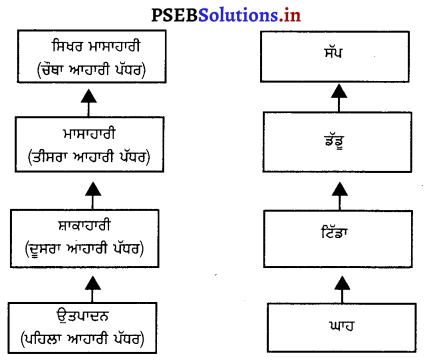
ਜਦੋਂ ਕਿਸੇ ਪੀਰੀਅਡ ਵਿੱਚ ਖੱਬਿਓਂ ਸੱਜੇ ਵੱਲ ਜਾਂਦੇ ਹਾਂ, ਤਾਂ ਸੰਯੋਜਕਤਾ ਸੈੱਲ ਇਲੈੱਕਵਾਨਾਂ ਦੀ ਸੰਖਿਆ ਇਕਾਈ ਵੱਧ ਜਾਂਦੀ ਹੈ ।

ਪ੍ਰਸ਼ਨ 9.
ਆਧੁਨਿਕ ਆਵਰਤੀ ਸਾਰਨੀ ਵਿੱਚ ਕੈਲਸ਼ੀਅਮ (ਪਰਮਾਣੁ ਅੰਕ 20) ਦੇ ਚਾਰੇ ਪਾਸੇ 12, 19, 21 ਅਤੇ 38 ਪਰਮਾਣੁ ਅੰਕਾਂ ਵਾਲੇ ਤੱਤ ਮੌਜੂਦ ਹਨ । ਇਨ੍ਹਾਂ ਵਿੱਚੋਂ ਕਿਨ੍ਹਾਂ ਤੱਤਾਂ ਦੇ ਭੌਤਿਕ ਅਤੇ ਰਸਾਇਣਿਕ ਗੁਣ ਕੈਲਸ਼ੀਅਮ ਵਰਗੇ ਹਨ ?
ਉੱਤਰ-
ਪਰਮਾਣੂ ਅੰਕ 12 ਵਾਲੇ ਤੱਤ ਦੇ ਭੌਤਿਕ ਅਤੇ ਰਸਾਇਣਿਕ ਗੁਣ ਪਰਮਾਣੂ ਅੰਕ 20 ਅਤੇ 38 ਵਾਲੇ ਤੱਤਾਂ ਦੇ ਸਮਾਨ ਹੋਣਗੇ, ਕਿਉਂਕਿ ਇਨ੍ਹਾਂ ਤੱਤਾਂ ਦੇ ਬਾਹਰਲੇ ਸੈੱਲ ਵਿੱਚ 2 ਇਲੈਂਕਨ ਹਨ ।
PSEB 10th Class Science Solutions Chapter 5 ਤੱਤਾਂ ਦਾ ਆਵਰਤੀ ਵਰਗੀਕਰਨ 1

ਪ੍ਰਸ਼ਨ 10.
ਆਧੁਨਿਕ ਆਵਰਤੀ ਸਾਰਨੀ ਅਤੇ ਮੈਂਡਲੀਵ ਦੀ ਆਵਰਤੀ ਸਾਰਨੀ ਵਿੱਚ ਤੱਤਾਂ ਦੀ ਤਰਤੀਬ ਦੀ ਤੁਲਨਾ ਕਰੋ !
ਉੱਤਰ-
ਮੈਂਡਲੀਵ ਦੀ ਆਵਰਤੀ ਸਾਰਨੀ ਦੀ ਆਧੁਨਿਕ ਆਵਰਤੀ ਸਾਰਨੀ ਨਾਲ ਤੁਲਨਾ-ਮੈਂਡਲੀਵ ਦੀ ਆਵਰਤੀ ਸਾਰਨੀ ਅਤੇ ਆਧੁਨਿਕ ਆਵਰਤੀ ਸਾਰਨੀ ਵਿੱਚ ਤੱਤਾਂ ਨੂੰ ਇੱਕ ਸਮਾਨ ਸਾਰ ਦੇ ਰੂਪ ਵਿੱਚ ਥਾਂ ਦਿੱਤੀ ਗਈ ਹੈ । ਦੋਨਾਂ ਸਾਰਨੀਆਂ ਵਿੱਚ ਇੱਕ ਸਮਾਨ ਗੁਣਾਂ ਵਾਲੇ ਤੱਤਾਂ ਨੂੰ ਇਕੱਠੀ ਗਰੁੱਪ ਵਿੱਚ ਰੱਖਿਆ ਗਿਆ ਹੈ ਪਰੰਤੂ ਇਨ੍ਹਾਂ ਦੋਨਾਂ ਵਿੱਚ ਕਾਫ਼ੀ ਸਮਾਨਤਾਵਾਂ ਹਨ; ਜਿਵੇਂ :-

ਮੈਂਡਲੀਵ ਦੀ ਆਵਰਤੀ ਸਾਰਨੀ ਆਧੁਨਿਕ ਆਵਰਤੀ ਸਾਰਨੀ
(1) ਉਸ ਸਮੇਂ ਤੱਕ ਗਿਆਤ 63 ਤੱਤਾਂ ਨੂੰ ਵੱਧਦੇ ਪਰਮਾਣੂ ਪੂੰਜਾਂ ਵਿੱਚ ਵਿਵਸਥਿਤ ਕੀਤਾ ਗਿਆ । (1) ਕੁੱਲ 118 ਤੱਤਾਂ ਨੂੰ ਵੱਧਦੇ ਪਰਮਾਣੁ ਅੰਕ ਵਿੱਚ ਵਿਵਸਥਿਤ ਕੀਤਾ ਗਿਆ ਹੈ ।
(2) ਇਸ ਆਵਰਤੀ ਸਾਰਨੀ ਵਿੱਚ 8 ਲੰਬੇ ਦਾਅ ਦੇ ਸਤੰਭ ਹਨ ਜਿਨ੍ਹਾਂ ਨੂੰ ਗਰੁੱਪ ਕਹਿੰਦੇ ਹਨ । (2) ਇਸ ਵਿੱਚ 18 ਖੜ੍ਹਵੇਂ ਕਾਲਮ ਹਨ, ਜਿਨ੍ਹਾਂ ਨੂੰ ਗਰੁੱਪ ਕਹਿੰਦੇ ਹਨ ਅਤੇ 7 ਪੀਰੀਅਡ ਹਨ ।
(3) ਤੱਤਾਂ ਦੇ ਆਈਸੋਟੋਪ ਨੂੰ ਸਾਰਨੀ ਵਿੱਚ ਸਥਾਨ ਨਾ ਮਿਲ ਸਕਿਆ । (3) ਤੱਤਾਂ ਦੇ ਆਈਸੋਟੋਪਾਂ ਨੂੰ ਆਵਰਤੀ ਵਿੱਚ ਉੱਚਿਤ ਸਥਾਨ ਪ੍ਰਾਪਤ ਹੋਇਆ ਕਿਉਂਕਿ ਉਨ੍ਹਾਂ ਦੇ ਪਰਮਾਣੂ ਅੰਕ ਇੱਕ ਸਮਾਨ ਹੁੰਦੇ ਹਨ ।
(4) ਰਸਾਇਣਿਕ ਦ੍ਰਿਸ਼ਟੀ ਨਾਲ ਅਸਮਾਨ ਤੱਤਾਂ ਨੂੰ ਵੀ ਇਕੱਠਾ ਰੱਖਿਆ ਗਿਆ | (4) ਰਸਾਇਣਿਕ ਦ੍ਰਿਸ਼ਟੀ ਤੋਂ ਅਸਮਾਨ ਤੱਤਾਂ ਨੂੰ ਵੱਖ-ਵੱਖ ਗਰੁੱਪਾਂ ਵਿੱਚ ਸਥਾਨ ਦਿੱਤਾ ਗਿਆ ਹੈ ।
(5) ਸਾਰੇ ਪਰਿਵਰਤਿਤ ਤੱਤਾਂ ਨੂੰ ਇੱਕ ਹੀ ਗਰੁੱਪ VII ਵਿੱਚ ਰੱਖਿਆ ਗਿਆ । (5) ਪਰਿਵਰਤਿਤ ਤੱਤਾਂ ਨੂੰ ਗਰੁੱਪ 3 ਅਤੇ ਗਰੁੱਪ 12 ਵਿੱਚ ਰੱਖਿਆ ਗਿਆ ਹੈ ।
(6) ਇਸ ਸਾਰਨੀ ਦੇ ਬਣਨ ਤੱਕ ਨੋਬਲ ਗੈਸਾਂ ਦੀ ਖੋਜ ਨਹੀਂ ਹੋਈ ਸੀ । (6) ਨੋਬਲ ਗੈਸਾਂ ਨੂੰ ਗਰੁੱਪ 18 ਵਿੱਚ ਸਥਾਨ ਦਿੱਤਾ ਗਿਆ ਹੈ ।
(7) ਕੁੱਝ ਉੱਚ ਪੁੰਜ ਵਾਲੇ ਤੱਤਾਂ ਨੂੰ ਉਨ੍ਹਾਂ ਤੱਤਾਂ ਤੋਂ ਪਹਿਲਾਂ ਥਾਂ ਦਿੱਤੀ ਗਈ ਜਿਨ੍ਹਾਂ ਦਾ ਪਰਮਾਣੂ ਪੁੰਜ ਘੱਟ ਸੀ । (7) ਇਸ ਸਾਰਨੀ ਵਿੱਚ ਵਰਗੀਕਰਨ ਦਾ ਆਧਾਰ ਪਰਮਾਣੂ ਅੰਕ ਹੈ, ਇਸ ਲਈ ਇਸ ਵਿੱਚ ਕੋਈ ਉਲਟੇ ਕੂਮ ਦਾ ਦੋਸ਼ ਨਹੀਂ ਹੈ ।

PSEB 10th Class Science Solutions Chapter 5 ਤੱਤਾਂ ਦਾ ਆਵਰਤੀ ਵਰਗੀਕਰਨ

Science Guide for Class 10 PSEB ਤੱਤਾਂ ਦਾ ਆਵਰਤੀ ਵਰਗੀਕਰਨ InText Questions and Answers

ਅਧਿਆਇ ਦੇ ਅੰਦਰ ਦਿੱਤੇ ਗਏ ਪ੍ਰਸ਼ਨ ਅਤੇ ਉਨ੍ਹਾਂ ਦੇ ਉੱਤਰ

ਪ੍ਰਸ਼ਨ 1.
ਕੀ ਡਾਬਰਨੀਅਰ ਦੀਆਂ ਤਿੱਕੜੀਆਂ ਨਿਊਲੈਂਡ ਦੇ ਅਸ਼ਟਕਾਂ ਵਿੱਚ ਵੀ ਮਿਲਦੀਆਂ ਹਨ ? ਤੁਲਨਾ ਕਰਕੇ ਪਤਾ ਕਰੋ ।
ਉੱਤਰ-
ਹਾਂ, ਡਾਬਰਨੀਅਰ ਦੀਆਂ ਤਿੱਕੜੀਆਂ ਨਿਊਲੈਂਡ ਦੇ ਅਸ਼ਟਕਾਂ ਵਿੱਚ ਵੀ ਮਿਲਦੀਆਂ ਹਨ । ਉਦਹਾਰਨ ਵਜੋਂ (i) ਲਿਥੀਅਮ (Li), ਸੋਡੀਅਮ (Na) ਅਤੇ ਪੋਟਾਸ਼ੀਅਮ (K) ਇੱਕ ਡਾਬਰਨੀਅਰ ਦੀ ਤਿੱਕੜੀ ਬਣਾਉਂਦੇ ਹਨ । ਜੇਕਰ ਲਿਥੀਅਮ (Li) ਨੂੰ ਪਹਿਲਾ ਤੱਤ ਮੰਨ ਲਿਆ ਜਾਏ ਤਾਂ ਉਸ ਤੋਂ ਅੱਠਵੇਂ ਸਥਾਨ ਤੇ ਸੋਡੀਅਮ (Na) ਆਉਂਦਾ ਹੈ ਅਤੇ ਜੇਕਰ ਸੋਡੀਅਮ (Na) ਨੂੰ ਪਹਿਲਾ ਤੱਤ ਮੰਨ ਲਿਆ ਜਾਵੇ ਤਾਂ ਇਸ ਤੋਂ ਅੱਠਵੇਂ ਸਥਾਨ ਤੇ ਪੋਟਾਸ਼ੀਅਮ (K) ਆਉਂਦਾ ਹੈ । ਇਸ ਤਰ੍ਹਾਂ ਡਾਬਰਨੀਅਰ ਦੀ ਇਹ ਤਿੱਕੜੀ ਨਿਊਲੈਂਡਸ ਅਸ਼ਟਕ ਦੀ ਤਿੱਕੜੀ ‘ਰੇ ਵਿੱਚ ਮਿਲਦਾ ਹੈ ।
PSEB 10th Class Science Solutions Chapter 5 ਤੱਤਾਂ ਦਾ ਆਵਰਤੀ ਵਰਗੀਕਰਨ 2
(ii) ਡਾਬਰਨੀਅਰ ਦੀ ਤਿੱਕੜੀ Ca, Sr ਅਤੇ B ਨਿਊਲੈਂਡਸ ਦੇ ਅਸ਼ਟਕ ਦੀ ਤਿੱਕੜੀ ‘ਸਾ’ ਵਿੱਚ ਮੌਜੂਦ ਹੈ ।

(iii) ਡਾਬਰਨੀਅਰ ਦੀ ਤਿੱਕੜੀ Cl, Br ਅਤੇ 1 ਨਿਊਲੈਂਡਸ ਦੇ ਅਸ਼ਟਕ ਦੀ ਤਿੱਕੜੀ ‘ਸਾ’ ਵਿੱਚ ਉਪਸਥਿਤ ਹੈ ।

ਪ੍ਰਸ਼ਨ 2.
ਡਾਬਰਨੀਅਰ ਦੇ ਵਰਗੀਕਰਨ ਦੀਆਂ ਕੀ ਸੀਮਾਵਾਂ ਹਨ ?
ਉੱਤਰ-
ਡਾਬਰਨੀਅਰ ਦੇ ਵਰਗੀਕਰਨ ਦੀਆਂ ਸੀਮਾਵਾਂ-ਡਾਬਰਨੀਅਰ ਵਰਗੀਕਰਨ ਦੀ ਸਭ ਤੋਂ ਵੱਡੀ ਸੀਮਾ ਇਹ ਸੀ ਕਿ ਇਸ ਨਿਯਮ ਦੇ ਅਨੁਸਾਰ ਉਸ ਸਮੇਂ ਦੇ ਗਿਆਤ 30 ਤੱਤਾਂ ਵਿੱਚੋਂ ਕੇਵਲ 9 ਤੱਤਾਂ ਨੂੰ ਹੀ ਤਿੰਨ ਤਿੱਕੜੀਆਂ ਵਿੱਚ ਵਿਵਸਥਿਤ ਕੀਤਾ ਜਾ ਸਕਿਆ ਸੀ । ਇਸ ਲਈ ਇਹ ਵਰਗੀਕਰਨ ਸਭ ਨੂੰ ਮਨਜ਼ੂਰ ਨਹੀਂ ਹੋਇਆ ।
PSEB 10th Class Science Solutions Chapter 5 ਤੱਤਾਂ ਦਾ ਆਵਰਤੀ ਵਰਗੀਕਰਨ 3
ਉਦਾਹਰਨ – ਤਿੰਨ ਤੱਤ, ਨਾਈਟ੍ਰੋਜਨ (N), ਫਾਸਫ਼ੋਰਸ (P) ਅਤੇ ਆਰਸੈਨਿਕ (As) ਦੇ ਰਸਾਇਣਿਕ ਇੱਕ ਸਮਾਨ ਹਨ, ਇਸ ਲਈ ਇਨ੍ਹਾਂ ਦੀ ਇੱਕ ਹੀ ਤਿੱਕੜੀ ਬਣਨੀ ਚਾਹੀਦੀ ਹੈ ਜਦਕਿ N, ਦਾ ਪਰਮਾਣੂ-ਪੁੰਜ (14.0u), As ਦਾ (74.9u) ਅਤੇ P ਦਾ (31.Ou) ਹੈ ।
ਇਸ ਦੇ ਅਨੁਸਾਰ ਇਹ ਇੱਕ ਤਿੱਕੜੀ ਦੇ ਤੱਤ ਨਹੀਂ ਹਨ ।

ਪ੍ਰਸ਼ਨ 3.
ਨਿਊਲੈਂਡ ਦੇ ਅਸ਼ਟਕ ਸਿਧਾਂਤ ਦੀਆਂ ਕੀ ਸੀਮਾਵਾਂ ਹਨ ?
ਉੱਤਰ-
ਨਿਊਲੈਂਡ ਦੇ ਅਸ਼ਟਕ ਸਿਧਾਂਤ ਦੀਆਂ ਸੀਮਾਵਾਂ-ਨਿਊਲੈਂਡ ਦੇ ਅਸ਼ਟਕ ਸਿਧਾਂਤ ਦੀਆਂ ਹੇਠ ਲਿਖੀਆਂ ਸੀਮਾਵਾਂ ਹਨ-

(i) ਇਹ ਸਿਧਾਂਤ ਸਿਰਫ਼ ਕੈਲਸ਼ੀਅਮ ਤੱਕ ਹੀ ਲਾਗੂ ਹੋ ਸਕਿਆ ਕਿਉਂਕਿ ਕੈਲਸ਼ੀਅਮ ਤੋਂ ਬਾਅਦ ਆਉਣ ਵਾਲੇ ਹਰੇਕ ਅੱਠਵੇਂ ਤੱਤ ਦੇ ਗੁਣ ਪਹਿਲੇ ਤੱਤ ਦੇ ਸਮਾਨ ਨਹੀਂ ਸੀ ।

(ii) ਨਿਉਲੈਂਡ ਨੇ ਕਲਪਨਾ ਕੀਤੀ ਸੀ ਕਿ ਕੁਦਰਤ ਵਿੱਚ ਕੇਵਲ 56 ਤੱਤ ਹਨ ਅਤੇ ਭਵਿੱਖ ਵਿੱਚ ਕੋਈ ਨਵਾਂ ਤੱਤ ਨਹੀਂ ਮਿਲੇਗਾ | ਪਰੰਤੂ ਬਾਅਦ ਵਿੱਚ ਕਈ ਹੋਰ ਨਵੇਂ ਤੱਤਾਂ ਦੀ ਖੋਜ ਕੀਤੀ ਗਈ ਜਿਨ੍ਹਾਂ ਦੇ ਗੁਣ ਅਸ਼ਟਕ ਨਿਯਮ ਅਨੁਸਾਰ ਨਹੀਂ ਸਨ । ਇਸ ਕਾਰਨ ਇਸ ਨਿਯਮ ਵਿੱਚ ਵਿਵਸਥਿਤ ਨਹੀਂ ਹੋ ਸਕੇ ।

(iii) ਨਿਊਲੈਂਡ ਨੇ ਆਪਣੀ ਸਾਰਨੀ ਵਿੱਚ ਤੱਤਾਂ ਨੂੰ ਸੰਯੋਜਿਤ ਕਰਨ ਲਈ ਦੋ ਤੱਤਾਂ ਨੂੰ ਇਕੱਠਿਆਂ ਇੱਕ ਥਾਂ ‘ਤੇ ਰੱਖ ਲਿਆ ਅਤੇ ਕੁਝ ਅਸਮਾਨ ਤੱਤਾਂ ਨੂੰ ਇੱਕ ਥਾਂ ‘ਤੇ ਰੱਖਿਆ ਸੀ ।
PSEB 10th Class Science Solutions Chapter 5 ਤੱਤਾਂ ਦਾ ਆਵਰਤੀ ਵਰਗੀਕਰਨ 4
ਉਦਾਹਰਨ – ਕੋਬਾਲਟ ਅਤੇ ਨਿੱਕਲ ਨੂੰ ਇੱਕ ਹੀ ਥਾਂ ‘ਤੇ ਰੱਖਿਆ ਗਿਆ ਪਰੰਤੂ ਉਨ੍ਹਾਂ ਨੂੰ ਫਲੋਰੀਨ, ਕਲੋਰੀਨ ਅਤੇ ਬੋਮੀਨ ਦੇ ਨਾਲ ਇੱਕ ਹੀ ਤਿੱਕੜੀ ‘ਸਾ’ ਵਿੱਚ ਰੱਖਿਆ ਗਿਆ ਹੈ ਜਦਕਿ ਕੋਬਾਲਟ ਅਤੇ ਨਿਕਲ ਦੇ ਗੁਣ ਫਲੋਰੀਨ, ਕਲੋਰੀਨ ਅਤੇ ਬੋਮੀਨ ਤੋਂ ਬਿਲਕੁਲ ਭਿੰਨ ਹਨ । ਦੂਜੇ ਪਾਸੇ ਆਇਰਨ ਜੋ ਗੁਣ ਵਿੱਚ ਕੋਬਾਲਟ ਅਤੇ ਨਿਕਲ ਦੇ ਸਮਾਨ ਹਨ ਨੂੰ ਇਨ੍ਹਾਂ ਤੋਂ ਦੂਰ ਤਿੱਕੜੀ ਵਿੱਚ ਰੱਖਿਆ ਗਿਆ ਹੈ ।

(iv) ਨਿਊਲੈਂਡ ਅਸ਼ਟਕ ਸਿਧਾਂਤ ਸਿਰਫ਼ ਹਲਕੇ ਤੱਤਾਂ ਦੇ ਲਈ ਠੀਕ ਤਰ੍ਹਾਂ ਲਾਗੂ ਹੋ ਸਕਿਆ ।

ਪ੍ਰਸ਼ਨ 4.
ਮੈਂਡਲੀਵ ਦੀ ਆਵਰਤੀ ਸਾਰਨੀ ਦੀ ਵਰਤੋਂ ਕਰਕੇ ਹੇਠ ਲਿਖੇ ਤੱਤਾਂ ਦੇ ਆਕਸਾਈਡਾਂ ਦੇ ਸੂਤਰਾਂ ਦਾ ਅਨੁਮਾਨ ਲਗਾਓ :
K, C, Al, Si, Ba.
ਉੱਤਰ-

  1. ਪੋਟਾਸ਼ੀਅਮ (K) ਗਰੁੱਪ IA ਦਾ ਤੱਤ ਹੈ । ਇਸਦੀ ਸੰਯੋਜਕਤਾ 1 ਹੈ । ਇਸ ਲਈ ਇਸ ਦੇ ਆਕਸਾਈਡ ਦਾ ਸੂਤਰ K20 ਹੈ ।
  2. ਕਾਰਬਨ (C) ਗਰੁੱਪ IV A ਦਾ ਤੱਤ ਹੈ । ਇਸ ਦੀ ਸੰਯੋਜਕਤਾ 4 ਹੈ । ਇਸ ਲਈ ਇਸ ਦੇ ਆਕਸਾਈਡ ਦਾ ਸੂਤਰ CO2 ਹੈ ।
  3. ਐਲੂਮੀਨੀਅਮ (Al) ਗਰੁੱਪ IIIA ਦਾ ਤੱਤ ਹੈ । ਇਸ ਦੀ ਸੰਯੋਜਕਤਾ 3 ਹੈ । ਇਸ ਲਈ ਇਸ ਦੇ ਆਕਸਾਈਡ ਦਾ ਸੂਤਰ Al2O3 ਹੈ ।
  4. ਸਿਲੀਕਾਨ (Si), ਗਰੁੱਪ IVA ਦਾ ਤੱਤ ਹੈ । ਇਸ ਦੀ ਸੰਯੋਜਕਤਾ 4 ਹੈ । ਇਸ ਲਈ ਇਸ ਦੇ ਆਕਸਾਈਡ ਦਾ ਸੂਤਰ SiO2 ਹੈ ।
  5. ਬੇਰੀਅਮ (Ba) ਗਰੁੱਪ IIA ਦਾ ਤੱਤ ਹੈ । ਇਸ ਦੀ ਸੰਯੋਜਕਤਾ 2 ਹੈ । ਇਸ ਲਈ ਇਸ ਦੇ ਆਕਸਾਈਡ ਦਾ ਸੂਤਰ BaO ਹੈ ।

PSEB 10th Class Science Solutions Chapter 5 ਤੱਤਾਂ ਦਾ ਆਵਰਤੀ ਵਰਗੀਕਰਨ

ਪ੍ਰਸ਼ਨ 5.
ਗੈਲੀਅਮ ਤੋਂ ਇਲਾਵਾ ਕਿਹੜੇ ਕਿਹੜੇ ਤੱਤਾਂ ਦੀ ਖੋਜ ਕੀਤੀ ਜਾ ਚੁੱਕੀ ਹੈ ਜਿਨ੍ਹਾਂ ਲਈ ਮੈਂਡਲੀਵ ਨੇ ਆਪਣੀ ਆਵਰਤੀ ਸਾਰਨੀ ਵਿੱਚ ਖ਼ਾਲੀ ਥਾਂਵਾਂ ਛੱਡ ਦਿੱਤੀਆਂ ਸਨ (ਕੋਈ ਦੋ ?
ਉੱਤਰ-
ਗੈਲੀਅਮ ਤੋਂ ਇਲਾਵਾ ਦੋ ਹੋਰ ਤੱਤ ਸਕੈਂਡੀਅਮ ਅਤੇ ਜਰਮੇਨੀਅਮ ਹਨ ਜਿਨ੍ਹਾਂ ਦੀ ਖੋਜ ਕੀਤੀ ਜਾ ਚੁੱਕੀ ਹੈ । ਇਨ੍ਹਾਂ ਤੱਤਾਂ ਦੇ ਲਈ ਮੈਂਡਲੀਵ ਨੇ ਆਪਣੀ ਆਵਰਤੀ ਸਾਰਨੀ ਵਿੱਚ ਪਹਿਲਾਂ ਤੋਂ ਹੀ ਖਾਲੀ ਸਥਾਨ ਛੱਡਿਆ ਹੋਇਆ ਸੀ । ਮੈਂਡਲੀਵ ਨੇ ਪਹਿਲਾਂ ਹੀ ਇਨ੍ਹਾਂ ਤੱਤਾਂ ਦੇ ਗੁਣਾਂ ਦਾ ਅਨੁਮਾਨ ਲਗਾ ਲਿਆ ਸੀ । ਜਦੋਂ ਬਾਅਦ ਵਿੱਚ ਇਨ੍ਹਾਂ ਤੱਤਾਂ ਦੀ ਖੋਜ ਹੋਈ ਤਾਂ ਉਨ੍ਹਾਂ ਦੇ ਉਹੀ ਗੁਣ ਸਨ ਜਿਨ੍ਹਾਂ ਦਾ ਮੈਂਡਲੀਵ ਕੇ ਅਨੁਮਾਨ ਲਗਾਇਆ ਸੀ ।

ਪ੍ਰਸ਼ਨ 6.
ਮੈਂਡਲੀਵ ਨੇ ਆਪਣੀ ਆਵਰਤੀ ਸਾਰਨੀ ਤਿਆਰ ਕਰਨ ਲਈ ਕਿਹੜਾ ਮਾਪਦੰਡ ਅਪਣਾਇਆ ?
ਉੱਤਰ-
ਮੈਂਡਲੀਵ ਆਵਰਤੀ ਸਾਰਨੀ ਲਈ ਮਾਪਦੰਡ-

  1. ਤੱਤਾਂ ਨੂੰ ਉਨ੍ਹਾਂ ਦੇ ਵੱਧਦੇ ਪਰਮਾਣੂ ਪੁੰਜ ਦੇ ਕੂਮ ਵਿੱਚ ਵਿਵਸਥਿਤ ਕੀਤਾ ।
  2. ਸਮਾਨ ਗੁਣਾਂ ਵਾਲੇ ਤੱਤਾਂ ਨੂੰ ਇੱਕ ਸਮੂਹ ਵਿੱਚ ਰੱਖਣ ਦੀ ਕੋਸ਼ਿਸ਼ ਕੀਤੀ ।
  3. ਤੱਤਾਂ ਦੇ ਆਕਸਾਈਡਾਂ ਅਤੇ ਹਾਈਡਰਾਈਡਾਂ ਦੇ ਅਣੂ ਸੂਤਰ ਨੂੰ ਇੱਕ ਮੂਲ ਗੁਣ ਮੰਨ ਕੇ ਤੱਤਾਂ ਦਾ ਵਰਗੀਕਰਨ ਕੀਤਾ ।

ਪ੍ਰਸ਼ਨ 7.
ਤੁਹਾਡੇ ਵਿਚਾਰ ਅਨੁਸਾਰ ਨੋਬਲ ਗੈਸਾਂ ਨੂੰ ਵੱਖਰੇ ਗਰੁੱਪ ਵਿੱਚ ਕਿਉਂ ਰੱਖਿਆ ਗਿਆ ?
ਉੱਤਰ-
ਨੋਬਲ ਗੈਸਾਂ ਨੂੰ ਵੱਖਰੇ ਗਰੁੱਪ ਵਿੱਚ ਰੱਖਣਾ-ਸਾਰੇ ਤੱਤਾਂ ਵਿਚੋਂ ਨੋਬਲ ਗੈਸਾਂ-ਹੀਲੀਅਮ (He), ਨੀਆਨ (Ne), ਆਰਗਾਨ (Ar), ਕ੍ਰਿਪਾਨ (Kr) ਅਤੇ ਜ਼ੀਨਾਨ (Xe) ਅਕਿਰਿਆਸ਼ੀਲ ਹਨ । ਇਨ੍ਹਾਂ ਦੇ ਗੁਣ ਹੋਰ ਗਰੁੱਪ ਤੱਤਾਂ ਨਾਲ ਨਹੀਂ ਮਿਲਦੇ ਹਨ । ਇਸ ਲਈ ਨੋਬਲ ਗੈਸਾਂ ਨੂੰ ਵੱਖਰੇ ਗਰੁੱਪ ਵਿੱਚ ਰੱਖਿਆ ਗਿਆ ਜਿਸ ਨੂੰ ਜ਼ੀਰੋ (0) ਗਰੁੱਪ ਕਿਹਾ ਜਾਂਦਾ ਹੈ ।
ਪ੍ਰਸ਼ਨ 8.
ਆਧੁਨਿਕ ਆਵਰਤੀ ਸਾਰਨੀ ਦੁਆਰਾ ਕਿਸ ਤਰ੍ਹਾਂ ਮੈਂਡਲੀਵ ਦੀ ਆਵਰਤੀ ਸਾਰਨੀ ਦੀਆਂ ਭਿੰਨ ਭਿੰਨ ਖਾਮੀਆਂ ਨੂੰ ਦੂਰ ਕੀਤਾ ਗਿਆ ?
ਉੱਤਰ-
ਮੈਂਡਲੀਵ ਦੀ ਆਵਰਤੀ ਸਾਰਨੀ ਦਾ ਆਧਾਰ ਪਰਮਾਣੂ ਪੁੰਜ (Atomic Mass) ਹੈ, ਜਦੋਂ ਕਿ ਮੋਸਲੇ ਨੇ ਆਧੁਨਿਕ ਆਵਰਤੀ ਸਾਰਨੀ ਲਈ ਪਰਮਾਣੂ ਸੰਖਿਆ (Atomic Number) ਨੂੰ ਆਧਾਰ ਮੰਨਿਆ । ਇਸ ਤਰ੍ਹਾਂ ਆਧੁਨਿਕ ਸਾਰਨੀ ਵਿੱਚ ਮੈਂਡਲੀਫ਼ ਵੱਲੋਂ ਦਿੱਤੀ ਗਈ ਸਾਰਨੀ ਦੀਆਂ ਤਰੁੱਟੀਆਂ ਨੂੰ ਦੂਰ ਕੀਤਾ ਗਿਆ ਹੈ ।
  • ਆਧੁਨਿਕ ਆਵਰਤੀ ਸਾਰਨੀ ਵਿੱਚ ਸਾਰੇ ਸਮਸਥਾਨਿਕਾਂ ਨੂੰ ਇੱਕੋ ਹੀ ਸਥਾਨ ਦਿੱਤਾ ਗਿਆ ਹੈ ਕਿਉਂਕਿ ਉਨ੍ਹਾਂ ਵਿੱਚ ਪ੍ਰੋਟਾਨਾਂ ਦੀ ਸੰਖਿਆ ਹਮੇਸ਼ਾ ਬਰਾਬਰ ਹੁੰਦੀ ਹੈ ।
  • ਆਰਗਾਨ ਅਤੇ ਪੋਟਾਸ਼ੀਅਮ ਦੀ ਪਰਮਾਣੂ ਸੰਖਿਆ ਲੜੀਵਾਰ 18 ਤੇ 19 ਹੈ । ਤੱਤਾਂ ਦੀ ਵੱਧਦੀ ਹੋਈ ਪਰਮਾਣੂ ਸੰਖਿਆ ਦੇ ਆਧਾਰ ‘ਤੇ ਵਿਵਸਥਿਤ ਕਰਨ ਤੇ ਆਰਗਾਨ ਪਹਿਲਾਂ ਆ ਜਾਂਦਾ ਹੈ ਅਤੇ ਪੋਟਾਸ਼ੀਅਮ ਦਾ ਸਥਾਨ ਪਿੱਛੇ ਰਹਿ ਜਾਂਦਾ ਹੈ ਜਦੋਂ ਕਿ ਉਨ੍ਹਾਂ ਦੋਵਾਂ ਤੱਤਾਂ ਦੇ ਪੁੰਜ ਇਸਦੇ ਉਲਟ ਹਨ । ਨਵੀਂ ਸਾਰਨੀ ਵਿੱਚ ਇਸ ਦੋਸ਼ ਨੂੰ ਦੂਰ ਕੀਤਾ ਗਿਆ ਹੈ ।
  • ਆਧੁਨਿਕ ਸਾਰਨੀ ਵਿੱਚ ਤੱਤਾਂ, ਨੋਬਲ ਗੈਸਾਂ (ਅਕਿਰਿਆਸ਼ੀਲ ਗੈਸਾਂ) ਅਤੇ ਮਿਸ਼ਰਤ ਤੱਤਾਂ (Alloys) ਨੂੰ ਸਪੱਸ਼ਟ ਤੌਰ ‘ਤੇ ਵੱਖ-ਵੱਖ ਕੀਤਾ ਗਿਆ ਹੈ ।
  • ਆਧੁਨਿਕ ਸਾਰਨੀ ਇਹ ਵੀ ਸਪੱਸ਼ਟ ਕਰਦੀ ਹੈ ਕਿ ਤੱਤਾਂ ਦੇ ਗੁਣਾਂ ਵਿੱਚ ਆਵਰਤਤਾ ਕਿਉਂ ਹੁੰਦੀ ਹੈ ।

ਪ੍ਰਸ਼ਨ 9.
ਮੈਗਨੀਸ਼ੀਅਮ ਦੀ ਤਰ੍ਹਾਂ ਰਸਾਇਣਿਕ ਕਿਰਿਆਸ਼ੀਲਤਾ ਦਿਖਾਉਣ ਵਾਲੇ ਦੋ ਤੱਤਾਂ ਦੇ ਨਾਂ ਦੱਸੋ । ਤੁਹਾਡੀ ਚੋਣ ਦਾ ਕੀ ਅਧਾਰ ਹੈ ?
ਉੱਤਰ-
ਆਧੁਨਿਕ ਆਵਰਤੀ ਸਾਰਨੀ ਅਨੁਸਾਰ, ਜਿਨ੍ਹਾਂ ਤੱਤਾਂ ਦੇ ਬਾਹਰਲੇ ਇਲੈੱਕਟਰਾਨੀ ਬਣਤਰ ਸਮਾਨ ਹੁੰਦੀ ਹੈ ਅਤੇ ਉਨ੍ਹਾਂ ਦੇ ਗੁਣ ਵੀ ਸਮਾਨ ਹੁੰਦੇ ਹਨ । ਮੈਗਨੀਸ਼ੀਅਮ ਦੇ ਬਾਹਰਲੇ ਸੈੱਲ ਵਿੱਚ ਦੋ ਇਲੈੱਕਟਰਾਨ ਹਨ । ਇਸ ਲਈ ਉਹ ਸਾਰੇ ਤੱਤ ਜਿਨ੍ਹਾਂ ਦੇ ਬਾਹਰਲੇ ਸੈੱਲ ਵਿੱਚ 2 ਸੰਯੋਜਕ ਇਲੈੱਕਟਰਾਨ ਹੋਣਗੇ Mg ਦੇ ਸਮਾਨ ਹੀ ਗੁਣ ਪ੍ਰਦਰਸ਼ਿਤ ਕਰਨਗੇ ।
ਉਦਾਹਰਨ – ਕੈਲਸ਼ੀਅਮ (Ca), ਪਰਮਾਣੂ ਸੰਖਿਆ = 20
ਵਿਭਿੰਨ ਸੈੱਲਾਂ ਵਿੱਚ ਇਲੈੱਕਟਰਾਨ ਵਿਵਸਥਾ = (2, 8, 9, 2)
ਮੈਗਨੀਸ਼ੀਅਮ (Mg), ਪਰਮਾਣੂ ਸੰਖਿਆ = 12
ਵਿਭਿੰਨ ਸੈੱਲਾਂ ਵਿੱਚ ਇਲੈੱਕਟਰਾਨ ਵਿਵਸਥਾ = (2, 8, 2)

ਪ੍ਰਸ਼ਨ 10.
ਨਾਂ ਦੱਸੋ :
(a) ਤਿੰਨ ਤੱਤ ਜਿਨ੍ਹਾਂ ਦੇ ਸਭ ਤੋਂ ਬਾਹਰਲੇ ਸੈੱਲ ਵਿੱਚ ਇੱਕ ਇਲੈੱਕਟਰਾਨ ਹਾਜ਼ਰ ਹਨ ।
(b) ਦੋ ਤੱਤ ਜਿਨ੍ਹਾਂ ਦੇ ਸਭ ਤੋਂ ਬਾਹਰਲੇ ਸੈੱਲ ਵਿੱਚ ਦੋ ਇਲੈੱਕਟਰਾਨ ਮੌਜੂਦ ਹਨ ।
(c) ਤਿੰਨ ਤੱਤ ਜਿਨ੍ਹਾਂ ਦਾ ਬਾਹਰੀ ਸ਼ੈਲ ਪੁਰਾ ਹੈ ।
ਉੱਤਰ-
(a) ਤਿੰਨ ਤੱਤ ਜਿਨ੍ਹਾਂ ਦੇ ਸਭ ਤੋਂ ਬਾਹਰਲੇ ਸੈੱਲ ਵਿੱਚ ਇੱਕ ਇਲੈੱਕਟਰਾਨ ਮੌਜੂਦ ਹਨ-ਲਿਥੀਅਮ (Li), ਸੋਡੀਅਮ (Na) ਅਤੇ ਪੋਟਾਸ਼ੀਅਮ (K) ਤਿੰਨ ਅਜਿਹੇ ਤੱਤ ਹਨ ਜਿਨ੍ਹਾਂ ਦੇ ਸਭ ਤੋਂ ਬਾਹਰਲੇ ਸੈੱਲ ਵਿੱਚ ਇੱਕ ਇਲੈੱਕਟਰਾਨ ਹੁੰਦਾ ਹੈ ।
PSEB 10th Class Science Solutions Chapter 5 ਤੱਤਾਂ ਦਾ ਆਵਰਤੀ ਵਰਗੀਕਰਨ 5

(b) ਦੋ ਤੱਤ ਜਿਨ੍ਹਾਂ ਦੇ ਸਭ ਤੋਂ ਬਾਹਰਲੇ ਸੈੱਲ ਵਿੱਚ ਦੋ ਇਲੈੱਕਟਰਾਨ ਉਪਸਥਿਤ ਹਨ – ਮੈਗਨੀਸ਼ੀਅਮ ਅਤੇ ਕੈਲਸ਼ੀਅਮ ਦੋ ਅਜਿਹੇ ਤੱਤ ਹਨ ਜਿਨ੍ਹਾਂ ਦੇ ਸਭ ਤੋਂ ਬਾਹਰਲੇ ਸੈੱਲ ਵਿੱਚ ਦੋ ਇਲੈੱਕਟਰਾਨ ਹਨ ।
PSEB 10th Class Science Solutions Chapter 5 ਤੱਤਾਂ ਦਾ ਆਵਰਤੀ ਵਰਗੀਕਰਨ 6

(c) ਤਿੰਨ ਤੱਤ ਜਿਨ੍ਹਾਂ ਦਾ ਬਾਹਰੀ ਸੈੱਲ ਪੂਰਾ ਹੋਵੇ-
ਹੀਲੀਅਮ, ਨੀਆਨ ਅਤੇ ਆਰਗਾਨ ਤਿੰਨ ਅਜਿਹੇ ਤੱਤ ਹਨ ਜਿਨ੍ਹਾਂ ਦਾ ਬਾਹਰੀ ਛਿੱਲ ਪੂਰਾ ਹੁੰਦਾ ਹੈ ।
PSEB 10th Class Science Solutions Chapter 5 ਤੱਤਾਂ ਦਾ ਆਵਰਤੀ ਵਰਗੀਕਰਨ 7

PSEB 10th Class Science Solutions Chapter 5 ਤੱਤਾਂ ਦਾ ਆਵਰਤੀ ਵਰਗੀਕਰਨ

ਪ੍ਰਸ਼ਨ 11.
(a) ਲਿਥੀਅਮ, ਸੋਡੀਅਮ, ਪੋਟਾਸ਼ੀਅਮ ਸਾਰੀਆਂ ਹੀ ਧਾਤਾਂ ਹਨ ਜੋ ਪਾਣੀ ਨਾਲ ਪ੍ਰਤੀਕਿਰਿਆ ਕਰਕੇ ਹਾਈਡਰੋਜਨ ਗੈਸ ਮੁਕਤ ਕਰਦੀਆਂ ਹਨ । ਕੀ ਇਨ੍ਹਾਂ ਤੱਤਾਂ ਦੇ ਪਰਮਾਣੂਆਂ ਵਿੱਚ ਕੋਈ ਸਮਾਨਤਾ ਹੈ ?
(b) ਹੀਲੀਅਮ ਇੱਕ ਅਕਿਰਿਆਸ਼ੀਲ ਗੈਸ ਹੈ ਜਦਕਿ ਨੀਆਨ ਦੀ ਕਿਰਿਆਸ਼ੀਲਤਾ ਬਹੁਤ ਘੱਟ ਹੈ । ਇਨ੍ਹਾਂ ਦੇ ਪਰਮਾਣੂਆਂ ਵਿੱਚ ਕੀ ਸਮਾਨਤਾ ਹੈ ?
ਉੱਤਰ-
(a) ਲਿਥੀਅਮ, ਸੋਡੀਅਮ ਅਤੇ ਪੋਟਾਸ਼ੀਅਮ ਦੀ ਪਾਣੀ ਨਾਲ ਪ੍ਰਤੀਕਿਰਿਆ-
PSEB 10th Class Science Solutions Chapter 5 ਤੱਤਾਂ ਦਾ ਆਵਰਤੀ ਵਰਗੀਕਰਨ 8
ਇਨ੍ਹਾਂ ਤਿੰਨਾਂ ਧਾਤਾਂ ਦੇ ਬਾਹਰਲੇ ਸੈੱਲ ਵਿੱਚ ਇੱਕ ਹੀ ਇਲੈੱਕਟਰਾਨ ਹੁੰਦਾ ਹੈ ।

(b) ਹੀਲੀਅਮ (He) ਅਤੇ ਨੀਆਨ (Ne) ਦੋਨੋਂ ਨੋਬਲ ਗੈਸਾਂ ਹੋਣ ਕਰਕੇ ਅਕਿਰਿਆਸ਼ੀਲ ਹਨ । ਇਨ੍ਹਾਂ ਦੇ ਬਾਹਰਲੇ ਸੈੱਲ ਪੂਰਨ ਹੁੰਦੇ ਹਨ । ਹੀਲੀਅਮ (He) ਕੋਲ ਸਿਰਫ K ਸੈੱਲ ਹੈ ਅਤੇ ਇਹ ਸੈਂਲ ਪੂਰਨ ਰੂਪ ਨਾਲ ਭਰਿਆ ਹੋਇਆ ਹੈ । ਦੂਜੇ ਪਾਸੇ ਨੀਆਨ (Ne) ਕੋਲ K ਅਤੇ L ਸੈੱਲ ਹਨ ਅਤੇ ਇਹ ਦੋਨੋਂ ਸੈਂਲ ਭਰੇ ਹੋਏ ਹਨ । K ਸ਼ੈੱਲ ਵਿੱਚ 2 ਇਲੈੱਕਟਰਾਨ ਅਤੇ L ਬੈੱਲ ਵਿੱਚ 8 ਇਲੈੱਕਟਰਾਨ ਹਨ । ਇਸ ਲਈ ਨੀਆਨ ਦੀ ਪ੍ਰਤੀਕਿਰਿਆਸ਼ੀਲਤਾ ਬਹੁਤ ਘੱਟ ਹੈ ।

ਪ੍ਰਸ਼ਨ 12.
ਆਧੁਨਿਕ ਆਵਰਤੀ ਸਾਰਨੀ ਵਿੱਚ ਪਹਿਲੇ 10 ਤੱਤਾਂ ਵਿੱਚ ਕਿਹੜੀਆਂ ਧਾਤਾਂ ਹਨ ?
ਉੱਤਰ-
ਆਧੁਨਿਕ ਆਵਰਤੀ ਸਾਰਨੀ ਦੇ ਪਹਿਲੇ ਦੱਸ ਤੱਤ ਹਨ-H, He, Li, Be, B, C, N, 0, F ਅਤੇ Ne ਇਨ੍ਹਾਂ ਸਾਰੇ ਤੱਤਾਂ ਵਿੱਚੋਂ ਧਾਤਾਂ ਹਨ-ਲਿਥੀਅਮ (Li) ਅਤੇ ਬੈਰੀਲੀਅਮ (Be) ।

ਪ੍ਰਸ਼ਨ 13.
ਆਵਰਤੀ ਸਾਰਨੀ ਵਿੱਚ ਇਨ੍ਹਾਂ ਦੇ ਸਥਾਨ ਦੇ ਆਧਾਰ ਅਤੇ ਇਨ੍ਹਾਂ ਵਿੱਚੋਂ ਕਿਸ ਤੱਤ ਵਿੱਚ ਸਭ ਤੋਂ ਵੱਧ ਧਾਤਵੀ ਗੁਣ ਹੈ ?
Ga, Ge, As, Se, Be.
ਉੱਤਰ-
ਪਹਿਲੇ ਇਨ੍ਹਾਂ ਦਾ ਵਰਗੀਕਰਨ ਵੱਧਦੀ ਹੋਈ ਪਰਮਾਣੂ ਸੰਖਿਆ ਦੇ ਅਨੁਸਾਰ ਕਰਦੇ ਹਾਂ-
PSEB 10th Class Science Solutions Chapter 5 ਤੱਤਾਂ ਦਾ ਆਵਰਤੀ ਵਰਗੀਕਰਨ 9

ਅਸੀਂ ਜਾਣਦੇ ਹਾਂ ਕਿ ਧਾਤਿਕ ਆਚਰਨ ਪੀਰੀਅਡ ਵਿੱਚ ਖੱਬੇ ਤੋਂ ਸੱਜੇ ਵੱਲ ਜਾਂਦੇ ਹੋਏ ਘੱਟ ਹੁੰਦਾ ਜਾਂਦਾ ਹੈ । ਇਸ ਗੱਲ ਨੂੰ ਧਿਆਨ ਵਿੱਚ ਰੱਖਦੇ ਹੋਏ ਖੱਬੇ ਪਾਸੇ ਦੇ ਤੱਤ Be ਅਤੇ Ga ਦਾ ਅਧਾਤਿਕ ਆਚਰਨ ਅਧਿਕਤਮ ਹੈ । ਇਸ ਲਈ ਸੱਜੇ ਪਾਸੇ ਵੱਲ ਦੇ ਤੱਤ ਅਧਾਤ ਹਨ ।

PSEB 10th Class Science Solutions Chapter 5 Periodic Classification of Elements

Punjab State Board PSEB 10th Class Science Book Solutions Chapter 5 Periodic Classification of Elements Textbook Exercise Questions and Answers.

PSEB Solutions for Class 10 Science Chapter 5 Periodic Classification of Elements

PSEB 10th Class Science Guide Periodic Classification of Elements Textbook Questions and Answers

Question 1.
Which of the following statements is not a correct statement about the trends when going from left to right across the periods of periodic table.
(а) The elements become less metallic in nature.
(b) The number of valence electrons increases.
(c) The atoms lose their electrons more easily.
(d) The oxides become more acidic.
Answer:
(c) The atoms lose their electrons more easily.

Question 2.
Element X forms a chloride with the formula XCl2, which is a solid with a high melting point. X would most likely be in the same group of the periodic table as :
(a) Na
(b) Mg
(c) Al
(d) Si
Answer:
(b) Mg

Question 3.
Which element has :
(а) two shells, both of which are completely filled with electrons?
Answer:
Neon

(b) the electronic configuration 2, 8, 2?
Answer:
Magnesium

(c) a total of three shells, with four electrons in its valence shell?
Answer:
Silicon

(d) a total of two shells, with three electrons in its valence shell?
Answer:
Boron

(e) twice as many electrons in its second shell as in its first shell?
Answer:
Carbon.

Question 4.
(a) What property do all elements in the same column of the periodic table as Boron have in common?
Answer:
All elements of this column have 3 electrons in their valence shell like Boron.

(b) What property do all elements in the same column of the periodic table as Fluorine have in common?
Answer:
All elements of this column have 7 electrons in their valence shell like fluorine.

Question 5.
An atom has electronic configuration 2, 8, 7.
(а) What is the atomic number of this element?
Answer:
17

(b) To which of the following element would it be chemically similar? (atomic numbers are given in parenthesis).
N (7), F (9), P (15), Ar (18).
Answer:
F (9) (2, 7)

Question 6.
The position of three elements A, B and C in the periodic table are as shown below :
PSEB 10th Class Science Solutions Chapter 5 Periodic Classification of Elements 1
(а) State whether A is a metal or non-metal.
Answer:
A is non-metal.

(b) State whether C is more reactive or less reactive than A.
Answer:
C is less reactive than A.

(c) Will C be larger or smaller in size than B.
Answer:
C has smaller size than B.

(d) Which type of ion, cation or anion, will be formed by element A?
Answer:
Anion, A-.

PSEB 10th Class Science Solutions Chapter 5 Periodic Classification of Elements

Question 7.
Nitrogen (atomic number 7) and phosphorus (atomic number 15) belong to group 15 of the periodic table. Write the electronic configurations of these two elements. Which of these will be more electronegative? Why?
Answer:

K L M
N7 has electronic configuration 2 5
P15 has electronic configuration 2 8 7

Nitrogen is more electronegative than Phosphorus due to smaller size.

Question 8.
How does the electronic configuration of an atom relate to its position in the Modern Periodic Table?
Answer:
By knowing the electronic configuration of an element, we can know its period number from the number of shells present in its atom and from number of electrons in the valence shell of its atoms we can know its group number, e.g. let us consider the case of sodium atom.

Atomic number of sodium = 11
Its electronic configuration = 2, 8, 1 (K) (L) (M)
∴ Number of shells = 3
∴ Sodium belongs to 3rd period.

Also sodium atom has one electron in its valence shell.
∴ It is present in first group.
∴ Sodium lies in the first group and third period of Modern Periodic Table.

Question 9.
In the Modern Periodic Table, calcium (atomic number 20) is surrounded by elements with atomic numbers 12,19, 21 and 38. Which of these have physical and chemical properties resembling calcium?
Answer:
Element with atomic numbers 12 and 38 because they have two electrons in their valence shells like calcium (2, 8, 8, 2).

Question 10.
Compare and contrast the arrangement of elements in Mendeleev’s Periodic table and the Modern Periodic table.
Answer:
Similarities :

  • In both the elements are arranged in groups and periods.
  • In both similar elements are placed in same group.
  • Both the classification make the study of elements simple and systematic.

Differences :

Mendeleev’s Periodic Table Modern Periodic Table
1. The elements are arranged in order of increasing mass numbers. 1. The elements are arranged in order of increasing atomic numbers.
2. It has 8 vertical columns called groups. 2. It contains eighteen vertical columns called groups.
3. Groups like group VIII ‘have been divided into sub groups A and B. 3. Each group is an independent group.
4. Inert gases are not included in this table. 4. Inert gases are included in this periodic table.

Science Guide for Class 10 PSEB Periodic Classification of Elements InText Questions and Answers

Question 1.
Did Dobereiner’s triads also exist in the columns of Newlands’ octaves? Compare and find out.
Answer:
Yes, Dobereiner’s triads also existed in columns of Newlands’ octaves. These are:

H Li Be
F Na Mg
Cl K Ca

Question 2.
What were the limitations of Dobereiner’s classification?
Answer:

  • Dobereiner could find only three triads from the elements known at that time.
  • It is applicable only to a few elements.

PSEB 10th Class Science Solutions Chapter 5 Periodic Classification of Elements

Question 3.
What were the limitations of Newlands’ law of octaves?
Answer:

  • It is applicable upto calcium only.
  • Sometimes two elements were put in the same slot.
  • After the discovery of noble gas, law of octave is not valid.

Question 4.
Use Mendeleev’s periodic table to predict the formulae for the oxides of following elements :
K, C, Al, Si, Ba.
Answer:
K2O, CO2, Al2O3, SiO2, BaO.

Question 5.
Besides Gallium, which other elements have since been discovered to fill the gaps left by Mendeleev in his periodic table? (any two)
Answer:
Scandium and Germanium.

Question 6.
What were the criteria used by Mendeleev in creating his periodic table?
Answer:

  • The formulae of hydrides and oxides formed by an element wrere treated as one of the basic properties of an element for its classification.
  • It is based upon Mendeleev’s periodic law which predicts that the properties of the elements are the periodic function of their atomic masses.

Question 7.
Why do you think the noble gases are placed in a separate group?
Answer:
These gases were discovered very late because they are very inert and placing them in a separate group, does not disturb the existing order put forward by Mendeleev.

Question 8.
How could Modern Periodic Table remove various anomalies of Mendeleev Periodic Table?
Answer:

  • Isotopes of an elements occupy same position in the periodic table due to same atomic number.
  • There is a logical separation of elements into subgroups.
  • It is based upon the fundamental property of an element i.e. atomic number.

Question 9.
Name two elements you would expect to show same kind of chemical reactivity as magnesium. What is the basis for your choice?
Answer:
Calcium and Strontium because they have same number of valence electrons.

Question 10.
Name :
(а) three elements that have only a single electron in their outermost shells.
Answer:
Lithium, Sodium and Potassium.

(b) two elements that have two electrons in their outermost shells.
Answer:
Magnesium, Calcium.

(c) three elements with filled outermost shells.
Answer:
Neon, Argon, Krypton.

Question 11.
(a) Lithium, Sodium, Potassium are all metals that react with water to liberate hydrogen gas. Is there any similarity in the atoms of these elements?
Answer:
One electron in their valence shells and are metals.

(b) Helium is an unreactive gas and neon is a gas of extremely low reactivity. What, if anything, do their atoms have in common?
Answer:
Eight electrons in their valence shells.

Question 12.
In the modern periodic table, of the first ten elements, which are metals?
Answer:
Lithium and Beryllium.

PSEB 10th Class Science Solutions Chapter 5 Periodic Classification of Elements

Question 13.
By considering their position in the periodic table, which one of the following elements would you expect to have the most metallic characteristics?
Ga Ge As Se Be.
Answer:
Gallium.

PSEB 10th Class Science Solutions Chapter 8 How do Organisms Reproduce?

Punjab State Board PSEB 10th Class Science Book Solutions Chapter 8 How do Organisms Reproduce? Textbook Exercise Questions and Answers.

PSEB Solutions for Class 10 Science Chapter 8 How do Organisms Reproduce?

PSEB 10th Class Science Guide How do Organisms Reproduce? Textbook Questions and Answers

Question 1.
Asexual reproduction takes place through budding in :
(a) Amoeba
(b) Yeast
(c) Plasmodium
(d) Leishmania.
Answer:
(b) Yeast.

Question 2.
Which of the following is not a part of the female reproductive system in human beings?
(a) Ovary
(b) Uterus
(c) Vas deferens
(d) Fallopian tube
Answer:
(c) Vas deferens.

Question 3.
The anther contains :
(a) Sepals
(b) Ovules
(c) Carpel
(d) Pollen Grains
Answer:
(d) Pollen grains.

Question 4.
What are advantages of sexual reproduction over asexual reproduction?
Answer:
Advantages of sexual reproduction:
Sexual reproduction has a dual significance for the species.

  • It results in multiplication and perpetuation of the species.
  • It contributes to evolution of the species by introducing variation in a population much more rapidly than asexual reproduction.

Question 5.
What are the functions performed by the testis in human beings?
Answer:
Functions of testis

  • Produce male gametes, called sperms.
  • Leydig’s cells secrete male sex hormone namely testosterone into blood.

PSEB 10th Class Science Solutions Chapter 8 How do Organisms Reproduce?

Question 6.
Why does menstruation occur?
Answer:
During menstruation, broken down endometrium is passed out as menstrual flow along with unfertilized egg (ovum).

Question 7.
Draw a labelled diagram of Vertical section of flower.
Answer:
Vertical section of flower
PSEB 10th Class Science Solutions Chapter 8 How do Organisms Reproduce 1
V.S of Folwer

Question 8.
Wliat are different methods of contraception?
Answer:
The various methods of birth control are :
PSEB 10th Class Science Solutions Chapter 8 How do Organisms Reproduce 2
Flowchart: Brief account on birth control measures

Question 9.
How are modes of reproduction different in unicellular and multicellular organisms?
Answer:
Unicellular organisms mostly reproduce by asexual methods except for a few such as Paramecium, Eimeria, these organisms reproduce by sexual methods also. The multicellular organisms have more complex body. They reproduce both by asexual and sexual methods. But sexual reproduction is the more common method.

Question 10.
How does reproduction help in providing stability to populations of species?
Answer:
Reproduction is the process by which organisms increase their populations. The rate of births and deaths in a given population determine its size.

Question 11.
What could be the reasons for adopting contraceptive methods?
Answer:

  • To control population.
  • For family planning.
  • For good health of women and children.

Science Guide for Class 10 PSEB How do Organisms Reproduce? InText Questions and Answers

Question 1.
What is the importance of DNA copying in reproduction?
Answer:

  • DNA copying is called DNA replication. In this process one copy each of replicated DNA will be passed on two daughter cells. Each cell formed will have its own cellular apparatus to control the activities of the daughter cells.
  • It maintains the body designs and features in different generations of the species.
  • Variations may be introduced during copying of DNA. This inbuilt tendency for variation during reproduction forms the basis of evolution.

Question 2.
Why is variation beneficial to the species but not necessarily for the individuals?
Answer:
Variations present in some populations would enable them to survive. In case of changing environmental condition such as global warming. Thus it is useful for survival of species over time.

PSEB 10th Class Science Solutions Chapter 8 How do Organisms Reproduce?

Question 3.
How does binary fission differ from multiple fission?
Answer:
Differences between binary fission and multiple fission

Binary fission Multiple fission
1. Parent cell divides into two daughter cell. 1. Parent cell divides into many daughter cells.
2. It takes place during favourable conditions. 2. It takes place during unfavourable conditions.
3. Residual cytoplasm is left. 3. Nothing is left with parent.
4. Cytoplasm divides after every nuclear division. 4. Cytoplasm does not divide after every nuclear division.

Question 4.
How will an organism be benefited if it reproduces by spores?
Answer:

  • Spores are covered by thick walls, that protect them until they come into contact with another substratum on which they can grow.
  • They are produced in large numbers.

Question 5.
Can you think of reasons why more complex organisms cannot give rise to new individuals through regeneration?
Answer:

  • Regeneration is not reproduction because most organism would not depend on being cut up.
  • It is not certain that cut up portion will be able to survive and give rise to a new individual.

Question 6.
Why is vegetative propagation practised for growing some types of plants?
Answer:
Advantages of vegetative propagation

  • It is usually a means of propagating such plants which do not produce viable seeds.
  • It is rapid method of producing young ones.
  • It helps in retaining useful characters from generation to generation.

Question 7.
Why is DNA copying an essential part of the process of reproduction?
Answer:

  • DNA copying provides cellular apparatus in the daughter cells.
  • DNA in daughter cells will be able to control the functioning of daughter cells.
  • DNA copies will retain the traits.

Question 8.
How is the process of pollination different from fertilisation?
Answer:
Differences between pollination and fertilization

Pollination Fertilization
1. It is the transference of pollen grains from anther to stigma. 1. It is fusion of a male and a female gamete.
2. An external agent is required like wind, water and animal. 2. It does not require any external agent.

Question 9.
What is the role of seminal vesicles and prostate gland?
Answer:
Role of seminal vesicles. These glands secrete viscous secretions, which contain fructose and prostaglandins. The fructose is the source of energy for sperms and prostaglandins stimulate uterine contraction and thus may help the sperm to move towards the female’s oviduct.

Role of prostate gland. It secretes an alkaline milky fluid that aid in sperm motality. The fluid contains small amount of citric acid, some lipids and a few enzymes. It also contains bicarbonate ions which give the semen its alkaline pH.

Question 10.
What are the changes seen in girls at the time of puberty?
Answer:
Changes at the time of puberty: These changes occur under the influence of hormones FSH (Follicle stimulating hormone) and estrogen.

  • Growth of breast and external genitalia.
  • Darkening of nipple skin.
  • Broadening of pelvis.
  • Growth of pubic and axillary hair.
  • Increase in subcutaneous fat.
  • Initiation of menstruation and ovulation.

Question 11.
How does embryo get nourishment inside the mother’s body?
Answer:
Embryo gets nourishment through placenta. Placenta is a disc embedded in the wall of uterus. It contains villi on the embryo side of tissue. On the mother side are blood spaces which surround villi. Placenta serves to bring the foetal and maternal blood close enough to permit exchange of materials between the two. Placenta also acts as endocrine gland.

PSEB 10th Class Science Solutions Chapter 8 How do Organisms Reproduce?

Question 12.
If a woman is using a copper-T, will it help her in protecting sexually transmitted diseases?
Answer:
Copper-T prevents fertilization but the chances of infection persist. Thus it will not help her in protecting from sexually transmitted diseases.

PSEB 10th Class Science Solutions Chapter 7 Control and Coordination

Punjab State Board PSEB 10th Class Science Book Solutions Chapter 7 Control and Coordination Textbook Exercise Questions and Answers.

PSEB Solutions for Class 10 Science Chapter 7 Control and Coordination

PSEB 10th Class Science Guide Control and Coordination Textbook Questions and Answers

Question 1.
Which of the following is plant hormone?
(A) Insulin
(B) Thyroxin
(C) Oestrogen
(D) Cytokinin.
Answer:
(D) Cytokinin.

Question 2.
The gap between two neurons is called :
(A) Dendrite
(B) Synapse
(C) Axon
(D) Impulse.
Answer:
(B) Synapse.

Question 3.
The brain is responsible for :
(A) Thinking
(B) Regulating the heart beat
(C) Balancing
(D) All of above.
Answer:
(D) All of above.

Question 4.
What is the function of receptors in the body? Think of situations where receptors do not work properly. What problems are likely to arise?
Answer:
Receptors. They are meant for receiving and detecting the information from environment. They are located in sense organs. They receive the information detected by tips of dendrites and convey them as electrical impulses.
If receptors do not detect the information, there will not be any co-ordination. It may lead to accidents. Body response will not be there.

Question 5.
Draw a labelled diagram of neuron and explain its function.
Or
Draw the structure of neuron and label the following on it.
Nucleus, Dendrite, Cell body and Axon.
Answer:
Functions of Neuron (Nerve cell).

  • Nerve cells are specialised for conducting information via electrical impulses from one part of the body to another part.
  • Dendrites acquire the information.
  • Axon conducts information as electrical impulse.
  • Terminal arborization pass the information as chemical stimulus at synapse for onward transmission.

PSEB 10th Class Science Solutions Chapter 7 Control and Coordination 1
A Nerve Cell

PSEB 10th Class Science Solutions Chapter 7 Control and Coordination

Question 6.
How does phototropism Occur in planes?
Answer:
Phototropism.
It is an established fact that plants bend towards light when they are exposed to it from one side of long axis. The aerial parts are positively phototropic and the roots and other underground parts bend away from light. These movements are due to interaction of light and auxins. The unilateral growth causes bending of stem as tip grows more rapidly.

Question 7.
Which signals will get disrupted in case of spinal cord injury?
Answer:

  • Spinal cord mainly controls reflex actions in the body. Spinal cord is made up of nerves which supply information to think about. Thus these actions will get disrupted in case of injury to spinal cord.
  • Sensation and movement are restricted.

Question 8.
How does chemical co-ordination occur in plants?
Answer:
Chemical coordination in plants

  • Plants do’not have well organised nervous and muscular system, still they respond to stimuli and co-ordinate in the best possible way.
  • Different kinds of stimuli trigger the release of chemicals called plant hormones or phytohormones.
  • These phytohormones help to coordinate growth development and responses to the environment.
  • Auxins stimulate the cells to grow longer on one side of shoot in response to light thus it bends way.
  • Gibberellins help in growth of stem.
  • Cytokinins promote cell division.
  • Abscisic acid inhibits growth. Its effects include wilting of leaves.

Question 9.
What is the need for a system of control and co-ordination in an organism?
Answer:
Control and Co-ordination in the body is of two types i.e. nervous control and hormonal control. Nervous control is rapid. It takes place through electrical signals called nerve impulses. The hormonal control is through chemical messengers called hormones secreted by endocrine (ductless) glands and carried by blood to the target organs.

Question 10.
How are involuntary actions different from reflex action?
Answer:
Reflex action is sudden and quick response to input (stimulus). It saves from many accidents. It is controlled by spiral cord. The involuntary actions are controlled by midbrain and hind brain. These are the actions in which thinking does not have any control. These actions are blood pressure, salivation and cycling.

Question 11.
Compare and contrast the nervous and hormonal mechanism for control and coordination in animals.
Answer:
Differences between endocrine system and nervous system

Endocrine System Nervous System
1. The action of endocrine system is often very diverse, affecting many cells and sometimes several organs found in different parts of the body. 1. The action of nervous system is limited to a few muscle fibres or gland cells of an organ or organ system.
2. The system is not directly connected to organs or tissues under its control. 2. The system is directly connected to tissues or organs under its control.
3. It exerts its control through hormones or chemical regulators poured into circulatory system. 3. Nervous system exerts its control through chemical stimulants poured directly over the tissues or organs.
4. The information is transmitted slowly. 4. The information is transmitted almost instantaneously.
5. The system takes time to produce response. It, therefore, regulates those processes where the response is not immediately required. 5. It controls process where an immediate response is required.
6. The effect is long lasting. 6. The effect is short lived.

Question 12.
What is the difference between the manner is which movement takes place in a sensitive plant and the movement in our leg.
Answer:
Movement of human leg is under the control of nervous system. It is under the
direction of motor area which, controls voluntary muscles of leg. The sensitive plant “Touch me not,” moves its leaves in response to touch but without any regulation by nervous tissue.

Science Guide for Class 10 PSEB Control and Coordination InText Questions and Answers

Question 1.
What is the difference between reflex action and walking?
Answer:
Differences between reflex action and walking:

Reflex Action Walking
1. It is an inborn action and present in an individual right from birth. 1. Walking is acquired through learning.
2. It is controlled by spinal cord. 2. It is controlled by hind brain.
3. It cannot be changed. 3. It can be changed.
4. It is involuntary action. 4. To start with it is voluntary and later on it becomes involuntary.
5. Response is given by muscles and glands. 5. Response is given by muscles.

Question 2.
What happens at the synapse between two neurons?
Answer:
Synapse is a junction between terminal ends of one axon and dendrites of adjacent neuron. There is a gap between the two called synaptic cleft. As the electrical impulse reaches the terminal knobs, they release chemicals called neurotransmitters. These chemicals cross the gap and start a similar electrical impulse in the dendrite of next neuron. Synapse ensures that nerve impulse travels in one direction only.

Question 3.
Which part of the brain maintains posture and equilibrium of the body?
Answer:
Cerebellum part of hind brain maintains posture and equilibrium.

Question 4.
How do we detect the smell of an agarbatti (Incense stick)?
Answer:
Sensory information regarding smell is received by olfactory lobes of brain. As the air passes through the nasal chambers, the olfactory epithelial cells get stimulated and convey the information as electrical impulses to brain which have the power of interpretation.

PSEB 10th Class Science Solutions Chapter 7 Control and Coordination

Question 5.
What is the role of the brain in reflex action?
Answer:
Thinking centres are located in brain. Brain is the co-ordinating centre. Brain and spinal cord in coordination with each other control all voluntary and involuntary actions. The spinal reflexes are produced in the spinal cord but the message of reflex action taken also goes to brain where the thinking process occurs. Some reflex arcs involve the brain rather than the spinal cord only.

Question 6.
WTiat are plant hormones? Name any two.
Answer:
Plant hormones. These are chemical compounds secreted by plants which diffuse all around the other cells and regulate the activities. Plant hormones help to co-ordinate growth, development and responses to the environment.
Examples : Auxins and Cytokinin.

Question 7.
How is the movement of leaves of the sensitive plant different from the movement of a shoot towards light?
Answer:
Sensitive plant show seismonastic movements. It is due to turgidity of cells. The movement of a shoot is a tropic movement.

Movement of the leaves of sensitive plant Movement of shoot towards light
1. It is a nastic movement which does not depend on the direction of stimulus. 1. It is a tropic movement.
2. The stimulus is touch. 2. The stimulus is light.
3. It is caused by sudden loss of water from the swelling present at the base of the leaves. 3. It is caused by the unequal growth on the two sides of the shoot.
4. It is not a growth movement. 4. It is a growth movement.

Question 8.
Give an example of a plant hormone that promotes growth.
Answer:
IAA = Indole-3-Acetic Acid.

Question 9.
How do auxins promote the growth of a tendril around a support?
Answer:
Auxins synthesised in the tip helps the cells to grow longer. Some plants like the pea plant climb up other plants or support by means of tendrils. These tendrils are sensitive to touch. When they come in contact with any support, the part of the tendril in contact with the object does not grow as rapidly as the part of the tendril away from the object. This causes the tendril to circle around the object and thus cling to it. It is due to accumulation of auxins.

Question 10.
Design an experiment to demonstrate hydrotropism.
Answer:
Experiment to demonstrate hydrotropism
PSEB 10th Class Science Solutions Chapter 7 Control and Coordination 2
Demonstration of hydrotropism

  • Take a porous pot and fill it with water.
  • Keep a few freshly germinated pea seedlings in a dried sand.
  • As the water is not available in sand the root growing will bend towards porous pot filled with water.
  • You wall observe a hydrotropic curvature of the root as it grows towards water.
  • This bending of root show the movement as a response towards water.

Question 11.
How does chemical coordination take place in animals?
Answer:
Chemical coordination. It is brought about by chemical messengers called hormones. They are secreted by endocrine glands (ductless glands). The hormones are carried by the blood to the site of action (target organs). The hormones are consumed during their action. Hormones provide wide ranging changes.

Question 12.
Why is the use of iodised salt advisable?
Answer:
Iodine is necessary for the thyroid gland to make thyroxine hormone. Thyroxine regulates carbohydrate, protein and fat metabolism. It is required for growth. In case of deficiency of thyroxine, a disorder called goitre is caused. Thus, the use of iodised salt is advisable .to prevent iodine deficiency disorders in the body.

Question 13.
How does our body respond when adrenaline is secreted into blood?
Answer:
Adrenaline is secreted by the adrenal gland during emergencies. It prepares the body to respond effectively. Following actions occur :

  • Heartbeats faster so as to pump the blood to muscles that need more energy.
  • The blood supply to the digestive system and skin is reduced due to the contraction of muscles around these organs. This helps in diverting blood supply to muscles.
  • Breathing becomes fast.

PSEB 10th Class Science Solutions Chapter 7 Control and Coordination

Question 14.
Why are some patients with diabetes treated by giving injections of insulin?
Answer:
Insulin hormone is secreted by Islets of Langerhans of the pancreas. This hormone helps in regulating sugar levels in the blood. Its deficiency results in high sugar levels and causes many harmful effects. To bring the sugar level to normal in such diabetic patients, insulin injections are given.

PSEB 10th Class Science Solutions Chapter 2 Acids, Bases and Salts

Punjab State Board PSEB 10th Class Science Book Solutions Chapter 2 Acids, Bases and Salts Textbook Exercise Questions and Answers.

PSEB Solutions for Class 10 Science Chapter 2 Acids, Bases and Salts

PSEB 10th Class Science Guide Acids, Bases and Salts Textbook Questions and Answers

Question 1.
A solution turns red litmus blue, its pH is likely to be :
(a) 1
(b) 4
(c) 5
(d) 10.
Answer:
(d) 10.

Question 2.
A solution reacts with crushed egg-shells to give a gas that turns lime- water milky. The solution contains:
(a) NaCl
(b) HCl
(c) LiCl
(d) KC1.
Answer:
(b) HCl

Question 3.
10 mL of a solution of NaOH is found to be completely neutralised by 8 mL of a given solution of HCl. If we take 20 mL of the same solution of NaOH, the amount of HCl solution (the same solution as before) required to neutralise it will be :
(a) 4 mL
(b) 8 mL
(c) 12 mL
(d) 16 mL.
Answer:
(d) 16 mL.

Question 4.
Which one of the following types of medicines is used for treating indigestion?
(a) Antibiotic
(b) Analgesic
(c) Antacid
(d) Antiseptic.
Answer:
(c) Antacid

Question 5.
Write word equations and then balance equations for the reaction taking place when :
(a) dilute sulphuric acid reacts with zinc granules
Answer:
Zinc granules + Dilute sulphuric acid → Zinc sulphate + Hydrogen
PSEB 10th Class Science Solutions Chapter 2 Acids, Bases and Salts 4

(b) dilute hydrochloric acid reacts with magnesium ribbon
Answer:
Magnesium ribbon + Hydrochloric acid → Magnesium chloride + Hydrogen
PSEB 10th Class Science Solutions Chapter 2 Acids, Bases and Salts 5

(c) dilute sulphuric acid reacts with aluminium powder
Answer:
Aluminium powder + Dilute sulphuric acid → Aluminium sulphate + Hydrogen
PSEB 10th Class Science Solutions Chapter 2 Acids, Bases and Salts 6

(d) dilute sulphuric acid reacts with iron filings.
Answer:
Iron filings + Dilute sulphuric acid → Iron (II) sulphate + Hydrogen.
PSEB 10th Class Science Solutions Chapter 2 Acids, Bases and Salts 7

PSEB 10th Class Science Solutions Chapter 2 Acids, Bases and Salts

Question 6.
Compounds such as alcohols and glucose also contain hydrogen but are not categorised as acids. Describe an activity to prove it.
Answer:
Fix two nails on a cork and place it in a 100 ml beaker. Connect these nails to a 6 volt battery through a bulb and switch as shown in the figure.
PSEB 10th Class Science Solutions Chapter 2 Acids, Bases and Salts 8
Aqueous solution of alcohol or glucose does not conduct electricity

Pour some aqueous solution of alcohol or aqueous solution of glucose in the beaker so that nails dip in it. Switch on the current. The bulb does not glow indicating that alcohol and glucose don’t dissociate in aqueous solution and hence
do not produce H+ ions although they (aq)
contain hydrogen.

Question 7.
Why does not distilled water conduct electricity, whereas rainwater does?
Answer:

  • Distilled water does not conduct electricity because it contains no ions.
  • Rainwater contains ions due to dissolved salts, hence it conducts electric current.

Question 8.
Why do acids not show acidic behaviour in the absence of water?
Answer:
This is because in the absence of water, acids do not dissociate to give hydrogen ions > H+(aq)

Question 9.
Five solutions A, B, C, D and E when tested with universal indicator showed pH as 4, 1, 11, 7 and 9 respectively. Which solution is :
(a) neutral?
(b) strongly alkaline?
(c) strongly acidic?
(d) weakly acidic?
(e) weakly alkaline?
Arrange the pH in increasing order of hydrogen-ion concentration.

Solution pH Nature of Solution
A 4 Weakly acidic
B 1 Strongly acidic
C 11 Strongly alkaline
D 7 Neutral
E 9 Weakly alkaline

The increasing order of hydrogen-ion concentration is :
11 < 9 < 7 < 4 < 1 (pH values).

Question 10.
Equal lengths of magnesium ribbons are taken in test tubes A and B. Hydrochloric acid (HCl) is added to test tube A, while acetic acid (CH3COOH) is added to test tube B. Amount and concentration taken for both the acids are same. In which test tube will the fizzing occur more vigorously and why?
Answer:
Fizzing occurs more vigorous in test tube A as compared to in test tube B. This is because concentration of hydrogen ion, It is more in test tube A than in test tube B, as hydrochloric acid a strong acid and acetic acid (CH3COOH) is a weak acid.

Question 11.
Fresh milk has a pH of 6. How do you think the pH will change as it turns into curd? Explain your answer.
Answer:
Its pH will decrease due to the production of lactic acid which is acidic in nature.

Question 12.
A milkman adds a very small amount of baking soda to fresh milk.
(a) Why does he shift the pH of the fresh milk from 6 to slightly alkaline?
Answer:
So that the milk is not spoiled readily and medium remains basic.

(b) Why does this milk take a long time to set as curd?
Answer:
Because the lactic acid produced during curding reacts with baking soda.

Question 13.
Plaster of Paris should be stored in a moisture-proof container. Explain why?
Answer:
This is because in presence of moisture, plaster of Paris sets to give a hard mass.
PSEB 10th Class Science Solutions Chapter 2 Acids, Bases and Salts 9

Question 14.
What is a neutralisation reaction? Give two examples.
Answer:
The interaction of an acid with a base to form salt and water is called neutralisation reaction.

Examples :
PSEB 10th Class Science Solutions Chapter 2 Acids, Bases and Salts 10

Question 15.
Give two important uses of washing soda and baking soda.
Answer:
(a) Uses of washing soda :

  1. It is used in the manufacture of glass and soap.
  2. It is used in the manufacture of borax.

(b) Uses of baking soda :

  1. It is used in soda-acid fire extinguisher.
  2. It is used for making baking powder.

Science Guide for Class 10 PSEB Acids, Bases and Salts InText Questions and Answers

Question 1.
You have been provided with three test tubes. One of them contains distilled water and the other two contain an acidic solution and a basic solution, respectively. If you are given only red litmus paper, how will you identify the contents of each test tube?
Answer:
Dip red litmus paper in solution repeatedly in each tube.
(a) The tube in which the red litmus paper turns purple contains distilled water.
(b) The tube in which red litmus paper turns blue contains basic solution.
(c) The tube in which red litmus paper remains red contains acidic solution.

Question 2.
Why should curd and sour substances not be kept in brass and copper vessels?
Answer:
Curd and other sour substances contain acids which react with the metal surface of brass and copper vessels to produce toxic compounds which are unfit for consumption.

PSEB 10th Class Science Solutions Chapter 2 Acids, Bases and Salts

Question 3.
Which gas is usually liberated when an acid reacts with a metal? Illustrate with an example. How will you test for the presence of this gas?
Answer:
When an acid reacts with metal, generally hydrogen is produced.
e.g. Mg + 2 HCl(Dil) → MgCl2 + H2

Pass this gas (H2) through soap solution. The soap bubbles filled with the gas will rise up. If a burning splinter is brought near the gas, the bubble will burn with a ‘pop’ sound.

Question 4.
Metal compound A reacts with dilute hydrochloric acid to produce effervescence. The gas evolved extinguishes a burning candle. Write a balanced chemical equation for the reaction if one of the compounds formed is calcium chloride.
Answer:
PSEB 10th Class Science Solutions Chapter 2 Acids, Bases and Salts 1
CO2 extinguishes a burning candle.

Question 5.
Why do HCl, HNO3 etc. show acidic characters in aqueous solutions while solutions of compounds like alcohol and glucose do not show acidic character?
Answer:
HCl, HNO3 etc undergo dissociation in water to give Hydrogen ions, H+(aq) ions and show acidic characteristics. There are compounds like alcohol and glucose don’t dissociate in water to give hydrogen ions, H+(aq) ions. Hence, they don’t show acidic properties.

Question 6.
Why does an aqueous solution of acid conduct electricity?
Answer:
The aqueous solution of an acid contains ions such as hydrogen ions, H+(aq) and other anions. Hence it conducts electricity.

Question 7.
Why does dry HCl gas not change the colour on the dry litmus paper?
Answer:
This is because dry HCl gas is a covalent compound and it does not undergo dissociation to give hydrogen ions, H+(aq) and hence no change in colour of dry litmus paper.

Question 8.
While diluting an acid, why is it recommended that the acid should be added to water and not water to the acid?
Answer:
The process of dissolving an acid or a base in water is an exothermic process. This is because if water is added to concentrated acid, the heat generated may cause the mixture to splash out and cause burns. The glass container may also break due to excessive local heating.

Question 9.
How is the concentration of hydronium ions (H3O+) affected when a solution of an acid is diluted?
Answer:
The concentration of hydronium ions decreases when a solution of an acid is diluted.

Question 10.
How is the concentration of hydroxide ions [OH] affected when excess base is dissolved in a solution of sodium hydroxide?
Answer:
When excess of base is dissolved in a solution of sodium hydroxide, the concentration of OH ions increases.

Question 11.
You have two solutions, A and B. The pH of solution A is 6 and pH of solution B is 8. Which solution has more hydrogen ion concentration? Which of this is acidic and which one is basic?
Answer:
In solution A, [H+(aq)] = 10-6 M, pH < 7
In solution B, [H+(aq)] = 10-8 M. pH > 7

∴ Then the solution A has more hydrogen ion concentration.
Solution A is acidic.
Solution B is basic.

Question 12.
What effect does the concentration of H+(aq) ions have on the nature of the solution?
Answer:

  • If [H+] < 10-7 M, it is basic solution.
  • If [H+] >10-7 M, it is an acidic solution.
  • If [H+] = 10-7 M, it is a neutral aqueous solution.

Question 13.
Do basic solutions also have H+(aq) ions? If yes, then why are these basic?
Answer:
Basic solutions also contain H+(aq) ions. But in basic solutions :
[H+(aq)] < 10-7 M
and [OH] > 10-7 M
Since [OH(aq)] is more than [H+(aq)], hence these are basic solutions.

PSEB 10th Class Science Solutions Chapter 2 Acids, Bases and Salts

Question 14.
Under what soil condition do you think a farmer would treat the soil of his Helds with quick lime (calcium oxide) or slaked lime (calcium hydroxide) or chalk (calcium carbonate)?
Answer:
If the pH of the soil is less than 7, i.e. it is acidic, the farmer will treat the soil with quick lime, slaked lime, chalk.

Question 15.
What is the common name of the compound CaOCl2?
Answer:
Bleaching powder.

Question 16.
Name the substance which on treatment with chlorine yields bleaching powder.
Answer:
Dry slaked lime.

Question 17.
Name the sodium compound which is used for softening hard water.
Answer:
Washing soda.

Question 18.
What will happen if a solution of sodium hydrocarbonate is heated? Give the equation of the reaction involved.
Answer:
It decomposes to give sodium carbonate, water and carbon dioxide gas (which is colourless, odourless and turns lime water milky).
PSEB 10th Class Science Solutions Chapter 2 Acids, Bases and Salts 2

Question 19.
Write an equation to show the reaction between Plaster of Paris and water.
Answer:
PSEB 10th Class Science Solutions Chapter 2 Acids, Bases and Salts 3

PSEB 10th Class Science Solutions Chapter 4 Carbon and its Compounds

Punjab State Board PSEB 10th Class Science Book Solutions Chapter 4 Carbon and its Compounds Textbook Exercise Questions and Answers.

PSEB Solutions for Class 10 Science Chapter 4 Carbon and its Compounds

PSEB 10th Class Science Guide Carbon and its Compounds Textbook Questions and Answers

Question 1.
Ethane, with the molecular formula C2H6 has :
(a) 6 covalent bonds
(b) 7 covalent bonds
(c) 8 covalent bonds
(d) 9 covalent bonds.
Answer:
(b) 7 covalent bonds

Question 2.
Butanone is a four-carbon compound with the functional group :
(a) carboxylic acid
(b) aldehyde
(c) ketone
(d) alcohol.
Answer:
(c) ketone

Question 3.
While cooking, if the bottom of the vessel is getting blackened on the outside, it means that :
(а) the food is not cooked completely
(b) the fuel is not burning completely
(c) the fuel is wet
(d) the fuel is burning completely.
Answer:
(b) the fuel is not burning completely

Question 4.
Explain the nature of the covalent bond using the bond formation in CH3Cl.
Answer:
The formation of CH3Cl can be represented as :
PSEB 10th Class Science Solutions Chapter 4 Carbon and its Compounds 1
Carbon forms single covalent bonds with three H- atoms and one Cl – atom by sharing one electron pair with each C-H bonds are non-polar. But C – Cl bond is polar because C and H leave almost same electronegativity whereas Cl has more electronegativity than carbon.

PSEB 10th Class Science Solutions Chapter 4 Carbon and its Compounds

Question 5.
Draw the electron dot structures for :
(a) ethanoic acid
Answer:
PSEB 10th Class Science Solutions Chapter 4 Carbon and its Compounds 2

(b) H2S
Answer:
PSEB 10th Class Science Solutions Chapter 4 Carbon and its Compounds 3

(c) propanone
Answer:
PSEB 10th Class Science Solutions Chapter 4 Carbon and its Compounds 4

(d) F2.
Answer:
PSEB 10th Class Science Solutions Chapter 4 Carbon and its Compounds 5

Question 6.
What is an homologous series? Explain with an example.
Answer:
A series of compounds having similar structural formulae, same functional group and hence similar chemical properties is called a homologous series. In the homologous series any two adjacent members differ by CH2 unit in their molecular formulae.

For example homologous series of aldehydes (or alkanals) can be represented as :

H – CHO Methanal
CH3 – CHO Ethanal
CH3 – CH2 – CHO Propanal
CH3 – CH2 – CH2 – CHO Butanal
CH3 – CH2 – CH2 – CH2 – CHO Pentanal and so on.

Question 7.
How can ethanol and ethanoic acid be differentiated on the basis of their physical and chemical properties?
Answer:
Differences between ethanol and ethanoic acid

Ethanol Ethanoic acid
1. It is a colourless liquid having a pleasant smell. 1. It is colourless liquid having vineger like smell.
2. It has no action with a litmus solution. 2. It turns blue litmus solution red.
3. It has no action with sodium hydrogen carbonate solution. 3. It decomposes sodium hydrogen carbonate solution giving brisk effervescence of carbon dioxide gas.

Question 8.
Why does micelle formation take place when soap is added to water? Will a micelle be formed in other solvents such as ethanol also?
Answer:
Soap molecule has two ends, one is hydrophilic, and it dissolves in water, while the other end is hydrophobic, and it dissolves in hydrocarbons. When soap is at the surface of water , the hydrophobic ‘tail’ of soap will not be soluble in water and the soap will align along the surface of water with the ionic end in water and the hydrocarbon ‘tail’ pointing out of water.
PSEB 10th Class Science Solutions Chapter 4 Carbon and its Compounds 6
Inside water, these molecules have a unique orientation which keeps the hydrocarbon portion out of the water. This is achieved due to the formation clusters of molecules in which the hydrophobic tails are in the interior of the cluster and the ionic ends are on the surface of the cluster. This formation is called a micelle.

Such micelles can be formed in other polar solvents like ethanol.

Question 9.
Why are carbon and its compounds used as fuels for most applications?
Answer:
Carbon and its compounds are used as fuels for most applications because they bum producing a large amount of heat and light.

PSEB 10th Class Science Solutions Chapter 4 Carbon and its Compounds

Question 10.
Explain the formation of scum when hard water is treated with soap.
Answer:
When soap is added to hard water, the soluble calcium and magnesium salts present in it react with soap to give insoluble calcium salt of soap which produces scum.
PSEB 10th Class Science Solutions Chapter 4 Carbon and its Compounds 7

Question 11.
What change will you observe if you test soap with litmus paper (red and blue)?
Answer:
Soap solution will turn red litmus paper blue because soap is alkaline in nature.

Question 12.
What is hydrogenation? What is its industrial application?
Answer:
The addition of hydrogen to unsaturated hydrocarbons in the presence of catalysts like palladium, platinum, nickel etc. to give saturated hydrocarbons is called hydrogenation.
PSEB 10th Class Science Solutions Chapter 4 Carbon and its Compounds 8
This reaction is used for hydrogenation of liquid vegetable oils using a nickel catalyst to get artificial or vanaspati ghee.

Question 13.
Which of the following hydrocarbons undergo addition reaction : C2H6, C3H8, C3H6, C2H2 and CH4.
Answer:
Out of C2H6, C3H8, C3H6, C2H2 and CH4; C3H6 and C2H2 undergo addition reactions because they contain multiple bonds.

Question 14.
Give a test that can be used to differentiate chemically between butter and cooking oil.
Answer:
Distinction between Butter and Cooking oil:

Butter Cooking Oil
1. It is solid at room temperature. 1. It is liquid at room temperature.
2. Mix equal volumes of HgCl2 solution in 50% alcohol and 5% iodine solution in alcohol. To this add lg of butter. Violet colour does not fade away. 2. Mix equal volumes of HgCl2 solution in 50% alcohol and 5% solution of iodine in alcohol. To this add 1 ml of cooking oil. Violet colour fades away.
3. Take 2 g of butter in a test tube. To this add 1ml of cone. HCl and a few drops of 2% furfural solution in alcohol. Shake and allow to stand for 5 – 10 minutes. No rose red coloration appears. 3. Take 2 g of cooking oil in a test tube. To this add 1 ml of cone. HCl and a few drops of 2% .furfural solution in alcohol. Shake it and allow to stand for 5 – 10 minutes. Rose red coloration is obtained.

Question 15.
Explain the mechanism of the cleansing action of soaps.
Answer:
Mechanism of cleansing action of Soap:
Soaps are sodium or potassium salts of higher fatty acids e.g. sodium palmitate, C15H31COONa+, sodium stearate, C17H35COONa+ etc. A molecule of soap consists of two parts :

  1. a long chain hydrocarbon part (C15H31, C17H35 …. etc.) which is soluble in oil and
  2. ionic part on polar group, – COONa+ which is soluble in water. Thus a molecule of soap can be represented as :

PSEB 10th Class Science Solutions Chapter 4 Carbon and its Compounds 9
The long hydrocarbon chain is insoluble in water but soluble in oil and greases whereas the ionic or polar part is soluble in water. Soap has a capacity to clean a dirty piece of cloth whereas ordinary water cannot. The dirty clothes contain greasy and oily substance (dirt). Soap molecules dissociate in water to give carboxylate ion (RCOO) and cation (Na+). When soap added to dirty clothes dipped in water, the hydrocarbon part of carboxylate group dissolving in greasy or oily dirt particles where the polar (COO) group remain attached to water. In this way each oil droplet acquires negative charge.
PSEB 10th Class Science Solutions Chapter 4 Carbon and its Compounds 10
The cleansing action of Soap

These negative charged oil droplets called micelles cannot coalesce and hence form a stable emulsion water. These small droplets along with dirt can be easily washed away with water. Thus the soap helps in removing greasy dirt by producing a stable oil in wrater type emulsion. Also the soap reduces surface tension of water. Hence cloth is wetted more effectively and is cleaned.

Science Guide for Class 10 PSEB Carbon and its Compounds InText Questions and Answers

Question 1.
What would be the electron-dot structure of carbon dioxide which has the formula CO2?
Answer:
In carbon dioxide, carbon atoms are bonded with two oxygen atoms. The atomic number of carbon is 6, and it has four electrons in the outer shell.

To make an octet it requires four electrons. Oxygen requires only two electrons in the outer shell. Therefore electron-dot structure will be :
PSEB 10th Class Science Solutions Chapter 4 Carbon and its Compounds 11
Every oxygen atom is joined to carbon atom by double bond.

Question 2.
What would be the electron-dot structure of a molecule of sulphur which is made up of eight atoms of sulphur? (HINT. The eight atoms of sulphur are joined together in the form of ring.)
Answer:
The atomic number of sulphur is 16
PSEB 10th Class Science Solutions Chapter 4 Carbon and its Compounds 12
Sulphur has 6 electrons in the outermost shell and to complete an octet it requires 2 electrons.
∴ Sulphur atom will share 2 electrons. It’s chemical formula is S8.
PSEB 10th Class Science Solutions Chapter 4 Carbon and its Compounds 13

PSEB 10th Class Science Solutions Chapter 4 Carbon and its Compounds

Question 3.
How many structural isomers can you draw for pentane?
Answer:
Three ; n-Pentane, iso-pentane, neo-pentane.
Structural isomers can be drawn for pentane.
PSEB 10th Class Science Solutions Chapter 4 Carbon and its Compounds 14

Question 4.
What are the two properties of carbon which lead to the huge number of carbon compounds we see around us?
Answer:

  1. Catenation: The carbon atoms have an astonishing property to combine and form bond with other carbon atoms to form long chain compounds. This property is known as catenation. In this, either long chain of carbon are in ring form or the carbon atoms join in single, double or triple bond.
  2. Tetravalency: Carbon has four electrons in the outermost shell. That is why its valency is four and it has got capacity to make bonds with other elements. Oxygen, Hydrogen, Nitrogen, Sulphur, Chlorine and many other elements can make new compounds with the help of carbon.

Question 5.
What will be the formula and electron dot structure of cyclopentane?
Answer:
Molecular formula of cyclopentane = C5 H2 × 5 = C5H10
PSEB 10th Class Science Solutions Chapter 4 Carbon and its Compounds 15

Question 6.
Draw the structures for following compounds :
Are structural isomers possible for bromopentane?
(i) Ethanoic acid
Answer:
Ethanoic acid (CH3COOH)
PSEB 10th Class Science Solutions Chapter 4 Carbon and its Compounds 16

(ii) Bromopentane
Answer:
PSEB 10th Class Science Solutions Chapter 4 Carbon and its Compounds 17
Due to exchange of position of carbon with bromine, many isomers of bromopentane are possible.
For example :
PSEB 10th Class Science Solutions Chapter 4 Carbon and its Compounds 18

(iii) Butanone
Answer:
PSEB 10th Class Science Solutions Chapter 4 Carbon and its Compounds 19

(iv) Hexanal.
Answer:
PSEB 10th Class Science Solutions Chapter 4 Carbon and its Compounds 20

Question 7.
How would you name the following compounds?
(i) CH3 – CH2 – Br
Answer:
Bromoethane

PSEB 10th Class Science Solutions Chapter 4 Carbon and its Compounds 21
Answer:
Methanal

PSEB 10th Class Science Solutions Chapter 4 Carbon and its Compounds 22
Answer:
Hex-1-yne.

PSEB 10th Class Science Solutions Chapter 4 Carbon and its Compounds

Question 8.
Why is the conversion of ethanol to ethanoic acid an oxidation reaction?
Answer:
This is because in this reaction oxygen gets added to ethanol.
PSEB 10th Class Science Solutions Chapter 4 Carbon and its Compounds 23

Question 9.
A mixture of oxygen and ethyne is burnt for welding. Can you tell why a mixture of ethyne and air is not used?
Answer:
A mixture of ethyne and air is not burnt for welding. This is because air also contains nitrogen along with oxygen. Nitrogen will also burn in oxygen producing oxides of nitrogen such as nitre oxide (NO) and nitrogen dioxide (NO2) which cause pollution.

Question 10.
How would you distinguish experimentally between an alcohol and a carboxylic acid?
Answer:
The following two tests are used :

  • Litmus test: Treat the given compound with blue litmus solutions. If the blue litmus solution turns red, it is a carboxylic acid and if does not turn red, it is an alcohol.
  • Sodium bicarbonate test: Add some sodium bicarbonate solution to the given compound. If their is a brisk evolution of a colourless and odourless gas (CO2) which turns freshly prepared lime water milk, it is carboxylic acid and if their is no effervescence, it is an alcohol.

Question 11.
What are oxidising agents?
Answer:

  • The substances which can oxidise other substances by giving oxygen are called oxidising agents.
  • Examples: Alkaline potassium permanganate solution, acidified potassium dichromate solution, etc.

Question 12.
Would you be able to check if water is hard using a detergent?
Answer:
No, we can’t check whether the water is hand or soft using a detergent.

Question 13.
People use a variety of methods to wash clothes. Usually after adding the soap, they ‘beat’ the clothes on a stone, or beat it with a paddle, scrub with a brush, or the mixture is agitated necessary to get clean clothes?
Answer:
This is because when soap molecules dissolve in the dirt, the dirt is somewhat loosened from the clothes, and in order to remove it from clothes, the clothes have to be beaten on a stone or beaten with a paddle or scrubbed with a brush or mixture has to be agitated in washing machines.