PSEB 8th Class Maths Solutions Chapter 8 Comparing Quantities Ex 8.3

Punjab State Board PSEB 8th Class Maths Book Solutions Chapter 8 Comparing Quantities Ex 8.3 Textbook Exercise Questions and Answers.

PSEB Solutions for Class 8 Maths Chapter 8 Comparing Quantities Ex 8.3

1. Calculate the amount and compound interest on:

Question (a)
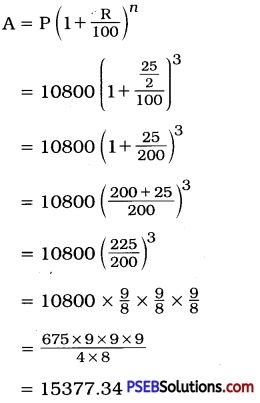
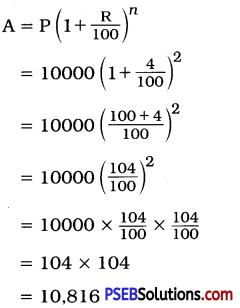
₹ 10,800 for 3 years at 12\(\frac {1}{2}\) per annum compounded annually.
Solution:
Here, P = ₹ 10,800;
R = 12\(\frac {1}{2}\) % = \(\frac {25}{2}\) %;
T = 3 years; ∴ n = 3
PSEB 8th Class Maths Solutions Chapter 8 Comparing Quantities Ex 8.3 1PSEB 8th Class Maths Solutions Chapter 8 Comparing Quantities Ex 8.3 1
Amount = ₹ 15,377.34
Compound’interest = Amount – Principal
= ₹ (15377.34 – 10800)
= ₹ 4577.34

PSEB 8th Class Maths Solutions Chapter 8 Comparing Quantities Ex 8.3

Question (b)
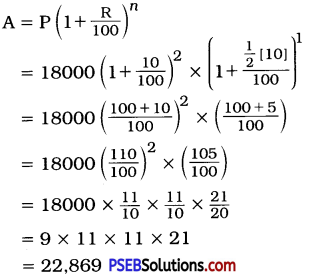
₹ 18,000 for 2\(\frac {1}{2}\) years at 10% per annum compounded annually.
Solution:
Here, P = ₹ 18,000; R = 10 %;
T = 2\(\frac {1}{2}\) years; ∴ n = 2 + \(\frac {1}{2}\)
PSEB 8th Class Maths Solutions Chapter 8 Comparing Quantities Ex 8.3 2
Amount = ₹ 22,869
Compoimd interest = Amount – Principal
= ₹ (22869 – 18000)
= ₹ 4869

Question (c)
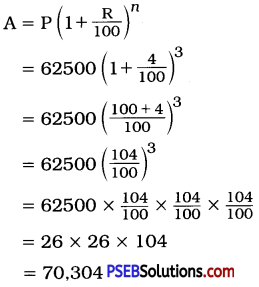
₹ 62,500 for 1\(\frac {1}{2}\) years at 8% per annum compounded half yearly.
Solution:
Here, the interest is compounded half-yearly.
Here, P = ₹ 62,500; R = \(\frac {8}{2}\) = 4 %
T = 1\(\frac {1}{2}\) years ∴ n = \(\frac {3}{2}\) × 2 = 3
PSEB 8th Class Maths Solutions Chapter 8 Comparing Quantities Ex 8.3 3
Amount = ₹ 70,304
Compound interest = Amount – Principal
= ₹ (70304 – 62500)
= ₹ 7804

PSEB 8th Class Maths Solutions Chapter 8 Comparing Quantities Ex 8.3

Question (d)
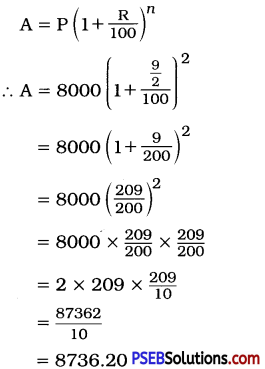
₹ 8000 for 1 year at 9 % per annum compounded half-yearly.
(You could use the year-by-year calculation using SI formula to verify.)
Solution:
Here, the interest is compounded half-yearly.
Here, P = ₹ 8000; R = \(\frac {9}{2}\) %;
T = 1 year ∴ n = 2
PSEB 8th Class Maths Solutions Chapter 8 Comparing Quantities Ex 8.3 4
Amount = ₹ 8736.20
Compound interest = Amount – Principal
= ₹ (8736.20 – 8000)
= ₹ 736.20
[Note : By finding simple interest also we can calculate.)
SI = \(\frac {PRT}{100}\)
= \(\frac{8000 \times 9 \times 1}{2 \times 100}\)
= ₹ 376.20
Thus, total interest of 1 year
= ₹ (360 + 376.20)
= ₹ 736.20

PSEB 8th Class Maths Solutions Chapter 8 Comparing Quantities Ex 8.3

Question (e)
₹ 10,000 for 1 year 8% per annum compounded half yearly.
Solution:
Here, the interest is compounded half-yearly.
Here, P = ₹ 10,000; R = \(\frac {8}{2}\) = 4 %;
T = 1 year ∴ n = 1 × 2 = 2
PSEB 8th Class Maths Solutions Chapter 8 Comparing Quantities Ex 8.3 5
Amount = ₹ 10,816
Compound interest = Amount – Principal
= ₹ (10816 – 10000)
= ₹ 816

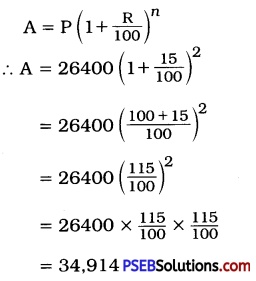
2. Kamala borrowed ₹ 26,400 from a Bank to buy a scooter at a rate of 15% p.a. compounded yearly. What amount will she pay at the end of 2 years and 4 months to clear the loan?
(Hint: Find A for 2 years with interest is compounded yearly and then find SI on the 2nd year amount for \(\frac {4}{12}\) years)
Solution:
[Note: Here, find amount after 2 years by compound interest. This amount is principal for \(\frac {4}{12}\) year. For this \(\frac {4}{12}\) year, find simple interest.)
Here, P = ₹ 26,400; R = 15%;
T = 2 years ∴ n = 2
PSEB 8th Class Maths Solutions Chapter 8 Comparing Quantities Ex 8.3 6
Now, ₹ 34,914 will be principal to find interest of 4 months.
SI = \(\frac {PRT}{100}\)
= \(\frac{34914 \times 15 \times 4}{100 \times 12}\)
= \(\frac{174570}{100}\)
= ₹ 174570
= ₹ 1745.70
Amount = ₹ (34914 + 1745.70)
= ₹ 36,659.70
Thus, Kamala Mil have to pay ₹ 36,659.70 to clear the loan.

PSEB 8th Class Maths Solutions Chapter 8 Comparing Quantities Ex 8.3

3. Fabina borrows ₹ 12,500 at 12% per annum for 3 years at simple interest and Radha borrows the same amount for the same time period at 10% per annum, compounded annually. Who pays more interest and by how much?
Solution:
For Fabina:
Here, P = ₹ 12,500; R = 12%; T = 3 years
SI = \(\frac{\mathrm{P} \times \mathrm{R} \times \mathrm{T}}{100}\)
= \(\frac{12500 \times 12 \times 3}{100}\)
= 125 × 12 × 3
= ₹ 4500
Simple interest = ₹ 4500

For Radha:
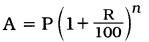
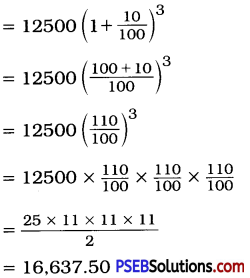
Here, P = ₹ 12,500; R = 10%;
T = 3 years ∴ n = 3
PSEB 8th Class Maths Solutions Chapter 8 Comparing Quantities Ex 8.3 7
PSEB 8th Class Maths Solutions Chapter 8 Comparing Quantities Ex 8.3 8
Amount = ₹ 16,637.50
Compound interest = Amount – Principal
= ₹ (16637.50 – 12500)
= ₹ 4137.50
Fabina has to pay ₹ 4500 as interest and Radha has to pay ₹ 4137.50 as interest.
∴ Fabina has to pay more interest.
Difference in interest = ₹ (4500 – 4137.50)
= ₹ 362.50
Thus, Fabina has to pay ₹ 362.50 more than Radha as interest.

4. I borrowed ₹ 12,000 from Jamshed at 6 % per annum simple interest for 2 years. Had I borrowed this sum at 6% per annum compound interest, what extra amount would I have to pay?
Solution:
For Simple Interest:
Here, P = ₹ 12,000; R = 6 %; T = 2 years
SI = \(\frac{\mathrm{P} \times \mathrm{R} \times \mathrm{T}}{100}\)
= \(\frac{12000 \times 6 \times 2}{100}\)
= 120 × 6 × 2
= ₹ 1440
SI = ₹ 1440

For Compound Interest:
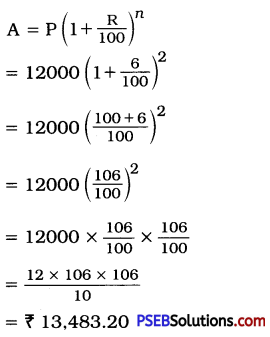
Here, P = ₹ 12,000, R = 6 %
T = 2 years ∴ n = 2
PSEB 8th Class Maths Solutions Chapter 8 Comparing Quantities Ex 8.3 9
= ₹ 13,483.20
Amount = ₹ 13,483.20
CI = A – P
= ₹ (13483.20 – 12000)
= ₹ 1483.20
∴ Extra amount to be paid
= ₹ (1483.20 – 1440)
= ₹ 43.20
Thus, I have to pay ₹ 43.20 as extra amount.

PSEB 8th Class Maths Solutions Chapter 8 Comparing Quantities Ex 8.3

5. Vasudevan invested ₹ 60,000 at an interest rate of 12% per annum compounded half-yearly. What amount would he get.

Question (i)
after 6 months?
Solution:
Interest after 6 months:
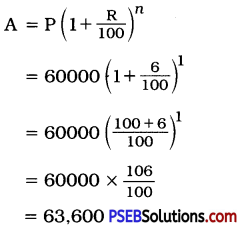
Here, P = ₹ 60,000; R = \(\frac {12}{2}\) = 6%;
T = 6 months ∴ n = 1
PSEB 8th Class Maths Solutions Chapter 8 Comparing Quantities Ex 8.3 10
∴ Amount = ₹ 63,600

Question (ii)
after 1 year?
Solution:
After 1 year:
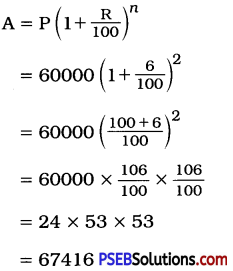
∴ Amount = ₹ 67,416
Here, P = ₹ 60,000; R = \(\frac {12}{2}\) = 6 %;
T = 1 year ∴ n = 2
PSEB 8th Class Maths Solutions Chapter 8 Comparing Quantities Ex 8.3 11
∴ Amount = ₹ 67, 146
Thus, Vasudevan will get ₹ 63,600 after 6 months and ₹ 67,416 after 1 year.

PSEB 8th Class Maths Solutions Chapter 8 Comparing Quantities Ex 8.3

6. Arif took a loan of ₹ 80,000 from a bank. If the rate of interest is 10% per annum, find the difference in amounts he would be paying after 1\(\frac {1}{2}\) years if the interest is

Question (i)
compounded annually.
Solution:
Calculation of CI annually:
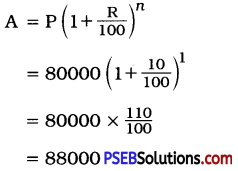
Here, P = ₹ 80,000; R = 10 %;
T = 1\(\frac {1}{2}\) year

For 1st year:
R = 10% and n = 1
PSEB 8th Class Maths Solutions Chapter 8 Comparing Quantities Ex 8.3 12
∴ Amount of CI after 1 year = ₹ 88,000
Now, calculate simple interest of ₹ 88,000 for 6 months.
P = ₹ 88,000; R = 10 %;
T = 6 months = \(\frac {1}{2}\) year
∴ Interest = \(\frac{P \times R \times T}{100}\)
= \(\frac{88000 \times 10 \times 1}{100 \times 2}\)
= 4400
∴ Interest of 6 months = ₹ 4400
Thus, A = P + I
= ₹ (88000 + 4400)
= ₹ 92,400
Thus, according to CI, Arif has to pay ₹ 92,400

Question (ii)
compounded half yearly.
Solution:
If interest is compounded half yearly
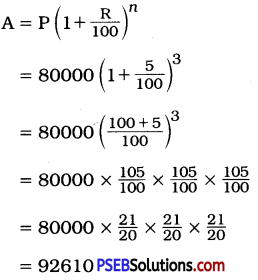
Here, P = ₹ 88000, R = \(\frac {10}{2}\) = 5%
T = 1\(\frac {1}{2}\) years ∴ n = 3
PSEB 8th Class Maths Solutions Chapter 8 Comparing Quantities Ex 8.3 13
∴ Amount = ₹ 92,610
Thus, according to half-yearly CI, Arif has to pay ₹ 92,610
∴ Difference = ₹ (92,610 – 92,400)
= ₹ 210

PSEB 8th Class Maths Solutions Chapter 8 Comparing Quantities Ex 8.3

7. Maria invested ₹ 8,000 in a business. She would be paid interest at 5% per annum compounded annually. Find

Question (i)
The amount credited against her name at the end of the second year,
Solution:
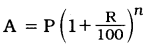
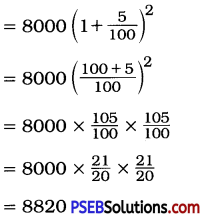
(i) Here, P = ₹ 8000, R = 5 %,
T = 2 years ∴ n = 2
PSEB 8th Class Maths Solutions Chapter 8 Comparing Quantities Ex 8.3 14
PSEB 8th Class Maths Solutions Chapter 8 Comparing Quantities Ex 8.3 15
Thus, amount credited against Marlas name at the end of second year is ₹ 8820.

Question (ii)
The interest for the 3rd year.
Solution:
To find the interest for the 3rd year:
P = ₹ 8820, R = 5%, T = 1 years
SI = \(\frac{\mathrm{PRT}}{100}=\frac{8820 \times 5 \times 1}{100}\) = 441
The interest for 3rd year is ₹ 441
OR
The interest for the 3rd year:
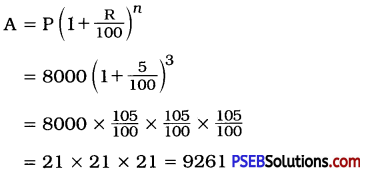
Here, P = ₹ 8000, R = 5 %, T = 3 years ∴ n = 3
PSEB 8th Class Maths Solutions Chapter 8 Comparing Quantities Ex 8.3 16
∴ At the end of 3rd year ₹ 9261 will be credited against Maria’s name.
∴ Interest of the 3rd year = Amount of 3 years – Amount of 2 years
= ₹ (9261 – 8820)
= ₹ 441

PSEB 8th Class Maths Solutions Chapter 8 Comparing Quantities Ex 8.3

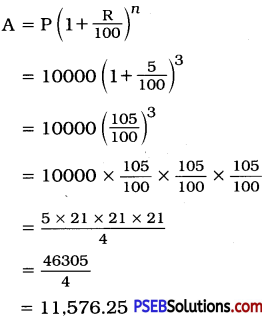
8. Find the amount and the compound interest on ₹ 10,000 for 1\(\frac {1}{2}\) years at 10% per annum, compounded half-yearly. Would this interest be more than the interest he would get if it was compounded annually?
Solution:
(i) Here, interest is compounded half-yearly.
Here, P = ₹ 10,000; R = \(\frac {10}{2}\) = 5 %;
T = 1\(\frac {1}{2}\) years ∴ n = 3
PSEB 8th Class Maths Solutions Chapter 8 Comparing Quantities Ex 8.3 17
Amount = ₹ 11,576.25
CI = A – P
= ₹ (11576.25 – 10000)
= ₹ 1576.25

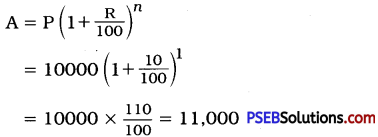
(ii) Here, interest is compounded yearly. CI for 1 year:
Here, P = ₹ 10,000; R = 10%;
T = 1 year ∴ n = 1
PSEB 8th Class Maths Solutions Chapter 8 Comparing Quantities Ex 8.3 18
Amount at the end of 1 year = ₹ 11,000
∴ CI = A – P
= ₹ (11000 – 10000)
= ₹ 1000
Now, calculate SI for 6 months.
Here, P = ₹ 11,000; R = 10%; T = \(\frac {1}{2}\) year
SI = \(\frac{\mathrm{P} \times \mathrm{R} \times \mathrm{T}}{100}=\frac{11000 \times 10 \times 1}{100 \times 2}\)
= 550
∴ Total interest of 1\(\frac {1}{2}\) years = ₹ (1000 + 550)
= ₹ 1550
After comparing (i) and (ii), we can conclude ₹ 1576.25 > ₹ 1550
∴ Yes, the interest is more if compounded half-yearly.

PSEB 8th Class Maths Solutions Chapter 8 Comparing Quantities Ex 8.3

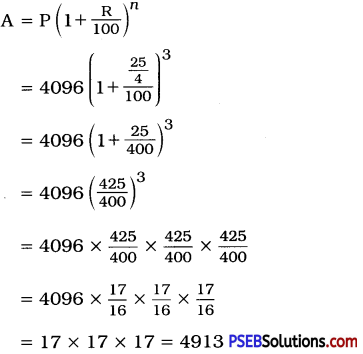
9. Find the amount which Ram will get on ₹ 4096, if he gave it for 18 months at 12\(\frac {1}{2}\) % per annum, interest being compounded half-yearly.
Solution:
Here, interest is compounded half-yearly.
Here, P = ₹ 4096, R = 12\(\frac{1}{2} \times \frac{1}{2}=\frac{25}{4}\)
T = 18 months = 1\(\frac {1}{2}\) years ∴ n = 3
PSEB 8th Class Maths Solutions Chapter 8 Comparing Quantities Ex 8.3 19
Amount = ₹ 4913
Thus, Ram will get ₹ 4913 at the end of period.

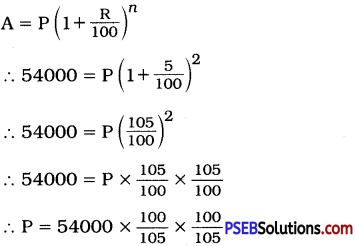
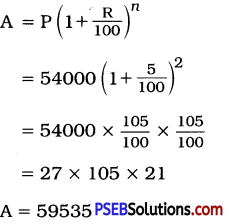
10. The population of a place increased to 54,000 in 2003 at a rate of 5% per annum

Question (i)
find the population in 2001.
Solution:
[Note: In 1st case, we have to find P as population of 2003 is given. From that we have to find population of 2001.]
Population in 2003 = 54,000
Here, A = 54,000; R = 5%; T = 2 years ∴ n = 2
PSEB 8th Class Maths Solutions Chapter 8 Comparing Quantities Ex 8.3 20
∴ P = 48979.59 (approx)
P = 48980 (approx)
Thus, the population in 2001 is 48,980.

PSEB 8th Class Maths Solutions Chapter 8 Comparing Quantities Ex 8.3

Question (ii)
What would be its population in 2005?
Solution:
Here, P = 54,000; R = 5 %;
T = 2 years ∴ n = 2
PSEB 8th Class Maths Solutions Chapter 8 Comparing Quantities Ex 8.3 21
Thus, the population in 2005 is 59,535.

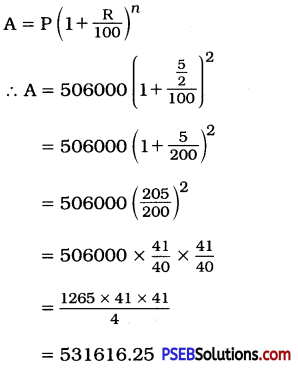
11. In a Laboratory, the count of bacteria in a certain experiment was increasing at the rate of 2.5% per hour. Find the bacteria at the end of 2 hours if the count was initially 5,06,000.
Solution:
Initial count of bacteria = 5,06,000
Rate of increasing = 2.5% per hour
Bacteria count after 2 hours
Here, P = 5,06,000, R = 2.5 % = \(\frac {5}{2}\)%;
T = 2 hours ∴ n = 2
PSEB 8th Class Maths Solutions Chapter 8 Comparing Quantities Ex 8.3 22
A = 531616 (approx)
Thus, the number of bacteria count after 2 hours will be 5,31,616 (approx).

PSEB 8th Class Maths Solutions Chapter 8 Comparing Quantities Ex 8.3

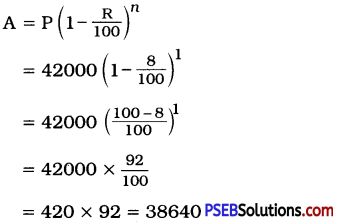
12. A scooter was bought at ₹ 42,000. Its value depreciated at the rate of 8 % per annum. Find its value after one year.
Solution:
CP of a scooter = ₹ 42,000
Here, P = ₹ 42,000; R = 8 %; T = 1 ∴ n = 1
R = – 8 % (as depreciation)
PSEB 8th Class Maths Solutions Chapter 8 Comparing Quantities Ex 8.3 23
Thus, the value of a scooter after 1 year will be ₹ 38,640.

PSEB 12th Class English Grammar Active and Passive Voice

Punjab State Board PSEB 12th Class English Book Solutions English Grammar Active and Passive Voice Exercise Questions and Answers, Notes.

PSEB 12th Class English Grammar Active and Passive Voice

There are two Voices:
1. Active Voice
2. Passive Voice.

1. Active Voice. The verb is said to be in the active voice when the subject acts; as,

  • He sings a song.
  • She wrote a story.
  • We are telling a story.
  • The farmer waters the fields.

2. Passive Voice. The verb is said to be in the passive voice when the object acts; as,

  • A song is sung by him.
  • A story was written by her.
  • A story is being told by us.
  • The fields are watered by the farmer.

PSEB 12th Class English Grammar Active and Passive Voice

Rules for changing a verb from the ACTIVE VOICE to the PASSIVE VOICE are:
1. The object of the verb in the Active Voice is made the subject in the Passive Voice.

2. If a transitive verb has two objects, either of them becomes the subject of the Passive Voice and the other remains unchanged.

3. The subject of the verb becomes the object of some preposition; as,
He gave me a book.
A book was given to me by him.

4. The verb is changed according to the following rules:

Tense Changed into
Present Indefinite (sings) = is, am, are + third form (sung).
Past Indefinite (sang) = was, were + third form (sung).
Future Indefinite (sing) = shall be, will be + third form (sung).
Present Continuous (singing) = is, am, are + being + third form (sung).
Past Continuous (singing) was, were + being + third form (sung)
Present Perfect (sung) = has been, have been + third form.
Past Perfect (sung) = had been + third form.
Future Perfect (sung) = shall have been, will have been + third form.

Please Note. Use be + third form after can, could, shall, should, may, might, must, ought to.

5. When the agent is not expressed in the Passive Voice, we must supply it in the Active Voice:
Books were sold.
(Reeta) sold the books.

6. When a sentence is an imperative one, then the word “let” is used in the Passive voice:
Read your books.
Let your books be read.

7. Prepositions following the verbs in the ACTIVE VOICE must follow them again in the PASSIVE VOICE:
He laughed at me.
I was laughed at by him.

8. In interrogative sentences, the helping verb should always precede the Doer of the action in the Active Voice and the Receiver of the action in the Passive Voice:
Did he post the letter ?
Was the letter posted by him ?

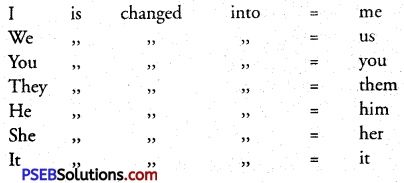
9. THE PERSONAL PRONOUNS are changed as under:
PSEB 12th Class English Grammar Active and Passive Voice 1

(A) Present Indefinite Tense

1. Active : I hate Physics like poison.
Passive : Physics is hated like poison by me.
2. Active : She sings a song.
Passive : A song is sung by her.
3. Active : Who teaches you history ?
Passive : By whom are you taught history ?
4. Active : Does he help you ?
Passive : Are you helped by him ?

(B) Past Indefinite Tense

1. Active : I hated Physics like poison.
Passive : Physics was hated like poison by me.
2. Active : She sang a song.
Passive : A song was sung by her.
3. Active : Who taught you history ?
Passive : By whom were you taught history ?
4. Active : Did he help you ?
Passive : Were you helped by him ?

PSEB 12th Class English Grammar Active and Passive Voice

(C) Future Indefinite Tense

1. Active : I will hate Physics like poison.
Passive : Physics shall be hared like posion by me.
2. Active : She will sing a song.
Passive : A song will be sung by her.
3. Active : Who will teach you history ?
Passive : By whom will you be taught history ?
4. Active : Will he help you ?
Passive : Will you be helped by him ?

(D) Present Continuous Tense

1. Active : The peon is ringing the bell.
Passive : The bell is being rung by the peon.
2. Active : Why are you making a noise ?
Passive : Why is a noise being made by you ?
3. Active : Who is ringing the bell ?
Passive : By whom is the bell being rung ?
4. Active : Is he singing a song ?
Passive : Is a song being sung by him ?

(E) Past Continuous Tense

1. Active : They were singing a song.
Passive : A song was being sung by them.
2. Active : What were they doing ?
Passive : What was being done by them ?
3. Active : Was he teaching the class ?
Passive : Was the class being taught by him ?
4. Active : The peon was ringing the bell.
Passive : The bell was being rung by the peon.

(F) Present Perfect Tense

1. Active : She has insulted her mother.
Passive : Her mother has been insulted by her.
Active : Have you stolen the book ?
Passive : Has the book been stolen by you ?
3. Active : Who has rung the bell ?
Passive : By whom has the bell been rung ?
4. Active : She has spoken the truth.
Passive : The truth has been spoken by her.

(G) Past Perfect Tense

1. Active : She had insulted her mother.
Passive : Her mother had been insulted by her.
2. Active : Had you stolen the book ?
Passive : Had the book been stolen by you ?
3. Active : Who had rung the bell ?
Passive : By whom had the bell been rung ?
4. Active : She had spoken the truth.
Passive : The truth had been spoken by her.

(H) Future Perfect Tense

1. Active : She shall have insulted her father.
Passive : Her father will have been insulted by her.
2. Active : Will you have seen the picture by then ?
Passive .: Will the picture have been seen by you by then ?
3. Active : She will have caught the bird.
Passive : The bird will have been caught by her.
4. Active He will have stolen my pen.
Passive : My pen will have been stolen by him.

(I) Use of “Should”, “Must”, “Ought”, “Can”, “Could”, “May”, “Might” Etc. (Auxiliary Verbs)

1. Active : We should not laugh at the poor.
Passive : The poor should not be laughed at by us.
2. Active : You must teach him.
Passive : He must be taught by you.
3. Active : We ought to obey our elders.
Passive : Our elders ought to be obeyed by us.
4. Active : You can do it.
Passive : It can be done by you.
5. Active : I could teach him a lesson.
Passive : He could be taught a lesson by me.
6. Active : May I see your pen ?
Passive : May your pen be seen by me ?
7. Active : He might follow this path.
Passive : This path might be followed by him.
8. Active : May God bless you with a son !
Passive : May you be blessed with a son by God !

(J) Use of “Who”, “What”, “Why”, “When” Etc.

1. Active : Who beat you ?
Passive : By whom were you beaten ?
2. Active : Who broke your pen ?
Passive : By whom was your pen broken ?
3. Active : What have you done ?
Passive : WTiat has been done by you ?
4. Active : WTiy did you abuse him ?
Passive : Why was he abused by you ?
5. Active : When do you visit the temple ?
Passive : WTien is the temple visited by you ?

(K) Use Of “Know”, “Contain”, “Please”, “Astonish” “Surprise”, “Disgust”, “Alarm” Etc.

1. Active : Do you know him ?
Passive : Is he known to you ?
2. Active : This cup contains milk.
Passive : Milk is contained in this cup.
3. Active : His behaviour displeased me.
Passive : I was displeased at his behaviour.
4. Active : I cannot please everybody.
Passive : Everybody cannot be pleased with me.
5. Active : Her conduct astonished me.
Passive : I was astonished at her conduct.
6. Active : This news alarmed me.
Passive : I was alarmed at this news.

PSEB 12th Class English Grammar Active and Passive Voice

(L) Imperative Sentences

1. Active : Post this letter.
Passive : Let this letter be posted.
2. Active : Obey your elders.
Passive : Let your elders be obeyed.
3. Active : Do not pluck flowers.
Passive : You are prohibited to pluck flowers.
4. Active : Sit down.
Passive : You are ordered to sit down.
5. Active : Speak the truth.
Passive : You are advised to speak the truth.
6. Active : Please help me.
Passive : You are requested to help me.

NOTE : There are some Transitive verbs that give the sense of the Passive Voice without being changed into the Passive Voice.
1. Active : Quinine tastes bitter.
Passive : Quinine is bitter when tasted.
2. Active : This milk tastes sweet.
Passive : This milk is sweet when tasted.

Exercise 1

Change the Voice:

1. I like my teacher.
2. Do manners reveal character ?
3. Columbus discovered America.
4. This man has cut down the trees.
5. Hari did not open the door.
6. I will win him over.
7. The old man takes the snuff.
8. A cruel boy killed the bird.
9. I had never seen a zoo before.
10. Will she have written a letter ?
Answer:
1. My teacher is liked by me.
2. Is character revealed by manners ?
3. America was discovered by Columbus.
4. The trees have been cut down by this man.
5. The door was not opened by Hari.
6. He will be won over by me.
7. The snuff is taken by the old man.
8. The bird was killed by a cruel boy.
9. A zoo had never been seen by me before.
10. Will a letter have been written by her ?

Exercise 2 (textual)

Change the Voice:
1. Does she know you ?
2. Will you post the letter ?
3. She has done her duty.
4. Avoid bad company.
5. Are you expecting him today ?
6. I cannot lift this heavy box.
7. May I see your book ?
8. You are wasting your time.
9. When will she have finished her work ?
10. Why do you not call in the doctor ?
Answer:
1. Are you known to her ?
2. Will the letter be posted by you ?
3. Her duty has been done by her.
4. Bad company should be avoided.
5. Is he being expected by you today ?
6. This heavy box cannot be lifted by me.
7. May your book be seen by me ?
8. Your time is being wasted by you.
9. When will her work have been finished by her ?
10. Why is the doctor not called in by you ?

Exercise 3 (Textual)

Change the Voice:
1. Her uncle looks after her.
2. A favour will be done to him by me.
3. How is Sharda known to you ?
4. He was shocked at his sisters stupidity.
5. Why are you laughing at me ?
6. Who abused you ?
7. Had the picture been painted by her ?
8. This pot contains milk.
9. Were the villagers beating the terrorists ?
10. Who does not love his motherland ?
Answer:
1. She is looked after by her uncle.
2. I will do him a favour.
3. How do you know Sharda ?
4. His sister’s stupidity shocked him.
5. Why am I being laughed at by you ?
6. By whom were you abused ?
7. Had she painted the picture ?
8. Milk is contained in this pot.
9. Were the terrorists being beaten by the villagers ?
10. By whom is his motherland not loved ?

PSEB 12th Class English Grammar Active and Passive Voice

Exercise 4 (Textual)

Change the Voice:
1. His father praised him.
2. Kalidas wrote Sakuntalam.
3. The teacher was pleased by the boy’s work.
4. He kept me waiting.
5. Lata was singing a song.
6. They had already consulted the lawyer.
7. Many toys had been purchased by Rani.
8. The paper published the news.
9. Did you wring the clothes ?
10. Which book do you want ?
Answer:
1. He was praised by his father.
2. Sakuntalam was written by Kalidas.
3. The boy’s work pleased the teacher.
4. I was kept waiting by him.
5. A song was being sung by Lata.
6. The lawyer had already been consulted by them.
7. Rani had purchased many toys.
8. The news was published by the paper.
9. Were the clothes wrung by you ?
10. Which book is wanted by you ?

Exercise 5

Change the Voice:
1. Do not keep bad company.
2. They will have missed the train.
3. I shall not show you my book.
4. You are to help him.
5. Who invented the gramophone ?
6. I was given your message by him.
7. Open the door.
8. What do you want ?
9. The fire will have destroyed the house.
10. We ought to love our country.
Answer:
1. Let bad company not be kept.
2. The train will have been missed by them.
3. My book will not be shown to you.
4. He is to be helped by you.
5. By whom was the gramophone invented ?
6. He gave me your message.
7. Let the door be opened.
8. What is wanted by you ?
9. The house will have been destroyed by the fire.
10. Our country ought to be loved.

Exercise 6 (Textual)

Change the Voice:
1. I was pleased with his conduct.
2. The sudden noise frightened the horse.
3. The man cut down the tree.
4. The people will soon forget it.
5. We elected Thomas captain.
6. Somebody has put out the light.
7. We prohibit smoking.
8. He was refused admission.
9. Those cars were built by robots.
10. Why did he defraud you of your earnings ?
Answer:
1. His conduct pleased me.
2. The horse was frightened by the sudden noise.
3. The tree was cut down by the man.
4. It will soon be forgotten by the people.
5. Thomas was elected captain by us.
6. The light has been put out.
7. Smoking is prohibited.
8. The Principal refused him admission.
9. Robots built those cars. .
10. Why were you defrauded of your earnings by him ?

PSEB 12th Class English Grammar Active and Passive Voice

Additional Exercise Voice Based on Grammar Items

Exercise 1

Change the voice of the following sentences:
1. Crowd thronged the stadium.
2. Arjun is seeing a deer.
3. I have not liked kites.
4. Who is waiting for me ?
5. Learn your lessons.
6. Mend your business.
7. I am known to him.
8. You displeased her.
9. This pot contains coffee.
10. You had to do it.
11. Indians adore Prime Minister Narendra Modi.
12. Work must be finished.
13. Did he sing a song ?
14. Can you lend me your book.
15. Do you like apples ?
Answer:
1. The stadium was thronged with crowd.
2. A deer is being seen by Arjun.
3. Kites have not been liked by me.
4. By whom am I being waited for ?
5. Let your lessons be learnt ?
6. Let your business be mended ?
7. He knows me.
8. She was displeased at you.
9. Coffee is contained in this pot.
10. It had to be done by you.
11. Prime Minister is adored by Indians.
12. Workers must finish work.
13. Was a song sung by him ?
14. Can your book be lent to me (by you) ?
15. Apples are liked by me.

PSEB 12th Class English Grammar Transformation of Sentences (Simple, Compound & Complex)

Punjab State Board PSEB 12th Class English Book Solutions English Grammar Transformation of Sentences (Simple, Compound & Complex) Exercise Questions and Answers, Notes.

PSEB 12th Class English Grammar Transformation of Sentences (Simple, Compound & Complex)

(Simple, Compound Complex)

Definition of Simple Sentences. A simple sentence is one that contains one finite verb, either expressed or understood. It simply means that it has one finite verb and is consequently a single independent clause.
Sentence : (S = Subject, V = Verb, O = Object)
Examples:

  1. Boys are running.
  2. Boys and girls play.
  3. The handsome boy gave his mother a red rose.
  4. He gave his brother a book.

Compound Sentences. Let us have a look at the sentence. He rose and went to the door of his room. There are two finite verbs-rose and went. It is made up of two clauses, each containing finite verb and joined by the conjunction ‘and’. Neither of the two clauses in the sentence is dependant on the other for its grammatical function. Such a sentence is called a compound sentence.

Complex Sentence. It is a sentence made up of a main clause and one or more subordinate clauses.
I met a boy who has plenty of push and drive, (one subordinate clause).
You may leave when I tell you to.
I liked the Shimla climate because it was healthy, but Suresh preferred the summer of Delhi, (two subordinate clauses).

PSEB 12th Class English Grammar Transformation of Sentences (Simple, Compound & Complex)

Table showing conjunctions used in compound and complex sentences.

In Compound Sentences In Complex Sentences
and who, whom, which
but whose
or that
nor if, unless
neither when, while, till, until
either before, after
neither ……… nor where
either ……….. or why
as well as as, because, since
so, that, lest
though

(a) Conversion of simple sentences into complex:
1. By adding a Noun Clause to the Principal Clause.

Simple Complex
1. You seem to be a look It seems that you are a fool.
2. She confessed her guilt. She contessed that she was guilty.
3. The child appears to be angry. It appears that the child is angry.
4. It looks like rain. It looks that it will rain.

2. By adding an Adverb Clause to the Principal Clause.

Simple Complex
(a) 1. He is too fat to run. He is so fat that he cannot run.
2. This load is too heavy to carry. This load is so heavy that one cannot carry it.
(b) 1. He is the tallest boy in the class. No other boy in the class is as tall as he.
2. I shall write to you on reaching Delhi. I shall write to you when I reach Delhi.
3. India is the land of my birth. India is the land where I was born.

3. By adding an Adjective Clause to the Principal Clause.

Simple Complex
1. Columbus was the first to discover America. He is a man on whom you can depend.
2. He is a man to be depended upon. Columbus was the first who discovered America.
3. This is the way to earn huge This is the way in which huge profits can be earned.

Conversion of Simple Sentences into Compound Sentences.
A Simple Sentence can be changed into a Compound Sentence by expanding a word or a phrase into co-ordinate clause by using a co-ordinate conjunction.

Compound Sentences are converted into Simple ones by using a participle or a prepositional phrase or a Gerund or Infinitive in place of one of the co-ordinate clauses.

Interchange of Simple and Compound Sentences.

1. Simple : He was honoured for his honesty.
He was hottest and so he was honoured.
2. Simple : Taking his gun he shot at the bird.
He took his gun and shot at the bird.
3. Simple : You must work hard to pass the examination.
You must work hard or you will not pass the examination.

Interchange of compound and complex Sentences:

1. Compound : Spare the rod and spoil the child.
Complex : If you spare the rod, you will spoil the child.
2. Compound : He confessed his guilt or he would have been punished.
Complex : If he had not confessed his guilt, he would have been punished.
3. Compound : Go wherever you like, only do not stay here.
Complex : You may go wherever you like but you do not stay here.
4. Compound : Leave this room or I shall compel you to do so.
Complex : Unless you leave this room, I shall compel you to do so.
5. Compound : He was a poor man, but he was always honest.
Complex : He was always honest although he was poor.
6. Compound : He stood up to speak and everyone was at once silent.
Complex : Everyone was at once silent when he stood up to speak.
7. Compound : He was very tired and therefore he fell sound asleep.
Complex : He fell sound asleep, as he was very tired.
8. Compound : Confess your fault and I will pardon you.
Complex : If you confess your fault, I will pardon you.
9. Compound : He lost a watch, but he has found it again.
Complex : He has found the watch that he lost.
10. Compound : He worked very hard therefore he succeeded.
Complex : He succeeded because he worked very hard.

Exercise 1

Change the following simple/compound sentences into complex sentences:

1. This was a vague possibility. 1. This was a possibility which was vague.
2. The old lady made one end of the silk thread fast to Tom’s tooth. 2. It was the old lady who made one end of the silk thread fast to Tom’s tooth.
3. It makes my flesh crawl to hear you. 3. It makes my flesh crawl when I hear you.
4. The groans ceased and the pain vanished from the toe. 4. When the groans ceased, the pain vanished from the toe.
5. Monday morning found Tom Sawyer miserable. 5. When Monday morning came, Tom Sawyer found himself miserable.
6. He generally began that day by wishing he had no intervening holiday. 6. He generally began that day by wishing that he had no intervening holiday.
7. When he found no ailment, he investigated again. 7. He investigated again because no ailment was found.

Exercise 2 (Textual)

Transform the following:

1. She could not prove her innocence. (Change into a Complex sentence)
2. I sold my lame horse. (Change into a Complex sentence)
3. Here comes a girl in red. (Change into a Complex sentence)
4. You can join duty as you are well now. (Change into a Compound sentence)
5. I knew her to be intelligent. (Change into a Complex sentence)
6. The doctor is hopeful of her recovery. (Change into a Complex sentence)
7. If she does not weep, she will die. (Change into a Compound sentence)
8. He was fined because of his absence. (Change into a Simple Sentence)
9. Seeing the signal, the troops marched out. (Change into a Complex sentence)
10. You must encourage him, he is sure to lose. (Change into a Compound Sentence)
Answer:
She could not prove that she was innocent.
I sold my horse that was lame.
Here comes a girl who is in red.
You are well and you can join duty.
I knew that she was intelligent.
The doctor hopes that she will recover.
She must weep or she will die.
He was fined for his absence.
The troops marched out as they got the signal.
You must encourage him or he will lose.

PSEB 12th Class English Grammar Transformation of Sentences (Simple, Compound & Complex)

Exercise 3 (Textual)

Transform the following sentences:

1. Girish found a bag and a pen. (Change into Compound)
2. At last the spider reached the cobweb.
3. Seeing a tiger coming, he ran away.
4. Inspite of his wealth he is unhappy. (Change into Compound)
Answer:
1. Girish found not only a bag but a pen also.
2. The spider made the last attempt and reached the cobweb.
3. He saw a tiger and ran away.
4. He is unhappy though he is wealthy.

Exercise 4 (Textual)

Change the following sentences from Simple to Compound:

1. Having taken food, he went to school.
2. The sun having risen, the fog disappeared.
3. Having finished his task, he went to school.
4. Going to Adelaide, Anushka saw the match.
5. He laboured hard to succeed.
Answer:
1. He took food and went to school.
2. The sun rose and the fog disappeared.
3. He finished his task and went to school.
4. Anushka went to Adelaide and saw the match.
5. He laboured hard for he wanted to succeed.

Exercises 5

Change the following Compound sentences into Simple sentences:

1. He took out his gun and set out for hunting.
2. He met the Principal and came back.
3. He saw the bird and shot it.
4. He was too poor, so he could not pay the debt.
5. He was very weak, so he couldn’t walk.
Answer:
1. Taking out his gun, he set out for hunting.
2. After meeting the Principal, he came back.
3. Seeing the bird, he shot it.
4. He was too poor to pay the debt.
5. He was too weak to walk.

Exercise 6

Change the following Simple sentences into Complex sentences:

1. Reema did not admit her fault.
2. A poor man enjoys peace of mind.
3. He is too weak to run.
4. He hoped to win the prize.
5. Some trees fold their leaves at night.
6. This is not the way to clean things.
7. You cannot solve a simple problem.
8. The news spread like wild fire.
9. I could see no means of making tea.
Answer:
1. Reema did not admit that she was at fault.
2. A man who is poor enjoys peace of mind.
3. He is so weak that he cannot run.
4. He hoped that he would win the prize.
5. There are some trees that fold their leaves at night.
6. This is not the way how things are cleaned.
7. You cannot solve a problem that is simple.
8 The news spread as if it were wild fire.
9. I could see no means by which tea could be made.

Exercise 7

Change the following into Complex sentences:

1. To our surprise we found that these were no other than pelicans.
2. The island seemed to be divided into squares.
3. We turned to look in the direction pointed out.
4. He would take the rule to remeasure.
5. He stared at the approaching young be beauty.
6. They held out a ball like a pineapple.
7. I do not expect to see him back.
8. A man in a surging crowd lifted up the child.
9. They had come upon a footpath while in a field.
10. I like doing a little job of this sort.
Answer:
1. We were surprised to find that these were no other than pelicans.
2. It seemed that the island was divided into squares.
3. We looked in the direction which was pointed out.
4. He would re-measure with the rule which he had taken.
5. He stared at the young beauty that was approaching.
6. They held out a ball which was like a pineapple.
7. I do not expect that I will see him back.
8. A man in the crowd that was surging lifted up the child.
9. They had come upon a footpath which was in a field.
10. I like doing a little job which is of this sort.

Exercise 8

Do as directed:

1. We go to college to receive education. (Change into Complex)
2. O what a fall was there, my countrymen ! (Change into Assertive)
3. He is a great fool. (Change into Exclamatory)
4. I reached college in time (Change into Interrogative)
5. Why don’t you work hard ? (Change into Assertive)
6. This news is too good to be true. (Remove ‘too’)
7. As soon as I reached the college, the bejl rang. (Change into Negative)
8. Birds do not fly as fast as the aeroplane. (Change into Comparative)
9. Where did you see him ? (Change the Voice)
10. The teacher said to me, “Do you want to sing ?” (Change the Narration)
Answer:
1. We go to college so that we may receive education.
2. My countrymen, it was a very nasty fall.
3. What a fool he is !
4. Did you reach college late ?
5. You should work hard.
6. This news is so good that it cannot be true.
7. No sooner did I reach the college than the bell rang.
8. Aeroplane flies faster than birds.
9. Where was he seen by you ?
10. The teacher asked me if I wanted to sing.

PSEB 12th Class English Grammar Transformation of Sentences (Simple, Compound & Complex)

Exercise 9

Do as directed:

1. It is too cold for me to go out. (Remove ‘too’)
2. None but the brave could accomplish this task. (Change into affirmative)
3. As soon as he saw the ghost, he started shuddering with fear. (Rewrite by using ‘No sooner’)
4. Why waste time in loitering outside the cinema ? (Change into Assertive)
5. Man is a wonderful piece of work. (Change into Exclamatory)
6. His hard work brought him a brilliant success. (Change into Complex sentence)
7. You ought to have helped your friend. (Change the voice)
8. The beggar said to me, “Please give me some money.” (Change the Narration)
9. This boy is more intelligent than any other student in the class. (Change the degree of Comparison)
10. Unless you are not careful, you will run into debt. (Correct the sentence)
Answer:
1. It is so cold that I cannot go out.
2. Only the brave could accomplish this task.
3. No sooner did he see the ghost, than he started shuddering with fear.
4. Don’t waste time in loitering outside the cinema.
5. What a piece of work is man !
6. He worked so hard that it brought him a brilliant success.
7. Your friend ought to have been helped by you.
8. The beggar requested me to give him some money.
9. This boy is the most intelligent student in the class.
10. Unless you are careful, you will run into debt.

Exercise 10

Do as directed:

1. These mangoes are too cheap to be good. (Remove ‘too’)
2. I saw a wounded bird. (Change into Complex sentence)
3. Honey is made by bees. (Change the Voice)
4. I have promises to keep. (Separate it in two sentences)
5. He is sometimes foolish. (Change into Negative)
6. No sooner did he see the lion than he took to he heels.
7. Can money buy health ? (Rewrite using ‘as soon as’)
8. They say honesty is the best policy. (Rewrite as ‘Statement’)
9. She is better than any other dancer in the college. (Change the Voice)
10. She left no plan untried. (Change into Superlative)
Answer:
These mangoes are so cheap that they cannot be good. I saw a bird which was wounded.
Bees make honey.
I have promises. I have to keep them.
He is not always wise.
As soon as he saw the lion, he took to his heels. Money cannot buy health.
It is said that honesty is the best policy.
She is the best dancer in the college.
She tried every plan.

Exercise 11

Do as directed:

1. As soon as the young man sensed trouble, he disappeared. (Rewrite by using ‘No sooner’)
2. The officer was so busy yesterday that he was not able to receive his visitors. (Use ‘too’)
3. Isn’t he exceptionally handsome ? (Change into assertive)
4. A soldier and afraid of bullets ! (Change into assertive)
5. My friend went to England to attain higher education. (Change into complex)
6. The patient had died before the doctor had arrived. (Correct the sentence)
7. She said to me, “Let us go to Shimla for holidaying.” (Change the narration)
8. You should look up all these words in a dictionary. (Change the voice)
9. Mount Everest is the highest peak in the world. (Change the degree of comparison)
10. Is there anything greater than the love of mother ? (Change into negative)
Answer:
1. No sooner did the young man sense trouble, than he disappeared.
2. The officer was too busy yesterday to receive his visitors.
3. He is exceptionally handsome.
4. It is disgraceful that a soldier should be afraid of bullets.
5. My friend went to England so that he might attain higher education.
6. The patient had died before the doctor arrived.
7. She suggested to me that we should go to Shimla for holidaying.
8. All these words should be looked up in a dictionary by you.
9. No other peak in the world is as high as Mount Everest.
10. There is nothing greater than the love of mother.

Exercise 12

Transform the following sentences as directed:

1. This tree is too high for me to climb. (Remove ‘too’)
2. America is the richest country in the world. (Change the degree of comparison)
3. You will have to clear the arrears. (Change the voice)
4. He said to me, “What were you doing at this time yesterday ?” (Change the narration)
5. Who does not want to be rich ? (Change into affirmative)
6. Can money buy health ? (Change into assertive)
7. He went to the hospital to consult the doctor. (Change into complex form)
8. Had you not helped me, I ………… (Complete the sentence)
9. As soon as the Minister rose to speak, the public started shouting at him. (Use ‘No sooner’)
10. Until he does not work hard, he will not pass. (Correct the sentence)
Answer:
1. This tree is so high that I cannot climb it.
2. No other country in the world is richer than America.
3. The arrears will have to be cleared by you.
4. He asked me what I was doing at that time the previous day.
5. Everybody wants to be rich.
6. Money cannot buy health.
7. He went to the hospital so that he might consult the doctor.
8. Had you not helped me, I would have been ruined.
9. No sooner did the Minister rise to speak, than the public started shouting at him.
10. Unless he works hard, he will not pass.

Exercise 13

Transform the following sentences as directed:

1. His application had been rejected. (Rewrite in the negative form)
2. When the peasants heard this they were much alarmed. (Rewrite in a simple sentence)
3. None but a fool could do it. (Change into affirmative)
4. She would utter the prettiest of thoughts. (Change the degree of comparison)
5. I am awfully glad you came. (Rewrite using too)
6. As soon as he saw the thief, he started shuddering with fear. (Rewrite by using ‘No sooner’)
7. There is no place like home. (Change into interrogative)
8. Did you see her ? (Change the voice)
9. The beggar said to me, “Please give me some money.” (Change the narration)
10. It is very nice of him that he is here today. (Change into exclamatory)
Answer:
1. His application had not been accepted.
2. The peasants were very much alarmed on hearing this.
3. Only a fool could do it.
4. She could utter prettier thoughts than others.
5. I am too glad that you came.
6. No sooner did he see the thief than he started shuddering with fear.
7. Is there any place like home ?
8. Was she seen by you ?
9. The beggar requested me to give him some money.
10. How nice of him to be here today !

PSEB 12th Class English Grammar Transformation of Sentences (Simple, Compound & Complex)

Miscellaneous Exercises on All Types of Transformation

Exercise 1

Transform the following sentences as directed:

1. As soon as Sir Roger came home he called for wax candles. (Use no sooner …….. than)
2. It is probable that he will come back. (Change into a simple sentence)
3. He ran away or they would have killed him. (Change into a complex sentence)
4. What would I not give to make you happy ?) (Change into an assertive sentence)
5. Chennai is one of the largest cities in India. (Use the comparative degree of large)
Answer:
1. No sooner did Sir Roger come home than he called for wax candles.
2. Probably he will come back.
3. If he had not run away, they would have killed him.
4. I would give you anything to make you happy.
5. Chennai is larger than many other cities in India.

Exercise 2

Transform the following sentences as directed:

1. He is too good to deceive any one. (Remove too)
2. He ate twenty sandwiches in ten minutes. (Change into passive voice)
3. What a beautiful picture it is ! (Change into an assertive sentence)
4. Can this news ever be true ? (Change into an assertive sentence)
5. Calcutta (Kolkata) is the largest city in India. (Change the degree of comparison)
6. Ajay is one of the best boys of the class. (Change the degree of comparison)
Answer:
1. He is so good that he cannot deceive any one.
2. Twenty sandwiches were eaten by him in ten minutes.
3. It is a very beautiful picture.
4. This news can never be true.
5. Calcutta (Kolkata) is larger than any other city in India.
6. Ajay is better than many other boys in the class.

Exercise 3

Transform the following sentences as directed:

1. He is the brightest boy of the class. (Change the degree of comparison)
2. Are you a god that no one should oppose you ? (Change into the assertive form)
3. Don’t permit any one to leave before time. (Change into the passive voice)
4. There was no one greater than Napoleon in his day. (Change into affirmative)
5. This news is too good to be true. (Remove too)
6. There is no one that does not like him. (Change into the affirmative)
7. What a beautiful sunset ! (Change into the assertive form)
Answer:
1. No other boy of the class is as bright as he.
2. You are not a god that no one should oppose you.
3. No one should be permitted to leave before time.
4. Napoleon was greater than all in his day.
5. This news is so good that it cannot be true.
6. Everyone likes him.
7. It is a very beautiful sunset.

Exercise 4

Rewrite the following sentences as directed:

1. To eat too much makes one fat. (Remove too)
2. I have told you a thousand times not to do it. (Use already).
3. He is so honest that he will not accept a bribe. (Use too)
4. The judge suspected that the witness had been bribed. (Change into active form)
5. One more word, and I will send you out of the room. (Use if)
6. How sad was the sight of the deserted city ! (Transform to assertive)
7. Very few countries are as hot as India. (Change to comparative)
8. They will look after you well. (Change into passive form)
Answer:
1. To eat in excess makes one fat.
2. I have already told you not to do it.
3. He is too honest to accept a bribe.
4. The judge suspected that someone bribed the witness.
5. If you utter one more word, I will send you out of the room.
6. The sight of the deserted city was Very sad.
7. Very few countries are hotter than India.
8. You will be looked after well by them.

Exercise 5

Rewrite the following sentences as directed:

1. This news is too good to be true. (Remove too)
2. She is so intelligent that she will understand it. (Use too)
3. Prevention is better than cure. (Change the degree of comparison)
4. As soon as he saw his friend’s burnt house, he burst into tears. (Use no sooner …………. than)
5. I shall remember your kindness. (Use the negative without changing the meaning)
6. He does not like you. (Use a tag question)
7. No one can serve two masters. (Change into interrogative form)
8. A sailor and afraid of storm ! (Change into assertive form)
Answer:
1. This news is so good that it cannot be true.
2. She is too intelligent not to understand it.
3. Cure is not as good as prevention.
4. No sooner did he see his friends burnt house, than he burst into tears.
5. I shall never forget your kindness.
6. Does he ?
7. Can anyone serve two masters ?
8. It is a shame for a sailor to be afraid of storm.

PSEB 12th Class English Grammar Transformation of Sentences (Simple, Compound & Complex)

Exercise 6

Rewrite the following sentences as directed:

1. He succeeded in everything that he attempted. (As a negative sentence)
2. Everyone has heard of Columbus. (As an interrogative sentence)
3. Give him a share of your cake. (Use the word in italics in the passive voice)
4. We cannot dispense with food and water. (Use the adjective form of the word in italics)
5. I am very pleased to accept your invitation. (Use the noun form of the word in italics)
6. That play was published after the death of its author. (Substitue a single word for the words in italics)
Answer:
1. He failed in everything that he attempted.
2. Who has not heard of Columbus ?
3. Let a share of your cake be taken by him.
4. Food and water cannot be regarded as dispensable by us.
5. I feel a great pleasure to accept your invitation.
6. That play was published posthumously.

Exercise 7

Rewrite the following sentences as directed:

1. Get out of my room and let me do my work. (Make the sentence a bit polite)
2. She spoke very gently to explain her point of view. (Use the adjective form of the italicized word)
3. The distinguished visitor received a warm welcome at the airport. (Use the adverbial form of the word in italics)
Answer:
1. Kindly allow me to do my work in the room.
2. She explained her point of view in a gentle way.
3. The distinguished visitor was welcomed warmly at the airport.

Exercise 8

Rewrite the following sentences as directed:
1. He is so weak that he cannot sit in bed. (Use too to)
2. He used force to turn the beggar out of his house. (Use the adverb form of force)
3. I am glad that my intention to become a soldier has received your assent. (Use the verb form of assent)
4. If only I could meet him and give him proper advice! (Change from an exclamatory into an assertive sentence)
5. I cannot refuse you anything. (Turn into a positive sentence)
6. Your lack of manners has shocked me much. (Change the voice)
Answer:
1. He is too weak to sit in bed.
2. He turned the beggar forcibly out of his house.
3. I am glad that you have assented to my intention to become a soldier.
4. I long to meet him and give him proper advice.
5. Iam willing to give you anything.
6. I have been shocked much by your lack of manners.

Exercise 9

Rewrite the following sentences as directed:

1. He is in the habit of grumbling. (Rewrite using used to)
2. He forcibly made his way through the crowd. (Substitute the verb form for forcibly)
3. My mother did not give me permission to swim. (Rewrite using let)
4. We will have to come again. (Rewrite using must)
5. He is so weak that he cannot walk. (Rewrite using too)
6. The battery is strong and should last twenty-four hours. (Rewrite using enough)
Answer:
1. He is used to grumbling.
2. He forced his way through the crowd.
3. My mother did not let me swim.
S 4. We must come again.
5. He is too weak to walk.
6. The battery is strong enough to last twenty-four hours.

Exercise 10

Rewrite the following sentences as directed:

1. We live in the same house but we do not like each other. (Rewrite this sentence using although)
2. Tom as well as John was in high spirits. (Rewrite using both)
3. I told you to work hard. (Change into interrogative)
4. On hearing the post office, he rushed to the news of his success. (Rewrite this in the proper order so as to make sense)
Answer:
1. Although we live in the same house, yet we do not like each other.
2. Both Tom and John were in high spirits.
3. What did I tell you ?
4. On hearing the ngws of his success, he rushed to the post office.

Additional Exercises (Solved) Based on Grammar Items

Exercise 1

Read the following sentences and identify them as simple or compound or complex sentences.
1. Our college students went to Agra and saw the Taj.
2. She studied hard yet could not pass.
3. Life is real, life is earnest.
4. We must run or we will miss the train.
5. Nalini dances on the stage.
6. Rewa who passed by me is a charming girl.
7. Girls are dancing.
8. The Principle imposed a heavy fine on the ill-mannered and abusive student.
9. This is Sanderson High School where I studied for four years.
10. We shall exchange pleasantries when we reach home.
Answer:
1. Compound
2. Compound
3. Compound
4. Compound
5. Simple
6. Complex
7. Simple
8. Simple.
9. Complex
10. Complex.

PSEB 12th Class English Grammar Transformation of Sentences (Simple, Compound & Complex)

Transform the following sentences directed:

1. Who trusts a liar ? (Change into assertive)
2. Who does not love his country ? (Change into assertive)
3. What if he is divorced ? (Change into assertive)
4. When can truth die ? (Change into assertive)
5. Who wants to be miserable ? (Change into assertive)
6. Who wants to be poor ? (Change into assertive)
7. Everyone knows him. (Change into assertive)
8. Everyone wants to be a millionaire ? (Interrogative)
9. Everyone loves his motherland (Interrogative)
10. Nobody wants to lose: (Interrogative)
11. What a lovely scene ! (Assertive)
12. O for a glass of wine ! (Assertive)
13. Oh what a fall forth party ! (Assertive)
14. How pleasant the weather is ! (Assertive)
15. How shameful for an India’s opposition leader to use a fake clip to defame the government of his own country. (Assertive)
Answer:
1. Nobody trusts a liar.
2. Everybody loves his country.
3. It does not matter if he is divorced.
4. Truth can never die.
5. Nobody wants to be miserable.
6. Nobody wants to be poor.
7. There is nobody who does not know him.
8. There is nobody who does not want to be a millionaire.
9. There is no one who does not love his motherland.
10. Is there anybody who wants to lose ?
11. It is a very lovely scene.
12. I long for a glass of wine.
13. It is a nasty fall for the party.
14. The weather is very pleasant.
15. It is very shameful for an India’s opposition leader to use a government of his own country.

Exercise 3

Transform the following assertive sentences into negative:

1. He is a good person.
2. Health is wealth.
3. Look before you leap.
4. Do attend my birthday party.
5. Take exercise regularly.
Answer:
1. He is not a bad person.
2. Is not health also a wealth ?
3. Do not leap before you look.
4. Do not fail to attend my party.
5. You should not take exercise daily.

PSEB 12th Class English Grammar Determiners

Punjab State Board PSEB 12th Class English Book Solutions English Grammar Determiners Exercise Questions and Answers, Notes.

PSEB 12th Class English Grammar Determiners

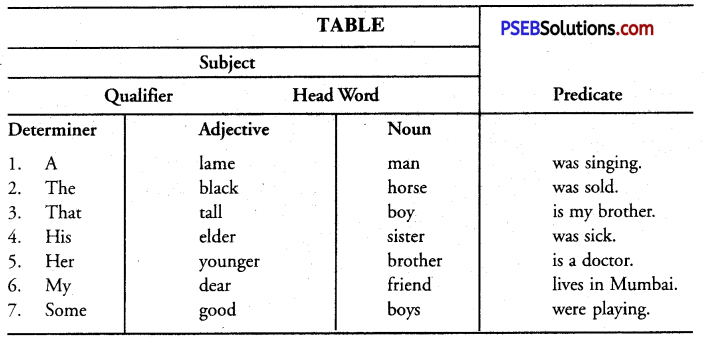
A word qualifying a head word is known as a determiner. Words like a, an, the, that, his, her, my and some are determiners. In grammar, a determiner is a word that is used before a noun to select which instance of the noun you are talking about or to identify it. Determiners are fixing words that determine precisely the meaning of the nouns with which they are used. See the table:

अंग्रेज़ी भाषा में कुछ शब्द ऐसे हैं जिन्हें संज्ञाओं से पहले लगाया जाता है। ये शब्द संज्ञाओं को निश्चित व निर्धारित करने के लिए लगाए जाते हैं। इन शब्दों को Determiners कहते हैं। ये सोलह शब्द हैं-
Determiners तानी डाला हित मतिरे सवर उत निठां ? Nouns 3 पग्लिा प्लाष्टिका मांसा चै । प्टिव ਸ਼ਬਦ Nouns ਨੂੰ ਨਿਸਚਿਤ ਤੇ ਨਿਰਧਾਰਿਤ ਕਰਨ ਲਈ ਲਾਏ ਜਾਂਦੇ ਹਨ । ਇਹ ਸੋਲਾਂ ਸ਼ਬਦ ਹਨ-
this, these, that, those, my, your, his, her, its, our, there, some, any, a, an, the.
PSEB 12th Class English Grammar Determiners 1

Articles. Articles ‘a’, ‘an’ or ‘the’ can also be used as Determiners.
Determiners are of various kinds:
1. Demonstratives – this, that, these, those.
2. Possessives – my, our, your, his, her, its, their, Mohan’s, one’s.
3. Determiners of Quantity – much, more, some, any.
4. Articles – a, an, the are also determiners.

PSEB 12th Class English Grammar Determiners

1. Demonstrative Determiners – This, that, these, those.

  • This house is Gopal’s.
  • That clinic is Dr. Raman’s.
  • These books will be sent to the library.
  • Those flats will be allotted to us.

2. Possessive Determiners.

  • My brother is a pilot.
  • Our leaders work for their own kith and kin.
  • Your performance is very good.
  • His room is very dirty.
  • Swami’s father forbade Swami to wander in the sun.
  • His house is spacious.
  • My coat is black in colour.
  • Its pocket is torn.

3. Determiners of Quantity (“some” and “any”).
Some has positive and any has negative implications. Questions with negative implications also have “any”. But questions with positive implications take “some”.

  • Have you any money ?
  • No, I don’t have any.
  • Will you take some more milk ?
  • Yes, I will.

4. Articles a, an and the are also used as determiners.

  • Here was a possibility.
  • What is the matter ?
  • He did not know the necessary symptoms.
  • He wanted to hold the tooth in reserve.

Note : Our readers should note that all textual exercises on the grammatical items prescribed in the syllabus have been solved at the appropriate places in MBD Guide.

Exercise 1

Fill up the blanks with determiners:

1. ………… watch is broken.
2. ………… of the boys will get a prize.
3. I have not ………… time.
4. There are ………… books on the table.
5. Please give me ………… milk.
6. I do not have ………… money these days.
7. Did not she give you ………… biscuits ?
8. ………… girl will top the list this year also.
9. ………… boys will do well.
10. ………… businessmen make a lot of money.
11. Send ………… student to get the stamps.
12. ………… boy of this class can read it.
13. Give me ………… more juice.
14. There are ………… good books in our library.
Answer:
1. This
2. Each
3. much
4. some
5. some
6. any
7. some
8. Some
9. Some
10. Some
11. any
12. Any
13. some
14. some.

PSEB 12th Class English Grammar Determiners

Exercise 2

Fill up the blanks with suitable determiners:

1. ………… egg on the table was thrown away.
2. He has not ………… pen to give you.
3. ………… men are not equal.
4. There is ………… sugar in the tin. You may use it.
5. I have told you ………… hundred times not to come here.
6. There are not ………… buses because the drivers have gone on a strike.
7. Would you like to have ………… coffee ?
8. As ………… patients came into the room, he switched on the fan.
9. He has not eaten ………… food since morning.
10. John refused to give his brother ………… more money.
11. Can you see ………… ants moving on the flower ?
12. ………… teacher can tell you that learning English is not an easy job.
13. Is there ………… food left in the plate ?
14. He has not ………… time to spare.
15. Have you had ………… attacks of malaria ?
16. We can expect ………… more mosquitoes after continued falls of rain.
17. I have not read all the books, but I have read …………
18. Not ………… people like being advised by others.
19. Now the school has ………… pupils than ever before.
20. I exhibited ………… brute in me.
Answer:
1. The
2. a
3. All
4. some
5. a
6. any
7. some
8. more
9. any
10. any.
11. some
12. The
13. any
14. much
15. any
16. some
17. some
18 many
19. more
20. the.

Exercise 3

Fill up the blanks with suitable determiners:

1. ………… road leads to Amritsar.
2. ………… infant cannot look after itself.
3. The beggar was grateful for ………… bread Rani gave him.
4. ………… dinner served at the wedding was not delicious.
5. ………… crow and the owl belong to the same family of birds.
6. He bought ………… mangoes.
7. There are not ………… flowers in the garden now.
8. If you have ………… doubts, please ask your teacher.
9. Will you bring ………… fruit for me ?
10. My elder son first went to ………… school when he was four.
11. He was sent to ………… prison for murdering a man.
12. Do you need ………… help again ?
13. I have ………… pen and a pencil.
14. Moscow is ………… capital of Russia.
15. Rohit has a radio and ………… TV.
16. He has read it in ………… magazine or the other.
17. A good quality is called ………… virtue.
18. It is a very bad mistake to use ‘a’ with ………… plural noun.
Answer:
1. This
2. An
3. the
4. The
5. The
6. some
7. any
8. any
9. any
10. the.
11. the
12. a little
13. a
14. the
15. a
16. some
17. a
18. a.

Exercise 4 (Textual)

Fill in the blanks with suitable determiners:

1. I have ………… friends in the city.
2. ………… umbrella is ………… useful thing.
3. ………… a man has died of cholera.
4. ………… children go to school everyday.
5. Did you see ………… elephants in the forest ?
6. She is proud of ………… beauty.
7. ………… plant is dying.
8. ………… the girls are present today.
9. She did not send me ………… reply.
10. ………… man is expected to do his best.
Answer:
1. many
2. An, a
3. Many
4. These
5. any
6. her
7. That
8. All
9. any
10. Every.

PSEB 12th Class English Grammar Determiners

Exercise 5

Fill in the blanks with suitable determiners:

1. He has got ………… bread.
2. How ………… milk do you take daily ?
3. ………… knowledge is a dangerous thing.
4. There is ………… sugar in stock.
5. He gave away ………… money he had in charity.
6. He has broken ………… slate that you bought yesterday.
7. ………… the students are present in the class.
8. I do not have ………… spare pen.
9. ………… body must have his own book.
10. ………… houses are newly built.
Answer:
1. some
2. much
3. A little
4. much
5. the little
6. the
7. All
8. any
9. Every
10. These.

Exercise 6

Fill in the blanks with suitable determiners:

1. Keep to ………… left.
2. Where shall I send ………… fare ?
3. I need ………… money.
4. Can you catch ………… butterfly ?
5. How ………… experience have you got ?
6. He is ………… best boy in the class.
7. Kindly show me ………… pens.
8. I did not buy ………… trousers from the market.
9. There are shady trees on ………… side of the road.
10. How ………… ink is there in the bottle ?
Answer:
1. the
2. the
3. some
4. this
5. much
6. the
7. some
8. any
9. either
10. much.

Exercise 7

Fill in the blanks with suitable determiners:

1. He did not make ………… mistakes in his essay.
2. I have lost appetite, so I did not eat ………… bananas.
3. I must sign ………… will.
4. When I think of India, I think of ………… things.
5. ………… of people go without food in India everyday.
6. She said, ………… pen is mightier than the sword.”
7. ………… book you want is not with me.
8. ………… houses were damaged in the cyclone.
9. I shall return this book in ………… days.
10. I had put in ………… hard work.
Answer:
1. any
2. any
3. the
4. many
5. A lot
6. The
7. The
8. Many
9. a few
10. much.

Exercise 8

Fill in the blanks with suitable determiners:

1. It did not hurt ………… a bit.
2. I covered ………… face and wept.
3. I want ………… title of first Admiral.
4. Who is ………… head of your family ?
5. ………… Ganga is a sacred river.
6. How ………… girls are there in your class ?
7. She toiled up ………… hill.
8. It seemed ………… endless time.
9. Always speak ………… truth.
10. I dismissed him ………… some money.
Answer:
1. me
2. my
3. the
4. the
5. The
6. many
7. the
8. an
9. the
10. with.

Exercise 9

Use suitable determiners in the blanks:

1. I saw ………… girls swimming in the pool.
2. I did not see ………… film last week.
3. He failed to answer ………… questions.
4. Do you have ………… difficulty ?
5. Meet me ………… time you like.
6. Will you make ………… tea for me ?
7. He gave me ………… money.
8. Did he give you ………… information ?
9. ………… cheerleaders were dressed in swimming dresses.
10. ………… women can keep a secret.
Answer:
1. some
2. any
3. some
4. any
5. any
6. some
7. some
8. any
9. The
10. Few.

Exercise 10

Use suitable determiners in the blanks:

1. Can you bring me ………… water to drink ?
2. I am in possession of ………… money in my bank.
3. He has ………… enemies.
4. Did you make ………… mistake in the letter ?
5. ………… a lady is present in the hall.
6. ………… ladies are present in the hall.
7. ………… of what you say is trash.
8. Gayatri is a polyglot because she knows ………… languages.
9. I had to face ………… music.
10. This room has ………… doors.
Answer:
1. some
2. little
3. no
4. any
5. Many
6. Many
7. Much
8. many
9. the
10. two.

PSEB 12th Class English Grammar Determiners

Exercise 11

Fill in the blanks with suitable determiners:

1. How ………… money do you want ?
2. All ………… books are lying at sixes and sevens.
3. He lost ………… friends he had.
4. There is ………… milk in the jug.
5. I have ………… work to do.
6. ………… people paid homage to the departed leader.
7. ………… grapes are sweet and juicy.
8. He related ………… interesting story.
9. Jaspreet is ………… taller of them both.
10. Both ………… sons are thieves.
Answer:
1. much
2. the
3. the few
4. little
5. much
6. Several
7. These
8. an
9. the
10. his.

Exercise 12

Fill in the blanks with suitable determiners:

1. ………… member of the party was garlanded.
2. Is there ………… news ?
3. ………… father was a famous physician.
4. ………… horse runs very fast.
5. ………… books lie scattered in the room.
6. Please lend me ………… money.
7. She has ………… daughters.
8. Consult your doctor in case of ………… difficulty.
9. ………… girls are still writing the answer.
10. Only ………… persons came to witness the match.
Answer:
1. Every
2. any
3. My
4. That
5. Her
6. some
7. two
8. any
9. Some
10. a few.

Exercise 13

Fill in the blanks with suitable determiners:

1. Do you have ………… doubt in your mind ?
2. God has created ………… universe.
3. I have ………… good books.
4. Ujwal Puri is going out with ………… Chinese girl.
5. I never have ………… luck with the lottery.
6. Have you got ………… money ?
7. How ………… milk do you need ?
8. ………… time has passed now.
9. I have ………… expectations from anyone.
10. ………… list of new books has been released.
11. ………… road leads to Ajnala.
12. Singing is ………… passion.
13. He tore away ………… resignation letter.
14. She threw her arms around ………… baby.
15. She wrote ………… letter quickly.
Answer:
1. any
2. the
3. many
4. a
5. any
6. any
7. much
8. much
9. no
10. a
11. This
12. my
13. his
14. her
15. a.

Exercise 14

Fill in the blanks with suitable determiners:

1. Have you got ………… Pakistani friends ?
2. No, I haven’t got ………… Pakistani friends ?
3. He has ………… riend at all.
4. She has ………… best friend. They spend all their time together.
5. I have hardly ………… money left.
6. Have you got ………… money ?
7. Would you like ………… more orange juice ?
8. He lives ………… where in London. It does not matter to us.
9. I’m not looking for ………… in particular.
10. There are ………… animals in this zoo.
11. Is there ………… message for me ?
Answer:
1. any
2. any
3. no
4. a
5. any
6. some
7. some
8. some
9. anyone
10. many
11. any.

PSEB 12th Class English Grammar Determiners

Exercise 15

Fill in the blanks with suitable determiners:

1. Where shall I send ………… packet ?
2. He sat on ………… seat beside his bed.
3. Shobha knows ………… languages.
4. Hassan lost ………… little sympathy the teacher had for him.
5. How ………… money does he need ?
6. ………… the papers were lying on the floor.
7. There was hardly ………… effort by Hassan to overcome his bad habits.
8. We have ………… things to finish before we go.
9. I had to take ………… responsibility.
10. The big hall has ………… windows.
Answer:
1. this
2. the
3. many
4. the
5. the
6. any
7. many
8. many
9. the
10. many

PSEB 8th Class Maths Solutions Chapter 8 Comparing Quantities Ex 8.2

Punjab State Board PSEB 8th Class Maths Book Solutions Chapter 8 Comparing Quantities Ex 8.2 Textbook Exercise Questions and Answers.

PSEB Solutions for Class 8 Maths Chapter 8 Comparing Quantities Ex 8.2

1. A man got a 10% increase in his salary. If his new salary is ₹ 1,54,000, find his original salary.
Solution:
Let the original salary be ₹ 100.
After 10% increase, the new salary = ₹ (100 + 10)
= ₹ 110
If his new salary is ₹ 110,
then the original salary = ₹ 100
If new salary is ₹ 1,54,000,
then original salary = (\(\frac {100}{110}\) × 1,54,000)
= 100 × 1400
= ₹ 140000
Thus, his original salary was ₹ 1,40,000.

2. On Sunday 845 people went to the Zoo. On Monday only 169 people went. What is the per cent decrease in the people visiting the Zoo on Monday?
Solution:
Number of people went to the zoo on Sunday = 845
Number of people went to the zoo on Monday = 169
∴ Decrease in the number of people visiting the zoo on Monday = (845 – 169) = 676
Percentage decrease = \(\left(\frac{\text { Decrease }}{\text { Original number }} \times 100\right) \%\)
= (\(\frac {676}{845}\) × 100) %
= 80 %
Thus, 80% decrease in the number of people visiting the zoo on Monday.

3. A shopkeeper buys 80 articles for ₹ 2400 and sells them for a profit of 16%. Find the selling price of one article.
Solution:
Cost price of 80 articles = ₹ 2400
∴ Cost price of 1 article = ₹ \(\frac {2400}{80}\) = ₹ 30
Profit = 16%
∴ Profit on 1 article = ₹ \(\left(\frac{16}{100} \times 30\right)\)
= ₹ 4.80
∴ Selling price of 1 article
= Cost price + Profit
= ₹ 30 + ₹ 4.80
= ₹ 34.80
Thus, selling price of one article is ₹ 34.80.

PSEB 8th Class Maths Solutions Chapter 8 Comparing Quantities Ex 8.2

4. The cost of an article was ₹ 15,500. ₹ 450 were spent on its repairs. If it is sold for a profit of 15%, find the selling price of the article.
Solution:
Cost price of an article = ₹ 15,500
Repair charge (overhead charge) = ₹ 450
∴ Total cost price = Cost price of an article + Overhead expenses
= ₹ (15500 + 450) = ₹ 15,950
Profit per cent = 15%
Amount of profit = 15% of ₹ 15,950
= ₹ \(\left(\frac{15}{100} \times 15950\right)\)
= ₹ \(\left(\frac{23925}{10}\right)\)
= ₹ 2392.50
∴ Selling price = Total cost + Profit
= ₹ (15950 + 2392.50)
= ₹ 18342.50
Thus, the selling price of an article is ₹ 18,342.50.

5. A VCR and TV were bought for ₹ 8000 each. The shopkeeper made a loss of 4% on the VCR and a profit of 8% on the TV. Find the gain or loss per cent on the whole transaction.
Solution:
(i) Cost price of a VCR = ₹ 8000,
Loss per cent = 4 %
∴ Loss amount = 4% of cost
= ₹ \(\left(\frac{4}{100} \times 8000\right)\)
= ₹ (4 × 80)
= ₹ 320
∴ Selling price = Cost price – Loss
= ₹ (8000 – 320)
= ₹ 7680

(ii) Cost price of a TV = ₹ 8000
Profit per cent = 8%
∴ Profit amount = 8 % of cost
= ₹ \(\left(\frac{8}{100} \times 8000\right)\)
= ₹ (8 × 80)
= ₹ 640
∴ Selling price = Cost price + Profit
= ₹ (8000 + 640)
= ₹ 8640
Total cost price of a VCR and TV = ₹ (8000 + 8000)
= ₹ 16,000
Total selling price of a VCR and TV = ₹ (7680 + 8640)
= ₹ 16,320
SP > CR
∴ profit = SP – CP
= ₹ (16,320 – 16,000)
= ₹ 320
∴ Profit per cent = \(\left(\frac{\text { Profit }}{\text { Cost price }} \times 100\right) \%\)
= \(\left(\frac{320}{16000} \times 100\right) \%\)
= 2%
Thus, there is 2% profit on the whole transaction.

6. During a sale, a shop offered a discount of 10% on the marked prices of all the items. What would a customer have to pay for a pair of jeans marked at ₹ 1450 and two shirts marked at ₹ 850 each ?
Solution:
MP of a pair of jeans = ₹ 1450
MP of one shirt = ₹ 850
∴ MP of two shirts = ₹ (2 × 850)
= ₹ 1700
∴ Total MP of three items = ₹ (1450 + 1700)
= ₹ 3150
Discount per cent = 10%
∴ Amount of discount = 10% of total cost
= ₹ \(\left(\frac{10}{100} \times 3150\right)\)
= ₹ 315
Bill amount = MP – Discount
= ₹ (3150 – 315)
= ₹ 2835
Thus, customer would have to pay ₹ 2835 for a pair of jeans and two shirts.

PSEB 8th Class Maths Solutions Chapter 8 Comparing Quantities Ex 8.2

7. A milkman sold two of his buffaloes for ₹ 20,000 each. On one he made a gain of 5 % and on the other a loss of 10%. Find his overall gain or loss. (Hint: Find CP of each)
Solution:
Let CP of 1st buffalo be ₹ x
Gain (Profit) per cent = 5%
Amount of profit = 5 % of CP
= ₹ \(\left(\frac{5}{100} \times x\right)\)
= ₹ \(\frac{5 x}{100}\)
∴ SP = CP + Profit
= ₹ \(\left(x+\frac{5 x}{100}\right)\)
= ₹ \(\left(\frac{100 x+5 x}{100}\right)\)
= ₹ \(\frac{105 x}{100}\)
But, SP of a buffalo = ₹ 20,000 (Given)
∴ \(\frac{105 x}{100}\) = ₹ 20,000
∴ x = ₹ \(\left(\frac{20000 \times 100}{105}\right)\)
= ₹ 19047.62

Let the cost price of 2nd buffalo = ₹ y
Loss per cent = 10%
Amount of loss = 10% of CP
= ₹ \(\left(\frac{10}{100} \times y\right)\)
= ₹ \(\frac{10 y}{100}\)
SP = CP – Loss
= ₹ \(\left(y-\frac{10 y}{100}\right)\)
= ₹ \(\left(\frac{100 y-10 y}{100}\right)\)
= ₹ \(\frac{90 y}{100}\)
But SP of a buffalo = ₹ 20,000 (Given)
∴ \(\frac{90 y}{100}\) = ₹ 20,000
∴ y = ₹ \(\left(\frac{20000 \times 100}{90}\right)\)
= ₹ 22222.22

Total CP of both buffaloes = ₹ (x + y)
= ₹ (19047.62 + 22222.22)
= ₹ 41,269.84

Total SP of both buffaloes = ₹ (20000 + 20000)
= ₹ 40,000
∴ SP < CP
Amount of loss = CP – SP
= ₹ (41269.84 – 40000)
= ₹ 1269.84
Thus, there is overall loss of ₹ 1269.84.

8. The price of a TV is ₹ 13,000. The GST charged on it is at the rate of 12%. Find the amount that Vinod will have to pay if he buys it.
Solution:
Price of a TV = ₹ 13,000
GST per cent = 12%
∴ Amount of GST = 12% of price
= ₹ \(\left(\frac{12}{100} \times 13,000\right)\)
= ₹ 1560
∴ Total amount = Price of a TV + GST
= ₹ (13,000 + 1560)
= ₹ 14,560
Thus, Vinod will have to pay ₹ 14,560.

9. Aran bought a pair of skates at a sale where the discount given was 20%. If the amount he pays is ₹ 1600, find the marked price.
Solution:
Let the MP of a pair of skates be ₹ x.
Discount per cent = 20%
∴ Amount of discount = 20% of MP
= ₹ \(\left(\frac{20}{100} \times x\right)\)
= ₹ \(\frac{20 x}{100}\)
∴ Selling price = MP – Discount
= ₹ \(\left(x-\frac{20 x}{100}\right)\)
= ₹ \(\left(\frac{100 x-20 x}{100}\right)\)
= ₹ \(\frac{80 x}{100}\)
= ₹ \(\frac{4}{5} x\)
But, SP of a pair of skates = ₹ 1600 (Given).
∴ \(\frac{4}{5} x\) = 1600
∴ x = ₹ \(\left(\frac{1600 \times 5}{4}\right)\)
∴ x = ₹ 2000
Thus, the marked price of a pair of skates is ₹ 2000.

PSEB 8th Class Maths Solutions Chapter 8 Comparing Quantities Ex 8.2

10. I purchased a hair dryer for ₹ 5400 including 18% GST. Find the price before GST was added.
Solution:
Cost price of hair dryer with GST = ₹ 5400
GST per cent = 18%
Let the price of a hair dryer before GST ) was added be ₹ x.
∴ Amount of GST = 18% of x
= ₹ \(\left(\frac{18}{100} \times x\right)\)
= ₹ \(\frac{18 x}{100}\)
∴ Price after adding GST = ₹ \(\left(x+\frac{18}{100} x\right)\)
= ₹ \(\left(\frac{100 x+18 x}{100}\right)\)
= ₹ \(\frac{118 x}{100}\)
But, price after adding GST = ₹ 5400 (Given)
∴ \(\frac{118 x}{100}\) = 5400
∴ x = ₹ \(\left(\frac{5400 \times 100}{118}\right)\)
= ₹ 4576.27
Thus, the price of a hair dryer before adding GST is ₹ 4576.27.

11. An article was purchased for ₹ 1239 including GST of 18%. Find the price of the article before GST was added.
Solution:
Such type of sums can be done by two methods.
One method:
Let the price of an article before adding GST be ₹ 100.
GST = 18%
∴ price including GST = ₹ (100 + 18)
= ₹ 118
If price including GST is ₹ 118,
then price before adding GST = ₹ 100
∴ if price including GST is ₹ 1239,
then price before adding GST = ₹ \(\left(\frac{1239}{118} \times 100\right)\)
= ₹ 1050
Thus, the price of an article before adding GST was ₹ 1050.

Another method:
Let the price of an article before adding GST be ₹ x.
GST = 18%
Amount of GST = 18% of ₹ x
= ₹ \(\left(\frac{18}{100} \times x\right)\)
= ₹ \(\frac{18 x}{100}\)
Price after adding GST = ₹ \(\left(x+\frac{18 x}{100}\right)\)
= ₹ \(\left(\frac{118 x}{100}\right)\)
But, the price of an article = ₹ 1239 (Given)
∴ \(\frac{118 x}{100}\) = 1239
∴ x = ₹ \(\left(\frac{1239 \times 100}{118}\right)\)
= ₹ 1050
Thus, the price of an article before adding GST was ₹ 1050.

PSEB 8th Class Maths Solutions Chapter 9 Algebraic Expressions and Identities InText Questions

Punjab State Board PSEB 8th Class Maths Book Solutions Chapter 9 Algebraic Expressions and Identities InText Questions and Answers.

PSEB 8th Class Maths Solutions Chapter 9 Algebraic Expressions and Identities InText Questions

Try These: [Textbook Page No. 139]

1. Write two terms which are like:

Question (i)
7xy
Solution:
14xy, 21xy

PSEB 8th Class Maths Solutions Chapter 9 Algebraic Expressions and Identities InText Questions

Question (ii)
4mn2
Solution:
8mn2 , – 11mn2

Question (iii)
21
Solution:
– 5l, 9l

Try These : [Textbook Page No. 142]

1. Can you think of two more such situations, where we may need to multiply algebraic expressions?
Solution:
1. Aarush purchased x notebooks and y pens. If cost of a notebook and a pen is same ₹ z, what amount has he to pay? → ₹ z (x + y)
2. Shailja wants to spread a carpet in her room having length (l + 5) m and breadth (b – 2) m. Find the area of the carpet. → (l + 5) (b – 2) m2

PSEB 8th Class Maths Solutions Chapter 9 Algebraic Expressions and Identities InText Questions

Try These: [Textbook Page No. 143]

1. Find 4x × 5y × 7z.
Solution:
4x × 5y × 7z = 4 × 5 × 7 × x × y × z
= 140 xyz

2. Find 4x × 5y × 7z. First find (4x × 5y) and multiply it by 7z; or first find (5y × 7z) and multiply it by 4x. Is the result the same? What do you observe? Does the order in which you carry out the multiplication matter?
Solution:
(4x × 5 y) = 4 × 5 × x × y
= 20xy
Now, 20xy × 7z = 20 × 7 × xy × z
= 140xyz … (i)
Also, (5y × 7z) = 5 × 7 × y × z = 35 yz
Now, 35yz × 4x = 35 × 4 × yz × x
= 140xyz … (ii)
Yes, the result is same.
We can conclude that product remains same if we change order of the terms.

PSEB 8th Class Maths Solutions Chapter 9 Algebraic Expressions and Identities InText Questions

3. Complete the table for area of a rectangle with given length and breadth.
Solution:

length breadth area
3x 5y 3x × 5y = 15xy
9y 4y2 9y × 4y2 = 36y3
4ab 5bc 4ab × 5be = 20ab2c
2l2m 3lm2 2l2m × 3lm2 = 6l3m3

Try These : [Textbook Page No. 144]

1. Find the product:

Question (i)
2x (3x + 5xy)
Solution:
= (2x × 3x) + (2x × 5xy)
= 6x2 + 10x2y

Question (ii)
a2 (2ab – 5c)
Solution:
= (a2 × 2ab) – (a2 × 5c)
= 2a3b – 5a2c

PSEB 8th Class Maths Solutions Chapter 9 Algebraic Expressions and Identities InText Questions

Try These: [Textbook Page No. 145]

1. Find the product: (4p2 + 5p + 7) × 3p
Solution:
(4p2 + 5p + 7) × 3p
= (4p2 × 3p) + (5p × 3p) + (7 × 3p)
= 12p3 + 15p2 + 21p

Try These : [Textbook Page No. 149]

1. Put -b in place of b in Identity (I). Do you get Identity (II)?
Solution:
Identity (I): (a + b)2 = a2 + 2ab + b2
Let us put (- b) instead of b [a + (- b)]2
= a2 + 2a (- b) + (- b)2
∴ (a – b)2
= a2 – 2ab + b2
Identity (II): (a – b)2 = a2 – 2ab + b2
Yes, we get Identity (II).

PSEB 8th Class Maths Solutions Chapter 9 Algebraic Expressions and Identities InText Questions

Try These : [Textbook Page No. 149]

1. Verify Identity (IV), for a = 2, b = 3, x = 5.
Solution:
Identity (IV):
(x + a) (x + b) = x2 + (a + b) x + ab
Substitute a = 2, b = 3 and x = 5
LHS
= (x + a) (x + b)
= (5 + 2) (5 + 3)
= (7)(8)
= 56

RHS
= x2 + (a + b) x + ab
= (5)2 + (2 + 3) × 5 + (2 × 3)
= 25 + (5) × 5 + (6)
= 25 + 25 + 6 = 56
∴ LHS = RHS
∴ The given identity is true for the given values.

2. Consider, the special case of Identity (IV) with a = b, what do you get ? Is it related to Identity (I)?
Solution:
When a = b (∴ Take y for both)
(x + a) (x + b) = x2 + (a + b) x + ab
Substitute a = y and b = y
(x + y)(x + y) = x2 + (y + y)x + (y × y)
= x2 + (2y) x + (y × y) = x2 + 2xy + y2
∴ Yes, it is the same as Identity ( I).

PSEB 8th Class Maths Solutions Chapter 9 Algebraic Expressions and Identities InText Questions

3. Consider, the special case of Identity (IV) with a = -c and b = -c. What do you get ? Is it related to Identity (II) ?
Solution:
Identity (IV):
(x + a)(x + b) = x2 + (a + b) x + ab
Substitute (- c) instead of a and (- c) instead of b,
(x – c) (x – c)
= x2 + [(-c) + (-c)]x + [(-c) × (-c)]
= x2 + [- 2c] x + (c2)
= x2 – 2cx + c2
∴ Yes, it is the same as Identity (II).

4. Consider the special case of Identity (IV) with b = – a. What do you get ? Is it related to Identity (III)?
Solution :
Identity (IV):
(x + a) (x + b) = x2 + (a + b) x + ab
Substitute (-a) instead of b,
(x + a) (x – a)
= x2 + [a + (- a)] x + [a × (- a)]
= x2 + (a – a) x + [- a2]
= x2 + (0) x – a2
= x2 – a2
∴ Yes, it is the same as Identity (III).

PSEB 8th Class Maths Solutions Chapter 9 Algebraic Expressions and Identities Ex 9.5

Punjab State Board PSEB 8th Class Maths Book Solutions Chapter 9 Algebraic Expressions and Identities Ex 9.5 Textbook Exercise Questions and Answers.

PSEB Solutions for Class 8 Maths Chapter 9 Algebraic Expressions and Identities Ex 9.5

1. Use a suitable identity to get each of the following products:

Question (i)
(x + 3) (x + 3)
Solution:
= (x + 3)2
= (x)2 + 2(x)(3) + (3)2
[∵ (a + b)2 = a2 + 2ab + b2]
= x2 + 6x + 9

PSEB 8th Class Maths Solutions Chapter 9 Algebraic Expressions and Identities Ex 9.5

Question (ii)
(2y + 5) (2y + 5)
Solution:
= (2y + 5)2
= (2y)2 + 2 (2y)(5) + (5)2
[∵ (a – b)2 = a2 – 2ab + b2]
= 4y2 + 20y + 25

Question (iii)
(2a – 7) (2a – 7)
Solution:
= (2a – 7)2
= (2a)2 – 2(2a)(7) + (7)2
[∵ (a – b)2 = a2 – 2ab + b2]
= 4a2 – 28a + 49

Question (iv)
(3a – \(\frac {1}{2}\))(3a – \(\frac {1}{2}\))
Solution:
= (3a – \(\frac {1}{2}\))2
= (3a)2 – 2(3a)(\(\frac {1}{2}\)) + (\(\frac {1}{2}\))2
[∵ (a – b)2 = a2 – 2ab + b2]
= 9a2 – 3a + \(\frac {1}{4}\)

PSEB 8th Class Maths Solutions Chapter 9 Algebraic Expressions and Identities Ex 9.5

Question (v)
(1.1m – 0.4) (1.1m + 0.4)
Solution:
= (1.1m)2 – (0.4)2
[∵ (a + b) (a – b) = a2 – b2]
= 1.21m2 – 0.16

Question (vi)
(a2 + b2) (-a2 + b2)
Solution:
= (b2 + a2) (b2 – a2)
= (b2)2 – (a2)2
[∵ (a + b) (a – b) = a2 – b2]
= b4 – a4

Question (vii)
(6x – 7) (6x + 7)
Solution:
= (6x)2 – (7)2
[∵ (a + b) (a – b) = a2 – b2]
= 36x2 – 49

Question (viii)
(-a + c) (-a + c)
Solution:
= (-a + c)2
= (-a)2 + 2 (-a) (c) + (c)2
[∵ (a + b)2 = a2 + 2ab + b2]
= a2 – 2ac + c2

Question (ix)
(\(\frac{x}{2}+\frac{3 y}{4}\))
Solution:
= (\(\frac{x}{2}+\frac{3 y}{4}\))2
= (\(\frac {x}{2}\))2 + 2(\(\frac {x}{2}\))(\(\frac {3y}{4}\)) + (\(\frac {3y}{4}\))2
[∵ (a + b)2 = a2 + 2ab + b2]
= \(\frac{x^{2}}{4}+\frac{3 x y}{4}+\frac{9 y^{2}}{16}\)

PSEB 8th Class Maths Solutions Chapter 9 Algebraic Expressions and Identities Ex 9.5

Question (x)
(7a – 9b) (7a – 9b)
Solution:
= (7a – 9b)2
= (7a)2 – 2(7a)(9b) + (9b)2
[∵ (a – b)2 = a2 – 2ab + bsup>2]
= 49a2 – 126ab + 81b2

2. Use the identity (x + a) (x + b) = x2 + (a + b) x + ab to find the following products:

Question (i)
(x + 3) (x + 7)
Solution:
Identity : (x + a) (x + b) = x2 + (a + b) x + ab
= (x)2 + (3 + 7)x + (3) (7)
= x2 + (10) x + 21
= x2 + 10x + 21

Question (ii)
(4x + 5) (4x + 1)
Solution:
= (4x)2 + (5 + 1) 4x + (5)(1)
= 16x2 + (6) 4x + 5
= 16x2 + 24x + 5

Question (iii)
(4x – 5) (4x – 1)
Solution:
= (4x)2 + (- 5 – 1) 4x + (- 5) (- 1)
= 16x2 + (- 6) 4x + 5
= 16x2 – 24x + 5

PSEB 8th Class Maths Solutions Chapter 9 Algebraic Expressions and Identities Ex 9.5

Question (iv)
(4x + 5) (4x- 1)
Solution:
= (4x)2 + (5 – 1) 4x + (5) (- 1)
= 16x2 + (4) 4x – 5
= 16x2 + 16x – 5

Question (v)
(2x + 5y) (2x + 3y)
Solution:
= (2x)2 + (5y + 3y) 2x + (5y) (3y)
= 4x2 + (8y) 2x + 15y2
= 4x2 + 16xy + 15y2

Question (vi)
(2a2 + 9) (2a2 + 5)
Solution:
= (2a2)2 + (9 + 5) 2a2 + (9)(5)
= 4a4 + (14)2a2 + 45
= 4a4 + 28a2 + 45

Question (vii)
(xyz – 4) (xyz – 2)
Solution:
= (xyz)2 + (- 4 – 2) xyz + (- 4)(- 2)
= x2y2z2 + (- 6) xyz + 8
= x2y2z2 – 6xyz + 8

3. Find the following squares by using the identities:

Question (i)
(b – 7)2
Solution:
= (b)2 – 2 (b)(7) + (7)2
[∵ (a – b)2 = a2 – 2ab + b2]
= b2 – 14 b + 49

PSEB 8th Class Maths Solutions Chapter 9 Algebraic Expressions and Identities Ex 9.5

Question (ii)
(xy + 3z)2
Solution:
= (xy)2 + 2 (xy)(3z) + (3z)2
[∵ (a + b)2 = a2 + 2ab + b2]
= x2y2 + 6xyz + 9z2

Question (iii)
(6x2 – 5y)2
Solution:
= (6x2)2 – 2 (6x2) (5y) + (5y)2
[∵ (a – b)2 = a2 – 2ab + b2]
= 36x4 – 60x2y + 25y2

Question (iv)
(\(\frac {2}{3}\)m + \(\frac {3}{2}\)n)2
Solution:
= (\(\frac {2}{3}\)m)2 + 2(\(\frac {2}{3}\)m)(\(\frac {3}{2}\)n) + (\(\frac {3}{2}\)n)2
[∵ (a + b)2 = a2 + 2ab + b2]
= \(\frac {4}{9}\)m2 + 2mn + \(\frac {9}{4}\)n2

Question (v)
(0.4p – 0.5q)2
Solution:
= (0.4p)2 – 2 (0.4p)(0.5q) + (0.5q)2
[∵ (a – b)2 = a2 – 2ab + b2]
= 0.16p2 – 0.4pq + 0.25q2

PSEB 8th Class Maths Solutions Chapter 9 Algebraic Expressions and Identities Ex 9.5

Question (vi)
(2xy + 5y)2
Solution:
= (2xy)2 + 2 (2xy)(5y) + (5y)2
[∵ (a + b)2 = a2 + 2ab + b2]
= 4x2y2 + 20xy2 + 25 y2

4. Simplify:

Question (i)
(a2 – b2)2
Solution:
= (a2)2 – 2(a2)(b2) + (b2)2
= a4 – 2a2b2 + b4

Question (ii)
(2x + 5)2 – (2x – 5)2
Solution:
= [(2x)2 + 2(2x)(5) + (5)2] – [(2x)2 – 2 (2x)(5) + (5)2]
= [4x2 + 20x + 25] – [4x2 – 20x + 25]
= 4x2 + 20x + 25 – 4x2 + 20x – 25
= 4x2 – 4x2 + 20x + 20x + 25 – 25
= 40x

Question (iii)
(7m – 8n)2 + (7m + 8n)2
Solution:
= [(7m)2 – 2(7m)(8n) + (8n)2] + [(7m)2 + 2 (7m)(8n) + (8n)2]
= [49m2 – 112mn + 64n2] + [49m2 + 112mn + 64n2]
= 49m2 – 112mn + 64n2 + 49m2 + 112mn + 64n2
= 49m2 + 49m2 – 112mn + 112mn + 64n2 + 64n2
= 98m2 + 128n2

PSEB 8th Class Maths Solutions Chapter 9 Algebraic Expressions and Identities Ex 9.5

Question (iv)
(4m + 5n)2 + (5m + 4n)2
Solution:
= [(4m)2 + 2 (4m)(5n) + (5n)2] + [(5m)2 + 2 (5m)(4n) + (4n)2]
= 16m2 + 40mn + 25n2 + 25m2 + 40mn + 16n2
= 16m2 + 25m2 + 40mn + 40 mn + 25n2 + 16n2
= 41m2 + 80mn + 41n2

Question (v)
(2.5p – 1.5q)2 – (1.5p – 2.5q)2
Solution:
= [(2.5p)2 – 2 (2.5p)(1.5q) + (1.5q)2] – [(1.5p)2 – 2 (1.5p)(2.5q) + (2.5q)2]
= [6.25p2 – 7.5pq + 2.25q2] – [2.25p2 – 7.5pq + 6.25q2]
= 6.25p2 – 7.5pq + 2.25q2 – 2.25p2 + 7.5pq – 6.25q2
= 6.25p2 – 2.25p2 – 7.5pq + 7.5pq + 2.25q2 – 6.25q2
= 4p2 – 4q2

Question (vi)
(ab + bc)2 – 2ab2c
Solution:
= [(ab)2 + 2 (ab)(bc) + (bc)2] – 2ab2c
= a2b2 + 2ab2c + b2c2 – 2ab2c
= a2b2 + 2ab2c – 2ab2c + b2c2
= a2b2 + b2c2

Question (vii)
(m2 – n2m)2 + 2m3n2
Solution:
= [(m2)2 – 2 (m2)(n2m)2 + (n2m)2] + 2m3n2
= m4 – 2 m3n2 + n4m2 + 2 m3 n2
= m4 – 2 m3n2 + 2 m3n2 + n4m2
= m4 + m2n4

PSEB 8th Class Maths Solutions Chapter 9 Algebraic Expressions and Identities Ex 9.5

5. Show that:

Question (i)
(3x + 7)2 – 84x = (3x – 7)2
Solution:
LHS = (3x + 7)2 – 84x
= (3x)2 + 2(3x)(7) + (7)2 – 84x
= 9x2 + 42x + 49 – 84x
= 9x2 + 42x – 84x + 49
= 9x2 – 42x + 49

RHS = (3x – 7)2
= (3x)2 – 2(3x)(7) + (7)2
= 9x2 – 42x + 49
Thus, LHS = RHS
∴ (3x + 7)2 – 84x = (3x – 7)2

Question (ii)
(9p – 5q)2 + 180pq = (9p + 5q)2
Solution:
LHS = (9p – 5q)2 + 180pq
= (9p)2 – 2(9p)(5q) + (5q)2 + 180pq
= 81p2 – 90pq + 25q2 + 180pq
= 81p2 – 90pq + 180pq + 25q2
= 81p2 + 90pq + 25q2

RHS = (9p + 5q)2
= (9p)2 + 2(9p)(5q) + (5q)2
= 81p2 + 90pq + 25q2
Thus, LHS = RHS
∴ (9p – 5q)2 + 180pq = (9p + 5q)2

PSEB 8th Class Maths Solutions Chapter 9 Algebraic Expressions and Identities Ex 9.5

Question (iii)
(\(\frac {4}{3}\)m – \(\frac {3}{4}\)n)2 + 2mn = \(\frac {16}{9}\)m2 + \(\frac {9}{16}\)n2
Solution:
LHS = [\(\frac {4}{3}\)m – \(\frac {3}{4}\)n]2 + 2mn
= [(\(\frac {4}{3}\)m)2 – 2(\(\frac {4}{3}\)m)(\(\frac {3}{4}\)n) + (\(\frac {3}{4}\)n)2] + 2mn
= \(\frac {16}{9}\)m2 – 2mn + \(\frac {9}{16}\)n2 + 2mn
= \(\frac {16}{9}\)m2 – 2mn + 2mn + \(\frac {9}{16}\)n2
= \(\frac {16}{9}\)m2 + \(\frac {9}{16}\)n2 = RHS
Thus, LHS = RHS
∴ (\(\frac {4}{3}\)m – \(\frac {3}{4}\)n)2 + 2mn = \(\frac {16}{9}\)m2 + \(\frac {9}{16}\)n2

Question (iv)
(4pq + 3q)2 – (4pq – 3q)2 = 48pq2
Solution:
LHS = (4pq + 3q)2 – (4pq – 3q)2
= [(4pq)2 + 2 (4pq)(3q) + (3q)2] – [(4pq)2 – 2 (4pq)(3q) + (3q)2]
= [16p2q2 + 24pq2 + 9q2] – [16p2q2 – 24pq2 + 9q2]
= 16p2q2 + 24pq2 + 9q2 – 16p2q2 + 24pq2 – 9q2
= 16p2q2 – 16p2q2 + 24pq2 + 24pq2 + 9q2 – 9q2
= 48pq2 = RHS
Thus, LHS = RHS
∴ (4pq + 3q)2 – (4pq – 3q)2 = 48pq2

PSEB 8th Class Maths Solutions Chapter 9 Algebraic Expressions and Identities Ex 9.5

Question (v)
(a – b) (a + b) + (b – c) (b + c) + (c – a) (c + a) = 0
Solution:
LHS = (a – b)(a + b) + (b – c)(b + c) + (c – a) (c + a)
= (a2 – b2) + (b2 – c2) + (c2 – a2)
= a2 – b2 + b2 – c2 + c2 – a2
= a2 – a2 + b2 – b2 + c2 – c2
= 0 = RHS
Thus, LHS = RHS
∴ (a -b)(a + b) + (b- c) (b + c) + (c – a) (c + a) = 0

6. Using identities, evaluate:

Question (i)
712
Solution:
= (70 + 1)2
= (70)2 + 2 (70)(1) + (1)2
[∵ (a + b)2 = a2 + 2ab + b2]
= 4900 + 140 + 1
= 5041

Question (ii)
992
Solution:
= (100 – 1)2
= (100)2 – 2(100)(1) + (1)2
[∵ (a – b)2 – a2 – 2ab + b2]
= 10000 – 200 + 1
= 9801

PSEB 8th Class Maths Solutions Chapter 9 Algebraic Expressions and Identities Ex 9.5

Question (iii)
1022
Solution:
= (100 + 2)2
= (100)2 + 2 (100)(2) + (2)2
[∵ (a + b)2 = a2 + 2ab + b2]
= 10000 + 400 + 4
= 10404

Question (iv)
9982
Solution:
= (1000 – 2)2
= (1000)2 – 2 (1000)(2) + (2)2
[∵ (a – b)2 = a2 – 2ab + b2]
= 1000000 – 4000 + 4
= 996004

Question (v)
5.22
Solution:
= (5 + 0.2)2
= (5)2 + 2 (5)(0.2) + (0.2)2
[∵ (a + b)2 = a2 + 2ab + b2]
= 25 + 2 + 0.04
= 27 + 0.04
= 27.04

Question (vi)
297 × 303
Solution:
= (300 – 3) × (300 + 3)
= (300)2 – (3)2
[∵ (a – b)(a + b) = a2 – b2]
= 90000 – 9
= 89991

PSEB 8th Class Maths Solutions Chapter 9 Algebraic Expressions and Identities Ex 9.5

Question (vii)
78 × 82
Solution:
= (80 – 2) × (80 + 2)
= (80)2 – (2)2
[∵ (a – b)(a + b) = a2 – b2]
= 6400 – 4
= 6396

Question (viii)
8.92
Solution:
= (9 – 0.1)2
= (9)2 – 2(9)(0.1) + (0.1)2
[∵ (a – b)2 = a2 – 2ab + b2]
= 81 – 1.8 + 0.01
= 81.01 – 1.8
= 79.21

Question (ix)
10.5 × 9.5
Solution:
= (10 + 0.5) × (10 – 0.5)
= (10)2 – (0.5)2
[∵ (a + b)(a – b) = a2 – b2]
= 100 – 0.25
= 99.75

PSEB 8th Class Maths Solutions Chapter 9 Algebraic Expressions and Identities Ex 9.5

7. Using a2 – b2 = (a + b) (a – b), find:

Question (i)
512 – 492
Solution:
= (51 + 49) (51 – 49)
= (100) × (2)
= 200

Question (ii)
(1.02)2 – (0.98)2
Solution:
= (1.02 + 0.98) (1.02 – 0.98)
= (2.0) × (0.04)
= 0.08

Question (iii)
1532 – 1472
Solution:
= (153 + 147) (153 – 147)
= (300) × (6)
= 1800

Question (iv)
12.12 – 7.92
Solution:
= (12.1 + 7.9) (12.1 – 7.9)
= 20 × 4.2
= 84

PSEB 8th Class Maths Solutions Chapter 9 Algebraic Expressions and Identities Ex 9.5

8. Using (x + a)(x + b) = x2 + (a + b) x + ab, find:

Question (i)
103 × 104
Solution:
= (100 + 3) × (100 + 4)
= (100)2 + (3 + 4) × 100 + (3)(4)
= 10000 + 700 + 12
=10712

Question (ii)
5.1 × 5.2
Solution:
= (5 + 0.1) (5 + 0.2)
= (5)2 + (0.1 + 0.2) × 5 + (0.1)(0.2)
= 25 + (0.3) × 5 + 0.02
= 25 + 1.5 + 0.02
= 26.52

Question (iii)
103 × 98
Solution:
= (100 + 3) (100-2)
= (100)2 + (3 – 2) 100 + (3)(-2)
= 10000 + 100 – 6
= 10094

PSEB 8th Class Maths Solutions Chapter 9 Algebraic Expressions and Identities Ex 9.5

Question (iv)
9.7 × 9.8
Solution:
= (10 – 0.3) (10 – 0.2)
= (10)2 + [(-0.3) + (-0.2)] 10 + (-0.3) (-0.2)
= 100 + [-0.5] × 10 + 0.06
= 100 – 5 + 0.06
= 95.06

PSEB 8th Class Maths Solutions Chapter 8 Comparing Quantities Ex 8.1

Punjab State Board PSEB 8th Class Maths Book Solutions Chapter 8 Comparing Quantities Ex 8.1 Textbook Exercise Questions and Answers.

PSEB Solutions for Class 8 Maths Chapter 8 Comparing Quantities Ex 8.1

1. Find the ratio of the following.

Question (a).
Speed of a cycle 15 km per hour to the speed of scooter 30 km per hour.
Solution:
Speed of a cycle = 15 km/h
Speed of a scooter = 30 km / h
∴ Ratio of the speed of a cycle to the speed of a scooter
= \(\frac{15 \mathrm{~km} / \mathrm{h}}{30 \mathrm{~km} / \mathrm{h}}\)
= \(\frac {1}{2}\)
= 1 : 2

Question (b).
5 m to 10 km
Solution:
[Note : Unit of both quantities should be same.]
1 km = 1000 m
∴ 10 km = 10 × 1000 m
= 10,000 m
∴ Ratio of 5 m to 10 km = \(\frac{5 \mathrm{~m}}{10 \mathrm{~km}}\)
= \(\frac{5 \mathrm{~m}}{10000 \mathrm{~m}}\)
= \(\frac{1}{2000}\)
= 1 : 2000

Question (c).
50 paise to ₹ 5
Solution:
[Note : Unit of both quantities should be same.]
₹ 1 = 100 paise
∴ ₹ 5 = 500 paise
∴ Ratio of 50 paise to ₹ 5 = \(\frac{50 \text { paise }}{₹ 5}\)
= \(\frac{50 \text { paise }}{500 \text { paise }}\)
= \(\frac{1}{10}\)
= 1 : 10

PSEB 8th Class Maths Solutions Chapter 8 Comparing Quantities Ex 8.1

2. Convert the following ratios to percentages.

Question (a).
3 : 4
Solution:
Given ratio = 3 : 4
∴ Percentage = (\(\frac{3}{4}\) × 100) %
= (3 × 25) %
= 75 %

Question (b).
2 : 3
Solution:
Given ratio = 2 : 3
∴ Percentage = (\(\frac{2}{3}\) × 100) %
= (\(\frac{200}{3}\)) %
= 66 \(\frac{2}{3}\)%

3. 72% of 25 students are interested in Mathematics. How many are not interested in Mathematics?
Solution:
Total number of students = 25
Students interested in Mathematics = 72%
∴ Students who are not interested in Mathematics = (100 – 72) %
= 28 %
Number of students who are not interested in Mathematics = 28% of 25
= \(\frac{28}{100}\) × 25
= \(\frac{28}{4}\)
= 7
Thus, 7 students are not interested in Mathematics.

PSEB 8th Class Maths Solutions Chapter 8 Comparing Quantities Ex 8.1

4. A football team won 10 matches out of the total number of matches they played. If their win percentage was 40, then how many matches did they play in all ?
Solution:
Number of matches won by the football team = 10
Let x matches be played by the team.
∴ 40% of x = 10
∴ \(\frac{40}{100}\) × x = 10
∴ x = \(\frac{10 \times 100}{40}\)
= 25
Thus, the football team played 25 matches in all.

5. If Chameli had ₹ 600 left after spending 75% of her money, how much did she have in the beginning?
Solution:
Let Chameli had in the beginning ₹ x
Percentage of money spent by Chameli = 75 %
Percentage of money left with Chameli = (100 – 75)%
= 25%
But money left = ₹ 600 (Given)
∴ 25% of x = 600
∴ \(\frac{25}{100}\) × x = 600
∴ x = \(\frac{600 \times 100}{25}\)
∴ x = 2400
Thus, Chameli had ₹ 2400 in the beginning.

PSEB 8th Class Maths Solutions Chapter 8 Comparing Quantities Ex 8.1

6. If 60% people in a city like cricket, 30% like football and the remaining like other games, then what per cent of the people like other games? If the total number of people is 50 lakh, find the exact number who like each type of game.
Solution:
Percentage of people who like cricket = 60 %
Percentage of people who like football = 30 %
∴ Percentage of people who like other games = [ 100 – (60 + 30)]%
= (100 – 90)%
= 10 %
Total number of people = 50,00,000 (Given)
Now,
People who like cricket
= 60% of 50,00,000
= \(\frac {1}{2}\) × 50,00,000
= 60 × 50000
= 3000000
= 30 lakh

People who like football
= 30% of 5000000
= \(\frac {30}{100}\) × 5000000
= 30 × 50000
= 1500000
= 15 lakh

People who like other games
= 10% of 5000000
= \(\frac {10}{100}\) × 5000000
= 500000
= 5 lakh
Thus, number of people who like
cricket = 30 lakh,
football = 15 lakh
and other games = 5 lakh

PSEB 8th Class Maths Solutions Chapter 7 Cubes and Cube Roots InText Questions

Punjab State Board PSEB 8th Class Maths Book Solutions Chapter 7 Cubes and Cube Roots InText Questions and Answers.

PSEB 8th Class Maths Solutions Chapter 7 Cubes and Cube Roots InText Questions

Try These (Textbook Page No. 111)

Find the one’s digit of the cube of each of the following numbers:
(i) 3331
(ii) 8888
(iii) 149
(iv) 1005
(v) 1024
(vi) 77
(vii) 5022
(viii) 53
Solution:

Sl. No. Number Number ending in Units place digit of the cube
(i) 3331 1 1
(ii) 8888 8 2
(iii) 149 9 9
(iv) 1005 5 5
(v) 1024 4 4
(vi) 77 7 3
(vii) 5022 2 8
(viii) 53 3 7

PSEB 8th Class Maths Solutions Chapter 7 Cubes and Cube Roots InText Questions

Some interesting patterns: (Textbook Page No. 111)

Observe the following pattern of sums of odd numbers.
PSEB 8th Class Maths Solutions Chapter 7 Cubes and Cube Roots InText Questions 1

Try These (Textbook Page No. 111)

1. Express the following numbers as the sum of odd numbers using the above pattern ?
(a) 63
(b) 83
(c) 73
Solution:
From above pattern, we can conclude n3 = [n(n – 1) + 1] + [n(n – 1) + 3] + [n(n – 1) + 5]… + n terms
(a) 63
Here, n = 6, n- 1=5
6 (6 – 1) + 1 → 6 × 5 + 1 → 31
PSEB 8th Class Maths Solutions Chapter 7 Cubes and Cube Roots InText Questions 2
OR
= [6(6 – 1) + 1] + [6(6 – 1) + 3] + [6(6 – 1) + 5] + [6(6 – 1) + 7] + [6(6 – 1) + 9] + [6(6 – 1) + 11]
= (6 × 5 + 1) + (6 × 5 + 3) + (6 × 5 + 5) + (6 × 5 + 7) + (6 × 5 + 9) + (6 × 5 + 11)
= (30 + 1) + (30 + 3) + (30 + 5) + (30 + 7) + (30 + 9) + (30 + 11)
= 31 +33 + 35 + 37 + 39 + 41
= 216

(b) 83
Here, n = 8, n – 1 = 7
8 (8 – 1) + 1 → 8 × 7 + 1 → 57
PSEB 8th Class Maths Solutions Chapter 7 Cubes and Cube Roots InText Questions 3
OR
= [8(8 – 1) + 1] + (8(8 – 1) + 3] + [8(8 – 1) + 5] + [8(8 – 1) + 7] + [8(8 – 1) + 9] + [8(8 – 1) + 11] + [8(8 – 1) + 13] + [8(8 – 1) + 15]
= (8 × 7 + 1) + (8 × 7 + 3) + (8 × 7 + 5) + (8 × 7 + 7) + (8 × 7 + 9) + (8 × 7 + 11) + (8 × 7 + 13) + (8 × 7 + 15)
= (56 + 1) + (56 + 3) + (56 + 5) + (56 + 7) + (56 + 9) + (56 + 11) + (56 + 13) + (56 + 15)
= 57 + 59 + 61 + 63 + 65 + 67 + 69 + 71
= 512

(c) 73
Here, n = 7, n – 1 = 6
7 × 6 + 1 → 42 + 1 → 43
PSEB 8th Class Maths Solutions Chapter 7 Cubes and Cube Roots InText Questions 4
OR
= [7(7 – 1) + 1] + [7(7 – 1) + 3] + [7(7 – 1) + 5] + [7(7 – 1) + 7] + [7(7 – 1) + 9] + [7(7 – 1) + 11] + [7(7 – 1) + 13]
= (7 × 6 + 1) + (7 × 6 + 3) + (7 × 6 + 5) + (7 × 6 + 7) + (7 × 6 + 9) + (7 × 6 + 11) + (7 × 6 + 13)
= (42 + 1) + (42 + 3) + (42 + 5) + (42 + 7) + (42 + 9) + (42 + 11) + (42 + 13)
= 43 + 45 + 47 + 49 + 51 + 53 + 55
= 343

PSEB 8th Class Maths Solutions Chapter 7 Cubes and Cube Roots InText Questions

Consider the following pattern:
23 – 13 = 1 + 2 × 1 × 3
33 – 23 = 1 + 3 × 2 × 3
43 – 33 = 1 + 4 × 3 × 3
Using the above pattern, find the value of the following:
(i) 73 – 63
(ii) 123– 113
(iii) 203 – 193
(iv) 513 – 503
Solution:
From above pattern, we can conclude
n3 – (n – 1)3 = 1 + n × (n – 1) × 3
(i) 73 – 63 = 1 + 7 × 6 × 3
= 1 + 126
= 127

(ii) 123 – 113 = 1 + 12 × 11 × 3
= 1 + 396
= 397

(iii) 203 – 193 = 1 + 20 × 19 × 3
= 1 + 1140
= 1141

(iv) 513 – 503 = 1 + 51 × 50 × 3
= 1 + 7650
= 7651

Try These (Textbook Page No. 112)

1. Which of the following are perfect cubes?

Question (1).
400
Solution:
\(\begin{array}{l|l}
2 & 400 \\
\hline 2 & 200 \\
\hline 2 & 100 \\
\hline 2 & 50 \\
\hline 5 & 25 \\
\hline 5 & 5 \\
\hline & 1
\end{array}\)
400 = 2 × 2 × 2 × 2 × 5 × 5
Here, the prime factors 2 and 5 do not appear in triples.
∴ 2 × 5 × 5 is left over.
∴ 400 is not a perfect cube.

Question (2).
3375
Solution:
\(\begin{array}{l|l}
3 & 3375 \\
\hline 3 & 1125 \\
\hline 3 & 375 \\
\hline 5 & 125 \\
\hline 5 & 25 \\
\hline 5 & 5 \\
\hline & 1
\end{array}\)
3375 = 3 × 3 × 3 × 5 × 5 × 5
Here, the prime factors 3 and 5 appear in triples.
No factor is left over.
∴ 3375 is a perfect cube.
3375 = 33 × 53

PSEB 8th Class Maths Solutions Chapter 7 Cubes and Cube Roots InText Questions

Question (3).
8000
Solution:
\(\begin{array}{l|l}
2 & 8000 \\
\hline 2 & 4000 \\
\hline 2 & 2000 \\
\hline 2 & 1000 \\
\hline 2 & 500 \\
\hline 2 & 250 \\
\hline 5 & 125 \\
\hline 5 & 25 \\
\hline 5 & 5 \\
\hline & 1
\end{array}\)
8000 = 2 × 2 × 2 × 2 × 2 × 2 × 5 × 5 × 5
Here, the prime factors 2 and 5 appear in triples.
No factor is left over.
∴ 8000 is a perfect cube.
8000 = 23 × 23 × 53

Question (4).
15625
Solution:
\(\begin{array}{l|l}
5 & 15625 \\
\hline 5 & 3125 \\
\hline 5 & 625 \\
\hline 5 & 125 \\
\hline 5 & 25 \\
\hline 5 & 5 \\
\hline & 1
\end{array}\)
15625 = 5 × 5 × 5 × 5 × 5 × 5
Here, the prime factor 5 appear in triples.
No factor is left over.
∴ 15625 is a perfect cube.
15625 = 53 × 53

Question (5).
9000
Solution:
\(\begin{array}{l|l}
2 & 9000 \\
\hline 2 & 4500 \\
\hline 2 & 2250 \\
\hline 3 & 1125 \\
\hline 3 & 375 \\
\hline 5 & 125 \\
\hline 5 & 25 \\
\hline 5 & 5 \\
\hline & 1
\end{array}\)
9000 = 2 × 2 × 2 × 3 × 3 × 5 × 5 × 5
Here, among the prime factors 2 and 5 appear in triples but 3 does not appear in triple.
3 × 3 is left over.
∴ 9000 is not a perfect cube.

Question (6).
6859
Solution:
\(\begin{array}{l|l}
19 & 6859 \\
\hline 19 & 361 \\
\hline 19 & 19 \\
\hline & 1
\end{array}\)
6859 = 19 × 19 × 19
Here, the prime factor 19 appears in triple.
No factor is left over.
∴ 6859 is a perfect cube.
6859 = 193

Question (7).
2025
Solution:
\(\begin{array}{l|l}
3 & 2025 \\
\hline 3 & 675 \\
\hline 3 & 225 \\
\hline 3 & 75 \\
\hline 5 & 25 \\
\hline 5 & 5 \\
\hline & 1
\end{array}\)
2025 = 3 × 3 × 3 × 3 × 5 × 5
Here, the prime factor 3 appears in triple, but 3 × 5 × 5 is left over.
∴ 2025 is not a perfect cube.

PSEB 8th Class Maths Solutions Chapter 7 Cubes and Cube Roots InText Questions

Question (8).
10648
Solution:
\(\begin{array}{r|l}
2 & 10648 \\
\hline 2 & 5324 \\
\hline 2 & 2662 \\
\hline 11 & 1331 \\
\hline 11 & 121 \\
\hline 11 & 11 \\
\hline & 1
\end{array}\)
10648 = 2 × 2 × 2 × 11 × 11 × 11
Here, the prime factors 2 and 11 appear in triples.
No factor is left over.
∴ 10648 is a perfect cube.
10648 = 23 × 113

Think, Discuss and Write (Textbook Page No. 113)

1. Check which of the following are perfect cubes:
(i) 2700
(ii) 16000
(iii) 64000
(iv) 900
(v) 125000
(vi) 36000
(vii) 21600
(viii) 10000
(ix) 27000000
(x) 1000
What pattern do you observe in these perfect cubes ?
Solution:
(i) 2700
The number is ending with two zeros. If a number ends with three zeros or a multiple of 3 zeros, it may be a perfect cube.
∴ 2700 is not a perfect cube.

(ii) 16000
The number is ending with three zeros.
So it may be a perfect cube.
But, 16 is not a perfect cube.
∴ 16000 is not a perfect cube.

(iii) 64000
The number is ending with three zeros.
So it may be a perfect cube.
64 is a perfect cube. (∵ 43 = 64)
∴ 64000 is a perfect cube.

(iv) 900
The number is ending with two zeros.
So it is not a perfect cube.
∴ 900 is not a perfect cube.

(v) 125000
The number is ending with three zeros.
So it may be a perfect cube.
125 is a perfect cube. (∵ 53 = 125)
∴ 125000 is a perfect cube.

(vi) 36000
The number is ending with three zeros.
So it may be a perfect cube.
But, 36 is not a perfect cube.
∴ 36000 is not a perfect cube.

(vii) 21600
The number is ending with two zeros.
So it is not a perfect cube.
∴ 21600 is not a perfect cube.

(viii) 10000
The number is ending with four zeros.
So it is not a perfect cube.
∴ 10000 is not a perfect cube.

(ix) 27000000
The number is ending with six zeros.
So it may be a perfect cube.
27 is a perfect cube. (∵ 33 = 27)
∴ 27000000 is a perfect cube.

(x) 1000
The number is ending with three zeros.
So it may be a perfect cube.
1 is a perfect cube, (∵ 13 = 1)
∴ 1000 is a perfect cube.

PSEB 8th Class Maths Solutions Chapter 7 Cubes and Cube Roots InText Questions

Think, Discuss and Write (Textbook Page No. 115)

1. State true or false for any integer m, m2 < m3. Why ?
Solution:
It seems true, but not always true.
m × m = m2 and m × m × m = m3
∴ m2 < m3
e.g. if m = 1
∴ m2 = 12 = 1 and m3 = 13 = 1
∴ m2 ≮  m3, but m2 = m3
If m = (- 1)
∴ m2 = (- 1)2 = 1 and m3 = (- 1)3 = (- 1)
∴ m2 ≮  m3, but m2 > m3
So the above statement is not always true.

PSEB 8th Class Maths Solutions Chapter 9 Algebraic Expressions and Identities Ex 9.4

Punjab State Board PSEB 8th Class Maths Book Solutions Chapter 9 Algebraic Expressions and Identities Ex 9.4 Textbook Exercise Questions and Answers.

PSEB Solutions for Class 8 Maths Chapter 9 Algebraic Expressions and Identities Ex 9.4

1. Multiply the binomials:

Question (i)
(2x + 5) and (4x – 3)
Solution:
= (2x + 5)(4x – 3)
= 2x(4x – 3) + 5 (4x – 3)
= 8x2 – 6x + 20x – 15
= 8x2 + 14x – 15

PSEB 8th Class Maths Solutions Chapter 9 Algebraic Expressions and Identities Ex 9.4

Question (ii)
(y – 8) and (3y – 4)
Solution:
= (y -8) (3y – 4)
= y (3y – 4) – 8 (3y – 4)
= 3y2 – 4y – 24y + 32
= 3y2 – 28y + 32

Question (iii)
(2.51 – 0.5m) and (2.51 + 0.5m)
Solution:
= (2.5l – 0.5m) (2.5l + 0.5m)
= 2.5l(2.5l + 0.5m) – 0.5m (2.5l + 0.5m)
= 6.25l2 + 1.25lm – 1.25lm – 0.25m2
= 6.25l2 – 0.25m2

Question (iv)
(a + 3b) and (x + 5)
Solution:
= (a + 3b) (x + 5)
= a (x + 5) + 3b (x + 5)
= ax + 5a + 3bx + 15b

PSEB 8th Class Maths Solutions Chapter 9 Algebraic Expressions and Identities Ex 9.4

Question (v)
(2pq + 3q2) and (3pq – 2q2)
Solution:
= (2pq + 3q2) (3pq – 2q2)
= 2pq (3pq – 2q2) + 3q2 (3pq – 2q2)
= 6p2q2 – 4pq3 + 9pq3 – 6q4
= 6p2q2 + 5pq3 – 6q4

Question (vi)
(\(\frac {3}{4}\)a2 + 3b2) and 4 (a2 – \(\frac {2}{3}\)b2)
Solution:
= (\(\frac {3}{4}\)a2 + 3b2) (4a2 – \(\frac {8}{3}\)b2)
= \(\frac {3}{4}\)a4 (4a2 – \(\frac {8}{3}\)b2) + 3b2 (4a2 – \(\frac {8}{3}\)b2)
= 3a4 – 2a2b2 + 12a2b2 – 8b4
= 3a4 + 10a2b2 – 8b4

2. Find the product:

Question (i)
(5 – 2x) (3 + x)
Solution:
= 5 (3 + x) – 2x (3 + x)
= 15 + 5x – 6x – 2x2
= 15 – x – 2x2

PSEB 8th Class Maths Solutions Chapter 9 Algebraic Expressions and Identities Ex 9.4

Question (ii)
(x + 7y) (7x – y)
Solution:
= x(7x – y) + 7y (7x – y)
= 7x2 – xy + 49xy – 7y2
= 7x2 + 48xy – 7y2

Question (iii)
(a2 + b) (a + b2)
Solution:
= a2 (a + b2) + b (a + b2)
= a3 + a2b2 + ab + b3

Question (iv)
(p2 – q2) (2p + q)
Solution:
= p2(2p + q) – q2(2p + q)
= 2p3 + p2q – 2pq2 – q3

PSEB 8th Class Maths Solutions Chapter 9 Algebraic Expressions and Identities Ex 9.4

3. Simplify:

Question (i)
(x2 – 5) (x + 5) + 25
Solution:
= x2 (x + 5) – 5 (x + 5) + 25
= x3 + 5x2 – 5x – 25 + 25
= x3 + 5x2 – 5x

Question (ii)
(a2 + 5) (b3 + 3) + 5
Solution:
= a2(b3 + 3) + 5 (b3 + 3) + 5
= a2b3 + 3a2 + 5b3 + 15 + 5
= a2b3 + 3a2 + 5b3 + 20

Question (iii)
(t + s2)(t2 – s)
Solution:
= t (t2 – s) + s2 (t2 – s)
= t3 – st + s2t2 – s3

Question (iv)
(a + b) (c – d) + (a – b) (c + d) + 2 (ac + bd)
Solution:
= a(c – d) + b(c – d) + a(c + d) – b(c + d) + 2 (ac + bd)
= ac – ad + bc – bd + ac + ad – bc – bd + 2ac + 2bd
= ac + ac + 2ac – ad + ad + bc – bc – bd – bd + 2 bd
= 4 ac

PSEB 8th Class Maths Solutions Chapter 9 Algebraic Expressions and Identities Ex 9.4

Question (v)
(x + y) (2x + y) + (x + 2y) (x – y)
Solution:
= x (2x + y) + y (2x + y) +x(x – y) + 2y (x – y)
= 2x2 + xy + 2xy + y2 + x2 – xy + 2xy – 2y2
= 2x2 + x2 + xy + 2xy – xy + 2xy + y2 – 2y2
= 3x2 + 4xy – y2

Question (vi)
(x + y) (x2 – xy + y2)
Solution:
= x (x2 – xy + y2) + y (x2 – xy + y2)
= x3 – x2y + xy2 + x2y – xy2 + y3
= x3 – x2y + x2y + xy2 – xy2 + y3
= x3 + y3

Question (vii)
(1.5x – 4y) (1.5x + 4y + 3) – 4.5x + 12y
Solution:
= 1.5x (1.5x + 4y + 3) – 4y (1.5x + 4y + 3) – 4.5x + 12y
= 2.25x2 + 6xy + 4.5x – 6xy – 16y2 – 12y – 4.5x + 12y
= 2.25x2 + 6xy – 6xy + 4.5x – 4.5x – 16y2 – 12y + 12y
= 2.25x2 – 16y2

PSEB 8th Class Maths Solutions Chapter 9 Algebraic Expressions and Identities Ex 9.4

Question (viii)
(a + b + c) (a + b – c)
Solution:
= a (a + b – c) + b (a + b – c) + c (a + b – c)
= a2 + ab – ac + ab + b2 – bc + ac + bc – c2
= a2 + ab + ab – ac + ac + b2 – bc + bc – c2
= a2 + 2ab + b2 – c2
= a2 + b2 – c2 + 2 ab