PSEB 8th Class Maths Solutions Chapter 14 Factorization Ex 14.3

Punjab State Board PSEB 8th Class Maths Book Solutions Chapter 14 Factorization Ex 14.3 Textbook Exercise Questions and Answers.

PSEB Solutions for Class 8 Maths Chapter 14 Factorization Ex 14.3

1. Carry out the following divisions:

Question (i)
28x4 ÷ 56x
Solution:
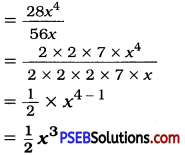
PSEB 8th Class Maths Solutions Chapter 14 Factorization Ex 14.3 1

PSEB 8th Class Maths Solutions Chapter 14 Factorization Ex 14.3

Question (ii)
– 36y3 ÷ 9y2
Solution:
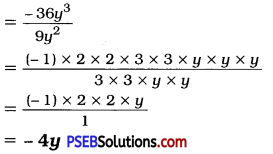
PSEB 8th Class Maths Solutions Chapter 14 Factorization Ex 14.3 2

Question (iii)
66pq2r3 ÷ 11qr2
Solution:
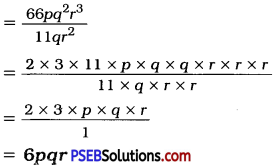
PSEB 8th Class Maths Solutions Chapter 14 Factorization Ex 14.3 3

Question (iv)
34x3y3z3 ÷ 51 xy2z3
Solution:
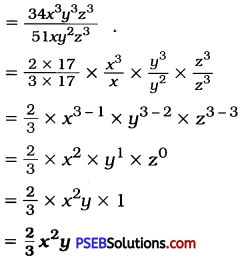
PSEB 8th Class Maths Solutions Chapter 14 Factorization Ex 14.3 4

PSEB 8th Class Maths Solutions Chapter 14 Factorization Ex 14.3

Question (v)
12a8b8 ÷ (- 6a6b4)
Solution:
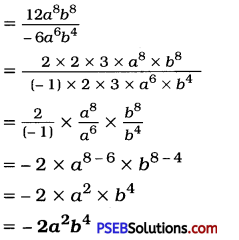
PSEB 8th Class Maths Solutions Chapter 14 Factorization Ex 14.3 5

2. Divide the given polynomial by the given monomial:

Question (i)
(5x2 – 6x) ÷ 3x
Solution:
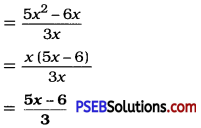
PSEB 8th Class Maths Solutions Chapter 14 Factorization Ex 14.3 6

Question (ii)
(3y8 – 4y6 + 5y4) ÷ y4
Solution:
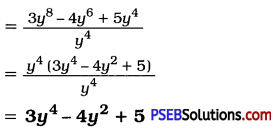
PSEB 8th Class Maths Solutions Chapter 14 Factorization Ex 14.3 7

PSEB 8th Class Maths Solutions Chapter 14 Factorization Ex 14.3

Question (iii)
8 (x3y2z2 + x2y3z2 ÷ 4 x2y2z2)
Solution:
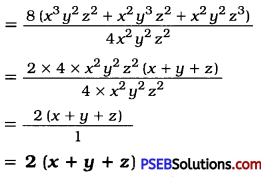
PSEB 8th Class Maths Solutions Chapter 14 Factorization Ex 14.3 8

Question (iv)
(x3 + 2x2 + 3x) ÷ 2x
Solution:
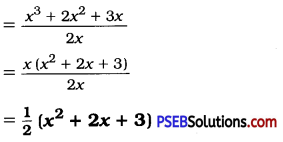
PSEB 8th Class Maths Solutions Chapter 14 Factorization Ex 14.3 9

Question (v)
(P3 q6 – p6 q3) ÷ p3 q3
Solution:
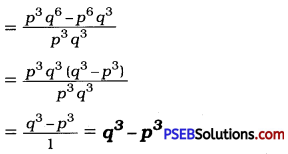
PSEB 8th Class Maths Solutions Chapter 14 Factorization Ex 14.3 10

PSEB 8th Class Maths Solutions Chapter 14 Factorization Ex 14.3

3. Work out the following divisions:

Question (i)
(10x – 25) ÷ 5
Solution:
= \(\frac{10 x-25}{5}\)
= \(\frac{5(2 x-5)}{5}\)
= 2x – 5

Question (ii)
(10x-25) ÷ (2x – 5)
Solution:
= \(\frac{10 x-25}{2 x-5}\)
= \(\frac{5(2 x-5)}{(2 x-5)}\)
= 5

Question (iii)
10y (6y + 21) ÷ 5 (2y + 7)
Solution:
= \(\frac{10 y(6 y+21)}{5(2 y+7)}\)
= \(\frac{2 \times 5 \times y \times 3 \times(2 y+7)}{5(2 y+7)}\)
= 2 × y × 3
= 6y

PSEB 8th Class Maths Solutions Chapter 14 Factorization Ex 14.3

Question (iv)
9x2y2(3z – 24) ÷ 27xy (z – 8)
Solution:
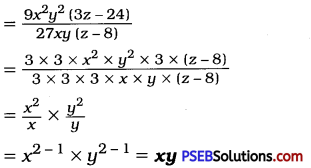
PSEB 8th Class Maths Solutions Chapter 14 Factorization Ex 14.3 11

Question (v)
96 abc (3a – 12) (5b – 30) ÷ 144 (a – 4)(b – 6)
Solution:
= \(\frac{96 a b c(3 a-12)(5 b-30)}{144(a-4)(b-6)}\)
= \(\frac{2 \times 2 \times 2 \times 2 \times 2 \times 3 \times a \times b \times c \times 3 \times(a-4) \times 5 \times(b-6)}{2 \times 2 \times 2 \times 2 \times 3 \times 3 \times(a-4) \times(b-6)}\)
= 2 × 5 × a × b × c
= 10 abc

4. Divide as directed:

Question (i)
5 (2x + 1) (3x + 5) ÷ (2x + 1)
Solution:
= \(\frac{5(2 x+1)(3 x+5)}{(2 x+1)}\)
= \(\frac{5 \times(3 x+5)}{1}\)
= 5(3x + 5)

PSEB 8th Class Maths Solutions Chapter 14 Factorization Ex 14.3

Question (ii)
26xy (x + 5) (y – 4) ÷ 13x (y – 4)
Solution:
= \(\frac{26 x y(x+5)(y-4)}{13 x(y-4)}\)
= \(\frac{2 \times 13 \times x \times y(x+5)(y-4)}{13 x(y-4)}\)
= 2y(x + 5)

Question (iii)
52pqr (p + q) (q + r) (r + p) ÷ 104pq (q + r) (r + p)
Solution:
= \(\frac{52 p q r(p+q)(q+r)(r+p)}{104 p q(q+r)(r+p)}\)
= \(\frac{52 \times p \times q \times r \times(p+q)(q+r)(r+p)}{2 \times 52 \times p \times q \times(q+r)(r+p)}\)
= \(\frac{r \times(p+q)}{2}\)
= \(\frac {1}{2}\)r (p + q)

Question (iv)
20 (y + 4) (y2 + 5y + 3) ÷ 5 (y + 4)
Solution:
= \(\frac{20(y+4)\left(y^{2}+5 y+3\right)}{5(y+4)}\)
= \(\frac{2 \times 2 \times 5 \times(y+4)\left(y^{2}+5 y+3\right)}{5(y+4)}\)
= 2 × 2 × (y2 + 5y + 3)
= 4(y2 + 5y + 3)

PSEB 8th Class Maths Solutions Chapter 14 Factorization Ex 14.3

Question (v)
x (x + 1) (x + 2) (x + 3) ÷ x (x + 1)
Solution:
= \(\frac{x(x+1)(x+2)(x+3)}{x(x+1)}\)
= \(\frac{(x+2)(x+3)}{1}\)
= (x + 2)(x + 3)

5. Factorise the expressions and divide them as directed:

Question (i)
(y2 + 7y + 10) ÷ (y + 5)
Solution:
First we factorise
y2 + 7y + 10
= y2 + 5y + 2y + 10
= y (y + 5) + 2 (y + 5)
= (y + 5) (y + 2)
∴ (y2 + 7y + 10) ÷ (y + 5)
= \(\frac{(y+5)(y+2)}{(y+5)}\)
= y + 2

Question (ii)
(m2 – 14m – 32) ÷ (m + 2)
Solution:
First we factorise
m2 – 14m – 32
= m2 – 16m + 2m – 32
= m (m – 16) + 2 (m – 16)
= (m – 16) (m + 2)
∴ (m2 – 14m – 32) ÷ (m + 2)
= \(\frac{(m-16)(m+2)}{m+2}\)
= m – 16

PSEB 8th Class Maths Solutions Chapter 14 Factorization Ex 14.3

Question (iii)
(5p2 – 25p + 20) ÷ (p – 1)
Solution:
First we factorise
5p2 – 25p + 20
= 5 (p2 – 5p + 4)
= 5 (p2 – 4p – p + 4)
= 5 [p (p – 4) – 1 (p – 4)]
= 5 (p – 4) (p – 1)
∴ (5p2 – 25p + 20) ÷ (p – 1)
= \(\frac{5(p-4)(p-1)}{p-1}\)
= 5 (p – 4)

PSEB 8th Class Maths Solutions Chapter 14 Factorization Ex 14.3

Question (iv)
4yz (z2 + 6z – 16) ÷ 2y (z + 8)
Solution:
= \(\frac{4 y z\left(z^{2}+6 z-16\right)}{2 y(z+8)}\)
= \(\frac{2 z\left(z^{2}+6 z-16\right)}{z+8}\)
Now, factorise
z2 + 6z – 16
= z2 + 8z – 2z – 16
= z (z + 8) – 2 (z + 8)
= (z + 8) (z – 2)
∴ 4yz (z2 + 6z – 16) ÷ 2y (z + 8)
= \(\frac{2 z(z+8)(z-2)}{z+8}\)
= 2z (z – 2)

Question (v)
5pq (p2 – q2) ÷ 2p(p + q)
Solution:
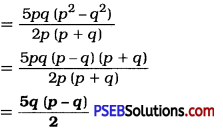
PSEB 8th Class Maths Solutions Chapter 14 Factorization Ex 14.3 12

Question (vi)
12xy (9x2 – 16y2) ÷ 4xy (3x + 4y)
Solution:
= \(\frac{12 x y\left(9 x^{2}-16 y^{2}\right)}{4 x y(3 x+4 y)}\)
= \(\frac{12 x y(3 x-4 y)(3 x+4 y)}{4 x y(3 x+4 y)}\)
= 3 (3x – 4y)

PSEB 8th Class Maths Solutions Chapter 14 Factorization Ex 14.3

Question (vii)
39y3 (50y2 – 98) ÷ 26y2 (5y + 7)
Solution:
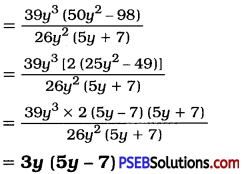
PSEB 8th Class Maths Solutions Chapter 14 Factorization Ex 14.3 13

PSEB 8th Class Maths Solutions Chapter 14 Factorization Ex 14.2

Punjab State Board PSEB 8th Class Maths Book Solutions Chapter 14 Factorization Ex 14.2 Textbook Exercise Questions and Answers.

PSEB Solutions for Class 8 Maths Chapter 14 Factorization Ex 14.2

1. Factorise the following expressions:

Question (i)
a2 + 8a + 16
Solution:
= (a)2 + 2 (a)(4) + (4)2
= (a + 4)2

PSEB 8th Class Maths Solutions Chapter 14 Factorization Ex 14.2

Question (ii)
p2 – 10p + 25
Solution:
= (p)2 – 2 (p)(5) + (5)2
= (P – 5)2

Question (iii)
25m2 + 30m + 9
Solution:
= (5m)2 + 2 (5m) (3) + (3)2
= (5m + 3)2

Question (iv)
49y2 + 84yz + 36z2
Solution:
= (7y)2 + 2 (7y)(6z) + (6z)2
= (7y + 6z)2

PSEB 8th Class Maths Solutions Chapter 14 Factorization Ex 14.2

Question (v)
4x2 – 8x + 4
Solution:
= 4(x2 – 2x + 1)
= 4 [(x)2 – 2 (x)(1) + (1)2]
= 4 (x – 1)2

Question (vi)
121b2 – 88bc + 16c2
Solution:
= (11b)2 – 2 (11b)(4c) + (4c)2
= (11b – 4c)2

Question (vii)
(l + m)2 – 4lm [Hint: Expand (1 + m)2 first]
Solution:
= l2 + 2lm + m2 – 4lm
= l2 + 2lm – 4lm + m2
= l2 – 2lm + m2
= (l)2 – 2 (l) (m) + (m)2
= (l – m)2

Question (viii)
a4 + 2a2b2 + b4
Solution:
= (a2)2 + 2 (a2)(b2) + (b2)2
= (a2 + b2)2

PSEB 8th Class Maths Solutions Chapter 14 Factorization Ex 14.2

2. Factorise:

Question (i)
4p2 – 9q2
Solution:
= (2p)2 – (3q)2
= (2p – 3q) (2p + 3q)

Question (ii)
63a2 – 112b2
Solution:
= 7 (9a2 – 16b2)
= 7 [(3a)2 -(4b)2]
= 7 (3a – 4b) (3a + 4b)

Question (iii)
49x2 – 36
Solution:
= (7x)2 – (6)2
= (7x – 6) (7x + 6)

Question (iv)
16x5 – 144x3
Solution:
= 16x3(x2 – 9)
= 16x3 [(x)2 – (3)2]
= 16x3 (x-3) (x + 3)

PSEB 8th Class Maths Solutions Chapter 14 Factorization Ex 14.2

Question (v)
(l + m)2 – (l – m)2
Solution:
=[(l + m) + (l – m)] [(l + m) – (l – m)]
= [l + m + l – m] [l + m – l + m]
= (2l) (2m)
= 4lm

Question (vi)
9x2y2 – 16
Solution:
= (3xy)2 – (4)2
= (3xy – 4) (3xy + 4)

Question (vii)
(x2 – 2xy + y2) – z2
Solution:
= (x – y)2 – (z)2
= [(x – y) – z] [(x – y) + z]
= (x – y – z) (x – y + z)

Question (viii)
25a2 – 4b2 + 28bc – 49c2
Solution:
= (25a2) – (4b2 – 28bc + 49c2)
= (5a)2 – (2b – 7c)2
= [(5a) – (2b – 7c)] [(5a) + (2b – 7c)]
= (5a – 2b + 7c) (5a + 2b – 7c)

PSEB 8th Class Maths Solutions Chapter 14 Factorization Ex 14.2

3. Factorise the expressions:

Question (i)
ax2 + bx
Solution:
= x (ax + b)

Question (ii)
7p2 + 21q2
Solution:
= 7 (p2 + 3q2)

Question (iii)
2x3 + 2xy2 + 2xz2
Solution:
= 2x(x2 + y2 + z2)

Question (iv)
am2 + bm2 + bn2 + an2
Solution:
= am2 + bm2 + an2 + bn2
= m2 (a + b) + n2(a + b)
= (a + b) (m2 + n2)

PSEB 8th Class Maths Solutions Chapter 14 Factorization Ex 14.2

Question (v)
(lm + l) + m + 1
Solution:
= l (m + 1) + 1 (m + 1)
= (m + 1) (l + 1)

Question (vi)
y(y + z) + 9(y + z)
Solution:
= (y + z)(y + 9)

Question (vii)
5y2 – 20y – 8z + 2yz
Solution:
= 5y2 – 20y + 2yz – 8z
= 5y (y – 4) + 2z (y – 4)
= (y- 4) (5y + 2z)

Question (viii)
10ab + 4a + 5b + 2
Solution:
= 2a (5b + 2) + 1 (5b + 2)
= (5b + 2) (2a + 1)

PSEB 8th Class Maths Solutions Chapter 14 Factorization Ex 14.2

Question (ix)
6xy – 4y + 6 – 9x
Solution:
= 6xy – 4y – 9x + 6
= 2y (3x-2)-3(3x-2)
= (3x-2) (2y – 3)

4. Factorise:

Question (i)
a4 – b4
Solution:
= (a2)2 – (b2)2
= (a2 – b2) (a2 + b2)
= ((a)2 – (b2)] (a2 + b2)
= (a – b) (a + b) (a2 + b2)

Question (ii)
p4 – 81
Solution:
= (p2)2 – (9)2
= (p2 – 9) (p2 + 9)
= ((p)2 – (3)2] (p2 + 9)
= (p – 3)(p + 3)(p2 + 9)

PSEB 8th Class Maths Solutions Chapter 14 Factorization Ex 14.2

Question (iii)
x4 – (y + z)4
Solution:
= (x2)2 – (a2)2 (∵ y + z = a)
= (x2 – a2) (x2 + a2)
= (x – a) (x + a) (x2 + a2)
= [x – (y + z)] [x + (y + z)] [x2 + (y + z)2] (∵ a = y + z)
= (x – y – z) (x + y + z) [x2 + (y + z)2]

Question (iv)
x4 – (x – z)4
Solution:
= (x2)2 – [(x – z)2]2
= [x2 – (x – z)2] [x2 + (x – z)2]
= [x2 – (x2 – 2xz + z2)] [x2 + (x2 – 2xz + z2)]
= (x2 – x2 + 2xz – z2) (x2 + x2 – 2xz + z2)
= (2xz – z2) (2x2 – 2xz + z2)
= z (2x – z) (2x2 – 2xz + z2)

Question (v)
a4 – 2a2b2 + b4
Solution:
= (a2)2 – 2(a2)(b2) + (b2)2
= (a2 – b2)2
= (a2 – b2) (a2 – b2)
= (a – b) (a + b) (a – b) (a + b)

PSEB 8th Class Maths Solutions Chapter 14 Factorization Ex 14.2

5. Factorise the following expressions:

Question (i)
p2 + 6p + 8
Solution:
= p2 + 6p + 9 – 1
= (p2 + 6p + 9) – (1)
= (p + 3)2 – (1)2
= (p + 3 + 1) (p + 3 – 1)
= (P + 4) (p + 2)
Here, last term is 8.
∴ 9 – 1 = 8.

OR
p2 + 6p + 8
Here, ab = 8 and a + b = 6
On solving equations, a = 4, b = 2
Now, p2 + 6p + 8
= p2 + 4p + 2p + 8
= p (p + 4) + 2 (p + 4)
= (p + 4) (p + 2)

Question (ii)
q2 – 10q + 21
Solution:
= q2 – 10q + 25 – 4
= (q2 – 10q + 25) – (4)
= (q – 5)2 – (2)2
= (q – 5 + 2) (q – 5 – 2)
= (q – 3) (q – 7)
Here, last term is 21.
∴ 25 – 4 = 21.

OR
q2 – 10q + 21
Here, ab = 21 and a + b = (- 10)
Possible values of a = 7 or (-7)
b = 3 or (- 3)
Let us check, 7 + 3 = 10 ≠ (- 10)
∴ a = – 7, b = – 3
Now, q2 – 10q + 21
= q2 – 7q – 3q + 21
= q (q – 7) – 3 (q – 7)
= (q – 7) (q – 3)

PSEB 8th Class Maths Solutions Chapter 14 Factorization Ex 14.2

Question (iii)
p2 + 6p – 16
Solution:
= p2 + 6p + 9 – 25
= (P2 + 6p + 9) – (25)
= (p + 3)2 – (5)2
= (p + 3 – 5) (p + 3 + 5)
= (p – 2) (p + 8)
Here, last term is (-16).
∴ (-25) + 9 = (-16)

OR

p2 + 6p – 16
Here, ab = – 16 and a + b = 6
Possible values of a = 8 or (-8) b = 2 or (-2)
Let us check, 8 + 2 = 10 ≠ 6
(- 8) + 2 = (-6) ≠ 6
8 + (-2) = 8 – 2 = 6
Now, p2 + 6p – 16
= p2 + 8p – 2p – 16
= P (P + 8) – 2 (p + 8)
= (p + 8) (p – 2)

PSEB 8th Class Maths Solutions Chapter 14 Factorization Ex 14.1

Punjab State Board PSEB 8th Class Maths Book Solutions Chapter 14 Factorization Ex 14.1 Textbook Exercise Questions and Answers.

PSEB Solutions for Class 8 Maths Chapter 14 Factorization Ex 14.1

1. Find the common factors of the given terms:

Question (i)
12x, 36
Solution:
12x = 2 × 2 × 3 × x
36 = 2 × 2 × 3 × 3
∴ Common factors of 12x and 36 = 2 × 2 × 3
= 12

PSEB 8th Class Maths Solutions Chapter 14 Factorization Ex 14.1

Question (ii)
2y, 22xy
Solution:
2y = 2 xy
22xy = 2 × 11 × x × y
∴ Common factors of 2y and 22xy
= 2 × y = 2y

Question (iii)
14pq, 28p2q2
Solution:
14pq = 2 × 7 × p × q
28p2q2 = 2 × 2 × 7 × p × p × q × q
∴ Common factors of 14pq and 28p2q2
= 2 × 7 × p × q = 14pq

Question (iv)
2x, 3x2, 4
Solution:
2x = 2 × x
3x2 = 3 × x × x
4 = 2 × 2
∴ Common factors of 2x, 3x2 and 4 = 1 [Note: 1 is a factor of each term.]

PSEB 8th Class Maths Solutions Chapter 14 Factorization Ex 14.1

Question (v)
6abc, 24ab2, 12a2b
Solution:
6abc = 2 × 3 × a × b × c
24ab2 = 2 × 2 × 2 × 3 × a × b × b
12a2b = 2 × 2 × 3 × a × a × b
∴ Common factors of 6abc, 24ab2 and 12a2b
= 2 × 3 × a × b
= 6ab

Question (vi)
16x3, – 4x2, 32x
Solution:
16x3 = 2 × 2 × 2 × 2 × x × x × x
– 4x2 = (-1) × 2 × 2 × x × x
32x = 2 × 2 × 2 × 2 × 2 × x
∴ Common factors of 16x3, – 4x2 and 32x = 2 × 2 × x = 4x

Question (vii)
10pq, 20qr, 30rp
Solution:
10pq = 2 × 5 × p × q
20qr = 2 × 2 × 5 × q × r
30rp = 2 × 3 × 5 × r × p
∴ Common factors of 10pq, 20qr and 30rp = 2 × 5 = 10

Question (viii)
3x2y3, 10x3y2, 6x2y2z
Solution:
3x2y3 = 3 × x × x × y × y × y
10x3y2 = 2 × 5 × x × x × x × y × y
6x2y2z = 2 × 3 × x × x × y × y × z
∴ Common factors of 3x2y3, 10x3y2 and 6x2y2z
= x × x × y × y = x2y2

PSEB 8th Class Maths Solutions Chapter 14 Factorization Ex 14.1

2. Factorise the following expressions:

Question (i)
7x – 42
Solution:
7x = 7 × x
42 = 2 × 3 × 7
∴ 7 is common in both terms.
7x – 42 = 7 (x – 6)

Question (ii)
6p – 12q
Solution:
6p = 2 × 3 × p
12q = 2 × 2 × 3 × q
∴ 2 × 3 = 6 is common in both terms.
6p – 12q = 6 (p – 2q)

Question (iii)
7a2 + 14a
Solution:
7a2 = 7 × a × a
14a = 2 × 7 × a
∴ 7 × a = 7a is common in both terms.
∴ 7a2 + 14a = 7a (a + 2)

PSEB 8th Class Maths Solutions Chapter 14 Factorization Ex 14.1

Question (iv)
– 16z + 20z3
Solution:
– 16z = -2 × 2 × 2 × 2 × z
20z3 = 2 × 2 × 5 × z × z × z
∴ 2 × 2 × z = 4z is common in both terms.
∴ – 16z + 20z3 = 4z (- 4 + 5z2)

Question (v)
20l2m + 30alm
Solution:
= 2 × 2 × 5 × l × l × m + 2 × 3 × 5 × a × l × m
= 10lm (2l + 3a)

Question (vi)
5x2y – 15xy2
Solution:
= 5xy (x – 3y)

PSEB 8th Class Maths Solutions Chapter 14 Factorization Ex 14.1

Question (vii)
10a2 – 15b2 + 20c2
Solution:
= 5 (2a2 – 3b2 + 4c2)

Question (viii)
– 4a2 + 4ab – 4ca
Solution:
= 4a (- a + b – c)

Question (ix)
x2yz + xy2z + xyz2
Solution:
= xyz (x + y + z)

Question (x)
ax2y + bxy2 + cxyz
Solution:
= xy (ax + by + cz)

PSEB 8th Class Maths Solutions Chapter 14 Factorization Ex 14.1

3. Factorise:

Question (i)
x2 + xy + 8x + 8y
Solution:
= x (x + y) + 8 (x + y)
= (x + y) (x + 8)

Question (ii)
15xy – 6x + 5y – 2
Solution:
= 3x (5y – 2) + 1 (5y – 2)
= (5y – 2) (3x + 1)

Question (iii)
ax + bx- ay – by
Solution:
= x (a + b) – y (a + b)
= (a+ b) (x- y)

PSEB 8th Class Maths Solutions Chapter 14 Factorization Ex 14.1

Question (iv)
15pq + 15 + 9q + 25p
Solution:
= 15pq + 9q + 25p + 15
= 3q (5p + 3) + 5 (5p + 3)
= (5p + 3) (3q + 5)

Question (v)
z – 7 + 7xy – xyz
Solution:
= z – 7 – xyz + 7xy
= 1 (z – 7) – xy (z – 7)
= (z – 7) (1 – xy)

PSEB 8th Class Maths Solutions Chapter 15 Introduction to Graphs InText Questions

Punjab State Board PSEB 8th Class Maths Book Solutions Chapter 15 Introduction to Graphs InText Questions and Answers.

PSEB 8th Class Maths Solutions Chapter 15 Introduction to Graphs InText Questions

Try These : [Textbook Page No. 244]

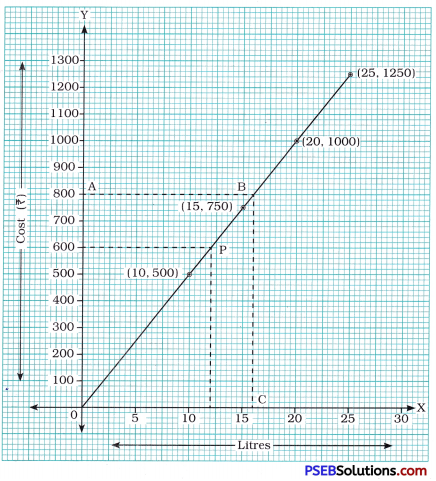
1. In the above example, use the graph to find how much petrol can be purchased for ₹ 800.
PSEB 8th Class Maths Solutions Chapter 15 Introduction to Graphs InText Questions 1
Solution:
We can find the quantity of petrol to be got for ₹ 800. For this take a point on the Y-axis (0, 800). Now, draw a line parallel to X-axis to meet the graph at the point B. Now, from the point B, draw a line parallel to Y-axis, which intersect X-axis in the point C. Coordinate of the point C : (16, 0).
Hence, 16 litres of petrol can be purchased for ₹ 800.

PSEB 8th Class Maths Solutions Chapter 15 Introduction to Graphs InText Questions

Think, Discuss and Write : [Textbook Page No. 243]

1. The number of litres of petrol you buy to fill a car’s petrol tank will decide the amount you have to pay. Which is the independent variable here? Think about it.
Solution:
Here, we clearly understand that graph of quantity of petrol (litre) and amount to pay (₹) should be a line.
Both quantities are in direct proportion. If we fill more litres of petrol, we have to pay more amount and vice versa.
∴ Petrol is the independent variable.

Try These : [Textbook Page No. 245]

1. Is Example 7, a case of direct variation?
Solution:
Yes, Example 7 given on page 245 (Textbook), is a case of direct variation. As the principal increases, the simple interest on it also increases proportionately.

PSEB 8th Class Maths Solutions Chapter 15 Introduction to Graphs Ex 15.3

Punjab State Board PSEB 8th Class Maths Book Solutions Chapter 15 Introduction to Graphs Ex 15.3 Textbook Exercise Questions and Answers.

PSEB Solutions for Class 8 Maths Chapter 15 Introduction to Graphs Ex 15.3

1. Draw the graphs for the following tables of values, with suitable scales on the axes.

Question (a)
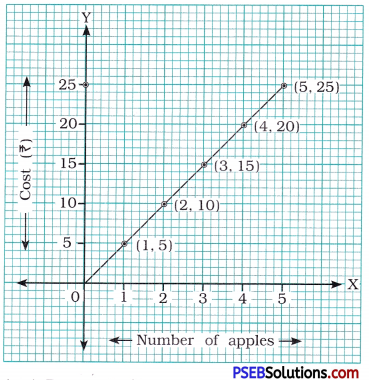
Cost of apples

Number of apples 1 2 3 4 5
Cost (in ₹) 5 10 15 20 25

Solution:
PSEB 8th Class Maths Solutions Chapter 15 Introduction to Graphs Ex 15.3 1
1. Draw 2 lines perpendicular to each other as X-axis and Y-axis on graph paper.
2. Take scale :
On X-axis : 1 cm = 1 apple
On Y-axis 1 cm = ₹ 5
3. Plot the points (1, 5), (2, 10), (3, 15), (4, 20) and (5, 25) on graph paper.
4. Join these points and extend line.

PSEB 8th Class Maths Solutions Chapter 15 Introduction to Graphs Ex 15.3

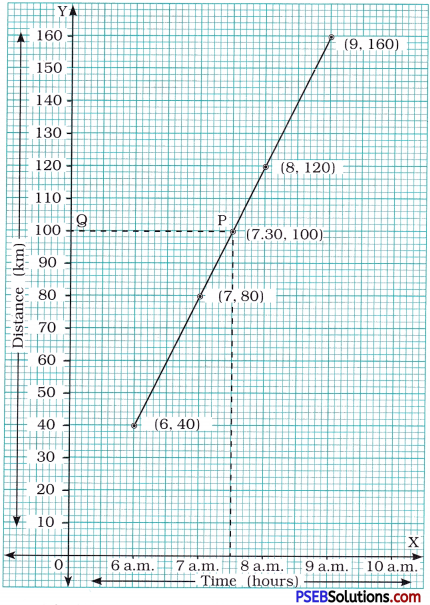
(b) Distance travelled by a car

Time (in hours) 6 a.m. 7 a.m. 8 a.m. 9 a.m.
Distance (in km) 40 80 120 160

Solution:
1. Draw two lines perpendicular to each other as X-axis and Y-axis on graph paper.
2. Take scale:
On X-axis : 2 cm = 1 unit (Time in hours.)
On Y-axis : 1 cm = 10 km
3. Plot the points (6, 40), (7, 80), (8, 120) and (9, 160) on graph paper.
4. Join these points and extend line.
PSEB 8th Class Maths Solutions Chapter 15 Introduction to Graphs Ex 15.3 2

Question (i)
How much distance did the car cover during the period 7:30 a.m. to 8:00 a.m.?
Solution:
In the graph, draw a perpendicular at the point indicating 7:30 a.m. on the X-axis such that it meets the graph at P.
From P draw a line parallel to X-axis to meet Y-axis at 100 km.
∴ Distance travelled between 7:30 am and 8:00 am.
= (120 – 100) km
= 20 km

PSEB 8th Class Maths Solutions Chapter 15 Introduction to Graphs Ex 15.3

Question (ii)
What was the time when the car had covered a distance of 100 km since it’s start?
Solution:
When the car had covered a distance of 100 km, the time was 7 : 30 am.

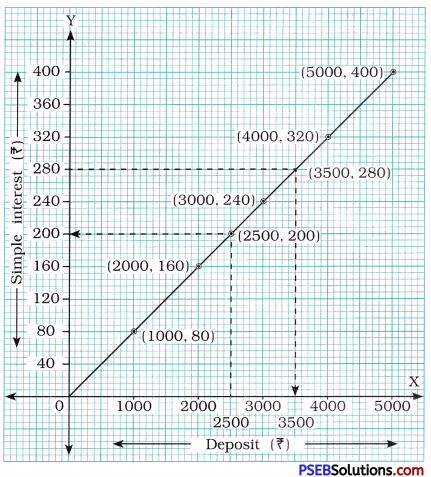
(c) Interest on deposits for a year.

Deposit (in ₹) 1000 2000 3000 4000 5000
Simple Interest (in ₹) 80 160 240 320 400

Solution :
1. Draw two lines perpendicular to each other as X-axis and Y-axis on graph paper.
2. Take scale:
On X-axis : 2 cm = ₹ 1000 (deposit)
On Y-axis : 1 cm = ₹ 40 (simple interest)
3. Plot the points (1000, 80), (2000, 160), (3000, 240), (4000, 320) and (5000, 400) on graph paper.
4. Join these points and extend line.
PSEB 8th Class Maths Solutions Chapter 15 Introduction to Graphs Ex 15.3 3

Question (i)
Does the graph pass through the origin?
Solution:
Yes, it passes through the origin.

PSEB 8th Class Maths Solutions Chapter 15 Introduction to Graphs Ex 15.3

Question (ii)
Use the graph to find the interest on ₹ 2500 for a year.
Solution:
From the graph, the interest on ₹ 2500 for a year is ₹ 200.

Question (iii)
To get an interest of ₹ 280 per year, how much money should be deposited?
Solution:
From the graph an interest of ₹ 280 can be got by depositing ₹ 3500.

2. Draw a graph for the following:

Question (i)

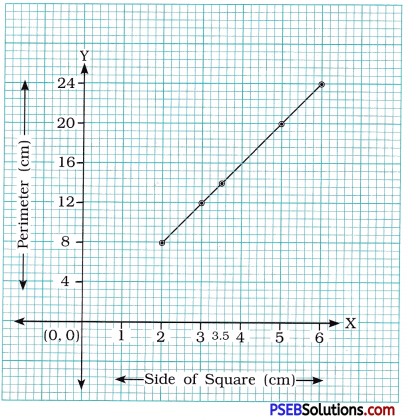
Side of square (in cm) 2 3 3.5 5 6
Perimeter (in cm) 8 12 14 20 24

Is it a linear graph?
Solution:
1. Draw two lines perpendicular to each other as X-axis and Y-axis on graph paper.
2. Take scale:
On X-axis : 1 cm = 1 cm (Side of a square)
On Y-axis : 1 cm = 4 cm (Perimeter of a square) )
3. Plot the points (2, 8), (3, 12), (3.5, 14), (5, 20) and (6, 24) on graph paper.
4. Join these points and extend line.
PSEB 8th Class Maths Solutions Chapter 15 Introduction to Graphs Ex 15.3 4
Yes, it is a linear graph.

PSEB 8th Class Maths Solutions Chapter 15 Introduction to Graphs Ex 15.3

Question (ii)

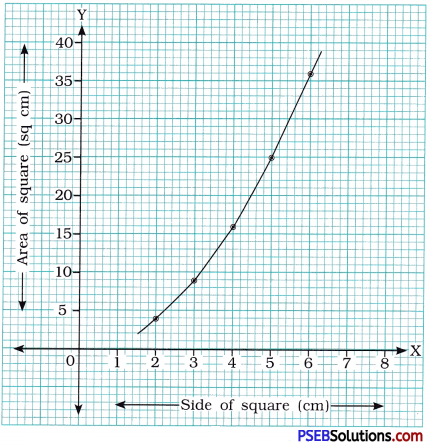
Side of square (in cm) 2 3 4 5 6
Area (in cm2) 4 9 16 25 36

Is it a linear graph?
Solution:
1. Draw two lines perpendicular to each other as X-axis and Y-axis on graph paper.
2. Take scale:
On X-axis : 1 cm = 1 cm (Side of a square)
On Y-axis : 1 cm 5 cm (Area of a square)
3. Plot the points (2, 4), (3, 9), (4, 16), (5, 25) and (6, 36) on graph paper.
4. Join these points.
PSEB 8th Class Maths Solutions Chapter 15 Introduction to Graphs Ex 15.3 5
No, this graph is not a straight line. So it is not a linear graph.

PSEB 8th Class Maths Solutions Chapter 4 Practical Geometry Ex 4.2

Punjab State Board PSEB 8th Class Maths Book Solutions Chapter 4 Practical Geometry Ex 4.2 Textbook Exercise Questions and Answers.

PSEB Solutions for Class 8 Maths Chapter 4 Practical Geometry Ex 4.2

1. Construct the following quadrilaterals:

Question (i).
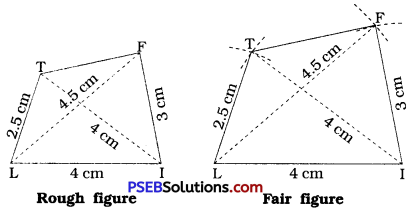
Quadrilateral LIFT.
LI = 4 cm,
IF = 3 cm,
TL = 2.5 cm,
LF = 4.5 cm,
IT = 4 cm.
Solution:
PSEB 8th Class Maths Solutions Chapter 4 Practical Geometry Ex 4.2 1

Steps of construction:

  • Draw a line segment LI = 4 cm.
  • With L as centre and radius = 2.5 cm, draw an arc.
  • With I as centre and radius = 4 cm, draw an arc to intersect the previous arc at T.
  • With L as centre and radius = 4.5 cm draw an arc.
  • With I as centre and radius 3 cm, draw an arc to intersect the previous, arc at F.
  • Draw \(\overline{\mathrm{LT}}, \overline{\mathrm{IF}}, \overline{\mathrm{FT}}, \overline{\mathrm{LF}}\) and \(\overline{\mathrm{IT}}\).

Thus, LIFT is the required quadrilateral.

Question (ii).
Quadrilateral GOLD
OL = 7.5 cm,
GL = 6 cm,
GD = 6 cm,
LD = 5 cm,
OD = 10 cm.
Solution:
PSEB 8th Class Maths Solutions Chapter 4 Practical Geometry Ex 4.2 2
Steps of construction:

  • Draw a line segment LD = 5 cm.
  • With L as centre and radius = 7.5 cm, draw an arc.
  • With D as centre and radius = 10 cm, draw another arc to intersect the previous arc at O.
  • With L as centre and radius = 6 cm, draw an arc.
  • With D as centre and radius = 6 cm, draw another arc to intersect previous arc at G.
  • Draw \(\overline{\mathrm{LO}}, \overline{\mathrm{GO}}, \overline{\mathrm{DG}}, \overline{\mathrm{LG}}\) and \(\overline{\mathrm{DO}}\).

Thus, GOLD is the required quadrilateral.

Question (iii).
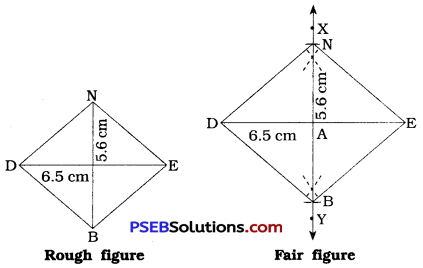
Rhombus BEND
BN = 5.6 cm,
DE = 6.5 cm.
Solution:
PSEB 8th Class Maths Solutions Chapter 4 Practical Geometry Ex 4.2 3a
[Note: Diagonals of a rhombus are perpendicular bisectors of each another. Here, diagonals of □ BEND \(\overline{\mathrm{DE}}\) and \(\overline{\mathrm{BN}}\) intersect at A. So AN = 2.8 cm and AB = 2.8 cm (BN = 5.6 cm, \(\frac {1}{2}\) BN = AN and AB)]
Steps of construction:

  • Draw a line segment DE = 6.5 cm.
  • Draw perpendicular bisector \(\overleftrightarrow{X Y}\) of \(\overline{\mathrm{DE}}\), which intersects \(\overline{\mathrm{DE}}\) at A.
  • With centre at A and radius = 5.6 × \(\frac {1}{2}\) = 2.8 cm, draw two arcs intersecting \(\overleftrightarrow{X Y}\) in points B and N.
  • Draw \(\overline{\mathrm{DN}}, \overline{\mathrm{EN}}, \overline{\mathrm{EB}}\) and \(\overline{\mathrm{DB}}\).

Thus, BEND is the required quadrilateral.

PSEB 8th Class Maths Solutions Chapter 15 Introduction to Graphs Ex 15.2

Punjab State Board PSEB 8th Class Maths Book Solutions Chapter 15 Introduction to Graphs Ex 15.2 Textbook Exercise Questions and Answers.

PSEB Solutions for Class 8 Maths Chapter 15 Introduction to Graphs Ex 15.2

1. Plot the following points on a graph sheet. Verify if they lie on a line:

Question (a)
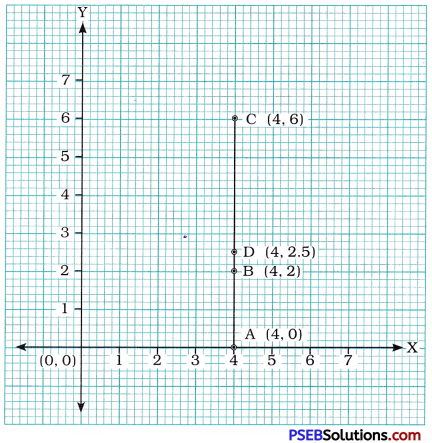
A(4, 0), B (4, 2), C(4, 6), D(4, 2.5)
Solution:
PSEB 8th Class Maths Solutions Chapter 15 Introduction to Graphs Ex 15.2 1
Plotting the given points and then l joining them we find that they all S lie on the same line.

PSEB 8th Class Maths Solutions Chapter 15 Introduction to Graphs Ex 15.2

Question (b)
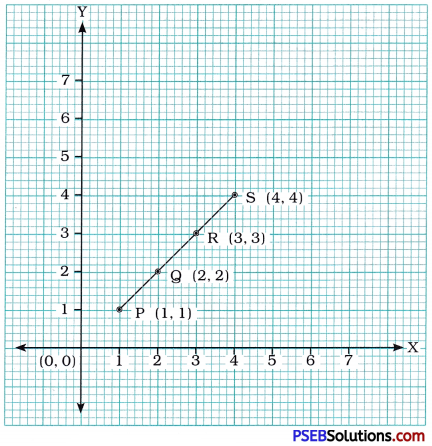
P(1, 1), Q(2, 2), R(3, 3), S(4, 4)
Solution:
PSEB 8th Class Maths Solutions Chapter 15 Introduction to Graphs Ex 15.2 2
Plotting the given points and then joining them we find that they all lie on the same line.

Question (c)
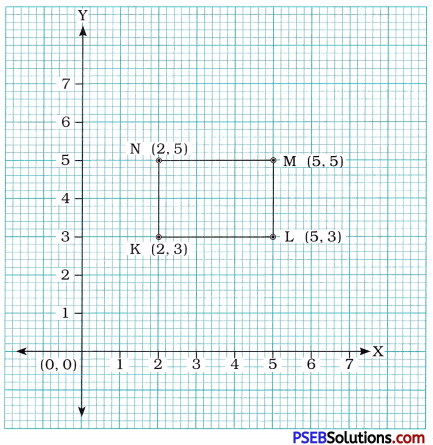
K(2, 3), L(5, 3), M(5, 5), N(2, 5)
Solution:
PSEB 8th Class Maths Solutions Chapter 15 Introduction to Graphs Ex 15.2 3
Plotting the given points and then joining them we find that all of them do not lie on the same line.

PSEB 8th Class Maths Solutions Chapter 15 Introduction to Graphs Ex 15.2

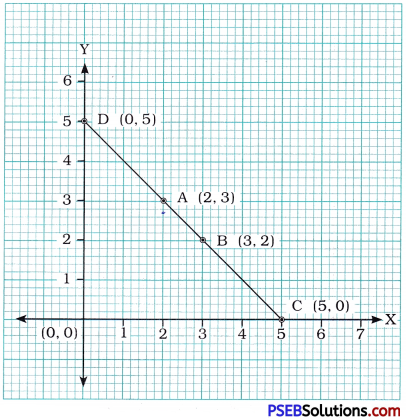
2. Draw the line passing through (2, 3) and (3, 2). Find the coordinates of the points at which this line meets the x-axis and y-axis.
Solution:
PSEB 8th Class Maths Solutions Chapter 15 Introduction to Graphs Ex 15.2 4
Plot the given points and join them to make a line. When you extend this line, it meets the X-axis at C (5, 0) and the Y-axis at D (0, 5).

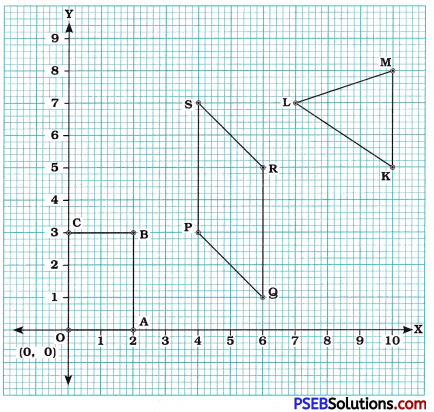
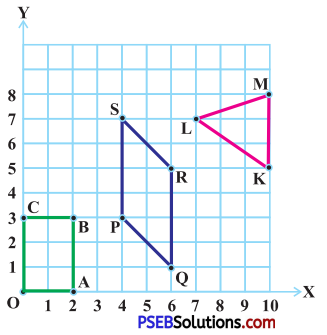
3. Write the coordinates of the vertices of each of these adjoining figures:
PSEB 8th Class Maths Solutions Chapter 15 Introduction to Graphs Ex 15.2 6
Solution:
Figure:
(i) The coordinates of the vertices of quadrilateral OABC:
O are (0, 0)
A are (2, 0)
B are (2, 3)
C are (0, 3)

(ii) The coordinates of the vertices of quadrilateral PQRS:
P are (4, 3)
Q are (6, 1)
R are (6, 5)
S are (4, 7)

(iii) The coordinates of the vertices of triangle KLM:
K are (10, 5)
L are (7, 7)
M are (10, 8)

PSEB 8th Class Maths Solutions Chapter 15 Introduction to Graphs Ex 15.2

4. State whether True or False. Correct that are false:
PSEB 8th Class Maths Solutions Chapter 15 Introduction to Graphs Ex 15.2 5

Question (i)
A point whose x-coordinate is zero and y- coordinate is non-zero will lie on y-axis.
Solution:
True

Question (ii)
A point whose y-coordinate is zero and x-coordinate is 5 will lie on y- axis.
Solution:
False
Correct statement: A point whose y-coordinate is 0 and x-coordinate is 5 will lie on X-axis at a distance 5 units from origin.

PSEB 8th Class Maths Solutions Chapter 15 Introduction to Graphs Ex 15.2

Question (iii)
The coordinates of the origin are (0, 0).
Solution:
True

PSEB 8th Class Maths Solutions Chapter 4 Practical Geometry Ex 4.1

Punjab State Board PSEB 8th Class Maths Book Solutions Chapter 4 Practical Geometry Ex 4.1 Textbook Exercise Questions and Answers.

PSEB Solutions for Class 8 Maths Chapter 4 Practical Geometry Ex 4.1

1. Construct the following quadrilaterals:

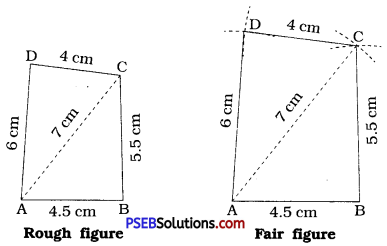
Question (i).
Quadrilateral ABCD.
AB = 4.5 cm,
BC = 5.5 cm,
CD = 4 cm,
AD = 6 cm,
AC = 7 cm.
Solution :
PSEB 8th Class Maths Solutions Chapter 4 Practical Geometry Ex 4.1 1
Steps of construction:

  • Draw a line segment AB = 4.5 cm.
  • With A as centre and radius = 7 cm, draw an arc.
  • With B as centre and radius = 5.5 cm, draw another arc to intersect previous arc at C.
  • With A as centre and radius 6 cm draw an arc.
  • With centre at C and radius 4 cm, draw another arc to intersect previous arc at D.
  • Draw \(\overline{\mathrm{BC}}, \overline{\mathrm{CD}}, \overline{\mathrm{AD}}\) and \(\overline{\mathrm{AC}}\).

Thus, ABCD is the required quadrilateral.

PSEB 8th Class Maths Solutions Chapter 4 Practical Geometry Ex 4.1

Question (ii).
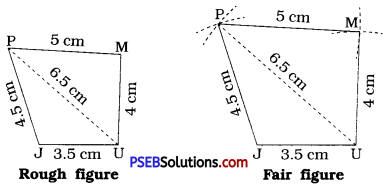
Quadrilateral JUMP
JU = 3.5 cm,
UM = 4 cm,
MP = 5 cm,
PJ = 4.5 cm,
PU = 6.5 cm.
Solution:
PSEB 8th Class Maths Solutions Chapter 4 Practical Geometry Ex 4.1 2
Steps of construction :

  • Draw a line segment JU = 3.5 cm.
  • With J as centre and radius = 4.5 cm, draw an arc.
  • With U as centre and radius = 6.5 cm, draw another arc to intersect previous arc at P
  • With U as centre and radius = 4 cm draw an arc.
  • With P as centre and radius 5 cm, draw an arc which intersects previous arc at M.
  • Draw \(\overline{\mathrm{JP}}, \overline{\mathrm{UM}}, \overline{\mathrm{MP}}\) and \(\overline{\mathrm{UP}}\).

Thus, JUMP is the required quadrilateral.

PSEB 8th Class Maths Solutions Chapter 4 Practical Geometry Ex 4.1

Question (iii).
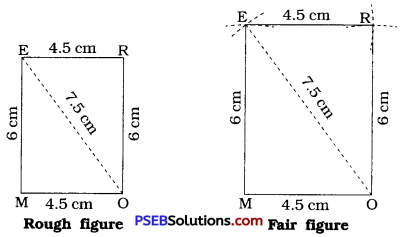
Parallelogram MORE ?
OR = 6 cm,
RE = 4.5 cm,
EO = 7.5 cm.
Solution:
PSEB 8th Class Maths Solutions Chapter 4 Practical Geometry Ex 4.1 3
[Note: □ MORE is a parallelogram. So length of opposite sides are equal. ]
∴ RE = MO = 4.5 cm; OR = ME = 6 cm
Steps of construction:

  • Draw a line segment MO = 4.5 cm.
  • With M as centre and radius = 6 cm, draw an arc.
  • With O as centre and radius = 7.5 cm, draw another arc to intersect the previous arc at E.
  • With O as centre and radius = 6 cm, draw an arc.
  • With E as centre and radius = 4.5 cm, draw another arc to intersect the previous arc at R.
  • Draw \(\overline{\mathrm{ME}}, \overline{\mathrm{OR}}, \overline{\mathrm{RE}}\) and \(\overline{\mathrm{OE}}\).

Thus, MORE is the required parallelogram.

PSEB 8th Class Maths Solutions Chapter 4 Practical Geometry Ex 4.1

Question (iv).
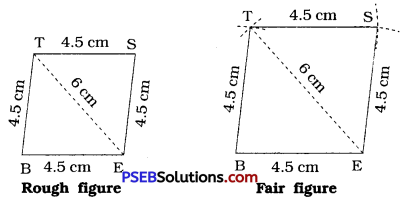
Rhombus BEST
BE = 4.5 cm,
ET = 6 cm.
Solution:
PSEB 8th Class Maths Solutions Chapter 4 Practical Geometry Ex 4.1 4
[Note : BEST is a rhombus. So length of all four sides are equal.]
BE = 4.5 cm
∴ ES = ST = TB = 4.5 cm
ET = 6 cm (Given)
Steps of construction:

  • Draw a line segment BE = 4.5 cm.
  • With B as centre and radius = 4.5 cm, draw an arc.
  • With E as centre and radius = 6 cm, draw another arc to intersect the previous arc at T.
  • With E as centre and radius = 4.5 cm, draw an arc.
  • With T as centre and radius = 4.5 cm, draw another arc to intersect previous arc at S.
  • Draw \(\overline{\mathrm{BT}}, \overline{\mathrm{ES}}, \overline{\mathrm{ST}}\) and \(\overline{\mathrm{ET}}\).

Thus, BEST is the required quadrilateral.

PSEB 8th Class Maths Solutions Chapter 15 Introduction to Graphs Ex 15.1

Punjab State Board PSEB 8th Class Maths Book Solutions Chapter 15 Introduction to Graphs Ex 15.1 Textbook Exercise Questions and Answers.

PSEB Solutions for Class 8 Maths Chapter 15 Introduction to Graphs Ex 15.1

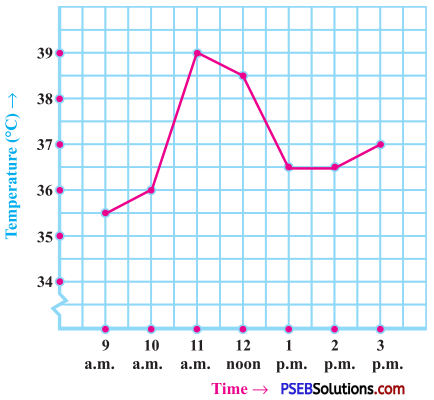
1. The following graph shows the temperature of a patient in a hospital, recorded every hour:
PSEB 8th Class Maths Solutions Chapter 15 Introduction to Graphs Ex 15.1 1

Question (a)
What was the patient’s temperature at 1 p.m.?
Solution:
The patient’s temperature at 1 p.m. was 36.5 °C.

PSEB 8th Class Maths Solutions Chapter 15 Introduction to Graphs Ex 15.1

Question (b)
When was the patient’s temperature 38.5 °C?
Solution:
The patient’s temperature was 38.5 °C at 12 noon.

Question (c)
The patient’s temperature was the same two times during the period given. What were these two times?
Solution:
The patient’s temperature was same (36.5 °C) at 1 p.m. and 2 p.m.

Question (d)
What was the temperature at 1:30 p.m.? How did you arrive at your answer?
Solution:
The patient’s temperature at 1:30 p.m. was 36.5 °C.
(The temperature did not change during interval of 1 p.m. and 2 p.m. So the temperature did not show any change and it was 36.5 °C at 1:30 p.m.)

Question (e)
During which periods did the patients’ temperature showed an upward trend?
Solution:
The patient’s temperature showed an upward trend during the periods 9 a.m. to 10 a.m., 10 a.m. to 11a.m. and 2 p.m. to 3 p.m., because the temperature increased during these intervals.

PSEB 8th Class Maths Solutions Chapter 15 Introduction to Graphs Ex 15.1

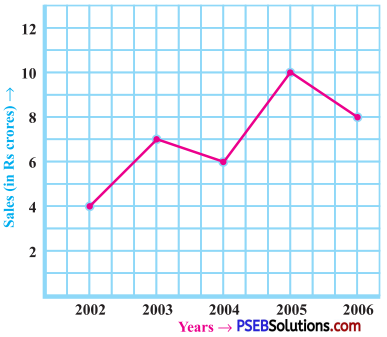
2. The following line graph shows the yearly sales figures for a manufacturing company:
PSEB 8th Class Maths Solutions Chapter 15 Introduction to Graphs Ex 15.1 2

Question (a)
What were the sales in (i) 2002 (ii) 2006?
Solution:
1. The sales in the year 2002 was ₹ 4 crores.
2. The sales in the year 2006 was ₹ 8 crores.

PSEB 8th Class Maths Solutions Chapter 15 Introduction to Graphs Ex 15.1

Question (b)
What were the sales in (i) 2003 (ii) 2005?
Solution:
1. The sales in the year 2003 was ₹ 7 crores.
2. The sales in the year 2005 was ₹ 10 crores.

Question (c)
Compute the difference between the sales in 2002 and 2006.
Solution:
The difference between the sales in 2002 and 2006 = ₹ (8 – 4) crore
= ₹ 4 crores

Question (d)
In which year was there the greatest difference between the sales as compared to its previous year?
Solution:
In year 2005, there was the greatest difference between the sales as compared to its previous year.

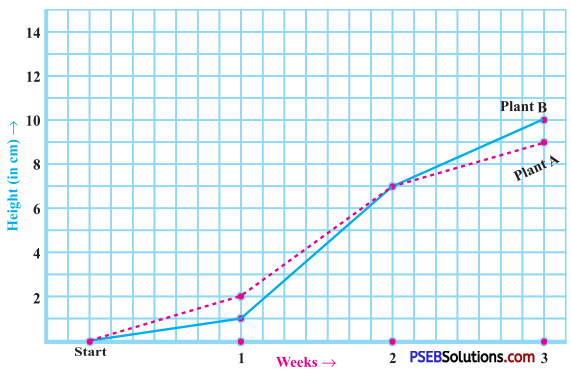
3. For an experiment in Botany, two different plants, plant A and plant B were grown under similar laboratory conditions. Their heights were measured at the end of each week for 3 weeks. The results are shown by the following graph:
PSEB 8th Class Maths Solutions Chapter 15 Introduction to Graphs Ex 15.1 3

Question (a)
How high was Plant A after
1. 2 weeks
2. 3 weeks?
Solution:
1. The plant A was 7 cm high after 2 weeks.
2. The plant A was 9 cm high after 3 weeks.

PSEB 8th Class Maths Solutions Chapter 15 Introduction to Graphs Ex 15.1

Question (b)
How high was Plant B after
1. 2 weeks
2. 3 weeks?
Solution:
1. The plant B was 7 cm high after 2 weeks.
2. The plant B was 10 cm high after 3 weeks.

Question (c)
How much did Plant A grow during the 3rd week?
Solution:
Plant A grew (9 cm – 7 cm) = 2 cm during 3rd week.

Question (d)
How much did Plant B grow from the end of the 2nd week to the end of the 3rd week?
Solution:
The plant B grew (10cm-7cm) = 3 cm from the end of 2nd week to the end of 3rd week.

Question (e)
During which week did Plant A grow most?
Solution:
The growth of the plant A During the 1st week = 2 cm – 0 cm = 2 cm
During the 2nd week = 7 cm – 2 cm = 5 cm
During the 3rd week = 9 cm – 7 cm = 2 cm
Thus, during the 2nd week, the plant A grew the most.

PSEB 8th Class Maths Solutions Chapter 15 Introduction to Graphs Ex 15.1

Question (f)
During which week did Plant B grow least?
Solution:
The growth of the plant B.
During the 1st week = 1cm – 0 cm
= 1 cm
During the 2nd week = 7 cm – 1 cm
= 6 cm
During the 3rd week = 10 cm-7 cm
= 3 cm
Thus, the plant B grew the least in the first week.

Question (g)
Were the two plants of the same height during any week shown here? Specify.
Solution:
At the end of 2nd week, both the plants were of the same height, that is 7 cm.

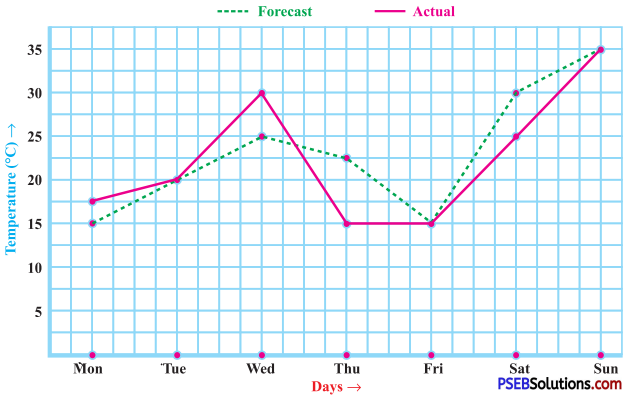
4. The following graph shows the temperature forecast and the actual temperature for each day of a week.
PSEB 8th Class Maths Solutions Chapter 15 Introduction to Graphs Ex 15.1 4

Question (a)
On which days was the forecast temperature the same as the actual temperature?
Solution:
The forecast temperature was the same as the actual temperature on Tuesday, Friday and Sunday.

PSEB 8th Class Maths Solutions Chapter 15 Introduction to Graphs Ex 15.1

Question (b)
What was the maximum forecast temperature during the week?
Solution:
The maximum forecast temperature during the week was 35 °C.

Question (c)
What was the minimum actual temperature during the week?
Solution:
The minimum actual temperature during the week was 15 °C.

Question (d)
On which day did the actual temperature differ the most from the forecast temperature?
Solution:
On Thursday, the actual temperature differed the most from the forecast temperature (7.5 °C).

Difference of temperature:

  • Monday : 17.5 °C – 15 °C = 2.5 °C
  • Tuesday : 20 °C – 20 °C = o°c
  • Wednesday : 30 °C – 25 °C = 5°C
  • Thursday : 22.5 °C – 15 °C = 7.5 °C
  • Friday : 15 °C – 15 °C = o°c
  • Saturday : 30 °C – 25 °C = 5°C
  • Sunday : 35 °C – 35 °C = o°c

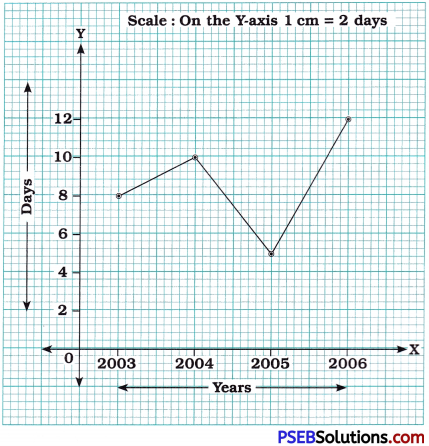
5. Use the tables below to draw linear graphs:

Question (a)
The number of days a hillside city received snow in different years:

Year 2003 2004 2005 2006
Days 8 10 5 12

Solution:
Linear graph to show snowfall in different years:
PSEB 8th Class Maths Solutions Chapter 15 Introduction to Graphs Ex 15.1 5

PSEB 8th Class Maths Solutions Chapter 15 Introduction to Graphs Ex 15.1

Question (b)
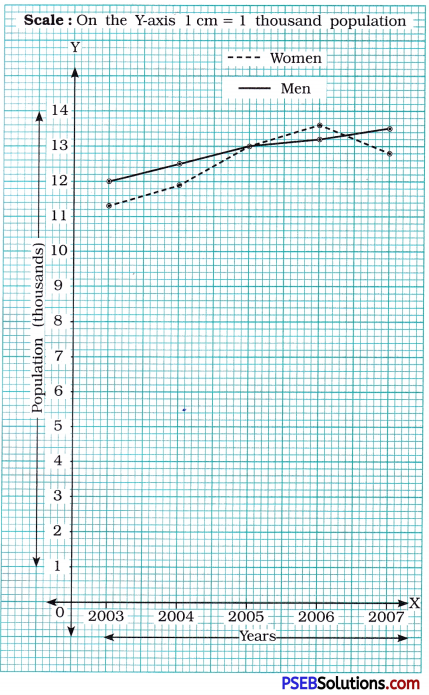
Population (in thousands) of men and women in a village in different years:

Year 2003 2004 2005 2006 2007
Number of Men 12 12.5 13 13.2 13.5
Number of Women 11.3 11.9 13 13.6 12.8

Solution:
Draw two perpendicular lines on the graph paper. Take year along X-axis (horizontal line) and population (in thousand) along Y-axis (vertical line).
For men: Mark the points (2003, 12), (2004, 12.5); (2005, 13); (2006, 13.2) and (2007, 13.5) and join them.
For women: Mark the points (2003, 11.3); (2004, 11.9); (2005, 13); (2006, 13.6) and (2007, 12.8) and join them.
PSEB 8th Class Maths Solutions Chapter 15 Introduction to Graphs Ex 15.1 6

PSEB 8th Class Maths Solutions Chapter 15 Introduction to Graphs Ex 15.1

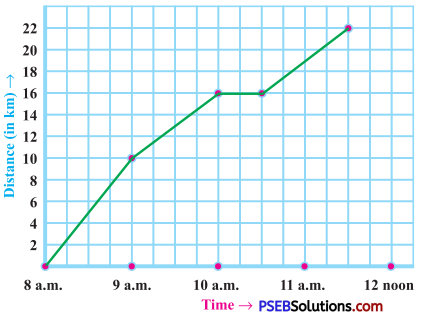
6. A courier cycles from a town to a neighboring suburban area to deliver a parcel to a merchant. His distance from the town at different times is shown by the following graph:
PSEB 8th Class Maths Solutions Chapter 15 Introduction to Graphs Ex 15.1 7

Question (a)
What is the scale taken for the time axis?
Solution:
The time is taken along the X-axis. The scale along X-axis is 4 units = 1 hour.

Question (b)
How much time did the person take for the travel?
Solution:
Total travel time taken by a courier : = 8:00 am to 11:30 am = 3\(\frac {1}{2}\) hours

Question (c)
How far is the place of the merchant from the town?
Solution:
Distance of the merchant from the town is 22 km.

Question (d)
Did the person stop on his way? Explain.
Solution:
Yes, the stopage time = 10:00 am to 10:30 am. This is indicated by the horizontal part of the graph.

Question (e)
During which period did he ride fastest?
Solution:
He rode fastest between 8:00 am and 9:00 am.

PSEB 8th Class Maths Solutions Chapter 15 Introduction to Graphs Ex 15.1

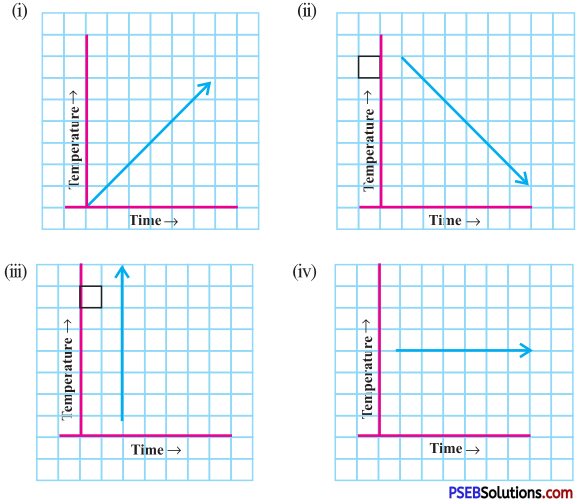
7. Can there be a time-temperature graph as follows? Justify your answer.
PSEB 8th Class Maths Solutions Chapter 15 Introduction to Graphs Ex 15.1 8
Solution:
In case of (iii), the graph shows different number of temperatures at the same time which is not possible.
∴ Case (iii) does not represent a time-temperature graph.

PSEB 8th Class Maths Solutions Chapter 3 Understanding Quadrilaterals InText Questions

Punjab State Board PSEB 8th Class Maths Book Solutions Chapter 3 Understanding Quadrilaterals InText Questions and Answers.

PSEB 8th Class Maths Solutions Chapter 3 Understanding Quadrilaterals InText Questions

Try These (Textbook Page No. 43)

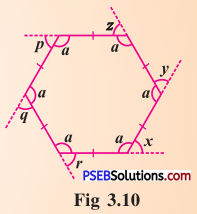
Take a regular hexagon Fig 3.10.
PSEB 8th Class Maths Solutions Chapter 3 Understanding Quadrilaterals InText Questions 1

Question 1.
What is the sum of the measures of its exterior angles x, y, z, p, q r?
Solution:
∠x + ∠y + ∠z + ∠p + ∠q + ∠r = 360°
(∵ Sum of exterior angles of a polygon = 360°)

Question 2.
Is x = y = z = p = q = r ? Why?
Solution:
Since, all the sides of the polygon are equal, it is a regular hexagon. So its interior angles are equal.
∴ x = (180° – a), y = (180° – a),
z = (180° – a), p = (180° – a),
q = (180° – a), r = (180° – a)
∴ x = y = z = p = q = r

PSEB 8th Class Maths Solutions Chapter 3 Understanding Quadrilaterals InText Questions

Question 3.
What is the measure of each ?
(i) exterior angle
(ii) interior angle
Solution:
(i) x + y + z + p + q + r = 360°
(∵ Sum of exterior angles = 360°)
All angles are equal.
∴ Measure of each exterior angle = \(\frac{360^{\circ}}{6}\) = 60°

(ii) Exterior angle = 60°
∴ Interior angle = 180° – 60° = 120°.

Question 4.
Repeat this activity for the cases of:
(i) a regular octagon
(ii) a regular 20-gon
Solution:
(i) In a regular octagon, number of sides (n) = 8.
∴ Each exterior angle = \(\frac{360^{\circ}}{8}\) = 45°
∴ Each interior angle = 180° – 45° = 135°

(ii) For a regular 20-gon, the number of sides (n) = 20.
∴ Each exterior angle = \(\frac{360^{\circ}}{20}\) = 18°
∴ Each interior angle = 180° – 18° = 162°

PSEB 8th Class Maths Solutions Chapter 3 Understanding Quadrilaterals InText Questions

Try These (Textbook Page No. 47)

Question 1.
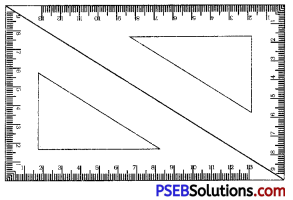
Take two identical set squares with angles 30°-60°-90° and place them adjacently to form a parallelogram as shown in figure. Does this help you to verify the above property ?
PSEB 8th Class Maths Solutions Chapter 3 Understanding Quadrilaterals InText Questions 2
Solution:
Yes, the given figure helps us to verify that opposite sides of a parallelogram are equal.

Try These (Textbook Page No. 48)

Question 1.
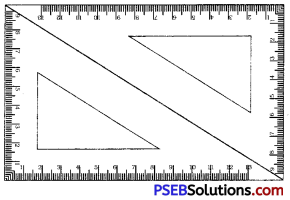
PSEB 8th Class Maths Solutions Chapter 3 Understanding Quadrilaterals InText Questions 3
Solution:
Yes, this figure also helps us to confirm that opposite angles of a parallelogram are equal.

Think, Discuss and Write (Textbook Page No. 50)

Question 1.
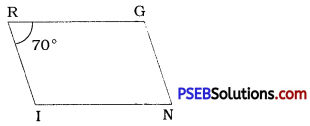
After showing m∠R = m∠N = 70°, can you find m∠I and m∠G by any other method ?
Solution:
PSEB 8th Class Maths Solutions Chapter 3 Understanding Quadrilaterals InText Questions 4
Yes, without using the property of parallelogram, we can find m∠I and m∠G.
m∠R = m∠N = 70° (Given)
RG || IN, the transversal RI intersecting them,
∴ m∠R + m∠I = 180° (Sum of interior angles is 180°)
∴ 70° + m∠I = 180° (∵ m∠R = m∠N = 70°)
∴ m∠I = 180° – 70°
∴ m∠I = 110°
Similarly, m∠G = 110°

PSEB 8th Class Maths Solutions Chapter 3 Understanding Quadrilaterals InText Questions

Think, Discuss and Write (Textbook Page No. 56)

Question 1.
A mason has made a concrete slab. He needs it to be rectangular. In what different ways can he make sure that it is rectangular?
Solution :
He can make sure that it is rectangular using the following different ways :

  • By making opposite sides of equal length.
  • By keeping each angle at the corners as 90°.
  • By keeping the diagonals of equal length.
  • By making opposite sides parallel.

Question 2.
A square was defined as a rectangle with all sides equal. Can we define it as rhombus with equal angles? Explore this idea.
Solution:
Yes, because a rhombus becomes a square if its all angles are equal.

Question 3.
Can a trapezium have all angles equal ?
Can it have all sides equal ? Explain.
Solution:
Yes, a trapezium can have all angles equal. In this case, it becomes a square or rectangle.
Yes, it can have all sides equal. In this case, it becomes a rhombus or square.